
State Capitalism and Working-Class Radicalism in the French Aircraft Industry
Herrick Chapman
To Liz
Table of Contents
- ACKNOWLEDGMENTS
- ABBREVIATIONS
- INTRODUCTION
- PART ONE— PRIVATE ENTERPRISE IN DECLINE, 1928–1936
- One— The Failure of Industrial Reform
- Two— The Revival of Working-Class Militancy
- PART TWO— AN INDUSTRY EMBATTLED, 1936–1938
- Three— June '36
- Four— Nationalization
- PART THREE— REARMAMENT, REPRESSION, AND WAR, 1938–1940
- Five— Rearmament
- Six— Breaking the CGT
- Seven— The Fall of France
- PART FOUR— FROM VICHY TO THE COLD WAR, 1940–1950
- Eight— Building Airplanes for the Luftwaffe
- Nine— Liberation and Reform, 1944–1946
- Ten— Toward a Postwar Industrial Order, 1947–1950
- Notes
- APPENDIX TABLES
- BIBLIOGRAPHY
- INDEX
ACKNOWLEDGMENTS
I wish to thank a few of the many people who have helped me in the course of this study. Patrick Fridenson taught me, as he has so many scholars, how to navigate in the archives of twentieth-century France. His encouragement more than once gave me the courage to persevere at the frontiers of public access. Charles Tilly offered useful advice about how to proceed when I embarked on the project. Tony Judt, Lynn Hunt, Robert Paxton, and George Ross all read the entire manuscript at crucial points in its preparation. The book is much the better for their criticism, even as its shortcomings remain my own.
This study began as a doctoral dissertation at the University of California, Berkeley, where my dissertation director, Gerald Feldman, provided wise counsel while encouraging me to follow my own convictions in shaping the work. Reginald Zelnick gave the dissertation an unusually close reading, which helped me enormously in revising the manuscript, as did the suggestions of James Sheehan and Paul Robinson from Stanford University. I have also benefited from friends and colleagues who read drafts or offered advice about how to work with my sources. I wish particularly to thank Susanna Barrows, Barton Bernstein, Stephen Cohen, Patrick Fridenson, Gene Goldenfeld, Dena Goodman, Richard Kuisel, Joby Margadant, Ted Margadant, Walter McDougall, Aimée Moutet, Karen Offen, Catherine Omnès, Steve Owen, Paul Rabinow, Bill Reddy, and Michael Seidman.
Research on industrial life in a recent period in the French past depends entirely on the patience and support of busy archivists, labor officials, and business executives willing to offer guidance, open doors, and make materials accessible. I wish especially to thank Pierre Cézard, Yvonne Poulle, and Christine Pétillat at the Archives Nationales; General Charles Christienne and M. Lechoix at the Service Historique de
l'Armée de l'Air; Claude Lévy at the Comité d'Histoire de la Deuxième Guerre Mondiale; Marie-Geneviève Chevignard at the Fondation Nationale des Sciences Politiques; Annie Benhamou-Hirtz at the Union des Industries Métallurgiques et Minières; René Huot-Marchand and Claude Bresson at the Groupement des Industries Françaises Aéronautiques et Spatiales; Claude Acker, Mme. Tubolique, and M. Delacarte at Aérospatiale; General Pierre Gallois at the Société Marcel Dassault; General de Bordas at the Fondation pour les Etudes de la Défense Nationale; Jeff Apter and Denise Rosencwajg at the CGT; M. Imont and Mme. Berthier at the Fédération des Travailleurs de la Métallurgie; Jacques Delys and Robert Corsin at the Comité Central d'Entreprise of SNECMA; Edouard Pivotsky and Henri Rieu at the Union des Syndicats des Travailleurs de la Métallurgie in Toulouse; Roger Martelli at the Institut de Recherches Marxistes; Agnes Peterson and Helen Solanum at the Hoover Institution; and John Taylor at the National Archives of the United States.
A number of persons and institutions have offered special assistance along the way. John Barzman shared valuable archival material on Le Havre. Emmanuel Chadeau led me to several sources and generously shared his insights about some of the common ground we explored. Jennie Kiesling took valuable time out from her own archival diggings to track down photographs. Michelle Harrison assisted in the research. Lori Cole helped read the proofs. Norman Rubin provided material on productivity in the industry, and written reminiscences by Wilhelm Reverdy proved especially useful. Less tangible, but no less important, contributions were from colleagues and friends at Stanford University, Carnegie Mellon University, and the Pittsburgh Center for Social History who inspired me to think about this study in ways I could not have done on my own. Funds from the Social Science Research Council and a Fulbright-Hays Grant supported my initial research in France. A grant from Stanford University enabled me to make a follow-up trip for several weeks to supplement the original research. Sheila Levine and Rose Vekony at the University of California Press provided expert guidance as the manuscript made its journey to print.
In the bibliography I have listed the former workers, trade union militants, engineers, state officials, and company managers who allowed me to interview them about their experiences in the industry. I am grateful to them for giving their time, sharing their memories, and tolerating the intrusion that interviewing inevitably involves.
I am most indebted to family and friends. Pat and Fred Painton made their home in Paris a haven for body and soul. Both my family and my wife's provided all kinds of material and emotional support, and they always conveyed faith in the enterprise. I only wish our mothers, Katha-
rine Leonard and Dorothy Cohen, had lived to see the book. Our daughters, Julia and Natalie, are still too young to understand my gratitude for letting me work in my study and my pleasure when they occasionally burst in anyway. For helping to care for them I thank Vicky Byrne. Most of all, I wish to thank my wife, Liz, my toughest reader and staunchest supporter, who has shared in this work in every way. The book grows out of our life together in the historical craft. I treasure her contribution more than any acknowledgment can convey.
ABBREVIATIONS
|
|
|
INTRODUCTION
During the 1930s aircraft workers emerged from obscurity to become a vanguard of the French labor movement. Virtually unorganized in the early thirties, these workers suddenly occupied their factories in May 1936, launching what turned out to be the largest strike wave of the Third Republic. Communist militants soon became prominent in aircraft unions, and from 1937 through the late 1940s the aircraft industry remained one of the most hotly contested arenas of labor reform in France. Throughout this period the industry remained in the limelight as workers, employers, and government officials grappled with major issues—from nationalization, the forty-hour week, and shop floor control to the repercussions of the Marshall Plan. People who built airplanes, moreover, found themselves faced time and again in particularly poignant ways with questions that made these years painful for the French in every walk of life—how to revive a depressed economy, prepare for war, cope with an enemy occupation, and, eventually, rebuild a broken nation after years of corrosive internal conflict.
For the aircraft industry, as for many other institutions in France, the era proved to be as pivotal historically as it was difficult for the French to live through. During nearly two decades of civic strife and international crisis the men and women who worked in the factories and design offices of the aircraft industry, who sat in corporate board rooms and in the bureaus of government ministries, fought over fundamental choices in industrial policy and thereby transformed the relationship between labor, business, and the state. In addition, what happened in aviation conformed to a pattern of institutional change in many other sectors of the French economy. This book explores this transformation by probing inside the workings of a single industry to examine what people experienced, what they hoped for, and why they responded as they did to the
most turbulent period in the history of France since the revolutions of the previous century.
The aircraft industry also provides a setting in which to investigate just why France emerged from the 1930s and 1940s with its peculiarly volatile style of industrial conflict. Since the end of the Second World War France has stood out, in comparison with most other Western nations, for the radicalism of its workers and the size and frequency of its industrial strikes. In no other advanced capitalist society have workers so consistently questioned the legitimacy of capitalist enterprise. For thirty years the major trends in the postwar labor movement—the survival of the Communist-dominated Confédération Générale du Travail (CGT) as the largest labor confederation in France, the weakness of its anti-Communist counterpart, Force Ouvrière, and the evolution of the Catholic Confédération Française des Travailleurs Chrétiens (CFTC) into the radical Confédération Française Démocratique du Travail (CFDT)—all suggest that workers continued to take class antagonisms and left-wing principles seriously in postwar France. Surveys even as recently as the 1970s suggest that workers in France, especially in comparison to their counterparts in Britain, have been more likely, as Duncan Gallie has argued, "to see the resolution of their work grievances as dependent upon the outcome of wider social conflicts." Likewise, French employers have been slower than their counterparts abroad to accommodate unions. The so-called corporatist arrangements that enabled trade unions and business organizations to negotiate wide-ranging agreements on a regular basis in much of the rest of Europe failed to emerge in postwar France.1
Not that France failed to stabilize after the Second World War in its own way. Despite the traumas of colonial war, the collapse of the Fourth Republic, and the rebellions of 1968, postwar France never encountered a revolutionary crisis nor faltered (at least until the 1970s) in maintaining a remarkable pace of economic growth. And indeed, since the late 1970s industrial conflict has diminished to a degree, especially as the CGT and the Communist Party have declined and as the labor movement generally, in France as elsewhere, has fallen on hard times. Still, for more than three decades following the war France displayed a peculiar blend of social conflict and institutional stability—a capacity both to meet the industrial challenges of the postwar era and to sustain a radical politics.
The roots of this unusually contentious style of industrial relations lie deep in the past. Labor militants in the postwar era still owed much of their language of class combat to the radical artisans who first articulated a vision of working-class emancipation in France during the 1830s. A half-century later, revolutionary syndicalists established an antibureaucratic approach to trade unionism that would also have a lasting effect on
the labor movement. Employers owed a similar debt to their predecessors—nineteenth-century entrepreneurs who created that blend of authoritarian and paternalistic rule that is still the hallmark of French managerial ideology. And behind all these developments it was easy to see the long shadow cast by the French Revolution: a tradition of insurrection and reaction made employers and workers keenly aware of the potential political consequences of industrial conflict.
Although the legacy of the nineteenth century remained important, events since 1914 proved decisive in shaping industrial politics after the Second World War. Amid two world wars and the Great Depression industrial life changed as profoundly in France as in any country in Western Europe. Between 1914 and the early 1950s workers, employers, and government officials fought bitterly with one another and in the process created the major institutional features of the postwar industrial landscape: a mass-based labor movement, a strong Communist Party, a network of employer organizations, a collective bargaining system, and a highly interventionist state. In the course of nearly four decades of turmoil the French institutionalized their unusually contentious style of industrial relations.
Just why this style of conflict emerged in twentieth-century France has remained the subject of controversy. Since the early 1950s historians and social scientists have addressed the question in at least four ways. For a time many analysts pointed to the slow pace of industrialization in France to explain worker radicalism in the postwar era. Val Lorwin, for example, viewed economic backwardness as an important precondition for the success of Communist trade unionism.2 After 1960, however, it became increasingly clear that spectacular growth and a rising standard of living for workers had done little to dampen hostilities in the workplace. Well-paid employees in technologically advanced sectors remained some of the most reliable supporters of left-wing unions. Prosperity failed to mollify conflict.
A second approach was to look to "national character" as the source of a distinctive French pattern of industrial conflict. According to this view, the psychological traits believed to be common to a people—the volatile individualism of the French, the deferential discipline of the Germans, the dogged pragmatism of the British—shaped the character of industrial relations in each country. Such an approach rests on doubtful stereotypes. It fails to account for important differences in industrial relations within countries. Most important, it assumes all too readily that individual traits are reproduced in collective behavior. Even the stunning work of Michel Crozier, which argued that labor relations reflected a French cultural system based on an aversion to face-to-face conflict, failed to escape the psychological reductionism that the purely cultural
approach has involved. Nor have Crozier and his students done enough to explore how workers' habits of handling their superiors were collectively constructed over time through specific historical experiences.3
Meanwhile other analysts developed a third approach, what might be described as an organizational explanation for industrial conflict in France. They focused on the political guile and bureaucratic ingenuity of the French Communist Party (PCF). In his study of "affluent workers" in the Fourth Republic Richard Hamilton explained the persistence of working-class radicalism in the 1950s by pointing to the capacity of the Communist unions to shape the attitudes of their members. Hamilton insisted that organizations, rather than social conditions, made people radical.4 His views dovetailed neatly with Annie Kriegel's path-breaking studies of the history of the PCF. Communism, in her view, was a foreign graft, but it took in France because of fortuitous events between 1917 and 1920 and then flourished because militants were able to build a "countersociety" that wedded workers to the Communist movement. Like Hamilton's, Kriegel's views shared an assumption at the very heart of the Leninist doctrine she opposed—that party militants led a passive, compliant working class in directions that workers otherwise would not have taken.5
The organizational approach begged as many questions as it answered. To be sure, discipline, cunning, and leadership served Communists well in their effort to build a movement. Once the PCF finally became a stable, mass-based party during the Popular Front, it certainly became as well an autonomous force in French political life. But it remains unclear why so many workers who never embraced the party cooperated readily with its militants at the workplace. Moreover, from what historians have discovered about the political vitality of local working-class communities in the nineteenth century, it no longer seems tenable to assume that ordinary workers in the twentieth century were the passive, malleable actors that the organizational approach has implied. To understand the impact of the PCF on working-class radicalism, we need to know more about life in and around the local unions and factory cells where militants tried to organize workers.
Some historians and sociologists have adopted a fourth approach to industrial conflict, one that calls attention to the importance of politics and the state. Edward Shorter and Charles Tilly have made the most ambitious effort along these lines by examining strike patterns in France since the nineteenth century. They trace how the strike was transformed from the lengthy local protests of skilled craftsmen, typical of industrial conflict in the 1890s, into the brief, large-scale walkouts that became common in the postwar period. Shorter and Tilly argue that urbanization and industrialization gradually enabled militants to build stronger
unions and that as unions became more centralized, and as the state became more involved in the economy, workers increasingly used work stoppages to pressure political authorities at the national level. Strikes, though ostensibly over economic issues, became part of an organized struggle to win a voice for workers in the policy. Not surprisingly, in Shorter and Tilly's view, the big strike waves of 1906, 1919, 1936, and 1947 nearly always coincided with political crises—moments when workers could hope to influence the character of a regime or its policies. By the 1950s French workers had come to rely on short, massive demonstration strikes to make their voices heard in parliament and the ministries—the centers of power from which they were largely excluded. The strike, then, continued to be a political weapon in postwar France, in contrast to Northern and Central Europe, where the capacity of labor parties to take power encouraged workers to shift the locus of conflict from the workplace to parliament.6
Shorter and Tilly's work marked an important advance in the study of industrial politics for two reasons. It offered a way to keep organizational life at the center of the analysis without neglecting the larger social and economic context in which militants built their institutions. Furthermore, Shorter and Tilly's approach identified state officials as major protagonists in industrial politics and state structure as a crucial factor helping shape the way industrial conflict evolved. Industrial relations experts had for a long time considered the state as a third partner, along with business and labor, in the triangle of industrial conflict. But Shorter and Tilly took the role of the state more seriously than most scholars had done before. They made a convincing case for putting politics at the center of an explanation for why France had such high rates of industrial conflict in the postwar era.
Yet Shorter and Tilly's work has its shortcomings. It does not take consciousness into account, that is, the subjective understanding of the world that workers, employers, and state officials inevitably brought to their conflicts.7 Shorter and Tilly assumed all too easily, for example, that in building unions, workers simply maximized their "organizational resources" at a given moment and channeled their protests as the logic of the circumstances required. This approach overlooks the importance of culture, not in the simplistic sense of national character, but in the anthropological sense that workers had to perceive their world through the mental lens of ideas, attitudes, and values. Given the range of convictions that could move workers in any large factory and the ideological conflict that divided the labor movement in France, it was not always easy for workers to come to a common understanding of their collective interests, much less to agree on workable strategies for collective action. Nor did workers share common views about employers, state officials, or the
state. Between 1914 and 1950, moreover, catastrophic events threw the lives of most workers and their families, at one time or another, into turmoil. Nearly all were forced to adapt their views to make sense of a changing world. To understand industrial conflict in France, then, we need to examine how workers, employers, and state officials perceived their interests, made choices, improvised with their opportunities, and grappled with the unintended consequences of their actions.
This book takes up the challenge by exploring how workers, employers, and state officials transformed industrial relations in a single industry between 1930 and 1950. Like Shorter and Tilly, I analyze labor relations as a triangular affair since state officials were just as important as workers and employers in shaping industrial combat. But by confining myself to one industry, I can also explore the internal politics of industrial life, the process by which workers, employers, and state officials learned from experience, changed their ideas, and adapted over time to depression, war, and political conflict.8
This study deliberately cuts across the usual historiographical boundaries between the Third Republic, Vichy, and the early years of the Fourth Republic. To cover two complicated decades in the history of an industry is ambitious, especially since I have tried to understand all three partners in industrial relations. Yet, the long time span can hardly be avoided since it was during one protracted series of conflicts—from the creation of the Popular Front as a political movement in 1934, the defeat at the hands of Germany in 1940 and the subsequent Occupation and Liberation, and on through the bitter strikes of 1947 and 1948—that the French reshaped their patterns of industrial combat. To understand what emerged in the late 1940s we have to begin in the mid-1930s, when Popular Front politics set the terms of conflict for the decade that followed.
A study of the 1930s and 1940s, moreover, requires a shift in focus from some of the themes that have preoccupied historians of nineteenth-century labor. The latter have, quite properly, told a story of class formation at the local level, calling special attention to the way artisans struggled to defend their crafts and their communities against the encroachments of industrial capitalism. Although much of this story holds true for workers in the twentieth century, the historian who studies French industrial life after 1930 must come to grips with three more recent developments.
First, by the mid-1930s the advanced industries of the so-called second industrial revolution—chemicals, steel, automobiles, aviation, electrical power—had come to replace the artisanal workshop as the strategic center of working-class protest. Although small enterprises still predominated in the interwar economy, it was increasingly in the big factories of
such firms as Renault, Citroën, and Gnôme-et-Rhône that workers fought the decisive battles in industrial politics. And it was in the technologically advanced sectors that labor militants confronted their most important organizational challenge—the need to mold a highly diversified work force, made up of men and women, young and old, the skilled and the unskilled, the native and the foreign-born, into a cohesive political force. As employers in the advanced sectors came increasingly to recruit a work force dispersed residentially and diversified by craft and skill, the factory, rather than the neighborhood or workshop, became, as Michelle Perrot has put it, "the epicenter of the labor movement," the critical battleground for employers and militants competing for the loyalty of a modern industrial work force. Labor militants had to find ways of building solidarity across regions as well if they were to assert themselves within firms that had dispersed their plants all over France. Technological change and the growth of advanced firms forced workers to take alliance building within the work force much more seriously than their predecessors had before 1900. By the same token, employers faced the parallel challenge of finding new ways to undermine the solidarity of a diverse and dispersed work force.9
Second, during the 1930s and 1940s national and international events affected workers and employers more profoundly than was the case in the nineteenth century. The triumph and demise of the Popular Front, the defeat of 1940, the Nazi Occupation, and the Liberation—these were not events that workers could chat about in a café and then go about their business; they destroyed lives, shattered families, made and ruined careers, and forced many citizens to reaffirm or reconsider their loyalties. By the late 1940s workers and employers had incorporated a new set of political references into their lives—memories of the sitdown strikes of 1936, memorials to resistance martyrs, stories of shame and betrayal, haunting images of Stalingrad, Hiroshima, and Auschwitz. Events, and the ways people mythologized and remembered them, had a lasting effect on political loyalties and played an important role in industrial conflict.
Finally, between 1935 and 1950 workers and employers witnessed one of the most significant changes in the French economy to take place in the twentieth century—the expansion of the state's role in modern industry. To be sure, state expansion owed a great deal to earlier developments, from Colbert's policies in the seventeenth century to the less dramatic accretions of indirect government financial controls in the second half of the nineteenth century. But it was only after 1935 that politicians and bureaucrats made the leap on a grand scale to direct forms of state control—that is, to nationalizations, planning, and the monetary and fiscal strategies we associate with the Keynesian revolution.10
Given the long history of state administrative centralization in France, it seems surprising at first glance that the dirigiste policies of the postwar era did not emerge from the First World War. But French economic policy on the eve of that war was still rooted, in theory if not always in practice, in the reigning laissez-faire orthodoxy of the time. State economic intervention was largely restricted to tariff protection, indirect taxation, the regulation of a private railway sector, and the administration of a few state-owned arsenals in munitions and shipbuilding. When government officials made a concerted effort, especially after 1910, to steer the international flow of private French capital in accord with a strategy of countering Germany's expanding economic power, they did so as an expedient and not as a self-conscious challenge to liberal principles. In labor relations the state's role remained limited as well. Social legislation was notoriously underdeveloped in prewar France, and although local officials often intervened in strikes it was always on an ad hoc basis. On the eve of the Great War the government essentially left employers free to run their firms as they pleased.11
For a time it appeared that the First World War would destroy laissez-faire liberalism in France, much as it seemed to do in Germany. During the war the ministries of armaments and commerce assumed control over trade, the distribution of scarce supplies, and the regulation of labor relations in the munitions industry. Etienne Clementel, the minister of commerce, envisioned such wartime controls as first steps toward a postwar economy where businessmen, labor leaders, and bureaucrats would cooperate in the effort to modernize France. Similarly, Albert Thomas, the reform socialist who served as armament minister, introduced a system of joint-arbitration commissions and shop floor representation into munitions plants—innovations that he hoped would pave the way toward greater cooperation between workers and employers after the war. Moderate labor leaders, who had won new respect in government circles for supporting the war effort, shared many of the same goals. On the eve of the armistice in 1918 all these reformers nurtured hopes that France would make a clean break with the prewar laissez-faire order.
The realities turned out otherwise. After the armistice conservatives, under the stewardship of Georges Clemenceau, dismantled state controls and deregulated markets as promptly as possible—much to the satisfaction of businessmen, who urged a return to unfettered free enterprise. Conservatives liquidated labor gains just as swiftly. After employers and government officials crushed workers in the general strike of 1920, they freely ignored every plank of labor's reform program. Collective bargaining, shop floor representation, selective nationalizations, even simple legal protections for trade union militants quickly reverted to the status of pipe dreams for labor militants, who once again found
themselves isolated in a political ghetto. The schism of 1920 between Communists and Socialists weakened the left all the more, and throughout the twenties and early thirties the labor movement remained enfeebled and divided, of little consequence to national policy. To be sure, laissez-faire liberals could not hope to restore every aspect of the prewar order: during the 1920s conservative and centrist governments alike retained the income tax, subsidized industrial reconstruction, and enhanced the state's role in mining, the petroleum industry, and the railroads. But overall, the allied victory in 1918 and the defeat of labor in 1920 enabled a conservative elite to uphold the free market and most of the prewar economic boundaries of the state.12
The breakthrough to the state-managed capitalism that would characterize the economy of the Fifth Republic came only after 1935, when two cycles of left-wing innnovation and conservative stabilization transformed the state's role in France. First under Léon Blum's Popular Front government in 1936, and then again between 1945 and 1947, left-wing governments nationalized industries, expanded the public sector, and instituted sweeping reforms in labor relations. Somewhat surprisingly, the more conservative regimes that followed (in 1938 and 1947) largely preserved state controls. Even the Vichy regime introduced policies that gave the state a greater regulatory role. The depression, the massive strikes of 1936, and, not least, the enormous demands of rearmament and the humiliation of defeat in 1940 forced much of the business and government elite to abandon its cherished commitment to laissez-faire. By the early 1950s a new statist orthodoxy had taken hold: all but the most conservative politicians were prepared to accept the nationalizations of 1945, government control of most of the banking system, Jean Monnet's approach to state-guided economic planning, and a system of labor relations that depended heavily on the direct involvement of state officials. France was well on its way to becoming the most state-centered economy in the capitalist West.13
This remarkable expansion of the economic role of the state between 1936 and 1950 could not help but alter the balance of political power in modern industry. Almost overnight, workers and employers had to grapple with the emergence of state capitalism, an economy where many of the traditional boundaries between public and private disappeared. Although a few progressive business leaders were quick to discern the value of state intervention for salvaging the economic order, most initially viewed the change as anathema. By the 1950s, however, many employers had overcome their fears and had learned how to protect themselves in a mixed economy. Just how employers came to terms with state officials during the late thirties and forties, then, is crucial to our understanding of postwar industrial politics.14
Among workers opinions about state intervention differed widely. No subject, in fact, has troubled the labor movement more consistently in the twentieth century than the question of what stance to take toward the state. Before 1914 this issue, more than any other, divided the two dominant factions of the labor movement. Revolutionary syndicalists called for abolishing the state altogether and replacing it with a decentralized system of worker-run enterprises. Such a vision, which owed much to the utopianism of Proudhon, made sense to many militants in the laissez-faire world of early twentieth-century France, where the state did little to rationalize the economy and a great deal to crush working-class protest. Guesdist Socialists, however, argued to the contrary. They upheld the view, as did the Marxist majority of the Second International, that workers should capture state power and wield it as a weapon against capitalism. The conflict between statist and antistatist strategy continued into the interwar period. Many militants clung to the syndicalist suspicions of parliaments, bureaucracies, and a republican tradition they felt had betrayed workers consistently since the Paris Commune. Communists, by contrast, gave the Guesdist tradition a new Leninist cast by hoping to seize the state and collectivize the economy. Labor moderates, in the meantime, had made their peace with the republican state. As a result, by the 1930s workers were hardly of one mind about how to respond to the growing role of the state in their industries.15 How workers dealt with their conflicting attitudes toward the state between 1936 and 1950 would prove crucial to the fate of the labor movement.
This book explores each of the three major themes in twentieth-century industrial politics: how employers and labor militants competed for the loyalty of workers in the technologically advanced sectors; how war and political upheaval transformed the way people defined and defended their interests; and how state intervention, which itself was a product of social and political conflict, forced workers and employers to reshape their own organizations, strategies and views. The aircraft industry lends itself well to such an inquiry. For one thing, aircraft firms hired a wide range of employees—engineers, technicians, draftsmen, clerical personnel, skilled and semiskilled workers. Aircraft plants brought under one roof both the industrial workers, who typified the proletarian in interwar France, and the so-called new working class of technicians and white-collar employees, who would become an important part of the labor movement after the Second World War. The industry, moreover, was scattered around France, with major centers in Paris, Nantes, Bourges, Bordeaux, and Toulouse. Aircraft militants thus faced precisely the challenge of building alliances among employees who differed enormously from one another and lived in different regions.
The aircraft industry is also an obvious setting to examine how em-
ployers and workers responded to the Popular Front, the war, and its aftermath. Every major shift in French political fortune between 1936 and 1948 had immediate repercussions in the industry. During the Popular Front the Blum government made the industry a showcase for labor reform. In 1938 Edouard Daladier staked much of his rearmament program on an effort to boost monthly output of the industry sixfold—a policy with enormous consequences for life on the factory floor. Then, just weeks after the defeat in 1940, Hitler demanded that the industry be put to the service of Germany, and for the most part employers complied. Until the Liberation aircraft workers found themselves building planes for the Luftwaffe. After the war, when Communists and Socialists clashed over how to restructure the industry, aircraft manufacturers and workers were drawn into nearly every battle over industrial policy. In short, for more than a decade no one in the aircraft business could escape the tough choices that war, fascism, and communism posed in France.
Above all, the aircraft industry offers a superb arena for exploring how workers and employers responded to state intervention. For one thing, defense contracting made the state's role in the industry visible to everyone. For another, the industry was one of the first to be nationalized, partially during the Popular Front in 1936 and partially again in 1945. At the same time a number of private firms continued to thrive. We can, therefore, compare the public and private sectors of the industry as well as assess how workers and employers viewed the differences. However anodyne nationalization would later become, during the 1930s and 1940s workers and employers in the aircraft industry battled vigorously to determine how radical a policy it would be.
From the Popular Front to the early years of the cold war workers, employers, and government officials reshaped the politics of industrial life in the airplane business. They did so in the context of political crisis, war, and enormous pressure to modernize their industry. My purpose here is not to write the history of aircraft manufacturing per se but rather to analyze the industry as the site of changing social relations and to explain why state intervention, working-class radicalism, and employer intransigence toward labor became mutually reinforcing in twentieth-century France.
PART ONE—
PRIVATE ENTERPRISE IN DECLINE, 1928–1936

In the early 1930s French manufacturers, engineers, and politicians tried to rejuvenate a languishing aircraft industry—and failed. This episode in the history of French aviation, which began with the creation of an Air Ministry in 1928 and ended on the eve of the Popular Front in 1936, is commonly forgotten today. Aviation enthusiasts prefer to celebrate the heroic exploits of French aviators in the 1920s, when fliers like Jean Mermoz and Henri Guillaumet captivated the public by stretching the airmail routes to Dakar, Buenos Aires, and the far side of the Andes. Retired aircraft workers, by the same token, tend to remember the political dramas of later years—the Popular Front, the Resistance, and the Liberation. Yet however obscure the early 1930s may be in the folklore of aviation, they were fateful for the industry. Technical advances and the specter of German rearmament created a formidable challenge for French industrialists—to build versatile, high-speed airplanes by the hundreds. To meet this challenge, aircraft manufacturers had to modernize their methods, enlarge their firms, and, in the end, restructure their industry. Change of this sort did not come easily in France, where mass production and industrial concentration were much less advanced than in Germany. In fact, most of the major aircraft manufacturers evaded rationalization during the early 1930s, and in doing so they unwittingly lost valuable time for rearmament and made their firms vulnerable to new forms of state intervention.
The early 1930s were pivotal for labor relations as well. At the beginning of the decade aircraft workers, like most laborers in France, had little means of defending themselves against hostile foremen, autocratic employers, and the threat of unemployment. Aircraft unions were little more than the fantasies of a handful of militants; in the metalworking world of which aviation was a part, the labor movement still had not
recovered from the strike defeats that had crippled the left in the early 1920s. Employers ruled as they pleased. But after 1933 conditions began to change. By the end of 1935 militants in a number of plants were clearly rebuilding a labor movement—cementing loyalties, drawing up grievances, sorting out rivalries, and creating a moral climate for militant action. By the time Léon Blum came to power in 1936, the political ethos of the Popular Front had penetrated into the plants.
One—
The Failure of Industrial Reform
Aircraft manufacturers in interwar France were quick to invent new airplanes but slow to convert to mass production. This combination of technical prowess and business conservatism had deep roots in a country where industrialization had done little to diminish the prominence of specialty trades, artisanal production, and the family firm. In the early days of aviation this penchant for small-scale, high-quality production was a blessing. Between 1906, when the Voisin brothers established the first factory for making airplanes for sale, and 1914, when more than twenty small firms had entered the business, France quickly emerged as the world leader in aviation.1 Much the same story could be told of French automaking. But by the early 1930s French aircraft builders were losing ground to American and German firms better equipped for aggressive marketing, corporate mergers, and mass production. As early as 1928 nearly everyone connected with French aviation recognized that French manufacturers were slipping behind. But if the malaise was obvious, its remedies were not. Business and government officials spent nearly a decade battling with one another over how to revitalize a troubled industry.
Despite the predilections in France for entrepreneurial caution, it is puzzling that French aircraft manufacturers had such difficulty in the interwar period modernizing their industry. For one thing, French manufacturers had already made one successful effort to mass-produce aircraft—during the First World War, when French firms employed two hundred thousand workers to build more than fifty-one thousand airplanes and ninety-two thousand motors, an achievement that made France the leading producer of aircraft matériel in the war.2 During the 1920s, moreover, several French firms—Potez, Bréguet, Hispano-Suiza, Gnôme-et-Rhône—remained major competitors in the world market. In
the French business community at large there were several entrepreneurial visionaries—men like Ernest Mercier and Auguste Detoeuf, who proselytized in behalf of scientific management, industrial concentration, and a new partnership between business and the state to stimulate growth. These neoliberals dissented openly during the early 1930s from the dominant values of laissez-faire liberalism and called instead for a planned, mixed economy.3 Yet despite a strong start in aviation and a business culture at least partially open to new ideas, the French failed to rejuvenate the industry in those years. Government policy, military doctrine, budgetary austerity, and entrepreneurial strategy all conspired to freeze the industry in a structure ill suited for a rearmament effort.
Industrial Drift in the 1920s
The troubles in French aviation began with demobilization after the First World War. Peace cut short the demand for warplanes, and new markets for aircraft only slowly emerged. Throughout the 1920s the industry floundered. In 1919 employment shrank 50 percent to one hundred thousand workers and then plummeted in 1920 to an astonishing fifty-two hundred workers.4 Many firms managed to survive by investing war profits shrewdly and making other products until demand for airplanes revived. As a result, by the late 1920s at least twenty-three companies were still in the business of building airframes in France, and about ten companies were making motors—fewer firms than the forty of 1918, but a sizable number nonetheless.5 Since nearly all these companies made their profits on military aircraft, builders in this troubled industry appealed to the state to keep them alive.
For the most part, government officials obliged. The army had served as the industry's main customer since before 1914, and despite the emergence of commercial aviation state orders remained the lifeblood of the companies after the war. Eager to preserve the industry as a military resource, the government followed a politique de soutien , or support policy, of dispersing orders widely to keep firms afloat. Such a policy had the virtue of maintaining excess capacity in the event France had to rearm for another war; it was also consistent with the military's desire to avoid becoming too dependent on any one firm for supplies.6 A support policy, of course, could easily degenerate into pork barreling, as was the case in the notorious stock-liquidation scandal, when some manufacturers were alleged to have bought back surplus airplanes at a pittance from the government to sell them at premium prices abroad. Questions of collusion between state bureaus and the companies kept the industry in the newspapers throughout the 1920s; it was commonplace to assume
that airplane companies depended as much on government connections as on the talent of entrepreneurs.
Not that the industry lacked for talent: by the late 1920s two generations of remarkable builders had emerged to dominate the aircraft business. Several of the prewar pioneers, men like Louis Bréguet, the Farman brothers, and Fernand Lioré, still ran firms and served as chieftains of the industry. Typically these pioneers had trained in elite engineering schools and worked in machine construction or the new automobile industry before throwing themselves into aviation. Louis Bréguet, for example, after graduating from the Ecole Supérieure d'Électricité, worked for a while in his family's electrical machine firm before turning to airplanes in 1905. Louis Blériot established an automobile headlight factory before taking to the air. When Fernand Lioré, a polytechnicien with several years' experience in the chemical industry, saw Blériot fly in 1907 in the fields of Issy-les-Moulineaux outside Paris, he gradually began to convert his own new automobile accessories firm into an airplane company. Aviation became a passion for men with just the right blend of money and madness to adapt swiftly to a novel technology.
During the First World War a second generation of builders entered the business alongside the early adventurers—young men like Henry Potez and Marcel Bloch, who after graduating from the new Ecole Supérieure de l'Aéronautique in Paris joined the army engineering corps and used their positions to launch a firm of their own. Emile Dewoitine, a brilliant young engineer, had a similar start in Toulouse; during the war he rose to the rank of technical director for Pierre Latécoère's company before breaking away to set up his own Toulousain firm in 1920. But whatever their differences in experience, both generations of builders, the pioneers and the younger newcomers, possessed that special combination of qualities it took to succeed in the business—creativity, ambition, an obsession with flight, a measure of greed, and, not least, a capacity to cultivate contacts in the ministries. If the world war taught these airplane manufacturers anything, it was that military orders made a firm.7
Not surprisingly, then, builders and politicians looked to the state for remedies when the ills of the aircraft industry became apparent in the late 1920s. By 1927 employment had risen to eleven thousand.8 Only a few firms really prospered. Bréguet, Potez, Farman, and Lioré et Olivier remained competitive internationally, but many firms just limped along. Blériot's director, for instance, warned parliament in 1926 that despite the firm's recent technical successes it might soon have to close for lack of orders.9 The irregularity of demand and a chronic shortage of capital—few bankers could stomach the risks of the aircraft business—
plagued nearly every firm in the airframe sector. The major engine firms, especially Gnôme-et-Rhône and Hispano-Suiza, flourished reasonably well building motors for a host of client firms; but in the end their health, too, depended on the vitality of the airframe business.
Nor did the general condition of French aviation give cause for comfort. Throughout the 1920s the fledgling French air force that had emerged from the war remained little more than a stunted stepchild of the army and navy. Military conservatives and their parliamentary allies stymied every effort to create an autonomous air force.10 Commercial aviation languished as well. French fliers may have been winning trophies and grabbing headlines, but the French airlines appeared to be less of a match for their rivals abroad. The German aircraft industry, which had been prohibited from building military aircraft by the Treaty of Versailles, spent the 1920s developing the world's most advanced commercial aircraft to supply an aggressive group of German airlines.11 By 1928 Germany boasted a network of domestic air routes covering sixty thousand kilometers, which made the paltry three-thousand-kilometer domestic network of France seem in comparison like a blank wall, as one despairing journalist put it.12 More worrisome still, the new British and German semipublic airlines, Imperial Airways and Lufthansa, threatened to squeeze French airlines out of the new international air routes opening up in Asia, the Near East and the Americas. When Charles Lindbergh beat his French competitors in the race to master the Atlantic in 1927, French journalists announced to the public what experts had been fearing for years—that French aviation was fast losing its competitive edge.13 By 1928 every airplane accident, business scandal, or setback at the international air races only deepened the awareness of a dreadful crisis in French aviation. Henry Paté, a deputy from Paris, captured the prevailing mood of frightened frustration when he introduced the air budget of 1928 to his colleagues in parliament: "Once again we cry: French aviation is gravely ill. In its general organization, its technology, its industry, in supplying military and naval units, and in developing its commercial airlines, it suffers from profound troubles which have become chronic, will soon kill it, and which in any case have now made it inferior to aviation abroad."14
The New Air Ministry
By the summer of 1928 ideas were circulating in parliament about how the state could rejuvenate aviation without jeopardizing the private status of the industry. The most serious effort to chart a policy came from a commission of the Conseil National Economique (CNE), the quasi-governmental body that a center-left government, the Cartel des
Gauches, had created in 1925 to bring together spokesmen from business, labor, and the state. Raoul Dautry chaired the commission. As a polytechnicien and director of the Compagnie du Chemin de Fer du Nord, Dautry bridged the worlds of engineering, business, and state administration. A Freemason and political centrist who stayed clear of party rivalries, he embodied the Saint-Simonian optimism and political pragmatism that had become common in progressive business circles since the war. Like many technocrats of the late 1920s, he viewed industrial rationalization and a closer partnership between business and the state as the keys to economic rejuvenation.15
In his CNE report Dautry offered a hardheaded diagnosis of commercial pathology. He said the government's support policy, its failure to promote research, and its haphazard subsidies all conspired to weaken French aviation. As a remedy, Dautry's commission called for policies that would enhance state regulatory powers without encroaching on the autonomy of private firms, including state subsidies for research, state-guaranteed loans for private companies, improvements at the Ecole Supérieure de l'Aéronautique, and the creation of a Superior Air Council to coordinate air policy. Dautry drew attention to Germany, where a subtle partnership between the state, the big banks, and the companies had enabled the builders to make strides. "From the example of foreign countries," he argued, "it would seem useful to make a small number of creative firms prosper and to steer industrial manufacturers toward series [mass] production."16 But he stopped short of recommending a way to reorganize the industry, calling for industrial concentration but refraining from saying how it was to be done. Dautry's commission, which was itself divided over whether the state should take over the airlines, proved astute in analyzing the illness but equivocal in prescribing a cure.
Meanwhile support grew in parliament for creating an Air Ministry. A parliamentary coalition stretching from the conservative Pierre-Etienne Flandin to the Socialist Pierre Renaudel shared the view that a new ministry might help revive aviation. Since the war, aircraft questions had fallen under—and often between—the purview of four ministries: war, navy, commerce, and the colonies. Air policy had become a hodgepodge of programs; as the army's leading advocate for aviation, General Hirschauer, put it, "There were too many tensions, too many cliques, too much of a desire to be isolated from one another and to have one's own schools . . . , personnel, workshops, [and] experimental commissions."17 A single ministry, as many aviators had been arguing since 1920, could coordinate policy, economize funds, and pave the way for a bona fide, autonomous air force. But since an autonomous air force was precisely what military conservatives bitterly opposed, Poincaré's center-right government dragged its feet on the issue.
When on 6 September 1928 Poincaré's cabinet finally yielded to the notion of an Air Ministry, the irony of the circumstances escaped no one. Four days before, Maurice Bokanowski, Poincaré's commerce minister, died in a plane crash en route to Clermont-Ferrand, where he was about to address a gathering called to popularize the idea of air travel. The Socialist press took the opportunity to ridicule the government: "Criminal French aviation," the headlines of Le Populaire read, "has killed even its own leader!"18 An embarrassed cabinet approved the new ministry, and within days Poincaré named André Laurent-Eynac to run it. Amid the uproar opponents of an Air Ministry, not the least of whom had been Bokanowski himself, now mounted little resistance.
Poincaré's new air minister, Laurent-Eynac, a lawyer and parliamentarian, seemed ideal for traversing between the government bureaus and company boardrooms of aviation. He had flown in the war, chaired a subcommittee on aviation in the Versailles Treaty deliberations, and promoted air routes to French colonies as under secretary of aviation in 1921. A powerful insider in aviation circles, he had shown his gift for delicate brokering in 1924 when as under secretary once again in Herriot's Cartel des Gauches government he managed to keep the lid on investigations of the stock liquidation scandal. Once a Radical-Socialist, Laurent-Eynac had gradually migrated like so many of his colleagues to the respectable moderation of the center-right. As one prominent general said of him, "he knows the airline executives and the manufacturers in aviation thoroughly; he has confidence, firmness, tenacity, and savoir-faire. And something else valuable: he is viewed well by the press, he has the ear of parliament and is liked there, and he knows how to use his influence in the government."19 Poincaré's choice no doubt pleased both the aeronautical professionals looking for competence and the businessmen looking for a friend in high places.20
Although Laurent-Eynac assumed command in temporary headquarters—the Air Ministry would eventually be located near the southwestern edge of town on the boulevard Victor—his first act as minister was a decisive step toward industrial reform: he appointed Albert Caquot as the ministry's technical and industrial director. Though only forty-seven, Caquot was already something of a legend in the world of French aviation, for it was he who had supervised the airplane procurement program in 1917 and 1918. The third son of a farming family in the Aisne, Caquot rose to fame, and eventually fortune, in a manner that seemed to vindicate the meritocratic ideals of both the Napoleonic and republican traditions. As a brilliant student he won entry into the Ecole Polytechnique in 1898, and after securing a post in the prestigious Corps des Ponts et Chaussées, he made a name for himself as a civil engineer before
the war. Then, as technical director for the under secretary of aviation, he coordinated the immensely successful effort to mass-produce airplanes during the final stages of the hostilities.21 By the 1920s Caquot—stern, dignified, decisive—enjoyed the enormous respect that only a man of extraordinary accomplishment as both engineer and administrator could have commanded in the select fraternity of the aviation business.
With a political mandate to address the purported crisis in aviation, the team of Laurent-Eynac and Albert Caquot hoped to revitalize the aircraft industry in three ways: by launching a new wave of innovation in airplane design; by decentralizing the industry, moving it to new locations away from Paris; and by streamlining and concentrating the industry's structure. Caquot, who as an engineer approached industrial problems as if they were technical puzzles, believed that the first goal, technological innovation, provided the key to the entire undertaking. French aeronautical design had suffered badly from state neglect; in 1928, for example, the French government spent 40 million francs on aircraft research, in comparison to the 118 million francs spent in Germany.22 Overnight Caquot made research the Air Ministry's highest priority; he immediately replaced the discredited support policy with what would prove to be the hallmark of the ministry between 1928 and 1932—a so-called prototype policy to promote research. Accordingly, the ministry set aside a large portion of its budget to pay firms to design airplanes for speed and ease of maneuver. To stimulate this activity, it would reimburse firms for 80 percent of the costs of new prototypes, however viable these new inventions proved to be. In addition, it would give bonuses for prototypes that offered new ways to enhance the speed or diminish the ascent time of an aircraft. In exchange for this support the builders were required to yield all patent and licensing rights to the state.23
Although this last provision infuriated those builders who were accustomed to profiting handsomely by selling licenses to other firms, the prototype policy plowed a great deal of money into the companies. Moreover, Caquot's prototype policy conformed to an established tradition of state-sponsored research. Since the eighteenth century French governments had financed the invention of guns, cannons, and ships, and had even built state-owned arsenals, without undermining the arms business as a private, profit-making venture. During the First World War state sponsorship of research had gone hand in hand with what one historian has called the privatization of arms production: state contracts expanded the private sector in the arms business much more substantially than the state-run sector.24 As a veteran of the airplane procurement effort, Caquot symbolized the continuity of a tradition in which state engineers played a strong role in directing research without in-
fringing on the independence of private firms. He saw the new prototype policy in precisely this light—as a way to invigorate the industry within the framework of state-tutored private enterprise.
Caquot's efforts to decentralize the industry conveyed the same respect for the integrity of private firms. The vast majority of airframe and engine plants had been built in Paris and its western suburbs. Since the war, however, military officials had urged airplane manufacturers to set up new plants in southern and western France as a precaution against aerial bombardment in the event of another war. Moreover, advocates of decentralization argued that by building plants in provincial cities, employers would reap the benefits of cheaper wages. Yet by 1928 only a few plants had sprung up in the provinces. True, Pierre Latécoère and Emile Dewoitine had made Toulouse second only to Paris as a center for airplane construction, and the port cities of Nantes, Saint-Nazaire, Bordeaux, and Marseille served several firms profitably as places to make seaplanes. But for most companies the attractions of Paris remained irresistible. Close ties to other metalworking firms, the availability of engineers, draftsmen, and skilled workers, and proximity to the ministries made Paris a superb locale for building planes. Only a determined Air Ministry could reverse a natural inclination to expand the industry as a Parisian enterprise. Accordingly, Albert Caquot established a fund to subsidize the costs of starting or enlarging provincial plants. Again, in decentralization as in prototype building, Caquot's style was to steer, guide, cajole—but not commandeer.
In the same spirit Caquot approached the most vexing problem of all, the need to streamline the aircraft industry by reducing the number of firms. In November 1928 he and Laurent-Eynac sent plans for restructuring the industry to the Chambre Syndicale des Industries Aéronautiques, the employers' association that the pioneers of the industry had founded in 1908. Housed in elegant headquarters on the rue Galilée just south of the Arc de Triomphe, the Chambre Syndicale was the one institution that brought together employers in all three branches of the industry—airframes, engines, and accessories. This organization, Caquot hoped, would assume some of the burden for converting an overgrown gaggle of government-fed firms into a leaner group of major enterprises. With this goal in mind, Caquot and Laurent-Eynac called on the Chambre Syndicale to form groupements, or company groups, that would pull firms together into trusts and lay the foundation for future mergers. According to Caquot's plan, the groupements would bring about "the rationalization of the industry," a process of industrial concentration carried out by the builders themselves.25
Caquot's program, with its focus on prototypes, decentralization, and groupements, produced a flurry of activity between 1929 and 1932, but the
results were disappointing. Prototypes proliferated: the Air Ministry sponsored more than two hundred contracts for innovations in airframes and engines. But as a Finance Ministry audit revealed in 1933, the Air Ministry handed out too many contracts to too many firms to build airplanes of questionable technical value. There seemed to be no grand design to the program. Auditors discovered, moreover, that Caquot's system of paying firms in three installments for their prototypes gave builders an incentive to abandon projects in midstream and husband the funds for other activities.26 Some strides were made—in 1931 French firms made the breakthrough to all-metal airframes, and by 1933 some prototypes achieved a speed of 350 kilometers an hour27 —but many planes failed; Villacoublay, the major testing field just southwest of Paris, became known as a prototype cemetery.28 Similarly, the decentralization policy produced only modest results. Louis Bréguet opened factories in Le Havre and Saint-Nazaire; Lioré et Olivier followed suit in Rochefort, as did Hanriot in Bourges, Amiot in the Norman town of Caudebec-en-Caux, and Loire-Nieuport in Saint-Nazaire.29 Overall, however, the industry remained vulnerable to German attack, and the engine sector was still completely ensconced around Paris.
Worse still, little came of the effort to streamline the industry. Two mergers did occur, with the encouragement of the Air Ministry—the creation of Loire-Nieuport and Potez-CAMS. But Caquot's strategy of groupements backfired. As early as the autumn of 1928 builders at the Chambre Syndicale warned Laurent-Eynac that the whole subject of industrial concentration "had to be approached with great prudence." They expressed a willingness to "envision mergers, but they would have to involve [state-financed] indemnities for the losers," something the Air Ministry opposed.30 By 1930 the Chambre Syndicale had gone ahead and helped firms construct two large groupements —the Société Générale Aéronautique, which brought together Hanriot, Amiot-SECM, Loire-Nieuport, the Société Aérienne Bordelaise, and the engine-building firm Lorraine; and the Groupement Aéronautique Industriel, which included Bréguet, Lioré et Olivier, Potez, and for engines, both Hispano-Suiza and Renault.31 But the companies created these groups for purposes quite different from those Caquot had intended. By design the builders had assembled firms with complementary specialties so that when the Air Ministry granted an order to the group, it was simply passed along to the firm best equipped to handle it. Firms in the company groups pooled some of their financial resources but left intact their own production facilities and administrative services. The Chambre Syndicale, moreover, created a liquidation fund, financed through the groups, to compensate weak firms that might otherwise fall into bankruptcy.32 In short, the builders used the company groups not to rational-
ize the industry by closing down plants and negotiating mergers but rather to protect themselves from the very process of concentration that Albert Caquot had proposed.
Thus, between 1928 and 1932 the Air Ministry managed to stimulate research but failed to remedy the structural flaws that lay behind the shortcomings of the industry. This failure to develop a more concentrated, rational manufacturing sector stemmed from three basic sources. The first was the contradictory nature of Caquot's efforts. Despite his desire for industrial concentration his policies actually militated against the emergence of a few robust firms. As auditors pointed out in 1933, his pricing policy, which allowed firms to add a flat 10 percent profit margin to their cost estimates, gave builders little incentive to cut costs or seek economies of scale.33 Caquot's stress on prototypes and decentralization, moreover, impeded the progress of industrial concentration. Pierre-Etienne Flandin, leading conservative rival to Laurent-Eynac for the Air Ministry in 1928 and a close associate of Louis Bréguet and the Farman brothers, criticized Caquot's policy on precisely these grounds. Flandin applauded the effort to promote research but opposed a policy that separated prototype building from series production. Caquot's approach, he argued, was simply financing a host of small builders who were eager to invent something but ill equipped to address the challenge of mass production. Better to entrust research to larger firms able to modernize their manufacturing procedures and lower their costs. Flandin identified the same fallacy in decentralization. This policy, he asserted, would only weaken the largest firms by depriving them of skilled Parisian workers, who did not want to be uprooted, and engineers, who thrived on contact with "that creative flame that animates the Paris region."34 What the industry needed, in his view, was the same spirit that "propelled General Motors in America"—a commitment to bigness, since aviation seemed to him destined to follow the commercial path of the automobile. Critics like Flandin believed Caquot had unwittingly perpetuated the support policy he had vowed to replace.
It was one thing to argue that Caquot's prototype policy should have linked research to a program promoting mass production; it was quite another to propose feasible ways to increase demand for mass-produced aircraft. Here lay the second impediment to industrial concentration—the failure of the Air Ministry to expand the market for aircraft, either by building a strong air force or by stimulating growth in the airline business.
When the air ministry opened in 1928, no autonomous air force came in on its coattails. Between 1928 and 1932 pacifism in parliament and traditionalism in the military kept air force enthusiasts at bay. Laurent-Eynac made a few modest gains: he created the post of air force chief of
staff and won juridical control over the air force, even though most air personnel technically remained under army and navy command. Laurent-Eynac's successor, Paul Painlevé, continued the effort; he established a Superior Air Council in 1931 and an Air Force Studies Center in 1932.35 But on the terrain that really mattered—military doctrine, battle planning, and the budget—army conservatives like generals Philippe Pétain and Maxime Weygand rebuffed the aviators. For them, an air force was simply an auxiliary instrument of a land-based army, valuable for reconnaissance, transport, and tactical bombing but illegitimate as a strategic fighting force. As veterans of a war that had been won on the ground, army traditionalists had little sympathy for the notion of massive, strategic bombardment that the Italian strategist, General Giulio Douhet, had popularized in his writings during the early 1920s. Moreover, Douhet's lurid images of devastated cities made pacifists on both the right and the left all the more hostile to "aero-chemical warfare" and the notion of a large, modern air force.36 Through 1932 military traditionalism, pacifism, and the pursuit of disarmament all conspired against any serious new program for building airplanes. Without an ability to distribute large orders, Albert Caquot could not entice builders into restructuring firms.
Nor was the Air Ministry successful in bolstering civil aviation as a market for aircraft. By the late 1920s five major airline companies, each heavily subsidized by the state, faced chronic financial difficulties and stiff foreign competition. In 1928 Raoul Dautry's CNE commission on aviation had been at odds over what to do: some members favored, and some opposed, consolidating the five airlines into a single national firm in which the state would participate as the major minority stockholder—the arrangement behind Lufthansa and Imperial Airways. For conservatives like Pierre-Etienne Flandin, this scheme raised the specter of a state monopoly. Amid the controversy Laurent-Eynac first wavered, then postponed, and finally evaded the issue. Instead of addressing the structural problems, the Air Ministry continued to subsidize the five airlines and pinned its hopes on a drive to negotiate favorable air routes abroad for the leading French firms.37 By 1933, however, the depression and Hitler's rise to power had so poisoned the atmosphere for air route diplomacy that even this feeble strategy had to be abandoned. The French airline business suffered accordingly, as did the demand for commercial aircraft.
If Caquot's policy was poorly designed for promoting industrial concentration, and if large orders were unavailable as a tool of industrial policy, might it still have been possible for the builders, as Caquot hoped, to consolidate firms on their own? Perhaps, but a third obstacle stood in the way of structural reform: the hostility of the manufacturers to state
intervention. Of course, every aircraft company was perfectly prepared to depend on the Air Ministry as its chief source of sales. The prototype policy, in fact, made builders as eager as ever to lobby privately in the corridors of the ministry for lucrative contracts. Georges Houard, the editor of the trade journal Les Ailes and a conservative conscience for the industry, was moved in 1930 to write in an open letter to the air minister, "There is an immoral rush toward the Air Ministry going on, not to give support, competition, and cooperation, but to extract from its formidable budget of two billion francs everything that such a sum placed at the disposition of the State would permit in the form of orders, subsidies, broker's commissions, honor, and other smaller advantages. Aviation? That's secondary! Business first!"38
No doubt most of the moguls of aviation believed that there was something noble, and certainly patriotic, about building airplanes. But in the end it was a business; aircraft manufacturers were as loath as anyone else who owned a factory to sacrifice their autonomy at the behest of the Air Ministry. To do business with the state without losing control of the business—this was the delicate balance that every builder wanted. Yet with so many companies bedeviled by the problems of winning regular orders, finding long-term capital, paying a highly skilled work force, and keeping up with technical advances, it was a balance that was becoming more and more difficult to achieve. When Caquot and Laurent-Eynac sent the Chambre Syndicale their plans for stimulating mergers and acquiring the licensing rights of new planes, the builders promptly assumed a defensive posture. At the Chambre meeting of 4 December 1928 some members went so far as to proclaim that "we are headed toward the socialization of the industry" and that the builders ought "to get in touch with other Chambres Syndicales" to coordinate a response.39 Ironically, Caquot, who had no intention of undermining the private status of the airplane business, had inspired the builders to turn more resolutely to the Chambre Syndicale as an instrument of collective defense.
This odd blend of "asking for personal favors from people highly placed," as one company spokesman put it, while pursuing a strategy of collective resistance to state-led reform served to perpetuate the fragmented structure of the industry.40 Had one or two firms been strong enough to swallow up their competitors, the industrial concentration that Raoul Dautry, Albert Caquot, and many other observers were calling for might have occurred. Several leading builders were certainly aggressive enough to have entertained great ambitions for growth. Fernand Lioré, the Farman brothers, and Louis Bréguet had all invested heavily in the airlines, and Lioré in particular had become a major power in the boardrooms of commercial aviation by the early 1930s. Louis Bréguet
had experimented during the 1920s at his factory in Vélizy outside Paris with ways of adapting the basic principle of the assembly line to airframe production. He eventually abandoned the effort for lack of large-enough orders to make it pay.41 Henry Potez and Marcel Bloch were nothing if not ambitious, and they were clearly the ablest aeronautical engineers of the lot. By the early 1930s Potez had built, with hefty government subsidy, a major factory for large series in the small northeastern town of Méaulte. But none of these men could establish enough command over the market to become an oligarch in the industry. The one manufacturer who eventually did build an industrial empire, Marcel Bloch (later Marcel Dassault), was only getting back into the airplane business in 1929 after a decade of making money in real estate. In the early 1930s no one was in a position to become the General Motors of aviation of which Flandin dreamed.
Not only did state policy and the structure of the industry mitigate against change; the business culture of aviation did so as well. The aircraft business was a fraternity, a tightly woven network of men who shared in the great technological adventure of their time. They had all won places for themselves in aviation during the world war, and they continued to serve side by side as the stewards of a host of institutions—the Aéro-Club de France, the Comité pour la Propagande de l'Aéronautique, the Fédération Nationale Aéronautique, the Ligue Aéronautique de France, and the airports and testing fields that by 1930 had sprung up in every important municipality in France. A busy calendar of air races, flying shows, dinner gatherings at Maxim's, meetings at the rue Galilée, and sessions in the bureaus of government, to say nothing of family connections and school ties, made the airplane business a fishbowl where men like Potez, Bréguet, and Bloch were colleagues as well as competitors. The bonds of friendship, the pressures of dependence, and the benefits of collaboration were too strong to ignore. In such a milieu airplane manufacturers had little incentive to break from the fold. Instead they preferred to protect the autonomy of all the firms, pursue the strategy of groupements as a defensive measure, and, in so doing, preserve the status quo. As a result, by 1932 the industry was still as fragmented, as ill equipped for mass production, and as poorly prepared to compete with foreign rivals as it had been in the late 1920s.
The balance sheet of Caquot's reform effort between 1928 and 1932 mixed high promise with mediocre results, and in this respect the Air Ministry bore the stamp of the Tardieu era in national politics. André Tardieu, whose two governments between 1929 and 1932 shaped the national political debate, had been an early advocate of an Air Ministry in the twenties. Though a leading conservative, in 1929 he broke decisively with the right-wing orthodoxy of laissez-faire. He campaigned vig-
orously for a policy of national retooling—a program of state financing for industrial modernization that resembled the kind of state intervention that Caquot and Dautry were promoting.42 Between die-hard conservatives like Louis Marin, on the one hand, and the Socialist and Communist left, on the other, these neoliberals searched for new ways to use the financial leverage of the state to rejuvenate a capitalist economy. Air policy offered these reformers a splendid arena for putting these ideas to work since aircraft procurements, commercial subsidies, and air route diplomacy gave state officials considerable power in the industry.
Yet neither Tardieu nor the Air Ministry could overcome the obstacles to industrial reform. By 1931 Tardieu had proved unable to construct a political coalition to push national retooling through parliament. The traditional right refused to betray laissez-faire principles, and the reformist left resented Tardieu for stealing its thunder. Most Radicals, meanwhile, opposed his program for fear it would usher in the corporatist France of big business and bureaucracy they abhorred. In the end the interest groups that stood most to gain from Tardieu's retooling—big employer organizations, medium- and large-scale farming concerns, and, to some extent, the reformist trade unions—remained either too weak, too suspicious of the state, or too removed from parliamentary debate to lobby effectively for the program.
Likewise, Caquot and Laurent-Eynac lacked the political support for pursuing a coherent strategy of state intervention. Schemes for consolidating the airlines, much less the aircraft industry, aroused bitter opposition from the left and the right. During the air budget debate of 1930, for example, Socialists expressed fears that the effort to promote concentration in the industry would only create powerful trusts and enrich the banking cartels without solving the underlying problems in aviation.43 The right, meanwhile, shared Flandin's fears that state intervention would prevent a few healthy large firms from really flourishing. In short, the new Air Ministry lacked the broad base of political support needed to change both the level of demand for airplanes and the structure of the industry itself—the two steps required to revitalize French aviation. The malaise of the 1920s had inspired just enough political consensus to get an Air Ministry off the ground but not enough to launch policies that would break the impasse over industrial structure, military doctrine, and airline subsidies that had led to the malaise in the first place.
The lack of political allies, however, does not account fully for the weakness of Air Ministry policy; ideological convictions were important as well. Dautry, Laurent-Eynac, and Caquot proposed solutions to basic problems—an industry with a half-dozen large firms, an autonomous air force, and a national airline equipped to compete with Lufthansa. But they were hamstrung when it came to taking action. In the late 1920s and
early 1930s progressive businessmen and state administrators were still constrained by conventional notions of state intervention. They may have toyed with visions of consolidating the aircraft business "from above"; but when it came time for action, the men at the Air Ministry fell back on traditional methods. The prototype program, international business diplomacy, continued subsidies to the airlines, and tighter control over air policy—these were all half-measures that revealed the ambivalence reformers still felt about enlarging the role of the state in French industry.
Pierre Cot and the Second Round of Reform
Changing international conditions, however, and the return to power of the Cartel des Gauches paved the way for a fresh round of reforms in the aircraft industry in 1933. By then the French economy had finally succumbed to the Great Depression; French aviation had weakened accordingly. Hitler, moreover, had come to power, deepening French fears of a belligerent Germany. Military officials had little doubt that Hitler could, in short order, transform Germany's top-notch aircraft industry into a rearmament machine. It was in this context that Edouard Daladier, the emerging standard-bearer of the Radical Party, formed a center-left cabinet on 31 January 1933, which brought Pierre Cot to the helm of the Air Ministry. However lackluster the Radical governments of 1932 and 1933 proved to be for the country as a whole, Cot's brief stint at the boulevard Victor turned out to be a remarkable moment in the struggle to reinvigorate the industry.
Cot, in contrast to his predecessors at the Air Ministry, was willing to challenge the conventional boundaries of state intervention. His nonconformity in this respect was characteristic of many young politicians coming of age in the early 1930s. Born into a political family from the Savoie in 1895, Cot served in the combat artillery during the war and then trained in international law. After running unsuccessfully for the Chamber of Deputies in 1924 as a Poincaré conservative, he switched to the Radical Party. In 1928 he won a deputy seat from the Savoie. A brilliant orator with a streak of brashness, Cot soon became a rising star in the Radical Party. "Make a friend of him," Aristide Briand advised the British diplomat Philip Noël Baker in the early 1930s. "He will be premier of France not once, but many times."44 Cot quickly became a leading spokesman for the so-called Young Turks of the party. As good Radicals, the Young Turks were republican and anticlerical. But the world war had undermined their faith in economic liberalism; by the early 1930s they felt an attraction to antibourgeois, antiliberal and anticapitalist ideas that set them apart from the mainstream of the party. After 1933, when
the cleavage widened again between left and right, the Young Turks too would diverge: some, including Pierre Cot, Pierre Mendès France, and Jean Zay, would move left; others, like Bertrand de Jouvenel and Gaston Bergery, would move right. But between 1930 and 1934 they shared a common quest for a "rejuvenated" politics, a program to escape the "tiresome dichotomies" of collectivism and capitalism, left and right.45
In this atmosphere of ideological inventiveness Cot tried to blend the moderation of party elders with the irreverence of his own generation. He affirmed the traditional aims of the party—as he put it, "to protect the independence of the individual and to permit the full development of the human personality"—and the need of the party to remain committed to its traditional constituency of small producers, peasants, artisans, and liberal professionals. With greater stridency than most Radicals, however, Cot condemned "the moral bankruptcy of the bourgeoisie," which he viewed as a grave threat to the individualism and independence he had vowed to defend. "Our bourgeoisie," he wrote in 1931, "knows not what to do: neither to adapt itself, reform itself, rule events, nor revolt against itself; it neither understands, nor commands. . . . The people of France no longer have the elite they deserve." He admired Socialists for proposing alternative policies, implying that Radicals ought to build bridges to the left: "If it is absolutely necessary to choose between socialism and capitalism in the name of individualism we choose socialism. We are Radical-Socialists and not Radical-Capitalists."46 In practical terms, as far as Cot was concerned, this meant nationalizing monopolies (in the Socialist tradition), sponsoring cooperatives (in the Solidarist tradition) and struggling against financial speculators (in the interest of small savers). Without offering a full-blown political program, he nonetheless sought a perspective whereby socialism, Radicalism, and technocratic interventionism might converge. That he could articulate such a position on the left fringe of the party while retaining respect from the party's old guard testified to his political skill.
As air minister, Cot promptly confirmed his reputation for boldness by rushing headlong into the nasty thicket of the airline question. In December 1932, two months before he took over the ministry, parliament passed a statute giving the state greater control over equipment procurement by the airlines. Most officials believed that the statute would affect only one company, Aéropostale, which the state was trying to salvage from bankruptcy. Cot thought otherwise. He viewed the statute as a device to reshape the entire airline industry. In April 1933, he addressed letters to each of the five airline presidents announcing that as a condition for further subsidies their firms must merge into a single company. Naturally, this directive, as one commentator understated, "raised a stir in aeronautical circles."47 But by 1933 state subsidies had
come to account for 80 percent of the income of the airlines, and the depression was only crippling the firms further.48 Faced with a choice between bankruptcy and the merger, the airlines complied with Cot's demand, and by June his efforts had given birth to Air France. State subsidies could now be distributed on a more rational basis, and routes added or eliminated, without concern for the short-term solvency of several firms. What Raoul Dautry had only imagined in 1928 became a reality through Cot's administrative guile.
Although Cot may have envisioned nationalizing Air France at some future time, he was careful to establish it as a private firm. His merger agreement allowed private stockholders to transfer their holdings in the constituent firms into comparable shares of Air France, whereas the state was to own only 25 percent of the stock. Despite Cot's efforts to reduce the influence of the major airplane manufacturers in the airlines, the builders managed to secure one-fifth of the directorships on the Air France board.49 Of course, the Air and Finance ministries had real leverage in the firm, through stock power and subsidies. But the new Air France was still a far cry from the nationalized firm it was eventually to become in 1945. Technically speaking, it differed little in structure from other companies—Crédit National, the Caisse Nationale de Crédit Agricole and the Compagnie Française des Pétroles—in which the French government had become an important minority stockholder.50 Still, Cot's success in breaking through the impasse in commercial aviation was no mean achievement considering how hostile some of the airline executives were to the merger.
Cot also made strides in winning more autonomy for the air force. Just as the depression had given him greater leverage with the airlines, so too another external shock, Hitler's rise to power, strengthened his hand in military aviation. Working closely with General Victor Denain, the air force chief of staff, Cot secured approval for a decree giving the air force its own general staff. Issued on 1 April 1933, the decree granted air force generals a command status equal to that of their counterparts in the army and navy; it also established a system of "air regions" supervised solely by air force officials. For the first time an air minister referred to the air force as l'armée de l'air .51 The festering argument over air doctrine, however, remained unresolved; Cot's decree simply identified three objectives for the air force—aerial operations, territorial defense, and tactical support for the army and navy—an ambiguous mission that sidestepped debate over strategic bombing.52 All the same, the decree gave the air force a measure of independence, and hence the Air Ministry a bit more legitimacy as a claimant for credits in the budget for national defense.
Fear of a rearming Germany also enabled Cot and General Denain to
win approval for the first of what would prove to be several plans for building new aircraft. Plan I, also known as the Plan 1010, called for constructing 1,010 airplanes over a two-year period to replace the outmoded frontline aircraft of the air force.53 The Superior Air Council approved Plan I in June 1933; parliament appropriated credits in 1934. According to the production schedule of the plan, France would have a refurbished air force by 1936, just about when General Denain expected Hitler might contemplate war.54 Plan I, then, marked the first serious effort at aircraft rearmament. It signaled a shift in the Air Ministry from a preoccupation with prototypes to an effort to balance research and mass production. This shift, in turn, gave the Air Ministry a fresh opportunity to use production contracts to encourage firms to decentralize their plants and rationalize the competitive structure of the industry.
Cot hoped that this change in the industrial priorities of the Air Ministry would open the door to reform, and he proceeded accordingly. In the Matériel Committee, where representatives from the air force and the Finance Ministry met regularly with Air Ministry officials, Cot spelled out his strategy for improving the industry. He insisted that the time had come for scaling down prototype production, for simplifying the most promising new models, and for equipping only the strongest firms for mass production. Henceforth, he argued, contracts should go only to "approved firms well experienced in manufacturing new equipment most efficiently from the point of view of simplicity and low cost."55 The production of new planes for training and commerce should be, as he put it, "as simple as possible and subject to free competition and minimal regulation." Cot also called for restoring closer connections between prototype building and series production by giving large firms, in effect, two contracts—one for the prototype, another for raw material and machinery to construct a small series of ten planes.
Through this shift in policy Cot and his colleagues in the Matériel Committee sought both to strengthen the supervisory role of the Air Ministry and to encourage large firms to function more competitively. This strategy required a sharper division of labor: the ministry would set production goals, define standards, and enforce contracts, and firms would meet these objectives as best they could. Under the new policy the military would reimburse firms for prototypes only if they were successful, thus shifting the risks of innovation from the state back to the enterprise—risks that only the largest firms could afford to assume. Feeble firms that had survived on prototype contracts alone would now, presumably, fall by the wayside. This tough stance aroused little debate in the Matériel Committee. Embarrassed by past errors and now pressured to meet the new deadlines of Plan I, government officials agreed in principle to promote series production in the largest firms.
If Cot found it was easy enough to secure official approval for a new industrial policy, achieving concrete results was another matter. To break the old habits of favoritism, to abandon the deeply institutionalized practice of keeping most firms afloat, and to overcome what Cot called "the spirit of routine," the Air Ministry needed money, political leverage, and time.56 All three assets were hard to come by in 1933. As long as the Radical Party remained committed to deflation as remedy for depression, and as long as the air force remained the weakest branch of the military, the Air Ministry would continue to operate within severe financial constraints. As a junior cabinet member of a timid government, Cot was in no position to change these conditions.
Nor was Cot in a strong position to prevail over Louis Bréguet, Henry Potez, and the rest of the aircraft fraternity. Although he charged pell-well into the world of aviation when he assumed his post at the boulevard Victor, even to the point of learning to fly, he remained an outsider to the industry. This status was obviously to his advantage if he hoped to shake builders and bureaucrats out of their complacency. But it would take time and support for an outsider to make headway—time to win allies within the industry and the bureaus of the Air Ministry, and support from the highest levels of the government, especially from the premier and the Finance Ministry. In an era of weak government and ministerial instability, time and support were not in the offing. Cot survived two cabinet collapses in the course of a year, but when the Daladier government fell after the bloody night of right-wing rioting on 6 February 1934, Gaston Doumergue put together a more conservative cabinet and made General Denain the new air minister. It thus fell to Cot's military associate, an air force insider with more conservative views, to implement Cot's program of reform.
Failure Exposed
The street fighting of 6 February triggered much more than a cabinet change; it marked the first fusillade in what some historians have called an undeclared civil war in France, a polarization of left and right that threatened the stability of the Republic until 1937.57 Right-wing extremists rebelled against the ineffectuality of the republican center. Their rebellion, in turn, prompted Communists, Socialists, and Radicals to forge a popular front against fascism at home and abroad. As the political temperature rose, many people gradually altered their views on foreign policy and national defense. Many leaders on the left drifted away from pacifism and toward an enthusiasm for national preparedness, whereas many of their counterparts on the right swung away from a traditional hostility toward Germany to defend appeasement. This re-
versal only began to evolve in 1934; it would take another three years to complete. But almost immediately after the February demonstrations it was easy to see that France, as the British journalist Alexander Werth wrote, "was in an acute state of 'nerves.'"58 Political polarization made the center-right cabinets of 1934 and 1935 all the more stalwart in their conservatism. Such rigidity could not help but affect the way government officials and businessmen addressed the unsolved problems of industrial reform.
This changing political climate made the new air minister, General Denain, all the less likely to adopt Cot's healthy disrespect for the conventional boundaries of state intervention. Denain, unlike Cot, had little interest in pondering the difficult questions of economic reorganization. He was a war hero and an energetic promoter for the air force. He had risen rapidly through the ranks, and by the time he became air minister at the age of fifty-four, he had acquired an easy familiarity with nearly everyone of political consequence in the world of aviation—generals, ministers and industrialists. Ambitious builders like Marcel Bloch and Henry Potez felt comfortable with the man.59 Denain no doubt cared deeply about Plan I and the fate of the air force, but his style was to grease the machinery of state-business relations rather than tinker with its structure.
The contrast between Cot's irreverence and Denain's accommodation with the business world became apparent in the way Denain handled the airline question. Just when it seemed that the creation of Air France had brought some order to civil aviation, Denain mired himself in the Air Bleu affair. In July 1935 Louis Renault and two former administrators from Aéropostale, Beppo di Massimi and Didier Daurat, inaugurated Air Bleu, an airline providing postal service between six major cities in France. They designed the scheme shrewdly: Georges Mandel, the postal minister, granted them exclusive rights to domestic postal routes, and Denain gave them subsidies to buy a fleet of Simoun aircraft build by Louis Renault's aircraft division, Renault-Caudron. Thirteen months later, the airline collapsed. Just as Louis Bréguet and other unsympathetic officials at Air France had warned, Air Bleu could not compete with the overnight trains, which could carry the mail more cheaply. It was a fiasco in state-business collaboration worthy of the 1920s: the Air Ministry had once again embarrassed itself by supporting costly, unviable routes, and Denain found himself open to charges by the left that he enriched his friends at public expense.60 The Air Bleu affair did little for the effort to establish the ministry as an august authority safely removed from profiteers.
Of greater importance was General Denain's failure to advance the cause of industrial concentration. To be sure, the air minister made ges-
tures in this direction. In July 1934 Paul Dumanois, a distinguished state engineer who as industrial and technical director had assumed Caquot's role in the campaign for industrial reform, presented a new plan to the builders for revitalizing the airframe sector. His plan, addressed to the Chambre Syndicale, called for accelerating the drive to locate factories in the provinces, adopt modern machinery, and consolidate the airframe sector into five or six firms. Dumanois wanted genuine mergers, "a unification of administrations," and not the phony mergers that the earlier groupements strategy had disguised. To press his point, he warned the Chambre Syndicale that Joseph Caillaux, the chairman of the Finance Committee of the Senate, had lost his patience with the industry and had recommended "the purchase of foreign airplanes and the need for tightening credits and reducing orders from French industrialists."61
The leaders of the Chambre Syndicale responded to the Dumanois plan with characteristic finesse. Henry Potez, Chambre president and by now the most accomplished builder in the airframe business, endorsed the call for concentration. He warned his colleagues, prophetically, that "if the Chambre Syndicale does not find a concrete solution, [the air minister] himself will proceed with his own program on account of the pledges made before the Senate."62 The Chambre Syndicale saw fit to follow Potez's heed. By the fall of 1934 builders had put together a new configuration of six groupements , which presumably would go further toward merging firms. In practice, however, this scheme fell far short of genuine concentration. Eight firms either dragged their feet or refused outright to enter the new groups. Firms that did cooperate still maintained their autonomy within their groupement , preserving their own fixed capital, production facilities, research laboratories, and administrative services. Each group created a central bureau to parcel out orders to member firms, negotiate contracts, and search for foreign clients.63 In effect the groups served more as marketing cartels than as central administrations, and in this respect they differed little from the two large groupements they replaced.
By the end of 1935 the structure of the industry had still scarcely changed: only two of the groups, Potez-Bloch-Cams and Farman-Mureaux-Blériot, even functioned in accord with the new plan of the Chambre Syndicale. By 1936 seventeen firms still preserved full autonomy behind the facade of the company groups.64 If a handful of the feeblest firms was beginning to fall by the wayside, the basic problem of fragmentation remained.65 The Air Ministry had once again failed, and employers had wasted what would soon prove to be their last chance to reorganize the industry on their own.
If Denain and Dumanois ran up against the same wall of resistance that Albert Caquot had encountered years before, at least they had an
opportunity to use the handsome production orders of Plan I to encourage encourage the strongest firms to enlarge. But here too Denain failed. Like his predecessors, he could not resist the temptations to spread out the largesse. In November 1934, for example, he gave contracts for building Bloch 200s not just to the two firms his staff had recommended for the job but to four, apparently to give more firms the benefits of new orders. In the fall of 1934 Denain and Dumanois clashed openly in the Air Ministry's Matériel Committee over which firms should be granted new orders.66 By April 1935 the practice of dissipating orders had become so common that an angry and beleaguered Dumanois told Denain one last time that everything should be done to concentrate orders in a few firms and when possible grant serial production contracts to the mother firm, that is, the company that had invented the original prototype.67 Soon thereafter Dumanois resigned. Years later he would accuse Denain of practicing favoritism in awarding contracts and of undermining the effort to decentralize factories.68
Conflicts between Dumanois and Denain crystallized tensions that had been building up in the Air Ministry. As a proud member of the state aeronautical engineering corps, Dumanois epitomized the staff professional of the ministry—technocratic, distrustful of industrialists, eager to enforce standards. When in 1934, for example, he discovered that Renault had failed to build fifty motors according to specifications, he proposed to Denain that the contract be canceled, "having believed frankly that after the sixth of February some things would have changed."69 Denain preferred, however, to let the matter slide and continue Renault's contract as usual. Other conflicts of this ilk, pitting technical standards against company interests, led Dumanois to view the ministry as divided into factions—with Denain and his personal staff, on the one hand, willing to yield to business pressure, and professional engineers, on the other, alone committed to protecting the interests of the state. Though Dumanois obviously had his own axe to grind, he no doubt spoke for other engineers whom Denain had dismayed by failing to force industrialists to reform.
As long as the controversy remained within the ministry, little was likely to change. But when the airplane companies fell behind the schedule for Plan I, the bankruptcy of the reform effort became obvious to everyone privy to procurement policy. By January 1936 the industry had produced only 588 of the 725 planes scheduled for completion, and ministry officials predicted the builders would fall even further behind by the summer.70 Design changes had created some of the delay, but the main cause was clear: the industry, wrote a liaison officer in the Air Ministry, "was not equipped to respond to massive orders."71 A large cluster of undercapitalized firms that still relied on artisanal methods simply
could not build the airplanes of Plan I in the time required. In March 1936 the Air Ministry had to revise its deadlines so that by the end of the year the companies could deliver what had been originally anticipated for 1935.72 What made the delays doubly painful, moreover, was the knowledge that Plan I had become pitifully inadequate to the country's needs. As early as 1934 intelligence reports had concluded that French air superiority would disappear by the end of 1936. Worse still, the airplanes of Plan I would be outmoded as soon as they left the factories.73 Beyond Plan I lay the larger challenge of producing a new generation of airplanes in numbers several times larger than that plan had entailed. Plan I, which looked like a boon to builders in early 1934, exposed how little they had done to adapt to the needs of national defense.
The builders, of course, bore a hefty share of the blame for the failure to modernize the aircraft industry. Together they had conspired to avert the Darwinian struggle that a serious wave of mergers, acquisitions, and bankruptcies would have involved. They made little effort to lobby the government to invest in reequipping the industry. Since 1928 they had clung stubbornly to a strategy of collective defense—a strategy that, though effective in the short run, left them increasingly vulnerable to government critics. When Marcel Déat, the neo-Socialist and future right-wing extremist, became air minister in Albert Sarraut's government in early 1936, he expressed his exasperation with the builders, and no doubt that of many other people, in no uncertain terms in front of a Senate subcommittee: "I cannot have confidence in my manufacturers. The groupements are purely a facade, and the aircraft industry as such does not exist. You can't build on moving sand. . . . As for the manufacturers, they work when they please, practice blackmail, play with layoff threats and the rising price of raw materials. It really is, excuse the word, a filthy mess [pétaudière ]."74
If in retrospect, however, it is easy to see that employers were short-sighted in resisting Caquot's invitation to restructure the industry on their own, at the time it clearly made sense from the builders' point of view to stick to their defensive strategy. Aircraft manufacturing was still as precarious a business in 1935 as it had been in the late 1920s. Handsome profits could be made, but only sporadically—with a big production order, a coveted export contract, or a successful prototype. Because the irregularity of demand made it hard to amortize the costs of plant and equipment, builders had little incentive to invest in factory expansion or the latest machinery; it seemed wise to minimize capital expenditures, especially in periods when orders were scarce.75 Most of the time companies tried to finance yesterday's payroll on tomorrow's delivery. Cash flowed, and builders lined their own pockets, but the companies remained financially insecure.76 In another business owner-manufactur-
ers might have sold out for more promising vineyards. But aviation was different: most manufacturers were in it to stay, having long since accepted its uncertainties for the chance to make their own airplanes. Men who derived such prestige from their products, and often enough real personal wealth, placed a high premium on their autonomy.77 Under these circumstances Malthusian business practices—dividing up markets rather than trying to expand them and compete for larger shares—made sense to these men in the short run, even though they ran the risk, as Henry Potez warned, of mortgaging their independence down the road.
Yet it would be a mistake to view entrepreneurial conservatism as the chief source of the ills of the aircraft industry. For one thing, the younger generation of builders—Potez, Bloch, and Dewoitine—had great ambitions, as their work in the late 1930s would eventually show. Even some of the older pioneers might have expanded more aggressively in the early 1930s under different market conditions, as Louis Bréguet had tried to do in the previous decade until he was stymied by government obstacles. What made Malthusianism a rational strategy was the willingness of the government to sustain it. Air ministers from Laurent-Eynac to Denain had all called for industrial reorganization; none took effective measures to promote it. From Caquot's prototype program to Denain's favoritism, the Air Ministry had preserved rather than transformed an outmoded industrial structure. Whereas builders followed a logic of short-term survival, government officials were stuck in a shortsighted logic of their own. Laurent-Eynac, Denain and even Cot all assumed that structural reform could be gradual, that it could accompany rather than precede rearmament, and that the builders could be persuaded to take up the cause of reform as their own. Cautiousness at the top, moreover, played into the hands of air force and Air Ministry bureaucrats, who did not wish to see any one firm emerge as too powerful a force in the industry. By the end of 1935 the bankruptcy of government policy had been laid bare—so much so that Denain came under heavy criticism on the floor of the Chamber of Deputies. "There really has been no industrial policy in the Air Ministry," Antoine Brocard, a center-right deputy from the Isère, said to Denain on 17 December. "You have pursued precisely the opposite of an industrial policy. . . . So it is not surprising that our aircraft industry, after having been overwhelmed by orders of considerable quantity, finds itself a prey to the worst difficulties."78 Deputies across the political spectrum applauded after Brocard's remarks, a sign of the rising tide of impatience in parliament over the impasse in aeronautical reform.
In criticizing Denain, however, Brocard neglected to say that industrial policy was itself a hostage of the same fiscal conservatism and military antipathy that had plagued every air minister since 1928. Despite
Plan I, budgetary allocations to the air ministry actually declined from 29 billion francs in 1933 to 24 billion in 1936, largely because of the deflationary policy that the conservative governments of Doumergue, Laval, and Flandin upheld.79 The high command, moreover, remained just as antogonistic to the air force as before. Under Denain's ministry the air force even lost some of the autonomy it had won under Cot: General Weygand reestablished the right of the army to command more than 86 percent of the aerial forces in the event of a war.80 In 1936 the air force still garnered only 18 percent of the defense budget.81 In contrast to Britain, where the Royal Air Force was able to win a serious commitment to aerial rearmament in 1935, in France financial and military policy would continue to hamper the Air Ministry until late 1937.82
If conservative economic policy and hostility in the general staff prevented the government from investing in the modernization of the industry, might not the Air Ministry still have been able to force the builders to consolidate firms? In principle nothing was to prevent a crusader at the boulevard Victor from using the leverage of contracts to force firms to merge. But political realities stood in the way. Laurent-Eynac, Caquot, Denain, and the bureaucrats they presided over in the Air Ministry lacked the autonomy to carry out rigorous reforms. These men were too closely tied to the conservative business culture of aviation to overcome the resistance of the manufacturers. As Cot later wrote, "Most of the civil and military officials of the [Air Ministry] were honest people who would have resisted every bribe. But it was impossible to establish watertight bulkheads between administration and purveyors; social or family relations and friendships grew up and destroyed the absolute independence that should have existed." Cot understood how tough it was to break the habits of patronage: "The 'pioneers' of the aeronautical industry . . . thought that they had a lifetime or hereditary right to partake of the manna of state orders. Their bankruptcy would have been considered scandalous."83 Despite the importance every Air Ministry clearly attached to decentralizing the factories, consolidating firms, and modernizing production methods, air ministries lacked either the autonomy or, in the case of Pierre Cot, the political support of a strong regime to reorganize the industry.
Thus the failure of industrial reform had its roots in the ability of the builders to exploit an entrenched pattern of state patronage that government officials were either unwilling or unable to change. This pattern had a distinctly French character. In the United States a small number of large firms emerged in a competitive struggle to capture the market for commercial aircraft. In such a huge country there was a sizable demand for commercial aircraft, especially to carry the mail. By 1933, Boeing, Douglas, and Curtiss-Wright had already emerged as the leading firms;
civil aviation, not the military, propelled the industry. British airplane manufacturers, by contrast, were much more like the French: they depended directly on an Air Ministry that as a matter of policy supported an artificially large number of firms. But in contrast to France, in Britain there was a modest movement toward concentration in the aircraft industry, centered around the Hawker Company. More important, British manufacturers and government officials did not engage in a protracted struggle over industrial policy. The British Air Ministry did not try to play midwife to a process of industrial reorganization. Once rearmament had got under way after 1934, the ministry expanded production by subcontracting work to a wide variety of metalworking firms rather than restructuring the industry.84
France in the 1920s and early 1930s was, as Stanley Hoffmann has argued, a stalemate society. Economic interest groups relied on weak regimes and stable bureaucracies to protect their established position. To be sure, France's centralized state bureaucracy had a good deal of potential power to implement change; but as long as the political balance of power vacillated innocuously between weak center-left governments and weak center-right ones, the predictable dependencies that had developed in the aircraft industry survived. For all the rancor between reformers in the Air Ministry and the builders in the Chambre Syndicale, in the end the reformers were stymied by a regime that as Hoffmann has written, "had plenty of brakes and not much of a motor."85
Had airplane manufacturing been merely a commercial affair, politicians and bureaucrats might have tolerated the impasse over industrial reorganization a good while longer. But German rearmament kept everyone's feet to the fire. By the winter of 1935–36 even conservatives in parliament were expressing frustration with the recalcitrance of men like Louis Renault who were successfully rebuffing government promptings to move some of their operations away from Paris.86 Paradoxically, after spending years resisting the injunctions of Albert Caquot, Pierre Cot, and Paul Dumanois, manufacturers were beginning to exasperate even the die-hard defenders of laissez-faire. When the left-wing parties of the Popular Front coalition issued a call, as part of their electoral campaign in the spring of 1936, for the nationalization of the arms industry, the spontaneous impulse of most conservatives was to dismiss the notion out of hand. But as events would soon show, much of the confidence in the conventional framework of state-tutored private enterprise had disappeared. By squandering their credibility and resisting reform, the builders unintentionally set the stage for a revolution in state-business relations that would follow the coming to power of the Popular Front.
Two—
The Revival of Working-Class Militancy
In early May 1929 police informants in Communist cells throughout Paris reported that militants were laying elaborate plans for disrupting the air festival scheduled for 20 May in the Bois de Vincennes.1 The festival, sponsored by the Aéro-Club de France and the new Air Ministry, seemed ideally suited for an antimilitarist demonstration: air races and acrobatics would conclude with a mock air battle and the aerial bombardment of an artificial village. What better chance, Communists felt, to call attention to the horrors of "biochemical warfare," the "false pacifism" of French Socialists, and the "imperialist and antiworker aims of the bosses and the French State."2
A few days before the air festival Communists at Farman, Gnôme-et-Rhône, Blériot and other Parisian aircraft plants passed out leaflets inviting workers to join the protest. In L'Humanité the PCF ran articles on the many aviators who had died for war or profit and on the "militarization" of factories preparing planes for the next "imperialist butchery."3 Meanwhile Le Figaro assured its better-heeled readers that the air festival would proceed as planned since police promised to arrest anyone caught so much as leafleting on the scene.4
The authorities need not have worried. The Communist appeal fell on deaf ears; only seventeen demonstrators appeared on the festival grounds, and police promptly grabbed them, leaflets in hand. As thousands of Parisian families witnessed the most awesome display of aerial firepower since the war, no protest intruded. To call a demonstration and have nobody come was symptomatic of the isolation of the Communist movement and the political demobilization of the French working class in the late 1920s.
By early 1936, however, a different political climate had come to prevail in these same airplane factories. The labor movement had returned
to life. Although the shops of Blériot and Farman and Gnôme-et-Rhône were still a far cry from the Communist "fortresses" they would later become, militants were finally establishing viable union locals. Calls for wage hikes and collective bargaining became common again. The strike threat reemerged as a worker's weapon. Of course, this shift from the apparent quiescence of 1929 to the militance of 1936 was common to many industries in France. But nowhere was it more dramatic than in aviation. There workers suddenly found the means to challenge management in firms where employers had been used to ruling like feudal lords. In the course of a mere two or three years aircraft workers transformed their industry from a bastion of employer autocracy to what by the summer of 1936 would become a major battleground of industrial conflict. Changes in national politics, in Communist strategy, and in employment conditions within the industry would enable labor militants to close much of the gap that had separated them from workers during that abortive protest in 1929.
The Autocratic Firm
Few observers in the early 1930s would have predicted that aircraft workers would soon emerge as a vanguard of the labor movement. In contrast to Britain, where aircraft unions remained intact during the 1920s, in France aircraft unions failed to recover from the collapse of the labor movement after the First World War.5 Industrial demobilization in 1919, the schism of the CGT in 1921 into Communist and non-Communist confederations, and the postwar stagnation of the aircraft industry made it nearly impossible for militants to rebuild their unions. Although most airplane factories were located in cities that had a history of metalworking militancy—Paris, Toulouse, Bordeaux, Nantes, and Le Havre—workers remained at the mercy of their employers and a slack labor market. The strike records tells much of the story: aircraft workers launched only ten strikes in France from 1927 through 1933, eight of which failed.6
One reason why aircraft workers had such a dismal record of collective action between 1919 and 1934 was that builders were able to maintain a stern, autocratic style of managerial authority. The aircraft industry lent itself well to employer autocracy. Men such as Henry Potez, Louis Bréguet, and Emile Dewoitine towered over their employees as owner-inventors—men who possessed the money, political connections, and especially the engineering prowess on which the life of the firm, and everyone's job, depended. These men had mastered the science of flight; more often than not they designed their own airplanes, working closely with the engineers, draftsmen, and craftsmen who built the prototypes.
Their authority was personal, direct, and anchored in their own expertise. Although most of the major builders established posh administrative headquarters in Paris to be near the ministries, they spent enough time in their plants to make their presence felt. Even if the employer was disliked or resented, as a builder he commanded respect. As one engineer put it, "when a man like Bréguet, . . . who had flown since 1909 and who then had invented planes every two or three years, stands in front of three hundred or four hundred employees, these people will follow him, a patron with a capital P."7
Of course, following the lead of the patron came more naturally to some employees than to others. The top design engineers, factory directors, and test pilots enjoyed the most privileged status in an airplane company. They either shared in the tasks of designing and testing aircraft or, in the case of the factory managers, served as surrogate authorities for the patron . By the 1930s most of the men in the top posts in a company came out of the same engineering schools that the leading builders had attended, although one could still find such anomalies as M. Rowse, a brilliant autodidact who had spent much of his life as a chauffeur for Henry Potez's father before rising to become the son's plant director.8 By virtue of their posts and their backgrounds top personnel were not inclined to question the autocratic hierarchy of the firm.
Beneath these professionals at the summit of the company was a host of white-collar employees—structural engineers and aerodynamists, designers and draftsmen, accountants, purchasing agents, time study specialists, and a variety of other technicians, clerks, chauffeurs, factory guards, and secretaries—all of whom stood in more ambiguous relationship to the boss. The white-collar staff made up a larger portion of the work force in the aircraft industry than in any other part of the metalworking sector. In some firms up to 40 percent of the work force took part in research, design, planning, flight testing, and other operations at least one step removed from production. The complexity of airplane manufacturing demanded such participation. At Farman, for example, 150 engineering draftsmen stooped over desks drawing plans not only for the eleven thousand different pieces that made up the airframe of the Farman 221 but also for the nine thousand machine tools and patterns that workers would use to make them.9 The white-collar staff of a company worked mostly in large design studios, research laboratories, or planning offices where technicians converted designs into production procedures.10 Middle-class, paid by the month, and often highly trained, these people were identified as techniciens or employés , rather than as workers; but they lacked the high salaries, prestige, and authority that gave the top engineers and managers such privileged status in the companies. And like workers, they were subject to job insecurity because of
the danger of layoffs that loomed in a troubled industry like aircraft manufacturing.
Blue-collar workers, comprising from 60 percent to 80 percent of the work force, had the most contradictory relationship to the employer: they had enviable jobs, in comparison to the drudgery of the assembly line or the textile mill, but they were still subject to the heavy hand of autocratic authority. In the early 1930s airplane construction was still largely artisanal; skilled carpenters, metal fitters, machinists, and sheet metal workers made up the bulk of the work force. Some of these workers were lucky enough to work in prototype shops, where one could find "interesting, creative work," as one metalworker later recalled, and "where everyone was his own master: the foreman handed me a packet of designs and I made an entire airplane tail."11 Prototype shops had the aura of an inner sanctum, fenced off from outsiders (and industrial spies) who might glimpse the firm's latest model. Here workers enjoyed higher pay, greater prestige, and better working conditions than their counterparts in mass production. If the small-shop ambiance of the early days of aviation survived anywhere in the early 1930s, it was in these prototype shops, where skilled workers, technicians, and engineers cooperated in the process of building a new plane.12
Even mass production had its artisanal flavor. At first glance the big assembly sheds of an airplane factory might have resembled the long, noisy halls of an automobile plant. But the similarity was misleading. After the First World War orders for airplanes were never of sufficient magnitude to justify the expense of adopting the assembly-line methods and employing the huge armies of semiskilled workers that eventually became common in the auto industry. From 1918 until the late 1930s aircraft construction was less industrialized than it had been during the First World War. Manufacturing the Farman 165 in the late 1920s, for example, required a work force in which only 21 percent of the workers were semiskilled or unskilled.13 Skilled workers predominated, not just in the toolmaking and maintenance departments of the company but also in the manufacturing process itself. Most of the time they worked in teams headed up by a chef d'équipe (team leader), or they labored side by side at machinist benches or assembly jigs. It was a looser form of work organization than the assembly line, allowing for a sense of companionship on the shop floor. "What camaraderie there was!" one worker recalled. "Everyone knew one another. We loved this work. First of all, it was clean. . . . I liked that. You were better off than in automaking."14
A look at the floor plan of Bréguet's assembly plant in Bouguenais, near Nantes, reveals how highly skilled the production process remained even as late as 1937 (chart 1). The huge factory shed had three large work areas, each several hundred meters long and often echoing the
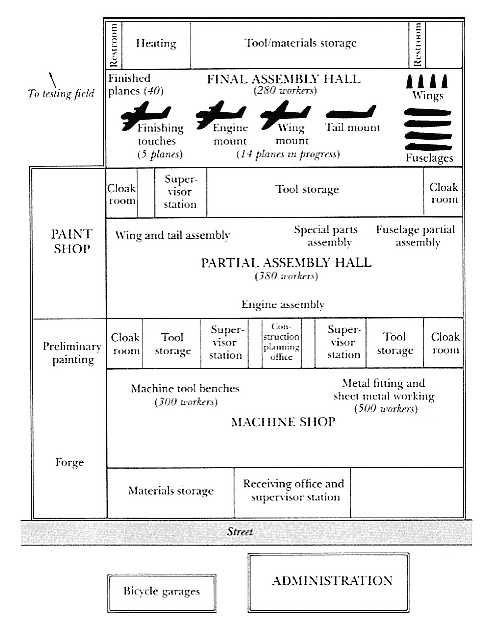
Chart 1.
Plan of the Bréguet factory at Bouguenais, 37,380 square meters. Derived from a blueprint deposited in
the archives of the Société Nationale des Constructions Aéronautiques de l'Ouest. Not to scale. AN 99AQ 8.
deafening sounds of noisy machinery. In the front workshop (bottom of chart 1) several hundred skilled workers labored at forges, lathes, milling machines, drill and punch presses, metal-stamping, -shearing, -nibbling, and -stretching machines, and other metal-fabricating equipment to create the thousands of pieces that made up an airpláne. Some of these workers made tools, templates, and jigs that other workers used in the construction process. Others made forgings, castings, fittings, and metal sheets for the airplane itself. Moving deeper into the shed, past a narrow band of offices for storage and supervisory control, one entered a second enormous workshop, the partial assembly hall. Here fitters, welders, electricians, sheet metal workers, sheering-machine operators, and other skilled workers assembled the major subsections of the aircraft—wings, fuselage, cockpit, rudder, and fins. By the mid-1930s the modern fuselage had become a highly complex metal shell, composed mostly of aluminum and an aluminum alloy skin wrapped around a framework made up of a huge number of pieces serving as spars, bulkheads, and ribs. Although some semiskilled workers were involved in these intermediate stages of construction, the work called mainly for skilled work teams. In the third large hall, at the far end of the plant, the fuselage acquired the wings, tail, cockpit and other subassemblies that had been built in the second hall. Skilled fitters and sheet metal workers collaborated with less skilled riveters and assembly workers to complete these final stages of production. After assemblers mounted the engines, propellers, and accessory equipment on the airframe, the plane was rolled to the paint shops along the left side of the shed. Once painted, it was ready for the test flights and inspections required before delivery.15
If skilled workers predominated in the tasks of building an airplane, and if they often labored in congenial work teams, the managerial hierarchy nonetheless found its way onto the shop floor. Regimentation diminished the artisanal character of the work. Unlike prototype workers, production workers received detailed instructions from the bureaux de méthode describing each step of their jobs, the tools to be used, and the time to be spent on each task.16 As a result, "interesting, creative work" and, above all, a sense of autonomy were rarer in the production shops. Workers were heavily supervised. In the Bouguenais plant, as in others, no major work area fell outside the line of vision of an office of contrôle . A bevy of inspectors from the company, the Air Ministry, and client firms often joined foremen in roaming the floors. In some cases policemen and military officials stood guard as well. Workers could escape surveillance only in cloakrooms and lavatories—or at the bicycle sheds, where militants had their best chance to call impromptu meetings. Even the orderliness of the shops conveyed the message of managerial control. Far from the dark and disorderly machine shops typical of the metal-
working trades, aircraft plants had a clean look—uncluttered, ventilated, and well lit.17 Workers undoubtedly found small, subtle ways to put their personal stamp on their work space and their everyday work rituals. But through it all, managerial discipline prevailed.
Much the same story could be told about engine-building firms like Gnôme-et-Rhône and Hispano-Suiza. Like airframe companies, engine firms divided production into prototype building and mass production, with the same consequences for the work process and shop floor experience. Engine building also involved a progressive assembly process, beginning with forgings and castings, proceeding to subassembly activities, and culminating in final assembly. At each stage skilled workers played the dominant roles, backed up by semiskilled workers who operated machines, inspected pieces, or participated in highly subdivided assembly tasks. In the early 1930s engine construction involved even fewer semiskilled workers than did airframes. All the same the ambiguities of shop floor experience—the tension between regimented work rhythms and highly skilled labor, between informal interactions and tight supervision, between a sense of participation and a sense of exclusion—posed problems for airframe and engine workers alike.
For both kinds of workers, the tension between artisanal work and regimentation found expression in the wage system as well. On the one hand, wage schedules in aircraft conformed to conventional differentiations in the metalworking branch between skill levels and between women and men. To build the Farman 165 in 1927, for example, the Farman brothers paid production workers anywhere from 6.10 francs an hour to 3.10, depending on the skill level and gender of the employee (table 1). These wages reflected prevailing rates in Parisian metalworking since employers hoped to minimize turnover. In Bordeaux, Nantes, Toulouse, and other regional cities aircraft employers paid local rates, usually about 20 percent lower than Parisian wages.18 Even during the depression years, after 1930, skilled workers in aviation suffered less from pay cuts than many workers, partly because the depression hit the industry less brutally than most other sectors, partly because in metalworking skilled workers remained scarce.19
Yet at the same time many employers in the aircraft industry were beginning to experiment with wage incentive systems that further undermined the artisanal nature of skilled work. Although aircraft work was poorly suited to conveyor belt assembly or time-and-motion studies, employers found that they could make more systematic use of output quotas and bonuses to push workers to move faster. The Emerson, Halsey, and Rowan incentive systems all provided formulas for calculating wages on the basis of hourly or daily production rather than through simple piece rates or hourly wages. In aviation employers tended to favor
|
|||||||||||||||||||||||||||||||||||||||||||||||||||
|
||||||||||||||||||||||||||||||||||||||||||||||||||||||||||||||||||||||||||||||||||||
the Rowan system since its formulas ensured that workers would earn no more than double their normal hourly wage by working harder.20 Wage incentive systems were unsettling for workers: one could earn more, but only by stepping up the pace and taking the risk of antagonizing fellow workers.
What threatened workers most, however, was job insecurity. The demand for labor fluctuated with the ebb and flow of the market, as annual work force figures show (table 2). The drop in employment in 1932 and 1933, reflecting a decline in commercial sales and stagnation in government orders, had the added cruelty of throwing workers into the precarious labor market of the Great Depression. The irregularity of Air Ministry orders was certainly a hardship for the manufacturer. But it also posed a direct threat to the livelihood of workers; it put them all the more at the mercy of the boss. It was no wonder, then, that between 1929 and 1933 strikes were almost unheard of in the industry.21
Employer Paternalism
Workers encountered employers schooled in the two dominant traditions of managerial practice that still prevailed throughout France—authoritarianism and paternalism. Despite a few breakthroughs in factory legislation after 1890 and the presence of the Conseils des Prud'hommes (labor relations tribunals), which mediated between individual employers and workers, the authoritarian side of labor management had diminished little in France since the early nineteenth century.22 From the early 1920s through the mid-1930s aircraft manufacturers disciplined their wayward workers harshly: troublemaking, union organizing, and laziness could all lead to abrupt dismissal. As one worker recalled, Emile Dewoitine made a habit of shouting "No Soviets! No Soviets!" when he saw two or three workers together.23 In aviation, as elsewhere, employers spent the 1920s dismantling the gains workers had won during and shortly after the First World War—the eight-hour day, a shop steward system, and collective bargaining. Like most French employers in this period, aircraft manufacturers resisted collective bargaining for fear that it would diminish their authority and reduce their leverage in the labor market.24 Just as they saw even mild forms of state intervention as an attack on their independence, so too they abhorred trade unions as a challenge to their authority.
Paternalism, which also had sturdy roots in nineteenth-century managerial practice, both tempered and reinforced this authoritarian style, although the nature of paternal authority varied considerably from one firm to the next.25 Henry Potez pursued the paternalistic approach most
aggressively by running Méaulte, a small community in the department of the Somme, as a company town. Scarcely more than a village in 1920, Méaulte soon burgeoned when Potez used state subsidies to build housing and municipal services for the peasant workers he recruited for his factory.26 As in other company towns of France, workers in Méaulte came to depend on the firm for medical care, social services, and recreation as well as for an hourly wage. In no time workers and their families came to view Potez with that special combination of admiration, fear, and resentment typical of paternalistic relationships.
Méaulte, however, was exceptional. Most aircraft plants were located in cities where workers lived autonomously in working-class neighborhoods and rode bicycles, buses, autos, or, in the case of Paris, the metro some distance to work. In Marseille, Toulouse, Bordeaux, Nantes, and Bourges, and in many of the plants in the suburban western side of Paris, the trip usually took workers to the edge of town, where an airplane factory stood out conspicuously amid the landing fields of the company. This separation between factory and community limited the repertoire of paternalistic controls managers could employ. Even so, several practices had become common in most aircraft plants by the early 1930s. Employers sponsored sports teams, outings, and recreational clubs for their employees. Louis Renault in particular took a keen interest in what he felt were the positive effects recreation had on productivity.27 Social-welfare services, ranging from family allowances to health and retirement programs, became widespread in the metalworking sector generally.28 Above all, employers held out the promise of job promotions to strengthen workers' loyalty to the firm. Carpenters, mechanics, and skilled metalworkers who began building planes before or during the war often rose as high as chef d'atelier and in rare instances even chef de production . Foremen often came up from the ranks, as did instructors in company apprenticeship and retraining programs. Skilled workers in prototype shops could sometimes hope to win promotion to jobs in the research shops and testing laboratories.29 To be sure, the promotion system had its limits as a means of integrating workers into the firm, especially since some of the most competent workers felt competing loyalties to unions, Communist cells, or simply to a working-class ethic of keeping one's guard up against management.30 Moreover, as aircraft technology became more sophisticated and companies more complex, the meteoric rise of the ambitious worker was slowly becoming a thing of the past. Modest promotions, however, remained an important instrument of managerial control.
Paternalism was not confined to an employer's relationship with workers; it colored the way management dealt with engineers and technicians as well. In the hierarchy of the firm, engineers and technicians straddled
the boundaries between labor and management. Technicians, at the lower end of this middle-level occupational stratum, had much in common with skilled workers. They shared similar frustrations over the ambiguity of their status, the modesty of their salaries, job insecurity, and the limits to their autonomy in offices, workshops, and labs. Engineers, too, had occasion to grumble about the boss. Salaries, work procedures, and substantive matters of aircraft design all raised issues that potentially pitted engineers against the builder.
Aware that engineers and technicians occupied a strategic position in the firm, employers in aviation as in many industries encouraged them to identify themselves as a professional elite rather than as conventional employees. Some employers even viewed engineers as potential mediators in the war between labor and capital—an image Georges Lamirand captured in the treatise he published in 1932 on the social role of the engineer.31 Drawing on Maréchal Lyautey's famous conservative tract on the social role of the French military officer, Lamirand promoted the paternalistic notion that engineers could serve as mediators between workers and employers and eventually eliminate the conflicts between them. Loyal to management yet attuned to workers' concerns, engineers would combine both humanitarian zeal and disciplined rationality to reconcile both sides in the enterprise. With this outlook in mind, the faculty at the Ecole Supérieure de l'Aéronautique added courses on labor relations to the curriculum, and the staff at the Union des Industries Métallurgiques et Minières (UIMM), the employers' association, began publishing reports on the special problems engineers faced in all branches of metalworking. By the mid-1930s the pressures of the depression and the revival of the labor movement would make the engineer's identification with management an even more urgent concern.
Aircraft manufacturers made use of an additional method for promoting loyalty not available to employers in other industries—the cultivation of an esprit de corps based on participating in the excitement of aviation. The mystique of flight, the appetite of the public for tales of aerial conquest, the legendary heroism of pilots, inventors, and mechanics, and the patriotism associated with building French airplanes all contributed to a sense of purpose in the industry. To some extent this esprit de corps emerged automatically in a factory: no doubt many prototype workers took some pride in the successful test flight of a new airplane. A sense of being part of something important may even have filtered into the production shops as well. After all, in the 1920s and 1930s airplane construction represented the quintessential blend of advanced engineering and skilled craftsmanship. There was no shortage of writers, publicists, and politicians willing to portray aviation as a moral or patriotic enterprise. The utility of the ethos of aéronautique was not lost on employ-
ers, who encouraged employees to attend the biannual salon de l'aéronautique , where the wares of the company went on display.32 On the shop floor employers frequently posted signs to instill a feeling for the seriousness of the undertaking. As one poster read:
In our work an error, an omission, or bad workmanship can cost the life of one or more people.
Anyone who makes a mistake must report it. To commit an error is a forgivable and correctable mistake. But to conceal it is a crime.33
The message here was twofold: the obvious one was to beware the dire consequences of error; the subtler one was to take pride in one's work, laboring, as one journalist said after visiting an airplane factory in Bordeaux, "without error, without weakness."34 Employers wanted their workers to perform as a labor aristocracy. As one former chef d'atelier recalled, managers encouraged workers to acquire an esprit d'équipe (team spirit) and an esprit de maison (company pride) and in so doing to view themselves as a laboring elite immune to the hostility that workers commonly felt toward their bosses.35
To what degree workers actually embraced this ethos of company pride is hard to say. Since employers seasoned their paternalism with ample doses of coercion, it is impossible to know whether a cooperative employee felt genuine loyalty to his boss. Many workers, moreover, took pride in their work because discipline and good workmanship had an important place in their own craft traditions. Many metalworkers in interwar France paid homage to the cult of the métallo , a traditional sense of pride that derived, as one worker put it, from the belief that the metalworker "can [do] and knows how to do everything."36 The image of the earnest, muscular metalworker, with hammer in hand and eyes to the horizon, had become a standard icon in the trade union press. Employers obviously profited from this tradition; prototype shops thrived on the initiative of experienced, talented workers. But an artisanal tradition could also inspire other loyalties—toward unions, parties, or a vision of workers' control. Similarly, workers could easily become captivated by an esprit de l'aéronautique without necessarily feeling company pride. What is clear, however, is that even if workers did not sell their souls to the builder, even if they resented his authority, they had little choice but to comply with his rules. In the autocratic aircraft companies of the early 1930s workers lacked the means to mount a collective defense.
The Marginality of the Unions
The pressure of paternalism, the vigor of managerial discipline, the large proportion of engineers and white-collar employees in the plants, and the newness of the industry made the challenge of building trade
unions formidable indeed. Economic conditions during the early 1930s only compounded the difficulty. The contraction of the industry from 1931 to 1934 weakened workers' bargaining position and made the usual threat of dismissal all the more real. At the same time the hunger of the Air Ministry for new prototypes kept a high proportion of the work force involved in the prototype shops rather than in the production shops, where resentments against management, and hence the appeal of a union, were likely to have been greater. The bitter acrimony in the labor movement between Communist and non-Communist factions made organizing in the plants tougher still.
Under these conditions few workers were willing to risk dismissal and the blacklist, the price commonly paid for a life as a trade union activist. Although police records are spotty, it is safe to say that in aircraft factories, which in most cases employed from 150 to 1500 workers, there were rarely more than a half-dozen employees during the early 1930s who devoted themselves to the clandestine life of Communist cell meetings, tract writing, and the virtually futile effort to recruit comrades into the Confédération Générale du Travail Unitaire (CGTU), the Communist-backed labor confederation.37 Socialist militants were even rarer, except in Nantes and Saint-Nazaire, traditional centers of strength for the Socialist Party, the Section Française de l'Internationale Ouvrière (SFIO). The archives have left scarcely a trace of any anarchists or revolutionary syndicalists; although a few of these holdouts against wartime reformism and postwar communism may well have worked here and there in the aircraft industry, most of them probably lost their jobs after the war. No doubt many aircraft workers felt some loose connection to a tradition of working-class militancy—through memories or folklore about the old prewar CGT or the big metalworking strikes of 1919; and surely many workers voted for Socialist or Communist candidates in the national elections of 1928 and 1932. But during these in-between years before the Popular Front, as historian Yves Lequin has described them, only the rare militant dared to jeopardize a job in the aircraft industry for an overtly political life.38
Few as they were, militants in aviation nonetheless managed to prepare the ground for the big unions that would eventually mushroom in aviation after 1935. Most activists were either unitaires , that is, affiliated with the Communist-backed CGTU, or confédérés , affiliated with the non-Communist CGT. The latter adhered to a more moderate, nonrevolutionary vision of the labor movement. For them, Léon Jouhaux's famous Minimum Program of 1918 still served as a doctrinal beacon. His program called for collective bargaining, the eight-hour day, labor representation in national economic planning and in factory management, and the nationalization of key industries.39 Though most confédérés voted Socialist, they clung to the tenets of the old CGT charter of Amiens of
1906, which affirmed the absolute independence of the labor movement from political parties. In the world of aviation, confédérés did best in two settings—in the shipbuilding cities of Nantes and Saint-Nazaire, where confédéré metalworking unions already predominated, and in the airlines and airports. Even in the inauspicious climate of the early 1930s a number of airline personnel and civilian employees in military air installations joined the CGT.40 But confédéré militants found it much more difficult to woo blue-collar workers in the aircraft industry. In this respect confédéré experience in aviation reflected the national pattern: the confédéré wing of the labor movement had its strongest support in white-collar France, especially among civil servants. For the most part it lacked firm roots in the private, industrial sector.
As a rule, unitaire militants had a better foothold, such as it was, in airplane factories. Like the confédérés, the unitaires did best in areas where their metalworking union was already well established. For the CGTU this meant Paris. By far the most important center for aviation, Paris offered that rare aircraft worker who was also a unitaire militant a viable radical culture within which to fashion a life as a union militant. A vast expanse of working-class neighborhoods in the east end of the city and in the red-belt suburbs gave militants access to organizations, newspapers, leaders, and friendships that served to sustain one's faith in a working-class movement.
Consider, for example, Henri Jourdain's recruitment into the CGTU in the early 1930s. Jourdain, who was the son of poor agricultural workers in the Centre and was to become a prominent leader in the PCF after the Second World War, began his career as a trade union militant while working in 1932 as a metal fitter in Wybot's airplane prototype shop at the Porte de Saint-Cloud, on the western edge of Paris. One of his fellow workers, a young man named Louet, was a member of Communist Youth. He "oriented me," Jourdain later wrote, "toward the revolutionary movement. I admired and envied the extent of his knowledge and his culture. A very convincing man, it was he who recruited me into in the CGTU." Once signed on, Jourdain discovered a whole new world of serious, committed people. At his first union meeting, "in a small bistro in Boulogne," he met Alfred Costes, the head of the CGTU's Parisian Metalworking Federation, "another of these métallo autodidacts with extensive knowledge." Self-taught himself—he had already developed a passion for cycling, theater, and the cinema—Jourdain dropped his night classes in industrial design at Arts et Métiers to enroll in the PCF's new université ouvrière , where he studied political economy, history, grammar, and spelling. By 1933 he had become one of three active unitaires in his factory, and though he did not join the PCF until the fall of
1936, he quickly became ensconced in the associational life of the Parisian Communist movement.41
Although not everyone in the CGTU had Jourdain's intellectual appetite, he was a typical aircraft unitaire in being young, skilled, and eager to become a part of something larger. No CGTU membership lists or even membership figures are available; but from the few brief glimpses of militants that appear in police reports, it seems safe to surmise that most of the aircraft unitaires before 1935 fit this description. The four major unitaires in Dewoitine's factory in Toulouse, for example, certainly did: one was twenty-two years old and worked as a technician and inspector; another, thirty-nine, was an inspector of finished pieces; a third, twenty-seven, was chef d'équipe in the wing-building shops; and the fourth, thirty-seven, was a skilled fitter. They all had been born in towns not far from Toulouse or Perpignan.42 The preponderance of young, skilled, and native workers in the thin ranks of the unitaire unions paralleled the emergence of a new generation of leaders at the national level in the PCF—the rise of young men like Maurice Thorez, Jacques Duclos, and Benoît Frachon. In the aircraft industry, as elsewhere, what the CGTU local lacked in size it partially made up for through the youth, daring, and dedication of its members.
Part of what sustained the CGTU, of course, was its backing from the Communist Party. Although many militants, like the young Henri Jourdain, were not party members (at least not yet), enough of them were to ensure PCF control. Since 1924, and not without prodding from the Comintern, the PCF had staked its future on the factory cell as its principal form of grass-roots organization. Typically, a factory cell and a factory local of the CGTU came to have overlapping memberships. By 1926 police informants had discovered active cells in a number of aircraft factories in Paris—at Potez, Farman, Hispano-Suiza, Blériot, Renault, Gnôme-et-Rhône, and Bréguet.43 In all these cells militants tired to master the usual repertoire of political skills—recruiting members, attending meetings, organizing protests, and issuing tracts, leaflets, and newspapers like Les Ailes rouges or L'Aviateur, which wove together the party line and local grievances. Militants met with one another almost daily, usually in the haven of a reliable café. Secrecy was essential, ideological conformity the rule.
In the provinces the lives of unitaire militants fit the same basic pattern, though the strength of the movement varied from place to place. In Méaulte, Potez's company town, a unitaire militant could scarcely survive. But in cities like Toulouse and Bordeaux the PCF and the CGTU metalworkers union provided enough of a base to keep a tiny cell alive. In Bourges, for example, aircraft militants derived support from a rela-
tively stable union that militants had established during the war at the government arsenal. This base, coupled with an unusually strong cluster of woodcutter's locals, made it possible for militants at the Hanriot airplane factory at the airport in Bourges to persevere in what otherwise would have been a more politically isolated setting.44
Strict discipline, however, was as much the bane as the boon of the CGTU. It gave militants what every trade union needed—leaders, newspapers, instructional pamphlets, modest funds, and, not least, comradeship and a network of reliable contacts crucial for clandestine work. Doctrinal orthodoxy had its virtues as well. It provided militants with a ready-made language for propaganda, a revolutionary vision, and a sense of common purpose—all of which helped them to endure a period of retrenchment in the labor movement.
But ideological conformity so corseted militants that it hampered their ability to work effectively as trade union organizers. By adhering to the Communist strategy of class against class, militants had to propagate ideas that were often at odds with the short-term interests of the aircraft rank and file. The class-against-class line of the late 1920s and early 1930s derived from the Soviet view that capitalism had entered into a crisis, or "third phase," which was intensifying class conflict within nations and accentuating the threat of an "imperialist war" against the Soviet Union. As a result, the Comintern called on militants throughout the Communist movement to agitate against war and repudiate Socialists and moderate trade unionists as "social fascists." Militants were encouraged to use tough tactics—insurrectionary protests, political strikes, and violent demonstrations—to destabilize the European democracies and wean workers from the moderate left. The strategy was eventually to have catastrophic consequences in Germany; in France it simply isolated militants, provoked repression, and kept the PCF and the CGTU in steady decline.45
The crippling effects of the class-against-class strategy were especially transparent in aviation. As in every other branch of French industry, militants in aviation went out of their way to distinguish themselves from reformists by stressing their own uncompromising opposition to militarism, employer paternalism, the rationalization of production, and the pernicious role of the capitalist state. In cell tracts and factory leaflets aircraft militants constantly reiterated these themes. At Gnôme-et-Rhône for example, militants passed out leaflets claiming that "Gnôme-et-Rhône and the government that is at its service are one and the same. And this is why the economic struggle only worsens, marching ineluctably toward war."46 The CGTU's metalworking newspaper, Le Métallurgiste, hammered home a similar message under the headline "How 'They' Are Preparing for War!":
[Bréguet at Villacoublay] is a company that also takes a very active part in the establishment of the "circle of iron and fire" that the world imperialists are forging around the USSR. [Bréguet does so] through its technicians who, being highly experienced, train instructors for foreign aeronautical services, and through the manufacturing of special tools that aircraft construction requires and which can only be made by very experienced workers. Poland, Romania, Serbia, and all the states bordering on Russia have recourse to the Bréguet company.47
Antimilitarist rhetoric also provided Communists with a vocabulary for attacking employer paternalism. L'Humanité described Potez's factory at Méaulte as "a military regime in every sense of the term."48 Even the sports programs fit into the framework. "To make young workers accept all this forced exploitation," a Communist journalist wrote in L'Humanité, "the big industrialists in the Paris region try to enslave them in their factory sports clubs, in camping trips and vacation camps controlled by the Comité des Forges. It is in fact the militarization of the factories."49 At Blériot's plant outside Paris unitaire militants made a similar attack on the company soccer league, which "the bosses use . . . to cultivate in young workers an ideology conforming to their interests." These militants urged workers to join a CGTU league instead.50 Like employers, Communists also viewed recreation as morally uplifting—precisely the reason they hoped to get soccer out from under the bosses' control.
The same logic compelled unitaire militants to reject almost every manner of cooperating with the state. In contrast to the confédérés, whose leaders participated enthusiastically in the Conseil National Economique, the League of Nations, and the International Labor Office, Communist unitaires condemned all cooperation as "class collaboration." The CGTU enforced this principle all the way down to the shop floor. In 1929, for example, a painter in an aircraft factory in Bordeaux earned what must have felt like a scolding when he innocently suggested that the union ask a labor Ministry inspector to investigate unhealthy working conditions in the plant. The painter hoped that as a result of union efforts, the ministry might force the company to establish a special drying room for painting as well as give each painter two liters of milk daily. The local unitaire leader in the metalworkers union, a militant named Casta, scoffed at the notion. Labor inspectors, he said, "would scarcely heed such a request," and he went on to remind the painter that "it is only the workers themselves who ought to take the necessary action by expressing their grievances to the boss, via the union."51 Casta, like most unitaires, felt that the union must insulate workers from the reformist mentality an appeal to state officials would have nurtured.
This is not to say that unitaire militants were anarchists, rejecting the legitimacy of any state. On the contrary, apart from a few revolutionary
syndicalists who had survived the "Bolshevization" of the CGTU in the 1920s, most CGTU militants were either Communists or sympathizers who admired the Soviet Union as a workers' state. Their appreciation of the potentialities of state power made them all the more hostile to what they viewed as the inevitable collusion that prevailed between industrialists and state officials under capitalism.
In the aircraft industry, however, a radical rejection of the capitalist state made it difficult for militants to attend to the immediate grievances of their fellow workers. State officials, after all, had a good deal of say over basic conditions in the industry. The Labor Ministry, with its small army of labor inspectors scattered throughout the country, had the power to enforce legal regulations at the workplace, modest though they were. What is more, the Finance Ministry and the Air Ministry had considerable leverage with the builders. During the left-wing interlude of the Cartel des Gauches in 1924, the government began to require that aircraft contracts include labor clauses stipulating limits on the use of foreign labor and procedures for raising wages during the period of the contract. Labor clauses were expanded in 1930 to provide further protections for workers. Even Albert Caquot, whom the builders considered well disposed to their interests in these matters, felt obliged as industrial and technical director to enforce labor clauses.52 Since the Labor, Air, and Finance ministries were all becoming increasingly involved in labor matters, militants could ill afford to ignore the implications state intervention had for their strategies; and as the ministries became more involved in air policy, Communist hostility to the state became a heavier burden for local militants to bear.
Likewise, staunch antimilitarism could be a liability for a militant in aviation. At one level, of course, antimilitarism spoke to a pacifist sentiment widely shared in interwar France. At the same time, however, opposition to military production ultimately conflicted with the obvious stake aircraft workers had in the military procurement orders of their factory. Aircraft workers in the early 1930s may have harbored some misgivings about building weapons of war, but by contemporary standards it was decent work, good pay, and a way to practice a craft. A prototype shop in depression France was a far cry from a munitions arsenal during the First World War, where war-weary assembly-line operatives did indeed respond to many a pacifist appeal. Not surprisingly, then, the antimilitarist campaign of the CGTU failed to win much support in the aircraft industry, especially during the depression, when commercial aviation could hardly be viewed as a plausible substitute for the military market.
The CGTU campaign against rationalization, moreover, failed to speak directly to the problems aircraft workers faced in their industry. During the late 1920s and early 1930s the CGTU stepped up its efforts
to recruit semiskilled workers in the big metalworking plants of automaking, munitions, and machine construction. Although Communist militants were no more opposed to rational production than they were to the state per se—Lenin, after all, had hailed Taylorism as an asset to a modernizing Soviet economy—they opposed capitalist rationalization and stepped up their attack against the kind of work organization that prevailed in factories like Citroën and Renault.53 In aircraft manufacturing, however, workers were plagued by different issues—job insecurity, the volatility of the airplane market, and the instability of their firms. To solve these problems, Communist leaders would have had to approve defense spending, which on antimilitarist grounds they opposed. As a result, the PCF and the CGTU had little to say about the real question of rationalization in the aircraft industry—the need to streamline the industry and modernize its production.
CGTU doctrine, by reflecting the class-against-class strategy and the priorities of militants in other metalworking sectors, prevented aircraft unitaires from functioning effectively as trade union organizers. Hostility to reformist tactics, while preserving the revolutionary integrity of the CGTU, rendered militants useless as day-to-day advocates on the shop floor. Isolation, moreover, made militants easy targets for repressive employers. Henri Jourdain survived as a unitaire leader at the Wybot airplane factory just long enough to organize a single protest, a one-day symbolic strike on May Day, 1933, in which only five or six workers took part. Afterward, he recalled, a friend "told me that I was going to be fired, and in order to have some chance of being hired elsewhere, he advised me to quit first instead."54 Jourdain was lucky: he escaped into a job in another metalworking firm just in time. Like many of his unitaire comrades, Jourdain remained a militant on the move, struggling to give life to a sterile strategy and keep one step ahead of the blacklist. It was a testimony to human tenacity that the CGTU survived at all.
Toward a Popular Front, 1934–1936
After 1933 a change in the political climate enabled militants to begin making headway in the industry. The new atmosphere had its origins across the Rhine. Hitler's rise to power in 1933, by provoking the French government to rearm and left-wing parties to establish a united front against fascism, had a larger effect on the lives of aircraft workers than anyone could have foreseen at the time. His thinly veiled efforts to rebuild the Luftwaffe forced the French Air Ministry to come up with a rearmament plan of its own—Victor Denain's Plan I for building 1,010 combat aircraft. Suddenly, in the depths of the depression, aircraft companies began to expand. In 1934 total employment in the industry jumped by 23 percent, and by 1935 the work force had grown to thirty-
two thousand employees, double what it had been in 1933.55 Since companies expanded without modernizing their methods of production, skilled metalworkers became more and more in demand. For the first time since the war aircraft workers watched the terms of the labor market shift decisively in their favor.
Because Plan I called on the industry to build large numbers of all-metal planes, the work force not only expanded in 1934 and 1935; it became more homogeneous as well. The vast majority of aircraft workers by 1935 labored as fitters, sheet metal workers, welders, lathe operators, drill press operators, and machinists, the crafts that formed the backbone of the metalworking federations of the CGTU and the CGT. As all-metal planes displaced the wood and canvas planes of the 1920s, the proportion of carpenters in the work force declined, as did that of the women, who had often been hired to sew canvas. The shop floor became a more exclusively male and metalworking domain.56 Plan I, moreover, brought thousands of workers into production sheds rather than into the more privileged, less alienating world of the prototype shop. By tightening the labor market and expanding the most industrialized part of the airplane factory, Plan I created a more favorable environment for building a labor movement within the industry.
Just as important, however, was the shift to a united-front strategy in the Communist Party. In the spring of 1934 two developments converged to encourage the PCF to abandon the bankrupt strategy of class against class. First, within France, the right-wing riot of 6 February 1934 inspired grass-roots militants in the CGT, the CGTU, and the Socialist and Communist parties to collaborate in organizing counterdemonstrations against what they believed was a fascist threat from the right. After staging successful mass marches throughout France on 12 February, local militants set up joint vigilance committees to continue their combat against the right-wing leagues. This ecumenicalism at the local level gave those national Communist leaders who had become disillusioned with the class-against-class strategy a chance to argue for a united-front strategy. Meanwhile, in Moscow, Soviet leaders and representatives from various national Communist parties began to explore ways to ally with Socialists and trade union moderates throughout Europe in a common crusade against fascism. Faced with the prospects of fascist enemies in Japan, Austria, Italy, and above all in Germany, Stalin began to entertain a foreign policy of allying with the Western democracies. By May 1934 a sea change in Communist strategy was well under way. Maurice Thorez, the head of the PCF, soon made overtures to the Socialists, and some months later to the Radicals, in hopes of forging a popular front. By 14 July 1935 the efforts of all three parties would redound in an enormous street demonstration in Paris when, as Thorez described it, "half a mil-
lion men and women marched from the place de la Bastille to the place de la Nation through the old Faubourg Saint-Antoine, rich in revolutionary memories."57 Within eighteen months of the bloody riot of 6 February 1934 antifascism had brought the French left back to life.58
The shift to a united-front strategy in 1934 quickly filtered down to the factory level. In Toulouse, for example, confédérés and unitaires at Dewoitine and Latécoère began sending representatives to each other's meetings in the summer of 1934, just when national federation leaders began negotiations in Paris.59 That summer too L'Union des métaux , a confédéré metalworking newspaper, began publishing a few articles presenting unitaire positions on key issues, a practice that gradually gave the paper an overtly bipartisan cast.60 Behind the facade of cooperation, of course, rivalries remained fierce. But at least militants in both camps could channel the energy they had previously devoted to attacking each other into a more productive struggle to combat employers, rebuild unions, and reunify the labor movement.
More significant still was what the shift to a united-front strategy did to the tactical mentality of unitaire militants in aircraft factories. The change from "class against class" to "the struggle against fascism" freed local militants to march in closer step with a rank-and-file work force whose day-to-day interests were tied to production for national defense. Although it took time to wean the party of its doctrinaire antimilitarism, by 1935 the PCF had come around—as had Stalin even sooner—to supporting the principle of a strong French defense.61 Aircraft unitaires now found it easier to embrace the bread-and-butter interests of their fellow workers. What is more, the CGTU dropped its taboo against lobbying government officials. At a meeting of the Paris machinists union on 31 October 1934, Alfred Costes of the CGTU called for joint CGT-CGTU delegations to pressure the Labor Ministry to intervene more aggressively in behalf of workers. This openness to state intervention marked so dramatic a change of heart in the Communist camp that a confédéré could not keep himself from saying to Costes, "But not long ago the unitaires reproached us for always ringing doorbells at the ministries."62 This stunning reversal of tactics in the CGTU—an acceptance of military production and a willingness to bargain with the state—removed the major doctrinal shackles that had hampered unitaire militants for years.
The first signs of a change in the way the CGTU approached its work in the aircraft industry could be seen as early as May 1934. At a two-day conference in Paris national officials of the CGTU's Metalworking Federation assembled aircraft militants from a number of companies to establish a national campaign to address workers' grievances in aviation. Wages and hours dominated the discussion: delegates attacked the
Rowan system as a disguise for wage cutting, and they condemned "the collusion between the government . . . and factory directors in various plants" in lowering wages and demanding overtime.63 To plead their case publicly, delegates devised a plan for presenting five demands at the upcoming international air show at Bourget: a guaranteed minimum wage of seven francs an hour for skilled workers; wage adjustments for women, youth, and the unskilled; an end to overtime; the creation of factory delegates for health and safety; and paid vacations to replace the unpaid annual plant closings that were common in the industry. Delegates concluded the conference by taking steps toward founding a section industrielle de l'aviation within the Metalworking Federation. With the expansion of the industry at last under way, aircraft militants were now beginning to win recognition within the federation. And with the CGTU shifting toward a more pragmatic style of working-class advocacy, militants focused their attention on the bread-and-butter issues that troubled their comrades on the shop floor.
Meanwhile signs of a revival of working-class militance appeared at the factory level. On 12 February 1934 automobile and aviation workers at Renault's plant in Billancourt staged their largest protest since 1926. The trouble started when they overturned the snack wagons that managers had brought into the shops to reduce tensions that had been building since the right-wing riots of 6 February. After the initial mayhem workers settled into a grève tournante in which shops struck briefly, one after the other, a tactic designed to avoid lockouts and reprisals.64 A few days later, normalcy returned to Renault, but within a week trouble erupted nearby at the airplane factory of Lioré et Olivier, which had just received a large order for seaplanes from the Air Ministry. When managers began hiring more workers, however, technicians and workers already on board demanded wage hikes. At first managers listened, but then they delayed. On 20 February eight hundred workers sat in their shops during lunch hour and then walked out well before closing time, leaving only fifty draftsmen behind. A lockout followed. Three weeks later, work resumed at the old wage rates.65 Strictly speaking, the protests at Renault and Lioré et Olivier came to naught. Still, workers had broken the collective inertia that had long prevailed in aviation. Events like these, moreover, were beginning to close the gap between militants and unorganized workers.
Naturally enough, the "red belt" of Paris served as the site for the initial renewal of labor protest. Yet in the provinces, too, workers began to rediscover a capacity for mutual defense. In Toulouse police informants reported in August 1934 that the CGTU had sixty-six members at Dewoitine and fifteen at Latécoère, whereas the CGT claimed about forty members in the two plants—no stampede, but real progress for the
unions nonetheless. When Dombray, the factory director at Latécoère, fired three militants for trying to build a Communist cell in the plant, workers responded in force. Representatives from both the CGTU and the CGT formed a delegation to demand their reinstatement and "to make Dombray understand," as one militant put it, "that when a worker enters his factory, he need not leave his politics in the cloakroom."66 Dombray refused to rehire the three Communists, even after the Conseil des Prud'hommes, the local labor tribunal, ruled in their favor. More than three hundred workers at Latécoère then petitioned management in the militants' behalf—to little avail. An autocratic employer like Pierre Latécoère could still have things his way, but not without provoking some collective resistance.67
Two months later, in October 1934, Emile Dewoitine took it on himself to try to clip back this budding militancy in Toulouse. On 22 October he fired a leading militant in his factory for allegedly slowing down production. At closing time half of the five hundred workers at the factory gathered around the company gates to organize a response. Each shop designated a representative to be part of a delegation to confront the boss. But Dewoitine was already several steps ahead of his workers. The day after the firing, a police spy assigned to the plant wrote the local prefect that Dewoitine had been kept current about the activities of militants working in his plant and was "quite disposed to rid himself of them when the favorable circumstances presented themselves." A fortnight later, after consulting with no lesser authority than the air minister, General Denain, Dewoitine fired two more militants. Police informants correctly predicted that since only 150 to 250 workers could be counted on to follow the union, the militants would refrain from calling a strike. Again the boss prevailed. But the CGTU and the CGT kept up a tireless propaganda campaign to win the reinstatement of the workers.68 In Toulouse, as in Paris, reprisals against militants had the effect of purging plants of a few troublemakers at the cost of instilling a sense of injustice on the shop floor.
The revival of militancy continued to work its way through the industry in 1935—so much so, in fact, that by June 1935 employers assembled at the Chambre Syndicale to construct a collective defense of their own.69 An epidemic of wage demands had begun at Gnôme-et-Rhône, where Paul-Louis Weiller, the no-nonsense director of the company, had found it prudent to grant workers a 7 percent wage hike and a fourteen-franc bonus for night work—all in the hopes of heading off a strike. These concessions prompted foundry workers at a rival firm, Hispano-Suiza, to stage a walkout for a similar bargain. Trouble then surfaced at Blériot. Faced with the first rash of wage demands to appear in the industry since the mid-1920s, employers at the Chambre Syndicale swiftly
improvised a common strategy. Members pledged to resist the temptation stemming from Plan I to hire away skilled workers and technicians from one another. They then agreed to renew their efforts to standardize wages, vacation policies, and other personnel practices in hopes of undermining union efforts to play one firm off against another to win benefits. How faithfully the builders stuck to this bargain is hard to say; the Chambre Syndicale had no way to sanction its members, and in an industry like aircraft manufacturing there was always the hope of passing wage hikes on to the state. One thing is clear: for the first time workers had forced employers to close ranks behind a common labor policy—one more sign that Plan I and the united-front strategy were having a corrosive effect on the autocratic structure of authority in the industry.
Plan I impinged on employer autocracy in another way as well: it raised the government's stake in the productive capacity of the aircraft industry, and this change, too, had an impact on labor militancy. A highly publicized strike at the Société de Duralumin plants in Rive-de-Gier, near Lyon, brought this lesson home to militants and employers alike during the summer of 1935. Metalworkers at Duralumin walked out in late June when managers tried to quicken the pace of production by introducing the Bedaux wage incentive system. Workers, led mainly by CGTU militants, agreed to let the local justice of the peace mediate. Management, however, refused. Workers then appealed to the Air and Labor ministries since most of the duralumin, an aluminum alloy, produced at the plant went straight to the aircraft manufacturers. With Plan I under way, Air Minister Denain intervened, dispatching an official from the ministry to arbitrate the dispute in short order. Within hours after Denain's man arrived at Rive-de-Gier, management retreated. The company dismantled the Bedaux system and raised wages modestly. Although no friend of labor, Denain could ill afford strikes at a firm that produced nearly all the duralumin, and much of the aluminum, that the aircraft industry needed.70 Rearmament made the Air Ministry a powerful partisan of social peace in the industry, and everyone knew it.
The growing involvement of the state in the aircraft industry enabled militants and left-wing politicians to bring labor issues out of the confines of a company's personnel office into the forum of public debate. In December 1935, for example, Emile Dewoitine announced that he would soon be forced to lay off one hundred of his six hundred workers unless more orders from Plan I were forthcoming. By making his case public, Dewoitine unleashed a wave of protest directed toward Denain's Air Ministry. Business and labor leaders in Toulouse asked local deputies and senators to lobby the air minister for more orders. Even the prefect entered the act. "It should not escape your attention," he wrote Denain, "that in addition to the social repercussions that can result from throwing
many workers into unemployment, it would jeopardize the National Defense to let go specialized workers whose training has taken so long and who could not be replaced without a long and costly apprenticeship."71 Meanwhile a Socialist member of the Chamber of Deputies, Emile Berlia, took the occasion to lobby for labor reforms. It is not enough, he told the Air Ministry, just to save jobs at Dewoitine when political repression and working conditions within the plant were severe. The Air Ministry, Berlia felt, ought to give workers a guarantee that their working conditions would improve.72 Faced with an avalanche of appeals, Denain instructed Fernand Lioré, the industrialist, to redirect recent orders to his groupement toward Dewoitine. Once again a builder got what he wanted—more orders—but in the process the politics of the industry were becoming a triangular affair involving employers, state officials, and labor.
By the spring of 1936 the combined effects of company expansion, state intervention, and working-class militancy had broken open the closed doors that only three years before had allowed the builders to preside over their workers as omnipotent lords. Aircraft workers had by no means created a powerful labor movement; nor could anyone have had a premonition of the resurgence of militancy to come. Still, in the two years following 6 February, workers had forced employers to contend seriously with labor protest for the first time since the world war. Even if most aircraft workers had not joined unions, they were now consistently defending the right of militants to do so. At Saint-Nazaire 612 of 717 workers at the airplane factory of Loire-Nieuport struck for two days to win back jobs for fired militants.73 Trade union activists were no longer isolated mavericks. At Bloch's factory near Paris about 20 percent of the workers had joined the CGTU or the CGT by 1935. By early 1936 Marcel Bloch, as tough a boss as any, found himself locked in negotiations with the leading Communist militant in his plant over wages, hiring policy, union rights, and paid vacations.74 Amid all this activity, moreover, militants continued to promote the notion of a popular front. In March 1936 the "unity of the working class against fascism" became something much more palpable than a slogan when unitaire and confédéré leaders formally consolidated their confederations into a new, unified CGT. Reunification made it easier for a worker to join a union local and feel part of a larger movement. By the spring of 1936, after fifteen years in the wilderness, trade unionism had finally returned to the factory sheds and prototype shops of the aircraft industry.
As workers recovered their capacity to act collectively, they added a new dimension to the crisis into which the industry had fallen by 1936. Plan I had exposed how poorly equipped this ramshackle collection of companies still was to carry out a rearmament drive. Labor militance, limited though it still was in 1935, posed new questions for employers
and officials in the Air Ministry about how much they could demand of workers without undermining social peace in the industry. If in falling behind production schedules employers were increasingly tempted to resort to speedups, wage incentives, overtime, and night work to meet deadlines, they now ran greater risks than before of provoking employee resistance—as occurred, for example, at Courbevoie, where Bréguet's workers tried to voice their objections to la minute économisée .75
The revival of labor militance, moreover, increased the political risks of laying off and rehiring workers with the alacrity that employers had been used to in the early 1930s. Because the Air Ministry had not yet determined what kind of production program would follow Plan I, something odd began to happen in late 1935. Even though the aircraft industry as a whole continued to grow, some companies, like Dewoitine in Toulouse and Loire-Nieuport in Saint-Nazaire, began to run short of orders.76 A badly structured industry and a poorly organized rearmament effort made layoffs, paradoxically, a continuing danger in an expanding industry. By 1936, however, workers were much less apt to stand by idly while a foreman, a builder, or a bureaucrat in the Air Ministry determined the fate of their jobs. More and more, militants and their budding unions provided a way for workers to shout back about the issues that really irked them—job insecurity, the boss's arbitrary power to hire and fire, reprisals against militants—forms of injustice that had too long prevailed in an autocratic industry. The emergence of factory unions gave workers a way to speak up about conditions just at a time when employers were losing their credibility as an elite fit to run the industry on its own.
Militants undoubtedly profited from the employers' failure to consolidate the industry into a small number of modernized firms. Years of resisting reform had exposed builders to public criticism, eroding their authority all the more. No one had taken over their firms—at least not yet—but between 1928 and 1936 ministers, state engineers, labor inspectors, prefects, and even local politicians had all come to encroach on the builder's right to command his firm as he pleased. And just when employers were losing prestige, popular frontism gave militants both the tactical means and a compelling social vision with which to compete with the employer's authority. Left-wing spokesmen for the Popular Front, whether Communist or Socialist, ex-unitaire or ex-confédéré, offered workers an alternative orientation rooted in the language of French left-wing tradition. As Maurice Thorez said in a speech at the Communist International, "We, the great-grandsons of the sansculottes of 1792, the soldiers of Valmy, deny . . . Colonel de la Rocque [the right-wing leaguer], whose great-grandfather was in the army of Condé and of the king of Prussia, the right to speak in the name of our country."77 By
blending patriotism, antifascism, and left-wing radicalism, the Popular Front movement opened up a new way of thinking about what it meant to build airplanes for France. It offered workers a different frame of moral reference to compete with that of the boss. In 1935, when the Popular Front coalition of Communists, Socialists, and Radicals called for the nationalization of war industries, the left-wing challenge to the builders became explicit. For the politically aware aircraft worker, it now became clear that the Popular Front movement might have radical implications for life in an airplane factory. Thus, the revival of labor militance after 1933 meant more than what a few factory skirmishes might otherwise have suggested. Because it coincided, and indeed was itself bound up with, rearmament, a production crisis, and the movement for a popular front, working-class militance in the aircraft industry posed a threat to the very foundation of the builder's authority. No one could have recognized this challenge in the spring of 1936. By summer it would be apparent to all.
PART TWO—
AN INDUSTRY EMBATTLED, 1936–1938

The electoral results of 3 May 1936 startled even the victors. Not only had the Popular Front coalition of Radicals, Socialists, and Communists swept into power; for the first time Socialists had overtaken Radicals as leaders of the parliamentary left, and the PCF had emerged from electoral obscurity to become a major political party. Contrary to predictions, Léon Blum's Section Française de l'Internationale Ouvrière (SFIO)—the Socialist Party, and not the Radical Party—would form the new government, one squarely on the left. For aircraft workers, as for workers everywhere in France, the political climate suddenly brightened with the news that voters had elected the most left-wing government in the history of the Third Republic.
Just what steps the Blum government would take once in power, however, were unclear. Conflict between the three major parties in the Popular Front coalition simmered beneath the surface of electoral unity; the Popular Front program itself embodied unresolved tensions—between pacifism and defense, ambitious reform and tactical moderation—since the coalition hoped to appeal to both working-class and middle-class voters. Although euphoric over the victory, many left-wing supporters harbored fears that the new government would succumb to the compromises that had paralyzed Radical regimes in 1924 and 1932. Right-wing opponents feared the contrary—that Socialists and Communists would press for major structural reforms. To complicate matters, no sooner had elections ended than the contest over capital began: stock prices plummeted, the franc weakened, and influential investors, ignoring Blum's reassurances, began shifting assets into foreign accounts. Nor did the international climate offer solace. Two months earlier Hitler had transformed the military balance of power on the Continent by remilitarizing the Rhineland, a stunning initiative France and Britain had failed
to deter. By mid-May Mussolini had withdrawn Italy from the League of Nations and launched his war in Ethiopia. Meanwhile street violence in Spain brought France's other southern neighbor one step closer to civil war. To compound the sense of suspense, Blum refused to take power promptly, preferring instead to respect the customary month-long delay before assuming command; Albert Sarraut continued to govern as lame-duck premier.
In this atmosphere of hope, fear, and confusion, strikes began to break out—first in the aircraft industry, then in metalworking industries generally, and finally throughout the economy in the greatest wave of popular protest since the revolution of 1848. By the second week of June nearly two million workers had joined in the movement. The strikes, in turn, changed the political landscape. The CGT quickly blossomed into a mass organization as workers, now protected under the provisions of the Matignon Accord of 6 June, could finally join unions without fear of reprisal. By autumn the CGT had grown more than fivefold from the one million members it claimed at reunification in early 1936. Blum's government, moreover, in an effort both to capitalize on the strike wave and to restore public order, pushed through major reforms—paid holidays, collective bargaining, the forty-hour week—within a month of coming to power. No less important, the "social explosion" of June became a symbol: for workers, "June '36" became an emblem for solidarity, direct action, and the courage to stand up to the boss; for employers, it signified chaos, illegality, and left-wing insurgency. For both groups, the strike wave of June would long remain an emotionally charged point of reference.
This unanticipated series of events, from the elections of May through the strikes of June, revolutionized life in the aircraft industry. Aircraft workers suddenly emerged as a vanguard in the labor movement. Even while-collar employees cast their lot with the CGT. Employers, overwhelmed by the movement, had to reconcile themselves to negotiating matters that had previously been theirs to decide. The June strikes, moreover, colored how everyone responded to the next great upheaval in the industry—nationalization. In an effort to reorganize the industry, Blum's government opted to nationalize about 80 percent of the airframe sector. Under any circumstances such a policy would have aroused deep passions, but after June '36 people fought all the harder over what it would mean. From the summer of 1936 to January 1938 the industry remained a major center of controversy over issues as basic as wages and as complex as how to give labor a voice in newly nationalized firms. Even though the outcome of these conflicts still hung in the balance at the end of this period, it is now clear in retrospect that June '36 and nationalization made the aircraft industry a critical arena in the larger battle to redefine industrial relations under the Popular Front.
Three—
June '36
In the early spring of 1936 few observers would have predicted that aircraft workers would soon become the vanguard of a massive strike movement. To be sure, labor militance had revived in aviation since 1934. Plan I had strengthened the bargaining power of labor in many plants; the reunification of the CGT made it easier for militants to agitate in behalf of the new spirit of the Popular Front. Moreover, the brief strikes of 1934 and 1935 marked a sharp break with the quiescence of the past. Like militants in many other industries, aircraft militants had gone a long way to overcome the isolation they had suffered in the early 1930s, and the effort to mobilize support for the Popular Front—the meetings, marches, rallies, and electoral campaign—made them more visible to their fellow workers on the shop floor and in the local community. But these achievements were not unique. Militants in many industries were making headway in 1934 and 1935. What is more, aircraft workers lacked the strong unions and a track record of successful strikes that might logically have cast them for prominence in the sitdown movement of June '36. Their emergence as the catalytic force of labor protest in June '36 begs explanation. The first strikes in May 1936 offer clues, as does a look at the national negotiations that followed. These events point toward a number of factors that help explain why aircraft workers took the initiative in May and why the strike movement marked a turning point in the history of the industry.
The Initial Rebellion
Aircraft workers unwittingly began the great wave not in Paris, where one might have expected it, but in the port city of Le Havre at the mouth of the Seine. Workers in Le Havre had a colorful syndicalist past.1 Revolutionary syndicalists there had won a strong following during the First
World War among seamen and dockers and in the metalworking and building trades. In 1922, even after the CGT schism and the strike defeats of 1920 had hobbled the labor movement nationally, a metalworking strike in Le Havre escalated into a week-long general strike that nearly became a municipal insurrection. Le Havre's workers soon fell into the same quagmire of trade union weakness that stymied workers throughout France in the 1920s. Still, when Louis Bréguet established a new factory for building seaplanes in Le Havre alongside the Tancarville canal, he recruited a local work force well aware of its political heritage. Although Bréguet's workers were no more unionized than aircraft workers elsewhere in early 1936, Communists and other militants of the revolutionary left continued to dominate the metalworkers union local as they had in the 1920s. Being a couple hours remove by train from Paris, they continued to enjoy a degree of independence from the Fédération des Travailleurs en Métallurgie (FTM), which, when it came time for taking initiatives, could sometimes be an asset for a trade union militant.
With hindsight we can now trace the immediate origins of the Bréguet strike to May Day, which in 1936 fell between the two rounds of the national elections and hence provided a fortuitous opportunity for left-wing militants to keep up momentum for the second electoral round. Nationally, the May Day mobilization proved particularly effective in metalworking and aviation; in the Paris region alone more than one hundred thousand metalworkers stayed away from work that day, and for the first time in fifteen years the Renault plant had to close for lack of workers.2 At Bréguet's Le Havre plant a remarkable 90 percent of the work force failed to show up for work.3
In keeping with past habit, many employers throughout France answered the May Day demonstrations with reprisals at the factory level. Bréguet's factory director in Le Havre was no exception. On Saturday, 9 May, he fired two militants, ostensibly because they no longer were needed on the job; but as everyone knew, it was on account of their politics. Some workers also viewed the firings as a reprisal for another incident: a worker had embarrassed the personnel director (allegedly "a notorious member of the Croix de Feu") by rebuffing his efforts to sell right-wing newspapers to workers.4 Whatever the chief motives of management, the firings provoked a revolt. Within hours militants from the local metalworkers union passed out leaflets at the plant inviting workers to an open meeting. That evening about seventy of the plant's five hundred workers gathered together and agreed to demand that the two workers be reinstated and that no others be fired. They also called for a forty-hour week in hopes of averting future layoffs, which, workers feared, could be in the offing.5 No one called openly for a strike since police informers were assumed to be (and indeed were) at the meeting.
But buoyed by the May Day turnout and the Popular Front victory, a group of about twenty militants met secretly and decided to call a sit-in strike.6
By Monday morning a strike call had clearly spread through the plant. At nine o'clock all five hundred workers in the prototype and production shops stopped what they were doing, stood at their benches, and refused to work until the boss rehired the two men. The other 256 employees who served as inspectors, supervisors, engineers, technicians, and clerks remained aloof from the protest.7 When Lechenet, the plant director, refused to negotiate, workers moved to occupy the plant until he yielded. Several strikers quickly became sentries to watch over equipment and guard against saboteurs. With a little nudging, young apprentices dashed home to alert parents that they might be spending the night in the plant. By evening a supplies committee, with support from families and local merchants, had brought blankets and food for the strikers' night-long vigil. Women strikers, however, went home for the night. Marius Olive, the second in command for the whole Bréguet firm, found workers so well organized that he later argued the strike had been thoroughly planned in advance. Sentries, he later reported, "were relieved every two hours, and veritable patrols, under the orders of a leader, made rounds through the factory."8 The discipline of the strikers, their respect for plant property, and the ease with which they found supporters in town made the strike appear all the more sinister to employers.
However intimidating the strikers seemed to outsiders, they must have relied more on improvisation than advance planning. These militants had no experience with factory occupations. Indeed, it must have been rather unclear what it meant to "occupy" the workplace. To be sure, about a half-dozen factory occupations had occurred in France since 1920, and the great wave of Italian occupations in 1920 was well known.9 The sit-down strike had become so common in the coal mines of Poland and Czechoslovakia in the early 1930s that French workers had come to refer to the tactic as a "Polish strike."10 No doubt everyone at Bréguet understood the virtues of a sit-down: it precluded a lockout and made it tougher for scabs. Given the obvious danger of further reprisals and a chronic fear of layoffs, a factory occupation made plenty of sense. But it also posed new questions for workers as well as employers. Were strikers violating the property rights of employers? If so, what attitude would government officials take toward the strike? After occupying the factory, should workers try to run the plant on their own, as Fiat employees had done in Turin in 1920?
Although the strikers at Bréguet made no gestures toward taking over the production process itself, it became apparent immediately that the sit-in tactic gave them tremendous leverage in the negotiations that fol-
lowed. Director Lechenet had reacted swiftly, asking local officials to order police to evacuate the plant. Léon Meyer, the mayor of Le Havre, a Radical deputy and a former minister of the merchant marine, had a keener sense of the complexities of the situation. He balked at Lechenet's request. The strike delegates had, after all, said that if police rushed the factory, workers would scurry into the Bréguet 730 prototype that was sitting, fully fueled, in the large assembly hall for stationary tests—a situation that could, one militant recalled, "have serious consequences."11 By early evening Meyer finally agreed to a modest show of force, dispatching one hundred local police and sixty gendarmes to surround the plant in hopes that their arrival alone would intimidate workers to leave. But the strikers held their ground. They insisted on talking directly with Marius Olive or even Louis Bréguet himself, and they asked the local subprefect to intervene on their behalf. Strikers had nothing to lose by holding firm as long as public officials restrained police from assaulting the plant. And restrain them they did. François Graux, the local prefect, sent an urgent telegram to the ministers of labor, the interior, and the air to explain that "workers appear firmly resolved to resist, and a serious collision would be feared if official force be used to expel them. The mayor and I think it useful to await results of negotiations between strikers and the administrateur-délégué before taking any action."12
Government officials proved pivotal in resolving the conflict. On the second day of the strike Prefect Graux arrived from Rouen and together with Meyer pushed Olive to yield. As Olive later recounted, the mayor told him that "in general he opposed forcing strikers and police or armed guards into confrontation. It seemed to me, on the contrary, quite easy to evacuate the factory, for I had the clear impression that most of the workers wanted to be free of this occupation and that in any case one could . . . block supplies and defeat the workers without the least risk of confrontation." But Prefect Graux told Olive that no lesser authority than Premier Albert Sarraut wanted the conflict ended and "did not want to see either the police or armed forces intervene." The prefect, moreover, urged Olive to negotiate not only with strikers but also with officials at the union level—a distasteful notion to Olive since he considered union militants to be outsiders to the conflict.13 Indeed, a local Communist metalworker who did not work for Bréguet, Louis Eudier, had emerged a major spokesman for the strikers. But Olive had quickly run out of options. Pressured by strikers, on one side, and Prefect Graux, on the other, Olive agreed by early afternoon to submit the dispute to mayoral arbitration.
The mayor, meanwhile, easily won workers' approval of the arbitration agreement he proposed. It stipulated that the two militants be reinstated and that the plant director "organize the work in such a way as to
employ the largest number of workers, it being understood that management would remain the sole master of the organization"—subtle phrasing that affirmed management's authority yet implicitly recognized the possibility that without such assurances the employer might not be seen as the "sole master" of the shop floor.14 The mayor then returned to his office, where he told Olive he would not require the firm to pay workers for the two days lost to the strike. With a settlement now clearly in reach, Olive departed for Paris, only to discover on his arrival that the mayor had in fact granted strikers two days' pay. The mayor's arbitration elated the strikers, who had won all their demands short of the forty-hour week, whereas it embittered Olive, who felt abused by workers and government officials alike.
The factory occupation not only enabled the strikers to prevail over Olive; it also elicited a burst of political energy in working-class Le Havre. Nearly a thousand friends, relatives, and fellow workers gathered outside the plant to express support for the protest and slip provisions into the shops. When the workers evacuated the plant and marched for nearly an hour to the city meeting hall, "the procession," as the local Communist newspaper described it, "was acclaimed by the population from the windows and on the sidewalks, the workers saluting them with raised fists as they walked and sang the International."15 Two thousand metalworkers and other supporters joined the five hundred strikers at the meeting hall to hear the strike settlement read out loud, including a provision that if a slump in orders forced the factory to lay off workers, "the latter would have priority in the event of rehiring."16 It was not a guarantee against layoffs, but it was the next best thing. In any event, local supporters seemed to recognize in the Bréguet victory something larger, a revival perhaps of what the local Communist press called "the spirit of the barricades of 1922."17 At the very least, success confirmed workers in their optimism about a future under the Popular Front.
Strike success also brought immediate benefits to the metalworkers local of the CGT. Before the strike few people at Bréguet were prepared to assume the risks of union membership. Even so, when Lechenet fired the two militants, most workers felt that political rights had been violated and that their own security was at stake. Lechenet's provocation, anxiety over layoffs, and enthusiasm for the Popular Front helped militants and workers see eye to eye on the need for a strike. Union militants both inside and outside the company provided leadership, leaflets, and coordination, and nonunionized workers provided the enthusiasm and solidarity that had been missing for over a decade. After years of isolation, ironically, militants now had to move swiftly to keep up with workers. Accordingly, Ambroise Croizat, general secretary of the Fédération des Travailleurs en Métallurgie (FTM) and a newly elected Communist deputy, who had rushed down from Paris to attend the negotiations with the
mayor, congratulated the strikers at the meeting hall and urged them to join the union. Membership in the metalworkers local quickly grew, and the enthusiasm for the CGT spilled over into other local industries. According to one estimate, the CGT in Le Havre could claim only three hundred or four hundred members before the Bréguet strike and eleven thousand after it.18
One day after the strike in Le Havre an uncannily similar strike began in Toulouse. This time protest erupted at the Latécoère plant, where militants from the Dewoitine factory nearby had been struggling since 1934 to build a union. Again the immediate cause of the conflict stemmed from May Day. Since so many workers chose to observe this day of labor solidarity, Latécoère had to shut its doors for the day. Dombray, the personnel director, retaliated against workers by firing three militants for allegedly committing "serious mistakes" on the job.19 On the morning of 13 May workers halted work, demanded that the militants be reinstated; then, fearing a lockout during lunch hour, they occupied the plant and sent a delegation to Ellen Prévost, the Socialist mayor of Toulouse. Prévost, like his counterpart in Le Havre, urged the factory director, Marcel Moine, to give ground.
Again as in Le Havre, May Day reprisals and the fear of layoffs had triggered the occupation, though additional grievances soon surfaced. According to one police spy, wage issues were "the real cause of antagonism" in the plant.20 Yet that assessment seems too neat. The broadsheets that militants from the metalworkers local posted all over town condemned "the scandal of Latécoère factories" and cited "the inadequacy of the machinery, . . . the way workers were paid, . . . the harassment personnel had to suffer."21 Not only wages but also a number of managerial practices gave workers the motivation to strike. If in Le Havre Bréguet workers used the issue of reinstatement to raise larger questions about layoffs, job security, and the organization of the workweek, at Latécoère workers used the firings to press for better wages, more respect on the job, and a fairer system of pay.
The strike ended more quickly than the one at Bréguet since Mayor Prévost intervened even more promptly than had Prefect Graux in Le Havre. By late afternoon Moine agreed to rehire the fired workers and recognize elected delegates as legitimate spokesmen for workers.22 Moine hated to make these concessions; he believed that a majority of his workers had "no animosity toward the board of directors, the foremen, or management" of the firm and had participated in the strike quite indifferently.23 But in fact he was up against two new developments that gave the strike its real punch—the enthusiasm with which so many nonunionized workers joined the protest, and the decisiveness with which local officials tried to settle the strike by backing the workers' de-
mands. Moine found himself squeezed in the same vise of labor militance and government pressure that had gripped Olive at Bréguet.
Victory swelled the ranks of the metalworkers local in Toulouse as it had in Le Havre. Nine days after the strike a police spy wrote to the prefect that management's effort to establish an antiunion association in the plant, the Amicale pour Combattre l'Action Syndicale, had utterly failed. Nearly all the workers at Latécoère, he reported, now flocked to the CGT local.24 With Dewoitine's employees joining the union as well, aircraft workers were swiftly becoming a major constituency in the metalworkers local.
The events in Toulouse and Le Havre caught national business and labor leaders by surprise. Major metal industrialists who had gathered at the offices of the UIMM in Paris were taken aback by the strikers' ingenuity and the influence that government officials had had on the outcome. Feeling the need to do something in response, they agreed to survey how many other firms could fall victim to similar misfortune.25 In the meantime CGT officials at the FTM applauded the victories. Yet behind their applause they seemed to harbor misgivings about local initiatives they had not controlled. On the one hand, labor leaders proclaimed these strikes as models that militants elsewhere might follow: "Whether in the north or the south, aircraft workers have just provided all metalworkers with a model of exemplary solidarity."26 On the other hand, the bureau said little about the tactical breakthroughs and nothing about the larger issues strikers had raised, issues that conformed closely to those that the FTM had selected in April to form the basis of a new national propaganda campaign.27 Local militants seemed prepared to blend themes from the FTM program with initiatives rank-and-file workers appeared ready to take by mid-May. But at the national level union leaders remained reluctant to encourage the new militancy.
National business and labor leaders inclined to view the two strikes as strictly local affairs were quickly disabused of the notion. On 14 May seven hundred workers occupied the Bloch aircraft factory in Courbevoie, an industrial suburb west of Paris. Unlike their comrades at Latécoère and Bréguet, the workers at Bloch struck purely to gain offensive objectives—higher wages, shorter hours, paid vacations, an apprenticeship program within the factory, a company cafeteria—rather than to reverse May Day reprisals.28 Above all, these workers wanted Marcel Bloch to stick to his word. A few weeks before, he had already agreed to some of these demands after tough negotiations with Lucien Ledru, a young Communist militant who had emerged as the leading spokesman for Bloch's workers. But Bloch had done nothing to implement the agreement. After the Popular Front victory workers saw their chance to force his hand: they seized the plant. With supplies from fam-
ily and friends, and with donations of hot meals and money from left-wing municipal officials in neighboring suburbs, the strikers were able to spend the night in the factory and continue the sit-down into a second day. Shrewdly, the strikers also sent a delegation to discuss their grievances with L. O. Frossard and Marcel Déat, the labor and air ministers in Sarraut's cabinet; this hearing gave the strike an added measure of legitimacy.29 What is more, several engineers and draftsman who had initially been trapped in their offices by the occupation subsequently chose to join the strike—an outcome particularly gratifying to Pierre Servanty, a militant who had been working hard to establish a CGT union in the plant for technicians and engineers.30 By the afternoon of 15 May Lucien Ledru was once again negotiating effectively with Bloch, and the strikers soon achieved their principal aims—wage hikes, pay for the strike days, and recognition of the right to paid vacations.31
The victory at Bloch not only marked a shift from defensive to offensive demands; it also made the sit-down tactic visible in the Paris region, where aircraft workers were highly concentrated and where aircraft militants had gone furthest since 1934 to build a cohesive section for aviation within the FTM. Militants at Bloch belonged to a political network that included most of the major aircraft firms and many of the leaders of the Paris metalworkers unions. Even though the PCF remained reluctant to publicize these aircraft victories—L'Humanité began to report the first aircraft sit-downs only on 20 May—the lessons learned at Bloch were not lost on aircraft militants around Paris. On 20 May workers at Lioré et Olivier occupied their plant in Villacoublay, southwest of Paris, and after five days won a wage hike of one and a half francs an hour, the recognition of worker delegates, and the reinstatement of militants fired after May Day.32 At nearby Issy-les-Moulineaux Nieuport workers made even greater gains on 21 May: a minimum daily wage, the recognition of worker delegates, the elimination of overtime, and—a major breakthrough—a forty-hour week.33 On 22 May the strike movement spread beyond aircraft to the Compagnie Française de Raffinage, a refinery in Gonfreville near Le Havre.34 The tally of protest was spectacular: within two weeks workers had won stunning victories in six occupations, five of them in the aircraft industry, where labor had fared poorly in the past.
Negotiating a Contract
During the last week of May factory occupations multiplied at an astonishing rate. The movement spread first within aircraft firms—to Farman, in Billancourt, and Dewoitine, in Toulouse—and to companies, such as Hotchkiss and Sautter-Harlé, that relied heavily on military contracts. On 28 May Renault followed suit; skilled workers in its aircraft
and armament shops played important roles in bringing France's largest factory into the strike movement. The next day workers at Gnôme-et-Rhône and at Salmson, both aircraft engine firms, launched strikes, as did workers at Citroën, Fiat, Caudron, and several other firms. By the end of the week two hundred thousand metalworkers had brought their plants to a halt, demanding that employers raise wages, cut hours, establish shop steward systems, and recognize the rights of workers to join unions. The furious movement of telegrams, delegations, union militants, police units, and working-class food and blanket platoons that had characterized the Le Havre strike two weeks before now occurred in dozens of plants.
As the strike wave grew, labor and employer organizations struggled to bring the situation under control. Labor and business leaders alike described the movement as a contagion, a metaphor betraying some discomfort, even in trade union officials, over so massive a grass-roots movement.35 For national leaders of the CGT, the enthusiasm nonunion workers brought to their strikes, though welcome, created two kinds of problems. In plants where local trade union militants had helped initiate strikes, as appears to have been the case in most of the sit-downs in aviation, there was no guarantee that union militants would (or could) heed CGT directives to limit the strikes.36 However, in work sites where strikes had caught local militants completely by surprise, it was all the latter could do to grab a share of strike leadership.
As a result, national leaders of the FTM had to maneuver between countervailing pressures. They could scarcely oppose a strike wave that offered them an opportunity to enlarge union locals and promote the demands the FTM had outlined only six weeks before. Communist officials in particular hoped to narrow the gap between the party and the working class and, if possible, monopolize the channels of communication between workers and the state.37 The strike wave, moreover, created an opportunity to pressure the new Popular Front government to legislate its program of social reforms in rapid order once Léon Blum took power. But at the same time FTM officials felt the need to contain the strike movement lest it outflank the national leadership and turn against them, as had happened in the Paris metalworkers' strikes of June 1919.38 National trade union leaders, both Communist and otherwise, feared strikes they could not control, especially at a time when the unity of the Popular Front—and its middle-class support—meant so much to the left. To escape this dilemma, the FTM pursued a two-pronged strategy: it called for national negotiations with employers to establish a collective contract, a tactic that would both build on the momentum of the movement and channel it into an activity the Federation could control; and it urged employers, and implicitly the workers themselves, to see the
strikes as a movement for modest economic demands.39 When on 28 May the Sarraut government moved to intervene in the crisis, the FTM's strategy seemed to pay off: Air Minister Déat brought together representatives from the FTM and the aircraft employers' Chambre Syndicale, and Labor Minister Frossard did the same with leaders of the UIMM.40 Negotiations appeared imminent.
Besieged by their workers within plants and pressured by the Air Ministry to negotiate, industrialists in aviation were finally forced to respond collectively to the movement. On 28 May Henry de l'Escaille, president of the Chambre Syndicale, addressed his colleagues. Having met with Sarraut and Frossard, he felt employers in the aircraft industry ought to "collaborate from now on in the drafting" of a collective agreement.41 A notion as revolutionary for the industry as a collective contract no doubt divided the Chambre Syndicale. To some members, like de l'Escaille, such a step may have seemed unavoidable under the circumstances. Even Fernand Lioré, rarely a progressive voice on labor matters, suggested that an effort under way to establish a collective agreement at the Arsenal d'Aéronautique, a state-run facility in Orléans, might provide a framework for broad negotiations. The Chambre Syndicale, however, found its way to a more conservative strategy—to oppose a separate contract in aircraft and argue instead for a single metalworking contract negotiated by the UIMM.42 With this goal in mind, aircraft officials urged Alfred Lambert-Ribot, head of the Comite des Forges, to push the government into suspending talks scheduled for separate aircraft negotiations and hence divert the battle in aircraft into a conflict over contracts in metalworking as a whole. Aircraft employers, in short, sought refuge within the well-armed fortress of the UIMM.
Events in the first week of June only deepened the conflict. On 3 June talks between the FTM and the UIMM collapsed after employers insisted that workers evacuate plants before negotiations could resume. Meanwhile a second wave of sit-down strikes spread throughout France. By the end of the week more than a million employees—not just in industry but also in commerce, insurance, and banking—had joined the movement. In aircraft, too, strikes broke out in a number of Parisian and provincial plants that had escaped the first wave of May. Aircraft technicians and office employees, moreover, began to ally more openly with workers. At Morane-Saulnier in Puteaux and Villacoublay, at Hanriot in Bourges, and at the Bréguet plant in Villacoublay technicians took active roles in their strikes; at Bourges in particular they promoted grievances of their own.43 The movement spread out into the countryside and up into the white-collar strata of the industry, and much the same happened in other industries.
It was in an atmosphere of widespread panic that Léon Blum took decisive action upon assuming the premiership. Addressing parliament on 6 June, he announced a legislative program to establish the forty-hour week, collective bargaining, and two-week paid vacations for all workers in France.44 The following day, at the secret request of employers now frightened by events, Blum negotiated the Matignon Accord, which granted workers across-the-board pay increases, the right to join unions, and the right to elect shop stewards in plants with more than ten workers. In a France that lagged far behind many other countries in labor legislation, Matignon was a stunning breakthrough for the CGT. Blum's efforts, however, failed to dampen popular protest, as the strike movement spread even further on 8 and 9 June. Since the Matignon Accord lacked the status of law, and since many employers, including Lambert-Ribot, president of the Comité des Forges, expressed misgivings publicly about a deal struck under duress, workers felt they had to continue their strikes until their own employers met their demands. As much as national officials in the CGT wanted to bring the strikes to a close, they still had too little influence with strikers to do so. Even in metalworking, where union officials and the PCF had some success in cooperating closely with rank-and-file strikers, relations remained tense between local strike committees and FTM leaders.45
Aircraft workers, moreover, had reason to believe they could gain more than had been won at Matignon. The accord, after all, had endorsed the principle of collective contracts, leaving the door open for workers and employers in individual branches and locales to negotiate. With virtually the whole of Parisian aircraft construction shut down by the movement, and many provincial factories as well, the pressure on employers was greater than ever to return to negotiations with aircraft militants. On 8 June aircraft manufacturers found themselves cornered into just the kind of separate negotiations they had tried to avoid the week before.
Aircraft workers had a further incentive to hold out for a collective contract, for by finally coming to power, Léon Blum had strengthened their hands in two ways. First, the Popular Front victory had made the nationalization of the industry an imminent possibility. Blum dispelled any doubts of this on 5 June when he announced to the Chamber of Deputies that he would present legislation to nationalize the arms industry.46 Just what shape such a reform would take and how it would affect a sector as complex as the aircraft industry remained unclear. Even so, the government lent legitimacy to notions of state-controlled industry, however vaguely defined, and thus gave workers and government officials alike a potential weapon to wield against management. Some mili-
tants even began linking notions of nationalization to visions of workers' control. When, for example, seven hundred strike committee delegates from Paris metalworking industries met on 10 June, they rejected FTM plans to accept a compromise contract. Instead, they voted to issue employers an ultimatum: either agree to the contract with minimum wage guarantees, or the strikers would call for "the nationalization of the factories on strike and of those working for the state, operated by technical personnel and workers under the supervision of the ministries involved."47 Simply by coming to power with a commitment to implement the program of the Popular Front, Blum tacitly allowed the specter of expropriation to take a seat at the negotiating table.
Second, Blum's electoral victory brought Pierre Cot back as air minister, and Cot had few qualms about intervening in workers' behalf. His brief tenure at the boulevard Victor in 1933 had demonstrated his independence from the builders. He still had the air of the brash Young Turk. Moreover, the events of February 1934 had inspired him to become a major architect of the Popular Front strategy; though still a Radical, Cot felt even more resolutely on the left than before and was committed wholeheartedly to revitalizing the industry and improving its labor relations. Aircraft workers, then, had the advantage of an air minister sympathetic to collective bargaining in the industry.
With strikers showing more determination than ever, and with Pierre Cot bent on forging a contract, aircraft employers finally succumbed to an agreement on the night of 10 June. Minutes of this pivotal meeting, held at the Air Ministry itself, have not survived in the archives; but an embittered Marius Olive, administrateur-délégué at Bréguet, apparently handed over a copy of these minutes years later to judicial officials at the Procès de Riom, and he interpreted them for the court:
You will see [in the minutes that] from the beginning of the negotiations M. Cot, the air minister, had in the presence of the workers withdrawn from employers any possibility of discussion by threatening them with requisitioning their factories. . . . The workers used this threat several times and reminded the minister of it, especially at the moment when the issue of wages in the industry was raised. On the night of 10–11 June Cot pressured the Chambre Syndicale directly to yield to workers' demands.48
However biased Olive's version of the meetings may have been, it reveals how employers felt cornered into making concessions. Cot no doubt played a key role in getting a settlement.
The contract that workers won through these negotiations marked a sharp break from the autocratic framework that had governed labor relations in the industry. The agreement was far from simple; its thirty-two articles and detailed wage schedules testified to the determination, shared by both workers and employers, to minimize the need for fur-
ther debate. This level of specificity implicitly revealed how much distrust had surfaced in the strike and how rapidly both sides had come to depend on state-supervised negotiations to flesh out details. Unlike in Britain, where trade unionists had kept government officials out of the collective bargaining process and continued to do so, in France CGT militants were willing to use the influence of sympathetic state officials to full advantage.49 The June talks with Cot, moreover, appeared to validate the approach.
This first collective contract in aircraft, which applied only to workers in the Paris region, granted workers precisely the changes in wages and working conditions they had most hoped to win by their strikes.50 They could now join unions without fear of reprisal; militants who had once been fired for their political activities could now, according to the contract, reclaim their old jobs. Employers, moreover, were now obliged to give workers at least two weeks of paid vacation and pay overtime rates ranging from 33 to 50 percent above normal hourly wages. The contract also required employers to establish a delegate system. In this respect the contract fell short of the radical reforms many militants sought in a new system of workers' representation; the plan mandated by the contract called for too few delegates—one for a firm of fifty workers, two for two hundred fifty workers, three for a thousand workers, and so on—to allow workers to convert the delegate system into the more substantial shop steward networks that many workers wanted. Nor could militants be sure that the new delegate system would work to their advantage since it gave employers as well as workers a new channel of communication within the plant; it provided no guarantees that delegates would be faithful to the union. Still, the new delegate system at least legitimized the notion of shop floor representation and gave delegates a chance to voice grievances on a regular basis. The contract, then, offered employees genuine reforms in an industry where paternalism and repression had long prevailed.
It was the wage schedules, however, that made the news of the contract reverberate throughout France. Of all the issues under discussion, wage questions had caused negotiators the greatest anguish, for with wage hikes the shift in political power in the industry took its most tangible form. When averaged by skill category, the new wages stood well above those that Parisian metalworkers had earned during the first quarter of 1936—22.7 percent higher for skilled workers, 26.7 percent higher for semiskilled workers, and 25.9 percent for unskilled laborers.51 The new wages guaranteed by the contract were higher still in the engine-building sector, where most skilled workers now would earn 8.40 francs, semiskilled workers 7.50, and unskilled laborers from 6.00 to 6.90 francs. Pieceworkers, too, won guaranteed minimum wages and the
right to draw salaries during lulls in production. The contract even prohibited employers from reclassifying workers into lower ranks to cut costs. In short, it made aircraft the most highly paid sector in metalworking and diminished the capacity of employers to use wages to discipline workers on the shop floor.
The new wages also reduced the differences between pay scales for various kinds of workers in the industry. Under the new contract semiskilled men earned 82 percent of what skilled men received, compared to the 75.5 percent semiskilled men earned at Farman in 1927. Semiskilled women earned 80 percent of the wages of semiskilled men, a slight improvement over the 77.5 percent that semiskilled women earned at Farman in 1927. An unskilled laborer still earned only 68 percent of a skilled worker's wage. To be sure, wage differentials remained. The contract maintained nineteen separate wage distinctions—testimony to the desire of skilled workers to maintain traditional skill differentiations in the industry. Thus the wage structure reflected both the continuing predominance of skilled workers, whose interests were fully protected, and the spirit of the Popular Front, which sought to give special relief to lower-paid workers.
By winning such a favorable contract, aircraft workers inspired other strikers in metalworking industries. In this respect they repaid the debt they owed the strike movement as a whole for strengthening their own bargaining position. The big industrialists in the UIMM now found it more difficult to avoid making some concessions along the lines their colleagues in aviation had had to offer. The aircraft contract also gave rank-and-file metalworkers an incentive to keep the pressure on their own representatives in the CGT. As Maurice Roy, a national secretary for the FTM, later admitted, "On 11 June a great divergence emerged [in the wage talks] as a collective contract for workers in aviation had just been signed with serious advantages on minimum-wage rates."52 The aircraft contract, in short, brought the crisis in Parisian metalworking to a head by 11 June. Rumors surfaced that some metalworkers wanted to pour out of the factories and into the streets of central Paris. Faced with the renewed danger of losing control over events, Maurice Thorez, the general secretary of the PCF, appealed unambiguously for a truce. "We still do not have everyone in the countryside behind us," Thorez said. "We even risk alienating some of our bourgeois and peasant supporters. So it is necessary to know how to end a strike when the goals have been obtained. It is necessary to compromise even if all the demands have not been met, as long as we have won the most essential demands."53 With the Popular Front parties all exerting their full political weight for a compromise, the FTM and the UIMM settled on a metalworking contract on 12 June, one that forced concessions from employers but fell
short of the wage rates aircraft workers had won. As in aviation, the metalworking contract was a milestone. Still, some militants felt the PCF had given ground too soon, such as J. M. Bertin, a Communist dissident at the far left of the PCF, who thought that metalworking employers could have been squeezed for more. "This is shown especially," Bertin wrote, "by the better agreement won earlier on wages and hiring by the aircraft workers, who make up the avant-garde."54
When Parisian aircraft workers evacuated their factories after 10 June, they emerged as an elite within the trade union world of French metalworking. Suddenly these workers enjoyed not just the material protections of the new contract but also the prestige of securing the best pay scales in France. As a result, aircraft locals became vibrant, burgeoning unions. The strength of labor solidarity, of course, would continue to vary a good deal from plant to plant, particularly in provincial cities where the struggle to win contracts parallel to the Parisian agreement continued through June, with mixed results.55 Still, for most workers, the balance sheet of the strike movement was clear: the aircraft industry was no longer a backwater for the labor movement, a bastion of employer traditionalism. By June it had become center stage for labor reform under the Popular Front.
The Sources of Militance
The question remains why workers in one industry consistently served as a vanguard in the strike movement, from the first factory occupation at Le Havre through the negotiation of collective contracts. A look at what happened in the strikes and what workers wanted points to four features of the aircraft industry that were crucial in encouraging worker militance. The first was the peculiar character of the labor market on the eve of the strike. The growth of government orders since 1934 had increased the demand for labor, if not dramatically, at least more than in most other industrial sectors. This increase, in turn, had strengthened labor's power to bargain. At the same time, however, deflationary policy in late 1935 and early 1936, coupled with uncertainty about what would follow Plan I, jeopardized the expansion of the industry. These developments, in fact, renewed the prospect, and in a few plants even the reality, of layoffs.56 This unusual sequence of changes—a two-year trend toward tightening the labor market followed by several months of anxiety over layoffs—ripened the industry for protests over issues of job security. When employers fired militants for observing May Day in 1936, aircraft workers were particularly sensitive to the implications. The volatility of employment made these workers keen to reduce the power employers had traditionally enjoyed to reassign, reclassify, and eliminate employees
as they pleased. A number of the demands aircraft workers made in their strikes—reinstatement, union rights, a shorter workweek, union control over hiring and firing, paid vacations to replace the annual unpaid factory closing common in the industry—all betray a yearning for job security.
The second feature of the industry that helps account for strike militance was the moderate strength of the unions. Stronger unions might have stifled local initiatives since the national leaders of the PCF and the newly reunified CGT feared strikes they could not control. Weaker unions would have made it more difficult to launch the movement since strikers depended on local militants for leadership and logistical support. Many aircraft plants had the right combination—on the one hand, workers who in the political euphoria of May 1936 were eager to win greater security for themselves, and on the other, experienced militants who were established enough to lead strikes, orchestrate sit-downs, and marshal support from sympathetic municipal officials but were not yet powerful enough to enforce the discipline of the national federation. The crucial tactical decisions—daring to occupy plants in May and holding out for a separate contract for aviation in June—might well have been compromised had the FTM had greater control over the rank and file.
The strike wave in aircraft was neither a purely spontaneous rank-and-file movement nor a scheme masterminded from above. Rather, the strikes involved a continuous interplay between strikers at the local level and national leaders in Paris, who responded to local initiatives improvisationally, without a clear sense of strategy.57 From the first strikes at Bréguet and Latécoère through those at Bloch, Farman, Renault, and other aircraft and metalworking plants in Paris during the last week in May, local Communists and revolutionary syndicalists agitated for strikes in much the same manner as they had as CGTU members or as isolated revolutionaries during the politically lean years before 1936. But if local militants were essential to the success of the first strikes, they were not the plotters of a large-scale movement. As one police official wrote at the time, although local Communist militants "found themselves among the most active organizers" of individual strikes, "one must recognize that the Communists in the unions were the first to be surprised by the movement ."58 Once the strike wave became nationwide, local militants had to maneuver amid sometimes-contradictory tasks of encouraging rank-and-file militancy and keeping the movement under control in the interest of FTM strategy. Local militants, in short, played crucial roles in giving strikes their initial coherence and direction, even as these same militants proved essential in channeling the movement into a contest over a collective contract, organizing plant evacuations after 10 June,
and in at least one case (at Latécoère in Toulouse) discouraging a strike in early June that militants deemed ill advised.59 Most militants handled this balancing act effectively, as the success of the movement in aviation demonstrates. Moreover, had local militants been more out of step with the rank and file, or had they alienated their fellow workers in the course of these events, the latter would probably not have stampeded into the CGT as they did in the weeks that followed. The most palpable tensions within labor during the strike movement were not between local Communist militants and the rank and file but rather between strikers at the local level and national leaders of the FTM and the PCF who were eager to get a settlement.60
A third feature of the industry that helped shape the strike movement was the composition of the work force. Many of the skilled metalworkers who predominated in both serial production and prototype building identified with the culte du métallo , the sense of craft prowess that came with years of experience in the metalworking fraternity. Moreover, the self-esteem some workers felt from being associated with aviation, and which employers encouraged, could also enhance a feeling of shop floor camaraderie, especially in the politicized atmosphere of the Popular Front era. This ethos of solidarity made skilled workers in aviation particularly attentive to questions of shop floor autonomy and managerial control. Thus, the intensity of the strike movement in the industry stemmed in part from the willingness of skilled metalworkers to raise grievances about the quality of life on the shop floor.
Strike demands conveyed these concerns. From the first strikes of May to the full-scale shutdown of Parisian aircraft plants by the end of the month, aircraft workers called attention not so much to questions of pay, though these, too, were important to them and figured prominently in negotiating the regional contract; rather, questions of workers' rights and managerial authority lay at the heart of most strike demands. Take the grievances, for example, that workers at Dewoitine presented to the firm on 27 May. These strikers called for the recognition of their union, the establishment of shop floor delegates elected by workers and sponsored by the union, the right of two union representatives not employed at the plant to participate in discussions between management and the delegates, and the creation of a committee to oversee hiring examinations. In addition, workers demanded specific changes in shop operations—improvements in machinery, the elimination of piece rates for certain kinds of machine work, and time "to clean and grease machinery every Saturday morning."61 These workers rose in revolt not against the rationalization of the work process, which plagued workers in munitions and automaking, but against rigid rules and irrational encumbrances that irked them on the job. Similarly, at the Hanriot plant in
Bourges workers called for the elimination of the noontime supervisory check and demanded that more time clocks be installed instead.62 These workers, who preferred an impersonal time clock to a foreman's harassment, were rebelling against arbitrary authority, not time discipline per se. The collective contract Parisian aircraft workers won on 10 June, with its nineteen wage categories and its detailed regulations for giving shop delegates a say in their factories, conveyed a similar concern for replacing the authoritarianism of the patron with something akin to a social contract. What troubled skilled workers was the failure of management to run plants effectively, modernize equipment, treat employees justly, and include them in making decisions in the plant. In aviation, at least, the strike wave was a rebellion against employer autocracy, a struggle to make the aircraft factory a more secure and sensible place to work.
Not that these issues alone fueled the movement. The festive spirit that emerged during the Bréguet strike appeared in most of the sit-downs. To break the monotony of the daily routine, to mobilize family and friends in supply operations, and to become part of a historic upheaval with unknown consequences created an air of excitement that in itself helped to sustain the movement. Aircraft workers, moreover, like their counterparts in other industries, discovered what Simone Weil called joy—"the joy of entering the factory with the friendly permission of a worker guarding the door, . . . of seeing so many smiles, so many words of fraternal welcome, . . . of running freely through workshops where one had been riveted to a machine, of forming groups, chatting, snacking, . . . of listening not to the pitiless roar of machines, a striking symbol of the harsh necessities to which one yielded, but to music, singing, and laughter."63 Workers experienced the pleasures and frustrations of reconstituting a community in the workplace for purposes of their own—talking politics, plotting strategy, swapping stories, staging plays and mock trials, playing soccer, dancing, singing, drinking, flirting, fighting, and otherwise passing the time.64 Some of this enthusiasm fed on the nervous energy that came from fear: Might the gendarmes attack the plant after all? Might some of the foremen who were members of the Croix de Feu try to sabotage the strike? Might the strikers succumb to disorderly conduct and ruin their own strike?65 Uncertainty added to the intensity of the experience, as did the sense of adventure. Henri Jourdain recalled, decades later, the thrill of "traversing Paris in cars that were requisitioned by the strike committee at Renault and decorated with red flags, honking, barely stopping for traffic lights, while the cops cleared our path to get us to the regional headquarters of the métallos union."66 Workers, of course, relished a respite from the discipline of foremen, clocks, and machines. Not for nothing did the demand for paid holidays, first fought for and won in the Bloch strike at Courbevoie,
emerge as a popular objective that caught even the CGT by surprise.67 Yet in analyzing the strikes in aircraft, it would be an error to see the playful side of the movement as its essence or argue that workers sought more to escape than to transform the factory.68 Though escape may have been a crucial motive in industrial branches where rationalization was more fully advanced, in the aircraft industry workers' interest in wage hikes and vacations complemented—and did not substitute for—a yearning for greater power in the workplace.69
A fourth factor helping account for aircraft worker militancy was the proximity of the industry to the state. Aircraft workers took the initiative in part because they were better prepared than other workers to understand just what the electoral victory of the Popular Front could mean for them. Since the early days of aviation the state had been the leading customer for the business. In aviation, as in shipbuilding, mining, and railroads, it was no secret that government officials could influence the way employers dealt with their workers. Moreover, with Plan I everyone in aviation had become acutely aware of the leverage that the Air, Labor and Finance ministries could exert in the industry. The air minister himself had been decisive in settling a major strike in 1935 at Duralumin, the major supplier of special metals to the aircraft companies.70 When Dewoitine threatened to lay off one hundred workers in late 1935 in Toulouse, labor militants and local business leaders raised a ruckus with deputies and senators to push the Air Ministry to redistribute its orders.71 No doubt about it: aircraft construction was a political affair, and when the Popular Front coalition came to power with a platform that called in vague terms for the nationalization of war industries, everyone knew that the balance of power in aviation might change dramatically. As Simone Weil wrote at the time in analyzing the strike wave:
Trade union unity was not a decisive factor. Of course, it was a great asset, but it weighed more heavily in other branches than Parisian metalworking, where a year ago there were only a few thousand in the unions. The decisive factor, we have to say, was the Popular Front government. Yes, one could finally—finally!—go on strike without [fearing] the police and gendarmes. But that held true for all branches. What really counted was that the metalworking factories nearly all worked for the State and depended on it to balance the books. Every worker knew it. Every worker, in watching the Socialist Party come to power, had the feeling that in confronting the boss, he was no longer so weak. The reaction was immediate.72
In this respect the strike movement in aviation was, above all, a response to political events. Left-wing rule suddenly enabled workers in an industry like aviation to challenge the autocratic authority of their employers with a sense of optimism. Although other factors—the peculiar nature of the labor market, the moderate strength of the unions, and the skilled
character of the work force—made aviation ripe for a strike movement, it was the dependence of the aircraft companies on the state that made workers responsive to the new political climate. In no other industry was the clash so clear between employers, who were used to exercising unfettered authority in their factories, and workers, who were suddenly empowered by the victory of the Popular Front.
The Consequences of June '36
It would be hard to overestimate the importance of the events of May and June 1936 for the subsequent development of labor relations in the industry. For one thing, the outcome of the aircraft strikes made workers and employers even more aware than before of how influential the government had become in their industry. The first strikes in May certainly confirmed that state officials could be pivotal. When local officials lent support to strikers in Le Havre, Toulouse, and Courbevoie, and when national officials gave workers a sympathetic hearing, workers readily grasped the implications. The role of the Air Ministry in negotiating a settlement, first under Déat and then more dramatically under Cot, lent credence to the view that state intervention would enhance workers' power in the industry. It was this notion that encouraged militants to raise the issue of nationalization when contract talks threatened to stall. To be sure, government efforts to placate strikers may have frustrated the few genuine revolutionaries who hoped the June strikes might precipitate a larger crisis. Most workers, however, proved willing to settle for the lesser revolution that the collective contract entailed; and few radicals of the far left, not even the Pivertists in the left wing of the Socialist Party or Pierre Monatte's group of revolutionary syndicalists, belittled the achievement. These gains served to enhance the belief that state officials, sufficiently prodded from below, could change life in the industry for the better—an attitude not unique to the aircraft industry. Simone Weil found workers in metalworking as a whole around Paris optimistic about state intervention. "One hears it said [among metalworkers]," she reported in June, "that if certain bosses close their factories, the State will reopen them. They do not wonder for an instant if they will be able to make [the factories] function well. For every Frenchman the State is an inexhaustible source of wealth."73
At the same time government support for workers' demands terrified employers, who since 1934 had become increasingly inept in cooperating to solve basic structural problems in the industry. Some employers in aircraft, though not all, condemned the refusal of the state to evacuate plants forcibly and hence uphold the rights of property.74 No one in management, however, viewed lightly the pressure state officials applied
to accede to workers' demands. Employers and their most sympathetic supporters in the state engineering corps blamed Pierre Cot in particular for the two results that management believed to be catastrophic for the industry—a pay scale boosting aircraft wages above metalworking norms, and a decline of managerial authority on the shop floor. Marius Olive, administrateur-délégué at Bréguet, asserted that in business circles "the wages for a cleaning woman in aviation"—4.80 francs an hour, not a great deal of money but well above average for custodial work at the time—"had become a kind of slogan in industrial circles," a shorthand for criticizing overscale wages throughout the aircraft sector.75 At Riom Pierre Franck, a state engineer, would later charge that "the attitude of the [air] minister . . . strongly encouraged the worker representatives to be masters of the factory. They continually harassed management with demands of all kinds."76 Similarly, Jean Volpert, another state engineer, would argue that when Cot "openly reprimanded the employers of the occupied plants in aircraft in front of the labor representatives," he inspired "anarchy" in the factories.77
Such charges were hyperbolic; yet there was no denying that the Chambre Syndicale took a beating in June when faced with the combined force of factory occupations and government pressure. Negotiations for a regional contract in Paris revealed how much autonomy employers had lost since the early 1930s. In the face of a strike movement of such magnitude and an Air Ministry determined to settle the conflict, the builders could not repel the drive for a separate contract in the aircraft industry. Munitions manufacturers, tank builders, and other defense contractors fared better in the crisis since they at least fell within the less costly contract for metalworking as a whole. Aircraft employers, in contrast, by signing a separate contract, now found themselves saddled with higher wages, more isolated from their colleagues in metalworking and the UIMM, and more vulnerable to state pressures than before.
If the strike movement crystallized the way workers and employers viewed the state's role in the industry under the Popular Front, it also had a second consequence no less significant: it strengthened the Communist wing of the CGT in aircraft factories throughout France. Communist militants such as Lucien Llabres in Toulouse and Lucien Ledru in Courbevoie were quick to assert their leadership in the aircraft strikes, and they were rewarded for their efforts in the weeks that followed as their fellow workers rushed into metalworking locals. The significant progress that unitaire militants had made in aircraft plants in both Paris and the provinces between 1934 and the spring of 1936 now enabled Communist militants to reap the unexpected harvest of the massive growth of the CGT. By having outcompeted their ex-confédéré rivals in aviation for local influence during the crucial years of 1934 and 1935,
ex-unitaire (and usually Communist) militants emerged as beneficiaries of union growth at the local level. By late June most aircraft workers, like metalworkers everywhere in France, had joined the CGT; by September membership in the metalworking federation, the FTM, would mushroom to six hundred thousand, quite a spurt from forty thousand the previous March.78 Furthermore, whereas the stampede into unions also occurred in most other industries, the triumph of the regional contract in Parisian aviation made CGT locals all the more attractive to aircraft workers since the CGT would now oversee the application of the contract in the factories.
Communist militants outmaneuvered their ex-confédéré rivals not only because they asserted themselves effectively during the strike movement or because they had already profited from the PCF's shift to a united-front strategy in 1934. They also cashed in on the PCF's rising fortunes at the national level. The Popular Front elections of May 1936 established the PCF as the dominant political force in the red belt of Paris, which, despite the efforts of the Air Ministry to decentralize the industry, was still the heartland of airplane and engine construction. The working-class suburbs of Paris now sent Communist Party militants to seats in parliament as well as to municipal councils and mayorships, which in turn enabled the party to offer their working-class constituencies the services of an up-and-coming political machine. Aircraft workers in the Paris region now encountered Communist Party posters, leaflets, newspapers, and militants in their neighborhoods as well as at the factory gate.
Of course, party militants in Toulouse, Bordeaux, and other provincial cities with aircraft factories did not reap the direct benefits of the red belt revolution, but they did profit from the rising prestige of the PCF. Perhaps more important, they prospered from the earlier failure of the Socialist Party, even in a strong SFIO town like Toulouse, to build a solid organizational base in the metalworking industry. Of the twenty-five Communist factory cells that flourished in Toulouse after June '36, seventeen were in aviation (and five in railroads).79 Of the major provincial aircraft-building centers, only Saint-Nazaire and Nantes had metalworkers locals with a decidedly Socialist orientation. But even there Communist militants made inroads in the wake of June '36; at Loire-Nieuport more than fifty workers joined the party.80 Furthermore, by November 1936 Communist militants had established a tight grip on the national leadership of the FTM.81 Their power, in turn, gave factory militants in the PCF greater clout locally. To be sure, the rivalry between Communists and non-Communists on the shop floors of aviation would continue after 1936, as we shall see. Few workers, moreover, actually joined the PCF, certainly no more than 10 or 15 percent during the summer of
1936.82 Yet if most workers kept some distance from the party, they nonetheless helped make their industry a CGT stronghold, thereby narrowing the gap between aircraft workers and the PCF. In all the major centers of aircraft manufacturing except Nantes and Saint-Nazaire, Communist militants emerged from June '36 with enough strength to remain the leading spokesmen in the blue-collar ranks of the industry for the rest of the 1930s.83
The strikes also enabled employees to narrow a gap of a different kind—the gap between blue-collar and white-collar workers. The participation of technicians and office personnel in the strikes, not just in aviation but in many industries, was one of the most startling aspects of the "social explosion" since these employees lacked a trade union tradition and were usually loath to jeopardize their chances for advancement by organizing collectively to bargain with their employers.84 Though a few technicians, like Lucien Llabre in Toulouse, had long identified with workers and even served in union locals, most white-collar employees had clung to the professional status their employers wanted them to claim. Yet however distanced these employees may have felt from industrial workers, in aircraft manufacturing they could not remain immune to some of the same frustrations and hopes that had led the latter to strike. They, too, were subject to layoffs amid the ups and downs of the aircraft business; they, too, suffered the indignities of life in an autocratic factory. The same esprit de corps that made skilled workers in aircraft manufacturing especially prone to defend their autonomy on the job could, under the right circumstances, inspire engineers and draftsmen to assert themselves collectively in the interests of professional pride. In aviation, moreover, technicians, especially draftsmen, were sufficiently numerous to make the logic of collective action compelling. It probably helped, as well, for technicians to rub shoulders with skilled metalworkers in prototype shops and test laboratories, in the process establishing personal channels of communication across the occupational divide. In addition, the ideological climate of 1936 was conducive to cooperation. The Popular Front, after all, embraced the notion of an alliance between the working and middle classes and called attention to the burdens middle-class citizens had had to bear under the deflationary policies of the center-right. The political and economic program of the left, not least its antifascism, found supporters in precisely the social groups to which technicians and office personnel belonged. Under these conditions it is not surprising that when factory occupations forced technicians and office personnel to take a stand, a number of them opted to join the strikers.
Once again the aircraft industry was in the avant-garde, for if technicians and cadres joined the strike movement in many other industries, it
was in aviation that separate unions for technicians and administrative personnel first emerged. The Matignon Accord provided impetus. By endorsing the principle of collective bargaining as a universal right, Matignon gave white-collar workers an incentive to create bargaining organizations of their own. In the midst of the strike movement aircraft technicians founded the Union Syndicale des Techniciens de l'Aviation (USTA), which quickly acquired three thousand members. Though the organization was not in a position yet to win a collective contract, it set a precedent for technicians in other industries, and by the fall of 1936 a new Fédération des Techniciens had emerged within the CGT. The USTA, too, made impressive strides. By August it issued the first monthly number of its newspaper for aircraft technicians in the CGT, Les Ailes syndicalistes, which proclaimed precisely what employers most feared about trade unionism spreading into the white-collar work force—that "technicians and workers, by forming an indivisible bloc, constitute an unequaled instrument for struggling against employer egoism and for the legitimate demand of employees."85 Under the leadership of Raymond Thomas, the USTA not only provided thousands of technicians a way to affiliate with the CGT; it also served as a distinctively radical, anticapitalist voice in the white-collar ranks of the industry.
At the same time, however, a second white-collar organization emerged in aviation with a different bent. Naturally enough, employers throughout French industry had been shocked by the willingness of foremen, technicians, engineers, and administrative personnel to join the strike movement. In response a number of industrialists, first in aviation and then in most other major branches of industry, set out to co-opt their employees into alternative organizations independent of the CGT. This proved to be a shrewd tactic since many white-collar employees, although eager to engage in collective bargaining, were reluctant to join a CGT union clearly associated with working-class radicalism. Accordingly, on 22 June a group of administrative personnel, with active support from employers, founded the Syndicat des Cadres de l'Industrie Aéronautique (SCIA), and by the following December this new union had signed a collective contract with employers. From the beginning, then, white-collar unionism in aviation took two forms—the "yellow" unionism of the SCIA and the more radical unionism of the USTA within the CGT—a division that would continue to hamper the CGT's effort to build an alliance between technicians and blue-collar workers. Even so, June '36 was a turning point in the effort to bridge this occupational chasm in the industry.86
The strike movement had its greatest impact on the industry by inspiring workers to change the way they viewed themselves. As Pierre Monatte remarked, the French working class "regained confidence in itself"
during June.87 Particularly in aviation workers built on the modest gains they had made since early 1934 to become an autonomous force in their own right with which employers and state officials would have to contend. However instrumental CGT militants proved to be in coordinating the strikes, rank-and-file workers were pivotal in making the strike movement a success. It was they who pushed their representatives to refuse compromises in negotiations; it was they who broke the grip of fear and paternalism employers had used to keep wages low and shop floors calm. Besides tangible gains, such as wage hikes, paid vacations, and the forty-hour week, employees won something deeper—the confidence to challenge the boss. What made June '36 a profound moment for workers was that by securing their rights to have trade unions, collective bargaining, and shop floor representation, employees broke through the ramparts of the autocratic factory. As Léon Blum said later, "The divine right of employers is dead."88 By asserting themselves, aircraft employees suddenly introduced a new element of uncertainty into their industry—the possibility that workers, technicians, or office personnel might demand a say in decisions that would have to be made to wrest the industry from a structural crisis now years in the making.
Still, it remained to be seen whether aircraft workers would find ways to institutionalize the capacity for collective action that had sprung up so rapidly in the hothouse atmosphere of a national strike movement. It was one thing to triumph during the largest strike wave of the Third Republic; it was another to make an enduring commitment to the CGT once employers recovered their wind. Likewise, if aircraft workers by the thousands, and metalworkers by the tens of thousands, participated eagerly in the rituals of the strike movement—rallies, meetings, sentry duty, supply platoons, and the impressive marches that followed plant evacuations at the end of the strike—what would they do when the humdrum returned or when it came time to stick together against heavier odds? At the end of June, of course, no one could know. The fate of the Blum government was still a mystery. It was also unclear how far aircraft workers and trade union militants would go to try to change the structure of authority in the workplace. By revolutionary standards the achievements of June '36 were tame. The Communist Party, moreover, offered no real analysis of how the moderate objectives of the Popular Front might eventually connect to a revolutionary strategy.89 Ironically, by winning moderate, practical concessions, the strikers of June '36 did more to undermine employer authority than had fifteen years of revolutionary agitation by unitaire militants. By achieving the old reformist goals of trade unions rights, shop floor representation, and collective bargaining with the blessing of a Popular Front government, workers put basic issues of industrial authority in the forefront of public debate.
"What frightened the intelligent and far-seeing representatives of the middle classes most," Blum said, "was the very moderation of this movement. . . . The workers installed themselves beside their machines, . . . making the necessary arrangements for the care of the plant. They were there as guardians, that is to say, as caretakers, and also in a certain sense as co-owners."90 In the summer of 1936 no one knew for sure where this search for new forms of shared authority in the workplace would lead, especially with people clamoring for the nationalization of war industries. June '36 was not just the culmination of events since 1934; it was also the beginning of a new period of political education for everyone in the industry.
Four—
Nationalization
Scarcely had work resumed after June '36 when workers, employers, and government officials found themselves drawn into a different kind of struggle, the battle over nationalization. Unlike the strike wave, this conflict was anticipated in advance; no one doubted that the Popular Front government would abide by its promise to "nationalize the war industries and eliminate private commerce in arms." This plank in the electoral program of the left had won widespread support, not least from the powerful veterans associations that viewed private arms manufacturers as "merchants of death" and enemies of peace.1 The bitterness that arms profiteering had aroused during the First World War had scarcely abated by the mid-1930s. Even center-right politicians endorsed nationalization as long as it was confined to the arms industry. State arsenals, after all, had become commonplace in France by the seventeenth century; a state monopoly over the arms trade appeared to few politicians as a menace to private enterprise. Given this broad acceptance of the notion, and given the importance of nationalization in the thinking since 1918 of many Socialists and CGT moderates like Léon Jouhaux, some kind of program for nationalizing military production seemed a certainty once Léon Blum came to power.
What this plank in the program of the Popular Front meant for the aircraft industry, however, no one knew for sure in the immediate wake of the electoral victory of the left. To be sure, Blum had proposed nationalizing the aircraft industry as early as 1933, and there is some evidence that in 1934–35 officials in the Air Ministry gave consideration to the idea of replacing owners with state-appointed administrators. But concrete proposals did not circulate publicly in aircraft circles before June 1936.2 Throughout the electoral campaign spokesmen for the left had remained vague about their plans for aviation, partly because the
aircraft industry, by supplying both a commercial and military market, could not be considered an ordinary war industry, and partly because the Popular Front parties remained at odds over the whole question of nationalization. Radicals, viewing it narrowly as a defense policy, wished to restrict it to the arms sector. Many Socialists, however, hoped to nationalize several additional sectors, including railroads, insurance, mining, electricity, and portions of the banking system. They viewed nationalization as a way to socialize investment, restructure industry, weaken the business lobby, and reform the workplace. Ironically, Communist leaders sided with the Radicals on this question. Although by the late 1930s Communist militants would come to value nationalization as a means to increase their political leverage in the French economy, in 1936 most party officials were still skeptical of a policy that smacked of reformism. They also feared alienating the middle class from the Popular Front with far-reaching nationalizations.3 In the common electoral program Communist and Radical prudence prevailed: only defense industries emerged as targets for nationalization. Still, the status of the aircraft industry in the plans of the Popular Front remained sufficiently ambiguous to keep aircraft employers and workers confused about what to expect from the new Air Ministry.
Everyone understood, however, that something had to be done about the structural problems that had plagued the industry since the early 1930s. Private employers had failed to streamline the industry and modernize production or even to keep up with the modest ambitions of Plan I. The system of groupements had become thoroughly discredited as a form of industrial concentration. Little had been done to alter the habits of overpricing and uncompetitive contracting that government inspectors had exposed years before. With German rearmament well under way, Blum's government faced the urgent task of reinvigorating an industry that had previously defied the efforts of reformers. Nationalization appeared to men like Léon Blum and Pierre Cot as a suitable vehicle for reshaping the industry.
But if the industry's malaise, a history of state-run arms production, popular contempt for arms profiteering, and the electoral triumph of May made it relatively easy to nationalize major sectors of aviation, it was unclear to people in the summer of 1936 just how a nationalized aircraft industry would be structured, financed, supervised, and run. Nor could people predict what it would mean for labor relations, especially after June. By exposing the weakness of the employers' Chambre Syndicale, strengthening the unions, and dramatizing the pivotal role the Air Ministry had assumed in the industry, the June crisis increased the sense of uncertainty about how much power workers and militants might wield in a nationalized firm. After June it seemed inevitable that workers would
feel more confidence in asserting themselves, especially if nationalization created new opportunities to reform the workplace. State ownership, moreover, would give Cot and his new team in the Air Ministry more leverage with employers than government officials had enjoyed before. Thus, nationalization not only provided a way to reorganize the industry; it also opened up new possibilities for redistributing power and authority in a major industrial sector. The protracted process of carrying out the nationalizations, which continued through the fall of 1937, therefore perpetuated the struggle for power in the workplace that June '36 had begun.
Nationalizing the Aircraft Industry
Pierre Cot returned to the Air Ministry eager to give concrete form to the democratic, antifascist convictions of the Popular Front. He had hoped, apparently, for a different post in the government, probably in foreign affairs; but Edouard Daladier, Blum's minister of national defense, convinced him to apply his experience as air minister in 1933 and as president of the Chamber of Deputies Air Commission to the task of rejuvenating the air force. Cot gathered around him an aggressive team—General Philippe Féquant as his air force chief of staff; Colonel Henri Jauneaud as his military chef de cabinet, and Jean Moulin, the future resistance hero, as his civilian chef de cabinet —all men equipped to challenge convention.
Within weeks of moving into what journalist Alexander Werth described as the "dazzlingly modern" Air Ministry on the boulevard Victor, Cot's staff had launched a four-part reform program.4 First, to democratize aviation, they promoted an ambitious program of "popular aviation." In partnership with Léo Lagrange, the under secretary of state for sports and leisure, Cot created "popular aviation sections," where young people of modest means could learn to fly. Each local section had a directing council, which included a representative of the Air Ministry, a flying instructor, and a delegate of the CGT. Cot hoped this program would not only give a boost to the manufacturers of light aircraft but also diminish the influence of private aéro-clubs and the Fédération Aéronautique by creating a cadre of working-class pilots with sympathies for the Popular Front.5 Second, Cot sought to reorganize the air force. By restructuring the high command, he replaced senior officials with younger officers eager to implement his program. To overcome the limitations of Plan I, he developed Plan II to boost the air fleet to twenty-four hundred planes by June 1940. Cot's new production plans called for speedier, modernized fighters and more bombers to give the air force a larger strategic role.6 Third, Cot sought to strengthen military ties to Britain
and the Soviet Union. Since France had little chance of matching German aircraft rearmament in the short run, security depended, in Cot's view, on inter-Allied aerial cooperation.7 Finally, to overcome the crisis in aircraft production, Cot moved quickly after mid-June to nationalize major portions of the industry. Here lay the key to the entire program: if the industry failed to produce competitive aircraft in huge numbers, none of the other reforms could succeed.
Nationalization appealed to Cot as the most practical device for reorganizing the industry, though it was not the only one imaginable. The British, after all, had expanded their industry in part by enlisting automobile firms and other big companies in airplane production—the "shadow factory" scheme that some men in French aviation circles greatly admired. But given the difficulty Cot and other state officials had had in cajoling the airplane manufacturers to modernize on their own, it was hard to imagine enticing the even more independent automakers of France to play a major role in the volatile business of airplane production. Cot's immediate problem, moreover, was not the size but the inefficient structure of the aircraft industry. Another alternative to nationalization might have been an aggressive use of the decree law of 30 October 1935, which empowered the government to use its control over defense contracts to force firms to merge.8 But such a strategy, Cot felt, too closely resembled what air ministers had attempted with little success since 1928. Besides, the ministry budgets of the mid-1930s provided little leverage to reshape firms with incentives. "How could we reform the industry," Cot later wrote, "when we had so few credits? [Therefore] I took advantage of the law nationalizing the war industries."9 He argued that by expropriating a controlling interest in a large number of companies, the state could achieve directly what had eluded employers and Air Ministry officials for so long—the consolidation of firms into a few large enterprises, the location and expansion of factories in the provinces, the modernization of plant and equipment, and the creation of a sustained process of industrial mobilization. State officials could ensure that earnings would be invested rationally and that firms would collaborate in the national interest—sharing research, cooperating to meet orders, and even subdividing manufacturing tasks to hasten production.10 Cot hoped, too, that nationalization would diminish industry dependence on private bankers, who, as he told the Chamber of Deputies, were more interested in "the profit margin on the contract" than in "the development of special equipment that can allow us to increase production."11 Nationalization, in short, appealed to left-wing reformers like Cot and Blum because it finally gave state officials the power to do what businessmen, too wedded to short-term profits, had avoided—modernize the industry.
The June strikes had strengthened an additional motive for nationalization—the desire to reduce conflict in an industry where workers and technicians were becoming a cohesive, militant force. When Daladier advocated the nationalization bill before the Chamber of Deputies in August 1936, he pointed out that the strike wave of June had swelled not in state-run arsenals and repair shops but in private firms working for national defense—a phenomenon he contended "reinforced my convictions in favor of nationalization."12 Daladier and Cot thought that by regularizing production orders and standardizing managerial practices, state officials in a nationalized industry would establish what Stéphane Thouvenot, a young engineer in the Air Ministry, called "social and economic stability in the enterprise."13 Cot's first acts in office—mediating the June strikes, nullifying sanctions that had been imposed on Air Ministry employees who had taken part in past political demonstrations, and instituting the forty-hour week in the aircraft industry three months before it was required by law—revealed that he intended to be aggressive in replacing traditional labor practices with a more enlightened approach.14 He hoped, moreover, that by reorganizing the industry and enforcing a forty-hour week, he could eliminate the threat of layoffs that still hung like a cloud over the industry.15 For reformers like Cot, who wanted to blend a Jacobin vision of social reform with a technocratic drive for efficiency, nationalization offered an opportunity too promising to allow compromise with milder forms of intervention.
Once word surfaced that major portions of the aircraft industry were to be included in the bill proposed by the Blum government to nationalize arms production, a few supporters of the industry in parliament and the press combatted the plan. Georges Houard, the editor of Les Ailes, said nationalization would destroy the industry's competitive character, its creative spirit, and its access to foreign markets. "From the moment the law on nationalization is voted," he wrote, "French aviation will cease to be free. Aviation will be muzzled under the odious, ridiculous, and false pretext that the airplane is a weapon of war."16 Most opponents of nationalization, like Houard, defended a system of private firms that by maintaining a proper balance between commercial and military sales, exports and state orders, research and mass production, would best serve the national interest.17 The state, these critics said, already had enough influence in the industry to enforce reforms or reduce profits without "suffocating aviation with a sterilizing nationalization."18
Although the protest was shrill, it failed to find much of an echo in the meeting rooms of the employers' Chambre Syndicale. As Cot told a parliamentary committee, "I don't believe I will encounter much resistance from industrialists. Most of them will accept it because they know they can't avoid it and they have a stake in being nationalized with a smile and
a future rather than with no smile and no future."19 Employers in fact were too weak and divided a group to oppose the policy. Their earlier failure to reform the industry and their demoralization over signing the collective contract in June had isolated them from business and parliamentary allies who under other circumstances might have rallied to their defense.20 Although Henry de l'Escaille, president of the Chambre Syndicale, had long hoped the aircraft industry would evolve like shipbuilding, where state engineers supervised closely but firms remained private, it was too late to rally people to this view. The Chambre Syndicale convened twice in July to discuss nationalization but failed to produce a consensus for either resisting or complying with Cot's plans.21 Practically speaking, the Chambre Syndicale left it to employers to negotiate with the Air Ministry on their own. Since many of the employers stood to gain from nationalization by receiving indemnities for their property, or in a few cases appointments to top posts in nationalized firms, there was little support for an open campaign against the policy.
Daladier's nationalization bill passed through parliament by a substantial majority. Since employers themselves failed to spearhead the opposition, and since most deputies of the center-left and center-right felt assured that the bill was a defense measure and not a wedge for further nationalizations, only the far right opposed the policy. The Senate, however, added two key constraints: the defense ministries had to complete the nationalizations by 31 March 1937, and they had to keep the total expenditures below a fixed ceiling. Cot had six months to take over firms and just 270 million francs, not the 400 million he had wanted, to buy out the owners.
Once authorized to expropriate firms, each of the three defense ministries marched in a different direction. The Naval Ministry chose to nationalize only two minor firms and left the shipbuilding industry intact. The War Ministry expropriated nine munitions firms, added them to the ranks of the existing state arsenals, and operated them as state-run firms. Cot's staff pursued yet a third strategy, reorganizing about 80 percent of the airframe sector into five "mixed companies," each with a regional identity—the Société Nationale des Constructions Aéronautiques du Nord, or SNCAN; de l'Ouest, SNCAO; du Sud-ouest, SNCASO; du Sud-est, SNCASE; and du Centre, SNCAC. Each of these "national companies" absorbed most of the plants in its region but maintained at least one plant in Paris or its western suburbs. These firms were to be "mixed" in the sense that the government was to own two-thirds of the stock, with the other third staying in the hands of private investors.
This structure, modeled after Air France, appealed to Cot for a number of reasons. For one thing, it was cheaper: the Air Ministry could use its 270 million francs to purchase a greater number of firms than it could
have acquired had Cot chosen to turn nationalized firms into full-fledged government arsenals, as the War Ministry had chosen to do in the munitions sector. For another, mixed ownership provided a financial incentive for some of the leading airplane builders to remain invested in the industry. Cot and his staff were determined to keep Henry Potez, Marcel Bloch, and some of the other more dynamic young builders involved as leading figures in new nationalized companies. Engineering talent and industrial know-how were too scarce in France to lose these men and the design teams they had established. The Air Ministry did not have an engineering staff equipped to take over the industry directly. Partial ownership of nationalized firms provided one way to keep some of the manufacturers involved.
Furthermore, despite accusations by critics such as Houard, Cot was sensitive to the dangers of étatisation, of miring the industry in the pettiness and rigidity of a state bureaucracy. The mixed company, he said, would "give free play to new approaches and to the creative spirit . . . and at the same time safeguard the freedom of initiative, the stimulus to competition."22 By allowing these companies to continue to function under the law of 1867 on corporations, "their work," as Cot put it, "will have greater administrative subtlety and financial flexibility, and they will suffer less from red tape than they would if they were simply government offices. The workers will have their collective contracts as elsewhere, and the higher employees will be under individual contract."23 Under this scheme the state's stock ownership would give the Air and Finance ministries control over the boards of directors and the power to hire and fire top management, while within the companies managers and engineers would have the flexibility of private firms. Cot hoped the mixed company could offer the best of both world—the strategic coordination of a state-managed sector and the competitive drive of private enterprise.
The arrangement in fact worked perfectly as a way to keep several major industrialists at the head of the nationalized companies. Cot's chief negotiator with the owners, Fernand Hederer, first met regularly with Henry Potez, hoping that if the industry's most successful manufacturer could strike a deal with the Air Ministry, the rest would follow. Potez proved to be both receptive and shrewd, for by insisting on being paid immediately for his holdings, he alone among the builders managed to secure his indemnity before the currency devaluation of September 1936.24 Both he and Marcel Bloch were quick to recognize that nationalization was a windfall for them since as leading designers of military aircraft, they knew the Air Ministry was eager to bargain generously for their participation. In the Chambre Syndicale they urged their colleagues to cooperate with the policy of nationalization, and by December
1936 Cot had appointed Potez and Bloch as chief administrators of SNCAN and SNCAO respectively.25 To complete the appointment process, he also named Louis Aréne, the former director of Lioré et Oliver, to head SNCASE; Outhenin-Chalandre, the former director of Hanriot, to run SNCAC; and Marius Olive, the number-two man at Bréguet, to lead SNCAO. Henry de l'Escaille, the head of the Chambre Syndicale, was appointed president of the entire group of five firms. In the meantime several of the older pioneers in the industry, including Louis Bréguet, Robert Morane, and Raymond Saulnier, were passed over for directorships in the national companies. By consolidating the industry and bringing men like Potez and Bloch into the nationalized sector, Cot attempted, as he put it later, to "cut off the dead branches" of the industry.26 The generational distinction between the pioneers and the younger engineers that had for many years created subtle tensions in the Chambre Syndicale now found explicit expression in the contrast between the nationalized and private sectors.
Although nationalization certainly diminished the autonomy of the builders, it was a lucrative bargain for the men chosen to run the new national companies. Besides generous indemnities, they were assured an annual salary of three hundred thousand francs, and their firms were allowed to earn a 10 percent profit over production costs.27 Any additional profits would be plowed back into plant and equipment, a national fund to finance plant decentralization, and social programs for employees.28 Although directors would not enjoy immense personal profits, at least from mass-production contracts, they were paid handsomely and were spared the burden of risk since the state assumed more responsibility than before for covering payrolls, meeting cash demands, and raising capital for investment.29
The best part of the bargain, however, concerned research. Cot had told parliament that he intended "to preserve complete freedom for research and initiative," which meant finding ways to keep the builders invested in prototype research. As one government official put it, "To nationalize buildings and machines was ultimately just a question of money; to nationalize brains posed a more delicate problem."30 By November 1936 negotiations between Air Ministry officials and company heads had produced three options.31 Employers could elect to have their research facilities incorporated into the national companies and receive indemnities accordingly. Several firms chose this option. Alternatively, employers could retain their facilities in private companies and sell prototypes to the state and other customers according to rules established in 1934. In practice such firms assumed the risks of developing a prototype, but if they sold it to the government, they could earn about 15 percent of the market value of every plane mass-produced from the model. The
directors of Morane-Saulnier, Amiot, Latécoère, Gourdou, Levasseur, and Caudron agreed to this option. A third arrangement emerged from negotiations with Potez and Bloch, whom as leading designers Cot was keen to please.
Under the terms of the Potez-Bloch Agreement their research facilities would remain private but would be leased to their national companies as long as they ran the latter; the state would have exclusive rights to the prototypes Bloch and Potez built but would pay them a fixed percentage for all the planes built from their prototypes, as well as a percentage of the market value of the planes that bore their trademark and were built by any of the national companies and state arsenals.32 Cot later placed a ceiling on this last figure of one million francs a year. Even so, Potez and Bloch stood to make a fortune. Indemnities for their landing fields, offices, and factories (estimated at 27.3 million francs for Bloch and 65 million for Potez); annual salaries for running SNCASO and SNCAN, the most favored of the five national companies; licensing fees for prototypes built before nationalization; a percentage of the sales value of all Bloch and Potez planes built by nationalized or state-run firms; not to mention the indirect benefits of state-financed capital for research—at this cost to the state it was little wonder that Bloch and Potez became enthusiastic supporters of nationalization.
The Potez-Bloch Agreement seemed so good, in fact, that it aroused criticism in parliament. Some members of the Senate Air Commission felt the Air Ministry had ceded too much to Bloch and Potez in return for too little control. Rumors circulated that Bloch and Potez not only enjoyed unhealthy influence in parliament but had even infiltrated the Air Ministry with agents of their own.33 Cot, however, defended the agreement as a way to keep the two builders invested in the industry. The Air Ministry had in fact offered the same arrangement to other builders, who refused it since no doubt as smaller operators they could make more money under the system adopted in 1934. The Potez-Bloch Agreement survived the controversy, at least through 1937, and Cot's Air Ministry proceeded to implement a nationalization plan that balanced centralized state coordination with profitable incentives for new research.
Alongside research, one other aspect of the industry posed a complicated challenge for Cot's program—motors. Although the airframe sector had been the principal target of reform, Cot was not satisfied to let the engine sector proceed on its own. To be sure, the five main firms building engines—Gnôme-et-Rhône, Hispano-Suiza, Renault, Salmson, and Lorraine—had avoided the structural fragmentation that plagued the airframe sector. They performed much more successfully in the world market, reporting six times the value of material sold during the first half of 1937 than did airframe manufacturers.34 But engine build-
ers showed signs of falling behind their foreign competitors and had lost favor in the Air Ministry for resisting plant decentralization. Though parliament had in effect precluded massive state takeovers in the engine sector by restricting Cot's indemnity budget—the stock of Gnôme-et-Rhnône alone was worth 231 million francs, or the lion's share of the nationalization budget—the Air Ministry still searched for ways to improve the performance of these firms.35
In the spring of 1937 Cot took three steps toward that end. First, he used what money the Air Ministry had to acquire minority stock ownership in Gnôme-et-Rhône and Hispano-Suiza—by no means enough to wield decisive power on their boards, but enough to secure a board position each for the Air and Finance ministries. These state-appointed board members would at least have access to deliberations and make the operations of these firms more transparent to the state.36 Second, Cot tried, though largely in vain, to stimulate Hispano-Suiza to compete more directly with Gnôme-et-Rhône in the development of new air-cooled motors, for Gnôme-et-Rhône had come to enjoy a near monopoly over engine production for air force.37 Third, Cot decided in April 1937 to nationalize Lorraine, converting it into the Société Nationale de Construction des Moteurs (SNCM). Once again Potez and Bloch benefited directly, since they each owned a healthy share of Lorraine. As a strategy to improve the motor sector as a whole, the creation of SNCM was a dubious wager; Lorraine represented only 10 percent of the market in engines and had little to offer but a coterie of skilled workers and an aging engineering staff.38 Cot thought, however, that if he was in no position to nationalize the big firms—Gnôme-et-Rhône and Hispano-Suiza—he could at least try to make the industry more competitive with Lorraine.39 In fact, Cot's program did little to alter the structure of the engine sector or the autonomy of its major firms.
Thus, nationalization in 1936–37 had real limitations. It was restricted to 80 percent of the airframe sector, and it kept most prototype research in the private sector. Several major industrialists remained in charge at the national companies. The Air Ministry, by failing to nationalize much of the engine sector, remained as dependent as ever on men like Paul-Louis Weiller at Gnôme-et-Rhône who were openly hostile to more state intervention. Even so, nationalization had an enormous impact on the industry. After years of drift and fragmentation companies at last consolidated into a structure that, if it did not produce miracles overnight, at least paved the way for Air Ministry officials to distribute orders and invest in plant, equipment, and training with less regard for the commercial viability of small, inefficient firms. As we shall see, the full benefits of this structure only became apparent when the government finally committed itself financially to rearmament in 1938–39.
The impact of nationalization on the internal politics of the industry became apparent immediately. If the owners did well by indemnities, and if some of them retained positions of preeminence by running national companies, nationalization nonetheless shifted power away from employers into the corridors of the Air and Finance ministries. Both ministries now had representatives on the boards of the national companies, and their authority, combined with the votes of a CGT representative and the power of the Air Ministry to appoint the chief administrator of these firms, gave the government substantial control over them. What is more, Cot's reform program established three new agencies at the national level—the Office Français d'Exportation de Matériel Aéronautique (OFEMA), to promote and approve exports, a service that the Chambre Syndicale had officially provided; the Centre de Recherche, to serve as a clearinghouse for testing and research for the nationalized sector along the lines of the celebrated American National Advisory Committee for Aeronautics; and the Coordinating Committee, bringing together key officials from the Air and Finance ministries, the national companies, and the CGT to standardize managerial practices and propose methods of distributing orders, material and manpower in the nationalized sector.40 A new division of labor was emerging, at least in the airframe sector, in which state officials took more direct responsibility than before for personnel policy, the organization of production, investment strategy, and the hiring and firing of top management.41 Although employers still enjoyed a degree of autonomy in the nationalized sector, there was no denying that the political realities of nationalization, especially under the auspices of a Popular Front government, had diminished the authority of the builders. This shift gave workers a chance to fight for more of a voice in the industry.
Workers' Aspirations
Workers did not sit by idly while Pierre Cot and the moguls of aviation negotiated indemnities, directorships, and the Potez-Bloch Agreement. On the contrary, aircraft militants met several times with Cot and his staff in hopes of having a say over policy. The CGT, after all, had lobbied for nationalization in June 1936 and thought state expropriation by a left-wing government would give militants new power in the industry. By November, however, optimism had given way to frustration. Not only did militants feel isolated from the decisions being made at the Air Ministry; the complicated business of drawing up inventories and creating the new national companies disrupted production, making workers fearful of possible layoffs. To make matters worse, by the fall of 1936 a 10 percent rise in the cost of living had largely devoured the wage gains of
June. Workers in the Paris region also worried about what would happen if Cot really shifted production (and jobs) to the provinces. The CGT militant Robert Doury wrote in the labor press that although workers had welcomed nationalization with "deep satisfaction, great anxiety [now] reigns in [their] minds" since the unions were "insufficiently informed to give useful details" on reforms. "Several delegations often came to nothing," he said, "and the anticipated decentralization, by forcing layoffs, deepens the anxiety still more."42 On 8 October 1936 a delegation of workers and technicians met with Cot to express their anger that men such as Olive, Potez, and Bloch had been chosen as factory directors. "The interview ended," a technician later wrote, "after a few appeasing words from the minister and the granting of one labor representative on the boards of directors [of the national companies]."43 Trade union patience with the pace of reform and with the exclusion of labor from the politics of nationalization was wearing thin.
By December police informants found impatience growing at the factory level as well. In construction shops at Orly discontent over Cot's policy had become so acute that the CGT leadership "made contact with factory delegates . . . in order to appease the agitation that is threatening." Workers there were astonished that "Wibault, Olive, Potez, de l'Escaille, Outhenin-Chalandre, and Bloch, 'genuine reactionaries, friends of Tardieu, Daudet, Dentin, Laval, etc., . . .' were asked to direct an experiment that ought to have excluded them, while the CGT was still waiting to be asked for advice, even on technical matters."44 Two other matters troubled these workers: the ministry's "decentralization of the aircraft industry according to the bosses' point of view, which has the effect of exposing militants to employer repression," and the possibility that the hard-won forty-hour week might be sabotaged in the process. Workers at Orly were by no means alone: reports of agitation came in from Marseille, Bourges, and La Courneuve, where workers (and sometimes technicians) expressed anger over falling real wages, yellow unions, and Cot's effort to entice leading employers into the new firms.45
Employee discontent made it clear to Cot and the CGT leadership, if it had not been clear before, that they had to settle on some form of worker representation in the management structure of the nationalized sector. If men such as Potez and Bloch were still going to run factories, nationalization would mean something positive to workers only if they had influence on company boards and at the Air Ministry. This interest in worker representation was hardly novel. It drew on a long-standing demand for contrôle ouvrier —the workers' right to oversee, review, or scrutinize management—that resonated deeply within several competing traditions in the French labor movement. Trade union moderates, such as Léon Jouhaux, Léon Chevalme, or aircraft workers in local So-
cialist groups viewed contrôle ouvrier pragmatically as participation in committees that gave employees a voice at all levels of the industrial hierarchy. This perspective derived in part from experience during the First World War, when Albert Thomas, the Socialist armaments minister, introduced a shop steward system and a network of labor-management committees into munitions plants, an approach the CGT expanded on in its Minimum Program of 1918. Contrôle ouvrier also harked back to the revolutionary syndicalist origins of the French labor movement in the late nineteenth century, with its artisanal vision of worker-run enterprises as the key not only to democratizing an industrial society but to modernizing its economy as well. Although revolutionary syndicalism had by the 1930s become but a tiny faction in the labor movement, and contrôle ouvrier had come to mean scrutiny rather than outright control, syndicalist militants such as Pierre Monatte and Maurice Chambelland, writing in La Révolution prolétarienne, still struck an important chord in the minds of working-class radicals when they urged workers to use the shop steward system introduced by the collective agreements of June 1936 to acquire greater control over production and greater autonomy from both management and the unions.46 Even Communist militants, who since the early 1920s had viewed contrôle ouvrier suspiciously as a syndicalist diversion from party-led class struggle, could ill afford to ignore the popularity of that notion in the ranks of skilled metalworkers. Now that a left-wing government had restored a shop steward system and had supported in principle more extensive forms of representation in the nationalized sector, CGT militants and rank-and-file workers alike wanted to explore how much genuine power worker delegates could acquire over wages, hours, holidays, and work organization—the issues that mattered most to workers.
The most radical statement of what contrôle ouvrier could mean in the aircraft industry came, interestingly enough, from the new union of aircraft technicians. The Fédération des Techniciens and its aviation section, USTA, were part of the CGT, but as a dynamic new union made up of technicians and white-collar employees, it was more independent and potentially more radical ideologically than the older Fédération des Métaux. Some of its leaders were left-wing revolutionaries outside the Communist Party. In 1937 the union published a pamphlet that viewed "worker and technician control" as the centerpiece of reform in the nationalized sector: "It is not enough for the State simply to purchase factories. . . . The Federation demands above all: worker control over management by all the personnel of the nationalized factories, through the mediation of delegates elected and recallable by the personnel."47 Without workers' control, the union contended, "nationalizations will amount to no more than government financial control covering one great bluff
of expertise." The union even had doubts about Cot's efforts to consolidate an industry into regional companies, rationalize production, and give employees a chance to share profits:
Some people in the government and the CGT think ententes may be a progressive stage toward further socialization of production. We think not. There is a danger of co-optation. Ententes will evolve toward greater conservatism . . . [and] divide workers into one group of more-satisfied members and another group of outcasts. The threat of a schism in the proletariat, with the "embourgeoisement" of one faction, constitutes an undeniable social danger.
To counteract these dangers, the union called for an expansion of the role of delegates, union control over rationalization, and a national labor agreement to address the problems created by decentralization and unstable employment. If workers and technicians had been inclined to give Cot the benefit of the doubt in the summer of 1936, the tone of this pamphlet and the anger that militants expressed over negotiations in the fall of 1936 suggest that labor leaders had ceased to take his commitment to labor reform for granted.
As soon as Cot had completed his negotiations with employers in early 1937, he tried to placate labor. On 15 February he met with Léon Jouhaux and Benoît Frachon, respectively the top moderate and top Communist in the CGT, along with Robert Doury of the Fédération des Métaux, to agree on four levels of representation in the national companies. First, the CGT would appoint two representatives to the Coordination Committee of the SNCAs—one in behalf of workers, the other in behalf of technicians and cadres. Second, the CGT would appoint one representative to the board of each of the national companies. The union members who filled these posts were not necessarily to be aircraft militants since they would be appointed to represent the broad interests of the state rather than the partisan concerns of employees. Third, each national company would have a factory advisory committee composed of the chefs de service, appointed by management, plus two worker representatives and one representative for white-collar employees chosen by shop stewards. "This committee," Cot wrote, "will examine matters of work organization, output, and the coordination of efforts for the proper functioning of the factory." Its role was to be "strictly advisory," leaving management in command.48 Finally, shop stewards elected directly by employees would continue to perform the duties prescribed in the collective contract of June 1936—representing individual workers, investigating grievances, and addressing problems in hygiene, safety, work discipline, and wages.
If Cot and the CGT leadership struck a quick bargain to implement
this four-tiered structure of representation, it by no means followed that they shared the same vision of labor participation in the management of nationalized firms. The CGT saw participation in avowedly partisan terms as a way to promote the interests of labor over capital. Cot, however, took a more moderate stance, no doubt reflecting his desire to make concessions to labor without alienating the employers he had worked hard to conciliate. In a speech to the personnel at SNCAO in Bouguenais on 20 July 1937 he justified labor participation in pragmatic, almost managerial, terms: "Authority is not dictatorship. In a sensible country such as ours, it must be earned, not imposed. It is good that the world of labor knows that nothing will be decided by the board of directors without those in whom they have placed their confidence having a say, having their voices heard, and participating in the decision." Cot went on to argue that "CGT members of the board of directors will not come to support worker demands; that is the role of shop stewards. The role of board members is . . . to direct the firm in the name of the state, which had mandated them to defend the general interest." Just as progressive managers might direct the firm in a fashion that transcends the narrow interests of investors, so too, cot suggested, labor representatives on the board should look beyond the immediate needs of fellow workers: "I expect much more from this collaboration than a readiness to resolve future conflicts between employers and employees. I believe it can help train new leaders our society needs. The great lesson of history is that an elite that cannot continually renew and rejuvenate itself falls sick and dies." In short, Cot viewed labor participation not as worker's control but as a way to mollify potential conflict and imbue workers with a sense of responsibility to "the state" and "the general interest."49
If a reformer as sympathetic to labor as Pierre Cot was still ambivalent about contrôle ouvrier, the experiment in labor representation in the nationalized sector was bound to frustrate workers who saw it as a potential source of power in the workplace. The Coordinating Committee for the national companies quickly triggered just this kind of discontent. According to one report, the two employee representatives on the committee found "it was impossible for them to play an effective role."50 The committee, after all, was made up mainly of state and management officials. Chronic tensions within the committee, moreover, inspired Cot to circumvent it altogether. Gilles Warnier de Wailly, the Finance Ministry's man on the committee, later reported that after one particularly rancorous session over a hiring issue, Cot began replacing committee meetings with official meetings in his own offices, "from which the CGT representatives were excluded."51 The experiment with labor participation suffered accordingly.
Likewise, CGT representatives on the boards of the national companies had little impact on management. One labor leader joined each
board in the spring of 1937, when the stock capitalization for the firms expanded and the boards were enlarged. Their presence meant a great deal symbolically for a labor movement long denied legitimacy in France, to say nothing of access to the corporate board room. Subsequent board discussions on labor issues no doubt differed from those that had taken place in the private aircraft companies before 1936, and administrators obviously felt the political weight of labor as never before. The labor representative was, after all, one of among only five or six directors of the firm.52 But there is no evidence, either from the testimony of officials or from discussions in the labor press, that labor representation brought much of a change in the way these boards worked or in the choices they made. The role of labor was still too modest to be decisive. The question of how militants should use their board positions never surfaced in the metalworking press.53
Board participation aroused little controversy; not so the factory advisory committees. On 14 October 1937 the Air Ministry called for each national company to hold committee elections. When some employers balked at this request, ministry officials urged Henry de l'Escaille, the president of the SNCAs, to expedite the elections. André Labarthe, Cot's chief of staff, told de l'Escaille that the committees "will be . . . a very effective aid for management," which, as Cot pointed out, had improved production in the tobacco and railroad industries and in government ministries.54 The relevant parliamentary commissions, moreover, had endorsed them, and the Air Ministry planned "to bring the newly elected delegates to Paris to give them details on the missions we will ask them to accomplish." De l'Escaille finally cooperated by sending instructions to the companies, but then the real trouble began. Outhenin-Chalandre, the head of the SNCAC, refused to post the election announcement for his workers since he viewed the factory advisory committees as a soviet and Cot's man, Labarthe, as a radical renegade. To fight what he felt was a subversion of managerial authority, Outhenin-Chalandre went straight to Premier Camille Chautemps, demanding that the election be barred. Chautemps concurred. Thereafter Cot felt compelled to make the creation of factory advisory committees more a matter of managerial initiative than of ministerial policy.55
Though formal mechanisms for worker participation—the Coordinating Committee for the SNCAs, board memberships, and the factory advisory committees—failed in practice to give labor much of a meaningful voice in the industry, nationalization did produce informal channels through which workers could exercise power. Because managers in the nationalized sector were ultimately accountable to the Air Ministry, and because the Air Ministry had both an economic and a political interest in maintaining working-class loyalty, company officials could not afford to ignore, much less harass, CGT militants in their factories. As a result,
local militants continued to exercise, and even enhance, the influence they had won since May 1936. The shop steward system enabled CGT members to solidify their position within plants by strengthening communication between employees and the union local. In factories where it was not just the workers who joined the union but also technicians, clerical staff, and even foremen, contrôle ouvrier became something of a reality. Managers found that they had to consult shop floor delegates on a regular basis. By April 1937 CGT influence over hiring in a number of plants became strong enough to inspire officials at the metalworking employers organization for the Paris region, the Groupe des Industries Métallurgiques et Mécaniques (GIMM), to warn their brethren in the aircraft industry against losing authority over personnel decisions.56
What gave militants even greater influence than they otherwise could have claimed was the open door they enjoyed at the Air Ministry. Cot may have retreated from his commitment to the Coordinating Committee and the factory advisory committees, but he nonetheless remained willing to meet with militants. Since the Air Ministry took an interest in keeping conflicts from getting out of hand and labor militants hoped to win ministry support for local demands, these conversations became a common occurrence and often angered employers.57
Among the things that pleased workers and disturbed employers was Cot's willingness to get involved in factory disputes. At the SNCAO plant in Bouguenais, for example, union members notified management and the Air Ministry that they wanted action on a number of issues ranging from wage rates and medical problems to the rehiring of a militant, "Comrade Salaud." Two days later the Air Ministry gave a detailed response, supporting some demands, rejecting others. As for Salaud, "the Minister has decided that [he] will be rehired at the factory with a new one-month trial contract. After that, the Minister will be informed again on the matter and will decide the case of M. Salaud definitively."58 A ministry willing to embroil itself in managerial details and give a sympathetic hearing to labor encouraged workers to value the informal access of the union to the ministries.
The importance of the political link between local labor organizations and the Air Ministry became all the more clear at Bouguenais four months later when Cot visited the factory to make a speech. He took time that day to meet separately with shop floor delegates, and when he returned to Paris, he ordered de l'Escaille to replace the plant director, M. de Broe, with his assistant, M. Cheveaux. No records remain to reveal just what was said in Cot's meeting with workers nor what grounds Cot may have had for dismissing de Broe. But employers in the industry viewed the incident as evidence of the power labor militants had acquired. Marius Olive, the head of SNCAO, interpreted the affair in political terms:
The official reason [for the dismissal] given at the time was that the existence of a director and assistant director was useless and that one would be sufficient. In reality, the dismissal of M. de Broe, who was very competent, was decided by the Minister because, although [de Broe] was not involved in politics, he was not, it seemed, favorable to the Popular Front. The workers demanded his dismissal and found advocates in the entourage of the Minister, namely, M. Hederer, M. Moulin, the chief of the civilian cabinet, and M. Labarthe. . . . M. Cheveaux has a Popular Front reputation and is very closely tied to Popular Front parliamentarians from the Loire-Inférieure.59
However accurate Olive's reading of the events may have been, he certainly testified to the politicization of perceptions in a period when workers began to have influence, albeit modest, over decisions in the industry.
Thus, despite the limitations of the experiment in formal representation, the informal influence workers acquired in the nationalized sector gave workers a tangible stake in the policy. Leverage through the ministry brought militants prestige on the factory floor. One Air Ministry inspector reported with alarm in early 1938 that CGT shop stewards had virtually supplanted the foremen at SNCASO as authority figures on the shop floor—a degree of authority that "exceeds many of the prerogatives that [shop stewards] can claim in the collective contract [of June 1936]."60 Even the board seats and committees, which produced little real power for workers, still represented an important milestone for labor since these posts gave the CGT greater legitimacy. Moreover, the procedures for appointing representatives implicitly recognized the CGT as the sole spokesman for labor. Factory advisory committees and Air Ministry support for shop stewards implicitly endorsed the notion that union locals were worthy partners in running the industry.
In fact CGT leaders felt considerable pressure to avoid appearing too comfortable sitting at the green felt tables of the industry. Henri Jourdain, the aircraft workers' chief spokesman within the CGT, was careful to avoid shaking hands with employers at committee meetings for fear a newspaper photographer might catch him in a symbolic act of "class collaboration." He steadfastly refused Potez's offers to use a company airplane to visit aircraft factories in the provinces or to use fancy company cars when he got there.61 Just as nationalization was a policy ambiguously suspended between preserving and challenging traditional managerial authority, so too did militants find themselves awkwardly poised between repudiating and assimilating into a management culture.
The dangers of co-optation, however, paled in comparison to the benefits the CGT accumulated in the process. For nearly two decades since 1918 the French labor movement had scarcely been able to challenge the monopoly of power employers had enjoyed in the workplace. By the
early 1930s virtually nothing had survived from the legacy of labor participation on industrial boards during the First World War apart from the CGT's involvement since 1924 on the advisory panel, the Conseil National Economique. But with June '36, Blum's labor legislation, and the experiment in nationalizing the aircraft industry, a transformation had occurred in industrial relations. By the end of 1937, despite labor's skirmishes with Cot, nationalization had given the CGT a visible presence in the management structure of the industry. Most important, this victory lent the union prestige on the shop floor.
Conflict and Solidarity in the Work Force
Nationalization enhanced the capacity of workers to act collectively by giving them an opportunity to assert themselves in ministries, on company boards, and in the plant level politics of the industry—an opportunity that encouraged them to remain mobilized politically long after the intoxication of June '36 had worn off. To be sure, a certain degree of political demobilization after the strike wave was inevitable, as daily routines restored a sense of inertia to working-class life. What is more, when the Blum government floundered over fiscal policy and eventually fell in June 1937, it became harder for workers to assume the risks of collective action optimistically. Even so, aircraft workers remained highly politicized through 1938, in part because as defense workers, their work was closely tied to military and foreign policy, and in part because nationalization kept them actively involved in controversy over how to run the new national companies. Under these circumstances aircraft employees maintained a greater degree of solidarity—across regions, occupations, and political affiliations—than would otherwise have been the case.
To appreciate the positive effects that nationalization and an identification with the cause of the Popular Front had on employee solidarity, consider first the sources of fragmentation within the work force in aviation that kept employees at odds with one another in 1936 and 1937. Not least was Cot's effort to shift production to the provinces. No aspect of industrial reform met with greater success from the point of view of the Air Ministry than the policy of decentralization away from Paris. By 1938 the provincial portion of the airframe sector had grown to 60 percent, up from 40 percent in 1935.62 Although the engine companies still clung stubbornly to the Paris region, most of the expansion in the airframe sector between 1935 and 1940 took place in the center, west, and southwest of the country. Of course, nationalization enabled the Air Ministry to decentralize firms directly, and with financial support from the Caisse de Compensation pour la Décentralisation national companies and a few private firms either expanded their operations in Bourges, Toulouse,
Marseille, Bordeaux, Saint-Nazaire, and Nantes or built new plants in such southwestern towns as Figeac, Bidos, and Tarbes.63 The most spectacular expansion into the provinces would not come until the late 1930s, but the process advanced well enough in 1937 to make it a major concern for the unions.
Labor leaders in Paris viewed decentralization as an attack on working-class militancy. They accused employers and state officials of trying not simply to reduce the industry's vulnerability to German bombardment but also to break the power of Parisian unions and take advantage of cheaper wages in the provinces.64 Although aircraft militants had criticized the policy along these lines since the early 1930s, it was only with Cot and nationalization, ironically, that decentralization emerged as a serious threat to Parisian employees. The prospect of a transfer to the provinces felt like an assault on an employee's most basic attachments. "What do we think our comrades are to do," one militant wrote, "who have bled themselves for all their working lives to buy a patch of land so they can have a modest house built there for their old age, often making long commitments to lenders as rapacious as they are inhumane? Are white- or even gray-haired workers obligated to transplant themselves into a region where they will have to change . . . their costumes, mores, and ways of living and eating?"65
The conversion of the Hanriot plant at Bourges into a national company demonstrated how disruptive the process of decentralization could be for workers. When Air Ministry officials created SNCAC by consolidating Hanriot and Farman in the fall of 1936, they decided to close the Farman plant in Billancourt and send several hundred employees to Bourges in what was the largest set of transfers in the industry. The state financed the move, giving workers up to a year's extra pay to help cover expenses and entice them to give up the metropolis. Management took ample advantage of the situation, inviting only the most skilled and cooperative employees to Bourges. Many refused to go; according to one account, about half the engineers invited to Bourges actually moved there, and only about 20 percent of the workers.66 Young employees were less likely than their older, married counterparts to leave Paris. As tough as it was to pass up an enviable job, many workers and technicians preferred that decision to the personal upheaval a new life in Bourges might entail.
Assimilation into the local metalworking culture was no simple task. As Maurice Le Mistre, a former supervisor at the Bourges plant, recalled, "Parisian workers had a different mentality. They enjoyed restaurants and the cinema and were used to paying Paris prices. Provincial workers had gardens and went fishing. Parisians worked faster; provincials worked well, but more slowly." With this difference in mind, some
foremen mixed Parisian and local workers together in work teams so that the latter would learn to pick up the pace—a clever effort to get local workers to adopt Parisian work rhythms at provincial wages. If in the long run mixed work teams hastened the assimilation of newcomers into the shop culture at Bourges, its immediate effect was to undermine camaraderie in the shops. Nor was it easy to overcome differences between Parisians and provincials outside the plant. Le Mistre's wife, for example, found Bourges dreary and hostile, especially since local residents often blamed these newcomers for the rise in local prices. "She was born in Paris," Le Mistre said, as if that spoke worlds. "It took a long time to make friends. We were lucky to have a car to make weekend drives back to Paris."67 In short, it took time for Parisians and provincials to establish the bonds of familiarity that solidarity required.
Decentralization damaged labor unity in another way: it made national unions more vulnerable to geographical tensions, especially tensions between Paris and the provinces. The policy of expanding the aircraft industry in the provinces divided militants since provincial employees stood to gain from the growth that their Parisian counterparts abhorred. It was difficult for national labor federations to attack the policy openly without compromising militants in Toulouse, Bordeaux, and other cities—militants who at some level resented the Parisian orientation of the national union. Indeed, the Fédération des Métaux (FTM) was very much a product of Paris. It was dominated by Communist militants who depended heavily for their political strength on the city's working-class neighborhoods and its red-belt suburbs. When union delegates from forty-six aircraft factories met in March 1937 to create the National Aircraft Section, they established an executive committee markedly Parisian in composition.68 Yet given the commitment of the government to decentralization, the future of the union clearly lay in the provinces. Until provincial militants had more of a voice in the national FTM, and until the Parisian leadership of the union became more sensitive to the unique features of trade union life in particular regions, it would remain difficult to build solidarity across regions. To be sure, the most active militants kept abreast of events throughout the country, as did two leaders at SNCAO in Nantes, for example, who, police said, followed avidly the struggle to create a sixth national company (SNCAM) in Toulouse.69 But the regional pride Toulousian workers took in SNCAM, the strong links aircraft workers in Nantes and Saint-Nazaire had with their comrades in shipbuilding, the problems militants faced in forming new unions in isolated towns such as Tarbes and Châteauroux, and the subtle antagonism Parisian newcomers felt in Bourges all pulled militants in different directions and made the challenge of national coordination that much greater.
Just as decentralization presented militants with new opportunities and new problems, so too did the emergence of technicians unions. Before 1936 technicians had been at the mercy of their employers and had shown little sign of following the CGT. But after the sit-down strikes of June '36 technician unions, especially in Parisian aircraft plants, became sizable, stable, and surprisingly radical. The union statutes called for "tightening the lines of solidarity and uniting all employees into a single bloc to struggle against employers' exploitation and liberate work through the socialization of the means of production to the exclusive benefit of the producers of national wealth."70 Like metalworking militants, aircraft technicians demanded not only wage hikes but also contrôle ouvrier and a say in hiring.71 Indeed, it was technician militants who criticized most harshly the limits of Cot's reforms.72 Although not every member of the technicians union may have been committed to a radical vision of workers' control or a socialized economy, many of the designers, draftsmen, and supervisors who came to union meetings by the hundreds were willing to identify with the workers' movement.
Leaders of the technicians union (USTA) viewed links to workers unions as crucial to the success of the union. Raymond Thomas, general secretary of the USTA, urged members "to teach [their fellow technicians and office employees] that the achievements [of June '36] were won with patience, discipline, and solidarity; to show them that they too are capable of it and that from a unity with workers they can do better; to teach them to get to know each other first and then their laboring companions."73 National leaders of USTA instructed militants to link up with workers through sports committees and special administrative committees composed of a technician, an office employee, a foreman, and two workers designated by the workers union. In fact, local militants made real efforts to build a trade union culture that cut across the class divisions between blue-collar and white-collar workers. Union leaders at the Bloch plant in Courbevoie hosted a "festival for the trade union unity of workers, technicians, and office employees" out at the lake in Vigneux, where bicycle races, a fishing contest, games for the children, and a picnic gave people a chance to get better acquainted.74 Bridging these occupational gaps was easier said than done, of course. Yet in an industry where technicians made up a substantial portion of the work force and, at least in prototype shops, interacted directly with workers, the mere creation of a viable union committed to radical principles and eager to ally with workers was a giant step in promoting employee solidarity.
Despite this achievement, collaboration between technicians and workers was by no means assured. For one thing, the technicians union was still too young and vulnerable an institution to function as an equal partner with metalworkers unions. Some employers, moreover, battled
fiercely against the technicians union by promoting the rival Syndicat des Cadres de l'Industrie Aéronautique, a white-collar organization that opposed the CGT and came close to serving as a company union.75 Although this organization had limited appeal, drawing support mainly from office employees, it competed vigorously with the CGT for the loyalty of aircraft technicians. In a few plants, such as Renault-Caudron, Lorraine, and SNCASE at Argenteuil, Syndicats Professionnels also had a small presence.76 These right-wing, protofascist organizations made little progress in the aircraft industry. But like the Syndicat des Cadres, they made life more difficult for CGT militants trying to recruit engineers and low-level administrative personnel into the Fédération des Techniciens.
Moreover, the technicians union had its share of political problems at the national level. A battle raged within the CGT over whether technician unions should be organized into a separate Fédération des Techniciens or affiliated with the workers unions of their industries, which in the case of aviation meant the FTM. At issue was a principle—whether white-collar unions should be autonomous or integrated into worker unions—as well as politics. A number of the leaders of the inchoate Fédération des Techniciens were non-Communist left-wing radicals who opposed the PCF orientation of the big industrial unions. By April 1937 USTA opted to affiliate officially with the FTM, and in fact many technicians were probably more comfortable with the conventional trade union politics of the FTM than with the left-wing fringe image of the other federation. Competition, however, continued to fester between the two federations: the Fédération des Techniciens chose not to abandon its organizing efforts in the industry and even went so far as to attempt its own contract talks with the Air Ministry after USTA had affiliated with the FTM.77 Squabbles of this sort made it that much more difficult for blue-collar and white-collar employees to overcome obstacles to collaboration that class and occupational differences had engendered.
In addition to tensions between Paris and the provinces and between technicians and workers, a third kind of conflict remained an impediment to employee solidarity: the rivalry between Socialists and Communists. Just as factionalism weakened the cohesiveness of the Popular Front nationally, so too the competing political loyalties of local militants often surfaced as a source of disharmony in local unions. For the most part, aircraft unions conformed to the general pattern of metalworking, where in their rivalry with ex-confédéré moderates ex-unitaire militants, who were usually Communists or fellow travelers, managed by the fall of 1936 to take control of the FTM.78 Figures for the Gnôme-et-Rhône factory on the avenue Kellermann in Paris typified the trend: at the beginning of 1936 there were 170 unitaires and eighty confédérés; in
November 650 workers voted for ex-unitaire delegates to the federation congress, whereas only 130 voted for ex-confédérés delegates.79 In the aircraft industry, as in other metalworking branches, ex-unitaire militants, with their prior foothold in the industry, their centralized organizational structure, and their willingness to link factory issues to national politics, proved better equipped than their rivals to recruit the workers who rushed into unions in the summer of 1936.80 Close links between ex-unitaire leaders at the national level and the PCF, combined with the efforts of local militants to strengthen factory cells, gave trade unionism in the aircraft industry a Communist orientation. And this pattern endured: at the last CGT congress before the war, held in Nantes in November 1938, all the delegates from the aircraft industry, apart from those sent by the aircraft technicians union of the Paris region, voted on the ex-unitaire side of the issues that most divided the congress.81
But PCF influence had its limits. From the few glimpses of party cells that police reports provide, it is apparent that only a minority of union members joined the party. Some of the most active union militants preferred to stay clear of the party and devote themselves strictly to the CGT, albeit with loyalty to the ex-unitaire leadership of the union. Likewise, local Communist militants sometimes had to play down their party connections—as in Bourges, for example, where an aircraft militant opened a meeting by saying, "First of all, we have to point out that this meeting is strictly a union affair and that our comrade Gatignon in no way speaks here in the name of the Communist Party—which had nothing to do with this—but rather [he speaks] in the same capacity as anyone who participates in the discussion, as a worker at the airport."82 In this respect PCF influence in the political culture of the shop floor came less through the direct channel of the factory cell than through party influence within the FTM hierarchy.
It was in this context of overwhelming ex-unitaire dominance and indirect Communist control, not just in aviation but in many branches of French industry, that the Socialist Party (SFIO) launched an effort to organize support at the workplace. In September 1936 party leaders created Amicales Socialistes d'Entreprise to compete with Communist cells in several major factories, offices, and department stores in the Paris region—including the plants of Blériot and Gnôme-et-Rhône. By 1937 they had set up amicales in nineteen industrial and commercial branches of the economy all over France. This initiative marked a fundamental departure for the SFIO, which since 1905 had stuck firmly to the principle of separating party organization from the workplace apparatus of the CGT. The decline of the Communist Party from 1921 to 1934 had long convinced Socialists that the PCF erred in contradicting the Amiens principle by building factory cells alongside union locals. From the early
1930s to 1936 Socialists looked to planning, rationalization, and state intervention—not to political mobilization in the workplace—as the most promising vehicles for change. But the success of ex-unitaire militants during the summer of 1936 forced them to reconsider the workplace as a pivotal arena of combat.83 After sixteen years of criticizing Communists for blending party politics and trade unionism, Socialists set out on the paradoxical course of creating amicales in the image of the very Communist cells they had long condemned.
The aircraft industry looked like promising ground for cultivating Amicales Socialistes, especially in Paris and Toulouse. These two cities provided the two conditions that appeared necessary for these organizations to take root—a well-developed Communist presence against which Socialists could organize disillusioned or anti-Communist workers, and a large local Socialist Party to provide support.84 Police informants estimated that on 29 July 1937, 130 technicians and workers attended an aircraft amicale meeting in Billancourt, as did another fifty at Courbevoie the same evening.85 Though such figures paled in comparison with those of Communist supporters, they indicated that the Amicales Socialistes had a noticeable following.
In Toulouse, where the SFIO was particularly strong, Socialist workers in aviation fared even better, building up an "action committee," a Socialist education group, and a Socialist sports club for aircraft workers. By November police were reporting that as many as 450 to 600 workers had affiliated with these Socialist groups in Toulouse.86 In a city with close to two thousand aircraft workers these were impressive numbers indeed. By November, as well, Socialists could claim not only a sizable turnout at their meetings and a readership of 350 for Syndicats, René Belin's new Socialist-oriented labor newspaper; they also had won almost half the posts in the metalworkers local, where they attacked one of the leading Communists in the Toulouse aircraft industry for allegedly embezzling funds. Nor did their organizing drive stop there. The Socialist group at the largest aircraft company in the city authorized young members "to form a group of Young Socialists at the factory to respond to the already-existing group of Young Communists."87 No one seemed to blanch at this effort to mimic Communist strategies that only a year and a half earlier the SFIO had condemned.
The headway Socialists made in Toulouse suggests that in late 1937 Communist control of the union was by no means a foregone conclusion. Socialist militants perceived that their Communist rivals were vulnerable to criticism, and they spared no chance to exploit it. Their accusations against leading local militants allowed Socialists to imply that Communists had become too entrenched to serve workers effectively. Significantly, local Socialists also portrayed themselves as more seriously com-
mitted to the policy of nationalization. In November 1937 René Desbais, secretary of the Toulouse section of the SFIO, published a lengthy statement in Le Midi socialiste on the state of affairs in aviation, in which he reminded his readers that in 1936 it was the Socialists who had wanted to strengthen the nationalization measures in the Popular Front program. "Other organizations," by which Desbais meant the Radical and Communist parties, "did not believe they ought to vote for these measures, however common, of the Socialist Party and the CGT, and hence they have helped to prevent the first government of the Popular Front from having the means of muzzling the banks and taking the financiers of this country by the throat."88 Socialists also reminded workers of a more troubling failing of the Communist party—the Moscow connection. In December 1937 Socialists handed out tracts on the famous Zinoviev telegram, the directive from the Third International ordering Communists in 1920 to split from their Socialist colleagues.89 This reminder of the schism of 1920, published and distributed by the central committee of the Socialist Party, called attention to the foreign character of the PCF. So did Achiari, a local Socialist, who lectured a group of Socialist aircraft workers in late November on the unity of 1905, the rupture of 1920, and the alleged effort of the PCF to impose the slogans of the Communist International on the union under orders from Moscow. "The Socialist Party," Achiari concluded, "had not decided to let the moscoutaires lull it to sleep."90
Talk of this sort had a certain appeal, but not enough to give Socialist militants the upper hand locally. After all, Socialists had vulnerabilities of their own. The more they tried to win supporters by attacking the Communists, the more exposed they became to the charge that they were dividing labor. More troubling still, the effort to create parallel organizations in the factories to compete with Communists—the groups, clubs, and youth associations—not only contradicted official claims that the SFIO still fervently believed in separating trade union activity from politics; it also implicitly endorsed the long-standing Communist practice of blending union and party through a network of factory cells. Socialists found themselves in an ideological bind; they could not compete effectively against Communists without violating their own principles. This difficulty made it all the more tempting to stress the one issue that distinguished Communists from Socialists most readily—subservience to the Third International.
Socialists faced a political bind as well. They enjoyed greater access to government officials than did Communists, especially to Pierre Cot and to Blum's finance minister, Vincent Auriol, who figured prominently in the aircraft industry in Toulouse. René Desbais was quick to tell workers in November 1937 that it was a Socialist, not a Communist, delegation
that met with Cot over local concerns.91 But along with the asset of accessibility came the liability of accountability. During the pivotal moments of nationalization, from the fall of 1936 through the spring that followed, Socialist militants had felt compelled to counsel calm, a stance that won them few followers. Ironically, by the time Socialist groups had taken root in late 1937, Cot and Auriol had lost the political leverage in Paris that might have made Socialist ties more attractive. Auriol had lost the Finance Ministry when Blum fell in June 1937, and although he stayed in the Chautemps government as minister of justice, he no longer held the purse strings of nationalization. Cot had also become too isolated under the Chautemps regime to serve as powerful ally for local militants. To make matters worse, the national network of the Amicales Socialistes came increasingly under the control of Paul Faure and Francis Desphelippon, Socialists who, unlike Blum and Cot, remained rigidly pacifist on foreign policy.92 Just as Communist militants were to suffer the burdens of their international affiliations, especially in 1939 and 1940, so Socialists in aircraft found the Amicale Socialiste movement evolving out of step with their interests.
The conflict between Socialists and Communists in Toulouse demonstrates how susceptible workers were to political and ideological infighting in 1937. Yet despite these conflicts, employees remained much more unified and capable of acting collectively than they had at any time before June 1936. Solidarity had by no means dissolved, and aircraft workers and technicians remained in the CGT vanguard until the end of 1938. No open breaks had surfaced between workers in different regions, different branches of the industry, different levels of the occupational hierarchy, or even between Socialist and Communist militants. Tensions and rivalries troubled the unions, but for the moment, at least, they were adequately contained. When workers confronted employers or the Air Ministry with demands over wages and working conditions or questions about implementing the nationalization policy, they were still able in 1937 and 1938 to transcend the geographical, occupational, and ideological tensions that divided them.
Six factors help account for the survival of employee solidarity and the high level of collective mobilization workers in aviation demonstrated until the end of 1938. The first was job stability and continuity in the composition of the work force. Heavy turnover and frequent layoffs had made it difficult for workers to act collectively in the early 1930s. Since 1935, when about ten thousand additional workers were hired to produce the planes of Plan I, the work force had stabilized. Shortly thereafter nationalization, relatively high wages, and the Air Ministry's aversion to layoffs kept workers rooted in the industry. Conditions within plants remained stable, as well, since little was done in 1936 and 1937 to mod-
ernize factories and expand production. Nationalization changed the structure of ownership and shifted personnel at the highest levels, but it left the social organization of the shop floor intact. The proximity of prototype shops to mass-production facilities, the use of traditional assembly procedures, the juxtaposition of several kinds of work areas within large hangars and sheds—these characteristics of the airplane plant continued to bring various kinds of workers and technicians into close contact with one another. In this environment the social bonds among workers, technicians, and even some supervisors remained strong, especially under the relatively stable conditions of the Popular Front. Since a local union depended on the long-term commitment of militants bound together by their life within plants, low turnover and a continuity in the work process reinforced union ties all the more.
A second source of solidarity was the common stake that aircraft employees had in building on their great achievement in June 1936—the collective contract for the Parisian aircraft industry. Like workers elsewhere in France, aircraft employees shared a common interest in holding on to the forty-hour week, wage hikes, trade union rights, and paid vacations. But by winning such a favorable contract for workers in aviation, at least in the Paris region, the aircraft strikers of that June also established a solid foundation for subsequent collective bargaining. At the very least the contract would have to be renewed since the Chambre Syndicale and the FTM had agreed at the time to abide by the contract for a year and then open negotiations for its renewal. This prospect for making collective bargaining an enduring institution gave workers a continuing stake in the CGT as their "most representative union." Even more, the precedent of the 1936 contract inspired workers to strive for a national contract, one that applied to aircraft factories in Paris and the provinces alike. This idea appealed to workers everywhere in the industry since everyone on the employee side of the bargaining table wanted to narrow the gap between Parisian and provincial wages. Inflation, moreover, increased the stakes. Although aircraft workers were still some of the best-paid employees in France, they too had watched the gains of 1936 disappear, and their very success in collective bargaining made them all the more determined to use their collective strength and their leverage with the government to win a national wage scale indexed to the rise in prices. Thus, wage issues remained a unifying concern for employees that cut across differences in political partisanship, occupation, and geography.
A third factor reinforcing solidarity in the industry was the organizational strength of the CGT. To be sure, the confederation was still embarrassingly underfinanced and understaffed in comparison to its counterparts in Britain, to say nothing of what German metalworkers had
created during the Weimar Republic. Still, the blossoming of the CGT in aviation, and in metalworking generally, must have felt miraculous to those militants who had struggled in such isolation in the early 1930s. Most workers in aviation joined CGT locals and carried union cards, which often became the sine qua non for getting a job.93 For the first time, the FTM acquired the financial means to offer members choral societies, sports clubs, trips to the Loire, exhibitions of artwork by métallos, a rest retreat, and even a colonie de vacances in the Seine-et-Marne—services that foreshadowed the full-blown CGT paternalism of the 1950s.94 Aircraft militants, moreover, emerged as important figures in the FTM. Robert Doury, Henri Jourdain, and Georges Charrière appeared regularly in the pages of L'Union des métaux both as spokesmen for aircraft workers and as national leaders of the metalworkers federation. The visibility of the FTM in the industry, and likewise the increasing importance of aviation as a sector in the FTM, made it easier for workers to feel some loyalty to the union.
No less important in maintaining solidarity in the work force was a fourth factor—the special appeal Popular Front ideology had for people working in a defense industry. Aviation in fact was ideally suited to the main planks of the PCF's Popular Front ideology—antifascism, national defense, workers' rights, and productivism, that is, the affirmation of work discipline, efficiency, and technological progress. What could be more left-wing and patriotic, more Front populaire, than building airplanes for the struggle against fascism in plants where skilled workers strove for efficiency and contrôle ouvrier?
To see how Popular Front ideology had filtered down into the daily lives of at least some CGT members, consider the flying club of the métallos de l'aviation toulousaine, a group of CGT metalworkers at SNCAM in Toulouse who had taken advantage of Cot's program in "popular aviation." In 1938 these metalworker-pilots sent a letter, along with a small model airplane, to a group of aircraft workers in Versailles who were hoping to create their own flying club. The letter, which evokes the spirit of the Popular Front, deserves citing in full:
Dear Comrades:
We have received your letter of 22 June in which you affirm your satisfaction in our sponsorship. This satisfaction is shared by all the comrades of our trade union, and it will always be affirmed in the syndicalist and revolutionary spirit that inspires us all.
We would like the airplane model, representing one of the beautiful types of planes our firm builds, to serve as an example for you of the competitive spirit the labor movement promotes here. If from the point of view of manufacturing and the organization of work we have obtained absolute control, we hope that in another domain you yourselves will be
able to control these flying machines that we only want to construct for peace. With pilots like you coming from the masses, . . . no doubt the crimes perpetrated in Spain and China by international fascism will never blemish our history. On the contrary, you will all rise up for the total liberation of peoples and fight with all your might against fascism.
It is with great pleasure that we accept your invitation to visit during our next trip to Paris. Wishing with all our hearts that our example will be followed and generalized, with our best wishes for your club, which has become a piece of our own, receive from all your sponsors our fraternal syndicalist handshakes.95
For these CGT members, learning to fly was a political act, especially because until "popular aviation" came along, local aéro-clubs had commonly been elite, right-wing, preserves. The flying club of the métallos de l'aviation toulousaine was no doubt great fun for its members, a brotherhood of adventure for the off-hours which must have given aircraft workers in particular a special sense of mastery. Still, it was in political terms that the authors of this letter described the achievements of building and flying airplanes. For them, aviation was a vehicle for expressing "the syndicalist and revolutionary spirit," an instrument for "the total liberation of peoples."
But what about most rank-and-file aircraft workers, the 75 to 85 percent of the work force who, though CGT members after June 1936, nonetheless refrained from joining the Communist Party? How far did they go in 1937 and 1938 toward embracing a politicized vision of the Popular Front? It is difficult to recapture the opinions the working-class "silent majority" must have had about the PCF, the SFIO, and the politics of the Popular Front. But some evidence suggests that most rank-and-file aircraft workers, even if they stayed out of the party, felt a basic affinity for the values Communist militants promoted during the Popular Front.
For one thing, non-Communist minority factions in the aircraft industry—Trotskyists, Pivertists, revolutionary anarchists, Catholics, Socialists, and anti-Communist reformists associated with the newspaper Syndicats —all tried to win support from aircraft workers by attacking PCF methods rather than the PCF vision of the Popular Front. None of these minority factions criticized the productivism and antifascism that served as a foundation to Popular Front ideology. Instead, they lashed out against the high-handed tactics Communist militants used to "colonize" the FTM. Socialist militants in Bordeaux, for example, campaigned against the "Stalinist hiring practices" they felt Communist militants had managed to establish by requiring PCF membership cards for new jobs.96 Many workers must have resented coercive organizing methods. But had a significant number of workers felt openly hostile to the basic
values of the Popular Front, it seems plausible that one minority faction or another would have tried to capitalize on such disaffection, and none did so.
More direct evidence for rank-and-file support for Popular Front ideology can be found in the support aircraft workers lent to the cause of republican Spain. When Spain was plunged into civil war in July 1936, "guns and planes for Spain" became ubiquitous as a slogan at left-wing rallies and in the leaflets and newspapers that workers encountered every day on the trip to work. In the aircraft industry Communist militants found their fellow workers receptive to ideas for aiding the loyalists. At the Bloch plant in Courbevoie workers and technicians demanded that "management allow them to work for free on Saturdays, a rest day under the new forty-hour week, to build planes cheaply for the Spanish government."97 Jourdain has recalled that during the first weeks of the Spanish conflict, when Blum and Cot tried to slip the loyalists as many fresh planes as they could, aircraft workers contributed two or three unpaid Saturdays to the task of preparing planes for delivery.98 In September, after Blum opted for nonintervention, aircraft workers joined other metalworkers in the Paris region in demonstrations and brief work stoppages to protest his policy. Because the PCF continued to rally unequivocally to the cause of republican Spain while the SFIO became badly divided over Blum's policy, the issue served to strengthen the position of Communist militants in aviation as elsewhere in French industry.99 Thus, the Spanish civil war and the continuing controversy over nonintervention reinforced in workers' minds again and again through 1937 how closely tied their work had become to basic choices in foreign policy. No riveter at work on the fuselage of a Bloch 210, however disaffected he might be from party politics, could remain oblivious to the political significance of his work.
A sixth factor, one closely connected to Popular Front ideology, also helped maintain solidarity in the work force—the nationalizations. We have already seen how nationalization gave workers a greater voice in the national companies, both formally and through informal channels to the ministries. Even though workers had complained bitterly over Cot's decision to appoint leading employers to the top posts in the national companies, they still had a common stake in the success of nationalization, a policy associated in everyone's mind with patriotism, the Popular Front, and the parties of the left. For workers, the national companies also embodied the promise of greater respect, better treatment, and more power for employees at the workplace.
Conflicts in Toulouse in 1937 illustrate how invested workers became in nationalization. The two aircraft companies in Toulouse, Dewoitine and Latécoère, posed special problems for Cot because Emile De-
woitine's company, though still operating, had slid into bankruptcy, and Pierre Latécoère refused to let his be nationalized.100 For a while it appeared Dewoitine would be absorbed into SNCASE, and Latécoère would stay private. But on 25 September 1936 members of the aviation section of the local metalworkers union decided to urge Cot to nationalize both companies and consolidate them into a separate firm, a "sixth group" in the SNCAs. Albert Nicolas, a leading aircraft militant in Toulouse, wrote Cot that "if these two factories are given the means, and if technical expertise were to take the place of financial expertise, we workers know that the experiment would be successful."101 Cot could not afford to ignore the idea. For one thing, the union local, like most aircraft locals, had burgeoned since June and represented a substantial majority of workers in the two plants.102 For another, the notion of a separate national company in Toulouse had support in high places. Emile Dewoitine himself backed the movement. A separate national company in Toulouse would presumably assure him the government financing that might not come under the aegis of SNCASE. Since labor militants viewed Dewoitine as a man with whom they could bargain, not the reactionary that Pierre Latécoère was reputed to be, the union and Dewoitine joined forces to advocate a separate nationalized firm. To this alliance came a third source of strength—Vincent Auriol, who as a deputy from Toulouse, a leading Socialist, and the finance minister in Blum's government was well positioned to promote the idea.103
In the months that followed, rank-and-file workers rallied to the cause. Several hundred workers gathered on two occasions to greet union delegates returning from Paris after lobbying in the ministries. In February 1937, when Cot was expected to decide the matter, workers at Latécoère peppered their shops with miniature flags proclaiming "Vive le sixième groupe!" In April, when Cot agreed to a sixth company—but one that included only Dewoitine—the workers at Latécoère rebelled, occupying their plant and demanding its nationalization. It took Cot six weeks to reach a settlement. The strikers finally agreed to let the Latécoère company stay private in exchange for the right to transfer to the new nationalized firm; 549 of Latécoère's 807 employees chose to do so.104 Nationalization was no empty slogan for these workers. Rather, it offered them the prospect of more sympathetic management and something else—a sense that the new firm would be, as Nicolas put it, "the common property of all," not the boss's.105 In a letter to Auriol Nicolas pledged that "all the workers, office workers, and technicians in Toulouse aviation are ready to demonstrate that nationalization, under the oversight of the Air Ministry, can put our country at the head of progress in international aviation. . . . The working class can show that it can build and erect [airplanes] without the help of swindlers, if it is
given the chance."106 They dubbed the sixth national company the Société Nationale des Constructions Aéronautiques du Midi (SNCAM), the "du Midi" reflecting a sense of regional pride in the French southwest.
Aircraft workers in SNCAM retained a feeling for the political importance of their firm after it was nationalized. The struggle to create SNCAM had greatly strengthened the CGT; by the fall of 1937 even a majority of foremen at SNCAM had joined the union, and local militants had come to enjoy considerable influence over personnel matters and the day-to-day functioning of the shops. As a result, when in October 1937 Cot broached the idea of absorbing SNCAM into SNCASE as a way of relieving budgetary pressures on the Air Ministry, workers rallied against the plan. By that time employees had even more to protect than before. "Whatever managerial group is imposed on us," local militants told Cot, "we never intend to abandon the gains we currently possess in accord with the present management, namely, the absolute right to oversee hiring and firing and the exams used for hiring; a workers' disciplinary committee to review all sanctions and dismissals; workers' control of the advisory committee to management; the right to oversee work rhythms; continuous contact between the chief of personnel and worker delegates; the maintenance of current wage levels; respect for tacit agreements over retirement; etc."107 SNCAM's strength, the militants implied, lay in the commitments its workers felt to a firm willing to give them a share of authority. Decisions that threatened this esprit, they warned, would have "disastrous consequences."
Cot backed off from the merger, not just on account of the union reaction but also because local elites lobbied in behalf of SNCAM. La Dépêche du Midi, the leading daily in Toulouse, ran a story on the tremendous morale at the plant, where workers had sacrificed the long Armistice Day weekend to finish a delivery for Air France.108 When Cot came to town to investigate the situation, the local Chamber of Commerce agreed both to provide SNCAM two million francs outright and to support the firm in raising more capital locally. Faced with this unusual convergence of labor militance and local business boosterism, Cot retreated. SNCAM had won what proved to be a few more years of survival as a separate company in the nationalized sector.
If nationalization enabled aircraft workers in Toulouse to express a sense of regional identity through the creation of SNCAM, the policy also served to tie workers together across regions through their common employment in a national company. In this respect nationalization served to link workers in the provinces more directly to Paris, which became even more important than it had been before as the locus of committees, state officials, and company executives who ran the nationalized sector. In short, workers in the national companies became work-
ers in a more national enterprise, in contrast to workers in private firms, where employees retained a stronger sense of the personalization of authority in the hands of the employer.
A wage dispute at SNCAC in Bourges illustrates how nationalization encouraged provincial workers to direct their attention to the power brokers at the national level. In late 1937 the two CGT locals for aircraft technicians and workers filed grievances at the local conciliation board, established as part of the conciliation and arbitration machinery the Blum government had created in the fall of 1936. These aircraft employees in Bourges wanted wage hikes to match the gains that SNCAC workers at Billancourt had won through a series of four arbitration decisions in Parisian metalworking in 1937.109 Since these increases applied only to the Paris region, Outhenin-Chalandre, director of SNCAC, saw no reason to raise wages in Bourges. The conciliation board, however, found enough merit in the grievances to recommend the case for arbitration. As procedures stipulated, union militants then drew up a list of acceptable arbiters for the prefect, which in this case included several men prominent in the French aircraft scene, among them two parliamentary deputies, two executives at Air France, an inspector involved in Cot's program of popular aviation, and a left-wing staff associate of Cot's in the Air Ministry. Outhenin-Chalandre objected to all these men, for in his view they had "no relationship with the department of the Cher. It seems to us that the local interest of the conflict would not be respected."110 The stakes here were obvious: management wanted arbiters who would keep aircraft wages in line with the local labor market; militants wanted men who were politically connected to the Air Ministry and who presumably had an interest in aircraft manufacturing as a national enterprise. Even though Cot, as it turned out, proved unwilling to champion efforts to close the wage gap between Paris and the provinces, the arbitration process nonetheless served as a form of political education—teaching workers to take advantage of the arbitration machinery, solicit the advice of national CGT leaders, rub shoulders with leading officials in Paris, and recognize the national context of their local concerns.111
Thus, nationalization reinforced the sense of national solidarity that had emerged among employees in the industry during the strike wave of June 1936. It by no means eliminated the sources of fragmentation in the work force. There was plenty for militants to complain about in the way Cot had organized the national companies. Some of his administrative appointments seemed scandalous to them; and the company boards, with just token labor delegates, were a far cry from the tripartite boards that CGT moderates had been advocating for public enterprises since 1919, boards that would give employees, consumers, and the state equal representation.112 Even so, through 1937 militants and workers showed no
signs of disparaging nationalization. The national companies still looked like promising arenas for expanding CGT leverage in the workplace.
Employer Disunity
Whereas nationalization helped employees maintain a sense of solidarity despite their internal conflicts, for employers Cot's policy had the opposite effect. The partial nationalization of an industrial branch would have shaken any employers organization, or chambre syndicale. In an aircraft industry already subject to tensions between a younger, more dynamic generation of employers and the founding fathers of the industry, as well as to potential conflicts between airframe, motor, and equipment manufacturers, Pierre Cot's nationalization program proved catastrophic to employer unity. To be sure, the gentlemanly club of the Chambre Syndicale des Industries Aéronautiques continued to function, and Henry de l'Escaille did his best to hold the organization together, all the while serving as president of the national companies. In principle the Chambre Syndicale still had an important role to play for its members: as the only organization representing every sector in the industry, the Chambre Syndicale remained an instrument of collective defense against the designs of nettlesome ministers and the demands of a resurgent labor movement. Moreover, because the Collective Bargaining Act of 24 June 1936 now required employers to negotiate collectively with "the most representative union," namely the CGT, employers became more dependent than ever on the Chambre Syndicale as their own representative body. But just at the time when industrialists in many other sectors tried to rally against the achievements of labor of June '36, businessmen in the airplane industry found themselves drifting toward ruptures—between nationalized and private firms and between airframes and the other two branches of the industry.
What most troubled a number of employers was the fear that nationalized firms would compromise the autonomy of the Chambre Syndicale and, by extension, what remained of the private sector. At a Chambre Syndicale meeting in early 1937 Morelle, a spokesman for accessory manufacturers, explained that he and his colleagues "dreaded seeing their discussions . . . becoming known to their most important client," that is, the state.113 Directors of nationalized firms, he implied, would develop split loyalties to the Chambre Syndicale and the Air Ministry. When Louis Bréguet wondered aloud "whether the general purpose of the Chambre Syndicale, such as it is defined in the statutes, would have to be modified," Morelle offered a concrete suggestion: "Reinforce the authority of the Chambre Syndicale by making provisions to sanction a breach in solidarity." These anxieties over solidarity prompted employ-
ers in the national companies to respond. De l'Escaille reminded Morelle that "tightening the bond of solidarity must be done by some means other than sanctions since the chambres syndicales are regulated by the law of 1927, which guarantees the complete independence of their members." Potez, too, tried to calm his colleagues, declaring that "the creation of the National Companies changed nothing."114 As events were to prove, however, many members were not so easily reassured.
If suspicions about the loyalties of national company executives weakened the sense of solidarity in the Chambre Syndicale, labor questions undermined it further. But the divisive effect of collective bargaining became apparent only gradually, for in the spring of 1937 the Chambre Syndicale won a victory by signing a contract with the "friendly" Syndicat des Cadres. This effort to lure away office workers and managerial personnel from the influence of the technicians unions of the CGT—which apparently astonished officials at the Air Ministry—gave employers some hope of using the new bargaining environment to their own advantage.115 By July 1937 employers began to report that upper-level administrative employees in Saint-Nazaire and Argenteuil had broken even further from their fellow workers by demanding that they be represented on factory boards by their own delegates.116 Employers responded uniformly to these opportunities to recapture the loyalty of high-level white-collar employees, whose affinity for the labor movement had, after all, been dubious in the first place. But it was much more difficult to maintain a united front against workers, technicians, and their CGT militants. This challenge widened splits in the Chambre Syndicale.
Two issues loomed especially large at the Chambre Syndicale in its deliberations over labor—wage schedules, and the roles that personnel representatives should play in hiring and in apprenticeship training. Although no employer was eager to make concessions, some, namely the directors of the national companies, were better equipped to compromise with labor than were others. With an Air Ministry behind them willing to accommodate wage hikes and at least some forms of labor participation, Bloch, Potez, de l'Escaille, and other employers in the nationalized sector could better afford reforms. Nationalization had changed things, not least the capacity of the major firms in the airframe sector to adapt to the labor innovations Blum had supported in 1936, however much Bloch and Potez may have privately disapproved. This was precisely the division of interest that employers in the engine and accessory sector had feared.
Searching for some way to transcend these conflicts, employers agreed in September 1937 to modify the Chambre Syndicale. They transformed it into the Union Syndicale des Industries Aéronautiques, a
looser structure giving each sector greater freedom to discuss issues on its own.117 They also created a new subcommittee for the national companies, in effect separating the public and private firms in the older airframe committee. The Union Syndicale would now bring together representatives from five semiautonomous committees: the two for airframes, plus one each for engines, accessories, and civil aviation. But since the Union Syndicale would continue to serve as the principal vehicle for negotiating with trade unions and the ministries, it was unclear what problems had really been solved.
September brought a second change as well: the Union Syndicale decided to withdraw from the major employer associations in metalworking, the UIMM and the GIMM. Union Syndicale minutes fail to disclose why employers chose this path, but two motives seem clear. First, nationalization had compromised the relationship between the Chambre Syndicale and the umbrella organizations to which it had belonged. When de l'Escaille represented the Chambre Syndicale at the UIMM and the GIMM, did he not also, as president of the national companies, compromise the autonomy of these organizations from the state? Though the metalworking organizations by no means sought to purge aircraft from its ranks—and indeed the UIMM had issued a call for employer organizations to consolidate in the face of the challenge from labor and the left—the decision to withdraw spared everyone the ordeal of resolving a difficult problem.118
More significant still, the decision to quit the UIMM and the GIMM gave the Union Syndicale greater flexibility to strike its own bargains with labor and the state. Since June 1936, when aircraft employers had signed a collective contract distinct from, and more generous than, the metalworking contract, the Chambre Syndicale represented a progressive fringe within the metalworking sector. In fact, when negotiations reopened in the late spring of 1937 to revise aircraft contracts, national business leaders felt compelled to warn the Chambre Syndicale against making far-reaching concessions to labor. Villey, an official from the Confédération Générale des Patrons Français, addressed the Chambre Syndicale at its April meeting in 1937 and cautioned employers explicitly against expanding workers' influence over hiring and apprenticeship training.119 Throughout 1937, moreover, the UIMM upheld the view that new contracts ought to be regional, not national, in scope—an effort to keep contracts as limited as possible and prevent agreements struck by the powerful unions in Paris from setting standards for the rest of the country.120 This principle ran counter to what the aircraft builders had decided to do, namely, accept national contracts provided that wage schedules be regional and the accessory sector be excluded altogether.121 Whereas the leaders of the UIMM hoped to go as far as possible to
restore employer authority and minimize the effects of collective bargaining, many aircraft manufacturers had come to accept the prospect of national contracts. They turned their attention to making the best bargains they could within that framework. Withdrawal from the UIMM and the GIMM freed the airplane manufacturers both from the constraints these organizations might impose and from the fear that aircraft contracts would set precedents that metalworking employers would feel forced to follow. Flexibility, of course, carried a price—isolation.
These two organizational changes, the creation of the Union Syndicale and the withdrawal from the UIMM and the GIMM, failed to reverse the erosion of solidarity within the ranks of employers. On 2 November 1937 antagonism that had been building up between engine manufacturers and the Union Syndicale took an extraordinary form: Paul-Louis Weiller, president of Gnôme-et-Rhône, issued a private memorandum calling for the major nonnationalized engine firms to break away from the Union Syndicale. Weiller reproached the Chambre Syndicale for "defending the interests of its members poorly, for having let the Technical Service [of the Air Ministry] elaborate new test standards for motors of 150 hours, and for not having protested against the development of a collective contract like that of SNCM [the nationalized engine-building firm]." Weiller went on to criticize Claude Bonnier, the man Cot had named as president of SNCM: "This company president is fully implementing Pierre Cot's program. A labor delegation is [even] sitting on the board of directors."122 In fact, Bonnier publicly endorsed worker representation on the SNCM board as a way of "finding good and just solutions" to industrial problems and accused opponents of workers representation of being self-serving executives who cared more about protecting their privileges than defending the fundamental principle of managerial authority.123 With this kind of antipathy between Bonnier and Weiller, and more generally between Weiller and his colleagues in the nationalized sector, an open schism in the Chambre Syndicale became hard to avoid. Weiller put it bluntly: the organization, he said, was "no longer qualified to support nonnationalized firms."
Under Weiller's plan the four private engine firms—Gnôme-et-Rhône, Hispano-Suiza, Salmson, and Renault—would create their own Chambre Syndicale and affiliate with the GIMM. This arrangement would enable engine builders to abstain from any contract the Union Syndicale might sign with the CGT, while enhancing their chances of adopting the lower wage scales of Parisian metalworking employers in the GIMM. Weiller reasoned that workers in the engine sector, unlike their counterparts in airframe manufacturing, were nearly identical to workers in automobile engine shops, and "though they might be slightly more skilled, they should settle for automobile wages."124 Weiller had
little difficulty attracting the three other firms to his project; already Renault's aviation division had on its own initiative resigned from the aircraft Chambre Syndicale in December 1936 over a dispute about worker representation.125 By January 1938 the new group had selected a site on the Champs Elysées for its headquarters and by the end of the month had sent de l'Escaille a formal letter of resignation.
However sympathetic many employers may have felt toward Weiller's motives, schism came as a demoralizing blow to the Union Syndicale. Even in the antiseptic language of the minutes of the Union Syndicale meeting of February 1938 the bitterness of controversy came through:
The Conseil d'Administration accepts [the resignations] but in the cases of Gnôme-et-Rhône and Hispano-Suiza [Salmson did not formally resign until the April meeting] considers their resignations doubly inopportune since they ignore the need to maintain employer solidarity and misunderstand the efforts President de l'Escaille has made to meet the difficult task that has devolved to him since May 1936 and that has become particularly thankless under these circumstances. . . . The recent modifications made in the structure of the [Chambre Syndicale] have given it all the flexibility it needs.126
Schism weakened the Union Syndicale in more ways than one. Not only did it bring into the open its divisions; by bolting, the engine manufacturers left the Union Syndicale all the more dependent on the strength of the national companies and hence all the more linked to the state. If nationalization served to reinforce worker solidarity, it also served to weaken the employers' capacity for collective action.
Industrial Performance
Aircraft production in 1937 was neither strong enough to silence the critics of nationalization nor weak enough to discredit Pierre Cot's policy. Production figures were unimpressive: the industry delivered 418 planes to the air force, down from 569 in 1936. This decline did not reflect as badly on the industry as it seems, as 226 of the planes were bombers—a breakthrough for the air force.127 By the second half of 1937, moreover, national companies began to construct Morane 406s and Potez 630s, high-speed aircraft designed in 1935 to meet the challenge of the latest German models.128 To some extent the poor performance of the industry in 1937 reflected the thorough disruption that nationalization had involved—taking inventories, reorganizing plants, and reassigning personnel. By the second half of the year work had resumed in most plants in the nationalized sector; Cot pointed out that it took Renault-Caudron, a private firm, 40 percent more time and 20 percent more money to build a Bloch 210 bomber than it did the national company, SNCAC.129
Still, although nationalization had streamlined the airframe industry in a way that would eventually make it possible to modernize and expand production, output declined 11 percent in 1937, according to one study, and the industry was still caught in a thicket of organizational and financial problems.130 These shortcomings, moreover, loomed all the larger in people's minds because by the end of 1937 the Germans were building airplanes at six times the pace of the French.131
As the insufficiency of production became more apparent in the last quarter of 1937, accusations surfaced along predictable lines. Business publicists and conservative politicians blamed labor for the lag, citing low productivity, the "crisis of authority," the deleterious effects of collective bargaining and the forty-hour week, and nationalization itself as the source of the troubles in the industry. Georges Houard, editor of Les Ailes , remained as acerbic as ever in his criticism of Cot's nationalization program, which he viewed as "the eviction of the pioneers."132 Labor leaders, in turn, repeated charges that employers still exerted too strong an influence over the nationalized sector and that the Air Ministry had been "much too prudent."133 More should have been done, militants felt, to impede industrialists, financiers, and military officials bent on "sabotaging" nationalization.
In the highly charged political atmosphere of the Popular Front period it was easy for conservative critics to find a receptive audience for their claims that collective contracts, high wages, a forty-hour week, and strong shop stewards lowered output. But it was difficult to substantiate these claims. Some officials argued that the industry was stymied by a chronic shortage of labor made acute by the forty-hour week, and Marcel Bloch complained about it at SNCASO; yet there was also evidence that in some plants skilled manpower went underutilized for lack of financing or orders, as Paul-Louis Weiller, the head of Gnôme-et-Rhône and no friend of labor, told stockholders in early 1938.134 The forty-hour week may have hampered a few employers. But until mass production finally got under way in late 1938, it does not appear to have been an important obstacle to production except in prototype departments, where the efforts of technicians and designer-draftsmen were much in demand from 1937 on.135
The impact of Blum's labor laws on worker productivity in the aircraft industry was even harder to discern. For one thing, in an industry like aviation, where workers produced airplanes in relatively small batches and where some models called for more labor-intensive methods than others, it was difficult to calculate the effects of wages and working conditions over long periods of time. Moreover, in 1937 Cot's Air Ministry deliberately put extra workers to work on bombers as a way to avert layoffs, even though building these bigger planes required fewer work-
ers per ton than did fighters. When Joseph Roos, a young engineer in the Air Ministry with no notable sympathy for labor, made a systematic study of productivity in 1937, his findings were inconclusive. He argued that in the one factory that produced roughly the same kind of airplane in 1935 as in 1937, hourly output per worker had dropped 5 percent in the intervening two years. Roos admitted that "such a study is touchy in the airframe industry, where workers have to change jobs fairly often and where work rhythms vary significantly with the rank of the plane in the series being produced. The elimination of a bonus or its diminished significance owing to a rise in minimum wages can harm output slightly." Roos concluded, however, that "the troubles with output are not fundamentally important."136 Air Ministry investigations in early 1938 found no evidence that workers' hourly output had declined.137 Even as hostile an observer as Paul Boutiron, an engineer who in his Riom testimony castigated Cot and the unions, praised workers for their efforts: "To be fair, the work was well done, and generally highly finished, except for that done by inexperienced novices. Professional conscience did not die."138 The understanding of labor output, in short, remained impressionistic and was certainly insufficient to discredit Blum's labor reforms.
In fact, nationalization seems to have enhanced worker morale. Cot implied as much when he later pointed out that during his stint as Air Minister aircraft workers struck only in private firms—at Latécoère and Renault-Caudron in 1937. Another private company, Bréguet, was saddled with labor difficulties from June to October 1937, especially at its plant near Paris in Vélizy.139 Certainly the pressures were greater on managers in the nationalized sector to standardize employment practices and consult with shop floor representatives when problems arose. Administrators at SNCASO made a conscious effort to minimize layoffs, and in an industry where job security had figured so prominently in the strike demands of June 1936, the stability of employment levels in the nationalized sector could only improve morale.140 It was common lore in the 1930s that jobs in the public sector were easier to keep if you were lucky enough to get one.141 The national companies, moreover, probably did not try to force employees to work on Saturdays in May 1937 to make up for religious holidays the way Paul-Louis Weiller did at Gnôme-et-Rhône.142 By the same token the stakes workers had in the success of the national companies, the relatively open channels CGT militants had to Cot's Air Ministry, and the commitment Cot's staff had to iron out problems with local militants all helped ease the friction between workers and management in the nationalized sector. As Cot wrote years later, "The fact remains—to the credit of nationalization and of the Popular Front—that from June 1936 to January 1938 the aeronautic industry was the branch of the French economy in which labor and social problems were
settled with greatest facility; nationalization improved the social climate of production even more than it improved the equipment of factories."143 Robert Jacomet, a high government official in the Daladier government in 1938, agreed. He told a Senate committee in June 1938 that workers in nationalized plants and state arsenals appeared to have more enthusiasm for their work than their counterparts in the private sector.144 One retired worker at the state-controlled aircraft arsenal at Châtillon has attributed high morale precisely to the fact that "everyone wanted to participate, to show that we could do things better than in the private sector. . . . Because—it isn't an exaggeration to say it—we had the impression of working for ourselves. I'm not just making a poetic spiel. Without being prodded by management or the foreman—we weren't being wound up like clocks—everyone was imbued with the idea that we were going to prove something."145 Of course, not everyone was. Some workers no doubt felt as alienated from the workplace in national companies as they had been when their factories were private. But on the whole, nationalization under the Popular Front and the support the CGT gave to the policy did more to improve than impede cooperation on the shop floor.
The crucial obstacles to production in 1937 lay not in the workweek or worker morale but in three long-standing problems that nationalization had failed to solve—the needs to coordinate the production of supplies and accessories, modernize production, and, above all, finance production on a far grander scale. Cot's reforms had done much to streamline the airframe sector by eliminating an inefficient structure that had long supported uncompetitive firms. For the first time a serious policy of decentralization had taken hold. For the first time, too, the Air Ministry had established an effective system for pegging prices at levels closer to the costs of production. But shortages remained. Airframe and engine builders still encountered delays in receiving construction materials, aircraft accessories, and propellers. Delayed machinery deliveries plagued them as well. Although the national companies increased the value of their manufacturing equipment (from 60 percent at SNCAN to 300 percent at SNCAM), the level of investment in plant and equipment remained much too modest to match the pace of German production. As General Hederer testified in December 1937, nationalization had not altered construction times appreciably in the course of the year.146
Budgetary austerity lay at the heart of these problems. Just as financial policy proved to be the bane of the Blum government during the first half of 1937, so financial constraints blunted nationalization as an instrument of industrial reform. The air force was still too weak a component of national defense, and rearmament too controversial a priority, to give the aircraft industry the money it needed to build more than six hundred
warplanes a year. Despite the growing recognition that war was likely and that air power could be decisive, the Air Ministry still found itself stymied by an army high command committed to a tactical, not a strategic, air force and a Senate unwilling to finance production on a larger scale. In 1937, when a third of the British defense budget went to the Royal Air Force, the French air force garnered only a sixth of France's.147
To make matters worse, Cot's relations with the Finance Ministry soured after June 1937, when the Blum government fell and Georges Bonnet replaced Vincent Auriol at the rue de Rivoli. The finance minister had enormous discretionary control over the budget, and as a conservative member of the Radical Party, Bonnet sought to strengthen the franc by limiting expenditures rather than to finance production. Without Auriol at the Finance Ministry, Cot no longer had a colleague there in sympathy with his reforms, and without Blum as premier, Cot had no ally at the top to forge a coherent rearmament policy. Bonnet not only failed to support Air Ministry plans for the 1938 budget; he also held up funds that had been appropriated for aircraft construction in 1937. At the same time, because financial problems were severe in the industry, the Finance Ministry took more and more control over decisions that would otherwise have been the the domain of the Air Ministry. Likewise, Finance Ministry representatives became increasingly powerful figures on the boards of the national companies.148 Financial constraints, then, not only stymied the Air Ministry but diminished its power as well. Years later, when critics at the Riom trial blamed Cot for the modest budgets of 1937 and 1938, he answered, "If my efforts [to obtain larger appropriations for aviation] were often fruitless, it was because they clashed, especially after Chautemps had replaced Blum as premier, with the holy alliance of military conservatism of which Pétain was the symbol, and financial orthodoxy, whose guardian was Bonnet."149
Budgetary constraints also kept the national companies in a state of chronic financial crisis. Employers complained that they had to spend their time searching almost incessantly for liquid funds, and they still found themselves hard pressed to meet payrolls, to say nothing of improving plant and equipment.150 Furthermore, when the time came to increase the stock capitalization of these firms, it fell to the state to raise funds; private industrialists who sat on the boards and had initially accounted for nearly a third of the capital by and large abstained from further investment.151 As a result, the national companies, and by extension the Air Ministry as well, had to turn once again to the banks. Although private businessmen by no means reclaimed the degree of control over the industry they had enjoyed before 1936, a poorly financed nationalized sector failed in 1937 to acquire the autonomy reformers had
originally envisioned. Nationalization succeeded as a way to reorganize a fragmented industry but failed to put the industry on a solid financial footing.
By December 1937 Cot was too isolated in the Chautemps government to carry forward a program of industrial expansion and modernization. Ironically, he found himself at the nadir of his influence just as the pieces of such a program were beginning to fall into place. Several important prototypes, such as the Morane 450, the Dewoitine 520, and the Lioré 45, were nearly done. To redress the critical need for a high performance engine, Cot had purchased an important manufacturing license from the American firm, Pratt and Whitney, much to the dismay of some conservative critics, who saw this move as a threat to French firms.152 What is more, Premier Chautemps was finally becoming alarmed at the need for aerial rearmament; he returned in early December from a trip to Britain troubled by his government's failure to rebuild the air force as rapidly as the British were now proceeding to do. Chautemp's concern at least gave Cot the opportunity to draw up a new plan to boost production to an annual rate of thirty-four hundred warplanes by 1940 at a cost of eleven billion francs over three years.153 But Cot himself had run out of political capital. Although his plan would serve as a blueprint for his successor at the Air Ministry, Guy La Chambre, Cot had too little influence to win quick support for a vast new extension of credits.
Nor did military officials in the air force strengthen his hand. Cot's efforts to promote young officers to top posts and reorganize the structure of command had made him enemies in the air force. Deficiencies in aircraft production, moreover, had caused the air force to languish without adequate equipment, thereby damaging morale. Although for a time Cot had won a more prominent role for bombing squadrons in military planning, in the fall of 1937 he was forced to retreat when the army high command reasserted its preference for a more limited air force role.154 By the end of 1937 Cot's relationship to the air force, and the continuing subordination of the air force itself in military planning, had isolated the Air Ministry all the more. It was in this context that General Vuillemin, a leading staff official and commander of the First Air Corps, sent Cot a shocking memorandum on 15 January 1938 in which he said that in the event of a war with Germany "French aviation would be crushed in a few days."155 Just when the condition of the air force was finally emerging as a major concern at the highest levels of government, a cabinet crisis forced Chautemps to reshuffle his government, and Cot lost his post at the Air Ministry.
Cot's departure marked the end of the Popular Front era in the aircraft industry. Not that the Popular Front as a national coalition of Radicals, Socialists and Communists had completely disintegrated; its final
collapse would come in the fall of 1938 with the Munich Agreement and the general strike of 30 November. But in aviation Cot's ministry had been pivotal to reform, and its collapse signaled the beginning of a new phase in the industry. To be sure, Cot had failed to achieve a number of objectives he had targeted in the heady summer of 1936—support for Spanish loyalists, cooperation with the Soviet Union, the promotion of collective security, and the modernization of the aircraft industry. But by pushing employers to sign a collective contract in June 1936, nationalizing firms, giving labor militants greater access to the Air Ministry, and supporting (albeit equivocally) the participation of the CGT in the management structure of the nationalized sector, Cot's ministry had transformed social relations in the industry. With employers divided over how to respond to nationalization, and with employees galvanized, despite internal tensions within the work force, into a cohesive trade union movement, the balance of power in the aircraft industry had shifted decisively since 1935.
In short, nationalization had political consequences in addition to the economic consequences it was designed to produce. It undermined the capacity of employers to respond collectively to the expansion of the state's role in the industry, although it by no means prevented some industrialists, especially Marcel Bloch and Henry Potez, from wielding enormous power and profiting accordingly. No less important, nationalization encouraged workers, technicians, and their trade union leaders to become more integrated into the bureaucratic politics of the industry. In this respect nationalization had both a radicalizing and a moderating effect—radicalizing insofar as it gave workers an arena to advocate contrôle ouvrier and a real shift in power on the shop floor; moderating insofar as the practice of organizing delegations, serving on boards and committees, and lobbying in the ministries taught militants to cultivate the art of bureaucratic advocacy within what was still fundamentally a capitalist industrial hierarchy. Above all, nationalization politicized the industry by giving workers and employers alike more of a stake in their relationship to the government and in the partisanship of the Air, Finance, and Labor ministries.
These political effects did not derive simply from the fact that the role of the state expanded in the industry; they sprang as well from the expectations people brought to the process of nationalization. In this respect the aircraft industry differed from the railroads. When the Chautemps government negotiated with the railroad companies in the summer of 1937 to create the Société Nationale des Chemins de Fer (SNCF), militants did not see it as a chance to transform the structure of authority in the railroads. Nor did employers divide between proponents and opponents of state control. Rather, an intense set of negotiations
produced an arrangement giving the state 51 percent of ownership of the railroads and ultimate control over management without provoking the former stockholders and directors into revolt. Although the CGT won four seats on the thirty-three-seat board of SNCF, CGT militants had no illusions that they were on the threshold of social reform. L'Humanité viewed the change cynically as state acquisition "without nationalization."156 Railway workers did not experience nationalization as a major breakthrough.157 In terms of labor relations it in fact was not: railway workers still lived in the shadow of two traumatic strike defeats, one in 1910, the other in 1920, when militants had promoted the slogan "Railroads to the railroad workers."158 Indeed, railroad workers had abstained from the strike wave of June '36.159 Moreover, it was hardly inspiring for workers to witness such moderates in the Radical Party as Camille Chautemps, Georges Bonnet, and Henri Queuille negotiating with the companies after the Blum government had fallen in June 1937—negotiations that culminated a long, incremental process of bringing the railroads under state control that had begun in the late nineteenth century.
What made nationalization so much more important an event in aviation than in the railroads were the conditions in which it was done—on the heels of June '36, at the height of Popular Front power—and the expectations people had for a policy that appeared to represent, at least potentially, a major shift in management structure. Furthermore, employers came into the negotiations over nationalization already more divided among themselves, and with different interests at stake, than did their counterparts in the railways. Conversely, as part of a highly mobilized wing of the CGT in a dynamic, growing industrial sector, aircraft workers and technicians found themselves in a stronger position to influence policy than were their counterparts in a languishing, older industrial sector such as the railroads. Above all, Young Turk Radicals like Cot and left-wing staff associates like Jean Moulin and André Labarthe in the Air Ministry raised workers' hopes and provoked employers' fears during the period of the Blum government much more readily than did the more conservative men around Bonnet and Queuille in the summer of 1937.
By the same token, if nationalization gave aircraft workers greater leverage than before, it also made them more dependent on officials like Cot, Moulin, Labarthe, Lebas, and Auriol—men whose claim to power gradually eroded as Chautemps's succession of cabinets shifted more and more toward the right wing of the Radical Party. Cot's relationship to workers was complex: he was viewed as both a friend to labor and a cagey politician all too cozy with Bloch and Potez. A year and a half of compromises and accommodations had done little to make Cot, or any-
one else in Blum's original Popular Front government, a worker's hero. When Cot lost his ministry in January 1938, aircraft workers were no more prone to take to the streets than workers in general had been when Blum's cabinet fell the previous June. Even so, once Cot had gone, employees faced a new set of uncertainties about what a more conservative government might do in an industry where state officials had acquired a great deal of influence over day-to-day conditions in the plants. There seemed little danger of returning to the autocratic style of industrial management that had prevailed before June 1936. But in early 1938, with CGT militants anxious to make good the promise of "a genuine nationalization as conceived in the original program of the Popular Front," with employers yearning to regain at least some of their lost authority, and with the pressure to boost production growing daily in the face of the German threat, the prospects for a new set of conflicts appeared likely after Cot's ministerial fall.160
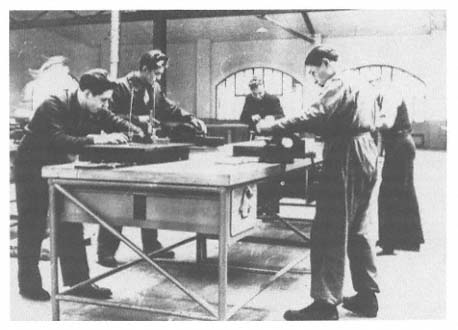
Fig. 1.
Apprentices in training at an Amiot factory near Paris, c. 1939–45. Aircraft companies
depended on a higher proportion of skilled workers than did most metalworking firms.
Many skilled aircraft workers made their start as apprentices in the industry. Others came with
experience from shipbuilding and automobile construction. Even after airplane construction was
modernized in 1938–39, skilled workers remained in high demand. Photo courtesy of SHAA.
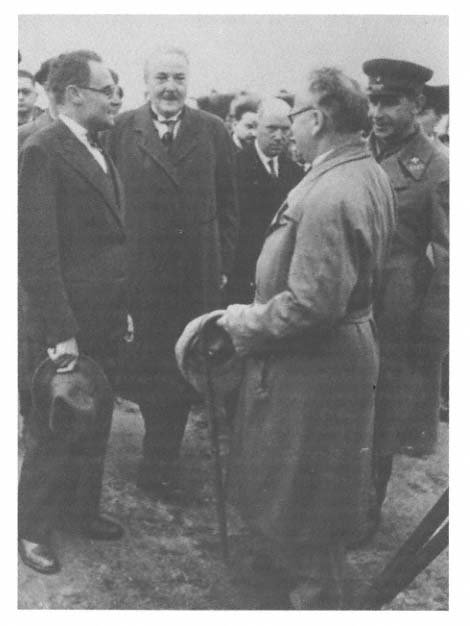
Fig. 2.
Air Minister Pierre Cot (left) and state engineer Albert Caquot (third from left)
on a visit to the Soviet Union in 1937. Cot put great stock in Franco-Soviet
cooperation as a defense against Germany. Photo courtesy of SHAA.
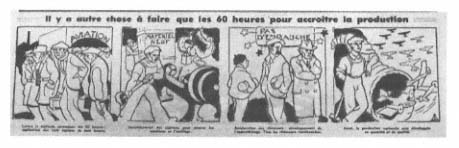
Fig. 3.
"There is a way to increase production other than the sixty-hour week."
After the defeat of the general strike of 30 November 1938 the Daladier government
eliminated the forty-hour week and expanded work hours in defense-related industries.
The CGT argued in vain to rely on other methods than long hours to boost production.
This cartoon from the April 1939 issue of the FTM's L'Union des Métaux called for
reorganizing production into three eight-hour shifts, investing in better machinery, retraining
the unemployed, and expanding apprenticeships.
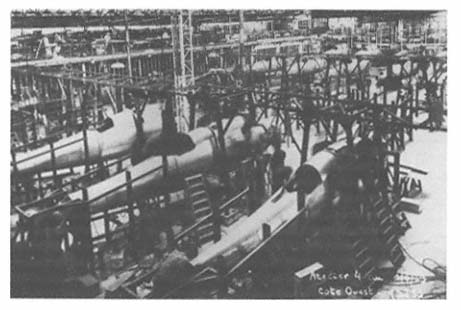
Fig. 4.
Assembly hall for building the Bréguet 691 bomber at the Bréguet factory in Vélizy-Villacoublay
in 1939. Since the First World War airplane construction had taken place in immense assembly sheds
as small work teams put together fuselages and attached wings, fins, cockpits, and accessories to
the emerging aircraft. Yet only in 1938 and 1939 did workers and engineers address the challenge of
building large all-metal airplanes in great numbers. The extensive use of jigs for positioning pieces, tools,
and large structures made the job easier. Photo courtesy of SHAA.
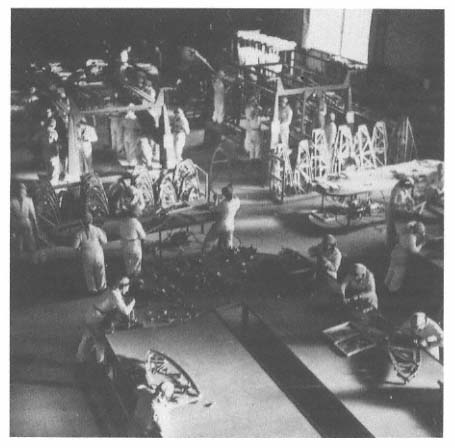
Fig. 5.
Women at work building the Amiot 143 at the Amiot factory in 1939–40.
By simplifying airplane design and reorganizing production methods in 1938 and 1939,
airplane manufacturers found new ways to use semiskilled workers, trained in a matter
of weeks for specialized jobs. Whereas women had comprised a miniscule proportion of
the blue-collar work force in the industry before the war, after September 1939 companies
recruited a great many women to do semiskilled work. They were usually the first to lose
jobs after the defeat of June 1940. Many women later found work in airplane construction
when the industry revived under German auspices during the Occupation. Photo courtesy of SHAA.
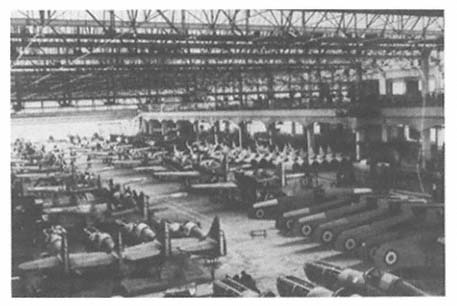
Fig. 6.
Production line for the Dewoitine 520 at the SNCAM factory in Toulouse in 1940.
As impressive as French production turned out to be in 1939–40, the industry never
overcame the handicap of a late start. This picture, taken in Toulouse three days after
the armistice, shows the highly regarded Dewoitine 520 finally coming off the production
line too late for use in the Battle of France. Photo courtesy of the Smithsonian Institution.
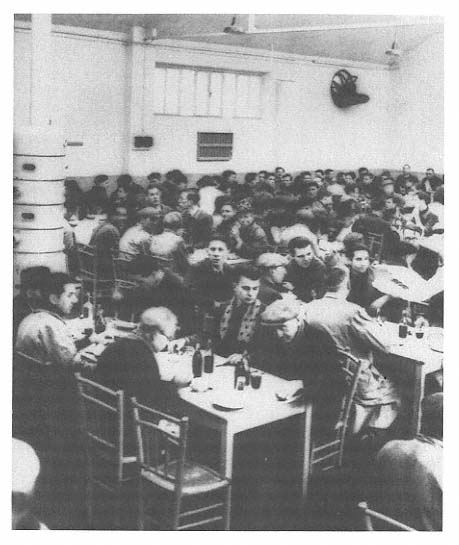
Fig. 7.
Employee dining hall at the Amiot factory, c. 1940. Employers and labor militants had
competing ambitions for factory dining halls. Employers saw them as places to reinforce
their paternalistic authority, militants as places to cultivate support for the CGT. Even
during the Occupation, mealtime in the cafeteria gave militants a chance to promote job
actions and protests. After the Liberation, plant committees dominated by the CGT won
the right to oversee the social-welfare activities of the factory, including the cafeteria.
Photo courtesy of SHAA.
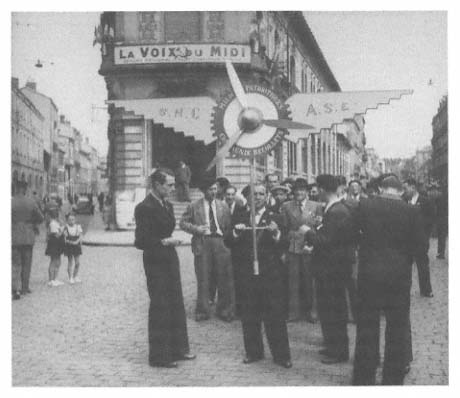
Fig. 8.
SNCASE employees who were members of the Patriotic Militia, a paramilitary organization
designed by the Communist Party to harass the Occupation authorities, gather in the streets of
Toulouse to celebrate the Liberation in 1944. The Resistance enabled Communist militants to
reestablish themselves as leaders of the labor movement in aviation, as in most industries, after
the setback of the Nazi-Soviet pact in 1939. Photo courtesy of the photographer, Jean Dieuzaide.
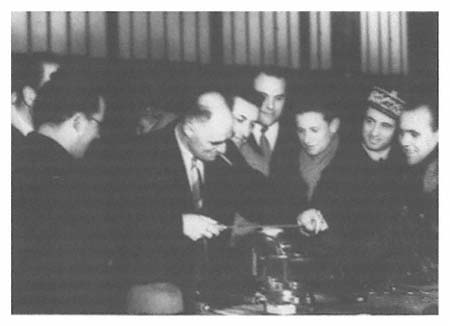
Fig. 9.
Air Minister Charles Tillon visiting the SNCASO plant at Châteauroux in 1945.
As a veteran labor militant and the chief of the military arm of the Communist Resistance,
Tillon tried to make the industry both an arena of labor reform and a model sector for
the party's postwar "battle for production." Photo courtesy of SHAA.
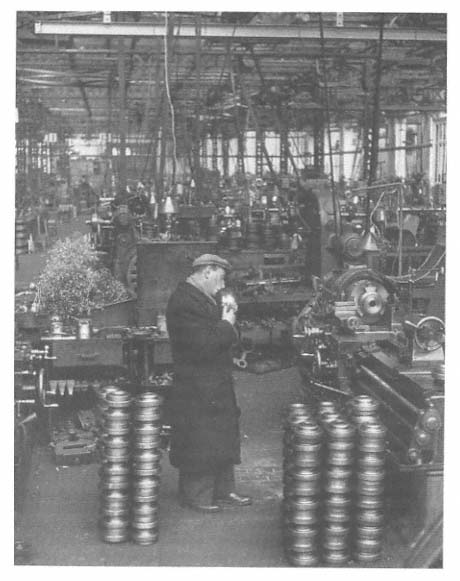
Fig. 10.
"The SNECMA Strike, 1947," by Willy Ronis. Ronis captured this view of a
SNECMA factory during the strike wave of late 1947. The CGT's defeat in the
strike wave made it nearly impossible for aircraft workers to prevent the
massive layoffs and plant closings that followed from government decisions
to restructure the industry. By 1950 thousands of jobs had disappeared, manufacturers
and politicians had established a stable working relationship between the public
and private sectors of the industry, and Communist militants, though still the leading
spokesmen for workers in most airplane factories, had lost much of the political
ground they had won after the Liberation. Photo courtesy of Willy Ronis.
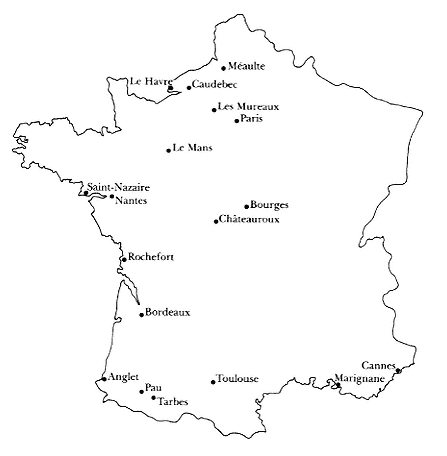
Map 1.
Principal Locations of the Aircraft Factories in France in 1940
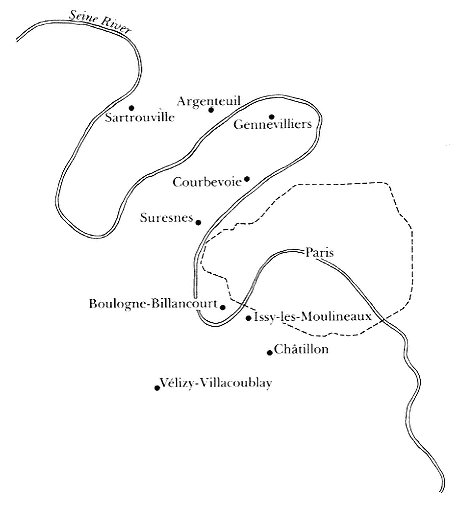
Map 2.
Principal Locations of Aircraft Factories in the Paris Region in 1940
PART THREE—
REARMAMENT, REPRESSION, AND WAR, 1938–1940
Two events stood out above others to haunt men and women in French industry, and especially in its metalworking branches, during the troubled period from 1938 to 1940—the strikes of June '36 and the possible outbreak of a European war. The first was a real event in the near past evoking powerful images of working-class self-assertion, images that workers hoped to revivify in a continuing drive for labor reform and that employers hoped to eradicate in a resurgence of managerial authority. The outbreak of war, conversely, was an imaginary event in an uncertain future. But the prospect of war was no less influential for being imaginary since the dread of a clash with Germany and the need to prepare for it became a national obsession, and a divisive one, in this period. Employers, workers, military leaders, and politicians faced the double challenge of renegotiating the social reforms of 1936 and preparing for war at a time when labor relations and rearmament policy were becoming increasingly controversial.
Nowhere were the two strands of this challenge more explicitly interwoven than in the aircraft industry. Here experiments in collective bargaining and labor representation had gone further than in other sectors, as had the effort to create a new relationship between business and the state in a nationalized sector. Here, too, the stakes of improving industrial performance could not have grown higher since the success of rearmament depended in part on a dramatic increase in air power.
Yet in early 1938 the prospects for both sustaining social peace and boosting production looked dimmer than at any time since the summer of 1936. Despite the reorganization of the industry under nationalization, little had been done to finance the conversion of factories for mass production. Labor relations threatened to deteriorate, in the public and private sectors alike, as some employers nursed renewed ambitions to
reverse the reforms of June '36, and workers became all the more eager to fight the rising cost of living with a national contract. As the center of political gravity shifted to the right in 1938—first in Chautemps's fourth cabinet, then in the Daladier government—labor conflicts resurfaced and eventually culminated in the general strike of 30 November 1938, when the Daladier government broke the back of the labor movement.
If the period from 1938 to 1940 seems in retrospect to be one of Thermidorian reaction, to contemporaries the conservative character of the period made itself felt only gradually. The fourth Chautemps government, though composed only of Radicals, still clung officially to the banner of the Popular Front. So did the government that followed—Blum's short-lived coalition of Radicals and Socialists that governed for a fortnight in March and early April after Blum failed to construct a broadly based cabinet of national unity "from Thorez to Marin." When Daladier came to power in mid-April, it remained a matter of opinion whether the era of the Popular Front had closed. True, the new premier named such conservatives as Georges Mandel, Paul Reynaud, and the conservative Radical Georges Bonnet to prominent posts in his cabinet. But he did not openly repudiate the social programs of 1936—at least not until late summer and fall of 1938, when he launched an assault against the forty-hour week and other labor laws in hopes of restoring investor confidence and promoting rearmament. In labor policy, as in national defense, Daladier gradually overcame his penchant for indecision—he was called the mystery man of France—and by November 1938 he was waging a furious offensive against labor reform, leading to a confrontation that proved to be particularly bitter in the aircraft industry. By 1939 there could be no mistaking that a conservative regime had taken hold.
Thus, it was in the aftermath of repression that France faced war in September 1939 and defeat ten months later. However ably the French sought to accelerate aircraft production before and during the war—and as we shall see, output in 1939–40 was impressive—France collapsed quickly on the battlefield, not least for a lack of air power. Debate surfaced immediately about the role of the air force in the defeat. Just as quickly, spokesmen for various groups—workers, employers, the Air Ministry, the military—pondered what links there may have been between the social conflicts in the industry and the more immediate causes of the defeat. Again, two poignant images—the factory occupied and the nation at war—came together in the rhetorical cross fire as the search began for explanations of national failure. Employer recalcitrance, labor sabotage, the forty-hour week, military incompetence, and investor greed all became epithets in the fight to assign blame for defeat.
Five—
Rearmament
Hitler's astonishing sequence of initiatives in 1938 and 1939 drove the French government into a frantic pursuit of the airplanes it had failed to build in the mid-1930s, when Britain and Germany had begun to rearm. First came the Anschluss in March 1938, when Hitler marched into the friendly crowds of Vienna to claim Austria as a part of the Reich. Then came the Munich Agreement in September, the annexation of Czechoslovakia in March 1939, the signing of the Nazi-Soviet nonaggression pact on 23 August 1939, and the invasion of Poland one week later. At each point French officials were forced to examine the state of France's military readiness, and at each point they decided to accelerate aircraft production. The rather abstract deadlines for war preparation that hovered over Pierre Cot's Air Ministry in 1937 gave way to dreadfully concrete production targets—and deadly serious questions about how those targets could be reached. This sense of urgency actually became pervasive at the highest levels of the government two months before the Anschluss, in January 1938, when, as we have seen, General Vuillemin, as commander of the First Air Corps, revealed to the government how unfit the air force was for war. This admission, combined with Premier Chautemps's awakening concern for airplane production, gave Cot's successor, Guy La Chambre, the political leverage he needed to win approval for a new, more ambitious program of aircraft production.
But making aircraft production a priority of the government was only a beginning. The real challenge was to find a way to apply the financial resources of the state to enable the industry to do what it had not done since the First World War—mass-produce airplances. Cot had only begun the process of reshaping the industry for rearmament. La Chambre was left with the task of creating a productive machine of greater size and
efficiency in short order. The challenge was at once technical and political—technical insofar as new ways had to be found to simplify airplanes, speed up production, and expand facilities; political insofar as it raised again, as had nationalization, basic questions about the relative power of state officials and private employers in the aircraft industry. Although La Chambre had no intentions of denationalizing the industry, his strategy for rearmament played a major role in reshaping the structure of public and private power in it during the two years that preceded the war.
Plan V
Guy La Chambre, a senator and the mayor of Saint-Malo, brought several political assets to his post at the Air Ministry. Like Cot, he had been a Young Turk in the Radical Party during the early 1930s and hence seemed open to the kinds of departures from traditional economic liberalism that had inspired Cot's experimentation in civilian aviation and nationalization. But by 1938 La Chambre was less the ideological maverick and more the political insider prepared to follow the Radical mainstream. A grand bourgeois himself, comfortable in business circles, La Chambre had risen to prominence in parliament as Edouard Daladier's protégé. As chairman of the Army Committee in the Chamber of Deputies in 1936 and 1937, he had worked closely with Daladier. As air minister, La Chambre was more Daladier's man than Cot had been and hence enjoyed the political interference Daladier could provide him in the military and in the Ministry of Finance. This advantage only increased when Daladier assumed the premiership in April 1938. La Chambre, moreover, bore few wounds from the political battles of 1936 and 1937, battles that had weakened Cot's capacity to bargain with business. La Chambre inherited the structure of nationalization Cot had provided but not the personal animus Cot had come to suffer in employer circles in 1937. Much the same could be said of La Chambre's relationship with the air force, where Cot had alienated senior staff. With friends in high places and few enemies in the aviation world, La Chambre took over the Air Ministry at the age of thirty-nine, well positioned to initiate policy.
Within weeks of assuming command La Chambre took three steps to strengthen the air force. First, he sought to bolster air force morale by replacing General Philippe Féquant, Cot's able but controversial air force chief of staff, with General Joseph Vuillemin, the widely admired, soft-spoken flying ace who had painted such a grim picture of French air defenses in the final days of Cot's ministry. Vuillemin had risen in the ranks not through the usual route of the military grandes écoles but
through a distinguished flying career and a reputation for leadership in the field. Although he had no experience with general staff work, the air force rank and file applauded his appointment, which also seemed to improve the relationship between the Air Ministry and senior officers in the air force.1 So too did La Chambre's willingness to resurrect the Matériel Committee and the Superior Air Council, the former bringing together the principal technical officials in the Air Ministry with relevant officials from the air force to discuss aircraft procurement, the latter convening the highest civilian and military officials to address air force policy. The types of decisions that Cot had frequently made through informal channels would now become subject to routine committee debate.
These administrative changes, although easing tensions between civilian and military officials, came with a cost: they restricted the role of the Air Ministry and gave bureaucratic ground to the military. More the traditionalist than Cot, La Chambre deferred willingly to top brass in military matters; he believed it was General Vuillemin's task to define the material needs of the air force, and his own to find ways to meet them.2 Daladier concurred. Years later, at the Riom trial, both politicians would face criticism for upholding precisely this distinction between military and civilian responsibility that, ironically, conservative generals such as Pétain had encouraged.
As a second avenue of reform, La Chambre cultivated greater Anglo-American support for the aerial defense of France. Since 1936 German rearmament and France's relative military decline had made British cooperation an essential principle in French defense strategy. Unfortunately, Prime Minister Neville Chamberlain's appeasement policy had impeded efforts to create detailed plans for coordinating French and British forces. But after the Anschluss the British finally agreed to begin limited staff talks over air strategy. La Chambre hoped that British strengths would complement French weaknesses, especially in bombers, and that new licensing agreements would allow French firms to build British matériel. Despite progress, Anglo-French cooperation evolved slowly—painfully so, since the British still feared that military pacts would entangle them in the continent and replicate the catastrophe of 1914.3
Franco-American cooperation encountered obstacles as well. With Cot's order of Pratt and Whitney engines as a precedent, La Chambre turned immediately to the United States as a source of military aircraft. In January 1938 he sent Senator Amauny de la Grange to Washington to investigate what American firms could offer and to purchase up to a thousand aircraft. De la Grange found President Roosevelt enthusiastic about the idea, but congressional isolationism, the Neutrality Act of
1935, and above all the limited capacity of the American aircraft industry forced La Chambre to settle for one hundred Curtiss-Wright P36s.4 Yet de la Grange had paved the way for subsequent missions to the United States; the purchase of American aircraft would remain a major, and controversial, feature of La Chambre's policy.
The third and most important avenue La Chambre followed to boost air power was Plan V, an ambitious new program for building advanced aircraft in France. Cot had advocated a similar scheme, without winning the support to build it. But by early 1938 German strides in aerial rearmament, combined with the growing appreciation in the French government of the weaknesses of the French air force, made Plan V a compelling priority and its adoption all but a foregone conclusion.5 On 15 March 1938, three days after the Anschluss, the Superior Air Council approved La Chambre's plan to build 2,617 aircraft for the front lines and another 2,122 in reserve.6 The plan not only required a pace of production more than six times greater than what Plan II had prescribed; it called for modern aircraft, designed to fly more than 500 kilometers an hour and equipped with compression engines, motor cannon, radio cockpits, and retractable landing gear—speeds and features that German aircraft had acquired and that had made the planes of Plan II obsolete. Although this conversion to modern aircraft would make the air force particularly vulnerable during the transitional year of 1938, officials believed that by 1939 the program would begin to yield battle-worthy planes by the hundreds.
Plan V set goals that were at once modest and ambitious—modest since the new air fleet would still remain much smaller than the Luftwaffe and would keep the French dependent on the British; ambitious since the industry would have to produce at a rate many times its current capacity. Many of the high-speed aircraft called for in Plan V had yet to leave the drafting boards, much less the prototype shops. What is more, after the Anschluss La Chambre urged the Superior Air Council to accelerate the schedule for Plan V by almost a year, that is, to complete final deliveries by April 1940—a task La Chambre admitted might prove impossible. Military officials agreed to the revision, provided that fighters be built first and bombers be built only after April 1939 since the latter took more time and material and were thought to be the stronger suit of the RAF.7 Once again the high command gave short shrift to the bombing fleet, going as far as to dismantle the large bombing strike force that Cot had quietly organized.8 Of the 1,617 frontline aircraft called for in Plan V, 876 were slated as bombers—a fleet woefully inadequate for offensive air operations but suitable for the more limited role that the army had envisaged for aviation all along.
The drive to boost production from fifty planes a month in early 1938
to a projected 330 a month by April 1939 forced government officials and industrialists to address long-standing problems in the industry. The first step was to win adequate financing for rearmament. Here again where Cot had failed, La Chambre succeeded. Armed with a military consensus behind Plan V and support from the defense committees of parliament, La Chambre secured the financing to expand plants, purchase machinery, and retool factories for the frightful pace Plan V demanded. For once, the Air Ministry won the largest share of the defense budget, 42 percent, securing 6.7 billion francs in 1938, up from 3.9 billion the year before.9 Just as important, La Chambre enjoyed support from the Finance Ministry, in part because Daladier kept the pressure on his finance ministers to pay for the program. To be sure, some discord continued between an Air Ministry eager to spend money and a Finance Ministry anxious to strengthen the franc through austerity, especially in late 1938, when Paul Reynaud took over at the rue de Rivoli. Still, a world of difference separated the frustrations Georges Bonnet had created for Cot in 1937 from the ease with which La Chambre proceeded. As one official later argued in a report on air force expenditures, "The legendary ferocity of the Finance Ministry softened vis-à-vis the Air Ministry. Perhaps it was a matter of personnel and confidence in officials. The staff of the Finance Ministry had previously subjected requests to scrupulous examination and reductions. But now the staff nearly always approved the requests presented by the Air Ministry."10 In fact, the decline of bureaucratic skirmishing over financing reflected not so much a change in leadership—Blum and Chautemps, after all, had supported aerial rearmament—as the overwhelming logic of developments abroad. Hitler's air power was creating a consensus in the government over the importance of aircraft rearmament.
If the Anschluss had helped to spur financial support for Plan V, Hitler's effort to annex the Sudetenland in Czechoslovakia served similarly to strengthen Daladier's commitment to aerial rearmament. More than any other event before the war, the Munich crisis convinced French officials of the urgency of aircraft procurement. Under Plan V the first big deliveries of new aircraft were not to be made until early 1939, so the combat strength of the air force had changed little by September 1938. Moreover, the British had as yet offered only a token bomber detachment. Under these circumstances General Vuillemin was still as pessimistic as he had been eight months earlier. After returning from a tour of German aeronautical installations as a guest of General Hermann Göring, Vuillemin warned La Chambre on the eve of the crisis that he could offer only seven hundred outmoded French warplanes to battle against a Luftwaffe of twenty-five hundred "modern planes." In two months' time, Vuillemin said, France would lose up to 64 percent of its
aircraft, with little left in reserve.11 Of course, French capitulation at Munich had deeper roots than aircraft production—military and diplomatic dependence on Britain, the long-standing failure to restore a genuine Franco-Russian alliance after 1917, and the failure to check Hitler in 1936 at the bridgeheads of the Rhine. But there is little doubt that Vuillemin's warning was instrumental in convincing Daladier that he had to comply with Chamberlain's policy of appeasement.12
As a result, Daladier returned from Munich determined to expand the air force as quickly as possible. Accordingly, he and La Chambre supported Albert Caquot, whom La Chambre had just appointed to replace Henry de l'Escaille as president of the SNCAs (the national companies), in his efforts to reorganize production in the nationalized sector. Although Caquot's reputation had been tarnished somewhat by the failure of his prototype policy in the early 1930s, he was still greatly admired as the hero of industrial mobilization for aircraft production during the First World War. His appointment and the new authority that came with it signaled a stepped-up commitment to aircraft procurement.
So too did La Chambre's other major initiative in the fall of 1938, the launching of a new purchasing mission to the United States. It was a measure of the sense of urgency over aircraft procurement that Daladier and La Chambre were willing to reach out again to Washington after encountering so many hurdles months before. Once again the initiative provoked an outcry. Even Paul Reynaud, long an outstanding advocate of rearmament, now as finance minister opposed a new purchasing mission to the United States as a potential drain on the treasury.13 But Daladier and La Chambre remained steadfast, sending Jean Monnet, the future architect of the European Economic Community, to secure what he could from the American market. He returned with a promising deal—an initial order of 555 American warplanes, options for future deliveries that by 1940 would come to fifteen hundred planes a year, and an unusual agreement in which the French government would invest $2.25 million for the expansion and retooling of an American firm, the Glenn L. Martin Company—an amount greater than what the U.S. government invested annually in its own aircraft industry, at least until 1940.14 Though American deliveries would not boost French air power until the summer of 1939, this second purchasing mission produced an important supplement to what the French could construct on their own.
The most perplexing controversy over procurement planning, however, was to come in the early of months of 1939, when officials in parliament, the air force, and the Air Ministry debated over what to build beyond the original targets of Plan V. In January, just when the first big production runs of Plan V were finally spewing forth Morane 406s in large numbers (Potez 63s would soon pour out as well), Joseph Roos, the
industrial director of the air force, told La Chambre that by 1940 the industry would be able to produce from 370 to 600 planes a month, depending on the type.15 A new production program had become necessary because even though most of the airplanes of Plan V were yet to be built, it was possible to foresee some factories becoming underutilized in a matter of months. It was now believed that Plan V would be nearly fulfilled by the middle of 1940, well in advance of the original timetable and close to what La Chambre had hoped for after the Anschluss. Astonishingly, given the sense of panic that had suffused the Air Ministry since early 1938, La Chambre and Caquot had to admit in December 1938 that in the absence of new orders, companies would soon have to contemplate layoffs.16 In the meantime a number of employers, especially Marcel Bloch and Paul-Louis Weiller, had become increasingly impatient over the prospects of continuing to expand production without firm guarantees for future orders. For a brief period, too, roughly from November to February, Franco-German relations appeared to improve, even to the extent that aviation officials on both sides of the Rhine began quietly to explore the French purchase of a high-performance German motor. This illusory moment of rapprochement made employers all the more uneasy about future orders.17 To compound the sense of confusion, General Vuillemin told La Chambre that any expansion of the air fleet beyond Plan V would exceed the personnel capacity of the air force. Since Vuillemin believed everything was being done to train crews, he thought it foolish to build an excessive number of airplanes that would only become obsolete.18
Ironically, while General Vuillemin was urging La Chambre to restrict the program to a level that the air force could use, politicians in parliament berated the government for failing to expand the industry even more. André Laurent-Eynac, one of the leading parliamentary experts on aviation, called on Daladier and La Chambre "to break the narrow confines of an aged aeronautical industry, nationalized or not, and utilize the existing network of subcontractors and the resources of the automobile and railway car industries." Only full-scale industrial mobilization and a more rigorous style of administration in the Air Ministry, Laurent-Eynac argued, would enable the country to produce the five thousand or more warplanes he, like other critics in parliament, believed France needed.19
Amid this confusion over whether to expand production, a compromise was hammered out in the Superior Air Council at the end of March.20 With Vuillemin again insisting on the need to restrict production and La Chambre arguing to expand it to forestall layoffs and maintain industrial capacity, the council agreed to accept La Chambre's production targets on the condition that additional aircraft expand the
reserve force and not the front line. Accordingly, Plan V was revised to a level of 8,094 warplanes, up 83 percent from the original plan, and employers could now anticipate orders into 1941.21 Industrial imperatives, more than military planning, had come to propel production.
The debate over expanding Plan V reveals how much the political climate in the industry had shifted by the spring of 1939 from what it had been during Cot's ministry. For one thing, the relationship between the air minister and the top brass in the air force had changed. Whereas Féquant and Cot had conspired to enlarge the strategic role of the air force and hence promote a vision of a larger, more aggressive flying force, Vuillemin and La Chambre essentially acquiesced in the more limited conception of aviation that had prevailed in the army-dominated General Staff. Always the realist, Vuillemin saw little reason to build more airplanes than the air force could fly; it was left to La Chambre and the civilian side of the air Ministry to accelerate schedules, search for shortcuts, and switch the emphasis in the industry toward mass production. In fact, General Vuillemin continued to emphasize the importance of the technical qualities of matériel, for fear that rapid production and speedy purchasing missions in the United States might saddle his men with inferior equipment.22 This outlook opened him to charges of perfectionism, a criticism La Chambre himself made in postwar testimony: "If the French high command had not given in to a taste of perfection and if it had been content with the matériel it was offered, we certainly would not have had the deficiencies in assault and dive bombers that we suffered in the course of battle."23 La Chambre, by contrast, pledged to the Air Committee of the Senate in January 1938 that once production targets had been set, he "would not allow for any modifications."24 In short, he viewed production—massive, efficient, and unimpeded—as the centerpiece of his rearmament policy. Hence his keen interest in foreign orders, and hence, too, his impatience with colleagues who, like his first industrial and technical director in the ministry, Etienne Joux, questioned how much the government could accelerate production.25 The key figures in promoting large-scale production, then, were mainly civilian officials, especially the politicians—La Chambre, Daladier, Laurent-Eynac, de la Grange, and several others—who had built their political careers through their advocacy of national defense.
The pressure to expand Plan V came from employers as well, and in this respect the deliberations of early 1939 reveal another way in which the atmosphere had changed since 1937. Under Cot the Air Ministry had a complicated relationship with the employers; Cot and his chief associates got along well with men in the nationalized sector but poorly with private builders such as Louis Bréguet, Félix Amiot, Paul-Louis Weiller, and Louis Renault. The wrenching business of nationalizing the industry
had also created a schism in the Chambre Syndicale. But by 1939 the relationship of the Air Ministry with the private builders had improved. When the limitations of the original Plan V targets became apparent at the end of 1938, builders in the public and private sectors alike joined the chorus of complaint. Employers from both types of firms enjoyed close ties to key legislators on the defense committees in parliament, the same men who spoke out so stridently in the debate over expanding Plan V. By 1939 the combined pressures of builders in both public and private sectors, on the one hand, and key politicians, on the other, had constructed something of a consensus over rearmament planning despite the misgivings of the air force—a consensus that had been missing in the more polarized atmosphere of 1937.
Reorganizing Production
To set production targets was one thing; to meet them was another, especially since the goals of Plan V would require more efficient manufacturing methods. One report to the premier in December 1937 estimated that it took two and a half times longer to construct airplanes in France than it did abroad.26 For years air ministers and their staff engineers had called for retooling the industry; Pierre Cot had hoped to modernize production, especially in the nationalized sector. But budgetary constraints in 1937 confined expenditures on new plants and equipment to a paltry 116 million francs.27 Only with La Chambre's successful promotion of Plan V did the money flow for retooling factories. Although no industrialist, Guy La Chambre claimed later that he had a special sensitivity to the challenges of modernizing production, stemming, he said, from management experience he had had as a young man in 1924 in the shipbuilding firm Chantiers et Ateliers de Saint-Nazaire, where he worked "elbow to elbow with the workers. I had notably done a lengthy training assignment in the time and motion bureau, which specifically studied production assembly. Thus, I was not out of my element in the presence of the industrial problems aircraft production raised, and I could quickly assimilate them."28 In fact, as air minister he readily grasped that the goals of Plan V were too demanding, and skilled workers in metalworking too scarce, to postpone retooling a season longer. As a politician he also recognized how difficult it would be to lengthen the workweek beyond forty-five hours. To build the five thousand planes initially proposed for Plan V by the spring of 1940, the industry had to expand quickly by relying more extensively on semiskilled workers.29
Money, of course, was the key to tooling up the industry. By September 1939 the Air Ministry had distributed 2.344 billion francs for plant
and equipment, and by June 1940 the figure had climbed to four billion.30 The government used a number of methods for dispersing these funds. It was relatively simple to channel money to state arsenals and nationalized firms. These companies could secure credits directly from the Air Ministry to purchase tools and equipment or receive start-up contracts and advances to purchase machinery for particular orders. In the private sector, however, state officials preferred other ways to subsidize companies, methods that at least formally preserved the corporate autonomy of the firms—surcharges on contracts to funnel additional monies to manufacturers; a system for purchasing machinery by the Air Ministry and then renting it to private firms; state subsidies to defray portions of the interest charged for private loans; and generous allocations from the Caisse de Compensation pour la Décentralisation, a fund that since 1931 had been used to build new plants in the provinces.31 These methods for financing tooling and expansion differed from one another in the leverage they provided the ministry and in the burden of risk firms assumed.32 Employers and state officials often bargained over which method to use and the terms to employ.33 Yet the overall effect was to enhance the capacity of the Air Ministry to shape the evolution of the industry as a whole. In the spring of 1938 the Air Ministry went so far as to order employers to establish manufacturing plans in accordance with state guidelines.34 Of course, each firm still had jurisdiction over its own internal operations, but state officials assumed the right to keep well informed and recommend modifications.
In September 1938 the relative autonomy of individual firms in the nationalized sector diminished appreciably with Albert Caquot's appointment as president of the national companies. Caquot took command explicitly to reorganize the companies into a single, coherent machine for building airplanes. His presence, more than anyone else's, made rationalization a reality; and the nationalizations a year and a half before, which had at long last established a more concentrated structure for the industry, made it easier for Caquot to reorganize production.
The effort to rationalize aircraft manufacturing involved several challenges. First, it meant simplifying the airplane itself. Reducing the number of pieces that went into the construction of the plane, increasing the proportion of pieces that could be forged or stamped by machine, standardizing fittings and couplings, reducing the kinds of metals required to make parts—all these efforts would make it easier to cut production time and increase the use of machinery and semiskilled workers.35 It took a month less time to build the Dewoitine 520 than the Bloch 161 because the former was not only simpler in design but also easier to break down into simple assembly precedures.36
The second aspect of rationalization followed readily from the first—expanding the use of specialized machinery. To a degree, specialized
machinery had already been playing a big role in airplane construction. For years skilled metalworkers had been using forges, lathes, hydraulic presses, drop hammers, and milling machines to create the thousands of pieces that made up the wings, fins, and fuselage of a plane. But now engineers called for investing more extensively in this kind of equipment as well as in blanking machines and dies so that the pieces could be cut, stamped, drilled, and finished in much larger batches. Instead of essentially making pieces by hand and finishing them in the process of subassembly, workers would now rely more on patterns, templates, and specialized machines to make pieces with greater precision. In addition, production engineers developed new ways to use assembly jigs and fixtures to serve as braces, guides, and supports in assembly operations. For example, some jigs made it easier to position sheet metal over the ribs of the airframe to form its skin. Other jigs held a wing in place so that wing flaps could be fitted according to precise specifications. Still other jigs made it possible to place rivet holes properly. To be sure, expanding the use of specialized tools did not mean automating the process or eliminating skilled workers, who still found plenty to do in the modernized factory. But it did serve to standardize operations and simplify tasks, and in some instances it made it possible to use less-skilled employees. This shift in production methods, as a popular aeronautical engineering text of the period described it, "eliminates the patterns of the workshop, abolishes the sketches, raises quotas, etc. . . . and it therefore permits the use of manpower that is less skilled, hence less rare and expensive, and the more so the better; [and it] facilitates the placement of pieces with greater speed, precision, and reliability."37
The third aspect of rationalization, reorganizing the assembly process into a more linear pattern, applied similar logic to the overall process of airframe construction. Manufacturers had been assembling airplanes by building each of the major components—wings, fins, tail, cockpit, landing gear, steps, guns, instruments, and engine—and then attaching these pieces to a fuselage, itself long in the making. This process involved a great deal of inefficient motion as workers moved pieces back and forth between machines and hauled assembled components around the factory. This inefficiency stood in stark contrast to the assembly-line methods of the automobile industry, though it did not seem wasteful at the time: in a business with small batch orders it made sense to use factory space flexibly; to create an assembly line would be too costly. But with rearmament some effort to develop a linear assembly process was clearly warranted. By reorganizing the use of factory space to minimize backtracking, engineers could further shorten assembly times.
A fourth aspect of rationalization involved the relationship between plants. Here lay Caquot's special contribution to the program, for although each of the other aspects of rationalization—simplifying design,
using specialized machines and assembly jigs, and reorganizing the flow of assembly and subassembly operations—were widely understood, if not widely practiced, by 1938, there was less of a consensus on the virtues of reorganizing a whole network of aircraft factories. After becoming president of the national companies in September 1938, Caquot arranged for La Chambre's technical and industrial director in the Air Ministry to turn over entire orders for him to allocate to the nationalized sector. Caquot soon became known as the dispatcher of production and called on factories to specialize in making particular aircraft components.38 For example, the Morane 406, previously built from start to finish in single factories, was now to be manufactured at several specialized plants—the empennages at SNCAM in Toulouse, the wings in SNCAN in Billancourt, the fuselages at SNCASE in La Rochelle, with final assembly taking place at SNCAO in Bouguenais.39 These procedures enabled factories to tool up for a more limited range of construction activities, allowing personnel to become efficient in a more specialized set of assembly procedures. These steps made it possible to turn out Morane aircraft much sooner than if one factory had had to take on the whole operation.40 Similarly, Caquot pushed Marcel Bloch to reduce the number of models he was building at the factories of SNCASO, so that by the spring of 1939 all the installations of the company were devoted to various aspects of just two Bloch aircraft. At first some employers disparaged such schemes, and General Vuillemin feared that decentralized production would make the industry more vulnerable to aerial attack.41 But by 1939 Caquot's method had improved output enough to hold the skeptics at bay.
If factory specialization began to pay off immediately, as evidenced by the large number of Morane 406s that began coming out of the giant factory shed in Bouguenais in January 1939, how effective was the modernization effort as a whole? The archives, unfortunately, have left only a few traces of how particular firms proceeded with rationalization. But three kinds of data—on the size of the work force, the changing propor tion of productive and nonproductive workers, and figures for monthly output—do reveal how production evolved. Between 1937 and 1940 the work force mushroomed in size, rising to 58,265 in 1938, up 51 percent from the figure for 1937, and then expanding another 41 percent to 82,289 by early 1939. Such growth far outdistanced any previous expansion of the industry since 1918, save for the quick jump in 1935 when General Denain inaugurated Plan I. But the impressive growth in 1938 and early 1939, which made the aircraft industry twice as large as shipbuilding and half the size of the giant automobile branch, paled in comparison to growth rates from mid-1939 to the Battle of France. In January 1940 the work force reached 171,000, more than twice what it had
been the year before, and then climbed rapidly to 250,000 by June 1940.42 It was this increase in 1939 and 1940 that showed how much the industry could expand by enlarging the network of subcontracting firms and simplifying production to absorb semiskilled workers in huge numbers. Without serious efforts to tool up for this kind of work force, the industry could never have expanded at that pace.
Even by early 1939 the contours of such a change could be seen. Surveys in early 1938 had revealed that productive workers—that is, employees involved directly in the manufacturing process—constituted about 61 percent of the work force in the national companies. A year later that figure had risen to 80 percent.43 More important, monthly output began to climb steadily in early 1939, showing at last that the transition to new models and more-rationalized procedures could boost productivity. Although the big increases in productivity took hold in 1939, even in 1938 production per worker-hour was up in the five largest national companies by 30 percent in number of planes and 8 percent in tonnage.44 Monthly deliveries of warplanes climbed from 41 in November 1938 to 176 in May 1939.45 Even at Hispano-Suiza, long plagued by uneven and sluggish production, monthly output per worker improved steadily—up 46 percent in 1938 and another 43 percent between January and August 1939.46 By the time Hitler attacked Poland, monthly production was at last reaching the level Air Ministry officials had called for the year before.
Behind this broad picture of accomplishment, however, lay a more complicated record of success and failure. Some companies emerged as the major workhorses of rearmament, namely SNCASO (Bloch), SNCAN (Potez), SNCAM (Dewoitine), and to some extent SNCAO (Olive). Each of these national companies became more efficient in different ways—SNCASO by focusing on two airplanes and subcontracting extensively to private firms in the Bordeaux region; SNCAN by concentrating on three airplanes, each in different factories; SNCAM by producing the new Dewoitine 520 in large numbers; and SNCAO by concentrating on the final assembly of the Morane 406.47 But other companies often lagged behind in the effort to boost production. Although snags in virtually every major firm gave rise to complaints at one time or another in the Matériel Committee, Air Ministry officials remained especially dissatisfied with the performance at Amiot, Morane, and SNCASE. The latter, a nationalized firm, had great difficulty raising the ratio of productive to nonproductive employees, and the former two private firms encountered lengthy production delays.48 Employers differed, too, in their ability to simplify the basic design of their airplanes. After several design modifications the Morane 406, for example, still took fourteen hundred hours to construct, compared to six hundred hours for the
Dewoitine 520.49 No less important than these shortcomings were the continuing difficulties in getting supplies. From September 1938 to March 1939 Potez and Bloch found their production lines impaired by shortages of landing gear, propellers, and flight instruments. The quality of metals supplied to engine manufacturers remained a problem as well.50 Although the government invested a great deal of money from 1938 on to address these shortages "upstream" in the production process, it took more time than the Air Ministry turned out to have to solve these basic deficiencies in raw materials and airplane equipment before the Battle of France.
Even so, by the time of Hitler's invasion of Poland in September 1939 the industry had changed dramatically over the course of a year. Its work force had expanded more than 40 percent and would double, then triple, within months. Production had jumped sevenfold in the course of a year.51 For the first time since World War I the government had finally implemented a coherent program of investment, enabling employers to make effective use of factories, machines, and personnel. Most of the fighters flown in battle in May 1940—the Morane 406, the Potez 63, the Bloch 151 and 152—were a product of this effort to expand capacity and reorganize production. The turning point in this achievement came with Caquot's reorganization of the national companies. In this respect the pace of production in 1939 and 1940 was as much a political accomplishment as a feat in engineering. By centralizing authority in Caquot, as president of the national companies, and backing him with the support of Air Ministry staff and the Matériel Committee, La Chambre strengthened state control over the national companies that produced the lion's share of Plan V. In the process the autonomy that Pierre Cot had initially given directors of the national companies disappeared.
Reviving the Private Sector
If Guy La Chambre strengthened the nationalized sector by centralizing its administration and relying on SNCAN, SNCASO, and SNCAM as the major producers of warplanes, he nonetheless also promoted a revival of private firms alongside the national companies. Between 1938 and the outbreak of the war several private airframe builders, especially Louis Bréguet, Félix Amiot, and Raymond Saulnier, prospered handsomely from the orders for fulfilling Plan V or from subcontracts with the national companies. The Bréguet 690 bomber and the Amiot 350 fighter figured prominently in the plans for an updated air force, and La Chambre's ministry even encouraged Renault-Caudron, despite its mediocre performance since the mid-1930s, to compete for new orders.52 Private
firms in the engine sector prospered as well, though this was hardly surprising since the Air Ministry, even under Cot, remained overwhelmingly dependent on Hispano-Suiza and Gnôme-et-Rhône. Support by the Air Ministry after 1937 for a resurgence of private firms, especially in the airframe sector, reflected in part the ministry's sense of urgency, a willingness to harness all available industrial resources for the ambitious aims of Plan V. It also reflected the ideological moderation of Daladier and La Chambre. Whereas Cot argued that nationalized firms provided a more productive and socially more stable form of enterprise, and called attention to the pitfalls private firms displayed during his ministry, La Chambre took a more neutral stance. As he testified later, "If you ask me if I think the output was better in private or nationalized firms, I would be at pains to answer: It depended essentially on the director, and not on whether he presided over a nationalized or private firm."53
Support for private companies came both in the form of airplane orders and as funds for retooling and factory expansion. In fact, private companies benefited from the lion's share of the monies distributed after 1937 for enlarging and modernizing the industry. Even Renault's motor-building subsidiary, which had languished for several years, won subsidies for machinery. The effort to move factories away from Paris enabled Gnôme-et-Rhône to establish an important plant at Le Mans, and Hispano-Suiza to do likewise at Tarbes. Several suppliers of raw materials and airplane equipment worked out similar deals for new plants in the southwest. In many of these cases the state retained ownership of the new plants and machinery and then leased them cheaply to the firms involved. The effect, though, was to enable the major private manufacturers in the industry to contribute heavily to the rearmament drive and profit accordingly.54
Some manufacturers responded ably to these new opportunities, whereas others squandered the chance. Louis Bréguet won Air Ministry support to buy factories in Toulouse and Anglet from Pierre Latécoère, who by now was an ailing man eager to retire. This move, combined with state advances and some success with the Bréguet 690 series, rescued the Bréguet firm from the marginal role it had played during Cot's stint at the Air Ministry.55 There were limits to Bréguet's renaissance, however. In July 1938 La Chambre and the Matériel Committee decided to step up orders for the Bréguet 690 bomber, but to do so in a fashion that increased production at SNCAO in Nantes and decreased it at Bréguet.56 Likewise, Louis Bréguet did not succeed in his effort to reclaim his dockside factory at Le Havre, which had been absorbed into SNCAN, since Air Ministry officials viewed this proposal as a dangerous precedent for
unraveling the national companies. Still, Bréguet's company regained enough of a footing to become an important force in the industry on the eve of the war.
Félix Amiot and Raymond Saulnier fared more poorly and and gradually fell into La Chambre's disfavor. The Morane-Saulnier company, despite state support for retooling, continued to build the Morane fighter at the unacceptably slow pace of thirty thousand hours apiece. At a meeting of the Matériel Committee to which several employers had been invited, La Chambre "pointed out in harsh terms to M. Saulnier that he was very unhappy at how lightly the Morane firm treats the anticipated completion rate. The firm is already way behind, and no serious effort seems to have been made. If no remedy is forthcoming, the minister will have to cancel the contract." "That's your affair," Saulnier replied.57 With this kind of friction it was not surprising that the Morane company did not emerge from the rearmament period in a strong competitive position.
Demise was even more definitive for Félix Amiot. He had had a decent record of producing airplanes and had constructed a competitive bomber in the Amiot 350. Like Bréguet, he had failed in an effort in 1938 to get his hands on a nationalized factory, in his case at Caudebec. But this was a minor defeat. His real problem, like Saulnier's, was his failure to accelerate production. By the summer of 1939 Amiot's firm could still only produce about thirty airplanes a month, far short of the fifty to sixty that SNCASE could build or the ninety that the Air Ministry felt would be necessary by January 1940.58 Moreover, Amiot's managerial style, especially his refusal to delegate authority to his technical staff, had triggered complaints within the firm. It was not easy for the Air Ministry to remedy such problems. "Since it's a question of a nonnationalized firm," one Air Ministry official pointed out, "the Minister cannot in effect make decisions about the internal operation of a private firm."59 In August 1939 La Chambre moved boldly, requisitioning the company and assigning state engineers to take command. Weeks later, La Chambre satisfied the Senate Air Committee that the initiative had been a purely pragmatic matter, "without which we would never have seen the airplanes completed."60 The ground rules for survival and success, which had been ambiguous during the heady days of nationalization in 1936 and 1937, had by the beginning of the war become clear: meet orders, build swiftly, and stay on good terms with the Air Ministry.
Despite these troubles at Amiot and Morane, the fortunes of private manufacturers in aviation improved in the last two years before the war. Profit margins at Gnôme-et-Rhône rose from 7 percent in 1937 to 20 percent in 1940, as monthly production climbed from three hundred motors at the end of 1938 to six hundred motors in May 1940.61
Hispano-Suiza, though still a distant second in importance in the engine sector, expanded as well. Major equipment firms, which had all remained in private hands, cashed in handsomely by filling orders for Plan V, though often with delays that exasperated the Air Ministry. Messier, for example, which built landing gear and brakes for many airplanes, troubled Air Ministry officials because, as one investigation revealed, the firm exported products without authorization, sold manufacturing licenses abroad that it refused to sell to the French government, dragged its feet in modernizing facilities, maintained a precariously weak treasury, and still profited impressively on its capital stock.62 Moreover, Henry Potez and Marcel Bloch received hefty commissions for Messier equipment placed on their planes. Indeed, the major builders in the nationalized sector—Potez, Bloch, and Dewoitine—still found ways to operate as freewheeling entrepreneurs. Nationalization did not prevent Potez from trying to sell planes abroad. As late as September 1938, when Daladier found himself bereft of air power at Munich, Potez was on the verge of exporting more than fifty planes to China, Romania, and Greece.63 Dewoitine, meanwhile, entered a competitive bid to build a new long-distance seaplane for the North Atlantic commercial routes, a major project that could redound lucratively to SNCAM but divert valuable resources from military aviation.64 Bloch had a knack for subcontracting to firms in which he had an interest.65 Even as a director of SNCASO, he was jealous of his independence. Before Caquot took over as president of the national companies, the Matériel Committee felt the need on at least one occasion to tell Bloch that it was for Air Ministry officials, and not for him alone, to decide what planes and whose brands would be built at SNCASO.66 Perhaps most astonishing of all, many people in aviation circles continued to call on the government to subsidize a renaissance for civil aviation, as did Georges Houard in his editorials in Les Ailes almost every month from March to August 1939. Even as prominent a promotor of rearmament as Senator de la Grange lobbied as president of the Aéro-Club de France for a civil aviation program that might benefit Amiot in particular.67 In short, despite the priorities of rearmament, builders tried to pursue a variety of private ventures.
Only the single-mindedness of officials in the Air Ministry, and especially Caquot and La Chambre, kept a focus on military procurement. Even General Vuillemin and his military colleagues on the Matériel Committee—along with Etienne Joux, the technical and industrial director of the ministry, and some members of his technical staff, such as Paul Mazer—frequently sided with industrialists who wanted to export their wares or prevent the government from importing American equipment. Meetings of the Matériel Committee often featured conflict between these officials and La Chambre, who took a firm stand in defense of the
American purchasing missions or threatened to requisition equipment that builders had hoped to export abroad. By 1939 conflict in the committee increasingly took the form of arguments between Joux and Caquot. Joux tended to view the industry as a delicate instrument tuned to function effectively only when its several parts—builders, suppliers, and the personnel capacity of the air force—were all kept in harmonious balance. This outlook suited General Vuillemin, as we have seen, since he opposed any effort to build more planes than France had pilots to fly. Caquot, by contrast, viewed the industry more organically as a resource that could be expanded much beyond what most officials assumed—a perspective that no doubt reflected his experience in the First World War. He believed the industry could be pushed to build fifteen hundred airplanes a month, twice what Joux thought feasible. Caquot also felt more comfortable than did Joux with the notion of centralizing authority in the industry. Although Joux had a point—the industry was a delicate network and imbalances did create bottlenecks—he viewed the potentialities of the industry too conservatively and held employer autonomy in too much regard to provide the administrative leadership La Chambre wanted for the rearmament drive.68 After war was declared in September 1939, La Chambre settled the argument: he replaced Joux as technical and industrial director with Caquot, who also retained his position as president of the national companies and hence assumed even greater power to coordinate production than before. "The ardent dynamism of M. Caquot," La Chambre said later, "and his leadership qualities as well, made me think that he was best able to promote production and the greater pace it required. It was with sincere regret, but in the interests of the country, that I had to relieve M. Joux of this post."69
Once again, as in 1936, it was the political leadership at the Air Ministry, as opposed to its engineering staff or the air force, that proved pivotal in directing the industry. As respectful as La Chambre was of traditional business values, and as moderate as he was ideologically, he still did not hesitate to discipline employers in behalf of the rearmament effort. In this respect he followed in Cot's footsteps as a minister willing to use state power and state financing to shape the industry. But unlike Cot he welcomed the private sector into the program and had little interest in using the nationalized sector as an arena for reform in labor relations. As a result, La Chambre, Caquot, and the major builders established a more complex interdependence between the public and private sectors than had emerged during the Popular Front. Under La Chambre what came to matter most was not the distinction between nationalized and private firms but rather the difference between employers who advanced the accelerated production drive and those who impeded the effort. At the same time La Chambre and Caquot both increased and
decreased employer authority. By insisting on cooperation between companies, distributing the mass production of an airplane among several firms, purchasing American equipment, and curtailing exports, they strengthened the role of the Air Ministry at the expense of the builders' autonomy; by diminishing the power of the CGT, as we shall see in the next chapter, they restored a more conventional chain of managerial command within firms.
The rearmament period, then, was an important moment in the emergence of a form of state capitalism in the industry whereby private owners and public officials learned to live with a new division of authority. If in 1937 the future prospects of private entrepreneurship as well as the distribution of responsibility between the companies and the ministries remained unclear, by the outbreak of the war these issues were closer to being resolved. In a sense La Chambre and Caquot legitimized nationalization by allowing the private sector to revive alongside it and gradually breaking the ties between the Air Ministry and the CGT. Caquot's prominence was itself a symbol of this normalization, for he remained a man highly regarded in business circles, in parliament, and in the engineering corps of the Air Ministry. As the second-largest individual stockholder in SNCAO with seventy-five hundred shares, he was a businessman in his own right as well as a high-ranking fonctionnaire . Centralizing authority in his hands as an expedient to the building program did not threaten the new sense of balance that La Chambre was building between public power and private enterprise.
Henry Potez, the director of SNCAN and his own prototype firm, gave a clear indication of how readily employers had adapted to nationalization without losing their identity as entrepreneurs. Potez, though more aggressive and open-minded about industrial strategy than the older generation of employers such as Louis Bréguet, never courted the unions as coyly as did Emile Dewoitine in Toulouse and Claude Bonnier at the nationalized engine company, SNCM. Still, he defended the policy of nationalization unequivocally in the pages of the prestigious employers' journal L'Usine . He argued that because nationalization enabled employers to solve the problems of financing production, consolidating firms, and modernizing equipment, "we can conclude that nationalization has not diminished the possibilities in the aircraft industry but on the contrary has allowed them to increase."70 Potez by no means abandoned the cause of protecting employers from state intrusion. Research and development, he insisted, should remain private, "autonomous," "independent," much as the Potez-Bloch Agreement provided. Only the profitable engagement of private entrepreneurs in research would give rise to "the range of alternative solutions" technical progress required. The industry, he went on to say, had been "subjected too directly to shifts in
public opinion" and to unnecessarily rigid norms and regulations by the Air Ministry. With these caveats in mind, Potez promoted a view that embraced nationalization while preserving private research and upholding a manager's authority over his employees. Here was a vision of blending public and private power quite in keeping with the policy La Chambre and Daladier had pursued.
But if La Chambre, Caquot, and several major employers created a more stable modus vivendi between business and the state by 1939, and if they succeeded in boosting production to the levels La Chambre had called for in early 1938, their approach to rearmament had its shortcomings. First, there were problems with supplies: government efforts to retool and expand the basic-metal sector and the network of aircraft equipment suppliers proved too modest and too tardy to eliminate shortages.71
Second, the Air Ministry missed an important opportunity to boost engine production through licensing agreements with British firms, especially with the first-class engine manufacturer Rolls Royce. Plans to build British motors in France for French airplanes floundered in part because officials at Gnôme-et-Rhône lobbied effectively against any agreement that would undermine the near monopoly their firm and Hispano-Suiza enjoyed in the engine business. If La Chambre succeeded in overcoming opposition to the purchase of American airplanes, he failed to prevail in this domain.72
Third, the government failed to harness the productive potential of the automobile industry, which proved to be central to aerial rearmament in Britain and the United States. In early 1939 Air Ministry officials did begin to investigate how to involve automobile firms, and several engineers and politicians advocated a strategy of merging the two industries.73 But the obstacles were too high: the air budget in France, in contrast to Britain, was too modest to finance such an undertaking; French banks did not support the industry the way their British counterparts did; and the key figure involved in both industries, Louis Renault, preferred to concentrate on automobile manufacturing at the expense of his aircraft operations.74 Given these constraints, it was easier to expand the national companies and rely more heavily than had Cot on the private airplane companies. Had the war lasted longer than it did for France, and had the air force been able to train more people to fly, the pressure to enlist the automobile industry would have increased accordingly.
Fourth, greater cooperation between employers and the Air Ministry did not lead to a coherent program of aviation research. Plan V provided a suitable framework for modernizing manufacturing. Nationalization
under Cot and better financing under La Chambre enabled the industry to overcome obstacles that had long impeded mass production. But to match advances abroad, French firms also had to design better prototypes. What had long been the strong suit in French aviation—technical innovation—since the mid-1930s was quickly becoming a weakness, especially in the engine sector and bomber development. In late 1938 debate surfaced over whether the national companies ought to supplement the work that state arsenals and private firms had been doing in research and development, and it was this debate that sparked Potez's defense of private research.75 By September 1939 state officials and employers had yet to find an institutional framework adequate to meet the challenge that long-term aeronautical advances required. Some firms ignored research to take full advantage of lucrative, low-risk contracts for mass production; others engaged in research, but often on projects either too closely tied to existing models or too disconnected from the Air Ministry's sense of priorities.76 Had France been able to carry on the long war its military leaders expected beyond June 1940, these technical vulnerabilities in research would have loomed even larger than they did during the Battle of France.
A fifth shortcoming of La Chambre's approach to rearmament was in the social domain—the strains it brought to labor relations. The period of relative social stability in the industry from the fall of 1936 through 1937 stemmed in part from the willingness of workers and technicians to cooperate with unions, which in turn had a stake in implementing the reforms that Cot's ministry was willing to sponsor. However, with Daladier and La Chambre at the helm, especially in a government that included men of more conservative convictions such as Bonnet and Reynaud, labor relations soured. Conflict arose over a number of issues in the course of 1938, not least over how state officials were using their leverage in the nationalized and private sectors. Militants argued forcibly for protecting the committee structure that gave labor a voice in nationalized industry and for bringing private suppliers of equipment and raw materials under direct state control.77 In almost every issue of L'Union des Métaux prominent militants accused employers of sabotaging the national effort to build planes and called on the government to bring industrialists under firmer control. As a measure of how disenchanted labor militants were becoming with industrial policy under Daladier, Léon Jouhaux, the leading CGT moderate, spoke frankly about the betrayal of a left-wing vision of nationalization in the summer of 1938: "A number of factories were indeed nationalized, but the same management teams were preserved, and the same capitalists remained involved in the nationalized and private sectors. It is therefore not astonishing to see di-
rected capitalism satisfy its own interests before those of the state; here is the source of powerlessness and defeat that have stifled the promise of nationalization."78 With a government bent more on repairing its relationship with employers than on integrating labor into industrial politics, it was not surprising that conflict led to confrontation in the course of the rearmament drive.
Six—
Breaking the CGT
The deterioration of the social climate in the aircraft industry, as in France as a whole, during the eighteen months that preceded Hitler's attack on Poland was foreseeable in early 1938 but it was certainly not inevitable. To be sure, after June 1936 many employers in every industrial branch hankered for revenge—for a restoration of traditional authority in the workplace under the protection of a more conservative government. But in aviation, as elsewhere, not everyone in management held this view; some employers, such as Henry Potez and Marcel Bloch, thought it wiser to negotiate with the unions than to undercut them at every turn. Nor was it obvious in early 1938 in what direction Edouard Daladier and Guy La Chambre wanted to take labor relations. After all, these men were nothing if not pragmatic, and Daladier in particular knew that nationalization and a cooperative attitude with the unions could serve to avert strikes. The CGT, moreover, remained attached to the goals of the Popular Front, including the commitment to national defense. Many militants felt even the sacrosanct forty-hour week might be negotiable in the interests of war production. Under these circumstances leaders might have continued to achieve compromises in labor relations had not Daladier moved decisively in August 1938 to dismantle the forty-hour week in an effort to restore business confidence in the regime. Once he did so, workers in aviation, as in other industrial branches, became embroiled in a bitter struggle to defend the whole program of labor reform they had achieved under the Popular Front.
Workers' Concerns
To comprehend the conflicts of 1938, consider first how militants and workers reacted to the efforts to improve production. Retooling, the division of labor into simpler procedures, plant expansion, and factory
specialization were bound to change life on the shop floor. By 1939 many a workplace had been transformed. The skilled metalworkers who had predominated in the industry until then gradually found their factories crowded with hundreds more workers, many of whom were semiskilled. By 1940 about 20 percent of the work force was women, up sharply from 1 or 2 percent before September 1939.1 The physical layout of the work space changed as well. More room was given over to row on row of machine benches, less to the rather informal environment of the machine shop and tool rooms of the mid-1930s. Huge assembly halls, which once had been divided into a handful of spaces where teams of workers hovered over the evolving body of a new airplane, now became more rigidly organized, with long rows of wings, fuselages, or engines in nearly identical stages of assembly. More and more workers were anchored to a single work station, and supervisors roamed the floor keeping track of them.2 Retooling ended up routinizing many of the tasks that had previously been integrated into more complex operations. Thus, many workers had less discretionary control over the style and rhythm of their work than had been the case before.
As retooling diminished the autonomy of production workers on the shop floor, it also increased the authority of the planning departments, where highly trained engineers designed methods for simplifying production. Much of this work was improvisational, but by the late 1930s a new breed of engineer, trained at the Ecole Nationale Supérieure de l'Aéronautique and schooled in the principles of scientific management, had become increasingly valuable to the rearmament effort.3 After graduating from "Superaéro," these young men often moved on to temporary posts at Henry Potez's factory in Méaulte, where, as La Chambre described it to the Matériel Committee, "they could study American tooling."4 From there these new converts to rationalization would fan out into the bureaus and firms of the industry, armed with a stronger grasp of new construction methods than many of their engineering predecessors had.
It goes without saying that these changes could easily have triggered a counterreaction from skilled workers who valued the important and often creative role they had traditionally played in airplane construction. Not surprisingly, there is some evidence that workers actively resisted efforts to intensify the work pace. In the fall of 1938, for example, skilled workers at Renault-Caudron began to quit the firm in startling numbers, in part, managers discovered, on account of "les chronométreurs," the timekeepers who were assigned to calibrate the work pace of subdivided assembly.5 Since skilled workers were scarce and metalworking jobs plentiful in defense plants around Paris, quitting a job offered skilled workers a feasible escape from these working conditions. Alarmed by
the trend, managers at Renault reacted quickly: they raised incentive pay and ordered shop floor supervisors "to advise a bit more tolerance with the stopwatch, allow foremen to modify stopwatch bonuses, and eliminate discussion between timekeepers and workers."6 Intensifying the work pace, in short, could trigger resistance.
What is striking about the workers' response in 1938 and 1939, however, is not the resistance individual workers no doubt mounted by shirking tasks, skipping work, or changing jobs but rather the absence of any collective effort to challenge Albert Caquot's rationalization program. The aircraft industry had plenty of labor conflict in 1938 over wages and hours. But the transformation of the labor process, the subdivision of tasks, the reorganization of work, and even the dilution of the labor force through the massive recruitment of semiskilled workers—none of these changes triggered protest, strikes, or serious antagonism between shop floor militants and company managers.
One reason why managers encountered no collective resistance to rationalization is that skilled workers and technicians were not as directly threatened by new work procedures as were workers in munitions, automaking, and the mines. For one thing, the special environment of research laboratories and prototype shops, where engineers, technicians, and skilled workers intermingled and where the skilled crafts were highly prized, remained unchanged. For another, the process of retooling created new tasks for draftsmen, carpenters, and skilled metalworkers, whose job it was to design assembly jigs and build them to complex specifications. Despite rationalization, there was still plenty of skilled work to do in building airplanes. For the Bloch 161, for example, general assembly procedures, which were best suited to semiskilled workers, still only accounted for 20 percent of the labor time required for production.7 Some plants scarcely changed. The SNCAO factory at Saint-Nazaire was still predominantly artisanal and heavily dependent on a network of subcontracting shops in the local area, whereas down the road at Bouguenais the same firm boasted one of the most efficient final assembly operations in France.8 On top of it all, the industry as a whole expanded substantially after 1937, thereby further increasing the demand for skilled labor.9
Because portions of the manufacturing process still required skilled labor, and because expansion accompanied rationalization, semiskilled workers did not so much displace skilled workers as take new places alongside them. The distinctions between the two kinds of workers remained clear—in wage scales, job classifications, occupational status, training, and advancement opportunities within the plant. Skilled workers could still look forward to the chance to move from mass production into the more prestigious and congenial world of the prototype shops, a
world that largely excluded semiskilled workers. For many of the latter, the job was not so much an entry into a career in aircraft production as a chance to earn the high wages that defense work, especially in aviation, involved. Work, then, had different meanings for different kinds of workers. There had always been some distinction between workers devoted to the industry as an arena for advancement and self-expression and workers who identified much less with the industry. But under the special circumstances of rearmament this difference became more palpable, making it more difficult for veteran militants to cultivate an ethos of l'aéronautique , a sense of pride and identification with the industry as a world that workers and their political leaders might someday control.
Even so, CGT militants made no effort to thwart rationalization. On the contrary, between 1936 and 1940 trade union spokesmen for technicians and workers repeatedly called for a more efficient use of manpower and matériel. At its founding conference in March 1937 the National Aircraft Section of the FTM condemned "the disastrous organization of production . . . the continuation of conditions that may have grave consequences for meeting orders."10 In early 1938 militants at Marcel Bloch's SNCASO plant in Courbevoie presented management with a detailed list of suggestions for overcoming "the gaps in organization, the lack of cohesion, the excessive guesswork" that impeded efficiency.11 Throughout 1938 almost every issue of the union monthly, L'Union des métaux , published a speech, letter, or account of a meeting that called attention to managerial flaws in the industry and the need to put people and machinery to better use. One such letter, written in April by a local militant named Moreau at a SNCASE plant near Marseille, emphasized a number of themes that CGT militants frequently stressed in public pronouncements on the need for more rationalization:
In the face of the attack against the forty-hour week in the nationalized factories . . . it may be useful to recall that, contrary to the affirmations of the trusts' press, production in certain factories increased markedly since the application of the labor laws [of 1936] and continues to increase daily as these factories are reorganized. The public should know the truth of the matter—that there was no real aircraft industry before 1936, and the Popular Front government had to intervene to prevent our aviation from falling into ruin.
The letter, in short, suggested that employers had run the industry irresponsibly and that calls for eliminating the forty-hour week were in bad faith as well; only the initiatives of the Popular Front had saved aviation from ruin. Moreau went on to extol the progress that the CGT and the national companies had made in training new workers, which, among other things, obviated the need to lengthen the workweek:
Is it not true that before 1936 apprenticeship training had been completely abandoned, and the bosses willfully sacrificed the future of our industry to their super profits? . . . Today apprenticeship schools are organized in several nationalized factories, and reeducation programs are functioning normally. We can point out with pride to those who disparage us that every Saturday 80 young people gladly sacrifice a good portion of their leisure time to learn trades without remuneration in our factory in Berre. And we are persuaded that if it were possible to take more, there would not be just 80 but at least 200 youth who come under their own funds to work. . . . We say that production can and must be increased by hiring the unemployed, reeducating personnel, purging management, outfitting every aircraft factory with modern equipment. We demand that sanctions be taken against industrialists who fail to deliver raw materials on time.12
So insidious had the influence of employers been on the industry, Moreau felt, that it was necessary to purge the ranks of the foremen and technicians who had been hired before 1936 "more for loyalty [to management] than for professional worth." From Moreau's perspective the lines of conflict in the industry lay not between workers threatened by rationalization and engineers bent on applying new methods. Rather, they lay between the Comité des Forges and their loyal supporters, on one side, and employees, managers, and officials who wanted to modernize the industry, on the other.
This productivist perspective—embracing the virtues of efficient manufacturing while portraying the bosses as the enemies of modernity—derived in part from tradition, in part from the politics of the late 1930s. Revolutionary syndicalists in the late nineteenth century had argued that it was management, not labor, that prevented French industry from modernizing. In the France of the family firm, small enterprise, and Malthusian business practice there was something to be said for this contention. In the 1920s neither CGT moderates nor CGTU Communists condemned rationalization outright despite a number of strikes in which metalworkers fought against the stopwatch, speedups, and wage incentive programs. Since 1918 CGT moderates had endorsed rationalization as a way to improve workers' living standards and reduce their hours, provided that an effort was made to rationalize all aspects of the enterprise and not just workers' tasks, and provided that it was accompanied by contrôle ouvrier —an opportunity for workers themselves to play a role in overseeing the process. Communist militants, even when they adhered to the "class against class" line in the late 1920s, defended rationalization in the Soviet Union as a model for combining productivism and revolution.13 By the 1930s most militants across the spectrum of left-wing opinion viewed rationality, discipline, and orderly methods of
production as positive ideals the labor movement, not the patronat , was equipped to uphold.
After 1936, however, it became even more essential for militants to safeguard these values in the interest of protecting the labor reforms of the Popular Front—especially the forty-hour week, which was, after all, initially promoted as a rational, orderly method for reducing unemployment. Committed as they were to national defense, CGT militants also defended the forty-hour week as an efficiency measure: better to modernize production and schedule multiple shifts than exhaust the work force with a forty-eight-hour week. From 1937 on, militants spoke up continually for retooling, factory reorganization, apprenticeship programs, retraining, the recruitment of unskilled workers—whatever it took to improve production within the framework of the limited workweek. And in keeping with their syndicalist heritage, they reasserted the claim that contrôle ouvrier went hand in hand with improvements in manufacturing techniques.14
The CGT's support for rationalization remained consistent even after the Munich crisis and the general strike of 30 November had poisoned relations between the union and the Daladier regime. In late 1938 the Fédération des Métaux (FTM) published a pamphlet reaffirming its productivist position. Citing one example after another, it called attention to shortages, bottlenecks, and disruptions in production, the needless modifications, indecision, or confusion that plagued all aircraft factories, "nationalized or private." Like Moreau's letter, the FTM pamplet closed with a list of demands reiterating the union's support for rationalization:
The Fédération des Métaux and the workers in aviation have already shown their desire to improve production; they have made proposals and will do so again with the aim of creating conditions for harmonizing production:
1. Respect for the labor laws and the application of the collective contract in the aircraft industry.
2. Nationalization of the engine-building and accessory firms.
3. A survey of the many firms that are currently needing orders (in rolling stock, machine construction, etc.) and that could easily make accessories, parts for motors and airframes, and even assemble airplanes.
4. An immediate survey in all localities of the unemployed who could be hired and who, when teamed with skilled workers, could facilitate the creation of two or three shifts.
5. The development and implementation of measures to retrain the unemployed rapidly.
6. The improvement and renovation of machinery.
7. The establishment of open orders for mass production, facilitating the methodical organization of production.
8. The reorganization of the bureaus of the Air and Finance ministries, simplifying administrative formalities and enabling these bureaus to serve the national companies effectively for the benefit of production, qualitatively and quantitatively.
9. Take whatever measures are necessary to prevent the sabotage of production.15
By bringing together both the political demand for extending nationalization and the bureaucratic demand for greater efficiency, the FTM sought to maintain its claim to be a modernizing force in the industry. Needless to say, the union did not call attention to the possible contradiction that lurked within this position—the potential conflict between challenging hierarchical authority through contrôle ouvrier and accepting it in behalf of defense production. But given the CGT's stake in rearmament, in the success of the national companies, in the union's voice in managerial decision making, and in the limited workweek, it made sense to promote retooling and greater efficiency.
The CGT's support for rationalization stands in contrast to what happened in Britain. By the 1930s the main British trade union for skilled metalworkers, the Amalgamated Engineering Union (AEU), had a well-established tradition of opposing the "dilution" of the work force, that is, the increased use of less-skilled laborers either by breaking down production into simpler tasks or by assigning semiskilled workers to tasks for which the union believed they were unqualified. In 1936 the AEU organized a defense against dilution in the aircraft industry, an effort that sparked strikes at Fairey Aviation, Dobson and Barlow, the De Havilland Company, and a number of other British airplane companies between 1936 and 1938.16 At Rolls Royce Derby skilled workers fought in 1938 over a time-and-motion study and won.17 In fact, the labor movement in British aviation became deeply divided between skilled metalworkers in the AEU and new, less-skilled "dilutees" whom the Transport and General Workers Union gradually came to recruit. Despite moderately successful negotiations between the AEU and employers over dilution in the summer of 1939, the issue remained a source of controversy throughout the Second World War.18
What accounts for the difference between the British and French responses to rationalization? After all, changes in manufacturing technology per se did not differ enough in the two countries to explain the workers' reaction. The answer lies in national politics and the nature of the trade union movements. If in France aircraft workers had witnessed the rise of a Popular Front and the nationalization of much of their industry, their counterparts in Britain still worked in a more conventional environment. Conservative politicians, for the most part, presided
over rearmament from 1935 on, and they kept the industry in private hands. To expand production, the British Air Ministry developed a vast network of "shadow factories"—plants belonging to private automobile and other metalworking companies that were converted to airplane construction. Aerial rearmament, in effect, was largely contracted out to the private metalworking sector.19 Under these circumstances British aircraft workers were more likely to continue in the style of shop floor combat that had characterized the metalworking sector throughout the interwar period. For skilled metalworkers, that meant keeping a vigilant eye on manning levels, wage differentials, and job classifications—issues that had preoccupied British metalworkers during the First World War.20
British labor leaders, moreover, were less inclined than were their CGT counterparts to challenge the legitimacy of the capitalist entrepreneur and more inclined to defend the shop floor privileges of skilled crafts. In fact, craft unionism lay at the heart of the battle in British aviation over rationalization. The AEU in Britain, though officially not a pure craft union since 1926, derived its strength from the solidarity of skilled craftsmen eager to defend their wages and their autonomy from the encroachments of less-skilled dilutees. This tradition of craft exclusivity had sturdy roots—in the early development of skilled unions in nineteenth-century Britain and in the extensive use of internal contract systems, in which skilled workers contracted as self-managed squads to carry out jobs for their employers. As a result, British manufacturers in the metal trades, even in the first decades of the twentieth century, tended to be more dependent on their skilled workers for shop floor organization and supervision than were their counterparts in France.21 This legacy played an important role in fueling the shop steward movement in British metalworking during the First World War, when stewards gained a good deal of influence over shop procedures and set a precedent that skilled workers tried to build on when aircraft rearmament began in the mid-1930s. Although a minority faction of Communists in the British aircraft industry tried to temper the craft exclusivity of the skilled unions in an effort to organize the less skilled, the traditional ethos of protecting the crafts endured.22 From rearmament until the end of the war it was the strongest of the crafts in aviation, the sheet metal workers, that led the campaign against dilution.23
In France, by contrast, the CGT had gone a long way toward overcoming the conservative undercurrents of craft unionism. Even by 1914 most of the major federations in the French labor movement had become bona fide industrial unions, organized by industry rather than craft. The FTM was no exception. Although it did not eliminate craft unionism altogether, it succeeded in linking crafts together under a single federa-
tion, where militants learned to subordinate sectional concerns to the interests of metalworkers in shipbuilding, automaking, aviation, machine building, and other industrial branches. If in the 1930s skilled workers still dominated the FTM, the metalworking federation nonetheless made considerable headway in appealing to skilled and unskilled alike. The PCF, moreover, was particularly eager to build a base of support in the growing ranks of the semiskilled; and as Communist militants became increasingly powerful locally in aviation, the emphasis on class solidarities, rather than on craft privileges, only deepened.
Thus, CGT militants in French aviation had little incentive to encourage skilled workers to question Albert Caquot's plans for reorganizing production. To do so would have run against the grain of both tradition and strategy. Not that the CGT was oblivious to the dangers rationalization posed to its constituency. In April 1938 the CGT won the right to be consulted if, in the course of retooling, managers wanted to reassign workers to lower-status jobs.24 Likewise, the union fought hard to protect wage differentials that had always distinguished skilled from semiskilled work. But the thrust of CGT policy was to channel shop floor militancy away from any exclusionary concern over dilution toward issues that divided workers least—overall wage levels, hours, and trade union involvement in the management of the industry.
It is hard to know the extent to which skilled workers in aviation agreed with their local trade union leaders. The archives, however, reveal no sign of the kind of rank-and-file rebellion against rationalization that took place in British aviation or for that matter in the coal mines of northeastern France between 1935 and 1938.25 In aviation, worker support for the CGT remained strong throughout 1938, and there is no indication that minority factions in the labor movement—the Catholic CFTC, revolutionary syndicalists, Trotskyists, or moderates associated with René Belin's newspaper, Syndicats —tried to organize against retooling, work discipline, factory reorganization, or the "work ethic" of the CGT. Had a significant number of workers voiced hostility to these objectives, it seems likely that one minority faction or another would have tried to capitalize on such disaffection. The character of rationalization in aviation, the stake workers had in the success of the national companies and the Popular Front, and the CGT's unambiguous support for retooling encouraged workers to adapt to changes in production.
What did trouble workers in aviation, as in other industries, were the effects of inflation and threats to the forty-hour week. Wage rates remained a central preoccupation as workers watched their purchasing power decline. By February 1938 the cost of living for Parisian metalworkers had increased at least 38 percent since June 1936, but their wages had climbed only 21 to 30 percent.26 Moreover, wages and the
wage differentials skilled workers wanted to preserve had symbolic value: they said something larger about the value of one's labor.
Similarly, by 1938 the forty-hour week had become both a bread-and-butter issue and a shibboleth. Since the early 1930s the CGT had promoted the forty-hour week as a way to broaden employment in a depressed economy. In aviation, where workers had faced big swings in employment, the idea was especially appealing as a way to stabilize the job market and reduce layoffs. The forty-hour, five-day week also gave workers that great achievement of June 1936—the weekend. Because the CGT had put such stock in the forty-hour law, and employers in most industries had opposed it so vehemently, it became the chief symbol of Popular Front labor reforms, an emblem of working-class power that aroused so much passion that politicans, militants, and employers all had trouble assessing its real impact on the French economy.27
Not surprisingly, even though the French aircraft industry, in contrast to the British, avoided strikes over dilution before the war, labor conflict abounded in 1938 over wages and hours. The trouble had its roots in June '36: the Matignon Accord, the forty-hour law, and the collective contracts, while temporarily restoring social peace in the country, also established a set of benchmarks over wages, hours, and trade union power at the workplace which workers and employers were bound to fight over in the months and years ahead. Léon Blum had managed to postpone a new showdown over wages and hours in the spring of 1937 by extending the collective contracts of June 1936 for a second year. By early 1938 a new round of conflict appeared inevitable as CGT militants and employer representatives in a number of industrial branches faced the challenge of renegotiating contracts.
The stormy climate for contract talks pervaded aviation as well, where, given the demands of rearmament, the stakes were particularly high. Negotiations between employers and the CGT had begun during the fall of 1937 but reached a stalemate when the engine builders broke away from the Union Syndicale. With employers divided, and with a change of command in the Air Ministry as La Chambre replaced Cot, the prospects for productive talks seemed as remote as ever in early 1938. Leaders of the CGT had uncertainties of their own as conflict continued between Communist militants, who led the union in most airplane factories, and their rivals, mainly moderates and Socialists, who hoped to expand their local influence. CGT leaders felt under acute pressure to win a new contract that would enhance the standing of the FTM in the industry, offer material advantages to workers, and provide a continuing basis for social peace and rearmament. As Georges Charrière, a leading CGT militant, put it, "Aircraft employers must know that their personnel cannot accept a national contract that does not include indispensable
guarantees for maintaining purchasing power through sliding-scale wages, the control of hiring and firing as it already exists in some factories with very good results, and the maintenance of the forty-hour week and the weekend. . . . Public authorities, the premier, the ministers of air and labor, who have been diligently represented in these discussions, must also understand that 'social peace' and the improvement of production . . . depend in part on these guarantees."28
Thus, the stakes for some kind of contract rose in early 1938 for all parties—for militants, who feared that without a contract workers would be forced to bear the costs of rearmament, costs that might trigger rebellion on the shop floor and fragment the CGT; for state officials, who viewed labor quiescence as essential for Plan V; and for employers, who wanted concessions from labor but were at odds with one another over how to proceed. It was in this context that a strike wave broke out in March.
The Jacomet Ruling and a National Contract
The strike wave that swept through the Parisian metalworking industry during the last week of March 1938 ended the uneasy truce that had prevailed in most aircraft factories for nearly two years. Apart from strikes at Latécoère and Renault, the aircraft industry had not had strikes since June 1936. But by 1938 conditions both peculiar to the aircraft industry and common to other branches had once again made the strike an attractive weapon. Aircraft workers shared a similar sense of frustration over employer recalcitrance and government backsliding that had led workers elsewhere (especially in public services, shoes, chemicals, and the food industry) to risk strikes in December 1937 and the weeks that followed.29 In aviation and metalworking, moreover, militants were eager to force employers into serious talks over contract renewal. When a new cabinet crisis on 10 March brought Léon Blum back to power, albeit in a weak coalition that even Blum expected to disintegrate shortly, it looked like a favorable moment for action.
If in May 1936 aircraft workers in the provinces launched the movement, this time the strike wave began in Paris and in several metalworking branches, not just in the aircraft industry. What is more, this time technicians were active in spreading the movement. On 23 March technicians and workers staged well-planned symbolic work stoppages of fifteen to thirty minutes in seven airframe and engine firms in the Paris region. During each of these protests delegations went to management demanding "that negotiations for new collective contracts move quickly."30 "It is noteworthy," one police spy reported, "that in all these factories nearly all the workers have followed this command to stop
work."31 In the days that followed, the careful choreography that marked these union-led protests gave way to a wave of factory occupations initiated not from above but by militants and rank-and-file workers and technicians at the plant level.32 Within two weeks one hundred thousand workers and technicians in the aircraft, automobile, and electrical-equipment industries were occupying their plants throughout the Paris region.33 Though the movement was largely a metalworking affair and failed to spark a nationwide strike, the tactics, slogans, and flag-draped factories were reminiscent of June 1936.
The political dynamics of the strike were reminiscent as well. As in June 1936, there was tension between union leaders at the national level and militants and workers at the factory level. Officials of the CGT found themselves in a complicated position. They had to control the strike movement to win a contract settlement in the interests of national defense; but they also needed to encourage militancy, lest other radicals outflank them on the shop floor.34 This latter consideration was a genuine concern since Pivertists in the left wing of the Socialist Party viewed the strikes as a crucial opportunity to win control of the Amicales Socialistes in the Paris region by opposing Blum's efforts at conciliation and encouraging workers to hold firm.35 These countervailing pressures sometimes put CGT militants in an awkward position, as was the case with Henri Jourdain, whom the FTM sent one evening to the Hispano-Suiza plant at Colombes, outside Paris, to rally workers to the strike movement. Just when he had succeeded in inspiring a large crowd of workers between shifts to call for a walkout, a fellow FTM militant suddenly went up to Jourdain to say the word had come down to "reverse steam":
[At first] I thought this was a joke and continued as if nothing had happened. Then Pimort grabbed me: "These guys must not walk out at any price!" I was finally convinced that it was serious. After a brief moment of hesitation, I picked up the thread of my speech on the several reasons for a walkout but then concluded, "We must not go on strike." The atmosphere was tumultuous; I spoke again briefly, and the confidence in us was such that the great majority voted against the strike. . . . My comrades literally carried me into a nearby café and revived me with a stiff drink.36
This strike wave differed from that of June 1936 in two crucial ways. For one thing, Blum's aims had changed. By 1938 he, too, like many Socialists and Radicals, considered rearmament an overriding priority; having come to power again only days after the Anschluss, he committed his cabinet to national defense above all else. This was not a government flush with electoral victory, eager to break the back of managerial traditionalism; it was a beleaguered coalition desperately trying to bolster national defense. At the same time employers brought more strength to
the fight in 1938 than they had in June 1936. Although as a group the aircraft employers of Paris were divided, they benefited from the renewal of political confidence most employer organizations had developed since Léon Blum's "pause" in economic policy in the spring of 1937. The CGPF, the employers' association that claimed to speak for all businessmen in France, and the UIMM, in metalworking, had succeeded in obstructing negotiations and rebuilding government support during Camille Chautemps's regime. As a result, although the CGT was a much stronger organization in 1938 than it had been during the "social explosion" of 1936, it was not in a position to dictate the terms of a strike settlement.37
At the heart of the conflict lay questions of wages and hours. Leaders of the CGT were willing to expand the workweek in aviation, provided that work time beyond forty hours was paid at overtime rates. Employers had two different positions. Henry Potez, having already obtained an agreement from the CGT to continuous shifts, wanted to maintain the forty-hour week with some room for overtime hours. Pierre Forgeot, however, representing the engine builders, wanted to stick to a system of the single shift and move to a forty-eight-hour week.38 At issue here was not just work time but wage rates—how much a worker was paid for work beyond forty hours—as well as differing strategies for increasing production.
Once again, as in June 1936, it took government intervention to settle the matter. To mediate the conflict in aviation, Blum offered a proposal for all firms involved in defense production—a 7 percent wage hike in exchange for a forty-five-hour week. Eager both to promote rearmament and to keep Blum in power, CGT leaders accepted the notion, only to have the employers in aircraft reject it as too costly a wage hike.39 When the Blum government collapsed on 8 April and Edouard Daladier came to power, Robert Jacomet, a top official in the Defense Ministry, offered employers the same deal with a sweetener—that the extra hours between the fortieth and the forty-fifth would be paid at regular, not overtime, wages.40 Employers accepted this arrangement, which on 12 April was officially handed down as the Jacomet arbitration ruling, followed two days later by the signing of a new collective contract. The latter revised the original regional contract of 1936 and was soon to become the source of much greater controversy than its signatories could have foreseen. For the moment, though, the Jacomet ruling and the collective contract of 1938 settled the strike. Aircraft workers and technicians in the Paris region removed their banners and flags and marched out of their plants.
The collective contract of 14 April 1938 had a number of remarkable features.41 First of all, it was a national, and not just a regional, contract. Provincial plants were now to pay employees a fixed percentage of the
rates set for Paris. Employees in a given job classification were to earn 88 percent of the Parisian rates if they worked in Marseille, Berre, Cannes, Nantes, and Saint-Nazaire, 85 percent in Le Havre, and 82 percent in all other provincial locations. Although these differentials preserved the gap employers so valued, the Parisian rates were still far enough above basic metalworking rates to give aircraft firms the highest wages rates in the provinces. The aircraft union in Bordeaux, in fact, went so far as to write the Parisian aircraft section of the FTM a letter of thanks for winning wage rates that benefited aircraft workers throughout France.42 From the FTM's point of view the continuation of regional wage differentials was an acceptable price to pay for the first national contract in France.
The contract also signaled a second breakthrough: it applied not only to workers but to collaborateurs as well, that is, to white-collar employees from technicians and office personnel to production directors. Representatives for both the worker section and the technician section of the FTM signed the contract, and employers had little choice but to offer the same contract to the two other minority unions in the industry—the Syndicat des Cadres, a "yellow" or company union for office employees, and a tiny contingent of the CFTC, the Catholic confederation of labor. In effect this outcome strengthened the position of the CGT since CGT militants had prevailed in their efforts to speak for the personnel as a whole and solidify ties between technicians and workers. The very process of constructing a single contract, moreover, had an impact on negotiations since it made it difficult for employers to withhold from one group of employees what it had conceded to another. Hiring and firing procedures, shop steward elections, subsidies for snacks, commuting, and job transfers were now nearly uniform for blue-collar and white-collar employees alike. And the differences that remained stood out clearly. From the salary schedule for plant directors to the lengthier holidays white-collar employees could enjoy and specifications as to who should ride first class and who second class on trains taken at company expense—a hierarchy of rewards and privileges that had always been integral to factory life now stood more fully exposed. A single contract for workers and collaborateurs revealed both how far the union had gone to remove the old paternalistic practices of the industry and how much of the old hierarchy remained.
In its provisions on shop stewards and working conditions the contract went well beyond the regional contract of June 1936 to clarify what employees could expect. As complex as the first contract had been, the new one far surpassed it in detail. Thirteen articles now described how shop stewards would be elected, replaced, recalled, protected from reprisals, excluded from privileges, and respected in speaking for the personnel.
Nearly two years of battle over the politics of labor representation had made militants and managers eager to spell out protections—for militants, ways to defend themselves from layoffs and managerial sabotage; for managers, some assurance that employee representatives would neither punish nonunion workers nor acquire too much influence on the shop floor. What emerged was a long list of rules. And both sides turned to even lengthier sets of provisions to specify procedures for hiring, layoffs, medical care, job reclassification, work reassignments, and transfers to plants in the provinces. There were even provisions to cover the special burdens that pregnant women and foreign workers faced on the job. Since 1936 workers and militants had learned a great deal about the uncertainties of life in the industry, and they looked to the contract as the chief weapon of defense. At the same time employers were learning to use contractual negotiations to their own advantage, trading concessions here for boundaries there and recognizing their own stake in minimizing some of the uncertainties employees abhorred. In an expanding industry eager to keep its work force, employers had to find ways to hold on to skilled workers and attract new ones from neighboring firms. If the new contract went beyond the previous one, it was a measure of how strong the CGT remained in the industry and how willing employers, particularly in the airframe sector, were to accept the style of negotiated conflict that workers and the first Blum government had forced on them in 1936.
Behind the settlement of April lay the heavy hand of the state. Once again it took the aggressive intervention of state officials—Edouard Daladier, Robert Jacomet, Guy La Chambre, and Paul Ramadier (the labor minister)—to secure an agreement. Moreover, the contract referred explicitly to the continuing presence of state officials in supervising the relationship between management and labor. Shop stewards had the right to call in labor inspectors to investigate complaints, and both sides were obliged to participate in conciliation procedures sponsored by the Air Ministry. Should conciliation fail, the contract obligated labor and management to follow the compulsory arbitration procedures established by the law of 4 March 1938. Air and Labor Ministry officials, in other words, were expected to be a continuing presence in labor relations.
Rank-and-file workers gave the settlement mixed reviews. Police reports on union meetings leave no trace of rank-and-file disgruntlement over the contract. Since its wage schedules and its provisions on hiring and shop stewards made it the most far-reaching contract in French industry, it would have been surprising to see much discontent. In fact, the aircraft contract was widely recognized as a better settlement than the metalworking contract that finally emerged in early May.43 But the Jacomet ruling was another story. In a single stroke Jacomet destroyed
the forty-hour week in aviation for a wage hike some employees found too low. According to one account, 70 percent of the personnel at SNCASE in Argenteuil initially rejected the Jacomet ruling as a basis for ending the strike, and six hundred workers at the Kellermann plant of Gnôme-et-Rhône felt the same.44 A left-wing dissident at Gnôme-et-Rhône, writing in La Révolution prolétarienne, denounced the ruling as "the reestablishment of power to capital."45 Anger over the ruling was sufficiently widespread to force national leaders of the union into the field to explain its virtues to union locals.46 In the May issue of L'Union des métaux Ambroise Croizat argued that the settlement protected workers from layoffs, and the forty-five-hour week enabled them to boost their earnings.47 In a sense the Jacomet ruling was just what the doctor had ordered for union leaders like Croizat, who wanted to strengthen national defense without undermining the forty-hour week for French industry as a whole. In any event, rank-and-file opinion appeared divided; whereas some workers opposed any retreat from the forty-hour law, others either voiced no protest or welcomed the chance to bring home more pay.48 Once CGT leaders had swallowed the pill of forty-five hours, what mattered most to them was some assurance that employers would comply with the ruling and the new national contract.
Employer compliance could not be taken for granted. Georges Charrière warned his comrades to beware of attempts that employers, especially in the provinces, might make to test ambiguities in the contract.49 Workers feared that local managers would be slow to adjust wages to the new schedules established for Paris. This problem, however, posed only a minor danger in comparison to the real threat that loomed over the contract—the schism between airframes and engines. Airframe manufacturers, especially in the nationalized sector, applauded the contract as an improvement over that of June 1936. Its clarity, its stabilizing influence, and its incorporation of legal procedures for conciliation and arbitration gave de l'Escaille, Potez, and their associates confidence in the settlement.50 Since labor costs could be passed on to the government, these employers were all the more willing to implement the agreement.
Not so the builders of engines. They had resisted negotiations all winter, except on their own special terms, and once the contract was signed they remained adamant in their efforts to stay clear of the Union Syndicale and the new contract. The engine builders had a long list of objections; they rejected the whole notion of a national contract that applied to workers and other employees alike. They wanted tighter strictures on shop floor delegates and greater freedom to hire, fire, and assign workers as they pleased. Provisions on hygiene, holidays, and foreign workers seemed too generous as well. Rather than handle grievances through special conciliation boards for the aircraft industry, these employers pre-
ferred to rely on the more conventional (and presumably more conservative) conciliation committees set up in each département of France.51 The simple way out of these matters, engine builders felt, was to avoid the aircraft contract altogether and either continue on the basis of the contract of 1936 or, if need be, conform to the new contract for metalworking as a whole. The engine builders refused to let their accommodating colleagues in the nationalized sector dictate labor relations in their private firms.52
Accessory manufacturers were divided over whom to follow. About twenty firms, including Ratier and Messier, did business exclusively in aviation and were tied closely to the nationalized firms. They approved of the contract and supported the Union Syndicale. Dozens of other firms preferred to follow engine builders not only in rejecting the aircraft contract but also in bolting from the Union Syndicale. Even the private firms still in airframes flirted with this strategy, though they eventually decided against it.53 Henry de l'Escaille, president of the Union Syndicale, could not hide his dismay at the prospect of losing still more members; he argued that the contract did not in fact apply to many of the firms that felt compelled to resign.54 But many employers, fearing pressures from labor or the Air Ministry to comply, fled the Union Syndicale just the same.
By mid-May a new battle had begun to take shape to determine how widely in the industry the new contract would apply. Workers and technicians had come out of the April strike still reasonably unified and armed with a contract that gave concrete form to the strategies militants had promoted since June '36. The unions now rallied their members to fight to have the contract apply in the engine and accessory sectors just as it did in airframes. As the engine builders had feared, state influence in the airframe sector had given workers the leverage to consolidate gains; the CGT now sought to pressure state officials to enforce the settlement not just in airframes but in engines and accessories as well. Though the big strikes of April 1938 had been settled, the underlying issues in the conflict—for employers, profits and their authority; for workers, wages, hours, and trade union power; for state officials, rearmament and social peace—all remained unresolved. The battle now shifted to new bureaucratic terrain.
The Campaign to Extend the Contract
French labor law empowered the government to determine how broadly a collective agreement could apply within an industry. Though it rarely occurred, the labor minister could extend the geographical, sectoral, and occupational reach of a contract.55 On 13 May 1938 the FTM sent a letter
to the labor minister urging just such an action in hopes of extending the contract and the Jacomet ruling to the engine and accessory sectors: "In our opinion it is indisputable that aircraft engines cannot be used in any other industry and that an aircraft engine cannot be separated from an airframe since it is precisely the combination of these two objects which alone permits an airplane to fly." The letter went on "to refute the theory of the Chambre Syndicale des Moteurs which claims there is a perfect analogy between building airplane engines and building automobile engines." The FTM attacked this position on the basis of workers' experience: "to build aircraft engines required specialized and highly trained people [who] up to now have needed references from within this industry to get hired."56 The engine and accessory sectors, militants argued, were as much a part of the industry as the airframe sector and hence should fall within the jurisdiction of the contract. Since the contract named the engine sector specifically as a party to the agreement, the FTM found it self-evident that the document should apply.57
The call for extension provoked a chorus of protest from employers. From official pronouncements at the UIMM to the angry outcries of individual entrepreneurs in towns like Vierzon and Châteauroux, employers lent their voices to a lobbying effort that went on for weeks. Letters flooded into the Labor Ministry from the provinces, especially from regions where aircraft plants had sprung up and expanded since the late 1920s.58 Amid the clamor of protest three forms of attack against the contract emerged. The first came from the engine builders themselves, who insisted on how little they had in common with airframe manufacturers and how closely they resembled other branches in metalworking.59 Accessory firms made a second kind of argument. Since many of them manufactured equipment for clients outside aviation, they loathed a contract that required wages applying to the aircraft industry but not to the other branches in which they had to compete. The notion of paying some employees aircraft wages and others a lower metalworking rate angered them all the more, for a dual wage schedule would surely invite labor unrest.60 Many employers warned that the contract would drive them out of the aircraft sector altogether.
The third attack against the idea of extension came from employers who feared the impact the contract might have beyond the aircraft industry. In Bayonne, for example, metalworking employers so dreaded the pressure aircraft wage rates would exert in their region that they managed to rally the local Chamber of Commerce to their cause. Chamber officials wrote the labor minister an impassioned plea not to extend the contract to the new Latécoère plant in their area lest it trigger labor conflict in nearby metalworker establishments, raise prices, and eventually cause an economic catastrophe for a region already devasted by the collapse of its tourist trade on account of the Spanish civil war.61 The fear
of the new wages in aircraft was no less severe in Toulouse, Bordeaux, Pau, and many other cities and towns where employers convened to send pleas to Paris. In Châteauroux metalworking employers went to great lengths to document the sources of their hysteria, contending that the local wages at SNCASO exceeded those in metalworking, textiles, and building construction by 70, 85, and 112 percent respectively.62 Even farmers in this region condemned the contract loudly enough to move the prefect to write the labor minister that "agricultural workers see aircraft workers, especially the unskilled, earning very high wages while often working under less harsh conditions and lacking special skills, since a large number of them are in fact recruited from the ranks of domestic workers on farms."63 Because aircraft firms were paying their employees relatively well and expanding their ranks, fear spread that employers everywhere would be forced to bid up their wages. Anxiety and self-interest quickly created an impressive array of supporters for a cause that had initially sprung from the narrow concerns of the four largest engine-building firms.
Faced with such protest, how did state officials respond? In the corridors of the ministries opinions differed over how to proceed, and for three months ambivalence and disagreement prevailed. Some prefects and Air Ministry officials were inclined to agree with employers who feared the impact that aircraft wages might have on local labor markets.64 Naval officials, moreover, complained that the contract would lure metalworkers from the shipyards into the aircraft domain.65 Still, a number of officials saw merit in extending the contract. Although Daladier and La Chambre had no desire to trigger a scramble for higher wages in the metalworking sector, they considered Plan V an overriding priority and viewed the contract as a desirable instrument for stabilizing the airframe and engine sectors. Moreover, some employers concurred, namely the heads of nationalized firms, men still smarting from the schism in the Union Syndicale. In their view article 1 of the contract had made it perfectly clear that engine builders, as well as firms with departments working exclusively in aviation, were obliged to adhere to the agreement.66 Though the Union Syndicale officially remained silent on the issue, it was no doubt apparent that extension might remove the greatest source of antagonism among employers and allow them to tighten their ranks. In addition, a few prefects, especially those in the Cher and the Seine-et-Oise, had witnessed the battles of the industry locally and came out clearly for extension.67 Labor, in short, had a number of allies in the contest over extension, albeit allies with motives of their own.
The CGT was fortunate, too, to find a labor minister in the cabinet who did not blanch at the thought of imposing an innovative contract on a group of recalcitrant employers. Paul Ramadier had left the Socialist
Party to join Pierre Renaudel in the "neo-Socialist" heresy in 1933. But unlike some of his colleagues in the group, Ramadier retained enough sympathy for labor and industrial reform to see the virtue of extending the contract. He was also a careful politician, and recognizing how volatile the issue had become, he turned to the National Economic Council for advice.68 When this quasi-governmental body of labor, business, and administrative representatives found itself too divided to issue a clear opinion, lobbying intensified at the Ministry of Labor. On 4 August Doury, Charrière, Jourdain, Duhamel, and Laborie met with Ramadier to reiterate the CGT's case for extension.69 When Ramadier issued his decree the next day, their efforts were rewarded: the government officially extended the contract of April 1938 to the engine sector and to accessory firms that fell within the rubric of article 1. Suddenly another twenty thousand workers in the industry had a favorable contract that renegade employers now had to uphold. Though Ramadier did not extend the contract up the occupational hierarchy to include engineers—a move ultimately more threatening to employer interests than sectoral extension—his decree was perceived as a stunning victory for labor. CGT officials, however, took care to acclaim it as a victory for the national interest, not simply for workers. "[We] believe," Jourdain wrote in the labor press, "that the implementation of this agreement can only have positive repercussions on the rational development of production in factories where aircraft engines are built. Several months have now shown this to be the case in the airframe firms."70 All along, aircraft militants had described extension as an asset for rearmament, and as the Czech crisis mounted, no one was tempted to gloat publicly over the victory.
Labor's triumph in the extension battle, however, was short-lived. Scarcely had Ramadier issued his decree when Edouard Daladier suddenly decided to challenge the most important symbol of labor reform from June 1936—the forty-hour week, which was still in force in metalworking generally, if not in the aircraft industry itself. Several factors converged by late summer 1938 that encouraged Daladier to make this move. The emerging Czech crisis had forced the government to reconsider its readiness for war. Reports during the summer from the ministries of National Defense and Labor revealed how few skilled workers could be found in the ranks of the unemployed and hence how important it was to expand the workweek.71 And Daladier felt under continuing political pressure to placate employer groups lobbying for a reversal in labor policy. On the evening of 21 August Daladier declared in a radio address that "as long as the international situation remains so delicate, it will be necessary to work more than forty hours and up to forty-eight hours in defense plants. In the face of authoritarian states that arm
themselves without any consideration for work time, is France going to waste its time on things like that?"72 This speech was a pivotal moment for the country, for by attacking labor's sacrosanct forty-hour week, Daladier, who for months had vacillated between maintaining the illusion of a Popular Front and tilting toward the right for political support, finally made it clear that he wanted to rein in unions and restore business confidence in his regime.73 Two days later, Ramadier resigned from the Labor Ministry, and Daladier promptly replaced him with Charles Pomaret, a tough-minded deputy less inclined toward labor reform. Just when aircraft militants had seemed to win the battle over extension, the political climate had changed.
Daladier's shift in policy evoked particularly strong feelings of resentment in the aircraft industry because workers and technicians had already shown a willingness to be flexible on the work hour question. In fact, as Daladier wrote later, the chief concern of the government at the time was not to lengthen the workweek in the aircraft industry itself but rather to boost production in those private firms supplying raw materials and semifinished goods to the state arsenals and nationalized companies.74 Aircraft employers themselves were of mixed minds over the workweek. Although some employers, especially in the engine sector, welcomed an attack on the Popular Front's work time legislation, Henry Potez had approved of the forty-hour week as a way to bring order and predictability to production. In short, the workweek had been negotiable in aviation, at least up to a point. Daladier's attack on "forty hours," however, further polarized the situation. With government taking a firm stance against labor, even Potez changed his opinion: in September, faced with the complexity of organizing mass production for the Potez 63, he joined the ranks of those who opposed the forty-hour week.75
The CGT, not surprisingly, reacted immediately to Daladier's initiative. Four days after Daladier's radio address aircraft technicians from throughout the Paris region gathered at the Maison de la Mutualité to condemn the speech and express "their stupefaction at the ill-timed attack on the forty-hour week to which [workers] are so deeply attached."76 Militants criticized employers for failing to comply with the Jacomet ruling and called for a policy restoring the forty-hour week, respecting labor's voice on the supervisory committees of the industry, and implementing procedures that genuinely rationalized the industry. Across town two days later, militants in the Amicales Socialistes held a similar meeting to protest Daladier's policy.77 Since CGT militants had been willing to negotiate flexibly over wages and hours in defense industries during the strikes of the previous April, they now felt Daladier's initiative was less a rearmament measure than an assault on the labor movement itself.
Daladier's new policy increased the acrimony between labor and management just at the moment when national unity was badly needed—during the Munich crisis of late September. War appeared so imminent during the heat of the crisis that Daladier felt compelled to mobilize the army, and a sense of panic quickly spilled into the arms industries. On 28 September Albert Caquot instructed all company heads in the nationalized sector to shift to a wartime footing:
Because of the German ultimatums, the factories must function at the maximum. . . . The nationalized factories must, by working next Saturday and Sunday, exemplify an understanding of the national interest. This work in the offices and factories will acquire special meaning from the fact that it is envisioned essentially as a free and spontaneous measure to safeguard the country. Any difficulty in carrying out this order will be reported to me.78
This call for a "spontaneous" sacrifice of the weekend created confusion on the shop floor. Popular patriotism and Communist antifascism, on the one hand, made it difficult for workers to rebuff the request. But on the other, Caquot's appeal for extra hours came on the heels of a new assault on the labor movement. Moreover, because aircraft workers had been working more than forty hours a week since April, they now resented the government's effort to coerce workers without consulting the unions or negotiating a new agreement on hours. On top of it all, when the crisis suddenly abated on Friday, 30 September, with the Four Power Pact, the appeal to work Saturday seemed less compelling. Militants felt torn, as a police informant discerned:
Great confusion reigned yesterday afternoon [Friday] in the trade union world of aviation. During the morning a number of militants had expressed the opinion that in the light of the change in the international situation [i.e. the agreement at Munich], the plans made to work overtime on Saturday were no longer justified. Startled by this development, the aircraft technicians section, which is a part of the metalworking federation, deliberated at length. At 2:30 this group decided to work the next day nonetheless. But this decision provoked vigorous protest. It quickly became clear that the number of defections from this decision would be high. . . . So, late in the evening the technicians reversed their decision from the afternoon. It was decided that today would be a Saturday of rest like all others. The office personnel and the management worked today as usual, while the workers stayed home. In the Bloch factory in Courbevoie 600 office employees and technicians came to work while 1200 workers refused to come. The situation is the same in other aircraft factories.79
Though this report may have exaggerated how many workers refused to work in the industry as a whole—evidence suggests the turnout was better in some plants—it conveyed how difficult it had become to demand sacrifices from a work force now thrown on the defensive by a government many workers felt they could no longer trust.80
Within days after Daladier's return from Munich antagonisms deepened. Trouble broke out first in the large private engine-building firms, where the events of the past months had sown the greatest distrust. At Salmson in Paris management fired a worker, triggering a factory occupation on 6 October. This time, however, police cleared the factory by force, and the company refused to rehire fifty of the more militant strikers. Such reprisals, reminiscent of the early 1930s, inspired workers at Renault, Caudron, and Hispano-Suiza to stage half-hour sitdowns in solidarity with the fired workers.81 On Saturday, 8 October, seven hundred of the nine hundred employees at Hispano-Suiza refused to work overtime, even though they had done so the Saturday before. The spirit of cooperation that had prevailed in the industry during the panic of Munich disappeared as the country became more and more polarized between workers and employers, left and right, opponents and supporters of a Daladier regime moving decisively against labor. By 18 October short strikes had erupted at Bréguet in Villacoublay and at Caudron-Renault to protest the attack on the forty-hour week and violations of the contract of April 1938.82 In each of these strikes workers and technicians sought to defend what they had gained either in June 1936 or in the national contract of April 1938. The battle over extension had not been won in August after all; it broke out anew on factory floors.
During the first week of November a skirmish took place in the Bouguenais plant of SNCASO on the outskirts of Nantes that demonstrated how the social climate in the industry had deteriorated. Employees there had taken the customary holiday of All Saints' Day, and according to the contract of April 1938, they were obliged to make up the work the following Saturday. Before Daladier's attack on the forty-hour week in August 1938 most employees would probably have cooperated with this arrangement. But now workers had become so sensitive to the notion of conceding extra hours that when shop stewards polled their comrades, only 240 of 1490 employees voted to work the additional day.83 This decision brought Ambroise Croizat, general secretary of the FTM, rushing from Paris to warn local militants that a refusal to make up All Saints' Day "would be tantamount to breaking the contract." In fact, plant managers made it clear that employees who had failed to make up for the holiday would now have to reapply for their jobs. Faced with such a reprisal, local militants reexamined their position, convened fifteen hundred employees at a meeting in the local Bourse de Travail, and won unanimous support to negotiate a new chance to make up the work. Management agreed, and conflict subsided, but the damage had been done: workers had shown their reluctance to heed their contractual obligations for overtime, and managers had revealed their willingness to discipline labor harshly.
Meanwhile a juridical struggle had developed that called into question
the status of Ramadier's extension decree of 5 August. The engine manufacturers had refused to concede defeat over the issue and no doubt took heart from Daladier's tough new labor policy. Accordingly, these employers took their case against extension to yet another agency of appeal—the Conseil d'Etat, the highest administrative court in France, a body that under extremely rare circumstances had been known to suspend decrees.84
Once again business, labor, and state officials presented their arguments to a governmental body that stood a step removed from the fray of industrial conflict. The engine manufacturers repeated their critique of the aircraft contract, and CGT officials offered new figures showing how productivity had improved at Gnôme-et-Rhône since the August decree.85 The arguments of the two opposing sides had evolved little in the months of conflict, but the lines of battle had changed in one essential respect: the ministries had shifted their stance. Charles Pomaret, the labor minister, made no secret of his antipathy for extension and for the high wages in aircraft generally.86 What is more, La Chambre now presented a complex argument that neither defended nor attacked extension but rather implicitly invited the Conseil d'Etat to rule as it pleased.87 No leading government official made a formal defense of contract extension. Just how fully the political environment had changed in industrial life since the preceding summer became all the more apparent when Conseil d'Etat issued its ruling: on 12 November it ordered the government to postpone the implementation of the Ramadier decree.88
This decision came as a blow to the CGT, which with few friends in the ministries now had nowhere to turn. The engine manufacturers, of course, were elated; the gamble of schismatic tactics at last was reaping rewards. Though the contest over extension had not ended, its complex course from April to November had exposed to everyone how abruptly the fortunes of labor could change in the wake of Daladier's shift in policy. CGT militants had struggled vigorously to solidify what they had won in the strikes of the previous April. And employers, especially the engine builders, had battled hard to reverse their momentum. At stake had been two visions of labor relations in the industry—on the one hand, a social compact between the CGT and employers, financed through the rearmament budget, embodied in the Jacomet ruling and the national contract, and extended beyond the boundaries of the national companies into the private sector; on the other, a reassertion of the more conventional, autocratic style of management that the engine builders hoped at the very least to preserve in the private sector. At stake, too, were profits—the capacity of employers in the private sector to demand a long workweek of workers without paying them overtime rates, and the capacity of employers outside the airframe sector to ignore the premium
wage rates of the national contract. The final outcome of this contest rested in the hands of a few men—Daladier, Ramadier, Pomaret, La Chambre, and the judges on the Conseil d'Etat—demonstrating once again how important state officials, and especially the politicians, had become in shaping social relations in the industry.
The General Strike of 30 November 1938
In early November Edouard Daladier took a giant step in implementing his tough policy toward labor by appointing Paul Reynaud as his new finance minister. Reynaud was a unique man of the center-right, disliked by most conservatives for his anti-Munich position on foreign policy but appreciated by them at the same time for his economic orthodoxy—the importance he attributed to budgetary restraint, a strong franc, and the restoration of business confidence. He had opposed the forty-hour week from the start. On 4 October Daladier had been granted plenary powers for several weeks by the Chamber of Deputies, and it was to Reynaud that he turned in November to chart a more conservative course by issuing a set of decrees. On 12 November Reynaud took to the airwaves. "We live under a capitalist regime," he said, "[and capitalism] being what it is, we must obey its laws. Its laws are profit, individual risk, free markets, and the stimulus of competition." To restore a liberal capitalist economy, Reynaud ordered price ceilings lifted and government expenditures reduced, in the hope of bolstering the franc and winning back the confidence of big investors. At the heart of the decree laws lay a simple aim—to restore a free market in labor, or what amounted to the destruction of the forty-hour week and an attack on the power of the unions. "Do you believe," he asked his listeners, "that in the Europe of today France can at the same time maintain its way of life, spend 25 billion on arms, and rest two days a week? I hear you say no. . . . To the foreign nations who are listening to us we announce that the France of the two-day weekend is no more."89 Whatever ambiguity lingered in government policy during the fall of 1938 now suddenly disappeared in a frontal assault on the labor policy of the Popular Front.
Reynaud's decree laws forced Socialists, Communists, and the CGT to find some way to mount a collective response. At the CGT congress, which happened to meet in Nantes just days after the decrees were announced, militants argued bitterly over what to do. Communist leaders called for a one-day general strike to protest Reynaud's decrees. They harbored hopes that working-class protest might provoke a cabinet crisis and bring a more avowedly antifascist government back into power. René Belin's Syndicats faction of the CGT, which approved of Daladier's diplomacy at Munich, opposed a strike, leaving the fate of the proposal
in the ambivalent hands of Léon Jouhaux and the CGT centrists. The Nantes congress closed with the strike question unresolved.90
As had happened so many times since 1934, initiatives at the grass roots galvanized CGT leaders into action. Between 18 and 25 November lockouts and wildcat strikes spread, especially around Paris and in the Nord, as workers squared off with employers emboldened by Reynaud's decrees to lengthen the workweek and fire militants.91 In the most spectacular of these wildcats, at the giant Renault works in Billancourt, aircraft workers confronted Renault-Caudron with a list of complaints over apprenticeship training, hiring practices, health and safety, wages and bonuses, and "abusive and unjustified layoffs"; in more general terms militants criticized the company for failing to hire more people, retool, and help workers improve their skills.92 Renault's administrators needed to pay little heed to these grievances since Daladier's government moved swiftly to clear the plant by force and refused to negotiate with CGT leaders. Aircraft militants found themselves more isolated from government officials than at any time since May 1936. Daladier's men wanted it that way. As La Chambre recalled later, "I put a stop to all direct contact between the workers and the Air Ministry, save for direct and official contacts between union representatives and my staff on questions of industrial production."93 With doors slamming in the ministries and conflict spreading at the workplace, Léon Jouhaux's centrist group in the CGT felt there was little choice but to support the Communist plan for a general strike on 30 November.
Meanwhile employers girded themselves for a showdown. At the UIMM Baron Petiet of the automobile industry urged his colleagues "to let the strike movement expose itself as a political movement and not let it turn into a [more narrowly defined] industrial strike."94 Although not all employers were as aggressive in their intentions as Louis Renault, who since February 1938 had been hankering for an opportunity to lay off militants in large numbers, most employers in metalworking, and no doubt hard-liners like Paul-Louis Weiller in the aircraft engine sector, relished the chance the general strike afforded to break the back of the CGT.95 Even in the nationalized airframe companies, where Henry Potez, Marcel Bloch, and Emile Dewoitine had learned to maneuver adroitly around left-wing politicians and the CGT, confrontation was shaping up, in part because Albert Caquot, the new president of the national companies, was eager to take advantage of Reynaud's decrees. On 25 November Caquot warned CGT spokesman Georges Charrière that a strike would be regarded as "a revolutionary measure" (and hence would be an invitation for repression).96 He went on to say it was necessary in the national interest to move to a fifty-five-hour week.
The aircraft industry figured prominently in the events that followed. A high proportion of workers and technicians in the industry participated in the one-day strike, and in no other industrial branch was post-strike repression so severe. About 80 percent of the work force took part in the strike, though the scale of the protest differed noticeably in the nationalized and private sectors. In the former nearly all workers and technicians joined the strike—at SNCASO in Châteauroux, for example, 2350 of 2400 wage earners refused to work—but solidarity was weaker in private firms like Renault-Caudron and Regnier.97 Of the nationalized plants, three stood out as exceptions proving the rule—SNCAN at Méaulte, where the paternalism of Potez's small company town still held sway; SNCASO at Rochefort, where workers found themselves in a new plant with little local metalworking trade unionism to build on; and SNCAC at Bourges, where the union had still not overcome the disruptions of personnel transfers and plant expansion.98 Elsewhere workers in nationalized plants were nearly unanimous in their protest; in cities like Nantes and Toulouse they played leading roles in the street demonstrations and scuffles with police that took place on 30 November and the days that followed.99
The nationalized plants in the aircraft industry became visible centers of labor strength in the strike for at least three reasons. First, for all the conflict that had troubled local unions in aviation in 1937 and 1938—between Socialists and Communists, technicians and workers, newcomers and outsiders in the provinces—the CGT had nonetheless remained especially strong in the industry. The politics of nationalization, the importance the industry still had in Paris metalworking and the red belt, and the growth of the industry on account of rearmament all contributed to trade union strength. Second, workers and technicians in nationalized firms had a great deal at stake in the strike, for it was clear that most of what they had won since 1936—a voice for employees in the national companies, a measure of contrôle ouvrier on the shop floor, power over hiring and apprenticeship, the national contract of April 1938—could be jeopardized by defeat. And third, because the national companies were not state arsenals and still had the status of quasi-autonomous firms, workers in the nationalized sector of aviation were not requisitioned, that is, legally forced by the state to show up for work, as were their counterparts in the railroads, utilities, and public transport when Daladier issued a requisition order on the eve of the strike.100
Had the general strike of 30 November been victorious, aircraft workers would have been among the first to benefit, as they had in June 1936. But the general strike failed, and the strikers in aviation paid dearly. Daladier's uninhibited use of police power and the requisition order,
combined with divisions in the labor movement, condemned the nationwide action to failure from the first hours of 30 November.101 Throughout the country government officials quickly turned the strike into a lockout, promising harsh sanctions against strikers. This initiative was all most employers needed to follow suit, and for the next two weeks those hit hardest by the strike kept their plants closed and forced strikers to reapply for their jobs. Caquot took charge of the operation in the nationalized sector, and "found in M. Guy La Chambre the support I needed to take the measures I envisaged to be in the general interest."102 About thirty-six thousand aircraft employees found the doors to their companies closed; employers announced that by striking they had broken the terms of the collective contract.
Labor militants protested, to little avail. On 4 December 1938, 150 aircraft militants from around the Paris region gathered at the Maison de la Mutualité to take stock of the catastrophe. The press had been invited to the meeting, and some of the major leaders on the left appeared, including Communist parliamentary deputy, Jacques Duclos. Alfred Costes, a general secretary of the FTM and a Communist, spoke at length, denying the political character of the strike, insisting that workers had not refused to work overtime for the national defense, and suggesting that government repression might force the union "to give up its collaboration on the coordinating committees" of the nationalized sector.103 It was an empty threat, however, since Daladier was soon to expel labor officials from a number of quasi-governmental committees.104 What had remained of labor participation in the boardrooms and committees of the industry gradually eroded, a casualty of the conflict.
In the aircraft industry, as elsewhere, employers used the layoffs as a way to purge plants of militants. Nowhere was this practice more extensive than in the nationalized sector. After the plants opened in the third week of December, employers prevented about 10 percent of the strikers, or about three thousand employees, from returning to work. By February 1939, 1,023 were still blacklisted.105 During the spring of 1939 some of these strikers were rehired, but many were deprived of their jobs. Though Daladier and La Chambre followed a conciliatory course for most rank-and-file workers after December 1938, they stuck to a punitive approach with some militants.
The Air Ministry kept detailed lists of the fired personnel, and they reveal something of the occupational composition of the group laid off indefinitely from the industry.106 Of 520 employees fired from a sample of fourteen nationalized firms, 327, or 63 percent, were skilled workers. Despite some plant expansion and modernization during 1938, skilled metalworkers and carpenters still served as the core of the labor movement in the aircraft industry. And despite the importance of their labor
during a rearmament drive, they still took the brunt of the poststrike repression. By contrast, only 7 percent of the fired personnel were unskilled and semiskilled workers, groups that usually composed from 10 to 20 percent of the work force. Technicians and shop floor supervisory personnel (foremen, team leaders, and inspectors normally drawn from the ranks of technicians and skilled workers) accounted for almost 18 percent of the firings—a sizable proportion, revealing how militant many of the most high-ranking wage earners had remained since the summer of 1936. More remarkable still were the figures for white-collar office personnel: they accounted for 12 percent of the firings, of whom nearly 40 percent were women. Employers most likely fired office personnel merely for participating in the strike, as most employees of this sort generally refused to strike.107 Nonetheless, though the CGT had failed in its effort to recruit a majority of white-collar personnel into aircraft locals, these figures suggest the union had significant support in these occupational ranks in almost every factory.
The occupational composition of fired personnel varied little from plant to plant, except at SNCAM in Toulouse, where the group cut across occupational lines more widely than elsewhere. Supervisory personnel and technicians accounted for more than 22 percent of the firings, and unskilled and semiskilled workers for 18 percent; white-collar employees made up 15 percent of the group. Although the data are lacking to compare the composition of the work force across firms, these differences do suggest that the management at SNCAM felt militancy had taken root not simply in the skilled laboring ranks but quite extensively throughout the plant. The history of the firm since 1936 suggests the same: workers, technicians, and employers had waged a complex battle to nationalize the firm and, as we have seen, had gone to considerable lengths to preserve the autonomy and distinct local identity of the company. As in Bordeaux, Nantes, and the Paris region, labor militancy in Toulouse had sprung up in the fertile soil of the metalworking past. But battles of the Popular Front period had taken a special, localist turn in Toulouse, and under these circumstances trade union militancy may well have reached up into the supervisory and white-collar levels of the company hierarchy more effectively than elsewhere. When the purge came at SNCAM, it cut a wide swath.
Throughout the spring of 1939 CGT militants tried to win back jobs for fired comrades. La Chambre and Caquot showed little mercy. They, like Daladier and Reynaud, had made their choice. Having calculated that an embittered working class was an acceptable price to pay for weakening the CGT and expanding the workweek, these officials dismantled the social compact of 1936 and reasserted a hierarchical chain of command. The rehiring process symbolized this transformation: fired strikers
could return only at the pleasure of factory supervisors. When CGT leaders tried to use their contacts with someone on La Chambre's staff, Caquot reasserted his authority to run the poststrike repression.108 Daladier had implicitly invited employers to establish a solid front against labor, and thanks especially to La Chambre and Caquot the divisions in the aircraft industry over how to handle the CGT quickly closed.
After the debacle of 30 November the CGT had few weapons at hand to fight back. Without powerful allies in the ministries as in 1936–37, and without a popular mobilization in the streets or at the ballot box as in 1936, aircraft workers had only their national contract and the organizational cohesion of the CGT as a source of strength. Yet even these assets were losing their value. As the fissure widened between Communists and anti-Communists in the CGT, it became more and more difficult to hold the organization together. Thus, 30 November proved to be only the beginning of Thermidor in the industry. In the months that followed, La Chambre and Caquot went beyond just a purge of the plants; they reopened the battle over the national contract.
Destroying the National Contract
On 16 December 1938 Daladier held a secret meeting with cabinet and subcabinet officials to launch a new labor policy in the aircraft industry. Facing criticism in parliament for lags in aircraft production, he recognized that the defeat of the general strike gave him a new opportunity to remove what many metalworking firms claimed was an obstacle to their involvement in La Chambre's production program—the national contract of April 1938. Daladier and La Chambre moved with alacrity. On 17 December the general secretary at the Defense Ministry, Robert Jacomet, told the Matériel Committee of the Air Ministry that "wage scales in the various plants working for National Defense should be unified. In doing this, it should be understood that current wages should be maintained for workers already hired, but new employees in aviation should be paid according to the collective contract for metalworking. Moreover, the decree of 5 August 1938 should be abrogated."109 Within a month it was done: under orders from Daladier, Labor Minister Charles Pomaret rescinded the Ramadier decree that had been suspended by the Conseil d'Etat.110 With extension of the national contract reversed, government officials hoped metalworking firms would respond to the needs of the industry.
La Chambre took the next step by attacking the national contract itself. On 3 March he asked that the labor and finance ministers urge airframe manufacturers to renounce the contract since only employers or the FTM were empowered to dissolve it.111 Meanwhile a young Michel
Debré, one of Paul Reynaud's key staff assistants (and a future architect of Charles de Gaulle's Fifth Republic), developed an elaborate plan for reshaping the wage structure of the industry.112 The plan envisioned a series of steps that would gradually eliminate the wage gaps that by the fall of 1938 had made aircraft workers about 25 percent better paid than their counterparts in metalworking.113 Though employers had complained bitterly about wage differentials, it was the staff officials and politicians in the ministries who planned a way out.
At first the airframe manufacturers expressed ambivalence over abandoning the contract, which had, after all, provided them a measure of predictability. To be sure, airframe builders saw the advantages of closing the wage gap between aviation and metalworking as a whole. As Henry de l'Escaille, president of the Union Syndicale, wrote to Labor Minister Pomaret, "Today the artisanal character of the industry has disappeared; production methods are such that one can no longer distinguish between specialists in metalworking and aviation, particularly among the less skilled."114 Yet de l'Escaille and his colleagues had misgivings about abandoning the contract. They had no appetite for new talks with the CGT, and they feared "that any modification in wage rates might damage a favorable labor market." High wages had attracted skilled workers. The builders also had worries about future orders because it was just at this time that La Chambre and General Vuillemin were arguing about how much to expand the air force beyond Plan V. With this debate in mind, the airframe builders told de l'Escaille to insist that if they renounce the contract, the government should see to it that no current employees suffer wage cuts and that "construction schedules be established across several fiscal years to give the work force long-term guarantees of employment and material security."115
By the end of March the pieces had fallen into place. La Chambre had secured a production program assuring firms future orders at least into 1941, and the Union Syndicale had renounced the contract. In April the industry came under the jurisdiction of the metalworking contract of 1938; never again would aircraft workers have the privilege of a separate national contract for their industry. Employers reaped a double benefit—a cheaper, more flexible contract and an end to their own crippling schism. Within weeks engine builders returned to the fold, and the Union Syndicale restored its membership in the UIMM, the umbrella organization for metalworking manufacturers.116 The mission Daladier had launched in December was complete.
The destruction of the aircraft contract and its replacement with the metalworking agreement radically altered the formal rules governing life in the industry. Managers now had greater power to reclassify workers, set piece rates, and reassign workers. Shop floor delegates lost their
say over these matters and especially over hiring and apprenticeship. The control union militants had exercised in many plants over the recruitment of new workers—a practice that allowed militants to require union cards—disappeared. So too did the special conciliation board the Air Ministry had established for the industry; all disputes would now follow normal conciliation and arbitration procedures locally. Vacation time shrank, and the workweek lengthened.117 A decree on 20 March had authorized a sixty-hour week in factories working for national defense, and by the summer of 1939 many militants were reporting it was being applied. Aware that these changes appeared brutal, de l'Escaille counseled his colleagues that it might be "psychologically opportune" to grant workers the vacations that would otherwise have been due them.118 Employers clearly worried about the effects of Daladier's assault on worker morale. But with the new contract in place, there was no disguising what had been lost in the general strike—institutional protections for workers and a voice for the CGT in the plants.
What the new contract did to wages was less clear. In principle employers agreed to continue the old rates for existing workers and pay everyone hired after 13 April 1939 the lower rates of the metalworking contract—that is, basic metalworking wages adjusted to local conditions. In practice rates varied from firm to firm. Some employers continued to pay the higher rates of the old contract because skilled labor was scarce; this practice lent credence to trade union claims that it was the laws of supply and demand, not the contract, that had kept wages high all along.119 Others, like Paul-Louis Weiller at Gnôme-et-Rhône, took full advantage of the new rates.120 Yet despite the variation a basic change had occurred: employers were free to pay the lower wages of the metalworking contract if they so chose. This wage policy, combined with the handsome funding now forthcoming for expanding production, retooling factories, and opening new plants in the west and southwest, gave employers, especially in the private sector, more incentive to hire and train new workers by the hundreds. From December 1938 to May 1939 the size of the work force in the industry shot up more than 38 percent.
Although labor militants did not remain silent in the face of these initiatives, there was little they could do to forestall them. Government repression after the general strike had eliminated the possibility of resorting to strikes and public demonstrations to protest the new contract. A number of militants remained barred from their jobs even after 25 March 1939, when Daladier, in the interests of defense production, called on employers to rehire strikers still purged from plants. Moreover, the FTM suffered defections. At Renault-Caudron CGT candidates garnered only 62 percent of the votes in shop delegate elections shortly after the general strike, a far cry from the 95 percent they had
enjoyed the year before. Tiny sections of the CFTC, the Catholic trade union confederation, which had scarcely been a presence in the aircraft industry before 1939, picked up a few more members; CFTC membership at Hispano-Suiza in Bois-Colombes, one of the most significant beachheads for the organization in aviation, reached 275 in August 1939, up from 100 at the end of 1938.121 In addition, friction between technicians and workers in the CGT increased in some localities. At Bordeaux, for example, technicians at SNCASO switched from the FTM to the less Communist-dominated Technicians Federation in the spring of 1939.122 The defeat of 30 November brought out the conflicts that had long made solidarity in the work force a precarious achievement.
Even so, the CGT retained the support of the vast majority of workers, Communist militants still led the union in most localities, and union leaders stayed vocal. In the pages of L'Humanité Benoît Frachon, the leading Communist in the CGT, condemned the attack on the national contract in aviation, which "had played a considerable role in the elaboration and conclusion of collective contracts in all industries." He castigated Finance Minister Reynaud for destroying the contract in behalf of a rearmament program he was reluctant to finance.123 Local militants protested as well, sending the labor minister petitions denouncing the destruction of the national contract:
Employers and the government, in wanting to assimilate aircraft workers with the rest of metalworking, underestimate the responsibility that [we] have in ensuring the safety of pilots. (From Figeac)
The workers at the Bréguet factories are conscious of their responsibility to national defense. We think that production depends on the rational use of machines and the regular supply of materials, not on human effort which does not increase with the lengthening of the workday. It also depends in large part on the relationship between management and the workers. (From Villacoublay)124
But testimonies to professional pride and calls for progressive labor practices fell on deaf ears in the spring of 1939. Union efforts to restore provisions from the national contract of April 1938 utterly failed.125
One theme in labor's rhetoric of protest, however, did produce a flurry of activity in the ministries. Leaders of the FTM argued that the destruction of the national contract was more than a labor issue; it was an attack on "our conception of nationalization." An expansion of the industry through subcontracting into the private metalworking sectors would, these militants feared, erode the independence of the nationalized firms; and it would inaugurate a "period of superprofits" as employers took advantage of the savings they would make on labor.126 War profiteering had been the one evil most parliamentarians had con-
demned when they nationalized the industry in 1936. This charge, then, struck a chord; La Chambre felt compelled to take it seriously.
To ensure "that the state profit from all the savings realized" by the new labor policy, La Chambre sought written guarantees from the firms. Employers were to promise that if new wage scales lowered costs, they would revise their contracts with the Air Ministry accordingly. With help from Charles Pomaret at the Labor Ministry and Albert Caquot at the national companies, La Chambre secured letters from most of the firms in the industry. Predictably, however, the engine manufacturers dragged their feet—so much so that Pomaret lost his patience, threatened to revive the extension issue, and turned to Daladier to put pressure on the delinquent firms, Gnôme-et-Rhône, Hispano-Suiza, Renault, and Salmson. It was a revealing moment in two respects: the vigor with which men like La Chambre and Pomaret sought to limit profiteering showed how much they wanted to avoid the scandals that had plagued arms production during the First World War; and the speed with which Daladier put a stop to the conflict exposed how willing he had become to keep the peace with the business community. On 9 March 1939 he ordered Pomaret to drop the issue.127
Labor militants did manage to keep one issue alive during their grim spring of 1939: the question of how to replace shop floor delegates in the wake of the general strike. Reynaud's decrees of 12 November 1938 had declared that only employees with at least one year of uninterrupted employment were eligible to serve as shop delegates. Since most workers had been dismissed in the lockouts of December, few were now eligible to serve. In early March 1939 militant technicians agreed on a common strategy to stage slowdowns, and small delegations addressed plant directors about the need to circumvent Reynaud's rules. Little came of the effort, and the issue continued to plague the industry throughout the spring. But by summer the old network of delegates had gradually emerged in informal ways throughout most of the nationalized sector. Since 1936 employers had learned the value of having some kind of shop floor delegate system, if only to maintain communication with personnel. Not for nothing did Henry Potez urge his colleagues at the Union Syndicale to recognize former delegates, strikers though they were. Officials reported that in most nationalized plants "the oldest worker representatives were consulted by management under the same conditions as shop floor delegates had been."128 Since the overwhelming majority of the work force still identified with the CGT, employers could not afford to ignore its militants altogether. Despite the lockouts, then, vestiges of the old delegate networks remained.
CGT locals, though beleaguered, managed to survive. Union strength varied considerably from plant to plant, and indeed by July 1939 local
militants were reporting some success in recruiting new members at Hispano-Suiza, Morane, and SNCAC. But militants could do little beyond documenting the burdens that workers had to bear. At the national congress of the FTM aircraft militants testified at length to vacations denied, wages cut, and sixty-hour and seventy-two-hour workweeks. No plan of action emerged.129 Though some employers complained of slowdowns, Air Ministry inspectors found little awry in the shops.130 No doubt workers found ways to survive the fatigue; the CGT, however, was too weak to protest the speedups, overtime, and lower pay. And if many locals showed signs of life in recruiting new members by the summer of 1939, they by no means kept pace with the rapid expansion of a work force now growing by leaps and bounds. The defeat of the previous November had taken an enduring toll.
On the eve of the war Daladier, La Chambre, and Caquot had succeeded in creating a new regime in the industry. By attacking the union and dismantling the national contract of April 1938, they reestablished a more authoritarian mode of managerial practice in the industry. After 30 November little stood in the way of intensifying production to meet the rugged schedules of Plan V.131 Indeed, by August 1939 the industry was delivering nearly three hundred warplanes a month, up from forty a month the year before.132 The old paternalism that had characterized labor relations in the early 1930s crept back in, too—in a new system of family allowances to supplement pay and a new housing program the Union Syndicale sponsored to shelter workers in the provinces.133
State officials, however, did not restore labor relations to what they had been before the Popular Front. The CGT was still an important organization in the informal shop floor culture of the industry, even if it had been deprived of the formal representative role it had played before the general strike. The metalworking contract still provided workers with a legal framework of rights and obligations that preserved, at least in principle, the foundations of collective bargaining that had been established in June 1936. Many aircraft workers still enjoyed the premium wage rates they had won the previous year. Employers had not restored all of their own old autonomy in the plants; bargains, agreements, and above all state directives still set the tone for labor relations to a greater degree than had been the case when men like Louis Bréguet and Pierre Latécoère ran their shops as personal domains. The labor movement had been broken, but it had not been destroyed.
No less important, state officials retained—even expanded on—the power nationalization had given them during the Popular Front. To be sure, after August 1938 Daladier pursued a course designed to reestablish investor confidence in the franc, employer cooperation with rearmament, and an expansion of the national defense sectors. He did so by
attacking the labor reforms of June 1936. In the end his course of action served to vindicate the most recalcitrant of the employers, the engine builders in the private sector, who had opposed the national contract of April 1938 and had resisted the request to give back excess profits. But in the process Daladier and La Chambre reaffirmed the authority of the ministries to make the critical choices for the industry as a whole. Although Daladier's policies had made the industry safer and more profitable for private enterprise than had been the case under Pierre Cot, government officials kept the power of initiative they had taken from employers during the Popular Front. In this respect the La Chambre era at the Air Ministry involved both change and continuity—a radical shift in labor policy in the second half of 1938 and a continuation of the process by which state officials had become increasingly responsible for investment strategy, the organization of production, wage setting, and work hour policy, the mediation of conflict, and the relationship of the industry to purchasers and competitors abroad.
For workers, the tumultumous experience of 1938 and 1939 reinforced a basic lesson learned during the Popular Front: the road to labor reform in the factory led through Paris and its ministries. The dual tactics of shop floor organizing locally and lobbying at the Air, Labor, and Finance ministries, which had served workers well in 1936 and 1937, worked only when sympathetic politicians ran the ministries. What workers had won through state intervention they lost as readily through state repression. The implications of this experience were obvious: workers either had to make advances without the support of state officials, which in the aircraft industry, as in much of the French economy during rearmament, appeared impossible, or they had to await more promising political circumstances, which in the summer of 1939 seemed remote.
The achievement of building a viable and vibrant trade union movement in aviation out of the strike wave of June 1936 made the defeats of 1938 and 1939 that much more demoralizing. Because the CGT had become better integrated into the administrative apparatus of the industry in 1937 through board memberships, arbitration procedures, negotiations, and informal lobbying, militants experienced Daladier's repression as more than just another in a long series of reversals that had punctuated the history of the labor movement. They took it as a repudiation of the cooperative approach to labor relations CGT officials had embraced both to advance the prestige of the labor movement and to serve the cause of national defense. Daladier's claim that the November decrees were essential for the rearmament drive struck militants as disingenuous—a thinly disguised rationale for reestablishing employer autocracy. When bottlenecks and disorganization still impeded production; when employers such as Paul-Louis Weiller and Louis Renault seemed
more bent on reducing wage costs than on expanding production; when Finance Minister Paul Reynaud made it clear that his decrees were designed to restore investor confidence in the economy, it was easy for militants to feel, as Léon Jouhaux did, that the attack on labor reform was aimed "much more at the restoration of the employer's authority than at any economic restoration."134
Daladier's policy seemed particularly unjustified because the CGT had gone out of its way to embrace the cause of rearmament, give ground on hour and wage demands, and advocate efficiency. As a result, months after 30 November CGT leaders continued to express cynicism about the government's intentions, as did Robert Doury of the FTM, for example, who spoke in July 1939 of the emerging Polish crisis as "a second Munich" in which "the terrain is being prepared for an attack on metalworking wages."135 For all the controversy that swirled around the industry during the Popular Front period, there nonetheless had been some sense of common purpose that linked workers, state officials, and a more progressive generation of entrepreneurs even into the summer of 1938. Repression undermined that spirit just when it was needed most—when the "Polish affair" became something more than a second Munich.
Seven—
The Fall of France
Although the war against Hitler had long been expected, people in the French aircraft industry who worked every day behind a riveting gun or a milling machine, designed new prototypes, and pored over blueprints, as well as those who worked at the Air Ministry on the latest reports on airplane deliveries, were all unprepared for the war when it came. For one thing, it came too soon. Only five days before the blitzkrieg in Poland, General Vuillemin, the air force chief of staff, wrote Air Minister Guy La Chambre yet another of his disheartening memoranda. He said that the Germans and Italians had sixty-five hundred frontline aircraft, nearly twice the thirty-eight hundred that France, Britain, and Poland could command. Even worse, the French still had no modern bombers, just as they had had none during the Czech crisis the year before.1 Though Plan V was narrowing the gap in fighters, France still lagged dangerously behind. Moreover, Hitler's invasion of Poland on 1 September and the Anglo-French declarations of war that followed two days later forced everyone in the industry to face the same terrible challenge that the country had confronted in August 1914—mobilizing men for battlefield fighting while at the same time stepping up production for what most French strategists still believed would be a very long war.
If the organizational challenge resembled that of the first war, the political climate in France did not, and in this respect, too, the people of France were ill prepared in September 1939. In 1914, despite years of antimilitarist agitation by the socialist and syndicalist movements, it turned out to be relatively easy to establish an union sacrée that would unify the country behind the war effort, at least initially. But after nearly a decade of domestic conflict in the 1930s, after June 1936 and November 1938, after the acrimony Munich had inspired within the ranks of both the left and the right, the French people went to war more divided
among themselves than they had been at any stage of the First World War. Edouard Daladier's government had done little in 1939 to heal the political rifts that had widened after Munich and the general strike.
As if all this were not enough to weaken the spirit of national unity, the last week of August 1939 brought one more blow—the Nazi-Soviet Nonagression Pact. Its announcement stunned public opinion in France, as it did everywhere, and bewildered the French Communist Party. By the end of September Communist militants found themselves having to accept an almost incomprehensible change in political line—defending the pact, condemning the Daladier regime, and calling for peace in a war they were suddenly required by the Comintern to portray as a rivalry between imperialist powers. After years of serving as the staunchest advocates of antifascism, the PCF had to become a pro-peace party. This shift created havoc in the CGT, compromised militants, and gave the Daladier government an excuse to ban the party, close down Communist newspapers, dismiss more than twenty-seven hundred Communist municipal councillors, deprive PCF senators and deputies of their seats, dissolve hundreds of Communist-led CGT locals, and arrest about thirty-four hundred militants.2
One other feature of September 1939 made it different from the outbreak of the previous war. The battlefields of eastern France did not materialize. Hitler hung back, finishing off Poland and waiting for a more propitious moment to strike in the west. French and British military leaders, determined to follow a defensive strategy, waited as well. France settled into the drôle de guerre , or "phoney war," a psychologically corrosive waiting game that lasted until May 1940. People could hardly help mull over questions that by their very nature weakened the spirit of national unity. Will the war really come? Need it be fought at all? The ambivalence and disunity with which the nation's political leaders went into the war in September continued to fester through long months anticipating the Battle of France.
Under these circumstances the outbreak of war, which should have made it easier to harness the resources to build airplanes, confronted the industry with a new set of problems—how to protect manpower and matériel from the competing demands of military mobilization and the production of other kinds of military equipment; how to maintain social peace in the factories in the wake of the Nazi-Soviet Pact; and how to boost production beyond what even the optimists had planned. And for aircraft workers, the ten-month ordeal, from the beginning of the "phoney war" to the defeat of France, created a host of new hardships—material, emotional, and political. The way people addressed these problems of economic coordination and personal survival reflected in large part the new balance of power between labor, business, and the state that
Daladier's government had established by the summer of 1939. Their difficulties played a subtle but important role in the defeat of 1940.
Mobilization
Responsibility for yet another revision in Plan V fell to Guy La Chambre and the Matériel Committee. In an extraordinary meeting on 12 September 1939 the committee agreed on the need to jump from a rate of 330 airframes a month to a staggering 1600 by June 1940. La Chambre and Joseph Roos, the industrial director of the air force, confessed doubts that such goals could be met, given shortages of aluminum, machine tools, and skilled labor that had long plagued the industry. But the unflappable Albert Caquot reassured them, and his optimism prevailed. The committee agreed to expand plant, purchase equipment, and boost the work force to as many as three hundred thousand workers by the following June. At Caquot's request, however, the plans were to remain secret "so as not to damage the goodwill of the industrialists."3 Yet another change in schedule might undermine the confidence of employers who wanted a stable, predictable environment in which to do business. Caquot and La Chambre had no desire to provoke employers unnecessarily as they went about taking the fate of the industry into their own hands more resolutely than state officials had dared before.
But despite their assertiveness, Caquot and La Chambre did not revolutionize the role of the state in the industry; on the contrary, wartime mobilization reinforced the relationship between business and government along the lines La Chambre had pursued before the war. The Air Ministry strengthened its control over the evolution of the industry as a whole while giving private and nationalized firms an equal chance to expand. Indeed, since the new goals of Plan V depended as much on the engine and accessory sectors as on the airframe sector, private firms flourished with a host of new contracts. In the airframe sector, though the greater portion of expansion took place within the national companies, Louis Bréguet's private firm continued to play a major role in the expansion of the industry in southwestern France. Even the beleaguered Union Syndicale recovered more of a role for itself when the Air Ministry turned to the body to coordinate the distribution of raw materials among its members and supervise the development of worker housing.4 In short, wartime production sustained the balanced expansion of public and private sectors that had been going on since La Chambre had come to the Air Ministry.
Even so, the Air Ministry tightened its control over industrywide decisions as state officials walked a narrow path between respecting managerial autonomy and directing the industry with a stronger hand. When
Hispano-Suiza, for example, expressed reluctance to share with other firms its blueprints for spare parts, an angry La Chambre threatened to requisition the designs.5 When Messier proved unable to meet huge new orders for landing gear, Caquot forced the firm to yield its manufacturing license to larger firms like Citroën.6 Moreover, the Air Ministry continued its policy of foreign purchases, turning again to the United States for new orders. This time the reliance on American manufacturers was even greater than in 1938, for now the ministry not only purchased equipment but invested ten million dollars to double the capacity of American engine production. By March 1940 the ministry had pursuaded Britain to join in a common order of forty-five hundred American planes.7 The diplomacy of foreign orders and the demands of industrial coordination within France kept the Air Ministry firmly in command of the transformation of the industry during the war. Though the structure of ownership and the traditional managerial hierarchy remained intact, the government reasserted its authority to make decisions above the level of the firm.
If war production required the Air Ministry to use a forceful hand with employers, it also demanded bureaucratic strength within the government itself. La Chambre, after all, was not the only minister overseeing industrial production; he had to compete for resources in the larger rearmament effort. During the summer of 1938 Daladier had named Raoul Dautry to create a new Armaments Ministry to coordinate all forms of arms manufacturing. Such a move endangered La Chambre's program because Dautry would now have the authority to distribute resources in accord with the needs of all three military branches. His policy, moreover, might have upset the delicate balance of power that La Chambre, Caquot, and the major industrialists had established between state and private power in the industry. But Daladier recognized the centrality of the aircraft program in the war effort, and in the fall of 1939 he decided that the Air Ministry should have first priority in supplies.8 Dautry largely complied with this policy; as a board member of Hispano-Suiza and as chairman of the Dautry commission on civil aviation in the late 1920s, he was no stranger to the aircraft industry. La Chambre, then, enjoyed a degree of autonomy that gave his ministry the necessary leverage to accelerate production.
Manpower posed the most worrisome problem for the Air Ministry during the first months of the war. Just as in 1914, the outbreak of war disrupted production as thousands of workers, regardless of skill, reported for military duty. For months Air Ministry officials had pleaded for plans that would have averted just this confusion. When the industry most needed its experienced workers, twenty thousand of them had been called to arms and were only gradually reintegrated into the factories as
affectés spéciaux , or mobilized workers still under military authority. Raoul Dautry wrote later that in the First World War soldiers had resented the special treatment accorded affectés spéciaux and that this legacy may have encouraged officials to delay assigning them to factories during the second war.9 In any case factory assignments came slowly, and by November only eight thousand employees had found their way back to plants. According to one account, six hundred of the seven hundred skilled workers at one Amiot plant had been mobilized, and it took until February 1940 for most of them to return. Caquot, La Chambre, and many employers complained bitterly to the military about the sluggishness of the process. Such disorder, combined with the the rapid expansion of the industry, made labor shortages acute by December.10
In response the government created compagnies de renforcement , or teams of two hundred soldiers assigned to work in plants while earning a soldier's pay. This initiative sparked a heated debate among ministries. The Labor Ministry sought to dissolve these teams but ran up against the minister of the interior, who argued that soldiers would be a source of order and discipline in the factories. The air force high command, ironically, believed the contrary—that exposure to workers and their "propaganda" would contaminate soldiers with subversive views. The Air Ministry agreed; though the compagnies de renforcement continued in other defense plants, La Chambre dissolved them in the aircraft industry, choosing instead to make do with affectés spéciaux and older workers sheltered by age from military duty.11
Although skilled workers remained in great demand throughout the war, expansion called above all for new semiskilled workers, trained on the job for the simpler tasks involved in mass-producing airplanes. Once war was declared, teenagers, colonial workers, Spanish refugees, and other immigrants filled these posts in greater numbers, but it was women who entered the factories by the thousands. Before the war women made up only 1 to 2 percent of the blue-collar work force in the aircraft industry; they were largely restricted to canvas sewing and simple electrical work. The shift to all-metal airplanes, male unemployment, trade union hostility to female employment, and a government family policy geared toward keeping mothers at home had all but excluded women from the industry. Yet by the beginning of 1940 women had climbed to about 20 percent of the work force in aircraft manufacturing. At SNCASO in Châteauroux as many as a thousand women were employed, or 36 percent of the work force at the factory. Rationalization, the vacancies created by mobilization, and the legacy of the previous war paved the way for women to move into the shops. Problems for women abounded—discriminatory wages, inadequate child care, sixty-hour workweeks, male trade union militants ill equipped by tradition and inclination to cham-
pion their cause, and employers reluctant to assume responsibility for the training programs the Labor and Air Ministries initiated during the first months of the war. Still, as the work force climbed toward 250,000 by June 1940, women continued to fill a sizable portion of the posts.12
If employers had difficulty recruiting workers rapidly enough to meet production schedules, they had little trouble exerting control over the conditions of labor. Just as in the First World War, industrial mobilization gave the government enormous power to coerce workers to work long hours cheaply. When war broke out, the government suspended the compulsory arbitration system and the wage adjustment clauses written into collective contracts.13 By November the Labor Ministry went a step further by imposing a wage freeze, which condemned defense workers to a steady decline in real wages because prices continued to rise. To some extent even employers had misgivings about the wage freeze, as it undermined their own capacity to lure skilled workers away from other metalworking plants. They told La Chambre that frozen wages might damage worker morale. It also troubled them to see the government play so strong a role in setting wage levels.14 But employers stopped short of actively opposing the freeze. After all, a policy that stabilized wage costs was not entirely unwelcome, especially to private builders, who had fought so hard the year before against the extension of the national aircraft contract.
Shop floor discipline toughened as well. The National Service Law of 11 July 1939 gave employers the authority to reduce the wages of workers who made trouble or slowed down production.15 In addition, the Air Ministry assigned teams of air force personnel to keep a watch over shops.16 Military discipline in effect was the rule since most employees in the industry were either requisitioned civilians, subject to arrest for suspicious activity, or mobilized workers, subject to transfer into the army.17 Under these circumstances some employees had to shoulder unusually heavy burdens. Of course, there were the long hours, the loss of the weekend, the stagnant wages. Women had difficulties watching out for their children. Many of the affectés spéciaux assigned to factories far from home faced the cruel dilemma of having to spend most of the wages on their own living expenses, leaving them little to send home to their families.18 Although most skilled workers continued to be employed in skilled jobs, some of them, as one police official in Bordeaux reported, feared being replaced by "requisitioned workers, as well as Spaniards and women," only to be sent to military units "despite their age."19 Employees of all sorts felt the burdens of mobilization directly—in transfers, reassignments, long hours, family separations, a loss of autonomy on the shop floor and the esprit de corps that went along with it, and not least a decline in standards of pay.
The Labor Movement in Disarray
Even if the Nazi-Soviet Pact had not thrown the CGT into a tailspin, workers would have been in a weak position to protest these conditions. Daladier's repressive policy since the fall of 1938 had greatly undermined the capacity of the CGT to defend workers' wages, to say nothing of labor's role in decision making on the shop floor. The militarization of industrial discipline, the heavy police presence in factories, and above all the repression of Communist militants virtually destroyed any prospect for reviving the labor movement. As thousands of new semiskilled workers took up posts in the assembly halls of the industry, the experienced corps of skilled workers who had constituted the committed rank and file of the CGT between 1936 and 1938 lost its power to set the tone for shop floor politics. However sympathetic many unskilled newcomers might have been to a resurgence of the CGT, the rapid transformation of the work force made it all the more difficult for CGT militants to reverse the yearlong decline of the labor movement in the industry.
Of course, the Nazi-Soviet Pact greatly compounded their troubles. The full scope of the catastrophe took a while to comprehend, partly because it took several weeks for the PCF to adopt the Stalinist line of opposing the war and partly because some militants did not face up to the brutal reality of the pact until the Soviet army invaded Poland on 17 September.20 Once the party fell into line with the Comintern, Communist militants at the plant level faced agonizing choices—to abandon the party altogether, to stick with the party but ignore as much as possible the call to oppose the war effort, or to adhere to the party strategy of opposing the "imperialist war." Some militants, though dismayed by the pact, nevertheless felt compelled to close ranks behind the party at a time when the PCF was under such brutal governmental attack. A few militants may have had the ironic good fortune of a Henri Jourdain, who after eluding the police in Paris went to Marseille for naval duty, where he remained isolated from the party leadership, unable to get underground copies of L'Humanité and ignorant of the pro-peace position of the party during the phoney war.21 Most militants, however, were put in an untenable position politically and forced into either internment, clandestine activities, or a quiet withdrawal from trade union politics. Their influence in the factories diminished accordingly.
But their influence did not disappear entirely. Militants met secretly, distributed tracts anonymously, and supported workers in efforts to protest working conditions through slowdowns and a few rare work stoppages. Many militants followed the pragmatic tactic of remaining silent on political issues while encouraging workers to defend their immediate
interests. Military officials in the Paris region reported brief slowdown strikes at the Renault-Caudron plant in Issy-les-Moulineaux as well as at Bréguet in Aubervillier and SNCM in Argenteuil. Police officials believed Communist agitators lay behind a discernible decline in output at SNCASE in Villacoublay, as in several other armament factories.22 But it is hard to say how much moral authority Communist militants really wielded during the phoney war in the company of the skilled workers who had followed their lead since 1936. The police and the military have left only a sporadic record of political activity in the factories, and their reports are undoubtedly colored by the anti-Communist hyperbole that was characteristic of these months. It is certainly safe to say that many Communist militants contributed to the atmosphere of disaffection, distrust, and resentment that the government's tough labor policies produced throughout the defense sector. As one police official reported, "Up to now [revolutionary propaganda] does not seem to reach the mass of the working population. . . . However, it finds a sympathetic hearing among factory workers, especially in aircraft construction."23 It is not surprising to find government officials concerned with the continuing presence of the PCF in the most strategically sensitive of defense industries, the one in which the party had done so well before the general strike of 1938. Nevertheless, repression and the Nazi-Soviet Pact kept Communists in the shadows, limiting what militants could accomplish as agitators on the shop floor.
However torn many Communists may have felt between their responsibility to defend the new pro-peace position and their Popular Frontist commitments to national defense—and many of them must have felt conflicted indeed—few militants went so far as to engage in sabotage in the aircraft industry. To be sure, there were plenty of rumors about sabotage to keep the military police busy, and on rare occasions such rumors had something to them. In May 1940 six young workers at SNCAC were arrested for allegedly placing brass wires in twenty Gnôme-et-Rhône engines. In Bordeaux rolled-up copies of the left-wing newspaper Populaire bordelais were discovered hidden within a wing to disrupt flap motion. Prosecutors at Riom turned up about a half-dozen cases of this sort. One air force official reported graffiti on factories walls reminding readers "that one hour delay at work is an hour won for the victory of the proletariat."24 Police surveillance undoubtedly had some effect. Moreover, subtle slowdowns by stealthy militants could have escaped the attention of policemen and supervisors; right-wing critics of the government asserted that they were common. But in fact PCF leaders were not inclined to promote sabotage, and on two occasions clandestine issues of L'Humanité condemned rumors of desertion and sabotage as
"provocations."25 The errors of new workers who were inexperienced, overworked, and poorly trained posed a much more serious problem than did the efforts of a few saboteurs.
If the PCF's stance toward war production turned out in practice to be ambiguous—condemning the war but repudiating sabotage—employers and government officials tried hard to isolate militants. Repression ranged from dismissal of Communist militants from the administrative councils of the national companies to mass firings and reassignments to the army.26 In his defense at the Riom trial La Chambre went so far as to contend that Daladier's decision to dissolve the Communist Party "had its origins" in La Chambre's warnings about the strength of the PCF in the aircraft industry.27 From September through June military police rooted out workers suspected of slowing down production. And nonCommunist personnel were by no means immune. In a major purge at SNCM, the nationalized engine-building firm, only 51 of the 102 employees fired or reassigned to the army were so treated "for Communist propaganda."28 Socialist militants, in fact, also complained of the reprisals they endured.29 Spanish refugees suffered especially cruel treatment since many of them had taken jobs in the aircraft plants of southwestern France and, as anarchists and Communists, were then thrown into internment camps after the outbreak of war.30 But for the most part the Air Ministry directed its efforts against French Communists; as late as June 1940 two hundred "Communist leaders considered the most dangerous" to the industry were arrested.31
Repression left the CGT in the hands of the Syndicats group on the labor right and the small core of centrists around Léon Jouhaux. For aircraft workers, this shift in leadership meant the virtual collapse of the union since most aircraft locals had associated with the Communist mainstream of the FTM, even in cities such as Nantes and Toulouse where the labor movement in most other industries was more Socialist in its orientation. Nationally the FTM fell into the hands of Marcel Roy and Léon Chevalme, whose trade union constituencies lay largely outside the aircraft sector. The January issue of L'Union des métaux , the first issue published since the outbreak of the war, exposed inadvertently how isolated the CGT moderates still were throughout most of the metalworking industries. Much of the issue was devoted either to attacking the Communists or to conveying information about wartime labor policies. There were few of the reports from the field, the calls for collective action, or the revelations of exploitation and wrongdoing that had filled the pages of the paper before the war. Appeals to women workers lacked conviction: "Women comrades in metalworking, do not hesitate, come join the CGT." As for trade union activity locally, the situation in Bordeaux was typical. Police spies there reported in early 1940 that the CGT local in
aviation was in shambles: union meetings lacked quorums to conduct business, and those workers who did attend were unable to plan strategy despite the fact that rank-and-file workers in the industry had plenty of grievances.32
Worse still, government policy undermined what little credibility CGT moderates could claim as spokesmen for employees in the industry. In contrast to the First World War, when Albert Thomas, the Socialist armaments minister, integrated labor leaders into the boards and committees that supervised manpower policy, the Air, Labor and Armament ministries now virtually excluded the unions. There was no union sacré and little effort to bring workers and employers together into a tripartite structure of wartime management.33 CGT moderates, then, had no basis on which to appeal to aircraft workers for their support and no leverage within the industry with which to enhance their legitimacy.
Government repression of PCF militants and the weakness of the CGT moderates left rank-and-file workers fully exposed to managerial coercion. The National Council of the CGT called for higher wages, shorter hours for women and children, and protection for mobilized and requisitioned workers against dismissals—but to little avail. There was no room for the unions in a policy of industrial mobilization that relied essentially on fear, supervision, and a sense of patriotic duty to inspire workers. Because government repression and the PCF's own repudiation of a Popular Front strategy had undermined the CGT as a force for promoting a productivist ethic in the industry, policing the work force became all the more vital as the months wore on. Supervisory reports on how troubles were handled show that employers depended mainly on threats, dismissals, and surveillance to keep people in line.34
Toward Defeat
If by the winter of 1940 employers and state officials had managed to expand the work force and keep it under control, problems of technical coordination still daunted them. To begin with, engine production still created serious bottlenecks, making it harder to finish airplanes and begin new orders. Hispano-Suiza's performance was particularly disappointing; its plant at Bois-Colombes increased production a mere 15 percent between September and June, compared to 43 percent the eight months before the war.35 Propeller production lagged behind as well, forcing the Air Ministry to turn to American producers.36 Armaments created yet a third source of delay, as finished aircraft sat idle in factory sheds awaiting artillery. La Chambre considered the idea of mounting artillery on airplanes directly at the factory site, but he decided instead to keep the procedure centralized at special military armament centers for
fear of "Communist troubles" and because it was not always clear what artillery to install on airplanes when they left the factory.37 In short, difficulties synchronizing production, transporting parts around the country, and getting airplanes on line in the air force continued to plague the Air Ministry until the armistice.38 As much as La Chambre, Caquot, and their staffs had accomplished in their two years in power, shortcomings remained that left them exposed to criticism.
And their critics were eager to carp. Throughout his ministry La Chambre had encountered the hostility of right-wing senators and deputies who for reasons of ambition, personal rivalry, employer lobbying, and genuine disagreement with policy kept sniping at him for the deficiencies of the industry. Antagonisms came to a head in early February 1940, when the Air Committee of the Chamber of Deputies, meeting in secret session, engaged La Chambre in an unusually bitter debate on the progress of the aircraft program. Fernand Robbe, a deputy from Seineet-Oise, attacked his record, criticizing the performance of the industry, questioning the quality of the new aircraft, and even doubting the production figures of the Air Ministry. La Chambre stood his ground, defending a policy that had increased production from 500 planes in 1938 to 2,277 the following year.39 Still, the shrillness of debate spoke poorly for La Chambre's political position.
At about this time controversy also surfaced within parliamentary and military circles over Marcel Bloch. Despite the criticism that politicians had often leveled against aircraft manufacturers as a group, individual industrialists had largely escaped attack. But Bloch was vulnerable; his privileged relationship to the air Ministry, his prominence, and the fact that he was a Jew made him a political target. A blemished record hurt him as well. Several of his models, the Bloch 150, 162, and 174, had taken inordinately long to reach the stage of serial production, and he had acquired a poor reputation as an administrator. When military police began investigating a wide range of allegations—a fraudulent performance test, a tolerant attitude toward Communists and slowdowns, nepotism, and the expropriation of state funds and SNCASO workers for his private shops in Bordeaux—La Chambre finally felt compelled to fire Bloch as head of SNCASO. But controversy continued. Critics charged that Bloch continued to run the firm behind the facade of Paul Mazer, a leading Air Ministry engineer appointed to replace Bloch. And La Chambre continued to draw fire for allegedly protecting Bloch all along.40
Not surprisingly, when Daladier's government fell in late March, La Chambre lost the Air Ministry. His close association with Daladier, along with his confrontations with parliamentary critics, had made him a natural casualty of the cabinet crisis. His aggressive pursuit of American
purchases and his close ties with the young moguls of the industry, men like Block, Potez, and Dewoitine, had long made him suspect to the old guard and its parliamentary allies. To replace him the new premier, Paul Reynaud, turned to one of La Chambre's most persistent critics, André Laurent-Eynac, who from 1928 to 1930 had already served as the country's first Air Minister. Laurent-Eynac also had the good fortune of being an outstanding voice for an aggressive production program while at the same time enjoying close ties to the older fraternity of airplane manufacturers who had dominated the industry in the late 1920s.
But if Laurent-Eynac's appointment seemed to be a tilt back toward an older, more conservative outlook that had prevailed in the days before the Popular Front, this was a mirage. Although Laurent-Eynac had initially opposed nationalization in 1936, by 1938 he had come around to supporting the policy; he recognized that the nationalized sector was "wonderfully" suited to Caquot's schemes for mass production.41 It was a measure of how much of a consensus had emerged during la Chambre's tenure at the Air Ministry that a right-leaning establishmentarian like Laurent-Eynac had become comfortable with the blend of public and private ownership that nationalization and rearmament had produced in the airframe industry.42 From March 1940 to the defeat three months later Laurent-Eynac and his technical director, Colonel Meny, did nothing to alter the relationship between the industry and the builders that had developed under La Chambre and Caquot. Apart from an effort to intensify the repression of communists even more—Reynaud feared an insurrection when the Battle of France began—Air Ministry policy remained unchanged.43
For all the travails the industry encountered during the phoney war, the rate of production increased more rapidly than ever before, even more swiftly than in Britain and Germany. Between September and June French firms produced 2,927 warplanes, though only 2,604 were certified as battle-ready and fewer still were integrated into squadrons.44 During the six-week Battle of France production continued to increase, allowing the air force to replace many of its losses from the first days of combat. Moreover, the policy of decentralization proved worthwhile; during June 80 percent of the industry remained at work, compared to 20 percent for the rest of the armament sector.45 After a half-decade of struggle to break through the impediments to mass production, the industry at last demonstrated that it could mount a rearmament drive of equal intensity to that in Britain and Germany.
Unfortunately, the achievement came much too late to redress the imbalance in air power. German frontline aircraft still outnumbered those of the Allies by a ratio of nearly three to one in the Battle of France. In qualitative terms the comparison was even grimmer. The French air
force had only about 170 bombers, in contrast to 1,120 in the Luftwaffe, and little to match the Stuka, the German dive-bomber that terrorized French soldiers in May. Most French models flew at lower speeds than their functional counterparts in the Luftwaffe.46 Though France was relatively well matched in ground matériel, the country was outclassed in the air.
A shortage of aircraft was by no means the principal cause of a defeat that in strictly military terms had more to do with strategic error and the army's incapacity for rapid movement on the ground. Had the air force had more planes, the high command most likely would have dispersed them as a secondary arm of support rather than integrate them into the mobile air and tank units that proved pivotal in the battle. The failure to use the planes at hand was at least as decisive as the failure to produce them in greater numbers. Even so, aircraft shortages were part and parcel of these fundamental strategic and tactical shortcomings. Doctrinal conservatism may have impeded the development of the aircraft industry throughout the 1930s in France. But at the same time the deficiencies of the industry had made it all the more difficult for military planners to envision tactics and strategies that would have taken greater advantage of a rapidly advancing aeronautical technology. Naturally enough, then, in the somber aftermath of defeat people asked, Why was the sky empty of allied planes? Conflicting answers provoked a bitter debate.
Participants in the industry were quick to cast blame in many directions. Right-wing critics of the government recited the litany of accusations that had become commonplace by the outbreak of the war—the excesses of Cot and the Popular Front, the forty-hour week, Communist subversion, La Chambre's failure to be even tougher than he was with the CGT and employers like Bloch. Of course, La Chambre and Caquot took a different tack; they blamed the air force high command for accepting traditional doctrines, underestimating matériel needs, and misusing the airplanes they had. As for employers, their views ranged widely, from Louis Peyrecave at Renault, who staunchly defended La Chambre's efforts, to Marius Olive and several others, who criticized everything from nationalization to the bureaucratic formality of the Air Ministry.47 In effect the debate over aircraft shortages mirrored the very conflicts that had beset the industry since rearmament began, and the arguments would be rehearsed anew by prosecutors and defendants at Vichy's showtrial in Riom in 1942.
Beyond the search for the heroes and villains of rearmament, four problems loomed large in the late 1930s that account for the shortcomings of the aircraft industry. First, air doctrine certainly did stymie the development of a coherent plan for building an adequate air force. Military planning had a direct impact on the industry because priorities for
equipment set the agenda for technical innovation, factory expansion, and investment in new manufacturing methods. A conservative army elite systematically undermined every effort to develop a strategic bombing force and a more ambitious notion of tactical air power—goals that might have prompted the industry to construct modern aircraft less late in the day. As a result, plans I and II, which did represent something of a breakthrough in 1935 and 1936 by at least committing the government to a rearmament program, produced airplanes that were obsolete even before they were completed and further delayed the conversion of factories for the more suitable airplanes of Plan V. By 1938 the air force high command had become so resigned to a secondary role that it discouraged further industrial expansion. The delay of rearmament and mistakes in shaping production programs derived above all from a lack of commitment to aviation by the high command.48
Second, fiscal conservatism impeded the rearmament effort, especially in its critical early phases. A policy of fiscal austerity under the conservative governments of Gaston Doumergue and Pierre Laval in 1934 and 1935 made it impossible to contemplate a serious change in the subordinate role that aviation had had in national defense up to that time and that was reflected in the limited scale of Plan I. Pierre Cot had to proceed with his nationalization program under strict budgetary constraints, which forced him to stay clear of the engine sector. More important, antipathy at the Finance Ministry delayed retooling, and Paul Reynaud's efforts to prop up the franc remained a constraint on procurement even into 1939. To be sure, by 1940 the government had spent a great deal of money on plant expansion, tooling, and new orders. But the gravitational pull of budgetary austerity throughout most of the 1930s reinforced the inclination of military planners, parliamentary leaders, and even the builders themselves to think small about the capabilities of the industry.
This deficiency leads to a third fundamental shortcoming, entrepreneurial conservatism, which first compelled the state to nationalize the airframe sector in 1936 and persisted in employer circles until the war. As La Chambre phrased it politely in parliament, "The industrialists generally have a tendency to minimize their possibilities."49 The engine firms in Particular were loath to invest in their own expansion; they in effect forced the government to finance the modernization of their firms while they waged an aggressive campaign against the Air Ministry's efforts to purchase engines abroad.50 Entrepreneurial conservatism even survived in the nationalized sector, where most employers expressed greater concern for the stability and predictability of future orders than for the expansion and modernization of their firms. In 1938 at least one national company failed to take advantage of the right to organize sec-
ond and third shifts, despite the opportunities to do so.51 Caution was not restricted to the industrialists; it also kept bankers away.52 All this made it essential for the Air, Finance, and Labor ministries to remain at the center of planning, financing, and decision making, a tendency that made daily life in the industry all the more politicized and employers all the more reluctant to take the initiative.
Managerial traditionalism and state intervention shaped the contours of the fourth major problem in the industry—the failure to create a social contract with labor. Once workers destroyed the old regime of managerial autocracy in June 1936, the battle raged to define a new social order in the workplace. For a short while it appeared possible for workers and technicians to build a place for themselves in the institutional politics of the industry. During the Popular Front Communist militants managed to blend a vision of contrôle ouvrier , or trade union power in hiring, training, and shop floor supervision, with a pragmatic program of labor representation, collective bargaining, and the forty-hour week. To a degree Cot was willing to integrate labor into the politics of the industry on this basis. But after succeeding in giving the industry a more rational structure through nationalization, he encountered powerful opposition to further reform from investors, employers, and Georges Bonnet, the minister of finance. The first opportunity to construct a social contract in the industry, combining trade union participation and industrial modernization, broke on the rock of finance.
The next chance to find a social compromise—through the national contract of April 1938 and the Jacomet ruling on the workweek—collapsed as well, when Daladier chose to restore business confidence by attacking the unions and the forty-hour week. Despite the willingness of Communist militants to give ground on work hours in the interest of national defense—a willingness in fact to discipline the work force as well as press for reforms—La Chambre dismantled the national contract and nearly destroyed the union. Daladier argued at the time and in his defense at the Riom trial that it was only after the repression of December 1938 that production accelerated in the industry. No doubt sixty- and seventy-hour workweeks made a difference in output even as they exhausted the work force. But the boost in production after January 1939 had more important sources—retooling, expansion, and the reorganization of production. Moreover, Daladier's labor policy came at a price—lower morale and a climate of distrust in the workplace.
It is impossible to know precisely how poor employee morale really was during the phoney war, much less to measure its impact on production. La Chambre was moved in parliament "to pay homage . . . to the men and those admirable women who work spontaneously and with enthusiasm."53 But many people at the time, both inside and outside the
defense industries, believed morale was not what it could have been. Alexander Werth, one of the most astute foreign observers of France, said workers' attitudes toward the war "became increasingly morose and sceptical."54 To be sure, the PCF's opposition to the war accounted for some of this alienation. So too did Daladier's anti-Communist policy, which, as Werth argued, probably did more to arouse working-class sympathy for the party than would have been the case had Communists been given greater freedom to embarrass themselves defending Stalin. At the very least Daladier's labor policy made it more difficult for workers to rally enthusiastically behind the government. The persistence of work stoppages, even in a climate where troublemakers ran risks of being assigned to military units, testified to the acrimony that prevailed in the industry. Even at SNCAC in Bourges, which had never been a particularly protest-prone factory, employees mounted a campaign against their managers in April 1940 to get a Monday holiday for Pentecost.55 More telling still was the 17 May 1940 issue of Syndicats . As the battle raged in northeastern France, even these anti-Communist moderates of the CGT could not keep themselves from expressing their exasperation over labor repression. "Social injustice is demoralizing," ran the headline to Marcel Roy's column, in which he went on to write: "Discipline imposed under duress does not generate great production. If one really wants greater and greater production, you have to take workers' mentality into account. You must let metalworkers make use of the institution of the personnel delegates, and to do that delegates must be given guarantees that protect them from repression that is as stupid as it is, in many cases, unjustified." With Communists fearing arrest, and moderates like Roy expressing this degree of bitterness over the disappearance of meaningful labor representation in defense industries, France was a long way indeed from the union sacrée of 1914.
The survival in the British aircraft industry of a social compact between employers, workers, and the state throws the dismal condition of French labor relations into sharper relief. The British aircraft industry was obviously not without turbulence on the shop floor. As we saw in chapter 6, skilled workers in the Amalgamated Engineering Union had resisted the dilution of the work force from 1936 on, whereas French aircraft workers had largely followed the lead of the CGT in accommodating the reorganization of production. But in late August 1939, just when the Nazi-Soviet Pact threw the CGT into upheaval, the climate for labor cooperation improved on the other side of the English Channel.56 The AEU and the major employers organization in metalworking, the Engineering Employers' Federation, finally reached an agreement on dilution, a settlement that enabled employers to take on semiskilled labor peacefully by giving the AEU some say over how it was done. The agree-
ment was something of a setback for the AEU, but as war appeared imminent, AEU leaders felt increasing pressure from both the British government and the leadership of the Trades Union Congress to make concessions in behalf of rearmament. As a result of this compromise, employers and the unions went into the phoney war with open lines of communication and with the basic institutions of collective bargaining and labor representation intact. And since the Communist movement was much weaker in Britain, the Nazi-Soviet Pact did much less to undermine the unions from within or inspire a wave of antiunion repression. Though labor relations were far from harmonious in Britain during the war years, it was nonetheless possible for trade union leaders, employers, and government officials to maintain a framework for ongoing negotiation and to appeal in behalf of their constituencies to a common sense of national peril. These assets—a capacity to carry on industrial relations and a sense of national cohesion—were precisely what the French squandered through domestic conflict before and during the phoney war.
Since the 1960s historians seeking to explain the defeat of 1940 have steered away from the kind of sweeping indictment of French society that Marc Bloch offered in his passionate book Strange Defeat , preferring instead to focus on the battlefield—an outmoded and inflexible defense doctrine, inadequate preparation for a war of rapid movement, and tactical errors once the battle had begun.57 This approach offers a healthy corrective to the tendency to blame everything from alcoholism to the pacifism of village school teachers for the Wehrmacht's successful assault through the Ardennes forest. Still, Bloch was right to see military events embedded in social and political life. The experience in the aircraft industry certainly points to a number of ways in which military planning, procurement priorities, economic policy, and social conflict became increasingly interconnected in the course of the 1930s. The deficiencies of the aircraft industry, though not a direct cause of the catastrophe, both derived from and contributed to the failure of French leaders to establish a program for aerial rearmament in the mid-1930s that was at once realistic, farsighted, and coherent.
No major power found it an easy task to build a modern air force in the 1930s; the British also stumbled, though not as badly as the French, in the effort both to keep abreast of a rapidly evolving technology and make a timely commitment to mass production. But in France the challenge of planning, financing, and implementing a rearmament program took place in a political environment where it remained extremely difficult to establish an enduring partnership among workers, employers, and public officials. When the Popular Front governments of 1936 and 1937 made important concessions to workers, business leaders and investors withheld their support. And when Daladier and Reynaud restored
business confidence, they did so by attacking the CGT. Then during the phoney war, PCF support for the Nazi-Soviet Pact and Daladier's repression of the party made it virtually impossible to create something other than an autocratic mode of labor management. Although the French aircraft industry did indeed produce airplanes at a respectable pace in 1939 and 1940, an atmosphere of distrust, fear, and suspicion poisoned the workplace. If this story in aviation, and similar stories in other industries, did not lead directly to the collapse of the army in May 1940, it did inspire people (Marc Bloch and many others) to think that something profoundly wrong had happened to the body politic, that France's own war with itself had caused the defeat.
In this respect social conflict during the phoney war had its greatest impact not so much on rates of production as on states of mind, especially after June 1940. Ironically, just when the industry had demonstrated it could respond to the challenge of mass production, albeit tardily, the people who made it happen—workers, engineers, employers, politicians, and soldiers—faced the painful challenge of acknowledging defeat. Everyone looked for ways to explain the nation's failure and the industry's as well. It was thus with feelings of collective failure, bitterness, betrayal, and disbelief that many of these same people who had built the warplanes of the armée de l'air faced the task of making planes for the Luftwaffe.
PART FOUR—
FROM VICHY TO THE COLD WAR, 1940–1950
Politics had transformed the French aircraft industry in the 1930s, and it continued to do so in the 1940s. Just as the Popular Front, rearmament, and war had altered the conditions in which workers, employers, and government officials had tried to assert their influence, so too a new, even more bewildering sequence of political upheavals after 1940 shaped the ongoing struggle for power inside the industry. The Nazi Occupation, the resurgence of the Communist Party through the Resistance and Liberation, and the subsequent polarization of the country over cold-war politics kept French aviation in a state of perpetual turmoil. As a result, almost every major political faction competing for influence in the industry had its chance to put a stamp on social relations in the industry. Right-wingers and anti-Communists had Vichy, Communists had the Liberation, and centrists had the waning years of the decade once the PCF had been forced into its cold-war ghetto.
Because the state had become so influential in aviation, these great swings in political fortune had a profound effect on daily life in the industry. A change in command in the Air, Labor, or Finance ministries could augur a shift in wages, hours, working conditions, shop floor autonomy, grievance reviews, recreational programs, and the clout a trade union leader could wield on a worker's behalf. And shift they did. Three times in a decade, in 1940, 1944, and 1947, new men took over the Air Ministry who opened new chapters in the struggle for control of the industry.
This extraordinary series of political turns made life for aircraft employees even more difficult than it had been before the war. During the Occupation and after, national politics were immediate, personal, and sometimes terrifying, as when the Gestapo suddenly combed through a plant, hunting out promising recruits for conscripted labor; or when an
employer announced a Nazi order to send the engineering department to Germany; or even later, after the war, when tens of thousands of employees lost their jobs to industrial restructuring. Throughout the 1940s employees found their working lives politicized whether they like it or not.
To a remarkable degree the pattern of conflict in the industry between 1940 and 1950 resembled what had happened the decade before. Once again, after a protracted crisis, this time in the form of the Nazi Occupation, left-wing leaders nationalized firms, expanded state authority, and made room for the CGT to enhance its power in the industry. Once again, too. left-wing reform gave way to conservative retrenchment, as more moderate leaders reversed much of what labor had won, restored a place for private enterprise, and yet maintained state controls over the industry.
Even so, the two periods of reform and retrenchment differed in important ways. In 1944 it was the Communists, not the Socialists and Radicals, who spearheaded reform, for the PCF had emerged from the Resistance as the strongest party on the left and overwhelmingly dominant in the CGT. These assets made it easier for Communists to implement prolabor policies in the short run but made these policies vulnerable to attack once the bitter winds of the cold war blew across France in 1947. Furthermore, the problems confronting the industry differed from what they had been in 1936. In 1945 industry leaders faced the awesome challenge of catching up technologically, having fallen behind during the Occupation, in an economic environment of severe austerity and American predominance in the airplane business. It was one thing to modernize an industry during a rearmament drive and quite another to do so as an underdog in a peacetime, reconstruction economy.
The second decade of innovation and retrenchment also differed from the first because the past weighed heavily on the minds of everyone involved. Memories of June 1936, of the battles over nationalization in 1937, and of Daladier's repression made it impossible for workers and employers to participate in the conflicts of the postwar period as naively as they had in the 1930s. Memories of the Popular Front and its demise stiffened resolve. So too did the even more searing memories of the defeat and Occupation. Four years of anguish, of living with humiliation, brutality, deprivation, and betrayal, left people in the industry, as in all of France, hankering for renovation, for some way to get life going again on a prosperous and democratic footing. Popular enthusiasm for social and economic reform in 1945, combined with the moral capital Communists had accrued through the Resistance, gave left-wing innovators greater political leverage than their predecessors had enjoyed in
1936. The recent past had left a legacy of lessons learned, scores to settle, and challenges to confront that made the early postwar years something more than a replay of the Popular Front era. And the consequences were more enduring, for the pattern of relations between workers, employers, and state officials that emerged in the late 1940s set the institutional framework for labor relations in French aviation for decades to come.
Eight—
Building Airplanes for the Luftwaffe
Within weeks of the fall of France German officials pounced on the aircraft industry as an exploitable resource. By the late fall of 1940 they had pillaged forty-eight hundred machine tools from Renault, Gnôme-et-Rhône, Hispano-Suiza, and Turboméca, and they made a considerable effort to lure technicians and engineers to German plants.1 As early as August the Air Ministry found itself in the awkward position of leading a team of German employers and engineers on an elaborate tour of the industry, an inspection of the spoils of war that in at least one meeting with French employers produced what Paul Mazer, the head of SNCASO, described as "a courteous atmosphere of discussion between businessmen."2 During the first weeks of the Occupation direct contact between German officials and French aircraft manufacturers became so extensive that the French government had to step in aggressively and insist on establishing an official program for collaboration in the industry.3 Elaborate negotiations then took place to work out an agreement over aircraft construction in both the occupied north and the "free" zone of southern France. The Germans wanted France to build their airplanes, and the French complied.
This bleak chapter in the history of the French aircraft industry had an enormous impact on politics in the industry thereafter. By collaborating, industry leaders preserved the country's extensive network of laboratories and factories as well as its sizable pool of skilled employees, especially designers, production engineers, test pilots, draftsmen, and skilled metalworkers. In this respect collaboration made possible the revival of the industry after the Liberation. It also put tens of thousands of people in the morally awkward position of holding on to relatively good jobs that served the Nazi war machine, jobs that eventually exposed them to considerable hardship, uncertainty, and intimidation. Once the prospects of
a Nazi defeat became believable in 1943, choices that had seemed sensible to most people in the fall of 1940 gradually lost legitimacy. By the summer of 1944 the Occupation had discredited many business leaders in the industry, destroyed the right wing of the CGT, and made it possible for Communist militants to recover from the political setbacks they had suffered since 1938. In short, collaboration provided for a continuity of plant, equipment, and personnel even as it paved the way for a Communist resurgence in the industry.
Franco-German Collaboration
After the defeat of 1940 French aircraft manufacturers and Vichy officials shared a sense of urgency in negotiating an agreement to build planes for the Reich. To be sure, men like Paul Mazer and Albert Caquot found it difficult to serve German purposes so readily. But they and nearly everyone else in official circles closed ranks behind a policy of collaboration.4 Since the defeat aircraft factories throughout the country had been at a standstill, forcing employers to lay off workers by the thousands and swelling the ranks of the unemployed, who some officials feared might foment an upheaval reminiscent of the German revolution in 1919. "We have a duty," Henry de l'Escaille told his colleagues at the Union Syndicale des Industries Aéronautiques, "to resume the activity of our factories since it is important above all to spare manpower from unemployment."5 To save jobs, preserve order, and protect the industry from the twin dangers of technical decline and German pilferage, most employers and state officials welcomed plans to build German planes on a regular basis.6 The government had invested too much in plant, equipment, and research personnel to resist the appeal of German orders. Military officials concurred. A joint construction program offered the only way, the high command felt, to continue the process of modernizing the air force and sustaining the air fleet for the protection of the nation and its overseas empire. The Royal Air Force attack on the French navy at Mers-el-Kebir in July 1940 only reinforced this belief.7 By the first winter of the Occupation leading officials in the industry contemplated not whether to collaborate but how.
Hans Hemmen, the German diplomat who led the economic delegation of the German Armistice Commission, drove a hard bargain. Military occupation, French dependence on German orders, and Vichy premier Philippe Pétain's general policy of economic collaboration gave Hemmen considerable room to maneuver. Hemmen insisted that all factories, not just those in the occupied zone, produce planes for the Luftwaffe. Fearing slowdowns, sabotage, and a reluctance to meet deadlines, he called for the nationalized firms to surrender company stock to
German firms until orders were filled.8 To secure compliance, he also demanded the right for German officials to supervise technical preparations, production methods, and pricing practices within plants while leaving day-to-day management to French employers.9 French negotiators, though in a weak position, had some leverage in the bargaining. Collaboration, after all, required a cooperative spirit even among the vanquished, and the complex structure of the industry—with its vast subcontracting network—made French employers and Air Ministry officials still the masters of the industry, at least in the short run.10 French negotiators were therefore able to prevent the stock transfers that Hemmen demanded. By June 1941 the terms of collaboration became clear: the French retained full possession of their firms, and the Germans claimed the right to oversee production and have some say over board appointments in nationalized firms.11
Under the terms of the joint program, signed on 28 July 1941 and modified the following November, French manufacturers had rigid quotas for production. The French were immediately to build airplanes for Germany and France at a ratio of one to one, gradually moving to a ratio of five to one. During the first two years of the program the schedule called for French firms to construct 2,275 planes for Germany, mostly transport and instructional aircraft, and 1,101 planes for France. Engine firms were to produce 5,675 motors, 3,110 of which were to be German models.12 In principle the program was extensive enough to keep most of the industry afloat while offering Germany a substantial number of planes.
But in practice production fell short of these goals. From 1940 to early 1943 the industry furnished Germany and France only 53 percent and 59 percent of the respective quotas for each country. The engine sector provided Germany only 47 percent of its quota.13 Start-up problems, design adjustments, shortages of machinery and electric power, and deliberate delays on the shop floor all hurt the program. So too did German efforts to transfer French workers to German plants—not a big hindrance to French production before 1943 but a problem nonetheless for an expanding industry with a labor shortage.14
On 8 November 1942, when Hitler's army swept south to occupy the whole of France in response to the Allied invasion of North Africa, the conditions of collaboration changed abruptly. German occupation officials now tightened their grip on the industry and insisted that all production be devoted to the Luftwaffe. German administrators installed themselves alongside French factory directors everywhere in the industry, and German officials in Paris intervened directly in centralized decisions over supplies, financing production, and transferring personnel.15 The full occupation of France diminished what autonomy French nego-
tiators had been able to salvage through the Franco-German Accord of July 1941. In some plants the effects of greater German control were startling. Louis Bréguet lost his right even to enter his factory in Toulouse. In the southwestern city of Tarbes Hispano-Suiza employees were given three months' pay on the day before Christmas in 1942 and told not to report back to work until notified. When they were recalled in March, they found every shop of their factory except the foundry stripped bare of machine tools. Employees were then put to work repairing German airplanes.16 Employees in Tarbes, like everywhere else in the industry, could no longer take solace from the notion that work for the Germans was the price to be paid for building airplanes for France as well.
German policy after November 1942 brought the contradictions of collaboration into the open. Desperate for both French-built planes and conscript laborers, Hitler's government tried to extract each at the expense of the other. Albert Speer, the German armaments minister, turned to France as a source of finished goods but lost ground to Fritz Sauckel, Hitler's plenipotentiary for labor, who from October 1942 to March 1943 conscripted more than four hundred thousand workers for German plants.17 The Vichy government managed to collaborate in both strategies. Jean Bichelonne, Pétain's minister of industrial production, cooperated enthusiastically with Speer and tried on several occasions to protect the resources of the aircraft industry. Meanwhile, in February 1943, Pierre Laval's government established the Compulsory Labor Service, the hated Service du Travail Obligatoire, or STO, which conscripted workers for German plants. The STO, in conjunction with the "combing committees" German officials used to spot skilled workers for critical industries, made labor shortages more acute in the very plants the Germans relied on to build planes for the Luftwaffe.18 Similarly, after November 1942 German officials seized a greal deal of machinery, especially in plants in the south, despite its importance to French production. Sabotage, slowdowns, and labor shortages made the temptations of plundering plants, rather than using them, all the greater.19
With the joint construction program in ruins, German efforts to rob the industry of its resources provoked the Vichy government to protest. To curtail the transfer of machinery to Germany, Laval argued for moving equipment from plants in the south to the Paris region, where it would at least stay in French hands, albeit under firmer German control.20 The outcry was even louder when Göring announced in May 1943 that fifteen hundred research personnel—engineers, draftsmen, and technicians—should be transferred to Germany from their design labs in France. Of all the resources in the industry, it was the technical elite that employers and Vichy officials had sought most to protect; the joint pro-
gram of 1941–42 had in fact served more to maintain research staffs behind the scenes than to preserve the productive capacity of the industry.21 Jean Bichelonne negotiated to modify Göring's demand so that French engineers would not be conscripted into German service but rather would continue to work under the employ of their French firms with temporary assignments in German companies.22 The arrangement created a facade of integrity for French firms and their engineers while giving Göring the experts he wanted. This effort to hold on to the principles that had guided negotiations during 1940 and 1941 as German officials proceeded to strip the industry of its riches typified collaboration during the second half of the war.
Despite the drainage of resources into Germany, however, Hitler still reaped an impressive harvest from the aircraft industry in France. In 1943 French manufacturers produced almost as many planes for Germany (1,444) as they had between the fall of France and the end of 1942 (1,568). Output for the several months of 1944 that preceded the Liberation was impressive as well (576 airframes and 2,315 engines), especially considering that allied bombing severely damaged ten of the fourteen major plants in the industry and many of the rail lines on which they relied. Over the course of the Occupation French plants produced 3,606 airframes and 11,254 engines for Germany.23 In addition, French firms did a large business repairing equipment and supplying spare parts. Although this matériel added only marginally to German airpower, it made a difference. French factories produced a sizable portion of the new transport planes in the Luftwaffe—42 percent in 1943 and 49 percent during the first seven months of 1944.24 In terms of quantity, of all the products France contributed to the German war effort, bauxite, iron ore, and aircraft topped the list.25
Collaboration also kept most of the industry intact despite allied bombardment, sabotage, and efforts by a retreating German army to damage factories. In the course of the Occupation some companies came to play a larger role than others. The SNCAN, with all its major facilities located in the northern zone, became even more predominant in the nationalized sector than before. Production in general shifted back toward the Paris region, reversing the prewar effort to expand production in the west and southwest.26 Amiot staged something of a recovery as a private firm, and several new facilities sprang up—research bureaus for SNCASO at Châtillon and for Farman and Dewoitine in Paris; and production shops for SIPA in Neuilly and the Ile de la Jutte, for Gnôme-et-Rhône in Limoges, for Turboméca in Bordes, for Messier in Pau, and for Farman in Billancourt.27 Moreover, the Air Ministry made two changes in the nationalized sector, merging SNCAM, the pride of Toulouse, into SNCASE and SNCAO into SNCASO.28 These changes, however, did
little to alter the prewar balance of nationalized and private firms. Nor did they diminish the Air Ministry's proclivity since 1936 for favoring the larger firms, despite the Vichy regime's rhetoric to the contrary.29 In terms of industrial structure in aviation, collaboration provided continuity.
Business-State Relations
Two conditions influenced the evolution of business-state relations in the aircraft industry during the Occupation: the diplomacy of collaboration, which kept Vichy officials at center stage in mediating between German purchasers and French manufacturers; and Vichy's own efforts to create a new industrial order not just in aviation but in the economy as a whole.
As much as German officials from such firms as Messerschmitt, Junkers, Bayerische Motorenwerke (BMW), Focke-Wulf, and Arado tried initially to establish direct connections with individual firms, Pétain's Air Ministry managed to intervene to preserve its authority as overseer of the industry, especially during the first half of the Occupation. The ministry's industrial and technical director retained a role in overseeing contract negotiations, distributing supplies, and planning production. Throughout the Occupation bureaucrats on the boulevard Victor continued to nurse long-range plans for the industry. They had a lot at stake in trying to maintain their authority: they needed it to ensure some production for the French air force they hoped would enable the regime to maintain its predominance in the empire and a face-saving presence in the Mediterranean; and they hoped to prevent French firms from becoming merely subcontractees of Germany companies. Even from the German point of view some state supervision was desirable because someone had to coordinate production between the northern and southern zones.30
Occupation did in fact dilute the authority of the Air Ministry. As the major client, and eventually the only client, of the companies, German authorities exerted enormous influence over orders, supplies, and even internal management decisions in the companies. They had authority to approve board membership in the nationalized sector. In at least one instance SNCAN was forced to replace a factory director who had lost favor with Occupation authorities.31 After 1942 German initiatives often made a mockery of the authority of the Air Ministry. Still, the Franco-German agreement did salvage enough of a role for the ministry to justify keeping a technical staff going and maintain at least the formal structures of state-led industrial management.
The Vichy regime's policy of establishing "organization committees" in every industrial branch also had the effect of preserving state con-
trol in the aircraft industry. During the 1930s the corporatist dream of organizing the economy around "natural" economic groups (industrial branches and professions) became popular in business circles as a way to overcome class conflict and the ruinous effects of competition in a market economy. This faith in the capacity of business elites to rationalize the economy had deep roots in France, but it was only after the travails of the 1930s and the sudden triumph of a right-wing, anti-republican regime that corporatist ideologues finally got their chance to shape policy. On 16 August 1940 the government instructed businessmen in all branches of commerce and industry to create organization committees to regulate economic activity. The minister of industrial production appointed the members of these semipublic bodies, who were then subject to approval by the Occupation authorities. The organization committees were empowered to gather information, coordinate supplies, renovate production methods, propose price schedules, and address questions about the recruitment, distribution, and welfare of labor.
From the beginning the experiment reflected tensions within the regime between technocrats who hoped to use the state as a way to rationalize the economy and traditionalists who hoped to implement a corporatist vision that put power back into the hands of the businessman. The composition and character of these committees varied considerably across branches: in some, leading industrialists dominated; in others, ministerial bureaucrats held the reins.32 In the aircraft industry the latter prevailed. Joseph Roos, a prominent young state engineer in the La Chambre period, was appointed head of the organization committee and served at the pleasure of the Air Ministry. His work in the late 1930s had won him a good name with employers; a conservative outlook and a diplomat's disposition made him suited for the tasks of mediating between industrialists, Vichy officials, and the Germans. Moreover, he and his staff established their offices at 4, rue Galilée, in central Paris, the headquarters of the Union Syndicale, where daily contact with employers could nurture a spirit of cooperation.33 As a state engineer, however, Roos was clearly the Air Ministry's man. His presence served more to maintain the state's stewardship of the industry than to restore autonomy to the builders.
Since the Air Ministry had already become implicated in the industry before the Vichy period, Roos's organization committee quickly became a busy avenue of communication between employers and the government. Roos transmitted to the ministry the desires of employers concerning administrative procedures, contracting methods, and the principles for establishing prices. Conversely, he conveyed Air Ministry decisions on contracts, prices, public investment, and the distribution of materials.34 In contrast to organization committees in some other industries, in
the aircraft industry employers served only on advisory commissions, not on the committee itself.35 Roos made ample use of these commissions and later asserted that he "constantly consulted the firms on the principal reforms he envisaged."36 Employers at the Union Syndicale recognized Roos's efforts to create a cooperative atmosphere at the rue Galilée, and in 1944 the president of the Union Syndicale gave Roos much of the credit for protecting an employers association whose very "existence . . . remained precarious."37 There was a time, too, when Roos's job became endangered. In 1943 German officials sought to remove Roos when he went down to the Gare de l'Est to try to prevent the transfer of a group of engineers to Germany. He kept his post, but his relationship to the Germans was never quite the same. Since both the Union Syndicale and the Air Ministry shared an interest in keeping him on board, they established a council of five employers to serve as a buffer between him and the Occupation authorities.38 Thus, the relationship between Roos and the builders essentially rested on a mutual desire to hold on to what little was left of their autonomy from the Germans as well as to maintain the working relationship that had already emerged between the Air Ministry and the manufacturers during the La Chambre period of the late 1930s. The organization committee, far from ushering in a corporatist revival of employer self-regulation, preserved the structure of business-state relations that had evolved by the eve of the war.
Despite the importance officials like Joseph Roos at the organization committee or Industrial Director Jean Volpert at the Air Ministry had in managing Franco-German relations, every employer still had to make up his own mind about how to handle the Occupation. Chance, coercion, and choice took these men in different directions. For Marcel Bloch and Paul-Louis Weiller, the challenge was to survive persecution. As Jews and leading industrialists, both men became targets of the anti-Semitic press. Vichy authorities arrested them in the fall of 1940. Weiller was lucky; he soon escaped internment, tried in vain to sell his services to the British government, and eventually ended up as an advisor to the Canadian authorities. Bloch languished in Vichy internment prisons for most of the war until the Germans deported him to Buchenwald on the last train from Drancy before the liberation of Paris. He survived in the camp, twice narrowly escaping execution. Other builders only suffered marginality. Vichy officials pushed Henry Potez out of SNCAN, at which point he withdrew to Cannes and stayed clear of the industry for the rest of the war. Louis Bréguet kept his hand in, dreaming up designs for future aircraft, but he was not allowed to play an active role in factory management. A tiny handful of top administrators became Resistance martyrs (Jacques Kellner) or heroes (Marcel Robert Bloch, no relation of Marcel Bloch). And a few men, like Louis Renault and Félix Amiot, threw themselves fully into the business of supplying the Luftwaffe.39
Most owners and administrators in the industry, however, lived in a grayer zone than did these men. They kept things going, adjusted as best they could to their new clients, and wrestled when they had to with ways of taking advantage of collaboration without losing property and personnel to the Germans or giving the Resistance cause to sabotage the permanent installations of the firm. At the SNCASO plant in Bordeaux, for example, the factory director made an arrangement to "go slow" with production and inform the maquis about convoys of finished parts so the latter could intercept them. In return the Resistance refrained from damaging plant machinery.40 In Cannes the design staff at SNCASE avoided contracts with the Germans, continued their own clandestine projects, and managed to fly one new prototype to the Free French in North Africa.41 In a few plants workers and managers conspired to produce parts, repair aircraft, or work on new prototypes at a remarkably sluggish pace. On the whole most employers walked a fine line between collaboration and subtle obstruction, operating their plants at between 50 percent and 100 percent of capacity and protecting their most valued employees from deportation.42 Traumatized by defeat, uncertain about the future, embittered by the conflicts of the late 1930s, most employers improvised in an ethos of self-preservation. The survival instinct was no doubt at work when Louis Verdier, the head of Gnôme-et-Rhône, greeted an Anglo-American inspection team with a champagne reception in August 1944, the same gesture with which he had welcomed German officials in 1941.43
By 1944 years of cooperation with the Germans had done little to raise the stature or enhance the cohesion of employers as a group. Though all employers shared an interest in salvaging as much of the industry as they could, they differed enough in their fates and choices to make it difficult for them to restore a sense of collective identity as builders. The politics of the late 1930s had already divided employers and weakened the Union Syndicale. The Occupation corroded their authority as a group even more. It also fragmented the industry organizationally, as various pressures—contracts with different German firms, the initial split between the northern and southern zone, German expropriations of machines, factories, and supplies—literally broke apart the intricate links between plants that Albert Caquot had established in 1939.44 If the Air Ministry and Roos's organization committee managed to preserve at least the formal structure of state supervision over the industry, and if Roos and the employers sustained a pattern of state-business interdependence along the lines established in the late 1930s, the Occupation nonetheless undermined the capacity of the builders to work together. In this respect aviation differed from many economic sectors where organization committees promoted industrial concentration and helped big employers and state bureaucrats acquire more influence over prices, wages,
markets, and supplies. Major changes in company organization and state control in the airplane business had occurred between 1936 and 1939, not after 1940 as in many other industrial branches.45
Survival and Resistance on the Factory Floor
The Occupation subjected employees to burdens that made even the worst moments of 1939–40 appear benign by comparison. To be sure, in terms of anti-Communist repression there was a good deal of continuity before and after June 1940 since Daladier spared no effort in attacking the PCF after September 1939. But daily life under the Nazi boot and the Vichy regime exposed the ordinary employee to much greater fear, intimidation, and material deprivation than before.
The most immediate problem was holding on to a job. Right after the armistice aircraft companies laid off people by the droves. Within a matter of a few weeks SNCASO, for example, shrank its work force at Châteauroux from 2,286 employees to a mere 512, at Bordeaux from 6,079 to 1,500, and at Rochefort from 1,200 to 40.46 Whereas employers tried to keep their most highly trained engineers, draftsmen, and skilled workers, they dropped thousands of recent recruits, especially the semiskilled. Gradually work opportunities returned for some of these people, as contracts with German companies and the Franco-German Accord of July 1941 brought new business to the builders. In 1941 the work force stood at about forty thousand, quite a decline from the quarter million of May 1940; but by 1942 it had climbed to eighty thousand, and it reached one hundred thousand by the Liberation.47 Women in particular felt the effects of the sudden shrinkage and subsequent gradual expansion of employment. The proportion of women in the work force, after cascading to 8 percent after the defeat, climbed to 23 percent in 1943.48 By the summer of 1944 the industry had roughly the same mixture of men and women, skilled and semiskilled, as it had had during the phoney war.
At first, work in aviation still seemed to offer the advantages that had lured workers into the industry before the war—good wages relative to other branches, prestige, and fairly safe working conditions. Despite the continuing efforts of leaders in other metalworking sectors to bring aircraft wages in line with those of the rest of the industry, most airplane manufacturers continued to pay at least some of their people better than in branches like automaking. How much better depended on the plant, the company, and the seniority of the employee. It remained a conventional practice in the industry to keep paying employees who had been hired before September 1939 the higher rates that had been established in April 1938, whereas people hired after that often had to settle for the lower rates established in the metalworking collective contract. Even
this pattern did not hold true everywhere; workers at SNCASO in Bordeaux, for example, tended to keep up with the old aircraft rates through bonuses, while their counterparts in Châteauroux got ordinary metalworking wages. Still, the overall wage picture looked better in aviation throughout the Occupation period, mainly because most employers wanted to preserve the advantage premium rates gave them over other employers in the labor market, and German companies were paying the bill. A survey in September 1943 showed the average hourly wage for skilled work in aircraft to be sixteen francs, compared with 14.20 in automobiles, 11.43 in shipbuilding, and 10.65 in agricultural machinery.49
But as the Occupation wore on, the aircraft industry became a dangerous place to work. Airplane factories became targets for British and American bombers; allied bombardment eventually destroyed about 70 percent of the industry's factory space.50 Sabotage, though less frequent and less deadly, also gave employees reason to fear for their safety—as did, of course, the Occupation authorities themselves, especially after 1942, when Göring pushed to transfer machinery and personnel to Germany. Aircraft workers also became vulnerable to the STO. The Gestapo could burst into a plant at any moment in 1943 and 1944 to comb for STO recruits or suspected resisters.51
Even relatively good wages for longtime employees in aviation did not insulate people from the hunger, cold, and sense of insecurity that plagued working-class France during the Occupation. Food was rationed, and official prices for basic food items in 1943 were double what they had been in 1938. Black-market prices soared. Meanwhile wages in aviation scarcely rose. With Hitler draining money, coal, minerals, food stuffs, and industrial products out of the country, France became a world of scarcity, especially for urban workers. Malnutrition became commonplace. Overwork sapped people's strength, as workweeks of fifty hours and more became common by 1943. A study of SNCASO workers in the Paris region revealed in June 1942 that the average worker had lost at least thirty-three pounds, and some twice that. Tuberculosis threatened to become rampant.52 Aircraft employees, in short, were not immune to the ill effects of long hours, stagnant wages, chilly factories, and poor nutrition. Moments of fear and despondency probably took their toll as well.
Employers knew perfectly well that economic and physical hardship, to say nothing of Vichy's policy of suppressing the labor movement, created a potentially dangerous situation in their factories. Not surprisingly, then, most employers renewed their efforts to use old-fashioned company paternalism to bolster their authority and boost morale. In a sense the Occupation and the right-wing revival the Vichy regime represented
gave employers a chance to steal back some of the ground the CGT had won after 1936 in the area of social services and recreational activities. Some employers became more involved than before in providing medical service, company housing, and vacation camps for their employees. They also stepped up their efforts to instill a sense of identification with the industry, or what de l'Escaille called a "team spirit" akin to what "had penetrated the religious orders of the past."53 Employers directed these efforts especially at white-collar employees and young workers. The former were urged to attend a lecture series in Paris on new methods in management, and the latter were to be indoctrinated into the company work culture through apprentice training, which included summer camps to reinforce a sense of attachment to the company. As André Granet, the general secretary of the Union Syndicale, put it, a revival of apprentice training was essential "to secure for our establishments a work force that is young, ardent, proud of its craft and the quality of its work, and that thinks aviation."54 At the same time, interest in industrial psychology spread as employers began to use psychological tests to select and place their personnel. Thus, the Occupation offered employers a mixture of burdens and opportunities—new responsibilities for the welfare of their workers and a chance to restore forms of social dependence that the CGT had opposed before the war. Employers understood the stakes involved; in late 1943, after describing the destruction Allied bombing had recently caused, Granet expressed his hope "that these years of tribulation, which we have endured with such solidarity, can only influence favorably the relations between employers and personnel."55
A revival of company paternalism went hand in hand with Vichy's labor policy, which was built around the Labor Charter, the codification of a series of sweeping reforms designed to "abrogate the class struggle in France."56 In October 1941 Labor Minister René Belin, the erstwhile leader of the Syndicats group on the right wing of the CGT, promulgated the charter; business and anti-Communist labor leaders spent the rest of the Vichy period struggling to implement it. The charter abolished the right to strike, effectively destroying collective bargaining, and at least in principle replaced union-management antagonisms with new, obligatory, government-sponsored unions, or syndicats uniques , and a pyramid of "social committees" to facilitate labor-management cooperation at the factory, regional, and national levels.
In practice the Labor Charter served more to sanction a return to paternalistic and authoritarian methods than to create a new corporatist mode of labor relations. In aviation, as in most other industries, little came of the effort to establish syndicats uniques; it was virtually impossible to find shop floor representatives who could command the confidence of rank-and-file employees, employers, Vichy administrators, and the Oc-
cupation authorities at the same time.57 Social committees, by contrast, took some kind of shape in most factories. But they remained poorly financed and weakly supported by the rank and file.58 It was obvious that the social committee did little to empower blue-collar workers. Its membership included the factory director and representatives of every level in the company hierarchy—managers, engineers, office employees, and workers—an arrangement that scarcely gave workers much of a voice. What is more, these committees only had the right to handle social welfare activities. They had to stay clear of those critical matters that remained under the exclusive jurisdiction of company executives and government bureaucrats, namely wages, hours, and working conditions. The social committee at Farman in Paris was typical of the genre in sponsoring sports teams, a vacation camp, physical education for youngsters, aid for prisoners of war, relief packages for workers sent to Germany, and emergency funds for bomb victims—the kinds of services that paternalistic employers had provided in the interwar period and that the CGT had started to co-opt after 1936.59 In this respect there was something fundamentally ambiguous about the social committee: though it bore the stigma of Vichy's policy of undermining an autonomous workers' movement, it also implicitly legitimized employee involvement in some company decisions. For this reason it was not surprising that the board of directors of SNCASO became particularly concerned, in early 1943, when managers informed them that the social committee in one of their factories was trying to get involved in wage issues.60 In the end, however, social committees remained narrowly confined.
Ironically, the Labor Charter in some ways worked against the very efforts employers were making to instill a sense of pride and identification with aviation. A key assumption in Vichy corporatist ideology was that the committees that brought together employers and employees would reflect "natural" groupings or branches in the economy, or what the charter designated as industrial "families." Opinions differed, however, over what constituted a natural branch. Vichy officials placed the aircraft industry within the larger family of "metal transformation." But the national spokesman for white-collar employees in the aircraft industry, Pierre Le Bihan, argued vehemently from early 1943 until as late as June 1944 that aircraft and shipbuilding should become a separate family. "In aviation, a young industry," Le Bihan said, "the personnel has a special mentality and takes a passionate interest in the creation of a new airplane, more than the normal worker does for the production of separate pieces. We have to maintain this esprit in the aircraft family." With its rapid technological development, its competitive international environment, its artisanal methods of production, its special relationship to the state, the aircraft industry had no business, according to Le Bihan,
being lumped together with metalworking as a whole. What was at stake here was not only a sense of identity and self-esteem for employees but the chance to argue more effectively for pay scales and working conditions suitable to their elite status in French industry. Once again the esprit aéronautique that employers had cultivated from the early days of the industry echoed in the rhetoric of employee advocacy over the Labor Charter, just as it had in the CGT's campaign for a separate national contract in the late 1930s. Not surprisingly, Vichy officials rejected this bid for separate status under the charter, preferring to keep aviation under tighter rein as a subgroup in "metal transformation."61
Along with paternalism and the Labor Charter there was another arrow in the quiver of managerial control—repression. Vichy police, of course, stood at the ready if employers encountered trouble on the factory floor. More important, however, was the threat of turning troublemakers over to German authorities and hence the prospects of prison, deportation, the concentration camp, or, if one was lucky, just the STO. This was hardly an empty threat. In Bordeaux alone more than a thousand skilled aircraft workers were sent to Germany in 1942 and 1943.62 Although the dangers were initially greatest in the occupied zone, by 1943 full-scale occupation, Allied bombing, and Sauckel's conscription of labor made aircraft workers throughout the country vulnerable to arrest, transfer, or deportation.63 In some plants managers tried to shelter workers from the STO by hiring more people than they really needed. When a worker feared deportation was imminent at SNCAC in Bourges, it was common to ask the company for whatever pay and medical benefits one was due and then disappear southward or into the countryside.64 Despite this kind of support from some administrators, however, the constant threats of reprisal, tight surveillance, the proximity of Vichy police and the Gestapo, and the weighty consequences of being fired made it costly for workers to challenge managerial authority.
Remarkably, workers did. Although strikes were rare during the Occupation, short symbolic work stoppages became frequent, especially as time went on. According to one militant, there were eighty-four brief stoppages at the SIPA plant outside Paris between October 1942 and July 1944.65 Paternalism, the Labor Charter, and the Gestapo could not destroy the willingness of workers to push for wage hikes, shorter hours, proper heating, or adequate food in the company cafeteria. Collective action could be as modest as an incident at a Caudron factory in Saint-Maur in 1942, when a personnel delegation went to the factory director to ask for a pay increase while their colleagues in the shops dropped their tools for five minutes.66 Or protests could become more vigorous, and dangerous, as did the work stoppage at the SNCAN plant in Sartrouville, northwest of Paris. There workers in almost all the shops went on strike
at 3 P.M. on 21 May 1943 to eliminate the punitive pay deductions that managers had imposed to curb an epidemic of tardiness and absenteeism in the plant. When workers refused to resume work for the rest of the afternoon, factory officials called local German authorities, who then arrested suspected ringleaders in their homes.67 A one-day strike of sixty-four hundred workers and technicians at Gnôme-et-Rhône produced a similar result: management invited German officials to make arrests.68 Despite these reprisals, brief stoppages increasingly became a way to register one's patriotism as the Occupation wore on, and Resistance leaders encouraged such actions as the one that occurred at SNCASO in Châtillon on 11 November 1943. Workers there stopped work for an hour and put up tricolor flags, and women employees donned tricolor cockades to commemorate the twenty-fifth anniversary of the armistice of 1918.69 By 1944 distinctions had blurred between work stoppages for wage hikes and symbolic protests of the Occupation.
These incidents and others like them attest to the survival of a culture of labor militancy. Two features of working-class life in the industry made this survival possible—continuity of a work force schooled in the discipline of job actions, and the persistence of an underground network of trade union militants committed to organizing protests despite the enormous risks involved. Although we lack records of labor turnover, reports that many workers still earned their prewar wages leave little doubt that many people employed in the late 1930s stayed in the industry during the Occupation. In them the lessons of solidarity endured. No less important, CGT militants, both newcomers and veterans, found ways to keep a kernel of their organization alive in the hostile climate of 1940–42 and nurture it back to strength by the time of the Liberation. Since collaboration and the Labor Charter discredited Marcel Roy and other members of the anti-Communist Syndicats faction of the FTM, and since Pétain's antilabor policy made it difficult for non-Communist militants to become effective spokesmen for workers through legal means, Communist militants in the CGT were gradually able through illegal actions to stage a comeback from the embarrassment of the Nazi-Soviet Pact.
Still, the road back to prominence in the shop floor culture of the industry was far from easy for Communist militants. Arrest with leaflets in hand could lead a militant to prison camp, or worse. Early in the Occupation a few arrests could stymie the party for months. In Toulouse, for example, Communists made some progress in the second half of 1940 building cells in local aircraft plants, only to be scouted out by the police and sent to prison. Comrades had to start all over again the following spring.70 The prospects were no better in the Paris region, where Henri Jourdain, assigned by the party to organize secret "groups
of three" militants in several large Parisian metalworking plants, including Gnôme-et-Rhône, recalled later how difficult it was in early 1941 to inspire people with "a belief in possible victory." "How many times one heard, 'I have the jitters. Don't count on me.'"71
Once Hitler attacked Russia in June 1941, organizing became easier. Suddenly the PCF could shed the stigma of the Nazi-Soviet Pact and reclaim the ideological position it had had during the Popular Front, the Jacobin blend of patriotism, antifascism, and working-class advocacy that proved so popular in the mid-1930s. In fact, the Communist editors of the underground tract Le Métallo consciously invoked memories of the Popular Front to reassert their continuity with the past: "We invite the métallos to organize a Popular Grievance Committee in each factory to use every means of pressure (delegations, work stoppages, lowering output and the quality of work, etc.). . . . Forward, Parisian Métallos! Remember June 1936!"72 After June 1941 Jourdain found it easier to build his clandestine groups of three, even though the risks of arrest, torture, and deportation were just as great as before. Morale in this growing underground network of militant activists became tied to the shifting fate of the Red Army—exaltation initially, despair by September 1941, growing confidence after 1942.73
Three kinds of activity enabled Communist militants to reinsert themselves quietly into the day-to-day life of an aircraft plant. First, militants helped orchestrate work stoppages, slowdowns, and subtle, systematic methods to restrict production. The PCF viewed even the most ordinary efforts to fight for wage hikes as crucial to the larger political struggle. As party leaders declared in L'Humanité in 1941, "when French workers strike for better wages, better food provisions, or other such demands, they serve the cause of the independence of France."74 For militants, work stoppages also served as a way to build solidarity, test workers' morale for future actions, and recruit newcomers into the underground network of the party.
Second, some militants managed to lead a double life, working as underground Resistance organizers while serving in official posts on social committees or in the syndicats uniques . Enough militants played this dangerous game in Paris metalworking to prompt at least one employer to complain to the Paris prefect that official Vichy labor committees were being peopled with "the same CGT leaders of 1936 . . . with the same mentality."75 Posing as cooperative participants in Vichy's labor apparatus could be embarrassing, as Jean Breteau, a leading aircraft Communist, discovered when "directives from the clandestine organization forced me to become secretary of the social committee and assume responsibility for the legalized trade union, [which] was not always funny on account of workers' hostility to this organization."76 But these legal
posts gave some militants a useful cover as they went about their third and most important activity—participation in the Resistance.
Aircraft factories offered the Resistance a potent mixture of risk and opportunity. Heavy surveillance on company property, close supervision on the shop floor, and exhaustive inspections of an employee's work made it difficult to carry out sabotage in an airplane factory. Plant machinery and airplanes in the making nonetheless made irresistible targets, as tracts like Le Métallo kept reminding militants: "At the moment when the valiant Red Army is decimating the Hitlerian hordes, every métallo must in the service of the independence of his country place his intelligence, knowledge, and initiative into sabotaging Hitler's matériel. No truck, gun, shell, tank, airplane, or spare part should lack the mark of our willingness to sabotage in order to conquer the enemy."77 Aircraft militants developed elaborate schemes for damaging equipment and impeding production. Some workers also used spare moments between tasks to make pieces for underground mimeograph machines, grenades, and revolvers.78 Mealtime in the company cafeteria gave many militants a chance to speak briefly with comrades, urge rank-and-file colleagues to fight for grievances, and sometimes even make orations for the patriotic cause.79 A good deal of Resistance work, of course, also went on outside the factory gates, where militants distributed tracts, forged ration cards, or shepherded young workers out of the grasp of the STO and into the hands of the maquis.
It is impossible to say how many workers, technicians, engineers, or even employers took part in sabotage or in schemes to slow down production. Memoirs and anecdotal evidence give the general impression that participation in these acts of resistance was roughly the same in aviation as in most other industries. Official surveys estimate that "patriotic sabotage" destroyed more than 193 million francs worth of matériel and equipment in the industry, or almost five times what the Germans destroyed in their retreat—though a tiny amount in comparison to damage from Allied bombing.80 Reminiscences by militants abound with examples of how workers did such things as clog engine parts or create radiator leaks under the nose of their supervisors.81 What mattered most, however, was not the extent of the damage but the aura of political valor and patriotism that Resistance activity gave militants. By 1944 CGT militants who were either members of, or sympathetic to, the Communist Party had won back much of the stature they had enjoyed in airplane factories during the Popular Front. They also had restored that essential asset for asserting leadership in the work force—organization. The CGT began to recongeal as a unified trade union confederation in which PCF-oriented militants, especially in metalworking and other blue-collar industries, emerged as even more powerful than had been the case in
1938. Communist militants became the chief links between workers and a complex network of Resistance organizations, including the FTP (Francs-Tireurs et Partisans, the guerrilla wing of the Communist resistance) and, by 1943, the patriotic militia (milices patriotiques ), paramilitary organizations designed by the PCF to enable civilians to harass the enemy without going off to the maquis. At SNCASO in Châtillon, a plant with about eight hundred workers and three hundred technicians and engineers, the patriotic militia attracted about 160 members in 1944.82 As the prospects for liberation increased, Communist militants were much more prepared than they had been in 1936 to absorb people looking for ways to take part in the new insurgency.
When the long-awaited Allied invasion of France came in June 1944, management's authority began to erode quickly to the point of collapse. As a former employee at SNCAC in Bourges remembers it, the landing at Normandy "provoked an explosion of joy. . . . This was the period of the last-minute resisters, sometimes highly placed in the hierarchy of SNCAC, who wanted to redeem themselves for their previously questionable attitudes."83 Closer to the battle zones of Normandy, the Paris region, and Provence, factory directors watched events overtake them as it became harder to carry on daily functions. At SNCAN administrators in Paris lost all connection, even by telephone, to their Le Havre and Caudebec plants in the path of the invasion. Power outages, disruption of transport, and soaring rates of absenteeism (often disguised by falsified sickness reports), sapped factories that as late as May had been working remarkably well despite bombing and sabotage. German officials, facing up to the realities of a retreat, scrambled to shift production to factories further east. Messerschmitt even tried to get SNCAN to transfer engineers to Switzerland.84 Meanwhile Communist militants made their move, organizing work stoppages that in a number of major plants around Paris, including Gnôme-et-Rhône, Renault, SNCAC, and SNCASO, virtually shut down production by the end of July. Bombardment and invasion inspired similar work stoppages in aircraft factories around Marseille. On the eve of the Liberation practically everyone in the work force, blue-collar and white-collar, joined the ground swell of popular enthusiasm for purging the outright collaborators and reinvigorating the nation with new leaders and new reforms.85
By the time of the Liberation the relationship between employers, government officials, and workers had changed dramatically from what it had been right after the defeat. Labor militants and their (mostly Communist) political allies at the national level returned to prominence after having been crushed by repression. Rejuvenated by the Resistance, Communist militants resurrected not only the rhetorical symbol of 1936—"Workers, remember June '36"—but the political objectives as well: na-
tionalization, mass recruitment into the CGT, collective bargaining, and a genuine voice for the labor movement in industrial management. The revival of the left, particularly the PCF, renewed the hope of resuming the revolution in industrial relations that had begun during the Popular Front.
By August 1944 employers found themselves in a weaker position than in 1936 to influence labor and industrial policy. For some aircraft manufacturers, shaping policy was the last thing on their minds after the invasion of Normandy; surviving the hot tempers and the judicial proceedings that were bound to come with the Liberation was challenge enough. But even those employers who had relatively little to fear in a purge had scant political capital on hand to spend on a new round of struggle with a post-Liberation Air Ministry over how to restructure and staff the industry. Employers as a group were too divided and too compromised by collaboration to shape events. By inspiring the Resistance and discrediting management, collaboration with the Germans paved the way for a shift in political power in the industry even more profound than that which had happened in 1936.
Ironically, Vichy's strategy for maintaining the aircraft industry had the unintended effect of giving left-wing reformers that much more to work with in 1944–45 when they tried to recast the industry as a showcase of labor reform. By preserving most factory sites and personnel, including in the nationalized sector, by retaining a portion of the Air Ministry's engineering corps, and by keeping at least the rudiments of a structure of state supervision, especially through Joseph Roos's organization committee, Vichy officials maintained aviation as a state-directed industry. This achievement made it that much easier in the fall of 1944 to redeploy the resources of the industry toward the continuing war against Germany. And it made it possible for left-wing leaders to use state power, with even greater alacrity than had their predecessors during the Popular Front, to restaff management and refashion social relations on the factory floor.
Nine—
Liberation and Reform, 1944–1946
The Liberation of France brought a coalition of Communists, Socialists, and Christian Democrats into power under the leadership of General Charles de Gaulle. United in their opposition to Hitler and Vichy and in their determination to make the Fourth Republic more effective than the Third, these several parties shared in a broad national consensus supporting the view that after the humiliation of 1940 France had to modernize its economy and reassert itself as a European power. The Vichy experience, moreover, had given most people a distaste for the authoritarian right and an appetite for notions of popular democracy. Graced by a spontaneous outpouring of patriotic fervor during the Liberation, this new governing coalition had a mandate to initiate reforms. In the two years that followed, French politicians reshaped policy in a number of areas, including industrial relations. Not since 1848 had the left had such a chance to make social policy and refashion the workplace.
Not surprisingly, the aircraft industry became an important arena for experimentation, just as it had been during the Popular Front. State prominence in the managerial hierarchy of the industry gave reformers in Paris access to virtually every factory and laboratory in the airplane business. The influence of the state, combined with the renewed strength of the CGT in the work force, created a receptive environment locally to institute reforms. The aircraft industry had a track record for innovation in labor relations, a legacy of employee representation, collective bargaining, and trade union power that CGT militants had established between 1936 and 1938. Despite some turnover in the work force, many of the people employed in aviation in the early postwar period had been in these same plants a long time—a government report in 1949 declared that the average seniority of workers at SNCAN in Le Havre was fourteen years—long enough to have tasted the triumphs and disappoint-
ments of the late 1930s.1 In short, the players were still in place for the aircraft industry to command the center of the industrial-relations stage after the Liberation.
At the same time it was hard to tell what the PCF and the CGT would make of this opportunity to initiate reform. For one thing, the industry was in shambles. Though production had continued during the Occupation, research had stagnated. Just when engineers elsewhere were taking major steps into the jet age, the Occupation authorities kept the French saddled with 1940 vintage aircraft. It remained to be seen how officials would juggle the competing demands for making aviation a showcase of labor reform while trying to salvage a commercial future for the industry. It was also unclear how far left-wing reform could go, given the internal politics of the governing coalition. The PCF, the SFIO, and the MRP (Mouvement Républicain Populaire, the Christian Democratic Party) were rivals as well as partners. A world of ideological difference separated de Gaulle from his left-wing ministers. And then there was the PCF itself. Only its internal leadership had an informed understanding of party strategy, and even these leaders were not of one mind about how hard to push for reforms, given the overwhelming presence of the American army and Stalin's desire to keep the Grand Alliance intact. It was therefore in an atmosphere of hope and uncertainty that employers, government officials, and workers in aviation embarked on a second great effort at left-wing experimentation, an effort that soon proved to be as far-reaching in its impact as was the first one in 1936.
Liberation
Events during the Liberation itself set the stage for the reforms that followed. During the final days of the Occupation an insurrectionary climate filled the air as workers went on strike, took over factories, or found their workplaces paralyzed by electrical blackouts, sabotage, or bombardment. It became extremely difficult for factory directors to maintain effective control over their personnel, especially in cases where management had collaborated assiduously with the Germans. Liberation committees surfaced everywhere, usually with Communist leadership, and were eager to settle accounts. When Allied troops or the FFI (the internal Resistance now unified into Forces Françaises de l'Intérieur) secured control of Le Havre, Sartrouville, Toulouse, and the other main centers of the industry, Liberation committees frequently purged management and put new men in charge. Reprisals came swiftly. At SNCASE in Marignane the personnel director and his deputy were both assassinated, and in Toulouse a purge committee sacked fifteen department heads and one hundred other employees. At Sartrouville a Resistance
group took over the plant and had the production director arrested. The FFI named a new factory director at SNCAN in Méaulte, as did the purge committee at Caudron in Paris and at SNCAC in Bourges.2 For a brief period managerial hierarchies dissolved.
Much the same thing, of course, occurred in many other industries. What made the Liberation distinctive in aviation was the extent to which this initial burst of left-wing assertiveness translated into a movement to create "production committees" throughout the industry—factory councils designed to promote the speedy rejuvenation of production. In Toulouse, where the FFI was particularly strong and aviation was a major industry, production committees quickly gained the national limelight. There, in late August and early September, workers at SNCASE, Bréguet, Latécoère, and Air France proclaimed their right to have a say in managing their plants, even going so far at SNCASE as to demand the right to "oversee the progress of production."3 Within a week production committees had sprouted in other industries throughout the region—so much so, in fact, that Pierre Bertaux, de Gaulle's commissaire régional de la République (a kind of superprefect), stepped in to contain the movement by bringing employers and labor militants to the bargaining table. On 12 September both sides agreed to the Accord de Toulouse, which legitimized the committees, defined their powers, and provided a framework for their further proliferation. It gave them "a right to oversight which allows for effective control over all technical, administrative, commercial, and financial activities of their respective workplaces, in order that the latter can be put to the total service . . . of the Nation."4 In the name of patriotism the accord gave workers a voice in their factories, paving the way for later national legislation establishing plant committees (comités d'entreprise ) and mixed production committees (comités mixtes à la production ) in other industries throughout France.
Aircraft employees stepped to the forefront of the movement to establish production committees for a number of reasons. First of all, employees in aviation had a history of assuming some responsibility for the organization of work. Aircraft construction still called for highly skilled metalworkers and an unusually large proportion of technicians, draftsmen, and engineers. Communication up and down this skilled occupational hierarchy remained commonplace in prototype shops. Even mass production in 1939–40 did not eliminate these long-standing features in the social organization of aircraft work. It therefore made sense in aviation to argue that a production committee could improve the quality and pace of production, and the idea appealed to employees with a collective self-image as a skilled elite.
It also appealed to people's patriotism, which was particularly ripe for the tapping during the Liberation. As a point of national pride, employ-
ees wanted to supply French-built airplanes to a French air force that was otherwise depending mainly on American and British equipment. Communist militants were particularly eager to replenish the air force for the continuing war against Germany, and the production committee offered them a device for enhancing that effort and absorbing employees' enthusiasm for the Liberation into a structure militants could control. Militants, moreover, were well positioned to promote these committees, in part because the CGT had largely succeeded in organizing workers and technicians between 1936 and 1938, in part because many of these same men, like the technician Lucien Llabre in Toulouse, came to the forefront again in August 1944.5 The skilled nature of aircraft construction, its importance to the renewed war effort, and a continuity of leadership and organization in the CGT made the industry fertile ground for production committees.
In addition, there were precedents. Pierre Cot, Blum's air minister in 1936, had required nationalized companies to establish advisory committees in their factories. Likewise Fernand Grenier, a Communist and de Gaulle's air minister in the provisional government in Algiers, established production committees in 1944 in all Algerian airplane repair shops, an experiment modeled on the joint production committees that Grenier had seen in wartime Britain. The committee movement therefore drew on sources both "below," in the shop floor experience of airplane construction, and "above," in wartime plans of the CGT, the Communist Party, and the new Air Ministry.
Just how radical a challenge the production committee posed to traditional managerial authority was at first unclear. One observer hailed the Accord de Toulouse as a "night of 4 August 1789," a stunning abdication of employer privilege.6 In the heady days of the Liberation the sudden emergence of Liberation committees and purge committees and the resurgence of the CGT gave the movement for production committees an aura of what would now be labeled "autogestion," or employee self-management. Some workers and local militants may have had hopes that factory committees would somehow replace the boss. And in fact in some plants the Liberation committees seemed to have much more authority than company management.7 Certainly some employers feared the worst; the director of Latécoère in Toulouse wrote at the time, "This committee is changing little by little into a soviet!"8
But what mattered most was how Communist militants viewed these committees, for in August 1944 they were in a strong position to dictate to workers and managers alike how radical an instument these committees would be. The PCF, in fact, had no intention of jeopardizing national unity and the party's newfound prestige by promoting radical notions of worker-run enterprise. Committees were to counsel, but not
replace, factory management. Having mobilized the committee movement, Communist militants worked at the same time to keep it within bounds, to make the committees serve the practical aims of strengthening the CGT, stimulating production, and rejuvenating French firms for the stiff international competition they would face after the war. The oath committee members took on assuming their duties made these purposes clear:
We swear on our honor to cooperate faithfully with one another in order to ensure the maximum production while safeguarding the interests of workers and the national collectivity. . . .
[We swear] never to allow our committees to be used as stepping stones for personal gain beyond trade union and patriotic control, or for ambitions to acquire managerial posts in the airplane companies.
[We swear] to put all our technical and professional knowledge to the exclusive service of production and the management of the enterprise placed under our safety in order that French aircraft production will regain the rank it should never have lost.9
Patriotism, productivism, and loyalty to the union: these were the values that Communist leaders in Toulouse wanted committee members to promote in their factories. To be sure, workers and militants expected the committees to have real power. Militants at SNCASE, for example, were determined to go beyond the experience of the Popular Front when factory advisory committees played what they felt had been a superficial role in their plant.10 But strictly speaking, the Accord de Toulouse did nothing to usurp the formal right of management to direct the firm.
If the committee movement posed only a mild threat to management, it posed no threat at all to the state. On the contrary, the Accord de Toulouse demonstrated that rank-and-file aircraft workers, as well as the CGT and PCF militants among them, were willing to cooperate with the embryonic regime taking shape around de Gaulle. At no point in the chaotic days of the Liberation did aircraft workers question the legitimacy of the new government. Nor did anyone challenge Pierre Bertaux's authority to oversee the talks that produced the Accord de Toulouse. In fact, the authority of the production committees ultimately depended on support from the state. As the accord stated, "The refusal by the director to apply measures recommended [by the committee] must be for specific reasons and can be the occasion for the committee to turn to a qualified representative of the Government." During the Popular Front aircraft workers had relied heavily on prefects, labor inspectors, and ministerial officials for support in strikes, grievance hearings, arbitration, and collective bargaining. From 1936 until Munich Communist militants learned to work through, rather than against, the state. When the PCF and the CGT returned to a Popular Front strategy in 1944, and when a new government of the Liberation seemed to hold such promise for the
left, aircraft workers showed a willingness once again to view government officials as potential allies for labor reform. In 1944, as in 1936, contrôle ouvrière seemed to go hand in hand with expanding the supervisory authority of the state.
Within a month of the Liberation the world of French aircraft manufacturing had become thoroughly absorbed into a new era of national mobilization. Purge committees had gone a long way to clean house, not always justly, in factories, offices, and laboratories. Newly promoted managers scrambled with the help of their employers to get production going again, not always successfully on account of bomb damage, blackouts, shortages, and bottlenecks in supplies. But a kind of left-wing patriotic revivalism did a lot to compensate psychologically for the economic chaos that still paralyzed much of the industry.
Events in Toulouse on 20 September convey something of the afterglow of Liberation that continued into the fall of 1944. That day aircraft workers in Toulouse left their shops early to take part in festivities the Departmental Committee of the Liberation had planned to commemorate "the first victory of the popular army: Valmy, 20 September 1792." As the committee had arranged, employees all over town stopped work at five o'clock to lend their numbers to the crowd and "give the festival its full luster." Local troops from the FFI marched to the Place du Capitole in the center of town, where orators "exalted the victories of the Republic." Later, celebrants gathered at the Gaumont Theater for a concert by Musique de l'Air and a showing of Jean Renoir's film La Marseillaise . The following day Le Patriote du Sud-Ouest, a major Resistance paper for the region, featured its daily historical calendar, identifying what had transpired that day during pivotal years in the French past—1792, 1914, 1918, and so on.11 The lesson was clear: the Liberation and the continuing Allied drive were part of a long-standing Jacobin struggle—against Prussians on the eastern frontier and antirepublicans down the street. Alongside the calendar the paper ran a prominent story on the furious pace of work in the aircraft plants, where in the wake of the Liberation workers were working twelve-hour days; as one young worker at SNCASE told the reporter, "Now we can come here; it's not for the Fritz."12 In such an atmosphere of enthusiasm for the Liberation aircraft production slowly began to revive, and with it the contest for control in the industry.
The Air Ministry of Charles Tillon
When out of political necessity Charles de Gaulle appointed leading Communists to the provisional government, the post of air minister went to Charles Tillon, a member of the Politburo and the celebrated helmsman of Francs-Tireurs et Partisans, the principal fighting arm of
the Communist Resistance. Most aircraft workers must have been delighted with the choice. A colorful figure, Tillon was part of the troika, along with Jacques Duclos and Benoît Frachon, that ran the PCF in Maurice Thorez's absence during the Occupation. Although a top man in the party, Tillon was also something of an outsider, a maverick with an independent political base in the FTP who had never quite won the confidence of Thorez and Duclos with their close Moscow connections. De Gaulle named Tillon in part to neutralize the FTP and in part to take advantage of his standing with workers in a pivotal industry.13 A Breton, a veteran of the Black Sea Mutiny of 1919, an experienced labor organizer, an impassioned supporter of the Spanish loyalists, and an early Resistance fighter, Tillon was more a political combatant than a politician. "A man of action," he later said of himself, "I read Marx with a little spoon."14 True to form, he threw himself headlong into the task of reviving French aviation.
As a Communist, Tillon viewed efforts to boost production, stimulate research, and extend the influence of the CGT as equally important aspects of a renaissance in the industry. In Tillon's mind technical progress and social reform were "inseparable."15 This outlook suited party strategy. On the one hand, the PCF struck a conciliatory course with its Socialist and Christian Democratic partners in government. It was patriotism and the nationalistic spirit of the Resistance that held this coalition together, and Tillon's call for a "national renaissance" in aviation, his view of the air force as an instrument "for the independence of France," spoke poignantly to these sentiments.16 On the other hand, the party sought structural reforms—nationalizations, social security, and labor representation in industrial councils—to keep open the road to socialism and bolster popular support for the party.17 Tillon's commitment to left-wing innovations in the aircraft industry became readily apparent and eventually made air policy the subject of some of the country's bitterest controversy just after the war.
First as air minister in 1944 and 1945, then as armament minister in 1946, Tillon chose to stimulate production and research simultaneously—an ambitious program that, though criticized by some politicians and engineers as unrealistic, had support from de Gaulle and the state engineering staff of the Air Ministry.18 De Gaulle, eager to step out of the shadow of the Anglo-Americans, endorsed a nationalist strategy for reviving defense. The career professionals in the Air Ministry, including Joseph Roos, who returned to the boulevard Victor for a short stint in 1944 and 1945, defended the orthodox view that the industry should maintain excess capacity as an asset to national security. It was this unusual alliance of Communists, engineering bureaucrats, and de Gaulle that gave Tillon the political momentum to try out his program.
Until the collapse of Germany in May 1945, military mobilization made it relatively easy to finance the effort. Thereafter, however, Tillon had to fight hard to keep the industry financed at full strength in the face of pressures for demobilization. Peace, after all, had almost obliterated the industry in 1919; Tillon wanted to avoid this fate, indeed avoid demobilization altogether, in hopes of restoring the industry to international prominence and preserving it as a bastion of the Communist Party. Until mid-1946 he managed to keep the work force at around ninety thousand employees—a remarkable feat—by fighting reductions in the air force, ordering large production runs of outmoded French and German airplanes, and supporting "reconversion," that is, schemes to use airplane factories for building refrigerators, motorcycles, tractors, army field kitchens, beds, barges, baby carriages, and a host of other products to "conserve precious industrial potential essential to our national defense," as Tillon put it.19 To stimulate research, Tillon's staff issued a huge number of prototype contracts. Between 1945 and 1949 the Air Ministry financed 127 prototype flights, a scale of experimentation reminiscent of Albert Caquot's prototype policy of the early 1930s.20 Tillon's goals were nothing if not ambitious: to prevent the shrinkage of the industry during a period of military demobilization; to restore France as a competitor in aeronautical technology after it had fallen five years behind Britain and the United States; and to make the industry a showcase of labor reform—all in an era of austerity.
To pursue these goals, Tillon took advantage of the power nationalization gave his ministry. Since the nationalizations of 1936 were still widely regarded as beneficial to the industry, and since the nationalization of key industries figured prominently in the economic program of the Conseil National de la Résistance, Tillon encountered little opposition. Three new institutions emerged: the Office National d'Etude et de Recherche Aéronautique (ONERO) to coordinate research and development; a fully nationalized Air France, bringing together under state control two private airlines and the mixed company that Cot had created in 1933; and, most far-reaching of all, the Société Nationale d'Etude et de Construction de Moteurs d'Aviation (SNECMA). This new, nationalized engine-building firm derived mainly from Gnôme-et-Rhône and the airplane engine division of Renault, both of which were expropriated at the Liberation for collaborating with the enemy. The bulk of the engine sector now came under government control, fulfilling a long-standing demand on the left to break the grip of the powerful engine manufacturers on the industry. This time there was to be no lengthy inventory for indemnification, as had occurred in 1936 and 1937; the government simply expropriated the Gnôme-et-Rhône stock by an ordinance of 29 May 1945, paid off the small stockholders at a cost of about five hundred
million francs, and confiscated the rest of the five-billion-franc firm. The legislation made the rationale for bold action explicit: "During the Occupation the directors lost all awareness of national duty and centered their efforts on satisfying the needs of the enemy. . . . Patriotic conscience demands a complete reorganization of this company . . . to enable the French engine-building industry to recover the technical capacity that will place our national aviation in the first rank. The State alone currently possesses the authority sufficient to assume this task."21 Such rhetoric conveyed the faith, widespread in 1945, in the regenerative capacity of the government.
In addition to nationalizing research facilities and the all-important engine sector, Tillon enhanced the prominence of the national companies in the airframe sector. Most new orders for prototypes and serial production went to nationalized firms. A few private firms disappeared. The SNCAN absorbed Caudron, SNCASO took over the Farman plant that had prospered during the Occupation, and SNCASE claimed a portion of Latécoère's research facilities in Toulouse. By the spring of 1946 seven out of eight employees in the industry held posts in the nationalized sector.22
Just as important as the boost Tillon gave to nationalized firms was the purge he carried out among their top management. In January 1945 he asked the directors of all four national companies to resign; he replaced them with men holding stronger Resistance credentials. To run SNECMA he turned to Marcel Weill, a polytechnicien and a Communist. These new directors shared not only Tillon's desire to keep the industry large but also his openness to labor reform. "If SNCAN has to be in the avant garde of technical progress," one new director told his board, "it also must be the forerunner of social progress."23 Moreover, Tillon shifted the political balance of the boards dramatically in his favor. He made board memberships overlapping so that each director sat on the boards of the other firms. In addition, the ministries of Finance, Air, and National Economy were each entitled to one representative. The latter two ministries being headed by Communists further enhanced Tillon's control, as did an even more stunning display of Communist power in aviation, the right for the CGT to name three representatives to each board, one each from the ranks of white-collar employees, workers, and foremen. Under these circumstances Tillon's influence over managerial policy in the nationalized sector went a good deal beyond what Pierre Cot had acquired during the Popular Front.
Tillon also cultivated a personal tie to the work force. He visited every major factory in the industry, some of them several times.24 A lively orator, Tillon used these visits to promote the PCF's "battle for production" by extolling the virtues of hard work, teamwork, and national eco-
nomic independence. Often at these ceremonial occasions he awarded a deserving worker or engineer the new médaille de l'aéronautique , a bronze medallion that on one side had silhouettes of a metalworker, an engineer, a pilot, and a mechanic and on the other the words "science–technique–work–daring" encircling a propeller. Although Tillon himself had no background in aviation, he was quick to adapt the rhetoric of the Communist Resistance—the repeated references to réorganisation, reconstruction, renaissance , and the fraternité de combat —to the special esprit de corps that had long been a part of French aviation. When he called for restoring "the prestige of French wings," everyone in the industry knew what he was talking about. And he made no secret of his political sympathies, "to be faithful to the working class, as a son to maternal love." He told a large crowd of employees at the Amiot factory near Paris, "It's a fact that there's never been in this country a working class and technical personnel as disposed to labor fervently, with a love of their work and their machines. As for me, I say to you that you have never had a better defender of your demands." How workers responded to Tillon's appeal is hard to know, although he made enough of an impression to inspire a number of apprentices to send him hand-hewn airplane models as examples of their work. There is little doubt, however, that Tillon's personality cult, his effort to establish "an unbroken link" between "the workers of aviation" and "your minister," gave him a political base in the industry from which to battle with politicians, bureaucrats, and employers at odds with his aviation policy.25
Tillon's leadership at the ministry also enabled Communist militants to strengthen the CGT at the factory level. The Air Ministry made it clear, for example, that anyone fired from a nationalized company in the general strike of 30 November 1938 had a right to his job.26 More important, since the CGT and PCF were well represented on company boards, CGT militants won control of hiring and apprenticeship training. CGT membership soared. One account estimated that 80 to 90 percent of the personnel at SNECMA were CGT members.27 In a labor relations system where unions could not rely on closed-shop arrangements or payroll deductions for dues, informal control over hiring was crucial; CGT militants used it accordingly. With Tillon presiding at the boulevard Victor, CGT militants jealously cultivated their access to the Air Ministry, and Tillon respected their efforts. For example, in early 1945 local militants at SNCASE were given a say in the selection of new plant directors in Toulouse and Marseille.28 Influence of this sort enhanced the prestige of the CGT and served to confirm workers in their faith in the ministry.
Tillon also supported the CGT's effort to broaden its base in the white-collar ranks of the industry. The PCF's emergence in 1944 as the preeminent party in the Resistance gave the CGT a new opportunity to
appeal to draftsmen, engineers, and clerical personnel who otherwise would have kept their distance from a blue-collar union with Stalinist stripes. The CGT had made modest inroads into the middle-class strata of the industry during the Popular Front, although rivalry between competing factions in the CGT had hurt the effort, and Daladier's repression cut it short. Mindful of these earlier failures, the Aviation Section of the National Union of Metalworking Cadres and Engineers hoped in 1945 to unify white-collar trade unionists within a single branch of the FTM and, in doing so, build stronger ties between engineers, clerical personnel, technicians, and workers. In many ways conditions had never been better for integrating white-collar employees into the union: these people, too, had suffered during the Occupation, their salaries had stagnated, and they were not faring well in the face of postwar inflation. The CGT geared its pitch accordingly, reminding engineers and technicians that "their salaries must be as severely compromised as the wages of workers" and that "if an enterprise is closed, they will be laid off as well."29 Tillon did his part to reinforce the message that all employees shared a common fate and a common mission in the aircraft industry. In his speeches he always addressed himself to "engineers, technicians, and workers," and in the two major congresses that his ministry sponsored on the future of French aviation he stressed the cross-class solidarity, the "fruitful and fraternal collaboration" of all personnel, that industrial revival required.30 Communist influence at the summit of the nationalized sector and in the blue-collar ranks on the shop floor made the militants that much more eager to penetrate the middle reaches of the occupational hierarchy.
Ministerial support also helped CGT militants use production and plant committees to expand the influence of the trade union in workers' lives. As early as October 1944 Tillon called for establishing production committees throughout the industry, patterned after the committees in Toulouse, to give workers a voice in improving production.31 Tillon's new directors in the nationalized sector welcomed the production committee as well as the plant committee.32 The latter gave personnel representatives (and in reality the CGT) control over social services in the factory. Plant committee services were financed by sizable company contributions, which in the nationalized companies were equivalent to 5 percent of the payroll, substantially more than the 1 or 2 percent that metal-working companies usually provided.33 As a result, by 1947 these committees had come to sponsor an impressive range of activities. They organized mutual aid, retirement plans, worker gardens, and emergency support for families in need. They administered medical services within factories and converted rural estates into sanatoriums, rest retreats, and vacation colonies. They supervised consumer cooperatives, day nurser-
ies, lending libraries, study circles, occupational and apprenticeship training, and a wide array of recreational programs—choral societies, art clubs, sports teams, and flying clubs. The Christmas trees and children's parties that had previously given employers a chance to appear benevolent in the autocratic factory now became part of the institutional life of the CGT. So too did factory cafeterias, a complex undertaking that demonstrated, as SNECMA militants were quick to point out, "that workers can run their social services themselves."34 Militants viewed the plant committee as a way to destroy the tradition of employer paternalism that prevailed before 1936 and was revived through the social committees of the Vichy era.35 The PCF and the CGT hoped to institutionalize a counterpaternalism that strengthened employees' loyalty to the union.
These advances—the high level of employment in the industry, informal influence over appointments, seats on company boards, control over hiring, the vitality of the plant committees, and the proliferation of social activities—all depended in some measure on political support from the Air and Labor ministries. To be sure, a number of these reforms had their basis in formal government statutes, thanks of course to a left-wing majority in parliament. But workers often had to rely on labor inspectors or ministry officials to ensure that employers actually granted the victories to which workers were entitled. For example, at the Société Morane-Saulnier, a private airframe firm, it took the persistent intervention of the Labor Ministry to get the company director to cooperate with his plant committee.36 Government pressure undoubtedly also played a role in making the 5 percent subsidy for the plant committee a standard practice in the industry. In short, ministerial support weighed heavily—and visibly—in the new balance of power in aviation that gave workers more of a say in their companies than ever before. Under these circumstances it was reasonable for CGT militants, as well as most rank-and-file workers in the industry, to assume that ministerial power and strong influence in parliament were indispensable to a strategy of left-wing reform.
The Limitations of Communist Reform
The Communist experiment in the aircraft industry had its limits—some self-imposed, others stemming from pressures outside the world of the aircraft factory and the Air Ministry. Despite Charles Tillon's revolutionary background, he pursued a pragmatic policy, particularly toward nationalization. In tinkering with the structure of the nationalized sector, he chose to maintain the national companies in their original form as semiautonomous firms rather than convert them into arsenals subject to
complete ministerial control. He also rejected the notion of merging the national companies into a single enterprise, preferring to keep some rivalry between them as a stimulus to creativity, efficiency, and company loyalty.37 He called, too, for "close collaboration" with private employers, warning the directors of nationalized firms that he expected them to stand up to the test of competing with the private sector.38 Although in 1944 he had criticized Blum's nationalizations of 1936 for keeping the leading private manufacturers at the helm of the national companies, Tillon did more to maintain the mixed public-private structure of the industry than to change it. Just as the PCF's strategy of united frontism in the post-Liberation period necessitated compromise in a wide range of national debates on public policy, so too it encouraged Tillon to build on, rather than supersede, the initial reforms of the Popular Front.
The effort to give workers a voice in their factories through plant and production committees had limitations as well. In aviation, as in other industries, the CGT and the PCF had little intention of using these committees to create a genuine regime of democratic decision making on the shop floor. On the contrary, Communist militants took care to keep the functions of the committees narrowly circumscribed so that the crucial issues of wages, hours, and working conditions would remain the primary concern of the trade union itself.39 The production committee served not as a foothold for workers' control but as a weapon in the "battle for production." The productivism of the CGT during the Popular Front appeared mild in comparison to the enthusiasm with which these committees embraced the virtues of industrial discipline—hard work, efficiency, technical ingenuity, and an identification with the industry and its products. Production committees offered prizes to workers with the best suggestions for cutting production time, lowering costs, or improving quality. At SNECMA the committee routinely endorsed piecework incentive schemes, time-study methods, streamlined assembly, "psychotechnique" (the use of industrial psychology in personnel management), and even output bonuses for waitresses in the factory cafeteria—methods that at least some Communist militants in the 1920s would have condemned as "capitalist rationalization."40 Although production committees gave personnel representatives a voice in their factories, the PCF and the CGT never promoted them as rivals to company managers. As Tillon's chief of staff, René Jugeau, explained it, committees were to supplement, not supplant, supervisory control, especially because workers were not in a position "to see all the contingencies of production."41 The production committees may have resonated with the esprit de l'aéronautique of skilled workers, but their limited authority and their productivism also reinforced the managerial hierarchy.
Plant committees likewise fell short of being a revolutionary innovation. By 1946 the CGT sought to draw clearer distinctions between the
production committee and the plant committee by restricting the latter to matters of social welfare, largely to the exclusion of economic matters and work organization. In fact, many CGT militants were ambivalent about the plant committee, fearing that employers or non-Communist militants would exploit the institution for their own purposes. Some militants saw a disquieting resemblance between the postwar plant committees and the social committees that the Vichy government had promoted to co-opt workers into social-welfare activites at the factory level.42 Other militants, such as Henri Jourdain, who was responsible in 1945 for coordinating CGT activities in aviation, viewed plant committees more positively. "With plant committees," Jourdain said, "worker democracy can develop." At the CGT Congress of 1946 he told those militants who dismissed the plant committee as a trap for class collaboration, "If you were to say this to Peugeot workers at Sochaux or to workers at Gnômeet-Rhône, remembering that their plant committees now run social services with a budget of thirty to forty million francs a year, they would certainly not follow you."43 But if the plant and production committees were clearly "double-edged swords," as Jourdain put it, that could both empower and co-opt workers, there was no denying that by 1946 these institutions no longer embodied the open-ended and quasi-revolutionary spirit of 1944. Although aircraft militants went further toward making something of these committees than did militants in most other industries, their efforts did little to alter the structure of authority in the enterprise.44
On a more pragmatic level, the reconversion program that was designed to absorb excess capacity in the industry proved to be a disappointment. The promise of reconversion had been questionable from the beginning, even in the eyes of many workers whose jobs were at stake. Jourdain later recalled "an interminable meeting at the Mureaux factory" where he did his best "to convince workers that though one must fight to give France the aviation it so badly needs, we must diversify production in our factories."45 By 1946 workers had become ardent supporters of the idea of reconversion as a way to maintain the industry. But it was a difficult policy to put into effect. Aircraft factories, in fact, were not always well-equipped to manufacture consumer goods in rapid order at competitive prices. "Everyone knows," reported one sympathetic labor newspaper, "that the stew pans made by SNCAC cost 1500 francs, while the commercial price ought not to surpass 400 francs."46 Reconversion was quickly improvised and poorly organized. Although many projects did get under way and kept thousands of people employed, workers could easily see it was a precarious strategy for preserving the industry.
The greatest limitations to reform, however, came from forces beyond the control of the PCF and Tillon's Air Ministry, forces that began to impinge heavily on aircraft workers in 1946. First of all, the job stabil-
ity that Tillon's program had initially provided began to erode. Socialist and MRP leaders in parliament chose to cut military spending sharply, and much to Tillon's dismay, the PCF felt obliged to accept the policy. Once Germany had been defeated, most people in France supported a policy that put domestic reconstruction ahead of military modernization. In early 1946 the twenty billion francs Tillon had expected to have for the industry was cut to a devastating 12.4 billion. Although he declared he would not become the "minister of disarmament," he could no longer shield the industry from peacetime budgetary priorities.47 In April SNCASE cut its work force in the Paris region by eight hundred employees. In May Tillon tried to reassure an audience of twenty thousand employees assembled at the Vélodrome d'Hiver: "Well! Despite this reduction . . . I am today in a position to tell you that the layoffs will be limited to a few hundred and that among these several hundred not all will be permanent."48 Yet despite Tillon's promises, it was obvious that the specter of cutbacks, which had haunted the industry in the 1920s and early 1930s, had returned.
The government's wage policy also became a burden for workers by 1946. Inflation persisted, and to make matters worse, aircraft workers were forced to accept the wage rates decreed for metalworking as a whole rather than a separate, more favorable wage schedule like the one they had won in 1938. To an extent Tillon and the CGT may have been able to compensate for this setback by overclassifying some employees to help them maintain their wages. But overall, wage schedules slipped out of the front ranks of industry. In contrast to the late 1930s, when skilled aircraft workers were the best paid employees in metalworking, after the Liberation they fell behind their counterparts in the automobile industry in the wages they could command.49 This decline in relative wage position reflected in part the simple realities of demobilization—aircraft workers were no longer in great demand—and in part the inability of aircraft manufacturers, closely watched by the ministries, to pay the black-market rates that often prevailed elsewhere. Given the threat of layoffs in aviation and the postponement of collective bargaining that workers everywhere had to tolerate in the first years after the war, it was difficult for them to fight for wage hikes. Frustration of course took its toll. One Air Ministry official wrote in 1947, "The personnel is becoming skeptical; specialists and engineers of all classes are leaving the companies; the apprenticeship training programs are no longer finding the necessary recruits."50 Tensions also damaged the CGT: militants found themselves caught between the support of the PCF for wage constraints and the impatience of the rank and file with the policy. At Colombes layoffs and changes in the piece rate system created so much animosity that Tillon himself had to scurry out to the plant and negotiate with
workers. In Toulouse tensions took the form of friction between aircraft militants at SNCASE, struggling to hold on to an increasingly demoralized constituency, and other metalworking militants in the union local who adhered more faithfully to the guidance of the FTM. By early 1947 the same frustrations over wage policy that were undermining the CGT in many industries were troubling aircraft locals as well.51
What must have made job insecurity and wage constraint seem particularly unjust was that workers in aviation had by and large worked hard to revive the industry. Airframe production climbed steadily in 1945 from 80 tons in January to 210 tons the following October.52 The SNCAN established an impressive record of steady deliveries, producing more than nine hundred aircraft by the spring of 1947.53 The secret to this success was overtime. Tillon prevailed on workers to work well beyond forty hours a week, and for the most part workers complied. One company director reported that "the company personnel are currently making a magnificent effort to increase production; at certain posts the workweek has even reached sixty hours."54 At the SNCASO plant in Courbevoie, which according to one CFTC journalist was characterized by "a spirit of camaraderie and enthusiasm for work," workers put off their August vacations in 1945 to complete a long-awaited breakthrough for the company—its first order of a new airplane, the SO 30 R.55 Of course, labor productivity varied from shop to shop and from month to month. In some factories productivity lagged for lack of supplies, machinery, electricity, or proper organization. Overstaffing, overclassifying employees, and absenteeism were problems as well.56 Moreover, it is hard to say what workers really thought of the "battle for production." The productivist campaign of the PCF put CGT militants in the awkward position of enforcing work discipline, which according to one militant's later account triggered controversy in the party cells around SNECMA.57 Tillon clearly understood the danger. He went out of his way to say that in promoting production he had no plans to impose the hated Rowan wage incentive scheme or "other time-saving systems."58 Still, there is little evidence that many workers rebelled openly against PCF productivism, nor is there any sign that the left-wing socialists and revolutionary syndicalists who mocked it as "an attempt to transplant Stakhanovism into France" won much of a following. In SNCASE and SNCASO alone the CGT's call for suggestions about production generated more than 250 responses by mid-1947. At SNCASE managers calculated that committee suggestions reduced production time by nearly eighteen thousand hours. As two former workers at an aircraft factory in Châtillon recalled, "Ah yes! The eagerness for working! The guys were quite swollen with pride" (M. Badie); "Everyone believed in it [work] in those days. There was a different ambiance than now. We really believed in it" (M.
Dugon).59 Despite the frustration over wages, it is safe to assume that most workers viewed Tillon's efforts to spur production and minimize layoffs as in their interest. The aircraft industry, which depended heavily on skilled workers who identified with their work and feared layoffs, did not have the same degree of resistance to work discipline as semiskilled workers mounted in the automobile industry in 1946 and 1947.60 Nor were workers in aviation subjected to as much rationalization of the labor process.
But if most workers responded positively to the challenge of reviving production, they were not in a position to solve the underlying problems plaguing the aircraft industry. Production rates rose, but by 1947 the industry was still building obsolete airplanes. prototypes proliferated, but most of the new models failed. The technological deficiencies that had stymied aircraft builders since 1940 still remained. Only a long-term program of research and production offered a way out of the malaise; only a long-term program, with or without reconversion, could give workers the job stability they deserved.
Tillon's Air Ministry could not surmount the political barriers to creating such a program, for behind the immediate crisis of budgetary austerity loomed several political problems that Tillon, his staff, and the CGT were powerless to overcome. The first was the difficulty of winning popular support for a defense budget now that the immediate threat of foreign invasion had been removed. Second, the international environment remained forbidding because British and American aircraft producers were eager to press their advantage as the leaders in civilian and military aviation. Air France and the French air force could not help but covet the equipment the Americans in particular could offer. As much as everyone liked the idea of industrial independence for France, many officials in the air force, parliament, and the private sector believed it would be wiser to rely on foreign producers, reduce the size of the industry, and restrict the latter to a few important niches in aviation in which French firms could eventually compete. The temptation to buy American would have been greater than it was had the French government not been short of dollars and saddled with debt, problems offset to some extent by the Blum-Byrnes Agreement of May 1946, which forgave France its war debt to the United States and provided loans in exchange for an open door for American goods.61 Although Tillon did what he could to keep to a minimum French reliance on British and American airplanes, even he could not eliminate it altogether. If these purchases remained modest up to 1947, the continuing dominance of British and American competitors in aviation made it politically difficult to plot—and finance—an ambitious long-term strategy for industrial recovery.
Another obstacle to planning for the aircraft industry was all too familiar to industry employees and the permanent staff of the Air Minis-
try—tension between the Air and Finance ministries. Just as in 1937, when Pierre Cot had run up against the intransigence of the more conservative Georges Bonnet at the rue de Rivoli, so in 1945 and 1946 Tillon encountered the resistance of René Pleven. A businessman who had joined de Gaulle's entourage in London early in the war, Pleven was an economic liberal disinclined to applaud the statist interventionism of Communist and Socialist ministers in the first years of the Fourth Republic. As finance minister, he had great influence over how money was raised and spent in the industry, and his man on the board of the national companies, M. Richard, kept a close watch on company decisions, occasionally voicing dissent. As early as June 1945 the directors of the national companies complained of interference from Finance Ministry officials. By 1946 Tillon had put aside the decorum of tripartite politics to lash out publicly against Pleven's policies—his willingness to starve firms of the capital they needed for reconversion and his reluctance to pay workers in the nationalized sector what their counterparts in private firms earned.62 Though Pleven had not prevented Tillon from carrying out his initial program in 1945, his stature in the government grew steadily thereafter, making it impossible for the Air Ministry to dodge the blow of budgetary austerity once it came.
A fourth obstacle to effective planning for the industry had a Popular Front precedent as well—the fragility of the political coalition in power. The inherent instability of tripartite politics—the difficulty of holding together Communists, Socialists and Christian Democrats once the aura of Liberation unity disappeared—had from the beginning made Tillon's vision for the industry a precarious hostage to political fortune. Policy differences and the gradual emergence of tensions between East and West had corrosive effects. By late 1946 conflicts within the government over wage and price controls, colonial policy, and Soviet-American antagonisms had widened the rift between Communists and their Socialist and Christian Democratic partners. When Léon Blum formed a new cabinet in December 1946, Tillon lost control of the Armament Ministry. One month later, Paul Ramadier, a Socialist, established yet another government, naming Tillon as minister of reconstruction but turning to a Radical, André Maroselli, to take over the Air Ministry. Though the tripartite coalition would remain in power until May, this shift in cabinet posts would soon prove fateful for the aircraft industry. It would not take long for employees to discover that Tillon's removal marked the beginning of a shift in national policy toward aviation even more fundamental than La Chambre's replacement of Cot had proved to be nearly ten years before.
Tillon's tenure at the Air and Armament ministries did resemble Cot's in several ways. Like Cot, Tillon had taken advantage of labor militance and a resurgence of left-wing parliamentary power to nationalize impor-
tant firms and expand the power of the government in the industry. And like Cot, Tillon tried to buttress his position in government by opening the doors of his ministry to CGT militants; he cultivated political support within the work force, thereby enhancing the position of the CGT. Both men used the instrument of nationalization to restructure firms and strengthen the power of the Air Ministry, and they both watched the momentum of reform bog down at the Finance Ministry. Dismissal came to both ministers months after they had reached an impasse on the path of reform.
Beyond these similarities, however, circumstances differed in 1947 to make the political consequences of Tillon's dismissal potentially much greater than they had been when Cot lost his post in 1938. Cot left the boulevard Victor at a time when everyone agreed that the industry should expand; Tillon left amid deep disagreements over whether to diminish the industry and how far to move into the American orbit. For the PCF as well as for employees generally, the stakes in keeping the industry large were particularly high. At the same time the balance of power between labor, employers, and state officials had changed dramatically in the course of a decade. The CGT, for all its troubles in 1946, had more clout than before, especially its Communist faction. Plant and production committees, high rates of union membership, overwhelming PCF influence in the FTM, Tillon's left-leaning management team in the nationalized sector, and the PCF's sizable delegation of deputies in parliament all contributed to CGT political strength in aircraft manufacturing. By the same token, private employers were much weaker as a political force than they had been in 1938. The creation of SNECMA had nationalized the most important independent base of operations for private capital in the late 1930s, Gnôme-et-Rhône and Renault. To be sure, a few powerful private builders were still around. Louis Bréguet and Marcel Bloch (who after returning from Buchenwald in 1945 changed his last name to Dassault) quietly picked up the pieces of their wartime and prewar operations respectively. Félix Amiot fought a lengthy battle to keep his company from falling permanently into government hands. But none of these men was in a position to rally colleagues behind a counteroffensive against reform as Paul-Louis Weiller had done in 1938. The Union Syndicale, as a business association bringing together employers in both the public and private sectors of the industry, had even less autonomy from the state in 1947 than in 1939 and less power to shape employer strategy. In short, labor had strengthened and private employers weakened as organized groups in the industry.
The political balance had shifted in another way: Tillon's reassertion of ministerial authority in the industry, his nationalizations, and appointments in the nationalized sector had tied aircraft manufacturing even
more tightly to national politics than it had already been in 1938. State officials, be they ministers, parliamentarians, or staff men in the ministries, held most of the cards in the aircraft deck after the Liberation—a situation that accrued to the benefit of the Communists in the short run but exposed them to setbacks as party fortunes faded later on. What the PCF had won through the ministries in 1944 could be lost by the same means when leaders with other loyalities and convictions came to power. These risks were obvious, as any militant who had experienced the reversals of 1938 knew all too well. But few militants, least of all Communist militants, saw much reason in 1944 and 1945 to question the dual strategy of mobilizing workers on the shop floor and winning influence in the ministries that had brought real dividends in 1936 and again after the Liberation. Tillon's position in the government had been crucial in making the aircraft industry an important arena for labor reform, even if his power proved insufficient to provide the budgetary support and longterm planning the industry needed.
By trying to stave off the peacetime contraction of the aircraft industry, Tillon overplayed his hand. In late 1946 the national companies were languishing without proper operating funds and long-term orders. Had Tillon remained in charge of industry policy beyond 1946, the fundamental shortcoming of his strategy—maintaining the fiction of a nationalist, productivist policy for the industry without the money or the plans to pursue it—might have severely undercut his standing with workers and hence the prestige of the CGT. By losing his post, however, Tillon spared the PCF the embarrassment of presiding over further austerity. As it turned out, his departure set the stage for a brutal series of battles in parliament and in the streets over how to reshape the industry.
Ten—
Toward a Postwar Industrial Order, 1947–1950
Between 1947 and 1950 aircraft workers fought in vain against government efforts to cut the work force and reassert managerial authority. Once the tripartite governing coalition of Communists, Socialists, and Christian Democrats fell apart in May 1947, Communist militants were thrown on the defensive to protect what they had achieved after the Liberation from politicians, employers, and trade union rivals determined to break the near monopoly power of the Communist-dominated CGT on the shop floor. Similar battles took place elsewhere in French industry, especially in the nationalized sectors of coal, gas, and electricity, where new ministers sought to reverse policies of their Communist predecessors. The political stakes were particularly high in the aircraft and coal industries, where the CGT and the PCF had gone far to establish control over boards and management appointments; both sectors, moreover, had strategic importance—aircraft for the military, coal for the economy as a whole. In coal the conflict between the CGT and the government culminated in a bitter, violent coal strike in November 1948 in which three strikers were killed and hundreds of strikers and soldiers were wounded. In aviation industrial warfare took the form of many local strikes, demonstrations, and lockouts spread out over three years between 1947 and 1950. In both industries the outcome was the same: a government composed of Socialist, Christian Democrat, and Radical ministers triumphed over a largely Communist-led work force increasingly isolated by the politics of the cold war. As a result, officials in the Air, Finance and Labor ministries proved able to establish a more conservative managerial regime in aviation by purging Communists from important posts, reducing the significance of factory committees, reviving private firms, and establishing a modus vivendi between employers and the state that stabilized the industry on the twin pillars of employer authority and government supervision.
The government's victory, however, did not purge the work force of the Communist Party. To a remarkable degree the CGT survived defeat to remain a major force in the politics of the industry for a long time to come. In the late 1940s, much as in the period of rearmament from 1936 to 1939, state intervention in the industry and Communist militancy became mutually reinforcing because CGT militants became adept as advocates in state-managed sectors of the economy. A close look at the battles over cutbacks between 1947 and 1950 helps explain the apparent paradox in which government intervention served both to weaken the CGT in the nation as a whole and to reinforce it in relationship to rival trade union confederations.
The Reversals of 1947
When Socialist premier Paul Ramadier named André Maroselli to take over the Air Ministry in January 1947, policy-making for the aircraft industry had reached a critical juncture. It was no secret that Charles Tillon's strategy for rebuilding the industry had been extremely controversial. Even if Gaullists, Communists, and many Air Ministry engineers and air force officials had supported Tillon's notion of keeping the industry big, maintaining the state's existing investment in plants, machinery, and a skilled work force, and favoring the purchase of French-made planes, there were still dissenters. Many Socialists, moderates, Finance Ministry officials, and state engineers like Henri Ziegler (who had spent the war years ensconced in British and American aviation) had a different future in mind. They envisioned a smaller, leaner industry that would gradually carve out a few specialized niches in the world market; they were open to exploring new ways to cooperate with British and American manufacturers and were prepared to have the air force and Air France purchase equipment from British and American firms—a strategy, as it turned out, the Americans would eventually help finance through the Marshall Plan.1 Needless to say, most employees pinned their hopes on Tillon's more nationalistic strategy, which held out the hope of protecting their jobs in a treacherous postwar economy and conformed to the patriotic spirit of the Resistance, which had not yet disappeared.
At first Maroselli's appointment did not seem to signal a shift toward the more Atlanticist strategy. Maroselli, after all, had long been one of the Radical Party's most ardent advocates of a robust aircraft industry and a strong air force. A flier himself and a veteran of the Resistance, he appeared to be a plausible champion of industry who would try to stop the hemorrhaging of the air budget. But Maroselli and Tillon came from different worlds, and 1947 was a different moment from the late 1930s, when Maroselli made a name for himself by criticizing Guy La Chambre.
Maroselli had visited the United States during the war and had been taken with its modernity—he is reputed to have come back with the ambition of giving refrigerators to everyone in his town when the war was over. He had none of Tillon's ideological aversion to building up French aviation alongside, rather than in opposition to, America. As a man of the political center, he also understood Premier Ramadier's ambition to isolate the Communist Party, especially at a time when American officials were hinting that such efforts might be rewarded with American aid.2 Within a month of moving into the Air Ministry, Maroselli demonstrated his willingness to follow a different course than Tillon's by appointing Marcel Pellenc to investigate problems in the nationalized companies.
Pellenc, who in career and outlook was the quintessence of the postwar technocrat, was just the man to bring an aura of administrative respectability to the highly political business of rethinking Air Ministry policy. A polytechnicien and a veteran of the First World War, Pellenc distinguished himself for fourteen years as director of national radio broadcasting before becoming a professor at both the Ecole Supérieure des Postes, Télégraphes et Téléphones, and the Ecole Supérieure d'Electricité. During the Occupation he withdrew from his teaching positions, joined the Resistance, and began medical training to become a doctor. Returning to public life after the Liberation, he ran unsuccessfully for parliament on Daladier's electoral list and then joined Maroselli's staff at the Air Ministry.3 In May 1947 he presented the minister with a secret report that soon became the battle plan for an assault on Tillon's reforms.
The Pellenc Report, made public in June 1947, offered a blistering critique of managerial practices during the Tillon era. Pellenc felt that the industry had failed to produce adequate aircraft, arguing that only half of the 2,042 airplanes built between the Liberation and the end of 1946 were suitable for regular use. Rather than assess the full range of problems—financial, technological, and political—that lay behind the crisis in the aircraft industry, Pellenc chose to focus on the problems he believed Communist partisanship had created. He criticized Tillon for purging top management in 1945, for staffing the companies with political confidants, for classifying workers at too high a level, for refusing to reduce the work force, and for subsidizing wages by inflating the production time required to build airplanes. He made much of the troubles at SNCASE, where the director had proven to be so incompetent that Tillon was forced to replace him with Georges Hereil, a political moderate and a widely respected engineer. Problems at SNCASE were only the most extreme instance, in Pellenc's view, of widespread failings—the lack of rigorous managerial control, the partisanship of Communist offi-
cials, the absence of board members with a financial stake in the firms, and the resistance to demobilization. To rectify matters, Pellenc called for massive layoffs and tighter ministerial control over the nationalized sector.4
To be sure, Tillon's policies were vulnerable to attack. By delaying demobilization, Tillon and his colleagues in the Air Ministry evaded tough choices about how best to use limited resources; in the end they left it to their successors to find a less costly strategy for competing effectively in the international market. Reconversion, moreover, may have preserved jobs in the short run, but it made workers and the CGT all the more vulnerable to the political backlash that the Pellenc Report represented. In the poisonous political atmosphere of 1947 it was all too easy for Pellenc to condemn Tillon's policies through an anti-Communist diatribe and to overlook the fact that Tillon's strategy was not simply a Communist effort to preserve the industry as a political bastion; it also continued a long-standing practice in France, going back to the 1920s, of maintaining surplus capacity in the industry in the interests of national defense. But the adverse conditions of the postwar years—Anglo-American dominance in aviation, France's technological lag, the competing demands of domestic reconstruction—made some contraction of the industry necessary, at least to about two-thirds of its size in 1945. By failing to come to terms with this reality, Tillon, the PCF, and the CGT missed their chance to reshape the industry on their own terms.
The Pellenc Report gave Air Minister Maroselli the blueprint he needed to shift from Tillon's vision of the aircraft industry to an Atlanticist strategy for restructuring aviation. On 23 May he told Premier Ramadier that "at least a third of the personnel [in the industry] are not being usefully employed. . . . It is essential to address without further delay, on a governmental level, the question that since the Liberation has never been resolved or even approached in France, the 'deflating of the aircraft industry' and the systematic orientation toward other sectors, currently needing manpower, of the accessory personnel now available." Hoping to avoid wholesale layoffs, Maroselli called on the premier to assemble the ministers of finance, industrial production, national economy, labor, air, and planning in an effort to transfer workers to other industries and strengthen the program of reconversion.5 The main message, however, was clear. Maroselli was now prepared to demobilize the industry, reducing it to the scale that he and Pellenc believed a peacetime economy required.
This shift in policy, significantly, came just two weeks after the collapse of the tripartite coalition. Since the beginning of the year Communist deputies and CGT militants had found it increasingly difficult to tolerate the government's policy of frozen wages. Colonial policy, too,
had nearly destroyed the coalition in early spring. In late April, when a wildcat strike at Renault threatened to isolate CGT militants from their own rank and file, PCF leaders finally decided to reverse course. They freed the CGT to assume command of the strike; they spoke out forcefully against the wage policy and in so doing gave Ramadier the excuse he had been looking for to dismiss his Communist ministers. Developments abroad only encouraged this break with tripartitism, as the proclamation of the Truman Doctrine and the failure of the four-power conference in Moscow in April all but made official the cold war.6 It was thus in a government of Christian Democrats, Radicals, and Socialists, a government with no political obligation to continue Tillon's policies, that Maroselli embarked on the effort to cut back the aircraft industry and reshape it along more conservative lines.
Paul Ramadier and his new cabinet scarcely needed to be convinced of this new direction, which moderates like René Pleven had been advocating since 1945. Indeed, by the end of July both Ramadier and his finance minister, Robert Schuman, of the MRP, were pressuring Maroselli to carry out a plan to lay off about fifteen thousand employees from the nationalized sector.7 In his enthusiasm for rethinking air policy, Ramadier even went so far as to suggest transferring responsibility for supervising production from the Air Ministry to the Ministry of Industry and Commerce, in part to eliminate "the fragmentation of manpower between several industrial ministries [which] creates competition between them and hence raises wages." Ramadier may also have had doubts about Maroselli's commitment to slash jobs from an industry he had spent much of his political life promoting. In the end Maroselli managed to squelch the idea of transferring responsibilities, thereby preserving Air Ministry authority for overseeing the industry as a whole.8 But the episode demonstrated how serious Ramadier had become about radical cuts in aircraft employment.
Although it would take nearly a year for all the implications of the new policy to emerge, by the autumn of 1947 its impact had become obvious at the factory level. The national companies and SNECMA complained bitterly about financial starvation as private banks retreated from their role as short-term lenders and the Finance Ministry grew more reluctant to offer funds.9 Raw materials became scarce, and wage and price policy tightened the squeeze further.10 An 11 percent wage hike in aviation, decreed in August 1947, fell short of the 13.2 percent that the CNPF and the CGT had agreed to for the private sector generally.11 With inflation biting deeply into everyone's pockets, nationalized firms found it tougher to hold on to workers. Worse still, the Air and Finance ministries refused to raise the taux horaire , the average hourly wage rate on which the price of an airplane was based. This practice depressed both wages
and revenues. Pressured on every side, employers in the nationalized firms had no choice but to contemplate layoffs and plant closings. At SNCASE alone five plants were shut down by September 1947, and shortly thereafter even Marcel Weill, who was fiercely opposed to a policy of contraction, began to ponder the closing of SNECMA's large plant at Billancourt.12 By the fall of 1947 layoffs had become common enough to establish a climate of panic on the shop floor.
With everything the CGT had won in 1945 now in jeopardy, CGT militants threw themselves into organizing workers to combat the new policy. Leading spokesmen for the aircraft wing of the FTM, men like Jean Breteau and Henri Beaumont who had come into prominence during the Liberation, issued pamphlets and traveled to union locals in an effort to rally workers for "the second phase of our battle for nationalizations."13 In speaking out against Maroselli's policy, CGT militants stuck to the high ground of left-wing patriotism, arguing that "big capital" was bent on striking "a decisive blow against independent French aviation, which alone is capable in the current circumstances of assuring the independence of France and the dissemination of its civilization and ideas throughout the world."14 Once militants got wind of Pellenc's recommendations, they condemned his investigation as a political witch hunt, "a study of the curriculum vitae of cadres and engineers."15 By the fall of 1947 factory militants had organized local "aircraft defense committees" to agitate against the contraction of the industry, or, as militants at the Billancourt plant at SNECMA put it, "the systematic willingness of the government to make our aircraft industry a subcontractor for American aviation."16 These groups, which deliberately tried to appeal to employees' identification with French aviation, attracted support not only from the working-class rank and file of the aircraft unions but also from the managerial ranks. Within a few months of the government's change in policy, then, the CGT was orchestrating a campaign to oppose the contraction of the industry.
The end of tripartitism and the PCF's new stance against the wage freeze put CGT militants in a stronger position to fight Maroselli head on. Now militants could link the immediate interests of individual employees with the larger struggle to defend the size, structure, and political character of the nationalized sector. In other words, demands for wage increases could go hand in hand with the need to address the other issues that were hampering these firms by mid-1947—financial constraints, the refusal to increase the taux horaire , material shortages, and foreign orders. If the dismissal of Communist ministers once again isolated militants from the crucial ministries of Air, Labor, and National Economy, it nonetheless enabled them to restore greater coherence to the program they advocated at the plant level.
Cold-war politics also lent credibility to the CGT's outlook on the industry. In June American secretary of state George Marshall announced plans for the European Recovery Program, an enormous effort to aid Western Europe in the face of deepening domestic tensions.17 If in most sectors of the French economy it could be plausibly argued that whatever American political intentions might be, the infusion of capital was a boon to production, in the aircraft industry fears abounded that the Marshall Plan would endanger French interests. Though no militant could prove that strings were attached to the aid, the overwhelming strength of American aircraft manufacturing, its success in penetrating the French market, and the hostility of American officials to left-wing reforms made fears of the Marshall Plan quite compelling. Cartoons of a rapacious Uncle Sam giving money with one hand and selling airplanes with the other conveyed quickly and simply what the mechanics of the Plan could entail.18 Enemies of the national companies, militants warned, could now look across the Atlantic to replenish the nation with planes. Though anti-Americanism had figured prominently in CGT rhetoric since the end of the war, it would now serve as a rallying cry in the battle against the contraction of the industry.
In fact, American officials were hardly disinterested bystanders in the struggle over restructuring aviation. Embassy officials followed developments closely, as they had during Tillon's regime, assessing what the battle for control of the aircraft industry might mean for American manufacturers eager to sell airplanes in France and a State Department eager to see Communist influence minimized in a sensitive, defense-related industry. American officials understood that a shortage of dollars stood in the way of the air force or Air France buying American aircraft; they recognized the utility of American aid in solving this problem.19 Embassy officials also recognized subtle opportunities to support French officials who were trying to restructure the nationalized sector. For example, when the idea surfaced in France to buy a manufacturing license from the Douglas Aircraft Company, the American ambassador wrote this revealing telegram to Secretary of State Marshall:
In view [of] Pellenc report . . . and convenient designation of committee to study reorganization [of] French aircraft industry . . . , [I] believe supporters of principle of nationalization might attempt to use Douglas contract with nationalized factory as demonstration [of] US confidence and thereby weaken efforts [of] Minister of Finance and others to bring about at least reorganization in managing personnel many of whom are known Communists installed by Tillon. European representatives [of] Douglas aware of this possibility and intend to stall.20
Although the fate of the nationalized firms ultimately rested in the hands of men in French ministries and the National Assembly, not in Washing-
ton, CGT militants were correct in assuming that international politics, including American efforts to weaken the Communist left in Western Europe, had made their industry a battleground in the cold war.
Two impediments, however, stood in the way of mounting an effective resistance to Maroselli's policy. The strike weapon, first of all, was difficult to wield in a climate where strikers could easily lose their jobs. Even worse, cold-war hostilities were widening the cleavage between Communist militants and both CFTC militants and the new anti-Communist faction within the CGT, Force Ouvrière (FO). These rivalries posed less of a danger to collective action in Paris than in Toulouse, Bordeaux, and Nantes, where Socialists and other non-Communist militants had important followings. Factional fights there could be crippling. In Bordeaux, for example, Communists and FO militants together had initiated a campaign to oppose the transfer of Frigeavia, a refrigerator-manufacturing project in which aircraft workers at SNCASO took considerable pride, to the Bouguenais plant near Nantes. On 24 September 1947 eight hundred workers gathered to hear militants call for the preservation of the project, and the local prefect was sufficiently impressed by the strength of protest and the depth of feeling it evoked in workers to ask the government to keep Frigeavia in Bordeaux.21 But partisan rivalries quickly surfaced. Communist militants put up posters denouncing Premier Ramadier, a Socialist, as the villain behind the cutbacks, and FO militants vented their pent-up anger against Tillon, whom they accused of initiating layoffs in 1946 and favoring plants in his "electoral district of Paris."22 Not surprisingly, the protest proved ineffectual; Ramadier and Maroselli proceeded with the layoffs as planned, and the local prefect tried to find jobs elsewhere in Bordeaux for laid-off workers.23 As events were soon to show on a far larger scale, trade union factionalism of this sort undercut the effort to win a reversal of government policy.
The denouement came at the end of 1947. During the fall the PCF had been planning to mobilize workers throughout French industry into a strike movement aimed at disrupting the government, attacking the Marshall Plan, and rebuilding a left-wing coalition around the Communist Party. Price hikes and especially a government-decreed boost in the price of coal in October made workers receptive to industrial actions. But the strike wave broke upon the country more promptly than leaders had planned. Violence between police and CGT demonstrators in Marseille precipitated a general strike in the city on 14 November, just when trouble was provoking a miners' strike in the Nord. Strikes quickly spread along the rail network, in Parisian metalworking, and then to the building trades, docks, and several other industrial branches. By the end of the month more than two million workers had joined what the CGT had declared a "generalized strike." For striking workers, three struggles
converged—a campaign for wage adjustments to keep up with inflation, a political battle to advance the political aims of the PCF, and a fratricidal contest with strikebreakers and FO reformists, who objected to the Communists' partisan goals and urged strikers to return to work. With the CGT divided from within, Communist militants frequently resorted to tough tactics to sustain what had become a pivotal test of strength for their wing of the labor movement.24
As part of the movement in metalworking, aircraft workers joined the strike in great numbers. The strength of the PCF in the industry and the political stakes the movement came to entail left most workers in the nationalized aircraft plants around Paris with little choice but to strike. The factory occupation at SNECMA in Argenteuil made a particularly strong impression on an American foreign-service officer who reported to his superiors that the factory had become "an entrenched camp" where strikers, armed with "bottles of acid, fire hoses, and compressors loaded with gasoline to serve as flame throwers," used "plant sirens to pass coded communications back and forth" to neighboring plants at Gennevilliers and Colombes.25 Although there was something of an insurrectionary quality to the atmosphere of the "generalized strike," for aircraft workers the strike wave provided a much-needed chance to make down-to-earth proposals in response to the air policy of the government. On 19 November militants from the national companies presented employers and, by extension, the government with a list of demands in which two concerns figured prominently—wage hikes and the "defense of French aviation through a national policy ensuring our independence." A new national policy, militants said, should include the following:
In assigning orders, give the national companies priority.
Pay the debts the State owes to nationalized firms.
Struggle against the dismantling of the nationalized plants.
Create an advisory committee on the aircraft industry as an adjunct to the DTI [technical and industrial director at the Air Ministry].
Utilize the potential of the industry rationally in projects of reconversion.
Revise the hourly rate used in setting contracts.26
This list was hardly a radical manifesto. It asked for nothing more than a return to the principles that had guided ministerial policy under Tillon, apart from establishing an advisory committee that simply expanded on the PCF's efforts in 1945 and 1946 to give the CGT more of a voice in the ministries. But the stakes were high—nothing less than the survival of the nationalized sector as an arena where the CGT could influence how factories were run, and the preservation of a work force that had become a bastion of support for the Communist Party.
If the strike wave offered aircraft workers an opportunity to agitate collectively for a change in policy, its defeat proved catastrophic. On 9 December, after government repression had broken the railroad strike and created an atmosphere of near hysteria in the general public, the Communist leadership of the CGT acknowledged defeat and ordered their followers back to work. Despite the size of the strike wave, the movement fell far short of the general strike that would have been needed to win concessions on wage policy, much less pave the way for a return of Communist officials to the ministries. Moreover, many workers refused to risk striking for what appeared to be the narrow political aims of the PCF. Open hostility between Communist militants and FO reformists had weakened the strikes as well. By mid-December, when the FO minority established a separate confederation, the CGT once again was divided in two. Although the Communist wing of the labor movement remained dominant in most blue-collar industries, and especially in the aircraft and metalworking sectors, defeat and schism made apparent what had transpired over the course of the year. Cold-war politics had destroyed the postwar experiment in Communist-led reform and diminished the CGT as a force in industrial conflict.
In aviation the costs of defeat could not have been higher. Strikers at SNCASE, for example, faced swift reprisals since Georges Hereil, the company director, had no sympathy for the movement.27 At SNECMA and SNCAN Communist managers who allowed strikers to resume their posts eventually lost their own jobs.28 Vincent Auriol, the president of the Republic, wrote in his diary, "[The premier] asks that the high administrators and directors of nationalized enterprises, as well as a number of government officials, be replaced since they have shown themselves to be feeble [in the face of the strikes]. Most of them, appointed by the Communists, cannot serve the Republic since they seek to overthrow it."29 For militants, however, there was a higher price still, for in losing this battle the CGT had exposed how little power it had to forestall Maroselli's effort to reduce the size of the industry and reshape its structure. The strike defeat of December 1947, though by no means the end of the battle in the aircraft sector, revealed to militants, employers, and state officials alike how quickly the balance of power in the industry was shifting and hence how readily the government could proceed with its plans.
Purge and Reorganization
With the PCF isolated on the left and a new Gaullist party too weak to capture power from the right, government during the late 1940s and early 1950s rested mainly in the hands of so-called Third Force coali-
tions. This procession of centrist cabinets provided enough continuity to enable Maroselli and Ramadier, who served as defense minister in 1948 and 1949, to reorganize the aircraft industry along the lines Marcel Pellenc had charted in 1947. It was a period of monumental change for people in French aviation, as the government proceeded with layoffs on a massive scale. The Pellenc Report had made much of the need to shrink the industry, and in 1948 a second report, this one by Finance Inspector Albin Chalandron, gave Maroselli further ammunition to fend off Communist critics in parliament and rebellious workers on factory floors. By 1949 the work force had fallen to 49,300 employees, reduced by nearly 45 percent from what it had been at the beginning of 1947. Despite the efforts of workers and militants to resist these policies, Air Ministry officials managed to eliminate almost forty thousand people from the industry. By 1950 the government had cut the industry to its postwar low of about forty-one thousand employees.30 But government initiative in 1948 and 1949 went far beyond cutting the work force. Maroselli, Ramadier, and other men highly placed in the Air, Defense and Finance ministries restructured the industry on radically different lines from those Tillon had followed right after the war.
In the course of reducing the scale of the industry, government officials and company managers carried out a strategy of conservative stabilization with four main features. First of all, Maroselli took bold steps to curb the influence of the Communist Party and strengthen ministerial control of the national companies. Like Tillon before him, Maroselli had his purge. He replaced board members with his own men and in the spring of 1948 fired Marcel Weill, the head of SNECMA, as well as the top administrators in most of the other national companies.31 New managers then proceeded to bring the ethos of Thermidorian reaction to the shop floor. Massive layoffs gave them ample opportunity to fire important militants. And they had plenty of supporters urging them to do so. Conservative critics, such as Raymond Aron, had made much of the "excessive camaraderie" that had allegedly weakened managerial control during the Tillon era; government reports echoed these claims and called for a return to conventional labor discipline.32 American officials applauded the appointment of new men at the national companies, like Georges Glasser at SNCASO, who, as an embassy official wrote the State Department, was "well and favorably known to the American authorities here and in Berlin. . . . It is understood that his instructions are to begin by purging [the company] of the numerous Communists who hold key positions in the organization."33
Company directors went on either to reduce sharply the importance of production committees or liquidate them altogether. By the end of 1948 only the shop steward system and plant committees, both protected
by law, remained firmly in place as vehicles of employee representation at the factory level. But even these institutions became scenes of conflict. To bring the plant committees under tighter control, employers insisted on scrutinizing committee accounts. In the case of at least one company, Turboméca, the president reduced the committee's subsidy. The new director of SNCAC prohibited plant committee funds from being used to finance a "defense committee for French aviation," which he viewed as a Communist undertaking. At SNECMA, after a dispute arose between management and the plant committee over subsidizing a local air club—militants wanted to eliminate the subsidy since the club had become a tight clique—the company director used the issue as a pretext to cut the number of working hours that committee members could give to their meetings. In the same vein the SNCAC director prohibited militants from using company cars for committee business, a privilege they had enjoyed during the Tillon era. And to regain more direct control over office employees and engineers, plant directors actively recruited young newcomers to the industry, freshly trained in state engineering schools and untarnished by the political infighting of the immediate postwar period. These initiatives, combined with tighter supervision, were designed to give employers the kind of control over plants that their predecessors had enjoyed before the war.34
These efforts to revive conventional supervisory authority went hand in hand with a second goal, improving productivity. This was hardly a novel objective: since the Liberation Communist militants had trumpeted loudly for ways to cut costs and accelerate production. But under the Maroselli regime the stress on productivity had different political connotations as it became part of a campaign to streamline the industry, not to transform it into an island of left-wing reform. The call for "rationalization" returned to the forefront of ministerial policy, much as it had in 1938. Employers were urged to intensify work rhythms, harness more workers to the stopwatch, and reduce the proportion of skilled workers and nonproductive employees in the work force.35 To be faced with the threat of cutbacks, on one side, and the pressure to step up the work pace, on the other, struck some militants as cruelly contradictory. "The workers," Henri Jourdain wrote on behalf of the FTM to Premier Ramadier in October 1947, "who have worked with all their hearts amid the worst difficulties to get French aircraft construction going again, do not understand why they should be the victims of layoffs when your government still demands increased rates of production."36 It was awkward, however, for CGT militants to condemn productivism altogether, having fought fiercely for greater productivity during the Tillon era. Indeed, when the CGT press denounced "the poisoned propaganda of 'productivité,'" it condemned not rationalization per se but its use as a
weapon against labor.37 The CGT's agitation had little effect. Between 1949 and 1954 productivity rose, although it remains unclear whether work rhythms, capital investment, factory reorganization, or simply steadier production runs account for the improvement.38
A third feature in reorganizing the aircraft industry was a willingness to look to Britain and the United States as a source of new technology and advanced aircraft. This shift in policy away from the nationalistic stance of the Tillon period did not come easily, for it was not only the PCF but also many of the engineers in the national companies and the Air Ministry who had hoped to avoid foreign purchases. Air force officials, however, tipped the balance in 1948 toward a more international approach. To play anything more than a minor role in an emerging Western alliance, the French air force had to acquire new jet aircraft, which French firms were still not capable of producing. Under the pressure of negotiations that in 1949 would give birth to NATO, air force officials prevailed on the government to approve the purchase of British Vampire jets as well as licensing agreements that would enable French firms to build British airframes and engines in France.39 Similarly Air France, now headed by Henri Ziegler, stepped up pressure on the government to approve the purchase of American airliners, which were more efficient than the airliners SNCASO was trying to produce.40 In early 1949 this new openness to Anglo-American aviation found further reinforcement in the Surleau Commission report, the last in the series of government reports in the late 1940s making recommendations on how to reorganize the nationalized aircraft companies. The Surleau report called for an end to the effort to compete with American companies in the construction of long-distance airliners and strategic bombers.41 Recent prototype failures, the commission concluded, had shown how limited the French effort should be, at least in the short run. By 1949, then, the needs of the air force and Air France gave the Air and Finance ministries compelling reasons to make some carefully targeted purchases of aircraft, patents, prototypes, and manufacturing licenses from British and American industry.
The Surleau Commission also urged the Air Ministry to establish a long-term plan for airplane construction in France, a fourth feature of the stabilization strategy. Every investigation into the shortcomings of the industry after the war had called attention to the absence of planning. Tillon had in fact tried to create a five-year plan of his own, but budget cuts and poor planning doomed it from the start. At first Maroselli fared no better: budgetary changes in 1947 and 1948 continued to wreak havoc on many firms, which, as the experience of the 1930s had shown, needed a steady diet of production orders to remain financially sound.42 It was thus a milestone in the postwar history of the industry
when parliament approved a five-year construction plan for aviation in August 1950. Though the plan would later come under parliamentary attack for its inadequacies, it created the basis for financial stability, especially in the nationalized sector, for the first time since the end of the war.43 By limiting prototype development to a mere fifteen new models, the plan also gave the industry a sharper focus for research, which by the mid-1950s bore the fruit of several triumphs in the international market, including the Caravelle airliner and Dassault's jet fighters, the Mystère IV and the Mirage I.44 No less remarkable, the five-year plan called for a gradual expansion of the industry during the early 1950s, which in fact came to pass. By the end of 1952 employment in the aircraft industry had risen back up to fifty-eight thousand people, a 41 percent increase in just two and a half years.45 This surprising leap in employment, though stemming in large part from proper planning, parliamentary support for air budgets, and a renewed demand for airplanes on account of the wars in Korea and Indochina, nevertheless gave grist to the mill of those critics who thought Maroselli, Pellenc, and Ramadier had gone too far in contracting the industry.
The Balance of Public and Private Power
Although Maroselli attacked Tillon's labor policy, he by no means dismantled state controls over the industry. On the contrary, as Pellenc had recommended, Maroselli strengthened ministerial control over the company directors and boards of the nationalized firms, much as the Ministry of Industrial Production did in the nationalized coal, gas, and electrical-power industries.46 Moreover, once the nationalized sector had been purged of Tillon's managers and reorganized into only four firms (SNCAN, SNCASO, SNCASE, and SNECMA), the Finance Ministry began boosting their capitalization to put them on a sounder financial footing.47 In this respect Maroselli's approach to the nationalized sector was much like La Chambre's and Daladier's a decade earlier: in both instances the Air Ministry rebuffed the CGT but reaffirmed nationalization as a virtue and reasserted state authority over these firms.
Like La Chambre, however, Maroselli also made room for a revival of private entrepreneurship alongside the national companies. By 1950 several private builders, especially Marcel Dassault, Louis Bréguet, and the engine company, Hispano-Suiza, had returned to prominence. This revival of private enterprise was bound to be more circumscribed in the late 1940s than it had been from 1938 to 1940, when a larger number of private firms profited from the rearmament effort. Many private entrepreneurs, in aviation as in other industries, had suffered a loss of prestige, and in some cases even a loss of their companies, for collaborating
with the Germans. The nationalization of most of the engine sector in 1945 had weakened the private sector all the more. Still, the return of more moderate leaders to the ministries after 1946 made it possible for politicians, military officials, company directors in the nationalized sector, and private employers to accommodate one another more harmoniously than had been the case in the immediate aftermath of the war.
For one thing, the purging of Communists from the nationalized firms and from the Air Ministry restored a more conventional environment of professional decorum in the boardrooms and offices of the industrial elite. Even though Tillon and his staff had shared a common interest in keeping the industry big with many of the career civil service engineers in the Air Ministry and national companies, they were men cut from different cloth—political activists of modest origins, not graduates of the grandes écoles. After 1946 top posts in companies and the ministries returned to professionals who had much in common with the engineers and administrators in private airplane companies. There was room in this world for new men, like Stéphane Thouvenot and Henri Ziegler, engineers who had won posts in the Air Ministry in the late 1930s, as well as for some of the aging veterans, like Louis Bréguet or Henry Potez, whom Maroselli turned to at one point to run SNECMA after he had fired Marcel Weill. Although the old guard by no means staged a restoration—state officials and younger men remained firmly in control of industrywide policy—with Communists purged, a more homogeneous crowd staffed the top echelon of the Air Ministry and the companies, both public and private.
The career of Georges Hereil illustrates how public officials and private employers came to collaborate effectively with one another in this period. During the late 1930s Hereil had become involved in the aircraft industry as a young man through the unusual avenue of the law. As an official for the Tribunal de Commerce de la Seine, he became a bankruptcy expert, and it was in this capacity that he administered the liquidation of Lioré et Olivier and Dewoitine. Success in this delicate business earned him subsequent assignments to solve administrative problems in the industry. When SNCASE ran into trouble in 1946, he took over the firm with a mandate from the Air Ministry to restore it to working order. He quickly established a reputation for leadership, and by 1948 he became not only the most prominent administrator in Maroselli's stable of national company directors but also the president of the Union Syndicale des Industries Aéronautiques, the employer association. A state appointee and a newcomer to aviation elected to serve as the head of one of the last refuges of private influence in the industry—such a development could not have occurred in the 1930s, when the old guard still had considerable power. Hereil used his post at the Union Syndicale cleverly,
lobbying the government on behalf of his colleagues for price subsidies and greater research support while affirming the basic directions of ministerial policy.48 His ascendancy (he was to become the "father" of the Caravelle in the early 1950s) signified the relative harmony that had come to prevail within the aircraft elite by the late 1940s.
Not that conflicts had disappeared. On the contrary, in 1948 controversy flared within employer circles and the Air Ministry over how to reorganize the national companies. One report on reorganizing SNCAC went so far as to call for a radical change in the whole structure of the nationalized airframe sector, "the creation of a single national company along the lines of SNCF [the national railroad network], in which all the relevant aircraft manufacturing installations will be integrated."49 There is no evidence that the Air Ministry seriously considered such a dramatic revision in structure, but genuine debate did focus on the notion of breaking up SNCAC and distributing its most productive plants between SNCASE and SNCASO. Such a move would have helped reduce the size of the industry while preserving large plants in Bourges and Château-roux. The directors at SNCAC made an impassioned plea to keep the company intact. They argued that a dynamic administrative team had evolved since the war, a pool of talent that would be lost if the firm were absorbed.50 Meanwhile Henry Potez intensified the debate by calling for a radical change of an opposite kind—the breaking up of SNECMA into four separate firms. "Beyond a certain size," Potez argued, "a company loses in flexibility the advantages it gains in concentration; management no longer has contact with the different wheels of the machine."51 Searching for some coherence in all this confusion, Georges Houard, still editor of Les Ailes, called for restoring "the stimulus of competition" in the nationalized sector—by preserving SNCAC and breaking up SNECMA as Potez had envisioned.52
Significantly, no one in these debates rose to question nationalization altogether. Although there were still plenty of businessmen and conservative politicians who felt uncomfortable about nationalization, there were no calls for denationalizing portions of the industry. Nonetheless, implicit in this call for "competition" was the fear that industrial concentration would "statize" the industry. At roughly the same time as Potez and Houard were advocating the virtues of competition, the Paris Chamber of Commerce was lobbying to change the statute on public enterprises. Chamber officials proposed revisions in the law so that it would become illegal for the ministries to increase the capital stock of the national companies without parliamentary approval.53 This campaign was designed to give parliament a chance to check the growth of the nationalized sector while at the same time providing opportunities for private investors to buy stock (and influence) in the firms. In the Thermidorean
atmosphere of the late 1940s businessmen and their political allies hoped to limit the scope of the postwar nationalizations without attacking them directly.
Maroselli and his colleagues in the government had no desire to weaken the internal cohesion of the nationalized sector. The potential conflict between competition and concentration had been built into the structure of the national companies from the beginning, and when faced with the choice, every air minister from Pierre Cot to Charles Tillon had opted to concentrate the industry further. Maroselli followed suit. By the end of 1949 he buried any notion of breaking up SNECMA, while proceeding with the absorption of SNCAC into SNCASO and SNCASE. The pressures of international competition, the larger effort to streamline the industry, the rising costs of research and development, and the desire to maintain centralized control over firms in the wake of the Tillon experiment compelled the ministry to reorganize the nationalized airframe sector into three large firms.
At the same time the Air Ministry enabled several private firms to regain an important share of the market. By 1949, 47 percent of the work force in the aircraft industry was employed in the private sector, up from about 37 percent three years before.54 Draconian layoffs had struck the nationalized sector much harder than the private firms. A complex network of small and medium-sized firms accounted for some of this share, but the survival of a few substantial companies was central to the revival of the private sector. Military officials played an important role in this development, just as they did in opening France to British and American airplane manufacturers. Hungry for up-to-date aircraft, air force officials became enthusiastic supporters of the two planes that restored Marcel Dassault as a leader in airplane manufacturing, the MD 315 colonial liaison aircraft and the Ouragon jet fighter. Louis Bréguet's firm made its comeback with airplanes for the navy and Air France, as did Hispano-Suiza with a project to build British jet engines under license. Air force officials had never wanted to become dependent on a single manufacturer in aviation; this resurgence of a few strong private firms, alongside the nationalized companies, suited their interests even as it provided them with much-needed new equipment.55 A deliberate policy in the Air Ministry of restructuring the industry around a mixture of public and private firms, combined with the success of a few private builders in responding to military needs, ensured a new life for Dassault, Bréguet, Hispano-Suiza, Turboméca, and for a while even Morane-Saulnier.
Marcel Dassault's achievement in particular, like Georges Hereil's advancement, reveals something about how the industry had evolved by the late 1940s. After surviving Buchenwald, Dassault returned to France
determined to make a fresh start. He gathered his leading aircraft engineers and financial confidants to launch a new firm in Bordeaux; he also managed to steal Louis Servanty, a brilliant designer, from SNCASO.56 At first he kept the firm small, subcontracting to the national companies much of the less profitable subassembly work involved in production. Clever planning and skillful engineering then quickly established the firm as an important force in the industry. Dassault boasted one of the few research labs that could consistently produce reliable prototypes. But the key to his success lay in his ability to maneuver within the labyrinthine world of military bureaus, parliamentary committees, and the ministries. He cultivated an elaborate network of powerful associates, and from 1951 on he held his own seat in parliament, first as a deputy and later as a senator from Beauvais.57 In short, he was able to harness the resources of the state—its contracts, subsidies, and investment funds—while at the same time offering his firm to the service of military aviation. He left the riskier business of building commercial aircraft to the national companies. Dassault's triumphant return to the aircraft business suggests that the survival of a private sector had as much to do with the adaptations of private employers to politics of a state-dominated industry as with the willingness of state officials to see a few private firms prosper alongside the national companies.
A similar kind of symbiosis took place in the revival of the Union Syndicale. From 1944 to 1948 the organization had remained paralyzed from within by tensions between left-wing administrators in the national companies and more conservative entrepreneurs. After 1947, however, internal antagonisms diminished. Hereil, Dassault, and the other members of the organization recovered the capacity to articulate a sense of the collective interest of employers in both the nationalized and private sectors. As it became more common for top engineers and administrators to shuttle between state service and company posts in the course of a career, these cleavages would narrow all the more.58 In addition, the growth of the private sector enabled private employers to claim additional voting strength in the organization, and this too boosted morale.59 Although the Union Syndicale would never recover the strength and autonomy it had lost in 1936—state predominance destroyed that—it regained enough internal cohesion to play a role in the politics of the industry, not least in collective bargaining.60
Of course, in restoring a central place for private entrepreneurship in the industry, Air Ministry officials by no means had to start from scratch. At no point in the checkered history of business-state relations had ties between private entrepreneurs and the Air Ministry been severed completely. Pierre Cot had offered Potez and Bloch a lucrative way to work in the public and private sectors simultaneously, and even
Charles Tillon had been careful not to eliminate a number of important private builders. State officials during these two periods of left-wing resurgence may have had enough autonomy from the business community to reorganize the industry. But all along, the private sector remained too significant a resource, and private businessmen too powerful politically, for any air minister to contemplate an all-out assault on private capital in aviation. Even so, the shifts in regime from Cot to La Chambre and from Tillon to Maroselli had an enormous effect on the kind of balance struck between public and private power in the industry. And the shift after 1946 proved particularly long lasting. By 1950 government officials and company directors had built the personal and organizational ties that made for stable relations between the state and aircraft manufacturers.
To be sure, conflicts would persist over wage and pricing policy, contract provisions, import and export strategy, allocation of resources between military and civilian production, and notions of international cooperation in manufacturing. But the fundamental questions—the size and control of the nationalized sector, overseas purchases, a role for private firms—had been settled. A small group of public and private companies could each count on a future in the long-term planning and financing of the industry. Each of the major firms had a research laboratory, a prototype factory, and a network of production facilities. And as Albert Caquot had advised in 1938, public and private firms could all be enlisted as partners in the mass production of a successful airplane, as was the case with the MD 315. At the same time a division of labor was emerging in which each of the major firms developed a specialty within the aviation market.61 As a result, state officials and industrialists at last arrived at a common understanding about how the industry was to be run: nationalized and private firms would coexist and even cooperate jointly in building airplanes; traditional managerial authority would prevail on the shop floor; and the government would retain its power to shape the evolution of the industry as a whole. State capitalism in France had come of age.
Workers' Response
If the government succeeded in stabilizing the industry as Marcel Pellenc and André Maroselli had envisioned, it was not because of cooperation from labor. On the contrary, labor resistance to Maroselli's policies continued after 1947 despite the defeat of the "generalized strike." Most efforts to protest plant closings and layoffs erupted at SNCAC and SNECMA, the two firms most dramatically affected by Maroselli's policy after 1947. During the summer of 1948 the new management of SNCAC began to close down its plant in Billancourt, the old Farman facilities that
had figured prominently in the strikes of the interwar period. Laid-off workers did what they could to disrupt the closing. When trucks were packed to transfer equipment to other SNCAC plants in the provinces, angry workers managed to unload the vehicles just before their scheduled departure. A few days later a large crowd of demonstrators, mostly laid-off workers from the firm, stormed into the factory courtyard and blocked the trucks a second time. "It was only after several weeks," the company director later reported, "that the transfer of equipment could occur, on a Saturday afternoon, a day when no one was working, under the protection of the police."62 The protest galvanized opposition to the closing, but in the end it failed. Nothing weakened the government's resolve to shut down the plant.
The next year the story repeated itself on a much larger scale. When the government decided to liquidate SNCAC, shutting down all its Paris plants and transfering its largest provincial facilities to SNCASE and SNCASO, employees occupied several factories. Labor delegations then rushed to parliament and the key ministries to demand that a policy that threatened the jobs of thousands of employees be reconsidered. CGT spokesmen were quick to link the fate of the firm to the larger theme of economic independence that had become prominent in the Communist press since 1947, suggesting that "it is not just a question of SNCAC . . . [but of] a plan for deindustrializing France, desired by American financiers and industrialists who want to make France a semicolony with a predominantly agricultural economy."63 The protest won a delay, but no more. Within months the firm was absorbed.
If the outcry at SNCAC proved futile, at SNECMA workers managed to sustain a much more visible effort to challenge Maroselli's reorganization of the industry. And not surprisingly: SNECMA, with factories in the red-belt suburbs of Gennevilliers and Argenteuil and on the boulevard Kellermann in the Thirteenth Arrondissement in Paris, had become a leading stronghold of the CGT. SNECMA workers for the most part lived in working-class Paris and its suburbs, a world where since the mid-1930s metalworkers and their families had become accustomed to the CGT as an everyday presence in their lives.64 Moreover, Marcel Weill's directorship of the company had enabled CGT militants to come closer to realizing their vision of working-class power in industrial enterprise at SNECMA than at almost any other company in France. The Pellenc Report had called for eliminating as many as half of the fifteen thousand jobs in the company, the deepest single cut in the industry. When Maroselli began to act on that recommendation, a bitter clash between workers and the government became inevitable.
During the first half of 1948 social relations at SNECMA deteriorated into a state of industrial warfare. In March the government fired com-
pany director Weill, who then published a letter to employers that fanned the flames more. He told them he was fired for three "political reasons": for promoting an "independent national industry," which upset "the men who are making our army and economy a foreign appendage"; for making SNECMA as efficient "as private firms of comparable size," which disturbed the enemies of nationalization; and for "respecting trade union rights and collaborating with your elected committees," which angered "the men . . . who use the national aircraft companies . . . as a war machine against the living conditions of workers." "Dear friends," Weill concluded, "I bid farewell. . . . [Someday,] in [a] liberated France, work will have integrity and workers will be masters of their fate and their future. Then we will construct together the most beautiful engines in the world!"65 These expressions of bitterness toward the government and solidarity toward employees no doubt spoke poignantly to the CGT faithful. But even workers less enamored with the union understood that Weill's firing signaled a full-scale assault on the company's work force. Everyone knew that Weill's replacement, an administrator named Lepicard, had orders to lay off workers. CGT militants responded promptly on the front page of Revue mensuelle , the newspaper of SNECMA's plant and production committees:
We Accuse: the Air Minister, M. Maroselli, and the Finance Ministers, MM. Schuman and René Mayer, of having prepared this evil coup for fourteen months by creating artificial difficulties in the company's financing and by failing to pay the firm on schedule.
The government has ordered M. Lepicard to carry out [layoffs] with the aid of M. Pellenc, who henceforth will direct the meetings of the board of Directors, but the personnel of SNECMA will opposed the layoff lists that have already been prepared on the order of the gravediggers of our company.66
Lepicard, meanwhile, found it difficult to proceed with layoffs. A number of labor inspectors in the Paris region, most likely appointed after the Liberation or during Ambroise Croizat's term of office at the Labor Ministry, refused to approve dismissals on the grounds that these workers were "indispensable" to the firm. Only by appealing up through the hierarchy of the Labor Ministry could Lepicard win approval for cutbacks.67 Strikes, too, disrupted the firm, as workers and cadres struggled in four separate job actions to secure wage hikes to catch up with inflation.68 Beyond these troubles the firm floundered in a morass of financial difficulties. For over a year it had been falling into debt, so much so that Weill had borrowed from the social-security and family allowance funds of the firm to cover immediate expenses.69 Militants blamed the government for deliberately fostering these problems by withholding long-term credit, denying export licenses, failing to pay the
firm for its engines in a timely fashion, and refusing to raise the taux horaire .70 The financial crisis only deepened under Lepicard's command.
The focus of conflict then spilled onto the floor of the National Assembly in June when the government introduced a bill aimed at bringing the situation at SNECMA under control. The proposed legislation would enable the government to dismiss the board of directors of the company and empower a special administrator to reshape SNECMA over the course of six months by cutting personnel, dropping unprofitable activities, restricting reconversion projects, reestablishing a clear division between production and research, and reinforcing "effective technical control over manufacturing." To carry out this task, the air minister would turn to Henry Potez. To facilitate his efforts the legislation would guarantee funding of up to 950 million francs and authorize an advance of an additional billion francs.71 The government hoped that with suitable financing and the political mandate of parliament a veteran administrator of Potez's stature could tackle the problems in a firm that had become both the linchpin of the industry and a center of trade union power.
This proposal triggered one of the most violent parliamentary debates in the early Fourth Republic, a heated exchange of charges and countercharges the press dubbed "the trial of SNECMA." It became the occasion to replay in defamatory speeches the clash in outlooks that lay behind the shift in the Air Ministry from Tillon to Maroselli. Maroselli called attention to Tillon's excesses as air minister—his cars and chauffeurs, his subsidies to Communist newspapers in the firms—and Tillon responded in kind. "The 12 percent that French aviation consumes of the military budget," Tillon said, "ought to be increased by reducing the credits spent on the "Jules Moch army'" (a reference to police repression the previous December). Communist deputies also attacked the Potez appointment—"what counts for Monsieur Potez are the profits of capitalist companies"—and called instead for an administrator with no ties to other firms, no connections to "the elites of Pétain." At one point deputies literally came to blows in the hall outside the Assembly. In the end party loyalties determined the outcome: a Communist bill to maintain SNECMA at its current level was defeated by the non-Communist majority, and the government's statute was approved.72
The scene of battle returned to SNECMA itself when on 15 September 1948 all thirty-six hundred workers at the Argenteuil plant occupied their factory while a large crowd of workers from other factories staged a noisy demonstration at SNECMA headquarters in central Paris. This impressive display of CGT power in the company, buttressed this time by FO and CFTC militants, forced Potez to postpone massive layoffs—as did a wholly unexpected turn of events a few weeks later. In November Potez suddenly broke from his government-prepared script by threatening to
resign if the government failed to come forth with funds before, rather than after, he initiated layoffs.73 Relishing the irony of the situation, CGT militants quickly jumped to Potez's defense. "We congratulate M. Potez, who after several months at SNECMA has realized that the evil is not in our factories but in the ministerial services and in the government which, unconsciously in some cases, consciously in others, is sabotaging our company."74 Delegates from the plant committee then proceeded to petition parliamentary officials for a new course of action—immediate funding to keep the company intact, an autonomous managerial team free from ministerial interference, cancellation of the debts inherited from Gnôme-et-Rhône, and a long-term production plan that would put the firm on a solid footing.75 With the CGT and Potez now both lobbying in the corridors of government in behalf of contrary visions for the company—this was the moment when Potez floated his unpopular notion of breaking up SNECMA into four enterprises—workers once again won a reprieve.
The contraction of SNECMA, however, was just a matter of time, for the crushing of the coal miners' strike in December 1948 and the isolation of the PCF in national politics gave the government even more flexibility than before. In 1949 the government, armed with the Surleau Commission report and the votes in parliament to back it up if need be, proceeded with the final step in restructuring the industry. Maroselli appointed Henri Desbruères, a polytechnicien and former Air Ministry engineer who had directed Air France from 1945 to 1948, to head SNECMA and carry out its reorganization. This time there was little delay. Layoffs began in June, triggering half-day strikes in solidarity with the victims.76 The heaviest blow came on 23 August, when workers at the Argenteuil factory returned from their summer vacations to find the plant "transformed into a citadel," as the labor press put it, surrounded with sandbags, barbed wire, and fifteen hundred guardsmen of the Compagnies républicaines de sécurité, the national riot police.77 Desbruères and Maroselli had seen to it that the factory occupation of the previous fall would not be repeated. That morning several thousand workers marched to the plant, then around town, protesting what militants preferred to call a lockout instead of a closing. Since merchants in the area had grown to depend on the SNECMA employees who lived in Argenteuil, much of the town was in an uproar. But the usual avenues of redress that had proven useful to aircraft workers since the mid-1930s—the factory occupation, the appeal to the local prefect and the parliamentary delegation, the effort to bring ministerial officials into sympathy with labor—were all precluded. By September, when Desbruères cut back production at the Kellermann and Gennevilliers plants, forty-four hundred employees had lost their jobs.
In the face of defeat CGT militants did what they could to sustain opposition to Desbruéres's program for restructuring the company. They appealed to government officials, published tracts, and called for research on new engines, for the restoration of projects Desbruéres had abandoned, and for "correct prices" that would bring SNECMA the profits it deserved. They continued to make much of the need to produce nonaeronautical products, in part as a way to keep jobs afloat, in part as an expression of the new pacifism that by 1949 had become central in Communist sloganeering.78 But demands of this sort fell on deaf ears at the Air Ministry. By the fall of 1949 there was no escaping it: workers had lost the battle at SNECMA, the last fortress in the struggle against the government's crusade to transform the aircraft industry.
State Capitalism and the CGT
In retrospect it is hard to see how workers could have reversed government policy once the CGT had lost the "generalized strike" of November and December 1947. Since 1935 workers had prospered politically only under the aegis of a united left-wing front. Not surprisingly, then, the cold-war division of the left broke the momentum of reform. The split between FO and the CGT, though not as damaging in aviation as in some industries, nonetheless weakened the link between Parisian workers and their counterparts in the provinces, especially in Nantes, Bordeaux, and Toulouse, where Socialist militants and FO made some headway.79 Moreover, once the Air Ministry shifted to a policy of demobilization, it became nearly impossible for aircraft workers, whatever their political affiliations, to preserve alliances in the work force across regions, factories, and firms—alliances that had proven so fruitful during the Popular Front and in 1944. Massive layoffs pitted workers against one another. For example, when workers at Dassault's new plant in Bordeaux advocated a plan to build the Dassault 450 as a new fighter for the air force, militants at SNCASO in Toulouse felt betrayed in their own drive to win government support for the SO 6020.80 With everyone's job on the line, the competition between firms for contracts undermined the CGT's effort to unify workers behind a common strategy of collective defense.
These conditions also made it nearly impossible to coordinate strike strategies beyond single factories, much less between firms. When workers and technicians at a number of factories managed to stage brief strikes for wage hikes at various moments in 1948, especially in the rebounding private sector, their protests always (with the exception of one strike at Bréguet) remained confined to single factories.81 Employers were quick to take advantage of labor's isolation. When a strike threat surfaced in January 1950 at SNCASO in Saint-Nazaire, the director
threatened to "transfer the execution of current of future orders to other factories."82 Georges Hereil, the head of SNCASO, responded to a succession of brief work stoppages in his shops in Toulouse by threatening a lockout, adding that "this temporary closing will in fact become permanent because the Ministry cannot support all the existing factories. . . . If it sees a factory close, it will surely prevent its reopening."83 Since company directors could count on the ministries to back up their threats, it became all but impossible for workers to build solidarity across plants.
Solidarity between blue-collar and white-collar employees suffered as well in the late 1940s. The Communist wing of the CGT had always had difficulty winning the support of office employees and engineers since it first tried to do so in 1936. Shop steward elections in the late 1940s and early 1950s showed FO and the CFTC gaining some ground in the white-collar ranks even as the CGT maintained its prominence with blue-collar workers.84 It was one thing for left-leaning engineers and supervisory personnel to come under the thrall of the CGT during the spirited days of the Liberation, and quite another to stick with it after the cold war, anti-Communist purges, and the PCF's own increasingly doctrinaire Stalinism cast a pall over the CGT. Some middle-class employees, in fact, remained CGT supporters, but most took refuge by voting for representatives from FO, the CFTC, or, increasingly in the course of the 1950s, the even more moderate Confédération Générale des Cadres (CGC).85
Conservative stabilization weakened the CGT as a force with which managers and state officials had to contend. Without political allies in top management and in the Air Ministry the CGT lost influence over hiring and prestige on the shop floor. Active membership in the union declined, as it had after the defeat of the general strike in 1938. What happened in aviation corresponded to the fate of the labor movement throughout France, where the CGT lost at least half its membership by the early 1950s from its 1946 peak of more than five million members. Most of those who left dropped out of active involvement in unions altogether rather than joining up with the CFTC or FO, which remained very much minority confederations in the 1950s.86 In aviation, as elsewhere, the French unions suffered a setback in 1947 and 1948 from which they never recovered, leaving French workers with one of the weaker labor movements in Western Europe.
But after the defeats of the late 1940s the unions did not revert to the state of extreme weakness that had crippled them in the 1920s and early 1930s. Nor did repression undermine the relative strength of the CGT vis-à-vis its trade union rivals in the blue-collar ranks of most industries, including aircraft manufacturing. On the contrary, by 1950 the Communist-oriented CGT had weathered repression well enough to remain en-
trenched in the industry. Government policy in the late 1940s, in fact, did more harm to FO and the CFTC than to the CGT. Union militants in these smaller, more moderate federations suffered the burden of their political affiliations with Socialist, Christian Democrat, and Radical governments that froze wages and eliminated jobs.87 Force Ouvrière militants were well aware of this liability. One Socialist militant at SNCASE in Toulouse wrote Daniel Mayer, the Socialist labor minister, that further delay in adjusting the salaries of plant supervisors "will bring us ridicule and interfere with our propaganda."88 When FO militants in Bordeaux appealed to the Ramadier government to spare their SNCASO factory from cutbacks, their efforts were of little avail.89 Although FO militants tried to argue, with some justification, that the layoffs had begun under Tillon, there was no denying that the draconian measures of 1947–49 came at the hands of Socialists, Radicals, and Christian Democrats. Their policies, by pitting workers against the state, gave Communist militants the chance to function as uncompromising advocates for a threatened work force.
The CGT's criticism of the Marshall Plan, moreover, probably sounded more persuasive and less doctrinaire to aircraft workers than to employees in most other industries. American aircraft, after all, did represent a threat to French jobs; the procurement decisions of Air France, the air force, and the Atlantic Pact powers appeared to be leading, as militants warned, to "a vassalization of our aircraft industry."90 Amid the hardships of the late 1940s it was easy to play on these fears. In parliament Tillon went so far as to question American motives during the war: "We must remember that French airplane factories were bombed particularly heavily by the Anglo-Americans throughout the last months of the war. Perhaps now we can better understand why."91 Aircraft militants were among the more outspoken labor critics of American policy, as was FTM leader Henri Beaumont, who in 1949 before a crowd of workers at SNCASE in Marignane spoke with enough conviction to be arrested "for demoralizing the army and the nation."92 Even though anti-Americanism diminished the capacity of the CGT to wield influence in parliament and the ministries, on the shop floor it helped CGT militants maintain their credibility as defenders of a work force under siege.
Sporadic reports in the labor press make it clear that CGT militants also managed, through their victories in factory elections for plant committees and personnel delegate posts, to remain a powerful presence on the shop floor despite firings, anti-Communist purges, and repression. In the Paris region they maintained their dominance, but even in Toulouse, Bordeaux, and Nantes, where the Socialist Party was strong, the CGT held its own. In 1948 the CGT won elections for three personnel delegates at SNCASO in Nantes, matching the two the FO won and the
one that went to the CFTC. In the plant committee elections at SNCASO in Bordeaux a year later the CGT outpolled FO, 291 to 256, in voting by both blue-collar workers and nonsupervisory white-collar employees. And in Toulouse in 1951 CGT militants won eight delegate posts to FO's three in the blue-collar ranks of SNCASE.93 These victories enabled militants to retain their influence as shop floor spokesmen as well as keep alive the ethos of CGT boosterism that had suffused the cafeterias, medical clinics, vacation camps, and retirement parties during the Tillon era.
The return to collective bargaining also lent legitimacy to the CGT. On 11 February 1950, after months of negotiation and a nationwide strike the previous November, parliament finally approved a bill restoring collective bargaining over wages throughout the economy. After years of wage and price controls, which by 1949 had done more to hold down wages than prices, it came as a relief to workers to renew the struggle for collective contracts.94 Since the law authorized agreements between employers and "the most representative union," collective bargaining usually confirmed CGT militants as legitimate spokesmen for workers in the industry.
Yet the return to collective bargaining did not lead to the kind of showcase contracts that aircraft workers had won in 1936 and 1938. Militants in the CGT certainly maintained the practice of defending wage differentials within the skill hierarchy of metalworking that skilled workers had always wanted to protect, differentials that Communists in the industry had respected despite the egalitarianism of party ideology.95 But militants were in no position to win the privileged wage base for aircraft workers that rearmament had provided in the Popular Front era. Even though employment in aviation expanded steadily again after the brutal contraction of the late 1940s, growing to more than ninety thousand employees by 1962, the industry never witnessed a return to a separate contract.96 Employees in the 1950s had to bargain within the framework of regional contracts for metalworking as a whole, just as their predecessors had had to do after the CGT had been vanquished in 1939, Wages in the early 1950s in aviation tended to stick closely to the levels of those received by comparably skilled workers in other metalworking branches, rather than surpass them as they had in the 1930s.97 After the strike failures of the late 1940s, not least a string of defeats over wage issues at Hispano-Suiza in late 1949, metalworkers and aircraft workers had to begin the new decade with mediocre agreements. The return to collective bargaining, then, completed the process of stabilization Maroselli and Pellenc had begun in 1947, even as the collective bargaining law gave CGT militants an aura of respectability at the negotiating table.
But the key to the CGT's survival as the leading faction of the labor movement lay at a deeper level, in the ability of its militants to respond
to the expanding role of the state. Communist militants came to predominate in the labor movement in aviation in large part because they were better equipped than their rivals, organizationally and ideologically, to respond to the emergence of state capitalism. Once the PCF became committed to a united-front strategy in 1934, its militants adjusted quickly to the tasks of lobbying government officials, pressuring the ministries to state officials as well as employers. Two rounds of their grievances to state officials as well as employers. Two rounds of left-wing innovation in the aircraft industry, first under Blum in 1936 and second under Tillon in 1945, confirmed for workers how sensible it was to view the state as an instrument of reform. Likewise the episodes of retrenchment, under Daladier in 1938 and Maroselli a decade later, taught workers how much it mattered who ruled. Under these circumstances it made sense for workers to support local militants who could promote a strategy that linked shop floor agitation with a political movement at the national level.
Not only did the bureaucratic centralism of the CGT and the PCF make it easier for Communist militants to respond to the government's increasing presence in the industry; the statism in French Communist ideology helped as well. Bolshevization of the PCF in the 1920s had weakened the anarchist sensibilities that had initially inspired some party militants, and by the late 1920s a state-centered vision of revolutionary change, rooted both in Guesdism and Leninism, had come to prevail. In contrast to trade union moderates and revolutionary syndicalists, who still defended the Amiens principle of separating unions and parties, Communist militants entered the Popular Front period unencumbered by the antipolitical and antistatist views many non-Communist militants still shared. It was easier for Communist militants to build organizational links between union locals and plant cells, on the one hand, and the FTM and the PCF, on the other. In a technologically advanced industry where the degree of capitalization had become great and the market was shaped by international politics, it made sense to jettison the syndicalist tradition for a Jacobin, statist orientation. It served militants well locally to be part of a coherent movement focused on policy and power nationally.
By the same token the politicization of life in the aircraft industry created fundamental strategic problems for the CGT's rivals, FO and the CFTC. These minority confederations formally rejected the notion of linking unions to parties. In any event they suffered from the failure of the SFIO and the MRP to cultivate extensive organizational roots in working-class France. Not surprisingly, CFTC militants argued explicitly for ways to depoliticize the aircraft industry—to insulate it from the political upheavals that had rocked aviation so profoundly since 1936. J.-M. Loge, a leading CFTC militant involved in aviation, argued that
"these perpetual changes in orientation" had led to "an enormous loss of authority for managers. . . . We think French aviation will develop fully when our political leaders stop trying to make our industry an antichamber of parliament and content themselves with appointing people solely on the basis of technical competence to head our companies and factories."98 L. Desgrandes, another leading CFTC militant, even went so far as to suggest "the possibility of appealing to private capitalists, with participation in the management of the enterprises, to limit this risk of politicization. Certain factories could even return to the private sector."99 Although the CFTC supported the nationalizations, these militants clearly understood that state intervention and the politically charged atmosphere in which it had occurred in the 1930s and 1940s had made independent trade unionism all the more difficult to pursue.
If the PCF benefited in these years from the politics of state intervention, the party also changed in the process. By adapting so shrewdly to state intervention, CGT militants made Communist trade unionism a more reformist movement that it had been in the early 1930s without completely eliminating the revolutionary self-image of the PCF. The Tillon experiment, and the struggle to defend it, served to domesticate the PCF and the CGT, just as the Popular Front experience had done before the war. The day-to-day experience of interacting with state officials—on company boards, national councils, and conciliation committees as well as within the ministries—acclimated militants to the gradualism of industrial reform. After the Liberation plant and production committees drew large numbers of militants into this process of adaptation. "Through plant committees," Benoît Frachon, the general secretary of the CGT, said in 1946, "our trade union organizations are today to a large degree schools of education, administration, and management for the working class."100 Productivism, the work ethic, a respect for hierarchy—none of the basic values of the industrial enterprise came under criticism. To be sure, Communist militants upheld an anticapitalist vision. Tillon, Jean Breteau, and other militants remained biting in their criticism of the self-interested entrepreneur. L'Union des métallurgistes , the monthly newspaper of the Fédération des Métaux, with its periodic references to the Soviet Union, Stalingrad, and "the valiant Red Army," made no secret of its solidarity with Moscow. Moreover, throughout the 1950s Communist militants would become unrelenting in their ideological attack on "state monopoly capitalism" in a rapidly modernizing France. But in practice the Communist-oriented CGT came across at the grass-roots level as the one institution that was prepared to defend workers within the politicized, centralized industrial world of state capitalism. In this respect the aircraft industry, though atypical in its market structure, was nonetheless an important arena of working-class formation, for it was
here and in a few other nationalized sectors that workers developed a style of trade union militancy geared for the dirigiste economy of postwar France.
It is now clear in retrospect, however, that the achievement of building an enduring state-centered and Communist-oriented trade unionism in French aviation carried a price for workers. For one thing, it tied their prospects to the political fortunes of a Communist Party that would continue to be victimized by the anti-Communism of the 1950s and to party leaders who proved ill disposed toward de-Stalinization. The CGT's strategy of depending on party influence and channeling grievances toward the ministries made sense so long as the PCF could wield influence within the government and so long as the left was united behind a Popular Front strategy. Once the left broke in two in 1947, most CGT supporters, who had little desire to shift their loyalties to FO, were stuck with a Communist movement that was particularly vulnerable to the ill effects of the cold war. Ironically, the very expansion of state control in the industry that CGT militants had promoted since 1936 made it relatively easy after 1946 to purge labor from the company boards and national planning bodies, to say nothing of informal access to the ministries, that had become vital to CGT strategy. To make matters worse, although it was beneficial to have linked the CGT to a rising Communist Party during the Popular Front and the Liberation, after 1947 partisan connections subjected the labor movement in aviation, as in all other industries in France, to bitter internal divisions. Rivalries between the CGT, FO, CFTC, and CGC weakened worker solidarity and widened the cleavage between blue-collar and white-collar employees. In the end close ties to the Communist Party made it tougher, not easier, for militants to overcome the long-standing sources of trade union weakness in France—political divisiveness, employer hostility, an underdeveloped collective-bargaining system, and the open shop, all of which stood in the way of recruiting reliable, dues-paying members.
Furthermore, those features of the CGT that made its militants so effective in representing workers in the 1930s and 1940s—its hierarchical organization, its discipline, its affiliation with the Communist Party, and its focus on the struggle for state power—also undercut its capacity to respond flexibly to the rank and file. As Communists, militants were expected to subordinate workers' immediate concerns to the larger political priorities of the party. After 1948, as the PCF's political line hardened, Communist militants had to agitate against military production in accord with the party's peace campaign, and they found themselves, like their predecessors in the early 1930s, in the awkward position of opposing the immediate bread-and-butter interests of their fellow workers.101 Similarly, CGT militants were ill prepared to respond to demands for
employee autonomy and trade union democracy, which cut against the grain of a Communist movement whose leaders remained committed to party-dominated unionism and "democratic centralism." If Stalinism served as an asset in the 1940s for militants in a state-led industry, it would eventually become a liability, especially when a new generation of skilled workers responded enthusiastically to notions of autogestion (self-management) in the late 1960s. Not surprisingly, given the skilled nature of aircraft and the legacy of working-class radicalism that had developed there, the first wildcat factory occupation in the great strike wave of May 1968 would take place at Sud-Aviation in Bouguenais.102
An Industry Unique and Exemplary
Between 1928, when the French government created the Air Ministry, and the late 1940s, when state officials and company managers reached an understanding about how to operate in a state-managed industry, social relations in the aircraft business altered dramatically. At the beginning of this period managers enjoyed a good deal of independence from the state in running their factories; state officials dealt with the industry at arm's length and were both too weak politically and too inhibited ideologically to reorganize an inefficiently structured industry "from above"; aircraft workers collectively had no meaningful voice in aviation and for all practical purposes no viable unions. By 1950, after more than a decade of political upheaval from the rise of the Popular Front through the Occupation and Liberation to the repression of the late 1940s, the triangle of industrial politics had changed. Employers and state officials had established a modus vivendi in which employers retained some autonomy in running their internal operations but had come to depend on state officials as the key planners, financiers, and strategists for the industry as a whole. Workers had come to rely on trade unions, and especially the Communist-oriented CGT, which despite the setbacks of 1938 and 1947 had become a force in its own right in the industry. By the early 1950s a new institutional structure for aviation, with a mixture of public and private firms, a division of decision-making responsibility between companies and the ministries, and an enduring set of reasonably stable trade unions, had emerged that would change only marginally in the two decades that followed.
To be sure, a number of developments since then have modified the institutional and social landscape. The Europeanization of the aerospace industry from the 1960s on has created new connections between companies in several countries, even as it has made the government more important than ever as an interlocutor between ministries and firms outside France. The eventual consolidation of the national companies into Aéro-
spatiale in 1970 has carried forward the logic of industrial concentration that had its beginnings in 1936, just as the nationalization of Dassault-Bréguet in 1981 has accentuated the process of state intervention. No less striking has been the steady growth in the proportion of technicians and engineers in the work force to the point where technicians have come to outnumber workers in the Aérospatiale factory in Toulouse. The corresponding decline in the proportion of blue-collar workers, combined with the national decline of the French Communist Party in the 1980s, has hurt the CGT, although it has not enabled FO or the CFDT to emerge as a dominant confederation in the industry. But despite these changes, the overall pattern of industrial politics that emerged by the early 1950s has remained largely intact. The period from the Popular Front to the cold war remains the decisive moment of social transformation in the life of the aircraft industry.
This two-decade process of change gave rise to a style of industrial relations that in retrospect might be characterized as both conflictual and stable. From 1950 on, labor relations in aviation remained contentious as a domestic cold war continued to pit CGT militants against state and company officials. Labor relations remained politicized, not simply because France itself stayed polarized between Communists and the mainstream parties, but also because expanded government power in the industry kept social relations political, bound up in the contest for power in parliament, the parties, and the ministries. Between 1936 and 1948 company managers and trade union officials in aviation had learned their lessons well: to defend their interests in matters of hiring, wages, working conditions, and job control, they had to lobby through political channels. And they have continued to do so ever since.
As a result of what happened in the 1930s and 1940s, employer recalcitrance, CGT militance, and state dominance in the aircraft industry became mutually reinforcing features of an industrial-relations environment in which conflict tended to be channeled up the hierarchy, toward Paris, and into the political arena.103 Employers remained reluctant to legitimize the CGT at the factory level and continued to depend on state officials to back up their resistance to meaningful dialogue between companies and unions. And workers, if no longer as enthralled with the CGT as they or their predecessors had been in 1937 or 1945, nonetheless continued to support its militants in delegate and plant committee elections.104 The state capitalism and a statist brand of working-class radicalism that had emerged from the Popular Front, the war years, and the beginnings of the cold war became characteristic features of French aviation in the postwar era. But even though this politicization of the industry made labor relations more volatile and gave workers even more of a stake than they already would have had in the electoral success of the
PCF, the industry never succumbed to serious political upheaval after 1950 apart from the great strike wave of 1968. Since life in the industry depended heavily on national politics, and since centrist or right-led coalitions remained in power through the 1950s, 1960s, and 1970s, the pattern of triangular relations that had emerged by 1950 endured.
Some historians may question how important these changes in the 1930s and 1940s really were because many features of French industrial politics before 1930 clearly remained a part of the landscape after 1950. In international terms the French trade union movement was relatively weak before 1930, and it has remained so to this day. To some extent, too, state intervention in labor relations was nothing new. Since the 1830s mayors, deputies, prefects, and occasionally even cabinet ministers had been arbiters of labor conflict. From the early nineteenth century on, working-class radicalism had borne the stamp of a centralized, interventionist state. Whether as democratic-socialists in 1848 or Guesdists and revolutionary syndicalists in the late nineteenth century, working-class militants had always been more preoccupied with the state as an instrument of oppression, and in the eyes of some militants a potential instrument of class emancipation, than was the case in the Anglo-American world.105 Moreover, a strong case can be made that the First World War and the labor clashes that followed it in 1919 and 1920 were pivotal in shaping the left-wing unions and Communist Party that played such important roles later in promoting working-class radicalism.106 And of course the dirigiste style of industrial management that became such a prominent aspect of French industrial recovery after 1944 stemmed in part from the gradual expansion of the state's economic role since the seventeenth century.
But to see the industrial politics of the 1930s and 1940s as primarily a continuation of older patterns is to underestimate how undetermined the future really was for French workers and enterpreneurs in the late 1920s and early 1930s and how circumscribed state intervention remained up to that point. No one in 1930 could have predicted that an enfeebled Communist Party would soon emerge as the dominant force in a mass trade union movement or that workers would soon win legal rights to trade union membership, shop stewards, collective bargaining, and paid holidays—the welcome harvest of June 1936. Nor would it have been any easier to anticipate how thoroughly the Communist wing of the labor movement would incorporate—without openly proclaiming—the moderate agenda and reformist methods of the old CGT majority of 1918. The labor movement in France took a decisive turn during the Popular Front that could hardly have been seen as inevitable beforehand. It was only under the impact of unexpected events, such as the riots of 6 February 1934, the elections of May 1936 and the strike wave
that followed, the defeat at the hands of Germany and the humiliation of foreign occupation, and the exhilaration of the Resistance and Liberation that workers and militants established enough mutual respect and understanding to make the CGT a mass movement.107
Similarly, the degree of state intervention in the economy that took place during rearmament and the Occupation and after the war, and the extent to which it was permanently institutionalized, marked an abrupt change from the liberal orthodoxy that had prevailed in governing circles in the early 1930s. Precisely because the French state had an impressive legacy of mercantilist intervention, conservatives and most Radical Party leaders bent over backward in the Third Republic to place careful limits on direct taxation, public works, state-owned enterprise, welfare provision, and the regulation of industrial relations. Only with the traumatic events and political polarization between 1935 and 1950 did government leaders make the leap to nationalization, state economic planning, Keynesian fiscal policy, and ministerial controls over vast portions of the credit system that would make France the most state-centered economy in the capitalist world.
Likewise it was during these years that the French government came to play a direct formal role in the regulation of industrial relations. Legal innovations during the Popular Front and after the Liberation gave rise to uniform rules governing holidays, training, collective bargaining, the conciliation of disputes (and for a brief time their compulsory arbitration), a mandatory system of shop steward representation and plant committees, and, by the 1950s, a style of wage negotiation pegged to a national minimum wage.108 This legal framework, combined with the prominence that prefects, politicians, and labor inspectors increasingly enjoyed in mediating disputes, made French labor relations more state-centered and state-regulated on a day-to-day basis than anywhere else in the West. If in the process French workers were not able to establish one of the stronger labor movements in Europe, they at least salvaged from the wreckage of 1947 and 1948 a durable set of trade union federations better equipped to defend the interests of workers in this highly politicized environment than were unions before the Popular Front. In short, the conflicts of the 1930s and 1940s, though building on deeply rooted patterns in industrial politics, led government officials to develop new forms of state economic management, forced employers to adapt to them, and enabled workers to throw their support behind a Communistled trade union movement. What resulted was a blend of state capitalism and working-class radicalism that made French industrial politics distinctive in postwar Europe.109
The aircraft industry, of course, was not the whole of France, and the experiences that workers, managers, and government officials had there
were in some ways unique. No industry lives up to the fictional norm of being "typically" French—certainly not aviation. With the state as prime purchaser, prime mediator with foreign markets, and prime source of development capital, aviation was an unusual industrial sector. Its importance to national defense gave politicians a special stake in finding solutions to problems that might have festered longer in other industrial sectors. Its association with rearmament and demobilization subjected workers to an unusually volatile labor market and made them particularly vexed by questions of job security and long-term planning for the industry. No other industry in the manufacturing sector of the French economy could boast such a highly skilled work force, and relatedly, few industries came close to paying the wages aircraft workers enjoyed, especially between 1935 and 1945. Politics, moreover, played particular havoc with the industry. When cold-war politics rocked France in 1947, only the coal industry had as brutal an anti-Communist purge of its managerial ranks as did aircraft, and only in the film industry did employees develop as strong a network of anti-American defense committees.110 The aircraft industry stood out as a privileged arena of public controversy on account of its obvious importance to the national defense, the intensity of the controversies surrounding it, and no doubt, too, the special interest people took in a field of technology in which France had been a leader, at least until the 1930s.
Still, despite the unique features of the aircraft industry, the transformation in relations between employers, workers, and the state that took place there both promoted and reflected larger trends in France. For one thing, the two rounds of innovation and retrenchment that occurred between 1936 and 1940 and between 1944 and 1950 corresponded closely to broad national shifts in politics and labor relations. What made the aircraft industry so important to the contending parties of left and right, to labor militants as well as employers, was not only its significance for national defense but also its role as an exemplary arena for industrial reform. When the Blum government chose to play a more direct role in arbitrating conflicts in 1936, when it opted to harness the resources of industry more effectively for the rearmament effort, and when it legislated reforms giving the CGT greater influence in industrial relations, all these changes took place most visibly in the nationalized sector of the aircraft industry. Likewise when Daladier chose to roll back overtime costs, hour restrictions, and CGT influence in 1938, the ensuing battle was nowhere more turbulent than in aviation, where workers had gone furthest to institutionalize the labor reforms of the Popular Front. The industry played the same kind of exemplary role in business-state relations: the larger effort to find new ways to combine governmental super-
vision and private entrepreneurship in the rearmament economy of the late 1930s found its most explicit expression in the blend of nationalized and private companies that Cot and La Chambre fashioned out of the airframe sector.
The same thing happened after 1944, when aviation once again assumed a role in industrial politics much greater than its size alone would have warranted. During the second round of left-wing innovation and conservative retrenchment several major issues in the early postwar period—the political consequences of nationalization, the role of the CGT in company management, the relationship of industry to American military and economic power—were all played out in the aircraft industry with front-page headlines. The debates over air policy held people's attention in France, as in Washington, because it was in this industry that first the PCF and then the Third Force governments of the late 1940s hoped to set the tone for labor relations and industrial strategy. Likewise in 1950, as in 1939, government leaders and the major manufacturers worked out a consensus on running the industry that gave employers enough autonomy within their firms, and the ministries enough control over planning and investment, to serve as a model for other state-led sectors.
The aircraft industry was exemplary of larger trends in the 1930s and 1940s not only because major questions of national policy were fought out there but also because the processes that led to state capitalism, and to the particular kind of working-class radicalism it engendered, were not unique to aviation. The problems that plagued the industry in the early 1930s and then subsequently opened the door to state intervention beset much of the French economy. The survival of a plethora of small family firms, combined with a willingness of employers and state officials to see that most of these firms endured, resembled the Malthusianism that stymied industrial concentration in much of the rest of the economy. Too many inefficient firms survived through cartelization and market protection. In aviation this strategy, combined with the complicity of an Air Ministry eager to maintain a large number of small and mediumsized firms, left no company big enough to reorganize facilities for the scale of production a rearmament drive would soon require. Although nationalization was by no means the only way to rationalize the industry, it certainly became an attractive one to left-wing leaders once employers and Air Ministry officials had failed to concentrate the industry by other methods in the first half of the 1930s. The survival of the family firms in aviation, and the failure of those companies to modernize for rearmament, paved the way for nationalization, much as economic inefficiency, the defeat of 1940, and collaboration by employers during the Occupa-
tion made it easier for reformers to argue for nationalization in coal mining, gas and electricity, automaking, urban transport, and other industries after the war.
Left-wing resurgence and working-class militance also played important roles in propelling the process of state intervention, and in this respect, too, the aircraft industry was not unique. It took left-wing parties, in 1936 and in 1945, to break with tradition by nationalizing industry, just as it took the strikes of 1936 and the popular insurgency of the Liberation to bring the CGT into a position of influence in the management of nationalized enterprise. The airframe sector probably would have been nationalized by the Popular Front government without the strikes of June 1936 because the Popular Front coalition had already committed itself to nationalizing war industries, and some Air Ministry officials had been considering such a policy as early as 1934. But the "social explosion" made the political battles over nationalization far more volatile than they would have been otherwise and gave workers more hope for altering authority relations in the new national companies. Much of the same dynamic of politicization occurred in the late 1940s, when the PCF sunk even deeper political roots into the work force of companies, especially in the Paris region. By the same token, labor gains in 1936 and 1944–45 made conservative stabilizers like Daladier and Ramadier all the more intent to find ways to break the back of the CGT without diminishing the power of the ministries to manage the industry as a whole. This strategy of repressing labor without reversing state control of the industry ensured that the nationalized sector would remain a highly politicized, and hence deeply contested, arena of labor relations for years to come. Here, too, these basic patterns in left-wing resurgence and conservative retrenchment held not only for aviation but also for the other key nationalized sectors of the postwar economy—especially coal, gas and electricity, public transport, and automaking (Renault).111
The experience in aviation during the 1930s and 1940s held special significance in the history of labor relations for another reason as well. By the 1950s it had become clear that the strength of the French labor movement rested heavily on trade unions in the public sector, that is, in public services and the nationalized sector of industry. In the 1960s more than half of the membership of both the CGT and FO, and nearly half of the members of the CFDT, came from the public sector. Railway workers, miners, gas and electric workers, postal and telegraph workers, teachers and civil servants, as well as employees at Renault and the nationalized aircraft companies, served as the mainstay of the labor movement during the three decades of remarkable economic growth following the Liberation. To a large extent this same pattern has continued to prevail during the tougher times of the 1970s and 1980s.112 As a result,
the brand of working-class radicalism aircraft workers developed in the era of the Second World War—CGT-oriented, productivist, and optimistic about the potential gains workers can make in state-supervised industries in periods of left-wing political resurgence—had special resonance for a labor movement focused increasingly in the postwar era on the state-centered sectors of the economy.
A final glance across the English Channel at the British aircraft industry in the same period suggests how fundamentally French the story of aviation we have traced proved to be. As was the case in every country trying to sustain an important aircraft industry in the interwar period, in Britain the government played an essential role in financing research and development and in purchasing most of the industry's products. Throughout the 1920s and into the 1930s British governments, like their French counterparts, maintained an inefficiently large number of medium-sized firms on the assumption that excess capacity and experienced companies would be essential in the event of another war. But unlike the French, when it came time to expand production in the mid-1930s, British leaders chose to keep the industry private and avoid any heavy-handed restructuring. Instead the British Air Ministry enlisted major automobile and other metalworking firms into a network of "shadow factories" to build airplanes. After the war the ministry stuck to the prewar practice of maintaining a relatively large set of small and medium-sized private firms that continued to enjoy a great deal of independence in the day-to-day management of their operations. Only in the late 1950s, when the costs of research and development and the competitive nature of the global aerospace market forced the British to face up to the need for further industrial concentration, did the government use its financial and market leverage in the industry to rationalize fourteen major airframe companies and five engine firms into a leaner structure of five private enterprises.113 In short, if technological change and market pressures subjected both the French and the British aircraft companies to similar pressures toward concentration in the years between 1930 and the late 1960s, in Britain state officials remained more reluctant to accelerate the process and more loath to tamper with the autonomy of private entrepreneurs. A stronger tradition of separating public and private power and, just as important, a less polarized political climate in the pivotal years from 1935 to 1950 enabled politicians and civil servants to minimize direct state intervention in industrial management. Even in those industries the British did nationalize in 1945, state-business relations remained less politicized and less dominated by the ministries than was the case in postwar France.114
Not only did the British maintain private airplane firms in the 1930s and 1940s. Labor relations in the industry remained much more a matter
of direct union-management negotiation at the factory and company level in Britain than in France, where the Air, Labor and Fiance ministries played active roles in settling labor questions. British airplane factories were by no means free of labor conflict. On the contrary, skilled aircraft workers in Britain challenged the reorganization of work and the "dilution" of the work force more aggressively than did their French counterparts. But in Britain neither the employers nor the unions, especially the traditional craft unions that predominated in aviation, wanted to depart from a tradition of keeping the government out of direct labor-management relations. As important as rearmament and the war were in expanding the British aircraft industry and in catapulting it into a new age of jet technology, British aircraft workers did not witness the thoroughgoing revolution in triangular relations that happened across the Channel. Even into the 1960s and 1970s labor relations remained localized at the plant level where shop stewards were no less important as spokesmen for workers than were top union officials in a highly decentralized system of collective bargaining.115
The tendency to maintain conventional boundaries between state and enterprise in Britain reinforced a style of working-class militance in which skilled workers focused their energies on protecting their shop floor prerogatives rather than on challenging the legitimacy of industry management through agitation in the political arena. To be sure, a vibrant Communist movement developed in British aircraft factories during rearmament in the mid-1930s. As in France, so too in Britain an expanding airplane industry provided fertile ground for the revival of labor organizing after the setbacks workers experienced in the Great Depression. Communist militants, moreover, continued to operate with some success in British aircraft factories throughout the Second World War. But at no point did this committed minority of organizers come close to challenging the dominant position of trade union stalwarts who remained loyal to the Labour Party. The major unions representing workers in British aviation—the Amalgamated Engineering Union, the National Union of Vehicle Builders, the sheet metal workers unions, and the Transport and General Workers Union—all continued to adhere to a more depoliticized vision of labor militance aimed at preserving the autonomy of the unions from political parties and keeping the state from assuming too prominent a role in labor relations. As a result, labor relations in British aviation remained more decentralized, more focused on direct bargaining with employers, and more dominated by the craft-specific concerns of skilled workers than was the case in France.116
These differences in the way triangular relations between workers, employers, and government officials evolved in France and Britain stemmed in part from the degree of state control in the two countries
and in part from the attitudes people brought to questions of state intervention. Employers, civil servants, politicians, and labor leaders made quite different choices about how to exploit the capacity of the state to shape the industry. In Britain all three sides in the triangle of industrial politics, though at odds over wages, job control, and working conditions, rejected the Jacobin conception of state intervention—that is, seeing government power as a means to achieve social and national goals—that ultimately prevailed in France.
The roots of these differences, of course, ran deep into the past. By the late nineteenth century some of the contrast between the state's involvement in dispute settlement in France and its relative remoteness in Britain had already been established. But politics in the 1930s and 1940s played an essential role in pushing the two industries along divergent institutional paths. In a more politically polarized France dramatic shifts in ministerial control between 1936 and 1948 enabled several regimes to put their stamp on the aircraft industry and in so doing reinforced the belief that state power could and should be used to shape industrial relations. By contrast, the continuity of Conservative Party rule in Britain during rearmament and the war, followed by a Labour government that did little to alter the institutional landscape in aviation, helped insulate the British aircraft industry from radical change. Moreover, in Britain permanent civil servants and military officials played a major role in shaping policy, in contrast to France, where it was the politicians, men like Pierre Cot, Guy La Chambre, Charles Tillon, and André Maroselli, who played decisive roles in transforming the industry.117 Under these circumstances CGT militants, operating from a weaker position than their British trade union counterparts, did not hesitate to take advantage of the opportunities Cot and Tillon presented to use the ministries to benefit labor. And French aircraft manufacturers, who in the early 1930s had been able to keep control over labor matters through their Chambre Syndicale, found themselves after the nationalizations of 1936 much too divided to fight against the state's involvement in labor relations. After 1936 they, like their workers, became more dependent on government to protect their interests.
The potent blend of state capitalism and working-class radicalism that distinguished French from British aircraft manufacturing by the late 1940s in fact set the former apart from virtually all other aircraft industries in the West. If state intervention increased in every major European aircraft industry during the Second World War, and in the United States and Canada as well, only in France did it take the form of extensive nationalizations. Only in France did the process radically politicize industrial relations. And only in France, where the left emerged from the Resistance and Liberation in an especially strong position, did postwar
nationalizations in aviation and other industries become the occasion for an ambitious attempt to expand the power of the trade unions at every level of the industrial hierarchy.118 Little wonder the experience left powerful memories and durable myths, especially for the CGT, long after the labor movement suffered its reversals in the late 1940s.
If a history of the aircraft industry cannot capture all the important changes in industry politics that took place in France from the Popular Front to the cold war, it nonetheless can shed considerable light on how rearmament, war, and domestic political upheaval gave rise to a dirigiste industrial economy and a concomitant form of working-class radicalism. Historians have grown accustomed to describing the transition to the Fourth Republic as a process of breaking the stalemate that made the Third Republic politically stable but socially and economically languid. Although there is much truth in this view, it tends to overlook how contentious labor relations remained in postwar France. The same conditions that broke the impasse in economic and political life—the Popular Front, the defeat, the Occupation, and the Liberation—also transformed the world in which French workers lived and the labor organizations to which they turned. The intervention of the state in the economy, a catalyst for postwar growth, did much to weaken employer organizations, politicize industrial relations, and encourage workers to support the Communist vision of trade union militancy. The continuing interplay between social conflict and the penetration of state power, as Tocqueville recognized more than a century ago, has long given French politics its revolutionary character. It accounts in large part for the failure of France in the middle decades of the twentieth century to conform to the patterns of social democracy found elsewhere in the industrial West. And it accounts, too, for why the transition to the Fourth Republic involved not the resolution of industrial conflict but its institutionalization, and hence its perpetuation, within a new and distinctly French form of capitalism—state-centered, economically dynamic, and socially charged.
APPENDIX TABLES
|
||||||||||||||||||||||||||||||||||||||||||||||||||||||||||||||||
|
|||||||||||||||||||||||||||||||||||||||||||||||||||||||||||||||||||||||||||||||||||||||||||||||||||||||||||||||||||||||||||||||||||||||||||||||||||||||||||||||||||||||||||
(Table continued on next page)
(Table continued from previous page)
|
TABLE A-2. Employees Fired from Fourteen Nationalized Factories after November 30, 1938 |
|||||||||||||
|
Firm |
Skilled Workers, |
Skilled Workers, Female |
Semi- |
Unskilled |
Apprentices |
Women Overall |
Total Fired |
||||||
|
No |
% |
No. |
% |
No. |
% |
No |
% |
No. |
% |
No. |
% |
||
|
SNCAC Billancourt |
23 |
43 |
7a |
13 |
53 |
||||||||
|
SNCAC Bourges |
26 |
62 |
1 |
2 |
3 |
7 |
1 |
2 |
42 |
||||
|
SNCAO Bouguenais |
23 |
66 |
7 |
20 |
35 |
||||||||
|
SNCAO St-Nazaire |
4 |
44 |
1 |
11 |
9 |
||||||||
|
SNCAO Issy-les-Moulineaux |
49 |
74 |
4 |
6 |
2 |
3 |
6 |
9 |
66 |
||||
|
SNCASE Marseille |
29 |
69 |
2 |
5 |
1 |
2 |
3 |
7 |
42 |
||||
|
SNCASE Cannes |
45 |
80 |
1b |
2 |
56 |
||||||||
|
SNCASE Berre |
49 |
82 |
1 |
2 |
60 |
||||||||
|
SNCASO Bordeaux |
9 |
53 |
1 |
6 |
1c |
6 |
17 |
||||||
|
SNCASO Courbevoie |
6 |
33 |
2 |
11 |
18 |
||||||||
|
SNCASO Déols |
5 |
83 |
6 |
||||||||||
|
SNCASO Suresnes |
13 |
54 |
3 |
13 |
24 |
||||||||
|
SNCASO Villacoublay |
9 |
100 |
9 |
||||||||||
|
SNCAM Toulouse |
35 |
42 |
8 |
10 |
7 |
8 |
2 |
2 |
7 |
8 |
83 |
||
|
Total |
325 |
62 |
2 |
0.4 |
21 |
4 |
14 |
3 |
3 |
0.6 |
31 |
6 |
520 |
|
a Includes two technicians. |
|||||||||||||
BIBLIOGRAPHY
Manuscript Sources
Official Archives
France
Archives Départementales des Bouches-du-Rhône, Marseille. Sous-série M.
Archives Départementales du Cher, Bourges. Sous-série M.
Archives Départementales de la Gironde, Bordeaux. Sous-série M.
Archives Départementales de la Haute-Garonne, Toulouse. Sous-série 1896.
Archives Départementales de la Loire-Atlantique, Nantes. Sous-série M.
Archives Départementales de la Seine-Inférieure, Rouen. Sous-série MP.
Archives Départementales de la Seine-et-Oise, Versailles. Sous-série M.
Archives Economiques et Financières. Séries B, F30. Ministère des Finances, Paris.
Archives des Organismes Issus de l'Armistice de 1940. Sous-série AJ41. Archives Nationales, Paris.
Archives de la Préfecture de Police, Paris.
Comités d'Organisation et Récupération, 1941-46. Sous-série AJ68. Archives Nationales, Paris.
Ministère de l'Intérieur. Sous-série F7. Archives Nationales, Paris.
Ministère du Commerce et de l'Industrie. Sous-série F12. Archives Nationales, Paris.
Ministère du Travail. Sous-séries F22 (until 1940), TR(1941-). Archives Nationales, Paris.
Procès de Riom. Sous-serie WII. Archives Nationales, Paris.
Secrétariat du Président du Conseil. Sous-série F60. Archives Nationales, Paris.
Service Historique de l'Armée de l'Air. Sous-séries B, D, Z. Vincennes.
Service Historique de l'Armée de Terre. Sous-série N. Vincennes.
Great Britain
Reports of the Combined Intelligence Objectives Sub-Committee. 1944-45. Imperial War Museum, London.
United States
Reports of the Office of Strategic Services. Record Group 226. National Archives, Washington, D.C.
General Records of the Department of State. Decimal File, 1945-49. National Archives, Washington, D.C.
Private Papers
Blum, Léon. Fondation Nationale des Sciences Politiques, Paris.
Cot, Pierre. Fondation Nationale des Sciences Politiques, Paris.
Daladier, Edouard. Fondation Nationale des Sciences Politiques, Paris.
Dautry, Raoul. Sous-série AP 307. Archives Nationales, Paris.
Flandin, Pierre-Etienne. Bibliothèque Nationale, Paris.
La Chambre, Guy. Service Historique de l'Armée de l'Air, Vincennes.
Thouvenot, Stéphane. Service Historique de l'Armée de l'Air, Vincennes.
Business and Labor Archives
Archives de la Chambre de Commerce, Paris.
Archives du Groupe des Industries Métallurgiques et Mécaniques de la Région de Paris. Sous-série AS 39. Archives Nationales, Paris.
Archives de la Société Nationale des Constructions Aéronautiques d'Ouest. Soussérie AQ 99. Archives Nationales, Paris.
Archives des Usines Renault. Sous-série AQ 91. Archives Nationales, Paris.
Archives Salembier. Centre de Recherches sur l'Histoire des Mouvements Sociaux et du Syndicalisme, Paris.
Procès-verbaux and reports of the Assemblées Générales. Chambre Syndicale des Industries Aéronautiques, Paris.
Procès-verbaux of the boards and Assemblées Générales. Société Nationale des Constructions Aéronautiques du Nord; du Sud-Ouest; and du Sud-Est, at Aérospatiale, Paris.
Procès-verbaux and reports of the Assemblées Générales. Union Syndicale des Industries Aéronautiques, Paris.
Procès-verbaux and reports of the Assemblées Générales. Union Syndicale des Industries Métallurgiques et Minières, Paris.
Procès-verbaux, Syndicat des Métaux de la Haute-Garonne. Confédération Générale du Travil, Toulouse.
Unpublished Dissertations and Manuscripts
Alexander, Martin S. "Maurice Gamelin and the Defence of France: French Military Policy, the U.K. Land Contribution and Strategy Towards Germany, 1935-39." Ph.D. diss., Saint Antony's College, Oxford University, 1982.
Barzman, John. "Labor and Politics in France: Le Havre, 1912-1923." Ph.D. diss., University of California, Los Angeles, 1986.
Chapman, Herrick Eaton. "Reshaping French Industrial Politics: Workers, Employers, State Officials, and the Struggle for Control in the Aircraft Industry, 1928-1950." Ph.D. diss., University of California, Berkeley, 1983.
Christienne, Charles. "L'Armée de l'air française de mars 1936 à septembre 1939." Manuscript, Service Historique de l'Armée de l'Air.
Claydon, T. J. "The Development of Trade Unionism among British Automobile and Aircraft Workers, c. 1914-1946." Ph.D. diss., University of Kent, Canterbury, 1981.
Frost, Robert L. "Alternating Currents: Technocratic Power and Workers' Resistance at Electricité de France, 1946-1970." Ph.D. diss., University of Wisconsin, 1983.
Krauskopf, Robert W. "French Air Power Policy, 1919-1939." Ph.D. diss., Georgetown University, 1965.
Rivet, F. "Les Comités mixtes à la production (1944-1949)." Mémoire de maîtrise, Université de Paris I panthéon-Sorbonne, c. 1983.
Shain, Martin A. "The French Trade Union Movement: Mass Action, Organization and Politics." Ph.D. diss., Cornell University, 1971.
Skidmore, Ellen Towne. "Pierre Cot: Apostle of Collective Security, 1919-1939." Ph.D. diss., University of Tennessee, 1980.
Trempé, Rolande. "Les Nationalisations 'sauvages' à la libération: le cas toulousain." Paper presented at the conference on postwar nationalizations, Centre de Recherche sur l'Histoire des Mouvements Sociaux et du Syndicalisme, Université de Paris I Panthéon-Sorbonne, May 1984.
Vallet, Bruno. "Le Syndicat de la métallurgie au Havre de 1919 à 1939. 2 vols. Thèse de maîtrise, Université de Rouen, n.d.
Interviews
Berenger, André. Former aircraft engineer, Toulouse. 5 June 1980.
Corsin, Robert. Former aircraft worker and CGT official at SNECMA, Paris. 27 February 1980.
Daubèze, Martial. Former aircraft engineer, Toulouse. 5 June 1980.
Dugay, Pierre. Former engineer at Air Equipment. 6 October 1979.
Fabre, Jean. Former aircraft worker, Toulouse. 13 June 1980.
Fougère, Jacques. Attaché de direction at Aérospatiale, Bourges. 29 February 1980.
Gallois, Pierre. Former military official and executive at Société Marcel Dassault. 1 April 1980.
Gourbeix, Roger. Director of social affairs, Aérospatiale, Bourges. 29 February 1980.
Hubert, Moran. Former aircraft worker, Toulouse. 13 June 1980.
Lecamus, R. Former technical and industrial director, Air Ministry. 17 April 1980.
Le Mistre, Maurice. Former chef d'atelier at SNCAC, Bourges. 1 March 1980.
Llabres, Lucien. Former aircraft technician and CGT official at SNCAM, Toulouse. 13 June 1980.
Neyrou, Marceeh. Former aircraft worker, Toulouse. 13 June 1980.
Rieu, Henri. Former aircraft worker, Toulouse. 13 June 1980.
Roos, Joseph. Former state engineer and director, Comité d'Organisation des Industries Aéronautiques, Paris. 6 May 1980.
Tillon, Charles. Air minister and armament minister, 1945-46. 26 July 1984.
Waline, Pierre. Former director, UIMM. 11 March 1980.
Ziegler, Henri. Former president, Air France, Bréguet Aviation, and Aérospatiale. 24 March 1980.
Published Sources
Government Documents and Official Publications
L'Accord de Toulouse: Commentaire et textes suivis d'une lettre à un moyen patron. Toulouse: Imprimerie Fournie, 1944.
Air France. Rapport du Conseil d'administration à l'Assemblée générale ordinaire. 22 June 1934.
Commission Consultative des Dommages et des Réparations. Dommages subis par la France et l'Union française du fait de la guerre et de l'occupation ennemie, 1939-1945, Part imputable à l'Allemagne. Vol. 4, A. I. 44: Constructions aéronautiques. Paris: Imprimerie Nationale, 1948.
Conseil National Economique. Rapport sur l'aéronautique marchande française. Présenté par M. Raoul Dautry au nom de la première commission, présidée par M. Fougère. 1928.
La Cote Desfossés. Annuaire Desfossés. Valeurs traitées au Parquet, en Banque et hors coté à la Bourse de Paris. Paris, 1931-1951.
Deuxième Congrès national de l'aviation française, 1946.
Journal officiel de la République Française. Débats parlementaires, Chambre des Députés. 1919-1950.
Journal officiel de la République Française. Débats parlementaires, Sénat. 1919-1950.
Journal officiel de la République Française. Lois et Décrets. 1919-1950.
Ministère de l'Air. Cahier des clauses et conditions particulières applicables aux marchés de fourniture de l'aéronautique. 20 February 1934.
Ministère des Affaires Etrangères. Commission de Publication des Documents Relatifs aux Origines de la Guerre 1939-1945. Documents diplomatiques français, 1932-1939. Series 1, 6 vols. Series 2, 7 vols. Paris, 1963-.
Ministère du Travail. Statistiques des grèves. Paris: Imprimerie Nationale, 1919-1935.
Pellenc, Marcel. Rapport sur les Sociétés Nationales des Constructions Aéronautiques. Paris, 1948.
Rapport du Conseil d'Administration de la Compagnie Générale Aéropostale à l'Assemblée Générale des Actionnaires. 14 February 1934.
Rapport fait au nom de la commission chargée d'enquêter sur les Evénements survenus en France de 1933 à 1945. Témoignages et documents recueillis par la commission d'enquête parlementaire. 9 vols. Paris: Presses Universitaires de France, 1947.
Newspapers and Periodicals
L'Aérophile; Les Ailes; Les Ailes syndicalistes; L'Air; L'Aurore; L'Aviation; Bulletin municipal de la ville de Toulouse; La Dépêche du Midi; Le Figaro; La France; L'Humanité Journée industrielle; The Manchester Guardian; Le Métallo; La Métallurgie syndicaliste; Le Métallurgiste; Le Midi socialiste; Le Monde; Le Patriote du Sud-Ouest; Le Petit Havre; Le Petit parisien; Le Peuple; Le Populaire girondin; Le Populaire de Paris; Le Prolétaire normand; La Révolution prolétarienne; Revue mensuelle de liaison et d'information du personnel de la SNECMA; Syndicalisme; Syndicats; L'Union des métaux; L'Unité L'Usine; La Vérité; Vie syndicale
Books and Articles
Abhervé, Bertrand. "Les Origines de la grève des métallurgistes parisiens, juin 1919." MS 93 (October-December 1975): 75-85.
Adam, Gérard, and Jean-Daniel Reynaud. Conflits du travail et changement social. Paris: Presses Universitaires de France, 1978.
Adamthwaite, Anthony P. France and the Coming of the Second World War. London: Frank Case, 1977.
Adereth, Maxwell. The French Communist Party, A Critical History (1920-84): From Comintern to "The Colours of France." Manchester: Manchester University Press, 1984.
Amdur, Kathryn E. Syndicalist Legacy: Trade Unions and Politics in Two French Cities in the Era of World War I. Urbana: University of Illinois Press, 1986.
Andrieu, Claire. "La France à gauche de l'Europe." MS 134 (January-March 1986): 131-53.
Angot, Eugène, and René de Lavergne. Le Général Vuillemin. Paris: Palatine, 1965.
Armitage, Susan. The Politics of Decontrol: Britain and the United States. London: Weidenfeld and Nicolson, 1969.
Asselain, Jean-Charles. "Les Nationalisations, 1944-1945." In L'Histoire: Etudes sur la France de 1939 à nos jours, 180-207. Paris: Editions du Seuil, 1985.
———. "La Semaine de quarante heures, le chômage et l'emploi." MS 54 (January-March 1966): 183-204.
Association de Recherches et d'Etudes du Mouvement Ouvrier de la Région de Saint-Nazaire. Saint-Nazaire et le mouvement ouvrier de 1920 à 1939. Saint-Nazaire: Imprimerie Atlantic Offset, 1983.
Assouline, Pierre. Monsieur Dassault. Paris: Balland, 1983.
Auriol, Vincent. Journal du septennat, 1947-1954. Vol. 1, 1947. Paris: Librairie Armand Colin, 1970.
Baccrabère, Georges, Georges Jorré, André Berenger, and Martial Daubèze. Toulouse, terre d'envol. Toulouse: Edouard Privat, 1966.
Badie, Bertrand. "Les Grèves du front populaire aux usines Renault." MS 81 (October-December 1972): 69-109.
———. Stratégie de la grève. Paris: Presses de la Fondation Nationale des Sciences Politiques, 1976.
Badie, Bertrand, and Pierre Birnbaum. The Sociology of the State. Translated by Arthur Goldhammer. Chicago: University of Chicago Press, 1982.
Baker, Donald N. "The Politics of Socialist Protest in France: The Left Wing of the Socialist Party, 1921-39." JMH 43, no. 1 (March 1971) 2-41.
———. "The Socialists and the Workers of Paris: The Amicales Socialistes, 1936-40." IRSH 24, no. 1 (1979): 1-33.
Baum, Warren C. The French Economy and the State. Princeton: Princeton University Press, 1958.
Berger, Suzanne, ed. Organizing Interests in Western Europe: Pluralism, Corporatism, and the Transformation of Politics. New York: Cambridge University Press, 1981.
Bernard, P. "A propos de la stratégie aérienne pendant la première guerre mondiale: mythes et réalités." RHMC 16 (July-September 1969): 350-75.
Bertaux, Pierre Libération de Toulouse et de sa région. Paris: Hachette, 1973.
Billoux, François. Quand nous étions ministres. Paris: Editions Sociales, 1972.
Binion, Rudolf. Defeated Leaders: The Political Fate of Caillaux, Jouvenel and Tardieu. New York: Columbia University Press, 1960.
Bloch, Marcel. Leçons sur l'organisation du travail. Paris: Ecole Nationale Supérieure de l'Aéronautique, n.d.
Blum, Léon. L'Oeuvre de Léon Blum. Vol. 4, part 1. Paris: Editions Albin Michel, 1964.
Bodin, Louis, and Jean Touchard. Front populaire 1936. Paris: Armand Colin, 1961.
Bodin, Louis and Jean Touchard. Front populaire 1936. Paris: Armand Colin, 1961.
Boltanski, Luc. Les Cadres: La Formation d'un groupe social. Paris: Editions de Minuit, 1982.
Bouché, Henri. "Pourquoi il faut réorganiser l'aéronautique marchande française." L'Illustration, 20 May 1933.
Bourdé, Guy. La Défaite du Front populaire. Paris: Librairie François Maspero, 1977.
Bourderon, Roger, and Yvan Avakoumovitch. Détruire le PCF: Archives de l'Etat français et de l'occupant hitlérien 1940-1944. Paris: Editions Sociales, 1988.
Boussard, Dominique. Un Problème de défense nationale: l'aéronautique militaire au parlement (1928-1940). Preface by Jean-Baptiste Duroselle. Vincennes: SHAA, 1983.
Branciard, Michel. Le Mouvement ouvrier, 1815-1977. Paris: CFDT Réflexion, 1978.
Breteau, Jean. "L'Expérience de la S.I.P.A." In Le Mouvement syndical dans la Résistance, 117. Preface by Henri Krasucki. Paris: Editions de la Courtille, 1975.
———. "L'Utilisation des structures de la charte pour défendre les revendications des travailleurs." In Le Mouvement syndical dans la Résistance, 188. Preface by Henri Krasucki. Paris: Editions de la Courtille, 1975.
Broué, Pierre, and Nicole Dorey. "Critiques de gauche et opposition révolution-naire au Front populaire (1936-1938)." MS 54 (January-March 1966): 91-134.
Brower, Daniel R. The New Jacobins: The French Communist Party and the Popular Front. Ithaca: Cornell University Press, 1968.
Bruguière, Michel, et al. Administration et contrôle de l'économie, 1800-1914. Geneva: Librairie Droz, 1985.
Bruhat, Jean, and Marc Piolot. Esquisse d'une histoire de la C.G.T. (1895-1965). Paris: Confédération Générale du Travail, 1966.
Brull, C. B. "Réflexions d'un ingénieur de l'automobile sur les fabrications d'aviation pour l'Armée." La Technique Moderne 30, no. 13 (1 July 1938): 469-71.
Buton, Philippe. "Les Communistes dans les entreprises travaillant pour la défense nationale en 1939-1940." In Les Communistes français de Munich à Châteaubriant (1938-1941), edited by Jean-Pierre Rioux, Antoine Prost, and Jean-Pierre Azéma, 119-33. Paris: Presses de la Fondation Nationale des Sciences Politiques, 1987.
Camm, Sydney. Aeroplane Construction. London: Crosby Lockwood, 1919.
Caquot, Albert. "Les Tendances des fabrications aéronautiques." La Technique Moderne 30, no. 22 (15 November 1938).
Carew, Anthony, Labour under the Marshall Plan. Detroit: Wayne State University Press, 1987.
Caron, François. An Economic History of Modern France. Translated by Barbara Bray. New York: Columbia University Press, 1979.
———. Historie de l'exploitation d'un grand réseau: La Compagnie du Chemin de Fer du Nord, 1846-1937. Paris: Mouton, 1973.
Carr, E. H. Twilight of the Comintern, 1930-1935. New York: Pantheon Books, 1982.
Chadeau, Emmanuel. "Alliances stratégiques et intérêts industriels: Les Avatars de la politique aéronautique alliée (1914-1918)." In Forces armées et systèmes d'alliances . Actes du Colloque International de Montpellier, 2-6 September 1981. Cahiers de la Fondation pour les études de la défense nationale 2, no. 1, (1983): 505-18.
———. De Blériot à Dassault: Histoire de l'industrie aéronautique en France 1900-1950. Paris: Fayard, 1987.
———. "L'Industrie française d'aviation à la veille de la première guerre mondiale." RHA nos. 2 and 3 (1981): 61-81, 187-206.
———. Latécoère. Paris: Olivier Orban, 1990.
———. "Notes sur les problèmes industriels de l'aéronautique nationale." RHA 3 (1982): 41-49.
———. "Schumpeter, l'Etat et les capitalistes: Entreprendre dans l'aviation en France (1900-1980)." MS 145 (December 1988): 9-39.
Chapman, Herrick. "Les Ouvriers, le communisme et l'Etat: Les politiques de reconstruction d'après-guerre dans l'industrie aéronautique 1944-1950." MS 145 (December 1988): 65-96.
———. "The Political Life of the Rank and File: French Aircraft Workers during the Popular Front, 1934-38." International Labor and Working Class History 30 (Fall 1988): 13-31.
Charpy, Suzanne. Prendrons-nous les usines? Des Comités d'entreprises à la gestion collective. Paris: Idées et Combats, 1948.
Chateau, Henri. Le Syndicalisme des techniciens en France. Paris: Presses Universitaires de France, 1938.
Chenot, Bernard. Les Entreprises nationalisées. Paris: Presses Universitaires de France, 1956.
Chevandier, Christian. "Le Personnel des ateliers S.N.C.F. d'Oullin (1938-1947)." Bulletin du Centre d'historire économique et sociale de la région lyonnaise 1 (1987): 51-59.
Christienne, Charles. "L'Industrie aéronautique française de septembre 1939 à juin 1940." In Recueil d'articles et études (1974-1975), 141-65. Vincennes: SHAA, 1977.
Christienne, Charles, and Pierre Buffotot. "L'Aéronautique militaire française entre 1919 et 1939." RHA, no. 2 (1977): 9-40.
Christienne, Charles, and Pierre Lissarrague. A History of French Military Aviation. Translated by Frances Kianka. Washington, D.C.: Smithsonian Institution Press, 1986.
Clague, Monique. "Vision and Myopia in the New Politics of André Tardieu." FHS 8, no. 1 (Spring 1973): 105-29.
Clarke, Jeffrey J. "The Nationalization of War Industries in France, 1936-1937: A Case Study." JMH 49 (September 1977): 411-30.
Cohen, Stephen S. Modern Capitalist Planning: The French Model. Berkeley and Los Angeles: University of California Press, 1969.
Collinet, Michel. Esprit du syndicalisme. Paris: Les Editions Ouvrières, 1951.
Colton, Joel. Compulsory Labor Arbitration in France, 1936-1938. New York: King's Crown Press, 1951.
———. Léon Blum, Humanist in Politics. Cambridge, Mass.: MIT Press, 1966.
———. "Politics and Economics in the 1930s: The Balance Sheets of the 'Blum New Deal.'" In From the Ancien Régime to the Popular Front, edited by Charles K. Warner, 181-208. New York: Columbia University Press, 1969.
Comité Central d'Entreprise de la SNECMA. Les Comités d'entreprise ont 25 ans. 1970.
Comité d'Etablissement de l'Aérospatiale, Châtillon-sous-Bagneux. Mémoire d'usine, 1924-1985: 60 ans à la production d'avions et engins tactiques. Paris: Syros, 1985.
Confédération Générale du Travail. Compte rendu du congrès. 1933.
———. XXVe Congrès Confédéral de la C.G.T., Nantes, 14 au 17 novembre 1938, rapports confédéraux.
Confédération Générale du Travail Unitaire. Le Guide du métallurgiste. Bulletin mensuel de la Fédération Unitaire des Métaux et Partis Similaires. June 1934.
Cot, Pierre. L'Armée de l'air, 1936-1938. Paris: Editions Bernard Grasset, 1938.
———. "La Nationalisation de l'industrie aéronautique." Revue de l'Armée de l'Air 98 (September 1937).
———. "Le Rajeunissement des partis." In Le Rajeunissement de la politique . Preface by Henry de Jouvenel. Paris: Editions Robert A. Corréa, 1932.
———. Triumph of Treason. Translated by Sybille Crane and Milton Crane. New York: Ziff-Davis, 1944.
Courtois, Stéphane. Le PCF dans la guerre. Paris: Editions Ramsay, 1980.
Cronin, James E. Labour and Society in Britain, 1918-1979. London: Batsford Academic and Education, 1984.
———. "Theories of Strikes: Why Can't They Explain the British Experience?" JSH 12, no. 2 (Winter 1978): 194-220.
Cross, Gary. "Redefining Workers' Control: Rationalization, Labor Time, and Union Politics in France, 1900-1928." In Work, Community, and Power: The Experience of Labor in Europe and America, 1900-1925, edited by James E. Cronin and Carmen Sirianni, 143-72. Philadelphia: Temple University Press, 1983.
Croucher, Richard. Engineers at War, 1939-1945. London: Merlin Press, 1982.
Crozier, Michel. The Bureaucratic Phenomenon. Chicago: University of Chicago Press, 1964.
Danos, Jacques, and Marcel Gibelin. Juin '36. 2 vols. Paris: François Maspero, 1972.
Dassault, Marcel. Le Talisman. Paris: Editions J'ai lu, 1970.
Dautry, Raoul. Métier d'homme. Preface by Paul Valéry. Paris: Plon, 1937.
———. L'Organisation de la vie sociale. Paris: Editions de la S.A.P.E., 1927.
Delatour, Yvonne. "Le Travail des femmes pendant la première guerre mondiale et ses conséquences sur l'évolution de leur rôle dans la société." Francia 2 (1974): 482-501.
Depretto, Jean-Paul, and Sylvie V. Schweitzer. Le Communisme à l'usine: Vie ouvrière et mouvement ouvrier chez Renault 1920-1939. Paris: Edires, 1984.
Descostes, Marc, and Jean-Louis Robert. Clefs pour une histoire du syndicalisme cadre. Paris: Editions Ouvrières, 1984.
Desseigne, Gérard. L'Evolution des structures de l'emploi dans l'industrie aérospatiale française. Paris: Editions Cujas, 1966.
Devinat, Paul. Scientific Management in Europe. International Labour Office, Studies and Reports, series B, no. 17. London: P. S. King, 1927.
Dolléans, Edouard. Histoire du mouvement ouvrier de 1921 à nos jours. Paris: Librairie Armand Colin, 1953.
Doughty, Robert Allan. The Seeds of Disaster: The Development of French Army Doctrine, 1919-1939. Hamden, Conn.: Archon Books, 1985.
Dufraisse, R. "Rapport entre organisations ouvrières et organisations patronales de la métallurgie française devant la dépression économique (1929-1939)." In Mouvements ouvriers et dépressions économiques de 1929 à 1939 . Assen: Gorcum, 1966.
Duporq, Jean. Les Oeuvres sociales dans la métallurgie française. Paris: Librairie Générale de Droit et de Jurisprudence, 1936.
Ehrmann, Henry. French Labor from Popular Front to Liberation. New York: Oxford University Press, 1947.
———. Organized Business in France. Princeton: Princeton University Press, 1957.
Enkiri, Gabriel. Militant de base. Paris: Mercure de France, 1971.
Eudier, Louis. "Bréguet-Le Havre: Première grève occupation en 1936." Cahiers d'histoire de l'Institut Maurice Thorez 1 (1972): 67-70.
Eyraud, François. "The Principles of Union Action in the Engineering Industries in Great Britain and France: Towards a New Institutional Analysis of Industrial Relations." British Journal of Industrial Relations 21, no. 3 (November 1983): 358-76.
Facon, Patrick. "L'Aviation populaire: Entre les mythes et la réalité." RHA, no. 2 (1982): 55-59.
———. "Le Plan V (1938-1939)." RHA, no. 4 (1979): 102-23.
Facon, Patrick, and Françoise de Ruffray. "Aperçus sur la collaboration aéronautique franco-allemande (1940-1943)." RHDGM 108 (October 1977): 82-102.
Fallachon, Philippe. "Les Grèves de la Régie Renault en 1947." MS 81 (October--December 1972): 111-42.
Fauvet, Jacques. Histoire du Parti communiste français. 2 vols. Paris: Fayard, 1964, 1965.
Fearon, Peter. "Aircraft Manufacturing." In British Industry between the Wars: Instability and Industrial Development, 1919-1939, edited by Neil K. Buxton and Derek H. Aldcroft, 216-40. London: Scolar Press, 1970.
———. "The British Airframe Industry and the State, 1918-35." Economic History Review 27, no. 2 (May 1974): 236-51.
———. "The British Airframe Industry and the State in the Interwar Period: A Reply." Economic History Review 28, no. 4 (November 1975): 658-62.
Fédération des Métaux et Similaires de France. La Nouvelle organisation syndicale et économique française et la place des ingénieurs et cadres de la métallurgie. Propositions présentées par les cadres de l'aéronautique à tous les cadres et ingénieurs de la métallurgie. 1945.
Fédération des Techniciens, Dessinateurs et Assimilés de l'Industrie et des Arts Appliqués. Gréves métallurgiques de mars-avril 1938. Paris, 1938.
———. Les Nationalisations: Aviation, Armement. Paris: Imprimerie Cergonnet, 1937.
Fédération des Travailleurs de la Métallurgie. L'Aviation française en danger. Les Travailleurs de la métallurgie accusent. . . . Paris, 1948.
———. Les Comités d'entreprises: Principes d'orientation, d'organisation, et de fonctionnement. 2d ed. Paris: CGT, 1947.
Feldman, Gerald D. "Economic and Social Problems of the German Demobilization." JMH 47, no. 1 (March 1975): 1-23.
Flanders, Allan. "Great Britain." In Comparative Labor Movements, edited by Walter Galenson, 1-103. New York: Prentice-Hall, 1952.
Fourcaut, Annie. Femmes à l'usine en France dans l'entre-deux-guerres. Paris: François Maspero, 1982.
Frankenstein, Robert. "A propos des aspects financiers du réarmement français (1935-1939)." RHDGM 102 (April 1976): 1-20.
———. Le Prix du réarmement Français (1935-1939). Paris: Publications de la Sorbonne, 1982.
Fridenson, Patrick. "Automobile Workers in France and Their Work, 1914-1983." In Work in France: Representation, Meaning, Organization, and Practice, ed. Stephen L. Kaplan and Cynthia J. Koepp, 514-47. Ithaca: Cornell University Press, 1986.
———. "La Bataille de la 4 CV Renault." L'Histoire 9 (February 1979): 33-40.
———. "France, Etats-Unis: Genèse de l'usine nouvelle." In Le Soldat du travail: Guerre, fascisme et taylorisme, ed. Lion Murard and Patrick Zylberman, 375-88. Paris: Recherches, 1978.
———. Histoire des usines Renault. Vol. 1. Paris: Seuil, 1972.
———. "L'Idéologie des grands constructeurs dans l'entre-deux-guerres." MS 81 (October-December 1972): 51-68.
———. "Intervention à propos de la communication de M. Bouvier." In La
Libération de la France: Actes du colloque international tenu à Paris du 28 au 31 octobre 1974, 867-72. Paris: Editions du CNRS, 1976.
———. "Le Patronat français." In La France et les français en 1938-1939, edited by René Remond and Janine Bourdin, 139-57. Paris: Presses de la Fondation Nationale des Sciences Politiques, 1978.
———. "Renault, une régie à la conquête de l'autonomie." In Les Nationalisations de la libération: De l'utopie au compromis, edited by Claire Andrieu, Lucette Le Van, and Antoine Prost, 279-93. Paris: Presses de la Fondation Nationale des Sciences Politiques, 1987.
Fridenson, Patrick, and Jean Lecuir. La France et la Grande-Bretagne face aux problèmes aériens (1935-mai 1940). Vincennes: Serive Historique de l'Armée de l'Air, 1976.
Frost, Robert L. "La Technocratie au pouvoir . . . avec le consentement des syndicats: La Technologie, les syndicats et la direction à l'Electricité de France (1946-1968)." MS 130 (January-March 1985): 81-96.
Gallie, Duncan. In Search of the New Working Class: Automation and Social Integration within the Capitalist Enterprise. New York: Cambridge University Press, 1978.
———. Social Inequality and Class Radicalism in France and Britain. New York: Cambridge University Press, 1983.
Georges, Bernard. "La C.G.T. et le gouvernement Léon Blum." MS 54 (January-March 1966): 49-67.
Gimbel, John. The Origins of the Marshall Plan. Stanford: Stanford University Press, 1976.
Godfrey, John F. Capitalism at War: Industrial Policy and Bureaucracy in France, 1914-1918. New York: Berg, 1987.
Goutard, Colonel A. The Battle of France, 1940. Translated by Captain A. R. P. Burgess. New York: Ives Washburn, 1959.
Granet, André. "La Technique de l'habitation ouvrière." In Conférence aux cadres des entreprises . Organisée par l'Union Syndicale des Industries Aéronautiques. N.d.
Grelon, André, ed. Les Ingénieurs de la crise: Titre et profession entre les deux guerres. Paris: Editions de l'Ecole des Hautes Etudes en Sciences Sociales, 1986.
Grèsa, Jacques. Complots contre l'aviation française: Un Episode de la lutte pour l'indépendance nationale. Paris: Editions France d'Abord, 1946.
Guérie, Paul. Artisans et factions de continuité ministérielle sous la IIIe République. Preface by Gaston Monnerville. Paris: Editions Marescot, 1971.
Guérin, Daniel. Front populaire, révolution manquée: Temoignage militant. Paris: Librairie François Maspero, 1976.
Guilbot, M., and M. Deliguière. "Les Avions français au XVIe Salon International de l'Aviation, 25 novembre-11 décembre 1938." La Technique Moderne 30, no. 22 (15 November 1938).
Gunsburg, Jeffrey A. Divided and Conquered: The French High Command and the Defeat of the West, 1940. Westport, Conn.: Greenwood Press, 1979.
Haight, John McVickar, Jr. American Aid to France, 1938-1940. New York: Atheneum, 1970.
Hainsworth, Raymond. "Les Grèves du front populaire de mai et juin 1936: Une Nouvelle analyse fondée sur l'études de ces grèves dans le bassin houiller du Nord et du Pas-de-Calais." MS 96 (July-September 1976): 3-30.
Hamilton, Richard F. Affluence and the French Worker in the Fourth Republic. Princeton: Princeton University Press, 1967.
Hanagan, Michael P. The Logic of Solidarity: Artisans and Industrial Workers in Three French Towns, 1871-1914. Urbana: University of Illinois Press, 1980.
Hardach, Gerd. "Französische Rüstungspolitik, 1914-1918." In Organisierter Kapitalismus: Voraussetzungen und Angänge, edited by Heinrich August Winkler, 101-16. Göttingen: Vandenhoeck & Ruprecht, 1974.
Hartley, K. "The Mergers in the UK Aircraft Industry, 1957-60." Journal of the Royal Aeronautical Society 69, no. 660 (December 1965): 846-852.
Haslam, Jonathan. "The Comintern and the Origins of the Popular Front, 1934-1935." Historical Journal 22, no. 3 (1979): 673-91.
Hawley, Ellis. The Great War and the Search for a Modern Order: A History of the American People and Their Institutions. New York: St. Martin's Press, 1979.
Helbing, Albert T. Jobs in the Aircraft Industry. American Job Series Occupation Monograph no. 33. Chicago: Science Research Associates, 1943.
Hibbs, Douglas A., Jr. "On the Political Economy of Long-Run Trends in Strike Activity." British Journal of Political Science 8 (April 1978): 153-75.
Hinton, James. The First Shop Stewards' Movement. London: Allen and Unwin, 1973.
Hochmuth, M. S. "Aerospace." In Big Business and the State: Changing Relations in Western Europe, edited by Raymond Vernon, 145-69. Cambridge, Mass.: Harvard University Press, 1974.
Hoffmann, Stanley. "The Effects of World War II on French Society and Politics." FHS (Spring 1961): 28-63.
———. "Paradoxes of the French Political Community." In In Search of France, 1-117. New York: Harper and Row, 1965.
Holley, Irving Brinton, Jr. Buying Aircraft: Matériel Procurement for the Army Air Forces. Washington, D.C.: Office of the Chief of Military History, Department of the Army, 1964.
Holter, Darryl. "Mineworkers and Nationalization in France: Insights into Concepts of State Theory." Politics and Society 11, no. 1 (1982): 29-49.
———. "Politique charbonnière et guerre froide, 1945-1950." MS 130 (January-March 1985): 33-53.
Hommage à Pierre Cot avec les témoignages de ses collaborateurs et amis. Privately published, n.d.
Homze, Edward L. Arming the Luftwaffe: The Reich Air Ministry and the German Aircraft Industry, 1919-39. Lincoln: University of Nebraska Press, 1976.
———. Foreign Labor in Nazi Germany. Princeton: Princeton University Press, 1967.
Hoop, Jean-Marie d'. "La Politique française du réarmement." RHDGM 14 (April 1954): 1-26.
Horne, Alistair. To Lose a Battle: France 1940. New York: Penguin Books, 1969.
Hoyles, Andrée. Imagination in Power: The Occupation of Factories in France in 1968. N.p.: Spokesman Books, 1973.
Jackson, Julian. The Politics of Depression in France, 1932-1936. New York: Cambridge University Press, 1985.
Jacomet, Robert. L'Armement de la France 1936-1939. Paris: Editions Lajeunesse, 1945.
Jalabert, Guy. Les Industries aéronautiques et spatiales en France. Toulouse: Privat, 1974.
Jeanneney, Jean-Noël. "Hommes d'affaires au piquet, le difficile intérim d'une représentation patronale, septembre 1944-janvier 1946." Revue historique 263, no. 1 (January-March 1980): 81-100.
Jenkins, J. Craig. "Resource Mobilization Theory and the Study of Social Movements." Annual Review of Sociology 9 (1983): 527-53.
Johnson, Paul B. Land Fit for Heroes: The Planning of British Reconstruction, 1916-1919. Chicago: University of Chicago Press, 1968.
Joly, Maurice. Productivité et discipline dans la profession. Paris: Librairie Sociale et Economique, 1939.
Jones, Bryn. "Controlling Production on the Shop Floor: The Role of State Administration and Regulation in the British and American Aerospace Industries." In Shop Floor Bargaining and the State: Historical and Comparative Perspectives, edited by Steven Tolliday and Jonathan Zeitlin, 219-55. New York: Cambridge University Press, 1985.
Jones, Joseph. The Politics of Transport in Twentieth-Century France. Montreal: McGill-Queen's University Press, 1984.
Jourdain, Henri. Comprendre pour accomplir. Paris: Editions Sociales, 1982.
Judt, Tony. "Une historiographie pas comme les autres: The French Communists and Their History." European Studies Review 12, no. 4 (October 1982): 445-78.
Jugeau, René. Pour la renaissance de l'aviation française. Paris: Editions de l'Union des Ingénieurs et Techniciens Français, 1945.
Julliard, Jacques. "La Charte du travail." In Le Gouvernement de Vichy et la révolution nationale, 1940-1942, 157-94. Paris: Presses de la Fondation Nationale des Sciences Politiques, 1970.
Katzenstein, Peter J. "Domestic Structures and Strategies of Foreign Economic Policy." International Organization 31, no. 4 (Autumn 1977): 879-920.
Katznelson, Ira, and Aristide R. Zolberg, eds. Working-Class Formation: Nineteenth-Century Patterns in Western Europe and the United States. Princeton: Princeton University Press, 1986.
Kergoat, Jacques. La France du Front populaire. Paris: Editions La Découverte, 1986.
Kerisel, J. Albert Caquot, 1881-1976: Créateur et précurseur. Paris: Editions Eyrolles, 1978.
Klemm, Peter F. "La Production aéronautique française de 1940 à 1942." RHDGM 107 (July 1977): 53-74.
Kolboom, Ingo. "Patronat et cadres: La Contribution patronale à la formation du groupe des cadres (1936-1938)." MS 121 (October-December 1982): 71-95.
———. La Revanche des patrons: Le Patronat face au Front populaire. Paris: Flammarion, 1986.
Korpi, Walter, and Michael Shalev. "Strikes, Power and Politics in the Western Nations, 1900-1976." Political Power and Social Theory 1 (1980): 301-34.
Kriegel, Annie. Aux origines du communisme français, 1914-1920: Contribution à l'histoire du mouvement ouvrier français. 2 vols. Paris: Mouton, 1964.
———. "The French Communist Party and the Problem of Power (1920-
1939)." In Contemporary France: Illusion, Conflict and Regeneration, edited by John C. Cairns, 92-109. New York: New Viewpoints, 1978.
———. The French Communists: Profile of a People. Chicago: University of Chicago Press, 1970.
Kuisel, Richard F. Capitalism and the State in Modern France: Renovation and Economic Management in the Twentieth Century. New York: Cambridge University Press, 1981.
———. Ernst Mercier, French Technocrat. Berkeley and Los Angeles: University of California Press, 1967.
———. The Legend of the Vichy Synarchy." FHS 6, no. 3 (Spring 1970): 365-398.
Lachnitt, Jacques. L'Industrie aérospatiale. Paris: Presses Universitaires de France, 1972.
Lacouture, Jean. Léon Blum. Translated by George Holoch. New York: Holmes and Meier, 1982.
Lacroix-Riz, Annie. La CGT de la libération à la scission de 1944-1947. Paris: Editions Sociales, 1983.
———. "CGT et 'Bataille de la Production' de septembre 1944 au printemps de 1946." Cahiers d'histoire de l'Institut de recherches marxistes 10 (1982): 53-79.
———. "Un Ministre communiste face à la question des salaires: L'Action d'Ambroise Croizat de novembre 1945 à mai 1947." MS 123 (April-June 1983): 3-44.
———. "Négociation et signature des accords Blum-Byrnes (octobre 1944-mai 1946) d'après les Archives du ministère des Affaires étrangères." RHMC 31 (July-September 1984): 417-47.
Lamirand, Georges. Le Rôle social de l'ingénieur: Scènes de la vie d'usine. Lettre-préface de M. Le Maréchal Lyautey, avant-propos de M. Léon Guillet. Paris: Edition de la Revue des Jeunes, 1932.
Lange, Peter, George Ross, and Maurizio Vanicelli. Unions, Change and Crisis: French and Italian Union Strategy and the Political Economy, 1945-1980. London: George Allen and Unwin, 1982.
Larkin, Maurice. France since the Popular Front: Government and People, 1936-1986. Oxford: Clarendon Press, 1988.
Larmour, Peter J. The French Radical Party in the 1930s. Stanford: Stanford University Press, 1964.
Laroque, Pierre. Les Rapports entre patrons et ouvriers. Paris: Aubrier, 1938.
Laurent-Eynac, André. "Le Réarmement aérien français." Revue politique et parlementaire, 10 October 1938, pp. 53-68.
Laux, James M. "Gnôme-et-Rhône: une firme de moteurs d'avion durant la Grande Guerre." In 1914-1918: L'Autre front, edited by Patrick Fridenson, 171-87. Paris: Editions Ouvrières, 1977.
———. "The Rise and Fall of Armand Deperdussin." FHS 8, no. 1 (Spring 1973): 95-104.
Lefranc, Georges. Histoire du front populaire. Paris: Payot, 1965.
———. Juin '36: "L'Explosion sociale". Paris: Juilliard, 1966.
———. Les Organisations patronales en France. Paris: Payot, 1976.
———. "Les Origines de l'idée de nationalisation industrialisée en France (1919-
1920)." In Essais sur les problèmes socialistes et syndicaux, 109-25. Paris: Payot, 1970.
———. "Problématique des grèves françaises de mai-juin 1936." In Essais sur les problèmes socialistes et syndicaux, 127-40. Paris: Payot, 1970.
———. Visage du mouvement ouvrier français. Paris: Presses Universitaires de France, 1982.
Le Goyet, P, Colonel. "Evolution de la doctrine d'emploi de l'aviation française entre 1919 et 1939." RHDGM 73 (January 1969): 3-41.
Léon Blum before His Judges at the Supreme Court of Riom, March 11th and 12th, 1942. Foreword by Clement R. Attlee. Introduction by Félix Gouin. Translated by Christian Howie. London: George Routledge, 1943.
Lequin, Yves. "Social Structures and Shared Beliefs: Four Worker Communities in the "Second Industrialization.'" International Labor and Working Class History 22 (Fall 1982): 1-17.
Lévy-Leboyer, Maurice. "Innovation and Business Strategies in Nineteenth- and Twentieth-Century France." In Enterprise and Entrepreneurs in Nineteenth- and Twentieth-Century France, edited with an introduction by Edward C. Carter III, Robert Forster, and Joseph N. Moody, 87-135. Baltimore: Johns Hopkins University Press, 1976.
Lipset, Seymour M., Martin A. Trow, and James S. Coleman. Union Democracy: The Internal Politics of the International Typographical Union. With a foreword by Clark Kerr. Glencoe, Ill.: Free Press, 1956.
Lissarrague, Pierre. "Un constructeur: Henry Potez." RHA, no. 2 (1977): 87-102.
Lorenz, Edward H. "Two Patterns of Development: The Labour Process in the British and French Shipbuilding Industries, 1880 to 1930." Journal of European Economic History 13, no. 3 (September-December 1984): 599-634.
Lorwin, Val R. The French Labor Movement. Cambridge, Mass.: Harvard University Press, 1954.
———. "Labor Organizations and Politics in Belgium and France." In National Labor Movements in the Postwar World, edited by Everett M. Kassalow, 142-68. Evanston, Ill.: Northwestern University Press, 1963.
———. "Reflections on the History of the French and American Labor Movements." Journal of Economic History 17, no. 1 (1957): 25-44.
———. "The Struggle for Control of the French Trade-Union Movement, 1945-1949." In Modern France: Problems of the Third and Fourth Republics, edited by Edward Mead Earle, 200-218. Princeton: Princeton University Press, 1951.
Lottman, Herbert R. The Purge. New York: Morrow, 1986.
Loubet de Bayle, Jean-Louis. Les Non-conformistes des années 30. Paris: Seuil, 1969.
Luttenauer, Roger. "Les Oeuvres sociales de l'Union Syndicale des Métallurgistes CGT." MS 135 (April-June 1986): 108-9.
Lyttle, Charles Walter. Wage Incentive Methods. Rev. ed. New York: Ronald Press, 1938.
Madinier, Philippe. Les Disparités géographiques de salaires en France. Paris: Librairie Armand Colin, 1959.
Maier, Charles S. "Between Taylorism and Technocracy: European Ideologies
and the Vision of Industrial Production." JCH 5, no. 2 (1970): 27-60.
———. "The Politics of Productivity: Foundations of American International Economic Policy after World War II." International Organization 31, no. 4 (Autumn 1977): 607-33.
———. "Preconditions for Corporatism." In Order and Conflict in Contemporary Capitalism: Studies in the Political Economy of Western European Nations, edited by John H. Goldthorpe, 39-59. Oxford: Clarendon Press, 1984.
———. Recasting Bourgeois Europe: Stabilization in France, Germany and Italy in the Decade after World War I. Princeton: Princeton University Press, 1975.
———. "The Two Postwar Eras and the Conditions for Stability in Twentieth-Century Western Europe." AHR 86, no. 2 (April 1981): 327-52.
Marchetti, Charles. L'Evolution de l'industrie aéronautique dans la région. Monographes d'industries de la région toulousaine, 1e série, 1945-46.
Marchner, C. F. Aircraft Assembly. New York: Pitman, 1942.
Margairaz, Michel. "Capitalisme et Etat: A propos des politiques économiques en France: de la crise à la seconde guerre mondiale." Cahiers d'histoire de l'Institut Maurice Thorez, 13e année, 31 (1979): 91-114.
Marrus, Michael R., and Robert O. Paxton. Vichy France and the Jews. New York: Basic Books, 1981.
Mars, P. Les Perceurs de ciel. Preface by Paul Vaillant-Couturier. Paris: Editions de L'Humanité, 1935.
Maurice, Marc, Colette Monteil, Roland Guillon, and Jacqueline Gaulon. Cadres et l'entreprise: Etude sociologique des rapports entre profession et organisation parmi les cadres, les ingénieurs et les techniciens de l'industrie aéronqutique. Paris: Institut des Sciences Sociales du Travail, Université de Paris, 1967.
Maurice, Marc, and François Sellier. "Societal Analysis of Industrial Relations: A Comparison between France and West Germany." British Journal of Industrial Relations 17, no. 3 (November 1979): 322-36.
Maurice, Marc, François Sellier, and Jean-Jacques Silvestre. The Social Foundations of Industrial Power: A Comparison of France and Germany. Translated by Arthur Goldhammer. Cambridge, Mass.: MIT Press, 1986.
Mayer, Denise, ed. René Mayer: Etudes, témoignages, documents. Paris: Presses Universitaires de France, 1983.
Mazer, Paul. "Le Personnel ouvrier et mécanicien." In Quinze ans de l'aéronautique, 1932 à 1947, 464-69. Paris: Union Syndicale des Industries Aéronautiques, 1949.
Merle, Guy du. Construction des avions. Preface by Paul Dumanois. 2d ed. Paris: Dunod, 1947.
Michelin, André. "Aviation commerciale en France et à l'étranger." Fascicules des séances du Comité national d'études sociales et politiques 2 (1928).
Milward, Alan S. "French Labour and the German Economy, 1942-1945: An Essay on the Nature of the Fascist New Order." Economic History Review 23, no. 2 (August 1970): 336-52.
———. The New Order and the French Economy. Oxford: Clarendon Press, 1970.
"Le Ministère de l'Air (séance du 26 novembre 1928)." Fascicules des séances du Comité national d'études sociales et politiques 2 (1928).
Mitzman, Arthur. "The French Working Class and the Blum Government
(1936-1937)." In Contemporary France: Illusion, Conflict and Regeneration, edited by John C. Cairns, 110-38. New York: New Viewpoints, 1978.
Monnet, Jean. Memoirs. Garden City, N.Y.: Doubleday, 1978.
Morgan, Kenneth O. "La Politique de nationalisation en Grande-Bretagne." MS 134 (January-March 1986): 37-54.
Morillot, André, Paul Coroze, and Emmanuel Morand. "La Nationalisation des usines de guerre." Société d'études d'informations économiques. Supplement to Bulletin quotidien, February 1937.
Mortimer, Edward. The Rise of the French Communist Party, 1920-1947. London: Faber and Faber, 1985.
Moutet, Aimée. "Les Origines du système de Taylor en France: Le Point de vue patronal (1907-1914)." MS 93 (October-December 1975): 15-49.
———. "Patrons de progrès ou patrons de combat? La Politique de rationalisation de l'industrie française au lendemain de al première guerre mondiale." In Le Soldat du travail: Guerre, fascisme et taylorisme, edited by Lion Murard and Patrick Zylberman, 449-89. Paris: Recherches, 1978.
———. "La Rationalisation dans les mines du Nord à l'épreuve du Front populaire." MS 135 (April-June 1986): 63-99.
Noetinger, Jacques. Histoire de l'aéronautique française: L'Epopée, 1940-1960. Paris: Editions France-Empire, 1978.
Overy, R. J. The Air War, 1939-1945. New York: Stein and Day, 1980.
Papayanis, Nicholas. "Masses révolutionnaires et directions réformistes: Les Tensions au cours des grèves de métallurgistes français en 1919." MS 93 (October-December 1975): 52-73.
Paquier, Colonel, Pierre Lyet, and Lt. Colonel de Cossé-Brissac. "Combien d'avions allemands contre combien d'avions français le 10 mai 1940?" Revue de défense nationale 6 (June 1948).
Parker, R. A. C. "British Rearmament 1936-9: Treasury, Trade Unions and Skilled Labour." English Historical Review 96, no. 379 (April 1981): 306-43.
Paxton, Robert O. Vichy France: Old Guard and New Order, 1940-1944. New York: Norton, 1972.
Pellenc, Marcel. Erreurs et avenir des nationalisations, illustrés par les nationalisations dans l'aéronautique. Paris: Les Echos, 1948.
———. Sommes-nous défendus dans les airs? Paris: Publications du Comité d'Études pour le Redressement Economique et Financier, 1951.
Pennetier, Anne-Marie, and Claude Pennetier. "Les Militants communistes du Cher." In Sur l'implantation du parti communiste français dans l'entre-deux-guerres, edited by Jacques Girault, 235-71. Paris: Editions Sociales, 1977.
Perrot, Michelle. "On the Formation of the French Working Class." In Working-Class Formation: Nineteenth-Century Patterns in Western Europe and the United States, edited by Ira Katznelson and Aristide R. Zolberg, 71-110. Princeton: Princeton University Press, 1986.
———. "The Three Ages of Industrial Discipline in Nineteenth-Century France." In Consciousness and Class Experience in Nineteenth-Century Europe, edited by John M. Merriman, 149-68. New York: Homes and Meier, 1979.
———. "Travailler et produire: Claude-Lucien Bergery et les débuts du management en France." In Mélanges d'histoire sociale offerts à Jean Maitron,
177-90. Paris: Editions Ouvrières, 1976.
Petit, Edmond. L'Histoire de l'aviation. Paris: Presses Universitaires de France, 1972.
———. La Vie quotidienne dans l'aviation en France au début du XXe siècle, 1900-1935. Paris: Hachette, 1977.
Picard, Jean-François, Alain Beltran, and Martine Bungener. Histoires de l'EDF: Comment se sont prises les décisions de 1946 à nos jours. Paris: Dunod, 1985.
Poidevin, Raymond. Les Relations économiques et financières entre la France et l'Allemagne de 1898 à 1914. Paris: Librairie Armand Colin, 1969.
Prost, Antoine. La CGT à l'époque du front populaire, 1934-1939; essai de description numérique. Cahiers de la Fondation Nationale des Sciences Politiques, No. 129. Paris: Librairie Armand Colin, 1964.
———. "Les Grèves de juin 1936; Essai d'interprétation." In Léon Blum, chef du gouvernement 1936-1937. Cahiers de la Fondation Nationale des Sciences Politiques, no. 155, 69-87. Paris: Presses de la Fondation Nationale des Sciences Politiques, 1967.
———. "Un Mouvement venu d'en bas." In Nationalisations de la libération: De l'utopie au compromis, edited by Claire Andrieu, Lucette Le Van, and Antoine Prost, 65-88. Paris: Presses de la Fondation Nationale des Sciences Politiques, 1986.
———. "Le Retour aux temps ordinaires." In Nationalisations de la libération: De l'utopie au compromis, edited by Claire Andrieu, Lucette Le Van, and Antoine Prost, 89-106. Paris: Presses de la Fondation Nationale des Sciences Politiques, 1986.
Prouteau, Henri. Les Occupations d'usines en Italie et en France, 1920-1936. Paris: Librairie Technique et Economique, 1938.
Rabaté, O. Rationalisation et action syndicale. Paris: Bureau d'Editions, 1927.
Racine, Nicole, and Louis Bodin. Le Parti communiste français pendant l'entre-deux-guerres. 2d ed. Paris: Presses de la Fondation Nationales des Sciences Politiques, 1982.
Rae, John B. Climb to Greatness: The American Aircraft Industry, 1920-1960. Cambridge, Mass.: MIT Press, 1968.
Réau, Elisabeth du. "L'Aménagement de la loi instituant la semaine de quarante heures." In Edouard Daladier, chef de gouvernement, edited by René Remond and Janine Bourdin, 129-49. Paris: Presses de la Fondation Nationale des Sciences Politiques, 1977.
Reid, Donald. "The Limits of Paternalism: Immigrant Coal Miners' Communities in France, 1919-45." European History Quarterly 15 (1985): 99-118.
———. The Miners of Decazeville: A Genealogy of Deindustrialization. Cambridge, Mass.: Harvard University Press, 1985.
Reynaud, Jean-Daniel. "Industrial Relations and Political Systems: Some Reflections on the Crisis in Industrial Relations in Western Europe." British Journal of Industrial Relations 18, no. 1 (March 1980): 1-13.
Ribeill, Georges. "Y a-t-il eu des nationalisations avant la guerre?" In Les Nationalisations de la libération: De l'utopie au compromis, edited by Claire Andrieu, Lucette Le Van, and Antoine Prost, 40-52. Paris: Presses de la Fondation Nationale des Sciences Politiques, 1987.
Ridley, F. F. Revolutionary Syndicalism in France: The Direct Action of Its Time. London: Cambridge University Press, 1970.
Rioux, Jean-Pierre. "Les Socialistes dans l'entreprise au temps du Front populaire: Quelques remarques sur les Amicales Socialistes (1936-1939)." MS 106 (January--March 1979): 3-24.
Rioux, Jean-Pierre, ed. Révolutionnaires du Front populaire. Paris: Union Générale d'Editions, 1973.
Robert, Jean-Louis. La Scission syndicale de 1921: Essai de reconnaissance des formes. Paris: Publications de la Sorbonne, 1980.
Robertson, A. J. "The British Airframe Industry and the State in the Interwar Period: A Comment." Economic History Review 28, no. 4 (November 1975): 648-57.
Robrieux, Philippe, Histoire intérieure du Parti communiste. 4 vols. Paris: Fayard, 1980-84.
Roos, Joseph. "La Bataille de la production aérienne." Icare 59 (1971): 46-52.
———. "Le Comité d'organisation de l'industrie aéronautique." In Quinze ans d'aéronautique française, 1932-1947. Paris: Union Syndicale des Industries Aéronautiques, 1949.
———. "Remarques sur la production aéronautique." La Technique Moderne 30, no. 22 (November 1938): 753-56.
Rosanvallon, Pierre. "L'Idée de nationalisation dans la culture politique française." Le Débat 17 (December 1981): 5-14.
Ross, George. Workers and Communists in France: From Popular Front to Eurocommunism. Berkeley and Los Angeles: University of California Press, 1982.
Rossi, Amilcare. Les Communistes français pendant la drôle de guerre. Paris: Iles d'Or, 1951.
Rossi-Landi, Guy. La Drôle de guerre: La Vie politique en France, 1939-40. Paris: Armand Colin, 1971.
Rousso, Henry. "L'Organisation industrielle de Vichy (perspectives de recherches)." RHDGM 116 (October 1979): 27-44.
Sabel, Charles F. Work and Politics: The Division of Labor in Industry. New York: Cambridge University Press, 1982.
Sahel, Jacques. Henry Farman et l'aviation. Paris: Editions Bernard Grasset, 1936.
Santore, John. "The Comintern's United Front Initiative of May 1934: French or Soviet Inspiration?" Canadian Journal of History 16, no. 3 (December 1981): 407-21.
Savouillan, Charles. "Quelques problèmes posés par la hiérarchie des salaires." Report presented at the 23e Congrès Fédéral, Fédération des Syndicats de la Métallurgie (CFTC), 11-14 July 1948.
Schmitter, Philippe C., and Gerhard Lehmbruch, eds. Trends toward Corporatist Intermediation. Beverly Hills, Calif.: Sage, 1979.
Schwarz, Salomon. "Les Occupations d'usine en France de mai et juin 1936." International Review for Social History 2 (1937): 50-104.
Schweitzer, Sylvie. "Les Ouvriers des usines Renault de Billancourt et la guerre civile espagnole." MS 103 (April--June 1978): 111-21.
Seidman, Michael. "The Birth of the Weekend and the Revolts against Work: The Workers of the Paris Region during the Popular Front (1936-1938)."
FHS 12, no. 2 (Fall 1981): 249-76.
Shalev, Michael. "Industrial Relations Theory and the Comparative Study of Industrial Relations and Industrial Conflict." British Journal of Industrial Relations 18, no. 1 (March 1980): 26-43.
———. "Strikers and the State: A Comment." British Journal of Political Science 8, no. 4 (October 1978): 479-492.
Sherwood, John J. "Rationalization and Railway Workers in France: Raoul Dautry and Les Chemins de Fer de l'Etat, 1928-1937." JCH 15, no. 3 (July 1980): 443-474.
Shonfield, Andrew. Modern Capitalism: The Changing Balance of Public and Private Power. New York: Oxford University Press, 1965.
Shorter, Edward, and Charles Tilly. Strikes in France, 1830-1968. Cambridge, Mass.: Harvard University Press, 1974.
Smith, Malcolm. British Air Strategy between the Wars. Oxford: Clarendon Press, 1984.
Smith, Truman. Berlin Alert: The Memoirs and Reports of Truman Smith. Edited with an introduction by Robert Hessen. Foreword by Gen. A. C. Wedemeyer. Stanford, Calif.: Hoover Institution Press, 1984.
Snyder, David, and Charles Tilly. "Hardship and Collective Violence in France, 1830 to 1960." American Sociological Review 37 (1972): 520-32.
Stearns, Peter N. "Against the Strike Threat: Employer Policy toward Labor Agitation in France, 1900-1914." JMH 40, no. 4 (December 1968): 474-500.
———. "National Character and European Labor History." JSH 4, no. 2 (1970): 95-124.
———. Paths to Authority: The Middle Class and the Industrial Labor Force in France, 1829-48. Urbana: University of Illinois Press, 1978.
Sturmthal, Adolf. "Nationalization and Workers' Control in Britain and France." Journal of Political Economy 61, no. 1 (February 1953): 43-79.
———. "The Structure of Nationalized Enterprises in France." Political Science Quarterly 67 (1952): 357-77.
"Table ronde des militants CGT, 'pionniers' du C.C.E. de la SNECMA." In Les Comités d'entreprise ont 25 ans. Pamphlet. Comité Central d'Entreprise de la SNECMA, 1970.
Taylor, Telford. Munich: The Price of Peace. New York: Vintage Books, 1979.
Thépot, André, ed. L'Ingénieur dans la société française. Paris: Editions Ouvrières, 1985.
Thorez, Maurice. "The Successes of the Anti-Fascist United Front." In Marcel Cachin, Maurice Thorez, and André Marty, The People's Front in France , 23-70. New York: Workers Library, 1935.
Thorez, Maurice, André Marty, and Charles Tillon. Où en est l'aviation française? Paris: Editions du Parti Communiste Français, 1948.
Tiersky, Ronald. French Communism, 1920-1972. New York: Columbia University Press, 1974.
Tillon, Charles. Bilan d'une année de travail et tâches d'avenir de l'aviation française. 1946.
———. On chantait rouge. Paris: Editions Robert Laffont, 1977.
———. Renaissance de l'aviation française. Exposé de M. Charles Tillon, Ministre
de l'Air, aux ingénieurs, techniciens, ouvriers et employés de usines d'aviation. Paris: Office Français d'Edition, [1945].
———. Toulouse à l'avant-garde pour la conversion des industries de l'armement en industries de paix. Discours prononcé par M. Charles Tillon à Toulouse 16 mai 1946. Paris: Edition du Ministère de l'Armement, 1946.
———. Les Usines d'armement et la reconstruction de la France: Bilan d'activité. Paris: Entreprise Parisienne de Presse et d'Imprimerie, 1946.
Tollet, André. La Classe ouvrière dans la Résistance. Preface by Germaine Willard. Paris: Editions Sociales, 1984.
Touchard, Jean. "L'Esprit des années 1930: Une Tentative de renouvellement de la pensée politique française." In Tendances politiques de la vie française depuis 1789 , 89-118. Paris: Hachette, 1960.
Touraine, Alain, Michel Wieviorka, and François Dubet. The Workers' Movement. Translated by Ian Patterson. New York: Maison des Sciences de l'Homme, Cambridge University Press, 1987.
Trempé, Rolande. "Aux origines des comités mixtes à la production: Les Comités de Libération d'entreprise dans la région toulousaine." RHDGM 131 (1983): 41-63.
———. "La Région toulousaine." In Les Communistes français de Munich à Châteaubriant (1938-1941) , edited by Jean-Pierre Rioux, Antoine Prost, and Jean-Pierre Azéma, 397-412. Paris: Presses de la Fondation Nationale des Sciences Politiques, 1987.
Trimouille, Pierre. "Les Syndicats chrétiens dans la métallurgie française de 1935 à 1939." In La France en mouvement, 1934-1938 , edited by Jean Bouvier, 194-212. Paris: Champ Vallon, 1986.
Truelle, Jean. "La Production aéronautique militaire française jusqu'en juin 1940." RHDGM 73 (January 1969): 75-110.
Union des Industries Métallurgiques et Minières. Assemblée générale du 19 fevrier 1934. Paris, 1934.
———. Assemblée générale du 21 février 1935.
Union Syndicale des Industries Aéronautiques. Cinquantaine de l'Union Syndicale des Industries Aéronautiques. Paris, 1959.
Union Syndicale des Ouvriers et Ouvrières Métallurgistes et Similaires de la Région Parisienne. Ce que doit savoir chaque métallurgiste syndiqué. 1938.
Vaisse, Maurice. "Le Procès de l'aviation de bombardement." RHA , no. 2 (1977): 41-61.
Valentin, Marie-Renée. "Les Grèves des cheminots français au cours de l'année 1947." MS 130 (January--March 1985): 55-80.
Wall, Irwin M. "Les Accords Blum-Byrnes: La Modernisation de la France et la guerre froide." Vingtième siècle 13 (January--March 1987): 45-62.
———. French Communism in the Era of Stalin: The Quest for Unity and Integration, 1945-1962. Westport, Conn.: Greenwood Press, 1983.
———. "French Socialism and the Popular Front." JCH 5, no. 3 (1970): 3-20.
Weil, Simone. La Condition ouvrière. Paris: Gallimard, 1951.
Werth, Alexander. France, 1940-1955. London: Robert Hale, 1957.
———. The Twilight of France, 1933-1940. New York: Harper, 1942.
———. Which Way France? New York: Harper, 1937.
Wohl, Robert. French Communism in the Making, 1914-1924. Stanford: Stanford University Press, 1966.
Young, Robert J. In Command of France: French Foreign Policy and Military Planning, 1933-1940. Cambridge, Mass.: Harvard University Press, 1978.
———. "The Strategic Dream: French Air Doctrine in the Inter-War Period, 1919-39." JCH 9, no. 4 (October 1974): 57-76.
Ziegler, Henri. "Les Technologies avancées vecteur du développement économique: Aéronautique et espace." Bulletin de l'Institut d'histoire du temps présent , supplement no. 6 (1984): 17-36.
Zysman, John. "The French State in the International Economy." International Organization 31, no. 4 (Autumn 1977): 839-77.
INDEX
A
Accord de Toulouse, 258 -60, 260 -61
Aéro-Club de France, 29 , 43 , 169
Aéropostale, 32
Aérospatiale, 306 -7
Ailes, Les, 28 , 105 , 140 , 169 , 291
Ailes rouges,57
Ailes syndicales, Les,98
Air Bleu, 36
Aircraft engine industry:
and aviation contract of 1938, 190 -91, 198 -99;
and forty-hour week, 187 ;
and nationalization, 109 -10;
in 1920s, 20 ;
and purchasing missions to the U.S., 225 -26;
and schism of Union Syndicale, 138 -39;
and strikes of March 1938, 187 ;
and Union Syndicale, 205 ;
work process in, 49 .
See also Gnôme-et-Rhône; Hispano-Suiza; Lorraine; Renault; Salmson; SNCM; SNECMA
Aircraft industry:
exemplary of broad trends, 1 , 10 -11, 309 -16;
in France compared to Britain, 41 -42, 104 , 181 -82, 227 -28, 313 -16;
location of, 24 ;
as showcase of labor reform, 11 , 57 , 74 , 89 , 94 , 151 , 255 , 256 -57, 302 , 310 -11
special features of, 309 -10;
and stalemate society, 42
Air doctrine:
and Cot, 33 ;
and defeat of June 1940, 224 -25;
in early 1930s, 26 -27;
and production, 143 ;
and Weygand, 41
Air force:
and American aircraft, 272 , 277 , 288 ;
and British aircraft, 288 ;
and defeat of June 1940; 224 -25;
and industry, 40 ;
and postwar industrial policy, 292 ;
wartime strength of, 213 , 223 -24;
See also Air doctrine
and Air Bleu, 36 ;
and American aircraft, 272 , 277 , 282 , 301 ;
creation of, 32 -33;
as model, 106 -7;
nationalization of, 263 ;
production committee at, 258
Airlines.
See Aéropostale; Air Bleu, Air France, Commercial aviation; Imperial Airways; Lufthansa
Air Ministry:
and aircraft market, 26 ;
and Air France, 33 ;
and American aircraft, 288 ;
and aviation contract of 1938, 193 ;
and British aircraft, 288 ;
creation of, 15 ;
and defeat of June 1940, 224 ;
and employers, 60 , 160 -61, 166 -73;
and factory decentralization, 24 ;
and failure of industrial reform, 41 ;
and German industrialists, 237 ;
and industrial restructuring, 276 ;
and labor relations, 189 , 267 ;
and national companies, 264 ;
pricing policy of,
Air Ministry (continued )
and production committees, 259 ;
and rationalization, 162 ;
and repression, 220 ;
sponsors air show, 43 ;
and wartime production, 215 -16;
and women, 216 -17;
and working conditions, 217 .
See also Confédération Générale du Travail; Cot, Pierre; Industrial concentration; La Chambre, Guy; Maroselli, André Nationalization; Plan I; Plan V; Tillon, Charles
Amalgamated Engineering Union (AEU), 181 -82, 227 -28, 314
Amicales Socialistes d'Entreprise, 124 -27, 186 , 195
Amiens, charter of, 55 -56, 124 , 303
Amiot, Félix:
and Cot, 160 ;
and La Chambre, 166 -67, 168 ;
during Occupation, 244 ;
during Tillon era, 274
Amiot (firm):
and commercial aviation, 169 ;
and nationalization, 109 ;
new factories of, 25 ;
during Occupation, 241 ;
and rearmament, 165
Anschluss, 153 , 155 , 156 , 159 , 186
Arado, 242
Arène, Louis, 108
Arms industry:
nationalization of, 106 ;
state intervention in, 8 , 23 -24, 101 ;
Aron, Raymond, 286
Arsenal d'Aéronautique, 84
Auriol, Vincent:
and aviation in Toulouse, 126 -27;
and Cot, 143 ;
and creation of SNCAM, 132 ;
and strikes, 285 ;
and workers, 146
Automobile industry:
and aircraft industry, compared, 164 , 192 , 312 ;
industrial unionism in, 183 ;
and labor protest, 6 -7;
and rearmament, 172 ;
resistance to work discipline in, 272 ;
wages in during Occupation, 247 ;
work process in, 58 -59, 177 .
See also Citroën; Renault, Louis; Renault (firm)
Aviateur, L',57
B
Baker, Philip Noël, 31
Battle of France, 166 , 173 , 223
Bayerische Motorenwerke (BMW), 242
Bedaux system.
See Wages: incentive schemes
Belin, René, 125 , 183 , 199 , 248
Bergery, Gaston, 32
Berlia, Emile, 67
Bichelonne, Jean, 240 -41
Blériot, Louis, 19
Blériot (firm), 43 -44, 57 , 59 , 65 -66
Bloch, Marc, 228 -29
Bloch, Marcel:
business strategies of, 29 , 40 , 169 ;
and Cot, 146 ;
criticized, 222 ;
and Denain, 36 ;
early career of, 19 ;
and forty-hour week, 140 ;
and June '36, 81 -82;
and labor relations, 175 ;
managerial style of, 67 ;
and Messier, 169 ;
and nationalization, 107 -8, 136 , 145 ;
during Occupation, 244 ;
and Plan V, 159 ;
and SNCM, 110 .
See also Dassault, Marcel
Bloch, Marcel Robert, 244
Bloch (firm):
airplanes of, 38 , 139 , 162 , 166 , 177 ;
and June '36, 81 -82, 90 -91, 92 -93;
and Munich crisis, 196 ;
and Spanish Civil War, 131 ;
and supply shortages, 166 ;
Blum, Léon:
and Cot, 143 ;
and June '36, 83 , 85 , 99 -100;
and labor relations, 184 , 310 ;
and nationalization, 9 , 101 ;
and Popular Front, 16 , 73 , 303 ;
as premier in 1938, 152 , 185 ;
as premier in 1946, 273 ;
and rearmament, 157 , 186 -87;
and strikes of March 1938, 186
Blum-Byrnes Agreement of May 1946, 272
Boeing Airplane Company, 41 -42
Bokanowski, Maurice, 22
Bonnet, Georges, 143 , 146 , 152 , 157 , 173 -74
Bordeaux:
aircraft manufacturing in, 24 ;
and aviation contract of 1938, 193 ;
CGT in, 121 , 220 -21, 283 , 301 -2;
and factory decentralization, 120 ;
PCF in, 96 ;
residential patterns in, 52 ;
sabotage in, 219 ;
See also Bloch (firm); SNCASO
Bourges:
agitation in, 112 ;
CGTU in, 57 -58;
and factory decentralization, 119 -20;
PCF in, 124 ;
residential patterns in, 52 .
See also Hanriot; SNCAC
Boutiron, Paul, 141
Bréguet, Louis:
business strategies of, 28 -
29, 40 ;
buys Latécoère factories, 167 ;
and Chambre Syndicale, 135 ;
and Flandin, 26 ;
and La Chambre, 166 -67
and Le Havre, 76
managerial style of, 44 -45, 209
and nationalization, 108
as pioneer, 19
postwar comeback of, 289 , 290 , 292
and Potez, compared, 171
during Tillon era, 274
Bréguet (firm):
airplanes of, 78 , 166 , 167 ;
and groupements , 25 ;
and June '36, 90 -91;
labor protest at, 141 , 197 , 207 , 219 , 299 ;
new factories of, 25 ,
production committee at, 258 ;
and wartime production, 215
Breteau, Jean, 252 , 281 , 304
Britain:
air rearmament in, 143 , 223 ;
air strength of, 213 ;
as ally, 155 ;
collective bargaining in, 87 ;
craft traditions in, 182 ;
and French air force, 259 ;
joint production committees in, 259 ;
postwar aviation in, 263 , 272 , 288 ;
and purchasing missions to the U.S., 215 ;
Vampire jets from, 288 .
See also British aircraft industry: Imperial Airways; Royal Air Force
British aircraft industry and automobile industry, role in, 313 ;
and automobile manufacturers, 104 , 172 , 313 ;
Communists in, 314 ;
concentration of, 42 ;
and Hispano-Suiza, 292 ;
labor relations in, 44 , 181 -82, 313 -15;
licensing agreements with, 155 , 172 , 288 , 292 ;
and rearmament, 41 ;
and "shadow factories," 104 ;
state intervention in, 42 , 313 ;
wartime labor relations in, 227 -28;
worker response to rationalization in, 181 -82
Brocard, Antoine, 40
C
Caillaux, Joseph, 37
Caisse Nationale de Crédit Agricole, 33
Caquot, Albert;
appointed technical and industrial director, 22 -23, 170 ;
and collaboration, 238 ;
and debate on profits, 208 ;
and defeat of June 1940, 224 ;
economic views of, 30 -31;
and employers, 37 , 42 , 169 , 171 ;
and labor contracts, 60 ;
and Munich crisis, 196 ;
named head of national companies, 158 ;
and nationalization, 171 ;
prototype policy of, 23 , 263 ;
and rationalization, 162 -64, 177 , 183 , 223 , 245 , 294 ;
and revision of Plan V, 159 , 170 ;
and wartime production, 215 , 216 , 222 .
See also Decentralization, factory; Industrial concentration
Chalandron, Albin, 286
Chambelland, Maurice, 113
Chamberlain, Neville, 155 , 158
Chamber of Commerce, 133 , 291 -92
Chamber of Deputies, 40 , 199 , 222
Chambre Syndicale des Industries Aéronautiques:
and collective bargaining, 128 ;
crisis of, 135 -39;
and employers, 315 ;
formation of, 24 ;
and nationalization, 107 -8;
response to June '36, 84 ;
and wages, 65 -66.
See also Industrial concentration; Union Syndicale des Industries Aéronautiques
Chambre Syndicale des Moteurs, 192
Charrière, Georges, 129 , 184 -85, 190 , 194 , 200
Chautemps, Camille, 116 , 143 -44, 146 , 157 , 187
Chevalme, Leon, 112 -13
Clemenceau, Georges, 8
Clementel, Etienne, 8
Coal industry, 177 , 276 , 310 , 312
Colbert, Jean-Baptiste, 7
Cold War, 282 , 285 , 299 , 307 , 310
Collaboration.
See Employers; Vichy regime
Collective bargaining:
and aviation contract of 1936, 86 -87, 95 , 184 -85;
and aviation contract of 1938, 187 -89, 191 -99, 226 ;
and Blum government, 74 , 85 ;
and Chambre Syndicale, 135 -39;
in June '36, 86 -89;
and metalworking contract of 1936, 88 -89, 95 ;
and metalworking contract of 1938, 205 -6, 246 ;
poorly institutionalized, 305 ;
postponement of after Liberation, 270 -71;
and productivity, 140 ;
and strikes of March 1938, 187 ;
and white-collar employees, 98 ;
and worker solidarity, 128
Comintern.
See Soviet Union
Comité des forges, 84 -85, 179
Comité pour la Propagande de l'Aéronautique, 29
Comités d'entreprise.
See Plant committees
Comités mixtes à la production.
See Production committees
Commercial aviation, 20 , 27 , 36 .
See also Aéropostale; Air Bleu; Air France: Imperial Airways; Lufthansa
Compagnie Française des Pétroles, 33
Compagnies de renforcement, 216
Compagnies républicaines de sécurité, 298
Concentration.
See Industrial concentration
Confédération Française Démocratique du Travail (CFDT), 2 , 307 , 312 -13
Confédération Française des Travailleurs Chrétiens (CFTC), 2 , 271 ;
and aviation contract of 1938, 188 ;
and CGT, 283 ;
and factory elections, 301 -2;
growth of, 207 ;
and PCF, 130 -31;
and rationalization, 183 ;
and SNECMA, 297 ;
and state intervention, 301 , 303 ;
and white-collar employees, 300
Confédération Générale des Cadres (CGC), 300 , 305
Confédération Générale des Patrons Français, 137 , 187
Confédération Générale du Travail (CGT):
and Air Ministry, 116 -17, 171 , 181 , 210 , 267 , 300 ;
and aviation contract of 1938, 188 , 193 -94, 198 -99;
and Daladier, 195 ;
decline of, 2 , 300 -301, 307 ;
and factory elections, 301 -2;
and generalized strike of 1947, 283 -85;
and general strike of 1938, 199 -200;
geographical tensions within, 121 ;
growth of, 74 , 80 , 81 , 95 -97, 234 ;
and hiring, 117 , 129 , 133 , 206 , 265 ;
and industrial unionism, 182 -83;
and June '36, 79 , 83 , 90 -91;
and La Chambre, 224 ;
and Liberation, 257 ;
and nationalization, 111 -12, 146 , 173 -74;
during Occupation, 251 -55;
during phoney war, 218 , 220 -21;
and plant committees, 268 -69, 302 ;
and Potez, 298 ;
and production committees, 259 , 266 -69;
repression of, 204 , 207 , 211 , 286 ;
and Resistance, 253 ;
reunification of, 67 ;
schism in, 44 ;
and SNECMA, 294 -99;
and state intervention, 210 -11, 260 -61, 267 , 274 -75, 302 -8;
strength of, 208 -9, 277 , 300 -305, 312 -13;
and strikes of March 1938, 186 , 349 n32;
and Tillon, 265 ;
and wages, 270 -71.
See also Confédération Générale du Travail Unitaire; Employers, Forty-hour week; Marshall Plan; Parti Communiste Français; Rank-and-file workers; Rationalization of production; White-collar employees
Confédération Générale du Travail Unitaire (CGTU):
discipline in, 58 ,
ideology of, 58 ;
and Popular Front, 63 -64;
stake of aviation, 63 -64;
and the state, 59 .
See also Rationalization of production
Confédérés.
See Confédération Générale du Travail
Conseil d'Etat, 198 -99
Conseil National Economique, 20 -21, 59 , 119 , 194
Conseils des Prud'hommes, 51 , 65
Contrôle ouvrier:
and general strike of 1938, 201 ;
and rationalization, 179 ;
and skilled workers, 113 , 129 ;
and state authority, 261 ;
and technicians, 122 ;
traditions of, 112 -13
Cot, Pierre:
and air force, 103 , 144 , 160 ;
and Air France, 32 -33;
as air minister in 1933, 32 -36;
background of, 31 -32;
and Britain, 103 -4;
and creation of SNCAM, 132 -35;
and defeat of June 1940, 224 ;
and employers, 41 , 42 ;, 105 -9, 135 , 160 ;
and engine sector, 109 -10, 138 ;
and Finance Ministry, 143 , 273 ;
and financing production, 225 ;
and forty-hour week, 105 ;
and labor relations, 226 , 315 ;
and labor representation, 114 -19, 259 ;
leaves Air Ministry, 144 -45;
and local Socialists, 126 -27;
named Air Minister in 1936, 86 , 103 ;
and national companies, 166 ;
and Plan II, 103 ;
and Plan V, 156 ;
and popular aviation, 103 ;
and private firms, 293 -94, 311 ;
and productivity, 140 -41;
and rationalization, 161 ;
and Soviet Union, 103 -4, 145 ;
and Spanish Civil War, 131 , 145 ;
and workers, 112 , 140 -41, 146 -47.
See also Air doctrine; Industrial concentration; Nationalization; Tillon, Charles
Crédit National, 33
Croizat, Ambroise:
and Bréguet strike of 1936, 79 -80;
and Jacomet ruling, 190 ;
as Labor Minister, 296 ;
and post-Munich agitation, 197
Crozier, Michel, 3 -4
D
Daladier, Edouard:
and aviation contract of 1938, 189 , 193 , 204 ;
and Cot, 103 ;
fails to unify nation, 213 ;
falls from power, 222 -23;
and forty-hour week, 152 , 194 -95;
and labor relations, 152 , 173 -74, 175 , 226 , 228 -29, 303 ;
and Munich crisis, 157 -58, 169 ;
and nationalization, 167 , 289 ;
as premier in 1933, 31 ;
and purchasing missions to U.S., 158 ;
and repression, 202 -4, 220 , 246 , 310 , 312 ;
and Reynaud, 199 ;
and state intervention, 209 -10, 312 ;
and strikes of March 1938, 187
Dassault, Marcel:
and air force, 292 ;
postwar comeback of, 289 , 292 -93;
and state intervention, 293 ;
and Union Syndicale, 293 .
See also Bloch, Marcel
Dassault (firm):
airplanes of, 289 , 292 , 294 , 299 ,
workers at, 299
Daurat, Didier, 36
Dautry, Raoul:
and Air France, 33 ;
as armaments minister, 215 -16;
background of, 21 ;
economic views of, 30 -31;
and industrial concentration, 28 -29;
Debré, Michel, 204 -5
Decentralization, factory:
and Caquot, 24 ;
and engine sector, 42 , 119 , 167 ;
financing of, 119 -20;
impact of on workers, 120 -21;
worker opposition to, 112
Defeat of June 1940:
causes of, 224 -29;
debate over, 152 ;
interpretations of, 228 -29;
memories of, 234
De Gaulle, Charles, 204 -5, 256 , 261 -63, 273
De Havilland Company, 181
Denain, Victor:
and Air Bleu, 36 ;
as air force chief of staff, 33 ;
as air minister, 35 -38;
and employers, 36 ;
and labor conflict, 65 -66;
See also Industrial concentration
Dépêche du Midi, La,133
Desbais, René, 126 -27
Desbruères, Henri, 298 -99
Desgrandes, L., 304
Desphelippon, Francis, 127
Detoeuf, Auguste, 18
Dewoitine, Emile:
business strategies of, 40 , 169 ;
and CGT, 200 ;
early career of, 19 ;
and La Chambre, 223 ;
managerial style of, 44 -45, 51 , 65 ;
and nationalization, 131 -33;
and Potez, compared, 171 ;
threatens layoffs, 66 -67, 93 ;
and Toulouse, 24
Dewoitine (firm):
airplanes of, 144 , 162 , 166 ;
and nationalization, 131 -33;
during Occupation, 241 ;
work force at, 68
Dobson and Barlow, 181
Douglas Aircraft Company, 41 -42, 282
Douhet, General Giulo, 27
Doumergue, Gaston, 35 , 41 , 225
Doury, Robert, 112 , 114 , 129 , 194 , 211
E
Ecole Supérieure de l'Aéronautique, 19 , 21 , 53 , 176
Ecole Supérieure d'Electricité, 19 , 278
Ecole Supérieure des Postes, Télégraphes et Téléphones, 278
Electrical power industry, 6 -7, 276 , 312
Employers:
and Air Ministry, 160 -61;
and aviation contract of 1938, 190 , 192 -93, 205 ;
business strategies of, 17 , 39 -40, 311 ;
and collaboration, 238 -46, 255 ;
and collective bargaining, 184 -85;
and Cot, 95 ;
and defeat of June 1940, 224 -26, 229 ;
failure to modernize industry, 15 , 39 -40;
and forty-hour week, 184 , 195 ;
generational differences among, 19 , 40 , 108 ;
and industrial concentration, 39 , 42 ;
and La Chambre, 166 -73;
and Liberation, 254 -55, 257 -58;
managerial style of, 44 -45, 209 , 306 ;
and nationalization, 106 , 135 -39, 291 -92;
and rationalization, 225 -26;
and reaction to June '36, 94 -95;
relations among, 29 ;
and state intervention, 9 , 18 -20, 39 , 94 -95, 289 -94, 306 -8, 315 ;
during Tillon era, 274 ;
and Vichy regime, 243 -46.
See also Chambre Syndicale des Industries
Employers (continued )
Aéronautiques; Esprit de l'aéronautique; Malthusianism; Paternalism; Rank-and-file workers, Union des Industries Métallurgiques et Minières; Union Syndicale des Industries Aéronautiques; White-collar employees
Engineers:
after 1950, 307 ;
and aviation contract of 1938, 194 ;
in Bloch strike of 1936, 82 ;
and employers, 44 -45;
during Occupation, 233 -34, 237 , 240 -41;
and rationalization, 163 , 176 ;
working conditions of, 52 -53.
See also State engineers; White-collar employees
Entrepreneurship.
See Employers; Malthusianism
Escaille, Henry de l':
and aviation contract of 1938, 190 , 191 , 205 ;
and CGT, 112 ;
and Chambre Syndicale, 135 ;
and collaboration, 238 ;
and June '36, 84 ;
and labor representation, 116 ;
and national companies, 108 , 117 , 158 ;
and nationalization, 106 , 136 ;
and paternalism, 248 ;
and schism of Union Syndicale, 139
Esprit de l'aéronautique:
employers cultivate, 53 -54;
and Labor Charter, 250 ;
and production committees, 268 ;
and rationalization, 177 -78;
and Tillon, 265 ;
and white-collar employees, 97
Eudier, Louis, 78
F
Fairey Aviation Company, 181
Farman:
CGTU in, 57 ;
Communists at, 43 ;
in 1920s, 19 -20;
during Occupation, 241 ;
social committee at, 249 ;
work force at, 45
Farman brothers, 19 , 26 , 28 -29
Faure, Paul, 127
February 6, 1934, riot of, 35 , 38 , 62 , 67
Fédération Aéronautique, 103
Fédération des Techniciens, 98 , 112 -14, 123
Fédération des Travailleurs en Métallurgie (FTM):
and aviation contract of 1938, 191 -92;
and collective bargaining, 128 , 184 -85;
combats postwar industrial restructuring, 281 -85;
and contrôle ouvrier, 113 -14;
and debate on profits, 207 -8;
and industrial unionism, 183 ;
and June '36, 76 , 81 , 83 -84, 86 , 88 -89, 90 -91;
Paris orientation of, 121 ;
and PCF, 96 , 123 -24, 274 , 303 ;
and post-Munich agitation, 197 ;
and rationalization, 178 , 180 -81;
and strikes of March 1938, 186 ;
and technicians, 123 ;
wartime decline of, 220
Fédération Nationale Aéronautique, 29
Féquant, Philippe, 103 , 154 , 160
Figaro, Le, 43
Finance Ministry:
and Air France, 33 ;
and audit of 1933, 25 ;
and CGT, 210 ;
and engine sector, 110 ;
and financing production, 225 ;
and nationalized firms, 264 , 289 ;
and postwar air policy, 276 , 277 , 280 ;
and rearmament, 157 ;
role of in aviation, 60 , 143 , 226 ;
and Tillon, 272 -73
Financing, of aircraft industry:
inadequacy of, 41 , 142 -44, 173 , 225 ;
and rearmament, 157 , 161 -62;
and research, 172 -73;
and Tillon, 269 -70.
See also Finance Ministry; National companies
Flandin, Pierre-Etienne, 21 , 26 , 27 , 41
Focke-Wulf, 242
Force Ouvrière (FO):
and CGT, 2 , 283 -85, 299 , 307 ;
emergence of, 283 -85;
and factory elections, 301 -2;
in public sector, 312 -13;
and SNECMA conflict, 297 ;
and state intervention, 301 , 303 ;
and white-collar employees, 300
Forces Françaises de l'Intérieur (FFI), 257 , 258
Forgeot, Pierre, 187
Forty-hour week:
and CGT, 112 , 175 , 184 , 190 , 226 ;
conflict over, 183 -85, 187 , 197 ;
and defeat of June 1940, 224 ;
Jacomet ruling on, 189 -90, 195 , 198 , 226 ;
and June '36, 82 ;
law creating, 85 ;
and productivity, 140 ;
and rationalization, 178 , 180 ;
and rearmament, 175 ;
as symbol, 184 ;
and unemployment, 180 .
See also Cot, Pierre; Daladier, Edouard; Employers; Rank-and-file workers
Frachon, Benoît, 57 , 114 , 207 , 262 , 304
Franco-German Accord of July 1941, 239 -40, 242 , 246
Francs-Tireurs et Partisans, 254 , 261 -62
Frigeavia, 283
G
Gallie, Duncan, 2
Germany:
aircraft industry in, 17 , 20 , 21 , 23 , 140 , 156 , 223 ;
air strength of, 213 ;
Communists in, 58 ;
and France, 159 ;
French production for, 237 -242;
and French rearmament, 153 -54, 157 ;
remilitarization of, 73 -74.
See also Anschluss; Employers; Gestapo; Göring, Hermann; Hitler, Adolf; Lufthansa; Luftwaffe
Glasser, Georges, 286
Gnôme-et-Rhône:
and aviation contract of 1938, 198 -99;
and British licenses, 172 ;
Communists at, 43 -44, 123 -24;
debts of, 298 ;
and factory decentralization, 167 ;
and Jacomet ruling, 190 ;
and June '36, 83 ;
labor protest at, 7 , 65 -66, 251 ;
and La Chambre, 167 ;
and Liberation, 254 ;
and nationalization, 109 -10;
during Occupation, 237 , 241 , 245 ;
plant committee at, 269 ;
and schism of Union Syndicale, 138 -39;
and Resistance, 251 -52;
work process at, 49 .
See also Aircraft engine industry; SNECMA; Weiller, Paul-Louis
Göring, Hermann, 157 , 240 , 247
Gourdou, Pierre, 109
Granet, André, 248
Grange, Amauny de la, 155 -56, 169
Graux, François, 78
Grenier, Fernand, 259
Groupe des Industries Métallurgiques et Mécaniques de la Région de Paris (GIMM), 117 , 137 -38
Guillaumet, Henri, 15
H
Hamilton, Richard, 4
Hawker Company, 42
Hederer, Fernand, 107 , 118 , 142
Hemmen, Hans, 238 -39
Hereil, Georges, 278 , 285 , 290 , 293 , 300
Hirschauer, General, 21
Hispano-Suiza, 172 ;
CFTC at, 207 ;
CGT at, 209 ;
CGTU at, 57 ;
and Dautry, 215 ;
expansion of, 169 ;
and factory decentralization, 167 ;
and groupements, 25 ;
labor protest at, 65 -66, 138 -39, 186 , 197 , 302 ;
and nationalization, 109 -10;
during Occupation, 237 , 240 ;
postwar revival of, 289 , 292 ;
profits of, 208 ;
and rationalization, 165 ;
and schism of Union Syndicale, 138 -39;
wartime production at, 221 ;
work process at, 49 .
See also Aircraft engine industry
Hitler, Adolf, 11 , 27 , 31 , 34 , 61 , 73 , 153 , 157 , 158 , 166 , 212 , 239 , 247 , 251
Hoffmann Stanley, 42
I
Industrial concentration:
and Air Ministry, 30 , 36 -37, 292 ;
and Chambre Syndicale, 25 , 28 , 37 ;
failure of, 25 -26, 28 -29, 36 -39;
and groupements , 24 -26, 37 , 102 ;
and Laurent-Eynac, 24 , 25 , 40 ;
during Occupation, 241 -42;
and Plan I, 38 .
See also British aircraft industry
Industrialists.
See Employers
Industrial psychology, 248 , 268
International Labor Office, 59
J
Jacobinism, 105 , 251 , 261 , 315
Jacomet, Robert, 142 , 187 , 189 , 204
Jacomet Arbritration Ruling.
See Forty-hour week
Jauneaud, Henri, 103
Jouhaux, Léon:
and contrôle ouvrier, 112 -13;
and Daladier's repression, 211 ;
and general strike of 1938, 199 -200;
and labor representation, 114 ;
Minimum Program of, 55 ;
and nationalization, 101 , 173 -74;
during war, 220
Jourdain, Henri, 129 ;
and aviation contract of 1938, 194 ;
defends plant committees, 269 ;
and employers, 118 ;
and June '36, 92 ;
and layoffs, 287 ;
and Nazi-Soviet Pact, 218 ;
and Resistance, 251 -52;
and strikes of March 1938, 186
Jouvenel, Bertrand de, 32
Joux, Etienne, 160 , 169 , 170
Jugeau, René, 268
June '36, strikes of:
factory occupations as tactic in, 77 -78;
impact of on aircraft in-
June '36 (continued )
impact of on CGT, 95 -97;
impact of on labor relations, 94 -95;
impact of on PCF, 95 -97;
impact of on state intervention, 94 -95;
impact of on workers, 99 -100;
and nationalization, 74 , 85 , 94 , 105 ;
origins in aircraft industry, 76 -82;
Junkers, 242
L
Labarthe, André, 116 , 118 , 146
Labor Charter, 248 -50.
See also Vichy regime
Labor Ministry:
and forty-hour week, 194 ;
influence of in aircraft industry, 59 , 60 , 226 ;
and labor relations, 189 , 210 , 267 ;
and postwar industrial restructuring, 276 , 296 ;
and strikes, 66 ;
and wartime wages, 217 ;
and women, 216 -17
Labor relations:
and defeat of June 1940, 226 ;
and economic growth, 3 ;
enduring pattern of, 235 ;
and national character, 3 -4;
in nineteenth century, 2 -3, 308 -9, 315 ;
during 1930s and 1940s, 308 -9;
and second industrial revolution, 6 -7;
volatility of in France, 2 -3, 11 , 315 -16
Labor representation, 309 ;
and aviation contract of 1938, 188 -89;
and collective bargaining, 114 ;
and general strike of 1938, 202 ;
and June '36, 91 -92;
and labor relations, 226 ;
in national companies, 264 ;
and nationalization, 111 , 112 -19;
and repression of 1939, 205 -6, 208 ;
during World War I, 8 .
See also Collective bargaining; Matignon Accord
La Chambre, Guy, 243 , 273 , 277 ;
and aviation contract of 1938, 189 , 193 , 198 -99;
background of, 154 ;
and Britain, 155 ;
and Caquot, 170 ;
and collective bargaining, 184 -85;
and Cot, compared, 154 , 170 ;
and Daladier, 154 ;
and defeat of June 1940, 224 ;
departs Air Ministry, 222 -23;
and labor relations, 173 -74, 175 , 226 , 228 -29, 315 ;
named air minister, 154 ;
and nationalization, 167 , 171 , 289 ;
and Plan V , 144 , 153 , 156 -61, 205 , 212 ;
and private firms, 166 -73, 294 , 311 ;
and purchasing missions to U.S., 158 ;
and rationalization, 161 ;
and state intervention, 210 ;
and United States, 155 ;
and wartime production, 215 , 216 , 222 ;
on worker morale, 226
Lagrange, Leo, 103
Lambert-Ribot, Alfred, 84 , 85
Lamirand, Georges, 53
Latécoère, Pierre, 209 ;
and Dewoitine, 19 ;
and La Chambre, 167 ;
managerial style of, 65 ;
and nationalization, 132 -33;
and Toulouse, 24
Latécoère (firm):
and aviation contract of 1938, 192 ;
CGT and CGTU membership at, 64 -65;
and June '36, 90 -91;
and nationalization, 109 , 131 -33;
production committee at, 258 , 259 ;
Laurent-Eynac, André, 22 , 26 , 30 -31, 159 , 223 .
See also Industrial concentration
League of Nations, 59
Le Bihan, Pierre, 249 -50
Le Mistre, Maurice, 120 -21
Levasseur, Emile, 109
Ligue Aéronautique de France, 29
Lindbergh, Charles, 20
Lioré, Fernand, 19 , 28 -29, 67 , 84
Liore et Olivier:
airplanes of, 144 ;
and groupements, 25 ;
and Hereil, 290 -91;
and June '36, 82 ;
new factories of, 25 ;
in 1920s, 19 -20;
strike at, 64
Loge, J.-M., 303
Loire-Nieuport:
Communists at, 96 ;
creation of, 25 ;
and groupements, 25 ;
and June '36, 82 ;
new factories of, 25 ;
strike at, 67 ;
work force at, 68
Lorwin, Val, 3
M
Machine construction industry, 58 -59, 183
Malthusianism, 17 , 39 -40, 179 , 311
Manufacturers.
See Employers
Maroselli, André:
background of, 277 -78;
goals as air minister, 277 ;
and labor relations, 292 , 302 , 303 , 315 ;
named air minister, 273 ;
and nationalization, 289 , 292 ;
and private firms, 289 -90, 294 ;
and restructuring aviation, 279 -80, 285 -89;
and role of Air Ministry, 280 ;
and Tillon, 297
Marseillaise, La (Jean Renoir), 261
Marseille:
agitation in, 112 ;
aircraft manufacturing in, 24 ;
and factory decentralization, 120 ;
and Liberation, 254 ;
residential patterns in, 52 .
See also SNCASE
Marshall, George, 282
Marshall Plan:
impact on aviation, 1 , 277 , 282 ,
and workers, 301
Martin, Glenn L., Company, 158
Massimi, Beppo di, 36
Matériel Committee:
function of, 34 ;
and labor relations, 204 ;
and rearmament, 165 ;
used by La Chambre, 155 ;
and wartime production, 215
Matignon Accord, 85 , 98 , 184
Mayer, Daniel, 301
Mayer, René, 296
Mazer, Paul, 22 , 169 , 237 , 238
Méaulte:
and general strike of 1938, 201 ;
Liberation in, 258 ;
origins of as Potez site, 29 ;
paternalism in, 52 ;
and rationalization, 176 ;
and trade unionism, 57 -58.
See also Potez (firm); SNCAN
Mendès France, Pierre, 32
Meny, Colonel, 223
Mercier, Ernest, 18
Mermoz, Jean, 15
Mers-el-Kebir, 238
Messier, 169 , 191 , 215 , 241
Métallo, cult of the, 54 , 56 , 91
Métallurgiste, Le,58
Meyer, Leon, 78
Midi socialiste, Le,126
Milices patriotiques,254
Moine, Marcel, 80
Monatte, Pierre, 94 , 98 -99, 113
Morane, Robert, 108
Morane-Saulnier:
airplanes of, 139 , 144 , 158 , 164 , 165 , 166 ;
CGT at, 209 ;
and June '36, 84 ;
and nationalization, 109 ;
plant committee of, 267 ;
production at, 168 ;
and rearmament, 165 ;
and revival of private sector, 292
Mouvement Républicain Populaire (MRP), 256 -57, 273 , 276 , 280 , 303
Munich Crisis, 153 , 157 , 169 , 180 , 194 , 196 , 212 , 260
Mussolini, Benito, 74
N
Nantes:
and factory decentralization, 120 ;
and general strike of 1938, 201 ;
residential patterns in, 52 ;
See also Bréguet (firm); Loire-Nieuport; SNCAO
National Assembly, 297
National companies:
and collaboration, 238 -39;
consolidated during Occupation, 241 -42;
creation of, 106 ;
financing of, 108 -9, 143 -44, 280 -81;
and generalized strike of 1947, 284 ;
and general strike of 1938, 201 ;
managerial style in, 141 ;
and Maroselli, 286 ;
reorganizing after 1946, 289 , 291 ;
and Tillon, 264 .
See also Nationalization; SNCAC; SNCAM; SNCAO; SNCASE; SNCASO; SNCM
Nationalization:
and Air Ministry, 101 , 107 -8, 111 ;
of arms industry, 106 ;
and Cot, 102 -11;
and Daladier, 105 ;
and defeat of June 1940, 224 ;
and employers, 105 -6, 135 -39, 145 ;
and engine sector, 109 -10;
and Finance Ministry, 111 ;
impact of on CGT, 145 ;
impact of on labor relations, 102 -3, 105 , 118 -19, 141 -42, 145 , 315 -16;
impact of on workers, 119 , 131 -35, 141 -42, 145 , 181 -82;
and industrial concentration, 311 -12;
limitations of, 110 -11;
opposition to, 105 -6;
and Popular Front campaign, 42 , 68 -69, 100 , 101 -2;
and productivity, 140 ;
and Radical Party, 102 ;
of railroads, 145 -47;
and research, 108 -9, 171 -72;
and SFIO, 102 ;
and state engineers, 105 ;
and Tillon, 263
National Union of Vehicle Builders (Britain), 314
NATO, 288
Nazi-Soviet Pact, 153 ;
impact in Britain, 228 ;
and labor relations, 229 ;
Nicolas, Albert, 132 -33
O
Office Français d'Exportation de Matériel Aéronautique, 111
Office National d'Etude et de Recherche Aéronautique (ONERO), 263
Olive, Marius, 77 , 86 , 95 , 112 , 117 -18, 224
Organization committees, 242 -46
P
Pacifism, 27 ;
and defeat of June 1940, 228 -29;
right-wing support for, 35 -36
Painlevé, Paul, 27
Paris:
aircraft manufacturing in, 24 ;
industrial importance during Occupation, 241 ;
residential patterns in, 52
Parliament.
See Chamber of Deputies; National Assembly; Senate
Parti Communiste Français (PCF):
aims of, 83 , 99 -100, 259 -60, 262 -63;
antimilitarism of, 43 -44, 59 , 305 -6;
and battle of production, 264 -65;
and budget of 1946, 270 ;
and CGTU, 55 -61;
class-against-class line of, 58 ;
and collective bargaining, 184 -85;
as "countersociety," 4 ;
and defeat of June 1940, 224 ;
and generalized strike of 1947, 283 -85;
and general strike of 1938, 199 -200;
and industrial unionism, 183 ;
and Liberation, 257 -61;
and paternalism, 267 ;
and plant committees, 268 -69;
and Popular Front, 62 , 73 , 99 -100;
in post-Liberation governments, 256 -57, 273 , 279 -80;
and production committees, 259 -60, 268 -69;
and Resistance, 233 , 234 -35, 238 , 251 -55;
role of in June '36, 90 -91;
and sabotage, 219 -20;
and Socialists, 123 -27, 130 -31;
and state intervention, 260 -61, 267 , 274 -75, 302 -6;
strength of, 96 , 121 , 277 , 302 -3, 308 ;
tensions within, 257 ;
wartime repression of, 213 .
See also Confédération Générale du Travail; Forty-hour week; Marshall Plan; Pacifism; Rank-and-file workers
Paté, Henry, 20
Paternalism:
and aviation contract of 1938, 188 ;
during Occupation, 247 -48;
and plant committees, 267 ;
and white-collar employees, 53 .
See also Confédération Générale du Travail; Méaulte; Rank-and-file workers; Sports and recreation
Patriote du Sud-Ouest, Le,261
Patriotism:
and CGT, 129 ;
during Occupation, 251 ;
and Resistance, 277 ;
and workers, 261
PCF.
See Parti Communiste Français
Pellenc, Marcel, 278 , 285 -89, 294 , 296 , 302
Pellenc Report, 278 -79, 281 -82, 286 , 295
Pétain, Philippe, 297 ;
and civilian-military relations, 155 ;
and collaboration, 238 ;
and labor policy, 251
Petiet, Baron, 200
Peyrecave, Louis, 224
Plan I:
and Air Ministry, 34 ;
creation of, 34 ;
delays in, 38 -39, 40 -41, 102 ;
effect of on work force, 61 -62, 66 , 68 , 75 ;
and rationalization, 225 ;
and state intervention, 93.
See also Industrial concentration
Plan III, 338 n6
Plan IV, 338 n6
Plan V, 156 -61, 205 , 215 , 225
Plant committees, 258 -60, 266 -69, 287
Pomaret, Charles, 195 , 198 -99, 204 , 208
Populaire, Le,22
Populaire bordelais,219
Popular aviation, 103 , 129 -30
Popular Front:
and defeat of June 1940, 224 ;
demise of in 1938, 144 -45;
electoral victory of, 73 ;
impact of on CGT, 96 ;
impact of on labor relations, 68 -69, 93 -94;
impact of on PCF, 96 ;
impact of on workers, 11 , 16 , 68 -69, 79 , 129 , 181 -82;
memories of, 234 ;
as symbol, 251 ;
tensions within, 73 -74.
See also Blum, Léon; Cot, Pierre; June '36, strikes of
Potez, Henry, 35 , 112 , 290 ;
and aviation contract of 1938, 190 ;
business strategies of, 29 , 40 , 169 ;
and Chambre Syndicale, 37 , 136 ;
and Cot, 146 ;
and Denain, 36 ;
early career of, 19 ;
and forty-hour week, 187 , 195 ;
and labor relations, 118 , 175 , 200 , 208 ;
and La Chambre, 223 ;
managerial style of, 44 -45, 51 -52;
and Messier, 169 ;
and nationalization, 107 -8, 136 , 145 , 171 -72;
during Occupation, 244 ;
and SNCM, 110 ;
and state intervention, 171 -72
Potez-Bloch Agreement, 109
Potez (firm):
airplanes of, 139 , 158 , 166 ;
CGTU in, 57 ;
and industrial concentration, 25 ;
in 1920s, 17 -20;
and supply shortages, 166 .
See also Méaulte
Pratt and Whitney Aircraft Company, 144 , 155
Prevost, Ellen, 80
Production:
figures for, 17 , 139 , 209 , 222 , 239 , 241 , 271 ;
impediments to, 38 -42, 142 -44, 166 , 172 , 221 -22, 224 -29, 239 , 272 -75;
after Liberation, 271 -72;
in 1934-35, 38 -42;
in 1936-37, 139 -45;
in 1938-39, 161 -66;
during Occupation, 239 , 241 ;
and plan of 1950, 288 ;
and productivity, 140 -41, 165 , 287 -88;
and reconversion, 263 , 269 , 279 ;
subcontracting for, 165 ;
in war of 1939-40, 213 -15, 223 ;
in World War I, 17 .
See also Plan I; Plan II; Plan V; Rationalization of production
Production committees, 259 -61, 266 -69, 286 -87
Productivism:
and history of labor movement, 179 -80;
and PCF, 260 , 264 -65, 271 -72, 304 ;
in Soviet Union, 179 ;
and workers, 313
Productivity.
See Production
Prototypes and research:
and nationalization, 108 -9, 171 -72;
in plan of 1950, 289 ;
and rationalization, 177 ;
shortcomings of, 24 -25, 172 -73, 272 , 288 ;
Tillon's policy of, 263 .
See also Caquot, Albert
R
Radical Party, 234 ;
in early 1930s, 30 ;
and economic policy, 35 ;
and nationalization, 102 , 126 ;
in postwar governments, 276 , 280 ;
and rearmament, 186 .
See also Cot, Pierre; Daladier, Edouard; Young Turks, of the Radical Party
RAF.
See Royal Air Force
Railroads, 8 , 116 , 145 -47, 312
Ramadier, Paul:
and aviation contract of 1938, 189 , 193 -94, 195 , 198 -99;
heads government of 1947, 273 ;
and postwar industrial restructuring, 280 , 285 -89;
and state intervention, 312
Rank-and-file workers:
aims of in June '36, 76 -77, 80 , 83 , 91 -93;
and CGT, 66 -67, 89 -90, 128 -29, 183 , 305 -8, 309 ;
and CGTU, 66 -67;
and contrôle ouvrier , 113 ;
and Cot, 112 , 140 -41, 146 -47;
and de Gaulle, 260 -61;
and employers, 54 , 68 , 80 , 89 -90;
and factory decentralization, 112 , 120 -21;
and FO, 305 -6;
and forty-hour week, 112 , 128 , 131 , 183 -85, 190 , 195 -96;
and generalized strike of 1947, 283 -85;
and general strike of 1938, 201 , 202 -4;
impact of events on, 5 -6, 7 , 308 -9, 316 ;
and industrial restructuring, 294 -99;
and job insecurity, 51 , 76 -77, 80 , 89 -90, 271 -72;
and Marshall Plan, 301 ;
militance of, 68 -69, 89 -94, 250 -51;
and Munich crisis, 196 ;
and nationalization, 112 , 132 -35, 141 -42;
and paternalism, 52 ;
and PCF, 54 -61, 64 -67, 95 -97, 123 -27, 130 , 305 -6;
and phoney war, 227 ;
and Popular Front, 93 -94, 129 -31;
and productivity, 129 -31, 141 -42, 271 -72;
and rationalization, 163 , 175 -83;
and Resistance, 250 -51, 253 -54;
and SFIO, 95 -97, 123 -27, 300 -304;
solidarity among, 7 , 97 , 119 , 127 -35, 251 ;
and Spanish Civil War, 131 ;
and state intervention, 10 , 93 -94, 210 , 267 , 302 -16;
and Tillon, 264 ;
work attitudes of, 91 -93, 133 , 141 -42, 226 -27, 271 -72;
and working conditions in 1930s, 44 -51, 68 , 76 -77, 80 , 209 , 215 -16, 221 , 226 -27;
and working conditions in 1940s, 240 , 246 , 271 -2, 287 -88, 299 .
See also Esprit de l'aéronautique; Métallo , cult of the; Wages; White-collar employ-
Rank-and-file workers (continued )
ees; Women; Work force; Work process
Ratier, 191
Rationalization of production:
in late 1930s, 161 -66;
in late 1940s, 287 -88;
and Occupation, 245 ;
and work process, 162 -64.
See also British aircraft industry; Productivism; Wages; Work process
Regnier, 201
Renault, Louis, 210 -11;
and Air Bleu, 36 ;
and Cot, 160 ;
as engine manufacturer, 38 ;
and factory decentralization, 42 ;
managerial style of, 52 ;
during Occupation, 244 ;
and rearmament, 172
Renault (firm):
CGTU at, 57 ;
and general strike of 1938, 200 ;
and groupements , 25 ;
and June '36, 82 -83, 90 -92, 92 ;
labor protest at, 7 , 64 , 185 , 197 , 280 ;
and Liberation, 254 ;
and nationalization, 109 -10;
during Occupation, 237 ;
profits of, 208 ;
and schism of Union Syndicale, 138 -39;
workers at, 312 -13;
work process at, 61 .
See also SNECMA
Renault-Caudron (firm):
and Air Bleu, 36 ;
airplanes of, 36 ;
CGT at, 206 -7;
and general strike of 1938, 200 , 201 ;
and June '36, 83 ;
labor protest at, 141 , 176 -77, 197 , 219 , 250 ;
and La Chambre, 166 -67;
Liberation at, 258 ;
and nationalization, 109 ;
production rates at, 139 ;
white-collar employees at, 123
Research.
See Prototypes and research
Resistance.
See Parti Communiste Français; Rank-and-file workers
Revolutionary syndicalists, 2 ;
and battle of production, 271 ;
and CGTU, 59 -60;
and contôle ouvrier , 113 ;
and June '36, 94 ;
and rationalization, 179 , 183 ;
Révolution prolétarienne, La , 113 , 190
Reynaud, Paul:
and financing production, 225 ;
and forty-hour week, 199 ;
and labor relations, 173 -74, 207 , 208 , 211 ;
named finance minister, 199 ;
as premier, 223 ;
and purchasing missions to U.S., 158 ;
Riom trial, 86 , 95 , 141 , 143 , 155 , 219 , 224 , 226 , 334 n48
Robbe, Fernand, 222
Roos, Joseph:
as head of organization committee, 243 -44, 255 ;
and Plan V, 158 -59;
and postwar air policy, 262 -63;
productivity study by, 141 ;
and wartime production, 215
Roosevelt, Franklin D., 155
S
Sabotage, 219 -20, 240 , 247 , 253
Saint-Nazaire:
aircraft manufacturing in, 24 ;
and factory decentralization, 120 ;
Socialist strength in, 55 , 96 ;
white-collar employees in, 136 .
See also Loire-Nieuport; SNCASO
Salmson:
and June '36, 83 ;
and nationalization, 109 -10;
post-Munich agitation at, 197 ;
profits of, 208 ;
and schism of Union Syndicale, 138 -39.
See also Aircraft engine industry
Saulnier, Raymond, 108 , 166 -67, 168
Section Française de l'Internationale Ouvrière (SFIO):
and battle of production, 271 ;
and general strike of 1938, 199 -200;
and industrial reform, 30 ;
and Popular Front, 73 ;
and postwar air policy, 277 ;
in postwar governments, 234 , 256 -57, 273 , 276 , 280 ;
and rearmament, 186 ;
schism in, 9 ;
and Spanish Civil War, 131 ;
and strikes of March 1938, 186 .
See also Blum, Léon; Nationalization; Parti Communiste Français; Rank-and-file workers
Servanty, Louis, 293
Service du Travail Obligatoire (STO), 240 , 247 , 250 , 253
SFIO.
See Section Française de l'Internationale Ouvrière
Shipbuilding industry, 164 ;
and Labor Charter, 249 -50;
state intervention in, 8 , 106 ;
trade unionism in, 183 ;
wages in, 247
Shop stewards.
See Contrôle ouvrier; Labor representation
Shorter, Edward, 4 -6
SNCAC (Société Nationale des Construc-
tions Aéronautiques du Centre):
and Allied invasion, 254 ;
CGT at, 209 ;
creation of, 106 , and deportation, 250 ;
and factory decentralization, 120 -21;
labor protest at, 134 , 227 , 294 -95;
plant committees at, 287 ;
postwar reorganization of, 291 -92;
production rates at, 139 ;
reconversion at, 269 ;
sabotage at, 219 .
See also National companies
SNCAM (Société Nationale des Constructions Aéronautiques du Midi):
airplanes of, 169 ;
CGT at, 133 ;
creation of, 131 -34;
and general strike of 1938, 203 ;
and labor representation, 133 ;
machinery at, 142 ;
popular aviation at, 129 -30;
and rationalization, 164 ;
and rearmament, 165 ;
regional pride at, 121 , 133 .
See also Dewoitine, Emile; National companies; Toulouse
SNCAN (Société Nationale des Constructions Aéronautiques du Nord), 171 ;
absorbs Renault-Caudron, 264 ;
and Allied invasion, 254 ;
creation of, 106 ;
and general strike of 1938, 201 ;
labor protest at, 250 ;
Liberation at, 258 ;
machinery at, 142 ;
during Occupation, 264 ;
postwar production at, 271 ;
and Potez-Bloch Agreement, 109 ;
and rationalization, 164 ;
and rearmament, 165 ;
retains Le Havre plant, 167 ;
and strike repression in 1947, 285 .
See also National companies; Potez, Henry
SNCAO (Société Nationale des Constructions Aéronautiques de l'Ouest):
and Caquot, 171 ;
Cot speaks at, 115 ;
creation of, 106 ;
production at, 167 ;
and rationalization, 164 ;
and rearmament, 165 ;
work process at, 177 .
See also National companies
SNCASE (Société Nationale des Constructions Aéronautiques du Sud-Est):
creation of, 106 ;
Hereil heads, 290 ;
and Jacomet ruling, 190 ;
and Latécoère, 264 ;
layoffs at, 270 ;
during Occupation, 245 ;
in Pellenc Report, 278 ;
plant closings at, 281 ;
production at, 168 ;
and production committees, 258 , 260 ;
productivism at, 271 ;
and rationalization, 164 ;
and rearmament, 165 ;
and SNCAM, 132 -35;
Socialists at, 301 ;
and strike repression in 1947, 285 ;
tensions within CGT at, 271 ;
wartime agitation at, 219 ;
white-collar employees at, 123 ;
work organization at, 178 .
See also National companies
SNCASO (Société Nationale des Constructions Aéronautiques du Sud-Ouest):
and aviation contract of 1938, 193 ;
Bloch's management of, 169 ;
creation of, 106 ;
and general strike of 1938, 201 ;
labor protest at, 197 , 251 , 299 ;
and Liberation, 254 ;
and milices patriotiques , 254 ;
new management at, 286 ;
during Occupation, 237 , 241 , 245 , 246 , 247 ;
postwar production at, 271 ;
and Potez-Bloch Agreement, 109 ;
productivism at, 271 ;
and rationalization, 164 ;
and rearmament, 165 ;
social committee at, 249 ;
takes over Farman plant, 264 ;
technicians at, 207 ;
wages at, 247 ;
women at, 216 -17;
work organization at, 178 .
See also Bloch, Marcel; National companies
SNCM (Société Nationale de Construction des Moteurs), 110 , 138 , 219 , 220
SNECMA (Société Nationale d'Etudes et de Construction des Moteurs d'Avions):
and battle of production, 271 ;
conflict over restructuring, 294 -99;
creation of, 263 -65;
financial troubles at, 280 ;
and generalized strike of 1947, 284 -85;
and Maroselli, 292 ;
plant committee at, 267 , 287 ;
production committee at, 268
Social committees, 248 -49
Socialists.
See Section Française de l'Internationale Ouvrière
Société Aérienne Bordelaise, 25
Société Nationale des Chemins de Fer (SNCF), 145 -47, 291 .
See also Railroads
Soviet Union:
and CGTU, 59 -60;
as French ally, 103 -4;
and Popular Front, 62 ;
and Resistance, 251
Spanish Civil War, 130 , 131 , 192
Speer, Albert, 240
Sports and recreation:
and CGTU, 59 ;
during Occupation, 248 ;
See also Plant committees
State capitalism:
business-state relations in, 294 ;
and CGT, 302 -6;
and PCF, 302 -6;
and rearmament, 171 ;
and working-class radicalism, 307 -16
State engineers:
and Cot, 95 ;
and postwar air policy, 262 -63;
and research, 23 -24
State intervention:
in aviation in 1930s, 9 , 162 , 167 , 171 , 215 -17, 226 , 309 ;
in aviation in 1940s, 7 , 9 , 234 , 255 , 274 -75, 289 ;
in Britain, 181 -82;
changing patterns of, 306 -7;
in collective bargaining, 87 ;
impact on labor relations, 5 , 66 -69, 87 , 93 -94, 189 , 267 , 306 -16;
and nationalization, 111 ;
in 1920s, 8 -9;
pretwentieth century, 7 -9, 23 -24, 308 ;
and private firms, 294 ;
in strikes, 66 , 78 , 80 -82, 187 ;
See also Air Ministry; Finance Ministry; Labor Ministry
Strange Defeat (Marc Bloch), 228
Strikes:
in aviation in 1920s, 44 ;
in aviation in 1930s, 44 , 64 -67, 75 -89, 152 , 180 , 199 -200;
in aviation in 1940s, 6 , 276 , 280 , 283 -85, 299 , 302 ;
at Duralumin, 66 ;
generalized strike of 1947, 283 -85, 299 ;
general strike of November 1938, 152 , 180 , 199 -204;
longterm patterns of, 4 -5;
in March 1938, 185 -86;
in 1968, 306 ;
during Occupation, 250 -51.
See also June '36, strikes of
Structure, of industry.
See Industrial concentration
Stuka, 224
Sud-Aviation, 306
Superior Air Council, 21 , 27 , 34 , 155 , 156 , 159
Syndicat des Cadres de l'Industrie Aéronautique (SCIA), 98 , 123 , 136 , 188
Syndicats faction, of the CGT, 183 , 199 -200, 220 , 248 , 251
Syndicats Professionnels, 123
T
Tardieu, André, 29 -30
Technicians:
after 1950, 307 ;
and contrôle ouvrier , 113 -14, 122 ;
and Cot's reforms, 122 ;
and factory decentralization, 114 ;
and forty-hour week, 195 ;
and general strike of 1938, 202 -4;
and hiring, 122 ;
and Munich crisis, 196 ;
and nationalization, 112 , 113 -14;
during Occupation, 237 , 240 -41.
See also Union Syndicale des Techniciens de l'Aviation; White-collar employees
Third Force coalitions, 285 -86, 311
Thorez, Maurice, 152 ;
and CGTU, 57 ;
and June '36, 88 ;
and Popular Front, 62 -63, 68 -69;
and Tillon, 262
Thouvenot, Stephane, 105 , 290
Tillon, Charles:
on Allied bombing, 301 ;
background of, 261 -62;
and conflict over SNECMA, 297 ;
and Cot, compared, 273 -74;
difficulties of, 272 -75, 278 -79, 288 -89;
and employers, 304 ;
and Finance Ministry, 272 -73, 274 ;
and FO, 283 ;
goals as air minister, 262 ;
and industrial concentration, 292 ;
named air minister, 261 -62;
and nationalization, 267 -68, 274 ;
and private firms, 268 , 294 ;
and production and plant committees, 266 -67;
and productivity, 271 -72;
and wages, 270 -71;
and workers, 264 -65, 269 -70, 303
Tilly, Charles, 4 -6
Tobacco industry, 116
Tocqueville, Alexis de, 316
Toulouse:
aircraft manufacturing in, 24 ;
and aviation contract of 1938, 193 ;
CGT in, 121 , 220 , 283 , 301 -2;
CGTU in, 57 -58;
and factory decentralization, 119 -20;
and general strike of 1938, 201 ;
PCF in, 96 ;
residential patterns in, 52 ;
SFIO in, 299
Trades Union Congress (Britain), 228
Trade unions.
See Confédération Française Démocratique du Travail, Confédération Française des Travailleurs Chrétiens; Confédération Générale des Cadres; Confédération Générale du Travail; Confédération Générale du Travail Unitarie; Fédération des Techniciens; Fédération des Travailleurs en Métallurgie; Syndicat des Cadres de
l'Industrie Aéronautique; Union Syndicale des Techniciens de l'Aviation
Transport and General Workers Union (Britain), 181 , 314
Transportation industry, 312
Truman Doctrine, 280
Tuberculosis, 247
U
Union des Industries Métallurgiques et Minières (UIMM):
and aviation contract of 1938, 192 ;
and collective bargaining, 137 -38;
and engineers, 53 ;
and general strike of 1938, 200 ;
and June '36, 81 , 84 , 88 -89;
and strikes of March 1938, 187 ;
and Union Syndicale, 137 -38, 205
Union des métallurgistes, L' , 304
Union des métaux, L' , 63 , 129 , 173 , 178 , 190 , 220
Union sacrée , 212 , 221 , 227
Union Syndicale des Industries Aéronautiques (USIA):
and aviation contract of 1938, 193 , 205 , 291 ;
formation of, 136 -37;
and Hereil, 290 -91;
and labor representation, 208 ;
during Occupation, 243 , 245 ;
postwar revival of, 293 ;
and Vichy regime, 243 ;
and wartime production, 215 ;
and worker housing, 209 .
See also Chambre Syndicale des Industries Aéronautiques
Union Syndicale des Techniciens de l'Aviation (USTA), 98 , 113 -14, 122 .
See also Technicians; White-collar employees
Unitaires.
See CGTU
United States:
aircraft industry in, 17 , 41 -42;
automobile industry in, 172 ;
and French air policy, 311 ;
and postwar French air force, 259 ;
predominance in postwar aviation, 234 , 263 , 272 , 288 ;
purchasing missions to, 144 , 155 -56, 158 , 170 , 215 , 222 -23;
reaction to strikes in France, 284 ;
state intervention in, 315 -16
Usines, L' , 171
V
Vacations:
and Blum government, 74 ;
and Daladier's labor policy, 206 , 209 ;
and employers, 190 ;
sacrificed at SNCASO, 271 ;
workers demand, 67 , 82 , 87 , 90 , 92 -93, 128
Verdier, Louis, 245
Versailles Treaty, 22
Vichy regime:
and collaboration in aviation, 238 ;
and employers, 243 -46;
and labor relations, 255 ;
and Speer-Saukel debate, 240 ;
tensions within, 243 .
See also Organization committees; Social committees
Vuillemin, Joseph:
as air force chief of staff, 154 -55;
and employers, 169 ;
pessimistic reports of, 144 , 153 , 157 , 212 ;
and rationalization, 164 ;
W
Wages:
after 1945, 270 -71, 280 , 302 ;
and aviation contract of 1936, 87 -88;
and aviation contract of 1938, 187 -88, 204 -6;
and Chambre Syndicale, 136 ;
and collective bargaining, 302 ;
and cost of living, 111 -12, 128 , 183 -85;
in early 1930s, 49 -51;
incentive schemes, 49 -51, 63 -64, 66 , 67 -68;
during Occupation, 246 -47;
provincial disputes over, 134 ;
and skill levels, 49 -51, 87 -88, 302 ;
and strikes of March 1938, 187 ;
as symbols, 184 ;
during war, 217 .
See also Collective bargaining; Women
Wailly, Giles Warnier de, 115
Weill, Marcel, 264 , 281 , 286 , 290 , 295 -96
Weiller, Paul-Louis:
and Cot, 160 ;
and general strike of 1938, 200 ;
managerial style of, 141 ;
during Occupation, 244 ;
and productivity, 140 ;
and revision of Plan V, 159 ;
and schism of Union Syndicale, 138 -39, 274 ;
and state intervention, 110 ;
and workers, in 1935, 65 -66
Weygand, Maxime, 27
White-collar employees:
and aviation contract of 1938, 188 ;
and labor representation; 114 ;
and Liberation, 254 ;
and PCF, 265 -66;
repression of, 202 -4;
and trade unionism, 56 , 97 -98, 122 -23, 265 -66, 300 ;
and workers, 7 , 97 -98, 122 -23, 300 .
See also Technicians; Union Syndicale des Techniciens de l'Aviation
Wibault, Michel, 112
Women:
and aviation contract of 1936, 88 ;
and aviation contract of 1938, 189 ;
and CGT, 220 -21;
and metal airplanes, 62 ;
and Resistance, 251 ;
in work force, 62 , 176 , 216 -17, 246
Workers.
See Rank-and-file workers
Work force:
composition of, 45 -48, 62 , 91 , 127 -28, 165 , 246 , 307 ;
size of in 1920s, 17 -18;
size of in 1930s, 50 -51, 61 -62, 89 -90, 164 -65, 215 -17;
size of during Occupation, 246 -47;
size of after 1944, 263 , 269 -70, 286 , 289 , 302.
See also Women
Work process:
continuity of, 128 ;
in engine factories, 49 ;
and June '36, 91 -93;
in mass production, 46 -49;
in prototype shops, 46 ;
and rationalization, 176 ;
and solidarity, 128 .
See also Production; Rank-and-file workers; Rationalization of production
World War I, 8 , 23 -24, 101 , 113 , 182 , 212 , 221 , 308
Wybot, 56