
Virgil's Epic Technique
by Richard Heinze
Table of Contents
- PREFACE TO THE 1ST EDITION
- PREFACE TO THE 2ND EDITION
- PREFACE TO THE 3RD EDITION
- TRANSLATORS' NOTE
- PREFACE TO THE PRESENT EDITION
- PART I
- 1— The Fall of Troy
- 2— The Wanderings of Aeneas
- 3— Dido
- 4— The Games
- 5— Aeneas in Latium
- PART II
- 1— The Creative Method
- 2— Invention
- 3— Presentation
- 4— Composition
- 5— Virgil's Aims
- Notes
- INDEX OF NAMES AND topICS
PREFACE TO THE 1ST EDITION
This book does not attempt to pass value-judgements but to establish historical facts. It does not ask what Virgil should or could have done, but what he wished to do; it tries to understand how the Aeneid came into being, in so far as it was the result of the poet's conscious and purposeful artistic actions. It is true that this method will also cast sidelights on the poet's personality, his view of the world, the intellectual currents of his time; I have touched upon these things when the questions which I have asked myself could be answered in no other way. I have completely ignored the language and metre of the Aeneid : both are of the greatest importance for the effect of the work, but not for the understanding of the work as an epic poem. My greatest desire was to further this understanding; if I have succeeded, the history of poetic technique will also have benefitted. I do not need to spell out how much remains to be done in this field; my work has necessarily suffered from the fact that there is as yet no adequate study of the technique of pre-Virgilian prose or verse narrative, and the post-Aristotelian theory of narrative art is also still totally obscure. I have only been able to fill these gaps to a very small extent for my own purposes; my main aim had to be to deduce from the work itself the artistic intentions of the Aeneid . There had not been many previous studies of this precise subject, but every contribution to the understanding of any single line was there for me to draw upon, and it goes without saying that I could not have written this book without the work of generations of commentators. I have made use of this common store of knowledge built up by their diligence without giving detailed references, or even checking to establish, for example, who was the first to discover the Greek original of one of Virgil's lines, or who first aired a now generally accepted explanation; for the rest I have tried to give honour where honour is due, although the extent of international literature on Virgil is so great that I cannot be sure that I have succeeded. Again and again I could have entered into controversies about points great and small; I refrained from this for the most part, only referring to a few very recent works which seem to me to be typical of certain directions taken by modern interpreters of Virgil.
The two halves of the book attempt to reach the same goal by different paths. In the first half I have analysed the technique of fairly long passages of the Aeneid . I hope that these chapters will, if used in conjunction with the existing commentaries, serve as an introduction to those wishing to learn to understand the work. For each passage I have tried to establish what the poet was trying to do, and reconstruct the considerations which led him to the existing solution; I have tried to establish what the poet found in his sources and what he borrowed from his models, thereby providing a basis for the examination of his own contribution as adaptor or new creator. At the same time I had to consider how the shaping of his whole work was influenced not only by his aesthetic goals but also by his political and moral standpoint. The
second half summarizes the results gained from this examination and attempts to organize them into a systematic account of his epic technique. I could not always avoid repeating myself; I hope to have avoided this where possible by the use of plentiful cross-references.
PREFACE TO THE 2ND EDITION
For this new edition I have made grateful use of the corrections and additions that emerged in reviews of my book. I have had no reason to make any far-reaching changes. Where it seemed to be required I have indicated my agreement or disagreement with the literature on Virgil which has appeared since the first edition; in particular I was glad to be able to refer copiously to Norden's commentary on Aeneid Book VI (cited throughout by the author's name) in order to amplify or confirm my interpretations. In the first edition I refrained from discussing Book VI because of the imminent publication of Norden's work. Now that it is available I still refrain, since I should only be able to repeat, in all essential matters, what Norden has said, particularly in his summing-up on pp. 342ff.
PREFACE TO THE 3RD EDITION
In this edition too, mostly thanks to the work of others, I have corrected, or attempted to offer further confirmation for, many interpretations, but the book remains essentially the same.
LEIPZIG, JULY 1914
Since the appearance of the third edition, a great deal has been written about Virgil, including much about matters discussed or touched upon in this book. To respond to everything, agreeing or disagreeing, would have taken up a great deal of time which I believe better spent on other work. I am therefore allowing the third edition to be reprinted as it stands, and do so the more readily since recent discussions have not made me retract my previous beliefs with regard to the more important individual questions, such as the genuineness of the Helen episode in Book II, or the relative date of composition of Book III, or Virgil's philosophical views.
RICHARD HEINZE
TRANSLATORS' NOTE
As Heinze did not translate his numerous quotations from Greek and Roman authors, we have added translations in square brackets. For Virgil himself we have used W.F. Jackson Knight's Penguin version of the Aeneid (Harmondsworth, 1956); we are most grateful to Mr J.D. Christie, representing the estate of Jackson Knight, for permission to do so. We have occasionally modified this version slightly in order to make it clear how the Virgilian phrase illustrates Heinze's argument. We are responsible for translations from other authors.
We would like to thank the late I.R.D. Mathewson, who read the opening chapters, and suggested a number of improvements.
No attempt has been made to update Heinze's bibliography. For discussions of more recent work the reader should consult R.D. Williams, Virgil (Greece & Rome New Surveys in the Classics no. 1, Oxford [1967], with addenda); annual bibliographies in Vergilius from no. 19 (1973) onwards; A.G. McKay, Classical World 68 (1974) 1-92; V. Pöschl, Abhandl . Akad . Wiss . Göttingen , philol .-hist . Klasse 32 (1979) 1-29; Arethusa 14 (1981) 179-86; W. Suerbaum, Gnomon 56 (1984) 208-28. Marginal figures represent the page numbers of the third German edition.
The marginal numbers in this edition refer to the pages in Heinze's third edition.
It has taken several years longer than originally envisaged to bring this work to completion, and we are very grateful to Messrs Teubner and to Mr John Betts of the Bristol Classical Press for their patience. In particular, HMH and FDH are indebted to Mr Betts for his happy suggestion that FR should be brought in to expedite the conclusion of the work, and to FR for his willingness to do so. The translation up to p. 218 is basically the work of HMH and FDH; thereafter, of HMH and FR.
1993
PREFACE TO THE PRESENT EDITION
by Antonie Wlosok
In 1903, when Richard Heinze's Virgils epische Technik first appeared, the poet's reputation was at a very low ebb. It had begun to sink in the eighteenth century, in the wake of the aesthetic concept of the 'genius', and declined even more rapidly in the nineteenth century. Works of reference and encyclopaedias, particularly in Germany, repeated the dismissive judgement that the Aeneid was merely the product of a clumsy and uninspired attempt to imitate Homer (and other poets).1 It was generally felt that the writer of an epic that was so obviously derived from Greek models did not even deserve to be called a poet. In the eyes of such critics, the Aeneid lacked everything that prevailing opinion considered essential for true poetry: originality of poetic creation, spontaneity of emotion, liveliness, and a vivid and graphic representation of events. It was widely believed that Virgil was a writer who simply copied from his sources and had no artistic views of his own, but had merely cobbled together material from here, there and everywhere, with no overall plan, so that the final product could not even be regarded as an integral whole. Amongst classicists it was fashionable to draw attention to contradictions, inconsistencies, awkwardness, weaknesses and errors.2
It was against this background that Heinze's book raised the whole question of Virgil's artistic aims and his own individual achievement in relation to his literary predecessors and his sources. This approach to the question gave new direction to the study of Virgil; it also inaugurated a whole new era of Latin studies, which at that time were concerned almost exclusively with source-criticism (Quellenforschung ). We might even go so far as to say that with this work Heinze was the first scholar to establish the study of Latin literature as a separate branch of literary criticism, conscious of its own special function within the field of classical scholarship.3
Heinze's method of research remains exemplary even today. By means of painstaking analysis of the whole poem4 and patient interpretation of the text, constantly drawing comparisons with Virgil's model, Homer, and avoiding all value-judgements, Heinze skilfully pursued one central question: what were Virgil's intentions, and how did he achieve them?
By this method, Heinze succeeded in proving convincingly that Virgil followed clear ideas and effective artistic principles in the selection and shaping of his material, and that he created an epic style that was very much his own, characterized above all by its dramatic, ethical and emotional nature. By 'emotion' we mean that the feelings of the chief characters, both in their actions and in their sufferings, are brought to the forefront of Virgil's narrative, and that he often subordinates the description of external events and situations to the expression of emotional processes, states or moods.
It was Heinze himself who later, in a lecture delivered in 1918,5 singled out 'the warmth and insight of its emotions' as the most important human quality of the Aeneid , and summed up the essential quality of Virgil's descriptive method thus: 'Virgil tells his story like a dramatist, and he portrays the emotions like a painter'; and this portrayal is not merely the result of perceptive observation, but involves entering into the very soul of his characters and showing us how things look from their point of view. Today we can see that in making observations of this kind, Heinze anticipated by many years modern methods of research into narrative.
Furthermore, his book also immediately stimulated scholars to undertake further research into the techniques of narrative and imitation. In particular, within the field of Virgilian scholarship, numerous studies on the theme of 'the art of Virgil' began to appear.6 Before long, scholars also extended their investigations into areas that Heinze had chosen not to tackle when he restricted his study to Virgil's poetic 'technique', as he called it; they began to reveal the large number of echoes, correspondences and cross-references within the Aeneid , and, last but not least, the symbolic nature of Virgilian poetry.7 Finally, Heinze's fresh approach to the author's artistic intentions – which required a readiness to understand such intentions – prepared the way for a veritable blossoming of interpretations of Virgil that concentrated on the proper understanding of the poet's text.
The significance of Heinze's book was immediately recognized by the academic world,8 although, of course, classicists who were committed to the opposite way of thinking did not approve of it.9 Friedrich Leo declared that it was the best thing yet written about Virgil.10 A second edition (1908) was soon published, and then a third (1915), in which Heinze expanded some discussions and made a number of corrections. Its true value was appreciated in numerous reviews, and in tributes to Heinze at the time of his death,11 and the majority of its conclusions accepted. Many are now commonplaces of Virgilian scholarship.
The two ideas that won the least acceptance were, first, the theory that Virgil composed the individual books of the Aeneid as self-contained poems intended for separate performance, and, secondly, Heinze's views on the relative chronology of the books. Equally controversial was his view that Aeneas' character underwent a development in the course of the work, in the sense of a gradual approach towards perfection and towards the Roman Stoic ideal that Heinze believed Aeneas to represent.12 He firmly maintained this view even in the third edition of his book, in which he adduced further evidence to support it. Amongst its most influential adherents were C.M. Bowra13 and K. Büchner,14 and even today it has still not been totally refuted.
In later years, when further progress had been made in the study of Virgil's art, certain limitations in Heinze's work became apparent.15 They arose from the fact that he had decided to restrict his study to Virgil's epic technique – in other words, to those principles which could be clearly established as guiding the way in which Virgil shaped his material, as opposed to, for example, the symbolic or ambivalent aspects of his poem. However, it is precisely this decision that resulted in the much-praised 'masterly clarity and precision' of the book,16 and ensured its high standing as a 'classic in criticism'.17 Nowadays the art of sound, scholarly literary criticism is all too frequently forgotten; here is a work that will provide an excellent introduction to that art for yet another generation.
PART I
1—
The Fall of Troy
3 The fall of Troy had been depicted in literature and art for centuries; it was a subject
that no age, no genre had failed to use. The ancient epic was succeeded by lyric and
drama; Hellenistic poetry had plucked new fruit from this part of the saga in its own
distinctive manner; in the visual arts, too, the most moving scenes, from Laocoon's
ordeal to the flight of Aeneas, were familiar to all from the numerous different
versions created by the great masters. The task of retelling this well-known story
must have seemed particularly attractive to a poet who felt no compulsion to explore
untrodden paths, and who made it his ambition, not to astonish with novelties, but to
achieve greatness in the familiar. Indeed, it is precisely here, in this most frequently
trodden area, that Virgil's art is most apparent. It would be altogether easier for us to
evaluate the true meaning of this art of his, and to establish his unique intentions and
means, if only we possessed just one or other of the earlier versions in full; though
even the little that has survived will prove useful for our purpose. But first we must
gain a broad, general impression of the nature of Virgil's undertaking.

Ilium and brought me to the Cicones]: this is how Odysseus begins his tale. That is
also the real beginning of the story of the Odyssey . The story of the Aeneid begins
with the destruction of Troy, for the hero's mission is to carry the Trojan Penates to
Latium, and here is the origin of the mission; therefore the Iliu Persis [sack of Troy]
had to be included in the poem. Putting the narrative into Aeneas' own mouth seems
4 to us nowadays a straightforward imitation of the technique of the Odyssey . But we
ought to be aware how new and bold this device must at first have appeared to the
poet. The events of Odysseus' homeward journey nearly all involved Odysseus
himself, and putting them into the first person instead of the third entailed few
changes in the presentation. But for Virgil it was a matter of presenting the ebb and
flow of the nocturnal battle through all the streets, palaces and shrines of Troy, and
the deeds and sufferings of a whole series of people, as the experiences of one single
man. It is easy to see what difficulties this caused; but it also offered the outstanding
artistic advantage of concentrating the action: in this way, and in this way only,
could a jumbled sequence of unconnected scenes be made into a unity that would
satisfy Virgil's ideals of poetic construction. And this conception of his task also
opened up a totally unexpected path, which no narrator of the Sack of Troy had ever
trodden before: these events had never previously been presented as a continuous
narrative by a Trojan . Admittedly the dramatists, notably Euripides in his plays
concerning the sack of Troy, had put themselves inside the minds of the vanquished,
but in a drama they could only portray single episodes, or give a general impression
of the night of terror. But Virgil gives us the story, not of just any Trojan, but of the
father of the Roman people. This fact immediately determined the ethos of the
narrative and the major values which it would enshrine. For straightaway there
emerged new rocks, that could only be avoided by careful navigation; rocks, it is
true, which only existed for a Roman, and which it is difficult for us to envisage.
The ancestors of the Romans are conquered and cave in; they renounce the chance
of taking revenge and continuing the fight; Aeneas has survived the fall of his native
city, has deserted its ruins in order to establish a new city in a strange land. A
Roman would inevitably feel deeply ashamed at the thought of such behaviour.
Rome for him is what Troy was for Aeneas: how could a Roman choose to turn his
back on his own city in her hour of defeat, taking his wife, child and household with
him, rather than stay and perish too? How could he think of carrying the gods of his
city into a foreign land?
In order to understand the attitude of a Roman, we must read the speech which
Livy puts into the mouth of Camillus in the debate about moving from the site of
Rome to Veii (5.51ff.). I quote just a few sentences:
5 This, too, is a struggle for our fatherland, and, as long as life lasts, to withdraw
from it would be a disgrace for others, but for Camillus an abominable
impiety . . . . Our city was founded on the basis of good auspices and good
auguries; there is not a place in it to which sacred duties are not attached, in
which gods do not dwell; the solemn sacrifices have not only their set days but
also their set localities. Do you intend to abandon all these gods of state and
family? . . . We will be regarded not as conquerors who are leaving their city,
but as defeated men who have lost their city; people will say that the defeat at
the Allia, the conquest of the city, the siege of the Capitol drove us to desert
our Penates and to flee into exile from a place that we are not able to
defend . . . . Would it not be better to live in huts like shepherds and rustics
among our sacred places and our Penates, than for the entire people to go into
exile? Does the soil of our fatherland, and this earth that we call Mother, have
no hold on us? Is our love for our fatherland merely an attachment to façades
and roof-beams?
Later on in the course of the Aeneid the objections embodied in this attitude are
removed in part. It turns out that the Penates are not migrating to some strange
country but returning to their original home.1 There is no such comfort in the
Ilioupersis : there, Troy is the native land, and Aeneas is driven from it. Virgil had to
make it his aim, above all, to avoid any sense of disgrace, to defend the Trojans in
general, but above all his hero, from accusations of cowardice or weakness, timid
6 despondency or disloyalty towards his fatherland.2 Sympathy for the vanquished
grows when that for the conqueror is withdrawn, so his second concern had to be to
strip the Greeks of the glory of victory, while taking the greatest care to avoid any
appearance of malice. The outlines of the narrative were firmly fixed in tradition;
the poet had to be very sparing in his invention of new episodes to serve his purpose,
in case his readers should fail to recognize the Fall of Troy . Thus, as far as content
was concerned, his art was necessarily one of selecting from the rich treasury of the
traditional story whatever was suitable for his purpose and omitting all the rest
unless it was impossible to do so.
These simple considerations clearly imply that it is highly unlikely that Virgil
used only one of his predecessors as his sole or main source, for none of them had
been pursuing the same aim as Virgil, either as regards content or form. Nor in
writing the Aeneid did Virgil feel constrained in any way: there was no single earlier
version of the Sack of Troy which was regarded as canonical to the extent that any
deviation would meet with disapproval. Nor should we imagine that his knowledge
of the tradition was in any way narrow or restricted. It is obvious that either person-
ally or with the help of educated Greek friends he drew on all the relevant accounts
that were available at that time.
Virgil's Sack of Troy consists of three parts: the introduction, during which the
wooden horse is taken into the city (lines 13-249), the battle at night (250-558), and
Aeneas' flight (559-803). As we can see, these sections are roughly equal in length,
which suggests that the poet regarded them as of equal importance. Merely from the
point of view of form, he would not have been happy with a type of composition
such as we find in Tryphiodorus, where some 500 and 200 lines correspond with
Virgil's first two sections. For the same reason he would have regarded it as totally
inadmissible to devote a mere handful of lines to the departure of Aeneas, which for
the Romans was the most important event of all. In drama, intensity of action can
perhaps compensate for brevity of treatment, but not in epic.
We will follow the course of the narrative.
7
I—
The Wooden Horse
1—
Sources
Troy had been besieged by the Greeks for ten long years, to no avail. Finally they
hid in a wooden horse, which the Trojans themselves pulled into their city. In the
night, the soldiers left their hiding-place and overwhelmed the sleeping Trojans . . . .
This ancient story must have given rise to adverse comment at a very early date:
how could the Trojans be so unsuspecting and foolish as to pull the agent of their
own destruction into the city? Some have believed it possible to trace the stages by
which these criticisms resulted in increasingly elaborate versions of the story; how-
ever, it can be no more than a purely hypothetical exercise to arrange the versions
according to this principle since most of the surviving versions cannot be securely
dated. According to the narrative in the Odyssey (8.502ff.), which Proclus tells us
corresponds with Arctinus' Sack of Troy , and which also forms the basis of the
version in Apollodorus, the horse is pulled to the acropolis without a moment's
thought: it is only then that they wonder what to do with it, and decide – according
to Proclus – to dedicate it to Athena. Sinon is not mentioned in the Odyssey , and in
the mythographers he is only the man who is assigned the task of giving the
fire-signal to the Greek ships. In fact, in Apollodorus' version he does this from
Achilles' tomb, in Proclus' from the city itself. Sinon must have known not only that
the horse was in the city, but also that the Trojans were asleep. To discover this he
must have crept in using some kind of disguise.3 We learn from the Tabula Iliaca
that he had a more important rôle in the Little Iliad : he enters the city walking in
front of the horse; from the later versions of the story we may draw the conclusion
that he persuaded the Trojans to accept the treacherous votive offering. It is clear that
in this version the Trojans' suspicions were aroused from the start, then lulled by the
Greeks' falsehood and deceit; the Little Iliad gives an explanation of the actions taken
by the Trojans, and their gullibility is contrasted with the cunning of their enemies.
Sophocles may have written a play about Sinon, and Aristotle certainly lists Sinon as
one of the subjects for tragedy drawn from the Little Iliad , and it is reasonable to
suppose that Sinon's deception of the Trojans in fact formed the nucleus of this play.
But later even this motivation seems to have been regarded as no longer sufficient. It
8 may well have seemed strange, judging ancient legends by the standards of their own
time, that a common cheat was able to delude wise Priam and his wise elders. Some
Hellenistic writer will then have taken the step of introducing the legend of Laocoon,
and presenting it in a bold new version as the definitive explanation of how the
Trojans had been deceived. It is true that it had already been associated with the fall
of Troy, but not with the story of the horse. Laocoon is the embodiment of their
justifiable mistrust. When the gods send the serpents to kill his sons, the Trojans take
this to be divine confirmation of Sinon's words, and this is enough to make their
decision quite comprehensible to any reader who believed in divine signs. This last,
most elaborate form of the legend has also left traces in the accounts in the mytho-
graphers.4 Quintus of Smyrna took it over wholesale, though in a form superficially
contaminated with another version; his source was probably some mythographic
work.5
Virgil must have had no hesitation in choosing this final version of the tradition.
Not only was it the richest and artistically most rewarding, it was also the version in
which the behaviour of the Trojans was shown in the most favourable light.
2—
Sinon
Let us look at the Sinon scene, leaving aside for a moment its connection with the
Laocoon scenes. We know from Tryphiodorus that Virgil's poem was not the first in
which Sinon spoke to Priam himself and Priam listened graciously and even asked
him to explain the significance of the gigantic horse. Moreover we learn from
Quintus that Sinon's lie, that it was to be dedicated to the gods so as to ensure a safe
voyage back to Greece, was not Virgil's invention either. Much of the manner in
which this material is narrated also stems from Virgil's source. Quintus seems to
have had only a bare outline before him. The whole construction betrays its late date
by the way that it is pieced together from motifs that were already well known.
Sinon plays the rôle that Odysseus himself plays in Euripides' Philoctetes . In order
9 to win the confidence of Philoctetes, who was suffering from a mortal wound on
account of the behaviour of the Greeks, and above all of Odysseus himself, Odys-
seus pretended that he himself was a Greek who had been maltreated by his own
people and exiled as a result of the machinations of Odysseus:6 so in Euripides the
deceiver blames himself, and this motif seems to have been invented for this con-
text. But in both passages it is the unjust condemnation of Palamedes that is said to
have led to the misfortune of the liar, who claims to have been a friend of the dead
Palamedes; and it has therefore been suggested that the echo of Euripides' lines can
be heard in Virgil's.7 But Virgil was not the first to make use of the device derived
from Euripides. This can be seen from the fact that Quintus' version agrees in its
main outlines with Virgil, suggesting that they had an earlier common source.
Furthermore, Calchas' proposal, based on his interpretation of divine will, that
Sinon should be sacrificed to ensure a safe journey home is, as Virgil himself
reminds us (116f.), modelled on the sacrifice of Iphigenia; we will, of course, also
recall Achilles' threat (Quintus 14.216) that he will send a storm to prevent the
Greeks leaving unless Polyxena is sacrificed to him: Calchas was also involved in
the sacrifice of Polyxena. On the other hand, we may consider that the rhetorical
working-out of the

ian. Sinon's deception surely started life as a stratagem worthy of Odysseus himself,
brilliantly revealing the superiority of the versatile Greek over the barbarian Priam.
Now, in Virgil's hands, this famous exploit becomes a scandalous piece of behaviour, a
despicable lie, corroborated by a false oath (154ff.; periurus [195] [perjured]), com-
pounded by the abuse of a most noble trustfulness, helpfulness, sympathy, piety and
hospitality, and designed to destroy those who practise such virtues. It is only
because the Trojans themselves are so totally incapable of deviousness, indeed
ignorant of it (186), that they do not even expect to meet it in an enemy. But Sinon is
10 not the only crafty one: Aeneas now suddenly realizes that Sinon is only a typical
representative of the general depravity of the Danai: crimine ab uno disce omnis
(65) [from this one proof of their perfidy you may understand them all], scelerum
tantorum artisque Pelasgae (106) [to what length of wickedness Greek cunning
could go], dolis instructus et arte Pelasga (152) [adept in deceit, and with all the
cunning of a Greek]. This is the voice of Virgil the Roman; the conventional Roman
ideal is the upright, sincere man of honour, incapable of any deviousness, who
therefore easily falls victim to the deviousness of a foreigner. An excellent parallel with
this Trojano-Roman view of Sinon's deception is provided by the patriotic view of the
disaster at Cannae, as it appears in Valerius Maximus8 (7.4 ext 2): according to Vale-
rius, before the battle 400 Carthaginians claiming to be deserters were welcomed by the
Romans and then proceeded to draw their swords, which they had concealed, and to
attack the army in the rear. The narrator concludes: haec fuit Punica fortitudo , dolis et
insidiis et fallacia instructa . quae nunc certissima circumventae virtutis nostrae
excusatio est , quoniam decepti magis quam victi sumus [this was the bravery of the
Carthaginians, full of tricks and snares and deception: this is the most convincing excuse
for the eclipse of our brave soldiers, since we were cheated rather than beaten].9 So in
fact it is to the credit of the Trojans to have been defenceless against the wiles of Sinon,
that typical representative of his loquacious, cunning, perfidious race,10
11 quos neque Tydides nec Larisaeus Achilles,
non anni domuere decem , non mille carinae .
[men whom neither Tydeus' son nor Larissaean Achilles could subdue, for all their
ten years of war and a thousand keels.] The reader's sympathy is mixed with
admiration; the admiration which Sinon's artfulness might have aroused in him is
swamped by indignation.
The more sophisticated Sinon's lying becomes, the more powerfully this effect is
achieved. Virgil has done his utmost here. His main concern was to arrange his
material so as to be convincing both artistically and in its content. Sinon's speech
taken as a whole falls into three almost equal sections: the first narrates the events
leading up to the proposal to kill him, the second the proposal itself and his flight,
and the third reveals the secret of the votive offering. Corresponding with this, again
in a truly Virgilian way, is an intensification of the emotions on the Trojan side.
Sinon's introductory remarks had aroused their curiosity – he seems not to be a
Greek – and they no longer feel any hostility towards him. The first part of his
narrative with the reference to the prophet Calchas towards the end, awakens their
burning curiosity; the second, pity; when it comes to the third part, they are no
longer thinking of Sinon – it is a question of saving Troy ( servataque serves Troia
fidem [160]) [if Troy is preserved, may she honour her word]. Thus before our very
eyes the arrogant lack of concern initially shown by the Trojans gradually changes
to deep sympathy and earnest foreboding. I will not discuss the individual artful
devices employed by Sinon since most of them were pointed out long ago by the
ancient interpreters,11 but will restrict myself to pointing out how in the course of the
speech Sinon reveals himself, gradually and apparently quite unintentionally, as char-
acterized by a whole range of the very noblest qualities, as well as caught up in
circumstances that call for deep compassion: steadfastness in misfortune and
unshakeable honesty (80), poverty (87), loyalty towards his friend (93), suffering and
humiliation on his friend's account (92), an inability to cheat or deceive (94), revul-
sion against the war (110) which he had not become involved in of his own accord
(87), isolation amongst his fellow Greeks (130), pietas (137) [a sense of duty] to-
wards his home-country, his children and his father, religio (141) [reverence towards
12 the gods]: he even seems to feel that he has somehow wronged the gods by escaping
sacrifice ( fateor [134] [I admit]). In spite of all the injustice he has suffered, he does
not scorn his compatriots, the impius Tydides [sacrilegious son of Tydeus] and the
scelerum inventor Ulixes [Ulysses, quick to invent new crimes], until he has gone
over to the Trojan side and has solemnly dissociated himself from the Greeks, at
which point he expresses pious revulsion from the wicked behaviour of these two.
Only then does he wish for the destruction of those who intended to do him such
mortal injury12 (190). It is clear that all these devices arouse sympathy for Sinon, and
strengthen the inclination of the Trojans to believe his story. This plausibility

which answers any sceptical questions before they are asked, and by the abundance of
details which seem to well up from Sinon's excited memory, allaying any suspicion that
it might all be a fiction.13 In short, Virgil has aimed not merely at rivalling Homer in the
art praised by Aristotle ( Poet . 24), that of making one's heroes tell lies, but at outdoing
him.
The inevitable consequence is that Sinon succeeds totally in convincing the
Trojans. For all these skilful devices would be valueless if they did not achieve the
fundamental and indeed the only aim of the speech, to convince the audience. It is
essential that not even a shred of doubt should remain. That would mean that Sinon
had made a poor speech. And so – talibus insidiis periurique arte Sinonis credita res
[we gave Sinon our trust, tricked by his blasphemy and cunning]. How does this
connect with the function which Laocoon had to fulfil in the version of the story
outlined above?
3—
Laocoon
A crowd of Trojans are standing around the wooden horse and arguing about what
to do with it when Laocoon makes his first appearance:
Primus ibi ante omnis magna comitante caterva
Laocoon ardens summa decurrit ab arce .
[but there, in front of all, came Laocoon, hastening furiously down from the citadel
13 with a large company in attendance.]
In highly emotional language he warns them of the cunning of the Greeks and
flings a lance at the horse's belly, which resounds with a roar. Apollodorus tells us
that Laocoon warned the Trojans, but, except for Virgil, only Tzetzes ( Posthom .
713) says that he reinforced his words by hurling his spear. Since that is the only
detail for which it would be necessary to assume that Virgil was Tzetzes' source, it
is more likely that this too is derived from an earlier tradition.
The way in which Laocoon is introduced has been judged to be so ill-adapted to
the context14 that some have concluded that in lines 35-56 Virgil originally had in
mind the earlier version in which it was only after the horse had been pulled into the
citadel that Laocoon gave his advice; and that he later incorporated these lines into
the new version, with some slight changes, which were not sufficient to obliterate
their original character. The same problem arises with the second Laocoon scene: it
has been argued that it presupposes the version of the story in which Laocoon was
killed by the snakes during the joyful sacrifices in the city not as a punishment but as
an omen sent by friendly gods in order to warn the Trojans. I am not convinced by
any of the criticisms that have been made of the present position of the lines. Quite
apart from practical considerations, it is the dramatic character of Virgil's narrative
that is responsible for the way in which Laocoon is not envisaged as one of the
group arguing around the horse, but is brought on purely to give a warning, and this
is a technique which we shall notice again and again. Imagine the scene on the stage.
First Thymoetes, then Capys would make his proposal; some of the citizens would
support one, some the other. During the confusion Laocoon would come rushing
onto the stage, just as he does in Virgil. This is the only way to give an audience the
impression that he is not just another character with something to say, but that
something with important consequences is happening. And – still in terms of our
imaginary stage production – Laocoon would already have been briefed about what
had been going on. A dramatist scrupulous about motivation would perhaps have
sent one of those quorum melior sententia menti [who judged more wisely] to fetch
14 him, to help his group to win the argument. But in fact an audience would hardly
notice if a motivation of this kind were omitted. The dramatist could make Laocoon
enter without saying where he had come from. Virgil says not simply accurrit
[rushes to them], but summa decurrit ab arce [rushes down from the citadel]. In
other words, he had remained in the city. Some have believed that this contradicts
the earlier description panduntur portae : iuvat ire etc. (26ff.) [we flung the gates
open, and we enjoyed going etc.]. But did Virgil give us his word that every Trojan,
man, woman, child and mouse, had come out of the city? And even if he did say
omnes [all], he could have left Laocoon in the city. He also says nos abiisse rati
. . . ergo omnis longo solvit se Teucria luctu [we thought they (i.e. the Greeks) had
sailed . . . so all the land of Troy relaxed after its years of unhappiness]. But after-
wards we hear that Laocoon does not believe that the enemy has sailed away
(creditis avectos hostis? [Do you really believe that your enemies have sailed
away?] he asks), that is, his anxiety is by no means totally allayed. Even the most
recent and most acute commentators have not criticized the poet for any contradic-
tion here; it would have been very pedantic to do so; in that case, they ought not to
have objected to the other apparent difficulty that we have mentioned. Laocoon
takes no part in the general rejoicing; he has his suspicions about the apparent retreat
of the enemy; so it is quite reasonable that he would not be amongst the inquisitive
crowds that come swarming out exultantly onto the plain that the Greeks have left
empty. The poet tells us that Laocoon was not there with incomparable brevity:
summa ab arce [from the height of the citadel]. But why summa [height]? We
should translate 'coming down from the citadel on high',15 where summa perhaps is
intended only to indicate the long distance that Laocoon had to cover, and together
with ardens , primus ante omnis , d e c u r r i t , and procul [furious in front of all,
hastening down, far off] add to the effect of violent excitement. But perhaps the real
reason why the poet had the idea of making Laocoon run down was because from
the heights of the citadel, unde omnis Troia videri
16 et Danaum solitae navis et
Achaica castra (461) [whence we used to look out over all Troy and see the Greek
camp and fleet], he could have seen the excited crowds around the horse – he might
also have looked across the sea to discover whether any suspicious sail was visible.
But even so, how would Aeneas have known of it? Let us merely note that Virgil
15 allows Aeneas to say something that, strictly speaking, he could not have known at
the time and could hardly have discovered later. We shall find other places where
Virgil does not stay scrupulously within the confines of the first-person narrative.
When Laocoon is introduced in the older tradition, he is said to be a priest of
Apollo; Virgil, however, does not characterize him in any such way. This omission
is deliberate (Virgil names his own priest of Apollo, Panthus [319]), since the divine
protector who guards Troy so faithfully cannot abandon his priest to such a grue-
some death. So Laocoon is simply an aristocrat, like Thymoetes or Capys. We
gather immediately from magna comitante caterva [with a large company in attend-
ance] that he does not belong to the vulgus [ordinary people]: he is not accompanied
by a random crowd of Trojans who, like him, happen to have remained in the city,
but with a group of his comites [attendants];17 driven by burning impatience, he has
rushed on ahead of them. The rumbling echo from the horse's armoured load is not
heard by the Trojans, whom the gods have stupefied (54); we are not told anything
else about the effect produced by Laocoon's appearance. This is quite natural be-
cause – again in a very dramatic way – immediately after or even during his speech
(ecce . . . interea [57] [suddenly . . . meanwhile]), the Trojans' attention is diverted.
Sinon is dragged on, and at this point a captured Greek is understandably more
interesting than anything else.
Virgil is not quite as successful in the second Laocoon scene as in the first in
overcoming the technical difficulties that arise from his method of composition.
Sinon has finished his speech. As at the first break in the narrative (54), Aeneas, the
narrator, interposes a few words from his own point of view (195ff.). The Trojans
are convinced, and that seals their fate. It only remains for them to act on their
conviction, to come to a decision and carry it out. Then something new, unexpected
and ghastly happens: the serpents come across the sea, and Laocoon and his sons
suffer a most excruciating death. And now, under the impression that this is an act of
16 divine judgement, the decision is indeed made without further ado, and executed
without the slightest hesitation.18 The most recent critics are certainly right to say
that, from a logical point of view, no further motivation was necessary. Once the
Trojans had been convinced by Sinon, then they were bound to proceed to their
decision and its execution, though perhaps not with so much haste and with such
unanimous enthusiasm – that is, provided that nothing else happened to make them
reconsider. But we have already seen that Virgil could not follow his source here,
and we have also seen why. His source (as we may deduce from Quintus) had used
Laocoon's death in order to dispel any reservations that the Trojans may still have
had after Sinon's speech. Why did Virgil not omit Laocoon's death completely? In
the first place, it would in that case have been necessary to omit the first appearance
of Laocoon as well, and the whole scene centred on the wooden horse would have
lost much of its dramatic impetus. But this technical problem is not the most
important point. Laocoon's death would only be superfluous to the narrative if it
were a second motivation that came from the same sphere as the first. But beside
mortal deception, and at a higher level, comes the sign from the gods. And I would
even say that if Virgil had not found this episode in the tradition, it would have been
necessary for him to have invented a similar motive. For in the whole of the Aeneid ,
no great event ever occurs without Virgil reminding us that it is the will and work of
the gods. And this is the greatest event of all, the act which brings about the
destruction of Troy; is it to be the sole exception? Whenever Aeneas does anything
for the salvation of his people, and for the Rome of the future, the poet piously gives
the glory for it to the gods of Rome. The great men of this world are merely their
tools. But the gods are also responsible for disaster: it is they who send storms and
destruction upon ships, and enemies and death upon armies; it is they, not the Greek
forces, who destroy Troy; therefore they too must have been responsible for allow-
ing the fatal horse to enter the city. That is taken for granted by Virgil and by anyone
who is in sympathy with his thought. And indeed there is also another reason to
believe in the power of the gods: it is the only way to silence the reproach that the
Trojans were stupid. Laccoon's death thus also serves the special viewpoint which,
17 as I have explained above, Virgil had to keep in mind throughout his narration of the
Sack of Troy.19 And he achieves his aim for every impartial reader; everyone
realizes that the Trojans are overcome by a higher power which no mortal could
understand, for what good would it have done them if they had remained uncon-
vinced by Sinon's lies? Now, in the light of this divine judgement they hesitate no
longer.
I now wish to refer briefly to the purely artistic advantage which Virgil gained by
introducing the Laocoon scene; it is something quite distinct from the pathetic
nature of the scene itself, and was not consciously sought after by the poet. I referred
above to the very gradual intensification of the mood of the Trojans, and the skilful
way in which it is represented. One must imagine them as being deeply impressed
by Sinon's final words. It is only after the intervention of the terrifying and
astonishing omen that the crowd is seized with enthusiasm: those whom we should
imagine as having listened in silence up to this point, now eagerly set to work,
everyone is busy, festive hymns fill the air. Thus begins the ecstatic festival of joy
which is to lead Troy to destruction. In every drama, and in narrative too, it is much
more effective when a significant change is brought about by a sudden violent
action rather than by a gradual development.20 It would have been extemely diffi-
cult, in my view, to create the artistically necessary shock of excitement from
Sinon's long-drawn-out narrative.
Enough on the justification for the whole scene. The motivation of details, for
example, the transition, is, however, open to criticism. We are told that Laocoon is
performing a sacrifice on the shore, mactabat [was sacrificing]. We have to assume
that this is already taking place during Sinon's speech. But how could Laocoon have
18 left before a decision had been reached about the fate of the horse? Had he, too,
been convinced by Sinon? That is hardly credible, in view of the evidence we have
already had of his farsightedness. And why should he be making a solemn sacrifice
to Neptune before the horse had been pulled into the city – for that would appear to
be the most urgent task? Admittedly, the sacrifice to Neptune seems to have been
given a motivation in Virgil's source, or in his own mind, and this may lead to an
answer to our other questions. There can only be one reason for sacrificing to
Neptune at this point, to implore him to destroy the Greek fleet, which is now in his
power. Here it seems to me that there is an undeniable point of contact with an
incident invented by Euphorion. According to Servius ad loc ., Euphorion related
that, before the beginning of the war, the Trojans had stoned their priest of Neptune
to death because he had not performed any sacrifice or made any vow to the god to
prevent the Greek expedition from crossing the Aegean to Troy. Now, the sanctuary
of the gods was on the shore; during the war the cult had therefore lapsed21 and there
had been no need to replace the priest. I suggest that this explains Virgil's remark-
able phrase ductus Neptuno sorte sacerdos [chosen by lot to be a priest of
Neptune].22 There was no time to lose if they were not to miss the opportunity to do
19 what they had failed to do at the beginning of the war. The enemy ships might
already have completed the greater part of their short journey. Therefore – I am
following the idea through in order to show that it entails nothing implausible –
while Sinon was still telling his tale, Laocoon could have heard that the preparations
for the sacrifice were complete. Chosen by lot to offer the sacrifice, he goes to
perform his sacred duty, accompanied by his two sons.
No doubt you will ask in astonishment, 'Are we supposed to "understand" all
this? Why does the poet say nothing about all this? Why is he satisfied with a brief
allusion?' In my opinion, Virgil has not completely overcome the technical difficul-
ties at this point. He could not allow Sinon's narrative to be interrupted with the
apparently unimportant news that Laocoon had left; nor could he allow time to
elapse after the end of the speech so that Laocoon could start the preparations for the
sacrifice; nor, finally, could he weigh down the account of the appalling death of
Laocoon with details that might well interest a conscientious critic who was scruti-
nizing the text from a logical point of view – for details of this kind would have
interrupted the process of transporting the excited listener, involved heart and soul,
to the scene at the point where everything is aimed at putting him into the frame of
mind of the Trojans as they are carried from one astonishing event to another. So
Virgil sacrificed absolutely correct motivation, and said only exactly as much as was
necessary to allow the reader to gather what must have happened. He was relying on
the fact that his reader, overcome by the pathos of the situation, would not painstak-
ingly smooth out every fold of the story to see whether he could find any holes in it;
in my view, the successful effect that he achieves proves once again that his instincts
were right.
Virgil finds himself in all these difficulties only because he has separated the first
Laocoon scene from the second. Why did he not do what Quintus does, and have
Laocoon making his first appearance after the Sinon scene, so that his punishment
follows immediately after? That would have made everything run smoothly, and
there would be no problem about a transition. Nor would there be any difficulty
from the point of view of the narrative; on the contrary, it is surely more natural for
the punishment to come immediately after the crime, than for the serpents to wait
until the precise moment that Sinon completes his lengthy speech. So Virgil must
have been led to remodel the scene by considerations of a formal or artistic nature,
20 and these can be easily reconstructed. First, the effect of Sinon's speech would have
been weakened if Laocoon had expressed his doubts after it and it would inevitably
have thrown the Trojans back into a state of indecision; whereas with the introduc-
tion of the Laocoon scene, the impression made by Sinon's speech is greatly
enhanced. Secondly, the first Laocoon scene forms the artistic motivation for the
entry of Sinon, because it has the greatest effect at this point: he appears at the very
moment at which Laocoon's advice and action are on the point of exposing the
cunning Greek ruse. At the height of the action the counter-action supervenes: that is
characteristic of the structure of Virgil's narrative.
Quintus, writing a straightforward narrative, is able to say that Athena sent the
serpents: the Muse has revealed it to the poet. In Virgil, Aeneas narrates as an
eye-witness; we have to be told how he and his fellow-Trojans discovered who sent
the punishment. Of course, there could be no doubt in anyone's mind in antiquity
that it was a manifestation of divine anger; but Virgil wanted to indicate that it was
specifically Athena who was responsible, and that the injury to her votive offering
had injured her. He had come across a tradition in which the serpents, having
accomplished their deed, disappeared into the sanctuary of Apollo,23 and he trans-
ferred it to the temple and statue of Athena:
delubra ad summa dracones
diffugiunt saevaeque petunt Tritonidis arcem
sub pedibusque deae clipeique sub orbe teguntur. (225-7)
[the pair of serpents now made their retreat, sliding up to the temple of heartless
Minerva high on her citadel, where they vanished near her statue's feet behind the
circle of her shield]. Although Aeneas narrates this, he does not do so as a direct
witness. The Trojans on the plain could not see into the citadel, and it would be
ridiculous to imagine that they ran along beside the serpents. They could only have
seen what direction they took and, at most, have learnt from others afterwards where
they had hidden. Virgil will hardly have thought all this through in detail in his
mind, but this is another passage where he has not felt restricted by every implica-
tion of the first-person narrative, for two reasons: not to burden the narrative with
wearisome diffuseness, and not to be obliged to lose the benefit of a motif which is
so important for the story.
21
4—
The Horse enters Troy
In the description that follows, I single out Virgil's brevity for comment: he does not
describe the journey to the city (Tryph. 304-35), nor does he give more than the bare
fact of Cassandra's unheeded warning (Tryph. 358-445, Quintus 525-85), and this is
simply to produce an effective contrast with the activity of the unheeding Trojans; it
is clear that he avoids writing episodes just for the sake of it. Instead, he lingers over
the moment at which the horse crosses the encircling wall: this fateful moment
deserves emphatic treatment. This is not (as in Quintus and Tryphiodorus) followed
by a detailed description of the joyful festivities, the music, dancing and general
intoxication;24 the narrator could not recall these hours without shame and remorse,
nor could his audience hear about this infatuated celebration without feeling con-
tempt and pity. Instead of a description we have only the lines:
nos delubra deum miseri , quibus ultimus esset
ille dies , festa velamus fronde per urbem , (248-9)
[ . . . we, poor fools, spent this our last day decorating with festal greenery every
temple in our town], two lines which are certainly calculated, but in which the art of
calculation comes close to genius.
II—
The Battle
1—
Preliminaries
The second section, the Night Battle ( Nyktomachia ), opens with a short account of
the events that occurred before Aeneas awoke: the Achaean fleet returns, Sinon
opens the horse, which disgorges its occupants, who disperse through the sleeping
city, slay the watchmen at the gates and open the city to their comrades. This is
exactly the way in which Aeneas, at the beginning of the first part of his story
(2.13-24) had spoken of the actions of the Greeks, before he started on his full
account. At that stage, confining himself strictly to his own experiences, he was only
able to say that the Greeks sailed away and left the wooden horse behind on the
shore. It was only later that he discovered their destination and their plans. Now,
22 however, when these events are mentioned a second time, we are also told, in its
proper place, how Aeneas learnt what he had anticipated in his first account: Pan-
thus comes down from the citadel and tells him about what has happened (328ff.).
Because this is narrated twice, it has been suggested that one of the two passages is a
later addition;25 but that is certainly not so. When, in the course of an action narrated
by the hero himself, he has to deal with events which he did not hear about, or
realize the importance of, until later, there are two possibilities open to the poet. He
can make the narrator keep very strictly to the order in which he experienced the
events, and that means that, for the time being, the audience will be as much in the
dark about those events, or their significance, as he had been at the time. This
technique can create a feeling of restless excitement of the kind that modem novel-
ists are particularly eager to achieve, but which is alien to the aims and conventions
of an ancient epic. The other possibility is that the narrator tells the events in the
order in which they actually happened, drawing on his later knowledge: that is the
naïve technique such as is used in the stories told by Odysseus. Odysseus narrates
the experience of his companions in Circe's palace in complete disregard of the fact
that he himself only learnt of them later, from Eurylochus, and some of them even
later than that, from his other ship-mates; he tells us what his comrades did on
Thrinacia while he was asleep, what Eurylochus said, etc., just as if it were not
himself, Odysseus, but the poet speaking. When they come to Polyrphemus' cave
(Od . 9.187), he tells his audience what it was like and how it was laid out, instead of
doing what a sophisticated narrator would do, start by arousing vague misgivings in
his audience, and then make them share the feeling of horror which gripped the men
waiting in the cave when they caught sight of the monster. Virgil proceeds in the
same way, but he is just a little more sophisticated about it. He is not interested in
creating tension, any more than Homer was; rather, he wants his audience to grasp
the whole situation from the very start. This can only be achieved by a narrative that
anticipates later knowledge. On the other hand, we also need to be told when and
how the situation was explained to Aeneas: that is why Panthus' speech is essential.
But Panthus certainly does not tell Aeneas everything that Aeneas has told us;26 in
23 fact, once our attention has been drawn to it, we might well ask where exactly
Aeneas has got all these details from: that it was the king's ship that gave the fire
signal,27 which heroes were inside the horse,28 that they slid down on a rope,29 and so
forth, and the same is true of his first account, where he says that the heroes were
picked by lot, etc. An ancient solver of literary problems

have explained that Aeneas was told all this afterwards, years later, by Achae-
menides, the companion of Odysseus. I am myself quite sure that Virgil never
bothered himself with such possibilities, but once again was not confining himself
24 strictly to the stand-point of the first-person narrative; he wanted to give his audi-
ence not merely a bare outline of the essential facts, but a vivid picture. Every
Trojan must have got a general idea of what had happened only too soon; the details
came along with it. Nevertheless, the description is sufficiently short and concise to
give the effect of an actual spoken account, contrasting sharply with the return to
Aeneas' own narrative, which is resumed with the phrase tempus erat quo prima
quies [it was the time when rest first comes]. This is very different from Odysseus'
account of the adventures on Thrinacia, where we still get a full and detailed
narrative even when Odysseus himself was not present.
One detail of Panthus' account should be emphasized, since it is of some signific-
ance for the visual aspect of the scenes that follow: the Greek fleet sails towards the
shore tacitae per amica silentia lunae (255) i.e. through the calm night by the
friendly light of the moon.30 The moon has played a role in depictions of the Fall of
Troy from the earliest times: 'It was midnight, the bright moon rose', says the Little
Iliad .31 Understandably enough: if it had been a pitch dark night, it would have been
necessary to provide some source of light for each scene. So Virgil, too, mentions
the moonlight again when some of Aeneas' companions gather round him, oblati
per lunam (340) [looming through the moonlight]. On the other hand, an impression
of the darkness of the night is necessary for the Androgeus scene: the Greeks
25 mistake Aeneas and his men for their own compatriots and only become suspicious
when the expected answer to their greeting does not come (376); afterwards the
Trojans make further use of the darkness when they put on the armour of the slain
and are thus able to storm unrecognized amongst the enemy troops. That would have
been impossible in daylight, when faces might be recognized. That is why Virgil
mentions the 'shadows of the black night' several times in these scenes;32 of course
he can say this, in spite of the moonlight, because these scenes take place in the
narrow streets of the city. There 'lights bright as day and dark night-shadows form
great opposing masses'.33
2—
Hector's Appearance
Up to this point, Aeneas had been recounting events which he and his fellow-
citizens had experienced together, in which he had not himself played a leading rôle.
In the scene centred on the wooden horse and in those that follow, he is generally no
more than just one of the Trojans, included whenever they are mentioned. During
the night of terror, however, every man is thrown on his own resources, and now
Aeneas embarks on the account of his own personal experiences, and does not
digress from them thereafter.
The appearance of Hector to Aeneas in a dream (268-97) has no immediate
consequence, and is never alluded to again. From a superficial point of view, it
might therefore appear pointless; whereas in reality it is of great significance in
preparing for the following scenes. This is not only because it begins the description
of the night of slaughter with a scene full of pathos that graphically summarizes the
26 essentials of what is to follow, and at one stroke puts the reader into the right frame
of mind for hearing about these events.34 Perhaps even more important than this
artistic purpose is the need to present Aeneas' attitude to these events in the right
light from the beginning. Even before the hero is in a position to act, he, and still
more the reader, needs to be convinced that the fate of Troy has been decided, and
therefore that not even Aeneas with all his energy and courage can avert this fate. It
is also necessary to prepare the reader to accept the way in which Aeneas deserts his
city, instead of staying to perish with it; and this desertion needs to be presented not
as the faint-hearted flight of a man concerned only to save his own skin, but as a
way of carrying out an act of pious duty towards the sacred images, the Penates of
Troy, for whom he must provide a new, secure home. I am inclined to believe that
Virgil started from this abstract requirement. It would be impossible to meet this
requirement more successfully than Virgil has done by introducing the vision of
Hector. Hector is able to fulfil this function better than any man alive, better than
any other of the Trojan dead. If Hector advises Aeneas to give up all attempts at
resistance, we know that resistance really is of no avail. If Hector urges flight, flight
cannot be dishonourable. It is possible that Virgil was influenced by the memory of
the appearance of Achilles in the

the fleet set sail; moreover, it is certain that in the details of the description Virgil
was purposely echoing the appearance of Homer at the beginning of Ennius' Annals ,
the most famous dream vision in Roman literature, and at the same time Paris'
words to Hector's corpse in Ennius' tragedy; but these borrowings do not in any
way mar the unity of his conception. And it is characteristic of Virgil's creative
method that he was not satisfied with attaining the abstract goal that he had in mind,
27 but that the scene has blossomed into a significance of its own, and developed
motifs not required by the action, but poetically valuable in themselves: the pathos
in the appearance of Hector, intensified by the memory of his days of splendour,
Aeneas' pity and the dream-like confusion of his thoughts. In this way the scene
gains significance over and above its value within the context.35
Hector's words are short and clear, as befits the man. He releases Aeneas from
his duty towards his former fatherland, points him towards his new duty and his new
homeland; fuge [flee], the heart of the message, is practically his first word. But
when this fuge is followed by teque his eripe flammis [and escape from these
flames], then that too must somehow be significant. In the whole course of the
narrative from now on, it is striking how deliberately Virgil emphasizes the burning
of the city: the houses of Deiphobus and Ucalegon are already on fire (310), Panthus
speaks excitedly of the incendia (327, 329) [fires], as does Aeneas (353) and the
Greek Androgeus (374);36 everywhere there are the flames as well as the enemy to
terrify them (337, 431, 505, 566, 600, 632, 664, 705); scarcely have Aeneas and his
family left their house when it flares up in a sheet of flame (758-9). In short, the
reader's imagination is constrained again and again to envisage the conquered city
of Ilium as a sea of flames: it is burning as soon as the Greeks have broken in, it
collapses at the moment that the city is finally captured (624), and it is from the
smoking rubble of the sanctuaries that the plunderers loot whatever is left for them
to pillage. This does not correspond at all with the traditional version: in that, the
Greeks do not set fire to the city until just before their departure;37 in Euripides (Tro .
1260) Talthybius orders men to go into the city to start fires while the captured
women make their way to the ships. This is comparable with Aeschylus' version,
where Clytaemnestra imagines the victorious Greeks no longer starving in the damp,
28 cold camp on the plain but resting their weary limbs in the comfort of the palaces of
Troy (Agam . 334). I do not know who was the first to paint this striking picture of
the battle among the flames of Troy; it may have been the man who first made the
flames retreat before Aeneas as he fled.38 This was, in my opinion, invented merely
for the sake of effect; the earlier version is the more probable, since, if you think
about it, the Greeks had no reason to start a fire which might be as disastrous to
themselves as to their enemies, and which would consume not only houses and
temples but also the booty.39 This innovation (probably Hellenistic) suited Virgil's
purpose admirably; that is why he has deliberately emphasized it, preparing for it in
Hector's words, not primarily for the sake of effect (although the splendid, terrifying
picture of the burning city must have appeared vividly before his eyes)40 but above all
for the sake of the story. As a result the Trojans have to fight not only against mortal
enemies but also the power of the elements, against which all resistance is in vain;41
this means that it is not the sacred city of Pergamon, with its mighty towers, that
Aeneas has to leave, but a smoking heap of rubble and ashes. That is why, when he
returns to the conquered city, he has to see his own house, from which he rescues his
father and son, in flames (757), and has to see the sacred adyta (764) [shrines], whose
gods he carries with him, on fire. Fuit Ilium [Ilium is finished]: this is intended to make
his departure easier, and to enable the patriotic reader to sympathize with his decision.
3—
Aeneas in the Battle
Aeneas survived the fall of Troy. That was a tradition that was established, and
already to be found in the famous prophecy in the Iliad (20.307). However, when it
comes to the detailed circumstances of his escape, the tradition splits into countless
branches. The earliest, that used by Sophocles in his Laocoon , had Aeneas leave
29 Troy before it was captured. Later, the view prevailed that he fled the captured city,
rescuing his aged father and the gods of his household. Indeed, he succeeds in
escaping only because he is protected by Aphrodite, who shields him from both the
fire and the enemy's weapons. We do not know the source of this mythical version;
Virgil makes use of it, as we shall see,42 but cannot employ it in his account of the
actual departure from Troy. For this, there were other versions available, which
managed without any miraculous element and explained his escape as the result of
natural means. Aeneas was said to have fallen into the hands of the Greeks, but to
have been spared by them as a reward for betrayal, or, to use a kinder expression, in
gratitude for offering guest-friendship to Odysseus, and for his efforts to restore
Helen (Livy 1.1). But the most popular version seems to have been a legend which
can be traced back to Timaeus, according to which Aeneas held the citadel to the
last, and then capitulated on condition that he should be allowed to depart un-
harmed, and chose to take with him, not gold or silver, but his frail old father;
granted a further choice in recognition of his virtue, he chose to take the images of
the gods. At this, the Greeks, disarmed by such piety, not only allowed him to depart
unharmed with all his worldly possessions and all his household, but even supplied
him with ships in which to sail away.43 Naturally Virgil retained the piety

of Aeneas that is glorified in this version, but he could not make use of any of the
rest of it: he could not allow Aeneas to be indebted in any way to the generosity of
the hated enemy. And there was in fact another tradition which also had Aeneas
holding the citadel, but had him departing without any help from the enemy.44
Hellanicus, who narrated the fall of Troy as if it were an episode of contemporary
military history, omitted those parts of the Aeneas tradition which were in any way
legendary or difficult to believe. It is Aeneas who is credited with the rescue of most
of the Trojans: he sees in good time that the Greeks have broken in, so that while the
Greeks are swarming through the city he and his men can occupy its strong fortified
30 citadel which offers shelter for the fugitives. When he realizes that it cannot be held
for ever, he resolves to rescue at least the people, sacred objects and as many
possessions as possible, and so, while the enemy is devoting its entire attention to
the attack on the citadel, he sends the whole baggage-train out along the road to
Mount Ida. When that is safe, he and the others who have been occupying the citadel
(part of which has already been captured by Neoptolemus) withdraw from it and
catch up with those who have been sent on ahead, and are not pursued by the enemy,
who are totally absorbed in looting.
It is perfectly possible that Virgil had this very pragmatic account in front of
him,45 when he was plotting Aeneas' adventures in the night of terror. In Virgil, too,
Aeneas is warned in good time, so that he is not surprised by the enemy. His first
thought is to occupy the citadel; he gathers a resolute band around him, then helps,
successfully for a while, in the defence of the citadel, until Neoptolemus succeeds
in forcing his way in. The rendezvous which he arranges with his household and
comrades at a point on the road to the mountains may also have been taken by Virgil
from Hellanicus, and in both versions a large group of men, women and children
have gathered there (797-8). But there the resemblance ends. It is noticeable that
Aeneas cuts a much more splendid figure in the historian's account than in Virgil,
although the latter certainly had no desire to keep silent about the meritorious
actions traditionally ascribed to his hero. Virgil, unlike Hellanicus, does not have a
walled citadel rising up above the city like, for example, the Acropolis at Athens. In
his version, the battle is concentrated on the palace of Priam, although this should be
imagined as an extensive range of buildings, protected like a fortress by towers and
battlements. But Aeneas and his men do not succeed in reaching this fortification
and making defensive preparations before the enemy reaches it. The handful of
fighting men that he has collected has been wiped out on the way. Almost alone ,
31 with only two men, both incapable of fighting, he reaches the palace, which has now
become the centre of the most furious part of the fighting. He takes part, certainly, in
the defence of the palace, but he does not succeed in rescuing anyone or anything.
Still alone , he returns to his own house, with divine help; and, not in any orderly
military retreat with closed ranks, but in anxious flight, accompanied only by his
closest relatives, he finally escapes from the city.
The warlike, heroic virtues of Aeneas, his swift and energetic resolve, his circum-
spect, tenacious courage, are certainly displayed much more splendidly in
Hellanicus. But the stronger and more organized the resistance in that version, the
more the reader gains the impression that it was armed force that decided the issue: a
strong walled citadel is occupied by a considerable body of troops under Aeneas'
command, but they cannot hold it against enemy attack; finally, most of the Trojans
retreat unmolested by the enemy; only a minority fall during the attack. And that
was just what Virgil was so anxious to avoid: giving the impression that there had
been a serious battle with one side winning, the other losing. He wanted to present
Troy as having fallen to Sinon's false oath, not to the sword of the enemy.46 That is
why it is emphatically brought to our attention, again and again, that Ilium's fate had
been decided even before Aeneas awakes. And it is not in the course of the battle
that the hero himself realizes this for the first time; Hector has already told him in
his dream, and when, awakened by the noise of battle, he sees from the roof of the
32 house the raging firestorm, he realizes with lightning speed that it is too late to
rescue anything. When he nevertheless snatches up his weapons, it is not with the
hope of being able to ward off destruction, but rather in the rage of despair and with
certain death before his eyes:
arma amens capio, nec sat rationis in armis:
sed glomerare manum bello et concurrere in arcem
cum sociis ardent animi: :furor iraque mentem
praecipitant pulchrumque mori succurrit in armis .47
[out of my senses, I grasped my arms: not that I had any plan for battle, but simply a
burning desire to muster a band for fighting, and rally with my comrades at some
position of defence. Frantic in my fury I had no time for decision; I only remem-
bered that death in battle is glorious]. This mood would surprise us if we, and
Aeneas too, had not already been prepared for it by the vision of Hector, which is
still affecting Aeneas, though he is not conscious of the fact. And, before he can
come to his senses, Panthus, too, runs up to him and confirms that things could not
be worse. The will of the gods ( numine divom [336]) is thus the only explanation for
Aeneas' decision to plunge into the fighting after all; but to his companions who
crowd around he cannot promise victory, only death, as the reward for the struggle
(333);48 so too the last defenders of the stronghold of Priam see death already before
them (446f.), and although it is the desire to help them that drives Aeneas up onto
the battlements, he knows very well that all he is doing is bringing reinforcements to
men already vanquished ( vim addere victis [452]). So there is no question of resist-
ance by powerful, organized troops. It is only by chance that a few men gather round
33 their leader Aeneas, and in other passages too the poet takes pains to make us see his
hero as an isolated figure: standing as a helpless onlooker on the roof of the palace,
he has to behold the murder of Priam; then he looks round in despair and sees that he
is alone; at that moment the rage of despair seems to overwhelm him once again,
and his divine mother has to save the lives of him and of his family. Aeneas'
narrative mentions no heroic deeds; the only thing he boasts of is that he made no
attempt to avoid death (431ff.). The tradition knew of no particularly spectacular
deeds performed by Aeneas during the night-battle, and it would have been in bad
taste to have introduced any invented ones. On the other hand, the first-person form
of the narrative came as an advantage for the poet in this passage. When a narrator
says nothing to his own glory, the reader can interpret this as modesty, and fill in the
gaps out of his own imagination. For Virgil, more important than any successful
feats of arms was the act of pietas which constituted Aeneas' chief claim to fame:
his rescue of his father from the burning city. This might have been combined with
Hellanicus' account, but not very easily: it would have been difficult to explain why
the son was carrying his father on his own shoulders if they were leaving together
with baggage-carriers, soldiers and a whole crowd besides. The transformation
made by Virgil led quite naturally to the image which, more than anything else in
the entire story of Aeneas, has imprinted itself deeply in every reader's mind.
4—
Panthus and the Penates
Panthus is called arcis Phoebique sacerdos , that is, as commentators have rightly
explained, the priest of the sanctuary of Apollo on the citadel.49 We know from a
tradition mentioned first by Servius ad loc . that Virgil was not the first to make him
the priest of Apollo. Indeed, the Iliad already assumes a close connection between
Panthus and Apollo, when the god (15.521) protects Polydamas, son of Panthus, and
the poet explains 'Apollo did not allow the son of Panthus to fall amongst the
fighters in the front rank'. It may have been this very line which generated the
legend. In Virgil, Panthus comes down from the citadel and is thus able to give
Aeneas the most reliable news; but that does not exhaust the significance of his
entrance.
34 Virgil there was no doubt that Aeneas rescued the Trojan Penates from the
vanquished city. They are the gods of the hearth of the Roman state, as they had
previously been the gods of the states of Alba and Lavinium. Every Roman doubt-
less believed that they were also the Penates of the Trojan state, not simply the
household gods of Anchises. Virgil, at any rate, does not allow us to doubt that this
is his conception of them, from the moment that he first mentions them: sacra
suosque tibi commendat Troia penates (293) [Troy entrusts to you her sanctities and
her Guardians of the Home], said Hector to Aeneas in the dream, and, also in the
dream, Aeneas saw him carry Vesta and the sacred flame from the adyta penetralia
[inner shrine] as representatives of the sacra penatesque [sanctities and Guardians
of the Home]: these penetralia
50 were the equivalent of the Roman penus Vestae
[sanctuary of Vesta]. Furthermore, whenever the Penates are mentioned later in the
poem, they are never spoken of as the family-gods of Aeneas, but only as the gods
of Troy. If Aeneas is to rescue these national Penates from Troy, he must first get
hold of them. Where were they? According to Hellanicus (Dion. Hal 1.46) the


citadel; Virgil too accepts this as a traditional datum. Now, Aeneas could have
carried these sacra [sacred objects] with him when he comes down again from the
citadel, but this solution is prevented by the same religious considerations which
later (717) make it necessary for Anchises to carry them, since Aeneas himself is
bloodstained and must not touch them. So too the worst sacrilege committed by
Diomedes and Odysseus was considered to be that they had dared to lay blood-
stained hands on the image of the goddess (167). Thus one tradition, known to us
only from the Tabula Iliaca , proved very convenient for Virgil. On this, a man
whose name can unfortunately no longer be established,51 gives Aeneas a casket, the
sacred aedicula [small shrine], which is shown again later as they leave the city.
Virgil transfers this rôle to Panthus the priest of Apollo: sacra manu victosque deos
parvumque nepotem ipse trahit (320-1) [leading his little grandson by the hand and
carrying his sacred vessels and figures of his defeated gods]. I believe that there can
be no doubt that these sacra victique dei [sacred vessels and defeated gods] are not
intended to be the single simulacrum [image] of Apollo but the very objects which
Hector had described a few lines before as sacra suosque penates ;52 the two lines
35 even echo each other in their form, in that sacra comes in the same position in the
line each time, and the victi dei are the same as the victi penates , as they are called at
1.68 and 8.11. Panthus rescues these sacra from the citadel and brings them down to
Aeneas, in whose pious and courageous care he knows they will be safest. The
dream is thus promptly confirmed. Panthus then follows Aeneas into the fight and
falls (429);53 there was no need for Virgil to state explicitly that he did not take the
sacred objects and his little grandson with him, but left them in Aeneas' house.
Consequently Aeneas takes over the duties of the priest: he asks his father to carry
the sacra patriosque penates as they leave, and immediately afterwards calls them
Teucri penates (747). It would be excessively pedantic, and an insult to the intel-
ligence of his readers, if at this point the poet were to emphasize explicitly that these
are the same as the sacra Troiaeque penates and the sacra victique dei that he had
mentioned before.54
36
5—
Coroebus
Virgil deliberately chose not to give a general description of the night of slaughter
such as we read in Quintus and Tryphiodorus. His need to concentrate the action
forbade any such attempt. All that we learn of the Night Battle is what Aeneas and
his men experience on the way to the citadel and on the citadel itself; and this brings
the events into sharper focus than if we saw the whole panorama from a bird's eye
view. We go with Aeneas through the narrow streets of the ancient city, past the
houses that have been forced open and the shrines that have been violated, and see
the corpses of the slain strewn everywhere, lying where the enemy overtook them
unaware (363ff.), and we become witnesses of what is perhaps the Trojans' only
piece of good fortune, and then of its inevitable unfortunate outcome. It was prob-
ably Virgil himself who introduced into the story of the sack of Troy the stratagem
of exchanging armour – though doubtless there were historical precedents;55 it is
also natural that the Trojan would be able to tell the story of an incident which does
not appear in the Greek accounts of the victory; only an excess of invention would
have been a misjudgement.
Virgil placed Coroebus in the foreground here, and to good effect. In the later
tradition he is represented as a suitor of Cassandra, succeeding Othryoneus ( Iliad
13.363) when he is killed by Idomeneus. The significance of his proverbial stu-
pidity, allegedly invented by Euphorion (Serv. on 341), cannot be established.
37 Perhaps it developed from the foolish boasting of Othryoneus (13.366) and was
transferred to him by Quintus (13.175); perhaps it was also based on the reckless-
ness with which he cast his bride's warnings to the four winds. Virgil justifies him
with a single word and calls on the listener's pity: infelix , qui non sponsae praecepta
f u r e n t i s audierit (345) [it was disastrous for him that he had not heeded the wild
warnings of his princess] – that was divine destiny. But it seems that he did not wish
to obliterate his traditional characteristics altogether: it is Coroebus who, excited by
his first lucky success, immediately feels renewed hope and attempts to stave off
inevitable destiny by means of a ruse (unobjectionable in itself).56 The younger men
are caught up by his plan. Significantly, Aeneas here mentions only the others ( hoc
omnis iuventus laeta facit [394] [all our company followed his example in high
spirits]); he himself is not to be thought of in borrowed arms.
At first the trick has the desired success. It is a well-known dramatic device,
which Sophocles is particularly fond of using, to make an apparently successful
early achievement increase the effect of the subsequent disaster. At the same time,
this successful phase of the battle serves to strengthen the emphasis of the whole
narrative. Where before we saw only the Trojans conquering or dying, now we see
the Greeks too, fleeing in masses; no wonder Aeneas dwells on the memory (399-
40; 421). But Coroebus gives Virgil the opportunity he desired to weave the pathetic
fate of Cassandra into the action (rather than mention it in a separate episode, which,
as we have said, he generally avoids):57 Coroebus falling in battle for the sake of his
38 bride is a very happy invention which, in my opinion, we should credit to Virgil.58
The young hothead forgets the caution required by his disguise and flings himself
upon her captors; his companions do not desert him; the noise of the fighting attracts
the enemy, who gather from all directions; the ruse is discovered:59 Coroebus falls,60
39 and once again Cassandra has to see her own prophecy fulfilled before her very
eyes. But it is true tragic irony that it is the very attempt to avert the ruinous destiny
that leads to ruin: the Trojans, disguised as Greeks, fall at the hands of their own
compatriots.
6—
On the Citadel
During the fighting, which wipes out nearly all his followers,61 Aeneas and two men
unfit for battle who cling to him for protection are separated from the others. They
hear the noise of the fighting raging around Priam's palace; one has to imagine it as
being not far from the temple of Athena, which also stands on the arx . Now the last
act of the drama begins: the fall of Troy culminates in the death of King Priam. This
symbolic use of the poetic architecture appears so obvious to us now that, as far as I
am aware, no interpreter has commented on this example of it in Virgil as being
anything special. But here, as so often, it is one more triumphant success for the poet
that he has made us take his innovation for granted. We know of no tradition which
represented Priam's death as the crowning event of the sack of Troy. In Polygnotus'
Sack of Troy at Delphi, Priam lies slain while Neoptolemus, striding over Elasos,
whom he has just killed, swings a deadly blow at Astynoos; Pausanias informs us
that, according to Lesches, Neoptolemus killed Priam 'in passing' (10.27.2). Thus,
even in the accounts which give only the major episodes of the sack of Troy, in
Apollodorus ( epit . 5.10) and Tryphiodorus (634), the death of Priam is certainly not
placed in the final, most emphatic position, and in Quintus, although it is shifted so
that it comes last among Neoptolemus' deeds (13.220), it is followed not only by the
death of Astyanax and other episodes but also by the fall of Deiphobus and general
descriptions of the fighting. Indeed, narrative in early epic was essentially concerned
with conveying information about events; from that point of view the death of Priam
was certainly an important occurrence in its own right, and indeed it was one of the
40 major episodes of the sack of Troy that were depicted in archaic art, but it was not
presented as being of particular significance for the fall of Ilium. The aged king was
a weaker obstacle than Elasos and Astynoos, even though they were no more than
ordinary soldiers. But for a poet arranging his material from an artistic viewpoint, it
was impossible that Priam should be killed 'in passing'. Instead, his death becomes
an image that represents the fall of Troy. It forms the chief climax of the book, and
its effect is not to be weakened by the addition of trivial or less important material.62
But Virgil's art is too discreet to compel us to feel this by the use of some high-
sounding phrase. The best way to achieve this effect is for the final battle to take
place around Priam's palace, and for the last opponent whom Neoptolemus en-
counters to be the king himself; and when Aeneas turns back at this point and
abandons the struggle, this is not because he reasons 'now Priam is dead, so it is all
over' (which might be artistically satisfying but would not be true); the peripeteia is
motivated, again in an apparently very simple way: Aeneas, who has seen the
ignominious death of the aged Priam, is suddenly seized with anxiety about the fate
of his own aged father.
Aeneas' position during these last scenes is quite clear. The palace is under attack
from the front. To help defend it, Aeneas needs to reach the roof by means of a rear
entrance; but from the roof it is only the immediate threat that can be fought off, the
attempt by the Greeks to storm the battlements by using a testudo [a shelter of
shields, resembling a tortoise]. When Neoptolemus succeeds in breaking down the
gate and forcing his way into the vestibulum , across it and then into the atrium , the
defenders on the roof are reduced to the condition of helpless spectators. And, of
course, from the roof they can see everything that is going on in the atrium . Virgil
imagines it as having a large central opening, perhaps more in the style of a Greek

Penates63 to stand in its centre, nudo sub aetheris axe (512) [bare to the heavens], as
41 Virgil expressly emphasizes. The women and Priam have taken refuge by this altar.
While Neoptolemus and his men are rampaging inside the palace, the Trojans
remaining on the roof disappear one by one. Some try to escape by jumping down
from the roof onto the ground outside, others fling themselves in despair into the
flames. When Aeneas looks round, he finds he is alone.
For the reasons given above, we might have expected Priam's death to have been
described in some detail, with a formal speech and reply in accordance with the
conventions of epic. There is something painful, almost comic, if one has to vis-
ualize Aeneas witnessing all these tragic happenings as an inactive spectator on the
roof. Virgil has made use of an original device to tone down this effect. First Aeneas
states quite briefly (499-502) that he has seen with his own eyes how Neoptolemus
and the Atridae stormed through the palace, and how Priam fell at the altar; then the
thalami [bed-chambers] collapse; wherever there is no fire stands the foe.64 And now
(506) the narrative makes a fresh start with the ultimate fate of Priam, forsitan et
Priami fuerint quae fata requiras [you may also want to know how Priam met his
end], but this is described in such a way that the narrator vanishes from our field of
vision. We have no impression that we are listening to an eye-witness. Indeed we
might be justified in doubting whether Aeneas himself could possibly have observed
the whole sequence of events, as he describes Priam putting on his armour, what
Hecuba said, etc. Thus here, too, Virgil does not adhere strictly to a first-person
narrative, but sacrifices it to the higher artistic economy of the work.65
42
7—
The Death of Priam
The mythographic tradition says that Neoptolemus killed Priam at the altar of Zeus
Herkeios. Quintus and Tryphiodorus appear to have had no other version in their
sources. Quintus does not let the king perish in total silence but gives him one more
speech pleading for death, which is welcome to him after all his sufferings,66 to
which Neoptolemus replies that he was going to kill him anyway and had no
intention of sparing an enemy's life, 'since men love nothing so much as their own
lives'. Tryphiodorus gives no details; he only stresses the cruelty of Neoptolemus,
who would not allow himself to be moved either by pleas or by the white hairs of
the king, which once moved Achilles himself to pity. Here the atmosphere surround-
ing Neoptolemus is quite Virgilian: both writers base their material on the
Hellenistic poets.
In Virgil the scene is enriched with a series of subsidiary motifs: Priam arming
himself, the presence of Hecuba, the death of Polites, the feeble attack by Priam. We
know of no poetic version of the tale that corresponds to this; but can all of it be
Virgil's invention, transforming the dry bones of the traditional narrative into a
scene of dramatic movement? I think not, since more or less close analogies for
almost all the individual incidents can be found elsewhere.67 Priam's arming and his
attempt to fight: Polygnotus painted a breastplate lying on the altar of Zeus (Paus.
43 10.26.5); Robert (Die Iliupersis des Polygnot 67) interprets this as showing that
Priam was about to put on his armour when he was surprised by Neoptolemus.
Robert also refers to a sarcophagus relief on which the aged king is dropping a
sword with which he had been fighting. The presence of Hecuba: the Tabula Iliaca
and other representations68 show her sitting on the altar beside Priam; in Euripides
she says that she was an eye-witness of his death ( Tro . 481). Polites' death at the
hand of Neoptolemus: Quintus 13.214, admittedly not related to Priam; but the death
of the son before his father's eyes reminds us that on the earlier Attic vases the death
of Astyanax was generally associated with that of Priam, in that they show the body
of the slain child lying in the lap of his grandfather as his grandfather himself is put
to death.69 The poetic tradition does not associate them in this way. I do not dare to
contradict Robert, who attributes the spontaneous appearance of this motif in ar-
chaic art to the desire to show as much as possible in one picture; but it would be
strange if the poets had not taken up this effective motif once it had been created.
But if, say in Hellenistic times, the son Polites was substituted for the grandson
Astyanax,70 that can easily be explained by the overwhelming importance that the
tragic poets in particular had meanwhile conferred upon the version of Astyanax's
death with which we are familiar.
In considering all these separate components, we have not yet touched on the
most important thing: the action and the motivating mood; yet it is precisely this that
will be Virgil's own, for the whole scene bears the unmistakeable imprint of his
genius. Priam's death is not that of a passive victim of the fighting; nor does death
come to him as a welcome release; nor again does he whine like a coward or plead
for his life. He wished to die as a warrior, and although at first he yields to the
prayers of his aged wife, his old heroic blood surges up when he see the death of his
son; and he does die a warrior's death. This arouses in the listener not simply pity
but also respect and admiration, and tempers the dreadful anguish of the events with
44 a trace of sublimity. From the point of view of technique, the old man's throw of the
spear and his last angry speech are of the utmost significance. Blow follows upon
blow, as required by the dramatic mode of composition, and each blow is motivated
by the one that precedes it. If Priam had been murdered while he was just sitting
there quietly, it would have seemed an unprepared, almost accidental occurrence,
hanging in the air. Hecuba's intervention is necessary, so that she may become an
active character instead of a passive one, and also to bring Priam to the altar in spite
of the fact that he is armed. Finally, it is true that Neoptolemus is cruel and heartless,
and also that he commits a most dreadful outrage against the gods, not only by
killing a man at the altar, but because he himself drags the old man in the most
brutal manner to the altar in the first place, as if to butcher him for a sacrifice (here
Virgil goes further than any of our other accounts); however, he is not simply a
bloodthirsty butcher who kills everything that stands in his way. He is inflamed by
his aged opponent's scornful words and by his attack, and the brutal deed can thus
be seen as the result of an upsurge of an angry desire for vengeance. He still
commits a brutal act, but Virgil avoids giving the effect of an unmotivated atrocity.
The closing words with their reference to the contrast between Priam's former
greatness and his pitiful death would seem superfluous if it were not that the style
demands an epilogue of this kind, to underline as it were the significance of the
narrated events. This is not the poet's objective account, but the speech, let us say
the

45
III—
The Departure
1—
Helen and Venus
The death of Priam forms the turning-point. It puts an end to the battle for the city,
and it instigates Aeneas' flight. For the first time, Aeneas is seized by shudders of
fear. Up to this point he had been carried along by a wild fury of despair. Now the
fate of the house of Priam and his family seems to him to be an image of what will
happen, or has already happened, to his own household. He immediately looks
around – he has been oblivious to his surroundings during the final grim drama –
and finds himself alone.
This is where the Helen episode (567-88) begins. The lines survive only in
Servius. In my opinion there cannot be the slightest doubt that they are not the work
of Virgil. The facts concerning their transmission and the way that they offend
46 against Virgilian linguistic usage would alone suffice to prove this.72 There are also
other reasons for doubting them. Two of them were pointed out as early as Servius,
to explain why Varius and Tucca deleted the lines: et turpe est viro forti contra
feminam irasci , et contrarium est Helenam in domo Priami fuisse illi rei , quae in
sexto dicitur , quia in domo inventa est Deiphobi , postquam ex summa arce vocave -
rat Graecos [it is unbecoming for a brave man to be angry with a woman, and,
besides, the presence of Helen in Priam's palace contradicts the statement in Book 6
that she was found in Deiphobus' house after she had summoned the Greeks from
high on the citadel]. Both these reasons are valid although they require modification.
It is not irasci which would dishonour Aeneas; but I am convinced that Virgil could
never have allowed his pious hero to think even for a fleeting moment of killing a
defenceless woman (it is not as if she were Camilla, exulting in battle), above all
when it is a woman who has sought protection at the altar. How could such an idea
be consistent with the deep revulsion with which he has just narrated the violation of
the sanctity of an altar? And this time it is at the altar of Vesta, that is, of the very
goddess who had been entrusted to Aeneas' protection together with the Penates.
Moreover, it is only later that Aeneas learns of Helen's treachery, from Deiphobus
in the Underworld; the events of the past few years might well give him reason to
curse Helen as the cause of the whole war, but would hardly put into his head the
insane notion of killing her. Moreover, the passage obviously contradicts the ac-
count in Book 6 on several points: a Helen who had given the fire-signal to the
Greeks, who had delivered Deiphobus defenceless into their hands, did not need to
fear their revenge. This contradiction, like so many others that occur in the Aeneid ,
might be attributed to the unfinished state of the work; but if my interpretation
above (n. 27) is correct, Virgil had this episode of Book 6 in mind when he was
composing Book 2, so that this explanation is impossible in this case. Moreover, if
Venus' words non tibi Tyndaridis facies invisa Lacaenae etc. (601) [you must not
blame the hated beauty of the Spartan Tyndarid] refer to this intention of Aeneas to
attack Helen, what justification can there be for the following phrase, culpatusve
Paris [nor is Paris to blame], for Aeneas cannot have given him a single thought
during the whole of this scene? Finally a technical argument which, as far as I am
aware, has not been advanced before. The words scilicet haec Spartam incolumis
patriasque Mycenas aspiciet etc. ['So!', thought I, 'shall she unharmed, again see
47 Sparta and Mycenae the land of her birth?'] would be the only soliloquy by Aeneas73
in his accounts of adventures in Books 2 and 3. It is obvious what an unnatural and
frigid effect is created by any such soliloquies in a first-person narrative, let alone
lengthy ratiocinations of the kind that occur in this example; they belong to the
world of some mannered late Greek romance. We would have to accept this as a
lapse of taste on Virgil's part if the passage were not open to objections on other
grounds, but, in my view, Virgil would have been at pains to avoid anything of this
kind, perhaps strengthened in his attitude by Homer's example. We should remem-
ber that Odysseus never once represents himself as delivering a soliloquy
throughout the entire course of his adventures.74 It is conceivable that the ancient
commentators on the Odyssey pointed this out and showed how very different it was
from the extended soliloquies in Odyssey 5 and 6; in that case, Virgil would have
been aware of this contrast and it would have come naturally to him to adhere to the
convention.
In short, I take the spuriousness of these lines to be proven. But I am inclined to
believe that there was in fact a lacuna at the point where they were inserted. For,
even if we are prepared to accept the fact that line 589 is connected by cum for no
good reason, and that the allusion to Helen and Paris by Venus in her speech is not
directly motivated or prepared by anything that has gone before – and that would not
be totally impossible – yet when the goddess takes the hero by the right hand and
restrains him, dextra prehensum continuit (592), we certainly ought to be told what
he is being restrained from; but there is nothing at all about that in the lines of Virgil
that have survived. That Virgil should have written Venus' speech without giving
any explanation of what had led up to it, namely Aeneas' intentions, seems as
incredible to me as it did to Thilo (loc. cit.); in that case we must agree with Thilo's
conclusion, that Virgil did indeed originally write some lines, which are now
missing because he struck them out and did not put anything in their place. What
was in these lines? What decision had Aeneas taken?
In the first place, it can not have been the decision to return to his family. For in
that case Venus' admonition would have been superfluous. The argument that she
might not have known his unspoken intentions is not worth refuting. Moreover the
48 poet has made every effort to establish that it is only because of the goddess that
Aeneas is reminded that he must turn back to look for his family. Not that he is
deficient in love and piety; but we should remember the situation: Aeneas is stand-
ing alone on the roof of the palace; fire and foe all around; it seems impossible to get
through, nor does there seem to be any hope that his forsaken household could have
escaped the twofold raging death. His own escape and the safety of his household
are both expressly attributed to the miraculous intervention of the deity. Since
Aeneas cannot count on this in advance, it is understandable that he has no thoughts
of flight when the reward if he succeeds in getting through – highly improbable in
itself – would be to see the ghastly scene that he has just witnessed enacted even
more horribly in his own house. This explains one part of Venus' exhortation: she
has protected his household so far, she will lead Aeneas himself through unharmed;
he may follow her commands without fear (606ff.). It is completely in character for
Venus, who in Virgil, even in serious moments, is almost always something of a
tease, that she did not go to the heart of the matter immediately, but pretends to be
surprised that Aeneas is in a furious rage instead of worrying about his family
(which is also her family, quo n o s t r i tibi cura recessit [how can your love for us
have passed so far from your thoughts?]); it is as though she wishes to take pleasure
in his astonishment first, before she gives him her comforting assurance.
Neither the goddess' allusion to Helen nor her revelation of the hostile gods has
any direct connection with her exhortation. Both would obviously tend to dissuade
him. Some ancient editor invented the Helen episode in order to motivate the
dissuasion. He was not an uncultured man; not a poet, however, even if he did know
how to imitate Virgil's style if need be; but he was familiar with epic tradition and
poetry; it was the Menelaus and Helen episode in the Iliu Persis that gave him his
idea – Menelaus, too, is prevented by Aphrodite from wreaking vengeance; in
writing the scene he borrowed from the scene in Euripides' Orestes , in which
Pylades incites Orestes to murder Helen.75 Thus his technique of imitation is very
49 similar to Virgil's own; the whole conception, however, is un-Virgilian, as I have
shown above. Furthermore, it is inconceivable that Aeneas should have considered
taking up the fight again in the hope of achieving a victory. Indeed, the poet has
made his despair clear from the beginning, with all the means at his disposal.
Besides, this would not explain the reference to Helen.
Aeneas has come face to face with death, and there is only one decision that he
can have considered: to go to meet death rather than remain passively waiting for it.
His choice was between the quickest way, putting an end to his own life by his own
hand,76 and seeking death among the dense ranks of the enemy, perhaps in the hope
of first wreaking his revenge on Neoptolemus for Priam's death. Although the first
alternative would have provided splendid dramatic tension and a good motivation
for the intervention of his divine mother, yet her own words77 seem to recommend
the latter. We can see why Virgil eventually rejected the idea. It would have de-
veloped into a repetition of what Aeneas had said at the beginning of the battle –
furor iraque mentem praecipitant pulchrumque mori succurrit in armis (316) [fran-
tic in my fury I had no time for decisions; I only remembered that death in battle is
glorious] – and would have infringed a fundamental rule of Virgil's technique, that a
climax should be approached gradually. But the second alternative would provide a
complete explanation for Venus' intervention and her speech. She offers the des-
pairing hero a means of escape by her divine assistance (note that at this stage she
50 says nothing about fleeing from the city), she gives him the opportunity to fulfil the
claims of pietas towards his family; but she does more than this, she shows him that
his furor and ira (594f., cf. 316) [frenzy and anger] are directed not against the
consequences of human action, but against a decree of the gods. That is the meaning
of the lines
non tibi Tyndaridis facies invisa Lacaenae
culpatusve Paris , divom inclementia , divom
has evertit opes sternitque a culmine Troiam .
[you must not blame the hated beauty of the Spartan Tyndarid, or even Paris. It was
the gods who showed no mercy; it is they who are casting Troy down from her
splendour and power]. Her revelation of the hostile gods serves the same purpose,
and is not intended to show, for example, that further resistance is in vain. She
mentions Helen and Paris, not Sinon and Neoptolemus, because Virgil is employing
the well-known convention, of which the tragedians were particularly fond, whereby
one refers back to the first causes of misfortune. In this case he follows the usage of
tragedy very closely78 In Aeschylus the nuptials of Paris, 'destroyers of friends', are
cursed (Agam . 1156), and in Sophocles Paris is cursed by Ajax's men. But it is
Euripides who is particularly rich in gruesome imprecations and bitter accusations
against Helen as the original cause of the war. Trojans79 and Greeks80 alike hate her,
hold her responsible for all their miseries, and wish her to suffer and perish; the
mood in which we have to imagine Aeneas is matched most closely by the words of
the Trojan women ( Hec . 943) as they go into slavery, 'cursing Helen, sister of the
Dioscuri, and the shepherd of Ida, unfortunate Paris; for their wedding has driven us
to miserable exile'. And yet she had been exonerated of all responsibility by the one
who had most reason to curse her. In Homer, Priam spoke these immortal words in
reply to her self-reproaches: 'I do not recognize you as guilty; it is the gods who are
to blame. It is they who sent me the war which has caused so much weeping' ( Iliad
51 3.164). That vexed Euripides; in order to counter this pious yet sacrilegious toler-
ance, he composed the debate between Helen and Hecuba in the Troades , and when
Helen puts the blame on the gods, he makes Hecuba tear her case to pieces with the
utmost scorn. Virgil, of course, knew this scene. His own kind of piety causes him to take
sides, and Aeneas hears from the mouth of his divine mother that Priam had spoken the
truth. But if the gods desire Troy's fall, a pious man should behave with quiet resigna-
tion, not rebellion or despair. Aeneas is brought by Venus to this state of resignation.
It is probably, though in my opinion not absolutely necessarily, to be assumed
that when Venus mentions Helen and Paris it is because Aeneas had blamed them
either in words or in his thoughts. I do not know in what form Virgil gave, or
intended to give these thoughts; a brief exclamation could have been enough, which
need not have been expanded into a soliloquy; or there might have been simply a
description of the emotions which made Aeneas wish to go to his death.
2—
Vision of the Gods
The vision which Venus unveils to Aeneas has a much more powerful effect on him
than her mere words. He sees with his own eyes what is hidden from mortals, and no
mortal had yet ever seen. Sometimes one deity grants a favoured mortal the privi-
lege of seeing him or her with his own eyes. But in this vision the veil which screens
from mortal sight the whole world of the gods and their sway on earth is pulled
aside. The motif is borrowed from the Iliad (5.127) but it is developed very much
more powerfully. In the Iliad , Athena gives Diomedes supernatural powers of sight,
so that he can distinguish gods from men on the battlefield and avoid fighting with
them; however, that means that he recognizes only those gods with whom he comes
into contact himself. Virgil's inspiration, too sublime even for the poet's words to do
it justice, almost too vast for the imagination to grasp, arouses misgivings for that
very reason. We might easily believe it if the poet himself described it; but, as it is, it
is narrated by Aeneas as an eyewitness. We therefore feel entitled to clear, tangible,
concrete images. Neptune, for example, capable of uprooting the whole city from its
foundations, is represented in a way that almost goes beyond our powers of visuali-
52 zation. Jupiter, who imbues the Greeks with courage and strength and incites the
gods themselves to fight against Troy, is a figure that completely baffles any attempt
that might be made to imagine him in physical terms, and even if in this case Virgil
tactfully allows Venus not to draw Aeneas' attention to him explicitly, as she does
with the other gods, yet Jupiter must be among the numina magna deum [giant
powers of gods] that Aeneas sees.81 Juno stands as

Scaean Gate and summons the Greeks from the ships – what, still? one asks in
amazement; for it was long ago that Androgeos had rebuked the men he took to be
his companions for coming so late from the ships; we had been under the impression
that there were no more left to come by the time that Priam's citadel fell. If it were a
matter of a panorama of the whole sack of Troy, we could understand what Juno
was doing. She does not put her hand to the task herself, for that would hardly be
seemly for the regina deum ; but, as far as she is concerned, the city she hates cannot
be overwhelmed by the enemy soon enough; so she stands at the gate and calls
furiously across the plain, and her cry spurs on the Greeks to make haste with the
destruction of the city.
The starting-point of Virgil's conception can be traced with the help of Tryphio-
dorus. He too depicts the participation of the gods (559ff.), but as part of his general
description of the night of terror. Enyo rages through the streets all night, accompa-
nied by the gigantic Eris who inflames the Argives to battle, and finally Ares arrives
to grant them victory. From the citadel terrifying shouts are heard from Athena as
she shakes her aegis. Hera's tread makes the aether rumble; the earth trembles,
shaken by Poseidon's trident; Hades leaps up in horror from his throne. All this is
simply a copy of the picture that introduces the Battle of the Gods in Homer,82 with
only a few changes in detail to fit the new situation: Ares too is on the Greek side
now, Athena no longer stays on the shore but stands on the citadell as she does in
Virgil, and as Ares does in Homer.83 The other divergences from Homer, which
53 Tryphiodorus and Virgil have in common, are unimportant. They both mention
Hera, both give Athena her aegis and Poseidon his trident. As we can see, there is no
reason at all to suppose that Tryphiodorus knew Virgil's description and made use
of it. In every essential he keeps closer to Homer than to the Roman poet, except that
Zeus does not appear in his account, whereas in Homer he sends peals of thunder
from on high, and Virgil shows him doing something altogether different. Every-
thing that Virgil adds in order to make the scene more vivid and to present in visible
symbols the enmity of the gods towards Troy is absent from Tryphiodorus. But
surely no one will doubt that the scene in the Iliad is the direct or indirect model for
Virgil's scene; indirect, in my view, since Tryphiodorus also made use of it, and
both of them made the same minor changes. Any famous version of the Sack of
Troy, we may assume, will have included a scene showing the hostile gods taking
part in the final struggle of the great war, on the lines of Homer's Battle of the Gods;
but now there is no god fighting on the side of the defeated. Virgil realized that this
would make a magnificent finale for his Sack of Troy, and reshaped it for his own
special purposes. First it had to be changed into narrative in the first person; conse-
quently the scene had to become visible to Aeneas.
Virgil found a means of achieving this in Venus' intervention, and was thus able
to make the thrilling scene into an integrating component of the entire action: it is
indispensable in that it convinces Aeneas through the evidence of his own eyes. But
the scene has not completely lost its original purpose, that of concentrating the
mighty struggle into one magnificent symbol. In the case of Jupiter, Virgil does
without the concrete representation of his actions required by the new context, and
he is not afraid to introduce an anachronism into his portrayal of Juno. Other
singularities can easily be explained by the particular nature of his poem. Mars, the
ancestor of the Romans, cannot appear as one of the inimica Troiae numina [powers
not friendly to Troy]. Athena does not shout – no goddess shouts in Virgil – and
consequently there is something rather insipid about the simple phrase summas
arces insedit [sits on the citadel's height]. Jupiter supplies the crowning touch: it is
only when the Almighty himself supports the enemies of Troy that all hope is lost.
3—
Venus' Protection
Venus' warnings, instructions and promises refer only to the immediate problem,
54 how Aeneas is to get from the citadel to his father's house. Perhaps this is not
obvious at first hearing, but it is if you consider it carefully; we would expect Venus
to say something about what is to be done after that: that Aeneas is to leave Troy,
together with his household, that he will be able to leave it safely, and so forth. But
the words eripe nate fugam . . . nusquam abero (619) [son, make your escape . . . . I will
be near you everywhere] are not to be taken in this sense; that is made clear by the
addition of the explicit et tutum patrio te limine sistam [and set you safe at your
father's door]. The economy of the epic (one might almost say the economy of the
drama) requires that the effect of the Venus scene should be limited to this much;
otherwise the scenes that follow could not be presented as the poet intended. Venus
could not promise her protection for the departure – for in that case the loss of
Creusa and Aeneas' anxious confusion would be impossible; nor could she recom-
mend the departure at all, since this would exclude in advance the possibility of
Anchises' refusal and everything that goes with it. But there was a version of the
story in which Aeneas and his family are guided out of Troy by Venus; it has
survived in pictorial art,84 it is in Tryphiodorus,85 and was also known to Quintus
(13.326ff.); indeed the detail mentioned both by him and by Virgil, that the fire
retreated before Aeneas, and the enemy's missiles were unable to injure him, allows
us to conclude that there was an established tradition about the nature of the goddess'
guidance.86 Sophocles, who in his Laocoon shows Aeneas and his family leaving
Troy before it fell, cannot have said anything about divine guidance of this kind, but
in his version Anchises, who urged the departure, acts in accordance with warnings
from Aphrodite. Thus Virgil has made as much use of this tradition as he could
without prejudice to his intentions for the rest of Book 2. It is only when we
remember the original version that it seems remarkable that Venus should protect
the way from the citadel to Aeneas' house, and then disappear, when, as she herself
points out, the house was surrounded by swarms of enemy troops.
55
4—
Anchises and the Auspicium Maximum
The scenes in Anchises' house before the departure are significant in several re-
spects. The piety of the hero towards his father, the main feature of Aeneas in
popular tradition, first comes to the forefront here. It is not enough that Aeneas
should carry his father out of the burning city on his own shoulders: he is also faced
with his father's refusal to allow himself to be rescued, and is prepared to lose his
wife and child and his own life together with his father rather than abandon him to
face the merciless enemy on his own. Anchises himself, Creusa and Iulus are
introduced; this was particularly necessary in Creusa's case, since the listener has to
know something about her if he is to feel any interest in the story of her miraculous
disappearance. The artistic effect of Anchises' refusal is to hold up the action and
create tension; immediately before Aeneas and his family succeed in escaping, there
is serious doubt that they will ever manage to get away.
To all this Virgil added something new and absolutely essential. The departure
from Troy, the beginning of their new life and their new foundation, had to proceed
auspicato [after the auspices had been taken]. The usual view was that the whole
system of augury on which the Roman state religion rested was based on the
auspices of Romulus, the omen of the birds described by Ennius, which gave him
the precedence over Remus; or on the prototype of all magistrates' auspices, the
signs from heaven, which Romulus prayed for to confirm his right to the monarchy.
However, another tradition went back even further and claimed that the auspicium
maximum [greatest omen], lightning from the left out of a clear sky, first appeared in
favour of Ascanius in his battle with Mezentius (Dion. Hal. 2.5.5); others mentioned
not Ascanius but Aeneas himself in this context (Plutarch Qu . R . 78). Later on in the
poem, Virgil mentions both traditions,87 without giving any impression that the
auspicium was something as yet unknown, or that belief in auspices began on these
occasions. In his view, the decisive moment, which above all demanded an authori-
tative indication of the approval of the gods, is the turning-point which led to the
foundation of the new Troy, and he introduces a sign here that corresponds to the
auspicium maximum , but differs as much from all the later ones as an original does
56 from its copies.88 Instead of a flash of lightning, a star crosses the night sky, leaving
a long, shining trail, but it comes with all the phenomena that accompany lightning,
thunder on the left out of a clear sky, and sulphurous smoke. However, all the
attendant circumstances correspond so closely with the rites of augury and yet arise
so entirely from the situation that we may be justified in calling it an aition [tradi-
tional explanation]: for this is the nature of such aitia , that a practice, which is
constantly repeated in later times, is explained in all its details by the particular
circumstances of a unique situation. The gods send a sign: a flame plays around
Iulus' head.89 Aeneas and Creusa are terrified and hastily attempt to smother the
flame. Only Anchises suspects that the sign may be a good omen. But it is perfectly
understandable in this situation that he should ask the gods for an unambiguous
confirmation; after all, until now he had believed that the destruction of Troy was a
divine sign that meant that he should remain behind. He turns to Jupiter, for he was
the god whose lightning, he thought, had indicated that he no longer had any right to
live (648); we know that the Romans believed that all auspices were sent by Jupiter.
However, to ask for an unambiguous sign is technically impetrare auspicia ; the
auspicium impetrativum [auspice in response to a request] serves to confirm the
auspicium oblativum [an unsolicited auspice] or the omen , as Anchises says: da
deinde augurium , pater , atque haec omina firma [give us now your message and
confirm this sign], apparently using a solemn formula, since it tallies exactly with
what Cicero says in the, De Divinatione of the confirmation of the auspicium oblati -
vum by the impetrativum , the lightning from the left: sic aquilae clarum firmavit
Iuppiter omen [so Jupiter confirmed the clear omen of the eagle].90 Moreover, it
arises naturally from the situation that it is Anchises who prays and receives the sign
57 at this point: just as here it is the head of the house, so later it is always the head of
the state, that is, the magistrate, who takes the auspices. Furthermore, details of the
rite are prefigured here. It is night time and already near dawn; that is the time
ordained for taking auspices.91 Anchises, because he is lame, is seated; likewise the
magistrate who watches the skies.92 He rises after the appearance of the sign (699),
because he now wishes to set out without delay; the magistrate had to do the same
immediately after he had seen the sign, before another sign could cancel out the
first: on se tollit ad auras [he rose] Servius explicitly says verbum augurum , qui
visis auspiciis surgebant e templo [a word applied to augurs, who rose from the
temple when they had seen the auspices]. Virgil, in my opinion, does not draw the
parallel explicitly, as he does in similar cases elsewhere, since he could not put such
an explanation in Aeneas' mouth here, but he could expect his reader to recognize
the course of events as the original model for the whole rite of taking the auspices.
I need only add a brief word concerning the dramatic composition of the scene.
Aeneas hardly behaves like a dramatic hero, in that he takes no initiative of his own,
but acts merely as the central figure of the whole; action and counter-action come
from Anchises and Creusa; their behaviour creates a knot which can only be untied
by divine intervention, a veritable deus ex machina . It is Aeneas' men who take the
part of the chorus in this scene; their presence is indicated briefly but very effec-
tively by the words arma , viri , ferte arma (668) [quick comrades! Bring me arms].
We are like spectators: not only do we hear speeches, we also see action and
movement: Anchises' words (651) are followed by the entreaties of the weeping
household; Aeneas arms himself to go to his death, after announcing his decision; on
the threshold of the house we see the pathetic group of parents and son, as Creusa
beseeches her husband to stay. In a word,


hearer's

5—
Creusa
In the ancient tradition, Aeneas is accompanied on his flight by his wife Eurydice.93
58 In Virgil, Aeneas loses his wife Creusa94 during the departure, while they are still
within the city, and learns later from her shade that it was Jupiter's will that she
should not accompany him to distant lands, nor did she have to suffer enslavement
by the enemy either, for the mother of the gods was keeping her there in her native
country (788). The representation on the Tabula Iliaca , taken together with a tradi-
tion recorded by Pausanias, makes it reasonably certain that Virgil's version of the
story had existed in its essential outlines before him.95 Why he chose it is obvious:
otherwise Creusa would have had to die during the journey, and that would have
produced a doublet of the death of Anchises. As it is, it gives him the opportunity to
create an effective final scene for his Sack of Troy.
Virgil, apparently intentionally, has left us somewhat in the dark about the pre-
cise details of Creusa's disappearance. Aeneas only learns that the Great Mother his
detinet oris (788) [is keeping (her) in this land]; this allows us to deduce that she is
not dead (although the expressions simulacrum , umbra and imago are in fact appro-
priate to and commonly used only of the appearance of the departed, whose real self
59 has perished) but has been removed to a higher and immortal existence – for which
again nota maior imago (773) [in her ghostly form larger than life] is suitable96 –
which means, no doubt, that she has become one of the attendants of the Mother of
the Gods:97 Creusa's fate is the fate that Diana intended for Camilla, when she
wanted to take her up to become one of her attendants.98 Aeneas can infer this, and
so can we; Creusa herself does not mention it, as though she were afraid to reveal a
mystery connected with the worship of Cybele; and certainly from the artistic point
of view there is no need, nor indeed would it be desirable, for the veil of secrecy to
be drawn back completely from miracles of this kind.
But there is one fact that the poet wishes to make clear beyond all doubt: that it
had already been determined in advance, either by fate or by the decision of Jupiter,
that Creusa was not to accompany her husband on his wanderings: non haec sine
numine divom eveniunt , nec te comitem hinc portare Creusam fas aut ille sinit
superi regnator Olympi (777-9) ['what has happened is part of the divine plan. For
the law of right and the supreme ruler of Olympus on high forbid you to carry
Creusa away from Troy']. These are the words of the shade of Creusa; she repeats
60 the idea emphatically so as to allay Aeneas' 'senseless grief'.99 This grief, she says,
should give way to quiet resignation, exactly the same kind of resignation that
Venus had demanded when she revealed the destruction of Troy as the work of the
gods. At the same time this exonerates Aeneas from any charge of guilt that he
himself or anyone else might bring against him; even if it was his senseless flight
that had resulted in the loss of Creusa, he had only been a tool in the hands of the
gods. He is comforted by the thought that Creusa does not have to suffer as a captive
of the Greeks, but remains in her native land, though removed to a higher existence;
this is of secondary importance but it makes it easier for him to submit to the gods'
will. But now a problem arises. In the previous scenes Virgil has done his utmost to
motivate the loss of Creusa as naturally as possible: she has to be following her
husband (with, it seems to us, an excess of caution) alone and at some distance;
Aeneas, alarmed by his father's warning cry (733), has to turn off the road in his
anxiety to escape the approaching enemy; later, and even when he is telling the story
to Dido, he does not know whether Creusa went the wrong way, or had stopped
(because she had lost sight of her husband and did not know which way to go) or
was so exhausted that she had sat down because she could go no further – whichever
of these she had done, she might easily have fallen into the hands of the enemy. We
ask ourselves why the poet has motivated her disappearance in such a circumstantial
way, when the Magna Mater could have simply taken Creusa to herself.
It might be thought that a satisfactory answer is that Virgil was simply following
the tradition according to which Creusa was in danger of being taken captive, and
was rescued by the Great Mother; there had to be some motivation for that danger. It
is true that Virgil has introduced a new motif, that the separation of Creusa from
Aeneas had been decreed by the gods from the start, and consequently he could have
shaped the narrative in such a way that there was no mention of any danger or of the
events connected with it. But imagine what the scene would have been like in that
61 case. Creusa would have been walking in front of Aeneas (as she is often repre-
sented as doing in the visual arts) and would have suddenly disappeared

warrior who is taken away by the hand of a god out of the reach of an enemy spear.
Aeneas, with Anchises on his shoulders, would have stood there dumbfounded and
amazed; a voice from heaven would have explained what had happened, and the
group fleeing from the city would have continued on their way. The whole scene
would have been incomparably duller and poorer in content, not only because
Aeneas would have had no opportunity to show his love for his wife: the meeting
with the shade of Creusa would have been impossible; the position of Aeneas during
her disappearance would have bordered on the ridiculous; the scene would have had
no tension or dramatic movement. Thus it is easy to understand why Virgil adhered
to the traditional version in spite of the fact that he was providing a new reason for
what happened. It is true that Creusa's separation from Aeneas is now determined
by fate, and Aeneas' frantic flight is caused by the gods so as to bring it about; but
the poet has conceived it in such a way that the Great Mother alleviates the harsh-
ness of fate by taking Creusa to herself, out of the hands of her enemies – the danger
is the opportunity for her helpful intervention, exactly as later in Book 9 (77ff.) the
danger with which the Trojan ships are threatened gives her the opportunity to make
use of Jupiter's permission to give them an immortal form. In order to carry out the
new plan, the most important thing was that Creusa should be isolated so that
Aeneas would notice only later that she was missing. Virgil took considerable pains
over the motivation; the only thing which seems improbable is the excess of caution
which we mentioned earlier. Furthermore, Virgil prepares the way for Aeneas'
confusion by the description of how the hero, who a moment before was not afraid
of the thick swarms of the Greek troops, is now startled by every breeze, every
sound, full of anxiety about his son and his father (726-9): in this state, what an
effect his father's cry of alarm must have had on him: nate . . . fuge , nate ; propinquant
(733) [Son, you must run for it. They are drawing near]. The outward situation is
perfectly clear: Anchises believes that he can see enemy troops advancing along the
street towards them: Aeneas cannot go back; therefore he has to turn aside into a
pathless, unfamiliar area. Since Creusa had been behind him, he is not immediately
aware of her disappearance in the confusion of his flight; he does not know why she
is not following him, but there are many possibilities: he lists them: substitit –
erravitne via – resedit (739) [did she stop . . . or stray from the path . . . or just sink
62 down in weariness?]. Finally, it makes perfectly good sense that Aeneas should tell
the earlier part of the story as if he still knew nothing about the revelation that he
received later; that is necessary from an artistic point of view, so that the scenes that
follow will not be deprived of their effect, and it is justified in practice by the
vividness with which the narrator relives the terror of the discovery and his own
despair.
Creusa not only allays Aeneas' worries about what has happened; at the same
time she also predicts the future to him and allows us to understand why Jupiter does
not permit her to follow her husband: after a long journey to the land of Hesperia, he
will find by the bank of the Tiber a new happiness, a new kingdom and a king's
daughter for a wife. This prophecy is extremely suitable as a conclusion for Virgil's
account of the sack of Troy: the reader learns in broad outlines the final result of the
events which have passed before his eyes. There is something very similar in the
poem about Oenone which Quintus introduced into his 10th Book, when Hera tells
her handmaidens all the effects that the death of Paris will entail for Troy (344ff.). A
conclusion of this kind was an artistic necessity as long as Virgil was composing his
Sack of Troy as a separate poem, intended to stand alone. As soon as this separate
poem was incorporated into the larger context of the epic, there was no longer a
need for any prophecy at this point, or at least no more than the prospect of a regia
coniunx [royal bride] awaiting Aeneas in a distant land. Indeed, when Virgil later
decided that Aeneas was to learn only gradually and step by step the destination of
his travels, the precise references that Creusa had made to Hesperia and the Tiber
created a contradiction and ought to have been deleted. This would not have affected
the essential message of Creusa's speech.
6—
Conclusion
Aeneas must not leave Troy as a solitary refugee, accompanied only by his father
and son and a handful of servants. Creusa had prophesied a new kingdom for him,
and for this reason he must be represented from the outset as leader of a host,
capable of forming the nucleus of a new nation. In Hellanicus that was provided for
by the course of events (see above pp. 18ff.). It is difficult to reconcile it with
Virgil's new version. Aeneas' return to the city, together with the description of
what he sees there, forms a very effective conclusion to the Sack of Troy,100 and it is
63 this that Virgil uses to conceal the resulting improbability: when Aeneas returns, he
finds that a large crowd has gathered, ready to follow him wherever he goes. This
gives him the rôle of the leader of a colony – he himself was not able to explain why
this crowd has gathered ( invenio admirans [797] [I was surprised to find them]), but
this is not the time for detailed explanations. A rapid ending is necessary not only
from the artistic point of view; it is also required by the course of events. The
morning star has risen over Ida, and there is no time to lose. One more glance back
at his native city: the gates are in the hands of the enemy, no help can be expected
from any direction;101 then start they must on their way into exile: cessi et sublato
montis genitore petivi (804) [in resignation I lifted my father and moved towards the
mountains].
Excursus:
Virgil, Quintus and Tryphiodorus
In the discussion above I have treated the versions of Quintus and Tryphiodorus as
independent representatives of a tradition concerning the fall of Troy quite distinct
from Virgil's. This conflicts with the widespread belief that they were both depend-
64 ent on Virgil.102 It is therefore necessary for me to justify my approach here. I admit
in advance that there is nothing that can be said a priori against the assumption that
the two Greek writers were familiar with the Roman epic, since we know nothing at
all about them except that they lived at a time when a knowledge of Latin among
educated Greek writers is a reasonable assumption. The verdict must depend on the
comparison of parallel passages, and this is the method that I propose to follow.
I—
Quintus
In Quintus the relevant passages in the Sack of Troy, if we disregard unimportant
details, are the account of the wooden horse, Sinon and Laocoon, and the departure
of Aeneas; also in Book 14 the description of the tempest and the scene with Aeolus
that introduces it. I begin with the Sack of Troy.
1—
The wooden horse
In Virgil, all that Aeneas knows about the wooden horse is that it was built divina
Palladis arte (18) [with the divine craftsmanship of Minerva] by Epeos (264); Sinon
says that it was built at the behest of Calchas (176f.), who had interpreted the omens
sent by Minerva. In Quintus we find in great detail the version derived from the
Odyssey (8.492ff.), which was also known to Virgil:

made] the horse

the deception is Odysseus (25ff., 74ff.); this, it is true, is not explicitly stated by
Homer (he says only


with men] but it was interpreted in this way in the mythographic tradition also:
65 Apollod. epit . Vat . 5.14:


it to Epeios]. At the same time Quintus has also given Calchas a rôle which is
significant at least for the outward action: he gathers together the princes for the
decisive assembly, advises them on the basis of a bird-omen to abandon the siege
and to devise a trick, and finally announces that there are favourable omens which
show approval of Odysseus' suggestion; when Neoptolemus and Philoctetes oppose
the deception and want to fight on, Zeus' thunderbolt frightens them and confirms
Calchas' words. There is no reason to believe that Calchas owes his rôle in Quintus
to his prominence in Sinon's lying tale in Virgil, since Quintus frequently introduces
him as a character elsewhere: in accordance with the tradition (Apollod. epit . Vat .
5.8) it is Calchas who announces that Philoctetes is indispensable (9.325); earlier he
had prophesied the capture of Troy in the tenth year of the war (6.61); it is also he
who urges that Neoptolemus should be fetched (6.64), so that Helenus loses his
traditional rôle; and it is he who, in a passage which is certainly free invention on
the part of Quintus, makes sure that Aeneas departs unharmed (13.333) and gives
the order that Hecuba should be carried across the Hellespont after her metamor-
phosis (14.352).
2—
Sinon
In the Sinon scene, the following is all that our two epics have in common: 'When
the Greeks have sailed away, leaving Sinon behind, the Trojans rejoice and hasten to
the shore.103 They gaze in amazement at the huge horse. Sinon, who is not known to
the Trojans, tells them in reply to their question that Odysseus had planned to
sacrifice him to ensure the army's safe voyage home, but that he had escaped. The
Greeks had been ordered by Calchas to dedicate the horse to Athena, to appease her
anger.' In every other respect the treatment is as different as it could be. In Virgil,
Sinon's story is that he has run away and hidden in the reeds. In Quintus (less
happily) he says that he placed himself under the protection of the sacred votive
offering. In Virgil, the unsuspecting Trojans are easily deceived by Sinon's lies, in
Quintus they torture the Greek like a slave to extract the truth from him. In Virgil,
all the emphasis is laid on Sinon's perjurious slyness, in Quintus on the steadfastness
66 with which he sticks to his version despite all the tortures.104 Virgil also gives us the
whole of the story that Sinon makes up about what had happened previously,
Priam's part in the events,105 the assertion that the fate of Troy depends on the horse
and where it is to go, and that the Greeks will be returning soon; Quintus has
nothing of all this. Despite that, could he have had Virgil's narrative before his eyes
and deliberately changed it in this way, above all by abbreviating it? It is perhaps
possible that Virgil, who narrated the events from the Trojan point of view, had
directed all the light onto them and left the Greeks too much in the shadows for his
taste, and that he was hoping to redress the balance by changing the sly deceiver
Sinon into the hero, and representing the unsuspecting, pious Trojans as cruel and
suspicious (although he does not take this line in, for example, the Laocoon story
which follows, or indeed anywhere at all in his poem); but this would still leave
unexplained his concision and brevity by comparison with the leisurely exposition
in his model. Would he not have made full use of the rich material which lay before
him, as is his custom in other parts of his poem? Above all, would he have passed
over such an important motif as the significance of the horse for the destiny of Troy,
thus deliberately dispensing with an admirable way of explaining why the Trojans
actually pulled the horse into the city? He leaves this important point almost totally
67 obscure.106 I believe that this is a particularly clear indication that Quintus knows no
more than he tells us, in other words that those features which are common to
Quintus and Virgil were ultimately derived from a common source; there is nothing
among them that could not have been found in a prose epitome.107
The same applies to the last part of the story of the horse: a rope is flung around
it, it is pulled into the city to the sound of singing or of the playing of flutes, part of
the wall had to be torn down – none of these are things which Quintus need in fact
have taken from Virgil.108 On the other hand, Quintus says that Epeios had laid
'smoothly rolling logs' under the feet of the horse beforehand (425). Virgil, more
thoughtful than Tryphiodorus (100), showed better judgement in omitting this detail
from his version of Sinon's tale. What would be the point of the wheels if the
builders intended the horse to stay where it was? So in Virgil the Trojans fetch the
rollers later (235).
3—
Laocoon
And now Laocoon. Quintus tells us the following about him: when Sinon had told
his lying tale, some believed him, others agreed with the advice given by Laocoon,
who saw through the deception and suggested setting the horse on fire to see if there
was anything hidden inside. And they would have followed his advice and escaped
destruction if Athena had not been angry and made the earth shake under Laocoon;
and dreadful pain and disease attacked his eyes; when he still persisted in giving the
same advice, she blinded him. That was decisive: the Trojans pulled the horse into
68 the city. Laocoon persevered with his warning, but the Trojans took no notice of
him, for fear of the gods' rebuke (says Quintus). Then Athena devised harm for the
sons of Laocoon: she made two serpents come over the sea from Calydna; they
devoured the two boys and disappeared beneath the earth; people still point out the
place in the sanctuary of Apollo. The Trojans erected a cenotaph to the dead boys, at
which the unhappy parents mourned.
How does this version stand in relation to the tradition? After the detailed ana-
lyses of the transmission of the story that have been made by Robert and Bethe,
there is no need to go through the facts of the case at any great length. It seems clear
to me that Quintus combined two versions of the tale. According to one version,
Apollo sent the serpents; they came from the island of Calydna and killed the two
sons of Laocoon in the temple of Apollo Thymbraeus. That was either as a punish-
ment for an offence that the priest of Apollo had committed previously, or as a
presage of the destruction that threatened Troy. According to the other version,
which we find elsewhere only in Virgil, Laocoon had uttered a warning about the
wooden horse; then two serpents come from Tenedos and kill Laocoon together with
his sons on the sea-shore; the Trojans regard this as a divine punishment and
proceed to pull the horse into the city. From the first version, Quintus has taken the
island of Calydna, the location of the events inside the city, and the temple of Apollo
Thymbraeus (which, however, is mentioned only as the place where the snakes
disappear) the death of the sons only, and not of the father, and the time when the
incident occurs, after the horse has been brought in. On the other hand, he agrees
with Virgil on two points, that Laocoon warns the Trojans not to bring it in while
they are still on the shore, and that the serpents are sent by Athena as a punishment
for his warning. In order to combine the two versions he is obliged, first, to make
Laocoon give his warning twice, and secondly, so that his punishment may lead to
the decision about the horse, to invent a second punishment, which happens straight
away, while they are still outside the city, the blinding, which he, like, for example,
the seer Phineus, suffers because of his untimely prophecy. As usual, the author has
to pay for combining the two versions: the death of Laocoon's sons has no conse-
quences whatever and appears as pointless cruelty on the part of Athena, and why
the serpents have to make for the sanctuary of Apollo is left totally unexplained.
Quintus, then, knew the Virgilian version of the story; but did he know it from
Virgil? There are no important details on which they agree: no one will regard it as
69 significant that they both have the sea roaring, the serpents flicking their fangs and
the Trojans running away in terror. On the other hand there is a large number of
characteristic differences which show that Quintus is independent of Virgil. In
Virgil Laocoon thrusts his spear into the side of the horse; in Quintus he contents
himself with mere words, although one would think that an imitator must have
realized how much more serious Laocoon's 'impiety' would seem if he actually
struck the horse. In Virgil the serpents pursue their course with terrifying determina-
tion, so that it is clear to everyone that they are obeying instructions from the gods;
in Quintus everyone runs away, and only Laocoon and his sons stay behind –

bound], says the poet, which shows that he was looking for a motive although a
much better one was available to him in Virgil. The most important difference,
however, is that in Virgil Laocoon's warning comes before Sinon appears, and his
death occurs later so as to confirm Sinon's false story, for which the Trojans have
already fallen (this order of events is not without its problems, but I have attempted
to explain it above as the result of Virgil's particular standpoint). In Quintus
Laocoon's punishment follows on the heels of his warning and serves to tip the
scales, as after Sinon's story the Trojans were still not sure what to do, and Laocoon,
who here enters the action for the first time, would otherwise have gained the upper
hand in the argument. It is obvious, in my opinion, that Quintus has preserved the
original version.
And do we really have no trace of the 'Virgilian' version anywhere else, other
than in Virgil and Quintus, the version, that is, where the essential point is the
connection of the miraculous serpents with Laocoon's warning? Indeed, Robert
must have believed that it was only in Virgil's version that Laocoon had anything to
do with the horse, and that was indeed so remarkable that we can understand how he
arrived at his conclusions. But since then we have learnt from the epitome of
Apollodorus (5.17) that Laocoon's warning about the horse does not appear only in
Virgil. What might be the purpose of inventing this episode, which is a doublet of
the old tradition whereby it was Cassandra who gave the warning?109 I have already
70 pointed out that Apollodorus mentions the warning: nevertheless the Trojans decide
not to destroy the horse, which they have already pulled into the citadel, and they
turn their attention to sacrificing and feasting. 'But Apollo sends them a sign: two
serpents . . . devour the sons of Laocoon'. Is it possible to combine both versions?
Bethe has attempted to do so: 'During the sacrifice (or in Apollodorus rather during
the

warning, after the voices of his prophets have fallen on deaf ears, by sending a sign
from heaven'.110 I consider that impossible. On what grounds? Is the prophet who
gave the warning on Apollo's behalf now himself to serve as a terrible warning, by
the loss of his sons and the extremely horrible nature of their death? Surely every
ancient spectator would more probably have taken it as a condemnation of the
warning. I am convinced that when the death of Laocoon's sons is reported after the
warning, the post hoc must also be apropter hoc .111 Why is it not in Apollodorus?112
Because of the nature of our epitome, we are unable to come to a firm conclusion;
but we should note how Laocoon is first introduced:



there is an armed contingent inside, some thought they should burn it]. In my
opinion that is patched together very badly. Apollodorus, who is recounting
Laocoon's death as a

71 have taken from another source, which represented it as a punishment for the
warning, only the warning itself; or he may have simply combined the two versions
from his mythographic sources; that would be characteristic of his method.113 If that
is so, we can reconstruct Quintus' mythographic source as follows: 'Laocoon's sons
were killed, according to some authors, because he offended against Apollo; accord-
ing to others it was a sign presaging the fall of Troy; others again say that he advised
against taking in the wooden horse and that he, together with his sons, was therefore
killed by serpents sent by Athena. Frightened by this, the Trojans trusted Sinon and
pulled the horse into the city'.
4—
Aeneas' Departure
Aeneas' departure is narrated by Quintus (13.300ff.) as follows: Aeneas had fought
bravely and killed many Greeks; now as he saw the city in flames, people and
possessions being destroyed, wives and children being carried into slavery, he des-
paired at the fate of his ancestral city and thought of escaping, just as the steersman,
when the ship is lost, climbs into the little lifeboat. Carrying his feeble old father,
and leading his little son by the hand, he made his way over the corpses: Cypris
guided him, protecting the husband, son and grandchild from harm (328):
[as he hurried along, the fire gave way under his feet everywhere: the blasts of
strong Hephaestus parted around him, and the swords and javelins which the
Achaeans hurled at him in the tearful war all fell harmlessly to the ground]. Then
Calchas held his men back and ordered them to refrain from attacking them (338),
for it was divinely decreed that by the Tiber this man should:
[found a holy city, a marvel to men of the future, and rule over far-scattered peoples:
from him a race to come would rule as far as the rising and the setting sun. Indeed he
is entitled to dwell with the immortals since he is the son of fair-tressed Aphrodite.]
His life should be spared in any case because he had chosen to carry with him not
gold and possessions, but his father and his son, which showed him to be an
72 admirable son and father. The Greeks obeyed, and marvelled at him as at a god, but
he went on, wherever his hastening feet should carry him.
It is clear that Quintus has combined two versions of the story with some degree
of skill: according to one, Aphrodite rescued her own from the burning city; accord-
ing to the other the Greeks were so impressed by Aeneas' piety that they allowed
him and his family to depart unharmed. The first version is also the one used by
Virgil, but he remodelled it to suit his purposes: Venus does not escort her son out of
the city, but only from the citadel to his house.114 Thus here, too, Quintus gives us
the original version, not Virgil's remodelling. In the light of this, it proves nothing
that the lines quoted above (328ff.) have an admittedly striking resemblance to the
following lines in Virgil (632-3):
ducente deo flammam inter et hostis
expedior , dant tela locum flammaeque recedunt .
[with the goddess guiding me I won my way between the flames and the foes. The
weapons let me through; the fires drew back from me.] This is an obvious way to
make vivid the idea that they both had to express: 'to go in safety through the
burning city and the enemy hosts'. In the second passage, Quintus has remembered
Odyssey 22.255:

[they all threw their lances with all their might as he instructed: but Athena rendered
them all fruitless].115 But it has also been suggested that Calchas' prophecy must be
derived from the Aeneid . There is in fact no doubt that it is based on Poseidon's
famous prophecy at Iliad 20.307:

[but now the mighty Aeneas will rule over the Trojans and his children's children
who will come after him]. This was amplified by Quintus to suit his context; he
knew the story of the foundation of Rome and he knew of the apotheosis of Aeneas.
He does not need to have had any further information; indeed one may say with
certainty that he did not have the Aeneid before him as he wrote; of course he has
Aeneas as the founder of Rome (for how can


73 we might perhaps take this to be a vague utterance in the style appropriate to
prophecy, if we did not know that this tradition did in fact exist, and indeed persisted
alongside the official Roman version until quite a late period.116 Moreover, Quintus
knows nothing about Anchises having been lamed by Zeus' lightning; he has to be
carried

ing old age]. Finally, the fact that Quintus (together with other accounts, see n. 95)
mentions neither the rescue of the Trojan sacra and Penates nor Aeneas' wife
cannot, in my opinion, be interpreted as a deliberate deviation from Virgil.
5—
The Night Battle
The comparison of these individual episodes needs to be complemented by an
overall comparison of the two accounts. If Quintus had indeed read Virgil's work, it
left no impression on him. Unlike Virgil, he makes no attempt to bring any kind of
unity to his depiction of the sack of Troy. All we find in Quintus is an attempt at a
kind of grouping: general descriptions of battles and destruction (13.78-167 and
430-95) frame the individual episodes: the actual fighting is represented in these
episodes by the deeds of Diomedes (168-210) and Neoptolemus (213-50), between
which the Greek heroes are dealt with in a mere two lines; then comes an uncon-
nected series of the five best-known scenes in the sack of Troy (251-429). The
relatively broadly-drawn general descriptions and the rather feeble speeches that are
inserted indicate that here too the poet is short of material. In that case would he
have ignored the Androgeos scene, apparently invented by Virgil (370-401), and the
fight for the citadel? Would he have discarded the link between the death of Coro-
ebus and the rape of Cassandra, and the combination of the deaths of Polites and
Priam into one effective episode?117 That would have been a remarkable example of
restraint on the part of a compiler who in other parts of the poem uses whatever
comes his way!
6—
Aeneas and the Storm at Sea
74 Virgil (1.50ff.), Juno, wishing to destroy the Trojan fleet with a storm, goes to
Aeolia, the home of the winds. Because they would otherwise carry away the land
and sea with them in their violence, Jupiter has shut them away in dark caves, piled
a huge mountain on top of them and given them Aeolus as their king, who sits there
enthroned on a high citadel and rules over the raging winds. At Juno's request he
thrusts his spear118 into the mountain, and immediately all the winds come storming
out and hurl themselves upon the sea and the land.
In Quintus (14.466ff.), Athena, wishing to punish the Greeks with a destructive
storm, sends Iris to Aeolus, in Aeolia, where are the caves of the raging winds,
enclosed all around with rugged cliffs, and close by, the home of Aeolus. There she
meets him and his wife and his twelve children; at her request he goes outside, rips
open the high mountain with a blow from his trident; the winds storm out, and
hardly waiting to hear his instructions, they chase over the sea to the cliffs of
Caphereus.
It is undeniable that there is a connection between these two accounts; so either
Quintus drew on Virgil, or both go back to a common source. The latter possibility,
in my view, can be raised to the status of a certainty.
The version which we find in Quintus is obviously derived from Homeric ideas
and is still very close to Homer in many ways. According to Odysseus' account
(10.1ff.), there lives on Aeolia, an island surrounded by a wall of bronze, rising up
like a smooth cliff, Aeolus, a friend of the immortal gods, with his wife and their
twelve children; Zeus has put him in charge of the winds, to lull them or to restrain
them, whichever he wishes. This is precisely the picture of Aeolus and his powers
which Quintus has in mind – but there is one new element in his version. The story
in the Odyssey does not concern itself with the way in which Aeolus controls the
winds. Perhaps they are held in by the bronze wall, or perhaps the leather bag which
Odysseus is given is their usual container. Even in antiquity, literary critics found
75 this leather bag too vulgar,119 and possibly also too difficult to visualize. But other
sources said that the winds lived in caves,120 so it was an obvious move to transfer
these caves to Aeolia, and since they have to be enclosed, to locate them in the
depths of a mountain. To let the winds out all at once, Aeolus has to rip open the
mountain, and to do this he is given a trident like Poseidon the earthshaker.121 This
sets the scene; the action, the despatch of Iris to the winds, comes from Book 23 of
the Iliad (198).
In Virgil, the representations of the winds and of Aeolus are developed still
further, in a very individual way. For artistic reasons, which will be discussed later,
he is intent on arousing the listener's interest in the winds from the beginning; he
therefore takes longer to describe them when they are introduced. Moreover, since
the storm is to be depicted as one of supernatural violence, he wants to tell the
listener beforehand just what it means to unleash the winds. Finally, since for the
scene with Neptune he requires the winds to appear as persons , he needs to give an
impression of them as powerful individuals from the beginning. He portrays them as
prisoners, who have to be kept in a gaol, fettered, so that they will not destroy the
whole world; who storm against their prison in violent rage, and who, as soon as a
fissure is opened up, without needing any command, fling themselves with dreadful
violence upon land and sea. Corresponding with this transformation of the material
onto the grand scale, and this new personification of the winds, is the change in the
rôle of Aeolus. He is no longer simply the 'friend of the immortals', put in charge of
the winds, but a ruler and the governor of a prison, raised to this responsible position
by Jupiter, who, as Guardian of the Universe, has to keep the powers of nature
within bounds. As a king, Aeolus does not live in a mere 'house" as he does in
Homer and Quintus, but sits on a lofty citadel and wields the sceptre as a sign of his
76 rank. There is no more talk of his cosy family life; instead he is presented as a
bachelor, as is shown by the fact that Juno offers him a pretty wife, liberum pro -
creandorum causa [for the procreation of children]. His weapon is not the trident of
a god in a folk-tale, but the lance of a hero.
If Quintus had derived his description from this description in Virgil, he would
have been displaying a very delicate poetic tact in restoring the naïve Homeric traits
without yielding even once to the temptation offered by the nature of his source to
build up the scene in a heroic, grandiose and elevated manner. Those who know him
will hardly think him capable of such an achievement; those who know Virgil will
realize how characteristic of his art is the process of transformation that we have
been able to identify here.122
A comparison of the descriptions of the sea-storm, which follow the Aeolus
scene in Quintus and Virgil, confirms our conclusion and brings us one step nearer
to their common source. The relationship of the two authors to Homer is reversed in
this instance. Virgil's intention is not to give a depiction but a narrative of events,
and therefore he gives only a brief general description of the storm and the distress
of the ships – just as he had previously used only two lines (34-5) to describe the
safe part of the voyage – and narrates instead the progress and intensification of the
destruction. For the details he relies as far as possible on Homer, the model for all
such narratives, combining elements of the relevant descriptions in Homer in order
77 to make up his own.123 The storm is chiefly modelled on the storm in Book 5 of the
Odyssey , where the situation is closest to the present one; Apollonius has also
supplied some details. Apart from the necessary changes in such details as the
names of places and persons, there are only two lines which do not correspond with
passages in Homer and Apollonius, namely 106-7:
hi summo in fluctu pendent , his unda dehiscens
terram inter fluctus aperit ; furit aestus harenis .
[some hung poised on wave-crests; others saw the waves sink before them to dis-
close, below seething water and sand, the very bottom of the sea]. However, it is
precisely these lines which correspond remarkably closely with Quintus' description
of the storm, 14.492ff.:
[now a high wave carried the ships through the air, and again they were carried
rolling down a steep slope to the murky depths: and always an irresistible force
belched up sand as the sea opened up.] Virgil's lines are distinguished by energetic
brevity; the content of the two passages is identical, and even if the details are not
exceptional in themselves124 the fact that they occur in the same context indicates
that there must be some connection. Otherwise, Quintus proceeds in a completely
different way. After giving a detailed description of the departure of the Greeks and
the safe earlier part of the voyage (370-418), he dwells at length on the general
description of the storm and the distress of the ships (488-529), and then goes on to
depict the shipwreck and the death of Ajax in just as much detail (530-89) and
finally returns once more to the misfortunes of the other Greeks (590-610), culmi-
nating in Nauplius' revenge (611-28). Here we are miles away from the simplicity
of the early epic. Quintus seems to have deliberately avoided any reminiscence of
the well-known lines of the Odyssey ; instead we are given an ecphrasis in the best
style of Hellenistic and Roman poetry. It is quite obvious that in this passage
Quintus is not expanding the narrative himself on the basis of brief mythographic
memoranda, but is following a detailed description in an earlier poem: this is con-
firmed by comparing it with Seneca's description of the same sea-storm in his
78 Agamemnon , which, in spite of some major differences – Seneca was no mere
translator – shares so many characteristic details with Quintus that it is quite clear
that ultimately they reflect a common source.125 There is not the slightest reason to
suppose that Quintus borrowed from Virgil the one short passage quoted above. We
ought rather to conclude that both poets made use of one and the same description of
the disastrous voyage home from Troy, and that Quintus took over the essentials,
expanding them to some extent, whereas Virgil drew the inspiration for his Aeolus-
scene from his source, but as far as the sea-storm was concerned, he borrowed only
a single detail, while in other respects avoiding the mass of pictorial detail in his
Hellenistic source in favour of the narrative simplicity of earlier epic. Who was the
author of that common source I cannot say; we should not forget that more than one
famous poet tried his hand at this very subject.126 But Virgil himself has hinted at his
source, as he tends to do elsewhere by means of his similes,127 in that a description
of the death of Ajax which he incorporates into Juno's speech (lines 39-45) is more
detailed than is necessary for his immediate purpose.
II—
Tryphiodorus
1—
Helen
79 I can be considerably briefer in discussing Tryphiodorus. One important point, the
participation of the gods in the destruction of Troy, has already been discussed
above on p. 31, where I demonstrated that Virgil cannot have been Tryphiodorus'
source. Another point can be settled by a different method: the detail that Helen
summoned the Greeks with a torch, which, in all the accounts of the sack of Troy
known to us, occurs only in Tryphiodorus (512-21) and Virgil (6.518), is not, as we
might imagine, an invention of Virgil's, but is derived from Greek poetry,128 and
perhaps appeared already in Stesichorus.129 Once we know that, it is easy to see that
Virgil's account is a more elaborate version of the simple description in Tryphio-
dorus: so as to be able to raise the huge torch on the heights of the citadel without
arousing suspicion, Helen persuades the women of Troy to form a chorus and
perform a Bacchic dance, which she leads, carrying the torch like a maenad. It is
clear that this detail was inserted to answer the question: how could Helen give the
torch-signal without being noticed and without attracting attention to herself in the
city? The earlier version, in which Sinon gave the torch-signal from Achilles' tomb
outside the city, did not require special motivation.
2—
Sinon
This leaves only the Sinon scene, and here there are similarities which at first sight
might appear surprising. In Tryphiodorus, however, Sinon's entrance is quite differ-
ent from the version in Virgil: naked and with his flesh torn by whip-lashes, he
throws himself at Priam's feet; he pretends that his fellow countrymen have inflicted
this punishment on him because he was unwilling to take flight with them and urged
them to stay; then they left him behind in the enemy's land. Now he warns Priam
not to offend

will please the Greeks.130 Priam reassures him:
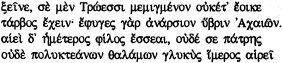
[Stranger, you need not be afraid any more, now that you are: among Trojans: you
have escaped the implacable violence of the Achaeans, You will always be our
friend, and sweet longing for your country and its rich palaces will not sieze you],
80 then he asks him what he is called and where he came from as well as about the
significance of the horse. This is certainly very reminiscent of Priam's speech in
Virgil:
quisquis es amissos hinc iam obliuiscere Graios ,
noster eris ; mihique haec edissere vera roganti (147-8)
['Whoever you are, there are no Greeks here; forget them quickly and become one
of us. Now answer my questions truthfully', etc.] But is there anything in Tryphio-
dorus that might lead us to suppose that his version is a derivative reworking of
Virgil's? How simply and naturally the events unfold in Tryphiodorus! Sinon ad-
vised the Greeks not to leave – thus he deliberately shows himself to have been
anti-Trojan, and this causes them to trust what he goes on to say; his fellow
countrymen treated him badly and left him behind in enemy territory – with cruel
irony, for that was just what he had wanted; because of this harsh treatment he turns
to the enemy for protection – the old motif of the traitor who deserts, like Zopyrus
etc. – and claims the right of a suppliant: Priam grants him this right and admits him
to the community of the Trojans. In Virgil, Sinon is a prisoner, not a suppliant, and
his reception is motivated to a lesser degree by Priam's compassion for him; so just
before Priam's speech Sinon has to bewail the loss of his native country (137ff.):
this makes the virtue of the Trojans appear greater – and that was part of Virgil's
intention – but Tryphiodorus' version certainly seems closer to the original.
Sinon then gives away the following information about the horse:
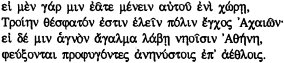
['If you allow it to remain here in your land, it is fated that the sword of the
Achaeans will capture the city of Troy: but if Athena receives it as a sacred gift into
her temple then the Greeks will flee with their task unaccomplished']. So here we
have the Virgilian alternative that we found was missing from Quintus' version; but
in Virgil all the motifs are developed and strengthened; we are aware of the trouble
that he took to make the Trojans feel that it was absolutely essential to bring the
horse into the city: the horse is the substitute for the stolen Palladium, and will
protect the city in its place; the

with the Achaeans], which is only an alarming possibility in Tryphiodorus, is very
81 much a reality in Virgil: the Greeks will return as soon as they have propitiated the
gods in their own county; instead of the promise in Tryphiodorus that if they take
the horse into the city the Greeks will be put to flight again, Virgil makes Sinon
offer a greater promise, that the descendants of the Trojans will themselves invade
the country of the Greeks; finally, Tryphiodorus has only 'if you let the horse stand
here'; whereas Virgil has 'if you should harm it'; that is just what Laocoon had
already done, which makes it appear more urgent than ever to atone for his act and
to pull the horse into the city. Everything, in my view, points towards the conclusion
that Tryphiodorus' account is not a simplified and shortened version of Virgil's, but
rather reflects the earliest source, and that Virgil's version is not an original creation,
but an enhanced remodelling of an earlier source. And a little thought should show
that it never was very likely that Virgil was the first to invent this alternative; if it is
not to be found in the scanty mythographic epitomes that have survived, and
Quintus did not find it either in his mythographic source, no one would wish to draw
the conclusion that it did not exist before Virgil. What we have learnt from the story
of Helen's torch-signal can, where necessary, serve as a warning against conclusions
of such a kind.
Otherwise one looks in vain in Tryphiodorus' work for any echoes of Virgil
which are not drawn from the common stock of the tradition; there is no trace in him
of anything that may reasonably be claimed as Virgil's in the way of individual
touches, motivation, ethos or composition. His artistic standpoint, diametrically
opposed to Virgil's, is not one that is concerned with drama or pathos, and if he did
know Virgil he certainly did not like him. Nor is he in the least interested in
encyclopaedic completeness; what he enjoyed, and what he had a natural talent for,
was decorating his grand material with graceful and interesting arabesques and orig-
inal ornamentation. As a basis for this, all he needed was the traditional material that
we may imagine was easily available to him and to his educated contemporaries.
2—
The Wanderings of Aeneas
It has often been felt, and stated, that Book 3 of the Aeneid is a work of considerably
less artistic merit than Book 2. The reason for this cannot be that Book 2 recounts
only one single great event, whereas Book 3 deals with a loose sequence of adven-
tures; this is also true of the books of the Odyssey in which Odysseus narrates his
adventures, and they have never been accused of having less poetic value for that
reason. But it is precisely this obvious comparison that has had a fatal effect on
Virgil's narrative. Indeed, the reader almost feels that, for once, Virgil has set out to
rival Homer without much pleasure or self-confidence. This may explain why he
kept postponing work on this book; it is, as we shall see, among the last parts of the
Aeneid to have been written. Whereas the abundance of poetic material that was
already in existence for the sack of Troy proved an invaluable advantage to the poet,
here he found himself in precisely the opposite position: he had, as far as we know,
not a single poetic predecessor. There was no shortage of source-material for the
actual events, but this took the form not of a tradition that had grown up over the
centuries, but of artifically cobbled-together history; his sources were not poets but
antiquarians; it was all wretchedly monotonous. We are fairly well informed about
the nature of the traditional material that was available to Virgil, because it is obviously
the same as that which formed the basis for Dionysius of Halicarnassus' account
(Antiquities 1.48ff.); we may therefore attempt to trace the way in which Virgil
transformed this intractable material into poetry so as to make it into a work of art.
1—
Unity of the Narrative:
Foundations of Cities
The historian who first assembled the numerous traditions about settlements, cults
and temples founded by Aeneas along the coasts of the Mediterranean into a co-
83 herent and connected narrative must have been at a loss to motivate the frequent
interruptions of his voyage and the innumerable foundations of cities. For the for-
mer, as we gather from Dionysius, he generally used one of two motives: either
Aeneas lingers to renew old friendships – for example in Delos (1.50), Arcadia,
Zacynthos – or adverse winds force him to wait or to take another course (49.3:


weather was unsuitable for sailing]: thus he waits in Thrace until the season is
suitable for sailing (49.4), is forced to wait longer than he had intended in Zacynthos
(50.3) and is forced to sail around Sicily (52.1). A city is founded in Thrace (49.4) to
provide a dwelling-place for those who do not wish to travel any further, similarly in
Sicily (52.4) – here, according to other sources, because some of the ships had been
burnt, and the diminished fleet could no longer carry all the Trojans. The direction
of the voyage, towards the west, was either revealed to them by the Sibyl of
Erythrae before they left their native land, or else only when they reached the oracle
at Dodona; they will recognize the end of their journey, when it comes, by the omen
of 'eating their tables' (55.4). Anything that does not fit into this westward journey
Dionysius either omits completely, as in the case of the episode on Crete, or ex-
plains by one of the causes that we have mentioned.
Hence it is only the direction of the voyage that gives this narrative any unity; all
the individual episodes are only chance interruptions to the journey, delays to their
final arrival – some welcome, some unwelcome – that are unrelated to one another;
some of them could easily be omitted, or others added, without the course of the
action being affected. To give some inner unity to the action, to make the compo-
nent episodes seem necessary to it, was the first task that faced Virgil. A loose series
of landfalls and foundations of cities, friendly encounters and

ments to the safety of a harbour] was, in his view, no

worthy nor capable of representation in poetry. Virgil chose for his narrative thread
the gradual, progressive revelation of the destination of his voyage.1
This revelation takes place in five stages: (1) Aeneas leaves his native land
because of auguries that tell him to seek a new home abroad. (2) In Delos he
receives the oracle that refers to the antiqua mater [ancient mother]. (3) In Crete he
84 learns from the Penates that this means Italy. (4) On the Strophades he receives from
Celaeno the prophecy of the portent of the tables. (5) In Buthrotum he receives from
Helenus directions on how to reach the west coast of Italy, and the prophecy of the
portent of the sow, together with the advice that he should ask the Sibyl at Cumae
for further information about the future. This indicates the place where the new
settlement is to be founded as clearly as can be without actually mentioning the
name of the place, and Aeneas would now have followed the course prescribed by
Helenus, and reached his goal without any more mistakes or wanderting – if Juno in
her anger had not prepared a new obstacle for him on the coast immediately oppo-
site the promised land, an obstacle that combines the two motifs that are familiar
from Dionysius: adverse winds and seductive hospitality. Most of the individual
components of this development in the story existed already in the tradition, either
actually or potentially: the oracle in their Trojan homeland, the two prodigia , the
Sibyl, the encounter with Helenus combined with the oracle of Dodona, the
prophecy by the Penates. Virgil's contribution lay in arranging them in a progressive
development, above all by the gradual disclosure of Fate, and in the major role that
he allots to Apollo. In both cases Virgil was using themes suggested to him by
Greek foundation-legends.
Apollo is not mentioned in any of the pre-Virgilian accounts of Aeneas' wander-
ings, or in any of the later ones that are independent of Virgil; he has only an
indirect influence on the Trojans' travels in so far as the Sibyl is his prophetess. At
the same time, there was a tradition mentioned by Varro, according to which Venus
guided the voyage by her star (Serv. on 2.801). Virgil says nothing of this, but sets
Apollo very emphatically in the central position. Virgil not only stresses that it is
Apollo who inspires the Cumaean Sibyl; it is Apollo to whom Aeneas addresses his
prayer for an oracle (6.56); how Apollo's priestess is possessed by the god is
described in detail at 6.77ff.; Aeneas is honoured at Delos, by hearing Apollo's very
own voice; it is at Apollo's command that the Penates speak (3.155); it is from
Apollo that the Harpy has obtained her knowledge (251); it is in Apollo's temple
that he hears Helenus, the priest of the god, tell him that Apollo will protect him in
the future too (395). The decisive stimulus for this emphasis on the services per-
formed by Apollo may have been Augustus' predilection for him as the god of the
85 Julian family; but the idea comes originally, as I have said, from Greek foundation-
legends. The rôle played by Apollo, and particularly by his Delphic oracle, in the
sending out of colonies is well known;2 more significant still than the numerous
surviving accounts of the consultation of the oracle is the great number of colonies
that bear the name Apollonia. Amongst the foundations in which Apollo played an
important rôle were two of the most important cities on the west coast of Italy:
Rhegium3 and Cumae.4 Virgil represents the

city alongside these two.
The initial obscurity of the oracle, and its gradual clarification, also has its origin
in Greek ways of thinking. Of the foundation-legends known to me, it is that of
Cyrene which provides the closest parallels (Herod. 4.150). The king of Thera is
advised by the Pythia at Delphi to found a colony in Libya. However, he does not
know where Libya is, and therefore fails to send out a colony. Thera then suffers a
severe drought (analogous with the crop failure that afflicts the Trojans in Crete
[3.141f.]), and when the oracle is asked for help, it tells them again to go to Libya.
So they decide to risk the attempt, and a Cretan called Korobios, who promises to
show them the unknown land of Libya, leads them to the island of Platea, which is
situated off Libya. They settle on this island, but without success. And they hear
again from the Pythia that they are still not in Libya. Then they finally cross over
onto the mainland.5 Just as in this case a drought reminds the Therans of their
instructions, so too drought and infertility are elsewhere often the reason for sending
out a colony, or are a sign that the god's plan has not been fulfilled by the settle-
ment: the foundation of Rhegium goes back to an

(Strab. 6.257); and

Ainios, at the command of the oracle, leave Kirrha where they have just settled
(Plut. Qu . Gr . 26).
86 Finally, with regard to the two portents that indicate the end of the journey, Virgil
was able simply to follow the tradition. Even if we accept that these stories are based
on local legends, their connection with Aeneas doubtless goes back to Greek histor-
ians, who in turn were constructing their narratives on the analogy of Greek
foundation-legends. To mention only a few examples, I recall the Etruscan children
from Brauron, who were to settle where they lost their goddess and their anchor
(Plut. Virt . Mul . 247e), or the Spartan Phalanthus, who was promised a permanent
residence by the Delphic oracle 'when he felt rain'

(Paus. 10.10.6) where the double meaning of

name was Aithra) and 'blue sky' – corresponds with that of mensae ; even more
frequent, as is well-known, are the cases where an animal, such as the sow in this
case, indicates the site for a new foundation.
Thus Virgil has turned the story of Aeneas' wanderings into a unified


the motifs of these legends much more comprehensively than can have been the case
in any one of these legends, either genuine or spurious.
2—
Relationship to the other Books
The idea of drawing the wanderings of Aeneas into the tightly organized form that
we have described came to Virgil only after much of the Aeneid had been written in
87 the form in which we have it.6 It is worth devoting some time to this matter, as it
leads to valuable insights into Virgil's working methods. Let us first examine what
we are told outside Book 3 about the plan of the voyage and the Trojmans' knowledge
of their destination.
According to 2.781, before Aeneas left Troy he was told by Creusa that he will
come to the 'Hesperian land, where through rich pastures with gentle current the
Lydian Thybris flows.'
According to 4.345, 'Grynean Apollo and Lycian oracles' have commanded him
to go to Italy.
According to 1.382, he put to sea because of an oracle, in which 'his divine
mother showed him the way.'
According to 1.205 and 554, 4.432, 5.731 and 6.67, the Trojans know Latium to
be the destination of their journey; at 5.83 Thybris is mentioned by Aeneas and
again at 6.87 by the Sybil.
Thus when Virgil was writing 1, 2, 4 to 6, he imagined Aeneas as knowing the
name of the land and its river during his journey, and according to the references in
2 and 4, which are not contradicted by anything in the other books listed above, he
already had this knowledge before he sailed. It is uncertain what rôle Virgil had
intended the two portents to play in all this; it is quite conceivable that he had not
made any firm decision about it; on the other hand, 5.82f.
non licuit finis Italos fataliaque arva
nec tecum Ausonium , q u i c u m q u e est , quaerere Thybrim ,
[it was not granted to me to have you at my side as I quested for Italy's boundaries
where fate has given us lands, or for Ausonian Tiber, wherever that river may be ].
This seems to suggest that Virgil considered, at least in passing, the possibility of
using the motif from Greek foundation-legends that we have discussed above, in
88 which the name of the destination is known but not its whereabouts;7 in that case,
one or both portents might serve to let them know that they had come to the end of
their journey.
This conception is totally inconsistent with the basic idea of the composition of
Book 3 that we have outlined above: the only question is which version is the result
of curae posteriores [afterthoughts]. If we assume that Virgil wrote Book 3 first, it is
very difficult to see any reason at all that might have prompted him at a later stage to
ruin the unity that characterized his version, by which the whole book stands or
falls. This would not only have invalidated the individual prophecies, but, more
importantly, Virgil would have had to invent some entirely new motivation for the
foundations in Thrace and Crete, unless he scrapped them altogether, or else have
reverted to a disconnected narrative of the kind that we get in Dionysius. However,
there is no indication in the other books of any new unified plan which might have
replaced the old one; there are three successive episodes – the guidance by Venus,
Creusa's prophecy, and the 'Lycian' oracle – that would need to be brought together
in some context: but they would not have produced material for the new Book 3;
these episodes however had obviously been invented not as parts of a single unified
conception, but because of the immediate requirements of each situation; and none
89 of them is in itself so important that Virgil might reasonably have altered his
original plan for their sake.8 On the other hand, if we think of Book 3 as still to be
written, each reference is quite plausible in its context as a provisional explanation;
and furthermore it is quite natural that before Virgil had decided on the plan of Book
3 he might find it more congenial to work with specific names, such as Latium and
Thybris, rather than with some unknown destination: however, these names are
nowhere essential to his purpose.9
The conclusion that Book 3 was composed at a later stage will become even
clearer if we go on to examine the treatment of the two portents in Books 7 and 8.
The portent of the tables is, according to tradition, the fulfilment of a prophecy
which was given to Aeneas by the Sibyl of Erythrae or the oracle at Dodona, and
will indicate to Aeneas and his men that they have reached the end of their journey.
This is exactly the purpose it serves Virgil in Book 7; here the prophecy is traced
back to Anchises, who bequeathed it to his son ( fatorum arcana reliquit [123] [he
left the secret of destiny]) – apparently not in the underworld, but during his life-
time, perhaps on his deathbed, when the power of prophecy is usually enhanced. It is
clear from the manner in which it is introduced, and above all from the fact that it is
quoted verbatim , that Virgil is not referring to some earlier passage in which it was
mentioned: the oracle is introduced without any preparation, just like Apollo's
90 promise at 6.343 and Venus' at 8.534; when Aeneas says nunc repeto (7.123) [now I
remember] we may assume, as so often when oracles are introduced, that he has
suddenly remembered something long forgotten; the prophecy of Lycophron's Cas-
sandra, which refers to this portent,

will remember ancient oracles] ( Alexandra 1252), is fulfilled in exactly the same
way. We might expect that, continuing the motif hinted at earlier, Aeneas would
now joyfully realize that this is the promised land of Latium and the promised
Thybris; but this is not what Virgil does: instead, Aeneas prays to the adhuc ignota
flumina (137-8) [the rivers which as yet they did not know], and the next day when
he learns the names Numicius, Thybris and Latium, it does not seem that they come
as an answer to any existing expectations. This is not completely outweighed by the
fact that in Ilioneus' speech to Latinus, just as in the earlier books, Virgil seems to
assume some previous knowledge of the localities which they seek.10 It may be that
Virgil came to realize during the composition of his work that if the names are
known the portent becomes basically meaningless: the names might be identified
with the localities in perfectly natural ways. To sum up: the version of the portent of
the tables in 7 is derived almost entirely from tradition; it is in no way tied up with a
unified plan of Aeneas' wanderings, but is quite independent of it.
In Book 3 we find instead a highly individual new version, probably invented by
Virgil: the portent is not a sign promised by a friend or a benevolent divinity to show
them when they have reached the end of their wanderings, but a punishment
announced by their enemy Celaeno; not a favourable sign, but a horror which seems
to cast doubt on the happy outcome of the enterprise. Not only is there a threat of
terrible starvation, but the apparently unambiguous and negative words, 'You will
not establish a city until hunger forces you to eat your tables' (255-7), seem to lay
down an impossible condition. Phalanthus, who was to found Tarentum when he felt
rain

believed that the god had imposed an impossible condition on him.11 However,
91 Celaeno's prophecy does not only come as the splendid climax of the adventure of
the Harpies; it also plays an important part in the plot of the book: after the Penates
seem at last in Crete to have indicated their destination, and the Trojans are steering
westwards full of hope, this comes as a severe setback. The unexpected threat seems
to throw everything into uncertainty again. Then Aeneas meets Helenus and ques-
tions him with renewed anxiety about the future; not only does he receive
reassurance from him, but he is saved from another vain attempt to found a settle-
ment, this time on the nearest part of the coast of Italy, which otherwise he surely
would have done.
Thus the appearance of the portent has been prepared for, the reader is waiting
for it, and the effect of the happy solution is immeasurably increased by the anxiety
which has prevailed from the start. If we compare this version with that in Book 7,
there cannot, in my opinion, be any doubt as to which was intended to supersede the
other.12
92 According to the older traditions, the portent of the sow indicated either the site
of Alba Longa and the period of thirty years which will elapse before its founda-
tion,13 or the site of Lavinium together with the name and foundation-date of Alba.14
Understandably, Virgil was unwilling to reject a firmly established part of the
tradition, but he was unable to make the portent indicate any specific site, either for
Alba, that is perfectly clear, or for Lavinium, whose foundation lies outside his
narrative, since, in contrast to the versions of Dionysius and others, it was not to take
place until after the agreement with Latinus. This meant that it was only possible for
the portent to refer to the name and foundation-date of Alba; and it is these, there-
fore, that Virgil kept in the narrative of Book 8. As a result, the introduction of the
portent had to be remodelled, and Virgil resorted to an expedient that is not al-
together satisfactory: Aeneas, anxious about the coming battle, has fallen asleep on
the bank of the Tiber; the god Tiberinus appears to him and gives him courage: he
really has arrived at the place where he is destined to found his city, and he need not
fear the battle. 'And', he continues, 'so that you will not think when you awake that
93 you have been deceived by an idle dream (let this be a sign to you): beneath the oaks
on the riverbank you will find an enormous sow with thirty newborn piglets' (8.45–
8):
alba , solo recubans , albi circum ubera nati
ex quo ter denis urbem redeuntibus annis
Ascanius clari condet cognominis Albam .
[a white sow, stretched on the ground, with her white piglets at her teats; within thirty
circling years from this time, Ascanius shall found a city of illustrious name, Alba].
He goes on to advise him to ask Evander for help. Thus, as in the tradition, Aeneas
receives the information about the foundation of Alba from a vision in a dream;15
what is new in Virgil is the context in which the information is given. The immedi-
ate rôle of the portent here is only to corroborate the words of Tiberinus; the
foundation of the city is mentioned only in passing without any intrinsic connection
with the purpose in hand; the portent has no significance whatever as a means of
identifying the site.16 And if we were given the impression in the case of the portent
of the tables in Book 7 that the reader was hearing of it for the first time, so here it is
absolutely impossible that it had been prepared for in earlier parts of the narrative or
that it had played any rôle in the scheme of Aeneas' wanderings.
In Book 3 Helenus predicts the portent, and here it is firmly embedded in the
scheme of the wanderings. Because the name of the promised land is not disclosed
to Aeneas until the very last moment, he has to be given a sign by which he can
recognize it: this sign will be the portent of the sow. That is why here in Book 3,
after the description of the portent, which is word for word identical with that in
94 Book 8, it is explicitly stated that is locus urbis erit , requies ea certa laborum (393)
[this spot shall be the place for your city, and there you shall find sure rest from your
toils]. This does not mean that the city is to be founded exactly where the sow will
be resting – for neither Lavinium nor Alba lies secreti ad fluminis undam [by the
waters of a secluded stream], where according to 3.389 they will find the sow, nor
can the camp by the river be termed requies certa laborum [a sure resting-place
from their toils] – but only that the promised land will be recognized by this sign;
previously, too, in Helenus' speech, the prophecy was concerned only with this land
(ante . . . quam tuta possis urbem componere terra : signa tibi dicam [387-8] [before
you can settle your city on safe soil: I shall give you a sign]). Thus the portent of the
sow is given the significance which the portent of the tables had had in the tradition:
the latter is given a new meaning in its turn: it no longer indicates the site, but the
time; it becomes a condicio sine qua non [necessary pre-condition]. From this we
may divine how Virgil intended to combine the fulfilment of the two prophecies:
after landing on the bank of the Tiber, Aeneas would find the sow and thus recog-
nize the promised land; however, he still anxiously awaits the starvation predicted
by the Harpy; before he realizes it, at their very first meal, this prophecy too is
fulfilled.
In the case of the portent of the sow too the version in Book 3 is the later one; this
could in any case be deduced from the fact that it is not introduced here, as it is in
Book 8, without any preparation and with awkward motivation, but has a firm place
in the arrangement of the whole. However, it is clear that the identical lines that
appear in both books (3.390-2 = 8.43-5) were originally written for Book 8: there
the exact description of where and how makes good sense, for the more precisely the
details are predicted, the more convincingly their literal fulfilment proves that the
vision was trustworthy. For the oracle in Book 3 the circumstantial details have no
significance and are quite uncharacteristic of such prophecies. Above all, the heavy
emphasis on the colour white is important in Book 8, since the reference to Alba
follows, but not important in Book 3, where Alba has not yet come into the picture.
From the situation in Book 8 the detail sollicito secreti ad fluminis undam [in an
anxious time, by the waters of a secluded stream] has crept into Book 3. On the
assumption that Book 3 was written first, such a precise description of a situation in
the distant future would be quite uncharacteristic of Virgil's style.
Because of all this, I am convinced that the unified plan of the wanderings
95 presented in Book 33 was not created until at least two-thirds of the poem had been
written. Thus, instead of starting by erecting the scaffolding, as it were, Virgil put
this off until a much later stage and began to work on separate sections, making
provisional assumptions as the situation called for them, without letting them have
much influence on the general outlines of each section; he introduced the two
portents in Books 7 and 8 without any presuppositions whatever, so that the two
books could be read as an independent work, without the reader feeling that any-
thing was missing. It was only later, when he was filling in the gap between Troy
and Carthage, that he created the unified structure of prophecies and portents,
without considering what he had already written, primarily because it was necessary
to impose some unity and progressive development on Book 3. He never got as far
as working out the consequences of his new conception: he would have had to delete
much in the other books, and change many details, and in Book 7 he would have had
to rewrite the whole story of the landing. It is indeed possible that a few traces of the
earlier version might have escaped his notice; but I have no doubt that he would
have achieved a unity as far as the essentials were concerned.
There is no reason to doubt that, right until the end, Virgil regarded the scheme of
the wanderings, in the form in which we have it, as the definitive version. It is true
that in Book 10 (67ff.) there is yet another motif that one might be tempted to regard
as an indication that Virgil intended to make a further change: according to this
passage, Aeneas sought Italy Cassandrae impulsus furiis [actuated by Cassandra's
raving]. But these are the words of Juno, which contradict Venus' statement that the
Trojans had sought their new homeland tot responsa secuti quae superi manesque
dabant (34ff.) [led by all those oracles from the High Gods and the Nether Spirits];
and it is clear that Juno is spitefully trying to devalue the significance of these
responsa [oracles] by mentioning only one prophecy, that given by a crazed woman:
in fact, according to 3.183, a passage already composed, which the poet doubtless had
before him when writing Book 10, it was from Cassandra that Anchises – though he
had not believed her – had first heard of Hesperia and the kingdom in Italy.
3—
Juno and Venus
No ancient reader will have asked the impertinent question, why Aeneas was sub-
96 jected to these years of wandering: for Apollo, who certainly had Aeneas' interests
very much at heart, might surely have spared him a lot of trouble by giving him an
unambiguous oracle before his departure; but who would dare to call the god to
account for what he sees fit to reveal to mortals or to conceal from them, when every
message, even when it is wrapped in the desperately ambiguous obscurity of oracular
language, deserves most humble thanks as an act of the purest grace, condescension
and compassion.
However, anyone who has read the opening of the Aeneid before reading Book 3
will perhaps expect to find a particular motivation for Aeneas' lengthy wanderings.
For the proem suggests that they are to be blamed on Juno's thirst for vengeance: it
was she who drove the pious hero into so many travails and dangers, she who
pursued the Trojans over all the seas and kept them away from Latium, as the poet
says;17 indeed the queen of the gods herself speaks of the plan she embarked on to
turn the Trojan king away from Italy, a plan which she does not wish to abandon,18
and of the war which she has been waging for so many years with that one race.19 In
fact from this moment onwards she is active enough: the tempest which drives
Aeneas to Carthage is her work, she causes the union with Dido; later it is her
intervention that leads to the burning of the ships, which results in the foundation of
Segesta; she stirs up war in Latium by means of Allecto and never ceases to support
the enemies of the Trojans. But until that moment we have just mentioned, in other
words, during the years between the departure from Troy and the departure from
Sicily, throughout the events treated in Book 3, we hear nothing of Juno's interven-
tion; and yet this period covers by far the greatest part of the errores [wanderings]
and labores [toils]. The contradiction seems blatant, and yet I do not believe that it is
a case of an inconsistency arising from different plans, or that Virgil would have
smoothed over this contradiction. When he wrote the proem to Book 1, he had most
97 probably not yet created the scheme for Book 3 as it now stands, and it is conceiv-
able that at that stage he was intending to allot an active role to Juno in the period
that preceded the beginning of the action of Book 1. In my view it is more probable
that he was thinking only of the events that followed and, with these in mind,
proceeded to model his proem on that of the Odyssey . Then, when he composed
Book 3, there was no opportunity for an open and obvious intervention by Juno; but
if the poet had any doubts about whether this was compatible with the words of the
proem he would have been able to feel reassured by the precedent of his model,
Homer. For in the proem to the Odyssey , even less ambiguously than in the Aeneid ,
the exhausting wanderings of the hero are blamed on an angry deity (Poseidon in
this case); and yet here, too, as far as we know, Poseidon plays no part in Odysseus'
destiny until after the beginning of the action, during the sea-storm in Book 5; in
Odysseus' own narrative we hear nothing in his various unhappy adventures of
anything that might have been caused by Polyphemus' prayer to his father; and in
the case of Odysseus' longest sojourn, the seven years spent with Calypso, it is even
clearer than in the Aeneid that it cannot have been the result of the work of Posei-
don. Any reader who noticed this would have to assume that Odysseus had never
been told that his sufferings were due to the enmity of the god, and Virgil could
count on the same assumption. It is clear from the single passage in Book 3 which
points to Juno's enmity that he was well aware of the parallel: Helenus urgently
advises Aeneas (435ff.) that the most important thing is to win Juno's favour by
prayers, vows and sacrificial offerings: only if he succeeds in this will he reach Italy
98 safely from Sicily.20 Aeneas acts according to this advice at the time of the first
landing in Italy (3.546), and this single mention of his obedience to it must also
count instar omnium [on behalf of all] for the future. Nevertheless he did not
succeed in calming the wrath of Juno, as is shown by the fact that the crossing from
Sicily to Italy does not go smoothly: thus Helenus' words of warning refer to the
sea-storm narrated in Book 1. However this is itself clearly modelled on the words
of Teiresias, Odyssey 11.100ff.: he too warns of Poseidon's future anger, and pro-
ceeds (121ff.) to point out the way to appease him: he says no more of the earlier
results of this anger than Helenus says of Juno's previous hostile activities.
Just as the hostile goddess remains in the background, so too does the goddess
who favours him. According to Aeneas' own narrative, Venus seems never to have
appeared to him, either to guide him, or to advise or to assist him, throughout the
greater part of the period of his wanderings. Yet Virgil must have had different
intentions about this matter when he was writing Book 1, since he makes Aeneas say
to Venus that he had begun his journey matre dea monstrante viam (382) [shown the
way by my divine mother], and makes him complain at her departure quid natum
totiens , crudelis tu quoque , falsis ludis imaginibus (407-8) ['Ah, you too are cruel!
Why again and again deceive your own son with your mocking disguises?']. But
there is no reason to suppose that at that stage this intention had taken any particular
form, and when he was writing Book 3 Virgil left Venus completely out of the
picture; here too there is an analogy with the Odyssey . Odysseus in his own account
of his adventures knows nothing of Athena's protection and support, and is still
99 complaining about this neglect after he has landed in Scheria ( Od . 6.325, cf.
13.318), without realizing that it was Athena who had made this very landing
possible for him, providing him with active help at this point for the first time as far
as we know: the poet himself felt it necessary to explain her previous absence on the
grounds that she had been unwilling to oppose her father's brother (13.341, cf.
6.329). When Virgil was creating the relationship between Venus and Aeneas he
clearly had the relationship between Odysseus and Athena in his mind, though he
may not always have been aware of it, and I venture to suggest that in the phrase
totiens falsis ludis imaginibus [again and again you deceive with mocking disguises]
he was not thinking of particular appearances of Venus, but of the changing forms in
which Athena manifested herself to Odysseus, who for his part, though admittedly
without Virgilian pathos, half-reproachfully complains to his divine protectress


the definitive reshaping of Book 333, Aeneas' complaint would admittedly seem
meaningless to the reader, and we must assume that Virgil would have excised it
once he realized that it was now irrelevant.
4—
Compression of the Material
If we compare Virgil's version with other accounts of the wanderings of Aeneas, it
is immediately obvious that Virgil has greatly condensed the material. Instead of
aiming at academic exhaustiveness, he picked out the incidents that suited his
artistic purpose. His positive criterion for selection is the one that we have already
discussed: the landmarks of the journey were to be the points at which he is granted
further knowledge of his final destination. The most important negative criteria
were, first, avoidance of tedious repetition of motifs, and, secondly, avoidance of all
material that was of merely scholarly interest and could not somehow be made to
appeal to the listener's feelings. The material is much more severely abridged in
Book 3, and particularly in the parts that precede the arrival in Italy, than in the later
sections of the journey that are spread over Books 5 to 8. There was more room in
these books for fuller treatment of the available material, since the details were not
crowded together in a small space and, above all, since the books were dealing with
localities well-known to every person in the audience, places in which Virgil him-
self took a greater interest, and which he could assume had a greater interest for
others.
100 Only six stops in Greek waters are mentioned: Thrace, Delos, Crete, the Stro-
phades, Actium and Buthrotum. With the single exception of Actium, they are all
harnessed to Virgil's new scheme. The first, the failure to found a settlement in
Thrace, leads Aeneas to turn to Apollo on Delos for further directions. He has learnt
that the gods do not approve of just any site for the new Troy; they must therefore
have a definite destination for him in mind.21 In Crete the second negative ex-
pression of divine will is immediately followed by another positive one: the
adventure with the Harpies on the Strophades brings a third gloomy prediction,
apparently the worst of all, since it applies to all future time. As a counterweight,
Helenus' prediction provides the clearest and strongest positive assurance. Thus
hindrance and assistance appear alternately until the very moment that the coast of
the promised land comes into view for the searchers. For the prodigia [portents],
Virgil has only once, in the case of Crete, made use of a traditional motif; the other
two give the impression of being traditional but are in fact original inventions. For
the prophecies, Virgil again went his own way. The tradition knew of a prediction
by the Sibyl of Erythrae and a consultation of the oracle at Dodona. The Sybil had to
be omitted so that the Cumaean Sibyl should not have a rival; the oracle at Dodona
101 was unsuitable because it had no connection with Apollo and would therefore have
destroyed the unity of Virgil's new conception. Instead, we have Helenus, whom,
according to tradition, Aeneas met in Dodona; he was all the more suitable because,
like Teiresias-Circe and Phineus, as an inspired mortal exegete of the god, he was in
the best position to give the detailed and careful instructions that were necessary for
this stage of the journey; it is easy to understand why Virgil shifted the meeting
from Dodona to the coast, at Buthrotum, since the tradition had Aeneas stopping
there in any case. There were also sources for the visit to Delos and the guest-friend-
ship of Anius; since the latter appears in the tradition as a reliable prophet, Virgil
must at least have considered giving him the prediction, but this would have dupli-
cated the Helenus motif. So Virgil has Apollo himself speaking from his holy of
holies to Aeneas when he asks for an oracle – it is, to say the least, very doubtful
whether Apollo of Cynthus had an oracle, and Virgil's words do not suggest that a
regular oracle was established there: da pater augurium atque animis inlabere nos -
tris (3.89) [grant us an augury, father, and come into our hearts] seems to be asking
for some inspiration that is not precisely definable, and when in response the inner
shrine opens, and the sound of the god's voice comes from the tripod within, this
seems to be an unexpected and therefore an all the more valuable favour. Apollo's
words are interpreted as referring to Crete and so Aeneas attempts to found a
settlement there. Here too Virgil connects his narrative with traditional material, for
the foundation of Pergamos on Crete was not only attributed to Trojans but also
linked with Aeneas himself (Serv. on 3.133). Admittedly, it did not feature among
Aeneas' most famous foundations, and Dionysius does not mention it at all; but it
suited Virgil's purpose because it gave ambiguity to the oracle's statement and also
because it made the wanderers turn southwards, right away from the direction of
their journey, just as the Libyan sea-storm does later, whereas the voyage as de-
scribed by, for example, Dionysius, apart from the detour to Thrace, keeps more or
less to the normal route from Troy to Italy, and therefore does not really correspond
to the concept of 'wandering around'. In Crete it is the Penates who speak in
Apollo's name, appearing to Aeneas as an image in a dream or a vision. Thus Virgil
has changed the location of this episode, since in the traditional version it comes at a
later point: in Latium, when the army of the Latins lay encamped opposite the
102 Trojans, the Penates are said to have advised Aeneas in a dream not to fight but to
come to a peaceful agreement.22 This had been omitted in Virgil's treatment of the
story in Book 7, so that the motif was available for him to use at this point, where it
fits the situation quite naturally; after all, on the matter of the new homeland the
Penates are the ones who can speak with the greatest authority. Finally, Virgil has
put the prophecy of the prodigium of the tables into Celaeno's mouth, which was
surely his own original idea, as we have already said. In addition to these four
prophecies there are prophecies by Creusa, the Sibyl, and Tiberinus in other books;
and in a wider sense the 'pageant of heroes' in the underworld and the description of
the Shield also belong in this context; we can see how careful Virgil was to vary the
way in which the motif was presented.
The stop at Leucas-Actium is the only one that is not connected with the main
scheme.23 The tradition knows of sanctuaries of Aphrodite founded by Aeneas on
Leucas, at Actium, and in Ambracia. Virgil mentions none of these; just as, out of
all the

selected just one, the one that was most important to Rome, that of Venus Erycina
(5.760), here, too, he is careful to avoid duplication. In the case of Actium, in total
conformity with the standpoint of the whole narrative, Apollo is named, even though
it is not explicitly stated that it is in his honour that Aeneas orders the games to be
celebrated on the Actian shore as a thanksgiving for the safe voyage through a
103 hostile region.24 It is obvious that the whole episode is inserted because of the
significance which Actium had gained for Virgil's generation. That is why it is only
here that Virgil mentions a dedicatory gift by Aeneas, although according to the
tradition he offered them in many places. For example, Aeneas is said to have
dedicated a shield at Samothrace (Serv. on 287), as he does here.
The passages that I have cited are the sum total of the material that Virgil took
from the tradition for his narrative of this part of the journey. It is only a small part
of what was available to him; he was able to draw on a richer tradition than is
known to us from Dionysius, and even he tells us a great deal that Virgil disdained
to use: apart from numerous stopping-points and foundations of temples, there are
Aeneas' relationship with Launa, the daughter of Anius; the death of Cinaethus, who
was buried on the promontory now called after him; the sojourn in Arcadia, where
Aeneas left behind two daughters; the games established in honour of Aphrodite on
Zacynthus; and the detour to Dodona, which we have already discussed. It would
have been necessary to give all these events their own significance by inventing
motivation, which would have expanded the narrative out of all proportion and
would have overshadowed the principal theme in a most undesirable way, or, nar-
rated in Apollonius' annalistic style, it would have been of merely academic interest,
which had no value for Virgil. We can readily understand why he simply dispensed
with this surplus material. Nor does he record with antiquarian precision the local
traditions of South Italian cities which claimed traces of a visit by Aeneas.25 Aeneas
puts in only at Castrum Minervae, to fulfil the vow which he made for a safe
crossing; for the rest, the reference in Helenus' prophecy to Greek settlements along
the coast explains why the Trojans do not put in to land at any point; this maintains
the impression that the voyage is perilous and like a flight. The only omission that
we might find surprising is the meeting with Diomedes, which, according to a
respectable legend, took place in Calabria. Of course, Virgil could not use the story
that Diomedes took Anchises' bones from the tomb and returned them to Aeneas;
but there was another tradition, according to which Diomedes came up to Aeneas
while he was sacrificing, to return the Palladium of Troy, possession of which had
brought him misfortune. In order not to interrupt the sacrifice, Aeneas turned away
104 with his head covered, and so Nautes received the sacred object instead, which
explains why the cult remained in the hands of his descendants, the Nautii.26 Virgil
retained the

and he also knows of Nautes as a favourite of Pallas (5.704); but he motivates the
covering of the head as being due to fear of seeing an enemy while sacrificing, and
omits Diomedes completely; and yet one would have thought that Virgil would have
welcomed the opportunity for Aeneas to take the Palladium, and thus complete the
number of pignora imperii [tokens of empire] in his care; as it is, the Palladium is
mentioned only in Sinon's account of its theft (2.166). It is possible that he believed
that this tradition was open to objections on factual grounds;27 it is also possible that
he considered it too novelistic that Aeneas and Diomedes should meet in person, and
therefore chose to refashion the motif so as to create a new episode, which we now
read in Book 11, the unsuccessful attempt by the Latins to obtain help from
Diomedes: here, too, Diomedes comes to realise that the misfortune that dogs him is
due to the fact that his fight against Troy was a fight against gods.
5—
Poetic Re-shaping
When Virgil selected material from the tradition and arranged it to accord with the
dominant theme of his new scheme, he always started with the bare bones of the
action. For all the rest, for the clothing of these bones with the flesh of living poetry,
he had to rely on free invention. But his free invention is not a matter of new
creation, it is a reshaping of existing motifs, working in features borrowed from
other legends. He used three cycles of legends: the various versions of the tale of the
destruction of Troy; the Odyssey ; and the voyage of the Argonauts.
105 The legend of Polydorus comes immediately after the sack of Troy. Virgil used it
in a highly original way, to motivate the Trojans' abandonment of their first attempt
to found a city in Thrace. The spears which the treacherous Thracians rained down
upon Polydorus grew roots and now cover his burial-mound with a thicket of myrtle
and cornel cherry. When Aeneas tears a young tree out of the earth, blood flows
from the roots; this happens again when he tries a second time; at the third attempt
Aeneas hears from the grave the pitiful groan of the dead man and learns for the first
time that he had been murdered. For the account of Polydorus' fate which Aeneas
proceeds to give, Virgil seems in all probability to have used Euripides' Hecuba ;28
but his version of the way in which Polydorus was killed, and the fate of his corpse,
is completely different from that of Euripides. The ancient commentators were not
able to identify any source for Virgil here.29 Servius felt that it was necessary to
defend Virgil against the charge of having invented an implausible falsehood by
reminding us of the cornel cherry which had grown out of Romulus' spearshaft on
the Palatine, but it is a far cry from that story to Virgil's invention. I prefer to believe
that Virgil transferred to Polydorus something which he found in a narrative about
someone else.30 Given the nature of the relationship between Polydorus and Poly-
mestor, it is highly improbable that he died in the manner narrated here. It is more
likely that it was some hero who could not be beaten in close combat who was
106 overcome from a distance by a shower of spears 31 I do not believe that Virgil
invented the whole episode, primarily because there is no motivation in the present
context for the miraculous transformation of the spearshafts into live saplings,
whereas it would be easy to imagine that in the original story some god who was
favourably disposed towards the murdered man covered the corpse in this way and
thus made sure that it received a kind of burial. The idea that blood could still flow
from the wounds of a man murdered long before will have been modelled on
legends where bleeding from damaged plants and trees reveals that a metamorphosis
has taken place. This motif may have been more common than it is possible for us to
establish; the only example that I can recall is the metamorphosis of Lotis (Ovid
Met . 9.344).32 But it may have been precisely this detail of bleeding which led Virgil
to take over the whole motif in the first place; as the expression monstra deum
33 (59)
[divine omen] clearly shows, the gruesome event is intended to serve as a prodi -
gium , warning the Trojans that the gods forbid the new foundation. However, it is
well known how frequently blood plays a role in prodigia : sometimes it rains blood,
sometimes blood appears in wells, rivers and lakes, or on images of gods; sometimes too
– and this is closest to our example – the com bleeds when it is reaped (Livy 22.1; 28.11).
More important than the question of Virgil's source, which cannot be answered
with certainty at present, is the manner in which he narrates the whole episode. This
deserves careful attention. The foundation of the city, which for an Alexandrian poet
would be something of considerable importance, is dismissed in two lines; the name
Aeneadae leaves us in doubt whether Virgil means Aineia in Macedonia or Ainos in
Thrace;34 indeed, Aeneas' account actually implies that no settlement took place,
107 since all the Trojans depart again from the scelerata terra (60) [wicked land].
Moreover, we are not told anything about their relations with the Thracians who
own the territory, or the hospitium mentioned in line 61; similarly we are left
completely in the dark about what Aeneas believed concerning the fate of Poly-
dorus, until the moment that the prodigium tells him the truth. We might easily
assume that Aeneas had landed on a desolate coast, as in Latium, had immediately
marked out the lines of the city walls, and that the sacrifice on the shore was the first
to be offered by the Trojans in their new home, and that they then left again as
quickly as they could – except that other phrases35 seem to indicate that the Trojans
spent the winter on the Thracian coast, which agrees with the tradition known to us
from Dionysius. In a word, the poet deliberately puts all this to one side, perhaps
salving his conscience with the thought that Aeneas, as narrator, would not expect
his listeners to be interested in it, whereas the real reason was that the poet himself
did not think it worth including. The only thing that he does think important is the
emotional episode at the burial-mound, and while a writer more attracted by the
gruesome than Virgil might have put all the emphasis on this aspect of the incident,
Virgil imbues it with a different emotion: pity for the poor victim, who is still
suffering pain even after death, and whose body is still being torn as if he were still
alive.
The encounter with Helenus was one of the few motifs capable of poetic develop-
ment which Virgil was able to take from the tradition (Dion. Hal. 1.32). We have
108 already discussed the prediction. Virgil treated the scenes of greeting and departure
in great detail, so as to develop all the pathos which the situation contained, espe-
cially that created by the presence of Andromache. The poet's interest is centred on
her rather than on Helenus, who remains a colourless figure. Here, too, he took his
inspiration from tragedy: he has Euripides' unhappy Andromache in mind; not the
mother worrying about her little son (Molossus, son of Neoptolemus, does not
appear; he would have destroyed the concentration of the interest on a single figure,
and just imagine how Aeneas would have regarded the son of the man he loathed so
much!), but the uncomforted, endlessly sorrowing widow of Hector and mother of
Astyanax: Virgil does not permit the comparatively happy situation in which she
now finds herself to have any effect on her nature. Thus her sorrow for her past
losses is not tempered by joy in her living son and her Trojan husband, but only
increased by the tormenting shame that she has had to share the bed of the arrogant
victor. When she catches sight of Aeneas, her first thought is of Hector; she turns all
her attention to Ascanius, overwhelms Aeneas with a host of questions about him,
gives him parting gifts, for she seems to see Astyanax in him; this is one of the most
moving passages in Virgil's poem.36 Just as she is reminded of the death of
109 Astyanax, so too Andromache thinks of the sacrifice of Polyxena. Thus two of the
most important episodes of the sack of Troy, of which Aeneas himself could not
give an eye-witness account, are treated to some extent at this later point.37
110 Virgil made use of the Odyssey in many ways. First, as we have already observed
in many instances, he has transferred the situations of Odysseus to Aeneas: this
includes Helenus' prediction, which combines Teiresias' prediction with the instruc-
tions of Circe;38 also the sojourn at Dido's court, which reminds us in more than one
respect of the reception of Odysseus by the Phaeacians, and in another way of the
Calypso story, although its main motif is borrowed from elsewhere; the slaughter of
the cattle of the Harpies, in which he plays around very freely with the motif of the
cattle of the Sun; the tempest in Book 1, where not only are the whole situation and
important details in the description borrowed from the Odyssey , but also the words
of the hero, though they are characteristically remodelled;39 and finally, the Nekyia.
111 Secondly, Virgil introduced into his poem the places mentioned by Odysseus,
together with their fabulous inhabitants. In doing so, he had a predecessor in Apollo-
nius, who brought the Argo back home along the whole of the same route as
Odysseus, most of this of course not by his own invention. The dangerous voyage
through the Planktai (4.922) had already been mentioned in the Odyssey itself
(12.59ff.); Scylla and Charybdis are also mentioned (Ap. 4.823, 920). The tradition
followed by Apollonius also included the purification by Circe (659) and the visit to
the Phaeacians (980); and the Sirens (889) had also already been given their place in
the tale of the Argonauts through the introduction of the story of Boutes. For erudite
philological and geographical reasons, Apollonius links Calypso's island, about
which he tells us nothing except its location (572) and the cattle of the Sun which
they see and hear as they sail by (963), with Thrinacia. Finally, Aeolus is ruler of the
winds but does not come into direct contact with the Argonauts, a rôle similar to that
which he plays in Virgil (762, 775, 817). Virgil's task was considerably more
difficult: the legend had not covered the same ground before, and if he wanted his
hero to undergo any experiences in the wake of Odysseus, he was obliged to depend
entirely on his own free invention; and in so doing, in order to remain true to his
principles, he had to avoid an episodic style as far as possible. The Phaeacum arces
(291) [citadels of the Phaeacians] are mentioned only in order to indicate the lo-
cality, and so too is the Sirens' island (5.864), where the poet refers to its former
terrors with the utmost brevity. Aeolus had been dealt with in the scene in Book 1:
and only in this instance does Virgil depart from Homeric tradition and follow a
different source.40 Scylla and Charybdis however are given greater proiminence; they
are not an episodic addition, but the reason for the detour round Sicily. Aeneas does
not see them himself, but only hears the mighty roar of Charybdis from afar
(3.555ff.); but he has heard about the horrific creatures from Helenus (420ff.), in
whose speech there is an excellent reason for their detailed description: it is the only
way to give his warning the emphasis that is required. In the case of Circe, too, the
Trojans only sail past (7.10-24): it is night, the reflection of moonlight trembles on
the surface of the sea; a fire is blazing there on the shore in front of the enchantress'
lofty palace; the roaring of wild beasts sounds through the stillness of the night. This
is the last danger which threatens Aeneas and his men before they reach their
112 destination; Neptune is merciful, and carries them past. The poet lingers rather
longer over this descriptive passage; not only because Circe alone of all these
fabulous creatures was also involved in Latin legend; Monte Circeo, familiar to
every Roman, had to be mentioned as a landmark, quite apart from its significance
in legend; even today, anyone describing a voyage along that coast mentions it.
There remains the only purely episodic insertion in Book 3, the scene on the shore of
the Cyclopes. Virgil wanted to depict Polyphemus in all his frightfulness,41 but
without exposing Aeneas to the same kind of danger that Odysseus had to undergo,
since he was taking care not to create an episode in rivalry with the incomparable
adventure in Homer. That is why he introduces Achaemenides, whom he can use as
a mediating figure to link the voyage of Aeneas directly with the most famous of all
voyages: tradition did tell of a meeting between Aeneas and Odysseus himself,42 but
here Odysseus is replaced by one of his companions. However, Virgil was able to
imbue this invented figure43 and his fate with an emotional interest which transcends
the monstrous element in the adventure: the unfortunate man who has to beseech his
mortal enemy to rescue him from a fate that is even worse than dying – this is an
invention that is entirely typical of Virgil's art.44 Virgil emphasizes rather than
113 conceals the similarity with the Sinon scene. Indeed, the Trojans' humanity cannot
be better demonstrated than here in this scene, where those who had once them-
selves been plunged into disaster because they trusted and took pity, nevertheless
show mercy again towards a suppliant enemy. And here, where no divine power is
plotting misfortune for the pious, the nobility of their nature is rewarded: they owe
their own rescue to the man they have rescued. Thus the bold cunning of Odysseus
is implicitly matched by the pietas of the Trojans.
In the adventure with the Harpies on the Strophades various legendary motifs
have been fused together. Apollonius had recounted in detail how the Boreads free
Phineus from the Harpies and, at Iris' command, cease pursuing them at the islands
which for this reason are known as the Strophades; the Harpies then disappear into a
cave on Crete. In Virgil they continue to live on the Strophades, which are even
called their patrium regnum (249) [hereditary kingdom]; he also gives them rich
herds of cattle and goats, which hardly accords with their reputation as creatures that
are always hungry and stealing food (in Virgil they still have pallida semper ora
fame [217-18] [faces always pallid with hunger]). This device serves to introduce an
adventure which is analogous with that of Odysseus on the Island of the Sun: the
Trojans, like the companions of Odysseus, steal from herds which belong to immor-
tals. When Aeneas' men proceed to fight the monstrous creatures, this may be a
reminiscence of the Argonauts' fight with the birds of Ares, although the outcome is
different (2.1035ff.). But the purpose of all this is only to provide the poet with the
groundwork for his restructuring of the prodigium of the tables, which was an
established part of the Aeneas legend. We have already discussed (p. 72 above)
what was new in Virgil's interpretation of the oracle. The artistic value of the scene
lies principally in the steady increase in tension; here the aim of the poet is to arouse
not pity but terror, to raise an incident that is merely gruesome and repulsive and to
114 invest it with grandeur and terror: the poet's intention is that Celaeno, as Furiarum
maxima [greatest of the Furies] and the one who delivers Apollo's prophecy, shall
appear as a mythically heroic creature instead of an eerie monster.
The Trojans do not actually run into any danger on the Strophades, but at least
they have an opportunity to reach for their weapons; in the other adventures they do
not even do that. They run away from Polyphemus before he can get hold of them;
Scylla and Charybdis, like Circe, are only seen and heard from a distance; so too
with the Sirens, and from them there is nothing else to fear. It is only in the
sea-storm in Book 1 that Aeneas is in any real danger of losing his life; and even
there he is rescued without any effort on his part. But even though Aeneas' trials
during his wanderings do not demand the boldness, energy and endurance that were
required of Odysseus, who again and again had to overcome difficulties at risk to
life and limb, Virgil certainly did not intend to give the impression that his hero had
an easier lot. What he has to suffer is emotional pain, with which the poet can
involve himself to a much profounder degree than with physical pain and mortal
danger: the loss of his native land, the bitterness of exile, hopes dashed again and
again, the years of seeking an unknown destination: these are the sufferings of
Aeneas; his fame, and his heroism, lie in his perseverance, in spite of everything, in
the task which a god has imposed on him, and which he owes to the gods of his
native land. Such emotional suffering and activity are of course much more difficult
to depict than visible, physical events, and particularly difficult when they are
described by the voice of the hero himself;45 the poet is relying on the reader
identifying so closely with the hero that he will himself feel the emotions which
must have engulfed Aeneas. It is this, perhaps, rather than the impact of the individ-
ual adventures, which provides the emotional effect that Virgil strives after in his
account of the wanderings of Aeneas.
3—
Dido
History told of the voluntary suicide of Queen Dido, whereby she kept faith with her
husband Sicharbas beyond the grave. When she saw no other escape from an en-
forced marriage with Iarbas, she mounted the funeral-pyre. Some poet, perhaps
116 Naevius,1 freely reworked this story in the style of Hellenistic love-poetry, and sent
to the funeral-pyre not the ever-faithful widow but the woman that Aeneas has loved
and abandoned. Virgil has adopted this version, and consequently it has become
famous, but the consciousness that it is a poetic fiction has not been lost; no
historian, as far as we know, has granted it so much as a mention.2 Even in Virgil the
original picture of Dido shines through beneath his new over-painting; not only in
the importance that Virgil still assigns to the motif of her loyalty to her dead
husband: when Dido laments that she has allowed her sense of shame to die and has
ruined her reputation, the one thing by which she had been hoping to gain immor-
tality (4.322), there is a memory – no doubt unconscious – of that Dido who went to
her death for the sake of loyalty, and so won for herself immortal fame.
Thus when Virgil incorporated Dido into his epic, it was certainly not because he
was forced to do so by the strength of established tradition.
Nor was he constrained to do so for technical reasons, such as the need to provide
someone to listen to Aeneas' story; Acestes, for example, could have fulfilled this
function. It was simply that Virgil regarded a love story as an integral part of an
epic. Circe and Calypso, Hypsipyle and Medea urgently demanded a counterpart if
Aeneas' experiences were not to look jejune in comparison with those of Odysseus
and Jason; moreover, Virgil's ideal was the greatest possible richness and the utili-
117 zation of all possible epic motifs. As soon as Virgil's attention was drawn, by some
earlier poetic version, to the woman who founded Carthage, we can imagine how his
gaze will have lingered on her, spellbound; she was indeed ideally suited to the
poet's purpose. History knew, of course, of other liaisons of Aeneas: he is said to
have fathered a son by the daughter of Anius (Serv. on 3.80), and in Arcadia they
knew of two daughters born to him by Codone and Anthemone (Agathyllus cited by
Dion. Hal. 1.49); but what were these unknown girls compared with the most
powerful queen known in the history of the west, the founder of the only city which
was to threaten Rome? And what a perspective this struggle between Rome and
Carthage, a struggle that was to affect the history of the entire world, gave to the
encounter, first friendly, then hostile, of their two founders! But as soon as Virgil
had envisaged the possibility of including Dido, then she was the obvious person to
listen to Aeneas' tale – possibly Naevius suggested this idea too.3 Virgil was doubt-
less proud of having discovered new and fruitful developments of the Homeric
device of recounting adventures: Dido's burgeoning love impels her to her urgent
questioning, and Aeneas' narrative of his deeds and disasters vastly intensifies her
love, which thus becomes the motivation of the action.4
The tragic outcome of this love was taken over by Virgil from his predecessor. If
it was Naevius, he can hardly have provided more than the barest skeleton of events;
118 the treatment is entirely Virgil's. There is probably no part of his epic where he
stands at a further remove from Homer than here; and he seems to have been fully
aware of what he was doing. If it was indeed his ideal to come as close as possible to
early epic without losing those improvements and new developments of later times
which he valued, then here he was entering a world which had really only been
discovered since Homer's time: the portrayal of love as a passion which both floods
the soul with rapture and at the same time destroys it. Homer does not say much
about love; goddesses may not send their beloved hero on his way gladly, but
nevertheless they do so with the carefree spirit that is characteristic of Homer's
divinities: Calypso provides food for the journey, Circe gives directions for the
journey, there are no fond words of farewell.5 Apollonius, who is quite modern in
his portrayal of Medea's vain struggle against overwhelming passion, nevertheless
does not go far beyond the restrained tone of the ancient epic in his account of the
episode on Lemnos, even though in itself it is analogous to the tale of Dido. We are
given the farewell words of Hypsipyle and Jason, it is true, and there is talk of tears
and the clasping of hands; but the couple seem to understand each other perfectly.
Hypsipyle never counted on holding her beloved guest captive for ever; it does not
occur to her to chide him for leaving her. The essential thing here is the event;
Apollonius hardly even touches on the emotions involved. Virgil had chosen to use
the form of the epic because he valued it above all for the opportunity that it gave
him to create strong emotional effects. There was no lack of models and precedents:
in no area was the last flowering of Greek poetry more inventive than in searching
out all the dangers and misfortunes of consuming passion, love unknown or love
deceived or unlawful love, which drove its victim through sorrow, shame and
despair to suicide. Such themes, admittedly, had hardly ever yet formed the subject
of an epic: the Hellenistic period had created for itself a new vehicle, the epyllion,
119 that was ideally suited to the new material. Virgil's poem about Dido, complete and
self-contained, certainly had some kinship with that classical miniature form of
narrative: but it is quite clear that, despite the subject-matter, the poet was striving to
achieve and maintain the heroic tone of the epic. In this he was given invaluable
help by drama: there he could learn how to treat his material in an elevated style,
and he did not scorn this help.6 The analysis which follows is an attempt to unravel
the technique of Virgil's tragic epyllion into its component parts.
1—
Scene setting:
Love
The fourth book is devoted to Dido. She dominates the scene to such an extent that
the epic hero plays a secondary role. At the beginning of the book we find her
caught in the toils of love. She attains her heart's desire; then comes the peripeteia
of the drama, leading to a rapid plunge from the heights of happiness and to the fatal
conclusion. The ground for this tragedy is laid in Book 1 in the full detail which is
one of the advantages that an epic poet has over a dramatist.
Dido's entrance is prepared in two ways. First, Aeneas hears about her from
Venus; the narrative is ingeniously contrived so that it not only informs us but also
120 wins our sympathies.7 The listener is moved first to pity, then to admiration: here is
a princess wounded to the depths of her soul, who pulls herself together, and whose
misfortune gives her the strength to overcome her feminine frailty, to perform deeds
of masculine daring – dux femina facti [the enterprise was led by a woman] – and, a
mere woman, to venture to found a city amongst barbarian tribes, a city whose
beginning prefigures its future greatness. Secondly, Aeneas sees Dido's achieve-
ment, the city itself, and is astonished by its magnificent lay-out and the swarming
activity of the builders, in which the spirit of their queen is reflected (1.420-36); her
humanity, which honours the greatness of another race, and pities their sufferings, is
shown by the paintings in the temple, which also tell him that his own name and
achievements are not unknown to the queen (456ff.).
Only now does Dido herself appear, and her appearance fully lives up to the
expectations that Virgil has aroused in us: she enters in regal majesty with a royal
retinue, with royal dignity.8 So far, Aeneas has only admired her works, but now he
sees her in action; so far, he has been hoping that she will show a sense of humanity
and nobility, and now these hopes are fulfilled by the reception which she accords to
the Trojan suppliants. Thus everything conspires to prepare the ground most propi-
tiously for the long-awaited personal encounter between Aeneas and the queen,
which now ensues.
All this is a piece of scene-setting which I believe to be without parallel in
ancient narrative literature. Individual details are borrowed from Odysseus' recep-
121 tion by the Phaeacians: just as Venus tells Aeneas about Dido, so Athena tells
Odysseus about Arete; Aeneas is astonished by the sight of Carthage, as Odysseus is
by the harbours and ships, squares and walls in the city of the Phaeacians ( Od .
7.43ff.). But it is easy to see how much more significant the two motifs have become
in Virgil, since they both prepare the way for what is to come: Aeneas is to fall in
love with the princess whom Venus praises so highly to him, and he is to take up
and continue her work of building the city whose greatness and progress he so
admires. Everything that he sees and experiences in the temple of Juno is calculated
to make Aeneas, and with him the reader, admire Dido more and more, and this has
no parallel in the Odyssey; Virgil's inspiration is a truly dramatic one: the poet
transforms everything that he has to tell us about his heroine into action, which is
carried forward by Aeneas. Thus not only has he already been won over to Dido
before he has even exchanged a single word with her; the reader, too, receives an
impression at her first entrance comparable to the impression that we experience in a
drama at the first entrance of a principal character, about whom intense expectations
have been aroused by an ingenious exposition – think for example of Tartuffe or
Egmont – and Virgil can count on the reader's ready acceptance of what the Fates
have in store for Dido in Book 4, since they have already begun to spin their thread.
Dido, too, for her part, has long and gradually been prepared for the appearance
of Aeneas. It was from Teucer, after the fall of Troy, that she had first heard his
name, and it had been from the lips of an enemy that she had first heard his praises
(1.619ff.); she knows that he is the son of Venus. The battles around Troy and the
part that Aeneas played in them are known to her in every detail. She has used a
representation of them to adorn the principal temple of her new city, the temple in
which she herself is accustomed to sit upon the throne. And now she hears the king
praised by his own men, and hears of their unconditional trust in him; no wonder
that she is moved to wish to see him for herself. Scarcely has she uttered this wish
than he is suddenly standing before her like some divine apparition,9 in a state of
122 exaltation brought about by his pride in what he has just heard, his joy that his
companions and he himself have escaped death, and his admiration for Dido's regal
manner: 'his divine mother had breathed the splendour of youth over him' is how
Virgil, in truly Homeric fashion,10 explains this enhancement of his nature at that
moment, and the effect which his appearance will have on Dido.
Since the ground has been prepared on both sides, we might expect that mutual
love will flare up at first glance. In Hellenistic love poetry, the sudden arousal of a
passion, as quick as lightning, is actually a 'rule of artistic representation',11 and this
rule is also obeyed by the narrative of Apollonius' epic, at least as far as Medea's
passion is concerned: she is struck by Eros' arrow as soon as she sets eyes on Jason,
and her whole being is immediately overwhelmed by love (3.275ff.), while Jason
ignores her completely at first, and it is only much later, during their secret conver-
sation, that he himself is inflamed by the tears of the woman (1077f.). Medea is won
over by the mere sight of him, by the heroic beauty of the man; indeed, in all the
Hellenistic love poets that is the only reason why people fall in love. We have seen
how Virgil has prepared the way for the mutual attraction of Dido and Aeneas by
much subtler psychological means; similarly he does not ascribe the power to ignite
123 a brilliant flame to a mere glance, despite the careful way in which he has assembled
the flammable materials. It is true that these two are not to be compared with those
youths and maidens who know nothing of Eros and, unprepared, fall victim to an
unfamiliar passion. Virgil has completely avoided all mention of Aeneas' feelings of
love. It is only at their separation that we are explicitly shown by means of small
touches how deeply in love he has been. For the rest, the poet allows the facts to
speak for themselves, after he has prepared the emotional ground as thoroughly as
possible: Aeneas' feelings of admiration, and his sympathy and pity for Dido's
former sufferings are combined with gratitude, which he expresses in extravagant
words (597ff.). Dido's subsequent behaviour, her heartfelt and obvious attraction to
the supposed Ascanius, and her passionate involvement with Aeneas' own fortunes
are enough to do the rest. Later, there is no longer any need to state explicitly that
her love is reciprocated: if a hero like Aeneas can forget his divine mission for the
sake of a woman, even for a short time, how overwhelming his passion must be!12
124 Dido, too, has to forget, before she can open her heart to the new emotion: she is still
attached to Sychaeus, the husband of her youth, and feels that it is her duty to remain
faithful to him, and she fears that if she forms a new attachment she will be doing
wrong to her first husband. So it would be inappropriate for her, too, to be suddenly
pierced by an arrow shot at her by Eros, in the way that many other poets,13
including Apollonius, had depicted the onset of love. Virgil follows the traditional
technique of Hellenistic love-poetry in so far as he characterizes overwhelming love
as the result of an intervention by Amor in person; but he chooses a form which
contrives to portray the rapid but gradual invasion of this new love;14 throughout the
125 first night, while Aeneas talks of his deeds and sufferings, and, as we saw above,
talks his way into Dido's heart, Amor lingers between the two in the guise of
Ascanius. But Virgil has also taken care that this intervention by the divinity appears
necessary. It is not only a matter of conquering a woman's heart, which would
probably not have withstood the heroic appearance of an Aeneas in any case, but it
is a matter of Venus taking precautions against Juno's wiles (1.671ff.), since Juno
could have used Dido as a means of expressing her hatred: and the only sure defence
against the hatred that springs from the will of one god is love hat is sent by
another.15
2—
Dido's Guilt:
Anna:
Passion
Dido's love has first to fight against her sense of duty. Her conversation with her
sister (4.9ff.) allows us to witness that struggle, and the victory of love. Virgil has
used her traditional faithfulness to her first husband to create a conflict within Dido
herself which is of the greatest importance for the action. If Dido's death is to give
the impression of poetic justice, she must be burdened with some form of guilt. This
guilt lies in her deliberately violating the duty of fidelity which she herself regards
as binding.16 It is pudor [a sense of shame] which makes the new marriage im-
possible for her, and which, only too easily persuaded by Anna's specious
126 arguments, she proceeds to disregard. Similarly, in Apollonius, it is

of shame] that at first restrains Medea; but in her case it is only maidenly decorum
that prevents her from entering into a relationship with a strange man without her
parents' knowledge; when she has freed herself after a long struggle, she says of it

hand, is something very different: it is a power which she acknowledges to be divine
and under divine protection. This is a specifically Roman way of thinking: a
woman's pudicitia corresponds as a moral ideal to a man's virtus , and of all our
evidence of the high regard in which the univira [a woman faithful to one husband]
was held,17 none is more characteristic than the information that only 'matrons of
known modesty in their first and only marriage'18 could make sacrifices at the altars
of Pudicitia. We know very well how far practice in Virgil's time fell short of this
ideal, but we may deduce from Virgil that, at least in the circles which still upheld
something of the old Roman values, the requirement as such was maintained. One
would dearly like to know the feelings with which Augustus heard these lines; he
was Livia's second husband and had been Scribonia's third;19 but to judge by the
general tendency of his politics, and the way in which he kept his politics distinct
from his own private life, it is not at all unlikely that he took a sympathetic view of a
requirement which could only promote the reinstatement of the sanctity of marriage
which he strove after so passionately. In any case, Virgil intended to show that Dido
was a woman of the highest moral character by making her feel that this requirement
was a moral and religious duty; she fails in this duty after its basis, her love for her
first husband, has disappeared; but she does not escape the torture of a repentant
conscience (4.552) and she pays for her guilt by her death (457ff.); and she is
reunited with Sychaeus in the Underworld (6.474).
Tradition provided Dido with a sister, Anna. Virgil entrusts her with an important
127 rôle, important, however, for his narrative technique rather than for the development
of the action: the rôle of confidante. At first one is inclined to make comparisons
with Medea's sister, Chalciope, in Apollonius' poem, but she is a character who is
required by the action, and Medea does not confide in her: on the contrary, she hides
her personal feelings from her, and at the decisive moment, when she flees from her
country, she acts quite independently, without consulting her sister. Here, too, Apol-
lonius adheres strictly to the epic style. The confidante is a technical device,
invented for the purposes of the theatre, taken over as a stock figure by classicizing
tragedy from ancient tragedy ( Medea , Phaedra etc.). Her function is to allow the
audience to discover things which only one character can and does know; in this
way the author can share her hidden feelings with the spectator, and create and
overcome objections, without continually falling back on the device of the mono-
logue.20 The epic poet can use narrative instead of monologue, or alternate the two, a
technique which Apollonius himself uses with great success. Virgil reserves mono-
logue for the emotional climaxes of his narrative; in the earlier stages of the Dido
episode he makes use of the confidante to transform epic narrative into dramatic
action. Virgil's confidante is not the trusty nurse or maidservant who stands at the
heroine's side in drama and who so often acts as the go-between in the romantic
literature of the Hellenistic age,21 serving her mistress' passion with blind obe-
dience, taking no heed of duty or honour. There is usually something rather vulgar
about this figure, and anything of that kind would be inconsistent with Virgil's
concept of the elevated style that epic demands. He may on one occasion send the
nutrix [nurse] (Barce 4.632) on an errand, but her status is too inferior to that of the
128 queen for her to have any influence on her decisions, or to receive her humiliating
confessions and convey her requests to Aeneas: but Anna, the unanima soror [like-
minded sister], is ideal for all these purposes. Virgil also makes use of her to raise
the emotional level of the final scene, and to portray the effect of the terrible event,
something that he regarded as very important in every emotional scene: here the
grief of the deceived and forsaken sister (675ff.), in whose arms Dido is dying,
intensifies the effect that her death has on the reader. Of course, it is possible to
imagine what Book 4 would be like without the figure of Anna; it would not affect
the action to any great extent; but from an artistic point of view she is of great
importance, and it can hardly be true that it was only at a later stage that Virgil
added the scenes in which Anna appears;22 since Virgil envisaged the action in
dramatic form from the very beginning, the confidante too had a place in it from the
very beginning.
Dido has confided in her sister in order to unburden her anxious heart. She feels
the power of new love growing within her, but she feels that it is wrong to yield to it,
and with a fearful oath she affrms her apparently steadfast resolve to resist it, as if
to give herself something to cling to; thus she herself pronounces judgement on
herself in advance. Anna, the unanima soror , knows very well what is really going
on in her sister's mind, and seeks to dispel her scruples, principally by representing
the fulfilment of her heart's desire as politically advantageous, indeed her royal
duty. But in view of Dido's religious scruples, she first suggests that she should
assure herself of Juno's approval by seeking her venia [pardon], or pax [peace], as
129 Virgil calls it a few lines later;23 this then becomes the sisters' first concern. Once
the favourable outcome of the sacrifice has released Dido from religio [religious
scruple], she is freed from her doubts and scruples, and is able to work with a clear
conscience towards the fulfilment of her desires, and in the first place to seek to gain
time: then the rest will come about of its own accord. We now hear (56ff.) that Dido
follows her sister's advice with the utmost eagerness, and is insatiable in her praying
and sacrificing; she turns above all to Juno, cui vincla iugalia curae [who is con-
cerned with the bonds of marriage], who is able to dissolve the bonds of a former
marriage and validate a new one. She tries to read the will of the gods in the entrails
of the sacrificial animals.24 But what is the result of these sacrifices? Are the entrails
favourable or unfavourable? Virgil does not tell us, and so his interpreters have
maintained both views with equal conviction and with equal justification. The fact is
that Virgil has evaded a difficulty at this point in a rather radical way. We know
from the final outcome that the sacrifices cannot have been favourable; otherwise
the gods would have been deceiving Dido, or the seer must have been mistaken. On
the other hand, if Juno is prepared to go straight ahead and ratify the marriage about
which they were consulting her, then the poet cannot possibly say that she refused to
130 accept the sacrifice. So he deliberately leaves the question unresolved. It does not
matter what the vates [seers] announce; they have no idea what is really agitating
Dido's mind,25 and they no doubt believe that prayers and vows can calm her down,
when in fact she has been seized by the frenzy of love, and the flames of love are
consuming the marrow of her bones (65-7).
The symptoms of this passion, which are described in lines 68ff., are familiar to
us from the romantic literature of the Hellenistic period: torment and restlessness;
pretexts for being at least in the company of her beloved;26 she stammers in his
presence;27 she cannot hear enough of his voice; even when he is absent she still sees
and hears no-one but him; 28 even at night she can find no rest;29 and all the time she
neglects the completion of her newly-founded city, to which her days have pre-
viously been devoted.30 But Virgil is careful to avoid anything which might reduce
this heroic passion to the level of the sentimental and bourgeois, and he scorns
details which are better suited to the miniature technique of the epyllion than to the
131 broad strokes of the epic. Nor does the action stand still while Dido's symptoms are
described, for we hear what else is taking place in Carthage, how Dido's subjects
cannot remain unaware of her passion, and how her reputation is beginning to be
sullied (91); Juno therefore, in order to prevent anything worse and at the same time
to serve her own purposes, forms the plan of ratifying the marriage.31
The cave in which Aeneas and Dido seek shelter from the storm had its predeces-
sor in the famous cave on Corcyra, which served Jason and Medea as a bridal
chamber. There, too, according to Apollonius 4.1141ff., the nymphs sent by Hera
enhanced the glory of the celebration. This passage may have been the source of
Virgil's inspiration;32 his mastery can be seen in the natural way in which he
motivates what comes about because of the will of the gods, in the vivid descriptions
of the splendid hunt and of the storm, and above all in the few lines (166-8) devoted
to the fateful wedding, at which flashes of lightning serve as torches and the joyful
cries of the nymphs high up on the wooded mountains serve as the wedding song.
As Virgil describes the hunt in detail and in magnificent colours, we might imagine
that he is merely using the resources of epic style, which glories in description for its
own sake; but the passage also has a deeper meaning: the pair are riding forth as if in
a wedding-procession, regally attired, glowing as though with youthful desire, with
a splendid retinue, and Virgil has sensed the tragic contrast, that Dido appears to us
in radiant happiness for the last time on the day which will fulfil her heart's desire
but which will also prove to be 'the first day of her death' (169).
132
3—
Dido's Journey Towards Death:
Her Character:
Conclusion
Virgil describes Dido's journey towards death with all the artistry at his command.33
The peripeteia occurs immediately after the climax of the narrative which we have
just dealt with; the poet passes rapidly over the period during which the two lovers
live peacefully together, as though he were afraid of showing his hero neglecting his
duty. We only hear what Fama says (173ff.): she distorts the truth when she depicts
the pair as indulging in a life of luxury, unmindful of their duty as rulers; it is only
later that we discover that this is untrue, when Mercury finds Aeneas busy with the
work of building the city. The gossip reaches Iarbas, Jupiter listens to him and
dispatches Mercury, Aeneas immediately obeys his command; Dido hears about his
first secret arrangements for departure again from Fama, who thus completes her
fatal work. From this point onwards, we accompany Dido along the short path she
has yet to tread, which leads her to her death by way of every torment of the soul.34
133 Virgil had no need, nor did he consider it his duty, to display originality in the
way in which Dido expresses her feelings. Despite the fact that much ancient
literature has not survived, there is hardly a single essential feature in Virgil's
depiction of her emotions that we cannot find in his predecessors. Here, too, the poet
was borrowing his material; his personal contribution was the art by which he
transformed it, and this art was so great that Dido is the only figure created by a
Roman poet who was destined to have a place in world literature.
The material that was available to Virgil was rich enough. The grief of a forsaken
woman had again and again been the subject of Greek poetry of every genre and
style. From this mass of material, Virgil from the very first rejected anything which
was inconsistent with the dignity of his style as being either too realistic or not
realistic enough. Tragedy supplied the earliest example of the figure of the forsaken
woman in Medea. During the Hellenistic period there were many such characters of
the more dignified love-poetry, more at any rate than we know of today; but we can
name Ariadne, whose lament at the loss of her love had been made familiar to the
Roman public by Catullus;35 Phyllis, well-known through Callimachus' poem; Oe-
none, whose unhappy fate is certainly known to us at any rate from a Hellenistic
version (that of Quintus of Smyrna), to say nothing of numerous other comparable
poems whose artistic merits have been totally obliterated because of the inadequate
information that we have about them. Of these, two, like Dido, committed suicide:
Phyllis hangs herself all alone (Ovid Rem . Am . 591), Oenone throws herself in the
flames of the funeral-pyre which is consuming the body of Paris. But Greek poetry
had also often enough recounted the story of unfortunate characters who commit
suicide for reasons other than disappointment in love, and Virgil drew upon at least
one of these figures, perhaps the most famous of all, the Ajax of Sophocles.
Virgil has made as much use as possible of the abundance of available motifs,
intent as ever on the enrichment of his portrayal. But he does not describe a gloomy,
134 irregular oscillation of the emotions: his Dido is not tossed this way and that by the
conflict of her passions. On the contrary, the tragedy strides to its conclusion in a
clear and controlled fashion. Here too, Virgil strives as far as possible for dramatic
effect. He narrates only the observable action; he does not describe emotions but
almost always lets the heroine herself express them. Indeed, he always directs his
attention above all to linking the progressive heightening of these emotions closely
with the development of the observable action. Each new phase in the outward
course of events leads to a new phase in her inner development; and each of these
phases represents as purely as possible one particular state of mind, uncontaminated
by any other. Her first words to Aeneas (305ff.) express painful surprise at his lack
of loyalty;36 she has not yet entirely given up all hope of awakening his pity and
sense of obligation towards her. When she realizes from his words that everything is
now over, she says farewell in words of scornful hatred .37 She cannot maintain this
135 iron façade for long. When Aeneas' preparations for departure begin to be made
openly, she abandons her pride – and the poet makes us realize what this means to
someone like Dido – she gives way to humble renunciation and begs for at least a
short delay so that she will not collapse in the pain of parting (429ff.).38 This
136 extreme measure does not work: Aeneas remains unmoved; horrifyinlg omens of all
kinds appear and Dido decides on death. The preparations for it begin; Dido herself
takes part in them; we hear the thoughts that torture her on a sleepless night as her
hard-won repose is lost in the storm of her emotions, and these thoughts lead her to
the conclusion that death is really the only way out of her sorrow: she has finally
come to despair about her future.39 And now, in the grey light of dawn, she sees her
fate sealed: the fleet is sailing away. The sudden sight rouses her to extreme anger ,
137 which is accompanied by a thirst for revenge :40 what her vengeful hand cannot
achieve, the curse shall do. But Dido cannot end her life like this, in demented fury.
She makes her last arrangements, ensures that her sister will be the first to find her
body,41 and mounts the pyre. Gazing at the silent witnesses of her shortlived happi-
ness she discovers the sublime peace of renunciation and takes stock of her life:42 in
138 full consciousness of her own greatness and of the height from which she has fallen,
she takes her leave, unreconciled with her murderer, but reconciled with death.
All this is presented to us as vividly as possible in Dido's own words; only the
linking text is supplied by the poet. From the point of view of technique, it is worth
noting how Virgil has sought (deliberately, it seems) to avoid, or disguise, the
monotony of constant monologues. She confesses her love to her sister. The peripe -
teia is followed by her two speeches to Aeneas, then she entrusts the mission to her
sister. The considerations which lead to her final decision (534ff.) are presented not
in a monologue but as an account of her thoughts ( secum ita corde volutat [she
communed with herself in her heart]). The sight of the ships sailing away throws her
into a demented fury, in which she breaks out into wild cries. She comes to herself,
horrified to find that she is talking to herself: quid loquor? aut ubi sum? quae
mentem insania mutat? (595) ['What am I saying? Where am I? What mad folly is
distorting my mind?']. The monologue develops into the prayer and mandata
[orders], which are naturally spoken aloud. Her final monologue also begins with an
apostrophe, as in tragedy.43
Virgil will hardly have found individually characterized female characters in his
Hellenistic sources; nor can his heroine be compared in this respect with her great
tragic predecessors, Deianeira, Medea or Ajax. She is not depicted with any realistic
touches that might lead us to think that she was modelled on some living person, nor
does she have any peculiar trait of character. On the other hand she is certainly not
like some inert musical instrument from which, although it has no feeling, the poet
can coax sounds full of pathos. The listener is expected not only to be interested in
the state of her emotions, but also to feel personal sympathy for her, as the poet
himself unmistakably did. In short, Dido is an ideal portrait of a heroic woman as
conceived by Virgil. She therefore has to be portrayed in a way that is essentially
negative: she must not be represented as girlishly naïve or timorous;44 or humble
(like so many of Ovid's portrayals of women), or sly, spiteful or barbarically savage
139 (the idea of physically attacking Aeneas to punish him for his faithlessness only
occurs to her when she is in a demented state of delirium);45 moaning and lamenta-
tion, sentimental wallowing in her own misfortune, useless regrets that things have
happened like this and not turned out differently – Virgil uses all these standard
features of tragic monodies and melodramatic Hellenistic scenes extremely spar-
ingly;46 only at one point, as we have seen, does Dido forget her pride. In contrast to
these negative characteristics, Dido is given what seemed to Virgil a truly regal
attitude: the deepest humanitas [sense of humanity] combined with magnanimitas
[greatness of soul], displayed magnificently in her last words. Otherwise he dis-
penses altogether with devices that might have appealed to a poet striving to
characterize his heroine – for instance, he could have transformed the masculine
firmness of purpose and energy which she had displayed after Sychaeus' death into
a dominating trait which she still possessed even in her misfortune; or he could have
developed her humanitas in accordance with contemporary47 ethical ideas into a
generous forgiveness which would put her enemy to shame; or yet again, he could
have brought her consciousness of her royal duty, to which Anna appeals, into the
centre of her existence, so that everything else would seem unimportant by compari-
son: as it stands, we find, somewhat to our surprise, that the dying queen has no
concern at all for the future of her city.
Virgil's renunciation of detailed characterization is consistent with the way that
he does not attribute Dido's voluntary death to one single motive, but heaps up
every imaginable one; sorrow at the loss of her beloved is by no means the motive
that predominates. Here Virgil, whether consciously or unconsciously, is under the
spell of tradition. For, strangely enough, although poets, particularly of the Hellenis-
tic period, frequently described the suicide of young people who are unhappy in
love,48 and although on the other hand Greek epic and Greek poetry in general
140 frequently described the faithful wife who voluntarily followed her husband to
death,49 there are very few examples of girls or women inflicting an injury on
themselves purely because they are disappointed in love, or their love is unrecipro-
cated.50 Rather, in the majority of cases, the hero or heroine suffers from a sense of
shame because of some wrongful or humiliating deed: the threat of dishonour, or
horror at their own action makes life unendurable.51 We have seen that Virgil also
introduced a motive of this kind: non servata fides cineri promissa Sychaei (522)
[the vow which I made to the ashes of Sychaeus is broken] is the thought which sets
the seal on Dido's decision. But that is not all: there is also shame at the insult she
has suffered (500ff.), the loss of her reputation for chastity, her greatest claim to
fame (322); fear of being abandoned to the enemies who surround her, now that she
has even lost the trust of her own subjects (320ff., 534ff.); the horrifying omens of
every kind, which increase her fear (452ff.) the voice of her dead husband (457ff.).
All these rage within her, and she succumbs to their combined onslaught, not to one
single sorrow. Was Virgil seduced here too by the sheer richness of the motives
available to him? Or did he think that it was impossible to accumulate too many
causes to account for the death of his heroine, to outweigh such a heroic life? Here,
too, he has taken care to preserve unity within this multiplicity: the whole of this
disaster arises from one deed, and it is one man who has turned this deed from a
blessing to ruin. We can only admire the skill with which we are made to see the
far-reaching consequences of Aeneas' act, one after the other, without being wearied
by any longwinded narrative. And this very skill, which allows a situation which has
been brought about by a single deed to unfold in every direction like some growing
141 plant – this skill irresistibly but imperceptibly convinces the listener of the necessity
of the tragic ending, whereas other great poets achieve this effect by letting it
emerge from the growth of a deeprooted and individually depicted character .
It still remains for us to look at the way in which Dido prepares and accomplishes
her death. There was a traditional version of the final scene, which Virgil must have
had in his mind's eye:52 Dido has had a funeral pyre constructed for her on the
pretext that she intended to dissolve her former ties by means of a sacrifice to the
dead; and on this pyre she kills herself by the sword.53 Virgil needed only to
substitute another pretext that was connected with Aeneas in order to make it
convincing. He replaced the sacrifice to the dead with a magic one, that was still
142 suited to the Underworld, so that it could serve as a preparation for her own descent
into that realm.54 But, to the Roman mind, there was something mean and vulgar
about magic; they knew of the old witches and wizards who carried on their disrepu-
table trade with love-charms.55 Virgil must therefore have felt it necessary to
transform the whole scene into something great and heroic. The maga [witch] is no
common witch, but one who has 'guarded the temple of the Hesperides,' and knew
how to tame the dragon (483-5);56 this helps to convince us that she also possesses
143 the other powers of which she boasts: love-magic comes first, but this is followed by
magical powers which go beyond those that are normally mentioned and begin to
suggest an almost divine omnipotence. The magic ceremony is then performed in a
style that is correspondingly elevated: for this occasion no ordinary altar will suf-
fice, but a funeral-pyre, surrounded by altars, is constructed; Erebus and Chaos are
invoked, as well as Hecate, the goddess of magic; 'in a voice like thunder' she calls
up three hundred gods from the depths. And the sacrifice is so sacred that Dido
herself is not too proud to participate as the servant of the gods.57 For the rest, the
magic rite brings about exactly what Dido intends: a death amidst all the mementos
of the brief period of joy that her love had brought her.
In tragedy we do not normally witness a death on the stage, but are only affected,
like the hero's nearest and dearest, by the impact of the terrible event. So too in
Virgil.58 We do not see Dido plunge the sword into her breast.59 Virgil's narrative
144 passes over the decisive moment: her handmaidens see her collapse under the mortal
blow. Lamentation resounds throughout the halls, and spreads like a raging fire
through the streets and houses of the city: we are made to feel the full significance of
the death of a woman like Dido, and it is made explicit in Anna's words: exstinxti te
meque , soror , populumque patresque Sidonios urbemque tuam ['Sister, you have
destroyed my life with your own, and the lives of our people and Sidon's nobility,
and your whole city too'].60
4—
The Games
1—
Introduction and Motivation
The funeral games in honour of Patroclus are generally recognized to be one of the
finest parts of the Iliad ; the Greeks' obsession with competition would have ensured
the popularity of this Book even if it were not such a splendid piece of poetry. There
were many descriptions of similar games elsewhere in ancient epic. The late epics of
Quintus and Nonnus represented a return to this tradition; in the same way, Virgil
intended from the start that his work should include a description of funeral games
that would be comparable with Homer's, since the Aeneid was to be a treasury
containing every jewel of the epic and, at the same time, it would supply an ancient
precedent for an important Roman institution, the ludi funebres [funeral games].
Obviously, it had to be Aeneas who held the games. But this still left the question, in
whose honour they were to be performed; and again, where should they occur in the
work, at what time and at what place; finally they had to be fitted into the action so
that, in spite of the fact that they would have to form an episode within the narrative,
they would still appear to be an integral part of it and not a piece of decoration
arbitrarily stuck on to it afterwards. We can reconstruct with some confidence the
considerations that must have led Virgil to the solution of these problems that we
find in the poem as we read it today.
The person in whose honour the games are to be held must be someone of
considerable importance, who has already appeared in the poem, and who stands
close to the hero. These requirements stem from the nature of the institution. For
Virgil, it was Anchises, amd Anchises alone, who satisfied all these requirements. A
casualty of the Latin war, Pallas for example, was out of the question, since this
would have seriously disrupted the sequence of the final events as they gathered
146 momentum towards the end of the epic. Anchises on the other hand, the ancestral
head of the house of Aeneas, famous not only because he had been the beloved of
Venus, but also because his son had rescued him from Troy, was ideally suited to
provide the focus for a magnificent ceremony, which would at the same time also
serve as yet another proof of Aeneas' filial pietas . Chronologically, Virgil had to
place the ceremony after the Carthaginian episode, once he had decided that the
events preceding the arrival of the Trojans in Sicily should be narrated by Aeneas
himself in Carthage. The alternative would have been to put this episode at the very
beginning of his work; this would have had a highly unfortunate effect, since it
would have deflected attention away from the hero and on to subsidiary characters,
and as a result, the opening of the poem would not have been lively, full of emotion,
and fast-moving, but completely static. Moreover, what poet, conscientious and
mature in his technique, would ever begin his poem with an interlude? And it is
equally unlikely that it ever occurred to Virgil to make Aeneas give an account of
these games to Dido, not even a moderately detailed one; these peaceful activities
would not have fitted very well into the framework of casus [events] and errores
[wanderings]. They might have been mentioned very briefly, if, as in the case of the
Actian games at 3.280ff., they involved something that was important for its own
sake and for historical reasons, but they were not at all suitable for detailed descrip-
tion in Aeneas' speech to Dido, least of all at the end of his narrative, where they
would have had to appear.1
147 However, if Aeneas has to celebrate games in honour of Anchises after the
episode in Carthage, this leads to the rather awkward consequence that it is not an
actual funeral ceremony at the grave of a man who has just died as in the Iliad , but a
memorial service. For Anchises has to have died before Aeneas reaches Carthage; if
his father had still been with him, his love-affair and the neglect of his divine
mission would have been unthinkable. I call this consequence rather awkward be-
cause it inevitably weakens the motivation of the ceremony. It no longer arises
directly from the context, nor is it a unique occasion, since it might be repeated at
any time. In order to make the motivation slightly less weak, it is necessary that the
ceremony should at least take place at the grave itself, where Aeneas happens to find
himself exactly a year after the funeral, a fact which can be interpreted as a sign
from the gods (5.56).2
148 This question of momentum was decisive when it came to the choice of the place
where Anchises should die. There were various traditions: his grave was shown to
visitors in Aineia, in Arcadia and in Epirus; Roman legend said that he came to
Latium with the others and was buried there by Aeneas. Let us suppose that Virgil
had placed his death in Epirus. In that case, the story could have unfolded exactly as
we now have it; the funeral ceremony and the games in his memory could still have
taken place in Sicily – indeed, Aeneas himself says that he will commemorate the
date of his father's death wherever he finds himself, but it is obvious how much this
would have weakened the motivation. So it is a question of finding somewhere that
Aeneas could visit twice with some degree of plausibility. Geographically, the most
convenient place was the western point of Sicily, and there were many other import-
ant considerations which made it suitable. For artistic reasons Virgil could not
celebrate the games at just any point on the coast between, say, Calabria and
Lucania; it had to be a place of some significance. And, in fact, of all the many
places visited by Aeneas in his westward wanderings, the sojourn in Sicily was by
far the most important from a Roman point of view. The Aeneas legend played an
integral part in the beginnings of Roman rule in Sicily, and the sanctuary of
Aphrodite Aineias on Mount Eryx, the cradle of the Roman cult of Venus, must
have been regarded as a place of the greatest sanctity, especially during the Augus-
tan period. It is therefore easy to understand why Virgil, who deals with the large
number of other settlements founded by Aeneas by omitting some and passing
quickly over others, should spotlight this one place, which was important because of
Rome's relations with Sicily, the foundation of Segesta, and the sanctuary on Eryx.
He used the traditional version to explain the reasons for landing there and founding
the city: the storm, and the burning of the ships.3 But as far as we know, it was his
own idea to give a new reason for Aeneas' assocation with this sanctuary, a tie of
kinship, by situating Anchises' grave there. The unity of place and time thus created
enabled Virgil to combine into a single narrative two quite separate incidents, the
historically important fact of Aeneas' sojourn in Sicily and the foundation of a city,
with the artistically important description of the funeral games. But, not content with
this, he wanted to establish an inner link as well. In order to achieve this, he had to
create an organic connection between the games and the burning of the ships by the
149 Trojan women, which was the cause of the foundation of the city. This presented
him with no difficulties at all. The games are just what is required to allow the
women to perform their action, so much so in fact that the reader might well suspect
– though he would certainly be wrong – that this was why they were introduced. The
women have to be left alone, and not merely for a short time, since in that case the
fire would not have developed into a real danger. Therefore the men must be given
some occupation that will keep them well away from the ships. Naturally, all the
men would have been eager to attend the games; the lusus Troiae [Game of Troy]
means that the adolescent boys leave the camp as well; only the women remain
behind, as decent Roman women were expected to do.4 This provides an occasion
better suited to Juno's intrigue and Iris' mission than perhaps any other in the whole
of the voyage. It is now or never that an attempt must be made to destroy the Trojan
fleet, and thereby obstruct once again the fulfilment of fatum [destiny].
2—
Composition
The description of the Games themselves is of exceptional importance for our
purposes, since it is an obvious imitation, not to say re-working, of a book of
Homer. It should therefore provide us with a great deal of information about Virgil's
own artistic principles. Taken as a whole, the major difference between Virgil's
narrative and Homer's is the greater attention paid to the proportions of the compo-
sition, and the smaller number of competitions. Homer describes eight, one after the
other, apparently without arranging them according to any kind of artistic principle
that might have bound them all together in some kind of unity; when the last
competition is over, the spectators simply disperse. Virgil restricts himself to half
the Homeric number, and finishes with an event which is not really a contest at all,
the lusus Troiae . In Homer, more lines are devoted to the first contest, the chariot
race, than to all the other games put together, some of these are described in more
detail than others, but the accounts generally get shorter and shorter as they go on.
The last description takes up only 14 lines, as opposed to 389 for the first. Virgil,
150 too, describes the first contest in the greatest detail, as befits its importance; but the
third is also treated at considerable length, whereas the second and the fourth are
about half as long, so that, twice, a long section is followed by a short one. This
creates an impression not of a mere succession of a series of separate events, but of a
structured whole.5 In Homer, the interest falls off more and more towards the end;
the last competition is not even held: Agamemnon rather than Meriones is given the
first prize, on the grounds that everyone knows that he is the best at javelin-throw-
ing. We may assume that this event is placed last so as to give it special emphasis,
and because it sets the final seal on the reconciliation between Achilles and
Agamemnon; but the poet fails to do justice artistically to the importance of this
occasion. In Virgil, the fourth and final event is clearly distinguished from the others
by the miraculous sign that occurs when the last shot leaves the bow. This imbues
the final contest with the highest possible aura.
In other ways, too, Virgil sought to avoid the weakening effect of frequent
repetition, by making the descriptions of the contest as different as possible. First, he
varied the nature and the numbers of the competitors. There is only one contest that
involves two persons; there is only one in which a large number of men (some
named and some not) take part; four heroes compete for the prize in the first and the
last event, but in the first they do so together with their ships' crews. These four are
the ancestors of Roman familiae Troianae [Trojan families], and commanders of
ships; in other words, they are next in rank to Aeneas. The next competition, the
foot-race, is for young boys ( pueri [349]) who have not yet achieved fame, and it is
won by the youngest of all; the veteran Entellus wins the boxing-match; the fourth
event is distinguished from the first, which in other ways it resembles, by the fact
that Acestes takes part in it; the lusus Troiae is performed by the boys and youths
who are still too young to bear arms.
In Homer, each event is introduced in a stereotyped manner: first the kind of
contest is specified, then the prizes; Achilles


after the speech:


151

repeated every time with only a few slight variations, except that in the case of the
last event the introduction is considerably shortened. In the introductions, too, Virgil
varies the treatment as much as possible; in the first contest the event is mentioned
and then the contestants are enumerated; the prizes are not named until they are
distributed after the contest. In the second event, we are told in reported speech of
Aeneas' announcement of a foot-race; after the contestants have been listed, the
prizes are described in direct speech. For the third event, he uses direct speech to
announce the boxing match; we are then informed about the prizes and the contest-
ants in reported speech. For the fourth, Virgil again resorts to reported speech for the
announcement of the contest; we discover the names of the contestants as they draw
lots for the order in which they are to compete; Aeneas says nothing in direct speech
until after the event; and only the first of the prizes is described, by Aeneas himself.
The results of the contests also show the same striving to achieve variety. Only in
the first does everything go according to rule (as in most of the competitions in
Homer); in the second there is a dispute about the result because of Nisus' unfair
trick (as in the chariot-race in Homer); in the third, the contestants are separated
before the final decision (as in Homer's wrestling-match and armed combat); in the
last one, the result is unexpectedly decided by the divine omen. This is the only new
element added by Virgil; in other respects his artistic principles are revealed by the
fact that he uses the possibilities provided by Homer once each.
3—
Characters
It is clear that Book 23 of the Iliad is a late addition to the poem, because of the
author's careful use of characterization, something that is alien to the earliest epic
poetry. Next to the technical description of the competitions, this is his main aim: to
show the Greek heroes displaying in ceremonial games the same skills that bring
them success on the battle-field. The sharp light thrown in this book on, for
example, Odysseus and the younger Ajax, by means of careful little touches; the
characterization of Achilles by means of a wealth of detail; the allusions that reach
out beyond the frame of the Iliad in the descriptions of people who are important in
post-Homeric epic, such as Epeius; and above all Antilochus, who is given quite
exceptional treatment and built up into a three-dimensional figure with the highest
degree of artistic skill – all these are extremely attractive characteristics individual
to this poet, and the significance of their contribution to the effect of the whole book
152 could not fail to be observed by a perceptive reader such as Virgil; yet at the same
time it must have made it very much more difficult for Virgil as his follower to rival
the achievements of his model. The enormous advantage that the Homeric poet
possessed was that his readers already knew his characters. He makes use of well-
known individual traits or endows well-known characters with new traits. In both
cases he can be certain that the listener will happily follow. Virgil, on the other
hand, first of all has to create the characters who take part in the games, and make us
interested in their rivalry. During the actual contests he has to compensate for the
advantages already possessed by the Homeric poet, and if he fails in this he has
failed altogether to compete with him.
The commanders of the ships who take place in the naval race are shown to be
men of importance, for, as they are introduced, three of them are explicitly said to be
ancestors of well-known Roman families. In this way, Virgil built a bridge between
the remote past and his own time, which brought the proceedings closer to the
Roman reader; but it did not do anything to help him visualize them as individual
persons, since, even leaving aside Gyas, whose Roman descendants are not men-
tioned at all (Servius tells us that he was the ancestor of the Geganii), neither the
gens Memmia nor the gens Cluentia played such an outstanding rôle in Roman
history that the reader's imagination would immediately have been able to supply
the characteristic features of their ancestors, as it could have done for the ancestors
of the Fabii or Appii, and which may indeed have been true in the case of Sergestus
as the representative of the gens Sergia : in so far as L. Sergius Catilina was by far
the most notorious member of this family, then every Roman who heard its name
would immediately have thought of him. And indeed it may well be that Virgil
intended to underline this connection when he depicts Sergestus as the man who is
wrecked in the fury of the race: furens animi [wild with excitement] he tries to take
the shortest course near the cliffs and runs his ship aground on the rocks6 (202ff.).
As in this case, so also in others: the decisive factor is not so much the quality of the
ships as the character of their commanders. Gyas would have won if he had not
thrown his own steersman overboard in a mad fit of anger (172ff.); Mnestheus,
153 himself driven on by burning ambition, knows how to make an energetic speech to
his men so as to inspire them to make the greatest possible effort (189ff.), and he
very nearly snatched the victory from Cloanthus, who had overtaken the rest by
skilful steering, even though his ship was clumsier; but at the last moment (153-4)
Cloanthus persuades the gods of the sea to help him, and with their assistance his
ship the Scylla glides like an arrow into the harbour (225ff.). In the races in Homer,
as in reality, the decisive factor is above all the quality of the horses; in second
place, again as in reality, comes the element of chance, or as the poet prefers to say,
the intervention of the gods, each of whom helps his own favourite and hinders his
rival; the character of the hero himself comes only third in importance. It is only
Antilochus who owes his victory over Menelaus to his own unaided human skill and
audacity. Virgil, however, keeps this third factor well to the fore; and here we have a
clear example of something that can be observed time and time again in his work,
his predilection for giving an inner meaning to the action. This is one of the most
important differences between the later, more reflective poet and the naïve nature of
his Homeric model, which deals only with the perceptible world. However, the
result is that this contest becomes not a description of a single historical event, but a
'typical' contest, something that transcends the individual event and takes on a
universal significance. Not that I believe that Virgil consciously had this intention.
He was not intending to create an allegory, but a straightforward narrative. But his
whole way of thinking is grounded in a universal morality, and it follows inevitably
that the individual event carries the mark of the universal, and very easily adapts
itself to a universalizing viewpoint. Thus, this narrative is a typical one, which
expresses the general truth that leaders and commanders come to grief because of
blind, reckless audacity and because of passionate immoderation and wilfulness,
whereas well-considered, steady effort, combined with skilful leadership, brings a
man to the front; but that, in the end, the highest prize goes to the man who
remembers to ask the gods to help him. We have only to think of the generals and
statesmen of the Republic as they appear in the well-established tradition used by
Livy to realize the truly Roman nature of this whole way of thinking.
In the foot-race, the Homeric poet again makes the result depend on 'luck', which
depends on the gods: Ajax slips and falls, so that he is overtaken by Odysseus, to
154 whom, moreover, Athena has given extra strength ( Iliad 23.758ff.). Furthermore,
considerable importance is assigned to the ability of the contestants: Antilochus
comes in last despite Ajax's accident. Virgil takes over this fall from Homer, and
assigns it, as Homer does, to the runner who is winning; but more important than the
fall itself is what follows, where Virgil again makes the really decisive factor a
psychological one: Nisus, in spite of his sudden accident, remembers his tender
friendship with the youthful Euryalus and assures him of victory by a really very
unsporting manoeuvre (334ff.). These two main characters reappear in Book 9,
where the strength of their friendship is attested by the dangerous enterprise and by
the death that they share. However, in Homer the games are a lighthearted epilogue
to the serious fighting; but in Virgil the games form a prelude to it: and this order
undermines the effect.7
The lacrimae decorae (342) [appealing tears] which Euryalus sheds when his
victory is disputed – he does not complain in words – are a very compact way of
telling us that he is still little more than a child; though the half-lines 294 and 322
suggest that Virgil intended to add further detail eventually. As for Nisus, it is clear
from his performance in the race and from his act of friendship, and again by his
behaviour after Aeneas' decision, that he is a clever, cheerful character, rather like
Antilochus, but with a greater skill and ingenuity in speaking.8
Virgil took over from Homer the way in which the contestants for the boxing-
match are presented (368ff., cf. Iliad 23.664ff.). First, the acknowledged champion
steps forward and defiantly claims the prize. Only after some delay does anyone
challenge him. The self-confident boasting of Homer's Epeius – 'that's what I say
and that's what I'll do: I'll tear his skin to shreds and I'll break his bones' – is toned
down in Virgil: Dares is less brutal, in keeping with Virgil's sense of propriety, but
155 this makes him less vivid as a character. On the other hand, the rôle of the challenger
is considerably enriched and goes much more deeply psychologically: it is neither
ambition nor desire for the prize that prompts the aged Entellus to enter the appar-
ently unequal match; Acestes' words and his own feelings have roused his sense of
honour; in the name of the god Eryx, of whom he is proud to have been a pupil, and
to show that he is not lying and merely boasting of a reputation that he does not
actually possess, and finally as a representative of Sicily against Troy (417), he
dares to fight against an opponent much stronger than himself; a fall early in the
match rouses his spirits still further, and his sense of shame, and his consciousness
of what he had been and still is ( pudor et conscia virtus [455]) doubles his strength
and brings him a splendid victory.
In describing the final event, Virgil dispenses with all characterization. Mnes-
theus, already familiar to the reader from the ship-race, appears again; Eurytion is
introduced as brother to Pandarus, who is already familiar to us; Hippocoon is a
mere name; but the reader's attention is immediately aroused when Acestes appears.
We already know enough of Virgil's artistic principles to expect that something
special is going to happen; and our expectations are fulfilled, for his bow-shot
provides the climax not only of this contest but of the whole games.
The individual characters have not been assigned arbitrarily to the various com-
petitive events. Augustus is known to have taken an extremely lively interest in
every type of contest ( agon ); apart from the fact that he personally enjoyed them,
and wished to satisfy the appetite of the plebs for displays, it is possible that more
idealistic reasons were involved. It is clear that he made an attempt to revive
something of the noble agonistic spirit of the ancient Greeks. He founded a new
'sacred' contest (on Greek soil, admittedly), the Actian Games, and this inspired the
institution of regular games in a great number of provincial cities (Suetonius Aug .
59). In Rome itself the ludi pro salute divi Augusti [games for the well-being of the
divine Augustus], dedicated to Actian Apollo, were celebrated regularly from the
year 28 BC , and, as in the great Greek games, men and youths from noble families
entered the arena as contestants;9 on other occasions, too, Augustus had youths from
156 the most noble families driving chariots and horses in the Circus, or fighting against
animals (Suet. Aug . 43); thus, in the games which he instituted when the temple to
Caesar was dedicated in 29 BC , patricians competed for prizes in chariot-racing (Dio
51.22). That must have seemed just as much prisci decorique moris [an example of
ancient and glorious custom] to the emperor as the public appearance of noble
youths in the lusus Troiae (Suet. Aug . 43); after all, according to learned tradition, in
ancient times the citizens themselves took part in competitions in the circus (Pliny
N .H . 21.7). But the appearance of respectable men in an athletic contest was still felt
to be incompatible with Roman notions of propriety. Already under Augustus, it was
necessary for the Senate to pass decrees forbidding senators and equites to appear as
actors, or even as gladiators; but there seems to have been no need for decrees to
discourage respectable men from pummelling each other naked in front of the
plebs.10 These attitudes are reflected in Virgil. If there is nothing disgraceful about
respectable men driving chariots in public, it is even less shocking for the ancestors
of Roman families to race their ships in order to gain a prize. But it would never
have occurred to Virgil to present Mnestheus and Sergestus as boxers. On the
contrary, he is careful to avoid any historical implications, and strongly emphasizes
the mythical aspect: Dares has already beaten the Bebrycian Butes at Hector's
funeral games; Entellus has learnt his skill from the deified Eryx, who once fought
against Hercules on the Sicilian shore; also, the boxing-leathers made from the hides
of seven oxen (404) are intended to strengthen the impression that in this contest the
shadow of a bygone semi-divine age still looms over the present. It would have been
just as unsuitable for men of the upper class to take part in the foot race as in the
boxing, but it is no disgrace for youths, even respectable youths ( regius egregia
Priami de stirpe Diores [297] [Diores, sprung from the blood royal of Priam's
exalted line]) to match their strength by taking part in a foot race before a crowd of
spectators; Augustus himself once not merely permitted this, but actually arranged it
himself (Suet. Aug . 43). An amusing accident, such as that of Nisus, can be taken
lightly by the young, for they can bear being laughed at; but if it had happened to a
hero comparable in stature to Homer's Ajax ( Iliad 23.774), Virgil and his public
157 would have perceived it as detracting from his dignity. On the other hand, there was
no need for even the aged Acestes, the offspring of a god, to hesitate to take part in
the – entirely mythical – archery competition.
Virgil's gaze lingers with exceptional tenderness on the youngest surviving
generation of ancient Troy, the Troianum agmen [Trojan regiment], the contempor-
aries of Aeneas' own son, Iulus. A cheerful, splendid spectacle, a juvenile prelude to
the serious battles in which the boys will take part when they reach maturity – there
could be no better finale to the serious adult contests, bringing them to a close on a
note of peace. Certainly Virgil was consciously writing with an eye to Augustus'
own tastes – the emperor was known to be particularly fond of the lusus Troiae ; the
book was written before a series of accidents and the bitter complaints of the
peevish Asinius Pollio, whose grandson was injured in this ceremonial procession,
spoilt the emperor's pleasure in this spectacle, so that it was eventually discontinued
(Suet. Aug . 43). But the passage gives a powerful impression that when Virgil was
writing it, he was not merely doing so as a loyal member of Augustus' court, but had
thrown himself heart and soul into the spectacle which he paints with such cheerful
colours. And this is true not only of this scene; the same joy in the growing maturity
of boys pervades the whole of the Aeneid : it is one of the most individually Virgilian
features of the work. It is not only Iulus whose portrayal is enriched in this way. The
idea of making Amor appear in his form, his child-like pleasure at the splendour of
the hunt, and his boyish desire to match himself against really wild animals; his
extravagant gratitude towards Nisus and Euryalus, who want to fetch his father for
him, and to whom, with the generosity of a child offering everything under the stars,
he promises every imaginable magnificent gift (9.252-80); his abundant delight in
battle, inflamed by his opponent's scornful speech (9.598-620): all these features are
splendid innovations, and peculiarly Virgilian too; there is very little to match it in
his characterization of grown men.11 It is clear that in this passage he was also
158 endeavouring to give Iulus as important a rôle as possible, since he was destined to
become the ancestor of the Julian gens , and the allusions that Jupiter makes to Iulus'
destiny in his first great prophecy (1.267ff.) are part of this same endeavour.12 But it
159 is more than a matter of the official glorification of a genealogical fiction: it is
Virgil's love of youth that has created the life-like figure of Iulus. And beside Iulus
stand those boys, somewhat older, already capable of bearing arms, but still imbued
with all the first flush of youth, who go to meet their death: Euryalus, Pallas and
Lausus. The pain felt at their premature passing comes like an echo of the grievous
and genuine pain that was felt at the early death of M. Claudius Marcellus; these are
figures the like of whom were not found by Virgil in Homer, nor in all probability
anywhere else. Nor is it a coincidence that here too Virgil reflects Augustus' atti-
tude. Numerous features of the emperor's private life as well as his public measures
indicate how deeply he cared about the moral and physical welfare of adolescents,
and how deeply he cared about the youth of Rome as a means of perpetuating his
life's work.13 This is very understandable: he yearned so passionately to see a new
generation spring up from the blood-sodden battlefields of the civil wars, a gener-
ation which, innocent of the guilt of their fathers, would be able to reap the fruits of
decades of slaughter. This longing should not be underrated simply because it was
not destined to be fulfilled. This is the frame of mind in which Virgil had once
written his poem to celebrate the birth of the little son of the consul Pollio; it is also
the frame of mind which underlies the description of the lusus Troiae .
Aeneas himself appears in the foreground far less than Achilles in the games in
the Iliad ; there are no particular little touches of characterization of the kind that the
Homeric poet employed to ensure that the hero who organizes the games should not
be overshadowed by the contestants. His ingenuous boasting about his own horses
(Iliad 23.276ff.), his unconcealed pleasure at Antilochus' praise of him as the best
160 runner (795ff.), and the way in which he extols the prizes that he himself is offering
(832ff.) – all this is out of keeping with the more refined sense of what was proper
that was characteristic of Virgil's time, as indeed it would be with our own. Achilles
quickly and decisively calms down the outbreak of a quarrel (492ff.), whereas
Aeneas has no opportunity to do so: Virgilian heroes do not quarrel.
Again, Virgil was unable to devise anything corresponding to the magnanimity of
Achilles, when he praises his erstwhile opponent Agamemnon most generously
(890ff.), or the delicate attention that he pays to the aged Nestor (616ff.): in place of
this latter episode Virgil describes the honours given to Acestes, though this incident
is of course treated in quite a different manner, and is motivated by considerations
external to the games. The princely generosity of Aeneas radiates with a similar
light; like Achilles, he is impelled by his sense of justice to make allowances for
undeserved mishaps, though unlike Achilles (536ff.) this does not make him over-
look all other considerations; but it means that the poet misses the opportunity to
make use of the characteristic touch whereby his hero momentarily yields to justi-
fied objections. Aeneas' intervention in the boxing match (465), which is motivated
by his anxiety that the game is developing into a deadly combat, combines the
intervention by the Achaeans in the hoplomachy [fight in armour] when they are
anxious about what will happen to Ajax (822), and the ending of the wrestling-
match by Achilles, who allows it to remain undecided so that there will be time for
other competitions (735). We can see that in this episode Virgil has essentially
merely sifted through the material provided by Homer, accepting what he could use,
changing the emphasis in some places, and omitting what did not suit his narrative
or his taste. The result in this case is that Aeneas comes across as a much weaker
character than Achilles.
4—
Structure of the Action
Virgil himself may perhaps have felt that his characters were not as interesting as
Homer's, and that he had not wholly succeeded in compensating for those advan-
tages of the Homeric poet that we have already mentioned. On the other hand, he
could rest assured that he had surpassed his predecessor in the construction of the
book as a whole, above all in his handling of the action . We may summarize the
improvement for which Virgil was aiming as the achievement of concentrated dra -
matic effect .
In Homer, the chariot-race is preceded by the detailed instructions given by
161 Nestor to Antilochus. This brings out the character of the old, experienced man, and
will please any of the audience who have been trained in competitive sports and can
appreciate his good advice. However, it has no significance for the action that
follows; we are not told whether Antilochus made any attempt to follow Nestor's
advice, and Nestor's prediction that the race will be decided by the driver's skill at
managing the turning-post (344ff.) is not borne out by events. During the race, our
attention is drawn away from the contestants to the spectators, with the interlude
involving Ajax and Idomeneus. Virgil felt that both these episodes were disruptive,
and omitted them. The chariot-race in Homer falls into two distinct sections: first
Diomedes overtakes Eumelus, who drops out when his yoke breaks; then Antilochus
overtakes Menelaus. No link is made between the two pairs; it is as though two
separate races were being described. Finally, the fifth contestant, Meriones, hardly
gets a look in; there is nothing to be said about him except that his horses are very
slow and he himself is the least competent driver. Virgil's treatment is entirely
different. Five competitors are too many to cope with; he therefore restricts himself
to four. But our attention is on all four until the decisive point, which in this case
really is the meta , the turning point. First we are told their relative positions as they
approach the turning-post: Gyas in front, then Cloanthus; then Mnestheus and Ser-
gestus, either neck and neck or alternately getting ahead of each other. Then, by
means of a skilful manoeuvre, Cloanthus pulls ahead of Gyas, and the latter loses his
steersman, so that the two behind begin to have hopes of overtaking him: Sergestus
is less than one length ahead of Mnestheus, while the latter, in last place, urges his
oarsmen to do their utmost: and before they have caught up with Gyas, Sergestus
runs onto the rocks, Mnestheus gets ahead, first of him, then of Gyas, and only
Cloanthus is still in front. Now the second part begins: two ships are completely out
of the race, and the two others have to compete against each other over the rest of
the course: the rowers increase their efforts, and the spectators become more ex-
cited. The tension mounts right up to the very end; it is only just before the harbour
that Cloanthus' promise to the gods gives him the decisive victory. Homer, as we
have seen, shifts our attention for a while from the chariots to the spectators'
benches; to move from place to place is the epic poet's privilege. In Virgil the
spectators are part of the overall scene; we do not lose sight of them when we are
watching the competitors: at the start, each shouts encouragement to his favourite, at
162 the climactic moment of reversal of fortune they laugh merrily at the steersman's
accident; they shout encouragement to Mnestheus as he makes his final effort, and
pour scorn on the shipwrecked Sergestus when he eventually limps home with
broken oars. This is not the first time14 that we have observed Virgil's skill in
making the reader feel that he is experiencing the events himself, and achieving the
maximum

witness it, a technique derived from drama. It is worth drawing attention to one
almost imperceptible deviation from Homer, since it is another consequence of
Virgil's vivid presentation of the event. In Homer the prizes are not distributed until
all the competitors have assembled. A considerable amount of time has to pass
before Eumelus, pulling his broken chariot himself, catches up with the others at the
finishing-line; but we are aware of this interval only on subsequent reflection.
Homer possibly hints at it with

back after the victor has been proclaimed and crowned, and after the prizes have
been distributed to the captains and their crews; they are all decorated with purple
ribbons and rejoicing in their prizes; this emphasizes Sergestus' disgrace much more
strongly.
For the foot-race there are three prizes: Homer has three runners, and again the
real contest is between only two, Ajax and Odysseus; Antilochus is left a long way
behind. The two former are almost evenly matched: Odysseus is always just at
Ajax's heels, and finally wins the race, with the help of Athena; in other words,
there is only one decisive moment. The equivalent in Virgil is Nisus' fall, but this
leads to a second decisive event, the fall of Salius; and the completely unexpected
result is that the third runner, Euryalus, is the winner; the spectators express their
joyful surprise by applause and shouts of admiration (338). Thus, instead of a
decision between two competitors, in which victory would inevitably have gone to
one or the other, there is an unforeseen peripeteia [reversal of fortune].
Boxing matches had been described often enough in post-Homeric literature:
163 there are the accounts of the famous fight between Polydeuces and Amycus in
Apollonius (2.1ff.) and Theocritus (22), both known to Virgil and both used by him
as sources for some of his details. Homer's account is very straightforward. Victory
goes to Epeius, who confidently challenges all comers, and not to Eurylus, who has
to be encouraged by Diomedes to enter the competition; this is just how we would
expect things to turn out. The fight is described very briefly; with one quick blow
Epeius catches his opponent off guard and knocks him out. Apollonius gives a very
much longer account, but avoids technical details, since he was not particularly
interested in such things; the preparations for the fight are narrated at greater length
than the fight itself; and again in the actual account similes play an important part, to
compensate for the comparative lack of action. However, Apollonius gives an unex-
pected and individual version of the conclusion of the match: Polydeuces skilfully
avoids a violent blow and then immediately takes advantage of the fact that his
opponent is momentarily off his guard to strike him so violently on the temple that
he collapses. Theocritus tried to improve on this: if we are going to have a descrip-
tion of a boxing-match, then it should be a real one, just like those that could be seen
in the stadium. He therefore describes the various blows and feints, the spitting of
blood and the ripping off of the skin and so forth, with great technical expertise, and
he presents his account of the final stage, which takes the same course as in Apollo-
nius, in full and faithful detail just as a sports reporter would. Theocritus' version
was available to Virgil, and it would have been easy for him to have imitated it; he
decided not to, but to give an overall picture of the whole course of the fight instead,
much as Apollonius had done, which would allow him to contrast the characteristic
attitudes of the two fighters. But Virgil's own contribution, in which he differs from
all his predecessors, is the introduction of an unexpected peripeteia , which changes
the simple straight line into a broken one, and gives the narrative a dramatic momen-
tum. Entellus, who is aware that he is less agile than his opponent, and until now has
stayed put in the same place to resist the swift attacks of his opponent, tries to punch
him, misses, falls, and gets up a changed person: irresistible in his rage, driven to the
extreme of fury by shame and anger, he now rains blow upon blow on his opponent,
forcing him backwards, and would have done him serious injury if Aeneas had not
164 intervened. It is extremely unlikely that in real life a boxer who starts as the equal, or
in many respects the superior, such as Dares, could ever allow himself to become so
helpless and defenceless against a sudden outburst of fury on the part of his oppo-
nent. This did not worry Virgil; he was more concerned with increasing the
excitement, and, in fact, in his version the decisive factor is not greater muscle-
power but the psychology of Entellus.
There is no such psychological motivation in the last contest, the archery compe-
tition; nevertheless, this passage also displays features that are characteristic of
Virgil's art. Homer gives us the entertaining story of two archers: the first misses the
dove, but by chance he cuts through the cord by which it is tied – which would be
more difficult to do deliberately but still counts as a miss; everyone thinks that the
bird has got away and that there is no winner; but with a swift, sure shot the other
competitor hits the bird as it flies free. It is clear that the Homeric poet did not invent
this story himself, since he spoils it by making Achilles say beforehand that the
second prize will go to anyone who cuts the cord, a most unlikely eventuality. Virgil
very sensibly discarded the speech.15 In other respects, once again he surpasses his
predecessor by building up excitement16 – at the beginning he inserts a third shot, which
only hits the mast of the ship, and at the end a fourth, apparently a mere display shot;
but, amazingly, this has the greatest effect of all, since it is singled out for a
miraculous sign from the gods, which we will discuss in more detail in a moment.
165 The reason for placing the miracle at this point is to raise the spectators' excite-
ment to its highest point at the very end of the whole competition. It is obvious that
it could not have been followed by a wrestling-match, or anything of that kind,
without producing a sense of anticlimax. However, after the extreme tension, some
sort of relief is required for artistic reasons, to allow the accumulated floods of
emotion to run off in a different direction by diverting the reader's interest. This
artistic effect is achieved by the lusus Troiae , and that is why it runs its course
without any exciting incidents, an uninterrupted delight for the hearts and eyes of
the assembled crowds. Now at last the atmosphere is sufficiently calm for an excit-
ing new event to make its full impact – the Trojans learn that the ships are on fire.
5—
The Supernatural
The significance of the miracle of the burning arrow is by no means immediately
clear; in recent years many have accepted Wagner's interpretation, according to
which it is an allusion to the comet which appeared in the year 43 BC during the
games held by Octavian in honour of Venus Genetrix, and was hailed by the people
as the star of the deified Caesar (Pliny N .H . 2.94). This interpretation is highly
implausible, in my view, for a number of reasons.17 First, Virgil describes unam-
biguously a meteor shooting across the sky and immediately disintegrating in the
air, whereas the comet appeared on seven consecutive days, and remained visible on
each occasion for a considerable time. The resemblance between the two is thus
much less specific than is required. The essential thing about the comet is that a new
star appears in the heavens, which increases their total number – just as Caesar, the
new god, increases the total number of immortals. Yet this essential factor is pre-
cisely what is lacking in the case of Virgil's meteor. The comet was itself a sign
from heaven; when has one sign ever been heralded by another? Certainly, if Virgil
had described something that really was analogous to the phenomenon of his own
times, such as for example the appearance of a new star representing the apotheosis
166 of Anchises, it would have been immediately obvious that it was intended to allude
to it and to prefigure it. As it is, however, we would have to suppose that Virgil has
deliberately obscured his meaning. He calls the seers who prophesy the fulfilment of
the omen in years to come terrifici [arousing terror]; yet Caesar's comet brought no
terror. Virgil connects the sign closely with Acestes and makes Aeneas link it
exclusively with Acestes; but Acestes has nothing whatever to do with Caesar's
comet. This brings us to my strongest objection, an objection on artistic grounds.
The apotheosis of Caesar, or in more general terms, the elevation of the Julian gens ,
has no connection with the person most closely concerned with the miracle, and
similarly it has no essential connection with the time at which the miracle occurs. It
could equally well have occurred at any moment in the whole course of the Aeneid ,
and would have been smuggled in at this point by Virgil merely on the superficial
grounds that games were in progress both now and when the omen is fulfilled. He
would have based his decision only on the formal and technical consideration that
this part of the story should have a splendid and effective finale. In that case it
would merely be a device on the artistic level of the sunrise in Meyerbeer's Le
Prophète which Richard Wagner used so aptly as an illustration of the nature of
operatic effect.
Any interpretation that is to do justice to Virgil's artistic principles must in my
opinion be based on the character of Acestes and the time at which the miracle takes
place. Aeneas accepts the extraordinary phenomenon as a sign from heaven18 and
treats it as such when he grants Acestes the honour of victory: te voluit rex magnus
Olympi talibus auspiciis exsortes ducere honores (533-4) [for the supreme Olympian
king had surely ordained, when he sent this potent sign, that you must carry away
special honours]. However, we are intended to think not only of this immediate
result, but also of the future: that is what the poet tells us in the lines that introduce
the sign. What then is the chief significance of these games for Acestes? Immedi-
ately after the games comes the burning of the ships; and the immediate result of the
167 burning of the ships, which occurred in accordance with the will and command of
Jupiter (726, 747), is kingdom and kingly power for Acestes. Too little attention has
been paid to the fact that the events portrayed in 746ff. signify more than merely the
foundation of one more city just like all the others. Virgil has taken great care
throughout the book to avoid calling Acestes 'king', or to speak of a city of
Acestes.19 That is why we hear nothing of where the Trojans are accommodated
when they arrive in Sicily; apparently they simply camp on the shore (43). We are
intended to envisage Acestes and his people as country folk, living in the mountains
(35), without any advanced urban culture,20 and Acestes is not their king – they do
not constitute a state – but merely one of their number, though famous and distin-
guished by his divine descent (38, 711). But now a city is founded, and Acestes
becomes ruler of the new kingdom: gaudet r e g n o Troianus Acestes (757) [Trojan
Acestes, who welcomed the thought of this kingdom ]. This immediately endows him
with exsortes honores [especial honours] far more substantial than those that he had
won in the games, and the omen could be regarded as fulfilled; but when the seers
sera omina cecinerunt
21 (524) [prophesied the late-fulfilled omens] they must have
168 looked even further into the future. The poet must be intending us to think of the
future of Acestes' kingdom. Any Roman who heard this would inevitably be re-
minded of the time when Segesta played a role in the history of Rome; and that was
during the first Punic War, when Segesta was the first of all the cities of Sicily to
come over to the side of Rome, on the grounds of their common descent from Troy,
and consequently to fight doggedly in the struggle against Carthage side by side
with their new allies. Those were terrifying but great and glorious days; and it is to
these, in my view, that the seers' prediction referred. The miracle occurs while the
Sicilians and the Trojans are taking part as brothers in joyful games; it occurs on the
day on which a new Trojan kingdom is founded in Sicily; it points to the man who is
to become the first ruler of that kingdom; it presages, in a way that is simultaneously
frightening and comforting, the distant times when the curse that the dying queen of
Carthage called down on the departing Trojans will be fulfilled. In my opinion, this
meets all the requirements necessary for the interpretation of a miracle which is a
good deal more than a mere operatic effect.
From an artistic point of view, it is entirely right that the most manifest example
of divine intervention should come here, at the end of the whole episode. The way in
which the supernatural is handled reveals another difference between Virgil and
Homer. In the latter, Apollo and Athene take an active part: Apollo strikes
Diomedes' whip from his hand, Athene immediately gives it back to him and breaks
Eumelus' yoke in revenge; in answer to Odysseus' prayer, Athena strengthens his
feet and knees, and causes Ajax to slip in the dung (this clearly forshadows the
disaster which the goddess is later to bring down upon Ajax); in the archery contest,
Teucer forgets to promise a hecatomb to Apollo, which so infuriates the god that he
makes him miss the target and gives the victory to the more pious Meriones instead.
Virgil could not reconcile these actions with his conception of the majesty of the
gods: at Actium, Apollo might stand on Augustus' flag-ship, and, in the slaughter of
combat, the gods might ensure that no harm comes to their favourites; but to trip up
a runner in a race is an act that is beneath their dignity. That is why even in the most
important competition, the boat-race, where the prayer to the gods is answered and
169 produces a real, and almost unfair, effect, it is not Neptune who intervenes, but the
lesser deities of the sea; the successful archer Eurytion addresses his brief prayer not
to Apollo but to the hero Pandarus, who was both his brother and a master of the
bow; the boxer Entellus fights and wins in the name of Eryx, the deified son of
Venus (391,412, 467, 488). But the accidents which befall Sergestus and Gyas and
Nisus are caused by their own errors, not by the malevolence of a divine opponent.
6—
Atmosphere
One last and very important difference between Virgil's account of the games and
that of Homer can perhaps best be summed up in one short phrase: Virgil is inter-
ested in emotional moods . The poet has steeped himself in the feelings of his
characters, and strives to convey to the reader the emotional frame of mind in which
each of them finds himself. It is difficult to know to what extent this is a question of
conscious effort, and to what extent it arises spontaneously from the poet's own
mood. But every reader who allows the book to make its full impact on him will
undoubtedly feel that he is taking part in a joyful celebration: joy is the keynote of
the whole description.22 The mood of the festival itself is prepared for by the
happiness of both sides when the Trojans return unexpectedly to Acestes (34, 40)
and the obviously favourable omen during the libation at Anchises' grave, which
turns the offering to the dead into a joyful sacrifice (100). In joyful mood (107) the
people gather on the shore in the bright light of dawn on the festive day, and this
mood remains unbroken throughout the celebrations, rising to a climax during the
last spectacular event, the splendid procession of youths, radiant with happiness
(555, 575, 577). Virgil lingers lovingly over the depiction of the bright splendour of
this procession, and seizes every opportunity to enliven his picture with bright,
cheerful colours: the green of the boughs and garlands (110, 129, 246, 309, 494,
539; cf. 134, 556), and of the grass-clad natural amphitheatre (388) and the grassy
stadium (287, 330); the purple of the victory ribbons (269), the gold on the edges of
the commanders' mantles (132) and the prize garments (250), the gleam of the
170 costly weapons and ornamented pieces (259 etc.) – all this forms the visible counter-
part, so to speak, of the happy mood of the joyful and excited spectators, the richly
rewarded contestants and proud victors (269, 473), of Aeneas who celebrates the
games, and of his guest-friend Acestes who quite unexpectedly wins the highest
prize with the final shot. Virgil does his utmost to create the mood that he desires,
not only through the events that he selects and the way in which he depicts them, but
also by straightforward description of the feelings of his characters: laetus is the
word which recurs time and time again,23 so that the note, once struck, resounds
again and again. Monotony is avoided by the more serious developments of the
boxing-match; the moral motivation which Virgil introduces into this episode miti-
gates the effect of the bloody outcome and prevents the mood from being broken.
Mood-painting of this kind is quite alien to the spirit of the ancient epic. The bard
who relates the funeral games takes more care than most of his fellows to tell us
what effect each event had on the spirits of the competitors, and we hear a great deal
about emotions both joyful and sad, but all these touches of local colour are not
brought into relationship with each other or fused into any kind of predominant
tone; and the poet makes no attempt to produce any overall emotional effect on the
mind of the listener. We need only look at the prosaic and matter-of-fact way in
which the games are introduced –


arena] (Iliad 23.257-8) – and compare it with the elevated mood in which Virgil
introduces his festival; or contrast the abrupt conclusion of the agon [contest] in
Homer with the brilliantly-lit tableau in which Virgil unites the mood of all the
participants so as to create a resounding finale. So far we have only been concerned
to establish what is peculiarly Virgilian in his narrative. It is particularly easy to do
this in the case of the Funeral Games, as they can be compared with their model. In
the systematic section of our investigation (Part II), we will set this individual
example in its context.
5—
Aeneas in Latium
The first part of Virgil's work deals with the events that begin with the capture of
Troy and lead up to Aeneas' arrival in Latium. The second part covers the events
that begin with that arrival and end with the moment when he finally secures his
kingdom in Italy. The two parts might appear to be equal in importance, but the poet
considered the second half to have greater spiritual significance, as he says in the
second proem: maior rerum mihi nascitur ordo , maius opus moveo (7.37f) [a graver
sequence of events open before me, and I now begin a grander enterprise]. The
predominantly peaceful experiences of the first half contrast with the predominantly
warlike ones of the second – dicam horrida bella [I shall tell of a ghastly war]; to
describe such things is the noblest task of the epic poet, in the same way that war is
the most important thing in the life of the individual and of the nation, and – we
should add – in the same way that the ancients regarded the Iliad as Homer's
outstanding masterpiece. And it was with the Iliad that Virgil had to compete in this
part of his epic.
I—
General Survey
1—
Condensation of the Material
Virgil's first task was to construct from the traditional material an overall scheme of
events, and to divide them into books. We have already discussed the form which he
gave to the story of the prodigia (ch. 2.2 above); now we must deal with his main
theme, the relations between Aeneas and the native population, and the battles. First,
however, we must briefly remind ourselves of the traditional version1 so that we can
establish the principles according to which Virgil reshaped, developed and arranged
it.
172 Of the older versions of the story only that of Cato has survived to any extent. In
his account the events unfold as follows: (1) Latinus allots a portion of land to the
newcomers (Serv. on Aen . 11.316; fr. 8 Peter). (2) Trojan encroachment leads
to war, in which the Rutulians under Turnus are allied with the Latins; Latinus is
killed during the first encounter. (3) Turnus revives the war with the support of
Mezentius; Aeneas vanishes, Turnus is killed. (4) During a third battle, Ascanius
kills Mezentius in a duel (Serv. on 1.267; 4.620; 9.745; frr. 9, 10 Peter). In the later
versions, the Latins and Rutulians do not unite to fight the Trojans, nor is Latinus
killed as an enemy of Aeneas; rather, they stress the marriage of Aeneas with
Lavinia2 and play down the opposition between the Trojans and the Latins as much
as possible. The most extreme example of this tendency is represented by the
tradition which is followed by such as Dionysius of Halicarnassus: this is his
schema (1.57f.):3 (1) Aeneas settles without Latinus' permission on what is to
become the site of Lavinium, but makes friendly alliance with him, marries his
daughter, and helps him and his native troops to vanquish the Rutulians; the city of
Lavinium is completed. (2) After two years the Rutulians rise up again under the
leadership of the Latin aristocrat Turnus; they are beaten, but botlh Turnus and
Latinus are killed in the battle so that Aeneas now becomes sole ruler of the Trojans
and the native population. (3) After another three years comes a second war against
the Rutulians, who are supported this time by the Etruscans under Mezentius: Ae-
neas is killed, Ascanius succeeds as ruler. (4) Ascanius successfully continues the
war, Mezentius makes peace after the death of his son Lausus. Livy's account
173 (1.1-2) is very much the same: (1) Latinus, full of admiration for Aeneas' nobility
and spirit, allies himself with him (there is a brief mention of a variant, that the
alliance was preceded by a battle); Aeneas marries his daughter, and Lavinium is
founded. (2) Turnus, King of the Rutulians, who is betrothed to Lavinia, attacks the
allies and is beaten, but Aeneas is killed; from then on, peace reigns; nothing is said
of what becomes of Turnus and Mezentius. And there may have been other histor-
ians and antiquaries who put the scanty events that had become established in
tradition into a somewhat different pattern and order; the essentials will have re-
mained basically unchanged.
The first thing that Virgil needed to do was to condense his material. He com-
bines the three or four battles of the traditional version into one battle, which does
however include several clashes, and he compresses the events of several years into
a few days. The events follow closely one upon another without any interruption
that might divert the reader's attention. In the same way the author of the Iliad had
compressed a great deal of material which had originally been spread over several
years into the few days of the

Unity of time involved unity of action. In the traditional versions, the Trojan
successes are sporadic: first the Latins are won over and Lavinium is built, then the
Rutulians are beaten and Turnus is killed, then finally the Etruscans are beaten, and
Mezentius is either killed or surrenders; only then is the safety of the new settlement
assured. Virgil concentrates all this: Aeneas faces the Latins, Rutulians and Mezen-
tius simultaneously; the death of Mezentius, which in defiance of tradition occurs
before that of Turnus, is only a prologue to the duel in which Turnus is killed and
whereby all resistance is extinguished; Virgil takes care to let us know that from
now on the Latins too will be submissive to Aeneas' rule. Only at this point, that is
after Turnus' death, does Aeneas marry Lavinia and found his city: here too Virgil's
account is unique. This new chronology was the result of the need for concentration,
as was Virgil's conversion of the Latins into allies of the Rutulians, a detail in which
he departs from later tradition and returns to Cato; so, too, the alliance with the
native population occurs at the same time as the final consolidation of Trojan gains;
both are the prizes of the victory of Aeneas in the duel which brings the epic to its
end.
174 Thus on the relationship of the Latins with the Rutulians and the Trojans Virgil
agrees with Cato; he differs from him in that he separates King Latinus from his
subjects and does not involve him in the fighting. He needed to do this because,
unlike Cato, he made everything culminate in the marriage of Aeneas to Lavinia.
Virgil did not want Aeneas to drag his bride from her father by force of arms, let
alone make his way to her over her father's dead body. Instead, the king himself
gives his daughter to Aeneas in marriage, in obedience to a divine command, and
Aeneas is defending a just claim when he insists on the fulfilment of this contract.
Nor could Latinus be shown to break his word; but despite this Aeneas had to win
his bride in battle. That presented a real problem, and even if the solution which
Virgil chose is not perfect, we should at least realize that it is the result of careful
and mature consideration.
When the passionate lust for war runs amok and rages all around the aged king
Latinus so that he can no longer control it, he calls the gods to witness that he is only
yielding to force (7.591ff.); he allows the wild hordes to have their will, but he
himself refuses to have anything to do with the crime, foreseeing the vengeance that
it will bring: saepsit se tectis rerumque reliquit habenas [he barred himself within
his palace and resigned the reins of government]; Juno herself has to fling open the
gates of war, since the king refuses to do so, although it is normally his function. Of
course this does not mean that he totally abdicates his power – in that case he would
have had to appoint a successor, but there is no mention of this; nor does he
withdraw from his own people when he speaks to Aeneas, so Aeneas is quite
justified in considering him to have broken his promise ( rex nostra reliquit hospitia
et Turni potius se credidit armis [11.113] ['it was your king who abandoned his
guest-friendship with me and chose instead to rely on the arms of Turnus'], and
Latinus, for his part, as soon as he believes that the time has come to put an end to
war, summons a council of state and lays the proposals for peace before it
(11.234ff.). It is diplomatic acumen that makes him begin his speech by expressing
regret that he had not summoned his council before (302), and which leads him,
both in the presence of his nobles at this meeting and in the presence of Turnus later,
to take the responsibility for the war upon himself. This is constitutionally correct, in
so far as he did not persist in exercising his veto to the very end but allowed the
others to have their way; because he was still king while his people were fighting a
war, he can say of himself arma impia sumpsi (12.31) ['I wickedly went to war'],
175 although strictly speaking he had neither done so himself nor ordered the others to
do so, but had merely been too weak to impose his will. Psychologically it is exactly
right that at the crucial moment he is painfully convinced that it is impossible to
resist the pressure of the war-party (7.591), and that nevertheless he reproaches
himself afterwards for his weakness (11.471). But in fact it is such an extraordinary
state of affairs – an entire nation waging a war against the will of its king and
without his participation – and so difficult to portray in detail, that the precise nature
of the situation is of necessity less clear than it might be.4 This also affects Latinus'
relationship with Turnus, particularly his attitude towards Turnus' claims to Lavinia.
These seem well-grounded at first glance: Turnus has commended himself both by
his personality (7.55) and by his services in the war against the Etruscans (423f.),
and he was under the protection of Amata – Virgil took this motif from tradition
(Dion. Hal. 1.64) and made good use of it; Latinus himself has shown no opposition
to the idea, so that his wife, although in deliberately ambiguous phrases (7.365) and
with a woman's carelessness for objective truth, can state that the king has already
entered into an agreement with Turnus. Before the warning omens the alliance had
seemed a safe prospect, as is clear from the words of Faunus thalamis neu crede
paratis (7.97) ['put no trust in any wedding which lies ready to hand']; but it is
176 equally clear that a formal bethrothal had not taken place, and that Latinus himself
does not feel that he was bound by one.5 That is why, when Latinus thinks that
Aeneas' arrival is the event predicted by the oracle,6 he does not hesitate to offer his
daughter to him: Aeneas sees this as the fulfilment of Creusa's prophecy. Turnus, on
the other hand, his senses confused by Allecto, feels it to be a shameful breach of
promise; the main purpose of war for him was to win back Lavinia. But since
Latinus, as we have just explained, has allowed the war to take place since he is too
old and weak to prevent it, it inevitably follows that he has allowed Turnus to court
his daughter again, and in these circumstances Turnus does indeed claim Lavinia as
his right (11.359), and, on the assumption that he is her suitor, he calls her father
socer (440) [father-in-law], as was the custom after a betrothal. Latinus himself is
conscious of the fact that by allowing the war to go ahead he has broken his promise
to Aeneas that he should marry Lavinia:7 promissam eripui genero (12.30) ['I stole
177 the promised bride from her betrothed']; and yet, as things stood, he was in no
position to give either a negative answer to Aeneas, or a positive answer to Turnus.
The fact, which is tacitly recognized by both sides, that Lavinia will be the prize of
victory, is not explicitly stated until the foedus (12.192) [pact] that is concluded
178 before the decisive duel. All this would be much simpler and clearer if Latinus had
openly opposed Aeneas from the start, or if he had openly broken an earlier promise.
We are now in a position to see how difficult it was for the poet to get around these
two problems, and what sacrifices he had to make in his efforts to do so.
2—
Expansion
As we have seen, Virgil regarded the condensation of his material as one of his
principal tasks; on the other hand, there is one episode that is considerably ex-
panded. There were artistic reasons, and practical reasons too – i.e. political and
patriotic ones – for introducing everything that could be discovered about the ear-
liest period of Italian history into the framework of the Aeneid . One simple way of
doing this was for both sides to call upon all available allies and auxiliary troops.
The neighbouring communities could easily be represented as allies of the Latins
and Rutulians, and this provided Virgil with an opportunity to weave in many
legends about origins and foundations. But it also made it possible to include the
saga of Diomedes, still very much alive in South Italy, which could be used not only
to increase the prestige of the Trojans but also to introduce the particularly attractive
character of Camilla. The same device made possible Aeneas' alliance with Evan-
der, which is so very important for the political message of the poem, and his visit to
the future site of Rome, and, what is very significant symbolically, his assumption
of command over the original population of Rome's territory. Since Evander's
character, which was already well-established, was unsuitable for a heroic warrior,
and since he could hardly be presented as Aeneas' subordinate, his place was taken
by Pallas. According to a legend invented to explain the name of Palatium, Pallas
was a grandson of Evander (the son of his daughter Launa and Hercules) who had
died very young and was buried on the Palatine (Dion. Hal. 10.32.43); for obvious
reasons, Virgil turns him into Evander's son, and gives him a Sabine mother
(8.510); thus he represents the fusion of Greek and Italian stock. His early death,
taken from the legend, provides the poet with further useful motifs. Aeneas' journey
to visit Evander was important to Virgil in its own right; at the same time he has
worked it most skilfully into the narrative, using Aeneas' absence as a vital piece of
motivation corresponding to the wrath of Achilles. Less obvious, but still percep-
179 tible, are the reasons which led him to include the Etruscans among Aeneas' troops.
In Virgil's own time, the predominant tradition knew only of a battle fought by
Aeneas and Ascanius against the Etruscans under Mezentius; however, an earlier
tradition, reported by Timaeus, which unfortunately is preserved only in the obscure
phraseology of Lycophron,8 said that Aeneas stayed at Agylla-Caere and made an
alliance with Tarchon and Tyrrhenus. Virgil combined the two: Mezentius remains
the Trojans' enemy, whereas the Etruscans are their allies, but – and this reveals
Virgil's pragmatic intention (i.e. using myth as historical propaganda) – they are
represented not as allies of equal standing but as under the command of Aeneas,
gens externo commissa duci (10.156) [they trusted themselves to the care of a
foreign leader], a leader who had been assigned to them by the will of the gods, as
revealed by the prophet. Thus in those ancient times fate had already decreed a
situation which was only to come about in reality after hard struggles throughout
many centuries, the subordination of Etruria to the control of the descendants of
Aeneas. From the point of view of the verisimilitude of the narrative it is an
advantage that the introduction of this episode considerably increases the forces at
Aeneas' disposal, so that we are not faced with the improbable story that a handful
of Trojans and Arcadians were able to overcome the united opposition of all the
other peoples of Italy. From an artistic point of view, Virgil makes full use of the
situation to enrich his narrative with new motifs. There is the catalogue of Etruscan
forces, which, as in the Iliad , follows that of their opponents, and is in form like the
catalogue of ships; Aeneas' journey by sea; the figure of the bold and resolute
cavalry-commander Tarchon; but above all there is the highly original charac-
terization of Mezentius and his relationship with his former subjects, a new creation
that results from the fusion of the two traditions, which necessitated separating
Mezentius and his son Lausus (whom Virgil also took over from the tradition) from
their fellow-countrymen.
The main source for the material in the battle-scenes was the Iliad . Virgil's
ambition was to create a new work by reshaping Homer's most effective motifs to
suit his purposes, and by enriching it with new situations, such as those in the
Camilla episode.
180
3—
Arrangement
If the second part was to be equal in length to the first, the poet had six books at his
disposal. In deciding what material should go into each book, he was mainly con-
cerned to avoid two pitfalls: shapelessness and monotony. He felt that these were
two major faults in the construction of the Iliad : on the one hand, the poet handles
the chronology quite recklessly, and the action darts here and there, apparently
following no set plan; on the other hand, the endlessly drawn-out descriptions of
fighting with their mindless repetitions which had held Homer's archaic Greek
audience spellbound would certainly have appealed to very few in Virgil's day.
Virgil gave the second part of his work a well-defined shape by using the same
methods that he had used in the first part: he allotted one self-contained piece of the
action to each book. Thus Book 7 covers the period from the arrival up to the
declaration of war; Book 8 contains Aeneas' visit to the site of Rome; Book 9 the
events that take place during his absence; Book 10 the first major battle; Book 11
the armistice and the cavalry battle; Book 12 the decisive battle. The books also fall
into three groups of two: 7 and 8, the preparations for the fighting; 9 and 10 leading
up to the first great conflict; 11 and 12 the events which culminate in the decisive
duel. Moreover, the division into books corresponds as far as possible with units of
time: 8 and 9 depict simultaneous events, centred on Aeneas in 8, on the Trojan
camp in 9; while 10, 11.225 to the end, and 12 each contain the events of one day.
The danger of monotony was greatest in Books 9 to 12, which contain the actual
battles. The conclusion and outcome of these battles were obvious as soon as Turnus
had been given the rôle of Aeneas' main opponent; his death had to be the decisive
event, and artistic logic demanded that he could not simply be killed 'in battle' as in
the tradition, but must be slain by the hand of Aeneas himself. The

[slaying] of Hector by Achilles was the model that must inevitably have imposed
itself on Virgil. Everything that preceded this crucial event could only serve to delay
it – the poet's problem was to elevate this series of delays into incidents that were
significant and interesting in their own right. The shaping of the whole of the second
half so that it would reach its climax in the duel between Aeneas and Turnus
entailed only one essential change: regardless of the tradition, Mezentius had to die
before Turnus; in all other respects Virgil was free to do as he wished. First, he took
181 advantage of the absence of Aeneas to allow the heroic figure of Turnus to shine
forth in all its unclouded glory, in this, too, taking on the rôle of Hector: the attempt
to burn the ships, the fighting at the wall, and the fighting at the camp – that is, the
three most important phases of the battles described in Books 12 to 15 of the Iliad –
provide the opportunity for this in the case of Hector, and while the spotlight is on
Turnus, the description of the general mêlée of the two armies is restricted to the
minimum, in order not to anticipate the later books. The incident in Book 10 of the
Iliad is skilfully adapted: the ill-fated venture of Nisus and Euryalus interrupts the
description of Turnus' exploits, which occupy the beginning and end of Book 9.
Before the fighting begins again in Book 10 the assembly of gods provides relief
(10.1-117): similarly, there are scenes with the gods at the beginning of Books 4, 8,
13, 15 and 20 of the Iliad . There follows in Book 10 the first actual battle, in which,
on the Trojan side, Pallas is killed by Turnus – this feat is eventually to cause his
own death, just like Hector's greatest achievement in Iliad 16 – while on the enemy
side, Lausus and Mezentius are killed; the fight between Aeneas and Turnus is
postponed by the phantom sent by Juno: this motif is taken from the end of Iliad 21.
Book 11 also begins with peaceful scenes in the camp and in the city; then comes
the second day of battle, in which Aeneas and Turnus play no part whatever; the
unique figure of Camilla appears in the foreground; the cavalry battle takes its own
distinctive course, and thus provides a contrast to Book 10.
Book 12 does not begin with scenes of battle either; the preparation for the duel
by negotiations in the city, the solemn treaty and its violation (these come from Iliad
3 and 4), then one more battle, which at last proves decisive (from Iliad 20 to 22).
Here, too, only a short section (257-310) is devoted to the general mêlée; Aeneas'
wound gives Turnus another opportunity for an aristeia (324-82); when Aeneas has
been healed (like Hector in Iliad 15) and appears on the battlefield, seeking Turnus,
Juturna's intervention causes another delay; only the attack on the city and Saces'
urgent appeal brings Turnus to face the enemy. Before the final scene, the resistance
of Juno on Olympus is at last overcome (791-842); then comes the decisive duel.
In this way Virgil did indeed succeed in keeping repetitions to the minimum, in
intermixing the inevitably similar scenes of battle wherever possible with scenes of
a different type, and in maintaining the tension right up to the end. He did so by
selecting and rearranging the traditional motifs, not one of which, however, was
simply retold: all of them, as we shall see, were refashioned in Virgil's own charac-
teristic manner.
182
II—
Allecto
1—
Allecto Personifying Discord
Virgil introduces the period of renewed sufferings that await Aeneas in his struggle
for Latium with scenes which deliberately parallel the corresponding scenes at the
beginning of the first part of the Aeneid . In each case, Juno is amazed and furious to
see the good fortune that her enemy enjoys, and pours out her emotions in a
soliloquy; in each case, she uses a minor divinity to destroy her enemy; in each case,
her command is immediately obeyed and disaster strikes. But because it is necessary
to increase the tension, and because this second and final attempt at revenge has to
have a more powerful effect, her plan has to be introduced in a way that is more
striking in every respect. This is ingeniously achieved in Juno's monologue: hatred
of the Trojans, disappointment at previous failures, her conviction that she has been
wronged and humiliated – all this is expressed in stronger terms than ever before.9 It
is precisely because she foresees that her plans will inevitably come to nothing that
there are no bounds to her overwhelming desire to exact the greatest possible
vengeance while she still has the chance to do so. With the splendid antithetical
phrase flectere si nequeo superos , Acheronta movebo ['if I cannot change the will of
Heaven, I shall release Hell'], she enlists a more powerful ally than before. Instead
of the ruler of the winds, the peaceful Aeolus, who had been a guest at the table of
the Olympian gods, she summons a monster from the Underworld, hated not only by
the Olympians but even by the gods of the world below: Allecto, the Fury who
drives men mad. Instead of unleashing the powers of nature she unleashes furious
passion, the insanity of mortal men, which causes so much more harm than the
183 powers of nature ever can. It is war that is going to flare up, and Virgil and his
contemporaries knew very well what that meant. Hell knows no more fearful
plague; anyone who wants to shatter the sanctity of peace must be out of his mind.
Only those who share the total abhorrence of war felt by Virgil's contemporaries
can fully understand why the poet made it the work of Allecto. Thus the queen raves
lymphata (377) [in a reckless frenzy]; her companions have furiis accensae pectora
(392) [hearts ablaze with hysterical passion]; Turnus' lust for battle is scelerata
insania belli (461) [the atccursed lunacy of war]; and Tyrrhus reaches for his axe
spirans immane (510) [panting with savage rage]. So the mad tumult breaks out
almost simultaneously in three different places: Virgil has created a unity out of a
haphazard juxtaposition or unconnected series of events by means of the figure of
Allecto, so that they are converted into a carefully arranged sequence brought about
by the machinations of a single will.
However, Allecto is not really the personification of madness, but of discord, cui
tristia bella iraeque insidiaeque et crimina noxia cordi (325) [Allecto, who dearly
loves war's horrors, outbursting wrath, treachery and recriminations with all their
harms] and tu potes unanimos armare in proelia fratres , atque odiis versare domos
(335f.) ['You know well how to set brothers, united in love, at armed conflict one
against the other. You can wreck homes by hate']; her real work is the dissolution
and destruction of peaceful agreements: disice compositam pacem [shatter the pact
of peace which they have made] and when she has done her work she announces
perfecta tibi bello discordia tristi : sic in amicitiam coeant et foedera iungant (545–
6) ['Behold, you have your quarrel, and it has been securely ratified by horrors of
war. Now see if you can join them in friendship again and make them agree to
peace!']. Thus she is to a large degree the counterpart of Eris, who similarly appears
in Hesiod ( Theog . 225f.) as one of the daughters of Night (cf. virgo sata Nocte [331]
[maid, daughter of Night]), and whose destructive swarm of children may have been
in Virgil's mind when he wrote line 325 (quoted above). So she does not really
appear as a vengeful or punishing daimon : she is an Erinys to the extent that if she
succeeds in her work then madness will result (447, 570), and she is one of the deae
dirae (324) [dread goddesses], the sorores Tartareae (327) [Tartarean sisters], of
whom she is the most loathsome. Like the Erinyes, she carries whips and torches
(336), and has snakes for hair (cf. Discordia demens vipereum crinem vittis innexa
cruentis [6.280] [Strife the insane, with bloody ribbons binding her snaky hair].
Virgil may have drawn his inspiration for this creature from tragedy, in which, from
Aeschylus onwards, Erinyes and other such daimons had frequently appeared: thus
an author as early as Macrobius, in the remarkable passage in which he mocks all
these scenes, writes sparguntur angues velut in scaena parturientes furorem (5.17.3)
[there are snakes everywhere, as on the stage, giving birth to madness]. In surviving
tragedies, it is the figure of Lyssa in Euripides' Herakles who comes closest to
Allecto;10 an even closer parallel may well have appeared in the attempts of post-
184 Euripidean tragedians to outdo Euripides. They will have supplied Virgil with the
basic colours for his picture: but the concept itself came from another source.
Postquam Discordia taetra Belli ferratos postis portasque refregit [when hideous
Discord burst apart the iron-bound doors and gates of War] wrote Ennius in his
Annales; Virgil deliberately echoes this in Belli ferratos rumpit Saturnia postis
(622) [the Saturnian queen burst apart the iron-bound gates of War]. It may well be
that Ennius also described how Discordia prepared the way for war, and that Virgil
is trying to outdo that description; but Discordia was too abstract for his taste, and he
preferred to use the well-established and graphically developed figure of the Erinys.
2—
Amata
Allecto's first victim is Queen Amata, who is driven insane by poison injected by
one of the snakes from Allecto's head. The snake, which is elsewhere no more than
a horrible attribute of the Erinyes, here becomes, as a poisonous reptile, a symbol of
consuming madness; it injects its poison in many different guises, just as Allecto
herself tot sese vertit in ora (328) [assumes so many countenances]. The immediate
result of Amata's madness is that she tries to induce her husband to act against the
will of the gods by means of a sophistic interpretation of the oracle. When this
attempt fails, and madness like a consuming disease forces its way even deeper into
her very spirit, the queen's collapse into insanity becomes clear to all: in crazed
delirium she rages through the cities of the land. And in her ecstatic state she roams
even further afield: she becomes a maenad and flings herself into the woods, taking
her daughter with her. It is not easy to say in what sense Virgil wishes his portrayal
of this

chi . . . evolat et natam frondosis montibus abdit quo thalamum eripiat
Teucris . . . 'euhoe Bacche ' fremens , solum te virgine dignum vociferans [she went out
into the forests in her flight, pretending that the power of Bacchus was upon
her . . . and she hid her daughter among leaf-clad mountains . . . to rob the Trojans of
their wedding. 'Ho, Bacchus!' she shouted, and 'None but you' she shrieked,
'deserves the maiden!']. Two things are clear, firstly that Amata is truly in the grip
of madness, not acting in a cold, calculating way and feigning madness after careful
consideration. Previously she had already been truly lymphata [frenzied], then maio -
rem orsa furorem [seized by an even wilder madness], and finally Virgil writes
185 talem . . . reginam Allecto stimulis agit undique Bacchi (404) [so fared it with the
queen, as Allecto goaded her now this way, now that and drove her by the Bacchic
power]. On the other hand, it is equally certain that in spite of this last phrase, and in
spite of the fact that the women are later said to be attonitae Baccho (580) [under the
shock of Bacchus], it is not a question of true Bacchic ecstasy: for how could
Allecto bring that about? After all, the Bacchi stimuli [goads of Bacchus] are not
hers to command. But Virgil does say explicitly s i m u l a t o numine Bacchi (385)
[pretending that the power of Bacchus was upon her], and just as the description that
follows is in many respects unmistakeably dependent on Euripides' Bacchae ,11 so
too this phrase is very reminiscent of Pentheus' suspicion that the women are
gadding about

Dionysus] in the mountains: except that what was a false supposition in the Bacchae
is actually the case here. And in fact the words that Virgil uses, especially the
addition of her intentions in silvas evolat . . . quo thalamum eripiat Teucris taedasque
moretur (387f.) [she went out into the forests in her flight . . . to prevent the marriage
ceremony and to rob the Trojans of their wedding], support the view that Amata is
pretending to be acting in obedience to the command of Bacchus, rather than that
Allecto drove her to the delusion that she was possessed by Bacchus. Later, Virgil
writes stimulis agit undique Bacchi (405) [drove her now this way, now that, by the
goads of Bacchus]; this must be a case of

frenzy] here ascribed to the Fury from the Underworld, just as in Euripides' Trojan
Women (408) Apollo is said to
frenzy].12
Virgil's creation is quite idiosyncratic and can only be explained as an amalga-
mation of several concepts. At first, Allecto plays a rô1e similar to that of Lyssa in
Euripides' Bacchae (977), when she is called on by the chorus to incite the maenads
against Pentheus. There, too, madness sent by the powers of the Underworld is
involved in the action.13 In Virgil, the god plays no part, although the rites are
186 performed in exactly the same way as, for example, in Euripides' Bacchae and in
the cult of Dionysus generally. In Virgil, Roman sensibilities are very evident: the
god Liber himself cannot desire any kind of dissolute maenadism, in which respect-
able upper-class matrons forget all morality and decency; that would be an abuse of
the name of the god, which would be a serious offence – hence maius adorta
n e f a s (386) [venturing a still graver sin] – which could only have been prompted
by insanity sent from Hadles. In a very similar way, the Bacchanalia, where genuine
ecstasy certainly did play a rôle, were once regarded in Rome as a criminal decep-
tion and banned by the magistrates.14 But if the intention of Amata with her thiasi
[troops of Maenads] is to make it impossible for her daughter to marry, on the
grounds that she is dedicated to the god – taedas morari (388) [to prevent the
marriage ceremony] – this is reminiscent of another heroine who falsely claims to be
dedicated to the cult of Bacchus, and for much the same reasons: Laodameia, who in
Euripides' famous drama tried to evade marriage by a similar pretence: her thiasi
dolosi [groups of fraudulent maenads]15 may well have been in Virgil's mind.
Amata, however, does not persist in her deception; when the other matrons, in the
grip of the same madness, join her and she swings the pine-torch in their midst, in
her confused mental state she believes that she is carrying the marriage-torch in the
bridal procession, and she sings the marriage-song for her daughter and Turnus.16
187 But in the middle of her song (this is surely how repente [suddenly] in line 399 is to
be understood) she breaks off and calls on the women of Latium to join her in
resisting Latinus who is guilty of showing contempt for a mother's rights. The result
achieved by Amata, or rather by Allecto through Amata is twofold: first, Lavinia,
frondosis montibus abdita (387) [hidden amid leaf-clad mountains] and allegedly
dedicated to the gods, is temporarily taken out of Latinus' hands, and secondly, all
the women of the land have been mobilized in opposition to the marriage that he has
proposed, and this in its turn affects the male population: quorum attonitae Baccho
nemora avia matres insultant thiasis . . . undique collecti coeunt Martemque fatigant
(580) [from all sides there gathered the relatives of those women who, under the
shock of Bacchus, had gone prancing in frenzied bands about the trackless
forests . . . and they too clamoured incessantly for an appeal to Mars]. Possibly Virgil
was borrowing a Greek motif here and toning it down, with the result that it does not
achieve its full effect: it is conceivable that in some Greek work, an ecstatic move-
ment took hold of the women and they yielded to it

total abandon]17 and thereby provoked their menfolk to embark on a war. This would
be a development of the idea which Aristotle put forward to explain the remarkable
behaviour of Odysseus in Iliad 2.183: he ignores good manners so that the popula-
tion will be astounded and will turn to him, 'as they say that Solon behaved when he
wanted to gather the people together to persuade them to fight for Salamis'. The
incident to which Dümmler ( Kl . Schr . II [Leipzig, 1896] 405f.) rightly refers in this
context, the

have come even closer to the motif as we may suppose it was presented by Virgil's
source. Virgil himself seems to imply that the men are anxious to fight in order to
put an end to the women's disorderly and giddy behaviour. He has thus found an
ideal way of making the mad lust for war spread all over Latium; the women, who
are more susceptible to this infectious mania, are the agents whereby the men, who
are slower to be moved en masse , are all individually inflamed to resist Latinus'
plans. We can only regret that this ingenious piece of motivation is not treated very
clearly and fails to achieve its full effect.
3—
Turnus
Allecto has begun her fiendish work with the action which has the least immediate
impact, which needs the longest time to develop, and which at first only briefly
188 thwarts Latinus' plan by delaying its execution.18 She now turns to Turnus, the real
motivating force behind the war. While he is asleep she comes to him in the guise of
the priestess of Juno, and goads him with words calculated to touch his sense of
honour and his manly pride; she herself mentions Juno, and claims that she is acting
on her orders. Turnus refuses; then the Fury is filled with anger, appears in her true
form and plants her torch in his chest: he wakes up, bathed in sweat, and from that
moment on the fire of hell burns in him. In this episode, too, Virgil has blurred the
clarity of the one motif by combining it with too many others. The appearance of the
dream-figure is based in the first instance on the dream of Penelope in the Odyssey
(4.795ff.), in which she is consoled by an

Athena and takes the form of her sister Iphthime. Penelope replies to her in her
dream, just as Turnus does (and that is what distinguishes this dream-narrative from
the others in Homer) and tells her about her worries: then the
been sent by Pallas Athena, the personal protectress of Telemachus, and that puts
Penelope's mind at rest.

[Pallas . . . who has sent me now to tell you these things]: Virgil has incorporated this
straightaway in Allecto's first speech to Turnus, with ipsa palam fari omnipotens
Saturnia iussit [the Saturnian Queen, the Almighty, had herself commanded me to
say this openly to you], and, in fact, Calybe, as Juno's priestess, could indeed have
received instructions from her in a dream:19 though it does appear rather awkward
when we find that Turnus rejects this revelation and proceeds to appeal directly to
Juno himself, confident that she will not forget him. These lines have not been
completed, as is shown by the half-line 439; Virgil probably intended that Turnus
should go on to say that he did not believe in Juno's alleged warning, on the grounds
that she would not permit events to proceed as far as allowing his bride to be
withheld from him. This is followed by the mocking rebuke that inflames Allecto
189 with blazing anger. Formally, the final lines of Turnus' speech (443-4) are modelled
on Hector's farewell speech in the sixth book of the Iliad (490-2);20 however, the
motif of rejecting a divine warning, and suffering a divine anger in consequence, is
derived from another source. In his Hymn to Demeter (42), Callimachus describes
how Demeter takes on the form of her priestess Nikippa,21 and gives a friendly
warning to Erysichthon, who wants to fell her sacred tree; he dismisses her scorn-
fully, and then she reveals herself in her divine form and stature –


touched the heavens] – and utters fearful threats. Either Callimachus himself or
some very closely related source supplied Virgil with the motif. It probably goes
back to the dialogue between Helen and Aphrodite in Book 3 of the Iliad (386ff.),
although there are no close echoes of the Homeric passage in Virgil. However, the
result of the goddess' angry speech is the same in each case: Turnus, like Helen,
immediately does what he had at first refused to do. It is this reversal and the
increase in dramatic tension that it creates which caused Virgil to combine the motif
of Penelope's dream with the motif of Helen or Erysichthon, yet it cannot be denied
that the latter motif has no true psychological justification in this context. Whereas it
certainly contributes a good deal to the characterization of Helen, and of Erysich-
thon, that the former at first tries to avoid Paris, and that the latter very coarsely
repudiates the priestess' reprimand, this is not true in the case of Turnus: at most,
Virgil perhaps hoped to show that to start with he had been a peaceable character,
who had had no inclination whatever to enforce his claims with a mailed fist; but
that possibility seems to be excluded by the fact that he rejected the message simply
because he did not believe the truthful account given by Calybe.
190
4—
Ascanius:
War Breaks Out
Turnus commands his Rutulians to take up arms, in order to give Latinus a strong
warning against the newly-made alliance. However, a peaceful settlement was still
perhaps possible; Allecto knows that a breach can be healed if blood has not yet
been spilt, so she puts the finishing touches to her work by means of a third
intervention: Trojans and Latins are to come to blows. At the same time, there were
two reasons why the Trojans had to be made responsible for starting the dispute.
First, everything is arranged so as to pile as much tinder as possible around the
throne of Latinus, since that is where the flames of war are eventually to flare up and
blaze forth. However, Latinus' subjects can only demand that their king should
declare war if they feel that they themselves have been injured; if they were to begin
the war themselves, they would have no occasion or reason to be angry with the
foreign settlers and they would be in no position to come before the king demanding
revenge. Secondly, Virgil could not be indifferent to the fact that this gave him the
opportunity to respect the tradition, in so far as it existed, according to which the
casus belli was some form of encroachment by the new settlers, such as looting or
other incursions into Latin territory. Virgil is operating very skilfully when he makes
the offence committed by the Trojans as slight as he can, yet serious enough to
motivate the anger of the Latin country-folk. The country-folk: that is explicitly
emphasized several times (504, 521, 574), and apparently they are very different
from the city population that is stirred up by Amata (384); they are the uncivilized,
191 undisciplined22 bands, who are always prepared to rush to help each other at the call
of the shepherd's horn, to drive off robbers and wild animals; it is these men, who
act on the impulse of the moment, passionately, and without mature reflection, who
are to strike the first blow.23 But the injustice which incites them to retaliate in this
case is not any theft or wrongful raid, but an offence by an innocent offender,
Ascanius. Allecto brings it about that Ascanius, while out hunting, fatally wounds a
tame stag, which is the household pet of Tyrrhus' large and highly respected family,
although of course Ascanius has no idea that it is a privileged beast. It is significant
that Allecto does not dare to lay a finger on the boy himself, the darling of the gods;
she puts his hounds on the scent of the stag after she has 'flung madness upon them',
(rabiem obiecit [479-80]), as Artemis had once done to the hounds of Actaeon.
Ascanius, who is passionately devoted to hunting (which was regarded as a thor-
oughly Roman pursuit in Virgil's day), catches sight of the magnificent stag, and
possessed by an understandable longing for glory ( eximiae laudis succensus amore
[496]) takes aim. Tyrrhus' daughter Silvia is the first to see the wounded creature;
she immediately breaks into a loud lament and calls on the country-folk for help;
thus events are set in motion by a woman, who is much more liable to give way to
mindless grief than a man. Allecto then sees to it that the affair spreads far and wide
(505, 511). All this is undoubtedly Virgil's own invention. We ought not to look for
the motif of the ill-starred hunt in any historical version of the legend, since it is far
too Hellenistic in spirit. But the tame stag and its accidental death were perhaps
borrowed by the poet from the story of Cyparissus, which he knew from a Hellenis-
192 tic poem, as we learn from the combined evidence of Ovid24 and Pompeian paintings
(especially Helbig 219 cf. Ovid Met . 10.113). I might almost go as far as to say that
we cannot fully comprehend Silvia's sorrow and anger and the other consequences
of the fatal arrow unless we know the sad outcome of the Cyparissus story: the
Hellenistic poet will have used every one of the many artistic devices at his disposal
to touch the reader's heart with the story of the boy's mortal grief. Virgil had to
respect the laws of epic and restrict himself to allusions, but he was still censured for
it: one ancient critic found the whole motif leve nimisque puerile [lightweight and
too childish] (Macrob. loc . cit .).
How first Silvia's menfolk come running in answer to her call, how Tyrrhus,
armed with his axe from his tree-felling, summons his troops, and how someone – it
must have been the Fury herself – raises the alarm by a blast on her horn – and
immediately men come pouring in from every direction – all this is vividly
described by Virgil; and, since Ascanius is apparently in danger, it is also clear why
the Trojan warriors immediately march out armed for battle – if it had been some
Trojan of no particular significance who was in danger, it would have been necess-
ary to supply some additional motivation to produce this effect. After that,
bloodshed is inevitable, and it comes as no suprise that the inadequately armed
country-folk are overcome by the Trojans, who are experienced fighters. Blood now
cries out for vengeance.
Thus Allecto brings her work to a climax, and Virgil has plotted its progress with
calculated artistry: Juno had pronounced sere crimina belli , arma velit poscatque
simul rapiatque iuventus (339f.) [sow in recriminations the seeds of war: in one
breath let their manhood want, demand and grasp their arms], and she can now
ascertain to her own satisfaction that stant belli causae (553) [motives for a war are
established]. Now that disaster is on its way, there is no need for further help from
the powers of darkness. Once discordia has sprung up between men, its own inner
nature forces it to erupt into war. The three separate streams of war-fever unite in
Latinus' palace, and the weak old man tries in vain to stem their flood; Allecto has
seen to it that he will be alone in his resistance, and the waves pass over him and
onward. The actual outbreak of war however still needs to be embodied in some
public action; Virgil therefore creates an episode out of something which may have
been no more than a figure of speech in Ennius (see above p. 149f): the opening of
the Belli portae [Gates of War]. By means of the descriptions of the temple, and a
solemn reference to the custom that is still observed (601ff.), the event is given the
importance that it requires; and since it is not Discordia (as in Ennius) but Juno
herself who flings open the gates, we are given the impression that, despite Allecto's
help, the war has been brought about by the goddess herself.25
193
III—
The Battles
Four books of the Aeneid , a third of the whole work, are devoted to descriptions of
fighting. The economy of the work required that they should be allotted a consider-
able amount of space. Aeneas has to be given an opportunity to display his heroism,
particularly because he needs rehabilitation after the defeat at Troy. Also, quite apart
from Aeneas himself, the history of Rome is one long story of battles and victories,
so Rome's prehistory must also tell magnificent tales of battles and victories. The
Iliad provided the prototype for heroic battles; Virgil could not even consider mak-
ing changes to this model, let alone rejecting it in favour of one of a quite different
type. However, the Iliad had also exhausted virtually every possible variation on this
theme (apart from a cavalry battle), and any attempt to think up new forms could
only have led to eccentricities. That is why Virgil keeps closer to Homer in these
descriptions than in any other part of his poem with the exception of the Funeral
Games. At the same time these descriptions are Virgilian through and through.
The difficulties that faced him are not to be underestimated. Virgil found vir-
tually no hints in the threadbare tradition to help him in his characterization of
individual warriors and had to rely almost entirely on his own imagination, although
he had to take care that his own inventions should not be recognizable as such. A
bold departure from the repertoire of characters established in the mythical tradition
would have clashed with the overall style. Any obtrusive fictions, or any introduc-
tion of obviously contemporary situations, would have spoilt the illusion that all this
was age-old material, hallowed by tradition. As for the action itself, that is, the
motivation and incidents of the battles, this could easily be adapted from Homer,
194 although great care had to be taken in so doing. Homer's audience loved battles and
could never hear enough about heroic single combat. It is clear that the poet himself
had a lively technical interest in the vicissitudes of spear-fights and sword-fights, the
wounds and different forms of death, and he could presuppose the same interest in
the audience for which he was reciting. Virgil's contemporaries had also lived
through wars enough, and the style in which they were fought was still comparable
with that described by Homer – we should remember that in Roman tactics, too, the
decisive factor was still the proficiency of the individual, not of the whole army; but
how few of those who heard or read Virgil had ever themselves carried a sword!
Above all, how remote Virgil himself was from the cut and thrust of the battlefield!
He thus found himself faced with the enormously difficult task of having to invent
his own characters, characters who moreover were designed with only one end in
view, namely to perform deeds to which neither Virgil's mind nor that of his public
could relate in any real way, except insofar as they aroused their general sympathy
for humanity.
Confronted with these difficulties, Virgil decided on the following guidelines: he
would concentrate the interest on the smallest possible number of characters, and by
careful use of Roman and national material, make the battle scenes as graphic as
possible and emphasize the overall human interest or psychological aspect of the
events. As for the composition, he decided to maintain the listener's interest by
means of constant variety and an energetic, dramatic pacing of the action.
1—
Types of Battle-Scenes
If we classify the types of battle scenes under various headings, we see at once that
the

man, is by far the largest category. Thus Book 9 is almost exclusively the aristeia of
Turnus; in Book 10 we have Aeneas in 310-44, Pallas' deeds and his death at the
hand of Turnus in 362-509, Aeneas again in 510-605 (606-88, the removal of
Turnus, is a later addition), Mezentius in 689-746, and his death from 755 to the end
(908), the latter being Aeneas' first decisive achievement. The battles in Book 11
(597-895) are for the most part (647-724, 759-867) the aristeia and death of Ca-
milla, interrupted by an exploit of Tarchon (725-58), and concluded by a description
195 (868-95) of the consequences of Camilla's death: the flight of the Latins and their
pursuit up to the walls of the city. Finally in Book 12 Tolumnius and the spear, and
the subsequent hand-to-hand fighting at the altar (257-310), is followed by the
wounding of Aeneas (311-23), and another aristeia of Turnus (324-82) and the
healing of Aeneas (383-440): then his sortie with his faithful companions, which
includes a few lines about their deeds (458-61), the attack by Messapus on Aeneas
and what might be described as a combined aristeia of Aeneas and Turnus (500-53),
up to Aeneas' attack on the city, which then leads to the decisive duel (554-696) that
rounds off the work (697-952). Thus the interest is concentrated on five characters:
Turnus, Aeneas, Pallas, Mezentius, Camilla; of these, only Turnus and Aeneas
appear in more than one book; two books (9 and 11) have only one main character
each. If we disregard the episodes concerning isolated feats performed by other
characters – Nisus and Euryalus in 9.176-502, Ascanius in 9.590-671, Tarchon in
9.725-59 – and if we ignore the few characters whose only function is to oppose the
main heroes and who are given some importance in order to magnify their aristeia –
Lausus in 10.791-832, Aunus in 11.699-724, Arruns in 11.759ff., and to a lesser
degree Pandarus and Bitias in 11.672-716, Halaesus in 10.411-25 – all that is left is
a few not very extensive passages which serve to give an impression of the general
fighting by naming the victors and the vanquished; and we may observe that Virgil
inflicts such a 'butcher's list' on his readers only once in each book: 9.569-89
(though 573-5 makes it belong in part to Turnus' aristeia ), 10.747-54 (also 345-61,
though this is rather different), 11.612-47 (though this includes the very general
description of the ebb and flow of battle in 618-35), and 12.458-61. And indeed, it is
only exceptionally that Virgil expands his narrative so as to give an account of an
actual duel (for example in Book 11, and again in 9.576-89, and in 12.287-310,
though that passage is not strictly comparable); otherwise it is merely a case of
listing names as in Iliad 6.29-36, followed on one occasion (9.576ff.) by a slightly
more detailed description of two fights, rather like Iliad 14.511ff., where the list is
followed by the very sketchy description of the killing of Hyperenor. On the other
hand, what is completely absent in Virgil, but fairly common in Homer, is what we
might call the 'chain of combats', where the poet tries to bring several single
196 combats fought by various heroes into some sort of relationship with one another –
as for example in Iliad 5.533ff.: Agamemnon kills Deikoon, the comrade of Aeneas,
and then his two brothers, who had joined the expedition against Troy out of loyalty
to the Atridae; Menelaus, later joined by Antilochus,

Menelaus and Antilochus then kill two Trojans; Hector

he avenges their death with that of two of the enemy; Ajax
them and strikes Amphius (cf. also, for example, 13.576-672, 14.440-507, 15.518–
91). Such series have a more tiring effect than plain, rapid lists, unless, at least,
famous heroes appear in them to lend interest; and few such heroes were available to
Virgil.
2—
Differences between Homeric and Roman battles. Cavalry. Chariots.
The Virgilian battle-scene, built up from a description of tactics and types of
weapon, is modelled faithfully on its Homeric prototype in all essentials, but con-
tains occasional touches which would give the Roman reader the feeling that these
are descriptions of battles fought by his own ancestors. There are many passages
where it is clear that Virgil has applied these touches above all in connection with the
native troops. Military ensigns are mentioned only in such phrases as signa sequi [to
follow the standards], while Turnus proclaims the beginning of the war by flying the
vexillum [flag]26 from the citadel. Virgil had introduced Misenus as trumpeter in
Books 3 and 6, in accordance with the tradition; he also explicitly says that he had
stood at Hector's side in that capacity (6.166f.). During the fighting the classica
[signals for battle] are often mentioned, given by tuba , bucina or cornu [trumpet or
horn], but without exception in passages which refer to Etruscans or Latins:27 Virgil is
aware that trumpets were thought to have been invented by the Etruscans, and were
therefore unknown to Homeric warriors.28
197 Perhaps the most important difference between Virgil's battle-scenes and
Homer's is Virgil's introduction of cavalry. He did not hesitate to provide even the
Trojans with cavalry, probably because without it the lusus Troiae could not have
been presented as a tradition derived from their former homeland. Unfortunately we
do not know how the Roman antiquarians squared this with their knowledge that
there were no cavalry battles in Homer. It is for this reason that only isolated Trojan
cavalrymen are mentioned (Glaucus and Lades, 12.343; Thymoetes, 12.364;
Amycus 12.509), and none of them are generals, or come from the aristocracy.
Although Aeneas himself is depicted as riding on the march (8.552), he never
appears on a horse in battle. The actual cavalry in Aeneas' army are provided by his
allies,29 Evander's Arcadians (8.518; 10.364) and Tarchon's Etruscans, who appear
again later in Book 11 as the real opponents of Camilla ( Tyrrhenos equites [504]
[Etruscan cavalry], Etruscique duces equitumque exercitus omnis [598] [Etruria's
chieftains and all the cavalry], Tusci [629] [Tuscans], Tyrrheni [733] [Tyrrhenians]),
although isolated Trojans also appear in this context (Orsilochus and Butes 690,
Chloreus 768). The Etruscan king Mezentius also used to ride away from the wars
on his battle-horse (10.859), and his son Lausus is called equum domitor (7.651)
[horse-tamer]. On the Latin side, too, it is the allies who constitute the main contin-
gent of cavalry, although the Rutulians (9.48 but cf. 7.793) and Latins (11.603) do
have a certain number. Turnus himself only rides, accompanied by selected compan-
ions, when he needs to reach the enemy camp as quickly as possible (9.47); he does
not ride into battle. Other mounted warriors include the Faliscans under Messapus,
son of Neptune and tamer of horses, whom the poet wishes to impress on our
imaginations as the cavalryman par excellence , in the same way that Turnus is the
outstanding chariot-fighter (10.354; 11.464, 518, 692; 12.295; equum domitor
[tamer of horses], one of Virgil's few stock epithets, is applied to him at 7.69; 9.523;
12.128); also the men of Tibur under Catillus and Coras (11.465, 519, 604), which,
as Servius on 7.675 rightly points out, is why they are compared with centaurs;
finally, and most strikingly, the Volscians led by the maiden warrior Camilla (7.804;
198 11 passim ), who eventually commands the combined Latin cavalry in the battle in
Book 11 (519).
As we have already said (p. 148), Virgil inserted this cavalry-battle between
Books 10 and 12 so as to vary the character of the fighting as well as that of the
combatants, and thus avoid the danger of monotony. The reader does indeed come
to the decisive battle in Book 12 with keener interest than if it had come immedi-
ately after the one in Book 10, which is of exactly the same kind and which involves
exactly the same people. However, so that Book 10 shall not anticipate the cavalry-
battle, Virgil has to invent the story that the Arcadians, because of the difficult
terrain, were compelled to fight on foot, and this also explains their initial defeat
(10.364); no similar motivation is necessary in the case of the Etruscans, since
obviously they cannot think of disembarking their horses during the fight to secure a
beachhead. Furthermore, the fact that their first task is to attack the enemy camp
may explain why the Latin cavalry, and Camilla, do not appear in Book 10,30
although it is not at all certain that Virgil himself deliberately motivated their late
appearance in this way.
For the cavalry-battle itself Virgil could no longer rely on his constant guide,
Homer. His account is none the worse for that. Of course we should not auto-
matically assume that everything is Virgil's free invention, for, just as there were
many paintings of Amazonomachies, so too there must have been many poetic
descriptions which included motifs which could be borrowed for Camilla's en-
counters: in 659ff. Virgil himself mentions the Amazons by the river Thermodon,
and Hippolyta and Penthesilea. However, it is unthinkable that Virgil used the
archaic epic, the Amazonis or the Aithiopis , as a source for his cavalry-battle; it is
improbable, in any case, that he had read these epics, as is shown by the fact that he
knows of Penthesilea, not as a horsewoman, but only as a woman who fought from a
chariot (seu cum se Martia curru Penthesilea , refert [11.661] [or else when martial
Penthesilea drives back in her chariot from war]), a conception which he must have
199 derived from mythographic compendia and illustrations; and this is further evidence
that the Amazons did not ride horses in the archaic epics.31 But already in the
archaic period, certainly by the sixth century BC, the idea of the mounted Amazon
had been introduced and was never to disappear; but in the iconographic tradition
the opponents of the horsewomen, to the best of my knowledge, are always hoplites,
not horsemen as in Virgil; and it is this circumstance which gives his description its
individual colour. How the two armies first approach each other in orderly ranks,
then, when they are only a spear's cast apart, suddenly break ranks, and the leaders,
Tyrrhenus and Aconteus, charge each other's horses, so that one crashes to the
ground as if struck by lightning – that is described in as vivid and lively a manner as
the subsequent ebb and flow of the armies which leads up to the actual hand-to-hand
fighting. We see a wounded horse rear up and beat the air with its front hoofs (638);
a rider struggling to stay mounted on a wounded steed as it plunges to the ground,
and scrabbling for control of the reins; his companion tries to stop him falling, but
both receive fatal wounds (670); by skilful manoeuvring of her horse, Camilla
pursues an attacker (694); Tarchon pulls an opponent down from his steed, and,
holding him in front of him, tries to kill him with his own spear-point (741); here we
see an Etruscan, clad in animal skins and carrying a lightweight spear like a hunts-
man (677), there an armoured Trojan on an armoured steed (770); and scenes of
pursuit and flight of many different kinds (760, 780, 783, 814)32 Thus our imagin-
ation has been carefully guided to visualize all the warriors as mounted, even when
this is not explicitly stated (666, 673, 675), and on the one occasion when Camilla,
tricked by the cowardly Ligurian, dismounts from her horse to answer a challenge to
200 fight on foot, then every reader who has been alert to the poet's intention will take it
for granted that she remounts her horse, which her companion has been holding
meanwhile (710), after this encounter (as is implied by 827), without this being
explicitly stated; on the contrary, if Camilla had continued to fight on foot, Virgil
would have had to say so explicitly.33
The war-chariot plays a much smaller part in the Aeneid than in the Iliad , partly
because it is used only on the Latin side. Virgil confines the chariot strictly to them,
presumably on the grounds that Aeneas and his followers will not have brought
chariots across the sea with them, whereas the auxiliary troops, the Arcadians and
Etruscans, form substantial chariot contingents. But even on the Latin side the
chariot is a distinction which the common soldier never enjoys; particularly in
Books 10 and 12 it is invariably linked with Turnus.34
Turnus leaps down from his chariot when he goes to confront Pallas (10.453),
drives to a duel the brilliant white horses, a gift from a goddess (12.83), mounts his
chariot when the fighting is renewed (326), and fights on, sometimes standing on the
platform of his chariot, sometimes getting off to confront his opponent (12.226-340,
355, 370-83); with the help of his swift horses, Juturna, who takes the place of
Metiscus as charioteer (468), takes him out of range of Aeneas, and he is able to
fight on for some time in the same way (511, 614ff.) until the news of the threat to
201 the city makes him leave his chariot at last so as to go and meet Aeneas face to face
(681). Thus the poet takes care that the picture of the king fighting from his chariot
is firmly impressed on our minds; he makes this effect more powerful by restricting
the use of chariots by others: for whereas his description of the Italian auxiliaries
leaves no doubt that he believed that the ancient Italian leaders normally made use
of chariots (7.655 Aventinus, 724 Halaesus, 782 Virbius, cf. also 9.330 Remus), in
Book 12 no chariot is mentioned other than that of Murranus, who is descended
from a long line of kings; in Book 10 the quadriga
35 (570) [four-horse chariot] of
Niphaeus and the pair that belong to Lucagus and Liger (575) bring variety into the
list of Aeneas' opponents; and Rhoetus fleeing in his chariot (399) interrupts the
enumeration of the warriors who fight Pallas on foot. Otherwise, no chariot can
compete with Turnus'. In these four exceptional cases, the chariot is not mentioned
arbitrarily, but serves to give an individual touch to the description of each man's
death.
3—
Weapons
The weapons in Homer are similar to those which Virgil attributed to early Rome. In
fact the weapons of Virgil's own time, too, were still basically the same, although by
then there had been great developments in the form of individual items. In his
descriptions of battle, Virgil was thus able to equip his men with the offensive
weapons of the Homeric warrior. For attack from a distance there were the long,
heavy throwing-lances and, if necessary, stones picked up from the ground (10.381,
415, 689; 12.531, 897); and for close combat the sword. In the parade of troops in
Book 7 he named a large number of weapons that were especially characteristic of
early Italy; but neither pilum , dolones , veru Sabellum [javelin, pikes, Sabine spit],
which are characteristic of Aventinus' men (7.664) nor the Oscans' aclydes (730)
202 [small clubs], thrown from leashes, nor their sickle-shaped swords, nor the Campa-
nians' cateiae (741) [boomerangs] are mentioned when it comes to the actual battle.
That is all the more remarkable when we consider the care which Virgil took to
achieve variety, at least in vocabulary, as for example in the great number of
synonyms that he uses for hasta [spear].36 The only weapon which is really different
from the hasta is the hunting spear, sparus , which is mentioned only once (11.682).
Nor, while we are on this subject, are the peculiar pieces of armour and clothing that
are described in Book 7 ever mentioned again: the wolfskin galeri (688) [caps] and
the leather leggings (690), the Oscan cetra (732) [short shield], the Campanian cork
helmet and the crescent-shaped shield (742). Thus what we have here is antiquarian
material about ancient Italy juxtaposed with narrative based on the Homeric epics,
and Virgil makes no attempt to reconcile them, just as he felt no need to bring the
military leaders mentioned in Books 7 and 10 into the main body of his narrative.37
During the Latins' preparations for war, axes are sharpened (7.627, cf. 184); they
are not used in the fighting (for in 12.306 the axe that Alsus snatches up is the one
intended for slaughtering the sacrificial beast). Only Camilla and her companion
Tarpeia carry battle-axes (11.656, 696), like Amazons in the poetic tradition, and
similarly the sons of Hercules' companion Melampus are equipped with clubs.
There is only one occasion in the fighting where a non-Homeric, native Roman
weapon is mentioned: the falarica [heavy missile], with which Turnus kills the giant
Bitias (9.705); this illustrates at one and the same time the strength of the attacker,
who is able to hurl such a gigantic missile which is probably normally dropped from
above – like pila muralia [defensive pikes] – and also the gigantic size of his victim,
who could only be felled by a missile of this kind; the weapon itsellf had already
been given a place in epic by Ennius ( Ann . 544 Vahlen); the lightly aimed Praenes-
tines generally carry slings (7.686), like the Locrians of Ajax in Iliad 13.716;
archers are frequently mentioned (9.572; 10.754, Camilla 7.816; cf. 11.654,
Chloreus 11.773, Clusium and Cora 10.168); in the description of the battle both
203 slings and arrows, as in Homer, are mentioned in only a very few isolated passages
(the arrow shot at Aeneas, 12.319, modelled on Pandarus' arrow in Iliad 4.104f., an
arrow-wound, 12.651). But during the storming of the camp, Mezentius carries a
sling, since even the Roman legions resort to slings in such circumstances;38 in
attack and defence the legionaries will have used bow and arrow, too, like Capys
(9.578) and Ascanius (9.621), Ismarus (10.140) and other defenders (9.665; 10,131).
When we come to protective armour we find the same situation. The complete
panoply of plumed helmet, breastplate, greaves and shield (as for example Aeneas'
armour 8.620, 12.430; and Turnus' 11.487) resembles both the Homeric, or Ionian,
and the Roman. If anything, as far as details are concerned, Virgil keeps rather
closer to the Homeric model, merely introducing one or two Italian national fea-
tures. The shield is carried on the left arm in battle; if this is cut off, it falls to the
ground (10.545); when Aeneas has finished looking in amazement at his new shield
and prepares to march out to battle, he lifts it onto his shoulder ( attolit umero , 8.731)
which must mean that he carries it by a strap across his back like the Roman
legionary on the march, and like Odysseus in Iliad 10.149:

[he put the shield around his shoulders]. The shield is round ( clipei orbem [10.545,
783; 12.925] [the circle of the shield]), and protects a man down as far as his groin
(10.588) or to mid thigh (12.926), and is large enough for its owner to be able to
crouch behind it ( se collegit in arma poplite subsidens [12.491] [he gathered himself
behind his armour, dropping down on one knee]) so as to allow a threatening spear
to hurtle past; Virgil must have imagined the shield of Idomeneus in Iliad 13.405 as
being a heavy, round shield of this kind:


body crouched]. Virgil does not generally distinguish between clipeus and scutum [a
round and oblong shield], and we must think of the scuta of the Trojans (8.93) as
including the so-called Argive round shields (for even the cavalry of Volcens are
called scutati [9.370] [equipped with scuta ]): but when the companions of Pallas
carry his body from the battlefield on a scutum (10.500) it must be a long shield (cf.
8.662 the scuta longa of the Gauls), for which this is the correct term, and it is worth
remembering that according to tradition (Plut. Romulus 21) it is a weapon of Sabine
204 origin. However, wooden shields are never mentioned by Virgil; he mentions bronze
as a material (10.336; 12.541); the shields of Aeneas (8.448: bronze, gold and iron)
and of Turnus (12.925) consist of seven layers of metal, just as the shield of
Homer's Ajax (

Achilles' marvellous shield at least five layers of metal. Homer's bull's hides (


Bitias (9.706) and the composite shields of leather and metal that belong to Pallas
and Mezentius: clipeum , tot ferri terga , tot aeris , quem pellis totiens obeat circum -
data tauri (10.482) [Pallas' shield, with all its layers of iron and bronze and the
many dense-packed coverings of bull's hide] (=

hide upon it], Iliad 20.276) and per orbem aere cavum triplici , per linea terga
tribusque intextum tauris opus (10.783) [through the shield's domed circle of triple
bronze, the layers of linen and the texture of three bull's hides]: Virgil's shields,
with their extra layers of iron and linen, are even tougher than Homer's, and, while
the iron needs no special explanation, perhaps scholars are right to remind us in
connection with the linen that this material was used in early Roman scuta [shields]
(according to Polybius' description, 6.23)39 As for the bronze breastplate, lorica or
thorax (7.633; 10,337; 12.381), Virgil found no precise information in Homer; he
visualized it as the breastplate constructed of chain-mail and linked metal scales
(11.488) of his own time, which was strengthend by doubling the layer of scales
(duplici squama loricafidelis et auro [9.707] [the trusty corslet with its double layer
of golden scales]) or doubling, or even tripling, the chain-rings: bilicem loricam
(12.375) [two-leashed cuirass], loricam consertam hamis auroque trilicem (3.467)
[a corslet of hooked chain-mail and three-leash golden weave]. Such a triple chain-
mail tunic is so heavy that only a hero of extraordinary strength could wear it
(5.263): it is no doubt a story-teller's exaggeration.
Besides the warriors in full panoply, Virgil also has lightly-armed men, the
counterpart not of Homer's archers and slingers ( Iliad 13.716) but of the Roman
velites [light armed troops], i.e. they have no defensive armour, and the light parma
[buckler] instead of the clipeus , but they do carry a sword: thus the Trojan Helenor
ense levis nudo parmaque inglorius alba (9.548) [went lightly armed, with only a
bare sword, and with no tale of glory on his still unblazoned buckler], and the
Etruscan king's son Lausus, who, not yet strong enough for a full suit of armour,
wears only a tunic stitched with gold threads and likewise the parma , levia arma
minacis (10.817) [buckler, too light an armament for his defiant temper]; such a
tunica squalens auro (10.313) [tunic stiffened with gold] is elsewhere worn under
the breastplate just as the Homeric


plate]; however it is unlikely that Virgil realized that Homer too has inadequately
armed men who wear only a chiton and no breastplate. More frequently than Homer,
205 Virgil describes the special armour of individuals, not merely for the sake of a vivid
pictorial effect, but generally so as to add a particular touch of colour to the nar-
rative. We are told that the youthful Helenor (9.545) is equipped with only ense
nudo parmaque alba [a bare sword and unblazoned shield] so as to intensify our
sympathy for the despair which drives him to plunge into the midst of the foe a qua
tela videt densissima [where he saw the weapons cluster thickest]; again, we admire
Lausus' self-sacrificing action still more when we know how inadequately armed he
is to fight against an opponent clad in bronze armour (10.817). On the wall of the
camp stands the son of the Sicilian Arcens, wearing a richly embroidered purple
robe (9.582); he is killed and immediately Numanus mocks the Trojans by shouting
out a scornful phrase about their effeminacy: vobis picta croco et fulgenti murice
vestis [your garments are embroidered with saffron and ablaze with purple dye].
With purple crest and purple robe Acron towers above his men; his bride has
adorned him, and her love is the cause of his death: Mezentius sees the purple
splendour from afar and plunges into the midst of the foe, to kill the conspicuous
warrior (10.719). Haemonides, the priest of Apollo and Diana, wears, even in battle,
his priestly ribbons and his long priestly robe of gleaming white (10.537): just as
Haemonides is accustomed to sacrifice beasts to the gods, so Aeneas now sacrifices
[immolat ] him, but only after he has fled all over the battlefield forgetful of his
priestly dignity, and has stumbled and fallen. The gigantic Herminius, who is so sure
of his own invincibility that he leaves his blond head and his upper body unpro-
tected, is punished for his pride: his bare shoulder is struck by a spear (11.644).
Ornytus fights in hunter's garb, almost insolently, as if he were slaying wild ani-
mals; he pays with his own life for provoking Camilla's anger (11.677); but as for
Camilla herself, it is the splendidly colourful, gold-encrusted trappings of Chloreus'
horse, which she covets, that bring about her downfall (11.768). Virgil was writing
for a public which knew how to read between the lines; he never pedantically spells
out the implications of these subtle touches.
4—
Wounds, Death and Spoils
As for types of wounds, Homer provided Virgil with more than enough material;
indeed he very nearly exhausted every possible variation. Originality, of course, was
206 not Virgil's aim, but he does not abandon his independent approach even here. For
his first description of a wound in battle he invents something unusual:40 Privernus is
lightly wounded, and throws aside his shield in a moment of foolish anxiety, to put
his hand to the wound; whereupon an arrow pins his hand to his left side and fatally
buries itself in his body (9.576). Several times (9.762, 10.700) hamstrings are cut,
something which, as it happens, is not found in Homer, although we do know that
poplites succidere [cutting of the hamstrings] was a wound which the Roman
legionaries particularly dreaded. But these unconventional details are much less
important than the general nature of Virgil's descriptive technique. The first dif-
ference from Homer to be observed is that Virgil as far as possible avoids describing
complicated wounds, and confines himself to the simplest and most obvious types.
One example will suffice to make this clear: let us compare their descriptions of
wounds to the head, which, with the chest, is the main target for an attacker. In
Virgil, helmet and skull are hewn through, so that the warm brain spatters over the
victim's face (11.696); forehead and jaws are split open with the stroke of a sword
or the blow of an axe (9.750; 12.307); a spear is driven through the helmet into the
temple (12.537) or the temple is hit by a sling-bolt (9.588); an arrow (9.633) or a
spear (9.418) goes right through the head, entering at the temple; a rock hits a man
full in the face (10.698) or smashes the head in from the front, so that splinters of
bone, with brain and blood adhering to them, fly around (10.415); spear (10.323) or
sword (9.442) enters a mouth opened wide in a shout. It is clear that Virgil was
seeking variety but avoiding detailed description as far as possible. Everything is
207 very much the same in the Iliad too, except that there a sword slashes the forehead
above the nose (13.615) or a stone shatters the eyebrows (16.734), so that the skull
breaks and the eyes fall out, or the spear pierces the nose by the eye, goes through
the teeth, cuts the tongue off and comes out under the chin (5.290), or goes into the
mouth and knocks out the teeth, so that blood is forced into the eyes and spurts out
of the mouth and nose (16.346), or under the eyebrows, so that the eyeball falls out,
and out through the nape of the neck (14.493), or, conversely, into the nape and out
through the teeth, cutting the tongue (6.73); also, by the ear (11.509), into the ear
(20.473), above the ear (15.433), beneath the ear (13.177), under the jaw and ear
(13.677 etc.). In some parts of the Iliad (specifically Books 5, 13 and 14 and to some
extent Book 16), the poet seems almost to enjoy describing these complex wounds,
as if it were some kind of sport. Virgil no doubt took offence at these detailed
accounts on the grounds that they were too much like technical medical descriptions
for the elevated style of epic. On the other hand, he often made an effort to make a
wound more interesting, not anatomically but from the point of view of ethos ; for
example, when Pharos opens his mouth to utter vain boasts, and a javelin comes
flying into it (10.322; cf. 9.442; 10.348); or when Alcanor has his right arm pierced
by the spear with which he was about to support his falling brother (10.338), or
when Hisbo, mad with rage over the death of his friend, leaps on Pallas, and Pallas
tumido in pulmone recondit (10.387) [buried his sword in his swelling lung]. A
brave warrior scorns to kill an enemy in flight, but meets him face to face, haud
furto melior , sed fortibus armis (10.735) [to prove himself a better man not by
trickery but by true valour]; this is why Camilla overtakes the steed of the fleeing
Ligurian, grabs his bridle, and faces him as she slays him (11.720). That is why the
noble warriors themselves are also killed through the chest (Turnus and Pallas,
Euryalus, Lausus and Camilla); but cruel Mezentius is deservedly wounded in the
groin first (10.785f.) and then stabbed in the throat (907). However, we are not told
where the treacherous arrow strikes Aeneas (12.318), nor does any song name the
archer; mortalin decuit violari volnere divom? (12.797) [was it fitting that a deity
should be outraged by a wound from a mortal man?]. To make it possible for
warriors in full armour to be wounded, Virgil, like Homer, often says that a power-
208 ful spear-thrust pierced through both shield and armour (10.336, 485) or, again like
Homer, that a careless movement left a man's chest or flank exposed (10.425;
12.374; cf. 11.667; 10.314), or that the enemy's weapon penetrated the gap between
helmet and armour (11.691; 12.381): it is not surprising that, since he is no more of a
pedant than Homer, he did not spell out every detail, and sometimes mentioned the
shield but not the armour. However, when Virgil describes Turnus' first wound
(12.924) and says that both shield and cuirass were pierced at the thigh, and then
Aeneas proceeds to plunge his sword into his breast (950) with no apparent diffi-
culty, we remember how carefully Homer dealt with an equally important event, the
death of Hector, making Achilles search out a vulnerable point: he strikes between
the helmet and the cuirass, where the shoulderbone meets the throat, in the gullet,
yet he does not sever the windpipe, so that, as the poet naïvely adds, the dying man
could still speak to his victorious foe ( Iliad 22.319ff.). To Virgil's mind, details of
this kind at such a moment would have robbed the incident of its pathos: therefore,
with the utmost simplicity and grandeur, he writes ferrum adverso sub pectore
condit (12.950) [he buried his blade full in Turnus' breast].
In that passage the fatal wound is described as briefly as possible. In other cases
it is not even mentioned. Of the two Trojans who escape with their lives when the
tower on the wall collapses (9.545), Helenor plunges into the midst of the foe, while
Lycus is attempting to climb the wall with the help of friends within when he is
pulled down by Turnus together with the parapet; obviously both men are killed and
the poet does not bother to say so; he was only interested in the two situations and
the contrast between them. Similarly, there is the incident where Tarchon pulls
Venulus off his horse, puts him in front of himself on his own horse, breaks off the
point of his spear and tries to find an unprotected place where he can thrust it home,
while his victim tries to fend off his right hand (11.741): the outcome of this struggle
is in doubt, but the poet loses interest in it at this point, because he was attracted
only by the opportunity that it gave him to describe an unusual situation. If Homer
had described any of these incidents he would have given much more factual detail;
his audience will have wanted to be satisfied that the foe was really dead, the one
thing which matters in an actual battle.41
209 The victor strips the weapons from the body of his opponent and regards these
spolia [spoils] as his greatest claim to fame. This practice is described both by Virgil
and by Homer: in this instance the national Roman tradition corresponded with the
Homeric one, and it was a Roman tradition to take the spolia opima (10.459) [spoils
of honour] from an enemy commander. Thus Arruns, who flees after he has mortally
wounded Camilla, forfeits both the spoils and the renown (11.790) and Diana carries
away her body and all her weapons with it; on the other hand, Euryalus takes spoils
from Rhamnes (9.359), the Rutulians take spoils from Euryalus and Nisus (450), and
there are many more scenes of this kind in the other battles. But here too what is
really important is something new, the poet's ethical sensibility: to adorn oneself
with plundered weapons is at best childish folly, as in the case of Euryalus, who
meets his death as a direct result of this folly, or else it is a matter of female vanity,
as in the case of Camilla (11.779); for a man it is wanton hybris (10.501) which will
be followed by well-deserved nemesis: it is Pallas' sword-belt that makes Aeneas
kill Turnus (12.941ff.). By contrast Aeneas, with humble pity, dedicates the spoils of
Haemonides (10.542) to Mars,42 and constructs a tropaeum (11.5) [trophy] for Mars
out of Mezentius' weapons; he honours the proud spirit of Lausus by leaving his
weapons by the side of his body (10.827). Pallas vows to father Thybris that he will
hang the spoils of Halaesus on a holy oak (10.423). Perhaps Camilla intended to
dedicate Chloreus' gold weapons in the temple (11.778). Mezentius is too proud to
adorn himself with booty, and he despises the gods, so when he has killed Pallas, he
gives his weapons to Lausus (10.700); and Lausus is to be equipped with the
weapons that he expects to take from Aeneas, which the impious Mezentius envis-
ages as a kind of trophy to the god whom he invokes, his own right hand (10.773).
In any case, Virgil's warriors do not neglect their other duties for the sake of taking
210 spoils; they do not fight over them, as Homeric warriors so often do, nor does Virgil
think it seemly that a great hero should strip an enemy's body and carry off the
spoils himself. Aeneas delegates the job to Serestus (10.541), Messapus to his
soldiers (12.297). But the most important item of booty – and here Virgil differs
from Homer – is the balteus , the decorated sword-strap or sword-belt, strung across
the shoulder and richly decorated with phalerae [studs] and bullae [bosses]; this is
the only item which is mentioned when Rhamnes and Pallas are stripped of their
arms, and these are the two most significant instances in the poem.43 Virgil's pref-
erence for a decorative piece of equipment rather than an actual weapon – for in
both these cases, the hero does not give a passing thought to the sword itself – surely
reflects contemporary attitudes.
5—
Characters
Homer's heroes do not really differ very much from each other on the battlefield;
they have no special traits of character. One may be stronger or more skilful or
quicker or braver than another: all these are attributes that affect the outcome of the
battle; it is exceptional for Homer to think of presenting a warrior as a human being
with his own individual character. But this was precisely what Virgil regarded as
important: even on the battlefield it is the purely human element that concerns him
most of all. Much that is relevant here has already been discussed: let us recapitu-
late. Aeneas is the ideal Roman man and Roman fighter: he is quick to acknowledge
magnanimity in an enemy (10.825), he can feel clementia (12.940) [clemency] even
towards his most bitter foe, he is a model of Roman virtus [manly valour] (and, in
true Roman fashion, prides himself on this, 12.435) and of moderatio [avoidance of
excess] (above p. 165), of fides (12.311) [honouring of solemn agreement] and of
iustitia (11.126) [justice], of pietas [dutifulness] towards the gods, and towards
Pallas, whose father has entrusted him to him, and who is his ally and his guest-
friend (10.516). It is only when he has to avenge the death of Pallas that the depth of
his sorrow makes him harsh, even scornful, towards his victims;44 the thought of him
211 stifles any idea of mercy, and in the fury of his grief he kills Turnus despite all his
pleas. To have shown mercy on this occasion would have been a cowardly failure to
do what duty demanded.
His opponent Turnus45 is his equal in strength and courage; but Aeneas has vis
temperata [controlled strength] while Turnus has vis consili expers [strength unac-
companied by judgement]; the gods deprive him of their support, although he, too,
piously respects them (9.24; 12.778). Above all, he is not fighting on behalf of his
people and their future, as Aeneas is, but is justifiably reproached for fighting to
defend his own personal claims, and it is immoral to provoke a war for reasons of
that kind.46 It was Allecto who drove him to war: possessed by the Fury, he has lost
that clarity of vision and that self-control, without which boldness becomes mad-
ness; this works to the advantage of the Trojans, as we can see most clearly when he
is besieged in his camp and is so crazed with his rage to kill that it does not occur to
him to open the gate for his own men (9.760). He is animated by a lively sense of
honour (10.681; 12.645, 670), but this too expresses itself as an unhealthy type of
extravagance. The plain words spoken by the self-assured Aeneas contrast with
Turnus' loud boasts about his own strength and heroism (9.148; 11.393, 441;
12.360). He, too, respects the courage of the warrior he has slain (10.493); but he
does not possess the moderatio [self-control] to refrain from decorating himself with
spoils, and his elation in victory turns to crude barbarity when he cuts off the heads
of the men he has slain and decorates his chariot with them while they are still
dripping with blood (12.512). He does not stop to think before charging after Aeneas
(10.645), and declares himself ready for a duel as soon as he is challenged (11.434);
then, when he is taken at his word, he does not go back on it, in spite of the urgent
212 pleas of Latinus and Amata. However, it is not with calm resolve, but in a mood of
savage violence ( violentia [12.9], furiae [101] [madness]), that he prepares for the
fight, and it is a finely observed touch that immediately after this burst of feverish
excitement his courage ebbs away when he faces the decisive conflict (220).47 The
danger is scarcely over when his rage for battle flares up again (325), but, not
altogether unwillingly and not altogether unconsciously, he allows his divine sister
to draw him away from Aeneas, until his former sense of honour slowly reawakens,
and he realizes that it is his duty to avenge his own people's suffering; this, together
with Saces' urgent appeal (653ff.), finally forces him to confront Aeneas: but now
his passions are running twice as high ( amens [622, 742] [crazed], amens formidine
[776] [crazed with fear], mixto insania luctu et furiis agitatus amor [667] [madness
and misery blending, love tormented by passion for revenge], hunc sine me furere
ante furorem [680] ['First, let me do this one mad deed before I die']) – and his fate
is sealed. As his enemy is already poising the fatal spear, Turnus snatches up a huge
rock, an ancient boundary stone, to fling at his opponent – Virgil here makes very
effective use of the Homeric contrast between the strength of his heroes, and


heavy, his knees give way as he tries to run, and the blood freezes in his veins – and
the stone falls short of its target. A striking symbol of Turnus' fate: he has set
himself a task which was too great for him, despite his enormous strength. He had
not been able to go calmly to meet his enemy in the final duel; neither can he face
death with a steady mind now. He does not sink so low as to beg for his life ( nec
deprecor [931] [I make no appeal]), but his last words express a fervent desire to
live, and to save his skin he is even prepared to give up his claim to Lavinia (936):
Virgil implies that anyone capable of that, has never been worthy either of her or of
the throne.48
213 The figure of Mezentius stands in sharp contrast to Turnus. According to the
tradition, he was contemptor divom (7.648) [scorner of gods]: he is said to have
demanded from the Rutulians the first-fruits which were usually dedicated to the
gods; this led the Latins to pray to Jupiter to grant them victory if he wanted the
first-fruits for himself, as hitherto, instead of letting Mezentius have them.49 The
tradition also said that Mezentius' son Lausus fell in battle, and that this was the
essential reason that led the king to urge that peace should be made. Virgil was not
able to make use of the traditional example of the Etruscan king's godlessness –
because there was no occasion for Mezentius to make such a demand in the scheme
of his poem – but he adapts the motif skilfully to his own ends. Traditionally,
Mezentius demanded that the honours due to the gods be paid to himself. In Virgil
(10.773) his only gods are his strong right arm and the weapon it bears.50 It is to
these that he addresses his prayers: he wants to adorn his son with the armour of his
dead enemy and thus erect as it were a tropaeum [trophy] to himself, which the
pious Aeneas eventually dedicates to the gods instead (see above p. 165); other
blasphemous utterances also characterize him as contemptor divom [scorner of
gods].51 However, in his account of the Lausus incident, Virgil portrays a particu-
larly close relationship between father and son, and it was easy to develop this
relationship so that Mezentius' love for his son becomes the only vulnerable spot in
an otherwise granite character, and also to represent this love as reciprocal, and to
214 transform Lausus' death in battle into a voluntary self-sacrifice undertaken for the
sake of his father. So as to increase our pity for Lausus, the poet portrays him as a
shining, heroic figure, and thus he stands in sharp contrast to his father (7.654).
Moreover, Virgil, who had decided to introduce the Etruscans as Aeneas' allies (see
p. 146 above), had to present them as independent of Mezentius: he achieves this by
inventing the story that he is a cruel tyrant who has been expelled by his subjects
because of all his brutal acts. Virgil attributes to him stories which Aristotle, and
Cicero after him, had told about the cruel behaviour of Etruscan pirates (8.485).
Virgil further exploits the split between Mezentius and his own people by using it as
the third motif in the combats in which he takes part: they begin with the tyrant
being attacked in hate and fury by his own subjects (10.691f.) – this gives new life
to the Homeric simile of the boar encircled by huntsmen; they culminate in Mezen-
tius' cry of misery when he realises that Lausus' death is the punishment for his own
actions and for the first time regrets them because they have brought shame and
destruction upon his son (851); and they end when he is defeated and begs that his
body should be protected from the wrath of his own people (903ff.): here too we
have a characteristically Virgilian contrast with Hector's plea that his body should
be returned to his own people. It may perhaps seem surprising that Virgil has
refrained from illustrating Mezentius' cruelty by making him perform some atrocity
during the battle – that would have been easy for him, but effects of this kind were
alien to his artistic ideals, which completely rejected

viour]; it makes a difference whether the poet puts accounts of such behaviour in the
mouth of, for example, Evander or Achaemenides, or narrates it himself, thus setting
it directly before the reader's eyes. Nevertheless, it is no mere accident that Mezen-
tius plants his foot on his fallen foe while he is still alive, leaning on the spear which
has pierced the dying man (10.736); and certainly, although the plot does not
demand that Mezentius should order his men in the midst of the battle to raise the
paean that the Achaeans sang when they returned to camp after the death of Hector,
the picture of the triumphal song reaching the ear of the dying man has a powerful
emotional effect (10.738). Similarly, there is a deliberate contrast between Aeneas,
who does not take Lausus' weapons as spoil, and Mezentius, who threatens to ride
215 away from the battlefield with Aeneas' severed head on display among the bloody
spoils on his horse (862). Furthermore, Virgil has carefully contrasted what we
might call the nervous courage of the youthful Turnus with the unshakeable iron
calm of this giant with his grey hair and his long beard, who withstands attacks from
every side like a rock which remains steadfast amidst the storms that rage around it
(693), who has no fear even of Aeneas and prepares to confront him et mole sua stat
(771) [solid in his own great bulk], and who can be thrown off balance only by the
death of his beloved son. And whereas Turnus at the moment of his death is afraid
of dying and is prepared to concede defeat in exchange for his life, Mezentius
himself calls on his enemy to strike the fatal blow: life is not worth living if he is
vanquished, and even his battle-steed would scorn to submit to a Trojan master
(865).
Camilla, the maiden who rejoices in battle, swift of foot, tireless, resolute, with a
pride that is easily inflamed (11.686, 709) and an innocence in the face of cunning,
fearless and conscious of her duty even at the moment of her death (825), makes a
stronger impression on our imagination than perhaps any other character in Virgil.52
The clearest indication of her irresistible strength is that her enemies do not dare to
confront her face to face in open battle: one tries to escape from her by a ruse,
another kills her by throwing his javelin at her from the safety of a hidden position
and does not even dare to go near her after he has wounded her. But for all her
heroism she remains a woman, and feminine weakness brings her death:53 coveting
the gleaming armour of Chloreus she forgets everything else and so falls victim to
216 Arruns, who has been lying in wait for her after trying in vain for so long to find a
weak spot: she is so completely intent on acquiring the dazzling prize that she is the
only one who does not see and hear the fatal javelin hurtling towards her; her
faithful Volscians see disaster approaching but cannot prevent it, and she sinks to
the ground before her women can catch her in their arms.
The counterpart of Aeneas, the ideal of the mature warrior, is Pallas the ideal
youth. We see his achievements; we see how by word and example he makes his
wavering troops stand firm; we recognize in the words that he utters his sense of
honour (10.371) and his habitual piety (421ff., 460f.) which relies on supernatural
help; at one and the same time we admire and deplore the youthful boldness of spirit
which leads him to accept Turnus' challenge, though Turnus is a warrior of over-
whelming strength, and he knows very well how much weaker he is (459, cf.
11.153, 174). For him the highest good is not life but victory and a glorious death
(450); he himself says so, Jupiter comforts the sorrowful Hercules with the same
idea (467ff.), and the same thought is enough to make his grief-stricken father pull
himself together (11.166ff.); better to die in victory than to live on in shame: it is
this conviction that assuages Aeneas' pity for Pallas' father (55). Pallas, sent out to
battle from the future site of Rome, is the first great sacrifice made on Italian soil in
the sacred name of Rome; he was fighting not only against the ancient enemies of
his native city (8.474, 569), but also for the sake of its glorious future (11.168). His
lifeless body is brought back to his father, dolor atque decus magnum (10.507) [a
source of bitter pain and of high pride] as the poet puts it with the brevity of a
graven epitaph; times without number Rome's sons will fall in battle, and she will
look on them with the same bitter pride. The lamentations which now rise up around
the body of Pallas are lamentations for the generations to come; so too is the solemn
pomp of his funeral; anyone who is not aware of this is welcome to make cheap
criticisms of the poet for his sentimentality.
Pathos of a very different kind is evoked by the story of Nisus and Euryalus. Here
again it is instructive to compare it with its source, the Doloneia (Book 10 of the
217 Iliad ). It is quite clear that both the broad outline and the details54 are derived from
Homer; but it is equally clear that Virgil always tends to reshape his material into
something new. Instead of a long and tedious exposition – Homer takes 200 lines to
bring his commanders together for a consultation – Virgil concentrates on the main
characters:55 the narrative begins with them and remains with them, while the coun-
cil of the Trojan leaders, to which they wish to gain admittance, is described in a few
lines only (9.224-30). Whereas in Homer we have an epic narrative that unfolds in
one steady sweep, in Virgil we find lively pathos, dramatic movement, a peripateia
[reversal of fortune] at the peak of success, an increase in tension leading to the final
revenge and death of Nisus. But the greatest contrast is between Homer's portrayal
of the deed performed by two bold and cautious heroes, where the reader is charmed
by the deed itself and its success, and Virgil's emphasis on the psychological
development to which the outward events are a mere accompaniment. It is in Nisus'
ambitious and adventurous spirit that the plan for the enterprise is born (186, 194);
Euryalus agrees with it (205f.) and his determination overcomes his friend's reserva-
tions. But it is precisely this ambition, which is the driving force for their bold
enterprise, that leads to their downfall. Even before they set out, they are already
intending not simply to perform their mission but also to return cum spoliis ingenti
caede peracta (242) [with spoils, after wreaking a havoc of slaughter]; they have
chosen a route which will bring them safely through the enemy's lines, but they give
way to the temptation to turn the enemy camp, where all are asleep, into a blood-
218 bath.56 The bold deed is successful: Nisus is intelligent enough to restrain Euryalus'
childish lack of foresight (354), but not intelligent enough to deny him the pleasure
of adorning himself with booty from the men he has killed. As a result, he escapes
the enemy cavalry himself, but Euryalus pays the price of his hybris : the shining
helmet betrays him, the weapons he has looted weigh him down (384), and he falls
into enemy hands. When Nisus loses him and then sees that he has been captured by
the Volscian cavalry, his only thought is his desire to rescue his friend; he tries to
give him an opportunity to escape by throwing his spears to create a diversion, but
this is unsuccessful; when he sees his friend in mortal danger, he loses his head: he
throws himself forward amens (424) [madly] and begs them to kill him and spare his
friend. In vain: he can only avenge his friend's death and then, mortally wounded,
219 cast himself onto his body. Thus they both meet their deaths not because of external
circumstances, or because of their hatred of the gods, but because of their own
passions: sua cuique deus fit dira cupido? (185) [or do we all attribute to a god what
is really an overmastering impulse of our own?], as Nisus himself had said with
unconscious prescience. Their mistake57 was that they both allowed themselves to be
carried away and gave precedence to other passions over their immediate duty; but
this mistake arose from noble impulses, and they paid for it with their lives. Who
will find fault with Virgil because he does not add a narrow-minded moralizing
epilogue,

deed], but gives full rein to sorrow and admiration?
6—
Structure
It only remains to look at the structure of the four great battle-descriptions. We shall
see that Virgil's main concern in the arrangement of the material in the individual
acts and scenes was the same as in the overall plan of the whole narrative of the war
(see pp. 146f. above): namely, above all to avoid what annoyed him even more than
us in so many comparable passages in the Iliad – the lack of organization, and the
arbitrary to-ing and fro-ing. His main aims at this level too were clarity of structure
and clarity of purpose.
First, where a large number of persons have to be listed, it will help the reader if
they are divided into groups. Virgil found precedents for this device in the Iliad
58
220 and developed it systematically. This can be seen most clearly in the battle for the
camp in Book 9: first come the contrasting fates of two Trojans (545-68); then a
'scene of butchery'; when the first pair is mentioned each is allotted a single line,
which begins with his name:
Ilioneus saxo atque ingenti fragmine montis
Lucetium portae subeuntem ignisque ferentem (569-70)
[Ilioneus with a stone like some huge crag from a mountain (brought down)
Lucetius, equipped for fire-raising, advancing on a gate]; and then two pairs, with
only the victors characterized:
Emathiona Liger , Corynaeum sternit Asilas ,
his iaculo bonus , hic longe fallente sagitta (571-2)
[and Liger slew Emathion and Asilas Corynaeus; Liger had a sure aim with the
javelin and Asilas with the arrow flying from afar unseen]; then two more pairs,
without any characterization, but one is first victorious, then beaten:
Ortygium Caenens , victorem Caenea Turnus (573)
[next Caenus slew Ortygius, and Turnus Caeneus, in his moment of victory]; the
poet lingers on Turnus; first there are two pairs in one line:
Turnus Ityn Cloniumque , Dioxippum Promolumque (574)
[and Turnus slew Itys also, and Clonius, Dioxippus, Promolus – ]; thus up to this
point the account has become progressively more compressed59 but now it expands
again with yet another pair, whose names come at the beginning and end of the line:
et Sagarim et summis stantem pro turribus Idan
[Sagaris and, as he stood in defence at the top of the turreted wall, Idas], and finally
221 two more detailed descriptions, the death of an attacker (576-80) and of a defender
(581-9). The Ascanius episode follows (590-671); then the pair Pandarus and Bitias
appear: they kill four men (864f.); their action is then avenged by Turnus killing
four in turn (696-702), and in addition Bitias and Pandarus themselves (703-55);
then Turnus, rampaging through the camp, kills first Phaleris and Gyges, Halys and
Phegeus; then four who are named in one line (797); finally, four more (768-79),
until at last the Trojan pair Mnestheus and Serestus put an end to the flight of their
men. We can see that throughout the entire account, with a few exceptions, there is
an emphasis, sometimes greater, sometimes less, on groups of two or four. The one
example that we have examined may suffice; the principle is not, in fact, carried
through so consistently in the following books. Rather different, although equally
striking in its symmetry, is the structure of the section from 12.500 onwards, which
narrates the achievements of Aeneas and Turnus in different parts of the battlefield:
the introductory lines (500-4) are followed by Aeneas (505-8), Turnus (509-12),
Aeneas (513-15), Turnus (516-37) – in other words the pattern is ABAB. Then
comes a simile illustrating the raging fury of the two heroes (521-8); then Aeneas:
Turnus (529-37), Turnus: Aeneas (538-41), i.e. the pattern is ABBA. The detailed
description of the death of a Trojan (542-7) (at whose hand is not stated) leads into a
brief general description of the battlefield (548-53), with which the section comes to
an end.
The pace of the narrative is different in each of the four books; but although
Virgil avoids monotony, he follows the same artistic principles in each case. This
will become evident from a rapid survey.
The storming of the camp in Book 9 begins with a general description (503-24),
in which the great contingents appear first: the Volscians, Trojans, Rutulians are
named, then other contingents are referred to by the names of their leaders Mezen-
tius and Messapus without any further details. These two provide the transition to
Turnus, who is placed emphatically in the foreground by means of the poet's appeal
222 to the Muses (525-9). Turnus begins by destroying one main tower; two Trojans
escape from the collapsing debris, of whom he captures one and pulls down part of
the wall in doing so (530-66). This leads to a fiercer onslaught by the attackers,
which is countered with equal energy by the defenders. This is where Virgil places
the scene of butchery that we have just discussed (p. 171); it reaches its climax with
Turnus' exploits (up to 575) and concludes with two accounts of individual incidents,
of which the last, as we have seen on p. 171 above, prepares the way for the
Ascanius episode (up to 658). Ascanius' success and the manifest support of the
gods gives new heart to the opposing Trojan forces (to 671), among whom Pandarus
and Bitias are the boldest: they open the gate, and kill the men who rush in; the
Trojans even advance out into the open (to 690). In doing so, they disobey Aeneas'
explicit orders (42): and at this point, the moment of the Trojans' greatest success, a
vigorous reversal begins with Turnus' assault. Those who have advanced furthest
from the camp fall at his hand; then he kills Bitias at the gate itself. The Trojans
retreat, Turnus is shut inside the camp as a result of the carelessness of Pandarus,
whom he kills (the combat between the two is given prominence by Parndarus'
attack and by their two speeches; it is depicted as the culmination of Turnus'
exploits); blind panic seizes the camp. But Turnus (see p. 166 above), in his mad
thirst for slaughter, misses his chance to destroy the entire Trojan army, and al-
though he does kill large numbers as they retreat or are taken by surprise, yet he
cannot keep going for long single-handed. As soon as the Trojan leaders hear of the
situation, and Mnestheus' speech brings the panic-stricken men to their senses, they
attack him with closed ranks (788). He is finally forced to retreat, although reluc-
tantly and making further assaults as he does so. Juno withdraws her support, which
had protected him at the moment of greatest danger (745) and until now had in-
creased his strength. When he leaps fully-armed into the Tiber and is safely reunited
with his own men, his retreat constitutes another heroic achievement.
To summarize: the narrative leads gradually towards Turnus; it first shows him
performing an important feat, after which it leaves him occasionally, only to return
to him in a most natural way each time, and finally is totally concentrated on him.
He is the centre of interest, and yet we are given not just a picture of him, but of the
whole battle. Moreover, Virgil devotes the greatest care to maintaining the conti-
223 nuity of the narrative. One of the best ways of achieving this is to mention how the
exploits of some individual hero affect the army as a whole, and how this in turn
gives rise to further brave deeds by individuals. Furthermore: the narrative does not
progress in a straight line, as for example if Turnus had been shown gaining an
uninterrupted series of successes; on the contrary, his first successes provoke a
counter-offensive from the Trojans, which he has to overcome, and the conclusion is
brought about by another counter-offensive. Finally: the narrative is not related at
one constant pitch, nor does it rise and fall arbitrarily, but in a carefully planned
series of crescendos; and every time that the action reaches a climax, there is a
peripeteia . Because of the nature of the plot, the most powerful effect cannot be
reserved for the final scene, so Virgil gives the end of the episode an unusual form,
and avoids a serious anticlimax by creating a final upsurge of interest. There is no
repetition whatever of any individual motifs or incidents. One passage which is
really a digression, and is characterized as such by the mass of detail lavished on its
telling, is Ascanius' shot (9.590ff.); but this treatment is justified by its importance
for the plot60 and it is integrated into the main narrative by many fine threads that
link it to what has gone before and what is to come.
These qualities stand out even more clearly if we compare this scene with the
corresponding section of the Iliad , although the Battle at the Wall ( Teichomachia ,
Book 12) is one of the most unified and self-contained parts of the work. It begins
with a very detailed account of Hector's strange plan to drive his chariot across the
ditch in front of the wall, until he is dissuaded by the sensible advice of Polydamas.
The whole scene merely serves as a preparation for Asios' exploit: for he drives his
224 chariot, not however over the ditch to the wall, but to an open gate, which he could
obviously have reached just as easily had he been fighting on foot. This gate is
defended by the two Lapiths who were taken over by Virgil and integrated into the
main action. In Homer we leave this part of the battlefield without learning what
becomes of Asios. The other Trojans swarm over the ditch, after Hector has over-
ridden Polydamas' scruples arising from his interpretation of the portent of the
eagle. Sarpedon's attack on the wall is described in detail, and Homer says that
without him the Trojans would not have succeeded in forcing an entry into the
camp. However, we do not see them doing so: instead, after Sarpedon has pulled
down part of the parapet and tried in vain to climb the wall, Hector uses a boulder to
smash the wall open in a completely different place – something that he could have
done anyway at the start. In the following books, 13 and 14, Homer's narrative is
much more disjointed. Virgil was compelled by the nature of his subject-matter to
invent and to compress. He could not allow the enemy to rush in all at once, as in
Homer, since the Trojans' movements are always restricted by the fact that there are
too few of them to risk an open battle. Besides, he wanted to avoid anticipating the
large-scale fighting that he will have to describe several times later on; so, since
Aeneas is absent, he uses this episode as an opportunity to establish Turnus' charac-
ter from the start in its true light. He therefore depicts him as the only one to enter
the camp and escape from it again unscathed.61 It was not possible to combine this
episode with an attack on the ships: Virgil has separated the Battle at the Wall from
225 the Battle at the Ships ( Epinausimache ) and made the incident which corresponds to
the latter occur on the previous day.62
The structure of the battle-scenes in Book 10 is a good deal more complicated.
Here Pallas and Mezentius have to fall in battle, Turnus and above all Aeneas have
to take their proper place in the foreground, but they cannot be allowed to meet in
combat, since that would anticipate the decisive duel. Virgil begins with the
renewed attack on the camp and the desperate plight of the few defenders within
(122); then he describes Aeneas' voyage and the Etruscan ships, including a cata-
logue of them; Cymodocea informs Aeneas about the situation of his men, and we
learn at the same time that the Arcadian cavalry and some of the Etruscans have
advanced by land and have already taken up their appointed position.63 Our attention
is focussed on the situation on land, so that we can fully appreciate the effect of
Aeneas' arrival. The Trojans are the first to catch sight of him, the enemy are
bewildered by their joyful cries and fresh courage until, turning round, they see that
the ships have already reached the shore. Turnus is not discouraged, but now (285)
he has to form a second front with the greater part of his troops. Then Aeneas and
his men disembark, and there is a battle at the ships, which, as is only to be
expected, involves a series of daring deeds performed by Aeneas. Virgil feels that he
should explain why Aeneas does not encounter Turnus in battle immediately; it must
however be admitted that his motivation seems somewhat contrived.64 While Aeneas
226 is engaged in his successful encounters,65 the enemy commanders, Clausus, Ha-
laesus and Messapus, arrive. The fighting comes to a standstill, and then ebbs and
flows indecisively for a long time ( anceps pugna diu [359] [the fight is long in
balance]): this allows us to leave this part of the battlefield.
The poet takes us to another position, to the aforementioned Arcadians and
Pallas:66 here begins the action which leads by a logical progression to the final
catastrophe of Book 10. In the first place, Pallas has to die. To kindle our sympathy,
he is given his own aristeia , which, apart from its immediate consequences, causes
the Arcadians to call a halt to their retreat (397, 402f.) and even to force their way
forward again (410): here the action begins to turn against Pallas, with the successes
of Halaesus, whose defeat forms the climax and crown of Pallas' aristeia , and who
therefore needs to be characterized as a heroic figure by being given a series of
successes. This is the ideal moment to introduce Lausus in a neat piece of plot-con-
struction

one of his victims to be mentioned by name, but all that is needed is that Lausus
should bring the struggle against Pallas to a halt again (431) – he would not, of
course, be able to maintain his position for long without Turnus, who at this point
strikes down Pallas, after all his great deeds; in an epilogue (501-9) the poet gives
this event special emphasis and refers to the effects that it will have on the distant
future, since it is an exception to Virgil's usual practice in having no immediate
consequences for Turnus. The news of Pallas' death sets Aeneas' anger most furi-
227 ously ablaze. We left him engaged in an inconclusive struggle; now he forces his
way forward in victory. The second list of his feats, which starts at this point,
represents a higher level of achievement than the first (as we have already pointed
out, p. 166 above). It comes to a close with the most detailed account, that of the
death of the two brothers Lucagus and Liger. The result is that the Trojans have
broken through the encircling ring of besiegers, and relieved Ascanius and his men
(604). Aeneas' next task ought to have been to wreak vengeance on Turnus (514);
the duel could not be postponed any longer, but it would have served no purpose had
it been described here. That is why Turnus is lured away from the battlefield by a
mirage of Aeneas sent by Juno, and carried back to his native city. In his place,
Mezentius steps into the foreground and performs a succession of feats which brings
the counter-offensive to the height of its success; his last feat, the killing of Orodes,
which is celebrated by the paean, concludes the description of his achievements. In
the scene of butchery that follows (747-54) it is almost always the Latins who are
the victors, and they seem to have more or less equalled Aeneas' achievements ( iam
gravis aequabat luctus et mutua Mavors funera [755f.] [now Mars pressed heavily
on both sides and gave equal share of anguish and equal exchange of death to both]).
The moment for the decisive duel between Aeneas and Mezentius has arrived. A
new start with a new description of the terrifying Mezentius prepares us for the
importance of this last combat (762). The episode does not develop in a straightfor-
ward manner. When Lausus sacrifices himself, and thus allows his wounded father
to retreat in safety, a decisive outcome seems to have been frustrated; but it is
Lausus' death that brings Mezentius back into the battle. Melancholy and tired of
life, he mounts his trusty steed, and when it collapses, mortally wounded, he is
trapped under it and is at the mercy of his opponent's sword. This is the most
effective scene in the book, and it brings it to an end; there is not another word about
the further course of the battle or of the day. Every sympathetic reader will of course
realize that once the chief commanders of the Latins, Turnus, Halaesus, Lausus and
Mezentius have all been removed from the scene and the beleaguered Trojans have
broken out, then the fate of the day has been decided; but Virgil would have stated
this explicitly only if he had been a historian, or a poet who cared more about factual
accuracy and the satisfaction of pedantic readers than the effect that his work would
have on his readers' emotions.
The complex structure of this first great battle stands in sharp contrast to the
simple cavalry intermezzo of Book 11. This is basically Camilla's aristeia ; but, in
228 order to provide a general engagement of the troops as a background for her
exploits, this is described, first in detail as it gradually breaks out, then with em-
phasis on individual figures – Orsilochus on the Trojan side, Catillus on the Latin
side; and this provides the transition to Camilla, the most distinguished of the
warriors. But she too appears first within a general description (648-63), to allow the
reader to imagine the context in which her individual exploits will take place in the
following scenes: two introductory lines (646f.) arouse our attention. There follows
her actual aristeia , which ends with her boldest and mightiest deed, which further-
more is described in the greatest detail: it is the crown of her success. In the manner
now familiar to us, the counter-offensive then supervenes: Tarchon's speech and
bold action,67 and the consequent revival of the fallen morale of his men (758), one
of whom, Arruns, now conceives the plan of slaying Camilla without facing her in
the open. Her own carelessness, the causes of which have already been discussed
(p. 169), gives him his opportunity: Camilla is slain (759-835). The action up to this
point, that is, the whole of the battle in which Camilla is involved, is framed by two
scenes in which the gods appear. Beforehand, Diana presents Opis with a bow and
arrow, to avenge the death of her beloved Camilla (533-96); afterwards, Opis carries
out the mission by laying Arruns low (836-67). Clearly this framing arrangement
deliberately marks off the story of Camilla as a separate section, although it does
contain threads that link it with what has gone before and what is to come. For, of
course, the poet cannot end at this point, with the death of Camilla. We still need to
be told what has happened to Turnus since Juno lured him from the battlefield. His
rapid return (which rescues Aeneas from great danger) is motivated by the success
of the Trojans, and the greater their success, the more plausible is this motivation.
There follows an extremely lively description of the pursuit of the Latin cavalry,
229 their annihilation beneath the city walls, and the battle at the gates (868-95). This
also forms an effective counterpart to the description of the arrival of the armies at
the beginning (597-607). Furthermore, the arrival of the armies was immediately
preceded by the account of Turnus' departure from his camp (522-31); so too the
final scene of the battle is immediately followed by the account of Turnus' return to
his camp (896-902). A description of the new situation brought about by the cavalry
victory brings the book to a close. The Trojan camp is no longer far away on the
bank of the Tiber, but under the city walls. The Trojans have moved from defence to
attack.
The last book begins with Turnus' decision to fight a duel, and ends with this
duel and Turnus' death. The poet uses all the means at his disposal to delay this
outcome and at the same time maintain the interest of the reader. The first retarda-
tion is brought about by Latinus and Amata, and – unintentionally – by Lavinia; it is
soon overcome and it is irrevocably decided that the duel shall take place (1-112).68
But already, while the people are gathering where the oaths are to be sworn, Juno's
230 speech to Juturna paves the way for another retardation; and when the oaths have
been sworn Turnus' own behaviour69 and its effects on the Rutulians who are
standing near him cause Juturna to intervene; she causes the restlessness to spread to
the Laurentines and the Latins;70 the ambiguous omen of the eagle transforms hostile
feelings into action; Tolumnius, the augur,71 throws the first spear and strikes one of
nine brothers; the other eight are understandably eager to avenge him, the Lauren-
tines advance against them, while the Trojans, Etruscans and Arcadians come to the
aid of the brothers. Thus gradually everyone finds himself in the grip of the re-
kindled rage for battle, and a tumultous struggle develops around the altar. Aeneas
still believes that he can control it, but he is wounded by an arrow from the bow of
an unidentified archer. Now that Aeneas has withdrawn, there is nothing to prevent
the battle beginning.
It is certainly true that Pandarus' shot in Book 4 of the Iliad is the prototype of
Tolumnius' shot. Modern Virgilian critics agree on this, but seem to think that this
leaves nothing more to be said about Virgil's use of his model. On the contrary, I
think that this incident provides an unparalleled opportunity to gain a true under-
standing of the nature of Virgil's skill in adapting the work of his predecessor. In
Homer, Aphrodite removes Paris from the field of battle when he is at the mercy of
Menelaus; Menelaus searches everywhere for him, in vain; and none of the Trojans,
231 even, can say what has become of him; they wish that they could, since they all
loathe him as much as grim death itself. Agamemnon then demands that the duel
shall be regarded as concluded, and the condition satisfied (end of Book 3). Mean-
while, however, Athena has come disguised as Laodocus to Pandarus (there is a
detailed description of the scene in Olympus that leads up to this), and has advised
him to shoot at Menelaus: this would earn him the gratitude and respect of all the
Trojans, and of Paris above all. The foolish Pandarus is soon ready: there are
extremely graphic descriptions of the bow, the preparations for the shot, and of the
shot itself. Thanks to the intervention of Athena, Menelaus is only wounded, not
killed; we are told in great detail exactly how he is wounded. Then comes a long
speech by Agamemnon to Menelaus, but the latter reassures him and says that he is
in no real danger, the herald is sent to the doctor and delivers his message; the
doctor arrives, extracts the arrow from the wound, and applies healing herbs which
his father had been given by the friendly Cheiron. Meanwhile, the Trojan troops are
advancing. Agamemnon, for his part, goes round the troops to give them advice and
encouragement (his great

lines), then the armies meet in battle. How vividly and vigorously Homer describes
all the external aspects of this narrative, both visible and audible! He gives us
enough details to try to reconstruct Pandarus' bow and Menelaus' intricate armour;
we hear the vibration of the bow, the twang of the string, and the arrow whistling
through the air; we see it strike its target and the blood stain Menelaus' thigh, shin
and calf with its purple flow; but how little about the emotions and -– Virgil would
no doubt have added – how tediously the narrative drags itself forward, and how
badly its details are motivated! Homeric critics of our own day [1903] have been
driven to the hypothesis that originally the

[duel between Paris and Menelaus] had nothing to do with the

[violation of the truce], and that many other inconsistencies are to be attributed to
later authors and redactors. Virgil, however, was a practical critic, not a critic of
history. In Homer, all the Trojans and their allies, including Pandarus and his
Lycians, hate Paris like hell itself, and yet, in order to gain Paris' gratitude, Pandarus
is prepared to shoot his treacherous arrow, and the Lycians are prepared to protect
him with their shields while he does so. And once the shot has hit its mark, no-one
thinks for another moment of honouring the truce; instead of stoning Pandarus, the
232 Trojans advance in battle-order, and Agamemnon, instead of trying to appeal to his
troops' sense of honour, orders them to fight against them. The assembly on
Olympus, the conversation between Agamemnon and Menelaus, the treatment by
the doctor, Agamemnon's tour of the camp to encourage his men, are, according to
modern literary theory, delaying devices characteristic of early epic, but in Virgil's
view they disturbed and interrupted the main flow of the narrative. That is why he
placed the decisive scene on Olympus before this episode, and the healing of Aeneas
and the advance of the Trojan leaders and their troops after it. He is most careful to
describe the motives which led to the actual breaking of the truce.72 We see the
Latins becoming gradually more and more antagonistic towards the duel, until the
interpretation of the omen by an apparently well-qualified augur brings their emo-
tions to a head; we see the stages which lead gradually to the outbreak of fighting,
and Aeneas trying in vain to enforce the terms of the treaty, until his absence
inspires Turnus, too, with fresh courage; after which, of course, it is impossible to
call a halt. Thus in Virgil all the emphasis is placed on the dramatic development of
the action, and its psychological motivation. Virgil has retained only two lines out of
all the detailed descriptions in Homer, those which describe the exact place where
Gylippus was hit by Tolumnius' spear.
While Aeneas is away from the battlefield, it is important that the action should
not stand still. The gap is occupied by Turnus' deeds (324-82), recounted in an
elevated style which is suitable for the heightened emotional mood of the narrative
as it approaches its conclusion. Whereas in Book 9 we saw Turnus fighting on foot,
against heavy odds, and in Book 11 emerging victorious from a duel, now he drives
his chariot across the field like the God of War himself, destroying all before him.
The structure of the scene is somewhat different from those which we have exam-
ined so far. The main stress is laid on the single combat in the middle of the scene
(346-61), which is given special prominence by the speech of Turnus – en agros et
quam bello Troiane petisti Hesperiam metire iacens ; haec praemia qui me ferro
ausi temptare ferunt : sic moenia condunt (359-61) ['See Trojan! Lie there, and
measure your length in the fields of our Western Land which you sought to gain by
war. This is the prize which they win who dare to make test of me by the blade; this
is how they establish their walled city'] – words addressed to Eumedes, but in fact
aimed at Aeneas. This combat is framed by two lists of names (341-5 and 362-4),
233 which in turn are framed by two general descriptions of the irresistible force of
Turnus as he storms against the foe (328-40 and 365-70): the death of Phegeus, who
throws himself in vain against Turnus' horses, and is dragged along and finally
crushed by the chariot (371-82), serves as an illustration of Turnus' triumphal
progress.73 There is no climax leading up to the end in this case, because Virgil
cannot begin to describe the reversal of Turnus' fortunes so early in the book.
While the exploits of Turnus keep the action moving, Virgil is able to describe
the treatment of Aeneas' wound without giving the impression of holding up the
narrative. Virgil has combined the situation of Hector in the Iliad (15.236ff.), whose
strength is renewed by Zeus and Apollo so that he is able to return to the battle, and
motifs taken from the healing of Menelaus by Machaon in Iliad 4.192ff., of Eurypylus
by Patroclus in 11.842ff. and of Glaucus by Apollo in 16.508ff., and has combined
them in such a way that here too the simple epic narrative becomes excitingly
dramatic. Iapyx tries in vain to pull the arrow from the wound: all the skills at his
command seem ineffectual; already the roar of the battle is coming closer, clouds of
dust are darkening the air, enemy missiles are already falling into the midst of the
camp: then Aphrodite comes to his aid – not with her own hands, but by pouring
drops of the sap of a miraculous herb into the water, and now Iapyx, who bathes the
wound with this water, unaware of its new quality, suddenly succeeds: the arrow
comes away in his hand, the blood clots and the pain vanishes; there is now nothing
to prevent Aeneas from returning to the fight, and his reappearance on the scene
together with his faithful friends immediately changes the nature of the situation
(447,463). His mind is fixed on Turnus – it looks as if the duel is going to take place
immediately, but then comes the final retardation, Juturna's attempt to take Turnus
away where Aeneas cannot reach him, by assuming the appearance of his charioteer
Metiscus. Still Aeneas pursues him, and him alone – for he still cannot bring himself
to disregard his side of the foedus [treaty] – until Messapus' attack makes it im-
possible for him to observe it any longer (496). Then come the interwoven aristeiai
of Aeneas and Turnus which we have already analysed (p. 172). The artistic purpose
of this unusual structure is clear. From the beginning of the fighting until the end,
the two main opponents are gradually brought closer to each other. In Books 8 and 9
234 they had both been in action in totally different areas. In Book 10 they were fighting
in the same battle, but did not meet or have anything to do with each other, apart
from their mutual longing to fight. In Book 12 we have been hearing about Aeneas
and Turnus alternately, first at fairly long intervals, but now in rapid succession. All
this conspires to create the illusion of an ever stronger magnetic attraction between
the two heroes, which must inevitably lead them to a final collision.
The poet handles the action in such a way that Turnus is spared the humiliation of
being overtaken by Aeneas and therefore compelled to fight, or simply being slain
by him. Strong motivation needs to be provided to lead him to the decision to fight
the duel that he has avoided for so long – Virgil takes this opportunity to dispose of
Amata, the chief opponent of the new alliance, something which, for artistic reasons,
had to occur before the end of the work – but finally Turnus' better self gains the
upper hand, he goes forth to meet his opponent of his own free will, and the great
final scene of the epic can at last begin.
The duel between Hector and Achilles in Iliad 22, which was the prototype for
the final duel in the Aeneid , is described in three scenes; first, Hector's flight and
pursuit; second, after the weighing of their souls and as a result of Athena's inter-
vention, each hero throws his spear but misses; third, the close combat: Hector
attacks with his sword, Achilles wounds him fatally with his spear. The first scene
also includes the conversation between Zeus and Athena which decides Hector's
fate. (This, of course, grossly contradicts the weighing of the souls.) Virgil has
preserved the individual elements of this narrative, but he has changed their order
and transformed them in many ways – although in this case, of course, where his
predecessor had created a magnificent and unified composition, disfigured only by
trivial interpolations, Virgil could not give his art as much free rein as elsewhere.
Virgil, like Homer, presents the duel in three phases, after he has brought the
scene vividly before our eyes by describing the mood of the spectators (704-9).74
First, after each hero has cast his spear once,75 we have a long, indecisive sword-
fight; then the interlude, which contains Jupiter's weighing of their fates (725-7).76
235 The second phase begins when Turnus' sword breaks,77 so that there is nothing he
can do but take to his heels; this guarantees his safety for a while, since, because of
his wound, Aeneas cannot run as fast. While Aeneas is struggling in vain to pull his
spear out of the tree-trunk, Juturna returns Turnus' sword to him, Venus helps
Aeneas with his spear, and they come face to face again, armed for another fight. So
the decision has been deferred yet again. But then, because Juturna has returned
Turnus' sword, Jupiter intervenes: his remonstrations cause Juno to renounce her
enmity at last, and peace between Trojans and Latins is decreed in heaven. It is
remarkable that in this passage Virgil uncharacteristically interrupts the course of
the action with a long interlude on Olympus, although he is careful to mention a
motive for this passage, which relieves the tension of battle – adsistunt contra
certamina Martis anheli (790) [they stood facing each other again, panting, but
ready for combat under the rule of Mars] – and is essential for another reason too:
the assuagement of Juno's anger has to be postponed until the last possible moment,
since once this final cause of delay – which is in fact the only one left – has been
overcome, the action must inevitably come to a close. Juno's anger opened the
poem, and her reconciliation has to end it; what follows, the death of Turnus, is only
her resignation made manifest in the world of mortals. But Virgil has taken care to
make it clear that this intermezzo is no mere technical necessity, but that it is also
essential for the furtherance of the plot: up to this point, all the prophecies have
spoken only of the rule of Aeneas and his family: now we hear that not only Troy
but Latium too will come into its own within the new alliance: we gain the im-
pression that Juno's efforts and struggles have not after all been completely wasted.
The despatch of the Dira [dread Daimon] begins the third and final scene. Juturna
leaves her brother; Turnus freezes with fear; he realizes that the gods are against
him. He no longer dares to fight with the sword: Juturna's final attempt to help her
brother has been in vain. Finally, he tries to hurl the great boulder, and fails; while
236 he looks about him in desperation, he is struck by his opponent's spear and thrown
to the ground. Hector speaks his last words as he dies, and he is concerned only with
the disposal of his body: but Virgil does not cease to strive for dramatic tension to
the very end of the poem: there is one more glimmer of hope for Turnus as Aeneas
considers the possibility of sparing his life. But that glimmer is extinguished when
the sight of Pallas' sword-belt reminds the victorious Aeneas of his duty to avenge
his death – ast illi solvuntur frigore membra , vitaque cum gemitu fugit indignata sub
umbras (951-2) [and Turnus' limbs relaxed and chilled; and the life fled, moaning,
resentful, to the shades].
PART II
239
1—
The Creative Method
I—
The Sources
The relationship of Virgil to the traditional myths of Troy and Rome was not like
that of a modern poet to the material which has inspired him to the creative act. It
was more like that of an ancient historian to the traditional history which he was
re-telling. The material did not simply serve as a basis for his own invention: the
transmission of the tradition was an end in itself, and the poet felt that it was his
obligation to state the truth, to pass on what had been passed on to him (in so far as
he did not wish to reject something on account of the nature of the material or for
artistic reasons). This obligation was an age-old legacy of ancient poetry, but in the
course of the centuries the legacy had necessarily been considerably modified to suit
the taste of each new generation. In ancient Greek times, the poet, whether writing
an epic or a drama, was no more than an interpreter of the myth; he interpreted it
according to the meaning that it had for him ; the myth had its own life and the poet
helped it to live on, as generations had done before him. Later, when men had a
different mental relationship to the myths, the poems still retained the same external
relationship to them. Although the life of men was no longer influenced and per-
meated by the myths, they had learnt them in their childhood in their traditional
form, and it was in that form, and no other, that they wanted to hear them from the
epic poet. If any poet found the familiar myths tedious or thought that they no longer
had any relevance for his own time, that was fair enough: he was welcome to search
for novelties in remote corners, or to collect local folk traditions which had not yet
become common Hellenic property; but he had to keep innovation within the frame-
work of the tradition. Anyone learned and bold enough to serve up some particularly
surprising novelty would do well to affirm solemnly in his opening words that
240 nothing in his account had been conjured out of thin air. This was how Virgil's
contemporaries, and Virgil himself, conceived the task of the epic poet; and, since
the story he was about to narrate was the history of the origins of the Roman race
and of the Julian gens , he would be even less likely to put his own invention in place
of the traditional version.1
Which authors, then, were available to Virgil as representative sources of the
traditional accounts? In the first place, of course, the national historians and
antiquarians; it was surely in their works, Virgil believed, that the truth was to be
found, and he spared no effort in drawing on these sources. But secondly, and
especially for the Greek parts of the narrative, he could go to the poets; it stands to
reason that they, precisely because they were expected to be faithful to the tradition,
could themselves constitute the tradition for later writers. Furthermore, in many
cases they were the only source which the conscientious writer could use for the
earliest period. It is therefore scarcely surprising that, for his account of the fall of
Troy, Virgil makes as much use of Euphorion as he does of Hellanicus or Varro; and
he extends this practice to include Roman poets, if, as is very likely, he took the
story of Dido not from the historians but from Naevius.
In these circumstances it naturally never occurs to Virgil to attempt to disguise
his dependence on the works of his predecessors, any more than his Hellenistic and
Roman forebears had done.2 Apollonius is admittedly exceptional in occasionally
referring naïvely to certain persons, 'earlier singers'3 who have said this, that or the
other; generally, poets use the impersonal


doubt keeping closely to his Greek original, presented the whole of his epyllion
241 (poem 64) not as a narrative but as the re-telling of a narrative;4 thus, too, Horace
often introduces examples from myth and history as 'what people say';5 in the same
way Virgil himself had introduced the Aristaeus epyllion at the end of the Georgics
with ut fama [according to what people say] (Geo . 4.318; cf. 286). In the Aeneid ,
too, he often refers to what he has heard, what has been said or reported, fama .
Indeed, he leaves no doubt that when he calls upon the Muse to inform him about
some particularly difficult and obscure point, this Muse is none other than fama
itself;6 this relieves Virgil of the burden of responsibility for the truth of what he
writes, and at the same time allays any suspicion that he may have invented it. Virgil
naturally realizes, and so does the reader, that fama is far from being absolutely
reliable, tam ficti pravique tenax quam nuntia veri [as retentive of news that is false
and wicked as she is ready to tell what is true] ( Aen . 4.188),7 Such references to
242 'what people say' generally occur in the context of miraculous mythical tales8 and
they are generally confined to stories that have no close connection with Virgil's
own account and are remote from it in time and place:9 it is as though he is only
243 willing to take responsibility for the truth of his own main narrative, and prefers to
shift the responsibility for everything else onto others. But this limitation of liability
is a matter of poetic tact; it remains true that the poet himself acknowledges the
existence of a tradition which formed the basis of his work; indeed, in one place,
where he has to recount that an immortal performed an action unworthy of an
immortal because his vanity had been wounded, he does not conceal his doubts
about the traditional version, any more than a cautious historian would, and as his
Greek predecessors had also done in similar circumstances.10
In order to discover where Virgil drew the line between tradition and invention,
let us briefly survey those sections of the Aeneid where our analysis in Part I
involved a consideration of their sources.
In our analysis of the Sack of Troy, we saw that the individual details, except for
a few which we shall mention in a moment, were modelled closely on the tradition,
but that their selection and combination were obviously Virgil's own work. We have
to imagine how he set about his task. Before setting pen to paper, he will have let his
mind dwell on all the relevant material, and will have re-fashioned it so as to create
a totally new episode that was in harmony with his own very individual intentions.
In the scenes involving the wooden horse, hardly one detail was Virgil's new
invention, but Sinon's act and the death of Laocoon seem to have been presented in
a new light, and the artistic structure of the scenes also seems to be new. We found
exactly the same in the case of, for example, the scene of Priam's death, where we
were able to trace practically every detail back to the earlier tradition. In the nar-
rative of Aeneas' own adventures, we were able to observe a combination of
different traditions: on the one hand Hellanicus, for the defence of the citadel and so
forth; on the other hand the popular tradition; and finally the help given to Aeneas
by Venus; the figure of Panthus seemed to have been combined with the role of
244 some other person, unknown to us; the death of Coroebus was linked with the rape
of Cassandra, and the death of Polites with that of Priam, thus creating a completely
new overall picture. The rescue of Creusa by the Great Mother, as well as numerous
individual characters – such as Thymoetes, and the heroes in the horse – and
circumstantial details – the burning of the city, moonlight, the torch-signal etc. – all
turned out to have been taken over from previous versions. If we are looking for
original Virgilian invention, the limitations of our knowledge make it impossible to
be certain, but we would probably not go far wrong if we included the appearance of
Hector in Aeneas' dream; the death of Androgeos and Coroebus' plan of disguising
himself in his armour; the scene between Aeneas and Venus, and Venus' appearance
to him; the scenes in Aeneas' house (which imply an earlier date for the auspicium
maximum than that handed down by tradition); and Creusa's appearance and her
prophecy. We can see that in every case the function of these new details was to fill
gaps in the tradition which became apparent as soon as the story was presented from
a Trojan point of view and concerned itself with the personal adventures of Aeneas
about whom there was little in what we may call the official Greek version. Virgil
follows very much the same procedure as Hellenistic poets who wished to present a
well-worn myth in a new light: they placed a minor figure in the foreground, and
thus made it possible for them to say new things within the framework of the ancient
myth.11 We may observe, incidentally, that Virgil filled most of these gaps with
mythical material; furthermore, at no point, as far as we can tell, did he contradict
the consensus of traditional opinion, although he did omit a great deal of traditional
material.
We also came across another clear example of this abbreviation of the material in
the account of Aeneas' Wanderings. Virgil seems to have permitted himself a major
departure from the tradition when he located the death of Anchises in Sicily; we
have seen what practical and artistic considerations led him to do so. He may have
thought that he was justified in introducing a new version when the traditions
provided so many different accounts of the event. Elsewhere in the Wanderings too
he is filling in the gaps in the tradition: in Book 3, apart from the Andromache
scene, he inserts supernatural or fabulous material: Polydorus, Apollo at Delphi, the
Penates in Crete, the Harpies, the omen at the landing in Italy, the story of Poly-
phemus and Achaemenides. In Books 4 and 5 he merely embellished the tradition.
245 For the events in Latium, Virgil's treatment of the characters and their adventures
remains faithful to the sources. But here too we find, first of all, the combination of
different sources – the alliance with Tarchon and the battle against Mezentius, the
friendly attitude of Latinus and the battle against the Latins. Secondly, Virgil allows
himself complete freedom in the manipulation of the chronology – Mezentius' death
occurs before that of Turnus (and therefore in a duel with Aeneas, not, in accordance
with the tradition, with Ascanius); the events are concentrated into a few days; the
death of Turnus occurs before that of Aeneas; Lavinium is founded only after the
conclusion of hostilities. Again, the material is expanded by the inclusion of other
ancient Italian traditions – Evander and Pallas, Turnus' allies, including Camilla,
and again, Diomedes. Finally, Virgil re-shapes the tradition in epic style – he
describes battles that include many episodes, but above all, again, mythical material:
prodigies, Allecto, various types of scenes and stories in which the gods appear,
including some that are manifest inventions, for example the metamorphosis of the
ships by the Great Mother and the transformation of the ancient Latin goddess
Juturna into Turnus' sister and Jupiter's beloved: this (like perhaps the dream-oracle
of Faunus, see above p. 181 n. 6) is a remarkable attempt to contribute to the
Hellenization of the native gods of Italy which was to be a constant preoccupation of
Ovid. Apart from the chronology and its consequences, Virgil never directly contra-
dicts the tradition.
Some of the minor figures were freely invented by Virgil: these probably include
Androgeos in Book 2, Achaemenides (above p. 93 n. 43), Nisus and Euryalus,
Drances, and many warriors in the battle-scenes, for which the tradition supplied far
too few names; but even here Virgil prefers to keep to the tradition wherever
possible, and often it may only be our ignorance of the tradition that leads us to
assume that Virgil has invented a name:12 Venulus, the ambassador sent to
Diomedes, is taken from the legends of Lavinium (Servius on 8.9), and Latinus'
chief shepherd is named Tyrrhus after the shepherd in whose hut Silvius was tradi-
tionally said to have been born (Servius on 6.760; 7.484), etc.
Thus we have established that the general guidelines that Virgil followed in
246 handling his sources are as follows: to accept as much of the traditional version as
possible, in so far as it was compatible with artistic considerations; in order to
achieve this, different sources might be combined; free invention was permissible to
fill any gaps or inadequacies in the tradition; in the selecting of this new material,
preference is given to mythical subject-matter, which had only a general link with
the tradition, but no connection with particular scenes;13 he is permitted freedom in
the arrangement and combination of different traditions, but he is not permitted to
contradict the consensus of the tradition unless it is absolutely necessary.
If we disregard the mythical element, which it is the right, or we might even say
the duty, of the epic poet to add to his narrative, then Virgil has, on the whole,
transmitted the tradition more conscientiously than the majority of Roman annalists,
to say nothing of the novelistic historians of Hellenistic times; we have only to think
of what these historians regarded as permissible by way of

Thus, as far as we can see, it appears that the ancient critics of the Aeneid did
comment on those few places where Virgil deviates from the traditional narrative,
but that they did not hold it against him. They were satisfied that it was only an
oversight if he deviated from the established facts of Italo–Roman history;14 other-
247 wise he is granted a certain degree of freedom in shaping his own story, and indeed
Servius, comically standing a well-known aesthetic principle on its head, says that
the epic poet has no right to report the unadorned truth, even, for example, about
Venus' star, which, according to the traditional account, guided Aeneas to Latium.15
However, one thing is obligatory: that the poet should know the traditional version
and should not contradict it out of sheer ignorance.16 Therefore, when he deviates
from it, he should make at least a covert reference to the true version in order to
reassure learned readers. The ancient commentators succeeded in tracing a consider-
able number of such allusions in Virgil,17 though they certainly followed several
false trails; but their observations ought not, in my opinion, to be rejected out of
hand. As we have already seen (p. 80), Virgil omits the tradition that Diomedes
returned the Palladium to Troy, although he hints (5.704) that he is aware that the
Nautian gens believed that it explained their relationship with the cult of Minerva.
He omits the tradition that Latinus presented the Trojans with a specific piece of
land, but he makes Latinus express the intention of doing so (11.316). Unlike Cato
and others, he does not say that the battle between the Latins and Trojans was the
consequence of marauding raids by the Trojans; but Juno's violently anti-Trojan
speech accuses them of arva aliena iugo premere atque avertere praedas (10.78)
[laying a heavy yoke on farmlands not their own and driving off their plunder]; and
there are doubtless many similar examples,18 although it may be difficult to draw the
248 line between learned allusions and the free adaptation of traditional motifs in every
case.19
Finally, we may observe that Virgil handled the traditional material just as
Homer was then believed to have done.20 He, too, had taken the true story of the
Trojan War and the return of Odysseus, and made a poetic version of it (

[he organized]); in other words he had embellished the events as recounted in the
tradition, and had made them come alive (

same time he had interwoven all manner of supernatural and miraculous events
(

greater pleasure, interest and moral instruction than they would have derived from a
straightforward historical narrative. Homer, too, has written nothing which is com-
pletely untrue (except perhaps here and there out of ignorance); it is rather the case
that, beneath the cover of myth, the perceptive reader can discern the traditional
account which enshrined the real truth.
II—
The Models
The fact that Virgil depended on tradition in the way just described has little or
nothing to do with the question of his originality. It is not the free invention of new
249 material that constitutes originality – how few great poetic masterpieces would
count as original if that were so! – but rather, to a great extent, the successful
appropriation or remoulding of tradition. Let us say nothing of the Athenian trage-
dians; even the Hellenistic poets (who stood in much the same relationship to
tradition as Virgil himself) were still able to find, if they were true poets, plenty of
scope for the exercise of their own creative powers; and for Virgil, too, the tradition
provided little more than the bare bones of the action – as for example in the case of
Dido. The fact that the general outlines of his material have been firmly established
does not cramp the imagination of a great poet; rather, he is upheld, uplifted and
borne along by it; he actually seeks out figures from legend and history to use as
vehicles for his own powerful emotions, or as a trellis to support the luxuriant
tendrils of his invention as they constantly burgeon forth in all their sweetness from
the rich soil of his imagination. Virgil's creative activity is of a different kind:
between the tradition and his own imagination stands his model . This fact does not
need proving, but perhaps it is necessary to define more precisely the how and the
why of it.
Dependency on a model affects, first, the outward form, and would seem to make
total freedom impossible. A heroic epic written in anything other than Homeric
metre and style was inconceivable, and Homeric style in Latin that was independent
of Ennius was equally inconceivable. Virgil never translates directly from the
Greek, and seldom takes more than isolated words and turns of phrase from his
Roman predecessors; but he scatters clear and intentional allusions to them through-
out his work. Virgil searches out opportunities to use Homeric epithets and phrases,
metaphors and images, and to display stylistic jewels from Ennius in new settings.
Of course, he has his own stylistic ideals, and no-one would deny that the personal
style that he created was a magnificent achievement; but even in this case he was not
creating from scratch, but sorting through the ancient building-stones with infinite
patience and tireless judgement to decide which of them could be re-used in his new
construction.
External form is closely linked with a second major area of imitation. The world
which Virgil depicted in the style of Homer had to be the world of Homer. The
250 inhabitants of his earth and of his heaven were taken from Homer; therefore they
must behave and act in a Homeric manner. The great Hellenistic poets had come to
the same conclusion; and because they did not on that account wish to be denied the
opportunity to take up again the tradition of heroic poetry, they avoided as far as
possible those areas which Homer had made his own for ever, such as descriptions
of battles; they placed in the foreground characters who had played only minor roles
in the tradition; they were fond of depicting passions and emotions, which must
have existed in archaic Greece, but about which early epic had remained silent,
since they were alien to its elevated style; in short, they transferred the ancient
stories from the sphere of myth to a familiar, human setting – yet the result of all
these changes was still no more than a compromise. Virgil also made a compromise:
he does not suppress his own views about life, the world, the gods and his own
emotions, but the means by which he expresses them are Homeric, and, as though he
wishes to introduce the modern elements as unobtrusively as possible, he follows his
model all the more faithfully in all those details which make no great difference to
him.
However, this, too, is basically a question of style which is not inextricably
linked with the question of creativity. It is creativity that we will now proceed to
consider.
Virgil rarely describes landscape. The few extended descriptions that do appear
in the Aeneid , however, are imitations: the harbour on the Libyan coast is modelled
on the harbour of Phorcys in the Odyssey (13.96ff.); the Gorge of Ampsanctus
(7.563ff.) is modelled on the Cave of Acheron in Apollonius (2.736ff.); Etna with its
terrors (3.57ff.) is modelled on Pindar ( Pyth . 1.34). Of course in all three cases
Virgil has produced a more powerful effect than his predecessor, and has re-
fashioned the description in his own style; but his starting-point is his source, not
personal observation. The description of the storm at sea in Book 1 almost wilfully
avoids any detail that might suggest personal experience. The material that he uses
in his similes, in so far as they describe natural phenomena, is almost all borrowed;
Virgil has no qualms about borrowing such a striking and unusual simile as the
comparison of a vacillating mind with the reflection of trembling sunlight on the
surface of water in a basin (8.22: Apollonius 3.754). These references to the natural
251 world are not an important part of the epic, but these instances are typical of Virgil's
practice throughout the whole narrative.
On the whole, then, we may say that Virgil takes the material of his story from
the tradition, and in the broad outlines he sticks more or less closely to his models.
And we may add that the most characteristic examples of this are to be found, not in
the major and most important themes, for which the Odyssey and Iliad serve as
models: the fact that Games are celebrated at the tomb of Anchises as at the tomb of
Patroclus; that Aeneas, like Odysseus, descends into the Underworld; that in Latium,
too, beached ships are defended, a city besieged, a woman fought for – such things
as these are general motifs which tell us nothing about the independence of the poet
who is making use of them: but when in the Games in the Aeneid there is a boxer
who has difficulty in getting an opponent to come forward, as in the Games in Iliad
23; when victory in the footrace depends on the slip and fall of one competitor;
when a bow-shot hits the cord that holds the dove instead of the bird itself; when
Aeneas in the Underworld meets and speaks to a friend who has recently suffered an
accidental death, and an unreconciled enemy, and an old comrade-in-arms; when
Turnus, like Achilles, is drawn away from his opponent by a phantom, and the
decisive duel is divided into the same three phases as in Homer – then it is clear
beyond a shadow of doubt that Virgil, far from avoiding motifs used by others, in
fact consistently and deliberately uses them as a starting-point, and introduces allu-
sions to them throughout his work. When he reaches some part of his story that he
wishes to develop in epic style, then he does not let this scene grow out of the soil of
his own invention, either unaided or fertilized by the poetry of others, but, on the
contrary, he searches through other works until he finds analogous scenes, and
re-shapes them to meet the requirements of his own story.
This practice is not restricted to the broad outlines of the action. When Virgil
wants to describe Aeneas' emotions during the mortal peril of the sea-storm he does
not invent a vivid metaphor of his own for it, but considers to what extent he can use
for his own purposes Odysseus' expression of his emotions in a similar situation.
When he has to describe Dido's misery and despair, these feelings do not emerge in
a vivid and intuitive form from his own emotional experiences; on the contrary, he
looks around for existing images which have been created by other poets and with
252 which he can adorn this particular situation. He does not often go as far as he does in
the case of Dido, but there are traces of this process throughout the Aeneid .
The way in which Virgil imitates his predecessors is very different in each
individual case, but it falls between two extremes. The simplest case is when a
passage of some other poet, usually Homer, is used as it stands as the basis for a
corresponding passage in Virgil: the oath and its violation, or the duel at the end of
Book 12, may serve as examples. This technique is used at greatest length for the
competitions at the Games. The most complicated case is when we can no longer
speak of imitation of the whole of a particular scene, but when motifs and details
from a great variety of sources have been woven together so as to form a new whole:
I cite as examples of this the adventures involving the Harpies and Polydorus, the
scene of Allecto with Turnus, but above all the story of Dido, whose character
combines traits taken from a number of poetic models without completely resem-
bling any one of them.
There are of course some scenes in Virgil's poem which we may safely regard as
his own free invention; I would count among them, for example, the scene in
Anchises' house, a splendid piece of imaginative writing. But when we think of
these scenes, we observe that little or nothing actually happens; they describe en-
counters and conversations rather than actions, situations rather than events or
psychological developments: think of Creusa's appearance in Book 2, Aeneas' en-
counter with Andromache in Book 3, Ilioneus and Latinus in Book 7, Aeneas and
Evander in Book 8: in these cases and others the essential innovation is not what is
done, but what is said and felt, even in the scenes with Evander, which are depicted
with greater liveliness and vividness than practically any other passages that are
Virgil's own free invention.
What is the reason for this very remarkable phenomenon? As we have already
seen, the answer is not to be found in any theory that a poet was not permitted to
indulge in free invention. It is difficult to draw the line between lack of desire and
lack of ability in this case; but, in the final analysis, Virgil did not exercise much
originality in re-shaping his material simply because, like his fellow-Romans gener-
ally, his powers of imagination were not very strong. That is the common factor in
the various degrees of imitation which we have been enumerating: they all point to a
253 basic lack of the intuitive ability to conceive things in visual terms, which irresis-
tibly drives other artists to express their emotions in new poetic creation. Of course,
like the other great Roman poets, Virgil experienced powerful and overwhelming
emotions: he was sensitive to the sorrow of an aged father at the loss of his only son,
or the misery and humiliation of a proud princess who is deserted by her beloved, as
deeply as he sensed the greatness of the Augustan principate and the blessings of the
pax Augusta ; but his imagination was too weak to give any original expression to
these feelings, and that is why he resorted to the works of his predecessors – just as
Propertius could only express his burning passion in the traditional forms of Hellen-
istic erotic poetry, though I have no doubt that this passion was genuine enough; or
even like Lucretius, who of all Latin poets had the strongest imagination; his gen-
uine enthusiasm for the philosophical teachings in his poem and for Epicurus, the
master of this philosophy, is evident in every line; nevertheless, when he writes a
hymn in praise of this master, he adorns it with images taken over from other poets.
This characteristic weakness of imaginative power, which must on no account be
confused with lack of feeling, is evident not only in Roman poetry: it has left its
mark on all the intellectual life, art and science, religion and philosophy, of Rome,
and it even had a clear effect on politics and warfare: the imperium Romanum
[Roman empire] is the work of men whose power of imagination, by comparison
with their force of character and other mental faculties, was not strong enough to
enable them, like a Napoleon, to seize total mastery for themselves.21
As a result of this characteristic cast of mind, the Roman people lacked not only
the ability but also the appetite for original poetry. It is not so much the phenomenon
of poetic imitation that is surprising, but the fact that continual dependence on
foreign models was not felt to be a weakness, nor lamented as being a shortcoming
which they would try to conceal as far as possible whenever it was unavoidable.
Exactly the opposite is the case. Horace, for example, does not even attempt to win
254 recognition for his own talent; instead, he takes more pride in his claim that he was
the first Roman to interpret the poetry of Archilochus, Alcaeus and Sappho, and he
regards Greek poetry as superior to Roman not because it was original but because it
was more perfect in form. There is nothing in Virgil that suggests that he was
attempting to free himself from the influence of Homer and other models, or to
conceal his dependence on them; on the contrary, he gives the impression that he
wants this dependence to be as obvious as possible to every reader. Nor did his
contemporaries think of criticizing him on this account. They criticized him when he
seemed to fall short of his model; they praised him when he seemed to surpass it. If
an imitative passage was ineffective, they excused him on the grounds that he had
gone too far in an effort to do what was in itself laudable.22 It seems that doubts were
expressed only over one question, whether it was beneath the poet's dignity to have
taken over numerous passages word for word: Virgil himself openly acknowledged
such borrowing, and did so with pride.23 In Rome, poetry had never been inde-
pendent of models, nor was there any concept of such poetry; imitation was not
regarded as a failure to achieve independence, but as an improvement on mere
translation; personal style, not personal creativity, is the boast of the Roman poet
over the centuries. But not even the surge of intellectual activity in the Augustan age
255 broke away from tradition, and the reason for this may to some extent have been the
tendency of all Greek literature during the Hellenistic period to imitate the ancients,
who – at least as far as style was concerned – seemed to have exhausted every
possibility in poetry and prose, and to have achieved the highest degree of perfection
already. It is certainly true that the nature and extent of the dependence of the poets
of the Augustan age on their predecessors varies greatly from one poet to another;
but it is equally true that in seeking to escape the exclusive influence of the Alexan-
drians and to gain access to the genuine classics of epic, drama and lyric, they
believed that they were only doing what they had seen their erstwhile teachers
doing. The only difference of which they were conscious was that their own task
was much more difficult since they were imitating the creations of a foreign civiliza-
tion and for this purpose they needed to start by hammering their own language into
shape, regulating, enriching and refining it. But in this task and its achievement they
found a new reason for pride: by imitating these foreign classics they Romanized
them, they 'captured' them, so to speak, for Rome. Virgil was too modest and intelligent
to suppose that he could rival Homer, let alone surpass him, but he was certainly
striving to create something which could mean almost as much to a Roman as
Homer meant to a Greek. In so doing he would have thought that it was senseless to
reject splendid passages from Homer simply in order to be original; on the contrary,
he believed that he must imitate the finest and most splendid passages of his Greek
predecessor and so 'capture' it for his own nation. Imitation, in his view, was not a
makeshift to be ashamed of, but a patriotic action and therefore a cause of pride.
III—
Virgil's Personal Contribution
This technique of using and imitating sources that we have been discussing would
have produced no more than a mechanically derivative piece of work if it had been
carried out without thought and feeling, reflection and taste. It would have been a
256 cheap and nasty patchwork with all its joins showing, its colours clashing and its
outlines lacking in clarity and in character, expressing nothing but the incompetence
of its maker. Countless readers have been well aware that the Aeneid is no such
clumsy hotchpotch, and, in particular, those whose opinions on questions of literary
craftsmanship deserve to be taken seriously have borne witness to it time and time
again. The excellence of a work of art can only be demonstrated – if at all – to the
extent that the poet's personal feelings, thoughts and artistic inclinations are open to
inspection; I have attempted to do this in my analysis in Part I, and in Part II I shall
summarize and develop this analysis. For a rigorous scholarly investigation will
show that Virgil was no mere mechanical imitator. Of course, there are occasions
when he failed to achieve his aim; sometimes the situation which he is using as his
model has too little in common with what he has to describe, so that not even all the
artistry at his disposal can conceal the incongruity; more often, the fusion of dis-
parate elements into a new whole leads to contradictions or obscurities; finally, and
perhaps worst of all, the poet's own intentions suffer because they have been trans-
mitted through a foreign medium, so that only too frequently they do not leap to the
reader's eye but only reveal themselves after careful consideration. None of this can
be denied, and an objective list of such instances is essential for a proper evaluation
of the whole poem;24 however, we should not pronounce judgement on a poet's
257 failure to achieve his artistic intentions before we have established what these
intentions were, and given due credit to the passages that are successful. Let us now
briefly list the different areas in which the poet's original contributions are to be
sought. In the present context I shall not deal with any matter of style in the
narrower sense.
We said above that the broad outline of the plot of the Aeneid was taken over
from others. We must now formulate this more precisely: Virgil often takes a scene
from elsewhere and develops it in his own manner – he develops it, so to speak,
backwards or forwards, by giving it either a motivation or consequences that differ
from those which it had in his source. For example, in the case of his description of
the fight for the camp, he has a striking image at hand in Homer's description of the
fight at the wall: one gate of the camp is opened, and on either side of the entrance
stands an enormous guard. In Homer ( Iliad 12.120ff.) they are holding the gate open
to allow retreating soldiers to enter; in Virgil (9.672ff.), since those besieged in the
camp have been forbidden to risk a sortie, the guards have opened the gate so as to
mock the attackers and dare them to enter; with defiant bravado they challenge them
to a hand-to-hand fight. Or again, Virgil wants to describe how Aeneas and Dido
were first united in love. He drew on Apollonius for the scene: Apollonius describes
how Jason and Medea, in a cave on Corcyra, constrained by necessity, consummate
their marriage in secret (4.1130f.). Virgil uses this situation, but in order to give it a
new motivation he invents the hunt and the storm (4.129ff.). And now an example of
developing the consequences of a scene: in a race, one of the runners slips and falls,
and therefore forfeits the prize. This is in Homer ( Iliad 23.773ff.) and in Virgil
(5.327ff.); but in the former that is the end of it; in the latter Nisus makes use of the
fall which prevents him from winning, to help Euryalus to victory. Or again: two
heroes, sent on a night-time reconnaissance, enter the enemy's camp and kill some
of their number, in Homer (Book 10) they come home safely; in Virgil (Book 9)
their carelessness brings about their death. In all the examples we have cited, it is
not only the outward action which has been remodelled, but its psychological con-
tent as well; and this is another extremely important point. We have touched on
258 many instances of this kind already; I would remind you of the last scene of the
Aeneid : Turnus pleads in vain; externally this is absolutely identical with the corre-
sponding scene in the Iliad , but what happens in the minds of both Turnus and
Aeneas is something completely new. Again, when the hero is telling his host about
his wanderings, how different Dido's emotions are from those of Alcinous! And
from a psychological point of view, the violation of the oaths in Book 12 is totally
different from that in Book 4 of the Iliad ; and so forth. But this remodelling also
occurs even where Virgil is imitating not just the course of the action, but also the
expression of emotion: the feelings that Aeneas expresses in his speech during the
storm at sea (1.198ff.) are quite different from those of Odysseus in the same
situation; and in the story of Dido the psychological development which leads from
her discovery of Aeneas' betrayal to her death is, in this form, Virgil's own, how-
ever dependent he is on others for individual details.
The new and original motivation and so forth that we have mentioned stemmed
from the practical requirements of the plot and of the characters. The second import-
ant area that we shall explore is the purely artistic one – we might say that it is a
matter of artistry of form. Virgil aims at clearly-defined and easily demonstrable
artistic effects with the aid of a technique developed with great sensitivity and
especially suited to this particular purpose; and if occasionally his intentions as
regards the plot are not realised with all the sharpness and clarity that we might wish
for, his artistic intentions never fail to achieve their aim. We can grasp them best in
those instances where his model is available for comparison; to mention only one of
the examples that we have already discussed, consider how he re-shaped Homer's
account of the violation of the treaty; we shall encounter many more examples as we
proceed. Obviously, here too we can trace the influence of earlier poets on Virgil –
when was an artistic technique ever created out of nothing? – but it is impossible to
maintain that Virgil was a mere imitator in this respect: he learned from his prede-
cessors, but as far as we know none of them had attempted or achieved what he was
aiming at. In the history of narrative art, Virgil's Aeneid marks a watershed.25
259 We shall explore both these tendencies in the following chapters, and our dis-
cussion should lead to a sharper definition of the aims of Virgil's epic technique.
The great impact which his work has made is largely due to another factor which
deserves at least a mention in any discussion of Virgil's personal contribution: that
is, on the one hand, the warmth of his sympathy with the emotions of his characters,
and on the other hand the strength of his moral and religious sentiments and of his
260 national feelings – it is the combination of these two characteristics that forms the
central pillar that supports his poem. To describe them in more detail is not our
purpose here; our concern is with Virgil's ars [art, technical skill], not his ingenium
[native talent].
IV—
Virgil's Working Methods
It is clear that to adopt the working methods that we have described must have been
extremely laborious – quite apart from the care that had to be bestowed on the
external form of the composition. Virgil must first have made an extensive prelimi-
nary study of the sources and of his predecessors;26 if we think of the echoes from
epic, epyllion and tragedy that we can still identify in, for example, the story of
Dido, we will almost certainly conclude that, as a foundation for his own work,
Virgil made a systematic search through all the relevant literature.27 It is hardly
possible to overestimate the endless process of appraisal, consideration and re-
consideration that Virgil needed to undertake before he could work the motifs that
he had borrowed from his predecessors into the action of his own narrative.
We do not know exactly how long Virgil worked on the Aeneid . There were ten
or eleven years (29-19 BC ) between the completion of the Georgics and Virgil's
death; but it is not very likely that he started on the Aeneid as soon as he had
completed the Georgics ; we know from his own words28 that at that time he had
plans for an epic of a completely different nature. At all events, he was already at
work by 26 or 25 BC : Augustus wrote from Cantabria in Spain asking him to send
him a first draft or at least some extracts (Suet. 61R) – in vain; at about the same
date, Propertius announces (2.34.65) that the Aeneid is in the process of composi-
tion, and he appears to know the poem already, though this does not necessarily
mean that he knew anything else about the content of the work; we should think of
the poem as being still in its earliest stages at that time. Virgil recited Books 2, 4 and
261 6 in the presence of Augustus and his closest associates; this recital must have taken
place after the death of Marcellus at the end of 23 BC .29
As for Virgil's method of working, we have Suetonius' account (59R), which we
can be sure is derived from the best contemporary sources. Suetonius says that
Virgil made the first draft of the Aeneid in prose, and divided his material into
twelve books; however, he did not work on the books consecutively from beginning
to end but chose specific passages that particularly attracted him and worked on
these separately.30 And his method was not to concentrate painstakingly on details,
slowly adding word to word and line to line, but to allow himself to be swept along
on the flood of improvisation, even leaving some lines unfinished if necessary. The
final polishing, which involved making a considerable number of cuts in the first
draft, was done gradually and was never finally completed.31
The most surprising feature of this method is surely that described by the words
particulatim [in individual sections] and nihil in ordinem componere [not compos-
ing in order]. Since it was always characteristic of Virgil that he worked towards a
total and unified effect, we cannot take this to mean that he tackled various bits and
262 pieces at random, writing, say, a monologue for Dido one day, and some arbitrarily
chosen passage from a battle-scene the next; it is much more reasonable to assume
that he selected short self-contained sections to work on, poems within the poem as
it were, and that n i h i l in ordinem [nothing in order] is a considerable exaggera-
tion. The story of the childhood of Camilla in Book 11 might be one of these short
self-contained sections, and we might surmise that the same is true of many other
episodic scenes, for example the story of Nisus and Euryalus in Book 9, or of
Hercules and Cacus in Book 8. But generally speaking it is the entire books which
constitute the sections of the poem; and we can prove with absolute certainty that
Virgil worked on one of the books separately, and out of sequence, namely Book 3.
When he read out Books 2, 4 and 6 to Augustus, he was presenting him with three
separate poems, each complete in itself, which did not require the linking narrative
of Books 3 and 5. Indeed, Book 6 is connected by an insignificant detail to Book 4,
which had already been written.32 Thus Virgil wrote these sections not only out of
sequence but also without concerning himself much with what he would have to say
in preceding books which he had yet to write. We would naturally assume that when
he wrote the account of the prodigia in Books 7 and 8, and of Palinurus in Book 6,
he must have realized that it would be necessary to refer to them again in Book 3
and Book 5; but for the time being, as a provisional measure, he presented things as
if they were appearing in the course of the narrative for the first time; in other
words, he started by writing completely independent poems, each of which con-
tained its own particular presuppositions, and left the task of working these
individual pieces into a satisfactory whole to some future date. Furthermore, as is
clear from discrepancies between Book 3 and the later books, he wrote the latter
before he had finally decided on the plan of Book 3 in all its details. Of course he
must have laid down the general outlines of the narrative and the order in which the
events were to be described: that is why he began by making a provisional choice of
his material and dividing it into the twelve books. Nor is there any reason to doubt
that he kept to this plan in all essentials throughout, even if he modified many
details, as for example in Book 3. Finally, the fact that each book was completed
263 separately does not exclude the possibility that Virgil later made changes in and
additions to what he had already written; indeed this would have been essential in
cases where when writing earlier sections of the epic he realized that he would have
to change presuppositions underlying later sections.
It is extremely important to bear this method of composition in mind. It will help
to resolve certain difficulties in the narrative and to elucidate a large number of
contradictions and loose connections;33 and, besides, it is only in the light of this
knowledge that we can properly appreciate the composition of the individual books.
We shall investigate this later; at this point all that we need to do is to ask what led
Virgil to adopt this unusual method of composition.
Perhaps it would be best to make the outward form of the work our starting point,
as Goethe did when he was trying to clarify the difference between epic and dra-
matic technique. The Aeneid was not intended to be read right through like a modern
novel, but to be recited in separate sections. We know that Virgil recited three
separate books to Augustus; he had also recited the Georgics to him per continuum
quadriduum [on four consecutive days] (Suet. 61R), that is, one book a day. That is
not too little at a time; poetry of this kind should be savoured in small sections to do
justice to its fine qualities; if the poet has taken care with every single word, the
listener too should appreciate every single word; this requires careful attention,
alertness, receptivity, and concentrated involvement, all to the highest degree.
Again, it would be wrong to break off at some arbitrary point in a long continuous
poem when the listener has had enough, and leave the rest for another day; the best,
the cumulative effect of the whole, is then lost. Anyone who ventures to create a
great epic must try to compose it of separate parts each of which is a unity in itself
and each of which is effective by itself; in other words, the work must combine the
qualities of a long 'continuous' poem of the Homeric type with the qualities of a
garland of separate poems in the style of Callimachus. But if each book is to be a

264 [unity],34 then it must have a beginning and an end, i.e. it must make as few
presuppositions as possible, and lead to a definite climax. This is the direct opposite
of the requirement that has been deduced from a study of Homer, that epic poetry
should flow in an unbroken stream, with each section attached to the next like a link
in a continuous chain; but Virgil has attempted to overcome this conflict. It would
certainly have been more logical, and safer, to write the separate books in the proper
order, and a poet who was chiefly concerned with the inexorably logical continuity
of the whole poem would have done so had he been in Virgil's shoes; but Virgil
worked prout liberet [as it suited his fancy]; one whose first priority is the effect of
the individual sections will allow himself to succumb to the attractions of any part of
his work that suits his mood at any given time. This meant that contradictions and so
forth inevitably arose, and were allowed to stand for the time being. We must of
course assume that they really were temporary makeshifts, and that Virgil intended
to remove them; everyone naturally feels a need for logic and unity, and, besides we
know that contemporary theorists believed that logical unity underlay Homer's work
too, and that a poet should as far as possible try to achieve it. We cannot say to what
extent Virgil would have succeeded in removing the contradictions. He would
hardly have been able to eradicate all the infelicitous traces of his idiosyncratic
method of composition. Our generation has learnt how to recognize these traces
more clearly than readers in earlier centuries, who either overlooked them or in-
vented arbitrary interpretations to explain them away. A modem interpreter is in
duty bound to mention them, but we should not forget how insignificant they are in
the context of the poet's principal intention. We should also remember that they
have not detracted from the powerful effect that the Aeneid has had on all those who
have been attuned to it, just as the much more serious contradictions and discrepan-
cies in the Homeric epics have never impaired the powerful effect that they too have
achieved.
2—
Invention
I—
Mortals
a—
Characters
1—
Generic Characteristics
Ancient literary theory distinguished very sharply between the characterization of
types and the characterization of individuals. In the Poetics , Aristotle is most inter-
ested in the characterization of individuals, but he does occasionally allude to the
characterization of types; he deals with the latter more fully in the Rhetoric . It is
significant that Horace's Ars Poetica lays particular emphasis on this kind (112-18;
156-78), and passes very quickly over the other, in a way that shows that he believes
that in elevated poetry a mere handful of conspicuous features will provide suffi-
cient characterization of individuals (119-27). This corresponds exactly with the
practice of the post-classical phases of ancient poetry. As early as Aristotle, we find
the opinion that 'more recent' tragedy lacks

25): it had been pushed into the background by

poetry, subtler touches of individual characterization are restricted almost entirely to
comedy and the less elevated genres (where, it is true, with a few brilliant exceptions,
it became fossilized into 'typical' characterization). Serious poetry was considered
to have other aims; it employed characterization, if at all, only in broad outlines or in
a general way. Callimachus' Acontius and Cydippe, as the recently discovered
papyrus shows, were simply a boy and a girl, a neutrally-coloured ground from
which the splendid blossoms of passionate love, with all their rich hues, can spring.
Apollonius' Jason is a stereotyped heroic youth – in so far as a man of Apollonius'
calibre is capable of conceiving one; his Medea is merely the typical maiden who is
overpowered by the strength of Eros; the only way in which a woman like her could
plausibly have become a Medea ferox [fierce Medea] would have been by means of
266 more individual characterization. Theocritus' Amycus is the stupid, clumsy, foreign
athlete, the opposite of the Hellene Polydeuces, in whom mind and body are equally
well developed.
Virgil's roots were in Hellenistic poetry; but he was too enthusiastic and percep-
tive a reader of Homer and Attic tragedy not to attempt, at least from time to time, to
rise above the level of the Alexandrians.
The main aspects of characterization according to

place, the differences between the stages of human life, and between male and
female; secondly, the differences that are characteristic of various nations and social
classes, though this last category is irrelevant to the heroic world of Virgil's epic.1
We have already mentioned (p. 128) the young Ascanius in connection with the
lusus Troiae [Troy Game]. In the character of Ascanius, Virgil was depicting a
typical young member of the nobility, noble by birth and noble by nature, although,
since he is a heroic youth, he is mature enough to take part in the hunt and in battle
at an earlier age than youths of today. In his case, he had had no mother to care for
him during the long years of his childhoood; he had been taken along on a dan-
gerous voyage that had wandered here, there and everywhere. It is understandable
that ante annos animumque gerit curamque virilem (9.311) [he bore beyond his
years the mind and responsibilities of a man]. But Virgil has nevertheless – and this
is a delicate touch – made use of the fact that Ascanius is no more than a child, by
attributing to him the exclamation heus etiam mensas consumimus [Hullo, we are
even munching our tables!] on the occasion of the prodigium of the tables (7.116), a
piece of schoolboy humour ( nec plura adludens [jokingly; that was all he said])
which Aeneas is immediately able to recognize as a fortuitous omen.2 Furthermore, I
observe that Ascanius' first action in battle, the bow-shot with which he kills Nu-
manus (9.590ff.), is also the last action of his that we hear of; it is as if he grows
before our very eyes from childhood to young adulthood.
Next to Ascanius in years comes Euryalus;3 he is already old enough to take part
267 in the young men's foot-race – although childish tears roll down his cheeks when he
realizes that he is not going to win the prize (5.343); and he is already old enough to
take part in the dangers of battle – but he does not yet possess the caution and
experience of a mature warrior; and it is this that leads to his death. Then come the
young heroes Lausus and Pallas, as brave as Euryalus, except that Euryalus' bravery
is characterized as mere hunger for action and honour, whereas that of Pallas is
characterized as resolute and steadfast courage,4 and that of Lausus, which is shown
in one scene only, the scene in which he meets his death, as self-sacrifice through
pietas ; but the difference here lies in the situation rather than the characterization;
these three young men – and Nisus may be added as a fourth – are presented on the
whole as ideal types of youthful manliness, full of hope; so that it is fitting that, for
the sake of a great cause, they should throw themselves into dangers for which, in
the eyes of their more cautious elders, they are still too young.5
The mature men, Turnus, Aeneas, Mezentius, are not given the typical attributes
of men of their age; more particular traits are mentioned.6
Typical old men include Ilioneus, Nautes (5.704), Evander and, above all, An-
chises; they speak and act calmly, thoughtfully, dispassionately; they give guidance
to the younger men and offer advice from the rich store of their experience, and they
enjoy talking about the past.7 Some of them have been granted the privilege of
special insight into the will of the gods and the decrees of fate: Nautes has been
given this power by Pallas Athene (5.704); Anchises interprets the omen when the
Trojans first land in Italy (3.539); he appears as prophet at 7.123, a fragment that
268 survives from an earlier draft. The portrayal of Latinus is also rich in generic
characteristics: but Virgil adds individual touches as well.
As for the women, their generic characteristic is, above all, that they are more
easily excited; in their case, every emotion is much more likely to develop into
passion, and this passion destroys their psychological balance and drives them mad
– the Trojan women in Book 5, Dido, Amata represent the various stages of mad-
ness; and as soon as one woman is seized by madness of this kind, it spreads like an
infection (7.392): sorrow becomes despair, and despair brings death, or turns life
into a cruel torment (e.g. Euryalus' mother 9.473ff.; Juturna at 12.879). All these
were traits which Hellenistic poets were particularly fond of stressing when they
portrayed the nature of women, but they were very common in Roman thought too.8
Varium et mutabile semper femina [women were ever things of many changing
moods], Mercury tells Aeneas in a dream (4.569): the Trojan women set fire to the
ships in their despair and fury, but as soon as they have caught sight of the men piget
incepti lucisque (5.678) [they were disgusted at what they had done and ashamed to
be seen in the light of day]; the women of Laurentum ally themselves with Amata
(7.392ff.) to avenge the violation of her rights as a mother, and embrace the cause of
Turnus, and in so doing they are largely responsible for the outbreak of war; but
after the first defeat they curse the cruel war and Turnus' marriage-plans: let him
fight by himself, man against man, to win the kingdom that he claims (11.215). Yet
Amata remains a loyal supporter of Turnus; in taking his side she is setting her own
life at risk. Her behaviour is not motivated by anything special in her character, but
– as Virgil portrays it – it is typical of the way that any woman in her position would
react, except of course that not every woman is driven to extremes by an Allecto.9
269 She has selected Turnus, that handsome, noble, splendid young hero, who is more-
over one of her kin, to be her son-in-law; when things turn out differently and her
daughter is to be handed over to a homeless, penniless foreigner, she resists ex-
tremely violently, as might be expected; she is an easy prey for Allecto. First she
pours out her grievances and entreaties to the king, accuses the stranger of being a
'treacherous pirate', and uses bold subterfuges in an attempt to turn the oracle of
Faunus to her own advantage; and all this is solito matrum de more (7.359) [as a
mother well might speak]. When Latinus remains unmoved she becomes a raging
Bacchant; and disaster ensues.
Camilla, the maiden on horseback, belongs to a world outside the normal sphere
of women and is not to be measured by the same yardstick as the others. But in order
to make her perhaps not totally implausible, Virgil has given her one typical fem-
inine characteristic: the gleaming accoutrements of the Phrygian priest catch her
eye, f e m i n e o praedae et spoliorum amore (11.782) [in a woman 's hot passion for
plundering and spoils], she throws all caution to the winds in her pursuit, and falls
victim to her own passionate greed.
All these rather unpleasing characteristics are offset by only one praiseworthy
quality: a woman's unswerving love for her own family. This is of course an
emotion that is also felt by honourable men, but whereas in their case it is regarded
as the fulfilment of a duty and acknowledged as such, it is thought to be just a
woman's nature, and therefore not to deserve any special praise; for a man it is one
obligation among many, for a woman it is her whole existence.10 A woman's love
for her family can take various forms. Love for her children: Venus is the prime
example, tireless in her concern for Aeneas, as Thetis is for Achilles in the Iliad , but
more passionate and more tender; Euryalus' mother too, who forgets all troubles and
cares in working for her son, and who, when she loses him, no longer has anything
to live for; Andromache who loves in Ascanius the resemblance to her own
Astyanax (3.486) and hopes that Ascanius yearns for his lost mother (341), because
270 she feels that if the same fate had befallen her, she would have survived in the
memory of her Astyanax; Creusa, whose last words to her husband are nati serva
communis amorem (2.789) [guard the love of the son whom we share]. Love be-
tween brothers and sisters: Anna, Dido's unanima soror (4.8) [the sister whose heart
was one with hers], whose first thought when she hears of the death of the sister
'whom I love more than life itself' (4.31) is regret that Dido had not thought her
worthy to share her fate; Juturna, whose immortality becomes a torture to her when
her brother dies. Love between husband and wife: Dido, whose greatest pride lay in
her fidelity to her dead husband, becomes unfaithful when she is fatally infatuated
with Aeneas; she hears the voice of the dead Sychaeus calling her, and resolves to
die, so as to rejoin the husband of her youth in the underworld, and to be united in
love with him again, as in days gone by; and, again, Andromache, coniunx Hecto -
rea
11 [the wife of Hector] even when forced to be wife to another (3.488), who utters
the incomparable Hector ubi est? ['Where is Hector?'] when she thinks that she sees
the shade of Aeneas (312). Finally, when their ancestral home, their fathers, hus-
bands and brothers are in extreme danger, then heroic courage wells up in the hearts
of the women also, and verus amor patriae (11.475, 891) [true love of their home-
land] drives them on to the walls to meet the enemy attack.
In characterizing whole nations, Virgil most often restricts himself to a handful of
outstanding traits which were common currency to his contemporaries and him-
self.12 Sinon is the very type of the deceitful, resourceful, wily Greek.13 Venus fears
danger for Aeneas from the Tyrii bilingues (1.661) [deceitful Tyrians]: that is the
conventional Roman view of the Carthaginians, although it is hardly borne out by
the behaviour of Dido and her people. Again, the Etruscans are described by their
own king Tarchon just as the Romans usually imagined them: bent on pleasure,
271 dancing and feasting at lavish sacrifices, hic amor , hoc studium (11.736) [this is
their passion, their interest]; this may be historically justified to some extent, but
there is nothing about Virgil's Etruscans that seems to justify these criticisms;
perhaps the point of this depiction is to offer an explanation of the maiden Camilla's
military successes as being due to the inefficiency of her enemy, which consisted
mostly of Etruscans? Another traditional attribute, the terrible cruelty of Etruscan
pirates, is used to characterize Mezentius 8.485 (see above p. 168). The native
inhabitants of Italy are characterized by Numanus, himself an Italian, as being like
the popular image of the ancient Sabines and so forth (8.603); Numanus also,
surprisingly, characterizes the Trojans as Phrygians, worshippers of Cybele, for this
was how they were best known to the Romans (9.614ff.), and the Numidian Iarbas
has also imagined Aeneas in this way (4.215); of course this description is totally
inapplicable to Virgil's Trojans. All Ligurians are liars:14 Camilla too has this in
mind when she shouts to the Ligurian opponent who has tried a cowardly trick on
her: nequiquam patrias temptasti lubricus artis nec fraus te incolumem fallaci per -
feret Auno (11.716) ['You were slippery! But it has done you no good to try your
native tricks, for your cunning will never bring you safe home to Aunus your father,
who is a cheat like yourself'].
2—
Aeneas
Thus in the case of the Greeks and the Ligurians, Virgil took a single character and
portrayed him as typical of his countrymen. In the case of Aeneas, he did essentially
the same, although with much richer detail, representing him as the typical Roman
as conceived by the Romans themselves – or, more precisely, by the Romans of the
Augustan age and of the Stoic persuasion. This type is well-known in its main
outlines; and to portray him in full detail and to make him comprehensible as a
product of the outlook of the Augustan age would be an important and attractive
undertaking, but would be appropriate to a history of Roman morality, not to an
account of Virgil's artistic technique. Furthermore, it is impossible to see the signi-
ficance of this typical Roman in the context of the work as a whole until we come to
consider Virgil's treatment of the supernatural (below, 239f.), since the most essen-
272 tial aspect of Aeneas' character lies in his relationship to destiny and the gods. At
this point we must concern ourselves with a different but equally important ques-
tion. It is clear that the character of Aeneas varies considerably from one part of the
poem to another. He has so often been held up as an example of the ideal Roman
whom the younger generation should try to emulate; and so, precisely because he is
such a paragon, he has become an abstract concept without flesh and blood. I must
confess that he does not strike me as much of a paragon in the first half of the
poem,15 and I believe that Virgil would have agreed with me. Certainly, the Aeneas
who rescues the Penates, his father, and his son, who shows in the night battle in
Book 2 that he does not fear death, may be regarded as courageous and devoted to
his family; but that is not everything. A man who has so little presence of mind
when danger breaks out that he rushes blindly into the fighting, driven by furor
[frenzy] and ira [anger] (2.316), without stopping to make sure that his family is
safe; who is so utterly thoughtless during the flight that he even fails to notice that
his wife is no longer with him until all the others are gathered at the meeting-place;
who – let us not forget his encounter with Venus in Book 1 – breaks out in loud
lamentation about his sad lot, and does not have the courage to trust the comforting
assurances of his divine mother until he is convinced by the evidence of his own
eyes; who allows himself to become so ensnared by the delights of love that he quite
forgets his high destiny, and has to be reminded of it by the stern rebukes of Jupiter;
who, finally, allows himself to become so discouraged by the burning of the ships in
Sicily that, even though Jupiter has obviously answered his prayer, his thoughts
revert to the idea of staying there with his good friend Acestes in peace and quiet,
fatorum oblitus [forgetful of his destiny], and he has to be reminded yet again by the
aged Nautes (5.700ff.) where his supreme duty lies; is a man like that, we ask
273 ourselves, really an ideal Roman, a shining example for the younger generation? Did
Virgil really have no understanding of what a hero is made of? And did he really
believe that the image of his hero would remain untarnished if he kept breaking the
commandment which, as he himself consciously acknowledged, ought to have over-
ridden all others – the command to follow the will of the gods with steadfast
devotion? It is true that each time Aeneas is over-hasty, or displays weakness, Virgil
carefully motivates it from the situation; but a different character would have re-
acted differently to such situations. And if Virgil was unaware of how seriously his
hero fell short of the ideal which Virgil himself had outlined, then how is it that his
hero approaches more and more closely to this ideal as the story unfolds, so that by
the last books hero and ideal are one and the same? We might imagine that this
results from the development of the story, and to some extent this may be true; but
the development of the story is insufficient to explain why, for example, Aeneas'
reactions to the injustice of Fate in Book 5 are so very different from his reactions in
Book 12. I cannot persuade myself that one of the greatest artistic ideas of the work
crept into it by mere chance, without Virgil's knowledge or intention; I regard the
change in the hero as Virgil's deliberate and considered design. In that case, we
should not regard Aeneas as an ideal hero, perfect from the very beginning, but as a
man who learns how to become a hero in the school of fate.16
During the sack of Troy, Aeneas displays the best side of his character, as far as
patriotism, devotion and courage are concerned; but not, as we have just seen, from
the point of view of judgement and presence of mind; he himself often says that he
has lost his wits when he most needed them; Venus had to restrain him from a
desperate course which would have brought about his own death and with it the
destruction of his people. During the flight, it is Anchises who takes command and
gives the directions which Aeneas is happy to obey, subordinating himself to the
will of his father, which in turn is subject to the will of the gods. We cannot help
274 feeling that the episode at Carthage would never have occurred had Anchises still
been alive. After Anchises' death Aeneas is the leader of the refugees; after this
severe blow, which happens so suddenly, he is fully aware of his obligations, and
cares for his people; not only does he look after their physical welfare, but he also
consoles them and keeps up their morale. He commends them, just as Anchises
would have done, to the will and command of fate (1.205); God will bring their
suffering to an end. But – and this touch is very characteristic indeed of Virgil – in
the depths of his own heart he does not possess this faith in the gods which he is
trying to instil into his people: curis ingentibus aeger s p e m v u l t u s i m u l a t
(208) [he concealed his sorrow deep within him and his face looked confident and
cheerful ]. This becomes quite clear in the conversation with Venus that follows:
instead of trusting in fate and in divine protection, he complains that he, pius Aeneas
[Aeneas the true], who has never failed to obey the commands laid upon him by
fate, has now been cast into this miserable situation – nec plura querentem passa
Venus (385) [but Venus would not listen to more complaints from him]. He hardly
takes any notice of the comfort which she offers him – his faith is really not very
strong; it is not until he sees the pictures on the temple, with their air of compassion,
that 'his fears are allayed, and he dares to hope for life and to feel some confidence
in spite of his distress' (451). Dido receives him; love ensnares him; he is in extreme
danger of 'lying back' fatisque datas non respicit urbis [and taking no thought for
those other cities which are his by destiny], when Jupiter's command abruptly
rouses him from his life of ease and recalls him to his duty (460ff.); heu regni
rerumque oblite tuarum (4.267) ['For shame! you forget your destiny and that other
kingdom which is to be yours'] exclaims Mercury, rebuking him; and this time, on
Jupiter's orders, he appeals, not to Aeneas' desire to achieve fame and glory, but to
his duty as a father to Ascanius – his speech could hardly be more severe. But at
least his rebuke has results: Aeneas suppresses his personal feelings and his heart's
desire, remains deaf to all entreaties and lamentations, and guiltily abandons the
275 woman he loves, driving her to her death by his faithlessness.17 We might expect
that by now it would be impossible for Aeneas to neglect the fulfilment of the task
for which he has made such a great sacrifice; but he has still not achieved the
unwavering trust in fate and the gods that befits a man chosen by the gods. The
prayer in which he appeals to Jupiter when his ships are on fire does not display an
unswerving faith (5.691); and even though Jupiter responds to it, Aeneas gives way
to faint-hearted doubt: the aged Nautes has to assume Anchises' rôle and offer him
advice and – this is another characteristic touch – in doing so, he uses exactly the
same words of comfort and encouragement as those that Aeneas had previously used
to address his companions: quo fata trahunt retrahuntque sequamur ; quidquid erit ,
superanda omnis fortuna ferendo est (709) [we should accept the lead which destiny
offers us, whether to go forward or no, and choose our way accordingly. Whatever is
to befall, it is always our own power of endurance which must give us control over
our future]. This advice makes a deep impression on Aeneas ( incensus dictis sen -
ioris amici [719] [the advice from his older friend set his thoughts on fire]), though
it fails to give him total confidence; he only achieves that after Anchises' ghost has
appeared, and after the events that follow: the poet wished to mark a turning point in
this scene:18 indeed, a turning point in Aeneas' destiny: Anchises proclaims to his
son that Jupiter caelo tandem miseratus ab alto est [from high heaven has had
compassion on you at last] and tandem [at last], which refers back to the vocative
nate Iliacis exercite fatis [son, disciplined by the heavy burden of Troy's destiny]
shows that this does not merely apply to the extinguishing of the fire aboard the
ships but must refer to his destiny as a whole. Anchises then endorses Nautes'
advice, and adds that Aeneas is to seek him out in the Underworld: tum genus omne
tuum et quae dentur moenia disces [you shall learn then all your future descendants
and what manner of walled city is granted to you]. This has an immediate effect on
Aeneas: all at once he appears confident and assured: extemplo socios primumque
arcessit Acesten et Iovis imperium et cari praecepta parentis edocet et quae nunc
animo sententia constet [then, immediately, he summoned his comrades, Acestes
first. He expounded to them Jupiter's command, his dear father's instructions, and
the decision which he had reached in his own mind]. However, what shows more
than anything else that Aeneas has undergone a spiritual transformation and gained a
new strength of character, is his speech after the prophecy of the Sibyl. She has
prophesied that he must endure still greater sufferings than those that he has already
undergone, but instead of complaining and fainting he says with pride non ulla
laborum , o virgo , nova mi facies inopinave surgit ; omnia praecepi atque animo
mecum ante peregi (6.103) ['Maid, no aspect of tribulation which is new to me or
unforeseen can rise before me, for I have traced my way through all that may
happen in the anticipation of my inward thought']. The Stoic Seneca thought that
276 this summed up the attitude of the wise man when threatened by the onslaughts of
fate (Epist . 76.33).19 The procession of heroes in Book 6, however, is intended to
strengthen this mood – indeed, this is its main function in the general scheme of the
work as a whole: Anchises says that he has long desired to show his son the future of
his family, quo magis Italia mecum laetere reperta (718) [that you might rejoice
with me the more in having found Italy]; he wants to tell him of the fame of his
descendants (757), and when he has reached Augustus, the most famous of them all,
he utters the words which can only be understood in terms of what we may call the
protreptic purpose of the whole passage, and which at the same time, when rightly
understood, pay a more profound homage to Augustus than could be conveyed by
any other method of praise (806):
et d u b i t a m u s adhuc virtutem extendere factis ,
aut metus Ausonia prohibet consistere terra?
[can we now hesitate to assert our valour by our deeds? Can any fear now prevent us
from taking our stand on Italy's soil?].
In the dangers that follow, Aeneas must show that he can convert his newly-won
confidence into action. This does not mean that he recklessly rushes towards his
goal, cheerfully trusting in the gods to preserve him from every danger, Virgil holds
back his climax until the very end. When threatened by war, we see Aeneas, not
plunged into doubt and despair, but worried and thoughtful,20 as befits a leader, and
when the embassy to Evander has not achieved the result that Aeneas had hoped for,
and a new uncertainty has arisen, Aeneas sinks again into deep thought. But there
are great differences between this scene and similar situations earlier in the poem:
first, Aeneas no longer needs any human advice and encouragement (as he had done
from Nautes in Book 5), and secondly, he accepts with joy and absolute confidence
both the message that he receives from Tiberinus in a dream, and the sign that Venus
gives him in the heavens. We have only to compare his words at 8.532ff. with his
reaction to the appearance of Venus in human form in Book 1. The words with
277 which he introduces himself to Evander (8.131) are also full of his newly-found
confidence: mea me virtus et sancta oracula divum . . . coniunxere tibi et fatis egere
volentem [my own valour and holy oracles from gods, . . . have joined me to you and
brought me here in willing obedience to my destiny].
It is clear that he has now reached the point where he is being led by his fate
instead of being dragged along by it. But it is not until the battle itself that the hero
shows that he has achieved a height of heroism from which he will not descend
again. In the story, this is shown by the way that divine intervention and support
retreat into the background: Jupiter knows that he can leave Aeneas to his own
resources, to his animus ferox patiensque pericli (10.610) [his own proud spirit,
dauntless in peril]. In his new mood he can still feel deep sorrow at the death of
Pallas, but this does not deflect him from his duty for one moment (11.96); he goes
forth to his duel with Turnus, which he believes he has succeeded in arranging at
last, with total confidence in the fates, and instils the same confidence into his men
(12.110); and when the agreement is broken through treachery and he himself is
wounded and has to keep away from the battle-field, and the enemy has gained the
upper hand, he does not waver for a moment: he gives orders that the arrow is to be
cut out of his wound with a sword, so that he may return to the fight (389). As he
does so, he says farewell to Ascanius, in words which display an unsullied peaceful-
ness of spirit, such as befits the wise man: he renounces the favours of fortune, he is
conscious of his own worth, and he has no doubt whatever that he will succeed in
the end; hence he can present himself as an exemplum to his son.21
If we ask what gave Virgil the idea of portraying the development of a character
in this way, it will not be of much use to look among the poets for precedents. Not
that development of character was totally unknown in ancient poetry; what other
278 term can one use to describe the mental processes which the heroines and the
audience experience in Euripides' Medea and Hecuba , to say nothing of the greater
changes in character found in comedy (and perhaps their Roman adapters are guilty
of making them even greater)?22 But in drama we are presented with the develop-
ment of individual characters, and in the case of tragedy it is quite clear that the
poet's problem was to make a specific and exceptional deed credible. Virgil's
problem is different. He did not envisage his task as one of analysing a particular
psychological case, and his aim was not to characterize Aeneas as an individual by
describing every slight deviation from the straight and narrow, so as to differentiate
him from other heroic figures in myth; for it cannot possibly have been part of his
plan to depict the man chosen by Providence to achieve great things as a fundamen-
tally despondent and weak character. Rather, just as Aeneas the fully developed
hero is a model of the Stoic 'wise man', so Aeneas the developing hero is a perfect
example of what the Stoics termed the

wisdom and virtue.23 Even the man chosen by the gods does not attain the highest
level of morality in a single stride. Total control of the emotions, and the ability to
remain as steadfast as a rock before the capricious onslaughts of fortune, is some-
279 thing that is achieved as the result of a grim struggle, a struggle in which a man will
of course sometimes relapse into his former condition of weakness and 'foolish-
ness', and one which none may win without the help of the gods.24 The
philosophical doctrines concerning the divinity of the world and of the human soul,
and concerning the true goal

prepared the ground for a moral regeneration; the clear, unshakeable insight into the
nature of things which is revealed to Aeneas in the Underworld is the result of these
doctrines. This insight is something that must be preserved throughout all the
troubles of life: that is why even Aeneas does not have his crown offered to him on a
plate by Fortune, but has to prove himself worthy of it by winning it from his
enemies in a fair and square battle.25
That Virgil has taken the risk of using his portrait of Aeneas to embody the
typical fate of a human soul as it struggles towards its goal – just as his portrayal of
Jupiter embodies the rule of divine providence as taught by the Stoics – is certainly a
matter of great importance; but it must be clear by now that we cannot speak of
individual personal characterization in this context. And what is true of Aeneas is
just as true of the other characters in the work. Not a single person is depicted with a
unique set of characteristics as a man who once walked on this earth, once and once
only; nor is any of them drawn from real life. On the contrary, Virgil depicts
character by starting from an ideal, and one person is distinguished from another by
280 the degree to which he has progressed towards this ideal; he is characterized not by
the qualities which he possesses, but by those which he lacks.
3—
Individuals and the Ideal
We have already discussed Dido as the ideal of the heroic queen: she would have
attained perfection if she had not succumbed in the face of an irresistible temptation.
Camilla represents the ideal of the warrior-maiden: there is only one respect in
which she pays the price for her femininity, and it leads to her death. Latinus
represents the ideal king: pious, considerate, generous, just and mild of heart; he
lacks only one quality, constantia [steadfastness]. He is an old man who has reigned
for many years peacefully over a peaceful nation; he is already nearing the grave
when he is thrust suddenly into a situation where he has to uphold what he perceives
to be right against the onslaught of all his entourage, all his family, and all his
subjects – and that is when his strength deserts him. Priam is the exact opposite: he
has a lifetime of warfare behind him, he remains a warrior right up to the very last
moment, and when his son is killed before his eyes, he forgets that he is weak and
old, and feebly flings his spear at the enemy. Then there is Turnus, the ideal of
strong, decisive manhood in every respect – except, as we have seen above,26 that he
is consili expers , lacking in commonsense and moderation. Mezentius, endowed
with all the qualities that befit the splendour of a hero, falls short of the ideal only in
that he shows neither respect for the gods, nor that humanitas [sense of humanity]
which is so closely associated with it; this alienates him from his people and drives
him into battle, where he is killed. In his case, Virgil adds an unexpected touch, the
love that he shows for his son, which results in a conflict within his character that
would do credit to Victor Hugo. In the boat-race, Cloanthus is the ideal captain; as
for the other contestants, Gyas loses because of his obstinacy, Sergestus because of
his frantic impetuosity, and Memmius is overtaken at the last moment because he
has failed to secure the support of the gods.
This is sufficient to show the technique that Virgil used to construct his charac-
ters. It is clear that this technique will result in a preponderance of generalized
figures, and an absence of individual traits; and this is a weakness in Virgil's
281 characterization. The majority of critics, certainly, are distressed not to find any
sharply-defined individuals, and have therefore failed to do justice to those aspects
of Virgil's characterization that are comparatively successful. Such aspects certainly
exist; I hope that my earlier discussion of Turnus, for example, has made it clear that
he is a good deal more than a schematized conventional hero; Virgil maintains this
simple basic character, with appropriate nuances, in a wide variety of situations, and
does so in a lively and consistent manner, and his character is put in a clearer light,
with a well-calculated development and many finely observed details, by means of
effective contrasts. All these touches are introduced very subtly and could easily be
missed by a hasty reader. We should also credit the poet with another merit: he
never overdoes things, and never stoops to cheap effects. His intentions would have
been clearer if he had described people's characters directly, but he hardly ever
does, except when the plot requires it, as in the case of Evander's account of
Mezentius; only in the case of a minor figure such as Drances does the poet himself
explain the motivation of an action, when it cannot be deduced from the action itself
(11.336). Furthermore, he certainly makes no attempt to avoid stock characterizing
epithets – pius Aeneas , Mezentius contemptor divum , Messapus equum domitor
[Aeneas the true, Mezentius scorner of the gods, Messapus tamer of horses] being
content to follow traditional epic practice; but he does not merely fob us off with
these epithets; on the contrary, he is careful to illustrate them in the action.
b—
The Action
Superficially, the events in the Aeneid resemble those in the Odyssey and the Iliad .
A closer examination will reveal that Virgil handles the narration very differently.
Virgil lays much more emphasis than Homer on emotions rather than events, the
psychological rather than the physical.
It is true that the Odyssey is more interested in what goes on in the mind of the
characters than the Iliad is; but it gives almost equal prominence and significance to
physical events – bodily pleasure and pain, and bodily suffering and deeds. We enter
into the feelings of the companions of Odysseus as they sit day and night at the oars,
desperately struggling against weariness and exhaustion, or when they see starvation
staring them in the face; we share with Odysseus the sensation of swimming in the
282 open sea, making a superhuman effort to reach the shore, only to be hurled against
the rocks by the breakers, and to fall back into the sea with hands lacerated and
bleeding. Odysseus,

as he makes his way home to Ithaca, is presented so clearly that we feel we could
almost reach out and touch him: how frequently he escapes some pitiable death by
the skin of his teeth! He draws the bow with only the slightest effort, though none of
the suitors is able to do so; and then he has to fight against them and overcome them
in a bloody struggle. But physical pleasures have their place too: we are made to
understand what a meal means to a man when he is starving, and a cloak when he is
frozen, and a bath when his skin has been eaten away by salt foam. This effect is
even stronger in the Iliad : the poet shows us in the most powerful way not only the
pain of a wound, but also the enormous physical effort that is required to fight in
heavy armour, and with a heavy shield, for hours on end. In the Aeneid none of these
things gets more than a passing allusion.27 Only once in the course of the voyage –
during the sea-storm in Book 1 – are Aeneas and his men represented as being in
deadly danger, and their escape is not due to their own efforts. The Harpy threatens
dira fames [terrible hunger]; when it actually occurs in Book 7 it sounds as if it is
little more than a slight hitch in the catering, which means that the Trojans have to
be content with a vegetarian diet. We can hardly imagine a naked, hungry Aeneas
who collapses into deep, death-like sleep after terrifying exertions. What Aeneas
suffers is emotional pain: the loss of his homeland and of his wife, his fruitless quest
for his new kingdom, his separation from the woman he loves, the death of his
faithful companions and so forth. The same is true of all those who take part in the
battles: the worst thing is not the physical rigour of the fight, nor the pain of the
wounds; Mezentius suffers more deeply from the loss of his son than from his
wound; Nisus has to endure the sight of Euryalus slain before his very eyes; Turnus
is ready to kill himself for shame and despair when Juno lures him away from the
battlefield.
We can thus understand why Virgil emphasizes the psychological processes in
the action also. He is not so much concerned with the plot and the succession of
events as with their psychological motivation, or the emotions which accompany
them. Let us imagine how a poet of Homer's time would have tackled, say, Aeneas'
283 departure from Troy. What a wonderful opportunity for an account of brave and
clever achievements in the face of physical obstacles! In Virgil, Aeneas' return to
his household, and their flight, take place without real difficulty. The important
thing is first Aeneas' decision to abandon his city, and then Anchises'. A Helleniz-
ing poet like Tryphiodorus paints a detailed picture of the Trojans pulling the
wooden horse into the city, and of their celebrations; Virgil allots no more than a
few words to it, but employs hundreds of lines to explain the Trojan decision. In
Book 4 we are given only the bare essentials of the way in which the Trojans
organized their departure, but very full details about the way in which Aeneas
brought himself to give the command to leave. The foundation of Segesta in Book 5
is accomplished in the twinkling of an eye, but the decision to found the settlement
is carefully motivated. In Homer's Doloneia our attention is wholly focussed on the
bold and clever execution of the dangerous undertaking, which leads to the slaughter
of Rhesus and the capture of his horses; in the expedition of Nisus and Euryalus, the
psychological processes before, during and after the deed are far more important
than the deed itself. In Homer, when a god rescues a favourite hero from the battle,
that is all there is to it; Virgil is not content with depicting the event itself, but makes
use of it to illustrate one of Turnus' characteristic states of mind. Pandarus' bow-
shot and its consequences are very superficially motivated in Homer, but are
themselves most vividly described down to the smallest detail; in Virgil, as we have
already seen (p. 176f.), it is exactly the opposite. When Virgil, of his own accord,
describes external events in detail, he does not do so for the sake of the events
themselves, or because he enjoys sharing his own lively visualization of things with
the listener, but because he wishes to arouse the emotions of the listener, or (as with
the burial of Misenus) to pay tribute to some ancient local custom.
Similarly, Virgil attributes the fate of an individual, his successes and failures in
the battles of life and of war far less often to his physical strengths and weaknesses
than to the qualities of his character. Furthermore it is clear that the poet was
primarily concerned with ethical matters, since these qualities almost all belong to
284 the sphere of morality rather than to the intellect.
This is most obvious in the battle-scenes. In Homer, a man's destiny is decided in
a moment; at every moment he faces death from some unlucky accident or because
of the superior strength of his adversary. Sarpedon is killed by Patroclus, Patroclus
by Hector, Hector by Achilles; each falls to a stronger opponent, who has a god and
destiny on his side; the poet's main task is to show how the stronger man beats his
foe. There is no question of any guilt on the part of the vanquished or any merit on
the part of the victor. However, when Virgil shows Nisus and Euryalus defeated by
superior force, that is only to be expected, and to be taken for granted; the narrative
lays emphasis, not on the manner of their death, but its cause: that Euryalus ignored
the warnings of his older friend and insisted on undertaking the dangerous mission,
and that, by adorning himself, in the euphoria of his victory, with the shining
helmet, he had betrayed himself to the enemy; that Nisus, who could have saved
himself, forbears to do so because of his love for his friend, but plunges into the
thick of the enemy for his sake. The way in which Lausus and Mezentius are killed
by Aeneas is vividly described; but more important than this is the fact that Lausus
is deliberately sacrificing himself for his father, and that the severely wounded
Mezentius, who has withdrawn to a safe position, nevertheless returns after the
death of his son to risk his own life in an unequal battle. Camilla does not see any
Trojan adversary confronting her: she herself brings about her own destruction
through her fatal enthusiasm. It is Turnus himself who pronounces the solemn oaths
that inaugurate the war to which he falls victim; Juturna tries to prevent him from
engaging in the final duel with Aeneas, but he follows a higher impulse, and enters
into it of his own free will; he is killed, but would have survived if the victor's eye
had not fallen on the spoils which his insolence and impiety had led him to take
from Pallas to adorn his own person. And the same process occurs over and over
again in the case of less important characters: think, for example, of Numanus, of
Tolumnius, of Pandarus and Bitias, of Coroebus and Priam: we are told again and
again that they behaved as they did, out of pride or obstinacy or a surge of noble-
minded anger, and they had to pay for it with their life. It is the same when the
285 competition is not a military one: we have seen how, in the funeral games in Virgil,
unlike Homer's, it is basically moral factors which tip the balance. And this is true
of life in general, that every one prepares his own destiny: Dido and Amata, for
example, are themselves responsible for the consequences of their own actions.
However, actions performed in this world have consequences that extend beyond
the grave; judgement on a man's value or worthlessness is not pronounced on earth.
Death comes even to the noble hero, precisely because of his noble deed; but his
reward is that his name wins a glory that never dies, eternal justice decrees that he
and the sinner dwell apart from each other in the underworld: the noble hero may
wander in the Elysian fields, while the sinner pays for his sins in Tartarus.
c—
Emotions
Virgil generally presents his characters in the grip of some emotion. He does not
keep such states in reserve for the climaxes of the action, but, apart from a few quiet
passages in which he relaxes the tension, he links one emotional scene to another in
an unbroken sequence. It is clear that he believes that only heightened emotional
states should be depicted in epic; more peaceful moods, it seems, are suitable only in
minor episodes. Let us consider the various emotions which Aeneas experiences in
Book 1. When he first appears, he is in the depths of an emotional crisis: he is
terrified of dying, and his soul is in torment; after his fortunate rescue, he is anxious
and concerned about his companions, and while he is consoling them, he is discon-
solate himself; he complains bitterly to his mother; the pictures on the temple at
Carthage arouse painful memories which bring him to tears; he is anxious and tense
when his companions arrive, and full of passionate admiration and effusive gratitude
towards Dido. Now he is safe for a while, but he has not yet achieved peace of mind,
neque enim patrius consistere mentem passus amor (643) [his love for his son would
not let his mind rest]: we see that even his love for his son has become a passion. Or
we may take the emotional scenes in Book 1 in which the gods appear: Juno's
indignant opening monologue; the rebuke delivered by the apparently serene but
inwardly furious Neptune; and finally the behaviour of Venus in her conversations
with Jupiter and Cupid. When Aphrodite intervenes in Homer, he depicts it not as a
benevolent act, but as an entirely matter-of-fact one, by a goddess who cares (but
does not suffer) for her protégé; but in Virgil Venus speaks like a mother who is in
286 agony about her son; her eyes are filled with tears, she feels his sufferings as if they
were her own, and sees herself deprived of the one comfort that remained to her
amidst all her grief at the destruction of Troy; and later she is tortured by anxiety
again and comes to plead with her powerful son Cupid who has so often 'sympath-
ized with her in her suffering' (669).
Aeneas' emotional states are varied: in the sack of Troy he is possessed by furor
iraque [fury and anger] or saevus horror [wild horror]; in the Nekyia [descent into
the underworld], tearful sorrow and the tearful joy of being reunited with those he
holds dear are juxtaposed with fear and terror (6.270, 559, 710); in the first battle
after the death of Pallas, his sorrow goes together with thirst for revenge, which
then, uniquely, gives way to a moment of admiration and pity – ingemuit miserans
[he sighed heavily in pity] – at the death of Lausus; the funeral in Book 11 is the
occasion for sorrow and lamentation; before the decisive duel saevus . . . se suscitat
ira [grimly . . . he whipped up his anger] and when the truce is broken, after the
peaceful and solemn scene in which it had been ratified, the wounded Aeneas is at
first tormented by agonizing impatience ( saevit . . . acerba fremens [387, 398] [he
raged . . . growling savagely]) and then breaks out into a wild rage for battle (12.494,
499, 526) and furious joy (700), until he achieves his victory, and, after a brief
episode in a gentler mood, furiis accensus et ira terribilis [his fury kindled, and
terrible in his rage], plunges the sword into the breast of his enemy. What is true of
Aeneas is more or less true of the other characters. We need only think of Dido, who
is overwhelmed by one violent emotion after another, or of Turnus, who is in a
highly emotional state from the moment we meet him right up to the very end, either
with resentment and anger or with jubilant confidence, with feeble cowardice or
furious rage for battle, with ardent love or ardent hate, with shame or with scorn.
The whole action of the Aeneid is designed to call forth the emotions of its
characters, but that was still not enough for Virgil: feelings which generally appear
in a much gentler form are raised to the level of passions as well. For example,
feelings of gratitude are raised to a passionate level in Aeneas' speech to Dido in
Book 1, and in Ascanius' speech to Nisus and Euryalus; similarly Aeneas' love for
his son, in the account that we have just discussed, and his love for his father, not
only before the flight from Troy, when it was a matter of life and death, but also
after his death, when Aeneas stands by his grave and swears a vow of eternal
remembrance (5.51). Turnus' behaviour is the most remarkable example, when Juno
rescues him from death at the hands of Aeneas by means of a mirage (10.668). In a
similar situation in the Iliad , Paris had been very happy to be rescued and felt no
287 shame until Hector rebuked him. How tame his emotions are by comparison with
Turnus' passionate outburst; he would prefer to sink into some chasm of the earth,
or impale himself upon his sword, rather than face his men tainted with the disgrace
of cowardice. When every emotion is presented as a passion, then the poet needs to
be able to move to an even higher level of passion for special occasions: passion
becomes Bacchic frenzy or madness. Andromache for example is amens [out of her
mind] when she catches sight of Aeneas; so too is Nisus when he sees that Euryalus
is in danger, and Iarbas when he hears of Dido's marrage; furor [madness] is the
name that Virgil frequently gives to heightened passion, whether love or anger;
when Dido hears the rumour that Aeneas intends to leave, she storms through the
city like a maenad at some nocturnal Bacchic orgy;28 and Amata falls into genuine
Bacchic frenzy when her plan to marry her daughter to Turnus is frustrated.
Virgil does not, of course, ascribe this kind of passion indiscriminately to every
character, but what we find is variation of general types rather than of individuals,
and this is consistent with the technique of characterization which we have just
discussed. Virgil is aware that it is the young who generally tend towards
[passion] whereas
Turnus, the youngest of the principal male characters, gives way most easily to
unbridled emotion. By comparison, old men are conspicuously gentler. The aged
Ilioneus speaks in the presence of Dido placido pectore [in calm self-possession],
despite the danger and excitement of the situation; similarly (at the beginning of
Book 11) Latinus addresses the Trojan ambassadors placido ore [with a calm ex-
pression], and after he has heard their message, he does not allow himself to be
carried away by first impressions, but remains for a long time in silent meditation;
when the decision is imminent, he speaks words of appeasement to Turnus, sedato
corde [mastering his emotions], and even if his defeat, and the failure of his offer of
288 help, fill him with deep sorrow, his speech in the assembly is purposefully shaped by
Virgil into a model of thoughtful serenity, which contrasts with the characteristically
passionate hatred of Drances and the equally passionate rage of Turnus. And even
when all around has collapsed, the queen has hung herself, the city has been
stormed, and Lavinia and the others have succumbed to a frenzy of despair, the old
king remains gloomy and silent in his grief. Virgil is also aware that women have
more direct access to the emotions, and that they express them in a different, more
extreme way. Women are very rapidly overcome by emotions; see, for example,
how Andromache succumbs to the sudden emotion of surprise: deriguit visu in
medio , calor ossa reliquit , labitur et longo vix tandem tempore fatur [as she looked,
she stiffened; the warmth left her, she could hardly stand, and it was some time
before she could find words]; and the emotions have a more devastating effect on
them: not only on Dido, Amata, and the Trojan women in Book 5, but also on Silvia
(see above p. 154) and Camilla (above p. 169). But the most remarkable example is
the contrast between the expression of sorrow by the mother of Euryalus (9.475) and
by Evander (11.148), both of whom have lost their only son at a tender age. Eury-
alus' mother has collapsed in total misery: oblivious of her surroundings, and
shrieking, she asks for nothing but a speedy death – in fact she is really mourning for
herself rather than her son. Evander, on the other hand, though he too is lacrimans -
que gemensque [weeping and groaning] is still, despite his misfortune, able to praise
the good fortune of an honourable death, and is capable of thinking of his wife,
whose own early death has spared her the sorrow of this loss, and capable too of
considering the reasons which had inevitably led to such a result; finally, although
he is weary of life, nevertheless, before he dies, he wants to see vengeance taken for
his son's death.
Virgil's characters express their emotions for the most part not in actions but in
words; very often because of the situation their emotions are not capable of leading
to action; this is almost always true with the most common emotion, mental anguish.
It is very different in the Homeric poems; there, almost without exception, an
emotion is mentioned only if it motivates an action; in other words, it is an integrat-
ing component of the narrative. On the other hand, Virgil has in almost every case
avoided what certainly occurred in some of the lesser Hellenistic narratives: he has
not allowed the action to retreat right into the background, or – especially when an
emotion is being expressed – to come to a complete standstill. This is what happens,
289 for example, with Catullus' Ariadne (poem 64), the lament of Carme in the Ciris ,
Horace's Europa, and, in another genre, Gallus in Virgil's own Eclogue 10, whose
laments are admittedly to be classed as elegy, not as an epyllion .29 In the Aeneid ,
emotion at the very least accompanies the action, even if it does not motivate it; that
is, we learn the feelings of a character during the course of an integral part of the
narrative, and to that extent Virgil obeys one of the requirements of epic style, that
the action should progress without interruption.
The speeches, which in Virgil are largely devoted to the expression of emotion,
will be dealt with later in their proper place, where much else that is significant for
Virgil's characters will emerge from the discussion. But there is one point that I
would like to make now: often, where we might expect the natural expression of
pain, anger etc., the poet offers us instead the results of his analysis of the emotion in
question: he has thought out its component parts or its underlying causes, and sets
them out in great detail and with great care, in a way that could never occur during
an outbreak of emotion in real life. The poet asks himself what would make the
death of Euryalus particularly painful for his mother, and discovers a whole list of
reasons: she is old, he was her only comfort, now she is lonely and isolated; when he
left her he did not say farewell, although he was going on a dangerous mission: that
had been cruel of him; his body lies unburied in a foreign land, so that she cannot
perform the last rites for him; and yet she had been thinking of him day and night,
she had just been weaving a garment for him; she does not even know where his
body lies, whether it has been torn to pieces and disfigured; so this is her reward for
the true love which led her, alone of all the Trojan women, to follow him over land
and sea! Virgil puts all this into the mouth of Euryalus' mother the moment she
hears of her son's death; not in a lengthy speech in which she gradually comes to
mention all these points, but as briefly as possible, compressed into some ten lines.
It is clear that it is not the poor broken mother who is speaking: the poet is speaking
on her behalf: it is the poet who interprets her feelings and expresses them with all
290 the skill at his command. In our next example the speech is not as improbable as that
of Euryalus' mother, but the poet's artifice is equally obvious. He asks himself what
causes Aeneas to feel so grateful to Dido that he is moved to thank her with such
extraordinary warmth. In fact she has done no more than simple humanity requires.
But (1) the Trojans had been in a desperate situation, they had undergone every
imaginable suffering by land and sea, they had lost everything, they were ship-
wrecked on an alien coast. (2) Dido was the only one to take pity30 on them, and she
had not only taken their side, but had led them into the city, into her own house, not
merely as guests but as friends and equals. (3) She did that, not for any selfish
reasons, but purely out of pietas , from a sense of what was right and proper.
(4) Aeneas is all the more obliged to feel grateful because he has no prospect of ever
being able to do anything to repay her. All this is certainly enough to motivate the
strength of Aeneas' feeling, but, instead of proceeding to a straightforward ex-
pression of gratitude, appropriate to the situation, to the amazement of all present,
Aeneas suddenly steps out of the cloud which enfolds him, and the expression of the
feeling itself is preceded by a long justification of it in Aeneas' words. And then, in
the actual expression of gratitude, every possible element is included: the wish that
the gods may reward her richly; admiration; the promise to remember the noble lady
in the future with respect and praise, always and everywhere.
On the other hand, we must acknowledge that, although he uses this element of
analysis in the expression of emotion, Virgil does avoid branching off in other
possible directions. He keeps strictly to the situation in hand, and does not deviate
into generalizing declamations. He takes hold of the reasons for the emotion which
belong to the particular situation and squeezes out every possible effect, but he
291 avoids intellectual reflection on the emotion. His aim is to appeal to the reader's
feelings, not to use the emotional situation as an opportunity to make sententious
remarks. But that is not a characteristic limited to the emotional speeches. It is
characteristic of Virgil's style as a whole.
II—
The Supernatural[en31]II—
The Supernatural 31
Introduction:
Theologia Physica, Civilis, Fabularis [Theology – Physical, Civic and Mythical]
The participation of the gods in the action was part of the tradition which Virgil took
as his starting point. We do not know of any ancient epic which failed to meet
Theophrastus' requirement that it should portray gods, heroes and men.32 But Virgil
regarded the divine as something too serious to use as a mere frill or ornament for
his work. The ancient poets had rightly been criticized for straying too far from the
truth in their portrayal of the gods, and narrating things unworthy of them. Not only
does Virgil wish to avoid this, he wants to use the vehicle of myth to convey as
much positive truth as possible. He regarded the obligation to include the gods as
protagonists not as an irksome constraint, nor as a mere excuse to paint impressive
scenes, but as a welcome means of presenting his views of the final causes of all
happenings, clothed in images which, by appearing to the eye and to the mind, can
present the highest truths much more clearly than can be done by abstract dis-
cussion. And the truth which he had to proclaim is the following.
There is one divinity: Fate, which consists of both providence and reason, present
in the whole of creation. This divinity guides men's destinies, no-one can gainsay its
will, at every moment everyone is at its mercy; a man's duty is to follow his destiny
292 willingly. The individual gods are not separate persons, but merely aspects of the
one all-embracing divinity; they represent its powers, which permeate the realms of
nature and of the mind. There has to be a cult of the divinity. For a Roman this is
only imaginable in the traditional forms of the Roman worship of the gods, and
Virgil envisaged his task as reinstating this worship in as orthodox a form as
possible and observing it as devoutly as possible; this is one of the main ingredients
of piety. Rome became great because of its piety; all misfortune can be attributed to
neglect of the gods; he who pays them due honour is led by them to salvation. The
divinity reveals its will to humanity in many ways, through oracles, dreams, omens;
its will can also be discovered to a certain extent by the use of auspices.
It was somewhat along these lines that Virgil and many like-minded Romans
amalgamated theologia physica with theologia civilis . Now, in the epic, this belief is
to be presented in the garb of theologia fabularis ; Stoic teaching and Roman national
cult join with Homeric myth. The cult was easily dealt with: the oldest discoverable
form of Roman worship was transferred to mythical times, and Virgil has spared no
effort to make this picture as correct and complete as possible. Moreover, it was
completely compatible with the common concepts of the Roman people for the
national cult to be embodied in figures of gods which were regarded as Greek in
origin. It was much harder to reconcile the myth and philosophy. Here there had to
be unavoidable concessions on both sides, and philosophy also had to make con-
cessions to the state religion. One must not expect to find a public confession of
Stoic pantheism in the Aeneid : the poet can naturally not be the one to destroy belief
in the poetic pantheon which he himself has set up, nor can he give the state religion
a slap in the face. He must content himself with referring to the truth in allusions and
hints. These references are obvious enough in the way in which he portrays the
gods, in his attitude to his Jupiter, in the rôle alongside Jupiter which is given to
fatum throughout the work and in the way in which he pays tactful but unmistakable
tribute to the interpretation of myths on physical and moral lines.33
293
1—
Jupiter and Fate
Homer's Zeus stands among the gods as primus inter pares [first among equals]; he
is the highest, strongest and greatest, who, it is true, has dominion over the others
because of his greater might, but is otherwise equal to them, and, like them, subject
to passion and weakness. Virgil's Jupiter is the 'almighty'34 and this attribute is
given to him alone; he is the embodiment of the 'eternal power'35 which rules gods
and humans and their destinies. The poet has no choice but to depict him as a
person, like the other gods, but he limits the human aspects to a minimum; he looks
down at the earth and mankind, he speaks to the gods, smiles and nods approval,
sends messengers who proclaim his will, and decides the outcome of battles; but
only once does his person appear to us more clearly when, after the end of a council
meeting, he rises from his golden throne and is respectfully escorted out by the gods
(10.116). The Homeric

gods, in no actual relationship to Zeus. Virgil leaves us in no doubt that Fate is really
294 nothing else but the will of the highest god.36 Understandably, this appears most
clearly when the topic is introduced for the first time, in the conversation between
Jupiter and Venus (1.229ff.). Venus refers to a promise of Jupiter's: the fata (239)
[fates] of Jupiter's promise have reassured her until now whenever she worried over
the unhappy fortunes of Aeneas: but now, when things seem to be turning out
differently, she asks why Jupiter has changed his plan (237). Jupiter reassures her:
his fata have not changed; he has not changed his plan. To reassure her completely,
he reveals the further secrets of Aeneas' fata (262); instead of simply prophesying
what is to happen, for once he expresses it as his own will: his e g o nec metas rerum
nec tempora pono : imperium sine fine d e d i (278) ['to Romans I set no boundary in
space or time. I have granted them dominion without end']; we see that this will is
identical with the predestined future. He also knows that Juno will change her mind
and will love the Romans as he does, and adds sic placitum (283) [I have decided]:
here, too, his decision determines the future. This matches the fact that later, on an
occasion when Venus is speaking, uncertainty about one's destiny seems to be
synonymous with ignorance of Jupiter's Will.37 As soon as fatum is acknowledged
by the gods as absolutely unchangeable, they no longer think of working against it.38
Juno's pride makes her angry at the thought that she, the Queen of Heaven, should
be forbidden by fatum to wreak vengeance on her enemy, when Athena was allowed
it (1.39ff.); she harps on the fact that Jupiter lent his lightning to his daughter,
whereas his sister and wife has to fight in vain. When she then tries to get her own
way with the help of Aeolus, she cannot hope to break fatum (she wishes si qua fata
sinant [1.18] [if somehow the Fates allow it] to transfer to Carthage the world-
dominion which she had heard was destined for Rome); the most she can do is to
hope that Jupiter may yet indulge her, which would mean laying down new fata . She
believes that he has the power to do this. Later she reluctantly assents to the death of
Turnus, but still dares to hope that Jupiter will think better of it: in melius tua , qui
potes , orsa reflectas (10.632) [if only you, who alone have the power, would change
295 the course of your designs to a better end].39 It is true that she is deceived by this
hope, here as elsewhere; Jupiter himself feels that once something is fatum he is
himself bound by it, and refuses even his mother (i.e. the Magna Mater , the Great
Mother) a wish which runs counter to the eternal laws: he is capable of turning
Aeneas' ships into nymphs, but not of changing them into immortals in their 'mortal
form' i.e. ships: cui tanta deo permissa potestas? (9.94ff.) [what god is permitted
such powers?]. One is reminded of Seneca's words, in which the relationship be-
tween the World-ruler and Necessity is given short sharp expression: irrevocabilis
humana pariter ac divina cursus vehit . ille ipse omnium conditor et rector scripsit
quidem fata , sed sequitur ; semper paret , semel iussit [an irrevocable course of
events carries along human and divine actions equally: even the founder and con-
troller of all things did write down what is fated, but he follows it; he always obeys
it, he ordained it only once]. (Dial. 1.5.8). However,


[will]: Virgil shows us this, right at the beginning of the work, when he describes
how Jupiter has tamed the elemental power of the storms so that they will not
destroy the world, and then shows him surveying land and sea iactantem pectore
curas (1.60, 227) [as he pondered his concerns in his heart].
It is true that it was not possible for the poem to show these doctrines in their
purest form. An all-powerful and all-knowing god, without whom and in opposition
to whom nothing can happen, and who has himself relinquished his freedom to
decide about anything and everything, is – perhaps – just about conceivable, but is
completely unusable in an epic poem. Concessions must inevitably be made; the
only question is, how can they be made as unobtrusively as possible? Firstly, he has
to be allowed some kind of freedom of decision. This was easily done by making the
same concession to cult which the Stoics had done: only the main outlines of what
happens are regarded as laid down by fatum , and the rest is left in the balance for the
time being, so that it is possible for Jupiter to be swayed by human prayers or divine
296 requests.40 Thus Iarbas' prayer does move him to decide to end Aeneas' sojourn in
Carthage; and the Great Mother does achieve at least a part of what she requested.
Thus Jupiter, victus [overcome], certainly, but also volens [willingly], bends to the
wishes of his wife in nulla fati quod lege tenetur (12.819) [what is not covered by
any law of destiny].41 And here we have the age-old question being raised: how can
an almighty and loving god desire or countenance all the sorrow and misery which
is so prevalent in the world? One can understand the cases when he sends it as
well-deserved punishment (12.853); but how about the cases when it strikes the
innocent? Where the poet speaks in his own person, he can express his painful
surprise at the incomprehensible decision of the all-loving god;42 when he speaks as
297 narrator, he has to motivate the incomprehensible, and invents the story that, against
the will and commandment of Jupiter, an enemy god has unchained dissension and
war (10.6-9); Jupiter allows it to continue, sure that fatum will nevertheless find its
way, until things reach a point where they threaten to clash with fatum ; then he
intervenes, and all contradiction is silenced, all resistance melts away.43
298 The other gods are all treated by the poet as individual personalities, as in Homer.
As a group they are also, on the whole, like Jupiter, raised to a higher sphere. As far
as possible they are kept untainted by everything base or cheap or frivolous, every-
thing at variance with the Roman idea of divinity, particularly as it was understood
in the Augustan period. We shall say more about this later. But the gods are not
entirely free from human weakness. This is essential for characters in an epic: the
poet, as narrator, makes use of it to motivate the action; at the same time he speaks
in his own person to point out that such weakness is basically incompatible with the
nature of divinity ( tantaene animis caelestibus irae? [1.11] [it is hard to believe
gods in heaven capable of such rancour]), or, on the occasion of a particularly
ungodlike act, such as that of the jealous Triton, he indicates that he doubts the truth
of the tradition ( si credere dignum est [6.173] [if we can believe in such a deed]). It
is worth noting that apart from these cases, the actions of the gods (even if, as in
Dido's case, they bring disaster) have as their final aim to help their protégés, not to
harm others. Even in the motivation of Juno's hatred of the Trojans, the emphasis is
put on her love for Carthage (1.12ff.).
More important than this process of elevating the gods, and changing their status
in relation to their chief, is the fact that Virgil, if I am not very much mistaken, has
deliberately woven into his work references to the belief that the gods are equivalent
to aspects of the physical world. We should add that these references would only be
noticed by someone who is familiar with this ratio physica [natural explanation]. It
is done so discreetly that the gods remain persons. In many cases the hints do not go
beyond normal usage. The huntsman Nisus, wishing to pray to Diana for a success-
ful throw, looks up at the moon, and addresses the moon and the goddess as one
(9.403). In Homer, Iris is the messenger of the gods, and has no connection with the
rainbow; in Virgil, the thousand-coloured bow is the path down which she runs to
299 earth (5.609), or which appears as she disappears (5.558; 4.15), or there is a descrip-
tion of how, when she flies, a thousand different colours play against the sunlight
(4.700); and so it is not surprising that Turnus addresses her as decus caeli [glory of
the heavens]; i.e. as the rainbow (9.18). In Homer, Poseidon is the god of the sea, it
is true, but only in the sense that this is the realm which is subject to him; he also
appears on Olympus or takes part in the battle. In Virgil he is inseparable from the
sea, and during the storm (1.126) when he is called graviter commotus [much
moved] and yet placidum caput extulit undis [he raised his head serenely from the
waves], it is possible to take the first as referring to the element and the second to
the god. But the most significant example is the treatment of Juno. When Aeolus
believes that he is obliged to her for being put in charge of the winds by Jupiter, the
ancients had already explained this belief by a ratio physica , since Juno is the air
(Servius on 1.78), and in my opinion this method of interpretation is shown to be the
correct one here:44 it is significant that it is Juno of whom (7.287) it is said auras
invecta tenebat [riding the air on her course], that she is watching the battle (12.792)
fulva de nube [from a glowing cloud] (cf. gelidis in nubibus [796] [among the chill
clouds], aeria sede [810 cf. 842] [on my airy seat]); that she comes down to earth
agens hiemem nimbo succincta (10.634) [girt with a cloud and driving a storm
before her]; in the same way she sends nigrantem commixta grandine nimbum
(4.120) [a black cloud charged with mingled rain and hail], and (5.607) blows winds
to speed Iris on her way. Other closely related matters will be mentioned later.
2—
The Gods and the Action
In Homer, the gods who guide men's destinies participate in the action; they are
individuals like the mortals and are subject to exactly the same laws of psychology.
We are told precisely how Odysseus brings Poseidon's anger upon himself, how
Agamemnon can be blamed for Zeus' ruinous decision; and altogether, particularly
in the Iliad , the actions of the gods are often motivated from their psychology. It is
true that now and then unfathomable Fate is glimpsed in the dim distance; for
instance, we are told that Achilles is fated to fall at Troy, that Odysseus is fated to be
300 free at last of perils at the home of the Phaeacians; but the amount of influence
which Fate has on the action is negligible. In contrast, in the Aeneid it is precisely
fatum , or the will of Jupiter, which directs the whole action, and this fatum stands
right outside the action. We are not told its reasons, nor are we tempted to ask them;
it has been established eternally, and the contents of the poem show only how it
unrolls. In Homer, we have the impression that man hammers out his own destiny;
even Achilles had the option of living a long, inglorious life instead of a short and
splendid one. A man goes his way according to his own wishes and decisions; from
the gods he receives hindrance or help, according to whether he has made friends or
enemies of them. But Aeneas goes his way, not according to his own decisions, but
as a tool in the hand of Fate, which is using him to lay the foundation for the
imperium Romanum [Roman empire]. This is not a difference of artistic principles
but a difference of Weltanschauung [outlook on the world]. It is obvious which is
easier to portray in poetry; but our immediate task is not to evaluate the poetic result
but to show that it is the necessary consequence of the poet's presuppositions –
presuppositions that he had to take as his starting-point if he did not wish to tell tales
alieno ex ore [from another's mouth], but wished to give a poetic garment to the
belief of his own age.
It was the will of the gods that Troy should fall, but that Aeneas and his house-
hold should escape to found a new empire beyond the seas: that is narrated in
Virgil's Sack of Troy. Minerva has lured the Trojans to their ruin; the gods them-
selves destroy Pergamum – Venus shows this to her son and thus persuades him to
accept it, after Hector's appearance in a dream has prepared his mind and given him
the desire to save the Trojan gods. Anchises' refusal, which would have prevented
the exodus, is set aside by Jupiter's augurium ; Aeneas comes to terms with the loss
of Creusa when she reveals it to be the will of the gods, who have destined a new
marriage for him in his new kingdom. It is by divine command that Aeneas and his
household go to sea; stage by stage Apollo reveals to him the destination of his
journey; he follows the divine directives tirelessly. Only once, a slave to love, is he
in danger of forgetting his destiny: but a reminder from Jupiter is enough to make
301 him make the hardest sacrifice; with his heart bleeding he abandons Dido. Soon
afterwards, in Sicily, a new assault by Juno brings him near to despairing of his
destiny; Anchises' shade, sent to him by Jupiter, encourages him to continue to
follow the path of duty; he finally lands on the promised shore of Hesperia. Here, on
the threshold of a new and difficult task, he is strengthened by being shown by
Anchises what the reward of endurance will be: the goal decreed by fatum , the
imperium Romanum , is revealed in the Parade of Heroes.
In Latium, too, there is provision for the will of fatum to become known to men.
Latinus has received the command to await a son-in-law from abroad, whose de-
scendants shall be the founders of a universal empire; the Etruscans are directed to a
foreign chief, who can be none other than Aeneas. But while the Etruscans, and
Aeneas himself, piously subject themselves to the directives of destiny, the Latins
allow themselves to be so far led astray as to disregard the directive, and although
Latinus himself is more perceptive, he is too weak to prevent their making the
wrong choice; they pay dearly for it,45 and it is over innumerable corpses that fatum
leads the rebellious ones back to join those who had followed it willingly. That is
how the foundation-stone is laid upon which the eternal structure of the imperium
Romanum shall rise.
It must be clear, even from this brief survey, that Virgil's heroes have a com-
pletely different relationship to the gods from Homer's heroes. It does sometimes
happen in Homer that the gods command the mortals to do something which would
certainly not have happened without this command: e.g. in Iliad 3 Aphrodite uses
threatening words to order the rebellious Helen to rejoin Paris; in Iliad 24 Thetis
brings to her son the command of the gods to exchange Hector's body for ransom,
something which he had always refused to do previously. But, in general, the gods
come to mortals as advisers, or sometimes as seducers, and mortals obey them
because the advice seems good, not simply because it is god-given; there is no
question of a moral obligation to follow the advice of the gods. In contrast, to the
question quid est boni viri? [what is the duty of a good man?] Virgil gives exactly
302 the same answer as Seneca: praebere se fato [to offer himself to fate] (Dial . 1.5.8);46
the Stoic requirement (which suits the Roman way of thinking so well), sequi
deum
47 [to follow god], is clearly revealed as the primary, not to say the only,
obligation. Aeneas' greatness does admittedly consist likewise in his bravery, but
primarily it lies most clearly in his pietas ; and this is shown more clearly when it
takes the form of submission to the will of god, i.e. when he resigns himself to the
fall of Troy, the loss of Creusa, the separation from Dido, because he has recognized
it as the will of god. We have seen above that he is by no means a champion of the
faith without fear or fault; he has his moments of weakness and cowardice, but he
overcomes them, submits to fatum , and wins his reward. The Latins resist, and are
punished for it: volentem fata ducunt , nolentem trahunt [the fates lead those who
comply, and drag those who resist].
3—
Communication of Fatum
The most immediate consequence of this state of affairs is that the devices by which
the divinity makes its will known have to play a much more significant part in Virgil
than they do in Homer. There are consequently oracles in the greatest variety, also
prodigies, prognosticatory dreams, omens and the like. Before we pass judgement
on the justification for using these devices to help the story along, we must consider
the beliefs of the time. We cannot emphasize too strongly that these devices have
absolutely nothing to do with the conventional machinery of epic presentation bor-
rowed from older poetry, which were merely stop-gaps in the place of purely human
motivation. Nobody would think of confusing with them the countless analogous
303 phenomena in the historians, such as Livy. Has the epic poet, who is dealing with
the very beginnings of history, less right than the historian? But we cannot even say
that both are narrating in the spirit of the past, that they are putting themselves back
(more or less skilfully) into the minds of earlier peoples for the sake of atmosphere.
The old ideas loomed large even in the bright light of Virgil's own time; indeed it
was precisely then that much which seemed to have been driven out now returned
with greater force. For Apollo still gave his oracle by the mouth of the Pythia or by
the leaves of the Sybil, or sent it to those who slept in his temple to await it.48
Auspices and prodigies were still most carefully heeded; people still believed in
prognosticatory dreams: the bells on the gable-roof of Jupiter Tonans reminded
every Roman that Jupiter Capitolinus had appeared to Augustus in a dream, to
complain of neglect.49 Dead men still returned: before Philippi the shade of the
deified Caesar had announced the victory.50 There can be no doubt that all these
things were believed, not only by simple peasants but also by highly educated men;
their truth was guaranteed not by ancestral tradition alone but also by the teaching of
Posidonius. I see no reason to assume that Virgil himself in the depth of his heart
refused to believe in them; but in any case it makes no difference either way; it is
enough to know one thing: that for his epic he was drawing on the beliefs of his own
time, and when he has the Penates speaking to Aeneas in a dream, or the gods
sending a prognosticatory prodigium , then that is just as credible a motivation for
the action as a purely human motivation would have been. However, for the poet's
purposes, as we have seen, it is precisely this supernatural motivation which is of
supreme importance. It has to become the actual driving-force of the poem if it is to
convince us that the settlement of the Trojan Penates in Latium was performed by
Aeneas and directed by fate. The poet's task was to make sure that all the ex-
304 pressions of divine will, the manifold communications of fatum , should not appear
as accidental, arbitrary or pointless, as would be the case if, for example, the sojourn
in Carthage had been caused by an oracle or something similar. Far from it; Virgil
never uses Jupiter's expressions of his will, or the interpreters of this will, to retard
the action, but always to advance it, to bring it one step nearer to its goal. Also it
might seem unworthy of divine attention if – as so often in late Greek novels – fatum
had to concern itself so many times with the course of one individual's private life;
Virgil is dealing not with Aeneas' personal destiny, but with the mission which he
embodies, and the final goal of this mission was the present fortunate state of affairs
visible to every reader of the Aeneid : the rule of peace in Augustus' universal
empire.
4—
Symbolic Scenes Featuring Gods
The communication of fatum was a necessary part of the story. Very different is the
matter of the actual scenes featuring gods – conversations of the gods among them-
selves, interventions by Venus, Juno etc. which help or hinder, appearances of gods
or their messengers among men. Here we cannot speak of historical truth in the
sense discussed above; it is a question of poetic fiction in the traditional epic style.51
The only question is whether, when Virgil portrayed the gods intervening directly in
human wishes and deeds, he was merely playing a poetic game and portraying a
poetic world in which quite different forces are at work from those in our own
world, a world in which all the physical and psychological laws which bind us are
removed to make way for the capricious happenings of fairytale. There is no disput-
ing the fact that Virgil did not completely reject the fairytale elements: he follows
poetic tradition by including Laocoon's serpents, the one-eyed Cyclopes, the ungra-
cious Harpies with their bird-bodies and girl-faces; and perhaps he is freely
inventing along the same lines when he does something like letting the Trojan ships
305 be turned into nymphs in the face of the enemy. But all that has really nothing to do
with the actual intervention of the gods. When we come to that, I am in fact inclined,
much more than most people these days (1903), to assume that Virgil's intention
was to use symbols, that is, consciously to change simple psychological processes
into instances of divine intervention, counting on the fact that the educated reader of
these scenes featuring gods would interpret them 'allegorically'.
That they have to be so interpreted is immediately clear in a figure such as that of
Fama, which has to be described as 'allegorical' in the present-day sense, being no
different from the Discordia of Petronius and Voltaire. Here, Virgil's portrayal
(4.173ff.) puts it beyond doubt that he is not trying to make people believe in the
reality of a goddess called Fama, but merely creating a concrete symbol for 'ru-
mour', which is not itself a visual concept. But is the case of Allecto basically any
different? We have seen above (p. 148ff.) that she is nothing but Discordia personi-
fied, and that Virgil used the traditional type of the Fury to portray her. In describing
her actions, he avoids anything which might weaken the impression of her physical
presence and energy; indeed, to strengthen this effect, he is not content that she
should merely speak, or influence the mind; he invents real actions for her, though
transparent enough in their symbolism: she thrusts the torch in Turnus' breast,52 and
whips him from his sleep, she sends one of her serpents in changing forms to Amata,
to inject poison deep inside her; she leads Ascanius' hounds onto the deer's scent,
and sounds the alarm-signal from the roof of the house of the Tyrrhidae; in every
case, the result of her action is the rise of hatred and discord, though always from
completely natural causes: with Turnus and Amata it is from hatred of the intruder;
with the country-dwellers, in the mood they are in, it is from anger at the Trojan
prince's apparently insolent transgression. In this last instance, it would need only a
slight modification of the narrative for Allecto to be completely omitted – the
demon from hell could be replaced by an unfortunate accident: in the case of Amata,
306 the psychological development is described in such detail in and alongside the
symbol that the latter only serves to provide the visual picture; it is only in Turnus'
case that psychological development is completely replaced by symbolic action. In
real life, without any supernatural influence, the swing from calm serenity to raging
battle-lust would not be so sudden. However, it would in itself be basically credible
from natural causes,53 and Allecto's effect on Turnus is far from being that of a
personal divinity, like the effect, for example, of Homer's Aphrodite on Helen in the
scene from Iliad 3 mentioned above (p. 153). As an allegorical figure, Eros had
already appeared countless times before Virgil in Greek and Roman poetry. Virgil
uses him only in Book I, where, at Venus' request, he takes the form of Ascanius to
inflame Dido's love for Aeneas. Psychologically this is a very fine touch; the
symbolism itself is quite transparent; through the conversation between Venus and
Amor the poet has lifted it above the level of colourless allegory, in the same way as
Apollonius used scenes on Olympus to prepare for the intervention of his Eros.
When Jupiter on his throne sends down one of the Dirae , which appears to Juturna
as an omen but to Turnus as a nightbird, terrifying him, the poet himself indicates
which psychological process is being symbolized: 'Jupiter sends the terrifying spirit-
s to frighten poor mortals when he has singled them out for a tenrible death or
illness, or he terrifies sinful cities with the prospect of war' (12.850). When Pa-
linurus is keeping watch at the tiller, he makes every effort to stay awake but is
overcome by sleep nonetheless. When he falls overboard he pulls the steering-oar
with him, since his last waking thought had been to keep tight hold of it. That is how
the historian would report the incident. The poet has Somnus in the likeness of
307 Phorbas calling him to sleep, then shaking twigs steeped in the waters of Lethe over
Palinurus' temples, so that his eyelids droop shut; finally he throws him, together
with the oar, into the sea. Again, nothing miraculous, just a translation of the natural
occurrence into the mythical; the invisible process is transformed into a visual one.54
Virgil had in mind representations of Hypnos which show him using a poppy-stalk
to put to sleep those who rest, and if an artist wished to paint a sleeping man falling
overboard, then, like Virgil, he would have to show Hypnos laying a hand on him.
When Nisus (9.184) is suddenly possessed by the idea of the dangerous mission, he
asks his companion dine hunc ardorem mentibus addunt , an sua cuique deus fit dira
cupido? ['Is it the gods who have put into our hearts this ardour for battle? Or do we
all attribute to a god what is really an overmastering impulse of our own?']. We
have there, at one and the same time, the purely human version of the psychological
process on the one hand, and, on the other, its transformation into the mythical.
When the poet narrates that Jupiter has driven Tarchon into battle-anger with no
gentle goad (11.725) or that Venus has given Aeneas the idea of attacking the Latins'
city (12.554),55 then he is reporting as fact what Nisus can only suspect; what actually
happens is identical in each case. The poet has the same intentions when, say, in Book
5, he has the Trojan women being led by Iris to think of the foolish enterprise of
setting fire to the ships; her words provide what the historian (as Dionysius does in a
similar situation) would have given as pragmatic motivation. Iris appears as Beroe,
she herself throws the first burning torch into one of the ships, then rises on wings
into the sky, pulling a rainbow behind her; that is all part of the poetic clothing, and
cannot and should not be analysed rationally. The poet, we repeat, is not using just
verbal metaphors; he is transforming the scene into a visual depiction in mythical
terms; at the same time he describes the essential content of the scene, the psycho-
logical process, perfectly clearly. The appearance of Mercury in Books 4 and 1 may
serve as a final example. In 1.297 Jupiter sends Mercury to Carthage to make sure
that Aeneas will be made welcome there. Mercury carries out the mission; we do not
hear how, only that he is successful: ponunt ferocia Poeni corda volente deo ; in
primis regina quietum accipit in Teucros animum mentemque benignam [at his
308 divine will the Carthaginians put from them all thoughts of hostility. Especially he
inspired their queen with a tolerance for the Trojans and a kindly intent]. Critics
have rightly commented on the un-epic brevity and lack of visual presentation at this
point;56 Virgil has probably refrained from giving more details here because a
mission of Mercury's had already been described in Book 4 (238f.) in Homeric
colours, and he dislikes repetition; nor would he wish to interrupt the main action
with a second, longish digression. But we can only understand his brevity com-
pletely when we realize that this god, who works by imposing his will on heart,
mind and spirit, is the


they have a chance of erupting.57 In Book 4, Mercury is sent to Aeneas to remind
him of his mission; he finds him occupied with the construction of the Carthaginian
citadel, and delivers his message. Aeneas is immediately resolved to leave Carthage:
dulcis terras (281) [the land of his love] says the poet, showing with a single word
how difficult the decision is for the hero. If we think what this scene would be
without the divine intervention, then the natural situation is obvious: instead of the
reminder being delivered by the divine
form of a person, one must think of it as coming from the divine
within every man's breast; and it is a very fine touch that the sight of the citadel of
Carthage being erected is what suddenly and irresistibly reminds the hero of the city
309 which he was destined by fate to establish.58 There is scarcely a better parallel to this
scene than the Homeric one in Iliad 1, where Athena comes suddenly to Achilles
and prevents his anger breaking out, i.e. the hero comes to his senses in good time.
The goddess here was interpreted in Virgil's own time as

I said 'the divine
which we may assume was Virgil's also (there is no need to look further than
6.730), must have led very easily to using the image of divine intervention to
symbolize what we regard as natural psychological processes. Rationi se subicere
[to submit to reason] and deum sequi [to follow god] as, Seneca, for example, so
clearly teaches, mean virtually the same regarded from this viewpoint, and other
common phrases – deus ad homines venit , immo , quod est propius , in homines venit :
nulla sine deo mens bona est [god comes to men: indeed, he comes nearer than that
– he comes into men: no mind is good without god] ( Ep . 73.16) etc. – are extremely
close to visual presentation of them in mythical terms.
It is true that we can by no means regard all cases of divine intervention in this
light. Venus' appearance in Book 2 could, at a pinch, still be understood as a symbol
of sudden 'enlightenment'; but when she appears in Book 1, and explains to Aeneas
about Dido and her past history, this is impossible, as it also is in Book 8 when she
brings Vulcan's armour to her son. These cases are not very numerous; they also
include, for example, the scene in Book 10 where Juno uses a false cloud-wraith of
Aeneas to lure Turnus out of the battle and onto a ship, which she then looses from
its moorings and dispatches towards Ardea; Apollo's words of praise and warning to
Ascanius in Book 9; Juturna's entrance in Book 12. At the same time we should
310 note that, apart from Aeneas' shield, we can speak of a miracle at all comparable to
the transformation of the ships only in the case of the intervention by Juno. Venus'
words in Book 1 could equally well have been spoken by a real Tyrian huntswoman,
Apollo's words could have been spoken by the real Butes, Camers could have
spoken just as well to the Rutulians in Juturna's place, Metiscus could have steered
Turnus' chariot away from Aeneas, and handed him the sword in the duel. Just as, in
general, Virgil restricted the gods' part in the fighting to a minimum, so he deliber-
ately omitted or toned down the actually miraculous element, which featured so
richly in his model, the battle-scenes of the Iliad . To quote only one example:
compare the miraculous healing of Aeneas by Aphrodite in Book 12 with the
healing of Hector in Iliad 15. In Homer (Iliad 14.409) Ajax has wounded Hector by
hitting him on the chest with a huge stone, which made him plummet to the ground
like an oak felled by lightning; his companions carry him away from the fighting; he
is laid on the ground by the river and water is poured over him, he comes round,
spits blood and falls back again into unconsciousness. Soon after (15.239), he is
feeling somewhat better and is pulling himself together; then Apollo breathes


easily and swiftly, runs back into the fight, like a spirited steed which has torn itself
away from the manger; and of course the Achaeans have every reason to be amazed,
when they see the man they believed dead now unexpectedly restored to full
strength. Aeneas has been wounded in the leg by an arrow, but he can still stand if
he leans on his lance. The arrow will not budge from the wound; then Venus drips
into the water which the doctor has to hand the sap of a healing blood-staunching
herb (not a magic potion) and scarcely has this water wetted the wound when the
arrow slips out, the pain disappears and the bleeding stops. Thus the long, vain
efforts of the skilled doctor are finally and unexpectedly successful; he can only
explain it to himself as divine help, and we know that he is right. Aeneas can return
to the fight, although the wound does hinder him a little in walking (746). We see
how Virgil has taken trouble to make the miracle closer to a natural event, though
without falling into trivial rationalizing.
311
5—
Ways in Which the Gods Appear
The ways in which the gods appear are as varied as in Homer. They work either
invisibly (e.g. Juno 10.633ff., Venus 12.411, 786), or they appear to mortals in their
own form (Venus in Books 2 and 8, Mercury in Book 4, Iris in Book 9) or disguised
as humans (Venus in Book 1, Iris and Somnus in Book 5, Allecto in Book 7, Apollo
in Book 9, Juturna in Book 12): then they are recognized in different ways, by the
person most closely involved, as they disappear (Venus, Iris, Apollo) or – only in
the case of Juturna 12.632 – while they are at work; or, finally, they appear in a
dream (the Penates in Book 2, Mercury in Book 4, Allecto in Book 7, Tiberinus in
Book 8).60 In Homer I do not think that one can point to any firm principle for the
appearance of gods, nor is one or the other form to be recognized as original or at
any rate older.61 Virgil felt that the appearance of gods in their own form was the
option which made by far the greatest demands on the reader's credulity, and
therefore only uses it when it is unavoidable; for example, when a command of
Jupiter's is to be delivered to Aeneas with the fullest authority, when Venus wishes
to show her son the activity of the gods who are destroying Troy, and when she
brings him the armour, and, finally, when Iris is sent by Juno to tell Turnus things
that none of his own men can; also, here (9.16), it is left in doubt whether Turnus
fails to recognize her until she is disappearing. In any case, he recognizes her
appearance as a mark of superabundant grace from god, and turns immediately to
vows and prayers. The scene between Venus and Aeneas in Book 8 is narrated so
briefly that we are not even told what Aeneas said; in Books 2 and 4 the divine
312 apparitions have hardly finished talking when they have disappeared, and only the
deepest impression of terror is left behind by the visionary appearance of Mercury
(4.279).62 Similarly, the vision of the Nymphs (10.219ff.) fades like a watery mirage
before Aeneas has recovered (249) from his surprise. In each case the visionary
nature of the apparition is preserved as far as possible; the divinity never lowers
herself to have a comfortable chat with the mortal, as Athena does with Odysseus in
Odyssey 13, or even, when recognized, to exchange angry words, as with Aphrodite
and Helen in Iliad 3;63 nor does it occur to the gods to introduce themselves to the
mortals as such, as Poseidon and Athena do in Iliad 21. A deliberately archaizing
poet would perhaps have emphasized such scenes, taking delight in the old naïve
concept of divinity. A poet who was merely thoughtlessly imitating would have
used the scenes indiscriminately. Clearly Virgil was doing neither of these things.
Even when the gods reveal themselves in a different (always human) form, their
true nature is not always completely concealed. They do not actually change into
mortals, they merely put on another shape and clothing like a disguise; in the Tyrian
maiden Aeneas thinks that he recognizes the face and voice of the goddess, and
persists in this belief even when she denies it (1.327, 372); the false Beroe betrays
herself to at least one of the Trojan women (who, it is true, had become suspicious
for another reason) by the gleam in her eyes, and by her voice, gait, in short, all the
divini signa decoris (5.647) [marks of divine beauty]; in the same way in Homer,
Hector recognizes Iris ( Iliad 2.307), and Aeneas recognizes Apollo (17.333),
although they appear in disguise and do not particularly reveal themselves to be
gods by the manner of their disappearing or in any other way. But Venus and Iris do
not intend to remain permanently unrecognized (any more than Apollo does in
9.646): as they disappear they reveal themselves in their true shape, which lends
313 greater weight to what they have said. That is how Achates, 1.585, can appeal to the
goddess' promise; that is how Ascanius learns of the god's loving concern, which
also confirms his high destiny; finally, the Trojan women did not dare to follow a
Beroe although they were desperately keen to do so, but when they realize that it
was a goddess speaking to them they truly become 'possessed of the goddess' (cf.
5.679) and rush with wild enthusiasm to follow the example of their temptress.
Amor's appearance in Book 1 is unique; one would like to know whether it is
Virgil's own invention. In this case, not only does the god take on human shape, he
is put in place of Ascanius, while the latter is temporarily removed by Venus. The
device has the disadvantage that it cannot be thought through to the end; we are not
told when Ascanius is brought back, whether he or Aeneas ever realizes that the
substitution took place, etc. This is totally un-Homeric, and Virgil could only do it
because Book 1 is separated from Book 4 by the two books of Aeneas' narrative, so
that the substitution can be ignored without its being too obvious that this has been
done.
6—
Dreams
The dream-apparitions in the Aeneid (apart from Dido's dreams, 4.465ff.)64 are not
presented as. natural dreams such as anyone might experience, but rather as oracles
which have been prayed for or wished for. Also, the person who appears to the
sleeper is not, as in Homer, somebody close to him, but a god or – almost the same
thing – someone who has died. The choice of who shall appear has always been
made after careful consideration of each situation. The dream-appearance of the
Penates (3.147) was taken by Virgil from the tradition, where these gods repeatedly
announced their wishes in dreams. Virgil selects the most appropriate time; when it
is a question of which land these Penates are to be carried back to, they themselves
give information about their original home. In this case it is left in doubt whether it
is a dream or a vision. Aeneas believes that it is a real appearance of the gods; he
314 rejects any thought that it might be a deceptive dream.65 Hector has a unique
vocation to prepare Aeneas for his mission; no other mouth could speak the deciding
words si Pergama dextra defendi possent , etiam hac defensa fuissent (2.291) ['if any
strong arm could have defended our fortress, surely mine would have defended it'].
Mercury's dream-appearance in Book 4 is prepared for by his first appearance,
Anchises' night-time appearance in Book 5 (which should surely be dealt with here
although it is presented as a vision, not as a dream) is required by the mood of the
whole book, as also as preparation for 6.695. The god Tiberinus appears to Aeneas
in Book 8 when he has fallen asleep on his banks and will be carried to Evander the
next day when his waves have been calmed. Here, too, Aeneas has to be made to
trust the apparition unreservedly, although it will cause him to leave his men in a
dangerous position: that is why the dream is immediately endorsed by the prodigium
of the pregnant sow (8.81). Allecto appears to Turnus as a priestess of Juno – et est
oraculum quidem , says Macrobius,66 cum in somnis parens vel alia sancta gravisve
persona seu s a c e r d o s vel etiam deus aperte eventurum quid aut non eventurum ,
faciendum vitandumve denuntiat [and it is an oracle, when in one's sleep a parent or
some other sacred or important person openly declares, like a priest or even a god,
that something is to happen or not to happen, something is to be done or avoided] -
in order to convince him of the truth of the dream as oracle; she also thereby proves
herself to be a messenger of her divine mistress. But these dreams do not come out
of the blue, as it were, with no preparation, but only when the sleeper has gone to
sleep full of anxiety about the content of the dream, having, as it were, put a
question to the gods in his thoughts;67 or the dream links up with events which have
greatly troubled the subject's mind the previous day; they link up so closely that it is
clear that the sleeper's mind is still preoccupied with those events. But what the
dream-image proclaims is also psychologically true to the extent that the content
which is new to the dreamer is always linked to things already known, it is never
315 something completely new and unexpected. With the appearances of Hector and
Mercury this needs no further demonstration; Anchises in Book 5 endorses Nautes'
advice and suggests the journey to Hades, which may have already occupied Ae-
neas' yearning thoughts; Tiberinus advises asking Evander for help (and Aeneas
already knows of him, 8.138), and thereby links up with the Sybil's prophecy, via
prima salutis Graia pandetur ab urbe (6.96) [the first path to preservation which
will open before you will start from a Greek city] – it is true that a completely new
addition here is the announcement of the prodigium of the sow ; finally the Penates
indicate their original home, Hesperia, and thereby repeat an oracle of Cassandra's
(which was probably invented for this very purpose), an oracle which was given to
Anchises and thus need not have lain completely outside Aeneas' knowledge. In all
these messages there is sufficient new content to stop one saying that the sleeper
could have thought of it himself while awake; they are deliberately presented as
supernatural 'inspiration'; however, we should realize how very different it would
be if Aeneas were to learn in a dream what Venus tells him about Dido, or if
Tiberinus, not Evander, were to direct Aeneas to Etruria and explain the situation
there. Also, the ritual dream-oracle of Faunus (7.81) is different from those other
dreams: left to himself, Latinus could never have thought of the externi generi
[sons-in-law from abroad] and their noble descendants.
7—
Omens
Omens of many kinds, sent by the gods to warn or to encourage, play a rôle in
Homer, though not a very important one. The Roman Virgil had to allow them more
space. The auspicium maximum , which Anchises receives as an answer to his prayer
before the exodus, has been discussed above (p. 32). When the promised land has
been reached, Jupiter confirms the fulfilment of his commandment with triple light-
ning and thunder (7.141), and he also thunders from the left and sends lightning
from a clear sky when Ascanius prays to him before his first feat of arms (9.630).
Here Virgil is making use of the tradition that this highest auspicium [omen] first
came to Ascanius in the war against Mezentius (Dion. Hal. 2.5). Others named
Aeneas as first recipient (Plut. Quaest . Rom . 78), and Virgil does not ignore this
316 tradition either: thunder and lightning from a clear sky, together with the sound of
the tuba [trumpet] and the clatter of weapons, are the encouraging signs which
Venus sends to her son before the outbreak of war (8.524). Here we see that the
actual auspicium is linked with one of the most common prodigia , which otherwise
only indicate fighting or killing, but here receive deeper significance from the
connection with the arma Vulcania [arms of Vulcan]. Closely related to the
heavenly signs is Acestes' burning arrow (5.522), of which the significance has
already been discussed (p. 133ff.)
The observation of bird-signs seems to have gone out of fashion by Virgil's day.
The repetition of Romulus' vulture-sign when Octavian first took up the consulate
was clearly something quite out of the ordinary.68 This fits in with the fact that in
Virgil only Venus, once, in the guise of the Tyrian maiden, prophesies from the
flight of birds (1.393),69 and that the bird-sign interpreted by Tolumnius (12.259) is
false. Haruspicium [inspection of the entrails of sacrificial victims] is similarly (and
significantly) used only by Dido (4.63) and she is also the only one who takes refuge
in the dark powers of magic.
In contrast, prodigies play no small part; this is again in the spirit of Virgil's own
day. The two prodigia taken from the tradition, that of the table and that of the
pregnant sow, differ from the others in that they serve to confirm earlier prophecies;
but the accounts of Dido's frightening signs (4.452ff.) and of the divine warnings
relating to Lavinia (7.58ff.) read just like the lists of prodigia in Roman annals.
Similarly, Virgil also used Roman beliefs to make other

sible to his readers. The voice of Polydorus speaking from his grave (3.19ff.) is
treated exactly like a warning prodigium (above p. 81); with the Harpies the Trojans
are not sure whether they are really dealing with goddesses or with dirae volucres
[sinister birds]; oaths and prayers are prescribed to gain the pax deum [approval of
the gods] as one does after prodigies, and as soon as possible the crowd is purified
(3.261, 279). It is in the shape of a bird of misfortune, that is precisely of a dira
volucris , that the Dira sent by Jupiter shows itself to Turnus (12.862). When the
wooden horse comes to a halt four times as it crosses the threshold of the Trojan
317 city-gate, the bewildered Trojans take no notice of the omen (2.242), whereas the
belief in omens is otherwise firmly established (3.537; 10.311).
It is a long way from fatum solemnly proclaimed from a god's mouth, to am-
biguous omens. As we have seen, Virgil does not ignore any stations along this way;
beliefs in supernatural revelations and influences held by his contemporaries all find
their place in the poem. If it is really true, as ancient commentators already felt, that

of the Roman character, then Virgil's art has made the Aeneid in this area too the
Roman epic

8—
Presentation of Scenes Featuring Gods
The theological basis of Virgil's pantheon, as I have tried to reconstruct it, has not
been without influence on the external form of the scenes involving the gods,
something which we must now examine briefly before finishing our study of this
area.70 It has been remarked often enough that Virgil's gods do not match Homer's
in poetic realism. Virgil is not consistent in his treatment. Sometimes he describes
the entrance of a god with a rich abundance of detail – as, for example, in the case of
the progress of Neptune in Books 1.142f. and 5.817f., and Mercury's mission in
Book 4.238f. – but these are exceptions. On the whole, the scenes with gods are less
visual than those presenting the actions of mortals. For example, what a patchy
description we have of the situation in Book 1 when Juno is conversing with Aeolus,
compared with something like Thetis' visit to Hephaestus; and this despite the fact
318 that the meeting takes place in a defined setting on earth, in Aeolus' stronghold on
the Lipari Islands. Otherwise, the scenes featuring gods are set simply 'in heaven';71
only once does the scholar rather than the poet distinguish between the layer of
cloud nearer the earth and the pure ether (12.792); or the setting is 'the house of
Jupiter',72 and here again only one single feature, Jupiter's golden throne (10.116)
offers anything to visualize; even when the couple Venus and Vulcan are shown
together there is only the simple indication of scene, thalamo coniugis aureo (8.372)
[her husband's gold marriage-room], and one is almost surprised later (415) to be
given the further detail of the god's 'soft couch'. Or there is the final variant when
nothing at all is said about the setting of the gods' conversation.73 Now it is true that
Homer is often equally vague; but, in other passages, the Iliad has very detailed
descriptions of the gods' dwellings and activities, and the reader's imagination is
already guided in a certain direction so that it easily supplies its own picture where
the poet omits it. In the Odyssey one can feel a definite difference: the assemblies of
the gods in Odyssey 1 and 5 are described with a Virgilian vagueness; there is also a
Virgilian inconsistency in the treatment of divine entrances. In Odyssey 5 we are
told exactly where Poseidon comes from, where he is when he catches sight of
Odysseus, and whither he then turns his horses, whereas Athena is simply present,
and works not as a person but as an impersonal divine force. There is an equally
sharp contrast between the two types of presentation in Virgil: in Book 4 Mercury
appears, on the Homeric model, as a divine person, described very visually; in Book
1 he works, we are not shown how, purely as the divine
studied the treatment of the human action, we found that Virgil lays most weight on
the psychological processes, and less on physical actions. This is much more clear in
the case of the gods: the psychological motivation is given with great care in
monologue, speech, and action; but where the gods are not intervening directly in
human affairs, so that they have to be treated like humans to preserve the unity of
the style, Virgil is not at all inclined to emphasize the physical embodiment of the
spiritual forces beyond what is absolutely necessary.
III—
The Action
a—
The Structure of the Action
1—
Purposeful Progress
In order to characterize the way in which Virgil deals with the action, I will now
attempt to establish the types of action among which his creative inventiveness
prefers to move. The general difference between Virgil's and Homer's treatment of
319 the action could be summed up by saying that Homer's action is only significant in
itself, whereas Virgil's always has a higher purpose. Reading Homer, one so often
has the impression that the narrator has lost sight of the point of each episode; as
A.W. Schlegel put it,74 'he lingers over every detail of the past with total attention,
as if nothing had happened before or would happen after, so that everything is
equally interesting as a living present time'. When this 'epic stillness' does occur in
Virgil, it is the exception; the Aeneid is generally more like drama, where every
scene (in so far as it is aiming at specifically dramatic effects) is directed towards a
precise goal; Virgil intends us never to lose the feeling that the action is moving
forward . Compare the treatment of Menelaus when he is wounded by Pandarus,
with the treatment of Aeneas when he is wounded in Book 12. That the reader may
be excited and tense about the consequences of the treacherous shot does not trouble
Homer in the least (unless one is supposed to credit him with deliberately removing
the tension and excitement); nor does it have any bearing on the subsequent events
whether Menelaus recovers earlier or later; and yet we are made to linger over the
scene as every possible detail is given. In Virgil, everything depends on Aeneas'
being fighting-fit again, or else the enemy will gain the upper hand; the scene has an
energy which directs it towards this goal and gives it point, and the attainment of
this goal is essential for the success of the main action. Virgil does not invent an
action like the



episode]. The apparent exceptions prove the rule. It is true that there are scenes
which do not contribute anything to the advancement of the main story, and do not
show any forward movement in themselves; but this is when the interest does not lie
at all in the action and its portrayal but either (as in the Andromache scene) in the
portrayal of an emotion, or (as in the tour of the site of Rome in Book 8) the national
history of Rome.
2—
Strong Openings
Virgil loves to start the action with a sudden strong impetus , rather than slowly and
320 gradually. He wants to catch the listener's interest all at once, not step by step. How
little haste the writer of the Odyssey makes to get to his hero, how much time he
takes with the broad exposition! And when we do finally meet Odysseus, how
calmly and dispassionately the events then unroll before our eyes! The Aeneid
begins, after a short introduction, with a turbulent scene, the tempest. When we see
the hero for the first time he is in deadly danger. It is true that the exposition of this
scene is comparatively calm (Juno's monologue and the conversation with Aeolus)
but Juno's first words already proclaim the doom-laden event and swiftly it speeds
nearer. This same pattern is repeated at every opportunity in the course of the
narrative; I have referred to it repeatedly in my analysis which forms the first half of
this study. In the second book, Aeneas' narrative begins more like a report than a
description. The description starts when Laocoon suddenly enters. After Sinon's
long tale, the entrance of the serpents and Laocoon's death set the action moving
with a sharp impetus. The depiction of the night of terror does not begin with
Aeneas being wakened by the clamour and gradually realizing what is happening,
but with the pathos-laden appearance of Hector in a dream, which suddenly, and all
at once, throws a harsh light on the situation. In Book 4 it is a question of bringing
about Aeneas' departure. Another poet might have chosen to show the situation
gradually becoming impossible, or Aeneas remembering his higher duty after the
lapse of a certain amount of time. In Virgil it is a quite precise event, Iarbas' defiant
prayer, which sets things moving; and Mercury's mission strikes the unthinking
Aeneas like a bolt from the blue. Similarly when he actually sails away: for the story
it would have sufficed for Aeneas to wake up at the first light of day and give the
order to sail away, but this would have made too gentle a start for an action so
fraught with consequences. Virgil makes Mercury enter a second time, and now
Aeneas subitis exterritus umbris corripit e somno corpus sociosque fatigat (4.571)
[was shocked by the sudden apparition: he leapt up and gave his comrades the
alarm]. The real action of Book 6 begins when the Sybil enters; Virgil could have
narrated how Aeneas sought her out, told her his wishes etc. Instead, he chooses to
begin by describing a state of rest – Aeneas sunk in contemplation before the
321 temple-pictures – which is then rudely interrupted; only a few lines later can he
begin to consult the god. One final example: the opening of Book 9 when Iris is sent
to Turnus. Basically, the technical reason for this is that the new action should not
have a flat beginning.
3—
Scenes
Virgil knew from experience that a scene presented dramatically has a stronger
effect than a scene narrated in epic style. He therefore tries to come as near as
possible to composing the separate parts of his narrative as dramatic scenes . I select
for my first example the treaty and its violation in Book 12, a scene which I have
already analysed from a different viewpoint (p. 176f.). As before, we can learn much
by comparing it with Homer. In Homer we watch the whole course of the action
unroll all of a piece. Paris retreats before Menelaus, Hector upbraids him; Paris
himself then suggests the duel; Hector restrains the Trojans from entering the fight,
Agamemnon realizes why and does the same with the Greeks; Hector speaks and
Menelaus answers; the duel is decided upon. Heralds are sent to Ilium and to the
Greek camp. Meanwhile, Helen, driven by Iris, goes onto the ramparts and points
out the Greek heroes to Priam; the herald finds Priam there and the latter goes to the
duelling-place. There oaths are sworn, sacrifices made, Priam returns; preparations
and duel. Aphrodite carries Paris off to Troy, there is a long scene there between her
and Helen, who finally returns to Paris. Meanwhile Menelaus is looking for him on
the battlefield in vain. There follows a long scene on Olympus, resulting in the
abduction of Pandarus by Athena. Menelaus is wounded, there is a long conversa-
tion between him and Agamemnon; the herald enters the camp, delivers his message
to Machaon, returns with him, Menelaus is tended; meanwhile the Trojans are
already advancing to fight, Agamemnon is raising his men's spirits individually. In
Virgil the arrangements have been made the day before; the action begins as day
dawns, as so often in drama. The scene is the plain in front of the city (116); we only
leave this arena once briefly during a break in the action, in order to be present
during Juno's conversation with Juturna (134-60). The characters enter one after
another, so that the audience has time to get to know them; first servants, who erect
turf altars; then the armoured soldiers from both sides; the leaders, clothed in purple
and adorned with gold, rush about; at a given signal, positions are taken up, weapons
are laid down; on the walls and roofs of the city can be seen women, old men and
other non-combatant spectators: everything awaits the main characters. This is
where the above-mentioned break comes. Now, when everything is ready, Latinus
and Turnus, Aeneas and Ascanius enter; with them are the priests; in the case of
these main characters their outward appearance is described, giving a vivid picture
of the scene. There follows the detailed description of the oaths and sacrifices.
Meanwhile, among the Rutulians a feeling of opposition to the duel has already
sprung up; it grows as Turnus approaches the altar praying and showing visible
signs of excitement: here, Juturna intervenes in the shape of Camers; things develop
rapidly until the spear is thrown by Tolumnius and there is turmoil around the altar;
Latinus flees back to the city, Aeneas wants to stay but is wounded and has to be led
back to the camp: now Turnus shouts for chariot and arms, and the regular battle
develops. One could regard the whole narrative as an exact portrayal of a scene as it
would have been acted out in the contemporary Roman theatre, which liked specta-
cular productions: on the stage the one short conversation between Juno and Juturna
would be omitted. A second, very clear example is Aeneas' first meeting with Dido.
The scene is set in Juno's temple in Carthage. Aeneas and Achates enter; they talk
while looking at the pictures. Soon the queen arrives with a splendid retinue; Aeneas
and Achates hide so as to watch the situation unobserved for a time. Dido, sur-
rounded by her guard, takes her place on the throne in the centre of the temple and
delivers commands and judgements. Noise and commotion are heard from outside;
the excited group of Trojan leaders crowds in, surrounded by crowds of Carthagi-
nians; Ilioneus steps forward and speaks with Dido. Scarcely has she expressed her
desire to see Aeneas himself before her when he appears to everyone,, resplendent in
a halo of light. First he addresses the queen with enthusiastic gratitude, then he gives
warm greetings to the companions he had believed lost. Dido recovers from her
323 great amazement and welcomes him and invites him to be her guest; exeunt all in a
merry festive throng (631). All through the Aeneid , at nearly all the high-points of
the action, there are scenes like this which are conceived from the viewpoint of a
dramatist. They are presented using all the means of epic technique, but they retain
as much dramatic effect as possible. I need merely mention the scene by the wooden
horse; the scene at Priam's altar (2.512); the scene before Aeneas leaves Troy
(2.634); the scene at Hector's tumulus (3.304); or at the ara [altar] of Hercules;
Aeneas' arrival at Evander's shore (8.102). Lesser scenes are the meeting of Aeneas
and the Sybil (6.59), the Achaemenides episode (3.588), Aeneas' return to his men
(10.215-75). Finally, I remind you of Virgil's ability to bring the spectators of an
action into the same picture as the protagonists wherever appropriate. We have
discussed this above in connection with the Sinon scene, the boat-race, and the final
duel.
4—
Peripeteia
Pure epic style has a calm, steady development of the action in a single direction,
although it may be delayed at times by hindrances. Dramatic style has a sudden
reversal, a

the choice, Virgil always prefers to 'break' the action rather than let it unroll
steadily. He starts by making the action apparently head in a different direction from
the real one, and then suddenly turns it around; or, in cases where the right direction
is taken from the start, he is not content with simple hindrances but intensifies them
where possible so that they actually set the action off in a different direction.
Seen from the Greek standpoint, the sack of Troy and its prologue form one
steadily unrolling action, in which Laocoon's entry and warning bring only a
momentary retardation. But as Virgil tells it, from the Trojan standpoint, the action
starts by apparently moving steadily towards the deliverance of Troy. It reaches its
highpoint in the joyful celebration after the horse has been pulled in. The peripeteia
occurs here, and the action rapidly moves in the opposite direction. The night-battle
324 itself is traditionally one long Greek victory; in Virgil, it seems for a while that the
Trojans may triumph; but, only a short time after, fortune takes a different turn.
Odysseus strives to reach his home with a steady, uninterrupted effort. The
sojourns with Circe and Calypso delay his journey but do not change his destination.
In Book 4 of the Aeneid , at first everything seems to indicate that Aeneas will stay in
Carthage permanently: Juno is working towards this end, Dido's love relies on it,
Aeneas himself seems to have completely forgotten his true destiny. Then Mercury
enters, the peripeteia occurs, and the narrative swings unstoppably in the opposite
direction, and Aeneas sails away.
In accordance with the historical tradition, the burning of the ships in Sicily only
serves to explain the Trojan settlement there: Aeneas had to leave behind the crews
of these ships. In Virgil's narrative, where the burning of the ships follows directly
on the funeral games, it is a peripeteia .75 The scenes of happy gaiety are suddenly
interrupted by an event which the poet deliberately makes more terrible. It is true
that Jupiter soon quenches the fire, but Aeneas' whole enterprise seems jeopardized
(700-4) and it is only Nautes' advice, in combination with Anchises' appearance in a
dream, which brings the action back onto its original path.
According to the tradition, the settlement of Latium took place at first without
any great difficulty. It was only later that Aeneas and Ascanius had to fight re-
peatedly to assert their right to their gains. Virgil's Book 7 is arranged according to
the same plan as the actions we have already examined. At first, everything seems to
guarantee the happy outcome. The prodigium of the tables makes the Trojans sure
that they have at last reached the promised land. The oracle of Faunus has already
disposed Latinus to give the strangers a friendly welcome. The embassy is taking its
course to the entire satisfaction of both parties. Then Juno intervenes, and step by
step everything goes into reverse, until the huge war blazes up and seems to engulf
in its flames everything which has been achieved.
The same principle which is at work on the larger scale is also visible on the
325 smaller scale, in the separate parts of the narrative. I need only remind you that
comparison with Homer's description of the races clearly showed that the unex-
pected peripeteia is Virgil's own. Similarly, in the description of battles, again and
again the plot has the action rising to a definite high point and then suddenly
switching direction. Rather than go through the same group of examples again, I
will adduce some different, isolated ones.
Before Aeneas and the Sibyl find their way over the Stygian waters to the
Underworld itself, they have to overcome the resistance of Charon the ferryman
(6.385ff.). It would be simple retardation if, in reply to Charon's speech, the Sibyl
had pulled rank as Apollo's priestess and Charon had given way to her. Virgil makes
a much more dramatic scene. The Sibyl's reply begins with an attempt to dispel
Charon's fears; she tells him Aeneas' name, praises his pietas , explains the purpose
of his visit – all in vain; Charon persists in his refusal.76 Then the Sibyl pulls the
golden bough from under her robe: ramum hunc agnoscas ['you must recognize this
branch'] – and there is no need of further words on either side; with quiet respect
Charon steers his boat to the bank. This intermezzo is a miniature drama in itself.
The morning after the festival of Hercules (8.470), Evander answers Aeneas'
request for help. His answer is as favourable as could be: whatever troops can be
raised will be at his disposal; he also holds out the prospect of a considerably larger
contingent of Etruscans; Aeneas could then thank him and joyfully begin the voyage
to Caere. Instead, Evander's speech is phrased in such a way that Aeneas feels it
puts an end to all his hopes, and does not dare to trust the prospect of Etruscan help.
Aeneas and Achates sit with downcast looks, miserably considering the harshness of
fate (520ff.) – then lightning and thunder from a clear sky give a timely sign of good
fortune, weapons gleam and clash in the air. Aeneas knows that his divine mother
remembers her promise, and all care has gone, the preparations for departure are
taken in hand immediately and joyfully.
326 In the storm in the Odyssey , Poseidon's intervention (5.365ff.) does not appear to
be a peripeteia : he himself says right at the beginning that the end of Odysseus'
troubles waits for him on Scheria, and he only tries to delay this. The counter-action
of the helpful goddesses, Leucothea and Athena, splinters into a series of small
actions which gradually, joined with Odysseus' desperate efforts, nullify the effect
of Poseidon's unfriendly intervention. In Virgil, the action starts with the outbreak
of the storm. Step by step, the Trojans come nearer to disaster, one ship has already
sunk, another four are already in danger of going the same way, then Neptune
calmly surfaces from the deep, the winds depart, the clouds disperse, the sea calms
down, the grounded ships float free and make for the safe shore. Thus what we have
here is not an often retarded but always straightforward action with many stages, but
one that has one single energetic break at the peripeteia .
5—
Surprise
A sudden reversal, such as we have just described, will generally mean that one or
all of those concerned are surprised . Such surprise, which results from sudden and
unexpected events, and emphasizes their significance to some extent, plays an im-
portant rôle in Virgil's action, even in places where we can hardly speak of a
peripeteia . Consider how Aeneas' appearance surprises Andromache,77 Dido,78
Acestes,79 and Evander and his men,80 or think of Aeneas' own experiences during
the last stages of the sack of Troy: Venus' appearance, his father's refusal, flame-
omens, the heavenly auspice, the sight of the enemy, the loss of Creusa, the vision of
her – it is clear that he tumbles from one surprise to another, and when he finally
327 returns to his household he is also amazed to face a quite different sight from what
he expected.81 Comparison with Homer again sets this characteristic in a clearer
light. In Iliad 4, when the Trojans advance to fight after the breach of the treaty,
Homer merely says of the Achaeans


(Iliad 4.222). How Virgil would have depicted this, one can imagine from a scene in
Book 11 (445ff.). The armistice is over, in Laurentum they must realize that the
fighting will start again, but the scene is described like this:
nuntius ingenti per regia tecta tumultu
ecce ruit magnisque urbem terroribus implet ,
instructos acie Tiberino a flumine Teucros
Tyrrhenamque manum totis descendere campis .
extemplo turbati animi concussaque vulgi
pectora etc.
[and, see, the news now darted swiftly through the palace buildings, spreading
intense excitement and striking keen alarm into the city; the Trojans, marshalled for
battle, and with them the Etruscan contingent, were bearing down on them all over
the plain from the river Tiber. At once the nation was shaken to the heart and thrown
into confusion]. In the Homeric boxing-match when Epeius issues his insolent
challenge, the others all remain silent. 'Only Euryalus went out to meet him . . . . The
son of Tydeus encouraged him to fight' ( Iliad 23.676). When Eryx decides to accept
the challenge (5.400), he throws two powerful caestus [boxing-leathers] into the
ring: obstipuere animi . . . ante omnis stupet ipse Dares [all were astounded . . . but
Dares himself was the most impressed]. A whole group of such events is formed by
the appearances of gods and their subsequent recognition. In Homer, when Ajax
recognizes Poseidon ( Iliad 13.61), Aeneas Apollo (17.333), Priam Hermes (24.468),
no words are wasted on describing the effect. It is unusually explicit when Helen 'is
surprised' when she becomes aware of Aphrodite's presence (3.398). In such cases,
Virgil never forgets to describe to us the terrible astonishment which befalls the
mortal – aspectu obmutuit amens , arrectaeque horrore comae et vox faucibus haesit
(4.279) [he was struck dumb by the vision. He was out of his wits, his hair bristled
with a shiver of fear, and his voice was checked in his throat], or however else it is
expressed.
We mentioned something in section 2 (p. 251f.) which belongs here: the fact that
characters who are to play a significant part in the action enter suddenly and swiftly.
On p. 9f. we looked at Laocoon's entrance from this point of view. There is no
328 better parallel than Camilla's entrance in Book 11, before her aristeia begins. One
might have expected her to take part in the council; she is not mentioned there at all;
Turnus hurries down from the citadel ready for battle (498):
obvia cui Volscorum acie comitante Camilla
o c c u r r i t , portisque ab equo regina sub ipsis
desiluit , quam tota cohors imitata relictis
ad terram defluxit equis
[here quickly Camilla rode up to meet him, her Volscian regiment with her, and hard
by the gates the princess leapt from her horse; and all her band, following her lead,
dismounted, slipping deftly to the ground].82 We can see the scene. How much more
effective it is than if Camilla and Turnus had already decided on their strategy in the
council-house, and what a bright light it throws on Camilla at the very moment
when she steps to the forefront of the action.
6—
Contrast
The scene of Neptune's intervention in the storm, which we have discussed above
(p. 255), can also serve as an example of how the strong effect of the peripeteia (or
of any sudden event) can be increased by a further basic device of artistic presenta-
tion: contrast . In the storm scene the sudden calm is all the more effective because
of the contrast with the rough wind and waves which have been described just
before – the simile at 1.148f. shows that clearly; elsewhere, too, Virgil likes to
create a new situation with a sudden reversal and set it in sharp contrast with the
previous state of affairs. It can be a contrast of moods: I am thinking of Aeneas'
mood before and after the burning of the ships in Book 5, before and after the
lightning prodigium in Book 8, before and after Mercury's first appearance in Book
4. Or a contrast between complete rest and frantic activity: Turnus is roused by
329 Allecto from deepest slumber to raging battle-lust (7.413, 458); he is sitting in a
sacred grove, i.e. in silent solitude, when Iris makes him jump up: nunc tempus
equos , nunc poscere currus , rumpe moras omnis et turbata arripe castra (9.12)
['now is the moment to call for horses and your chariots of war. Burst a way through
every obstacle; surprise their camp into a panic and swiftly make it yours']. Simi-
larly, it is in the still of the night, when Aeneas and his men are sleeping after the
toils of the last few days in Carthage, that Mercury appears urging him to make
haste, and this is followed by feverish activity, rapiuntque ruuntque (4.554, 581)
[they heaved and they hurried]. Contrast is apparent in many different places: Ae-
neas' pious act, plucking green boughs with his own hands to adorn the altars of the
gods, is contrasted with the horrible subsequent desecration of the grave of Poly-
dorus: parce pias scelerare manus (3.19) [do not stain your righteous hands with
sin]); the Cretan colony is flourishing in every way when it is suddenly destroyed by
plague and drought and crop-failure (3.132); the joyful and voluptuous feasting
when they finally reach land contrasts with the loathsome and terrifying appearance
of the Harpies (3.219); these are three examples which occur very close together. In
all these and similar cases, Virgil started with the second situation: to increase its
effect he invented the first or, where it already existed, he painted it with contrasting
colours.
7—
Intensification
When an action consists of a series of similar scenes, the weakening effect of
repetition is compensated for by introducing some sort of intensification . The prime
example of this is the series of battles in the Sack of Troy. There are detailed
descriptions of the fights in which Androgeus is involved (370-85), the fight for
Cassandra (402-34), the battle for the citadel (453-505), Priam's last fight (505-58).
Not only is the pathos more intense in the second scene compared with the first –
Coroebus' despair at the sight of his betrothed, whom he has been searching for
everywhere; but also, in contrast to the first fortunate outcome, there now comes the
first serious defeat. Also, in contrast with the unknown Androgeus we now have on
the battlefield the chief heroes of the Achaeans, Ajax and the Atrides. Neoptolemus
is reserved for the hardest fighting, which follows, and this in turn intensifies the
action, as the partial defeat in the second scene is followed by the decisive defeat
when the citadel is stormed. Here, again, the finale consists of the greatest possible
330 disaster, the death of the king himself. We have discussed this above on p. 23ff. In
the Dido scenes in Book 4 the climax leading up to the end is provided by the
material itself. In the competitions in Book 5, after the highly dramatic and emo-
tional boxing-match it was hardly possible to intensify the pathos any further.
Instead, for the last competition, Virgil invents Acestes' miraculous feat, thereby
raising the mood to the higher level of the portentous and supernatural Intensification is
carried out most carefully where it is most urgently required, in the battle-descriptions
in Books 9-12; I have referred to this repeatedly in my analysis above (p. 142ff.).
Comparison with the battle-descriptions in the Iliad is particularly instructive here.
Moreover, the principle applies not merely to the individual groups of scenes, but
to the lay-out of the whole work; or at least Virgil intended it to. The first half of the
poem ends with the most sublime passage of the whole work, the Parade of Heroes
and Anchises' prophecies. However, compared with this first half, the second half is
supposed to appear even more elevated and more splendid: maior rerum mihi nasci -
tur ordo , maius opus moveo (7.44) [a graver sequence of events opens before me,
and I now begin a grander enterprise]. In fact, it does not convey this effect, and it is
also doubtful whether Virgil was satisfied that he had achieved his objective. He
was writing from the contemporary standpoint which regarded the celebration of
war as the epic writer's greatest task. Books 7 and 8 are devoted to the preparations
for battle; Books 9 and 10 describe the first battles and culminate in Aeneas' first
great feat, the fall of Mezentius; after the excitement has dipped a little in Book 11,
so that another rise is possible, this leads in Book 12 to the climax of the whole
work, the death of Turnus. On this high spot the long road reaches its ending. It can
never have entered Virgil's head that he should go on to narrate the peaceful
consequences which must have followed Aeneas' victory.
b—
Motivation
1—
Supernatural and Human Motivation
Motivation of the action, that is demonstration of cause and effect, is of course
demanded of every poet at all times. In real life a person often has to be content not
to know the reason for something ('Heaven alone knows'), but in poetry the divine
331 Muse is supposed to be speaking through the poet's mouth, giving the listener the
satisfaction of surveying the whole course of events. However, like all poetic tech-
niques, the kind of motivation and the degree of motivation are conditioned by their
time, and depend on how much insight that time had acquired into the workings of
the world, and of the human soul.
After what we have said about the role of the divine in Virgil's Weltanschauung ,
it is hardly surprising that the initial motivation of every event of any importance is
the intervention of a god. That is also frequently the case in Homer, but Virgil is
more consistent about it; one might almost say that he is obstinate in his consist-
ency.83 One has the impression that he is not doing it because he wishes to give his
work the ornaments of epic style, but because he wishes to express a particular
doctrine. If anyone had accused him of robbing his characters of their independence
by having the gods constantly intervening, so that they are mere marionettes in the
hands of the gods, he would probably have replied that this is the true state of
affairs, and that he is only depicting this truth. He could point to the truth established
by the philosophers which demonstrates that even unhappy incidents (such as in the
cases of Amata and Turnus) do not happen without the gods' involvement.84
The rule holds good both for natural events and for human actions. In natural
events the divine motivation is of course the only one; this only leaves the question
of what motivated the god's decision. This is answered either in a preparatory scene
featuring the gods – Juno's monologue in Book 1 before the storm, the conversation
332 between Venus and Vulcan in Book 5 before the unnatural calm –, or it is made
clear in the course of the action – crop-failure and plague after the colony has been
founded on Crete in Book 3; this is a sign of divine disapproval.85 In the case of
human actions the god is again revealed as supplying the real driving-force, exerted
either by expressing his or her will, or by proclaiming fatum , which the mortal then
obeys. As we have seen above, this is on the same level as purely human motives.
Or else the god affects the mortal in ways found in myth and poetry; in these cases,
human, psychological motivation is not excluded, but runs parallel to, or is sym-
bolized in, the divine intervention, but in such a way that we can still recognize what
it was. For example, when the psychological motivation of Aeneas' change of heart
in Books 2 and 4 is replaced by the interventions of Venus and Mercury, this is
presented in such a way that we are not faced with an incomprehensible command
stemming from the god's caprice, which would be a completely new force interrupt-
ing the course of the action in a miraculous way; rather, the commands of the gods
supply what, in the natural course of events, would be psychological factors bring-
ing about the mortal's decision. This is even clearer in, for example, the case of the
effect of Iris/Beroe on the Trojan women in Book 5, or of Juturna/Camers on the
Latins in Book 12, because here there is no reversal; all the psychological forces are
already present, so that only a spark is needed to start the blaze; but instead of
presenting these forces in psychological terms, Virgil puts them into the mouth of a
god who gives advice. In other cases, the psychological development is described
independently, in great detail, and the divine intervention only accompanies it as
some sort of visual symbol: thus Amor in the shape of Ascanius; this is the divine
intervention, but there is a separate description of how Dido's love is prepared,
springs up and grows, and, before the lover yields to her beloved, the short conver-
sation with her sister gives an exhaustive account of the emotional forces at work, as
well as her rational reasons for acting as she does. When the psychological pro-
cesses are long and more gradual in developing, the divine intervention is restricted
333 to providing the first impetus: all the rest unrolls before our eyes in the human
psyche, and the poet takes care to show us every stage in the protagonist's own
words. This is how we follow Dido's slowly ripening decision to die, and Turnus'
developing resolve which is set in motion by Allecto and continues gathering
momentum unstoppably to the end: the speeches (12.620, 632, 676) show how the
final decision to face his opponent gradually takes possession of him.
It is the general rule in Virgil that the psychological motivation is explained
either by the words of the adviser, or by the words of the protagonist. It is only in
exceptional circumstances, such as when he is paving the way for detailed motiva-
tion, or where it would have been difficult or artifical to create the opportunity for a
speech, that Virgil himself gives the explanation: this is the case before the above-
mentioned speeches of Turnus (12.616), before Juturna's speech which leads to the
breaking of the treaty (12.216), before Iris' speech to the Trojan women (5.615); on
the other hand, see, for example, the case of Camilla's fateful hounding of Chloreus
(11.778), where Virgil steps out of the role of poet and behaves more like a rationa-
lizing historian, providing a choice of two motives: sive ut templis praefigeret arma
Troia captivo sive ut se ferret in auro [either hoping to fasten arms from Troy as an
offering on a temple wall, or wishing to parade herself in captured gold].
Virgil has this in common with the rationalizing historian – such as Livy – that he
tries to give the reader a complete explanation of human actions. The historian is
generally supplied only with information about actions and events, and has to pro-
vide the motivation himself, often finding that he has to explain mass actions which
cannot be traced back to individual characters. He is therefore inclined not to single
out just one motive, but where possible to combine all imaginable motives, leaving
the reader to judge whether the collective motives or one single one from among
them really tilted the balance. If one analyses the motivating speeches in Livy, one
comes across the same technique again and again: Livy has imagined the situation
and the attitudes of the protagonists and taken trouble not to forget anything which
ever influenced or might influence such people in such a situation; the more motives
334 the better, and the more ways in which a motive can be exploited the more effective
it is.86 Virgil's technique is very closely related to this. I have shown earlier (p.
102f.) that for Dido's decision to kill herself Virgil does not take one single motive
and deepen and strengthen it so that it has to lead to the deed from psychological
necessity, but piles up a number of equally valid motives, and it is their combined
weight which overcomes Dido. This was an important event, but less important
events are treated in the same way. Here I will point only to the above-mentioned
conversation between Dido and Anna at the beginning of Book 4, or to Pallas'
cohortatio [exhortation] to his men, 10.369; when we discuss the speeches we shall
return to this characteristic technique. As in the Dido/Anna conversation, so else-
where too the motivation frequently works itself out in the course of speech and
reply. The behaviour of Entellus before the boxing-match shows two stages: first
hesitation, then decision; the decision is motivated by Acestes' speech (5.389), the
hesitation is motivated by Entellus' reply; but the poet is primarily concerned with
using the decision to show Entellus' character, and he therefore rejects an obvious
motivation – desire for the victor's prize – and that is also brought about by the
speech and reply. Moreover, the historian feels the obligation to make an unex-
pected decision seem plausible by presenting its gradual development.87 How
skilfully Virgil does this in the case of the wooden horse, or Dido's suicide, or the
breach of the treaty in Book 12, I do not need to repeat here.
2—
The Structure of the Action
Until now we have been examining how Virgil, in Aristotle's words,


inevitable or the probable] ( Poetics 14); now we must do the same for the

can be discussed properly later when we look at the structural composition. How-
ever, there are a few things which we should mention at this point. It makes a great
335 difference whether the material which the poet has to reshape into his narrative is
already a unity, every part connected to another, or whether it consists of several
parts which were originally separate and only later connected. In the latter case of
course the poet finds it much more difficult to provide motivation, and it is even
more difficult if he feels obliged, as Virgil does in the Aeneid , to extend the material
by inserting secondary material which has no organic connection with the main
thread. Aeneas' journey to Latium, as given in the tradition, consisted of a series of
separate episodes which had later been fitted into a geographical context. Virgil
added the sojourn in Dido's city, the Games, and the Nekyia [visit to the Under-
world], none of which had any intrinsic connection with the main story of the
settlement of the Trojan Penates in Latium. He felt obliged to create such a connec-
tion, but the difficulty of having to supply it afterwards has not always been
completely overcome. We can see particularly clearly that work on this difficulty
was a late priority for Virgil because the poem is in an unfinished state, and even
when he had long been sure of the events and their arrangement, he had still not
completely worked out the connecting motivation. We could point out several at-
tempts to motivate Aeneas' journey which contradict the plan actually carried out in
Book 3; the same can be said of the Nekyia. For the second part of the poem the task
was considerably easier; here the tradition already supplied a connected narrative
which could be used without any major additions; there is one episode, it is true, the
description of Aeneas' shield, which has not grown out of the poetic re-working of
the material but has been interpolated, and this shows up in the motivation; Virgil
was certainly aware of this but was still unable to make it seem quite natural.
It is difficult to establish a general rule for the motivation of individual parts of
the action. One may say in general that when the action is progressing normally,
with no external influences coming to bear on it, Virgil pays careful attention to the
causal linking of the separate parts. At the same time we cannot deny that there is
some lack of clarity in minor matters. When Aeneas and Achates, who are walking
through Carthage wrapped in mist, wait for Dido in the temple (without any expla-
336 nation) (1.454),88 one is justified in asking why they did so since they were in
consequence not in a position to ask for information; we shall never know whether
Virgil himself had a particular explanation in mind. For other examples I direct you
to my analysis of the Sack of Troy or the Funeral Games, and here I will only take
time to remind you of the battle-scenes of Books 9 to 12. I have already shown how
carefully the causal nexus is respected here: naturally not with the technical preci-
sion of a military history, but in accordance with the laws of poetic representation;
so that, with only a few essential details, it creates the appearance of reality. The
basic scheme of the battle-descriptions is that individual feats alternate with crowd-
scenes: they are linked by the fact that the splendid deeds of individuals eventually
have repercussions in the movements of the larger groups, and the counter-effect is
that out of the groups come further individual feats. By the law of poetic causality,
every time an action has reached its highest point, the counter-action begins; this
does not always require special motivation since it is natural for the greater success
of one combatant to spur the other on to greater efforts. The basic situation which
governs everything throughout is the opposition of Aeneas and Turnus. Turnus'
great successes in Book 9 are caused by Aeneas' absence; from the moment that
Aeneas enters the battle we know that their meeting will decide the day, and the poet
then introduces more and more delays which postpone the finale. Divine interven-
tion in these scenes is reduced to a minimum; when, for example, in Book 9 Juno
gives Turnus strength, or in Book 11 Jupiter instils courage in Tarchon, the phrases
used are almost formulaic, as if only intended to remind us that the gods are behind
337 everything that happens. It is only very seldom that this divine intervention repre-
sents a kind of poetic justice: when (10.689), after Turnus' removal, mighty
Mezentius steps forward Iovis monitis [by command of Jupiter], this provides a
replacement for Turnus, to make up the numbers on the Latin side. As an example of
the opposite, an example both of the gods providing separate causation, and of the
poet attempting, but not always achieving, convincing causation, Homer's


Zeus weighs the combatants' fates in his balance; he thunders and sends lightning
down among the Achaeans. They are immediately terrified and run away: only
Nestor is forced to stay behind, since his team of horses is in a tangle. Diomedes
gives him a lift in his chariot, and instead of taking him to the camp, drives at the
enemy and kills Hector's chariot-driver; and the Trojans are immediately close to
disaster, and would have been cooped up in Ilium, if Zeus had not driven Diomedes
off with another shaft of lightning. Now Hector presses on the Achaeans in the camp
and would have burnt their ships ( Iliad 8.217), had not Agamemnon, at Hera's
suggestion, encouraged his men with an address and prayed to Zeus, who sends a
favourable sign: at that, the Greeks throw themselves against the Trojans and,
mainly because Teucer has killed eight of them, force them back as far as the walls
of Ilium (295), until Hector wounds Teucer, and Zeus strengthens the Trojans, at
which the Achaeans flee again over the ditch to the ships; and their great distress
rouses the pity of Athena and Hera. There follow some long scenes featuring gods,
then night falls and fighting is broken off. We can see that the poet's intentions were
similar to Virgil's, but when we compare the results we see that Virgil's mature
artistry makes Homer's work look like the attempt of a child.
It is a different matter when new material is introduced from outside and requires
motivation. Then there are two possibilities: either the motivation has already been
mentioned, and the poet can refer back to it, or it is dealt with at the point of entry.
Now to prepare unobtrusively for a motive which will come into effect later often
requires an effort out of all proportion to the gain achieved; also, Virgil prefers, if
338 possible, not to recapitulate, as we shall see when we examine his narrative tech-
nique. These tendencies frequently lead him to omit the motivation entirely in such
cases, or abbreviate it if possible; the result is a lack of clarity. It is true that this only
happens where the motivation makes no actual difference to the action itself. We
saw a very striking example of this at the beginning of the second Laocoon scene
(2.201); here are some more examples. When the Trojan delegation appears before
Latinus, he addresses them (7.195) as Dardanidae ,89 and adds, since they must be
surprised that he knows them, neque enim nescimus et urbem et genus , auditique
advertitis aequore cursum [since we had heard of you before ever you turned hither
your course upon the ocean, and we already know both your city and your nation].
For the Trojans that is enough for the time being, they can ask for details later; but
we should like to know how Latinus had this information. To motivate it would have
required inventing an explanation, which would have interrupted the speech badly at
this point, and it would have been difficult to bring it in earlier; Virgil therefore
prefers to pass over it in silence. When Nisus and Euryalus have the enemy camp
safely behind them, they meet Latin horsemen (9.367), who are on the way from the
city to the camp. Virgil does motivate this ride (we have to assume that the troops
are already all united), but lest the narrative be delayed by a lengthy recapitulation,
he does it so briefly that it can hardly be understood.
Virgil displays a certain carelessness here and there in his treatment of less
important characters: they are there when he needs them, without their presence
being explained first. Dido speaks to her sister (4.416), although she has not been
mentioned in the previous scenes. In Cumae (6.9) Aeneas goes to the temple of
Apollo; we only learn later from the fact that praemissus Achates [Achates who had
been sent before] returns with the Sibyl (34) that he was with him; he is also present
339 during the stag-hunt in Book 1, as armiger (188) [arms-bearer], although we had
previously seen him making a fire and had been told only that Aeneas went away.
There are also other places where one does not have to be a pedantic reader to wish
for an explanation. In Book 5 all the men are at the Games and the women are alone
by the ships – that is how it is to be imagined from the way the narrative presents it;
how is it that a certain Eumelus is also there by the ships (665), to bring the news of
the conflagration to Aeneas and his men? The Trojan matres have stayed behind in
Sicily; when we learn later that Euryalus' mother is the only one who dared to
accompany her son (9.217), we will not argue with the poet for not preparing us for
this during the departure from Sicily; but when (11.35) by Pallas' bier the Iliades
crinem de more solutae [ladies of Ilium, their hair thrown free for the ceremony]
lament, this does add a finishing touch to the moving scene, and it is possible, since
famulumque manus Troianaque turba [the company of retainers and crowd of Tro-
jans] precedes, that Virgil, as Servius assumes, was here thinking only of the
ancillulae [serving-maids] as opposed to the matrons: but one might expect to find
this expressed more clearly. If Virgil worried about this at all, he must have relied
on the pathos of the scene taking the listener's mind off the discrepancy; and here, as
in many similar places, he was probably right, as far as the great majority of his
listeners are concerned.
3—
Coincidence
For the main action, Virgil totally avoided the use of coincidence to replace proper
causation. But otherwise, when he is not laying the basis for the main action but
merely aiming at a poetic effect which has no vital importance for the plot, it is
characteristic of him to make use of coincidence. At the very moment that Aeneas
sees Dido for the first time in the temple, the delegation from the lost ships enters.
When Aeneas approaches Helenus' city, Andromache is just at that point making a
solemn sacrifice at Hector's tomb: the mood of the scene depends on this. When the
Trojans come to the shore of the Cyclopes, Odysseus has been there just a short
while before; when they are blown off course from Carthage to Sicily, it happens
precisely on the anniversary of Anchises' burial. Sinon has just reached the end of
340 his long tale: that is when the serpents come from the sea. Just when Turnus has
given his speech to the assembly in favour of war, the news arrives that the enemy
troops are approaching. Just when Nisus and Euryalus believe that they are out of
danger, Volcens' riders block their way.90 In the majority of these cases the action
would have progressed in more or less the same way without these chance en-
counters, but the effect would have been lost. One will hardly ever find anything
like it in Homer. The epic does not actually need this device for its specific ends; or
if such an encounter is necessary for the action – as with the meeting of Nausicaa
with Odysseus – it can be motivated by divine intervention. Drama, on the other
hand, with its stricter unity of time and content, frequently can barely manage
without this device: Polybus of Corinth has to have died at exactly the right time so
that the news of his death can reach Thebes when Oedipus' doubts are at their
height; Hercules has to arrive at Admetus' house from the Underworld exactly at the
moment when the household have just put on mourning; Aegeus, travelling by
chance to Troezen, happens to pass Corinth just when Medea is looking for a refuge,
etc. It is from drama that dramatically constructed narrative has taken this device for
the sake of heightened effect: when, for example Livy – perhaps using a poetic
source – has the dictator Camillus arrive before Rome at the very moment of the
weighing out of the gold won by the Gauls by a fraudulent agreement (5.49), that is
a genuinely dramatic, or, we may now say, a genuinely Virgilian coincidence.
c—
Time and Place
1. Timetable . Concentration of the action . Days , seasons , years .
General chronology . Description and visualisation of the topography
Let us draw up a table of the action to see how many days it covers and how it is
divided into days.
I
1st day: Departure from Sicily, storm at sea, landing in Libya; conversation
between Jupiter and Venus: 1.34-304.
341 2nd day: Sunrise 305; journey to Carthage, meeting with Dido, evening banquet
(726), Aeneas' tale in the night (2.8): 1.305-4.5.
?3rd day: Dido's conversation with Anna, sacrifice, another banquet in the eve-
ning (77), Dido restless in the night, conversation between Juno and Venus: 4.6-128.
4th day: Hunt and thunderstorm: 4.129-68.
Interval of unspecified duration ( hiemem quam longa fovere [193] [they spent the
long winter together]: 4.169-97.
II
?1st day: Iarbas; Mercury and Aeneas; conversation between Dido and Aeneas,
conversation between Anna and Aeneas; erection of the funeral-pyre; in the night
(522) Dido's soliloquy, Aeneas' dream and departure: 4.198-583.
2nd day: Dido's death; voyage to Sicily; reception by Acestes: 4.584-5.41.
3rd day: Proclamation of funeral games for nine days later, and sacrifice for
Anchises: 5.42-103.
12th day: Games; burning of the ships; in the night Anchises' apparition: 5.104–
745.
?13th day: Founding of Segesta: 746-61.
14th–22nd day: Interval lasting nine days of festival: 762.
23rd day: Departure; in the night (835) Palinurus' death: 763-871.
24th day: (daybreak is not mentioned) arrival in Cumae; oracle of the Sibyl; the
golden bough; burial of Misenus; in the night (252) sacrifice to the spirits of the
Underworld: 6.1-254.
?25th day: Nekyia; journey to Caieta: 255-901.
26th day: burial of Caieta; in the night, journey past the land of Circe: 7.1-24.
27th day: in the morning, landing by the mouth of the Tiber: prodigium of the
tables: 7.25-36; 107-47.
28th day: building of the camp; delegation to Latinus: 7.147-285.
342 Interval of unspecified duration: Allecto's activity, preparations for war.
III
1st night: Dream-appearance of Tiberinus (morning 8.67); day: sacrifice to Juno,
preparation for the journey.
2nd night: (86) until midday (97) journey up the Tiber; festival of Hercules:
7.86-368. Turnus' first assault 9.1-158.
3rd night: Venus and Vulcan. Nisus and Euryalus: 9.159-458. Day: in the early
morning (8.455) parley with Evander; Aeneas to Caere, parley with Tarchon
(10.148ff.); Turnus' second assault 8.369-731 (cf. 10.148-56) and 9.459-818.
4th night: Aeneas' journey: 10.146-255. Day: assembly of the gods; a fresh
assault by Turnus; Aeneas' arrival; first battle: 10.1-145; 256-908.
5th day: Pallas' funeral; Latins' delegation; preparations for the burial: 11.1-138.
6th day: (Night: arrival of the funeral procession at Evander's house? 139-81)
1st day of 12-day (133) armistice; burial of the dead: 182-224.
18th day: return of Diomedes' delegation; council-meeting; advance of Trojans
and Latins; Camilla's feats and death; Turnus' challenge: 11.225-12.112.
19th day: Final battle: 12.113-952.
This table immediately tells us one thing: Virgil has made every effort to squeeze
the action into as short a period as possible; apart from the periods when nothing, or
very little, happens, there are only about twenty days in Virgil's narrative. In this he
was not merely following the example of the Iliad and the Odyssey ; his desire for
concentrated effect had to lead to the same result. The faster one event follows upon
another, the more the reader's attention is held, the more he has the impression of
being told everything, the more he can dispense with filling gaps from his own
343 imagination. Virgil was not able to keep to the unity of time as perfectly as the
authors of our Iliad and Od yssey could; he had to allow a longish period for Aeneas'
sojourn in Carthage, in order to give the impression that this sojourn was close to
becoming permanent; and a second period for the preparations for the war: not only
did the Amata story require more than one day, the spreading of the war across Italy,
the gathering of the contingents etc. needed a longish time; however, we have to
work that out for ourselves; the poet avoids any reference to it.91 From the realistic
standpoint these would not be the only two places where more time would be
needed: another thing that we can see from our table above is that Virgil often
makes more happen in the space of one day than would be possible, or probable, in
reality. It is improbable that between Aeneas' arrival in Carthage and his union with
Dido in the grotto only one day has passed, and although it seems clear that Virgil
planned it like that originally he obviously felt unhappy about it himself later, and
made additions which suggest that we should assume a longer intervening period,92
but he has refrained from any direct indication, apparently so that the idea of the
continuity of the action should be disturbed as little as possible. It is exactly the
same with the day on which Mercury appears to Aeneas. It is certainly highly
improbable that all the events leading up to the night before Aeneas' departure
should happen on this one day, and the poet does not explicitly rule out the possi-
bility that they are spread over several days; indeed this is made necessary by the
344 mention of the prodigia which affect Dido's decision;93 on the other hand, once
again there are absolutely no definite indications, and the narrative runs on in an
uninterrupted flow, clearly showing that the poet wanted to avoid the impression of
a long delay: he prefers to leave the matter uncertain, not least because he does not
wish to spoil the impression that Aeneas is arranging his departure with the greatest
possible haste. Of course one could assume that Virgil has simply forgotten to
consider the timetabling here, but if so this would be the only place in the Aeneid
where he has done (except for minor matters), whereas we shall find more examples
later of events happening at an impossible speed. Servius (on 5.1) already points out
that Aeneas could not have travelled from Carthage to Drepanum in the space of one
day94 and says that it was in the evening that Aeneas saw the pyre burning and he
then travelled through the night and part of the following day. Virgil himself – who
did not necessarily know the exact distance – gives the distinct impression that the
journey was completed within a day, just as in Book 1 he has the Trojans making the
same journey in the other direction in one day, and landing in Libya in time for
Aeneas to go off on the stag-hunt. Whether the timing was possible or not is
ignored, and the poet takes care not to raise the question by giving any indication of
the time of day – such as the advent of midday or evening. It is exactly the same at
the end of Book 5 with the foundation of the city of Segesta: beforehand and
345 afterwards there are precise indications of the time, so that the reader is led to think
of Anchises' command being carried out on the day after his appearance, without
stopping to think that this is impossible on account of the distance between Drepa-
num-Eryx and Segesta.95 Less noticeable is the fact that the same thing happens on
Aeneas' Etrurian expedition. As we shall see later, Virgil has given much thought to
the synchronism of Aeneas' adventures and the events in Latium; if we work it out,
Aeneas must have left Evander on the same day that he then arranged the treaty with
Tarchon and sailed out to sea with his new allies, so that we meet them at midnight
(10.147) well into their journey. Again, Virgil does not say anywhere explicitly how
long this took, but he is concerned with giving an impression of speed: according to
Evander, the armed might of the Etruscans is already assembled, the fleet lies by the
shore and everyone is burning to go to war (8.497, 503): when Aeneas comes with
his request, haud fit mora , Tarchon iungit opes . . . tum classem conscendit gens Lydia
(10.153) [there was no delay, Tarchon joined forces . . . now the nation from Lydia
embarked on their fleet].96
The landmarks in the story are the sunrises: they are reported regularly in the
346 connected narrative.97 That the day then ends, night falls, and people go to their rest,
is only expressly stated when something important happens during the night – which
is surprisingly often in the Aeneid ; but even then we often only learn in passing that
it is night-time.98 Other times of day are only mentioned during the visit to Evander:
there we hear of midday (8.97), evening (280) and nightfall (369): this is charac-
teristic of the idyllic tone of the whole episode, which brings us closer to nature than
the usual elevated epic style likes to do.
As with the times of day, so with the times of year. They are mentioned where
they are needed to motivate the action, but not to lend colour or mood to events. We
are not told the season in which the action of the Iliad unrolls; it is characteristic of
the cosy, bourgeois tone of certain parts of the Odyssey that the wintry situation is
conveyed.99 The thing most affected by the seasons is seafaring, and this does cause
Virgil to mention the time of year: in Book 4 it is winter, so that Dido has a pretext
to keep Aeneas from leaving,100 and can later complain that he wants to leave her
despite the winter storms;101 Virgil has kept to this idea when he has Fama spreading
the tale that the lovers hiemem inter se luxu , quam longa , foveres (192) [are now
spending all the long winter together in self-indulgence]. But outside Book 4 he
forgets that it is winter: in both Books 1 (755) and 5 (626) there is talk of the septima
347 aestas [seventh summer] which the Trojans have already spent on their wande-
rings;102 when Aeneas has founded Pergamum on Crete, Sirius scorches the barren
fields; the grass becomes withered and the diseased crops refuse to yield (3.141);
that is, it is high summer, to make it possible for the prodigium of the

[crop-failure] to occur; but when the Trojans set sail and suffer a terrible three-day
storm (203), the poet certainly does not mean that the season of autumnal storms has
meanwhile started.
This leads us to the much discussed question of the chronology of Aeneas'
wanderings. In the case of longish periods where the narrative cannot tell us every-
thing, but only superficial details, it is also best from the poetic point of view that
exact lengths of time should not be specified. It can be important that a longish
period be felt as long: when Dido speaks of the seven years of wandering, she is
only indicating how much she expects to hear, and when the same number of years
is mentioned in Iris' speech to the Trojan women, it is intended to explain their
yearning for rest. But when, in Book 3, it comes to the description of these wande-
rings, neither Dido nor the listener wants Aeneas or the poet to measure out how the
events took up those years, and it would have been boringly pedantic to have
actually worked out a consistent chronology. Thus it is only to be expected that the
indications of time will be vague and underplayed, and this is so. It seems almost
348 deliberate when the poet leaves us in the dark about the duration of the various
sojourns, and we find that he has made as much effort in narrating the main events
as in the detailed linking narrative to give the illusion of short periods of time.
Everything which is told of the sojourn in Thrace (3.16-68), could be imagined as
squeezed into one day: it remains uncertain – and is intended to remain so – whether
the mention of the date of departure (69ff.) means that they have waited for spring,
although on closer study this does seem the most likely (see above p. 81f.). It
remains unclear how long they remained on Crete: it is only from the above-men-
tioned prodigium that one may deduce that a sowing-season and a harvest-season
have passed. One might think that the city of Helenus was well suited for a longer
sojourn, perhaps for hibernation, but as if to demonstrate the Trojans' conscientious
haste, it is made explicit that only a few days were spent here (356). It is therefore
hardly surprising that, of the many attempts to work out the chronology of the seven
years of wandering, not one is convincing, and I should be tempted to put the blame
on poetic licence and rest content with the thought that Virgil himself wanted to
discourage such attempts from the first,103 were it not that we suddenly come across
the unexpected information that now 'the sun has finished its annual course and the
icy winter-storm stirs up the waves' (284). This information fits so awkwardly into
its context – it is not even clear whether Aeneas then did wait there for the winter to
end, or whether he sailed on regardless – that I cannot believe that this passage is in
its definitive form, and we cannot decide what Virgil intended with this solitary
indication of season; one will hardly assume that this was an abortive attempt to
provide a chronological framework for the whole.
As with the seven years' wandering, so with the one full year that, according to
5.46, lies between Anchises' death and Aeneas' return to Sicily. Here, however,
what concerns the poet is not the length of time which has elapsed, but the fact of
349 the anniversary; he has no interest in explaining exactly how the year is filled by the
events of Books 1 and 4 and the extra events which must be supplied in the narrative
at the end of Book 3. Critics have found it a great stumbling block that in spite of
this period of about a year which lies between the above-mentioned statements by
Dido and Iris, they both name the same number of years – septima aestas . This is
probably simply due to the fact that in both passages – which were possibly written
years apart – the number seven was the one which happened to strike the poet as
appropriate:104 the difficult problem, whether the poet had any regard to the one
passage while writing the other, and, if so, whether he noticed the contradiction,
and, if so, whether he considered it unimportant or privately planned to straighten it
out later, I must leave to others to solve; and until it is solved it is not right to draw
conclusions about Virgil's art from this supposed contradiction.
Finally, with regard to the general mythical and historical chronology, Virgil did
not let it fetter his imagination at all. He respects the period of 333 years before the
foundation of Rome (1.265), but at the same time he takes over a poetic idea which
has no regard for chronology when he has Aeneas and Dido meet, which puts the
foundation of Carthage at the time of the Trojan War. He includes in his catalogues
all the heroes from Italy's prehistory that he knows of, without asking whether it is
likely that they all lived at the same time. He has Neoptolemus killed by Orestes
before Aeneas meets Andromache, although that death was traditionally placed in
the tenth year after the destruction of Troy, and he has Achaemenides wandering in
350 the lands of the Cyclopes for only three months, although Homer tells us that
Odysseus had already been there in the first year of his wanderings. All this worries
him not a jot,105 and it was a strange misunderstanding of poetic principles to attempt
to base on these synchronisms a chronology for Aeneas' adventures: e.g. to work out
Ascanius' age from the fact that Andromache (3.491) calls him a coeval of As-
tyanax, when the latter – according to Homer – was still a babe-in-arms in the last
year of the Trojan War: such a calculation would be mistaken even if we did not
happen to know that Virgil thought of Astyanax as definitely not a babe-in-arms
(2.457).
2—
Description of Place
We have already dealt with the question of place as far as distances were con-
cerned.106 Place as the scene of the action has the same unimportant role in Virgil as
in ancient narrative poetry in general.

places, had, it is true, faint beginnings in Homer which were developed by the
Hellenistic poets; but there it is less a case of giving a local motivation to the action
than providing atmospheric background; that is also to be found, though not very
often, in Virgil. For the rest, he often has to take account of complicated local
connections; it is hard to decide whether he imagined the scene clearly to himself
but was not able to evoke it equally clearly in the reader, or if he just vaguely
thought of a few isolated features of the scene without combining them in his own
mind into a united and definite picture; in any case he does not precede his narrative
with a connected description of a locality – which would have been the surest means
of achieving clarity, but incompatible with his principles – but mentions in the
course of the narrative here a detail, there a detail; which means that the reader who
351 wishes to visualize clearly not only the characters but also the scene of the action is
badly served.107 Two fairly important examples will illustrate this.108 In Book 5
Aeneas speaks to his men first from a mound on the shore (43ff.) and then goes with
them to the tumulus of Anchises (76), the position of which is not given any more
precisely than that. On the day of the Games, the people again assemble on the
shore, and the prizes are set out there circo in medio (109) [in the middle of a circle]:
how Virgil imagines this circus cannot be known. The agger [mound] from which
the signal to start the Games is given (113) may be the one previously mentioned
(44). After the boat-race the festive crowds move to a 'grassy place, surrounded with
wooded hills, and in the middle of the valley was a circus theatri ': the gramineus
campus [grassy plain] seems to be identical with the circus , but different from the
previous circus . When the ships then start burning, the news is brought ad tumulum
cuneosque theatri (664) [to the mound and the rows of the amphitheatre], the
tumulus can only be that of Anchises mentioned earlier, and it would certainly be
most appropriate for the Games dedicated to him to take place near his tomb, but we
are only told about this now, rather late in the day. It is possible that the poet thought
of it earlier, for (329) he had Nisus slipping on the blood of slaughtered oxen: this is
modelled on the same occurrence in Homer, where the oxen have been sacrificed at
Patroclus' tomb: it is also possible that this motivation did not even occur to Virgil.
352 Thus all those separate details do not necessarily contradict each other, and it is
possible that they stem from a rounded idea of the scene, but any reader who was
interested in visualizing it would have to piece it together from chance references.
In the second example we may certainly assume that the poet had a clear idea of
the scene, even though he did not enable us to share it. I mean the Trojan camp by
the Tiber, and its surroundings. The camp lies 'near the shore' (8.158), but not right
by the sea: when the enemy attack they have the sea behind them (10.267ff.; cf.
9.238: in bivio portae quae proxima ponto [at the fork of the roads outside the gate
nearest the sea]). But it is right on the river bank, and open on that side, with no
protecting walls: otherwise Turnus would not be able to leap from the camp into the
water (9.815).109 So far the topography is clear; but now (9.468), when the enemy
approach, Virgil says:
Aeneadae duri murorum in parte sinistra
opposuere aciem – nam dextera cingitur amni –
ingentisque tenent fossas et turribus altis
stant maesti
[the men of Aeneas resolutely ranged their line for resistance along the wall on their
left flank, since their right was girt by the river; and they were sadly lining their
deep moats and taking up their posts on their tall towers]. That is, as Servius rightly
remarks, a preparation for Turnus' retreat: it is supposed to impress on us the
situation on the riverbank. But with a camp, how can one speak of a left and right
side of the walls at all? This is possible with a square Roman camp, which has a
front and a back, and therefore a left and a right side; but here the camp seems to
have only two sides altogether, and if a square camp is protected by the river on one
side, then three are open to attack. Let us suppose that the wall was a level, bow-
shaped area with both ends touching the river: then the side facing the enemy could
be called the left side (if one were facing the same way as the Tiber's current
353 flows),110 and the side by the river could be called the right side (to be exact, the
right side of the camp, not of the walls): but it is asking a lot of the reader to think
out all this, or some alternative. It is certain that the poet meant something definite
by pars sinistra [left flank] and dextera [right], and wanted to convey it to the
reader: but he does not succeed in doing so. This is a weakness, but to be fair we
must remember how even historians in ancient times failed to describe the topo-
graphy adequately, and how even modern writers who pride themselves on their
detailed scenic descriptions often leave the reader doubtful and confused, so that the
only remedy is to provide a sketch map.
In other cases one is inclined to assume that Virgil did not start by imagining a
precise scene, but introduced each feature for a particular purpose as it was needed:
an example of this is the torrent (10.362) which forces the Arcadian horsemen to
dismount (above p. 192 n. 66), or the extensive marsh which hems in Turnus' flight
(12.745). However, here it is a question of localities which may have been well
known to both Virgil and his readers, and we have to consider the possibility that he
may be linking the action to familiar scenes. If this is so, details which would not
help strangers might fit together to build up a clear picture for local people, as we
can see from the example of the Etruscan camp in Book 8. Evander has begun (478)
his report on Etruscan relationships with the

Agyllina i.e. Caere, Mezentius' royal seat; he has given an account of the conquest
of the city by the rebellious Etruscans when, immediately afterwards (497), he
354 reports that all Etruria is now burning to pursue Mezentius, and the fleet is lying
ready by the shore, litore ; then every reader who knows where Caere is situated, will
also know that this litus is that of Palo, and, because of that, he will understand that
hic campus (504) [this plain], where the Etruscan battle force is encamped, is the
campus around Caere. Further when Aeneas gives as his destination the Tyrrhena
arva (551) [Etruscan fields] and the Tyrrheni litora regis (555) [shores of the
Etruscan king], this reader will know exactly what he means; also he will know
where to set the grove prope Caeritis amnem (597) [near the river of Caere], in
which Aeneas receives Vulcan's armour, and which is not far from Tarchon's camp
(603) – not by the upper course of the Caere, which the words could also mean, but
in the neighbourhood of Caere.111 Finally, he will not be at all surprised to hear later
(10.55) that the army has embarked without delay; but anyone who was ignorant of
the local geography and read the last-mentioned passages in isolation would be
inclined to complain that here, too, Virgil has been vague in describing the scene.
3—
Presentation
I—
Narration
1—
The Whole Action and the Detail
A narrator who is striving after clear presentation must try to avoid telling the story
of a large number of people at once. The listener can only identify with a crowd if
they act as a single-minded unit, not as individuals. Otherwise, being faced with a
number of characters will confuse the imagination and blur the picture. Apollonius
often speaks of his Argonauts as a group, who have done this or that, without going
into details. This cannot be avoided if, like Apollonius and Virgil, one has a hero
who is surrounded by a number of followers; but as soon as Virgil reaches such a
passage he makes haste to concentrate on individuals. Apollonius describes, for
example, the funeral feast of Idmon (2.837): 'there they interrupted their journey;
sad at heart they tended the corpse. For three whole days they mourned; on the
following day they embalmed him most excellently, and the people (the Marian-
dyni) together with king Lycus took part in the burial rite; there they slaughtered a
great number of sheep, as is right when someone has died. And a monument has
been raised to this man in that land, with a sign on it, so that even those as yet
unborn will see it, an olive-tree fit for constructing a ship'. Compare this with the
funeral ceremony for Misenus, 6.212ff.; Virgil doubtless had Apollonius' scene in
mind when he wrote it. Virgil, too, begins with a general statement: 'The Trojans
mourned Misenus on the shore, and paid their last respects to his ashes.' But this is
356 followed by a detailed description of the erection of the funeral pyre and an equally
detailed description of the further business, which focusses on individual groups:
p a r s calidos latices . . . expediunt . . . p a r s ingenti subiere feretro . . . [some prepare
warm water . . . some raised the great bier on their shoulders], until we come to
individual people: ossa cado texit C o r y n a e u s , idem etc., at pius A e n e a s
sepulcrum imponit etc. [Corynaeus enclosed the bones in an urn, he also . . . but
Aeneas the true imposed a barrow]. It is the same when they land in Hesperia (6.5):
the young men jump ashore: some of them strike fire from flints, some fetch
kindling from the forest, some look for running water and show others where to find
it. It is the same when they land in Libya. The Trojans go ashore and stretch their
limbs on the beach: Achates lights a fire etc.: then the preparation of the meal: they
dismember the stag, some cut the meat into pieces and stick it on spits, others set
cauldrons to boil etc.
These are accounts of peaceful, everyday activities. The same need to concen-
trate on small groups is more urgent when martial deeds are being portrayed. Here,
if anywhere, Virgil has learned from Homer. In the Iliad , almost without exception,
the narrative moves as quickly as possible from speaking about a group to speaking
about individuals. A general description was unavoidable when the Italic peoples
rose up in arms (7.623). This begins with only one line to sum up the whole
situation: ardet inexcita Ausonia atque immobilis ante [Italy, the quiet land which
no alarm could rouse before, was ablaze]; then, as in the previous examples, the
action divides: pars pedes ire parat campis , pars arduus altis pulverulentus equis
furit [some made ready to march on foot across her plains, some galloped madly in
clouds of dust, riding high on tall horses] (where the epithets set individuals before
us, and the detail gives us a precise picture instead of a general statement like 'they
prepared to fight on horseback'); then five cities are named, which are manufactur-
ing new weapons, and this is described in great detail; finally, when the signal to
advance sounds, we come to individuals: hic galeam tectis trepidus rapit etc. [one
man seizes a helmet from his house with trembling hands], and this is followed by a
list of individually named leaders. Or we may then look at the first assault of the
enemy on the camp (9.25): only one line of general description, then we are shown
individuals; then only one line about the Trojans collectively, then direct speech
from Caicus, calling to arms. Or the situation of the beleaguered Trojans, 10.120ff.:
it is important for us to remember the position, and so more space is devoted to
describing it; however, it is not a general description but a kind of catalogue of the
leaders, which we do not really expect to find here, and which probably would not
357 have come here if the poet had not had this particular purpose. Virgil does the same
thing in the battle-scenes; it is significant that the general description is by far the
longest in the cavalry battle, 11.597-635 (in which there is only one single duel) and
868ff.: the men storm up and chase back in such a compact group that they appear to
be a single unit. But here (624ff.), as in similar cases1 the very short general description
is backed up by a most appropriate simile; here, too, Homer had shown the way –
remember the three consecutive similes in Iliad 2 when the armies advance.
2—
Narrative and Précis
A summary description of a crowd-scene gathers together all the simultaneous
pieces of action; a précis narrative does the same for a series of events; but clearly a
précis does not allow a full exposition of the material, and so a poet must not make
too frequent use of it. He can do this by concentrating events into the smallest
possible length of time; the more the action is spread out, the more often a précis
will be needed to bridge the gaps between the major scenes, if, that is, the poet has
any interest in maintaining continuity. The most important means to this end is one
borrowed from the Odyssey , by which the action is made to start near the end of the
period taken up by the story, and letting the hero narrate what has happened so far.
We have already seen how, in any case, Virgil likes to squeeze events into the space
of a few days whenever possible; and how, when a longer time would be necessary
in real life he tries to obscure the fact (p. 266f. above). Brevity can most easily be
justified in first-person narrative; the poet can shift the responsibility for it onto his
narrator, and he, in turn, can say that he must consider his audience; the reader
total illumination from him than he would from the poet himself, since the narrator
is himself part of the imagined fiction. Also, it is only in first-person narrative that a
different treatment can be employed as, for instance, in the adventure with the
358 Cicones in Odyssey 9, as compared with the adventure with the Cyclops; the Ci-
cones story in the form in which we hear it from Odysseus would clash with the
style of the whole poem if the poet narrated it. Virgil has made good use of this
possibility, particularly in Book 3: he has Aeneas giving a quick survey of the seven
years of adventures, then selecting a few for detailed narration, choosing those
which are sure to interest his audience. This means that he can pass very quickly
over such things as his departure from his native land and what preceded it –
auguria divum [divine signs], construction of the fleet:2 he can choose to describe
from the first stage of their exile (the sojourn in Thrace) only the pathos-filled scene
at the tomb of Polydorus; he can pass quickly over their reception in Delos, Anius
and his hospitality etc., up to the death of Anchises ( amitto Anchisen [I lost An-
chises]); nowhere else in the whole Aeneid has Virgil used anything like so much
brief summary.
In other ways, too, he has used précis more freely than Homer did. Homeric style
allows itself précis only in the sub-plots which are to be less prominent than the
main plot,3 but they too are often narrated in detail. According to Virgil's artistic
principles, précis was essential whenever the listener would otherwise have been
told something that he already knew. Thus, wherever a section which is being told in
some detail reaches the point where one character has to report to others things
which we have already seen take place, they are always summarized. Here it is
supposed that the imagination will simply reproduce the picture it has already seen;
a full repetition would continue the external action, but Virgil's readers are not as
359 patient as Homer's, who are content even when they are not being told anything
new. We therefore find examples of précis when Aeneas tells his companions about
things that we already know (his decision to sail away from Carthage, the vision of
Mercury etc. [4.288]); when Anna has to carry out Dido's errand (4.437); similarly,
after Anchises' dream-appearance (5.746), after Turnus' decision to fight (7.407),
Aeneas' decision to visit Evander (8.79) etc.; almost always, the succeeding nar-
rative is also shortened; in the last example, Aeneas' departure from the camp is told
briefly regardless of the fact that there are important factors that we should know
about (9.40, 172) but are told only later. The reception by Acestes (5.35-41) is
reported by Virgil with quite un-Homeric brevity: here, too, a clear, detailed de-
scription of what we already know would have run into many words. We should also
list here messages of which we already know the contents: 9.692 to Turnus after the
Trojans' sortie, 10.520 to Aeneas after Pallas' death, 11.896 to Turnus after Camilla
has fallen, 12.107 challenging Aeneas to the duel; in these and countless other cases
Homer would not have spared us the full details.
Virgil is totally committed to narrating only things which are important in them-
selves, which are worthwhile for their own sake, and which produce an effect: he
omits where possible anything which is unimportant, which is significant only as
preparation for future events or as the result of past events. This is the same artistic
principle which led the neo-Hellenistic writers to select from their material only the
emotional scenes, discussing the rest with a brief reference, regardless of its import-
ance to the plot. It is a severe infringement of the principle of

tion], which requires important matters and unimportant matters to be treated with
corresponding expansiveness or succinctness.4 Virgil never omits anything import-
ant; on the contrary, he takes care that everything significant shall also have artistic
360 value so that it is worth telling. However, it does happen, very infrequently, that
circumstances come up in the course of the narrative that are too important to omit
but are mentioned only briefly so as not to spoil the effect of the passage.5 Even
more infrequently he relegates a really important matter to minor status for artistic
reasons: I cannot think of another example more striking than tandem erumpunt et
castra relinquunt Ascanius puer et nequiquam obsessa iuventus (10.604) [at last the
young prince Ascanius and the manhood of Troy broke out from their camp. The
siege had failed.]. That should really stand at the end of the book: the Latins are
forced to lift the siege of the camp, the sortie achieves their complete defeat. But
Virgil cannot put anything at the end after the death of Mezentius, so the result is
told here in advance, and inserted as a result of Aeneas' fury; but it can only be
mentioned briefly here because the poet is in a hurry to reach Turnus, against whom
Aeneas' angry rage is principally directed. For similar reasons, the description of the
shield at the end of Book 8 must not be followed by anything which might weaken
the effect; Aeneas' discussions with the Etruscans and their embarkation are there-
fore not narrated until later, at 10.148: but nothing is lost thereby, and the poet gains
361 the advantage that, since he is recapitulating, he can be briefer than if he were
narrating the events in their proper place; in that case it wpould have been difficult
to avoid tedious repetitions of the first scenes with Evander – the presentation of
Aeneas, an account of what had been happening etc.
Finally, the description of the union of Aeneas and Dido (4.165) really does
nothing but allude to it, and stands in a class of its own in that the brevity here does
not stem from artistic principles:
speluncam Dido dux et Troianus eandem
deveniunt . prima et Tellus et pronuba Iuno
dant signum ; fulsere ignes et conscius aether
conubiis summoque ulularunt vertice nymphae
[Dido and Troy's chieftain found their way to the same cavern. Primaeval Earth and
Juno, Mistress of the Marriage, gave their sign. The sky connived at the union; the
lightning flared; on their mountain-peak nymphs raised their cry]. That is masterly in
every trait; it is true that here 'modern' sensibility had to use a 'modern style'.6 But
who can fail to see that the paraphrase here, far from being merely the handmaid of
prudery, truly frees the event from every vulgar overtone, lifting it to the heroic level?
3—
Ethos
Total clarity in narrative can only be achieved by giving quite precise and detailed
information about the outward circumstances of the action which create equally
precise concepts in the reader's mind. Whatever Virgil narrates, he lets us see it
more or less sharply. Further examination will show that in this, too, he was in-
fluenced by his models, and the clearer the picture in his model, the more he strives
after the same effect, although using his own means; a more important, and harder,
task would be to show what Virgil's perception of events was and how he perceived
them, but that lies outside our scope. One thing needs to be said in preparation for
what follows: the outward clarity of the narrative was also influenced by the fact
362 that Virgil was overwhelmingly interested in the psychological side of things, as we
established above. He cares more about his characters' emotions and desires than
about their visible actions; he would rather give the listener the illusion of sharing
the feeling than the illusion that he is physically seeing something. When a host of
visual details are given, this is, in most cases, not for the sake of providing a picture,
but in order to arouse a particular emotion; Virgil knows that the pathos of pity or
fear is most surely aroused when the illusion of reality is achieved.7
The most characteristic thing about Virgil's narrative is that it is soaked through
and through with feeling.8 It is not like later Hellenistic poetry where the poet 's
feelings continually force themselves on us (although, as we shall see, Virgil is
much less reticent than Homer in this respect too); but the feelings of the protagon-
ists are intended to be suggested to us by the narrative, without being expressly
mentioned. Homer's narrative generally leaves it to the reader to guess what emo-
363 tions accompanied the narrated events, with the sole aid of conversations and
monologues; Virgil never narrates without indicating the appropriate emotion, at the
very least by the tone and colours used, and sometimes by an explicit allusion. He
has put himself into the heart of his characters and speaks from inside them; he even
projects emotion into insentient Nature; he wants to make the listener share their
feelings, whether it is a violent passion flaring up, or the steady warmth of a more
restrained mood. I have already mentioned the atmosphere of the Games in Book 5
(above p. 135); as further examples I select, not the narration of exciting and
emotional events where the pathos is obvious, but comparatively unexciting events,
and to this end I must cite some longish extracts.
The departure of the Trojans from their homeland (3.1):
Postquam r e s A s i a e Priamique evertere gentem
i n m e r i t a m visum superis , ceciditque s u p e r b u m
Ilium et omnis humo fumat Neptunia Troia ,
diversa exilia et d e s e r t a s quaerere terras
auguriis agimur divum , classemque sub ipsa
Antandro et Phrygiae m o l i m u r montibus Idae ,
i n c e r t i quo fata ferant , ubi sistere detur ,
contrahimusque viros . v i x p r i m a i n c e p e r a t aestas ,
et pater Anchises d a r e f a t i s vela iubebat ,
litora cum p a t r i a e lacrimans portusque relinquo
et campos , ubi Troia f u i t ; feror e x u l i n a l t u m
cum sociis n a t o q u e p e n a t i b u s e t m a g n i s d i s
['The powers above had decreed the overthrow of the Asian empire and Priam's
breed of men, though they deserved a better fate. Lordly Ilium had fallen and all
Neptune's Troy lay a smoking ruin on the ground. We the exiled survivors were
forced by divine command to search the world for a home in some uninhabited land.
So we started to build ships below Antandros, the city by the foothills of Phrygian
Ida, with no idea where destiny would take us or where we should be allowed to
settle. We gathered our company together. In early summer our chieftain Anchises
urged us to embark on our destined voyage. In tears I left my homeland's coast, its
havens, and the plains where Troy had stood. I fared out upon the high seas, an exile
with my comrades and my son, with the little gods of our home and the great gods of
our race'].
The lines do not give much of a picture, but they do communicate a great variety
of emotions, although only one word – lacrimans [in tears] – expressly refers to
them. We see the fall of Troy through the eyes of Aeneas as a terrible disaster which
has come upon the innocent because of an incomprehensible decision of the gods;
we are made to share the mood of the refugees who are being sent into the unknown,
to inhospitable far-off lands, into exile; who nevertheless, in obedience to the gods,
do not hesitate for one moment and piously accept their fate; we share their sorrow
364 as they pass the site of Troy; their divided feelings are made clear to us in the
concluding words: deep sorrow, and yet they find consolation in what Aeneas is
taking with him: his companions, his son, above all, the gods; the narrative is
rounded off with the weighty spondees et magnis dis [and the great gods], some-
thing to cling to in an uncertain future.
That was Aeneas speaking, but the tone is not very different when the poet
narrates. Let us look at their arrival in Cumae (6.5):
iuvenum manus e m i c a t a r d e n s
litus in H e s p e r i u m ; quaerit pars semina flammae
abstrusa in venis silicis , pars densa ferarum
tecta r a p i t silvas inventaque flumina m o n s t r a t .
at pius Aeneas arces , quibus a l t u s Apollo
praesidet , h o r r e n d a e q u e procul s e c r e t a Sibyllae ,
antrum i m m a n e petit . . .
[A party of young Trojans eagerly darted ashore on to the Western Land. Some
searched for the seeds of flame which lie embedded in the veins of flint. Others
penetrated the forests and raided the tangled shelters of the wild creatures, signalling
when they found a water-stream. But Aeneas the True made his way to the fastness
where Apollo rules enthroned on high, and to the vast cavern beyond, which is the
awful Sibyl's own secluded place] – on the one hand the happy bustle of the young
men – they cannot land quickly enough, to find at last on the Hesperian shore the
aquam et ignem [water and fire] of their new home; on the other hand, Aeneas'
emotions as he approaches a solemnly significant event in pious awe.
Aeneas' journey to Evander (8.86):
Thybris ea fluvium quam longa est nocte tumentem
leniit e t t a c i t a r e f l u e n s i t a s u b s t i t i t unda
mitis ut in m o r e m s t a g n i p l a c i d a e q u e p a l u d i s
s t e r n e r e t aequor aquis , remo ut luctamen abesset .
ergo iter inceptum celerant r u m o r e s e c u n d o ,
labitur uncta vadis abies ; m i r a n t u r et undae ,
miratur nemus insuetum fulgentia longe
scuta virum fluvio pictasque innare carinas .
olli remigio noctemque diemque f a t i g a n t
et l o n g o s s u p e r a n t f l e x u s variisque teguntur
arboribus viridisque secant placido aequore silvas .
sol medium caeli conscenderat i g n e u s orbem ,
cum muros arcemque procul ac rara domorum
tecta vident , quae n u n c Romana potentia caelo
aequavit , t u m res inopes Evander habebat .
o c i u s advertunt proras urbique propinquant .
[Then did Tiber make smooth his heaving flood for the whole length of that night
and withdrew the flow of his now voiceless waves, becoming so still as he levelled
the ripples on his surface that it seemed like a kindly pool or peaceful marsh, on
which no oar need strain. So then the Trojans began their journey and made good
speed, encouraged by what Aeneas had been told. Greased pine-timbers slid by over
shallow water. The very waves wondered, and the woods, strangers to such a sight,
were surprised to see floating in the river the brightly painted ships with the war-
riors' far-gleaming shields. The Trojans rowed tirelessly till a night and a day were
spent. They passed round long bends, and shaded by trees of many kinds they cut
between green forests on the friendly river-surface. The fiery sun had climbed to the
mid-point of the sky's circle when ahead of them they saw walls, a citadel, and
scattered house-roofs; all this Roman might has now exalted to Heaven, but at that
time Evander lived there in poverty. Quickly they turned prows shorewards, and
drew near to the city.]
365 Here we have animation of Nature: the god of the river, who has told them to
make the journey, stops the flow of his current and cannot do enough to help them;
the waves and woods stand amazed, like children of nature, at the unaccustomed
sight; on the other hand, we have the mood of the oarsmen, joyful eagerness as they
notice that their task is being made easier, although it is still difficult and tiring
enough; joy at the many kinds of trees growing thickly along the banks; when these
can no longer shade them from the heat of the midday sun, they find that their
destination is at last in sight, and double their efforts to reach it. There is also
another feeling, one that is not shared by the characters in the poem: the great
contrast between Then and Now, a favourite concern of Virgil's time. Let us com-
pare this with what is said of the Tiber in other places: how the river invites the
Trojans to stay when they arrive and Aeneas laetus fluvio succedit opaco (7.36)
[happily moved up into the shady river]; how Turnus, yielding to superior force,
leaps into the river (9.815):
ille suo cum gurgite flavo
a c c e p i t venientem ac m o l l i b u s e x t u l i t undis
et laetum sociis a b l u t a c a e d e r e m i s i t :
[the river welcomed him to its yellow stream and bore him on gentle waves. It
washed the blood away and carried him back, happy, to his comrades]: it is as if the
god himself could not help admiring the hero, he receives him in such a friendly
way, and something which would endanger the lives of others is only a refreshing
dip for Turnus. It is different when the nymphs, who were ships a moment before,
swim down to the sea (9.124); the onlookers stand horrified –
cunctatur et amnis
rauca sonans revocatque pedem Tiberinus ab alto .
[Even the River Tiber checked with a growling roar and flinched, withdrawing
hastily from the deep.]
It is worth examining the coming and going of messengers: the delegation from
the Trojan ships, threatened by the Carthaginians, concursu magno , templum cla -
more petebant (1.509) [in a great crowd, they made their way amid shouting to the
temple]. Aeneas' messengers to Latinus: since they are going to augusta moenia
regis [the majestic battlements of the king], a hundred hand-picked men are sent;
they go into the unknown, but haud mora , festinant iussi rapidisque feruntur
passibus [having received their orders they obeyed at once and strode swiftly on
their way], with quick and obedient resolve (7.156); they return sublimes in equis
pacemque reportant (285) [on horseback, holding themselves high, and bringing
home the agreement of peace]: the first word gives the entire mood. They were sent
pacem exposcere Teucris [to seek peace for the Trojans]; the Latins come to Aeneas
366 after the battle much more diffidently, veniam rogantes [asking for his indulgence].
Finally the men sent to treat with Diomedes (11.243):
Vidimus o cives Diomedem Argivaque castra
atque iter emensi casus superavimus omnis
contigimusque manum qua concidit Ilia tellus :
[Countrymen, we have seen Diomede and his camp of Argives. We completed our
journey, surviving all its chances; and we have touched that very hand by which the
land of Ilium perished]: first we see their contentment that they have come to the
end of a long and difficult journey; then the feeling known to anyone who has been
privileged to touch the hand of someone truly great.
Enough of examples; anyone can find plenty more for himself. I should just like
to mention here a group of features which belong together and which will allow us
to link up with the observation of an ancient critic. Asinius Pollio stated (according
to Servius on 11.183) that when describing daybreak Virgil always selects a phrase
which is appropriate to the situation at that moment. If the examples given by
Servius go back to Asinius, then the latter has read things into Virgil which the poet
certainly never thought of;9 however, the idea is worth pursuing, within limits.
Obviously it is not mere chance that Virgil nearly always introduces new turns of
phrase to replace the stereotyped

[when rosy-fingered dawn appeared, child of the morning]:10 it would go against
367 his usual manner of presentation if he did not strive to evoke a particular mood
wherever possible. The idyllic tone of the scene with Evander is matched by 8.455f.:
Evandrum ex humili tecto lux suscitat alma
et matutini volucrum sub culmine cantus
[the strengthening light of dawn and the morning song of birds under the eaves
368 roused Evander to leave his lowly house]. Similarly, at the beginning of the day
which is to bring the final decision, the magnificent lines (12.114)
cum primum alto se gurgite tollunt
Solis equi lucemque elatis naribus efflant
[when the horses of the sun had just begun to arise out of ocean's depth, breathing
light from their high-held muzzles]; on the happy day of the Games (5.104)
expectata dies aderat nonamque s e r e n a
Auroram Phaethontis equi iam luce vehebant
[the awaited day arrived. In fine weather Phaethon's horses were now already
bringing the ninth dawn]; on the day of the heat of battle (11.182)
Aurora interea miseris mortalibus alma
extulerat lucem referens opera atque labores
[meanwhile Aurora had lifted her strengthening light for pitiful humanity, bringing
back to them their tasks and their toils]. Aeneas, lying awake worrying during the
first night on the Libyan shore, sees the new day as a blessing, since he can now
establish whither the storm has driven them (1.305):
per noctem plurima volvens
ut primum lux a l m a d a t a est exire locosque
explorare novos . . . constituit
[after a night spent in thought, he decided to walk out in the freshness of the dawn to
investigate this new country]. The first white light of dawn is mentioned when Dido,
sleepless on the watchtower, catches sight of the fleet floating on the sea ( ut primam
albescere lucem vidit [4.584] [when she saw the first white gleam of dawn]); it is in
the gleaming rays of the sun that the splendid, happy procession of the hunt forms
(iubare exorto [4.130] [when the brightness arose]); during a pink dawn full of hope,
the Trojans see their new homeland for the first time rising above the horizon
(rubescebat stellis Aurora fugatis [3.521] [Dawn with its first red glow had routed
the stars]); it is in the first full brightness of day that Aeneas and the Tyrrhenian fleet
approach the Latin coast: his shield gleaming in the sunlight and his flashing armour
will signal to his men from far off that rescue is on the way.
It would be easy to fall into a trap here. Pollio can serve as a warning not to credit
369 the poet with too much calculated intention. But taken as a whole, nobody would
argue that it was mere chance that the nuances in these quotations match each
situation. The same is true generally: many of the individual examples are uncertain,
but the main principle will be accepted by all who read any part of the Aeneid from
this viewpoint; and if any hesitation remained, it would vanish if one compared the
corresponding passage by someone like Apollonius.11 We can learn a lot from this
comparison because it is very probable that Virgil was consciously trying to be
different from Apollonius in this respect. One of the main reasons why the long epic
370 form was rejected by Callimachus and his Greek and Roman successors alike was
that they believed that such a broad stream inevitably carried along with it 'a lot of
sludge'; since the Homeric epic countenanced no omission, no allusion, no abbrevi-
ation, they thought that it could not be copied without 'dead' stretches which arouse
no interest or emotion in the listener. This explains why certain writers of short
poems then adopted a peculiar technique which did not treat even a small-scale
subject in a balanced way. When Virgil, in defiance of warnings from this school of
critics and poets, dared to attempt a large-scale epic, one of his major concerns must
have been to show that it really was possible to keep it interesting and alive all the
way through; in fact he could learn from Apollonius what was to be avoided if he
was to achieve this object. Thus, here too, conformity with contemporary artistic
theory may have helped to strengthen his stylistic tendencies, although of course
their roots drew their main nourishment from the poet's own nature; as the Georgics
relate to the Hellenistic didactic poems of such as Nicander, so does the Aeneid
stand in relation to the Hellenistic epic of Apollonius.
4—
Subjectivity
The process described above is perfectly compatible with a completely objective
stance on the part of the poet: he leads us into the emotions of his characters without
forcing his own upon us. This objective stance, which was strictly observed in
Homer almost without exception, was also consciously adopted in the earlier Hel-
lenistic epic, as far as I can see; it is very noticeable how completely Theocritus, for
example, effaces himself when narrating, in the Hylas , Heracliscus [young Her-
akles], and Castor and Pollux ; even there, in the hymn form, the poet himself does
not speak except infrequently when he addresses the person celebrated; it is hardly
any different in the narratives of the Callimachean hymns; it is true that Apollonius
sometimes steps out in front of the curtain in his rôle as singer; but he very rarely
allows himself to utter his own opinions or sentiments, or reveal his reaction as a
human being to human events.12 In the only two poems which can give us any idea
371 of the style of the Roman Neoterics (and of the tendency of the Greek poetry of the
time and just before) – Catullus' Ariadne (poem 64) and the Ciris – the situation is
completely different: the narrator pities his heroine, is horrified and worried when
he imagines her sorrows, wishes she had not done this or that, tries to excuse her: in
short, he displays how touched he is by the story which he has to tell, and takes care
that we do not forget him while listening to the story. Virgil has avoided this excited
manner from the start, in the Aristaeus epyllion of his Georgics , where he puts only
occasional indications of his own feelings into the mouth of the narrator Proteus. In
the Aeneid he consciously strives for the same objectivity; but he seems to have
experienced some difficulty in adhering to it. It is significant that the tale of Dido,
which is closest to the nature of Hellenistic art, also contains the greatest number of
infringements of this rule: one example, strictly speaking, is the repetition of infelix
[unhappy]13 and misera [unfortunate], which anticipates further extensions: pesti
devota futurae (1.712) [condemned now to sure destruction], ille dies primus leti
primusque malorum causa fuit (4.169) [on that day were sown the seeds of destruc-
tion and death]; we have, completely in Neoteric style, the exclamation heu vatum
ignarae mentes (65) [how pitifully weak is the prescience of seers]; there are begin-
nings of comments about love: improbe amor , quid non mortalia pectora cogis
(412) [merciless love, is there any length to which you cannot force the human heart
to go?] (this is a very abbreviated reproduction of Apollonius' apostrophe men-
tioned above); quis fallere possit amantem? (296) [who can deceive a lover?]; and
the sympathetic words addressed to Dido quis tibi tum , Dido , cernenti talia sensu?
(408) [what must have been your thoughts, Dido, when you saw all this?].
Other parts of the story are not completely free of such things; but in general the
poet is consistent in suppressing his own feelings, restricting himself as far as
possible to the few occasions where Homer permitted a subjective utterance. When
Patroclus has begged Achilles to send him into battle, the poet cannot refrain from
alluding regretfully to the consequences (2.46): 'So he spoke, pleading, the ignorant
fool: he should have asked straight out for his own death and destruction.' Virgil is
more elaborate, after Turnus has killed Pallas and taken his spoils (10.501): 'Men
372 are truly ignorant of their fate and of the future, and when they are raised up by good
fortune they lose hold of moderation! The time will come for Turnus when he would
give a great deal for Pallas to be unharmed, and he will live to curse these spoils and
this day!' This example is unique, as is the one in Homer, and can therefore be
recognized as a conscious imitation of it. In other places where Virgil feels that he
must speak, he uses a different form. After the death of Nisus and Euryalus he
breaks out with the cry 'You fortunate pair!14 If there is any power in my song, the
day will never come which strikes you from human memory, as long as the sons of
Aeneas live around the immovable rock of the Capitol' (9.446). Lausus' sacrifice for
his father is announced by the poet (10.791): 'Now I will sing of your heroic death,
and of you, unforgettable youth.' In both these examples the poet is speaking as
himself; they are generically similar to the phrases which were used in the cata-
logue, although these had no particular moral: nec tu carminibus nostris indictus
abibis (7.733) [nor will you go without mention in my song] and non ego te ,
Ligurum ductor fortissime bello , transierim (10.185) [I am not one to pass you over,
valiant war-leader of Ligurians], and these, again, are echoes of the formulae of the
proem, as in arma virumque cano [this is a tale of arms and of a man] or dicam
horrida bella (7.41) [I shall tell of a ghastly war], and the latter is also linked with
the Homeric appeal to the Muses:

man] and

'parabasis' for the development of which Homer himself had shown the way when
he inserted a second proem before the Catalogue and spoke in it about himself and
his relationship to his material.15
There is also another way in which Homer could provide at least the excuse to
deviate from strict 'objectivity'. With the famous phrase

sort of men who live today] he draws a contrast between himself and his own time
and the narrated past; like a lightning flash this one phrase illuminates the vast
chasm which separates him from that past, since one might otherwise think that his
373 story was set in recent times. The learned epic-writers of the Hellenistic period are
never tempted to produce this illusion and never try to make us forget how long ago
it all happened; that is why Apollonius, for example, in his periegetic sections,
continually breaks the illusion that we are 'living' the story by mentioning later
occurrences, or pointing out the survival of a custom, a foundation or a monument.
The poet of the

decided against the epic form for his own work linking present and past. Virgil does
not go anything like as far as Apollonius; in most cases he is content to let the reader
work out for himself the connections between the story and the present time,16 but in
the case of genealogical information, for example,17 or in order to identify localities,
he often mentions later situations: locos qui post Albae de nomine dicti Albani
(9.387) [the spot later called Alban after Alba Longa] and a summo qui nunc
Albanus habetur tumulo (12.134) [from a high crest, a hill known now as Alban];
and so in Aeneas' visit to the site of Rome: Carmentalem Romani nomine portam
quam memorant [the gate which Romans call the Carmental gate]; lucum quem
Romulus acer asylum rettulit [a wood which the forceful Romulus was to adopt as
his sanctuary]; Romano foro [Roman Forum] (8.338, 342, 361)18 and the thought of
what will rise from these humble beginnings fills him with such excitement that he
lets himself be carried away to speak of the splendid present day (99, 397). Other-
wise, there are only two mentions of the survival of old customs to his own time: at
the lusus Troiae (5.596ff.) and at the solemn declaration of war (7.601ff.): we know
that both were particularly closely connected with Augustus' archaistic nationalism:
thus here Virgil has sacrificed his artistic principles for political considerations.
However, it is obvious that Virgil has allowed this restriction to affect only the form;
in reality Virgil regards prophecy as an opportunity to draw rich material from the
history of recent times down to the present day.
374
5—
Vividness
Apparently closely related to these subjective expressions of feeling, but really quite
different, is the striving to use every possible means to draw the reader towards the
action, or even right into it. Virgil's aim is not like Homer's, who wanted the listener
to experience the action as something past and gone, so that he could remain
independent and survey it from a distance; the more successfully he produces the
illusion in us that we are actually present at the events, the more perfectly Virgil
believes that he has reached his goal. An external feature of his narrative, but a very
characteristic one, is the overwhelming use of the historical present. It is not simply
a convenient replacement for the ponderous forms of the past tenses:19 it is intended
to paint the happenings for us as truly taking place now. The present tense is also
retained when the protagonist has to make a decision: quid faciat? [what is he to
do?] he says then, or quid agat? , as if we ourselves had to decide how to advise
him.20 The frequently interpolated ecce! [Look! Lo! Behold!]21 shakes us out of the
comfortable relaxed attitude of someone listening to past history, and forces our
fantasy to imagine that the events are taking place now. Apostrophe was already
used by Homer quite often, but not to arouse pathos; Virgil goes very much further
when he – and the listener with him – steps as it were right up to the corpse of Pallas
and addresses it: o dolor atque decus magnum rediture parenti! haec te prima dies
bello dedit , haec eadem aufert (10.507) [O Pallas, the bitter pain, and the high pride,
which you will bring to your father when you return to him! This day first gave you
to war, and the same day steals you away]. This brings the past into the present; the
parallel to this occurs during the Parade of Heroes when Anchises, overcome with
emotion, sees the future as present, cries to Caesar proice tela manu [fling your
weapons from your hands], and calls for flowers to strew on the grave of Marcellus
(6.835, 883): that is a vision which would not be surprising in a prophet; but the poet
is also a vates : he does not only narrate; sometimes, when he is swept away by the
story, he has visions.
375
6—
Clarity
An essential requirement for clarity is that the narrator shall inform his listeners, in
good time and completely, of the presuppositions which underlie his narrative; in
other words, that he give an adequate exposition of the separate parts of the action
and of the characters. An illustration of this from the Aeneid is in Book 2 where
Aeneas anticipates something which he himself only learned later, so that the fol-
lowing events will be completely clear to the listener (above p. 14f.). We shall see
later that Virgil likes to weave such exposition into the action by having one person
being told the necessary information by another, e.g. Dido's story told by Venus,
Mezentius' history by Evander, Camilla's childhood by Diana. Only rarely does the
poet himself provide the exposition, because this holds up the narrative; he was
unable to avoid explaining the metamorphosis of the ships; less uncertain and
equally necessary was the exposition of the situation in Latium; this acts as a kind of
prologue to the second part of the epic and marks a strong division in the narrative.
Similarly, at the beginning of the whole work, Virgil explains Juno's attitude in an
introductory passage (1.12-33) which one may compare with the prologue to a
drama, while the attitude of the friendly gods, Venus and Jupiter, is explained in a
conversation inserted after the first act of the narrative (223-96). In comparison, the
exposition of the human side of the action at the beginning of the work seems, at
first glance, to have been neglected. The proem (1-7) informs us about the subject;
from the account of the reasons for Juno's anger we learn that the Trojans are still
engaged on the voyage to Latium; at the beginning of the actual narrative we hear
that they have just left Sicily, in good heart, and are on the open sea. That is all – but
it is perfectly adequate: what they had experienced in Sicily and beforehand, how
long they have already been wandering, in fact all further information would only
have weighed down the exposition, without furthering the comprehension of what
follows; it would also have anticipated things which are to be told in their proper
376 context later. The first of these pieces of information is presented as the result of
Juno's hatred, the second gives us the setting of Juno's monologue; this gives the
poet the advantage that he can remain with Juno, who conducts the first part of the
action, without having to jump about to follow the story: an advantage which he
prized greatly, as we shall see. He has the further advantage that he can begin
straightaway with the story, go straight in medias res [into the midst of events],
without delaying the narrative with any introductory remarks: this was an advantage
which was already admired in Homer. The Iliad achieves it by presuming that
everybody already knows the circumstances at the beginning of the story.22 Apollo-
nius was imitating this when he started his poem by narrating why Pelias sent Jason
out; he does mention the fleece, but gives no further details about this fleece or the
purpose of the voyage: the listener already knows all this. Virgil makes similar
presuppositions about the familiarity of his material in that he narrates nothing specifi-
cally about the Trojan War, Aeneas' flight etc., but he does allude to it all, partly in the
proem, partly in the prologue about Juno's intentions; the little that is required in order
to understand the special situation at the beginning is similarly mentioned only in
passing, apparently by chance.
It is even clearer in the case of the characters that Virgil is consciously imitating
Homeric usage. Naturally it does not occur to Homer to say who Achilles or Aga-
memnon was; that the Menoitiades who enters in Iliad 4.307 is Patroclus, the reader
knows: the poet 'is only following the tradition'.23 This is how it happens that the
poet who wrote the prologue to the Odyssey does not even name his hero at first; it is
only after 'he' has been mentioned several times that the name Odysseus comes in,
as if accidentally ( Od . 1.21); who the

did not need to be spelt out to any listener. Similarly, in Virgil's opinion, every
Roman would know who the man was, 'who came from Troy to the Lavinian shore
and brought the Trojan gods to Latium'; for the rest, he only mentions the Trojans
377 (30), the king of the Teucrians (38), the race hated by Juno: it is only when Aeneas
himself enters as protagonist that his name appears, in line 92.
This late naming of names occurs so frequently in the case of less important
figures that it cannot be mere chance. Latinus' 'daughter' (7.52) is not named
Lavinia until she takes part in the action; his 'wife' (56) is not called Amata until
Allecto comes to her (343); Juturna is introduced as Turnus' alma soror [guardian-
sister] when she is as it were working from a distance (10.439); her name is only
given by Juno when the nymph herself appears on the stage (12.146); the Sibyl has
been mentioned several times in general terms (3.443; 5.735; 6.10) before we meet
Deiphobe, Glaucus' daughter, at the moment that Aeneas catches sight of her (6.35).
It is as if the listener is not interested in learning someone's name until they appear
in person in front of him. Strangely enough, we find the same thing in Homer on
occasions. In Odyssey 6 Alcinous' wife is often referred to as such and as Nausicaa's
mother; it is only when Odysseus is about to meet her that he (and with him the
listener) learns the name Arete. Odysseus' swineherd is introduced in Odyssey
13.404 and often mentioned thereafter; it is only when he is about to speak himself
(Od . 14.55) that the poet feels the urge to address him as Eumaeus.
However, in Virgil this phenomenon is not restricted to the simple naming of
names; it is almost the general rule that no details are given about a person until they
themselves 'appear', or until they have their main scene to play. One might be
tempted to attribute this to the fact that Virgil did not write his books in order and so
had already given details about a person in later books so that, writing earlier books
afterwards, he thought he only had to mention them briefly. But let us start with an
example where this cannot have happened. In Book 11 when the Latin delegation is
asking Aeneas for an armistice in order to bury the dead, Drances is introduced as
their spokesman, an 'elderly man, sworn enemy of Turnus': we need to know that
much to understand what he says at this point (122). We are further told (220) that
saevus Drances [fierce Drances] stirs up rebellion against Turnus in Laurentium; but
it not until the subsequent assembly that he has his main scene. It is only immedi-
378 ately before his great speech against Turnus that we hear further details about him:
he envies Turnus' fame, because he himself, although rich and articulate, is militar-
ily unfit; his word is respected in the assembly, and he has a large party behind him;
on his mother's side he comes from a distinguished family, but not on his father's
side. We see that the details are meted out to the listener in the measure that suits the
amount of interest aroused by each appearance; without a doubt, this is much better
than if the poet were to empty his whole sack of information at the first mention, so
that the listener would have nothing to wait for. We should bear this in mind when
judging analogous cases. Iarbas is mentioned in Anna's speech only as an unsuc-
cessful suitor of Dido's (4.36); we are told more about him when his prayer to
Jupiter has an important effect on the action (198). In the Harpy adventure (3.239),
Misenus gives the trumpet-signal to attack: to go into his family, his skills, his
earlier life, would have been as out of place here as it is fitting during the narrative
of his death and burial (6.164ff.): Virgil could not have done anything different here,
even if he had written Book 3 before Book 6. Acestes was known to every educated
person as a Sicilian of Trojan descent and first ruler of Segesta; but even someone
who knew nothing about him would learn enough from the two lines when he is first
named in 1.195: vina bonus quae deinde cadis onerarat Acestes litore Trinacrio
dederatque abeuntibus heros [the cargo of wine-casks which with a hero's generos-
ity the kindly Acestes had given them on the beach in Sicily as they embarked]: he
had given the Trojans hospitality in Sicily. In Ilioneus' speech to Dido the situation
gives rise to the mention that Acestes is of Trojan stock and rules over Sicilian cities
(549). It is not until Book 5, when he meets Aeneas, that we see him as a person,
with exact information about his descent, his external appearance etc. Virgil deals in
exactly the same way with Nisus and Euryalus (Books 5 and 9), with Evander, and
many others. For the war-heroes in the second part, the catalogues in Books 7 and
10 supplied a convenient opportunity to introduce them; but here too Virgil wisely
restricted himself, and said no more about the most important characters (Mezentius,
Camilla) than suited the style of the catalogue: we learn more soon enough, later,
when it can have its full effect.
The consistent carrying through of this principle, of which the effect can also be
seen in other aspects of the narrative, does not necessarily go back to theoretical
379 considerations; but it is reminiscent of Horace's rule about lucidus ordo [lucid
arrangement]: the poet iam nunc dicat iam nunc debentia dici , pleraque differat et
praesens in tempus omittat [he should say at present what requires to be said at
present: he should defer much and leave it out for the time being] ( Ars Poetica 43).
7—
Continuity
To keep the listener's attention, the poet has to concern himself with the continuity
of the narrative ; he must not let the thread snap too often. When that happens, when
the narrative makes a leap, to start again in a different place, at a different time, with
different characters, this is a strain on the imagination, which has to build up a new
picture, instead of continuing to develop an existing one. This is most easily avoided
in first-person narratives, though not always; when the author is narrating, and the
narrative is not restricted to the adventures of one person or one group of people, it
is often necessary to jump and make a fresh start, the more often the more the action
spreads out. In ancient epic, the action is divided between heaven and earth, which
in itself gives rise to frequent changes of standpoint. To make this easier, the poet
has two devices which he can use to advantage. Firstly, as far as possible, he will
avoid abrupt transitions; instead, he will build bridges to lead the listener easily from
one thing to another. Secondly, he will not break off during a 'cliff-hanger', as a
novelist does to win the reader's excited attention, but pause only when he reaches
at least a temporary conclusion, or a passage where the further development can
easily be imagined.
After continuity of narrative, a second important consideration is continuity of
action . The poet wants to create the illusion in us that we are 'living' the story; to
this end, since things in real life continually develop and time does not stand still, he
must do the same in the narrative and lead us ever onward; he must not let the action
come to a halt while he recapitulates past events, and he will achieve the desired
380 effect all the more surely if events follow closely upon each other, so that he does
not have to skip over long intervals where nothing happens.24
A bridge is particularly necessary when there is a rapid succession of changes of
scene and participants. Virgil has invented several particular devices to fill this need.
In Book 4 there is a danger that between the union of Aeneas and Dido and their
separation there could be a gap, since the poet does not want to give a detailed
account of their life together; to fill the gap he decides to describe the impression
made by the unexpected marriage on those around them – that will be used again
later as a motive for Dido's suicide; then Aeneas has to be reminded by Jupiter of
his duty; that must be preceded by a scene in heaven. In order to join all this together
in one continuous narrative, Virgil introduces the figure of Fama , describes her
nature (visually, with concrete symbols), reports what she is broadcasting among the
people and how she visits Iarbas. There is a pause while he is introduced, then the
action strides forward: rumore accensus amaro (203) [bitterly angry at what he
heard] he addresses his defiant prayer to Jupiter; the latter listens to it, turns his gaze
on Carthage, and sends Mercury to Aeneas; this creates a continuous narrative with
no breaks. In Book 7 the problem is to describe how the dry tinder of war-lust
catches fire in three different places and finally flares up in one huge blaze. It would
seem inevitable that the narrative would have to jump about, but Virgil introduces
Allecto, who hurries from place to place on night-dark wings and, scheming, kindles
rage first in the house of Latinus, then in Ardea and finally over the whole country.
381 Matters are more complicated in the narration of the storm at sea, because it has two
parallel actions – the mortals' and the gods' – and one of these consists of several
separate parts. The analogous scene in the Odyssey , which was Virgil's model, is
available for comparison. It falls into two parts: in the first Poseidon leads the
action, in the second Athena leads the counter-action; the narrative starts with
Odysseus, then passes to Poseidon; but his action is interrupted by Leucothea's
intervention, during which we lose sight of Poseidon completely; like Leucothea,
Athena is not set in any kind of relationship to Poseidon; she intervenes several
times in the second part of the action, but without becoming visible, which would
have implied that she was present all through. Virgil, unlike Homer, has chosen to
narrate from the standpoint of the gods, and has thus been able to preserve the unity
of the scene. We can distinguish three parts in the action: preparation of the storm;
storm; pacification. In the first part the action is directed by Juno (Virgil starts with
her, and only mentions the Trojans in passing at first, p. 298 above), in the third
Neptune is in charge; to lead from the first to the third, the winds are introduced as
persons (p. 44 above), and the poet takes time to describe them during Juno's action,
so that the listener's attention is directed towards them; they are the real heroes of
the second part; what happens on earth is described only as a result of their action:
that is why 102ff. specifies what Aquilo, Notus and Eurus do. They then provide the
transition to Neptune, who notices emissam hiemem [that a storm had been un-
leashed] (125, cf. vicit hiems [122] [the storm prevailed], calls the winds to come to
him and sends them home; then he remains upon the scene and, with his helpers,
wipes out the traces of Aeolus' rampage.
8—
Simultaneous Actions
The passage which we have just discussed can also serve as an example of how
Virgil chooses to narrate two simultaneous actions, which often impinge on each
other: he does not alternate equal chunks of each, but puts one decidedly in the
foreground and gives us, as it were, glimpses of the other, making as few sudden
leaps as possible and preferring to lead carefully from one to the other. This weight-
382 ing of one action is very significant from the point of view of the composition; here
we will mention only the treatment of the transitions. Book 4 is mainly about Dido,
but we must not lose sight of Aeneas; how does the narrator manage the many
transitions from one to the other? (Only once, 554, does he use simple synchron-
ism.) Or in Book 9, how does he move between the attackers and the defenders?
Here the narrative begins with Turnus and stays on his side for all of the first
section; we are only placed inside the camp for a short stretch, 33-46; we see there
the clouds of dust stirred up by the approaching enemy, prospiciunt Teucri [the
Trojans look out]; they prepare armatique cavis expectant turribus h o s t e m [and
under arms in their hollow towers they await the enemy]; this provides an oppor-
tunity to return to the enemy. Further, the poet does not show us the Trojans
themselves trying to protect the ships; we only deduce this activity from the words
of the Great Mother ( ne trepidate meas Teucri defendere navis neve armate manus
[114] [haste not, Trojans, in fear, to defend my ships, neither arm your hands]),
which is heard by Trojans and Latins alike, but we are shown its effect only on the
Latin side (123-7); we thus remain on that side. The Nisus episode interrupts
Turnus' aristeia ; for this we are taken into the camp, 168 ( haec prospectant Troes
[the Trojans are watching this, i.e. the encirclement of the walls]). The episode ends
on the enemy side: once more the result of their action (showing off the heads of the
slain) is seen among the Trojans; we hear the lament of Euryalus' mother; while the
desolate woman is being led aside, the tuba sounds the attack, and now at last the
two sides meet, the reader can see them both at once, and no more transitions are
needed.
9—
Intrusion of a Second Action
There is a very frequent variant of what we have just discussed: one action is
interrupted by another of which the early stages are contemporaneous with the stage
we have reached in the first. The poet has a choice of procedure here. He can
proceed with his narrative until the second action starts, and then insert a recapitula-
383 tory explanation. The disadvantage here is that the action is interrupted while past
matters are caught up with, almost like a footnote. Moreover, the additional material
has to be told in the pluperfect; the composition easily gets out of hand; recapitula-
tion always reports instead of describing, and the visual aspect is lost. Virgil
preferred the alternative: he abandons the first action, switches to the second, and
continues to narrate this to the point where it joins with the first. Thus here the
continuity of the narrative is broken, and the break is usually covered only with an
interea [meanwhile] or suchlike; but there would have been a break in any case,
even with the recapitulatory method, and making a new start has the advantage that
the narrative still moves forward; the listener is not kept waiting in one place while
an explanation describes things which are past and gone. An example is the Nisus
narrative: we leave Nisus and Euryalus on their way to the king's tent (9.223); here
the narrator breaks off and makes an emphatic new start: 'all creation lay in deep
sleep and forgot their troubles and cares; but the leaders of the Trojans were holding
a council of war etc.: then Nisus and Euryalus asked for an audience.' Similarly
further on (366); instead of narrating how the pair suddenly hear and see in the
distance enemy horsemen approaching, and then inserting the explanation: 'it was
three hundred Latin horsemen, who were under Volcens' leadership and supporting
Turnus' etc. – instead of explaining and recapitulating like this and then returning to
the two Trojans, the poet breaks off and narrates: 'Meanwhile there rode to Turnus'
camp from Laurentum three hundred etc.; they caught sight of the two, called to
them and, receiving no answer, divided up to cut off their retreat'; in this way he
returns to the fleeing pair in an unforced way.
This process is necessary particularly often in the scenes featuring gods which
precede their intervention in the action. It is never reported that this and that hap-
pened because in Olympus such and such a decision was made; it is always done by
making a fresh start. Thus, for example, at 1.656 we do not accompany Achates to
the camp and to Ascanius, only to hear that this was not the real Ascanius but Amor,
whom his mother had asked to act as love's messenger; no, we leave Achates on the
384 way and then visit Olympus for the scene which explains the basis for what follows,
iamque ibat Cupido (695) [now Cupid was on his way].25
When the poet decides in such cases to abandon one action and start afresh,
instead of interrupting the action with a recapitulation, then the precondition men-
tioned at the beginning must be fulfilled (and this is also true of the transitions
discussed in the previous section), if we are not to feel that abandoning the first
action creates a violent and arbitrary break: the action has to be brought to a point
where we can see how it will develop, i.e. it must have reached a stage where it will
continue in a balanced way, or develop in a predictable way.26 Virgil does this
nearly every time. We have seen in our analysis of the battle-scenes, where the
nature of the subject requires frequent changes of standpoint, that Virgil always
takes care to lead the action on the one side to at least a temporary conclusion before
he switches to the description of what is happening simultaneously on the other side.
This is true in every case of a transition from one action to another. In our final
passage for discussion, three actions interweave: the preparations for the banquet in
Carthage: at 1.637ff. they are described as an action proceeding on an even tenor;
then Achates is sent off: we abandon him (656) on his way, iter ad navis tendebat
[he made his way to the ships], and can thus turn our attention to the third action, the
conversation between Venus and Amor. Some further examples: we could not leave
the Games in Book 5 without breaking into an action which is fast, changing and
385 unstoppable: the lusus Troiae , which unrolls peacefully, with no result expected,
provides the suitable moment at which to move over to the Trojan women and the
appearance of Iris. Before the solemn oath-swearing in Book 12 we see the two
peoples advance and take up positions, waiting for the kings: that is the moment
when we can conveniently leave them and listen to the conversation between Juno
and Juturna (134-60). In Book 11, Diana's revenge wrought by Opis on Arruns
should follow immediately on his deed and flight (815), or at least on the news of
Camilla's death (831), but in both cases the action would have been badly inter-
rupted, for the reader wants to know the result of Arruns' shot, and also what effect
Camilla's death had on the course of the battle; Virgil therefore continues with the
main action until a static situation ( crudescit pugna [833] [the battle hardened],
incurrunt [834] [they charge] etc.) permits a quick shift to another place. The scene
between Jupiter and Venus in Book 1 has borrowed its motif from Naevius, if what
Macrobius (6.2) says is true, that Naevius has Venus bewailing her sorrows to
Jupiter during the storm, and being comforted by him. For the plot, this timing is
completely justified, but technically it was unacceptable to Virgil, since he already had
the gods acting during the tempest and could not interrupt again so soon: our interest has
been captured by Aeneas and his men and we want to hear more about them. The scene
with the gods is therefore inserted when the action on earth has reached a point of rest
with everybody asleep; Virgil does not recapitulate ('While Aeneas was in deadly
danger, Venus had turned to Jupiter') but carries the narrative forward, so that we have
to imagine the conversation as taking place by night. It is also in the night, in Book 4, the
night that precedes the fateful hunting expedition, that Juno and Venus forge their plan
(ubi primos crastinus ortus extulerit Titan [118] [as soon as tomorrow's sun rises at
dawn], Oceanum interea surgens Aurora reliquit [129] [meanwhile Aurora rose and left
the ocean]). The night setting has a better motivation in Book 8, the scene between
Venus and Vulcan when everything is at rest; that is also the time when the heavenly
couple meet in the marriage-bed. In all these examples and countless similar ones,
Virgil achieves the added advantage of absolute continuity in the narrative, since it
386 has no gaps even in the nights.27
This rule is infringed only once: with the conversation between Juno and Jupiter
during the duel between Aeneas and Turnus (12.791-842). The first two bouts are
over, the combatants stand ready for the third, which is to be the decisive one: then,
at this moment of greatest tension, where if a stable situation has been reached it can
only last for a few moments, we have to leave the scene to follow the poet to the
gods. Virgil's intention is certainly not to create a 'cliff-hanger'; that would go
against his artistic principles: it is just that here these have to take second place to
practical considerations, as explained above p. 179f. Since this case is unique, and
there were exceptional reasons for breaking the rule, the rule itself holds good.
10—
Synchronism in Books 8-10
We need to look separately at the treatment of the simultaneous happenings in
Books 8-10. This is the only place where Virgil has to narrate two longish simulta-
neous actions, which converge only at the end, and which otherwise run their course
without touching each other, one notes with some surprise how difficult he found it
to deal with these simultaneous actions. In Book 8 Aeneas is brought close to Caere,
and the events of the book take up three nights and days counting from the appear-
387 ance of Tiberinus (above p. 265). We leave Aeneas on the third day; after
contemplating the shield he seems about to set out (731) to meet Tarchon. Then the
beginning of Book 9 takes us to Turnus with the words atque ea diversa penitus dum
parte geruntur , Irim de caelo misit Saturnia Iuno audacem ad Turnum [while this
was happening in a distant part of the country Saturnian Juno sent Iris down from
the sky to the fiery Turnus]. According to the normal use of such synchronistic
formulae one would take that to mean 'during the events just depicted', and there-
fore set Iris' visit on the third day, and this fits in perfectly when she says about
Aeneas (9.10) extremas Corythi penetravit ad urbes Lydorumque manum , collectos
armat agrestes [he has pressed right on to those furthest cities of Corythus, where he
musters the country-folk and has a host of Lydians under arms]: where this last
statement taken literally would take us a little further than the end of 8, perhaps
deliberately anticipating events.28 However it would be strange if Juno delayed her
warning for such a long time and did not command Turnus to attack on the morning
after Aeneas' departure, and this is what Virgil calculated, as the chronology of the
subsequent events shows: on the second day we have the approach of the enemies
and the metamorphosis of the Trojan ships, on the third night we have Nisus'
expedition, on the third day (459) we have the fight for the camp; 10.256 would
refer to the break of the fourth day: thus on that day Aeneas would return and the
first great battle would take place. It is true that Virgil has, then, at the beginning of
Book 9, obscured the chronology when, in order to avoid a recapitulation, he takes
two actions which really happened simultaneously and makes it seem that the
second happened after the first.29
If we go on to examine the times given in the first part of Book 10, we come up
against more difficulties. When does the great assembly of the gods take place?
Book 10 begins with panditur interea domus omnipotentis Olympi [meanwhile the
gateway to Olympus, the seat of supreme power, was flung open]: at first interea
[meanwhile] seems to indicate that it is simultaneous with the end of Book 9, i.e.
with Turnus' rescue from the Trojan camp. But that possibility is excluded by
Jupiter's words 107f.: quae cuique est fortuna hodie . . . nullo discrimine habebo
[whatever the fortune enjoyed by individual men today . . . I shall make no discrimi-
nation], where hodie [today] must refer to a new day as opposed to the previous one,
388 and this becomes even clearer in the subsequent description of the encircled Trojans,
which is linked to the gods' assembly with interea 118, when the phrase pulsi
p r i s t i n a Turni gloria (143) [the glory of his previously repelling Turnus] indi-
cates that since Turnus' aristeia a night has passed. In this case, the line quoted
above would, as ancient commentators also understood it to do,30 paraphrase the
break of day, and also correspond to the first line of Iliad 8,


the same way as the subsequent lines in Iliad 8 are also imitated: for Jupiter's decree
is analogous to that of Zeus in Iliad 8. The interea should then, just as at the
beginning of Book 11, be taken as a loosely linking 'now':31 however, here, where it
could easily be misunderstood, we can hardly be happy about either this interea or the
paraphrase of the unambiguous Homeric expression.
If, then, the new, fourth day begins with Book 10, how does one explain the lines
which, after the description of the camp mentioned above, return to Aeneas (146):
illi inter sese duri certamina belli contulerant : media Aeneas freta nocte secabat?
[so had the two armies clashed in the close conflict of stubborn war; and Aeneas was
cutting the channels of the sea at midnight]? Is this simultaneous? Impossible;
battles do not take place at midnight. Nor can it refer to the following midnight: it is
obvious that 260ff. is intended to follow directly on from the description in 118-45.
The only remaining option is to assume that Virgil is here, in a most peculiar way,
apparently narrating simultaneous happenings, but really intending us to understand:
'in the morning they were engaged in battle: (a few hours earlier) at midnight
Aeneas was at sea': i.e. before the daybreak mentioned at 10.1, which would then be
identical with the one described at 10.256.32 Why does he venture to do such a
389 thing? Apparently only in order to avoid several interruptions in the narrative. It
would have been chronologically correct to report Aeneas' night-time voyage before
the assembly of the gods; but – quite apart from the loss of the pathos-filled intro-
ductory scene – there would then have had to be an interruption after the scene with
the nymphs, we would have been led first to Olympus (which would also have
destroyed the connection of the gods' speeches with the events of the previous day),
and then to the Trojan camp – for the hard-pressed state of the besieged had to be
described, so that the thrilling scene when Aeneas' shield flashes out from the sea,
reflecting the dawn rays and promising rescue, can have its full effect – and then
again to Aeneas. This jumping about is avoided, though by rather drastic measures.
However, Virgil now has to turn even further back, to the time before Aeneas'
night-time journey: for there is still a gap between this and the end of Book 8, to be
filled with Aeneas' discussions with Tarchon and the sailing of the fleet. But here
too the poet does not decide on a true recapitulation in the pluperfect, but, with one
leap, carries us back to that point in time, and then narrates in the normal way in the
present tense: namque , ut ab Euandro castris ingressus Etruscis regem adit . . . haud
fit mora , Tarchon iungit opes . . . classem conscendit gens Lydia . . . Aeneia puppis
prima tenet [for, as after leaving Evander and having entered the Etruscan camp he
approaches the king . . . there is no delay: Tarchon joins forces . . . the Lydian nation
embarks on their fleet . . . Aeneas' ship heads the line]. Thus here too the continuity of
action is preserved, although at the cost of the continuity of narration.33
390
11—
Past Events
So far, we have seen how carefully Virgil sought to avoid interrupting the narrative
with recapitulatory explanations, preferring to start afresh with a new continuous
narrative. In the case of simultaneous happenings this was achieved by following the
new action until it converged with the old; the matter is less easy when past things
have to be recapitulated, whether they date back to before the beginning of the
whole story, or happened during the story but are only narrated later. Virgil gives
such past events, whenever possible, to one of his characters to narrate, thereby
preserving the continuity of his own narrative and action. Venus' account of Dido's
earlier fate in Book 1 is supplemented in Book 4 by Anna's remarks about the
unsuccessful Libyan suitors (36ff.). Aeneas learns from Tiberinus (8.51ff.) of Evan-
der's settlement; he learns from Evander himself of Mezentius' cruel deeds and the
situation in Etruria (8.477ff.); Andromache (3.325ff.) narrates her sorrowful history
herself, after everything that was necessary to introduce the episode had been given
as briefly as possible by Fama (295-7); and in this way we hear from Achae-
menides' mouth about Odysseus and Polyphemus (623ff.). Thus it is an established
technique, whether it is due to a conscious principle or results from Virgil's artistic
tact in each case. This technique is not self-evident; one can contrast it with Apollo-
nius' treatment of the Phineus story, 2.178. First the poet himself speaks of Phineus'
391 guilt and punishment; then the latter speaks of the plague of Harpies (220-33);
finally we experience this plague ourselves (266-72). Similarly, when the Argonauts
are approaching the island of Lemnos the poet himself freely narrates what has
happened there before their arrival, 1.609, and tells the history of the sons of Phrixus
before they met the Argonauts 2.1095, although Argus then has to repeat most of
this history to them (1125). This is clearly very different from Virgil's technique.
For the stories of the foundation of Italic cities and the legends attached to them,
the two catalogues are a convenient vehicle: here it is not the poet speaking, but the
Muse. Anything which could not be accommodated here, Virgil weaves in with a
special device when the opportunity arises: Venus, speaking to Jupiter, recalls the
example of Antenor, who founded Patavium (1.242): the detail she goes into about
the circumstances of the foundation is perhaps not fully justified by the situation
alone. Diomedes tells the Latin delegates about the transformation of his compan-
ions (11.271): that is very skilfully motivated there, as is Evander's long narrative
about Hercules' fight with Cacus and the establishment of the cult of Hercules,
8.185. Something different again, not direct speech, but also not simply a report
from the poet, is the way in which the story of Daedalus' settling in Cumae, and the
foundation of the temple of Apollo, is introduced, as an ecphrasis [description] of
the sculptures contemplated by Aeneas (6.14).
There are only a few cases where it is not possible to insert past happenings into
the present in this way. Book 7 begins with a description of the present situation;
this description leads imperceptibly back into the past; and the result of what is
narrated, with which the interpolation ends ( Fama per urbes Ausonias tulerat [104]
[Rumour had brought the news among the Italian cities]), is again simultaneous with
Aeneas' landing, to which we then return. Nevertheless, the whole interpolation
interrupts the course of the action, which carries on at 107 directly from 36; since
Virgil was not able to avoid this, he does not attempt a cover-up; on the contrary, he
emphasizes it in 37-44 by giving it its own proem, which marks the beginning of the
new, second part of the work: in such a position a smooth transition is dispensable,
or even not desirable. Similarly in a second case, which should be mentioned here:
at 9.77 the prehistory of the Trojan ships is to be narrated, that is, recapitulated; none
392 of the characters in the poem knows of the conversation between Jupiter and the
Great Mother, so the poet himself has to report it. By calling on the Muses he
indicates that it is something remarkable in every way. One only asks oneself, why
does he move the scene back to the time when Aeneas was on Ida felling the timber
to build the ships? Why does he not have the Great Mother approaching her son with
a request in the usual way, while interea [meanwhile] Turnus is trying to start a fire
and the Trojans are trying to stop him? The reason is obviously not that he felt
bound by any tradition, for he disposes of the tradition quite freely in such cases; but
we must confront the question, why the ships have been exposed to the raging
waters (in Book 1) and raging fire (in Book 5) without any protection, yet at this
particular moment the Great Mother intervenes. The appeal to the Muses, apparently
required by the uniqueness of the occasion, has also the technical significance that it
makes the interruption and recapitulation seem less intrusive.
The second of the eventualities mentioned above was that something which had
happened during the timespan of the action has to be reported afterwards. This may
be in the case of events which happened at the same time as the main action but
which did not seem important enough for the thread of the narrative to be broken for
their sake in the manner described above. We are brought only to the result of the
secondary action, which is itself introduced to explain the situation in hand. This is
the case with the death of Misenus, which occurred during Aeneas' absence, but
which is reported only when Aeneas finds the corpse on his return, 6.162.34 Out-
wardly quite similar are the cases in which something belonging to the main action
is narrated, after having been omitted at its rightful place: e.g. the arrangements
which Aeneas made when he left the camp (9.40, 172): their rightful place would
have been 8.80, but it is possible that the need for such arrangements did not occur
to Virgil at that point. Similarly, Turnus' exchange of swords, which becomes fatal
during the duel with Aeneas, and is therefore not mentioned until then, 12.735, is
393 not mentioned in 326, because it has no consequences at that point and would seem
unimportant. But these are extremely rare cases, and Virgil himself will have con-
sidered that he was taking liberties in treating them as he did.
Such recapitulation can be avoided here too by the poet having one of his
characters mention the occurrence later. We then learn things which the poet could
have told us earlier from what they say: this happens much less often in Homer, as
far as I can see, than it does in Virgil. At 11.446 we are told very briefly castra
Aeneas aciemque movebat [Aeneas was moving his camp and his battle-front]: the
further details, that Aeneas is sending on the cavalry to an open battle, while he
himself will reach Laurentum by a different route and take it unawares in a surprise
attack – these we learn from what Turnus says to Camilla (511). That Aeneas has
prepared a riding display as a surprise for the Games, we learn from the whispered
instructions that he gives to the paidagogus (5.547). That, after the embarkation
from Caere, the Etruscan and Arcadian cavalry were sent by land and Turnus
prevented them reaching the camp – this information would have weighed down the
short report of the events in Caere (10.148): the poet tells us about it later, in
Cymodocea's words to Aeneas. In these cases there is no doubt that Virgil is
consciously narrating

us deduce from the narrative that something has happened about which we were not
told earlier.35 It is important that we are able to be certain about this, because in
other cases where a new motif is introduced at a late stage we might not have been
able to tell whether the poet had forgotten to prepare for it in advance, or purposely
omitted it earlier, and (in cases where this preparation would have belonged in an
earlier book) whether its omission can be attributed to the fact that the books have
not been brought into complete agreement with each other. At 4.351 Aeneas, de-
fending himself to Dido, says that Anchises appears to him every night in his
dreams, reminding him of his duty – we should have been told this before Mercury's
394 appearance, but there was no opportunity. At 4.421 Dido says that Aeneas has
always had confidence in Anna (see p. 114 n. 38 above); to have made that clear at
the right place would have required considerable expansion of the narrative. At
6.343 Aeneas refers to a prophecy given by Apollo which applies to Palinurus: the
right place to mention it would have been in Book 3; there is nothing about it there,
but I do not believe that Virgil would have thought it necessary to change Book 6 to
bring it into line with Book 3.
Virgil deals with future events very much in the same way: things which will
happen are mentioned in direct speech, and that is sufficient for the poet, who does
not bother to mention them when they do happen: haec in oeconomia praeiudicia
nominantur , quotiens negotii futuri exitus tollitur [these instances in the arrange-
ment are called 'prior judgements', when the outcome of a future action is
presumed], Servius on 11.593, where Diana foretells that she will carry Camilla's
corpse from the battle-field and bury it in her native land. Servius points very
perceptively to Venus' words (to Amor), tu faciem illius noctem non amplius unam
falle dolo (1.683) [you must for no more than one night assume his shape as a
disguise], with which the poet tries to make it unnecessary to give any later state-
ment about the replacement of the false Ascanius by the real one.
This brings us to the treatment of the distant future which lies outside the time-
scale of the whole poem.
12—
Future Events
Things to come play a very important role in the Aeneid : the significance of the
narrated action lies principally in the fact that it lays the foundation for the future.
That is why we need prophecies for Aeneas' own fate; we have to learn how, after
the death of Turnus, the two peoples are united, who the descendants of Aeneas will
be, how Lavinium, Alba and finally Rome, will be founded. But that is still not
enough: the whole mighty history of Rome, the development of the imperium Ro -
manum [Roman empire] to its recently attained pinnacle is pulled into the contents
of the poem, as much as the prehistory of Italy and the prehistory of the Trojans
going back to before the Trojan War and their original home in Italy: Homer, too,
who only described a few days of the Trojan War, had also understood how to
incorporate both past and future events into his poem.36 Homer also served as a
395 splendid example of how to introduce the future: he did not do it by stepping
forward and explaining that history will run on in such and such a way; he puts a
prophecy into the mouth of one of his characters, about Achilles' death or Troy's
fall or Aeneas' dominion, or whatever else he wants his listeners to learn. The
device was extremely useful in Hellenistic times in the writing of short poems:
where only one episode of a myth is being narrated, the listener has to be told what
the consequences will be: to this end we have prediction, vision or prophecy.37 We
have also seen that Virgil's Iliu Persis [Sack of Troy], which was conceived as a
separate work, was also rounded off in exactly the same way, with a prophecy which
contains everything of significance in Aeneas' later destiny (p. 36 above). It is true
that the whole Aeneid is really just one episode – granted, one of the most important
396 episodes – from the whole mighty epic of Roman history, of which the final cata-
strophe was the Battle of Actium, and whose last scene of splendour was Augustus'
reign of peace: the episode is therefore extended by the usual means to include
these. That is why the poem starts with Jupiter's comprehensive prediction, which
touches on only the highest pinnacles and brings us to the poet's own time; in the
very centre of the poem there stands the vision in the Underworld, when the heroes
of Rome pass by in a long procession; before Aeneas himself goes to fight he is able
to gaze on the battle-feats of his descendants, pugnata in ordine bella [in order, the
battles which were fought], pictured on the shield sent by Vulcan, who knows
everything about the future; finally, the end of the real action of the poem, which
lies outside the time-span of the narrative, is given in Book 12 in Jupiter's promise
for the future. Thus in none of these cases is the continuity broken: even during the
description of the shield the action does not come to a complete halt since we have
to think of Aeneas contemplating it, who rerum ignarus imagine gaudet [having no
knowledge of the events nevertheless rejoiced in their representation] and then
strides off attollens umero famamque et fata nepotum [lifting onto his shoulder the
glory and the destiny of his heirs].
II—
Description
Narrative depicts a sequence of events, description depicts a state of affairs, a
collection of concrete objects, or even an event if the aim is not to narrate how the
event proceeds but to describe it by a comprehensive survey of its individual fea-
tures. Ancient critics rightly classified this technique – for example the description
of a battle or a fire or a storm – under the heading

The common factor of all kinds of description is that it delays the progress of the
action; the reader stands still and examines the details of a picture. From what we
have said above about the structure of Virgil's action, it is clear that description
cannot loom large in his work; where it does occur, it is made to resemble narrative
as much as possible.
This
397 but not only orators and rhetorical historians, poets too must already have used such
a thing; the good poetry of the earlier Hellenistic period seems to have refrained
from it, as far as I can see, trying to make every description preserve the character of
narrative (unless it was explicitly introduced as the description of a picture or
something like that). This tendency is unmistakeable in Virgil: if one compares, for
example, his description of the tempest in Book 1 with that by Quintus (p. 45f.
above), it is clear what an effort he has made to emphasize a sequence of events.38
The Fall of Troy as a subject could tempt a writer to pile up descriptions of single
features, and the later epic-writers wallow in it; Virgil rations himself severely.39
Dido's passionate love, a very rewarding subject for detailed description, is
equipped with a number of descriptive features on the Hellenistic pattern (4.68ff.),
but since the passage of time through the day is also described, the progress of the
action also receives its due.
The descriptions of localities, as already mentioned, is restricted to a very few
cases where a mood-setting background is to be supplied for the action. The most
detailed description, eight lines long, is of the harbour on the Libyan coast (1.159);
this is an imitation of a description in the Odyssey and is intended to be recognized
as such; in Virgil, the main purpose of this description is not to help us to visualize
the scene but to make us share the feelings of the survivors of the wild tumult of the
elements as they find refuge in a place protected from every breeze and the pound-
ing of the waves. The late-Homeric description of Alcinous' royal seat ( Odyssey
7.86ff.) may be regarded as paralleled by the description of Latinus' palace (7.170);
Homer gives the visual and attractive picture of expensive buildings and luxuriant
398 nature, Virgil portrays the original form of a Roman atrium , furnished with the
images of the earliest Latin kings; this is primarily of historical interest.40 The sites
of ancient Rome are portrayed in Book 8, particularly in 337-61, not in a descriptive

from the Ara Maxima to the Forum, i.e. in the form of action. Similarly in the
Underworld, the different landscapes are presented as stations on the way, and
described briefly, but given visual characteristics: we see the Stygian marshy
landscape with its mud and reeds, the secret paths of the shady myrtle-grove in
which the victims of unfortunate love linger, the flame-encircled iron fortress of
Tartarus, and finally sunny Elysium, with its grassy fields and sandy places, exer-
cise-grounds for gymnasts and wrestlers, its laurel-grove of fame by the Eridanus
and, past a little hill, the green valley of the River Lethe: all the scenes stand out
clearly, particularly because they contrast with each other, but they are seen only in
passing.
Compared with this small amount of nature-description it might seem that too
much space is allotted to the description of works of art. Apart from brief depictions
of exceptional pieces of armour,41 we have at 5.250-7 an embroidered chlamys
[cloak] depicting the rape of Ganymede; 1.466-93: the images on the temple at
Carthage; 6.20-30: the doors of the temple of Apollo at Cumae, which Daedalus has
decorated with his own story; and finally 8.626-728: the shield of Aeneas. Here the
399 form is clearly borrowed from the technique of the Hellenistic poets, who frequently
chose to describe works of art in this way. But although this custom must have
sprung originally from their pleasure in precious and beautiful articles, it had al-
ready often become a pretext to narrate the chosen stories in a descriptive manner;
Virgil has taken this farther, so that the work of art has no importance in itself, but
only in the matter depicted.
If we then look for the reason which led Virgil to include these descriptions, the
one in Book 5 is not necessarily connected with the action: the precious nature of the
prizes given by Aeneas could have been made clear in other ways. But if anywhere
in the Aeneid , such a description, arising from joy over a beautiful object, has its
place in these scenes which overflow with joie de vivre (see 135f. above); the
listener is intended to share the mood of the victor who receives this costly artefact.
Then in Books 1 and 6 the descriptions are of technical importance: Virgil wishes to
compose scenes (p. 253 above) and he has to occupy Aeneas until the queen or the
Sibyl enters; that is the purpose of the pictures which he contemplates. Finally, the
description of the shield springs from the pressure of epic tradition; the shield of
Achilles and of so many other epic heroes must be paralleled, as must the love of
Calypso, and Odysseus' journey to the Underworld.
The difficult problem of how to prevent the action from coming to a halt during
the descriptions was best solved by Virgil in Book 1: there he is really aiming at
giving us the impression that we are not having images described to us but having
Aeneas' changing emotions narrated to us. In Book 6 he makes no such attempt; it is
said only at the end that Aeneas saw the images which have been described ( quin
protinus omnia perlegerent oculis [33] [they would have gone on to survey every-
thing]); indeed the description, as in Book 5, is so brief that one hardly notices the
lack of action. In Book 8, too, the shield is described to us as Aeneas looks at it; but
here the contents are unintelligible to Aeneas and he must be disregarded during the
description. The poet compensates for the lack of action by making his description
400 itself into a narrated action; in the first part it goes rapidly through the earliest
history of Rome, in the second part it gives a connected account of the Battle of
Actium and the subsequent victory-feast, during which the shield and its manufac-
turer are only mentioned for form's sake.42
The content of what is represented is always connected with the content of the
poem. This is achieved most successfully in Book 1, where the pictures even have a
rôle in furthering the course of the action (p. 97 above). Here they present scenes
from the Trojan War; the embroidery in Book 5 shows a famous scene from Troy's
earlier history; the pictures in Book 6 provide an opportunity for us to linger over
the story of Daedalus, the founder of Apollo's temple at Cumae, and also tell us the
prehistory of this foundation, which may be regarded as part of the history of early
Italy. In the same way as these images take us back into the past, the description of
the shield leads us into the future: instead of remaining merely a piece of poetic
decoration, it becomes a motif which points forward and, together with Jupiter's
prediction in Book 1 and the Parade of Heroes in Book 6, shows us the distant
culmination of the poem's events, thereby greatly increasing the significance of
what is narrated.
It is only in Book 5 that the depiction can be said to be purely descriptive and
visual. The images in Book 1 are intended to arouse the listener's pity, in the same
way as they bring tears to Aeneas' eyes: that is why the description lingers on the
401 most painful scenes of the war, and passes quickly over the actual fighting, which
contains less pathos. It is very clear that the description in Book 6 is also aimed at
arousing pathos; it mentions the pitiful human tribute paid by Athens to Minos,
Pasiphae's horrible madness, Ariadne's love, so desperate that Daedalus himself
feels sympathy for her; finally, the death of Icarus is not depicted but is mentioned
to make us share his father's sorrow. The description of the shield serves a different
purpose: the journey through Rome's history, from the twins abandoned in the
wolf's lair, to Augustus, triumphant in splendid majesty, is meant to impress upon
the listener the greatness of the Fate which raised Aeneas' race from simple begin-
nings to dominion over the whole world.
Finally, the main aim of the way in which the work of art is depicted is not to
produce an impression of a real artefact. Virgil comes nearest to this in depicting the
separate pictures on the shield, but even here it would be difficult to reconstruct
them, particularly the last picture: there we do have the beginnings of a description
of a picture, but basically it is a description of a festival with no regard to whether
the details can be represented pictorially.43 It is the same in Book 6: nobody can say
how the scene of Ariadne's thread was depicted; we are told the story. Similarly in
402 Book 1, the description changes into narrative.44 I do not think that this is because
the poet was not skilful enough to maintain the standpoint of someone simply
describing. Here again he is more interested in the events than their depiction in the
concrete artefact, and he is more interested in reminding the reader of those events
than in creating the impression of a visible object; so that even here, where it
properly belongs, we do not have pure description.
There are also cases where the poet has other characters describing something, or
makes us see something as if through the eyes of others. When Achaemenides
describes the horrible diet of the Cyclops, a tiny detail slips in which does not
belong to the visual description but has crept in from the narrator's own knowl-
edge.45 The poet himself does the same thing. When the Trojans sail past Circe's
island, we might expect to be told what they saw and heard; we are told to some
extent, but other information is added by the poet himself (7.10-20). When Aeneas,
on the way to Carthage, looks down from a hill at the activities of the builders, what
we are told is basically what he can actually see; but that 'some are selecting the site
for their house' (1.425) can hardly be seen, and I therefore doubt whether the
following line, iura magistratusque legunt sanctumque senatum [they were making
choice of laws, of officers of state, and of a consecrated senate] may be regarded as
interpolated: Virgil believes that this activity was part of the foundation of every
city (3.137; 5.758) and that is perhaps why he had it in his mind here, although it
does not fit into the presentation.46
Closely related to description, in one sense, is the detailed list, in so far as it, too,
depicts co-existing things, and brings the action to a halt. I will look at only one such
403 list, where we can again learn much from comparisons: the catalogue of the Latin
auxiliary troops in Book 7. In the Homeric Catalogue, as in Apollonius' catalogue of
the Argonauts (1.23ff.), and as, finally, in Virgil's catalogue, the basic interest is
historical. Whereas the Hellenistic poet stops at that, and Homer, exceptionally for
him, enlivens the list with description,47 Virgil deliberately and skilfully appealed to
the eye, to make the list come alive: he not only evokes a three-dimensional im-
pression of the leaders48 but he also describes the appearance, armour and weapons
of the men. But, here too, the description is not the most important thing. The
Homeric Catalogue hardly ever takes notice of the occasion which gives rise to the
catalogue – the need to take up arms and march into battle – and in general Homer is
content to name the number of ships which each provides. Apollonius avoids count-
ing the assembly; he says that this one and that one came;49 and that is that. In
contrast, Virgil makes an effort to provide real action , as elsewhere; here he de-
scribes the troops marching up to marvel at the splendid sight hunc legio late
comitatur agrestis (681) [he is accompanied by a legion of countrymen from far and
wide], ibant aequi numero regemque canebant (698) [they moved in regular rhythm,
singing of their king], scuta sonant pulsuque pedum conterrita tellus (722) [their
shields clattered, and earth was alarmed by the tread of their feet], insequitur nimbus
peditum clipeataque totis agmina densentur campis (793-4) [he was closely fol-
lowed by a cloud of foot-soldiers, whose bucklered columns clustered thick over all
the plain]; there, the leaders setting out or coming in: agmina in arma vocat subito
ferrumque retractat (694) [suddenly he rallies his troops to arms and handles the
sword again], curru iungit Halaesus equos (724) [Halaesus yokes his horses to his
chariot], Virbius . . . aequore campi exercebat equos curruque in bella ruebat (781-2)
[Virbius . . . drove his horses over the level plain and dashed in his chariot to war],
ipse pedes . . . regia tecta subibat (666-8) [he himself moved up to the royal palace on
foot]; right at the end, he lays special emphasis on the entrance of Camilla, at whose
arrival omnis iuventus turbaque matrum (812) [all the young men and a crowd of
mothers] come streaming out of the houses and from the fields to marvel at the
splendid sight.
III—
Speeches
Virgil's copious use of direct speech is taken over from his most distinguished
404 model, Homer. They both use direct speech throughout the whole narrative; they
both allot to it a rôle which exceeds its real-life one and allows the poet to enter
places where, to be true to reality, he should have restricted himself to describing the
protagonist's feelings. They both construct their scenes featuring gods so that they
consist mainly of direct speech; like Homer, Virgil too has question and answer,
assignment and errand, request and grant, prayers and wishes, prophecy and divina-
tion, all in direct speech. The similarity extends into the particular: when an errand
is carried out and described in almost the same words with which the assignment
was given (4.226 and 270; 232 and 272); when people talk in their sleep with
dream-apparitions (2.281; 7.435); when fighters mock each other or, dying, put a
last request to the victor – that is obvious imitation, intended to give the whole
narrative a Homeric colouring. But, however great the similarity may seem at first
glance, the difference is equally great: here too, Virgil maintains his own style
consistently in the face of Homer's.
1—
Comparative Brevity of Virgil's Speeches
The first thing that we notice in Virgil is something negative: the great reduction in
the length of conversations . Great conversation scenes, such as that at the court of
Alcinous (e.g. Od . 11.353ff.), or in the palace of Odysseus (e.g. Od . 17.369ff.), or as
in the assembly in Iliad 1, in which Achilles and Agamemnon, Calchas and Nestor
converse, and even Athena speaks – though she is audible only to Achilles – and
Achilles himself speaks no fewer than eight times; or lengthier duologues as in
Odyssey 1, where there are four exchanges between Athena and Telemachus; or
complicated series of conversations, such as in Iliad 6, where Hector speaks in quick
succession with his mother, with Paris and Helen, with the housekeeper, with An-
dromache, and finally with Paris again – there is nothing like this in the Aeneid . The
most common kind of interchange is between two speakers and takes the form of
405 only one utterance and one response:50 often the first speaker then replies once more;
the only examples of two utterances and two responses are in Book 1 between
Venus and Aeneas, and in Book 9 between Nisus and Euryalus, if Euryalus' short,
incomplete final words (219-21) are to be counted as a response. Virgil very seldom
goes beyond a duologue, and almost only when depicting assemblies: at the begin-
ning of Book 10, besides Jupiter, Venus and Juno also speak; in the Laurentian
senate (11.243) we have the messenger Venulus, Latinus, Drances and Turnus; in
the Trojan camp – and this is the richest of all these scenes (9.232ff.) – Nisus,
Aletes, Ascanius, Euryalus and Ascanius again. In addition, one may speak of a
series of duologues: in Book 1, Dido replies first to Ilioneus, then to Aeneas who has
just entered; in Book 2 (638ff.), first Anchises and Aeneas converse, then Creusa
speaks to Aeneas, then Anchises and Aeneas speak to each other again; in Book 9,
first Pallas and Aeneas, then Aeneas and Evander; in Book 12 first Latinus then
Amata with Turnus; later (625ff.), first Juturna with Turnus, then Saces with him,
finally Turnus with Juturna again. It can be seen that when Virgil has a series of
conversations he also keeps them remarkably short.
This technique is shown to be deliberate by the fact that Virgil repeatedly inter-
rupts a duologue with certain devices to prevent its extending beyond a single or
two-fold exchange. In Book 3, Aeneas and Andromache have each spoken once:
then (345) Helenus approaches and greets his countrymen. In Book 4, Dido has
replied to Aeneas' response: before he can reply again, she abandons him, multa
volentem dicere (390) [wishing to say much more], and serving-women carry her to
her room in a faint. In Book 6, Deiphobus has answered Aeneas and then put a
number of urgent questions to him: but the Sibyl cuts short the rest of the conversa-
tion (538). In Book 11, Latinus has to break off the meeting of the assembly before a
decision has been reached, when the enemy approach and everything is suddenly
thrown into confusion.
We need to establish the perspectives which led Virgil to keep his duologues, and
all his speeches, so very short; a negative approach will be best here.
Virgil avoids everything which does not directly contribute to the artistic effect
406 or tell the reader anything new, and which would only be included for the sake of
completeness. Whereas the main aim of the Homeric poets is to capture the scene
which they have before their eyes, in all its changing detail, and to place it before the
eyes of their audience, and they achieve this by depicting everything , leaving as
little as possible to the imagination of the audience, Virgil expects every single
component of the narrative to contribute a certain effect, and omits anything which
cannot achieve such an effect by itself.51 This is his governing principle both in the
presentation and in the choice of speeches. The intense interest of Andromache in
Aeneas and his family, like the amazed admiration of Deiphobus at Aeneas' journey
to Hades, finds expression in their questions: Aeneas, for his part, could not say
anything in reply except what the listener already knows, and that is why he does
not say anything. In Homer, Agamemnon says to the wounded Menelaus ( Iliad
4.190): 'The doctor will heal your wound and soothe the pain with herbs', then to
the herald Talthybius: 'Call me Machaon quickly, to look at Menelaus, who has an
arrow-wound', at which Talthybius goes into the camp, looks for Machaon, sees
him standing with his men, goes to him and says: 'Get up, Asclepiades; Agamem-
non is summoning you to come to see Menelaus, who has an arrow-wound' – there
are three direct speeches: the first announces the errand, the second assigns it, the
third executes it. The equivalent passage in Virgil (12.391) has only iamque aderat
Phoebo ante alios dilectus Iapyx [and now there stood Iapyx, whom Phoebus loved
beyond all others] – that a messenger has been sent to fetch him, and that the
messenger has carried out this errand, can be left for us to deduce. But Virgil does
give messages in direct speech, e.g. at 5.548: Aeneas sends to Iulus to say that the
Troy Game can now begin; this enables the listener to understand the point of the
parade which follows, including the fact that Aeneas has planned it as a surprise for
the other spectators. To name only a few examples in Homer, the message which the

lypso, has been given to them beforehand by Zeus in direct speech ( Iliad 2.8,
24.144; Od . 5.29); this is clearly superfluous since we hear the message again when
it is delivered. In Virgil (5.606 and 9.2), we hear at first only that Juno is sending Iris
407 on an errand; we do not learn what the message is until the same moment when the
mortals concerned receive it. On the other hand, at 4.416 we hear Dido's message to
Aeneas in direct speech at the point of dispatch, not at the point of delivery: here the
more important consideration was to show Dido's state of mind. But on one occa-
sion (4.223), in imitation of the despatch of Hermes in the Odyssey , Virgil does tell
us a message in direct speech although it is given again in direct speech on delivery:
he felt that the detailed depiction of Mercury's preparations for the journey, and the
journey itself, required a broader foundation than a simple misit de caelo [he sent
from heaven], which really covers the journey too. It is normal practice, all through
Homer also, for the messenger to receive the message silently; also, when, for
example, Iris calls the wiinds, they follow without replying ( Iliad 23.212), as when
one hero challenges another to come with him, or despatches him, etc. (e.g. Iliad
10.72, 148; 13.468); on the other hand, it belongs to the nature of the situation that
when a request is directed to an equal or a superior, and its granting is a matter for
doubt, the one who is petitioned has to declare his explicit approval (Zeus and Thetis
[Iliad 1.518], Aphrodite and Hermes [Iliad 14.212], Hephaestus and Thetis [Iliad
18.463]). Virgil does much the same in such cases: Anna and Barce do not reply to
Dido's orders (4.437, 500, 641), nor does Camilla to Turnus' command (11.519); on
the other hand, Aeolus replies to Juno (1.76); Neptune (5.800) and Vulcan (8.395)
reply to Venus. But Amor's answer to Venus' prayer (1.689) and Allecto's to Juno's
(7.341) are suppressed. This was already noticed by the ancient exegetes,52 whereas
they correctly regarded it as only to be expected that, for example, Opis receives
Diana's command in silence (11.595). The difference is this: Diana commands but
408 Venus and Juno both request, the latter even in very emotional words.53 But in spite
of the form of these requests,54 it is clear in both cases that of course they will be
granted: the son cannot refuse his mother's wish – in the same way ( Iliad 21.342)
Hephaestus carries out Hera's request without further ado –, the daemon cannot
disobey the command of the queen of heaven: that is why the poet is able to
dispense with direct speech here. He can also manage without questions, whenever
they do not express a particular ethos [character], or do not elicit information which
we would not otherwise hear; e.g. Agamemnon's question to the embassy returning
from Achilles' tent ( Iliad 9.673) and many similar occasions in Homer. Virgil either
passes over where one might expect questions – take for instance Juno and Aeolus,
or Venus and Vulcan, as compared with the visit of Thetis to Hephaestus ( Iliad
18.424) or of Hermes to Calypso ( Od . 5.87) – or, where the situation makes it
essential to have something of the sort, Virgil gives a brief summary instead of
having someone speak: primus Iulus accepit trepidos ac Nisum dicere iussit (9.232)
[Iulus was first to welcome the excited pair, and he asked Nisus to speak], Latinus
legatos quae referant fari iubet et responsa reposcit ordine cuncta suo (11.240)
[commanded the ambassadors to deliver their messages, requiring of them the de-
tailed answers to all that he had asked]; similarly in the visit to the Underworld,
when Aeneas has to question his guide repeatedly to elicit explanations (318, 560:
here very emotional, like his interrogation of Palinurus, Dido, Deiphobus; 863 to
show the vivid effect on the onlooker of the beautiful but melancholy sight of
Marcellus); there is one place (710) where he reports speech in indirect and abridged
form, to make a strong contrast with the direct question which immediately follows
(719), so that Aeneas' great amazement is emphasized. For the sake of variety,
Virgil uses indirect speech in place of direct in other places too: in the Games in
Homer, Achilles introduces every single contest with the same turn of phrase; Virgil
is deliberately recalling this formulaic usage when he uses almost identical words to
409 introduce two contests, although they do not occur close together;55 but the invita-
tion to participate in a contest only takes the form of direct speech once: that is on
the occasion of the only dangerous contest, the boxing-match, and it enables ethos to
be put into the challenge; in two other places, indirect speech suffices (291, 485).
Other examples of direct speech are: one occasion when Aeneas himself names the
prizes (309); one occasion when he adjudicates in a doubtful result (348); and one
occasion when he interprets the heavenly omen as signifying victory for Acestes
(533).
2—
Avoidance of Delay
In general, Virgil tries not to interrupt the course of the action with any kind of
discursive insertion, preferring the action to advance steadily towards its goal, ex-
cept when he chooses to delay it for a particular purpose. His striving after
concentrated effect is incompatible with any slowing down of the action such as
takes place when protagonists converse at length, as happens so often in Homer. The
difference can be seen most clearly in the descriptions of battles. While the fighting
rages around the ships, Idomeneus and Meriones meet and hold a long conversation
(Iliad 13.249-94), which contributes absolutely nothing to the outcome of the battle:
this is one example among many of something which Virgil regarded as inad-
missible. The more important of his warriors, meeting on the battlefield, do
exchange words before throwing their spears: but these are brief utterances only a
few lines long;56 nowhere do they go on as long as, say, the famous duologue
between Achilles and Aeneas ( Iliad 20.177-258). More space is granted by Virgil to
the pleas from a loser to the victor:57 but even they are never as long as the
410 interchanges between, for example, Achilles and Lycaon ( Iliad 21.71-113), where
the poet has already said something about Lycaon, and Achilles has also already had
the opportunity to speak. It is extremely instructive to see how Aeneas describes the
discussions which took place in his father's house before the exodus (2.634ff.). If
the speeches had been reported in full, they would have taken up a great many lines.
But we do not hear every speech and every response; instead, the three main
characters, Anchises, Aeneas and Creusa, each speak once only, and in each case
this represents an important moment in the action: first, Aeneas meets unexpected
resistance from Anchises; secondly, after trying in vain to overcome this resistance,
he resolves to return to the fight; thirdly, when he has armed himself and is about to
leave the house, Creusa begs him to stay for the sake of his family: this creates the
dilemma from which only the miraculous sign from heaven can rescue him. Aeneas
passes quickly over his own opening words ( genitor , quem tollere in altos optabam
primum montis primumque petebam [2.635] [the father whom I had been hoping to
find, and carry, my first care, high up into the mountains]), for what he has to say
there is already known to the reader, and it would be better to hear his proposals
later during the actual departure (707f.). He also passes over the first part of An-
chises' speech ( abnegat excisa vitam producere Troia exsiliumque pati [he refused
to go on living in exile after Troy had been razed]), in order to be able to allow full
space for the pathos of the piteous final words, without holding up the action with a
long speech. Finally, he passes quickly over his further attempts to make his father
change his mind, and his father's replies, because much of it would inevitably have
been repetitious. In this way Virgil concentrates our interest on the most pathetic
aspects of the action, and strengthens the effect of the pathos.
3—
Speech Used in Characterization
This brings us to another of Virgil's artistic tendencies which causes speech to be
used sparingly. Conversation, whether it runs on without any real result, or is
directed to some sort of end with a greater or lesser degree of purposefulness,
seldom actually furthers the action of an epic: anything required for that could be
presented more concisely in other ways. The purpose of conversation is to bring the
411 characters nearer to the reader by depicting relationships, and by developing, estab-
lishing and altering these relationships before the reader's eyes. Conversation is the
best means of showing traits, individual qualities, and the differences between
people. However, Virgil is not primarily interested in these two advantages: they do
not suit the way in which he sees people and wants us to see them. He does not feel
the need to use conversation to represent the individual traits and emotions of his
characters; he has hardly observed anything of the sort himself, but does not feel that
this leaves a gap in his epic which needs filling with borrowed material. His under-
standing of psychology is enough for him to present clearly what does concern him:
individual morals and emotions. Moreover, it is remarkable how 'atomistic', so to
speak, is the world of men which Virgil depicts in his epic. Homer shows us
countless relationships between his characters; Virgil's characters almost all stand
alone. Even in the case of the greatest relationship of all, how little we are told of the
inner relationship of Aeneas towards Dido! Virgil prepares their love most carefully,
as we have seen, and because of this preparation the reader's imagination can, on
this one occasion, create a well-differentiated picture of this love; but the poet
himself shied away from doing so: as soon as the pair are united, he leaves them to
their fate, and does not bring them before us again until they separate. The mutual
relationships between Aeneas and his men are totally summed up in the one word,
pietas [dutifulness]; just once (12.435ff.) in the whole poem do we hear Aeneas
speak to his son, who has accompanied him on all his journeys: and it is to com-
mend virtus [manly character]. How little Creusa's farewell words (2.776) tell us
about the relationship between her and her husband: nothing, except that he is her
dulcis coniunx [sweet husband], she is his dilecta Creusa [beloved Creusa], and they
shared a love for their son ( nati serva communis amorem [guard the love of the son
whom we share]) – that is more or less what an inscription on a Roman tomb would
say about any parents. Virgil makes no attempt to establish relationships for Aeneas
with Latinus and Lavinia, or Turnus with Amata: and yet the beginning of a friend-
ship could have given him an advantage over Homer here. Finally, towards the
companions who accompany the hero throughout the whole story, Aeneas does
show his pietas in general, but it makes no difference whether it is Achates, Misenus
or Palinurus whom he has with him. It is only towards Pallas that, for one moment
412 (11.45), he feels a special responsibility; but the many opportunities which Book 8
supplies to prepare for this moment or to develop it, are neglected, and the farewell
speech to the dead youth dwells almost exclusively on his feeling of sympathy for
the surviving father. I do not need to extend this observation to cover all the other
characters in the Aeneid : it is clear enough, why elaborate conversational inter-
changes could hardly be of any value to Virgil.
4—
Instead of Conversation
After this, we can understand why Virgil avoids long exchanges of speech and reply
even where they would seem to belong to the nature of the subject. Many another
poet would have written the farewell scene between Aeneas and Dido in the form of
an increasingly emotional dialogue, and the gradual rise in excitement on Dido's
part, contrasting with Aeneas' unchanging, calm resolve, would have been ex-
tremely effective. One might perhaps have expected something of the sort from
Virgil, all the more because it would have had a genuinely dramatic effect, and
Virgil favours this so often in other places. But quite apart from the question of
whether such a verbal exchange (something like that between Agamemnon and
Achilles in Iliad 1, or the repeated exchanges between Telemachus and the suitors)
would have matched his ideal of heroic dignity, any such conversation would have
led to a development, or at least a gradual revelation of the psychological position,
which does not even exist for Virgil: his aim is to present two emotional states in as
interesting and complete a way as possible, and this purpose is served by Dido's two
interconnected speeches before and after her rejection much better than it would
have been by an extended conversation. In the assemblies, both those of the gods
and those of men, a single exchange of speech and the reply to it is Virgil's norm: an
altercatio [debate] with its rapid to and fro of statement and rebuttal, accusations
and justification, would also be stylised by a historian into a connected account of
the arguments on each side: this gives the reader a clearer picture – and that is what
the historian is aiming at, not at an exact reproduction of reality –, and it is only in a
lengthy oratio [speech] that a speaker's skill is displayed in its full splendour. But
413 Virgil did sometimes feel the need to explain why a realistic conversation was not
included. When Aeneas listens to Dido's first speech right through in silence, with-
out protesting, that is not from mere politeness; he needs time to recover, because he
has been violently affected but must keep up an appearance of calm: obnixus curam
sub corde premebat , t a n d e m pauca refert (4.332) [he strained to master the
agony within him, and at last he spoke, shortly]. One might feel surprised that
Turnus the impetuous does not interrupt Latinus' speech, which contains sugges-
tions which are almost insulting: that is why Virgil makes Latinus explicitly silence
him (12.25, see p. 181 n. 7 above), and Turnus' reply is introduced with the words
ut primum fari potuit , sic institit ore (47) [as soon as he could speak, he began to
say . . . ]. These concessions to realism show that Virgil did stop to consider what he
was doing when he selected the forms which suited his style.
Whether Virgil found classical models in narrative poetry for his treatment of
conversation I do not know. He would not have found anything like it in Apollonius:
the third book of the Argonautica , for example, has long conversations between
Hera, Athena and Aphrodite (lines 10-110), between Medea and Chalciope (674-
738), and between Medea and Jason (974-1144). Apollonius' polar opposite,
Theocritus, transfers the semi-dramatic form to heroic narrative in his Idylls and
presents the conversation between Pollux and Amycus in the form of a dramatic
stichomythia (12). Virgil himself was still using short fragments of conversation
when he wrote the Aristaeus story in the Georgics (353, 358, 380, 445), but they are
outweighed by long monologues. It is possible that the intensification of the pathetic
and rhetorical element in neo-Hellenistic poetry combined with a corresponding
development of the form of conversation such as we find in the Aeneid ; it may have
developed from the connected pathetic monologue, which for its part had found a
favourable medium for its development in narrative elegy. In Catullus 64, direct
speech occurs only three times: Ariadne's lament, the message sent by Aegeus
(which Theseus does not answer) and the song of the Parcae. The writer of the Ciris
does not present the conversation between Scylla and her nurse in the way that
realism would require, in the form of short, repeated utterances and responses, but
very much in Virgil's manner (and perhaps actually modelled on Virgil): a single
414 long address from Carme (224-49), a single answer from Scylla (257-82) and a
concluding speech from Carme (286-339). I have just mentioned another literary
source which might be considered as a model for Virgil: the historians, in whose
writings one might in fact find the closest parallels to Virgil's assembly speeches
and ceremonial addresses.
5—
Narrative in Speech
Although Virgil avoided the dramatic element in the parts of his work that we have
examined so far, he reverted to it when he constructed the individual speeches. Once
again it is useful to start with a comparison with Homer. Speech in ancient epic can
be characterized briefly as being infinitely capable of extension,58 particularly when
it is a question of incorporating additional epic material. Wherever and whenever
the poet chooses, he turns epic speech into narrative, however incongruous it may
seem from a realistic point of view. This peculiar characteristic of epic speech does
not spring merely from the poet's insatiable appetite for story-telling, as people have
been quick to assume; rather, he uses these interpolations as a convenient and
conventional means of explaining the facts underlying his characters' emotions, so
that their actions appear in a clearer light59 and their relationships with each other
become psychologically deeper. This ability to incorporate extra material is however
only the most noticeable consequence of the stylistic principle which governs both
the monologues and the whole epic work. 'There is no obvious striving towards a
main goal, even when it is present in the content of the speech; each part which
prepares for subsequent development seems to stand only for its own sake; progress
is leisurely, there are long descriptions which are sensuous and enlivening, se-
quences are loosely linked, as in the epic in general'. In all of these regards, Virgil's
use of speech is the exact opposite. Its guiding principle is concentration: each
415 speech is the expression of a single emotion, a single decision or train of thought. In
place of loose links he has strict connections; instead of long descriptions he has
basic expressions of feeling; instead of leisurely progress he has an energetic striv-
ing towards a goal, or leisurely, but equally energetic, dissection of an emotion.
Virgil is well aware that extension of speech by means of narrative insertions is
an essential feature of the epic tone which he is striving to achieve. He therefore
does not avoid it, by any means; on the contrary, he seeks out opportunities to use it;
but he only considers that the opportunity is there when the insertion can be ex-
plained by the context, i.e. when it makes an essential contribution to the purpose of
the speech and therefore to the action; and such opportunities are not exactly plenti-
fu1.60 There is one place where such epic insertions serve ethopoia [depiction of
character]: when Evander, the old king, in addition to the independent tales of
Hercules and of Saturn, also weaves in other tales – about his meeting with Anchises
(8.157), Mezentius' atrocities (483), his fight with Erulus of Praeneste (561) – this
trait is supposed to remind us of Nestor and thereby define Evander's character; but
unlike Nestor's all these tales are carefully motivated by the context, with the
exception of the last-named, which is intended to make the imitation more
416 obvious,61 and at the same time Virgil manages to weave in an Italian legend which
did not find a place in the catalogues. This is one deviation from his established
stylistic rule; another, much more remarkable one occurs in Diana's long tale of
Camilla's youth (11.539-84).62 It is obvious that the motivation for the narrative in
this context is inadequate; one cannot justify it as ethopoia . Add to this the fact that
during the narrative Diana herself, although participating in the action, keeps com-
pletely in the background, and, when she cannot avoid being mentioned, even
speaks of herself in the third person;63 and finally, if one considers that the picture of
Camilla drawn here bears no resemblance to that given elsewhere,64 one will no
longer doubt that this is merely a provisional version which was never given a final
revision by the poet.65
417
6—
Completeness of the Speeches
However, this avoidance of digressions is only one aspect of speech in Virgil; its
basic character has everything in common with Virgil's epic style as a whole.
Virgil's speeches are free of anything accidental, arbitrary or untidy. His speakers
do not start from a chance position, to reach their goal by various detours, or to be
steered towards it by their interlocutors; he does not select a point arbitrarily, when
others could have served equally well; rather he exhausts all possible material; he
does not leave the point he is dealing with until it is dealt with completely, so that he
does not have to return to it repeatedly; he does not leap suddenly from one thought
to another, leaving a gap for the listener to fill in for himself, but places similar
things next to each other, or develops one thought from another. The psychological
presupposition for this is that each character at every moment is capable of survey-
ing and arranging all the material which has anything to do with his speech: we do
not need to spell out how seldom this can ever happen in real life, least of all in
moments of great emotion: that Virgil does not depart from his rule even here has
already been pointed out above (p. 234); he strives to make his depiction penetrating
and convincing by portraying its causes as completely as possible. He makes his
characters use the same means to persuade each other as he himself does to win over
the reader: if a character is to be won over by pleading or persuasion, it is not
enough to take one argument and make it effective by widening or deepening it; as
418 many arguments as possible are lined up. This is true not only of the longer ad-
dresses, such as that of Venus to Jupiter (1.229ff.) or of Dido to Aeneas (4.305ff.),
but also of quite short speeches. When Magus pleads to Aeneas for his life
(10.524ff.), this is modelled on Homer's Adrestus ( Iliad 6.46); the latter pins his
hopes entirely on his opponent's greed, promising a rich ransom. Magus does not
forget to do the same, but before he does so he appeals to Aeneas' feelings as a son
and as a father, in order to arouse his pity for his own father and son,66 and finally he
argues that one dead soldier more or less makes no difference to the Trojans'
victory: all this without using many more words than his Homeric model. When
Somnus, in the shape of Phorbas, wishes to send Palinurus to sleep (5.843-6), he
compresses into a few lines a reference to the calmness of the waves, the steady
winds, the steersman's recent exertions and fatigue, and his offer to take over; and
Palinurus' rejection of the offer also takes only a few lines (848-51), dwelling on the
unreliability of that monster, the sea, the deceptiveness of the winds and of the
bright sky; he mentions his own experience in these matters, and points out the
responsibility of his position, since it is Aeneas who has entrusted himself to him.
The numerous shouts of encouragement given by Homer's heroes to their men as
they fight or hesitate usually consist only of a brief appeal to honour or to the
present favourable chance of victory, or the danger of the situation, or the results of
victory and defeat; or else just a few of these motifs are combined; when Pallas
(10.369) encourages his men, he starts by appealing to their sense of comradeship by
addressing them as socii [friends], then his oath per vos et fortia facta etc. [by
yourselves and your brave deeds] reminds them of their own honourable record,
their loyalty to Evander and his previous successes; he mentions his own ambitious
419 hopes, and finally their obligations towards their common homeland and its great-
ness, vos et Pallanta ducem patria alta reposcit (374) [your proud land requires you
and me, Pallas your leader]; there follows an explanation of the present situation: we
are fighting against mortals on an equal footing, not against divine disfavour, we are
equal in number to the enemy; in any case we have to fight and win since flight is
impossible as we are completely surrounded. We see that the Arcadians are sho-
wered with a deluge of arguments, each one indicated so briefly yet fully that a
summary of its contents would not be any shorter than the speech itself. Similarly
Anna's persuasion of Dido (4.31-49): all possible arguments against Dido's remain-
ing single, and in favour of the new marriage, are compressed here – in the Homeric
style these arguments would fill several pages –, and one has the impression that
Virgil never gave a thought to the question of whether it was possible for Anna to
think all this out so quickly, and for Dido to consider all the implications immedi-
ately; rather, the poet uses Anna's speech as a pretext to motivate the psychology of
Dido's action as thoroughly as possible. Finally, to look at just one more example, it
is instructive to compare Latinus' advice to Turnus (12.19ff.) and Priam's advice to
Hector, to desist from combat against a stronger opponent. Priam dwells on two
points: on the fate of his two sons, Lycaon and Polydorus – here he digresses greatly
from the actual purpose of his speech – and the tragic fate which he himself would
face after Hector's death: that is painted at length in cruelly painful detail. Latinus'
words combine the description of what would be left to Turnus after renouncing
Laurentum and Lavinia, with a reminder of the will of the gods, and the tragic
consequences which his neglect of them has already had; the king then shows why
he himself must wish to end the war; finally he refers – obliquely and briefly,
cleverly calculating Turnus' character – to the danger of the undertaking ( respice res
bello varias [43] [think of war's shifting chances]) and adduces as a clinching
argument the respect due to Turnus' aged father. If all that together has no effect
then nothing can.
420
7—
Slanting of Speeches
When Magus and Turnus (12.933) try to reach Aeneas through his love for his
father, when Anna believes that she can round off her speech most effectively with a
reference to Carthage's splendid future, when Latinus, in the warning which we
have just mentioned plays down the danger which Turnus himself is in, all these and
related cases demonstrate a clever regard for the personal qualities of the one
addressed; this is one of the main traits of Virgilian speech: it reveals the character
not only of the speaker but also of the listener. It is certainly a deliberate contrast
when Pallas reminds his Arcadians, the earliest Romans, of their martial honour, but
Tarchon in the same position has to throw biting scorn at his Etruscans to goad them
into holding their position (11.732); and when, on the other hand, Androgeus, in
order to urge his loitering compatriots to make haste, reminds them that the others
are getting all the best plunder ( alii rapiunt incensa feruntque Pergama [2.374] [the
rest are looting and pillaging Pergamum which is in flames]), the poet regards both
him and all the Greeks as condemned by this trait.
This accurate adaptation of each speech to suit the character of the person ad-
dressed is merely one particularly clear illustration of the extremely calculated
nature of each speech as it strives to achieve a particular goal. The masterpiece in
this kind is the great speech by Sinon, which we analysed above (p. 7f.). Further
detailed examples are unnecessary: the alert reader of, for example, Venus' various
requests (1.229; 5.781; 8.374, to which 387f. should also be added) cannot help
noticing the numerous individual artificia [artifices]. But perhaps we should men-
tion how even in the prayers, with many variations, there are attempts to move the
gods to grant the requests by specially adjusting the briefly indicated arguments: an
example of this – apart from the oaths (5.235; 9.625 etc.) – is when Aeneas is praying to
the Magna Mater and refers to himself and his men as Phryges (10.255),67 and when
421 he reminds Apollo that he has followed his guidance until now (6.59); when Nisus
the hunter reminds Luna the huntress of the hunting-trophies he has dedicated to her
(9.407), and Pallas reminds Hercules of the guest-friendship he has enjoyed in
Evander's house (10.460), and on the other hand Turnus (12.777) tries to win over
Faunus by accusing the Trojans of cutting down his sacred tree which the natives
had always revered. Likewise it is intended to characterize the boastful king Iarbas
with his barbaric conceptions of a god when he uses accusations, containing veiled
threats, against Jupiter, the king of Heaven, to try to make an impression (4.206ff.).
A naïve speaker explains the situation as it appears to him, trusting that the
person addressed will then see it in the same way and draw the same conclusions
which he himself draws and would like to see drawn by others. A calculating
speaker does not start by thinking how he can most clearly express his own feelings,
but he considers what will move the other person away from their own standpoint to
act in the desired way. He therefore tries to present the situation, not in the way that
it appears to him, but in the way that he wants it to appear to the other. He is easily
led to omit facts, to change them or invent them, if he thinks it will help him to
achieve his end.68 Virgil's speakers are good at such sly insinuations: naturally they
are most used by advocates of a poor cause, i.e. in this case by the enemies of the
Trojans. The masterpiece of this art is, as is only right, Allecto's speech to Turnus
(7.421ff.): how, in a few words, the whole situation is distorted, so that Turnus
appears as the one who is being cheated out of the well-deserved reward of his
efforts which he has been promised, and Latinus as the unprincipled egoist who is
making use of the unsuspecting Turnus and laughing at him afterwards! – that is
422 worthy of the demon from hell. Amata's words inspired by Allecto (7.359ff.) nearly
match it: in both cases any direct untruth is skilfully avoided, and yet the result is
one big lie. How dangerous this weapon can be in political warfare Virgil had been
able to observe only too frequently; it almost goes without saying that Drances, the
very type of the political party leader, will use it against Turnus (11.343): with great
skill he casts him in the role of inconsiderate, egoistical tyrant, who lets no voice be
heard except his own, who is ready to quash by force any resistance, and who scorns
the people as a worthless mob: one knows how often in the battles between parties
in Rome this insult was hurled back and forth, to the annoyance of good republicans.
Turnus defends himself most indignantly against this very formidine crimen acer -
bare (407) [sharpening an accusation with fear]. Such poisoned weapons are
allowed even in the gods' partisan skirmishes. It is true that Venus is only trying to
arouse pity for the Trojans when, against her own better judgement, instead of
crediting Diomedes with an attempt at helping the Latins, she presents Diomedes'
repeated rebellion against the Trojans as fact (10.28); when she then renounces any
prospect of a Trojan empire in Latium, acknowledges Carthage's dominion in Italy
and asks only to be allowed to remove Ascanius to a quiet life without fame, this is
all sly misrepresentation intended to make Jupiter realize the point to which Juno's
hatred has already brought the situation. She goes as far as to end with the request
iterum revolvere casus da pater Iliacos Teucris (10.61) [allow the Trojans to trace
once more the whole cycle of Troy's misfortunes].69 But when Juno hints in her
reply that the forecast given to the Trojans consisted only of the predictions of mad
423 Cassandra,70 that is malevolent distortion, just as it is when she presents the Trojans
as wicked thieves, who only pretended to have peaceful intentions and really desired
war (77-80); and when she holds Venus responsible for the metamorphosis of the
Trojan ships into nymphs, that could only have been invented by a poet who in his
youth had stood by the orators' platform every day listening to the coarsest of
calumnies against political opponents – and had seen them take effect. We know
that distortion and veiling of the truth were not even condemned in the theory of
rhetoric, so long as they served one's purpose,71 even if the fact was not expressed as
crassly as it once was by Servius (in fact in an inappropriate context): in arte
rhetorica tunc nobis conceditur uti mendacio , cum redarguere nullus potest [in
rhetoric we are allowed to tell lies when no-one can contradict].72 In the last example
the accusation of deception is not really applicable in so far as the true events during
the transformation are in fact as well known to the whole assembly of the gods as
they are to Juno herself: she lets herself be carried away by her feelings, and be led
involuntarily to distort and to exaggerate.73 When Dido is most agitated she even
believes that she has not only rescued the Trojans from death but also saved their
fleet from being destroyed (4.375); she even believes that she had recognized Ae-
neas as a wicked liar as soon as she met him (597), and as happens here in Dido's
424 case, so too in others: facts appear distorted to the agitated senses, without there
being any intention to impress anyone else. The revenge wrought by Minerva upon
the Greeks takes on vast dimensions for Juno,74 because it feeds her rage over her
own powerlessness; here Juno is, as it were, her own audience, se suscitat ira [she
rouses herself to anger].
8—
Arrangement of Speeches
After all that we have said, one would expect the arrangement of the speeches in
Virgil to show a similar amount of deliberation and calculation. One who has found
how very much the effect of a speech depends on the arrangement of its parts will
automatically follow the rules of the art here too. An example is Numanus' scornful
speech (9.598ff.), where one thought follows another very logically: he wants to
entice the Trojans out of their entrenched position, so he starts by accusing them of
cowardice: 'Are you not ashamed?'. That leads to the scornful utterance: 'To think
that these are the people who are crazy enough to want to bully us out of a marriage
by force! We, who have much more significance than the Greeks, and they have
already beaten them.' He proceeds to expand on who 'we' are and describes Italic
life according to the different generations: infants, youths, men, old men. 'And what
can you offer? You adorn your bodies and live an idle, vain existence.' Logical
conclusion: 'Go home to your Phrygian orgies and leave the field to us real men':
finishing with the worst insult: o vere Phrygiae neque enim Phryges [you who are
really women of Phrygia, not Phrygian men] and sinite arma viris [leave arms to
425 men].75 The emotional speeches have the same characteristics. Aeneas' lament over
Pallas' corpse refers, in order, to the dead man (11.42-4), Evander (45-57), the
future of the realm and its ruler, Iulus (57-8); in speaking of Evander he refers first
to the past, then comments on the present, then predicts the future; finally he
anticipates the consolatio [consolation]. Aeneas does not put himself to the fore, and
says nothing about the direct effects on himself of the loss of Pallas: the indirect
effect is that he realizes that the dead youth's pleasures which are now made vain
were the same as his own (42f.), that he felt responsible to the father for the son
(45ff., 55) and – something which goes without saying – that he is deeply concerned
about the future of his family. Dido's first speech to Aeneas on his departure falls
into two parts: accusation ( indignatio ) (4.305-13) and pleading (miseratio ) (314-30);
the transition from one to the other is very natural: 'You are in such a hurry to run
away, that you don't even give a thought to the winter storms, and it is not even as if
you are anxious to reach home – you are going to a strange land', this leads of itself
to the thought of what he is giving up: mene fugis? ['Is it from me you are trying to
escape?']. The pleas are based on the past (315-18), the present (320-3) and the
future (324-6); the finale is formed by the lament, arising directly from her thoughts
of the future, that she will not even have an image of her beloved in the shape of a
little son: if anything might move the hard-hearted man and force him to remain
then it would be this last argument.76 How Aeneas for his part briefly meets the
426 accusations one after the other, and then explains in detail, point by point, that his
departure is not voluntary, I do not need to tell you.
In these three examples, which will suffice to represent many others, the poet has
arranged his material with a sure touch. At the same time, he has avoided making
this arrangement too obvious: he elides the divisions between sections rather than
drawing attention to them. It is unnatural for a violently upset person to give vent to
his feelings in a well-ordered way; with great art Virgil makes it seem as natural as
possible, clothes the skeleton of the speech and smooths out the transitions so that
we seem to see not a framework of bones but a living body. He therefore starts not
with a cool propositio [exposition] but with a leap in medias res [into the midst of
the matter], starting from the thing nearest to hand; no announcement of, or em-
phasis on, each new section,77 no explicit formulae at the conclusion; trains of
thought which are psychological rather than logical, perfectly in tune with the
purpose of the speech, which Virgil intends should work overwhelmingly upon the
feelings, not upon the mind. That is true even of the speeches which come closest to
the oratio [formal speech] as found in the art of rhetoric, the speeches made in the
assembly by Venus and Juno in Book 10, by Drances and Turnus in Book 11: they
argue, and on both occasions the reply refers as closely to the previous speech as
only a reply in the senate or a court of law does, even quoting verbatim from the
opponent; at the same time they remain full of pathos, every part calculated to affect
their emotions, and it is only in Turnus' speech that one finds anything like a
rhetorical emphasis on its arrangement:78 this is intended to make a clear-cut divi-
sion between the well-considered oratio deliberativa [deliberative speech] and the
heated invectiva [accusation] of the first part of the speech.
427 The poet is so accustomed to arranging his speeches in this way that he does not
even change completely when, as with the lament of the mother of Euryalus (9.481-
97), he wishes to use the form and the content to give the impression of a person
completely beside herself; there is only one occasion where he ventures to use
broken utterances to express crazed agitation, and that is in Dido's outburst of anger
when she sees the fleet sailing away (4.590ff.): but even here the effect depends
more upon the form of the speech – loud exclamations and questions – and its
content, which is close to sheer insanity – than upon any disturbance of the normal
sequence of thought.
9—
Monologues
Virgilian monologue is very different from the Homeric. Homer79 uses direct speech
all the way through his narrative, to enliven it, and to reveal the inner thoughts of his
characters, and he even uses it when a dialogue is impossible because the character
is unaccompanied; in such a case, either he puts the speech into the form of a prayer,
which can develop into a monologue,80 or he presents his character's feelings or
thoughts, not summarizing their content himself (except in a very few straight-
forward cases),81 but in direct speech, which he introduces as an address to the

[heart], without suggesting that there is actually a dialogue between the two halves
of the divided self. The formula at the end usually denotes this solitary speech by the
phrase

heart] so that it remains uncertain whether we are to think of it as spoken aloud. In
the Iliad , monologues which present the conflict of two desires and then motivate
the victory of one occur only in one standard situation: a hero finds himself isolated
during the fighting and wavers between holding his ground and retreating.82 There
are also, very infrequently, monologues which are intended to present the effect
428 which a painful, unexpected happening has on a solitary hero better than the poet
could from his own mouth;83 inner agitation is present here in every case, but the
poet makes no attempt to achieve the effect of a sudden overwhelming emotion
which bursts involuntarily into a stream of words; the phrase

[thinking in his heart] includes calm expression of fears and other considerations, as
well as explanation of the situation.84
In the Odyssey , the reason for the monologues in the Homeric style is Odysseus'
solitary state in the period between his farewell to Calypso and his meeting with
Nausicaa, and then again after waking up on Ithaca; we do not find decision-making
monologues here, although reflection may lead to a decision. It also matches the
second type in the Iliad when Poseidon's involuntary surprise at the sight of Odys-
seus sailing home is expressed in a monologue – here Poseidon stands alone, away
from the other gods: strictly speaking this is the only monologue spoken by a god in
Homer.85 It is just this peculiar type of conversation with oneself that Virgil has
taken over, together with the lay-out of the whole scene in Book 1, and repeated in a
heightened way in Book 7, as we have described above (p. 148).86 In both cases,
429 Juno's words are a preparation for the subsequent action: this introductory function
is emphasized so strongly, compared with Poseidon's monologue, which is fitted
into the narrative, that one could well call them prologues, comparable with the
prologues spoken by the gods in tragedy, such as the prologue of the Hippolytus .87
The tone of the two Virgilian monologues is also very different from the Homeric
ones: Virgil gives, as it were, Juno's conversations with herself, in which she goes
over, not the plain facts, but the reasons why she is angry, and about what, and why
she must continue to be angry ( se suscitat ira [she rouses herself to anger]);88 in
Book 7 he adds the threat, swelling into thirst for revenge, a powerful heightening of
Poseidon's words prophesying doom. Drama, and also Hellenistic narrative poetry,
has made Virgil so familiar with the pathetic monody which wallows in pain or
anger in order to arouse

must have seemed flat and ineffectual to him.
Apart from this one characteristic development, Virgil refrained from using the
Homeric type of monologue.89 The only other monologues which he gives are those
of Dido when she is alone: here there is no connection with Homer, and even if they
may have been inspired by Medea's monologues in Apollonius,90 Virgil has moved
far away from his model and closer to the dramatic monologue on the one hand (see
above p. 100) and, on the other to the short, emotional poems of pathos of the
Hellenistic period.
Otherwise, Virgil makes a sharp division:91 if there is no pathos exerting a direct
430 effect, he reports his hero's thoughts, sometimes in more detail than Homer allows
himself in such a situation; or he makes it obvious that violent emotion is forcing the
character to speak aloud. Thus, in place of the partly descriptive and deliberative
words of Odysseus at the outbreak of the storm at sea, he puts the much shorter,
emotionally heightened speech of Aeneas (1.94-101), an ejaculatory prayer rather
than a monologue, which makes it closer to Achilles' groan


duplicis tendens ad sidera palmas [raising both hands to heaven] –

[Father Zeus, etc.] ( Iliad 21.272f.) – when he was afraid of drowning in the Sca-
mander, than to those words of Odysseus. The equivalent of Achilles' anxious
thoughts when he sees the Achaeans fleeing for a second time (18.5-14), is the short
exclamation of surprise which Turnus emits (12.620f.): ei mihi quid ( =


tantus diversa clamor ab urbe ? [Ah me, why are the ramparts loud with these
sounds of confusion and mourning? What means this noise of outcry streaming here
from the city, so far away?], but before he can think further, Juturna speaks to him.
Aeneas' desire for the promised bough is expressed in a monologue (6.186) but is
explicitly designated a prayer, as are the pleas to the doves and to Venus which
immediately follow (194ff.); there the function of the short monologue is really
technical: it serves as a cue for the doves which appear directly after, since their
significance would otherwise not be immediately obvious. Virgil also gives the form
of a prayer to the cries of distress uttered by Turnus when Juno carries him away on
the boat (10.668ff.): at first, he hurls accusations at Jupiter, and at the end, pleas to
the winds; on the other hand, his subsequent anxious thoughts are reported by the
poet himself. I showed above (p. 103) how in Dido's case, Virgil likewise sought to
avoid plain monologue by using other forms – presenting first Dido's simple
thoughts, and then Dido herself speaking aloud, with special motivation.
Lament for the dead, as Homer shows very clearly,92 is not really monologue,
since it is intended to be heard: the original involuntary loud outbursts of grief have
431 become a standard part of the

der (9.152), Aeneas (11.42), Euryalus' mother (9.481) and of Anna (4.675):93 but
whereas Aeneas speaks his words of farewell in a composed fashion, and Evander,
after lengthy, silent weeping, voices a conventional lament, the words of the two
women are intended to portray a genuine outburst of emotion: that, too, is the
manner of drama, not of ancient epic. Virgil did the same with the lament of Juturna
(12.872), who has to leave her brother struggling with death; she does address
Turnus, having stood by him until this moment in the shape of Metiscus, but Virgil
cannot have meant that her lament really reached his ears; this is the established
standard form of monodic lament used in the wrong place.
10—
Rhetoric
This is the most suitable place for a few words on the relationship of Virgil's art to
rhetoric; 'a few' because the studies which have been made so far do not provide
sufficient basis for a comprehensive survey. Moreover, the most interesting aspect,
the amount that Virgil and Horace and their fellow-writers owed to rhetorical train-
ing, lies outside our scope: I mean the art of oratory, which consists of care and tact
in the selection and placing of words, clarity and precision, brevity or fullness of
expression, freedom and regulation of the sentence-structure – all matters which we
can now begin to appreciate since Norden has opened the path to this study.94 As for
432 description, presentation and composition, the influence of rhetoric on the early
Augustans has, in my view, been exaggerated rather than understated.95 It is custom-
ary to include under the heading 'Rhetoric' everything which a comparison with
other poets and prose-writers shows to be standard usage, and which could therefore
be attributed to the observation of precise rules of rhetoric: it is possible to find
plenty of examples, particularly among the rhetors of the imperial period, if you set
about it in this way. However, at the same time one would find a great deal which
could equally well, or perhaps better, be attributed to the rules of poetics, which did
draw on the fount of rhetoric but also went its own way, often in advance of rhetoric.
I should not trouble to object to this simplistic mode of categorizing it, were it not
that wherever 'rhetorical' influences are perceived, one has the feeling that poetry
has been estranged from its own nature: whereas a poet who uses observations and
poetic rules drawn from classical poetry does not leave his own proper ground.
Moreover, scholars frequently undervalue the influence of the poetic tradition,
which could lead to technical devices being repeated without the imitator being
aware that he is following any 'rules'. Finally, if one takes rhetorical theory as one's
starting point, it is easy to suspect its influence whenever a poetic motif more or less
fits a rhetorical rule which is known to us, whereas the poet may have been led to it
by necessity, from the nature of his material. If we consider all this and whittle down
accordingly the number of features in Virgil which might at first glance be claimed
433 to be 'rhetorical', not very many examples of rhetorical technique will remain.
Virgil may appear to be influenced by the schemata [figures] of certain genres of
rhetoric when he touches on the field of epideictic oratory. Thus, after Marx per-
ceived in the 4th Eclogue the schema of the

Norden tried to show that the great epideixis [display] of Anchises in the visit to the
Underworld refers to the


gyric] in the eulogy of Augustus (6.791ff.), of the

in the lament for Marcellus (868ff.), and of the

in the epilogue to the Pageant of Heroes (847ff.).96 Further, in, say, the words of
farewell which Aeneas addresses to Helenus (3.494ff.), one may find the rules of the

example cited by the rhetors ( Od . 13.38ff.); the strange interjection with which
Turnus interrupts himself in a cohortatio [exhortation] (sed periisse semel satis est
[9.140] [a single destruction of their race is enough]) and proceeds to rebut, may be
traced back to a not altogether timely memory of the

required by the rhetors; indeed, one could perhaps apply these observations to more
than epideictic oratory, and to find, for example, in Anna's persuasive reply to Dido
the
the speeches in the Latin assembly in Book 11 (p. 325 above), and analyse Sinon's
great speech (2.77-144) as a prime example of a purgatio [justification] and depre -
catio [prayer for pardon]: but one will not get very far in applying these technical
terms to Virgil if instead of aping the later Latin rhetors, who illustrate rhetorical
devices with examples from Virgil, one proceeds in the reverse direction, trying to
explain Virgil by means of the doctrines of rhetoric.97 More important than these
details, and more indicative of the influence which his childhood schooling and the
434 rhetoric-soaked life of his time had on Virgil, it seems to me, is the general nature of
his speeches: almost everything which I pointed out in the earlier sections of this
chapter as characteristic of Virgil, particularly when compared with Homer, brings
them closer to the oratio [formal speech] of the rule-book: avoidance of dialogue
which develops by means of brief speeches and replies; refraining from deliberate
digressions; exhausting all possible arguments; calculation of the effect on the
listener; and well-considered, lucid disposition. These are all qualities which are in
complete harmony with Virgil's total technique, and which the example of poets or
historians may have inspired him to cultivate, but they will certainly have received
some of their final polish as a result of these rhetorical influences.
However, Virgil remained well aware of the boundaries between poetry and
prose; he was not like Ovid, who did not hesitate, in fact was proud, to show at
every opportunity that he was a poet who had been trained in rhetoric. Virgil does
not seek out excuses to parade his rhetoric, and the poetic shell which he has built up
over his epideictic

schema [formulaic character] of his invention; also, as we have seen, he veils the
structure of his speeches, rather than emphasizing it. Whereas at the time that Virgil
was working on his Aeneid the young Ovid was listening passionately to the siren-
tones of the modern declamatio [declamation], and inaugurating in his Heroides the
genre of poetic declamatio , Virgil remained untouched by this latest trend in
rhetoric: as a youth he had already felt irritated by the inanes rhetorum ampullae
[empty mouthings of the rhetoricians]. Compared with the hysterical pathos of those
declamatores [declaimers], even compared with Ovid's rather more tasteful tirades,
Virgil's pathos even seems moderate to us, although it does go further than we like
435 our modern poets to go – Schiller's time felt differently –, and surely Virgil is, here
too, revealing his rhetorical training: that is where he developed the ability to play
upon the feelings of his Roman audience like a familiar instrument, so that he
always had effortlessly to hand the right form in which to cast his emotion so that it
would arouse the emotions; for the arousing of
epic poetry, was also one of the chief aims of trained prose oratory. However, we
must be careful not to overvalue the 'rhetorical' element here too: I do not doubt that
Virgil's treatment of pathos, far though he was from striving to be realistic or true to
nature, nevertheless comes a good deal closer to real life than is acceptable to the
modern (particularly North European) reader. Virgil's heroes are ancient Italians,
easily moved by emotion of every kind, and not accustomed to bear it in silence but
to express it in an easy flow of words. Where that is habitual, certain forms of
speech naturally develop and are available at all times to the emotionally excited
person, helping him to express his feelings with a completeness, strength, order and
clarity which can seem unnatural to a listener who hardly ever lets himself be moved
to express an emotion in words. We may be sure that Virgil's public thought they
were hearing the natural, if somewhat ennobled, expression of true feeling, in places
where modern critics shake their heads over unnatural, unrealistic 'Rhetoric'.
4—
Composition
1—
Unity:
Beginning and Ending
Aristotle had taught that unity of action was called for in epic as much as in tragedy;
he had removed the misconception that this unity could be replaced by unity of
person or unity of time; he had, moreover, defined a unified action as one which is
whole, complete in itself, with a beginning, a middle and an end; it may consist of
parts, but only of integrating parts, none of which can be omitted or moved around
without spoiling the whole. That an epic can apparently fulfil these conditions and
yet lack artistic unity is shown by the epic of Apollonius (we will disregard the
episodic aspect for the moment): he has selected the unified action of the voyage of
the Argonauts; he begins, completely in accordance with the rules, with the reason
for the voyage, and ends by returning to the point of departure: he believed that this
was a

was that it is not the voyage itself, but its goal, the gaining and keeping of the fleece,
which is the

therefore the detailed description of the return journey, taking up several hundred
lines after the fleece has been recovered from Colchis, seems to be an inorganic
appendage, spoiling the unity of the whole rather than completing it. Virgil has
sought to follow Aristotle's rules, and has learnt from Apollonius' mistake. At the
centre of his poem stands the eponymous hero, but it is not he who creates the unity,
but an action: the migration of the Trojans, or the transportation of the Penates from
Troy to Latium. The announcement of the contents in the proem takes Aeneas as its
starting-point: arma virumque cano [of arms and a man I sing]; what is said about
437 him then leads to a mention of the goal which has been set for the action, dum
inferret deos Latio [to bring gods to Latium]; the final words emphasize the import-
ance of the action: genus unde Latinum Albanique patres atque altae moenia Romae
[that was the origin of the Latin nation, the Lords of Alba, and the proud battlements
of Rome]. The starting-point of the action is the capture of Troy.1 but the finishing-
point is not, as one might perhaps expect from the words of the proem, the
foundation of the city of Lavinium, but the removal of the last hindrance which
stands in the way of a permanent settlement: the death of Turnus; with that the
poetic interest of the material is exhausted. One may doubt whether Aristotle, who
abstracted his rules from the Iliad and the Odyssey , would have thought it justified
to end at this point, and whether he would have allowed the action of the Aeneid to
be called

is the bold transference of dramatic technique to the epic. The Iliad and the Od yssey
do contain references to the future experiences of the protagonists, but the action as
such of each poem is narrated right through to its end, including all its direct
consequences. A dramatist is content to have reached the dénouement and to have
indicated the result: in very many cases it is impossible to present the actual result,
for technical or poetic reasons: it is enough that we know that Philoctetes will go to
Troy, that Heracles will die by fire; in Oedipus Rex , Sophocles can even allow
himself to leave his hero's immediate future uncertain, once he has shown him to be
inwardly destroyed, and has thus exhausted the tragic material. This principle is
even more obvious in comedy: it is all over once the father has agreed to the
marriage, or once other obstacles which stood in the way have been removed. It is in
this sense that Virgil set the

Latinus will do after the death of Turnus (12.38), that Lavinia will not refuse the
marriage which her father commands, backed up as it is by divine advice (any more
than any Roman maiden could); finally we have heard from Jupiter's own mouth the
form which the unification of the two nations will take (12.834ff.): the curtain can
fall.3
438
2—
The Whole and the Parts
The second requirement is that the separate parts of the epic shall be essential
components of the whole. This does not mean that Aristotle forbids the interruption
of the action by occasional episodes – he himself ( Poetics 23.1459a 35) praises
Homer's numerous episodes, among which he reckons, for example, the Catalogue
of Ships; but he does seem (without saying anything more precise on the subject) to
have required that the episode, too, should arise from the action in a probable or
necessary way, and contribute something to the whole. In any case, he found fault
with any 'episodic' plot (9.1451b 34), that is, one in which the separate sections
follow one another in a way which is neither probable nor necessary; or, to express it
positively, appear to be arranged completely haphazardly or arbitrarily. This is
therefore connected with the requirement of careful motivation, but is not identical
with it; a piece of action may be excellently motivated in itself and yet be an
unconnected episode which interrupts the whole, standing beside the main action
rather than arising from it and leading back into it. If we look at the composition of
the Aeneid in this light,, it is clear that Virgil was attempting to follow Aristotle's
rules.
The main action of the first half of the Aeneid is the journey of Aeneas from Troy
to Latium. Book 2 deals with its cause, Book 3 the first – longer but less interesting
– part of the journey, Books 4, 5 and 6 its last three stages. The main parts of these
three books, Dido's suffering and death, the Games, and the visit to the Underworld,
were conceived as episodes; we see this clearly, in spite of all the art which the poet
has subsequently devoted to concealing the fact; however, he has also attempted to
transform the episodes into essential components of the whole. The love of Dido is
the greatest 'temptation' which the hero faces; he is in danger of succumbing to it
and of forgetting his goal for ever; but he pulls himself together and overcomes it.
So far, the most severe critic would have nothing to find fault with; however, the
nucleus of Book 4 contributes to the main action only during its first half, as long as
439 Dido is still making attempts to keep Aeneas from departing; everything else directs
the reader's attention away from the main action and the main character. And yet
Dido's suffering and death are not narrated for their own sakes: the peak of the
narrative is the curse which Dido hurls upon the further destiny of Aeneas and upon
the future of Rome; the last words of the dying woman ( nostrae omina mortis [the
evil omen of my death]) take it up again, and the reader knows that it will be
fulfilled.4 Regarded in this way, Dido's suffering and death have an effect not only
on the events narrated later in the epic, but far beyond: what might appear to be an
episode becomes an essential component, not only of the poem, but of the history of
Rome. It is true that it is only the reader of Book 4 who feels this: in the second half
of the poem Virgil has not referred again to Dido's curse, but has given a new
motivation to the sorrows and dangers suffered by Aeneas, in the form of Juno's
hatred; he has even refrained from making Juno refer to Aeneas' offence against
Dido, even in her indignatio (7.293ff.) [indignant speech] or in her hate-filled
speech (10.63ff.). It is easy to see why: Juno herself had arranged the union which
became Dido's tragedy, and therefore it could not be she who avenged it; also she
herself had much weightier reasons to be an enemy of the Trojans; and yet she was
indispensable as an actual driving-force for the whole second half of the poem. So,
from a technical point of view, Dido's curse is to be placed on a level with Creusa's
prophecy at the end of Book 2 and Anchises' predictions at the end of Book 6: they
are significant at the time, opening up the view of the future, but the motifs are
dropped later because the narrative requires different presuppositions.
The Games have become, as we have seen, the setting for the burning of the
ships, which forms on the one hand the last severe test of Aeneas, and leads on the
other hand to the foundation of Segesta, the most important permanent result of
Aeneas' wanderings. To this extent the games must be regarded as a necessary
component, although they have been treated in greater detail than is warranted by
their significance, and have become an independent episode.
The visit to the Underworld has obviously proved the most difficult episode for
Virgil to provide with an organic connection with the main action. It is clear that the
440 decision to take Aeneas into the Underworld was quite independent of the provision
of a motivation for it: here was an unparalleled opportunity to rival Homer, not only
in form but above all in content: in place of the mythos [story] of the Odyssey he
would supply a poetic narrative full of serious and sublime wisdom and full of
enthusiastic patriotism; Odysseus had brought all kinds of strange information back
to the upper world, Aeneas was to be permitted to see the wicked punished, the good
rewarded, to be initiated into the mysteries of life after death, and to gaze upon the
splendour of Rome and of her greatest son, Augustus. In this way, this Book was
made to contribute an enormous amount to the real purpose of his whole poem; but
how could he arrange that it should also serve the action of the poem? Virgil stood
in Homer's thrall: Odysseus is sent by Circe into the Underworld to question the
spirit of Teiresias, who will give him information about the ways and means of
returning home. Teiresias does indeed give him this information, but the whole
prophecy remains without results: what Odysseus hears in the conversation about
conditions at home has already been forgotten directly afterwards, by the time he
speaks with Anticleia; for his homeward journey Circe is able to give much more
accurate information; the later reconciliation with Poseidon is not completed in the
Odyssey . But the motif did seem to Virgil to be usable: in 6.890-2 we have his
provisional attempt at using it: Anchises instructs his son about the wars which lie
ahead of him, about the nations and city of Latinus, about the means of overcoming
all these difficulties. However, Virgil did not keep to this plan; he could see that the
motivation of the future consequences could not be used, any more than it could in
the Odyssey , for if Aeneas knows precisely what is going to happen, he will have no
more doubts, no disappointments, no worries. That is why Virgil transferred the
equivalent predictions to the mouth of the Sibyl;5 her obscure, cryptic words do not
441 anticipate later developments. He then needed a new motive for the descent of
Aeneas, one which had probably occurred to him during the writing of the first draft,
but which now came to the fore. The new driving-force for Aeneas, which com-
mands him to face even the terrors of the Underworld, is his pietas , the wish to
speak once more to his beloved father, who has been asking for him; to see him not
just in a momentary vision, such as is possible on earth, but to make a real visit and
have a proper, loving conversation. This venture on the part of Aeneas would
certainly help to show his character, but it would not contribute to the main action:
this contribution is made, as I have tried to show above, p. 225, by the protreptic
significance of the visit to the Underworld: Aeneas is to be strengthened and con-
firmed for the more difficult part of his task which awaits him in Latium. In the
poet's opinion, the purpose of all eschatological mythology is to support and
strengthen mankind in their struggle after the Good; it is no different here, where
Aeneas is not merely told, but allowed to see for himself. How far Virgil has
succeeded in making this intention clear is not the question here; we are only
interested in establishing whether we are right to perceive this intention, and, with it,
Virgil's efforts to make Book 6, too, an organic part of the whole.
The action of the second half of the poem runs from Aeneas' arrival in Latium to
the final establishment of the Trojan settlement. Of the larger component parts, one
which we may regard as having been conceived as an episode is the aristeia of
Camilla; to provide the opportunity for it, Aeneas and Turnus have to be removed
from the scene, and the poet returns us to the main action when Camilla's defeat
brings Turnus back to Laurentum, which also thwarts the ambush which would
otherwise have endangered Aeneas. But the motivation of Aeneas' separate expedi-
tion is not carried out entirely satisfactorily, and we are left with the impression that
it is merely an episode. Among the rest, episodes in Aristotle's sense in the second
half are the catalogues in Books 7 and 10, which are perfectly appropriate at the start
of the war; the Evander scenes in Book 8, connected very well with the course of the
main action; the Nisus story in Book 9, which is only significant within the book,
and will be discussed below, as will the description of the shield in Book 8: here,
too, it is obvious that the motivation was added afterwards.
442
3—
Catalogues
What we have said so far about the unity of the book referred to the uninterrupted
course of the action, the logical cohesion of the whole. We have seen that Virgil
strove to achieve this, but could not fully disguise the fact that the separate parts of
the poem had not grown organically from a single unified conception. The real
artistic unity, which means unity both of conception and of effect, is apparent in the
separate parts of Virgil's work; wherever the content of a component part of the
poem makes it complete in itself, Virgil has also presented it as an artistic unity.
We see such unity (to begin with the least important) in lists of names and similar
catalogues, which would seem to resist artistic shaping; if they contain a great
number of items then they soon become monotonous and confused, giving the
impression of a shapeless, haphazard jumble. The simplest means of countering this
is to group the items systematically to produce an orderly, tidy whole; further, where
possible, one can put together things which are related, making it easier for the
audience to perceive the whole as a unity. Minor examples of this grouping are the
list of the men who climbed out of the Wooden Horse (p. 53 n. 28 above), the long
list of names in the aristeiae ( p . 171f. above), and the emuneration of the Latin
colonies, 6.773 (2 × 4); a major example of the principle is best seen in the Parade of
Heroes in 6.6 Nearly thirty names from the history of Rome are given here, and their
bearers are mostly characterized, briefly or in more detail; if this list were not
divided up it would be monstrous. Virgil creates three groups7 – the Alban descend-
443 ants of Aeneas down to Romulus, the heroes of the earlier period, what we could
call the time of the Roman city state, and the heroes of the developing world-em-
pire8 – without feeling bound by the chronology in the details; the second group is
separated from the first and third, not by unpoetic formulae of conclusion and
transition, but by two pictures from the present and the most recent past: after
Romulus we see the alter Romulus [second Romulus], Augustus; after Torquatus
and Camillus, the conquerors of Gaul, we see Gaul's conqueror, Caesar, and his
opponent, Pompey. These inserted figures are lifted out of the crowd by their
position, and at the same time serve to break up the pedantic chronological order,
and to give a touch of haphazardness without spoiling the arrangement of the whole.
The youthful Marcellus is the third contemporary to appear, and rounds off the
whole, linked to the third group by his ancestor, the conqueror of Syracuse, who
forms the necessary complement to the figure named last in the third group, Fabius
Maximus.9
444 A list in the proper sense is to be found in the two catalogues in Books 7 and 10;
but Virgil took care that they should not be mere lists like the Homeric Catalogue. In
Book 7, Virgil places Mezentius and Lausus at the head, Turnus and Camilla at the
end, so that the less important figures are framed by the few who were to play major
roles in the battle. Starting from these fixed points at the beginning and end, he has
arranged the rest so that the whole presents the following picture: first the places
nearest at hand – Caere and Aventinus, Tibur and Praeneste – then three pairs of
related names covering the wider surrounding area – Faliscans and Sabines, Aurunci
and South Campanians,10 inhabitants of Aequicula and Marsians – and we finish by
returning to nearby areas: Aricia and Ardea, and finally the Volscian Camilla. We
are intended to receive the impression of a line which runs back to its starting-point,
encircling a closed whole.11
4—
Sequences of Scenes
The closest thing to these lists are actions which consist of a series of similar scenes
in sequence. Such actions become an artistic unity if they can be connected in a
logical sequence; where this cannot be done, as for example with the Games, then
symmetrical grouping combined with variation and heightening of interest can help
to avoid the effect of a mere loose assemblage (p. 123f. above). Elsewhere, Virgil
has often successfully overcome the episodic effect that clings to such actions. For
example, the Iliu Persis in Quintus and Tryphiodorus consists of loose episodes: we
are faced with a large number of single events which could be decreased or in-
445 creased or rearranged without affecting the composition. Virgil replaces this with a
tight narrative which strives towards a definite goal, in which the single events –
Panthus, Androgeus, Coroebus' ruse, the rape of Cassandra, the storming of the
citadel, the death of Priam – are necessary components, none of which could change
places with another. Dionysius' account of Aeneas' wanderings is episodic: the only
connecting thread is the geographical one, but if there were half as many stops, or
twice as many, the composition would not be altered. In Virgil, up to the landing in
Italy, each individual stop, with the exception of the brief mention of Actium, is a
necessary stage on the way to the goal which was indicated at the beginning. Many
of Homer's battle-descriptions are episodic: in Virgil, in each of the four books,
each individual part has its definite place in the whole: in each book there is a series
of single events, which is well arranged in itself, and forms a phase of the whole
battle and causes the action to develop in a particular direction; at the end of each
act a definite goal has been reached. Finally, the visit to the Underworld in the
Odyssey is arranged episodically: the sequence of groups – heroines, heroes of the
Trojan War, other dead – appears haphazard; of the great number of conversations
which Odysseus had, he selects the most important, but could tell a great deal more;
out of the great number of people who have been dead for a long time he sees six –
he would have seen many more if he had not run off in terror. What Aeneas sees is
not haphazard; his path leads to Anchises, and on his way he has to pass all the
different areas of the Underworld, and he sees, or hears of, all the different classes of
dead people, from those not yet buried to those who are ready to rise again to a new
life. Nor does he converse with an arbitrary number: from the first group he speaks
to Palinurus, among the victims of unhappy love he speaks to Dido, out of all those
fallen in war he speaks to Deiphobus: in each case the need to speak is motivated in
such a special way that we feel that these are the only ones to whom he really had to
speak.12 Similarly, in Elysium only Musaeus speaks, in the valley of Lethe only
446 Anchises; we should be clear how very different it would be if not one but two
spoke in any of these places – we should immediately feel that it could have been
more, or fewer: we would lose the sense of necessity.
5—
Unity of Person
In order that an action which forms a whole in itself should also be felt to be a unity,
it must have an obvious centre and concentration of interest. In the majority of the
examples discussed so far, the poet had the advantage that the action is grouped
around one person, Aeneas, and is leading this person to a definite goal. However,
Virgil also used this device in other places, deliberately in order to create a unity. In
the scene of Priam's death (which is made into a separate, independent action for the
reasons given on p. 24), note how skilfully Priam himself is set in the centre, by the
fact that this section of the narrative is cut off from the rest of Neoptolemus' deeds,
that it has Priam as its starting-point, and that it ends with reflective thoughts on his
death; Aeneas himself is left completely out of the picture. Further, we have seen
how the battle-descriptions are almost all presented as aristeiae : the reader's interest
is held for as long as possible by one character, or by an exceptional pair of fighters:
in Book 9 it is Turnus, in Book 10, in succession, Aeneas, Pallas, Turnus, then
Aeneas and Mezentius, who is replaced by Lausus for a short time only; in Book 11
Camilla predominates, in Book 12 Aeneas and Turnus are kept before the observer's
eyes throughout. In this case the interest had to be divided equally between them, for
practical reasons; where that is not required, Virgil prefers to let Aeneas step back,
rather than divide the interest: in Book 8, all the time that Evander is on the stage he
is definitely the main character who leads the action and whose speeches are re-
ported; Aeneas himself speaks only twice, when he greets him, and after the
intervention of the heavenly sign promised by Venus.13
447 This aspect must be kept in mind above all when the action divides into two parts
set in different places. If both are given equal treatment the listener is forced to
move continually from one to the other, and the unity of the scene is disturbed. In
such cases, Virgil puts one part firmly to the fore; the other is made smaller by
perspective. We have already seen this in the case of Book 9 when we studied its
narrative form (p. 302f.): in the first part we stand on the Latin side, and see the
Trojan side only momentarily; in the second part, the Nisus episode, we set out from
the Trojan camp and return to it afterwards; it is only in the third part that the two
sides are brought together. In the introductory scenes of Book 4, Aeneas does not
appear at all; in the scenes after Mercury's first errand, Dido is the only protagonist,
we see her suffering develop, and Aeneas' action, which runs parallel to Dido's,
apparently serves only to motivate the separate stages of that suffering. In Book 11
we are led first for a short time into Aeneas' camp, but then the action moves to the
Latin side and remains there until the end; we experience the battle and its results
from the side of Camilla and her followers. Above all, however, it is the composi-
tion of Book 7 which is ruled by this approach. As soon as we have been taken by
the second proem to the side of the Latins, the position from which to view every-
thing which is to come has been given. We are not actually told how Aeneas
encountered cordial goodwill at first, how a sudden change in the situation then
meant that his hopes were dashed, he saw himself embroiled in a fight and, in spite
of all his efforts, felt the war gradually becoming inevitable. On the contrary, we are
told how Latinus, whom prodigies had made anxious about his daughter's future,
448 received an oracle from Faunus, which he saw fulfilled by the arrival of the Trojans;
how then, because of the resistance, first of his wife, then of Turnus, then of all his
subjects, his marriage plans were frustrated, and he himself, incapable of confront-
ing the attack, retired, so that war flared up in Latium where peace had reigned so
long; rex arva Latinus et urbes iam senior longa placidas in pace regebat (7.45f.)
[King Latinus had been ruling over the cities and farms in serenity for many years of
peace, and he now was growing old] begins the narrative; it ends with the Latins
preparing for war. We are only led back to Aeneas once, at the beginning, where it is
a question of narrating the previous history of the embassy which Latinus receives;
we hear later that the ambassadors leave richly rewarded but do not hear the im-
pression which their message had on Aeneas: we do not return to him until the
beginning of the next book. In this case the completeness of the narrative suffers as a
result of the artistic principle; for we should like to know why Aeneas does not take
up Latinus' invitation, why he does not prevent the first bloody clash, etc.14
6—
Unity of Each Book
From looking at the scenes and series of scenes, we move up to the unit next in size,
the book; the reason why this is always treated as a unit has been discussed above
p. 209f.
First, the rule of unity of action holds good for the books, that rule which, we saw
above, was striven after as the ideal requirement for the whole; but with the majority
of the books the conception was already unified, and that is decisive for the unity of
effect. Each book is supposed to contain a piece of the action which is complete in
itself and which leads to a
greatest skill cannot divide a connected epic action cleanly into twelve parts each
complete in itself, without the need for any transitions; these transitions are then
placed at the beginning of the books, as a kind of proem, which precedes the real

they fulfil the requirement: 2: Iliu Persis , 3: Wanderings, 4: Dido, 5: Sojourn in
449 Sicily, 6: Underworld, 7: (with introduction) the outbreak of war in Latium and its
causes, 8: Aeneas' excursion (with introduction), 9: Turnus' feats in Aeneas' ab-
sence, 10: the first main battle, together with preparatory assembly of the gods, 12:
the duel: it is prepared, temporarily frustrated, and carried out. We should note how
in Book 10, for example, the ending is set up in exactly the same way as we noted at
the end of Book 12, which is also the end of the whole poem: Book 10 finishes with
the death of Mezentius; to make this possible, the relief of the camp is anticipated
(p. 289 above), but the results of this victory are kept back until the following book:
Aeneas' address on the following day (11.14ff.) would in all likelihood have been
given on the same day as the battle. How an episodic effect is deliberately and
skilfully avoided in other places can be seen from the examples which follow.
The narrative in Book 6 had to cover not only the visit to the Underworld but also
the death and burial of Misenus, which had no real connection with the Underworld.
But Virgil makes Aeneas visit the Sibyl as soon as he lands; the death of Misenus
occurs while he is absent; the requirement that the body shall be buried and the men
purified is made into a precondition of the journey to Hades, along with the acquisi-
tion of the golden bough. On their return, Aeneas and Achates do indeed find the
corpse: that serves not only as concrete proof of the validity of the Sibyl's power to
predict (189), but also leads directly to the discovery of the golden bough; while
Aeneas is taking this into the temple, his companions build the funeral pyre, and the
funeral has been completed before the summoning of Hecate and, with it, the
beginning of the journey to the Underworld: in this way the Misenus story is given
the strongest connections with the preparations for it.
The description of the shield did not belong to any one place in the action; a poet
who was composing episodes would perhaps have been content to have Venus bring
the weapons at the end of Book 8, or during the voyage in Book 10; Virgil prepares
for it with the prophetic sign from heaven and makes this into an essential part of the
action: Aeneas is disappointed and discouraged by Evander's reply, but the sign
assures him of divine help and he immediately starts organizing the new enterprise,
450 the Etruscan expedition.
The Nisus story comes in the middle of Book 9; it is itself an episode like the
Doloneia, related to the latter not only in its content but also by the fact that its result
seems to have no consequences for the development of the main action. Yet Virgil
did strive after – and achieve – a better integration than the Homeric poet. First, the
episode serves to connect the first and last parts of Book 9, which would otherwise
fall apart: it fills the night between the two days and creates continuity of action.
Secondly, the expedition of the pair has a better and much simpler motivation than
the ancient epic poet achieved. The latter had great trouble making his heroes set
out. First Agamemnon calls an assembly, to find a means of rescuing the Achaeans
and the ships ( Iliad 10.19, 44); then he holds a council to choose between fleeing
and continuing the fight; finally, after everyone has helped check that the guards are
at their posts, it occurs to Nestor that a spy ought to be sent to find out whether the
Trojans plan to stay on the open plain or to return to the city – information which
cannot help much in the rescue of the Achaeans. Odysseus and Diomedes do not
even ask Dolon about it (or at least do not insist on an answer), and when they return
with the looted horses, no more is said about their mission or about the rescue of the
Achaeans. Aeneas has left the camp before the enemy has been sighted; but now the
camp is surrounded, and the coming day will bring a heavy attack: nothing is more
natural than that the Trojan generals should feel an urgent desire to inform the
absent king about the situation, so that he can take measures, hasten his return, etc.;
they are also anxious to know whether his request for support has been successful.
Nisus knows that everyone wants this; in the silent night, when he looks out from
the wall and sees that in one place the enemy's watchfire has gone out, the idea
comes like a lightning-flash that he could be the messenger. He goes with Euryalus
to the generals, who are discussing this very plan; his offer is immediately accepted
and they leave at once. The feat of Diomedes and Odysseus passes and leaves no
trace: neither friend nor foe hears anything more of it. It is true that we are told how
the Trojans lamented over the slain men (523) after Apollo had wakened Hippo-
451 coon, unfortunately too late: but once the two heroes have returned to the camp,
have washed and fed, everything is past and gone, and Eos rises from her couch by
the splendid Tithonus as if nothing remarkable had happened in the night. Virgil
depicts the Rutulians bringing the fallen Volcens and the looted spoils into the
camp; there is general consternation as the bloodbath which has been inflicted on
the sleeping men is discovered. But the perpetrators have been punished, and when
the triumphant column marches out against the camp at daybreak it carried the heads
of Nisus and Euryalus, stuck on spears and lifted high. The defenders, who were
already disconsolate as they prepare to ward them off, are pierced to the heart by the
sight; the mother of Euryalus fills the camp with heart-rending laments which
undermine the men's morale; to prevent worse happening, Iulus has the unhappy
woman carried into the tent. We see that not only is the outward continuity
preserved, but also the tragic outcome of the adventure helps to convey the mood in
which attackers and defenders begin the new day's battle.
In each book, unity of action is often connected with unity of person; the person
is not always Aeneas. Book 4 starts with Dido and finishes by her corpse; Book 9
starts with Turnus, and ends with him; similarly, Turnus opens Book 12, and it ends
with his death. In Book 5, Virgil has made Anchises the centre of interest; Aeneas
thinks of him as soon as the tempest forces them to enter the Sicilian harbour (5.31),
it is in his honour that Aeneas makes his memorial speech and the sacrifice for the
dead; the Funeral Games are also in his honour (cf. also 550); it is when they think of
him that the Trojan women lament (614, cf. 652); finally, it is his appearance which
introduces the last phase of the sojourn in Sicily, the foundation of Segesta and of the
sanctuary of Anchises.
In the same way as Books 4, 9 and 12 have beginnings and endings which
correspond because the same person dominates both, Virgil has also emphasized the
unity of other books by giving them opening and closing scenes which are contrast-
ing or parallel. At both the beginning and end of Book 5 we find Aeneas at sea –
storm and tempest at the beginning, at the end a most favourable wind and the
calmest of seas; at the beginning, the conversation between Aeneas and Palinurus, at
452 the end, Palinurus falls overboard and Aeneas laments.15 Book 8 is opened (after the
introduction), and brought to a close by Aeneas in contrasting ways: at the begin-
ning he is full of cares and doubts, at the end he is wrapped in enthusiastic
contemplation of the divine shield, assured of support and victory. In Book 4, after
the exposition, there immediately follows the scene of Anna advising her sister to
agree to the new marriage; immediately before the end we see the counsellor in
despair at the tragic result of her advice. This helps us to understand the composition
of Book 1, where unity is not easy to perceive: it begins with the deadly danger of
the storm, it ends with the banquet where those who were in peril on the sea are
453 gathered safe from cares: a concrete expression of their escape from danger. This
banquet, which also provides the opportunity for Aeneas to tell his tale, must of
course follow directly upon the arrival of Aeneas, and not be separated from it by
other events, as it is in the Odyssey : it would then cease to be the necessary
expression of reaching safety, and would also no longer serve as the keystone which
crowns the unified structure of Book 1.
That leaves only Book 11, the one book without an obvious unity. Continuity of
action is maintained, but the sections do not hang together: it starts with the conse-
quences of the first day's fighting – scenes in the camp of Aeneas, Pallas' funeral
procession, Evander's lament – then, after the armistice, comes the second day of
fighting, introduced by the council meeting in Laurentum. The real heroine of this
second day, Camilla, does not appear until after the middle of the book (498). How
could Virgil have avoided this? He could either have devoted the whole book to
Camilla, putting the consequences of the first battle at the end of Book 10; that book
might have been able to maintain its unity even so, but it would have lost the final
climax of the death of Mezentius. Or he could have done without Camilla, and made
the suggestion of a duel in Book 12 arise directly from the council meeting; Book 11
would then have been much poorer in emotional content, becoming a mere stopgap.
Finally, he could have considered cutting all of the first part; in that case he would
have lost important details in the portrayal of Aeneas and Turnus, and also the whole

in this one case, broke his own rules of composition, finding that it forced him to
lesser concessions in other directions; the principle itself is not obscured by this one
exception.
7—
Unity of the Whole Work
We turn back now from the composition of the single sections to the composition of
the whole, and consider to what extent this was affected by the fact that the books
were each designed to stand separately, in the way that we have shown. Obviously,
the tendency to make each component part complete in itself must have detracted
454 somewhat from the unity of the whole.16 Instead of letting each part develop from
the preceding one, so as to provide the basis for the following one, there would
naturally be a tendency to cut down on the number of connections between books
except for very general ones, giving only what belonged within each book, only
what had no effect outside the boundaries of the book. That must have happened
most often when the poet composed a book before he had written the earlier one
which would have explained it. The factual contradictions which crept in as a result
of this working method are not its greatest drawback; they could have been
removed, and probably would have been. What was more important was that the
poet was forced to omit in later books motifs which had figured in earlier ones, or
failed to prepare in earlier books for later ones in the way that one would expect in a
narrative with a strict unity; he also let fairly important characters vanish altogether,
or be introduced rather late.17 In these cases it is extremely difficult to decide
whether it is an involuntary and unconscious result of the manner of composition, or
conscious and deliberate poetic licence. I shall give, first, examples of this treatment
of characters. Drances stands in the foreground in Book 11; one may be surprised
that he disappears completely in Book 12 and makes no attempt to prevent the
breach of the agreement. In Book 1, Amor took the place of Ascanius; in Book 4 we
hear no more about it.18 On the other hand, Anna is very much in the foreground in
4: one might have expected to hear something about her in Book 1. It is true that
Camilla is already introduced in the catalogue in Book 7; but she vanishes in Books
9 and 10, then dominates the stage in Book 11.19 In Book 12, Juturna is full of tender
anxiety for her brother; the brief mention granted to her by the poet in 10.439
scarcely seems sufficient preparation for this. In all these cases, introducing the
characters earlier, or keeping them in the foreground later, would hardly have been
an artistic advantage to the books concerned; it would only have added unnecessary
455 complications to the action, and it is possible that Virgil deliberately refrained for
that reason; there is no doubt, however, that it increases the episodic effect of the
whole. It is the same with the treatment of motives. The revelations which are given
to Aeneas in Book 6 by the Sibyl and by Anchises are completely ignored in the
subsequent books: they seem to have no effect at all, either good or bad, on Aeneas'
moods. That certainly helps to isolate Book 6 within the whole work; but we must
ask ourselves how this motive could have been used further without impairing the
interest of the story. When Aeneas leaves Evander, he picks out the ablest of his
men, and sends the others back to the camp in the two ships, to take a message to
Ascanius from his father (548). We hear nothing more about them;20 but we must
ask when and how this message could have been introduced into Book 9: never
mind the two ships, which would have been greatly disappointed on arrival to learn
that they had just missed being immortalized as nymphs! If one remembers that
Books 8 and 9 were both composed to be recited separately, one can well under-
stand the poet's procedure, even if it was deliberate. It is often more noticeable
when preparatory information is lacking. I pointed out earlier, that Virgil often
leaves us to find out from what his characters say that things have happened that he
could easily have told us himself (p. 308f.); he makes use of this liberty mostly
when the event itself happened before the book in which it is mentioned. In the
Assembly of the Gods at the beginning of Book 10, Jupiter asks in a rage abnueram
bello Italiam concurrere Teucris : quae contra vetitum discordia? [I had withheld
my permission for Italy to meet Trojans in combat of war. Why is there this
rebellion against my prohibition?] That would be quite sufficient, if Book 10 stood
alone; but anyone who reads the whole epic through is bound to wonder when the
prohibition was made. In Book 8, Aeneas refers to a promise by his divine mother,
that if war broke out she would bring him weapons wrought by Vulcan: we are not
able to say when this promise could have been given. But in this and similar cases
456 we see why Virgil used each motive in composing the separate books, and we also
see that to prepare for them in earlier books would have been difficult, or sometimes
impossible, without spoiling the action there. A poet who set great store by a
watertight exposition would have mentioned in Book 3 the oracle about Palinurus
which Aeneas refers to at 6.343 (p. 309 above); by so doing, he would have given
his audience a riddle in Book 3 which would have remained temporarily unsolved;
those listening to Book 6 could not be referred to that passage, and would either not
understand what he was talking about or would have to be told again in full.21
The separate composition of each book has also had an effect on the way in
which they are linked. In most cases the poet has been completely successful with
the transition from one book to another; in one case – Books 5 to 622 – the new book
is linked so closely with the previous one that when it was recited by itself either the
opening must have been changed, or the recital must have started with the last few
lines of the previous book. In other cases there is a brief recapitulation at the
beginning of the new book (Books 8, 12), but this does not spoil the narrative when
it is read as a whole; in yet other cases however, the link is present, but is so loose
that the continuity of the narrative suffers, although Virgil was so keen on continuity
within each book: the interea [meanwhile] (see p. 306 above) which links Books 10
and 11 with what has gone before bridges the interval of a night which has followed
the day just described, although nightfall was not mentioned: in neither case was it
possible to do so without spoiling the effect of the ending of the book. Finally, Book
3 starts with a formal introduction (1-12),23 giving a kind of preparation for the new
action, recapitulating the main content of Book 2, the destruction of Troy, but then
457 also taking the narrative forward. The fact that there are some factual irregularities
in this link with Book 2 can be explained by the fact that Virgil was already aware
of the changes that would be necessary in the latter parts of Book 3; the division
between Books 2 and 3 is expressed formally by a pathos-filled (see p. 290 above)
proem; Virgil used this for practical reasons: he had to start Book 3 by narrating
what had happened between the sack of Troy and the exodus, and if he had started
the book by passing over this rather uneventful interval with just a dry report or a
brief summary it would have had an adverse effect on the listener's feelings.
8—
Organization of the Whole Work
For a poem to give the impression of being a unity, we must be able to have a clear
view of it as a whole.24 We must never lose the thread of the narrative; at every
moment we must have a clear view of the situation; digressions must be avoided;
our gaze should not be wearied by a confusing multiplicity of material, nor ob-
structed by complications in the plot, nor distracted from the main subject by an
annoying amount of less important detail. Clear organization on the one hand,
simplicity and restraint on the other, are the means which lead to these goals.
We have already seen how, in smaller sections which could easily be confusing
because of their content (such things as lists), grouping the items made them easier
to grasp. In contrast, the organization to be seen in complete books is simply what
was demanded by the subject-matter: Book 2 had to fall into three sections (p. 5
above), and the approximately equal length of these sections followed from their
equal importance to the plot, according to the rule of

dictated that things of equal value should be treated in equal detail (p. 288f. above).
However, Virgil otherwise refrained from imposing 'symmetry' merely for the sake
of symmetry upon the divisions of a book which arose naturally from the material,
458 or from creating artificial divisions where there were none; thus it did not occur to
him to devote an equal number of lines to the opening and closing scenes of Book 5
just because they are parallel in content, or, in the long journey in Book 3, to point
out the divisions which made the book fall into definite and obvious acts: where
clarity is guaranteed by the straightforward advance of the action no external aids
are needed. On the contrary, one may say that Virgil kept to the principle of
continuity and sought to smooth over the breaks between the sections created by the
material, just as a dramatist would within each act.25
The division of the whole work into twelve books is a different matter. The fact
that the action consists of two major parts, equal in content – this is announced in
the proem – had to be reflected in the form. This is done by dividing the material
into two groups of six books, which are then further divided into pairs.26 The
beginning of the second part is emphasized by the second proem; the parallel
monologues of Juno in Books 1 and 7 and her subsequent parallel actions emphasize
their correspondence even more clearly. In a similar way, Apollonius had used his
first two books to cover the outward voyage of the Argo, his last two books to cover
the adventure in Colchis and the return voyage; and even in the Odyssey anyone
who is determined to find a symmetrical division of the whole by books will do so.27
459
9—
Simplification
Much more important than the arrangement of sections is the second of the qualities
mentioned above, simplicity. Simplicity and restraint not only make the work easy
to grasp, they also make it great and noble; this is the essential foundation for the
individuality of Virgil's epic style. It is true that this is more easily sensed than
demonstrated, but I must attempt to analyse what produces this impression.
To start with the most elementary: there is restraint in the number of scenes in
each longish section of the action; I am thinking of the Sack of Troy (compared
with, say, Quintus), the Wanderings (compared with, say, Apollonius) or the Games
and battles (compared with Homer). There is restraint in the number of speeches in a
conversation, as we have shown: a single speech and a single reply create a picture
which makes a deeper impression than a long interchange. There is restraint in the
number of conversations: instead of the many ups and downs of the scenes in the
Iliad in which the gods discuss the fate of the warring parties, Virgil has Jupiter's
promise to Venus at the beginning, Juno's renunciation in Jupiter's favour at the
end, and, in between, the great scene in which Venus and Juno meet before Jupiter:
with these three scenes the principle is, as it were, sucked dry, and the other scenes
featuring the interaction of the gods are only preparation for their intervention in
individual cases.
There is restraint in the number of characters, or, when a great number is inevit-
able, as it is in the battles, a few are selected for ostentatious emphasis, and all the
rest are relegated to static or minor episodic roles; the intention is not only that the
few select characters shall stand out as being obviously more important, but that the
story-line of their actions should remain clean and uncluttered. People have often
mocked at the presentation of fortis Gyas fortisque Cloanthus (1.222 = 1.612)
[valiant Gyas and valiant Cloanthus] who do not manage to come to life. The
sharply drawn silhouettes of the participants in the Games, Sergestus and Cloanthus,
Entellus and Dares etc., show that Virgil was well able to create characters when he
chose to. Thus, when he makes no special mention of any of Aeneas' companions in
460 the first books, and gives very few details even about fidus Achates [trusty Achates],
there must have been a reason. For secondary figures to be characterized there has to
be a sub-plot, or at least a branching and broadening of the main plot; if, for
example, in the storm at sea, Virgil had wanted to show the characters of the
captains of the ships, or if, after the landing, he had wanted to show their different
reactions to misfortune, this would have obscured the clear storyline of Book 1, and
weighed down the simple exposition. Anyone who has understood this will find it
quite in order that, for example, the nurse Caieta is not mentioned until they come to
the place where she died and to which she gave her name (7.1ff.); this, and the fact
that she was nurse to Aeneas, is truly all that the reader needs to know about her. He
will understand when no attempt is made to bring Lavinia into the foreground,
turning her into an active figure; the happenings at the court of Latinus are compli-
cated enough as it is, and the poet happily makes use of the pretext that the early
Roman filia familias [daughter of the family] had no will of her own, and therefore
did not act independently, but allowed her parents to rule her. Lavinia is not sup-
posed to interest the reader as a person but only as the daughter of Latinus, whose
hand in marriage goes with the gift of the kingdom.
There is restraint in the use of detail; it is almost exclusively used where it can
deepen the emotional momentum of the action. If a tragic drama is to move us, it has
to be presented with all the fullness of life: in such cases Virgil does not refrain from
painting in every last detail. But whether the bow which fires a fateful shot is of one
style or another, whether the sceptre carried by a king previously belonged to one
person or someone else, whether the deer which Aeneas shoots for his hungry men
is carried to the shore in one way or another way, are all minor details with no
relevance to the plot, and therefore felt by Virgil to be an intrusion. If the Evander
scenes were an epyllion in the Hellenistic style, as it is sometimes suggested that
they are, how many small, neat touches would have been required to paint the
picture of the old man's simple household! Virgil has done it with a few bold
strokes, making it into a piece of epic action. Of course, the sparser the detail, the
461 more effective is what we have: when the king is wakened by the dawn chorus,
when two hounds run at his side, that would go almost unnoticed in the genre of the
epyllion: but here it adds a great deal to the atmosphere. And, as with these external
touches, so too with the depiction of thoughts and feelings. Of course Virgil was as
capable as anyone of painting a complicated state of mind in the greatest detail, on
the model of the great Alexandrian miniatures which depict emotions; the Eclogues
bear witness to this. In the epic he scorned to do so: whenever he has men and gods
speaking emotionally, it is always to reveal plain and straightforward feelings. I
have attempted above to show how, in the most complicated case, that of Dido, we
are not given a complicated picture, painted in all the colours of the rainbow and
lovingly shaded; we are presented with a well-arranged series of severe and serene
paintings, the epic-writer's fresco, which furthers the action. The Medea of Apollo-
nius, however inventive and charming the description of her maidenly timorousness
at the decisive step, and of her fear during the first rendezvous with Jason, lacks epic
grandeur by virtue of this multiplicity of tiny traits; when Dido is presented in a
similar situation, the poet refrains from decorative detail, and although he does not
manage to avoid falling into the conventional, he does preserve simplicity.
The temptation to depict psychological conflicts is resisted by Virgil, both in
Dido's case and elsewhere. One may be surprised at this; one might have thought
that the poet would have followed the example of drama and of Hellenistic nar-
rative; the contemporary elegy also undertook to express the battle between
conflicting emotions. Was Virgil not tempted to depict a battle between love and
duty in Aeneas' breast, giving a psychological motivation to the victory of duty? Or
to paint in detail the scruples of conscience displayed by King Latinus? Or to show
how Turnus' love and wounded honour overwhelm his sense of right and his good
sense in the heat of battle? Virgil makes us vaguely aware that such inner conflicts
are taking place; but he conceals them by using the symbol of a supernatural
intervention or, as in the case of Latinus, showing them to us only in an allusive
462 chiaroscuro. That Virgil was not naturally predisposed to such psychological prob-
lems is certain; but the same is surely true of the battle-scenes, and yet he did not
avoid these, because he felt that the plot demanded them; one will have to assume
that he regarded an intensive study of psychological conflicts as unsuitable for the
epic style.
10—
Variation
Restraint resulted from another factor in addition to the ones we have mentioned:
fear of repetition, or, expressed positively, striving after variety, variatio .28 In the
same way as Virgil avoids the monotony of stereotyped turns of phrase in his
expressions,29 and avoids having an errand carried out in the same words with which
it was given,30 he also avoids repeating motifs where possible. Anius, the prophet of
Delos, is not allowed to prophesy, because Helenus will; the greeting of Aeneas and
Helenus is dealt with in one word, because the greeting of Aeneas and Andromache
has just been described; the sacrifice at the consultation of the Sibyl in Book 6 is
mentioned only very briefly, because the description of a more important sacrifice is
to follow;31 and in the same way in many other cases too we could establish the
reason why something is not narrated. However, the old epic motifs of the plot had
to be used repeatedly: dreams and divine apparitions, scenes on Olympus and
prophecies, storm at sea and hospitable reception; in the descriptions of battles, too,
types and typical events recur several times. In these cases, Virgil has only avoided
putting the repetitions too close together; instead, he spreads them out fairly regu-
463 larly through the whole work;32 also, where he could, he raised each example out of
the typical by giving it an individual shaping,33 which resulted in variety. Variation
is particularly necessary where the action consists of a series of similar events. The
action in Book 3 depends on repeated prophecy; the process takes place each time in
completely different circumstances.34 The Games in Book 5 are made to vary as
much as possible in the number and the kind of participants as well as in the nature
of the competition itself and its result.35 In the battles in the last four books, the
aristeiae are alternated with general fighting, and culminate in the duels; the situ-
ation and the goal of the battle are completely different in each of the four books.
Variation is also sought after in the description of wounds: the group discussed on p.
163f. may serve as an example.
Virgil had variation in mind as soon as he began the first draft of the whole work.
Books 2, 4 and 6, each in different ways, represent a high point of pathetic or
sublime effect; they are separated by the more peaceful books, 3 and 5, and it is
obvious how important it is from this point of view that 5 should not follow immedi-
ately on 3, and 6 on 4. The pathos-filled Allecto scenes and the preparations for war
are separated from the outbreak of war by the peaceful Evander scenes. The battle-
descriptions in Books 9 to 12 are regularly interrupted with council scenes, at the
beginning of Books 10, 11 and 12. In the same way as confident optimism and
anxious worries alternate within books, for example in Book 3,36 throughout the
whole work excitement and calm succeed each other in turns: the excitement is not
to be blunted by being sustained for too long.
464
11—
Enrichment
Variation can only be achieved by diversity; restraint requires a corresponding
enrichment if it is not to result in plainness. As far as possible, each motif is only to
appear in the same form once; but all available motifs are to be used, and the effect
of each is to be intensified.
Aristotle distinguished four main types of drama, corresponding to the types of
plot (Poetics 18): the 'interwoven' kind, which rests on a basis of peripeteia [rever-
sal] and recognition, the tragedy of pathos, of character, and the miraculous: he
taught that the best was a combination of them all. Virgil probably believed that he
had achieved this in his epic: even if it is predominantly 'pathetic', it is lacking
neither in peripeteia nor in 'recognition',37 neither in character nor in the miracu-
lous:38 it combines the characteristics of the Iliad and the Odyssey .39 It also
combines essential elements of the story of both poems, supplementing it with new
motifs taken from drama or from later narrative poems: the result is richer and more
varied than any earlier poem. And it does not restrict itself to narrating for entertain-
ment: it also teaches and uplifts, combining the utile [useful] with the dulce
[pleasant]. There is an unmistakeable striving after completeness: one will realize
this if one considers, for example, the many different forms in which the super-
natural makes an appearance in the Aeneid : every possibility is utilized. Minor
things are dealt with in the same way. We are shown something simple, the focus is
on a narrowly delimited area, but this small circle is then criss-crossed with every
465 possible diameter. The speeches go straight to their goal, but the single thought
which each expresses is looked at from this side and that until nothing more could
be said. The states of mind are simple and uncomplicated; but every single mood,
every single emotion has all possible value extracted. Think of the state of mind of
the Trojans as they leave their native land; it is certainly not made artificially
complex, but it is unfolded in every direction;40 or the various stages of Dido's
suffering are exhausted one by one. The actions of the gods and men are simple, the
motives are obvious and straightforward; but we are intended to have the fullest
possible view of them at every moment.41 Complicated situations are avoided as far
as possible; instead, we are shown a situation from every angle until we know it
through and through.42 Virgil does not remain on the outside of events; he intensifies
the effect by revealing the feelings of the protagonists; he enriches the action
outwardly by introducing peripeteia [reversal] and surprise, and inwardly by depict-
ing psychological processes. One example may suffice: we have seen plenty of
others during our examination. Compare the Palinurus scene in Book 6 with the
corresponding Elpenor scene in the Odyssey : in Homer we see on the one hand the
grief of Odysseus, on the other the straightforward account and plea for burial of
Elpenor, Virgil starts with the sudden light thrown on the ambiguous oracle and has
then, in Palinurus' speech, the ethos of the faithful servant (351), the pathetic,
piteous narrative and description of his present sufferings, the prayer to take him
with them across the Styx; this prayer is refused by the Sibyl, but he is given instead
the comforting prospect of burial and eternal remembrance; this brings a change in
Palinurus' mood: his dictis curae emotae [his cares were banished by her words] etc.
One has the impression that every possible aspect of the situation has been utilized,
giving an effect of completeness.
5—
Virgil's Aims
1—
Astonishment, Pity and Fear
The aim of poetry as opposed to other verbal arts is to delight, and 'to shake the
reader up', as we say, although Greek aesthetics used a different metaphor: 'to put
the reader beside himself':


soul] and

467 istotelian theory.1 In tragedy the main weight falls completely on
since the aestheticians – since Aristotle, and even before his time – did not discrimi-
nate between epic and tragedy, this also held good for the epic. In itself

[to excite, produce an emotional response] did not perhaps have to be bound up with
the idea of violent excitement; serene beauty can also move the spirit very deeply.
But one does not generally think of the word as embracing this possibility: one takes
it to mean what had been established ever since Euripides as the specific effect of
tragedy: the 'emotional, unexpected and surprising', or, as Plutarch once para-
phrased it, 'the upsetting and amazing',2 or, to let Virgil's friend Horace have a
word, it is the art of one qui pectus inaniter angit , inritat , mulcet , falsis terroribus
implet [who torments my heart with illusions, grates, soothes, and fills with feigned
terrors] (Ep . 2.1.211-12): a definition in which only mulcere [soothing] allows any
small space for the gentler effects which are necessary for variety and recuperation.
That certain basic aspects of Virgil's technique are decisively geared towards this
goal is very obvious. In the present study of his epic technique, almost everything
which we have had to label 'a dramatic touch' serves
attempting to rival the dramatist in arousing excitement, and therefore studies the
secrets of his art. This can be felt most clearly in the structuring of the action: the
striving after energetic forward movement, the strong emphasis on decisive mo-
ments, the stage-like structure of the smaller units, the preference of peripeteia
[reversal] to a calmer, regular course, the struggle after surprising effects, the harsh
light focussed on particular details by means of contrasts and climaxes – these are
468 all characteristic of Virgil, and they are all borrowed from the dramatist's box of
tricks. I do not need to go further with this (and related aspects) again here; but there
is a wider field which does require special attention.
At the centre of his theory of the effect of tragedy, Aristotle placed

and fear, which the poet must arouse in the audience.
regarded as the core of
more and more; it became one of the highest aims of Virgilian epic too. There are
two ways of achieving this aim: either by narrating events which arouse pity, anger,
fear etc. in the audience; or by presenting the characters to us in an emotional state:
the more vividly and visually this is done, the more easily we will identify with the
character and share the depicted emotion, and, although much less intensely,

description not only of the exciting event but also of its effect on the participants:
Virgil preferred this second, surer way.
The most noble tragic emotion, pity, also ranks highest in Virgil. For example, in
Book 1 he is not satisfied with merely emphasizing the piteous aspects of the fate of
Aeneas and the Trojans: episodic material, such as the narrative about Dido (above
p. 107 n. 7), the images in the temple at Carthage (above, p. 312f.) and the dialogue
between Venus and Amor, becomes an extra source of pity. In the Sack of Troy,
emphasis is laid on the piteous aspects of Hector's dream-appearance, the rape of
Cassandra and the death of Priam; with the prodigium at the grave of Polydorus, the
meeting with Andromache, the adventure with the Cyclops, where it would have
been easy to concentrate on different emotions, the poet still appeals primarily to our
pity. The sight of any suffering, such as that of a tortured animal or an invalid in
pain, can awaken similar feelings of suffering in the onlooker; these feelings are
intensified if they are combined with anger at the perpetrator of the suffering. This
association of the


469 by the aestheticians, and turned to advantage in rhetoric.3 Thus the

someness] of Neoptolemus' coarse cruelty and arrogance is an additional factor
which increases our pity for Priam and Andromache; Sinon's perfidy, Pygmalion's
criminal tryanny are painted in the blackest of colours in order to make us feel the
fate of their victims more bitterly; even Juno's implacable hatred belongs in this
category. At the same time, it may sometimes be merely the common pity of a
tender heart; the whole person feels involved when not only his pity but also his love
and admiration are directed towards the sufferer; it is only then that he really reaches
the point of identifying with him. What led Virgil in the first place to ennoble his
suffering characters in this way was probably his impulse to sympathize fully with
them himself; but it is obvious how close this brings him to the requirement for the
character of the tragic hero which Aristotle abstracted from Attic tragedy. It is this
above all which distinguishes Dido from the suffering heroines of the most recent
examples of pathetic narrative, that she not only appeals to other humans as a human
being, but also, as a great-hearted and powerful yet feminine and gentle princess,
she has won the admiration of the audience before it is time to win their pity. And
Virgil does exactly the same whenever possible, even with figures in episodes: when
we see Priam fall, we are not only touched by the disgraceful end of an old man: we
have seen him face the enemy Sinon with courage, have admired the old man's
heroic spirit, and are finally reminded that this poor unfortunate, whose corpse is not
even granted a resting-place, was once the powerful ruler of Asia. Andromache's
loyalty to her first husband, Palinurus' faithful care of his master, Euryalus' noble
ambition and Nisus' faithful love for his friend, Lausus' sacrifice for his father –
those are all features which make the poet's own creations really worthy of his pity
470 in their suffering: they are also, one may add, the features which have continued to
make these scenes of pathos effective through all the centuries since. Closely related
to what we have just said is Virgil's treatment of the guilt which leads men to
destruction. Hellenistic poetry had wallowed more and more in presenting crimes de
passion , thereby seeking out the unnatural rather than avoiding it, in the belief that
this would add to the pathetic effect. Virgil does allow past crimes to be mentioned,
but he himself does not present them; how far removed is something like Dido's

other cases it is a question of lesser failings: Camilla, Nisus and Euryalus become
the victims of their imprudent desires; the immoderate boldness of Pallas can hardly
count as a failing; and in the case of the stupidity of the Trojans who pull their own
destruction into the city, there can be no talk of tragic guilt. Here mankind faces the
unfathomable decision of Fate, which also makes the innocent suffer; the poet
knows the final purposes served by the fall of Troy and the wanderings of Aeneas:
tantae molis erat Romanam condere gentem [such was the cost in heavy toil of
beginning the life of Rome]; and it is just this glimpse of the future which prevents
our justified pity from sinking to the agony of one condemned to watch the un-
necessary and purposeless suffering of his fellow men.
For centuries, the Aeneid has been the paradigm of dramatic style in poetic
narrative. To the question whether Virgil should be regarded as the actual creator of
this style, a definite answer can hardly be given. This much is certain, that among
the surviving monuments of Hellenistic poetry there is not one single poem which
could lay claim to having been Virgil's model in every respect, or even in every
important respect. To be sure, we have been able to draw attention to many minor
points of comparison in Hellenistic literature, both earlier and later; but when Virgil
copies Apollonius in one respect, and in another copies the originals of the Wedding
of Peleus or the Ciris , it only highlights how different his aims are; Apollonius is
totally lacking in the essential element, the dramatic character of the narrative; the
471 later, extremely mannered epyllion, almost perverse in its composition, is the dia-
metrical opposite of the Virgilian epic, which aims at a unified, harmonious effect;
their treatment of the action cannot be compared in any way, since the fragmentary,
arbitrary nature of the epyllion prevents us from speaking of a real story-line. As for
the earlier short narrative poems of Hellenistic times, Virgil clearly did learn from
them, above all in the very polished form of presentation, in the

the narrative, and possibly also in the striving for a unified effect; but for the rest,
once again, their aims are as different as can be: they strive after ingenious enliven-
ment of the detail and a noble restraint in line and colour; his aims are a simple
greatness, strong emotions, tension, excitement – in short, the

[astonishing].
There is another genre of polished narrative which may have come closer to
Virgilian technique than anything mentioned so far: Hellenistic – or, more precisely,
Peripatetic – historiography. Both Virgilian epic and the historiography of Duris and
Phylarchus are really based on one and the same theory: the Aristotelian theory of
tragedy.4 The character of these histories is shown (even more clearly than by the
surviving fragments) by Polybius in his famous critique of Phylarchus (2.56ff.); he
says that the latter's main aim was to arouse the reader and to produce pity and
anger; it is to this end that each shocking peripeteia [reversal] is presented as vividly
as possible:

aesthetic tendency. However, it will hardly have stopped at the crudely


472 assume that skilful dramatic technique was widely used both to refine and to inten-
sify the effects.5 From this school of historiographers came the narrative-artists,
masters in their own field, to whom we are indebted for the stories of Camillus and
Coriolanus, and the conquest of Veii, to mention only a few: I do not believe that
ancient narrative includes anything which comes closer in technique to Virgilian
epic. They have the same concentration of interest, the composition of effective
dramatic scenes, powerful peripeteia [reversal], careful psychological motivation,
even the technique of imitation, borrowing the external structure of the action from
ancient poetry or history: I need only remind you of the captured haruspex [sooth -
sayer], who divulges Fate's precondition for victory at Veii, as Helenus did at Troy.6
Of the theory itself (the development of which probably stems from Theophrastus),
very little survives;7 but the theory on which Dionysius bases his criticism of Thu-
cydides comes surprisingly close to what we have deduced to have been Virgil's
artistic principles: we have there the requirement of unity and clearly-organized
action (de Thuc . 5.6), continuity8 and symmetry (ibid. 13, see above p. 332 n. 4) in
the narrative, the right choice of beginning and ending,9 pathetic effect,10 and
appropriate use of direct speech at highpoints of the narrative (17ff.)
473 We know next to nothing about the artistic form of the historical epic of the
Hellenistic period; whether, and to what extent, it made use of the technique de-
veloped by the historiographers, which would have provided Virgil with even closer
models, cannot be established. The little that we are able to deduce about the
(Hellenistic) epic about which most is known, the Messeniaca of Rhianus, makes it
probable that they did not lack excitement and tension and dramatic movement; but
that is not sufficient to tell us anything about their presentation and composition.
Nor does what we know of Ennius' Annales from testimonia and fragments justify
us in supposing that Virgil learnt about epic technique from him as he did about
poetic speech. We can at least say one negative thing, that both the choice of
material and the lay-out in the form of annals allow us to deduce that Ennius
remained completely unaffected by the aesthetic theory which underlies Virgil's
technique of composition.
2—
Moral Purpose
In the previous section we have touched on aims which no longer belong to the
realm of aesthetics, but to the realm of morals and religion, which for Virgil were
closely linked with politics and patriotism. To have a didactic, inspiring, elevating
effect in these areas would not strike Virgil as a goal which is basically alien to
poetry and which would be added as a mere accessory to its real artistic purpose; on
the contrary, it is a basic part of his concept of being a poet that the vates should also
be the teacher and educator of his nation. What I have said so far about character
and action, about the gcds and the relationship of man to fatum , is enough to show
that the Aeneid is firmly rooted in a unified Weltanschauung ; every poem in which
this is the case is also propaganda for the poet's attitudes, whether he himself
intends this or not. The only difference lies in whether the poet is more interested in
474 the discovery of truths about life, or in their practical consequences. Virgil would
not have been a Roman if he had not valued practical effect above any theoretical
insight; he values the Stoic teaching of morals and religion not as an explanation of
the world which satisfies ones hunger for knowledge, but as a guide to right beha-
viour. It is enough to read Virgil's account of the Underworld after the Homeric one
to appreciate the distance between poetry with a purpose and naïve poetry;11 how
out of place the cry of that Virgilian sufferer: discite iustitiam moniti et non temnere
divos (6.620) [be warned, learn righteousness; and learn to scorn no god], would be
in Homer's Tartarus. Hardly anywhere else does Virgil express so directly what he
wants to commend to the hearts of his audience; he himself does not preach, he
leaves the task to the story which he is telling, and it is only the well-organized and
deliberate progress of the story which shows us how intently he is working towards
this goal.
In this respect, Virgil breaks completely with the habits of his recent past. As far
as we can tell, nothing had been farther from Hellenistic poetry than to serve a
Weltanschauung in order to influence the lifestyle of its public. Poetry with a
purpose existed in plenty, but the purpose always had a political and personal point:
the panegyric in its manifold forms serves the glorification of a man, of a race, of a
city, also perhaps of a political system; that has nothing to do with what we are
pointing out here in Virgil. Narrative poetry which wished to fulfil serious artistic
requirements stood as far as possible from all that; the only rival here to the purely
artistic was scholarly interest. It was no different in Rome: a Catullus did make use
of verses as a weapon in party politics, but the idea that the highest task of poetry
475 was to educate the nation would have appeared to him and his likeminded compan-
ions as absurd, if not shocking. If one looks in Rome for a predecessor to Virgil,
there is only one, and he himself stood aside from the bustle of literati and poets:
Lucretius, the great loner. Virgil was the heir, not only to his artistic method, but
also to his conception of the nature of the poet's vocation: the Aeneid is a positively
anti-Lucretian work, although it does not provide scientific proof for the truth of its
assertions but lets them come to life in pictures of the prehistory of Rome. Virgil no
longer stood alone in his aims; he was supported by the trends of the Augustan
epoch which aimed at moral improvement. The cura morum [moral concern] of
Augustus is all too often regarded as a personal whim of the ruler; we overlook the
fact that this effort from above will have been matched by a strong movement from
below, which must have been given its initial impetus in the last years of the
Republic. The renaissance of the popular philosophy of the Cynics and Stoics must
fall within this period, even if its main blossoming came later; but Crispinuses and
Stertiniuses did live and teach in Rome, and had their following which took them
seriously because they themselves were serious. This class of man was obviously
very common, but we know of it only from the caricatures of Horace, who for his
part was, here too, going back to classical writers, above all Bion, as models; but his
diatribes are to be understood as only the refined reflection of a strongly moralizing
movement which had taken hold of the nation, the lower classes perhaps more than
the educated. The linking of morals with patriotism, the attempt to find moral
models not in the ideals of the philosophical schools but in the heroic, courageous
and pious prehistory of Rome, was also taken up enthusiastically and given great
encouragement by Augustus, but he did not begin it: this is clear from the writings
of Varro's old age. Thus it cannot be explained as simple compliance with the
ruler's wishes when the historiography of this period, more than ever before, places
476 the moral purpose unanimously and decisively to the fore.12 Previously, except for
satisfying the hunger for knowledge and also certain artistic requirements, the
historian had probably followed political aims, wishing to provide the statesman
with practical and moral guidance, or to provide men with something to hold on to
in those stormy times;13 now history wishes, above all, to improve the man rather
than the politician, by presenting him with examples to emulate or avoid. We know
what great weight Augustus attached to these very exempla maiorum [ancestral
precedents]; it is no wonder if not just history but also poetry becomes a schoolmis-
tress, thereby striving anew after an importance which it had renounced for several
477 centuries.14 Now, Horace reads 'Father Homer' in the same way as the Cynics once
did, in the nationalistic spirit of their time, as a most impressive teacher of morals;
and he praises poetry because it recte facta refert , orientia tempora notis instruit
exemplis [recounts good actions and teaches the rising generation with well-known
examples] ( Epist . 2.1 130), certain that he is thereby expressing Augustus' own
conviction; the Aeneid may have hovered in his mind as a shining example while he
wrote this: it is as an exemplum – though the word itself may be absent – that
Aeneas holds himself up to Ascanius (12.439), and the whole poem is the richest
mine of exempla maiorum [examples from our ancestors] which Augustus could
wish for: he himself stands, as the noblest example, at the centre of the long line of
Roman heroes who are shown to Aeneas in the Underworld, just as Augustus
displayed their statues to the Roman people in his Forum.
3—
Scholarly Material
About the national and Augustan tendency, which is closely related to the moral and
religious tendency which I have just discussed, nothing more specific needs to be
said here; the material content of these tendencies lies outside my field, and I am
able to refer you on this matter to Norden's essay, which I have already cited several
478 times. At this point I will merely remind you how closely related the national epic of
Rome is to the national history of Rome in this respect: we have seen how extremely
important it is, in Virgil's reshaping of the Sack of Troy, for example, that he
regarded it as part of the ancient history of Rome; there are parallels in Roman
historians with which we could illuminate many aspects of Virgil's selection (or
invention) of material: Virgil treads the same paths which the annalists of Rome had
always trod, whether they were writing prose or poetry. For our purpose it is
significant that this tendency caused Virgil to give a completely new face to an
important part of Hellenistic poetry: historial scholarship. The Aeneid contains it in
plenty; Virgil has drawn freely on what the Roman antiquarians as far as Varro have
handed down about Italian, and particularly Roman, history, about the history of
races and cities, about constitutions, wars and the worship of the gods. At first
glance that might seem to resemble the scholarship of which so much is evident in
Apollonius' epic: there, too, there is a rich store of the results of aetiological,
geographic and mythographic research. On looking more closely, one perceives the
great difference between the two poets and their scholarship. Apollonius pursues
truly scholarly interests: he is writing for a public who found the saga valuable and
interesting primarily because it provided information about historical events and the
conditions of earliest times, about the geography of distant, little-known lands, and
about the ancestry of famous families; although a great part of it is really pretentious
pseudo-scholarship, at least its basis was a genuine scholarly desire to have a
historical understanding of the present. It is true that the alliance forged here be-
tween scholarship and poetry is a most unhappy union which is unfair to both
parties. They stand together as strangers, unattached; there is no attempt to trans-
form learning into poetry, i.e. to produce an emotional effect from it, and at every
turn the flight of fancy is weighed down by the historical ballast; at the same time,
the poetic form, however badly treated, predominates sufficiently to make it im-
possible for the material to be presented exhaustively for discussion, i.e. for
479 scholarly use to be made of it. Virgil's purposes were totally different: by including
historical material in his poem he was not appealing to the learned interests of his
audience, but to their patriotic feelings, and although the effect thus striven after can
hardly count as purely poetic, it does come considerably closer to being so because
its effect is on the emotions. Virgil was writing with a view to catching the interest
not merely of the city of Rome, but of the whole of Italy,15 and every mention of a
city or of a race which confirmed their claim to extreme antiquity must have brought
him enthusiastic gratitude from their descendants; imagine, for example, how Man-
tua must have resounded with the lines in which the poet honours his own native
city (10.198-203). Virgil does not restrict himself to ancient history: the Parade of
Heroes and the description of the shield lead the audience through the time of the
kings and the feats of the Republic, right up to the heights of the present time: it is
quite clear that his aim here is to edify and to elevate, rather than to instruct. Virgil
possibly considered something else more important than the historical data: the
depiction of the mores maiorum [customs of our ancestors], particularly the customs
associated with the worship of the gods. The learned scholarship displayed in doing
this deserves the recognition which was already heaped on it by the ancient critics;
but if this led later generations to treat the Aeneid as a mine of ancient wisdom, it
had an even greater significance in this role for Virgil's contemporaries; their inter-
est in such matters was not merely scholarly and retrospective but extremely
practical and relevant: there was a great desire not merely to know about these
mores maiorum but to re-establish them in a pure form, to bring old, dead customs
back to life; the ancient life-style was regarded as a moral and religious ideal, and
their attempts to restore the same conditions, attempts that might appear superficial
and hollow at first glance, with no hope of success in reality, did spring from the
same roots as the enthusiasm for moral atonement and purification mentioned
above. Thus when Virgil supplied details of early Italian rites and cult formulae,
they were not learned curiosities but evidence of happier days which deserved
respect and were hallowed by age. Here, too, the poet is concerned with the feelings
of his audience, not with their hunger for information.
480 In Apollonius, the learned details are not fully incorporated, as can even be seen
from the form; their connection with the poetic content (the winning of the Golden
Fleece and the abduction of Medea) is not organic, and this is reflected in the way in
which they are introduced; the poet speaks frequently in his own person, adding
learned explanations or emphasizing that a name, a monument or a custom, etc.
survives to the present day. We have seen above (p. 297) how rarely Virgil speaks in
his own person in that way: he makes an effort to incorporate scholarly material in a
way which makes it seem essential to the action. For important parts of the early
history of Italy, the two catalogues in Books 7 and 10 provided a welcome oppor-
tunity to do this; in other cases, the poet makes his characters tell of past happenings
(p. 307 above), taking care that the reason for it arises perfectly naturally from the
story, by having another character who needs to be told about the relevant circum-
stances. It is only very rarely that he lets himself be carried away by scholarly
interest over and above what is required by the plot,16 mostly in giving the etymo-
logy of names; also the periegeses [descriptions] of the coast of South Italy and
Sicily which Aeneas gives (3.551ff., 692ff.) are not really sufficiently motivated by
the situation in such detail: but compared with the geographical sections of Apollo-
nius their brevity, and the limitation of purely scholarly information, is striking.
481 Giving purely geographical information about areas which were unfamiliar to edu-
cated Romans is avoided by Virgil completely; we have seen how the omission of
facts of purely scholarly interest even led to confusion, e.g. about the site of the
foundation of the city in Thrace (p. 90 n. 34 above). But we do know that even
educated Romans had little interest in geography, and therefore little knowledge of
it; Virgil presupposes in his audience much more extensive knowledge of myth-
ographical matters, although he does not parade his own scholarship or include
recondite facts for the purpose of instruction.
4—
The Sublime
We return to the purely aesthetic aims of the poem. What we assembled under the
heading

Virgil was striving: alongside it, or above it, comes his striving for the

sublime. This is certainly more than a certain solemnity of diction, such as had long
been de rigueur in rhetoric and poetry for treating certain sublime matters; nor is it
the same as the concept of 'seemliness' (

role in Hellenistic poetics, but had little effect on the epic other than the negative
requirement that it should avoid anything which detracted from heroic dignity.
Rather, the sublime is a thoroughly positive aesthetic quality, permeating both con-
tent and form, an aspect of 'style' in its widest sense. We need not hesitate to
include it in a description of poetic technique, since Virgil was certainly striving for
it deliberately; it is not, as it is in Aeschylus, say, or, in a different form, in Schiller,
an integral part of his poetic personality: the Eclogues alone, written when Virgil
was already mature, are sufficient proof that

come naturally to him; nothing has changed, in spite of the very considerable
transformation which his Weltanschauung had undergone in the intervening period.
In spite of this, one does not have the impression that the sublimity in the Aeneid is
'manufactured' in order to conjure up feelings in the reader which do not fill the
482 poet's own heart and mind; also, it would certainly be wrong to look for deliberate
calculation in every instance; it is rather that Virgil himself felt transported to a
higher sphere by the story which he had undertaken to treat, and this mood made
him try to create in his poem an ideal of the sublime such as he had built up for
himself while being carried along on the currents of his time. The result was a work
of art with a completely unified atmosphere, something which made it stand out
from earlier and later poems which otherwise had similar artistic aims. Even less
than for other areas of technique can an examination of details here be a substitute
for the total impression which one can gain only by reading the work for oneself; but
we must attempt to establish a kind of standard type of the sublime.
Homer's Hephaestus is a grimy smith of supernatural skill, who sweats at the
bellows himself, and when important visitors are expected, lays his tools tidily in
their box, has a wash and puts on a clean shirt; Virgil's Vulcan is the god who rules
the fire, served by the powerful Cyclopes, and who, when armour needs to be forged
for Aeneas, does not turn his own hand to it but orders his slaves to set to work. This
is a typical example of the difference between the world of the gods in Homer and in
Virgil. Homer's gods are men, except that the bounds of their physical limitations
have been extended or removed; Virgil's gods are the supreme powers which rule
the universe, who have taken on human form only because they cannot otherwise be
made visible. In this form, as active characters in a poem, it is true that they are
liable to a certain degree of human frailty: but only precisely as much as is essential
for the story, and never in a way that appears petty. Thus their Olympian life-style
has little of the earthy about it: they do not sit feasting and drinking and playing the
lyre and laughing uproariously; they do not bicker, if they do argue it is in passion-
ate but well-chosen words; they do not threaten each other with insults and jeers,
they do not attack and wound each other and therefore do not need to weep with
483 anger or roar with pain. The way in which they intervene in earthly matters matches
this. No Virgilian god meets a mortal in battle; even at the destruction of Ilium, in
which they have a hand, they are not among the combatants. They do not concern
themselves with minor matters: it is beneath their dignity to intervene in the Games,
and Cloanthus' ship is brought to the finishing-line not by Neptune but by a host of
subordinate maritime spirits. When help is needed, they come to their favourites in
person: in this way Venus reveals herself to her son, Apollo comes to warn Asca-
nius, Mercury to warn Aeneas. When they wish to do harm, they do not dirty their
own hands: Juno has Aeolus raise the tempest, Allecto raise the war, Juturna break
the treaty; Diana gives bow and arrow to her nymph to execute the sentence on
Camilla's murderer, Neptune lets Palinurus be pushed into the sea by the god of
sleep, although he himself personally opens the Syrtes with his trident in order to
rescue Aeneas. Minerva would certainly not behave like Homer's Athena, who
delivers Hector to his doom with a shameful deception:17 when Juno deceives
Turnus with a mirage it is in order to rescue him. As with the ignoble, so they are
also kept far from anything teasing or jocular. The scenes in the Olympian nurseries
and living-rooms in Hellenistic poetry were the exact opposite of the sublime: when
Apollonius has Aphrodite receiving two visiting goddesses as a middle-class house-
wife would receive two slightly more distinguished friends, and complaining about
her mischievous rogue of a son and afterwards finding him when he has just beaten
poor Ganymede at knucklebones, Virgil will not have understood how Apollonius
could so parody divine matters in an epic. However, his Venus does not display total
divine sublimity: love, even in its highest forms, cannot be thought of as always
serious. Venus does not behave to her son as gods usually do to mortals; she is freer,
one might almost say flirtatious. She laughs with pleasure at the successful ruse,
when she anticipates the ruin of Juno's evil plan (4.128), she also weeps, and the
king of the gods smiles at her groundless fears (1.228). In her, the personification of
484 love, the sensual aspect of love may also have its due: with her charm she entangles
her husband, as Homer said that the proud queen of the gods does, although sensual
love does not inflame her, the guardian of marriage (1.73; 4.126).
Thus far, the Virgilian world of the gods would satisfy the severest requirements
about avoiding

positively in its working: where it proclaims itself,18 Nature shudders; it is not
however in the wild disturbance of the elements but in its greatest calm that the poet
finds the divine to be most solemn: Neptune does not stir up the sea with his trident
but calms the waves and chases away the clouds so that the pure blue sky shines
over the motionless water (1.142; 5.820); when Jupiter begins to speak, 'the high
house of the gods is dumb, the earth quakes and is silent, silent the sky, the wind
dies down and the sea levels its waves to a calm' (10.100). The effect of the divine
on the human spirit is equally sublime: each time that a human suspects the presence
of the divine (8.349), or hears a divine voice (3.93; 9.112) or the divinity even
comes bodily to him (p. 256 above), he is seized by the fear of supernatural power,
and is shattered to the depth of his being.
Virgil intensifies the uncanny and horrific aspect of supernatural power, making
it frightful and sublime: he mitigates the horror of the appearance of the Harpies
with two lines which place these scourges of the gods in the realm of hellish
monsters (p. 84 above); the terrifying figures of the Underworld are made both more
intense and more sublime: Cerberus immania terga resolvit fusus humi totoque
ingens extenditur antro (6.422) [relaxing his giant back he sprawled all his length
across the floor of the cave]; the fiery eyes of old Charon (300) are a feature which
banishes any thought of a Lucianic peasant ferryman; the Underworld itself, as
conceived by Virgil, consists of 'the silent fields of the night', the 'hollow house and
empty realm of Dis': Schiller felt how the intensification of horror here strives for
sublimity.19
485 The sublimity of the gods is reflected in that of the heroes.20 In Virgil's world of
heroes there is no room for anything mean or petty. That great kings might quarrel
486 over the possession of slave-girls, that a king's son like Paris might leave the
fighting in order to carry on a love-affair – Virgil would not have believed his
heroes capable of anything like this. The crooked, bad-tempered, brawling Thersites
changes into Drances the demagogue, driven on, it is true, by envy of Turnus' fame,
but standing up for the justified interests of the crowd against Turnus' destructive
whims, a man who, as his behaviour towards Aeneas shows, can still perceive and
respect true greatness. How noble are the reasons which lead the Rutulians to break
the treaty, compared with the selfishness of Pandarus! Even the wicked Mezentius
has something of the 'noble transgressor', and his death is sublime. Dido is driven
along all the labyrinthine ways of passion, but in death, when a person is shown in
his true colours, she finds the sublime words:
Vixi et quem dederat cursum fortuna peregi ,
et nunc magna mei sub terras ibit imago .
[I have lived my life and finished the course which fortune allotted me. Now my
wraith shall pass in state to the world below]. Finally, the further Aeneas develops
into the perfect hero, the more purely he represents the very type of the sublime. It
goes without saying that Virgil keeps his image free of every mean or petty trait.
However, the conventional and fictitious concept of Roman greatness of soul and
strength of character receives a slap in the face when Virgil says of his hero at his
first appearance (1.92):
487 extemplo Aeneae solvuntur frigore membra ;
ingemit et duplicis tendens ad sidera palmas
talia voce refert .
[Instantly Aeneas felt his limbs give way in a chill of terror, and groaned. Stretching
both hands, palm-upward, to the stars, he cried aloud]. Virgil most certainly gave
very careful consideration to this passage in particular, as also to the words which
Aeneas then speaks. He sees death standing immediately in front of him, he knows
that no human power can help him now: but he may not express any fear of death or
any wish to remain alive, as Achilles ( Iliad 21.273) and Odysseus (Odyssey 5.299)
do in similar situations – that would be as unworthy of the hero here as it would be
when he has achieved sublimity (9.10); he is only allowed to express the wish that
he had fallen below Troy's walls, watched by his own household, as Hector and
Sarpedon and so many other brave men had died.21 In the same way as Aeneas sighs
at his misfortune here but does not complain – conqueri fortunam adversam , non
lamentari decet [one ought to lament one's ill-fortune but not bewail it] Pacuvius
had said, and thereby pleased the Stoic-minded Cicero ( Tusc . 2.48) – he is allowed
to weep at the sight of Hector dishonoured (2.279) and Pallas killed (11.29, 41), at
the memory of the death of noble friends and heroes (1.459, cf. 465, 470, 485) or at
the affecting departure of Andromache (3.492) tears of pity also befit the hero;22 but
even when he would be inclined to despair, he must be capable of putting on a show
of cheerfulness if duty demands it (1.208), should not let himself be so carried away
by his own grief that he acts in a way contrary to his great mission (4.448), should,
after he has paid the tribute of grief when it is due, return immediately to active
488 service (11.96); the sublime spirit shows itself not in the suppression of human
emotions, but in overcoming them. Aeneas as lover: it is impossible to think of him
billing and cooing; slanderous Fama speaks of a licentious, idle life: Aeneas builds
the citadel which will one day protect the deadly enemies of his people (4.260).
When it comes to practical details, we find that the same is true of Aeneas and the
other heroes as we found with the gods. Aeneas is permitted to slay the stag on the
Libyan shore, but not, like Odysseus, gut it with his own hands and carry it to the
ships. Also, he does not travel alone like any common wanderer, but has at least the
faithful Achates at his side, who carries his weapon or can announce his arrival
(6.34). It is totally inappropriate to the dignity of a heroic poem to include unnecess-
ary mention of the details of daily life, eating and drinking, sleeping and dressing;
where they are mentioned, there is a special reason for it: someone is asleep when he
sees a dream-vision, the meal symbolizes the return of physical pleasure after deadly
dangers (1.174, 210), or it brings the fulfilment of a fateful prediction: and if in this
and similar cases a detail such as the eating of the tables has to be mentioned, then at
least all the splendour of language is called on, to decorate with words what is
lacking in greatness.23 It is a different matter with festive occasions (1.637, 723;
3.353; cf. also 5.100); there royal splendour is displayed in spacious halls, one
reclines on purple rugs, dines from silver and golden dishes and drinks from a
bejewelled cup. But even at such moments of leisure the minds of the character are
on noble things: Demodocus could serve up as a trifle for the Phaeacians a frivolous
frolic from Olympian married life; at Queen Dido's court Iopas sings of the wonders
of the universe and explains its mysteries: for Virgil and his contemporaries this is
the sublimest content of song. How Virgil deliberately avoids anything base in these
matters is best shown by the one exception: the visit to Evander is described in
deliberately plain language. There is repeated eating and drinking, the men are
489 pillowed on the grass, Aeneas has the seat of honour, the hornbeam stool covered
with sheepskin; Evander's herd of cattle snorts on the pasture; Aeneas enters the
lowly hut which serves as a guest chamber, a bear-skin covers his couch of leaves;
when sunrise and birdsong wake the king, he puts on tunic and sandals, girds on his
sword, puts a panther-skin round him for a cloak and goes to his visitor, two hounds,
the guardians of his threshold, at his side. All these plain details are the exact
opposite of the sublime: yet they serve it indirectly, for the cosily impoverished
still-life of the Romanae conditor arcis [founder of Rome's citadel] is intended to
make the reader, surrounded as he is by the splendour and the buzzing life of
metropolitan Rome, appreciate the present greatness all the more because of the
contrast.
In what we have said so far about Virgil's presentation of the human characters
there is already much which does not merely avoid


strives positively after the sublime. I do not need to spell out how this dominated
Virgil's moral sphere: virtus , manly behaviour towards both human enemies and the
blows of fate, is the ideal, alongside pietas , which shows itself at its sublimest in
self-sacrifice. As in the case of the gods, Virgil seeks to carry his audience along
with him by describing the effect which ideal humanity has: think of the behaviour
of Aeneas when Dido receives him, of Drances towards Aeneas, of Ascanius to-
wards the daring pair of friends, of Aeneas at Lausus' self-sacrifice – that all serves,
as it were, to show the audience how to feel admiration.
Inward greatness is symbolized by physical size; Virgil sees his heroes as power-
ful figures of great strength; ingens [huge], always one of Virgil's favourite words,24
is used again and again of the heroes and their deeds. With this concept of greatness,
Virgil does sometimes become immoderate, which is very rare with him. It can
perhaps by excused by the intentionally mythical character of the boxing-match at
the Funeral Games where the caestus [thongs] with which Entellus will fight are
manufactured from seven huge ox-skins (5.401); but when the boulder which
490 Turnus picks up would not, as in Homer, be too heavy for two men of the present
generation, but could hardly be carried by twelve specially selected men (12.899),
then the intensification is so exaggerated that it misses its mark. When Aeneas and
Turnus prepare for the duel, Latinus feels the sublime power of destiny, which has
led the two huge men from distant parts of the world to meet in battle (12.709): one
can understand this feeling;25 but to compare Aeneas with Mount Athos, with Mount
Eryx, and finally with the snow-covered Apennines, is asking too much of the
imagination.
The tendency towards the magnificent and the sublime also affects the portrayal
of nature in the Aeneid . The Trojans' landing place in Libya is the equivalent of the
harbour of Phorcys on Ithaca, where the Phaeacians land: the steep promontories on
either side of the harbour have been made by Virgil into mighty cliffs with summits
that reach the sky; instead of the one olive tree throwing a wide shadow, in the
background he has a tall grove, murky and gloomy. No real site is described in
anything like as much detail as Mount Etna, thundering, flame-spitting and mighty
(3.570-82): it also serves in the

sublime in nature (35.4).
There is one source of the sublime which we have not yet mentioned and which,
it is true, does not often come to the surface in Virgil's poem, but is all the stronger
when it does, and its subterranean rumble accompanies the poem from beginning to
end: the greatness of Rome, of the Roman people and of their ruler, of Roman
history and of the Roman empire, the maiestas populi Romani [majesty of the
Roman people]. The thoughts which would be most likely to make a Roman feel the
awe of the sublime were all linked to these ideas: the thought of the strength of
destiny and the will of the gods, guiding the Roman people in such a miraculous
way; the thought, which Virgil's contemporaries also like to use, that from the
smallest of beginnings such gigantic greatness can grow; but also the thought of the
endless toil and sacrifice which has been the price of this greatness: as Livy feels,
491 when he comes to the great wars against the Samnites, Pyrrhus and Carthage:
quanta rerum moles [what mighty efforts]! 'How often the greatest dangers had to
be faced, in order that the empire might reach its present almost unencompassable
size!' (7.29). And it is just this thought which Virgil puts at the beginning, as if to set
the tone which will resound through all the sufferings and dangers that Aeneas will
undergo: tantae molis erat Romanam condere gentem [such was the cost in heavy
toil of beginning the life of Rome]. As well as these general sublime feelings there
are also more concrete concepts: the great figures of Roman history whom Aeneas
sees in the Pageant of Heroes, the famous deeds of his descendants, which he
admires on his shield, although he cannot yet understand their significance: such
sublime material was, in Virgil's opinion, more appropriate for the decoration of the
armour of a Roman hero than the colourful scenes of human life in general which
decorated the shield of Achilles. Just as the person of Augustus is the high point in
the pageant of heroes, so the deeds of Augustus crown the images on the shield;
Augustus as prince of peace, wearing the crown of victory, a god on earth, forms the
high point of Jupiter's prophecy, the essential pièce de résistance in the First Book
which paints in glowing colours the tenor of the poem which the poet himself has
expressed in the opening lines in plain words. Just as Augustus is hallowed among
men, so is the Capitol hallowed among all sites on earth: Aeneas still does not guess
at this when he first sees the wooded height, but the sublime future soon proclaims
itself in the pious shudder which the Arcadians feel at the site where Jupiter appears
in the storm-clouds. The sublime concept of infinity is summoned to the aid of these
images: the rule of Lavinium and Alba was limited, Rome's rule will have no limit
to its territory or to its duration (1.278); incluta Roma imperium terris , animos
aequabit Olympo (6.789) [illustrious Rome shall extend her authority to the breadth
of the earth, and her spirit to the height of Olympus]: Virgil's time saw the fulfil-
ment of Anchises' prophecy.
Virgil's highest aim was to arouse a sense of the sublime in his audience; this
defines and limits every other aspect of the poem. Even the

[astonishing] is only allowed if it is also

Virgilian colouring. In particular, Virgil's pathos is ruled and directed by this. We
have seen that Virgil did not merely strive to arouse pity by any available means; he
492 scorned anything depressing or merely worrying or melancholy-making and restricts
himself almost entirely to the portrayal of heroic suffering which will not just be a
source of pleasurable pain to the onlooker but will also inspire him. He also scorns
anything revolting, common or unpleasant, the

the sublimely terrible. Finally, Virgil's striving after the sublime is also the key to
the complete understanding of Virgil's presentation and composition. Great, unclut-
tered contours, organization and clarity on both the small scale and the larger scale,
a tight structure, omission of all superfluous detail which might distract the gaze and
spoil the unified effect – these were the principles which, as we have seen, rule both
presentation and composition; they beget the form which is the only one worthy of
the sublime material.
The Romans were receptive to the sublime, in Virgil's sense, as no other people
were. They possessed a strongly developed sense of the lowest level of the sublime,
the dignity of outward appearance; the national toga is its most eloquent symbol,
and was felt to be such, as Virgil himself shows when he speaks of the gens togata
(1.282) [the nation which wears the toga]. They also had a great sense of the solemn:
their manner of celebrating festivals, their funerals and triumphal processions bear
witness to this: when Virgil depicts the burial of Misenus, the funeral of Pallas, the
solemn procession when the treaty is agreed, he is providing scenes which are not
only poetically attractive but which most vividly represent the Roman way of think-
ing and feeling. However, it would be quite wrong to think of their thoughts as being
directed only towards outward dignity and outward show. The Roman moral and
religious ideal may have been limited and sober, but none can deny that it contained
an element of the sublime, even if in fact very few Romans in the whole course of
their history ever made this ideal into a reality; that it was created at all is evidence
of their aspirations. Moreover, if the Augustan period and its greatness were a
powerful source of sublime feelings for Virgil, it was doubtless the same, to the
same extent, for his contemporaries. A great wind blows through their times and
dies down all too soon; they breathe in a certain intoxication from the sublime,
493 which infects even such an unsublime nature as Horace; it cannot be mere chance
that it was in Augustan Rome that the concept of the sublime was introduced into
scholarly aesthetics. No-one desired and promoted this movement more than
Augustus himself: countless tiny details still speak to us of how keen he was to
re-establish in the Roman life-style the greatness which it was piously believed to
have possessed in the good old days: Augustus' own statue is itself the most perfect
expression of this, the supreme example of the style. It was the early history of
Rome that Virgil was describing, and this meant that he was describing the ideal of
contemporary Rome; he did not dream up or construct or imitate this ideal, he
experienced it and struggled for it himself; that is why it still lives on for us in his
poem.
466
INDEX OF NAMES AND topICS
A
Actium, 79
Aeneas, 18 f., 109 n. 12, 129 f., 166 , 223 f., 231 , 239 f., 319 , 345 n. 77, 380
Aeneia and Ainos, 81 , 90 n. 34, 108 n. 8
Aeneid,
ancient criticism, 49 n. 2, 139 n. 16, 149 , 154 , 181 n. 4, 184 n. 17, 213 nn. 13 and 14, 215 n. 23, 332 n. 2, 333 n. 9, 334 n. 10, 341 n. 52, 367 n. 17
date of composition, 208
evidence of re-working, 9 f., 15 , 63 n. 101, 88 n. 20, 111 n. 22, 112 n. 34, 116 n. 42, 118 n. 52, 136 n. 1, 266 , 339 n. 40, 342 n. 65
inconsistencies, real and alleged, 9 , 51 n. 12, 63 n. 101, 72 f., 120 n. 59, 136 n. 1, 138 n. 11, 140 n. 19, 189 n. 52, 192 n. 63, 266 f., 278 n. 43, 338 n. 33, 366 n. 15
indications that the poem is unfinished, 27 , 37 , 75 , 91 n. 37, 322 , 332 n. 5
interpolations, 26 f., 88 n. 16, 184 n. 20, 313 f., 387 n. 16
lack of clarity, 101 , 118 n. 54, 192 n. 66, 215 n. 24, 261 , 263 , 266 f., 269 f., 277 n. 41, 306 f., 369 n. 42
Aeolus, 44 f.
Alba Longa, 73 f.
Allegory, 242 f.
Amata, 150 f., 221 , 325 , 369 n. 42
Amor, 98 , 243 , 247 , 309 , 341 n. 54
Anchises, 32 f., 43 , 91 n. 37, 121 f., 220 , 357
Animism, 292
Anna, 99 f., 106 n. 1, 114 n. 38, 222
Apollo, 21 , 69 f., 78 , 241 , 276 n. 34, 280 n. 51
Apollonius of Rhodes,
imitated, 66 n. 122, 84 , 93 nn. 38 and 44, 101 , 202 , 206
technique, 96 , 98 , 131 , 188 n. 50, 198 , 211 n. 8, 286 , 295 , 297 , 299 , 307 f., 314 , 320 , 328 , 333 n. 6, 334 n. 10, 335 n. 11, 361 , 362 , 375 , 376
Ariadne, 102 f.
Aristotle, 219 , 261 , 272 nn. 6 and 7, 276 n. 30, 348 f., 364 , 367 n. 24, 368 n. 28, 384 n. 1, 387 n. 14
Armour, 161 f.
Ascanius, see Iulus
Asclepiades, 211 n. 8
Asconius, 215 n. 23
Asinius Pollio, 293
Ateius Philologus, 106 n. 1
Athanasius, 274 n. 23
Augustus, 70 , 99 , 127 f., 133 , 137 n. 4, 208 , 241 , 297 , 374 f., 382 f.
B
Bacchants, 150 f.
Battle-standards, 157
Beginnings of books, 359 f.
Bows and arrows, 161
Burning of Troy, 17
C
Caere, 271
Callimachus, 67 n. 126, 102 , 153 , 210 , 218 n. 34, 219 , 295 , 297 , 333 n. 7, 338 n. 37
Camilla, 158 f., 169 , 221 , 257 , 322
Cassandra, 23 , 75 , 248 , 325
Cassius Hemina, 61 n. 86
Catapults, 160
Catiline, 125
Catullus, 102 f., 198 , 295 , 321 , 338 n. 37, 346 n. 94
Cavalry, 157 f.
Characters, 104 , 125 f., 129 , 219 f., 319 , 324 , 362 f.
introduction and development of, 227 , 299 f., 358 f.
number of, 361
Chariots in battle, 159 f.
Charon, 255
Circe, 83
Ciris, 108 n. 11, 110 n. 21, 215 n. 23, 234 , 275 n. 28, 295 , 321
Cleanthes, 387 n. 14
Coincidence, 264 f., 366 n. 15
Comites , 10
Confidante, 99 f.
Contemporary allusions, 297
Contrasts, 89 n. 24, 257 f., 357
Cornutus, 213 n. 13
Coroebus, 22 f.
Countryfolk, 185 n. 22
Crete, 78
Creusa, 32 f., 34 f., 72 , 222 , 319
Cyparissus, 154
D
Dares, 127
Death, passed over in silence, 187 n. 41
Deception in war, 57 n. 56
Delight (

Description (
Detail, 362
Dido, 95 f., 102 f., 222 , 282 n. 88, 319 , 320 , 349 f.
Dio Chrysostom, 50 n. 6
Diodorus, 332 n. 4, 386 nn. 11 and 12
Dionysius of Halicamassus, 68 f., 73 , 79 , 143 , 144 , 210 n. 1, 332 n. 4, 373 , 386 n. 12
Discordia, 149
Dramatic technique, 9 , 12 , 23 , 26 , 34 , 36 , 96 f., 105 , 251 f., 264 , 349 , 360 , 370 f.
E
Elaboration, (
End (

Ennius, 17 , 149 f., 155 , 161 , 202 , 281 n. 64, 373 , 385 n. 6, 387 n. 16
Entellus, 127
Entrances of characters, 9 , 257 , 299
Entreaties, 322 f.
Epideixis, 330
Epilogue (

Epithets, 228
Eratosthenes, 384 n. 1
Erinys, 149
Eroticism, 95 f.
Errands, 316 f.
Eryx, 122
Eschatology, 276 n. 33, 351 , 386 n. 11
Etymologies, 377
Euripides, 227
Andromache , 82
Bacchae , 150 f.
Hecuba , 81
Helen , 85 n. 5
Heracles , 149
Medea , 102 f.
Orestes , 60 n. 75
Philoctetes , 6
Protesilaus , 151
Euryalus, see Nisus
Eurydice, 34
Evander, 145 f., 220 , 233 , 272 n. 10, 322
Excitement (
Excursuses, 322
F
Fabius Pictor, 87 n. 13
Falarica , 161
Fear (

First-person narrative, 3 f., 10 f., 13 , 14 f., 24 , 27 , 59 n. 71, 288
G
Galaesus, 185 n. 23
Geography, 81 , 267 , 271 , 377
Gods, 11 , 133 f., 235 f., 249 f., 259 f., 303 f. 378 f.
H
Haruspicium , 249
Hasta and its synonyms, 160
Heavenly signs, 248 f.
Helenus, 76 f., 88 n. 20, 281 n. 69, 332 n. 5
Hellanicus, 18 f., 37 , 53 n. 31, 62 n. 93
Hercules, 388 n. 20
Historians, 55 n. 46, 260 f., 264 , 372 f., 374 f., 375 f.
Historic present, 297
History, 200 f.
Homer,
imitated by Virgil, 45 , 76 f., 82 f., 123 f., 201 f., 206 f., passim .
arming of Achilles, 193 n. 68
battle descriptions, 155 f.
catalogue, 314
description of shield, 339 n. 42, 340 n. 43
dialogues, 315
Doloneia, 169 f., 283 n. 90, 356
duel between Hector and Achilles, 179
duel between Paris and Menelaus, 176 f., 252 f.
entreaties, 323
eroticism, 96
first-person narrative, 15 f., 287 f.
funeral games, 123 f.
Homer and the tradition, 201
introduction of characters, 299
narrative, 287 f.
objectivity, 295
Penelope's dream, 152
speech, 321
wounds, 163 f.
Horace, 213 n. 13, 219 , 276 n. 30, 300 , 338 n. 37, 340 n. 51, 374 , 384 n. 1, 387 n. 14
Human sacrifice, 188 n. 44
I
Idas, 188 n. 50
Imagination, 204
Imitation, unsuccessful, 215 n. 24
Intensification, 258 f.
L
Lament for the dead, 329
Landscape, descriptions of, 202 f., 311 f., 382
Laodameia, 151
Leucas, 89 n. 23
Ligurians, 222
Livy, 4 , 7 , 55 n. 46, 143 , 183 n. 14, 191 nn. 60 and 61, 260 f., 264 , 272 n. 8, 279 n. 47, 382 , 385 n. 4
Logos, (
Lutatius, 90 n. 29
Lyssa, 149
M
Machaon, 53 n. 28
Macrobius, 106 n. 1, 334 n. 10, 346 n. 95, 385 n. 3
Magic, 105
Magic sacrifice, 105 f.
Mercury, 244
Messapus, 158
Messengers, 293
Metamorphoses, 81
Mezentius, 142 f., 146 , 164 , 165 , 167 f., 228
Minor characters, 263
Miracles, 245
Misenus, 157 , 300 , 335 n. 11, 355 f., 366 n. 15
Misrepresentation (

Monologue, 27 f., 103 , 327 f.
Muses, 198
N
Naevius, 95 f., 107 nn. 3 and 4, 304 , 387 n. 16
Name, deferred mention, 299
National characteristics, 50 n. 9, 222
Nautes, 220
Nisus and Euryalus, 126 f., 165 , 169 f., 200 , 220 , 243 f., 272 n. 10, 356
Numanus, 191 n. 60
Nurse (

O
Oenone, 102
Old men characterized, 220
Orion, 284 n. 102
Ovid, 61 n. 86, 62 n. 96, 81 , 86 n. 7, 102 f., 106 n. 1, 107 n. 4, 138 n. 12, 154 , 331 , 337 n. 31
P
Palamedes, 7
Palinurus, 136 n. 1, 364 , 366 n. 15
Panthus, 10 , 21f.
Passing over in silence (

Pathos, 25 f., 82 , 93 n. 44, 107 n. 7, 231 f., 313 , 319 , 329 , 331 , 370 f., 383
Pax deum , 100 f.
Penates, 21 f., 49 n. 1, 58 n. 63, 79 , 217
Peneleus, 58 n. 60
Penthesilea, 159
Pergamos in Crete, 78
Peripateia, 254 f.
Petronius, 53 n. 31
Phineus, 93 n. 38
Phyllis, 102 f.
Pietas , 18 f., 20 , 32 , 84 , 241
Pindar, 202
Plagiarisms (

Polites, 25
Polygnotus, 23 , 25 , 62 n. 94
Polyphemus, 83
Posturing (

Praeiudicia , 309
Prodigies, 70 , 72 f., 81 , 249
Propertius, 107 n. 5, 208 , 280 n. 52
Prophecy, 36 , 78 f., 310 f., 359 , 368 n. 37
Proportion (

Propriety (

Pudor , 99
Q
Quadriga , 160
Quintus of Smyrna, 6 , 13 , 23 , 25 f., 32 , 37 f., 54 n. 38, 102 , 186 n. 32, 311 , 338 n. 37
R
Ratio physica , 238 f.
Recitation, 209 , 217 n. 29, 345 n. 76
Report ( fama ), 197 f.
Reports, 307
Reversal (

Rhetoric, 7 f., 325 , 330 f., 344 n. 75, 370 f.
Rome, founding by Aeneas, 43
S
Sallust, 387 n. 13
Scholia on Homer, 139 n. 15, 193 n. 68, 273 n. 12, 280 n. 59, 283 n. 89, 336 n. 23, 338 n. 36, 341 n. 52, 343 n. 68, 344 n. 73, 388 n. 17, 390 n. 23
Seemliness (
Segesta, 122 , 134 , 283 n. 95
Seneca, 46 , 59 n. 71, 225 , 275 nn. 24 and 25, 277 n. 40, 240 f., 245 , 346 n. 87
Servius, 26 , 112 n. 25, 180 n. 2, 181 n. 4, 200 , 213 n. 13, 217 n. 29, 325 , 332 n. 2, 341 n. 52
Seven, 284 n. 104
Sextus Empiricus, 384 n. 1, 387 n. 14
Shield of Aeneas, 310 , 312 , 356 , 365 n. 9
Shields, 161 f.
Ships, on the Tiber, 192 n. 62
Ships, turned into nymphs, 211 n. 6, 213 n. 13, 242 , 246 , 308 , 332 n. 2, 359
Silvia, 154
Silvius, 138 n. 12
Similes, 187 n. 40, 203 , 215 n. 25, 287
Sinon, 5 f., 38 f., 47 f., 52 n. 27, 222
Sleep (Somnus), 243
Sophocles, 6 , 18 , 32 , 102 f., 365 n. 3
Spectators, 131
Speeches of address, 323 , 368 n. 32
Spoils, 165 f.
Stesichorus, 62 n. 95
Stoicism, 225 , 227 , 237 , 240 f., 244 f., 282 n. 84, 387 n. 14
Storm at sea, 44 f.
Strabo, 214 n. 20
Suasoria , 331
Sublime (

Suicide, 104
Sword-belts (balteus , cingulum ), 166 , 187 n. 43
Symmetry (

T
Tabula Iliaca , 5 , 25 , 34 , 53 n. 29, 65 nn. 108 and 109
Tarchon, 193 n. 67
Theocritus, 131 , 276 n. 29, 295 , 321 , 338 n. 37, 346 n. 94
Theophrastus, 235
Thucydides, 193 n. 67
Thymoetes, 52 n. 22
Tiber, 292 f.
Tibullus, 191 n. 59
Times of day, 267
Treachery of Rome's enemies, 50 n. 9
Trumpets, 157
Tryphiodorus, 23 , 25 , 31 , 32 , 37 , 47 f., 64 n. 107, 65 n. 109, 285 n. 106
Turnus, 142 f., 147 f., 152 f, 160 , 165 , 166 f., 193 n. 68, 228 , 233 , 320 , 344 n. 72
Tyrrhus, 200
Tzetzes, 9
