This website contains archived content made available for reference, research, or recordkeeping purposes. These materials are not actively maintained and may not meet current web accessibility standards, such as WCAG 2.1 Level AA. If you need assistance accessing this content or require an accessible format, please contact us. We are committed to ensuring access for all users and will provide accommodations promptly upon request.
This book comes out of a search for a better understanding of the conditions within which, since the eighteenth century, Americans have made music. Shortly after beginning work in the field early in the 1960s, I realized that key issues in my academic training—style criticism, genre studies, and the detailed analysis of musical scores, for example—matched poorly with the American music I was studying. Other approaches needed to be found. But what were they? Answers were slow to come. And they have taken shape only gradually, in the course of research on many different American topics.1
The American Musical Landscape seeks to identify big questions about American music that contain some of the smaller ones. It moves from the general to the specific: two complementary framing parts followed by a third devoted to case studies. Part I (chap. 1), inspired by the question "How have Americans understood American music?", traces the history of the writing of American music history. Part II (chaps. 2 and 3) outlines the key role of money in shaping this country's musical development and responds to the question "How have Americans supported the making of music?" It surveys the history of several musical professions in the United States, noting where patronage—the giving of money for music-making—has supplemented the marketplace. Part III offers four success stories: a chapter on each of three composers who reached a broad audience in his own century and another on one American composition. "William Billings (1746-1800) and American Psalmody" (chap. 4) looks for evidence about how the music of eighteenth-century New England's premier sacred composer circulated. "George Frederick Root (1820-95) and American Vocal Music" (chap.
x
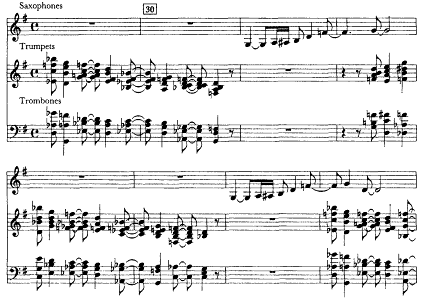
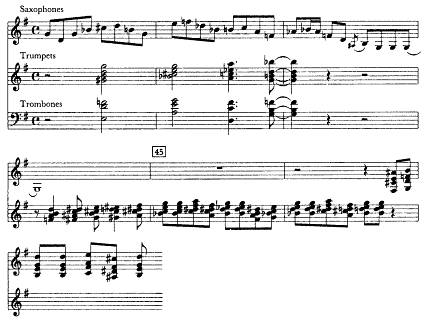
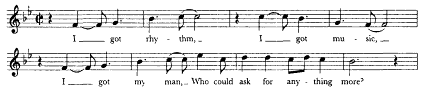
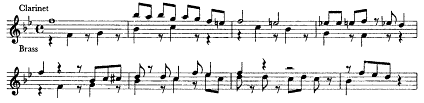
5) provides a glimpse of a leading nineteenth-century teacher and songwriter and the marketplace in which he worked. "Duke Ellington (1899-1974) and His Orchestra" (chap. 6) examines certain aspects of a remarkable twentieth-century American composer's artistry. Finally, chapter 7, "George Gershwin's 'I Got Rhythm' (1930)," takes one piece of American music—a Broadway show song—and traces its unusual "biography" in performance.
The view of American music history set forth here reflects several assumptions. It's a viewpoint that tries to take Old World musical practices (especially European) into account, that encompasses both "cultivated" and "vernacular" traditions,2 that looks beyond composers to the contributions of performers, that distrusts music history written free of economic considerations, and that holds the United States to have enjoyed a vital, distinctive musical life for more than two centuries.
My own experience has led to the not very original conclusion that historical observers see and hear what they are looking and listening for. The American Musical Landscape is not a nationalistic polemic. But it is written out of a belief that, to borrow a phrase from Ralph Ellison, in the field of music we Americans have tended to be "victims of various inadequate conceptions of ourselves."3 While recognizing that our democratic legacy has led to a unique musical life, musicologists have not always known what to make of that life, much less measure or relate American achievements to Western music-making patterns that have shaped the field's outlook. The American Musical Landscape is one scholar's attempt to define and illuminate a few such achievements.
The manuscript was drafted in the winter of 1985. Chapters 1-2 and 4-7 were delivered, in somewhat different form, as a series of public lectures at the University of California at Berkeley (February-April 1985). Chapter 2 was expanded in the winter of 1990; chapter 3 was written in the spring and summer of 1990; and everything was revised again in the spring and summer of 1991. Parts of chapters 1, 2, and 3 have been given several times as public lectures, as have chapters 6 and 7, the latter two illustrated with recorded musical examples.
For the invitation to deliver these lectures as Ernest Bloch Professor at the University of California at Berkeley I have the Berkeley Music Department to thank. Bonnie C. Wade was Department Chair during
xi
my visit, and she could not have been more generous with wise counsel and moral support. Joseph Kerman, Anthony Newcomb, Philip Brett, Michael Keller, and Lawrence Levine all offered kindnesses that enhanced my stay on the Berkeley campus, and I benefited greatly from the chance to exchange ideas with Oily Wilson. Among students I worked with there, Marnie Dilling deserves special mention for her reviews of the lectures in Cum notis variorum .
John Spitzer, a former colleague at the University of Michigan, read the whole manuscript in its first draft and gave me excellent advice and support. I'm also grateful to H. Wiley Hitchcock for the encouragement he offered after an early reading. Among friends and colleagues who have seen individual chapters, I wish to acknowledge Mark Tucker, the late Martin Williams, Karl Kroeger, Michael Broyles, James Dapogny, David Brackett, and Nym Cooke, whose careful reading of chapter 4 tightened and improved it. A fellowship at the University of Michigan's Institute for the Humanities in 1989-90 allowed me to revise and expand Part II (chaps. 2 and 3). To James A. Winn, Director of the Institute, go special thanks for his role in creating an exemplary scholarly environment. Among colleagues there, Fatma Müge Göçek, June Howard, and Louise K. Stein all helped to steer me in productive directions. As part of my duties at the Institute, I also taught a seminar whose members (including Karen Ahlquist, Karen Harrod, Todd Levin, James Manheim, and Timothy Taylor) provided helpful feedback.
Historical writing is judged on quality of information and authority of interpretation. Other scholars are its ultimate judges, for worth is measured by its usefulness to them. Quality of information depends upon accuracy and thoroughness. (Are the facts true? Are the sources comprehensive? Is the documentation complete?) But the quality of a study's information can be hard to judge apart from the author's interpretive perspective. As time passes, the past enlarges and, like the road already traveled, takes on new aspects. Facts about the past do not change. But as one's vantage point moves, the meanings of facts often change with it. New interpretive perspectives appear, sometimes strongly reacting against earlier ones. Such shifts can carry the temptation to dismiss earlier work, as if a perspective that one no longer accepts taints even the facts its author has brought to light. Fresh insights are sure to follow a break with past perspectives. But if such a break is allowed to relegate older histories to oblivion, it works against the building of a tradition of historical study.
A scholarly field forms a tradition of historical study when earlier writers on the same subject are recognized as predecessors, when their work is studied closely, when the questions they raise are identified, discussed, and debated, and when their findings are assimilated. A tradition of historical study progresses, in the sense in which E. H. Carr has defined historical progress, by transmitting the knowledge and experience of one generation of scholars to the next.1 Entry into a musicological field with a tradition thus depends upon mastering a core of scholarly writings, which themselves deal with a certain musical rep-
4
ertory and are centered on fundamental issues, subject to changing interpretations and approaches.
Within American music, one can find a few fields in which such a tradition has formed. The music of Charles Ives is one. In Ives studies, and a few others as well, bibliographical and editorial foundations have been laid, biographical investigations undertaken, local inquiries launched, and style-based books and articles written. In such fields, an agenda has been set and a process of distillation begun. Scholars have mapped the terrain, data are more known than unknown, major issues have been defined, and interpretive refinements are proceeding apace.2
No such tradition has formed for historical studies in American music as a whole. Since 1955, Gilbert Chase, Wilfrid Mellers, H. Wiley Hitchcock, and Charles Hamm, four respected scholars, have each written a history of American music from earlier times to the present. Chase's, Hitchcock's, and Hamm's books were published for the American college textbook market, while Mellers's was brought out by a trade publisher.3 As a group, the four books are most remarkable for having so little to do with each other, either in approach or in territory covered. Hamm's work, the most recent of the four, contains the following statement: "Though I have dealt with a wider range of music than is found in any earlier histories of music in the United States, much has been left out. In fact, one could easily write another book, perhaps of equal length, dealing with the music I have chosen to exclude. Perhaps I will undertake such a book myself one day."4 Hamm's words suggest that historians of American music have yet to agree what the history of American music is ; the four books I've mentioned bear out this suggestion.
Chase's book is comprehensive by the lights of its time, and it is written with the conviction and documentary command of a seminal work. Chase breaks sharply with earlier histories by devoting more than half his book to folk and popular music, which he claims as our chief source of musical vitality.5 Mellers praises Chase's work as "admirable" and then proceeds to go his own way, saying little about folk music or the years before 1900. He distinguishes elements in American music that are "genuine and meaningful" from those that are not,6 and he concentrates on music that shows twentieth-century American composers coping successfully with a commercial environment—with special emphasis on composers and players in the jazz tradition. Hitchcock,
5
who wrote the slimmest volume of the four, acknowledges the influence of Chase's work on his own, but his account includes folk music only peripherally.7 His division of the nineteenth century into two streams—the "cultivated" and the "vernacular" traditions—has been widely borrowed. But not by Hamm, who deals with his predecessors in a respectful footnote, then strikes out on an entirely new path, concentrating on music brought to the New World from Europe and Africa and changed in its subsequent history here. Folk and popular musics fill a large proportion of his book, as they do Chase's. But unlike Chase, Hamm cares most about reception—about the music that has won the widest audience; and he flaunts folkloric values by claiming "contaminated" music as America's "most characteristic and dynamic" musical product.8
These contrasts may be pursued a bit more through glimpses of further details. Chase violates chronology by ending his book with a chapter on Charles Ives, for him the culminating figure in American music, because, "first and alone among American composers," Ives "was able to discern and to utilize the truly idiosyncratic and germinal elements of our folk and popular music."9 With Ives identified as the Messiah, one tends to notice in the earlier parts of Chase's text prophecies of his eventual coming. Mellers's scholarly apparatus—a bibliography of books running barely to a page and a discography of more than fifty pages—shows that he approached the subject with open ears if with somewhat closed mind. Hitchcock balances his coverage between eras, genres, and approaches and preaches the gospel that American musical history is coherent. (He lacks the curmudgeonly streak of Chase and Mellers; if anything on the American music scene makes Hitchcock mad, the reader doesn't find out about it.) Hamm begins by announcing that several new record series are the most significant recent developments in American musical research. And his book reflects his own encounters as a listener with an unusually wide range of American musics.
These incongruities reflect the different backgrounds and interests of our four authors and the differing sponsorships under which their books appeared.10 But more than that, they reflect the absence in America of a canon of musical masterworks and composers—the kind of canon on which European musical historiography centers.11 One might guess that our historians' freedom to define their subject is a recent phenomenon—part of the general social reorientation that followed World
6
War II. But in fact, that freedom (or lack of continuity) goes back much further. It is present from the beginning of the writing of American music history. And it reflects the strain of randomness that, over nearly a century and a half of serious study, has run through histories of American music. If one thinks of pluralism as an American trait, perhaps it is especially fitting that such disparate figures as Hood, Ritter, Mathews, Elson, Howard, Chase, and Mellers have written histories of American music. For in background, outlook, taste, and training, it is hard to imagine a more various crew of historians undertaking the same mission. That that mission, even now, remains something of a pioneering endeavor—a trip whose route and destination are up to the traveler—testifies to the field's schismatic legacy. At the same time, it invites reflection on that legacy and the benefits of historiographical study.
Our historians and works, however various, do hold certain things in common. All take Europe as a starting point. Indeed, no fact about the writing of American music history is more characteristic than the looming presence of Europe. Scholars of music are trained and acculturated to think of European music history as their norm. Whether as provider, exploiter, or authority figure, whether in the foreground or background, Europe is the powerful "other" in the story that Chase, Mellers, Hitchcock, and Hamm tell. All agree that the U.S.A. is a European colony—an outpost of European settlement on a faraway continent. All focus chiefly on musical practices created in the Old World (whether Europe or Africa) and extended to the New. All concentrate, to one degree or another, on the process of extension, and especially on how Old World practices have been accepted, altered, or ignored. Finally, all have described the extension of Old World practices to the New in value-laden terms; colonialism, whether in politics, economics, or music, is a hard topic to treat from the cool, objective posture that scholars are trained to strike.
As for discontinuities, from the bird's-eye vantage point of today, the histories fall into two groups, depending upon their response to the issue of colonialism. It was on this point, in fact, that Chase broke decisively with the historical perspective of his predecessors. The issue can be drawn clearly by referring to the eighteenth century, a time when American musical life was comparatively simple. A musicologist studying the American scene before 1800 soon recognizes the existence of two sharply contrasting musical ways of life. One was carried on by musicians
7
who took their direction from creative and intellectual centers abroad; the other involved those who resisted, or reinterpreted, or, most likely, failed to receive messages from such centers. The first group worked to extend Old World hegemony; the second, seldom conscious of more than the outlines of Old World practices, found their own ways of making music within the general run of their daily lives. The first group was small, urban, and professional, led by immigrants. The second group, larger by far, lacked intellectual focus, though most members hailed from American villages and the countryside.12
Here is the kind of dichotomy with which a historian can work and play. Though it is surely too black and white to account for all musicians in colonial America, it does define tendencies inescapable then and still present today. By doing so, it fixes a point of view from which American musical life as a whole can be studied. Once the two polar opposites are labeled—we'll call the first cosmopolitan and the second provincial—we have a typology that, if the labels are separated from connotations of approval or disapproval, can help to order our view of the past.
Like American musicians of the eighteenth century, historians of American music have tended to line up in two camps. The cosmopolitan school, which dominates the historiographical outlook through John Tasker Howard (and World War II), has been inclined to find European hegemony inevitable, or healthy, or both. The provincial outlook, which informs histories of New England psalmody written in the 1840s and 1850s and resurfaces in parts of Arthur Farwell and W. Dermot Darby's volume of 1915, came to full fruition only in the 1950s. Chase and Hamm have been its chief spokesmen. Rejecting Europe as a musical model for America, its advocates have concentrated on the deeds of musicians who seem to have done the same, finding value chiefly in divergence from European practices. For the cosmopolitan school, technical mastery and the acceptance of European forms and aesthetic principles are signs of musical vitality. For the provincial school, these traits are less highly prized than originality, experimentation, eclecticism, and an absence of self-consciousness.
In shaping their accounts to fit a particular point of view, historians of American music have merely borrowed a trick of the trade available to any writer seeking to order a large stock of information. Henry James gave an eloquent description of this technique shortly after the death in August 1891 of James Russell Lowell, his mentor, teacher, and friend.
8
James observed that after a man dies those who knew him "find his image strangely simplified and summarized." He continued:
The hand of death, in passing over it, has smoothed the folds, made it more typical and general. The figure retained by the memory is compressed and intensified; accidents have dropped away from it and shades have ceased to count; it stands, sharply, for a few estimated and cherished things, rather than, nebulously, for a swarm of possibilities. We cut the silhouette, in a word, out of the confusion of life, we save and fix the outline, and it is with his eye on this profiled distinction that the [writer] speaks.13
James was writing here about biography, but his words apply to the writing of history, too. For, once their research has uncovered the human achievements of the past, historians explore all available ways of revealing them: summarizing, intensifying, and casting certain events into relief in part by deemphasizing, even omitting others—by "cut[ting] the silhouette . . . out of the confusion of life." If we accept James's description as relevant to history, we are reminding ourselves that, every bit as much as an act of compilation, the writing of history is an act of clarification, compression, and surgery.
James's image of cutting a silhouette from the disorder of life is especially apt. In the first place, a silhouette fuses data and perspective into one image, which is the way they appear in written history. In the second, just as a silhouette requires a deft gesture of the artist's hand to catch the likeness, historical writing depends upon the writer's skill in holding many facts and ideas simultaneously in the mind and catching from among them precisely those that clarify—first for the writer, then for the reader—the outline and texture of the matter at hand.
The image of a field whose polarities are "cosmopolitan" and "provincial" is precisely the kind of silhouette that James described. It has served American music historians well, helping them both to order their information and to judge the music with which they have dealt. But it's important to remember that the image comes from historians' own beliefs, values, and experiences. Historical "silhouettes," formed from facts seen and heard, are summoned by the historian's own habits of seeing and hearing. Who historians are, the background and training
9
they bring to their task, the motives behind their studies, the stake they hold in the outcome—all of these things shape the history they write.
Although the first comprehensive history of American music was a product of the 1880s, two books of narrower scope set the stage for it. Their early dates and their consistent use by later historians gives them pride of place as fundamental works of American music history. And so it is with Hood and Gould, pioneer historians of American psalmody, that our survey begins.
George Hood (1807-82) was born in Topsfield, Massachusetts. "Early in life," according to a contemporary, "he began teaching as a profession, and, in turn, was teacher of a public school, of church music, of a ladies' seminary, and finally became minister of the Gospel."14 After his ordination as a Presbyterian clergyman (1848), Hood's involvement with music decreased. But for a decade beginning in the mid-1830s—from about the time he attended a Boston singing convention led by Lowell Mason and George J. Webb (1835)—he was occupied with the history he published in 1846.15
Hood wrote as a pious Christian in search of the origins of New England psalmody, the musical tradition in which he himself was a participant. He harbored no illusions about the place of musical artistry in the environment he described. "We know that our music was mean," he admitted. But by gathering the past "carefully up," he hoped to "set it with the future, that the contrast may appear the more bright and beautiful."16 It was not Hood's style to ridicule earlier practices, however sharply they contrasted with those of the present. Like other New Englanders of his time, who, in writing the histories of their families and their communities, honored and venerated their forefathers, Hood came to admire New England's sacred music pioneers. For him, the figures meriting the deepest respect were the Reverends John Cotton, Thomas Symmes, Cotton Mather, and other clergymen who led the reforms of sacred music in the seventeenth and early eighteenth centuries. "Never was a discussion in this country conducted by better men, or men of better minds," wrote Hood.17 While promising to carry his account "to the beginning of the present century," Hood focused on earlier times, when sacred music was a matter of deep concern to these
10
redoubtable men. Thus, Hood's history is about the implanting of English psalmody in the colonies, the Regular Singing controversy, and the founding of singing schools and choirs.
Having chosen an antiquarian subject, Hood discovered how elusive historical documents could be. "The matter has been gathered by much labor, time and expense from different parts of the Union, and frequently in very small portions. The labor has been almost incredible. To show something of its difficulty, there are six consecutive lines that were unfinished more than one year." But once the documents were in hand, he determined "to give the facts as he found them."18 He did so chiefly by letting the original authors tell their own stories. Of Hood's first 150 pages, two-thirds are direct quotations from seventeenth- and eighteenth-century writers. Several more pages are devoted to a chronological listing of American sacred tunebooks, based on his own collection and that of Lowell Mason. Hood proposed that this list be completed by others and that the books themselves be collected and deposited in the Massachusetts Historical Society. "In the future," he explained, they will "tell the history of the past, far more impressively than the page of history."19
Here, in a nutshell, is Hood's historiographical philosophy. For him, documents were primary, historical opinion and interpretation secondary. Hood's appreciation of the value of historical documents is distinctly modern. It explains why, while other nineteenth-century histories of American music lie neglected on library shelves, Hood's History of Music in New England has provided the foundation for all later accounts. Hood's struggle to find accurate information on the remote past took on the character of a passionate quest, at one point provoking the following outburst: "When we see the devastation that is almost universally made, with old books, papers, and records, valuable for their historic information, by brutes in human form, what language is harsh enough to denounce such impious destruction?"20
It's hard to imagine such thoughts crossing the mind of Nathaniel D. Gould (1781-1864), whose history followed Hood's by seven years.21 Although Gould, like Hood, restricted his account to psalmody, he shared neither Hood's love for research nor his fascination with origins. Gould's story picks up where Hood's left off: with the career of William Billings, who for Gould exemplifies the "dark age" (1770-1805) when psalmody in America began to be carried on largely free of religious
11
control.22 Its main subject, however, and its method are more autobiographical and practical than historical. Gould's last eight chapters concentrate on the singing school since 1800. As teacher of some 115 singing schools and "not less than fifty thousand " scholars, Gould could look back over half a century in the field—he was seventy-two years old when his book appeared—and see himself not as "a mere compiler, but a busy actor in the scenes he has described."23
Born in Bedford, Massachusetts, Gould opened his first singing school in 1799 and from that time followed the teacher's trade, chiefly in New Hampshire and Massachusetts.24 His authority as a historian varied with his chronicle's proximity to his own experience. After an erratic sprint through Billings's American predecessors, he announced: "We now leave the traditional history of church music, and enter a field where, for the last fifty years or more, we are enabled, from experience, observation and information, to vouch for the facts we relate."25 There follows a participant's account of the workings of the New England singing school during the late eighteenth and early nineteenth centuries. Gould wrote in the belief that "unless accomplished by some one soon, the history must forever remain a mere matter of hearsay."26 He evoked vividly the world of early American choral singers and their eccentricities. These were the conditions we teachers faced in those backward days, Gould told his readers, and I know because I was there.
Gould's underlying theme was that sacred music, a powerful aid to religious devotion when sung to God's glory, was vulnerable to corruption for profane ends. In Gould's account, human nature seems perpetually at odds with the proper employment of sacred music. To gain musical skill as a performer of psalmody is to be tempted to forget its sacred purpose. Tippling teachers, status-seeking singers, choristers who sleep through sermons, viol players who tune at distracting length, parishioners who criticize the choir's singing: These are the characters in Gould's tale for whom psalmody had become human display drained of sacred content. American sacred music-making achieved its true purpose, Gould believed, only when carried on under the scrutiny and control of religious leaders.
Gould's theme was a familiar one in the Calvinist tradition. Yet his account is no jeremiad. He took a bemused pleasure in his countrymen's musical superstitions, as in his tale of the congregation in which erstwhile foes of instruments in church were won over when told that the
12
sounds accompanying their Sunday morning psalm singing were those of the "Godly Viol."27 The relish with which Gould cataloged the "improprieties" of American choral singers seems rooted not in a reformer's zeal to condemn but a patriarch's inclination to temper judgment with humane understanding.
That a wide gulf separates Frédéric Louis Ritter (1834-91) from his predecessors is clear to even the most casual observer. That gulf may be measured by time (three decades elapsed between Gould's work and Ritter's Music in America ),28 by scope (Ritter's work encompasses the whole of significant music-making in America as he saw it), and by the author's outlook For it was Ritter, writing as a scholar grounded in a knowledge of European music history, who introduced the cosmopolitan perspective. At a time when New Englanders were still debating whether the Bible authorized them "to sing or read the psalms in the church," Ritter reminded his readers, Bach and Handel had already begun "to fashion their immortal strains." And while "the child Mozart was astonishing the European musical world as a performer and a composer," on this side of the Atlantic the likes of Lyon, Flagg, and Bayley, borrowing from "the weak and often insipid strains of a Tansur, Williams, [or] others of that stamp," were compiling their rudimentary tunebooks.29 Ritter brought to his work the experience of a historian who had already written a two-volume History of Music (1870-74). Moreover, on the very same date that Ritter's Music in America was published, a companion volume, Music in England , also appeared. "When I determined to write the history of musical development in the United States," he explained, "I found, that in order to enable my readers to understand the peculiar beginnings and first growth of that development, an insight into the history of musical culture in England was desirable. I therefore concluded to introduce the history of music in America, by that of the immediately preceding period in England."30
If Hood had written to reconstruct the record of a forgotten age and Gould to preserve hallowed memories, Ritter stated a more complex agenda:
[to present] a faithful mirror of past music life in the United States, to accentuate that which is in accord with a true art spirit, . . . to expose . . . that which is puerile, hollow, pretentious, fictitious, and a great hindrance to progress; to give their justly
13
merited due to those musicians who, by means of great exertions in the interests of higher musical culture among the American people deserve the grateful remembrance of the present . . . generation; to dispel, as far as possible, the errors and false views still entertained in Europe regarding musical affairs in America.31
These words introduce an account of American music history deeply imbued with cosmopolitan values. Ritter was a native Alsatian, trained musically in Europe, who arrived in this country in 1856, directed choruses and orchestras in Cincinnati and New York, who composed vigorously throughout his life, and who served as professor of music at Vassar College from 1867 until his death in 1891.
For Ritter, the reformed Calvinists of England and America were religious zealots who stifled music's development as either an independent art or a characteristic folk expression. Ritter treated the Puritan attitude with undisguised scorn. He found it the chief source of a religious climate that, in his judgment, lay like a wet blanket over American musical life. Even in the nineteenth century, he wrote, America was full of "church-people"—people "opposed to all aesthetic tendencies that cannot be rendered absolutely subordinate to ecclesiastical power."32 That state of mind, Ritter believed, robbed Americans of all incentive to develop their musicianship beyond an elementary level. Ritter's acid comments on nineteenth-century psalmody provide a succinct measure of the distance between the cosmopolitan and provincial outlooks of his day:
In the time of Hastings, Mason, [and] Gould, the New-England psalm-tune teacher thought, on the whole, little of the professional musician, who was not able to quote the Bible on each and every occasion, and who could not lead a revival meeting. The professional musician, on the other hand, thought little of the psalm-tune teacher, who, in general, could not play, sing or compose.33
Ritter's European birth, his forthright antiprovincialism, and his often sarcastic pen have combined to give him a terrible reputation. It has become almost obligatory for writers on American music, if they mention Ritter's name, to take a shot at him.34 If historians worked by deduction, one could infer from Ritter's values that, borrowing from
14
Hood and Gould, he would polish off the early years of American music in short order and then move on to greener pastures. He doesn't. Instead, he devotes almost a quarter of his book to the eighteenth century, basing his own account on Hood (whom he admired) and Gould (whom he didn't) and on his own research in primary sources from the period, some of which he acquired for his own library.35 Ritter's reputation might serve as a cautionary note to the foreign-born critic of America's music. He is remembered as an ardent Columbiaphobe and a prejudiced man, even though his evaluations of American musical practices are presented and documented as those of a reputable historical craftsman, working from research and personal observation.36
Ritter's history focuses chiefly upon two processes in nineteenth-century American musical life. In the foreground is the implantation of cultivated European music in America. (What European musicians traveled, performed, or settled here? What European music did Americans hear and perform, and in what circumstances?) More in the background is a second process: that of Americans struggling to free themselves from the legacy of musical Puritanism. (What institutions offered American singers and players the chance to widen their technical and aesthetic horizons beyond the requirements of the simplest church and instructional music?) Ritter describes the two streams of American musical development separately. In doing so, he concentrates all the interpretive precision he can muster upon these questions, which, for him, were the central ones of American music history. Both his questions and his answers show that he understood the complexity of his subject. Ritter had worked long and widely enough as a musician in America to appreciate the achievements of musicians who had come before him, even as he took them to task for their outlook. Ritter's work has sometimes been read as an ideological tract. But his treatment of the battle between cosmopolitan and provincial forces is also an account emanating directly from his own practical experience as a music-maker.
Six years after Ritter's history was published, A Hundred Years of Music in America. An Account of Musical Effort in America during the Past Century . . ., (etc., etc.) appeared in print.37 Here was a book whose size and comprehensive scope seemed to promise the whole story. The introduction predicted: "We are confident that no reader will rise from a careful examination of this book unimpressed by the richness of the material here presented."38 The richness turns out to be biographical.
15
The book is first and foremost a gallery, its text recording the lives of some 500 musicians, supplementing the "two hundred and forty portraits" (i.e., photographs) of the men and women whose likenesses stare with unrelieved dignity from its pages. "None of the sciences, arts and industries," the reader is told,
compare with music in the extent, universality, directness or beauty of the beneficence with which it dowers the human family. . .. Yet what other has been so neglected in that kind of honor which places its representative men in enduring eminence upon fame's immortal scroll? . . . The priests of music ... are alone left to the transient and evanescent reward of passing praise. To what more eloquent task can type... be placed, than to that of rescuing these from ingratitude and forgetfulness, and giving them, both for the present and for posterity, enduring place and honor?39
A Hundred Years is based on information gathered from the subjects themselves "or their immediate representatives . . . at immense expense of trouble and patience."40 The early chapters, drawn from Hood, Ritter, and other secondary sources, are written as historical narrative. But once the time of Lowell Mason is reached, most chapters turn into successions of brief biographies, dwelling upon the positive achievements of their subjects, introduced and connected with narrative explanation. The progress of music education, for example, is shown by two whopping chapters, filling some 200 pages with accounts of the lives of music teachers. The book's tone is hagiographical. One imagines, in fact, that data were extracted from these priests and priestesses of music with a promise to accentuate the positive. Nevertheless, the book shows a common sense awareness of the process of colonization from a perspective different from Ritter's.41 Topics seldom covered in histories are broached here: the importance of publicity in musical life, the different values that separate the pianist's world from that of the singer, or American singers' difficulties with English (attributed "in part" to foreign training "and in part to their own mistaken ideals of . . . singing of the highest class").42
Although no author claimed A Hundred Years , it was the brainchild of W. S. B. Mathews (1837-1912). A native New Englander and a pianist,
16
Mathews lived in Chicago for most of his mature life, working as a teacher, journalist, and critic. A Hundred Years describes him "as a music educator, in the widest sense of the term," explaining: "his higher vocation is that of an intermediary between purely musical ideas and purely literary ideas, in which sphere he has been the means of conveying to literary life something of the impression that music makes upon those who understand it intimately."43 This characterization suggests how Mathews's book can best be read: as the work of a facilitator, a man who understood and recognized the many different levels and lingoes of his subject, who combined the pride of a provincial enthusiast with the experience of a cosmopolitan critic, and who could communicate with a broad readership. Mathews's work is most valuable as a compendium of firsthand data about American musical life in the second half of the nineteenth century, compiled by a man who experienced, understood, and sympathized with an unusually wide range of it.
The early years of the twentieth century saw the publication of three new histories of American music (1904-15), each commissioned to fill a niche in a larger series of books.44 In contrast to the histories of Ritter and Mathews, all are works more of compilation and summary than of original research. While varied in approach and content, all seem rooted in a wish to illuminate and assess the present-day scene. All attempt comprehensiveness. All seek, with the help of a growing secondary literature, to cover earlier periods. Nevertheless, the authors all show more interest in describing the present state of American music-making than in trying to discover how it got that way. In all three histories, the reader is shown a musical culture whose potential outweighs its achievements. Louis C. Elson, in comparing American and European musical life, expresses hope for the future but finds his own country's musical training misdirected: too much emphasis on solo performance, too little on ensembles and music appreciation, and the whole carried on too hastily for students to digest.45 W. L. Hubbard warns that, although American musicians are overcoming geographical isolation and "the utilitarian spirit always in evidence in young nations," the United States would become "a true home of art" only when it produced a composer of "genius."46 Arthur Farwell (writing in the book coedited by W. Dermot Darby), interpreting musical life as a reflection of "national ideals," sees the present as a time when "the many are striving to obtain [what] has been the exclusive possession of the few." That process, he predicts,
17
will soon transform the art of music as practiced on American shores.47
Elson's, Hubbard's, and Farwell and Darby's histories were all written by experienced writers who were inexperienced historians. In an age where reliable musical information could be hard to come by, these men worked to supply it and hence to meet a public need. But they were no explorers of the mysteries of the past. Elson (1848-1920), a Bostonian born and bred, worked there all his life, chiefly as a music critic for the Daily Advertiser and a teacher of music history and theory at the New England Conservatory.48 Elson's interest in folk music and patriotic song had also helped to inspire his National Music of America and Its Sources (Boston, 1900). Among the others involved in this historiographical flurry, composer Arthur Farwell (1872-1952) seems to have held the highest personal stake in telling the story of American musical life. In four cross-country trips (1903-7), he had presented lecture recitals on contemporary American music and experienced musical conditions in the United States firsthand.49 Less is known about the other two authors, and nothing about their interest in American music. William Lines Hubbard (1867-1951) worked off and on from 1891 to 1907 as music critic and editor of the Chicago Tribune —he was also dramatic editor (1902-7)—while teaching singing and living in Europe from 1893 to 1898.50 W. Dermot Darby (1885-1947), Farwell's coeditor, was a native of Ireland. Trained in England and New York, Darby served as secretary of the Modern Music Society in New York in 1916 and helped to edit The Art of Music (1914-17) but has left no further mark on the written record.51
Elson's The History of American Music is the closest thing to a coffee-table book that the field has yet produced and, if later editions signal success, the most successful before Howard's Our American Music .52 Printed on thick, glossy paper, bound so that it will lie open, supplied "with twelve full-page photogravures [the first one of the author himself] and one hundred and two illustrations in the text,"53 it is a handsome volume by any measure, and especially so when compared with its modestly produced predecessors. (At nearly three pounds, it weighs in at about the level of a volume of The New Grove. ) Elson's work owed its sumptuous format to the circumstances of its issue. As part of a series edited by John C. Van Dyke, a critic, professor of the history of art at Rutgers College, and a president of the National Institute of Arts and Letters, it was designed to sit on the shelf next to such companion
18
volumes as Lorado Taft's The History of American Sculpture and Samuel Isham's The History of American Painting .
Earlier historians of American music had begun their books by announcing why they were writing them and what they hoped to show. In Elson's history, however, the only prefatory statement was the general editor's. "This series of books brings together for the first time the materials for a history of American art," Van Dyke announced.
The present volumes begin with colonial times, and carry the record down to the year 1904. They are intended to cover the graphic, the plastic, the illustrative, the architectural, the musical, and the dramatic arts, and to recite the results in each department historically and critically. That the opinions ventured should be authoritative, the preparation of each volume has been placed in the hands of an expert,—one who practices the craft whereof he writes.54
Of Elson's history, Van Dyke notes: "Many of the events here narrated occurred but yesterday or are happening to-day, and hence have little perspective for the historian." In The History of American Music , he adds, "the widely scattered facts have been brought together and arranged sequentially that they might tell their own story and point their own conclusion." Elson's history shows every sign of having been written to specifications set by its editor.
Though it covers different ground, Elson's The History of American Music shares with Mathews's a topical organization. It begins with the New England Puritans and proceeds to the middle of the nineteenth century, tracing the founding and progress of performing institutions— choral societies, orchestras, opera troupes—and the building of concert halls. At this point, it goes off in a new direction. First, by introducing chapters on American "folk music" (ten pages on American Indians, one and a half on black Americans, and five on Stephen Foster) and patriotic music (e.g., "The Star-Spangled Banner," "The Battle Hymn of the Republic"), it steps outside a chronological framework. Then, in a sequence of seven chapters, it reviews American composers' contributions to the major genres of art music, concentrating almost entirely on living composers. The final chapters return to a topical approach, treating, in turn, American women in music, American writing about
19
music, and music education. But with nearly half of the book devoted to them, the central role in Elson's History of American Music is occupied by composers of the present and recent past and their music.55
Elson documents the historical sections of his history and identifies sources in a bibliography. (He's the first historian of American music to include one.) Mathews's history is mentioned in the bibliography but remains untapped in the text. Ritter comes in for more attention. For Elson, Ritter was a "profound musician" who "in the domain of music literature" was "as important a figure as any in America after Dwight and Thayer."56 Of Ritter's history of music in America, however, Elson writes:
Dr. Ritter approached his subject with little sympathy. . .. Our national music did not appeal to him deeply, and of the American composers he had not a word to say. . .. Dr. Ritter, however much he labored for us, worked from without, not from within; he was among us, but not of us. He could not realize what a group of good American composers was growing up around him.57
The History of American Music that appeared in W. L. Hubbard's The American History and Encyclopedia of Music (1908-10) carries on its title page only Hubbard's own name as volume "editor," which means that he wrote the chapters whose author is unnamed.58 Hubbard's History has a shape all its own. It begins with chapters by two leading American musicians: George W. Chadwick on living American composers (chiefly Bostonians)59 and Frank Damrosch on public school music.60 Then it takes up American music outside the concert hall: "Music of North American Indians," "Negro Music and Negro Minstrelsy," "Popular Music," and "Patriotic and National Music." By the time the New England Puritans appear on the scene (p. 138), their position as musical founding fathers is seriously weakened. In earlier histories, the past is the foundation of the present. But Hubbard's organization undermines the past as a shaping force, clearing the way for the subject he seems most eager to discuss: the United States as a musical democracy.61
The distinctiveness of Hubbard's work lies not in the survey of "the aesthetic side" of American music that occupies numbers seven through twelve of its fourteen unnumbered chapters but in its discussion of a
20
widening range of American people's music. Hubbard deals respectfully even with genres absent from earlier histories, including college songs (pp. 88-89), gospel hymns (pp. 89-90), songs of Tin Pan Alley (pp. 83-87), the Broadway stage (pp. 97-99), and the American wind band (pp. 285-87). Hubbard is not known to have written elsewhere on American music, either before or after his history appeared. Nor, like Elson, did he state his historiographical philosophy or describe his book's purposes. On the strength of what he wrote, however, Hubbard may be judged a musician with broad tastes and a man who saw American music whole in a way very different from those who wrote its history before him.62
Music in America , the third pre-World War ! history, bears the marks of a collaborative enterprise even more openly than its immediate predecessors. Arthur Farwell contributed the introduction and two chapters on living composers. His coeditor, W. Dermot Darby, wrote the nine chapters that carry the historical chronicle from the Puritans to the late nineteenth century. And specialist collaborators were brought in for the rest.63 Like Hubbard's History, Music in America , embedded in a multivolume set, seems to have made little impact on American music historiography, except for its introduction, which some decades later helped to inspire Chase's fresh approach.
Farwell wrote his introduction as a composer involved in American musical life and deeply concerned with its character. Farwell's concern ran in two complementary streams. As founder of the Wa-Wan Press (1901-12), he was an early leader of the movement toward American musical nationalism. As a critic for Musical America (1909-13) and supervisor of New York City's municipal concerts (1901-13), he was also active in an effort to bring Americans into contact with music. In choosing Farwell to contribute to Music in America , series editor-in-chief Daniel Gregory Mason had selected a man who believed, first, that American composers should seek to address as large a public as possible and, second, that the public, when given a chance to hear good music in the right surroundings, would prefer it over bad.
"Prophecy, not history, is the most truly important concern of music in America," Farwell began his introduction. "What a new world, with new processes and new ideals, will do with the tractable and still unformed art of music; what will arise from the contact of this art with our unprecedented democracy—these are the questions of deepest im-
21
port in our musical life in the United States."64 The key issue of music in America, in other words, was not its past but its future.
Farwell imagined the history of American music as a three-stage process: "appreciation, creation, and administration."65 By appreciation, Farwell meant the New World's coming to grips with the music of the Old. Creation meant New World musicians' composition of music expressing the American nation's spirit and suited to the needs of her citizens. Administration meant the establishment of a musical life that brought American citizens into contact with the music of American composers.
Farwell believed that, in ideal conditions, appreciation would bring about creation, which would then flourish in close contact with an informed audience recruited through effective administration. But in America, conditions had not proved ideal. Too much energy was still being spent on appreciation at a time when "the evolution, broadly, of America as an appreciative nation has been fulfilled, and it can from now on find no true musical progress except as a creative nation."66 The "creative epoch" of American musical history had begun, Farwell believed, and American composers occupied a favored position. Having benefited from rigorous German training, they had been saved from its hazards by other influences: the diverse ethnic roots of the American people, the "deluge" of modern music from non-German nations, and the unearthing of folk music "peculiar to America."67 The true legacy of American composers, as Farwell saw it, was creative freedom: the freedom to follow or combine these strands of influence in any imaginable way.68 That freedom had already led, in "the best of the newer work," to "a loftiness of ideals, a breadth of outlook, a definiteness of purpose, a freshness of color, a sense of the beautiful and an esprit which argue strongly for the future honor of American music."69
Yet, Farwell continued, the administration of American life had not kept pace with composers' achievements. The institutions of musical culture had concentrated almost entirely upon "the commercial exploitation of foreign artists" (i.e., performers), for the benefit of the rich.70 Orchestra, chamber music, and opera in America had fostered "an aristocracy of musical appreciation" and a tone of "retrospective hyper-refinement" at a time when the nation's "rugged creative strength" most needed support.71 "Aristocratic" institutions had no interest in what Farwell saw as the primary musical issue of the day: the
22
interaction between "musical art and democracy."72 "The people of the nation," Farwell believed, had always received "cordially the work of their own composers." But the third phase of American music history, administration, could begin only when the barriers erected by "the narrow arena of the concert halls of 'culture'"73 were breached, and "music in all of its forms" was brought "directly to the masses of the people."74 Farwell saw activities directed to that end as a national movement: outdoor drama festivals, municipal concerts of orchestras (not bands), concerts given in public school halls, local music festivals, community choruses, low-priced symphony concerts, community pageants, and the growing popularity of the phonograph and player piano.75 Each, in his view, was a blow struck for musical democracy.
Three-quarters of a century after the fact, Farwell's introduction still carries the force of an original vision—especially his claim that in the United States "the musical needs of the American people" were opposed, rather than served, by "the standards of the centres of conventional and fashionable musical culture."76 Yet the introduction had little impact upon Music in America , the book that followed it. Even the book's table of contents exposes the loose fit between it and Farwell's introduction. Its three-part division, like his, begins with "appreciation." But that section emphasizes the eighteenth century, while Farwell carries appreciation almost to the end of the nineteenth. Farwell's second stage, "creation," occupies the third section and longest part of Music in America , encompassing folk music, popular music, and composers in the concert-hall tradition from the 1850s to 1915. Farwell's third stage, "administration," is missing entirely from the book, whose second section, called "organization," deals with institutions, concert life, and music education. As the disparity might suggest, Music in America cannot be read as an illustration of Farwell's thesis, as Ritter's history was of his introduction or, later, Chase's was to be of his. Rather, the book is cobbled together from Darby's historical chronicle (Chaps. 1-9), Farwell's portrait of the compositional present—which does reflect his prophetic introduction—and additional chapters written by collaborators with compatible views.77
If Hood and Gould were the first generation of American musical historians, Ritter and Mathews were the second, and Elson, Hubbard, Farwell, and Darby the third. What is most striking about these books, despite the elements they share, is each author's freedom—imperative,
23
perhaps—to define his territory. Rather than taking their predecessors' works as a starting point, each saw American music in his own way and considered its history as revolving around a different set of issues and sources. Ritter's process of colonization, Mathews's homage to the burgeoning ranks of American professional musicians, Elson's interest in American composers, Hubbard's acceptance of musical democracy in vernacular styles, Farwell's faith that creative eclecticism and the mass audience would intersect on American shores—none of these central notions overlaps much with the others. In each historian's response to his predecessors lies the pattern we have observed in more recent histories of American music. Earlier histories are consulted for reference, are evaluated, if at all, in only the most general terms, and receive no exegesis. Mathews, Elson, Hubbard, and Farwell, for example, clearly find Ritter's perspective too narrowly cosmopolitan, but none of them really take on the issue. For all of these men, the historian's task is to set a suitable agenda and carry it through, not to debate the premises of other histories. Thus, the writing of American music history was established and carried out in an atmosphere almost entirely free of intellectual debate or even exchange.
One more thing needs to be emphasized about second- and third-generation histories. They were written by men who in one way or another were deeply involved in American musical culture and in fact made their living by serving the needs of some branch of it other than historical study. It is no disrespect to Ritter's, or Mathews's, or Elson's, or Hubbard's, or Farwell's achievements to think of them not as historians in the modem-day sense of the word but as historically minded musicians grappling with the complexity of lives devoted to the pursuit of some musical, rather than scholarly, end. It is precisely their involvement with the musical culture of their time and place that gives energy and immediacy to their historiographical vision.78
We now come to the point where some might say that the historiography of American music really begins: to the career of Oscar G. Sonneck (1873-1928). While his predecessors have faded into antiquarian obscurity, Sonneck remains a redoubtable figure: as the man who made a major research collection of the Library of Congress's Music Division, the founding editor of The Musical Quarterly , the compiler of many useful bibliographical aids, the inventor of the Library of Congress classification system for music, and the patron saint of the Sonneck
24
Society for American Music. Much has been written and said about Sonneck in recent years. His works are widely quoted. Everybody agrees that Sonneck was wonderful.79 (Praising Sonneck is as much a ritual in our field as abusing Ritter.) And yet his place in the historiography of American music is not quite as clear as might be imagined.
Sonneck was born in 1873 in New Jersey, and his mother took him at the age of two to Germany, shortly after his father's death. He grew up in Frankfurt-am-Main, attended the universities of Heidelberg and Munich, and explored his capacities as a composer. Around 1900 he returned to the United States and began research on music in eighteenth-century America. In 1902, shortly before his twenty-ninth birthday, he was appointed chief of the Library of Congress's Music Division;80 in 1917, he resigned that post to join G. Schirmer music publishers in New York as director of publications. There he remained until his death in 1928.
Sonneck's work began to be published directly on the heels of Elson's history, which, by the way, Sonneck called "clever" in 1905 and "fresh and smooth-flowing" in 1909.81 But it breathed the air of a new planet and a new generation. Whether or not his German university education was responsible, Sonneck was the first to look into the abyss of American musical history and to recognize, define, and illustrate a real historiographical philosophy for music in the United States. He is thought of chiefly, and properly, as a builder: a man who filled an open landscape with soundly constructed, useful monuments. But he was also a destroyer of historiographical illusion. Sonneck's work and writings dismiss as pure fiction the idea that "authoritative" music history can be written from available evidence. Ritter, Elson, et al. had been guided through their histories by Jamesian silhouettes, reflecting their own musical involvement and their different shades of cosmopolitanism. Sonneck cut loose from such devices. In his own researches, he chose to be guided by his scholar's persona, that of the bibliographer who searches for the truth about the musical past in the accumulation of scores and documents that lie, mostly forgotten, on library and archival shelves.
Sonneck's own publications do not include a history of American music. Indeed, his chief scholarly works are either detailed treatments of narrower topics or exhortations for more such work to be done, pronto.82 Sonneck was the great cheerleader of American music historiography, if one can call such pessimistic pronouncements as the
25
following cheerleading. In 1905, writing for the Bibliographical Society of America, he confessed:
It is only with a keen sense of humiliation that I, as an American writer on the musical life of America, lead you for a moment into this "darkest Africa." What I mean is simply this: we do not even possess a bibliography of books and articles on the music history of our country. . .. Yet we continue to write histories of music in America, though we know, or at least should know, that bibliography is the backbone of history.83
By 1909 Sonneck was plugging local music history as the eventual key to a general history:
Little has been done toward a thorough and accurate description of the music histories of the more important cities, especially those in the West. That job is much too vast for it to be undertaken by any single individual who might set himself up as a history-writing authority on the entire country—although useful and well-meaning attempts in that direction have been made. Only when objective local histories have come into being can the methodically schooled universal historian hope to render an accurate account of all that has passed.84
In the same year, in an address to the International Musicological Society's Vienna Congress, he spelled out some of the dimensions of what he called "musical topography" (Länderkunde ) while lamenting the scantiness of available research on American musical life. He noted, for example, that one could not find much of anything written on "church music, chamber music, orchestral music, choral music, opera, music in our colleges, the music trades, the manufacture of instruments, the music-publishing industry, musical societies and organizations, municipal and government interest in and subvention of music, [or] folk music."85
As these quotations suggest, Sonneck, like Ritter, believed that American composers had played only a small role in shaping their country's musical life. For him, the true history of American music was not to be found in the realm of composition and style development but rather in an investigation of the country's musical topography and how
26
it grew. No such interpretation was possible, he believed, until the historical record of musical life in specific locales had been reconstructed in detail.
What is Sonneck's legacy to American musical historiography? If, as I said at the beginning, historians are judged on information and interpretation, then Sonneck succeeded spectacularly on the first front and more qualifiedly on the second. In less than fifteen years, while doing many other things as well, he wrote and published five accurate, fully documented books—books upon which virtually all historians of American music have since drawn—on eighteenth-century American secular music, a subject whose very existence earlier historians had ignored. As for his interpretive perspective, Sonneck's work preaches that historians must study the founding and development of American musical life, regardless of the artistic value they find in the music of American composers. In its most elementary form, Sonneck's credo was that the history of American music should be approached "in the proper spirit and from the proper angle: from that of research for the sake of research , unaffected by forethought esthetic or mercenary."86 That belief stemmed from, and helped to feed, his fierce dedication to historical documents. By concentrating upon a remote past, which he approached by using all available materials—newspapers, periodicals, letters, diaries, printed and manuscript music—he worked to reconstruct the circumstances in which his subjects made their music, and hence he discovered a context in which their achievements could be appreciated. If we keep Henry James's earlier comments in mind while comparing Sonneck's work with that of his predecessors, perhaps we could say that Sonneck made it his business to restore the wrinkles to the folds that time had smoothed, to overload outlines until they collapsed under the weight of new evidence, to make holograms of silhouettes.87
For all he accomplished, Sonneck's legacy to American musical historiography lacks two things. It lacks any clear demonstration of how his detailed reconstructions of eighteenth-century musical life might be incorporated into general accounts of American music history. And it lacks any hint of the role that music itself, including the issue of musical style and its evolution, might play in such histories. Sonneck, we must remember, was not merely an archivist but a musician who once had aspired to be a composer—a man who cared deeply about music and whose musical judgments lay at the heart of his profession after he went
27
to work for G. Schirmer. However, his own thoroughly cosmopolitan musical taste seems to have been so firmly rooted in the concert hall of his day that it simply did not come into play in his writings about his scholarly specialty.
Between Sonneck and Chase one more general history was written: the 700-page Our American Music , first published in 1931, by the journalist, lecturer, and later librarian, John Tasker Howard (1890-1964).88 "This book is an account of the music that has been written in America," Howard wrote at the outset, "not a history of musical activities, except, of course, where we must have some idea of the conditions that have produced the composers of each era."89 Active himself as a composer of songs and piano character pieces, Howard had also written widely on contemporary American composers, and he followed Our American Music with Our Contemporary Composers (1941) and This Modern Music (1942). With 6o percent of his book devoted to the years between 1860 and 1931, his commitment to American composers of the present and recent past was manifest. (In its concentration upon American composers, Howard's book comes closer to Elson's and Farwell and Darby's than to the others.)
Howard's work also reflects some of the preachments of Sonneck, to whom he paid tribute in his introduction. His twenty-five pages of classified bibliography were the longest list of writings about American music published to that time, and their later updates remain among the longest published anywhere.90 Though in a less systematic way, he picked up where Sonneck had left off in 1800 and concentrated his historical digging upon the nineteenth century's first half—an age that, in Son-neck's view, called out more urgently for research than any other.91 His investigations uncovered documents in the family papers of living relatives of Francis Hopkinson, James and John Hill Hewitt, Oliver Shaw, Lowell and William Mason, and more recent composers, including MacDowell, Parker, Paine, and Ethelbert Nevin.
Howard's perspective blends contradictory elements: a cosmopolitan musical taste coupled with an ideological commitment to the American composer and a determination to be comprehensive; an author's persona of tolerant broad-mindedness coupled with an undisguised distaste for musical expression he considered coarse; a belief that, although American composers' music had been unfairly neglected, it must be judged by the same standards as European art music. Taken together
28
with the absence of technical discussion—like all of its predecessors, the book carries no musical examples—the tensions among these conflicting needs and beliefs have the effect of separating Howard somewhat from his subject matter. In contrast to Ritter and Mathews, who wrote, so to speak, "from the belly of the beast," and Sonneck, whose labors to steep himself in a remote past give his work a trenchant force, Howard emerges as a kind of urbane, indefatigable president of the American music fan club. For all of the admirable scope and reliability of his data, and for all his literary skill, Howard's book carries the lesser authority of a work written to gather and display knowledge rather than the greater authority of one written from the author's compulsion to find out for himself.
I should like to quote a passage from Howard that shows how the absence of a tradition of scholarly study allows fundamental issues to get plowed under. Having recognized that, after the American Revolution, immigrant musicians from England came to this country and "took largely into their own hands the management and performance of our musical affairs," Howard finds it "difficult, if not impossible, to . . . determine intelligently whether our musical life was eventually the gainer or the loser" from this development.
Would our Billingses, our Hopkinsons, and Lyons have sowed the seeds of a truly national school of music, which would have gained in background and in craftsmanship, if its growth had been uninterrupted by the coming of skilled, thoroughly trained musicians whose knowledge and talents paled the glories of our native composers? Or would the crude yet native spark of creative genius have become sterile on virgin soil, where there was not the opportunity for exchange of ideas in a cultured environment?92
Howard's question is not asked with quite the precision one might wish. In fact, information in his own book shows that the composers he mentions were not the pure "nationalists" the question implies. Hopkinson's compositions, he notes elsewhere, "show the influence of the contemporary English style,"93 and Billings "probably copied the forms of contemporary English church musicians."94 The way Howard has asked the question suggests that if the foreign invasion had not occurred, Old
29
World influence already present in the music of these earliest American composers might somehow have been gradually turned off, like a faucet.
These reservations aside, however, the thrust of Howard's query goes to the heart of a fundamental question. Some later writers with a provincial perspective have decried the foreign influence of which Howard speaks.95 And yet, was there, within the various provincial practices that existed early in our music history, the potential for technical development, apart from direct European influences, that might have led American music in a different direction? Was provincial psalmody, as Ritter assumed, a dead end because of the incuriosity about technique and craft that its religious outlook imposed? Did any provincial indigenous practices evolve perceptibly without contact with European music? Apart from their obvious effectiveness as quoted material in provincial (or "nationalist") contexts, what's the evidence that techniques of Native American music, or African-American, or Anglo-American folk, or of provincial American composers from Billings to Foster to Sankey to Joplin, could be applied successfully to music for the concert hall?96 To pursue Howard's question seriously would be to confront head-on the issue of cosmopolitanism versus provincialism. Is the issue, as Ritter believed, chiefly one of artistic seriousness and technical command? Or is it, as Chase seemed to suggest, more social and ideological, with American musicians embracing cosmopolitanism because of their audiences' "aesthetic immaturity?"97
In Howard's Our American Music , the question is allowed to hang as an unaddressed speculation, functioning as a narrative device rather than a matter that kept the author awake nights. Sixty years later, it's still hanging, for more recent authors, with their own questions, schedules, and agendas, have still not taken it on. Here is such stuff as traditions are not made of.
Howard's book, however, played an important role as a catalyst. For, as we return to Chase and the historical present, we find Chase at pains to disassociate himself from the historiographical tradition of Ritter, Elson, and especially Howard. America's Music (1955), as noted earlier, marks the ascendency of the provincial perspective over the cosmopolitan. Howard's spirit of broad-minded toleration, for Chase, leans too much in the direction of genteel respectability.98 "My own approach to America's music is not at all respectable—my bête noire is the genteel tradition," writes Chase, who turns the subject of American music his-
30
tory on its head by proclaiming as "the most important phase" of America's music that music most "different from European music."99 Chase claims as predecessors such specialists as Sonneck, Waldo Selden Pratt, and George Pullen Jackson, who had explored "virtually unknown tracts of America's musical history,"100 and Charles Seeger, whom Chase quotes as having written that the New World's "main musical concern has been with folk and popular music."101
In reviewing the past, we may have noticed a tendency on the part of some historians to see themselves as spokesmen for losing (or lost) causes, advocates for the historically disenfranchised. What seemed most fragile and needful of protection to Howard, writing in the late 1920s, was the impulse of American composers to transplant music as a creative fine art, maintaining an Old World standard of aesthetic integrity in a New World setting. For Howard, Americans' ignorance of what American composers had accomplished in the European tradition was a form of cultural impoverishment that Our American Music was designed to remedy. But when we move across our historiographical Great Divide to Chase, we encounter a very different situation.102 As noted, Chase wrote his history in the 1940s and early 1950s as a counterstatement to Howard. Inspired by Seeger, Chase believed he had discovered the wellsprings of American musical distinctiveness among people low in the social order. Spirituals (black and white), the music of blackface minstrelsy, Anglo-American fiddle music and folk songs, shape-note hymnody, songs of American Indian nations, ragtime, blues, early jazz— all genres whose musical worth Howard could not quite bring himself to endorse—were for Chase the heart of American musical achievement. In short, Chase wrote to claim a place in American music history for these unwritten or informal kinds of music-making. Americans risked cultural impoverishment, he believed, if they failed to recognize the worth and, yes, the beauty of these musics. Where Howard had found "cultivated" fine-art music fragile and needful of his advocacy, Chase wrote to plead the case for plain Americans who, in the course of their daily lives, and drawing on the modest resources at their disposal, had succeeded in making and maintaining musics rich in human substance, if often rough and unpolished in manner.103
To encounter Charles Hamm's view of American vernacular music is to cross another divide and to enter a world as different from Chase's as Chase's was from Howard's.104 What makes Hamm's work startling
31
is that his protective instincts as a historian are called into play not by the obscure, forgotten figures from the musical past who play so large a role in Howard's and Chase's accounts (and those of all other historians as well) but by the most famous American musicians: composers and performers of the music that Americans have most loved and paid money for but whose popular success has made historians view them with distrust. To borrow terms from economics, we might say that, while Howard and Chase concentrate on the supply side—on the makers of the music and what they made and how—Hamm takes his cue from the demand side—from the preferences of singers, players, listeners, and other users of the music.
The economic analogy is appropriate here. For Hamm's unabashed acceptance of the music marketplace as a fact of American musical life— as a possible touchstone, even, of musical significance—leads us to recognize a fundamental assumption in earlier histories. Before Hamm, historians comfortably assumed that music whose chief aim was profit, success, or immediate impact upon the mass market was somehow not an integral part of the history of music. Or let's put the assumption this way: music tailored to the dictates of the mass market, which is governed by financial profit, is marked by traits of musical substance and structure (melody, rhythm, harmony, sound) that separate it from music that deserves scholarly study. Or, to put it even more tendentiously, the circumstances of commercial music's origins have, by definition, corrupted and debased it so that it stands outside the purview of serious scholars of the art. According to this assumption, the corrupting forces are evanescence and money. The commercial world's obsession with immediate popularity contradicts the academic world's belief that the power to endure beyond the moment is a truer measure of artistic worth. As for money, it is thought to corrupt by its plenitude, for in the world of commercial vernaculars, money exists in vast, undreamed-of quantities. Where commercial values reign, true artistic values flee. Musical artistry, in other words, cannot stand up to the commercial demands of the marketplace, where the shoddy drives out the good. Therefore, artistic quality must be sought in other genres uncorrupted by commerce.
I've put this assumption in terms that are probably more absolute than present-day musicologists would publicly endorse. But surely something like this belief lies behind earlier histories of American music and
32
continues to be held today, even though it's been almost a decade since Hamm, in Music in the New World , invited Tin Pan Alley, country music, rhythm and blues, gospel, and rock 'n' roll into the mainstream of our music history. It's surely significant, too, that Chase, champion of "the vernacular" that we acknowledge him to be, in his first edition chose vernacular genres that either never had been or were no longer forces in the marketplace. In contrast, Tin Pan Alley, Broadway, and Hollywood, all major commercial venues of the 1940s and early 1950s, when Chase was writing, are conspicuous by their low profile in, or absence from, his account.
Now it's time for a few reflections on our survey. The first is that the provincial perspective adopted in recent histories proves the firm establishment of cosmopolitan values in American musical life. In the time of Ritter and Elson, music in the cultivated tradition was still struggling for a secure foothold. As its champions, many earlier historians were men who battled daily against provincial closed-minded-ness. In the recent climate of historiographical opinion, their apparent empathy for the genteel stands out. That empathy has sometimes led us to see them as doctrinaire supporters of Europeanized taste when in fact they were advocates of a more diverse American musical life. By the time Chase wrote, the cultivated tradition's place in the United States could be taken for granted. A network of prestigious institutions—orchestras, opera troupes, schools, conservatories, radio stations, recording companies, publishers—had grown up in support of it. At the same time, the mass distribution of commercial popular music had helped drive older vernacular traditions to remote places of refuge. Steeped in cosmopolitan values, Chase and Company could afford to explore beyond them, discovering freshness and a kind of artistry in the very sounds and attitudes against which Ritter spent a lifetime struggling. The writing of history being a thoroughly cosmopolitan pursuit, there could be no provincial perspective among historians apart from a cosmopolitan academic establishment. Put another way, many of us love the idea of that primitive cabin in the woods—as a place to take vacations.
A second point is that American historians' tendency to plunge in, excluding older histories from their research, has been wasteful. It's
33
not that earlier historians have been ignored. Rather, they have been reduced to the role of bit players—figures who stand for something, often the ignorance of the past—handy to use as a jumping-off point or to borrow a fact or quotation from but ultimately not worth reading. Little is expected of them. Because their perspectives are thought to be out of date, their contributions have been inferred rather than investigated. The independent spirit that has encouraged historians to hold their predecessors at arm's length has inspired some brilliant re-suits. It has also blocked the development of a scholarly tradition in the field.105
What effects has European colonization had upon musicians working in America? What are the provincial elements in the music of American provincial traditions? At what points have provincial traditions absorbed cosmopolitan influences without losing their essential character? How does one balance an account of music history between pieces of music and musical topography? Why study music that gives little aesthetic pleasure to present-day ears? How does a historian deal with music created with commercial gain openly in mind? What role might style criticism play in American historical writing? How should historians deal with the phenomenon of popularity? Is it their job, in a society where certified masterpieces are few, to try to create a canon of such works and organize a history around it?106 These are fundamental questions in American music history. Every one of them is posed, directly or by implication, on the pages of the works we have been discussing. And each is the kind of question with which a tradition of historical study is perpetually engaged. That none have been addressed at any length by general historians, the very people presumably best qualified to discuss them, dramatizes the need to establish such a tradition.
A tradition of historical study would encompass issues brought to the surface by Hood's excavations, Gould's reminiscences, Ritter's prickly disapproval of his adopted land's tastes, Mathews's faith in American musical progress, Farwell's democratic vision, and Elson's and Howard's nationalistic cosmopolitanism. It would grapple with the challenges posed by Sonneck's love of archival evidence. It would explore and debate the premises behind the shift to a provincial perspective in the middle of our own century. And it would hold Chase, Mellers, Hitchcock, and Hamm to account for their emphases and omissions.
34
But if several generations of dedicated, able general historians have failed to create a tradition—if one has not already evolved of its own accord—is it possible that American music is somehow resistant to such an enterprise? I don't believe so. What has been missing, I think, is an ingredient well within present scholars' capacity to supply. That ingredient is historiography. As this chapter is intended to show, for more than a century historians of American music have been making valuable statements about this country's musical life. Even today, in the midst of a burgeoning academic interest in the subject, these statements remain isolated from each other—like chemical elements lacking a catalyst—chiefly because no one has taken stock of them as a single body of work. Their authors have been too busy with their own visions of American music to bother much about other people's. Indeed, except for a few articles by Robert Stevenson over the past two decades, the history of American music history has hardly been touched.107 As a result, scholarship in American music has gone forward without ever having claimed its historiographical legacy.
To suggest the potential stored in that legacy, let's take one more look at the four most recent histories. As we have seen, Chase could rightfully claim America's Music (1955) as a counterstatement because of its unprecedented emphasis on "folk and popular music."108 And Chase's successors have all supported three propositions advanced there: (1) that writers of American music history should explore and dramatize differences between this country and Europe; (2) that one big difference lies in the relative positions of formal and informal music on the two continents; and (3) that America's chief contribution to the world's music lies in our informal genres, our so-called musical vernaculars, to use Hitchcock's word.
Basic to all three premises is the notion that American music has developed in separate binary streams: popular/classical, or light/serious, or informal/formal, or functional/artistic. In a signal contribution to the field, Hitchcock has characterized the Great Divide as a split between "vernacular" and "cultivated" musical traditions. He describes the vernacular as "music not approached self-consciously but simply grown into as one grows into one's vernacular tongue, music understood and appreciated simply for its utilitarian or entertainment value," and the cultivated tradition as "a body of music that America had to cultivate consciously, music faintly exotic, to be approached with some effort,
35
and to be appreciated for its edification—its moral, spiritual, or aesthetic values."109 These definitions give Hitchcock's terms a flexibility missing from other familiar pairs. The others assert, or at least imply, properties of music; Hitchcock's suggest attitudes toward it. The difference between properties and attitudes is crucial to the writing of music history. Where properties of works are the issue, one has the sense that the way a work is composed dictates the way it will be performed and received: What is important about a piece of music is what the composer puts into it. Where attitudes are also considered, however, performance and reception gain in historical significance. A historiographical model that assumes the composer as determining agent leads to a history of composers and their works (i.e., Howard's Our American Music ). But a model in which performance and reception are also studied invites an account in which the use of musical works, including the spirit in which they are performed, may be as important as their original properties.
Though neither he nor his successors have said it in so many words, Chase followed the second model. As he wrote in 1955, his list of admired American musical genres endorses "folk and popular music"—or, as Hitchcock put it, "the vernacular tradition"—over music composed for the concert hall. But that endorsement led Chase to a historiographical stance more complex and interesting than he ever acknowledged. With public fanfare, Chase overturned the aesthetic hierarchy upon which earlier histories had been based. But at the same time, he tacitly restored something that Howard had ceremoniously discarded: Ritter's and Son-neck's belief that American music history had been shaped more by performance than by composition. From the time of the publication of America's Music , Chase's claim has been understood as a dramatic reordering of musical values. Less obvious, however—indeed, perhaps invisible outside a historiographical perspective—has been that claim's challenge to the notion that composers are the inevitable first agents of music history. Chase's list of seminal kinds of American music makes that point on its own: spirituals, blackface minstrelsy, Anglo-American fiddle music and folk songs, shape-note hymnody, songs of American Indian nations, ragtime, blues, early jazz. More than compositional types, these are genres that depend upon ways of performing music. All involve performance styles that take over, recast, and assimilate the compositions their practitioners sing and play.
Thus, from a historiographical point of view, Chase's work rec-
36
onciles the new with the old. While staking out a fresh perspective tailored to the peculiar shape of American music-making and a postwar view of American culture, he also reaffirms the insight of earlier historians that a composer-centered history can tell only part of the story. Chase and his successors, we now recognize, have been responding, each in his own way, to challenges posed by unwritten and informal American music-making. Perhaps the next generation of American historians will take up the covert side of their approach, considering performance as a complementary, sometimes dominant force and following that part of the story wherever it leads.
Chase's America's Music carries the force of a statement written with powerful questions in mind. What would "a new world . . . do with the tractable and still unformed art of music?" Arthur Farwell asked in 1915. And what would arise from the contact of music "with our unprecedented democracy"? Chase answered these questions very differently from the way Farwell did; Mellers, Hitchcock, and Hamm have all made their own responses; and so, doubtless, will the next historians who address them. But where, in the first place, did Chase find the questions that he was to answer with a force and originality that invigorated a somewhat complacent field? He found them in an earlier general history. Here, if more is needed, is ample testimony to the worth of a barely tapped legacy.
Historiography can function as the collective memory for a field that has never set much store by memory. Its value for the task at hand is its unwillingness to allow unanswered questions asked by earlier historians to be ignored. Voices raised in the wilderness are taped and replayed in public by historiographers. The power of historiography lies in its recognition that a historian's perspective is not simply the interpretive framework within which information is delivered but an integral part of the information itself. Thus, historiography demonstrates that agreement with an earlier historian's perspective cannot be the basis for judging or using earlier work. The key, instead, is analytical appreciation: an attitude of watchful empathy that accepts what the work offers without condemning it for what it lacks. Historiography assumes that any historical account is valuable to the scholar who can read it in an attitude of analytical appreciation. By offering
37
an analytical appreciation of earlier historians' work, historiography can help to create the chain of dependence upon which a scholarly tradition is built. And then, perhaps, the various accounts of the development of our country's musical landscape will be recognized, like the itineraries of European explorers of old, as complementary routes to understanding the experience of a New World.
In the absence of settings of the kind that the church, the court, and the state have traditionally provided in Europe, music in the United States has depended chiefly on the success musicians have had in finding customers and serving their needs. As Roger Sessions wrote in 1948, any serious consideration of American musical life must begin with the recognition that music in this country has been and is a "business."1
In one sense, Sessions's statement is a truism. Of course music, insofar as it depends upon the marshaling of specialists prepared for difficult tasks, is an expensive pastime, and the money has to come from somewhere. The more we study the past, the harder it is to overlook arrangements that provide for the training of artists and the commissioning, performance, circulation, and preservation of their works. Whether American or European, musicians are no different from other human beings in their need to make a living.
Yet, because Sessions has fashioned his statement to jar musical readers into recognizing an unwelcome fact of life, it's best to view it with that purpose in mind.2 Two related premises loom behind it. One is that the European scene is different; the other is that Sessions's own kind of music operates at a disadvantage in a business climate. On the first point, Sessions's claim suggests the absence in America of prestigious institutional venues within which the creation and performance of musical works, conceived as art and not business, is encouraged. Readers are reminded that the realm of musical "art," which the American public is encouraged to think of as a wholly idealistic endeavor, is, for those engaged in it, an occupational calling in which musicians exchange their time and skill for money. On the second point, by re-
42
stricting his discussion to music in the cultivated tradition, Sessions reveals an anomaly: The American music about which he cares the most must make its way in an environment indifferent or even hostile to it.
While Sessions's subject is music for the concert hall and opera house, his article is conceived broadly enough to take in all of American music. Rather than denouncing business, Sessions describes it. The nature of business, he reminds his readers, is to seek the highest possible return on one's investment. To that end, a business tries "to produce its goods as cheaply as possible." It also tries to encourage in customers a demand for products that are "cheapest and most convenient to produce."3 Thus, cheap production, wide demand, and maximum profit are its prevailing values. Around these values there has been built in the United States a central marketplace—an arena centering on fierce competition for a paying audience. To compete successfully in that marketplace, musicians must follow the practices of an enterprise ruled by business. They must, in other words, produce musical commodities: goods or products suited to marketplace exchange.4
It is as obvious today as it was four decades ago that pure business values are foreign to the milieu in which Sessions and his compatriots understand themselves to be working. For there, works of art are privileged in and of themselves, often without reference to their exchange value. As makers of these works, composers stand at the top of a hierarchy: composer, performer, listener. Rather than catering to public taste, they seek to lead it, in the name of ideals they see as traditional and artistic—including "the prestige of sheer quality."5 In essence, they practice art for art's sake. And they do so by making musical statements that, drawing from the full range of techniques available, seek to reflect the modern world as masterpieces of the past reflected the spirit of theirs. For Sessions, such music offers "new experience"; its makers must not shrink from placing stem demands "upon performers and listeners alike." In "an economy of scarcity," however, such "problematic" contemporary music cannot be expected to flourish.6
Sessions's claim that music in America is first and foremost a business makes an excellent jumping-off point for a broader inquiry. It's a strong statement from a respected source. Its application to the whole of American music—some branches of which embrace business values as unreservedly as Sessions and his compatriots reject them—can be an illuminating exercise. For example, cheap production, wide demand, and
43
maximum profit may promote conformity, but the pursuit of such commercial goals has not cramped the diversity of American musical life. The careers of Sessions and his fellow composers testify to the flexibility possible within the larger economy of American music. The cultivated American composer's direct economic power may be modest. Yet Sessions, his compatriots, and his successors have found a way to live as musicians—to receive training, to find musical employment that involves composing, to work professionally at their calling, and to have their works performed and disseminated (i.e., published, recorded), though perhaps on a scale smaller than they wish. They have found in the larger American music business an arena for their talents and beliefs, even though those have aroused little interest in the central marketplace. They have found an economy within an economy: a realm that has also enabled them to hold to their ideals and to keep alive, in a democracy where commercial values overshadow other values, the spirit of music as an esoteric art.
It's remarkable that American composers have accomplished what they have. Their accomplishment is part of a larger story—one that considers music in the United States as an art that has grown up alongside a highly varied economic system. That system is carried forward by agents who serve the many functions necessary to the practice of music in the modern Western world.7 All pieces of music must be created in the first place, and musical creation is the province of the composer . Before a composer's music can be experienced, someone must sing or play it, and that's the province of the performer . Composing and performing music take special skills, of course, and formal instruction in those skills is up to the teacher . If music is to find its way from composers to performers and, eventually, to listeners, it must be publicly performed, reproduced and distributed (i.e., published, recorded); those tasks fall to the distributor . As an art of sound, music relies not only on the human voice but upon musical instruments (and, in the electronic age, on mechanical playback equipment), and the manufacturer of such instruments is another agent of the music business. Finally, as an art form concerned with the human condition, music is an object of reflection and contemplation, and interpreting its messages in words is the province of the musical writer .
Each of these agents—composer, performer, teacher, distributor, manufacturer, writer—has played a role in the development of music
44
in the Western world. Together, their efforts have created the economic structure of music-making. Yet the agents differ among themselves in background, training, and priorities, as a profession differs from a trade, a craft, or a business.8 Sessions writes with the confidence of a true professional—a practitioner whose occupation is defined not by economic reward but by intellectual autonomy and authority.9 According to Virgil Thomson, who wrote penetratingly on "the civil status of musicians," what separates a profession from other kinds of occupational calling are three special marks of "professional integrity": (1) "members of the profession are the final judges on any question involving technique"; (2) "professional groups operate their own educational machinery and are the only persons legally competent to attest its results"; and (3) "their professional solidarity is unique and indissoluble." Performers and music business functionaries may be brilliant or powerful or both, but they wield no authority on composers' own turf. "No executant musician," Thomson proclaims, "has the right to perform publicly an altered or reorchestrated version of a piece of music without the composer's consent." He uses an analogy from medicine to dramatize a composer's hegemony in the musical world. If a surgeon, he writes, "prefers to cut out appendices with a sterilized can-opener, no power in western society can prevent him from doing so, excepting the individual patient's refusal to be operated on at all." As for competence to judge the outcome of professional education, Thomson admits that "a certain number of prize competitions [are] still judged by orchestra conductors and concert managers." But still he insists: "Nobody but composers can attest a student's mastery of the classical techniques of musical composition or admit [another composer] to membership in any performing rights society." Finally, Thomson notes that only rarely do professionals "allow controversy to diminish their authority or their receipts." "Every profession administers a body of knowledge that is indispensable to society," he believes, "and it administers that knowledge as a monopoly."10
Thomson's view of musicians' occupations is functional and hierarchical. For what, precisely, do different musical agents get paid, he asks? The answers determine their places in a hierarchy that privileges intellectual autonomy and control, with composers at the top.11 Composers make the designs upon which other agents depend. While they
45
may work on commission—that is, collect a fee to compose a certain piece—their professional income reflects most of all their success in leasing to others the rights to perform, record, or otherwise "exploit" their music.12 Performers "execute" the patterns made by composers and, as Thomson says, are "paid by the hour." Their work also demands a high degree of skill, which identifies them occupationally as craft practitioners. (One might add, as Thomson does not, that in vernacular music, having gained the composer's implicit or explicit assent, performers reinterpret and recompose pieces and hence assume some of the composer's function.) Teachers' occupational status is a matter of some dispute. Their calling fits the standard definition of "profession" more closely than the composer's does, for teaching is often a full-time, income-producing occupation, it requires extended practical and theoretical training as well as certification, and it espouses an ethic of service. Yet teaching—more a means to an end than an end in itself— lacks the intellectual autonomy enjoyed by other professions. For now, perhaps it will be enough to classify teaching (and writing about music, too) as part profession and part not, returning for a closer look later in the chapter.13 As for the other agents of music, distributing music is clearly not a profession, a craft, or a trade but a business, while manufacturing musical instruments and goods involves both craft and business skills.14
Music-making in the United States has been shaped by professionals, trade and craft practitioners, and business people who, working alone or together, have followed the occupational callings open to them. What is crucial to note is how differently music has been financed in the United States and western Europe. In Europe, whether or not individual musicians were able to take advantage of it, financial support for artistic activity, in the form of patronage, emanated from the top of a hierarchical society whose ordering was hereditary. In America, where any social hierarchy has been unofficial, temporary, and nonhereditary, musicians have had to find their own support. In the Old World, structures dispensing artistic patronage already existed; music-making was stimulated by and flowed into them. In the New World, such structures, where there were any, were by-products, results and not causes, of musical activity. Music-making in America was able to create such structures of financial support only at points where enough money was
46
earned or donated to perpetuate some institution with continuity—for example, a publishing firm, a conservatory, a theatrical circuit, or a symphony orchestra.
The story of American musical "economies" is complex. Each profession, craft, trade, or business has its own history, accessible chiefly through biographical study. But while the scholarly literature is rich in biographies of musicians as artists, we know much less about the field's trade practitioners and business leaders. Who were the people who had the most to do with shaping each of the American musical callings, and how do we know? What can we learn about their practice of that calling, especially from an economic point of view? What occupations did musicians pursue in the course of their lives, and how did they pursue them? By studying many individuals, will we find patterns that will lead to a better understanding of their occupations? Once occupational roles are more carefully separated and considered, what can we learn by examining their relatedness, both in the lives of individual musicians and, more generally, in the musical activity of institutions, locales, and the nation as a whole?15
An inquiry like the present one can do little more than to raise such questions. Nor would even detailed answers to all of them tell the full story of American musical "economies." Not all support for American music has come from earned income. At certain points in the story, patronage has appeared—patronage in the European sense, where a patron gives money to an artist for the production and/or performance of works of art. Not until well into the nineteenth century did patronage begin to contribute to American structures of musical support—structures that in Europe were traditional. And not until our own century has the state involved itself in musical support in any important way.
This chapter and the next sketch some of the ways in which musical professions and occupations have functioned in American musical life. As the normal agencies for American music-making, musical occupations offer a vantage point that, like the historiographical one of chapter 1, complements the customary view of the history of music, which is centered upon musical compositions, styles, and genres. The professions and occupations have also established the context in which patronage has appeared. As departures from the norm, examples of American musical patronage are best considered unusual events, called into play by extraordinary circumstances.
47
There's little ambiguity in the openly commercial grounding of many American musical transactions. But as we recoguize "business" as the very turf upon which American musical life has been constituted, we see more clearly that musicians' need to make a living has been the driving force behind two centuries of American music-making. That recognition undermines confidence in a fixed border between "commercial" and "noncommercial" arenas. Moreover, as we come to appreciate the artistry of certain commercially driven American musicians—Irving Berlin is a good recent example—we are reminded that commercial motives do not necessarily overwhelm all others. The artistic legacy of unabashed commercialism may be as mixed as that of other motives that American musicians have espoused. But the reach of commercial values, however ample, has left open spaces in the American musical landscape for other values to appear. Musicians in callings remote from money and the power that it brings have shown great resourcefulness in attaching themselves to American beliefs and values that extend beyond the commercial arena and even beyond music itself. Thus, like Sessions and his compatriots, they have discovered how, within the American music business, to carry on musical activities that cannot pay for themselves.
Let's begin our survey with a statement from 1753 about the post of organist at St. Philip's Anglican Church in Charleston, South Carolina. According to the Vestry, St. Philip's organist could expect to make about £200 per year. Earnings would come from three sources:
1. pay for playing the organ, about £50 yearly, or one-fourth of the total earnings;
2. fees for "teaching the Harpsichord or Spinnet" privately, projected at "at least . . . 100 if not 150 Guineas" per year, which amounts to half, and perhaps as much as three-fourths of the total;
3. fees for performing in public concerts, which might amount to as much as "30 or 40 Guineas per Annum more" per year.
In other words, the holder of what was surely a prestigious musical post in eighteenth-century Charleston could expect to make less than half
48
his living by fulfilling that post's official duties. Most of his income was to come from giving private lessons—from teaching music rather than playing it. As for concerts, he could expect relatively little from them, and then only if he showed "obliging Behaviour to the Gentlemen and Ladies of the place."16
The priorities of this document from the Colonial south reverberate through the later history of American music. Indeed, from the eighteenth century to the present, what Americans have wanted more than anything else from musicians is to be taught to sing and to play. Teaching has been the skill most widely demanded of musicians, the calling most readily available, the American musician's bread and butter, the service musicians have most often exchanged for a chance to pursue the musical passions closest to their hearts. Teaching is thus the logical starting point for our consideration of musical occupations in the United States.
In eighteenth-century America, singing masters who organized singing schools in which beginners were taught to sing sacred music outnumbered private teachers by far. Private teachers (like the Charleston organist) plied their trade chiefly in cities, where affluence and leisure time helped to form a public willing to pay for performance instruction. Singing masters worked both the city and the countryside, offering congregations and choirs in hamlets and villages the chance to improve their sung praise to the Almighty. Private lessons were one-on-one encounters; singing-school classes could reach dozens of scholars at once and cost the scholars only a modest fee.17 A private teacher was most likely an immigrant and a professional musician, a performer on several instruments who offered other musical services for sale as well.18 In contrast, singing masters needed to know only the standard psalm tunes and "the gamut"—the system of solmization. They were American-born, musically educated in singing schools themselves, and unlikely to make a whole career of the singing master's trade.19 The private teacher and the singing master fit the types described in chapter x as cosmopolitan and provincial.
Teaching, as the Charleston document shows, could be important to a cosmopolitan performer's career. In provincial psalmody, as the only real occupational calling, it was the cornerstone of the whole enterprise. The Calvinist branch of the Protestant Reformation had assigned music to congregations—to worshipers themselves and not
49
experts in the art (such as organists). By the 1720s in New England, singing schools were being founded to improve unaccompanied congregational singing. The first music published in the English-speaking colonies appeared in tunebooks compiled to serve congregations and singing schools.20 And the first American composers, virtually all of them active as singing masters, began in the 1760s to publish their compositions in American tunebooks;21 only in singing schools and their offshoots—meeting-house choirs and musical societies—could these composers find performers skilled enough to sing their music.22
Thus, in New England psalmody of the eighteenth and early nineteenth centuries, the teaching trade absorbed functions that elsewhere existed as separate occupations: the performer, the composer, and even the distributor, to the extent that singing masters were involved with the publishing and selling of tunebooks. Psalmody was a public music, of course. But because its performance, closely linked with worship, lay almost entirely with the worshipers themselves, there was no chance for performing to develop as an independent calling. While a dollar or two might change hands for the right to print this hymn tune or that one, it was an age in which authors' royalties were unknown. There is every reason to believe that profit from printed tunebooks, if there was any, went not to compilers or composers—or even to the engravers, printers, and bookbinders who produced the book—but to the publishers who assumed financial risk.23 The chief source of income for a musician in psalmody, then, and the sole economic niche created by the widespread singing of American Calvinist congregations over nearly a century's time, was singing-school teaching.24
To see the life of a New England singing master like Andrew Law (1749-1821) as the exercise of a career in music is to encounter a condition of stark scarcity.25 Law's activities and those of most of his fellow psalmodists dramatize a truth often overlooked: In most places on this continent, and for most people before the recent past, music-making has relied relatively little on cash. As an economy, early American psalmody was a subsistence enterprise. Religious zeal combined with social aspiration and musical responsiveness to attract scholars, the customers whose tuition fees funded the singing school. Drawing upon the energy and dedication of its participants, the singing school required only enough money to secure a steady supply of teachers. There is no evi-
50
dence that it produced additional capital.26 Masters who aspired to more profitable careers moved on to other trades. Andrew Law himself was an unusually energetic and strong-minded man—a born reformer with enough stamina to survive half a century of singing-mastering. Yet Law, like his contemporaries, was constrained by the acute scarcity of the economy in which he worked.
When Waldo Selden Pratt wrote, early in the twentieth century, that the authors of earlier American tunebooks "had no ambition except to serve an actual musical situation as they knew it,"27 he must not have been thinking of Law or Andrew Adgate, two psalmodists who, in the early Federal period, harbored visions of their field as an agent of religious and musical change.28 Pratt was right, however, about the outcome of these men's efforts. Both Law and Adgate come down through history as men who struggled bravely and vainly: Law to reform American musical taste and Adgate to fund singing schools through concert proceeds. Perhaps they failed for different reasons. But both lacked cohorts who might have aided their cause, as well as economic capital which might also have provided the means for success.29
While it may seem strange to equate discipleship with money, in an economy like that of early American psalmody the two had much in common. They were the only resources that might have enabled the chief agent—the musician with a vision of change, a desire not just to serve an existing situation but to alter it—to extend his influence. Discipleship, by increasing the number of spokespersons, helps to communicate the chief agent's message; money enables the chief agent to hire others to do routine tasks, leaving him free to devote more attention to extending the reach of his enterprise. So powerful is the hold of music over those who love it that many American musical enterprises have, in effect, been subsidized by the devotion of the musically inclined—by those willing to trade their energy and skill not for money but for the worthiness and pleasure of serving the cause. As it happened, Law's goal of musical reform was achieved in New England in the years 1805-10, not through his own efforts but because a coalition of religiously motivated disciples appeared in those years, steering psalmody toward a more Europeanized style.30 This was not an economically driven reform. Rather, it resulted from the effective coordination of par-
51
ticipants' energies. But money did play a key role two decades later in a development that profoundly reshaped the teaching trade. Because one music teacher found, first in psalmody and then in teaching itself, an economic potential far beyond anything his predecessors imagined, the course of American musical economics, and hence of American musical life, changed dramatically during the third and fourth decades of the nineteenth century.
Lowell Mason (1792-1872) has long been recognized as an important figure in American music, and for good reason. Indeed, once we understand the economic context of psalmody that Mason inherited, his use—indeed transformation—of that economy reveals him as a musician uncannily in tune with the aspirations of his public. A Massachusetts native, Mason attended singing school as a youngster, and he also learned to play several instruments.31 In 1812 he left his home town of Medfield for Savannah, Georgia, where he was employed first in a dry goods store and then as a bank clerk. He maintained his involvement with music by leading church choirs and studying harmony and composition with Frederick L. Abel, an immigrant musician. It was also in Savannah, while still in his late twenties, that he compiled his first tunebook.
Mason's compilation was noteworthy for its content but even more for the circumstances of its publication. Much of the music he had chosen came from William Gardiner's Sacred Melodies, from Haydn, Mozart and Beethoven (London, 1812-15), whose appeal lay in its adaptation of melodies from great European masters like Handel, Haydn, Mozart, even Beethoven, to English hymn texts.32 Bearing his manuscript, whose stylistic consistency and purity were unusual, Mason visited Boston in the autumn of 1821. There he approached the Handel and Haydn Society, founded in 1815 to improve musical taste through performances of sacred works by European masters.33 The society agreed to sponsor his collection for an equal share of the profits.34 Appearing first in 1822, The Boston Handel and Haydn Society Collection of Church Music was a resounding success. It went through nearly two dozen editions, and proceeds from its sales helped to support the society's activities for years to come.35 It also earned a considerable sum for Mason—according to Pratt, $12,000 by the time the last edition appeared (1839).36 In 1827, Lowell Mason, now thirty-five years old and thanks to his tunebook at
52
least $2,000 richer,37 left Savannah for Boston, where he assumed leadership of several Congregational church choirs and was elected president and conductor of the Handel and Haydn Society.38
So far, Mason had worked chiefly as a musical amateur: During his fifteen years in Savannah he was always employed outside music as well as in it. Nevertheless, his success there as a teacher (i.e., choirmaster) and distributor (i.e., compiler and copublisher) of music enabled him to enter the ranks of American psalmodists at a high level of income when he moved north. Not long after Mason's arrival in Boston, he detected fresh opportunities. As Pratt notes, the public school "was first establishing itself as an institution" at precisely this time.39 Mason, who together with most psalmodists of his day felt duty-bound to "correct" the prevailing musical taste, grasped the advantages of teaching music to young children before their taste was formed. Earlier singing schools had welcomed teenagers and adults, but no one had ever concentrated on children. By doing precisely that—by forming a children's singing school, where receptive youngsters could learn to appreciate "good" music as they developed their skills—Mason saw a chance to strike a blow for musical improvement. Not incidentally, by extending his work beyond churchly institutions, he could also enlist new customers for his teaching and publications.
Mason refocused his energies without giving up his place in psalmody.40 He kept one church post (organist and choirmaster at Lyman Beecher's Bowdoin Street Church, 1831-44, then at the Central Congregational Church, 1844-51) and remained active as a sacred compiler,41 though he did resign the Handel and Haydn Society presidency.42 Forming a singing school especially for children, he taught it free of charge and watched it grow in a few years from a class of "six or eight" to one of "five or six hundred."43 A key to the school's success was Mason's donation of his services, made possible, at least in part, by the economic independence he had won working outside the field of music and from profits on his first tunebook. Mason's procedure was ingenious and effective. Spotting the need for a teaching service for which no niche existed, he volunteered to provide it without pay. Once he had demonstrated its worth, aided by a public performance,44 he helped sponsors set up structures to support the new service on a paying basis. He also brought out new tunebooks aimed at his new customers.45
53
By 1832, a decade after his first sacred tunebook had appeared, Mason had embarked fully on the second phase of his musical career in Boston. A year later, in collaboration with George James Webb, Mason founded the Boston Academy of Music, centered chiefly on the teaching of music, both sacred and secular.46 The next year, Mason began to offer teachers' classes through the academy,47 and his Manual of the Boston Academy of Music (Boston, 1834; eleven more printings by 1861) was published to serve those classes.48 In 1837, following a precedent that had served him well in the past, Mason took what has been widely considered the most historically significant step of his life: He offered free music classes in one of Boston's public schools.49 The success of that volunteer experiment helped to establish music as a regular school subject, and it won Mason the post of superintendent of music in the Boston school system, a job he held from 1838 to 1845, when the Massachusetts State Board of Education named him to the staff of its teachers' institutes. Mason continued to teach music in the Boston schools until 1851, when he was fifty-nine years old, and he participated in the teachers' institutes until 1855.50
The facts of Mason's career trace a path from sacred to secular and from scarcity to abundance. Entering the subsistence economy of psalmody as the compiler of a sacred tunebook, Mason struck an agreement that brought him capital from its publication. Having earned a profit from psalmody, he could expand his range beyond it without having to depend upon new endeavors for his livelihood. Mason's first master stroke was to enlist a prestigious organization to back his debut as a tunebook compiler. Then he anticipated that vast economic gain was possible through secular education. But the crowning achievement of his later years was to target music teachers rather than music students as his chief customers. Mason's career shows a knack for assessing a rapidly changing situation while also participating in it. Hence, he was able to locate his own occupational activity in ever-widening contexts, each new stage increasing his clientele and influence. In the 1830s, without discarding the framework of psalmody, he broadened it gen-erationally, courting hordes of future customers. Then, having made himself the first American expert on how young children learned music, he enlisted and trained as disciples the teachers of those children, supplying them not only with ideas and techniques but with publications to meet their needs in the classroom. By the 1850s, rather than "serv[ing]
54
an actual musical situation as [he] knew it," as Pratt put it, Mason had helped to create a new one, supported by a growing trade network that he himself had invented.
Mason's erstwhile colleague George Frederick Root (1820-95) told a story about Mason that shows the latter's economic savvy at work. According to Root,51 William Woodbridge convinced Mason that he should try to apply Pestalozzian principles to teaching vocal music. "If you will call together a class," Woodbridge promised, "I will translate and write out each lesson for you . . . as you want it, and you can try the method; it will take about twenty-four evenings." Mason agreed, and the class was assembled in "the large lecture room of Park Street Church, Boston." Root does not give the year, but it must have been early in the 1830s.52 "Speaking to Dr. Mason once about this remarkable class," Root relates, "I asked him what those ladies and gentlem[e]n paid for that course of twenty-four lessons. 'Oh, they arranged that among themselves,' he replied. 'They decided that five dollars apiece would be about right.' 'And how many were there in the class?' He smiled as he answered: 'About five hundred.' "53 The class, Root says, "was composed largely of prominent people of the city who were interested in musical education." If Mason could turn another man's suggestion into a more than comfortable yearly income for just twenty-four evenings of work,54 it's clear that his earlier coup with the Boston Handel and Haydn Society Collection of Church Music was more than beginner's luck. Mason's was the first career that revealed American music, potentially at least, as a profit-making enterprise.55
The economic perspective offers a good vantage point for understanding the impact of Mason's career. In the musical environment he inherited, the pervasive issue was how music could best serve religious devotion. Giving much energy to that cause throughout his life, the devout Mason left behind a deep legacy in sacred music. But Mason's transforming insight was to recognize psalmody as part of a larger world of music, one of many worthwhile kinds of American music-making. Once he grasped that fact—once he perceived music as a realm that contained psalmody rather than one contained by religion—Mason extended his professional reach. Music-making, his insight taught him, was not only an indispensable way to enter a state of grace in worship. It was also a pleasurable human activity: a wholesome, enjoyable way to spend leisure time, and a gratifying social pastime. And a society growing
55
more urban and middle class was beginning to find the accessibility of musical experience a more urgent matter than the devotional concerns of an earlier age. Teaching, Mason perceived, could be the key to accessibility. If Americans were steered toward music as youngsters—if they were shown how to sing and to read notes, and provided with simple, attractive, affordable pieces to perform—the pleasures of making music would be open to them for the rest of their lives. A musician who understood how to teach children, who could convey that understanding to other teachers, and who could supply music that beginners would enjoy singing could benefit society while at the same time finding more customers than earlier American music teachers ever dreamed of.
Mason's career points the way to certain formative patterns in American musical life. It dramatizes the significance of teaching as the American musical occupation. It shows how one occupational calling can provide a framework in which others can develop. And it reveals that American music, at first strictly a subsistence enterprise, was transformed into a capitalistic one by discovering a musical service or artifact for which demand is large, pricing it within many customers' reach, and keeping control over the surplus income that results.56 The implications of the latter point have shaped the American music business in many of its manifestations since Mason's time, especially in its tireless cultivation of arenas of demand. Surely it's worth noting that, while Mason himself got rich through a shrewd use of opportunities within the teaching trade, other musical callings can be much more profitable. But if teaching offers even its successful practitioners lesser rewards than some other callings, the pervasive and continuing demand for it has given teaching considerable economic power, which has helped it to foster an immense range of American musical activity.
Changes in the teaching trade during and after Mason's time reflect new demands. Private teaching broadened its sphere considerably. On the cosmopolitan end, it grew more specialized and, as conservatories and college music departments sprang up after the Civil War, began to provide high-level training.57 Moreover, the activities of both private teachers and singing masters grew more diversified.
The role of the private teacher, restricted in the eighteenth century mainly to the secular cosmopolitan tradition, found a new focus during the nineteenth, chiefly in response to the boom in middle-class home music-making. Chapter 5 will take up this issue in more detail. But for
56
now, it's worth noting that with the creation of a vast repertory of songs and instrumental pieces—composed or arranged with the skills of American musical amateurs in mind, published and sold in sheet-music form, supported by the successful design and marketing of affordable pianos— the middle-class American home was turned into a center of musical performance and a prime market for the music business. The aspirations of this new set of performers were served by a new corps of private teachers.58
As for the singing class and the provincial singing master, both survived in their earlier forms in certain regions; the farther from the influence of urban centers, the more likely they were to continue.59 (Washington Irving invented Ichabod Crane, a singing master, in 1819.) Mason's efforts helped to separate the singing class from its sacred origin and install it in the public school, where it has maintained a place to the present day. A roughly parallel process took place somewhat later in instrumental music. Early in this century, the instrumental ensemble, and especially the wind band, perceived as a wholesome, constructive, group enterprise for youngsters, was also embraced by the public school, creating a need for bandmasters and instrumental teachers as well as vocal ones.60
The sharp increase in the number of Americans seeking musical instruction widened the range of occupational skills and expectations of the musicians who taught them. At one end of the spectrum stood the Edward MacDowells and Horatio Parkers, hired in the 1890s by prestigious universities as professors chiefly because of their work as composers. At the other stood the school master or marm whose professional credentials consisted of attendance at a "normal institute," a summer residency program that trained music teachers in a few weeks' time.61 Somewhere in between stood men like W. S. B. Mathews, the historian of American music we met in chapter 1, whose activities reveal the American music teacher in a role familiar today: the inveterate scrambler whose livelihood depends on energy, versatility, and tight scheduling. Writing in 1859, Mathews described in Dwight's Journal of Music his own activities—typical, he said, for a music teacher "out west."62 In a single week, Mathews gave twenty-eight private lessons on the piano or melodeon at 50 cents each, taught three singing schools in three different towns at $1 per scholar for twelve sessions, led three choir rehearsals and two public-school music classes, and presided on
57
Sunday at four worship services. Mathews, it should be noted, was twenty-two years old when he fired off this dispatch. Whether or not he eventually suffered what a later age has come to call "burnout," by the time he was thirty he had settled in Chicago as a church organist, editor of a music periodical, music critic, and prolific writer on musical subjects. Teaching for Mathews, and for many other American music teachers as well, was a stepping stone, a way to maintain musical skills and to survive as a musician while remaining alert for new opportunities.
The more specialized the musical skills taught, the more expert command a teacher needs, and the more likely it is that teaching will occupy a secondary rather than a primary place in the teacher's musical aspirations. In this century, the teaching trade has broadened to encompass other specialties. Financial support, both public and private, has grown for conservatories and university music departments staffed by musicians who, while instructing student performers, conductors, composers, scholars, and teachers, are expected also to carry on their own specialties at a high level of competence. The presence of such specialist-teachers has allowed these institutions to build professional composing, performing, and writing about music into their educational programs.63
The link between higher education and the professions of music deserves more comment. In some academic environments, musicians who teach for a living maintain another musical profession outside the academy. Colleges and universities have also helped to bridge the gap between the professions and patronage by supporting things—compositions, performances, scholarly research and writing—that cannot survive in the marketplace.64 Such activities are accepted not so much because society values them but because they are carried on in the name of education. They reflect public approval of the more conspicuous results of teaching, from opera performances and orchestral concerts to glee clubs and marching bands. Or, more precisely, they reflect public trust that good teaching lies behind these public successes. Many skillful musicians have found in teaching a way to buy time for their own work. Lowell Mason's career is simply one of many illustrations that, more than any other musical occupation, teaching has stretched the framework within which American musicians find employment. Since the eighteenth century, teaching has touched upon, overlapped with, infused, and in some cases subsumed other occupations for which demand has been less direct.
58
In some academic settings the position of teachers recalls that of musicians under European patronage: They are supported by private or public funds and given the freedom to pursue their own professional ends as long as their teaching gets done. This freedom has been won not by official decree but more gradually and indirectly: by the efforts of musicians working on two separate fronts over several generations. On the one hand, by teaching students how to sing and play and teach music themselves, colleges and universities have responded to society's direct musical needs. On the other hand, by using teaching as a way to subsidize performance, scholarship, and composition—as Roger Sessions and his compatriots have discovered—the academy has helped to create an appetite for more and more specialized instruction and a protected niche for music outside the marketplace.
I have claimed teaching as the foundation of the American music business and hence of much in American musical life; perhaps now we should look at the bedrock on which the foundation itself rests—the most fundamental musical calling of all. Composition, or musical authorship, is the act that sets Western music-making in motion. Other musical occupations depend upon it, for all music must be invented sometime by somebody. And yet, in the United States, composing can hardly be said even today to provide a real livelihood for many, as other occupations have.
From the very beginnings of musical commerce on this side of the Atlantic, there was little chance for composing to become a livelihood, not to mention a profession. In the eighteenth century, American performers, teachers, publishers, and instrument makers each had their own special concerns. But all could take it for granted that music was available in ample supply—music from the British Isles and the European continent. The needs of Old World people and institutions brought this music into being. Oral tradition and written notation circulated and preserved it. It was composed by musicians in Europe, some of whom were able to pursue composing as a substantial part of their own occupation. Americans, too, began to compose in the eighteenth century, but they did so almost entirely outside the music business.65 Why? Chiefly because the ready supply of European music made American compositions unnecessary to the functioning of the other occupations.
59
Composers in America have earned money by writing music only at points where the supply of music from the Old World has failed to meet American needs .
The problem of composing as a way to make a living lies in the nature of musical notation. As the means by which composers fix, communicate, and sell their music, musical notation is indispensable to composing as a profession.66 Yet, by preserving and circulating music in the absence of its composer, notation complicates the role of musical authorship. Once performers get hold of scores they can read, the composers of these scores become superfluous to them. While teachers, performers, publishers, and the rest find employment by acting in the present, the composer lives in a less time-bound arena; for notation brings into the present music that people wish to play or sing. Performances exist in the present, or at least they did before recordings. But the notation upon which performances depend can be supplied from other times and places. To make a living as a composer, one must therefore compete successfully not only with one's contemporaries and compatriots but also with one's predecessors from elsewhere in the world.
Since the eighteenth century, Americans have been amply supplied with music by European composers. This European legacy has been fundamental to American musicians. It has also helped to shape the working life of composers. To illustrate this point, let's look at a career that comes as close as any to marking the start of composing as a profession in the United States.
Alexander Reinagle, son of a professional trumpeter, was born in Portsmouth, England, in 1756 and established himself as a harpsichord teacher in Glasgow by 1778. Around 1784, he traveled to Hamburg, where he met C. P. E. Bach, with whom he later corresponded. The Royal Society of Musicians in London admitted him to membership the next year. In the spring of 1786 Reinagle sailed for New York and, after spending two months there, moved to Philadelphia, where he settled. Reinagle taught privately and gave concerts over the next several years. Then, early in the 1790s, he became comanager of the New Company, a Philadelphia-based theatrical troupe for which the city's famous Chestnut Street Theater was built in 1793. From his seat at the pianoforte, Reinagle presided over the music in the New Company's performances. Behind the scenes, he served as the company's chief composer until he moved to Baltimore in 1803. Reinagle died in 1809.67
60
During his early years in America, Reinagle's own compositions served him in the public performances he gave. He organized benefit concerts for himself in New York and Philadelphia, participated in other musicians' concerts, and also presented subscription concert series in both cities. His programs, which contain listings like "Sonata for Pianoforte by Mr. Reinagle," testify that he often played his own keyboard works in public. He also conducted his own overtures, played his own violin compositions, and even sang songs that he had composed.68
Reinagle's published music reveals his right to a special niche in the evolution of the professional composer's role in the United States. When he arrived in the New World in 1786, no such thing as an American music publisher existed. Printed music in the cosmopolitan tradition was imported from abroad; the typical domestic musical publication was the sacred tunebook, brought out by book publishers. However, by the time Reinagle assumed his theatrical duties, several American music publishing firms had entered the business. The American music publishing trade, in fact, was born in Philadelphia while Reinagle was working there as a freelance musician. Its founding and Reinagle's presence were no coincidence. For between 1787 and the beginning of 1793, sheet-music publication in this country took place only in the shop of John Aitken, a Philadelphia engraver and silversmith. Aitken issued sixteen works in those six years, chiefly songs and keyboard pieces. As Richard Wolfe has shown, all but four of the sixteen were either composed by, arranged by, or printed for Alexander Reinagle.69
Reinagle's compositions are not the only evidence of his involvement in the American music publishing trade from its very beginning. In a newspaper announcement soon after his arrival in New York, he advertised for pupils "in Singing, on the Harpsichord, Piano Forte, and Violin," and he added that he proposed "to supply his Friends and Scholars with the best instruments and music printed in London."70 This suggests that he left England planning to act as a New World representative of London music merchants. Wolfe has also shown that the punches Aitken used in his shop were of English design, and he speculates that Aitken may well have acquired them through Reinagle in his role as London publishers' agent.71
The opening of music publishing shops in America was a key event in the establishment of composing as a profession. As suggested above, not until music was notated and put into salable form for circulation
61
did it become a commodity that could be bought and sold. Only if the composer participated in the publication process, as Reinagle apparently did in his work with Aitken—sharing at least some part of the financial risk—or, as was more common later, struck a royalty agreement with a publisher, could he hope to profit from his labors.72 I have said that composing in America became a profession only at points or in genres where the supply of music from the Old World failed to meet American needs. As it turned out, the American music publishing trade relied heavily on Old World music during the first half-century of its existence.73 Yet, with an American composer actively involved from its very beginning, seemingly as a prime mover, the founding of a music publishing trade opened to musicians on this side of the Atlantic a way to participate in the music business as composers.
Reinagle's post with the New Company at the Chestnut Street Theater brought composing closer to the center of his professional life than it had been earlier. Between 1793 and his death, he supplied music for more than twenty new stage works; he also composed and arranged songs, and he wrote overtures, incidental music, and orchestral accompaniments for theatrical works by other composers. Almost all of Reinagle's theater music was later destroyed in a fire, so that side of his work is mostly inaccessible today. But the music that does survive provides a good idea of what was expected of its composers.
Music in the eighteenth-century Anglo-American theater served as a pleasant, entertaining embellishment to the story acted out on stage, much of which was carried on in speech. The ability to write graceful tunes with clear text declamation, to highlight the vocal strengths of the company's performers, to provide effective orchestral accompaniments, to know what to borrow from other composers and where to place it for strongest dramatic effect, to work quickly and efficiently under pressure, and to accept one's subordinate place in the whole enterprise—these were the traits valued in a composer in this position. All indications are that the musical tasks for which the New Company employed Reinagle were more or less routine for a composer of his skill.74
With Reinagle's career in mind, let's look at two examples of his music. Figure 1 is the first page of a piano sonata he composed in Philadelphia, probably between 1786 and 1794;75 it shows his command of the keyboard idiom of eighteenth-century European masters.
62
Figure 1.
Folio IV, opening page of Sonata No. 1, from Reinagle's autograph
manuscript, ca. 1800 (Library of Congress ML96.R28)
63
Example 1.
Reinagle, "America, Commerce, and Freedom," bars 28-42
(The Sailor's Landlady [1794]; after H. Wiley Hitchcock,
Music in the United States [Englewood Cliffs, N.J., 1969], 29)
Example 1 is part of a song Reinagle wrote for the ballet pantomime The Sailor's Landlady (1794).76
By almost any accepted standard of aesthetic judgment, Reinagle's sonata is a more impressive piece of music than his song. Yet the sonata never found its way into print until 1978, while there is every reason to believe that "America, Commerce, and Freedom" was published immediately after it was composed.77 Why should a good piano sonata lie neglected while a routine song by the same composer is printed and offered for sale to the public? Because in eighteenth-century America there was a healthy market for songs and almost no market for piano sonatas. Songs were short, melodious, inexpensive, and they had words—all appealing traits to the amateur performers of the time who bought sheet music. The theatrical context of songs added to their attractiveness: One could hear a song performed onstage, buy a copy,
64
and sing the song at home oneself. Sonatas, on the other hand, were reserved for more accomplished musicians. Mastering a sonata required skill, practice, and, most likely, lessons. Besides, players who were technically accomplished could buy music by European masters like Handel, the sons of Bach, and Haydn himself. Who needed a piano sonata by Alexander Reinagle? Reinagle's own answer remains elusive, for his four sonatas stayed in manuscript for nearly two centuries after he composed them.
In Reinagle's two compositions may be read the divided heritage of composing as a profession in the United States. Reinagle the composer with intellectual autonomy and authority appears in figure 1, Reinagle the composer with economic muscle in example 1. The gap between composing as a profession of the kind Virgil Thomson has described and composing as a livelihood is dramatized by the differences between the two pieces. In the sonata, Reinagle exercised technical command and seriousness of artistic purpose for their own sake, unconnected with economic potential. In the song, technique and constructive power yielded priority to making a tuneful surface to catch the public ear.
Having noted the professional implications of Reinagle's sonata and his song, we may consider something else about the way notation has functioned in American musical life. Here we must be careful not to speak about written music as if it were simply one thing. For there are actually two distinct kinds of written music, illustrated by Reinagle's two pieces.
The first kind, exemplified by the sonata, is what both Thomson and Jacques Attali describe as a normative musical composition. Here a composer invents a piece of music and writes down his or her instructions in enough detail that it can be played or sung precisely as the composer has conceived and imagined it. The performer, in turn, accepts the composer's score in an attitude of deference and strives to carry out the latter's instructions as closely as possible. In the second kind of written music, exemplified by Reinagle's song, things work differently. The composer's score is far less detailed. And its lack of detail is an invitation for performers to sing or play it any way they like. Some performers might want to simplify or decorate the written version. Some might prefer it in a different key. Some might accompany it with cello or guitar, or with the final keyboard section left out, or lengthened, or sing it with no accompaniment at all, or at a very fast clip or a slow
65
one. Departures from the score like these would be unacceptable in the sonata; they would change its very nature. But in the song, they would hardly be noticed. For the score of a song like "America, Commerce, and Freedom" is understood not as a finished statement but an outline to be filled in, to be "realized," by performers in any way they choose.
In an article published some years ago, I called the first kind of written music "composers' music" and the second "performers' music."78 I did this because I felt uneasy with the standard polarities— "classical" and "popular," or "cultivated" and "vernacular," or "serious" and "light" music—because they seemed more categorical and value-laden than a historical view of music would support.79 With the typology of "composers' music" and "performers' music" in mind, it's clear that professionalism's different elements pulled Reinagle in opposite directions as a composer. "Performers' music" like "America, Commerce, and Freedom" offered the chance of pecuniary success but no authority over its performances. "Composers' music" like the piano sonata offered intellectual autonomy at the price of economic potential. Reinagle's two pieces reflect the structure of a divided profession: To compose either composers' or performers' music was to forfeit one of the profession's traditional perquisites, whether it be technical control or economic reward. By writing both, Alexander Reinagle managed to exercise in his compositional mind, if not embody in his music, the full range of a professional composer's opportunities and obligations.
If composing became a livelihood in America only where the supply of music from the Old World failed to meet American needs, we can see that it has been in performers' music, not composers' music, that the Old World has fallen short. American composers of performers' music—from Reinagle's "America, Commerce, and Freedom," to Stephen Foster's "Old Folks at Home," to W. C. Handy's "The St. Louis Blues," to Irving Berlin's "White Christmas," to Bob Dylan's "The Times They Are A-Changin' "—are the composers who have won a secure place in the American music business. By appealing to the tastes and adapting to the talents of many performers, the music of these men has established them as "professional" composers in an economic sense if not in the full sense of Thomson's intellectually based hierarchy.80
Having noted the importance of performers' music, let's look again at composers' music—at Reinagle as a writer of piano sonatas and at Sessions and company as writers of music for the concert hall—and
66
examine its professional heritage. During the nineteenth century, as in the eighteenth, American composers' music existed mostly outside the music business. This did not discourage Americans from composing it, any more than Reinagle was stopped from composing sonatas because sonatas were unmarketable. In fact, the widespread impulse to compose is a striking feature of nineteenth-century American musical life. Scratch an organist, a pianist, even a historian, and you find a composer with a drawerful of songs, sonatas, concertos, cantatas, symphonies.81 Little of this music was professionally motivated. But there it stands—or, rather, lies: testimony to the industriousness of its authors and of their urge to contribute their own mite to the tradition of the European masters.
The twentieth century has seen the gradual alienation of many composers of composers' music from other musical trades and occupations and from much of the concert-going audience as well. Yet alienation has not dampened the urge to compose. The writing of new composers' music goes on at what seems like a quickening pace, and all over the United States composers are hard at it, pouring their creative efforts into works that may never be heard, except in their own imaginations. This state of affairs suggests that complex, even contradictory impulses are at work. One step toward sorting them out is to distinguish between the profession of composer, the role of the composer, and the place of the composer, considering them as three different though complementary things.
Thomson described in 1939 how American composers make a living: "[the composer] plays in cafés and concerts. He conducts. He writes criticism. He sings in church choirs. He reads manuscripts for music publishers. He acts as musical librarian to institutions. He becomes a professor. He writes books. He lectures on the Appreciation of Music."82 Conspicuous by its absence from the list are the words "he writes music." Perhaps the range of duties has changed a bit in the half-century since Thomson wrote. But the principle remains the same. As has been true since the time of Alexander Reinagle, the profession of composer of composers' music is only indirectly linked to a livelihood, and almost all such composers earn their keep by doing something else.
What about the role of composer? The question answers itself, for what nation would admit that it has no composers? Certainly we have composers: hundreds, even thousands of them. And we are knee-deep
67
in composers' music.83 Perhaps, as in the nineteenth century, the supply would have been assured in any case. But something new has appeared in the twentieth century: an institutional commitment to supporting the role of composer. This commitment is reflected by the beachhead that composers have won in the academy, the preserve gained by teaching. It is also reflected by patronage—in earlier years devoted almost entirely to supporting performers in the concert hall and opera house—which in our century has begun to be available to composers.
During and after World War I, as the reverberations from radical movements in Europe began to reach American shores, a few modernist composers, rejected by the concert establishment, managed to find patrons, as in Gertrude Vanderbilt Whitney's support of Edgard Varèse, or Harriette Miller's of Carl Ruggles, or Alma Wertheim's of Aaron Copland and Roy Harris.84 But more typical has been the institutional patronage that began in the 1920s. In 1925, for example, Elizabeth Sprague Coolidge established at the Library of Congress an endowment for commissions, prizes, and concerts, with the funds open to European and American composers alike.85 Beginning the same year, the John Simon Guggenheim Foundation offered the first of the year-long stipends it has since granted to North American composers.86 Then there is the Fromm Music Foundation, established in 1952 to commission, record, and sponsor repeated performances of new works.87 Other private agencies, such as the Ford88 and Rockefeller Foundations,89 have also supported and commissioned new works from living composers. As for the federal government, whose earlier support of music had been limited to the military (since the end of the eighteenth century)90 and the depression-inspired relief measures of the WPA (1935-41),91 it established its own program of composers' patronage in 1965 when the National Foundation on the Arts and Humanities was founded.92 These programs, and others like them, distribute funds on a revolving basis, treating applicants' claims to patronage as more or less equal and rewarding them after they take their turn in line. The way the programs are administered testifies at once to their commitment to supporting and maintaining the role of composer and their democratic reluctance to favor any single composer.
If the role of the composer of composers' music is firm, their place in our musical life is small, and the shadow they cast over the American musical landscape is hard to detect. Place means presence, and in music
68
presence means performance. In New York and a few other large cities, and on some university campuses, the composer's place is established by the chance to hear his or her music. But outside these circles, with their groups of specialist players, who, incidentally, make their way chiefly by other professional activity, that music is hardly heard at all, and composers exist chiefly as representatives of an honored role, their work reviewed and cataloged but not much relished.
In the field of American composers' music today, the imbalance between composers' honored role, their neglected place, and their almost nonexistent profession is striking. These different dimensions reveal our society's respect, in principle, for what composers are and what they do: talented, dedicated musicians who, as the heirs of Beethoven, maintain the legacy of past glories while also exploring new worlds of sound on society's behalf. At the same time, they reveal an indifference, perhaps even a hostility that amounts to a rejection of the experience that modern composers' music offers.
How does modern society treat something it respects but does not savor? The way we have treated most twentieth-century American composers' music: by finding a safe place for it. Composers' music by Americans—supported by various kinds of professional arrangements (including performing-rights income),93 complemented by a modest but steady flow of patronage in the form of commissions, prizes, and fellowships—exists today in an environment like that of a laboratory. I borrow the analogy in part from Milton Babbitt, who once likened the "specialist" academic composer to the theoretical mathematician or physicist.94 I'm also under the impression that labs, even when funded by laypeople, are run by experts, who evaluate how the lab's work is going. That's a way of pointing toward a noteworthy development among American composers of composers' music since World War II: the winning of autonomy—the right to compose essentially outside the strictures of audience esteem, or critics' approval, or the tastes and preferences of performers.
Autonomy has expressed itself in a feeling that, as Thomson suggested half a century ago, composers are perhaps the best judges of each others' works, even to the point of dispensing patronage, for the benefactions that reach composers are dispensed, at least in part, with the advice of a review of peers. Composers' music is thus composers' music both in its premise that the score controls the performance and
69
in the narrowness of the world it inhabits—a world of composers and a small number of specialist-theorists who know their work. This is not to say that composers would spurn the chance to be heard and appreciated by a much larger audience. It is merely to recognize their lot. Through hard labor and the acceptance of a lofty, lonely vision of their calling, they have carved out for themselves an autonomous niche within the broader world of musical professions, occupations, and patronage. Most American composers of composers' music seek a home within that niche. Finding such a home depends chiefly on how good the composer is at addressing fellow composers. In other words, composers of composers' music today write the kind of music that they are commissioned, supported, and expected to write.
Historians concentrate on what is lasting, and in music history the score lasts long after the sounds of performance have died away and the memories of personalities and public careers have faded. That's one reason that music historians have concentrated on musical scores. We earn our methodological spurs by grouping scores for study and interpreting them as distillations of musical life—as, in effect, what matters most about a given musical culture.
Musical scores, however, can distill not only music itself but the context within which music is made—not only the musical style, the artistry, and the aesthetic achievement of composers but the impact of a musician's livelihood upon his or her music-making. As Virgil Thomson argued half a century ago, in essays called "How Composers Eat" and "Why Composers Write How: Or the Economic Determinism of Musical Style," in the United States, where music reflects the pressures of the marketplace, money and musical style are closely intermingled.95 The scores of a forgotten composer like Alexander Reinagle may seem remote from present-day concerns. But if we can understand them as reflections and distillations of a professional environment that has shaped the particular, idiosyncratic patterns of American composition, then we can begin to recognize the continuity of our country's musical history and to see Reinagle, and Roger Sessions, and today's composers of composers' music as musicians linked in a tradition that began on this side of the Atlantic at least two centuries ago.
Performing has been the most conspicuous American musical profession and one of the most profitable. The musicians best known to the public have been performers. But behind the limelight of public regard, it must be remembered, musical performance is a distillation: the public result of many different agents' endeavors.
In the professional realm, the public concert1 is the emblematic event, for it is there that musical effort comes to fruition. A composer's invention, a teacher's regimen, an instrument-maker's labor, an entrepreneur's search for a forum, a critic's judgment—all, in a professional sense, revolve around the moment when performers sing or play music for the public to hear. For it's up to the performer to seize the occasion and, through artistry, technique, intellect, and personality, connect with an audience. In that connection lies the ultimate power of Western music-making. Performers risk much. But their intensely competitive profession offers rich rewards in money and fame.
Famous performers have been among the most fascinating American public figures, and few musical subjects are more ineffable than the relationship between them and their audiences. What makes a star performer? How can the "magic" of an excellent performance be described? Much has been written about performers—especially their lives and personalities—with questions like these in mind. Yet answers have remained elusive. Perhaps the reason is obvious. Because musical performance seeks connection, it is often judged less by what performers do than by how they are received. Therefore, writings that concentrate on performers without considering the audience and what it expects from them leave these questions unanswered.
71
To think of audiences and their reception of performers is to recognize that music is a particular kind of human interaction as well as an art. But how, in America, did audiences for music come to exist in the first place? In a country lacking the institutions that in Europe sponsored musical performance, other means of support had to be found.2 Without opportunities to sing and play for pay, there can be no career for a performer. The creation of such opportunities is itself an occupation—the arm of musical distribution that brings performers together with audiences. Entrepreneurship is intertwined with performing so completely that neither can exist without the other. In fact, impresario, performer, and audience are bound together in a round of negotiation driven by the impresario's pursuit of economic gain. French pianist Henri Herz, who toured the United States in the 1840s, attributed to his American manager Bernard Ullman a definition of music that was obviously intended to sound cynical. In Ullman's mind, Herz wrote, music was "the art of attracting to a given auditorium, by secondary devices which often become the principal ones, the greatest possible number of curious people, so that when expenses are tallied against receipts, the latter exceed the former by the widest possible margin."3 This definition shows little respect for either manager or audience. The latter, drawn by curiosity, cannot tell "primary" from "secondary" allurements and hence hardly deserves an artist's attention, except as a source of income. The former, knowing the audience's gullibility, seeks to exploit it for his own and the performer's advantage. The performer's artistic skill is the commodity the manager seeks to peddle. But the performer's dedication to art, Herz implies, is threatened by professional circumstances, which oblige the performer to do whatever it takes to occupy a curiosity-seeking audience, lured into a concert hall by the blandishments of a money-driven promoter. Thus, Herz's mock definition of music offers an unadorned glimpse of the performing musician's profession in the mid-nineteenth-century United States.
The first performers to appear regularly before paying audiences in America were the English men and women who sang on Colonial stages from the mid-eighteenth century on, brought to the New World by theatrical managers like Lewis Hallam, Jr.,4 and Thomas Wignell.5 The former arrived in the 1750s and toured North America's major cities, as well as some minor ones, presenting plays and ballad operas. By the
72
1790s, Boston, New York, Philadelphia, Baltimore, and Charleston all had theatrical companies in residence. Their presence established in each of these places a corps of experienced, European-trained musicians—singing actors, actresses, and orchestra players—some of whom supplemented their incomes by giving concerts (and lessons). It also made familiar the idea of public events centered on music, or at least involving it, and relying on an audience to pay for them. That audience had to be recruited, and advertising was the chief means. Newspapers carried notices of upcoming plays and concerts. Such ads proclaimed the merits of the event or, if the performers were new in town, touted their credentials. "At Mr. Hull's Assembly Room, will be performed a great Concert extraordinary," announced the New York Mercury on 16 May 1774 in a typical public invitation,6 while in 1796 an advertisement for a concert in Charleston by "Signor Trisobio" identified him as "an Italian professor of vocal music, who had the honor to be employed three years in the Royal Chapel by the queen of Portugal and who last winter sung in London before all the royal family."7 Advertisements ranged from the informative —these musicians performing this music at this time and place—to the promotional, often hinting that something extraordinary, unprecedented, or elevating awaited the customer. The public was being sold a chance to see and hear professionals practicing their craft, whether to dramatize real life on stage, to mock human pretensions through comedy, or to edify, divert, or amaze audiences with musical skill: beauty of tone, agility of technique, or an affecting delivery of melody and text. Many eighteenth-century concerts were followed by social dancing, which enlivened them for audience participants.8
Oscar G. Sonneck has documented how theatrical and concert life dovetailed in eighteenth-century America, with many of the same people—Alexander Reinagle, for example—involved in both. His studies also show that, from a professional standpoint, the "American" musical theater of the eighteenth century, like that of Bristol or Edinburgh, or even the West Indies, was an extension of the London stage. When Wignell and company sought new works or talent, they sailed to England to find them.9 Carried on throughout the English-speaking world, this tradition remained Colonial, and not until well into the next century did American-born singers and players begin to find places in the American theater. Concert life, though more flexibly structured than the
73
world of theatrical companies, followed suit. Sustained by its links with the theater, it was also similar in format and repertory. Some foreign performers toured the New World, then returned to the Old. Others settled here. But more important than questions of immigration and residency was the fact that both theater and concert stage perpetuated Old World traditions. In fact, all indications are that through the first four decades of the nineteenth century, a vast majority of professional performers in America—people who made their living chiefly by singing or playing—were foreign-born.10
A new situation arose in the 1840s. By that time, as egalitarian ideals and technological progress moved into synchrony, economic development in the United States was shifting into higher gear.11 Musical activity increased too, with more and more performances taking place over an ever-widening territory.12 With a growing appetite for public performance came new theatrical forms and the rise of new varieties of entrepreneurship. In the theater, the blackface minstrel show was born. Outside it, promoters of musical attractions (like Bernard Ullman) helped to spark the increase, as did artists and troupes who by the late 1830s had begun to tour the country in search of audiences, sometimes under a manager's direction and sometimes making their own schedules and arrangements.13 Moreover, if not new to the 1840s, local musical societies also fostered performing careers, providing occasions where amateur and professional musicians could collaborate.14 These developments maintain some links with the past, especially in the continuing importance of the English theater and Americans' responsiveness to foreign performers and music. But the vast increase in music's potential audience and in opportunities for American-born performers, performing American music, to make a living by singing and playing signaled the start of a new era.
Theatrical managers, as holdovers from an earlier age of entrepreneurship, continued in the 1840s to house resident companies playing English opera and other dramatic entertainments. They also hosted traveling companies.15 By all odds, however, the most significant force to hit the American performing world in the first half of the nineteenth century was Italian opera, which, from the time of its New World debut in 1825, inspired struggles of entrepreneurship on its behalf. The story of the United States' embrace of Italian opera centers on New York City, whose elite society proved neither rich enough nor sufficiently
74
interested to support opera on its own. Lorenzo DaPonte, who emigrated to America in 1805 and found a post as a teacher of Italian, was involved from the start. First, DaPonte encouraged Irish-born merchant Dominick Lynch to bring Manuel Garcia's troupe to New York for a season of Italian opera at the Park Theater (1825-26).16 Several years later, he also helped to find sponsorship for a season staged by Bolognese impresario Giovanni Montresor's company (1832-33); then he and Lynch backed the building of a new Italian opera house, which opened in 1833. These efforts, like the launching of a new company by restaurateur Ferdinand Palmo in 1844 and the collaboration of 150 wealthy New Yorkers to give the new Astor Place Opera House its own company in 1847,17 all failed to win a permanent presence for opera in the city. Not until the 1850s was success achieved. At the Academy of Music, Bohemian-born impresario and conductor Max Maretzek devised a plan in which the works of Rossini, Donizetti, Bellini, and Verdi, as well as other European masters, performed in a large hall (4,600 seats) at varied prices ($1.50 top, ranging down to 25 cents), attracted an ample base of public support.18
If Italian opera proved so hard to establish in New York City, and if after 1850 New York and New Orleans were the only American cities with permanent resident companies,19 by what token does opera deserve to be called "the most significant force to hit the American performing world in the first half of the nineteenth century"? Such a statement may imply exaggerated respect for the prestige of an Old World genre. But in fact, there is much evidence to support it.
Italian opera relies upon the drama inherent in the notion of stage characters who express themselves in song. And the operatic stage proved a potent vehicle for such expressions: larger-than-life characters, dressed in finery and with strong, sometimes beautiful voices, pouring out their emotions—love, rage, grief, exultation—on a grand scale, to music suited for such displays. Opera singers earned adulation and moved audiences by making public spectacles of themselves. Their skill at capturing, distilling, protracting, and communicating the human passions with utter conviction was surely the ingredient that enabled opera to cut across social and class lines, attracting a wide range of nineteenth-century American listeners in performance.20
But opera also reached far beyond the operatic stage. To speak of opera's "ingredients" is to recognize that, while being a form that unites
75
many varied devices in one convincing whole, it is also a bundle of elements that can be pulled apart, changed, and recombined in new settings. The programs given at New York's Olympic Theater provide a vivid example of opera's adaptability. Managed from 1839 by comedian William Mitchell, and with composer-conductor George Loder as music director—both were Englishmen—the Olympic offered light entertainment and specialized in opera burlesques for an admission of 12½ cents. Mitchell's The Roof Scrambler , a travesty of Bellini's La Sonnambula , was a particular hit there, as were later Mrs. Normer (1841; Bellini's Norma ), Sam Parr, with the Red Coarse Hair (1841; Hérold's Zampa, or The Red Corsair ) and Fried Shots (1843; Weber's Der Freischütz ).21 In works like these, operatic characters and plots were employed to the burlesquers' own ends, with music adapted and arranged freely from the original scores. Clearly, the titles, subjects, leading characters, and plot elements of famous operas were common cultural property. Clearly, too, famous operas supplied hit musical numbers for the sheet-music trade—numbers whose performance in stage parodies struck familiar chords with the audience.22 With opera as a source, moreover, performers could ring changes on its themes and twist its archetypal characters—the sleepwalker of La Sonnambula , the madwoman of Lucia , the magician of Der Freischütz —for comic effect or social comment.23 As a theatrical form, then, opera struggled for a toehold on American shores. But as a frame of reference and a cornucopia of song, it provided the American vernacular theater, and the musical scene in general, with a vitalizing force of great richness.
It was into an environment prepared by opera that blackface minstrelsy was received. The landmark event occurred on 6 February 1843, when Dan Emmett, Frank Brower, Dick Pelham, and Billy Whitlock, billed as "the novel, grotesque, original, and surpassingly melodious Ethiopian Band, entitled the Virginia Minstrels," staged an evening's entertainment in blackface at New York's Bowery Amphitheater. The resulting mania for similar companies, and for the new sound they brought into the theater—fiddle, banjo, bones, tambourines, and, as one advertisement put it, "other instruments of music used on the Southern Plantations"24 —is well known. Historians have explored both the minstrel show's indigenous roots and its racial stereotyping. What has been less often noticed, however, is how minstrelsy helped to transform the world of American musical performance.25
76
Blackface minstrelsy was the first musical genre to reverse the east-to-west transatlantic flow of professional performers that had existed throughout this country's organized musical life. Until Americans discovered ways to present performing styles they themselves had invented, European dominance went unchallenged. An early example occurred in the 1830s, when black trumpeter Frank Johnson of Philadelphia featured his own band in a successful series of promenade concerts.26 But the impact of minstrelsy, a fresh theatrical form whose sudden popularity sparked a demand for American performers, went much further. Minstrelsy called for a different kind of musician: a man who could step into the character and dialect of an "Ethiopian" stage darky and entertain an audience with comic turns and the singing and playing of popular music. A minstrel's apprenticeship involved no particular pedigree or formal training. Indeed, for some its key element was personal contact with black Americans. Philadelphia-born E. P. Christy (1815-62) spent time as a young man in New Orleans, where he later claimed to have studied the Negroes' "queer words and simple but expressive melodies."27 Christy perfected his imitation as a traveling blackface musician and comic singer in the 1830s before founding his own troupe in Buffalo in the 1840s. T. D. Rice (1808-60), who invented "Jim Crow," the "first important American stage character rooted in black contemporary culture,"28 based his creation on the walk, dance, dress, and song of an aging black man he encountered in Louisville in the late 1820s.29 On the other hand, Ohioan Dan Emmett, the driving force behind the Virginia Minstrels, claimed no formative experiences with black culture. The background upon which he drew in his show-business career included a stint as a military musician at Jefferson Barracks, Missouri, and travels with a Cincinnati-based circus.30
Inside the theater, nineteenth-century Americans seldom formed the silent, largely passive audiences that are now expected at "cultivated" events. In fact, statements like that of a Boston citizen in 1846 could be read today as evidence of that era's uncivilized behavior. "We (the sovereigns) determine to have the worth of our money when we go to the theatre," this correspondent wrote. "We made Blangy dance her best dances twice; we made Mrs. Sequin [sic ] repeat 'Marble Halls' . . . and tonight we are going to encore Mrs. Kean's 'I Don't Believe It' in The Gamester... . Perhaps we'll flatter Mr. Kean by making him take poison twice."31 But the audience's decorum is less the point here than
77
its expectations, which were those of people determined to react to the spectacle, responding in public interchange with stage players. The work being performed was far less important to these theater-goers than the quality of their own experience. If they liked what they saw and heard, they clamored for more; if not, they demanded an end to it. Lawrence Levine has compared the atmosphere in mid-nineteenth-century American theaters to that of a modern sports event, where audience members "are participants who can enter into the action on the field, who feel a sense of immediacy and at times even of control, who articulate their opinions and feelings vocally and unmistakably."32 The audience, in other words, consisted not of modern "spectators" but participating "witnesses" with a firm sense of themselves as an active force in the show.33
By all accounts, minstrel audiences were among the most boisterous, the most insistent that performers meet the expectations that had brought them to the theater in the first place.34 That fact should be kept in mind in weighing the achievement of E. P. Christy, who managed Christy's Minstrels and also performed as the group's interlocutor (master of ceremonies), hallad singer, and banjo player. Assembled as a six-man troupe in Buffalo in 1843, Christy's Minstrels toured upstate New York and elsewhere for several years before opening in New York City in April 1846. A critic complimented their first performances for "chaste, refined, and harmonious" singing and "very fine" instrumental music. His praise of "exquisite . . . soft touches" on the bones suggests the skill of Christy and his men at playing the crowd. For, as well as meeting audience taste for the high-spirited, storeping numbers that were minstrelsy's stock-in-trade, the Christy troupe also featured pieces that, if "exquisite" touches on the bones could be heard, must have hushed the house into rapt silence. Offering family entertainment at cheap prices (25 cents for adults, half that for children), Christy's Minstrels took up residence at New York's Mechanics' Hall for a run of more than seven years (February 1847-July 1854) and 2,792 performances—ample evidence that Christy had discovered the kind of successful formula for which popular performers search.35
Minstrelsy, however, was just one of many attractions for which new paying audiences emerged in the antebellum years. The rise of American vernacular forms did not diminish interest in European performers, who took their offerings deeper and deeper into the continent. Through
78
the 1840s, a troupe headed by English basso Arthur Seguin toured North America, performing operatic favorites in English translation.36 Beginning in the middle of that decade, a wave of European virtuoso performers traveled to the United States on concert tours, including singers Marietta Alboni, Giulia Grisi, Henriette Sontag, and Jenny Lind; violinists Alexandre Artôt, Camillo Sivori, Henry Vieuxtemps, and Ole Bull; and pianists Leopold DeMeyer, Henri Herz, and Sigismond Thalberg.37 The appearance of the Tyrolese Rainer Family at New York's Apollo Theater in November 1839 touched off a fad for "family" singing groups specializing in folk songs and part-songs.38 Of the many Americans who followed in their wake, the Hutchinson Family Singers from Milford, New Hampshire, made the greatest impact. Touring from 1842 until 1849, the Hutchinsons were drawn to political causes such as temperance, abolition, and universal suffrage and eventually brought songs supporting such causes into their concerts.39 Finally, English-born ballad singers William Dempster (from 1835) and Henry Russell (from 1836) found audiences for their performances on a more intimate scale, as if inviting the audience as guests into their own parlors for an evening's entertainment.
The survival of a detailed journal kept by members of the Hutchinson Family Singers provides glimpses of that group's entrepreneurial customs. During their first tour in 1842, the family's four singing members, Asa, John, Judson, and Abigail, seem to have improvised concert arrangements as they traveled. On Friday, 29 July, for example, the Hutchinsons performed in Sandy Hill, New York, and planned an appearance for the next evening in Glens Falls. Judson Hutchinson noted on Saturday that "John & A[sa] have gone to Saratoga Springs to make preparations for a concert." But a storm broke out that afternoon, delaying the brothers' return and forcing cancelation of the Glens Falls concert. John and Asa had struck a deal in Saratoga Springs to sing three concerts there for room and board, plus one-third "of what is taken." Arriving on Monday, I August, the Hutchinsons found the resort town "lively," with Frank Johnson and his band in residence at a local hall. Their concerts of that evening and the next, however, were sparsely attended—"Sung last night to a house full of seats," Judson wrote— and, after dispatching Asa ahead by train to explore the situation elsewhere, they left Saratoga Springs a day early, traveling to Ballston for a concert on Wednesday night, 3 August.40
79
Things changed for the Hutchinsons toward the end of their second tour. Unexpectedly, in the spring of 1843, they found themselves no longer a struggling enterprise but a success. Their final concert in New York City (25 May) earned receipts of $130 from an audience of 600. And when they moved on to Boston, where "Jesse arranged the business," they sang to a thousand spectators at the Melodeon Theater on 2 June. "Our receipts for that Evening," Asa wrote, "were as great if not larger than any receipts before, between $180 & $200."41 The Hutchinsons' appeal was both artistic and political. A New York critic praised their "admirable" style of singing: "simple, sweet and full of mountain melody" and with voices "all rich and clear."42 And the next week in Boston, they appeared at an antislavery rally in Faneuil Hall with leading abolitionists like William Lloyd Garrison, Wendell Phillips, and ex-slave Frederick Douglass. "Speechifying, even of the better sort," responded one newspaper correspondent, "did less to interest, purify and subdue minds, than this irresistible Anti-Slavery music."43 The now-famous family returned to their farm in July 1843. By fall, they were back in the New York area, where they stayed for two months, giving more than twenty concerts, including two "farewell" events at Niblo's Theater. Dale Cockrell reports that each of these performances attracted an audience of 1,200 or more, which, at 50 cents per ticket, made for revenues of more than $600 each.44 When the Hutchinsons set out again in January 1844, they entrusted management of their concerts to brother Zephaniah Kittredge Hutchinson, who traveled with them, serving as advance agent for the next year and a half.45 It was in keeping with the tenor of the Hutchinsons' musical career—audiences and critics received them as unspoiled, talented, morally principled amateurs, and in fact they did return in the summer to New Hampshire to farm the land—that a family member would serve as their impresario.
Of all the musical performers active in antebellum America, however, none better illustrates the potential of imaginative promotion than the visit of Swedish soprano Jenny Lind. Inspired by the notion that a concert tour of the United States could be lucrative for both him and Lind, P. T. Barnum enlisted the singer's participation, then set about creating a demand for her. Well before Lind's arrival, Barnum launched a publicity campaign based on claims about her virtuous character, the prestige of opera singing, and the susceptibility of the American audience. He struck just the right chord with the
80
public. Lind's ship from Europe was greeted by a crowd of 30,000 when it landed in New York Harbor on x September 1850.46 And when she announced that she would donate to charity her share of the receipts from her first concert, Lind's stock rose even higher.47 Newspapers throughout the country reported her every deed and character trait. But press coverage of Lind's tour did more than work Americans into a lather to attend her concerts. It provided a framework for understanding them. The rapture with which other audiences had greeted Lind's performances was a matter of record, so each new audience brought to its experience a sense of avid expectation, mixed with the usual curiosity. Lind's concerts began with playing and singing by other performers, which prepared listeners for the great diva.48 Her appearance, always plain and dignified, confirmed the image of unpretentious virtue that Barnum had built up around her. And her singing offered something for everyone, from fiery, virtuosic Italian arias to Swedish folk songs and even favorite songs in English like "Home, Sweet Home." Lind's simple songs gave audiences a chance to measure the sound of her singing voice and to test claims of its "purity" and "sheer beauty" against their own experience. As for operatic arias, even listeners for whom such music was unknown terrain were supplied, thanks to publicity and reviews, with a language— "sweetness and compass," "extraordinary powers," "brilliant clearness"—for discussing her artistry.49 In organizing Lind's tour, Barnum convinced Americans in large numbers that a powerful experience lay in store for them. Then, through Lind's artistry, he met their expectations. The remarkable success of Lind's tour may be judged by the unlikelihood of Barnum's achievement. By peddling recitals of a foreign opera singer, he created not only a cultural sensation but a commercial bonanza, involving everything from concert tickets, sheet music, and pianos to Jenny Lind gloves, stoves, and cigars.50
The 1840s represent a watershed in the history of American musical performance. By the end of that decade most of the elements that were to endure for the next century and more were in place: a ready supply of professional performers, domestic and foreign, to carry on the concert and theatrical life that prosperity encouraged; growth in the ranks of impresarios, entrepreneurs, promoters, and institutions organizing an increasingly diverse menu of performances; and a steady increase in audiences willing to pay to be regaled, entertained, amazed,
81
tickled, or edified by the array of performances available to them. Many things changed during the nineteenth century's second half. Americans began to win places in the ranks of concert-hall performers,51 and after Emancipation the number of black professionals grew apace.52 Theatrical circuits consolidated entrepreneurial endeavor in new ways.53 But all of this activity was premised on one condition: Musical performance must pay for itself.54 Indeed, everything discussed so far about the performing professions in America occurred in the marketplace. No development in the second half of the nineteenth century was more important to the history of music in America than the creation of a new sphere for performance.55 And no vantage point offers a clearer perspective on that development than the career of Theodore Thomas (1835-1905), the nineteenth century's premier American conductor. For the symphony orchestra provided this development its chief national focus.
Born in Esens, East Friesland, Germany, the son of a professional musician, Thomas emigrated with his family to New York City at the age of ten.56 In 1854, he joined the first violin section of the New York Philharmonic Society, an organization built on the model of the local musical society. Founded in 1842 with an idealistic mission in mind,57 run by its members (who included both amateurs and professionals), and financed by membership fees and concert subscriptions,58 the society pursued its goals within the modest resources provided by concerts, typically four per year. Thomas was an accomplished violinist, and he kept playing in public well into his thirties. But even as a very young man, he showed talent for entrepreneurial leadership.59 In May 1862 Thomas conducted his first professional orchestral concert at New York's Irving Hall, an event for which he himself took the financial risk: booking the hall, choosing the players and the program, conducting the rehearsals, directing the advertising and ticket sales, and paying the players from the proceeds while he kept the rest.60 Soon Thomas also began conducting the Brooklyn Philharmonic Society, formed in 1857 as a local parallel to New York's.61 Later, he served as regular conductor of the New York Philharmonic (1877-91) and founding conductor of the Chicago Orchestra (1891-1905), and led music festivals throughout the country. But it was as impresario and conductor of the Theodore Thomas Orchestra (1865-90) that he made his deepest mark on American musical life. For during that time,
82
Thomas—an idealist with a payroll to meet—controlled both the artistic and economic arms of his orchestral enterprise.
To identify art and economics as separate "arms" of Thomas's activity is to recognize a conflict between them. Indeed, for Americans who have written about this country's musical life, perhaps no idea has been more basic to their understanding of it than the assumption that economic interests run counter to aesthetic ones—that the marketplace is a foe of artistic values.62 Theodore Thomas's career tests that assumption, for without a musical marketplace, Thomas's orchestra could never have survived. The conductor's great achievement was to discover within that marketplace an audience for orchestral music and hence to maintain a career for himself and his men as performing musicians. In the course of his struggles, Thomas came to know his audiences' habits and tastes very well indeed. Yet, he was seldom content merely to serve them. Respecting audience taste while working persistently to change it, Thomas came to be the chief actor in a drama whose denouement was the establishment of the symphony orchestra in America.
Thomas himself grew up (in New York City) in a cultural environment dominated by German music and musicians, the German language, and German artistic values. In Thomas, that Old World legacy seems to have combined with character traits—ambition, determination, independence of mind, physical stamina, self-assurance—to create a burning sense of mission. As a conductor, he would strive to make his adopted country "musical" through the cultivation of instrumental music.63 What the United States lacked, he believed, "was a good orchestra and plenty of concerts within reach of the people."64 To fill that need, Thomas set about providing audiences with music-making of the best quality the marketplace would support. Three related factors shaped Thomas's pursuit of quality: how his orchestra played, what it played, and where it played.
Economic conditions affect the character of any orchestra's playing. Thomas was a taskmaster who strove for precise, polished performances; these required skilled players—mostly German immigrants—and time to rehearse them; and the best players, being most in demand, preferred situations offering the most work. Thus, to keep his orchestra together, Thomas pursued every possible opportunity for performance. His entrepreneurial sense taught him that, as one writer has put it, "there was not just one symphonic audience but a variety of them."65 The responses
83
of each audience, Thomas recognized, depended on the performers' ability to address it on its own terms. And that demanded in turn careful consideration of musical repertory.
"Symphonic music is the highest flower of art," Thomas once wrote,66 testifying to his belief that the music he loved was imbued with ethical force. He looked upon Beethoven in particular "not only as a great musician but [as] an almost divine embodiment of moral virtue."67 Performers and listeners alike, he believed, were tested and measured by the best symphonic compositions. In his autobiography Thomas explained why he discouraged the telling of risqué stories in his presence and why he never read "trashy" books or attended "trashy plays": "When I come before the public to interpret masterworks, and my soul should be inspired with noble and impressive emotions, these evil thoughts run around my mind like squirrels and spoil it all. A musician must keep his heart pure and his mind clean if he wishes to elevate, instead of debasing, his art."68 In listening to music by Beethoven and other great composers, Thomas wrote, "faculties are called into action and appealed to other than those [the listener] ordinarily uses," absorbing attention and freeing listeners "from worldly cares." More than vocal music, whose meanings are explicit, instrumental music appeals to the listener's "imagination and intellect, and permits his own interpretation to the extent of his experience."69 Differences in listening experience were precisely what divided Thomas's audience into segments, each requiring a repertory aimed to please while also extending the reach of its taste, in line with Thomas's goal of elevation.70
Thomas's pursuit of different audiences also involves the third issue of quality: the venues in which he and his men performed. Throughout its history, the Thomas Orchestra played in standard concert halls, where they existed. But beginning in 1865, it also began to make a specialty of outdoor concerts. A summer series in Central Park Garden proved especially popular with the public: 1,227 programs in an eight-year period, 1868-75, or more than 150 performances per summer on the average. At Central Park, and in the other outdoor series he conducted throughout his career, Thomas served customers a mixture of symphonic movements with overtures, dances, and lighter selections in settings where they felt relaxed and comfortable—snacking, drinking, and socializing. Such "concessions," he believed, chipped away at barriers that inexperience erected between audience and orchestra. At the
84
same time, thanks to all that performing, the Thomas Orchestra grew artistically, outstripping all other American ensembles, with their changing personnel (including conductors) and small numbers of concerts.71
But however popular he may have been with New York audiences, Thomas stayed in business only by turning his orchestra into a touring ensemble.72 In 1869 the Thomas Orchestra made the first of its many journeys over the so-called Thomas Highway of the United States and Canada, which included Maine, Georgia, New Orleans, San Francisco, and many places in between.73 The orchestra also played up to a dozen concerts per season and more in cities like Boston and Chicago that lacked permanent orchestras of their own. Through the early 1870s, the ensemble toured widely, sometimes spending more than half the year on the road. The rigors of that life worked hardships on Thomas and his men.74 But the results justified them.75 Pianist Anton Rubinstein testified at the end of an 1873 tour with Thomas that in the whole world, only the orchestra of the National Conservatory of Paris was the Thomas Orchestra's equal in personnel—"but, alas, they have no Theodore Thomas to conduct them."76
Thomas's achievement, while heroic, was no model for the symphony orchestra's establishment in this country. Dependent for support entirely on concert receipts, the Thomas Orchestra toured from necessity, not choice. Indeed, given its size and character, a symphony orchestra is far from ideal as a touring ensemble. In Europe most orchestras were local organizations. They were tied to a particular place, financed by local resources, and they addressed local audiences. Similarly, in the wake of Thomas's tours, the American symphony orchestra began to establish itself as a civic enterprise. Orchestras were formed where money could be found to free them from dependency on the marketplace—the dependency that had forced Thomas to tour and to perform music that he would rather have left to others. Such funding hinged on convincing patrons that symphonic music was worth their support. Among the factors that channeled money to symphony orchestras, one belief was fundamental: the orchestral works of great composers ranked among the supreme achievements of humankind.77 A community, however prosperous, whose citizens had no experience of this art could hardly aspire to cultural distinction. Hence, both civic duty and a wish to foster the expression of enlightened virtue moved wealthy Americans to join the ranks of orchestral patrons.78
85
The orchestra's elevation of composers and their music broke with the customs of earlier professional concert life, which, under the control of entrepreneurs, had tended to privilege occasions . By the late nineteenth century, the American symphony orchestra was privileging works over occasions. Under the banner ars longa, vita brevis , symphonic performers approached their task with fealty to the score, sparing no effort to honor the cornposer's artistic intent. As for the audience, its members learned to behave like respectful guests, listening in rapt attentiveness and deep concentration, alert to the work's nuances and sure of the significance of the whole endeavor.79 Presented in that ambience, music could pack enormous power. Charles Edward Russell, an early biographer of Theodore Thomas, recalled that in 1877 the Thomas Orchestra paid a visit to the Mississippi River town where he grew up, playing works by Mendelssohn, Gounod, Saint-Saëns, Schumann, Berlioz, and Liszt. For the audience, this writer later remembered, "life was never the same afterward.... There had been shown to them things and potentialities they had never suspected. So then there really existed as a fact, and not as something heard of and unattainable, this world of beauty, wholly apart from everyday experiences."80 When approached with care, American audiences found the symphony orchestra's "world of beauty" so compelling that by the early twentieth century it had won a secure niche in the nation's cultural life.
This seems like the place to pause and reflect for a moment on the shape of American music-making described by general historians of the subject. Whatever their values, as noted in chapter I, these writers have found musical endeavor divided into two broad streams: "classical" and "popular," or "serious" and "light," or "art music" and "functional music." It has already been noted that "the cultivated tradition" and "the vernacular tradition," terms offered by Hitchcock to encompass both properties of music and attitudes toward it, seem more flexible and less hierarchical than the older categories, which may explain their growing use in recent years. On the other hand, these terms, introduced in a history that deals only with American "classical" and "popular" genres, lack comprehensiveness. They tend to come up short when faced with "folk" or "traditional" musical practices. For example, in the customs of Native American communities some music combines the sup-
86
posedly "vernacular" trait of acquisition—being "grown into as one grows into one's vernacular tongue"—with the supposedly "cultivated" one of function: being approached "for its edification—its moral [and] spiritual . . . values."81 This objection aside, Hitchcock's terms fit well into a historiographically based inquiry. By making ample room for agents other than composers, they invite an approach to history in which performance and reception are allowed to play a key role.
The attitude of deep respect toward music that Theodore Thomas fostered was a change from earlier custom—a change crucial to the founding and maintenance of the institutions that still enjoy high prestige in the "cultivated" branch of American musical life: symphony orchestras, opera companies, conservatories. The change took place chiefly in the realm of attitude. Beethoven's symphonies and Bellini's operas were performed and listened to in mid-nineteenth-century America, but seldom within the aura of respectful concentration that encouraged responses like Charles Edward Russell's to the Theodore Thomas Orchestra. It's not enough to say that Bellini's works themselves were "popular" in 1850 and "classical" in 1900, for that would overlook the huge gap in musical density between, say, Norma and "Oh! Susanna." The terms available to us simply don't fit the matter we're talking about unless—claiming that a "popular" attitude toward Bellini was gradually replaced by a "classical" one—we stretch these terms beyond their original intent. Created with properties of music in mind, they cannot encompass the attitudes toward music brought about by the change in performing ambience. Even Hitchcock's more flexible "vernacular" and "cultivated," while taking attitude more into account, won't quite fit the present case.
If we want to do justice to nineteenth-century American music, we need a pair of attitudinal terms to supplement our familiar repertoire-based ones. Accordingly, I propose that we call the two attitudes that have dominated the performing professions in America for the last century and a half "accessibility" and "authenticity."
Opera in mid-nineteenth-century America exemplifies accessibility. As we have seen, opera flourished in the American marketplace. It flourished as entertainment for an audience that cheered favorite performers on, abused others, and expected calls for encores to be obeyed. It flourished as music for home performers to sing and for pianists and wind bands to play. And it also flourished in the form of characters and
87
stories that caught the popular imagination. In all of these ways opera proved accessible to American audiences. Note, however, that most Americans encountered operas not as integral works of art, faithful to the composer's score, but in altered form: as adaptations, pastiches, arrangements, translations, truncations, excerpts, and single numbers. Alteration—the tailoring of the music to suit particular audiences and circumstances—was the key to opera's accessibility. In a composer-centered history of American music, opera in the nineteenth century earns little more than a footnote. But when performance and reception are brought into that history, opera looms as a significant genre in American music.82
In standard schemes of classification, Bellini's Norma belongs with the cultivated tradition, with "Western art music," or "classical," or "serious" music. But to make it accessible to nineteenth-century American audiences, and hence to maintain their own careers, impresarios and performers changed Norma in ways that brought it closer to the vernacular tradition—that turned it into a kind of popular music. What I'm calling "accessibility" here is itself a statement of priorities. Accessibility seeks out the center of the marketplace. It privileges occasions over works. And it invests ultimate authority in the present-day audience . Performers driven by accessibility seek most of all to find and please audiences and to increase their size. From the eighteenth century to the twentieth, performers and entrepreneurs in America—sometimes working with composers, sometimes not—have been ingenious in their pursuit of accessibility, which has been an agent of new styles, institutions, and techniques of merchandising from New York's Olympic Theater, to vaudeville, to the London Symphony's Hooked on Classics album, to Madonna.
But to suggest that the American marketplace forces performers to embrace accessibility would be to tell only part of the story. The marketplace is more complex than that. Indeed, in the second half of the nineteenth century, there took hold in this country a new attitude among some performers, the one I'm calling "authenticity," implying the genuine article—the real thing. Authenticity arose as an ideal countering the marketplace's devotion to accessibility. Authenticity privileges works over occasions. In fact, authenticity invests ultimate authority in works and the traditions within which they are composed . Performers who follow the ideal of authenticity believe that musical compositions, at the time
88
of their creation, are animated with a certain original spirit . A performer is duty-bound to seek that spirit, to be guided by it, to remain faithful to it. Authenticity is an oppositional stance. Its disciples seek truths behind appearances, follow ideals that may (though not necessarily) involve financial sacrifice, and often set themselves against general trends of fashion and public taste. Authenticity can be an expensive proposition. Its serious pursuit requires financing that, though still connected to the marketplace, does not depend completely upon it. The combination of idealism and sacrifice that underlies authenticity helps to explain its appeal to certain kinds of performers and patrons. In high-mindedness and rigor, authenticity is somewhat akin to religion.83
The beliefs pulled together here under the label of "authenticity" provided the ideological cornerstone upon which the American symphony orchestra was founded. Indeed, without such an ideal—an ideal, by the way, whose intellectual appeal could be emotionally verified by the experience of listening—it is not clear how an alternative to "accessibility" could have emerged in nineteenth-century America.84 With the help of authenticity's powerful justification, however, sources of orchestral patronage began to open up. In 1881, banker Henry Lee Higginson founded the Boston Symphony Orchestra and ran it himself for nearly four decades, hiring and firing conductors and players (all under personal contract to him), and collecting the receipts, making up deficits out of his own pocket.85 A different strategy worked a decade later in Chicago, when, at the behest of Charles Norman Fay, a group of fifty businessmen and civic leaders each contributed $1,000 per year for three years to a fund guaranteeing the enterprise against losses, then hired Theodore Thomas himself as the orchestra's first conductor, placing artistic matters in his hands.86 Other cities found their own schemes.87 But no matter how the money was raised, all these endeavors were rooted in civic pride and a belief in authenticity. If the ideal of authenticity were to be served, these patrons understood, the pursuit of accessibility must be set aside.
Recently, the ambience that Theodore Thomas and his colleagues worked hard to establish has come in for criticism as historians have found fault with some of its results. What earlier writers had hailed as progress toward artistic "maturity" has begun to reveal another side: the "sacralization" of the concert hall into a place where secular rituals take place; the building of a cultural "hierarchy" in which those rituals
89
serve as barriers; and the fragmentation of the musical audience. All of the latter symptoms are said to reflect a snobbish elitism that has plagued the cultivated American musical scene ever since.88 Indeed, the link between social exclusiveness and the concert hall in America is an old one. In an interview published long after music publisher Gustave Schirmer's death, his daughter confided: "Father hated what he called 'social music,' glittering occasions and society patrons," which to her represented the world relished by other musical friends and family like conductor Walter Damrosch and her uncle Rudolph Schirmer.89 Dam-rosch's niece Marya Mannes's description of her Uncle Walter as "always center-stage: charming host and perfect showman" helps to explain his success with musical patrons.90 Feeling at ease with the social occasions attached to concert-giving, Damrosch gloried in both the artistic and social environments of his musical life, avidly and easily courting the favor of those who might be able to further his career. On the other hand, German-born composer Paul Hindemith, who taught at Yale University from 1940 to 1953 and became an American citizen during that time, experienced the impact of one of sacralization's more incongruous by-products after he left the United States for Europe in the 1950s. For two years, Hindemith waited vainly for invitations to conduct American orchestras. Then, early in 1956, he had his Zurich agent seek out an American management firm headed by the well-connected Arthur M. Judson for help in securing an engagement with the Chicago Symphony Orchestra, then conducted by Fritz Reiner. Judson wrote back:
I am afraid there will be no chance for Hindemith in Chicago since Reiner does not seem to be interested in him. However, Pittsburgh is interested in having him in the first part of January 1957 for a fee of $1,000. Would Mr. Hindemith be willing to come for that one date? Please let me know immediately so as not to hold up Pittsburgh in its plans.91
Hindemith took Judson's letter as a snub and was deeply offended.92 But in the sphere of "sacralized" American concert life, a prominent concert manager, aligned in his own mind with certified artistic glory, found little reason to doubt that his prestige and power far exceeded those of an active, distinguished contemporary composer.93
90
If the nineteenth-century attitudes that inspired the ideal of "authenticity" now seem narrow, exclusive, or even pernicious, we would do well to recognize that authenticity, broadly defined, has prompted most of the musical patronage that has existed in the United States. Moreover, as the course of professional musical performance in twentieth-century America will show, authenticity has proved a far more flexible ideal than its first champions could have imagined.
Over the past century, technological change has dramatically altered the face of American musical performance. This is not to say, however, that technological change is new to our age. Even without discussing musical instruments and their manufacture, the story of performers, entrepreneurs, audiences, and their interactions could be sketched over more than two hundred years from a technological standpoint. Chapters in that story include: the founding of a domestic sheet-music trade (1780s); the changing modes of printing music (punched plates, engraving, and lithography [1780s-1830s]); the improvement of transportation—especially railroads and transatlantic steamships—and the invention of the telegraph, all making musicians' travel easier and providing speedier distribution of printed music (1840s); the appearance of the phonograph (ca. 1900) and the many later developments in recording and distributing musical sound;94 the rise of the film industry and the changing role of music within it (1910s on); the introduction of the microphone and electronic amplifier and their effect on performing styles (1920s); the advent of radio, perhaps the most democratic form of disseminating music (late 1920s); the role of television, today's most powerful, pervasive, and expensive performance medium (1940s); and the rise of electronically synthesized sound, allowing one musician to take the place of many (1970s).
To survey such developments with performers, audiences, and entrepreneurs in mind is to glimpse the shifting ground of their interaction. It is also to recognize that changes in their roles are interrelated: for performers, the evolving function of the public appearance; for audiences, the division into more and more specialized segments; for entrepreneurs, the rise of collective and corporate sponsorship.95 These changes all involve technology's impact upon communication—its power
91
to capture performances and to circulate them more and more swiftly and widely.
Perhaps nothing reveals the effect of technology on the performer's profession better than the changing role of the personal appearance. Until around the turn of the century, when phonograph recordings began to circulate commercially, personal appearances were the only way for performers to reach their customers. By the 1920s, recordings were becoming big business. But they still were considered an adjunct to "live" performance: an effective means of marketing performers and increasing the fees they could claim for singing and playing in theaters and on concert stages. Technology pressed forward; recorded performances became more and more faithful facsimiles of live ones. As sound quality improved, long-playing records, magnetic tape, and compact discs offered lengthier stretches of unbroken sound. New means of access dissolved traditional links with space and time. Performances were no longer restricted to concert halls, theaters, nightclubs, and dance halls, nor did listeners have to schedule their opportunities to hear them. The social experience of being an audience member changed. Broadcast and televised performances brought music into American homes, while car radios, cassette tapes, and portable playback equipment took it wherever listeners wanted to go. If in the nineteenth century music was embedded in social experience—the experience of people gathered to make music and to listen—in our time, technology, in effect, has drawn a veil over the social circumstances of music's performance.96 In the late twentieth century, for most Americans most of the time, music is experienced as disembodied sound.
When audiences can accept disembodied sound as a "natural" form of music, on the one hand, and, on the other, buy it in packages like soap, cigarettes, or other consumer products, the implications for musical performance are considerable. The former suggests that music is nothing more than sound. If that is true, then one might just as well ignore music—as if it were part of the environment—as listen to it with total absorption. Disconnected from its makers, music becomes much more widely available. Even complex and culturally remote styles grow familiar with repetition.97 At the same time, sound alone can do no more than suggest the intensity and excitement of music-making's tactile and choreographic dimensions. As for the physical packaging of music,
92
its impact on performers has been strong. In some branches of the music business, sound recordings (including film, television, and video) have replaced "live" performance as the most desirable and lucrative means of reaching audiences. Personal appearances have become an adjunct to facsimiles of personal appearances: an effective way of plugging recorded music, capitalizing on the appeal of performers known for their recordings. Entrepreneurs have moved into closer contact with industry, for the technology's cost and the distribution networks' vastness have required the investment of the corporate world. Hence, a merging of interests has taken place that could hardly have been imagined a century ago: art (music) and science (technology) are joined in connubial union, under the benevolent eye of business (the entrepreneur).
The social realm's decline as the location of professional performances has further fragmented the audience, though that trend had begun long before. Cause and effect are hard to separate here, for performers, entrepreneurs, and audiences are caught up in a technologically induced spiral of means and ends. Because "music" (i.e., certain musical performances) exists in consumer-friendly packages, it can be sold in the same way; the values of the mass market ensure that such packages contain music that will sell under these conditions; therefore, some performers tailor their music-making to market specifications; and advertising encourages audiences (consumers) to buy musical packages that meet their expectations the way other good consumer products do. To the extent that audiences participate in this process, the performers who best meet their expectations within it can reap huge financial rewards. Nineteenth-century audiences, as we have seen, were given to expressing preferences noisily and in public, interacting directly with performers and with each other. Those of the later twentieth century have not lost that chance; but they exercise their preferences most tellingly, if more privately, in the mass marketplace as buyers of recorded music.
The process described here—the movement of technologically driven business innovation into American music-making—has affected agents of "accessibility" and "authenticity" in different ways. For the former, who primarily seek audience approval and the largest market for their music, technology has been a godsend. With technology's help, any style can be widely known and any function involving musical sound effi-
93
ciently fulfilled. One artist, one song, even one performance can be parlayed into huge economic gain. That possibility has turned some segments of the mass media into intensely competitive arenas where musicians clamor for the public's ear.98 Since accessibility itself means the wide dissemination of performances, modern technology has proved its natural handmaiden.
For authenticity, on the other hand, technological change has proved a mixed blessing. Whatever preserves and circulates performances that would otherwise be unavailable promotes authenticity's cause. But, as I have also noted, authenticity is an oppositional movement, duty-bound to protect the original spirit of the music it chooses and therefore exclusive in its choices. Committed to works for their intrinsic worth, and trusting that informed artistic efforts on behalf of such works will not be ignored, advocates of authenticity invest with deep seriousness in the authority of their performances.99 Those performances, however, must compete in a marketplace already flooded with more music than it can possibly absorb. The glut of available performances makes it difficult for any one performance to be heard. Therefore, performances recommended by their truth to an ideal outside the central marketplace win relatively few customers. Technological change has furthered the cause of authenticity more by preserving performances than by finding large markets for their circulation.
Recorded performances, interacting with ideas about music that stem from the notions of accessibility and authenticity, have influenced American music in ways that could scarcely have been imagined a century ago. To say that most twentieth-century American performers have ranked the pursuit of audiences (accessibility) above the search for the original spirit of works (authenticity) may at first seem just another way of talking about "popular" and "classical" music. The former, from Tin Pan Alley to rock 'n' roll, has unashamedly pursued the goal of widely accessible performances. The latter, centered on concert hall and opera house, has privileged composers and their works. Accessibility and authenticity, however, are terms about musical attitudes, not musical properties; I have introduced them as a way of exploring performance, not composition. With that in mind, jazz seems the perfect genre for testing the usefulness of these terms. Jazz is an American music whose entire history has taken place since the ideal of authenticity has been in force. Furthermore, jazz is hard to pigeonhole. It took
94
shape in the marketplace, but relatively few jazz musicians have found a mass audience.100 Moreover, jazz is first and foremost a performer's music whose origins lie not in composition but in particular ways of playing and singing.
Jazz, a syncopated dance music played with a particular kind of expressive freedom in pitch and sound, originated in cities where black musicians found the environment hospitable. In New Orleans, the proverbial "cradle of jazz," the new style emerged in the playing of instrumental ensembles at parades, social clubs, picnics, brothels, and wherever else people danced. Some early New Orleans jazz players made music their chief livelihood, but most were day workers who performed on the side.101 In New York the atmosphere was more professionalized, thanks to the many jobs available in a flourishing entertainment industry. There, by the start of World War I, a pianist like New Jerseyan James P. Johnson could make a good living playing in clubs, dance halls, and at private parties;102 or a bandleader like Southern-born James Reese Europe could make a mark by accompanying Vernon and Irene Castle, a husband-and-wife team famous for starting a national dance fad.103
As an economic force, jazz burst upon the entertainment world in the century's second decade, with the landmark events taking place in New York recording studios. Early in 1917, during a successful engagement at Reisenweber's restaurant, the (white, New Orleans-bred) Original Dixieland Jazz Band made the first commercial jazz recordings.104 And in 1920, black entrepreneur Perry Bradford recorded a group of black musicians—singer Mamie Smith and a jazz ensemble—on his song "Crazy Blues," in search of a market among his own "race."105 Both endeavors succeeded. Jazz by the ODJB and blues àla Mamie Smith proved powerful in the marketplace. Jazz ensembles proliferated, and through the 1920s more and more jazz musicians, first white, then black as well, made recordings. Tunes favored by jazz musicians were also published and sold as popular sheet music. Dance halls and nightclubs hired jazz ensembles and prospered on the excitement they kindled. Jazz performers were featured in theatrical shows, including some on Broadway.106 American composers for the concert hall wrote music inspired by jazz; European musicians and audiences noticed and responded too.107 A vibrant new American musical style had been born.
95
In the years following World War I, jazz—more than just a musical style—was taken as a symbol of the whole era. A new code of manners in urban America, consciously breaking with the past, brought to the fore new styles of dress, dance, speech, and behavior. Freedom from older inhibitions and norms became a watchword of the time—including freedom from the law, for the Volstead Act (1919), prohibiting the sale of alcoholic beverages, was widely ignored by trend setters, young and old. Jazz, whose aggressive beat invited unrestrained dancing, whose sounds often mocked conventional ways of playing, and whose spontaneous spirit took original songs and numbers as jumping-off points for fresh embellishment, seemed to embody that freedom. Thus, when F. Scott Fitzgerald dubbed a set of his short stories Tales of the Jazz Age (1922), the label stuck. In naming his era after jazz, a vernacular musical style from the entertainment world, Fitzgerald made two connections that were to loom large through the twentieth century: a link between cultural style and consumer products and services (e.g., clothing, hair style, music in the form of phonograph recordings) and polite society's responsiveness to cultural forms that, rather than filtering down from the top of the social spectrum, percolated up from below.
From a distance, the matter looks clear-cut: in "the jazz age," jazz was the new expression of "accessibility," the popular music that reigned supreme. A look at phonograph record sales, however, undercuts that view. According to Joel Whitburn's tabulations, between 1918 and 1929 a total of 139 different recordings reached the top position in week-by-week national sales figures. Of that number, only three would be recognized today as jazz performances: the Original Dixieland Jazz Band's "Tiger Rag" (which topped sales for two weeks in 1918), Bessie Smith's "Down Hearted Blues" (four weeks, 1923), and Red Nichols's "Ida, Sweet as Apple Cider" (three weeks, 1927). Historical consensus now identifies Louis Armstrong, Bessie Smith, Sidney Bechet, Joe "King" Oliver, Jelly Roll Morton, Earl Hines, James P. Johnson, Fletcher Henderson, and Bix Beiderbecke as the leading jazz musicians of the jazz age. Except for Smith's one success in 1923, however, none of these performers made a number-one hit recording, nor did their record sales come close to matching those of Paul Whiteman's Orchestra, or Ben Selvin's or Ted Lewis's, or the singing of Al Jolson.108
The authority of Whitburn's findings could be challenged from several directions. It might be argued that, because his method of mea-
96
suring sales is never fully explained, his figures cannot be trusted; that record sales in the 1920s are a false index of popularity; that recordings by leading jazz musicians lacked the efficient distribution other recordings received; that a largely white corps of record buyers was slow to accept black artists. But even if all these objections are true, one fact remains undeniable: as record buyers, the jazz age public preferred "sweet" music to "hot."
The popular music that, according to Joel Whitburn's research, sold most of the records during the jazz age did in fact belong to the family of syncopated dance musics introduced in the years after World War I. The Original Dixieland Jazz Band represented its informal, unbridled side; Paul Whiteman and His Orchestra, through clever arrangements and precise, well-tuned performances, sought to control that passion without extinguishing it. By 1920, Whiteman was leading a large dance ensemble that emphasized variety. Its saxophones or violins could play a melody in the smooth, legato manner of a singer. Or its brass could give the same tune a more clipped delivery. Muted or open, a cornet might "sing" the tune or a "hot" soloist improvise on it.109 Fundamental to Whiteman's approach, though, were a fanciful presentation of the original melody and a danceable beat. A disorienting introduction, a weird concluding tag, an unexpected chord change, a surprising transition leading to a new key, a wry decoration of the melody itself, an elaborate new response to a melodic phrase's "call," a constant procession of different tone colors—these were the earmarks of the Whiteman orchestra. They added up to an artful, elaborate, often gaudy setting of the tunes Whiteman played, almost as if to disguise their foursquareness. Through variety of sound and affect, Whiteman's performances expressed "freedom" from unvaried repetition. To the public that found them novel and stylish, they were the very essence of the new dance music called jazz.
As Whiteman was discovering the approach that captured the heart of the popular music market, other musicians—chiefly black, and working in a network of dance halls and clubs parallel to though seldom intersecting with Whiteman's—were exercising a different kind of freedom. Louis Armstrong was the leader, a musician rooted more in individual expression than in Whiteman's collective ideal. Armstrong brought to playing and singing an originality that few other musicians in history have matched. Through his cornet (later trumpet) and voice,
97
Armstrong "freed" himself from sounding like any other musician in the world. The warmth and strength of Armstrong's tone, his command of instrumental technique, the unique "grain" of his voice, the infectious surge of his rhythm, and the inventiveness of his melodic imagination combined to give his performances overwhelming artistic authority.110 It was Armstrong's special gift to balance disciplined artistry with the spirit of play upon which his music's accessibility, and his own livelihood, rested. Armstrong communicated an aura of freedom so powerful that even his mistakes could be heard as evidence of his reaching for the unattainable. To know and appreciate Armstrong's music was not necessarily to disdain Whiteman's. Clearly, however, the two men were doing different things. The problem was that, by the terminology of their own day, both were playing jazz.
Enter the writer on jazz. From the time it came to public notice during World War I, jazz evoked a flood of written responses, from disapproving polemics, to journalistic puffs, to the first attempts at critical appreciation.111 Writers found much to say about jazz, concentrating especially on personalities, the racial basis of performers' behavior, the reactions of audiences, and their own responses to what they perceived as eccentric novelty. But a few writers, recognizing jazz as something more than an entertainment fad, focused on the music—on precisely what the musicians were doing and how their music related to other music the writer knew. Jazz was widely perceived as a new kind of expression. But what kind? How was it to be understood? James Lincoln Collier credits Carl Van Vechten, Abbe Niles, and especially R. D. Darrell, all active before 1930, with writing "the best American jazz criticism of the day."112 A lesser-known figure, dancer Roger Pryor Dodge, caught the mood of his own early experience as a jazz listener deftly when he described his state of mind in the early 1920s: "I did not know what ! wanted to hear. But I was looking for it."113
Writing on "Jazz in the Twenties," Dodge set down vivid memories of first encounters with the music and his own impatience with others' admiration for "jazz" elements that he found inauthentic. "I was taken off my feet," he recalled, by hearing Stravinsky's Piano Rag at a concert by Alfred Casella on 20 February 1923. "Here, for the first time, I heard what I wanted Whiteman to do." Stravinsky's rhythms convinced Dodge that "this was the new music." In 1924, Dodge heard his "first hot jazz record," Ted Lewis's "Aunt Hagar's Blues," which he found rhythmi-
98
cally "much simpler" than Stravinsky but "far more real." Stravinsky "inclined me to look for nothing but startling rhythm," Dodge wrote, but "Aunt Hagar's Blues" seemed "more like 18th century music; it could grasp your attention by melodic significance and did not have to rely solely upon astounding rhythmical stunts."114 Heating Gershwin's Rhapsody in Blue at a Paul Whiteman Carnegie Hall concert in April 1924 and reading the reactions to it confirmed for Dodge that music critics had only a foggy comprehension of jazz's unique and vital traits.115
In the winter of 1924-25, Dodge first heard the Fletcher Henderson Orchestra at the Roseland Ballroom. He especially admired Coleman Hawkins's solo on Henderson's recording of "Strutter's Drag"—"so perfect and clearly laid out"—and Charlie Green's on "The Gouge of Armour Avenue," and he told Henderson so. Henderson's response was a shock. When Dodge asked when he had written "the hot choruses," Henderson answered, "I don't write them. . .. They're played ad lib." It had "never occurred" to Dodge from listening to records, he admitted, "that the whole vitality of jazz depended upon improvisation." Dodge also questioned Henderson about an arrangement the band had played of Gershwin's Rhapsody in Blue and learned that Henderson considered the music "outstanding." "It was quite a jolt to find out that solos which seemed so inventive and comparable to the great written music of other periods, were not consciously plotted and composed, but were simply played adlib by players who thought that Gershwin was a great composer."116
Now an avid collector of records, Dodge preferred "washboard bands" to fuller orchestras, found Ted Lewis "increasingly commercial" and even Henderson sometimes too "sweet and fullthroated in his arrangements," and heard in Bessie Smith's singing "an enlargement of esthetic pleasure rarely encountered."117 By 1927 he had begun to transcribe solos he admired and to play them "with one finger on the piano." As part of a revue produced in 1930 by Billy Rose, Dodge devised an act in which he danced to a trumpet player's performances of favorite solos Dodge had transcribed, including those on Duke Ellington's "East St. Louis Toodle-Oo" and "Black and Tan Fantasy" and Armstrong's "Potato Head Blues."118 The success of this player's imitation of the originals, Dodge wrote, "proved to me that a sympathetic reading of
99
hot solos from notation, even on a different instrument from the original, lost nothing of the intrinsic beauty of the melodic line. Spontaneous 'hot improvisation' need not be the sole characteristic of jazz. A good solo is always a good solo." As things worked out, Dodge was able to perform his act for an extended period to the accompaniment of trumpeter Bubber Miley, the man who had first played many of Dodge's favorite solos. "Six months dancing in front of Bubber Miley," he wrote, "was an experience, extravagant or not, that I would not care to trade."119
Summing up the 1920s' legacy, Dodge found the balance sheet mixed. "On the credit side," he wrote, "mark up the first appearance of actual jazz melodic fragments, the growing up of these fragments into full length solos, and the hot, though somewhat florid obligato [sic ] work."120 As Dodge saw it, the solo choruses that began to appear around 1923 were "very rhythmic," in keeping with the character of "early Negro jazz," which he considered "lusty and ribald and only accessible to the musicians themselves at uncontrolled frantic moments." For Dodge, jazz at its most authentic achieved a quality that he could describe only as "subconscious improvisation," a state of coordinated thought and action reached especially in some of Ellington's pieces "of the late twenties"—"loosely orchestrated" and representing "a sort of arranged background for improvisation."121
Dodge's "debit side" for jazz of the 1920s included "the symphonic jazz orchestra, the bad taste of the first major jazz work (Rhapsody in Blue ) and the commercialization of the hot virtuosi into sweet, full toned, straight players." He coined the oxymoron "refined manhandling" to describe the impact of "increased technical facility"122 and what he saw as the stultifying effect of "conscious orchestrators." Their legacy, he wrote, was "prolonged uninventive fortissimos and 'sweet-jazz' "—the latter perfectly "suited to sentimental dancing and the dinner hour." Even jazz musicians, Dodge thought, tended to overestimate instrumental effects. "The jazz world," he wrote, "is always seriously admiring its dull orchestrations and casually dismissing its revolutionary melodic line." Dodge concluded his article with these words: "Until the significance of jazz melody becomes engrained in the mind of the arranger (later to be called composer, we hope) we shall have to continue to go through a period of self culture, before we can expand, not simply
100
expend, the precious material wrought out by those first ten years."123
Dodge's article shows that, for some listeners, authenticity swiftly became a key issue in the understanding of jazz. By the 1930s, more and more writers were finding ways to describe what performers like Ellington and Armstrong were doing. In their view, these musicians, though working in a commercial environment, could be listened to as artists. Hence, they deserved to be ranked above musicians who, like Whiteman, chose a less demanding path and reaped greater financial reward.124 Ellington's and Armstrong's music manifested an artistic ideal reaching far beyond the requirements of the marketplace in which they and their cohorts worked. Yet, even while holding to that ideal, they kept their music accessible—full of catchy, high-spirited traits that en-livened the popular music scene.
The terms "accessibility" and "authenticity" help to define where jazz fit in the economics of performance. Beginning in the limited marketplace of African-American communities, jazz soon caught the interest of whites, and some of its traits were widely borrowed—especially note-bending, syncopation, and certain sound effects. In the 1920s, jazz inspired the national music of accessibility. Since that time, however, its more "authentic" strain, tied to the risk-taking and improvisatory fire of players like Armstrong, Miley, and Hines, has come to be recognized as a tradition in its own right.125 That strain's leaders were masters of improvisation. Some were also composers—Morton and Ellington and, later, Monk—who caught in their compositions a spirit of possibility akin to Armstrong's, leaving room for improvising or sections in the style of improvisation. Jazz styles changed as new generations came on the scene. But traits that Armstrong and his generation introduced—especially a distinctive personal sound and an inclination to explore—have marked the jazz tradition's leaders ever since. If classical performers serve the intentions and inventions of composers, authenticity in the jazz tradition follows from the charge to make every performance unique. Like their classical counterparts, however, jazz musicians locate their aesthetic ideal outside the marketplace: not in works but in a process, not in scores but in a demanding way of performing. Jazz is the source from which some musicians—Whiteman and Glenn Miller come to mind—fashioned commercially successful formulas. Jazz is also a close relative of the blues tradition, from which rhythm and blues and rock 'n' roll have come. The latter both express freedoms of
101
their own, especially from the mores of middle-class society that in certain periods have dominated American popular music. But jazz remains unmatched in the stringency of its "authentic" ideal.
It's hard to think of a quicker way to sketch the entrepreneurial structure of jazz than to quote The New Grove Dictionary of Jazz's list of venues where the music has been performed:
nightclubs (or clubs), cabarets, casinos and gambling clubs, restaurants, bars, cafés and coffee houses, pubs, taverns, saloons, and speakeasies; ballrooms and dance halls; cinemas, music halls, theaters, concert halls, entertainment centers, and lofts; hotels, inns, roadhouses, and brothels; cruise ships and riverboats; and parks, gardens, and lakesides.126
There is something remarkable about a music that can flourish in all these settings. But more than that, the list dramatizes jazz's long history as an accessible music, an adjunct to Americans' pursuit of a good time. Thus, jazz musicians have been employed by theater managers, club owners, and dance-hall operators, to whom they've been responsible for attracting customers to these places.127 On another level, beginning in the 1920s, the best-known jazz performers, like classical and popular artists, have had personal managers.128 And on a third level, technology has vastly aided jazz's dissemination; and dissemination involves entrepreneurship. From the 1920s on, when recording challenged then outstripped publishing as its major source of revenue, the music business changed rapidly. Each change brought new agents to the fore: in the 1920s alone, for example, first publishers, then record makers, and then film companies.129 Entrepreneurs struggled to cope with these changes, for to maintain a position of influence through all of them took shrewdness and persistence.
One jazz age figure who succeeded was Irving Mills, described by Sanjek as "a flamboyant, fast-talking figure on the Manhattan music scene." Beginning as "a songwriter and a dance-hall singer," Mills joined his older brother Jack in founding the publishing firm of Mills Music in 1919. Within a few years, Mills, as an organizer of recording sessions, had become a key figure in the record business. Experienced, as Sanjek says, in "both race music and popular-song-and-dance bands," he was reported "to have made more recordings than all other studio
102
supervisors combined." His work in the record studio also gave him access to new songs and pieces for the Mills catalog.130 By 1927, Mills was manager of Duke Ellington and His Orchestra, a promising black jazz ensemble for which he had earlier secured record dates.131 "Through connections with the bootlegging underworld," Sanjek reports, "Mills booked the Ellington band into one of Manhattan's most prestigious night spots, the Cotton Club." Here the band could take advantage of a radio broadcast hookup, which introduced Ellington's "instrumental music and popular songs, most of them with . . . lyrics by Mills . . . coast to coast."132 According to Mercer Ellington, Mills's brilliant show-business instincts were responsible for much of the aura of prestige that surrounded the Ellington orchestra in its early years.133 Mills continued as Ellington's manager until 1939. By that time, he had established two record labels of his own, Master and Variety. The publishing firm of Mills Music, in which Irving Mills held a 39 percent share, owned some 25,000 copyrights when it was sold in the 1960s for $7.75 million.134 In Irving Mills's career, singing, songwriting, recording, publishing, managing, and broadcasting came together in a single process that helped make Ellington—one of the truly authentic voices in jazz— widely accessible.135
When Gilbert Chase wrote in 1955 that American musicians had expressed the nation's spirit best in "folk and popular music," he challenged earlier historians' assumption that this country's musical achievement could be measured without considering vernacular forms seriously. Later historians have agreed with Chase. Today, the music of the American people, not the music of American composers, is the subject of our music history. Recent histories, of course, do not ignore composers. But the important contributions of performers, together with modern recording technology, have encouraged historians to recognize that "American music" means performances as well as scores from which performances are made.
Chase's insight, as shown in chapter 1, has been influential, and the early history of jazz helps to explain why. Originating with accessibility as its goal, jazz in the hands of some performers met, then transcended, that goal. Once writers came on the scene to interpret jazz as a music
103
in the marketplace but not wholly of it, some of the audience for jazz showed an interest in reading about the music as well as listening. Histories, criticism, and journals began to appear, identifying the best performers and performances. Discography emerged, a new scholarly form listing phonograph recordings, the "documents" that preserve the music. By the early 1940s, a canon was being created for jazz: a corps of seminal performers and recordings.136 In short, an ideal of authenticity took shape around jazz—an ideal strongly resembling the one that, half a century earlier, had inspired new American attitudes toward European art music.
By World War II jazz writers were strongly asserting the music's artistic excellence. But their claim had little impact outside the circle in which it was made. For one thing, the claimants, rather than established critics or academics, were journalists and fans, many with little or no formal training in music. For another, the performers they praised shared little, in origins or public bearing, with other musicians whom Americans had accepted as artists. Moreover, jazz still belonged to the world of commercial entertainment; advocacy for the music carried no edifying justification.137 Finally, few Americans in positions of cultural authority were deeply enough absorbed in both classical music and jazz to understand them as complementary parts of American music.
In the 1960s, the position of jazz in American musical life changed dramatically. The reasons are many, and they extend beyond the realm of music, including the civil rights movement, the wave of populism that brought vernacular expressions to the fore, the role of public protest—much of it expressed through music—in the nation's political life, historians' new interest in the lives of common people, and a general distrust of "elitism" in all its forms. Within jazz, an avant-garde developed. Jazz performers, who in the 1920s and 1930s had generally accepted their role in the entertainment business, and some of whom in the 1940s had withdrawn more self-consciously into a realm of "hip" iconoclasm, now moved closer to the intellectual world, sometimes offering elaborate explanations of their music. As jazz's economic support shrank, its cultural capital grew. For jazz was coming to be seen as a music whose devotion to authenticity made it unable to compete in the marketplace. That devotion, together with the musical skill jazz demanded, opened the door to support of the kind that classical music
104
had been receiving for years: public and private patronage, university positions for jazz musicians, and academic programs to train jazz performers and certify them with diplomas and college degrees.138
In identifying and privileging the original spirit of the best jazz performances, as well as works by great composers (whether European or American), authenticity has shown itself to be a flexible idea as well as a powerful one. That flexibility has allowed it to play a key role in determining what American music historians have written about. As received from Chase, the broadened view of authenticity grants the importance of many American musical vernaculars. At the same time, it holds that, because a commitment to accessibility tends to corrupt a musical genre's integrity, the most significant American music, cultivated or vernacular, has grown up on the marketplace's edge or outside it altogether. Thus, such practices as Southern shape-note singing, Negro spirituals, and Anglo-American balladry—all performing traditions originating in the vernacular tradition, in the everyday lives of particular communities—can be considered expressions of authentic artistic significance. In different ways, these and other community-based styles have intersected with the marketplace without being absorbed by it. All three have done so in published arrangements for literate singers; balladry, over the past half-century, has inspired performers carrying forward the so-called folk revival; spirituals, which preserve what Stanley Crouch has called "the molten nobility of Negro religious emotion,"139 are a direct ancestor of the economically potent gospel tradition. The religious roots of shape-note singing and spirituals give them an indisputably authentic grounding. As for balladry, it's understood as a branch of folklore, distilling basic human truths that modem civilization has obscured. In a musical world where technology and the marketplace can supply any conceivable performing forces and produce glossy, sumptuous sound on demand, to sing in a rough, raw voice with bare accompaniment can seem a statement of moral principle. Thus, messages of political protest have gained in authority when a Woody Guthrie, a Pete Seeger, or a Bob Dylan have delivered them as proverbial truth-telling "voices in the wilderness." As spirituals and balladry have found their own paths to marketplace accessibility, their authentic links with the past have come to be an issue for performers, writers, and entrepreneurs involved with them.140
105
Recently, the ideal of authenticity has crossed another boundary. Moving beyond styles and repertories whose origins lie outside the marketplace, its advocates have taken an interest in "original" performing styles, whatever their provenance. Alec Wilder's American Popular Song: The Great Innovators , 1900-1950 proved a harbinger of this trend. Marking the demise of the Tin Pan Alley and Broadway song as a major creative force, Wilder's study is a musician's appreciation of the art of Kern, Berlin, Gershwin, and others, as song composers. Since Wilder's book appeared, some performers have taken up this music's cause, not so much to boost its accessibility—though it still holds a niche in the repertories of some popular and jazz performers—but to revive its original spirit. From performances that stick close to the songs' sheet-music versions (Joan Morris and William Bolcom), to arrangements harking back to days of marketplace power (Linda Ronstadt and Nelson Riddle), to revivals of whole musical shows—Gershwin's Porgy and Bess (1976, Houston Opera) and Kern's Show Boat (1986, John McGlinn) "as their composers wrote them"—performers have applied to such erstwhile "accessible" works standards of authenticity like those first offered for classical music, jazz, and noncommercial vernaculars.141
Thus, over the past century, authenticity has broadened its focus: from works by European composers, to jazz, to vernaculars originating outside the marketplace, to vernaculars originating inside it but no longer potent there. At the same time, however, it has consistently taken an oppositional stance against accessibility and the musical conventions that rule the present-day marketplace. As the technology of dissemination—especially recording—has been simplified and democratized, and as authenticity has embraced a widening variety of music, the marketplace has turned into an arena where supply does not have to be governed directly by demand. Patronage from foundations, academic institutions, individuals, and sometimes the business itself, for performances sanctioned by authenticity, has helped to create other sources of supply, further enriching a musical marketplace already abundant and remarkably varied. That enrichment has encouraged even more audience fragmentation. Today, if an audience exists for a certain kind of music-making, some arm of the marketplace stands ready to serve it.
Of all the recent appeals to authenticity, however, perhaps the most striking has been by advocates of rock-based music, who have succeeded
106
in planting inside the marketplace an ideal that separates so-called classic performances from the rest. One symptom is the "Golden Oldies" impulse, keeping certain performances available in record stores and on the airwaves. But the ideal goes further. For rock has inspired its own intellectual tradition, complete with critics, journals, discographies, biographies, histories, and serious interpretive assessments—a tradition whose implied "other" is not European music but nonrock musics, both cultivated and vernacular. Rock is rooted, after all, in African-American rhythm and blues. Hence, it began life as a music oppositional in sound, aesthetics, and its place in the music business.142 If early rock 'n' roll brought a playful spirit to its celebration of sex, a strongly moral tone appeared in the music from the mid-1960s on. Declaring itself against middle-class authority, morality, manners, materialism, and reliance on reason, rock took a stand for freedom, sincerity, love, youth, and an idealistic moral code rooted in these elements. Moreover, in its own way, rock sought to be edifying. It is vocal music whose meanings can be explicit, strongly political, and widely understandable. In the years when Americans fiercely debated the nation's involvement in the Vietnam War, rock helped to crystallize public sentiment, not only about the war but about changes taking place in society. For the popular music industry, a happier turn of events could hardly be imagined. As a major supplier of messages that helped to fuel a national crisis, the business grew enormously in those years, both in wealth and prestige.
Before rock advocates forged their own ideal of authenticity, accessibility and authenticity could be distinguished by the repertories upon which they focused. The wide commercial appeal of rock-based music still made it seem different in kind from music whose more limited attraction supported its claim to authenticity: symphonies, operas, jazz, blues, or folk music.143 But when advocates found a large public willing to apply authenticity's powerful justifications to music that was still commercially potent—when audience members began to choose both the accessible "other" and the authentic masterwork from within the current marketplace—then that audience's incentive to explore music outside the marketplace weakened, and its musical horizons narrowed.
In 1993, rock-based musical styles—that is, popular styles with black roots that have been embraced by large nonblack audiences—have a powerful hold upon the American people and others around the globe. In my own experience, if you mention "music" to a young American
107
person today who is not a musician, he or she is unlikely to think much beyond the family of rock-based musics of the past several decades. In other words, many Americans seeking authentic experience through music find little reason to search beyond the present-day marketplace. For there, aided by consumer culture's promotional muscle, rock musicians and advocates and present-day audiences have created a self-sufficient world, complete with its own version of authenticity, preserved and disseminated chiefly through phonograph recordings. Here we can see the marketplace's uncanny power to constitute and define even the grounds upon which its own premises are criticized.
From an economic point of view, there is no greater success story in American music than that of rock-based vernaculars. Lower-class and black in inspiration, they captured first the mass market and then much of the intelligentsia, with insistent, wide-ranging messages.144 Blending the trappings of anarchic freedom with a certain humanistic ideology, and supplied by an efficient consumer network, they have crystallized ideas and emotions in a way that many find truthful. Rock-based vernaculars have drawn a powerful portrait of the human condition as seen from the perspective of late twentieth-century American consumer culture. Their impact on the American musical landscape in the long run will depend, I think, on how much value Americans manage to find in music that treats the human condition from other points of view.
The historian's task is not to legislate but to try to understand and describe. The story of how rock has donned the mantle of authenticity formerly reserved for music outside the central marketplace needs to be written, and not as a pro- or anti-rock polemic.145 We already have enough of those, mostly ill-informed or confused about what the music they're criticizing is really trying to do. How has a part of American music come to be taken by so many Americans as its whole? Or, to paraphrase Carl Dahlhaus: To what questions is this notion—the notion of rock's authenticity—the answer? Now there's a worthy subject for musicological Americanists of the 1990s!
William Billings is commonly taken as the American psalmodist of the eighteenth century. Self-taught, prolific, a patriot in politics, and blessed with original vision, both as a musician and a writer, Billings was the most famous New England composer of his age, and his reputation has long survived him. In his own day, he and his music were widely known and admired. When psalmodists and writers of his time chose one man to exemplify their tradition and serve as a ready point of reference, Billings was the natural choice. When nineteenth-century reformers wished to recall the supposedly crude, untutored beginnings of American music, Billings served their purposes too. More recently, when historians of American music have chronicled the beginnings of indigenous American composition, or when choirs have performed music of eighteenth-century New England, it is to Billings and his works that both have been most likely to turn. Billings's compositions and writings have won for him a secure place in American musical life and history. He stands foremost among our musical founding fathers, long on talent if short on polish and solemnity.
Scholars have investigated Billings's life and music more thoroughly than those of his contemporaries, and it seems fitting that, among all the New England psalmodists, his compositions have been chosen for a scholarly Gesamtausgabe .1 In the absence of personal papers, not much is known, and little more is likely to be discovered, about his day-to-day activities. But other aspects of Billings call out for further study. More work needs to be done on his musical style, a style as abundant
112
in rhetorical effect as it is limited in harmonic range. Billings's harmonies tend to circle narrowly around a fixed center, rarely leading the ear into unexpected tonal regions. Yet a wide vocabulary of declamatory gesture lends distinctiveness and flair to his music. Billings loved to play with musical momentum. Especially in anthems, he often built intensity by repeating the same short phrase several times. For contrast, he might then interrupt the rhythmic flow with sustained block chords, perhaps punctuated by rests and even meter changes. On another level, Billings also varied the motion of the different voices within his four-part chorus. He confessed a particular fondness for counterpoint, holding that "there is more variety in one piece of fuging music, than in twenty pieces of plain song," by which he meant tunes set in block chords and lacking word repetition. He described "fuging music" as a kind of "musical warfare" in which different voices contended for the listener's ear.2 Billings's "fuging" passages are themselves studies in musical momentum, with individual voice parts moving from background to foreground and back again, sometimes singing bold, arching melodic lines, but sometimes, too, sustaining or repeating notes that cut, trumpet-like, through the texture. J. Murray Barbour's 1960 study of Billings's music, steeped in a knowledge of metrics, opened up its declamatory, rhetorical character for study. Barbour recognized that Billings's genius lay less in his handling of tonal materials than in his text declamation. McKay and Crawford have pursued that insight further in more recent writings, and so has Kroeger.3 But the subject remains ripe for further study.
Billings's place in history has earned him a symbolic importance that makes it natural to view him in dramatic terms. His priority, his personality, and his skill as a composer make Billings the early American musician easiest to admire. That a self-taught, twenty-four-year-old Yankee tanner, on the eve of the Revolution, became the first American to project a vision of New World musical artistry stands as one of the enduring images of American music history.4 Even nineteenth-century writers who refused to take Billings seriously as a composer granted his historical significance.5 But it is one thing to admire Billings after the fact, exploring his power as a composer and personality from our point of view, and quite another to try to fathom how he was viewed in his own time. The former depends ultimately upon musical performance and analysis—a later age's ways of understanding a composer's artistic achievement; the latter invites us to think more about how Billings's contemporaries accepted his music. Quantitatively speaking, the printed
113
dissemination of Billings's music in the eighteenth century supports today's view of his preeminence. He wrote more than his share of eighteenth-century New England's most popular sacred compositions, including the most widely printed American anthem of the time ("An Anthem for Easter: The Lord Is Ris'n Indeed").6 Unlike most of his contemporaries, he was known more for a body of work than for the composition of a few "hits."7 Moreover, as we note which of his pieces were borrowed and who borrowed them, Billings emerges as a figure through whom the dissemination of sacred music in eighteenth-century New England can itself be viewed.
In a subsistence economy like the one in which Billings worked,8 where scarcity invested with significance every choice a tunebook compiler made, dissemination itself can be seen as a kind of drama. This drama surely lacks the immediacy of our symbolic view of Billings, which shows the unabashed young Bostonian courting "Euterpe in the wilderness," to cite John Tasker Howard's metaphor,9 or his refusing to be bound by "Rules for Composition laid down by any that went before me."10 Within that historical narrative, it is enough to say that Billings composed and published his music, that it found its way into the hands of singers, that it was loved and performed by two generations of New Englanders, and that it was then superseded by hymnody made more for the tastes and needs of an increasingly urbanized society. In another narrative, historians have introduced a nationalistic turn by describing the early acceptance of Billings's music and its later decline as a cultural conflict. First, the argument goes, provincial approval greeted Billings, only to yield later to more cosmopolitan values.11 For scholars these are familiar stories, generalized to a near-mythic level. The "drama" of dissemination—a drama played out in the tunebooks of Billings's age, accessible only through close bibliographical investigation—lies deeper still. "Bibliographical adventure" may seem an oxymoron, or at least not an idea to fire the imagination. Yet, just as a small section of the forest floor can encompass a microcosm in which life-and-death struggles of nature regularly take place, the world of books and compilers, of editions and variant contents, has its own tales to reveal to the observer who looks for them.
To steep oneself in the tunebooks that survive from Billings's era is to begin to sense the drama latent in the facts of their bibliographical existence. For example, composing and publishing are so basic to the history of music that a scholar may take them for granted. But in Revo-
114
lutionary-era New England—where congregations made most of the organized music, church choirs were relatively few and far between, and the chance for advanced musical training barely existed—any man who composed was unusual, and even more so was one with the entrepreneurial initiative and persistence to compile a tunebook and see it through to publication. During the 1770s, new sacred tunebooks appeared in America at the rate of only slightly more than one per year.12 The variety of aim and content in those tunebooks shows that the conventions of the later eighteenth-century American tunebook were just being formed. Each book, especially in this early period, deserves to be viewed as a response to a particular set of circumstances: theology, the compiler's artistic, pedagogical, and economic aims, his place of residence, and his circle of acquaintances, musical and otherwise. The more fully those conditions are brought to light, the better able we will be to detect eventfulness in the compilers' world.
The characteristic form of sacred music in eighteenth-century America was the psalm or hymn tune—the strophic composition to which several stanzas of a psalm or hymn could be sung. Sacred music circulated chiefly in anthologies: collections containing psalm tunes and hymn tunes and a few through-composed anthems or set-pieces. Some tunebooks contained only foreign music. Others were devoted entirely to the music of one composer. Billings himself published six tunebooks, five of which carried only his own compositions. Moreover, almost all of Billings's pieces—Karl Kroeger has located 338 compositions in all13 — were first published in one of his own tunebooks. Thus, Billings's own publications were the preeminent force in introducing his music to the public. Only one of Billings's tunebooks, however, enjoyed commercial success: The Singing Master's Assistant , which appeared in four editions (1778-?1786). If Billings's music had appeared only in his own publications, it would not have circulated very widely. It was disseminated, then, chiefly through reprintings by other compilers.
Under rubrics like "selected from the best authors" or "containing the most approved tunes," most early American tunebooks were anthologies of pieces by many different composers. The compilers of these anthologies tended to describe their authorial duties, if they mentioned them at all, as exercises in personal taste. Josiah Flagg, in the intro-
115
duction to A Collection of the Best Psalm Tunes (Boston, 1764), explained his own strategy in these words: "The Editor ... has endeavour'd, according to the best of his Judgment, to extract the Sweets out of a Variety of fragrant Flowers: He has taken from every Author he has seen, a few Tunes, which he judges to be the best , and compriz'd them within the Compass of a small Pocket Volumn."14 Flagg's words offer little in the way of clues for a student of early American tunebook compiling. If a tunebook is simply a transcript of the compiler's personal taste, it is not clear what more one could hope to learn about how its contents were chosen.
On the subject of taste: if I were a compiler, combing Billings's The Singing Master's Assistant for tunes to include in my own tunebook— let's call it The Lower Peninsula Harmony —I would surely choose Billings's SUNDAY (ex. 2) over his AMHERST (ex. 3). SUNDAY begins conventionally enough, though the tune's traversing a tenth in the first phrase is unusual (the tune is found in the tenor voice). But when Billings reaches the last line of text, at the words "I'm lost," he shifts from triple to duple time, breaks the continuous movement with rests, and repeats the key words three times, creating a vivid musical picture of the text's meaning. Compared with this striking excursion, AMHERST is a pretty tame affair, moving through its text with unmemorable dispatch. I would most likely choose SUNDAY over AMHEST for my tunebook because I find it a more distinctive, expressive piece and a more interesting one. Billings's contemporaries didn't agree. After appearing in the four editions of The Singing Master's Assistant , SUNDAY was never published again. AMHERST , on the other hand, was a hit; it received seventy-four printings in the four decades that followed its first appearance in 1770.15
This comparison between SUNDAY and AMHERST suggests that compilers of Billings's day, in "extract[ing] the Sweets" from other tune-books and presenting the public with their idea of "the best," either had ideas of musical quality that were different from our own or that they exercised their preferences within prescriptions and boundaries of which we are no longer aware. Granting that the first may or may not be true, the second possibility offers a challenge aptly suited to the tools at hand and the data available.
Studying the dissemination of psalmody through printed anthologies involves three steps. First, we need to look at individual pieces, remaining alert for traits that may have recommended them to people of
116
Example. 2.
William Billings, SUNDAY (Billings) (The Singing Master's Assistant [1778]; after
Hans Nathan, ed., The Complete Works of William Billings, vol. 2 [Charlottesville,
VA., 1977], 178)
(continued )
117
Example. 2.
(continued)
118
Example 3.
Billings, AMHERST (Brady and Tate) (Singing Master's Assistant [1778]
after Nathan, ed., Complete Works of William Billings, vol. 2, 54)
(continued )
119
Example 3
(continued)
their own day. Second, we need to trace the paths of these pieces through the printed anthologies, compiling a printing history of each. And third, we need to look at anthologies themselves—to think of each anthology as a whole and then try to see how the compositions it contains make it a whole, or at least made it seem a whole to its compiler. By looking at individual pieces, their circulation, and the tunebooks—the "wholes" compilers created from the pieces they had to choose from— perhaps we can increase our knowledge of why compilers made the choices they did.
Early American psalmody as printed music begins in 1698, when the first sacred music in English was published in Boston, and continues to 1810, by which time American-born New England composers were beginning to be displaced by "improved" tunes with a more European stamp. During that 112-year period, 545 different issues of sacred music were printed, and they contained a total of some 7,500 compositions. Obviously, the present account can only scratch the surface of that vast repertory's dissemination. So, to narrow the focus and provide a window on the subject, I've decided to choose a single tunebook—a successful one, whose compositions circulated widely—and see what we can learn by tracing the dissemination of the music it contained. My candidate is The Singing Master's Assistant (Boston, 1778), Billings's greatest success.
In 1770, Billings had brought out his first tunebook, The New-England Psalm-Singer , which contained 127 of his own compositions. The thrill of that achievement lingered in his memory for years.
120
Kind Reader, no doubt you (do, or ought to) remember, that about eight years ago, I published a Book entitled, The New-England Psalm-Singer , &c. And truely a most masterly and inimitable Performance, I then thought it to be. Oh! how did my foolish heart throb & beat with tumultuous joy! With what impatience did I wait on the Book-Binder, while stitching the sheets and puting on the covers, with what extacy, did I snatch the yet unfinished Book out of his hands, and pressing it to my bosom, with rapturous delight, how lavish was I, in encomiums on this infant production of my own Numb-Skull?
But as Billings grew in musical experience, his pride in The New-England Psalm-Singer waned. By 1778, when he approached the public with his second work, he felt obliged to apologize for his first and to promise improvement:
After impartial examination, I have discovered that many of the pieces in that Book were never worth my printing, or your inspection; therefore in order to make you ample amends for my former intrusion, I have selected and corrected some of the Tunes which were most approved of in that book, and have added several new pieces which I think to be very good ones; for if I thought otherwise, I should not have presented them to you. But however, I am not so tenacious of my own opinion, as to desire you to take my word for it; but rather advise you all to purchase a Book and satisfy yourselves in that particular, and then, I make no doubt, but you will readily concur with me in this sentiment, viz. that the Singing-Master's Assistant is a much better Book, than the New-England Psalm-Singer .16
The public agreed with Billings's judgment of his new collection. Before the end of the next decade, The Singing Master's Assistant had appeared in four editions, all with the same music. Moreover, although he had fought to prevent it, his fellow compilers had given his new book the ultimate form of praise by raiding it heavily: Of the seventy-one pieces in the work, fifty-one, or nearly three-quarters, were reprinted in other tunebooks—by far the highest proportion of any collection of Billings's music.
The first step in considering how the music in Billings's tunebook circulated is to look at more of its pieces. As noted with AMHERST and
121
SUNDAY , The Singing Master's Assistant is made up entirely of unaccompanied choral music set in open score for four voices, called treble, counter, tenor, and bass, with the melody in the tenor voice. The basic musical form is the so-called plain tune, in which a stanza of metrical text is set to music without word repetition. Thus, in the plain tune, the form of the text is entirely responsible for determining the form of the music. AMHERST is a plain tune; so is BROOKFIELD (ex. 4); and so is CHESTER (ex. 5). In some pieces, Billings breaks the mold of the metrical form by repeating text, usually for expressive purposes. SUNDAY is one and MAJVSTY (ex. 6) another. Moreover, MAJESTY sets two stanzas of text, introducing texture changes to striking effect. Elsewhere, I've proposed calling such pieces "tunes with extension."17 MAJESTY , by the way, is a piece that Harriet Beecher Stowe remembered being sung in the meeting house when she was growing up in Litchfield, Connecticut.
Whatever the trained musician might say of such a tune as old Majesty, no person of imagination or sensibility could hear it well rendered by a large choir without deep emotion. And [at the words]
On cherubim and seraphim
Full royally He rode,
And on the wings of mighty winds
Came flying all abroad,
There went a stir and thrill through many a stern and hard nature.18
Psalmodists in the Anglo-American tradition formalized such elaborations in so-called fuging tunes, which contained at least one section with successive vocal entries producing text overlap. Sometimes the fuging section followed an opening section in block chords, as in MARYLAND (ex. 7). Often the fuging voices entered with some kind of imitation; MARYLAND is one of many New England fuging tunes in which the imitation is rhythmic but not melodic.
The forms described so far are strophic, with later stanzas sung to the same music as the first. Psalmodists also wrote through-composed pieces; most often these were settings of prose based on scripture. The Singing Master's Assistant included ten anthems, none of them reproduced here.
122
Example. 4.
Billings, BROOKFIELD (Watts) (Singing Master's Assistant [1778];
after Nathan, ed., Complete Works of William Billings, vol. 2, 48)
(continued )
123
Example 4
(continued)
Example 5.
Billings, CHESTER (Billings) (Singing Master's Assistant [1778];
after Nathan, ed., Complete Works of William Billings, vol. 2, 72)
(continued )
124
Example 5
(continued)
Example 6.
Billings, MAJESTY (Sternhold and Hopkins) (Singing Master's
Assistant [1778]; after Nathan, ed., Complete Works of William
Billings, vol. 2, 203)
(continued )
125
Example 6
(continued)
(continued )
126
Example 6
(continued)
127
Example 7.
Billings, MARYLAND (Watts) (Singing Master's Assistant [1778];
after Nathan, ed., Complete Works of William Billings, vol. 2, 126)
(continued )
128
Example 7
(continued)
The structures of text and musical form available to Billings provide one approach to the music in his book. There's another property of the music, however, that cuts closer to the heart of how it was most likely experienced by those who sang it. It should be remembered that, although Billings composed some pieces requiring the skill of a well-rehearsed choir, he and his brother psalmodists wrote most of all for Christians of modest vocal experience. Functionally, their compositions were extensions of congregational singing, where, as Alan Lomax once wrote, a "society" of people "call out to God together across the infinite."19 The music, in other words, has its life in a broad context of ritual, where the singers join in declaiming sacred text, their words and voices reinforcing belief in their own hearts, but with the expectation that their singing is also being perceived by God, to whom it is ultimately addressed.
129
Psalmody, then, is communal sacred declamation governed by music. Because the experience of psalmody depends upon the way in which text is declaimed—on the way words flow through time, carried by the rise and fall of the vocal lines—when we consider the musical properties of pieces, declamation must be a primary concern. LEBANON (ex. 8) shows the oldest style of declamation in Anglo-American psalmody: the so-called common-tune style, whose notes of equal value move in slow-paced duple time.20 The common-tune style harks back to Reformation times and to tunes like OLD HUNDRED , the so-called "Doxology." LEB-ANON also illustrates some of what Billings learned between his first book and his second. Example 8 is from The New-England Psalm-Singer , where the original barring, shown above the staff, ignores the placement of stressed syllables. Example 9 shows that by the time of The Singing Master's Assistant Billings understood that musical and metrical accents must be coordinated, and he reshaped the tune's beginning through a dactyl in the first measure.
The declamation that best fits the prevalent verse patterns of English psalmody and hymnody is iambic, alternating short notes and long, and supporting weak and strong verbal accents, as in BROOKFIELD (ex. 4). Iambic movement is usually cast in triple time. Like BROOKFIELD , many iambic tunes achieve their sense of melodic motion by dissolving whole notes into halves, or perhaps dotted quarters and eighths. The beginnings of later stanzas of BROOKFIELD fit more comfortably with Billings's music than does the underlaid one, whose first two words have their natural accent switched. A better solution for those opening words of BROOKFIELD would be a dactylic beginning: long-short-short. And indeed The Singing Master's Assistant has many tunes whose declamation is based on the dactyl in duple time. AMHERST (ex. 3) is a good example. Each of its six phrases begin dactylically; and all four phrases of CHESTER (ex. 5) do the same.
The style of declamation that has come to be thought of as most characteristically American in this repertory is found in MAJESTY (ex. 6). Here we have a duple-time piece in two sections, the first moving chiefly in half notes, the second shifting to syllabic declamation in quarters. MAJESTY is not a fuging tune. But in its two-part form and the aggressive text delivery of its second section, it follows the declamatory practice of many fuging tunes. Elsewhere, I've called the latter kind of motion "declamatory duple,"21 its essence being that while the unit of
130
Example 8.
Billings, LEBANON OR FUNERAL HYMN (Billings) (The New-England
Psalm-Singer [1770]; after Karl Kroeger, ed., The Complete Works of
William Billings, vol. 1 [Charlottesville, Va., 1981], 333)
motion is the half note, one or more sections of the piece deliver text syllabically in quarter notes, producing a strong forward thrust. MARY-LAND (ex. 7) is also a declamatory duple tune.
BETHLEHEM (ex. 10) shows another declamatory approach that Billings liked. It begins in triple time, setting a full stanza of text as if it were an iambic plain tune. But then meter and texture unexpectedly change, the gentle swing of the opening giving way to the march of a duple-time fuging section as lines three and four of the text are repeated.
The styles of declamation shown here are fundamental expressive resources of the tradition of psalmody in which Billings worked. Once
131
Example 9.
Billings, LEBANON (Billings) (Singing Master's Assistant [1778];
after Nathan, ed., Complete Works of William Billings, vol. 2, 78)
132
Example 10.
Billings, BETHLEHEM (Watts) (Singing Master's Assistant [1778];
after Nathan, ed., Complete Works of William Billings, vol. 2, 207)
(continued )
133
Example 10
(continued)
(continued )
134
Example 10
(continued)
begun, especially in a piece of strophic music that went on for many stanzas, each one established its own way of moving, which is why the breaking of the pattern, as in BETHLEHEM , or in SUNDAY , produces a sharp sense of contrast, hence of event. Billings was fond of such contrasts.
To summarize, we can say that in Billings's The Singing Master's Assistant both strophic settings of verse and through-composed settings of prose are found; the musical forms include plain tunes, tunes with extension, fuging tunes, and anthems; and in the settings of verse, styles of text declamation vary from the common-tune style to iambic, dactylic, declamatory duple, and mixtures thereof. These are some, though by no means all, of the traits that distinguish compositional types in early American psalmody.
Now let's find out what happened to the music in The Singing Master's Assistant after Billings published it. As a beginning, here's a list of the nine pieces used as examples in this chapter, with the number of printings each received in American tunebooks between 1778 and 1810.22
AMHERST
74
CHESTER
56
LEBANON
48
SUNDAY
4
MAJESTY
75
BETHLEHEM
42
BROOKFIELD
88
MARYLAND
60
JUDEA
4
135
Next, there's the question of where the tunes appeared in print. The geographical extent of circulation for printed sacred compositions of Billings's time may be shown by noting some of the printings outside Boston of BROOKFIELD , the tune by Billings most widely published in his own day. In 1779, BROOKFIELD appeared in a Connecticut tune-book. In the 1780s, it was picked up in northern and central Massachusetts (Newburyport, Worcester), in Philadelphia in 1788, and New York City in 1789. The next decade saw printings in Baltimore (1793), upstate New York and New Hampshire (1795), and dissemination as far south as Charleston, South Carolina (1799); by 1810 it had appeared as far west as Harrisburg, Pennsylvania.23 A colonial New England hymn tune had won acceptance as a national favorite in the United States of the Federal era.
It was suggested earlier that tracing the circulation of each piece in Billings's tunebook would be a logical second step in our study of musical dissemination. And indeed, this work has been done. But the best way to convey its results—to do justice to both the larger question on the table and to the horde of bibliographical details on which an answer is based—is to move on to the third step: to look at the anthologies in which the tunes appear, to get a sense of their character and makeup, and then to return to the issue of dissemination with those notions in mind.
What kind of a book was The Singing Master's Assistant itself? First, Billings's work was intended chiefly for singing schools, as suggested by its title and shown by its front matter, which includes extensive rudiments for learners and ample advice for teachers. In addition, as table 1 shows, it was a work whose text sources ranged widely—from books like Brady and Tate's A New Version and Watts's The Psalms of David Imitated and Hymns and Spiritual Songs ,24 sources for several generations of English and American composers, to local poets such as Samuel Byles, Perez Morton, and even Billings himself. Furthermore, the texts Billings set in The Singing Master's Assistant covered a wide range of metrical patterns, from the familiar trio of common, long, and short meter to arrangements rarely encountered in psalmody of the period. Billings's book also contained ten anthems, which fill nearly half its pages. Table 1 shows that the book's settings of verse were balanced among declamatory styles. Finally, to a degree unmatched by any other American tunebook of its time, The Singing Master's Assistant is a personal and
136
TABLE 1
Texts in William Billings, The Singing Master's Assistant (1778 )
A. METERS
Metrical structure
No. compositions
CM (8.6.8.6)
20
LM (8.8.8.8)
14
SM (6.6.8.6)
8
HM (6.6.6.6.4.4.4.4)
5
PM, Ps. 50 (four 10s, two 11s)
2
PM, Ps. 149 (10.10.11.11)
2
PM, Ps. 122 (6.6.8.6.6.8)
2
PM (six 8s)
2
PM (six 11s)
1
PM (8.7.8.7.7.8)
1
PM (8.7.8.7)
1
PM (5.6.5.6.6.6.4)
1
PM (four 7s)
1
PM (11.11.11.5)
1
B. SETTINGS OF VERSE AND PROSE
61 settings of verse
10 settings of prose
C. TEXT DECLAMATION OF VERSE SETTINGS
Style of declamation
No. compositions
common-tune style
5
dactylic
11
iambic
17
declamatory duple
13
mixture
10
spondaic
4
other
1
(continued )
(table continued on next page)
137
TABLE 1 (continued )
D. SOURCES OF TEXTS
Author, title
No. texts
John Arnold, The Compleat Psalmodist , 4th ed. (London, 1756)
1
Arthur Bedford, The Excellency of Divine Musick (London, [1733])a
1
King James Bible
9
William Billingsb
11
Nicholas Brady and Nahum Tate, A New Version of the Psalms of David (London, 1696)
11
Nicholas Brady and Nahum Tate, A New Version of the Psalms of David (Boston, 1773), Appendix, Containing a Number of Hymns, Taken Chiefly from Dr. Watts s Scriptural Collection
1
Brady and Tate, New Version , and Watts, Psalmsc
1
[Samuel Byles,] Pious Remains of a Young Gentleman Lately Deceased (Boston, 1764)
1
Thomas Flatman, Poems and Songs (London, 1674)
1
Perez Mortond
1
James Relly and John Relly, Christian Hymns, Poems, and Spiritual Songs (Burlington, N.J., 1776)
1
Thomas Sternhold and John Hopkins, The Whole Book of Psalms (London, 1562)
1
Isaac Watts, Divine and Moral Songs for the Use of Children (London, 1715)
1
Isaac Watts, Horae Lyricae (London, 1706)
1
Isaac Watts, Hymns and Spiritual Songs, in Three Books (London, 1707-9)
14
Isaac Watts, The Psalms of David Imitated in the Language of the New Testament (London, 1719)
11
George Whitefield, A Collection of Hymns for Social Worship , 13th ed. (Philadelphia, 1768)
4
E. DISSEMINATION
51 of 71 pieces reprinted in other books
a See Appendix entitled "A Specimen of Hymns for Divine Musick."
b On p. [3] of The Singing Master's Assistant (1778), Billings writes: "I have been very careful to give credit for words, and where no credit is given, the words were written by the author." That statement allows the texts to AMERICA , AURORA , BALTIMORE , BOSTON , CHESTER , COLUMBIA , INDEPENDENCE , JARGON , LEBANON NEW HINGHAM , and SUNDAY to be identified as Billings's own.
c The text of STOCKBRIDCE is a composite. See Billings, Complete Works , 2:350.
d "When Jesus Wept," the text for EMMAUS , is traced to Morton in Billings, Complete Works , 2:347.
138
patriotic statement: the work of an American composer bursting with opinions, bedazzled with music as sense experience, and spiritually if not physically engaged in his country's present struggle for political independence.25
The Singing Master's Assistant reflects something else about the makeup of other eighteenth-century American tunebooks. In the twentieth century these anthologies, when noticed at all, are usually viewed as preservers of music. But to pass muster in the eighteenth-century marketplace, a tunebook also had to take other factors into account. Many tunebooks, though not all, sought to embrace the whole tradition of psalmody within one set of covers. They were designed to be the one book that would do it all, meeting the needs of beginners and experienced singers (not to mention those in between), of congregations, schools, choirs, and singing societies, by including everything from simple congregational pieces in common-tune style to anthems for choir performance on special occasions. Tunebooks of the eighteenth century also had to take certain theological guidelines into account. They had to include music in enough different text meters to cover all the psalms and hymns in the hymnals, and they had to contain sacred texts suitable for singing in both worship and recreation. The better a tunebook balanced artistic, pedagogical, and religious elements, the better its chance for success in the marketplace.26
A further word on texts. Not only was a tunebook expected to accommodate all the meters of the text in the hymnbook. Its music also had to suit the range of moods that the hymnbook expressed: minor-mode or "flat-key" tunes for sorrowful texts and major-mode tunes for triumphant ones. Thus, a tunebook needed a variety of both major- and minor-mode tunes in each of the most widely used meters; and it also needed at least one piece for each of the more unusual meters. It must be emphasized that in New England psalmody of the time, many tune-text linkings were not marriages but common-law liaisons, and printed pieces should not necessarily be considered musical-textual entities. Different texts of the same meter could be and were substituted by singers for the printed ones, according to personal choice, as with CHESTER .27 Theologically speaking, a tune might be considered as little more than a convenient melodic formula to which any text in its meter could be sung. For example, between 1698 and 1810, the long meter tune OLD
139
HUNDRED was printed in America with sixteen different texts in the standard psalters and hymn books.28
When we think of the needs that the early American tunebook was designed to fill, and the music that was available to meet them, we can begin to get a clearer picture of how compilers made their choices. Perhaps, with all this talk of functions, texts, moods, poetic meters, styles of declamation, and religious denominations, we ought to think of the tunebook itself as a particular kind of structure—not so much a transcript of the compiler's taste (though taste surely played into it) but a formal grid divided, like an old-fashioned typesetter's case, into pigeon holes. Each pigeon hole might be considered a category of tune. And just as the typesetter needed certain numbers of each letter (more e 's and s 's than q 's and x 's), the compiler needed certain numbers of each category of tune to fill the pigeon holes of the structure he was building. Or, to try another simile, a compiler chose tunes in something of the way a baseball team selects new players. The team chooses not just the best athletes but those who are most promising at the positions it needs to fill: shortstop, catcher, or left-handed pitcher. Likewise, the tunebook compiler filled his pigeon holes according to categories of text and music. Tunes in the same category were weighed against each other: this minor-mode fuging tune in long meter or that one? This funeral anthem or that? This setting of "While shepherds watch'd their flocks by night" or that? Harking back to the earlier comparison of AMHERST and SUNDAY on the basis of my personal notion of their aesthetic appeal, we now see that it was irrelevant. AMHERST owed its circulation chiefly to its metrical structure: It is cast in the pattern 6.6.6.6.4.4.4.4, the so-called hallelujah meter, in which Psalms 136 and 148 were versified. Its competition was not SUNDAY, a long meter tune, nor any tune in common meter, long meter, short meter, or meters other than its own. AMHERST was chosen by many compilers because it best filled the hallelujah meter pigeon hole, which, if left unfilled, would leave the tune-book incomplete. A tunebook had to have at least one hallelujah meter tune or users who wished to sing the entire psalter would have to look elsewhere.29
Another question needs to be asked: What music was available to a compiler when he made his choices? The issue is partly one of historical chronology and partly one of law.
140
If William Billings had had his way, he would have controlled the circulation of his music himself. In fact, Billings was the first American composer to seek copyright protection for his compositions. In 1770 and again in 1772, he petitioned the Massachusetts legislature for exclusive right to reprint his own music; and in 1778, as The Singing Master's Assistant was about to appear, he sought copyright protection again. Neither petition was granted.30 Hence, other compilers had the right to raid Billings's books freely and to reprint any of the music in them. And they did. In 1783, the Massachusetts legislature finally ruled to "secur[e] to Authors the exclusive Right and Benefit of publishing their Literary Production, for Twenty-one Years," backing up their action with fines.31 Indeed, Billings's next work, The Suffolk Harmony (1786), was copyrighted and deposited in the Harvard College Library, as the law specified. But because the copyright law applied only within the State of Massachusetts, out-of-state compilers could still help themselves. Not until 1790, when the federal copyright law was passed, was there legal restraint throughout the country upon musical piracy. It was no coincidence that the circulation of pieces from The Continental Harmony (1794), the only one of Billings's tunebooks published after the enactment of the federal law, was by far the smallest of any of his tune-books.32
It should now be obvious that the field in which a compiler made his choices was one structured by its own prescriptions and boundaries and that compiling an anthology required more than simply assembling a collection of favorite pieces. Another factor seems to have influenced compilers in the years immediately following the publication of The Singing Master's Assistant . Billings's tunebook appeared in a fallow period for the American tunebook trade as a whole. Wartime conditions reduced publication opportunities, and, during the entire decade of the 1770s, only twelve issues of sacred music were published, while in the 1780s more than four times that many appeared in print.33The Singing Master's Assistant , in other words, was published just before the American tunebook trade burst into full bloom. Unprotected by copyright, and full of fresh, attractive music, it was there to be raided by any other compiler.
These words about The Singing Master's Assistant and tunebooks in general provide a context for examining some of the collections in which music from Billings's book appeared in the decade after it was published (1779-89). All the works listed in table 2 were compiled with factors we
141
have mentioned in mind. But the collection at the top of the list introduced another card into the deck: the issue of national origin. Andrew Law's Select Harmony (1779) was the first American tunebook to include English and American music in roughly equal proportion. Except for Billings's two collections, which contained only his own pieces, earlier tunebooks had been devoted either entirely or almost entirely to English music. But Law mixed an assortment of English tunes and anthems with pieces by New England composers—Oliver Brownson, Amos Bull, Abraham Wood, and others—among whom only Billings, from whom he borrowed six tunes, had been published before. Law's eclectic model and his inclusion of native-born composers were to have a powerful impact through the next decade.
Simeon Jocelin followed Law's approach to compiling in The Chorister's Companion (1782-83). Like Law, Jocelin balanced English and American pieces and introduced works by several new American composers, including Lewis Edson and Daniel Read. He also borrowed nineteen pieces from Billings's The Singing Master's Assistant . In 1783, Oliver Brownson of Simsbury brought out a tunebook emphasizing his own music and that of other Americans, though it did include a few English pieces. John Stickney's work of 1783 was the second edition of a prewar tunebook whose contents were chiefly English. Its publisher, Daniel Bayley of Newburyport, Massachusetts, was by far the most active prewar American compiler, most of his tunebooks being reissues of collections by English psalmodists. By 1784 Bayley was doing his borrowing closer to home—from Connecticut, in fact. His Select Harmony took the title and much of the contents of Law's earlier work, even listing Law's name on the title page. (Given the copyright situation, there was nothing illegal in this.) And Bayley's publications of 1785 and 1788 also intermixed British and American pieces. Chauncey Langdon's 1786 collection, the work of a student member of the Yale College singing society, emphasized American compositions. Law's 1786 work continued his earlier eclectic policy. All of this activity set the stage for The Worcester Collection of Sacred Harmony .
The Worcester Collection was the first American tunebook of the period compiled by a nonmusician: Isaiah Thomas of Worcester, Massachusetts, a professional printer who described himself as "unskilled in musick." Thomas's anthology followed the now-familiar eclectic model with its mixture of English and American pieces and its emphasis on compo-
142
TABLE 2
American and European Compositions
in Selected American Sacred Tunebooks, 1779-89
Year
Author, title, place
Provenance
1779
Andrew Law, Select Harmony (Farmington
26 American
[i.e., Cheshire], Conn.)
39 non-American
1782
Andrew Law, Select Harmony [2d ed.]
21 American
([Cheshire, Conn.])
38 non-American
1782-83
[Simeon Jocelin,] The Chorister's Companion
50 American
(New Haven, 1782), with The Chorister's
61 non-American
Companion, Part Third (New Haven,
1782-83)
5 unidentified
1783
Oliver Brownson, Select Harmony ([Simsbury,
52 American
Conn.])
17 non-American
2 unidentified
John Stickney, The Gentleman and Lady's
15 American
Musical Companion [2d ed.] (Newburyport)
99 non-American
2 unidentified
1784
[Daniel Bayley,] Select Harmony, Con-
32 American
taining . . . the Rules of Singing Chiefly by
111 non-American
Andrew Law, A.B . (Newburyport)
3 unidentified
The Massachusetts Harmony (Boston)
17 American
67 non-American
7 unidentified
A New Collection of Psalm Tunes Adapted to
6 American
Congregational Worship ([Boston])
44 non-American
1 unidentified
1785
Daniel Bayley, The Essex Harmony, or Musical
13 American
Miscellany (Newburyport)
27 non-American
1 unidentified
1786
[Chauncey Langdon,] Beauties of
23 American
Psalmody . . . by a Member of the Musical
2 non-American
Society of Yale College ([New Haven])
2 unidentified
Andrew Law, The Rudiments of Music , 2d ed.
23 American
([Cheshire, Conn.])
17 non-American
2 unidentified
The Worcester Collection of Sacred Harmony
73 American
(Worcester)
33 non-American
2 unidentified
(continued)
(table continued on next page)
143
TABLE 2
(continued )
Year
Author, title, place
Provenance
1787
Daniel Read, The American Singing Book ,
68 American
with Supplement to the American Singing Book (New Haven)
6 non-American
1788
Daniel Bayley, Sr., The New Harmony of Zion
38 American
(Newburyport)
47 non-American
2 unidentified
The Federal Harmony (Boston)
94 American
32 non-American
3 unidentified
[Simeon Jocelin,] The Chorister's Companion ,
41 American
2d ed. (New Haven)
68 non-American
1 unidentified
Sacred Harmony or A Collection of Psalm
79 American
Tunes, Ancient and Modern (Boston)
49 non-American
4 unidentified
A Selection of Sacred Harmony (Philadelphia)
26 American
32 non-American
4 unidentified
The Worcester Collection of Sacred Harmony ,
82 American
2d ed. (Worcester)
34 non-American
2 unidentified
1789
[Andrew] Adgate and [Ishmail] Spicer,
30 American
Philadelphia Harmony (Philadelphia)
30 non-American
1 unidentified
sitions that, by appearing in other tunebooks, had proved or were proving themselves to be favorites. Unlike its predecessors, all printed on a rolling press from engraved plates, The Worcester Collection was printed by letterpress, making possible larger press runs and a lower price per page.34 Linking this new technology with an effective system of book distribution and a compiling strategy aimed toward the center of the market, The Worcester Collection crystallized the type of anthology that Law and Jocelin had introduced and Bayley had borrowed. Its example was widely copied, and its repertory gained especially wide circulation.35 Thus, the music it printed received a special boost toward broad acceptance. (Nineteen of the seventy-three American compositions printed in the first edition of The Worcester Collection were by William Billings.)
144
The rest of the books in table 2 show the influence of The Worcester Collection , either directly or indirectly, and carry a selection of music chosen with its emphases in mind. In fact, they include many of the same pieces. Read's Supplement (1787), an appendix to his The American Singing Book (1785), which had contained only his own compositions, was chosen almost entirely from among familiar English and American favorites. Several 1788 tunebooks show other professional printers being drawn into the sacred music trade, following Thomas's example. The Federal Harmony , published by the Boston engraver John Norman, insisted on the superiority of its own copperplate engraving to the letterpress method; Sacred Harmony , compiled anonymously, mentioned The Worcester Collection on its title page; the Selection of Sacred Harmony , the first major Philadelphia tunebook since the 1760s, came from the press of newspaper publisher John M'Culloch; and Adgate and Spicer's Philadelphia Harmony contained a higher proportion than any work yet of that group of favorites that has been identified as the "core repertory" of early American psalmody—the 101 sacred compositions most frequently printed in America before the end of 1810.36
Thus, in the late 1770s and 1780s, many American compositions were printed in American anthologies, and the process of winnowing took place, accelerating after 1786. Billings's music, especially the music from his The Singing Master's Assistant , was fight in the center of this development.
The key work in the dissemination of Billings's compositions was Jocelin's The Chorister's Companion (1782-83; see table 3).37 Jocelin borrowed heavily from Billings. He picked up no fewer than nineteen pieces from The Singing Master's Assistant (see table 3C), and he added six more from Billings's next major tunebook, The Psalm-Singer's Amusement (1781), for a total of twenty-five Billings pieces in all. But these numbers only begin to tell the story of Jocelin's borrowing. Of the twenty-five compositions by Billings that were printed fifteen times or more in any American tunebook before 1811 (table 3A), nearly two-thirds (sixteen of the twenty-five) appeared in Jocelin (table 3B). Moreover, Jocelin was the first compiler after Billings to print eleven of those sixteen compositions, suggesting that if he had not picked them up, other compilers might not have either. More than any other tunebook, then, Billings's own The Singing Master's Assistant included, Jocelin's The Chorister's
145
TABLE 3
William Billings's Music and
Jocelin's The Chorister's Companion (1782-83)
A. Pre-1782 Billings pieces with 15 printings or more
AFRICA
BOSTON
MENDOM
AMERICA
BROOKFIELD
NEW HINGHAM
AMHERST
CHESTER
PARIS
Anthem: I Am the Rose of Sharon
COLUMBIA
PHILADELPHIA
EMMAUS
RICHMOND
Anthem: I Heard a Great Voice
GOLGOTHA
STOCKBRIDGE
AURORA
LEBANON
SUFFOLK
BERLIN
MAJESTY
WASHINGTON
BETHLEHEM
MARYLAND
(25 pieces )
B. Pre-1782 Billings pieces with 15 printings or more in Jocelin
AMERICA
BROOKFIELD
PARIS
AMHERST
CHESTER
PHILADELPHIA
AURORA
COLUMBIA
STOCKBRIDGE
BERLIN
MARYLAND
WASHINGTON
BETHLEHEM
MENDOM
(16 pieces )
BOSTON
NEW HINGHAM
C. Music from SMA in Jocelin
AMERICA
COLUMBIA
PRINCETON
AMHERST
HEBRON
SHERBURNE
AURORA
MARYLAND
STOCKBRIDGE
BETHLEHEM
NEW HINGHAM
WARREN
BOSTON
NEW NORTH
WASHINGTON
BROOKFIELD
NEW SOUTH
(19 pieces )
CHESTER
PHILADELPHIA
D. Declamatory styles and meters of SMA tunes in Jocelin
common-tune
NEW NORTH (CM)
iambic
AMERICA (six 8s), BROOKFIELD (LM), HEBRON (SM), NEW SOUTH (SM), PRINCETON (CM), WARREN (four 7s)
(continued )
(table continued on next page)
146
TABLE 3
(continued )
dactylic
AMHERST (HM), CHESTER (LM), COLUMBIA (HM)
declamatory duple
BOSTON (CM), MARYLAND (SM), NEW HINGHAM (SM), SHERBURNE (6.6.8.6.6.8), STOCKBRIDGE (LM), WASHINGTON (LM)
mixed
AURORA (SM), BETHLEHEM (CM), PHILADELPHIA (SM)
E. Pieces from SMA in Worcester Collection (1786)
AMERICA
CHESTER
PHILADELPHIA
AMHERST
COLUMBIA
STOCKBRIDGE
AURORA
HEBRON
WASHINGTON
BETHLEHEM
MARYLAND
(13 pieces; cf. C above )
BROOKFIELD
NEW HINGHAM
Companion seems to have played a decisive role in determining which of Billings's pieces lived on and which were forgotten.
What, if anything, can be discovered about the reasons for Jocelin's influence upon the fate of Billings's music? The compositions he borrowed suggest some answers.
Jocelin took from Billings a group of pieces that, examined from the standpoint of meters and styles of declamation, forms a remarkably well-balanced cross-section of Anglo-American psalmody in general and of Billings's own work in particular. Among the nineteen compositions he chose from The Singing Master's Assistant (table 3C and D), Jocelin took only one common tune, preferring to fill that category in his own book with European favorites. But for the other categories of declamation he chose six iambic tunes, three dactylic, six declamatory duple tunes, and three mixed ones. Within these categories, he paid close attention to the variety of poetic meters. His six iambic tunes, for example, use five different text meters; further, half of them are in the major mode and half in the minor. The variety of text meters in the Billings tunes is similarly wide. With seven different meters distributed among the nineteen compositions, here was a selection of Billings pieces covering all but one meter in the entire hymnbook. Jocelin's borrowings
147
from The Singing Master's Assistant , in short, are by no means random, nor is it likely that simple personal preference would have produced so varied a sample. The borrowings show every sign of being systematic. They constitute in effect a tunebook within a tunebook: a microcosm of the work of Billings as a composer of metrical sacred music. Jocelin's raid may have worked against the composer's commercial interests, but it revealed a shrewd understanding of the legacy that Billings had created for his public in The Singing Master's Assistant .
Having noted and looked at some of the pieces Jocelin took from Billings, perhaps it's worth mentioning one he rejected. The Christmas hymn JUDEA has had a certain currency since it was edited and published in the 1940s in an octavo edition and recorded by the Robert Shaw Chorale (1952). JUDEA , however, went nowhere in Billings's own time, dropping out of print after The Singing Master's Assistant itself. The tune is one of a handful of spondaic pieces in the book; none of these were much reprinted.38 Its text meter, six 11s, is nowhere to be found in the standard hymnbooks. And its character is decidedly that of a dance.39 There is reason to think that Jocelin had JUDEA (ex. 11) in mind when, in his introduction, after praising the new style of psalm tune with "a more lively and airy turn"—a phrase certainly fitting much of Billings's music—he warned: "Altho' many improvements have been made in Church Music, yet there appears a danger of erring, by introducing, in public worship, light and trifling airs, more becoming the theatre or shepherd's pipe; a liberty . . . by no means admissible in the solemnities of Divine Service."40 Thus, a Billings tune that has won favor in our time went unborrowed in the composer's own.
That Simeon Jocelin was a Connecticut man publishing his book in New Haven enabled him to poach on Billings's preserves in a way that a Massachusetts compiler might have hesitated to risk. Copyright, as noted above, was an issue very much in the air at this time. And Billings was not the only psalmodist to seek copyright protection. In October 1781, Andrew Law won from the Connecticut legislature control over printings of a group of some fifty pieces he had collected from various sources, both English and American, and Law was noisy in public about possible infringements of this right. The fines threatened by the Massachusetts law of 1783, and the general confusion about the whole matter that prevailed in New England, apparently help explain why Isaiah Thomas, in The Worcester Collection of 1786, informed his readers that
148
Example 11.
Billings, JUDEA (unknown) (Singing Master's Assistant [1778];
after Nathan, ed., Complete Works of William Billings, vol. 2, 52)
(continued )
149
Example 11
(continued)
he had taken his Billings pieces not from the composer's own Massachusetts-published works but from Jocelin, a Connecticut source. Thus, we have it on Thomas's own authority that Jocelin was the link connecting Billings to The Worcester Collection (see table 3E), itself the source for so many later compilers' choices.41
More could be explored about the dissemination of Billings's music: about how the core of tunes that moved from The Singing Master's Assistant to Jocelin to The Worcester Collection was modified in later editions of that work; about The Worcester Collection's introduction, which named and praised Billings as chief among New England composers, hence proposing his books as a field for more borrowings;42 about the article in the Philadelphia Columbian Magazine in 1788 that puts Billings in the artistic company of Handel and Shakespeare and surely led to the appearance of so much of his music in the Selection of Sacred Harmony
150
of that and later years.43 But for now we'll have to be satisfied with having sketched the process by which Billings's pieces came to account for nearly 20 percent of the compositions in the most successful and influential American sacred tunebook of the decade.
This chapter has taken as its starting point Oscar G. Sonneck's maxim that "bibliography is the backbone of history."44 Knowing which of Billings's pieces from The Singing Master's Assistant were printed, and when and where, has provided a start toward a broader investigation of psalmody's dissemination in print. By noting the roles sacred tune-books were expected to play—artistic, pedagogical, theological, commercial, even nationalistic—we have recalled some of the constraints within which their compilers made their choices and hence something of the context within which personal preference operated. By observing patterns of printings, we have seen that compositions can be considered not simply as independent items circulating on their own merits but also as members of larger clusters of pieces. Jocelin chose from Billings's The Singing Master's Assistant a group of pieces complementing each other so well that they formed a well-rounded, nearly complete microcosm of Billings's settings of sacred verse. Learning this, and having retraced some of the steps by which it came about, reminds us that, in the subsistence economy of the tunebook world, dissemination took place in a field of resistance. New pieces appearing in the field were accepted or rejected partly on their intrinsic qualities and partly on their relationship to the pieces already there. Knowing something of the nature of those relationships in the field we are studying, whatever it may be, is a necessary step if we are to take dissemination as an issue worthy not only of description but of analysis.
George Frederick Root, a true man of the people, was, with Lowell Mason, among the first American musicians to discover the full rewards of reaching those people. Born on a Massachusetts farm, Root spent his professional life chiefly in Boston, New York, and Chicago. Yet he held fast to his rural origins. In mid-career, he moved from New York City to the Massachusetts hamlet of North Reading, where he had grown up. There, he later recalled, he drew inspiration from "the thoughts that came amid the pleasant scenes that surrounded me," just as, a few years later, the Illinois plains—his "first sight of the West"—again stirred his creative impulse.1 When Root began his musical career, most Americans lived in small towns or on farms. As he told the story, his professional success was that of a "country boy" who loved the rural landscape and never lost his kinship with those who dwelt in it.2
Root was a prolific musician and author whose publications leave a detailed record of his activities.3 But the key to his character and achievement lies in the autobiography published when he was seventy-one. According to its preface, this work was inspired by a family gathering on the fiftieth anniversary of the day he left home to seek his fortune in Boston (1 October 1888). The autobiography, cheerful and straightforward in tone, proceeded from a memory sharpened by a lifetime of recording personal observations. For Root was a diary keeper whose day-to-day record, begun in the 1840s, perished in Chicago's Great Fire of 1871.4The Story of a Musical Life is invaluable as an account of the musical worlds Root helped to create and his activities within. them.
Absorbing too, and equally revealing, is Root's autobiographical self-portrait. The farm boy, he recalls, was not left to discover music on his
152
own. His father and mother were musical; he had siblings, a brother and a sister, who became professional musicians; he learned as a youngster to play the flute and other instruments; and from early childhood, "the dream of [his] life was to be a musician."5 (Root omits mentioning that his parents named him after Handel.)6 On the other hand, his formal education was limited to grammar school; he never played an organ or piano until he went to Boston at eighteen; and, although he won national fame as a vocal teacher, he was not naturally gifted as a singer. "I had occasionally joined in the base of simple church tunes," he confides, "but was never encouraged by listeners to continue my performances long. They'd say, "George, you'd better [get] your flute."7
Implicit in this story told on himself, and present throughout his chronicle, is Root's sense of social belonging. When he decided to move to Boston to study music, there was "great excitement" in North Reading. Root recalls that he "went around telling the good news to interested and sympathizing neighbors. All met me with good words. 'Go ahead!' they said; 'we'll lend a hand on the farm, if we're needed.' "8 Thus, Root went to Boston not as a young artist escaping a philistine environment but as a proud representative of his family and home town. Together with his own hopes, he took with him the blessings of fellow townspeople, who liked him but, like himself, harbored no illusion that he was a genius.
In the preface to The Story of a Musical Life , Root begs forgiveness in advance for "the apparent egotism" a reader might find in "certain sayings and events which refer to myself and my career." They are included, he explains, because "my story would not be complete without them." At first glance, this comment might have the look of false modesty. But in fact, Root's insistence upon his own ordinariness, his refusal to claim any special gifts or talents, is one of the chief themes of his book. The leading character in Root's autobiography is a man in tune with society, sharing its tastes and working cheerfully and effectively within the musical life of a democracy.
Root's story, then, has little connection with the struggle between good and evil in which some of his Calvinistic forebears believed themselves engaged. But at one point, evil does put in an appearance, and that episode provides a revealing glimpse of Root's sensibility. The perpetrator was Henry Russell, "an English Jew" whose songs Root admired and learned to sing and play as a young man. When Russell
153
performed in Boston in 1839, the nineteen-year-old Root was deeply impressed.
He had a beautiful baritone voice and great command of the keyboard—played his own accompaniments, gave his concerts entirely alone, and in a year in this country made a fortune. Songs of his, like "The Maniac" and "The Gambler's Wife," were exceedingly pathetic, and always made people cry when he sang them. He looked so pitiful and so sympathetic—"he felt every word," as his listeners would think and say.
Then Root found out that Russell's sincerity was an act. "When he retired to his dressing room," Root learned, Russell "was said to have been much amused at the grief of his weeping constituents." Root could neither accept nor forgive such cynicism. "Good taste," he declared, "requires that the singer should treat respectfully the emotion he excites."9
Root's condemnation of Russell brings into focus the ethical side of his own code of professional behavior. In Root's mind, to make a profession of music, whether as a teacher, a composer, or a performer, was to strike a bargain with the public. When members of that public became his customers, he felt bound to respect them and their responses to his work. Russell, by harboring contempt for his audience's sentimentality, mocked their trust in him. Root, on the other hand, refused to allow any such gap to open up between him and the people whose musical needs he served. With memories of his own modest origins and background as his guide, he held fast in private to the taste he espoused in public. Shortly before The Story of a Musical Life appeared, W. S. B. Mathews confirmed Root's success. Writing as if the elderly composer were a beloved uncle, Mathews called him "one of those personages who have so grown into American life . . . through his work" that when he dies "each will feel that he has in some way . . . sustained a personal loss."10 Root's bargain with his audience struck a balance that, for a man of a different time or place, or of less genuine modesty, would have required a major exercise of vigilance and willpower.
For all the genial tone in Root's autobiography, it is by no means free of conflict. From its early pages, Root carries on an argument, not with the likes of Henry Russell but rather with an attitude widespread
154
among musicians in the cultivated tradition. The more technically accomplished they are, Root notes, the more strongly musicians tend to identify themselves with music as an art form evolving apart from the needs and wishes of most members of society.11 In other words, musical talent, training, and experience, as they are more and more fully developed, breed a sense of autonomy. For musicians in the United States, however, intellectual autonomy bears little or no relationship to material well-being. To believe that it can form the basis for a musical career is a dangerous illusion. The Story of a Musical Life cites many examples of the autonomous attitude, including Root's own encounters with it.12 Root never argues against elaborate music, for by any measure he qualifies as a lover of the classics. Beethoven and Wagner, for him, are the two geniuses of the century, Handel's Messiah and Mendelssohn's Elijah masterworks that sustained him throughout his life.13 But as he saw the matter, his own professional choice and that of most of his American colleagues lay between serving the art of music and serving the musical needs of his fellow citizens. Root's experience taught him that "a majority of the music-loving world" enjoyed only an "elementary" state of musical knowledge. Their love for the art, he believed, was no less genuine for its "elementary" character, nor was their taste to be despised, for "all must pass" through the same levels. Moreover, Root discovered, identifying and addressing "elementary" musical needs could be a challenging, absorbing enterprise—indeed, an honorable lifelong mission.14 In a sentence that could make a fitting epitaph, Root wrote: "I am simply one, who, from such resources as he finds within himself, makes music for the people, having always a particular need in view."15
Root's musical career divides into distinct phases. During his early years in Boston (1838-44), he made himself, through diligent labor and natural gifts, into an effective teacher. He moved to New York (1844-55), and there he hit his professional stride. In his New York years, Root taught singing classes, played the organ and conducted church choirs, and began the activities that were to dominate his later life: composing; participation in conventions and "normal institutes" for the training of music teachers; and compiling collections of vocal music. There followed a move to the country—to a house his musical success
155
enabled him to build for his family in North Reading, where he had grown up. For several years, "Willow Farm" was Root's headquarters, as he gave up singing classes and church work, devoting himself entirely to "conventions, Normal [Institutes], and authorship"—that is, composing and compiling tunebooks.16 By 1859 the bucolic interlude had run its course. Root moved west and spent the next dozen years as a partner in Root and Cady, a Chicago music publishing house founded by his brother. Here he showed his mettle in the competitive world of the music business. The destruction of Root and Cady's physical plant by the great Chicago fire of 1871 brought this phase of Root's career to a close. From that time until his death in 1895, he stayed in Chicago, resuming his earlier round of normal institutes, compiling, and composing.
Success came quickly to Root. Within weeks of his arrival in Boston as a rank beginner, he was ordered by his first mentor, A. N. Johnson, to begin teaching an even ranker beginner. And not long after beginning the struggle to make his "large, clumsy fingers" negotiate a keyboard,17 he was playing the final hymn in church services, apparently so the regular organist could leave to play another service. He explained his quick acceptance into professional ranks as more a matter of opportunity than talent.
If my getting on so fast in a city like Boston seems unaccountable, I must explain again that music [in 1840] was in a very different condition then from what it is now. It was just emerging from the florid but crude melodies and the imperfect harmonies of the older time.18 Lowell Mason had . . . just commenced what proved to be a revolution in the "plain song" of the church and of the people, and his methods of teaching the elementary principles of music were so much better . . . than anything . . . seen [before] that those who were early in the field had very great advantage. We had no competition and were sought for on every hand.19
From that time on, Root displayed a shrewd sense of his own gifts and a knack for choosing things he could master. His competence as a teacher is proved by his entry into the circle headed by Mason.20 But teaching was not enough to keep the energetic Root occupied for long.
156
Early in the 1850s, at the age of thirty-one, he began to compose. Looking back on his musical life, he admitted in his autobiography that he had "never felt" he "had a 'call' to be a musical composer." He was drawn into composing, he said, "to supply my own wants." Only after his compositions were "successful for myself and others" did he decide to take composing seriously. "I can truly say," he wrote, that "I never dreamed of eminence as a writer of music, and never had fame for an object."21
Root expressed no regrets about his late entry into the domain of musical composition. "I have often been glad that I did not begin earlier to write for publication," he claimed. "By delaying I had become better equipped. I had heard a good deal of good music, and had been obliged to teach some of a high order.... The reservoir was, therefore, much better filled than it would have been if I had commenced when [first] urged to do so."22 One experience that helped to fill the "reservoir" was a nine-month trip to Paris (December 1850-August 1851), where Root took lessons in piano and singing and heard many concerts. Returning in the fall to New York City and to his duties, which included daily singing classes given to hundreds of "young ladies of culture and refinement"23 at two female seminaries, he felt the need "for something new" for these classes. Deciding that "a little musical play . . . made for girls and young ladies . . . [might] be useful," he "cast about for a subject. It was not difficult to find one; the whole world was open to me, for nothing of the kind had been done. I soon decided that the subject should be flowers choosing a queen, and that the little play should be called 'The Flower Queen.' "24
Root set out to compose, then, as a mature man, experienced in teaching and performing but without formal training as a composer.25 He didn't need it. Finding a local poetess, Fanny Crosby, "who had a great gift for rhyming," and "a delicate and poetic imagination," he set to work.
I generally hummed enough of a melody to give her an idea of the meter and rhythmic swing wanted … The next day the poem would be ready … After receiving her poems, … I thought out the music, perhaps while going from one lesson to another … and then I caught the first moment of freedom to write it out. Sometimes this was a half hour before dinner or supper,
157
sometimes a little while between lessons, and sometimes an hour at night. This went on until the cantata was finished.26
Needing hundreds of copies of the new cantata for his students, Root arranged for The Flower Queen to be printed, although he had no thought "that it would ever be heard outside of the walls of the institutions in which I was teaching." His publishers, Mason Brothers of New York City, decided it was worth a risk. "We'll publish it regularly," they told him: "others may want what you want."27 And so they did. The Flower Queen was published and performed, and it succeeded. Others did want what Root wanted; the career of an American composer had begun.28
Inspired by the melodies of Stephen Foster, Root next began writing songs—"people's songs," as he called them. In this field, in sharp contrast to that of The Flower Queen , Root had many competitors. But again he succeeded. Two of his early songs, "The Hazel Dell" (1852) and "Rosalie, the Prairie Flower" (1855), became hits.29 Let's look at a pair of Root's songs from 1852, written at the beginning of his career as a song composer. The first, a copy of a much more famous one, was a failure. But the second was a success whose brisk sales helped to elevate the erstwhile farm boy to the ranks of North Reading's gentry by the time he was thirty-five.
Even if Root had not acknowledged the source of his inspiration, it would be hard to miss the resemblance between his "The Old Folks Are Gone" (1852) and Foster's "The Old Folks at Home" (1851). Similarity of title and subject aside, Root's text and declamation follow Foster's almost exactly (ex. 12a).
FOSTER
Way down upon de Swanee ribber,
Far, far away.
ROOT:
Far, far in many lands I've wandered,
Sadly and lone.
Echoes of Foster's text resound in Root's even though Foster's song is written in the dialect of the minstrel stage and Root's is not. Foster's "There's where my heart is turning ever" becomes Root's "My heart was ever turning southward"; Foster's "All de world am sad and dreary" in the chorus becomes "Here I wander sad and lonely"; and Foster's
158
(a) Bars 9-12, vocal part (New York, 1852)
(b) Bars 25-32, vocal part (New York, 1852);
fermata added by original owner
Example 12.
G. Friedrich Wurzel [George Frederick Root],
"The Old Folks Are Gone" (Root?)
characteristic words "weary" and "roam" both appear in Root's song. In the second stanza, the modeling is no less obvious:
FOSTER :
When I was playing wid my brudder,
Happy was I.
Oh, take me to my kind old mudder,
Dere let me live and die.
ROOT:
Here's where I frolick'd with my brother,
Under the tree.
Here's where I knelt beside my mother,
From care and sorrow free.
Foster's hand-in-glove fit of words and music—which is the hand and which the glove?—marks "The Old Folks at Home" as superior to "The Old Folks Are Gone." One detail in a surviving copy of Root's song dramatizes the distance between the master and the novice at this stage in his career. On the last page, at the words "all, all the old folks are gone," an early owner of the sheet music has added a fermata, trying to ease the awkwardness of Root's climactic leap of a seventh (see ex. 12b).30 (In contrast, the octave leaps in Foster's melodic line convey grace and ease, even inevitability.) The song's cover identifies it with E. P. Christy, who headed a leading New York minstrel troupe.31 William
159
Austin has written that Root's song "was sung by Christy, but not often."32 "The Old Folks Are Gone" is one of thousands of would-be American popular songs that were ignored by the populace.
Example 13, a song from 1852, received a much warmer response than did Root's "Old Folks" imitation. "The Hazel Dell" marked the first time Root managed a feat that he admitted always remained a mystery to him: He had composed a successful "people's song"—a song, as he put it, that "boys whistled . . . and . . . hand organs played . . . from Maine to Georgia." In Root's opinion, "no ambition for a songwriter could go higher than that."33 How had he accomplished it? Root wasn't sure.
It is easy to write correctly a simple song, but so to use the material of which such a song must be made that it will be received and live in the hearts of the people is quite another matter . . .. It was much easier to write where the resources were greater; where I did not have to stop and say, "That interval is too difficult," or "That chord won't do."34
Root's description of how he wrote his Civil War songs shows that by the early 1860s he had a method for courting inspiration; but perhaps he discovered that earlier in his song-composing career. Beginning with words and phrases in mind, he relied on a technique he had developed while teaching singing classes—classes, he wrote, "that could be kept in order only by prompt and rapid movements." "I found my fourteen years of extemporizing melodies on the blackboard . . . a great advantage. Such work as I could do at all I could do quickly. There was no waiting for a melody. Such as it was it came at once, as when I stood before the blackboard in the old school days."35 Thus, Root seems to have composed his "people's songs," within "the land of tonic, dominant, and subdominant,"36 by fitting text to melodic phrases that sprang into his mind, as melodies always had when he improvised them for his singing classes. Once the melody had taken shape, he purged it of infelicities, removing anything that might make it too complicated to sing. As Root described it, composing songs was a direct extension of his work as a practical musician: a process of conception, virtually at the level of trained reflex, followed by reaction and retouching. Though he doesn't put it quite this way, Root writes as if, rather than
160
Example 13.
G. Friedrich Wurzel [George Frederick Root], "The Hazel Dell" (Crosby)
(New York, 1852); after George F. Root, The Story of a Musical Life:
An Autobiography (Cincinnati, 1891), 234
(continued )
161
Example 13
(continued)
162
constructing songs as a self-conscious craftsman, he found them, coming upon tunes, and sometimes texts as well, in his creative "reservoir." He once described Henry Clay Work (1832-84), whose songs Root and Cady also published, as "a slow, pains-taking writer, being from one to three weeks upon a song." Root admired his colleague's results. "When the work was done," he wrote, "it was like a piece of fine mosaic, especially in the fitting of words to music."37 Yet Root's praise leaves the impression that Work's technique of writing songs differed profoundly from his own.
If Root referred to his musical imagination as the "reservoir" from which songs flowed, he says nothing in the autobiography about the reservoir's sources: the conventions that marked the boundaries of subject matter and diction within which he worked as a songwriter. According to Austin, "The Hazel Dell" belongs to the nineteenth-century Anglo-Irish-American genre of "poetic" songs—songs inspired by a parting or the passing of time and pervaded by a sense of dreamlike vagueness: a tradition in which "Oft in the Stilly Night" by Thomas Moore is linked with Foster's "Jeanie with the Light Brown Hair."38 Charles Hamm locates "The Hazel Dell" on the fringes of blackface minstrelsy, though it lacks dialect or any hint of buffoonery, placing it with songs about departed young ladies with Scotchsnappable first names: Hanby's "Darling Nelly Gray," Foster's "Gentle Annie," Thompson's "Lilly Dale" and "Annie Lisle," Winner's "Listen to the Mocking Bird" ("I'm dreaming now of Hallie . . .").39
Austin is no admirer of "The Hazel Dell," comparing it unfavorably with Foster's "Lily Ray" (1850) and finding it "a hasty and mechanical imitation of Foster's style."40 "The melody," Austin writes, "seems cramped in its octave range; it strikes its highest and lowest notes in every phrase, and treats most of the notes between them as mere decorations of the central keynote." And he goes on to call the rhythm "plodding."41 With all respect for the opinion of this knowledgeable observer, I think the song's first four measures are enough to explain its appeal. Certainly that appeal does not lie in the harmony, whose only inventive touch lies in the bass's movement to B in bar 3. Most of all, the opening makes its mark through the flexible rhythm of its declamation: the pushing forward of the first five beats, the coming to rest on "sleeping," and the syncopated hitch with which "Nelly" sets the
163
second half of the phrase into motion. The varied movement within each of the phrase's four bars gives a certain plasticity to its melodic curve. That, coupled with the economy of the text, which, in just eleven words, reveals a glen in the country, a dead maiden, and a grieving lover, were apparently enough to propel "The Hazel Dell" to wide acceptance. It's noteworthy that almost everything in the song has happened by the fifth bar. The rest of the text offers no narrative. It simply elaborates physical and emotional details of the melancholy scene. The music follows suit: Five of the six phrases in each of the three stanzas are sung to the opening melody. Text and music combine to produce a single mood, static as a picture hung on the wall or a quiet pool in the woods. "The Hazel Dell" suggests how much a "poetic" song's success could depend upon catching a mood in one quick, convincing gesture. Once caught, the mood is fixed and meditated upon through virtually unvaried repetition.
What made a song like "The Hazel Dell" appealing to the public who bought so many copies? According to no less an authority on public taste than the English publisher John Curwen, Root and other Americans composing in a similar vein had happened on to a unique, socially useful musical style. As Curwen wrote Root in the 1850s, "We have in England plenty of high-class music, and more than enough of the Captain Jinks kind of songs, but there is a wholesome middle-ground in regard to both words and music in which you in America greatly excel."42 Curwen's comment suggests a split in English music between "high-class" compositions for the concert hall and opera house and comic songs, presumably of the kind that flourished in music hall performances. The "wholesome middle-ground" Root had discovered in a song like "The Hazel Dell" was both stylistic and social. Less elevated than an aria, more decorous than a comic song, "The Hazel Dell" was not, like most English and American-published songs of the time, composed for theatrical performance. Bone simple, musically and emotionally redundant, "The Hazel Dell" could easily be sung and played by inexperienced amateurs. And indeed, it was primarily for singing at home that it was composed. In one sense, it can be considered a secular counterpart to the hymn tunes Lowell Mason composed, selected, arranged, and published for the new musical customers he began to discover in the 1820s—a musical product fabricated within rigid, market-
164
inspired conventions. But that view hardly explains why a song like "The Hazel Dell" could make an impact on many Americans.
Historians have advanced reasons for the appeal of such songs, including public naiveté, bad taste, and the absence of alternatives.43 But such explanations are inclined to treat a song as an independent work of art—one to be judged against songs already in the canon, and hence definers of its "song" norm, which is believed to transcend questions of time and place. By thinking of "The Hazel Dell" as an occasion for experience in its own historical setting, however, one occupies a better position for glimpsing its expressive potential—its ability, in Root's phrase, to "live in the hearts of people." Those people, presumably, included both performers and listeners. From a singer's point of view, "The Hazel Dell" presents an emotional situation as uncomplicated as its musical challenge. The persona of the narrator, into which the song invites the singer to project himself (or herself), is lonely and grieving; but these emotions are expressed in a highly stylized way. In American "poetic" songs of this period, grief is conveyed through words, not music. Musical resources that, at least as far back as the sixteenth century in Europe, have evoked sadness and pain—minor mode, chromatic adventures in melody and harmony, shifts in tempo to reflect unstable emotions—are nowhere to be found in these "people's songs." Here, moods ranging from ecstatic joy to profound melancholy are all set in major mode (as, indeed, are almost all of Stephen Foster's songs). Songs of grief are slower in tempo and declamation than songs of joy. But except for that contrast, and perhaps the character of the piano accompaniment, the chief difference between them lies in their words.
As these remarks suggest, although American "people's songs" of the nineteenth century collectively cover a wide range of emotions, individual songs seldom do. In fact, most are free of emotional complexity. When they do express grief, as in "The Hazel Dell," they do so in a way seemingly drained of passion. Whatever the words assert about the singer's state of mind, the music conveys a clear sense of distancing from the experience, a kind of escape in which, rather than grappling with the sense of loss in the text, the music lyricizes it. Absorbing, diffusing, and generalizing the emotional sting of the laments offered up in such songs, the music has the effect of removing them from the present. Rather than passionate outbursts, they become gentle,
165
Example 14.
George F. Root, "Kiss Me, Mother, Kiss Your Darling!" (Lord)
(New York, 1864), William L. Clements Library, University of Michigan
often dreamy reveries. While the foregoing may not explain the genesis of this brand of song in mid-nineteenth-century America, it does help to suggest its wide appeal. Coupled with a lack of musical complication, the emotional straightforwardness of the "poetic" song removed any technical or expressive barriers that might have deterred amateur performers from singing and playing these songs. If assuming a "dramatic" role, however momentarily, was part of what encouraged Americans of Root's day to take part in parlor singing as a form of expressive activity, then the role offered by "The Hazel Dell"—dignified, sensitive, wistful— could be slipped into and out of with ease.
Example 14 is offered here as a glimpse into the world of Root's customers. To look at this copy of "Kiss Me, Mother, Kiss Your Darling!" is to sense the earnest anxiety of the pianist who took the trouble to finger the introduction so carefully. We imagine the experience performing must have been for this musician: a tense journey through the intro, strewn with eighth notes and perilous jump-bass chords; relaxation when the simple boom-chuck harmonies arrive in support of the singer's entrance; rising tension as the end of the chorus approaches and the challenge of the introduction, to be played "tenderly," looms again.44
But the issue here is not one performer's skill or lack of it. It's the circumstances for which Root's songs were intended. "Kiss Me,
166
Mother," "The Old Folks Are Gone," and "The Hazel Dell" were only three drops in the ocean of songs and instrumental pieces composed or arranged in the mid-nineteenth century with American amateur performers in mind.45 Set down in notation and sold in sheet-music form, accompanied by the piano—which by the 1840s had been redesigned and was beginning to be successfully merchandised as the American parlor instrument46 —these songs mark the emergence of the middle-class American home as a center of musical performance and a prime target of the music business. In the first stage of his career, focused upon teaching classes and group performance, Root carried on, in modernized form, the tradition of the old singing school. Beginning in the 1850s, his composition of songs for home performers brought him into a new arena, perhaps the most volatile, competitive field of the American music business of that day.
Of all the things that historians have noted about Root, one that few have missed is that he used an assumed name as well as his own. The composer of "The Old Folks Are Gone" and "The Hazel Dell" is listed as G. Friedrich Wurzel. Get it? George Frederick Wurzel, the latter meaning "root" in German. It was under this German pseudonym that Root began to write and publish his solo songs. It has been suggested that Root did so in the hope that the name of a German composer might boost the sales of his music.47 And that interpretation is surely consistent with what is known about the American musical scene in Root's day, including its strong strain of commercialism and the prestige a European pedigree carried. But if one takes the pseudonym as a comment on the structure of mid-nineteenth-century American musical life, another element comes more sharply into focus. By recognizing that when Root began to compose solo songs he began moving away from his professional home base, we can see the Root-Wurzel dodge as evidence of a contrast between musical worlds. The world of teacher-compiler George Frederick Root was one of singing classes, instructional tunebooks issued by book publishers, moral inculcation, invocations and benedictions, and choral performances whose pinnacle of aspiration lay in oratorio excerpts. The world of song-composer G. Friedrich Wurzel centered more on performance by individuals, on sheet music from music publishers, on parlor singing for recreation and enjoyment, and on bringing stage works—from opera to blackface minstrelsy—into the home circle. The latter's secularity and unabashed commercial orien-
167
tation made it suspect to some who gravitated toward the former, devoted as it was to edification and things of the spirit. When we recall that in Paris in 1851 Root had felt compelled to refuse an invitation to the opera because his church forbade its members to attend the theater,48 the pseudonym—whether a serious attempt to protect a respected name or a more playfully offered disguise—is not hard to understand.49
Beginning in 1852 and continuing for some years thereafter, Root maintained two personas, each with its own identity, separated not only by vocational emphases and institutional bifurcation but by musical style. Root dramatized their separateness by maintaining his career as a teacher-composer while continuing to write popular songs under a different name.50 And this brings us to The Haymakers , composed in 1856 by Root, not Wurzel, the fourth cantata in the line that followed The Flower Queen .51
The Haymakers came straight out of Root's own boyhood experience. He wrote it, words and music both, in his library at Willow Farm, where, he recalled:
by stepping to the door, I could see the very fields in which I had swung the scythe and raked the hay, and in which I had many a time hurried to get the last load into the barn before the thunder-storm should burst upon us. In fact, nearly every scene described in the cantata had its counterpart in my experience on the old farm not many years before.52
Calling his piece "an operatic cantata," Root published it with detailed directions for costuming and staging, even to the point of describing how to make, from walnut shells, parchment, and catgut, an imitation katydid to contradict the city-slicker, Snipkins, in one of his songs. (Snipkins: "Sweet Kate never loved anybody but me!" Katydid: "Katydid, Katydid, Katydid." Snipkins: "Katy didn't.")53
During Part I of The Haymakers , a crew of happy workers is assembled, mows the hayfield, then beds down for the night to the strains of a choral lullaby. Part II traces the next day's events, beginning with "Good Morning" (ex. 15), a spirited part-song in praise of the dawning of a new summer day. In its ABA form the chorus is straightforward and conventional. In texture it is not, for Root overlays the choral block
168
Example 15.
George F. Root, "Good Morning!" bars 1-22 (Root)
(The Haymakers [New York, 1857], No. 23, p. 44)
(continued )
169
Example 15
(continued)
(continued )
170
Example 15
(continued)
chords with patter divided among a gaggle of solo voices. The conversational, chattering quality of the solo singers, filling the gaps in the larger chorus's sound, creates a mood of youthful effervescence that seems especially suited to light, untrained voices—presumably those of the singers for whom The Haymakers and other works like it were composed.
The chorus "Shrouded Is the Sun" presents the work's chief dramatic crisis. Haymakers need the cooperation of the weather. They cut the grass in sunshine and warmth. Once it's been cut, they hope the weather holds until the grass has dried into hay, been collected into bales, and safely stored in the barn. In Root's drama, the sky darkens during the gathering, and the workers rush to finish the job. Just after the barn door closes on the new crop, a fearsome storm breaks. And Root's musical treatment of it shows that by 1856 he commanded an idiom that went far beyond that of his Wurzellian "land of tonic, dominant, and subdominant" in an omnipresent major mode, with choruses in block chords and strophic repetition. Here the mode is mostly minor, as befits the subject, but with telling key changes. Opening in G minor, the chorus sings of the gathering storm, with "distant thunders" mur-
171
muring in the bass (bars 1-16; see ex. 16a). Then, hearing God's voice in the thunder's roar, it modulates to B-flat major as it marvels at his power. Scurrying sixteenth-note scale passages depict "the rushing, howling wind" in G minor (ex. 16b). The trees pitch violently. With the storm's full force about to break, the chorus's awe takes on a note of fear, and its harmonizing gives way to octaves (bars 51-52; ex. 16c). But suddenly, coordinating text, tonality, and texture, Root engineers an unexpected shift of mood. Instead of the chorus in full cry, a quartet of soloists, sounding as if offstage, offers a calming message in B-fiat (bars 52-60; ex. 16c): "Yet fear not we. He, whom the winds obeyed, is master of the storm."
From this point on, the piece is a dialogue between the chorus— louder, more and more agitated as the storm hits with full force, and always in G minor—and the quartet: calm, collected, and in the relative major. At the sound of a mighty crash of thunder, "earth trembles with afright." Then comes the rain, "in torrents pouring down." Finally, struck by lightning, a "mighty oak is riven in twain, as 't were a quiv'ring reed." But each new episode of violent destruction gets the same response from the quartet: we need not fear, for "the tempest but obeys" the heavenly father's will. The B-fiat episodes in the piece not only provide contrast; they intensify the impact of the G-minor sections. As the number ends, quartet and chorus join together for the first time, the former's message prevailing (in B-flat) as the storm loses force and dies away (ex. 16d).
In "Shrouded Is the Sun," Root shows himself able to spin out more than 120 bars of through-composed choral music packing considerable dramatic wallop. Here is the kind of piece—and there are others in the work—that moved John Sullivan Dwight, usually no fan of the Mason-Root school, to review The Haymakers favorably in 1859, commenting that it needed "only the addition of orchestral accompaniment to entitle it to the name of an opera."54
Root was not to do much more with his Haymakers style, which brought together elements of the reformed American hymn tune, the English glee, and the Mendelssohnian oratorio. Nor, after Belshazzar's Feast , a "dramatic cantata in ten scenes" (1860), was he to write another work in so rich an idiom. Instead, the events of the early 1860s brought him back to songwriting, this time with militant fervor. In the late 1850s, as convention trips took him more and more to Chicago, he had begun
172
(a) Bars 1-16, p. 71
Example 16.
George F. Root, "Shrouded Is the Sun" (Root)
(The Haymakers [New York, 1857], No. 36)
173
Example 6
(continued)
(b) Bars 37-42, P. 72
(c)Bars 50-60, p. 73
(continued )
174
EXAMPLE 16
(continued)
"to play . . . at business" in his brother's publishing firm, and by the time he joined Root and Cady as a partner, he was publishing popular songs under his own name.55 Root recalled his first years with Root and Cady as quiet ones: "We began to publish a little. First a song or two, and some instrumental pieces in sheet form. After a while we decided to venture on a book, and put in hand one that I was then working on for day-schools; but now the WAR burst upon us!" For the next ten years (1861-71) he found himself caught up in "a whirl . . . of hard and confining work."56 Again, as in the past, he proved equal to the task that fate brought his way.
Root's description of how he "found" the melodies of his Civil War songs has already been noted. In writing their lyrics, he assumed the role of people's minstrel, seeking to capture and transmute the public's
175
(d) Bars 114-22, p. 76
Example 16
(continued)
feelings. "When anything happened that could be voiced in a song, or when the heart of the Nation was moved by particular circumstances or conditions caused by the war, I wrote what I thought would then express the emotions of the soldiers or the people."57 Root composed his war songs fully convinced of their moral and material worth in the cause. One Root and Cady advertisement called the songs "munitions of war."58 "If I could not shoulder a musket in defense of my country," the composer later wrote, "I could serve her in this way."59
176
Root's "The Battle Cry of Freedom" reveals some of the properties that recommended it to those who sang and were stirred by it. One striking feature of this song is the comparative richness of the musical material itself, especially when compared with "The Hazel Dell." "The Battle Cry of Freedom" contains three distinctive, memorable ideas— "Yes, we'll rally round the flag," "Shouting the battle cry of Freedom" (ex. 17a), and "The Union forever" (ex. 17b)—more than the quota for people's songs in general, which could get by on just one. Since every phrase in the song is a statement or variant of one of the three, melodic energy stays at a high level throughout. Dotted rhythms on weak beats tie the three melodic phrases together; and the syncopation in the chorus on the song's highest pitch casts the word "forever" into relief, making it the song's climactic jolt. These elements are supported in the first, second, and fourth phrases by a harmonic twist that reaches beyond the "land of tonic, dominant, and subdominant." A little island of submediant follows the firm establishment of tonic; and after the D major (V of vi) in bar 5, the E-flat triad carries a nice ambiguity: possibly a deceptive cadence in G minor, but really the subdominant, restoring the B-flat tonic. When these musical details are linked with some of the resonant phrases in Root's text—each of the three main melodic ideas is set to a memorable text phrase—there is little mystery why this piece became the Union's most effective and popular martial song.60
Root's war songs explore the conflict from many angles. "The Battle Cry of Freedom" was written to inflame patriotic spirits at recruiting rallies.61 "Just Before the Battle, Mother," in contrast, recounts a soldier's "thoughts of home and God" on the evening before he takes to the battlefield. Another Root favorite, "The Vacant Chair," sets the scene in the home of a soldier who's been killed in battle. ("We shall meet, but we shall miss him. There will be one vacant chair.") And "Tramp! Tramp! Tramp!" takes place in the cell of an imprisoned Union soldier as he anticipates the sound of the marching feet of his comrades, coming, he hopes, to set him free.
In "Tramp! Tramp! Tramp!" the sources that filled Root's "reservoir" of melody are not entirely mysterious (see ex. 18). The verse, from its opening gesture, to its continuation over a subdominant chord on the sixth degree, to its outright borrowing (bar 6, beat 4 to bar 7, beat 3) takes its impetus from the tune to which "The Battle Hymn of the Republic" was sung, right down to the key of B-flat, in which both were
177
(a) Bars 4-8
(b) Bars 12-14
Example 17.
George F. Root, "The Battle Cry of Freedom" (Root) (Chicago, 1862)
178
Example 18.
George F. Root, "Tramp! Tramp! Tramp! (The Prisoner's Hope),"
bars 4-20 (Root) (Chicago, 1864)
(continued )
179
Example 18
(continued)
published as sheet music. As for the chorus, a story about that was told by W. S. B. Mathews in 1889. Speculating about the mysteries of popularity in song, he wrote:
Every popular melody will be found on examination to be very much like something else, generally like a melody by an older and more capable writer. A folks song, nine times out of ten, is a degradation of type, a feebler reminiscence of something better. Very many of the melodies of Mr. Geo. F. Root are very like parts of melodies in opera.
And then came Mathews's story, a parable on the perils of musical evangelism. It seems that William Mason, distinguished pianist and son of Lowell Mason, was once
sitting upon a hotel piazza watching some negro roustabouts unload the cargo of a steamer. As they worked they whistled or sang one melody, which seemed to him exactly like Verdi's anvil chorus [from Il Trovatore ], until a certain point was reached. At
180
this point they uniformly turned aside and ended Verdi's melody improperly. Hearing this for an hour or more finally awakened a missionary spirit in the conscientious musician, and he strolled down to the wharf to give the dusky singers a lesson, and secure artistic justice to Verdi's music. But when he began to teach them the correct interpretation, he seemed to them to be spoiling their melody, which upon further investigation proved to be Geo. F. Root's "Tramp, Tramp, Tramp, the Boys are Marching."62
Root was fifty-one when fire destroyed his business in 1871. Financially well off, he was widely honored as he approached old age, chiefly on the strength of his war songs.63 On a trip to England in 1886, he was astonished to find that twenty-four pages of the library catalog of the British Museum were devoted to listings of his music.64 As noted above, London publisher John Curwen had written him as early as the 1850s to compliment him on supplying "wholesome," accessible music for which the British Isles had no equivalent.65 From that time on, Root's cantatas and songs began to be published in London. And on his trip he met English music teachers who had "taught and conducted my music, more or less, from the beginning of their work—indeed, as one said, some of them 'had been brought up on it' before they became teachers and conductors."66
Root's autobiography is filled with insights about the musical traditions in which he worked. While many elements of his world no longer exist, others have endured, and none more persistently than the need for American musicians to position themselves in the marketplace. Root's own success on that score was uncanny. In line with his pragmatic philosophy, his commitment to accessibility, to serving customers' needs in the marketplace, provides the framework for Root's professional life. Beyond that, however, the marketplace becomes an ideal: not just the arena where commercial transactions take place but the forum in which democratic consensus is shaped and registered. Once Root decided to compose for the largest possible number of customers, only the sales of his compositions in printed form and their performances in public and private venues could gauge his success accurately. Thus, The Story of a Musical Life depicts the marketplace as a positive force—the final
181
measure of achievement—not because it offers musicians a chance for commercial gain but because it is the incorruptible reflection of public judgment.
Root's experience taught him that the ultimate challenge of song-writing lay in outcomes beyond the composer's control. Reception, not composition, defined what he called "people's songs." As Austin has explained, Root's notion of "people's song" was "comprehensive." It encompassed many song genres: home and poetic songs, minstrel and other theatrical songs, patriotic and war songs, hymns and sacred songs, all of which had their own conventions, functions, and audiences.67 Root enjoyed his first success as a composer, as we have seen, with The Flower Queen . Such pieces caught on with singing classes, providing unpretentious musical dramas well within the capacities of young, inexperienced singers. As artifacts to be sold, cantatas of this kind opened up a new niche in the marketplace, complementing the tunebooks already in general use. At the same time, works like The Flower Queen —"for the use of singing classes in academies," its title page noted—and The Haymakers remained solidly within the realm of instructional music. Published and marketed by Mason Brothers, a tunebook firm, they enriched the musical world that Root had entered when he arrived in Boston in 1838 without challenging its boundaries.
But the example of Stephen Foster showed Root that a much bigger arena lay open to the writer of solo songs. The songwriter's profession used sheet music, not tunebooks, to reach its public, and its purveyors were music publishers, not the tunebook firms who specialized in sacred and instructional music. Root composed "The Hazel Dell" under contract to the house of William Hall and Son of New York, known for effective marketing of sheet music through advertising and a wide network of selling agents. Hall boasted in 1856 that music from its presses could be had "from Maine to Oregon, the Sandwich Islands and Australia."68 Considering, too, that song sheets were sold to individuals, not whole classes, at prices ranging from twenty to thirty-five cents— cantatas cost between sixty cents and a dollar—sheet music reached people who would never have bought tunebooks or cantatas. Root entered wholeheartedly into the songwriter's profession when success in its marketplace taught him that he had something to say to an audience more diverse than the congregations, singing pupils, and music teachers who had been his first customers. With "The Hazel Dell," "There's
182
Music in the Air," and especially his war songs, he achieved the ultimate goal of the popular artist: in the words of Greil Marcus, "to discover what it is that diverse people can authentically share." Novelist Raymond Chandler once noted the "vast difference between writing down to the public . . . and doing what you want to do in a form that the public has learned to accept."69 Not a man to write down to anyone, Root made it a tenet of his professional life never to separate himself from the social order in which he lived and worked and whose taste he sought to please. From that grounding, he maintained a purity of spirit and intent that helped to fill the "reservoir" of musical imagination from which he drew his compositions.
Root's inability to explain his success as a song composer increased his respect for the marketplace. He confided: "I do not think a composer ever knows when that mysterious life . . . that power to retain their hold upon the hearts of the people . . . enters his work."70 The story of how he composed his best-known hymn tune, "The Shining Shore," confirmed the mystery. One summer at Willow Farm, Root recalled:
Mother, passing through the room, laid a slip from one of her religious newspapers before me, saying: "George, I think that would be good for music." I looked, and the poem began, "My days are gliding swiftly by." A simple melody sang itself along in my mind as I read, and I jotted it down, and went on with my work. . .. Later, when I took up the melody to harmonize it, it seemed so very simple and commonplace that I hesitated about setting the other parts to it. But I finally decided that it might be useful to somebody, and completed it. . .. When, in after years, this song was sung in all the churches and Sunday-schools of the land, and in every land and tongue where our missionaries were at work, and so demonstrated that it had in it that mysterious life of which I have spoken, I tried to see why it should be so, but in vain. . .. I say so much about this little song because it is a particularly good illustration of the fact that the simplest music may have vitality as well as that which is higher, and that the composer knows no more about it in one case than in the other.71
In short, the vitality found in a true "people's song" is revealed only by the people's acceptance of it. And acceptance is measured by the
183
marketplace: the public tribunal to whose judgment Root learned to bow. Root launched his musical career as a teacher who, however modest his own knowledge, prospered by passing on what he knew to a public hungry for what he could give them. But the musical environment he lived in was more than a one-way street. The people, however receptive they might be to Root's teaching, also had something to teach him. For, expressing themselves as a collective entity in the musical marketplace, they could distinguish the few songs that deserved to live from the many that deserved oblivion. No one, including those who aspired to write "people's songs," could anticipate that judgment, nor could it be reduced to a formula or a theory. But neither was there any point in second guessing it.
As a teacher, then, Root gathered, structured, refined, and polished his musical knowledge, dispensing it in classes, conventions, "normals," and instructional books with efficiency and skill to a public of teachers and pupils who recognized his authority. As a song composer, in contrast, he worked quickly and spontaneously, then cast his bread upon the waters of the marketplace, hoping that he had captured something vital and enduring but fully aware that the results lay in the hands of public opinion. This dual relation to his audience—pedagogical authority and control, on the one hand, and compositional deference on the other—seems contradictory to a later age. Indeed, predecessors such as Thomas Hastings and Lowell Mason, contemporaries such as Stephen Foster, and later figures such as Theodore F. Seward and Charles K. Harris took one or the other of these stances but not both. Root and his generation seem to have been the first and last in which the two could combine in one person, suggesting an environment whose leaders understood knowledge and taste to be two different things, each with its own integrity.
Root's aspirations as a song composer affirmed his respect for the instinctive taste of the people. The Story of a Musical Life convinces the reader that, however he may have prospered financially from his musical strivings, Root gloried even more in his acceptance by those from whose ranks he had sprung and whose taste he shared, to his own benefit and to theirs.
Edward Kennedy Ellington once put the story of his life into two paragraphs.
Once upon a time a beautiful young lady and a very handsome young man fell in love and got married. They were a wonderful, compatible couple, and God blessed their marriage with a fine baby boy (eight pounds, eight ounces). They loved their little boy very much. They raised him, nurtured him, coddled him, and spoiled him. They raised him in the palm of the hand and gave him everything they thought he wanted. Finally, when he was about seven or eight, they let his feet touch the ground.
The first thing I did was to run out into the front yard, and then through the front gate, where I found someone who said, "Go ahead, Edward! Right over there." Once on the other side of the street, I ran into someone else who gave me the Go sign for a left-hand turn to the corner. When I got there, a voice said, "Turn right, and straight ahead. You can't miss it!" And that's the way it has always been. Ever), time I reached a point where I needed direction, I ran into a friendly advisor.1
Thus the words of a venerable black musician, an American institution by the time he published them in 1973. Ellington's words bring us into the presence of a powerful persona—a mask fashioned by an artist whose works included the public role he created for himself. "When I was a child, my mother told me I was blessed," he explained, "and I have always taken her word for it."2 The character that Edward Ellington played in public, spoke through in interviews, and used to write his
185
autobiography was one of aristocratic confidence and grace. He was the Duke—the composer of hundreds of pieces who never seemed in a hurry; the black butler's son who talked with relaxed ease to audiences all over the world; the tough competitor in a cutthroat business who seemed unaware that he was competing at all. When Ellington lit up his famous smile and told an audience, "We love you madly," who were they to doubt him?3
Like many other things in Ellington's life, his persona has its roots in the central metaphor of his career: the tale of the favored child's journey. Mark Tucker's study of Ellington's beginnings in Washington, D.C., confirms his parents' key role. James ("J.E.") and Daisy Ellington, Tucker concludes, gave Edward "more than a sense of being well fed and much loved: they instilled in him a pride about who he was and what he could achieve."4 The Ellington family's high expectations rubbed off on their son.5 Asked late in life what had led him to begin composing "as a very young man," he replied: "The driving power was a matter of wanting to be—and to be heard—on the same level as the best."6 Fueled by such aspiration, he set out on a lifelong quest to excel but with little technical training and no clear destination. That's where the "friendly advisors" came in. For at each crossroads, as Ellington faced a need for some new skill or a push in a new direction, he found help. Ellington's tale identifies two of the forces behind his accomplishments: competitive drive rooted in a deep hunger for personal achievement, and a gift, based on social shrewdness, for finding collaborators who could help him solve the problems he encountered.
Those who knew Ellington agree that he was a complex, enigmatic man.7 Much the same could be said about his life's journey as a musician, for it led him to unexplored territory whose precise location remains a matter of disagreement even today, well into the second decade after his death. What did Ellington the musician really accomplish? Where did his journey take him? Clear-cut answers are hard to come by within our tradition of musicological inquiry. Just as Ellington's intense individualism and his easy sociability may seem contradictory rather than complementary impulses, it is not easy to fix his place in the world that music historians have rationalized for study.
Ellington's standing as a creator of music is one example of the problem. Gunther Schuller has called him "a major composer," indeed, perhaps "one of the half-dozen greatest masters of our time."8 Major
186
composers, however, are usually thought of as people imbued with musical inventiveness, an instinct that appears early in life and persists thereafter; who seek and receive formal training, taking open pleasure in perfecting and exercising their craft; who work alone, courting inspiration and inventing structures of sound for performers to realize; and who "write" music, the verb implying both invention and the notation required to fix and preserve the music they create. Ellington's career contradicts these norms. He began sporadically, apparently composing his first piece at fifteen and writing songs from his mid-twenties on but concentrating on composing only after his career demanded it (he was twenty-seven at the time).9 Except for a fairly brief period of harmony instruction from a Washington pianist and music master, Ellington was self-taught as a composer, and he showed no interest in discussing the technique of his art in public. (His resistance to more training later in life is a matter of documented fact.)10 As for the notion of a composer working alone, significant parts of many "Ellington" pieces, especially their melodies, were contributed by other members of the ensemble.11 Moreover, writing played only a small role in the creation of many Ellington compositions. Trumpeter Rex Stewart, who played with Ellington from 1934 to 1945, remembered the process of composition as it sometimes took place in the recording studio.
Ellington would usually arrive late, then warm up at the piano for a quarter-hour or so. If he played fast, the band knew it was to record a stomping, roaring piece; if he played slowly, they were to record a lament. Ellington would then invariably suggest to the musicians that they make sure the piano was in tune; this in fact meant that they themselves should be.12
When the musicians were tuned up, Ellington might then produce the score of his new "composition," most likely written on "some scraggly pieces of manuscript paper." Stewart remembered one session at which Ellington pulled out "about one-eighth of a page on which he'd scribbled . . . some notes for the saxophones . . . but there was nothing for Johnny Hodges. Duke had the saxes run the sequence down twice, while Johnny sat nonchalantly smoking. Then Duke called to Hodges, 'Hey Rabbit, give me a long slow glissando against that progression.' " Next, Ellington urged Cootie Williams to try entering "on the second bar"
187
of the passage with one of his patented trumpet growls. Then the leader turned to trombonist Lawrence Brown. "You are cast in the role of the sun beating down on the scene," he prompted. When that announcement brought no response, Ellington went on: "What kind of a sound do you feel that could be? You don't know? Well, try a high B-flat in a felt hat, play it legato, and sustain it for eight bars." Then, with these possible component parts in place, Ellington gave the downbeat and tried out the sound. The saxophone section played its melody, backed by the rhythm section and overlaid with Hodges's glissando, Williams's growl, and Brown's sun-warmed, muted B-flat. If the leader's guesses were on target and the men responded as he hoped, "the Ellington effect" might be invoked. "And," Stewart concluded, "that's the way things went—sometimes."13
On the occasion Stewart describes, Ellington composed not by drawing abstract tone combinations from his imagination but by working with his musicians so that their "tonal personalities"—their particular sound, way of playing, and inventiveness—actually helped to create the piece.14 Perhaps the saxophone melody was his, perhaps not.15 Certainly, Ellington determined the final result. But that result was the fruit of a collaborative encounter whose participants had already proved themselves unblendable individuals in Ellington's tonal coat of many colors. When trumpeter Fred Stone spent a few months in Ellington's orchestra in 1970, he was struck by the demands Ellington placed upon his musicians, far different from anything else in his experience.
The Ellington Orchestra is the only musical outfit I know where the members are hired solely on the basis of their strength and individuality. It is the only orchestra I know where you are not required to become an exact percentage of the section you're playing with; where you are not required to match the sound of the previous member. You must function as an individual—and you are judged solely on your personal musicianship.16
That is what Gunther Schuller seems to have had in mind when he noted Ellington's "unique" partnership with his players, in Schuller's view "unprecedented in the history of Western music." Ellington, Schuller writes, "forged a musical style and concept which, though totally original and individual, nevertheless consistently incorporated
188
and integrated the no less original musical ideas of his players."17 Sound was surely foremost among those ideas. Stewart's description of Ellington at work demonstrates Schuller's point. For it was Hodges's glissando, Williams's growl, Brown's muted B-flat that gave Ellington the elements from which, with the help of his ear and piano, he molded his compositions.18
The gateway to Ellington's accomplishments as a composer, the seminal moment of arrival on his artistic journey, was the discovery by 1927 of "the Ellington effect"—the unique sound that was a product of his ideas about music, the "tonal personalities" of the players he hired, and the exploration he conducted of the sound possibilities of his own instrument, the piano.19 The Ellington effect made the orchestra easily recognizable, a big advantage in the commercial environment in which Ellington worked. But the Ellington effect was more than a distinctive sound quality. It was a carrier of emotion through which he connected with his audience.
To the question of what Ellington accomplished as a musician, one of the most obvious answers is that he managed to stay in business as leader of a working jazz orchestra for more than fifty years. Only by finding and pleasing listeners could he have achieved such longevity. In Music Is My Mistress , Ellington leaves little doubt of his respect for audiences. Sometimes he describes himself as their servant: "I travel from place to place by car, bus, train, plane . . . taking rhythm to the dancers, harmony to the romantic, melody to the nostalgic, gratitude to the listener."20 Elsewhere, he notes how rhythm can bring musicians and an audience into a state of profound, if short-lived, empathy. "When your pulse and my pulse are together," he writes, "we are swinging, with ears, eyes, and every member of the body tuned in to driving a wave emotionally, compellingly, to arid from the subconscious."21 And sometimes, in his view, a knowledgeable audience can act almost like a skilled adversary who, by raising the competitive stakes, forces from the musicians the best performance they have to give.
When one is fortunate enough to have an extremely sensitive audience, and when every performer within the team on stage feels it, too, and reacts positively in coordination toward the pinnacle, and when both audience and performers are determined not to be outdone by the other, and when both have
189
appreciation and taste to match—then it is indeed a very special moment, never to be forgotten.22
Comments like these reaffirm Ellington's solid grounding in society. Banking his professional fate upon the musical personalities of his sidemen, he fashioned music for a social realm in which, by connecting emotionally with dancers and listeners, the music proved its worth.
It was Ellington's ability, first, to reach new audiences and, second, to employ the Ellington effect in new and different ways that kept him moving on his long, wide-ranging, and profitable journey. Rooted solidly in African-American culture, he began early in life to make music that reached beyond his own community.23 And from November 1926, when Irving Mills became his manager, he courted new audiences on several fronts. In the United States sixty years ago, it was rare for black jazz bands to be listed in white record catalogs, to appear in Hollywood films, to perform in Broadway shows, or to receive prestigious bookings of the kind Ellington enjoyed when he played opposite French entertainer Maurice Chevalier at New York's Fulton Theater in 1930. Moreover, no other jazz ensemble, black or white, had a leader capable of producing a steady flow of new recorded compositions, much less one who—apparently at his manager's prompting—could write a "rhapsody" filling both sides of a 78-rpm disc. Finally, it was unusual, though not unprecedented, for black American ensembles to perform in Europe. With Mills's help, Ellington accomplished all these things by 1933.24 Perhaps Mills's motive in each case was economic. But whatever the manager's goal, these challenges also had the effect of sharpening Ellington's technical skill and enlarging the expressive resources he commanded. Each, while broadening his audience, also enhanced Ellington's growth as an artist (and the artistic growth of his men) while at the same time undermining the public's notion of the boundaries within which black musicians worked. Mills's energetic pursuit of accessibility—his desire to reach a bigger and bigger audience on its own terms—had found a perfect foil: a group of black musicians, no less eager for popular approval than he, but with a leader whose music, at its best, struck a balance among three diverse forces: his own restless inventiveness, the imagination and skill of his players, and the audience's appetite for entertaining experience.25
190
What Ellington accomplished as a composer must be considered in light of that three-way relationship. Locating the balance point was Ellington's own doing. That he was able to maintain it over so many years is a tribute not only to his musicianship but to extraordinary personal qualities. In fact, the more closely one studies Ellington's career, the more clearly one sees his "enigmatic" personal complexity as an indispensable tool in the process of weighing, balancing, and negotiating that lay behind his rise to fame. Ellington described himself as an observer by nature, a trait he attributed to artists in general.26 As a musician, he says, he was always an avid listener.27 As an African-American, he became a close student of artistry in all its forms and an admirer of theatrical effects.28 As a man, though to claim it for himself would be "square," Ellington was in all things "hip"—possessor of the quality he once defined as "up-to-the-minute awareness."29 These traits helped him create an environment in which his players' tonal personalities could flourish, even in the face of a grinding year-round performing routine, while still satisfying an attentive, critical, dancing, listening audience.30 Ellington's resources of character and personality left even those who knew him best in awe—reedman Otto Hardwick, for example, who grew up on Washington's T Street just a block away from the house where Ellington lived, and who played with Ellingtonled groups from the 1920s into the 1940s. "The amazing thing about him," Hardwick told an interviewer in the 1960s, "is that the language, the slant, everything, it's all acquired. It didn't rub off from someone else, and it wasn't a legacy, either. He went inside himself to find it."31
When Ellington began his professional life, the standard persona of black men in American show business was a shuffling, comic stereotype inherited from nineteenth-century blackface minstrelsy. Ellington rejected that stereotype, creating instead, surely with the help of Irving Mills, a dignified public image. In the. 1920s, an African-American artist with aspirations to compose found himself in what Lawrence Gushee has called a "mine field" of ideological polarities: "first of all," Gushee writes, the polarity of "classical and popular—that is to say, enduring and ephemeral, inspirational and industrial, idealistic and functional"; second, he continues, a black composer had to deal with the polarity of "Old Europe" and "New America"; and third was the "American polarity" of black and white.32 During the first half of this century, African-Americans created, within the field of popular dance music, a
191
music that, if it did not demand, nevertheless invited the development of expert musicianship and intensity of musical expression.33 This music, jazz, mediated between and among the existing polarities. Jazz, Gushee writes, was a music not for high financial profit, "yet not coopted by institutions, neither absolutely contemporary nor traditional, partly 'functional' and entertaining, partly not, and finally, neither completely black [nor white], American [nor] European."34
Ellington, as we have already seen, was one of the pioneers whose instinct for the delicate balance enabled him to flourish, even prosper, in the music business's "minefield." He succeeded, during the late 1920s and early 1930s, in forming and leading a successful dance orchestra, in making himself into an effective pianist, and in finding a personal voice as a composer. He accomplished these things not in seclusion but on the job, while leading his orchestra's nightly engagements. What he did was hard to do. But through his achievements, Ellington maintained an urbane, relaxed presence that concealed the difficulty of what he and his men were accomplishing.35
It was Billy Strayhorn, Ellington's close collaborator, who made the now-familiar observation that "Ellington plays the piano, but his real instrument is his band."36 As leader of a band whose members, especially in earlier days, were not all schooled musicians or secure readers of music, Ellington was also a composer who worked in an improvisatory tradition. Of this polarity, Francis Newton has written that Ellington "solved the unbelievably difficult problem of turning a living, shifting and improvised folk-music into composition without losing its spontaneity."37 Moreover, the orchestra's long engagement at the Cotton Club in Harlem, beginning in 1927, required Ellington to write not just for dancing but for the club's floor shows. Hence, he learned to work for effects and to master musical forms that reached beyond the standard conventions of dance music. Nevertheless, as Martin Williams has observed, whether writing for dance hall, nightclub, or theater, Ellington was in show business. The circumstances of his employment dictated that his music always be immediate in its impact.38
Sound was Ellington's primary tool for achieving that immediacy. Indeed, this sharpest of listeners, this man who sought tonal "charisma" in his players,39 learned to distill his extreme aural sensitivity into unprecedented timbres, thereby seizing listeners' rapt attention. When he began working in the band business, Ellington recalled, "the chief req-
192
uisite was good personality of tone."40 Experience in the music business had taught him that some musicians revealed their inner selves most deeply in their sound and that audiences knew it. Johnny Hodges's "sultry solos," for example, were powerful because Hodges played them "in true character, reaching into his soul for them, and automatically reaching everybody else's soul. An audience's reaction to his first note was as big and deep as most applause for musicians at the end of their complete performance." But Ellington also noticed that listeners' responses to Hodges, affirmed in "grunts, oohs, and aahs," with an occasional "Yes, daddy!" thrown in, were "never too loud to prevent their hearing the next note he played."41
It was this kind of response—assenting, delighted, unreserved, yet also attentive and ready to be led—that Ellington sought to elicit through the immediate impact of his orchestra's sounds. (Admittedly, their impact can only be conveyed by hearing them, and the description that follows depends upon having recordings handy for listening.)42 By all accounts, the chief architect of the Ellington effect as it first emerged in a piece like "East St. Louis Toodle-Oo" (ex. 19) was trumpeter James "Bubber" Miley, who discovered that by blowing, gargling, and humming at the same time, and shaping the sound with a plunger mute, he could "growl" through his trumpet.43 Ellington loved this sound. For him it was no mere technical trick but a call from Miley's heart. "He was raised on soul and saturated and marinated in soul," Ellington wrote of Miley. "Every note he played was soul filled with the pulse of compulsion."44 After Miley left the band in 1929, his successors had to master the growl, which shows up again and again in Ellington's later music.45
After entering Ellington's arsenal of sounds, the trumpet growl quickly took on programmatic implications as a feature of the so-called jungle music Ellington sometimes played to accompany the Cotton Club's exotic floor shows.46 But this style combined elements that could also be used separately. In "Concerto for Cootie" (1940; ex. 20), written to display the versatility of Charles "Cootie" Williams, the trumpet growl, which can sound like a distorted human voice, is liberated from the minor mode and from the jungle and used as just one of the many timbres at Williams's command.47 Or the minor mode and chromaticism of jungle music could be detached from trumpet growling, as in the minor blues, "Ko-Ko" (1940; ex. 21). The menacing sound of the beginning is built on the foundation of Harry Carney's room-filling bari-
193
Example 19.
Duke Ellington and Bubber Miley, "East St. Louis Toodle-Oo," bars 8-16
(29 November 1926, Vocalion 1064; composite transcription after Gunther Schuller,
Early Jazz [New York, 1968], 327, and Mark Tucker, Ellington: The Early
Years [Urbana, Ill., 1991], 249)
tone sax, with the trombone section responding to Carney's rhythmicized pedal point.48 Then, Juan Tizol on valve trombone plays a repeated riff—Schuller calls his sound "leathery, slithery"—responded to by the full saxophone section.49
Another kind of Ellington sound is found in a large family of pieces slow in tempo, rich and often chromatic in harmony, meditative in mood, of which the most famous is "Mood Indigo." In "Dusk" (ex. 22), after Ellington's piano introduction, the theme is played by a closely voiced trio: muted trumpet with the tune, muted trombone in the middle, and clarinet on the bottom, as in "Mood Indigo." In performance, the trio surrounds the mike and plays as one. The sound's impact lies perhaps as much in the intentness of listening that underlies such a delicate blend as in the notes themselves.50
194
Example 20.
Duke Ellington, "Concerto for Cootie," bars 20-27 (15 March 1940, Victor 26598;
after Ken Rattenbury, Duke Ellington, Jazz Composer [New Haven, 1990], 183-85)
From this brief primer of Ellington sounds, let's move to some of his and his men's effects that can only be described as astonishing, both in conception and execution. "Braggin' in Brass," featuring the band's trumpet and trombone sections, begins with scurrying passagework for muted trumpets over the harmonies of the last strain of "Tiger Rag," an Ellington favorite. Then it's time for the trombones to brag. How does Ellington show them off? Through stinging attacks and a coordination that perhaps only Brown, Tizol, and Nanton, among trombone
195
Example 21.
Duke Ellington, "Ko-Ko," bars 1-8 (6 March 1940, Victor 26577;
after Rattenbury, Duke Ellington, 107-10)
Example 22.
Duke Ellington, "Dusk," bars 8-12, (28 May 1940, Victor 26677;
after Gunther Schuller, The Swing Era [New York, 1989], 122)
196
(a) Chorus 2, bars 1-2, conflating three trombone parts into one line
(b) Chorus 2, bars 1-2, showing the three trombone parts
Example 23.
Duke Ellington, Henry Nemo, and Irving Mills, "Braggin' in Brass"
(3 March 1938, Brunswick 8108; after Schuller, Swing Era, 94)
sections, could have managed. Ellington writes a descending broken chord figure whose notes look conventional enough on paper (ex. 23a). In performance, however, it's another story, for he divides the line so that each man plays only every fourth note (ex. 23b). Given the tempo—Schuller has clocked it at
= 316—and the cross-accents produced by Ellington's division of four-note groupings among three players, a lurching, spattering melodic line results—as Schuller aptly writes, a hocket, drawing from listeners a response of "disbelief."51
"The New Black and Tan Fantasy" (1938) contains another marvel. Its third chorus is ostensibly a trombone solo by Nanton, with Ellington playing a stream of mysterious, parallel chords in lagging quarter-note triplets behind him. Further in the background, at least at the start of the chorus, is Barney Bigard's clarinet. At the very end of the preceding chorus, Bigard has swooped up to a high concert D-flat (the "blue" third in the piece's key of B-flat), which he sustains softly, without vibrato, like a tiny beam of light. As Nanton's solo unfolds with Ellington's backing, the D-flat begins to increase in volume and, ever so slowly, to rise in pitch. By the downbeat of bar 10, Bigard's note has blossomed
197
into a fortissimo F, a dominating dominant ringing high above the orchestra.52
Ellington sometimes took advantage of the freedom that introductions afforded. For there, whatever strangeness he wanted to hazard could be set forth audaciously, then jettisoned in favor of more conventional material when the main tune entered. "The Sergeant Was Shy" begins with a riff that was to be heard again in the novelty pop hit "Boogie Woogie Bugle Boy (from Company B)."53 Ellington starts with clarinets playing that riff figure on B-flat in
time. He then adds layers at four-bar intervals: trombones in what sounds like
time, playing a contrasting figure on D-flat (so they introduce bitonality and polymeter); then muted trumpets enter with a clipped, military-sounding pattern in B-flat minor; and finally a clarinet trill on E The resulting cacophony is never resolved. It's simply abandoned for a four-bar series of guitar chords, modulating from B-flat to D-flat, in which the main theme is introduced.54
But Ellington's music was not made to be swallowed in small doses. His mastery extended to musical form, and especially the short forms determined by the length of recordings of his day. I've chosen "Old Man Blues" (1930) to exemplify what we might call one-side form and "Diminuendo and Crescendo in Blue" (1937) for two-side form.
Bearing no relationship in its phrase structure or harmonies to the standard twelve-bar blues or its relatives, "Old Man Blues" shows Ellington's fondness for playing with musical form—for sparring with the listener through unexpected extensions, ellipses, and new melodic strains.55 It also illustrates two other techniques that pervade Ellington's music. One is the quality of wordless singing that the plunger-mute technique produces, whether on trumpet or trombone. And this imitation of the voice, though a somewhat grotesque one bordering on the comic, leads one to hear many Ellington pieces or passages as conversations between instruments—often in the form of the call-and-response pattern that lies at the very heart of the blues. "Old Man Blues" is scored for three instrumental groups: the reed section (clarinets and saxes), the brass (trumpets and trombones), and the rhythm (piano, guitar, bass, drums). While Ellington's sections often play as units, a listener never knows when an individual voice will detach itself to comment on what other instruments are saying or singing.
198
TABLE 4
Ellington, "Old Man Blues" (1930)
Formal function a
Featured instrument(s )
Key
I8
soprano saxophone
E
A30 (aaba')
trombone and clarinet
B20 (vcd)
(4)
saxophone section (8)
trumpet section (8)
A32
brass tune (16)
F
trombone (8)
brass tune (8)
A32
baritone saxophone and piano
brass backing on bridge
A30
soprano saxophone backed by
brass (16)
trumpet (14)
B10 (c'x)
saxophone section (6)
brass (4)
A32
brass tune with clarinet swoops (16)
trombone and clarinet (8)
brass tune (8)
aI stands for intro; A, B for full thematic statements; a, b, c, d for parts of thematic statements; v for vamp; x for extension; and superscript numbers for the number of bars.
After its introduction, "Old Man Blues" begins with such a conversation, though perhaps it would be better to call it a series of assertions by trombonist Nanton, around which clarinetist Bigard deftly dances. To borrow a line from a well-known poet, Bigard floats like a butterfly, while Nanton stings like a bee. "Old Man Blues" teems with unexpected details (see table 4). The second strain (B), for example, comes in two bars early both times it appears. The move from E-flat to F after the second strain is more a tonal ratcheting than a modulation, and by way of parallel fifths and octaves at that. The real tune isn't introduced until the second A section (A32 ). The trumpet solo in the fourth A section evokes a standard piece of stage business by beginning hopelessly behind the action and then catching up. And the brass section's break (x4 ) just before the last A is twice as long as expected.56
199
Even though the ending of "Old Man Blues," a ritard, sounds a bit stilted, the quality of playing on this recording is sharp, disciplined, crackling with excitement, and utterly convincing as an artistic statement.57
Ellington is renowned as one of the first jazz composers to explore "extended" form—that is, to write pieces too long to fit on one side of a ten-inch 78-rpm recording.58 One such piece was "Diminuendo and Crescendo in Blue" (1937).59 When Ellington composed this piece (actually a combination of two pieces, "Diminuendo in Blue" and "Crescendo in Blue," each written for one side of a 78-rpm record), there was no form in jazz more familiar than the twelve-bar blues, with its three four-bar phrases, its characteristic harmonic progression (moving from tonic to subdominant in bar 5 and to dominant in bar 9), and the implied call-and-response built into every phrase. Ellington's achievement in "Diminuendo and Crescendo in Blue" was to use this straightforward, conventional form, on which many of the musicians in his band could have improvised effectively, as the basis for a fanciful, beautifully shaped composition in which improvisation played only a small role. Ellington made his piece, of course, to be experienced from start to finish. But to appreciate the strangeness of its beginning, perhaps we should first discuss some of the work's simpler, more straightforward sections.
The fifth chorus of "Diminuendo" (bars 53-64)—one chorus of the twelve-bar blues pattern upon which the whole composition is based—features a call-and-response pattern operating in two-bar units. The trumpets give out an abrupt, two-beat call, and the saxes respond with a four-beat answer (ex. 24a). In the jazz tradition of Ellington's day, the chorus is the basic unit. And it is axiomatic that the harmonic progression of the chorus, tended by the rhythm section, recurs through a piece as its chief organizing force. When the chorus is as short as it is here—twelve bars at a brisk tempo—changes are most likely to occur from one chorus to the next rather than within choruses. That premise holds for "Diminuendo and Crescendo in Blue." In Chorus 6, the trombone section, silent in Chorus 5, takes the lead with a new melodic figure; the saxes respond, now in unison where before they had played four-part harmony (ex. 24b). In Chorus 7, short figures are replaced by a fully harmonized tune played by the saxes while the brass sit silent (ex. 24c).
200
(a) Chorus 5, bars 1-4
(b) Chorus 6, bars 1-4
Example 24.
Duke Ellington, "Diminuendo in Blue" (20 September 1937, Brunswick
8004; manuscript in Smithsonian Institution, Duke Ellington Collection)
Sectional interplay has dominated Choruses 5-7; but the next three choruses feature soloists. First, trombonist Nanton, master of the sub-verbal growl, responds with hoarse mockery to the saxophone section's calls (Chorus 8). Then baritone saxophonist Carney fits his own responses into the windows in the trombone section's clipped chordal gestures (Chorus 9). And then Ellington himself plays a chorus that begins high and descends to a concluding cadence (Chorus 10). Through
201
(c) Chorus 7, bars 1-8
Example 24.
(continued)
Choruses 5-10, colors have been gradually growing darker, the range moving downward, and the dynamic level decreasing. The trumpets do nothing important after Chorus 5. The key level has moved from the sharp side (G major) to the flat side (D-flat). Ellington has reached the end of the first half of his piece (and of side A of the disc on which it was first recorded). The "Diminuendo" is complete.
By now the "plot" of Ellington's "Diminuendo and Crescendo in Blue" is obvious enough, even if we have yet to discuss its beginning. Its shape is concave. Starting at peak level, intensity gradually subsides, all the way down to the pianissimo that ends the first half. Then the process is reversed. Table 5 shows a map of the "Crescendo in Blue," the piece's second half (side B). Among the striking features of its beginning is a brand new sound. Ellington's four reed players exchange their saxophones for clarinets, which they play with round, liquid fullness in the low-register unison tune that begins the "Crescendo" (ex. 25a). Behind them, the trombone section enters softly with dark, mahogany warmth. The unison tune, moreover, harks back to the lyric saxophone chorus heard in the "Diminuendo" (Chorus 7). And, as table 5 shows, its opening rhythmic motive recurs through the first three choruses of "Crescendo." One more thing sets off the beginning of the "Crescendo": Each of its first two choruses ends with a two-bar extension—Ellington's way of warning listeners away from complacent formal expectations.
202
TABLE 5
Ellington, "Crescendo in Blue" (1937)
au stands for unison; h stands for harmonized
The fifth chorus of the "Crescendo" finds clarinets once more in the lead. But now they play a new, busier tune, and they are harmonized. Again, clarinets are answered by trombones, this time with a unison countermelody, which they phrase uncannily together, with the deftness of a single voice and the weight of three (ex. 25b). By Chorus 10, the orchestra is in full cry. The volume has been growing, chorus by chorus. The range has expanded, the melody rising to higher and higher registers. The brass join in on what's left of the thematic statement, now pared down to the briefest of motives (ex. 25c). In the gaps left by brass rests, clarinet responses are heard. And, as often happens toward the
203
(a) Chorus 1, bars 1-4
(b) Chorus 5, bars 1-12, trombone part
(c) Chorus to, bars 1-3
Example 25.
Ellington, "Crescendo in Blue" (20 September 1937, Brunswick 8004;
manuscript in Smithsonian Institution, Duke Ellington Collection)
end of Ellington's up-tempo numbers, one trumpet breaks loose from the others to fill the rest of the unclaimed space with screeching high notes. The texture has thickened; the instruments now play clusters of tones that are acidly discordant. Consonance is being overwhelmed by dissonance as the piece builds toward its conclusion.
With the full-throttle ending of Ellington's "Crescendo" in mind, let's go back and pick up the opening bars of the "Diminuendo." The music there, as expected, is loud, dense, and dissonant. But where the acrid pillars of sound with which the "Crescendo" climaxes are firmly and obviously embedded in the twelve-bar blues structure, the "Diminuendo" begins with less formal clarity. To recognize what Ellington is up to in these opening bars, it is worth recalling that in later parts of the work he follows both the standard harmonic structure and two more blues conventions as well. Ellington consistently begins the first two phrases of each twelve-bar chorus with a statement and restatement of the same melody. (The figure that begins bar x of a chorus also begins
204
Example 26.
Ellington, "Diminuendo in Blue," bars 1-4, melody
only (Smithsonian, Duke Ellington Collection)
bar 5.) And he relies heavily on call-and-response: the instrumental dialogue in which a statement by one voice is answered by another. These habits are missing from the beginning of "Diminuendo." In fact, through its first four choruses (bars 1-52), something is always out of kilter. In Chorus 1, it's the cross-rhythmic, athematic character of the material, coupled with a small glitch in the harmonic progression (ex. 26). Despite the theme's strident asymmetry, the blues structure could still be heard if the tonic chord returned in bar 11. But in bar 11, instead of rounding off the chorus, Ellington offers lurching, offbeat figures over some kind of F chord; the expected return to tonic E-flat is postponed until bar 12, leaving listeners with the feeling that a bar has been added, or at least that they've somehow lost their way.
The harmonic resolution at the end of a blues chorus usually fills two bars (bars 11-12), typically with one bar of tonic and one of dominant, which prepares for the tonic downbeat of the next chorus. But because the resolution at the end of Ellington's first chorus fills only one bar, bar 13, which starts Chorus 2, doesn't sound like the beginning that it is. Nevertheless, Chorus 2 gets under way with a call-and-response pattern: saxes and trumpets, densely packed, with the call, and unison trombones with the response (ex. 27). And in bar 5 of Chorus 2, the second phrase starts with the call repeated on the subdominant. So far, so good. In bar 6, however, instead of the active response heard in bar 2—and expected in the supposed restatement—we get from the trombones a sustained, stationary whole note. In bar 7 the call is repeated on the tonic. If it were repeated again in bar 9, we might still hear it within the twelve-bar blues framework, for the blues chord progression remains intact. But instead, bar 9 delivers new, confusing offbeat figures. The original call from bar 1 sounds again in bar 11. (Bars 11-14 of Chorus 2 repeat bars 1-4 almost exactly.) In retrospect, it's as if two new bars have been added to the melodic voices in bars 9-10, pulling them loose from the harmony. Or maybe bars 5-6 are the added ones.60
205
Example 27.
Ellington, "Diminuendo in Blue," Chorus 2, bars 1-6
(Smithsonian, Duke Ellington Collection)
In any event, even more than Chorus 1, the second chorus of "Diminuendo" leaves the listener disoriented, and especially so because it ends with a tag that carries the tonality from E-flat to G. Bars 27 and 28 of the piece prepare the listener for the next chorus.
On the downbeat of Chorus 3, the bass withholds the new tonic, clouding somewhat the new section's beginning. Ellington's material clouds the issue further. In a kind of role reversal, the brass call that begins the chorus sounds like a response—not a "melody" but a series of offbeat chords—and the sax section responds with a melodic statement more in the style of a call (ex. 28). Because the brass chords resemble the end of something more than the start, even a sharp ear
206
Example 28.
Ellington, "Diminuendo in Blue," Chorus 3, bars
1-8 (Smithsonian, Duke Ellington Collection)
could hear the saxes' entry with their tune (bar 3) as Chorus 3's beginning. However, when the subdominant arrives two bars later, repeating the opening brass chords, we learn belatedly that we're hearing a restatement. By bar 7, when the sax melodic response returns, the ear has regained its place in the form, only to have it dislodged in bar 8 by the entrance of the brass call—one bar early. And that call returns in bar 11, keeping the ear formally at sea until the chorus's end.61
In bar 41 of the "Diminuendo," Ellington finally delivers a clear-cut beginning: an arrival on the tonic, as expected, with a fresh new melodic figure beginning in the saxes on the downbeat (ex. 29). But it takes him only four bars to resume his undermining tactics. In Chorus 4's second phrase (bar 5), instead of the sax melody's restatement, a new figure is heard from the brass. The saxes answer with a response in kind, itself a restatement. Once again, however, the absence of a restatement in bar 5 contradicts the listener's expectations, so that it is not until Chorus 5, which puts the pieces of the blues puzzle together "correctly," that the blues form's conventions finally establish themselves.
207
Example 29.
Ellington, "Diminuendo in Blue," Chorus 4, bars 1-7 (Smithsonian,
Duke Ellington Collection)
Barney Bigard once said of Ellington: "At first, just after I joined Duke . . . I used to think everything was wrong, because he wrote so weird."62 The opening of "Diminuendo and Crescendo in Blue" illustrates that side of Ellington, showing a capacity for obfuscation and formal play far beyond what his audience expected or his vocation as a dance band leader required. "Diminuendo" is, on the one hand, another of Ellington's adventurous introductions, like "The Sergeant Was Shy" but on a larger scale. At the same time, it's a commentary on the nature of the twelve-bar blues as an instrumental form. In each of the first four choruses, the ingredients of the standard blues form are there: the chord progression, the call-and-response pattern, and the principle of statement and restatement. Yet, by changing some element in each—by delaying a harmonic arrival point, by switching the expected ordering of melodic statements or the character of calls and responses, or by adding measures—Ellington sows seeds of doubt in his listeners. Are we, in fact, hearing standard blues choruses or aren't we? We can't
208
be sure, at least not until Chorus 5 arrives. Thus, "Diminuendo in Blue" moves from dissonance to consonance, from loud to soft, from density to spareness, from rhythmic disruption to smoothness, and from formal opaqueness to formal clarity. Once the structure is clearly established at the start of bar 53, the ear shifts its focus from form to the flow of events—changes in texture, sound, time intervals between calls and responses, melodic invention—leaving the rather frequent modulations as the only unusual feature. Beginning on a manic note of disconnection, as if Ellington were a cubist painter probing the shape of the blues structure by pulling its pieces apart, then fitting them back together in unexpected ways, the piece settles into a groove, hits a point of calm relaxation, and then reverses the process. And it is unified not only by the harmonic progression that underlies all twenty-two of its choruses but by the melodic motive that begins the "Diminuendo," that returns in the seventh chorus in the saxes as the start of a longer melody, that begins the "Crescendo" and is heard through its first three choruses, and that reappears at the beginning of both Chorus 8 and Chorus 11 of that section.
I think Ellington's "Diminuendo and Crescendo in Blue" is an artistic success by any measure.63 The strong first impression it makes gets stronger with more listenings. Unity and variety are well balanced. The composer's melodic invention seems fully up to the task. The music communicates on the levels both of fine detail and broad gesture, and the overall shape is there not just to be discovered analytically but to be experienced through the ears and body. Within a framework of relaxed spontaneity, the performance is polished and precise. We can feel comfortable calling Ellington's "Diminuendo and Crescendo in Blue" an excellent piece of music by an American composer of first rank.
One of the more admirable values of Western culture is its respect for works of art and the customs of preservation and connoisseurship that keep masterworks available to the public. In music, the chief means of accomplishing this are familiar: making and disseminating scores, giving concerts, and recording performances. While all lovers of music can think of pieces, even repertories, they wish were more readily available through these means, a great deal is within our reach already. And we who are curious about music from other times and places tend to assume
209
that the masterworks of almost any tradition will be available to us.
But for a long time, Ellington's "Diminuendo and Crescendo in Blue" escaped the musical world's preservationist net. A score? We now know that Ellington's short score and parts are preserved in the book of his now-defunct orchestra. But until the Smithsonian Institution purchased these materials and established its Ellington Collection in the late 1980s, the only access performers and scholars had to most of Ellington's music was through transcriptions of his recordings—an option open only to those with sharp ears, a profound knowledge of the style, and lots of time. (Even after a transcription was made, copyright and performance restrictions would hinder its ready circulation.) Concert performances? By whom? It's true that jazz repertory ensembles are being formed and do exist, especially (though not exclusively) in colleges and conservatories. But they need scores. Recordings? Here "Diminuendo and Crescendo in Blue" would seem to be on safe ground, since that's the form in which it was first offered to the public in 1937. "They" wouldn't let a great American piece like this get lost in the shuffle, would they?
Even here we can't be too sure. At the time this chapter was first drafted (in the winter of 1985), Ellington's 1937 recording of "Diminuendo and Crescendo in Blue" was not commercially available. (That situation has now been remedied, for this performance appears in the revised edition of the Smithsonian Collection of Classic Jazz. ) In fact, one of my anxieties as I prepared to lecture in public on Ellington was that somehow, in recording my examples, I would erase the dubbing from the tape sent me by a friend, leaving me without access to any recording at all. The precariousness of the existence of "Diminuendo and Crescendo in Blue," and of other masterpieces in its tradition, dramatizes a key point. Ellington worked in a commercial music business where salable performances were the commodity. The fate of his music, then, and, though to a lesser extent, even now, has depended, as Gushee has written, not "on the judgment of history nor of an elite of musicians, arrangers, teachers and critics" but rather reflects "the realities of selling phonograph recordings."64
In Ellington's drive to be "the best"—the competitive fire that propelled his "journey" as an American professional musician—the encountered no foe more intractable or persistent than the cultural "cat-
210
egories" against which he spoke and wrote from the time a public forum was available to him. The reach of Ellington's ambition made his life as a competitor especially complex. As a bandleader he competed against other leaders for employment. As a composer he competed, as all composers do, against the inherent difficulty of communicating with listeners through a sounding, nonverbal medium. And as an African-American artist, he battled attitudes that judged people and art by their fancied place in a network of categorical classifications: race, formal education, cultural prestige. No better emblem of his skill as an illusionist exists than the spirit in which he waged the latter struggle. As in other things, he staked out a position on high ground—not the familiar territory of "prejudice," about which many Americans held fixed positions, but the less explicit terrain of "category," free of political taint and bearing an air of philosophical detachment. (Did any of Ellington's interviewers ask him what, exactly, he meant by "category"?) Then, using an often gnomic style of expression drawn from home, school, poolroom, and the Bible, he denounced categories: the human propensity to overgeneralize and underestimate, to classify rather than respond. On racial discrimination in the United States, for example, he held strong feelings. Yet, understanding that the Declaration of Independence and the U.S. Constitution embody an ideal of social equality, he embraced without hesitation his identity as an American. As a man of the theater in its broadest sense, he believed that "a statement of social protest in the theater should be made without saying it."65 His own career undermined and overthrew cultural categories at every turn. Black musicians of Ellington's generation were not called "Duke," didn't play in Carnegie Hall, didn't compose "extended works," and didn't receive honorary degrees or invitations to be fêted at the White House. Ellington did all of those things, mindful that, in the categorical world of American culture, his personal achievements might carry reverberations that would change the way Americans thought about American music—might, perhaps, even help to ease some of the restrictions under which other African-Americans led their lives. He was certainly right about the former. For today, rather than placing in a lesser category all musicians who pursue accessibility and broad commercial acceptance, historians and critics are more likely to find the commercial framework unworthy of some of the great figures who have toiled within its limitations. (Gunther Schuller sometimes writes of Ellington this way.)66 In
211
such an ambience, "the realities of selling phonograph recordings" becomes a jejune detail, which indeed it may appear to be in the reordered world that Ellington helped to create.
Today we are free to declare record sales and popular acceptance dead issues and to say of Ellington, in effect, "now he belongs to the ages." But to take that position, to treat the world of popular entertainment in which he lived and excelled simply as an inhibiting force on his art, is to risk underestimating one of his primary achievements as an American artist. Living his professional life in a world devoted to ephemera—to fads, the pursuit of pleasure, and musical means (improvisation, recordings rather than scores, distribution of music by commercial hawking) geared to immediate economic gain—Ellington left an enduring legacy, both as a man and a composer. His personal achievement deserves the honor that it now is beginning to receive. It also testifies that, as noted in earlier chapters, in American music the need for "accessibility" does not always overwhelm artistry. Perhaps Ellington did spend his life overcoming artistic limitations his profession imposed on him; but in the course of that effort, by having to be concise and to create an impact or a mood immediately, he also gained needed discipline and skill that other composers might envy.67 Rather than decrying commercial influence, we might do better to think of how Ellington turned it to his artistic advantage. Here, as elsewhere, we encounter the extraordinary blend of private and social, of independence and collaboration, that characterizes his music-making. The inner drive to be the best, coupled with the knowledge that only by creating a unique social network could he be the best in the way he wished, is another such instance. Thus the chapter title, "Duke Ellington and His Orchestra," like the tale of his life's journey, is intended to suggest the pull of opposing forces that somehow, in his hands, were reconciled—a kind of magnetic field in which (individual) inspiration is realized through the (collaborative) execution of musicians who, though nominally under his direction, are left firmly in control of their own "tonal personalities."
As Ellington grew older, he was invited more and more often to think of himself as transcending the world of present-day concerns in which his professional life had always been lived.68 Here, for example, are two exchanges from the seventy-four-year-old composer's autobiography:
There's that Ellington persona again. Perhaps we should take his professed indifference to us no more at face value than the sunniness of his autobiography—or than the assumption that the lightheartedness of much of his music's surface and the circumstances of its creation mean that it's superficial music.71 In the years since his death Ellington has been enshrined on the Mount Rushmore of American musical heroes. Songs like "Satin Doll" and a Broadway revue like Sophisticated Ladies , coupled with the vast Ellington iconography and the Ellington legend, are enough to maintain his presence before the public. But let's not be misled by that smiling presence. Behind it, Ellington and his music lie like a submerged subcontinent that is only now beginning to be seriously explored. I can think of no tougher scholarly challenge in the field of American music than such an exploration, nor, at the same time, any task that promises to shed more light on the question of what, in the broadest terms, it means to be an American composer.
Thanks to Ira Gershwin, we know something about the making of the song "I Got Rhythm." The year was 1930, and the Gershwin brothers were at work on the score of Girl Crazy , their next Broadway show. George had presented Ira with the music for the new song, leaving it to him to come up with lyrics. (Ira once wrote about his craft that since most of his lyrics "were arrived at by fitting words mosaically to music already composed, any resemblance to actual poetry, living or dead, is highly improbable.")1 The chorus of the song George gave Ira, based on a syncopated four-note figure (ex. 30), was cast in standard thirty-two-bar AABA form with a two-bar tag.
Ira struggled with the lyric. "Filling in the seventy-three syllables of the refrain wasn't as simple as it sounds," he later recalled. "For over two weeks I kept fooling around with . . . sets of double rhymes for the trios of short two-foot lines," that is, with the rhyme scheme aaab/cccb. Here's Ira's illustration of the kinds of rhymes he first tried to write:
Roly-Poly,
Eating solely
Ravioli,
Better watch your diet or bust.
Lunch or dinner,
You're a sinner.
Please get thinner.
Losing all that fat is a must.
Yet, no matter what series of double rhymes . . . I tried, the results were not quite satisfactory; they . . . [gave a] jingly
214
Example 30.
George Gershwin, "I Got Rhythm," chorus, melody only,
bars 1-8 (Girl Crazy [1930])
Example 31.
George Gershwin, "I Got Rhythm" (Ira Gershwin),
chorus, melody with words, bars 1-8
Mother Goose quality to a tune which should throw its weight around more.
Ira solved his problem only after he began to try nonrhyming lines. "This approach felt stronger," he recalled, "and finally I arrived at the present refrain (the rhymed verse came later), with only 'more—door' and 'mind him—find him' [as] the rhymes. Though there is nothing remarkable about all this, it was a bit daring for me who usually depended on rhyme insurance." Ira also explained that he did not write "I've got rhythm" but borrowed the verb's "most colloquial form,"
the one used for the present tense instead of "have," and the one going back to my childhood: e.g., "I got a toothache" didn't mean "I had a toothache," but only "I have" one. . .. Obviously, I've got nothing against "I've got" since the verse ends with "Look at what I've got." [But] . . . the musically less assertive and regularly rhymed verse seems to require the more conventional phrasing.2
In the finished song, Ira used the four-note figure to list life's valued possessions (ex. 31).
215
Girl Crazy opened on 14 October 1930.3 It told the story of a collection of New Yorkers and San Franciscans, transplanted to the one-horse town of Custerville, Arizona, who succeed in bringing high city life with them, including a bevy of Broadway beauties.4 The part of "Frisco" Kate Fothergill, wife of a gambling-room manager, was given to a newcomer, the twenty-one-year-old Ethel Merman, and it was she who introduced "I Got Rhythm" to the public. Although Merman's performance was a high point in the show, she didn't record the song until much later in her career. In a spoken introduction to a commemorative recording, Merman told the story of "I Got Rhythm" and her debut as a Broadway star.
Once upon a time, back in 1930, I stepped out on stage at the Alvin Theater in New York, got hit in the kisser with a big spotlight, and found myself in big-time show business.5 It was in a thing called Girl Crazy , which boasted Ginger Rogers, Willie Howard, and the DeMarcos,6 and a great score by George Gershwin. One of the songs I did that memorable night was "I Got Rhythm." And as I riveted the second chorus I held on to a high C like it was from Tiffany's, and the last one in the world.7 Anyway, it was a show-stopper. It sort of launched me on my way, so I guess you can't blow the whistle on me for saying it's one of my special favorites. It goes like this. And brother, how it goes!8
When Merman published her autobiography in 1955, it was called Who Could Ask for Anything More?
The projection and energy of Ethel Merman's performance was not the only reason "I Got Rhythm" proved a show-stopper in Girl Crazy . For in the Broadway theater of that day, it was customary to turn the pit orchestra loose with hot "ride-out" choruses at the ends of peppy, up-tempo numbers like this one. Among the members of the band that played at the Alvin Theater during the show's run were musicians who must have waited eagerly for such moments and made the most of them when they arrived. The band had been formed by Red Nichols, a twenty-five-year-old cornetist who had already gained a reputation in jazz circles for recordings with the group Red Nichols and His Five Pennies. It also included several others who were soon to make their mark in the world of swing: reedman Benny Goodman (age twenty-one), drummer Gene
216
Krupa (twenty-one), trombonist Glenn Miller (twenty-six), and trumpeter Charlie Teagarden (seventeen).9 Because Goodman, Krupa, and Merman stayed before the public for many years, they may now be remembered as grandparently figures. It's well to recall how young and close to the beginnings of their careers they were when they first performed "I Got Rhythm"—a fresh new tune by a songwriter not much older than they were.
As noted in earlier chapters, from the time of the eighteenth century, with a composer like Alexander Reinagle, through the nineteenth, with Foster, Root, and others, and on into the early twentieth, American popular music circulated chiefly as sheet music designed for home performers. But in 1920 a printer's strike and a paper shortage caused production costs to triple,10 and almost overnight the phonograph recording replaced sheet music as the chief means of popular music's circulation.11 Numbers tell the story. During one seventy-five-week period beginning in 1922, a song by Irving Berlin, "Say It with Music," sold 375,000 printed copies—a healthy amount but barely a tenth as large as the 3.5 million sold by Ray Egan and Richard Whiting's "Till We Meet Again" in just a few months of 1918. Berlin's "Say It with Music" was nevertheless a hit. By what measure? By its sale during the same seventy-five weeks of x million records and 100,000 piano rolls.12 In 1930, Broadway shows, with their capacity for plugging songs during long runs in New York and through traveling companies, were one of the sheet-music industry's chief moneymaking properties, with publishers investing in shows to obtain the copyrights of their songs.13 A Broadway show like Girl Crazy thus aimed at success on two fronts: as an evening's entertainment for an audience in a theater and as a source of songs that could be published, recorded, and marketed individually, regardless of the show's fate.14 Thus, as with other Broadway shows of the time, the music publishing and recording industries hovered over the beginning of Girl Crazy in hopes of finding new Gershwin songs they could turn into gold.15
And now a word about the composer.16 The career of George Gershwin (1898-1937) as a professional musician began in 1914, when he quit school to work as a song-plugger on New York's Tin Pan Alley. In 1919, he composed his first score for a Broadway show, La, La, Lucille , and the song "Swanee," recorded in 1920, became his first bona fide hit.17 In 1924 Gershwin became famous. He did so not by writing successful
217
musicals or more hit songs but by composing and performing, with great public fanfare, in a concert organized by dance-orchestra leader Paul Whiteman, a piece recognized instantly as historic. The piece was Rhapsody in Blue for piano and orchestra. Premiered in New York's Aeolian Hall on 12 February, the Rhapsody owed much of its impact to the circumstances in which it was introduced. Whiteman's concert, billed as "An Experiment in Modern Music," had been designed to show that jazz, the new, vivacious, audience-pleasing dance music that most concert musicians and critics of the time associated with poor musicianship, could please cultivated tastes when performed in the "symphonic" arrangements that were the Whiteman band's specialty. And Gershwin's Rhapsody , billed as a "jazz concerto," testified that jazz-based music need not be confined to pieces of pop-tune length. With questions about the identity and destiny of American music very much in the air, with critics like Carl Van Vechten and Gilbert Seldes arguing that the American fine arts of the future would be vitalized through vernacular idioms, and with Whiteman personally inviting prominent classical musicians and New York's leading critics to the performance, the Aeolian Hall concert achieved a sense of occasion.18 Gershwin's Rhapsody won the audience's approval and the critics' attention. It also won renown for its composer. No longer simply another talented American songwriter, he was now recognized as a historical figure: the man who brought "jazz" into the concert hall.
After the success of the Rhapsody , Gershwin's life as a composer changed. He continued to write for the musical theater, though at a somewhat slower pace.19 But he gave more and more of his energy to concert music; and he continued to study composition, as he had since 1917, his teachers including Edward Kilenyi, Rubin Goldmark, Walling-ford Riegger, Henry Cowell, and Joseph Schillinger. He managed this broadening of his musical activities and interests without sacrificing public appeal or fame. Rather than shrinking from success, Gershwin reveled in it, accepting praise calmly as no more than his due. By 1930, when he wrote Girl Crazy , Gershwin stood unmatched among American composers in his combination of eminence and range, not to mention the power to command resources for anything he decided to compose, and to attract an audience as well.20
"I Got Rhythm" occupied a special place in Gershwin's work. It was the song he himself singled out as best suited for embellished
218
instrumental performance. In George Gershwin's Song Book (1932), which contained eighteen Gershwin songs in his own arrangements for piano, "I Got Rhythm" was one of only two songs—"Liza" was the other—for which he supplied two choruses rather than one. In its strict observance of the notated rhythm, Gershwin's arrangement pays tribute to the song's instrumental pedigree. Singers have tended to loosen the declamation to something closer to a half note and quarter note:
. The Song Book version, however, centers on a series of dotted quarter notes in duple time—a standard way of creating instrumental syncopation that dates at least as far back as Scott Joplin's "Maple Leaf Rag" (1899), whose second strain achieves that effect through figuration rather than accented chords.21 In 1934, Gershwin returned to "I Got Rhythm," using it as the basis for a set of variations for piano and orchestra. This gave him something new to play along with the Rhapsody in Blue and the Concerto in F on a concert tour he took that year with the Leo Reisman Orchestra.22 The work contains six character variations in which the tune appears as a hot Broadway number, a waltz, and in other guises as well, including one Gershwin called a "Chinese variation." On his radio show, he told his audience that that variation was inspired by Chinese flutes, "played out of tune, as they always are."
Now let's go back to October 1930. Within ten days of the opening of Girl Crazy on the 14th, three significant recordings of "I Got Rhythm" were made. On the 20th, Freddie Rich, conductor of the CBS Radio Orchestra, recorded it with a group under his own name. On the 23d, Red Nichols and His Five Pennies—all thirteen of them, and including Goodman, Krupa, Miller, and other members of the Girl Crazy pit band, plus vocalist Dick Robertson—made their own version. And on the 24th, one of New York's best black bands, Luis Russell and His Orchestra, recorded another version. Each can be taken to represent the beginning of a different approach to Gershwin's number: (1) "I Got Rhythm" as a song played and sung by popular performers; (2) "I Got Rhythm" as a jazz standard , a piece known and frequently played by musicians, black and white, in the jazz tradition; and (3) "I Got Rhythm" as a musical structure , a harmonic framework upon which jazz instrumentalists, especially blacks, have built new compositions.
Let's begin with the song. I noted Ira Gershwin's struggle to find a rhyme scheme fitting George's tune. But I said nothing about the words
219
he finally wrote. William Austin has pointed out that the Gershwin brothers used the word "rhythm" in several of their songs. In 1918 Ira called ragtime "a rhythmic tonic for the chronic blues."23 In 1924 he wrote: "Fascinating rhythm, it'll drive me insane";24 in 1928, "Listen to the rhythm of my heart beat";25 in 1930, "I Got Rhythm"; and in 1937, "Today you can see that the happiest men/All got rhythm."26 Austin adds: "I believe the Gershwins are largely responsible for [the word] rhythm entering the vocabularies of millions of people for whom it had previously been too technical."27 The two Gershwin songs with "rhythm" in the title are both built on syncopation. "Fascinating Rhythm" from 1924, sung by a character obsessed with an off-center rhythmic pattern, divides its first four bars, in effect, into measures of four, three, five, and four beats. As for "I Got Rhythm," of the seventeen lines in the lyrics of its chorus, thirteen are set to the same four-note figure, a rhythmic cell that hits only one of the four strong beats in the two bars it covers. For Ira Gershwin the lyricist, "rhythm" in this song was tied up with aggressive, accented, syncopated groupings of beats.
But Ira's lyrics are not really about rhythm in the way that those of "Fascinating Rhythm" are. They're an expression of general well-being. Rhythm and music are linked with "daisies in green pastures," with "starlight," "sweet dreams," and being in love. The message here is that "the best things in life are free"—incidentally the title of a hit song from the Broadway show Good News (1927).28 Merman's performance was an outpouring of high spirits, saying, most of all, "I feel wonderful! " Her sustained "high C" through the A sections of the second chorus—we can imagine outstretched arms and a multikilowatt smile—is the opposite of a celebration of rhythmic trickiness.
As a show-stopping song and vehicle for a new and vibrant theatrical talent, "I Got Rhythm" could hardly have been more successful. But as a popular song independent of the show, its success was more modest. "I Got Rhythm" called for a kind of vocal energy that few popular singers of Gershwin's day possessed. The first "jazz" recording, made by Freddie Rich with Paul Small as vocalist six days after Girl Crazy opened on Broadway, follows the sheet music straightforwardly and attempts neither to match Merman's exuberant interpretation nor to bring out the snap of Gershwin's syncopation. Its emotional blandness is matched by that of a version recorded the same day by Victor Arden
220
and Phil Ohman, a duo-piano team whose orchestras had played in the pit of many Gershwin shows. (Frank Luther sang on this recording.)29 A 1938 performance by singer Jane Froman reinstates the full-throated, high-spirited Merman approach with the help of a Schubertian running figure in the violins.30 There is a 1943 recording, from a film version of Girl Crazy , in which Judy Garland restores "rhythm" as an issue by conscientiously singing the syncopations that Gershwin wrote.31 And when Mary Martin sang "I Got Rhythm" for a reconstruction of the show in the 1950s, the accompaniment in her second chorus was reduced to percussion, supporting the text's first line literally as well as figuratively.32
To these two distinctive approaches to "I Got Rhythm"—the Merman exuberance and the Garland/Martin beat—we can add another that turns the song into a novelty number in a theatrical context far removed from Custerville, Arizona. Vincent Minelli's film, An American in Paris (1951), weaves Gershwin's music into a story of romantic love in the City of Lights. In one scene Gene Kelly, playing a young American, conducts an English lesson on the streets of Paris for a group of French boys. Spoken dialogue leads into the song:
KELLY :
Parlez anglais à nous? Ecoutez. Je suis le professeur .
BOYS :
[general laughter]
KELLY :
Répétez après moi . Door.
BOYS :
Door! [shouted]
KELLY :
Street.
BOYS :
Street!
KELLY :
Lady.
BOYS :
Lady!
KELLY :
Window.
BOYS :
Window.
KELLY :
Allons maintenant. Une chanson américaine . An American song.
BOYS :
Oooo!! [exclamation of wonder and anticipation]
KELLY :
Dites-moi . I got.
A BOY :
I got!
KELLY :
Bon! Tous ensemble!
221
BOYS :
I got!
KELLY :
Bon . [whistles two-bar introduction]
An antiphonal performance of the chorus of Gershwin's song follows, with students shouting and teacher singing. Armed with their newly learned English phrase, the boys respond individually to Kelly's prompting with eager cries of "I got," often delivered well before the beat. The performance is a reminder that "I Got Rhythm" is a "list song" depending more on incantatory repetition than on rhyme or verbal ingenuity.
A BOY :
I got!
KELLY :
. . . rhythm,
A BOY :
I got!
KELLY :
. . .music,
A BOY :
I got!
KELLY :
. . . my gal,
Who could ask for anything more?
A BOY :
I got!
KELLY :
. . . daisies,
A BOY :
I got!
KELLY :
In green pastures,
A BOY :
I got!
KELLY :
. . . my gal,
Who could ask for anything more?
(After singing the bridge section, which is free of "I got"s, Kelly asks: Vous comprenez ça? , to which one boy shoots back: Non! )33 So the Gershwins' "I Got Rhythm" could be a song about aggressive joyfulness, or syncopated rhythmic drive, or teaching kids how to speak American.34
Now let's consider "I Got Rhythm" as a jazz standard. We've already noted that jazz performers were among those who first played Gershwin's song in public, and Red Nichols's recording shortly after the show's premiere was the first of dozens in the jazz tradition. Table 6 carries a list, taken from Brian Rust's jazz discography.35
In the jazz tradition, we usually speak of tunes, not songs. A jazz tune is defined first and foremost by its structure: by the pattern of
222
TABLE 6
Recordings of "I Got Rhythm" and Contrafacts to 1942a
Performer b
Date
Recording company
Fred Rich & Orch (v)
20 Oct 1930
Columbia
Red Nichols & Five Pennies (v)
23 Oct 1930
Brunswick
Luis Russell & Orch (v)
24 Oct 1930
Melotone
Fred Rich & Orch (v)
29 Oct 1930
Harmony, OKeh
Ethel Waters (v)
18 Nov 1930
Columbia
Cab Calloway & Orch (v)
17 Dec 1930
ARC; rejc
Adelaide Hall with piano (v)/
London
Oct 1931
Oriole
Louis Armstrong & Orch (v)/
Chicago
6 Nov 1931
OKeh
Billy Banks (v; medley)
13 April 1932
Victor test
Bobby Howes (v)/London
10 May 1932
Columbia
Roy Fox & Band (v)/London
19 May 1932
Decca
Blue Mountaineers (v)/London
18 June 1932
broadcast
Don Redman & Orch
30 June 1932
Brunswick
Ray Starita & Ambassadors (v)/
London
12 Aug 1932
Sterno
* New Orleans Feetwarmers (v):
"Shag"
15 Sept 1932
Victor
* Joel Shaw & Orch (v): "Yeah
Man"
Oct 1932
Crown
Arthur Briggs & Boys (v)/Paris
ca. June 1933
Brunswick
* The King's Jesters/Chicago:
"Yeah Man"
29 July 1933
Bluebird
* Fletcher Henderson & Orch:
"Yeah Man"
18 Aug 1933
Vocalion, Brunswick
Spirits of Rhythm (v)
29 Sept 1933
ARC; rej
Five Spirits of Rhythm (v)
24 Oct 1933
Brunswick
Freddy Johnson & Harlemites/
Paris
ca. Oct 1933
Brunswick
Freddy Johnson & Harlemites/
Paris
7 Dec 1933
Brunswick
Casa Loma Orch
30 Dec 1933
Brunswick
* Jimmy Lunceford & Orch:
"Stomp it Off"
29 Oct 1934
Decca
(continued )
(table continued on next page)
223
TABLE 6
(continued )
Performer b
Date
Recording company
* Chick Webb's Savoy Orch: "Don't
Be That Way"
19 Nov 1934
Decca
Joe Venuti & Orch
26 Dec 1934
London (LP)
Stéphane Grappelli & Hot Four/
Paris
Oct 1935
Decca
* Nat Gonella & Georgians (v)/
London: "Yeah Man"
20 Nov 1935
Parlophone
Garnet Clark (piano)/Paris
25 Nov 1935
HMV
Fats Waller & Rhythm (v)
4 Dec 1935
HMV
* Chick Webb & Orch: "Don't Be
That Way"
Feb 1936
Polydor (LP)
Red Norvo & Swing Sextette
16 March 1936
Decca
The Ballyhooligans (v)/London
2 April 1936
HMV
Joe Daniels & Hot Shots/London
15 July 1936
Parlophone
* Count Basie & Orch: "Don't Be
That Way"
ca. Feb 1937
Vanguard
Jimmy Dorsey & Orch/Los
Angeles
3 March 1937
Decca
Lionel Hampton & Orchd
26 April 1937
Victor
Benny Goodman Quartet
29 April 1937
MGM
Glenn Miller & Orch
9 June 1937
Brunswick
Count Basie & Orch
30 June 1937
Coil. Corner
Dicky Wells & Orch/Paris
7 July 1937
Swing
Valaida [Snow] (v)/London
9 July 1937
Parlophone
Chick Webb & Little Chicks
21 Sept 1937
Decca
Emilio Caceres Trio
5 Nov 1937
Victor
Scott Wood & Six Swingers (medley)/London
12 Nov 1937
Columbia
Benny Goodman Quartet
16 Jan 1938
Columbia
* Benny Goodman & Orch: "Don't
Be That Way"
16 Jan 1938
Columbia
Bud Freeman Trio
17 Jan 1938
Commodore
* Lionel Hampton & Orch: "Don't
Be That Way"
18 Jan 1938
Victor
* Benny Goodman & Orch: "Don't
Be That Way"
16 Feb 1938
Victor
(continued)
(table continued on next page)
224
TABLE 6
(continued )
Performer b
Date
Recording company
* Ozzie Nelson & Orch/
Hollywood: "Don't Be That Way"
5 March 1938
Bluebird
* Mildred Bailey & Orch (v): "Don't
Be That Way"
14 March 1938
Vocalion
* Jimmy Dorsey & Orch: "Don't Be
That Way"
16 March 1938
Decca
* Teddy Wilson & Orch: "Don't Be
That Way"
23 March 1938
Brunswick
Larry Adler with Quintette of
Hot Club of France/Paris
31 May 1938
Columbia
* Gene Krupa & Orch: "Wire
Brush Stomp"
2 June 1938
Brunswick
* Johnny Hodges & Orch: "The
Jeep is Jumpin'"
24 Aug 1938
Vocalion/OKeh
Louis Armstrong & Fats Waller (v)
19 Oct 1938
Palm Club
Clarence Profit Trio
15 Feb 1939
Epic
* Erskine Hawkins & Orch: "Raid
the Joint"
8 April 1939
Bluebird
* Earl Hines & Orch: "Father Steps
In"
12 July 1939
Bluebird
* Tommy Dorsey & Orch: "Stomp it
Off"
20 July 1939
Victor
* Count Basie's Kansas City Seven:
"Lester Leaps In"
* Duke Ellington & Orch/
Hollywood: "Cotton Tail
(Shuckin' and Stiffin')"
4 May 1940
Victor
Sid Phillips Trio/London
6 May 1940
Parlophone
* Count Basie & Orch: "Blow Top"
31 May 1940
Epic
Max Geldray Quartet/London
26 July 1940
Decca
(continued )
(table continued on next page)
225
TABLE 6
(continued )
Performer b
Date
Recording company
* Coleman Hawkins & Orch:
"Chant of the Groove"e
summer 1940
[LP reissue]
Felix Mendelssohn & Hawaiian
Serenaders/London
28 Oct 1940
Columbia
* Johnny Hodges & Orch/Chicago:
"Good Queen Bess"
2 Nov 1940
Bluebird
* Duke Ellington & Orch/Fargo,
N.D.: "Cotton Tail"
7 Nov 1940
Palm
* Johnny Hodges & Orch/
Hollywood: "Squatty Roo"
3 July 1941
Bluebird
Metronome All-Star Leaders
16 Jan 1942
Columbia
a Contrafacts—i.e., newly titled tunes with new melodies based on the harmonic structure of "I Got Rhythm"—are indicated by an asterisk; their titles are listed with the performers' names.
b Unless otherwise indicated, location is New York; v denotes inclusion of vocal.
c Here and elsewhere, "rej." identifies a rejected take: a recording that was not commercially issued.
d As "Rhythm, Rhythm."
e Not listed in Rust. See John Chilton, The Song of the Hawk: The Life and Recordings of Coleman Hawkins (Ann Arbor, Mich., 1990), 180.
repetition and contrast in its melodic phrases and the harmonic framework underlying them. Second, it is defined by its ethos: by the mood it projects and the tempo at which it is played. Only third does its melody come into play, for in the jazz tradition the melody is often little more than an entrée into the performance; after being heard, it is usually discarded for free melodic invention by the performers. The chorus of "I Got Rhythm" follows one of the most common Tin Pan Alley song forms: statement, restatement, contrast, and return, with the contrast being called the "bridge" or "release." We could diagram the form as AABA', the first three phrases filling eight bars and the fourth ten, by virtue of the two-bar extension. Gershwin's harmony is as elemental as his melody. The latter is cast in two-bar units, with the four-note syncopated cell moving up, then down, then up again, and then breaking the pattern with a cadence. The harmony supports these gestures with a parallel pattern: three I-ii7 -V-I loops followed by a I-V-I cadence.
226
Or perhaps it would be better to describe Gershwin's harmonic framework that way, as Gunther Schuller does,36 noting that the published song actually employs a more varied and colorful sequence of chords:
B
B
6 | Cm7 F7 | B
6 Edim | Cm7 F7 |
B
B
6 | Cm7 F7 E
m6 | B
F7 | B
C#dim F
Ira Gershwin liked George's tune's ability to "throw its weight around." The "weight" of "I Got Rhythm" as Gershwin wrote it stems partly from tempo and syncopation but perhaps even more from economy of material—from the song's avoidance of tonal complexity or variety. The song's first melodic statement (A) dwells on B-flat; its restatement (A), in what is virtually a note-for-note repetition, does the same; the release (B) jumps to the relative minor, then wends its way back through the circle of fifths; and the return (A1 ) restates the beginning, again note-for-note, softening the austerity a bit with a concluding tag. The classic simplicity of the song's harmonic design summoned jazz performers' inventiveness, both melodic and harmonic, to a degree matched by only one other structure in the history of jazz: the twelve-bar blues. But even before discussing jazz performances, it is well to recall the impression George Gershwin's music for "I Got Rhythm" made upon Ira Gershwin and Ethel Merman, two people far removed in sensibility from the world of jazz. Ira's response as a lyricist was a list of abrupt, colloquial claims ("I got . . ."); Merman found as a singer that one sustained note could replace the Gershwin brothers' first six bars, to the vast delight of the Girl Crazy audience. Both, in short, discovered in George's music a certain bare, even abstract quality—one that an Alec Wilder might consider as a weakness in a popular song37 but that, within the genre of the up-tempo instrumental number, proved astoundingly able to unlock jazz musicians' inventiveness.
From the many available jazz-style performances of "I Got Rhythm," I've chosen three for brief discussion here. The first, from 1937, is played by the Glenn Miller Orchestra (ex. 32). This is Miller's band before it settled into the formulas that were to. make it a huge commercial success; and since Miller had known the tune when it was brand new, his arrangement from seven years later carries special interest. If one accepts
227
Example 32.
George Gershwin, "I Got Rhythm," bars 1-8, played by
Glenn Miller and His Orchestra (9 June 1937, Brunswick 7915)
the premise that a jazz arrangement is a commentary upon—even a kind of analysis of—the original tune, Miller's first chorus confirms his view that Gershwin's melody line leaves something to be desired. Melodic interest here lies more in the reed countermelody composed by Miller than in Gershwin's original, played staccato in the brass. Miller's recording suggests how most jazz instrumentalists performed "I Got Rhythm": as an up-tempo flag-waver, a piece consistently played fast, and hence a kind of test piece, putting the group, and especially the improvising soloist, on trial.38 Later in Miller's arrangement is a striking effect that shows his band at the peak of its rhythmic drive. Discarding not only Gershwin's melody but his harmony too, Miller here reduces the first six bars of Gershwin's A section to virtually nothing but rhythm and sound. Twice the band crescendos on one note, played on alternate eighths by the brass and reed sections and sweeping listeners (or dancers) ahead like a canoe in white water.39
A notable recording from the mid-1940s testifies to the place of "I Got Rhythm" in the jazz repertory by that time. The scene was New York's Town Hall on the evening of 9 June 1945. The audience had gathered, but by concert time only two musicians had shown up, tenor saxophonist Don Byas and bass player Slam Stewart. What to do? Give the customers back their money and send them home? Not that night. Byas and Stewart set out on a voyage over some jazz standards, and "I Got Rhythm" was the second number they played. Their performance, up-tempo and obviously unrehearsed, confirms our sense of Gershwin's song as a vehicle for virtuosic melodic play over familiar harmonic ground. After paraphrasing Gershwin's melody (without the original two-bar extension), Byas improvised four fluent inventive choruses,
228
stood by while Stewart soloed in his patented style of bowing the bass and singing (through clenched teeth, an octave above), then followed with four additional choruses that explored Gershwin's tune further.40
Also noteworthy is a recording made by pianist Art Tatum with guitar and bass accompaniment at around the same time, and at breakneck speed. Tatum is known for technical virtuosity and unmatched harmonic imagination. He is also known as a melody player—one who respected the original tune and tended to keep it within earshot even during his improvised choruses.41 In "I Got Rhythm," however, Tatum flashes only a hint of Gershwin's melody, then gives it up completely in the second chorus. Tatum's recording, from the mid-1940s, also confirms a trend that had already begun in the 1930s in performances of "I Got Rhythm": that of embellishing the ii-V-I chord progressions in Gershwin's A sections with richer harmonies. In his last two choruses, Tatum begins each of the eight-bar A sections on an F-sharp seventh chord—enhar-monically G-flat, or the flat sixth degree—and then moves downward through the circle of fifths in a succession of half notes until, at the beginning of the fifth bar, he reaches the B-flat tonic in which the piece is rooted. (The harmonic progression is: F-sharp7, B7, E7, A7, D7, G7, C7, F7, B-flat.)
Tatum's recording, which drapes Gershwin's scaffold with fresh harmonic material, brings us to the third approach performers took to "I Got Rhythm."42 As early as 1932, with Sidney Bechet's recording of a tune he called "Shag," black jazz musicians had begun to invent new melodies on the structure of Gershwin's song, abandoning his tune entirely and renaming their versions as new compositions.43 Fletcher Henderson's "Yeah Man" from August 1933 is another example, as is "Stomp It Off," recorded by Jimmie Lunceford in October 1934.44 And so is Chick Webb's "Don't Be That Way," from November of the same year.45 This tune, by the way, adds to the story of Benny Goodman's relationship with Gershwin's song, for he and Edgar Sampson are named as co-composers. The melody of "'Don't Be That Way," a tune that Goodman played at his Carnegie Hall concert in January 1938, and that began the recording issued long after the event, is shown in example 33.46
The long list of tunes based on the chord progression of "I Got Rhythm" includes recordings by tile best swing bands, such as Count Basie's "Blow Top" from 1940 anti Woody Herman's "Apple Honey"
229
Example 33.
Edgar Sampson and Benny Goodman, "Don't Be That Way," bars 5-12, melody
only, played by Chick Webb and His Orchestra (19 November 1934, Decca 483)
from 1945.47 In "Cotton Tail" (1940), Duke Ellington wrote three memorable strains to Gershwin's chords.48 First, the lean explosive melody of the first chorus, played by saxes in unison and one muted trumpet (ex. 34a). Second, a sixteen-bar statement for the brass in which Ellington manages, without establishing a predictable pattern, to create a powerful sense of rhythmic coherence (ex. 34b). Finally, Ellington composes a thirty-two-bar melody—not Gershwin's AABA but ABCD—for the sax section in full harmony (ex. 34c).49
The so-called bebop revolution of the early 1940s broke decisively with the swing era in many things. But one tradition it carried on and even intensified was the practice of making new tunes on the chord progressions of older ones. Each of the most prominent black swing bands—Count Basie, Duke Ellington, Erskine Hawkins, Fletcher Henderson, Earl Hines, Jimmie Lunceford, Chick Webb, as well as groups featuring major soloists like Johnny Hodges and Lester Young—had its own version of "I Got Rhythm" as a standard vehicle for up-tempo "blowing." So too did many bebop musicians. The reasons were partly artistic, partly social, but they were also economic. Drummer Max Roach has been quoted as saying:
Of course there are about ten million tunes written on the changes of "I Got Rhythm." . . . This wasn't pilfering. In cases where we needed substitute chords for these tunes, we had to create new melodies to fit them. If you're gonna think up a melody, you'd just as well copyright it as a new tune, and that's what we did. We never did get any suits from publishers.50
Few bebop musicians after World War II played "I Got Rhythm" as a jazz standard. But as a key,51 a tempo, a structure, and an occasion for virtuosic improvisation, it was deeply engrained in the jazz repertory, even when its harmonic scheme was embellished with remote chords.
230
(a) Bars 1-8
(b) Chorus 4, bars 1-16, rhythm only
(c) Chorus 5, bars 1-8, melody only
Example 34.
Duke Ellington, "Cotton Tail," played by Duke Ellington and His Orchestra
(4 May 1940, Victor 26610; after Gunther Schuller, The Swing Era [New York, 1989], 127)
231
TABLE 7
Parker's Compositions on "I Got Rhythm"
Name
Recording Date a
Copyright Date
Copyright
Entryb
"Red Cross"
15 Sept 1944
17 Sept 1945
EU439039
"Shaw 'Nuff"c
11 May 1945
11 Nov 1948
EP32267
"Thriving from
a Riff"
26 Nov 1945
1 Dec 1945
EU449251
"Anthropology"c
March 1946
13 Aug 1948
EP29445
"Moose the
Mooche"
28 March 1946
1 Nov 1946
EU51928
"Bird's Nest"
19 Feb 1947
20 April 1961
EU656872
"Chasing the Bird"
8 May 1947
20 Jan 1948
EU112914
"Dexterity"
28 Oct 1947
20 April 1961
EU65181
"Crazeology"
17 Dec 1947
21 Aug 1961
EU672281
"Constellation"
18 Sept 1948
15 Nov 1948
EU148835
"Ah-Leu-Cha"
18 Sept 1948
15 Nov 1948
EU148840
"Steeplechase"
24 Sept 1948
15 Nov 1948
EU148831
"Passport"
5 May 1949
1 June 1953
1956;
EU318785
"An Oscar For Treadwell"
6 June 1950
20 March 1967
EU431242
"Swedish
Schnapps"
8 Aug 1951
26 March 1956
EU431248
"Kim"
30 Dec 1952
1956; 3 Jan
1967
EU431245
"Celerity"
none given
19 March 1958
EU517086
a Recording dates from Brian Priestley, Charlie Parker , Jazz Masters series (Tunbridge Wells, England, 1984).
b EU means unpublished copyright; EP means published copyright.
c Co-composer with Dizzy Gillespie.
And bebop musicians, like their predecessors, sought ownership in the tradition that Gershwin's show song had begun.
No one in the jazz tradition was more closely identified with the "Rhythm changes" than alto saxophonist Charlie Parker, who returned again and again to the structure of Gershwin's tune throughout his career, composing at least seventeen different pieces based upon it, many of which were picked up, played, and recorded by other jazz performers (table 7). The harmonic structure of "I Got Rhythm" won
232
Example 35.
Charlie Parker, "Red Cross," bars 4-12 (15 September 1944, Savoy 532)
Example 36.
Charlie Parker, "Steeplechase," bars 1-8 (September 1948, Savoy 937)
a place in Parker's imagination, much as the theme of the Eroica Variations or perhaps Diabelli's Waltz had in Beethoven's—though Beethoven concentrated his efforts on lengthy, integrated compositions, while Parker's "I Got Rhythm" variations are scattered widely among many performances. Following is a quick trip through Parker's Sax-Übung , pieced together from recordings made between 1944 and 1950.52
Gershwin's "Rhythm changes" inspired Parker to compose several different kinds of variations upon them. The most old-fashioned of the three employs the riff style, in which a melody is built up by repeating one brief melodic motive (ex. 35). Parker's process of abstraction here reduces the A section's harmony, except for bar 6, to a B-flat tonic chord. (In the release, however, a new riff based on Gershwin's chord changes appears.) In 1948 Parker composed a new riff for the A section, leaving the bridge free for improvisation. He called this piece "Steeplechase" (ex. 36).
The riff approach establishes a context of regular predictability as a launching pad for the improvisation that follows. But Parker's second
233
Example 37.
Charlie Parker, "Moose the Mooche," bars 9-16 (28 March 1946, Dial 1003)
Example 38.
Charlie Parker, " An Oscar For Treadwell," bars 8-16 (6 June 1950,
Verve MGV800)
approach does the opposite. "Moose the Mooche," for example, is an invention for unison duet—alto sax and muted trumpet—that is rhythmically asymmetrical, broken into irregular phrases by rests in unexpected places (ex. 37). And "An Oscar for Treadwell" (ex. 38) is built in a similar way, with phrases of four beats, eight beats, fifteen beats, and five beats in its first eight bars. Its bridge is free.
Finally, Parker employed the "I Got Rhythm" chord changes to create a kind of obstacle course that only the best players could negotiate. Bassist Milt Hinton once explained how Parker, Dizzy Gillespie, and other bebop pioneers would discourage players who wanted to join their after-hours jam sessions at Minton's in Harlem during the early 1940s
"What're y'all gonna play?" [they'd ask.] We'd say, "I Got Rhythm," and we'd start out with this new set of changes and they would be left right at the post. They would be standing
234
Example 39.
Charlie Parker and John "Dizzy" Gillespie, "Shaw 'Nuff," bars 24-32
(11 May 1945, Guild 1002)
there, and they couldn't get in because they didn't know what changes we were using, and eventually they would put their horns away, and we could go on and blow in peace and get our little exercise.53
"Shaw 'Nuff" (ex. 39) shows this approach. Played at top speed, it also changes harmony every two beats. Intimidation is the name of the game here—intimidation of any neophyte with the gall to try to join such a performance.
From Parker's heyday in the years just after World War II, many bebop players—Thelonious Monk, Art Pepper, Miles Davis, Sonny Rollins, Sonny Stitt, Bud Powell, and Fats Navarro among them—created their own new tunes on Gershwin's chord changes.54 And some of these new tunes themselves became standards. Ellington's "Cotton Tail" totaled more than thirty recordings in the years 1943-68, and Parker and Gillespie's "Anthropology" logged nearly twenty more in the same period.55 Moreover, the steady stream of "I Got Rhythm" variants that flowed through the 1950s had the effect of updating the tune so that when, for example, drummer Art Blakey featured the young trumpeter Wynton Marsalis in a performance of "The Theme" in 1981, half a century after "I Got Rhythm" first saw light of day, it did not sound anachronistic.56
Gershwin's song "I Got Rhythm" is an especially good example of what I've referred to earlier as "performers' music": music composed and published with the expectation that performers, rather than being bound by a composer's score, will change melody, harmony, tempo, or
235
Example 40.
George Gershwin, "I Got Rhythm," Chorus 2, bars 1-16, melody only, sung by Ella
Fitzgerald with orchestra conducted by Nelson Riddle (1958-59, Verve VE-2-2525)
mood as they see fit, thus putting upon it the stamp of their own musical personalities.57 "I Got Rhythm" attracted an unusually wide range of treatments from performers, flourishing in several different traditions of performance. These traditions are documented not in musical notation but in commercially produced phonograph recordings.
It seems appropriate to end this chapter with a comment on a performance that combines elements of the different traditions that made Gershwin's song their own. The singer is Ella Fitzgerald, accompanied by a sizable orchestra.58 The presence of the verse, which is seldom sung, and a string section, helps to remind us that we're dealing, after all, with a song from a Broadway show by Gershwin . The introduction in the first chorus of a swinging beat and big band sound celebrates the song's pedigree as a jazz standard. But what kind of jazz standard? Ella Fitzgerald, a big band singer since 1935, knew full well the tradition of instrumental performance that lay behind "I Got Rhythm" when she made this recording in 1959. And the beginning of her second chorus (ex. 40) with sixteen bars of wordless scat-singing—clearly the musical
236
climax of this performance59 —can be heard as a tribute to the countless trumpeters, pianists, sax players, and guitarists, from the time of Red Nichols and Luis Russell, through Ellington, Parker, Gillespie, and beyond, for whom Gershwin's song, or his tune, or his harmonic structure, or all three, marked out a territory in which artistic capacities were tested and honed and realized—a territory in which artistic truth was to be sought and found.
Ahlquist, Karen Ethel. "Opera, Theatre, and Audience in Antebellum New York." Ph.D. diss., University of Michigan, 1991.
Allen, Walter C. Hendersonia: The Music of Fletcher Henderson and His Musicians: A Bio-Discography . Highland Park, N.J., 1973.
The American Musical Directory . New York, 1861. Reprint, New York, 1980.
Amerigrove . See Hitchcock and Sadie, eds.
Anderson, Gillian B. "Putting the Experience of the World at the Nation's Command: Music at the Library of Congress, 1800-1917." Journal of the American Musicological Society 42 (1989): 108-49.
———. "Elizabeth Sprague Coolidge." In Notable American Women: The Modern Period, a Biographical Dictionary . Edited by Barbara Sicherman and Carol Hurd Green, 160-62. Cambridge, Mass., 1980.
Attali, Jacques. Noise: The Political Economy of Music . Translated by Brian Massumi. Minneapolis, 1985.
Austin, William W. "Susanna," 'Jeanie," and "The Old Folks at Home": The Songs of Stephen C. Foster from His Time to Ours . New York, 1975.
Baida, Peter. Poor Richard's Legacy: American Business Values from Benjamin Franklin to Donald Trump . New York, 1990.
Balliett, Whitney. Goodbyes and Other Messages: A Journal of Jazz 1981-1990 . New York, 1991.
Barbour, J. Murray. The Church Music of William Billings . East Lansing, Mich., 1960. Reprint, New York, 1972.
Basie, Count [William]. Good Morning Blues: The Autobiography of Count Basie . As told to Albert Murray. New York, 1985.
Becker, Howard. Art Worlds . Berkeley, 1982.
Belfy, Jeanne. The Louisville Orchestra New Music Project: An American Experiment in the Patronage of International Contemporary Music: Selected
346
Composers' Letters to the Louisville Orchestra . University of Louisville Publications in Musicology, no. 2. Louisville, 1983.
Bentley, William. The Diary of William Bentley, D.D., Pastor of East Church, Salem, Massachusetts . 4 vols. Salem, Mass., 1905-14.
Bergreen, Lawrence. As Thousands Cheer: The Life of Irving Berlin . New York, 1990.
Birge, Edward Bailey. History of Public School Music in the United States . New and augmented ed. Washington, D.C., [1966].
Bledstein, Burton J. The Culture of Professionalism: The Middle Class and the Development of Higher Education in America . New York, 1976.
Bordman, Gerald. American Musical Theater: A Chronicle . New York, 1978.
Britton, Allen P. "Theoretical Introductions in American Tune-Books to 1800." Ph.D. diss., University of Michigan, 1949.
Britton, Allen Perdue, Irving Lowens, and completed by Richard Crawford. American Sacred Music Imprints, 1698-1810: A Bibliography . Worcester, Mass., 1990.
Brooks, Henry M. Olden-Time Music: A Compilation from Newspapers and Books . Boston, 1888. Reprint, New York, 1973.
Broyles, Michael. "Music of the Highest Class": Elitism and Populism in Antebellum Boston . New Haven, Conn., 1992.
Bruchey, Stuart. Enterprise: The Dynamic Economy of a Free People . Cambridge, Mass., 1990.
Brunn, H. O. The Story of the Original Dixieland Jazz Band . Baton Rouge, La., 1960. Reprint, New York, 1977.
Bryant, Carolyn. And the Band Played On . Washington, D.C., 1975.
Buchmann-Møller, Frank. You Just Fight for Your Life: The Story of Lester Young . Foreword by Lewis Porter. New York, 1990.
Buerkle, Jack V., and Danny Barker. Bourbon Street Black: The New Orleans Black Jazzman . New York, 1973.
Burkholder, J. Peter. Charles Ives: The Ideas behind the Music . New Haven, 1985.
———. "Charles Ives and His Fathers: A Response to Maynard Solomon." Newsletter of the Institute for Studies in American Music 18, no. 1 (1988).
Burton, Warren. The District School as It Was. By One Who Went to It . Boston, 1833.
Bushnell, Vinson. "Daniel Read of New Haven (1757-1836): The Man and His Musical Activities." Ph.D. diss., Harvard University, 1979.
Carder, Polly H. "George Frederick Root, Pioneer Music Educator: His Contributions to Mass Instruction in Music." Ed.D. diss., University of Maryland, 1971.
Carr, Edward Hallett. What Is History?: The George Macaulay Trevelyan Lectures Delivered in the University of Cambridge, January-March 1961 . London, 1961.
347
Charters, Samuel B., and Leonard Kunstadt. Jazz: A History of the New York Scene . Garden City, N.Y., 1962. Reprint, New York, 1981.
Chase, Gilbert. America's Music: From the Pilgrims to the Present . New York, 1955. Rev. 3d ed., Urbana, Ill., 1987.
———, ed. The American Composer Speaks: A Historical Anthology , 1770-1965. Baton Rouge, La., 1966.
Cheney, Simeon Pease. The American Singing Book . Boston, 1879. Reprint, New York, 1980.
Clark, J. Bunker. Music at KU: A History of the University of Kansas Music Department . Lawrence, Kansas, 1986.
Cobb, Buell E., Jr. The Sacred Harp: A Tradition and Its Music . Athens, Ga., 1978.
Coburn, Frederick W. "Nathaniel Duren Gould." In Dictionary of American Biography , edited by Allen Johnson, 4:455. New York, 1928-36.
Cockrell, Dale, ed. and annotator. Excelsior: Journals of the Hutchinson Family Singers, 1842-1846 . Stuyvesant, N.Y., 1989.
Collier, James Lincoln. Benny Goodman and the Swing Era . New York, 1989.
———. Duke Ellington . New York, 1987.
———. Louis Armstrong: An American Genius . New York, 1983.
———. The Reception of Jazz: A New View . Institute for the Study of American Music Monographs, no. 27. Brooklyn, 1988.
Complete Catalogue of Sheet Music and Musical Work Published by the Board of Music Trade of the United States of America: 1870 . N.p., 1871. Reprint, New York, 1973.
Copland, Aaron, and Vivian Perlis. Copland: 1900 through 1942 . New York, 1984.
Cowell, Henry, and Sidney Cowell. Charles Ives and His Music . New York, 1955.
Crawford, Richard. "American Music and Its Two Written Traditions." Fontes Artis Musicae 31 (1984): 79-84.
———. The American Musicological Society 1934-1984: An Anniversary Essay, with Lists of Officers, Winners of Awards, Editors of the Journal, and Honorary and Corresponding Members . Philadelphia, 1984.
———. American Studies and American Musicology: A Point of View and a Case in Point . Institute for the Study of American Music Monographs, no. 4. Brooklyn, 1975.
———. "Amerigrove's Pedigree." Review Essay on The New Grove Dictionary of American Music . College Music Society, Symposium 27 (1987): 172-86.
———. " 'Ancient Music' and the Europeanizing of American Psalmody, 1800-1810." In A Celebration of American Music: Words and Music in Honor of H. Wiley Hitchcock , edited by Richard Crawford, R. Allen Lott, and Carol J. Oja. Ann Arbor, Mich., 1990.
———. Andrew Law, American Psalmodist . Evanston, Ill., 1968.
348
———. "A Historian's Introduction to Early American Music." Proceedings of the American Antiquarian Society 89 (1979): 261-98.
———. Obituary Notice for Irving Lowens. Proceedings of the American Antiquarian Society 91 (1984): 40-44.
———. "Sonneck and American Musical Historiography." In Essays in Musicology: A Tribute to Alvin Johnson , edited by Lewis Lockwood and Edward Roesner. N.p., 1990.
———. Studying American Music . Institute for the Study of American Music, Special Publication no. 3. Brooklyn, 1985.
———. "Tracking Vernacular Music . . . across the Great Divide." In Music Librarianship in America , edited by Michael Ochs. Harvard Library Bulletin , n.s. 2 (1991): 92-99.
Crawford, Richard, and D. W. Krummel. "Early American Music Printing and Publishing." In Printing and Society in Early America , edited by William J. Joyce, David D. Hall, Richard D. Brown, and John B. Hench. Worcester, Mass., 1983.
Crawford, Richard, R. Allen Lott, and Carol J. Oja, eds. A Celebration of American Music: Words and Music in Honor of H. Wiley Hitchcock . Ann Arbor, Mich., 1990.
Crawford, Richard, and Jeffrey Magee. Jazz Standards on Record, 1900-1942: A Core Repertory . Center for Black Music Research Monographs, no. 4. Chicago, 1992.
Crouch, Stanley. Notes of a Hanging Judge: Essays and Reviews, 1979-1989 . New York, 1990.
Dance, Stanley. The World of Duke Ellington . New York, 1970.
Dannen, Frederic. Hit Men: Power Brokers and Fast Money inside the Music Business . New York, 1990.
Davin, Tom. "Conversations with James P. Johnson." In Ragtime: Its History, Composers, and Music , edited by John Edward Hasse. New York, 1985.
Denisoff, R. Serge. Great Day Coming: Folk Music and the American Left . Urbana, Ill., 1971. Reprint, Baltimore, 1973.
DiMaggio, Paul. "Cultural Entrepreneurship in Nineteenth-Century Boston: The Creation of an Organizational Base for High Culture in America"; and "Cultural Entrepreneurship in Nineteenth-Century Boston, Part II: The Classification and Framing of American Art." Media, Culture, and Society 4 (1982): 33-50, 303-22.
Dixon, Robert M. W., and John Godrich. Recording the Blues . New York, 1970.
Dodge, Roger Pryor. "Consider the Critics." In Jazzmen , edited by Frederic Ramsey, Jr., and Charles Edward Smith. New York, 1939.
———. "Jazz in the Twenties." Jazz 1 (1942): 6-8, 15, 29.
Ellington, Edward Kennedy. Music Is My Mistress . Garden City, N.Y., 1973.
Ellington, Mercer, with Stanley Dance. Duke Ellington in Person: An Intimate Memoir . Boston, 1978.
349
Ellison, Ralph. Going to the Territory . New York, 1986.
Elson, Louis C. The History of American Music . New York, 1904.
Epstein, Dena. Music Publishing in Chicago before 1871: The Firm of Root and Cady, 1858-1871 . Detroit Studies in Music Bibliography, no. 14. Detroit, 1969.
Farwell, Arthur, and W. Dermot Darby, eds. Music in America. (The Art of Music , edited by Daniel Gregory Mason, vol. 4.) New York, 1915.
Fiske, Roger. English Theatre Music in the Eighteenth Century . London, 1973.
Foner, Philip S. American Labor Songs of the Nineteenth Century . Urbana, Ill., 1975.
Ford Foundation· Annual Reports . New York, 1956-64.
———. Contemporary Music for Schools: A Catalog of Works Written by Composers Participating in the Young Composers Project, 1959-1964, Sponsored by the Ford Foundation and the National Music Council . Washington, D.C., 1966.
Fox, Ted. Showtime at the Apollo . New York, 1983.
Freeman, Bud. Crazeology: The Autobiography of a Chicago Jazzman . As told to Robert Wolf. Urbana, Ill., 1989.
Frith, Simon. " 'The Magic That Can Set You Free': The Ideology of Folk and the Myth of the Rock Community." In Folk or Popular?: Distinctions, Influences, Continuities , edited by Richard Middleton and David Horn. Popular Music I (Cambridge, 1981): 159-68.
Fuld, James. The Book of World-Famous Music: Classical, Popular and Folk . Rev. ed. New York, 1971.
George, Nelson· The Death of Rhythm and Blues· New York, 1988.
Gershwin, Ira. Lyrics on Several Occasions: A Selection of Stage & Screen Lyrics Written for Sundry Situations; and Now Arranged in Arbitrary Categories. To which have been added many informative annotations & disquisitions on their why & wherefore, their whom-for, their how; and matters associative . New York, 1959. Reprint, New York, 1973.
Giddins, Gary. Satchmo . New York, 1988.
Gillespie, Dizzy. To Be, or Not . . . to Bop . With Al Fraser· Garden City, N.Y., 1979.
Goldberg, Isaac. George Gershwin: A Study in American Music . Supplemented by Edith Garson, with Foreword and Discography by Alan Dashiell. New York, 1958. (First ed. 1931.)
Goldman, Herbert G. Jolson: The Legend Comes to Life . New York, 1988.
Gordon, Max. Live at the Village Vanguard . New York, 1980.
Gould, Nathaniel D. Church Music in America, Comprising Its History and Peculiarities at Different Periods, with Cursory Remarks on Its Legitimate Use and Its Abuse; with Notices of the Schools, Composers, Teachers, and Societies . Boston, 1853. Reprint, New York, 1972.
Green, Janet M., ed. Musical Biographies. (The American History and Encyclopedia of Music , ed. W. L. Hubbard, vol. 1.) Toledo, [1908].
Gushee, Lawrence. Review of The Reception of Jazz in America: A New View , by James Lincoln Collier. Ethnomusicology 33 (1989): 352-54.
350
Hamm, Charles. Music in the New World . New York, 1983.
———. "Some Fugitive Thoughts on the Historiography of Music." In Essays in Musicology: A Tribute to Alvin Johnson , edited by Lewis Lockwood and Edward Roesner. N.p., 1990.
———. Yesterdays: Popular Song in America . New York, 1979.
Hammond, John. John Hammond on Record: An Autobiography . With Irving Townsend. New York, 1977. Reprint, New York, 1981.
Handy, W. C. Father of the Blues: An Autobiography . New York, 1941. Reprint, New York, 1970.
Harrison, Frank Ll., Mantle Hood, and Claude V. Palisca. Musicology . Englewood Cliffs, N.J., 1963.
Hart, Philip. Orpheus in the New World: The Symphony Orchestra as an American Cultural Institution . New York, 1973.
Haskell, Harry. The Early Music Revival: A History . New York, 1988.
Hasse, John Edward, ed. Ragtime: Its History, Composers, and Music . New York, 1985.
Hitchcock, H. Wiley. Music in the United States: A Historical Introduction . 3d ed. Englewood Cliffs, N.J., 1988. (First ed. 1969.)
Hitchcock, H. Wiley, and Vivian Perlis, eds. An Ives Celebration: Papers and Panels of the Charles Ives Centennial Festival-Conference . Urbana, Ill., 1977.
Hitchcock, H. Wiley, and Stanley Sadie, eds. The New Grove Dictionary of American Music . 4 vols. London, 1986. (Amerigrove. )
Hollinger, David A. In the American Province: Studies in the History and Historiography of Ideas . Bloomington, Ind., 1985.
Homzy, Andrew. Review of Duke Ellington: Jazz Composer , by Ken Rattenbury. Notes 48 (1992): 1241-46.
Hood, George. A History of Music in New England: With Biographical Sketches of Reformers and Psalmists . Boston, 1846. Reprint, New York, 1970.
Horowitz, Joseph. "Immortal Masterpieces to Snooze By." The New York Times , 9 June 1991, Arts and Leisure Section, 1.
Howard, John Tasker. Our American Music: Three Hundred Years of It . New York, 1931. 4th ed., Our American Music: A Comprehensive History from 1620 to the Present . New York, 1965.
Hubbard, W. L., ed. History of American Music. (The American History and Encyclopedia of Music , vol. 4.) Toledo, 1908.
Ives, Charles E. Memos . Edited by John Kirkpatrick. New York, 1972.
Jablonski, Edward. Gershwin . Garden City, N.Y., 1987.
Jackson, Richard. United States Music: Sources of Biography and Collective Biography . Institute for the Study of American Music Monographs, no. 1. Brooklyn, 1973.
James, Henry. Literary Criticism: Essays on Literature; American Writers; English Writers . New York, 1984.
351
Jasen, David. Tin Pan Alley —The Composers, the Songs, the Performers, and Their Times: The Golden Age of American Popular Music from 1886 to 1956 . New York, 1988.
Jazzgrove . See Kernfeld, ed.
Jepson, Jørgen Grunnet. Jazz Records, 1942-[1969]: A Discography . 8 vols. Copenhagen and Holte, 1963-70.
Jewell, Derek. Duke: A Portrait of Duke Ellington . New York, 1977.
John Simon Guggenheim Foundation· Directory of Fellows 1925-1974 . New York, 1975.
Jones, F. O., ed. A Handbook of American Music and Musicians, Containing Biographies of American Musicians and Histories of the Principal Musical Institutions, Firms, and Societies· Canaseraga, N.Y., 1886. Reprint, New York, 1971.
Joyce, William J., David D. Hall, Richard D. Brown, and John B. Hench, eds. Printing and Society in Early America . Worcester, Mass., 1983.
Kaufman, Charles H. Music in New Jersey, 1655-1860: A Study of Musical Activity and Musicians in New Jersey from Its First Settlement to the Civil War . Rutherford, N.J., 1981.
Kenyon, Nicholas, ed. Authenticity and Early Music . London, 1989.
Kerman, Joseph. "A Few Canonic Variations." Critical Inquiry 10 (1983): 107-25·
Kernfeld, Barry, ed. The New Grove Dictionary of Jazz . 2 vols. London, 1988. (Jazzgrove .)
Kimball, Robert, and Alfred Simon. The Gershwins . New York, 1973.
Kingman, Daniel. American Music: A Panorama . 2d ed. New York, 1990. (First ed. 1979.)
Kirk, Elise K. Music at the White House: A History of the American Spirit . Urbana, Ill., 1986.
Kirkpatrick, John. A Temporary Mimeographed Catalogue of the Music Manuscripts and Related Materials of Charles Edward Ives, 1874-1954 . New Haven, 1960.
Kroeger, Karl. Catalog of the Musical Works of William Billings· Music Reference Collection, no. 32. Westport, Conn., 1991.
———. "The Worcester Collection of Sacred Harmony and Sacred Music in America, 1786-1803." 2 vols. Ph.D. diss., Brown University, 1976.
Krummel, D. W. Bibliographical Handbook of American Music . Urbana, Ill., 1987.
Lawrence, Vera Brodsky. Strong on Music: The New York Music Scene in the Days of George Templeton Strong, 1836-1975 . Vol. 1, Resonances, 1836-1850 . New York, 1988.
Lax, Roger, and Frederick Smith. The Great Song Thesaurus . 2d ed., updated and expanded. New York, 1989.
352
Lederman, Minna. The Life and Death of a Small Magazine ("Modem Music ," 1924-1946). Institute for the Study of American Music Monographs, no. 18. Brooklyn, 1983.
Lees, Gene. Waiting for Dizzy . New York, 1991.
Leonard, Neil. Jazz and the White Americans: The Acceptance of a New Art Form . Chicago, 1962.
Levine, Lawrence. Highbrow/Lowbrow: The Emergence of Cultural Hierarchy in America . Cambridge, Mass., 1988.
Lichtenwanger, William, ed. Oscar Sonneck and American Music . Urbana, 1983.
Linderman, Gerald F. Embattled Courage: The Experience of Combat in the American Civil War . New York, 1987.
Lipman, Samuel. The House of Music: Art in an Era of Institutions . Boston, 1984.
Lockwood, Lewis, and Edward Roesner, eds. Essays in Musicology: A Tribute to Alvin Johnson . N.p., 1990.
Lomax, Alan. Folk Song Style and Culture . Washington, D.C., 1968.
Lott, R. Allen. "Bernard Ullman: Nineteenth-Century American Impresario." In A Celebration of American Music: Words and Music in Honor of H. Wiley Hitchcock , edited by Richard Crawford, R. Allen Lott, and Carol J. Oja. Ann Arbor, Mich., 1990.
Lowens, Irving. "Daniel Read's World: The Letters of an Early American Composer." Notes 9 (1951-52): 233-48.
———. Music and Musicians in Early America . New York, 1964.
Lowry, W. McNeil, ed. The Performing Arts and American Society . Englewood Cliffs, N.J., 1978.
McKay, David P., and Richard Crawford. William Billings of Boston: Eighteenth-Century Composer . Princeton, 1975.
McPherson, James M. Battle Cry of Freedom: The Civil War Era. The Oxford History of the United States. New York, 1988.
Marcus, Greil. Mystery Train: Images of America in Rock 'n' Roll Music . New York, 1975.
Martin, George. The Damrosch Dynasty: America's First Family of Music . Boston, 1983.
Mates, Julian. The American Musical Stage before 1800 . New Brunswick, N.J., 1962.
Mathews, W. S. B., assoc. ed. A Hundred Years of Music in America: An Account of Musical Effort in America during the Past Century, including Popular Music and Singing Schools, Church Music, Musical Conventions and Festivals, Orchestral, Operatic and Oratorio Music; Improvements in Musical Instruments; Popular and the Higher Musical Education; Creative Activity, and the Beginning of a National School of Musical Composition . Chicago, 1889. Reprint, New York, 1970.
Matz, Mary Jane. The Many Lives of Otto Kahn: A Biography . New York, 1963.
353
Mead, Rita. Henry Cowell's New Music, 1925-1936: The Society, the Music Editions, and the Recordings . Studies in Musicology. Ann Arbor, Mich., 1981.
Mellers, Wilfrid. Music in a New Found Land: Themes and Developments in the History of American Music . New York, 1966.
Mueller, John H. The American Symphony Orchestra: A Social History of Musical Taste . Bloomington, Ind., 1951.
Murray, Albert. Stomping the Blues . New York, 1976.
Mussulman, Joseph. Music in the Cultured Generation: A Social History of Music in America, 1870-1900 . Evanston, Ill., 1971.
Naipaul, V. S. A Turn in the South . New York, 1989.
Nathan, Hans. Dan Emmett and the Rise of Early Negro Minstrelsy . Norman, Okla., 1977. (First ed. 1962.)
———. William Billings: Data and Documents . Bibliographies in American Music, no. 2. Detroit, 1976.
Netzer, Dick. The Subsidized Muse: Public Support for the Arts in the United States . Cambridge, 1978.
New Grove . See Sadie, ed.
Noss, Luther. Paul Hindemith in the United States . Urbana, Ill., 1989.
Oja, Carol J. "Women Patrons and Crusaders for Modernist Music in New York: The 1920s." Typescript. Conservatory of Music, Brooklyn College.
Pavlakis, Christopher. The American Music Handbook . New York, 1974.
Pemberton, Carol A. Lowell Mason: His Life and Work . Studies in Musicology, no. 86. Ann Arbor, Mich., 1985.
Perkins, Charles C. History of the Handel and Haydn Society, of Boston, Massachusetts . Vol. 1. Boston, 1883-93. Reprint, New York, 1977.
Perlis, Vivian. Charles Ives Remembered: An Oral History . New Haven, 1974.
Pichierri, Louis. Music in New Hampshire, 1623-1800 . New York, 1960.
Pratt, [Waldo Selden], ed. American Music and Musicians . [New York, 1920.] (Also issued as the American Supplement to Grove's Dictionary of Music and Musicians [New York, 1920].)
———, ed. The New Encyclopedia of Music and Musicians . New York, 1924.
Preston, Katherine K. "Travelling Opera Troupes in the United States, 1825-1860." Ph.D. diss., City University of New York, 1989.
Priestly, Brian. Charlie Parker . Jazz Masters series. Tunbridge Wells, England, 1984.
Ramsey, Frederick, Jr., and Charles Edward Smith, eds. Jazzmen . New York, 1939.
Rattenbury, Ken. Duke Ellington: Jazz Composer . London and New Haven, 1990.
Reisner, Robert George. Bird: The Legend of Charlie Parker . New York, 1962.
Rich, Arthur Lowndes. Lowell Mason: "The Father of Singing among the Children ." Chapel Hill, N.C., 1946.
Risenhoover, Morris, and Robert T. Blackburn. Artists as Professors: Conversations with Musicians, Painters, Sculptors . Urbana, Ill., 1976.
354
Ritter, Frédéric Louis. Music in America . New York, 1883. New ed., New York, 1890. Reprint, New York, 1970.
———. Music in England . New York, 1883.
The Rockefeller Foundation. President's Five-Year Review and Annual Report 1968 . New York, 1968.
Roell, Craig H. The Piano in America, 1890-1940 . Chapel Hill, N.C., 1989.
Root, George Frederick. The Story of a Musical Life: An Autobiography . Cincinnati, 1891. Reprint, New York, 1973.
Rosenberg, Deena. Fascinating Rhythm: The Collaboration of George and Ira Gershwin . New York, 1991.
Rosenberg, Deena, and Bernard Rosenberg. The Music Makers . New York, 1979.
Rosenblum, Sandra P. Performance Practices in Classic Piano Music: Their Principles and Applications . Bloomington, Ind., 1988.
Rossiter, Frank R. Charles Ives and His America . New York, 1975.
Rothenbusch, Esther Heidi. "The Role of Gospel Hymns Nos. 1 to 6 (1875-1894) in American Revivalism." Ph.D. diss., University of Michigan, 1991.
Rubin, Emmanuel. "Jeannette Meyers Thurber and the National Conservatory of Music." American Music 8 (1990): 294-325.
Russell, Charles Edward. The American Orchestra and Theodore Thomas . Garden City, N.Y., 1927.
———. The American Dance Band Discography, 1917-1942 . New Rochelle, N.Y., 1975.
Rust, Brian, and Allen G. Debus. The Complete Entertainment Discography from 1897 to 1942 . 2d ed. New York, 1989.
Ryan, Thomas. Recollections of an Old Musician . New York, 1899.
Sablosky, Irving. American Music . Chicago, 1969.
Sadie, Stanley, ed. The New Grove Dictionary of Music and Musicians . 20 vols. London, 1980. (New Grove .)
Sanjek, Russell. American Popular Music and Its Business: The First Four Hundred Years . Vol. 2: From 1790 to 1909. Vol. 3: From 1900 to 1984. New York, 1988.
———. From Print to Plastic: Publishing and Promoting America's Popular Music, 1900-1980 . Institute for the Study of American Music Monographs, no. 20. Brooklyn, 1983.
Schabas, Ezra. Theodore Thomas: America's Conductor and Builder of Orchestras, 1835-1905 . Urbana, Ill., 1989..
Schuller, Gunther. Early Jazz: Its Roots and Development . New York, 1968.
———. The Swing Era: The Development of Jazz, 1930-1945 . New York, 1989
Schwartz, Charles. Gershwin: His Life and Music . Indianapolis, 1973.
Sessions, Roger. "Music in a Business Economy." Berkeley: A Journal of Modern Culture (July 1948): 1-2, 7-8. Reprinted in Roger Sessions on Music: Collected Essays , edited by Edward T. Cone. Princeton, 1979.
355
———. Roger Sessions on Music: Collected Essays . Edited by Edward T. Cone. Princeton, 1979.
Shanet, Howard. Philharmonic: A History of New York's Orchestra . Garden City, N.Y., 1975.
Shapiro, Nat, and Nat Hentoff. Hear Me Talkin' to Ya: The Story of Jazz as Told by the Men Who Made It . New York, 1955.
Silverman, Kenneth. A Cultural History of the American Revolution: Painting, Music, Literature, and the Theatre in the Colonies and the United States from the Treaty of Paris to the Inauguration of George Washington, 1763-1789. New York, 1976.
Smith, Charles Edward, with Frederic Ramsey, Jr., Charles Payne Rogers, and William Russell. The Jazz Record Book . New York, 1944.
Solomon, Maynard. "Charles Ives: Some Questions of Veracity." Journal of the American Musicological Society 40 (1987): 443-70.
Sonneck, Oscar G. Bibliography of Early Secular American Music . Washington, D.C., 1905.
———. A Bibliography of Early Secular American Music (18th Century ). New edition, revised and enlarged by William Treat Upton. Washington, D.C., 1945. Reprint, New York, 1964.
———. Early Concert-Life in America (1731-1800 ). Leipzig, 1907. Reprint, New York, 1978.
———. Early Opera in America . New York, 1915. Reprint, New York, 1963.
———. Francis Hopkinson, the First American Poet-Composer (1737-1791), and James Lyon, Patriot, Preacher, Psalmodist (1735-1794): Two Studies in Early American Music . Washington, D.C., 1905. Reprint, New York, 1967.
———. "German Influence on the Musical Life of America." In Oscar Sonneck and American Music , edited by William Lichtenwanger. Urbana, Ill., 1983.
———. "The History of Music in America: A Few Suggestions." In Oscar G. Sonneck, Miscellaneous Studies in the History of Music . New York, 1921. Reprint, New York, 1970.
———. Miscellaneous Studies in the History of Music . New York, 1921. Reprint, New York, 1970.
———. Report on "The Star-Spangled Banner," "Hail Columbia," "America," "Yankee Doodle. " Washington, D.C., 1909. Reprint, New York, 1972.
Southern, Eileen. Biographical Dictionary of Afro-American and African Musicians . Westport, Conn., 1982.
———. "An Early Black Concert Company: The Hyers Sisters Combination." In A Celebration of American Music: Words and Music in Honor of H. Wiley Hitchcock , edited by Richard Crawford, R. Allen Lott, and Carol J. Oja. Ann Arbor, Mich., 1990.
———. The Music of Black Americans . 2d ed. New York, 1983.
Spalding, Walter Raymond. Music at Harvard: A Historical Review of Men and Events . New York, 1935. Reprint, New York, 1977.
356
Stevenson, Robert. "American Musical Scholarship: Parker to Thayer." Nineteenth-Century Music 1 (1977-78): 191-210.
———. "America's First Black Music Historian" [James Monroe Trotter.] Journal of the American Musicological Society 26 (1973): 383-404.
———. "English Sources for Indian Music until 1882." Ethnomusicology 17 (1973): 399-442.
———. Philosophies of American Music History: A Lecture Delivered in the Whittall Pavilion of the Library of Congress, January 9, 1969 . Washington, D.C., 1970.
———. "Written Sources for Indian Music until 1882." Ethnomusicology 17 (1973): 1-40.
Stewart, Rex. Boy Meets Horn . Edited by Claire P. Gordon. Ann Arbor, Mich., 1991.
———. Jazz Masters of the Thirties . New York, 1972.
Stoner, Thomas· " 'The New Gospel of Music': Arthur Farwell's Vision of Democratic Music in America." American Music 9 (1991): 183-208.
Strunk, W. Oliver. "State and Resources of Musicology in the United States." American Council of Learned Societies, Bulletin , No. 19 (1932).
Temperley, Nicholas· The Music of the English Parish Church . Vol. 1. Cambridge, 1979.
Thomas, Theodore. A Musical Autobiography . Edited by George P. Upton. Chicago, 1905. Reprint, New York, 1964.
Thomson, Virgil. The State of Music . 2d ed., revised. New York, 1962.
———. Virgil Thomson . New York, 1966.
———. A Virgil Thomson Reader· Boston, 1981.
Toll, Robert C. Blacking Up: The Minstrel Show in Nineteenth-Century America . New York, 1974.
Tucker, Mark. Ellington: The Early Year . Urbana, Ill., 1991.
Varèse, Louise. Varèese: A Looking-Glass Diary . Vol. 1: 1883-1928 . New York, 1972.
Ware, W. Porter, and Thaddeus C. Lockard, Jr. P. T . Barnum Presents Jenny Lind: The American Tour of the Swedish Nightingale . Baton Rouge, La., 1980.
Webster's New International Dictionary of the English Language . 2d ed., unabridged· Springfield, Mass., 1953.
Whitburn, Joel. Joel Whitburn's Pop Memories 1890-1954: The History of American Popular Music . Menomonee Falls, Wis., 1986.
Wilder, Alec. American Popular Song: The Great Innovators, 1900-1950 . Edited and with an introduction by James T. Maher. New York, 1972.
Williams, George W. "Early Organists art St. Philip's, Charleston." South Carolina Historical Magazine 54 (1953): 83-87.
Williams, Martin· Jazz in Its Time . New York, 1989.
———. The Jazz Tradition· New and revised ed. Oxford, 1983.
Wolfe, Richard J. Early American Music Engraving and Printing: A History of Music Publishing in America from 1787 to 1825 with Commentary on Earlier and Later Practices· Urbana, Ill., 1980.
357
———. Secular Music in America, 1801-1825: A Bibliography . 3 vols. New York, 1964.
"Worldwide Transmutations of American Popular Music." In International Musicological Society, Report of the Twelfth Congress, Berkeley, 1977 , edited by Daniel Heartz and Bonnie Wade. Kassel, 1981.
Yellin, Victor Fell. Chadwick: Yankee Composer . Washington, D.C., 1990.
Zuck, Barbara. A History of Musical Americanism . Studies in Musicology, no. 19. Ann Arbor, Mich., 1980.
Billings, William. The Complete Works of William Billings . Edited by Karl Kroeger and Hans Nathan. 4 vols. Charlottesville, Va., 1977-90.
———. The Continental Harmony . Boston, 1794.
———. The New-England Psalm-Singer· Boston, [1770].
———. The Singing Master's Assistant· Boston, 1778.
Crawford, Richard, ed. The Civil War Songbook: Complete Original Sheet Music for Thirty-Seven Songs . New York, 1977.
———, ed. The Core Repertory of Early American Psalmody· Recent Researches in American Music, vols. 11 and 12. Madison, Wis., 1984.
Flagg, Josiah. A Collection of the Best Psalm Tunes . Boston, 1764.
[Jocelin, Simeon, and Amos Doolittle.] The Chorister's Companion . New Haven, 1782.
Playford's English Dancing Master 1651. A Facsimile Reprint, with an Introduction, Bibliography, and Notes . Edited by Margaret Dean-Smith. London, 1957.
Reinagle, Alexander. The Philadelphia Sonatas . Edited by Robert Hopkins. Recent Researches in American Music, vol. 5. Madison, Wis., 1978.
Root, George F. The Haymakers· Edited by Dennis R. Martin. Recent Researches in American Music, vols. 9 and 10. Madison, Wis., 1984.
A Selection of Sacred Harmony . 3d ed. Philadelphia, 1790.
Silber, Irwin, comp. and ed. Songs America Voted By with the Words and Music That Won and Lost Elections and Influenced the Democratic Process· Harrisburg, Pa., 1971.
The Worcester Collection of Sacred Harmony . Worcester, Mass., 1786.
The Birth of "The Rhapsody in Blue": Paul Whiteman's Historic Aeolian Hall Concert of 1924 . Reconstructed and conducted by Maurice Peress. MusicMasters recording MMD 20113X/2011 4 T.
Duke Ellington 1940 . With notes by Lawrence Gushee. Smithsonian Collection recording DPM 20351, 1978.
358
An Experiment in Modern Music: Paul Whiteman at Aeolian Hall . With notes by Thornton Hagert. Smithsonian Collection recording DMM 2-0518.
George and Ira Gershwin's "Girl Crazy. " Elektra Nonesuch CD, 9 79250-2, 1990. Includes program booklet.
The George and Ira Gershwin Songbook . Ella Fitzgerald. Verve recording VE-2-2525.
The Smithsonian Collection of Classic Jazz . Compiled by Martin Williams. 1973. Revised, 1987.
Except for Gershwin's "I Got Rhythm," which is indexed in two separate entries under its title, all compositions are listed alphabetically by title in the entry "Compositions" and all recordings in the entry "Recordings." For Boston, Chicago, and New York, readers will find not only a general entry for the city but also separate entries, by city, for musical institutions and venues in each. Italic page references denote musical examples.