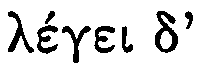
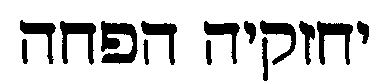
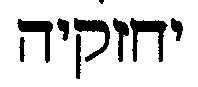
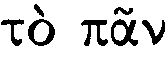
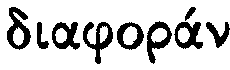
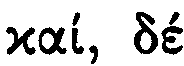
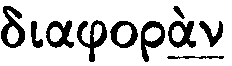
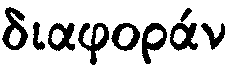
My work on Pseudo-Hecataeus started in the early 1980s as part of a research project on the Jews in Hellenistic literature. The work on the project was facilitated in the years 1981-83 by a fellowship from the Alexander von Humboldt Foundation. Professors Martin Hengel and Wolfgang Schuller, my hosts at the universities of Tübingen and Constance, did everything to provide me with comfortable conditions, and continued to show interest in the progress of my project during the following years. I extend to both my warm thanks. I would also like to thank the Dorot Foundation, New York, and particularly Professor Philip Mayerson of New York University, for financial assistance in the preparation of the manuscript of this book.
Returning to Pseudo-Hecataeus in the last few years, I have incurred pleasant debts to friends and colleagues. I have consulted a number of them about various points: Professors Raphael Freundlich and Ran Zadok of Tel Aviv University; Professor Uriel Rappaport of Haifa University; Professors Adelheid Mette and Bernard Zimmerman of the universities of Münster and Zurich; and especially Professor Louis H. Feldman of Yeshiva University, New York. Mrs. Brigitte Pimpl, of Ratisbonne Institute in Jerusalem, invested much time and effort in editing the bibliography. Professors Doron Mendels and Daniel R. Schwartz of the Hebrew University, Jerusalem, were kind enough to read major parts of the book and comment on them. Dr. Arieh Kindler, director of the Kadman Numismatic Museum in Tel Aviv, is the coauthor of Appendix A. I have benefited from the constructive criticism of Professor Erich S. Gruen, coeditor of the series in which this book appears, and of the anonymous referees for the University of
xii
California Press, who contributed to the improvement of the structure of the book. My thanks go to Mary Lamprech, sponsoring editor for Classics at the University of California Press, and to Paul Psoinos, the copyeditor of this book, for seeing it through to publication with such conscientious devotion and cooperation. I had the good fortune to be able to discuss many a problem with Professor John Glucker of Tel Aviv University, and to gain substantially from his profound, comprehensive knowledge. Finally, my deepest gratitude is due to Mr. Ivor Ludlam of Tel Aviv University, who read thoroughly the whole manuscript more than once and contributed considerably to its improvement.
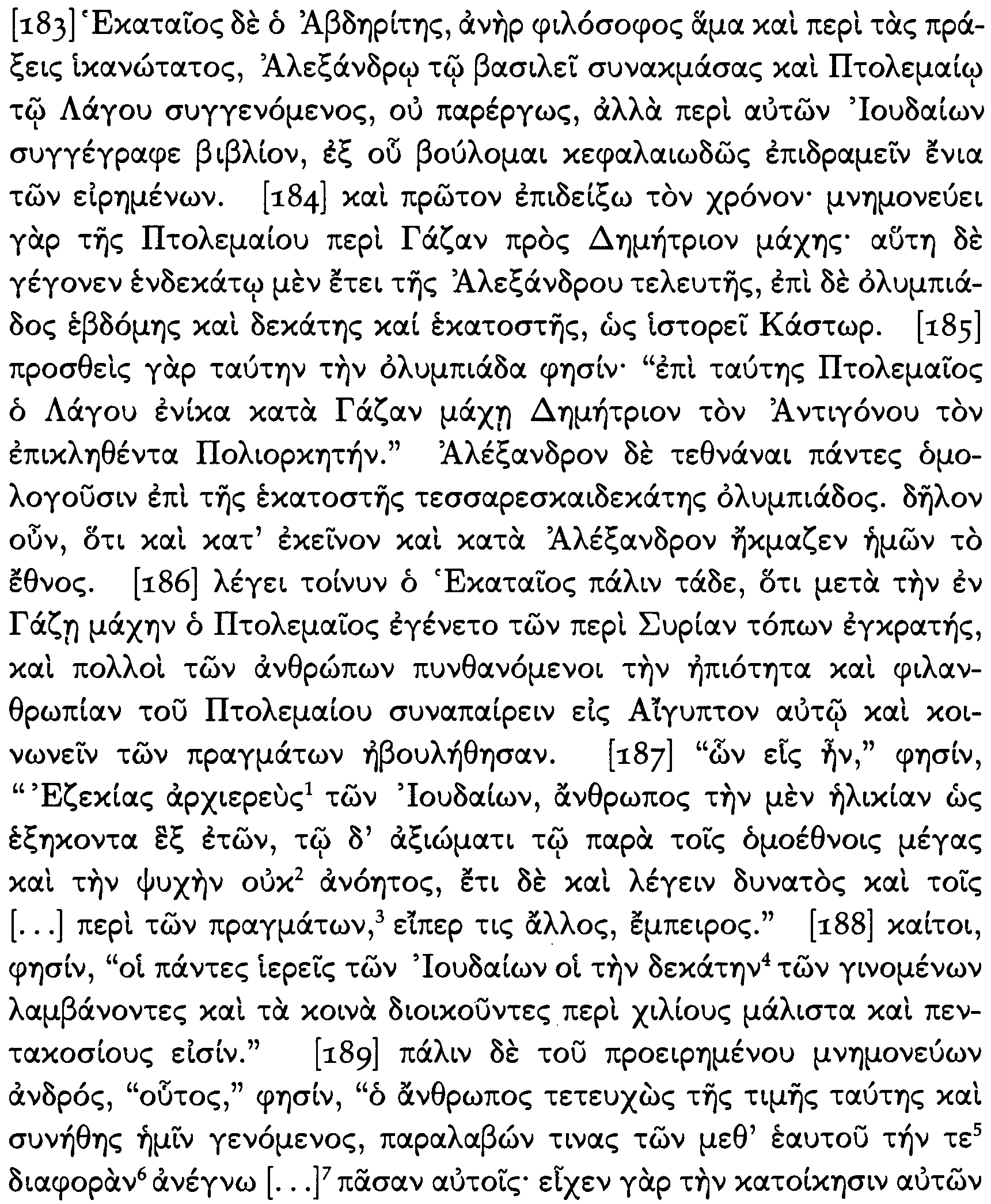
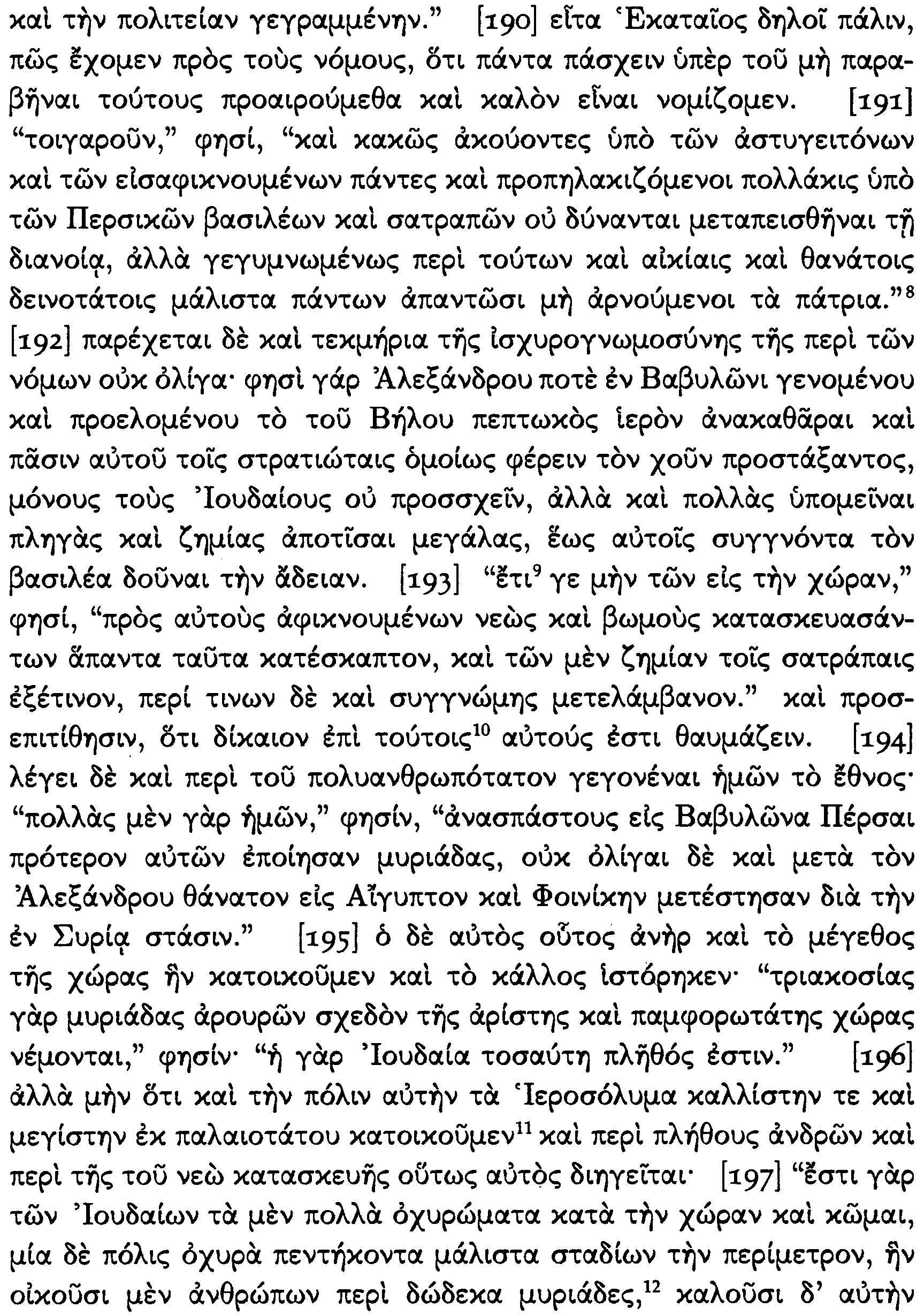
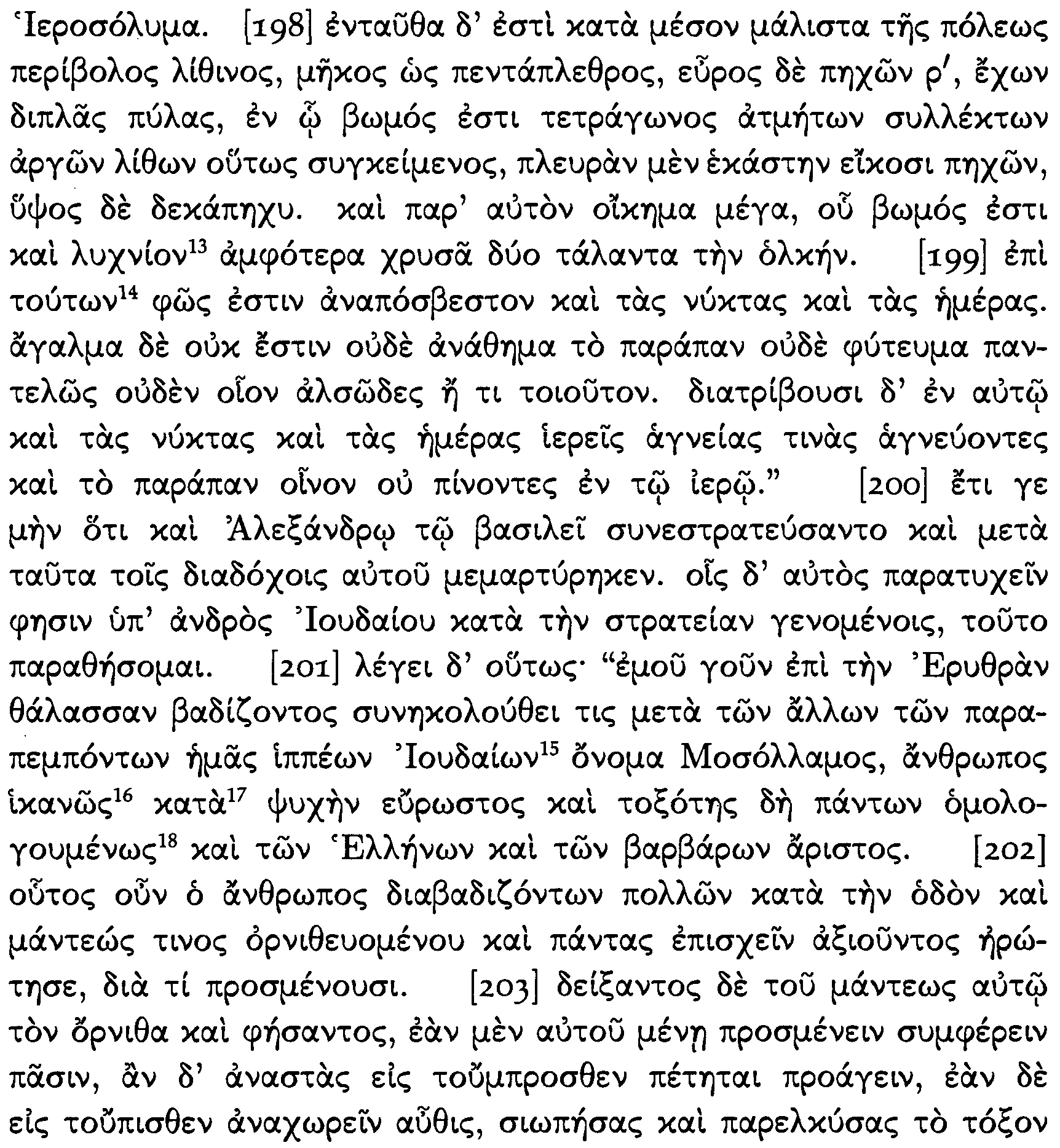
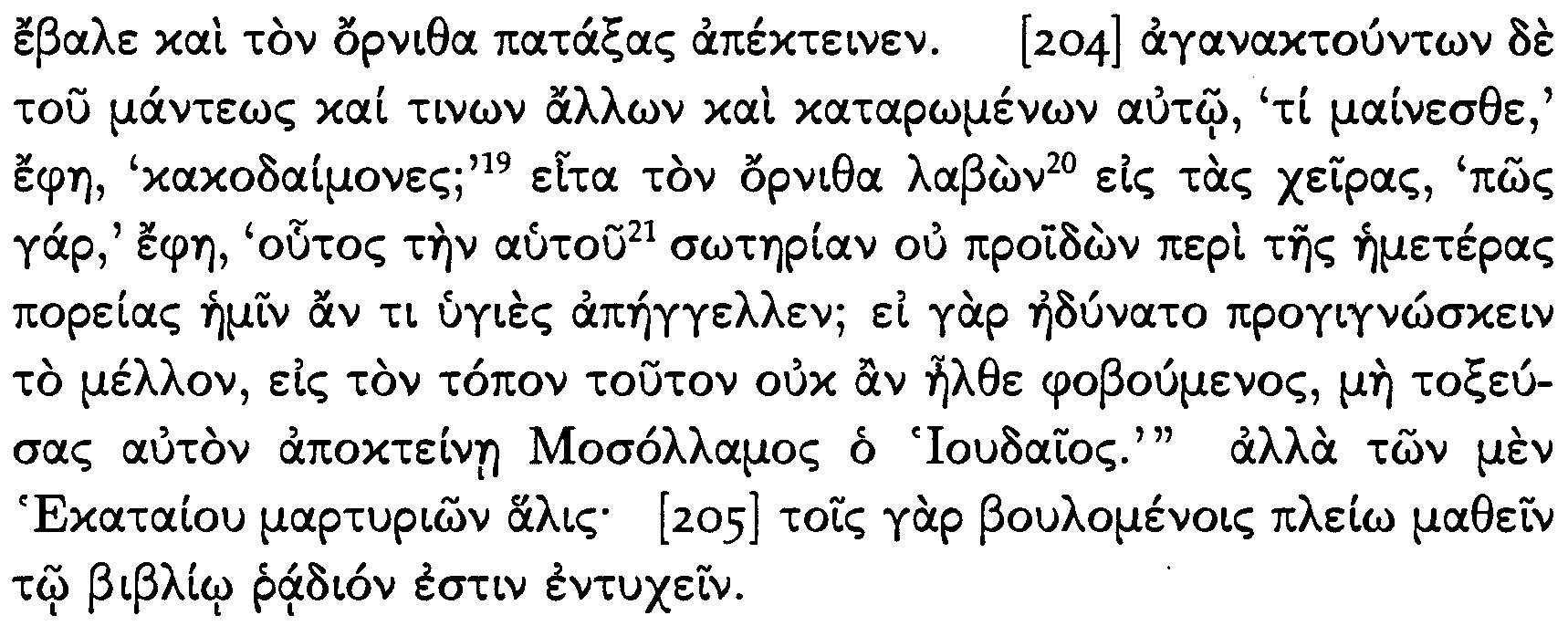
The subject of this study is the treatise On the Jews ascribed to Hecataeus of Abdera, the great ethnographer of the early Hellenistic age. The treatise itself has not survived. All we have are a number of fragments and testimonia in Josephus's celebrated apologetic book Against Apion (I.183-204, II.43). All the passages but one appear in the context of Josephus's polemic against anti-Jewish authors of the Roman period, who argued that the Jews were not mentioned by Greek historians and that they were "newcomers" to the society of nations (Ap . I.2-5). The material was selected by Josephus to prove, on the contrary, that early Hellenistic authors had in fact referred to and even admired the Jews and their religion. He was also trying to show that the Jewish people had already flourished at least as early as the time of Alexander and the Successors (I.185).
Josephus seems to have believed sincerely that the passages he quotes or summarizes were written by Hecataeus. He repeatedly states that he is citing Hecataeus. In two places he explicitly mentions the latter's book on the Jews (I.183, 205), and once he even advises his readers to consult the book for further information, saying that it is "readily available" (I.205). The existence of the treatise was mentioned by Herennius Philo (Origen, C. Cels . I.15), a pagan author of the second century A.D. , who seems to have been directly acquainted with it.1
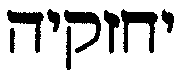
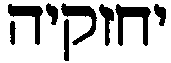
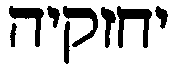
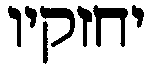
The surviving material describes the history and main characteristics of the Jews. The passages open with a report of a voluntary migration to Egypt of many Jews, led by Hezekiah the High Priest (186-89). This
2
is followed by passages referring to three subjects—(a) religion: the Jews' loyalty and devotion to their religion, their readiness to sacrifice themselves for their faith, and their intolerance toward pagan cults in their country (190-93); (b) the Jewish land and Jerusalem: demographic, military, political, administrative, and geographic information (194-97); (c) the Temple: its location, defense, and construction, sacred objects, and cult (198-99). Josephus closes the quotations with a poignant anecdote about an Egyptian Jewish soldier named Mosollamus and bird omens, which illustrates Jewish disdain for gentile divination (201-4). There is also an abbreviated sentence from On the Jews in Book II of Against Apion (II.43) stating that Alexander annexed the region of Samaria to Judea.2
An enthusiastic tone permeates almost every paragraph of the excerpts and paraphrases. The individual Jews mentioned are wise and competent in various activities (I.187, 201); the Jews of Judea and Egypt are said to have been greatly favored by Alexander and Ptolemy I, and to have enjoyed special rewards (I.186, 189; II.43); the Jews demonstrated supreme courage, endurance, and loyalty in the face of "tortures and horrible deaths" at the hands of the Persians, who tried to force them to renounce their faith (I.191); their country is beautiful and most fertile (I.195); the city of Jerusalem excels in splendor and is well fortified, large, and populous (I.196-97); the Jewish Temple is without any material representation of the divine or anything that might be interpreted as such (I.199); the priests maintain absolute purity and sobriety (I.199). The author even goes so far as to state that the Jews deserved to be admired for destroying pagan altars and temples (I.193). He further recounts with obvious delight how the clever Jew Mosollamus once made a public mockery of gentile principles and practices of divination (I.200-204). The passages neither criticize nor express reservations about the Jewish way of life and religious convictions. The author is evidently convinced of their superiority and perfection.
The treatise On the Jews was not the only monograph on Jewish issues ascribed to Hecataeus of Abdera. Josephus once mentions such a book entitled On Abraham (Ant . I.159). Several lines preserved from this book (Clement, Strom . V.14.113) contain verses pronouncing
3
strong monotheistic and antipagan convictions. The author claims to quote them from Sophocles. They are, of course, nowhere to be found in Sophocles' extant works, and seem typically Jewish. It has therefore been universally accepted that the book On Abraham is a Jewish forgery.3 So in at least one case a Jew evidently tried to promote his ideas and lend them authority and prestige by attributing his work to Hecataeus of Abdera. Hecataeus's reputation and influence, and the famous account of the Jews included in his Egyptian ethnography, could well have tempted Jewish authors to use his name for their pseudonymous compositions.
Hecataeus of Abdera was the leading Alexandrian literary figure at the beginning of the Hellenistic period, and served in the court of Ptolemy I. Of his indisputably authentic writings, we are acquainted only with his monumental ethnography of the Egyptians and the utopian book On the Hyperboreans . The first work set an example for later Hellenistic ethnographers. It has been preserved in an abridged paraphrase by Diodorus Siculus in Book I of his Historical Library .
Hecataeus incorporated into his Egyptian ethnography an excursus on the Jews. The excursus was recorded in another book of Diodorus's historical work (XL.3.1-8). Diodorus explicitly stated that he had drawn on Hecataeus (3.8), and this has rightly been accepted as true. This version of Jewish history and practices was well known in antiquity, but there is no trace of the treatise On the Jews in the gentile literary tradition, except for the reference to it by Philo of Byblos. In the excursus, the attitude toward the Jews is not particularly enthusiastic and even includes one major reservation, characterizing the Jewish way of life as "unsocial to a certain extent, and hostile to strangers" (3.4).4
The evident difference in general tone between the excursus and the treatise, as well as the apparent anachronisms in the latter, made the passages in Josephus a bone of contention for many generations of scholars. The authenticity of the treatise had already been challenged in the Roman period by Philo of Byblos (ca. 50-130 A.D. ). The discussion was renewed at the beginning of the seventeenth century, and Josef
4
Scaliger, the celebrated Dutch philologist, expressed the view that the treatise was spurious.5 In 1730 the German scholar Peter Zorn published a comprehensive book on all the surviving material about Jews and Judaism ascribed to Hecataeus, supporting the authenticity of On the Jews .6 A number of classical scholars and theologians contributed some minor points to the debate from the end of the eighteenth century, being divided over the question of authenticity.7 The controversy heated up in the late nineteenth century. An important landmark was reached in 1900 with a detailed study by Hugo Willrich, who summarized the previous arguments against authenticity and added a number of his own. The discussion has been carried on into our century, with the weight of scholarly opinion shifting from time to time in either direction.8
In 1932 Hans Lewy published a widely acclaimed paper about On the Jews , regarded as a watershed by the advocates of authenticity. His arguments gained support with the discovery in the same year of the first Hezekiah coin.9 Lewy's article was rediscovered in the late 1950s, and gradually tilted the balance. Increasingly; scholars have come out in favor of authenticity, the opponents being reduced to a small (but prominent) minority.10 The inherent difficulties appeared to be
5
satisfactorily solved: as even the most ardent supporters of authenticity have been puzzled by the contents of one or two sentences in the passages, it has been suggested that Josephus inaccurately paraphrased the material at his disposal or that he used a Jewish version that "slightly" revised the original book by Hecataeus.11 At the same time, despite this new trend and the multitude of contributions on the subject, several scholars have recently expressed the feeling that research on the question has not produced a definitive solution and is actually at a stalemate, calling for a new breakthrough.12
Modern questioning of the passages' authenticity seems to have gained momentum because of its relevance to so-called scholarly anti-Semitism. German scholars and publicists in the past stressed the seemingly unbridgeable gap between Judaism and Greco-Roman culture (the paradigm of the deutscher Geist ) as evidence of the inadaptability of Jews to European surroundings. The notorious anti-Jewish excursus on the Jews by Tacitus in his Histories was frequently quoted to this effect.13 Jewish scholars, on the other hand, were eager to point out the apparent admiration for Jews and Judaism expressed by Greek authors at the beginning of the Hellenistic period, of which the passages ascribed to Hecataeus could serve as a primary example. It can be said that with few exceptions, as from the late nineteenth century, Jewish scholars tried very hard indeed to verify the passages, while gentiles, especially Germans, endeavored to undermine their authenticity. Only in the last generation has the discussion been freed of bias, as scholars transcended the barriers of religion and nationality in seeking to reach an objective conclusion.14
6
The question of authenticity is invaluable for reconstructing Jewish history at the end of the Persian and the beginning of the Hellenistic period. The available sources on these periods are extremely meager. Consequently they are among the most obscure chapters in ancient Jewish history. If the authenticity of the treatise is verified, we will have a relatively detailed treatment of these two periods, written by a prominent and reliable contemporary Greek historian who claimed even to have witnessed some of the events described. Such a verification would shatter a number of accepted views about the internal development of the Jewish community and religion and the Jews' relations with the major powers of the time, as well as with their pagan neighbors.15 In addition, much data concerning the beginning of the Jewish Egyptian Diaspora, the High Priesthood, the administration of Judea, and the defense of the country would have to be revised. No less significant are the implications for the evaluation of the attitudes of early Hellenistic intellectuals toward Jews and Judaism and their reception by later authors. If, however, the treatise was a fabrication by an Egyptian Jew, as quite a few scholars maintain, it would provide an insight into some of the basic questions that preoccupied the Jewish Hellenistic Diaspora and expand our acquaintance with its internal division. This would also contribute to our understanding of the major trends and ideologies in Jewish Hellenistic literature.
The discussion of the passages has so far been limited mainly to the historical examination of certain references suspected of being anachronistic. In the present monograph I have tried to combine a historical examination of all the details included in the passages with an analysis of philological, literary, and ideological aspects relevant to the understanding of the original work. A combined study may help to elucidate the question of authorship and the book's political, cultural, and religious background, and its purpose.
Before turning to examine the treatise On the Jews , it would be of advantage to introduce the man Hecataeus, his life and literary work, the genre he specialized in, and, especially, his Jewish excursus. This may help to place the treatise in the right perspective and make it easier to follow arguments and considerations that will be raised in the course of the discussion. The following survey will not try to exhaust all the material and questions involved but will present only information relevant to the subject of this monograph.
Our knowledge about Hecataeus's life is rather patchy. From the few testimonia, the following résumé can be drawn:1 Hecataeus was born in Abdera, a prosperous Greek colony on the Thracian coast, around the middle of the fourth century. He reached maturity, and perhaps already had some reputation, by the time of Alexander the Great. In these years he seems to have received good philosophical training. In
8
the period of the Successors Hecataeus was occupied in the service of Ptolemy I. His precise position in the court was not recorded. It can only be said that he was close to the satrap-king, took part in military expeditions, and went on diplomatic missions abroad.2 At least one of his works, the Egyptian ethnography, served, in its special way, political goals of Ptolemy I.3
The ancient sources describe Hecataeus as a "philosopher" and critical grammatikos , and refer to his ethnographical works as "history."4 Diogenes Laertius, the biographer-compiler of the Greek philosophers, lists Hecataeus among the people who were taught by Pyrrho and includes him among the "Pyrrhoneans" (IX.69). However, it is doubtful whether Hecataeus was indeed Pyrrho's disciple, or that he adhered to his teaching.5 Another testimonium mentions him as one of the
9
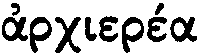
"Abderites," between Democritus and Apollodorus of Cyzicus (Clem. Strom . II.130.4), which inspired some speculations about Hecataeus's philosophical conceptions.6 No name of a philosophical work by him is known, but there is little doubt that he indeed wrote philosophical works.7 The situation with his contribution as a "grammarian" is not much different: we know that he wrote two books, on Homer and Hesiod (Suda , s.v.
), but nothing of them has survived.
Hecataeus's major contribution was his ethnographical work. It was called history because in antiquity there was no generic name for this sort of writing, and it was included in the framework of history.8 We know of two monographs: an Egyptian ethnography named On the Egyptians (
) or Egyptian Matters (
),9 and another on the legendary Hyperboreans (On the Hyperboreans ). A review of Hellenistic ethnographical literature indicates that Hecataeus's achievements in his monographs were used as a model for imitation by later ethnographers.10 This applies also to
10
later ethnographic accounts on the Jews.11 In order to understand the importance of Hecataeus as an ethnographer, we have to preface here a brief survey of the genre.12
Although it did not have a generic name, there is no doubt that Greek ethnographical writing was a genre in its own right, with definite structure, rules, and purposes. Its beginning in the sixth century is connected with Greek colonization and the advance of the Persian empire, which raised the interest of the Hellenes in the surrounding world. Hecataeus of Miletus is regarded as the father of ethnography. His Periegesis , a geographical tour or survey around the Mediterranean, included a number of geographical accounts of the peoples of these countries. It seems that ethnographical writing at that time was not limited to excursuses in works belonging to other genres. There is some information about monographs by Hellanicus of Lesbos and Charon of Lampsacus that may have been predominantly ethnographic.13
The features of the new genre can be defined according to the ethnographical excursuses of Herodotus, especially the comprehensive accounts on the Egyptians and the Scythians. They were composed of the following sections:14 (a) origo-archaeologia , the beginning of the nation; (b) geography; (c) customs; and (d) history. The origo-archaeologia described the descent of the people concerned either from their autochthonous beginnings or with their migration, and their early life as a nation. The geography referred to borders, rivers, fertility of soil, flora, and fauna, and elaborated on, among other things, thaumasia (marvels and curiosities). The customs section was the most important, and was designed to present the main features of the nation. Attention was given to beliefs and cult, social structure, institutions, and everyday practices. The last section, history, included mainly dynastic records with stories of the major achievements of outstanding rulers, usually concerning monumental buildings and successful military expeditions.
11
The ethnography of the classical period can be described as nonscientific, resembling Herodotus's historiographical methods: unselective accumulation of material, without an attempt to arrive at the factual truth. There is no causal connection between the various sections of the ethnography or between the details in each section, and there is no reasoning to the mass of material. The sources of information were personal impressions of the author (who in some cases visited the countries described and interviewed local people), together with rumors and hearsay, tourist reports, and references in previous Greek literature. No use was made, directly or indirectly, of the literature or written records of foreign nations.
The first ethnographers did not write their works in the service of rulers or cities. They were, by and large, travelers, amateur geographers, seamen, merchants, or historians who had a keen interest in foreign countries and their inhabitants, and wrote at leisure. Their geographical horizon was limited to neighboring countries and the main divisions of the Persian empire. No clear ideology or pragmatic purpose is visible in these accounts. It can be said that they were basically written to satisfy the curiosity of Greeks who came across foreigners or heard about them. The rise of the genre just at the end of the age of colonization and the rather general character of the accounts rule out the possibility that Greek ethnography was initially meant as a guide to planned colonizations. In the case of excursuses incorporated in works belonging to another genre such as history or geography, the ethnographical accounts were introduced as a necessary preface to historical events or geographical descriptions relating to the nation concerned. They also had a literary role—to diversify the writing and provide some relief in the course of a long and monotonous narrative.
A new impetus in the development of the ethnographical genre naturally arose with the conquests of Alexander and Greco-Macedonian settlement in the newly occupied countries.15 Interest in foreign nations grew immensely, and increased knowledge carried with it practical implications. The authors were no longer residents of the old Greek world, and in many cases lived in the countries they described. They could, therefore, consult local written sources, thoroughly interview people of
12
all ranks of society, and gain firsthand acquaintance and understanding of the subjects referred to. Unlike their predecessors, Hellenistic ethnographers were personally involved with their subject, had definite didactic purposes in presenting their material, and frequently served Greco-Macedonian rulers. Consequently the new writing was no longer a casual accumulation of material arranged into schematized thematic rubrics: its information was carefully selected to fit with Greek literary models, or with premeditated political purposes or philosophical conceptions, or both. The information was not left unprocessed: it received some Greek touches and coloring, and reasoning was provided for the facts. The explanations often disclose the purposes of the writers; in other cases they were just borrowed from Greek tradition. As a result of all these, the final picture may have deviated considerably from the historical truth. By and large, the genre can be described as an interpretatio Graeca of the Orient. The more an author adhered to premeditated purposes, the more he departed from the original information. In some cases the outcome was an odd mixture of realism with sheer fantasy.
As far as the structure is concerned, there was no change in the basic scheme of ethnographical works: the same sections appear in Hellenistic ethnographical monographs and excursuses as in their classical counterparts, although in certain cases one or two sections may be missing. However, in contrast to the old ethnography, the various sections did not remain isolated from each other. Authors stress the causal connection between them: customs result from the special circumstances and conditions of the origo, or the geography, or both; and history arises from all these. The various subjects in each section are also connected by causal reasoning. As a result, there is more flexibility in the order and sequence of the traditional four sections of the ethnographical work.
The philosophical and political character prevailing in many works of the new ethnography motivated the rise of a subgenre, the utopian ethnography. Utopian features in Greek literature were as old as Homer, and were integrated in various genres.16 Undertaking to describe remote or legendary peoples, utopian ethnographies were planned and constructed according to the rules of Hellenistic ethnography; but the material was entirely fictitious, designed to illustrate an ideal, nonexistent society. The best-known example is Euhemerus's utopia about the
13
Panchaeans, set on an imaginary island in the Indian Ocean. It included the celebrated Euhemerist religious conception, according to which the gods were actually deified kings and heroes of the past. Less well known is that this idea was expressed earlier by Hecataeus of Abdera with regard to "terrestrial" gods in his Egyptian ethnography (Diod. I.13ff.).17
We can now turn again to Hecataeus of Abdera.18 The general scheme of his works will be discussed below in Chapter VI.3.19 It will be shown that Hecataeus followed the basic scheme of his Greek predecessors. However, apart from this structural similarity, all other features differed substantially, marking a new phase in the development of the genre. There is an obvious expansion of scope. Hecataeus increased the sources of information, the geographical horizon, and the types of the genre, and expanded its literary framework. He consulted, directly or indirectly, old Egyptian writings (Diod. 1.69.7, 96.2) and had access to a variety of oral sources. He wrote two comprehensive monographs, one on the Egyptians, the other on the Hyperboreans. The first described the nation among whom he was residing; the second, legendary people imagined to live on the northern outskirts of the inhabited world. The first work was an idealized version of Egyptian history, institutions, and way of life; the second, an imaginary utopia. In addition to monographs, Hecataeus wrote miniature ethnographies of nations believed to have originated from Egypt. These were incorporated as excursuses in the Egyptian ethnography. The nations described were neighboring peoples such as the Jews, or the Babylonians (whose country was then the center of the rising Seleucid empire), and even Hellenic tribes or cities, such as Athens (Diod. I.28-29).
The great contributions of Hecataeus, however, to the development of the genre were the selection of material according to Greek literary and ideological conceptions, the creation of a causal connection between
14
the sections of the work and between the subjects within each section, and the reasoning provided for many statements. Thus, for instance, in the case of an emigrating nation, its experiences in the country of origin and the circumstances of its emigration would influence its everyday life, institutions, language, and attitude toward other nations. The life, history, and character of autochthonous peoples would be dictated, to a great extent, by geography, especially soil, water, climate, and fauna. Cult and beliefs, which were referred to without comment by earlier ethnographers, received rational explanations. Even the notorious Egyptian animal cult was given a detailed rationalization, pointing out the benefits brought by the animals to the Egyptians (Diod. I.86ff.). The like applies to other subjects. The reasoning often drew on Greek experience and thinking. In this respect Hecataeus's ethnography may appear to strive for scientific presentation, but the selection of the material, its coloring, and its reasoning were not necessarily guided by a wish to record absolute historical truth.
This loss to political history and ethnography was a gain for the history of ideas. It would be rather speculative to reconstruct the utopian model envisaged by Hecataeus in his Hyperborean ethnography. The scant surviving material allows only a few conclusions with regard to Hecataeus's religious stance. He seems to have adhered to the traditional cult of classical Greece and was evidently highly tolerant.
The state of preservation of the Egyptian ethnography is much better Apart from some fragments and testimonia,20 its contents are to be found in Book I of Diodorus's Historical Library , which is devoted to Egyptian ethnography. Following the studies of Eduard Schwartz and Felix Jacoby it has been accepted that Book I of Diodorus (from I.10 onward) is basically an abbreviated paraphrase of Hecataeus's Egyptian ethnography, though it also contains a long section taken from Agatharcides of Cnidus (the description of the Nile, I.32-41) as well as notes and additions by Diodorus himself.21 This conclusion has been challenged from time to time; arguments have been raised against the attribution of certain passages to Hecataeus, and there have also
15
been those who have tried to minimize Hecataeus's share in Diodorus's version.22 These attempts have been rightly refuted, and one has to note especially the contribution of Oswyn Murray, who reestablished the old, accepted theory.23
The dating of Hecataeus's Egyptian ethnography has been disputed. While some have suggested the early years of Ptolemy's independent satrapy (320-315) others have preferred the first years of his monarchy (306/5-300).24 The arguments in favor of the first possibility are not decisive. On the other hand the year 306/5 as a terminus post quem appears from the introduction to the account of the borders of Egypt (Diod. I.30.1):
Egypt lies mainly toward the south, and, in natural strength and beauty of land, seems to excel those places that have been separated off [each] into a kingdom.
A comparison is obviously being made with the regions occupied by the other satraps who declared themselves kings after the naval battle of Cyprian Salamis in 306. Given the general context, an account of pharaonic Egypt, the sentence seems to have been written by a contemporary of the Successors, and certainly not by Diodorus, in the days of Augustus. It stands in fact at the head of two definitely Hecataean chapters (30-31.8),25 and this would appear to clinch the argument. The year 302/1 (not 300) as terminus ante quem is suggested by the unbiased attitude toward Jews and Judaism manifested in the Jewish excursus incorporated in the Egyptian ethnography:26 after the confrontation between Ptolemy I and the Jews in that year, the subsequent harsh treatment of the population, the banishment of scores
16
of thousands to Egypt, and the sale of many into slavery,27 a positive account of the Jews without any reference to these developments is hardly to be expected of an author serving in the court.
The very writing of the work and its main message were dictated by the circumstances of the hour: the official end of provincial rule and the establishment of new kingdoms in oriental countries with long monarchic traditions. Ptolemy saw himself as the successor of the pharaohs, a legitimate king of the Egyptians. The predominant feature of the Egyptian ethnography was, therefore, the glorification of Egypt. The country is described as the land of human origins, the cradle of civilization, and of wisdom. Useful inventions such as fire, agriculture, language, and writing, as well as most of the arts, originated on Egyptian soil (I.13ff., 69.5-6). Many nations came from Egypt and were deeply influenced by its culture. The most outstanding of these were the Greeks (including the Athenians) and the Babylonians (I.28-29). Mythical cult figures, lawgivers, poets, and philosophers, such as Orpheus, Musaeus, Solon, Lycurgus, Homer, Protagoras, Democritus, and Plato, visited Egypt, explored its laws and institutions, and drew substantially from them (I.69.3-4, 96ff.). Pharaonic rule appears as a law-abiding monarchy, guided by priests, with the king maintaining virtues like justice, magnanimity, and piety (I.70-71, 73.4). The Egyptian judicial system and its procedures are said to have been planned in a way that facilitated reaching the absolute truth with the utmost objectivity (I.75ff.). Egyptian gods are equated with Greek ones and rationalized: two are explained as representing the great celestial bodies; five others, the basic elements (fire, spirit, etc.); and the rest, renowned mortal heroes and inventors of the past. The rehabilitation of practices deplored by Greeks included not only animal cult (I.86-90) but also incest (I.27.1-2). These were toned down and given rational explanations that made them acceptable to Greek ears.
The tribute paid to the greatness of Egypt was meant to help in establishing the image of the Ptolemaic regime. It raised the prestige of Ptolemy, the new king of this great, old civilization, in the eyes of Greco-Macedonians living under other Hellenistic rulers. This in turn helped to attract to Egypt competent European manpower and the intellectual elite of the Greek world. As for the Greco-Macedonians settled in
17
Egypt, the enthusiastic account of the pharaonic past brought home the royal policy of respecting Egyptian traditions, including superstitions, in order to avoid ugly confrontations with the natives and their strong priesthood.28 It has been suggested that the work was also intended to flatter the Egyptians themselves. This is quite doubtful: the language barrier was still too high at the end of the fourth century to expect the book to circulate among Egyptians, let alone influence them. Moreover, the glorification of the pharaonic past could have sparked off Egyptian nationalism, and the recurring references to the role of the priests as advisers of the king would only have encouraged the Egyptian priests not to be content with their religious duties. Other suggestions offered for the purpose of the book, such as to establish a general model of government and society for the developing Hellenistic world, or to present an idealized version of the Ptolemaic regime, do not stand up to criticism.29 The role of the priests is not the only feature refuting these suggestions. Various points in the book have evident didactic purposes, but they do not carry its main message.
It would take us far afield to refer to every thematic aspect of this fascinating ethnography. It is a mine of theological, philosophical, political, and social ideas. I shall restrict myself to noting a number of points that have some relevance to an understanding of the Jewish excursus:
1. The information is based by and large on Egyptian priestly oral and written sources.30
2. In certain cases it reflects not historical facts but ideals circulating among those priests.31
18
3. The interpretation of the facts is Hecataean, and is inspired by Greek tradition and modes of thinking, apart from a few cases where the author explicitly says that an explanation is Egyptian.
4. The interpretation is frequently complimentary, and apologetic in some cases. It includes explicit expressions of praise. The tendency to idealize is evident.
5. The author himself divides the customs recorded in the book into two categories: "extremely strange [paradoxotata ] customs," and those that might be "most useful" to the reader (I.69.2; cf. 30.4). He introduces customs of the first type in order to provide reasoning for well-known curiosities and to arouse interest in others. The "useful" customs are brought in to serve as models for imitation, to point out their superiority over existing Greek practices, or just for the sake of comparison.32
6. Despite his desire to present an appealing, favorable picture of Egyptian life, Hecataeus does not refrain from expressing reservations about Egyptian hostility toward strangers, although he tries to "soften" it (Diod. I.67.10-11, 69.4, 88.5)
Hecataeus's Jewish excursus was much discussed in the last century. Being actually the first comprehensive account of Jews and Judaism in Greek literature, it was used by later gentile authors as a basic source of information on the subject. Some features of this account, especially the attribution to Moses of the settlement in Judea and the establishment of basic Jewish institutions and practices, became a vulgate in Greco-Roman literature.33 In the present monograph, a review of the excursus and its problems is relevant not only to the question of the authenticity of On the Jews , but also to the shaping of one of its sections. Be that treatise a forgery or not, its author was certainly acquainted with the excursus.
Like his major works, Hecataeus's original ethnographic account on Jews and Judaism has not been preserved. Diodorus incorporated an abbreviated paraphrase of it in Book XL of the Historical Library
19
(3.1-8), which is itself now lost, but his version of Hecataeus's Jewish ethnography is preserved by Photius, the Byzantine patriarch of the ninth century. Photius attacks Diodorus for "telling lies" about the Jews. To illustrate this accusation, he cites two extracts. The first is a story about the siege of Jerusalem by Antiochus VII Sidetes (in 134 or 132 B.C. ) and the anti-Jewish libels and accusations voiced on that occasion by the king's advisers (cod. 244, 379a-380a = Diod. XXXIV-XXXV.1.1-5). Then comes the Jewish ethnography. The text of Photius runs as follows (cod. 244, 380a-381a):
From the fortieth book [of Diodorus], about the middle:34
[3.1] Now that we intend to record the war against the Jews, we consider it appropriate to give first an outline [
] of the foundation [ktisis ] from its beginning, and of the customs [nomima ] practiced among them.
When in ancient times a pestilence arose in Egypt, the ordinary people ascribed their troubles to the working of a divine power [
]; for indeed with many strangers of all sorts dwelling in their midst and practicing different habits of rites and sacrifice, their own traditional observances in honor of the gods had fallen into disuse. [3.2] Hence the natives of the land surmised that unless they removed the foreigners, their troubles would never be resolved. At once, therefore, the aliens were driven from the country, and the most outstanding [
] and active among them banded together and, as some say, were cast ashore in Greece and certain other regions; their leaders were notable men, chief among them being Danaus and Cadmus. But the greater number were driven into what is now called Judea, which is not far distant from Egypt and was at that time utterly desolate [
]. [3.3] The colony [apoikia ] was headed by a man called Moses, outstanding both for his wisdom and courage. On taking possession of the land, he founded [
], besides other cities, one that is now the most renowned of all, called Jerusalem. In addition he established the temple that they hold in chief veneration, instituted their forms of worship and ritual, drew up the laws relating to their political institutions, and ordered [
] them. He also divided the people into twelve tribes, since this is regarded as the most perfect number and corresponds to the number of months that make up a year [3.4] But he had no images whatsoever of the Gods made for them, being of the opinion that God
20
is not in human form [
]; rather the heaven that encompasses [
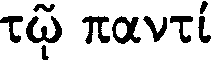
] the Earth is alone divine, and rules everything [
]. The sacrifices that he established differ from those of other nations, as does their way of living, for as a result of their own expulsion [
] from Egypt he introduced a [way of] life which is somewhat unsocial and hostile to strangers [
]. He picked out the men of most refinement and with the greatest ability to head the entire nation, and appointed them priests; and he ordained that they should occupy themselves with the temple and the honors and sacrifices offered to their God. [3.5] These same men he appointed to be judges in all major disputes, and entrusted to them the guardianship [
] of the laws and customs. For this reason the Jews never [
] have a king, and the leadership [
] of the multitude [
] is regularly vested in whichever priest is regarded as superior to his colleagues in wisdom and virtue. They call this man high priest [
], and believe that he acts as a messenger [
] to them of God's commandments. [3.6] It is he, they say, who in their assemblies and other gatherings announces what is ordained, and the Jews are so docile in such matters that straightway they fall to the ground and do reverence [
] to the high priest when he expounds the commandments to them. There is even appended to the laws, at the end, the statement: "These are the words that Moses heard from God and declares unto the Jews." Their lawgiver was careful also to make provision for warfare, and required the young men to cultivate manliness, steadfastness, and, generally, the endurance of every hardship. [3.7] He led out military expeditions against the neighbouring tribes, and after annexing much land apportioned it out, assigning equal allotments to private citizens and greater ones to the priests in order that they, by virtue of receiving more ample revenues, might be undistracted and apply themselves continually to the worship of God. The common people were forbidden to sell their individual plots [
], lest there be some who for their own advantage should buy them up, and by oppressing the poorer classes bring on a scarcity of manpower [
]. [3.8] He required those who dwelt in the land to rear their children, and since offspring could be cared for at little cost, the Jews were from the start a populous nation. As to marriage and the burial of the dead, he saw to it that their customs should differ widely from those of other men.35 But later, when they became subject to foreign rule, as a result of their mingling with men of other nations—both under Persian rule and
21
under that of the Macedonians who overthrew the Persians—many of their traditional practices were disturbed.36
So he [Diodorus] says also here about customs and laws common among Jews, and about the departure of those same people from Egypt, and about the holy Moses, telling lies about most things, and going through the [possible] counter arguments, he again distorted the truth, and using cunning devices as a refuge for himself, he attributes to another [author] the abovesaid things which are contrary to history. For he [Diodorus] adds: "As concerns the Jews, this is what Hecataeus of Miletus narrated."37
First of all, some comments on the transmission of the text, its preservation, and its original location. Photius explicitly says that the extract was taken from Diodorus's fortieth book. In view of his declared purpose to expose Diodorus's "lies" and considering the typically Diodorean style and turn of phrase, it has rightly been assumed that Photius faithfully transmitted the text of Diodorus.38 As noted by Diodorus at the head of the extract (3.1), he incorporated the excursus on the Jews at that point to serve as an introduction to his account of the confrontation between the Romans and the Jews, that is, the events surrounding the Roman occupation of Judea in the year 63 B.C. It followed the appeal alleged to have been made by a Jewish delegation to Pompey to dispose of the Hasmonean rulers and restore the Jewish "ancestral constitution" (XL.1a). The extract indeed provides background material for this claim: it elaborates on a Jewish patrios politeia , stressing its theocratic character and categorically stating that the Jews "never have a king."39 The excursus also deals with the military preparation of
22
the younger generation for war, the motivation of the Jewish farmers to fight, and their abundance of manpower, which obviously are relevant for the coming military confrontation.
Diodorus's extract closes with the statement "this is what Hecataeus of Miletus narrated." "Miletus" instead of "Abdera" is certainly a slip of Photius or a copyist.40 The original ethnography by Hecataeus was not an independent monograph, but an excursus. It was included in his great ethnographical work on Egypt, most probably as an appendix at the end of the origo-archaeologia section, the first of the four sections of the Ae-gyptiaca (Diod. I.28-29).41 The Jewish excursus was just one of a number of miniature ethnographies of nations, tribes, and cities supposed to have originated from Egypt that were treated in the same context.
Diodorus states in the preface to the excursus that he intends to report on the "founding" (ktisis ) and "customs" (nomima ) of the Jews. The excursus indeed contains these two sections; it opens with the founding, namely the origo : the expulsion of the Jews together with other aliens (XL.3.1-2), the settlement of the Jews in Judea and Jerusalem under the leadership of Moses (2-3), and the establishment of political and religious institutions (3). Then follows the section on customs: Jewish faith (4), sacrifices (4), attitude toward strangers (4), the duties of the priests (4-5), the role of the High Priest and his authority (5-6), the organization of the army and military expeditions (6-7), the distribution of land (7-8), child rearing and demography (8), marriage and burial (8).
These were also the components of Hecataeus's original excursus. It included only ktisis and nomima , without geographical and historical sections, which were common in Greek ethnographies. These sections were also absent from the other minor ethnographies in the appendix to the Egyptian archaeologia-origo . Hecataeus was primarily concerned in that context to illustrate the origin of certain nations in Egypt, with the evidence of Egyptian influences on their customs to prove it. Geography and history of the new lands would have been quite out of place.42
23
At the same time, it is clear that the original content of the nomima section was not preserved by Diodorus in its entirety:43 the account of the daily customs was omitted. This is evident with regard to circumcision (Diod. 1.28.2), sacrifice (XL.3.4),44 and marriage and burial customs (XL.3.8),45 and may also have happened to explicit references about Jewish exclusiveness (XL.3.4). The first four were omitted because they could not contribute to the aforementioned purposes for which the excursus was incorporated. Illustrations of the Jewish attitude toward strangers were left out, probably because they were very moderate in comparison with the sharp accusations and libels quoted by Diodorus from another source in a previous book (XXXIV-XXXV.1.1-3). Left in the nomima section are statements about Jewish institutions and remarks pertaining to Jewish military potential (training, motivation, manpower).46 The account of Jewish belief was recorded not only because of its uniqueness, but chiefly owing to its relevance for understanding the Jewish theocratical system of government as described by the delegation to Pompey.
Hecataeus's original excursus thus opened with the origo , in this case the alleged expulsion of Jews from Egypt. Then came the nomima section, which seems to have comprised two main subjects: institutions and provisions made by Moses, and a collection of daily customs. As became customary in the new, Hellenistic, ethnography, the author uses one section to explain another. Here he stresses the influence of the origo on the creation and development of Jewish customs. The expulsion explains the "hatred of strangers" (XL.3.4). Daily customs
24
are compared with those of the Egyptians, with some, like circumcision, being described as originating in Egypt (1.28.3). Others, like marriage and burial customs, were contrasted with those of the Egyptians.47 Jewish beliefs, governmental institutions, and social provisions were not just listed but were given a causal reasoning.
Apart from the omission of the customs mentioned above, the references to the Jewish origo and nomima seem to represent the contents of the original text. In three cases there is a striking similarity between the excursus and references to Egyptians and Jews in Hecataeus's Aegyptiaca .48 They indicate that even if some of the statements and explanations were abbreviated by Diodorus, the original meaning was not distorted. Significantly, Diodorus was not tempted by the vicious libels about Jewish origins and attitude toward strangers included elsewhere in his work (XXXIV-XXXV.1.1-4), nor by his own prejudice (XL.2.2, "lawless behavior of the Jews"): the Jews are not described as lepers, and the reason given for their expulsion is not in-suiting; the reference to Jewish hostility toward strangers expresses just some reservation. These passages certainly reflect the original Hecataean text.
The question whether Diodorus adhered to Hecataeus's vocabulary and syntax is more problematic. It can only be said that there is much of the Diodorean style in the excursus.49 One sentence, however, is clearly an addition by Diodorus: it is agreed that the statement "but later, when they became subject to foreign rule, ... many of their traditional practices were disturbed" (XL.3.8) could not have been written by Hecataeus. It records changes in the Hasmonean period and is connected with the alleged complaints of the Jewish notables to Pompey. The reference to the "rule ... of the Macedonians who overthrew the Persians" indicates that it was written long after the end of Macedonian rule in Judea. A similar note was supplemented by Diodorus at the end of his epitome of Hecataeus's Egyptian ethnography (I.95.6).
25
The contents of the excursus raise a number of questions that have continually attracted the attention of scholars.50 Did Hecataeus have real knowledge about Jewish antiquities? What were his sources of information? What were Hecataeus's guidelines in selecting the material? Does the account reflect Jewish life in the period of Hecataeus? To what extent was the account inspired by Greek practices, conceptions, and literary traditions? Does the excursus carry certain messages or didactic purposes? Did Hecataeus intend to idealize the life of the Jewish people or certain customs? How should Hecataeus's note about Jewish separatism and "hatred of strangers" be understood? Is it complimentary, or does it express reservation? And finally: what was, after all, Hecataeus's basic attitude toward Jews and Judaism? All these questions are relevant, in one way or another, to various points in the discussion on the treatise On the Jews . However, as they cannot decide the major issues,51 and the purpose of this chapter is simply to introduce the reader to Hecataeus's work and references to the Jews, I shall refrain from examining in detail the numerous suggestions offered so far concerning these and related questions, and shall not attempt to exhaust all the points involved. The following discussion will try to sort out and define the significant problems, survey the relevant source material, and present what seem to me to be the right solutions. Of most interest to us will be the process by which the excursus was composed, and the considerations behind the selection, arrangement, and shaping of the material.
Do the accounts of the Jewish origo and nomima accord with Jewish tradition and history? At first sight the answer is firmly negative. Almost every clause, as it stands, can easily be refuted or found inaccurate. This, however, is a hasty conclusion. One has to distinguish
26
between the facts and their reasoning. The explanations were provided by Hecataeus himself, and are typically Greek. The facts, except one or two, are based on Jewish tradition and history. What is mistaken is the dating and sequence. Hecataeus conflates three periods of Jewish history: (a) the time of the Exodus and the wandering in the desert; (b) the period of the settlement in Canaan; and (c) the Restoration, the Persian rule, and the days of the Diadochs. The three periods are telescoped into one, under the leadership of Moses, the founder. The account fails to distinguish between periods and stages of development, and ignores other long periods. Such telescoping, centering around the personality of the "founder" (ktistes , oikistes ), was quite common in Greek foundation legends and stories relating to the age of colonization, and even to later colonization activities.52 Events and developments that occurred during long periods, under different individuals, were conflated into one period and attributed to one person, the leader-founder.53 We shall see later that both the collection and the arrangement of the material were indeed strongly influenced by Greek foundation legends. The Judea portrayed is consequently not historical but mythological. It is difficult to know whether Hecataeus had consciously ignored the real sequence, or whether he had received the information sporadically and unsystematically, and presented it the way Greeks were accustomed to record foundation stories.
Disregarding inaccuracies that result from the conflation and the tendency to attribute everything to Moses, the following data reflect the tradition (as distinct from history) about Moses and his period: the Jews were once aliens in Egypt (Diod. XL.3.2); Moses was their leader and great lawgiver (3); they were divided into twelve tribes (3); their cult avoided images and sculptures (4); they believed in the divine origin of the law (5-6; cf. 1.94.2); the High Priest and priests were in charge of
27
sacrifices and cult (XL.3.4), and were appointed to handle major judicial cases (5; cf. Deut. 17.8-12); the Jews reared their children, and therefore were from the beginning a "populous nation" (Diod. XL.3.8; cf. Exod. 1.7, 11). There is even a paraphrased quotation of a formula that recurs in the Pentateuch (Diod. XL.3.6).54 The second period provided the following data: the Jews settled in their country (3); they went to war against their neighbors and annexed lands (7). The statements that the lots were evenly distributed and were inalienable (7) also have biblical parallels.55
Other data and features recall Jewish life and institutions after the Babylonian exile and in the days of Hecataeus:56 Jews were concentrated in Judea and Jerusalem (3); the Jewish deity was named "Heaven" (4);57 the High Priest was the leader of the nation (5-6); the priests were, in addition to their cult duties, guides and guardians of the Torah (4-5);58 there was no king (5); the Temple stood at the center of Jewish life (3, 5-6); the congregation was occasionally assembled in Jerusalem, and the Pentateuch was then publicly read by priests (5-6; cf. Neh. 8.1-8); the kneeling before the High Priest may be an inaccurate reflection of the practice to fall upon the ground and bow before the Lord on such occasions (Neh. 8.6);59 the belief that the High Priest is a "messenger of
28
God" (Diod. XL.3.5) is identical to a statement by the prophet Malachi, referring to the "priest" (Mal. 2.7);60 certain priestly families seem to possess great estates, which may account for the statement that the priests were allotted greater lots than common people (Diod. XL.3.7);61 the stress laid on the inalienability of lands may record a tightening-up of the Torah restrictions on selling lands, a likely feature of Nehemiah's social reform;62 in addition to the Exodus traditions, the reference to the rearing of children may also record the situation in a Judea small at that time, and apparently overpopulated.63
These pieces of information were certainly provided by Egyptian Jews, probably of priestly descent.64 Given such sources, what is the reason for the absence of any reference to the period of the Israelite and Judean kings (and the statement that "the Jews never have a king," 3.5)? Hecataeus, who served an absolute ruler and illustrated an ideal monarchy in the Aegyptiaca , had no motive for concealing that major period of Jewish history. The reason seems to be structural and literary: as was already mentioned, the Jewish excursus, like other miniature ethnographies incorporated in the same context, was planned to include just the origo and contemporary customs. It stands to reason that in interviewing his Jewish informants, Hecataeus was interested in collecting material for these sections alone. Consequently he was not informed about (or did not take notes about) matters relating to a historical section. The period of the Israelite and Judean kingdoms, as well as the Babylonian exile, had no place in the excursus. Summing up the implications of the account for the Jewish governmental system, it occurred to Hecataeus that the "Jews never have a king."
In addition to the Jewish informants, the use of Egyptian sources, oral or written, is evident in the statement concerning the expulsion of the Jews from Egypt.65 Hecataeus seems to have preferred a moderate
29
version of the expulsion story,66 and perhaps even to have "softened" it: to judge from other sources, the Egyptian versions related that the Jews were banished because they suffered from pestilence—leprosy and other diseases—or that they were loathed by the Egyptian gods, or both. In addition, in at least one source the Jews are also accused of impiety.67 From Hecataeus's version it appears that the whole population in Egypt suffered from the plague, because the Egyptians themselves neglected the worship of their gods. They put the blame on the influence of foreigners who worshipped their own deities, and consequently expelled them. The inclusion of Danaus and Cadmus in the account, which did belong to the original Egyptian story,68 by itself demanded a "softening" of the original tradition. Another "softening" is evident in the reference to Jewish hatred of strangers ("somewhat," 3.4),69 which may be based on comments of Egyptians or Greek settlers, but could also reflect Hecataeus's personal impression.
There are, however, other references that could not have been based on Jewish or Egyptian sources, namely the explanations given for Jewish practices. There are also data that do not accord with Jewish traditions known to us: that the Jews settled in an "utterly desolate" land (3.2), that the first priests and all the High Priests were appointed according to merit (4-5), and that Moses made provisions for military training of the younger generation (6). This brings us to the much-discussed question of Greek influence.
It was suggested long ago, and has been repeated since by many scholars, that the excursus is an imaginary account of Jewish history and life based on Greek practices and conceptions. Thus, for instance, it
30
has been argued that a good number of details actually record Platonic ideals. These statements are too general and sweeping. The whole question of Greek influence requires qualification and more precise definitions. In the great variety of governmental systems, institutions, and political ideas current in Greek civilization, it is not difficult to find a counterpart to almost every clause in Hecataeus's excursus, although these might represent different political models and conceptions. It should be emphasized once more, however, that almost all the data (as distinct from their reasoning) originate in Jewish tradition and history, and that the statements about the dominant role of the priests and High Priests do not accord with Hecataeus's political commitment. The latter references are also specifically Jewish, and the "quotation" from the Pentateuch is the best example for this.
Greek influence can be detected in: (a) the literary structure and sequence; (b) a few details that are absent from or are contradictory to Jewish tradition; (c) the terminology used for the factual material; (d) the explanations provided by the author for Jewish nomima . As far as the literary structure is concerned, we have already mentioned the application of the rules of the ethnographical genre: the division of the excursus into a ktisis (origo ) section and a nomima section, the causal connection between the two, and the reasoning of the facts. No less important was the structural influence of foundation stories. The conflation of three periods into one and the centering of the major historical developments and institutions around the personality of Moses were explained above by reference to the literary tradition of foundation stories. The influence of this tradition, noticed first by Werner Jaeger,70 also dictated the selection and arrangement of the material for the two sections of the excursus.
That Hecataeus treated Moses as a ktistes (founder and builder) and Jerusalem as his colony also appears from the terminology: the first section of the excursus is called ktisis (3.1), which may record Hecataeus's wording. The verb ktizein is explicitly used with regard to the alleged foundation of Jerusalem by Moses (3); Moses is said to have been leading (
) the new settlement, called apoikia (3). The latter term (literally, "settlement far from home") is usual for a
31
Greek settlement initiated by a mother city. Hecataeus uses this term even though he describes the Jews in the ktisis-origo as foreigners who were expelled from Egypt. Moreover, this is certainly not how Jewish informants would have termed resettlement in the land of the Israelite Patriarchs. Moses is described as a leader who excelled in wisdom and bravery (3), two virtues that are required of and attributed to founders (cf. Dion. Hal. II.7.1). He is not praised for "piety" (eusebeia ),71 which Jewish informants might have been expected to stress. Here we have an indication of the selection technique.
Turning to the structure, the similarity with foundation stories is indeed striking. The events and processes recorded in the ktisis section (3.1-3) are known from foundation stories and follow their basic sequence:72 the rise (usually by appointment) of a leader-founder, the emigration, foundation of the city (in foundation stories, building of a wall and then houses), building of a temple, drawing up laws, forming political institutions, and dividing the population into tribes. The nomima section opens with three references that deviate from the usual sequence: they relate to everyday customs unique to Jews (faith, sacrifice, and attitude toward strangers). It may well be that these references were originally located by Hecataeus at the end of the excursus, and were brought forward by Diodorus because of some association. These are followed by an elaboration of some of the institutions and laws founded by Moses that were only generally referred to at the end of the ktisis section. The sequence again principally follows that of foundation stories: establishment of judiciary and governmental system (3.4-6), preparation of the younger generation for war (6), expansion through military expeditions (7), distribution of agricultural lands and prohibition against selling them (7).73 Even the final demand to rear children to increase the population (8) has its parallels in traditional foundation stories.74
32
The excursus closes with a number of daily customs that are compared with those of the Egyptians (3.8). This may have been the original location of the references to Jewish faith, sacrifices, and attitude toward strangers (4), but they may well have been attached by Hecataeus himself to the ktisis-origo by way of association (temple-sacrifice-[dietary laws]-apanthropia and misoxenia ). The inclusion of an account of daily customs is not typical of foundation stories, but is an essential component of ethnographies. This indicates that the basic structure of the excursus as a whole is that of a miniature ethnography, not of a ktisis . The distinction made by Diodorus between the first section (ktisis ) and the second (nomima ) may derive from Hecataeus himself, and reinforces this conclusion.
It must be admitted that the variety of subjects and their sequence in foundation stories were not so rigid as it might appear, and there were local variations according to the circumstances. The main features and basic order, however, are common to many foundation traditions. Naturally, some of them contained subjects not referred to in the Jewish excursus, since this local variation had no place for them. Most conspicuous is the absence of any consultation of an oracle by the founder before embarking on the expedition. Parallel Jewish information drawn from the Book of Exodus was available, but, Hecataeus having chosen the expulsion story, a consultation, which usually centered upon the question whether to emigrate or not, was redundant.
The influence of foundation stories may help to understand the origin of data that contradict or do not appear in Jewish tradition. The statement that Judea was "utterly desolate" (
) at the time of the settlement (3.2) can be explained as a confusion with the information about Moses' long activity in the desert.75 The conflation of the periods and the concentration of all the information around the personality of Moses seem to have contributed to this confusion. But this explanation cannot stand alone, since Hecataeus's Jewish informants presumably referred in one way or another to the conquest of Canaan. There must be an additional factor that caused the author to forget or disregard this information. I would suggest that it was the influence of foundation stories, mainly those relating to the settlement of "barbaric" nations in the archaic age. Traditions
33
concerning the age of colonization mention settlement in both inhabited and uninhabited regions. The latter situation seems to have been the more common, especially in such destinations as the Black Sea area. On some occasions, emigrants were invited by local rulers and did not have to occupy a place by force.76 However, when referring to barbarian emigrations in the archaic age, Greeks tended to describe them as settling desolate lands.77
Another statement, which is not contradictory to but is absent from Jewish tradition, attributes to Moses the making of special provisions for war, especially with regard to the training of the younger generation (3.6). It is followed by the statement that Moses led the nation in wars against neighbors (7), which probably echoes some hazy information about the wars of Joshua. Such wars were frequently mentioned in Greek foundation stories as well. They were preceded by references to intensive military training, especially of the young, as one of the first steps taken in Greek colonies. Having described the Jewish settlement in Judea as a peaceful one, Hecataeus felt it necessary to introduce a stage of military preparations, before the wars of expansion, following the Greek model. We shall see later that Hecataeus also had a special didactic aim in making this point, and that in his Egyptian ethnography he emphasized the need to train the younger generation from childhood (Diod. I.73.9).78 The requirements from the young, "manliness, steadfastness, ... endurance of every hardship," are typical of the Greek paideia .79
More problematic is the statement about the appointment of priests and High Priests. Jewish priesthood and High Priesthood were hereditary. Hecataeus seems to be unaware of this fact. He says that the first priests were appointed by Moses on merit (XL.3.4) but does not refer to later generations. With regard to the High Priesthood he states that it is always conferred upon the priest who excels in "wisdom and virtue" (5). It is hardly believable that the Jewish informants
34
deliberately misled Hecataeus on these matters. He may instead have misinterpreted certain complimentary references to the qualities of the priests and the High Priests. In addition, as the position of High Priest was sometimes conferred upon the brother of the legal heir,80 some process of formal ratification must have existed. This being reported to him, it may have contributed to the misunderstanding. Hecataeus may also have had parallels in Plato's Laws (759a-b, 947a-b) at the back of his mind.
The Greek coloring of the facts (as distinct from their explanations) was also achieved by the application of classical political and philosophical terminology to Jewish institutions and practices. We have noted above the terms borrowed from foundation stories. To mention just a few more examples: the Jewish settlements are called poleis (Diod. XL.3.3), the position of the High Priest is defined as
("the leadership of the multitude," 5),81 the priests are described as
("the most refined men," 4),82 and the High Priest as the one "superior... in wisdom and virtue " (5).
As far as the explanations provided by Hecataeus are concerned, here the Greek influence is very much in evidence: the nation is divided into twelve tribes "since this is regarded as the most perfect number and corresponds to the number of months" (3.3; cf. Plato, Laws , 745b-d; Philo, De Fug . 184ff.);83 the Jews are said to deify "Heaven" because it "encompasses the Earth... and rules everything [
]" (Diod. XL.3.4),84 and to have no images because they think that "God is
35
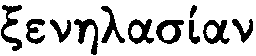
not in human form" (4);85 the priests receive greater lots to provide them enough leisure for performing their public duties (7; cf. Arist. Pol . 1269a 35, 1273a 34); the lands are inalienable to avoid the creation of great estates and consequent oppression of the poor classes and scarcity of manpower (Diod. XL.3.7);86 a community of landowning farmers can easily rear children, and this secures the necessary manpower for the nation (8).87 The attitude of Jews to strangers is called apanthropia and misoxenia and is explained by their xenelasia from Egypt, which is the term used exclusively for Spartan banishment of strangers.88 Some inspiration was also drawn from Egyptian tradition to explain Jewish practices: the priests are given greater lots to enable them to be free to perform their public duties (7; cf. 1.72.2-3).89
It has frequently been argued that the excursus is an idealization of the Jewish people, and was meant to present a model of an ideal society.90
36
The model, however, has been variously described as a "theocracy" or "aristocracy," inspired to a great extent by Plato's Laws and Republic respectively, a "Spartan oligarchy," and even an "Egyptian Sparta."91 It has also been suggested that the account describes a "mixed constitution" made of all these. As a matter of fact, none of these conceptions, singly or in combination, perfectly concurs with the contents of the excursus.92 What should really be asked is whether Hecataeus actually aspired at the outset to idealize the account, and present all of it as a model. The answer must be that he did not. Hecataeus, who served Ptolemy I, would hardly have advocated a society without kings, with the power being entrusted entirely to priests. This also stands in contrast with the government presented in his Egyptian ethnography. It should be reiterated that, by and large, Hecataeus recorded the information provided by his Jewish informants. The interpretation is basically what one would expect to be made of the facts by a Greek intellectual who had a good philosophical education, if he was not himself an original philosopher. The account does not include superlatives or even praises, and it is difficult to see features that could be admired or advocated by Hecataeus, except for those pertaining to military manpower.
The latter features were emphasized, supplemented, and explained with much elaboration, having in mind the Greco-Macedonian reader in Egypt. Much stress was laid on military training of the younger generation, allocation of equal lots, inalienability of land, and the great
37
rate of natural increase that was implicitly praised. A close look at the explanations provided reveals the message: farmers should have viable lots and a sound economic position so that there will be no "scarcity of manpower." The agrarian arrangements are also the way to encourage rearing children. As a result, the Jews are a "populous nation" (3.8). The causal connection in the first point is not made clear, and the advantage of the second is not explained. Hecataeus's original reasoning may well have been cut short by Diodorus. To understand it, we have to turn to the corresponding passages concerning the Egyptian warrior class in Hecataeus's Aegyptiaca . The main features and their explanation are actually identical:93
The last part [of the land] is held by the warriors [machimoi ], who are subject to call for all military duties, the purpose being that those who hazard their life may be loyal to the country because of this allotment of land [klerouchia ] and may thereby eagerly face the perils of war. For it would be absurd to entrust the safety of the entire nation to these men and yet have them possess in the country no property to fight for valuable enough to arouse their ardour. But the most important consideration is the fact that, if they are well-to-do, they will readily beget children and thus so increase the population that the country will not need to call in any mercenary troops. And since their calling, like that of the priests, is hereditary, the warriors are incited to bravery by the distinguished record of their fathers and, inasmuch as they become zealous [students] of warfare from their boyhood up, they turn out to be invincible by reason of their daring and skill.
The distribution of land and the efforts made for the welfare of the settlers are thus intended to provide them with a good motivation to fight. This is the meaning of the argument of the Jewish excursus that economic hardships "bring on a scarcity of manpower." Even more important is the second purpose: to encourage and enable the settlers to rear children and thus "increase the population." The aim is to secure a situation in which "the country will not need to call in any mercenary troops." Here we find what is missing in the Jewish excursus: rearing many children and becoming a "populous
38
nation" confers a military advantage (cf. Polyb. XXXVI.17.5-11). Just as with the Jews in the excursus, the younger generation of Egyptian warriors was trained for war from childhood. The terminology applied in the passage should also be noticed: machimoi and klerouchiai were the official Hellenistic terms for military settlers of Egyptian descent serving under the Ptolemies, and their settlements, respectively. In the third century, the term klerouchiai
was also used for settlements of Greco-Macedonian soldiers.94
The correspondence of these data and explanations with the situation of the Greco-Macedonian settlers in Ptolemaic Egypt cannot be coincidental. Scarcity of European manpower was the most acute problem facing the young Ptolemaic empire. The Greco-Macedonian conquerors of Egypt were a tiny minority amid the native population, and the possibility of recruiting Greco-Macedonian mercenaries was rather limited, these being divided between the armies of the Successors. In the first generation of the occupation, Ptolemy recruited Egyptians to the army as light troops (e.g., Diod. XIX.80.4), making sure not to provide them with heavy weapons.95 Hecataeus, who was considering the future of the kingdom, must have realized that even this solution could only be temporary. In the long run, arming and training the natives at all might prove dangerous to the very existence of the Macedonian regime in Egypt. Hecataeus, therefore, suggests measures that will invest in the younger generation of Greco-Macedonian settlers: encouraging the birth and raising of children (contrary to the traditional practice in the motherland), allocating equal and sufficient lots to the settlers to enable each one to raise a large family, prohibiting the sale of lands to secure the continuity of this class of farmer-soldiers, and constantly training the descendants of the first generation of settlers. Ptolemaic military settlement was indeed organized along such lines, but gradually deteriorated, neglecting the preparation of the younger generation for war. As a result, in 217, on the eve of the battle of Raphia, Ptolemy IV was
39
forced to recruit thousands of Egyptians and to train them as phalanx warriors. The success of these troops in the battle of Raphia raised the self-confidence of the local population and generated a revolt that lasted thirty years, leaving the Ptolemaic kingdom at the mercy of its Seleucid rival.96
The assumption that the excursus is a highly idealized account intended to be a model has led a number of scholars to suggest that the reference to the Jewish attitude toward strangers (3-4) was meant to express not reservation but praise.97 However, in addition to the connotations of apanthropia and misoxenia in Greek culture, which could not be favorable, the qualifier
("somewhat," 4), which is certainly original,98 makes it evident that the sentence was not written as a compliment. Moreover, in his Egyptian ethnography, Hecataeus praises King Psammeticus for his hospitality toward foreigners, in contrast to the hostility of his predecessors (Diod. I.67.8-11; cf. 69.4, 88.5). Hecataeus was then ready to express his negative attitude toward separatism, even in an idealizing context. Praise for hospitality toward Greeks is also voiced in the utopian On the Hyperboreans (Diod. II.47.4).
How then should the attitude of Hecataeus toward the Jews be evaluated? Having a basically unbiased attitude, Hecataeus presented the information available to him while interpreting certain features
40
according to Greek experience and conceptions. This is just how a Greek author-philosopher would have dealt with the facts; it does not mean that the excursus is an idealization or a "model." The account of the preparation of reliable manpower (including the strict agrarian arrangements) is the only part intended for emulation. However, even this is still not a deliberate idealization: the information given by the Jews is presented in the way Hecataeus, as a Greek, understood it.
One should not exaggerate the significance of the excursus. Hecataeus did not attach so much importance to it as might appear from modern scholarly interpretations. The Jewish excursus was just one of a number of minor ethnographies incorporated into the Aegyptiaca. They each presented a different system of government and society. In the way many Greeks viewed most oriental nations at the beginning of the encounter between the two great cultures, so Hecataeus viewed the Jews: he was curious and impartial, attempting to understand the information according to his education and way of thinking. He was indifferent on most topics, but appreciated some features and expressed reservations about others. This discerning evaluation is expressed in a factual style, combined with elaborate reasoning, without explicit compliments, exclamations, or superlatives, and avoiding rhetorical-emotional expressions. Despite the philosophical interpretation of their faith, the Jews are not described as a nation of philosophers, although this appears in contemporary Hellenistic literature.99 After all, even in referring to Egyptian religion, Hecataeus describes their "first god" as being "the same as the universe [
] ... invisible and concealed" (Plut. De Is. et Os. 354d). The author does not forget to make clear that the Jews are inferior to the immigrants who landed in Greece and Asia Minor (Diod. XL.3.2). Such a comment is not made about the Egyptians, who are constantly praised for their decisive contributions to civilization.
To sum up the discussion: How can the process of composition be imagined? Hecataeus planned an excursus that would include an origo section and a nomima section, to be incorporated among other
41
miniature ethnographies put together as an appendix to the Egyptian origo-archaeologia. The initial purpose was to show that the Jews, like other nations, originated from Egypt, and that this descent influenced their nomima. For this purpose, in interviewing his Jewish informants, he concentrated on the personality of Moses, the settlement in Canaan, and contemporary Jewish institutions and practices. Consequently, the information related to three periods in Jewish history: the Exodus, the settlement, and the time of Hecataeus himself (i.e., the Persian and early Hellenistic periods). However, he disregarded the Jewish Exodus story, perhaps because it appeared to insult the Egyptians whom he praised so much, or because he wanted to equate the background of the Jewish emigration to that of other nations. For the origo section Hecataeus consulted, therefore, Egyptian stories circulating in his time, preferring a more moderate one, possibly even "softening" it. In addition he did not refrain from expressing his reservations about Jewish exclusiveness and hatred of strangers.
In composing the excursus, Hecataeus had to sort out, select, and arrange the information into the origo and nomima, the two planned sections. His basic editorial conception was to follow the accepted model of a foundation story and supplement it with a number of daily customs illustrating the similarities and differences between Jews and Egyptians. The pieces of information selected were mainly those known from foundation stories. They were arranged and conflated according to the accepted sequence and conception of these stories. Moses was described as the founder of the nation as well as of the country, and all Jewish institutions and practices were attributed to him. The historical development was thus distorted, three distinct periods of Jewish history being conflated into one. The foundation story was divided between the origo and nomima. The origo included the story of the expulsion and the headlines of a typical foundation story. The nomima comprised two parts: the first elaborated on the institution and the provisions indicated in the origo; the second, on a number of everyday customs.
Forming the framework and filling it with information, Hecataeus found it appropriate to complete the picture by adding one or two important statements drawn from foundation traditions, which were not reported by his Jewish informants. Then came the addition of causations and reasoning, according to the rules of the new ethnographical writing. Some customs were explained by the Jewish origo, especially the bad
42
memories of the expulsion. Others were interpreted according to the Greek cultural and philosophical heritage. Special emphasis was laid on statements referring to provisions made for securing manpower, by which means Hecataeus tried to indicate how he envisaged the organization of the newly established military settlements in Ptolemaic Egypt, just as he had done in his Egyptian ethnography in the account of the pharaonic warriors.
Finally, it would be helpful to emphasize the points that are directly relevant to various questions concerning the treatise On the Jews:
1. An analysis and comparison of the original style and vocabulary of the excursus is precluded by the modifications they have undergone at the hands of Diodorus.
2. The origo section opens the excursus, occupies a major role in it, and is used to explain a number of Jewish practices.
3. The excursus is centered around the personality of Moses, with Jewish institutions and practices being attributed exclusively to him.
4. Moses is not only the leader of the emigration, but also the founder of the new settlements.
5. Allowing for inaccuracies resulting from the literary model, it can be said that Hecataeus collected important, reliable information about the life of the Jews in his time. He deleted details that were redundant or did not fit into the framework he had set for himself.
6. Especially important are the references to the High Priest. Hecataeus knew that there was just one High Priest at a time, and was well acquainted with his unique status in the Jewish community.
7. The priests are said to have earned their living from the greater lots granted to them. There is no reference to tithes of agricultural produce.
8. The account sounds unbiased, certainly not enthusiastic, and was not intended to idealize the Jewish people.
9. Hecataeus did not advocate Jewish misoxenia and apanthropia , but expressed his reservation explicitly.
10. Hecataeus's Jewish ethnography was not meant to portray a model society, although one part of it, the provisions for a competent and sufficient source of military manpower, was emphasized in order to serve as an example.
43CR
11. The excursus consistently provides causal reasoning as well as social and philosophical explanations for Jewish institutions and practices.
12. As in the Egyptian ethnography, the reasoning in the Jewish excursus is based on Greek tradition, literature, and modes of thinking. As some scholars have put it, the excursus is, by and large, an interpretatio Graeca of Jewish history and life.
The passages containing the fragments of and testimonia to the treatise On the Jews appear in Josephus's Against Apion. With one exception, they are grouped together in one sequence in Book I of the work. Josephus prefaces the sequence with a statement about his purpose in referring to the treatise and includes biographical notes about Hecataeus, his date, work, and position. Then come a number of passages, separated by conjunctions and words of introduction by Josephus, some of which appear in direct, others in indirect speech.
The Greek text is reproduced from Niese's edition ([1888] V.33-37). The apparatus is based on Niese's, but it is selective and includes only those readings and emendations that may affect the arguments of this book. In several places I have offered supplements to Niese's apparatus. The sigla refer to the following manuscripts and testimonia:*
L
Codex Laurentianus (Florence), plut. 69 cod. 22. Eleventh century. This is the archetype of all extant Greek manuscripts.
Eus.
Eusebius, Praeparatio Evangelica IX.4.2-9. Eusebius quotes Ap. I.197-204. PE contains also other extracts from Against Apion. Eusebius's readings are often preferable to those of the manuscripts. The most recent critical edition is that of
45
Mras (1956), vol. VIII pp. 489-91. Eusebius's text is extant in thirteen manuscripts. The manuscripts mentioned in my apparatus are:
Eusebii cod. G Laurentianus plut. VI cod. 9. Fourteenth century.
Eusebii cod. I Venetus gr. 341. Fifteenth century.
Lat.
The Latin translation of Against Apion, prepared in the sixth century for Cassiodorus, the minister of Theodoric. Its great contribution consists of the passages II.52-113, which are missing in the Greek manuscripts. There are many mistaken translations, caused by misunderstanding of the Greek text. The translation is extant in three manuscripts. The critical edition used is that of Boysen (1898).
Ed. pr.
Editio princeps, the first printed edition of Against Apion, in the edition of Josephus by A.P. Arlenius (Basel 1544). It contains readings that may perhaps indicate the use of manuscripts other than L and its apographs.
For the benefit of the reader who cannot consult the Greek text, I endeavored to translate the texts literally, adhering to their verbal contents and syntactical construction rather than to English idiomatic expressions. This may give the reader of the translation some taste of the style of some of the passages (esp. Ap. I.202-4a).
46
Jos. Ap. I.183-205
47
[183] However, Hecataeus of Abdera, a philosopher and at the same time [a man] most competent in practical matters, having flourished at the time of King Alexander and being associated with Ptolemy son of Lagus, [referred to the Jews] not incidentally, but wrote a book about the Jews themselves, from which I want to present the highlightsa of some of the things said. [184] And first of all I shall establish the date. He mentions the battle of Ptolemy against Demetrius near Gaza. That [battle] took place in the eleventh year after Alexander's death, in the 117th Olympiad, as Castor narrates. [185] For under the head of that Olympiad he says: "In this Olympiad Ptolemy son of Lagus defeated Demetrius son of Antigonus who was called Poliorcetes." And all agree that Alexander died in the 114th Olympiad. It is therefore clear that our nation was flourishing at his [Ptolemy's] time as well as in that of Alexander. [186] Moreover, Hecataeus goes on to say this: "After the battle at Gaza Ptolemy became master of the places near Syria,b and many of the men, hearing of his kindness and humanity [philanthropia ] wished to accompany him to Egypt and take part in the affairs [of the kingdom]." [187] "One of them," he [Hecataeus] says, "was Hezekiah, High Priest of the Jews, a man at the age of around sixty-six, highly thought of by his compatriots and not unintelligent in his mind, and, moreover, an able speaker, and in [... and]c experienced, if indeed anyone was, in the affairs." [188] He also says: "And all the Jewish priests who receive the tithe of the produce and administer public matters number at most about one thousand five hundred." [189] And again, referring to the above-mentioned man: "This man," he says, "having obtained this authority and being well acquainted with us, assembled some of his men and read to them the whole advantage.d For he possessed in writing their
48
49
settling and constitution." [190] Then Hecataeus in turn explains how we regard the laws, that we prefer to suffer everything in order not to transgress against them and [that] we consider it as virtuous. [191] "So for example," he says, "all being insulted by their neighbors and by those who came into [the country], and being frequently abused by the Persian kings and satraps, they could not be persuaded to change their way of thinking, but being exposed because of [their adherence to] them [the laws], they faced tortures and the most horrible deaths rather than deny their ancestral [laws]." [192] He provided not a few proofs for the resolute mind with regard to the laws. For he says that once when Alexander was in Babylon and proposed to clear away [the rubble of] the ruined temple of Bel, and ordered all the soldiers alike to carry the earth material, only the Jews did not apply themselves to [it], but submitted to many floggings and paid heavy penalties, until the king agreed to grant them indemnity. [193] He says yet further: "they destroyed all the temples and altars constructed by those coming to the land against them, for some of which they paid a fine to the satraps, and for others they obtained forgiveness." And he adds that it is just to admire them for these [actions]. [194] And he also relates how our nation became overpopulated. "The Persians," he says, "had formerly deported many tens of thousands of them to Babylon, and after Alexander's death, no less immigrated to Egypt and Phoenicia because of the turbulence in Syria." [195] And this man himself also recorded the size of the land in which we live and its beauty. He says: "They possess almost three hundred myriads of [i.e., three million] arourae of the best and most fertile land for all products. Such is the extent of Judea." [196] Indeed he thus also relates that we inhabit Jerusalem, that city, the most beautiful and the greatest, from time immemorial, and the same [man relates] thus about the great number of people and the building of the temple: [197] "There are many fortresses of the Jews throughout the country, as well as villages, but only one fortified city, of about fifty stadia [in] circumference, which is inhabited by about twelve myriads of [i.e., 120,000] people,
50
51
and is called by them Jerusalem. [198] There is there, nearly in the center of the city, a stone wall, five plethra long, and a hundred cubits wide, having double gates, inside which there is a square altar, not of hewn, but of collected, unwrought stones, so constructed: twenty cubits long and ten cubits high, and beside it a great edifice where there is an altar and a lamp stand, both covered with gold and weighing two talents. [199] Upon thesee there is a light that is never extinguished night and day. And there are no statues, nor any votive offerings, and absolutely no plants, resembling neither a grove nor anything similar. And the priests pass their time night and day in it purifying themselves by certain [rituals] of purification and entirely abstaining from wine in the temple." [200] And he further testifies that they served as soldiers under King Alexander, and afterward under his successors. And the [actions] performed by a Jewish man, which he witnessed after he was on an expedition, I shall cite as well. [201] Now he says thus: "Anyway when I was marching to the Red Sea, a certain Mosollamus was accompanying us, together with the rest of the Jewishf cavalrymen who served us as an advance force. [Mosollamus was] a man with a robust mind,g and, as agreed by all, the best archer among Greeks and barbarians. [202] So that man, when many went to and fro along the road, and a certain seer was watching the flight of the birds, and he [the seer] requested all of them to abstain [from all actions], asked why they were halting. [203] The seer having pointed out the bird to him, and saying that if it [the bird] stays there, it is expedient for all to wait still longer, and if it rises and flies ahead, to advance, but if [it flies] behind, to withdraw at once,
52
Jos. Ap. II.43
53
he [Mosollamus], after keeping silence and drawing his bow, shot and, hitting the bird, killed [it]. [204] When the seer and some others became irritated and called down curses upon him, he [Mosollamus] said: 'Why are you raving, [you] wretches?'h Then, taking the bird in his hands he said: 'How, then, could this [bird], which did not provide for its own safety, say anything sound about our march? For had it been able to know the future, it would not have come to this place, fearing that Mosollamus the Jew would draw his bow and kill it.'" [205] But this should suffice concerning the evidence of Hecataeus. To those who want to learn more, the book is readily available.
For he [Alexander the Great] honored our nation, as Hecataeus says about us, that because of the fairness and loyalty shown to him by the Jews, he [Alexander] annexed the land of Samaria to them free of tribute.
Scholars contesting the authenticity of On the Jews have put forward more than a dozen different arguments. Some fail to prove the case. For example, the facts that Hecataeus was credited with the forged book On Abraham and that Philo of Byblos had doubted whether Hecataeus wrote the treatise On the Jews only illustrate the general problem, but cannot be used as evidence.1 The enthusiastic description of the Jewish people was, as one might expect, also introduced as an argument against authenticity, but this was rejected in light of certain general parallels to idealized accounts of oriental peoples known from Hellenistic ethnographical literature, and the description of the Jews as "philosophers" by early Hellenistic authors.2 The evident idealization of Mosaic Judaism in Strabo's ethnographical excursus (XVI.2.36-39) is even more relevant here.3 Two other arguments, based on a sentence ascribed to Hecataeus by Pseudo-Aristeas (31) and a reference to the Jewish tithes in one of the fragments (Jos. Ap. I.188), are by themselves inconclusive and have been rightly rejected.4 It has also been pointed out that there is no quotation from the book ascribed to Hecataeus in the collection of Hellenistic writings on the Jews compiled by Alexander
55
Polyhistor (first century B.C. ), but this argument from silence is even less significant for the debate.5
The difference in general tone and attitude toward the Jews between the treatise and Hecataeus's Jewish excursus in the Egyptian ethnography, as well as the contradictory references to the priests' income (Diod. XL.3.7, Jos. Ap. I.188), deserves more attention. It has been argued in defense that On the Jews was written by Hecataeus at a later date, after he had become better acquainted with Jews and Judaism, or had made a special study in preparation for his treatise on the Jews.6 Unfortunately these assumptions can be neither proved nor disproved: if On the Jews is authentic, it must have been written after the battle of Gaza (312 B.C. ), which is explicitly mentioned (Ap. I.184, 186), and before the final reconquest of Judea by Ptolemy I (302 B.C. ), in which the king treated the Jews harshly and deported many of them to Egypt.7 As far as Hecataeus's Egyptian ethnography is concerned, it seems to have been written between 305 and 302.8 There is thus still some room for dating the composition of the Jewish excursus earlier than the Jewish treatise.
The positive evidence brought forward so far to support authenticity is quite meager It has been argued that the author must have been a gentile, since, while demonstrating an apparently thorough acquaintance with Greek culture, he seems to make a basic mistake concerning the Jewish deportation to Babylonia (Ap. I.194). This, however, could well be expected of a Hellenized Jew; we know of such cases in Jewish Hellenistic literature. But, as a matter of fact, the statement about the deportation has already been shown to be reliable,9 and a close examination of the passages proves that the author had only a partial and inaccurate knowledge of Greek heritage and practices.10
On the other hand, a number of arguments against authenticity based on a historical analysis of statements in the fragments themselves still seem in principle to be valid. All of them were mentioned in one way or
56
another by Willrich in his Judaica (1900), and have since been repeated or elaborated on by other scholars. Nevertheless, the analysis has not always been sufficiently convincing and has also frequently been accompanied, especially in the case of Willrich, by mistaken assumptions and inexactitude. The older arguments, therefore, need far more evidence and elucidation. It is also necessary to scrutinize the counterarguments and solutions offered by the proponents of authenticity.
In discussing the various passages, the following considerations will concern us:
1. Do the views expressed or implied in the passages accord with the conceptions and convictions of Hecataeus?
2. Are the data about Greek practices incorporated in the treatise confirmed by extant knowledge, meaning that they could have been written by Hecataeus?
3. In view of his position in the court, Hecataeus must have been acquainted with, or striven to know, the truth about certain details relating to the Jews (e.g., information having a military significance, Jewish leadership, and the like); can these be verified? We may observe that had Hecataeus not served in the Ptolemaic court, and had he actually resided on the Greek mainland, as one scholar (unjustifiably) maintains,11 the whole issue of authenticity would have been decided at the outset: Hecataeus's position in the Ptolemaic court is emphasized in the passages (in addition to Josephus's introductory notes).
4. Does the presentation of major events that took place in the time of Hecataeus agree with hard evidence from other sources concerning that time? And if not, could it be that Hecataeus was interested in distorting the real facts?
5. Could all the described historical events and developments relating to Jewish history have taken place before or during the lifetime of Hecataeus?
Unfortunately, a stylistic comparison with Hecataeus's Egyptian ethnography and the Jewish excursus would not be of much help: Diodorus's involvement in shaping the vocabulary and style of the epitome was too great to allow a reliable basis for comparison.12 One should also be cautious in applying arguments from silence and the like.
57
Thus the absence from the passages of any reference to Moses as well as of philosophical and social reasonings, which are so predominant in the excursus, may support the claim of forgery, but can be used only as a second line of evidence. On the other hand, caution should also be exercised regarding the detailed and astonishingly accurate knowledge of the Temple and its cult objects demonstrated by the author, which in itself need not necessarily indicate that he was Jewish.
The discussion of this chapter will examine one by one the passages that have appeared suspect to previous scholars, and two additional fragments that have been virtually neglected in the scholarly debate but furnish new evidence. These are Ap. I.195-99 and 201-4, containing the geographical account of Judea and Jerusalem, and the Mosollamus story (see sections III.1, 8). We shall keep to the order of the passages as they appear in Against Apion, with one exception, the Mosollamus story: though it is the last of the fragments quoted in the first book of Against Apion (201-4), it will be placed at the start of the discussion. Being the most complete and comprehensive fragment, it provides a wider range of considerations for evaluating the question of authenticity.
The author claims to have participated personally in a Ptolemaic military march to the Red Sea, and to be recording an event that took place in the course of the advance. Among the Jewish horsemen who took part in the expedition there was a certain archer, called Mosollamus. He is described as a man with a robust mind and "as agreed by all, the best archer among the Greeks and barbarians" (Ap. I.201). At a certain point, the whole force halted because a bird was seen flying about nearby and the seer (mantis ) wanted to observe its motions. When Mosollamus inquired as to the reason for the halt, the seer pointed to the bird and explained the rules of interpretation (I.203):
If it [the bird] stays there, it is expedient for all to wait still longer, and if it rises and flies ahead, to advance, but if [it flies] behind, to withdraw at once.
Then Mosollamus, without uttering a word, shot and killed the bird. When the angry seer and certain others cursed him, he took the bird in his hand and retorted (I.204):
58
How, then, could this [bird], which did not provide for its own safety, say anything sound about our march? For had it been able to know the future, it would not have come to this place, fearing that Mosollamus the Jew would draw his bow and kill it.
The episode already seemed questionable to Philo of Byblos. According to Origen, Philo doubted the authenticity of the book because it stressed the "wisdom" of the Jews (C. Cels. I.15). Philo was certainly referring to the Mosollamus story, and most probably also to other pieces of information, which were not preserved by Josephus.13 The description of the wise Jew who mocks the foolish, superstitious gentiles also convinced some modern scholars that the story was written by a Jew.14 This, however, is still not enough to establish a forgery.15
Other scholars have argued, to the contrary, that the scornful attitude toward omens accords with that of "contemporary educated Greeks" and may therefore represent Hecataeus's own views.16 The available evidence does not, however, justify such a sweeping statement. To say that educated Greeks had a negative attitude toward omens is an exaggerated generalization, even more so than the rhetorical statement of the supporters of divination in the Ciceronian dialogue that divination had been "the unwavering belief of all ages, the greatest philosophers, the poets, the wisest men, the builders of cities, the founders of republics" (Div. I.84; cf. 5, 86).17 In any case, the main question is not whether an educated Greek would have praised the negative Jewish attitude toward gentile divination and bird omens, but what Hecataeus's personal view was.
59
The tradition about the affiliation of Hecataeus with the disciples and "successors" of Pyrrho (Diog. Laert. IX.69), if accepted, could have provided a clue as to Hecataeus's position: certain contemporary testimonia about Pyrrho indicate at least a tolerant, if not a favorable, attitude toward religious ceremonies and divination.18 However, this tradition is rather doubtful.19 Hecataeus's stand with regard to divination should therefore be deduced only from his ethnographical works.
The surviving material does not contain a thematic discussion of the reliability of divination and bird omens. There are, however, quite a number of relevant references. In his Egyptian ethnography, preserved by Diodorus in an abridged version,20 Hecataeus refers more than a dozen times to Egyptian and Greek divination in a generally positive way. Hecataeus mentions incubation in temples (Diod I.25.3, 53.8), oracles (23.5, 25.7, 66.10; cf. 98.5), inspection of the entrails of sacrifices (53.8, 70.9), dream interpretation (65.5-7), divination in general (73.4), and astrology (73.4, 81.4-6, 98.3-4). One passage reports that hawks and eagles were regarded by the Egyptians as "birds of omen" (87.7-9).21 Most of the allusions are preceded, as customarily throughout his Egyptian ethnography, by such phrases as "they say" (
), which point to the use of Egyptian and Greek sources. But this does not mean that Hecataeus distances himself from the assertions. He expresses disapproval only once, when referring to the contents
60
of an oracle recorded by Herodotus (66.10; cf. Hdt. II.151ff.). His criticism in this case stems not from a rejection in principle of oracles, but from the evident improbability of the story (the circumstances of the rise of Psammeticus to sole rule in Egypt; cf. Diod. I.69.7). On another occasion he even states that the Egyptian sources support their statements with facts, unlike the Greeks, who rely on legends (25.3). There are no reservations with regard to the other references, although Hecataeus does not refrain from criticizing his Egyptian sources when he finds their accounts unreliable (e.g., 23.2; 24.2, 5; 25.2-3). One story recounted by him about divination does not mention sources, and the information given is recorded as objective fact (65.5-7). Above all, Hecataeus precedes three other allusions to divination and astrology (73.4, 81.4-6, 98.3-4) with the statement that he refrained from quoting imaginary tales by Herodotus and other Greek authors, and selected from the records of the Egyptian priests only information "that passed our scrupulous examination" (69.7).22
When evaluating this material, it should also be borne in mind that Hecataeus's Egyptian ethnography is, to a great extent, an idealization of Egyptian life and practices.23 It is therefore hardly credible that the same author would reject or even ridicule pagan divination techniques. The same conclusion is also suggested by Hecataeus's highly tolerant and sympathetic treatment of religious beliefs in the Egyptian ethnography. He even goes so far as to provide explanations for and make favorable comments on the animal cult,24 which was regarded by the Greeks and Romans as bizarre and contemptible.25
Examination of the few fragments of Hecataeus's utopian On the Hyperboreans supports this conclusion.26 The god Apollo plays a central role in the treatise (as in almost all other literary references to
61
the Hyperboreans).27 Although the material at our disposal elaborates only on his contribution (and that of his cult) to the musical life of the Hyperboreans (Diod. II.47.6; Aelian, Nat. Anim. XI.1), one may assume that Apollo's second main role, as god of divination, was not neglected. Furthermore, Hecataeus enthusiastically describes the regular arrival of "clouds of swans" from afar at the time of the services in the Hyperborean temple. They always join the chorus chanting hymns in honor of Apollo. All is performed in perfect harmony (Ael. NA XI.1):28
Never once do they sing a discordant note or out of tune, but as though they had been given the key by the leader they chant in unison with the natives, who are skilled in the sacred melodies.
That nothing in their behavior is accidental attests to divine inspiration. Hecataeus accordingly accepted the belief that swans were Apollo's sacred birds and messengers,29 and in Greek tradition this also entailed prophetic as well as musical gifts.30
This survey of Hecataeus's direct and indirect references to the techniques of ancient mantics, as well as his attitude toward Egyptian cults (including those viewed by the Greeks as superstitious), seems to suggest that Hecataeus could not have written a derogatory story about bird omens. And it cannot be argued that the author merely quotes the view of Mosollamus the Jew. He clearly enjoys telling the story, without reservation, and praises Mosollamus's "robust mind." The story was probably understood in a similar manner by Herennius Philo, who, therefore, suspected the authenticity of the treatise.
Analysis of the various details of the Mosollamus story further shows that it was not written by a knowledgeable Greek, certainly not by an author of the caliber of Hecataeus. The story either lacks or distorts all the basic facts about Greek bird divination. And it must be recalled that the author presents himself as an eyewitness (Ap. I.200). But before any discussion of the details, an important clarification must be made. It might be argued that the episode is just a joke, and that, consequently, the author was not concerned with accuracy and even deliberately distorted all technical details. This, however, can
62
be expected of a satire, not of a story—even if it is told as a joke—the whole purpose of which is "to point a moral, or adorn a tale." The last paragraph (204) points the moral. Had the real Hecataeus distorted all the basic facts, he would have spoiled the whole didactic impact of the story. An author who knew his facts would not have done this.31 Besides, the surviving material of Hecataeus's works (and there is enough of it to judge) does not show any traces of satiric writing.
When we turn to the Mosollamus story, the first conspicuous fact is that the episode does not accord with the Greek theological conception underlying bird omens. Mosollamus says that had the bird indeed been able to "know the future" (
) it would have taken care not to be shot (I.204). But educated Greeks did not believe that a bird could know the future. This was at best a common belief held by ignorant people of the sort found in every society.32 Xenophon, who in his books frequently described omens and portents, expressed the accepted Greek conception about bird divination in a celebrated passage that refers to the views held by Athenian citizens about various divination techniques (Mem. I.1.3-4):
He [Socrates] was introducing nothing newer than were those believers in divination who rely on bird omens, oracles, coincidences, and sacrifices. For they do not believe that the birds or those met by accident know what will happen to the inquirer, but that the gods indicate what will happen to him through them.
The same explanation for omens, sometimes with specific reference to birds, is known from quite a number of sources.33 This understanding
63
gave rise to a number of theological problems. Cicero thus records the deliberations of the Stoics (Div. I.118):34
But it seems necessary to determine the way [by which these signs are given]. For the Stoics do not believe that god is involved in every fissure of the liver or in every song of a bird; quite obviously that would be neither seemly nor proper for a god and furthermore would be impossible. But, in the beginning, the world was so created that certain results would be preceded by certain signs, which are given sometimes by entrails and by birds, sometimes by lightning, by portents and by stars, sometimes by dreams, and sometimes by utterances of persons in a frenzy.
The philosophers who rejected belief in omens did not ignore these explanations. Some even tried to refute them point by point. Thus Cicero, in the second book of a long dialogue, examined all aspects of contemporary divination.35 Others expressed their negative view
64
inter alia by short notes, like the rhetorical question of Carneades and Panaetius preserved by Cicero (Div. I.12):36
Therefore let Carneades cease to press the question, which Panaetius also used to urge, whether Jupiter had ordered the crow to croak on the left side and the raven on the right.
Even in this rather cynical remark, the question is not whether the bird "knows" or not, but whether the deity reveals his will to mankind in this way.37 The Mosollamus story, however, does not indicate any familiarity with the accepted Greek conception of bird omens. It has already been explained above why it cannot be argued that Hecataeus simply recorded the Jewish perception.
In this context it would be worth referring to two Greek anecdotes that carry a seemingly similar lesson. Hans Lewy compared the Mosollamus episode with a story in one of the spurious letters attributed to Diogenes of Sinope. The letter relates how, at the time of the Olympic games, Diogenes ridiculed a seer (mantis: either an ecstatic prophet or a soothsayer who interprets signs or dreams). Diogenes lifted his stick and asked the man whether he would strike him or not. When the seer answered in the negative, Diogenes, much to the amusement of the bystanders, struck him with his stick.38 The same motif appears in a fable related by Aesop: a mantis who earned his living from prophesying in the market was alarmed by the news that his house had been broken into. A passerby rebuked him, saying: "While announcing that you knew beforehand the affairs of others, you did not predict your own" (no. 170, ed. A. Hausrath [Leipzig, 1970]).
There is, however, an essential difference between the Mosollamus episode and the two anecdotes: Mosollamus ridicules the "foreknowledge" of the bird; that is, he denies the capability of the mantic "instrument" itself to know the future. However, Greeks did not need to challenge this. The two anecdotes, on the other hand, mock the ability of a dilettante to foretell the future or interpret signs. The argument
65
is quite different, and was frequently employed against quack prophets, especially streetcorner soothsayers.39
No less instructive than the theological conception are both the terminology of the story and the mantic techniques described by the gentile seer himself. The very reliance on bird omens for military purposes is indeed known not only from the history of the Roman army and from other cultures, but is also found in Greek tradition,40 although it did not take the form of regular, systematic ornithoscopy, but rather of the interpretation of the chance appearance of certain less common birds.41 Such bird omens were occasionally encountered by armies in the course of their expeditions.42 So far there is nothing exceptional in the Mosollamus story. However, when the minute technical details are reviewed, one finds it difficult to believe that the story was written
66
by a Greek. Curiously enough, the author does not specify the bird, although the general term ornis is repeated four times, and the story is devoted to bird divination.43 The Greeks regarded some ten or twelve species as birds of omen, but others were excluded.44 In the words of the poet: "Many birds fly to and fro under the sun's rays, but not all are [birds] of omen" (Od. II.181). When it came to military affairs, the usual birds of omen were the eagle, Zeus's sacred bird and "the surest bird of augury" (Il. VIII.247),45 the hawk, consecrated to Apollo (Ael. NA VII.9, X.14, XII.4), and occasionally (especially for Athenian troops) the owl.46 Hecataeus himself elaborates in his Egyptian ethnography on the hawk and eagle as birds of omen (Diod. I.87.7-9). The absence of any specification and the repetition of the word ornis indicate, therefore, a lack of exact knowledge about Greek practice. Furthermore, the author does not use the term oionos even once, although it is the more common designation for a bird of omen.
It may be responded that the author wishes to stress that the soothsayer's source of information was just a bird. But one would expect an author—who claims to be an eyewitness—to specify at least once the exact bird he saw; a specific reference to an eagle or a hawk would only have strengthened the didactic effect of the story. Had Mosollamus been able to shoot such a bird, well known for speed, this would have emphasized the whole point of the story. The author would then still have had a few opportunities to express the idea that the bird was just a bird.
As for the rules of interpretation: like the Roman augurs, Greek diviners also had a disciplina auguralis, a set of rules for the interpretation of omens, which differed slightly from place to place. It was a rather complicated "science," the rules defining the meaning of a variety
67
of movements and their combinations. Thus an inscription found in Ephesus, from the time of the Persian Wars, which contains a sacred law code, elaborates on the meaning of bird movements (SIG3 1167):
[(If) the bird is flying from right to left:] if it disappears—fortunate. But if it raises the left wing: whether it (only) rises or disappears—ill. And (if) it is flying from left to right: if it disappears in a straight (course)—ill, but if after raising the right wing—[fortunate] ...
These were not all the rules. The code is only partially preserved, and the complete set must have made decision rather difficult. The seer had thus to set in order and balance conflicting signs and rules. The Ephesian code may indeed represent only a local tradition, as some scholars maintain,47 but there is no doubt that the overall rules applied in the Greek world were quite complicated, as can be deduced from a fair number of sources.48
Then again, the very clarification of the basic facts demanded much effort. Even the simplest question, common throughout the Greek world, whether the bird came from the right or the left, was not easy to establish. The flight of an eagle or a hawk near an army usually came as a surprise and happened very quickly. The reports on the direction of the arrival were consequently often contradictory, and whatever evidence there was had to be sorted out and clarified by the seer In
68
this context there was also the question of defining and determining right and left. If this was to be resolved in relation to the direction faced by the seer himself, the problem arose as to how the latter could be sure of his own exact position at the moment of the bird's arrival. And if it was accepted that the seer always faced the residence of the gods, was that north or east? Or was there perhaps another rule, referring, for instance, to the general direction of the army's advance? The knowledge and experience of a professional seer were thus indispensable.49 But this was just the beginning. The remaining considerations relating to the bird's overall motions and more particular details could give rise to even greater uncertainties. And there was still the necessity of balancing all the different and complicated instructions.
The seer of the Mosollamus story, however, refers to just three basic positions: flight forward, retreat, and landing. So far as I know, there is no parallel in Greek literature for the application of such rules. These elementary positions could well be regarded as accidental and were therefore discounted as divine signs. Such an interpretation could occur, at most, only to ignorant people unaware of the theological background of bird mantics, not to an official seer, as suggested by the story. In any case, it does not take the expertise of a professional seer to offer this sort of interpretation.50 On the other hand, there is no reference to the traditional rules accepted by the Greek world, not even to the basic question regarding right and left. We thus see that the author could not have been an eyewitness, nor could he have been a knowledgeable Greek—certainly not one who wanted to win the trust of his Greek readers. Even if one ignores the concluding moral and its necessary effects on the shaping of the story, in order to argue that the intention of the author was to ridicule bird omens at any cost, reference to one
69
or two of the real rules (e.g., raising the right or left wing) would have made the episode even more amusing. Thus Philo, wanting to ridicule pagan mantics, refers to reliance on wing motions (Spec. Leg. 1.62).51 The same appears from the derisive question of Carneades and Panaetius on croaking from right or left. The author's acquaintance with the practice of interpreting bird omens is, then, superficial and vague indeed.52
To conclude the discussion: in view of what appears from his writings, Hecataeus's attitude toward bird omens could not have been negative; the punch line of the story betrays the author's unfamiliarity with the theological doctrine of bird divination; the author neither specifies the bird nor uses the proper term for a bird of omen; and he is ignorant of the rules of interpretation, even of the most basic ones current in the Greek world. All these factors make an attribution of the episode to Hecataeus of Abdera virtually untenable.53
70
In two of the following sections (III.4, 9), I shall refer to explanations offered by the proponents of authenticity for the presence of certain sentences that evidently could not have been written by Hecataeus. These scholars have postulated various ways in which the original text may have subsequently been altered. The validity of the proposed explanations for those passages will be discussed in due course.54 As far as the Mosollamus story is concerned, they are certainly not applicable. To suggest that the original Hecataean story underwent a "slight" adaptation by an anonymous Jewish author would not resolve the difficulties: a "slight" alteration would not have made all the basic details of the story unreliable. Moreover, Hecataeus had a favorable opinion of Greek mantics; the essence of the story—deriding gentile reliance on omens and divination and praising the wise Jew—could not have been much different in the original. The argument for this interpretation also seems to be supported by the reference of Herennius Philo to Jewish "wisdom." In addition, a Jewish adapter would have had no reason to deviate significantly from the details of the pro-Jewish report; quoting just a few genuine rules of interpretation and specifying the type of bird involved would have been a more effective way of ridiculing gentile divination.
The same arguments also apply against the suggestion that Josephus altered the original text. Furthermore, Josephus twice stresses that he is going to quote Hecataeus (Ap . I.200,
; 201,
), and at the end of the episode he refers the reader to further information about the Jews in the book attributed to Hecataeus, saying
71
that it is easily available (205). It is hardly possible that Josephus would have repeatedly stressed in this way the authenticity of the passage, even exposing it to comparison, while at the same time significantly diverging from the original text. Given the polemic context, this would have undermined his credibility with the readers. It should also be added that the episode is quoted in direct speech; that the author describes his impressions of the expedition in the first person; and that the story forms a complete and independent literary unit. All these further serve to undermine the possibility of a Josephan adaptation of the original story.
Another recurring explanation for the mistakes in the fragments is that Hecataeus had been misled by Hezekiah the High Priest, who figures in Josephus's quotations (Ap . I.187-89), or by other Jewish sources. This is equally untenable: the author presents himself as an eyewitness, and, in any case, Hecataeus would not have been misled concerning Greek practices, nor would he have been convinced by such sources to change his mind about Greek divination. The only remaining alternative is that the story in its entirety is a Jewish fabrication.
Josephus opens the quotations with the celebrated Hezekiah story (Ap . I. 186-89). Despite the fragmentary transmission of the text, its basic outline can be determined with a high degree of certainty. The background is the period after the battle of Gaza (312 B.C. ) when Ptolemy I became, temporarily, master of Syria. Hezekiah the High Priest and many Jews were so impressed by the "kindliness" and philanthropia of Ptolemy that they decided to emigrate to Egypt. Their purpose was to "take part in the affairs [of the kingdom]." Upon arriving in Egypt, Hezekiah is said to have kept close connections with the Ptolemaic authority and to have served as the leader of the immigrants.55
This ideal picture does not accord with the available information on Ptolemy's treatment of the Jews and other nations and cities in his realm. Consequently a number of scholars have doubted the reliability
72
of the Hezekiah story and its attribution to Hecataeus.56 However, their analyses do not consider all the possibilities, leaving much scope for attempts to harmonize the story with the historical information. In the following pages I shall present the source material and try to clarify the origin of the information, the mutual relationships and reliability of the sources, and the chronology of the events. The conclusions will aid our examination of the story itself.
First, the information about occupied populations in the Ptolemaic realm: according to Diodorus, Ptolemy son of Lagus had in 312 taken severe measures against the native populations in Cyprus and northern Syria. These included the destruction of cities and deportations (Diod. XIX.79.4-6). The inhabitants of Mallus in Cilicia were even sold into slavery, and the region was pillaged (79.6). The concurrent violent struggle in Cyrene (79.1-3) indicates that the occupied population was outraged over its treatment by Ptolemy. As to Coile Syria and Phoenicia, it is reported that immediately after the battle of Gaza Ptolemy won over the Phoenician cities, partly by persuasion, partly by besieging them (85.5). On his retreat a few months later, in 311, he razed the four "most important cities'—Acre, Jaffa, Samaria, and Gaza (93.7). Of the reoccupation of Coile Syria in 302 it is said only that Ptolemy besieged Sidon and that the remaining cities were subjugated, garrisons being stationed in them (XX.113.1-2). In reporting the reoccupation of the cities, Diodorus uses words that imply reluctance, if not resistance, on the part of the local population.
This information can be trusted. It was paraphrased with considerable accuracy by Diodorus from the work of Hieronymus of Cardia.57 From 317 or 316 on, Hieronymus belonged to the staff of Demetrius,58 who was operating in Coile Syria and Phoenicia and the surrounding area in 312-311 and reoccupied the region after the withdrawal of Ptolemy. Although at that point Hieronymus served the family of Antigonus, he is known to have been impartial in his writing, and occasionally even criticized Antigonus sharply.59 The Ptolemaic "satrap
73
stele" of 312/11 B.C. indeed confirms the general lines of Ptolemy's policy in the occupied territories as reported by Diodorus-Hieronymus.60 It records, for example, the deportation of soldiers, men, and women from a place whose name is illegible (lines 5-6).61 The handling of the population in the region by Ptolemy is correctly summarized in Josephus's Antiquities as follows (Ant . XII.3):
The cities suffered ill and lost many of their inhabitants in the struggles, so that Syria at the hands of Ptolemy son of Lagus, then called Soter ["Savior"], suffered the opposite of [what is indicated by] his surname.
These statements may be based on the detailed accounts of the period in the books of Hieronymus of Cardia and Agatharcides, which were well known to Josephus (Ap . I.205-11, 213-14; Ant . XII.5), but the author may also have drawn on an additional source.
Parallel to this explicit information on Ptolemy's harsh treatment of the occupied population, Diodorus provides an especially favorable evaluation of Ptolemy's character, which recalls the enthusiastic account of the Hezekiah story. The term philanthropia is repeated with some variations. Diodorus praises Ptolemy's treatment of the Greco-Macedonian commanders and captives from other Hellenistic armies (Diod. XIX.55.6, 56.1, 85.3, 86.3). The same applies to the measures taken against the native Egyptians at the beginning of his reign (XVIII.14.1) and the Greco-Macedonian immigrants (XVIII.28.5-6). These references have misled some scholars who utilized them to support the statement in the Hezekiah story about Ptolemy I's philanthropia .62 However, the practical and political considerations behind
74
this "philanthropy" toward the Greco-Macedonians are quite obvious, and as far as the Egyptian natives were concerned, Ptolemy's attitude changed after he had consolidated his rule.63 The handling of the occupied populations outside Egypt was from the start quite different. As a matter of fact, it is doubtful whether contemporary sources applied the epithet philanthropos to Ptolemy I, and it seems to have been supplemented by Diodorus himself.64 The term was current in Hellenistic Egypt and was one of the main features of ideal monarchy in Hellenistic (and Jewish Hellenistic) literature.65
Diodorus does not refer to the policy toward the Jews in the days of Gaza and Ipsus, and Josephus notes in Against Apion that Hieronymus of Cardia did not mention the Jews at all in his work (Ap . I.213-14). Since in that context Josephus strives to prove that the first Hellenistic authors did mention the Jews and deplores Hieronymus's silence, we may well believe that he took the trouble to read Hieronymus's writings with care.66 We can therefore accept that Diodorus merely followed Hieronymus in his silence about the relations between Ptolemy I and the Jews.
The fate of the Jews is recorded by a number of other sources. They recount severe treatment of the Jews by Ptolemy I. The sources are gentile, Jewish Hellenistic, and Jewish Palestinian. The most detailed of them, Pseudo-Aristeas, states in brief that the land of the Jews was despoiled (23) and elaborates on the deportation of a hundred thousand Jews from Judea to Egypt, the enslavement of many of these, and the stationing of thirty thousand men in fortresses (12, 22-23, 36-37). The second source is Agatharcides of Cnidus, the celebrated geographer and historian who was employed at the Ptolemaic court in the middle of the second century B.C. In a passage preserved by Josephus (Ap . I.205-11) he reports that Ptolemy entered Jerusalem on the seventh
75
day, on which the Jews refrained from any work, taking advantage of the failure of the inhabitants to take up arms and defend the city on this day (209-10). Agatharcides concludes by stating: "The ancestral land [of the Jews] was delivered into the hands of a harsh master [
, 210]." Almost the same had probably been reported in an internal Jewish source, probably Palestinian, used by Josephus (Ant . XII.4). This source contains an important addition: Ptolemy cunningly occupied Jerusalem on the Sabbath, pretending that he wanted to make a sacrifice, and for this reason the Jews did not prevent him from entering the city. It may well be that the same source provided Josephus with additional information about the transfer of captives from Samaria and Mount Gerizim to Egypt (Ant . XII.7), which is not reported by Pseudo-Aristeas, one of his main sources for the period.67 The latest source, Appian in his Syriake , says briefly in the context of the occupation of Jerusalem by Pompey in 63 B.C. that Ptolemy destroyed (
) the city of Jerusalem (Ap. Syr . 50 [252]).
A brief look at these sources shows that they are mutually independent.68 The information is transmitted from the viewpoint of the various parties involved: a Palestinian Jew, a gentile from the Ptolemaic
76
court, and a Jewish Hellenistic author from Egypt. Each recorded the piece of information that concerned him most. Their later date (with the possible exception of the Palestinian Jewish source) does not detract from their general reliability. Although they represent opposing interests and positions, they agree in regard to the essence of the events: Ptolemy I treated the Jews unfairly and cruelly. The story gains special credibility from its recording by Agatharcides: being close to the Ptolemaic court, Agatharcides had access to royal sources. The expression "harsh master" (
),69 applied by him to Ptolemy I despite his commitment to the court, further strengthens its reliability. As for Pseudo-Aristeas, despite his exaggerated figures (usual in Hellenistic literature), one cannot imagine that an author who so admired the Ptolemaic dynasty and strove to prove its favorable attitude toward the Jews would have included in his book a story about their deportation and enslavement unless the event was indeed deeply rooted in the memory of his contemporaries. His contrived efforts to excuse Ptolemy's behavior (23) reveal more than anything else how genuine he considered the story to be.
The sources do not date precisely the confrontation between Ptolemy and the Jews. Three invasions of Coile Syria are known, in 320, 312-311, and 302/1. It has been established that the year 320 must be discounted: in that year Ptolemy personally led the naval expedition, while the land invasion was entrusted to his supreme commander, Nicanor (Diod. XVIII.43; Ap. Syr . 52 [264]).However, the various accounts indicate the personal involvement of Ptolemy in the events in Jerusalem (esp. Jos. Ant . XII.4, Ap . I.210).70 The choice between the invasions of 312-311 and 302/1 is more difficult. In view of the historical circumstances and indications in the sources, the events could have taken place in either invasion. Those who prefer that of 302/1 point out that Jerusalem is not mentioned in the list of cities destroyed by Ptolemy in 312-311 (Diod.
77
XIX.93.7).71 The occupation of 302/1 is, on the other hand, only briefly reported (XX.113), which may account for the absence of a reference to the confrontation with the Jews. This argument is not decisive: the destruction of the cities named by Diodorus in 311 was carried out on the eve of Ptolemy's withdrawal from Coile Syria. The events that followed the battle of Gaza, half a year earlier, are, however, recorded only in general terms (an occupation of cities in Phoenicia, XIX.85.5). One may therefore suggest that the capture of Jerusalem took place in the earlier stage of the occupation of 312-311.
Nevertheless, I tend to date the confrontation with the Jews to the year 302/1. What really counts here is the evident absence of any reference to the Jews in the work of Hieronymus of Cardia. Had the event taken place at the time of the battle of Gaza, Hieronymus, who was then nearby at the headquarters of Demetrius, would certainly have mentioned it in one way or another. The drastic measures taken against the Jews by Ptolemy I were no less severe than those taken by him against other natives of the region, actions that were recorded by Hieronymus. The only acceptable explanation for Hieronymus's failure to mention the Jews in the course of his narrative for the years 312 and 311 is that no exceptional events occurred in Jerusalem. However, his silence on such an event in 302/1 is understandable. In that year he was staying with Demetrius in the Aegean and did not return to Coile Syria after its reconquest by Ptolemy I. The account by Diodorus of the occupation of the region in 302 is indeed exceptionally short, probably because he could not find more detailed information in Hieronymus's work,72 and his text for the year 301 has not been preserved. If the Ptolemaic-Jewish crisis did occur in the days of Ipsus, this would seem to place it rather in the year 302/1, before the decision on the battlefield. After the death of Antigonus at Ipsus and the collapse of his army in 301 there was no point in Jewish opposition to Ptolemy.73
78
Does the last conclusion lend credibility to the information about the cordial relationship between the Jews and Ptolemy in the days of Gaza? Taking a number of considerations into account, the answer is in the negative.74 The account of the attitude of the occupied populations outside Egypt in 312-311 indicates a generally hard-line policy. Had the Jews been favored vis-à-vis other nations, this would have given them a strong motivation to support Ptolemy in 302/1. I do not see how relations between the two sides could have deteriorated to such an extent in the decade before Ipsus, after the great "philanthropy" attributed to Ptolemy in 312, and the alleged enthusiastic response of the Jews, many of whom are even said to have followed Ptolemy to Egypt in order to assist him in state affairs. It should also be kept in mind that Judea was reoccupied by Antigonus half a year after the battle of Gaza, and consequently in the eleven years preceding the violent events of 302/1 Judea was not under Ptolemaic rule, so that there was no opportunity for a buildup of tension. Ptolemy's hostile measures at the time of Ipsus must have been a natural continuation and result of the relationship between ruler and subjects in the previous periods of Ptolemy's reign in Judea.
No less significant than the evidence for harsh treatment of the Jews by Ptolemy I is the absence of any reference to good relations between Ptolemy I and the Jews in Pseudo-Aristeas. It has already been mentioned that the author admired the Ptolemaic dynasty and strove to demonstrate its favorable attitude toward the Jews. He even tried to excuse Ptolemy's role in their deportation and enslavement. Such an author would not have missed an opportunity to prove his case and put the personality of Ptolemy in a better light if he had been acquainted with the Hezekiah story. The story would even have offered him a most attractive demonstration of Jewish good will toward the dynasty and a flattering explanation for the development of the Jewish community in Egypt: a voluntary immigration headed by the High Priest, aimed
79
at making a contribution to the building of the Ptolemaic kingdom. Would this author, who fabricated the involvement of the Jerusalem High Priest and Ptolemy II in the translation of the Pentateuch into Greek, an entirely internal matter of the Alexandrian community, have passed over such a story? The conclusion from these observations must be that the collective memory and written records of Alexandrian Jewry in the generation of the Letter of Aristeas (whatever its exact date may be) did not contain any tradition of friendly relations between Ptolemy I and the Jews, nor of a voluntary immigration in his day.
Another difficulty inherent in the story brings us one step further toward correctly understanding it: Would Hezekiah, who is described as the Jerusalem High Priest, have emigrated to Egypt of his own free will and brought with him many other Jews besides? All this at the age of sixty-six (Jos. Ap . I.187), despite the explicit biblical prohibition and warnings not to emigrate to Egypt,75 and when Judea had come under the control of a ruler said by the author to have demonstrated his good will to the inhabitants? Any migration from the Holy Land to Egypt was usually brought about by some compelling circumstances such as severe drought, deportation, or invasion by a northern enemy.
When this last consideration is combined with the other data that prove Ptolemy I's hard line toward the populations outside Egypt and his maltreatment of the Jews, the only way any historical value may be conceded to the Hezekiah story is to suggest that in reality the move was a forced deportation and not a voluntary emigration. And if this was indeed the case, it should rather be dated to the days of Ipsus. The author, then, transformed an exile into an emigration. Why did he do this? The question will be answered later on, after we have become acquainted with other aspects of his book. But why did he change even the background of the event and date it to the days of Gaza? Presumably he was well aware that because the traumatic experiences of the exile and enslavement in 302/1 B.C. were deeply rooted in the memory of the Jewish community in Egypt, dating his false version of the events to the days of Ipsus would discredit him at the outset.
We thus see that the information attributed to Hecataeus about the relationship between Ptolemy and the Jews in 312-311 B.C. and the voluntary migration of Hezekiah and his people does not stand up to
80
historical criticism: it contradicts information from other sources, as well as historical circumstances and Jewish tradition, and was unknown in Jewish Hellenistic circles in the time of Pseudo-Aristeas. This conclusion does not permit us to believe that the Hezekiah story was recorded by Hecataeus of Abdera.
As Hecataeus was close to the court, it might naturally be suggested that he sought to color events in a positive way. But the drastic measures taken by Ptolemy I against the Jews indicate a particularly virulent animosity between the two sides in his time. Why and for whom, then, should Hecataeus have wished to fabricate such a fanciful story about kind treatment of the Jews by Ptolemy and their enthusiastic response? This was not the practice of Ptolemaic courtiers and court historians in such cases, certainly not of authors of his standing. Even the court chroniclers, who lauded the occupation of Coile Syria in 312-311 and 217 in panegyrical terms, did not fail to emphasize the strong opposition the Ptolemaic rulers had to face from the local population after their victory over their Hellenistic rivals, and the severe retaliatory measures taken by them.76
Be that as it may, the absence of any reference to the Hezekiah story in Pseudo-Aristeas comes up here again and decides the issue: the author of Pseudo-Aristeas was well versed in Alexandrian literature and familiar with Hecataeus's works.77 He even quotes a reference to the Jewish Holy Scriptures from one of them (para. 31),78 which indicates that he indeed took great interest in Hecataeus's attitude toward the Jews. A monograph on the Jews by Hecataeus, especially one so enthusiastic, would surely have been known to him, and the Hezekiah story Would not have escaped his notice.
To close the discussion, a recently suggested interpretation of the Hezekiah story deserves attention. According to this, in the days of Gaza the Jewish community in Judea was divided on the issue of political orientation, and Hezekiah the High Priest supported Ptolemy. When
81
the latter withdrew, Hezekiah, fearful of Antigonus's punishment, chose to leave the country with his followers.79 This reconstruction still assumes a deliberate "inaccuracy" on the part of Hecataeus in describing Ptolemy's general attitude toward the occupied population and the position of the Jewish community as a whole—which, in view of what has been said above on Hecataeus, is a rather remote possibility. It also implies a chronological mistake in the story: the Jewish High Priest and many Jews are said to have migrated to Egypt when "Ptolemy became master of Syria" (Ap . I.186), and not at the time of the withdrawal to Egypt. Such a mistake can hardly be attributed to a contemporary author so close to the court. Furthermore, this theory does not provide an explanation for the absence of any mention of the story in Pseudo-Aristeas. In addition, the numismatic material indicates that Hezekiah remained in office in Judea after the Ptolemaic withdrawal, and still held his position close to the time of the Ptolemaic reoccupation on the eve of the battle of Ipsus.80
Besides, there is no reference in the sources to a political division in the Jewish community in the period of the Diadochs. The later divisions known from the Ptolemaic and Seleucid periods are no evidence: they developed during generations of daily contact with the Ptolemaic regime and were the result of conflicting personal, economic, cultural, and political interests. But even in those periods, except for the days of the religious persecutions by Antiochus IV, High Priests did not leave the country when the balance of power tilted the other way.81 Moreover,
82
the policy of Antigonus toward the local populations in his realm was not of a sort that would have driven an opportunistic High Priest to flee for his life.82 This policy was well known in Judea in 312 B.C. after three years under Antigonus. The appearance of the name Antigonus in Jewish Orthodox circles already in the third century B.C. (Avot 1.3) indicates at least that Antigonus Monophthalmus did not leave hostile memories in Judea. The strong Jewish opposition to Ptolemy in 302/1 reinforces the impression that Antigonus's policy toward the occupied population, here as elsewhere in his realm, was favorable.
Hezekiah, the leader of the alleged Jewish migration to Egypt, is described as High Priest (Ap . I.187-89). As was pointed out already in the eighteenth century, no High Priest named Hezekiah is known from other sources,83 He is not mentioned in Josephus's historical account of the period surrounding the battle of Gaza, nor in his narrative of the Persian and Hellenistic periods as a whole.
Josephus records the names Johanan, Iaddous (Jaddua), and Onias as the High Priests in the late Persian age and in the days of Alexander and the Successors (Ant . XI.297, 302-3, 347). Quite a number of scholars have tried to disqualify the first two names, claiming that they are just duplicates of the names of two High Priests who served two generations earlier, at the end of the fourth century (Neh. 12.22).84 However, E M. Cross, in a celebrated article, has shown the paponymic principle current among the ruling families in Judea and Samaria in the Persian period.85 The authenticity of the name Johanan in Josephus
83
has recently been decisively established by the coin of Johanan the Priest, which, on clear numismatic grounds, must be dated close to the Macedonian occupation.86 This also lends credence to the name of Iaddous, described as Johanan's successor, who held office in the time of Alexander's conquest.87
The possibility that the name Hezekiah escaped Josephus's notice or was accidentally omitted from the sources at his disposal is highly unlikely. Josephus is proud of his precise rendering of the line of descent (diadoche ) of the High Priests, and regards it as one of his greatest achievements (Ant . XX.261). He testifies to the existence of the pedigrees of the priestly families in the public archives and to their use in practical matters like marriage (Ap . I.31-36), and says that he himself used such a pedigree (Vit . 6). According to rabbinic sources the pedigree lists of all the priests were kept in a chamber behind the Holy of Holies, and in cases of doubt final decision was passed by the High Court in the Temple.88
Furthermore, in Book XX of his Jewish Antiquities , Josephus gives the number of High Priests in the various stages of Jewish history up to the destruction of the Second Temple (Ant . XX.227ff.). It has been proved that these numbers were based on an authoritative list of the High Priests and not on information scattered in the books of the Antiquities .89 The number quoted for the High Priests from the time of the Restoration until Antiochus Epiphanes (fifteen in all, XX.234)
84
is identical to that which appears from the chronistic and narrative material in Books XI and XII of the Antiquities , thus rendering the inclusion of Hezekiah impossible.90 Significantly enough, Josephus himself, who not only cited the Hezekiah story in Against Apion , but also inserted a sentence based on it in his account of the Ptolemaic era in the Antiquities (XII.9),91 refrained from integrating Hezekiah in the sequence of his account of the historical events and of the chronistic information on the High Priests. Josephus did not usually apply sophisticated critical methods to his sources, and if he chose to ignore the name of Hezekiah in this case, it must have been only because he was convinced of the authoritativeness of the commonly accepted tradition and of the list of the High Priests of the House of Zadok available to him.
A number of scholars have suggested that the High Priest Hezekiah was merely the leading member of a priestly family or an influential priest, as the title is known to have been applied in the later generations of the Second Temple.92 Other scholars have tried to reinforce this view by arguing that the term appears without the article, which may imply that Hezekiah was only one of the important priests who were active at that time.93 However, in the Persian and Hellenistic periods, "High Priest" designated only the head of the priestly hierarchy, and there is not a single case in which it was applied to other priests. The loosening of the strict meaning of the term in the Roman period resulted from changes in the appointment procedures and status of the chief priest. The right of just one family to the office was rescinded. High Priests were appointed by Herod, Agrippa I, Agrippa II, and
85
the Roman governors, and deposed in their lifetimes, the office even being occasionally sold for money. Consequently, deposed High Priests continued to bear their former title, and it was even applied to heads of rich, influential families, whose practical power was frequently equal, if not superior, to that of the officiating High Priest.94 As for the absence of the article, this also occurs in Pseudo-Aristeas (35, 41) and the Mishna,95 when referring to the Hasmonean High Priest. The matter is clinched by Hecataeus's Jewish excursus, which describes in detail the qualities and authority of the Jewish High Priest, stating that he was chosen by the people, and designating him without the article (Diod. XL.3.5-6).96 If Hecataeus had been the author of the Hezekiah story, he would certainly have to be interpreted as saying that Hezekiah was the presiding Jewish High Priest. The flexible use of the title "High Priest" in the Roman period can explain why Josephus, who was acquainted with the lists of the officiating High Priests, did not delete the title attached to Hezekiah.
A new dimension to the question of Hezekiah was introduced by the discovery of the Hezekiah coins. The appearance of Hezekiah's name on those coins encouraged the supporters of the authenticity of the Hezekiah story and brought about a new wave of scholarly contributions in that direction, claiming that the information in Josephus's Antiquities was mistaken or incomplete, and that the coins proved that there was indeed a High Priest named Hezekiah at the beginning of the Hellenistic period.97
This deduction, however, is unjustified. To show why, the chronological framework of the Hezekiah coins must first be clarified. These coins are divided into two groups, each including a number of variations. The
86
legend on the first group reads
(Hezekiah the pehah [governor]); that on the second, only
(Hezekiah). The two groups differ in design, on the obverse as well as on the reverse. Appendix A at the end of this monograph discusses in detail the dating of the two groups.98 The numismatic analysis shows that the first group of coins was struck in the last years of the Persian period, probably from 340 to 338, and the second in the days of Alexander and under the rule of the Successors. Production of the second group seems to have ceased shortly before the Ptolemaic occupation in 302 B.C. , on the eve of the battle of Ipsus.
This dating means that a man named Hezekiah served as the Persian governor in Judea in the late Persian period, and continued as head of the administration of Judea under Alexander and the Successors. This Hezekiah held his leading position in Judea for thirty-six to thirty-eight years. His title in the Persian period was pehah , but under the Macedonian occupation the official oriental title was probably replaced by a Greek one, which does not appear on the coins.
These data not only do not bolster the claim that Hezekiah served as High Priest; they even contribute to its refutation.99 Hezekiah figures in the first group of coins from the end of the Persian period not as High Priest but as pehah ,100 and it cannot be accepted that he also served concurrently as High Priest.101 The Persians, who usually appointed Jewish governors, refrained from placing full authority in the hands of one man. The High Priest was in charge of religious matters that, because of the character of Jewish law and tradition, covered many
87
areas of life. The Temple treasures also gave him considerable economic power The rivalry and competition between the Jewish governor and the High Priest saved the Persian authorities from too great an assertion of independence on the part of the pehah and facilitated early exposure of such ambitions. In two cases we have evidence of tension and even a rift between these two officials that certainly served the interests of the Persians, and a similar state of affairs is indicated in a third case.102 Furthermore, we know the names of another seven or eight Jewish governors,103 not one of whom served as High Priest, and none of them seems to have belonged to the Zadok family. It is difficult to imagine a change in the traditional appointment policy in the fourth century, when the Persians suffered from recurring Egyptian revolts—certainly not just a few years after Tennes's rebellion in Phoenicia (348 B.C. ), which spread to Judea as well, and was possibly the cause of the recorded banishment of Jews to Babylonia and Hyrcania.104
Direct numismatic evidence can be found in the coin of Johanan the High Priest, mentioned earlier The numismatic data show clearly that it was struck concurrently with the first group of Hezekiah coins.105 Hence we may deduce that the office of High Priest was indeed separate from that of governor, at least in the late Persian period, and that accordingly Hezekiah could not have been the High Priest at that time.
But could Hezekiah the Governor have served concurrently as High Priest later, in the Macedonian age, or, as has been suggested,106 first as governor and later as High Priest? This would have to mean that he belonged to the line of succession of the Zadok family and that during the Persian period, when he was governor, his father or brother
88
would have served as High Priest. For the reasons given above, such a concentration of power in the hands of one family is extremely unlikely. Moreover, as appears from the numismatic evidence, Hezekiah governed Judea for a long period, about thirty-six years. He must, then, have been an especially dominant figure. If at a certain period he was concurrently (or only) the High Priest, it does not seem credible that he would have disappeared from the authoritative record of the High Priests, and would also be absent from Josephus's Antiquities (or rather, from its sources).107
Let us turn back now to the main question of our discussion: Can the statement that Hezekiah was High Priest be attributed to Hecataeus of Abdera? Hecataeus knew perfectly well the meaning of the title "High Priest," and elaborated in his Jewish excursus on the preeminence and functions of this position. If he had indeed written a monograph on the Jews, he would have been eager to obtain precise information on the identity of the High Priest of his time. As a prominent figure in the Ptolemaic court he could easily have acquired this information. Is it possible that Hecataeus could have collected so much information about the personality of Hezekiah (character, age, connections with the court, purpose of emigration, influence on the community, and public appearances: Ap . I.187-89) but failed to know or to verify the most important point, the exact position and title of the hero of his story? All this, if, as the story has it, Hezekiah kept close connections with the court and settled in Egypt?
For these reasons, the various attempts to explain the statement that Hezekiah was High Priest as merely a "mistake" of Hecataeus do not hold water Similarly it has been suggested that Hezekiah was a
89
Samaritan High Priest,108 or the "High Priest" of the Jews in Egypt.109 Even less acceptable is the explanation that Hecataeus exaggerated in describing the position of Hezekiah because of the "tendency to idealization" of the treatise, the wish to ascribe great importance to his subject, and his tendency to rely on "priestly traditions."110 Which "priestly traditions" would have described as High Priest a man who was not? Even from a Greek point of view, how could the Jewish leaders, country, and Temple have been idealized by attributing to the High Priest, whose duty it was to serve in the Jerusalem Temple, initiative for and participation in a migration to Egypt? And would naming Hezekiah as the civil governor of Judea have detracted from the importance of the subject? Finally, how could a Ptolemaic court official attribute to a Jewish secular leader in Egypt a religious position to which he had no claim, with all the implications that that involved for the latter's relations with the authorities?
At the same time, I do not believe that the name Hezekiah in the story is a fabrication by the author of the treatise. As it does not appear among the recurring names of High Priests in the Persian period and is not known even from the biblical name lists of the Zadok family as a whole, the choice of the same name as that of the contemporary governor, who served for such a long period, can hardly be accidental. This suggests that the author was inspired by the name and personality of that governor, but transformed Hezekiah from governor into High Priest, just as he transformed the forced exile to Egypt into a voluntary migration, the harsh treatment of the local population by Ptolemy into "philanthropy," and probably also the time of Ipsus into the time of Gaza. He had good reasons for doing so, and their clarification
90
may help us later to bring to light the purpose of the book. At this stage, suffice it to say that there are quite a few examples of important personalities whom later Jewish and Christian authors turn into High Priests: Moses, Jeremiah, Ezra, Judas Maccabaeus, Eleazar the Martyr, and even Jesus.111
Notwithstanding these transformations, the Hezekiah story may contain a kernel of truth. There seems no reason not to accept that Hezekiah, the former governor, was indeed among the people banished to Egypt in the year 302/1. The purpose of the forced exile was to deprive Judea of its political leadership and of its potential military manpower. In view of Hezekiah's personality and former position, it stands to reason that he was soon recognized as the leader of the captives, the new settlers in Egypt. But even if one does not accept this attempt at a historical reconstruction and regards the story as complete fiction, the principal conclusions remain valid: Hezekiah the Governor was transformed into the High Priest; and the forced exile, into a voluntary migration.
Finally, Willrich's interpretation of the Hezekiah story should be mentioned. He suggested that it is just an anachronistic version of the emigration of Onias IV and his followers to Egypt and their settlement in Leontopolis at the time of the religious persecutions by Antiochus IV, and that Hezekiah is only a pseudonym for Onias IV. Willrich even went so far as to suggest that the author was one of the settlers of Leontopolis and the "supporters of the Oniad temple."112 Despite some resemblance between Hezekiah's deportation, Onias's flight, and their settlement, this hypothesis cannot be accepted as it stands. The arguments considered above against regarding the name of Hezekiah and the entire Hezekiah story as complete fabrications are equally applicable against Willrich's suggestion. Even more telling, though, is the implied criticism voiced by the author against certain practices known to have taken place in the Leontopolis temple (Ap . I.199).113 At the same time it is highly probable that the migration
91
and settlement of Onias had some influence on the shaping of the Hezekiah story114
Turning to Jewish customs, we find, first of all, that the author praises the Jews for their adherence to Jewish laws, saying that they "prefer to suffer everything in order not to transgress against them" (Ap . I.190). Illustrating this statement he adds (Ap . I.191):
So for example ... all being insulted by their neighbors and by those who came into [the country], and being frequently abused by the Persian kings and satraps, they could not be persuaded to change their way of thinking [dianoia ], but being exposed because of [their adherence to] them [the laws], they faced tortures and the most horrible deaths rather than deny their ancestral [laws].
The phrasing of the passage is unequivocal. Its beginning definitely indicates that it applies to Palestinian Jews. They are said to have suffered frequently, not just once, from the "Persian kings and satraps," and not just from a local mob. The suffering is described as "tortures and the most horrible deaths," suggesting recurrent large-scale attempts to force a certain course on the Jews, rather than occasional punishment. The purpose of these measures is indicated by the Jewish readiness to undergo all the sufferings in order not to "deny their ancestral [laws]," and by the failure of the rulers to convince them to "change their way of thinking." These must have been religious persecutions par excellence . The Persians accordingly tried in vain to force the Jews to change their religious practices and perhaps also their beliefs. Thus the reference cannot be to retaliatory measures against cultic centers, which in the Persian period were occasionally employed to subdue a revolt or unrest. Nor can the text, as it stands, be interpreted as referring to isolated episodes in which Diaspora Jews in royal service may have been punished for refusing to carry out orders contradicting their laws. Similarly it cannot refer just to possible early cases where Jewish adherence to certain laws, such as the Sabbath (and perhaps also
92
dietary) laws, weakened their defensive capabilities and paved the way for their occupation by an enemy, with all the ensuing sufferings.115
The passage does not accord with our knowledge of the Jews in the Persian period. Nor does it coincide with the abundant material about the liberal Achaemenid policy toward local religions in the occupied satrapies.116 It was therefore suggested long ago that the account is a reflection of the religious persecutions of Antiochus IV.117 The sentence about the attitude of the neighbors and newcomers should in that case refer to the hostility of the population of the Hellenized oriental cities and the Greco-Macedonian settlers in those days, which is reiterated by the Books of the Maccabees. "Being exposed because of [their adherence to] them [the laws]" may possibly be interpreted as referring to cases where certain Jewish groups refrained from defending themselves on the Sabbath against Seleucid troops trying to force them to violate the holy day (I Macc. 22.29-37).
Scholars urging the authenticity of the passage have, however, argued that there may have been cases of religious persecution under Persian rule. They refer to Josephus's report of the fratricide in the Temple and its punishment by the satrap Bagoses (Bagoas) toward the end of the Persian period (Ant . XI.297,301), the story of Esther, and the narrative section of the Book of Daniel. They also note that the sources for our knowledge of the history of the Jews in the Persian period are too scanty to allow us to eliminate the possibility of more occurrences of religious persecution.118
93
A closer examination of the sources mentioned foils the attempt to trace persecutions and martyrdoms before Antiochus Epiphanes. The Bagoses incident has nothing to do with religious persecution. The Temple is said to have been profaned by the very entrance of the satrap and his men into the holy precinct. Bagoses had done this either to carry out inquiries about the unprecedented murder committed by Johanan the High Priest in the Temple, or to avenge the death of Joshua, his favorite, and prepare punitive measures (Ant . XI.298-99). He did not impose any prohibition on the cult or
service in the Temple, only a special tax on sacrifices (XI.297), probably for seven years (XI.301). And there is not even an indication that the High Priest was deposed, a fact corroborated by numismatic evidence.119
The Book of Esther (regardless of its historicity and time of composition) is also irrelevant to our question: as has been cogently argued by Kaufmann in his monumental History of the Israelite Religion ,120 the Jews in the book were not persecuted because of their religion, they were not accused of disparaging the gods of the gentiles, and they were not enjoined to worship other gods. The edict for their annihilation was unconditional: there was no suggestion of pardon for conversion or for adoption of local rites. Moreover, the name of the Jewish God is not mentioned, and there is no explicit reference to the Jews' adherence to His faith, or rejection of pagan cults. The direct cause for the persecution was the struggle for power in the court between an influential Jew and a gentile vizier. The general objection to the Jews arose out of typical xenophobia and ethnic prejudices. The Jews were scattered among the nations and had different customs (esp. Esther 3.8). They were successful and climbed the social and bureaucratic royal ladder. All these factors aroused jealousy and hatred. All in all, the Esther story does not record religious persecution or anything similar to it.
As to the Book of Daniel: the story that may be seen as martyrological is the legend about the three men in the fiery furnace (chap. 3). Its relevance to the passage under discussion depends, first of all, on the solution of the complicated questions that have stood for many years at the center of the study of this book: the unity of the book and its authorship; the connection between its two parts, the narrative section (chaps. 1-6) and the vision section (chaps. 7-12); the dating
94
of the original composition of the stories, their adaptations, and their redactions; the involvement of the redactor (or author) of the book in the shaping of the stories; and so on. Thus if we accept that the stories as a whole were written by the Hassidic author who (as is universally accepted) composed the vision section, or that they were adapted by him according to a well-calculated plan, this would discount, if not eliminate, the fiery-furnace story as evidence for persecutions in the Persian period. However, as these questions are highly controversial,121 it is also advisable to isolate the story and examine it on its own merits. Does the story, as it stands, correspond to the statements ascribed to Hecataeus?
The contents of the story differ substantially from the historical indications provided by the passage under discussion. It records what is said to have been an exceptional event and not a recurring one; it refers to a few high-ranking courtiers and not to the Jewish people as a whole;122 the cause of the confrontation is an arbitrary order by the king that is not directed at the outset against the Jewish people, but is exploited by jealous courtiers against their Jewish rivals; there are no tortures, no Jew actually suffers, and the Jewish courtiers emerge from the fiery furnace unharmed; at the end the king even publicly proclaims the greatness of the Jewish God. The event occurs (and can take place only) in the Diaspora, and not in Judea, where according to the passage Jews were persecuted.123
The story in Daniel, an early version of it, or ones based on it could not, therefore, have inspired Hecataeus, directly or indirectly, to write the passage.124 One may still argue that the story reflects in a legendary, optimistic way events of the Persian period similar to those indicated in the passage. However, what count are the motifs of the legend. Had the fiery-furnace story been a reaction to religious persecution and martyrdom, this would be discernible from its motifs. But the story was
95
not designed to tell the reader about martyrdom. After all, there are no real martyrs in it. It was not meant to describe religious persecutions either. The scope of the story is too limited for such a purpose, and the Jewish courtiers are not at the outset persecuted because of their religion: the gentile courtiers only exploit Jewish adherence to certain religious restrictions to get rid of their Jewish competitors.
The story contains three motifs: the natural animosity of gentile courtiers to high-ranking Jewish officials, the dilemma facing Diaspora Jews in royal service with regard to official cults and obligations that stand in contradiction to their faith, and the ordeal by fire by which the truth may be decisively proved.125 The first motif can be discerned even more clearly in the parallel story about Daniel in the lions' den (Dan. 6): the temporary royal prohibition on making a request to anyone save the king is a result of a cunning plot of the gentile courtiers to impede Daniel (6.6-8), and the king himself deeply regrets it upon discovering its implications for Daniel, his favorite (6.15-16).
The first two motifs do indeed fit into the circumstances of Jewish life in the Persian period: Jews served in the administration and the army, and a few of them (like Nehemiah) even reached high-ranking court positions. These courtiers must have been confronted quite often with the difficulty of reconciling their official commitments with their religious convictions. Outbursts of jealousy by gentile (especially Persian) colleagues would also have been only natural, and differing Jewish religious prohibitions and practices would have been utilized against Jewish courtiers by their rivals. The third motif was borrowed from the Zoroastrian tradition, where tests seem to have been carried out by fire,126 the symbol of truth; and it may also have been inspired by certain biblical verses (Is. 43.2, Ps. 66.10-12).127
Could a courtiers' struggle have developed into official religious persecution sometime in the Persian period, and reached the dimensions indicated in the passage attributed to Hecataeus? This must be ruled out in view of the evidence for the policy of the Achaemenids and their treatment of foreign religions.128 Furthermore, religious persecutions of the form, scale, and frequency recorded in the passage could not
96
have escaped notice in the historiography and literature of the period, however scantily and fragmentarily it has been preserved. One would expect references to such experiences at least in the oratory of the Maccabean martyrs, or in the battle orations in the Books of the Maccabees, which are replete with allusions to the nation's past. More than that, religious persecutions are bound to provoke extensive literary reactions. The essence of martyrdom (as the word also indicates) is, after all, the desire to leave sound witness for the enlightenment of subsequent generations. The passage attributed to Hecataeus remains the only testimony. This is simply not enough, and casts a heavy shadow of suspicion on the authenticity of the work as a whole.
Other advocates of authenticity have raised the possibility of some mistake by Hecataeus. Thus it has been suggested that Hecataeus confused the Persians with the Babylonians.129 This is hardly acceptable for a historian who lived at the end of the Persian era; and in any case there were no religious persecutions under the Babylonians, just deportation (which is not mentioned). Another suggestion: since the Jews were described as descendants of the kalanoi , the Indian philosophers (so Clearchus of Soli; see Ap . I.179), some of their features were also attributed to the Jews.130 The reference to Jewish martyrology is accordingly only a reflection of the tradition about Calanus, who is said to have preached endurance in the face of death, and even to have burned himself to death. However, neither the passages ascribed to Hecataeus as a whole nor the genuine Hecatean Jewish excursus indicate any connection between the Jews and Indian philosophers, or attribute to the Jews any other "Indian" feature. Of itself, the tradition about Calanus's death has nothing to do with religious persecutions and martyrology. On the contrary, he is said to have received much honor from the rulers. The burning was just an appropriate way he chose to end a happy life, and to set an example of self-control.131 Furthermore, the explanation does not take into account the abundant data on the identity of the persecutors of the Jews (the Persian kings and satraps; the neighbors; the newcomers to the country), which exclude any such deduction. Besides, Clearchus's reference to the Jews cannot have preceded the
97
year 300 B.C. ,132 while if one takes the book On the Jews as authentic, it cannot be dated after the year 302.133 Any influence from Clearchus is, therefore, out of question. Clearchus does indeed put the reference to the Jews in the mouth of Aristotle, but this is certainly apocryphal.134
After elaborating on the readiness of the Jews to sacrifice themselves for the preservation of their laws, the author refers to Jewish intolerance toward other religions (Ap . I.193):
They destroyed all the temples and altars constructed by those coming to the land against them, for some of which they paid a fine to the satraps, and for others they obtained forgiveness. And he adds that it is just to admire them for these [actions].
Such acts of violence against foreign cults could not have been perpetrated by the Jewish community in Judea under Persian rule. They are, however, well known from the period of the Hasmonean state. Interestingly, the reference to the rather lenient reaction of the Persian satraps does not accord with the preceding statement about the frequent harsh measures against the Jewish religion by the Persian authorities.
What is even more decisive for evaluating the authenticity of the treatise is the note that the Jews deserve to be admired for these actions.135 A Greco-Hellenistic writer brought up in a spirit of religious tolerance and on the sacred principle of immunity and asylum for temples and holy precincts would not have praised such barbarous acts of defilement and sacrilege. To counter this argument it has been suggested that admiration for Jewish opposition to polytheism and to material representation of the divine can be expected of a Greek intellectual at the end of the fourth century B.C.136 However, this would not have been expressed by lauding the violation of the elementary Greek principle of absolute immunity for sacred places. One may doubt
98
whether even Xenophanes or Zeno of Citium would have subscribed to such statements.
In any case, this explanation does not agree with what can be deduced about Hecataeus's stance. Hecataeus's interpretation of Egyptian beliefs and cult, being evidently an idealization, is indicative of his attitude toward paganism. In a fragment quoted by Plutarch, Hecataeus says that the Egyptians believe that the "first god" is identical with the universe (
) and that it is "invisible and concealed" (De Is. et Os . 354d). At the same time Hecataeus describes Egyptian religion as functional: the Egyptians first deified the two great celestial bodies that regulate, generate, and nourish the universe, as well as the five elements (spirit-pneuma , fire, dry, wet, and airlike), which are "supplied" by the two celestial bodies (Diod. I.11.5-6). Hecataeus further states that to these were later added kings and heroes of the past who made a significant contribution to the development of civilization (I.13.1ff.).
As for the Egyptian cult, Hecataeus explains the material representation of the celestial gods by their special appearance in nature (11.2, 4; 12.9) and refers without any reservation to the Egyptian traditions about the beginning of the sculpting of the gods and the building of temples (15.3-5, 26.6-7, 45.2-4, 49.5, 56.2). He justifies the deification of rulers (90.2-3; cf. 13.1), and even gives sense to the Egyptian animal cult, which was despised and ridiculed by the Greeks,137 using expressions of approval and praise (12.9, 89.4, 90.2-4).138 Hecataeus's
99
favorable attitude toward pagan divination, in all its manifestations, was discussed above in detail.139 Hecataeus's Egyptian ethnography is thus a monument of religious tolerance.
The same religious position appears in the few surviving fragments of his utopia on the legendary Hyperboreans.140 The Hyperboreans seem to deify the celestial bodies;141 Apollo, their most respected god, is worshipped in "a magnificent sacred precinct and remarkable temple adorned with many votive offerings" (Diod. II.47.2; cf. Ael. NA XI.1),142 and is evidently anthropomorphic and visible, appearing among his admirers once in nineteen years, dancing and playing the cithara (Diod. II.47.6).143 In the Egyptian ethnography Hecataeus describes favorably the Egyptian influence on the statue of the Pythian Apollo in Samos (II.98.5-9). We may therefore assume that an author who made such an effort to accommodate popular polytheistic beliefs with the philosophers' conception of the divine, and bothered to justify even cults deplored by the Greeks, would not have "admired" the destruction of temples and cult centers by the Jews.
And finally: in his original, undisputed excursus on the Jews, Hecataeus describes the Jewish way of life as being "somewhat unsocial [
] and hostile to strangers [
]" (Diod. XL.3.4). The expressions apanthropia and misoxenia in a Greek author cannot, under any circumstances, be interpreted as positive or even indifferent.144 Hecataeus's explicit reservation obviously cannot be reconciled with an enthusiastic justification of the destruction of temples and altars by the Jews.
One may perhaps argue that the praise at the end of Against Apion I.193, following the sentence about the destruction of pagan cult centers,
100
concludes a section that begins at I.190 about the Jews' devotion to their religion. The praise must, however, refer particularly to I.193, which is closest to it. Even if the praise referred just to the Jews' adherence to their laws, Greek authors—certainly Hecataeus—would not have included a reference to the destruction of temples and altars in the context of laudable religious behavior.
Some proponents of authenticity, aware of the inherent difficulties of the statement under discussion, have suggested that Josephus used a Jewish adaptation of Hecataeus's treatise that "slightly altered" the original sentence, or that Josephus himself modified the text.145
To attribute the sentence to Josephus would be impossible: he prefaces it with the words " and he [Hecataeus] adds that," and at the end of the quotations he advises readers who want to know more about the subject to consult the book itself, "which is readily available" (Ap. I.205). Furthermore, in his Jewish Antiquities Josephus omits biblical accounts of violence against pagan cults committed by the Israelites at the time of the conquest of Canaan, and in Against Apion he bitterly contests Manetho's allegations about profanation and destruction of Egyptian holy places at the time of the Exodus (I.269-70). He even ascribes to Moses a commandment not to plunder temples and not to insult other gods (Ant. IV.207, Ap. II.237-46), which contradicts the recurrent imperatives of Deuteronomy.146
An adaptation of Hecataeus by a Jewish author is in itself a very remote possibility. There is, indeed, no parallel for an adaptation of a Hellenistic treatise on the Jews by a Jewish author.147 Before even considering, then, such a remote possibility with regard to the passages quoted by Josephus, one should really have some positive evidence that these passages ultimately originated with Hecataeus or from his period, or were at least written by a gentile. But none is
101
available,148 while too many statements and pieces of information sound anachronistic, or contradict the information at our disposal. In the case of the Mosollamus episode, none of its main details could have been written by Hecataeus. Even to suggest that the story was considerably altered, not just "slightly," would still not help to support the claim for a Hecataean origin.149
In practical terms, suggesting that Josephus used a Jewish adaptation of Hecataeus is tantamount to denying the authenticity of the book: an adapter who has gone so far as to have Hecataeus enthusing about Jewish intolerance and ridiculing Greek divination to such an extent may also be suspected of falsifying other reports and statements according to his convictions, purposes, and experiences. The odds are that such an adaptation would have departed considerably from the original. In any case, the passages as they stand are basically a Jewish forgery, and the question whether Hecataeus wrote an account of the Jews in addition to that included in his Egyptian ethnography thus remains one of marginal importance.150
Illustrating the overpopulation of the Jews in Judea, the author mentions the deportation of "many tens of thousands" of Jews to Babylonia by the Persians,151 and adds that after Alexander's death "no fewer emigrated to Egypt and Phoenicia because of the disturbance [stasis ] in Syria" (Ap. I.194). The context obviously allows for many thousands emigrating to Phoenicia alone. The sentence explains that the Jews moved from Judea to Phoenicia because their country was suffering from the recurring wars in the region in the time of the Successors. This means that Phoenicia was not affected by the "disturbance."
102
1.
Phoenicia, the coastal plain, and the regions of the
interior in the Hellenistic period.
103
Before commenting on the statement itself, the meaning of "Phoenicia" in this context should be elucidated. There was no substantial Jewish settlement in Phoenicia proper—that is, in the area of Tyre and Sidon—nor even on the coast north of Mount Carmel, at any period in the days of the Second Temple.152 At the same time we have ample evidence for a great concentration of Jews in the coastal plain south of the Carmel during certain periods.153 Greeks indeed had applied the term "Phoenicia" as a geographical name to the coast of the Holy Land since the late Persian period,154 a usage that was also preserved under Hasmonean155 and Roman156 rule. It was also the official administrative
104
designation under the Successors,157 Ptolemies,158 and Seleucids,159 and possibly also in the late Persian period,160 but under the Hasmoneans and the Romans the political-administrative border was pushed northward to the Carmel coast.161 Whether a geographical or an administrative term, the author refers to the coastal plain to the west and northwest of the Judean Hills.
Turning back to the sentence under consideration, the explanation provided for the Jewish emigration to Phoenicia seems rather odd. It
105
must have been much safer for Jews to stay in the Judean Hills than to move nearer the sea.162 The struggle between the Successors, like the later one between the Ptolemies and the Seleucids for control of Syria and the Land of Israel, was mainly concentrated on the coastal plain (including the area of Tyre and Sidon). That strip of land was most important for the Successors because of its position on the road leading to Egypt and because of the Phoenician naval tradition. Almost all the military confrontations took place along the coast. The Jewish population was clustered mainly in the Judean Hills, which were isolated and relatively remote from the main arena. The statement that the Jews left for Phoenicia to escape the "disturbance" just proves that the author was not properly cognizant of the circumstances in the area after Alexander's death. This certainly would not be expected of Hecataeus.
Even without this observation, the very statement about a massive migration of Jews to Phoenicia in the time of the Successors is unacceptable. The available information indicates that Jewish settlements on the coastal plain at the time preceding the Hasmonean state were few and rather small.163 The statement is thus anachronistic, reflecting later developments in the region.
After the passages on Jewish religious devotion and fanaticism and the Jews' great natural increase, Josephus quotes a number of passages dealing with the geography of the Jewish land (Ap. I.194-99). One of the passages refers to the defense of the country (Ap. I.197):
There are many fortresses of the Jews [
] throughout the country, as well as villages, but only one fortified city, ... called by them Jerusalem.
106
Willrich argued that neither the Persians nor the Successors had any reason for building many fortresses in Judea, since it was situated off the main road to Egypt.164 It has rightly been added that only with the foundation of the chain of fortresses by Bacchides, the Seleucid commander, after the death of Judas Maccabaeus in 160 B.C. (I Macc. 9.50-52), were there relatively "many fortresses" in the small territory of Judea.165 The only fortresses in the country before that were the Jerusalem Akra, Beth Zur on the southern border, and Gezer in the west,166 this last being then probably still outside the borders of Judea.
But there is much more in the sentence. The fortresses are said to have belonged to the Jews, which means that at that time the Jews had sovereignty over them. Yet a foreign ruler naturally would not have allowed the Jews to maintain "many fortresses" in their territory, a sure prescription for rebellion, and certainly not amid the delicate situation in the region during the struggle of the Successors.167 The sentence could not have been written before the Jews gained their independence, and thus possessed fortresses of their own.168 A similar anachronistic statement with regard to the Jerusalem citadel appears in Pseudo-Aristeas (102-4).169
This anachronistic information cannot be excused by saying that Hecataeus was not familiar with the country.170 The existence of
107
many fortresses held by the local population is a politico-military fact of vital importance, and Hecataeus, who served in the court during the period of Ptolemaic rule in the region, could not have been misinformed on that basic subject. The sentence itself seems to have been taken as it stands from the treatise On the Jews, and not paraphrased by Josephus: it opens a long quotation cited in direct speech.
The account of the Jewish land includes many details about Judea (Ap. I.194-95), the city of Jerusalem (196-97), and especially the Temple (198-99). Most of the geographical information is either entirely inaccurate or does not reflect the early Hellenistic period. This is not exceptional: a number of Hellenistic and Roman authors, notably Strabo, the celebrated Hellenistic geographer, report inaccurate information on the Jewish land. Geographical accounts of the neighboring countries were not much better.
However, the author included in his account geographical assertions of the sort that obviously would have had important military implications for the planning and execution of the Ptolemaic reconquest of the country and its day-to-day administration. One of these assertions, referring to the fortresses in the country, was discussed in the previous section. The remaining assertions include the following topics: the size of the country, its fertility and water supply, the circumference of Jerusalem's walls, the population of the city, the location of its Temple, and the size of its wall. All these are instructive for the question of authenticity: the author claims to have written the book sometime after the battle of Gaza (I.187). At that time, after two intervals of Ptolemaic rule in Judea (320-325, 322-311), the Ptolemaic authorities were certainly well informed on these matters, and Hecataeus would not have had any difficulty in acquiring this information. Whatever the purpose of such a treatise, he must have been aware that as the only extant monograph on Judea by a prominent courtier and ethnographer, it would be accepted as authoritative and would mislead his Ptolemaic patrons in the future. For this reason, the explanation that in the absence of accurate information Hecataeus tried to idealize the country
108
and its capital, or that he relied on idealized accounts of Egyptian Jews,171 cannot be accepted.
According to the account, the Jews possessed "almost three hundred myriad [i.e., three million] arourae.... Such is the extent of Judea" (I.195). This means approximately 8,300 square kilometers. The borders of Yehud (Judea) at the end of the Persian and beginning of the Hellenistic period extended from Beth Zur in the south to Beth El in the north, and from Jericho in the east to the Ayalon Valley in the west,172 all in all only about 1,600 square kilometers, which is just a fifth of the above estimate. Even if one accepts the assumption (which is unwarranted) that in the time of the Successors Judea also included the southern toparchies of Samaria (Aphairema, Lydda, and Ramathaim),173 the territory of Judea would have amounted to no more than one-quarter of that figure. It is noteworthy that this estimate more or less recalls the extent of the Jewish territory at a certain point in the last years of John Hyrcanus (the years 107-104 B.C. ), after the attachment to the Jewish state of Samaria, Idumea, and part of the coastal plain, and before the occupation of Galilee.174 Nevertheless, this correspondence must not be utilized for a precise dating of the book. In view of the numerous mistakes in other statements referring to Judea and Jerusalem, it may well be coincidental.
The three million arourae are described as the "best and most fertile land for all products" (I.195). However, the soil of Judea proper in the early Hellenistic period was for the most part rocky, and of its 1,600 square kilometers, 600 were desert. Only the narrow strip of the Jericho Valley accords with this description. An enthusiastic report also appears in the detailed account of the country in Pseudo-Aristeas (107, 112), and is based on the idealization of the Holy Land in the Pentateuch and the ideal city-state in Greek utopias.175
109
The image of Judea proper in Hellenistic and Roman literature was not that of a fertile land. On the contrary, it was customary to stress the scarcity of water, and the rocky soil. Timochares, who describes Judea in the period preceding the great Hasmonean expansion,176 even writes that the region of Jerusalem is completely dry and barren for a radius of 40 or 60 stadia (7.5 or 11.2 km) from the city (Eusebius, PE IX.35). This account is twice paraphrased by Strabo (XVI.2.36, 40),177 who uses it on one occasion to illustrate his statement that Moses easily took possession of Jerusalem and its surrounding region, since "it was not a place that would be looked on with envy, nor yet one for which anyone would make a serious fight" (XVI.2.36).
Only the Jericho Valley, one of the districts of Judea proper, was singled out in the Hellenistic and Roman periods for its fertility. We have the account of Diodorus, drawing on Hieronymus of Cardia, the contemporary of the Successors (II.48.9, XIX.98); Strabo, who based his version on Posidonius of Apamea (XVI.2.41); Pompeius Trogus in the generation of Augustus (epitomized in Justin XXXVI.3.1), and historians of the Roman period—Josephus (Bell. IV.456-75), Pliny (NH V.70), and Tacitus (Hist. V.6). All mention only palm trees and balsam, but no other plants. It is interesting that Josephus's detailed geographic excursus on the enlarged Jewish territory on the eve of the Great Revolt (Bell. III.35-58) elaborates on the agricultural qualities of Galilee (41-43), Samaria (48-50), and even the Peraea (44-47). Though he grossly exaggerates the fertility and population density of these regions in order to demonstrate the importance of Vespasian's achievements, he avoids any reference to agriculture in his detailed account of Judea proper (51-58). By and large, Hellenistic and Roman accounts do not even speak favorably of the agricultural features of the enlarged Judea. Apart from the Jericho Valley, Pompeius Trogus praises only the area of Tarichea on the shores of the Sea of Galilee (Justin XVI.2.45). Tacitus, who mentions in a general statement the
110
fertility of the land, refers specifically only to the vegetation of the Jericho region (Hist. V.6.1). He may have used the book of Antonius Julius, the last governor of Judea before the Great Revolt,178 or drawn (directly or indirectly) on Josephus.179
Having alluded to the extent and agriculture of Judea, the author turns to a description of Jerusalem. According to the passage (Ap. I.197), the circumference of the city was more than 50 stadia (9.3 km). However, in the days of Hecataeus, when the city was limited to the southeastern hill (the "City of David"), the Ophel, and the Temple Mount, its circumference stood at no more than 12 stadia (2.2 km). At the peak of the Hasmonean state, when it included also the Upper City, the circumference stood at about 27 stadia (5 kin), and even on the eve of the Great Revolt, when the city reached its greatest extent, being protected by the "Third Wall," its circumference did not exceed 33 stadia (about 6 km).180 The statement attributed to Hecataeus is thus highly exaggerated and does not accord with any period in the history of the city. The figure is even higher than that quoted by Pseudo-Aristeas. The latter lauds the holy city, but apologizes for its small size—only 40 stadia (105)—and even tries to explain why it was not larger (107, 108-9). It stands to reason that what actually bothered Pseudo-Aristeas was the comparison of Jerusalem to Alexandria, his native city. The circumference of Alexandria was about 76 stadia.181 He had to admit that Jerusalem was smaller, for which he offered his original explanation. But despite the apology, an accurate estimate would have considerably detracted from the importance of the city in the eyes of his readers: hence a figure that is more than half the circumference of Alexandria. Pseudo-Aristeas, who was well versed in Hellenistic literature, could also have been acquainted with the figure 40 quoted by Timochares (Eus. PE IX.35). Direct influence by Pseudo-Aristeas,
111
2.
Jerusalem in the period of the Second Temple.
or similar considerations, may have inspired the figure in the treatise On the Jews .182
112
The number of the city's inhabitants—120,000 persons (Ap. I.197 )—is even more inflated. At the beginning of the Hellenistic period, the inhabited area of the city extended over no more than 30 acres.183 The maximum estimate of population density for urban areas in the ancient Near East and the Hellenistic Orient stands at 250 persons per acre.184 Jerusalem in Hecataeus's days could thus not have numbered more than 7,500 inhabitants.185 The figure of 120,000 does not accord with that of Hasmonean Jerusalem (160 acres; about 40,000 persons at the most), nor with that of the period of the Great Revolt against the Romans (450 acres; about 100,000).186 This great exaggeration is
113
well in line with the tendency to magnify the importance of the city, reflected in the estimate of its circumference. It also accords with the author's earlier note on the overpopulation of the Jews in their land (I.194).
The account of the Temple, which has been preserved at relatively great length, includes information about its location, as well as on its cult and vessels. The topographical details have military significance. The Temple is said to have been located "nearly in the center of the city," being surrounded by "a stone wall" (I.198). The author goes on to give impressive measurements for the wall: "five plethra long, and a hundred cubits wide" (ca. 154 x 51 m). In the absence of any information on the very existence of a wall around the Temple before the days of Judas Maccabaeus (I Macc. 4.59-60), these figures cannot be verified.187 One thing is sure: the Temple was not located "nearly in the center of the city," but to the north of the residential areas. It was built on a hill separate from the "City of David," where most of the population was concentrated. If the Temple was indeed protected at that period by such a wall, as claimed by the author, it was a fortress of formidable magnitude. Its location would not have been described so erroneously by Hecataeus.188
Separately from the passages discussed so far, which all appear in Book I of Against Apion, Josephus attributes to Hecataeus in Book II the following sentence (Ap. II.43):
114
Because of the fairness and loyalty shown to him [Alexander the Great] by the Jews, he annexed the land of Samaria [Samareitis ]189 to them free of tribute [aphorologetos ].
Before discussing the historical reliability of the statement, its context and source should be clarified. The sentence is quoted in the context of Josephus's campaign for the rights of the Jews in Alexandria. He states that Alexander settled the Jews in the city and granted them civil rights (II.12). The reference to the assignment of Samaria to the Jews appears as the only evidence to that effect, indicating Alexander's favorable treatment of the Jews.190 It is thus evident that the quotation was taken from a work in which there was no intimation of Alexander's involvement in settling the Jews in Alexandria.
As for the source of the sentence, the suggestion has been made that it was taken from another lost work, which had been ascribed to Hecataeus.191 However, no valid reason has been put forward to
115
substantiate this suggestion,192 and one would have expected that if such a work did indeed exist, Josephus would have indicated its name or contents, to distinguish it from the treatise of Hecataeus from which he quoted earlier in great detail. This was especially required as the title of the latter treatise is implied by Josephus, if not explicitly named (I.183).193 The content of the sentence under discussion does not contain anything that could not have been included in On the Jews. 194 Quite clearly, the book did not include any information directly relevant to the relationship between Alexander and the Jews of Alexandria.195
116
Now to the question of authenticity. Some scholars have gone so far as to regard this quotation as clinching evidence for the inauthenticity of the book.196 It has generally been argued that the information does not make sense historically and politically. At the same time various attempts have been made to explain the sentence in one way or another according to the circumstances of the period, although even the advocates of authenticity admit that it cannot be accepted as it stands.
The alleged annexation of Samaria to Judea is not confirmed by any of the relatively abundant sources on Alexander's period. Even the anti-Samaritan stories in Josephus, which elaborate on the triangular relations Alexander-Jews-Samaritans (Ant. XI.302-46), do not mention an annexation of Samaria to Judea. Nor does the sentence agree with available knowledge on the administrative divisions of the region in the Ptolemaic and Seleucid eras. Judea and Samaria/Samareitis were separate eparchies, each having its own governor. This is clearly indicated for the Ptolemaic period (Polyb. V.71.11, XVI.39; Jos. Ant. XII.133, 154) and is explicitly stated for the Seleucid reign (Ant. XIII.264, II Macc. 14.12).197 The first change known in the territorial arrangements occurred at the time of Jonathan (152/1 B.C. ): the Seleucid rulers approved the annexation to Judea of Aphairema, Lydda, and Ramathaim, three toparchies in southern Samaria, settled by many Jews (I Macc. 10.38; cf. 11.34). A more drastic political change took place late in the reign of John Hyrcanus, when all of Samaria was occupied by the Jews in two military campaigns and integrated in one way or another into the expanding Jewish state.198 The first campaign (112/111 B.C. ) was directed at the south of the region centering around Shechem and Mount Gerizim (Ant. XIII. 255-56).199 The second (108/7 B.C. ) was launched against the north and against the city of Samaria (Ant. XIII.275-83).200
117
A number of scholars have called attention to the reference in Curtius Rufus (IV. 8.9-11) to the Samaritan revolt against Alexander and the severe punishment that ensued (corroborated by the findings from the Wadi Dâliyeh caves), and have argued that the Samaritans were also punished by having their territory given to the Jews.201 However, this does not make much sense from the military and administrative point of view: an effective measure to counter further unrest would be to tighten direct control over the rebellious region, certainly not loosening it by appending the region to a neighboring semiautonomous nation or district. Such a step would have slowed down and complicated any direct intervention by the central authorities. One would envisage measures such as increasing the military forces stationed in the region, splitting it into small administrative units under military governors, appointing a high-ranking military officer as governor-in-chief, and the like. These principles and practices of imperial rule were demonstrated by Alexander himself, as well as by later Hellenistic kings and governors, and are well known in later times from the provincial policy of Roman emperors.
Other scholars, describing the sentence as "exaggerated," have claimed that the original information referred to an annexation of the three toparchies in southern Samaria. The phrasing of one paragraph in the royal document of Demetrius I, declaring their annexation in the days of Jonathan (I Macc. 10.38), may indicate that the Seleucid king simply restored former arrangements. It has therefore been suggested that these toparchies were annexed by Alexander to Judea mainly because they were populated by Jews, and were later severed from it either by the Seleucids as a punitive measure for the Maccabean Revolt, or perhaps even earlier, by the Ptolemies. Hence their subsequent annexation to Judea in the time of Jonathan.202 However, the phrasing of another paragraph in the same document (I Macc. 10.30) suggests that the attachment of the three toparchies to Judea was an established fact already
118
3.
Southern Samaria and the three districts in the time of Jonathan.
by the time of that document. Accordingly it has been assumed that the document recognizes a situation that was earlier created by actual Jewish domination of the three toparchies.203 But it is even more likely that the document refers to privileges bestowed by Alexander Balas that preceded the proclamation of the concessions by Demetrius I, his rival for the throne.204 In the absence of real evidence to the contrary, it seems
119
rather that the three southern toparchies were annexed to Judea for the first time only in the days of Jonathan. The new territorial division came in the wake of demographic change: the constant infiltration of Jewish settlers into the border areas during the pre-Hasmonean period gradually created a Jewish majority in the three toparchies.205
Be that as it may, what matters is that an author like Hecataeus, who was well acquainted with court and state affairs, would not have confused the administrative-political status of a relatively large region like Samaria (which also included Galilee)206 with that of three small toparchies on its southern fringe. He certainly would have been careful not to inflate the territory, thereby providing a precedent that might commit the Ptolemaic administration in the future, especially with the annexation attributed to Alexander.
What is even more instructive is the second part of the sentence under discussion, stating that Samaria was given to the Jews aphorologetos , which means "exempt from tribute [photos ]" and possibly other payments. In the Persian and Hellenistic periods, the annual collective photos symbolized the submission of ethnic groups and nations to
120
the ruling state or empire. To free them from the phoros meant actually granting independence. Would Hecataeus have indicated that Alexander recognized the Jewish right to independent rule of Samaria, with all its implications for Ptolemy I? Even if Josephus was not accurate in transmitting the text, and the original in fact only referred to exemption from taxes and duties, such a total and permanent exemption of a nation or a province, or even of a polis, was quite rare and was granted only under very special circumstances or when imperial rule was only nominal.207 In the case of the Jews it was granted only by Seleucid kings who already had lost control over the Jews and badly needed their help against internal rivals.208 More common was a temporary exemption after a devastating war,209 or to help a military settlement establish itself.210 With regard to the days of Alexander, Josephus states in the story of the reception of Alexander by the High Priest that the Jews were freed from taxes in the sabbatical year (Ant. XI.338; cf. XIV.202, 206). The enthusiastic tone of this dubious legend merely indicates that an exemption in the fallow year was the most the Jews in Judea could expect from and ascribe to Alexander and other Hellenistic rulers who were in real control of the country. And if Judea proper was not totally exempted from these taxes, such exemption is even less likely for an annexed territory, much larger and more fruitful than Judea itself. Hecataeus would not have confused remission from taxes in the fallow year (which in itself is still doubtful) with an unprecedented permanent exemption, thus committing his notoriously greedy patrons to such a major economic concession. The sentence is thus a later Jewish fabrication.
The two components of the sentence have indeed seemed unacceptable even to some supporters of the authenticity of On the Jews. They have therefore suggested that Josephus or a Jewish adapter greatly
121
distorted an original text by Hecataeus.211 It is true that the structure of the passage may suggest that the sentence was shortened and rephrased by Josephus himself. However, imputing to Josephus such gross errors, both in the definition of the annexed territory and in the exemption, makes efforts to verify the general authenticity of the sentence extremely labored. And after all, it is just one of a fair number of anachronistic and unreliable statements, most of which could not have been invented by Josephus.212 Similarly, the theory that the text underwent a slight adaptation by an unknown Jew cannot resolve all the difficulties.213 To assume that it was a consistent adaptation is to deny the value of the passages as a reliable source for Jewish history in the early Hellenistic period.214
In conclusion, at the risk of repeating myself: there are too many statements and pieces of information which sound anachronistic, or contradict the information at our disposal, or cannot be attributed to Hecataeus; there is hardly one piece of real, positive evidence that the passages originated with Hecataeus or from his period, or were at least written by a gentile.
The scholars who regard On the Jews as a forgery have put forward various dates for its composition, ranging from the end of the fourth century B.C. to the first century A.D.1 The following discussion suggests dating the book between the years 107, or rather 103/2, and 93, that is, during the last years of John Hyrcanus and/or the first decade of Alexander Jannaeus's reign.
A terminus post quem for the dating of the book can be provided by five anachronistic references: the religious persecutions and Jewish martyrdom, the destruction of the pagan cult, the Jewish expansion to Phoenicia, the existence of many Jewish fortresses, and the annexation of Samaria to Judea (Chap. III.4-7, 9, above). The first reference proves that the book could not have been composed before the religious persecutions of Antiochus IV Epiphanes (168 B.C. ). The other four point to the time of the Hasmonean state (142/1-63 B.C. ). In order to be more precise in determining a post quem
123
date, a short survey of these major developments in the Hasmonean state is necessary.
The statement that there are "many fortresses of the Jews" in the country (I.197) may reflect the situation found from the later days of Simeon, the last of the Hasmonean brothers.2 In the time of Judas Maccabaeus, after the purification of the Temple (164-160), Beth Zur was the only fortress controlled by the rebels, and even this only intermittently.3 His brother Jonathan (160-143) is said to have fortified Beth Basi, near Bethlehem, in 159 (I Macc. 9.62ff.). Seven of the fortresses established in the Judean Hills by Bacchides in 160/59 (I Macc. 9.50-52) were deserted by their garrisons in 152/1 (I Macc. 10.12, 11.41). They may well have been regarrisoned by Jonathan's standing army.4
A comprehensive fortification project was launched by Simeon (143-135). He is reported to have fortified the Temple Mount (I Macc. 13.53), Beth Zur (14.33), Adida on the fringe of the Shephela (11.38), Gezer (13.48, 14.34), Jaffa, on the sea (13.11, 14.34), and Dok, near Jericho (14.16). He also positioned Jewish soldiers in the former Seleucid Akra in Jerusalem (14.36-37) shortly before totally demolishing it.5 The covenant between Simeon and the people (Sept. 140) praises him for fortifying the "cities of Judea" (14.33; cf. 13.33, 38; 15.7). Apparently this also refers to other fortresses, perhaps to those deserted by Bacchides' garrisons. The later territorial expansion in the time of Simeon's successors added to Jewish control more Hellenistic fortresses.6 Their number considerably grew under his successors.
124
4.
Jewish fortresses in the time of Simeon.
The paragraph about the great settlement drive of the Jews in Phoenicia (I.194) brings us to the days of John Hyrcanus, Simeon's son (135-104). In the period preceding the Hasmonean conquests there were just a few small Jewish enclaves on the coastal plain.7 Massive Jewish settlement of the region could have started only after its occupation by the Hasmonean rulers. The conquest was carried out in several
125
stages. Simeon opened a narrow corridor to the sea via Gezer to Jaffa, and expelled the local population (143-142).8 There is no direct reference to the precise date and extent of Hyrcanus's westward expansion. However, the information about the early conquests of Alexander Jannaeus, Hyrcanus's son, indicates that by the late days of John Hyrcanus, the coast between Strato's Tower in the north and Ascalon to the south was in Jewish hands.9 This means that the Hellenistic cities of the region, Apollonia, Iamnia (Jabneh), and Azotos (Ashdod), mentioned in the general summary list of the Hasmonean occupations (Ant. XIII.395), were conquered by Hyrcanus.10 Notably, in summing up Hyrcanus's achievements, Georgius Syncellus, the Byzantine chronographer, states (I.548, ed. Dindorf):
He distinguished himself by many successes and victories against the neighboring Arabs, the Idumeans, the coastland of Phoenicia [
] and Samaria.
The sentence, like two others on the days of Alexander Jannaeus, may well have been drawn from a knowledgeable source.11 The reference to the region as "Phoenicia" is also instructive for interpreting the sentence in Pseudo-Hecataeus.12
126
5.
The Hasmonean expansion.
The chronology of Hyrcanus's conquests in the region can be established on the basis of two Roman documents and the general background. At the same time, without additional archaeological evidence we may not yet determine which parts of the region were occupied in the various phases. It seems that at least some parts had already fallen
127
into Jewish hands in the early days of Hyrcanus's reign, probably in the years 135-132. They were temporarily lost with the invasion of Antiochus VII Sidetes in 132. Hyrcanus regained his territorial conquests and seems to have expanded them between 127 and 125. In 113 the Jews again lost control of the area when Antiochus IX Cyzicenus made his brief drive to the south. It was soon restored, in 112, and Hyrcanus may have made some new encroachments in that year, as well as taken further steps to consolidate Jewish control of the region.13
Alexander Jannaeus (103-76) expanded Jewish dominance in the north during the first year of his reign,14 occupying the cities of Strato's Tower and Dora on the Carmel coast (Ant. XIII.326, 335; Bell. I.61). In 102, Jannaeus turned to the area south of Ascalon.15 He conquered Anthedon, Raphia, and Gaza, the later flourishing city being thoroughly destroyed (Ant. XIII.357-64, Bell. I.87). Ascalon was the only gentile city on the coast south of Mount Carmel to retain its independence.16
The pace of Jewish settlement in the region cannot be ascertained. It can only be said that in the time of the Hasmonean state the demography of the region changed decisively in favor of the Jews. This is well attested by Strabo (XVI.2.28), who drew on a Hellenistic source from the time of the Hasmoneans,17 and is evident from Josephus's accounts of the occurrences in the region at the time of the Great Revolt against the Romans.18 The Jewish community in the Judean Hills in the period of the Maccabean uprising suffered from overpopulation and
128
land scarcity.19 The newly occupied fertile plains near the sea obviously offered new possibilities. Determining the chronology and development of the settlement drive would involve a number of unanswerable questions. Which areas and cities of the region were occupied in each of the above-mentioned phases? Were the Hellenistic cities destroyed? And if so, when?20 And what happened to the local inhabitants? Were they deported as were the inhabitants of Jaffa in the time of Simeon, or the people dwelling in the Scythopolis Valley in the later days of Hyrcanus and elsewhere in the time of Alexander Jannaeus?21 And if so, were they driven out immediately after the occupation? Or were all these drastic measures taken only after the year 112, when Hyrcanus became more confident of himself in view of growing crises in the Seleucid kingdom? Whatever the answers to such questions, the settlement of "many tens of thousands" as per Pseudo-Hecataeus (Jos. Ap. I.194) could not have taken place overnight. This reference could indeed reflect the demographical situation in the coastal plain as early as the middle of John Hyrcanus's reign (ca. 120 B.C. ), but it may also indicate a later post quem date.
A later date does in fact appear from the statement about pagan cults. The Jews are said to have destroyed all (
) temples and altars constructed by "those coming to the land" (
Ap. I.193). The sentence indicates an organized, comprehensive campaign against pagan religious monuments and the destruction of a significant number of temples. The reference in the paragraph to "newcomers" and the "satraps," as well as the evident restriction of the scope of the treatise to the Persian and Hellenistic periods, excludes the possibility that the Israelite invaders of Canaan and Joshua son of Nun are actually meant (cf. Deut. 12.2-3). As there were no pagan temples in Judea proper, the sentence refers either to the
129
enlarged borders of the Hasmonean state or to the Holy Land as a whole. Such a campaign is indeed known from the time of the Hasmonean state and has been referred to in one way or another by modern scholars. However, its chronology and development have yet to be clarified.
Acts of violence against the cults of the gentile population became increasingly common after the death of Antiochus IV (end of 164 B.C. ). In his expedition to rescue Jews in the enclaves outside Judea (163 B.C. ), Judas Maccabaeus punished the city of Azotos by destroying its altars and idols (I Macc. 5.68), and burned the temple of Karnayim, in Trans-Jordan, because the enemy found refuge there (5.43-44). For the same reason Jonathan, his brother (160-143), destroyed the temple of Dagon in Azotos in the year 148/7 (10.84, 11.4). All these acts, however, do not seem to have been motivated by a preconceived policy, but were a response to special, local circumstances. They were launched outside the Jewish-controlled area and certainly would not be described as the destruction of "all temples" in the Holy Land.22
A systematic destruction of foreign cults was first carried out by Simeon, who is explicitly said to have "cleared out" the idolatry, probably statues and cult objects, of Gezer (Gazara) and the Akra, the Jerusalem citadel (I Macc. 13.47-48, 50). The same certainly happened in Jaffa, where the local population was expelled, and Jews settled in their place (I Macc. 13.11). However, since the "corridor" occupied by Simeon was rather small, the scale of these operations was still rather limited. And what is more important, there is no reference to the destruction of temples in his time. As the achievements of Simeon were comprehensively recorded by his contemporary admirer the author of I Maccabees,23 and his operations against pagan cult especially lauded (14.7), the absence of such a reference cannot be accidental. It seems, therefore, that there were no impressive temples in the rural areas of the "corridor" As for Jaffa, Simeon, who actually recognized Seleucid
130
supremacy over the city (15.35), was perhaps careful enough not to provoke too much antagonism at that stage and therefore refrained from demolishing the temple or temples of that celebrated harbor city. This may have taken place sometime later, in the days of John Hyrcanus.
Much more extensive was the destruction of pagan cults by his successors John Hyrcanus (135-104), Aristobulus I (104/3), and Alexander Jannaeus (103-76), covering more regions of the Holy Land. In contrast to the abundant information on the days of the Hasmonean brothers, our knowledge of the days of these later rulers is mainly based on excerpts from secondhand sources, which were badly adapted and arranged by Josephus.24 Consequently not all the conquests are reported, and the destruction of temples is only occasionally mentioned. However, as appears from a number of references, the general policy of the Hasmonean rulers toward pagan cults is quite clear, and we can accordingly assume that after becoming confident of their ability to face possible Seleucid retaliation, they did not spare pagan temples and cults in the occupied territories. This was certainly done in the Hellenized cities reported to have been partly or utterly demolished or whose populations were sent into exile. The same obviously applies to regions whose inhabitants were forced to convert to Judaism.
Hyrcanus's expansion took place in the early and later days of his reign. His campaigns on the coastal plain (in the years 135-132, 127-125, 112) have been referred to above.25 The occupied stretch of land between Ascalon and Strato's Tower included three Hellenistic cities—Apollonia, Azotos, and Iamnia. At least in the first two there were respectable temples of considerable magnitude.26 However, it could be that Hyrcanus was careful, like his father, Simeon, and refrained from destroying temples as long as there was an immediate danger of a Seleucid reaction. The opportunity may have come in the year 112/11, when the Seleucid kingdom sank ever deeper into its longest internal
131
crisis, the struggle between Antiochus IX Cyzicenus and Antiochus VIII Gryphus.27
For this reason, the second stage of his campaigns, which covered a larger area, was launched at about the same time (112/11-107). At that stage Hyrcanus turned to the regions south and north of the Judean Hills. He first conquered Idumea, totally destroying Marisa and Adora, its main cities, and converting the Idumeans to Judaism (Ant. XIII.257-58, XIV.88).28 This campaign was followed by an expedition against the Samaritans (in the year 112/111). Hyrcanus occupied southern Samaria, demolishing the Samaritan temple at Mount Gerizim (Ant. XIII.254-58).29 In 108/7, Hyrcanus carried out the second phase
132
of his northern campaign.30 He first laid siege to the city of Samaria and at the same time occupied northern Samaria as well as Scythopolis. The inhabitants of Scythopolis and "its valley" are said to have gone into exile (Scroll of Fasting, 15-16 Sivan), and Jewish settlers were presumably introduced.31 The temple of Zeus in the city (SEG VIII.33) and other cult monuments were certainly destroyed. After a year of siege, the Hellenistic city of Samaria was conquered, and Josephus reports in detail how the Jews obliterated all traces of this great city by flooding it (Ant. XIII.281). The nearby Esdralon (Jezreel) Valley and probably also Lower Galilee may well have been occupied shortly afterwards.32
Hyrcanus's son, Aristobulus I, expanded to the north in his single year as ruler (104/3). He launched a campaign in Galilee (Bell. I.76), probably Upper Galilee, and forcibly converted the Itureans (Ant. XIII.318-19), Arabs residing mainly in the Lebanon Valley.33
Alexander Jannaeus (103-76), the great Hasmonean conqueror, pursued the antipagan policy with much vigor In the year 102 he occupied Strato's Tower and Dora (Ant. XIII.324, 335, 395), the Hellenized Phoenician cities on the Carmel coast, treating the inhabitants harshly (Syncellus I.558, Jos. Ant. XIV.76).34 Shortly afterwards (in the year 102/1) came the turn of Anthedon, Gaza, and Raphia, the coastal cities south of Ascalon (Ant. XIII.357-64, Bell. I.87). The detailed account of the Gaza siege records the killing of the city councilors in the temple
133
of Apollo and the destruction of the temple itself (Ant. XIII.364). The Hellenistic temple at Beer Sheva may have been destroyed shortly afterwards.35 In the next stage, which took place between the years 96-93 and 83-76,36 Alexander Jannaeus occupied almost all the gentile territories in Trans-Jordan. A fair number of Hellenized cities, as well as Moabite sites, are listed as being destroyed or having their inhabitants deported (Ant. XIII.395-97, XIV.74-76, 87-88), and massacres of the entire population are recorded for most of them (Sync. I.558). In the case of Pella, it is explicitly asserted that the city was destroyed because its inhabitants refused to convert to Judaism (Ant. XIII.397). Excavations at Tel Anafa, an unidentified Hellenistic city on the slopes of the Golan Heights, show that the site was completely destroyed in the year 80.37 This suggests that more Hellenistic cities than those listed in the sources suffered the same fate (perhaps also implied in Ant. XIV.76).38 The campaign against pagan witchcraft conducted by Jews in Ascalon (which was never occupied by them), at the time of Alexander Jannaeus,39 indicates that certain manifestations of idolatry in the Holy Land were persecuted on private or royal initiative even outside the borders of the Jewish state.
The above survey suggests that the statement of Pseudo-Hecataeus, reporting systematic and total destruction of temples, can record events already in the time of John Hyrcanus. A terminus post quem would seem to be provided by his later major campaigns in Idumea and Samaria (112/11-107), rather than by his early conquests on the coastal plain. We do not know whether all the Hellenistic cities between Ascalon and Strato's Tower were already occupied during the early expeditions, and one cannot be sure that their temples were demolished immediately after the conquest. In any case, just a few temples were involved, and such an operation affected only a small part of the Holy Land. However, the total number of temples destroyed by the Jews in 112/11-107 during the conquest of Marisa, Adora, Shechem and Mount Gerizim, Samaria,
134
Scythopolis, and their chorai, and the size of the newly occupied areas, which was twice as large as Judea proper, are more likely to have inspired the statement of Pseudo-Hecataeus.
The last and perhaps most instructive anachronistic reference is the statement that Samaria was annexed to Judea by Alexander "free of tribute" (Ap. II.43). For its historical background, some scholars have suggested that the sentence reflects, in exaggerated form, the territorial changes in the later years of Jonathan's leadership (from 152 B.C. ), when the Seleucids certified the annexation of the three southern toparchies to Judea, free from many taxes.40 However, the exaggeration is too great, the three toparchies occupying no more than a quarter of the Samaritan Hills and less than 15 percent of the district of Samaria as a whole.41 Moreover, Pseudo-Hecataeus uses the term aphorologetos, which refers to exemption from the phoros, the symbol of foreign rule, while the Seleucids waived only duties and income taxes. Jonathan even offers to pay the phoros when asking for exemption from other taxes (I Macc. 11.28).42
135
It remains therefore to accept the assumption of other scholars that the sentence was written under the influence of the occupation of the districts of Samaria by John Hyrcanus, that is, in 112/11-107B.C.43 An instructive typological parallel can be found in the famous Talmudic legend that attributes to Alexander the Great the destruction of the Samaritan temple, although it was actually carried out by John Hyrcanus concurrently with the annexation of Samaria.44
The purpose of Against Apion II.43 is obviously to legitimize the occupation of Samaria by implying that the Jews only restored rights granted to them by Alexander the Great. The principle of precedent played a major role in Hellenistic diplomacy and literary polemics, and had its effects also on Jewish literature. The tendency among Jews and Samaritans to relate some of their later achievements to Alexander can be observed in the series of stories in Josephus on Jewish and Samaritan relations with Alexander (Ant. XI.313-46) and the above-mentioned Talmudic parallel. At the same time one should not rule out the possibility that the author was also inspired by at least some general knowledge of the hostility between the great Macedonian conqueror and the Samaritans.45
The occupation of northern Samaria, or rather the end of the siege of the city of Samaria in the year 107, which completed the conquest of the region, should thus be taken as a post quem date. We could go one step further and ask where and when such a legitimation of the conquest was asked for. The author, an Egyptian Jew,46 was certainly aware of the grievances harbored by the Samaritans against the Jews for destroying the Samaritan temple and annexing their land. The inhabitants of Coile Syria, including the Samaritans, were used to appealing to Hellenistic rulers to spare them from Hasmonean oppression,47 and disputes between Jews and Samaritans in Egypt arising out of events that occurred in the Holy Land are recorded to have been brought before and decided
136
by the Ptolemaic king (Ant. XII.10, XIII.74).48 In the year 107, at the time of the siege of Samaria, Antiochus IX Cyzicenus applied for help on behalf of the Samaritans to Ptolemy Lathyrus, who was still co-regent with his mother, Cleopatra III (Ant. XIII.278).49 Though Cleopatra was against any intervention, Lathyrus dispatched six thousand troops to support the Syrian king. This was one of the reasons for the breach with his mother (ibid.). It stands to reason that Samaritans as well as Jews would have presented their arguments on that occasion.
Another opportunity for the Samaritans to appeal to the Ptolemaic queen came immediately before and during her expedition to Palestine in the year 103/2 (Ant. XIII.348ff.).50 The expedition was indeed meant to counter the advancing troops of Lathyrus, who from his base in Cyprus invaded Judea, but she also considered deposing Alexander Jannaeus and renewing direct Ptolemaic rule in Judea. It is told that Cleopatra's counselors advised her not to allow the accumulation of too much power in the hands of Alexander Jannaeus and recommended that she occupy his kingdom, though the Jewish commanders of the Ptolemaic army warned that in doing so she might lose the support of her Jewish soldiers (Ant. XIII.353-54). Egyptian Jews thus played a major role in the discussions about the future of Judea (and Samaria). One would assume that deputations of the local populations, including the Samaritans, were also allowed to present their case. A legitimation of the conquest of Samaria was badly needed for Egyptian Jews in the year 103/2, even more than it was in 107. Year 103/2 as a terminus post quem will also appear from an analysis of the sources of inspiration for
137
the unique explanation provided by the author of Pseudo-Hecataeus as to the purpose of Jewish residence in the Egyptian Diaspora.51
An approximate ante quem date can be determined in light of the absence of any echo of the conquests and annexation of districts in Trans-Jordan by Alexander Jannaeus. This cannot be accidental: the Trans-Jordanian campaigns added a new, imperial dimension to the Hasmonean expansion and required far more justification than did the former, much smaller territorial achievements, the annexation of Samaria and the expansion in the coastal plain (Ap. I.194, II.43). All the more so with regard to Moabitis, which had never previously been Jewish or Israelite (apart from a short period of occupation in the tenth century B.C. ), and which the Bible itself does not consider part of the Promised Land. In the case of Ammonitis, likewise not included in the Promised Land, it was even easy to prove former rights by referring to the settlements of Tobias there, which had strong ties with Ptolemaic Egypt and its Jewry.52 An author like Pseudo-Hecataeus would certainly have striven to legitimize these occupations by inventing a precedent or the like. Such a reference would not have escaped Josephus's notice in his persistent polemical effort in Against Apion to demonstrate the good will of Hellenistic rulers toward the Jews and the antiquity of the Jewish nation.
It is true that the occupation of Hebron Hills-Idumea was not recorded either, but that annexation did not require legitimization. It was known in the Hellenistic world that the Idumeans were newcomers to the Hebron Hills (e.g., Strabo XVI.2.34). There is no indication that they ever claimed to be autochthonous, and even Jews who were not well versed in the Bible hardly needed to be reminded of this.
Hasmonean penetration into Trans-Jordan commenced probably in the time of Jonathan, who may have gained official control over the Peraea, the Jewish-inhabited district in the central Jordan Valley and the western slopes of Ammonitis (perhaps according to I Macc. 11.57).
138
Late in his reign, John Hyrcanus obtained a further foothold, occupying the north of Moabitis (Medeba and Samaga, Ant. XIII.255).53 Alexander Jannaeus carried out his campaigns in the region in three stages. Shortly after year 102/1 or so, he occupied Gadara (Ant. XIII.356, Bell. I.86-87),54 which provided him with a bridgehead for further operations in northern Trans-Jordan.55 The second stage was the most significant: it consisted of the conquest of Ammonitis (Syncellus I.558-59), Moabitis, and Galaditis, as well as the uprooting of the gentile strongholds in the Peraea, the old Jewish enclave east of the Jordan (Ant. XIII.374, Bell. I.89). This stage took place sometime in the years 96-93.56 Most of these territorial gains were given away by Jannaeus in about the year 87, toward the end of the long internal upheaval in Judea (Ant. XIII.382).57
139
Jannaeus succeeded in restoring his achievements in the third stage of his Trans-Jordanian campaigns, which seem to have started in the year 83, and even strengthened his hold by occupying Gaulanitis and the remaining independent cities in Galaditis (Ant. XIII.393-94, Bell. I.104-5; Syncellus I.558-59).58 We can therefore say that the terminus ante quem for the composition of Pseudo-Hecataeus is to be found in the years 96-93.
This conclusion finds support in the Egyptian background: in the year 88 Ptolemy Lathyrus deposed his brother and gained control over Egypt. He seems to have taken revenge on the Jews, who consistently supported his mother, Cleopatra III, and his brother, Ptolemy X Alexander There is indeed some evidence for persecutions in the same year.59 The favorable account of the Ptolemaic regime and the general atmosphere of Jewish-Ptolemaic cooperation reflected in the passages could hardly be imagined under Ptolemy Lathyrus.
Further evidence for the dating of Pseudo-Hecataeus can be provided by comparing his book with that of Pseudo-Aristeas and elucidating the sequence of each. In the discussion of the relations between Ptolemy I and the Jews (Chap. III.2) it was pointed out that the Hezekiah story was unknown to Pseudo-Aristeas.60 The story opened the treatise On the Jews and played a major role in it.61 This suggests that Pseudo-Aristeas was the earlier of the two. Pseudo-Aristeas, who was au courant with the daily problems and literature of Alexandria and Egyptian Jewry, would have been familiar with Pseudo-Hecataeus's treatise, one of the few literary works composed by an Egyptian Jew, if Pseudo-Hecataeus had preceded the composition of his book. At the very least, he would have become aware indirectly of the Hezekiah story, which would have served his account very well.
140
This conclusion seems at first sight to be contradicted by a quotation said by Pseudo-Aristeas to have been taken from Hecataeus (para. 31). It has been assumed by many scholars that the citation originated in the treatise On the Jews ,62 and its contents were adduced to deny the authenticity of the book. In order to examine its implications for the dating of Pseudo-Hecataeus, a close look at this text is required. The passage in Pseudo-Aristeas raises and answers the question why Greek authors did not mention the Jewish holy books:
It is for this reason that authors and poets and the mass of historians have abstained from mentioning these aforesaid books and the men who have lived and are living in accordance with them, because the conception presented in them is somewhat pure and exalted [
], as Hecataeus of Abdera said.
Had the passage as a whole been ascribed by Pseudo-Aristeas to Hecataeus, one could indeed relate it only to a forged book. But even so, that could hardly be the treatise On the Jews : Josephus would not have missed the opportunity to include such an enthusiastic comment in his citations, especially as the passages he does quote do not contain any reference to the Jewish holy books.63 Moreover, in the preface to Against Apion Josephus says that the absence of any reference to biblical history in Greek literature was the main argument raised by anti-Jewish authors against the antiquity of the Jewish people (I.2). As it is, Hans Lewy has decisively proved on comparative and philological grounds that the implicit question in the passage was asked by Pseudo-Aristeas himself, and the quotation comprises only the last sentence.64 The quotation from Hecataeus thus reads: "The conception presented in
141
them is somewhat pure and exalted." It should be added to Lewy's arguments that the cautious language of the sentence ("somewhat") at the outset discounts the possibility that it was originally an answer to the preceding questions. Pseudo-Aristeas obviously utilized a statement that appeared in his source in a different context.
A quotation of this nature is even less likely to have been taken from the treatise On the Jews. An enthusiastic Jewish forger would not have used this cautious language in appreciating the Jewish Holy Scriptures. Besides, Josephus would not have missed the sentence, even in this form, in his quotations,65 as nothing he does quote or paraphrase contains any reference to the Jewish holy books. The first argument also applies to the possibility that the sentence was taken from the book On Abraham (if it were composed so early) or from another forged book that may have been attributed to Hecataeus, or that it is a free invention of Pseudo-Aristeas.66 On the other hand, the sentence accords with the general tone of the genuine excursus on the Jews in Hecataeus's Egyptian ethnography,67 which adheres to an unbiased and detached presentation.68 Moreover, its phrasing recalls the style of Hecataeus in his moderate criticism of Jewish customs, which used the same diminutive adjective: "He [Moses] introduced a [way of] life that is somewhat unsocial and hostile to strangers" (
XL.3.4).69 The sentence could well have been added to Hecataeus's reference to the Jewish laws: "There is even appended to the laws, at the end, the statement 'These are the words that Moses heard from God and declares unto the Jews'" (XL.3.6),70 or elsewhere. The sentence is indeed not included in the Jewish ethnography as recorded by Diodorus, but Diodorus evidently abbreviated the original Hecataean excursus.71 Nor is there anything in the contents of the excursus as it stands now that requires us to reject the attribution
142
of the quotation to Hecataeus. The statement by itself does not necessarily express Hecataeus's own attitude but may reflect in his own words Jewish explanations either for their reverent handling of their Scriptures (cf. Ap. I.42),72 or for the restrictions imposed on gentiles wishing to gain access to them, or the like.73 There is thus no reason to date Pseudo-Hecataeus before Pseudo-Aristeas.74
Returning to the question of the date of Pseudo-Hecataeus: in Appendix B at the end of this monograph it is suggested that Pseudo-Aristeas's book was written between the years 116 (or 118) and 113. This sets another post quem date for Pseudo-Hecataeus, and shows that the author of the Letter of Aristeas was his elder contemporary. Accordingly, one to two decades separated the composition of the two books. Writing in the same generation and in the same community,75 it stands to reason that Pseudo-Hecataeus was acquainted with Pseudo-Aristeas. After all, only few literary works were by then written by Egyptian Jews, and as Pseudo-Aristeas was occupied with the legitimacy of the Septuagint, one of the most controversial issues in the life of Egyptian Jewry, one would suppose that the book gained fame among his contemporaries. There are indeed some striking similarities between Pseudo-Hecataeus and Pseudo-Aristeas.76
The scholars who regard On the Jews as spurious naturally assume that the author was Jewish. This is indeed unquestionable: a gentile would not have attributed his treatise on the Jews to Hecataeus of Abdera and disguised the anachronistic statements as he did. Nor would he have attempted to justify the Hasmoneans' antipagan policy (the destruction of temples and altars) and to legitimize their territorial expansion (the settlement in the coastal plain; the annexation of Samaria). The analysis of the Mosollamus story also showed that it could hardly have been written by an educated Greek, and the same holds for the author's praise for Jewish violence against pagan cults.
Nonetheless, attention should be given to the arguments of the proponents of authenticity, who have pointed out what they consider to be basic errors in Jewish history and religious practice. These may at first sight suggest that the book was not written by a Jew. Above all, it has been noted that the book speaks about a deportation of Jews to Babylonia by the Persians (Jos. Ap. I.194). If the Judean exile after the destruction of the First Temple in the year 586 is meant, this would seem to be too elementary a mistake to have been made by a Jew.1 However, a similar mistake appears in the Second Book of the Maccabees
144
(1.19-20).2 Referring undoubtedly to the exile of 586, II Maccabees states that the Jews were deported to Persia. It has been suggested that the mistake in II Maccabees originates in a statement by Eupolemus, the Jewish Hellenistic author of the generation of Judas Maccabaeus, that Jerusalem was destroyed by a Babylonian-Median alliance.3 As a matter of fact, the context of the sentence in Pseudo-Hecataeus indicates that it does not refer to the great Babylonian exile. The subsequent sentence states: "After Alexander's death, no less immigrated to Egypt and Phoenicia" (Ap. I.194). The author, then, could not have had in mind the almost total banishment of Judea to Babylonia after the destruction of the First Temple. It therefore seems correct to accept the view that he is referring to a deportation of Jews from Judea to Babylonia and Hyrcania by Artaxerxes III Ochus (359-338), which was recorded in a number of later sources.4 The deportation has been related to the aftermath of the rebellion led by Tennes, the Sidonian king in the year 348,5 or an earlier event.6 Worthy of note is a tradition about a forced deportation of Jews to Egypt by the Persians, which has been preserved in Pseudo-Aristeas (para. 35).
Hans Lewy draws attention to two references about Jewish practice that in his view are mistaken and reflect Egyptian rituals.7 First, the Jewish priests are said to abstain from drinking wine while in the Temple (Ap. I.199).8 This is, however, explicitly demanded by the Torah, and the penalty for failing to comply is death (Lev. 10.8-11).9 Lewy further argues that the same paragraph speaks of the mortification of the flesh by Jewish priests in the Temple, a practice alien to Judaism. But this is a misrepresentation of the phrase
, which simply means "purifying themselves by certain
145
[rituals] of purification."10 Purity is indeed repeatedly demanded of the priests by the Pentateuch,11 and there is no reason to reject the statement by Pseudo-Hecataeus, as Lewy does, that the priests were engaged in these rituals "night and day":12 priests also performed guard duties at night (Middot 1.2, Tamid 1.1), which required constant purity. Purification rituals were carried out even at night (Middot 1.9).13 There is thus no reason to doubt that the author was Jewish.
The Greek language and the use of the name of a Hellenistic author as a pseudonym, as well as the relative familiarity with Hellenistic polis life and customs by a Jewish author at the turn of the first century, suggest that the book was written in the Diaspora. That it was the Egyptian Diaspora is evident from the author's apparent admiration for the Ptolemaic king,14 the stress laid on Hezekiah's emigration and Jewish settlement in Egypt,15 and the use of the Ptolemaic measure aroura in describing the size of the Jewish land (Ap. I.195).
Though it is universally agreed that the book was written in Ptolemaic Egypt, a few scholars argue that it was composed by a Palestinian Jew who had emigrated to Egypt. They further claim that he was a Jerusalem priest.16 The suggestion is based on the accurate description of the altar stones in the Temple (I.198). We shall later see that the author is indeed well acquainted with a number of other cult objects, but all these could easily have been known, in one way or another, to practicing Jews in the Diaspora. On the other hand, the elementary mistakes of Pseudo-Hecataeus with regard to the geography of the Holy Land and the city of Jerusalem17 do not permit us to accept that he was a Palestinian priest. Unlike the geographical account of Pseudo-Aristeas,
146
the mistaken description of Jerusalem cannot be excused as an idealization inspired by Hellenistic utopias or biblical associations.18 This applies to the circumference of the city (about 50 stadia, I.197), the number of its inhabitants (120,000, I.197), and the location of the Temple "nearly in the center of the city" (I.198).19 The first two mistakes indicate too large a city, which does not accord with the ideal Greek city-state20 and does not recall any biblical verse. The third differs from Greek utopias, which place the main temple (or the most important one) exactly in the center of the city.21 The latter difference, however slight, spoils the religious-moral principle underlying the location of temples in utopian fictions. For the same reason it also cannot be based, as suggested by one scholar, on a possible but unknown early Jewish midrash.22 The three mistakes seem to be influenced, in one way or another, by personal acquaintance with the demography and geography of Alexandria.23 A respectable Jewish priest from Jerusalem would hardly have so misinformed the reader about his native city, the holy city of the Jewish people, no matter how impressed he was by the great city of Egypt.
It is doubtful whether the author had ever even visited Jerusalem. It is reported in the Mishna that pilgrims usually circled the Temple wall, bowed toward each gate in turn, and then, after the Temple service, made
147
a tour of the city.24 This would surely have provided a basic knowledge of the city's topography as well as of the location of the Temple. Thus Philo, who visited Jerusalem as a pilgrim,25 quite accurately describes the relative height of the Temple Mount and the Temple,26 despite the rather complicated topography. There is, however, no equivalent piece of information in Pseudo-Hecataeus. Even so, Pseudo-Hecataeus may well be, like Philo,27 of priestly descent, which would help to explain his relative accuracy with regard to the cult objects of the Temple.
The question whether the author belonged to the Alexandrian community or resided in the country (the Egyptian chora ) seems to remain open. His apparent acquaintance with Alexandria cannot be used as conclusive evidence. At the same time, the absence of any explicit reference to the settlement of Jews in Alexandria in the original treatise,28 which elaborated on the beginnings of Jewish settlement in Egypt,29 still does not prove the opposite. This lacuna may be explained in a variety of ways.30 Even so, Willrich's hypothesis that the author belonged to the settlers or to the "supporters" of the Oniad priestly family at Leontopolis31 must be rejected. The account of the Jerusalem Temple contains veiled criticism of certain practices in the Leontopolis temple.32
The author was accordingly a native of the Jewish Egyptian Diaspora. In view of his origin, his knowledge of Greek, the use of the name of a celebrated Hellenistic ethnographer as his pseudonym, and what appear to be Hellenistic features in the fragments, it has been assumed that he was a "Hellenistic Jew,"33 and the book has been classified in the category of Jewish Hellenistic literature. Our examination of this assumption will at first avoid the question what Hellenistic Judaism actually was. It should be noted only that the Jewish community in Hellenistic Egypt was not homogeneous, and its major streams advocated diverse and often conflicting approaches to the relationship between Judaism and Hellenism. The traditional image of a Hellenistic Jew has, however, been shaped according to the surviving literary contributions of Alexandrian Jewry, especially the works of Philo. Therefore, the question that will occupy us at this juncture is whether Pseudo-Hecataeus was a Hellenistic Jew similar to the enlightened Hellenistic Jews Aristobulus, Pseudo-Aristeas, and Philo, who utilized their profound mastery of the Greek heritage, each in his own way, to reconcile the two cultures and explain the Jewish Holy Scriptures according to the methods, ideas, and achievements of "Greek wisdom." To answer this, it must be established whether the author's Greek education and knowledge of the Greek literary corpus (especially the philosophical one) was profound and on a level with that of the above-mentioned Jewish authors, and whether Pseudo-Hecataeus indeed tried to apply Greek thinking and traditions to an understanding of Judaism.
The evidence available for answering these two questions is closely related. From the contents of the fragments and testimonia it appears that the author did not have any philosophical education and that his acquaintance with the Greek heritage and Hellenistic life was limited to popular ideas and practices, and that even this knowledge was rather superficial. In addition, there are no associations, parallels, or references to the great corpus of Greek literature, which were so common in contemporary prose writing. What the author knew of Hellenistic culture and civilization was, by and large, no more than could be expected of
149
an intelligent oriental, living in Hellenistic Egypt or residing in the greatest and most civilized city of the Hellenistic world, who had not completed a comprehensive program of Greek education.34 A grammatical and stylistic analysis of the text corroborates this impression. The author's acquaintance with Greek literature thus fell considerably short of the standard set by the Hellenistic Jewish authors mentioned above. In addition he made no attempt to apply "Greek wisdom" to the interpretation of Jewish beliefs and religious practices.
One is especially struck by the total absence of any philosophical terminology or argument and the ignorance of the Greek philosophical heritage. It would suffice, for instance, to select at random a few passages from Jason of Cyrene, the Wisdom of Solomon, or Pseudo-Aristeas (not to mention Philo and IV Maccabees) to see the difference. Given the wide range of topics mentioned in the surviving material, the fact that only a small part of the original work has come down to us is no excuse. The passages about the Jews' strong adherence to their religion, martyrdom, the destruction of pagan altars and temples, and even the allusions to Jewish overpopulation invite some philosophical interpretation, justification, or parallels. They are lacking here, although their inclusion was a common practice for most Jewish Hellenistic authors. The author, who paraded himself as Hecataeus and must have known that Hecataeus was a philosopher, does not even try to imitate Hecataeus's Jewish excursus, which is full of philosophical and social reasonings. It is true that these passages may be abbreviated, but Josephus had no reason to be so consistent in omitting "philosophical" explanations. On the contrary, he was keen on offering reasons for Torah precepts. In the preface to the laws of Deuteronomy he states that he plans to write a book on Jewish practices and their reasons (Ant. IV.198), and his version in the Jewish Antiquities provides explanations for many laws.
No less instructive is the absence of any philosophical-moral explanation in the references to the construction of the Jewish altar solely of unhewn stones (Ap. I.188). The Torah itself indicates the existence of such a reason: "If you make an altar of stones for me, you must not build it of hewn stones, for if you lift up your sword on
150
it, you will profane it" (Exod. 20.25, Deut. 27.5-6). Philo provided two symbolic explanations (Spec. Leg. I.275, 287), and later Judaism interpreted it in various moralistic ways (e.g., Middot 3.4, Mechilta ad loc. ). Pseudo-Hecataeus's description of the Temple is detailed and given in direct speech, and Josephus, who was evidently puzzled about this instruction of the Torah,35 would not have missed the opportunity to give an explanation had he found one in the original text. Josephus himself gives allegorical explanations in Book III of the Antiquities for various aspects of the Temple and of the priestly service.
The absence of Greek philosophical terms in the characterization of Jewish personalities is also noteworthy. Hezekiah the High Priest is described as "not unintelligent" (
), "an able speaker," and "experienced ... in the affairs" (Ap. I.187), and Mosollamus, the Jewish archer, as "a man with a robust mind and ... the best archer among Greeks and barbarians" (I.201).36 Hans Lewy claimed that these qualities characterize "a perfect Greek" and a man "Hellenic in spirit," respectively.37 But they represent not even one of the four Platonic cardinal virtues, which were universally accepted in the Greek world, nor do they echo the twelve (or thirteen) Aristotelian good qualities (Eth. Eud. 1220b 38ff., Eth. Nic. 1114b 10ff.). Their first quality would not have impressed a Greek reader, for it is far from excellence. Neither of them is defined as sophos, phronimos, or epistemon ("wise," "prudent"), and even eusebeia ("piety"), a subclass (or "part") of "justice" (Plato, Euthyphro 11e; cf. SVF III.64.40), which is naturally to be expected of a High Priest, is not mentioned. The cardinal virtues and the Aristotelian "middle-way" qualities had deeply influenced the characterization of ideal leaders in Greek and Jewish
151
Hellenistic literature, including that of biblical heroes.38 This applies also to Moses and the High Priest in Hecataeus's Jewish excursus (Diod. XL.3.3, 5). Eulogies (enkomia ), which were among the first school exercises of the rhetorical curriculum and played an essential role in public competitions and funerals, included the virtues as a regular component.39 The personality of Hezekiah seems to reflect the obvious qualities of a good politician or leader in a Hellenistic city and oriental community alike, or of a secular leader in the Jewish Diaspora, rather than to have been inspired by a Greek literary model or reference.40
A direct proof of the author's incomplete and superficial acquaintance with Greek conceptions and practices is provided by the Mosollamus story. The analysis of the episode in Chapter III.1 showed that Pseudo-Hecataeus misrepresented the belief in bird omens, as well as the rules of interpretation, and that he failed to mention either the common term for a bird of omen or the particular species. One may of course argue that he disregarded the Greek features in order to simplify the story for his less knowledgeable Jewish readers and thus make the joke more effective. This explanation may be valid as far as the theological conception is concerned, but not with regard to the practical details. The arguments already raised above in the discussion of the authenticity of the book41
152
are also applicable here: referring to one or two of the real rules for interpreting omens would have contributed greatly to ridiculing gentile divination. And why would a knowledgeable Hellenistic Jew refrain from specifying the bird in question, or from using the word oionos , the technical term for a bird of omen, and instead repeat four times the general term ornis ("bird")? The Homeric epics stood at the forefront of Hellenistic education in Egypt in all its stages, including the first writing exercises.42 An author who received a systematic Greek education would easily have been inspired by certain Homeric verses to fill these gaps in his story, even if he was not personally acquainted with the practical side of Greek mantics. Whatever the reason for the absence of a real challenge to the theology underlying Greek omens,43 the author certainly differed from Pseudo-Aristeas, his older contemporary, who took great pains to undermine the theological foundations of gentile practices mentioned in his book.
Hans Lewy, in his endeavors to prove the authenticity of the treatise, pointed to a number of references that in his view proved that the author was well acquainted with Greek classical and contemporary literature and trends.44 This has generally been accepted, even by scholars who deny authenticity, and has led them to describe the author as a Hellenistic Jew. It has been shown above that Lewy was mistaken in describing the characterization of the Jewish individuals in the book as typically Greek. Of the other features that have been taken to indicate a broad knowledge of Greek culture, some are known from Jewish literary tradition, while others were commonplace and conspicuous in a Hellenistic city and the Ptolemaic kingdom. Two references were also influenced by Hecataeus's Jewish excursus, a knowledge of which by a Diaspora Jew is only natural and does not indicate that he had an extensive Greek education.
The philanthropia attributed to Ptolemy I (Ap. I.186) indeed appears in Hellenistic literature as one of the basic notions of ideal kingship,45
153
but this does not prove direct acquaintance with Greek political writing. The term was common in the koine and recurs in Hellenistic documents,46 as well as in Jewish Hellenistic literature,47 including Pseudo-Aristeas (paras. 208, 265, 271), which may well have been known to the author,48 and even in Ill Maccabees (3.18), which was extremely hostile to the pagan world and its culture.49
According to the Hezekiah story, the High Priest "possessed in writing their settling [katoikesis ] and politeia " (Ap. I.189). Chapter VI.4 will discuss what is actually meant in this context by katoikesis and politeia.50 But whatever the author had in mind, he was influenced by similar terms used by Hecataeus himself in his Jewish excursus (Diod. XL.3.3),51 and by their current and even daily use in Ptolemaic Egypt. The influence of the Hecataeus excursus also appears in the passage on the large Jewish population (Ap. I.197; cf. Diod. XL.3.8).52 In addition, it simply records the demographic pressures in the Judean Hills at the time of the first Hasmoneans,53 as well as the first precept of the Pentateuch. It is not necessarily meant, as might be argued, to be an antithesis to the old Greek practice of infanticide (ekthesis ).54
The account of Jerusalem contains two details that were thought to have been influenced by Greek literary models:55 the city is described as "most beautiful" (Ap. I.196), and the Temple is said to be located
154
"nearly in the center of the city" (I.198), while in fact it was built on the northeastern hill. However, the beauty of the city and its surroundings are lauded in the celebrated verses of Psalm 48, and could well have been reported by pilgrims from the Egyptian Diaspora. Coming from a flat land, they would certainly have been impressed by the hilly surroundings of the city. As for the location of the Temple, I have already mentioned that the Temple is not said to have been "in the center" as in a number of Greek utopian and philosophical works, but—significantly—"nearly in the center," and that this description accords with the topography of Alexandria.56
With regard to the report on the Temple, it has been argued that it is based on stereotypical temple accounts found in Hellenistic literature. Lewy tried to prove this by a comparison with Euhemerus's imaginary description of the Panchaean temple (preserved in Diod. V.42.6-44.5, VI.1.6).57 However, there is no similarity whatsoever between the two accounts, neither in structure nor in detail.58 A note that closes the report of the Jerusalem Temple has also been quoted as reflecting acquaintance with the "characteristics of a Greek temple":59 Pseudo-Hecataeus states that in the Jewish Temple there are "no statue, nor any votive offerings, and absolutely no plants, resembling neither a grove nor anything similar" (Ap. I.199). However, the predominance of all these in Greek (and Egyptian) temples could not have escaped the notice of Jewish inhabitants in Egypt and in a mixed Greek polis.60
155
Hans Lewy tried to trace typically Greek features even in the Mosollamus story (I.201-4). That Mosollamus's characterization is not typically Greek, and that the author was ignorant of the theological background, terminology, and practices of Greek divination has been shown above. Lewy's additional argument, that the literary features of the story disclose the direct influence of Greek tragedy,61 is also unwarranted.
Lewy seems to have indicated as an influence the anecdote about Diogenes the Cynic ridiculing a seer,62 but this must be rejected: it is narrated in a fictitious epistle written in the first century B.C.63 At the same time, although it may have been quite a popular motif, I would not rule out the possibility that the author drew some inspiration from one of Aesop's fables containing a similar moral.64 Fables were, in any case, elementary reading and composition material in Greek education.65
Finally, the linguistic and stylistic quality of the fragments should be examined. The very use of the Greek language is in itself no evidence: Demetrius the chronographer (second half of the third century B.C. ), who wrote a stylistically dull and poor account of Jewish history, certainly does not belong in the same category as Pseudo-Aristeas, Jason of Cyrene, or Aristobulus. The same applies to Eupolemus, whose Greek is rightly characterized as "pompous, crude, and poor," and tending to Hebraic structure.66 The Greek of Pseudo-Hecataeus can be evaluated only on the basis of the passages quoted in direct speech, mainly the two longest and most complete fragments, the account of Jerusalem and the Temple (I.197-99) and the Mosollamus story (I.201-4). This does not provide much material, but the general features are quite clear.
156
The vocabulary by and large lives up to the norms of the contemporary literary koine . The grammar is, however, less satisfactory; there are a number of instances of grammatical awkwardness. To be on the safe side, here are a few examples just from the Mosollamus episode:
1. Ap. I.201,
...
...: (
)
requires dative, not genitive. If
...
is a genitive absolute,
remains without an indirect object. Such a loose construction would not have been used by anyone who had mastered his Greek.67
2. I.201,
: whether one reads the adverbial
of codex I of Eusebius or the adjectival
of manuscript L and the transmission, the Greek would be rather strange. The author—here—might be saved from blame if we assume a serious corruption of the archetype.68
3. I.201,
...
: an adverb can be used as an attributive adjective even in Attic (
and the like), but not in a context where one would expect a verb to follow (for example, with this adverb,
). Even if the reading
of L and Eusebius is correct (which is rather doubtful),69 the combination of two adjectives like
is not Greek. One would have expected at least
.
4. I.204,
...
: the whole sentence is ungrammatical. Assuming that
is in a sense causal ("since it did not foresee ..., then how could it," etc.), one would have expected an apodosis such as
...
, with the verb in the aorist optative, to express future potentiality. As the text stands, we find
, which is in the imperfect indicative, expressing a plain "rejected condition" in the present. This is inappropriate in the context. A confusion in dictation between
and
is unlikely, if only for reasons of pronunciation. The next sentence, which is a proper "rejected condition" in the past, makes this clear, together with the fact that our author was not sure of his conditional sentences.
157
The style of the fragments is an odd mixture: the geographic fragment is written in a fluent paratactic style, using simple sentences without subordinate clauses. It resembles the traditional style of itinerary literature. The style of the Mosollamus story is different and syntactically rather diverse: the introduction (I.201) comprises a long, complicated period, employing extended clauses, a common rhetorical device. The episode itself (202-4), which should have been recounted in an entertaining and exciting manner, is told in a monotonous and boring style, two paragraphs (202-4a) sounding especially cumbersome. They contain a cluster of ten participial constructions (including seven genitive absolutes). The use of many participles can be expected in an epitome , and may occur in a historical narrative that tries to compress years and events, but the text is not an abbreviation, since it records in great detail occurrences that took place within a very short time, and even includes an imaginary dialogue. The unusual frequency of the participial forms, the change of the cases, and particularly the recurring changes of subject, make the sentences extremely strained. The style of these paragraphs recalls that of a grammatikos trying to summarize the plot of a tragedy or the like. Only the dialogue between Mosollamus and the seer (203-4) is of a much higher literary quality, using a fluent and simple "periodic" style. Josephus clearly did not rephrase the narrative part of the episode. This is not his style, even when abbreviating accounts of other authors. Moreover, it was pointed out above that Josephus himself stresses that the text of the episode is a quotation (200, 201); that subsequently referring the reader to the treatise itself (205), he must have striven to be accurate; and that the contents of the paragraphs show that they are not an abbreviation.70
This mixing of styles and standards is occasionally also discernible in the employment of expressions and phrases: thus, on the one hand, the author three times uses, in a complimentary context, the word
(186, 187, 201), which in literature (as well as in Hellenistic papyri)71 can have a somewhat pejorative sense, instead of the common
. On the other hand, the author also uses a slightly more literary expression such as
(187, "if indeed anyone was"), and understatements such as
(187, "not unintelligent in his mind").
158
One must conclude that the author imitated various (even extremely different) styles. These were known to him from historical, geographical, rhetorical, and "grammatical" literature. While having attained some proficiency in these styles, he was obviously no very gifted writer, employing them inconsistently, and at least once not in the right context. The impression is of an author who had received tutoring in the primary subjects of Greek education, but by no means comprehensively. His education did not include, for example, basic poetical texts, and it certainly did not extend to philosophical literature. Consequently the overall effect is only partly satisfactory.
The standard of vocabulary and the very ability to employ a variety of styles should not mislead us in evaluating the author's degree of Hellenization. Even without attending the educational system of the gymnasium, linguistically talented orientals who were brought up using their mother tongue would have been capable of attaining a sufficient degree of proficiency to express themselves in a reasonable Greek style after taking private tuition or the like. The Greek of Pseudo-Hecataeus is far superior to that of Berossus the Babylonian,72 but not to that of Manetho.73 These two, who served in oriental temples at the beginning of the Hellenistic period, had fewer opportunities to communicate with Greeks and practice their language than would a Jew from Alexandria (or even from the rest of Egypt) of the late second or early first century B.C. For determining the position of the author in relation to the cultural and religious divisions within the Jewish community, it is important to stress that his Greek is less impressive, certainly less sophisticated (not necessarily always
159
less accurate), than that of a number of Jewish Hellenistic authors: Aristobulus and Artaphanus in earlier generations, Pseudo-Aristeas in his time,74 and Jason of Cyrene, who may have written his great work in those years; not to mention later Jewish authors such as Philo, or the authors of the Wisdom of Solomon,75 IV Maccabees, and Joseph and Asenath. A similar level of familiarity with Greek language and culture (though dissimilar in style) is evinced in III Maccabees.76
Just as the author's Hellenistic education has been overestimated, the breadth of his Jewish education has not yet been properly appreciated.77 This appears from the references to Jewish ritual practices. Some of them allude to the priests; others to the Temple. With regard to the priests we have established above the accuracy of the statements about their abstention from wine in the Temple and their indulgence in rituals of purification "night and day" (Ap. I.199).78 To these must be added the reference to the tithes. The author states that the priests receive "the tithe of the produce" (I.188), while according to the Pentateuch tithes were to be given to the Levites (Num. 18.21, 24). The sentence has been much discussed, and scholars have tried to apply it to the controversy over the authenticity of the book.79 Taken by itself, it can support neither of the two opposing views.80 The conclusion that the book was written in the time of the Hasmonean kingdom puts the sentence in the right perspective: it records the practice of the Hasmoneans, which
160
was contrary to the rules of the Pentateuch. The new practice may already have been introduced before the Hasmonean period, but this cannot be proved. It can only be said with certainty that the Hasmonean rulers insisted on compliance with the new practice and employed tough administrative measures to enforce it.81 We thus see that in this case Pseudo-Hecataeus follows the current practice of his age, and not the old written law.
The number attributed to the Jewish priests (Ap . I.188) also deserves attention in this context, although it is irrelevant to the question of the author's education. Pseudo-Hecataeus states: "All the Jewish priests who receive the tithe of the produce and administer public matters number at most about one thousand five hundred." This estimate considerably falls short of the number of priests at the time of the Restoration (Ezra 2.36-38). It has therefore been assumed that the figure approximately reflects the number of the Jerusalem priests alone (cf. Neh. 11.10-14; I Chron. 9.13).82 The statement, however, refers to "all the priests." As the sentence qualifies the priests as those who are engaged in public matters, it behooves us to accept the alternative that Pseudo-Hecataeus gives only the number of the priests who were occupied in public administration.83 This interpretation gains support from the context: the sentence does not appear in the framework of the account of ritual duties of the priests and the Temple, but follows the passage that elaborates on the leadership and administrative skills of Hezekiah the High Priest (Ap . I.187). The number quoted cannot be verified, but integration of such a number of priests in the royal administration of the Hasmoneans in the generation of Pseudo-Hecataeus does make sense, especially in view of the pro-Sadducean policy of Alexander Jannaeus and his father, John Hyrcanus, in his last years.
The author's knowledge is rather impressive when referring to cult objects of the Temple. Two points deserve attention. First, his version does not contain any allegorical interpretation or any Hellenistic feature. This stands in sharp contrast to Philo, Pseudo-Aristeas, and Eupolemus, the Jewish Hellenistic authors who elaborate on the Temple's
161
cult objects.84 Second, the fragment basically accords with the available information about cult objects of the Second Temple. They partially differed from those known from the time of the First Temple. This shows that the author drew his information not from the Pentateuch or the Books of Kings, but from contemporary reports.
His account opens with the stone altar. According to Pseudo-Hecataeus it was made of unhewn stones, placed outside the main building, and measured "twenty cubits long and ten cubits high" (I.198). At the time of the First Temple there were stone altars only in the provinces. The offering altar in the Tabernacle and the First Temple was made of bronze. It was replaced in the visionary temple of Ezekiel and at the time of the Second Temple by a stone altar.85 The altar was placed near the entrance to the shrine (Jos. Bell . V.225; Philo, Spec. Leg . I.274). The construction of this altar of unhewn stones, based on the Torah instructions for provincial stone altars (Exod. 20.25; cf. Deut. 27.5-6),86 is known from the period before and after the defilement of the Temple by Antiochus IV (I Macc. 4.47; Josephus, loc. cit. ; Philo, loc. cit. ; Middot 3.4).
No less instructive are the measurements quoted by Pseudo-Hecataeus. They equal those of the bronze altar, its predecessor, built by Solomon, as listed by II Chronicles (4.1), and differ from both the much smaller bronze altar of the Tabernacle (Exod. 27.1) and the visionary altar of Ezekiel (43.13-17). According to Josephus, the stone altar of the Herodian Temple measured 50 x 50 x 15 cubits (Bell . V.225), but the Mishna gives other measurements: for the lower base, 32 x 32; and for the upper surface, 24 x 24 (Middot 3.1). The latter information, which originated from a knowledgeable eyewitness,87 is much more detailed and elaborate, and may therefore be more accurate. As far as the pre-Herodian stone altar is concerned, the only direct piece of
162
information that may be relevant88 is the number, 20, that survived in a fragmentary account of the stone altar in one of the Qumran Aramaic scrolls.89 In addition to that, the author of the Books of Chronicles may well have based the measurements of Solomon's bronze altar on the size of the stone offering altar of his time, in the late fifth century, as he frequently does when his source, the Books of Kings, does not contain the necessary information.90 It seems probable, therefore, that Pseudo-Hecataeus indeed properly recorded the measurements of the stone altar of his time. That he relied on the information given in Chronicles is a less acceptable possibility: readership of this book was always rather limited. Philo, for instance, hardly ever refers to any biblical book outside the Pentateuch.91
The next item is a golden altar, located in "a great edifice" (Ap . I.198). The reference is to the golden incense altar (Exod. 30.1-10) that was placed inside the Temple.92 The existence of this altar, known from Philo and Palestinian Second Temple sources,93 is not recorded by Pseudo-Aristeas, who was familiar with Jewish religious practices and elaborates on the Temple and its objects. It is noteworthy that even the Mishnaic
163
tractate Middot, devoted to the Temple, fails to mention the golden altar. Only Mishna Hagiga (3.8) alludes to it.
Together with the golden altar, the author lists the celebrated golden lamp, which is mentioned by many Jewish and gentile sources. This is followed by the statement that the gold of these two objects weighed two talents (Ap . I.198). The lamp of the Tabernacle is said to have weighed one talent (Exod. 25.38-39), but there is no indication as to the weight of the gold of the incense altar. Pseudo-Hecataeus may have conjectured or known that the weight of the gold cover of the altar was equal to that of the lamp. At the same time I would not rule out the possibility that the original text referred only to the weight of the lamp. The Temple Scroll indeed states that the lamp, together with its various utensils, weighed two talents (col. IX, line 11). This may be an interpretation of the biblical verse,94 but it can also accord with the real weight of the lamp and its utensils at the time of the Second Temple.
The allusion to the incense altar and the lamp ends with the sentence "Upon these [
; i.e., both the golden altar and the lamp] there is a light that is never extinguished night and day" (Ap . I.199). This is reported, at least for the time of the Second Temple, with regard to the lamp,95 as well as the offering altar.96 The information in Pseudo-Hecataeus may suggest that the same practice was also observed for the golden altar However, it is also possible that the author confused the two altars, or that there is a slight copying error in the text (
instead of
), the original referring to the golden lamp alone.
Following the account of the main objects of the sanctuary, the author stresses that there were no statues, votive offerings, plants, or grove in the Temple (Ap . I.199).That statues were forbidden everywhere in the Temple does not require references, and an explicit prohibition on planting trees within the Temple precincts is known from the Pentateuch (Deut. 16.21) and seems to have been strictly
164
observed.97 The reference to votive offerings requires more elaboration. Oriental and Greek temples abounded with these objects. They were carefully registered in official lists, some of which have come down to us.98 For a monotheistic religion, which also rejected material representation of the divine, votive offerings must have presented an obvious threat. Though the Pentateuch regulates only dedications to the Temple treasury (Lev. 27.1-8, 16-24, 28), there is no explicit prohibition on the public display of votive offerings. On the contrary, Moses is said to have constructed a bronze serpent (Num. 21.8-9), which indeed was soon sanctified and acquired a cult of its own. There is sufficient evidence that votive offerings were not entirely absent from the two Temples, but the impression is that there were not many of them, nothing similar to the numbers found in pagan temples.
At the time of the First Temple we read only of the bronze serpent, which was finally destroyed by King Hezekiah (II Kings 18.4). The weapons of King David were also placed in the Temple (II Kings 11.10; cf. I Sam. 21.9). One may assume that at least during the time of the kings who introduced pagan cults into Jerusalem and the Temple, greater numbers of votive offerings were to be seen.
The only extant piece of information about votive offerings in then pre-Herodian Second Temple refers to "crowns" (I Macc. 1.21-22, 4.57).99 They were placed there already at the time of the Jewish Restoration (Zech. 6.9-15, Middot 3.8). As they are the only items mentioned besides the ordinary Temple cult vessels later plundered by Antiochus IV, it may be that there were no other costly votive offerings in the Temple. If this is correct, it indicates that in the wake of the increasing monotheistic strictness at the time of the Restoration there was opposition to the display of votive offerings in the Temple. The crowns may have been regarded as a special case since they symbolized
165
the authority of the High Priest as well as hopes for the return of the Davidic dynasty.100 At the same time, allowance must be made for the possibility that the paucity of references to votive offerings in the pre-Herodian Temple is only accidental.101
Much more information about votive offerings is available for the Herodian Temple. A huge golden vine was located at the entrance (Jos. Ant . XV.394-95, Bell . V.210-12; Tac. Hist . V.5), and small private donations were placed on it (Middot 3.8). The vine seems to have symbolized first and foremost the Jewish nation.102 A golden chain donated by Agrippa I was hung in the forecourt of the Temple (Jos. Ant . XIX.294). and the above-mentioned crowns were displayed inside the shrine. The presence of votive offerings in the Temple is also explicitly mentioned in the New Testament (Luke 21.5).103 Phil, who mentions the prohibition on trees within the precincts of the Temple, does not refer to the question of votive offerings, although he endeavors to offer an allegorical explanation for the bronze serpent.104
166
The statement in Pseudo-Hecataeus, which refers to the pre-Herodian Temple, may then be basically correct, or it may reflect a strict sectarian approach that opposed votive offerings. The danger of votive offerings' tending to acquire a cult of their own was certainly well known to Diaspora Jews. The wish to avoid any resemblance between Jewish and gentile cults is evident in the statement under discussion. Moreover, it may well be that the author wished to express a negative opinion about the practice of the Oniad temple in Leontopolis. Josephus stresses that Onias IV decorated his temple with votive offerings (Bell . VII.428). In a letter said to have been sent by Onias IV to Ptolemy VI, asking for permission to build a temple in Leontopolis, the site chosen for the temple is praised for being "most suitable, ... full of [a variety of] colorful trees" (Jos. Ant . XIII.66). Whether the letter is authentic or not, it may indicate that the trees were later left in the precinct of the temple. If this is true, the reference to the absence of trees in the Jerusalem Temple is also meant to deplore the practice in Leontopolis.
In view of the author's relatively abundant knowledge about the Temple, the absence from the list of the golden table ("show-bread table"), one of its three most celebrated cult objects (Jos. Bell . V.216, Menahot 11.5),105 is rather surprising.106 I would venture to guess that he was reluctant to refer to the golden table because of the detailed (and imaginary) account by Pseudo-Aristeas, his older contemporary, about its design, construction, and decoration by the artisans of Ptolemy II (paras. 51-72). Pseudo-Hecataeus, who was strongly against gentile influence in religious matters, must have been uneasy both about the role of a Ptolemaic king and workmen in constructing one of the holiest objects of the Jewish Temple and about its sources of inspiration in pagan art, no matter which table was in fact used in his time.107 He may have felt that listing the table
167
would also require some reference to the story circulated among Egyptian Jews concerning its origin, and therefore preferred to omit it altogether.
Another omission can enhance our appreciation of the author's knowledge of the Temple in his day. He does not mention the Ark of the Covenant. The ark played a central role in the Tabernacle and the First Temple, but disappeared at the time of the Babylonian exile and was not replaced in the Second Temple (Sekalim 6.1; cf. Jos. Bell . V.215-21). We see again that Pseudo-Hecataeus did not rely uncritically on the Bible, but based his information on up-to-date knowledge.
The author's acquaintance with Jewish traditions and cult, on the one hand, and his mediocre Greek style and ignorance of "Greek wisdom" and mantic practices, on the other, naturally raise the question of his mother tongue. Analysis of two "sensitive" cult terms suggests that Pseudo-Hecataeus used the Hebrew original of the Holy Scriptures and not the Greek translation. Thus he calls the temple altar bomos (Ap . I.198) after applying the same term to pagan altars (I.193). In the Septuagint the word designates only gentile altars. Wishing to distinguish the latter from the legitimate altars of the Jewish God, the translators invented the term thysiasterion for the Temple altars. They were even careful to differentiate between pagan altars and the "illegal" Israelite altars (bamot in Hebrew) located in the provinces, which were so deplored by the Books of Kings, and consistently refrained from employing the Greek bomoi (despite the obvious similarity with the Hebrew), always using the literal translation hypsela .108 The other case is the word neos , which is used by Pseudo-Hecataeus to designate gentile temples (I.193),109 while the
168
Septuagint reserves it for the Jewish Temple alone (also in the forms naos and naios ).110
The terminology of the Septuagint influenced early Jewish Hellenistic authors like Pseudo-Aristeas and Jason of Cyrene, who applied only naos , and even the Jewish neologism thysiasterion , to the Jerusalem Temple and altar, respectively, though they wrote an idiomatic and sophisticated Greek and the former even pretended to be a gentile author.111 As Pseudo-Hecataeus demonstrates extreme zealousness against pagan altars and temples and devotion toward the Jewish faith and cult, one cannot believe that he had been brought up on the Septuagint or that he used it regularly. The concurrent use of identical Greek terms for the Jewish and pagan cults would have imposed difficulties mainly in respect to religious services in synagogues. The conclusion is therefore that Pseudo-Hecataeus was brought up on the Hebrew Bible, and used it in religious ceremonies and for study and reference. He would not have felt the need to differentiate in Greek between Jewish and pagan altars and temples, and would have had no theological inhibitions on this point. It is, however, difficult to affirm that Hebrew was his mother tongue or the language he used daily at home.
The conclusions about the author's Greek and Jewish education, together with a number of explicit statements in the fragments, make
169
possible a reconstruction of the religious-cultural position of this Egyptian Jew. The following points are essential:
1. Pseudo-Hecataeus did not have any knowledge of Greek philosophy.
2. He does not apply the Greek cultural and literary heritage when interpreting Jewish traditions.
3. The author's acquaintance with Greek culture and customs is rather superficial.
4. There is no trace of allegorical or symbolical interpretation of the Pentateuch.
5. The Hebrew Bible is his book of study and reference, not the Greek Septuagint.
6. He demonstrates a relatively good knowledge of the cult of the Jerusalem Temple.
7. His book expresses absolute loyalty to the Jewish faith and its religious practices, even to the extent of expressing a readiness to undergo persecution and martyrdom.
8. He advocates extreme intolerance toward pagan cults and even physical violence against their cult objects and places of worship.
In order to realize the significance of these points, it is worth comparing him briefly with Philo Judaeus, the most eloquent and prominent spokesman of Hellenistic Judaism. With regard to points 1-5, Philo differs entirely from Pseudo-Hecataeus. Points 6 and 7 are well in line with Philo's writings. Point 8 stands in sharp contrast to recurring statements by Philo.112 Points 1, 2, and 4 are known to have been matters of contention within the Jewish community of Alexandria. These contrasts and parallels can guide us in locating Pseudo-Hecataeus among the various religious streams and groups of Egyptian Jewry.
The internal religious division of Egyptian Jewry appears from indications and a number of explicit references that have come down to us, mainly in Philo's works, Pseudo-Aristeas, III Maccabees, and the Wisdom of Solomon. They can be supplemented by statements and views expressed in other books and literary fragments of the Egyptian Jewish community, as well as by archaeological findings. It should,
170
however, be stressed that the precise dating of these sources and the question of the integrity of certain literary works impose considerable difficulties. Most of these are to be dated to the first century A.D. , a number of generations after the composition of Pseudo-Hecataeus.
There is still no comprehensive study of the subject. Some important papers have been devoted to certain aspects,113 and others are referred to in the numerous studies on Jewish Hellenistic literature (mainly on Philo),114 or on the history of the community and its external struggles.115 This is not enough: essential questions have not been discussed, or the evidence offered has been unsatisfactory.116 However, despite the difficulties connected with the sources and the lacunae in research, a general picture can be sketched of the main streams and the characteristics of certain religious groups belonging to Egyptian Jewry. As the subject deserves a comprehensive study, which cannot be made within the framework of this book, I shall try to avoid making references to information and conclusions that are well known, and shall refrain from technical discussions that cannot significantly change the general picture. At the same time, it must be admitted that not all the statements made in this survey are supported by firm textual evidence. Some are based rather on general impressions and historical deductions.
Scholars usually refer to three main streams among the Jews of Hellenistic Egypt: conservatives, allegorists, and nonpracticing Jews. They are also named "orthodox" (or "traditionalists," "literalists"), "Hellenistic Jews" (or "liberals"), and "atheists" (or "assimilators"), respectively. To these should be added another stream (or rather trend): the "syncretists."117 Each of these streams was divided into groups and
171
subgroups. The "syncretists" and the different nonpracticing groups ("Yore Kippur Jews," apostates, hedonists, assimilators, atheists, etc.) do not concern us in this context. I shall also skip over the extreme conservative (or "orthodox") group and the extreme groups of allegorists such as the antinomians, on the one hand, and the therapeutai , who sought solitude and kept strictly to the religious precepts, on the other In order to locate the author of Pseudo-Hecataeus among the religious divisions of Egyptian Jewry, we must concentrate our attention on the moderate allegorists and on two conservative groups, the "moderates" and the "progressives."118
It should be stressed that we are still puzzled about certain essential questions, and there is some uncertainty in the definitions suggested for the various groups. The boundaries between them were not always clear-cut, and they were not homogeneous. People who belonged to one group could also show features characteristic of the other groups. There were also splinter groups. This was reflected in the communal organization. It is recorded that there were many synagogues in Alexandria (Philo, Leg. ad Gaium 132; cf. Spec. Leg . II.62), each serving as a community center.119 As was customary in later generations, membership in a synagogue was determined first and foremost by a person's affiliation to a religious subgroup, and only secondarily by socioeconomic class and place of residence.120
172
The many synagogues in Alexandria represented the streams, groups, and subgroups.
The moderate allegorists are considered to have been the most important and distinguished group among the Jews in Egypt. Their great contribution to literature, especially the copious works by Philo that have been preserved, is mainly responsible for this evaluation. In contrast, only a few writings of their opponents have reached us, and they are of lesser merit. For this reason many scholars tend to identify the moderate allegorists with Alexandrian Jewry by and large, and unjustifiably regard them as the numerically dominant group among the Jews of the community.
The most characteristic feature of the moderate allegorists was their language of religious study and cult: the Pentateuch was read in synagogues in the Greek versions of the Septuagint. Greek was also the liturgical language of the synagogue, used in prayer, biblical exegesis, and sermons. The allegorists even argued for a divine inspiration and special sanctity of the Septuagint and its advantages over Hebrew copies of the Pentateuch that were available in Alexandria (Pseudo-Aristeas 30;121 Philo, Vit. Mos . II.37-40). Their mother tongue and literary language was Greek. For most of them this was their only language, and even the few who had knowledge of Hebrew did not all use it correctly.
The allegorists acquired a comprehensive knowledge of Greek culture. This included the basic disciplines of the Hellenistic curriculum (grammar, dialectics, geometry, arithmetic, astronomy, and music),122 and beyond these, first and foremost, philosophy. Such a Jew had broad acquaintance with Greek literature from Homer onwards. Consequently he was at home with both Greek mythology and Greek philosophical writings. His practical training and reading provided him with an adequate style and vocabulary.
The allegorists employed their acquaintance with Greek tradition (particularly with Greek philosophy) in the interpretation of the Holy
173
Scriptures. Their explanations filled the Pentateuch with new meanings and created a fusion between the two cultures. The purpose of this was to make the old tradition more acceptable to contemporary Jews so as to prevent assimilation, while at the same time helping Jews to integrate themselves into the life of Hellenistic society. Certain Jewish Hellenistic authors, like Philo, seem to have believed sincerely that this was theologically the right method and that they thus correctly served the divine. In order to reach their goal, the allegorists applied the interpretive methods customary in the Greek world that were so favored by the interpreters of Homer Philo was not the first Jewish allegorist, and he mentions interpreters who preceded him.123 The allegorical interpretation supplemented the literal meanings of Pentateuch verses with new and entirely different meanings. Among the allegorists there were authors who applied more moderate methods of interpretation, such as Aristobulus the philosopher (second century B.C. ), who preferred the "metaphorical explanations" the interpretation mainly of biblical anthropomorphisms as metaphors, and the author of Pseudo-Aristean who offers symbolistic explanations for certain precepts without neglecting their literal meanings.124 The name "allegorists," which employed to designate this stream, is thus somewhat misleading. At the same time it may well be that in the first century A.D. , in the wake of Philo's monumental contribution, the allegorical interpretation became the dominant method among Jews who were trying to build a bridge between Judaism and Hellenism.
Alongside their "flexible" method of interpretation, the moderate allegorists adhered to the main theological principles of Second-Temp-Judaism. They invested much effort in refuting pagan beliefs, including the more enlightened versions like the Euhemeristic interpretation and the Stoic religious conception.125 Nevertheless they refrained from advocating violence, both physical and verbal (apart from reference to the Egyptian animal cult and the mysteries), and explicitly warned against publicly insulting and ridiculing pagan beliefs and cults.126 Philo
174
was even uneasy about the violent conquest of Canaan by the Israelites and its "purification," and therefore explained that the "Syrian and Phoenician" natives had left their lands to the Israelites of their own free will, out of respect and reverence for the Israelites' spiritual superiority (Hyp. ap . Eus. PE VIII.6.6-7).
As for the practical precepts, we are less certain. At least Philo strictly adhered to the precepts and treated the trivial commandments with as much care as the cardinal ones.127 There is no doubt that the moderate allegorists observed the basic religious practices such as Sabbath, holidays, circumcision, and dietary laws. However, it may be that others (like mezuzah, fringes, and tefillin)128 were neglected by some of them. Certain scholars think that the allegorists had a good knowledge of their Jewish past and that they were acquainted with Palestinian halachic and midrashic traditions.129 The nature of their halachic system is a matter of controversy: though there is no doubt that they were influenced by Palestinian Pharisees as well as Sadducees, it seems that they developed certain local practices of their own.
The moderate allegorists were well integrated into the economic systems and administration of Hellenistic Egypt, and some of them held senior positions in the government. A man such as Philo attended the theater, chariot races, and boxing and wrestling competitions.130 If one can judge from Pseudo-Aristeas, the "allegorists" did not refrain from dining in the company of gentiles and participated in symposia after taking the necessary precautions with regard to kosher food.131 The range of their occupations is not known, but there are reasons to
175
believe that they belonged to the upper class.132 The heavy expenses involved in acquiring a comprehensive Greek education support this assumption. It is hard, therefore, to think that the allegorists comprised a majority in the Jewish community of Alexandria, and they certainly did not in the country as a whole. At the same time, it seems that the socioeconomic status of the allegorists, as well as their relations with the governments, made them the most influential group in the community, to an extent greatly disproportionate with their numbers. Good examples of this are Philo himself and his brother Alexander, the rich customs agent, who both served as leaders of the Alexandrian community.
Despite the relatively abundant information scattered throughout Philo's writings on pedagogical matters, we are in the dark with regard to the institutional framework in which his group (and Egyptian Jews by and large) received their Greek and Jewish educations.133 The regular educational institution in Hellenistic cities was the gymnasium, or rather the ephebeion , the gymnasium for adolescents. As pagan cult occupied an important role in the life of the gymnasium, a number of scholars find it difficult to believe that Jews who strictly adhered to Jewish beliefs and precepts sent their children to the gymnasium. They think, therefore, that the Jewish community had its own institutions for Greek education, or that this education was acquired through private tutoring. As for Jewish education, it is thought that it was mainly based on attendance in the synagogue for many hours on the Sabbath, where the Torah was publicly read and interpreted and sermons were delivered (Philo, Hyp. ap . Eus. PE VIII.7.12-13; Spec. Leg . II.62). One scholar has suggested that a day school was operated in the synagogue. Private tutors and the transmission of traditions from fathers to sons certainly also played an important role in providing Jewish education. It seems that among the private tutors and preachers there were also Palestinian Jews.134
176
The characteristics of the moderate allegorists help us to understand the positions of the "moderate" and "progressive" conservatives.135 The information available on the conservative stream is quite scant in comparison with the material on the allegorsts. The sources are mainly casual references by opponents like Philo and Pseudo-Aristeas. These references find proper illustration in III Maccabees, which was probably written by a moderate conservative,136 and the Wisdom of Solomon, which could be attributed to the "progressive" conservatives.
The moderate conservatives rejected the use of the Septuagint in the synagogue. They read and studied the Pentateuch in its original Hebrew, as they did prayers that consisted of selected passages from the Holy Scriptures. We do not know whether interpretation and preaching in their synagogues was also done in Hebrew. It may well be that there was no uniformity of practice. In the synagogues of recent immigrants from Palestine, however, Hebrew was surely the dominant language.
Just as they opposed the use of the Septuagint, the moderate conservatives also rejected the allegoristic method. According to Philo, they adhered strictly to literal exegesis and even paid particular attention to every word and letter.137 This approach, differing as it did from that of the allegorists, accorded with the methods of the Sadducees and Pharisees alike. Groups and individuals who belonged to these two trends immigrated to Egypt from Palestine during the Hellenistic and Roman periods. The constant flow of traffic between the Holy Land and the Diaspora also helped to spread the influence of these major trends in Egypt. The moderate conservatives in Egypt may also have been divided between Sadducees and Pharisees, although there is no evidence to that effect. It is only natural that both subgroups held strictly to the practical precepts, presumably more than the moderate allegorists did.
The moderate conservatives not only rejected the allegorical method of interpretation; they also refrained from any attempt to explain Jewish faith and practices according to conceptions and ideas taken from the
177
Greek heritage. Moreover, they avoided the study of philosophy, which occupied a major role in the thinking of the allegorists. Philosophy was not included, as a matter of principle, among the disciplines studied by the moderate conservatives. It has to be borne in mind that philosophy was not one of the basic disciplines of the Hellenistic curriculum, being left to the discretion of the more talented students who had the proper intellectual abilities and the interest to pursue it after graduation.138
However, even the study of the basic Greek disciplines posed great difficulties for the moderate conservatives. The Homeric poems, which were the cornerstone of Greek education even in the first stages of learning to read and write, contained too much mythology and paganism to be suitable for their children in their formative years. It seems possible that the Greek curriculum was modified for the use of these conservatives. They may have preferred as reading material historical narratives, geographical and ethnographical works, and rhetoric as opposed to poetry. This was also more practical for everyday needs in Hellenistic Egypt. An examination of III Maccabees reveals that the author had a reasonable knowledge of Greek prose, but there is no sign that his education had included philosophy, poetry, or mythology.139
There is no possibility of knowing how these Jews acquired their Greek education—certainly not in the Hellenistic gymnasium. The various possibilities mentioned above for the Jewish education of the allegorists apply also to the conservatives. The need to study Hebrew probably required an additional framework for Jewish studies.
An important element of the conservatives were people who arrived as refugees and immigrants from the Holy Land in the Seleucid and Hasmonean periods, when there was already a flourishing Jewish community in Egypt. Just to mention a few: Onias IV and his family escaped to Egypt in the time of the religious persecutions and founded the temple in Leontopolis;140 Pharisee sages who fled from Alexander Jannaeus found refuge in Alexandria;141 the grandson of Ben Sira emigrated to
178
Egypt. This last then translated the book of his grandfather into Greek, but found it necessary to express in the prologue his reservations about the Greek translations of the Bible; a priest named Dositheus, together with two others, arrived from Palestine in 77 B.C. and brought with him a Greek translation of the Esther Scroll. The translation itself had been made by a Jerusalem Jew.142
As appears from III Maccabees and the Wisdom of Solomon, the socioeconomic status of the conservatives, or at least of a substantial proportion of them, was lower than that of the allegorists.143 This also makes sense in view of the expenses involved in acquiring a comprehensive Greek education and the number of recent immigrants among the conservatives. Nevertheless, among these immigrants were also to be found people like the Oniads, who soon found ways of integrating themselves into the Ptolemaic system, mainly as senior and influential army commanders; and it may well be that they brought their fortunes with them from Palestine. We do not know to what extent the conservatives adopted Greek manners, clothing, and the like in everyday life and in their contacts with gentiles.
As was said above, the convictions of the "progressive" conservatives can be inferred from the pseudepigraphic Wisdom of Solomon. They differed from the moderate conservatives mainly in their favorable attitude toward Greek philosophy and its application to the understanding of Jewish theological principles. Similar contrasts in the attitudes of orthodox groups toward philosophy are well known from later periods in Jewish history, inter alia from Egypt itself in the Middle Ages. It also seems that the Greek education of the progressive conservatives was more comprehensive and included poetic-mythological literature. In addition, they were well acquainted with the Septuagint and used it in their writings, if not for services in the synagogue.144 On the other hand, they shared the opposition of the moderate conservatives to allegorical interpretation, their strict fulfillment of everyday precepts, and their aggressive attitude toward paganism.
179
The author of the Wisdom of Solomon explicitly lists philosophy among the disciplines he studied (7.17), and his book abounds in philosophical terminology, as well as in philosophical arguments and ways of thinking.145 Philosophy is applied by him mainly to the explanation of the Creation and the meaning and role of Wisdom as described in Proverbs and Job. In his list of the Greek disciplines, in addition to philosophy he mentions astronomy, dialectic, psychology, zoology, and botany (7.17-20). He demonstrates a good knowledge of Homer and Greek tragedy, and integrates mythological terms into his verses.146 The Holy Scriptures are known to him from the Septuagint, which he uses even in cases where it differs considerably from the Hebrew original.147
As opposed to all these, there are features shared by the author and the moderate conservatives that distinguish him from the allegorists. He usually refrains from applying philosophy to the interpretation of the Pentateuch, and reserves it for the interpretation of Wisdom. Moreover, he avoids allegorical interpretations, despite the many quotations and references to historical events in his book and his detailed midrashic version of the Ten Plagues of Egypt. The few symbolic interpretations he makes148 do not exclude him from the camp of the literalists. He uses strong expressions, recording in detail the harsh treatment of the poor by the rich of the community, the contempt of the latter for the Jewish faith and its practices, and their hedonistic and immoral way of life (chaps. 1-3). He insists on one's absolute duty to fulfill strictly the precepts of the Torah (e.g., 2.12, 6.10), and does not think it necessary to explain and justify them.
The attitude of the author toward Greek and Egyptian religions is very aggressive. He advocates all-out war against paganism (chaps. 2, 14). Like Pseudo-Aristeas and Philo, he criticizes the rationalization of the Greek gods. However, unlike them, he does this in an extremely intolerant way. Against the Stoics he employs insulting language, and against the Euhemerists he argues that the cult of the heroes and kings involved the practice of a number of moral crimes, including ritual murder and sexual perversion (13.1-9, 14.15). Moreover, in contrast
180
to Philo he praises the annihilation of paganism and of the peoples of Canaan by the Israelites and justifies these in much detail (12.3ff.). His aggressive campaign against paganism and his loyalty to the precepts of the Torah, on one hand, and the frequent use of mythological terms, on the other, find parallels in the Third Sibylline Book. Other noteworthy features of the latter book are the absence of allegorical interpretations and the stress on the need to help the poor. At least part of that book originated in the same circle that produced the Wisdom of Solomon (though in another generation).149
On the basis of the features of the three groups surveyed above, we can say that Pseudo-Hecataeus belonged to the moderate conservatives. He read and wrote Greek, and was acquainted with certain genres of the Greek literary corpus (historiography, ethnography, geography, rhetoric, and the grammarians), but the stylistic quality of his work does not rise to that of the allegorists'. He deliberately refrains from using Greek wisdom and culture to explain Jewish tradition, does not suggest any synthesis of Greek and Jewish culture, and adheres to the literal interpretation of the Scriptures. Furthermore, it seems that he did not have any philosophical education, and there are signs that he was not acquainted with Homer or later poets, at least not where the content was primarily religious or mythological. He studied the Torah only in its Hebrew original, and not in the versions of the Septuagint. It may well be that he belonged to a synagogue in which Hebrew was also the liturgical language.
Living in Hellenistic Egypt, Pseudo-Hecataeus was acquainted with basic Hellenistic practices. However, it seems that his direct contacts with Greek society did not include cultural relations. From the fragments it appears that contacts had to be limited to economic and state affairs alone. These contacts were necessary for everyday existence, and, moreover, they served the national goal that in his view justified the very residence of Jews in Egypt.150 The Greek language was a necessary instrument for maintaining contacts with the regime and the local population. At least part of the Greek literary corpus was an aid to acquiring the proper means of expression and gaining knowledge about the practical world of the ruling nation.
181
Pseudo-Hecataeus opposes any philosophico-theological dialogue with the Greek world and any possibility of profiting from its achievements. Pagan religions, their cult, practices, and beliefs, are portrayed by him as harmful superstitions. Nothing can be learned from them; there is no point in trying to understand them, and they deserve only mockery and disdain. The Jews must avoid them and, if possible (as in the Holy Land), annihilate them from the face of the earth. This justification of contemporary physical violence stands in sharp contrast to the view of the allegorists, who prohibit even verbal violence and insults. Pseudo-Hecataeus displays no semblance of elementary political sensitivity in his references to the customs and institutions of the state religion.
The celebrated statement by Pseudo-Aristeas according to which God "fenced us about with impregnable palisades and walls of iron, to the end that we should mingle in no way with any of the other nations" (para. 139) properly expresses the point of view of Pseudo-Hecataeus. In the case (and context) of Pseudo-Aristeas this sounds rather exaggerated and does not accord with the positions presented in his book.151 We can thus conclude that the author of Pseudo-Hecataeus was not a "Hellenistic Jew" in the strict sense. The term has been specifically reserved (and so it should remain) for the circles that created a synthesis between Hellenism and Judaism. Pseudo-Hecataeus can be listed in the category of Jewish Hellenistic literature only if the term designates merely language and place of composition.
The dating of Pseudo-Hecataeus's treatise and the clarification of its provenance and cultural-religious background have brought us closer to an understanding of the purpose of the work, which can be further advanced by reconstructing the structure and basic contents of the treatise.
An examination of the passages in Against Apion does not by itself provide a clear picture. They are fragmentary and appear garbled and unrelated to each other, lacking historical or thematic sequence. In order to arrive at the structure and contents of the treatise, we have to determine the framework from which the passages were taken, its literary genre, and the conventional scheme of works belonging to that genre.
Josephus emphatically states that Hecataeus wrote a book that was devoted entirely to the subject of the Jews. He does this in three places. (a) In the preface to the quotations, Josephus contrasts Hecataeus with Clearchus, who had been quoted by him before. (He also implicitly contrasts him with other Greek authors quoted from Ap . I.161 onwards.) He states that while Clearchus mentioned the Jews only "in a digression" (
), Hecataeus did not refer to the Jews "incidentally" (
), but "wrote a book about the Jews themselves" (I.183).1 (b) At the end of the passages quoted (I.205), Josephus adds an
183
instructive note: "To those who want to learn more the book is readily available." (c) Farther on, Josephus notes that Hieronymus of Cardia, though he was the governor of Syria, did not mention the Jews at all, while Hecataeus "wrote a book about us" (I.214).2
A number of considerations rule out the possibility that Josephus exaggerated in describing an excursus as a monograph. The statement that Hecataeus wrote a book on the Jews would have aroused particular curiosity among his potential readers and a desire to check it. Against Apion was written for Greco-Roman intellectuals who had an interest (positive or negative) in the Jews, and for emperors, governors, and political personalities who had to decide on the status and rights of Jewish communities (mainly in Alexandria). Even casual readers who were not involved with the Jewish question would have been interested in information about the existence of an independent monograph by an author of Hecataeus's reputation. These readers could easily have ascertained whether or not such a book existed: they could have used bibliographical handbooks like those based on the Pinakes of Callimachus and later works. These handbooks provided data about all Greek books collected in the Library of Alexandria, such as the title, the author, a short biography, the opening words, the number of lines, and so forth.3 Guides of this sort were available in Roman public libraries, as well as in the two large libraries of Alexandria.4
Josephus would therefore have been careful in stating that Hecataeus wrote a book on the Jews, and that it was "readily available." Certainly he would have been even more cautious in advising his readers to consult it further Reference to a nonexistent book would have undermined his credibility. The note that the book was "readily available" also discounts the possibility that Josephus did not use the treatise directly but found the passages in a secondary source.5
184
In addition to Josephus, Origen refers in his Against Celsus to a book on the Jews attributed to Hecataeus. The passage, which has a number of implications occupying us more than once, reads (C. Cels . I.15):
And it is also said that there is a book on the Jews [
] by Hecataeus the historian in which still more is attributed to the wisdom of the nation, so much so that Herennius Philo in his treatise On the Jews [
] first doubts whether the treatise [
] belongs to the historian, and then states that if it is his, it seems likely that he had been carried away by the persuasiveness of the Jews and conformed to their principles.
Herennius Philo, accordingly, called the work "a book," or at least a "treatise." The question is whether this was based on direct acquaintance with Pseudo-Hecataeus or only through the Josephan testimonia and quotations. The balance tends in favor of the first possibility: the passages in Against Apion alone would hardly have created the impression that the author exaggerated in referring to Jewish "wisdom," of all things, and this also applies to the Mosollamus episode. The exaggerated admiration of Jewish hostility toward pagan cult is much more striking, and, after all, the "wisdom" of ancient nations was a rather common motif in ancient ethnographic literature.6 One should note that at the beginning of the same paragraph Origen elaborates on the "wisdom" attributed to the Jews by a number of Greek writers, especially Hermippus and Numenius, who posited a decisive Jewish influence on Greek philosophers such as Plato and Pythagoras and stressed the uniqueness of Jewish lawgivers and prophets.7 Origen further states that the Jewish "wisdom" was emphasized by Hecataeus even more than by those authors. This evaluation may be based on some further comments by Herennius Philo. Origen himself certainly
185
was not directly acquainted with Pseudo-Hecataeus.8 Some clear and far-reaching expressions about "Jewish wisdom" must have been found in the original treatise of Pseudo-Hecataeus.
In this context it should be made clear that Herennius Philo referred only to the same treatise quoted by Josephus in Against Apion : the spuriousness of the book On Abraham , which was also attributed to Hecataeus, is evident even from the single preserved extract, since it contains forged verses of Sophocles promulgating the unity of the divine and abolition of idolatry.9 Herennius Philo would have disqualified this book with more decisive arguments, and would not have raised the possibility that Hecataeus "had been carried away by the persuasiveness of the Jews." There is no justification for positing another forged book attributed to Hecataeus.10
The trustworthy testimonia of Josephus and Herennius Philo (besides a number of other reasons) thus finally discount the view (obviously of scholars who support authenticity) that Josephus took the material from an excursus included in a comprehensive historiographical work,11 from Hecateus's Egyptian ethnography,12 or from a travelogue.13
186
The conclusion that the treatise was not written by Hecataeus, but by an Egyptian Jew at the time of the Hasmonean state, is in itself sufficient to show that Josephus's source for these quotations was primarily concerned with Jews and Judaism.
At the same time, the argument raised by those scholars who claim that the material contained in the Josephus passages is too brief to have comprised an independent work deserves examination. Josephus does not claim to have quoted the whole book, but explicitly states that he intends to quote only "the highlights of some of the things said" (Ap . I.183; cf. 205). The phrasing of a number of passages, some of which appear in indirect speech, clearly indicates abbreviation and condensation of the original text.14 Furthermore, the passages do not embrace all the subjects covered by Pseudo-Hecataeus. In the second book of Against Apion Josephus quotes a sentence from the treatise that recounted the granting of Samaria by Alexander to the Jews (II.43),15 and we have already inferred that some references of Pseudo-Hecataeus to Jewish "wisdom" were not quoted. Josephus, in accordance with the purpose of his book (I.57-59), chose to cite only passages that demonstrated the maturity of the Jewish people at the beginning of the Hellenistic period (I.186): their good relations with Ptolemy I, their numerical strength, their well-established settlements, the role and importance of the Temple, and their profound faith. As can be seen from the absence of the reference to Samaria in Book I of Against Apion , even the coverage of these subjects was not comprehensive.
As a matter of fact, the extant passages alone may indicate a quantity of material equal to that of a typical book of the Hellenistic-Roman period. The length of books was variable and may have been no more than that of a modern pamphlet. A papyrus scroll could have contained even more than two such books, and even works of different authors (symmiges ). After the standardization of the scrolls by the scholars
187
of the Alexandria Museum, an average scroll measured thirty feet in length and contained about fifty thousand letters.16 There were scrolls that were far shorter, and Pliny states that a scroll was no more than fifteen feet long (NH XIII.72). The number of letters in the Josephus material, a quarter of which is occupied by the Mosollamus story (I.201-4), is 10 percent of a standard Alexandrian scroll, or 20 percent of a standard book. In contrast to other passages, the Mosollamus story is quoted at relative length, but it illustrates just one feature (and not a central one) of the Jewish people—their disdain for pagan techniques of divination. The Hezekiah story and the description of Jerusalem, Judea, and the land of Israel, for instance, were certainly much longer than Mosollamus's episodic anecdote. We can thus be quite sure that the original treatise was of a length acceptable for a Hellenistic book, if not for an "unmixed" scroll.
The passages in Josephus, which deal with Jewish customs and traditions, suggest that the book had an ethnographic character. This, however, is not enough to establish its genre. Besides ethnographic material, the book contains a report of a fictitious historical event—the Hezekiah story. This combination may at first sight recall Pseudo-Aristeas, a story (which could even be disguised as a letter) centered around an event in Jewish life in the Hellenistic period, and supplemented, in one way or another, by plentiful ethnographic material, as well as symposia, travelogues, and the like. We must therefore clarify whether the book belongs to the ethnographic genre par excellence , or to a related genre that also included ethnographic features.
The title of a book in Hellenistic and Jewish Hellenistic literature, if not just fanciful in an attempt to catch the eye (Plin. NH pref. 24-25), indicates its literary genre.17 To mention just a few titles: Philippica, Hellenica, Anabasis, Chronicon, Periplous , "For ...," "Against ...," "Letter to [or "of"] ...," "Memories of...," "History of ...," "Art
188
of...." It is clear from some of the titles that they were modeled after the scheme of a celebrated book, while others simply specify the genre or the contents.
Scholars who have accepted that the passages were taken from a monograph devoted to the Jews alone assume that the book was named PeriIoudaion ("On the Jews").18 However, as it is not clearly stated in the sources, the question of the title requires some elaboration.
Josephus's statement that Hecataeus of Abdera "wrote a book about the Jews themselves" (
, Ap . I.183) is again relevant. The sentence, as it stands, may appear to refer to the subject of the book and not to its title. But it has already been mentioned that Josephus recommended consulting the book for further information (I.205). Hecataeus wrote books on various subjects,19 and Josephus even believed that the forged book On Abraham was written by him (Ant . I.158-59). Could he have encouraged his reader to consult the complete book without giving any indication of its title? We can thus assume that the name "Jews" or some variant appeared in the title. To judge by parallel titles, it could be either On the Jews or Ioudaika .
No less instructive is the passage in Origen (C. Cels . I.15), quoted in the previous section, where Hecataeus's book is referred to without the article ("there is a book on the Jews by Hecataeus"). The words
, which were certainly taken from Herennius Philo, must indicate the book's contents, title, or both. An allusion to the contents is understandable in view of the context (and see I.14), while the use of an identical reference in Josephus lends support to understanding it rather as a title. The latter alternative is suggested by the title of Herennius Philo's own treatise referred to in the same passage: the preceding article (
, I.15) indicates that it was On the Jews . The same formula for Philo's work is also mentioned by Eusebius (PE I.10, p. 42).20 One may suppose that Herennius Philo would not
189
have used the same phrase in referring to a book by someone else unless it was indeed its title. Finally, Hecataeus's known ethnographical books were named On the Hyperboreans and On the Egyptians , or Aegyptiaca .21 The wish to create an impression of authenticity would have led the forger to imitate external features of Hecataeus's books such as their titles. We can thus conclude that though there is no unequivocal statement to this effect, the name of the book was On the Jews , or less probably Ioudaika .
These names indicate that the book was an ethnogrpahic work. Hellenistic ethnographies were usually entitled with the name of the nation or the land in one of two basic forms: "[Affairs of] ..." (Aithiopike , Indike , Persike , Skythike , and the like) or "On the ..." (Peri tonIndikon , Peri Kyprou, Peri Sikelias, PeritonAithiopeon , PeriAiolikon ).22 Significantly enough, almost all the ethnographic books devoted to the Jews known to us were called PeriIoudaion . They were written in the Hellenistic period by both Jews and gentiles. The best-known among them is the book by Alexander Polyhistor (Eus. PE IX.17), a gentile contemporary of Pompey and Sulla, who compiled material from monographs on the Jews by Jewish as well as gentile authors.23 This was probably also the name of Apollonius Molon's anti-Jewish book.24 The treatise On the Jews by Herennius Philo, written in the first half of the second century A.D. , belongs to the same category. From the brief fragments of two books called On the Jews by two otherwise unknown authors, Damocritus the Tactician and Nicarchus son of Ammonius, it also appears that they belonged to the ethnographic genre, and were perhaps written in the first century A.D.25 Of the Jewish authors who
190
wrote books entitled On the Jews ,26 we know about Artapanus, Aristeas the Exegete, Theodotus the Poet,27 and Pseudo-Eupolemus, who was probably a Samaritan.28 These books were written between the middle of the second and the middle of the first century B.C. 29
The fragments of the works named On the Jews confirm that they were indeed ethnographic works containing the common components of the genre.30 Those written by Jewish authors report on the patriarchs, leaders, and kings: Abraham, Job,31 Joseph, Moses and the Exodus, Solomon and the building of the Temple, the last kings of Judea, and the destruction of the First Temple. Stress is laid on the theoretical and practical wisdom of Moses and the patriarchs. Thus the invention of astrology is attributed to Abraham, and that of philosophy, together with a number of useful technical inventions, to Moses. In addition to stories about the leaders, we hear about Jerusalem, the Jewish holy books, the origin of the name "Judea," and the like.
The books named On the Jews written by gentiles contain similar topics, although the contents and attitudes frequently differ. Alexander Polyhistor probably did not contribute much of his own and was content with quotations from earlier ethnographies. The fragments and
191
testimonia of Herennius Philo contain mainly folkloristic-etymological notes: the origin of the words "Judea" and "Jews," the name of the Jewish God, a derogatory nickname ascribed to Moses,32 and reservations about Jewish "wisdom" and the authenticity of the treatise attributed to Hecataeus. From the works of Damocritus and Nicarchus we have references to the "blood" libel against contemporary Jewish cult and the leper libel against Moses and the Israelites in Egypt. The remaining fragments of the works entitled On the Jews thus reassure us that they were indeed ethnographical books commenting on the beginnings of the nation and the achievements of its leaders, as well as on the customs (including faith and religious practices) and the land of the Jews. The last two components are also to be found in Pseudo-Hecataeus.
We have seen in this chapter that the passages quoted by Josephus were taken from an independent monograph called On the Jews . The title and the contents of the material indicate that it was an ethnographical treatise. Pseudo-Hecataeus was acquainted with ethnographical literature, certainly with the writings of Hecataeus. Even Berossus, the Babylonian historian-ethnographer, and Demetrius, the Jewish chronographer, whose knowledge of Greek language and culture was far worse, were influenced by Greek literary models.33 Like other genres of ancient literature, the ethnographical work had a conventional scheme and structure, so much so, that their elucidation can contribute to an understanding of the structure of Pseudo-Hecataeus's treatise and the nature of its contents. The few extant discussions of Greek ethnography do not provide a satisfactory and comprehensive analysis of the structure.34 We must therefore digress from the discussion of the treatise itself and examine the structure of works belonging to this genre. Other features of the genre were surveyed above, at the beginning of this book.35
192
The following discussion will attempt to establish the conventional scheme of the genre by analyzing the structure of several independent monographs, as well as that of a few ethnographical excursuses that properly represent the genre. The difference between the two is by and large only one of length, although occasionally the structure of an excursus is dictated by the context in which it is inserted and may therefore differ somewhat from the conventional scheme. The discussion does not deal with works of a semiethnographical character. These actually belong to other genres: for example, Ctesias's Persica , classified as a historical novel; the book of Manetho on Egypt, apparently an expanded chronicle;36 or Berossus's monograph, which is largely a historical account of Babylon and its people.37 In order to follow the development of the genre, the survey is arranged in chronological order, and includes examples of various types of nations described in this literature: nations residing in the centers of civilization as against peoples (including legendary ones) on the periphery of the known inhabited world, and autochthonous nations as against nations of immigrants. To keep the discussion within reasonable bounds, it is limited to the four outstanding ethnographical authors preceding Pseudo-Hecataeus: Herodotus, Hecataeus of Abdera, Megasthenes, and Agatharcides. In addition, the structure of half a dozen ethnographical accounts of the Jews will be analyzed.
The genre seems to have originated in Ionia during the late sixth and the early fifth century. Hecataeus of Miletus is universally acknowledged as its originator. However, only relatively short fragments of his writings have survived.38 The first real evidence for the rules and structure of ethnographical works is to be found in the excursuses on various nations included in the Histories of Herodotus. The most detailed of these excursuses, and the ones most similar to Hellenistic ethnographies, are the logoi on the Egyptians (II.2-182) and the Scythians (IV.5-82).
193
Many conjectures have been proffered as to the sources and original forms of the two excursuses, which by themselves contribute to our understanding of the development of the ethnographic genre. It has been suggested that the contents of the Egyptian excursus were basically influenced by the Egyptian ethnography of Hecataeus of Miletus included in his Periegesis . If this is correct, the structure of the Herodotean excursus may resemble that of its predecessor However, the extent to which the "father of ethnography" influenced the "father of history" is disputed.39 Similarly, there is no unanimity as to the stages of composition of Herodotus's ethnographies. In the past many scholars were of the opinion that the two excursuses were originally written as independent logoi and only later incorporated by Herodotus into his great work. Others think that the excursuses were never meant to be independent, but were first written as "rough drafts" planned for inclusion in existing sections of the Histories .40 Be that as it may, the composition of the excursuses, as they now stand, was dictated by a clear conception as to the structure and contents of the ethnographical work.41
The Egyptian excursus, which is the longer of the two, contains the following sections:42 (a) the origo of the Egyptian people, or rather their archaeologia , describing the antiquity of the Egyptians and their contribution to the beginnings of civilization (II.2-4);43 (b) the geography of Egypt (5-34); (c) customs (35-98), with Egyptian cult and beliefs described in the middle of the section (37-76); (d) history, recounting stories about famous Egyptian rulers and their major achievements (99-182). The first three sections appear in the same order in the Scythian excursus: (a) the origo , offering various speculations on the descent of the Scythians, who are introduced, unlike the Egyptians, as
194
the youngest of all nations (IV.5-15);44 (b) the geography of the various Scythian regions and tribes (16-58: this section is interrupted by two accounts that do not directly relate to the Scythian territories [32-36; 36-45]; a description of the Scythian coast and borders appears separately in the course of the historical narrative that follows [99-101]); (c) customs (59-82), including at the beginning an account of cults and beliefs (59-63). In contrast to the Egyptian ethnography, there is no survey of Scythian rulers and their achievements, presumably because of a lack of sufficient material.45
Close acquaintance with the oriental world in the wake of Alexander's expedition naturally stimulated much ethnographical writing and set new standards for the genre.46 The pioneer of the new ethnography was Hecataeus of Abdera, who provided a model for ethnographical writing and was for many years widely imitated by Hellenistic ethnographers.47 Nevertheless, Hellenistic ethnography did not entirely depart from the Ionian tradition. The basic schematic structure of the Herodotean ethnographical excursus (especially that of the Egyptian logos ) still guided Hellenistic ethnographers.48 This applies not only to authors like Agatharcides of Cnidus, who expressed admiration for Herodotus's achievements, but also to Hecataeus, who did not greatly appreciate him. The latter even occasionally drew on Herodotus, although he had opportunities to consult much better sources.
Of Hecataeus's two ethnographical books known to us, On the Egyptians was the longer and more important. It was preserved, in an abbreviated form, in Book I of Diodorus's Historical Library , which contains the ethnography of Egypt.49 Diodorus's lack of originality
195
in transmitting the narrative material of his sources must also be characteristic of the structure of his books. We can therefore assume that the scheme of the ethnographical account in Diodorus's Book I reflects that of Hecataeus's original work.
The structure of Hecataeus's book has already been surveyed and analyzed by quite a number of scholars.50 The general division is supported by the captions (epikephalaia ) that precede Diodorus's Book I, the internal division of that book into two parts, and the prefaces and endnotes to the sections (I.29.6, 41.10, 42.1-2, 69.1-2; II.1-2). Consequently, there are no significant differences between the various reconstructions. All of them assume that Hecataeus's book was divided into four sections: (a) theologoumena , that is, theology (Diod. I.10-29);51 (b) geography (30-31; on 32-41 see below); (c) history (42.2-68); (d) nomima , or customs and manners (69-98). In the following pages the titles of the sections will be examined, as well as the arrangement of material and emphasis in each of them.
The title theologoumena for the first section is derived from an expression used by Diodorus in its closing sentence: "This is what can be said about the theological matters [
] of the Egyptians" (I.29.6). At first sight, it may appear that the section differs from the origo-archaeologia , the first section of Herodotus's Egyptian ethnography. However, a close look at the contents shows that its primary purpose was much the same. The section opens with the genesis of life in general, and goes on to the creation of the human species and subsequent development of society. According to Hecataeus all these occurred in Egypt as a result of its special climate and soil (I.10). The Egyptian people are thus autochthonous, as indicated by Herodotus. The section ends with an appendix on the beginnings of other nations through dispersal from Egypt (28-29), which further proves that it was an origo-archaeologia . In the middle of the section there is indeed an account of the creation and origin of the Egyptian religion. This is why Diodorus named the whole section theologoumena . It includes an explanation of how belief in the celestial bodies arose in Egypt (11), an identification of certain Egyptian gods with the five basic
196
elements (12), the deification of past Egyptian heroes and kings and their achievements (13), the introduction of civilization to Egypt and the inhabited world by Osiris (14-20), and a series of mythological tales about Osiris and Isis (21-27). However, all these components are clearly meant to show the development of early Egyptian civilization in the mythological age, before the historical period of the kings, and particularly its great contribution to the beginnings of humanity. The contribution is demonstrated by the very creation of belief in gods, and by a number of useful inventions attributed to Egyptian personalities, said to have been consequently deified. Similarly, the Egyptian contribution to early civilization (including the invention of religion) occupies a substantial part of the first section of Herodotus's Egyptian ethnography (II.4), which is only natural for an origo-archaeologia section on an autochthonic nation. Significantly Hecataeus does not describe the role of the animal gods according to Egyptian beliefs in this section, which would have been expected of a proper theological account, nor does he elaborate on Egyptian cult (apart from occasional references and etiological hints).52 He does these, and with much detail, only in the fourth section, the nomima .
In contrast to the first section, the Diodorean titles of the other sections properly reflect their purpose and contents. Nevertheless, some clarification is still necessary. The second section of Diodorus's version, the geography (30-41), opens with an account of the boundaries of Egypt and refers to its great population (30-31.8). This was taken from Hecataeus. Then comes a sentence by Diodorus (31.9) in which he indicates that although his source (i.e., Hecataeus) passed on to the history section, he will insert a detailed report on the Nile. It is assumed that the long digression on the Nile, which follows (32-41), was drawn from Agatharcides of Cnidus.53 Hecataeus did not devote much attention to the subject, presumably because it could not contribute much to the social and political purposes that guided him in writing his book.54 If so, we see that an ethnographical work does not necessarily include a comprehensive account of all geographical features, even if they are in themselves of special interest. Their inclusion
197
depends on their relevance to the purposes of the ethnographical work as a whole.
The third section comprises the major achievements of outstanding kings (I.42.2-68). Diodorus himself so defines the contents of the section (I.44.4-5), which is actually neither a history nor a chronicle. Like Herodotus, the author mentions only those kings whose achievements included impressive, monumental, building projects (temples, palaces, pyramids, dams, canals, etc.) as well as leading military expeditions beyond the borders of Egypt (cf. 71.5). In addition, he refers here and there to kings known for such curious and exceptional actions as the accumulation of numerous treasures, excessive cruelty, hospitality to foreigners, metamorphosis into animals or trees, and the like.
The fourth and last section (I.69-98) is defined by Diodorus as nomima ("customs," 69.2), "habits and laws" (69.6), and even "everyday life" (bios , 41.10). According to the contents it should rather be called "customs, laws, and institutions." The location of the nomima in the fourth place is exceptional. In other ethnographies it precedes the history, and sometimes even the geography. The reason for this may be that part of the customs are explained by the section about the rulers (especially the account of the practices of the Egyptian royalty, which opens the nomima ). Naturally that section also includes many typical Egyptian customs (e.g., the building of pyramids).
The material included by Hecataeus was rather selective, and consisted only of curiosities or information that might be "most useful" (69.2). Diodorus made a further selection from this material (72.6, 84.4, 89.4). The section contains the following subjects: everyday life of the kings, describing regular daily sacrifices and the role of the priests, subordination to laws, the loyalty of the people, funerary and mourning ceremonies (70-72); agrarian arrangements and social classes (73-74); jurisprudence, including judges, procedure, offenses, and penalties (75-80.2); marriage and child rearing (80.3-81); health and medicine (82); animal worship (83-90); mourning and funeral customs of ordinary people (91-93); a list of Egyptian lawgivers (94-95); and finally, famous Greek poets, lawgivers, and philosophers who visited Egypt and were inspired by its customs and culture (96-98). As was mentioned above, Egyptian cult was not included by Hecataeus in the first section, but among the nomima . The survey indeed refers only to animal worship, but one can assume that it also included other cult forms. Diodorus
198
hints that he abbreviated the account of Egyptian cult (84.4, 89.4), presumably deleting practices that were not "curious" enough.
Far less has been preserved of Hecataeus's second ethnographical work, On the Hyperboreans . It was not just a short treatise, but, as appears from a reference in a scholion to Apollonius Rhodius (FGrH IIIA, 264 F 10), it comprised at least two books. However, all we have is a brief summary by Diodorus (II.47) and a few short fragments and testimonia in Hellenistic and Roman authors, as well as ones found in Byzantine lexicons and scholia.55 Diodorus's summary suggests the following sections: geography (II.47.1-2); nomima (2-6)—beliefs and cult (2-
3); customs and other characteristics (4-6).56 The inclusion of the origo section can be deduced from a scholion to Pindar (FGrH IIIA, 264 F 9). It quotes different views of the origin of the Hyperboreans, and says that Hecataeus had another version of their descent. Hecataeus's version itself is not recorded. The scholion to Apollonius Rhodius states that according to Hecataeus there were three Hyperborean tribes (ethne ). One can consequently assume that Hecataeus discussed the origin of the three Hyperborean tribes and the foundation of Hyperborean society.57 The Hyperboreans being an imaginary, utopian nation, their origo may well have been described as autochthonous, considered the ideal descent, as was that of the Panchaeans in Euhemerus's celebrated ethnography-utopia (Diod. V.42.5). The other fragments provide additional material on the geography of the Hyperborean country (e.g., Strabo VII.3.6; Pliny, NH IV.94), on their religion (mainly Ael. NA XI.1), and on other customs (Plut. QC IV.3.1).
In view of the structure of other ethnographies, it is very likely that Hecataeus's Hyperborean ethnography also opened with an origo section. Its absence in Diodorus's summary does not impose a particular difficulty: Jacoby has already shown that Diodorus was not directly acquainted with Hecataeus's treatise, but rather knew of it through
199
a secondary source that preceded the abstracts with the question of whether the Hyperboreans lived in Asia or in Europe.58 It is therefore only natural that the intermediate source omitted the origo , and opened with the geographical section. From geography it continued on to customs (including religion). That author did not return to the origo , either through negligence or because it was not important for his case.59 It should be noted that the origo section heads Euhemerus's Panchaean ethnography, and is followed by geography and customs (Diod. V.42.4-46.7).
Hecataeus's counterpart at the Seleucid court in the first generation of the Hellenistic kings was Megasthenes.60 Like Hecataeus, he also went on diplomatic missions, first and foremost to the Indian king Sandracottus (Candragupta). His Indica served as the main source of information for the accounts of India written by Diodorus, Strabo, and Arrian, and its influence can also be traced in fragments from other authors.61 The work was not exactly an eyewitness account, as might be expected, but was based on hearsay, folklore, and local legends, as well as on information drawn from Megasthenes' predecessors—Herodotus, Ctesias, Nearchus, and others. All these were occasionally supplemented by the author's own experiences. Hecataeus's influence
200
can be recognized in the structure, the author's approach and etiological techniques, and above all in his tendency to idealize the political and social structure and practices of the subjects of his ethnography.62
Of all the accounts that drew on Megasthenes, the most important for our discussion is Diodorus's Indian excursus, included in Book II of his Library (II.35-42). It was taken solely from Megasthenes,63 and so it stands to reason that Diodorus, more than others, preserved the original structure of Megasthenes' ethnography. The various attempts at reconstructing Megasthenes' Indica are consequently based chiefly on Diodorus.64 This is, however, not particularly easy, since Diodorus drastically abbreviated the original work. Furthermore, the complementary extracts preserved by Strabo and Arrian are themselves part of concise versions (see, e.g., Arrian, Indica XVII.6), and what is worse, they evidently did not adhere to Megasthenes' sequence.
Diodorus's excursus opens with the geography of India (II.35-37). He surveys the borders, terrain, flora and fauna, minerals, precipitation, and rivers. To these has to be added the description of Palimbothra (Pataliputra
), the capital of Sandracottus (Arr. Ind . X, Strabo XV.1.36, Ael. NA XIII.18). The influence of physical geography on the development of a country's civilization and history and on the characteristics and customs of its people was stressed by Megasthenes more than by other ethnographers. Such references already recur in the geographical section itself (e.g., Diod. II.35.4; 36.1, 4, 6-7; 37.3). The geographical section thus also serves as a preface to the following sections; hence its location at the head of the work.
Diodorus's second section deals with the origo-archaeologia (II.38-39; cf. Arr. Ind . VII.1-3)—the inhabitants' being autochthonous and the
201
life of the first human beings—and, as in Hecataeus, it elaborates on the development of civilization. In this framework the role of Dionysus and Heracles in introducing civilization to India is described in detail. There is also a reference to religious matters: Dionysus is said to have taught the Indians to respect the gods (Diod. II.39). It may well be that in this context, Megasthenes, like Hecataeus, expanded on Indian beliefs, although he later returned to the subject in the account of Indian castes, included in the section on customs. Further supplements, especially with regard to the contributions of Dionysus and Heracles, are mainly provided by Arrian (Ind . V. 9-13, VII-IX.8).65
The determination of the origo as the second component in Megasthenes' work faces an obstacle: Josephus writes in the Jewish Antiquities (X.227) and Against Apion (I.144) that in Book IV of his Indica Megasthenes tried to prove that Nabuchodonosor (Nebuchadnezzar) "exceeded Heracles in his heroism and the greatness of his deeds." This statement has been brought forward as (sole) evidence for the accepted view that Megasthenes' work consisted of four books. As it mentions Heracles, it was naturally assumed that the reference is to the account of his Indian expedition, recorded by Diodorus in the origo section. Hence the conclusion of some scholars that the origo was included in the fourth book of the Indica .66 As we shall see later, the nomima were undoubtedly included in Books II and III. It therefore may appear that the origo was placed at the end of the ethnography. This by itself would be rather strange,67 and would not correspond with the location of the origo in Diodorus.
202
An examination of the reference to Nebuchadnezzar indeed suggests that it was not included in the origo : a similar allusion to Nebuchadnezzar, which is attributed to Megasthenes, appears in Strabo (XV.1.6-7), in an extract much longer than the Josephus reference. Megasthenes states that the Indians never undertook military expeditions and had never been occupied by foreigners, apart from the occupations by Dionysus, Heracles, and Alexander the Great. He then continues by listing a number of celebrated oriental emperors, including Nebuchadnezzar, saying that despite their great achievements elsewhere, none of them had invaded India.68 In this context he notes that the Babylonian emperor had a greater reputation among the Chaldaeans than even Heracles and that he led an expedition to the Pillars. The context indicates that the passage was taken not necessarily from the account of Heracles' contribution to the development of Indian civilization (i.e., from the origo ), but from a section on the kings and their achievements.69 A passage quite similar to that quoted by Strabo (though making no mention of Nebuchadnezzar) indeed appears in Arrian at the end of a short survey of the Indian kings (Ind . IX.10-12; cf. V.4-8), based on Megasthenes (VIII.6, IX.8).
The contents of this survey (Ind . VIII-IX) in themselves prove that Megasthenes' work did include a section on the kings and their achievements, though it is missing from Diodorus's Indian excursus. The extract records the names of several kings who reigned after Dionysus, their years of rule, the number of generations from Dionysus to Heracles, the rise of the dynasty related to Heracles' daughter, the number of kings and years from Dionysus to Sandracottus, Megasthenes' contemporary, and some notes on attempted invasions and foreign occupations. The references to Dionysus and Heracles in this survey, and especially to the role of the former in introducing civilization to India, which
203
were described in detail in the origo section (Diod. II.38-39), do not prove that it was taken from the origo . Similarly Hecataeus opens his section on Egyptian kings with a short recapitulation of the main stages in the development of Egyptian civilization and the roles (and reigns) of mythological god-kings like Isis and Horus (I.43-44) before elaborating on the historical kings, although the former were already described in detail in the origo section. Like Megasthenes, he appends on this occasion summary numbers of kings and years, and even briefly mentions the foreign occupations.
Arrian refrains from quoting the subsequent detailed account of the Indian kings. As he himself testifies, the ethnography in his Indica is only a preface to the main purpose of the book—recounting the story of the naval expedition initiated by Alexander from Persia to India. Therefore he recorded only the "most notable" of the nomima he had found in Nearchus and Megasthenes (XVII.6-7). The emphasis was accordingly laid at the outset on customs, and even these were carefully selected and considerably abbreviated. He was not interested in the detailed history of the nonmythological kings. Diodorus, on his part, did not incorporate the section on the kings in his version, probably assuming that the names of Indian kings would not mean anything to the Greek reader, in contrast to those of the Egyptian and Mesopotamian kings. The detailed report by Herodotus (and possibly also by his predecessors) about the achievements of the latter introduced them into the corpus of Greek historical knowledge.
Diodorus's ethnographical excursus closes with a section on customs (II.39.5-42.2). It briefly comments on the absence of slavery in India (39.5), surveys the seven castes (40.1-41.5), and gives a long description of Indian elephants and their habits (42.1-2). Apart from the description of Indian elephants, Diodorus greatly abbreviated the nomima , omitting most of them. A number of subjects that Strabo explicitly attributed to Megasthenes can help in reconstructing this section: the simple life of the Indians, their self-restraint, oral laws and their characteristics, abstinence from alcoholic drinks, eating in solitude, physical activity, burial customs, body ornaments, clothing, attitude toward elderly people, marriage customs, and court practices (XV.1.53-55). Some of these subjects have parallels in Arrian, who supplements them with descriptions of urban construction, transportation, courting customs, and dining practices (Indica VIII.17). All these are likewise said to have been taken from Megasthenes.
204
The tenets and practices of Indian religion, which were already briefly referred to in the origo , are scattered among the nomima (e.g., sacrifices), mainly in the framework of the account of classes. Especially detailed is Strabo's version of the first caste, that of the philosophers (XV.1.58-60), drawn from Megasthenes (58.1, 59.1). It proves their connection with the Dionysian religion (58), distinguishes between the Brachmanes and the Garmanes, and elaborates on their unique ethics, way of life, and beliefs, especially on death and the creation and governance of the universe.
The account of elephants, their characteristics and habits, and elephant hunts appears in Diodorus after the survey of classes (cf. Arr. Ind . XIII-XV). In contrast to the views of some scholars, I do not think it was taken from an independent section dealing with thaumasia ("wonders," "curiosities"). In Strabo's version it is included in the account of the third class—that of farmers and hunters (XV.1.42-45)—and this may well have been its place in Megasthenes' ethnography. It could also be that the account of hunting and taming methods, which were described in particular detail, was attached as an appendix to the survey of the classes, as in Diodorus and also in Arrian (Ind . XIII).70 An appendix to a section is also known from Hecataeus's Egyptian ethnography. It is almost certain that Megasthenes' work included accounts of hunting methods and the behavior of various wild animals: Strabo, attributing his information to Megasthenes, describes wild animals that had been domesticated in other countries, as well as unusual horses, monkeys, tigers, snakes, and scorpions (Strabo XV.1.37, 44-45, 56; cf. Ael. NA XVI.41; Pliny, NH VIII.14.1). Parallels for these descriptions can be found in references to wild animals, birds, and reptiles by Strabo and Arrian, which are attributed by them to Nearchus (Strabo XV.1.15; Arr. Ind . VIII.15.1-2, 8-12).71
205
Which of Megasthenes' books included the nomima section? Athenaeus (IV.153d) quotes a piece of information from Megasthenes' Book II about table setting as practiced by Indians. Clement of Alexandria (Strom . I.15) takes from Book Ill of the Indica a comparison between the views of Greek philosophers on nature and those of the Indian Brahmans. It can hence be accepted that Book II included the customs that were common to Indian society as a whole, and that Book III was devoted to those of individual castes.
To conclude: Megasthenes' work on India included the following sections: geography, origo , customs, and history of kings. The geography appeared in Book I; the origo , in the second part of that book or at the beginning of Book II. The nomima section was located in Books II and III, and the history of kings in Book IV. Wild animals were surveyed at the end of the nomima , as an appendix to the description of the castes, and the Indian religion in the origo , as well as in the nomima (in the latter section in relation to the class of philosophers). Geography was located at the head of the work, because Megasthenes believed it to exert a decisive influence on the other components.
Having dealt with Hecataeus and Megasthenes, the two great ethnographers of the beginning of the Hellenistic era, let us turn to Agatharcides of Cnidus, the most important figure in Alexandrian historiography, geography, and ethnography of the second century B.C. 72 Most of the fragments and extracts from his works are preserved in Diodorus's Book III, in Photius's Bibliotheca (213, 250), and in various books of Athenaeus's Deipnosophistae . The ethnographical passages deal with regions to the south of Egypt. The longest and most complete of them is the ethnographical account of the Ethiopians residing on the Upper Nile (Diod. III.2-10).
Diodorus himself states at the end of his excursus on the Ethiopian state that he drew his material from Agatharcides (III.11-12), adding that it was included in Book II of the work On Asian Matters . In the same sentence he also mentions Artemidorus of Ephesus as his source. It has already been accepted that Diodorus used Agatharcides indirectly
206
through the work of Artemidorus, who himself held closely to the original account by Agatharcides.73 There is no reason not to assume that Diodorus's version properly reflects the structure of Agatharcides' ethnographical account, despite the obvious abbreviation.74
The excursus by Diodorus-Agatharcides opens with the origo-archaeologia of the Ethiopians (III.2-7). They are described as an autochthonous nation, and as the first human beings (2.1). The author stresses that they were the originators of religious beliefs and cults (2.2-3) and emphasizes their piety, and the resultant difficulty of conquering and controlling them (2.4-3.1). The section closes with an appendix similar to that attached to the origo of Hecataeus's Egyptian ethnography, on the origin of mankind from Ethiopia. However, only the colonization of Egypt by Ethiopians is described, with Agatharcides clearly accepting Hecataeus's version on the dispersion of other nations from Egypt. As evidence for the Ethiopian origin of the Egyptians, the author points out similarities in customs, physical features, and the development of script (3.1-5.4). Religious beliefs and cult are referred to in both this section and that on customs. There is a great resemblance between this origo section and the first section of Hecataeus's Egyptian ethnography, which indicates the influence of the latter,75 and supports the conclusion above that Hecataeus's first section is not a theologoumena but is an origo-archaeologia : both sections open with the autochthonous origin of the nation described and the creation of mankind there. Next they discuss the development of civilization, laying stress on the rise of religious beliefs and the family of gods. The accounts close with migration from the country and the creation of new nations. Evidence is provided mainly by comparisons of customs.
The second section describes the Ethiopian nomima (Diod. III.5.1-9.4). The first part deals with the civilized Ethiopians (5-7), the second with the wild tribes (8), and the third with practices common to all the Ethiopians (9). The section concentrates on unique, curious customs
207
attributed to the Ethiopians. It also includes the Ethiopian belief in various gods interpreted according to the Euhemerist conception (9.1-2), though the religious originality of the Ethiopians was already surveyed in the origo . The last section deals with geography (10). It appears in Diodorus in an extremely abbreviated version, which certainly does not properly reflect Agatharcides' original account.76 The excursus does not include a section on Ethiopian rulers, perhaps because Agatharcides was acquainted only with the names and deeds of the kings of the Hellenistic period (see on Ergamenes, Diod. III.6.3-4). As he could have sought support in royal Egyptian records (see III.38.1), it is possible that he did not bother to incorporate them into his account because the ancient Ethiopian kings had not had contacts with the Greek world in the past,77 and were not mentioned by Herodotus. It may also be that it was Diodorus who omitted the section on the kings, for similar reasons, as he had done with regard to the survey by Megasthenes on the Indian kings.
Other fragments of Agatharcides, which also refer to Ethiopia (Photius, Bibl . cod. 250; GGM I.111-95), were taken from his book On the Red Sea . They do not deal with political entities, but with primitive tribes in the region. The account includes only geography and customs, and lays stress on thaumasia , namely miracles, curiosities, and exceptional phenomena. This focus indicates a shortage of authoritative information. The narrative inclines to the paradoxographical, rather than to ethnographical writing,78 and therefore does not concern us here.
Having so far discussed some of the most important ethnographical monographs and excursuses of the classical and Hellenistic periods, we turn now to excursuses on Jews and Judaism in Hellenistic and Roman literature. The first comprehensive account on Jews and Judaism was the Jewish excursus by Hecataeus of Abdera, preserved by
208
Diodorus (XL.3.1-8) as an ethnographic introduction to the first Jewish confrontations with the Romans (63 B.C. ). The variety of subjects connected with this version concerning ancient Judaism was discussed above in Chapter I.2. With regard to the genre it was argued that the excursus is basically an ethnography and not a "foundation story" (ktisis ), despite the evident influence of Greek colonization traditions.79 In the framework of the present chapter, I shall refer only to the general scheme of the excursus and related questions.
The excursus, as explicitly stated by Diodorus (XL.3.1), comprised a ktisis ("foundation") section (1-3) and a nomima section (3-8). The titles may well have recorded Hecataeus's original nomenclature. The excursus does not include sections on geography and history. Despite the abbreviation of Jewish daily practices by Diodorus,80 it is quite certain that the two sections were missing in the original version. Diodorus would not have omitted historical and geographical accounts, had there been any, when he incorporated the excursus into Book XL. They would have served to introduce the reader to the geographical background of the Roman occupation. The absence of a historical section is not exceptional. A geographical section, however, is included in the conventional scheme of an ethnographical work, and in all later Jewish ethnographical excursuses. To understand this lacuna, the original location of the Jewish account in Hecataeus's work must be established. The discussion may reveal a subtype of the ethnographical excursus.
As has been universally accepted, the excursus could be taken only from Hecataeus's great Egyptian ethnography. It has been suggested by Jacoby that its exact location was in the framework of the appendix to the origo section, which described the migration of various nations from Egypt (Diod. I.28-29).81 To examine this suggestion and its implications for the structure of the original Jewish excursus, let us take a closer look at the appendix.
The appendix opens with the statement "Now the Egyptians say that also after these events a great number of apoikiai were spread
209
from Egypt over all the inhabited world" (28.1; cf. 29.5). Then comes a short account of an emigration from Egypt to Babylon, led by the eponymous Belus, his appointment of priests, and the establishment of their rights and practices (28.1). It is followed by a short sentence about the emigration to Argos led by Danaus (28.2) and a statement that the Colchi in Pontus, as well as the Jews, were also emigrants from Egypt (28.2). To justify this statement, the author mentions the practice of circumcision as common among the Egyptians, the Colchi, and the Jews (28.3; cf. Hdt. II.104). The discussion then turns to the Athenians (Diod. I.28.4-29.5). Diodorus provides evidence as to their origin in Egypt: linguistic parallels, the similarity of political institutions and religious rituals, the Egyptian descent of some Athenian rulers, and some evidence for an Egyptian origin of two Athenian families. The appendix closes with the observation that the Egyptians attributed Egyptian origin to many other nations, but since they did not provide real evidence, he chose to ignore their claims (29.5).
It seems rather clear that the appendix was drastically abbreviated by Diodorus. Writing a universal history, he did not find it appropriate to include in the framework of the Egyptian ethnography detailed accounts about nations or cities that were to figure later in the course of his historical narrative. The passage on the Babylonians is evidently a shortened version of an ethnographical account that included their origo and nomima . Diodorus, for his own reasons, preferred to preserve only the information concerning the priests originally included in the nomima section. There is no reason not to think that the references to the Jews and the Colchi are likewise remnants of more detailed accounts. The case of the Athenians was different: Hecataeus was content with quoting evidence for their Egyptian descent, because there was no point in introducing an Athenian ethnography (or a comprehensive nomima section) to his prospective Greek readers. The same may apply to the Argives. It is difficult to know whether the original appendix included accounts of other nations. On the one hand, the note at the end of the appendix (29.5), casting doubt on Egyptian stories about the descent of other nations and cities from Egypt, does not seem to be Diodorean. On the other hand, the Jewish excursus mentions Cadmus as one of the leaders of Greek emigrants from Egypt, which indicates some account concerning Thebes. Be that as it may, the references to nations in the appendix reflect two types of account in the original text: (a) ethnographical accounts containing
210
only the origo and nomima ; (b) statements concerning migration and evidence pointing to it, especially common customs and institutions, and linguistic similarities. The absence of a geographical section and an account of rulers in both types is not accidental: after all, the author was primarily concerned in this context to stress the origin of certain nations in Egypt, with the evidence of Egyptian influences on their customs to prove it. Moreover, historical and especially geographical sections on foreign lands would have been quite out of place in a work on Egypt and the Egyptians.
The suggestion made by Jacoby, that the Jewish excursus had been taken by Diodorus from Hecataeus's appendix to the Egyptian origo , was based on the conclusion that the appendix included a series of ethnographical accounts of nations said to have migrated from Egypt; on the reference to the Jews in the appendix; on the reference in the excursus to the expulsion of foreigners to "Greece and other regions" and the explicit mention of Danaus (3.2), which recalls the information about the emigration to Greece and Asia Minor headed by Danaus found in the appendix (28.2); and finally, on the appearance of the phrase
("in ancient times") both at the beginning of the excursus (3.1) and in the appendix with regard to the Jews (28.3). These points can be supplemented by further observations. First, there are striking parallels between the passage about the Babylonians in the appendix and the Jewish excursus (migration; leader-lawgiver; appointment of priests; privileges conferred upon the priests; duties and qualifications of the priests). Second, the excursus contains only the origo and nomima , like the Babylonian passage.82
It should be added that the absence of any reference to circumcision in the Jewish excursus as preserved by Diodorus, though it is mentioned in the appendix (I.28.3; cf. 55.5), does not detract from the validity of the above conclusion. The passage in the appendix about circumcision among the Egyptians, the Jews, and the Colchi may have been a general preface by Hecataeus to his more detailed account of the latter two nations, which made the listing of circumcision among their nomima rather redundant. It could also be that it was Diodorus who omitted circumcision from the excursus, as he had done with all Jewish practices re-
211
lating to private life (XL.3.8). Citing these practices could not contribute to the main purpose for which the excursus was quoted by Diodorus.
Another difficulty with Jacoby's suggestion is the apparent discrepancy between the excursus and the appendix with regard to the cause of the emigration: the excursus speaks about the expulsion of Jews and Greeks from Egypt (Diod. XL.3.1-2), while the appendix does not mention an expulsion, but describes the settlements founded by the Jews and other nations as apoikiai ("colonies") "spread from Egypt" (I.28.1) and "founded by emigrants from Egypt" (28.2). However, the absence of a reference to the expulsion can be attributed to the drastic abbreviation of the appendix by Diodorus, which is especially evident in its first paragraphs.83 As for the terminology, the fact is that even a settlement of exiles was called an apoikia .84 Moreover, such inconsistency exists in the excursus itself, which shortly afterwards uses the same term for the settlement of Jews by Moses in Judea (XL.3.3). We have already seen that the terminology, like other features in the excursus, was deeply influenced by foundation traditions.85 The same naturally applies to the appendix, which deals with emigrations.
To sum up: Diodorus took the excursus from Hecataeus's appendix, and like other ethnographical accounts in that appendix, the original text contained only two sections: the origo and the nomima . With regard to the general question of the structure of ethnographical works, it appears that there was a subtype of ethnographical excursus, which, because of the special context, consisted of only two of the major components: the origo and the nomima .
Hecataeus's Jewish excursus deeply influenced, directly and indirectly, the contents of almost all ethnographical accounts of and references to the Jews and Judaism written by Hellenistic and Roman authors. Although they had the possibility of acquiring better and more accurate knowledge, they preferred to adhere to the earliest account. A similar tendency can also be observed in ethnographies of other nations, which are merely expanded adaptations of earlier ethnographies.86 However, the structure of later Jewish ethnographies
212
follows the conventional scheme of an ethnographical treatise, as reflected in Hecataeus's account of the Egyptians, and not the shortened, exceptional one of his Jewish excursus and his other "miniatures." As the Jewish ethnographies were written in the time of the Hasmonean state and afterwards, a section on Jewish rulers was also included.
Strabo's ethnographical excursus on the Jews, incorporated in his Geography (XVI.2.34-39), is the best example of Hecataeus's influence. The excursus, which was taken from Posidonius of Apamea, is a consistent adaptation (frequently also a deliberate reversal), following Hecataeus step by step. Hecataeus's information is reshaped in the spirit of the Middle Stoa. Mosaic Judaism, which Posidonius contrasts with later Judaism, is clearly a utopian society intended to serve as a model. Its way of life is actually a reflection of the social, religious, and political ideals of Posidonius himself. Posidonius's purpose from the outset was not to provide information on the Jews, but to show that his own theoretical ideals were not impractically utopian but could be (and were) realized in practice.87
Strabo's excursus opens with the statement that Moses was an Egyptian priest. Then follows a description of the Jewish faith and the story of the migration from Egypt (XVI.2.35-36). The integration of theology into the origo is necessary for his original explanation of the Exodus: Moses and his followers, who are introduced as what might be called "intellectual Egyptians," left Egypt because they were dissatisfied with the local cult and aspired to establish a new religion, free of any material representation of the divine. In order to explain why the Jews chose to settle in Jerusalem, the author includes a few sentences on the water supply and soil of the city and its surroundings (2.36).
A comprehensive geographical account of the Jewish land appears in the sequence of Strabo's general geographic narrative, preceding and following the Jewish excursus (2.34, 41-45), but not in the excursus itself. This geographical account combines two sources, Posidonius and Artemidorus,88 and is artificially separated into two parts by the ethnographical excursus. It includes, among other things, a repetition
213
(with one addition) of the references to Jerusalem and its surroundings that have already appeared in the ethnographical excursus (2.40). Thus it is possible that in Posidonius's original Jewish excursus there was a detailed section on the geography of Judea that followed the origo , and not just a few sentences on Jerusalem.
The next section, the nomima , lists a number of Stoic-influenced practices and ideals, which the author attributes to Moses: refraining from military exercises and armament, from excessive expenditures on the religious cult, and from establishing governmental institutions (2.36). The section is rather short in comparison with its equivalents in other Jewish ethnographies. This is not surprising in view of Posidonius's purpose: he took from Hecataeus only those customs that he could bring into conformity (or reverse to fit) with his Stoic conceptions and ideals. The excursus closes with a section on Jewish rulers after Moses, the founder. The author refers mainly to the Hasmonean leaders and kings, described as tyrants who departed from the Mosaic heritage (2.37, 39). An appendix to the section on the Jewish rulers elaborates on famous ancient prophets and lawgivers. The appendix was taken by Strabo not from Posidonius but from an unknown source.89
A Jewish excursus that ignored the Hecataean tradition altogether was written by Pompeius Trogus, the Augustan historian. The excursus, originally included in Trogus's Historiae Philippicae , has come down to us in an abbreviated version in the epitome of Justin, from the third century A.D. (XXXVI.2.1-3.8), and it appears to be a rather confused mixture of information from various sources.90 The structure is, however, identical to the conventional scheme of Hellenistic ethnographical works.
The excursus opens with a complicated, long version of the Jewish origo , which combines several traditions (2.1-14): the Jews are said to have arisen from a royal dynasty ruling in Damascus. The author refers specifically to Abraham, Israel and his twelve children, and the creation of the twelve tribes (in Damascus?). After this he goes on to describe the sale of Joseph to the Egyptians and Joseph's success in Egypt. Moses, according to Trogus's story, was Joseph's son, and is said to have left
214
Egypt at the head of all the Egyptians who suffered from pestilence and leprosy. The account of the Jews wandering in the desert and the relation of the Jews to Mount Sinai is no less distorted.
The second section is devoted to Jewish customs (2.14-15). It is directly connected with the origo : Jewish practices are explained by the circumstances of the residence in and expulsion from Egypt. Thus, for instance, the Sabbath is said to have been established as a fast day to commemorate a seven days' fast at the time of the wanderings in the desert. Moreover, Jewish religious practices are characterized as typically Egyptian. Consequently the excursus devotes just one short sentence to the Jewish faith and cult. Egyptian beliefs themselves were probably described, in a manner similar to that of Hecataeus, in the framework of the Egyptian origines known to have been included in Book I of Pompeius Trogus's historical work (according to his Prol . I). The Jews are said to be ruled by kings who also served as priests. Pompeius Trogus was informed on this point by sources referring to the Hasmonean period. Contrary to the accounts of other gentile authors, however, this system of government is presented by him as traditionally Jewish, originating with Arruas (Aaron, Moses' son in his version).
After the customs comes the geography (3.1-7). Justin's version is not comprehensive. It relates only to what he calls the sources of Jewish wealth—the balsam of the Jericho Valley and the natural resources of the Dead Sea. It is possible that the original account included a comprehensive geographical section and that Justin omitted most of it, as he had done with other geographical excursuses.91 Justin preserved only the passages that described the districts and features unique to Judea. The references to Jewish wealth may indicate that Pompeius Trogus also used the geographical excursus to illustrate and explain other features of Jewish life.
Justin closes the excursus with a short passage on the period of Jewish subjection, from Xerxes (instead of Cyrus) up to the gaining of independence, dated to the time of Demetrius (I or II; unspecified). The section does not record the deeds of Jewish rulers, because in this case an account of the Hasmonaeans would have been redundant: the excursus was preceded in the same book by a description of the campaign of
215
Antiochus VII against John Hyrcanus (Prol . XXXVI), and the same book later recorded events in the days of his successors (Prol . XXXIX, Justin XL.2.4). Those chapters in Pompeius Trogus's original book must certainly have expanded on the characteristics of the Hasmonean dynasty from the viewpoint of the Hellenistic world.
The best-known and most detailed Jewish ethnography at our disposal is Tacitus's notorious excursus in Book V of his Histories (V.2-10). It served as a preface to his account of Titus's siege and conquest of Jerusalem and the destruction of the Temple.92 The contents of the excursus were influenced by Hecataeus, as well as by later hostile references and rumors about Jews and Judaism, all carrying Tacitus's strong imprint. The structure follows the conventional scheme of four sections. However, their sequence and contents, and the internal order of each section, differ from those of other Jewish ethnographies. They are dictated by the context of the excursus, Tacitus's tendency to arrange topics associatively in his ethnographical works,93 and his extremely negative opinion of Jews and Judaism.
The excursus opens with the origo . Tacitus raises a number of conjectures as to the origin of the Jews. All are connected with stories of migration, expulsion, or flight from Crete, Ethiopia, Assyria, and Asia Minor (Hist . V.2). Tacitus himself accepts the anti-Semitic Egyptian-Greek versions of the Jewish Exodus from Egypt (3). The origo is followed by customs (4-5), and not by the geography as is usual in Tacitus. The reason is first and foremost the thematic association: Tacitus opens the customs section with those Jewish cult practices that could be explained by events from the time of the expulsion. Furthermore, contrary to his practice in other ethnographies (e.g., Germania 5.1ff., Agricola 11), Tacitus does not apply geographical explanations to Jewish customs. He therefore did not have any reason to place the geography before the customs.
The customs section breaks down into two parts: the first (Hist . V.4) deals with Jewish cult and religious customs (some alleged), which are explained by the Jewish origo . The second (5) contains customs that are not connected with early Jewish history, but arise from what
216
Tacitus calls the Jewish pravitas ("corrupted character").94 It ends with a reference to Jewish monotheism, which is followed by the statement that the Jews refrained from making graven representations of the divine and from deifying kings. These features of the Jewish cult and creed were discussed at the end of the section because of association with the preceding material on Jewish customs.95 Since Tacitus mentioned there the similarity between the burial customs and the belief in immortality of Egyptians and Jews, he also found it appropriate to stress the fundamental differences in the cults of the two nations. It stands to reason that Tacitus deferred the account of Jewish beliefs to the end of the customs section because of his lack of appreciation for Jewish religion: in his view Jewish religious conceptions did not originate in authentic, positive religious and moral thinking, but from hatred for mankind and anything sanctified by the civilized world. In his view this negative motivation also characterized most Jewish religious practices (mainly 3.1; 5.1, 5).
The geography occupies the third part of the work (Hist . V.6-8). The survey covers the borders of Judea, climate, flora, and terrain—soil, mountains, rivers, and lakes. Special attention is given to the balsam of Jericho and the unique phenomena of the Dead Sea. The description of Jerusalem (8) is rather short, relative to the rest of the section, because the report on the beginning of Titus's siege, which follows the excursus, is accompanied by a detailed description of the city: its hills and walls, and the Temple fortifications (11-12). As was said above, in contrast to other ethnographies, Tacitus in the Histories does not use the geography in any way to explain Jewish character and customs. He was obviously unable to connect the pleasant features of the land and its climate with his hostile characterization of its inhabitants. The account, therefore, remains cool and "neutral," unlike the other sections of the excursus.
The historical discussion makes up the fourth section, the very last in the excursus (Hist . V.8-10). Contrary to the usual practice in non-Jewish ethnographies, it is not an account of rulers alone, but a summary of later Jewish history. In this respect Tacitus's version is similar to other Jewish ethnographies, but it differs from them in the emphasis laid on periods of foreign rule. The report opens with
217
the subjection of the Jews to the oriental empires and the Macedonian kingdoms (8.2-3), continues with a brief, condensed reference to the Hasmonean rulers (8.3), and closes with the development of Jewish-Roman relations from the occupation by Pompey up to the Great Revolt (9-10). Tacitus deviates from the accepted scheme in this section because of his overall purpose and because of the context. The first period of Jewish subjugation serves as evidence for the inferior, "servile" position of the Jews in history (8.2), and the period under Roman occupation is a preface to the story of the Roman-Jewish war. It ends in the Year of the Four Emperors and is thus naturally integrated into the account of the siege of Jerusalem. For reasons related to the context (although in an entirely different manner), Tacitus's excursus on the British in Agricota (13ff.) also expands on the history of Roman rule in Britain and mentions only in passing that in the past the British had had kings of their own.
To sum up the discussion: the above survey of ethnographical monographs and excursuses shows that the conventional ethnography was composed of three or four sections, in the following order: origo-archaeologia , geography, customs, and history of rulers. The origo almost always opened the ethnographical work, and only in one case was it replaced by the geography. The geographical account usually preceded that of customs, while in the Jewish excursuses the customs section comes before the geographical account. The fourth component, the history of rulers, was sometimes absent, and in a number of Jewish excursuses it takes the form of a concise history of the nation in the time of the Second Temple. A cursory glance at some Roman ethnographies suffices to show that they followed the same basic scheme (e.g., Tacitus's Germania and Agricola ; Atom. Marc. XV.9-12).
The origin of the nation heads the ethnographical work because according to the conception of ethnographical literature the origo was the main clue to understanding the character, customs, and history of a nation. All these were thought to have been deeply influenced by the special circumstances of the nation's birth.96 The origin may be autochthonous or connected with a migration. In the case of
218
autochthonous peoples (Egyptians, Ethiopians, or Indians), the origo-archaeologia section includes the claim for the genesis of the human race (or life in general) in their countries and the early stages of civilization. These accounts include the beginnings of the belief in gods and the role of certain gods and mythological figures in the introduction of civilization. With regard to migrating nations, the basic beliefs are recorded in the customs section. Only Strabo's Jewish excursus records the Jewish faith and some basic religious practices in the framework of the origo , for, according to the author's view, the very migration was motivated by philosophical-religious aspirations.
The origo-archaeologia of an autochthonous nation is sometimes supplemented by appendixes on nations created by migration from its land. Such an appendix consists of a series of independent ethnographical accounts. Unlike the ordinary ethnographical monograph or excursus, they contain only the two sections required by the context: the story of the migration (i.e., the origo ) and the nomima . Hecataeus's account of Jews and Judaism belongs to this exceptional category. In the case of famous Greek cities like Athens, the ethnographical account is replaced by a statement about the migration and indirect evidence that it did in fact occur, based mainly on language, customs, and institutions.
The geography usually appears as the second section. Ethnographers attributed to geography great influence (though usually less than to the origo ) on the shaping and development of a nation. Climate, soil, topography, and water are described as decisive factors.97 Hence the prominent position of the geographical section in second place, before customs. Geography was considered to have a greater impact on autochthonous than on migrating nations. In the case of Megasthenes this even caused him to place the Indian geography before the origo .98
219
The section on customs, the nomima , is as a rule located third, after the origo and geography. In some cases, customs precede the geography, despite the influence of the latter component on the life of a nation. This happens, for instance, in the Jewish excursuses, where the connection between the customs and the origo is too evident to be deferred to a later stage in the account. The nomima are actually the "heart" of an ethnography. Ethnographical works were written first and foremost either to teach the reader about the characteristics and everyday life of a nation or to achieve some political, social, or religious goal. The customs section also includes religious creeds and practices, if these are not recorded in the origo .
An ethnographical work usually closes with a historical section. For reasons connected with the specific contents, Hecataeus's Egyptian ethnography places history before the nomima . The ordinary historical section covers only the most famous rulers, laying stress on their major achievements, especially great military expeditions and building projects. In the case of the Jews this is replaced by a general historical outline, mainly of the changes in the political status of the nation from subjection to independence and back to subjection, without naming individual rulers. Later ethnographers comment on the policies of the Hasmoneans.
The historical section is missing in the ethnographies of some nations. The authors either did not know much about their rulers, or assumed that the reader would not be interested in the names of rulers who were not mentioned by Herodotus or other classical authors.
For the sake of the following discussion on the structure of Pseudo-Hecataeus's treatise, it should be repeated that apart from one case, the surveyed ethnographical works all open with the origo . Only in Megasthenes' Indian ethnography does the origo-archaeologia appear in second place, after geography. It should also be stressed that the origo opens Hecataeus's two ethnographies, his excursus on the Jews, and all the surviving excursuses on Jews and Judaism.
Hecataeus's passages in Against Apion contain at least two sections of the four common in ethnographic literature: (a) customs (including
220
religion: Ap . I.188, 190-94, 201-2; II.43;99 Orig. C. Cels . I.15);100 (b) geography (including descriptions of the Temple and demography, Ap . I.195-200).
The passages do not make any reference to the traditional Jewish origo —the patriarchs, the former Jewish residence in Egypt, Moses' personality and accomplishments, the Exodus, and the settlement in Canaan. Nor is there any mention of Jewish rulers, the kings or later secular and religious leaders (except for Hezekiah). There is no doubt that all these were absent from the treatise: the very quotation of the passages by Josephus is meant to prove that Greek and Hellenistic authors were acquainted with and acknowledged the antiquity of the Jewish people (Ap . I.22, 175). Had there been any account of these events and personalities, Josephus would certainly have quoted it at length. His emphatic statement that Hecataeus's report about Hezekiah proves that the Jewish people were already flourishing by the time of Ptolemy I (Ap . I.185) further strengthens this conclusion.
The Hezekiah story cannot belong to the two components inherent in the other passages. Hezekiah being the only Jewish leader mentioned, the story could not be part of a section on rulers' histories either.101 What then is the role and place of the story in the schematic structure of the book? In order to answer this question we have to understand the contents of the story precisely, especially the passage about Hezekiah's activity in Egypt.
221
This, however, is not easy. The original text was only partly cited by Josephus. The quotations contain four separate excerpts (I.186-89), each paragraph constituting another excerpt. Certain conjunctions used by Josephus indicate considerable omissions between the excerpts.102 As appears from the contents, significant omissions have been made at the end of the first excerpt, as well as at the beginning and the end of the fourth. In addition, the phrasing of the fourth excerpt is quite condensed, containing twice as many participles as finite verbs, which may indicate abbreviation by Josephus. The last two sentences are especially concise, and there is an evident lacuna in one of them. These shortcomings of the present text have to be taken into account in trying to understand it.
The general contents of the first and second excerpts (I.186-87) are quite clear: after the battle of Gaza, many Jews, among them Hezekiah the High Priest, decided to follow the king to Egypt and participate in the building of the kingdom. The third excerpt (I.188) refers to the number of priests engaged in public duties and does not concern us here. Hezekiah's activity in Egypt is described in the fourth excerpt, the text of which is rather problematic:
[189] This man ... had obtained this time ["honor"? "appointment"? "authority"? "reward"?], and being well acquainted with us, he assembled some of his men and read to them the whole diaphora ["difference"? "advantage"? "profit"?]. For [he? it?] held [
] in writing their settling [katoikesis ] and politeia .
The great stumbling block is the word diaphora . Whatever its meaning, it can hardly stand alone as the object of "he read." Hans Lewy emends
to
(i.e., diaphora , "difference," to diphthera , "scroll").103 He suggests that Hezekiah was reading the Torah, and that the following sentence refers to its contents: the story of the settlement of the Israelites in Canaan (katoikesis ) and the law of
222
the Torah (politeia ). Lewy's emendation and interpretation have been accepted by the majority of scholars.104
The emendation itself is not free from difficulties of grammar and substance. First, the particle
indicates a lacuna in the text.105 Second, according to the emendation, the subject of the verb
, which opens the subsequent sentence, must be the "scroll," meaning "it contained" or the like. However,
is not the right expression. The closest possible verb would be
. Finally, the word
("for"), which connects the two sentences, would certainly not fit: the Pentateuch, especially the book of Deuteronomy, is anything but supportive of the idea of settling in Egypt.
To interpret the author as referring to the reading of the Pentateuch, and consequently the katoikesis as the story about the settlement in Canaan, poses a number of other questions: Why did Hezekiah assemble only "some of his men" for the reading of the Pentateuch, which was usually performed before large crowds? How could Hezekiah have read "the whole scroll"—that is, the Torah—in one session? Moreover, the Pentateuch does not record the story of the settlement in Canaan, but closes at the eve of the occupation. The Jewish author, who demonstrates good knowledge of the Scriptures, must have known this basic fact, if only from the ordinary communal religious service.106 And above all, would a leader who initiated Jewish emigration to Egypt have assembled his followers on that occasion just to read them the story of the Exodus and the settlement in the Holy Land, a story whose very
223
essence is the negation of Jewish residence in Egypt? The author must have been aware of this, and would not have attributed to Hezekiah the performance of such a ceremony in the midst of the emigration and settlement in Egypt. Surely he would not have described it as the climax of Hezekiah's activity upon arriving in Egypt.
Consequently, the emended reading
, "scroll," cannot mean the Pentateuch unless the lacuna is filled with the name of another written text, and this text is assumed to have contained the katoikesis and politeia . It can therefore be concluded that whatever the correct reading of the word in question might be, the main essence of the last two sentences in the fourth excerpt could only be that Hezekiah introduced to his audience the "foundation decree," that is, an official document (or more than one) dealing with the Jewish settlement in Egypt. It contained the charter of the settlement, that is, permission to settle (katoikesis ) and a constitution (politeia ).107
In view of all these considerations the existing reading,
, deserves reexamination. On the assumption that the word diaphora in this context means "advantage," "profit,"108 I would suggest exempli gratia the following to supplement the lacuna:
(He ‹pointed out› to them the advantage and read to them the whole ‹syngraphe : "decree"? "charter"?› For he possessed in writing their settling and politeia. )
Instead of
and
are also possible.109 . Syngraphe appears for decrees as well as for a charter of a settlement, which contains
224
the permission to settle and the rights of the settlers,110 but other terms and variations are also possible. The general meaning of the sentence remains the same. The lacuna may have been caused by a homoiographon (
‹...›
), or by jumping from a point in the first leg of a parisosis to the equivalent point in the second leg (
[verb
] verb). The sentences thus mean that Hezekiah consulted his close friends, reading to them the decree or charter given by the court, pointing out to them the advantages of accepting the offer.111
The interpretation of the second part of the fourth excerpt illuminates its first part. They seem to be closely connected, the second resulting from the first. Hezekiah is said to have been "well acquainted with us" (
).112 This means that he carried out negotiations with the authorities over the settlement and its conditions. Consequently, he received a time . In view of the general context, this does not seem to be merely an honorary title or gesture,113 but the authority given to Hezekiah to settle the Jews. It can also be interpreted as "reward," namely the right to settle and the related benefits granted to the Jews in return for their loyalty mentioned in the previous excerpts
225
(Ap . I.183, 186). Thus probably after negotiating with the Ptolemaic authorities, Hezekiah obtained the time , authority or reward, and was able to present his achievements to his close friends. The contents and phrasing of the excerpt show that details about Hezekiah's negotiations and an account of the realization of the right to settle were included in the original version of the story preceding and following the excerpt, respectively.
We should at this point digress to examine a different interpretation of the whole story recently made by a distinguished scholar. Fergus Millar has argued that the phrasing of the text does not necessarily imply a permanent migration.114 In his view, Hezekiah traveled to Egypt after the Ptolemaic occupation of Judea in the year 312 to negotiate with Ptolemy about his appointment as High Priest and about future arrangements in Judea. Accordingly he was accompanied on this mission by just a few friends and advisers.
This interpretation depends upon emending
to
, the assumption that Hezekiah was reading the Torah, and mainly that the katoikesis and politeia referred to are the story of the Exodus and the settlement in Canaan. Most of the arguments raised above do not leave much room for Millar's hypothesis. There is also further evidence that the story indeed described an emigration, not just a trip.
First of all, the opening excerpt states that "many people" followed the king to Egypt (Ap . I.187). Given the context, the author could hardly have meant anyone other than Jews. Second, the sequence of events must be considered. After his victory at Gaza, Ptolemy stayed in Coile Syria for a few months to conduct various operations. He returned with his troops to Egypt only seven or eight months later, upon hearing the news of the arrival of Antigonus in Upper Syria (Diod. XIX.93.4-6).115 According to the Hezekiah story, the Jewish High Priest and his men "followed" (I.186) Ptolemy to Egypt. What sense was there after the Ptolemaic withdrawal in carrying on negotiations in Egypt about the High Priesthood or other subjects relating to the Jews in Judea? And if the word "followed" is not to be accepted literally, and Hezekiah had
226
come to Egypt before Judea was abandoned, would he have negotiated there on the affairs of Judea while Ptolemy himself and his staff stayed in Coile Syria?
Furthermore, Josephus, who could read the full text of the Hezekiah story, surely knew its correct meaning. His version of the story elsewhere in his writings may be instructive. In the consecutive account of the beginning of the Ptolemaic period in Judea in Jewish Antiquities (XII.3-9), Josephus deplores the attitude of Ptolemy toward the inhabitants of Syria, including the Jews, calling him despotes , and elaborates on the occupation of Jerusalem by Ptolemy, his harsh rule in the city, and the banishment of many captives to Egypt and their settlement there. Immediately after this account, Josephus adds (Ant . XII.9):
But not a few [
] of the other Jews came voluntarily [
] to Egypt because the quality of the places and Ptolemy's prodigality [philotimia ] "invited" them.
The sentence contradicts the preceding account: the immigration is a voluntary one and not a deportation, and the evaluation of Ptolemy's character is the opposite of the despotism stressed in the earlier paragraphs. It recalls the Hezekiah story:116 a great number of people were involved, they went to Egypt voluntarily, and they were attracted by Ptolemy's generous character. It seems clear, therefore, that the sentence was written under the influence of the Hezekiah story, and we can thus conclude that Josephus understood the story as recording a permanent migration of a great number of Jews to Egypt. The fact that Josephus introduced this sentence, despite its blatantly contradicting his own preceding account, indicates that he was confident of the meaning of the story and that it was based on unambiguous statements. These must have been found mainly in the missing passages of the original story.
The next step required for understanding the role of the Hezekiah story would be to clarify the dimensions of the settlement and its status according to the author. It has been suggested that the Jewish
227
community in Alexandria or a certain military settlement is meant.117 However, as was said above, Hezekiah's activity in Egypt—that is, the emigration and negotiations, and the very settlement—was certainly recorded in the missing sentences (or passages) preceding and following the fourth excerpt. Had it been the founding of the Jewish community in Alexandria, Josephus would not have missed such a reference. In Book II of Against Apion , where he strives to prove the antiquity of Jewish settlement in Alexandria and the rights granted to it, Josephus cannot adduce any direct evidence from Pseudo-Hecataeus, but only the scarcely relevant passage about the granting of Samaria to the Jews by Alexander (Ap . II.43). It also appears from Josephus that the Jews of Alexandria claimed to have been settled there earlier, since the founding of the city (Bell . II.487, Ap . II.35; cf. Philo, Flacc . 46).
As for the other suggestion: the High Priest and his followers are said to have emigrated to Egypt in order to "take part in the affairs [of the kingdom]" (Ap . I.186), and Hezekiah is introduced as a man especially competent in these matters (187). The placement of the immigrants in a single military settlement, which was normally relatively far from the center of the Ptolemaic regime, does not accord with the purpose of the emigration and the personality and status of Hezekiah. Moreover, the author mentions an emigration of "many people" (186), while the Ptolemaic military settlements were, naturally, rather small.118
In considering the two suggestions, it should be noticed that the story is a clear antithesis to the version of the Exodus in the Jewish excursus of Hecataeus of Abdera (Diod. XL.3.1-3), and the meaning of katoikesis can therefore be deduced from its parallel in Hecataeus: Moses takes the people out of Egypt, and Hezekiah leads them back to Egypt; the Jews were expelled from Egypt by the Egyptians, while the Ptolemaic regime accepted them in Egypt most favorably; Moses is said to have established the Jewish apoikia in Judea and given it a politeia , while Hezekiah received both the right to establish Jewish settlements in Egypt and
228
their politeia . Now, the term apoikia in Hecataeus means, as the author himself elaborates, not a single city or locality, but the whole settlement of the Jews in Judea, Jerusalem, and other cities (Diod. XL.3.3).119 This parallel indicates that the author attributed to Hezekiah and his men a settlement undertaking of remarkable dimensions, certainly not a single rural settlement. The very modeling of the Hezekiah story after the Moses tradition and its place at the head of the original treatise also show how important it was to the author Limiting Hezekiah's practical achievements to the foundation of just one military settlement or the like considerably reduces the story's importance.
Despite what might be thought, I do not believe the author presented the Hezekiah migration as the historical beginning of the Jewish Egyptian Diaspora. Jewish readers would not have accepted such an inaccuracy. The existence of a Jewish community in Egypt already in the time of the great oriental empires, recorded in the Bible and the Elephantine papyri, was well known to Egyptian Jews and was recorded in their literature (e.g., Pseudo-Aristeas 13, 36). In another passage, Pseudo-Hecataeus himself recounts Jewish emigration to Egypt "after Alexander's death," caused by the stasis in Coile Syria (Ap . I.194), which could not have meant the emigration attributed to Hezekiah, nor a later emigration. Thus according to Pseudo-Hecataeus, the settlement of Hezekiah and his followers was not the first emigration of Jews to Egypt, but a wave of emigration and settlement of special importance and considerable extent, which made the Jewish community there an important factor, well integrated in state affairs.
From the historical point of view, this seems to be a proper assessment. I have already noted in Chapter III.2 that the story about the voluntary emigration is a reversal of the deportation of many Jews from Judea by Ptolemy I and their forced settlement in Egypt.120 As usual in deportations of this kind, which were intended to insure the future stability of the provincial regime, those exiled naturally comprised the elite of the Jewish community in Judea. Their arrival in Egypt not only made a major numerical contribution to the building of Egyptian Jewry, but, given their quality, must also have decisively influenced its future cultural, religious, and social development.
229
With its contents clarified, the location of the Hezekiah story in the book requires attention. Josephus quotes it at the head of the passages cited. Along with the fact that the story is an antithesis to the Exodus story that opens Hecataeus's authentic Jewish excursus, this suggests that the Hezekiah story was the first subject dealt with by Pseudo-Hecataeus. Furthermore, the Hezekiah story is quoted by Josephus at the outset as evidence that the Jewish people were already "mature" at the time of the battle of Gaza. However, this could be proved by references to other events, which preceded the battle of Gaza and were adduced by Josephus in the context of Jewish customs, such as Jewish martyrology in the Persian period (Ap . I.191), the participation in Alexander's army of Jews firmly committed to their beliefs (I.192), the granting of Samaria to the Jews by Alexander (II.43), and the massive emigration to Phoenicia and Egypt after his death (I.194). The placing of the Hezekiah story at the head of the passages can thus be explained only by its original place in the treatise. Josephus just followed the original sequence of his source.121
The dimension and importance of the settlement attributed to Hezekiah and the place of the story in the book, and, even more, its formulation as an antithesis to the Exodus story in Hecataeus's excursus, lead to the inevitable conclusion that the Hezekiah story served as a substitute for the origo component, which heads most ethnographic surveys and usually centers around an emigration and foundation. The Hezekiah story does this in a unique way: it does not report the origo of the Jewish people as such, but only that of the hard core (both numerical and qualitative) of the Jewish Egyptian Diaspora. The odd mixture of an "origo " that deals only with Egyptian Jewry together with the geography of the Holy Land and a general Jewish nomima section will be understandable once we clarify the purposes of the book. And after all, one would not expect the author of a Jewish ethnography to replace in his treatise a Palestinian geography with an Egyptian one. Pseudo-Aristeas, admittedly not an ethnographical author in the strict sense, similarly opens the Letter with an account of an event in the life of the Egyptian Jewry and inserts a detailed geographic excursus on the Holy Land (83-120). For an ethnographic book proper this is certainly
230
an extraordinary mixture, but the omission of the Exodus and the personality of Moses from a Jewish ethnography is also unparalleled.
The omissions of Moses and the Exodus could not have occurred accidentally. The author, apart from being well acquainted with Hecataeus's excursus, knew perfectly well that the beginning of a nation as a whole is always the first (and frequently the most significant) component of an ethnographical work, and this also applies to the story of the Exodus in Jewish ethnographies. The omission can be understood in light of the contents of the Hezekiah story. The laudatory story of emigration to Egypt initiated by the High Priest could not coexist with the tradition about the sufferings in Egypt, the Exodus, and the settlement in the Jewish land. This is also why the component of the rulers' achievements was omitted: a description of the glorious days of past Jewish independence in the Holy Land could not be harmonized with an idealization of the emigration and settlement in the Egyptian Diaspora—certainly not in the period of the Hasmonean state, when the treatise was composed. The omission of these fundamental traditions, together with the use of the Hezekiah story as the origo component, once more underlines the major importance of the story in the framework of the book, and indicates that it contains the main message.
It should be added that even if we are wrong, and the treatise was not an ethnographical work par excellence , the absence of any reference to Moses could not but be deliberate. Moses stands at the center of almost every paragraph in Hecataeus's Jewish excursus, and was described as the initiator and lawgiver responsible for all Jewish practices. How was it that the Jewish forger, who tried to convince his readers of the authenticity of his work, and was evidently acquainted with Hecataeus's original excursus, did not mention Moses in his detailed account of Jewish practices, not even in the report about the Jewish priests and their regulations (Ap . I.188), attributed by Hecataeus explicitly to Moses (Diod. XL.3.4)?122
A final note about the genre: despite the major role of the Hezekiah story, the treatise cannot be classified as a "foundation story" (ktisis ). This genre, which saw its beginning in ancient Greece and acquired
231
considerable popularity in the Hellenistic period, was composed in metrical poetry, and only a few works were written in prose, using similar stylistic-artistic features. The books are named after a country, a region, or, most often, a city. Stress is laid on etiological explanations for the foundation of the settlement and its names, cult, and customs.123 The account centers around the personality of the "founder," to whom the establishment of all institutions and customs is attributed.124 None of these features can be found in Josephus's passages. Besides, inclusion of detailed accounts on the nomima and geography of a mother city is less understandable in a "foundation story" than in an ethnography. In preferring to use the ethnographic genre, for which Hecataeus was celebrated, the author was motivated, among other things, by the wish to create an impression of authenticity.
The book On the Jews evidently contained a number of messages. They are scattered in the surviving passages. However, as in other ethnographical books written in the Hellenistic period, there was certainly a major purpose that motivated the author to compose the treatise.
In the previous chapter (VI.4) we observed that the author placed the Hezekiah story at the head of his book, using it as a substitute for the origo , which in ethnographical literature served as a clue for understanding the customs and historical development of the nation concerned. To clear the way for the Hezekiah story, he even went so far as to avoid altogether any reference to Moses and the Exodus tradition, the origo component in all Jewish ethnographies, as well as any section on Jewish rulers. The evident shaping of the Hezekiah story as an antithesis to the Moses story as it appears in Hecataeus's Jewish excursus reiterates the importance of the former in the framework of the treatise.1 All these indicate that the Hezekiah story contains the main message of the treatise.
The author devoted much thought to shaping the details of the story, and to changing the basic historical facts: he turned Hezekiah from a civil governor into a High Priest, the forced deportation of Jews to Egypt into a voluntary migration, and the maltreatment of Ptolemy I into philanthropia , and dated the events to the time of the battle of Gaza instead of that of Ipsus.2 In view of the very contents of the story, especially the absurd attribution of an initiative
233
to emigrate to Egypt to the religious leader of the nation, as well as the strange explanation of his motive ("to take part in the affairs [of the kingdom]"), there seems little doubt that the story was designed to answer a major question or dilemma with regard to Jewish residence in Egypt.3
In order to expose the purpose of the story, it would be of advantage to take a look into the Letter of Aristeas . This work, which like Pseudo-Hecataeus's is pseudonymic and is ascribed to a gentile Ptolemaic courtier, was written by an Alexandrian Jew a decade or two before Pseudo-Hecataeus's On the Jews .4 Although this cannot be decisively proven, the author of Pseudo-Hecataeus may well have been acquainted with the Letter .5 Pseudo-Aristeas opens his book with a story that reveals tyological features shared with the Hezekiah story: the Ptolemaic king is benevolent, and the Jerusalem High Priest cooperates with him. This cooperation is said to have produced the Septuagint, a major religious and cultural contribution to the life of Egyptian Jewry. The translation is ascribed to seventy-two representatives of the Israelite tribes ordained by the Jewish High Priest. As has been almost universally recognized, the story was invented first and foremost in order to legitimize the Septuagint and thus solve the quandary and internal controversy over the very translation of the Pentateuch into Greek, and especially over its use in religious services. We see that the alleged participation of the Jerusalem High Priest was used to lend legitimacy and respectability to a controversial project or issue in the life of Egyptian Jewry.
234
The Hezekiah story, then, in attributing to the High Priest the initiative and leadership in a substantial migration from Judea and settlement in Egypt, is clearly aiming at legitimizing Jewish residence in Egypt. This further explains why Moses and the Exodus story were not mentioned in the treatise. It is notable that religious legitimacy for an emigration was also required in Greek tradition: the founder of an apoikia was designated, authorized, and even sanctified by the Delphic Apollo.6
The legitimacy of residence in Egypt is expressed not only by the dominant role of the Jerusalem High Priest in the emigration, but also by his activity in shaping the document containing the katoikesis and politeia of the Jewish settlers, namely, the charter that authorized their settlement and the set of rules that regulated it.7 As in the legend about the Septuagint, legitimacy is strengthened by the Ptolemaic authorities' recognition of or involvement in the project. The very inspiration for legitimizing a controversial issue in the life of Diaspora Jews by a fictitious story centered around the Jewish High Priest and the Ptolemaic king could well have been taken from Pseudo-Aristeas. But it could also have been a typological motif current in other works of Egyptian Jews.
The composition of Pseudo-Hecataeus's treatise in the prime period of the Hasmonean state and his affiliation to the conservative groups in the community8 explain why such a legitimization was needed. Emigration to Egypt was deplored in the Bible because of the memories of the Captivity and the Exodus. In the instructions to the future king, the Torah warns: "Nor, to add to his horses, shall he cause the people to go back to Egypt, for this is what the Lord said to you, 'You shall never go back that way'" (Deut. 17.16).9 The list of punishments for
235
the nation that sins culminates in the threat "The Lord will bring you sorrowing back to Egypt by that very road of which I said to you, 'You shall not see that road again'" (28.68).10 The prophet Jeremiah tried to prevent the remaining Jews in Judea from finding refuge in Egypt, and even threatened emigrants with severe punishment (Jer. 42.I5-22). The same prophet, however, did encourage the deported Jews to settle in Babylon and to lead ordinary lives there until salvation came (29.4-7). This negative approach did not fade into obscurity. Far from it: the annual celebration of the Passover kept reminding the people of the meaning of residence in Egypt.
By and large, migration from the land of Israel to Egypt was usually brought about by some strong compulsion such as severe drought, forced exile, danger from the north, or panic flight from an enemy. Practicing Jews like Pseudo-Hecataeus, who strictly adhered to the precepts of the Torah, must have been puzzled about the legitimacy of their residence in Egypt. One may assume that so long as the community in the Holy Land was under foreign rule or in dire straits, the question was not pressing, and there was not much difficulty in excusing residence in Egypt. Principally, such Jews could have regarded Egypt as a temporary residence resulting from forced exile and insecure existence, and less out of economic hardship in the Holy Land, the Diaspora still being seen as a divine punishment. A good example is to be found in the Greek translation of Isaiah, dated to around the year 140, that is, a generation before Pseudo-Hecataeus.11 The Hebrew Isaiah 10.24 says: "Be not afraid, my people who dwell in Zion, of Asshur, that will smite you with the rod, and lift his staff against you on the road to Egypt [
]." The Septuagint renders the second clause completely differently: "For I [God] deliver a blow upon you, so that you may see the road of Egypt [
]." The translator clearly paraphrases the verse in Deuteronomy 28.68, which describes the Diaspora as a punishment and refers to the prohibition against returning to
236
Egypt ("Egypt ... road ... you shall not see"). Residence in Egypt is thus explained as a result of foreign pressure in Judea and the wrath of God.12
This situation changed considerably with the rise and successes of the Hasmonean state. Practicing Jews must, then, obviously have been uncomfortable about their continued residence in Egypt when the new Jewish state in the Promised Land established itself politically, considerably expanded its borders, and flourished economically (e.g., Jos. Ant . XIII.273-74). The traditional hope for the ingathering of the Diaspora was cherished among Diaspora Jews in the Hasmonean period, as can be detected in the Greek translation of Isaiah13 and II Maccabees (2.18).14 A recently discovered prayer from the time of Alexander Jannaeus reveals a sense of close identification between the Jews in the Holy Land and the Diaspora, and may even indicate that at least some circles in Judea regarded the Hasmonean king as the leader of the Jews in all four corners of the world.15 Under these circumstances, the old
237
problem about residence in Egypt thus gained special relevance in the generation of Pseudo-Hecataeus.
This feeling was certainly aggravated even more by constant tension in the multinational cities and settlements of Egypt, under the psychological pressure of local anti-Jewish literature and rumors, and recurring mob outbursts. Moreover, Pseudo-Hecataeus wrote just two decades after the reign of Ptolemy VIII Physcon (145-116), with the exception of his two last years the worst period of Ptolemaic Egypt, and one of the darkest in the history of Egyptian Jewry in the Persian and Hellenistic-Roman periods.16 Pseudo-Aristeas, his elder contemporary, explicitly complains about the misery of living in exile (para. 249) The same applies to the Greek translator of Isaiah and to the translators of other prophetic books.17
The establishment of Jewish settlement in Egypt by Hezekiah was, according to Pseudo-Hecataeus, a result not of deportation, but of voluntary migration. Nor was it caused by dire economic straits. The prosperity of the land of Israel should not therefore operate to eliminate the Diaspora. The attribution of the initiative to the High Priest legitimizes the existing situation, and the granting of the politeia by him sanctifies Jewish life and institutions in Egypt.
Jewish settlement in Egypt was thus sanctioned by the highest religious authority of the nation. This, however, was still not enough, and a justification of the move was required. The author must also have offered in the same context a convincing purpose for Hezekiah's migration, and thus for Jewish residence in Egypt in his time. The reason that Hezekiah and his men migrated to Egypt is recorded in just a few words:
(Ap . I.186). In the given context and construction, the phrase can only mean "to take part in the affairs [of the kingdom]" or "in the [royal] administration."18
238
What is the practical meaning of this statement, and how could it help in justifying residence in the Egyptian Diaspora during the time of the Hasmonean kingdom? To be involved in the affairs of the Ptolemaic kingdom or its administration alone could not justify such a radical step as an emigration of the High Priest from the Holy Land to Egypt, the prohibited country. Nor could it be compared with the obviously more noble and demanding requirement in the time of the author to lend a hand in the building of the newly established state in the Holy Land and to take part in its affairs. It is quite clear that the quoted sentence was just the beginning of a statement about the purpose of the emigration. Its second part is missing. The quotation ends abruptly with the words "to take part in the affairs," and is evidently cut. The excerpts of the Hezekiah story suffer from other omissions and abbreviations as well.19
Jewish leaders in the literature and real life of antiquity and the Middle Ages volunteered for royal service (despite their religious, especially dietary, limitations), almost always in order to exert their influence on behalf of their compatriots. Mordecai and Esther are the classic examples. The Esther Scroll demonstrates how Jewish involvement in state affairs and royal service was seen as the only way to secure Jewish survival. Nehemiah, the literary figure of Tobias, and even Ezra—despite the differences between them—basically belong to the same category of Jewish leaders.20 The lesson was well learned by a number of celebrated Jewish personalities in the Middle Ages from North Africa and Egypt to Iraq and Yemen, and in Europe from Spain to Germany and even in Poland.21 Though some of them may
239
have striven mainly for private goals, they almost always explained their occupation as designed for the benefit of their brethren, and this was their image in the community. We thus have a model of behavior of Jewish leadership that can be utilized for the understanding of Hezekiah's purpose in wishing to be involved in "the affairs [of the kingdom]."
Since Hezekiah is described as the Jerusalem High Priest, the author would certainly not have gone so far as to argue that he had left the Holy Land and migrated to Egypt with many people in order to help the Jews in Egypt. Moreover, as the move headed by Hezekiah actually constituted (qualitatively and quantitatively) the most significant migration (in fact, deportation) of Jews to Egypt,22 it would not have been described by the author simply in terms of its benefit to the Egyptian Diaspora. The conclusion must be that in the author's view Hezekiah and his people committed themselves to the royal service with a view to safeguarding the interests of Jews in the Holy Land itself. Given the date of composition, this means that Jews in Egypt were acting in the Ptolemaic court on behalf of the Jewish state. Such an explanation could be accepted as a proper justification for continuing residence in the Diaspora at the time of the Hasmonean state.
One can only speculate why Josephus chose to end the quotation before this point. After all, it was irrelevant for his purpose of proving the antiquity and uniqueness of the Jewish people, and may have confirmed traditional accusations about disloyalty and double loyalty of the Jewish community, especially of Jewish courtiers and other public figures. In Book II of Against Apion Josephus strives to refute similar accusations by Apion (e.g., II.43, 44, 52, 56, 64, 68). Pseudo-Hecataeus, for his part, would not have hesitated to clarify the meaning of his statement: the same author even went so far as to praise Jewish violence against pagan cult. The book of this conservative Jew was obviously written for a Jewish, not a gentile, audience.23
240
Be that as it may, what else could have been the purpose of becoming involved "in the affairs [of the kingdom]," a purpose that could justify for a conservative Jew deviation from an explicit warning of the Pentateuch? And it has to be remembered that the prohibition of Deuteronomy is explicitly directed at the leadership ("nor ... shall he cause the people to go back to Egypt," Deut. 17.16). Hezekiah is described as a religious as well as a secular leader For conservative Jews, only a noble national or religious purpose could have justified the move and set aside the biblical prohibition. This rules out other, alternative explanations of the main purpose of the Hezekiah story, such as counteracting the impression created by Pseudo-Aristeas about the harsh treatment of the Jews by the founder of the dynasty (paras. 12-14), proving to Greeks in Egypt that Jews contributed to the building of the Ptolemaic empire, demonstrating their loyalty to the regime, or urging contemporary Jews to become more involved in state affairs. In addition, the first three of these explanations would not justify distorting the basic historical facts to such an extent, especially the turning of Hezekiah from a governor into a High Priest. As for the fourth possibility, Jews in the generation of Pseudo-Hecataeus were deeply involved in state affairs and did not need further exhortation.
The purpose of the story—to justify residence in the Diaspora during the time of Jewish independence by pointing to the political support provided by Diaspora Jews to the Jewish state—sounds rather familiar from contemporary history. The successful "Jewish (or "Israeli") lobby" in the United States is often used by American Zionist activists in their dialogue with Israelis to justify continued Jewish residence in America. This "lobbying argument" was raised there under circumstances similar to those of its appearance in Pseudo-Hecataeus: it became quite current in certain circles after the June 1967 ("Six-Day") war, when Israel considerably expanded its borders and entered an era of economic prosperity while it was, at the same time, in acute need of qualified manpower and put great pressure on Zionist organizations to commit themselves to a massive aliyah . The use of this explanation became even more popular after the October 1973 ("Yom Kippur") war, when Israel became more than ever dependent on American diplomatic and military support. However, the interpretation suggested is not a wild projection made from modern developments onto the remote past: in addition to the above analysis of the key sentence, the Hezekiah story, the treatise as a whole, and the historical model, it is substantiated by hard facts.
241
Egyptian Jews occupied key positions in the Ptolemaic administration and army. More than once Jewish officials exerted their influence in favor of Jews in the Holy Land, and involvement became especially effective in the prime period of the Hasmonean state. There is ample evidence for Jews' performing various duties in royal service. The material has been collected and discussed by a number of scholars, and there is no point in repeating it.24 For the present context it deserves noting that the highest and most influential position held by Egyptian Jews was that of chief of staff. Significantly, employment of Jews as supreme commanders of the army is recorded during the sixty years preceding the days of Pseudo-Hecataeus and is unknown afterwards. The first pair of supreme commanders were Onias and Dositheus, in the time of Ptolemy VI Philometor (Jos. Ap . II.49).25 Another Jew called Onias was the most loyal officer of Cleopatra II and led her army against Ptolemy VIII Physcon (Ap . II.5x-52). In the early years of Alexander Jannaeus, two Jews named Ananias and Helkias stood at the head of the Ptolemaic army of Cleopatra III (Ant . XIII.284-87).26 All these belonged to the family of Onias III, the Jerusalem High Priest who was executed at Daphne of Antioch on the eve of the religious persecutions by Antiochus IV Epiphanes. His son, Onias IV, found refuge in Egypt and established the military settlement at Leontopolis. He may be identified with one of the Jewish supreme commanders under Ptolemy VI.27
The great hour of the Jewish lobby came in the years 107-103/2, in the late days of Cleopatra III's reign. For reasons mainly connected with the aspirations and achievements of her rebel son, Ptolemy Lathyrus, the queen became absolutely dependent upon the support and good will of her Jewish supreme commanders and the Jewish troops (Jos. Ant . XIII.285-87), and at the same time had to be closely involved
242
in the events in Coile Syria and Phoenicia. Josephus, drawing on Strabo, states that "Cleopatra did nothing without [asking for] their opinion" (XIII.286). The advice, pressure, and even threats of the Jewish commanders dictated the queen's policy toward the Jewish state.
The advice of the Jewish commander and its effects can first be traced in the events of the year 107. At the time of the siege of Samaria by John Hyrcanus, the Seleucid king, Antiochus IX Cyzicenus, came to the help of the Samaritans. He asked Ptolemy Lathyrus, who was still in Egypt, to send him a reinforcement of six thousand troops. Together with them, the Syrian king devastated Judea, trying in this way to force Hyrcanus to raise the siege (Ant . XIII.277-79). Cleopatra was so irritated by her son's intervention that, in Josephus's words, "she was on the verge of driving him from the kingdom" (XIII.278).28 As in the same year Ptolemy Lathyrus was expelled from Egypt by his mother,29 the author obviously indicates that his unauthorized involvement in the war against the Jews in Judea played a major role in his mother's later decision. The Jewish supreme commanders certainly expressed their view on that occasion as they had done, according to Strabo, all along, which could have influenced the queen's resolute reaction.
The most impressive case of Diaspora Jews' intervening in favor of the Jewish state is known from year 103/2: in the early days of Alexander Jannaeus, Ptolemy Lathyrus, sailing from his base in Cyprus, landed south of Ptolemaïs and decisively defeated Alexander's army in a great pitched battle in the Jordan Valley. He then carried on, ravaging the country and committing horrible atrocities against the Jewish population (Ant . XIII.331-47). Cleopatra III came from Egypt to confront her son, the army being headed by the Jews Ananias and Helkias (XIII.348-49). One can assume that the queen decided to intervene not only because of Lathyrus's intention to invade Egypt but presumably also because her commanders, whom she always consulted, were then eager to save the Jewish state. After all, judging from Egyptian and Hellenistic history, the safest thing for Cleopatra to do would have been to stop Lathyrus at the gates of Egypt. The position
243
of the Jewish commanders is explicitly recorded later on (351-55): after various developments, Ptolemy Lathyrus withdrew to Cyprus. Cleopatra then consulted her advisers about the future of the country. Alexander Jannaeus was virtually on his knees and could not offer real resistance. Certain Ptolemaic royal "friends" recommended occupying the country and thus bringing to an end the independent existence of the Jewish state. Ananias, the sole chief of staff now that Helkias had lost his life in pursuit of Lathyrus (351), warned the queen that such steps would turn the Egyptian Jews against her. Josephus, basing his version on Strabo, ends the report saying: "After Ananias exhorted her in these [words], Cleopatra was persuaded not to do Alexander any wrong, but [instead] she made an alliance with him at Scythopolis of Coile Syria" (355).
In the discussion about the dating of Pseudo-Hecataeus we have seen that the anachronistic statements and the absence of certain references indicate composition sometime between the years 107 or 103 and 93 B.C.30 Is it too bold to suggest that the unique justification of Jewish residence in Egypt provided in the treatise was invented under the strong influence of the background to Cleopatra's treaty with Alexander Jannaeus and her withdrawal from the Holy Land? If such an influence is accepted, the year 103/2 rather than 107 can be considered the terminus post quem for the composition of On the Jews .
The influence of the Jewish lobby under somewhat similar circumstances may be traced even before the years 107-103/2. A presumably forged letter attributed to Onias IV, the founder of the settlement at Leontopolis, mentions his service to Ptolemy VI in his campaigns in Coile Syria and Phoenicia (Ant . XIII.65).31 Ptolemy came twice with his troops to the region: in the year 151/o he made an alliance with Alexander Balas in Acre. On that occasion Jonathan, by then the leader of Judea, approached the two kings. We learn from I Maccabees (10.51-65) that despite the grievances of his Jewish adversaries, Jonathan was accepted with great honor and recognized as military commander and governor of Judea (strategos and meridarches ). Five years later, in 146/5 or so, Ptolemy came again to Coile Syria, this time in order to depose his protégé, Alexander Balas. The Hellenistic city of Azotos
244
complained about the brutal treatment of its population and sanctuary by Jonathan, but the king again ignored their complaints and came to terms with Jonathan (I Macc. 11.1-6). One would assume that Onias and other influential Jewish military commanders intervened on these two occasions in favor of the Jewish nationalists in Judea.32
It is worthwhile recalling that Ananias and Helkias belonged to the Oniad family, and probably were descendants of Onias IV. As we have seen, Onias IV himself probably advised the Ptolemaic king to side with Jonathan and ignore the complaints against him. The almost inevitable conclusion that the lobbying of the Oniads inspired the author in inventing the purpose of Hezekiah's migration lends some support to a suggestion made by a number of scholars that there is a close connection between the Hezekiah story and the migration of Onias.33 However, contrary to their opinion, I believe Onias's migration was not the main source of inspiration for the Hezekiah story. The basic framework was the deportation of Hezekiah the Governor by Ptolemy I.34 This event was reshaped according to the purposes of the author, being influenced by the later migration of Onias IV. This does not mean that the author belonged to the Oniad clan or to the settlement at Leontopolis, and there is some indication that he did not.35
As a matter of fact, the Hezekiah story is not the only explanation offered by the treatise for Jewish residence in Egypt. In a later section of his work, referring to overpopulation in Judea, the author notes: "After Alexander's death many Jews migrated to Egypt because of the turbulence [stasis ] in Syria" (Ap . I.194). Be the historicity of this statement as it may, it implies another line of justification: the situation in the Holy Land was far from being stable, and Jews there were still in danger. The invasion of the country by Ptolemy Lathyrus, and the atrocities committed by his troops in the year 103, underlined this feeling. The hint at the current insecurity provided some temporary justification; the Hezekiah story, the legitimation and long-term justification in times of prosperity and peace.
245
The phenomenon of Jews' residing outside their homeland occupied Egyptian Jews also in later periods, when on the one hand their brethren in the Holy Land were suffering under Roman occupation, and on the other hand Egyptian Jews were being persecuted by their neighbors. The conservative author of III Maccabees describes the Jewish people in Egypt as "a foreign nation in a foreign country, being unjustly oppressed," and indicates that Jewish residence abroad is only temporary (6.3).36 The feeling is that the author returns to the old, traditional explanations of the Diaspora, namely that the situation in the Holy Land does not allow a return to it, and the Diaspora is a place where the nation is punished for its former sins.37
There is nothing of these explanations in Philo's writings, although he found it necessary to justify Jewish residence abroad to Jews as well as to gentiles. His explanation of the Second Passover clearly betrays the fact that the legitimacy of Jewish residence in Egypt remained disputable among Jews (Mos . I.232):
The same [opportunities to celebrate the Second Passover] must be granted to those who are prevented from worshipping together with the whole nation, not [only] because of mourning, but [also] because of [their] living in distant countries. For people who live abroad or reside elsewhere are not wrongdoers, to be denied an equal honor, as the one country does not contain the nation because of overpopulation, but sends colonies [apoikiai ] in every direction.
Philo repeats the same explanation, elaborating the Greek features, in his response to the hostile Greco-Egyptians of Alexandria (Flacc . 45-46; cf. Leg. ad Gaium 281):
For one country does not contain all the Jews because of [their] great number. For this reason they inhabit most [of the lands] and [the] most prosperous in Europe and Asia, on the islands as well as the mainland, and while on one hand they consider as their mother city [metropolis ] the holy city, where the holy temple of the highest God is situated, on the other hand they regard the lands in which they have been fated by [their] fathers, grandfathers, forefathers, or even [their] earlier ancestors to dwell as [their] fatherlands [patriai ], in which they were born and brought up. They came immediately to some [of the
246
places] while they were being founded, having sent a colony [apoikia ], and pleased the founders.
Philo's comparison of the relationship between Jerusalem and the Diaspora to that between a metropolis and its apoikiai , inspired by Greek colonizing traditions, has been much discussed and need not be reviewed here.38 I would only add that the naming of Jerusalem as a metropolis appears already in the Greek translation of Isaiah (1.26), which may perhaps indicate that the same reasoning was current, in one version or another, long before the generation of Philo. As for the prohibition of the Pentateuch, one can assume that Philo and his circle found some allegoristic explanations for the verses in Deuteronomy so as not to be too embarrassed by them.
The conclusion that the main purpose of the book is to legitimize and justify Jewish residence in Egypt shows that the book was not written for external, apologetic purposes. Scholars since Willrich who regarded the book as a forgery argued that the book was written for Greeks in order to present the Jewish people in a favorable way.39 This also falls on a number of other counts: the author refrains from recording the glorious periods in Jewish history, and does not even mention the name of Moses; he does not apologize for or try to explain the main peculiarities of the Jews ridiculed and criticized by gentiles (Sabbath, circumcision, kosher food), nor does he deny accusations like the leper, ass, and blood libels.40 He praises, on the contrary, the destruction of pagan temples and altars by Jews (Ap . I.193), whereas Jewish authors struggled to refute similar allegations and even ascribed to Moses an explicit prohibition against such acts.41 The mockery of gentile divination (Ap . I.201-4) could hardly find place in an apologetic book, or in a book aimed at fostering the good will of Greeks toward Judaism. And finally: in his eagerness to present the Hezekiah migration as the formative and decisive stage in the establishment of Egyptian Jewry, the
247
author refrains from recording the traditions about the role of Jews in the foundation of Alexandria and the rights given to them by Alexander (see, e.g., Ap . II.35, 42). A book written for gentile readers would not have missed these stories.
The only reference that may be seen as directed to an external audience is the statement about the annexation of Samaria to Judea by Alexander (Ap . II.43). This, however, is outweighed by the evidence quoted above to the effect that the book was not written for an external audience. It seems, therefore, that the statement was meant to provide Jews with additional historical arguments in their recurring controversy with the Samaritans in Egypt. Moreover, the question of the legitimacy of Hyrcanus's occupations in Samaria was raised by Samaritan envoys as well as by local Samaritans in the Ptolemaic court.42 A historical precedent attributing to Alexander himself the annexation or the granting of privileges was taken in the Hellenistic world as a weighty argument.
The book obviously contains a number of secondary religious and national messages directed to a Jewish audience. The stress laid on the readiness of Jews to sacrifice themselves for their religious beliefs and practices (Ap . I.191) is intended to encourage Diaspora Jews in cases of persecutions in the future, as probably happened in the time of Ptolemy IV and Ptolemy VIII. This emphasis, as well as the sneering at pagan omens and beliefs, was also intended to combat trends of extreme Hellenization and even conversion among Egyptian Jews. The praise for the destruction of pagan cults in the Holy Land may be taken as a polemic against the warnings of the "allegorists" and other Hellenistic Jews against such actions. The description of the Jerusalem Temple as being clear of votive offerings and plants (Ap . I.199) may be directed against practices in the Oniad temple at Leontopolis.43 The detailed account of the Jerusalem Temple and its cult objects and practices (I.198-99) reiterates the absolute commitment of Egyptian Jewry to the Temple in the Holy Land as against local temples in the Diaspora.
The secondary national messages of the author are also clear: the Holy Land is the heart of the Jewish people, and all the Jews in the Diaspora should contribute in their special way to the existence and security of their brethren in the motherland. The Jews received the
248
authority to govern the Samaritan land from Alexander, and were entitled to conquer and settle in regions outside Judea proper, especially the coastal plain. The Holy Land had to remain clear of foreign cult, and the Jews had the right to uproot pagan temples and altars from the country.
The attribution to a gentile of a book designed for internal purposes has an appropriate parallel in Pseudo-Aristeas as well as in a number of pseudonymic Jewish works and poems.44 This also applies even to a conservative (though more progressive) Jew like the author of the Third Sibylline Book,45 which even went so far as to pretend to be the work of pagan prophetesses. The choice of Hecataeus as pseudonym was not accidental. He was known as an author who took an interest in Jewish affairs and described them in his Egyptian ethnography. Because he was a celebrated public and literary figure at the beginning of Ptolemy I's reign, his statements about that period would have been respected by readers and trusted as being objective and accurate. Moreover, Hecataeus could be described as an eyewitness of Hezekiah's migration and the Mosollamus episode. Jews would naturally be inclined to believe in the authenticity of a book that attributed to Hecataeus enthusiastic comments on their religion and nation. Ascribing the book to a Jew would have raised suspicion with regard to the Hezekiah story, the focal point of the book, as being contrary to many reports about the harsh treatment of the Jews by Ptolemy son of Lagus. Other statements might have been taken as anachronistic and tendentious.
The passages attributed to Hecataeus of Abdera in Against Apion cannot be accepted as authentic. The discussion raises a number of major arguments against authenticity, based on the following points: the details of the Mosollamus episode as well as of the Hezekiah story; the mention of, and praise for, the destruction by the Jews of pagan cult centers; the description of religious persecutions and martyrdom; certain data of military significance in the geographical account of Judea; the reference to immigration to Phoenicia and the statement about the annexation of Samaria. The suggestion that Josephus used a Jewish adaptation that slightly altered the original text fails to save the authenticity of the treatise; the alternative that Josephus had done this himself does not stand up to criticism.
The anachronistic references, the striking absence of certain allusions, and considerations related to the purpose of On the Jews , all taken together, indicate dating the passages between 107 and 93 B.C. , or rather taking 103/2 as a post quem date. This means that composition took place sometime between the late years of John Hyrcanus, or the first years of Alexander Jannaeus, and the great Jewish conquests in Trans-Jordan. For the Jews in Judea this was a period of territorial expansion and prosperity, with a setback in the year 103/2, when Judea was invaded by Ptolemy Lathyrus. An analysis of certain passages of Pseudo-Aristeas shows that it was written in the same generation as Pseudo-Hecataeus, preceding it by a decade or two.
The author of the passages was a Diaspora Jew living in Egypt. He seems to have belonged to the moderate conservative stream, which significantly differed from the "allegorists," the typical representatives of
250
Hellenistic Jewry. Pseudo-Hecataeus demonstrates a profound knowledge of Jewish tradition, particularly of the cult in the Jerusalem Temple, but his Hellenistic education is incomplete and suffers from significant lacunae. His Greek is a mixture of different styles, and in at least two paragraphs is rather poor. He evidently did not have any philosophical education, and probably avoided reading poetical-mythological literature. There are no traces of allegorical, moral, or philosophical interpretations of Jewish traditions, even when such are badly needed. The author was probably brought up with the Hebrew Bible and went on to use it in religious services, to the exclusion of Septuagint versions. The treatise strictly adheres to Jewish practices and Torah precepts, and advocates intolerance toward pagan cult and beliefs, even violence when possible. The author resides in Egypt, but his heart is given to the Holy Land, demonstrating constant interest in current events there as well as loyalty and reverence for the Jerusalem Temple.
The passages were quoted by Josephus from a book named On the Jews. It was an ethnographical treatise of a modest size, composed according to the basic scheme of the ethnographical genre developed in the classical and Hellenistic periods. Such a work is almost always headed by an origo section, which describes the descent and beginning of the nation concerned. This is usually followed by a geographical account of the land, and a section on nomima ("customs"). The closing section is often a historical sketch that concentrates on the achievements of outstanding rulers. The order of the four sections sometimes differs, and the historical section is occasionally absent. Pseudo-Hecataeus opened his treatise with something like an origo , went on to the nomima , and closed the treatise with the geography. The placement of the geography at the end is known also from other Jewish ethnographies.
The Hezekiah story serves as a substitute for a true origo section. It does not describe the descent of the Jewish people as a whole, but claims to record the origins of the Jewish Diaspora in Hellenistic Egypt, or rather the most significant migration (quantitatively and qualitatively) from Judea to Egypt at the beginning of the Hellenistic period. This "origo " is influenced by, and is actually a reversal of, the origo section in the genuine Hecatean excursus on Jews and Judaism in the Egyptian ethnography, which recounts the Exodus from Egypt and the settlement in Canaan, both said to have been headed by Moses. The very kernel of the Hezekiah story is the great deportation of Jews from Judea to Egypt by Ptolemy I in the year 302/1. The real historical facts were
251
reversed by the author: Hezekiah, actually the civil governor of Judea, is described as High Priest, and the forced exile of many Jews to Egypt as a voluntary migration; Ptolemy I's harsh and cruel treatment of the Jews is turned into philanthropia , and the background—he time of Ipsus (302/:1 B.C. )—into the time of Gaza (312). According to the story, Hezekiah the High Priest, who was touched by the benevolence of Ptolemy, initiated a great migration to Egypt in order to involve the Jews in "the affairs [of the kingdom]." He is said to have headed the move personally, and to have established Jewish settlements in Egypt after receiving from the authorities their charter and constitution.
The Hezekiah story is the focal point of the book and contains the main message. The book was written in order to legitimize and justify Jewish residence in Egypt. This was essential for conservative Jews in view of the implicit prohibition of the Torah against returning to Egypt. The quandary became acute in the generation of Pseudo-Hecataeus: the Diaspora could no longer be described as compulsion when the Jewish state had consolidated its independence, become economically prosperous, and considerably expanded its borders. Moreover, the Hasmoneans badly needed additional qualified manpower, especially Jewish military men, who were so successful in Ptolemaic Egypt. The role of Hezekiah, the so-called High Priest, in the migration and settlement of Jews in Egypt provided the religious legitimization, just as the involvement of the High Priest, according to Pseudo-Aristeas, in the preparations for the translation of the Pentateuch legitimized the Septuagint.
But legitimation of the existing situation was not enough. Contemporary Jews needed a justification for remaining in Egypt. The justification was also provided by the Hezekiah story. Hezekiah's purpose in emigrating to Egypt was to create there a great concentration of Jews occupying key positions in the army, court, and economic life. In this way, local Jews would be able to exert their influence on the Ptolemaic authorities on behalf of the Jews in the Holy Land. The justification for the continued residence of Jews in Egypt is thus their contribution to the existence and security of their brethren in Judea. This certainly was not why Jews migrated to and remained in Egypt. But the fact is that they were deeply involved in state affairs at certain periods, and in the two generations preceding the composition of Pseudo-Hecataeus they even held the highest positions in the royal army. These Jews, indeed, used their "lobbying power" on various occasions to help the Jewish state. At least in one case—in the year 103/2—their influence
252
upon a Ptolemaic sovereign saved the Jewish state from Ptolemaic occupation, when Alexander Jannaeus was virtually on his knees. The events of the year 103/2 may have inspired the author to provide this justification for the existence of the Diaspora. Pseudo-Hecataeus thus contains the oldest extant evaluation of the secular, national role of the Jewish Diaspora.
The treatise also carries a number of other religious and national messages. Most of them concern Diaspora Jews. Thus, for instance, it preaches adherence to Jewish traditions in the way of the contemporary conservatives and commitment to the Jerusalem Temple by the Diaspora, and justifies the territorial expansion of the Hasmonean rulers, even their brutality toward religious centers of the occupied population. The treatise attended to the basic facts and concerns of Egyptian Jewry and the Hasmonean state from the viewpoint of a conservative Diaspora Jew. Pseudo-Hecataeus's On the Jews can thus be regarded as a manifesto of conservative Judaism in Hellenistic Egypt.
The Hezekiah coins form a special category among the Yehud-Judea coins dated to the second half of the Persian and early Hellenistic periods. They are divided into two groups of various types and denominations, which clearly differ from each other.1 In the first group the legend is
("Hezekiah the pehah " ["governor"]); the obverse shows a frontal portrait of an unidentified male, and the reverse an owl (Pl. I.1-6). The second group (Pl. II) has a different type (or different types) of male portrait on the obverse, and a winged animal, probably a lynx, on the reverse. The legend reads
("Hezekiah"), without any title (Pl. II.8-11). The two groups have a number of variations. Like the majority of the Yehud coins, the two Hezekiah groups are tiny silver coins, weighing on the average around 0.2 g, and having a diameter of 6 mm.
The first group is unanimously dated to the end of the Persian period.2 This means that on the eve of the Macedonian conquest, a Jew named Hezekiah served as pehah , that is, as the Persian governor
256
of Judea. However, there is no agreement with regard to the second group. Some date it as contemporaneous with the first group, or at least before Alexander's conquest,3 while others place it after the first group, relating it to the period of the Successors.4
Those numismatists who prefer the earlier dating have raised two arguments. Meshorer pointed out that of five coins that were found connected by their patinas in a hoard south of Gaza, three belonged to the first group of the Hezekiah coins, and one to the second.5 As these tiny coins tended to wear out quickly, Meshorer thinks that they were struck at the same time. However, one need only accept that they were struck within a period of some years, but not necessarily at the same time. Moreover, variations and other types of these coins could be separated from each other by quite a number of years. The second group could thus have been struck after the Macedonian conquest.
Rappaport has put forward another argument:6 it appears from the first group that Hezekiah served as governor and not as High Priest; but during the period of the Successors even secular authority was held by the High Priest. Indeed Hezekiah was not High Priest,7 but the second statement is unwarranted: the literary sources do not offer any information on the identity and descent of the person at the head of the administration in Judea under the Successors up to 302.8 The question may be decided on numismatic grounds.
257
The main evidence proffered by the scholars who have dated the second group after Alexander's conquest is the absence of the title pehah on the types of that group bearing the name Hezekiah. They assume that this Persian-Aramean title was replaced by a Greek one under the Macedonians.9 At least under Antigonus Monophthalmus the Greek title could well have been hyparchos (Diod. XIX.58.1, 95.2). To support this assumption, it may be suggested that the new Greek title was not inscribed either because it was too long to be struck onto the limited space on the coin, or, what is more likely, because the Jewish population, for whose daily use the coins were issued, still referred to the governor by the old, oriental, title, as it had done for two centuries.
This argument has been challenged by the suggestion that the title pehah was omitted because of apparent lack of space.10 In view of the high technical skill of the engraver and the small size of the letters of the name Hezekiah in the second group (in comparison with the first), we are not convinced that he could not manage to insert such a short word, or adjust the position of the animal on the reverse to make room for the letters. The engravers of the first group, whose work was of considerably poorer quality, did this even though the space at their disposal was just as limited.11
Nevertheless, it should be noted that occasionally the title pehah is not attached to individuals, known to have served as governors, who appear on jar-handle stamps and bullae of Yehud and Samaria of the Persian period; nor is the title "Priest" always applied to persons who occupied the position of High Priest.12 Similarly, most of the larger Persian silver coins of Mazdi, the famous satrap of Eber Nahara and Cilicia in the Persian period (and of Babylonia under Alexander), display only the legend "Mazdi" (or "MZ"). His title appears only on
258
one type ("the [one] who is [in charge] of 'Ever Nahara and Halak "), while the tiny coins do not even bear his name.13 The omission of Mazdi's long title from most of the coins is indeed more understandable than the absence of the short title pehah , but the stamp material from Judea and Samaria certainly casts some doubt on the validity of this argument.
Besides the absence of the title ha-pehah , Mildenberg has pointed to direct numismatic evidence: the winged lynx on the reverse of the second group also appears on a coin without a legend that in Mildenberg's view bears a portrait of Ptolemy I on the obverse (P1. II.11a). This link may prove that Hezekiah's coins were struck at some date very close to the Ptolemaic period.14 It must, however, be said that there is not a real similarity between this portrait and the common representation of Ptolemy I struck in Egypt.15 At the same time, the Judea mint also produced different local versions of Ptolemy's portrait with which the aforesaid portrait does fit in quite well.16 Although our strong feeling is that it was indeed meant to represent Ptolemy I, this evidence does not by itself appear sufficient
259
to decide the issue, and further evidence for the dating of the second group is required.
The dating of the second group to a time after that of the first group, and in the Hellenistic period, can be proved, in our view, by an examination of the artistry of the two groups, the style of the portraits in the second, the appearance of the various motifs in the coinage of the region, and considerations relating to the sequence of the late Yehud coins.
First, the examination of the artistry. There is a great difference in the artistic standards of the two groups. The portrait and figure as well as the general design of the first group are poor imitations, and the technique is rather primitive. The group has one issue that seems to belong to a prototype (Pl. I.1). The quality of its lettering and the shape of the owl are clearly superior to those of the others. However, even the prototype is considerably inferior to all the types of the second group, even to the early Yehud coins. The portrait on the obverse is quite "amorphic."17 The owl on the reverse is a primitive local imitation of the standard Athenian owl, and the lettering is, in certain cases, of "barbaric" style.
In order to appreciate the artistic qualities of the second group, one has to examine the coins that present the best style and seem to be the prototypes of that group (Pl. II.8, 8a). The lettering is fine and styled,
260
and the obverse shows a well-shaped Greco-Macedonian male profile. The excellent technique and the creative imagination of the artist stand out even more in the winged lynx, which is a combination of various elements: the body and wing remind one of a hippocamp known from Cilician and Phoenician coinage of the fourth century.18 The head, probably of a lynx, or griffin, is somewhat similar to lion heads on the coinage of Asia Minor.19 A combination of such a head with a hippocamp is otherwise unknown, but the body of a hippocamp (unwinged) with the face of wolf or a dog appears on a tiny coin from Tarsus of the time of Mazdi's governorship.20 The wing differs from those of known hippocamps: the feathers are hatched throughout, and they recall the wing of a man-headed lion of Assyrian or even Persian type, current on the Greco-Persian coins found in Israel.21 (Some scholars call these coins Philisto-Arabian.) The combination of all these elements in one imaginary creature may well be the artist's original contribution. The execution is amazingly accurate, especially as the diameter of these coins is only 6.5 to 8 mm and their weight 0.23 to 0.25 g.
A comparison of the two groups thus shows that the prototype of the second group is the creation of an artist of a caliber entirely different from that of the designer responsible for the first group. To the gap in artistic quality must be added the facts that the portraits and animals in the two groups are completely different, and that in the first the portrait is a frontal view and in the second a profile.22 Two "schools" differing so greatly could not have developed together for the coinage of the same governor in the mint of Yehud, small as it was. One must
261
have postdated the other It stands to reason that had the "perfected" group antedated the primitive one, it would have influenced it in one way or another No such influence is visible.
The great difference in the same small mint may also indicate a politico-cultural shift that brought about a creative momentum and provided new sources of inspiration. This suggestion may be confirmed by an analysis of the portraits of the second group (P1. II.8, 8a, 11). That they are Greek is obvious from the hairstyle, but what decides the dating is their artistic realism. They stress the personal features (e.g., the neck) and the boniness of the face (cheekbones, nose, chin) in a way that is typical of the early Hellenistic period, as against the idealization of classical Greek art of the fifth and fourth centuries B.C. The same artistic features can be observed in another portrait (P1. II.11a), which, if not to be identified with Ptolemy I, belongs to the second group of the Hezekiah series.23
The motifs, in addition, should be compared with those current on the coinage of Yehud and the surrounding region. All these coins show a portrait on the obverse and a bird on the reverse, the overwhelming majority carrying variations of Pallas Athene and the owl, known from traditional Athenian coinage. The Athenian types are sometimes replaced by the portrait of the Persian king and a falcon, and a single type replaces Pallas Athene with the (presumably) Jewish lily.24 The coinage of the Levant in the Persian period was thus basically an imitation of the celebrated Athenian coinage, depicting a head on the obverse and a bird on the reverse. However, after the Macedonian conquest the Pallas Athene-owl type was only rarely minted in the East, and even in Athens it ceased to be struck after 322.25 The Alexander coins, dominant between 332 and 302, do not have any bird on the reverse.26 Hezekiah
262
coins of the first group do indeed always have an owl on the reverse; but those of the second have neither the owl (or any other type of bird), nor Pallas Athene, nor the head of a Persian king.
No less decisive are considerations relating to the sequence of the Yehud mintings. Most of these (and all the Hezekiah coins) are silver rninirnae, of the lowest denomination. Tiny silver coins are not known from Egypt of the Persian period,27 but they were then regularly struck in Cilicia, Phoenicia (Byblos, Arados, and especially Tyre and Sidon), Acre, Samaria, Azotos, Ascalon, and Gaza.28 Their production was stopped in most of these places under Alexander's rule, and in the remaining centers (Acre, Sidon, and Babylon) ceased no later than 307 B.C.29 The Judea mint, however, continued to strike such denominations in the early Ptolemaic period, bearing the legend "Yehud" (or "Yehudah").30
A dating of all the Hezekiah coins to the Persian period thus creates a large gap of at least thirty-one years in the coinage of Yehud. It makes little sense to posit renewed production in Judea, after such a long interruption in the work of the local mint, of tiny silver coins whose production had started to decline in the Levant some decades earlier, and completely ceased shortly before. This point is strengthened by a further consideration: tiny coins can remain in circulation only for a limited time, because of their rapid abrasion through frequent use. The gap mentioned above must have led to the virtual disappearance of these coins, and within a few years of their issue being terminated. This rules out the possibility that the Judea mint, after resuming production, simply returned to its former practice. Continued use of the Persian-Aramean term "Yehud," in palaeo-Hebrew letters, in the early Ptolemaic period, when there seems to have been no Jewish governor, further strengthens the conclusion that there was
263
no gap in the production of the Judean mint. The second group of Hezekiah coins must therefore be dated to the period of Alexander and the Successors.
We have seen that the first group is unanimously dated to the late Persian period, while the second must be dated to the early Hellenistic period. The above-mentioned considerations with regard to sequence also seem to indicate that the Hezekiah coins were still being issued close to the time of the Ptolemaic occupation of Judea in 302/1 B.C. , when they were replaced by the Ptolemaic Yehud series. This conclusion is supported by the appearance of the winged lynx that recurs on the reverse of the second group of Hezekiah, and also on a coin that seems to carry the portrait of Ptolemy I (P1. II.11a).31 What then is the terminus post quem for the Hezekiah coins?
The quantitative data do not offer much help. The first group includes about eight variations, and the second group four or five. In both of them the imprint of quite a number of dies can be discerned. However, the number of types or variations does not provide decisive evidence for the duration of coinage: a small number may have resulted from the wish to standardize the coins in order to lend them more credibility (as well as from the random nature of the findings), while a great number can be explained by special economic circumstances, changes in imperial rule, or the ambition of a particular personality to establish his image or eliminate those of his predecessors.32 For similar reasons, neither can the number of dies serve as a guide.
Hard evidence for dating is provided by a coin of Johanan the High Priest (P1. 1.7). It was first attributed to Hezekiah the Governor, but Dan Barag has recently proved conclusively that the legend reads
264
("Johanan the Priest").33 The portrait and owl on that coin are slight variations of those seen in the first Hezekiah group. Barag rightly concluded that the coin was struck simultaneously with Hezekiah's first group, and that Johanan was High Priest.34 This means that he served when Hezekiah was governor.35
A close examination of the types of the first group supports Barag's chronological conclusion. We have already shown that one of them was the prototype, while all the others are just variations. This applies also to the coin of Johanan. The beginning of Hezekiah's governorship cannot, therefore, be dated after the High Priesthood of Johanan.
When did this High Priest serve? Josephus records events in the time of a High Priest named Johanan who served in the last generation of Persian rule (Ant. XI.297-302). From the context it appears that he died shortly before Alexander's accession in Macedonia in 336 B.C. (Ant. XI.302-4).36 Some scholars have denied the reliability of Josephus's list and chronology of High Priests at the end of the Persian period, but as the first group of Hezekiah's coins is inevitably from that period, the Johanan coin provides direct confirmation for Josephus's list..37
265
The concurrent period of service of Hezekiah and Johanan must therefore have taken place before 336 B.C. The termination of the Hezekiah coinage close to the year 302/1 obliges us to date the start of minting as late as possible. It would be reasonable to assume that the coins were first struck around 340. Hezekiah entered office about 340 and continued to serve as governor until 302/1 (with some possible breaks due to changes in foreign rule). This is a long period of office for one man, but not exceptional or unparalleled in that period. Thus, for instance, of the four Persian kings who died in their beds, three reigned for periods of thirty-six to forty years (Darius I, Artaxerxes I, Artaxerxes II), one of them being a usurper. If Hezekiah the High Priest of Pseudo-Hecataeus is indeed a reflection of Hezekiah the Governor,38 the statement that he was sixty-six years old at the time of his arrival in Egypt (Ap . I.187) may mean that he entered office at the age of twenty-eight. However, reliance on the data and figures offered by Pseudo-Hecataeus is rather questionable.
It should be noted here that concurrent coinages of a governor and a High Priest are not exceptional, and indeed, a coin of an earlier High Priest, named Yaddua, has recently been found.39 The coins of the High Priests were intended to serve the current economic activities of the Temple and its treasury, and may have been issued only occasionally. Parallel temple coinage is known from the Orient in that period,40 and one would assume that it required the approval of the governor,41 especially because of the use of the same types and mint.
This observation naturally raises the wider question of the practical use and purchasing power of the Hezekiah coins? Three considerations have to be taken into account. First, the governor and (sometimes) the High Priest were the minting authorities. Second, economic activity in Judea seems still to have been based mainly on barter: according to
266
the Book of Nehemiah, provincial and Temple taxes were paid partly in kind, partly in money (5.15). Third, there is no trace of bronze coins in circulation concurrently with the tiny silver coins. These considerations, taken together, may suggest that the Hezekiah coins were originally issued to serve as change money in return for provincial and Temple taxes, but had a relatively high purchasing value when reused in current commerce.43
In the above discussion we have briefly referred to the dating of the Yehud coins from the Ptolemaic period. While scholars naturally attribute them to the days of Ptolemy I,44 Meshorer argues for a later dating, to the time of Ptolemy II.45 The connection between the dating of the Hezekiah coins and the Ptolemaic Yehud coins justifies a closer examination of the exact dating of the latter series.
Meshorer raises two arguments. First, a king who cruelly suppressed the Jews, as did Ptolemy I, would not have allowed Judea to strike coins of its own. He further mentions two silver hemidrachms (triobols) that were discovered recently and assumes that the striking of such a denomination indicates that the Jews were granted autonomy, which was unlikely under Ptolemy I. As for the historical argument, at the beginning of the Hellenistic period (contrary to the practice during the period when the empires were well established), the act of minting did not necessarily reflect the ruler's attitude toward the local population. Minting could be carried out by the local administration under any form of imperial government, whether this took the form of autonomy, semiautonomy, a Ptolemaic governor, or direct rule from Alexandria. Thus traditional local-style coinage of the time of Ptolemy I (and only in
267
large denominations) is known from the mints of the Ptolemaic realm in Asia Minor, Cyprus, Cyrenaica, and Phoenicia. The coins carry monograms that indicate the location of the mint, and almost all these places were treated harshly by Ptolemy I, as was Judea.46 The use of the name Yehud, and in Hebrew letters, originated from the continuing practice of the Judean mint, which developed over a period of about eighty years. It continued because the Jewish population, for whose use these coins were produced, was still unaccustomed to the Greek language.47 The striking of tiny silver coins by the High Priest in the Persian period shows that part of this coinage was struck for religious-administrative purposes, which further explains the continuing use of the Hebrew script.
By and large, the continued striking of the Yehud coins after 302/1, despite the change in foreign rule and governing system, is not unparalleled. Numismatic traditions tend sometimes to continue in periods of transition and not to disappear overnight, as has been seen above with regard to the second group of Hezekiah coins. To cite just a few instructive illustrations: golden double darics were still struck in Baby-lonia under the Successors, with the traditional depiction of the Persian king in a running pose.48 Late Byzantine coinage had an even longer duration: the Arab occupation of Palestine in 636 A.D. did not change the monetary system, and for seventy years thereafter cities like Aelia Capitolina and Tiberias continued striking the typical Byzantine foillis , divided into forty nummi . The Greek letter M (= 40) is topped by a cross, and the effigy resembles those of earlier Byzantine emperors, even bearing a cross on his headdress and on the end of his scepter.49 In Persia the Arab governors continued striking the typical Sassanid types with Zoroastrian symbols.50 These practices ceased only in 705 A.D. with the numismatic reforms of 'Abd al-Ma1ik ibn Marwan. And a modern example: after the deposition of Kaiser Wilhelm II in 1918, the Weimar Republic continued until 1922 to strike the traditional coins
268
of the Second Reich, with the German eagle and the crown of the German empire.
It should be noted that the use of silver hemidrachms (triobols) only weakens Meshorer's case: hemidrachms were struck in the region, although not frequently, under Alexander and the Successors,51 and disappeared in the Ptolemaic period. Only a single specimen is known from Egypt at the time of Ptolemy II.52
Meshorer's second argument draws attention to the portrait of Bere-nice I, the wife of Ptolemy I, on the reverse of one of the types of the Ptolemaic Yehud coins (P1. IV. 19-21). It is generally accepted that the very first appearance of Berenice I on coins of the Ptolemaic dynasty was in Cyrenaica in 277 B.C. during the revolt of Magas.53 Meshorer argues that her portrait could not have been struck in the local Judean mint before being circulated on royal coins. This assumption by itself is not compelling: on the Yehud coins of the second group of Hezekiah, as well as of the Ptolemaic period, one observes Hellenistic portraits unknown from the coinage of the Successors (and, so far, unknown even from local coinage or the art of the period: P1. II.8, 8a, 11; III.12, 13). A portrait of Berenice could likewise have been introduced, in one way or another, to the Judean coinage. Moreover, her portrait seems to have appeared on coins of at least one place long before Ptolemy II's reign, even before the Ptolemaic occupation of Judea in 302/1: some types of coins bearing a female portrait identified as Berenice I are known from
269
Cos.54 These coins were thought by Svoronos to have been issued over a period of half a century, from 308 B.C. onwards.55 The sequence of the various types and the historical circumstances allow us to be more specific and suggest that one type belongs to the years 308-306 B.C.56 Attention should also be given to the form of the portrait of Berenice on the Judean coins: she appears alone on the reverse (with her husband on the obverse), while on the coinage of Ptolemy II she is always paired with Ptolemy I. The coins of Magas and Cos show only Berenice, and not on the reverse, but on the obverse. The designer of the Judean coin under discussion did not, in any case, copy or imitate an existing royal coin.
But even if the type bearing Berenice's portrait belongs to the days of Ptolemy II, this does not imply that all the Judean Ptolemaic coins belong to the period of the same ruler. At least one type (Pl. III.12, 13) certainly antedates the Berenice type, as it does not show a dynastic portrait. As for the rest, there is insufficient reason to date them after the Berenice type.57
The decisive consideration is the sequence of the coinage. The argument raised above with regard to the dating of the second group of the Hezekiah coins applies also concerning the dating of the Judean Ptolemaic coins, and even more strongly. One cannot imagine renewal of coining in such an exceptional denomination, and in traditional style and palaeo-Hebrew letters, after its being discontinued for at least nineteen years. This is especially true for the time of Ptolemy II, who established the thorough centralization of regime and economy
270
that so characterized the Ptolemaic empire for generations to come, and even for the second period of Ptolemy I's reign, not long after the year 295, when Ptolemaic coinage was finally standardized.58
Direct evidence for the existence of this sequence may be found in the coin that shows on the reverse the winged lynx, known from the second group of the Hezekiah coins, and on the obverse a Hellenistic portrait, probably of Ptolemy I (Pl. II.11a).59 If this identification is incorrect and the coin belongs to the Hezekiah series, it then depicts an anonymous man, like two or three others seen in the second group of Hezekiah (P1. II.8, 8a, 11). An unknown man also appears on what is certainly the earliest of the Ptolemaic Yehud coins (P1. III.12, 13).60 The striking of such a portrait in the Ptolemaic period, and not that of Alexander or Ptolemy I, can be explained only by the continuing tradition of the local mint.
The first group of the Hezekiah coins is to be dated to the end of the Persian period, from about 340 B.C. ; and the second group, to the period of Alexander and the Successors. The striking of the latter group seems to have continued until the Ptolemaic occupation of Judea in 302/1, on the eve of the battle of Ipsus. The numismatic material thus indicates that Hezekiah served as governor of Judea in the period between roughly 340 and 302/1 B.C. , with some possible interruptions during the short periods of Ptolemaic occupation. Under the Persians he was called pehah , but his official title after the Macedonian conquest is not known. The preservation of the old Persian provincial divisions and the retention in office of former oriental governors are well known from Alexander's administrative system. Coins of Johanan the High Priest were struck simultaneously with Hezekiah's first group. The series of the Ptolemaic Yehud coins has to be dated to the reign of Ptolemy I, and it remains remotely possible that one type (Ptolemy I-Berenice) may be attributed to the early days of Ptolemy II.
In the above discussion we reached the conclusion that Pseudo-Heca-taeus's On the Jews was not written before the Letter of Aristeas (ch. IV.3). The dating of the latter book can thus provide an additional post quem date for the composition of On the Jews.
Pseudo-Aristeas, who presents himself as a gentile courtier, claims to be recording events in the time of Ptolemy II (283-247) and to have played an active role in them. This has been universally rejected, and the book has been acknowledged as a pseudonymous Jewish work. Its date, however, is still much disputed, with various suggestions ranging from the late third century B.C. to the second half of the first century A.D. The evidence for the various datings has been rejected or responded to in a way that has left room for doubt.1 There is, though, one passage in the book, within the geographical description of Judea, referring to the Jerusalem citadel (paras. 102-4),
272
that has not attracted much attention,2 but may provide an approximate date for the composition of the book.3 The conclusion is supported by other references and the Ptolemaic background; and there is no evidence that the passage is a later interpolation.
But before any discussion of this as well as of other relevant passages, some preliminary remarks must be made about the general character of the account of the Holy Land in the Letter and its sources of information. It has rightly been pointed out by many scholars that the book tends to idealize the Jewish country, Jerusalem, and the Temple by drawing on biblical stereotypes and associations,4 rules taken from Hellenistic city building and architecture,5 and especially on motifs borrowed from Greek and Hellenistic utopian literature.6 There is no possibility of deciding whether the author had actually visited Jerusalem and the surrounding countryside. The utopian character of the account is no evidence: in describing what he regarded as a holy land and city, Pseudo-Aristeas may have preferred to follow the practice of some Hellenistic authors who idealized their subjects instead of faithfully reporting their experiences and true knowledge, which would certainly have been less exciting. It is therefore imperative to exercise caution in evaluating the geographical information. Only data that do not have biblical or Hellenistic sources of inspiration, and do not by themselves
273
present an unrealistic picture, can be utilized for determining the date of the book.7
Now to the passage itself. The author describes the citadel of Jerusalem. The pretext for the account is the visit of Ptolemaic delegates to the city for negotiations on the translation of the Torah and other matters. The following statements are relevant to the discussion (cf. Map 2, p. 555 above):
1. The citadel is situated on the highest place, controlling and overlooking the Temple and its court, so that the sacrificial ritual can be observed from it (paras. 100, 103).
2. It was planned by its founder and serves to defend the Temple (para. 104).
3. This protection is required in case of a revolt (neoterismos ) or an invasion by a foreign enemy (para. 101).
4. The local garrison consists of five hundred soldiers, all of whom are Jews (paras. 102, 104).
274
5. These Jews are absolutely loyal to their country and religion (paras. 102, 104).
6. The garrison stands under the direct command of the High Priest (para. 103).8
7. The delegates of the Ptolemaic king had to receive permission from the High Priest to enter the citadel, and even then gained admission only with much difficulty, being disarmed before entering (paras. 103-4). The purpose was only to "see the sacrifices" from an observation point (para. 103), which obviously could not be allowed for gentiles in the Temple itself.
In contrast to the bulk of the account on Jerusalem and the Holy Land, this passage cannot be dismissed as an imaginary idealization or the like. The author speaks inter alia about the role of the citadel as a defense against an internal revolt, which in practice means uprisings against the High Priest involving the Temple. This is certainly anything but an idealization of the holy place and its admired guardian. Notably, the location of the citadel "on the highest place," soaring above the Temple, contradicts a passage in another context according to which the Temple was high above the city on the crest of a mountain "rising to a lofty height" (paras. 83-84). As was observed long ago, the latter account is imaginary and does not accord with the geography of Jerusalem. It was inspired by a combination of elements drawn from Hellenistic utopian literature and city planning,9 as well as from Isaiah's celebrated vision of the End of Days (2.1).
In the case of the citadel, the author is drawn into another type of description by the need to explain its functions, and thus reveals more than he would wish. The role and location of the citadel, as well as other basic facts in themselves, sound quite realistic and, as we shall see, recall the specific situation in a particular period. The account does
275
not contain any biblical associations, and the role and command of the citadel do not recall Hellenistic practice, nor do they echo any Greek or Hellenistic utopia.10 In view of the traditional Greek asylia, one can indeed be sure that the account of a citadel protecting a temple and supervised by a High Priest was not inspired by Hellenistic literature and practice.11 In the absence of parallels, the author had to resort to reality and drew on his own personal knowledge. It does not require the direct acquaintance of an eyewitness to be able to write down the main features of such an account. They could have been reported in Alexandria by pilgrims returning from Jerusalem.
Taken as reflecting historical reality, it appears quite obvious that the account was not written while Jerusalem was under Hellenistic rulers, and the citadel manned by a foreign garrison. Even if one allows for some idealization in the account, the above conclusion remains valid: an Alexandrian writer who so emphatically stressed his loyalty (and that of the Jews) to the Ptolemaic dynasty would not have described what should have been the stronghold and symbol of Ptolemaic rule in Judea as an independent Jewish citadel unless he was actually recording the situation in his own time.
It has, though, been suggested that the account records a special situation that supposedly prevailed in Judea under the Ptolemies. According to this suggestion, foreign troops were stationed in the Jerusalem citadel only occasionally, and most of the time it was garrisoned by Jews.12 This solution seems highly unlikely: the confrontation between the Ptolemies and the Jews in 302/1 and in the years of the Syrian wars,13 the continuing, protracted hostility between the Ptolemies and the Seleucids over the future of Coile Syria, and the agitation of the
276
pro-Seleucid party in the Jewish community—all these do not permit us to believe that the Ptolemies ordinarily entrusted the security of Judea to Jewish hands.14 The reference to revolt, which would apply in this case to a Jewish anti-Ptolemaic rebellion, renders this suggestion even less acceptable. Furthermore, there is no indication in the passage of Jewish loyalty to the Ptolemaic kingdom, or that the fortress in any way served Ptolemaic interests. Such assertions would be expected even more in a report on a visit by a Ptolemaic delegation. The author stresses instead the dedication of the Jewish troops to their patris (para. 102). In addition, the delegation gains access to the fortress with much difficulty, is disarmed, and even then is able only to "see the sacrifices" (para. 103). There is no indication that they were allowed to review the military installations from inside.
It should also be pointed out that the location of the fortress on the "highest place" (para. 100), overlooking the Temple altar (103), and the stipulation that its purpose was to protect the Temple (104) make it difficult to identify the citadel with the Akra known from the Ptolemaic and Seleucid periods. The latter was situated a few hundred meters south of the Temple, on a hill considerably lower than the Temple Mount,15 and its purpose was to control the city, not the Temple. And there was not and could not have been any other fortress in Jerusalem under Hellenistic rule.16 These data do not in themselves constitute decisive proof, since the author could still have made a mistake in determining the exact location of the citadel, but they certainly do not suggest an early dating.
277
It can, therefore, be said that the status of the citadel and its garrison and command indicate a period of Jewish independence, namely the time of the Hasmonean state. This conclusion is supported by further considerations: the role of the High Priest as supreme military commander, taken together with the references to his authority in civil matters (paras. 81, 122), recalls the appointments bestowed upon the early Has-moneans since the time of Jonathan;17 the need to protect the Temple from foreign invasions and internal unrest is understandable for the early Hasmonean rulers, in whose time there was great sensitivity with regard to possible new attacks on the Temple by foreign enemies, and religious sects disputed the ritual practices performed in the Temple and the very right of the Hasmoneans to serve there as High Priests. Given this general dating to the Hasmonean period, the intention to use the citadel to protect the Temple and its location "in the highest place" suggest its identification with the Baris, the Hasmonean citadel built north of the Temple in the place of the later Antonia (Ant. XIII.307, XV.409; Bell. V.238-47). The Baris did indeed tower over the Temple and also served other purposes connected with the Temple, such as safeguarding the ceremonial garments of the High Priest (Ant. XVIII.91).
The construction of the Baris can thus provide a post quem date for Pseudo-Aristeas. Josephus mentions in the narrative of the Herodian and the Roman period that it was built by John Hyrcanus (Ant. XV.403, XVIII.91). If one tries to be more precise and date the construction within Hyrcanus's reign of three decades (135-104 B.C. ), one can be sure that it was built only after 129, when Hyrcanus regained his independence after the death of Antiochus VII Sidetes in the eastern provinces. It was not built immediately after 129: I Maccabees, written not long after that year,18 mentions, in praise of Hyrcanus's achievements, only the rebuilding of the city wall, and not the fortress (16.23). It is true that Josephus's account of the period of John Hyrcanus (Ant. XIII.230-300) does not record the building of the fortress, but he does not refer to
278
the reconstruction of the wall, either. Josephus devotes only a little coverage to the years 128-113. For the last decade of Hyrcanus's rule, 113-104, he provides much more detail (though the chronology and sequence are distorted).19 This suggests that the fortress was built before the year 113. In view of the historical circumstances, a date close to the year 125 seems reasonable: the building of the citadel could not have been delayed much longer, since the Akra, the former Hellenistic citadel, was demolished by Simeon around the year 140.20 The period of peace and economic prosperity after the rise of Alexander Zabinas in Syria in 126 (Ant. XIII.273) provided the resources and breathing space to build a formidable citadel. The year 125 may thus be taken as a tentative post quem date for the composition of Pseudo-Aristeas. This conclusion is supported from another angle: on the basis of the striking similarity between Pseudo-Aristeas 13 and the document at I Maccabees 10.36, it has rightly been suggested that Pseudo-Aristeas was the later of the two.21 This means that the Letter was composed at least some years after 128.
The year 113 also seems to mark a terminus ante quem for the composition of Pseudo-Aristeas itself. The general atmosphere of peace and affluence that prevails in its description of the country (paras. 100-120)22 accords with Josephus's evaluation of the middle years of John Hyrcanus's reign (Ant. XIII.273-74). This period came to an end with the invasion of the coastal plain by Antiochus IX Cyzicenus (113) and its reconquest by Hyrcanus (112). This was followed by unremitting wars of expansion pursued by the Hasmonean state beginning in the year 112/11, and the subsequent military interventions of Hellenistic kings in the course of events.
The same conclusion appears from the passage referring to Idumea and Samaria (para. 107). Bickerman, in one of his inspiring articles, drew attention to this passage long ago and used it as evidence for dating the book between the years 145 and 127.23 He based his analysis on the traditional assumption that Idumea and central Samaria were conquered by John Hyrcanus around the year 128. The recent excavations in Marisa and Mount Gerizim have, however, definitely proved that Idumea and southern Samaria were occupied only in 112/11 or shortly thereafter.24 In addition, the chronological implications of the passage on the Jerusalem citadel escaped his notice. A modification of Bicker-man's chronological analysis of the references to Idumea and Samaria and his arguments is therefore required (cf. Maps 3, 5, PP. 118, 126 above).
Pseudo-Aristeas tries to explain why Jerusalem is not a large city.25 Following the autarkian ideal, he says that the founders were aware of the advantages of a proper dispersion of the population in the rural, agricultural lands, so as to provide the city with adequate supplies. In this context he describes the terrain and agricultural possibilities of the lands belonging to the city (para. 107):
For the country is large and good, and some [of its parts], those in the so-called Samareitis [
]26 and those adjacent to the country of the Idumeans [
], are flat. But other [parts] are mountainous, those (in the center of the country. With regard to them it is necessary)27
280
to attend constantly to agriculture and soil, so that in this way they will also bear much fruit.
The author thus calls the Hebron Hills "the country of the Idumeans." In the time of the First Temple the region belonged without interruption to the Judean kingdom and was inhabited by the tribe of Judah. After the evacuation of the Jewish population with the destruction of the Temple, the region was settled by Idumeans. Consequently it was named Idumea from at least the beginning of the Hellenistic period.28 In 112/11 it was occupied by John Hyrcanus; its inhabitants were converted to Judaism, and the region was integrated into Judea.29 The official name of the Hebron region under the Hasmoneans is anybody's guess.30
Whatever its name after the occupation was, the author uses the phrase "the country of the Idumeans," which is much more expressive than just "Idumea." A Jewish author living in Alexandria would not have used this phrase in the generation immediately after the
281
annexation and forced Judaization of the region by John Hyrcanus,31 when there must still have been considerable sensitivity about the Judaization of the region.32 An explicit admission that the region was "the country of the Idumeans" would also have caused considerable embarrassment to Egyptian Jews in their confrontations with the Idumean settlers in Egypt.33 These confrontations produced, some generations earlier, the Idumean version of the notorious ass libel, which was based on, among other things, the ethnographical-religious division between Judea and the Hebron region.34 Furthermore, if the accepted restoration of the lacuna in the sentence about the mountainous regions is correct (which it almost certainly is),35 then only the mountainous regions "in the center"—that is, between Jerusalem and the plains "adjacent to the country of the Idumeans" on one side and the plains of "the so-called
282
Samareitis" on the other—are referred to. The Hebron region is thus not counted among the sources of supply for Jerusalem, which means that it did not belong to the Jews. All in all, the passage could not have been written after 112/11, when the region passed into Jewish hands and was integrated into Hasmonean Judea.
Less significant is the exact geographical meaning of the reference to flatlands "adjacent to the country of the Idumeans." These lands may be the valleys of the southern Shephela, the hilly region west of the central mountain range (like the Elah Valley and several smaller ones), adjacent to the Idumean territory. However, it would have taken considerable expertise to be so accurate, and even had the author gone on a pilgrimage to Jerusalem (which is still doubtful),36 this would not have been enough: after all, not too many modern Israelis have a precise knowledge of the topographical features of the fringe areas of the Judean Hills. It may well have been an "armchair deduction" from the account in I Maccabees of the flight of the Seleucid troops after the battle of Ammaus, on the fringe of the Judean Hills: the Seleucid troops, who camped "near Ammaus, in the land of the plain" (3.40), are said to have fled after the battle to the "plain" (4.14), and then to have been pursued up to the "plains of Idumea, Ashdod, and Jabneh" (4.15). Pseudo-Aristeas evidently utilized and interpreted for his own purposes certain other minor details found in I Maccabees.37
The reference to Samaria is a bit more complicated. Part of the fertile flatlands belonging to the Jews is said to be in "the so-called Samareitis." The chronological conclusion from the reference to the "country of the Idumeans" does not allow us to interpret the sentence as referring to the situation after 112/11, when southern Samaria was occupied by John Hyrcanus—and certainly not after the conquest of northern Samaria and the Great Valley in the year 107. The possibility of identifying these plains with the internal valleys of central Samaria or the Jezreel Valley has therefore to be discounted. Bickerman's suggestion that the author had in mind the three toparchies in southern Samaria (Aphairema, Lydda, Ramathaim), attached to Judea in 145 (I Macc. 10.30, 38; 11.34), remains the only possible solution. Bickerman has also pointed out that Lod, one of the toparchies, is indeed flat.38 As a matter of fact, one would
283
not expect the author to have known this. He may well have believed, on the basis of their mention in two royal documents in I Maccabees, that all three toparchies were (or had) fertile plains. The attachment of the three Samaritan toparchies to Judea by the Seleucid kings is listed in two documents among many other economic concessions and grants (I Macc. 10.38, 11.34), a fact that by itself could have led to the conclusion that they were especially fertile. Moreover, the second document even declares remission of taxes on the "produce of the soil and fruit trees" for the annexed toparchies alone (11.34).39 As "produce of the soil" in this context is certainly wheat, Pseudo-Aristeas could have deduced that the three toparchies were flat. His thorough reading of the documents need not surprise us, given that he could reshape and integrate a single piece of information from the first document (10.36), elsewhere in the course of his narrative (para. 13).40
The passage indicates that the three toparchies were still popularly named "the Samarias" or the like: hence, probably, the expression "in the so-called Samareitis,"41 and not just "in Samareitis." The phenomenon of the preservation in colloquial usage of a former administrative designation or place name some generations after an official change has taken place is well known in the geographical history of the Holy Land. This was often done out of habit or was meant to call attention to the history of a region or locality. In contrast to what was said above about "the country of the Idumeans," there need not have been any ideological or practical reservation against applying the name "Samaria" in this case: it was, after all, one of the two traditional biblical names of the region (the other being Mount Ephraim), and the area of the three toparchies traditionally belonged to the northern Israelite kingdom and the northern tribes.
It is worth stressing that the absence of any reference to agricultural lands belonging to the Jews on the coastal plain does not necessitate a dating before the occupations of Jaffa and the corridor to the sea by Simeon and several of the coastal cities by John Hyrcanus.42 The
284
author does not refer to the Jericho Valley either, which had been included in the boundaries of Judea since the Restoration.43 This flat land on the eastern side of the Judean Hills was considerably larger than the "corridor," and its fertility and unique flora were celebrated by Hellenistic historians and geographers.44 It thus appears that for one reason or another connected with the special context and purpose of the account,45 the author restricted himself to the mountain range (and its internal valleys).
In seeking a terminus ante quem it should be added that the description of the High Priest in the Letter does not mention any characteristic features or symbols of kingship, and that such an omission excludes the period after the year 104, when the Hasmoneans assumed the throne.46 Another consideration points to almost the same date: Pseudo-Aristeas describes Gaza as an active and flourishing port serving the commerce of Jerusalem and its vicinity (para. 115). This would not have been written after the siege and destruction of Gaza by Alexander Jannaeus
285
in the years 102-101,47 nor even after 103, when Jannaeus began to harrass the city consistently (Ant . XIII.334).
The account of the Holy Land and Jerusalem thus indicates a dating between the years 125 and 113. Internal events in Ptolemaic Egypt in those years may provide a more accurate date. The years 125-113 fall in the reign of Ptolemy VIII Physcon (145-116), Cleopatra II (116), and Cleopatra III (116-101). Ptolemy Physcon (Euergetes II) was the most evil of all the Ptolemies, and his period the darkest in Ptolemaic history. It was marked by the long struggle between Ptolemy Physcon and his sister-wife, Cleopatra II, which was accompanied by frequent civil disturbances, excesses, and atrocities. Ptolemy Physcon became notorious for his monstrous appearance and conduct, and for his brutal and ghastly treatment of the royal house (including his seven-year-old son), as well as massacres of the citizens of Alexandria. The scholars and artists of Alexandria, who were the pride of the dynasty, were expelled from Egypt.48 What is especially significant: the Jewish high commanders of the army, appointed in the time of the sole rule of his brother, Ptolemy VI Philometor (164/3-146), and the Jewish soldiers who gained special importance in the latter's days,49 sided with Cleopatra II. Consequently, Ptolemy Physcon relentlessly persecuted the Jews of Alexandria (Ap . II.49-56, and possibly III Maccabees). The hostile policy toward the Jews went on, with several interruptions, for more than two decades.50 Ptolemy Physcon was finally reconciled with Cleopatra II in the year 121,51 and in the year 118 they jointly issued a comprehensive amnesty decree granting far-reaching concessions and privileges to various sections of the population (SEG XII.548).52 These developments brought relief to the Jews as well. Cleopatra II regained power after the death of Physcon, in 116, but her abrupt death in the same year brought to the throne her daughter Cleopatra III, niece and
286
second wife of Ptolemy Physcon. The young queen (if not already her mother) restored Jewish officers to supreme command of the army. These officers excercised great influence on her policy.53
Now, Pseudo-Aristeas provides an enthusiastic description of Ptolemaic kingship, including its attitude toward intellectuals, and of Ptolemaic-Jewish relations. The author's only reservation is in regard to the maltreatment of the Jews in the generation preceding the time of the story. This is so different from the atmosphere during the long reign of Physcon that it would hardly be expected (even as nostalgia) from an author writing under that king, certainly not. In the turbulent days before the reconciliation of 121 or the amnesty of 118.54 It can, therefore, be suggested that the book was written between the year 116 (or 118 at the earliest) and approximately the year 113, the end of the period of peace that characterized the middle years of John Hyrcanus's reign.55
287
To close the discussion it behooves us to allude to two arguments ex silentio raised in the past against a dating of the book after the Maccabean Revolt. It has been pointed out that there is no reference in the book to the religious persecutions by Antiochus Epiphanes, which marked a watershed in Jewish history, and that the book does not offer any response to the anti-Jewish libels that flourished in the Hellenistic world in the aftermath of the religious persecutions.56
To begin with the lack of reference to the persecutions, recalling them would have detracted from the purposes of the book. Despite all that has been imputed to this book, Tcherikover's view that the Letter was written for a Jewish and not a gentile audience is most convincing.57 It was intended first and foremost to legitimize the use of
288
the Septuagint in religious services, to encourage the adaptation by the Jews of the enlightened features of Greek culture and its achievements, and to promote their use in interpreting Judaism. At the same time the author advocated adhering to Jewish beliefs and religious practices (paras. 127ff.). Hence, among other things, the laborious rationalization of Jewish dietary laws (paras. 124ff.), which at first sight did not coincide with the "Hellenization" advocated by the author Now, the confrontation in the time of Antiochus IV started with the attempt of the Jewish Hellenizers to force their way of life on Jerusalem, and was followed by the religious persecutions instigated by the king. A reference to these traumatic events would only have called attention to the dangers inherent in the process of Hellenization and played into the hands of the "stubborn" Jews, who were said to have turned their backs resolutely on Greek culture (para. 123).58
The writing of the book for internal purposes also explains why it does not try to refute the anti-Jewish libels. Jews did not look for arguments to be convinced about their falsehood. The three notorious stories, the leper, the ass, and the blood libels, were so absurd that there was no need for their refutation in a book written for Jews. Similarly, Hebrew literature in the Middle Ages did not offer arguments against the blood libel, despite its recurring horrible consequences. As a matter of fact, even those Jewish Hellenistic authors who may also have written for gentiles are silent on this issue, notably Philo, despite his prolific literary output. Only Josephus, in his polemic Against Apion , bothered to go into detail and undermine the three libels.
Be that as it may, the three libels were not invented after the religious persecutions. Two of them were known in Egypt already at an early stage of the Hellenistic era,59 and all of them seem to have been inherited in one way or another from Egyptian traditions of the Persian period.60 The absence of any reference to the libels in any case does not require dating Pseudo-Aristeas before the time of the Hasmonean state.
Burton ([1972] 1-34) lists a fair number of sources from which, she thinks, Diodorus drew the information for his Egyptian ethnography. In addition to the objections of Murray and others, it is worth stressing the following basic point: as has been decisively demonstrated and unanimously accepted, in his historical reports on the Greek, Hellenistic, and Roman world, Diodorus adhered to a single source in describing rather long periods of time, and only rarely inserted information taken from other sources. Having done this with periods and countries for which he had abundant source material, and in which he had much more personal interest, why would he have bothered so much with regard to the partly mythological Egyptian ethnography?
Three points raised by Burton have not yet been answered. (a) That Hecataeus is mentioned only once by Diodorus (I.46.8; see Burton [1972] 7, 9) is not surprising: Diodorus, like other Hellenistic historians, rarely mentions his sources. (b) Burton argues that the reference to the placing of Maron, the follower of Osiris-Dionysus, in charge of viticulture in Thrace (Diod. I.20.2; cf. 18.2) reflects the occupation of Maroneia by the Ptolemies, which took place only after the time of Hecataeus (Burton [1972] 17). This is far-fetched. The parallel reference to Triptolemus, Osiris's second follower, as introducing agriculture in Attica (Diod. I.20.2) surely cannot be connected with any Ptolemaic occupation. Moreover, both traditions are well known from pre-Hellenistic sources. (c) The absence of the Persian period in
290
Diodorus's historical account of Egypt does not prove that it was not taken from Hecataeus (in contrast to Burton [1972] 32). The omission was caused by the ethnographical character of Hecataeus's book. As we shall see later, in the discussion about the structure of the book, its historical section, like that of other ethnographies, is not a consistent history of Egypt, but rather a collection of stories about the major achievements of prominent kings (especially military expeditions and building projects). The rebellious Egyptian kings of the fourth century did not leave behind impressive monuments or other remarkable achievements.
The question of Diodorus's sources and his adaptation of the material was recently raised again by Sacks (1990). The author tries to prove that Diodorus was not a mindless compiler, as is usually believed, but a historian of some intellectual ability who knew how to write interesting prefaces and introduce comments that express his own attitudes and values (though they are not original). (Cf. Sartori [1984].) These claims, however, do not detract from the accepted view about the main source of Book I, since they refer only to the introductions (prooimia ) and some general historiographical and political-moral comments of the sort common in Hellenistic literature, and not to the narrative material. At the same time, in a few lines in the epilogue to his book, Sacks ([1990] 206) raises the conjecture that Diodorus, who himself made a tour of Egypt, contributed much information of his own to the Egyptian ethnography. Sacks further argues that Book I of Diodorus often presents Egyptian customs as superior to Greek ones, which would hardly be expected of a Greek "court historian." However, Diodorus drew even the information on his native island in a period not far from his own (Books XXXII-XXXVII) solely from Posidonius of Apamea (apart from a number of general notes). Diodorus's own contribution can be fairly easily traced by simple methods of source criticism (already done by past scholars), and it seems to be rather meager and insignificant. Sacks's second argument does not take into account the didactic and political purposes of the Egyptian ethnography (see pp. 16-18 above). Besides, the cases in which criticism of Greek practices is voiced or implied are not many (e.g., 1.74.6-7, 76). The fusion of Greek and Egyptian traditions was, after all, one of the main features of the Ptolemaic kingdom (and court) from its very beginning.
Years 135-132 . According to the Roman document in Ant . XIII.261, the Jews claimed back Jaffa and Pegae (the later Antipatris) as well as "ports" and "cities" taken from them by Antiochus VII. The document has rightly been dated after the death of Antiochus VII Sidetes in 129 (see M. Stern [1961] 7ff., [1965] 148ff.; and see further below. The dating of the document to the time of the siege of Jerusalem itself by Rajak [1981] falls on several counts; see Bar-Kochva, Anti-Semitism , Appendix 2). Only the occupation of Jaffa and Gezer is recorded in the comprehensive account in I Maccabees of the days of Simeon. It appears, therefore, that Pegae and the other "cities" and "ports" were occupied by John Hyrcanus, and before the invasion of Antiochus VII. Josephus provides two different dates for the invasion taken from Strabo and Nicolaus, his two sources for the event (ibid., chap. V.1). According to Strabo, whose account is rather detailed and informative (whereas Nicolaus's is very brief), the invasion took place sometime in the years 132-131 (see the Olympiad date in Ant . XIII.236; on the use of this system by Strabo, see Hö1scher [1904] 41). In 130, as is universally accepted, Antiochus launched his eastern expedition. If Strabo's chronology is accepted, this allows the first three years of Hyrcanus's reign for conquests on the coastal plain. Antiochus's demand for the payment of the phoros for Jaffa "and the other cities outside Judea" (Ant . XIII.246) is thus put into context. The suggestion that the document refers to possible tiny ports near Jaffa (Kasher [1990] 118) lacks relevant archaeological support. (The article referred to by Kasher's n. 8 does not mention such ports.)
Years 127-125. Ant . XIII.273 indicates a period of expansion "in the time of Alexander Zabinas" (the years 128-123), who is reported to have "made friends" with Hyrcanus (XIII.269). Occupations on the coastal plain before the year 113 can be deduced from the Roman document in Ant . XIV. 249 (see below). The reconquest and expansion could not have taken place before 127: in 128, Demetrius II tried to invade Egypt (Justin XXXIX.1.2; the date according to the sequence in Eus. Chron . 1.257-58), which shows that the Seleucids were still in control of the southern coast. After his humiliating retreat, however, the circumstances were ideal for Jewish expansion, and Hyrcanus seems to have seized the
292
opportunity: Alexander Zabinas rose to power in Antioch, and the two contenders to the throne exhausted themselves in an internal war. The Ptolemaic court was concurrently occupied with the amixia , the ruthless struggle, between Ptolemy Physcon and his sister-wife, Cleopatra II. It is less likely that the expansion took place after 125: with the appearance of Antiochus VIII Gryphus, who was actively supported by the Ptolemaic court, and the gradual reconciliation in Alexandria between the king and his sister, the situation had considerably changed, and Hyrcanus must have been much more careful. It stands to reason that at that time he also terminated his alliance with Alexander Zabinas. Notably, the days of the sole reign of Antiochus VIII Gryphus (123-113) are described by Josephus as a time of peace for Judea (Ant . XIII.273; on the background see Cohen in van't Dack et al. [1989] 15-16). All these considerations point to dating the Jewish delegation to Rome and the senatus consultum in Ant . XIII.259-66 to the year 128. Whatever the date of the reconquest, after 128 the Jews could well fend for themselves. The document was dated, on the basis of the Roman names, between 128 and 125 (see Stern, locc. citt .).
Year 112 . The document in Ant . XIV. 249, dated to the year 113/12 (see M. Stern [1961] 12-22, [1965] 151ff.), demands the return of the "ports" taken from the Jews by Antiochus IX Cyzicenus in the same year (see Stern, locc. citt . on the date of that occupation; his arguments have recently been supported by the Cyzicenus coins of the years 113/12 and 112/11 found in Marisa and Mount Gerizim respectively—see p. 131 nn. 28, 29). A few "ports" were thus in Jewish hands by the time of Cyzicenus's invasion. The region must have returned to complete Jewish control after the withdrawal of Cyzicenus from the country, shortly before Hyrcanus returned to embark on the campaigns against the Idumeans and the Samaritans (112/11). A campaign against these cities after 112/11 is less likely also because, unlike the time of the first conquests (135-132), the events in the years 112/11-107 are recorded by Josephus in relatively great detail. Although he draws on two sources, Josephus refers only to campaigns against Samaria and Scythopolis.
The destruction of Gaza (Ant . XIII.364) has been dated by scholars to the year 96 (e.g., Schürer [1901-9] 1.279; M. Stern [1981] 40 n. 88) on the basis of the subsequent statement that Antiochus VIII Gryphus was murdered "at about the same time" (XIII.365). The murder is known to have taken place in the year 96 (Schürer [1901-9] I.176-77; Bellinger [1949] 72; Schürer et al. [1973-86] 1.134). However, Marcus ([1943] 408 n. a) rightly argued that the phrase "at about the same time," often used by Josephus, plays an obvious literary role and is sometimes incorrect (see also D.R. Schwartz [1982], esp. 252-54). Thus the destruction of Gaza need not necessarily be linked to the date of the murder of Antiochus VIII Gryphus. According to another reference (XIII.358) it occurred close in time to the withdrawals of Cleopatra Ill to Egypt and Ptolemy Lathyrus to Cyprus. Marcus therefore suggested dating the destruction of Gaza to the year 100 (repeated by Fuks [1982] 136; Kasher [1990] 145). This dating is still not accurate enough, and more data must to be taken into account.
Josephus combined two sources: according to one passage (Ant . XIII.352, 356-57 = Bell . I.87) taken from Nicolaus (see Hölscher [1904] 15-16), the first expedition to Trans-Jordan (the occupation of Gadara and Amathos) was followed by the campaign against the southern coastal cities and Gaza (for Gaza, see the parallel in Bell .). According to the second (Ant . XIII.358-64), drawing on Strabo (Hölscher, loc. cit .), the siege of Gaza is explicitly linked to the returns of Cleopatra III to Egypt and Ptolemy Lathyrus from Gaza to Cyprus (XIII.358). The linkage dearly seems to have been indicated in the original and not to have been an addition by Josephus (see the reference to Lathyrus in XIII.359). The exact date of these events is not known, but an approximate chronology can be constructed. According to an inscription from the Memphis Serapeum, an attack by Ptolemy Lathyrus was expected at Pelusium on 20 February 102 (see van't Dack [1981] 309-10; Clarysse in van't Dack et al. [1989] 83-84; cf. Otto and Bengtson [1938] 186-87), and Cleopatra died in Egypt in October 101 (Samuel [1967] 152). The statement in Ant . XIII.352 that Lathyrus stayed in Gaza in the winter after retreating from Egypt is obviously mistaken and must refer to the period preceding the abortive invasion.
294
The numismatic material is also instructive: the latest known autonomous coins of Gaza before its revival by Pompey are dated in the year 210 of the Seleucid era, i.e., 103/2 B.C. (BMC Palestine , p. LXX). As the siege lasted a year (Ant . XIII.364), its beginning must be dated between March and October 102 (102 is suggested by Clarysse and van't Dack, in van't Dack et al. [1989] 109, referring only to Lathyrus's movements). Gaza was thus destroyed sometime between March and October 101. These data also indicate that Nicolaus's sequence for Jannaeus's campaign is wrong, and the siege of Gaza preceded the ten-month siege of Gadara. Nicolaus's failure to preserve the proper sequence of events in this case is not exceptional. Cf., e.g., Ant . XIII.213-19, 254-57, 275-79 (see Bar-Kochva [1989] 452-54; and p. 125 n. 8, p. 131 n. 29 above). The siege of Gadara could thus have taken place only at a later stage, concurrently with the expedition to Moabitis and Gaulanitis.
The impassioned and apologetic arguments of Kasher ([1990] 122-23, 160-69, 172-73, and passim ) against the information provided by Josephus about the harsh treatment of the Hellenistic cities do not stand up to criticism. Apart from the obvious contradictions in the argumentation (see, e.g., pp. 123, 128-29, 157, as compared with pp. 165-66 and the justification of the Hasmonean mistreatment of the local population on p. 119), he ignores the explicit and relatively detailed information of Syncellus about the total massacre by Jannaeus (I.558), which together with the list of cities was not taken from Josephus or Nicolaus (see p. 125 n. 11 above), as well as information in the Scroll of Fasting, a reliable early Pharisaic document (despite the reference on Kasher's p. 128). Similarly, he does not take notice of the recent excavations in the cities of Marisa, Mount Gerizim, and Shechem, which show total destruction of their large public and residental areas in 112/11, from which they did not recover (see p. 131 nn. 28, 29). The findings at these three sites, being the only ones in which the Hellenistic strata were thoroughly and properly excavated, are indicative of at least a few other places listed by Josephus. I would add that Kasher's argument ([1990] 162-63) from the use of the verb
(Bell . I.166)
295
is quite odd, to say the least, and the same applies to the justification for the destruction of Pella (pp. 156-59).
At the same time the argument of Shatzman ([1992] 54-63) against Kasher, that the information of Josephus about the treatment of the gentile population by the Hasmonean rulers was taken from Jewish sources, must be rejected. There can be little doubt that the excellent analysis of the sources by Hö1scher (1904), which showed that the information was taken from Nicolaus and Strabo, is still basically valid. However, the exact determination of the sources of certain passages in Josephus refutes the recurring arguments of Kasher that the accounts of Hasmonean brutality toward the gentile population were taken from anti-Jewish sources "permeated with Gentile animosity toward the Jews." As a matter of fact, at least two of the most relevant passages in Josephus, recounting the destruction of Pella and Gaza, were drawn from Strabo (Ant . XIII.395-97, 358-64; cf. XIII.240, on Hyrcanus I), who also left us the most enthusiastic report on ancient Judaism written by a gentile (XVI.2.35-36).
Surely not all the cities suffered the same amount of destruction, especially not ports and strategic sites, which could be useful for the Jewish state and settlers. This still does not mean that the local population was spared the fate of other cities. It certainly does not make the accounts of the treatment of the cities by the Hasmonean rulers into "anti-Hasmonean propaganda" or "narrow, one-sided," as argued by Kasher. And how could this characterization apply to the reports in I Maccabees about the massacres in Azotos (10.84, 11.4) and in Trans-Jordan (5.5, 28, 50-51) and the statement celebrating the banishment of the population of Beth Shean (Scythopolis) and "its valley" in the Scroll of Fasting (15-16 Sivan)? Characteristically enough, Kasher, who discredits the information about the maltreatment of the Hellenistic cities by the Hasmoneans, does not deny the accounts of the destruction of temples and cults and even tries to find more evidence for such operations, enthusiastically speaking of all-out "purification" of the Holy Land (e.g., Kasher [1990] 123, 131, 150-51, 163-64; cf. Efron in Kasher, pp. 318-41: the zealously enthusiastic language is even more conspicuous in the Hebrew original of that book).
This section begins in Diodorus I.10 according to Diodorus himself (9.6, "We shall begin our history with Egypt"). However, a number of scholars since Reinhardt have argued that chaps. 7 and 8, which describe the cosmogony and zoogony of mankind, also originated in Hecataeus's Egyptian ethnography, and some even say that they headed it. See Norden (1913) 379ff.; Reinhardt (1921) 495-98; Vlastos (1946) 51-60; Gigon (1961) 771-76; Cole (1967) 16, 174-95; Murray (1970) 169-70. This opinion has been contested on several counts: see Dahlmann (1928) 23ff.; Jacoby (1943) 39, 85-86; Spoerri (1959) 164-211, (1961) 63ff.; Pfligersdorffer (1959) 143-44; Nock (1962) 50-51; Burton (1972) 15-16, 47-51; Sacks (1990) 56-60. Without entering into detail, it should be made clear that even if the zoogony in Diodorus 1.7.4-8 had its origin, in one way or another, in Hecataeus, the latter's Egyptian ethnography opened with the account abbreviated by Diodorus in chap. 10, and not that of chaps. 7 and 8. There is an evident difference between the zoogony in chaps. 7 and 8 and that of chap. 10: the first explicitly describes the creation of life and societies, languages, and nations in different parts of the inhabited world (8.4), and even the hardships that the first human beings experienced in the cold winters (8.7), while chap. 10 states that life and human society originated in Egypt alone. There is no room for assuming that Hecataeus wrote a general preface on the creation of life in more than one country and supplemented it with a local Egyptian version on its sole origin in that land. In line with his intention of glorifying the Egyptian past, it was only natural for Hecataeus to present Egypt as the cradle of human life and civilization. This also appears from the great elaboration at the end of the origo section on the creation of nations by migration from Egypt (chaps. 28-29). Among them are included even the Athenians, who regarded themselves as autochthonous (see Isocrates, Paneg . 23ff.; Plato, Menex . 245d; Cicero, Flac . 62; Justin II.6.1ff.).
At the same time it seems that Diodorus's explanation of the genesis of life in I.7.4-8 indeed originates with Hecataeus but was taken out of its local Egyptian context and adapted by Diodorus to the whole inhabited world, as one would expect of a general preface to a comprehensive historical "library." Scholars have already noted that in his general preface Diodorus demonstrates more original thinking than in
297
the later parts of his work. This is understandable for a preface that he actually wrote last, when he was able to recall and properly to adapt ideas and opinions from the various sources he had used for writing his universal history. See Kunz (1935) 101; Palm (1955) 140; Murray (1970) 170; Sacks (1990) 10-11. Cf., e.g., Diodorus's explanation of the development of material culture as a whole (I.8.9), which is also found in his Indian ethnography (II.38.2), drawing on Megasthenes.
As for the cosmogony in Diodorus I.7.1-3, its attribution to Hecataeus faces a stumbling block that has so far not been removed. The absence of any trace of atomistic theory, which would be expected of a "Democritean" scholar like Hecataeus (see p. 9 above), cannot be explained by suggesting that Hecataeus had adopted the Egyptian point of view. This cannot be the case in an idealizing work. Diodorus I.42.1, which has been quoted as evidence, is in fact an interpolation, not written by Diodorus. I tend therefore to accept the view that Diodorus took his cosmogony from another source. For Hecataeus's dependence on Democritus of Abdera, see, e.g., Reinhardt (1921) 492ff.; Diels (1922) pp. xi ff.
Tcherikover ([1961] 58-59) quotes Hecataeus's statement that the Jews never had a king and that
("the leadership of the multitude") was in the hands of the High Priest (Diod. XL.3.5). Tcherikover interprets prostasia , according to one of the secondary meanings of prostates in the Hellenistic period, as referring to the representative of the nation to the ruling empire, and thinks that the statement reflects the political arrangements in Hecataeus's day. However, there is no reason not to understand the word in its primary meaning in Greek (and Hellenistic) literature: leadership of the people. The use of plethos ("multitude") in the phrase (instead of, for instance, "Jews") somewhat weakens Tcherikover's point. For its sources in classical Greek political terminology, see p. 34 n. 81 above.
Significantly enough, according to Hecataeus, the authority of the High Priest included performing sacrifices, judging major cases, supervising the observance of the divine laws, and delivering God's precepts to the nation (Diod. XL.3.4-6). There is no reference to secular duties typical of a governor, such as those related to economic and military
298
matters. The omission does not seem to be accidental; Moses, on the other hand, who is not described as High Priest, leads the nation to war (XL.3.7). In any event, Hecataeus's excursus does not preclude the possibility that under the Successors the office of governor was held by a Jew who was not the High Priest, and was not actually the leader of the nation, as had previously been the case. Of the various Jewish governors in the Persian period (see p. 87 and n. 103), only Sheshbazzar, Zerubabel, and Nehemiah were the leading figures of the community—the first two, owing to their descent; the third, to his personality. Hecataeus does not offer more indications about the governorship of his time, because the pehah was, after all, the representative of the foreign rule, and he (like his Jewish Egyptian informants) is interested in describing Jewish traditional leadership.
The chronology of the Coan coins of the fourth and third centuries that bear female portraits has not so far been clarified. In view of the link between the various types, the number of eponymic magistrates, the relations of Cos with the empires, and events on the island, the following sequence for the various types may be suggested:
1. Obverse, a bearded Heracles (actually Mausolus; see Hill [1923] 208); reverse, a female with curly hair and a veil at the back of the head (BMC Caria , pl. XXX no. 11, pl. XLV no. 5; Hill [1901] pl. XVII no. 703). The woman should be identified with Artemisia (Hill [1923] 208-9), and the coins should be dated to the period of Hecatomnid control in Cos, which lasted, in one way or another, until the conquests of Alexander. (On the duration of Hecatomnid rule, see Sherwin-White [1978] 75-77; S. Hornblower [1982] 133-35.) For numismatic evidence for a dating shortly before 330, see Paton and Hicks (1891) 303, 306 (no. 15b).
2. Obverse, the same as in type no. 1; reverse, a portrait of a female in an Egyptian style, with straight hair over the forehead and a veil falling straight down (BMC Caria , pl. XXX no. 10 = Hill [1923] pl. IX no. 3; Svoronos [1904] vol. III pl. XVIII nos. 23-25). The woman has been identified with Berenice (Svoronos [1904] IV.30-32; Hill [1923] 209). The identity of the obverse with the Artemisia coins requires the dating of this type as close as possible to the latter. The only event
299
that could have introduced Berenice's portrait onto Coan coins of the fourth century was her stay in Cos in 308 and the birth there of her son, later Ptolemy II. This would not have occurred after 306, when the island passed over to the realm of Antigonus and remained loyal to the Antigonids even after the battle of Ipsus, up to 286 or 280, when it returned to the Ptolemaic sphere of influence. (On the relations of Cos with the Hellenistic empires, see Sherwin-White [1978] 82-108.) The specimens of the two variations of this type have indeed just two eponymic monarchoi , which indicates a short period of production. (On the monarchoi , the Coan magistrates, see Sherwin-White [1978] 187-99.)
3. Obverse, the same as in types 1 and 2; reverse, a female whose hair is entirely covered by a veil running diagonally to the back of the neck (BMC Caria , pl. XXX no. 12). The direction of the veil suggests that the coiffure hidden by the veil is similar to that of Berenice in the Magas coins (BMC Cyrenaica , pl. XXIX nos. 11-18, pl. XXX no. 11; Svoronos [1904] vol. III pl. III nos. 40-45). The single (unclear) name of the magistrate on specimens of this type suggests a short period of production, probably concurrently with type no. 2.
4. Obverse, a female similar to that on the reverse of type no. 3; reverse, a crab, the traditional emblem of the island (BMC Caria , pl. XXX nos. 13-15; Svoronos [1940] vol. III pl. XVIII nos. 24, 25). As the legends include the names of about a dozen eponymic magistrates, this type should be dated to a long period. They could only be from 286 or 280, in the days of Ptolemy II. These coins are certainly connected with the celebration of Cos in Ptolemy II's day as his birthplace, which is well known from contemporary Alexandrian literature.
For the turbulent times of Ptolemy Physcon, see the reconstruction of events by Otto and Bengtson (1938) 23-112; and the summaries of Bevan (1927) 306-25; Mitford (1959); Fraser (1972) I.121-23 (with several important chronological contributions); Will (1967) II.356-60.
The sources: Polybius XXXIV.14.6-8; Diodorus XXXIII.6-6a, 12-13, 20, 22-23; XXXIV/XXXV. 14.20; Pompeius Trogus, Prol . XXXVIII; Livy, Per . LIX; Justin XXXVIII.8; Athenaeus IV. 184, XII.549d-550a; Valerius Maximus IX.2.5. The sources are unanimous with regard to
300
the monstrous appearance and personality of Ptolemy Physcon. This has been accepted by almost all modern historians. Mahaffy's attempted rehabilitation of Ptolemy Physcon ([1895] 383, 388; id . [1898] 204-5; cf. Tarn [1939] 323; Tarn and Griffith [1952] 35-36) was rightly rejected by Bevan ([1927] 318-24). Another approach is advocated by Rostovtzeff ([1940] II.872-73). He does not deny the historicity of the reports about Physcon's crimes, but tries to explain them as a reaction to the enormous pressures of that generation and disregards Physcon's degenerate features: "The fact that he succeeded in maintaining his power for about thirty years and the methods by which he did this show that he was a clever politician, resourceful, courageous, and energetic, though utterly devoid of scruple and moral sense, and unusually cruel and cynical" (ibid.). However, the special circumstances and conflicting interests in Egypt in the second half of the second century B.C. may have enabled the survival of a degenerate ruler for many years, which is not unparalleled in history. Rostovtzeff's monumental work was written before the forties of our century.
The accounts about Physcon are plentiful and unequivocal, and given their variety and sources of information, they can be accepted as trustworthy (except for some sensational motifs in Justin's account; see, e.g., Macurdy [1932] 156): Polybius visited Alexandria in the early days of Physcon's reign (XXXIV. 14.1; see Walbank [1957-79] 1.5 n. 10) and seems to have witnessed the bloody events in the city (14.6-8). Diodorus's account was taken from Posidonius of Apamea, who drew on an account of the visit to Alexandria by his teacher Panaetius (Athen. XII.549d-e; the present reading, "Posidonius," is certainly wrong) when describing Physcon's physical degeneracy (ibid. e-f). Athenaeus IV.184 (on the banishment of the intellectuals) quotes the contemporary Menecles of Barca or Andron of Alexandria (see FGrH IIIA, pp. 222-23). And finally: Justin's epitome of Pompeius Trogus goes back to Timagenes of Alexandria, who must have been well informed about occurrences in his native city two generations earlier.
Tcherikover ([1957] 21-23, [1961] 281-82; followed by Kasher [1985] 8-10) conjectures that the persecutions recorded by Josephus lasted just one year, and that the relations between the king and the Jews became
301
normal after Physcon married Cleopatra II in 144. The only real argument is the discovery of two synagogue dedications to Ptolemy Physcon and the two reigning queens (CIJ II nos. 1441-42). Fraser rightly responded that the dedications need not necessarily reflect admiration for the contemporary king, but rather "the general attitude of the Jews to the Crown" ([1972] II.215 n. 232, and see I.282-84 on this practice in synagogues of Ptolemaic Egypt). Moreover, they may well have been the Jewish substitute for the ruler worship demanded by Physcon, and need not reflect good will on the part of the community. (For this meaning of synagogue dedications of Ptolemaic kings, see Bevan [1927] 26; cf. Fraser [1972] I.226.) Be that as it may, the dedications could have been made after the final reconciliation in the year 121 or the generous amnesty in 118 (see p. 285 and nn. 51, 52 above).
More significant is the first epistle to the Jews of Egypt in II Maccabees, calling for the celebration of Channuka (1.1-10a). The authenticity of the document was decisively proven by Bickerman ([1933] 233-54, and there also on its two components), and has been widely accepted. It is dated to the year 188 of the Seleucid era (verse 9: end of 124 B.C. ; see Bickerman [1933] 144-45) and clearly indicates that the Jews in Egypt were then in great trouble (vv. 5-6, esp. verse 6; cf. Bickerman [1933] 155-56; Tcherikover [1957] 24 n. 58 cannot be accepted: the verse clearly refers to a specific situation). Furthermore, the reference is followed by a fragment of an earlier document (vv. 7-8), dated to the year 169 S.E. (verse 7:143/2 B.C. ), which was integrated into the epistle. It is only natural to assume that the fragment was misplaced because the original document from which it was taken mentioned a similar situation to that referred to in vv. 5-6. The purpose of both epistles was therefore to encourage (or comfort) the Jews of Egypt in their plight by recalling the rescue of the Jews and Judaism from the persecutions of Antiochus Epiphanes. This means that in 143/2, two years after the great confrontation between the Jewish soldiers and Ptolemy Physcon, there was a new outburst against the Jews. The information about events in Egypt in 144-142 supports this assumption: the first reconciliation of Ptolemy with Cleopatra II, early in 144 (for the date, see Otto and Bengtson [1938] 28), marks only a lull in the internal war. As is stated by a number of sources, the struggle was renewed with the rape of Cleopatra III, the daughter of the queen, dated in late 144 or early 143 (see Otto and Bengtson [1938] 30), which was followed by the marriage of Cleopatra III and Physcon sometime between February and
302
September 142 (the date in Otto [1934] 12 n. 4). The first event had preceded the epistle of 143/2.
We can conclude that in addition to the persecutions of the year 145/4, there is evidence that the Jews in Egypt suffered greatly in the year 124 and probably also in the year 143/2. Indeed, Tcherikover's hypothesis raises a considerable difficulty: the struggle between Physcon and Cleopatra II, as has been said, did not end in 145/4. It continued to seesaw inconclusively for a generation. There was a dramatic turn of events in 131 in Cleopatra's favor when Physcon fled from Alexandria, to which he was to return only in 127/6. We know that the intellectuals who had supported Cleopatra II at the beginning of her campaign continued to lend her assistance during the long years of the struggle. They were consistently opposed by the Egyptian populace and chance mercenaries who supported Physcon. The Jews of Alexandria identified from the outset with the enlightened Greek community. Why should they suddenly have changed their mind, abandoned their benefactor, Cleopatra II, and joined Physcon and the Egyptian populace which for centuries had-manifested toward them nothing but hostility? In view of all these considerations and data, there is no justification for the suggestion that a substantial and durable change in the basic policies and sympathies of Ptolemy and the Jews took place after 145/4. For a cautious reconstruction of the relationship between Physcon and the Jews, see M. Stern (1985) 93-95, (1991) 112-13.
Whatever the case may be, even were Physcon to have changed his attitude toward the Jews for any length of time during the 30's of the second century, this would not affect the issue of the dating of the Letter of Aristeas : the geographical information in the Letter points to about 125 as the first possible date for its composition. From the reconquest of Alexandria in 127/6 and up until 118, the political situation in Egypt and the situation of the Jews differed little from that which had prevailed at the beginning of Physcon's reign. This appears from the accounts of the acts of cruelty he perpetrated during the reconquest of Egypt in 127/6, from the rebellions throughout Egypt in the years 124-121, and especially from the explicit testimony of II Maccabees concerning the suffering of the Jews in 124.
Reproductions are taken from Reifenberg (1940) pl. I; Mildenberg (1979) pls. 21, 22; Meshorer (1982) I pls. 2 and 3 and p. 184; Sternberg (1991) nos. 194, 196; and from the collection of the Kadman Numismatic Museum, Tel Aviv .
; hemiobol; 0.23 g; 7.5 mm. Meshorer pl. 2 no. 10.
Obverse : Head facing (age unclear), surrounded by border of connected dots. No legend. Reverse : Owl standing to right, head facing. On the left, reading outwards and up,
(yhzqyh, "Hezekiah"). On the right, reading outwards and down,
(hphh, "the governor"). Note the sign
at the end of the legend, below on right.
2.
; hemiobol; 0.20 g. Meshorer pl. 2 no. 10a.
Obverse: As on no. 1. Reverse : As on no. 1, but legend in different positions: on the right, reading outwards and down,
(yhzqyh). On the left, reading outwards and up,
(hphh).
3.
¯ ; hemiobol; 0.21 g; 7.5 mm. Reifenberg pl. I no. 2. Found in the Beth Zur excavations (1931).
Obverse : Blank. Reverse : As on no. 2.
4.
¯ ; hemiobol; 0.21 g; 7 mm. Meshorer pl. 2 no. 10b.
Obverse : As on no. 1, but portrait slightly different. Reverse : As on no. 1, but owl and legend of barbaric style and in larger letters. Position of legend as on no. 2.
5.
¯ ; tartemorion; 0.14 g; 7 mm. Meshorer pl. 3 no. 11a.
Obverse : Head facing. Cable borden No legend. Reverse : Owl standing to right, head facing. Legend retrograde and of crude style; on the right, reading outwards and up,
(yhzqyw). On left, reading outwards and up,
(hphh).
6.
Hemiobol; 6.5 mm. Meshorer pl. 3 no. 11b.
Obverse : Head facing. Border of connected dots. No legend. Reverse : Owl standing to left (!), head facing. Legend almost illegible.
7.
; obol; 0.51 g; 7 mm. Meshorer pl. 2 no. 11.
Obverse : Head facing. Cable border No legend. Reverse : Owl standing to right, head facing. Legend: on right, reading down and outwards,
(ywhn[n], "Johanan"). On left, reading up and outwards,
(hkhn , "the priest").
Obverse : Male head to left, of Hellenistic style. No legend. Reverse : Forepart of a winged lynx to left. Legend below wing from right to left:
(yhzqyh).
8a.
; hemiobol; 0.25 g; 6.5-8 mm. Meshorer pl. 3 no. 12.
Obverse : Male head to left, of Hellenistic style, differing from that of no. 8. On this specimen the obverse has been struck twice by mistake, first with the ordinary obverse die and then with an obverse die in which a coin struck earlier had remained stuck, yielding its reverse impression (part of the lynx's wing and legend in incuse mirror impression). Reverse : Same as no. 8, with slight variations in the script.
9.
® ; tartemorion; 0.28 g; 7-7.2 mm. Mildenberg no. 20.
Obverse :Hellenistic male head to the left, neck and chin stretched. No legend. Reverse : Winged lynx as on no. 8, but legend in semicircle:
(hzqyh).
10.
Tartemorion; o.18 g; 6.2-7.2 mm. Kadman Museum, Tel Aviv. K-404.86.
Obverse : Blank. Reverse : Winged lynx to left, without legend.
11.
Tartemorion; 0.23 g; 6 mm. Sternberg no. 196.
Obverse : Male head to right, of Hellenistic style. Reverse : Winged lynx to left; legend off center, probably as on nos. 8 and 9.
11a.
¬ ; hemiobol; 0.23 g; 7 mm. Meshorer pl. 3 no. 13.
Obverse : Male head to right, of Hellenistic style. No legend. The image is of an older man than on nos. 8 and 9, probably that of Ptolemy I (see the discussion, p. 258). If the identification is correct, this coin does not belong to the Hezekiah group, but should be regarded as one of the first Ptolemaic Yehud coins. Reverse : Winged lynx to left and traces of a legend.
¬ ; tartemorion; 0.12 g; 6-8 mm. Meshorer pl. 3 no. 14.
Obverse : Young male head to left. No legend. Reverse : Eagle with wings spread standing on thunderbolt to left. Legend: from left below, reading outwards:
(yhd , "Yehud").
13.
® ; hemiobol; 0.22 g; 7.5 mm. Meshorer pl. 3 no. 14a; Mildenberg no. 22.
Obverse : Head to left, similar to no. 12. No legend. Reverse : Eagle standing to left with wings spread. Legend: from left below, reading outwards:
(yhd ).
14.
; triobol; 1.75 g; 11-11.5 mm. Meshorer p. 184 no. 1
Obverse : Head of Ptolemy I to right, diademed. No legend. Reverse : Eagle with wings spread standing to left on thunderbolt. Legend: from left below, reading outwards:
(yhdh , "Yehudah"). In field, between the eagle and the legend: BA, most probably standing for
.
15.
; triobol; 1.55 g; 10.5-13 mm. Meshorer p. 184 no. 2.
Obverse : Head of Ptolemy I to right, diademed; of cruder style than no. 14. No legend. Reverse : Eagle with wings spread standing to left on thunderbolt. Legend: from left below, reading outwards:
(yhdh ).
16.
; tartemorion; 0.18 g; 7.5 mm. Meshorer pl. 3 no. 16.
Obverse : Head of Ptolemy I to right. No legend. Reverse : Eagle with wings spread standing to left on thunderbolt. Legend: from left below, reading outwards:
(yhdh ).
17.
; tartemorion; 0.18 g; 6.5 mm. Mildenberg no. 25.
Obverse : Head of Ptolemy I to right, diademed. No legend. Reverse : Similar to no. 16.
18.
; tartemorion; 0.19 g; 7 mm. Meshorer pl. 3 no. 16b.
Obverse : Similar to no. 17. Reverse : Similar to no. 17.
18a.
; tartemorion; 0.17 g; 7 mm. Mildenberg no. 24.
Obverse : Head of Ptolemy I to right, diademed. No legend. Reverse : Similar to nos. 16-18.
Obverse : Head of Ptolemy I to right, diademed. No legend. Reverse : Head of Berenice to right, hair in parallel curls combed up at neck. Legend from right above, reading outwards:
(yhd ).
20.
; tartemorion; 0.16 g; 5 mm. Meshorer pl. 3 no. 15.
Obverse : Same as no. 19. Reverse : Head of Berenice to right. Legend as in no. 19.
21.
; tartemorion; 0.15 g; 6 mm. Meshorer pl. 3 no. 15a.
1975 Political Thought in Hellenistic Times . Amsterdam.
Abel, A. L.
1968
"The Myth of Jewish Slavery in Ptolemaic Egypt." Revue des Études Juives 127: 253-58.
Abel, F. M.
1933-38 Géographie de la Palestine , 2 vols. Paris.
1949 Les livres des Maccabées . Paris.
1951 Histoire de la Palestine . Paris.
Abrahams, I.
1902
"Recent Criticism of the Letter of Aristeas." Jewish Quarterly Review 14: 321-42.
1927 Campaigns in Palestine from Alexander the Great . London.
Ackroyd, P.
1984
"The Jewish Community in Palestine in the Persian Period." In The Cambridge History of Judaism I: 130-61. Cambridge.
Adler, E. N., and M. Seligsohn
1902-3
"Une nouvelle chronique samaritaine." Revue des Études Juives 44: 188-222; 45: 70-98; 46: 123-46.
Aharoni, Y.
1962 Excavations at Ramat Rahel . Vol. I, Seasons 1959 and 1960 . Rome.
Albeck, H.
1959 Introduction to the Mishna . Jerusalem. [In Hebrew]
Alberro, C. A.
1976
"The Alexandrian Jews during the Ptolemaic Period." Dissertation, Michigan State University.
Albright, W. F.
1934
"Light on the Jewish State in Persian Times." Bulletin of the American Schools of Oriental Research 53: 20-22.
322
1957
"The Seal Impression from Jericho and the Treasures of the Second Temple." Bulletin of the American Schools of Oriental Research 148: 28-30.
Alexandre, M.
1967
"Le culture profane chez Philo." In R. Arnandez et al., eds., Philo dAlexandrie , 105-30. Paris.
Alon, G.
1957 Studies in Jewish History . Tel Aviv. [In Hebrew; published in English as G. Alon, Jews, Judaism and the Classical World (Jerusalem 1977)]
Alt, A.
1953-59 Kleine Schriften zur Geschichte des Volkes Israel .3 vols. Munich.
Altheim, F., and R. Stiehl
1970 Geschichte Mittelasiens im Altertum . Berlin.
Aly, W.
1957 Strabon von Amasia . Bonn.
`Amir, Y.
1973
"Philo of Alexandria." In M. Stern, ed., The Diaspora in the Hellenistic-Roman World, 238-64 . Jerusalem. [In Hebrew]
1980
"Philo's Version of the Pilgrimage to Jerusalem." In A. Oppenheimer, U. Rappaport, and M. Stern, eds., Jerusalem in the Second Temple Period: Abraham Schalit Memorial Volume , 154-64. Jerusalem. [In Hebrew]
Andrews, A. T.
1913
"The Letter of Aristeas." In R. H. Charles, ed., The Apocrypha and Pseudepigrapha of the Old Testament in English II: 83-122. Oxford.
Annas, J.
1980
"Truth and Knowledge." In M. Schofield, M. Burnyeat, and J. Barnes, eds., Doubt and Dogmatism , 84-104. Oxford.
Annas, J., and J. Barnes.
1985 The Modes of Scepticism . Cambridge.
Attridge, H. W.
1984
"Historiography." In M. E. Stone, ed., Jewish Writings of the Second Temple Period , Compendia Rerum Iudaicarum ad Novum Testamentum II.2: 157-85. Assen.
1986
"Jewish Historiography." In R. A. Kraft and G. W. E. Nickelsburg, eds., Early Judaism and Its Modern Interpreters , 311-44. Philadelphia.
Attridge, H. W., and R. A. Oden
1981 Philo of Byblos: The Phoenician History . Washington, D.C.
Avigad, N.
1957
"A New Class of Yehud Stamps." Israel Exploration Journal 7: 146-53.
323
1976 Bullae and Seals from a Post-Exilic Judean Archive . Jerusalem.
1984 Discovering Jerusalem . Oxford.
Avi-Yonah, M.
1954
"The Walls of Nehemiah: A Minimalist View." Israel Exploration Journal 4: 239-48.
1956
"Archeology and Topography of Jerusalem in the Time of the Second Temple." In M. Avi-Yonah, ed., Sepher Yerushalayim ["The Book of Jerusalem"], 305-19. [In Hebrew]
1966 The Holy Land from the Persian to the Arab Conquest . Grand Rapids.
1971
"Syria." In A. H. M. Jones, ed., The Cities of the Eastern Roman Provinces , 2d ed., 226-94, 446-69 . Oxford.
Babbit, F. C.
1936 Plutarch: Moralia . Vol. V. Cambridge, Mass. [LCL ]
Babelon, E.
1893 Catalogue des monnaies grecques des Perses achéménides . Paris.
Bagnall, R. S.
1976 The Administration of the Ptolemaic Possessions outside Egypt . Leiden.
Baillet, M., J. T. Milik, and R. de Vaux
1962 Les 'petites grottes' de Qumran . Vol. III of Discoveries in the Judaean Desert . Oxford.
Barag, D. P.
1966
"The Effects of the Tennes Rebellion on Palestine." Bulletin of the American Schools of Oriental Research 183: 6-12.
1985
"Some Notes on a Silver Coin of Johanan the High Priest." The Biblical Archaeologist 48: 166-68.
1986/7
"A Silver Coin of Yohanan the High Priest and the Coinage of Judea in the Fourth Century B.C. " Israel Numismatic Journal 9:4-21.
Barkay, G.
1992/3
"The Marisa Hoard of Seleucid Tetradrachms Minted in Ascalon." Israel Numismatic Journal 12: 21-26.
Bar-Kochva, B.
1976
"Gamla in Gaulanitis." Zeitschrift des deutschen Palästina-Vereins 92:54-71.
1977
"Manpower, Economics and Internal Strife in the Hasmonean State." In H. van Effenterre, ed., Armées et fiscalité dans le monde antique , Centre National de la Recherche Scientifique, Colloques Nationaux, no. 936: 166-96. Paris.
1979 The Seleucid Army: Organization and Tactics in the Great Campaigns . 2d ed. Cambridge.
324
1989 Judas Maccabaeus: The Jewish Struggle against the Seleucids . Cambridge. Anti-Semitism and Idealization of Judaism: Hellenistic Intellectuals on Jews before the Roman Occupation of Judea (333-63B.C. ) [Forthcoming]
Baumgarten, A. I.
1981 The Phoenician History of Philo of Byblos . Leiden. Baumgartner, W.
1950
"Herodots babylonische und assyrische Nachrichten." Archív Orientální [Quarterly Journal of African, Asian, and Latin American Studies, Prague] 18: 69-106.
Bekker, I.
1853-54 Diodori Bibliotheca Historica . 4 vols. Leipzig.
Bell, H. I.
1948
"Philanthropia in the Papyri of the Roman Period." In Hommages à Joseph Bidez et à Franz Cumont , Collection Latomus 2: 31-37. Brussels.
Bellinger, A. R.
1949
"The End of the Seleucids." Transactions of the Connecticut Academy of Arts and Sciences 38: 51-102.
1963 Essays on the Coinage of Alexander the Great . New York.
Bengtson, H.
1964 Die Strategie in der hellenistischen Zeit . 2d ed. 3 vols. Munich.
Bentzen, A.
1952 Daniel . Tüibingen.
Benzinger, I.
1961 Die Bücher der Chronik . Tübingen.
Bernays, J.
1861 Chronik des Sulpicius Severus . Berlin. [Reprinted in J. Bernays, Gesammelte Abhandlungen II (Berlin 1885) 200-281]
Bernays, U.
1905 Studien zu Dionysius Periegetes . Heidelberg.
Bernfield, I.
1930
"Hekatäus von Abdera." Encyclopaedia Judaica 7 : 1135-36. Berlin.
Berve, H.
1926 Das Alexanderreich auf prosopographischer Grundlage . 2 vols. Munich.
Betylon, J. W.
1982 The Coinage and Mints of Phoenicia: The Pre-Alexandrine Period . Chico.
1986
"The Provincial Government of Persian Period Judea and the Yehud Coins." Journal of Biblical Literature 105: 633-42.
325
Bevan, E. R.
1927 The House of Ptolemy: A History of Egypt under the Ptolemaic Dynasty . London.
1927a
"Hellenistic Judaism." In E. R. Bevan and C. Singer, eds., The Legacy of Israel 29-67 . London.
Beyer, G.
1933
"Die Stadtgebiete von Diospolis und Nikopolis im 4. Jahrh. n. Chr. und ihre Grenznachbarn." Zeitschrift des deutschen Palästina-Vereins 55: 216-53.
Bickerman, E.
1930
"Zur Datierung des Pseudo-Aristeas." Zeitschrift für die neutestamentliche Wissenschaft 29: 280-96. [= Bickerman (1976-80) I.123-36]
1933
"Eine jüdische Festschrift vom Jahre 124 v. Chr." Zeitschrift für die neutestamentliche Wissenschaft 32: 233-54. [= Bickerman (1976-80) II. 136-58]
1938 Institutions des Séleucides . Paris.
1967 Four Strange Books of the Bible . New York.
1976-80 Studies in Jewish and Christian History . 3 vols. Leiden.
1983
"The Seleucid Period." In The Cambridge History of Iran III.1: 3-20. Cambridge.
1988 The Jews in the Greek Age . Cambridge, Mass.
Bidez, J., and E Cumont
1938 Les mages hellénisés . 2 vols. Paris.
Bieber, M.
1964 Alexander the Great in Greek and Roman Art . Chicago.
Billows, R. A.
1990 Antigonos the One-Eyed . Berkeley and Los Angeles.
Blass, F., and A. Debrunner
1967 A Greek Grammar of the New Testament . Ed. R. W. Funk. Chicago.
Bloch, H.
1879 Die Quellen des Flavius Josephus in seiner Archäologie . Leipzig.
Blum, R.
1991 Kallimachos: The Alexandrian Library and the Origins of Bibliography . Madison.
Bolton, J. D. P.
1962 Aristeas of Proconnesus . Oxford.
Bonphil, R.
1972
"On Judea and Jerusalem in the Letter of Aristeas." Beth Mikra 17: 131-41. [In Hebrew]
Borgen, P.
1981 Bread from Heaven . Leiden.
326
1984
"Philo of Alexandria." In M. E. Stone, ed., Jewish Writings of the Second Temple Period , Compendia Rerum Iudaicarum ad Novum Testamentum II.2: 233-82. Assen.
Bouché-Leclercq, A.
1879-82 Histoire de la divination dans l'antiquité . 4 vols. Paris.
Bousset, W., and H. Gressmann
1926 Die Religion des Judentums im späthellenistischen Zeitalter . Tübingen.
Bowersock, G. W.
1983 Roman Arabia . Cambridge, Mass.
Bowman, A. K.
1986 Egypt after the Pharaohs . Oxford.
Boyce, M.
1984
"The Persian Religion in the Achaemenid Period." In The Cambridge History of Judaism I: 279-307. Cambridge.
Boysen, C.
1898 Flavii Josephi Opera ex Versione Latina Antiqua . Part VI, De Iudaeorum Vetustates sive Contra Apionem . Corpus Scriptorum Ecclesiasticorum Latinorum 37. Vienna.
Breloer, B.
1933
"Megasthenes (etwa 300 v.Chr.) über die indische Gesellschaft." Zeitschrift füt Semitistik und verwandte Gebiete 88:130-64.
Bresciani, E.
1985
"The Persian Occupation of Egypt." In The Cambridge History of Iran II: 502-28. Cambridge.
Broshi, M.
1975
"La population de l'ancienne Jérusalem." Revue Biblique 82: 5-14.
1977
"The Population of Ancient Jerusalem." In M. Broshi, ed., Between Hermon and Sinai: Memorial to Amnon , 65-74. Jerusalem. [In Hebrew]
1982
"The Credibility of Josephus." In U. Rappaport, ed., Josephus Flavius, Historian of Eretz Israel in the Hellenistic-Roman Period , 21-29. Jerusalem. [In Hebrew]
Broshi, M., and R. Gophna
1984
"The Settlement and Population of Eretz Israel in the Early Bronze Age I-II." Eretz Israel 17: 147-57. [In Hebrew]
1984a
"Palestine in the Middle Bronze II: Its Settlements and Population." Cathedra 31: 3-26. [In Hebrew]
Brown, T. S.
1955
"The Reliability of Megasthenes." American Journal of Philology 76: 18-33.
327
Brox, N.
1977 Pseudepigraphie in der heidenischen und jüdisch-christlichen Antike . Darmstadt.
Brugsch, H.
1871
"Ein Dekret Ptolemaios des Sohnes Lagi, des Satrapen." Zeitschrift für ägyptische Sprache und Altertumskunde 9: 1-13, 56-61.
Brunner, H.
1977
"Vogelschau in Ägypten." Göttinger Miszellen 25: 45-46.
Buchberger, H.
1986
"Vogel." In W. Helck and W. Westendorf, eds., Lexikon der Ägyptologie, 1046-51 . Wiesbaden.
Büchler, A.
1895 Die Priester und der Cultus . Vienna.
1898
"La relation de Josèphe concernant Alexandre le Grand." Revue des Études Juives 36: 1-26.
1899 Die Tobiaden und die Oniaden im II Makkabäerbuche und in der verwandten jüdisch-hellenistischen Literatur . Vienna.
Bull, R.J.
1975
"An Archaeological Context for Understanding John 4.20." The Biblical Archaeologist 38: 54-59.
Bull, R.J., and E. F. Campbell
1968
"The Sixth Campaign at Balâtah (Shechem)." Bulletin of the American Schools of Oriental Research 190: 4-19.
Bull, R. J., and G. E. Wright
1965
"Newly Discovered Temples on Mt. Gerizim in Jordan." Harvard Theological Review 58: 234-37.
Burnyeat, M. F., ed.
1984 The Skeptical Tradition . Berkeley and Los Angeles.
Burstein, S.
1978 The Babyloniaca of Berossus . Malibu.
1989 Agatharcides of Cnidus on the Erythraean Sea . London.
Burton, A.
1972 Diodorus Siculus, Book I: A Commentary . Leiden.
Bury, R. G.
1933-49 Sextus Empiricus . 4 vols. Cambridge, Mass. [LCL ]
Busolt, G.
1890
"Quellenkritische Beiträge zur Geschichte der römischen Revolutionszeit." Jahrbücher für klassische Philologie 141: 321-49.
Buttrey, T. V.
1982
"Pharaonic Imitations of Athenian Tetradrachms." Transactions of the Ninth International Congress of Numismatics, Bern , 1979: 137-40. Bern.
328
Cahana, A.
1956 The Apocrypha and Pseudepigrapha . 2d ed. Tel Aviv. [In Hebrew]
Campbell, F. F.
1979
"Jewish Shrines of the Hellenistic and Persian Period." In F. M. Cross, ed., Symposia Celebrating the Seventy-fifth Anniversary of the Founding of the American Schools of Oriental Research (1900-1975), 157-67. Cambridge, Mass.
Cataudella, Q.
1933
"Jos. c. Apion I.189." Rivista di Filologia Classica 61: 75-76.
Chadwick, H.
1953 Origenes: Contra Celsum . Cambridge.
Charlesworth, J.H.
1976 The Pseudepigrapha and Modern Research . Missoula.
1985 The Old Testament Pseudepigrapha . 2 vols. New York.
Cherniss, H., and W. C. Helmbold
1957 Plutarch: Moralia . Vol. XII. Cambridge, Mass. [LCL ]
Coggins, R.J.
1975 The Samaritans and the Jews: The Origins of the Samaritans Reconsidered . Oxford.
Cohen, G.
1978 The Seleucid Colonies: Studies in Founding, Administration and Organization . Wiesbaden.
Cohen, S. J. D.
1982/3
"Alexander the Great and Jaddus the High Priest according to Josephus." Association for Jewish Studies Review 78: 41-68.
Cole, T.
1967 Democritus and the Sources of Greek Anthropology . Hartford.
Collins, J. J.
1974 The Sibylline Oracles of Egyptian Judaism . Missoula.
1983 Between Athens and Jerusalem: Jewish Identity in the Hellenistic Diaspora . New York.
1984 Daniel with an Introduction to Apocalyptic Literature . Grand Rapids.
Colson, F. H.
1916-17
"Philo on Education." Journal of Theological Studies 18: 151-62.
Conzelmann, H.
1981 Heiden-Juden-Christen: Auseinandersetzungen in der Literatur der hellenistisch-römischen Zeit . Tübingen.
Couissin, P.
1929
"L'origine et l'évolution de l'EIIOXH." Revue des Études Grecques 42: 373-97.
Cowley, A. E.
1923 Aramaic Papyri of the Fifth Century B.C. Oxford.
329
Crawford, D.J.
1971 Kerkeosiris: An Egyptian Village in the Ptolemaic Period . Cambridge.
1963
"The Discovering of the Samaria Papyri." The Biblical Archaeologist 26: 110-21.
1974
"Discoveries in Wadi ad-Dâliyeh." Annual of the American Schools of Oriental Research 41: 57-59.
1975
"A Reconstruction of the Judean Restoration." Journal of Biblical Literature 94: 1-18.
1983
"Shomron and Jerusalem." In H. Tadmor, ed., The Restoration: The Persian Period , 81-94. Jerusalem. [In Hebrew]
Crowfoot, J. W.
1942 Samaria . Vol. I, The Buildings . London.
Crown, A. D.
1985
"The Samaritan Diaspora." In A. D. Crown, ed., The Samaritans , 195-217. Tübingen.
Cumont, F.
1960 Astrology and Religion among the Greeks and Romans . New York.
van't Dack, E.
1981
"Le conflit judéo-syro-égyptien de 103/102 av. J.-C." Proceedings of the Sixteenth International Congress of Papyrology , 303-12. Chico.
van't Dack, E., W. Clarysse, G. Cohen, J. Quaegebeur, and J. K. Winnicki
1989 The Judean-Syrian-Egyptian Conflict of 103-101B.C. : A Multilingual Dossier concerning a "War of Scepters." Collectanea Hellenistica 1. Brussels.
Bahlmann, J. H.
1928 De Philosophorum Graecorum Sententiis ad Loquellae Originem Pertinentibus . Weida.
Dahlquist, A.
1962 Megasthenes and Indian Religion . Stockholm.
Dähne, A. F.
1834 Geschichtliche Darstellung der jüdisch-alexandrinischen Religionsphilosophie . 2 vols. Halle.
Dalbert, P.
1954 Die Theologie der hellenistisch-jüdischen Missionsliteratur unter Ausschluss von Philo und Josephus . Hamburg.
Dal Pra, M.
1975 Lo scetticismo greco . 2d ed. Rome.
330
Dandamaev, M. A.
1975
"La politique religieuse des Achéménides." In Monumentum H. S. Nyberg I [Acta Iranica 14]: 193-200. Leiden.
Dandamaev, M. A., and V. G. Lukonin
1989 The Culture and Social Institutions of Ancient Iran. Cambridge.
Daniel, S.
1966 Recherches sur le vocabulaire du culte dans la Septante. Paris.
Dar, S.
1991
"The Geographical Region of the Hasmonean Iturean Encounter." Cathedra 59: 3-11. [In Hebrew]
Davies, M. D.
1982 The Territorial Dimension of Judaism. Berkeley and Los Angeles.
Davis, N., and C. M. Kraay
1973 The Hellenistic Kingdoms: Portrait Coins and History. London.
Decleva-Caizzi, F.
1981 Pirrone: Testimonianze. Naples.
Deissman-Merten, M.
1984
"Zur Socialgeschichte des Kindes in antiken Griechenland." In J. Martin and A. Nitschke, eds., Zur Sozialgeschichte der Kindheit, 267-316. Freiburg.
Delcor, M.
1971 Le livre de Daniel. Paris.
Delling, G.
1981
"Alexander der Grosse als Bekenner des jüdischen Gottesglaubens." Journal of the Study of Judaism in the Persian, Hellenistic and Roman Periods 12: 1-51.
Denis, A. M.
1970 Introduction aux pseudépigraphes grecs d'Ancien Testament. Leiden.
1970a Fragmenta Pseudepigraphorum Quae Supersunt Graeca una cum Historicorum et Auctorum Judaeorum Hellenistarum Fragmentis. Leiden.
Denniston, J. D.
1954 The Greek Particles. 2d ed. Oxford.
Derret, J. D. M.
1975
"Megasthenes." In Der kleine Pauly III: 1150-54. Munich.
von Destinon, J.
1882 Die Quellen des Flavius Josephus in der Jüdischer Archäologie, Bücher XII-XVIII = Jüdischer Krieg, Buch I. Kiel.
Diamond, F. H.
1974
"Hecataeus of Abdera: A New Historical Approach." Dissertation, University of California, Los Angeles.
331
1980
"Hecataeus of Abdera and the Mosaic Constitution." In S. M. Burstein and L.A. Okin, eds., Essays in Ancient History and Historiography in Honor of Truesdell S. Brown, 77-95. Lawrence.
Diels, H.
1922 Die Fragmente der Vorsokratiker, auf Griechisch und Deutsch: Nachträge, zusammengestellt für die Besitzer der dritten Auflage. Berlin.
Diels, H., and W. Kranz
1935 Die Fragmente der Vorsokratiker. 5th ed. Berlin.
Dihle, A.
1961
"Zur hellenistischen Ethnographie." In Grecs et barbares. Entretiens sur l'Antiquité Classique 8: 207-39. Geneva.
Dindorf, L.
1828-31 Diodori Bibliotheca Historica. 5 vols. Leipzig.
Dodds, E. R.
1951 The Greeks and the Irrational. Berkeley and Los Angeles.
Doran, R.
1983
"2 Maccabees 6:2 and the Samaritan Question." Harvard Theological Review 76: 481-82.
1985
"Pseudo-Hecataeus." In J. H. Charlesworth, ed., The Old Testament Pseudepigrapha II: 905-19. New York.
Dornseiff, F.
1938
"Antikes zum Alten Testament." Zeitschrift für die alttestamentliche Wissenschaft 56: 64-85.
1962
"Diodorus and His Sources." American Journal of Philology 83: 383-92.
1973 Greek Accounts of Eastern History. Washington, D.C.
Droysen, J. G.
1877-78 Geschichte des Hellenismus. 3 vols. Gotha.
Drüner, H.
1896 Untersuchungen über Josephus. Marburg.
Egger, R.
1986 Josephus Flavius und die Samaritaner. Göttingen.
Eichorn, J. G.
1793 Allgemeine Bibliothek der biblischen Literatur. Vol. V. Leipzig.
Eisenman, R. H., and R. Wise
1992 The Dead Sea Scrolls Uncovered: The First Complete Translation and Interpretation of Fifty Key Documents Withheld for over Thirty-five Years. Rockport.
Engers, M.
1923
"De Hecataei Abderitae Fragmentis." Mnemosyne 51: 229-41.
332
Epstein, J. N.
1957 Introduction to Tannaitic Literature. Jerusalem. [In Hebrew]
Eshel, E.
1989
"How I Found a Fourth-Century-B.C. Papyrus Scroll." Biblical Archaeology Review 15: 44-53.
Eshel, E., H. Eshel, and A. Yardeni
1990/1
"A Scroll from Qumran Which Includes Part of Psalm 154 and a Prayer for King Jonathan and His Kingdom." Tarbiz 60: 295-313.
Ewald, H.
1876-86 The History of Israel. 3d ed. London.
Falconer, W. A.
1923 Cicero: De Senectute, De Amicitia, De Divinatione. Cambridge, Mass. [LCL]
Feist, S.
1931
"Ein Zeitgenosse. Alexanders des Grossen über die Juden." Menorah 19: 468-70.
Feldman, L. H.
1958/9
"Philo-Semitism among Ancient Intellectuals." Tradition 1: 27-39.
1960
"The Orthodoxy of Jews in Hellenistic Egypt." Jewish Social Studies 22: 215-37.
1984 Josephus and Modern Scholarship (1937-1980). New York.
1989
"Josephus's Portrait of Joshua." Harvard Theological Review 82:351-76.
1990
"Origen's Contra Celsum and Josephus' Contra Apionem." Vigiliae Christianae 4: 105-35.
1993 Jew and Gentile in the Ancient World. Princeton.
Ferguson, J.
1975 Utopias of the Classical World. London.
Février, J.
1924 La date, la composition et les sources de la lettre d'Aristée. Paris.
Finley, M. I.
1985 Ancient History: Evidence and Models. New York.
Flacelière, R.
1961 Devins et oracles grecs. Paris.
Flusser, D.
1991/2
"Some Notes about the Prayer for King Jonathan." Tarbiz 61: 297-300.
Foerster, G.
1981
"The Conquests of John Hyrcanus I in Moab and the Identification of Samaga." Eretz Israel 15: 353-56. [In Hebrew]
Fontenrose, J.
1978 The Delphic Oracle. Berkeley and Los Angeles.
333
Forderer, M.
1955
"Der Schild des Achilleus und der Lobgesang im Feuerofen." Studium Generale 8: 294-301.
Fornara, C. W.
1983 The Nature of History in Ancient Greece and Rome. Berkeley and Los Angeles.
Fraser, P. M.
1972 Ptolemaic Alexandria. 3 vols. Oxford.
Freudenthal, I.
1875 Alexander Polyhistor und die yon ihm erhaltenen Reste jüdischer und samaritanischer Geschichtswerke. Breslau.
Friedländer, M.
1903 Geschichte der jüdischen Apologetik als Vorgeschichte des Christentums. Zurich.
Fuks, G.
1979/80
"Tel Anafa: A Proposed Identification." Scripta Classica Israelica 5: 178-84.
1982
"On the Reliability of a Reference in Josephus." In U. Rappaport, ed., Josephus Flavius: Historian of Eretz Israel in the Hellenistic-Roman Period, 131-38. Jerusalem. [In Hebrew]
1983 Scythopolis: A Greek City in Eretz Israel. Jerusalem. [In Hebrew]
Funk, R. W.
1970
"Beth Zur." In B. Mazar, ed., Encyclopaedia of Archaeological Excavations in the Holy Land I: 60-63. Jerusalem. [In Hebrew]
Gabba, E.
1989
"The Growth of Anti-Judaism; or, The Greek Attitude towards the Jews." In The Cambridge History of Judaism II: 614-56. Cambridge.
Gafni, J.
1984
"The Status of Eretz Israel in Reality and in the Jewish Consciousness following the Bar-Kokhva Uprising." In A. Oppenheimer and U. Rappaport, eds., The Bar-Kokhva Revolt: New Studies, 224-33. Jerusalem. [In Hebrew]
1990
"Expressions and Types of 'Local Patriotism' among the Jews of Sassanian Babylonia." In S. Shaked, ed., Irano-Judaica II: 63-71. Jerusalem.
Gager, J. G.
1969
"Pseudo-Hecataeus Again." Zeitschrift für die neutestamentliche Wissenschaft 60: 130-39.
1972 Moses in Greco-Roman Paganism. Nashville.
1983 The Origins of Anti-Semitism. New York.
334
Gal, Z.
1990 Lower Galilee: Historical Geography in the Biblical Period. Tel Aviv. [In Hebrew; published in English as Lower Galilee during the Iron Age (Winona Lake 1992)]
Galling, K.
1964 Studien zur Geschichte Israels im persischen Zeit. Tübingen.
Gärtner, E.
1912 Komposition und Wortwahl des Buches der Weisheit. Berlin.
Gaster, M.
1905 The Samaritans: Their History, Doctrines and Literature. London.
Gauger, J. D.
1982
"Zitate in der jüdischen Apologetik und die Authentizität der Hekataios' Passagen bei Flavius Josephus und im Ps.-Aristeas' Brief." Journal of the Study of Judaism in the Persian, Hellenistic and Roman Periods 13: 6-46.
Gauthier, H., and H. Sottas
I925 Un décret trilingue en l'honneur de Ptolémée IV. Cairo.
Geffcken, J.
1905
"Die altchristliche Apologetik." Neue Jahrbücher für das klassische Altertum 15: 627-66.
1907 Zwei griechische Apologeten. Leipzig.
Geiger, J.
1984
"The History of Judas Maccabaeus: One Aspect of Hellenistic Historiography." Zion 49: 1-8. [In Hebrew]
1985/8
"Form and Content in Jewish-Hellenistic Historiography." Scripta Classica Israelica 8-9: 120-29.
Gelzer, H.
1885 Sextus Julius Africanus und die byzantinische Chronographie. 3 vols. Leipzig.
Gera, D.
1987
"Ptolemy Son of Thraseas and the Fifth Syrian War." Ancient Society 18: 63-73.
Giannantoni, G.
1981
"Pirrone, la scuola scettica e il sistema della 'successione.'" In G. Giannantoni, ed., Lo scettismo antico : 13-34. Rome.
Gigon, O.
1961
Review of Späthellenistische Berichte über Welt, Kultur und Götter, by W. Spoerri. Gnomon 33: 771-76.
Ginsberg, H. L.
1989
"The Book of Daniel." In The Cambridge History of Judaism II: 504-23. Cambridge.
Ginsburg, M. S.
1934
"Sparta and Judea." Classical Philology 29: 117-22.
335
Glucker, J.
1978 Antiochus and the Late Academy. Göttingen.
Goedicke, H.
1984
"Comments on the Satrap Stela." Bulletin of the Egyptological Seminar 6: 33-54.
Golden, M.
1990 Children and Childhood in Classical Athens. Baltimore.
Goldstein, J. A.
1976 I Maccabees: A New Translation, with Introduction and Commentary. New York.
1983 II Maccabees: A New Translation, with Introduction and Commentary. New York.
Goodenough, E. R.
1935 By Light, Light. New Haven.
1953-68 Jewish Symbols in the Greco-Roman Period. 13 vols. New Haven.
Gooding, D.
1963
"Aristeas and the Septuagint Origins." Vetus Testamentum 13: 357-79.
Grabbe, L. L.
1987
"Josephus and the Reconstruction of the Judean Restoration." Journal of Biblical Literature 106: 231-46.
Graetz, H.
1876
"Die Abfassungszeit des Pseudo-Aristeas." Monatschrift für Geschichte und Wissenschaft des Judentums 25: 289-308, 337-49.
1888 Geschichte der Juden. 4th ed. Vol. III. Leipzig.
Graham, A. J.
1964 Colony and Mother City. Manchester
1982
"The Colonial Expansion of Greece." In The Cambridge Ancient History, 2d ed., III.3: 83-159. Cambridge.
Grainger, J. D.
1991 Hellenistic Phoenicia. Oxford.
Griffith, G. T.
1935 The Mercenaries of the Hellenistic World. Cambridge.
Griffiths, J. G.
1976
Review of Diodorus Siculus, Book I, by A. Burton. Classical Review 26: 122-23.
Grintz, Y. M.
1957 The Book of Judith. Jerusalem. [In Hebrew]
1969 Chapters in the History of the Second Temple. Jerusalem. [In Hebrew]
336
Gruenwald, I.
1986
"Polemical Attitudes toward the Septuagint." In M. Gil and M. A. Friedman, eds., Te`uda: Studies in Judaica IV: 65-78. Tel Aviv. [In Hebrew]
von Gutschmid, A.
1893 Kleine Schriften. 4 vols. Leipzig.
Guttman, J.
1928
"The Origin and Main Purpose of the 'Letter of Aristeas.'" Ha-Goren 10: 42-59. [In Hebrew]
1940
"Alexander of Macedon in Eretz Israel." Tarbiz 11: 271-94. [In Hebrew]
1958-63 The Beginnings of Jewish Hellenistic Literature. 2 vols. Jerusalem. [In Hebrew]
Hadas, M.
1951 Aristeas to Philocrates (The Letter of Aristeas). New York.
1959 Hellenistic Culture: Fusion and Diffusion. New York.
Haefeli, L.
1922 Geschichte der Landschaft Samaria von 722 vor Chr. bis 67 nach Chr. Münster.
Hägg, T.
1975 Photios als Vermittler antiker Literatur. Stockholm.
Halliday, W. R.
1913 Greek Divination. London.
Hammer, B.
1976 The Book of Daniel. Cambridge.
Harmon, H. M.
1925 Lucian. Vol. IV. Cambridge, Mass. [LCL]
Harrington, S. J., and J. Strugnell
1993
"Qumran Cave 4 Texts: A New Publication." Journal of Biblical Literature 112/13: 491-99.
Harris, H.
1976 Greek Athletics and the Jews. Cardiff.
Hart, G. D.
1973
"The Diagnosis of Disease from Ancient Coins." Archaeology 26: 123-27.
Hartman, L. F., and A. A. Di Lella
1978 The Book of Daniel. New York.
Hartog, F.
1988 The Mirror of Herodotus: The Representation of the Other in the Writing of History. Berkeley and Los Angeles.
Head, B. V. Historia Numorum. London.
Hegermann, H.
1989
"The Diaspora in the Hellenistic Age." In The Cambridge History of Judaism II: 115-67. Cambridge.
337
Heidel, W. A.
1935
"Hecataeus and the Egyptian Priests in Herodotus Book II." Memoirs of the American Academy of Arts and Sciences 18.2: 53-134.
Heinemann, I.
1948/9
"The Relationship between the Jewish People and the Holy Land in Hellenistic Jewish Literature." Zion 13/14: 1-9. [In Hebrew]
Helck, W.
1956 Untersuchungen zu Manetho und den ägyptischen Königslisten. Berlin.
Hengel, M.
1971
"Anonymität, Pseudepigraphie und 'literarische Fälschung' in der jüdisch-hellenistischen Literatur." In K. von Fritz, ed., Pseudepigrapha I, Entretiens sur l'Antiquité Classique 18: 231-329. Geneva.
1973 Judentum und Hellenismus. 2d ed. Tübingen.
1976 Juden, Griechen und Barbaren. Stuttgart.
1984 Rabbinische Legende und frühpharisäische Geschichte: Simeon Ben Schetach und die achtzig Hexen von Askalon. Sitzungsberichte der Heidelberger Akademie der Wissenschaften, Phil.-hist. Klasse, 1984.4. Heidelberg.
1989
"The Political and Social History of Palestine from Alexander to Antiochus III (333-187 B.C.E. )." In The Cambridge History of Judaism II: 35-78. Cambridge.
Henry, P.
1935 Recherches sur la Prèparation Évangélique d'Eusèbe et l'édition perdue des œuvres de Plotin. Paris.
Herbert, S. C.
1979
"Tel Anafa 1978: Preliminary Report." Bulletin of the American Schools of Oriental Research 234: 67-84.
Herrmann, L.
1966
"La lettre d'Aristée à Philocrate et l'empereur Titus." Latomus 25: 58-78.
1901 Descriptive Catalogue of Ancient Greek Coins Belonging to John Ward. London.
1923
"Some Coins of Southern Asia Minor" In Anatolian Studies Presented to Sir William Mitchell Ramsay, 207-24. Manchester.
Hoepfner, W.
1990
"Von Alexandria über Pergamon nach Nikopolis: Städtebau und Stadtbilder hellenisticher Zeit." In Akten des XIII. Internationalen Kongress für klassische Archäologie, Berlin 1988 , 275-85. Berlin.
Hoffmann, C.
1988 Juden und Judentum im Werk deutscher Althistoriker des 19. und 20. Jahrhunderts. Leiden.
Holladay, C. R.
1983 Fragments from Hellenistic Jewish Authors. Vol. I, Historians. Atlanta.
1989 Fragments from Hellenistic Jewish Authors. Vol. II, Poets. Atlanta.
Holleaux, M.
1938-57 Études d'épigraphie et d'histoire grecques. 5 vols. Paris.
Holliday, W. R.
1911 Greek Divination. London.
Hölscher,, G.
1903 Palästina in der persischen und hellenistischen Zeit. Berlin.
1904 Die Quellen des Josephus für die Zeit vom Exil bis zum jüdischen Kriege. Leipzig.
1940 Die Hohenpriesterliste bei Josephus und die evangelische Chronologie. Sitzungsberichte der Heidelberger Akademie der Wissenschaften, Phil.-hist. Klasse, 1939/40, Abh. 3. Heidelberg.
Holtzmann, O.
1913 Middot. Berlin.
Hornblower, J.
1981 Hieronymus of Cardia. Oxford.
Hornblower, S.
1982 Mausolus. Oxford.
Howard, G.
1971
"The Letter of Aristeas and Diaspora Judaism." Journal of Theological Studies 22: 336-48.
Ihnken, T.
1978 Die Inschriften von Magnesia am Sipylos. Bonn.
Jacobson, H.
1983 The Exagoge of Ezkiel. Cambridge.
339
Jacoby, J.
1909
"Üher die Entwicklung der griechischen Historiographie und den Plan einer neuen Sammlung der griechischen Historiker-fragmente." Klio 9: 80-123.
1943 Die Fragmente der griechischen Historiker. Vol. IIIA. Leiden.
Jaeger, W.
1938 Diokles yon Karystos: Die griechische Medizin und die Schule des Aristoteles. Berlin.
1938a
"Greeks and Jews: The First Greek Records of Jewish Religion and Civilization." Journal of Religion 18: 127-43.
Japhet, S.
1977 The Ideology of the Book of Chronicles and Its Place in Biblical Thought. Jerusalem. [In Hebrew]
Jellicoe, S.
1965/6
"The Occasion and Purpose of the Letter of Aristeas: A Reexamination." New Testament Studies 12: 144-50.
1968 The Septuagint and Modern Study. Oxford.
Jeremias, J.
1934
"Hesekieltempel und Serubbabeltempel." Zeitschrift für die alttestamentliche Wissenschaft 52: 109-12.
Jeselsohn, D.
1974
"A New Coin Type with Hebrew Inscription." Israel Exploration Journal 24: 77-78.
Jevons, F. B.
1896
"Indo-European Modes of Orientation." Classical Review 22: 22-24.
Jones, A. H. M.
1940 The Greek City from Alexander to Justinian. Oxford.
1968 The Septuagint and Modern Study. Oxford.
1971 The Cities of the Eastern Roman Provinces. 2d ed. Oxford.
Kahrstedt, U.
1926 Syrische Territorien in hellenistischer Zeit. Berlin.
Kallai, Z.
1960 The Northern Boundaries of Judah: From the Settlement of the Tribes until the Beginning of the Hasmonean Period. Jerusalem. [In Hebrew]
1983
"Yehud and the Boundaries of the Jewish Settlement under the Persian Rule." In H. Tadmor, ed., The Restoration: The Persian Period, 72-80. Jerusalem. [In Hebrew]
Kalota, N. S.
1978 India as Described by Megasthenes. Delhi.
Kamal, A. B.
1905 Stèles ptolémaïques et romaines. 2 vols. Cairo.
340
Kanael, B.
1955
"Notes on Alexander Jannaeus' Campaigns in the Coastal Region." Tarbiz 24: 9-15. [In Hebrew]
Kaplony-Heckel, U.
1985
"Das Dekret des spätern Königs Ptolemaios I Soter zugunsten der Götter yon Butto (Satrapenstele), 311 v. Chr." In O. Kaiser, ed., Texte aus der Umwelt des alten Testaments III: 613-19. Gütersloh.
Kappler, W.
1967 Maccabaeorum Liber I. Göttingen.
Karttunen, K.
1986
"Graeco-Indica: A Survey of Recent Work." Arctos 20: 73-86.
Kasher, A.
1975
"Some Suggestions and Comments concerning Alexander of Macedon's Campaigns in Palestine." Beth Mikra 20: 187-209. [In Hebrew]
1978
"The First Jewish Military Units in Ptolemaic Egypt." Journal of the Study of Judaism in the Persian, Hellenistic and Roman Periods 9: 58-60.
1979
"Jerusalem as a 'Metropolis' in Philo's National Consciousness." Cathedra 11: 45-56. [In Hebrew]
1985 The Jews in Hellenistic and Roman Egypt. Tübingen.
1986 Jews, Idumaeans and Ancient Arabs. Tübingen.
1987
"Synagogues in Ptolemaic and Roman Egypt as Community Centers." In A. Kasher, A. Oppenheimer, and U. Rappaport, eds., Synagogues in Antiquity. Jerusalem. [In Hebrew]
1990 Jews and Hellenistic Cities in Eretz Israel. Tübingen.
Kaufmann, I.
1937-56 History of the Israelite Religion. 4 vols. Jerusalem. [In Hebrew]
Kenney, E. J.
1982
"Books and Readers in the Roman World." In E. J. Kenney and W. V. Clausen, eds., The Cambridge History of Classical Literature, vol. II, Latin Literature, 3-33. Cambridge.
Kent, R.
1953 Old Persian: Grammar, Texts, Lexicon. 2d ed. New Haven.
Kenyon, F. G., and C. H. Roberts
1970
"Books, Greek and Latin." In The Oxford Classical Dictionary, 2d ed., 172-75. Oxford.
Kienitz, F. K.
1953 Die politische Geschichte Ägyptens vom 7. bis zum 4. Jahrhundert vor der Zeitwende. Berlin.
Kindler, A.
1974
"Silver Coins Bearing the Name of Judea from the Early Hellenistic Period." Israel Exploration Journal 24: 73-76.
341
1978
"A Ptolemaic Coin Hoard from Tel Michal." Tel Aviv 5: 159-69.
Kippenberg, H. G.
1978 Religion und Klassenbildung im antiken Judäa: Eine religions-soziologische Studie zum Verhältnis von Tradition und gesell-schaftlicher Entwicklung. Göttingen.
Klausner, J.
1950 The History of the Second Temple. 5 vols. Tel Aviv. [In Hebrew]
1940
"A Note on Philo's Use of the Old Testament." Journal of Theological Studies 41: 30-34.
Koch, K.
1980 Das Buch Daniel. Darmstadt.
Kochman, M.
1982
"Yehud Medinta in the Light of the Coinage of Yehud." Cathedra 24: 3-30. [In Hebrew]
Koenen, L.
1970
"Kleopatra III als Priesterin des Alexanderkultes." Zeitschrift für Papyrologie und Epigraphik 5: 61-84.
Koller, H.
1955
"Enkyklios Paideia." Glotta 34: 174-89.
Kornemann, E.
1901
"Zur Geschichte der antiken Herrscherkulte." Klio 1: 51-146.
Kraay, C. M.
1970 Greek Coins. New York.
Kraeling, E. G.
1953 The Brooklyn Museum Aramaic Papyri: New Documents of the Fifth Century B.C. from the Jewish Colony at Elephantine. New Haven.
Krauss, S.
1922 Synagogale Altertümer. Berlin.
Kuhl, C.
1930 Die drei Männer in Feuer: Daniel Kapital 3 und seine Zusätze. Giessen.
Kuhrt, A.
1987
"Berossus' Babyloniaka and Seleucid Rule in Babylonia." In A. Kuhrt and S. Sherwin-White, eds., Hellenism in the East, 32-56. Berkeley and Los Angeles.
342
Kunz, M.
1935
"Zur Beurteilung der Prooemien in Diodors historischer Bibliothek." Dissertation, Zurich.
Lambert, C.
1933
"Egypto-Arabian, Phoenician and Other Coins of the Fourth Century B.C. Found in Palestine." Quarterly of the Department of Antiquities of Palestine 2: 1-10.
Launey, M.
1949-50 Recherches sur les armées hellénistiques. 2 vols. Paris.
Lebram, J.
1974
"Perspektiven der gegenwärtigen Danielforschung." Journal of the Study of Judaism in the Persian, Hellenistic and Roman Periods 5: 1-33.
1974a
"Der Idealstaat der Juden." In O. Betz, K. Haacker, and M. Hengel, eds., Josephus-Studien: Untersuchungen zu Josephus, dem antiken Judentum und dem Neuen Testament, O. Michel zum 70. Geburtstag gewidmet, 233-53. Göttingen.
Lenger, M. T.
1956
"Décret d'amnistie de Ptolémée Évergète II et lettre aux forces armies de Chypre." Bulletin de Correspondance Hellénique 80: 437-61.
Leopoldi, H.
1892
"De Agatharcide Cnidio." Dissertation, Rostock.
Leschhorn, W.
1984 Gründer der Staat: Studien zu einem politisch-religiösen Phänomen der griechischen Geschichte. Stuttgart.
Lesquier, J.
1911 Les institutions militaires de l'Égypte sous les Lagides. Paris.
Leuze, O.
1935 Die Satrapieneinteilung in Syrien und im Zweistromlande von 520 bis 320. Halle.
Lewy, Hans
1932
"Hekataios von Abdera
." Zeitschrift für die neutestamentliche Wissenschaft 31: 117-32.
1942/3
"Tacitus on Jewish Antiquities and Customs." Zion 8: 1-34, 61-84. [In Hebrew]
1960 Studies in Jewish Hellenism. Jerusalem. [In Hebrew; as J. H. Levy]
Lieberman, S.
1962 Hellenism in Jewish Palestine. 2d ed. New York.
Lightfoot, J. B.
1899 The Apostolic Fathers. 2 vols. London.
Lloyd, A. B.
1974
Review of Diodorus Siculus, Book I, by A. Burton. Journal of Egyptian Archaeology 60: 287-96.
343
1975-78 Herodotus, Book II. 3 vols. Leiden.
1990
"Herodotus on Egyptians and Libyans." In O. Reverdin, ed., Hérodote et les peuples non-grecs, Entretiens sur l'Antiquité Classique 35: 215-54. Geneva.
Long, A. A.
1974 Hellenistic Philosophy. London.
1978
"Timon of Phlius: Pyrrhonist and Satirist." Proceedings of the Cambridge Philological Society, n. s., 24: 68-91.
Long, A. A., and D. N. Sedley
1987 The Hellenistic Philosophers. Cambridge.
Mackenzie, S. L.
1984 The Chronicler's Use of the Deuteronomistic History. Atlanta.
Macurdy, G. H.
1932 Hellenistic Queens: A Study in Woman-Power in Macedonia, Seleucid Syria and Ptolemaic Egypt. Baltimore.
Magen, I.
1986
"A Fortified Town of the Hellenistic Period on Mount Gerizim." Qadmoniot 19: 91-101. [In Hebrew]
1989
"The History and Archaeology of Shechem (Neapolis) in the First through Fourth Centuries A.D. " Dissertation, Hebrew University of Jerusalem. [In Hebrew]
1992
"Mount Gerizim: A Hellenistic Temple City." In Z. H. Erlich and Y. Eshel, eds., Judea and Samaria, 37-60. Jerusalem. [In Hebrew]
Mahaffy, J. R.
1895 The Empire of the Ptolemies. London.
1898 A History of Egypt under the Ptolemaic Dynasty. London.
Majumdar, R. C.
1958
"The Indika of Megasthenes." Journal of the American Oriental Society 78: 273-76.
1960
"The Indika of Megasthenes." Journal of the American Oriental Society 80: 248-50.
1960a Megasthenes and Arrian. Calcutta.
Malamat, A.
1953
"The Historical Background of the Assassination of Ammon, King of Judah." Israel Exploration Journal 3: 26-29.
Malherbe, A. J.
1977 The Cynic Epistles. Missoula.
Malitz, J.
1983 Die Historien des Poseidonios. Munich.
Malkin, I.
1987 Religion and Colonization in Ancient Greece. Leiden.
344
1987a
The State in Ancient Greece and the Oracle of Delphi." In J. Gafni and G. Motzkin, eds., Priesthood and Monarchy, 31-49. Jerusalem. [In Hebrew]
Marcus, R.
1937
"Alexander the Great and the Jews." In R. Marcus, ed., Josephus VI: 512-26. Cambridge, Mass. [LCL]
1938
"An Outline of Philo's System of Education." In I. Silberschlag and J. Twersky, eds., Touroff Festschrift, 223-31. Boston.
1943 Josephus. Vol. VII. Cambridge, Mass. [LCL]
Marrou, H. I.
1937 Saint Augustin et la fin de la culture antique. Paris.
1956 A History of Education in Antiquity. New York.
McCrindle, J. W.
1877 Ancient India as Described by Megasthenes and Arrian. Calcutta.
McDougall, J. I.
1983 Lexicon in Diodorum Siculum. Hildesheim.
Meecham, H. G.
1935 The Letter of Aristeas. Manchester
Meisner, N.
1970 Untersuchungen zum Aristeasbrief. Berlin.
1973
"Aristeasbrief." In W. G. Kümmel, ed., Jüdische Schriften aus hellenistisch-römischer Zeit II.1: 35-85. Gütersloh.
Meizler, B.
1945
"Geva and Harosheth ha-Goyiim." Bulletin of the Israel Exploration Society 11: 35-41. [In Hebrew]
Mélèze-Modrzejewski, J.
1989
"The Image of the Jew in Greek Thinking." In A. Kasher, G. Fuks, and U. Rappaport, eds., Greece and Rome in Eretz Israel, 3-14. Jerusalem. [In Hebrew]
Mendels, D.
1983
"Hecataeus of Abdera and a Jewish 'Patrios Politeia' of the Persian Period (Diod. 40.3)." Zeitschrift für die alttestamentliche Wissenschaft 95: 96-110.
1988
"'Creative History' in the Hellenistic Near East in the Third and Second Century BCE : The Jewish Case." Journal for the Study of the Pseudepigrapha 2: 13-20.
1990
"The Polemical Character of Manetho." Studia Hellenistica 30: 91-110.
Mendelson, A.
1982 Secular Education in Philo of Alexandria. Cincinnati.
Mendelssohn, L.
1897 Aristeae Quae Fertur ad Philocratem Epistulae Initium. Ed. M. Krachenimnikov. Dorpat.
345
Meshel, Z.
1978
"The Fortresses Controlling Jericho and Their Identification." In E. Netzer, Z. Meshel, and M. Rozen-Ayalon, Jericho, 35-57. Jerusalem. [In Hebrew]
Meshorer, Y.
1982 Ancient Jewish Coinage. Vol. I. New York.
1989
"The Mint of Azotos and Ascalon at the End of the Persian Period." Eretz Israel 20: 287-91. [In Hebrew]
Meshorer, Y., and S. Qedar
1991 The Coinage of Samaria in the Fourth Century B.C.E. Jerusalem.
Meyer, E.
1921 Ursprung und Anfänge des Christentums. Vol. II. Stuttgart.
1928
"Gottesstaat, Militärherrschaft und Ständewesen in Ägypten." Sitzungsberichte der preussischen Akademie der Wissenschaften, Phil.-hist. Klasse, 28: 495-532.
Meyers, C. L., and E. M. Meyers
1987 Haggai and Zechariah 1-8. The Anchor Bible, no. 25B. New York.
Mildenberg, L.
1979
"Yehud: A Preliminary Study of the Provincial Coinage of Judea." In O. Mørkholm and N. Waggoner, eds., Greek Numismatics and Archaeology: Essays in Honor of M. Thompson, 183-96. Wetteren.
1988
"Über das Kleingeld in der persischen Provinz Judäa." In H. Weipert, ed., Palästina in vorhellenistischer Zeit, 721-28. Munich.
Millar, F.
1979
"The Background to the Maccabean Revolution: Reflections on Martin Hengel's 'Judaism and Hellenism'" Journal of Jewish Studies 24: 1-21.
Milne, J. G.
1928
"Egyptian Nationalism under Greek and Roman Rule." Journal of Egyptian Archaeology 14: 226-34.
Minns, E. H.
1915
"Parchments of the Parthian Period from Avroman in Kurdistan." Journal of Hellenic Studies 35: 22-65.
Mitford, T. B.
1959
"Helinos, Governor of Cyprus." Journal of Hellenic Studies 79: 94-131.
Mitteis, L.
1915
"Zwei griechische Rechtsurkunden aus Kurdistan." Zeitschrift der Savigny-Stiftung für Rechtsgeschichte, Römanistische Abteilung, 36: 425-29.
346
Momigliano, A.
1930 Prime linee di storia della tradizione maccabaica. Rome.
1932
"Per la data e la caratteristica della lettera di Aristea." Aegyptus 12: 161-72.
1934
"Josephus as a Source for the History of Judaea." In The Cambridge Ancient History X: 884-87. Cambridge.
1975 Alien Wisdom. Cambridge.
1980
"The Date of the First Book of the Maccabees." In A. Momigliano, Sesto contributo alla storia degli studi classici e del mondo antico II: 361-66. Rome.
Montgomery, J. A.
1907 The Samaritans: The Earliest Jewish Sect—Their History, Theology and Literature. Philadelphia.
Moore, J. F.
1927
"Simon the Righteous." In Jewish Studies in Memory of Israel Abrahams, 348-64. New York.
Mooren, L.
1975 The Aulic Titulature in Ptolemaic Egypt. Brussels.
1977 La hièrarchie de cour ptolémaÏque. Louvain.
Mor, M.
1989
"Samarian History: The Persian, Hellenistic and Hasmonaean Periods." In A. D. Crown, ed., The Samaritans, 1-18. Tübingen.
Møkolm, O.
1966 Antiochus IV of Syria. Copenhagen.
Mørkholm, O., P. Grierson, and U. Westerman
1991 Early Hellenistic Coinage from the Accession of Alexander to the Peace of Apamea. Cambridge.
Mortley, R.
1978
"L'historiographie profane et les Pères." In P. Benoit, N. Philonenko, and C. Vogel, eds., Paganisme, judaïsme, christianisme: Influences et affrontements dans le monde antique—Mélanges offerts à Marcel Simon, 315-27. Paris.
Moser, G.
1914
"Untersuchungen über die Politik Ptolemaios' I. in Griechenland (323-285)." Dissertation, Leipzig.
Mosis, R.
1973 Untersuchungen zur Theologie des chronistischen Geschichtswerk. Freiburg.
Mras, K.
1944
"Ein Vorwort zu neuen Eusebius-Ausgabe." Rheinisches Museum für Philologie 92: 217-36.
1954-56 Eusebius' Werke: Die Praeparatio Evangelica. 8 vols. Berlin.
Müller, J. G.
1877 Des Flavius Josephus Schrift gegen den Apion. Basel.
347
Müller, K. E.
1972-80 Geschichte der antiken Ethnographie und ethnologischen Theoriebildung. 2 vols. Wiesbaden.
Murray, O.
1967
"Aristeas and Ptolemaic Kingship." Journal of Theological Studies 18: 337-71.
1970
"Hecataeus of Abdera and Pharaonic Kingship." Journal of Egyptian Archaeology 56: 141-71.
1972
"Herodotus and Hellenistic Culture." Classical Quarterly 22: 200-213.
1973
"The Date of Hecataeus' Work on Egypt." Journal of Egyptian Archaeology 59: 163-68.
1975
Review of Diodorus Siculus, Book I, by A. Burton. Journal of Hellenic Studies 95: 214-15.
Na`aman, N.
1989
"Population Changes in Palestine following Assyrian Deportations." Cathedra 54: 43-62. [In Hebrew]
Newell, E. T.
1916 The Dated Alexander Coinage of Sidon and Acre. Oxford.
1927 The Coinage of Demetrius Poliorketes. London.
1938 The Coinage of the Eastern Seleucid Mints. New York.
Nickelsburg, G. W. E.
1981 Jewish Literature between the Bible and the Mishnah: A Historical and Literary Introduction. Philadelphia.
1984
"Stories of Biblical and Early Post-Biblical Times." In M. Stone, ed., Jewish Writings of the Second Temple Period, Compendia Rerum Iudaicarum ad Novum Testamentum II.2: 33-88. Assen.
Niese, B.
1888 Flavii Josephi Opera. Vol. V. Berlin.
Nilsson, M. P.
1940 The Greek Popular Religion. New York.
1961 Geschichte der griechischen Religion. 2d ed. 2 vols. Munich.
Nock, A. D.
1959
"Posidonius." Journal of Roman Studies 49: 1-15.
1962
"Sources of Diodorus." Classical Review 12: 50-51.
1972 Essays on Religion and the Ancient World. 2 vols. Oxford.
Norden, E.
1913 Agnostos Theos. Leipzig.
1922 Die germanische Urgeschichte in Tacitus' Germania. 2d ed. Stuttgart.
1923
"Tacitus und Josephus." Neue Jahrbücher für das klassische Altertum 31: 637-80.
348
North, R.
1974
"Does Archeology Prove Chronicles Sources?" In Old Testament Studies in Honor of J. M. Myers, 375-401. Philadelphia.
Oden, R. A.
1978
"Philo of Byblos and Hellenistic Historiography." Palestine Exploration Quarterly 110: 115-26.
Oldfather, C. H.
1933 Diodorus of Sicily. Vol. I. Cambridge, Mass. [LCL]
Olmstead, A. T.
1936
"Intertestamental Studies." Journal of the American Oriental Society 56: 242-57.
1948 History of the Persian Empire. Chicago.
Oppenheim, A. L.
1984
"The Babylonian Evidence of Achaemenian Rule in Mesopotamia." In The Cambridge History of Iran II: 529-87. Cambridge.
Oppenheimer, A.
1977 The 'Am ha-Aretz. Leiden.
Oren, E. D., and U. Rappaport
1984
"The Necropolis of Maresha-Beth Govrin." Israel Exploration Journal 34: 114-53.
Otto, W.
1934 Zur Geschichte der Zeit des 6. Ptolemäers. Munich.
Otto, W., and H. Bengtson
1938 Zur Geschichte des Niederganges des Ptolemäerreiches: Ein Beitrag zur Regierungszeit des 8, und des 9. Ptolemäers. Munich.
Palm, J.
1955 Über Sprache und Stil des Diodoros von Sizilien. Lund.
Parke, H. W.
1967 Greek Oracles. London.
Parke, H. W., and D. E. W. Wormell
1956 A History of the Delphic Oracle. Oxford.
Paton, W. R., and E. L. Hicks
1891 The Inscriptions of Cos. Oxford.
Pearson, L.
1939 Early Ionian Historians. Oxford.
Pease, A. S.
1963 M. Tulii Cicerohis: De Divinatione. 2d ed. Darmstadt. [Originally published in Illinois Studies in Language and Literature 6 (1920): 161-500; 8 (1923): 153-474]
Pelletier, A.
1962 La lettre d'Aristèe à Philocrate. Paris.
349
Peremans, W.
1967
"Diodore de Sicile et Agatharcide de Cnide." Historia 16: 432-55.
Peterson, H.
1958
"Real and Alleged Literary Projects of Josephus." American Journal of Philology 79: 259-74.
Pfeffer, F.
1975 Studien zur Mantik in der Philosophie der Antike. Berlin.
Pfligersdorffer, G.
1959
"Studien zu Poseidonius." Sitzungsberichte der österreichischen Akademie der Wissenschaft in Wien, Phil.-hist. Klasse, 232.5: 100-146. Vienna.
Plant, R.
1979 Greek Coin Types and Their Identification. London.
Plicher, E. J.
1921
"A Philistine Coin from Lachish." Palestine Exploration Quarterly 53: 134-41.
Plöger, O.
1955
"Die makkabäischen Burgen." Zeitschrift des deutschen Palästina-Vereins 71: 141-72.
Pollard, J.
1977 Birds in Greek Life and Myth. London.
Poole, R. S.
1873 British Museum Coins: Italy. London.
1882 British Museum Coins: The Ptolemies, Kings of Egypt. London.
Popp, H.
1958 Die Einwirkung von Vorzeichen, Opfern und Festen auf die Kriegführung der Griechen im 5. und 4. Jahrhundert v. Chr. Erlangen.
Porten, B.
1968 Archives from Elephantine. Berkeley and Los Angeles.
1979
"Aramaic Papyri and Parchments: A New Look." The Biblical Archaeologist 42: 74-104.
1984
"The Jews in Egypt." In The Cambridge History of Judaism I: 372-400. Cambridge.
Posner, G.
1936 La première domination perse en Égypte: Recueil d'inscriptions hiéroglyphiques. Cairo.
Préaux, C.
1939 L'économie royale des Lagides. Brussels.
1978 Le monde hellénistique. 2 vols. Paris.
Preisigke, F.
1924 Wörterbuch der griechischen Papyrusurkunden. Heidelberg.
Pritchett, W. K.
1974-91 The Greek State at War. 5 vols. Berkeley and Los Angeles.
350
Pucci Ben Zeev, M.
1993
"The Reliability of Josephus Flavius: The Case of Hecataeus' and Manetho's Accounts of Jews and Judaism—Fifteen Years of Contemporary Research." Journal for the Study of Judaism in the Persian, Hellenistic and Roman Periods 24: 215-35.
Qimron, E.
1991/2
"Concerning the Blessing over King Jonathan." Tarbiz 61: 565-67.
Radin, M.
1915 The Jews among the Greeks and Romans . Philadelphia.
Rahmani, L. Y.
1971
"Silver Coins of the Fourth Century B.C. from Tel Gamma." Israel Exploration Journal 21: 158-60.
Rajak, T.
1973
"Justus of Tiberias." Classical Quarterly 67: 345-68.
1981
"Roman Intervention in a Seleucid Siege of Jerusalem?" Greek, Roman and Byzantine Studies 22: 65-81.
1987
"Josephus and Justus of Tiberias." In L. H. Feldman and G. H. Hata, eds., Josephus, Judaism and Christianity , 81-94. Detroit.
Rappaport, R.
1965
"Jewish Religious Propaganda and Proselytism in the Period of the Second Commonwealth." Dissertation, Hebrew University of Jerusalem. [In Hebrew]
1970
"The Dating of the Letter of Aristeas." In B. Oded and U. Rappaport, eds., Studies in the History of the Jewish People and the Land of Israel: Memorial to Z. Avineri I: 37-50. Haifa. [In Hebrew]
1981
"The First Judean Coinage." Journal of Jewish Studies 32:1-17.
1984
"Numismatics." In The Cambridge History of Judaism I: 25-59. Cambridge.
1990
"The Samaritans in the Hellenistic Period." Zion 55:373-96. [In Hebrew]
1993
"Galilee between the Hasmonean Revolt and the Roman Conquest." In A. Oppenheimer and J. Gafni, eds., Jews and Judaism in the Second Temple, Mishna and Talmud Periods: Festschrift S. Safrai , 16-30. Jerusalem. [In Hebrew]
Reese, J. M.
1970 Hellenistic Influence on the Book of Wisdom and Its Consequences . Rome.
Reicke, B.
1969 The New Testament . London.
Reifenberg, A.
1940 The Ancient Jewish Coins . Jerusalem. [In Hebrew]
351
Reinach, T.
1895 Textes d'auteurs grecs et romains relatifs au Juifs et judaïsme . Paris.
1930 Flavius Josèphe: Contre Apion . Paris. [Budé]
Reinhardt, K.
1921
"Hekataios von Abdera und Demokrit." Hermes 47:492-513.
1928 Poseidonius über Ursprung und Entartung . Heidelberg.
Reitzenstein, R.
1901 Zwei religionsgeschichtliche Fragen nach ungedruckten griechischen Texten der strassburger Bibliothek . Strassburg.
Reynolds, L. D., and N. G. Wilson
1974 Scribes and Scholars . 2d ed. Oxford.
Rice, E. E.
1983 The Grand Procession of Ptolemy Philadelphus . Oxford.
de Rijk, L. M.
1965
"Enkylios Paideia: A Study of Its Original Meaning." Vivarium 3:79-85.
Robert, L.
1963
"Samothrace 2.1: Fraser, the Inscriptions on Stone." Gnomon 35:50-79.
Robin, L.
1944 Pyrrhon et le scepticisme grec . Paris.
Robinson, E. S. G.
1948
"Greek Coins Acquired by the British Museum 1938-48." Numismatic Chronicle , 6th ser., 8: 43-59.
Rofé, A.
1986
"Promise and Desertion: Eretz Israel and the Beginning of the Second Commonwealth." Cathedra 41: 3-10. [In Hebrew]
Rohde, E.
1876 Der griechische Roman und seine Vorläufer . Kiel.
1989 Apollonia and Southern Sharon . Tel Aviv. [In Hebrew]
Rostovtzeff, M.
1940 The Social and Economic History of the Hellenistic World . 3 vols. Oxford.
Rouse, W. H. D.
1902 The Greek Votive Offerings . Cambridge.
Sacks, K. S.
1990 Diodorus Siculus and the First Century . Princeton.
Safrai, S.
1981 Die Wallfahrt im Zeitalter des zweiten Tempels . Neukirchen.
352
Safrai, Z.
1981
"The Description of Palestine in the 'Geography' of Claudius Ptolemaeus." The Annual of Bar-Ilan University, Studies in Judaica 18-19: 270-86.
Samuel, A. E.
1967 Ptolemaic Chronology . Munich.
Sandmel, S.
1979 Philo of Alexandria . New York.
Sartori, M.
1984
"Storia, utopia e mito nei primi libri della Bibliotheca Historicà di Diodoro Siculo." Athenaeum 62: 492-536.
Scaliger, J.
1598 De Emendatione Temporum . 3d ed. Frankfurt.
1628 Epistulae Omnes . Frankfurt.
1629 De Emendatione Temporum . 4th ed. Cologne.
Schäifer, P.
1977
"The Hellenistic and Maccabaean Periods." In J. H. Hayes and J. M. Miller, eds., Israelite and Judaean History , 539-604. London.
Schalit, A.
1949
"A Chapter in the History of the Parties Conflict in Jerusalem in the Fifth and the Beginning of the Fourth Century." In M. Schwabe and I. Guttman, eds., Commentationes Iudaico-Hellenisticae: In Memoriam Iohannis Lewy , 2.52-72. Jerusalem. [In Hebrew]
1960
"The Letter of Antiochus III to Zeuxis Regarding the Establishment of Jewish Military Colonies in Phrygia and Lydia." Jewish Quarterly Review 50: 289-318.
1967/8
"Die Eroberung des Alexander Jannaeus in Moab." Theokratia 1: 3-50.
1968 Namenwörterbuch zu Flavius Josephus . Leiden.
1969 König Herodes . Berlin.
Schaller, B.
1963
"Hekataios von Abdera über die Juden: Zur Frage der Echtheit und die Datierung." Zeitschrift für die neutestamentliche Wissenschaft 54: 15-31.
Schlatter, A.
1893 Zur Topographie und Geschichte Palästinas . Stuttgart.
1925 Geschichte Israels von Alexander dem Grossen bis Hadrian . 3d ed. Stuttgart.
353
Schmid, P.B.
1947 Studien zu griechischen Ktisissagen . Freiburg, Switzerland.
Schmid, W., and O. Stählin
1947 Geschichte der griechischen Literatur . 6th ed. Munich.
Schmidt, E
1924 Die Pinakes des Kallimachos . Kiel.
Schnabel, P.
1923 Berossos und die babylonisch-hellenistische Literatur . Berlin.
Schnee, H.
1952-55 Die Hoffinanz und der moderne Staat . 3 vols. Berlin.
Schneider, G. J.
1880 De Diodori Fontibus . Berlin.
Schofield, M., M. Burnyeat, and J. Barnes
1980 Doubt and Dogmatism . Oxford.
Scholfield, A.F.
1958-59 Aelian: On the Characteristics of Animals . 3 vols. Cambridge, Mass. [LCL ]
Schott, A.
1930
"Die inschriftlichen Quellen zur Geschichte Eannas." In J. Jordan, ed., Vorläufiger Bericht über Ausgrabungen in Uruk-Warka I: 45-67. Berlin.
Schreckenberg, H.
1972 Die Flavius-Josephus-Tradition in Antike und Mittelalter . Leiden.
1977 Rezeptionsgeschichtliche und textkritische Untersuchungen zu Flavius Josephus . Leiden.
Schubart, W.
1921 Das Buch bei den Griechen und Römern . 2d ed. Berlin.
Schubert, W.
1937
"Das hellenistische Königsideal nach Inschriften und Papyri." Archiv für Papyrusforschung 12: 1-26.
Schürer, E.
1901-9 Geschichte des jüdischen Volkes in Zeitalter Jesu Christi . 4th ed. Leipzig.
Schürer, E., G. Vermes, and F. Millar, eds.
1973-86 The History of the Jewish People in the Age of Jesus Christ . 3 vols. Edinburgh. [Vol. III also ed. M. Goodman]
Schwanbeck, E.A.
1846 Megasthenis Indica . Bonn.
Schwartz, D. R.
1982
"KATA
TON KAIPON: Josephus' Source on Agrippa II." The Jewish Quarterly Review 72: 241-68.
354
1984
"Philo's Priestly Descent." In F.E. Greenspahn, E. Hilgert, and B.L. Mack, eds., Nourished with Peace: Studies in Hellenistic Judaism in Memory of Samuel Sandmel , 155-71. Chico.
1990
"On Some Papyri and Josephus' Sources and Chronology for the Persian Period." Journal for the Study of Judaism 21: 175-99.
Schwartz, E.
1885
"Hekataeos von Teos." Rheinisches Museum für Philologie 40: 223-62.
Schwartz, M.
1985
"The Religion of Achaemenian Iran." In The Cambridge History of Iran II: 664-97. Cambridge.
Schwartz, S.
1990
"Georgius Syncellus's Account of Ancient Jewish History." In Proceedings of the Tenth World Congress of Jewish Studies , division B, vol. II: 1-8. Jerusalem.
Sedley, D.
1983
"The Motivation of Greek Skepticism." In M.F. Burnyeat, ed., The Skeptical Tradition , 9-30. Berkeley and Los Angeles.
Seeligmann, I.L.
1948 The Septuagint Version of Isaiah . Leiden.
Seibert, J.
1981 Alexander der Grosse . Darmstadt.
1983 Das Zeitalter der Diadochen . Darmstadt.
Sellers, O.R.
1933 The Citadel of Beth Zur . Philadelphia.
Sethe, K.
1904 Hieroglyphische Urkunden der griechisch-römischen Zeit . Vol. I. Leipzig.
Sethna, K. D.
1960
"Rejoinder to R.C. Majumdar." Journal of the American Oriental Society 80: 243-48.
Sevenster, J.N.
1975 The Roots of Pagan Anti-Semitism in the Ancient World . Leiden.
Seyrig, H.
1971
"Le monnayage de Hiérapolis de Syrie à l'époque d'Alexandre." Revue Numismatique , 6th ser., 13: 11-21.
Shatzman, I.
1990 The Armies of the Hasmonaeans and Herod . Tübingen.
1992
"The Hasmonaeans in Greco-Roman Historiography." Zion 57: 5-64. [In Hebrew]
Sherwin-White, S.
1978 Ancient Cos . Göttingen.
355
Shroyer, M.J.
1936
"Alexandrian Jewish Literalists." Journal of Biblical Literature 55: 261-84.
Sinclair, T.A.
1951 A History of Greek Political Thought . London.
Sint, J.A.
1960 Pseudonymität in Altertum: Ihre Formen und ihre Gründe . Innsbruck.
Sirinelli, J., and E. de Places
1974 Eusèbe de Césarée: La Préparation l Évangélique . Paris.
Skeat, T.C.
1954 The Reigns of the Ptolemies . London.
Smallwood, E.M.
1970 Philonis Alexandrini Legatio ad Gaium . Leiden.
Smith, M.
1970 Palestinian Parties and Politics That Shaped the Old Testament . New York.
Smith, S.
1924 Babylonian Historical Texts Relating to the Capture and Downfall of Babylon . London.
Spaer, A.
1977
"Some More Yehud Coins." Israel Exploration Journal 27: 200-203.
1979
"The Coin of Jeroboam." Israel Exploration Journal 29: 218.
1986/7
"Jaddua the High Priest?" Israel Numismatic Journal 9: 1-3.
Speyer, W.
1971 Die literarische Fälschung im heidnischen und christlichen Altertum . Munich.
Spoerri, W.
1959 Späthellenistische Berichte über Well Kultur und Götter: Untersuchungen zu Diodorus yon Sizilien . Basel.
1961
"Zu Diodorus von Sizilien." Museum Helveticum 18: 63-82.
1979
"Hekataios (4)." In Der kleine Pauly II: 980-82. Munich.
Stein, E.
1929 Die allegorische Exegese des Philo aus Alexandria . Giessen.
[as M. Stein]
1934
"Pseudo-Hecataeus: The Date and Purpose of His Book on the Jews." Zion 6: 1-11. [In Hebrew; reprinted in M. Stein, The Relationship between Jewish, Greek and Roman Cultures (Tel Aviv 1970) 82-92]
1937 Philo of Alexandria . Warsaw. [In Hebrew]
1938 Religion and Science . Krakow. [In Hebrew]
Sterling, G.E.
1992 Historiography and Self-Definition: Josephus, Luke-Acts and Apologetic Historiography . Leiden.
356
Stern, E.
1982 Material Culture of the Land of the Bible in the Persian Period, 338-332 B.C . Warminster.
Stern, M.
1961
"The Relations between Judaea and Rome during the Rule of John Hyrcanus." Zion 26: 1-22. [In Hebrew]
1962
"Notes on the Story of Joseph the Tobiad." Tarbiz 32: 35-47. [In Hebrew]
1965 The Documents on the History of the Hasmonaean Revolt . Tel Aviv. [In Hebrew]
1968
"The Description of Eretz Israel by Pliny the Elder and the Administrative Division of Judea at the End of the Second Temple Period." Tarbiz 37: 215-29.
1973
"Hecataeus of Abdera and Theophrastus on Jews and Egyptians." Journal of Egyptian Archaeology 59: 159-63.
1974-84 Greek and Latin Authors on Jews and Judaism . 3 vols. Jerusalem.
1976
"The Jews in Greek and Latin Literature." In S. Safrai and M. Stern, eds., The Jewish People in the First Century: Historical Geography, Political History, Social, Cultural and Religious Life and Institutions , Compendia Rerum Iudaicarum ad Novum Testamentum, I.2: 1101-59. Assen.
1981
"Judaea in the Days of Alexander Jannaeus." In L.I. Levine, ed., The Jerusalem Cathedra I: 22-47. Jerusalem.
1983
"The Jewish-Hellenistic Literature." In M. Stern, ed., The Diaspora in the Hellenistic-Roman Period , 208-37. Jerusalem. [In Hebrew]
1985
"The Relations between the Hasmonean Kingdom and Ptolemaic Egypt in View of the International Situation during the Second and First Centuries B.C.E. " Zion 50: 81-106. [In Hebrew]
1991 Studies in Jewish History: The Second Temple Period . Jerusalem. [In Hebrew]
1993
"Timagenes of Alexandria as a Source for the History of the Hasmonean Monarchy." In A. Oppenheimer, J. Gafni, and M. Stern, eds., Jews and Judaism in the Second Temple, Mishna and Talmud Periods: Festschrift S. Safrai , 3-15. Jerusalem. [In Hebrew]
1934
"Paralipomena Palaestinensia." Journal of the Palestine Oriental Society 14: 178-84.
1935
"More of the Oldest Coins of Judea." Journal of the Palestine Oriental Society 15: 341-43. [In Hebrew]
Susemihl, F.
1891 Geschichte der griechischen Literatur in der Alexandrinerzeit . 2 vols. Leipzig.
Svoronos, J.N.
1904
4 vols. Athens.
Tadmor, H.
1973
"On the History of Samaria in the Biblical Period." In Eretz Shomron: The Thirtieth Archaeological Convention of the Israel Exploration Society (September 1972 ), 67-74. Jerusalem. [In Hebrew]
Talmon, S.
1973
"Biblical Tradition on the Early History of the Samaritans." In Eretz Shomron: The Thirtieth Archaeological Convention of the Israel Exploration Society (September 1972 ), 19-33. Jerusalem. [In Hebrew]
Tarn, W.W.
1939
Review of Zur Geschichte des Niederganges des Ptolemäerreiches , by W. Otto and H. Bengtson. Journal of Hellenic Studies 59:323-24.
Tarn, W.W., and G. T. Griffith
1952 Hellenistic Civilisation . 3d ed. London.
Tcherikover, V.
1927 Die hellenistischen Städtegründungen von Alexander dem Grossen bis auf die Römerzeit . Leipzig.
1937
"Palestine under the Ptolemies." Mizraim 4/5: 9-90.
1957 Corpus Papyrorum Judaicarum . Vol. I. Cambridge, Mass.
1957a
"Jewish Apologetic Literature Reconsidered." In Symbolae R. Taubenschlag Dedicatae III, Eos (Commentarii Societatis Philologae Polonorum) 48.3: 169-93. Warsaw.
1958
"The Ideology of the Letter of Aristeas." Harvard Theological Review 51: 59-85.
1961 Hellenistic Civilization and the Jews . 2d ed. Philadelphia.
1961a The Jews in the Greco-Roman World . Jerusalem. [In Hebrew]
1963 The Jews in Egypt in the Hellenistic-Roman Age in Light of the Papyri . Jerusalem. [In Hebrew]
Thackeray, H. St. J.
1902
"The Letter of Aristeas." In H.B. Swete, ed., An Introduction to the Old Testament in Greek , 531-606. Cambridge.
358
1903
"Translation of the Letter of Aristeas." Jewish Quarterly Review 15: 337-91.
1904 The Letter of Aristeas . London.
1909 A Grammar of the Old Testament in Greek according to the Septuagint . Cambridge.
1918 The Letter of Aristeas, Translated, with an Appendix of Ancient Evidence on the Origin of the Septuagint . London.
1926 Josephus . Vol. I. Cambridge, Mass. [LCL ]
Thissen, H.J.
1966 Studien zum Raphiadekret . Meisenheim.
Thompson, M., and A. R. Bellinger
1955
"The Hoard of Alexander Drachms." Yale Classical Studies 14: 3-45.
Timmer, B.C.J.
1930 Megasthenes en de indische maatschappij . Amsterdam.
Torrey, C.C.
1954 The Chronicler's History of Israel . New Haven.
Tracy, S.
1928
"III Maccabees and Pseudo-Aristeas." Yale Classical Studies 1: 241-52.
Tramontano, R.
1931 La lettera di Aristea a Filocrate . Naples.
Treadgold, W.T.
1980 The Nature of the Bibliotheca of Photius . Washington, D.C.
von Treitschke, H.
1879
"Herr Graetz und seine Judentum." Preussische Jahrbücher 44: 661-70. [15 October 1879]
Trichel, J.
1974
"Étude pétrographique de la roche constituante la statue de Darius découverte à Suse en décembre 1972." Cahiers de la Délégation Archéologique Française en Iran 4: 57-59.
Troiani, L.
1977 Commento storico al "Contro Apione" di Giuseppe . Pisa.
Trüdinger, K.
1918 Studien zur Geschichte der griechisch-römischen Ethnographie . Basel.
Tsafrir, Y.
1975
"The Desert Fortresses in the Time of the Second Temple." Qadmoniot 8: 41-53. [In Hebrew]
1975a
"The Location of the Seleucid Akra in Jerusalem." Revue Biblique 82: 501-52.
1983
"The Circumference of Jerusalem and the Course of Its Wall." In H. Tadmor, ed., The Restoration: The Persian Period , 66-72. Tel Aviv. [In Hebrew]
359
Turner, E.G.
1968 Greek Papyri . Oxford.
1971 Greek Manuscripts of the Ancient World . Oxford.
Uebel, F.
1968 Die Kleruchen Ägyptens unter den ersten sechs Ptolemäern . Berlin.
Uffenheimer, B.
1961 The Visions of Zechariah . Jerusalem. [In Hebrew]
Veltri, G.
1992 Eine Tora für den König Talmai . Tübingen.
Vincent, H.
1908
"Jerusalem d'après la Lettre d'Aristée." Revue Biblique 17: 520-32.
1909
"Jerusalem d'après la Lettre d'Aristée." Revue Biblique 18: 555-75.
1981 Olbia: Geschichte einer altgriechischen Stadt am Schwarzen Meet . Konstanzer Althistorische Vorträge und Forschungen, ed. W. Schuller, Heft 1. Constance.
Virgilio, B.
1972
"I termini di colonizzazione in Erodoto e nella tradizione preerodotea." Atti della Accademia delle Scienze di Torino, Classe di Scienze Morali, Storiche et Filologiche , 106: 345-406.
Vlastos, G.
1946
"On the Pre-history of Diodorus." American Journal of Philology 67: 51-60.
Wacholder, B.Z.
1963
"'Pseudo-Eupolemos': Two Greek Fragments on the Life of Abraham." Hebrew Union College Annual 34: 83-113.
1971
"Hecataeus of Abdera." In Encyclopaedia Judaica VIII: 236-37. Jerusalem.
1974 Eupolemus: A Study of Judaeo-Greek Literature . Cincinnati.
Wachsmuth, K.
1860 Die Ansichten der Stoïker über Mantik und Dämonen . Leipzig.
1871
"Ein Dekret des ägyptischen Satrapen Ptolemaios I." Rheinisches Museum für Philologie 26: 463-72.
1895 Einleitung in das Studium der alten Geschichte . Leipzig.
1957-79 A Historical Commentary on Polybius . 3 vols. Oxford.
Walker, J.
1941 Catalogue of the Arab-Sassanian Coins . London.
360
1956 A Catalogue of the Arab-Byzantine and Post-Reform Umaiyad Coins . London.
Walter, N.
1964 Der Thoraausleger Aristobulos: Untersuchungen zu seinen Fragmenten und zu pseudepigraphischen Resten der jüdisch-hellenistischen Literatur . Berlin.
1965
"Zu Pseudo-Eupolemus." Klio 43/45: 282-90.
1967-68 Untersuchungen zu den Fragmenten der jüdisch-hellenistischen Historiker . Halle.
1976 Historische und legendarische Erzahlungen: Fragmente jüdisch-hellenistischer Historiker . Band 1, Lieferung 2 of W.G. Kümmel, ed., Jüdische Schriften aus hellenistisch-römischer Zeit . Gütersloh.
1989
"Jewish Greek Literature of the Greek Period." In The Cambridge History of Judaism II: 385-408. Cambridge.
Walton, F.R.
1955
"The Messenger of God in Hecataeus of Abdera." Harvard Theological Review 48: 255-57.
1967 Diodorus of Sicily . Vol. XII. Cambridge, Mass. [LCL ]
Wardy, D.
1979
"Jewish Religion in Pagan Literature during the Late Republic and Early Empire." In H. Temporini and W. Haase, eds., Aufstieg und Niedergang der römischen Welt 19.2: 592-644. Berlin.
Weinberg, S.S.
1972
"Tel Anafa: The Hellenistic Town." Israel Exploration Journal 21: 86-109.
Weinfeld, M.
1964
"The Universal Tendention and Separatism in the Time of the Jewish Restoration." Tarbiz 33: 228-42. [In Hebrew]
Weische, A.
1961 Cicero und die neue Akademie: Untersuchungen zur Entstehung und Geschichte des antiken Skeptizismus . Aschendorff.
Welles, C.B.
1961 Royal Correspondence in the Hellenistic Period . New Haven.
1949
"The Ptolemaic Administration in Egypt." Journal of Juristic Papyrology 3: 39-44.
Wellhausen, J.
1905 Prolegomena zur Geschichte Israels . 6th ed. Berlin.
Welten, P.
1973 Geschichte und Geschichtsdarstellung in den Chronikbüchern . Neukirchen.
361
Wendland, P.
1900
"H. Willrich, Judaica : Forschungen zur hellenistisch-jüdischen Geschichte und Literatur." Berliner philologische Wochenschrift 39: 1197-1204.
1900a
"Der Brief des Aristeas." In E. Kautzsch, ed., Die Apokryphen und Pseudepigraphen des Alten Testaments II: 1-31. Tübingen.
1912 Die hellenistisch-römische Kultur in ihren Beziehungen zu Judentum und Christentum: Die urchristlichen Literaturformen . Tübingen.
Wendland, P., and L. Mendelssohn
1900 Aristeae ad Philocratem Epistula . Leipzig.
Werner, R.
1971
"Probleme der Rechtsbeziehungen zwischen Metropolis und Apoikie." Chiron 1: 19-73.
Whittaker, M.
1984 Jews and Christians: Greco-Roman Views . Cambridge.
Widengren, G.
1977
"The Persian Period." In J.H. Hayes and J.M. Miller, eds., Israelite and Judaean History , 489-538. Philadelphia.
von Wilamowitz-Moellendorff, U.
1881 Antigonos von Karystos . Berlin.
1931 Der Glaube der Hellenen . Berlin.
Will, E.
1967 Histoire politique du monde hellénistique . 2 vols. Nancy.
Will, E., and C. Orrieux
1986 Ioudaismos-Hellenismos: Essai sur le judaisme judéen àl'époque hellénistique . Nancy.
Williamson, H.G.M.
1977 Israel in the Book of Chronicles . Cambridge.
1977a
"The Historical Value of Josephus' Jewish Antiquities XI.297-301." Journal of Theological Studies 28: 49-66.
Willrich, H.
1895 Juden und Griechen vor der makkabäischen Erhebung . Göttingen.
1900 Judaica: Forschungen zur hellenistisch-jüdischen Geschichte und Literatur . Göttingen.
1924 Urkundenfälschung in der hellenistisch-jüdischen Literatur . Göttingen.
Winnicki, J.K.
1981
"Griechisch-demotische Soldatenkorrespondenz aus Pathyris (Gebelen)." In Proceedings of the Sixteenth International Congress of Papyrology , 547-52. Chico.
1989
"Militäroperationen von Ptolemaios I. und Seleukos I. in Syrien in den Jahren 312-311 v. Chr." Ancient Society 20:55-92.
362
1991
"Militäroperationen von Ptolemaios I. und Seleukos I. in Syrien in den Jahren 312-311 v. Chr." Ancient Society 22: 147-201.
Winston, D.
1979 The Wisdom of Solomon . New York.
Wolfson, H.A.
1948 Philo: Foundations of Religious Philosophy in Judaism, Christianity and Islam . 2d ed. Cambridge, Mass.
Wright, G.E.
1965 Shechem: The Biography of a Biblical City . New York.
Yadin, Y.
1965 Masada: First Season of Excavations, 1963-64 . [Israel Exploration Journal 15 : 1-120; in Hebrew.]
1977 The Temple Scroll . 3 vols. Jerusalem.
Yankelevitch, R.
1980
"The Concept of Galut in Jewish Thought of the Ancient Period." In Proceedings of the Tenth World Congress of Jewish Studies , division C, vol. I: 69-76. Jerusalem.
Zambrini, A.
1982
"Gli
di Megasthene." Annali della Scuola Normale Superiori de Pisa, Classe di Lettere e Filosofia 12: 71-149.
1985
"Gli
di Megasthene." Annali della Scuola Normale Superiori de Pisa, Classe di Lettere e Filosofia 15: 781-853.
Zeitlin, S.
1925
"Simon the Just and Kenesset ha-Gedolah." Ner Ma`aravi 2: 137-42. [In Hebrew]
1950 The First Book of the Maccabees . New York.
Zimmermann, F.
1912 Die ägyptische Religion nach der Darstellung der Kirchenschriftsteller und die ägyptischen Denkmäler . Paderborn.
Zipser, M.
1871 Des Flavius Josephus Werk "Über das hohe Alter des jüdischen Volkes gegen Apion ." Vienna.
Zornius, P.
1730 Hecataei Abderitae Philosophi et Historici His Mille Adhinc Annis Longe Celeberrimi Eclogae sive Fragmenta Integri Olim Libri de Historia et Antiquitatibus Sacris Veterum Ebraeorum Graece et Latine cum Notis Iosephi Scaligeri et Commentario Perpetuo Petri Zornii . Altona.
Zuntz, G.
1958
"Zum Aristeas-Text." Philologus 102: 240-46.
1959
"Aristeas Studies." Journal of Semitic Studies 4: 21-36, 109-26.
Jews. See also anti-Semitism; Exodus; Great Revolt; Hasmonean period; Hellenistic Judaism; High Priests; Jerusalem; Judea; Moses; Pentateuch; Septuagint; Torah; Temple; and see under Alexandria; Babylonia; Egypt