

Nuptial Arithmetic: Marsilio Ficino's Commentary on the Fatal Number in Book VIII of Plato's Republic
Michael J. B. Allen
Table of Contents
- PREFACE
- PART ONE STUDY
- 1 Ficino's Commentary on the Eighth Book of the Republic
- 2 Figured Numbers and the Fatal Number
- 3 Eugenics, the Habitus , and the Spirit
- 4 Jupiter, the Stars, and the Golden Age
- Epilogue
- PART TWO TEXTS
- Headnote and Sigla
- Text 1: Argumentum
- Text 2: Ficino's Rendering Of Republic VIII. 546a1-D3 Chalepon men . . . paides esontai
- Text 3: De Numero Fatali
- APPENDIX 1 FICINO'S GREEK EXEMPLAR
- APPENDIX 2 FICINO AND THE EARLIER HUMANIST VERSIONS OF REPUBLIC 546A FF.
- APPENDIX 3 "IN NUMBER, WEIGHT, AND MEASURE"
- APPENDIX 4 CONVERSION TABLE
- Notes
- SELECT BIBLIOGRAPHY
- INDEX AUCTORUM ET NOMINUM
- INDEX TO PART ONE
PREFACE
"Non cortex nutrit"
This book is concerned with a treatise written late in the career of Marsilio Ficino (1433–1499), the influential philosophermagus of Medicean Florence and the presiding genius of Renaissance Neoplatonism. The treatise is an arcane and hitherto unexplored commentary focusing on a notoriously intractable mathematical passage in the eighth book of Plato's Republic . I shall refer to it for convenience' sake by one of its titles as the De Numero Fatali .
My first part deals in general with the commentary's features, themes, and difficulties, and in particular with its composition, sources, and context; with Ficino's analyses of the role in Plato of figured numbers including fatal numbers; with his treatment of the interwoven motifs of eugenics, the habitus , the spirit, and the daemons; and with the ambivalent roles he assigns to astrology in the instauration of a golden age under a Jupiter reunited with his father, Saturn.
For historians of the transmission and interpretation of classical texts, the evidence marshaled here should be persuasive enough to ensure the recognition for the first time of Ficino's rightful place at the head of the long line of modern exegetes of the Platonic passage. For students of Ficino and of Quattrocento cultural and intellectual history, however, I hope the last two chapters particularly will cast fresh light on a number of challenging philosophical and mythological issues, and suggest some elusive linkages between Ficino's reaction to
Plato's political dialogue and his premonitory sense of an imminent star-governed change in the destiny of Florence, a city already in the grip of the tumultuous millenarian passions of the 1490s.
My second part presents the first critical edition and translation of the De Numero Fatali and its relaxed texts, with accompanying notes.
I embarked on this study in the anticipation that I could sharpen my own appreciation of one of the age's seminal thinkers by grinding and polishing the lens of a new and fascinating text. I was also convinced that further progress in our understanding of Ficino's manifold contributions to Renaissance thought will depend on scholars embarking on similarly detailed analyses of a number of his other treatises, many of which have been barely skimmed in modern times, and then only by a handful of Ficinians in search of a particular reference or a complementary argument.
In this doubtless Sisyphean labor, I have called on the patience and erudition of several friends. In particular, I am greatly indebted to Paul Oskar Kristeller, to Brian Copenhaver, and to James Hankins, who worked through my typescript offering the kind of valuable suggestions—quid possit oriri, quid nequeat —that only their immense and generous scholarship could provide. I would also like to thank Michael Haslam for checking my readings of the Greek MS Ficino used for the passage on the Number, and Nicholas Goodhue and Owen Staley for both their scholarly and their editorial help. For annual research grants, I am grateful, as in the past, to UCLA's Academic Senate. The frontispiece is of an oil, a gift on my fiftieth, by my wife, Elena.
This book is dedicated to my hebdomadal dart-partners, Mithraic devotees over the years of the fatal numbers from 14 to 20, of any double and the double bull: my mortal foes, Reg Foakes and Alan Roper, and my immortal ally, Al Braunmuller. Iaculatores nonnunquam sagittarii .
1 APRIL 1993
PART ONE
STUDY
1
Ficino's Commentary on the Eighth Book of the Republic
"Ultima Cumaei venit iam carminis aetas"
In the notable nineteenth expostulation in his Devotions , John Donne refers to God as a metaphorical God; and the Renaissance in general was enthusiastically attuned to the assumption that the world was itself a figure, a cipher. Necessarily the mathematical structures in the world were part of the divine figuration, and a sense of this figuration provided the foundation for both the methods and the goals of such learned disciplines as arithmology and numerology, astrology, iatromathematics, and musical therapy, the mathematical or at least computational arts that the age regarded as legitimate branches of learning and of proven utility. For the influential book of the Apocrypha known as the Wisdom of Solomon had proclaimed in a much-quoted text that God had made all things "in number, weight, and measure" (11.20[21]) as the architect of the world, as the heavenly geometer, as the musical master of a divine harmonics. And man in the divine image of God the Creator had been designed with a body of geometrical proportions, with a harmoniously balanced temperament, with a mathematical mind. The supreme ancient authority of this mathematical view of man as mathematician was Plato, spokesman for what was preeminently the Pythagorean tradition in which his own scientific studies had been nurtured.
Renaissance scholars were familiar with the report that the inscrip-
tion in the vestibule of the Academy had forbidden anyone unskilled in geometry to cross the threshold and seek initiation into the sacred mysteries.1 For geometry was a marvelous art that the Epinomis 990D had claimed was of divine not human origin, even though, as the Republic had argued at 6.511B ff. and 7.531D–534E, it was subordinate, like all its "sister" mathematical arts, to the "comprehensive" power of dialectic, "the coping stone" of the intellectual skills. Scholars were also aware that in the Timaeus , the dialogue on the Demiurge and his creation and the one most familiar to and most treasured by the medieval and the Renaissance West, Plato had advanced various Pythagorean notions—with what degree of seriousness it is now virtually impossible to say—on the harmonies governing the soul, and on the structure of the elements and the geometrical figures that constituted them.2 Although none of Plato's dialogues focus primarily on mathematics, several do contain significant loci mathematici . Apart from the Timaeus with its exceptionally important sections on means and proportions at 34B–36D and on the five regular polyhedra at 53C–56C, the Meno has two well-known passages on the duplication of the square at 82B–85B and on the measurement of areas at 86E–87B, the Theaetetus raises the issue of irrational or incommensurable roots at 147D–148B, and the Epinomis (which the Renaissance considered authentic) has an arresting section at 990C–991A on astronomy, geometry, progressions, the mean proportions, and the formation of numbers. Other dialogues contain mathematical references or observations: for instance, the Euthyphro at 12D, the Hippias Major at 303BC, the Philebus at 56D, the Charmides at 166A, the Statesman at 266AB, the Phaedrus at 274C, and the Laws 7 at 817E–820C.3
More generally, the Parmenides is concerned throughout with the metaphysics of the one and the many, of unity and plurality; and the Republic 7.521C–531D outlines a mathematics curriculum in five parts beginning with arithmetic and ratio theory and thence proceeding to plane and solid geometry, and ending with astronomy and music. Finally, there are the complicated metaphysical issues of Plato's postulation, at least according to Aristotle in his Metaphysics 991b9, 1082b23–24, 1086a10–11, and De Anima 404b24, etc., of numbers as Forms, of the mathematicals as intelligible pluralities.
However, the most intractable or mystagogical of all Plato's mathematical speculations (depending on one's point of view) occurs in a passage towards the beginning of the eighth book of the Republic at 546A ff. Here Socrates refers to a mysterious geometric or "fatal" number in order to explain why it is that even perfectly constituted republics—those that do not contain within themselves the seeds of their own decay and ruin—decline nevertheless after the passage of many years into the first of four degenerate forms ending in a tyranny: into a contentious timarchy governed by the passionate pursuit of honor and "a fierce secret longing" for money instead of justice and the good. They are subject, it would seem, to some cyclical cosmic pattern, to an inexorable fate that overwhelms them despite their innate, their Platonic excellence. In the course of this baffling passage on the geometric number Socrates also argues for the necessity of state-planned eugenics. Citizens approaching parenthood must be adjusted to each other, like proportionate numbers, in order that they may breed good, tempered offspring and thus ensure the continuance of balance in the state. And the balance can indeed be maintained for a time: with Platonic planning and Platonic virtue men can work with Fate to ensure the continuance of their state's life or prosperity, as long, that is, as the fatal cycle of years has not yet been fulfilled. After that, no legislation by the magistrates, however wise and however rigorously enforced, can prevail against the inevitable, the periodic change. The eugenic theme is so prominent indeed that Plutarch, Nicomachus of Gerasa, Iamblichus, and Boethius, among others, did not hesitate to identify the fatal geometric number with the notion of a "nuptial" number,4 presumably because of the sovereign role it plays
in determining, for better or for worse, the fertility of a republic and thus the success of its marriages, begettings, and births.
Of particular importance for Platonic commentators is the fact that Aristotle commented upon this passage adversely in his Politics 5 at 1316a1–b26 in an arresting discussion and dismissal of Socrates' views on the causes of change affecting a perfect commonwealth, such as the hypothetical first state. Aristotle objects that Socrates "treats of revolutions, but not well, for he mentions no cause of change which peculiarly affects the first or perfect state. He only says that the cause is that nothing is abiding, but all things change in a certain cycle; and that the origin of the change consists in those numbers 'of which 4 and 3, married with 5, furnish two harmonies' (he means when the number of this figure becomes solid)."5 Aristotle is prepared to admit that at times nature may produce bad men who will not submit to education, "in which latter particular he [Socrates] may very likely be not far wrong, for there may well be some men who cannot be educated and made virtuous." Aristotle, who is insisting on the distinction between the "cause" of change and its actual "onset," then raises various objections, among them the following five: Why is "such a cause of change peculiar to his [Socrates'] ideal state, and not rather common to all states, or indeed, to everything which comes into being at all?" Is it merely attributable to the agency of time that "things which did not begin together change together?" Why postulate cyclical change and not merely change, since history furnishes us with many examples of one tyranny passing into another tyranny, not necessarily into another form of government entirely? Isn't it foolish to suppose that a state changes for the worse only because the ruling class begins to acquire
too much money? The causes of change are numerous, and yet Socrates mentions only one—the gradual impoverishment of the citizens—as if the citizens had been originally all equally well off. And why speak of revolutions in oligarchies and democracies, as though they each existed in only one form when in fact they exist in many forms?
In short, Aristotle marshals a sequence of powerful objections that charges Socrates with confusing the notion of a temporal cycle with that of temporal change and dismisses his conception of a historical cause as too naive or too simplistic. To anyone who believed in Plato's supremacy over Aristotle, or who was bent upon reconciling the two thinkers, these objections presented a formidable challenge, particularly given Aristotle's belligerent tone, his taking issue with an indisputably major dialogue, and his contentious impatience with the way Socrates had elected to present an important and influential Platonic theme, that of the ideal republic.
The mathematical enigmas in Plato's passage—along with Aristotle's objections—have occasioned speculative debate and intricate analysis since the fifteenth century when they were first rediscovered by the West. A number of "solutions" have been and are still being suggested, and translators have learned to approach Plato's veiled description of the geometric number with some wariness. In the past some have even declined to render it at all. One of the most distinguished of these was Victor Cousin (1792–1867), who footnoted his omission thus: "Ce qui me confond le plus dans cette phrase, d'une obscurité devenue proverbiale, c'est qu'elle n'ait pas plus tourmenté les philosophes grecs, venus après Platon, et qu'ils la citent, la critiquent, la commentent, en n'ayant pas l'air de n'y rien comprendre. . . . [J]e demeure très convaincu qu'une phrase écrite par Platon et commentée par Aristote, est fort intelligible en elle-même."6 Cousin assumed that an enhanced understanding of ancient mathematics and its terminology would assuredly lead to the untying of what he thought
of as "ce noeud embarrassé." The great Friedrich Schleiermacher before him had declared in 1828 that his inability to understand Plato's intentions here and his continually renewed and continually thwarted hopes of doing so had interrupted his work on translating the canon for twelve entire years.7 Eventually he had reluctantly decided that the value of the geometric number must be 216 (or its square), the product of 8 times 27, the first two "solids" at the two feet of the Platonic lambda as set forth in the Timaeus 35B ff., a text with a special role to play, as we shall see, in the launching of the modern, as well as the ancient, history of the number's interpretation. In our own day another great scholar, Francis M. Cornford, omitted the passage in his 1941 translation of the Republic .
The path of interpretation, moreover, is strewn with failures to calculate the value of this number convincingly for others, though most of these failures are themselves remarkable for their learning and ingenuity. The two preeminent twentieth-century interpreters are James Adam and Auguste Diès;8 and a shaky consensus arrived at by them and by other scholars has established 12,960,000 as the value that Plato may have had in mind.9 Even so, discussion continues.10
The first modern contributor to the problem of Plato's geometric number, though he has not hitherto received appropriate recognition as we shall see, was Marsilio Ficino (1433–1499), the leading Florentine Neoplatonist of the Renaissance and the architect of Platonism's revival and European dissemination. His most formidable scholarly achievements were undoubtedly his Latin translations of the complete works of both Plato (Florence, 1484; 2d ed., Venice, 1491) and Plotinus (Florence, 1492); and he was recognized in his own age as the supreme interpreter and commentator on Plato. In 1576, nearly eighty years after Ficino's death, Jean Bodin for instance in his Les six livres de la République 4.2 refers to him as "(in mine opinion) the sharpest of all the Academikes."11 Not surprisingly then, the distinguished Florentine attracted the attention of J. Dupuis in a review of earlier attempts to decipher Plato's enigma that he included in an 1881 monograph, a monograph he subsequently revised and appended to his 1892 edition and French translation of Theon of Smyrna's Expositio .12
Following in the footsteps of the great nineteenth-century editor of the Republic , Carl Ernst Christopher Schneider,13 Dupuis commences his doxology of post-ancient views with Ficino, "le plus ancien interpréte de Platon parmi les modernes." But both merely recall a passing remark in Ficino's argumentum for book 8 as it appeared in his 1484 and 1491 Plato editions—Dupuis uses the 1491—"Quid vero si in eiusmodi verbis plus difficultatis sit quam ponderis"; and this they take
to mean that for Ficino the passage contained "more of difficulty than of real substance." Schneider assumes that Ficino never followed through on his promise to write more fully on the matter in his Timaeus Commentary; and Dupuis concludes, "il n'indique aucun nombre."14 Interestingly, this joint dismissal merely echoes a comment made in 1581 by Jean Bodin: "Marsilius Ficinus . . . plainely confesseth himself not to know what Plato in that place ment, fearing lest it should so fall out with him as it did with Iamblichus, who seemeth to have been willing in three words not to have manifested a thing of it selfe most obscure, but rather to have made it darker."15 Bodin had already followed Ficino in his argumentum in mockingly observing that Aristotle "skippeth over this place as over a dich, neither doth here carpe his maister (as his maner is) when as for the obscuritie thereof he had not wherefore he might reprove him."16
Ficino's argumentum , upon which these assumptions of Bodin, of Schneider, and of Dupuis are based, is not without interest. It is one of a number of prefatory argumenta or epitomes that Ficino prepared for each book of the Republic and the Laws and for the other dialogues. They were first published in his 1484 Plato edition and continued to appear in later editions of it and also in the three editions of
Ficino's own Opera Omnia (where the argumentum for the eighth book appears on p. 1413). Professor Paul Oskar Kristeller has argued convincingly that each argumentum was composed as Ficino completed his translation of the dialogue it was to preface, though the argumenta as a body were probably revised later and further crossreferences added.17 If he is correct, then the argumentum for the eighth book would date from the late 1460s, since the book itself is number 38 in the sequence of the dialogues as he translated them (counting each book of the Republic separately) and a draft of the sequence was completed during the rule of Piero, Cosimo de' Medici's son and successor, who did not die until 1469.18
In the argumentum Ficino observes that it was not unjustly that Cicero had written that Plato's fatal number had become proverbial for obscurity—a reference to the Epistle to Atticus 7.13.5—and that Theon of Smyrna, otherwise the principal expounder of Platonic mathematics, had very astutely decided to omit all consideration of the number in his Expositio on the grounds that Plato's mystery was "inexplicable."
As the champion of Plato, Ficino has as his immediate goal, however, to refute Aristotle's objections to—what he characterizes as "calumnies" against—the views of Socrates concerning the cause of a perfectly constituted state's ultimate decline, the state that Ficino interprets Socrates as having already fully described in the first seven books of the Republic . Since this is one of the most prominent instances of disagreement between Plato and Aristotle, it naturally forced itself upon Ficino's attention.19
He counters the Stagirite's arguments by postulating two kinds of causes of change. The first is specific in that it occasions "the permutations alike of souls and of states from one form to another," the changes particular to an imperfect soul or state. But a perfect soul or state, such as that postulated here by Socrates, cannot be supposed to contain this kind of cause on the Platonic grounds that that which is perfect cannot degenerate. The second kind is a "common" or universal cause of change and it is to be identified, if not with Fate itself, then certainly with the "fatal order" that governs the temporal realm. For change in this realm is brought about by the shifting configurations, the "fatal order" of the celestial spheres and the planetary conjunctions and oppositions. Against the great cycles of Fate and its instrument, the stars, no sublunar form, perfect or imperfect, is immune. While men and states may possess the internal fortitude and virtue to endure for the full duration of their destined, their fatal time on earth, they must succumb eventually to change, not necessarily because of any innate defect—though most sublunar entities have such defects—but because of the universal condition of mutability. Interestingly, Ficino, the son of a physician and himself trained initially as a physician, suggests that we might think of the contrast as that between an endemic and an epidemic disease. Thus Ficino distinguishes between the minor "revolutions" that concern Aristotle and the great cycles of time that concern Plato.
The greatest astronomical cycle is the Platonic "great year," which is defined in the Timaeus 39D as the time it takes for the seven planetary spheres and the sphere of the fixed stars to return to the positions they had occupied at the beginning of the cycle—a "Pythagorean"
conception that can be traced back at least to Oenopides of Chios (fl. c. 450–425 B.C. ).20 The Platonists (and Stoics) entertained the corollary speculation that mankind too is governed by its own great year, which they identified as the time when history comes full circle and begins to repeat itself. The obvious question arises whether the two great years—that of the celestial spheres and that of mankind—are coterminous. Plutarch, for instance, had argued that they were in his essay De Fato 3 (Moralia 569A-C). When the heavens are restored to the state they were in at the beginning of the great year, then everything on earth including man will return to its first condition and history begin again; fate is thus both finite and infinite.21 But others had
contended that the one great year was a multiple of the other. Proclus, for instance, had held that the great year of mankind was a multiple of the cosmic great year, whereas others had argued precisely the opposite.22 Moreover, the value of the cosmic great year was variously reckoned. Macrobius, for instance, had calculated it as 15,000 ordinary years,23 while the Neoplatonic and Ptolemaic traditions to which Ficino is here subscribing had determined upon 36,000 years.24
In the Republic Plato does not actually say, however, that the period of the cosmic great year is measured by the perfect number or numbers, but declares rather at 546B3–4 that the perfect number presides over the period of "divine begettings." And though Theon of Smyrna for one had assumed that the cosmic great year was governed by a perfect number—in this case six, the first of such numbers—and was therefore indeed a "divine begetting,"25 nonetheless we must dis-
tinguish in our own minds, at least initially, between the notions of the cosmic great year, of the perfect number(s), and of the fatal number(s), remembering that the Platonic number, which presides over "mortal" begettings, is a fatal number.
Ficino's position is this. The period of the great year necessarily contains lesser periods, and these are the periods of human engendering which are under the sway of the fatal geometric number. However, this number is itself subordinate to the perfect number that governs the divine cosmic creature which is the world (the "divine begetting"). The perfect number, not the fatal number, therefore is the ultimate determinant of celestial time, the world's time that is intermediary between terrestrial time and timeless eternity. But such a number eludes human intelligence, says Ficino, and is known to the gods, to God alone, for whom a thousand years, in the words of Psalm 90:4, are but as yesterday when it is past. If the Psalmist is to be believed, however, there emerges the possibility at least of an analogical relationship between God's measures and man's, and thus of our predicating on the basis of our circumscribed notion of a period (and thence of periodicity) the existence of divinely ordered periods that God has ordained should govern the world until the dawning of the great Sabaoth of His eternity.
However speculatively appealing, the task of actually measuring periodic time and its constitutive units, and therefore of establishing the basis for prediction itself, is utterly beyond man's reasoning powers. In the first place, the reason has no way of determining our position in a period (which may be part of a greater and even more mysterious period or cycle, and so on), and hence of determining when it began and when it will end. Thus it cannot know the number that governs our present period as its originating and therefore as its final cause. Yet such a cause, such a universal cause, and not particular and local causes, is precisely what Plato is concerned with. Accordingly, Plato does not resort, Ficino argues in this argumentum , to "the civil faculty" of the reason, like his calumniator, Aristotle, in order to measure the ultimate life of a state. Rather he has recourse to the faculty that transcends man's reason, to the suprarational, intuitive understanding (the mens ) that, insofar as it is concerned with the apprehension of time, is identical with "Apollo's prophetic art," or what Ficino refers to also as the "oracular" power bestowed on us by the Muses.26
Ficino's account of prophecy has never been fully analyzed, nor for that matter has his conception of Apollo or the Muses; and it is part of his general theory, derived principally from the Phaedrus 244A–245C, of the four divine furies. We learn from an important section in his Platonic Theology 13.2 (completed, at least in draft, by 1474 but not published until 1482) that he viewed prophecy as culminating in the soul's ascension from the body and "comprehension of all place and time." At that moment the intuitive intellect is flooded with the splendor of the Ideas, the radiant Beauty that is the emanating light of Truth.27 But the prophetic "art" involves more than the initiatory rapture and then the intellectual skill and insight to interpret it correctly. In the argumentum , Ficino claims, perhaps extravagantly or facetiously, that the mysteries of the passage on the fatal geometric number and the mystery of that number itself not only defy interpretation by the process of normal discursive reasoning (the ratio ) and require intuitive or even mantic powers, but demand ultimately the descent of a god, of a divine and overwhelming force. Perhaps we should bear in mind a claim that Ficino had made elsewhere, namely that mathematics is the particular domain of the daemons and that skill with numbers is in essence a daemonic skill and the gift of the daemons,28 something that most of us have suspected since childhood.
Even so, the argumentum strikes a note of doubt. In the light of Theon of Smyrna's refusal to address the great mystery, despite his expertise in Platonic mathematics, Ficino wonders, as we have seen, whether there is "more of difficulty than of real weight" in Plato's reference to the fatal geometric number, especially given the reference at 545DE to the stupefying effect of the Muses' "tragically inflated" mode on a simple youthful soul. At this point he declines, furthermore, to address the technical difficulties of the passage or indeed to confront the mystery itself of the fatal number; and he suggests in-
stead that the reader should turn to his Timaeus Commentary—his earliest commentary, we recall—for whatever is "more useful or opportune" in Plato's baffling discussion, though we should note that in that commentary Ficino does not take up the issue of the fatal number, despite his odd references to the pertinent passage in the Republic .29 The remaining sentences of the argumentum merely cull some "moral precepts" from the rest of book 8.
Clearly, at this stage in his Platonic career Ficino did not have the confidence to expatiate on an issue he had not yet resolved; indeed he was probably ambivalent, on the one hand suspecting that Plato was playing or joking with his reader, on the other believing that a divine inspiration was required for an interpreter to pierce through the cloudy veils with which Plato had encompassed the number to conceal it from the vulgar gaze.30 In either event, it was clear that Plato had hedged the passage around with apotropaic devices, with Pythagorean prohibitions, with learned silence. And not only to the young and uninitiated, and to those with the mere rudiments of geometry had he denied its resolution: Ficino himself felt compelled to wait upon some future inspiration, some descent of Apollo or his daemon.31 Having
said this, we should note that Ficino did accept the scholarly responsibility of attempting a translation of the passage; and in doing so he relied upon his exemplar, the Laurenziana's 85.9.32
However, the story of Ficino's involvement did not end here, as Bodin, Schneider, Dupuis, and others have too precipitately supposed.
Apparently, these scholars were familiar only with Ficino's argumentum , which offers no solution to the problem of the geometric number. They were obviously completely unaware, as all more recent
scholars too have been unaware, of a major essay on the theme and its implications that Marsilio wrote some thirty years later in the early 1490s and published in 1496. There he takes up several of the many problems in some detail, and having insisted on the role of the diagonal numbers (diametri or diametrales ) as we shall see, he advances a solution consonant with Aristotle's gloss, namely, 12 to the third power. This solution apparently became generally accepted during the first half at least of the sixteenth century. It was adopted, for instance, by Raphael (Maffei) Volaterranus in the 35th book of his Commentaria urbana published in Rome in 1506 (though he proferred another solution in his 36th book!),33 and adopted too, more significantly, by Iacobus Faber Stapulensis (Jacques Lefèvre d'Étaples), again in 1506, in annotations to the last chapter of his commentary on book 5 of Aristotle's Politics, a commentary that was reprinted a number of times and exerted considerable influence in its day.34 It was also adopted, but with more detailed argumentation and annotation and
again with an insistence on the bearing of the diagonal numbers, by the distinguished Venetian mathematician Francesco Barozzi in his Commentarius in Locum Platonis Obscurissimum published in Bologna in 1566.35
The history, rich and curious in itself, of interpretative attempts before the twentieth century should therefore be rewritten to accord Ficino, and not Faber, the accolade of being the architect of the first modern interpretation of Plato's enigma and the first scholar since antiquity to confront a number of the major cruces and to address the issues and possibilities in the light of research into Platonic mathematics.36 We might note, incidentally, that Girolamo Cardano (1501–
1576), in his Opus Novum de Proportionibus (Basel, 1570), was to propose as a solution another number occurring in Ficino's analysis, 8128, the fourth in the series of perfect numbers; and that the disciple and friend of Descartes, Marin Mersenne (1588–1648), in book 2 of his Traité de l'harmonie universelle (Paris, 1627), was to propose a "lesser fatal number" that Ficino had actually entertained—since Plato himself had introduced it in the ninth book of the Republic —namely 729;37 and so forth. Clearly, early modern scholarship had not yet forgotten Ficino's role in the explication of Plato's refractory passage.
Ficino's essay takes the form of a commentary on book 8 of the Republic , which he first published along with others in 1496 (no earlier manuscript is extant). It therefore postdates the Plato editions of 1484 and 1491 and represents a renewed attempt by Ficino late in his life to come to grips with the value of Plato's geometric number. From the onset of his professional academic career he had committed himself to the task of extensive commentary on the Platonic dialogues. Even before he had learned Greek in the 1450s, he had written at length on the Timaeus , though he was to do so again on several other occasions—the Timaeus Commentary we now possess being the product of maturer explication.38 By 1469 he had already completed a fullscale commentary on the Symposium and written a substantial portion of another one on the Philebus (though this he never completed despite returning to it on at least two more occasions).39 In the following years, as he prepared his Plato translation for the press, he finished composing his epitomes and introductions for all the dialogues.40
Eventually in 1496 he assembled five long commentaries together with chapter breakdowns and summaries in one volume—those on the Timaeus, Philebus, Parmenides, Sophist, and Phaedrus (though two of them only can be said to be complete). To these he added a commentary focusing on the "fatal" number in the eighth book of the Republic , and dedicated the resulting collection to Niccolò Valori.41 It is
(footnote continued on the next page)
Ficino's only full-length treatise devoted to the Republic , despite the work's prominence for him and in the Neoplatonic tradition; and it is remarkable that its subject should be the "fatal" number and not the allegory of the Cave, the myth of Er, the figure of the Divided Line, or the Idea of the Good—the "set pieces" of other more famous books. Nonetheless, the essay is an anomalous inclusion in the 1496 volume insofar as it is not a commentary upon an entire dialogue but rather a largely self-contained discussion of the issues raised by just a few lines in that dialogue. Perhaps Ficino felt he had covered the general territory of the Republic sufficiently in the course of his quite lengthy epitomes (no epitome exists for book 8, though the argumentum functions as such).42
The 1496 volume was apparently in lieu of a deluxe revised edition of the 1484 Plato volume, which Ficino had envisaged before Lorenzo's death on 8 April 1492 and the expulsion of the Medici in the November of 1494, and which he had hoped would include even more extensive commentaries on many, if not on all, of the dialogues as well as revised translations and chapter breakdowns and summaries. Those for the five dialogues, incidentally, include further revisions for Ficino's Plato translations; and the volume concludes with a corrigenda list that occasionally corrects these revisions! In the event, the Commentaria in Platonem was to be the terminus of his specifically Platonic labors, since the last three or so years of his life were devoted to lecturing on and analyzing Saint Paul's Epistles and notably the Epistle to the Romans.43
Even as late as 1496, however, Ficino was still uncharacteristically circumspect about Plato's intentions, as one can see from his prefacing expositio . He writes,
The prodigious enigmas of this chapter above [i.e., 546A–D] have terrified me and indeed other Platonists too for a long time from trying to explicate them. Nevertheless, the things in it that I am relatively sure about—having thought about the passage for many years—I will deal with first. At the end I shall take the plunge and deal with what is merely probable. The totally inexplicable I will omit altogether. For Plato wanted [only] certain things to be
explained. Words that men cannot understand, however, he justly attributed to the Muses—to the Muses at play—for what is hidden is something playful.
This is a revealing set of provisos and caveats. First it suggests that Ficino had carefully pondered the challenges of the "prodigious" chapter and deliberately postponed commenting upon it as long as possible, or at least until he had garnered a number of insights into its enigmas. In this regard we should note the emendations to his translation of the chapter for the 1484 Plato edition—particularly of the phrasing at note 16 of the apparatus criticus to Text 2 on p. 163 below—bearing in mind that his exemplar remained the Laurenziana's Greek manuscript 85.9.44
Second, besides the "fatal" number, Ficino is predictably concerned with the number known in the Pythagorean manner, as we have seen, as the "nuptial" number because of its importance in Plato's advocacy of eugenics; and, in dealing with both numbers, he consciously prepares us to move from the certain, to the probable, to the inexplicable. Elsewhere, notably in the Vita Platonis which prefaces the 1484 Plato edition,45 and in the Platonic Theology 17.4,46 he had spoken of
Plato as habitually presenting us with the merely probable and as declining to promulgate certainties or dogmas. Only in the Laws (which for him included the Epinomis as an epilogue) and the Letters , the last works of Plato's career, does he see him prepared to commit himself publicly, and even then with regard to just three deeply held convictions: that Providence exists; that the soul is immortal; and that there is a scheme of reward and punishment in the afterlife for the good deeds we have effected or the sins we have committed in this life, in other words that a divine justice presides over all things.47
Finally, Ficino makes an ambiguous reference to the Muses, something, significantly, that he elects to do again at the very end of his commentary: "But we have debated enough in the company of Plato and the Muses as they play with a serious and inextricable matter." While we might point to similar statements in the Parmenides Commentary for instance,48 in no other commentary do we find Ficino quite so candidly admitting that he has failed to unravel completely, or to his full satisfaction, the complexities of a Pythagorean-Platonic mystery, failed to penetrate to the core of the sapiential fruit. In none, moreover, do we find him more attuned to the seriocomic tone, to the presence of a mystagogic irony and obliquity in Plato's style and presentation. By way of explanation, he warns us in the prefatory expositio that we must remember that Plato had decided from the beginning to remain silent on certain issues: "certain things Plato himself chose not to unfold" ("quaedam noluit explicari"). The old Pytha-
gorean commitment to silence is assumed to be Plato's too, for all his volubility and eloquence.49
Marsilio, however, was committed by his expository program to unfolding as much as he possibly could about Plato's most obscure passage in the Republic , and when he sat down he produced something that was for him—a constitutionally digressive and endlessly parenthetical and repetitive thinker—a passably compact, organized, and self-contained treatise. By the time he had reached his conclusion, moreover, he was convinced that he had resolved some at least of Plato's enigmas. Above all he had established a value for the fatal geometric number.
In the course of his inquiry, as we shall see, he also raised a number of questions of abiding interest to scholars both of the Platonic tradition and of Renaissance conceptions of man, of history, and of time, questions that as historians we are drawn to set against the backdrop of Florentine religion and politics at the close of the fifteenth century. For Plato's ideal city brought low by the fatal number prefigures a Florence inflamed by the Savonarolan reform movement with its apocalyptic predictions that an aeon was coming to an end. Ficino was certainly personally affected by the convulsive millenarianism of the 1490s, and brooding on the numbers of time and its dreadful passing was a preoccupation he undoubtedly shared with many of his friends and compatriots, quite apart from the professional astrologers and the self-appointed prophets, in those turbulent, unhappy years preceding the calamità .50
More particularly, as a Platonist, he had by then been immersed in the canon for some thirty years and become thoroughly familiar with its allusions to a cyclical time in such works as the Statesman , the Timaeus , and the third book of the Laws . He had become convinced too that Plato had been a reformer and prophet, who had called for change in the polities of Athens and Syracuse, and had predicted, from the Neoplatonic viewpoint at least, the return of the age of gold.51 However, his acquaintance with Christian, and specifically with Au-
gustinian, historiography and with Joachimite prophecy had also exposed him to the contrary notion of a linear time with its successions: the reigns of nature, law, and grace; the four monarchies of Daniel 2:31–45 and 7:17–27; the six historical epochs as defined, for instance, in Augustine's City of God 22.30; the seven kingdoms of Revelation 17.10—the Jesse tree of durations, however numbered, in the history of man and his generations. How then to reconcile the two, since, given his Platonic (and we might add his humanist) assumptions, he was unwilling to accept Augustine's outright rejection in the City of God 12.14 of a cyclical dimension to time? I shall suggest in Chapter 4 that, a syncretist by temperament, he seems to have been drawn rather to the notion of a third temporal order as it were mediating between us and eternity: a spiraling providential time that governs alike the cyclical realm of the stars and the transitory linear history of the sublunar realm that gazes on and depends upon those stars.
Fundamental in this regard is the haunting presence in his mind not only of Hesiod's myth of the golden age and the possibility of its return52 —predictably so, given Plato's own allusion to Hesiod at the close of his description of the fatal number at 546E ff.—but also, and more importantly, of the myth of the Demiurge in the Timaeus and of the mathematical and musical formulas presented there for the composition of the World-Soul.53 For this creation myth, which problematizes for us the dualism of other prominent dialogues such as the Phaedo , presented Ficino with a Plato who was a visionary historian, an Attic Moses in Numenius's memorable phrase, whose intuitive, whose prophetic intelligence had been granted an insight both into the actual numbers of time, and thus into their concomitant geometrical figures and ratios, and into the numerical Ideas according to which the Demiurge and his sons had first fashioned a spatiotemporal reality in the image of the true and the good.
In order to arrive at an understanding of Ficino's determination of the fatal number, we must eventually tread some unfamiliar mathematical ground. For an introduction to his approach to Platonic mathematics and to its close links with harmonics and therefore with music and astronomy, we cannot do better, however, than to turn to a concluding section of his epitome for the Epinomis . Ficino thought of this apocryphal dialogue—the author is probably Philip of Opus or another member of the early Academy54 —as Plato's authentic appendix to the Laws (as its name suggests), and therefore as being endowed with the singular and august authority he attributed to Plato's last work.55 It has a particular pertinence here in that earlier at 978B ff. the Athenian Stranger had been held to assert that the origin of our sense of numbers derives from our gazing up at the night sky and especially at the changing countenance of the Moon.56 The Epinomis epitome was probably written in the early 1470s and provides us with a general framework for an understanding of Ficino's more advanced treatment of individual topics in the commentaries on the Timaeus and eventually in the De Numero Fatali .
He is epitomizing the section (990C–991B) on the progression from arithmetic to geometry and then to stereometry.57 To begin with, he writes, numbers are "in themselves incorporeal" (990C), because they "are nothing other than the number 1 repeated" and 1 is indivisible and therefore without body. Following a Pythagorean formula (found, for instance, in Aristotle's De Caelo 1.1.268a7 ff. and De Anima 1.2.404b21 ff. and repeated throughout antiquity and the Middle Ages), Ficino proceeds to plot number geometrically as first a point, then a line, then a plane (superficies ), and finally a volume (profundum ). Hence there are three kinds of divisible numbers after the one as the indivisible point: linear, planar, and solid. Thus the doubling of 1 makes the linear 2, which in turn becomes the square 4 and eventually the cube 8 (991A).
The perfect proportion or ratio58 is the double, and this "contains all the [other] proportions within itself." In effect, Ficino is concerned only with the three primary ratios that govern both music and the cosmos: those of the double (for us the ratio of 2:1), of the sesquialteral (i.e., of one and a half to one—the ratio of 3:2), and of the sesquitertial (i.e., of one and a third to one—the ratio of 4:3). These ratios he sees Plato deriving from the first four numbers, the Pythagoreans' tetraktys, which when added together make up ten. The four numbers, in short, encode two fundamental kinds of relationship: that of being arithmetically equal to and that of being geometrically proportional to. This is self-evident of course, but fraught with Pythagorean and Platonic implications, not least in the spheres of ethics and of politics.59
With these primary ratios Ficino moves to the equivalent musical intervals of the diapason, the diapente, and the diatesseron, the "consonances" or harmonic ratios of the octave (2:1), the perfect fifth (3:2), and the perfect fourth (4:3) respectively. And this musical extension leads in turn: first, to the Pythagorean theory of the music of the spheres and the Sirens' song which Plato identified with it in the Republic at 616B–617E, where each Siren sings one of the eight notes of the octave; and, second, to the theory of harmonious proportions governing the cosmos and thus the distances between the Earth, the various planetary spheres, and the firmament of the fixed stars. Hence Ficino sees Plato postulating that "the interval" (with a play upon both the spatial and the musical meanings) from the Earth to the Sun compared to the interval from the Sun to the firmament of the fixed stars is in the proportion of 3:2 to 4:3, the first ratio creating the harmony of the diapente, the second that of the diatesseron. The diatesseron is also the harmony created by the interval between the Earth and the Moon.60
These summary remarks are sufficient for us to see the nature for Ficino of the inextricable links between number theory, geometry, harmonics, and Chaldaean-Ptolemaic cosmology. He had inherited these directly of course from Plato and then from the Neoplatonists, but also from the medieval tradition and more particularly from his youthful study of Calcidius's commentary on the Timaeus. 61 The web of debts and influences may be a complicated one, but it is all of a piece.
The Epinomis epitome also emphasizes, as do many other passages in Ficino's commentaries, the Platonic significance of the number 12, 12 being the number of the world spheres—the eight celestial and the four elementary—in the Chaldaean system which Plato inherited.62 Under the World-Soul, Ficino writes, there are twelve souls for the twelve spheres, and within each sphere there are twelve orders of rational souls. In the eight celestial spheres we find the eight orders of souls of the constellations and stars; on earth, the one order of men (and we might add of the lowest daemons); and in the aether (fire), air, and water, the three orders of the higher daemons. From the onset, that is, there is a dramatic contrast between the fingers-and-toes world of 10 and the duodecimal world of the rational souls, divine, daemonic, and human, encompassing as it does the primary ratios and musical harmonies.
Before entering further into an account of the duodecimal mysteries Ficino saw at the heart of the Republic' s reference to a geometric number, I think it useful to conclude this opening chapter with a review of the ancient texts Ficino probably turned to for guidance, though none of them is a source as such, since none of them provided
him with "the answer."63 Ironically, the one Neoplatonic treatise he would surely have been most excited and convinced by, Proclus's thirteenth treatise in his Republic Commentary, was completely unknown to him and to his contemporaries, as we shall see; and the work he looked to most consistently for help with Platonic mathematics, a treatise by Theon of Smyrna, a Middle Platonist, has nothing whatsoever to say about Plato's great mathematical crux.64 In fact, Ficino's best guides remained the other texts of Plato himself, as our analysis of the Epinomis epitome has already in part indicated, though Auguste Diès has suggested, perversely, that Plato may have wanted to throw his readers off the scent by endowing technical terms here with different meanings than he had allotted them elsewhere.65
As always with a medieval and Renaissance scholar, the question of "sources" is complicated; in Ficino's case particularly so, given his eclectic methods and wide scholarship, his continual reworking of ideas and motifs throughout his life, his recourse at times to secondary guides—compendia, epitomes, and digests—and on occasions his failure (or perhaps his refusal even) to identify his authorities, let alone his specific sources. One should add, however, that his scholarly standards, if we compare them with those of the majority of his contemporaries, were exceptionally rigorous.
We know by virtue of his explicit reference that he knew Theon of Smyrna's three-book (originally apparently five-book) treatise, Expositio Rerum Mathematicarum ad Legendum Platonero Utilium , an elementary work in Greek on arithmetic and the types of numbers, and on the theory of musical harmony and astronomy. It is valuable for its citations from a number of pre-Euclidean mathematicians, and notably for its long passages quoted verbatim from Adrastus of Aphrodisias and Thrasyllus. Indeed, John Dillon asserts that it is "essentially a compilation from these two immediate sources."66 Dating from the
first half of the second century A.D. , it is usually referred to by its Latin title simply as the Expositio .67 We can deduce, furthermore, from a notice in a letter Ficino wrote to Angelo Poliziano on 6 September 1474 or shortly thereafter,68 that sometime before that Ficino had translated the first part of the Expositio into Latin, though he never published the translation and had probably never intended to publish it. It has only survived, albeit anonymously, in the Vatican library's MS Vat. lat. 4530, fols. 119–151, and in Hamburg's Staats- und Universitätsbibliothek's MS cod. philol. 305, fols. 139–191v (a manuscript that was copied from the Vatican MS by Lucas Holstenius in the seventeenth century).69 Though anonymous, the Expositio follows in both manuscripts upon a Latin version, which has been convincingly attributed to Ficino, of Iamblichus's De Secta Pythagorica Libri Quattuor , a collection of four treatises consisting of the De Vita Pythagorica , the Protrepticus , the De Communi Mathematica Scientia , and the In Nicomachi Arithmeticam Introductionem .70 In Sebastiano Gen-
tile's words there is no doubting the Theon translation's "paternità ficiniana."71 Moreover, if Gentile is correct in arguing that the "translations" of the treatises constituting the De Secta Pythagorica show the telltale signs of being among Ficino's earliest attempts (being too literal and at the same time inexact) and that they were therefore probably written prior to 1464,72 then it would suggest a similarly early dating for the Theon translation, even though our first notice of it is in the Poliziano letter. I have placed "translations" in quotation marks, however, because my own cursory examination of Ficino's rendering of the In Nicomachi Arithmeticam encountered paraphrasing, summarizing, and some omissions (though not on the scale of that found in the De Vita Pythagorica ). Thus, we should probably think of the Iamblichus collection not just as an early but as a personal, working translation only; and this may also be true, as Gentile has suggested, of Ficino's work on Theon. The question awaits further investigation. Presumably, Ficino's copy text for the Expositio was the Laurenziana's 85.9, folios 12v–26r, part of the huge codex he had received from Cosimo de' Medici in 1462 containing the Plato text he was to use principally for his great translation.73
Another parallel resource for Ficino might have been the better organized but less sophisticated treatise, again in Greek, by the Neopythagorean Nicomachus of Gerasa (who probably flourished also in the first half of the second century A.D. ), the two-book Arithmetica Introductio . Nevertheless, this too has nothing specific to say about Plato's number except for a passing allusion at 2.24.11 to the effect that some of the things Nicomachus has just discussed are best illuminated by Plato in the passage in the Republic (i.e., at 546A ff.).74 The
Introductio was translated into Latin by Apuleius, according to a notice by Cassiodorus, though the translation has not survived.75 The work was apparently unknown to the younger but still contemporary Theon, but was commented upon expansively by Iamblichus in one of his "Pythagorean" treatises, the In Nicomachi Arithmeticam, 76 and therefore translated with the others by Ficino, as we have seen. It was also commented upon by Philoponus, by Sotericos, and by Asclepius of Tralles; and it was translated, paraphrased, expanded here and condensed there by Boethius in his De Institutione Arithmetica , and reproduced in part and more distantly by Martianus Capella, Isidore of Seville, and Cassiodorus.77 In fact, Ficino's vague allusion to Boethius at one point may be to the De Institutione Arithmetica in general or specifically to 2.46 (which is rendering Nicomachus's Introductio 2.24.11 and therefore refers to Plato's "nuptial" passage in the Republic 8); however, it could equally well be to Boethius's De Institutione Musica or to various passages in his many commentaries on Aristotle.78
Finally, there is the possibility that he might have known the anonymous Theologumena Arithmeticae , which includes notice of Nicomachus's views.79 This is often attributed to Iamblichus but may indeed be by Nicomachus; for Nicomachus certainly wrote a treatise of
that name.80 Interestingly, a manuscript containing the Theologumena appears in the Laurenziana as Plut. 71.30. It has notations by Poliziano (though these are not on the Theologumena , which appears on fols. 92–145) and was copied apparently from a manuscript of Bessarion's now in the Marciana as Marc. gr. 234 (667).81 The two manuscripts and others assuredly testify to the awareness at least of the text in Platonic circles.
We should also recall a tradition surely known to Ficino from Marinus's Vita Procli 28 to the effect that Proclus claimed to be the reincarnation of Nicomachus's soul, having been born 216 years after Nicomachus's death. Two hundred and sixteen years is the Pythagorean number assigned to the interval between lives, since it is the cube of 6 and also the sum of the cubes of the three numbers of the perfect Pythagorean triangle, i.e., of 3, 4, and 5.82 This would effectively invest Nicomachus with Proclus's authority, or at least validate his status as a Platonist-Pythagorean. Nevertheless, Ficino never mentions him anywhere in his Opera even though he must have known of him.
In the argumentum for the Republic book 8, having dismissed Theon, Ficino dismisses Iamblichus also, declaring that although Iamblichus had tried to unravel Plato's knot, he had only succeeded in making it the tighter. This is an explicit reference either to Iamblichus's In Nicomachi Arithmeticam 82.20–24, 83.13–18, or, more probably, to his De Vita Pythagorica 27.130–131, though in neither passage does Iamblichus determine Plato's number.83
Ficino probably scanned two other ancient authorities—both of them eminent Platonici in his genealogical tree of the Platonic wisdom—for their views on Plato's celebrated crux, though he only mentions one of them once and in passing in his De Numero Fatali .
In his notable essay, De Iside et Osiride 56 (Moralia 373F ff.), Plutarch (A.D. c. 46–c. 120) speaks of the right-angled scalene triangle so dear to the Pythagoreans, and observes parenthetically that "Plato seems to avail himself of this triangle in the Republic in order to form the nuptial figure (to gamêlion diagramma syntattôn ). In it the vertical side is worth 3, the base 4, and the hypotenuse, whose square equals the sum of the squares of the other two sides, is worth 5." It is "the most beautiful of triangles" to Plutarch (presumably because all three sides are rational whole numbers).84 This would have certainly confirmed Ficino's assumption, which he derived from Aristotle's gloss, that 12 was the secret key to the Platonic riddle. It also suggests, as Depuis notes, that Plutarch was unfamiliar with any comprehensive interpretation of the passage.85 Schneider, Dupuis, and others have
adduced too a similar passage from the treatise On Music 3.23 by Aristides Quintilianus (probably third or fourth century A.D. ); but it is less likely though not impossible that Ficino had read it. It argues that "the sides of the triangle being 3, 4, and 5, if we take the sum of them, we obtain the number 12; . . . the sides at the right angle are in the relationship of epitritus [4:3], and it is the root of epitritus added to 5 that Plato is referring to [in the Republic ]."86 The observations here not only speak to the importance of the Pythagoreans' "beautiful" triangle but underscore the importance of the sum of its sides being 12, and the fact that the "root" of epitritus means 3 plus 4. We might note that other Plutarchan essays familiar to Ficino address a variety of related mathematical topics: these include the De Musica 22 on the harmonic means; the De E apud Delphos on the properties of the number 5; and, as we have seen, the De Animae Procreatione in Timaeo Platonis , especially chapters 11–20 and 29–30, on Plato's philosophy of numbers and the harmonic means and intervals.87
The second authority, and the most problematic, was certainly Proclus (A.D. 412–485), the Platonist Ficino knew most thoroughly after Plato and Plotinus and to whom he was deeply indebted throughout his career. Indeed, Ficino must have at one time turned to the Successor as his best hope. For he first encountered the opening half of Proclus's huge commentary on the Republic in 1492, after Janus Lascaris had purchased a manuscript of the first twelve treatises in Greece, probably in Crete, and sent it in excellent condition to Florence to Lorenzo's library, where it eventually became the Laurenziana's 80.9.88 Ficino must have borrowed it almost immediately,
for we have a note attesting to his loan dated 7 July 1492.89 By as early as 3 August 1492 he had gathered some "flowers" from its "delightful meadows" which he epitomized in a letter to his close friend Martinus Uranius (alias Prenninger) and later published in 1495 in the eleventh book of his Letters .90 However, from Proclus's massive treatise Ficino received in fact no illumination. For the meadows he had wandered in treat only of the first seven books of the Republic , and Proclus does not deal with the Discourse of the Muses in book 8 until his thirteenth treatise, the Melissa . But this Ficino and his contemporaries could not have known, since the second half of Proclus's commentary—now the Vatican's MS Vat. gr. 2197—did not arrive in the West until years later (how many exactly I cannot discover)91 and was for all intents and purposes hidden from the scholarly world until the appearance in 1886 of Richard Schoell's edition.92 Thus, notwithstanding his erudition, Schneider was completely unaware of its existence in 1830, and even more tellingly Dupuis was unaware of it as late as 1881. As Diès observes, "les recherches sur le nombre géométrique de Platon durent se poursuivre, même après la Renaissance,
comme si Proclus n'eût pas existé."93 Furthermore, even had Ficino been able to gain access by some stroke of fortune to this second half, his interpretative skills would have been challenged to the utmost, for its leaves, and notably those containing the Melissa , had probably already sustained some at least of their present damage.94
While he did not know the pertinent treatise of Proclus's commentary on the Republic , however, he was certainly well acquainted with Proclus's Timaeus Commentary and its detailed analysis of the loci mathematici in that dialogue. Also, it is just possible he had skimmed through Proclus's commentary on the first book of Euclid where there are some obvious references to Plato's passage. The prologue, for instance, declares first that "matters pertaining to powers (dunameis ) . . . whether they be roots or squares . . . Socrates in the Republic puts into the mouth of the loftily-speaking Muses, bringing together in determinate limits the elements common to all mathematical ratios and setting them up in specific numbers by which the periods of fruitful birth and its opposite, unfruitfulness, can be discerned"; and then again that the Republic 's "geometrical number" is "the factor that de-
termines whether births will be better or worse."95 However, in the analysis of proposition 47 near the very end of his commentary, having noted that the hypotenuse and side of an isosceles right triangle cannot both be expressed in rational numbers, Proclus turns to the Pythagoreans' "beautiful" scalene, where indeed the "square on the side subtending the right angle is equal to the squares on the sides containing it," and boldly declares, perhaps echoing Plutarch, "Such is the triangle in the Republic , where sides of three and four contain the right angle and a side of five subtends it."96 By contrast, as we shall see, Ficino will take up the isosceles triangle, not the exemplary scalene, as the key to Plato's mystery. Characteristically, moreover, he will fail to mention Proclus at all in his De Numero Fatali ,97 except to say once, at the end of chapter 7, that Plotinus and Proclus had proven "most subtly that numbers exist in the prime being itself as the first distinguishers there both of beings and of ideas."
Indeed, given Ficino's profound, acknowledged, and lasting indebtedness to Plotinus, and given that he had just finished translating and analyzing the Enneads in their entirety—his Plotini Enneades being published in 1492—we might have expected certain Plotinian treatises to be in the forefront of his mind; and notably perhaps 6.6 [34 in the chronological order] entitled "On Numbers," one of the great meditations of Plotinus's maturity. But Plotinus's concerns here are exclusively ontological, and he gives no indication of being influenced by, or interested in, the arithmological tradition as developed
by the Pythagoreans.98 For him, as apparently for the later Plato, ordinary quantitative numbers are merely images of the ideal numbers, which, he argues, on the basis of his metaphysical conviction that the One is above Being, are in Intellect but higher than other Ideas. These ideal numbers are thus at the very apex of the intelligible world and serve as the principles of being, as the highest level of Ideas, as the measures of all reality. Indeed, according to Porphyry's Life 14.7–10, Plotinus seems to have dismissed the preoccupations of ordinary mathematicians as irrelevant to the philosopher, though he was well acquainted with Plato's various mathematical concerns and alludes to the account in the Timaeus 39BC and 47A ff. of the origins of man's idea of number in his exposure to the alternation of night and day. Indeed, despite the De Numero Fatali and various disquisitions of his own on the musical proportions, Ficino probably willingly embraced this Plotinian dismissal, sanctioned as it was by such passages in the Republic as 7.529CD where Socrates insists that genuinely philosophical astronomy is concerned with "true" number and figure and not with the visible motions of the heavenly bodies. Be that as it may, the larger underlying issues of the passage in the Republic 8, namely the nature and function of the celestial circuits and their role in the providential plan, and the question of man's freedom of choice in the midst of a sensible reality governed by destiny, are very much Plotinian issues and figure prominently in 3.2–3 [47–48], the late treatise on providence, in 2.3 [52], the even later treatise on astrology, and in 3.1 [3], the early treatise on destiny. Nonetheless, despite his fundamental Plotinianism, one does not sense here the presence, or at least the pressure, of Plotinian texts, except perhaps in his concluding chapter on astrology.99
In short, having found no guidance earlier in the Platonic tradition, and having wandered earnestly in the "delightful meadows" of the first twelve treatises of Proclus's Republic Commentary that had come to his attention as late as 1492 and still found nothing, Ficino must have gradually concluded that he would have to attempt an independent explication of the geometric number. For the mathematical treatises of Theon, of Nicomachus, and of Iamblichus, the extant philosophical treatises of his two most revered Platonic authorities, Plotinus and Proclus, the essays even of Plutarch—all had maintained a judicious Pythagorean silence. The sources of Ficino's wider knowledge of astronomy, judicial astrology, and harmonics are of course another matter, but would include Ptolemy, Calcidius, Macrobius, Martianus Capella, Proclus again, Boethius, and a number of medieval figures, along with medieval epitomes and handbooks.
Thus the starting point for him clearly remained: first, the contentious passage in the fifth book of Aristotle's Politics ; and second, what Plato had to say about the cosmological significance of numbers and their proportions in the Timaeus 100 and Epinomis . These texts—
along of course with the Platonic lemmata of 546A-D101 —account for the musical and astronomical-astrological cast of the argument throughout Ficino's De Numero Fatali , and for its concern with why a perfectly constituted state must necessarily decline along with all other things after what is a finite term, however vast, however indeterminable it may seem in the darkened glass of our understandings. At stake, as the last chapter testifies, is the status of astrological disposition and influence in the providential order, and thus the problematic relationship between man's divinely ordained freedom and the motion of the stars—the relationship, that is, between transitory human time and what the Timaeus 40C calls the intricate "choric dances" of celestial time.
2
Figured Numbers and the Fatal Number
"Magnus ab integro saeclorum nascitur ordo"
In order to understand Ficino's unraveling of Plato's mathematical mystery in his commentary on the Republic 8, we must first familiarize ourselves briefly with aspects of the basic terminology of traditional Pythagorean arithmogeometry, arithmology, and the lore of figured numbers, as Ficino himself had become acquainted with them earlier in his career by way of Theon of Smyrna's Expositio . We must bear in mind that his mathematical explanations and excursions here are oriented towards one particular goal: the interpretation of perhaps the most riddling passage in the Plato canon. Certainly, he never intended his commentary to serve as a counterpart to, or even as a compendium of, the various ancient introductions to mathematics, notably those by Theon himself and by Nicomachus and his commentators. Portions of his own earlier Timaeus Commentary had to a degree already served that purpose, especially with regard to promoting a Platonic understanding of musical proportions and harmonics and of the crucial role they had played in the Creator-Demiurge's structuring of the material world and of the World-Soul and other souls.1 It is the Timaeus indeed, not Aristotle's Politics , that provides us with our starting point.
From his earliest years as a scholar, the Timaeus up to 53C was fa-
miliar to Ficino in the Latin translation embedded in Calcidius's great commentary;2 and he had learned to interpret it initially through the Middle Platonic, or possibly Neoplatonic, spectacles of that commentary.3 Subsequently he mastered the Greek original and then turned to study the other great Timaeus commentary extant from antiquity, and for him the more authoritative of the two because unquestionably and profoundly Neoplatonic, the massive and difficult work by Proclus, though once again he only had access to a manuscript containing the first half.4 As a consequence, his own Timaeus Commentary seems to have passed through a number of drafts as he became more and more adroit or confident in handling the dialogue's profusion of ideas and images: it is one of his very first Platonic labors and also one of his last, and it incorporates several chronological layers of interpretation.5
When Socrates observes in book 8 of the Republic that the geometric number is a "human" and imperfect number, and that it has four terms and three intervals related to each other in certain proportions, to elucidate his meaning seems to require, at least for a Neoplatonist
committed to a synoptic view of the canon, recourse to the wellknown argumentation of the Timaeus at 35B ff. and 43D. Here Timaeus deals with the generation of the first two cubes of 8 and 27 by way of the two quaternary sequences 1–2–4–8 and 1–3–9–27, which commentators since antiquity have visualized as a lambda, the eleventh letter in the Greek alphabet. In the process he invites us to examine the proportional relationship between 8 and 27 in terms of two means, 12 and 18,6 and thereby establishes a set of fundamental proportions or what we now think of as ratios (though Euclid and Nicomachus, for instance, had insisted that "proportion" should be reserved only for a relationship between at least three terms embracing two ratios).7 The Pythagoreans and the Platonists found it significant
that the proportions between 27 and 18, 18 and 12, and 12 and 8 are all in the same ratio of 3:2.8 But between the two cubes 27 and 8 exist the two squares 16 and 9, with 12 mediating between them by way again of the same ratio, this time of 4:3.
It was precisely these two ratios of 3:2 and 4:3 that Ficino was to bring to bear on his elucidation of the crux in the Republic , more particularly since they appear to be underscored by the important testimony of Aristotle's Politics at 5.12.8. For here Aristotle argues that Plato had established "the origin of change" in a hitherto perfect state in a number with a "root" in the ratio of 4:3, and that this root "when joined to the five gives two harmonies." By "two harmonies," Aristotle concludes, Plato had meant "when the number of this diagram—or [in Acciaiuoli's and Ficino's rendering] the description of this figure—becomes solid."9 The "fatal geometric" number will therefore be a "solid," and specifically a cube, and the clue to its discovery will lie in the understanding of number sequences, of square and cube numbers, and of the nature of certain primary proportions. We therefore need to be acquainted with the basic categories, as Ficino understood them, of what the Pythagorean tradition had presented as figured or figural numbers.
I. We should begin with Ficino's working assumptions about, and definitions of, the kinds or classes of numbers. These will be largely familiar to those scholars already acquainted with the ancient Pythagorean mathematical tradition as fully described by Paul-Henri Michel, for instance, in the monumental study already cited.10 However, this
Pythagorean dimension of Ficino's work and intellectual background has remained up till now entirely unexplored, perhaps even unsuspected, by scholars of Renaissance Platonism; and the terrain as a whole is rather forbidding. In the following analysis the references in parentheses are to the chapter and line numberings of my edition of the text (Text 3 in Part Two below).
A. Odd numbers Ficino thinks of as male, as indivisible, and as incorporeal, since they derive "from their own root or seed" (6.63–64), an assumption that necessarily follows given the Neoplatonic status of the 1 as their "mean and center" (8.38–39). They have "greater kinship with oneness"; and they "abound" with it, beginning with, ending in, and converting to it (8.36–39). The even numbers by contrast are female, divisible, and corporeal, the 2 being the first "fall" from the 1 and thus the first instance of division and diversity. Ficino refers to the 2 as being like indeterminate matter, citing Archytas as supposing the 1 is the Idea of the odd numbers while the 2 is the Idea of the even (8.19–22).11
Odd numbers possess the one as "the bond" or "hinge" of themselves, and exist about the 1 as their center; while even numbers once divided are "torn apart" and none of their parts survive, the odd numbers once divided continue to exist with the 1 in their parts as the "indivisible link" (8.39–43). Hence they seem to be "unfolded" rather than "divided." Or, to use a traditional emanative metaphor, while the even numbers flow in the initial procession out from the 1, the odd numbers are at the second stage—they turn back towards the 1, the 1 which is "like the world's maker" in that it creates "order" for them and is their "measure" and "principle" (8.3–19, 46–47, 60–64).
The first number as such is the 3, the 2 being not so much a number as the "first fall from the one," "the first "multitude" (6.46–47; 8.79–80). This situation Ficino declares "is like the mystery of the Christian Trinity" (8.22–23). The "fate" of the first number 3 is thus
paradigmatic of the "fates" of all numbers, 3 of course being the number of the Fates themselves (15.10–11).12 Three is as it were at the third perfective stage in the emanative cycle, the return to the 1 (6.77–79) where it "abounds" in it as in "its head and bond" (9.5–6). Because of this abundance or "copiousness," the 3 is called masculine.
If the male odd numbers abound, the female even numbers by contrast suffer from "dearth," "partition," and "fall" (6.80–81). Ficino acknowledges that such a view runs counter to the "human and moral praise" we usually extend to the even numbers because they can be equally and therefore justly distributed (if we are thinking, that is, of enacting justice among equals). But, he argues, "the more sacred and divine praise" is directed towards the odd numbers such as 3, 7, and 9; for they "comprehend" the even and are "hinged" upon the 1 as their "mean," "center," and "god," the 1 which is the source of equal distribution and "the principle of the world's order" (6.82–87, 95–97). Clearly, Christian trinitarian assumptions are reinforced by such definitions.
Despite his acceptance of 3 as the first number proper, there are times when Ficino thinks of 2 and indeed of 1 also as numbers; for all numbers look to the 1 as their source according to the ancient tag that they are 1 multiplied.13 Strictly speaking, 1 is both odd and even, but the Pythagoreans thought of it more as odd on the grounds that, while evens are divided and destroyed and thus torn apart from the 1, the odds are "unfolded" from it and retain it as their center (8.39–43). The 1 as odd is thus the ultimate principle of identity and likeness and as such resembles God.
"Simple" or uncompounded numbers are those which Ficino thinks of as "consisting of" and "being measured by" the 1 alone, such as 3, 5, 7, 11, 13, 17, and so on. They are the prime numbers, and Ficino, following the Euclidean tradition, describes them as the "prime unequals."14 "Compound" numbers therefore are those which are products of factors other than 1, as 6 is the product of 3x2.15 Compounds that are odd and therefore compounded by factors that
are both odd—15 for instance as the product of 5x3—are said to be "oddly odd"; whereas compounds that are even are said to be either "oddly even" if just one of the factors is even—10 for instance as the product of 5x2—or "evenly even" if both of the factors are even—8 for instance as the product of 4x2.16 Various individual numbers clearly fall into more than one class; 12, for instance, we can think of as the product either of 6x2 or of 4x3, and therefore as either "evenly even" or "oddly even." These definitions are crucial, given Ficino's wrestling with the lemma at 546C3 "isên isakis " ("aequalem aequa-liter").
B. There are three important related categories of numbers that the Pythagorean tradition characterized as either "perfect," or "abundant," or "deficient."17
First is the category of truly perfect numbers. Though 10 is thought by the Pythagoreans to be a perfect number and 1 is perfect in power,18 a truly perfect number is exceedingly rare, since it is identical with the sum of its own factors, its aliquot partes (4.18–19).19 Six is the first of such numbers, being the sum of 3+2+1; 28 is the second, being the sum of 14+7+4+2+1; 496 is the third and 8128 the fourth (17.29–31). There are still higher perfect numbers, but Ficino never mentions them.20 He perceives a mystical significance in the fact that the last digits of these first four perfect numbers alternate be-
tween 6 and 8 in what he calls "a marvelous vicissitude";21 and he also finds it significant that only one such number occurs below 10, one again between 10 and a 100, one between a 100 and a 1000, and one between a 1000 and 10,000 (17.31–35, 45–47).22 Six is doubly perfect for Ficino because it has the perfect ratio of 2:1 within itself in that 6 equals 4+2, and 4:2 is the double ratio of 2:1 (4.23–26). The perfect numbers "contain the circuit itself of divine generation"—"as rare as is the perfection, so rare is the divine progeny that proceeds" (17.42–43, 47–48).
Most numbers, however, are "deficient," that is, their factors add up to a sum less than themselves: for instance, 8, the first of such numbers, has as its factors 4, 2 and 1, but they only add up to 7 (4.28–30).
Finally, an "abundant" or "increasing" number is one where the sum of its factors exceeds itself. Twelve is the first of such numbers, the sum of its factors of 6, 4, 3, 2, and 1 being 16 (4.32–35). Twelve is also abundant because it is the product of the "twinning" of 6, the perfect number (3.57–58).23
C. Still another category interests Ficino, that of the "circular" numbers, numbers whose powers happen to end in the same digit. Besides being the first of the perfect numbers, 6 is also an example of a circular number in that both its square of 36 and its cube of 216 also end in 6. Another example of such a number is 5 with its square of 25 and its cube of 125. However, 4 has its circularity "intercepted in the plane" of 16 even though its cube of 64 ends in 4; it is thus an example of a "lesser" circular number (17.8–15).24
D. A "spousal" or "nuptial" number is the product of two adjacent numbers: for instance, 6 is the product of 2x3 and 12 of 3x4. Indeed, 6 is the first "spousal" number because it is the product of the first odd (and therefore male) number multiplying the first even (and therefore female) number—and was so denominated by the Pythagoreans. Ficino specifically says that 12 is the second "spousal" as the product of 3x4; and presumably, 20 would be the third spousal as 4x5, 30 the fourth as 5x6, 42 the fifth as 6x7, and so on. Multiples of factors differing by more than 1 cannot be called spousal (4.41–45).
Interestingly, the heading of Ficino's expositio in all the texts speaks of "the nuptial number" whereas the heading of his commentary proper speaks of "the fatal number." Antiquity had often identified the two numbers on the grounds that Plato's fatal number must be especially regarded by the magistrates when they set about orchestrating public mass marriages.25 But Ficino obviously intended us to keep the idea of a nuptial number quite distinct from that of a fatal number, since his two proposed fatal numbers are not products of adjacent male and female numbers, but rather numbers with cube roots, though admittedly one of these roots is indeed a spousal number. In short, from Ficino's perspective Plato was concerned in the Republic with at least three kinds of mystical numbers: with the fatal numbers that signal the onset of a perfect constitution's decline; with the nuptial numbers that signal the best opportunities for marriage and begetting in a state that wants to resist a decline before its fatal time; and with the truly perfect numbers that betoken and preside over the divine births Plato writes of at 546B3.
II. Let us now turn to various conceptions of numbers as products. Of these there are three kinds: linear, plane, and solid and the terms can be used in the Pythagorean tradition of sums as well as of products.26
(footnote continued on the next page)
A. All numbers when seen as the products of 1 or that have no factor other than 1 are called "linear." But when numbers are the products of two numbers other than 1, then such composites are called "plane," and this is so whether they are the products of the same factor multiplying itself (in which case the plane will be a square) or of one factor multiplying another. Thus 4 as 2x2, 6 as 3x2, 8 as 4x2, 9 as 3x3, 10 as 5x2, and 12 as both 3x4 and 6x2 are all planes. Obviously, planes multiplying either linear numbers or other planes will always produce further planes as the case of 12 above illustrates: and the multiplication of two planes that are squares, for instance, 4 and 9, will always produce another square, in this case 36 (11.8–10).27 Equally obviously, as both 12 and 36 demonstrate, a number can be a plane in different ways: 12 is either 6x2 or 3x4; 36 is either 6x6 or 9x4 or 12x3 or 18x2.
"Solid" numbers are the products of three factors greater than 1, whether of the same factor multiplying itself twice (in which case the solid is a cube), or of a factor multiplying itself and another factor, or of three different factors multiplying each other.28 Again Ficino and the Pythagorean tradition were particularly interested in "solid" products that were cubes. Thus 8, 27, 64, and 125 are the cubic solids of 2, 3, 4, and 5 respectively. Obviously, cubes multiplying cubes will always produce further cubes: for instance, the two prime cubes 8 and 27 multiplied together produce 216, the cube of 6 (11.14–15). Solid numbers are known Platonically as "of the three" (5.44–45).29
Clearly, some numbers that are products can be viewed as linear, or as plane, or as solid: 8, for instance, can be seen as 8x1 or as 2x4 or as 2x2x2. But their solidity will be their most characteristic or important mode.30 Moreover, we should constantly bear in mind that both plane and solid numbers seen as products can also be viewed as sums, and this is particularly important if they are sums in one of the three primary series I shall outline later.
B. Among plane and solid numbers there are three kinds of products; and these Ficino designates, following Plato's Theaetetus 147E–148B and Theon's Expositio , as "equilateral" (Theon's "equally equal"),
(footnote continued from the previous page)
"unequilateral" or "oblong" (Theon's "unequally unequal"), and "diagonal."31
i. An "equilateral" is the product of any number multiplying itself—either once to produce its square or twice to produce its cube. Uniquely as always, the 1 too is an equilateral insofar as it is the square and the cube of itself (6.30–32; 8.51–55). All other equilaterals resemble it in their "equality and straightness" since it is their "seed" (8.48–53). Accordingly, the first series or succession of equilaterals as products is the regular succession of square numbers: [1], 4, 9, 16, 25, 36, 49, 64, 81, 100, and so on.32 In a way these equilaterals are like God, muses Ficino, in that God "acting with Himself [multiplying Himself as it were] procreates others" (8.70). But, he continues in an extension of the analogy, cube numbers are like God when He uses the prime being as His means.33 Thus if we think of God as 2, then His first created being will be 2x2, and all subsequent beings He creates directly will be 2x2x2. But if we think of God using the prime being as His means to create them, then we must replace 2x2x2 with 2x4, 4 (as 2x2) being the prime being whom God multiplies. Similarly 27 can be viewed either as 3x3x3 or as 3x9 (8.64–72). It is difficult to gauge the force of these distinctions for Ficino.
An equilateral number of peculiar importance is the "universal" number 100 (as 102 ) and the multiples that immediately "teem" from it and from 10 its root: 1000 (as 103 ), 10,000 (as 1002 ) and 1,000,000 (as 1003 ) (3.75–77).
ii. An "unequilateral" plane, on the other hand, is the product of two different numbers, and an unequilateral solid of three. Unequilateral planes are in turn subdivided into "long" (heteromêkês ) and "oblong" (promêkês ), though, strictly speaking, the "long" are a special class within the general class of "oblong."34
An unequilateral is "long" when it is the product of two numbers differing only by one35 —differing by 1 being a privileged difference given the unique status of the 1. For instance, 6 is the product of 3x2, 12 of 3x4; or, in the case of solids, 12 is the product of 2x2x3, 18 of 2x3x3. The "long" series is thus [2], 6, 12, 20, 30, 42, 56, 72, 90, 110, 132, 156, 182, 210, 240, and so on. These unequilaterals also constitute from another perspective the sequence of spousal numbers, that is, of 1x2, 2x3, 3x4, 4x5, and so on.
An unequilateral is "oblong," however, when it is the product of numbers differing by more than one, as 15 is the product of 3x5 or 24 of 12x2 or 8x3 or 6x4 (6.18–20). Here the possibilities are endless and of little interest to the Pythagorean tradition. Of course, with the possible exception of 6, which is uniquely long (except as 6x1), all unequilateral long products can also appear as oblong: for example, 12 is both 3x4 (long) and 6x2 (oblong), 20 is 4x5 (long) but also 10x2 (oblong).36
An equilateral multiplying another equilateral produces an equilateral: for instance, 4x9=36 [22 x32 =62 ], 16x25=400 [42 x52 =202 ]. But a long unequilateral must multiply an adjacent long unequilateral to produce another long unequilateral: for instance, 6x12=72 [(2x3)x (3x4)=8x9]. An oblong unequilateral multiplying another oblong, or an equilateral multiplying an unequilateral of either kind, both produce an oblong: for instance, 8x15=120 [(2x4)x(3x5)=10x12], 4x6= 24 [(2x2)x(2x3)=4x6], 4x15=60 [(2x2)x(3x5)=6x10]. But a long multiplying an oblong can sometimes produce a long, for instance, 6x15=90 [(2x3)x(3x5)=9x10], or even an equilateral (if the long is itself one factor in the oblong and the other factor is an equilateral), for
instance, 12x108=1296 [(3x4)x(3x4x32 )=362 ]. The multiplication of a cube by an unequilateral never produces another cube, but a cube multiplying a cube always produces another cube, for instance, 8x6=48 and 8x15=120, but 8x27=216 [63 ].37
iii. Finally, there is a category of diagonal (or "diametral") products which Ficino doubtless derived principally from Theon's Expositio 1.31 and which involve the problem of certain irrational numbers and their status.38 The products are described in chapter 5 as those which are alternatively greater or less by one than double the squares of the sides in a particular sequence of geometric squares. As described by Theon, we obtain the sequence of the squares by adding the value of the diagonal to the side while adding the value of twice the side to the diagonal. For instance, if we start with a side of 2 and a diagonal of 3, then the next such square will have a side of 5 [3+2] and a diagonal of 7 [3+(2x2)], the next a side of 12 [5+7] and a diagonal of 17 [7+ (2x5)], the next a side of 29 [12+17] and a diagonal of 41 [17+ (2x12)], and so forth. The diagonals will be 3, 7, 17, 41, 99, and so on; and each when squared—9, 49, 289, 1681, 9801—will equal double the squares of the sides provided we give or take 1 in alternation. That is, they will equal 8 (as 2x22 ) plus 1, 50 (as 2x52 ) minus 1, 288 (as 2x122 ) plus 1, 1682 (as 2x292 ) minus 1, 9800 (as 2x702 ) plus
1, and so forth. Or, put another way, the square constructed on the diagonal will always be now smaller by 1, now greater by 1, than double the square constructed on the side.39
Since this plus-or-minus-one alternation is perfectly regular, from the Pythagorean-Ficinian viewpoint, adaequatio or compensatio emerges in the long run; that is, the "power" of the diagonal as a genus, as distinct from the powers of individual diagonals, maintains a ratio to the "power" of the side of 2:1. Incidentally, the successive values of the accompanying sides—2, 5, 12, 29, 70, and so on—constitute the "lateral" numbers.
Diagonal numbers are defined Platonically as "of the 5" because in the very first instance of the series the side is 2 and the diagonal 3, and the sum of 2+3 is 5 (hence the primacy of the harmony diapente) (5.43–44). For, with the alternating plus-or-minus-1 rule, a side of 2 produces a diagonal of 3 in that (2x22 )+1=32 , a side of 5 produces a diagonal of 7 in that (2x52 )-1=72 , a side of 12 produces a diagonal of 17 in that (2x122 )+1=172 , and so on. With all these diagonal and lateral powers the 1 is called the "equalizer" (5.37–38). We might note that if the sides are even then 1 has to be added to them, but if odd then subtracted from them.
The diagonal numbers were already known to Plato, for in the celebrated passage in the Republic which is our primary concern here he gives 7 as the "rational diagonal" (diametros rhêtos ) of a square with the side of 5. The issue turns on the Pythagorean-Platonic distinction between a rational and an irrational root. While 9 and 49 for instance have rational roots of 3 and 7 respectively, 8 and 50 by contrast have irrational roots of 2.8284271 . . . and 7.0710678 . . . respectively. Nevertheless, 8 and 50 can be said to have rational roots, in the Pythagorean sense, of 3 and 7 in that 9 and 49 are their proximate powers, the nearest squares (equilaterals) to them. Thus 8 and 50 can be said to have both irrational and rational roots, the latter being primary. Accordingly, Ficino followed Theon and what he took to be the Pythagorean-Platonic tradition in postulating both rational and irrational roots for the product of twice the square of the side and then
assigning primacy to the rational root. In this way he could arrive at a rational value for the diagonal and hence resolve to his own satisfaction part at least of the infamous crux at 546C4–5, "with individual comparable diagonals requiring one, but those which are not comparable requiring two," comparabilis being his rendering of Plato's rhêtos (rational),40 in that an expressible ratio derives from a comparability between the power of a diagonal and that of the side.
C. Some products, finally, are "similar," others "dissimilar."41 The similar are those that the Greeks had traditionally defined as the products of two proportional factors. While equilaterals are always similar (whether as squares or cubes), unequilaterals are similar only when their "sides" or factors are proportional; for example, 6 is similar to 24 in that, as 3x2 and 6x4 respectively, both contain the ratio of 3:2; again 18 and 8 are similar in that, as 6x3 and 4x2 respectively, both contain the ratio of 2:1.42 All other unequilateral products are dissimilar; for example, 18 and 24 are dissimilar in that, as 6x3 and 6x4 (or 12x2) respectively, they do not share the same ratio (4.46–55).
III. Let us now turn to the figural or geometrical importance that Ficino associates, like the ancients before him, with certain fundamental number series we generate not by multiplication but by addition; that is, to numbers viewed as sums and not as products.43 This tradition is now largely unfamiliar to us but once held an esteemed place for the Pythagoreans, who were accustomed to conceptualizing sums as extensions in space. The chief authorities for Ficino would have been, as we have seen, the treatise of Theon, and perhaps that of Nicomachus and of his commentators, all of them Neopythagorean works that were probably preserving or amplifying a tradition concerning figured sums and summing stemming from earlier, perhaps even from primitive, Pythagoreanism. Clearly, Ficino was aware from
the onset of his career that an understanding of such figured sums was a key to the secrets of Platonic mathematics, and this must have been the principal reason behind his decision to work through Theon's Expositio and Iamblichus's Pythagorean treatises. We should note that he was only concerned with figured sums; for such unfigured sums or random additions as 7+2+11 had as little interest for him, and for the Pythagorean-Platonic tradition he was rediscovering, as random products.44
Leaving aside the special case of linear numbers seen simply as the sums of ones (or as the products of nx1),45 let us concentrate on three kinds of "plane" sums. Ficino refers to these likewise as equilateral or unequilateral, or as triangular, and he concentrates on the three paradigmatic series, those resulting from: a) the summing of the regular sequence of odd numbers; b) the summing of the regular sequence of even numbers; and c) the summing of the regular sequence of both odd and even numbers. From his reading of Theon, he was certainly aware of other derivative arithmetic series, those resulting, for instance, from summing by 3's, 4's, 5's, 6's, and so forth.46
A. The "equilateral" series of numbers viewed as sums is the result of adding or "composing" the odd numbers in their regular sequence, starting with 1: 1, 1+3=4, 4+5=9, 9+7=16, 16+9=25, 25+11=36, and so on (6.30–40).47 Ficino finds it important that the successive sums alternate between odd and even numbers and that the series begins with the addition of 1 and 3. He thinks of 1 as "the leader of the odd and of the equilateral numbers," because it is also, mysteriously and uniquely, the square and the cube of itself (6.40–41, 47–49; 9.31–33). Ficino treats of this addition series first precisely because it generates a category of especial interest to the Pythagorean tradition, and to himself in his analysis of the Plato passage, the category of sums that are also, from another perspective, square products or, to put it another way, that have rational roots. For the successive equilateral sums—1,
4, 9, 16, 25, and so on—coincide with the square products of the regular sequence of odd and even numbers—12 , 22 , 32 , 42 , 52 —numbers whose root is known, as chapter 10 explains.
B. The "unequilateral" series of numbers as sums begins with 2 as "the leader of the even numbers" and is the result of adding the even numbers to each other in regular sequence thus: 2, 2+4=6, 6+6=12, 12+8=20, 20+10=30, 30+12=42, and so on (6.40–44, 53–58).48 The sums of this series—2, 6, 12, 20, 30, 42, 56, 72, 90, 110, 132, 156, and so on—are also, from another perspective, the unequilateral "long" products (i.e., products of immediately adjacent numbers—1x2, 2x3, 3x4, 4x5, 5x6, 6x7, 7x8, and so on). They are also, from a third perspective, the spousal numbers.
As products these unequilaterals are always even (and therefore feminine), because they result from an even number multiplying an odd (6.59–61). This is only true of course of the "long" and not the "oblong" unequilateral numbers, that is, of the products of two numbers differing only by 1 (1 having, I repeat, a unique and mystical significance that also pertains to numbers that differ by 1). With "oblong" numbers—for instance, with 35 as the product of 7x5—the situation is obviously different, since a third of the products will be odd (those which are the result of odd numbers multiplying odd) while two-thirds will be even (those which are the result of evens multiplying either evens or odds) (6.70–73). Ficino must nevertheless be concerned with the oblong numbers insofar as Plato's geometric number, being inclusive of all kinds of numbers, also contains this kind. In particular, he will have to confront 7x100 as we shall see.
Following Theon's Expositio 1.16,49 Ficino then relates the equilateral to the unequilateral series by arguing that the equilaterals "contain" or "bind fast" the unequilaterals just as the odd numbers contain the even (9.15–25). His argument hinges once again on the notion of ratio. Between, say, 9 and 4, both of which are equilaterals, the mean is 6, an unequilateral; and the ratio of 9:6 and of 6:4 in each case is 3:2. Again between 16 and 9, both equilaterals, the mean is 12, an
unequilateral; and the ratio of 16:12 and of 12:9 in each case is 4:3. In both these instances the equilaterals are said to contain or "bind fast" the unequilaterals, since the ratios between the mediate unequilateral and its two bracketing equilaterals are identical. But if we reverse the situation and regard the equilateral as bracketed by two unequilaterals, for instance 9 as bracketed by 12 and 6, then the unequilaterals do not contain the equilateral, because the accompanying ratios are not identical—12 to 9 being 4:3, but 9 to 6 being 3:2. Thus Ficino argues, the equilaterals "encompass and bind fast" the unequilateral (9.34–35). Again, note that, for the Pythagoreans, the 1 is an equilateral, although it is simple and all the other equilaterals are compound, while 2 is an unequilateral.
C. The third primary series, logically perhaps the first but treated third both by Theon and by Ficino and whose discovery the tradition attributed directly to Pythagoras, Ficino refers to as the trigon or triangle sequence.50 He describes this in chapter 7 as the series of sums that results from the adding together of the odd and even numbers in regular succession, starting with the 1 since it bears "the trigonic power in itself" and is "as it were a trigon in power": 1, 1+2=3, 3+3=6, 6+4=10, 10+5=15, and so on. If we add adjacent trigons together, we arrive at sums that are also the successive square products of the whole numbers: 1+3=4, 3+6=9, 6+10=16, 10+15=25, and so on, the products one obtains, of course, from summing in the equilateral series.
IV. Throughout Ficino works with a set of terms concerned with ratio (logos ), or what he consistently thinks of as proportion (analogia ), though proportion, strictly speaking, involves at least two ratios and three terms, as we have seen. In the forefront of his mind are musical proportions and the resulting intervals, a subject he had already dealt with in some detail in his commentary on the Timaeus and elsewhere,51 and the principles of which he had derived from Plato himself, from the commentaries on the Timaeus by Calcidius and by Proclus, and in all probability from the musical treatises of Augustine
and Boethius, and this is to leave aside the possible mediating roles of various medieval sources. We should recall, furthermore, that Plato himself uses the harmony of the musical scale as a symbol of the harmony of the state in the Republic 4.443D and that both Theon and Boethius situate their studies of proportions in their accounts of music.52
Ficino's starting point for an examination of the cosmic and musical ratios is the celebrated passage, as we have seen, in the Timaeus on the lambda at 35B–36B and again at 43D. Between the prime cubes 27 and 8, he observes in chapter 3, Plato had postulated three intervals with 18 and 12 as the geometric means, the three "proportions" between 27 and 18, 18 and 12, and 12 and 8 being all in the same ratio of 3:2, that is, of one and a half to one.53
However, between these two prime cubes also exist the two "equilateral planes," 16 (42 ) and 9 (3 ) from the equilateral sequence. And between these two equilaterals appears the unequilateral 12. Since the equilaterals contain the unequilateral, the proportions between 16 and 12 and between 12 and 9 are both in the same ratio of 4:3, that is, of one and a third to one.
Thus Plato's lambda of numbers implicitly links the two prime cubes by way of the two geometric means 18 and 12 and by way of the constant ratio of 3:2. But 16 and 9—the equilateral planes—are each linked to 12 in the ratio of 4:3 and thence in Ficino's terms "bind" it in.54 The ratios pertaining to 18, however, Ficino ignores because of the primacy and importance of 12. For 12 is the sum of the "prime foundations" of the two ratios governing Plato's lambda, namely 4:3 and 3:2, in that 7 is the "foundation" or "root" of the ratio of 4:3, and 5 of the ratio of 3:2, the two roots together adding up to 12 (3.22–26). These two ratios are especially esteemed because they and the ratio 2:1 "accord with the perfection and steadfastness of things" (9.36–38). Moreover, Ficino argues, the sesquialteral is in accord with the ratio of 2:1 in that 2:1, 3:2, 2:2, 2:3, 1:2 form a se-
quence of what he refers to as "overcoming" and "overcome" ratios; and similarly with the sesquitertial ratio and 3:1 (4.3–16).55
The two ratios of 3:2 and 4:3 are also especially esteemed by Platonists because the one produces the musical consonance of diapente , the interval of the perfect fifth; the other that of diatesseron , the interval of the perfect fourth. From them is produced the universal harmony known as the diapason , the interval of the octave, "the most celebrated of harmonies" (3.26–31), which Ficino thinks of traditionally as a "double proportion" in that (4x3):(3x2) gives us the ratio 2:1. Once again 12 is the important number, for it contains 5 and 7, the "roots" of the diapante (as 3+2) and of the diatesseron (as 4+3), and it is the sum of their being "compounded" that is added together. From Ficino's Pythagorean viewpoint 12 also contains the two ratios internally in that, having dissolved the one root of 5 into 3 and 2, we can double the 3 and then double it again to produce 12. Similarly, having dissolved the other root of 7 into 4 and 3, we can triple the 4 to again produce 12. Thus 4, 3, and 2, the "parts" of 7 and 5, when all "mixed together," produce 12. Accordingly, both by addition and by multiplication 12 contains the 7 and 5. Additionally, it is the result of multiplying the first two prime numbers 3 and 4 together—1 and 2 we recall are not numbers, 1 being the source of all numbers and 2 being "a confused multitude" (3.40–42). Ficino sees the presence of a great "mystery" here in that 7 is the number of the planets, and 5 the number of the zones of the world—the four zones of the four elements and the zone of heaven (3.59–60).56 Five is also the "prime origin" of the perfect shape of the circle in that, whether squared or cubed, it ends with the number 5 and therefore is the first circular number (3.61–64).
V. Before turning to Ficino's attempted solution of Plato's account of the geometric number, let me end this review of his arithmological assumptions and his presentation of material from Theon's Expositio , by addressing briefly the traditional core of arithmology, the symbolic associations of the first ten numbers, the decad. Ficino does not present us with a schematic account here (or as far as I know elsewhere), but
the decad figures prominently at times in his thinking, and he certainly assumed that Plato took its Pythagorean dimensions seriously. The nature of his debts to particular ancient or medieval numerologists I leave to others to explore,57 but he was obviously familiar with the sections on the decad in Theon's Expositio 2.40–49.
ONE, chapter 8 argues, is the principle of all numbers and dimensions and therefore most resembles the principle of the universe itself, the One,58 since it too remains entirely eminent and simple even as it procreates offspring. All the even numbers proceed from the 1 and the odd numbers turn back towards it. All dimensions issue from it as from a point. It is the substance of all numbers in that any number is 1 repeated. Hence 1 is the "measure" of all numbers whether odd or even, simple (that is, measured by the 1 alone) or compound (that is, also measured, i.e., divided, by a number other than 1 as 4 by 2). The 1 is like the maker of the world who imposes form on the 2 as on indeterminate matter.59 Indeed Archytas, Ficino recalls, had supposed that the 1 was the Idea of the odd numbers and that the 2 was therefore the Idea of the even numbers. Yet the 1 "is both none of the numbers because of its most simple eminence, and all the numbers because it has the effective power of all numbers." Hence it has no "parts" and is neither even nor odd; for added to an even it makes it an odd and thus appears odd, and added to an odd it makes it an even and thus appears even. Ficino refers to Aristotle's lost work The Pythagorean here in affirming that the Pythagoreans preferred the 1 to be odd because the odd, male number (unlike the even, female number) changes the number to which it is added, making the previously odd into an even, the previously even into an odd; as such the 1 is consid-
ered the prime equilateral. The 1 is indivisible, for when it appears to be divided it is in fact being miraculously doubled. Thus as the principle of "identity, equality, and likeness" it again resembles God. It has a "marvelous likeness" to Him also in that however much you multiply or divide it by itself, you neither increase nor diminish it; for, without altering itself, it is the square, the cube, and all other greater powers within itself.60
TWO the Pythagoreans wished to be indeterminate, says Ficino (6.46–47). As the dyad it is the "first multitude" (8.77–80) but not exactly the first number, though it is the begetter of the even, female numbers and as such is the prime unequilateral (as 2x1). Even so, it is the "principle" of no one figure, as the 1 is of the circle, or the 3 of the triangle and hence of all rectilinear figures. Archytas, as we have seen, had supposed 2 to be the Idea of the even numbers; but in Neoplatonic ontology, the dyad is identified with the "infinite" or "indefinite" (to apeiron ).61 The two's negative connotations carry over for Ficino, following Plato in the Laws 4.717AB, to all the even numbers and make them subordinate to the odd.
Given the unique status of the 1 and the 2 as in a way nonnumbers, the THREE, Ficino declares, again citing Archytas, is the first number proper; as such it is made from the 1, and from the confused multitude, the otherness, the degeneration from the 1 that is the 2 (8.77–80). As the first number, it is necessarily the principle of all rectilinear figures (6.49–51); for the 3 is the first trigon, and the triangle is the first of the rectilinear figures (and there are of course three types of triangle—the equilateral, the isosceles and the scalene—and three types of angle—the obtuse, the acute, and the right angle). God "rejoices" in the 3 since it is "hinged" upon the 1 as 1+1+1. Therefore, it is the first of the three preeminent male numbers, the other two being 7 (3+1+3) and 9 (3+1+1+1+3) (6.88–92). It is of course the number of the Christian Trinity and thus of the "footsteps" (vestigia ) of that Trinity in all creation.62
FOUR is the first square number and the first number to have two means. It is the number of man's ages, of the humors and seasons, and of the elements; and it refers, says Ficino, to the "revolution" or "commutation" of the four elemental spheres which is "in a way intercepted" in the plane (17.14–15, 18–20). Hence 4 is not a wholly circular number like 5 or 6. In Pythagorean lore the "sacred quaternary" is the four numbers 1, 2, 3, and 4—the tetraktys—since together they add up to 10.63
FIVE, the proportional arithmetic mean of the decad according to Theon (2.44), is the first of the fully circular numbers and refers to the "period," that is, to the circuit in general, of the planets (17.17–18). For the planetary region is the fifth, the celestial region above the four regions of the elemental spheres, the region made from Aristotle's fifth element, the aether. In the Timaeus 55C Plato had identified the fifth regular solid, the dodecahedron, the figure significantly with twelve pentagonal faces, with the world.64 Aristotle says
that the Pythagoreans called 5 (as 3+2) the marriage or wedding number,65 though they also associated it (and 4 and 8!) with justice.66
SIX is called by the Pythagoreans the "spousal number" because "in its conception a male number joins with a female" (4.41–42).67 As 3x2 it is thus the first product of the first even number and the first odd (given the 1's unique status). However, as the first of the perfect numbers, the first to equal the sum of its factors, and as the higher of the first two purely circular numbers (as 6-36-216), it is also a symbol of divine generation and "contains the circuit itself of divine generation" (17.3–17).68 This refers, I take it, to the six days of Creation, to the six intervals between the seven planetary spheres,69 and to the "circuit of the firmament," that is, to the revolution of the sphere of the fixed stars above the fifth region of the planets which is in turn above the four elementary regions. Working with the Platonic order of the planets (or rather with its Porphyrian variation),70 Ficino uses 6 to plot certain critical astronomical durations or distances in the sense of spans. Thus in six steps from the firmament we reach Venus, from Saturn we reach the Sun, and from the Moon we reach Jupiter. Since
these are the three "vivific" planets, the 6 is therefore associated with propitious periods in our lives, particularly the sixth month of gestation, and, even more importantly still the sixth, the jovian, year and its multiples.71 The 6 is the key number to be taken into account when determining the opportune time for marrying and begetting and for embarking on any kind of project, material or intellectual. Even so, the 6 pertains more to the class of the "divine" than to that of the human; for, like the divine, the 6 is neither wanting (deficient) nor overflowing (abundant) and as such it is tempered equally and consists in, in the literal Latin sense of stands firm in, its parts and powers (17.57–62). Finally, it is the key to the ratios governing the Platonic lambda, being the first of the geometric means.72
SEVEN is the number of the planets, which constitute the fifth, the celestial, world zone; and the 7 added to the 5 composes 12. There are seven terms in the lambda (associated in the Timaeus 34B–37A with the planets and thus with the harmonies of the soul), and each of the two progressions in the lambda has four terms plus three intervals. There are also seven planetary modes.73 Along with the 3 and the 9,
the 7 is one of the three conspicuous male numbers because it exists on either side of its 1 as 3+1+3 (6.91–92). But Ficino also accepts the idea that it is sacred to Athena, being the first virgin number to succeed the first spousal number; and as such it is endowed with a marvelous property, as Theon says, since alone in the decad it has no multiple and no divisor.74 There are of course seven days to the week, and a lunar quarter spans seven days. In ancient and medieval numerology there are seven orifices in the head and seven viscera; and Ficino refers elsewhere to the topos of man's seven ages75 and to the seven metals associated with the seven planets.76 It was also an important number, as he knew, in embryology, in human development theory with its climacterics, and in fever theory.77 In the Bible it is particularly prominent in the Book of Revelation,78 and it is traditionally the number of the deadly sins, of the virtues, and of the blessed sacraments.
For the Pythagoreans, EIGHT is a number associated with egalitarian justice, like 4 but for different reasons (6.93–94). But its primary significance for Ficino is its status as the number of the celestial
spheres and the octave, and as the first of the "solid" numbers, being the cube of 2.79
NINE is the number sacred to the Muses,80 and there are nine heavenly choirs in Christian angelology.81 In the Proclian tradition it is the number of the "like" and the "same," since it is the square of the first odd number,82 and there are of course nine months to gestation.
Besides being the number of the commandments, TEN is the universal number as the sum of the sacred quaternary of 1, 2, 3, and 4 (and thus a trigon). It is the origin of the other universal numbers, that is, of 100, 1000, 10,000 (the myriad), 1,000,000, and so on.83 Theon says that 10 is imperfect, even though it is sometimes thought
of as a perfect number by Pythagoreans,84 who referred to it as "the unity of the second rank," the 1 being the unity of the first rank, the 100 the unity of the third rank, and the 1000 the unity of the fourth.85
VI. While traditional arithmology treats of the decad alone, there is one other number of particular importance to Ficino here, given his obsession with the Timaeus 's lambda as a model, and given the role he assigns to the harmonic ratios in preparing us for an understanding of the fatal geometric number. For set over and against the ordinary world of 10 and its multiples is the duodecimal world governed by 12, the number presiding over Plato's last book, the Laws , where, Ficino maintained, Plato had spoken for the first time, apart from his Letters , in his own person.86
Though the second of the spousal numbers as 3x4,87 12 is the first and "prince" of the "abundant" numbers (4.38–40), meaning, as we have seen, that the sum of its factors—that is, of 6+4+3+2+1—exceeds itself, in this instance by as much as a third again. As such, it designates fertility. Ficino claims that 12 is the number "secretly" venerated in the eighth book of the Republic , while it is openly venerated in several other dialogues (3.42–44). In the twelve books of the Laws (at 5.745B–E,746D, 6.771A–C, and 8.848CD), 12 is the number into which the Athenian Stranger divides the state's capital city, and then divides and subdivides its surrounding agricultural districts and its 5040 citizens; and each twelfth portion of territory and people is dedicated to one of twelve gods—the ideal state has in fact a duodecimal structure. In the Phaedo 110B ff. Plato affirms that the globe resembles a ball made from twelve pieces. In the Timaeus at 55C4–6 he speaks of the fifth "combination" or figure which later Platonists iden-
tified with the mysterious dodecahedron that the Demiurge had used for "the delineation of the universe" with the twelve zodiacal signs, as we have seen; and at 58C–61C he speaks of the twelve world spheres and the twelve parts of the elemental spheres (each of the four spheres being divided into a higher, middle, and lower zone). In the Phaedrus 246E–247E Plato describes the twelve orders of the gods and their ascent as charioteers to the outer convex rim of heaven, there to gaze upwards at the supercelestial place. And in the Critias 109B ff. and 113BC he refers to the ancient prediluvian division of the earth by the gods into twelve allotments (at least in the Neoplatonic interpretation). In short, Ficino associates 12 with several major texts, including as we saw earlier the Epinomis , and assumes it to be a number fraught with especial significance for Plato quite apart from its being the number of the chief Olympian deities, of the signs of the zodiac, of the months, and so forth.
Ficino writes that 12 is the governor "of the universal world form, of the human form, and of the form of the state," because it is the number that presides over the increase and mutations of all things, being the double of 6, the first of the perfect numbers (3.53–58). Yet 12 is also the sum of 7 and 5–7 being the number of the planets and the "root" of the sesquitertial ratio as we have seen, and 5 being the zones of the world and the root of the sesquialteral ratio. Hence 12 is the most "accordant with" the world's orb and is the traditional number of the world spheres in Chaldaean-Ptolemaic cosmology. Twelve is particularly associated with the planets presiding over life: the Sun, Jupiter, Venus, and the Moon—the founts of vitality—whose orbital paths significantly are measured in twelves, the Sun and Venus completing their orbits (around the Earth) in twelve months, Jupiter in twelve years, and the Moon waxing (and then waning) in twelve days in her course through her twenty-eight mansions, and thereby establishing twelve as the months in the year (3.64–68). No wonder, writes Ficino, that such a number was observed by the "Prophets and in sacred writings."88
We are now in a position to follow Ficino's unraveling of the mystery of the fatal geometric number.
VII. The Republic book 8 speaks of a human or imperfect number that has four terms and therefore three intervals or distances, the terms being related to one another in certain ratios or proportions. In addressing the challenge of identifying this number, Ficino plays with the circumspect notion, given his knowledge of book 9, that there may perhaps be several such "fatal" numbers—not to be confused necessarily as we have seen with "spousal" numbers.89 As numbers that have an "immense power to produce both good and not good progeny" (13.35–37), the fatal numbers must all be contrasted with the perfect (or perfecting) number that Plato had begun the discussion with and that presides over divine and therefore wholly good progeny, a number that was itself either the first in, or at least one of, the select class of such numbers.
Plato is most drawn, Ficino argues, to two particular fatal numbers, since they "best agree with the universe" and "embrace the consonances," that is, the universal Pythagorean harmonies that govern the motions of the nest of its spheres (3.108–109). Following Aristotle, Ficino finds it especially important that Plato had arrived at a cubed number, since cubing constitutes raising to the "highest" power, raising to even higher powers being merely an imitation or complication of cubing—trinitarian assumptions are obviously to the fore here as are the associations of three with the classical Fates and specifically with Plato's presentation of them.
A. In chapter 3 Ficino first considers the candidature of 729, a number ending in 9 which is celebrated from Ficino's viewpoint significantly and not coincidentally in book 9 of the Republic at 587E ff., the only other passage in the entire work which casts a light, however dim, on the problem of the computation of the fatal number alluded to in book 8.90 This "great and fatal" number 729 is seen as the product of cubing 9—the number symbolizing the nine celestial spheres, those, that is, of the planets, of the fixed stars, and of the primum mo-
bile (3.77–80; 14.6–11). It is described in the ninth book as a measure of the interval separating the king from the tyrant and therefore as "an overwhelming expression of the distance that separates the just from the unjust in regard to pleasure and pain." "A true calculation," it is "a number which nearly concerns human life," being one less than the total number of days and nights in a year. Moreover, it is a circular number in that 9 is both its beginning (its root) and its end (its last digit), though, like 4, it is intercepted in its plane of 81.91 Finally, while it has a cube root of 9, it also has a square root of 27; momentously it is endowed, in other words, with two roots that are themselves powers of 3.
B. Nonetheless, for Ficino the "principally fatal number" is not 9 raised to the third power or its equivalent 27 raised to the second power, but rather 12 raised to the third power, namely 1728 (which is also the product of 8x12x18, the first three numbers at the base of the Platonic lambda).92 Since the last digit of 1728 is 8, 1728 is appropriately the subject of the eighth book (728 being one less than 729, the subject of the ninth book!). Ficino also finds it mathematically witty that Plato had begun his presentation of this fatal number in the eighth book by adducing 6, the first of the perfect numbers and the lambda's key, and had then ended the number with 28, the second of the perfect numbers (15.42–45). He is postulating, in other words, the presence not only of the manifest parts of a number, namely its factors, but of what he calls the "hidden" or secret parts also, those that constitute, as we shall see, its beginning, middle, and end.
The cube of 12 is both "fatal," that is, concerned with the marking out and the governing of time, and "universal" or compendious in that it embraces odds and evens, equilaterals and unequilaterals (both longs and oblongs), planes and solids, laterals and diagonals, and the better and worse consonances (13.31–35). Its compendiousness renders it "a discordant concord," appropriately so since it presides over
the discordant concord of the realms of quality, generation, and decay (15.33–36). Moreover, because its root of 12 is the first of the increasing or abundant numbers, 1728 is abundantly abundant—is the increasing number's increase to the third degree, to the absolute degree of increase. And, because its root contains the two harmonies of the perfect fourth 4:3 and the perfect fifth 3:2 in the sense that added together they make 12, the number of the diapason, 1728 too contains them. Indeed, it "extends" them still further, Ficino writes, and therefore "best agrees with the universe" (3.93–97). After 1728 years (and Ficino ignores the possibility that the number could apply to any set of temporal units—days, months, seasons, centuries), the circle of Fate reaches its turning point, and we enter upon a period of decline. Accompanying such a turning point are the various signs and wonders that augur the eventual end of a duration double that span of 1728 years, a duration of 3456 years, though neither Plato nor Ficino mentions such a duration.93 Both durations are obviously considerably less than the cycle of the great year as defined by Plato in the Timaeus 39D as the time taken by the Sun, the Moon, and the rest of the planets to return to the same relative positions, a cycle governed by "the perfect number of time" (D3–4) and to which, as we have seen, Ficino had already assigned the traditional value of 36,000 years.94
Ficino asks why the fatal number is referred to as "proportional" and as "geometric" (13.35–36). It is proportional because it contains the musical proportions contained in 12, but it is geometric because it is the cube of the sum of the sides of the Pythagoreans' beautiful rectangular scalene with its sides of 3, 4, and 5 (and 5 can be defined, as we have seen, as the "root" of the ratio 3:2 and 7 as the root of the ratio 4:3). Since it contains the musical proportions, and since as a cube it is the beautiful triangle triangled as it were, it has an immense power to "abound" with temporal progeny good and bad, to abound with opportunities and occasions. Since numbers in the world ages and human ages should be carefully observed, writes Ficino at the end
of chapter 13, and because a praiseworthy number signals the opportunity for fecundity, an unpraiseworthy one the occasion for evil and sterility, this number, which is praiseworthy and unpraiseworthy equally, must be observed before all others. It is the most sublime and the most terrible instrument of Fate, is indeed the threefold number of the three Fates. For Ficino finds it significant: first that Plato had elected three components for the fatal number, second that he had concealed three different kinds of a hundred in it, and third that he had made it the third power of another number. In sum, Ficino thinks of Plato's fatal number as itself fatally—that is, triply—threefold, a fatal companion if you will of the 9 and its threefold powers.
C. Let us now turn to what Ficino calls the three "hidden" parts of 1728, the second of which involves him in some ingenious extrapolation.
i. The first such part is 1000. Ficino had argued earlier that 12 embraces 10 in the ratio of 6:5 in that 12=(5x2)+2; and thus "best agrees with the universe," 10 being the first of the universal numbers as the product of the first four numbers, the Pythagorean tetraktys (3.82–89). Hence 12 raised to the third power must likewise embrace the universe betokened by 10 raised also to the third power.95 The 1000 is therefore the universal number raised to the fatal third or solid power.96 In chapter 14 Ficino speculates that "perhaps" it signifies the firmament "hidden in a way in (among?) the stars," the stars themselves being the fabled myriad of the 10,000, i.e., 104 (14.13–14; cf. 3.97). Ficino knew the myriad had been celebrated particularly in the Phaedrus at 248E ff.;97 but here he adduces it not only as the number of the "numberless crowd" of the stars—"numberless" because difficult to number, not because the stars are infinite in number98 —but also as "the more ample" number, the limit, if you will, of the realm of planes just as the million is the limit of the realm of solids (14.18–22). The myriad can be unfolded, chapter 15 will subtly ar-
gue, in three "secret" ways: as 1002 ; as the number that contains 100 diagonal powers; and as the principal factor of a million. Moreover, it has an "unequal dignity" as 10x1000 (10x103 ) but an equal dignity as 100x100 (102 x102 ). As the latter it is "the century of centuries," and through it "not only republics but all ages may be measured" (15.52–53). It is thus the number signifying the absolute temporal measure of the spans of all "compounded" things viewed in their species and kinds, while its constituent roots of 100 and 10 serve by implication as measures of the lesser spans, the centuries and decades, apportioned to individual entities (15.53–55).
ii. Ficino next turns to the second "hidden part" of 1728, namely to the 700. This was much more difficult to extract from Plato's conundrum than the 1000, and he was forced to delve more deeply into the series of cruces at 546C which declares that two harmonies result from the coupling of a base of four thirds to a root of 5 at the third augmentation, the one being "the product of equal factors and of a hundred multiplied the same number of times," the other being "of equal length but very oblong." This latter is enigmatically described by Plato as the 100 "of numbers from comparable diagonals of the 5, with individual diagonals requiring one, but those which are not comparable requiring two."99 Since the text immediately goes on to mention that "the 100 of the cubes is of the three," Ficino interprets it to mean that, as will be the case with the myriad, Plato is presenting us with the 100 thrice, the 100 being the second in the "order" of universal numbers stemming from the 10, but the first equilateral, the first power, in that order (14.16–18). We recall that it is the 100 which is celebrated, again appropriately, in book 10 of the Republic at 615AB in the climactic account of the myth of Er, a hundred years being reckoned there as we have seen as the ideal length of a man's life. Clearly the 100 as a century—the basic unit of an age—is the governing paradigm, for the 100 is described as the "brood" or "fruit" of the 10 (15.13–14), and hence as the brood of the temporal decade, the leading of the decad—and thus of the tetraktys—to itself.
Plato's opening phrase at 546C3 describes the first harmony as
"equally equal," as 100x100. This Ficino calls "the first denomination," and he takes it to be referring to the 100, itself an equilateral, as the root and therefore as the "producer" of the ampler equilateral of the 10,000, which as 102 x102 is "equally equal," the square of a square as we have seen.
Plato's second harmony is "of equal length" with the first and must therefore be for Ficino 100 long. But its "width" is measured by a number that is the diagonal of a square with sides of 5—Ficino's interpretation of the phrase "of the pempad." The irrational diagonal of such a square is the square root of twice the square of its side, and therefore

Finally he refers to the "third denomination" of the 100 when it signifies the cube root of a million (14.35–38; 15.30–31), a million being the value he sees Plato having intended by the phrase at 546C6, "But the hundred of the cubes is of the three," "of the three" meaning raised to the third power (5.44–45). For, he observes, Plato had deliberately extended "the fatal numbers to the solid as to the highest [point or power], so that hence he might show, having reached the highest already, that little by little all are brought back to the opposite" (3.111–113). This million refers to all the heavenly bodies, seen and unseen in the firmament,101 and beneath it is situated presumably the realm of the innumerable planes.
In short, Ficino interprets what he sees as Plato's triple reference here to 100 as follows: the 1002 refers to the 10,000 visible beings in the firmament (itself symbolized by the 1000); the 100x7 refers to the seven planets, the most obviously visible of heavenly beings beneath
the firmament; and the 1003 refers to the 1,000,000 of the totality of the heavenly beings unseen as well as seen.
iii. The final hidden part of 1728 is 28. If 1000 and 10,000 betoken the firmament and the visible stars, and 700 beto-kens the seven planets, then 28 must betoken the Moon specifically (3.98, 103; 14.41). For, apart from being the number of days in the lunar month and of her mansions, 28 is 7x4, that is, the number of the planets times the number of the elements. It is thus a singularly appropriate product to symbolize the planet that mediates between the planetary and the elemental spheres. As the seventh and nearest planet—and Ficino says that 6 betokens the six higher planets (3.105)—the Moon has no harmony or proportion with the firmament except by way of the six higher planets, which have "a similar proportion to the stars as the Moon to them" (14.41–45). What Ficino surely has in mind here is not some numerical proportion102 but rather the fact that 28 is the second perfect number after 6, and as such "brings the second perfection to things subject to fate," that is, to sublunar generation (3.106–107).103 Once again this raises the possibility that the second perfection must depend in some way on the first, just as 12, the cube root of the fatal geometric number and the second spousal number, also depends on 6, the first spousal that had constituted Plato's "exordium." At all events, as 4x7, an oblong number that is also the sum of its parts and therefore a perfect number, 28 is particularly appropriate for the Moon and her mansions and for the power she exercises over all beneath her sway.
D. To conclude, the fatal number had as its hidden parts the three numbers associated with the firmament, with the planets and with the Moon, even as its most prominent "unhidden" part, its cube root, its trinitarian root if you will, constituted the number of abundance, and thus the number associated with the months, with the zodiacal signs, with the Olympian deities, with the books of Plato's Laws and the books of Vergil's prophetic Aeneid , with the tribes of Israel, with Christ's Apostles, with the gates of the Apocalypse's New Jerusalem,
and so forth.104 It was thus a cornucopia enveloped in the same kind of mystery that had long enveloped the Pythagoreans' tetraktys. Indeed, from a musical viewpoint the mystery was the very same in that the fatal number and its cube root also contained the three universal harmonies,105 as Ficino himself had already pointed out in his epitome for the Epinomis .106 Finally, whatever the remaining cruces in Plato's crux laden description of the number, 1728 was in wonderful accord both with Aristotle's gloss and with the cosmological numerology of Plato's Timaeus .
Nonetheless, the origins of 1728 and its cube root lie, Ficino was convinced, in the perfect number 6, and clearly not in the quotidian 5. For Plato had intended us to look beyond the realm of Fate that 12 signifies to the higher realm of Providence; and to set another, a hexadic, time, God's time, over and against both the decades, the centuries, and the millennia that we measure by 10 and its multiples, and the dodecadic time of the Sun, the Moon, and the stars, and the calendars we base upon them. He had intended us, that is, to set a perfect, golden time over and against both the iron time, the clock time, of nature's and of man's present imperfection and mutability, and the silver time of the celestial spheres. However, the poets' superficially simple and nostalgic notion of a "golden" time and its generation or regeneration has complex, far-reaching mythological and philosophical implications for the Neoplatonic tradition that Ficino inherited and revived, and to some of these we must now turn.
3
Eugenics, the Habitus , and the Spirit
"Iam redit et Virgo, redeunt Saturnia regna"
In the next two chapters I will explore several interrelated mythological and historical themes that Ficino raised in the De Numero Fatali . In the process I shall be plowing some fresh ground in our understanding of his philosophy and entertaining speculative possibilities that scholars may wish to refine or challenge, or at least to measure against other texts more familiar to them. Throughout we should bear in mind that this commentary was one of Ficino's last scholarly enterprises, and certainly his last Plato commentary; and it was undertaken under the influence of planetary configurations quite different from those that had marked out 1484 as a year propitious for the course of the Platonic revival, which this commentary, along with the other commentaries that preceded it, was intended to expedite and serve.1 Nevertheless, as an instauratory text, it is itself concerned
with an instauration that Ficino still saw in the mid 1490s as imminent: the generation and the birth of a Florentine Platonism that would restore the fabled golden age and reunite religion with philosophy, Themis with Pallas.2 In that hallowed time both goddesses would exercise a sovereign, a jovian sway over the just state, its wise ruler or rulers in their nocturnal council, and its tempered offspring. But what goes to the generation of such offspring? What are the factors that the guardians of the ideally constituted republic must always take into
consideration if they wish to preserve it as long as possible from internal dissolution? What kind of magic must they call upon when they ordain the day and the hour for its citizens to marry and to breed?3
Plato's radical views on eugenics are principally set forth in two dialogues: in the Republic 5.458C ff. and in the Laws 6.772D ff. and 783D ff. Ficino's argumenta for both these discussions, however, are summary in nature and turn aside to other issues;4 and the theme of best breeding only comes to the forefront of his mind much later, in the course of writing the thirteenth chapter of his De Numero Fatali . Even then, as we might anticipate, it occurs in the context of the accompanying mathematical speculations bearing their own burden of interpretative challenges.
Ficino undertakes to expound what he regards as the Pythagorean and Platonic view of eugenics with its basis in the musical theory of proportions. Good offspring require both parents to be good, while bad offspring issue from a union between two bad parents, and mixed offspring from a union between a good and a bad parent. If this sounds too simple and schematic, we should recall that elsewhere, notably in the De Vita , Ficino expatiates on the many ways a scholar particularly can set about overcoming hereditary traits and harnessing a bad remperament—what we would now think of as a bed set of genes—to a rational pursuit of the true and the good. Indeed, for all its medical and psychological preoccupations with pathological moods of melancholy, lassitude, and compulsion, and for all its astrological concerns with environmental and stellar conditioning, the De Vita is remarkably optimistic about the possibilities of establishing personal autonomy, about elective as well as predictive astrology;5 and about achieving a
degree of choice even over biological and psychological matters usually subordinated to forces—natural, daemonic, planetary, and zodiacal—outside our normal control. Ficino compiled it so that readers could prolong and improve their lives, though this is hardly the impression one gets from the pertinent sections of the monumental study by Panofsky, Saxl, and Klibansky, Saturn and Melancholy , which overstate the case for Ficino's melancholy by ignoring his wit, his playfulness, and the fundamental optimism of his philosophical premises.6 Clearly, we are off to a much better temperamental (and therefore philosophical) start if we were begotten by good parents; but Ficino never supposed that inherited characteristics are unassailably determinative of our intellectual and spiritual lives, since he was a believer, as we shall see, in disciplina and in the notion of free will or at least of free choice (arbitrium ) which undergirds it.7
Numbers themselves, from the Pythagorean standpoint, are marriage partners. To begin, Ficino states simply that the odd numbers are male, and hence bridegrooms and fathers, because of the strength and vigor in "their middle knot, the one"; and that even numbers are female, and hence brides and mothers.8 But this simple view entails endless contradictions, as we shall see. For to argue that all mothers must be evens and at the same time that all evens are bad voids the possibility of there ever being a good child, even in the equilateral series. Thus Ficino goes on to say that gender subordination must also pertain within these categories in that a more outstanding (a higher?) even number should be thought of as the groom for an inferior (a lower?) even bride; and similarly with odd numbers. This must be the key to what would otherwise be a baffling observation; for chapter 13 goes on to declare that the equilaterals—that is, 4, 9, 16, 25, 36, and so on—are the filii of good parents; that the unequilaterals—that is, 6, 12, 20, 30, 42, and so on—are the filii of bad; and that the trigons—that is, 3, 6, 10, 15, 21, and so on—are the filii of mixed parents. Now filii here must mean "children," not just "sons," since half of the equilaterals and trigons and all of the unequilaterals are even and therefore female. Moreover, the basic spousal union is conceived of as multiplication between adjacent numbers—2x3, 3x4, 4x5, and so forth—and thus as a union between male and female. But such a union produces not the equilateral but the unequilateral series, though the subsequent multiplication of adjacent equilaterals, being male and female, could obviously be seen as a union that produces good offspring, but only insofar as it produces equilaterals (though they will always be even and therefore female!)—for instance, 4x9=36. Furthermore, the unequilaterals, at least the long ones that are Ficino's sole concern, being entirely male, could not be said to beget together, unless, that is, we adopt his second category, namely that a higher number in any one series is the groom for a lower one in the same series.9 The same pertains mutatis mutandis for the trigons.
Nevertheless, for Ficino composite numbers are produced by addition as well as by multiplication. Thus, when he declares that the equi-
laterals are the children of good parents, he cannot mean that they are the products of 2x2, 3x3, 4x4, 5x5, and so on; for such would be homoerotic or autoerotic unions, and marriages in the Platonic commonwealth are strictly heterosexual, being designed to produce children for the state. Rather, he must mean that the equilaterals spring from the addition of (presumably adjacent) numbers in the equilateral series—4, for instance, is the child of 1+3, 9 the child of 4+5.10 Similarly, the unequilaterals must be the children of bad parents insofar as they spring from the addition of (presumably adjacent) numbers in the unequilateral series—6, for instance, is the child of 2+4. Again, a similar situation pertains for the trigons.
In short, Ficino is not thinking here of the offspring of the spousal series, that is, of products resulting from the multiplication of adjacent odd and even numbers in the regular series of numbers, though initially this is what we might be led to expect; for such spousal unions produce the "bad" unequilaterals as we have seen. Rather, he has in mind offspring that are the sums in the various addition series and notably in the equilateral, unequilateral, and trigon series. However, it is from additions in the equilateral series alone, a series in which each parent possesses "an equal and right complexion" and a unitary power, that children proceed who are "indissoluble, strong, well-ordered, and fertile."11
The fatal "geometric" or "proportional" number is "universal," Ficino declares, since it embraces many kinds of number—odd and even, equilateral and unequilateral, square and oblong, plane and solid, lateral and diagonal—as well as the better harmony (i.e., diapente) and the worse (i.e., diatessaron). Hence it contains within itself "an immense," that is, a universal, "power" to produce both good and bad progeny. It triples, if you will, the ambivalent power of the 12; and as a "discordant concord" it presides alike over birth and death, over benign opportunities and malign occasions. Hence its existence considerably complicates the apparent simplicity of Ficino's injunction
at the end of chapter 13 to mark the "praiseworthy" and "unpraiseworthy" numbers in the life spans of men, and in the larger spans of nature and the world, in order to seize the moments most opportune for fertility or to shun those most vulnerable to evil and sterility. He clearly envisages a subtle play between the role of such numbers in individual lives and their role in the often longer, sometimes immeasurably longer, destinies of groups, of societies, of peoples—their role, that is, in personal and impersonal, and in national and natural history. In either event the antithetical notions of fertility and sterility apply to every kind of sublunar activity: to the begetting of artistic, moral, intellectual, and spiritual, as well as physical, offspring by men, by political and other social entities, by nature, by time itself.
In addressing the specific issue of physical procreation and the group marriages to be orchestrated and not just arranged by the state's magistrates, Ficino sees Plato as prescribing three things: first, an "equable air"—presumably not just in the sense of climate or season generally, but in the specific sense that the air must be perfectly tempered in its mixture of humidity and heat;12 second, a "solid" disposition or habitus , the result of the right temperament and the right age; and third, an astrologically favorable arrangement in the heavens of the Sun, Venus, Jupiter, and the Moon—the life-giving planets.13 As a general rule, moreover, the less powerful families in the state should be married into the more powerful in order that marriage might serve as the vital leveler and conditioner of a commonwealth.14
The Republic 's book 5.454–463, and especially 458D and 460E, had established as the optimum time for men to beget children the
span between thirty and fifty-five, and for women that between twenty and forty, intervals of twenty-five and twenty years respectively, the first being an equilateral, the second an unequilateral number. But in uniting the right parents together, Ficino argues in chapter 16, the magistrates must do more than check the birth dates of the mating partners; they must ensure that both parents' ingenia are good, and not so much equal as proportionate to each other. He invokes both the Statesman and the Laws 6.772DE (where Plato argues for an earlier age for men to begin procreation, namely twenty-five) in order to gloss the notion that there is an ideal eugenic mixture of gentler temperaments with the more vehement, and that this ensures the procreation of offspring who are neither cowardly nor ferocious.15
Of especial interest in this context is the term ingenium , which can be variously rendered as character, mood, temperament, nature, bent, inclination, disposition, natural abilities, talent, wit, ingenuity, skill. It and its cognates such as ingeniosus and ingeniatus are etymologically related to the word gignere meaning "to beget or create" and to the word genius meaning the attendant daemon or spirit that in Latin folklore watches over our begetting and birth and thereafter over our physical fortune and our eventual death. In the Christian West the daemon-genius became seen too as the guardian over our destiny as an intellectual and spiritual being, until it became equated eventually with our inmost potential, our unique gifts. Geniuses or daemons were even thought to preside over the destinies of places, peoples, movements, and institutions.16 Ingenium , in other words, is linked
from the beginning with the notion of the natural capacities given a person from birth; the innate bent, disposition, and acuity of a thinking individual. Ficino seems to be using it here also to signify what is then passed on to children—the physical, temperamental, and above all mental powers of the father, and secondarily of the mother, that make for balance and therefore fertility, success, and eudaimonia —inner harmony. Given Ficino's Platonic assumptions, the term is linked to the ability and will to acquire knowledge and wisdom; and given his astrological assumptions, he thinks of it as governed in part at least by starry influences, or more questionably by various daemons in the celestial spheres following in the trains of their planetary gods.17
Ingenium seems, furthermore, to be closely linked with the notion of the habitus , from which indeed we and the monks get the word "habit," and which is etymologically linked to the verb habere , "to have." Habitus too can be rendered in English as "character" and "condition," though its range of meanings is quite different from that of ingenium , and it cannot be used to signify the interdependent notions of skill, talent, wit, and ingenuity. For the Schoolmen it became the standard equivalent for the Greek hexis and was therefore linked antithetically with actus , the Greek energeia .18 For Ficino's deployment of this difficult technical term, however, let us turn to his magnum opus, the eighteen-book Platonic Theology .19 The habitus can refer, he says, to the natural optimum condition of the body, the goal,
if you will, of medicine;20 and as such it can be said "to pass into" or "to take over" our nature or to become as it were a second nature that moves us while remaining immobile itself.21 It can also "play the part of" or "do duty for" our "natural form."22 The soul itself, even when separated from the body, has a habitus by which it is moved.23 Ficino believes of course that the soul only (re)acquires its true habitus when it has returned to its "head," that is, to its "intelligence" (mens ).24 Indeed, the acquisition of such a habitus becomes man's primary goal, since it contains the soul's formulae idearum which when led forth (eductae ) into act enable the soul to rise from the sensible to the intelligible, and to be joined with the Ideas.25 For the true habitus contains the species or Ideas as they are present in us,26 the species indeed that correspond to all things that exist in the world in act.27 Moreover, because all such forms and species do exist in the world in act, we must postulate a universal habitus , a habitus for the world.28 Interestingly, the antithetical relationship with actus enables Ficino on some occasions to use habitus as a synonym for potentiality (though strictly speaking it signifies one kind of potentiality: that which is acquired). Hence he can argue that, whereas individual human beings
possess all the arts secundum habitum , yet different arts are practiced by different individuals secundum actum ; but in the angel all the arts are united habitu atque actu .29 On other occasions, however, he finds it useful to preserve the distinction between one's innate potentia and one's acquired or nurtured habitus .30 What makes for the acquisition of a perfect habitus , whether of the body, the soul, the human mind, or the angelic mind, is both praeparatio and affectio .31 The habitus is thus tied conceptually both to the notion of form—the habitus being the condition of ourselves or of some part of ourselves which most nearly approximates to the perfection of our form—and to the notion of power, the power that we have been born with but have nurtured by praeparatio and by what the De Numero Fatali refers to alternatively as disciplina . As the fifth reference (that from 16.7) suggests, we can even think of it as the potentiality in our soul for becoming pure mind in the actuality of its perfect circular motion, the motion-in-rest of contemplation. Immobile itself, it nevertheless provides the soul with the "proclivity" for the absolute motion that is its blessed, its eternal life.
In the De Numero Fatali Ficino mentions the habitus in chapters 2.8–9, 3.113–115, and 16.1 (title), 21–25.32 His most important observation, however, occurs in chapter 12.49–51: "as long as all proportions and harmonies of this kind prevail among mankind, then a good habitus endures in bodies, spirits, souls, and states." In other words, the object of the philosopher-guardians is to ensure by way of their determination of breeding times that the republic's citizens are endowed with a good habitus in their bodies, spirits, and souls, the assumption being that we need to achieve this optimum condition at all three levels simultaneously.33 If this threefold goal is achieved, then
the state itself will possess a good habitus , at least for its allotted time; for ultimately, observes chapter 3's concluding line, "the condition of mobile Nature does not suffer it to remain in the same or a similar habitus for any length of time."34
In arguing Platonically in chapter 16 that our "composed body" is a "discordant concord"—like, we recall, the geometric number—Ficino turns predictably to two analogies, a musical one and a mathematical one, for what endows it with concord, namely an even habitus . "Even habitus " are like the harmonies of different voices in a choir, he says, the different harmonies that unite in the diapason, and they are like the sums (and clearly not just the even sums which alternate with the odd) that are generated from the odd numbers in the equilateral addition series. "Odd habitus ," by contrast, are generated from even numbers, meaning from the even numbers in the unequilateral addition series (and not from the alternating even square numbers in the equilateral series).35 Thus an even-tempered habitus is like any equilateral: as a sum it is the child of the odd numbers, but as a product it is the result of equality and balance, of a number having multiplied itself, raised itself to a higher power. It is the soul's inner concord, and when joined to the discordant body it creates the discordant concord of human harmony on earth.36
If the habitus is a kind of mathematical and specifically a geometrical power—indeed, in the Platonic Theology , as we have seen, Ficino treats it as the equivalent almost of our combined potentialities—then must we think of it as functioning like such a power, at least in particular contexts? In other words, does the habitus of the soul (and of its
spirit and its body) work like the power, rational or irrational, of the hypotenuse of an isosceles right-angled triangle (or of the diagonal of a square constituted from two such triangles, which is the same thing); and is it therefore equal to double the square of either side (i.e., to the sum of the squares of both sides)? If so, we must entertain the possibility that the Pythagorean theorem has come to haunt the face of Ficino's faculty psychology. But what is the evidence that this is anything more than just an arresting image or a mere turn of phrase?
The traditional schema of the point progressing to the line to the plane to the solid goes back at least to the Pythagoreans and is repeated throughout antiquity and the Middle Ages.37 Ficino turns to it on occasions to help define the serial subordination of the four hypostases in the Plotinian metaphysical system, the One, Mind, Soul, and Body;38 and in doing so he often identifies the point with the One and the solid with Body—examples abound throughout his work. But he also identifies the line (and certainly the circular line) with Mind, and the plane with Soul.39 While, to my knowledge, he nowhere advances all the elements of this series of analogies in one formal argument, he does introduce them dispersedly, and the schema obviously serves as one of his paradigms for metaphysical progression and hierarchical subordination. The implications for our understanding of the soul's internal structure and of its position on the Platonic scale of being in Ficino are extraordinary, I believe—though no scholar so far has ventured to entertain them.
Ficino's governing text here is the Timaeus 53C ff. on the role of
triangles, duly bracketed by Timaeus himself as presenting views that are only "probable." Timaeus introduces the two kinds of right-angled triangles, the isosceles and the scalene (specifically the half-equilateral), that are the constituent parts of the regular solids constituting the four elements and the cosmos itself (to pan 55C4–6). At 69C ff. he goes on to describe the creation by the Demiurge's sons of the irrational soul and at 73B ff. their taking of the primary triangles (i.e., before their combination into the regular solids) to mix them in "due proportions" to make the marrow, which will serve as a "universal seed" and a vehicle for the soul. Ficino clearly rejoiced in some at least of the figural extensions (with the puns this term implies) of the Pythagorean mathematics which Timaeus is propounding in this, Plato's master dialogue on cosmology (second only in its overall authority to the dialogue named after another and even greater Pythagorean, Parmenides).40 For in his own Timaeus Commentary he had explored the implications of this analysis and arrived at an interpretation that identified the soul itself as the exemplary triangle, its triple powers corresponding to the three angles and the three sides of the archetypal geometrical figure. At the end of chapter 28, having observed that "mathematicals accord with the soul, for we judge both of them to be midway between divine and natural things," Ficino proceeds as follows:
We use not only numbers to describe the soul but also [geometrical] figures so that we can think of it by way of the numbers as incorporeal but consider it by way of the figures as naturally declining towards bodies. The triangle accords with the soul; for just as the triangle from one angle extends to two more, so the soul, which flows out from an indivisible and divine substance, sinks into the entirely divisible nature of the body. If we compare the soul as it were to things divine, then it seems divided; for what the divine achieve through one unchanging power and in an instant, the soul achieves through many changing powers and actions and over intervals of time. But if we compare the soul to natural things, then we judge it to be indivisible. For it has no sundry parts as they have, separated here and there in place, but it is whole even in any one part of the whole; nor, as they do, does it pursue everything in motion and in time, but it attains something in a moment and pos-
sesses it eternally. In this we can compare the soul, moreover, to the triangle, because the triangle is the first figure of those figures which consist of many lines and are led forth into extension (in rectum ). Similarly, the soul is the first of all to be divided up into many powers—powers that are subjected in it to the understanding—and it seems to be led forth into extension when it sinks from divinity down into nature. In this descent it flows out from the highest understanding down into three lower powers, that is, into discursive reasoning, into sense, and into the power of quickening, just as the triangle too, having been led forth from the point (signum ),41 is drawn out into three angles. But I say the soul is the first in the genus of all to be mingled from many powers in a way, and to fall, so to speak, into extension (in rectum ). For above the soul the angelic mind requires no inferior powers within itself at all. The mind is pure and the mind is whole and sufficient; likewise it does not turn to inferiors, but it is turned back to divinity alone (from whence it exists) in the manner of a circle. And therefore its action is compared to a circle. For its action is one and equal, just as from a line that is one and equal comes the circle and with it a certain wonderful capacity for being both. Moreover, the circle is the first and last of the figures: first, because it has been enclosed by one line; last, because the figures constituted from the many lines, in that they submit to many faces [i.e., become polyhedra], to that extent they seem to approximate gradually to the circle's form as to their end. Similarly, the intellect too is the first of all to be created by God; and the intellectual countenance,42 that is, the absolute order of things, is the last of all to blaze back in the mirror of nature, to which as to their end the natural forms gradually approach ever more closely.43
Given this fully worked-out analogy of the soul with the triangle, preeminently the right-angled triangle, and given that the triangle is the premier figure of the planar realm, Ficino clearly thinks of soul, or at least of soul in its fallen triplicity as planar.44 Indeed, given the variety of geometrical and arithmetical structures that govern our notion of a two-dimensional realm, the plane and its subdivisions are ideally suited to modeling the complex and ambivalent status of soul and its various faculties as intermediary between the three-dimensional body and the paradoxically linear or circular realm of pure mind—linear because it is both one and many, and circular because it is "one and equal" like the line that returns upon itself to constitute the figure that is not a figure but rather the principle and end of figures. Furthermore, the secret of the planar realm of the triangle for Ficino is the notion of power, of squaring and square-rooting;45 for it is this alone which enables us to comprehend the complex, invisible proportionality and comparability of hypotenuse to side.
If the habitus is, or functions like, a planar, and specifically a square, number or the root of such a number, it would serve in unexpected ways to validate the efficacy of, and to enlarge the scope of, a purely
mathematical magic and with it privilege the beings preeminently gifted in Ficino's view for the subtleties of mathematics, namely the daemons. We might imagine a special mathematical dimension for the lower daemons on the one hand in supervising the diet, regimen, and exercise that ensure an even habitus in the body; and for the higher daemons on the other in disciplining the soul—over and beyond, that is, instructing it in ordinary mathematical procedures—so that it too attains an even habitus . But nowhere would their role be more arresting than in the case of the habitus of the spiritus , since the spiritus is for Ficino the object of manipulation by magicians using the resources of natural and of astral magic (and using perhaps, however unconsciously, the mathematical structures and powers that underlie such magics). The habitus of the spirit, the hypotenuse if you will of the spirit, would be subject a fortiori to expressly mathematical manipulation, and especially to the manipulation of human and daemonic geometers, those skilled above all others in the understanding of planes and surfaces. It would lend a novel and dramatic dimension to the monitory exhortation in the vestibule to the Platonic Academy, "Let no one enter here who is not an adept in geometry,"46 and to Plutarch's declaration, in a phrase he attributes to Plato, that "God is always working as a geometer" ("Aei theos geômetrei ").47
Ficino had an abiding fascination for the branch of applied geometry with a singular role in daemonic magic, namely the science of optics.48 I have argued elsewhere that Ficino seems to have thought of the magician using his own spiritus as a mirror to catch, focus, and reflect the streams or rays of idola or images that flow ceaselessly out from animate and inanimate objects.49 For the idola , and the spiritus that focuses the idola , are the means whereby he can work with and work upon anything, living as well as inert, from a distance. Aspects of
his skill may be irrational or sophistical, and controlled in large part by his phantasy; but a particular magician, one skilled in mathematics, Ficino imagines as being able to draw upon numbers, I believe, and notably upon figured numbers, to effect a rational magic by way of his spiritus upon the idola . Such a magician might even consciously program his spiritus like a radar dish, tilting and rotating its planes according to geometrical formulas epitomizing and controlling particular magical operations, those formulas in other words best suited to affecting the dimensions, the angles, the powers that govern a physical world constituted from triangles and from the five regular solids to which they give rise. After all, such a geometer-magus would be exercising his sovereignty over the powers governing the optical triangles formed by the objects and the idola he wished to perceive or manipulate, the reflecting surface of his spiritus , and the line of his intelligence. Obviously such triangles would themselves consist of laterals and diagonals and have irrational and irrational powers; and double the sum of the degrees of their varying angles would invariably equal the degrees of the perfect circle of the understanding.
In exercising these geometrical powers, the geometer-magus would be drawing upon the computative and manipulative skills that Ficino and the later Platonic tradition he inherited had already assigned to the daemons. For daemons are not only the masters of mathematics, they also preside over the world of light and its optical effects and illusions, and preside too over the singular role that mirrors and prisms, reflections and refractions, play in our understanding of, and in our manipulation of, light. Moreover, they are the denizens preeminently of the world of surfaces, planes, and powers, and only the basest of them choose regularly to inhabit the three-dimensional cubicity of the physical world. In this they resemble other higher souls; for all souls are properly inhabitants, in Ficino's Platonic imagination, of the realm of planes and surfaces, though they may be imprisoned for a time in solids. In that they aspire to attain the intellectual realm, however, to become pure intellects and to contemplate the mathematicals and the Ideas of numbers, they aspire, mathematically speaking, to reach the "one and equal" line, the circling line of Nous, and ultimately to return to the unity at the apex of intelligible reality, to the One in its transcendence. Specifically, given the unique role of the triangle in Platonic mathematics and psychology (and of the Pythagorean theorem in computing the relationship of the power of the hypotenuse to the powers of the sides), we must think of the highest rational souls, those of the daemons, or at least of the higher ones who dwell far
above the terraqueous orb, as the lords of triangularity and of the "comparability" that governs it, triangularity being the essence of the planar realm. We might even speculate over the devious ways the daemons practice on our mathematical sanity with irrational hypotenuses and surds!
The planar world occurs of course in Nature herself in the mirrors of lakes and pools and of other water and ice surfaces, though one can think of snow, salt, sand, and even various rock surfaces, as well as of certain mist and cloud phenomena, that have planar qualities and whose surfaces reflect or refract light. Preeminently, however, it occurs in the natural faceting of crystals and precious stones. It is in the play of light on such planar surfaces that the presence of daemonic geometry and its science of powers can best be glimpsed by the geometermagus. On occasions he is able even to use his own spiritus as a mirror-plane to capture and affect the idola , immaterial and material alike, that stream off objects, and to refigure them by way of recourse to the laws of figured numbers. For physical light is the intermediary between the sensible and the purely intelligible realms, and in this regard it is spiritual in the sense that it resembles, and therefore, given the ancient formula that like affects like,50 can be influenced by, the spiritus , the substance that mediates between the body and the soul and serves as the link, as light itself does, between the otherwise divided realms of the pure forms and of informed matter.
It was this eccentric nexus of concerns which, I believe, slowly emerged in Ficino's mind and led him to posit a problematic set of interdependent connections between magic, geometry, figural arithmetic, the daemons, and light in its various manifestations. Underlying the nexus is the notion of a mathematical power and the mysterious hold it exercises over our understanding of both planes and solids. For with this understanding, predictably, comes actual power to affect and change. In all this we can glimpse the profound impact on him of Plato's Pythagorean mathematics, and specifically of the Pythagorean theorem, and with it of Theon's discussion of diagonal powers on the one hand, and of Plato's fanciful but influential presentation in the Timaeus of a triangle-based physics on the other.
The relationship in Ficino's mind between optics, and notably daemonic optics, and music—that is, between light-wave theory and sound-wave theory and the "harmonic" proportions that govern them—has yet to be fully explored. What we must now realize, how-
ever, is that for him the plane numbers and especially the square numbers occupy a mysterious but all-powerful position between the prime numbers and the cubes; and the mathematical functions of squaring and of square-rooting are envisaged as the powers that above all govern these plane numbers and therefore govern two-dimensional space. This is the space that constitutes preeminently the realm of the daemons, or at least of the airy daemons and the daemons inferior to them, whose spiritual "bodies" or airy "envelopes" we might think of as themselves functioning like two-dimensional surfaces, governed by their habitus , by squares and by square roots. Hence the manipulative power the daemons exercise over all two-dimensional surfaces, including each other's, and hence their innate attraction to such surfaces and especially to crystals, to faceted stones and gems, and to mirrors. But this entire planar world is, from a Platonic viewpoint, presided over by the Pythagorean geometry of hypotenuses and thus of triangles, themselves vestiges of the greatest triangle of all, the Trinity. From the geometry of the triangle we ascend to the more mysterious geometry still of the circle and thence of the point, of the unextended monad that is the image of the One.
Underlying the related concepts of the ingenium , and of the habitus of souls, spirits, and bodies, and underlying particularly their role in eugenics, Platonically conceived, is the central notion as we have seen of proportion. For the best offspring are generated, not by the mating of equals—for how can the male and the female be biologically equal?—but by the mating of unequals that are proportionate to each other. This profound commitment to proportionality underlies, of course, Ficino's and his contemporaries' hierarchy of values for marriage, for social and economic justice (which were deeply indebted to Plato's and to Aristotle's notions of distributive justice). It also underlies their artistic, educational, medical, and psychological ideas, centered as they were around the cognate idea of temperance. Indeed, it has profound and far-reaching ethical, epistemological, and ontological implications at almost every turn. Proportionality, moreover, governed the medieval and Renaissance science of harmonics, the key to the twin disciplines of music and astronomy. Hence the logic of the order in which such handbooks as Theon's and Nicomachus's treat of figural mathematics (that is, of arithmetic and geometry), stereometry, astronomy, and music.51
(footnote continued on the next page)
The subject is complex but we should look briefly at some of the psychological extensions Ficino himself raises. Chapter 12 sets out the basic model: proportion should dictate the relationships between our soul's three powers—those Ficino had invoked in chapter 28 of his Timaeus Commentary, as we have seen: the rational power (divided as it is between the exercise of the speculative intellect and that of the discursive reason), the irascible power (best conceived of as spiritedness, as vigorous striving), and the concupiscible or appetitive power.52 During the golden, the saturnian age, the relationship of the intellect to the reason was in the ratio of 4:3, that of the reason to the irascible power in the ratio of 3:2, and that of the irascible power to the concupiscible power in the ratio of 2:1.53 These are the three primary ratios, and they are contained musically within the diapason. During the silver, the jovian age, moreover, the same proportions pertained except that the ratio of the intellect to the reason was reversed. If we ever hope to recapture the conditions of either of these two Hesiodic ages, we must use our disciplina to ensure that these proportions are observed. But before disciplina can be effective, the same proportions, he argues, must be established, presumably by diet and by regimen, in the medical spiritus , which is composed of blood, meaning here the sanguineous vapor compounded from the vapors of all four elements.54 In it air must exceed fire by 4:3, fire exceed water by 3:2, and water exceed earth by 2:1, the spirit being above all an airy substance related to the supremely airy beings, the daemons. In
(footnote continued from the previous page)
terms of the four qualities of hot, cold, wet, and dry, the spirit is preeminently hot and dry like the heart from which its vapors arise, and unlike the two other major organs, the liver, which is hot and wet, and the brain, which is wet and cold. However, Ficino accepts the traditional prescription that in general heat should exceed coldness in us by 2:1, wetness exceed dryness by 3:2, and heat exceed wetness by 4:3. We need a daily cooking that would not be possible without these governing ratios, since heat is more important for life than wetness and is as it were that which "forms" wetness. Hence the propitiousness of such climates, places, seasons, airs, and times as observe the like proportions.55 If they cease to obtain in us or in the surrounding air, then we die. The consequences of unbalanced proportions for nature, however—those that are themselves the result of the disruption of such primary proportions among the planets as preside over nature—are cataclysmic inundations and conflagrations.
As long as men individually and as a group are governed by these proportions, then a good habitus can be said to govern their bodies, spirits, and souls, and to govern the republic in which they dwell. Such a habitus can be maintained by disciplina . But at some point, either prematurely if disciplina is lacking, or at the duly appointed time, men begin to age and the body politic likewise. Such a duly appointed time for the state occurs at the coming of the fatal number of 1728 units—and presumably Ficino has years rather than months or days or still lesser units in mind. Individuals, whatever their own proportions and appointed times, are necessarily subject to this greater cycle of change. And 1728 is so significant precisely because, as the cube of 12, it contains the three primary ratios, 12 being, as Ficino observes, the number "in which the proportions and harmonies are first unfolded." Even at the squaring of 12—that is, even after 144 years have elapsed—"a great mutation occurs among men," though we can exploit such a mutation if we exercise our disciplina . But whatever we do by way of disciplina , we cannot prevent the greatest of all fatal mutations occurring at the 1728th year, the "highest end" of a state's destined life, and therefore of the lives of those citizens lucky or unlucky enough to be born into the state at that culminating time. For
thereafter the fatal "law"—and this is fraught with Platonic connotations from the myth of Er at the end of the Republic —requires a falling away, though such falling away can occur long before if the magistrates have allowed the state's disciplina to relax and therefore imprudentia to take over. Ficino adds, inconsistently perhaps, that sometimes an infelicitas —presumably some kind of inscrutable misfortune—can also thwart the best of disciplines before the onset of the fatal decline.
At this point in his twelfth chapter Ficino cites the contentious passage from Aristotle's Politics 5, where Aristotle nevertheless seems to be agreeing with Plato that the onset of the fatal mutation is marked by the number that is among those whose proportions are "contained in the ratio of 4:3 joined to the 5." As we have seen, Ficino interprets Aristotle to mean that Plato is signifying first the 12, the number that contains, like the diapason, the three ratios of 4:3, 3:2, and 2:1; and then the process by which 12 becomes a plane as the equilateral 144, and next, "at the third augmentation," a solid as 1728. Furthermore, Aristotle also introduces the contrasting notions of "nature" and of "discipline."
Behind this analysis of the principles of auspicious breeding and sturdy citizen disciplina lies a haunting sense of inauspicious time and of fatal necessity, and a classical-medieval awareness, found memorably too in the Book of Ecclesiastes, of the inexorable cycling of history. Both are seemingly at odds with Ficino's humanist commitments to the theme of the dignity of man and his will and the autonomy of his choices and deliberations. We are many degrees distant certainly from the naive anthropocentrism sometimes attributed to Ficino (and to Pico) by historians in the Burckhardtian tradition, often in laudatory or admiring tones.56 But this duality of mood and expectation was implicit in Plato's own dual prescriptions in the Republic . On the one hand, and with the zeal of a dedicated social engineer, he had detailed in book 5 the correct times and conditions to mate couples; and on the other, and with the disengagement of a quietist or contemplative, he had spoken in book 8 of the ineluctable sway exercised over such mundane concerns by the greater numbers of time. In effect, two very
different scales of time were being addressed. The deliberated mixing by the philosopher-magistrates of castes, classes, types, and temperaments in order to produce the tempered, equable citizen in a tempered citizen body was an on-going problem dominated not only by the notion of the spousal and breeding numbers and their computation for each individual couple, but also by general considerations of seasonal propitiousness and fecundity and of astral influences. The magistrates of book 5 would have required constant access to an almanac of optimum mating times based on predictions concerning the climate, the season, and the positions of the stars; indeed, reference to such an almanac would have been part of their responsibilities, part of their exercise of the city's disciplina . But they could never have been expected to predict, at least on rational computational grounds, the onset ofthe fatal turn. The cycle is too immense for any ordinary mortal to be able to obtain a perspective on it: to plot the moment of its inception or termination and thus the period of its duration and his own location in that period. Such a determination, as we shall see, can onlybe made, if made at all, by a divinely inspired prophet or prophetastrologer.
Nonetheless, Ficino's optimism tries to assert itself: even the fatal time, once it is upon us, can provide us with an opportunity, not an occasion—to use his own antithetical terms; can provide us, that is, with the possibility of changing some things qualitatively for the better, and not merely, as in Aristotle, with an explanation as to why an ideal republic begins to disintegrate. This is because 1728 is a number that embraces various kinds of numbers, benign and malign, those signifying favorable as well as those signifying unfavorable conditions. Moreover, Ficino again adduces the mathematical schema that presents us with the cube returning to the plane, thence to the line, and thence to the point, implicitly rejecting in the process the alternative notion of a collapse into the mathematics of unequilaterals or worse. He is thereby suggesting that Plato intends both an emanation and a return of numbers and of the years they signify to the One, a systole and a diastole of time, and not an end of time for the republic, a fatal and inexorable mutation into something inferior, though this is what Plato probably had in mind.
The troubling element in this analysis remains the stars and prediction based upon the stars. For it is the knowledge of the figures, the "crossings" and "the relative reversals and progressions," of their "choric dances" as the Timaeus 40C calls them, which lies at the heart
of our sense of cyclicality and therefore of rebirth and renewal,57 dances that will determine the advent of the fatal number and signify therefore whether our disciplina can yet prevail. To this astrological dimension of the De Numero Fatali we must now turn.
4
Jupiter, the Stars, and the Golden Age
"Iam nova progenies caelo demittitur alto"
Ironically, Ficino himself uses the ominous notion of an occasio to take up some of the astrological and astronomical implications he perceives in Plato's presentation of the geometric number, and in particular, he says, to dispute with the astrologers. In a letter to Angelo Poliziano, he had likened them to the earth giants, Antaeus and Cacus, whom Hercules had vanquished and whom Pico and Poliziano, Hercules' successors, had vanquished again in his own time.1 Ficino's ambivalent relationship to astrology has long been the subject, however, of debate and disagreement.2 One finds him, for instance, in the third book of his Epistulae , in the course of letters written within a few weeks, perhaps even a few days, of each other in 1476, complaining to his great friend Giovanni Cavalcanti that he
could not be writing to him, according to the astronomers, at a more inauspicious hour; to the Archbishop of Florence, Rinaldo Orsini, that he had been prevented from rendering thanks to him personally by "a malign aspect of Saturn which was square to the Moon"; to the Bishop of Volterra, Antonio degli Agli, that, while some had attributed the current "calamity in the church" to the retrogression of Saturn in Leo and of Jupiter in Pisces, his own view was rather that "stars are adverse only to those with perverse minds"; and to Cavalcanti again that his melancholy was indeed due to that retrogression of Saturn in Leo, more particularly since Saturn had set the seal of melancholy upon him from his birth, even if he was perhaps indebted to the planet, as Cavalcanti had argued, for his scholarly powers, or rather to God who is the beginning and end of all.3
Such vacillation is typical in the letters and is frequently tuned to the amicable or complimentary occasion. But one finds it throughout his works, the two extremes being the incredulous but incomplete
Disputatio contra Iudicium Astrologorum of 1477,4 and the credulous but complete De Vita of 1489, whose three books set forth in encyclopedic detail the kind of help that the astrological lore of planetary and stellar influences and the natural and medical lore of sympathies and antipathies together can provide us with in our quest for a longer and better life, particularly as scholars; and whose theories led to Ficino's being accused briefly before Pope Innocent VIII of heresy and magic, despite his garland of caveats, qualifications, and invocations of Aquinas in the offending third book.5 Here I shall focus upon the points that he raises in the De Numero Fatali and that are germane to our understanding of his interpretation of the mathematical "mystery" in book 8 of Plato's Republic . For they provide us with evidence that has not hitherto been weighed or even recognized concerning his views on astrology, and on the nature of human choice and human freedom that astrology calls continually into question. They also affect our ability to arrive at a full appreciation of the subtle discriminations, and nor merely indecisions or confusions, that Ficino customarily drew upon in formulating his reactions both towards the universally accepted notion that the stars influence the sublunar world of nature and of man, and towards the theological problem of future contingents that that notion necessarily raises.
In a moral essay entitled "How False Is Human Prosperity," again in the third book of his Epistulae , Ficino addresses Bernardo Bembo, the Venetian ambassador, and outlines what he calls the four universal "causes" of the transiency of earthly happiness as designated by the philosophers: divine providence; "the fateful law of heavenly bodies," which is tempered by divine providence; the "natural order," which arranges the elements under the heavens and their fateful law; and the "human" cause in its degenerate form as "free licence" (solutior licencia ), arrogance, and insolence.6 It is clear from this, and from similar passages, that Ficino views all events involving man as the result of these four causes working, now in harmony, now in discord, under
the rule or the divine law of providence. Fate as the "law" governing the celestial realm is the minister of this providence and the governor in turn of nature and its order; it is associated preeminently with Jupiter as the presiding deity of law. Insofar as the different faculties of man participate in different realms, they are governed by providence, fate, nature, and their own desire and passions. That is to say, man's intuitive intelligence (mens ) and his free will (arbitrium ) are governed by providence,7 while his discursive reason is governed by fate, the faculties of his lower soul by nature, and his body by his passions.8 What then is the kind and the degree of their interaction? What is the timing and the agency of the ideal accord that will banish all discord and make these warring faculties part of a unified whole in man, and man part of a unitary moment in tumultuous nature, and nature at one with the moving heavens and their law, and all subservient to eternal providence, which, as the opening letter of book 4 addressed to Lorenzo Franceschi declares, will "gently temper stern fate in accordance with the good"?9 To answer this question, which lies at the core of
Greek philosophy, Ficino again resorts, like Plato in the Timaeus before him, to geometrical proportion and the three primary ratios.10
In speaking of the proportions that must ideally pertain in the balance of man's bodily humors and in the climate and air of a salubrious place, Ficino assumes in chapter 12 that these govern the four primary qualities of hotness, coldness, wetness, and dryness in us and our habitus , and also and preeminently the influences of the "life-giving" planets on our lives.11 If we are ever to seize the proper opportunity—"to capture the favor of the heavens as best we can" (a notion with a long and intricate history and one of the leitmotifs of Ficino's De Vita )12 —then we must start with the fundamental recognition that, since the "distance" of Jupiter to Venus is in the ratio of 4:3, that of Venus to the Sun of 3:2, and that of the Sun to the Moon of 2:1, we should be influenced by these four in the same ratios. For the Sun and the Moon bestow life in itself, while Jupiter and Venus bestow prosperity, increase, and fertility besides, though in these dual pairings the Sun and Jupiter are the senior partners.13 In "elections" therefore we must begin by assigning the proportional values of 4, 3, 2, and 1 to Jupiter, Venus, the Sun, and the Moon respectively.14 This has nothing of course to do with the actual distances of the planets from the Earth in the Ptolemaic scheme, nor, as we might otherwise expect, with their angular distances from each other and thus with their "aspects." It refers rather, as Ficino's reference to his own epitome for the Epinomis clearly demonstrates, to the musical intervals between the planetary spheres. Thus, if the interval of the Earth to the Moon is a fourth, of
Earth to the Sun a fifth, of the Sun to the firmament another fourth, then the interval of Jupiter to Venus is another fourth, of Venus to the Sun another fifth, and so on.15 One wonders how far Ficino meant us to pursue the establishment of correspondences between differing relationships that share the same ratios, between the spirit, say, and the life-giving planets, both of which embrace in different ways the same ratios and suggest therefore that the four planets constitute a kind of spirit or even represent the World-Spirit that the De Vita had ingeniously postulated as linking the World-Soul to the World-Body. In
any event, Ficino is enjoining us before all else to contemplate the harmonies of the spheres, and to attune our spirit to those harmonies.16
Though linked with the Sun in the musical ratio of 2:1, the Moon is in many ways an anomaly: it should be considered, he says in chapter 14, in terms of its ever-changing aspects to the six other planets (again privileging 6 as a number), while the six other planets should be considered in terms of their varying aspects not so much to each other as to the sphere of the fixed stars. And Ficino speaks loosely here of a kind of proportionality between the relationship of the Moon to the other planets, and of these to the sphere of the fixed stars (and of the "humor of the elements" to the Moon and of their heat to the Sun). As the planet presiding over humor, the Moon presides over the durations of animal and vegetative life, and is thus of particular concern to the doctor as well as the farmer, the gardener, and those dependent on the tides.17
Once again, however, Ficino is drawn to the particular mathematical categories he has already used to decipher Plato's enigmatic passage on the fatal number, although he is not working with a tightly organized series of analogies and is continuously aware of conceptual parallax: what is odd or unequilateral in one context can be viewed as even or equilateral in another, depending on what is being measured. Since the even numbers and the equilateral numbers (which are alternately odd and even) can signify the firmament and its stars (especially of course 100 and 10,000, their geometric mean being the unequilateral 1000), the odd numbers and the unequilateral numbers (all of which are even and are either long or oblong and which include, we recall, the perfect number 6) must signify the planets. The more regu-
lar planets, Saturn, Jupiter, Venus, and the Sun, are long, while Mars, Mercury, and the Moon are oblong, because they are the authors of the greatest "motions" among the planets. Contrariwise, if we compare the planets to the elements, then the planets, because their motion is comparatively even, must be associated with the equilateral numbers. Similarly with the associations of odd or even numbers. If we look at the planets in relation to each other and not to the firmament, then we must assign evenness to the Sun, to Jupiter, to Venus, and among the elemental spheres to the aether and to the middle air; and we must assign oddness to the Moon, Mercury, Mars, and Saturn, and to fire, water, and earth (though this distribution among the elements is uneven and arbitrary).
Chapter 14 assumes, furthermore, that Plato is attributing both plane and solid numbers to the planets. The solid numbers are attributed to the planets which "have the fullness of their class," that is, to Sol, Jupiter, and Saturn, the Sun signifying fertility in general, Saturn the fertility of the incorporeal and divine life, and Jove the contrasting fertility of corporeal life and of human action (Ficino inherited these distinctions from the Neoplatonic interpretation of certain arresting phrases in the Cratylus and the Laws ).18 The plane numbers by contrast are attributed to Mars and the Moon as ministers of Sol, to Mercury as the minister of Saturn (the former's swiftness tempers the latter's tardiness), and to Venus as the minister of Jove.19 Interestingly, these comments seem to be privileging being solid over being plane, even though the planar realm is closer to the dimensionless world of pure intelligibility. Among the plane planets, additionally, some are "lateral," some "diagonal" ("diametral"). Thus the Moon is a diagonal to Venus's lateral in that, while Venus presides over
love and conception, the Moon (as Lucina) possesses the power over birth—and Ficino has in mind specifically the birth of Love from Venus's side. Similarly Mars is a diagonal to Mercury's lateral. These diagonal-lateral relationships enable Ficino to suggest an alternative but complementary model for the distribution of the four planes among the three solids. "It is not new," he argues, "for Platonists to entertain such translations," though one wonders how far to press them.20
All this suggests that for the Florentine, as for Proclus before him (though this he could not know), the passage in the Republic book 8 had profound astrological implications and that the geometric number was fraught with secret planetary formulas and significations. In commenting upon it, Ficino chose not to adopt the confrontational positions championed by his "brother Platonist," Pico della Mirandola, in his sustained polemic against the astrologers, the Disputationes adversus Astrologiam Divinatricem , a work that Ficino admired and praised in other contexts.21 Rather he is setting forth, in the main though not exclusively, the assumptions of a "high" Platonic astrology concerned with the geometrical ratios that govern the heavenly bodies and their spheres (as the Timaeus and Epinomis had declared), assumptions—or at least their implications—that must be kept quite distinct from those which underlie divinatory or predictive astrology, whether genethliacal or horary.22 Nonetheless, he is not rejecting that ordinary astrology entirely: after all, he had to account for the Republic 's explicit admonition to the magistrates to allow marriage and conception in the com-
Ficino's own treatise Disputatio contra Iudicium Astrologorum , together with its accompanying 1477 letter to Francesco Ippoliti—now in the fourth book of his Epistulae (Opera , pp. 781.2–782.1; trans. in Letters 3:75–77 [no. 37])—attacks the astrologers for three pernicious errors: denying God His providence, denying justice to the angels who move the celestial spheres, and denying free will to man. Ficino rejects the fallacious argument that fate can compel men to deny fate, and he pours scorn on the inability of the astrologers to make a success, financial and otherwise, of their own lives.
monwealth only at the most auspicious times. In order to determine the imminence of such "opportunities," the magistrates would have had to consult presumably either their own or the nocturnal council's interpretation of the positions of the planets at a precise moment, "dancing the fairest and most magnificent of all the dances in the world," as the Epinomis suggests at 982E; or else they would have had to turn to the advice of professional astrologers.
Indeed, professional astrologers had been kept frenetically busy accounting for the portentous events of the 1480s and 1490s, and notably for the decade between 1484—the date of the publication, as we have seen, of Ficino's great Plato translation—and 1494, the year that witnessed the deaths of Poliziano and Pico, the expulsion of Piero de' Medici, the advent of Charles VIII, and the triumph of Savonarola. These events and the blaze of astrological activity attending them would explain in themselves the intensity of Ficino's engagement with a question raised by Plotinus, who had been the primary focus of his scholarly activity for the first eight years of that decade: namely, what is the degree to which the stars play a determining in addition to a signifying role, not only over nature and the corporeal realms, but over the lives of men and over the "lives" of their social and even their intellectual institutions?23 If wary of giving much credence to astrological prediction, particularly in the light of Pico's corrosive reiteration in the Disputationes of the many objections traditionally brought to bear on the accuracy of astronomical observation and computation, Ficino was still haunted, and perhaps increasingly so in these turbulent later years, by a vague sense that the stars had presided not just over his health and temperament, but over his life's work as a scholar and interpreter, and thus over the destiny of his attempt to revive the spirit of Plato. We have a number of intimations—notably in his exchange with Janus Pannonius,24 and in his well-known letter to the as-
trologer-bishop Paul of Middelburg25 —that he regarded this revival and his role in it as something that had been configured, or at least signified, by the stars circling in their "fairest dance."
Perhaps no text is more prominent in this regard than the conclusion he wrote for the preface to his translation of Plotinus's treatise, the Enneads 3.4. Speculating as to why certain men achieve extraordinary feats even though they lack teachers and other resources, he underscores the role of personal daemons: it is they who arrange for the various factors such as the occasion, the place, the necessary people and equipment, and so on, to conjoin. These daemons are subject to particular planets and their houses, however, and to particular celestial dispositions. To that degree our entering upon some ultimately successful design is always predetermined by the stars. But Ficino hastens to assert that it is up to ourselves to follow through; for the completion of that design will almost certainly occur long after the heavenly aspects that presided over its inception have passed away, never in a lifetime to return. Hence we may deduce that the stars signify but do not directly or wholly cause the successful attainment of some goal; but the goal was made possible nonetheless by a daemon subject to the stars. If the final and perfecting cause is in ourselves, yet the efficient cause remains a heavenly disposition.26
The taproot that sustained this equivocal approach to stellar agency was not Ficino's attempt to reconcile various passages in Plato that are open to a fatalistic reading—those, for instance, in the Republic , the Timaeus , the Laws , and the Epinomis 27 —with others that stress the soul's freedom or autonomy, though his impulse to reconcile, adjust, and syncretize was overriding. Rather, it was his medical, or perhaps
we should say his psycho-therapeutic, training and orientation, and his inability to conceive, like the vast majority of his contemporaries, of an effective regimen, let alone a pharmacopoeia, that was not governed by planetary influences. We might even contend that he was never able fully to liberate himself from his medical, and therefore from his astrological, education and experience; and accordingly from his familiarity with so much of the weighty and obscure pharmacological, lapidological, botanical, zoological, bestiarial, and daemonological lore that was the underpinning of the medical astrology which he and his contemporaries had inherited from the Aristotelian and Galenic traditions by way of the mediation and augmentation of the great Arab and Persian commentators.28 We must remember, however, that Socrates, with varying degrees of irony as a midwife's son, regarded the philosopher as a midwife, and that the Timaeus , with its burden of medical learning in the later sections, is one of the seminal texts in the Neoplatonic tradition and authorized one of Ficino's favorite tropes: that the philosopher is the doctor of the soul.29 We have only to look at two pieces in praise of medicine, now in the first and fourth books of his Epistulae , to see the depth of his commitment to the typically
Platonic tenets that "the health of the soul is in fact cared for by certain invocations to Apollo, namely by philosophical principles," and that "everything belonging to the body, good or bad, flows from the soul," and not, we might note, from the stars (though in his treatise of 1481, Consiglio contro la pestilenza, he would accuse Mars and Saturn of causing the outbreak of plague in Florence in 1478–1480!).30
Certainly here in the 1490s, in the last of his specifically Platonic labors, Ficino was working through a text that focuses on the biomedical problem of the inevitable exhaustion of, and the inbuilt limitations to, the life cycle of the state; and we can reasonably suppose that it must have heightened his awareness of the approaching close of his own life cycle, an awareness that surely had already been quickened by an encounter with a major illness in 1492, the year of Lorenzo's portent-shrouded demise.31 In any event, his long professional experience as a doctor of bodies and souls and his familiarity with their cycles and rhythms—and therefore with the workings of the "harmony" of the Pythagoreans in embryology, in the development, maturation, and dissolution of all animate entities, in the life itself of diseases physical and mental—must have deepened his understanding not just of the inevitability but of the measurability, at least in certain instances of sick-
ness, of the body's progress towards death. In this regard the later books of the Republic , culminating as they do in the story of Er's initiation into the mysteries of translation and of interpretation beyond the grave, together constitute a monitory and a premonitory text.
But if history—biological, personal, and institutional—is governed by durations, it is because time itself, as Plato had declared in a famous image in the Timaeus 37D–38E, is the "moving image of eternity"; and because our notion of time is keyed from the beginning to our mathematical, and not just to our observational, understanding of the relative motions of the planets, preeminently of the Sun and the Moon, and of the interplay of their cycles and epicycles, their progressions and retrogressions.32 How then does Ficino conceive of the planetary motions, the signifiers and the causes of the moving course of time and of the history of man in time?33
He begins his first chapter with some key definitions of the movements assigned to the celestial spheres or circles, stressing in particular Plato's distinction between peritropai and periphorai . For these he is indebted in the main again to Theon.34 The first he Latins as conversiones and takes to mean the regular circling motions of the spheres, including the planetary spheres, about their own centers—in the Ptolemaic system the Earth—and visibly and specifically the circling conversion of the sphere of the fixed stars. Periphorai he Latins as ambitus or revolutiones and takes to mean the irregularly regular circuits of the planets themselves as seen against the backdrop of the fixed stars—circuits that move at times through all four points of the compass and through retrogressions as well as progressions. The ambits of the planets are governed by the conversions of the sphere of
the fixed stars, of the crystalline sphere if there is one,35 and of the primum mobile , even as things on earth are governed by and are ultimately in accord with these ambits. The planetary revolutions thus serve to "adapt or accommodate"—meaning presumably to mediate between—the higher spherical conversions and the revolutions of all things on earth. It is therefore the conversions which ultimately ensure earthly flourishing or decline, fertility or sterility, even though the immediate "measure" is the particular planet or planetary revolution presiding not so much over a specific location or moment as over the "nature" itself of every entity. For each terrene entity—though Ficino is thinking of a living entity since he is examining the notions of fertility and sterility—is governed in particular by a planet and by one or more of that planet's revolutions or measures, and belongs to a chain of other entities under the same planet.36 He apparently accepts this in the literal sense that one revolution of Saturn, for instance, may be the appropriate measure for one plant or animal while four revolutions is the appropriate measure for another. By "measure" he means precisely the span or duration of that entity's flourishing or life, the period during which the special or singular nature of the entity enables it to thrive. For some living beings, like insects or blossoms obviously, it is not a complete planetary ambit or measure, but merely a partial one of a few days or even hours, that determines the life span, the fatal period, of their existence.
Mysteriously, some entities—and Ficino does not specify which—are governed by conversions other than those of the planets, presumably still about the Earth as the orbital center, though these conversions are unknown to us. I believe Ficino is referring here to a recurring assumption in his thought, and one familiar to him again from the Ptolemaic tradition, that invisible constellations and stars, the paranatelonta (the thirty-six decan daemons in the faces of the zodiacal signs being the most powerful), crowd the skies and add their
influences to those of the seven visible planets, the myriad of stars and the forty-eight "universal figures" of the constellations.37 Such invisible beings are symbolized, as we have seen, by the 100 carried to its third power. The implications of such an assumption for Ficino are legion, in that he is admitting, is indeed requiring in this instance, not so much an alternative as a vastly expanded astronomy, and therefore astrology, that takes into account the invisible signs and stars and their invisible conversiones . Whereas ordinary astrology is based upon the examination of the planetary positions and those of the zodiacal signs and may be sufficient at times for determining mundane personal and biological matters, it is clearly insufficient for determining the chronology of the great world periods. For this we need another, a metaastrology. In other words, despite his Plotinian convictions, Ficino remained tied to the notion that events and people are governed by, are attuned to, the mathematical harmonies that govern the visible and the invisible starry cycles—though individual higher souls can to a degree liberate themselves from certain of the determinations that would otherwise afflict or bind them emotionally or physically.38 The postulation of a web of unseen ambits and conversions means that we cannot ever properly determine the time propitious for anything more than a simple physical "effect" or "operation," even though such a propitious time does in fact exist; and presumably Ficino had hoped 1484 would bring with it such an opportunity and had delayed publication of his Platonis Opera Omnia in that hope.39 Even so, we can make some tentative approaches to the notion of propitiousness.
Propitiousness, he writes, occurs when the conversions of the heavenly spheres necessary for the "effect" are in a particular harmony or accord with the stellar and planetary revolutions necessary also for the effect, seen or unseen. This particular harmony only occurs or reoc-
curs at a destined time in the kaleidoscopic cycle of celestial motions, even though, from a philosophical viewpoint, these motions are always in general harmony.40 To compound the situation, natural sublunar things must themselves arrive at a state of perfect preparation; and there must be a harmonious "accommodation" (coaptatio ) of such a preparation with the stellar and planetary revolutions at the appropriately complementary moment in their cycles. "Fate" is the generic term for the course of the celestials' conjunctions, aspects, and oppositions; and the best, most propitious "effects" are achieved when fate is in accord with, is congruent with, nature. By "effects" Ficino means here the complex of astronomical events—the precise working moment—that prospers or impedes fertility or sterility, that is, the growth or the decay of any sublunar entity or institution. Hence the interplay between what he constantly refers to in traditional terms as the "fatal" and the "natural" law, an interplay that governs our bodies and our feelings, temperaments, mental dispositions, and psychological and social habits (mores ). The larger workings of fate, if known in principle, are therefore unknowable in practice in the sense that their intricacy defies the computational and observational skills of all stargazers, however learned in the lore of Ptolemy's Almagest and Tetrabiblos and their Arab commentators, and likewise of all mathematicians, who gaze upon the stars as a diagrammatic aid to the contemplation of their abstract, their musical and geometrical relationships. The general principle, however, is clear, namely that governing the heavenly machinery are fundamental ratios and harmonies that together constitute a greater harmony, the music of the spheres that an enraptured Pythagoras had heard with his inner ear.41
Ficino introduces, however, a major exception to the theory of man's ignorance of the future, given the appearance in certain ages of "certain divine ingenia ." These ingenia may themselves be the result of a harmonious accord between the conversions of the spheres and the fixed stars and the planetary revolutions, but in any event God bestows on them an intuitive, a prophetic understanding of such accords, which are otherwise known only to Him and are especially ordained by Him. The postulation of such divine ingenia implies a con-
ception on Ficino's part not of a quasi-Stoic fortune, let alone of mere chance,42 giving birth to the "great men" of history, but rather of the God-determined prospering of certain philosopher-theologian-poet-seers at certain times, human intelligences to whom He has granted preternatural, godlike powers. Ficino envisages indeed a kind of apostolic succession of Platonic ingeniosi or theologi , each presiding spiritually over an epoch.
Now the mid Quattrocento had nurtured Ficino himself as a saturnian thinker, as a Plato redivivus in the witty eyes of his contemporaries; and he had labored like a prophet to revive Platonism in Florence—to revive indeed the Pythagoreanism to which Plato had owed his most profound metaphysical and theological debts and which had flourished in the Magna Graecia of ancient Italy as the fruit preeminently of Italic intellect. Nonetheless, I believe Ficino was too diffident and too intelligent to suppose that his own scholarly and pedagogical accomplishments—though to a degree divinely inspired, as friends assured him flatteringly,43 and though an instrument assuredly of providence44 —constituted the work of a divinum ingenium , of some new Zoroaster or Hermes inaugurating an epochal rebirth of the spirit. For such a seer would be endowed with an insight into his own destiny centered on the perception of the dominance at last of a perfect number, since the ages that witness the prospering of "certain divine ingenia " are always measured, writes Ficino, by such a number. But is such a number the instrument of fate?
The nuptial and trigon 6 is also the first of a handful of perfect numbers familiar to us, as chapter 17 of the De Numero Fatali de-
clares, the others being 28, 496 and 8128, the numbers chapter 4 had defined as the products of their own factors.45 But are any of these the number Ficino has in mind? Presumably all four could somehow be involved in determining the onset and duration of a new era.46 However, if all four perfect numbers are involved together and not separately, or if various units measured by one such number are superimposed on each other, or if various units measured by all such numbers are in turn superimposed on all the other such units as well as on each other, then once again computing the combinations will become staggeringly complex and testify dramatically to God's omniscience. Moreover, perfect numbers higher than 8128 exist—though Ficino omits any mention of them—which could be factored in ad libitum . Finally, the obvious, equally superhuman, problem confronts us of determining when to begin and end a computation, when to start the numbering of any given span either with a perfect number or with the perfect numbers or indeed with any number. The advent of the perfect number or numbers remains therefore a sublime mystery, and the "perfect" succession of ages that it signifies is known only to God and to the prophet He inspires. It comes as the instrument not of celestial fate but of divine providence, and predicting it defies our mathematical as well as our astrological powers. Again, we are dealing with a different order of magnitude entirely from that confronting the ordinary astrologer, whether his concerns be genethliacal or horary.47
We are now in a position to appreciate more fully the aura surrounding Savonarola and something of the enthusiasm, the ambivalence, the hopes, the uncertainties, the fears his apocalyptic vision aroused in the republic, a vision that swept away, incidentally, some of Ficino's closest friends, including Pico. Was this at last an inspired prophet? Would he predict, even as he vehemently attacked the follies of the astrologers, that the numbering of time was approaching perfection, that the governance by one or by all of the perfect numbers
was now at hand? Or would he point rather towards an imperfect and imperfecting number, or such a number within the fatal number, hanging like a sword over the unhappy age and betokening endless internecine wars and horrendous disasters? Or was he just another in the long line of false prophets who could only lie about the units of God's time for Florence, for the world? Perhaps his uncompromising attack on all astrology was itself a daemonic ruse? Was he the Antichrist? In the event Ficino's sense of betrayal would be shared by a number of his contemporaries and must account, in part at least, for the unworthy and uncharacteristic tone of the condemnatory Apologia which he wrote after the Dominican's fiery execution on 23 May 1498 in the Piazza della Signoria.48 In the years immediately following the De Numero Fatali 's publication in the December of 1496, the Empedoclean strife of the 1490s would conclude, that is, in a bewilderingly calamitous arithmetic, and not in the longed-for imminence of 6 or 28.
If the complexity and variety of stellar durations and motions had always been the Achilles' heel of astrology as a predictive science, nevertheless a heavenly variety is required, writes Ficino, if we are to measure "the whole life of the world," to measure the multifarious units of duration that govern the sequence of the ages, and the lives of men, their nations, their communities, their institutions, visible and invisible, as well as the lives of all natural entities animate and inanimate alike. Necessarily many units must be less than the century of the saeculum in that they have their own peculiar relationship to the secular age and to each and every other unit that arches into or through or out of it, however small; equally, other units must be greater than the saeculum . The 100, that is, is not the governor of time.
Ficino's second chapter begins indeed with the postulation of many-centuried periods that extend from flood to flood, the cataclysmic markers of the world's history49 and of the great cycles of "re-
formation" or cyclical renewal that punctuate or possibly even coincide with the Platonic great year. Here discord is endemic. Just as we suffocate to death whenever the primary ratios of the qualities in us or the air we breathe are disrupted, so the disruption caused by "multiple [grand?] conjunctions in heaven" results in cataclysmic inundations and conflagrations.
The theory that natural disasters are the result of stellar disproportions has a long history, and Ficino is warily echoing an Empedoclean and Stoic commonplace even though it conflicts with his allegiance both to the Plotinian view that the stars in themselves are beautiful and good and to the Pythagorean belief that they circle above us in perpetual harmony.50 His primary Platonic guide to this theme, however, was the myth about the reversals in the direction of the world's rotation, with their accompanying earthquakes and mass destructions, in the Statesman 268E–274D, a dialogue, significantly, which also focuses on the idea of the perfect state.51 Notably among the ancients, Proclus in his Platonic Theology 5.6–7 and 25 had labored at its interpretation, though Ficino was to follow him only in part in his epitome for the dialogue, our chief source for his interpretation.52 In the myth, Ficino writes, Plato opposes the reign of Saturn over the earth-born race to that of Jove over our current generations, and declares that Saturn's was the prior and more blessed. Under Saturn men contemplated the divine, whereas under Jove they have given themselves over to action and to human affairs and pleasure (actio vitaque humana ). The Statesman 's Saturn—and here Ficino refers to the Cratylus 's defi-
nition at 396B—"comprehends the purity and inviolable integrity of mind"; and during his reign the divine mind ruled supreme over man, and all his actions were undertaken for the sake of, and in light of, contemplation:
Saturn (Cronos ) is the supreme intellect among the angels by whose rays souls in addition to the angels are illumined and inflamed and are raised continually with all their might to the intellectual life. Whenever souls are converted to this life, they are said to live under Saturn's rule in that they live by the understanding. Consequently, in this life they are said to be regenerated by their own will because they choose to be reformed for the better. Again they are said to grow young again daily (that is, if days can be numbered then) and to blossom more and more. Hence the words of the Apostle Paul, "The inward man is renewed day by day." Finally, fruits are said to be supplied men in abundance, produced unbidden and in a perpetual spring; and this is because there—not by way of their senses and laborious discipline but by way of the inner light—men enjoy to the highest degree the tranquillity of life and pleasure, along with the wonderful spectacles of truth itself.53
Jove's rule by contrast appears to be marked by accelerating disorder, mounting chaos.
In the Republic 8.546E ff., however, Plato had introduced, as we
have seen, Hesiod's reference in his Works and Days 110–200 to the goodness of the gold and silver ages and to their succession by the degenerate ages of bronze and iron. To juxtapose the two passages is therefore to problematize the rule of Jove: Is his a good reign or a bad? Is his silver age potentially gold or iron?
In the Statesman 's myth our present circuit is from east to west and is jovian and therefore fatal; the contrary, more blessed circuit is from west to east and is saturnian and providential; and this might suggest that the planet Saturn serves as the mediator between the realms governed by planetary fate and the realm governed by providence alone. Since the course of time is thus reversed, old men—or more generally the old world—return to their youth and pass from hoary age to babbling infancy. But we must see this reversal through the eyes of the Neoplatonists, though Ficino does not adopt the radical interpretation proposed in Proclus's Platonic Theology 5.6 and 25. For there Zeus is equated with the "demiurge and father" of the Timaeus 41A7 (on the basis of the Statesman 's own reference at 273B1–2) and adjudged—insofar as "he raises all who exist and turns them back again towards Cronos"—to be the cause of both the reversals in the myth and not just of the reversal that has produced the present fatal age.54
In his argumentum for the Statesman , Ficino writes that, while Plato may call "jovian the life of souls in elemental bodies—the life devoted to the senses and to action," yet he calls Jove himself the World-Soul "by whose fatal law the manifest order of the manifest world is arranged."55 This implies that the fatal numbers, and the proportions that they contain and that govern them, belong to Jove as the World-Soul. At the nadir of the cycle, a conversio will occur and the cycle will be reversed. Underlying the myth, therefore, is the notion of a new "birth" that is at the same time a return. Though the time frame itself is hidden from mortal understandings, still we have an evident disjunction between the artificial hundred-year century cycle and the more fundamental cycles both of fatal and of providential history, a disjunction keyed not only to the two kinds of measures—man's with his 5's and 10's and God's with his 6's and 12's—but to the proportions that govern them. Juxtaposed in effect are
alternative calendars with internal geometric (as well as, presumably, arithmetic and harmonic) ratios; and to superimpose them confronts us with the prospect that at certain rare and extraordinary moments the parameters of these calendars, and the ratios that govern them, will coincide, will mesh together. At such a time, man's inner and outer calendars will be brought back into line with the great star calendar and hence with God's calendar. The measure of man's time will become, for a divinely appointed moment or period, coincident with the measure of cosmic time. And this the prophets alone can predict.
Nevertheless, without being prophets we can at least glimpse something of the basic mathematics involved. In order to approach such huge expanses of cyclical, fatal, and providential time as are called for in the myth in the Statesman , Ficino argues that Plato requires us to multiply "such a perfect number . . . to the numberless," meaning, I take it, to multiply 6 by 100 or its multiples. For chapter 15 metaphorically refers to the 102 , that is, to 100, as the plane of the 10, and to the 10,000, that is, to 1002 , as the "numberless" number. Effectively, however, Ficino thinks of all multiples of 10 as "proceeding" to the numberless, since 10 signifies the universe in its plurality, 102 the universe in its dimensionality, 103 the universe in its solidity and cubicity, 1000 being defined as the "solid" number. Accordingly, by "such a perfect number [proceeding] . . . to the numberless" he probably means 36,000 (i.e., 62 x103 ), the number of the great year.
Moreover, the "parts" of a perfect number measure the forming or "reformation" of lesser public or private durations. An example is 7, a "part" of 28, the second perfect number: just as seven years mark the basic divisions in life—the seven ages of man—so seven days mark the progress of a fever or disease, and seven hours the "lesser mutations" we undergo for good or ill. The reformation is complete when the number "arrives at" 6—meaning I take it when we reach the sixth year (or a multiple of 6)—for then we have reached a perfectly balanced condition, the perfect habitus . When the number arrives at 8 (or a multiple of 8), however, then we are in the opposite condition of deficiency and need, since 8 as a number is deficient in parts, meaning, as chapter 4 makes clear, that its factors add up to a product less than itself—4+2+1=7. Even so, Ficino adds diplomatically, since 8 is 2x2x2, it is a "solid" number—indeed, the first of the solid numbers—and this solidity may serve at times to "balance" or counteract its basic deficiency (in astrology, we might note, the eighth house is the house of death).
Perhaps it is coincidental that Ficino chooses to end his commentary on the fatal number with a brief discussion with the astrologers for whom 6 and 62 play such a major role, given the division of the celestial circle into 36 arcs each of 10 degrees, given the dodecade of the zodiacal signs each with three faces, and given the dodecatropos of the mundane houses again divided into three that we establish for an individual astrological chart.56 However, his choice of 17 as the chapter in which to do this was a witty choice in that 17 is the diagonal number for a square with sides of 12;57 and the course of the argument, moreover, leads him to address the theme at the root of the entire discussion, namely, the nature of human dependency on, and accord with, the heavens. His vehicle is the polyonymous figure of Jupiter, the planet and the father of gods and men, the philandering deity and the god of law, the Olympian thunderer and the temperer, the august keeper of oaths. For this fatal and yet providential king provides us with the key to an understanding of the power of the perfect numbers and the fatal numbers and their awful interaction.
To Jupiter the ancients had attributed the number 6, the first of the perfect numbers and the geometric mean at the heart of the Platonic lambda, and thus the power to unite human with divine generation, the two themes so obviously juxtaposed by Plato in the Republic 's eighth book. Indeed, although Ficino declares, as we have seen, that the perfect number is known to God alone, yet he proceeds as if it were Jove's number 6 or a multiple of 6.58 Furthermore, while he seems committed to the notion that 6 is the key to the number of divine generation, and that its double 12 is the key to mortal generation, in fact he has 6 in mind for mortal life as well—the life of individuals as mortals and of mankind as a mortal species (subject to the cycle of 36,000 years). Insofar as Jupiter is the sixth planet, Ficino is
able to sidestep the implications of subordinating all even numbers to all odd numbers as female to male. As the first perfect number, 6 signifies constancy, equality, temperance, and thus the jovian "complexion" in man, a complexion as rare as the perfect number (17.63–67).59 Six also signifies the "whole harmony of celestials" under the leadership of Jove. Additionally, the powers of 6 identify it as a circular number with 5 and 4 under it, 6 in this context referring to the circuit of the firmament, as 5 to that of the planets, and 4 to that of the elements. This, the complexion of Jupiter himself, is the paradigm, therefore, for heavenly harmony and for its images on earth: the harmony of the perfect republic, of the perfect family, of the perfect marriage, of the perfect procreating and the perfect offspring—"as rare as is the perfection, so rare is the divine progeny" (17.47–48).60
Not only are the complexions of the marriage or mating partners keyed to 6 (6 being the first of the nuptial numbers), but so too is the opportunitas for marriage itself, along with the propitiousness of the sixth month of conception and of the sixth year as witnessing the onset of education. The jovian, the perfect 6 is the key for capturing the best auspices, the opportunitas indeed, in any undertaking; for it is neither wanting nor overflowing, neither lacking nor exceeding. Whereas the fatal number is the multiple, writes Ficino, of an abundant number (and not of a deficient, interestingly),61 the perfect number by contrast is neither abundant nor the offspring of abundance, but constant, tempered, equal—"standing firm in its parts and powers"—and therefore properly the first of the spousal numbers (17.56–62).
In praising Jove as the sixth of the planets from Earth, Ficino also notes that Venus is the sixth planet from the firmament and thus in a way a lesser Jove like Juno, as Plotinus had enigmatically affirmed.62 In
addition he addresses the issue of the six's presence in planetary aspects, conjunctions, and oppositions, the most problematic of all being, as we might have anticipated, the conjunctions of Jupiter with Saturn, wherein Jupiter "conciliates" Saturn, who is otherwise "discordant to us."63 The astrologers had declared that the influence of "such a league" flourishes for twenty years; and within that twenty-year span, Ficino writes, Saturn and Jupiter alternate "perhaps" in exercising sovereign sway over the successive years. Thus we must elect for our best advantage either the time of their conjunction or the alternating jovian years and especially the sixth, twelfth, and eighteenth—the years that are the multiples of 6.64 Correspondingly, we should elect the sextile aspect of Jove to Saturn or the trine, which is double the sextile, since both aspects represent the "affection" of the 6 and thus of a perfect number.65
The jovian virtues, furthermore, are reproduced by the Moon in certain aspects to the Sun: in conjunction (i.e. pre-new Moon, not eclipse),66 and in sextile and trine aspects. For then the Moon mixes
its qualities temperately with those of the Sun and presides over the six-associated qualities of Jove: temperance, constancy, firmness. We are dealing, if you will, with the Moon's jovian aspects. Ficino is bolstered in this speculation by its association with 12, the first of the abundant numbers, since the Moon waxes in twelve days and wanes in the same. Thus for the best offspring we should beget only when the Moon is waxing; and perhaps on only six of those twelve waxing days. For Ficino speculates that the Moon and Sun must share the rule in the days of waxing by alternating as Saturn and Jupiter do over the years. Thus the Moon would possess the second day after the union (i.e., the conjunction) with the Sun, each tempering the other. Again, presumably, the sixth and the twelfth days are especially favorable.67 The Moon endows things subject to fate with the second perfection, as we have seen, since 28 is the second perfect number as well as the number of days in the month.
All these aspects governed by 6 must be uncovered and analyzed "with all our strength" if we are to acquire temperance in ourselves and a stable prosperity in our spirits and in our bodies. After we have acquired this prosperous temperance, and only then, will we be in a position to devote ourselves to saturnian contemplation. This is an important proviso that weakens the force of Panofsky, Saxl, and Klibansky's analysis in Saturn and Melancholy , as we have seen.68 For it is the jovian man preeminently who can approach the contemplative life of Saturn, since the jovian man is the perfectly tempered or complexioned man, as the De Vita had insisted despite its preoccupation with the unique capacities, indebtedness, and problems of the saturnian scholar.69 Ficino exhorts us to make ready our ingenia under jovian
auspices, so that "whenever" the saturnian ages return—meaning the times of golden contemplation—they themselves may be instantly transformed into silver and gold. This is a cautious statement, however, that conceals Ficino's belief, and notably here in the De Numero Fatali , that this "whenever" can only be predicted and then expedited by "certain divine men" endowed by God with a visionary insight into the providential and the fatal orders and their concordant interaction.
While the Statesman 's myth of the golden age privileges Saturn over Jupiter and depicts the jovian age as a fatal, increasingly discordant self-piloting (273C), the time when God has let go the world and no longer guides it in its course (269C), Ficino, like Proclus, could not accept this at face value, given Plotinus's decision on several occasions to identify the providential Zeus both with the World-Soul and with the World-Mind, and thus effectively to equate, or at least accommodate, the aged father and the Olympian son.70 At the heart of what Ficino predictably sees as a mystery is the notion again of conceptual parallax: what is superior from one perspective is inferior from another and yet each perspective is valid; the parts must be seen in the context of the whole. Thus Jupiter and Saturn become complementary figures, become aspects of each other; they are the father-in-the-son of the Hermetic mystery, which, from Ficino's point of view, Plato, Plotinus, Iamblichus, and all the Platonici had inherited from Egypt.71
To penetrate fully to this synthetic vision, we must return as interpreters to the golden age of saturnian contemplation. But for our vision to be universal and lasting, we must await the return of that age in present time, in something more, that is, than the imagination's prospect or the memory's retrospection. Indeed, the power of the myth of the golden age over Ficino and his Medicean contemporaries lay in the belief that it might be made actually to come again; that it
could be reinvoked and captured from the heavens by certain "divine" or "daemonic" men who would effectively be magicians over, as well as prophets of, time. However, for this to happen, such men would have to call upon Jove, even if they themselves were saturnian. In order to reunite the two primal progenitors in the mind's eye as a unitary Jove-in-Saturn, and to recreate both the original and the final perfective union in ourselves of the realms of Soul and of Intellect, we must wait upon the jovian action of such saturnian men, invoke and await the coming of thinker-rulers. When the saturnian "shepherds" of time, the demi-gods, from the Statesman 's great myth, are born again, then "the ends of the ages" will dawn with them, the dies novissimi .72 And yet these shepherds will come and transform the jovian world—guide idyll into epic and epic into idyll—only at Jove's command.
In Ficino's syncretistic hermeneutics this command will coincide with Jove's decision to begin the cosmic cavalcade, in the Phaedrus 's myth of the charioteer, back towards saturnian contemplation: to release, if you will, Saturn from his captivity within the active jovian soul. It is indeed the Jove of the charioteer myth at 247C–248A—the myth that Proclus too had invoked in the same context in his Platonic Theology 5.25, though again his interpretation is different from Ficino's73 —that enables Ficino to resolve the mystery of the Statesman 's apparently absolute dichotomy between the halcyon reign of Saturn and the tumultuous reign of his usurping youngest son. For Jove, not Saturn, holds the key to the instauration of the golden age: from him comes the divine decision to reverse the disorder of an iron time, to spin the rotation of the world towards the east. For Jove as the Orphic fragment declares is the first, the last, the head and the center, and all things are created and provided for by him,74 including
the intelligible time that is the image of eternity, even of Saturn's eternity.
Perhaps it was inevitable that Ficino should turn for his envoy to the most authoritative of all the magician-prophet-poets of time in the Latin-Italic tradition, to Vergil who had sung of the philosopher-king Aeneas and his jovian wanderings to the land of Saturnus, and had prepared himself to do so by singing of the golden world of the pastoral, of the piping shepherds and their wandering flocks. For at the heart of Ficino's vision of Platonic eschatology is the yearning for the dawning of another, of an idyllic, an intelligible time. Predictably this moved him to cite from the famous prophecy in the Fourth Eclogue that trumpets forth that "The great order is born from the whole of the generations."75 With the new order of time, the "last age of the Cumaean song," men themselves will beget a new and more perfect progeny, a progeny of golden wits who will restore the golden age not of Saturn alone but of Saturn and of Jupiter in beneficent conjunction. The jovian decision to restore the golden age is therefore bound up with the notion of progeny, of the decision to beget a new son. And Jove, not Saturn, is the begetting deity of the poets' prurient and copious imaginations.
One might say that Vergil's Fourth Eclogue is a soteriological restatement for Ficino of Plato's enigmatic passage on the fatal number. Certainly, the Vergilian citation helped him to understand the profoundly prophetic cast of that passage, from which Plato emerges as a consummate numerologist, arithmologist, and astrologer, a Greek Isaiah prophesying the coming of a new birth, of a more perfect progeny, of a golden saturnian king of the gods and men, of a maguschild whose name shall be called wonderful.76 In terms of the
Christian-Neoplatonic interpretation that was Ficino's goal, it had been Jove's decision to beget a new son that will ensure eventually the return paradoxically of Saturn's, of the father's, age of gold. We can now see why Ficino and others had trouble with any straightforward accommodation of the Greek mythological generational triad of Uranus-Saturn-Jove with the Christian Trinity. In particular Saturn and Jove were only partially identifiable with the Son and the Holy Spirit, and Ficino had already expressed reservations in his Phaedrus Commentary 10 and 11 about identifying Uranus with the Father even as he had utilized Plotinian and Proclian conceptions to postulate a triple Jupiter.77 In the event, attributes were transferred and Jove became the Father in his omnipotence, omniscience, and omnipresence, despite Augustine's strident arguments against such an accommodation.78 Hence for Renaissance Platonists in search of a pagan symbol for the Son the attraction of the candidacy of Hercules, a candidacy first seriously mooted in antiquity and prevalent in the later Middle Ages, and one that reached its apogee in the sixteenth century in Ronsard's ode to Odet de Coligny, "Hercule Chrestien," in his second book of hymns.79 "The bravest of the gentiles," in Ficino's words,80 and a son of Jove, Hercules had duly accomplished the greatest of worldly labors and been translated, after an agonizing death occasioned by a centaur's hatred and the venomous blood of the Hydra, into a constellation: a mortal man, he had been made into an immortal god.81
Like the Hebrew prophets, possessed of a Mosaic but not yet a Christian wisdom, Plato had predicted the dawning of a new dispensation, the advent of a truly theological philosophy that would supersede his own, the gift of an heroic strength that would defeat the
Hydra of desire and sin. And his insights as a geometer had enabled him to see that the golden age would dawn under the presidency of both the perfect and the fatal numbers; that a child of Zeus would be born to preside over time's perfect measure, over the jovian decision to renew the saturnian measure of the Statesman 's myth. But, despite his "trinitarian" enigmas in the second and sixth Letters and his suggestive wording in the Timaeus about a triple causality, Plato had not foreseen, could not have foreseen clearly, the dogma itself of the Trinity, of the threefold consubstantiality in which the Son is one with the Father and the Father's Spirit.82 For no pagan filiatory myth of Uranus, Saturn, and Jove, however Orphically or Platonically unfolded, however sympathetically interpreted by a Christian allegorist, could ever do more than dimly adumbrate the unique, the mystical relationship of the three persons in one substance which is the very God not of the philosophers but of revelation.83
One of the Bible's most famous triple formulations serves Ficino, appropriately, as his point of closure, the phrase from the Wisdom of Solomon 11:20 [21] that God the Creator has arranged all things in "number, weight, and measure."84 The implication here is not only
that the world has been created and organized on mathematical principles—preeminently for Ficino as we have reiterated, as for anyone in the Pythagorean tradition, a matter of ratios and proportions—but also that God has disposed time itself in order. A truly divinely inspired prophet is able to hear, if only in passing, the harmonies governing this order and therefore to predict and to invoke the ends and beginnings of new eras and epochs, of other dispensations, of restitutory cycles for nations, for families, for individuals, for the works and deeds of men. Among the prophets of the Gentiles, as Augustine had personally testified, Plato was preeminent.85 He was the philosopher-theologian who had inherited the prophetic powers of Hermes Trismegistus, of Orpheus, of Sibyls such as Diotima of Mantinea, and whose prophecies could be set beside, if subordinated to, those of Balaam, of Isaiah, of Malachi, of Micah and Zechariah, as bearing witness to the future advent of Christ, of the Platonic Adam, of the Idea of Man.86 For Christ was to come as the new star in the astrology of ancient belief, the new anima mundi of the old philosophers, the Son divinely begotten at the conjunction of the fatal, the providential, and the nuptial numbers known only to his Father.
We have been granted intimations too of a time when once again man's nuptial and fatal numbers will be governed by the perfect numbers, when both occasion and opportunity will be married to eternity, and mankind married to the Lamb, the bride of the universal Church to the Son whose countenance is as Lebanon, excellent as the cedars. Although it receives no mention in this commentary, Solomon's Canticle of Canticles, as the great biblical text on amatory union, must surely have subtly conditioned Ficino's reading of the crucial passages in Plato's Republic and Laws on the ideal marriage and the ideal off-
spring.87 For his eugenics are keyed, not to the renewal of some peninsular successor of an ancient Greek city-state, but to the peopling of the future City of God into which all the cities of men, liberated from the sway of fatal numbers, will be at last transformed, Rome on its seven hills having become the New Jerusalem. In Ficino's interpretation, in any Christian Platonist's interpretation, it is the New Jerusalem of Ezekiel and the other Prophets, of St. John on Patmos, and of St. Augustine's greatest work that constitutes the ideal Platonic polis, the city of the Savior. The enigmatic passage in the Republic 's eighth book was thus a gentile's prophecy, seen through a glass darkly, concerning the grafting of the limb of perfection onto the fatal numbering of the Jesse tree of the world, the breeding from the fatal stock of Adam's progeny of a second Adam, of the ideally tempered Man.
If these speculative possibilities were running at all in Ficino's mind, did Plato's passage also evoke various pictorial images associated with the familiar theme of the Annunciation, the moment of Christ's conception and golden begetting, the entry of the perfect jovian numbers into the calculations and computations of the starled wizards from the East?88 And did Gabriel, the angel of that Annunciation, take on some of the attributes of a Platonic geometermagus in proclaiming the descent of such numbers not only into our soul's planar triangularity but into the regular solids constituted from the triangles of Plato's Timaeus , the solidity, the cubicity of the material creation that bore within it still the vestiges of the Trinity?89 Was God's divine purpose a kind of spiritual eugenics and the providential course of history the story of how man had been taught through the mystery of the Incarnation to breed the best men, the best deeds, the
best thoughts, the best souls; taught to model all his endeavors after the supreme breeding achievement, the generation of the Son of Man? In which case, was Christ's conception and Christ's birth presided over by the nuptial, the fatal, and the perfect numbers in unique accord? And had this accord been symbolized by the new star in the East, as Balaam had foretold in Numbers 24:17, a comet that had been condensed from the air and illuminated by Gabriel, and that had led the Magi, the philosopher-king-geometers, the "wisest of the Chaldaeans," to the crib of a perfectly tempered child, the perfect Timaean triangle, all music's diapason?90 And when would this accord recur?
Gabriel as a geometer or as a Platonic magistrate determining the best breeding time for Mary, Christ as the ideal citizen of Plato's Republic , the babe in the manger as the triangle or the lambda of the Timaeus , the Savior as a number which is the sum of its parts, these and the other figures and formulations I have just invoked by way of rhetorical questions may be difficult initially for us to credit as being either relevant or sound. Nonetheless, the issues they raise concerning the themes of the immaculate conception, the perfect birth, and the pleroma are in line with those raised by Ficino's many other bold attempts to arrive at an accommodation between Platonism and Christianity, between Pallas and Themis, philosophia and pietas , an accommodation whose principles he always adhered to with unwavering enthusiasm.91 Indeed, the chiliastic and messianic energies that swirled around the unaccommodating Savonarola in the 1490s must themselves have contributed to his championship here of Plato, the last in the hexadic (the jovian?) succession of ancient theologians, as the culminating prophet in pagan antiquity of rebirth and renovation, of a spiraling ascent into eternity and not just a cyclical return.92 Mani-
festly, none of the dialogues spoke more eloquently to this annunciatory theme, and to the theme of the providentially ordered, the ideal commonwealth, than the ten books of the Republic . And no book within it spoke with more esoteric wisdom than the eighth, the book of the great fatal number that ended in the second perfect number that itself ended in 8, the number of death, deficiency and solidity and yet the measure of the octave. In the face both of Savonarola's fulminations against the vanity of pagan learning and philosophy and of the ebbing away of faith in Ficino's whole apologetic enterprise on the part of some of his closest friends, Ficino remained stubbornly and still ardently committed to apology: to the unequivocal promotion of the accommodating argument that Solomon's Jehovah was Plato's Idea of the Good who had arranged all things, including surely the books of the philosopher, in number, weight, and measure. The De Numero Fatali , we recall, was the last of his Platonic commentaries, but it has the same undiminished faith in the validity of the ancient mysteries for a Christian as the De Amore of his youth.
Epilogue
"sed medulla"
Ficino was always convinced, as he says in his epitome for the tenth book of the Republic , that a wonderful power lay hidden in the depth of Plato's words, though few were in a position to understand this power.1 Even so, he remained bewildered in commenting on this eighth book by Plato's impenetrable play, by the "solemn mockery" of the "lofty tragic vein" in which his Muses had jested with us there as if we were children (545DE). And yet it was but another example of the jocose seriousness that often accompanied Plato's sublime method of philosophizing and that Ficino had done his best to emulate in his letters if not in his commentaries. In his argumentum for the Cratylus he observes that "the gods occasionally jest and play. For we jest about matters divine, and the gods jest about our human matters . . . and Plato declares that man himself is the jest and plaything of the gods."2 Given this divine humor, it was important, Ficino knew, not to allegorize too minutely, too rigidly, too scholastically; for this had been the shortcoming of Proclus for all his brilliance as
the last Successor. In another argumentum , that for the Critias , he recalls that "people who try to accommodate all the individual details too precisely (ad unguem ) to the allegory are the objects of Plato's own laughter"; and that in the exordium to the Phaedrus , under the mask of Socrates, Plato had indeed mocked "those who allegorize too curiously in such matters."3
In the final analysis, the understanding of God's time is uniquely important to the understanding of the life of man on earth, but at the same time it is "inexplicable," in the literal sense that it cannot be fully "unfolded." His providence may be indeed apprehended intermittently in history, personal or national, but never wholly comprehended by any "blend" of reasoning or experience on the part of the guardians, however wise, however well educated (546AB). It was therefore perhaps appropriate that this mathematical enigma concerning divine and mortal time was the only Platonic enigma whose full solution still eluded Marsilio, even after his long years of scholarly and interpretative apprenticeship. Nonetheless, he was fervently convinced that it spoke to the same profoundly Mosaic mystery that the Prophets had also referred to when they declared with Habakkuk that God had "stood and measured the earth" (3:6), and with Isaiah that He had "measured the waters in the hollow of his hand, and meted out heaven with the span, and comprehended the dust of the earth in a measure and weighed the mountains in scales, and the hills in a balance" (40:12). If Ficino was in no position to follow his brother Platonist Pico della Mirandola into the arcana of cabalistic gematria with its substitutions,4 let alone into a fully numerological exposition on cabalistic lines of the Hebrew narration of the six days of Creation, still such intellectual consequences were the next logical steps: Pico's marvelous Heptaplus is in the long medieval tradition of the hexaemeral commentary, but it is also a Platonic companion piece, I suggest, for the De Numero Fatali .
Despite our own apprenticeship at the feet of such distinguished interpreters of the mentalité of Renaissance Platonism as Eugenio Garin and Frances Yates, we still tend to dismiss such abandoned and otiose
disciplines as magic and astrology as somehow "foreign" to what is most significant and most characteristic about that Platonism. The same is true, a fortiori , for arithmology and mystical geometry, particularly since they are even more unfamiliar to the majority of historians in the field. However, I hope I have now demonstrated that without some acquaintance with Ficino's work in this area, we can appreciate fully neither the complex achievement of his revival of Plato in the Quattrocento nor the multifaceted impact of that revival on the thought and consciousness of his European contemporaries. For the Commentary on the Fatal Number is his principal attempt to unfold the mystery at the heart of Platonic mathematics and to address the prophetic themes he associated with that mystery. As such it provides us with a unique perspective on his visionary philosophy and on the blend of ancient authorities which contributed to the breadth and intricacies of its formulation.
PART TWO
TEXTS
Headnote and Sigla
This Part contains critical editions and translations of, and notes to, three texts: Ficino's argumentum for his Latin translation of book 8 of Plato's Republic ; his Latin translation of the particular passage on the Number, which he entitles the Textus ; and his seventeen-chapter Commentary, with a prefatory expositio , on this Textus . The following sigla have been adopted:
Y = Commentaria in Platonem (Florence, 1496)
F = Platonis Opera Omnia (Florence, 1484)
V = Platonis Opera Omnia (Venice, 1491)
Z = Marsilii Ficini Opera Omnia (Basel, 1576)
M = Munich's Staatsbibliothek MS Clm 956b
My text of the Commentary proper is based on the authoritative editio princeps version at the end of Ficino's Commentaria in Platonem , which was published on 2 December 1496 and which Ficino himself saw through the press; for details, see Kristeller, Supplementum Ficinianum 1:cxvii–cxx, cxxiii. My apparatus gives the variants of the second, the 1576 Basel edition of Ficino's Opera Omnia , since this is the best and most available of the three editions of his collected works, the first being published in Basel in 1561 and the third in Paris in 1641 (a reprint, confusingly, of the first and not of the second edition). My apparatus also gives the variants of the one surviving
manuscript containing the Commentary, Munich's Staatsbibliothek Clm 956b. As its colophon's date of 1501 would suggest, this MS was probably copied directly from Y, Kristeller has argued (Supplementum 1:xxxv), by the notable Nuremberg historian Hartmann Schedel, a humanist with mathematical interests who had studied in his youth under Demetrius Chalcondyles at Padua (see Karl Schottenloher, "Hartmann Schedel (1440–1514)," Philobiblon [Leipzig] 12 [1940], 279–291). But we cannot be absolutely certain that it is not an independent witness to a text other than Y's; and, given the absence of other witnesses, apart from the text in the characteristically corrupt Opera Omnia editions, it does constitute a way of monitoring Y, albeit indirectly. However, its variants, except in the rare instances of easy corrections, should probably be rejected as Schedel's own.
I have not usually noted such minor variants as reversed or inverted type, or variants signifying the same number. None of the three collated texts in this latter regard is internally consistent, even to the choice of Roman or Arabic numerals—M might have duo , where Z has ii and Y has 2, or Y have duodecim where M has X2 and Z has 12, and so on. In each case I have followed Y. The orthography also observes Y's normal usage except that I have introduced the equals sign and the ae/e and u/v distinctions and silently expanded diacritics, abbreviations, and contractions. The punctuation has been modernized, though Y's paragraphing has been retained (Z has no paragraphs and M has many).
References to the foliation in Y (149r–155v) and to the pagination in Z (1414–1425) are given in square brackets in the body of the text. I have not included the foliation of M. For a conversion table of the chapters in Y, Z, M, and in the present edition, however, see Appendix 4 below. Otherwise square brackets signify my interpolations.
Ficino devised epitomes for all the books of the Republic , though he called the one for the eighth book an argumentum . In the 1484 Florence edition of Ficino's Platonis Opera Omnia the argumentum appears between sig. U [vii] verso, col. B and [viii] recto, col. B; and in the second, the 1491 Venice edition, on sig. E5 (i.e., fol. 225) recto, cols. A–B. Missing in Y and in M, it reappears in Ficino's three Opera Omnia editions on p. 1413, but with a few variants, including the omission of a whole phrase (the result of eye-skip). I have based my text on V, following the principles outlined above and noting all substantive variants.
Ficino's initial Latin rendering of the Textus appears in F and V on sig. [xi] recto, A9–B1, and on fol. 225v (i.e., sig. E5v), A6up–B25 respectively. He revised and extracted it as a prologue for the Commentary and published it in Y on fol. 149r (i.e., sig. A1). This second version is the one that appears, with some interesting variations, in M (on fols. 150r–151r), and thereafter, with the usual incidence of errors, in Ficino's three Opera Omnia editions (on pp. 1413–1414). I have adopted Y's version as my exemplar and again followed the critical procedures outlined above, noting all substantive variants. Incidentally, the appendix in F lists no relevant errata for the Textus .
For the Greek text of Plato that Ficino used for his translation, see Appendix 1 below.
For Y I have used the copy in the Beinecke library at Yale, for F that in the Huntington library, and for V that in the Elmer Belt library at UCLA. For Z, see the photo-offset reproductions, with a preface by Mario Sancipriano (Turin: Bottega d'Erasmo, 1959, 1962, and, with an updated bibliography, 1983).
Text 1: Argumentum
Marsilio Ficino's Introduction to the Eighth Book Concerning Justice
Socrates has already finished describing the perfect form of the republic in seven books, the number seven being consecrated to Pallas.1 He calls the governance both "royal" and "of the best men":2 "of the best men" because in it many perform public services with preeminent virtue and constitute the senate; "royal" both because one common will exists for the public good, one mind that is as it were the queen, and because whenever there is someone among the best men who is singularly upright, then he is singularly honored. Yet not so much is attributed to this man that he is able to alter public affairs without the senate, that is, without the number of all upright men. After the best and most happy form, it remained [for Socrates] to introduce the subject of the republic's inferior forms. He enumerates four of these. He understands the first to be that into which the best immediately degenerates, and this he calls the ambitious form.3 The second form is the [oligarchic] power of the few and is born from the ambitious form. The third is the democratic form, which issues from the ambitious form. The fourth finally is the tyrannical form, which sprouts chiefly from the democratic form. But because the forms of republics proceed from the forms of souls, and there are five dispositions and conditions of souls and likewise of states, with a wonderful art Socrates describes the similarities between them and the fact that they are similarly named. And in brief he concludes that the royal soul is the best and the happiest and likewise the like state; that the tyrannical soul is the worst and most miserable; and that the states oppressed by tyrants similarly are the worst and the most miserable. He concludes too that the middle souls and middle governments4 find themselves only in a certain middle condition. From all this it appears how harmful injustice is in the state, as in the soul, and how salutary justice is for both. With a marvelous diligence throughout he explains the changes of souls and of states as they occur from one form to another; chiefly, however, the change of the happy, and what we might call the golden, republic into the ambitious or silver one, or into the iron one. He begins from an exceedingly lofty exordium5 and imagines the Muses are propounding it or rather confounding like an oracle. Certainly, if the blessed republic cannot by its own defect decline into the worse, and yet at some time it does indeed decline, then it declines because of a common defect and cause. Wherefore we can deride the calumnies of
[1413] Argumentum Marsilii Ficini in Librum Octavum de Iustitia1
Socrates perfectam rei publicae formam septem iam libris2 absolvit, septenario Palladis numero consecratam, eamque tum regiam tum optimatum appellat gubernationem: optimatum quidem quoniam in [5] ea plures virtute3 praeclari publicis funguntur muneribus senatumque constituunt; regiam vero quoniam et una omnium ad publicum bonum est voluntas, una mens quasi regina, et siquis inter eos probitate est singularis singulariter honoratur. Neque tamen huic tantum tribuitur, ut absque senatu, id est, probatorum omnium numero possit publica [10] permutare. Reliquum erat post optimam et beatam rei publicae formam in medium inferiores adducere. Has autem numerat quatuor. Primam quidem esse vult eam in quam optima mox degenerat quam nominat ambitiosam. Secundam vero potentiam paucorum ex ambitiosa nascentem. Tertiam popularem ab hac procedentem. Quartam [15] postremo tyrannidem ex populari praecipue pullulantem. Quoniam vero rerum publicarum formae a formis proveniunt animorum, quinque deinceps animorum affectus et habitus totidemque civitatum, et similes et4 similiter nominatos mira quadam arte describit. Summatimque regium animum optimum esse concludit atque beatissimum et [20] similem similiter civitatem, tyrannicum vero pessimum atque miserrimum, civitates quoque a tyrannis oppressas pessimas similiter atque miserrimas.5 Medios autem animos gubernationesque medias modo quodam medio se habere concludit. Ex omnibus his6 apparet quam pernitiosa tam in civitate quam in animo sit iniustitia et utrobique [25] iustitia quam salutaris. Ubique autem permutationes tam animorum quam civitatum ex aliis formis in alias mirabili explicat diligentia, praecipue vero mutationem beatae rei publicae et (ut ita dixerim) aureae in ambitiosam sive argenteam sive ferream. Ab altiori ducit exordio, fingitque Musas id tanquam oraculum effundentes sive potius confundentes. [30] Profecto si beata res publica proprio defectu in deteriorem7 labi non potest, et tamen quandoque labitur, communi quodam de-
Aristotle. For in the fifth book of his Politics Aristotle ought not to demand from his Plato—or rather his in nothing—the particular cause behind the alteration of the happy republic,6 since there is no particular cause. Rather he ought to be satisfied with the common cause.7 For just as a very strong and well-tempered man, so such a state too is burdened by not so much a particular as a common cause of disease, that is, by a fatal order.8 Thus through the celestial circuits all things that are below the perpetually revolving Moon—as things that have been compounded under the fixed configurations of the spheres and the coursing intervals of time—may be dissolved on occasions into [their] opposites. But since the assignment of such a cause far exceeds the limitations of [his] immediate and civil faculty,9 Socrates therefore uses the prophesying of the Muses. Indeed he uses it to such an extent that we too need Apollo's prophetic art to interpret what he says. It is no wonder that when Cicero wishes to say in a nutshell that something is particularly obscure, he declares that it is more obscure than Plato's number.10 Nor does it surprise me that Theon of Smyrna, the leading authority on Platonic mathematics, shrewdly bypassed such an inexplicable mystery11 —a mystery that Iamblichus of Chalcis, in wishing to untangle, seems only to have tangled the more.12 But what if there is more of difficulty than of weight in such words, particularly since Plato himself imagines the Muses talking nonsense with the pomp of tragedy, and terrifying the boyish and simple soul, and reducing it to bewilderment?13 Finally, for whatever it is worth, on a fitter [occasion] you will receive our exposition from the Commentaries on the Timaeus .14 For the rest, consider these moral precepts. It is impossible in a state to honor riches at the same time as virtue.15 Again, to surrender the governance of the republic to rich men is exactly like surrendering the governance of a ship to someone who is more rich, not more skilled in navigation; in which case both the state and the boat will be endangered.16 Again, the safest guardian against all vices is knowledge.17 Again, with two opposite vices, the utmost extent of one is the beginning of its contrary: thus the extreme license of liberty is the beginning of extreme servitude.18 Similarly, in any quality—both of objects and of times—every excess customarily is turned straightway into its contrary. Plato says the same in the Letters when he approves restrained liberty before all else.19
fectu et causa labitur. Qua quidem in re Aristotelicas ridere licet calumnias. Neque enim debuit Aristoteles in quinto Politicorum a Platone suo, immo nusquam suo, propriam beatae rei publicae permutandae [35] exigere causam, cum nulla sit propria, sed communi debuit esse contentus. Quemadmodum enim homo et validissimus et temperatissimus, sic et eiusmodi civitas non tam propria quam communi causa morbi laborat, id est, fatali quodam ordine. Ita per caelestes circuitus quae8 infra9 lunam sunt perpetuo revolventem10 —ut quae certis [40] sphaerarum configurationibus temporumque curriculis composita sunt—quandoque dissolvantur adversis. Quoniam vero eiusmodi causae assignatio praesentis civilisque facultatis terminos procul excedit, ideo Socrates vaticinio Musarum utitur, et profecto ita utitur ut et nobis ad haec interpretanda opus sit Apollinis vaticinio. Nec immerito [45] Tullius, ubi rem esse obscurissimam breviter vult exprimere, id inquit numero Platonis obscurius. Neque miror Theonem11 Smyrnaeum, mathematicae imprimis Platonicae professorem, eiusmodi mysterium tanquam inexplicabile astute praetermisisse. Quod quidem Iamblichus Chalcideus dum explicare voluit implicuisse videtur. Quid [50] vero si in eiusmodi verbis plus difficultatis sit quam ponderis, quippe cum et ipse fingat Musas tragica quadam12 tumiditate nugantes perterrentesque animum puerilem atque simplicem, stuporemque adducentes? Denique, qualecunque id sit, opportunius ex commentariis in Timaeum expositionem nostram accipies. Caeterum moralia haec [55] praecepta considera: Impossibile est divitias honorari in civitate simul atque virtutem. Item tradere divitioribus rei publicae gubernacula perinde est ac si navis non peritiori in navigando sed locupletiori gubernanda tradatur. Nempe et haec et illa periclitabitur. Rursus custos contra omnia vitia tutissimus est scientia. Praeterea contrarii unius [60] summum alterius est principium. Itaque extrema libertatis licentia extremae servitutis est principium. Sicut in qualibet qualitate rerumque et temporum, excessus omnis verti protinus in contrarium consuevit. Idem in Epistolis ait moderatam probans ante omnia libertatem.
Text 2:
Ficino's Rendering Of Republic VIII. 546a1-D3
Chalepon men . . . paides esontai
Plato's Text in the Eighth Book of the Republic on the Mutation of the State through the Fatal Number
It is very difficult for a state thus constituted to be moved by its own motion. But, since all that has been generated is subject to corruption, such a constitution too will not be able to endure always but will disintegrate. The disintegration is as follows. Not only with regard to plants but with earthly animals too, fertility and sterility of soul and of bodies occur when, for each individual entity, the conversions of the celestial spheres [around their centers] have been married to the particular ambits [or orbits] of the planets.1 For those entities that live a brief span the ambits are the shorter ones, for those that live longer the opposite. Those whom you have educated for the governing of the state, however wise [or purely rational] they are, will be in no better position to comprehend the favorable or sterile generation of your race than [the men whose] reason is linked to sensation.2 But the opportunity for generating will be hidden to them, and generally they will take pains to beget children when it is not opportune. But for that which must be divinely generated,3 there is a circuit which [a] perfect number contains.4 But for those of human birth, it is the first [number] in which5 the augmentations, conquering and conquered—accepting the three distances and four terms,6 of those that make like and unlike7 and are increasing and decreasing8 —have made them all corresponding and comparable together.9 The 4:3 root of these10 when joined to the five11 gives two harmonies at the third augmentation.12 One is equally equal, 100x100.13 Another is of equal length but with a very oblong [result]:14 it is the 100 of numbers from comparable diagonals of the five,15 the individual diagonals requiring one,16 but those which are not comparable requiring two.17 But the 100 of the cubes [is] of the three.18 But this one universal geometric number that has such authority has the power for better or worse generation.19 If the guardians of your state have ignored it, however, then they will not have united couples at a favorable time,20 nor will the resulting children be at all gifted (ingeniosi )21 or happy.
[149r][1413] Textus Platonis in Octavo de Re Publica de Mutatione Rei Publicae per Numerum Fatalem*
Difficile quidem est ita constitutam civitatem e1 suo statu moveri. Verum cum omne quod genitum est corruptioni sit obnoxium, talis etiam constitutio semper manere non poterit sed solvetur. Solutio vero haec est. Non solum circa plantas sed terrena etiam animalia fertilitas et sterilitas animae corporumque contingit quando conversiones2 singulis circulorum coniunxerint ambitus. His quidem quae brevis3 sunt aevi4 ambitus breviores, contrariis vero contrarios. Illi vero quos ad civitatis gu[1414]bernationem educavistis, quamvis sapientes fuerint, nihilo magis vestri generis secundam generationem vel sterilem ratione una cum sensu compraehendent. Sed latebit eos opportunitas generandi et plerumque cum non opportunum fuerit gignendis filiis operam dabunt. Est autem ei quod divinitus generandum est circuitus, quem5 numerus continet perfectus; humanae vero geniturae his6 utique in quo primo augmentationes7 superantes et superatae tres distantias8 atque quatuor terminos accipientes, similantium9 et10 dissimilantium11 et crescentium et decrescentium, cuncta correspondentia et comparabilia invicem effecerunt. Quorum sexquitertia12 radix quinitati coniuncta duas harmonias praebet ter aucta: unam quidem13 aequalem aequaliter, centum centies; alteram vero aequalis quidem longitudinis sed oblongiore,14 centum quidem numerorum a15 diametris comparabilibus quinitatis singulis indigentibus uno, duobus vero qui non sunt comparabiles.16 Centum vero cuborum trinitatis ipsius. Universus autem iste numerus geometricus talem auctoritatem habens ad potiorem deterioremque generationem vim habet. Quod si civitatis vestrae custodes ignoraverint, nec opportuno in tempore sponsas sponsis coniunxerint, haudquaquam ingeniosi felicesve pueri inde nascentur.
Text 3:
De Numero Fatali
The Exposition of Marsilio Ficino Concerning the Nuptial Number in Book 8 of the Republic
For a long time the prodigious enigmas in the preceding chapter [i.e., 546A–D] have terrified us and other Platonists from devoting ourselves to their explication. The enigmas I will deal with first, however, are those that have struck me, having thought about it for a long time, as very certainly interpretable. Eventually, I will append those I can very probably explain and ignore those that I cannot. For Plato himself did not wish certain enigmas to be unfolded. Indeed, discourse inexplicable to men deservedly he attributed to the Muses, but to the Muses at play, for there is something in a fable which is hidden from us.
Chapter 1. On Circles, Conversions, Revolutions; and by What Opportunity the Lower May Be Led by the Higher.
At the onset he names the substances themselves of the world spheres (but principally of the celestial spheres) "ciclos," that is, circles or rings.1 Then he calls the absolutely circular motions, which the celestial spheres and any of the fixed stars as it were complete around their own centers, "peritropai," that is, conversions.2 Moreover, the circuits, which all the planets enact in addition from east to west and back to the east or in alternation, and likewise from south to north and the reverse, again forwards and backwards, upwards and downwards—these he calls "periphorai," that is, revolutions or ambits.3 Such planetary revolutions or ambits are ruled by the spherical conversions and accord with things earthly. The planetary revolutions also accord with and fit the spherical conversions to things earthly.4 Thus life and fertility and [their] opposites among things earthly are measured by way of things heavenly, but according to the law that declares that particular species of plants or animals are subjected to and guided by particular measures. For one revolution of Saturn (or one
Commentarius in Locum Platonis Ex Octavo Libro de Re Publica de Mutatione Rei Publicae per Numerum Fatalem*
[149r][1414] Expositio Marsilii Ficini1 Circa Numerum Nuptialem in VIII de Re Publica.
Aenigmata in capite praecedenti2 prodigiosa iamdiu ab explicationis studio nos et Platonicos alios absterruerunt. Sed quae diu cogitanti mihi certiora succurrunt imprimis adducam; denique probabilia subdam, [5] inexplicabilia praetermittam. Nam et ipse Plato quaedam3 noluit4 explicari, sermonem vero hominibus inexplicabilem merito Musis attribuit, sed ludentibus, quia later5 aliquid fabulosum.
De Circulis, Conversionibus, Revolutionibus, et Qua Opportunitate a Superioribus Inferiora Ducantur. Cap. 1.
Principio ciclos, id est, circos vel circulos, nominat substantias ipsas mundanarum sphaerarum, praecipue vero caelestium. Appellat deinde [5] peritropas, id est, conversiones, motus simpliciter circulares quos sphaerae caelestes et stellae quaelibet quasi fixae peragunt circa propria centra. Vocat praeterea periphoras,1 id est, revolutiones vel ambitus, ipsos circuitus quos planetae omnes insuper agunt ab ortu ad occasum rursusque ad ortum vel vicissim; item a meridie ad septentrionem atque [10] contra, rursus ante et retro, sursum atque deorsum, sive vicissim. Revolutiones ambitusve eiusmodi a conversionibus illis reguntur quidem, ac rebus terrenis accommodantur. Ipsae quoque revolutiones terrenis conversiones2 accommodant atque coaptant. Vita igitur et fertilitas et opposita in rebus terrenis per caelestia mensurantur, sed ea lege ut [15] aliae species plantarum3 vel animalium aliis subiiciantur mensuris atque ducantur. Aliis enim pro ipsa naturae suae vel specialis vel singularis proprietate convenit una Saturni revolutio vel insuper dimidia vel4
and a half, or two, three, or four revolutions) accords with some things, according to the property of their own nature (whether that of the species or that of the individual). However, one revolution of Jupiter accords with others or many revolutions accord (and similarly of Mars, the Sun, Venus, Mercury, and the Moon). For still others a fixed number of days is proper, or one day, or [merely] hours. There are those too that may be measured by one conversion of some star around the center or by many conversions, though they are unknown to us.5 The time is also unknown to us which is absolutely meet for some effect, namely the time in which the spherical conversions necessary for this effect unite with the planetary revolutions necessary for the same effect, and finally combine with, and are adapted to, the preparation itself of things earthly. For then fate coincides with nature and executes the effect that is favorable or adverse to fertility or sterility, or that pertains to other matters.6 Not only the dispositions of bodies in general but also in a way the varieties of feelings, of mental dispositions (ingenia ),7 and of habits and humors are led by this particular fatal and natural law. But certain divine (rather than human) dispositions prosper in certain ages, having been produced, that is, by the spherical conversions and the planetary revolutions that are determined by and known to God alone. These the perfect number measures—the number, I repeat, of centuries, or years, or months, or days, and known likewise to God alone. But more concerning this number elsewhere.8 However, the condition of human dispositions is thought to be subject to different conversions and revolutions, and these are computed by numbers that are also different.
Chapter 2. How There are Various Durations of Things.
Plato multiplies such a perfect number as it were to the numberless1 in order to be able, with the whole of such a number, to measure the whole life of the world, or its reformation from deluge to deluge, or the great year. But with the parts of such a number he measures also the lesser durations pertaining to private or public form.2 Take as an analogy the number seven which also measures many things: seven years the changes in life, seven days the greater changes in diseases, seven hours the lesser changes, now into the good, now into the bad.3 However, when number reaches six,4 which is perfect, it designates the perfect condition (habitus ). When it reaches eight, which is defi-
duae vel tres vel quatuor; aliis autem una Iovis aut plures similiterque Martis aut Solis, Venerisque atque Mercurii aut Lunae; aliis certi5 dies6 [20] vel dies una vel horae. Sunt et quae mensurentur conversione alicuius stellae circa centrum una vel pluribus sed nobis incognitis. Incognitum quoque nobis est tempus ad effectum aliquem penitus opportunum, quo scilicet conversiones ad hunc necessariae7 concurrunt cum revolutionibus necessariis ad eundem, ac denique cum ipsa terrenorum praeparatione [25] conveniunt atque coaptantur. Tunc enim fatum congruens cum natura effectum peragit vel prosperum vel adversum ad fertilitatem vel sterilitatem vel ad alia pertinentem. Non8 solum vero dispositiones corporum omnino sed quodammodo etiam affectuum ingeniorumque et morum varietates fatali hac et naturali quadam lege [30] ducuntur. Proveniunt vero quibusdam seculis divina quaedam ingenia potiusquam humana, producta videlicet a conversionibus revolutionibusque soli Deo certis atque destinatis. Quas sane numerus metitur perfectus, numerus inquam vel seculorum vel annorum vel mensium atque dierum similiter soli Deo [149v] notus. Sed de hoc numero alias [35] aliquid. Humanorum vero ingeniorum conditio conversionibus revolutionibusque aliis per alios9 quoque numeros computatis subiecta putatur.
Quomodo Rerum Durationes Variae. Cap. II.
Multiplicat vero Plato numerum eiusmodi quasi ad innumerabile ut toto eiusmodi numero metiri possit totam mundi vitam1 vel reformationem eius a diluviis ad diluvia vel annum magnum. Partibus vero numeri durationes2 quoque minores ad privatam formam vel publicam [5] pertinentes, sicut3 etiam septenarius multa metitur: per annos quidem mutationes in [1415] vita, per dies autem mutationes in morbis maiores, per horas vero minores, tum in4 bonum, tum in malum. Iam vero quando numerus pervenit ad sex qui perfectus est designat perfectum habitum; quando ad octo qui deficit partibus forte deficien- [10]
cient in parts, it designates perhaps the deficient condition—unless the thing can be balanced by the solidity of the number or for another reason.5 When it reaches twelve, which is abundant [in parts], it designates fertility.6 When it arrives at unequilateral numbers, it designates inequality;7 when at equilateral numbers, equality;8 when at solid numbers, constancy and plenitude.9 But more will be said about these matters in the ninth book.10 Likewise, with diagonal powers (diametrales ), when it arrives at the proportion of being less than double, it signifies sterility. However, with the same powers, when it arrives at the proportion of being greater than double, it signifies fertility. But this will be discussed a little later.11
Chapter 3. On the Prime Solid Numbers and on the Number Twelve. How Twelve Contains Consonances within Itself and When Thrice Multiplied Unfolds Them to the Full.
Let us return to the numeral order first posited by Plato.1 Plato affirms that he is speaking of the numeral order in which, for the first time, there are four terms and three intervals. It is clear from the Timaeus 2 that this order is between the prime solids, that is, between 8 and 27, whose proportional means are two, namely 12 and 18. Thus far the terms are four, and the intervals among them are necessarily three: the first being from 8 to 12, the second from 12 to 18, the third from 18 to 27. But the proportion is everywhere alike among these terms. For the proportion of 27 to 18 is in the ratio of three to two. For it contains the whole [i.e., 18] and a half besides [i.e., 9]. The proportion is similar from 18 to 12, and from 12 to 8. But between the prime solids, that is, 8 and 27, are the two equilateral planes, that is, 9 and 16, which envelop an unequilateral plane between themselves, namely 12. For just as from 16 to 12 the proportion is in the ratio of four to three—for 16 contains the whole [i.e., 12] and a third part besides [i.e., 4]—so from 12 to 9 the proportion is discovered to be in the ratio of four to three.3 Therefore, since in the numeral order taken up initially the [prime] solids are connected by way of the two means [i.e., 12 and 18]4 —both with the proportions to the solids in the ratio of three to two—but since the planes [i.e., 9 and 16] are joined by only the one mean [i.e., 12] with the proportions in the ratio of four to three, it is appropriate that Plato, having seized the occasion here, should bring to our attention the prime foundations of such propor-
tem, nisi res soliditate numeri vel ratione alia compensetur; quando ad5 duodecim qui abundat, fertilitatem; quando ad numeros inaequilateros, inaequalitatem; quando ad aequilateros, aequalitatem; quando ad solidos, firmitatem atque plenitudinem. Sed de his in nono6 dicetur. Proinde quando in diametralibus pervenit ad proportionem dupla [15] minorem, sterilitatem; quando vero in eisdem ad proportionem dupla maiorem, fertilitatem. Sed de his paulo post agetur.
De Primis Solidis Numeris et de Duodenario, Quomodo et Intra se Continet Consonantias et Ter Multiplicatus Explicat eas in Amplum. Cap. III.
Redeamus ad numeralem ordinem primo positum a Platone. Affirmat Plato se loqui de ordine numerali in quo primo sint termini quatuor et [5] intervalla tria. Manifestum vero est ex Timaeo hunc ordinem esse inter solida prima, scilicet inter 8 atque 27 quorum sunt media proportionalia duo, scilicet 12 et 18. Hactenus sunt termini quatuor inter quos necessario intervalla sunt tria: primum ab 8 ad 12, secundum a 12 ad 18, tertium a 181 ad 27.2 Inter hos vero terminos similis est utrinque [10] proportio. Nam ab ipso3 27 ad 18 sexquialtera proportio est. Continet enim totum insuperque dimidium. Similis ab hoc ad 124 , similis a 12 ad 8 proportio. Inter prima vero solida, scilicet 8 atque 27, sunt plana aequilatera duo, scilicet 9 atque 16. Haec planum quoddam inaequilaterum, scilicet 12, inter se convinciunt. Nam sicut ab ipso 16 ad 12 [15] sexquitertia proportio5 est—continet enim totum tertiamque insuper eius partem—sic ab ipso 12 ad 9 sexquitertia proportio reperitur. Cum igitur in ordine numerali imprimis adsumpto solida quidem per media duo plana6 sexquialteris proportionibus colligentur, plana vero uno dumtaxat medio proportionibusque sexquitertiis vinciantur, merito [20] Plato hinc7 nactus occasionem prima fundamenta proportionum eius-
tions, namely the 7 and the 5. For the first instance of proportion bearing the ratio of three to two is between 3 and 2; whence the number five is called the prime root of such a proportion. The first instance too of that proportion bearing the ratio of four to three is between 4 and 3. Therefore the number seven is called the root or foundation of that bearing the ratio of four to three. But Plato especially esteems these two proportions, because the proportion bearing the ratio of three to two generates the consonance diapente ,5 and that bearing the ratio of four to three produces the consonance diatessaron .6 He esteems these most because from them is produced the universal consonance that consists in that double proportion which they call the harmony diapason , the most celebrated of harmonies.7 Hence therefore Plato cultivates the number twelve preeminently as the first of the means among the [prime] solids. For it is constituted from the two roots of these proportions and consonances, namely from the numbers five and seven by way of composition8 (as we said); and likewise by a way of mutual commixture, namely among the parts.9 Resolve the number five into 3 and 2. Twice 3 is 6, and likewise twice 3 twice is 12 or twice 6 is 12. Resolve 7 into 4 and 3. Thrice 4 is 12. Thus not only do 7 and 5 added make 12, but when the parts in both are mixed together, that is, are multiplied, they also make 12. Twelve is also made from the first numbers multiplied together, that is, thrice 4 is 12. For if two is not a determined number but a confused multitude, then the first numbers are 3 and 4,10 the elements of the number 12, and should be celebrated on this account. But Plato venerates the number 12 not only secretly here but also openly in the Laws , the Phaedo , the Timaeus , the Phaedrus , and the Critias . In the Phaedo with twelve [as] the number of the forms he describes the globe.11 In the Critias , in referring to the twelve regions, he is describing the ancient reigns before the flood.12 In the Laws he uses the same number to arrange the city and fields.13 In the Phaedrus he adduces the twelve orders of the gods.14 In the Timaeus he forms the world with twelve faces both because of the twelve spheres of the world and the twelve signs and divinities in the zodiac;15 and likewise because of the twelve parts [or zones] of the [four] elemental spheres, since each is divided into three, namely into a superior, an inferior, and a middle zone. But this is sufficient. We have already talked about it in the commentaries on the Timaeus , in the arguments for the Laws , and in the Theology .16 Wherefore Plato judges this number twelve to be the governor of the universal world
modi adducit in medium, septem videlicet atque quinque. Prima enim sexquialtera inter tria nascitur atque duo. Unde quinarius prima dicitur proportionis8 eiusmodi radix. Prima quoque sexquitertia inter quatuor provenit atque tria. Quocirca septenarius radix vel fundum9 [25] dicitur sexquitertiae. Plato vero proportiones eiusmodi magni facit,10 quoniam et sexquialtera consonantiam generat diapente11 et sexquitertia consonantiam procreat diatesseron. Quas ideo plurimi facit, quoniam ex his conflatur universalis consonantia illa in12 dupla proportione consistens quam diapason harmoniam vocant summopere [30] celebratam. Hinc igitur Plato colit magnopere duodenarium ceu primum inter solida medium, quoniam ex duabus radicibus illis proportionum consonantiarumque eiusmodi constituitur, quinario videlicet atque septenario per modum compositionis (ut diximus), item quodam mutuae commixtionis modo videlicet inter partes. Resolve quinarium [35] in 3 scilicet atque 2. Bis 3 = sex. Item bis 3 bis = 12, vel bis sex = 12. Resolve 7 in 4 atque 3. Ter 4 = 12. Non solum ergo 7 et 5 composita faciunt 12, sed in utroque partes invicem mixtae, scilicet multiplicatae, 12 quoque conficiunt. Fit etiam 12 ex primis numeris in se invicem multiplicatis, scilicet ter quatuor = 12. Si enim duo non sit [40] determinatus numerus sed multitudo confusa, primi numeri sunt 3 atque 4 elementa duodenarii ob hoc etiam celebrandi. Non solum vero clam hic, sed etiam palam in Legibus, Phaedone, Timaeo, Phaedro, Critia duodenarium veneratur. In Phaedone quidem duodenario formarum numero describit orbem. In Critia vero plagis duodecim antiqua [45] ante diluvium regna describit. In Legibus eodem numero civitatem agrosque disponit. In Phaedro duodecim adducit ordines divinorum. In Timaeo duodecim faciebus format mundum, etiam propter sphaeras mundi 12, signaque13 et numina in zodiaco 12, item partes elementorum duodecim siquidem quodlibet in tria dividitur, in plagam videlicet [50] superiorem, inferioremque et me[150r]diam. Sed de his quidem satis. In commentariis in Timaeum et argumentis Legum et Theologia iam a nobis est dictum. Quapropter Plato numerum hunc universalis formae mundanae vel humanae atque civilis14 gubernatorem esse iudicat,
form, of the human form, and of the form of the state.17 He judges it to accord most with the propagation or mutation of things, since, as we shall show later, it is the first of the increasing and abundant numbers.18 Twelve is made from the number six twinned, from six the perfect number as we call it. In other words, twelve is more than perfect. Nor does it want mystery in that in its composition Plato elects 7 and 5. For 7 corresponds with the 7 planets, and the number 5 with the regions of the world, that is, with the 4 elementary regions and with heaven. Likewise 5 is the prime origin of the perfect circular number. For if you lead it through the plane to itself [i.e., square it] it makes 25, and if you lead it back through the solid to itself [i.e., cube it] it makes 125. And each is a circular number in that each commences from the number 5 and ends in the number 5.19 Hence the number 12 accords most with the world orb. But compared with the rest [of the planets] it accords [most] with the Sun, Venus, Jupiter, and the Moon, the fountains of life.20 The Sun and Venus each complete their orbits in 12 months, Jupiter in 12 years.21 Daily the Moon passes through 12 degrees "in middle motion," and she has her [28] mansions of 12 degrees;22 and she enacts 12 months with the Sun. Not without weighty cause has this number been observed by the Prophets and in sacred writings.23 Now I leave aside the fact that 12 twinned completes the day and much similar.
[ii] However, since Plato had chiefly posited four terms in that prime numeral order—8, 12, 18, 27—and since he wished to arrive thence at the fatal and great number, he could not choose a number less than the 12. For the ten is not contained in a lesser number—the ten that is in a way the universal number and the origin of the universal numbers insofar as from it teem 100, 1,000, 10,000, 1,000,000.24 Under the preeminently fatal number it must needs be too that the somewhat lesser fatal number, 729, should be comprehended—729 which is celebrated in the ninth book of the Republic 25 and produced from 9 thrice increased. But 9 is contained under 12—not only under a greater number as it were, but also in a certain proportion, namely in the ratio of three to four. But the number twelve embraces ten not only in amplitude but also in proportion. For 12 has to 10 the proportion in the ratio of six to five. When [in terms of this ratio] the twelve seems to divide the ten into 5 parts, and to add to the ten the two, that is, the fifth portion of the ten, then it completely remakes the ten. For if you lead [i.e., multiply] the two to the five, you will immediately make the ten. Therefore 12, when it embraces and remakes
plurimumque rerum propagationi vel mutationi congruere, quoniam, [55] ut in sequentibus ostendemus, primus est crescentium abundantiumque numerorum. Fit ex geminato senario numero ut dicemus perfecto, videlicet ipse plusquam perfectus; neque mysterio caret quod in eius compositione 7 elegit atque 5; nam septem planetis 7 competit, quinarius quinque mundi plagis, scilicet quatuor elementis et caelo. [60] Item quinque origo prima est perfecti numeri circularis. Sive enim per planum in se ducas, efficit 25; sive per solidum in se reducas, facit 125; uterque vero circularis existit, incipiens videlicet a quinario desinens in quinarium. Hinc duodenarius orbi maxime congruit, prae ceteris vero cum Sole, Venere, Iove,15 Luna, vitae fontibus. Sol Venusque duodecim [65] percurrit mensibus,16 Iupiter annis duodecim. Luna quotidie gradus peragit duodecim motu medio, suasque duodecim graduum mansiones habet, ipsaque cum Sole menses agit duodecim. Nec17 sine gravi causa hic numerus est a prophetis sacrisque eloquiis observatus. Mitto nunc quod duodecim geminatus implet diem multaque [70] similia.
[ii] Cum vero Plato in primo illo ordine numerali quatuor praecipue terminos posuisset, 8, 12, 18, 27, velletque illinc ad fatalem magnumque numerum pervenire,18 non poterat minorem eligere quam 12. Nam in minori non continetur decem, qui quodammodo [75] universus est numerus, numerorumque universalium est origo quatenus ex eo pullulant centum, mille, decem milia, mille milia. Oportebat quoque sub hoc imprimis fatali numero compraehendi fatalem illum aliquanto minorem, scilicet 729 in19 nono de Re Publica celebratum a nove[1416]nario ter aucto procreatum. Continetur autem [80] 9 sub 12 non solum quasi20 sub maiore verum etiam proportione quadam, scilicet sexquitertia. Numerus vero 12 ipsum decem non solum amplitudine sed etiam proportione complectitur. Nam proportionem sexquiquintam habet ad decem; atque dum dividere videtur ipsum in partes quinque, binariumque quintam denarii portionem21 [85] denario superaddere, tunc maxime22 reficit ipsum decem. Si enim binarium duxeris in quinarium, decem profecto conficies. Itaque 12, dum numerum universum proportione complectitur atque reficit, ad universum maxime pertinere videtur.
the universal number [10] in this proportion [of 6:5], seems to pertain completely to the universe.26
[iii] Moreover twelve, just as it contains those two harmonies, the elements of the diapason,27 within itself, so when it is increased twice— namely 12x12—it bears these same harmonies within itself and fully unfolds them under the plane and equilateral number, namely 144.28 Again, when it is increased thrice—namely 12x12x12—with itself it also extends these same two harmonies even further under the solid and equilateral number that is created by such a multiplication, namely 1728. And this number indeed most accords with the universe. For 1000 accords with the firmament, but 700 with the 7 planets. To these is added 28 to represent the lunar circuit; for this circle expedites and perfects fate. Indeed the return of the Moon to the same point of the zodiac is designated by the number 28. But the return of the Moon to the Sun is expressed precisely by 29;29 and this is declared in the Republic book 9.30 The number 28 accords with the Moon for another reason too, namely because she has 28 famous mansions.31 Six is the prime perfect number; but the second perfect number is 28 because it is made from its own parts as 6 is. For 6 accords with the 6 higher planets, but 28 accords with the Moon. After the first perfection that comes [to us] from the six higher planets, she brings to things subject to fate the second perfection.32
[iv] Plato chiefly accepts the numbers, however, that can accord with the universe and embrace [its] consonances in order to show, by way of certain numbers and measures, that the good fortunes of lower things depend on the universe and especially when they are in accord with these numbers and measures. But he extends the fatal numbers to the solid as to the highest point,33 so that hence he might show, when this highest point has already been attained, that little by little all are brought back to the opposite [the lowest point]. For the condition of mobile nature does not suffer it to remain for a long time in the same or in a similar disposition (habitus ).
Chapter 4. On Increasing and Decreasing Numbers, and Those That are Like and Unlike.
In the first numeral order, which proceeds from the solid 8 to the solid 27, and similarly in the numbers produced from it, the number of overcoming augmentations is equal to those overcome, as Plato says.1 For everywhere the half corresponds to the double, the third to
[iii] Praeterea duodenarius, sicut intra se duas illas continet harmonias [90] ipsius diapason elementa, ita quando bis augetur, scilicet duodecies duodecim, secum profert easdem explicatque in amplum sub numero plano aequilateroque, scilicet 144.23 Rursus quando ter augetur, scilicet duodecies duodecim duodecies, easdem harmonias secum latius quoque diffundit sub numero solido atque aequilatero24 qui eiusmodi [95] multiplicatione creatur, scilicet 1728, qui sane numerus maxime convenit universo. Nam mille quidem congruit firmamento, septies vero centum planetis 7, additum vero est 28 ad lunarem circuitum exprimendum. Hic enim circuitus fatum25 expedit atque perficit. Reditus quidem Lunae ad idem zodiaci punctum 28 numero designatur, reditus [100] autem eiusdem ad Solem 29 prorsus exprimitur; quod in nono de Re Publica declaratur. Convenit numerus 28 Lunae alia etiam ratione, quoniam Luna 28 mansiones habet insignis.26 Senarius quidem primus numerus27 est perfectus; secundus vero perfectus est 28 quia suis partibus constat ut ille. Ille igitur convenit cum superioribus sex planetis; [105] hic vero cum Luna, quae post primam illinc perfectionem ipsa secundam fatalibus adhibet.
[iv] Accipit vero Plato numeros potissimum qui cum universo conveniant consonantiasque complectantur, ut ostendat inferiorum eventus per certos numeros atque mensuras ab universo pendere praecipue [110] quando consonant ista cum illis. Producit autem numeros fatales ad solidum velut ad summum ut hinc ostendat, ubi ad summum iam perventum est, paulatim in oppositum omnia relabi, quippe cum in eodem vel simili habitu diutius permanere mobilis naturae conditio minime patiatur. [115]
De Numeris Crescentibus et Decrescentibus, Similibus1 Atque Dissimilibus. Cap. IIII.
In primo autem illo ordine numerali ab 8 solido usque ad 27 solidum procedente2 similiterque in numeris inde productis, quot sunt augmentationes superantes totidem superatae, ut Plato inquit; ubique [5] enim duplae respondet subdupla,3 triplae quoque subtripla. Item quot
the triple.2 Likewise among the manifold proportions, the overcoming ones as it were are immediately matched by those that are being divided—those that have been in a way overcome yet remain entirely congruent. Thus the sesquialteral proportion [of 3:2] accords with the double proportion [of 2:1]. For just as the greater here doubles the lesser—for instance, 4 doubles 2—so the sesquialteral proportion, when it divides, distributes the lesser number as it were into two and gives us the ratio of 6 to 4.3 For over and beyond the fact that the sesquialteral proportion contains the whole once, it seems to divide in a way and to add the half to the whole. Similarly, the sesquitertial proportion [of 4:3] seems to accord with the triple proportion [of 3:1], and the sesquiquartal proportion [of 5:4] with the quadruple [of 4:1]. And successively multiples endlessly augment as it were the number [to be divided], but those that do the dividing diminish as it were the result.4
[ii] Furthermore, the increasing and decreasing numbers are named here by Plato. For a certain number is said to be perfect because it is constituted exactly from its parts, namely from its several parts placed in their successive order; for instance the six is constituted from one, from two, and from three.5 These indeed are truly parts of the six; for any one of these parts taken up several times makes the six, and likewise arranged (as I said) successively—1, 2, 3—the parts constitute 6 exactly. Hence the number 6 customarily is called perfect. It is also perfect for another reason: it is made exactly from a double proportion which it contains perfectly within itself, namely the proportion of the four to the two; but four and two together equal six. You may find this in other numbers only with great difficulty. But the perfection of the six as a half is referred to the 12 as the whole.
[iii] However, a number is customarily called deficient because its several parts thus simply arranged do not make up the whole. Take 8. Its parts indeed are 4, 2, and 1.6 But these arranged make 7. The like goes for 9 with regard to its parts.
[iv] A number is judged abundant, however, because its parts when so arranged swell to something bigger than itself. Take 12. Its parts are: the half—6, the third—4, the fourth—3, the sixth—2, the twelfth—1. But these parts added together eventually make 16.7 But they increase happily. For they rightly proceed from the unequilateral [12] to the equilateral [16] with the proportion preserved, for the proportion of 16 to 12 is in the ratio of 4:3, as is that of 12 to 9, nine being also an equilateral.8 Therefore twelve accords most with the
sunt proportiones ipsae multiplices quasi superantes totidem subinde sunt partientes quodammodo superatae sed penitus congruentes. Nam duplae respondet sexquialtera. Sicut enim dupla minorem numerum geminat, ut quatuor geminat duo,4 ita sexquialtera dividendo minorem [10] quasi partitur in duo, ut sex ad quatuor. Praeter enim id quod totum semel continet, videtur quodammodo distribuere dimidiumque addere super totum. Similiter sexqui[150v]tertia quidem triplae, sexquiquarta vero quadruplae respondere videtur atque deinceps sine fine multiplices quidem augent5 quasi numerum, partientes vero minuunt [15] quasi continuum.
[ii] Praeterea nominantur hic a Platone numeri crescentes6 atque decrescentes. Aliquis enim numerus dicitur perfectus quoniam ex suis partibus, scilicet aliquotis deinceps ordine positis, constat ad unguem, ut senarius ex uno, duobus, tribus. Hae sane revera sunt senarii partes; [20] quaelibet enim earum aliquotiens sumpta senarium complet. Itemque dispositae (ut dixi) deinceps 1, 2, 3, ad unguem 6 efficiunt.7 Hinc senarius numerus perfectus appellari solet. Est etiam alia ratione perfectus, quia constat ad unguem proportione dupla quam intra se proxime continet, haec autem est quaternarii ad binarium, sed8 quatuor [25] simulque duo = sex. Id in aliis numeris vix invenias. Perfectio vero senarii velut dimidii refertur ad 12 tanquam totum.
[iii] Aliquis vero numerus nominari deficiens consuevit, quia partes aliquotae simpliciter ita dispositae non implent totum, ut 8. Nempe partes eius sunt 4, 2,9 1; hae10 vero digestae septem faciunt. Similiterque [30] 9 se habet ad partes.
[iv] Aliquis vero numerus iudicatur abundans, quia partes eius ita compositae in maiorem excrescunt, ut 12. Partes huius sunt dimidia quidem 6, tertia vero 4, sed quarta 3, sexta11 2, duodecima 1. Partes autem hae congestae 16 postremo conficiunt. Crescunt vero feliciter. [35] Nam ab inaequilatero ad aequilaterum recte procedunt proportione servata, quoniam 16 ad duodecim sexquitertiam proportionem habet sicut 12 ad 9 etiam aequilaterum12 habuit sexquitertiam. Itaque maxime convenit universo et fertilitatem incrementumque significat, praesertim quia primus est et13 princeps abundantium numerorum. [40]
universe and signifies fertility and increase, especially because it is the first and the prince of the abundant numbers. Furthermore, the Pythagoreans called 6 the spousal number,9 because in its conception a male joins with a female, that is, an odd [number] with an even—2x3. But 6 is the first of the spousal numbers and 12 is the second (in the twelve's conception 3 mingles itself with 4–3x4=12). But where even and odd are distanced by intermediary numbers, they do not seem to unite as spouses.10
[v] Furthermore, Plato introduces here certain similar and dissimilar numbers.11 Said to be similar among themselves, and preeminently so, are equilaterals with regard to equilaterals, cubes with regard to cubes. But those unequilaterals are [also] similar whose sides are proportional. Take 6 and 24.12 The width of 6 is 2, the length 3. Twice 3 is 6. But the width of the number 24 is 4, the length 6; for 4 times 6 is 24. But the same ratio exists between 6 and 3 as between 4 and 2. Therefore, the same ratio exists between the width of 24 and the width of 6 as between the length of 24 and the length of 6. For this reason they are called similar. But those that do not accord with such proportions are adjudged dissimilar.
Chapter 5. On Numbers Associated with Sides and with Diagonals.
Unity itself, as it is the principle of numbers and of figures,1 so it is the principle of the side and of the diagonal, and has the power for each. Take therefore this unity A here, but that unity B there. Indeed A, while it stays alone, makes no line at all and therefore makes neither the side nor the diagonal. If A proceeds to its twin, then it will make the line, which can become the side of the future square. Again, if it has proceeded so far as to make the diagonal—and because the diagonal is necessarily greater than the side—then it has proceeded at least to the three. Wherefore, just as you have brought the unity A forth to the two, so you will have brought the unity B forth to the three, so that A signifies the side of the future square, but B the diagonal.2 The square that is generated from the binary A led to itself is undoubtedly four. But the square that comes from the ternary B similarly led to itself becomes nine. Therefore the square made from the diagonal [compared] with the square generated from the side is greater by one than double.3
Praeterea Pythagorici 6 sponsalem numerum vocaverunt, quoniam in eius conceptu mas cum femina coit, scilicet impar cum pari—bis 3. Sex est autem sponsalium primus, secundus vero14 12 (in cuius conceptu 3 cum 4 se commiscet—ter 4 = 12). Ubi vero par et impar per media distant, congredi non videntur. [45]
[v] Introducit hic insuper Plato numeros quosdam similes atque dissimiles. Similes quidem inter se dicuntur aequilateri plurimum aequilateris, cubi cubis. Inaequilateri vero invicem illi sunt consimiles quorum latera proportionalia sunt,15 ut 6 atque 24. Latitudo senarii est 2, longitudo 3; nempe bis 3 = 6. Numeri vero 24 latitudo 4, longitudo [50] 6; quater enim 6 = 24. Quemadmodum vero se habet 416 ad 2, ita 6 ad 3. Itaque sicut se habet latitudo numeri 24 ad senarii latitudinem, ita longitudo illius ad senarii longitudinem. Qua quidem ratione similes appellantur. Qui vero proportionibus eiusmodi non conveniunt dissimiles iudicantur. [55]
[1417] De Numeris Lateralibus Atque Diametralibus. Cap. V.
Unitas ipsa, sicut numerorum figurarumque1 principium est, ita lateris et diametri, atque ad utrumque potentiam habet. Expone igitur hic quidem hanc unitatem A, ibi vero unitatem illam B.2 A quidem, dum [5] sola manet, nullam efficit lineam, igitur neque latus neque diametrum. Si ad geminum A processerit, lineam iam efficiet, quae possit latus fieri futuri quadrati. Si rursus adeo processura sit ut faciat3 diametrum—quoniam diameter necessario est latere maior—saltem processura est in tria. Quapropter, sicut unitatem A ad binarium produxisti, sic unitatem [10] B4 producturus es ad ternarium, ut A quidem significet quadrati futuri latus, B5 vero diametrum. Quadratum quidem quod ex A binario procreatur in se ducto est proculdubio quaternarius, quadratum vero quod ex B ternario similiter in se ducto fit novenarius. Itaque quadratum hoc ex diametro factum ad quadratum illud ex latere procreatum [15] unitate maius est quam duplum.
[ii] If you wish to bring forth greater squares again from the sides, and similarly from the diagonals, add to the side of two that diagonal of three. Now you will have five for the side. Also add to that diagonal of three twice that side of two. You will now have seven for the diagonal. Therefore make the square from the side of 5 led to itself. The square will be 25. Do likewise with the diagonal 7 and the square will be 49. This diagonal square will be less by the one than double that lateral square [of 25]. For this is the ratio of 49 to 25.4
[iii] Again, in order for you to make bigger squares, add to the side that was 5 the diagonal that was 7. You will have 12 for the side. In turn add to the diagonal that was 7 twice that side of 5. The diagonal will be 17. From that side of 12 led to itself you will obtain the square 144. From the diagonal of 17 led to itself, however, you will have the square 289, which is greater by the one than double the square [of 144] made from the side.5
[iv] However, in increasing the squares, why must we add the earlier diagonal by itself to the earlier side, and yet add both the earlier sides to the diagonal? Because twice the power of the side can equal only once the power of the diagonal.
[v] But compensation must in general be made.6 If you proceed in increasing the squares to 100 and beyond, at length adequation will be accomplished, now in the outcome being less by one, now in turn being more. All told, therefore, the result will be the double proportion [of 2:1].7 Accordingly, Plato says that such numbers need the 1 as the equalizer, the incommensurables singly but the commensurables together.8 But more of commensuration in what follows.9 But perhaps Plato is talking about two incomparable [relationships], because in the first constitution of the squares—where the diagonal was 3 to the side of 2—he had proportion,10 but in the second constitution where it was 7 to 5, he did not. Similarly in the third constitution, where it was 17 to 12, he was lacking proportion. But he calls the diagonal numbers "of the five,"11 because in the first instance the side was 2 and the diagonal 3. He names solids "of the three,"12 because triple replication makes solid numbers, and triple dimension makes the solid body. But preeminently he calls those solids "of the three" which he produces from the nine (which is resolved into the three).13
[ii] Si cupis quadrata rursus maiora producere ex lateribus similiter atque diametris, adde lateri quidem illi binario diametrum illum ternarium. Habebis quinarium iam pro latere. Adde etiam illi diametro scilicet ternario bis latus illud binarium, habebis iam septenarium pro [20] diametro. Fac ergo quadratum ex quinario latere in se ducto; erit quadratum viginti quinque. Fac similiter ex 7 diametro; erit quadratum 49. Quadratum hoc diametrale erit ad illud laterale6 unitate minus quam duplum. Ita enim 49 ad 25 se habet.
[iii] Iterum ut ampliora quadrata conficias, adde lateri quod erat 57 [25] diametrum quod fuit 7, habebis pro latere 12; vicissimque diametro quod erat 7 bis latus illud scilicet 5, erit diameter 17. Ex illo quidem latere scilicet 12 in se ducto reportabis8 quadratum 144. Ex diametro autem hoc 17 in se ducto habebis quadratum 289, quod est unitate maius quam duplum ad quadratum ex latere factum. [30]
[iv] Sed curnam oportet in augendis quadratis9 priori quidem lateri addere diametrum prius10 unum, diametro vero latera priora duo? Quia videlicet quantum latus bis valet tantum diameter potest semel.
[v] Omnino11 vero compensatio facienda. Si in augendis quadratis ad centum12 et ultra processeris, tandem adaequatio fiet, tum unitate [35] deficiente, tum excedente vicissim, ut summatim resultet pro[151r]portio dupla. Ideo Plato inquit eiusmodi numeros indigere uno scilicet aequatore, et incommensurabiles quidem singulatim, commensurabiles vero summatim. Sed de commensuratione in sequentibus. Inquit vero duos incomparabiles forte, quoniam in prima quidem horum [40] constitutione 3 ad duo proportionem habuit, in secunda vero 7 ad 5 non habuit, similiter in tertia 1713 ad 12 proportione carebat. Appellat autem diametrales numeros quinitatis,14 quia in primo latus quidem fuit 2, diameter vero 3. Solidos nominat trinitatis, quia trina replicatio numeros facit solidos et trina dimensio corpus solidum. Sed [45] praecipue illos solidos vocat15 trinitatis quos producit ex novenario qui resolvitur in ternarium.
Chapter 6. Plane and Solid Numbers, Also Equilateral and Unequilateral, Even and Odd, Feminine and Masculine Numbers.
Plato calls plane numbers those numbers which are generated by prime [i.e., simple] multiplication, as 2x2=4 or 3x3=9, and so on similarly. He calls solids, however, those which are born not only from prime multiplication but from triple replication, as 2x2x2=8, 3x3x3=27, and so on similarly.1 In both categories are equilaterals and unequilaterals. Equilaterals indeed are created from any number multiplied by itself; of this kind are those we have just spoken about. But unequilaterals arise from the multiplication of one number by another, as in the planes 2x3=6, 3x4=12, and so on similarly, and as in the solids 2x3x2=12, or 2x3x3=18.2 Therefore unequilaterals are called either "those which are longer by one part" or "oblongs."3 Those which are longer by one part for the sake of brevity I shall more often refer to as "longs." They are generated from the leading of any one number to the next, as 2x3=6, 3x4=12; and in them the greater number to which the lesser is led is greater than the lesser only by one. But "oblongs" are generated from the leading of a number to a more distant number, as 2x4=8, 3x5=15; for here the greater number exceeds the lesser by a distance greater than one.4
[ii] Thus far these numbers—plane or solid, equilateral or unequilateral, long or oblong—are made by multiplication either of some number by itself or of some number by another—in both cases by reason of commixture and of generation.5 Furthermore, they can also be made by way of composition [i.e., addition]. To constitute them, a number is added either to the one or to a number successively. Equilaterals are constituted when odd numbers are added to odd, starting with the one; unequilaterals, when even are set to even, starting with the two. But let us begin with equilaterals.6
[iii] The odd numbers in sequence are 1, 3, 5, 7, 9, 11. One, as the first equilateral, is a square; for once one is one. If you add 3 to this as to an odd number, you will make the squared equilateral 4. This will be two-footed equally in breadth and in length. The next odd number is 5. If you add this like a workman's square to the preceding square [of 4], you will get 9. This square is similarly an equilateral, whose sides will each be three-footed. The next odd number is 7. Now if you move it to 9, you will make 16, four-footed equally in length and breadth, for 4x4=16, and so on similarly.7 In these, plainly the odd
Numeri Plani et Solidi, Item Aequilateri et Inaequilateri, Pares, Impares, Feminae, Masculi. Cap. VI.
Numeros appellat planos qui prima multiplicatione numeri procreantur, ut bis 2 = 4, vel ter 3 = 9, similiterque deinceps; solidos autem qui [5] non solum multiplicatione sed etiam terna replicatione nascuntur, ceu bis 2 bis = 8, ter tria ter = 27, deincepsque similiter. Utrobique vero vel aequilateri vel inaequilateri sunt. Aequilateri quidem ex numero quolibet per se in se ipsum multiplicato creantur, quales sunt quos modo narravimus. Inaequilateri vero ex multiplicatione numeri alterius [10] per alterum oriuntur, velut in1 planis quidem bis 3 = 6, ter 4 = 12, similiterque deinceps; in solidis autem bis 3 bis = 12, vel bis 3 ter = 18. Proinde inaequilateri vel altera parte longiores vel oblongi dicuntur—altera quidem parte longiores quos brevitatis causa saepius appellabo longos. Illi sunt qui ex2 ductu numeri alicuius3 in proximum [15] procreantur, ut bis 3 = 6, ter 4 = 12, in quibus maior numerus in quem minor ducitur hoc ipso minore unitate dumtaxat est maior. Oblongi vero ex ductu numeri in remotiorem numerum generantur, ut bis 4 = 8, ter 5 = 15; hic enim maior numerus minorem longiore spatio quam unitate superat. [20]
[ii] Hactenus hi numeri—plani vel solidi, aequilateri vel inaequilateri, longi vel oblongi—multiplicatione fiunt vel numeri alicuius per se ipsum vel numeri alterius per alterum, utrobique quadam commixtionis generationisque ratione. Confici praeterea possunt quodam compositionis modo, quando videlicet ad eorum constitutionem unitati [25] deinceps vel numero numerus additur: aequilateri quidem quando impares imparibus unitate duce numeri adhibentur, inaequilateri vero quando pares paribus duce duitate subduntur. Sed ab aequilateris ordiamur.
[iii] Sunt autem consequentes4 impares: 1, 3, 5, 7, 9, 11. Unum [30] quidem quasi primum aequilaterum quadratum est; semel enim unum existit unum. Huic tanquam impari si addideris 3, quadratum facies aequilaterum, scilicet quaternarium, quod et latitudine et longitudine pariter erit bipes. Consequens impar 5. Hunc si praecedenti quadrato addideris ceu normam, reportabis 9, quadratum similiter aequilaterum [35] cuius latus quodlibet erit tripes.5 Consequens impar 7. Nunc6 si ad-
number is always put to the preceding number, which is either an odd number, or at least constituted from two odd numbers, starting always with the one.8 For just as the one is the leader of the odd and equilateral numbers, so the two is the leader of the even numbers, of those numbers composing as it were the unequilateral figure.9
[iv] For the two is as it were the first unequilateral, since it is the first to descend from the one, the most equal of all. Therefore twice 1 is 2. This two is 1 in breadth but 2 in length. But truly the Pythagoreans wanted duality to be something indeterminate, to be the principle of no one figure.10 For they suppose that 1 is the principle of the circular figure, because it is converted to itself—for 1x1 or even 1x1x1 only exists as 1. But they suppose that the trinity is the principle of the rectilinear figures. For the three is the first trigon; and the triangle is the first of the rectilinear figures, triangles indeed composing squares and all the rest.11
[v] But of this elsewhere. Let us return to our suppose. Therefore the various even numbers are expounded in order: 2, 4, 6, 8, 10, 12, and the rest similarly. Compound [i.e., add] 2 with 4 and you will make 6. Likewise compound this 6 with 6 and you will obtain 12. Add 8 to 12 and you will make 20. Therefore in sequence the long numbers will be 6, 12, 20; and with those that follow, the same reasoning will pertain.12 The equilateral numbers were successively even and odd—4, 9, 16, 25. But the unequilateral, that is, the long, numbers are everywhere even numbers—6, 12, 20, and the rest similarly, because in creating them the even number multiplies the next odd number or the reverse.13
[vi] That these numbers have been constituted either even (when they are also called females) or odd (when they are adjudged males) derives, however, from their own particular root as from their seed. For the fact that four is accounted equal and feminine follows from the fact that 2 is similarly even and feminine; and 2 is the seed of 4, for doubling in itself, namely 2x2, it generates 4. Similarly 9 is both odd and masculine on account of the 3 that is its seed and root. Furthermore, if an even is in the root, when it multiplies an odd or the reverse, it makes an even, as 2x3=6, 3x4=12; likewise 3x6=18, which is oblong. Therefore, all unequilateral long numbers for this reason are both feminine and even, being constituted from feminine evens; but the oblongs are both even and odd (but exceedingly unequal).14
[vii] The odd numbers naturally excel the even, however; for the
moveris novenario, conficies 16 longitudine pariter et latitudine quadrupes.7 Quater enim 4 = 16, similiterque deinceps. In his plane semper impar subditur praecedenti vel impari numero vel saltem ex duobus imparibus constituto, semper unitate duce. Haec enim ita dux est [40] imparium aequilaterorumque numerorum, sicut duitas parium8 quidem numerorum figuram vero velut inaequilateram componentium.
[iv] Est enim duitas quasi primum inaequilaterum, siquidem primus est discessus ab unitate omnium aequalissima. Itaque [1418] bis unum existit duo. Haec sane duitas latitudine quidem unum est, longitudine [45] vero duo. Re autem vera Pythagorici duitatem indeterminatum aliquid esse volunt, nullius figurae principium. Nam circularis quidem figurae principium esse putant unum, quia convertitur in se ipsum—semel enim unum vel etiam semel unum semel dumtaxat existit unum—trinitatem vero rectilinearum principium figurarum. Est enim primus trigonus [50] ipse ternarius et triangulus rectilinearum figurarum prima, trianguli vero quadrata reliquaque componunt.
[v] Sed haec alias. Redeamus ad institutum. Exponantur ergo pares quilibet deinceps numeri: 2, 4, 6, 8, 10, 12, ceterique similiter. Compone cum 2 4, efficies inde 6. Item cum hoc senario compone [55] senarium, inde 12 reportabis. Item 12 et 8 compone, facies inde 20. Erunt igitur consequenter longi numeri 6, 12, 20, eadem quoque ratio in sequentibus. Aequilateri quidem numeri consequenter pares erant et impares: quatuor, 9, 16, 25. Inaequilateri vero, scilicet longi, sunt ubique pares9 numeri: 6, 12, 20, ceterique similiter, quia in eis [60] creandis par10 proximum imparem vel e converso multiplicat.
[vi] Quod autem hi numeri constituti vel pares sint, qui dicuntur et feminae, vel impares, qui et masculi iudicantur, id ex radice quadam sua velut semine provenit. Nam quaternarius in ratione pari feminaque sequitur binarium parem similiter atque [151v] femininum, qui et [65] semen est quaternarii, nam geminans11 in se ipso—scilicet bis 2—generat quaternarium; similiter novenarius et impar et masculus propter ternarium semen eius atque radicem. Quinetiam si in radice sit par, multiplicans imparem vel e12 converso facit parem, ut bis 3 = 6, ter 4 = 12,13 item ter 6 = 18 qui est oblongus. Hac itaque ratione omnes in- [70]
even seem to be like corporeal and divisible things, but the odd like incorporeal and indivisible things. Again, the first even, namely 2, is the first division and diversity, and the first fall from the 1. But the first odd, that is 3, is as it were the return to the one and to [its] principle;15 it abounds in the one more than the even [2] does, and on account of this obvious copiousness it is called masculine. But the even [2], on account of [its] dearth, partition, and fall, appears as it were to be feminine. The human and moral praise is given to the even numbers insofar as there is a just distribution in their partition on both sides. But the more sacred and divine praise is extended to the odd numbers, since in the even number justice has been broken up as it were and has no hinge on which it might depend. But in the odd number there is always the one: it is the mean between the number's even parts on either side. It is as it were the center and the god by whom equal distribution is governed and to which it is referred as to its end.16
[viii] Among all odd numbers 3, 7, and 9 seem to be eminent. For in the three the one exists equally on either side around the three's mean, that is, the one, just as the simple and divine beings exist around the divine being or God. Therefore God rejoices in the 3. In the 7 the 3 (which is consecrated to the divine) exists on either side of the one, which is divine. Finally, in the 9 the one, as the divine so to speak, inserts itself as a mean into justice, that is, into the 8. For 8 is named justice by the Pythagoreans because of its perfectly equal distribution.17 In short, the odd number, because of [its] mean, possesses the bond of itself within; because of [its] center, is circular; and because of the relationship of [its] extremes to [its] mean, is the principle [or cause] of the universal order.18
Chapter 7. The Trigon Numbers, Which are Composed from Even and Odd Numbers Successively. And How the Square May Be Made from Trigons.
They call the numbers trigons which are composed from both odd and even numbers arranged in succession.1 Thus, if you add the even two, like a workman's square,2 to the one, as to an odd number possessing the trigonic power in itself, you will make the trigon, that is, the triangle, namely the three. If then you add the three—the next number to follow—straightway you will obtain the trigon six. Again when the four has been added, the ten will be generated, itself a
aequilateri scilicet14 longi et feminae sunt et pares, ex paribus videlicet feminis constituti, oblongi vero sunt pares15 et impares sed nimium inaequales.
[vii] Simpliciter autem impares numeri praestant paribus. Pares enim rebus corporeis atque dividuis, impares autem incorporeis individuisque [75] similes esse videntur. Item par primus, scilicet duitas, est divisio diversitasque prima casusque primus ab uno. Primus autem impar, id est ternarius, est quasi reditus ad unum atque principium; atque ultra parem abundat uno, ob quam plane copiam masculus appellatur. Par autem ob inopiam, partitionem, casum quasi femininus [80] apparet. Parium quidem numerorum humana laus est atque moralis quatenus in eorum partitione iusta16 utrinque fit distributio. Imparium vero sacratior laus est atque divina, siquidem iustitia in ipso pari quasi dissoluta est, nec ullum habet cardinem quo nitatur. Sed in ipso impari semper ipsum unum: inter partes17 numeri utrinque pares est [85] medium, quasi centrum atque numen quo aequa distributio18 regitur19 et ad quod refertur quasi20 finem.
[viii] Inter omnes vero impares 3, 7, 9 eminere videntur. Nam in 3 circa medium eius, id est unum, utrinque extat pariter unum, quasi simplicia et divina circa divinum sive Deum. Ideo Deus ternario [90] gaudet. In septenario circa numen unum utrinque ternarius existit numini consecratus. Denique in novenario ipsum unum quasi numen iustitiae, id est octonario, se medium inserit; nam octo propter aequalem ad ultimum distributionem a Pythagoricis iustitia nominatur. Summatim vero impar et propter medium sui ipsius vinculum in se [95] possidet, et propter centrum circularis existit, et propter comparationem extremorum ad medium universi ordinis est principium.
Numeri Trigoni Qui Ex Paribus Deinceps Et Imparibus Componuntur, et Quomodo ex Trigonis Fiat Quadratum. Cap. VII.
Numeros vero trigonos nuncupant qui ex imparibus simul atque paribus consequenter dispositis componuntur. Itaque, si unitati velut [5] impari virtutemque in se trigonicam possidenti subdas duitatem parem velut normam, efficies trigonum, id est, triangulum ipsum, scilicet
trigon. These then are the trigons in the order of succession—3, [10] 6, 10, and so on similarly.3 But as in figures two triangles make one square, so in numbers also two [adjacent] trigons make a square number. Thus the one (a trigon in power as it were) along with the three (itself a trigon) make the square 4. Similarly 3 and 6 (trigons both) generate the square 9. In the same way the trigons 6 and 10 together make the square 16.4 For if you explore diligently, everywhere you will discover that the powers and properties of numbers are preserved in planes and in figures. So why be amazed that the same powers and properties extend by gradations through planes to solids, and thus that all bodies come into being and are moved by their numbers? Wherefore Plato here and everywhere attributes all things to numbers.5 And Plotinus and Proclus prove most subtly that numbers exist in the prime being itself as the first distinguishers there both of beings and of ideas.6 Consequently it is not to be wondered at that lower things too are distinguished through numbers, and that, just as the species of things all wield their particular powers, their prerogatives and privileges as it were, so do the species of numbers do the same.
Chapter 8. The One, the Odd and Even Numbers, and the Equilateral and Unequilateral.
The one, the principle of numbers and dimensions, seems most like the principle of the universe, because, while it procreates all its offspring, it stays meanwhile most eminent and most simple. From the one, however, dimensions proceed from a position as it were of the point and of points; and numbers flow on as if with their own particular motion, although the even numbers flow more in procession, the odd mostly in conversion.1 Nevertheless, the one, which depends on the One, is the substance of numbers insofar as each number perhaps is nothing other than the one repeated so many times.2 Furthermore, the one is the measure itself of numbers. For 1x2 is the two; 1x3 similarly is the three; and so forth with the rest of the numbers similarly. Moreover, just as incorporeals and bodies alike are made from the one principle of things, so the odd and even numbers are made from the one. Likewise, just as simple things and composites are made from the one principle, so simple and compound numbers are made from the one. The simple numbers are those which simply consist of and are measured by the one—as 3, 5, 7, and the like; but compound numbers are those which are measured additionally by a number smaller
ternarium. Si deinde trinitatem subieceris consequentem, mox senarium trigonum reportabis. Rursus addito quaternario denarius et ipse trigonus generabitur. Hi sunt igitur deinceps trigoni consequentes: 3, 6, 10, similiterque deinceps. Quemadmodum vero in figuris trianguli duo quadratum unum1 efficiunt, sic et in numeris duo trigoni numerum quadratum faciunt. Itaque unitas quasi quidam virtute trigonus simulque ternarius et ipse trigonus quadratum conficiunt quaternarium. Similiter 3 et 6 ambo trigoni quadratum procreant [15] novenarium. Eodem pacto 6 et 10 trigoni quadratum 16 simul faciunt. Enim vero si diligenter exploraveris, comperies ubique numerorum2 vires3 proprietatesque in planis figurisque conservari. Quid ergo mirum easdem per plana gradatim in solida pervenire, atque ita corpora suis quaeque fieri numeris atque moveri? Quapropter Plato hic [20] et ubique numeris omnia tribuit. Et Plotinus Proclusque subtilissime probant numeros in ipso ente primo tanquam primos distinctores entium illic4 idearumque existere, ut non mirum sit per numeros inferiora quoque distingui, atque sicut et rerum sic et numerorum species omnes suis quibusdam viribus quasi praerogativis privilegiisque [25] pollere.
Unitas, Impares Paresque Numeri, Aequilateri et Inaequilateri. Cap. VIII.
Ipsum unum numerorum dimensionumque principium videtur principio universi simillimum, quoniam, dum sua omnia procreat, eminentissimum interea permanet atque simplicissimum. Ab hoc autem et dimensiones [5] quasi quadam puncti punctorumque positione procedunt, et numeri quasi suo quodam motu profluunt, tametsi pares quidem potius processione quadam, impares autem conversione potissimum. Interea unitas ab uno dependens est et substantia numerorum, quatenus unusquisque numerus forte nihil aliud est quam unitas totiens [10] repetita; est insuper et [1419] numerorum unitas ipsa mensura. Semel enim duo est ipsa duitas; semel tria similiter1 est ipsa trinitas; ceterique similiter deinceps numeri. Praeterea, sicut ab uno rerum principio incorporea fiunt atque corpora, sic ab unitate impares atque pares. Item sicut2 ab illo simplicia compositaque, ita et ab hac numeri simplices et [15]
than themselves—as 4 by the 2, 6 by the 2 and the 3. The one is like the maker of the world; but the two is like indeterminate matter, as Archytas says.3 Archytas wishes the one to be the idea of odd numbers, the two of even; and the two to be not so much a number as the first fall from the one. The first number he wishes to be the three.4 This is like the mystery of the Christian Trinity. Moreover, the one is not one of the numbers because of [its] most simple eminence; and it is all the numbers because it has the effective power of all numbers.5 For this reason, therefore, it has no parts and it is neither an even nor an odd number. Insofar as it adds itself to a number already born an even, and renders it odd, it seems odd itself. Again, insofar as it accommodates itself to a number born an odd and makes it even, it appears even again.6 This Aristotle says in the Pythagorean ,7 although the Pythagoreans [themselves] were more willing to call the one an odd.8 For it is proper for an even number not to change the number it is added to: if it is added to an even, it preserves it as an even; if to an odd, it preserves it as an odd. When the one meets an even number, on the other hand, it makes it an odd; and when it meets an odd, it makes it an even. In the same way, the odd number—as the male and effective number—changes the number it meets: out of an even number it makes an odd, out of an odd it makes an even. However, the even number—as the female—does not change; rather it is itself changed and itself suffers. Therefore the odd numbers seem to have greater kinship with the one, and this is because they are indivisible in a way, and yet they abound: they always have the one in themselves as [their] mean and center, and from the beginning they end in and are converted to the one.9 Finally, after you have divided an even number, it seems entirely torn apart, nor does anything of it survive among its parts. But when you study to divide an odd number, the one exists among that number's divided parts as its indivisible link, so that the odd number seems to be unfolded rather than divided.10 But the one is entirely indivisible. For what is divided is cut into lesser parts. But the one cannot be cut into anything less than one. On the contrary, when it appears to be divided, it is doubled rather. But the one is the principle of identity, equality, and likeness, and in these with some justice it is able to resemble God.11
[ii] Wherefore squares, which are always equilaterals,12 are more like the one than unequilaterals because of [their] equality and straightness, the [attributes] most closely associated with the one. For in squares both the lines and all the angles have equality, mutual likeness,
compositi: simplices qui unitate simpliciter constant atque mensurantur, ut 3, 5,3 7 atque similes; compositi vero qui insuper quodam minori numero mensurantur, ut 4 binario, 6 binario atque ternario. Unitas quidem similis est opifici mundi, duitas vero materiae indeterminatae, ut inquit Archytas, qui unitatem impa[152r]rium ideam esse [20] vult, duitatem vero parium;4 et hanc non tam numerum quam primum ab uno casum, numerum vero primum esse ternarium. Mysterium Christianae trinitati simile. Iam vero unitas et propter simplicissimam eminentiam nullus5 est numerorum, et propter virtutem omnium efficacem est6 omnes numeri. Qua igitur ratione nullas habet partes, [25] nec par est nec impar; qua vero se adhibet numero pari iam nato imparemque reddit, videtur impar; qua rursus impari genito se accommodans facit parem, par rursus apparet. Id quidem Aristoteles inquit in Pythagorico , quamquam Pythagorici unum libentius impar appellaverunt, quia paris proprium sit non mutare numerum cui additur. [30] Nempe si addatur pari, parem7 servat; si impari, imparem. Unum vero contra obvium quidem pari, facit8 imparem; obvium autem impari, reddit parem. Similiter et numerus impar tanquam mas et efficax numerum accessu mutat: ex pari quidem facit imparem, ex impari vero parem. Numerus vero par ceu femina non mutat,9 sed permutatur et [35] patitur. Numeri ergo impares maiorem cum unitate cognationem10 habere videntur, quia et quodammodo sunt individui nihilominusque abundant, et unum ipsum semper habent in se medium atque centrum, et ab initio in unum desinunt atque convertuntur. Denique postquam numerum parem diviseris, videtur omnino divulsus11 nec [40] inter eius partes eius aliquid extat; cum vero imparem distribuere studes, inter partes eius digestas existit unum, eius insolubile vinculum, ut explicatus potius videatur quam divisus. Unum vero est prorsus indivisibile. Quod enim dividitur, in minora secatur; unum vero in aliquid uno minus secari non potest, immo vero12 cum videtur dividi [45] potius geminatur. Est autem unum identitatis et aequalitatis similitudinisque principium, in quibus Deo simile videri non iniuria potest.
ii] Quapropter quadrata semper aequilatera similiora sunt uni quam inaequilatera propter aequalitatem et rectitudinem uni quam
and straightness.13 But the excellence in equilaterals is other;14 for it is by the gift of the one that they overcome the unequilaterals. For the seed of the equilateral is the one;15 and, while the seed remains in its unity or doubles,16 from it sprouts the square. Thus the two duplicated by way of itself makes 4. The three multiplied by way of itself creates 9, and the 9 is that much more excellent than the 4 in that the 3 that is its seed is more outstanding than the 2. But the seed of the unequilateral has been divided into two and does not remain but is transferred from one [number] to another: thus 2 multiplied by 3 or the reverse makes the unequilateral 6.17
[iii] Finally, the one itself for the same reason too has a marvelous likeness to God, the absolutely most simple, because, however much you try to multiply and say 1x1 or again 1x1x1, you never divide or diminish or increase the one itself. In numbers too there is a likeness to God Himself. For any one number working with itself generates a number, for example, 2x2=4, 3x3=9; and after it has given birth to the number, it generates another by way of this generated number; for example, 2x4=8, 3x9=27. Furthermore, the number that is the author, by using itself alone—and not using as its instrument [this generated number]—can produce the same number that it produced when using the instrument; for instance, 2x2x2=8, 3x3x3=27.18 From this it appears that God acting in Himself procreates other things.19 And in fact, if He uses the prime creature as the means to produce other effects, He can nonetheless procreate the same effects without this means, acting likewise in Himself. There are many other likenesses, but these may presently suffice for us, if I refer, that is, to the Pythagorean saying: As all things after God consist of a property of God Himself along with a degeneration from Him, and consist moreover of the same and difference and of unity and multiplicity, so too are numbers with regard to the one.20 Wherefore as the first number—not, I repeat, as the first multitude but as the first number—three is made from the one and from the two (i.e., from the two as a degeneration of the one, as otherness, as confused multitude). Similarly the rest of the numbers seem to follow this fate of the first number.21
proximam. In his enim et lineae et anguli omnes aequalitatem et similitudinem [50]invicem habent atque rectitudinem. Est et alia aequilateris excellentia, ipsius videlicet unitatis munere quo inaequilatera superant. Nempe semen aequilateri unum est, ac, dum in sua permanet vel geminat unitate, pullulat inde quadratum. Ita duitas per se duplicata facit quatuor; trinitas per se multiplicata creat 9. Ipseque novenarius tanto [55] est excellentior quaternario quanto ternarius eius semen praestantius est binario. Inaequilateri vero semen divisum est in duo neque permanet, sed alterum migrat in alterum. Ita 2 in 3 multiplicatum vel converso senarium inaequilaterum13 efficit.
[iii] Denique ipsum unum mirabilem hac quoque ratione similitudinem [60] habet ad Deum simpliciter simplicissimum, quia quantum-cumque multiplicare contenderis, dicens semel unum item semel unum semel,14 nunquam vel dividis vel minuis vel auges ipsum unum. Est etiam in numeris similitudo quaedam ad ipsum Deum, quilibet enim numerus agens secum ipso generat numerum, ut bis 2 = 4, ter [65] tria = novem; et postquam genuit per genitum numerum15 generat alium, ut bis 4 = 8, ter 9 = 27. Potest quinetiam ille numerus auctor sine hoc instrumento eundem per se numerum producere, quem hoc instrumento produxerat, ut bis duo bis = octo, ter 3 ter = 27. Ex his apparet Deum secum ipso agentem alia procreare; necnon si creatura [70] prima utatur ut media ad effectus16 alios producendos, posse nihilominus eosdem sine hoc medio procreare agendo similiter secum ipso. Sunt et aliae multae similitudines, sed hae17 nobis in praesenti sufficiant, si retulero videlicet Pythagoricum illud: Quemadmodum post Deum omnia ex quadam ipsius Dei proprietate una cum quadam illinc [75] degeneratione constant atque ex eodem simul et altero et unitate atque multitudine, ita numeri se habent ad unum. Quapropter ternarius tanquam primus numerus—non inquam multitudo prima sed numerus primus—ex unitate fit atque duitate quadam unitatis degeneratione atque alteritate confusaque multitudine.18 Similiter ceteri numeri [80] hanc numeri primi sortem sequi videntur.
Chapter 9. Odd Numbers Comprehend the Even. Likewise the Equilateral Contain the Unequilateral.
The odd numbers are not comprehended by the even, but rather the odd comprehend the even. For instance, the three contains the two in itself in that the one, which is the mean in the three and so to speak its head and bond, contains the two around itself. Plainly in the three there are three terms or grades, and two intervals are included in the three. Similarly, the four is in the five; for twin twos are on either side of the one, the five's mean, and between the five terms are four intervals. Similarly, the six is contained in the seven. And any even number preceding an odd number in the [numerical] order is comprehended by that next odd number as in [its] whole or end. Indeed, no order ever appears at all except by way of the odd terms: in them the one is the mean, the hinge so to speak, and the terms are even and the intervals are even on either side of it.
[ii] Just as the odd numbers contain the even, so the equilateral numbers, which are all compounded from the odd numbers, comprehend the unequilateral, which are all procreated from the even.1 The first equilateral compounded is 4, the second 9. The proportional mean between these is the unequilateral 6. For the proportion from 9 to 6 is in the ratio of 3:2. The like proportion also pertains from 6 to 4. The third equilateral is 16, for it is the result of 4 led to itself, just as 9 is the result of 3 [led to itself], and 4 of 2. Between 16 and 9 the proportional mean is 12, which is unequilateral; for it is the result of 3 led to 4. But just as the proportion between 16 and 12 is in the ratio of 4:3, so between 12 and 9 it is also in the ratio of 4:3. Therefore in these the unequilaterals seem to be enclosed by the equilaterals.2 But this is not the case with the contrary situation. Certainly 6 and 12 are unequilaterals. The mean between them is the equilateral 9. Yet this does not have the like proportion to the two extremes; for 12 to 9 has the proportion in the ratio of 4:3, but 9 to 6 that in the ratio of 3:2. Therefore 9 is not bound fast by these [its two unequilateral extremes]. In subsequent numbers the like reason also prevails.3
[iii] I said a little earlier that the equilaterals are compounded. Moreover, among the Pythagoreans the one is equilateral, although simple; for 1x1=1. Between 1 and the equilateral 4 is the unequilateral 2. For just as from 4 to 2 the proportion is in the ratio of 2:1, so is it from 2 to 1. Therefore the equilaterals [1 and 4] encompass and bind fast the unequilateral [2].
Impares Numeri Compraehendunt Pares. Item Aequilateri Inaequilateros Continent. Cap. VIIII.
Impares numeri non compraehenduntur a paribus sed compraehendunt, ut ternarius binarium in se continet, siquidem in ternario unitas [5] quidem media quasi caput et vinculum binarium circa se continet. Tres plane in ternario termini sunt vel gradus; intervalla duo contenta ternario. Similiter in quinario quaternarius; nam et circa medium eius unum geminus est hinc et inde binarius, et inter quinque terminos intervalla sunt quatuor. Similiter in septenario senarius continetur. Et [10] par quilibet ordine praecedens imparem in1 proximo impari tanquam toto vel fine compraehenditur.2 Iam vero nullus usquam apparet ordo, nisi per terminos impares, in [1420] quibus unus sit medius quasi cardo et utrinque pares termini et intervalla sint paria.
[ii] Quemadmodum vero impares numeri pares continent, sic aequilateri, [15] qui omnes ex imparibus componuntur, [152v] compraehendunt3 inaequilateros, qui omnes procreantur ex paribus. Primus quidem aequilaterus compositus est 4, secundus vero 9. Proportionale inter istos medium est senarius inaequilaterus; nam ab ipso 9 ad 6 sexquialtera4 proportio est. Similis quoque proportio a 6 existit ad 4. [20] Tertius aequilaterus est 16; fit enim ex 4 in se ducto, sicut 9 ex tribus et 4 ex duobus. Inter 16 atque 9 proportionale medium est 12 qui inaequilaterus est; fit enim ex tribus ductis in 4. Sicut vero proportio inter 16 atque 12 sexquitertia est, ita inter 12 atque 9 est sexquitertia. In his igitur apparet inaequilateros ab aequilateris5 contineri, neque [25] vero fit vicissim. Nempe 6 et 12 inaequilateri sunt. Inter hos aequilaterus medius est 9. Neque tamen est hinc6 ad extrema proportio similis; nam 127 ad 9 proportionem sexquitertiam habet, sed 9 ad 6 sexquialteram. Ipse igitur 9 non devincitur ab illis. In sequentibus quoque ratio similis. [30]
[iii] Dixi paulo superius compositos aequilateros. Praeterea unum apud Pythagoricos est aequilaterum, licet8 simplex, semel enim unum = unum. Inter hoc et 4 aequilaterum inaequilaterus est binarius. Sicut autem a 4 ad 2 proportio dupla est, sic a duobus ad unum. Sic igitur aequilateri inaequilaterum continent atque devinciunt. [35]
[iv] But how the double proportion in the ratio of 2:1 along with the proportions in the ratios of 3:2 and 4:3 are all in accord with the perfection and steadfastness of things, this we have described in [our] introductions for the Laws and in the Epinomis .4
Chapter 10. How the Diagonal is or is not Commensurable to the Side.
In squares Plato says that the diagonal is and again is not commensurable to the side. It is commensurable in power, for the power of the diagonal is adjudged double the power of the side. For were you to derive an equilateral square from the diagonal, it would consist of double the square already derived from the side. But the diagonal does not seem to be commensurable to the side in act or in [having] a determinable root. For if the square from the two-foot side is 4, the square produced from the diagonal will be 8. It seems (as I said) that the diagonal is proportional to the side in power. For a different reason, however, the diagonal is adjudged not proportional; this is because the root of the 4 is known, namely 2, but the root of the 8—the 8 as a plane and equilateral number—is undeterminable.1 For no one number led to itself once makes 8. Similarly, if the square made from a three-foot side is 9 (namely 3x3=9), then the square of its diagonal will be 18. For the power of the diagonal is double the power of the side. In this condition [i.e., of power] they seem commensurable, as I was just saying. Yet they are not commensurable in act, in root, in line.2 For the root of the 9 is known, that is, the 3 led to itself. But the root of 18 is unknown. For no one number led to itself makes 18. Likewise, if this [the square of the side] is 16, then that [the square of the diagonal] will be 32. The former's seed is certain, namely 4. But the latter's is unknown. The root and seed of a number, however, is properly called that [lesser] number which—having been multiplied by itself and striking root and sprouting as it were3 —generates the greater number.
Chapter 11. On the Mutual Multiplication of Even Numbers and in Turn of Odd, of Equilateral, of Unequilateral, and of Solid Numbers.
If an even number multiplies an even, either itself or another, an even always arises—2x2=4, 2x4=8. Again if an odd multiplies an odd, either
[iv] Quomodo vero proportio dupla, sexquialtera, sexquitertia perfectioni et perseverantiae rerum conveniant, diximus in argumentis Legum et Epinomide .
Quomodo Diameter Sit Lateri Commensurabilis Vel Non Commensurabilis. Cap. X.
Plato in quadratis ait diametrum esse commensurabilem lateri rursusque non esse. Esse quidem virtute; nam virtus diametri ad virtutem1 lateris dupla censetur. Si enim aequilaterum ex diametro quadratum [5] duxeris, duplum erit ad quadratum iam ex latere constitutum. Non tamen actu vel certa radice commensurabilis lateri diameter esse videtur. Si enim quadratum ex latere bipede factum sit 4, quadratum ex diametro productum erit 8. Qua quidem virtute videtur (ut dixi) diameter lateri proportionalis, sed altera quoque ratione proportionalis [10] non iudicatur quatenus radix quidem quaternarii nota est, scilicet duo, radix autem octonarii ut numeri plani et aequilateri est incerta. Nullus enim numerus semel in se ductus facit 8. Similiter si quadratum ex latere tripede constitutum sit 9, scilicet ter tria = 9, mox quadratum ex huius diametro ductum erit 18. Potentia enim diametri ad lateris potentiam [15] dupla est, qua quidem conditione commensurabilia haec videntur, ut modo dicebam. Non tamen commensurabilia sunt actu, radice, linea. Radix enim novenarii nota est, scilicet ternarius in se ductus. Radix autem ipsius 18 est ignota; nullus enim numerus in se ductus 18 constituit. Item, si illud sit2 16, hoc erit 32. Semen illius [20] certum est, scilicet quatuor; huius autem est ignotum. Radix autem semenque numeri ille proprie numerus appellatur qui per se ipsum multiplicatus, quasi coalescens atque germinans, numerum generat ampliorem.
De Mutua Multiplicatione Parium Invicem et Imparium, Aequilaterorum, Inaequilaterorum, Solidorum. Cap. XI.
Si par numerus parem multiplicet, aut se ipsum aut alium, par semper exoritur: bis duo = quatuor, bis quatuor = octo. Rursus, si impar im- [5]
itself or another, everywhere it generates an odd—3x3=9, 3x5=15. But if an even multiplies an odd or an odd an even, everywhere it produces an even—2x3=6, 3x4=12. For this reason surely when an equilateral multiplies an equilateral, either itself or another, an equilateral is born—4x4=16, likewise 4x9=36. And when an unequilateral multiplies an unequilateral, an unequilateral always arises—2x6=12, 6x10=60.1 But when an equilateral multiplies an unequilateral or the reverse, an unequilateral always arises—4x6=24, likewise 6x9=54.2 Moreover, if a solid number [i.e., a cube] multiplies a solid, either itself or another, it too will create a solid—8x8=64, 8x27=216.3 But if an unequilateral multiplies a solid or the reverse, a solid will never be procreated—2x8=16, likewise 8x6=48.
Chapter 12. On the Proportions in the Powers of the Soul; and on Spirits, Celestial Influences, and the Causes of Immense Mutations.
Plato often says that some powers of the soul should be diminished, others increased; and he signifies that all in turn should be composed in musical proportion. Such are the rational, the irascible, and the concupiscible powers.1 But the reason is twofold—speculative or practical. The former is called the intellect, the latter properly the reason. Therefore, from the onset men should be so educated through discipline that, if we opt for the golden race,2 the proportion of the understanding to the reason (as 4 to 3) should be in the ratio of 4:3, that of the reason to the irascible power (as 3 to 2) in the ratio of 3:2, and that of the irascible power to the concupiscible (as 2 to 1) in the ratio of 2:1. However, if we opt for the silver race, men should be so educated that the proportion of the reason to the understanding should indeed be in the ratio of 4:3 but reversed, with the reason being 4 but the understanding 3. The musical consonances are contained in these proportions—the diatesseron, diapente, and diapason.
[ii] Similarly through nutrition and the entire diet, the spirit, which comes from blood, should be so composed that in it the air should exceed the fire by the ratio of 4:3, the fire the water by that of 3:2, and the water the earth by that of 2:1.3
[iii] Furthermore, if we consider the principal members [i.e., organs], the heart is hot and dry, the liver hot and wet, the brain cold and wet. Heat and wetness are the elements of life. These therefore should overcome the cold and the dry in good measure, but overcome
parem multiplicet vel se vel alium, imparem ubique generat: ter1 3 = 9, ter 5 = 15.2 Sin autem par imparem aut impar parem, gignit utrobique parem: bis 3 = 6, ter quatuor = duodecim.3 Hac utique ratione ubi aequilaterus multiplicat aequilaterum, vel se vel alium, nascitur aequilaterus: quater quatuor = sexdecim, item4 quater 9 = 36. Ubi autem [10] inaequilaterus inaequilaterum, semper inaequilaterus5 oritur: bis 6 = 12, sexies decem = 60. Sed quando aequilaterus inaequilaterum vel vicissim, semper inaequilaterus oritur: ut 4 sex = 24, item sexies 9 = 54. Praeterea, si solidus solidum multiplicaverit, sive se sive alium, solidum quoque creabit: octies octo = 64, octies 27 = 216.6 Si vero inaequilaterus [15] solidum vel converso, nunquam solidus procreabitur: bis7 8 = 16, item octies sex = 48.
De Proportionibus in Viribus Animae et Spiritibus Influxibusque Caelestibus, et de Causis Ingentium Mutationum. Cap. XII.
Plato saepe iubet alias quidem animae vires extenuandas alias augendas, omnesque significat invicem proportione musica componendas. [5] Eiusmodi vires sunt rationalis, irascibilis, concupiscibilis. Sed ratio duplex, speculativa vel practica. Intellectus illa, haec proprie ratio nomi[153r]nantur.1 Sic igitur ab initio per disciplinam instituendi sunt homines: si aureum genus optamus, ut intelligentiae ad rationem2 quasi quatuor ad tria sit proportio sexquitertia, rationis autem ad irascibilem [10] velut 3 ad 2 sit sexquialtera, irascibilis ad concupiscibilem ut duo ad unum [sit] dupla; [1421] si autem genus optamus argenteum,3 [ut] rationis proportio ad intelligentiam sexquitertia quidem sit sed converso ut ratio quidem sit ut 4, intelligentia vero sit ut tria. In his proportionibus consonantiae musicae continentur, diatesseron, diapente, [15] diapason.
[ii] Similiter4 per nutritionem omnemque dietam spiritus qui fit5 ex sanguine componendus ut in eo aer6 ignem sexquitertia superet, ignis aquam sexquialtera, aqua terram dupla.
[iii] Praeterea, si praecipua membra consideremus, cor calidum est [20] et siccum, iecur calidum humidumque, cerebrum frigidum atque humidum. Calor et humor vitae sunt elementa. Haec igitur frigidum sic-
coldness more than dryness.4 For coldness is opposed to heat, dryness to wetness. But heat is more preeminent for life than wetness—it is the craftsman of, or a form so to speak for, wetness.5 Therefore, when all has been computed, heat in us should perhaps exceed coldness in total power by the proportion of 2:1, wetness exceed dryness by that of 3:2, and heat exceed wetness by that of 4:3. For unless heat were to exceed wetness to a degree, it would never act itself vitally on wetness, nor daily cook the things consumed by us, nor withstand external conditions. Furthermore, in [any] salubrious place, or climate, or season—in all the parts measured together—perhaps heat should exceed coldness in the ratio of 2:1 and wetness in the ratio of 4:3; and wetness should exceed dryness in the ratio of 3:2. Add to these arguments what we have said about such proportions in the introduction to the Epinomis with regard to the intervals of the spheres, and the generation of things and the humors of our body.6 One can find the same tempering too in the planets. But of this in the third book of the De Vita .7
iv] If such proportions are dissolved either in us or in the air, either death soon ensues or sudden suffocation threatens. If, because of multiple conjunctions [such proportions] are at variance in the heavens, marvelous fires and floods ensue. On account of these things [and] for the same reason, the favor of the heavens must be captured as far as we are able, so that the influence of Jupiter on us with regard to Venus may be as 4 to 3, the influence of Venus with regard to the Sun as 3 to 2, and the influence of the Sun with regard to the Moon as 2 to 1. For the Sun and the Moon simply bestow life; [whereas] Jupiter and Venus bestow prosperity and increase of life and a profusion of good things.8 In elections the Moon must be observed therefore as the 1.9 Then it must be directed to Jupiter in 4 degrees if that is possible, to Venus in 3, but to the Sun in 2.10
[v] As long as all proportions and harmonies of this kind prevail among mankind, then a good habit11 endures in bodies, spirits, souls, and states. But when they fail, that habit also becomes exhausted, and at length the republic changes for the worse. Discipline12 can do much, but the fatal order13 seems to determine that when the number 12—the number in which the said proportions and harmonies are first unfolded and which has been destined for the universe—has been changed into its plane [i.e., its square] of 144, then among men a great mutation occurs, which is for the better if our discipline endures; but that when 12 arrives at its solid [i.e., its cube] of 1728, as at its
cumque non parum superare debent, magis vero frigus quam siccum. Frigus enim calori opponitur, humori siccum. Calor sane ad vitam praestantior est humore tanquam artifex vel forma quaedam (ut ita [25] dixerim) ad humorem. Itaque omnibus computatis calor in nobis virtute summatim superare forte debet frigus proportione dupla, humor siccitatem sexquialtera, calor humorem7 sexquitertia. Nisi enim calor aliquanto excedat humorem, neque aget ipse vitaliter circa humidum, neque quotidie nobis adsumpta concoquet, nec resistet8 externis. Praeterea [30] in loco, aere, anno salubri, omnibus summatim partibus computatis, calor forte debet dupla frigus excedere, humorem sexquitertia, humor siccum sexquialtera. His adde quaeque9 de huiusmodi proportionibus in argumento Epinomidis circa sphaerarum intervalla rerumque generationem et humores corporis nostri tractavimus. Eandem [35] quoque temperiem in planetis invenire licet. Sed de his in libro De Vita tertio.
[iv] Si proportiones10 eiusmodi in nobis aut aere11 dissolvantur, vel12 brevi resolutio13 sequitur, vel suffocatio imminet repentina. Si propter multiplices coniunctiones in caelo dissideant,14 incendia mira [40] illuvionesque sequuntur. Quas15 ob res eadem ratione favor caelestium pro viribus est captandus ut influxus Iovis ad Venerem ceu 4 ad 3 sit in nobis, Veneris ad Solem velut 3 ad 2, Solis ad Lunam sicut duo ad unum. Sol enim et Luna simpliciter vitam praestant; Iupiter Venusque prosperitatem et incrementum vitae bonorumque affluentiam largiuntur. [45] Observanda igitur in electionibus Luna est ut unum; dirigenda deinde ad Iovem gradibus si fieri potest 4, ad Venerem tribus, ad Solem vero duobus.
[v] Quamdiu proportiones harmoniaeque omnes huiusmodi in genere hominum plurimum perseverant, permanet in corporibus, spiritibus, [50] animis, civitatibus bonus habitus. His autem16 deficientibus, ille quoque fatiscit, tandemque in deterius res publica permutatur. Prodest quidem disciplina multum, sed fatalis ordo destinare videtur ut, quando numerus 12, in quo primo17 proportiones18 harmoniaeque huiusmodi explicantur et qui destinatus est universo, in suum planum [55] fuerit permutatus 144, magna quaedam in hominibus permutatio fiat, et haec quidem disciplina perseverante sit19 in melius; quando vero pervenerit ad solidum velut summum finemque suum 1728, res pub-
highest end, then the republic, the state itself—if the discipline has endured thus far—also attains to its highest end; and that thereafter gradually it declines by the fatal law to a worse condition, even as the discipline by the same fate also degenerates little by little. However, before these limits have been reached, if the discipline fails through our negligence or infelicity, then the public form totters that much earlier, brought low not only by a particular fate but also by our imprudence.
[vi] In the fifth book of the Politics Aristotle briefly described the cause of such a mutation without entirely denying it. He writes:
The cause of mutations, Plato says, is because nothing endures, but all are changed in a certain cycle. He says that the principle of mutations is among those things "whose root in the ratio of 4:3 when joined to the 5 furnishes two harmonies." He is saying in effect "when the description of this number becomes solid," since nature produces at times worse or better men than discipline produces. In fact, perhaps this has not been badly said.14
These are Aristotle's words. Among those things . . ., that is, among either the classes of numbers or the compounds of things.15 Whose etc. . . ., that is, among the numbers in which those proportions, which are contained in the twelve, supply two harmonies (the kind we have said), the elements of the diapason.16 He is saying in effect "when . . ., that is, the beginnings of the mutations occur when the 12 by its multiplication attains first the equilateral which is its plane [i.e., 144] and then reaches all the way to [its] solid [i.e., to 1728]. These matters and the rest have been explained in earlier chapters.
Chapter 13. On Good or Bad Offspring through the Observance of Numbers and of Figures.
The Pythagorean and Platonic view is that from two good parents is born an entirely good offspring, from two bad an utterly bad; from a bad and good together an offspring that is not wholly bad indeed, but never good.1 Likewise the view is that the odd numbers are in the order of the good and should be called males and bridegrooms and fathers (especially because of the strength which they possess in their middle knot, namely the one); but that the even numbers, when compared with the odd, are in the class of the bad and should be called females and brides and mothers—if, that is, they are joined to the odd numbers. For within each class too numbers can be called in a way grooms or brides, since a more outstanding even number can be
lica et ipsa civitas illuc usque disciplina durante summum suum finemque consequatur, deinde sensim in peius fatali lege labatur, disciplina [60] quoque20 interim eodem fato paulatim degenerante. At vero, si ante hos terminos per negligentiam nostram infelicitatemve disciplina defuerit, longe etiam prius forma publica non solum fato quodam verum etiam imprudentia21 nostra labascit.
[vi] Eiusmodi mutationis causam Aristoteles in quinto Politicorum [65] ita breviter enarravit nec omnino negavit:
Plato mutationum22 causam23 esse ait quod nihil maneat, sed omnia in quodam circuitu permutentur; principium vero mutationum esse penes illa "quorum sexquitertia radix coniuncta quinario duas exhibet harmonias," dicens videlicet quando numeri huius descriptio fiat solida, quippe cum natura quandoque [70] deteriores vel meliores disciplina producat. Hoc ipsum quidem forte non male dictum.
Haec Aristoteles. PENES ILLA,24 scilicet vel genera numerorum vel composita rerum. QUORUM et cet.,25 id est in quibus proportiones illae, quae duodenario continentur, duas (quales diximus) harmonias [75] constituunt, ipsius diapason elementa. DICENS26 VIDELICET QUANDO, id est, exordia mutationum fiunt quando duodenarius multiplicatione27 sua primo quidem ad aequilaterum suum planum, deinde ad solidum usque pervenerit. Haec et reliqua in superioribus sunt exposita. [80]
De Stirpe Bona Vel Mala per Observantiam Numerorum Atque1 Figurarum. Cap. XIII.2
[153v] Pythagorica et Platonica sententia est ex duobus bonis nasci prolem omnino bonam, ex duobus malis prorsus malam, ex malo simul et bono non omnino quidem malam nunquam vero bonam. [5] Item numeros3 impares esse in ordine boni vocandosque masculos et sponsos atque patres, praesertim propter robur quod in nodo sui medio, scilicet uno, possident; pares autem in genere mali, si cum imparibus comparentur, nuncupandosque4 feminas et sponsas atque matres, videlicet si cum imparibus conferantur. Nam etiam in utroque [10] genere sponsi quidam vel sponsae quodammodo nominari possunt,
called the groom for an inferior even number, and an inferior odd number can be called the bride for a superior one.
[ii] Therefore, since equilaterals are made from the odd numbers (with the one leading), but unequilaterals are born from the even numbers (with the two leading), the equilaterals are certainly deemed the children of the good, the unequilaterals the children of the bad. But trigons, since they arise from the even and odd numbers compounded together, are thought to be not the worst offspring and yet not good offspring. Similarly, from equilaterals multiplied either by themselves or by each other, as from couples already good, good offspring are born. Bad offspring, however, are born from unequilaterals. From solids [i.e., cubes] doubtless come good offspring. From the mixture of unequilaterals with solids good offspring are never born.
[iii] Pythagoras and Plato seem to use these metaphors especially in the propagation of men; and this Iamblichus and Boethius indicate.2 Plato chooses in generation to have the most choice parents on both sides, those who possess, like the one, an utterly unitary power, and are, in the manner of the odd numbers, indissoluble, strong, well ordered, fertile.3 Plato also wants them to have, in the manner of equilaterals, an equable and virtuous complexion so that a most honorable progeny might thence arise. For from parents who find themselves in the contrary condition Plato supposes there arises a base offspring; and from mixed parents there springs a stock that is not honorable.
[iv] Therefore, since Plato had here adduced the great number—the number wherein exist the odd and the even numbers, the equilaterals and the unequilaterals, the oblongs, planes, solids, and lateral and diagonal numbers, and the better and worse consonances too (if the [better] diapente is compared to the [worse] diatesseron) and likewise the best harmonies (if the diapason is united with them)4 —then it is proper for him to have also added that this universal geometric, that is, proportional number has an immense power in itself to produce both good and not good progeny. Over and beyond such metaphors, however, we should observe the likeness of numbers in the ages of the world and in human ages. For, as I have signified elsewhere,5 in these ages when we arrive at the praiseworthy number or at its opposite,6 then comes the opportunity for good, or the occasion for evil.7 From the former springs fecundity and good propagation; from the latter sterility or bad issue.
siquidem par praestantior ad deteriorem parem5 sponsus dici potest, atque deterior6 impar ad potiorem sponsa.
[ii] Cum igitur ex imparibus unitate duce aequilateri fiant, ex paribus autem duce binario nascantur7 inaequilateri, nimirum illi quidem [15] filii boni, hi vero mali censentur. Trigoni8 autem, quoniam ex paribus simul imparibusque compositis oriuntur, proles quidem non pessimae neque tamen bonae putantur. [1422] Similiter ex aequilateris vel per se vel invicem multiplicatis tanquam sponsis9 iam bonis proles bonae nascuntur, inaequilateris autem malae. Ex solidis proculdubio [20] bonae; ex mixtura inaequilaterorum cum solidis nunquam bonae.
[iii] His utique translationibus Pythagoras et Plato in propagatione hominum uti videntur; quod Iamblichus Boethiusque significant. Optat Plato electissimos utrinque in generatione parentes, qui instar unitatis [25] vim habeant prorsus unitam, et more imparium indissolubiles sint, robusti, ordinati, fecundi; aequilaterorum quoque conditione aequalem et rectam complexionem habeant ut generosissima inde progenies oriatur. Nam ex aliis qui opposita conditione se habeant pravam oriri stirpem putat;10 ex mixtis autem pullulare non probam.11 [30]
[iv] Cum igitur magnum hic Plato numerum adduxisset—in quo impares sint et pares, aequilateri, inaequilateri, oblongi, plani, solidi, laterales, diametrales, consonantiae quoque potiores atque deteriores (si diapente ad diatesseron comparetur), item harmoniae potissimae (si cum his diapason conferatur)—merito subiunxit universum hunc numerum [35] geometricum, id est proportionalem, magnam in se vim habere ad prolem bonam atque non bonam. Ultra vero translationes eiusmodi observare oportet numerorum similitudinem in temporibus mundi aetatibusque humanis. Nempe, ut alibi significavi, quando in his ad laudatum pervenitur numerum vel ad oppositum, aut opportunitas [40] est ad bonum, aut occasio fit ad malum; et illinc quidem fecunditas et propagatio bona, hinc autem sterilitas vel successio mala.
Chapter 14. How the Numbers Here Assigned by Plato are in Accord with the Firmament, the Planets, and the Elements.
In the ninth book of the Republic Plato reveres the 3 as divine; likewise the square made from the 3, namely 9; and again the solid conceived from it, namely 27. Finally he reveres that great and fatal number, namely 729.1 This is because it has the prime root 3, the second root 9, and finally the third root 27. For it is made on the one hand from 9 increased by itself thrice, and on the other from 27 increased by itself twice, and both these numbers are resolved into the three. Furthermore, 729 is solid and circular2 and in accord, as we say, with the celestials.3 But in this eighth [book] Plato is about to signify a greater destiny. He takes up the greater number 1728, which is procreated from the 12 thrice increased. Perhaps he wishes the 1000 hidden away in this number to signify the firmament hiding in a way in the stars. Then from that great number which is the multiple of twelve thrice increased, namely from that number 1728, in the first place he chooses, and chooses openly, the 100 celebrated in the tenth book of the Republic ,4 because that equilateral 100 is procreated from ten, from the universal number as it were led to itself. Similarly, he leads the 100 to itself, multiplying the 100 a hundred times. The result is that squared equilateral number of 10,000 celebrated in the Phaedrus .5 For from the ample equilateral [of 100] the still more ample equilateral is thus produced. Either square [i.e., 100 and 10,000?] corresponds to the stars—the strictly fixed stars—which are in the firmament, so that not unjustly it [the equilateral?] was chosen at the onset.6
[ii] From that great number accepted previously there remains, therefore, 728, which is unequilateral and therefore not (only) long but oblong (besides).7 For 700 is incontrovertibly oblong and indeed totally so, since its width is 7 and its length 100. If you add 28 to this oblong, it will still be an oblong. But having chosen this oblong, Plato straightway selected a twin 100 from it, the one being diagonal, the other solid. For anyone is permitted to suppose 100 diagonal and equilateral numbers in order, also 100 other numbers in order, solid ones.8 In the meantime however he increases this number [of 100] to the numberless crowd,9 having the reason which we declared from the beginning. Certainly he increases the diagonal numbers to the numberless crowd,10 and the solids similarly (if from increasing solids you make solids in succession).11 But if in the succession of numbers
Quomodo Numeri Hic a Platone Assignati Conveniant Firmamento et Planetis Atque Elementis. Cap. XIIII.1
Plato in nono de Re Publica ternarium colit quasi divinum; item quadratum ab eo factum, [5] scilicet 9; rursus solidum ab ipso conceptum, scilicet 27; denique magnum illum numerum et fatalem, scilicet septingenta 29,2 quia primam radicem habet tres,3 secundam vero novem, tertiam denique 27. Fit enim partim quidem ex 9 per se ter aucto, partim etiam ex 27 bis per se aucto,4 qui in ternarium resolvuntur; et solidus est atque circularis caelestibusque conveniens ut dicemus. [10] Sed in hoc octavo ampliora fata5 significaturus, numerum accipit ampliorem 1728 ex duodenario ter aucto procreatum, in quo quidem ipsum millenarium latenter inclusum forte vult firmamentum ipsum in stellis quodammodo latens significare. Mox vero ex magno illo numero multiplicato per duodenarium ter auctum, scilicet ex numero [15] illo 1728,6 palam seligit imprimis centenarium unum in decimo de Re Publica celebratum, quoniam ex denario, quasi universo numero in se ipsum ducto, aequilaterus procreatur.7 Ipsumque centenarium ducit similiter8 in se ipsum, multiplicans videlicet centum centies, unde conficitur quadratus numerus aequilaterus decem millia celebratus [20] in Phaedro . Sic enim ex amplo aequilatero aequilaterus amplior procreatur. Quadratus uterque stellis proprie fixis quae sunt in firmamento respondet ut non immerito9 selectus10 principio fuerit.
[ii] Restat igitur ex magno numero prius accepto 728 qui inaequilaterus est. Nec solum propterea longus, sed insuper est oblongus; [25] nam septies centum extra controversiam est oblongus et quidem maxime, quippe cum latitudo quidem eius sit septem, longitudo vero centum. Si11 huic oblongo addideris 28, nihilominus oblongus erit. Sed cum elegisset hunc oblongum, mox ex illo centum excerpsit geminum: unum quidem diametrale,12 alterum vero solidum. Cuilibet [30] enim licet excogitare numeros ordine centum diametrales13 et aequilateros, centum quoque alios ordine solidos. Sed interim in turbam innumerabilem14 numerus hic excrescit15 ratione quam ab initio diximus habita: diametrales quidem ad innumerabilem16 proculdubio, solidi similiter, si ex solidis crescentibus solidos deinceps efficias. Sin autem [35]
you make from any one number its solid, then after you have arrived at the solid made from the 100, you will obtain 1,000,000 (since the plane from the 100 was 10,000).12 But let us return now to earlier matters.
iii] That number 700 agrees with the 7 planets subsequent to the firmament.13 But 28 principally agrees with the Moon, which follows the planets. For the firmament scarcely has proportion with the Moon, or in turn.14 Therefore, we observe the aspect of the Moon not so much with regard to the sublime stars as to the planets.15 But even more diligently we should observe the aspect of the planets to the highest stars; for the planets have a similar proportion to the stars as the Moon to them, and as the humor of the elements to the Moon, and [their] heat to the Sun.16 But principally Saturn has been allotted the gifts of the sublime stars. The equilateral and the even numbers,17 signified by way of 100x100, are in accord principally with the firmament because of its even, simple, and absolutely circular motion. The unequilateral and the odd numbers, however,18 are in accord with the planets and the elements because of [their] odd and multiple motion. Among the planets, however, the oblongs19 accord with Mars, Mercury, and the Moon, the authors of the most and the greatest motions; and among the elements they accord with fire, mainly for the same reason, and with water.20 Oddness I have placed both in the planets, if we compare the planets to the firmament, and in the elements, if we compare the elements to the planets. Otherwise it is the even numbers which accord with the great spheres of the planets,21 and with the Sun and the aether because of the evenness of [their] motion, and also with Jove, Venus, and the middle air because of the tempering of [their] qualities.22
[iv] Furthermore, certain plane and solid numbers are indicated here in the planets.23 The planets are called solid which have the fullness of their class and are not "referred" in this to another, as is the case with the Sun, Saturn, and Jupiter.24 Therefore the Sun has the highest fertility of life absolutely. Saturn, however, has the same fertility but in a life that is incorporeal, separate, and divine. Jupiter too has the same fertility but in life and action that is corporeal and human. In the present context Plato is speaking of both kinds of fertility, that is, of bodies and of souls. In the Cratylus he calls Jove the fountain of human life, but Saturn the pure and full understanding.25 In the Laws too he declares Saturn the true master of those who have understanding.26
in successione17 numerorum ex quolibet solidum suum facias, postquam perveneris ad solidum factum ex ipso [154r] centum, mille millia reportabis, siquidem planum ex ipso centum fuerat decem millia. Sed ad priora iam revertamur.
[iii] Numerus ille 700 planetis septem convenit sequentibus firmamentum, [40] sed 28 praecipue congruit Lunae sequenti18 planetas. Firmamentum enim vix proportionem habet19 cum Luna vel vicissim. Ideo non tam observatur aspectus Lunae ad stellas sublimes quam ad planetas. Aspectus autem planetarum ad stellas altissimas diligentius observandus. Sic enim illi ad illas proportionem habent sicut ad illos Luna, [45] atque elementalium humor ad Lunam et calor ad Solem. Praecipue vero sublimium stellarum munera sortitus est Saturnus. Numeri quidem aequilateri et aequales per centies centum significati praecipue conveniunt firmamento propter motum eius aequalem, simplicem, simpliciter circularem. Inaequilateri vero et inaequales20 planetis et elementis [50] propter inaequalem multiplicemque motum. Oblongi autem inter planetas Marti, Mercurio,21 Lunae, mutationum22 auctoribus plurimarum atque maximarum; inter elementa igni ob eandem causam potissimum atque aquae. Inaequalitatem in planetis posui—si comparentur ad firmamentum—et in elementis—si ad planetas—alioquin aequales [55] numeri sphaeris magnis competunt planetarum et Soli atque aetheri propter motus aequalitatem, Iovi quoque et Veneri23 aerique medio ob temperantiam qualitatum.
[iv] Designantur hic insuper in pla[1423]netis plani quidam24 numeri atque solidi. Solidi25 quidem planetae dicuntur qui plenitudinem [60] sui generis habent atque in hoc ad aliud minime referuntur, ut Sol et Saturnus et Iupiter. Sol igitur summam vitae fertilitatem simpliciter habet. Saturnus autem26 tenet eandem sed in vita quadam incorporea, separata, divina; eandem quoque Iupiter, sed in vita et actione corporea potius et humana. De utraque fertilitate Plato loquitur in praesentia, [65] corporum scilicet atque animorum. Iam vero in Cratylo Iovem appellat humanae vitae fontem, Saturnum vero intelligentiam puram atque plenam, quem in Legibus etiam verum dominum iudicat eorum qui mentem habent.
[v] Among the planets there are four, however, which are planes so to speak insofar as they are "referred" to the solid planets. Mars indeed and the Moon minister to the solidity of the Sun—the Moon to its light, Mars to its heat. Mercury moves with the ingenious gift27 of Saturn or accompanies it or executes it. Venus agrees with Jove in office.28 Also among the plane planets, some are called lateral, some diagonal. The diagonal does not have a perfect proportion with the side, rather it doubles the power of the side. Thus the Moon undoubtedly relates to Venus. For Venus begins and stimulates birth, but Lucina [i.e., the Moon] bears the power.29 Mars similarly relates to Mercury, for he rouses and inflames Mercury's motion. But it is not novel for Platonists to indulge in such metaphors; to the contrary, the Timaeus and Phaedrus inform us it is necessary.30 But Plato warns us to observe such influences as these in making judgments and choices; and we have taught the same in the third book of the De Vita .31
Chapter 15. The Observance of Certain Particular Numbers in the Great Number.
It is worth considering why from that great number, 1728, Plato thrice chooses 100. First, he chooses the 100 as the producer of the equilateral [10,000], that is, insofar as it is led to itself. Second, after he has accepted the unequilateral and oblong number, namely 728,1 he chooses the diagonal 100 (in the first instance as equal to itself, in the second as a plane2 ). Third, he chooses the solid 100, by name the cube.3 Why does he also signify the 1,000 and the 10,000? And why did he wish for three terms in describing the fatal number: first the 1000, second the 700, third the 28? Certainly, he meant the three4 to signify the Fates, appointing the beginnings and ends and middles of things.5
[ii] He rejoices perhaps in the 3 as in the first [number], certainly as in the most sacred of all [numbers]. Moreover, he rejoices in the 100 as in the brood of the universal number, that is, of the 10; for 10x10 makes 100. He also introduces this number, the 100, in the tenth book of the Republic as if it were life's particular end and the term of judgment.6 Moreover, in the Phaedrus especially he delighted in the 1000 as in the body of the 10, for 10x10x10 makes its own solid the 1000.7 Again, he rejoices in the 10,000 openly in the Phaedrus and secretly here, because it results from 10 and 1000 (in both books meanwhile he reports the unequal dignity);8 likewise
[v] Quatuor vero sunt inter planetas quasi plani quatenus referuntur [70] ad solidos. Mars quidem atque Luna Solis soliditati ministrant: Luna27 lumini, Mars calori. Mercurius ingeniosum Saturni munus movet vel sequitur vel exequitur. Venus cum Iove in officio convenit. Sunt etiam inter planetas28 planos aliqui laterales diametralesve nominati. Diameter proportionem cum latere consummatam quidem non [75] habet, sed lateris duplicat potestatem. Sic utique Luna quidem se habet ad Venerem.29 Nam Venus partum incohat atque stimulat. Lucina vero fert opem. Mars similiter ad Mercurium, nempe motum eius acuit et accendit. Eiusmodi vero translationibus indulgere Platonicis non est novum, immo et necessarium esse Timaeus, Phaedrus que docent.30 [80] Eiusmodi autem influxus in iudiciis et electionibus observandos Plato monet, et nos in tertio31 De Vita docuimus.
Observantia Certorum Numerorum in Numero Magno. Cap. XV.1
Consideratione2 dignum est cur Plato ex illo3 numero magno 1728 ter eligat centum: primo quidem centenarium aequilateri productorem, quatenus videlicet in se ducitur; secundo, post numerum inaequilaterum [5] et oblongum, scilicet 728, acceperit, centum diametrale (et primo pariter et secundo planum); tertio vero solidum nomine cubum. Cur etiam significet mille atque decem millia et quare in fatali numero describendo terminos tres voluerit: primum quidem mille, secundum vero 700, tertium 28. Profecto tres4 voluit parcas5 significare, [10] principia rerum ac fines et media6 destinantes.
[ii] Gaudet quidem ternario forte tanquam primo, certe velut omnium sacratissimo. Gaudet insuper centenario quasi foetu universi numeri, id est denarii. Decies enim decem7 facit8 centum. Introducit etiam hunc numerum, scilicet centum, in decimo de9 Re Publica quasi [15] quendam vitae finem et iudicii terminum. Delectatur10 quinetiam millenario praesertim in Phaedro tanquam denarii corpore, decies enim decem decies mille solidum suum efficit. Delectatur rursus palam in Phaedro et hic clam decem millibus, quoniam et11 ex decem atque
10,000 is made from the 100 led to itself as to an equal. Here he rejoices secretly in the number 1,000,000 as in the body [or solid] of the 100. This number exists as the hundredth cube in the order of numbers,9 and can also be called "the cube of the trinity."10 For, after you have accepted the ten as the line, then the 100 is like the surface made from the ten, and finally the 1000 is like the body produced from the 100. From these three terms you can immediately extract the middle, namely the 100, and take that as the line which you may lead forth to the surface of 10,000, and finally to the solid of a thousand thousand.11 For thus Plato in the first denomination of the 100 had arrived as far as the surface, when he said "100x100."12 But in the third [denomination], when he said "the 100 of the cubes," he arrived at the solid made from that surface. In the second denomination, however, that is, of the diagonal numbers, he wandered through innumerable planes.13
[iii] However, he mixes evens with odds, both because the discordant concord14 of qualities moves and generates all things, and also because he is investigating here not only the generation (genitura ) but also the death of things, and exploring fertility and sterility equally. He mixes planes with solids, both because solids are resolved into planes and planes are brought back into solids, and because, as I was saying above, one can discover all these,15 each with its particular property, in the celestials and in the elements, by whose16 powers and motions individual things compounded beneath the Moon are borne along, for better or for worse.
[iv] Not without mystery, and signifying the fatal increment of things, Plato led forth17 from the 12, which is the first of the increasing numbers. Choosing the entrance and the exit, he drew the perfect exordium out from the first of the perfect numbers, out from the 6 doubled.18 Then at the end he arrived at the second perfect number, namely at 28, the term of the fatal number.19
[v] Finally, over and beyond that great number20 which is the multiple of the 12 led to and led back to itself—that is, over and beyond 1728, Plato secretly multiplies [i.e., unfolds] this innumerable number.21 He presents it first as a hundred times a hundred;22 then as a hundred lateral and diagonal numbers successively arranged and increasing23 — that is, as a hundred squared numbers derived from squared;24 and then again as a hundred cubes—that is, solids—that come from cubes that are ever increasing in amplitude.25 He does this so that not only republics but all ages may be measured by this most
mille resultat, sed inaequalem12 dignitatem interim utrinque13 reportans; [20] item fit ex centum in se ducto velut aequale. Gaudet hic clam ipso numero millies mille tanquam corpore centenarii, qui et centesimus cubus existit ex ordine numerorum, et trinitatis cubus dici potest. Postquam enim decem ut lineam accepisti, deinde centum ut superficiem ex eo factam, postremo mille ceu corpus inde productum.14 [25] Statim ex his tribus terminis medium, scilicet centum, excipere potes tanquam lineam quam15 producas in superficiem decem millia, postremo in solidum mille millia. Sic enim Plato in prima centenarii denominatione 16 ad superficiem usque pervenerat ubi dixit centies centum; in tertia vero ubi dixit centum cuborum pervenit ad solidum ex [30] illa superficie17 factum; in secunda vero nominatione,18 sc ilicet diametralium, per innumerabilia plana [l54v] vagatus.
[iii] Miscet autem aequalia inaequalibus, cum quia ipsa19 qualitat um concordia discors omnia movet et generat, tum etiam quia non solum genituram hic rerum investigat sed et interitum;20 fertilitatem [35] pariter sterilitatemque indagat. Miscet et plana solidis, quoniam solida resolvuntur in plana atque haec referuntur ad solida, et quoniam, ut supra dicebam, haec omnia sua quadam proprietate in caelestibus elementisque reperire licet, quorum viribus motibusque singula infra Lunam composita ad melius deteriusve feruntur. [40]
[iv] Nec21 sine mysterio fatale rerum significans incrementum ex numero 12 crescentium primo produxit, optansque principium exitumque perfectum a numero perfectorum22 primo deduxit exordium, scilicet ex geminato senario; pervenit insuper ad perfectum postremo secundum, 28, fatalis huius numeri terminum. [45]
[v] Denique ultra magnum illum numerum multiplicatum23 ex duodenario ducto in se ipsum atque reducto, scilicet 1728, Plato numerum hunc24 innumerabilem clam multiplicat (scilicet per [50] centum centies; item per numeros centum laterales diametralesque deinceps dispositos atque crescentes, quadratos videlicet ex quadratis; rursus per centum25 cubos, id est solidos, ex cubis crescentibus semper in amplum) ut amplissimo numero quasi seculo seculorum non res pub-
ample number, by the century of centuries as it were; and so that a term may exist which things compounded cannot surpass,26 and single things in the meantime, all closed in their own measures,27 may be distinguished by way of the certain parts of such a great number.28
Chapter 16. On the Habit, Age, and Time Span of the Body for Begetting; and on Their Accommodation.
However, for the sake of happy offspring Plato orders unions to be made from good parents on both sides. Accordingly, I draw attention to the fact that the dispositions (ingenia ) of each parent should indeed be good; but they should not be in the same condition of good, nor absolutely equal and alike, but rather good for each other, insofar as we adjudge this needful for good progeny, as Plato argues in the Statesman and in the Laws .1 All this is in order that fiercer dispositions may be united with gentler ones, and the more vehement may be tempered by the more relaxed, otherwise progeny may emerge which is either exceedingly ferocious or exceedingly cowardly. But both dispositions should be, to their utmost capacity, the most equal in their class,2 to their utmost capacity the choices. In the zodiac such signs as are male seem joined successively with feminine signs. Such is the union of the Moon with the Sun, and of Venus with Mars. Such seems to be the union under heaven of the higher wetness with heat, an aethereal heat, and of the lower wetness with cold.3 The result in the compounded body is the discordant concord such as we find among musicians, when the temper of low-pitched with high-pitched voices is everywhere observed; yet both kinds indeed, although they are uneven, must be accepted in song. Thus too from unlike proportions, namely from the diatesseron and the diapente, is produced the diapason, the most equal of all.4 Moreover, even habits are generated from odd numbers (as in the case of squared numbers); but odd habits are generated from even numbers.5
[ii] The opportune time for public marriages requires evenness [i.e., calmness] in the air and solidity in each body's habit, desire (affectus ), and age, and in all else. Likewise it requires the power of the Sun, who is solid, and of Venus, who is even, and of Jove, who is vigorously both, and also of the Moon (her aspect according with them).6 But in his republic Plato requires that all these things mustbe observed by the magistrates when particular matters are publicly regu-
licae26 solae sed etiam omnia secula mensurenter, sitque terminus quem composita praeterire non possint, sed interea per certas tanti numeri partes singula suis quaeque mensuris clausa distinguantur. [55]
De Habitu Corporis, Aetate, Tempore ad Generandum Accommodatis. Cap. XVI.1
Quod autem Plato iubet felicis geniturae gratia ex utrisque bonis coniugia facienda, sic accipiendum moneo ut bona quidem utriusque parentis sint ingenia, sed non in eadem conditione boni nec aequalia [5] prorsus atque simillima, sed ita invicem bona quatenus ad bonam stirpem necessarium iudicatur. Id autem est, quemadmodum in Politico Legibus que disputatur, [1424] ut acriora ingenia mitioribus copulentur, vehementiora remissioribus temperentur, ne alioquin ferocissima vel ignavissima progenies oriatur. Sed pro viribus aequalissima utraque [10] vero ingenia in suo genere esse debent, pro viribus electissima. Talia in zodiaco signa tanquam masculina femininis2 signis deinceps coniugata videntur. Tale Lunae cum Sole coniugium est, Venerisque cum Marte; tale sub caelo humoris quidem sublimis cum calore quodam aethereo, inferioris autem humoris cum frigore consortium esse videtur. Talis in [15] composito corpore resultat concordia discors, tale apud musicos gravium ubique vocum cum acutis temperies observatur, quae quidem, etsi sunt impares, utraeque3 tamen accipiendae sun canore. Sic etiam ex proportionibus dissimilibus, scilicet diatesseron atque diapente, diapason omnium aequalissima procreatur. Sic insuper, velut in quadratis [20] numeris, aequales4 quidem habitus ex imparibus; inaequales autem ex paribus generantur.
ii] Tempus autem publicis connubiis opportunum exigit aequalitatem in aere, et in ipso cuiusque habitu corporis et affectu5 aetateque et in cunctis solidetatem; item potestatem Solis (qui solidus est) et [25] Veneris (quae aequalis) et Iovis (qui valet utroque) Lunae quoque6 ([quae habet] competentem ad haec aspectum). Observanda vero haec magistratibus Plato mandat in re publica sua ubi publice singula
lated and when many brides are joined with their spouses together in public rites.7
[iii] In the sixth book of the Laws he tempers in union the more vehement passions with the more gentle and [requires that] both passions be moderate and constant in the hour of copulation, so that the child thence conceived—to use his words—may be generated even, stable, and solid—which are mathematical terms.8 Not only this, but by marriage he joins the more powerful men in the republic with the less powerful, and the rich with the poor, so that from these odds the whole state may emerge even; and—to use his example—that from being exceedingly potent wine it may emerge, after being mixed with water, a tempered drink.9
[iv] However, he chooses that a man should enter upon marriage between the ages of 25 and 35. Here he is observing an equilateral, namely 25, which is created from the 5 led to itself (25 is also circular in that starting from the 5 it ends in the 5). Likewise, he is immediately looking forward to and approving 27, the solid procreated from the 3. Finally, when he introduces 35, he is explicitly recognizing both a long number and an oblong.10 But he is implicitly recognizing 36 also, to which, as to [its] higher term, 35 seems to arrive, 36 being an equilateral (produced from the 6 led to itself), and also a circular (for beginning from the 6 it ends in the 6).11 Such indeed must be the details you should observe in commentaries, even if they seem trivial, when once you have undertaken to be a mathematician.
[v] Consequently, in the fifth book of the Republic he measures the complete span in a man for giving himself over to the begetting of children as being from 30 years to 55, but in women as being from 20 to 40. He supposes that during this span especially men are lively and strong in mind and body alike for the office.12
[vi] Why in the Laws does he begin the span in a man at the 25th year, but in the Republic at the 30th? Because in the Republic the most perfect is everywhere desired, and man's rational soul is more perfect and more peaceful in the 30th year. In the Republic he attributes 25 years to man as the span of generating, because this number is equilateral and circular. But the age for a woman begins from the unequilateral [20], and the interval of [her] conceiving similarly spans the unequilateral, namely 20 years. For the female is inferior herself and is deemed inferior in the office of generating. The better things, however, are rightly signified in Plato by the better figures and signs.
dispensantur, sponsaeque multae cum sponsis simul in sacris publicis copulantur. [30]
[iii] Sed in sexto Legum non modo vehementiores affectiones cum mitioribus coniugio temperat7 et utrasque in ipsa congressionis hora sobrias atque constantes, ut8 conceptus inde—ut eius verbis utar— aequalis stabilisque et solidus generetur—quae verba mathematica sunt; verum etiam potentiores in re publica cum minus potentibus et [35] divites cum egenis connubio copulat, ut tota civitas ex imparibus fiat aequalis, atque—ut utar eius exemplo—ex validiore quodam mero simul et aqua potus quidam temperatus evadat.
[iv] Eligit autem virum ad matrimonium ineundum ab annis 25 ad9 35, observans videlicet aequilaterum, scilicet 25, ex quinario in se [40] ducto creatum, et circularem, a quinario videlicet in quinarium desinentem; item mox sperans et approbans 27 solidum ex ternario procreatum. Denique ubi inducit 35, longum palam intelligit et oblongum. Subintelligit autem 36 ad quem velut terminum superiorem10 35 pervenire videtur tanquam ad aequilaterum ex senario in se ducto [45] productum atque etiam circularem, nam incipiens a senario desinit in senarium. Talia quidem in commentariis observanda sunt, etsi videntur levia, ubi semel mathematicus esse ceperis.
[v] Proinde in quinto de Re Publica tempus totum procreandis liberis indulgendum in viro quidem metitur ab annis 30 ad annos 55, [50] in mulieribus autem a viginti ad quadraginta, existimans in hoc praecipue tempore homines ad hoc officium tam animo quam corpore vegetos validosque existere.
[vi] Sed curnam in Legibus in viro incipit ab anno 25, [55] in Re Publica vero a 30? Quoniam in Re Publica perfectissimum ubique desideratur, in anno vero 30 perfectior est et [155r] pacatior animus. Tribuit autem in Re Publica viro spatium generandi annos 25, quoniam hic numerus aequilaterusest atque circulars. Mulieris autem aetas ab inaequilatero11 incipit, similiter et concipiendi spatium per inaequilaterum, scilicet 20, producitur. Femina enim et deterior ipsa est et in [60] officio generandi censetur inferior. Melioribus vero figuris et signis apud Platonem meliora rite significantur.
Chapter 17. On the Perfect Number, on Divine Generation, and on the Observation of Celestials.
Thus far [I have dealt] with the generating that is called human, but now something must be said about divine generation, whose circuit is contained by the perfect number (as Plato says). The perfect number, I repeat, is either known to God alone, as we said from the onset, or perhaps it is 6 and numbers like it (those which are composed from their parts). But 6 is the prime perfect number for the reasons we gave earlier. Moreover, men add to the praises of the 6 the following: that led to itself it makes the plane circle, namely 36; led back to itself it enacts the solid circle, namely 216. But these numbers are called circular because, beginning from the 6, they end in the 6. Furthermore, they also contain twin circles below themselves, one from the 5, another from the 4. For 5x5=25 and likewise 5x5x5=125; likewise 4x4x4=64. But the circle we should produce from the 4 has been intercepted in the plane; for 4x4 does not end in the same number [i.e., in 4].
[ii] Therefore the circle from the 6, because of its perfection, refers to the circuit of the firmament. But that from the 5 refers to the period of the planets; for this is a fifth region above the elements. But the circle from the 4 refers to the revolution or mutation of the four elements which is in a way interrupted.
[iii] You know, I think, the Platonic order of the planets: Saturn, Jupiter, Mars, Mercury, Venus, Sun, Moon.1 Therefore, when you arrive at the sixth, you will have arrived for the most part at what is good and life-giving. If you begin from the firmament, you will arrive at Venus; if from Saturn, at the Sun; and if from the Moon, at Jupiter. If you start at the onset itself of conception from Saturn, in the sixth month you will be led to the Sun. If you number the years from birth, beginning from the Moon, you will arrive in the sixth year at Jupiter; and so on similarly. It is not without mystery, therefore, that Moses proposed that the world was perfected on the sixth in the number of the days.
[iv] Remember, moreover, that below 10 the perfect number is 6, below 100 it is 28, and below 1000 it is 496; and below 10,000 there also exists one perfect number, 8128.2 Here a marvelous vicissitude must be observed: the perfect numbers, beginning from the 6 and then arriving below 100 at the 8, below 1000 revert to the 6, and below 10,000 return again to the 8, and so on similarly.3 But enough
De numero Perfecto et Generatione Divina et Observatione Caelestium. Cap. XVII.1
Hactenus de genitura quae nominatur humana, nunc vero de divina genesi2 nonnihil est dicendum. Huius circuitum numerus (ut inquit Plato) perfectus continet, perfectus inquam vel soli Deo notus (ut ab [5] initio diximus) vel forte senarius atque similes qui partibus suis constant. Sed 6 primus est perfectus rationibus quas in superioribus assignavimus. Accedunt haec insuper ad senarii laudes, quod in se ductus circulum facit planum, scilicet triginta sex, in se reductus circulum agit solidum, scilicet 216. Dicuntur vero circulares, quoniam incipientes a [10] senario desinunt in senarium. Continent3 insuper infra se circulos quoque geminos, alterum quidem ex quinario, sed ex quaternario alterum. Nam quinquies quinque = 25,4 item quinquies quinque quinquies = 125, item quater quatuor quater = 64. Sed circulus qui producendus est ex 4 interceptus est in plano; nam quater 4 non desinit in eundem. [15]
[ii] Circulus igitur ex ipso 6 propter perfectionem refert5 firmamenti circuitum; qui autem ex 5, periodum planetarum—est enim haec super elementa quinta quaedam regio; sed qui ex 4, revolutionem vel commutationem 4 elementorum quodammodo interruptam. [20]
[iii] Scis ut arbitror Platonicum ordinem planetarum: Saturnus, Iupiter, Mars, Mercurius, Venus, Sol, Luna. Perveniens igitur in senarium, plurimum in bonum vivificumque perveneris: si a firmamento inceperis in Venerem, si a Saturno in Solem, si a Luna in Iovem. Si ab ipso conceptionis exordio exorsus fueris a Saturno, sexto mense perduceris [25] ad Solem. Si a nativitate annos numeres incipiens a Luna, anno sexto consequeris Iovem, similiterque6 deinceps, ut non absque mysterio Moses senario dierum numero mundum velit fuisse perfectum.
[iv] Memento praeterea perfectum numerum infra 10 quidem sex existere, infra centum vero 28, sed infra mille 496, at vero intra decem [30] millia unum quoque perfectum existere, 8128. Ubi vicissitudo mirabilis observanda per quam perfecti numeri a senario incipientes, et mox infra centum pervenientes ad 8, iterum intra mille ad sena[1425]rium revertantur,7 rursusque8 intra decem millia ad 8 re-
of this. What I am now going to say about the 6 suppose said of the rest of the subsequently perfect numbers.
[v] We arrive at the 6 either through its parts or through the whole. Its parts are 1, 2, 3. We approach it through the 1 when we say once 6 or 6x1, through the 2 when we say twice 6, and through the 3 when we say thrice 6; we approach it through the whole when we reckon 6x6 or 6x6x6.4 Therefore it seems meet that we look to almost all the numbers of this kind, exactly as we do to the 6 itself, when Plato says that the perfect number contains the circuit of divine generation. This is similarly true of 28 and 496, and likewise of 8128 and the rest of the numbers that are perfect for a similar reason. These are indeed most rare. For just as there is only one such number under 10, so there is in turn only one under 100, and one under 1000, and then just one under any 10,000. As rare as is the perfection, so rare is the divine progeny that comes forth.
[vi] Let us return to the 6. How should we observe either the 6 itself or such multiplications of it? Let me briefly reply [that we should observe it] in the years of the century, or in the centuries of years, and in the life span (aetate ) of man; and hence in the time that is opportune for marriage and conception, for the onset of education and instruction, and for trying to capture auspicious [moments] to embark on projects and the like.5 It is difficult enough to explore these matters with regard to the 6, but quite impossible with regard to the other perfect numbers more ample than the 6, especially those beyond 28, the number second in perfection.
[vii] Allegorically the 6 (and each perfect number) seems to pertain to the divine class. Nothing is wanting or overflowing to this divine class—as is the case similarly with the 6 and numbers like it arranged by way of their members [i.e., parts]. This divine class neither lacks nor exceeds anything, nor does anything flow away out of it or flow into it, nor does it need outside assistance; but it is equal and tempered, and it depends on, and stands firm in, its parts and powers.
[viii] Therefore, having lighted on the occasion, I am disposed to debate for a little while with the astrologers. The perfect number [6] seems to signify constancy, equality, temperance, and therefore a particular complexion for man—tempered, sufficient to itself, and constant (which is most rare indeed, like that number). Likewise it seems to signify Jupiter, who, among the celestials, possesses this complexion to the greatest degree;6 or again to signify the whole harmony of the celestials when he/it accords with us thus.7 Therefore we must choose
meant;9 similiterque deinceps. Sed de hoc satis. Quae vero nunc de [35] senario dicam, de ceteris subinde perfectis dictum existimato.10
[v] Pervenitur autem ad 6 vel per partes suas vel per totum. Partes eius sunt, id est,11 1, 2, 3. Per unum acceditur quando dicimus semel 6 vel sexies unum; per duo quando bis 6; per tria vero quando ter 6; per totum autem quando computamus sexies 6, vel sexies 6 sexies.12 [40] Omnes igitur eiusmodi numeri ferme perinde atque senarius ipse observandi videntur, ubi dicitur a Platone perfectus numerus ipsum divinae geniturae circuitum continet; similiter quoque circa13 28, atque circa 496, item circa 8128,14 atque ceteros simili ratione perfectos qui profecto rarissimi sunt. Sicut enim unicus infra decem, sic unicus [45] deinceps infra centum, unus infra mille, deinde unicus intra quodlibet decem millia. Tam rara perfectio est, tam rara15 progenies divina prodit.
[vi] Sed ad senarium revertamur. Quonam pacto vel ipsum 6 vel huiusmodi multiplicationes eius observare debemus? Ut breviter respondeam [50] in annis seculi vel in seculis annorum, in aetate hominis atque hinc in opportunitate connubii conceptionisque, in educationis et eruditionis exordio, in captandis operum auspiciis atque similibus. Difficile quidem est haec circa senarium explorare, impossibile vero circa perfectos alios senario ampliores, praesertim ultra 28 perfectione [55] secundum.
[vii] Allegorice vero senarius et quisque perfectus ad divinum genus pertinere videtur cui sicut senario similique per sua membra digesto neque deest neque superest, nec deficit nec excedit quicquam, nec effluit nec influit aliquid, nec alienis indiget adminiculis,16 sed aequale [60] temperatumque17 est, et suis partibus viribusque nititur atque consistit.
[viii] Hinc igitur occasionem nactus18 parumper cum astrologis confabulari libet.19 Perfectus numerus constantiam, aequalitatem, temperantiam significare videtur, ideoque complexionem quandam hominis [65] temperatam sibique sufficientem atque firmam, quae quidem sicut ille numerus rarissima20 est; item Iovem inter caelestia maxime talem; rursus totam caelestium harmoniam quando nobiscum ita consonat.
this complexion because of its suitability for marriage and conceiving. But Jupiter in general is designated through the 6, both because of the reasons we have just talked about, and also because for us he is sixth among the celestials. Nor must we neglect those conjunctions of Jupiter with Saturn8 in which Jupiter, who is happily disposed [towards us], by a certain closeness or familiarity conciliates Saturn, who is otherwise discordant to us. But they say that the influence of that league flourishes for twenty years, until they are joined together for a second time elsewhere.9 Perhaps Saturn acts in the first year after the conjunction, Jupiter in the second, Saturn in the third, Jupiter again in the fourth, and so on in succession. That conjunction must therefore be chosen for the advantages it offers us. Also we must choose that year in which Jupiter is active and especially the sixth year, the twelfth, and the eighteenth (for these two accord with the sixth). Meanwhile we should choose the sextile aspect of Jupiter to Saturn, or the trine aspect, which is composed from the double sextile.10 For these particular [aspects] have or represent the benign nature (affectio )11 of the sixth and perfect number. Furthermore, the Moon, when she mixes her quality rightly with the quality of the Sun, performs the six-like temperance, equality, and constancy of Jupiter:12 first, if she is in the center of the Sun, which is briefest indeed;13 and second, if she is in the sextile or trine aspect to the Sun, for thus she makes [her] quality most jovian and like the 6. And because the 12 is the first of the increasing numbers, remember that for propagating offspring most happily the Moon should be chosen when she is increasing in light.14 Perhaps too in acting the Moon alternates daily with the Sun in the same manner as Jupiter does with Saturn over the years: thus the Moon possesses the second day after her union with the Sun—for the Sun possesses the first day after the union—and so on until they come into union again. Therefore it seems we should choose the Moon on each day following, when she is tempering the Sun for us. We should also observe Jupiter when he is ascending or otherwise potent; and observe Venus as a lesser Jupiter;15 and observe likewise the day or hour of Jupiter or of Venus.
[ix] We should inquire into all these things and reflect upon (comparanda ) them to our utmost ability, so that, having acquired temperance and stable prosperity in our spirits and bodies, we may then acquire the power suitable for contemplations from Saturn (the patron of understanding) by way of Mercury (in this office the servant of Saturn).16 In this way the Saturnian ages may return to us some day,
Haec igitur ad connubii conceptionisque opportunitatem sunt optanda. Omnino vero Iupiter per senarium designatur, tum21 propter [70] ea22 quae modo diximus, tum etiam quia23 nobis est inter caelestia sextus.24 Neque praetermittendae sunt Iovis cum Saturno coniunctiones illae in quibus feliciter affectus Iupiter Saturnum alioquin nobis dissonum quadam [155v] familiaritate conciliat. Tradunt vero foederis illius influxum annos viginti vigere donec iterum alibi coniungantur.25 [75] Forte et26 anno dehinc primo Saturnus agit, secundo Iupiter, tertio Saturnus, iterum quarto Iupiter, vicissimque deinceps. Eligenda27 igitur est ad opportunitates nostras illa coniunctio; necnon annus ille in quo Iupiter operatur, praesertim sextus annus et duodecimus decimusque octavus (nam hi duo cum sexto conveniunt). Optandus est [80] interea sextilis aspectus Iovis28 ad Saturnum aut trinus ex29 gemino sextili compositus. Haec enim singula senarii perfectique numeri affectionem habent vel repraesentant. Praeterea Luna qualitatem suam cum Solis qualitate recte commiscens senariam Iovis temperantiam et aequalitatem30 agit atque firmitatem:31 primo si in32 centro Solis sit33 —quod [85] quidem est brevissimum; secundo si in aspectu ad Solem sextili vel trino, sic enim maxime Ioviam conficit qualitatem senario similem. Et quia duodenarius primus est crescentium, memento Lunam lumine crescentem eligendam34 esse ad prolem felicius propagandam. Forte etiam Luna cum Sole eam in dies agendi vicissitudinem agit quam [90] Iupiter cum Saturno per annos. Itaque Luna a coitu Solis secundum obtinet diem, primus35 enim inde Sol tenet atque ita deinceps donec rursus congrediantur. Luna igitur sequenti quoque die Sole nobis temperans eligenda videtur. Observandus quoque Iupiter ascendens aliterve36 potens, aut Venus quasi minor Iupiter; item dies vel hora [95] Iovis aut Veneris.
[ix] Haec investiganda sunt omnia et pro viribus comparanda, ut, temperantiam firmamque prosperitatem adepti spiritibus et corporibus,37 inde vim contemplationibus38 aptam a Saturno intelligentiae fautore39 per Mercurium ad hoc Saturni ministrum adipiscamur, ut [100]
and our dispositions (ingenia )—as Plato fervently wishes here—may be transformed from iron into silver and gold.17
[x] Finally, Plato seems as it were to have prophesied that in those ages and times which arrive at, or return to, the perfect number, certain divine men will arise; and to them the ends of those ages will be known.18 Perchance the following lines refer to this:
Now comes the last age of the Cumaean song.
The great order is born from the whole of the generations . . .
Now the new progeny is dispatched from heaven on high.19
But these matters issue indeed from that dispenser who has arranged all things in number, weight, and measure.20 But we have debated enough in the company of Plato and the Muses as they play with a serious and inextricable matter.21 The end.
quandoque secula40 nobis Saturnia revertantur atque (ut Plato hic vehementer optat) ingenia ex ferreis in argentea et aurea transformentur.
[x] Plato denique quasi41 vaticinatus videtur42 in his seculis et temporibus, quae ad numerum perfectum veniunt vel referunt, divinos quosdam homines exoriri in quos fines seculorum pervenerunt.43 Huc [105] tendit forsitan illud:
Ultima Cumaei iam venit carminis aetas.
Magnus ab integro seclorum nascitur ordo
Iam nova progenies caelo dimittitur alto.
Sed haec illo quidem44 dispensatore proveniunt45 qui omnia numero [110] et pondere mensuraque disponit. Nos autem una cum Platone Musisque in re seria inextricabilique ludentibus satis confabulati sumus. Finis.46
APPENDIX 1
FICINO'S GREEK EXEMPLAR
For his Greek text of 546A1–D3 Ficino undoubtedly used the Laurenziana's 85.9, fols. 253v.12up–254r.2—for which see Part One, Chapter 1, n. 39 above—and that is what is transcribed here. The following variants—substantive and accidental—from Burnet's Oxford edition should be noted: ksustãsan (546A1), ksústasis (A3), ménei (A3), zôois (A5), áphthoría (A5), ksunáptôsi (A6), (A8), genêtõi (B3; cf. Timaeus 34B), mèn, tei promékei dè (C4), duein (C5), ksúmpas (C6), sunoikízôsi (D1), kairòn (D2)—I cannot determine whether the reading at C5 is pempádos (more likely) or pempádôn .
In his great 1830–1831 edition of the Republic (consisting of three volumes in two), C. E. C. Schneider gave the collation of MS. 85.9 (using the siglum Flor. C ), a collation that De Furia had made earlier for G. Stallbaum's 1825 edition. However, even in this brief extract we can see that De Furia had failed to note the variants at B3 and C4, and to credit the MS with paréchetai at C2 (according to Boter, Textual Tradition , p. 3, he was "a rather careless collator"). Schneider's text refers on occasion to Ficino's 1484–1491 rendering.
I have reproduced Burnet's line numbering.
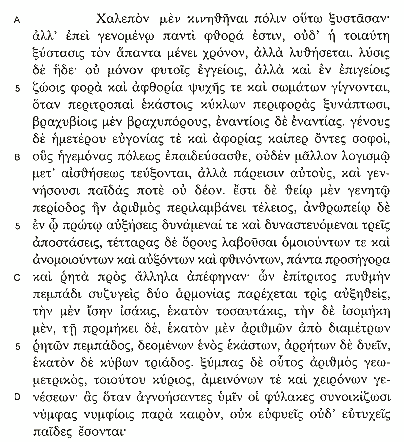
APPENDIX 2
FICINO AND THE EARLIER HUMANIST
VERSIONS OF REPUBLIC 546A FF.
Three humanist versions preceded Ficino's. The first was a collaborative effort by Manuel Chrysoloras and Uberto Decembrio published in 1402, though Uberto continued to revise the translation in later life. The second was by Pier Candido Decembrio, Uberto's son, completed by June 1439 after three years of labor and published in 1440 (this was indebted to Uberto's version—so much so that Guarino of Verona dismissed it, incorrectly, as merely a rifacimento ). The third was left among the papers of the minor humanist Antonio Cassarino when he died in 1447.
In his authoritative study, Plato in the Italian Renaissance , James Hankins has found no evidence of Ficino's familiarity with either of the two later versions, declaring "Ficino did not . . . make use either of Pier Candido Decembrio's or of Cassarino's translations of the Republic , neither of which seems to have been known in Florence during the fifteenth century" (2:472; cf. 1:352n). But Ficino did make "extensive use," he argues, of the earlier translation by Chrysoloras and Uberto Decembrio, "a manuscript of which existed in Florence in Ficino's day" (1:310; cf. 2:420) based on a still unidentified manuscript stemming from MS Vindobonensis Gr. 7 (cf. Boter, Textual Tradition , pp. 61–62 [no. 53 with the siglum W]). This debt is surprising in that the collaboration of the distinguished Greek scholar and the Italian humanist—Uberto was not, again despite Guarino's carping, merely Chrysoloras's scribe—had in fact produced "a rather crude piece of work: an opaquely literal rendering interspersed with
patches of paraphrase" plus errors and omissions, the whole demonstrating a slight understanding of Plato's thought (1:105–117 at 108). Ficino was forced to make severely "critical" use, therefore, of it, his version being "for the most part entirely fresh" and representing a clear advance in philosophical understanding (2:471–472).
Apart from the archetype, Milan's Ambrosiana B 123 sup., Hankins has identified nine manuscripts of this 1402 translation (which he lists in his index of translators at 2:820). Among them is the Laurenziana's Plut. 89 sup. 50, which was probably the manuscript Ficino used (2: 684 [no. 79]; see also Eugenio Garin, "Ricerche sulle traduzioni di Platone nella prima metà del sec. XV," in Medioevo e Rinascimento: Studi in onore di Bruno Nardi [Florence, 1955], 1:339–374 at 341–344; and Gentile in Mostra , pp. 9–10 [no. 8]).
Hankins has edited Uberto's notabilia , his prologue to the Republic , and his argumenta for each book (2:412–414 and 525–530). For Pier Candido's prologue to book 8, see Garin, "Ricerche," pp. 354–355. For other severe comments on the 1402 translation, see Hankins's related article, "A Manuscript of Plato's Republic in the Translation of Chrysoloras and Uberto Decembrio with Annotations of Guarino Veronese (Reg. lat. 1131)," in Supplementum Festivum , pp. 149–188, esp. pp. 149–161.
The following is my own transcription of the Chrysoloras/Uberto Decembrio translation in the archetype, the Ambrosiana B. 123 sup. 193r.3up–193v.18 (for this MS see Hankins, Plato 2:698 [no. 158] with further references):
Difficile quidem est moveri constitutam talem civitatem, sed cum omni creato subsit interitus talis etiam* constitutio solvetur, nec est possibile eam omni tempore permanere. Que equidem dissolutio: nedum plantis sed etiam [193v] terrenis animalibus fertilitas et infertilitas animae generatur et corporum, quando circuitiones convenerint quorumlibet circulorum, brevis evi videlicet que progressus fuerint brevioris, aliterque contrarium. Vestri vero generis bonam generationem vel sterilem, quamvis sapientes fuerint, quos civitatis principes statuistis, nil intellectu magis cum sensu sequentur, sed ipsosque diffugiet et plerumque pueros dum oportunum non fuerit generabunt. Est autem
divino creato equidem periodus quam numerus continet diffinitus. Humano vero in quo primo augumentationes, potentes videlicet et sub aliorum potentia consistentes, tres distantie quatuor terminos cum acceperint, similantium et dissimilantium, crescentiumque atque decrescentium, omnia appellabilia et dicibilia ad invicem prebuerunt, quorum epitritus pithmin quinitati coniunctus, ter augumentatus, duas exhibet armonias, unam quidem equalem equaliter, centum centies, alteram vero equalis quidem longitudinis, promiche vero, centum s[c]ilicet numerorum ex diametris, dicibilibus quinitatis indigentibus uno cuiuslibet, indicibilibus vero duobus. Centum cuborum autem trinitatis. Omnis vero iste numerus geometricus talem auctoritatem habens, generationum meliorum s[c]ilicet et peiorum est quas cum custodes vestri ignoraverint, nec in tempore debito sponsas sponsis coniunxerint, non ingeniosi aut felices pueri nascentur.
APPENDIX 3
"IN NUMBER, WEIGHT, AND MEASURE"
This famous formulation from the Wisdom of Solomon 11:20[21] Ficino refers to on a number of occasions: either explicitly as in the letter on music addressed to Antonio Canigiani in the first book of his Epistulae (ed. Gentile, pp. 161–163 [no. 92] at 163.52–53; trans. in Letters , 1:141–144 [no. 92] at 143) and in the letter to Bastiano Foresi in the eighth book (Opera , p. 822.2); or indirectly as in his Philebus Commentary 1.36 (citing Plato's Laws 4.716C—see Mahoney, "Metaphysical Foundations," p. 189) and 2.3 (ed. Allen, pp. 358–363, 415). In the latter instance, in the course of a further disquisition on the Philebus 23C ff. and Plato's postulation of the two primary metaphysical principles of the "limit" and the "infinite," Ficino attributes to Philo (Judaeus?) the idea that the "limit" is present in the substance (or nature), and in the quantity and the quality of all individual entities. It is thus present by way of "weight," meaning the "fixed substance and nature of an entity"; by way of "measure," meaning "the determined proportion of its quantity"; and by way of "number," meaning "the finite and harmonious (congruentes ) degrees of its quality."
Ficino provides his most extensive analysis, however, in his Timaeus Commentary 19, which, given its unfamiliarity, I quote in full from the Compendium Marsilii Ficini in Timaeum as it appears in Ficino's Platonis Opera Omnia (1491), fols. 241–252 at 244r (sig. G4r) (i.e., in his own Opera at p. 1446.1). He is interpreting the passage on means at 31B–32B (cf. 36A) in which Timaeus argues that, while ad-
jacent square numbers require only one geometric mean (9:6:4), cube numbers require two (27:18:12:8); and thus that both air and water must mediate between fire and earth. He closes the chapter thus:
But since Plato accepted these mathematicals here not on their own account but on account of naturals, . . . let us briefly consider what mysteries mainly of nature he may intend by way of these mathematical images. In the first place what we read in the sacred scriptures—that "God perfected all things in number, measure, and weight"—is clearly taken up by Plato when he introduces numbers, measures, and solids. By "solids" he understands weights too; and this he also signifies when, after dimensions, he mentions the "powers" of inclinations, the causes as it were of weights. He means us to understand by "numbers" the species of natural things and the substantial forms which Aristotle too compared to numbers. By "measures" he means definite, instrumental figures or magnitudes accommodated to definite species. Finally by "solids" and "powers" he signifies the qualities which are fully extended with things that have mass, and which bestow momentum on motions and actions. But these terms indicate all things in the universe: the species of things, the shapes and magnitudes of the species, the qualities compounded with geometric and in turn with musical proportion (so that the lowest are exceeded by the middle to the same extent that the middle are exceeded by the higher).
Again, by "numbers" he designates the arithmetic mean, which consists in the parity of numbers; by "dimensions" and "measures" he designates the geometric mean which is located in the identity of ratio and proportion; and by "weights" and "powers" he designates the musical mean which is dependent on the equality or the likeness of [pro]portion, and which comprehends the quickness and the slowness of motions, and high and low pitch in the power of voices.
Quoniam vero Plato mathematica haec non propter seipsa quidem sed propter naturalia hic accepit, his praetermissis, consideremus breviter quae potissimum naturae mysteria per mathematicas imagines subintelligat. Principio quod in sacris litteris legitur, Deum omnia in numero, mensura, pondere perfecisse, manifeste tangitur a Platone numeros, mensuras, solida in medium adducente. Per solida enim comprehendit et pondera quae etiam significat ubi post dimensiones commemorat vires inclinationum quasi ponderum causas. Per numeros quidem intelligi vult ipsas rerum naturalium species formasque substantiales quas etiam Aristoteles numeris comparavit; per mensuras autem certas instrumentalesque figuras vel magnitudines speciebus certis accommodatas. Per solida denique atque vires significat qualitates quae et [Op. et quae] cum molibus [Op. motibus] penitus protenduntur et praestant motionibus actionibusque momentum. Indicant [Op. indicat] autem omnes in universo, tum rerum species, tum specierum figuras magnitudinesque, tum qualitates geometrica invicem et musica proportione compositas, ut qua ratione infimae a mediis eadem mediae a superioribus excedantur. Item per numeros designat medium arithmeticum quod numerorum paritate consistit; per dimensiones atque mensuras, medium geometricum quod in rationis proportionisque iden-
titate locatur; per pondera et vires, medium musicum quod, in [pro]portionis aequalitate vel similitudine situm, velocitatem tarditatemque motionum et acumen gravitatemque [Op. gravidatemque] vocum virtute comprehendit [Plat. Op. comprehenditur].
This is a revealing example both of Ficino's enthusiasm for using Plato to gloss Scripture and the reverse, and more particularly of his commitment to a full Christian accommodation of the cosmology of the Timaeus (on which see my "Ficino's Interpretation of Plato's Timaeus ").
APPENDIX 4
CONVERSION TABLE
|
|||||||||||||||||||||||||||||||||||||||||||||||||||||||||||||||||||||||||||||||||||||||||||||||||||||||||
SELECT BIBLIOGRAPHY
Primary Texts
Acciaiuoli, Donato. In Aristotelis Libros Octo Politicorum Commentarii . Venice, 1566.
Anonymous. Theologumena Arithmeticae . Edited by Victorius de Falco. Leipzig, 1922. Rev. ed. by Udalricus Klein. Stuttgart, 1975. Translated by Robin Waterfield as The Theology of Arithmetic: On the Mystical, Mathematical and Cosmological Symbolism of the First Ten Numbers, Attributed to Iamblichus . Grand Rapids, Mich., 1988.
Aristides Quintilianus. De Musica . Edited by R. P. Winnington-Ingram. Leipzig, 1963.
Aristotle. The Complete Works of Aristotle: The Revised Oxford Translation . Edited by Jonathan Barnes. 2 vols. Bollingen Series, 71:2. Princeton, 1984.
Aristotle. Politics . Edited by Franciscus Susemihl as Aristotelis Politicorum Libri Octo cum Vetusta Translatione Guilelmi de Moerbeka . Leipzig, 1872. See also under Bruni below.
Barocius (Barozzi), Franciscus. Commentarius in Locum Platonis Obscurissimum et hactenus a nemine recte expositum in principio Dialogi octavi de Rep. ubi sermo habetur de numero Geometrico, de quo proverbium est, quod numero Platonis nihil obscurius . Bologna, 1566.
Bodin, Jean. Methodus ad Facilem Historiarum Cognitionem . Basel, 1576.
Bodin, Jean. De Republica Libri Sex latine ab Autore Redditi . Lyons and Paris, 1586.
Bodin, Jean. Les six livres de la Republique . Paris, 1576, etc.; in Latin, 1586, etc. Translated by Richard Knolles as The Six Bookes of a Commonweale . London, 1606. Knolles's translation has been edited by Kenneth Douglas McRae. Cambridge, Mass., 1962.
Boethius. De Institutione Arithmetica and De Institutione Musica . Edited by Godofredus Friedlein. Leipzig, 1867. Reprint, Frankfurt am Main, 1966.
Bruni, Leonardo (Aretino), trans. Aristotelis Stagiritae Politicorum ad Nicomachum Lib. Primus; Raphaelis Volaterrani Argumenta in Eosdem . Venice, 1542. See also under Baron below.
Calcidius. Timaeus a Calcidio Translatus Commentarioque Instructus . Edited by J. H. Waszink. Corpus Platonicum Medii Aevi, Plato Latinus, edited by R. Klibansky, vol. 4. London and Leiden, 1962. 2d ed., 1975. Also edited by Johannes Wrobel as Platonis Timaeus Interprete Chalcidio cum Eiusdem Commentario . Leipzig, 1876.
Cardanus (Cardano), Hieronymus. Opus Novum de Proportionibus . Basel, 1570.
Corsi. Vita Marsilii Ficini . In Marcel, Marsile Ficin (1433–1499) (see under Marcel in this Bibliography), pp. 680–689.
Euclid. Elementa . Edited by Johan Ludvig Heiberg. Vols. 1–5 of Euclidis Opera Omnia . Leipzig, 1883–1888. Rev. ed. by E. S. Stamatis. Leipzig, 1969–1977. Translated from the text of Heiberg by Thomas L. Heath as The Thirteen Books of Euclid's Elements . 2d ed. 3 vols. Cambridge, 1926. Reprint, New York, 1956.
Faber Stapulensis, Iacobus (Jacques Lefèvre d'Étaples). See under Rice below.
Ficino, Marsilio. De Amore . Edited and translated by Raymond Marcel as Marsile Ficin: Commentaire sur le Banquet de Platon . Paris, 1956.
Ficino, Marsilio. Sopra l'amore . Edited by Sandra Niccoli as Marsilio Ficino: El libro dell'amore . Istituto Nazionale di Studi sul Rinascimento: Studi e testi, 16. Florence, 1987.
Ficino, Marsilio. Commentaria in Platonem . Florence, 1496.
Ficino, Marsilio. In Convivium . See under De Amore and Sopra l'amore .
Ficino, Marsilio. Epistulae I. Edited by Sebastiano Gentile as Marsilio Ficino: Lettere I: Epistolarum Familiarium Liber I . Florence, 1990.
Ficino, Marsilio. Epistulae I, III, IV, V. Translated by Members of the Language Department of the School of Economic Science, London, as The Letters of Marsilio Ficino . 4 vols. to date. London, 1975-.
Ficino, Marsilio. Opera Omnia . Basel, 1576. Reprint, Turin, 1959, 1983.
Ficino, Marsilio. In Phaedrum . Edited and translated by M. J. B. Allen as Marsilio Ficino and the Phaedran Charioteer . Berkeley, Los Angeles, London, 1981.
Ficino, Marsilio. In Philebum . Edited and translated by M. J. B. Allen as Marsilio Ficino: The Philebus Commentary . Berkeley, Los Angeles, London, 1975. Reprint, 1979, with corrections.
Ficino, Marsilio. Platonis Opera Omnia . Florence, 1484. 2d ed., Venice, 1491.
Ficino, Marsilio. Plotini Enneades . Florence, 1492.
Ficino, Marsilio. In Sophistam . Edited and translated by M. J. B. Allen in Icastes: Marsilio Ficino's Interpretation of Plato's Sophist , Part 2. Berkeley, Los Angeles, Oxford, 1989.
Ficino, Marsilio. Theologia Platonica . Edited and translated by Raymond Marcel as Marsile Ficin: Théologie platonicienne de l'immortalité des âmes . 3 vols. Paris, 1964–1970.
Ficino, Marsilio. De Vita . Edited and translated by Carol V. Kaske and John R. Clark
as Marsilio Ficino: Three Books on Life . Medieval and Renaissance Texts and Studies, 57. Binghamton, N.Y., 1989. See also under Kristeller and Pintaudi below.
Iamblichus. Iamblichi de Communi Mathematica Scientia Liber . Edited by Nicolaus Festa. Leipzig, 1891. Rev. ed. by Udalricus Klein. Stuttgart, 1975.
Iamblichus. Iamblichi in Nicomachi Arithmeticam Introductionem Liber . Edited by Hermenegildus Pistelli. Leipzig, 1894. Rev. ed. by Udalricus Klein. Stuttgart, 1975.
Iamblichus. De Mysteriis . Edited by Édouard Des Places. Paris, 1966.
Iamblichus. Protrepticus . Edited by Hermenegildus Pistelli. Leipzig, 1888. Also edited and translated by Édouard Des Places. Paris, 1989.
Iamblichus. De Vita Pythagorica . Edited by L. Deubner. Leipzig, 1937. Rev. ed. by Udalricus Klein. Stuttgart, 1975. Translated by Gillian Clark as Iamblichus: On The Pythagorean Life . Liverpool, 1989. See also under Ficino above and Dillon and Larsen below.
Landucci, Luca. Diario fiorentino dal 1450 al 1516 continuato da un anonimo fino al 1542 . Edited by Iodoco Del Badia. Florence, 1883. Reprint, 1969.
Lefèvre d'Étaples, Jacques (Iacobus Faber Stapulensis). See under Rice below.
Macrobius, Ambrosius Theodosius. Ambrosii Theodosii Macrobii Commentarii in Somnium Scipionis . Edited by Iacobus Willis. Leipzig, 1963. Also edited and translated by Luigi Scarpa as Macrobii Ambrosii Theodosii Commentariorum in Somnium Scipionis Libri Duo . Padua, 1981.
Moerbeke, William of, trans. Aristotelis Politicorum Libri Octo . See under Aristotle above.
Moerbeke, William. Procli Commentarium in Platonis Parmenidem . See under Proclus below.
Nicomachus of Gerasa. Nicomachi Geraseni Pythagorei Introductionis Arithmeticae Libri Duo . Edited by Ricardus Hoche. Leipzig, 1866. Translated by Janine Bertier as Nicomaque de Gérase: Introduction arithmétique . Paris, 1978. Also translated by Martin Luther D'Ooge as Nicomachus of Gerasa: Introduction to Arithmetic , with studies in Greek arithmetic by Frank Egleston Robbins and Louis Charles Karpinski. New York, 1926. 2d ed., 1972.
Orphica. Fragmenta Orphicorum . Edited by O. Kern. Berlin, 1922.
Philoponus, Ioannes. Ioannis Philoponi in Aristotelis de Anima Libros Commentaria . Edited by Michael Hayduck. Commentaria in Aristotelem Graeca, vol. 15. Berlin, 1897.
Pico della Mirandola, Giovanni. Opera Omnia . Basel, 1572. See also under Garin below.
Plato. Platonis Opera . Edited by John Burnet. Oxford, 1900 ff. Translated in The Collected Dialogues of Plato , edited by Edith Hamilton and Huntington Cairns. Bollingen Series, 71. Princeton, 1963.
Plato. Platonis Opera Graece . Edited by Karl Ernst Christopher Schneider. 3 vols. in 2. Leipzig, 1830–1831.
Plato. Platonis Opera Omnia . Translated by Marsilius Ficinus. Florence, 1484. 2d ed., Venice, 1491.
Plato. Republic . Edited by James Adam as The Republic of Plato . 2 vols.
Cambridge, 1902. 2d ed. by D. A. Rees, 1963. Translated by Francis M. Cornford. Oxford, 1941. Also translated by H. D. P. Lee (Desmond Lee). 3d. ed. Harmondsworth: Penguin, 1987.
Plotinus. Enneads . Translated by Marsilius Ficinus. Florence, 1492. Edited and translated by E. Bréhier. 7 vols. Paris, 1924–1938. Also edited by P. Henry and H.-R. Schwyzer. 3 vols. Oxford, 1964–1982 (their revised editio minor ). Also translated by A. H. Armstrong. 7 vols. Cambridge, Mass., and London, 1966–1988.
Plotinus. Enneads 6.6. Edited and translated with commentary by Janine Bertier et al. as Traité sur les nombres . Paris, 1980.
Plutarch. De Animae Procreatione in Timaeo . Edited and translated by H. Cherniss. In Vol. 13, Part 1, of the Loeb edition of the Moralia . London and Cambridge, Mass., 1976.
Proclus. The Elements of Theology . Edited and translated by E. R. Dodds. Oxford, 1933. 2d ed., 1965.
Proclus. Procli Commentarium in Platonis Parmenidem . Edited by Victor Cousin in Procli Opera Inedita , pp. 617–1242. Paris, 1864. Translated by Glenn R. Morrow and John M. Dillon as Proclus' Commentary on Plato's Parmenides . Princeton, 1987.
Proclus. In Primum Euclidis Elementorum Librum Commentarii . Edited by Godofredus Friedlein. Leipzig, 1873. Translated by Leander Schönberger as Proklus Diadochus: Kommentar zum ersten Buch von Euklids "Elementen." Halle, 1945. Also translated by Paul Ver Eecke as Proclus de Lycie: Les commentaires sur le premier livre des Éléments d'Euclide . Bruges, 1948. Also translated by Glenn R. Morrow as Proclus: A Commentary on the First Book of Euclid's Elements . Princeton, 1970. Also translated by Maria Timpanaro Cardini as Proclo: Commento al I libro degli "Elementi" di Euclide . Pisa, 1978.
Proclus. In Platonis Parmenidem Commentarii . Translated by William of Moerbeke, this translation being edited by Carlos Steel as Proclus: Commentaire sur le Parménide de Platon, traduction de Guillaume de Moerbeke . 2 vols. Louvain and Leiden, 1982–1985.
Proclus. In Platonis Rem Publicam Commentarii . Edited by G. Kroll. 2 vols. Leipzig, 1899–1901. Translated by A.-J. Festugière as Proclus: Commentaire sur la République . 3 vols. Paris, 1970. Also edited by R. Schoell as Procli Commentariorum in Rempublicam Platonis Partes Ineditae . Berlin, 1886.
Proclus. In Platonis Timaeum Commentaria . Edited by Ernst Diehl. 3 vols. Leipzig, 1903–1906. Reprint, Amsterdam, 1965. Translated by A.-J. Festugière as Proclus: Commentaire sur le Timée , 5 vols. Paris, 1966–1969.
Proclus. Theologia Platonica . Edited and translated by H. D. Saffrey and L. G. Westerink as Proclus: Théologie platonicienne . 5 vols. to date (i.e., books 1–5). Paris, 1968-. Also edited and translated by Aemilius Portus as Procli Successoris Platonici in Platonis Theologiam Libri Sex . Hamburg, 1618. Reprint, Frankfurt am Main, 1960.
Psellus. De Numeris . Edited by P. Tannery in Revue des études grecques 5 (1892), 344–347.
Pythagoreans. The Pythagorean Texts of the Hellenistic Period . Edited by H. Thesleff. Åbo, 1965.
Theon of Smyrna. Expositio Rerum Mathematicarum ad Legendum Platonem Utilium . Edited by Eduardus Hiller. Leipzig, 1878. Reprint, New York, 1987. Also edited and translated by J. Dupuis as Théon de Smyrne, philosophe platonicien: Exposition des connaissances mathématiques utiles pour la lecture de Platon . Paris, 1892. Dupuis's text has been translated by Robert and Deborah Lawlor with Christos Toulis et al. as Mathematics Useful for Understanding Plato . San Diego, 1979.
Volaterranus, Raphael (Maffei). Commentaria Urbana . Rome, 1506.
Secondary Texts
Adam, James. The Nuptial Number of Plato: Its Solution and Significance . London, 1891. Reprint, London and Wellingborough, 1985. See also under Plato above.
Albertini, Tamara. "Marsilio Ficino: Das Problem der Vermittlung von Denken und Welt in einer Metaphysik der Einfachheit." Diss., Ludwig-Maximilians-Universität, Munich, 1991.
Allen, Michael J. B. "The Absent Angel in Ficino's Philosophy." Journal of the History of Ideas 36 (1975), 219–240.
Allen, Michael J. B. "Ficino's Theory of the Five Substances and the Neoplatonists' Parmenides ." Journal of Medieval and Renaissance Studies 12 (1982), 19–44.
Allen, Michael J. B. "Homo ad Zodiacum: Marsilio Ficino and the Boethian Hercules." In Forma e parola: Studi in memoria di Fredi Chiappelli , edited by Dennis J. Dutschke, Pier Massimo Forni, Filippo Grazzini, Benjamin R. Lawton, and Laura Sanguineti White, pp. 205–221. Rome, 1992.
Allen, Michael J. B. "Marsilio Ficino, Hermes and the Corpus Hermeticum ." In New Perspectives on Renaissance Thought , edited by John Henry and Sarah Hutton, pp. 38–47. London, 1990.
Allen, Michael J. B. "Marsilio Ficino on Plato, the Neoplatonists and the Christian Doctrine of the Trinity." Renaissance Quarterly 37 (1984), 555–584.
Allen, Michael J. B. "Marsilio Ficino on Plato's Pythagorean Eye." MLN 97 (1982), 171–182.
Allen, Michael J. B. "Marsilio Ficino's Interpretation of Plato's Timaeus and Its Myth of the Demiurge." In Supplementum Festivum (see under Hankins in this Bibliography), pp. 399–439.
Allen, Michael J. B. The Platonism of Marsilio Ficino: A Study of His Phaedrus Commentary, Its Sources and Genesis . Berkeley, Los Angeles, London, 1984.
Allen, Michael J. B. "The Second Ficino-Pico Controversy: Parmenidean Poetry, Eristic and the One." In Marsilio Ficino e il ritorno di Platone: Studi e documenti (see under Garfagnini in this Bibliography), pp. 417–455.
Allen, Michael J. B. "Summoning Plotinus: Ficino, Smoke, and the Strangled Chickens."
In Reconsidering the Renaissance: Papers from the Twenty-Sixth Annual Conference of the Center for Medieval and Early Renaissance Studies , edited by Mario A. Di Cesare, pp. 63–88. Binghamton, N.Y., 1992. See also under Ficino above.
Baron, Hans. "Willensfreiheit und Astrologie bei Marsilio Ficino und Pico della Mirandola." In Kultur- und Universalgeschichte: Walter Goetz zu seinem 60. Geburtstage , pp. 145–170. Leipzig and Berlin, 1927.
Baron, Hans., ed. Leonardo Bruni Aretino: Humanistisch-philosophische Schriften . Leipzig and Berlin, 1928.
Birnbaum, Marianna D. Janus Pannonius, Poet and Politician . Zagreb, 1981.
Boll, Franz, Carl Bezold, and Wilhelm Gundel. Sternglaube und Sterndeutung: Die Geschichte und das Wesen der Astrologie . Revised by Wilhelm Gundel. Stuttgart, 1931. Reprint, 1966.
Boter, Gerard. The Textual Tradition of Plato's Republic . Leiden, 1989.
Bouché-Leclercq, Auguste. L'astrologie grecque . Paris, 1899. Reprint, 1963.
Bowen, William R. "Ficino's Analysis of Musical Harmonia ." In Ficino and Renaissance Neoplatonism , edited by Konrad Eisenbichler and Olga Zorzi Pugliese, pp. 17–27. University of Toronto Italian Studies, 1. Ottawa, 1986.
Braden, Gordon. See under Kerrigan.
Brumbaugh, Robert S. Plato's Mathematical Imagination . Bloomington, Indiana, 1954.
Buhler, Stephen M. "Marsilio Ficino's De Stella Magorum and Renaissance Views of the Magi." Renaissance Quarterly 43.2 (1990), 348–371.
Bullard, Melissa Meriam. "The Inward Zodiac: A Development in Ficino's Thoughts on Astrology." Renaissance Quarterly 43.4 (1990), 687–708.
Bullard, Melissa Meriam. "Marsilio Ficino and the Medici: The Inner Dimensions of Patronage." In Christianity and the Renaissance: Image and Religious Imagination in the Quattrocento , edited by Timothy Verdon and John Henderson, pp. 467–492. Syracuse, N.Y., 1990.
Bulmer-Thomas, I. "Plato's Astronomy." Classical Quarterly 34 (1984), 107–112.
Burkert, W. Lore and Science in Ancient Pythagoreanism . Translated by Edwin L. Minar, Jr. Cambridge, Mass., 1972.
Burlamacchi, Pacifico, [Pseudo-]. La vita del Beato Ieronimo Savonarola . Lucca, 1761. Edited by Piero Ginori Conti. Introduction by Roberto Ridolfi. Florence, 1937.
Busard, H. L. L. The First Latin Translation of Euclid's "Elements" Commonly Ascribed to Adelard of Bath (Books I–VIII and Books X.36–XV.2) . Pontifical Institute of Mediaeval Studies: Studies and Texts, 64. Toronto, 1983.
Casanova, E. "L'astrologia e la consegna del bastone al capitano generale della Repubblica fiorentina." Archivio storico italiano , 5th ser., 7 (1891), 134–144.
Castagnola, Raffaella. "I Guicciardini et l'astrologia." Rinascimento , 2d ser., 27 (1987), 343–348.
Castelli, Enrico, ed. L'umanesimo e il demoniaco nell'arte: Atti del Congresso Internazionale di Studi Umanistici . Rome, 1952.
Castelli, Enrico, ed. Umanesimo e esoterismo: Atti del V Convegno Internazionale di Studi Umanistici . Padua, 1960.
Chastel, André. "L'antéchrist à la Renaissance." In L'umanesimo e il demoniaco nell'arte (see under Castelli in this Bibliography), pp. 177–186.
Chastel, André. Marsile Ficin et l'art . Geneva and Lille, 1954. Reprint, Geneva, 1975.
Cherniss, Harold F. Aristotle's Criticism of Plato and the Academy . Vol. 1 (no more published). Baltimore, 1944.
Cherniss, Harold F. "Plato as Mathematician." The Review of Metaphysics 4 (1951), 395–425. Reprinted in Cherniss, Selected Papers , edited by Leonardo Tarán, pp. 222–252. Leiden, 1977.
Ciavolella, Massimo, and Amilcare A. Ianucci, eds. Saturn from Antiquity to the Renaissance . University of Toronto Italian Studies, 8. Ottawa, 1992.
Comparetti, Domenico. Virgilio nel medio evo. Revised by Giorgio Pasquali. 2 vols. Florence, 1937. Reprint, 1967.
Copenhaver, Brian. "Astrology and Magic." In The Cambridge History of Renaissance Philosophy (see under Schmitt in this Bibliography), pp. 264–300.
Copenhaver, Brian. "Scholastic Philosophy and Renaissance Magic in the De Vita of Marsilio Ficino." Renaissance Quarterly 37 (1984), 523–554.
Cornford, Francis M. Plato's Cosmology: The Timaeus of Plato Translated with a Running Commentary . London, 1937.
Cornford, Francis M. "Mathematics and Dialectic in Republic VI and VII." In Studies in Plato's Metaphysics , edited by R. E. Allen, pp. 61–95. London, 1965.
Couliano, Ioan Petru. Eros et magie à la Renaissance, 1484 . Paris, 1984. Translated by Margaret Cook as Eros and Magic in the Renaissance , with a foreword by Mircea Eliade. Chicago, 1987.
Courcelle, Pierre. "Les exégèses chrétiennes de la Quatrième Éclogue." Revue des études anciennes 59 (1957), 294–319.
Cumont, Franz. Astrology and Religion among the Greeks and Romans . Translated by J. B. Baker. New York, 1912. Reprint, New York: Dover, 1960.
Davies, Martin C. "An Enigma and a Phantom: Giovanni Aretino and Giacomo Languschi." Humanistica Lovaniensia 37 (1988), 1–29.
Diès, Auguste. "Le nombre nuptial de Platon (Rép. 546B/C)." Comptes rendus de l'Académie des inscriptions et belles-lettres (Paris), 1933, pp. 228–235.
Diès, Auguste. "Le nombre de Platon: Essai d'exégèse et d'histoire." Mémoires présentés par divers savants à l'Académie des inscriptions et belles-lettres (Paris), 14.1 (1940), 1–141.
Diller, Aubrey. "Notes on the History of Some Manuscripts of Plato." In his Studies in Greek Manuscript Tradition , pp. 251–258. Amsterdam, 1983.
Dillon, John. The Middle Platonists , 80 B.C. to A.D. 220. London and Ithaca, N.Y., 1977.
Dillon, John. "A Date for the Death of Nicomachus of Gerasa." Classical Review 19 (1969), 274–275.
Dillon, John, ed. and trans. Iamblichi Chalcidensis in Platonis Dialogos Commentariorum Fragmenta . Leiden, 1973.
Dress, Walter. Die Mystik des Marsilio Ficino . Berlin and Leipzig, 1929.
Dupuis, J. Le nombre géométrique de Platon . Paris, 1881.
Festugière, A.-J. La révélation d'Hermès Trismégiste . 4 vols. Paris, 1949–1954.
Field, Arthur. The Origins of the Platonic Academy in Florence . Princeton, 1988.
Findlay, J. N. Plato: The Written and Unwritten Doctrines . London, 1974.
Flegg, G. Numbers: Their History and Meaning . London, 1983.
Fowler, D. H. The Mathematics of Plato's Academy: A New Reconstruction . Oxford, 1987.
Fubini, Riccardo. "Ficino e i Medici all'avvento di Lorenzo il Magnifico." Rinascimento , 2d ser., 24 (1984), 3–52.
Fubini, Riccardo. "Ancora su Ficino e i Medici." Rinascimento , 2d ser., 27 (1987), 275–291.
Gallavotti, Carlo. "Intorno ai Commenti di Proclo alla Republica." Bollettino del Comitato per la preparazione dell'edizione nazionale dei classici greci e latini 19 (1971), 41–49.
Gandillac, Maurice de. "Astres, anges et génies chez Marsile Ficin." In Umanesimo e esoterismo (see under Castelli in this Bibliography), pp. 85–119. Padua, 1960.
Garfagnini, Gian Carlo, ed. Marsilio Ficino e il ritorno di Platone: Studi e documenti . 2 vols. Florence, 1986.
Garin, Eugenio. "L'attesa dell'età nuova e la renovatio." In L'attesa dell'età nuova nella spiritualità della fine del Medioevo, 16–19 ottobre 1960 , pp. 9–35. Convegni del Centro di Studi sulla Spiritualità Medievale, 3. Todi, 1962.
Garin, Eugenio. La cultura filosofica del Rinascimento italiano: Ricerche e documenti . Florence, 1961. 2d ed., 1979.
Garin, Eugenio. L'età nuova: Ricerche di storia della cultura dal XII al XVI secolo . Naples, 1969.
Garin, Eugenio. Medioevo e Rinascimento . Bari, 1954. 2d ed., 1961.
Garin, Eugenio. "Phantasia e Imaginatio fra Marsilio Ficino e Pietro Pomponazzi." Giornale critico della filosofia italiana , 6th ser., 5 (1986), 349–361.
Garin, Eugenio. Portraits from the Quattrocento . Translated by Victor A. Velen and Elizabeth Velen. New York, 1972.
Garin, Eugenio. "Ricerche sulle traduzioni di Platone nella prima metà del sec. XV." In Medioevo e Rinascimento: Studi in onore di Bruno Nardi 1:339–374. Florence, 1955.
Garin, Eugenio. "Le traduzioni umanistiche di Aristotele nel secolo XV." Atti e memorie dell'Accademia fiorentina di scienze morali "La Columbaria," 16 (1951), 55–104.
Garin, Eugenio. L'umanesimo italiano . Bari, 1952.
Garin, Eugenio. Lo zodiaco della vita: La polemica sull'astrologia dal Trecento al Cinquecento . Rome and Bari, 1976. Translated by Carolyn Jackson et al. as Astrology in the Renaissance: The Zodiac of Life . London, 1983.
Garin, Eugenio, ed. and trans. Giovanni Pico della Mirandola: De Hominis Dignitate, Heptaplus, De Ente et Uno, e scritti vari . Florence, 1942.
Garin, Eugenio, ed. and trans. Giovanni Pico della Mirandola: Disputationes adversus Astrologiam Divinatricem . 2 vols. Florence, 1946–1952.
Gentile, Sebastiano. "In margine all'Epistola 'De divino furore' di Marsilio Ficino." Rinascimento , 2d ser., 23 (1983), 33–77.
Gentile, Sebastiano. "Note sui manoscritti greci di Platone utilizzati da Marsilio Ficino."
In Scritti in onore di Eugenio Garin , pp. 51–84. Pisa, 1987.
Gentile, Sebastiano. "Sulle prime traduzioni dal greco di Marsilio Ficino." Rinascimento , 2d ser., 30 (1990), 57–104.
Gentile, Sebastiano, Sandra Niccoli, and Paolo Viti. Marsilio Ficino e il ritorno di Platone: Mostra di manoscritti, stampe e documenti (17 maggio–16 giugno 1984) . Florence, 1984.
See also under Ficino above.
Gersh, Stephen. Middle Platonism and Neoplatonism: The Latin Tradition . 2 vols. Notre Dame, Ind., 1986.
Gombrich, Ernst H. "Botticelli's Mythologies: A Study in the Neoplatonic Symbolism of His Circle." Journal of the Warburg and Courtauld Institutes 8 (1945), 7–60.
Gombrich, Ernst H. "'Icones Symbolicae': The Visual Image in Neoplatonic Thought." Journal of the Warburg and Courtauld Institutes 11 (1948), 163–192.
Gombrich, Ernst H. Symbolic Images: Studies in the Art of the Renaissance . 2d ed. Oxford and New York, 1978.
Greene, William Chase, ed. Scholia Platonica . American Philological Association Monograph 8. Haverford, Pa., 1938. Reprint, Chico, Calif., 1981.
Griffiths, Gordon, James Hankins, and David Thompson, trans. The Humanism of Leonardo Bruni: Selected Texts . Medieval and Renaissance Texts and Studies, 46. Binghamton, N.Y., 1987.
Guthrie, K. S. The Pythagorean Sourcebook and Library . New York, 1919. Rev. ed., Grand Rapids, Mich., 1987.
Guthrie, W. K. C. A History of Greek Philosophy . 6 vols. Cambridge, 1962–1981.
Hankins, James. "Cosimo de' Medici and the 'Platonic Academy.'" Journal of the Warburg and Courtauld Institutes 53 (1990), 144–162.
Hankins, James. "A Manuscript of Plato's Republic in the Translation of Chrysoloras and Uberto Decembrio with Annotations of Guarino Veronese (Reg. Lat. 1131)." In Supplementum Festivum (see under Hankins, Monfasani, and Purnell in this Bibliography), pp. 149–188.
Hankins, James. "The Myth of the Platonic Academy of Florence." Renaissance Quarterly 44.3 (1991), 429–475.
Hankins, James. Plato in the Italian Renaissance . 2 vols. Leiden, New York, Copenhagen, Cologne: Brill, 1990.
See also under Griffiths above.
Hankins, James, John Monfasani, and Frederick Purnell, Jr., eds. Supplementum Festivum: Studies in Honor of Paul Oskar Kristeller . Medieval and Renaissance Texts and Studies, 49. Binghamton, N.Y., 1987.
Hatfield, Rab. "The Compagnia de' Magi." Journal of the Warburg and Courtauld Institutes 33 (1970), 107–161.
Heath, Thomas L. A History of Greek Mathematics . 2 vols. Oxford, 1921. Reprint, New York: Dover, 1981.
See also under Euclid above.
Heninger, S. K., Jr. The Cosmographical Glass: Renaissance Diagrams of the Universe . San Marino, Calif., 1977.
Heninger, S. K., Jr. Touches of Sweet Harmony: Pythagorean Cosmology and Renaissance Poetics . San Marino, Calif., 1974.
Hopper, Vincent Foster. Medieval Number Symbolism . New York, 1938.
Jervis, J. L. Cometary Theory in Fifteenth-Century Europe . Wroclaw, 1985.
Johnson, George. The Arithmetical Philosophy of Nicomachus of Gerasa . Lancaster, Pa., 1916.
Kaske, Carol V. "Ficino's Shifting Attitude towards Astrology in the De Vita Coelitus Comparanda , the Letter to Poliziano, and the Apologia to the Cardinals." In Marsilio Ficino e il ritorno di Platone: Studi e documenti (see under Garfagnini in this Bibliography), pp. 371–381.
See also under Ficino above.
Kerrigan, William, and Gordon Braden. The Idea of the Renaissance . Baltimore and London, 1989.
Kirk, G. S., J. E. Raven, and M. Schofield. The Presocratic Philosophers . 2d ed. Cambridge, 1983.
Klibansky, R. The Continuity of the Platonic Tradition during the Middle Ages . Munich, 1981.
Klibansky, R., E. Panofsky, and F. Saxl. Saturn and Melancholy: Studies in the History of Natural Philosophy and Art . London, 1964.
See also under Calcidius above.
Kretzmann, Norman, Anthony Kenny, and Jan Pinborg, with Eleonore Stump, eds. The Cambridge History of Later Medieval Philosophy . Cambridge, 1982.
Kristeller, Paul Oskar. "The First Printed Edition of Plato's Works and the Date of Its Publication (1484)." In Science and History: Studies in Honor of Edward Rosen , edited by Erna Hilfstein, Pawel Czartoryski, and Frank D. Grande, pp. 25–35. Wroclaw, 1978.
Kristeller, Paul Oskar. "Marsilio Ficino as a Beginning Student of Plato." Scriptorium 20 (1966), 41–54.
Kristeller, Paul Oskar. Marsilio Ficino and His Work after Five Hundred Years . Quaderni di Rinascimento, no. 7. Florence, 1987.
Kristeller, Paul Oskar. "Marsilio Ficino and the Roman Curia." Humanistica Lovaniensia: Journal of Neo-Latin Studies 34A (1985), 83–99.
Kristeller, Paul Oskar. Iter Italicum . 6 vols. London and Leiden, 1963–1991.
Kristeller, Paul Oskar. The Philosophy of Marsilio Ficino . New York, 1943. Reprint, Gloucester, Mass., 1964. Il pensiero filosofico di Marsilio Ficino . Florence, 1953. Rev. ed. with updated bibliography, 1988.
Kristeller, Paul Oskar. "Philosophy and Medicine in Medieval and Renaissance Italy." In Organism, Medicine, and Metaphysics: Essays in Honor of Hans Jonas , edited by Stuart F. Spicker, pp. 29–40. Dordrecht, 1978.
Kristeller, Paul Oskar. "Proclus as a Reader of Plato and Plotinus, and His Influence in the Middle Ages and the Renaissance." In Proclus: Lecteur et interprète des anciens , pp. 191–211. Paris, 1987.
Kristeller, Paul Oskar. Studies in Renaissance Thought and Letters . 2 vols. Rome, 1956. Reprint, 1985.
Kristeller, Paul Oskar. Supplementum Ficinianum . 2 vols. Florence, 1937. Reprint, 1973.
Kuczynska, Alicja. "The Third World of Marsilio Ficino or on the Indispensability of Experiencing Beauty." Dialectics and Humanism: The Polish Philosophical Quarterly 15.1–2 (1988), 157–171.
Larsen, Bent Dalsgaard. Jamblique de Chalcis: Exégète et philosophe , plus supplement, Testimonia et Fragmenta Exegetica . Aarhus, 1972.
Lippman, E. A. Musical Thought in Ancient Greece . New York, 1964.
Lubac, Henri de. L'exégèse médiévale: Les quatre sens de l'Écriture . 4 vols. Paris, 1959–1964.
Mahoney, Edward P. "Lovejoy and the Hierarchy of Being." Journal of the History of Ideas 48 (1987), 211–230.
Mahoney, Edward P. "Metaphysical Foundations of the Hierarchy of Being according to Some Late-Medieval and Renaissance Philosophers." In Philosophies of Existence, Ancient and Modern , edited by Parviz Morewedge, pp. 165–257. New York, 1982.
Mahoney, Edward P. "Neoplatonism, the Greek Commentators, and Renaissance Aristotelianism." In Neoplatonism and Christian Thought , edited by Dominic J. O'Meara, pp. 169–177, 264–282. Albany, N.Y., 1982.
Marcel, Raymond. Marsile Ficin (1433–1499) . Paris, 1958. See also under Ficino and Corsi above.
Michaelides, S. The Music of Ancient Greece: An Encyclopedia . London, 1978.
Michel, Paul-Henri. Les nombres figurés dans l'arithmétique pythagoricienne . Paris, 1958.
Michel, Paul-Henri. De Pythagore à Euclide: Contribution à l'histoire des mathématiques préeuclidiennes . Paris, 1950.
Monfasani, John. "For the History of Marsilio Ficino's Translation of Plato: The Revision Mistakenly Attributed to Ambrogio Flandino, Simon Grynaeus' Revision of 1532, and the Anonymous Revision of 1556/1557." Rinascimento , 2d ser., 27 (1987), 293–299. See also under Hankins above.
Mugler, Charles. Platon et la recherche mathématique de son époque . Strasbourg, 1948. Reprint, 1969.
Neugebauer, O. A History of Ancient Mathematical Astronomy . 3 vols. Berlin, Heidelberg, New York, 1975.
Niccoli, Ottavia. Profeti e popolo nell'Italia del Rinascimento . Rome and Bari, 1987. Translated by Lydia G. Cochrane as Prophecy and People in Renaissance Italy . Princeton, 1990.
Niccoli, Sandra. See under Ficino and Gentile above.
O'Meara, D. J. Pythagoras Revived: Mathematics and Philosophy in Late Antiquity . Oxford, 1989.
Otto, Stephan. "Geometrie und Optik in der Philosophie des Marsilio Ficino: Zur Entstehung der Ontologie der Funktionalismus in der Renaissance." Philosophisches Jahrbuch 98.2 (1991), 290–313.
Panofsky, Erwin. The Life and Art of Albrecht Dürer . 4th ed. Princeton, 1955.
Panofsky, Erwin, and Fritz Saxl. Dürers "Melencolia 1": Eine quellen- und typengeschichtliche Untersuchung . Leipzig and Berlin, 1923. See also under Klibansky above.
Philip, J. A. Pythagoras and Early Pythagoreanism . Toronto, 1966.
Pintaudi, Rosario, ed. Marsilio Ficino: Lessico Greco-Latino: Laur. Ashb. 1439 . Rome, 1977.
Post, L. A. The Vatican Plato and Its Relations . Middletown, Conn., 1934.
Purnell, Frederick, Jr. See under Hankins above.
Raven, J. E. See under Kirk above.
Reeves, Marjorie. Influence of Prophecy in the Later Middle Ages: A Study in Joachimism . Oxford, 1969.
Reeves, Marjorie. ed. Prophetic Rome in the High Renaissance Period . Oxford, 1992.
Rice, Eugene F., Jr., ed. The Prefatory Epistles of Jacques Lefèvre d'Étaples and Related Texts . New York and London, 1972.
Ridolfi, Roberto. Vita di Girolamo Savonarola . 2 vols. Rome, 1952. Translated by Cecil Grayson as The Life of Girolamo Savonarola . London, 1959.
Robbins, F. E. "Posidonius and the Sources of Pythagorean Arithmology." Classical Philology 15 (1920), 309–322.
Robbins, F. E. "The Tradition of Greek Arithmology." Classical Philology 16 (1921), 97–123.
Robin, L. La théorie platonicienne des idées et des nombres d'après Aristote . Paris, 1908.
Rose, Paul Lawrence. The Italian Renaissance of Mathematics: Studies on Humanists and Mathematicians from Petrarch to Galileo . Geneva, 1975.
Saffrey, H. D. "Ageômetrêtos mêdeis eisitô : Une inscription légendaire." Revue des études grecques 81 (1968), 67–87.
Saxl, Fritz. See under Klibansky and Panofsky above.
Schmitt, Charles B., with Quentin Skinner and Eckhard Kessler, and with Jill Kraye. The Cambridge History of Renaissance Philosophy . Cambridge, 1988.
Schneider, Karl Ernst Christopher. See under Plato above.
Schofield, M. See under Kirk above.
Schottenloher, Karl. "Hartmann Schedel (1440–1514)." Philobiblon (Leipzig) 12 (1940), 279–291.
Seznec, Jean. The Survival of the Pagan Gods: The Mythological Tradition and Its Place in Renaissance Humanism and Art . Translated by Barbara F. Sessions. New York, 1961.
Sicherl, Martin. "Platonismus und Textüberlieferung." In Griechische Kodikologie und Textüberlieferung , edited by Dieter Harlfinger, pp. 535–576. Darmstadt, 1980.
Simon, Marcel. Hercule et le christianisme . Paris, 1955.
Siraisi, Nancy. Taddeo Alderotti and His Pupils . Princeton, 1981.
Smyly, J. Gilbart. "Notes on Theon of Smyrna." Hermathena 33 (1907), 261–279.
Soldati, B. La poesia astrologica nel Quattrocento: Ricerche e studi . Florence, 1906.
Spitzer, Leo. Classical and Christian Ideas of World Harmony: Prolegomena to the Interpretation of the Word "Stimmung." Edited by Anna Granville Hatcher. Baltimore, 1963.
Tarán, Leonardo. Academica: Plato, Philip of Opus, and the Pseudo-Platonic Epinomis . Memoirs of the American Philosophical Society, vol. 107. Philadelphia, 1976.
Taylor, A. E. "Forms and Numbers." In his Philosophical Studies , pp. 91–150. London, 1934.
Taylor, Thomas. Theoretic Arithmetic in Three Books; containing the substance of all that has been written on this subject by Theo of Smyrna, Nicomachus, Iamblichus, and Boethius . London, 1816. Reprinted as The Theoretic Arithmetic of the Pythagoreans . York Beach, Maine: Samuel Weiser, 1972.
Thesleff, H. An Introduction to the Pythagorean Writings of the Hellenistic Period . Åbo, 1961.
Thesleff, H. The Pythagorean Texts of the Hellenistic Period . Åbo, 1965.
Thomas, I. Greek Mathematical Works . 2 vols. Cambridge, Mass., 1939–1941.
Thompson, David. See under Griffiths above.
Thureau-Dangin, Fr. Esquisse d'une histoire du système sexagésimal . Paris, 1932.
Trinkaus, Charles. "Coluccio Salutati's Critique of Astrology in the Context of His Natural Philosophy." Speculum 64.1 (1989), 46–68.
Trinkaus, Charles. In Our Image and Likeness: Humanity and Divinity in Italian Humanist Thought . 2 vols. London, 1970.
Torre, Arnaldo della. Storia dell'Accademia Platonica di Firenze . Florence, 1902.
Vasoli, Cesare. "Le débat sur l'astrologie à Florence: Ficin, Pic de la Mirandole, Savonarole." In Divination et controverse en France au XVIe siècle , pp. 19–33. Paris, 1987.
Vasoli, Cesare. "Ficino e il 'De christiana religione.'" In Die Philosophie im 14. und 15. Jahrhundert: In Memoriam Konstanty Michalski (1879–1947) , edited by Olaf Pluta, pp. 151–190. Amsterdam, 1988.
Vasoli, Cesare. Filosofia e religione nella cultura del Rinascimento . Naples, 1988.
Vasoli, Cesare. "Per le fonti del 'De Christiana Religione' di Marsilio Ficino." Rinascimento , 2d ser., 28 (1988), 135–233.
Vasoli, Cesare. "Juste, justice et loi dans les commentaires de Marsile Ficin." In Le juste et l'injuste à la Renaissance et à l'âge classique , edited by Christiane Lauvergnat-Gagnière and Bernard Yon, pp. 11–22. Publications de l'Université de Saint-Etienne. Saint-Etienne, 1986.
Verde, A. F. Lo studio fiorentino, 1473–1503: Ricerche e documenti . Vol. 4, La vita universitaria . Florence, 1985.
Viti, Paolo. See under Gentile above.
Vogel, Cornelia J. de. Pythagoras and Early Pythagoreanism . Assen, 1966.
Voss, Angela. "Ficino and Astrology." The Astrologers' Quarterly 60 (1986), 126–138, 191–199.
Walker, D. P. "Ficino and Astrology." In Marsilio Ficino e il ritorno di Platone: Studi e documenti (see under Garfagnini in this Bibliography), pp. 341–349.
Walker, D. P. Spiritual and Demonic Magic: From Ficino to Campanella . London, 1958. Reprint, Notre Dame, Ind., 1975.
Wallis, R. T. Neoplatonism . London, 1972.
Weinstein, Donald. Savonarola and Florence: Prophecy and Patriotism in the Renaissance . Princeton, 1970.
Westerink, L. G., ed. Anonymous Prolegomena to Platonic Philosophy . Amsterdam, 1962.
Whittaker, John. "Varia Procliana." Greek, Roman, and Byzantine Studies 14.4 (1973), 427–432.
Wind, Edgar. Pagan Mysteries in the Renaissance . Rev. ed. New York, 1968.
Wirszubski, Chaim. Pico della Mirandola's Encounter with Jewish Mysticism . Cambridge, Mass., 1989.
Yates, Frances A. Giordano Bruno and the Hermetic Tradition . London and Chicago, 1964. Reprint, New York, 1969.
Zabughin, Vladimir. Vergilio nel Rinascimento italiano . Bologna, 1921.
Zambelli, Paola, ed. "Astrologi hallucinati": Stars and the End of the World in Luther's Time . Berlin, 1986.
Zambelli, Paola, "Teorie su astrologia, magia e alchimia (1348–1586) nelle interpretazioni recenti." Rinascimento , 2d ser., 27 (1987), 95–119.
Zanier, Giancarlo. La medicina astrologica e la sua teoria: Marsilio Ficino e i suoi critici contemporanei . Rome, 1977.
INDEX AUCTORUM ET NOMINUM
References are to the De Numero Fatali by chapter and line, and to the argumentum (arg.) for the Republic VIII by line.
A
Archytas, 8.20
Aristoteles: Politica V 12.65 ff., arg. 33-34
Pythagoricus 8.28-29
Astrologi, 17.63
B
Boethius, 13.24
C
Cicero [Tullius], arg. 46
F
[Ficinus]: Epinomis epitome 9.37-38, 12.34
Leges epitomes 3.52, 9.37-38
Theologia Platonica 3.52
Timaeus Com. 3.52, arg. 55
De Vita 12.37, 14.82
I
Iamblichus, 13.24, arg. 50
P
Plato: Cratylus 14.66
Critias 3.44-45
Epistulae [VIII] arg. 64
Leges 3.43, 46, 14.68, 16.8, 31, 54
Phaedo 3.43-44
Phaedrus 3.43, 47, 14.21, 80, 15.17, 19
Politicus 16.7
Respublica V 16.49, 54ff., IX 3.79, 101-102, 14.4, X 14.16-17, 15.5
Timaeus 3.6, 43, 48, 14.80 et passim
Platonici, 14.79
Plotinus, 7.21
Proclus, 7.21
Pythagoras, 13.23
Pythagorici, 4.41, 6.46, 94, 8.29, 74, 9.32, 13.3
S
Socrates, arg. 3.44
INDEX TO PART ONE
1 (one): 5 , 28 , 48 -50, 54 -55, 57 , 59 -61, 64 -65, 71 .
See also Monad; One, The; Unity and plurality
2 (two): 28 , 48 -49, 60 -61, 65 .
See also Dyad
3 (three): 6 , 48 -49, 53 , 61 , 63 , 65 , 66 n, 73 , 138
4 (four): 6 , 28 , 51 , 53 , 59 -61, 63 , 66 , 74 , 131
5 (five): 6 , 51 , 57 , 62 -63, 66 -68, 72 , 80 , 103 , 131
6 (six): 8 n, 35 , 51 -53, 55 , 58 , 60 -61, 67 -68, 72 , 74 , 79 , 132
as first perfect number, 14 , 37 n, 50 , 67 , 68 n, 74 , 80 , 112 , 129 -131
7 (seven): 49 , 57 , 62 -63, 65 , 68 -69, 70 n, 72 , 78 , 129
8 (eight): 8 , 28 , 30 , 46 -47, 51 , 53 , 56 -57, 62 , 69 -70, 129 , 142
9 (nine): 47 , 49 , 53 , 57 , 59 , 60 -61, 65 , 70 , 73 -74
10 (ten): 50 -51, 53 , 61 , 66 , 70 -71, 76 -77, 129 .
See also Decimal versus duodecimal bases
12 (twelve): 30 , 36 -37, 46 -47, 50 -53, 55 , 60 -63, 68 , 71 -72, 76 , 130 , 133
and fatal number, 19 , 36 , 74 -75, 79 -80, 86 , 102 -103.
See also Decimal versus duodecimal bases
16 (sixteen): 47 , 51 , 59 -62
17 (seventeen): 130
18 (eighteen): 46 -47, 55 , 58 , 62
25 (twenty-five): 51 , 59 , 61
27 (twenty-seven): 8 , 46 -47, 53 -54, 62 , 74
28 (twenty-eight): 50 , 74 , 79 , 124 , 129 , 133
as hidden part of fatal number, 79
35 (thirty-five): 60
36 (thirty-six): 14 n, 51 , 53 , 55 , 59 , 130
48 (forty-eight): 56
49 (forty-nine): 57
60 (sixty): 55
66 (sixty-six): 74 n
72 (seventy-two): 55
81 (eighty-one): 74
90 (ninety): 55
100 (one hundred): 51 , 54 , 70 -71, 77 -79, 112 , 121 , 125
216: 35
and fatal number, 8 n, 51 , 53 , 56
288: 56
400: 55
700: as hidden part of fatal number, 77 -79
729: as fatal number, 21 , 73 -74
1,000: 51 , 54 , 70 -71, 79 , 112
as hidden part of fatal number, 76 -77
1,296: 56
1,682: 56
1,728: as fatal number, 74 -80, 102 -104
2,700: 8 n
3,456: 75
4,800: 8 n
7,500: 8 n
9,800: 56
10,000: 51 , 54 , 70 , 76 -79, 112 , 129
15,000: 14
36,000: 8 n, 14 , 66 n, 75 , 129 -130
46,656: 75 n
144,000: 80 n
1,000,000: 54 , 70 , 76 , 78 -79
12,960,000: and fatal number, 8
33,550,336: 50 n
2:1 (ratio), 29 , 51 , 57 -58, 62 -63, 96 n, 101 , 110 , 112 .
See also Octave
3:2 (ratio), 2, 29 , 47 , 58 , 60 -63, 72 , 75 , 96 n, 101 , 110 .
See also Perfect fifth
4:3 (ratio), 29 , 37 , 47 , 61 -63, 72 , 74 n, 75 , 96 n, 101 , 103 , 110 .
See also Perfect fourth
6:5 (ratio), 76
publication of Platonis Opera Omnia , 9 , 10 , 20 n, 24 , 81 -82n, 115 , 121
death of Lorenzo de' Medici, 23 , 118
1494 (year), expulsion of the Medici, 23
A
Abundant numbers, 50 -51, 68 , 71 , 75 , 131 , 133
Acciaiuoli, Donato, 13 n
Actus , 89 -91
Adam (Platonic), 139 -140
Adam, James, 8
Addition. See Sums
Adelard of Bath, 46 n
Adjacent numbers. See Spousal numbers
Adrastus of Aphrodisias, 31
Aether, 66
Affectio , 91
Aglaophemus, 68 n
Albinus, Introductio , 18 n
Alcinous, Epitome , 18 n
Allegory, 143 -144
angelology, 70
Antaeus, 106
Apocalypse, 66 n, 79 , 81 n, 124
Apocrypha. See Wisdom of Solomon
Appiani, Semiramide, 87 n
Apuleius, 34
Aquinas, Saint Thomas, 6 n, 12 n, 108
Arbitrium . See Free choice and free will
Argyropoulos, 13 n
Aristides, 18 n
Aristotle, 10 -12, 13 n, 15 , 19 , 36 , 41 n, 66 , 73 , 80 , 100 , 104.
Works: De Anima , 4 -5
De Caelo , 29 n
Politics , 6 -7, 11 n, 42 , 44 , 47 , 103
Problemata , 84 n
The Pythagorean , 64
Aristotelian tradition, 117
Arithmetic, 5 , 28 -29, 31 , 99 -100
Arithmogeometry, 44
Arithmology, 3 , 44 , 63 , 71 , 136 , 145
Asclepius of Tralles, 34
Astrology and astrologers, 3 , 26 , 41 -43, 81 -83, 87 , 105 -106, 108 , 110 n, 117 , 124 , 129 -130, 132 , 136 , 139 , 145
predictive, 83 , 84 n, 104 , 114 -115, 121 , 125
Astronomy and astronomers, 4 -5, 12 , 28 , 29 n, 31 , 41 -42, 67 , 100 , 106 -107, 110 n, 119 n, 121 , 122
Augustine, 27 , 61 , 137 , 139
City of God , 27
Auspiciousness, 115
Autonomy, personal, 83 , 84 n, 103 , 116 .
See also Free choice and free will
B
Balance. See Harmony
Bandini, Francesco, 17 n
Commentarius in Locum Platonis Obscurissimum , 20
Bayerische Staatsbibliothek collection, 22 n
Beauty, 16
Begetting, 6 , 14 -15, 52 , 65 , 68 , 85 , 133 , 136
optimum time for, 87 -88.
See also Breeding; Children; Procreation; Progeny
Bembo, Bernardo, 108
Bestiary lore, 117
Biblioteca Ambrosiana collection, 45 n
Les six livres de la République , 9
Body, 54 n, 91 , 93 , 97 , 99 -100, 102 , 109 , 118 -119, 133
De Institutione Arithmetica , 34
De Institutione Musica , 34
Botany, 117
Boter, Gerard, 19 n
optimum time for, 91 , 103 , 131 n, 141 .
See also Begetting; Children; Eugenics; Parentage; Procreation; Progeny
Bronze age, 128
Bruni, Leonardo, 11 -13n
Burckhardt, Jacob, 103
C
Cabalism, 144
Cacus, 106
Calcidius, 42
Timaeus commentary, 4 n, 30 , 45 , 61
Campanus of Novara, 46 n
Cardano, Girolamo, 20
Opus Novum de Proportionibus , 21
Cassiodorus, 34
Causes, 6 -7, 12 , 15 , 47 , 108 -109
Cavalcanti, Giovanni, 106 , 109 n, 123
Cave, allegory of, 23
Celestial spheres, 12 -13, 30 , 41 , 69 -70, 73 , 80 , 89 , 101 n, 108 -109, 112 , 119 .
See also Planets
Cerberus, 66 n
Certainty, 24
Chaldaean Trinity, 66 n
Change, 5 -7, 12 , 72 , 80 , 102 -104
Charioteer, myth of, 135
Charles VIII , 115
Children, 5 , 64 , 82 -83, 85 -89, 92 , 100 , 119 n, 131 , 133 , 143 .
See also Progeny
Choirs, heavenly, 70
Christian Neoplatonism, 137
Christian Platonists, 140
Christian thought, 26 -27, 65 n, 81 -82n, 132 n, 141
Christian Trinity, 48 -49, 54 n, 65 , 100 , 137 -138, 140
Christophorus de Persona, 18 n
Epistle to Atticus , 11
Cipher, 3
Circular numbers, 51 , 63 , 66 -67, 74 , 131
Citizens, 7 , 83 , 91 , 102 -104
City of God, 140
Climacterics, 69
Climate, 110
Compound numbers, 49 -50
Conjunctions, 139
celestial, 122 , 126 , 132 -133
of Jupiter and Saturn, 82 n, 132 , 136
Cornford, Francis M., Republic translation, 8
Corsi, Vita marsilii Ficini , 22 n
Cosmic great year. See Platonic great year
Cousin, Victor, 7
Creation myth, 4 , 27 , 44 , 67 , 94
Cronos. See Saturn
Crystals, 99 -100
Cube numbers, 14 n, 46 -47, 53 -54, 56 , 68 n, 70 , 73 , 75 , 79 , 100 , 104
Cycles (temporal), 5 -7, 104 -105, 128 .
See also Durations
D
Daemons, 16 -17, 30 , 84 , 88 -89, 97 -100, 120 , 135
airy, 100 -101
daemonology, 117
personal, 116
Daniel, four monarchies of, 27
De Falco, Victorius, 35 n
Decad, 63 -71
Decembrio, Pier Candido, 70 n
Decimal versus duodecimal bases, 30 , 71 , 76 , 80 , 128 -129
Decline. See Degeneration
Deficient numbers, 50 -51, 68 , 129 , 142
Degeneration, 5 -6, 11 -12, 43 , 52 , 75 , 103 -104, 120
Degli Agli, Antonio, 107
Pellegrino, 112 n
Della Torre, Arnaldo, Storia dell'Accademia Platonica Di Firenze , 11 n
Demiurge, 4 , 27 , 44 , 72 , 94
Democracies, 7
Destiny, 41
See also Free choice and free will
Diagonals, 19 -20, 74 , 78 , 86 , 93 , 97 -100
Mars, 114
the Moon, 113
and rational and irrational, 8 n, 77 -78, 99
Diametrales . See Diagonals
Diametri . See Diagonals
Diapason . See Octave
Diapente . See Perfect fifth
Diatesseron . See Perfect fourth
Diès, Auguste, 8 , 19 -20n, 31 , 38
Dignity, equal and unequal, 77
Diller, Aubrey, 18 n
Dillon, John, 31
Diotima of Mantinea, 139
Disciplina, 81 , 84 , 91 , 101 -105
Discord, 108 -109
Discordant concord, 74 -75, 86 , 92
Dissimilar products, 58
Divided Line, figure of, 23
Divine generation, 51 , 67 , 130
Donne, John, Devotions , 3
Double. See 2:1 (ratio)
Dualism, 27
Dunameis. See Powers
Dupuis, J., 10 , 18 , 19 n, 36 , 38
translation of Theon's Expositio , 9
Durations, 27 , 67 , 75 , 104 , 112 , 119 -120, 125
beginning and end points, 124 .
See also Cycles
Dyad, 65
E
division of, 72
Ecclesiastes, Book of, 103
Egyptian triad, 36 n
Elements, 66 , 79 , 94 , 101 -102, 113 , 131
Empedocleans, 125 -126
Energeia . See Actus
Epistemology, 100
Epitritus , 37
Equally equal. See Equilateral numbers, products
Equilateral numbers, 74 , 85 -86, 112 , 113
and filii , 85 -86
See also Cube numbers; Square numbers
Er, myth of, 23 , 76 n, 77 , 103 , 119
Eschatology, Platonic, 136
Euclid of Megara, 47 n
Eudaimonia , 89
Eugenics, 5 , 24 , 83 -88, 100 , 133 , 140 -141.
See also Begetting; Breeding; Parentage
Evangelists, 66 n
Even numbers, 14 n, 48 -49, 52 , 60 -61, 64 -65, 67 , 74 , 112 -113, 131
Evenly even compound numbers, 50
Evil, 87
F
Faber Stapulensis, Iacobus, 9 -10n, 20 n, 46 n
Politics commentary, 19
Fabiani, Luca, 32 n
Fatal number, 5 -6, 45 , 47 , 52 , 60 , 63 , 71 -72, 102 , 105 , 112 , 125 , 128 , 131 , 136 , 138 -141
association with the firmament, 76 -79, 114
Ficino's interpretation of, 9 -42, 73 -80
modern interpretations of, 7 -9, 20 n, 42 n
Fate, 5 , 12 -13, 48 , 75 -76, 79 , 109 , 122 , 124 , 128
Fecundity. See Fertility
Female numbers. See Even numbers
Fertility, 6 , 71 , 76 , 86 -87, 89 , 104 , 110 , 113 , 120 , 122 , 131 n
Fever theory, 69
Ficino, Marsilio: accused of heresy, 108
analysis of Saint Paul's Epistles, 23
anticipated life-span, 74 n
argumenta, 9 -11, 14 n, 15 -18, 35 , 83 , 128 , 143 -144
and astrology, 82 n, 84 n, 106 -108, 114 -116, 121 n, 125 -126, 132 n
Christian Platonist project, 26 -27, 82 , 137 -142, 144
correspondence, 17 n, 22 n, 32 -33, 38 , 45 n, 82 n, 84 n, 87 n, 93 n, 101 n, 106 -107
criticism of astrologers, 114 n
familiarity with Academy inscription, 4 n
his horoscope, 121
humanist ideas, 103 -104
identification of the fatal number, 26 , 71 -80, 86
influence of medical knowledge, 12 , 116 -119
interpretation of Plato, 9 -11, 16 -20, 25 -26, 68 n, 143
Jungian perspective on, 107 n
knowledge of Euclid, 46 n, 50 n
mathematical knowledge, 28 -30, 44 , 47 -61, 112
Neoplatonic influence, 54 n
role in Platonic revival, 18 -20, 123 , 144 -145
on role of philosophers, 126 n
sources, 17 n-19n, 30 -43, 58 , 63 -64
translations, 9 , 11 , 13 n, 19 , 33 -34, 82 n. Works: Apologia , 125
Commentaria in Platonem , 9 , 23
Consiglio contro la pestilenza , 118
Cratylus argumentum, 143
Critias argumentum, 144
De Amore , 142
De Christiana Religione , 82 n
De Divino Furore , 112 n
De Lumine , 22 n
De Numero Fatali , 19 n, 21 -23, 28 , 29 n, 36 , 40 -41, 43 , 81ff, 91 , 105 , 108ff, 134 , 142 , 144 -145
De Sole , 22 n
De Vita , 83 , 108 , 110 , 111 , 133
Disputatio contra Iudicium Astrologorum , 108
Epinomis epitome, 28 -30, 80 , 110
Epistulae , 18 n, 106 , 108 , 117
Parmenides commentary, 22 , 25
Philebus commentary, 21 -22, 66 n, 68 n
Platonic Theology , 16 , 24 , 89 , 92
Platonis Opera Omnia , 11 , 35 , 121
Plotini Enneades , 40
Republic argumenta, 10 , 14 n, 21 -23, 35 , 44 , 143
Sophist commentary, 22
Statesman argumentum, 128
Symposium commentary, 21
Theaetetus commentary, 22 n
Timaeus commentary, 10 , 14 n, 17 , 21 -22, 28 , 44 -45, 61 , 94 , 101
Filii . See Children
Figured numbers, 44 , 47 , 59 , 98 -99
Firmament, 28 -29, 67 , 76 , 78 -79, 111 -112.
See also Stars
Floods, 125 -126
Florentine Platonism, 9 , 26 , 81 -82, 123 .
See also Neoplatonism; Platonist revival
Formulae idearum , 90
See also Ideas
Franceschi, Lorenzo, 109
Free choice and free will, 41 , 43 , 84 , 103 , 108 -109.
See also Autonomy, personal
Friendly numbers, 51 n
Furies, 16
G
Gabriel (Archangel), 140 -141
Galenic tradition, 117
Gematria , 144
Genius. See Daemons
Gentile, Sebastiano, 18 -19n, 31 -33, 82 n
Geometric number. See Fatal number(s)
Geometry, 3 -5, 17 , 28 -30, 75
and Academy inscription, 4 , 97
daemonic, 99
mystical, 145
Pythagorean, 100
Gerard of Cremona, 46 n
God, 64 n, 95 , 130 , 138 , 139 , 144
role of, 3 , 15 , 54 n, 122 -124, 134
Golden age, 26 -27, 82 , 83 n, 101 , 128 , 134 -138
Idea of, 23
and Jehovah, 142
Government, and the triangle, 36 n
Grace, 27
Graces, 66 n
Great year. See Man, great year of; Platonic great year
Guardians, 82 , 88 , 91 , 144 .
See also Magistrates
H
Habitus , 87 , 89 -93, 96 -97, 100 , 102 , 110 , 129
Hamburg Staats- und Universitätsbibliothek, 32
Hankins, James, 82 n
Harmonics, 3 , 28 , 30 , 37 , 42 , 44 , 99 -100, 110 n.
See also Intervals
Harmony, 47 , 62 , 68 , 77 -78, 86 , 89 , 91 -92, 102 , 108 , 118 , 122 , 126 , 139
and balance, 5 , 89 , 92 , 110
of celestials, 131
in cosmos, 29
Pythagorean, 73
of spheres, 112
of temperament, 3
three universal, 80
Hecate, 66 n
Heraclitus, 25 n
Heresy, 108
Hermann of Carinthia, 46 n
Hermeneutics, 134 -135
Hermes, 66 n
Hermes Trismegistus, 68 n, 139
Hesiod, 27
Works and Days , 128
Hexis. See Habitus
History, 13 , 26 -27, 81 , 87 , 103 , 119
Holstenius, Lucas, 32 , 38 n, 39 n
Homer, 68 n
Humblot, Republic translation, 7 n
Humors, 66
Hydra, 137 -138
Hypotenuse. See Diagonals
I
Iamblichus, 5 , 10 , 32 -35, 42 , 59 , 134
De Secta Pythagorica Libri Quattuor , 32 , 33
De Vita Pythagorica , 36 n
In Nicomachi Arithmericam , 34
Iatromathematics, 3
Ideal state. See Republics, ideal
Ideas, 16 , 41 , 90 , 139 , 142
of numbers, 27 , 48 , 64 -65, 98 .
See also Forms; Formulae idearum
Idola , 97 -99
Immaculate conception, 141
Imperfect numbers, 45 , 70 , 73 , 125
Imprudentia , 103
Incommensurable numbers. See Irrational numbers
Increasing numbers. See Abundant numbers
Infinite, 13 , 64 n, 65 , 96 n
Ingenium , 88 -89, 100 , 122 -123, 133
Innocent VIII , Pope, 108
Inspiration, divine, 17
Intellect, 41 , 90 , 95 , 101 , 127 , 135
Intelligence, 64 n, 90 , 98 -99, 109
Intervals, 35 , 45 , 68 , 73 , 74
musical, 29 , 61 , 80 , 110 , 112
planetary, 29 , 67 , 111 -112n
Ippoliti, Giovanni Francesco, 82 n
Irrational numbers, 56 -57, 77 -78, 98 .
See also Roots, rational and irrational
Isaiah, 139
Isidore of Seville, 34
J
Joachimism, 141 n
Jordanus Nemorarius, Arithmetica , 20 n
Jovian age. See Silver age
Jungian psychology, 107 n
Jupiter (Jove), 67 , 68 n, 72 , 82 n, 87 , 107 , 109 -111, 113 , 126 , 128 , 131 -133, 134 , 135 , 137
L
Lacedaemon, 29 n
Laertius, Diogenes, 17 n
"Life of Plato," 18 n
Lambda, Platonic, 8 , 35 n, 46 , 62 , 68 , 71 , 74 , 75 n, 111 -112n, 130
Landino, Cristoforo, 82 n
Lapidology, 117
Lateral numbers, 57 , 74 , 86 , 98
and Mercury, 114
and Venus, 113
Laurenziana collection, 18 , 19 n, 24 , 32 n, 33 , 35 , 37 , 89 n
of heavenly bodies, 108
natural, 122
Lefèvre d'Étaples, Jacques. See Faber Stapulensis, Iacobus
Lemmata, Platonic, 43
Libanius, 18 n
Library collections. See Bayerische Staatsbibliothek collection; Biblioteca Ambrosiana collection; Hamburg Staats- und Universitätsbiliothek; Laurenziana collection; Marciana collection; Salviati collection; Vatican collection
Lichtenberger, Johannes, 82 n
Light, 98 -99
Line, 28 , 93 , 95 -96, 98 , 104
Linear numbers, 28 , 52 -53, 93
Loci mathematici , 39
Locrus, Timaeus, De Anima Mundi , 18 n
Logos. See Ratio and proportion
Lycurgus, 29 n
M
In Somnium Scipionis , 29 -30n, 111 n
Magi (biblical), 66 n, 132 n, 141
Magistrates, 5 , 38 n, 52 , 83 n, 87 -88, 103 -104, 114 -115
Magus, 83 n
Malachi, 139
Male numbers. See Odd numbers
Man, 26 -27, 80 , 89 , 108 -110, 115 , 139 -140
body of geometrical proportions, 3
great year of, 13 -14
lifespan, 70 n, 74 n, 77 , 87 , 102 , 118
seven ages of, 69
Marcel, Raymond, 22 n
Marsile Ficin , 11 n
Marescalchi, Francesco, 109 n
Marinus, Vita Procli , 35
Marriage number (Pythagorean), 8 n, 37 n, 67 .
See also Spousal numbers
Marriages, 6 , 52 , 67 -68, 100 , 119 n, 131 , 139
appropriate factors for, 52 , 83 , 87 -88, 114 -115
and heterosexuality, 86
Mars, 113
Mathematics, 3 -5, 7 , 27 , 29 n, 92 , 97 -98, 121 -122, 124 , 139
as domain of daemons, 16
Platonic, 20 , 28 , 31 , 41 , 42 n, 59 , 98 , 145
See also Pythagoreanism
Mating. See Procreation
geometric, 46 n, 62 , 68 , 112 , 130 .
See also Ratio and proportion
See also Cycles; Durations; Periods
Medici, Cosimo de', 18 n, 33 , 117 n
Lorenzo di Pierfrancesco de', 87 n, 107 n
Medicine, 83 , 90 , 110 n, 116 -118
medieval tradition, 30 , 42 , 62 , 93
Mens. See Intelligence
Mercurio da Correggio, Giovanni, 82 n
Mercury, 113
Mersenne, Marin, Traité de l'harmonie universelle , 21
Meta-astrology, 121
Metals, 69
Micah, 139
Michel, Paul-Henri, 47
Millenarianism, 26 , 80 , 82 n, 115 , 124 -125
Mind, 3 , 54 n, 91 , 93 , 95 -96, 127
Mirrors, 97 -100
Monad, 65
Moon, 28 -29, 67 , 72 , 73 n, 75 , 79 -80, 87 , 110 , 112 -114, 119
conjunction with Sun, 133
five books of, 67 n
Multiplication. See Products (of numbers)
Muses, 15 -16, 24 -25, 39 , 70 , 143
Music, 3 , 5 , 27 -28, 92 , 99 -101
of the spheres, 29 , 110 , 122
Musical harmony and proportion, 29 -31, 41 , 61 -62, 75 , 83 , 101 n.
See also Intervals, musical; Octave; Perfect fifth; Perfect fourth
Mutation. See Change
Myriad. See 10 ,000
Mythology, 80 -81
N
Natural disasters. See Cataclysms
Nature, 6 , 27 , 80 , 84 , 87 , 92 , 95 , 99 , 102 , 108 -109, 115
Neoplatonism, 14 , 23 , 30 , 45 , 54 n, 80 , 94 n, 113 , 117 , 128 .
See also Florentine Platonism; Platonist revival
Neroni, Lotterio, 93 n
Nesi, Giovanni, 101 n
New Jerusalem, 140
Niccolini, Giovanni, 132 n
Nicomachus of Gerasa, 5 , 33 , 35 , 42 , 44 , 46 , 58 , 100
Arithmetica Introductio , 33 -34
character of, 28 -30, 40 -41, 94 , 101 n
classes and categories of, 31 , 47 -61, 112
and daemonic skill, 16
99
and gender, 48 -49, 52 , 85 -86
See also Abundant numbers; Circular numbers; Cube numbers; Decad; Deficient numbers; Diagonals; Dissimilar products; Equilateral numbers; Even numbers; Evenly even compound numbers; Fatal number(s); Figured numbers; Friendly numbers; Imperfect numbers; Irrational numbers; Lateral numbers; Linear numbers; Oddly even compound numbers; Oddly odd compound numbers; Perfect numbers; Plane numbers; Prime numbers; Products; Similar products; Spousal numbers; Square numbers; Sums; Unequilateral numbers; Universal numbers
Numerology, 3 , 69 , 76 n, 80 , 136
Nuptial numbers. See Spousal numbers
O
Obscurity, in Platonism and Pythagoreanism, 11 , 24 -25, 143 .
See also Silence
Octave (2:1), 63 , 70 , 75 , 92 , 101 , 103 , 142
Odd numbers, 14 n, 48 -49, 52 , 59 -61, 64 , 67 , 69 , 74 , 112 -113, 131
Oddly even compound numbers, 50
Oddly odd compound numbers, 50
Oenopides of Chios, 13
Offspring. See Children
Oligarchies, 7
One, The, 41 , 68 n, 93 , 98 , 100
Ontology, 65 , 92 n, 96 n, 100
Optics, 97 -99
Orders, fatal, 134
Orifices, 69
Orsini, Rinaldo, 107
P
Pacioli, Luca, 46 n
Panofsky, Saxl, Klibansky: Saturn and Melancholy , 84 , 133
Parmenides, 94
Patriarchs (biblical), 66 n
Paul (Apostle), 127
Pelotti, Antonio, 87 n
Pentagonal faces, 66
Perfect fifth (3:2), 29 , 57 , 63 , 75 , 86
Perfect fourth (4:3), 29 , 63 , 75 , 86
Perfect numbers, 14 -15, 21 , 37 n, 50 -52, 71 , 73 , 79 , 123 -124, 131 , 138 -139, 141 .
See also 6 (six); 28 (twenty-eight); 496; 8 , 218
Periods, 15 , 66 , 104 , 121 .
See also Cycles; Durations
Pharmacology, 117
Philip of Opus, 28
Philoponus, 34
De Anima commentary, 4 n
Philosophy: and medicine, 117 -118
and religion, 82 , 137 , 140 -142.
See also Florentine Platonism; Neoplatonism; Platonism
Physics, triangle-basis, 99
Pico della Mirandola, 70 n, 103 , 106 , 114 -115, 124 , 144
Disputationes adversus Astrologiam Divinatricem , 114 -115
Heptaplus , 144
Pier Leoni of Spoleto, 32 n, 117 n
Plague, 118
Plane numbers, 28 , 52 , 53 , 86 , 100 , 113 -114.
See also Square numbers
Planes, 55 , 74 , 76 , 93 , 96 -99, 104
Planetary relations, 29 , 67 -68, 87 , 107 , 110 -115, 119 , 122 , 132 n.
See also Intervals, planetary
Planets, 28 n, 63 , 73 , 84 , 102 , 110 , 113 , 117 , 121
ambits, 119 -121
conjunctions and oppositions, 12 , 82 n
conversions, 119 -122
and numbers, 66 , 69 , 72 , 78 -79, 113
See also Celestial spheres
Plato, 7 -8, 15 -16, 23 , 29 -30, 37 , 41 , 47 , 61 -62, 64 , 68 n, 77 , 100 , 104 , 113 , 115 , 119 , 134 , 139 , 142 -143
and allegory, 144
death of, 74 n
on eugenics, 83
and mathematics, 3 -5
prediction of a new theological philosophy, 137 -138
and the probable, 24 -25
as prophet, 26 -27, 136 n, 137 -140
relation to Pythagoras, 24 -25n, 70 n
as source, 11 , 17 , 42 , 44 -45, 53 , 61 , 93 -94, 99 , 126. Works: Charmides , 4
Critias , 72
Epinomis , 4 , 29 n, 42 , 72 , 80 , 114 , 115 , 116
Euthyphro , 4
Hippias major , 4
Laws , 4 , 8 n, 24 n, 25 -26, 28 , 29 n, 65 , 71 , 79 , 83 , 88 , 113 , 116 , 139
Meno , 4
Parmenides , 5
Phaedrus , 4 , 16 , 17 n, 72 , 76 , 135 , 137 , 144
Philebus , 4
Protagoras , 17 n
Republic , 4 -5, 11 , 14 , 17 , 18 n, 21 , 23 , 25 n, 26 , 29 -30, 33 , 45 , 52 , 62 , 70 n, 71 , 73 , 77 , 83 , 87 -88, 101 n, 103 , 108 , 112 n, 114 , 116 , 119 , 127 , 130 , 139 -142
Statesman , 4 , 8 n, 26 , 126 , 128 -129, 134 -135, 138
Timaeus , 4 , 8 , 12 , 13 -14n, 26 , 27 , 41 -44, 46 , 62 , 66 , 71 , 75 , 80 , 93 -94, 99 , 104 , 110 , 114 , 116 -117, 119 , 128 , 138
Plato's enigmatic passage in Republic VIII , 5 -7, 10 , 13 n, 16 -21, 23 -26, 31 , 33 -34, 36 , 39 -41, 44 , 47 , 57 -59, 73 , 80 , 108 , 112 , 114 , 136 , 139 -140, 144
Platonic great year, 8 n, 12 -15, 126
Platonism, 6 , 13 , 29 , 46 , 98 , 134 , 141 , 145
Platonist revival, 48 , 81 , 123 , 137 , 144 -145.
See also Christian Neoplatonism; Florentine Platonism; Neoplatonism
Pletho, Gemistus, 18 n
Plotinus, 17 n, 37 , 40 -42, 115 , 126 , 131 , 132 n, 134
Enneads , 116
Plutarch, 5 , 29 n, 40 , 42 , 69 n, 97
De Animae Procreatione in Timaeo Platonis , 18 n, 37
De E apud Delphos , 37
De Fato , 13
De Iside et Osiride , 36
De Musica , 37
Point, 28 , 64 , 93 , 95 , 100 , 104
Politics, 29
Poliziano, Angelo, 32 , 33 , 35 , 106 , 115
Polyhedra, 4
Life of Plotinus , 41
Potentia . See Power and potentiality
Power and potentiality, 64 n, 73 , 75 , 86 , 90 -92, 94 -95
rational, irascible, and appetitive, 101
Powers, 8 n, 39 , 51 , 57 , 73 -77, 92 , 96 -101, 124
Praeparatio , 91
Precipitations, 67 n
Prenninger. See Uranius, Martinus
Prisms, 98
Proclus, 8 n, 14 , 42 , 71 , 71 n, 114 , 134
criticism of his allegorizing, 143 -144
and reincarnation of Nicomachus, 35
as source, 31 , 37 -40, 45 , 61.
Works: Platonic Theology , 126 , 128 , 135
Republic commentary, 31 , 37 , 38 -39, 42
Timaeus commentary, 39
Procreation, 54 , 64 , 87 -88, 96 n, 100 , 103 -104, 131 .
See also Begetting; Breeding; Eugenics
Products (of numbers), 14 n, 49 -50, 52 -58, 124
and eugenics, 85 -86
Profundum . See Volumes
Progeny, 51 , 73 , 75 , 86 , 131 , 136 .
See also Children
Prophets and prophecy, 12 , 15 -16, 26 -27, 72 , 81 n, 104 , 122 , 124 -125, 129 , 135 -140.
See also Astrology
Proportionality, 96 , 100 , 112 .
See also Ratio and proportion
Prosperity, 110
Providence, 25 , 41 , 43 , 80 , 108 -109, 124 , 128 , 134 , 139 -140, 144
Psalms, 15
Psychology, 83 , 98 , 107 n, 122
Ptolemaic tradition, 14 , 119 -120
Almagest , 122
Tetrabiblos , 122
Golden Verses , 18 n
Pythagoreanism, 17 , 24 -26, 41 , 44 , 46 -50, 53 , 57 -59, 64 , 65 n, 80 , 111 n, 118 , 123 , 126 , 139
influence, 3 -4, 12 -13, 28 -29, 47ff, 64 n, 93 , 99
Pythagorean theorem, 93 , 98 , 99
Pythagorean theory of music, 29 .
See also Triangle, Pythagorean
R
Ratio and proportion, 29 -30, 39 , 42 , 45 -47, 57 -58, 60 -63, 68 , 71 -73, 88 , 91 , 94 , 100 -102, 110 -111, 114 , 122 , 128 -129, 139
ratio theory, 5
Reason, 15 -16, 83 , 95 , 101 , 109 , 144
Regiomontanus, 46 n
Religion, reconciliation with philosophy, 82 , 137 , 141 -142.
See also Christian Neoplatonism; Christian Platonists
Renaissance Platonism. See Florentine Platonism; Neoplatonism; Platonist revival
Renaissance scholars, 3 -4, 31
Republic, ideal, 5 -7, 26 , 43 , 47 , 62 , 82 , 126 , 131
decline of, 5 -6, 11 , 43 , 52 , 103 , 104
duodecimal structure of, 71
Revelation, Book of, 27 , 69 , 70 n, 72 n
Revolutions (change), 6 -7, 12
Revolutions, planetary, 67 , 120 , 122 .
See also Planets: ambits; orbits
Rigius, Lodovicus (Cornarius), 82 n
rational and irrational, 4 , 8 n, 57 -59, 77 n, 78
See also Cube numbers; Square numbers
Ruling class, 6
S
Sacraments, blessed, 69
Sages, Seven, 69 n
Salviati collection, 38 -39n
Saturn, 67 , 82 n, 107 , 113 , 120 , 126 -128, 132 -137
conjunction with Jupiter, 132 -136
Saturnian age. See Golden age
Savonarola, Girolamo, 26 , 115 , 118 n, 124 -125, 141 -142
Saxl. See Panofsky, Saxl, Klibansky
Schedel, Hartmann, 22 n
Schleiermacher, Friedrich, 8
Schneider, Carl Ernst Christopher, 10 , 18 , 36 , 38
Republic edition, 9
Schoell, Richard, 38
Scholars: astrology and, 83 , 107 -108, 115 , 123
Schoolmen, 89
Senses, five, 67 n
Sesquialteral. See 3:2 (ratio)
Sesquitertial. See 4:3 (ratio)
Shepherds, 136
Sibyls, 139
Silver age, 101 , 126 -128, 132 -135
Similar products, 58
Sins, seven deadly, 69
Sirens, 112 n
songs of, 29
Socrates, 5 -7, 11 -12, 24 -25n, 39 , 41 , 45 , 117 , 144
soul of, 92 n
Solid numbers, 6 -8, 28 , 52 -53, 86 , 93 , 113 -114.
See also Cube numbers
Solids, 47 , 55 , 74 , 76 , 93 , 98 -99, 114 , 142
Solomon, 142
Canticle of Canticles, 139
Sotericos, 34
Soul, 25 , 30 , 44 , 54 n, 90 -94, 98 -102, 118 , 127 , 135
irrational, 94
perfect, 12
and triangle, 94 -96, 101 n, 140
transmigration of, 17 n
Spheres. See Celestial spheres
Spousal numbers, 24 , 36 , 52 , 55 , 60 , 69 , 71 , 73 , 104 , 123 , 130 -131, 139 , 141
and eugenics, 85 -86
identified with fatal number, 5 -6.
See also Marriage number (Pythagorean)
Square numbers, 14 n, 47 , 53 -54, 56 -57, 59 -61, 66 , 70 , 93 , 96 , 100 .
See also Plane numbers
Stars, 12 , 14 n, 28 n, 29 , 43 , 73 , 76 , 79 -80, 82 n, 84 n, 104 , 108 , 112 , 115 -116, 121 -122, 126
State, perfect. See Republic, ideal
Sterility, 76 , 87 , 120 , 122
Sums, 14 n, 50 -51, 53 , 58 -61, 70 , 85 -86, 92 , 98
Sun, 28 n, 29 , 67 , 72 , 73 n, 75 , 80 , 87 , 110 -113, 119
conjunction with Moon, 133
Superficies . See Planes
Surfaces. See Mirrors
T
Temperaments, 3 , 83 , 84 , 87 -89, 104 , 115
Tetragrammaton, 66 n
Tetraktys, 29 , 37 n, 66 , 76 -77, 80
Theological philosophy, 137
Theologumena Arithmeticae (anon.), 34 -35, 64 n, 69 n
Theon of Smyrna, 8 n, 10 n, 14 , 16 , 31 , 34 -35, 42 , 57 -58, 61 , 66 , 69 -70, 99 -100, 119
31-33, 44 , 46 n, 53 , 56 , 59 -60, 63 -64
Thrasyllus, 31
Time, 74 , 80 , 87 , 103 , 135 , 144
celestial, 15 , 28 n, 43 , 119 , 129
and change, 6 -7
conceptions of, 12 , 26 , 28 n, 43 , 104 , 119
cyclical, 12 -18, 26 -27, 75 , 103 , 128 -129
and God, 139
linear, 27
measure of, 15 , 77 , 104 , 125 , 138
terrestrial, 12 , 15 , 43 , 119 , 129
Triangle, Pythagorean, 8 n, 35 , 36 , 37 , 40 , 75
Triangles, 37 , 46 n, 65 , 98 -100
and the soul, 94 , 95 -96, 140
Tribes of Israel, 66 n, 72 n, 76 n, 79
and filii , 85 -86
U
Unequilateral numbers, 74 , 78 , 104 , 112
and filii , 85 -86
long and oblong products, 60
Unity and plurality, 5 , 41 n, 71 , 96 n, 98
of change, 12
Universal numbers, 54 , 70 , 74 , 76 -77, 86 , 129
Universe, 37 n
Uranius, Martinus, 22 n, 38 , 45 n
Uranus, 137
V
Valori, Filippo, 22 n
Valori, Niccolò, 22
Vatican collection, 19 n, 32 , 38
Venus, 67 , 72 , 87 , 110 -111, 113 -114, 131
Vergil: Aeneid , 79
Fourth Eclogue , 136
Vespucci, Giorgio Antonio, 107 n
Virtues, cardinal, 66 n
and seven, 69
Viscera, 69
Volaterranus, Raphael (Maffei), Commentaria urbana , 19
Volumes, 28
W
Week, seven days of, 69
William of Moerbeke, 139 n
translation of Aristotle, 12 n
Wilson, N. G., 18 n
Winds, 66 n
World, 15 , 63 , 66 , 72 , 87 , 98 , 139
as cipher, 3
corners of, 66 n
five zones of, 72
rotation of, 126
World-Body, 111
World-Mind, 134
World-Soul, 27 , 30 , 44 , 111 , 128 , 134
World-Spirit, 111