
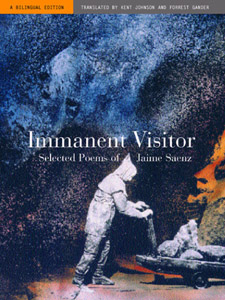
Immanent Visitor
Selected Poems of Jaime Saenz
A BILINGUAL EDITIONTRANSLATED FROM THE SPANISH BY Kent Johnson and Forrest Gander
Table of Contents
- [Photo]
- Acknowledgments
- By Way of Introduction
- A Note on This Translation
- POEMS IN TRANSLATION
- Anniversary of a Vision (1960)
- From As the Comet Passes (1970–1972)
- From The Scalpel (1955)
- To Cross This Distance (1973)
- From Immanent Visitor (1964)
- POEMS IN THE ORIGINAL SPANISH
- Aniversario de una visión (1960)
- De Al pasar un cometa (1970–1972)
- De El escalpelo (1955)
- Recorrer esta distancia (1973)
- De Visitante profundo (1964)
- The Saenz Effect
Contents
| ACKNOWLEDGMENTS | vii | |
| BY WAY OF INTRODUCTION | xi | |
| A NOTE ON THIS TRANSLATION | xix | |
| POEMS IN TRANSLATION | ||
| Anniversary of a Vision (1960) | 3 | |
| From As the Comet Passes (1970–1972) | 15 | |
| High above the Dark City | 17 | |
| Your Skull | 17 | |
| Here | 18 | |
| In the Heights | 18 | |
| The Basket of Wool | 19 | |
| So I Am Persuaded | 19 | |
| The City | 20 | |
| Watching the River Flow | 22 | |
| Someone Must Be Called Twilight | 23 | |
| From The Scalpel (1955) | 25 | |
| Homage to Epilepsy | 27 | |
| Paraphrase of "So Have You Told Him or Not?" |
31 | |
| The Candle and the Breeze (Excerpt) | 32 | |
| The Voyage of the Lindens and the Madrepores while Rocking in the Weariness the Age-Old Cradles (Excerpt) |
34 | |
|
|
||
| To Cross This Distance (1973) | 37 | |
| From Immanent Visitor (1964) | 55 | |
| POEMS IN THE ORIGINAL SPANISH |
||
| Aniversario de una visión (1960) | 73 | |
| De Al pasar un cometa (1970–1972) | 85 | |
| En lo alto de la ciudad oscura | 87 | |
| Tu calavera | 87 | |
| Aquí | 88 | |
| En la altura | 89 | |
| La canasta de lana | 89 | |
| Según estoy persuadido | 90 | |
| La ciudad | 90 | |
| Mirando cómo pasa el río | 92 | |
| Alguién tendrá que llamarse crepúsculo | 93 | |
| De El escalpelo (1955) | 95 | |
| Homenaje a la epilepsia | 97 | |
| Paráfrasis de "¿Y le has dicho? ¿O no?" |
101 | |
| La vela y el viento (Fragmento) | 102 | |
| El viaje de los tilos y las madréporas cuando se reside en el cansancio de las viejas cunas (Fragmento) |
104 | |
| Recorrer esta distancia (1973) | 107 | |
| De Visitante profundo (1964) | 125 | |
| THE SAENZ EFFECT: AN AFTERWORD BY LEONARDO GARCÍA-PABÓN |
141 | |
Acknowledgments
The translators are immensely grateful to the late Dr. Arturo Orias, and to Elva Gonzalez de Morales, executors of the Jaime Saenz estate. Special gratitude, as well, to Ximena Morales, Gisela Morales, and Tina Orias for their generous assistance in facilitating communications and for their help with the securing and scanning of visual materials included in this book.
Kent Johnson would like to thank Highland Community College for granting a sabbatical leave during the 1998 and 1999 academic year, awarded for the purposes of undertaking this translation project, and to acknowledge and thank his friends and colleaguesat Highland—Andy Dvorak, Kim Goudreau, and Carol Redmore—for their inspiring support and encouragement. Above all, thanks to Debi, Brooks, and Aaron for their patience, counsel, and love.
Forrest Gander would like to thank some of those writers-and-translators whose works and friendships have both been important to him: Norma Cole, Peter Cole, Arthur Sze, Cole Swensen, Nathaniel Tarn, Donald Revell, Robert Hass, Keith and Rosmarie Waldrop, Monica de la Torre, and Carolyn Forché, as well as the writing community in Providence,
Kent and Forrest would like to jointly thank Eliot Weinberger and Cecilia Vicuña for their support of this project and for their own inspiring work.
Katherine Hyde-Flanagan translated the afterword on short notice. Norbert Francis of Northern Arizona University and Cole Heinowitz of Brown University offered suggestions and translated critical materials by Leonardo García-Pabón, which we finally chose not to use in this particular volume but which served to inspire some of our introductory remarks. We are thankful to each of them, and to Elena del Rio Parra, who typed many of the poems in Spanish onto disk.
We are grateful, too, to the editors who published sections of these translations first: Cecilia Vicuña in her anthology of Latin American poetry (forthcoming from Oxford University Press), Suzan Sherman at Bomb Magazine, John Tranter at Jacket (www.jacket.zip.com.au), Rebecca Woolf at Fence, and Garrett Kalleberg and Leonard Schwartz at The Transcendental Friend (www.morningred.com/friend), and Lind say Hill and Paul Taylorat Facture.
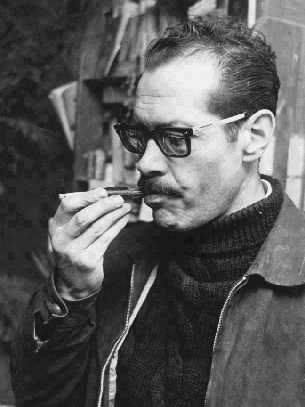
The drawing of skulls on page 4 is by Jaime Saenz. The photographs of Saenz were taken by unidentified photographers.
Finally, but not in the spirit of finality, the translators acknowledge the poet and critic Leonardo García-Pabón, without whose patient advice this
By Way of Introduction
Poet and novelist Jaime Saenz (1921–1986) lived his whole life in La Paz, Bolivia, seldom venturing beyond that thin-aired and scarcely believable city. His life was defined by an intense experience of alcoholism, a struggle, eventually lost, that was wedded to what Leonardo García-Pabón, one of the leading scholars on Saenz's work, has called a "monastic" dedication to writing.
There was in his persona a near-total rejection of the social niceties and conventions of polite society. Quite to the letter, in fact, Saenz embodied, for much of his adult life, the late-Romantic idea of the poète maudit—apocalyptic and occult in his politics, habituous of slum taverns, unashamedly bisexual, insistently nocturnal in his artistic affairs, secretive in his leadership of a select group of writers—and he became, in the staid and tradition-bound circles of Bolivian high culture, the ongoing subject of rumor and gossip.For a number of years in his youth, Saenz worked as a cultural liaison with the U.S. Information Service.
A propulsive, energetic rhythmical drive and an aching emotional expressiveness hold the poems of Jaime Saenz together, even as they seem to burst
For a poet continually astounded both by the fact of being alive and by the obdurate nearness of death, a poet surrounded both by the jubilant exaltation of living and by the poverty and despair of a degraded world, paradox weaves together the nature of experience. In Saenz's poems the sacred word and silence, quotidian sensibility and psychic ecstasy, a spectral "I" and "you" are always interacting in a dialectic that surges toward the potential for perception and language to ignite revelation. It is important, and here also paradoxical, that such revelation for Saenz lay hidden and expectant in death. But far from being the mere consequence orresidue of linear time, death's phenomenal expression is, for the poet, more like a capsuled configuration of space, the
In this sense, if Saenz's poetry can be said to exist under the sign of the hermetic, it is a hermeticism that is not so much in the typical function of language experiment and avant-garde social critique as it is in service of a visionary impulse unapologetic in its romanticism and in its identification with indigenous Bolivian cultures. By emphasizing nonlinear time, suspended states of knowing, and mystical realms of death and by conflating memory, death, linguistics, and sensual experience into any given moment of experience, Saenz connects his poetry to the visionary world of the Kallawaya, Aymara, and Quechua, with which he was fascinated. The influence of Aymara culture can be seen as well in his talismanic words, his symmetrical grammatical structures, and
Now here I am, alas, and wish I were elsewhere, and wish I wished more, but wish no more, and, by being unable to do more, do all I can
Never merely plumping anaive Romanticism, where words "come after" intense feeling and "express" it, Saenz's language emphatically constitutes the initiatory field. At once numinous and material, then, his poetry is both bottomless riddle and the very means for bridging and canceling the central antinomies—self and other, mind and world, indigenous and colonial, the living and the dead—that fuel the thematic of his artistic quest.
It is in this sense that his work, in a deeply multiethnic and multilingual Bolivia, constitutes much more than an instance of bohemian or elitist aestheticism. As García-Pabón has pointed out, its powerful clearing of a free zone of expression at the center of "high culture" has reinforced and extended the resistance of marginalized languages and voices to a single literature or hegemonic worldview. Such a legacy is coextensive with the life of a poet who enacted in his writings and personal relations a fierce compassion
The strangeness of Saenz's work should be read, in this sense, as the exfoliation of a singular empathy and yearning for otherness. His poems are the flowering of a life given over in fullness to an art that affirms the mysterious unity of all difference, of suffering and ecstasy. Now, as his poetry is translated in Europe and the United States and its appeal and importance are acknowledged, Jaime Saenz, one of Latin America's great poets of the twentieth century, is garnering the international audience his work deserves.
A Note on This Translation
The selections presented in this book span Jaime Saenz's published poetic output between the early 1950s and 1973, the most intense period of his creative activity. In various remarkable styles, Saenz uses rhapsodic language to counter the rhetoric of habit, commerce, and pretension, all of which, Saenz felt, clip the very wings from the word in order to subjugate it, to manipulate it, to keep it from straying beyond the cage of assumed functions and values. With a canny, iterative music, Saenz lures us into folds of syntax that cannot be flattened out into logical assurances or comfortable clarities. That is to say, reading Saenz, we are struck awake to a surging, polyphonic, sometimes tenderhearted, sometimes vexed language of unstable, rapid transitions, a language utterly different from that by which our daily transactions are conducted so often in a semisleep.
Anniversary of a Vision (Aniversario de una visión, 1960) is an audaciously emotional love poem in which Saenz accomplishes a syntax equal in complexity to his yearning for the beloved. This syntax, turning in on, mirroring, and extending itself in phrasal strings, enacts a total involvement in the other, and aims, through oxymoron and paradox, to
In the poems presented from As the Comet Passes (Al pasar un cometa, 1970–1972; approximately a third of that book is included here), the reader is introduced to a strange collision of torqued, odd, and romantic images, perhaps an expression of the difficulty, for Saenz, of a loving relationship in a society that didn't countenance homosexuality. We see here not only his mastery of the brief lyric but also, as in "The Basket of Wool" ("La canasta de lana"), his strange and mordant humor, surreal transformations of image, and outlandish juxtapositions in the service of highly energized, even ardent sentiment.
The third section is taken from The Scalpel (El escalpelo, 1955), Saenz's first published book, one of the most unusual collections in all Latin American poetry, perhaps comparable in its imagistic eccentricities only to the early work of Chilean poet Pablo de Rokha or to that of the Cuban José Lezama Lima. Clearly influenced by Surrealist attitudes and procedures, these prose poems are nevertheless thoroughly nonderivative, bearing an avant la lettre attentiveness to energies latent in the material
In Bolivia, To Cross This Distance (Recorrer esta distancia, 1973) is generally considered to be Saenz's master poem, and it is, indeed, an original creation, an existential meditation on presence and absence, love and death, and the imagined possibilities of building a bridge (or reducing the distance) between I and Another. Foregrounded in this poem as well is Saenz's intense contempt for the upper class and for political power. In particular, sections of the poem excoriate, in high pitches of sarcasm and irony, bourgeois culture's losing battle to deny death's leveling reality. But the poem is far from didactic, and its closure is deeply moving in the compassion of its claims.
Finally, Immanent Visitor (Visitante profundo, 1964), which we have excerpted, is probably the most hermetic and opaque of Saenz's long works. The poem declares itself to "you," to "the other," to a fugitive beloved who might be language itself, a communal and transcendent material beyond the poet's ego. Still, and in keeping with Saenz's manner of punctuating symbolic density with epiphanic clarity, the poem is inlaid with moments of imagistic precision, concluding, brilliantly, with a burst of pure longing in its quartet coda.
Not included in this selection are the serial works Muerte por el tacto (Death by feel, 1957) and El frío
POEMS IN TRANSLATION
Anniversary of a Vision (1960)
To the image that kindled the lost, the hidden fires
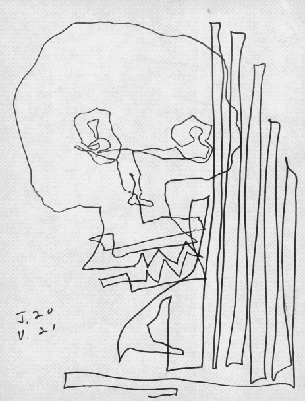
Drawing by Jaime Saenz
I
II
III
IV
V
VI
VII
From As the Comet Passes
(1970–1972)
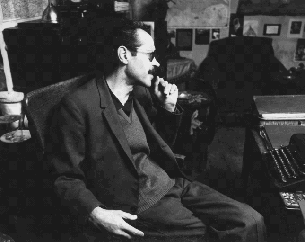
Saenz, the middle years
High above the Dark City
Your Skull
for Silvia Natalia Rivera
Here
In the Heights
The Basket of Wool
So I Am Persuaded
for Jaime Taborga V
The City
for Blanca Wiethüchter and Ramiro Molina
Watching the River Flow
for Leonardo García-Pabón
Someone Must Be Called Twilight
for Carlos Ramírez
From The Scalpel (1955)
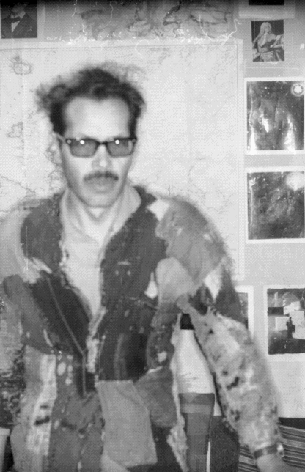
Saenz in beggar's coat
Homage to Epilepsy
THESE ARE THE LITTLE EPILEPTIC'S HAIRS
The little epileptic's hairs grow out darkly at the break of night. Their resins flow into undulant ends, and they seem like colossal columns of granite in the glorious and mysterious field of love and death.
Within these hairs, which I respect as beings unto themselves, there are swings of baffling roundness on which I see the black magic and love of space.
These are the hairs of the dead one in the span of a hand that has fingered the mystery.
THE COACH OF THE DEAD
A long time ago, when I was a child, they tried to teach me things aboutcertain things. But I never managed to grasp the norms of discipline.
One day I was walking through the city and I saw a coach. It caused me great distress. I don't know, now, if it was green or blue or red, but over the course of my life I came to believe it was colorless, that it was simply a coach.
On that day when, as a child, I saw the coach, I was infected with who knows what strange force, what strange presentiments.
It was the coach of the dead, according to the revelation of the epileptic child I encountered years later on a sunny afternoon …
This incident, of course, means little at all, given that the child refers to any passing coach as the "coach of the dead."
ONE OF THE DEAD HAS DIED
The dead, just like the living, can die again.
So the revelation of the epileptic child, on a sunny afternoon.
The dead have the power to die.
The fact of dying deprives no one of the right to die again. Here lies the secret to existence.
This is why the dead have died.
This is also why the dead are, in a sense, precocious.
THE DOOR THAT OPENS TO MYSTERY
It's possible to conjure a door, not a door through which children pass into a timeless room, but an authentic door that opens into mystery.
To conjure a preamble to lunacy, so that all those who fabricate nothing have no idea what to do.
That child, I know, harbors secrets to a door that might lead into mystery while bypassing, let me be clear, the attendant putrefactions.
There is a door. That door is open to you, to me, to everyone. It is open to the rats considering you night after night from the moon.
The child must be allowed to go on with some of his hairs and a piece of the door to mystery before he stops recognizing the streets and rocks.
(This is the secret of the door.)
A SNUFFED MATCH
A snuffed match is simply a snuffed match. The transcendence of a snuffed match lies in its being snuffed and in the fact that although it no longer exists, it is still called a match.
But that match there, on a sheet of paper, is dead. That is what matters. What really matters is that it be dead.
It is being, itself, and being there, it must be acknowledged to be as large as the universe. Like something that folds itself into the intervals of nothingness.
SHROUD THAT SHIELDS SILHOUETTE PAPERS
It's a shroud. I'm sure everyone has seen a shroud in childhood, if only in stories. Everyone in childhood has seen shrouds and shrouds. Nevertheless, I have begun to put the shrouds of the whole world into a deep freeze.
Suddenly I am back in my room. I see a freshly washed shroud, but it's only a joke.
I sleep in worn, moonspotted sheets and dream of shrouds.
They cover me, they soundlessly fasten me to my coming putrefaction, the torches grind themselves out over my glorious body in the middle of the night.
Later, inside magic, they come to life, wrapping me up with the creatures of fate.
They are papers cut out by the moon. It's necessary to let them lie there, where the hapless tables are sleeping, all of them, all of them, the hapless spiders, it's necessary to let them lie just as they are, in the music of their child-shrouds.
The silhouette papers blow across the world carrying the melancholy stigmata of good-byes.
THE FATHOMLESS HOWL
It's merely a fathomless howl. It comes from far off. It has nothing to do with the womb, with the lungs, or the liver. It is, simply, a howl after which you want to leave serenely for the moon, taking along a few hairs from a certain gifted child. "A fathomless howl," I have been told, "is the howl of all humankind, always."
IMAGE OF THE CHILD
So sweet is his image. No one can see it, save the snail rooted to seashore.
No one can see it, except the spiders that live where you live, where the haunting organic gears of eternity live.
Nothing can hold back his childhood-desire.
This is how his image is. The life of the illusory images of death and life.
He has a design.
The design is an outline of love and death's secret, though the child is blind to love and death, though with his homage to epilepsy, it swells into a vague omnipotence.
(Pure and lifeless object for harvesting loneliness.)
the catastrophe and the phases of the eye with death
Everything ends now. Sublime catastrophe.
Here in the night's heart, I have paid homage to the mysterious epileptic, just so, and with the meekness of a lake.
I offer my homage. Soundlessly, catastrophe comes. The needles point to the sky. It will always be this way.
The eyes turn yellow and make a lattice over the other things that are not. The life that is real is about to arrive.
Paraphrase of "So Have You Told Him or Notó"
The paraphrase of what she had said is a reflection of Wiesbaden. Rainy and fleeting as she is, luminous as she is, and with that quick gift she has for disappearing into the throng, having passed within five centimeters of me, without even knowing me, or as if we had met on the shore of some immense ocean with wooly floor, with fish blazing across its surface, their backs puffed out, their spines rigid and splayed. Fish with a marvelous gift for the particular. They call you by name, though you scarcely believe it. Unlike other genera of fish, these are able to roll their eyes to follow your movements, and they are able (this is a remarkable case of devotion) to abandon the sea and drag themselves over sand until they expire, and for no other reason than to discharge their one duty, which is tofollow you through the rabid and aimless multitude.
But, needless to say, you are not the multitude. Rather, you are its essence, the very being of multitude. It is understood, the multitude radiates outward from you, and it is understood down to the bones of grief that there would be no multitude were it not of your making. This is why I love not only the multitude, but multitudes. I love it and I love them because I have a concept of you that is big with eternity, and because the primordial weather for learning some slender stretch of anguish consists of the multitude and the multitudes, into which, into it and into them, you have breathed life by that miraculous enigma of the word spoken and heard across a few centimeters: "So have you told him or not?"
What it is I am making, and what I call "Paraphrase of ‘So have you told him, or not?’" is nothing more than an incidence of distant, vague conjectures, of
The Candle and the Breeze (Excerpt)
One man is thrust into fire, while another notes his misfortune from the water's edge without taking into account the idea of the flame with which the candle struggles, flickering and far from those realities in which the world is transfigured into platter or kidney, or in which a tomato might exude the feeling of a fine, rose hue in equipoise to the burning throats of children, be they beautiful or pox ridden or tightrope walkers.
By chance, have you ever seen the nucleus of the flame, and have you not been startled by the marvel of it? Have you ever thought about the fires of the hands, the fires of the neck, the fires of the convent at dawn while you search for something like a holy stone to swallow; have you ever thought of the child's scarlet fever, thought of him clotted with forests, immersed in melancholy, allegoric and brittle, wracked by the wild storm, slick from soap, intrinsically doughy, with his elongated neck and his monstrous lips, his shirt in tatters, with the aroma of flowers around his shoulders and knees?
There is, in his demeanor, a preternatural candle that measures out destiny. There is, above all, in his clothes, a tiny gauge by which the fire and breeze are metered.
If you see something blazing, you regmember the flame. If you see the sea, you remember it; and if you see clods of dirt on the wide and dry roads, you remember it.
There is an interval of pebbles and party-noise when you light a candle to bestow a certain allegory upon his death, so tiny, so sad, rainy and circled by fire.
E.
"E"; you know what "E" means.
"E" means the first death, the root one, one's own death, which leaves the others waiting horribly alone and smug to be alive, scrubbed with the best soaps.
That's what "E" means. "E," so dead and quiet and architectonic as you, experimenting with whether or not to use it, saying "I'm here," "one," "were," "fear," "hope," "petticoat," "Caquiaviri," "then," "Erasmus"; or better, "student," "we're on our way to my father's house," "I am here to invite you all to crumpets," "illusion," "don't tickle gentlemen on the bus," "it seems like they insist on not putting the leashes where they belong," "grooves," "the faggots have not yet been taken from the oven," "a couple brothers want to sell their coffee shop, but for cash," "the clothes are wet," "you always want to have it your way," "sewer drain."
That's how "E" is.
Deafening and curious, like rain; you can't suit "E" or "T" to any other letter of the alphabetum, to the candle or the breeze.
The candle and the breeze are beings apart. Each unknowing the other. Your sadness spokes outward from this unknowing. It is the interregnum between your soul and the candle and the breeze.
Now go and sleep with the dark things you are always seeking and never finding.
The Voyage of the Lindens and the Madrepores while
Rocking in the Weariness of the Age-Old Cradles (Excerpt)
They walk in the echo. They walk darkly, as trances walk. They walk disrupting the rhythms, they walk with that anguished night-whistling, lugging their howling, sublime emissaries. They walk on their buttocks, the pubis forgotten. But more than anything, they walk so assertively it is frightening.
You are not to forget it. They walk straining their being, they walk as if another walked in them, they walk on, terrifying, full of themselves, puffed up, fervent.
They walk like no one walks. They keep walking, even lying down at someone's side. They walk awake and asleep, they walk backward, they walk out of step, visited by rare dispensations.
They walk as if someone had commanded: "Don't walk."
(With the magnet on their backs, they know and don't know where they walk. But they are led to the vexed, formidable core of smiles forgotten in the coursing river, in the echo rising—I don't know how—from the piano and the cello, in the zenith of a cold and bewildering evening. Night, inescapably, had to fall.)
They are the inventors of noise, you know this. They bid farewell with a noise, with a cunning, bitter noise.
They take their crumbs noisily to the sea, and they get up, they lie down, and they materialize noisily, with the ironic, pleasing, prophetic noise of good-byes. They are formidable.
They are the enigmatic form of weeping. Without knowing it, they have plotted out the clever schemes, the oblique, universal, eternal schemes.
The intuited manners of felt rhythm, of the tender ruckus to which one wakes. The intuited magical manners of premonition, the exalted manners of the square
They are the first finders of melancholy. They are, in their hushed terror, precursors to the voyage's figure. The voyage's mode of displacing no one, not even the travelers.
They are figures both vague and precise, bestial angels, supreme, assumed, real, catastrophic, ideal symbols. They are decent and full of quiet, and they are, on this night, fantastic universes, huge beckonings of nothingness, cries spurted from bone, memorial instigators of your smile.
To Cross This Distance (1973)
To the image of Puraduralubia
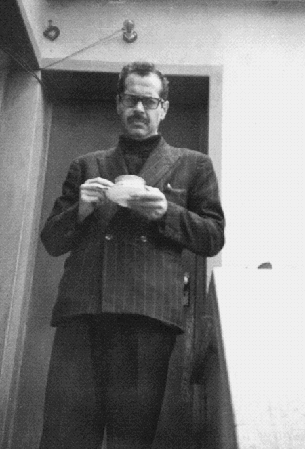
Saenz taking a break
I
II
III
IV
V
VI
VII
VIII
IX
X
XI
XII
From Immanent Visitor (1964)
Your serious happiness flows out behind you in an ecstasy of ancient voyage.
For my mother and my Aunt Esther; and for my dead friends.
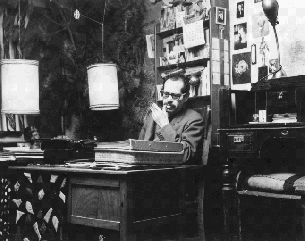
Saenz at his desk in his study
I
III
V
VI
VII
VIII
X
XI
XVI
XVII
Like a Light
You Are Visible
For You
Come
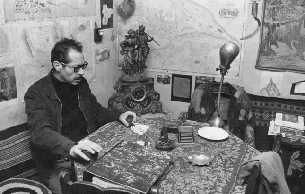
Saenz in séance
POEMS IN THE
ORIGINAL SPANISH
Aniversario de una visión
(1960)
A la imagen que encendió unos perdidos y escondidos fuegos.
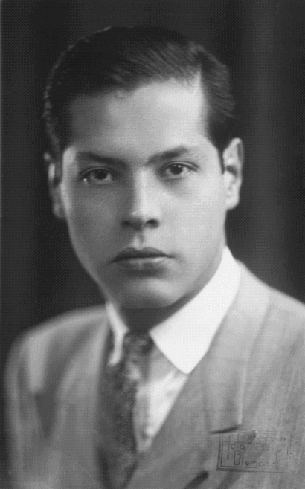
Saenz as a young man
I
II
III
IV
V
VI
VII
De Al pasar un cometa
(1970–1972)
En lo alto de la ciudad oscura
Tu calavera
A Silvia Natalia Rivera
Aquí
En la altura
La canasta de lana
Según estoy persuadido
A Jaime Taborga V.
La ciudad
A Blanca Wiethüchter y Ramiro Molina
Mirando cómo pasa el río
A Leonardo García-Pabón
Alguien tendrá que llamarse crepúsculo
A Carlos Ramírez
De El escalpelo (1955)
Homenaje a la epilepsia
ESTOS SON CABELLOS DEL PEQUEÑO EPILÉEPTICO
Los cabellos del pequeño epiléptico se distienden tenebrosos en los albores dela noche. Mueven sus resinas con términos acompasados, y parecen gigantescas columnas degranito en el glorioso y misterioso ámbito del amor y de la muerte.
En estos cabellos, a los que respeto porque son personas, hay columpios de inexplicable redondez, en los cuales veo la negrura mágica y amada del espacio.
Son los cabellos del muerto en la irradiación de una mano que ha metido sus dedos en el misterio.
el coche de muertos
Hace mucho tiempo, cuando yo era niño, trataron de enseñarme cosas acerca de ciertas cosas. Pero no logré aprender normas acerca de la disciplina.
Un día caminaba ante la ciudad y vi un coche. Me causó mucha tristeza. No sé, ahora, si era verde, o azul, o rojo, pero durante el transcurso de mi vida llegué a la conclusión de que no tenía color, y que simplemente era un coche.
Ese coche que vi un día de mi infancia había yo estado inficionado de no sé qué fuerzas extrañas y no sé de qué extraños conocimientos.
Era el coche de muertos, de acuerdo a lo que me revelara años después el niño epiléptico, a quien encontré en un día de solx002F;
Este acontecimiento, desde luego, carece de importancia, pese a que el niño llama a un coche cualquiera, "coche de muertos."
UN MUERTO SE HA MUERTO
Los muertos, tal como los vivos, también pueden morir otra vez.
Tal la revelación del niño epiléptico, durante una tarde de sol.
Los muertos tienen la capacidad de morirse.
El hecho de morir no le priva a uno del derecho de morir otra vez. Ahí está el secreto de la existencia.
Es por eso que los muertos se han muerto.
Por eso es también que, en cierto modo, los muertos son precoces.
LA PUERTA QUE DA INGRESO AL MISTERIO
Es posible fabricar una puerta, pero no una puerta para que ingresen a una habitación antigua los niños, sino una puerta auténtica para poder ingresar al misterio.
Fabricar un preámbulo de locura, de tal modo que todos los fabricantes de la nada no sepan qué hacer.
Ese niño, estoy seguro, posee los secretos de alguna puerta que puede conducir al misterio, sin recurrir, pongo en claro, a las irremediables putrefacciones.
Hay una puerta. Esa puerta está abierta para ti, para mí, para todos. Está abierta para las ratas, que te contemplan noche tras noche desde la luna.
Hay que dejar que ese niño siga con un poco de la puerta del misterio y entregarle algo de sus cabellos antes que desconozca los caminos y las piedras.
(Es ahí donde reside el secreto de la puerta.)
UN FÉOSFORO APAGADO
Un fósforo apagado es simplemente un fósforo apagado. Lo trascendente delfósforo apagado es que está apagado, y que, pese a que ya no es, se le llame fósforo.
Pero ese fósforo que está allí, sobre una hoja de papel, está muerto. Eso sí que es importante. Porque lo importante es que esté muerto.
Es el ser, y hay que verlo, allí, tan substancial como el universo. Como cosa que se integra en las etapas de la nada.
SUDARIO QUE RESGUARDA PAPELES CORTADOS
Es un sudario. Estoy seguro que todos han visto un sudario en su niñez, aunque sea por escrito. Han visto todos en su niñez sudarios y sudarios. Sin embargo, yo he comenzado a congelar los sudarios del mundo.
De pronto retorno a mi vivienda. Veo un sudario limpio y fresco, pero eso es en broma solamente.
Duermo en sábanas apagadas y lunares, y sueño con los sudarios.
Me cubren, sujetan quedamente mi próxima podredumbre, rechinan sus teas sobre mi cuerpo glorioso en medio de la noche oscura. Luego, en la magia, adquieren vida para envolverme con los animales del destino.
Son papeles cortados por la luna. Hay que dejarlos allí, donde duermen las mesas vulnerables, todos, todos, las arañas vulnerables, hay que dejarlos tal como están, con la música, de sus sudarios de niño.
Los papeles cortados van por el mundo con la llaga melancólica de los adioses.
el alarido profundo
Es solamente un alarido profundo. Viene de lejos. Nada tiene que ver con el vientre, ni con los pulmones o el hígado. Es, llanamente, un alarido ante el cual uno quiere irse, apaciblemente, a la luna, llevando ciertos cabellos de cierto niño profundo. "Un alarido profundo tiene que ser siempre," me han dicho, "el alarido, de la humanidad."
IMAGEN DEL NIÑNO
Su imagen es dulce. Nadie puede verla, excepto el caracol que anida a sus pies a orillas del mar.
Nadie puede verla, excepto las arañas que moran donde moras tú y donde moran las memorables máquinas orgánicas de la eternidad.
Nada puede detener su deseo de niñez.
Es así su imagen. La vida de las imágenes ilusorias de la muerte y de la vida.
Tiene él un esquema.
Ese esquema es la reseña del secreto del amor y de la muerte, aunque el niño ignore amor y muerte, aunque sea vaga omnipotencia en medio de este juicio para practicar homenaje a la epilepsia.
(Objeto muerto y puro para recoger la soledad.)
LA CATÁSTROFE Y LAS PROGRESIONES DEL OJO CON LA MUERTE
Concluye ahora todo. La catástrofe es bella.
Aquí, en medio de la noche, acabo de rendir homenaje al misterioso epiléptico, así, con tanta mansedumbre como una laguna.
Rindo mi homenaje. Calladamente, viene la catástrofe. Los alfileres apuntan al cielo. Será así siempre.
Los ojos se tornan amarillos, y se connaturalizan con otras cosas que no son. Ya viene la verdadera vida.
Paráfrasis de "¿Y le has dicho? ¿O no?"
La paráfrasis de lo que había dicho se parece a Wiesbaden. Con lo lluviosa y fugitiva que es, con lo clara que es, y con esa capacidad súbita que tiene para mezclarse entre el tumulto, luego de pasar a cinco centímetros de mí, sin apenas conocerme, o como si nos hubiésemos conocido alguna vez en la orilla de algún mar profundo, con lana en el fondo, y, en la superficie, con peces ardientes, ahuecados hacia la espalda y la columna vertebral un poco rígida. Peces con la maravillosa capacidad de individualizar. Te llaman por tu nombre, aunque no lo creas. Contrariamente a los otros géneros de peces, pueden girar sus pupilas para seguir tus movimientos, y pueden (este es un extraño caso de devoción) salir del mar y arrastrarse arenas arriba, hasta perecer, solamente por cumplir su función, que es la de seguirte por entre la multitud rabiosa y enloquecida que nada busca.
Pero, entendido está, tú no eres la multitud. Tú, más bien, eres la esencia, el ser de la multitud. Se entiende que la multitud dimana de ti, y se entiende hasta la congoja que no habría multitud de no ser tú. Es por eso que yo amo no solamente a la multitud, sino a las multitudes. La amo y las amo porque tengo un concepto tuyo amplísimo de eternidad, y porque el primigenio clima para conocer algún estrecho
Esto que estoy haciendo, y que llamo "Paráfrasis de ‘¿Y le has dicho? ¿O no?'" no es más que una incidencia, de viejas, remotas conjeturas, de negras, feroces y lúcidas ensoñaciones acerca de ti, cuando alguna vez tenía yo, (yo, yo mismo) los brazos al viento, el olor, digamos, de Wiesbaden—como esta tarde—y la calavera fresca.
La vela y el viento (Fragmento)
Hay un hombre metido en el fuego, en tanto que otro observa su desventura desde los bordes del agua sin acometer la idea de la llama en que se debate la vela moribunda y distante de las realidades en que se torna plato o riñón la tierra, o en que un tomate pueda dar la sensación del color claro y rosado, para identificarse con los ardores de garganta que tienen los niños, sean bellos, sean víctimas de la viruela o hábiles equilibristas.
Por ventura, acaso tú no has visto alguna vez el núcleo de la llama, y no te has espantado ante su maravilla. Acaso no has pensado alguna vez en los ardores de las manos, en los ardores del cuello, en los del convento al amanecer, cuando uno busca algo que se parezca a una piedra bendita para comérsela; no has pensado acaso en la escarlatina del niñito, de ése, cuajado de bosques, inmerso en la melancolía, alegórico y fino, desmenuzado por la tormenta, suave de jabón, intrínsicamente blando, con su nuca alargada y sus labios monstruosos, y la camisa hecha pedazos, con un olor de flores en los hombros y en las rodillas.
Hay, en su actitud, una vela sobrenatural, que da la medida del destino. Hay sobre todo una minúscula aguja sobre su traje, que da la medida del fuego y del viento.
Si ves un incendio, te acuerdas de ella. Si ves el mar, te acuerdas de ella; y si ves los núcleos terrosos de los anchos y secos caminos, te acuerdas de ella.
Hay un lapso de rocas y de algarabías cuando tú prendes una vela para dar cierta alegoría a su muerte, tan minúscula, tan triste, lluviosa y redondeada por el fuego.
E.
"E"; sabes tú qué significa "E."
"E" significa la muerte primera, la única muerte, la de uno, para que los otros se queden horriblemente solos y orgullosos de vivir y de lavarse con jabones finos.
Eso quiere decir "E." "E," tan muerta y silenciosa y arquitectónica como la vives ahora, para usarla o no y decir "estoy," "una," "era," "espanto," "espero," "enagua," "Caquiaviri," "entonces," "Erasmo," o para decir: "escolar," "estamos yendo a la casa de mi padre," "estoy yo para invitarles alfajores," "ensueño," "no le hagan cosquillas a ningún señor en el colectivo," "parece que se empeñan en no guardar las correas en su lugar," "ranuras," "todavía no han salido los rosquetes del horno," "hay unos hermanos que quieren vender su cafetería, pero al contado," "la ropa está mojada," "siempre quieres salir con la tuya," "alcantarilla."
Así es la "E."
Lo atronador y curioso, lo mismo que la lluvia, es que no puedes aplicar tú la "E" o la "T" a ninguna otra letra del abecedario, y tampoco a la vela o al viento.
La vela y el viento son seres aparte. Incomprensibles. De esta incomprensión dimana tu tristeza. Es la incompatibilidad de tu alma con la vela y el viento.
Andate ahora a dormir con las cosas oscuras que siempre buscas y no encuentras.
El viaje de los tilos y las madréporas cuando se
reside en el cansancio de las viejas cunas (Fragmento)
Caminan en el eco. Caminan oscuramente, como caminan los trances. Caminan desacompasadamente, caminan con esos y angustiosos silbatos nocturnos, portando su alarido, así, mensajeros encumbrados. Caminan con las nalgas, con el pubis olvidado. Pero sobre todo, caminan tan rotundamente que da espanto.
No lo olvides. Caminan forcejeando su ser, caminan como si otro los llevara, caminan terroríficos, plenos, ahuecados, fervorosos.
Caminan como nadie camina. Siguen caminando, acostados a la vera de alguien. Caminan despiertos y dormidos, caminan al revés, caminan a destiempo, frecuentados por raros privilegios.
Caminan como si alguien les dijera: "No camines." (Con el imán a cuestas, saben y no saben hacia donde caminan. Pero eso les lleva a la tormentosa, formidable esencia de aquellas sonrisas olvidadas en el plan del río, en el eco que hace no sé cómo el piano y el chelo, en el clímax de un atardecer frío y deslumbrante. Inevitablemente había de caer la noche.)
Son los inventores de los ruidos, tú lo sabes. Se despiden con un ruido; con un sutil, amargo ruido.
Llevan sus migajas al agua de mar con ruido, y se levantan, y se acuestan, y aparecen con ruido, con el irónico, placentero, profético ruido que hacen los adioses. Son formidables.
Son la forma misteriosa del llanto. Han urdido, sin saberlo, las sabias maneras, oblicuas, universales, eternas. Las sabias maneras del escondido ritmo, del entrañable estruendo con que uno despierta. Las sabias, mágicas maneras del presentimiento, las nobles maneras del círculo y del cuadrado, las maneras extrañas, invisibles, del paradójico ademán, del éxtasis vertido, de la congoja vertida, de la súplica interna, del dolido viaje que fulmina.
Son los descubridores de la melancolía. Son, con su callado terror, precursores de la forma del viaje. Del modo de desplazarse sin nadie ni ellos.
Son vagas y concretas formas, ángeles bestiales, supremos, presuntos, verdaderos, catastróficos, ideales símbolos. Son buenos y silentes, y son, esta noche, universos estupendos, colosales llamados de la nada, vertidos gritos óseos, inolvidables compulsores de tu sonrisa.
Recorrer esta distancia (1973)
A la imagen de Puraduralubia
I
II
III
IV
V
VI
VII
VIII
IX
X
XI
XII
De Visitante profundo (1964)
Tu grave alegría discurre en un trance de antigua navegación.
A mi madre y a mi tía Esther; y a mis amigos muertos.
I
III
V
VI
VII
VIII
X
XI
XVI
XVII
Como una luz
Eres visible
A ti
Ven
The Saenz Effect
An Afterword by Leonardo García-Pabón
Jaime SaenzTimeless image, Eternal and always fresh, Even this is an image. Like the days, the nights. An event, without beginning or end.
On the night of Jaime Saenz's wake in August 1986, three friends, those closest and most loyal to his work, and a drunk acquaintance of Jaime's who had fallen asleep in a chair, stayed late to keep his body (and perhaps his soul) company. As we bid farewell, we imagined that he had finally arrived at the "state of death" that he always heralded as a path to true knowledge. To ease our loss, we spent the night reading aloud fragments of his writings. I bring up this moment because it seems to have presaged the way many people currently experience Saenz's work. Small groups of those familiar with his life and immensely loyal to his literature, in some cases friends and life companions, in other cases strangers only recently fallen under his spell, come together to read
It would also seem that Saenz's work is, indeed, preceded by an image. A writer's image is sometimes confused with his work. It's a phenomenon not infrequent in world literature, though less frequent in Bolivia. During his life, Saenz fostered, whether intentionally or not, an image of himself that attracted and repelled people with equal intensity. As a writer, an alcoholic, and a rebel in the provincial society of La Paz in the 1940s and 1950s, Saenz was perceived as extravagant, to say the least, and his work was sometimes dismissed as the product of delirium. Moreover, by effectively breaking with literary norms, Saenz's poetry, and later his prose, began to attract all kinds of attention. The poetry unwinds in long lines marked by labyrinthine relationships, speculations on the poetic subject's otherness, and sharp linguistic paradoxes that border on nonsense. It does not offer itself to those looking for an easy and comfortable read. On the other hand, his prose dared to reveal the most hidden, perhaps darkest, but always most human sides of a Bolivian society still entangled in colonial structures. His work addresses and celebrates social groups that the dominant Westernized elites refused—and largely still continue to refuse—to see: alcoholics, homosexuals, the homeless, poor artisans, the indigenous Aymara. Nonetheless, an extraordinary phenomenon emerged in the 1960s: His writings began to
If something has lasted after Saenz's death, it is precisely this devoted enthusiasm for his work. Small groups of loyal admirers continue reading and reflecting on Saenz's writings. Interestingly, these companies of enthusiasts have proliferated far apart and almost unknown to one another. In a process that the French philosopher Gilles Deleuze would call "rhizomatic" (growing through bifurcation, laterally and without predictable direction), new clusters of Saenz's readers have been appearing not only throughout Bolivia but also throughout all Latin America, many European countries, and now the United States. The propagation of his work is not sustained by publishers or government institutions (despite the fact that Saenz is considered one of the great Bolivian writers) but rather by readers in love with his language, those who by some chance have
This is what Iwould like to call the "Saenz effect." As with his life, if you come close to his literature, you run the risk of being seduced forever. Then, either you are a Saenzian or you aren't. Once drawn into his particular vision of the city of La Paz, his characters, and his meditations on death, it is difficult to relinquish his fascinating vision of the world. As with the work of all great writers, his generates a universe in and of itself, with its own times, laws, rites, and labyrinths. In the case of Saenz, that universe is modeled on a profound and singular vision of Bolivian (and Latin American) urban society, a complex and existential vision that has few counterparts in other Spanish literatures.
As the epigraph that begins this afterword indicates, Saenz was and is an image. His work, too, is a marvelous image that proposes Bolivian and Latin American reality better than a thousand studies. His writing continues to be "eternal and always fresh,"
March 29, 2000