
Henry David Thoreau and the Moral Agency of Knowing
ALFRED I. TAUBER
Table of Contents
[Photograph]
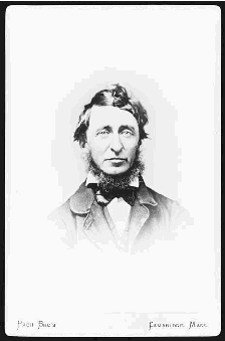
Henry David Thoreau, 1856. (Archives of the Gray Herbarium, Harvard University; reproduced by permission)
Acknowledgments
This study addresses Thoreau from an unusual vantage point. As a historian and philosopher of science, I note that my own discipline has paid scant attention to him, but here I wish to claim Thoreau—or, better, to “borrow” him. He offers a rich grist for the philosopher's mill and, by extension, to those current cultural studies that begin with the philosophical questions he poses: the character of the self, the grounding of moral agency, the nature of knowledge. Thoreau was no postmodern, but he faced many of the same challenges we do, and in studying his life, I have come to value the ethical example he offered. While philosophical readings might enrich the literary approaches that have dominated Thoreauvian scholarship for a century, I believe structuring his project on a philosophical edifice also offers critical insights into certain quandaries that reach into the very mainstream of contemporary science studies.
For me, Thoreau is a fascinating “hinge” character residing between an ebbing Romanticism and a rising positivism. Stretching from early Romanticism to the contemporary molecular revolution, my own endeavor is to better understand the tension generated by science's positivist leanings against both the humane demands of its knowledge and the role of the participating scientist. In this respect, Thoreau, usually seen as a naturalist and champion of the environment, is of interest to me because of the clear fashion in which his life and work have focused the problem of the observer in this scientific setting. More generally, he exemplifies the difficulty of assigning value to our science that seeks dispassionate objectivity, yet remains firmly tied to humane understanding. We assign value to our knowledge; we require placing the self in its world; we seek to use our knowledge for humane purposes. Each requires the assignment of value and the exercise of choice.
But the roots of my interest in Thoreau reach to older issues than my professional concerns, in fact to the awakening of my intellect as an adolescent, when I first read Walden. It made a lasting impression on me, and I am well aware that its challenge beckoned for a thorough response. In part, this has been accomplished in the writing of this study, for I have come to articulate the meaning of that work, which had such a profound influence on how I thought of individuality and my own personhood. At about the same time I was introduced to Thoreau, I also began reading Freud and guides to his work. Of these, the most memorable was Philip Rieff's Freud: The Mind of the Moralist (1959), a book that impressed me in many ways, not the least of which was the intimation that a scientific project might reflect a moral attitude or program. Although I abandoned a serious interest in Freudian psychology, the interpretative point has apparently been internalized, and in my own work I find interesting parallels in reading Thoreau's life as Rieff read Freud's. Rieff's sequel, The Triumph of the Therapeutic (1966), was written in a similar vein but lacked, at least to my current recollection, the same moral verve exhibited by the earlier text. But there is an interesting parallel regarding Thoreau, inasmuch as I think he too exhibited a “therapeutic triumph”—for himself and for us all. Although he claimed that “I love nature partly because she is not man, but a retreat from him” (January 3, 1853, Journal 5, 1997, p. 422), he reaches out to each of us in the most intimate fashion, and we respond. Despite the all too apparent failings, Thoreau indeed did prevail in his own struggle and, in doing so, provided us with a moral example we might emulate.
My exploration freely draws on previous essays that are related to the overall themes treated here but were written in other contexts. The discussion on Romanticism, and specifically Goethe, is based on Tauber 1993; on history and memory, Tauber 1999a; on the aesthetic elements of science, Tauber 1996a; on the philosophical characterization of modern science, the introduction to Tauber 1997 and Tauber 1999b; on the relation of science and ethics, Tauber 1998a; on the historical evolution of the self concept and its philosophical standing, Tauber 1992, 1994, 1999c. There are other issues that have served as the organizing subjects of my writing—reductionism and positivism; the limits of analysis in philosophy; the ethics of history; the character of moral philosophy in our postmodern age; the subject-object relationship in science generally. In a sense, this study of Thoreau ties together what at first glance represents apparently far-flung issues that I have considered in different formats and that are drawn together here by the attempt to outline an understanding of the self and, more specifically, of how a moral voice might guide an epistemology. It is in this last context
Seven editors refused even to send this book out for review: “too interdisciplinary,” “too unorthodox,” “won't fit into our list,” “won't sell” were the typical responses. Not until Stan Holwitz embraced this project did the manuscript enjoy the prospect of publication. He ensured that my efforts were realized, and I am especially grateful to him. I am also indebted to the University of California Press staff, especially Jean McAneny and Nicholas Goodhue, who so ably took my manuscript through production. Various readers have generously offered important critical comment to me, so to Rick Adler, Dan Dahlstrom, Menachem Fisch, Erazim Kohak, Leo Marx, Emanuel Papper, David Roochnik, Stanley Rosen, and Jan Zwicky, thank you. Dan Peck has been most intimate with my own project, I think largely because we regard Thoreau from several shared perspectives, and I am especially indebted to his insights and criticisms of my own work. My wife, Paula Fredriksen, has, as always, been my most enthusiastic reader. Beyond patiently teaching me Augustine's philosophy—which was to become a main pillar of this study—her editorial suggestions, critical acumen, and abiding emotional support sustain me. Naturally, I alone am responsible for the interpretation offered here, but such a work is influenced in acknowledged and in unconscious fashion by many sources that I cannot enumerate. This book has been a joy to write, one that has flowed easily, and on that basis alone, I trust, at least, that I have given fair expression to my own dialogue with Thoreau. I can only hope that this essay contributes to our understanding of him—and thereby of ourselves.
A.I.T.
Boscawen, New Hampshire
November 1999
Introduction
Thoreau, January 7, 1851, Journal 3, 1990, p. 174There is no account of the blue sky in history.
Thoreau, January 26, 1852, Journal 4, 1992, p. 291Would you see your mind—look at the sky.
Henry David Thoreau lived in an age of keen observers, and he was very much a man of his time. Both scientists and artists developed an acute self-consciousness of their respective methods and faculties of observation, and of the limits as well as the prospects of their new modes of inspection. Thus each appreciated the problems of cognition with new insight. Within this tradition, for Thoreau,seeing—both the world and himself—became his preoccupation, and his problem. The least conspicuous or most obvious were equally susceptible to his gaze, and thus he made his contribution by making the ordinary extraordinary. He believed that the secrets of nature, and of humanity's place within it, were ultimately revealed by identifying what was significant in the everyday world; and that this revelation, in turn, depended on meticulous attention to, and accounting of, the commonplace. On the other hand, he too was guilty of complacency. An amusing observation made by Henry Petroski makes the point:
Henry David Thoreau seemed to think of everything when he made a list of essential supplies for a twelve-day excursion into the Maine woods. He included pins, needles, and thread among the items to be carried in an India-rubber knapsack, and he even gave the dimensions of an ample tent…. He wanted to be doubly sure to be able to start a fire and to wash up, and so he listed: “matches (some also in a small vial in the waist-coat pocket); soap, two pieces.” He specified the number of old newspapers (three or four, presumably to be used for cleaning chores), the length of strong cord (twenty feet), the size of his blanket (seven feet long), and the amount of “soft hardbread” (twenty-eight pounds!)….
… [h]e advised like-minded observers to carry a small spyglass … a pocket microscope … tape measure … and paper and stamps, to mail letters back to civilization.
2But there is one object that Thoreau neglected to mention, one that he most certainly carried himself. For without this object Thoreau could not have sketched … fauna…. Without it he could not label his blotting paper … or his insect boxes … record measurements … write home … [nor] make his list. Without a pencil Thoreau would have been lost in the Maine woods.
According to his friend Ralph Waldo Emerson, Thoreau seems always to have carried, “in his pocket, his diary and pencil.” So why did Thoreau … neglect to list even one among the essential things to take on an excursion? Perhaps the very object with which he may have been drafting this list was too close to him, too familiar a part of his own everyday outfit, too integral a part of his livelihood, too common a thing for him to think to mention. (1989, pp. 3–4)
This is an unusual omission and only highlights Thoreau's scrupulous care in constructing his world. It is amusing precisely because it is out of character, jarringly inconsistent with Thoreau's own meticulous attention to the seemingly obvious. Petroski was writing about the innocuous pencil as an object of historical interest. I cite the omission to emphasize a philosophical point and a psychological truism: Knowledge is selective. We know what we want to know, or at least seek knowledge in the particular context of self-interest. Each of us follows his or her unique train.
Certainly, Thoreau was aware of this adage, and in acknowledging the limits of his observations, he both appreciated the endless splendor of the world about him and his own limited ability to fully appreciate it:
As I look north westward to that summit from a Concord cornfield— how little can I realize all the life that is passing between me & it—the retired up country farm houses—the lonely mills—wooded vales—wild rocky pastures—and new clearings on stark mt sides—& rivers gurgling through primitive woods—! All these and much more I overlook. (Thoreau, September 27, 1852,Journal 5, 1997, p. 357)
This preoccupation with the limits of his vision is a constant Thoreauvian theme, and even as his observations of nature became more scrupulous and even “scientific” in character, a self-consciousness remained, beguiling the growing positivist efforts to objectify the world. This Janus-like vision— simultaneously observing both the world and himself—offers us an essential clue in understanding Thoreau's project.
So, as Thoreau sought to know nature, he again and again faced his own autonomy—his consciousness of that world and his capacity to comprehend it. Thus he was both fascinated with understanding his place in the world, and at the same time committed to making that world, or at least his place
Thoreau regarded himself as living a philosophically informed life. For him, philosophy was a moral guide, and in the same spirit in which he criticized the mercantile pursuits of his neighbors, he distanced himself from philosophers who, in his view, failed to rise to his standard of living the virtuous life:
There are nowadays professors of philosophy, but not philosophers. Yet it is admirable to profess because it was once admirable to live. To be a philosopher is not merely to have subtle thoughts, nor even to found a school, but so to love wisdom as to live according to its dictates, a life of simplicity, independence, magnanimity, and trust. It is to solve some of the problems of life, not only theoretically, but practically. (Walden, 1971, pp. 14–15; revised from Fall-Winter 1845–46 Journal entry [Journal 2, 1984, p. 145])
As the passage continues, Thoreau's identification with his own definition of the true philosopher emerges clearly:
The success of great scholars and thinkers is commonly a courtier-like success, not kingly, not manly. They make shift to live merely by conformity, practically as their fathers did, and are in no sense the progenitors of a nobler race of men…. The philosopher is in advance of his age even in the outward form of his life. He is not fed, sheltered, clothed, warmed, like his contemporaries. How can a man be a philosopher and not maintain his vital heat by better methods than other men? (Ibid., p. 15)
Despite certain misgivings sprinkled in the Journal, Thoreau was, at least, sympathetic to philosophy and would repeatedly assume the philosopher's voice (e. g., ibid., pp. 65 and 94; Journal 5, 1997, p. 470). At the end of Walden, he asserted Socrates' credo, “Rather than love, than money, than fame, give me truth” (1971, p. 330). Indeed, one might summarize Thoreau's life as dedicated to this proclamation.
But I will make a more radical claim: Thoreau deeply engaged the key philosophical issue of his time, one which has dominated much of modern philosophy, and he offered an original response to it. I am referring to the post-Cartesian predicament, one framed in diverse ways but all converging on exposing the fragmentation of experience and the elusive epistemological character of our identities. Beginning with Descartes, the knowing subject was irreconcilably separated from the world. In this Cartesian construction,res cogitans was a distinct domain, and while humans might know the world and act in it, the mind was not part of the world. Thoreau hoped to demonstrate that there was, in fact, no final divide between man and nature, and that mind and nature might be integrated. For him, to be in the world was to appropriate nature using all his “rationalities”—objective, aesthetic, spiritual, and moral—each contributing to some final synthesis. Inspired by his mystical states, sustained by identifying his core “wildness,” Thoreau then pursued his naturalist studies as extensions of these intimate experiences of nature.
On this reading, Thoreau's imperative of seeing was ultimately an attempt to establish a full integration. But this picture of man and nature as fundamentally unified remained a poetic or spiritual aspiration. Despite the cogency of his enterprise, Thoreau was caught in the web of his own self-consciousness. His metaphysical construction was flawed, because he was unable to overcome the self-awareness imposed by his writing. Both a blessing and a curse, writing—deliberate and intellectually ordered—was Thoreau's own self-definition of who he was. And here we come face to face with the inherent tension (or even contradiction) of Thoreau's project: Despite all his efforts to touch, if not live, his “wildness,” Thoreau remained “civilized” as a writer. After all, writing is a defining activity of civilization, and in the selfconscious act of capturing experience, it confers an acute awareness of one's distance (if not removal) from nature. The voice of inter-pretation is ever-present and stands out as the dominant theme of his work. In short, throughout his multifaceted enterprises, we see Thoreau's study of nature coupled with introspective inspection as he surveyed the world.
If we understand Thoreau as partaking in the general philosophical discussion about the Cartesian subject, specifically in defining the relationship of man and nature as well as in deciphering the basis of knowing the world, his endeavors, irrespective of their philosophical success or failure, take on added significance. That being asserted, Thoreau was no philosopher, at least not in any ordinary sense. His thought was not systematic, and his reference to philosophy was filtered and highly derivative. Indeed, Stanley Cavell correctly observed that Walden was written in a “pre-philosophical moment
Rather than arguing about Thoreau's philosophical sophistication, it is more profitable to regard his intellectual efforts as “innocent” of the fractionation of knowledge and experience that so marks our own era. Just as he was able to understand and participate in the science of his era, he could well appreciate the philosophical issues debated at the time. Richly literate in diverse branches of knowledge, Thoreau possessed a philosopher's passion for epistemology, pursuing his quest for knowing the real relentlessly, and understanding the limitations of his knowing. Thoreau is particularly appealing to me in this last respect, for he held the key insight: seeing was ultimately dependent on the individual's ability to see and create, and the world as known is thus radically dependent on character. In other words, Thoreau's communing with nature, his historical pursuits of various kinds, his observations of society and people, he recognized as value-laden and thus organized around a self-image of his own ethical standing and what he wished to be. In short, Thoreau's world became a moral expression.
“Moral” is being used here—and throughout this book—not in reference to the more narrow ideas of “right and wrong” or “good and evil” but in reference to the generic understanding of “value.” To comprehend “moral” in this way is to acknowledge that prior to assigning “rightness” or “wrongness,” we must begin by regarding the act of judgment as following the decision that a verdict is to be made in the first place. With this broadened conception, value judgments not only include choices about one's actions typically regarded as “ethical” but encompass assigning value in any context. Each act—whether appreciating an apple tree, curbing one's consumerism,
I am pursuing the path of modern scholarship that has been dubbed “Thoreau's epistemology of nature” (Buell 1995, p. 364). Following Krutch's (1948) and Paul's (1958) vision of Thoreau as an intellectual quester, Thoreau has been portrayed as reacting against Emersonian idealism (Porte 1966) or exhibiting a “programmed inconsistency” in his “divided attitudes toward nature” (McIntosh 1974); more recently he has been provocatively regarded as “writing Nature” (Cameron 1985), apprehending nature's “nextness to me” (Cavell 1981), or establishing unique epistemological categories by which he might know nature (Peck 1990). Not to delve into my agreements and disputes with these various studies here, suffice it to note that none has adequately accounted for the deeper orienting force of Thoreau's moral character on his epistemology. Thus both my approach (a reliance on contemporary philosophy) and orienting theme (the epistemological orientation bestowed by Thoreau's moral philosophy) are different from previous studies.
In adopting this strategy, “the self” becomes a central concern, and in this regard two fundamental axes of Thoreau's personhood must be portrayed. The first is the self as knower, an epistemological examination, and the second is the self as a moral category. In the end, we will see that the two dimensions collapse into one, and that the world Thoreau sees and knows is the world he creates out of his moral attitude about that world and the ego which appreciates it. Personalizing knowledge of the past and of the natural world in his own terms—formulations constructed on a grid of value and meaning—the self was in danger of falling into a solipsistic hole, and so Thoreau lived with a balanced tension, where his perspectivism was constantly measured against facts. Thoreau's Romantic struggle of the self's
This theme of fierce independence and individuality, famously enunciated in the “Conclusion” of Walden (“If man does not keep pace with his companions, perhaps it is because he hears a different drummer” [1971, p. 326]), became Thoreau's cardinal ethical mandate. He jealously guarded against what he perceived as the distractions of a “normal” life: “Even the wisest and best are apt to use their lives as the occasion to do something else in than to live greatly” (May 20, 1841,Journal 1, 1981, p. 290). And to live greatly was to live independently: “My life will wait for nobody … It will cut its own channel” (April 7, 1841, ibid., p. 297), and in word and deed this became his manifest credo. Indeed, the young Thoreau possessed an uncommon confidence of purpose (“I shall not mistake the direction of my life” [May 6, 1841, ibid., p. 308]) and will (“I make my own time I make my own terms” [November 13, 1841, ibid., p. 342]). In fact, Thoreau's overarching moral philosophy was deliberately to define and to establish his unique self, an act of will that linked every aspect of his intellectual and emotional personality. The present study hinges upon that theme as we explore the various modalities in which Thoreau thought and wrote.
THE FORCE OF CHARACTER
Gradually it has become clear to me what every great philosophy so far has been: namely, the personal confession of its author and a kind of involuntary and unconscious memoir; also that the moral (or immoral) intentions in every philosophy constituted the real germ of life from which the whole plant had grown.
Nietzsche [1886] 1966, p. 14
[A] man's vision is the great fact about him. Who cares for Carlyle's reasons, or Schopenhauer's, or Spencer's? A philosophy is the expression of a man's intimate character, and all definitions of the universe are but the deliberately adopted reactions of human characters upon it.
James [1909] 1987, p. 639
Nietzsche and James, in the passages set out above, were either repeating or rediscovering Johann Gottlieb Fichte's own dictum, “The kind of philosophy one chooses depends upon what kind of person one is” (Wissenschaftslehre [1797], quoted by Neuhouser 1990, p. 56). Whoever said it first, and there are undoubtedly ancient antecedents, the sentiment summarizes my own view. I similarly hold the reciprocity of a philosophy reflecting character and character expressed in a philosophy. In this regard, Thoreau is a particularly vivid case study, and indeed, one can barely understand his philosophy independent of his life work and the personality that lived it. But more, he also exemplifies how the entire enterprise is grounded in the moral personality. In this latter respect, Nietzsche was specifically referring to how value—what is chosen as important, indeed as critical, to a serious and deliberate life—must serve as the very foundation of any guiding philosophy or spirituality. And James built his Principles of Psychology ([1890] 1983) around the precept that our “interest in things” (p. 304) not only organizes our world but is the clue to understanding consciousness and the very notion of the self:
Millions of items of the outward order are present to my senses which never properly enter into my experience. Why? Because they have no interest for me.My experience is what I agree to attend to. Only those items which I notice shape my mind—without selective interest, experience is an utter chaos. (Ibid., pp. 380–81; emphasis in original)
As a phenomenologist, James sought to show not only how we actively and deliberately select sensory experience but also how the philosophical consequences of such an insight frame our understanding of consciousness. What and how we see is largely informed by what we want to see and can see as determined by the structure of our knowing, a value system of the senses and their cognition. For instance, I enter a room looking for my copy of Walden. Of the myriad visual details available to me, I quickly fasten on a particular text, which, except for some very minor details, is almost identical with the other volumes of the Princeton edition,The Writings of Henry D. Thoreau. My interest, the value structure of that moment, determines not only my seeking that particular book but the very cognitive focusing required to do so. From this almost trivial example we might extrapolate to a grand vision of nature, which is, indeed, I maintain, how we should “read” Thoreau. To be sure, we have many criteria by which we select our impressions and thus mold our experience. Here, I wish to explore how an epistemology is informed by a specifically moral vision. So there is a twopronged issue to explicate. First, for a philosopher, “nothing whatever is impersonal,
It has often been remarked how philosophy reflects the philosopher, how character and personality may be articulated in various conceptual projects (e.g., Atwood and Stolorow 1993), and Thoreau has endlessly fascinated his students in their attempts to tie together the threads of his thought with the rich intensity and eccentricity of his life. While commenting on Thoreau's evolution of thought, I do not specifically follow the biographical path but instead adopt a philosopher's stance in showing how Thoreau's metaphysics of the self informs and guides each aspect of his multifarious project, where each topic must relate to the overarching questions, How did Thoreau situate himself in the cosmos? What indeed is that problematic self, and what are the metaphysics underlying it? How did the Romantic vision of the person lead to the essential problems with which Thoreau grappled?
Thoreau has a certain “plasticity.” He lived multiple personae: Romantic poet, champion of rugged individualism, naturalist, American patriot and social reformer, middleclass misanthrope, mystic, Transcendentalist, prophet, and on. We have ready testaments for each of these aspects of a life which in many ways was both a failure and a heroic venture. Both in his time and in ours, Thoreau is vilified as a nonconformist ne'erdowell or celebrated as a key member of the American pantheon, an architect of our contemporary consciousness—a physician to our discontent. His reputation as seer largely rests on Walden, a text more widely read in American literature courses than any other.Walden is a “solution” of the question of how to express nature, whether “nature” be thought of as the external natural environment or as the internal, wild, and natural self. These two poles are expressed in a myth of Thoreau's making, namely, that we each potentially possess the heroic ability to elevate our respective lives by conscious effort, by deliberate moral choice. That choice, he insists, requires the rejection of a material, moneydriven economy in favor of an economy of personal renewal resting on an awakening to a greater reality: the world of the spirit found in nature. In naming the wild, celebrating nature, and identifying our true self with communal nature, humankind's deepest divinity might be
Thoreau also polarizes us, and in so doing, he reenacts in us the deep attitudes of his detractors and followers. Apparently, none is neutral. Why? Because he challenges us at the level of moral reckoning: he demands that we declare our own views of nature, society, and ultimately ourselves. In announcing what he values, Thoreau makes us confront our own values, for in word and deed he challenges our complacency, demanding that we respond to his summons for a new ethic. He marshals his rhetorical power so that we must respond, we cannot remain complacent; and thus he breaks our silence. In the service of that moral accounting, Thoreau marshals his epistemological project as well as the various efforts at social reform. But more than crying for a sensitivity to nature or a call for public reform, he calls us to reform ourselves. So in asking us, What indeed do we value?, Thoreau initiates a dialogue with our moral personalities. And he begins that dialogue by exposing himself to our scrutinizing his own selfinspection.
But a psychological portrait is not offered here. To what degree Thoreau suffered, or what inner dynamic might describe his inner conflicts, is indeterminate, even irrelevant to this discussion. What is of interest is how he consciously dealt with his existential state and what he bequeathed us as a testament of his response. Thoreau's autobiography—the Journal and his other published writings—reveals as much as we need to know: Thoreau was keenly aware of the metaphysical instability of the self, most evident in its groping for knowledge about the world, in its yearning to seek its own grounding in that world, and, perhaps most fundamentally, in the study of its own split consciousness. This must remain the focus of our interest. We have much philosophical discussion of the general epistemological and metaphysical crisis which appeared in the mid-nineteenth-century. Thoreau both illustrated its outline and then offered a response to that challenge.
From at least shortly after his graduation from college, he had already set his sights on the moral work that would occupy him throughout his life. The trajectory of his thought and work seem to me clear from his earliest Journal entries at age twenty, and while there was significant development through the publication of Walden at age thirtyfour, the philosophical project appears quite constant—a view at odds with that of other critics who have traced his literary development (e.g., Adams and Ross 1988), his science (e.g., Walls 1995), or his view of nature (e.g., McGregor 1997). That is not to say that
All of this attests to a Romantic sensibility coming forth—the expressiveness of the self, reaching out through spirit and poesis to an expanded vision of the cosmos and his place in it. Coincident with his renewed efforts on Walden, Thoreau wrote at the emergence of spring of a new vitality and hope—no less than a prayer for his own salvation:
My life partakes of infinity. The air is as deep as our natures…. I go forth to make new demands on life. I wish to begin this summer well—to do something in it worthy of it & of me–To transcend my daily routine–& that of my townsmen to have my immortality now—that it be in the quality of my daily life. To pay the greatest price—the—greatest tax of any man in Concord–& enjoy the most!! I will give all I am for my nobility. I will pay all my days for my success. I pray that the life of this spring & summer may ever lie fair in my memory. May I dare as I have never done–may I persevere as I have never done. May I purify myself anew as with fire & water—soul & body–May my melody not be wanting to the season. May I gird myself to be a hunter of the beautiful that naught escape me–May I
attain to a youth never attained[.] I am eager to report the glory of the universe–may I be worthy to do it–To have got through with regarding human values so as not to be distracted from regarding divine values. It is reasonable that a man should be something worthier at the end of the year than he was at the beginning. (March 15, 1852,Journal 4, 1992, p. 390)
12
And so he began again to revise his reflections on his life at Walden Pond. Central to that reconsideration was a radical insight concerning time and his own temporality (see Peck 1990; also chapter 1 here) and, closely linked, a reassessment of his personal goals. The elliptical reference he gives in Walden about the reason why he went to the woods and why he left is more forthrightly addressed in the Journal, but as he himself admits, “Why I left the woods? I do not think that I can tell” (January 22, 1852,Journal 4, 1992, p. 275). Still, he offers an insight:
Perhaps if I lived there much longer I might live there forever–One would think twice before he accepted heaven on such terms–A ticket to Heaven must include tickets to Limbo—Purgatory–& Hell. Your ticket to the boxes admits you to the pit also. And if you take a cabinpassage you can smoke at least forward of the engine.–You have the liberty of the whole boat. But no I do not wish for a ticket to the boxes—nor to take a cabin passage. I will rather go before the mast & on the deck of the world. I have no desire to go “abaft the engine[.]” (Ibid.)
Thoreau truly was not satisfied with any permanence, reading his own “wildness” as an incessant need for “freedom.” In this context it was the freedom of a perpetual search of himself, and this too is part of his abiding Romanticism.
There is, of course, a metatheme, developed during this same period, that addresses the question of personal purpose, the agenda of living (Adams and Ross 1988, p. 172).Walden does offer an answer to the enigmatic question why Thoreau “left the woods.” In a dialogue between a Hermit and a Poet, Thoreau thrashes out the course of his life:
Shall I go to heaven or afishing? If I should soon bring this meditation to an end, would another so sweet occasion be likely to offer? I was as near being resolved into the essence of things as ever I was in my life. I fear my thoughts will not come back to me…. There never is but one opportunity of a kind. (Walden, 1971, pp. 224–25)
Thoreau indeed goes “fishing” in a return to the world: “Well, then, let's be off. Shall we to Concord? There's good sport there if the water be not too high” (ibid.). He again pursues various agendas—some mundane, others of
As even early Journal entries indicate, the seeds of solitude had been sown long before Thoreau fully realized that his youthful dreams of heroic leadership were not to be fulfilled. At age twenty-four, he wrote presciently of what would become the Walden Pond experiment, and more generally, the posture of his life:
I want to go soon and live away by the pond where I shall hear only the wind whispering among the reeds–It will be a success if I shall have left myself behind, But my friends ask what I will do when I get there? Will it not be employment enough to watch the progress of the seasons? (December 24, 1841,Journal 1, 1981, p. 347)
This is precisely what Thoreau eventually did, formalizing what had heretofore been intermittent excursions:
I sit in my boat on walden—playing the flute this evening—and see the perch, which I seem to have charmed, hovering around me—and the moon travelling over the ribbed bottom—and feel that nothing but the wildest imagination can conceive of the manner of life we are living. Nature is a wizzard. The Concord nights are stranger than the Arabian nights. (May 27, 1841, ibid., p. 311)
Thoreau went to the pond and played his flute, putting a spell not only on the fish but upon himself. During this period he was extensively reading Eastern religious writings, and the solitude he sought was critical for the mystical experiences he craved. This posturing may be regarded as a pushpull phenomenon: a manifestation of his incipient misanthropy and thus a countermove against the society of men, as well as a pull toward a primary spiritual communion. In either or both cases, Thoreau recognized the dual
How alone must our life be lived–We dwell on the seashore and none between us and the sea–Men are my merry companions—my fellow pilgrims—who beguile the way, but leave me at the first turn in the road—for none are travelling one road so far as myself. (March 13, 1841, Journal 1, 1981, p. 288)
Thoreau eventually was to regard his solitude (always denying “loneliness”) as a virtue, one he fully described in Walden (its fifth chapter) and unabashedly admitted in an early Journal entry: “Whoever has had one thought quite lonely—and could consciously digest that in solitude, knowing that none might accept it, may rise to the height of humanity—and overlook all living men as from a pinnacle” (April 10, 1841,Journal 1, 1981, p. 300). In solitude, Thoreau would garner himself as a leader, a hero, a prophet. The Journal is replete with such allusions (more fully discussed in chapter 6).
Thoreau's youthful selfabsorption was later replaced with keen attention to the otherness of the natural world and his place in it. Following the Walden experiment, the Journal testifies to an endless search for the meaning of nature and the corresponding knowing self. I will consider that evolution of thought and sensibility in this sketch of “the mind of a moralist,” for an abiding and relentlessly recursive selfevaluation undergirds this portrait of Thoreau. His was a voice that beckons us to address the apparently irresolvable dilemma of self-consciousness facing that chasm between a perceiving self and its world. Thoreau enacted a classic Romantic struggle: establishing a firm and abiding relation with nature, even a union, yet recognizing that this aspiration is dangerous, even misguided, since the self would, in its merger, be lost. Some students of the Romantics see this poetic quest as transfiguring an alienated nature to one redeemed, while others read an unreconciled, alienated nature whose pursuit is tragic. Thoreau lived with both aspects and characteristically played these themes as a complex counterpoint.4 He was well aware of these conflicting movements, and his typically Romantic introspective cognizance reflects a deeper source of inquiry as he engaged in perplexing and oftentimes agonizing meditations on the nature of his personhood and the meaning of his life in the context of nature. Thoreau offered an original response to this Romantic imbroglio.
Much of Thoreau's writing may be heard as the turning of a creaking axle, whose linchpin, consciousness, holds the entire enterprise together. As Leo Marx wrote,
Thoreau is clear, as Emerson seldom was, about the location of meaning and value. He is saying that it does not reside in the natural facts or in social institutions or in anything “out there,” but in consciousness. It is a product of imaginative perception, of the analogy-perceiving, metaphormaking, mythopoetic power of the human mind. For Thoreau the realization of the golden age is, finally, a matter of private and, in fact, literary experience. (1964, p. 264)
Laurence Buell (perhaps ironically) aptly draws out the key implication of this reading: “Thoreau was not really that interested in nature as such; nature was a screen for something else” (1995, p. 11).5 I would agree with the focus on self-consciousness as the locus of Thoreau's project, but I think we err in telescoping three different dimensions of “mind” into some single realm of consciousness: the private world consists of selfaware consciousness and another domain of unmediated experience, which is, in fact, not conscious but rather preconscious or unconscious. A third realm, the public world, reckons the processed word, written or spoken, to “read” or “hear” thought. Consciousness then mediates raw experience as processed thought, or as Thoreau put it, “the pen” is the fulcrum, or “lever” (August 4, 1841,Journal 1, 1981, p. 315), that allows him to lift experience, memory, and emotion from the depths of preand unconsciousness to the surface of the public forum. Rightly regarded as the nucleus of his work, consciousness must also be acknowledged in some sense as only a “solvent,” the necessary medium through which unmediated, unselfconscious experience assumes articulated value and meaning.
Questions of consciousness aside, Thoreau also aspired to mystical states—the suspension of selfawareness—and this aspect must also be considered.6 He reveled in the mystical moments of pure communion—experience most genuine and authentic—but his polished literary product can only serve as a translation or distillation of that experience. Thoreau's mystical experiences are in this sense “lost,” remaining as faint echoes in his own allusions to them, and thus we cannot confidently factor them into the complex calculus of his project. Due to their elusive character, I have almost allowed Thoreau's mystical visions to fall outside my own analysis. But because they were an important reservoir of his experience, their influence must be acknowledged. While Thoreau sought such mystical experiences, he also recognized that they served principally as a well of inspiration as he moved beyond the isolation of the mystical state to his public role as seer. He was no starryeyed mystic, and he exercised the full force of his critical faculties to explore even those most intimate experiences for greater literary purposes. In short, mystical revelry was only one aspect of his self-consciousness,
PLAN OF THE BOOK
In chapter 1, the metaphysical foundation of Thoreau's thought is outlined by posing the question of how he understood time and how that understanding functioned to orient his epistemology and moral philosophy. When Thoreau left Walden Pond in September 1847, he had fully embraced his mature understanding of time and his “place” in nature. Specifically, Thoreau's understanding of the full immediacy of the present is the most sensitive measure of his metaphysics of nature. I contrast his understanding of “time” as restricted to the present (the Augustinian notion that past and future exist only in the mind) and serving as a human category of temporality with his notion of “eternity.” Thoreau's recognition that nature's flux is immediate and everpresent, existing in an eternal now, represents a crucial metaphysical insight, and his strategies for integrating the ceaseless evolution of the cosmos and himself revolve around efforts to “capture” time either in selfconscious understanding or in the total eclipse of mystical revelry. Time's apprehension or suspension becomes the foundation of his own reckoning of his selfhood and thereby introduces the basic themes of this study.
Time not only serves to ground Thoreau's thought in a deep ontology but leads us into the study of two epistemologies—history of culture (chapter 2) and natural history (chapter 3). In both chapter 1 endeavor to show how Thoreau chose to attend to the world—past and present—with highly selective purpose, guided by an aesthetic sensibility and, more profoundly, by a moral attitude. The life of “doing” becomes a life of “virtue,” and Thoreau was ever conscious of that ethical mandate.chapter 2 is structured on describing different forms of history writing employed by Thoreau, ranging from his interpretative narratives of New England history to the play between private memory and public history. The reconstruction of memory and the use of semiotic clues reflect most clearly the role of a personalized history in Thoreau's writing of his own identity. He thus refracts the past through the same moral prism that illuminates his nature study. Indeed, I hope to explicate Thoreau's own admission why natural history,
It is easier far to recover the history of the trees which stood here a century or more ago than it is to recover the history of the men who walked beneath them. How much do we know—how little more can we know—of these two centuries of Concord life? (October 19, 1860,Journal, [1906] 1962, 14:152)
While social history served as a vehicle for Thoreau's various messages, it was superseded by natural history, which assumed the more powerful and intimate voice. I will argue that the immediacy of experience that nature study afforded Thoreau largely explains the centrality of this literary genre for him.
Chapter 3 offers a general “epistemological topography” of Thoreau's modes of knowing, and thereby we obtain a manifold on which his various projects, from the mystical to the scientific, might be situated. For as important as natural history was for Thoreau, we must bear in mind that this was the subject of only one facet of his writing. In this chapter, I explore how Thoreau both was indebted to, and reacted against, several key intellectual mentors—Emerson most directly, but Goethe, Coleridge, and Humboldt also played supporting roles in posing the challenges Thoreau responded to. Placing Thoreau in the intellectual context of his era—with the European Romantics immediately preceding him and the Transcendentalists with whom he lived—allows us to appreciate his unique position. And to offer a fair intellectual portrait, we must move Thoreau beyond the Transcendentalists and explore his nature study as some unique alloy of science and the introspective sensibility typical of the Emersonian circle.
Thoreau's standing as a naturalist, both from the perspective of the growing professionalization of science in the mid-nineteenth century and from his own attempt to offer his own unique reading of nature as a nature writer, revolved around the effort to “personalize nature.” My discussion of this issue falls into two parts.chapter 4 presents a survey of the scientific culture of Thoreau's era, and in the rise of positivism we see the ethos of a worldview at odds with Thoreau's Romanticism. Against the positivists' radical divorce of the observer from his object of scrutiny, Thoreau attempted to create his own nature study, appreciating that he could not fit into a science dominated by a positivist epistemology. He used “facts” as his own currency, for his own purpose.
We must place Thoreau's attitude toward nature within the problem of objectivity and the value of knowledge more generally, specifically how his
The question of how to live the good life ordered Thoreau's every activity, and he consistently pursued the attempt to actualize his life in the attainment of virtue. He was driven to live a life where he could hold meaning and value under tireless scrutiny. Again, the question of agency guides our investigation, for to ask, How should one live? already assumes the character of a moral agency—or as Bernard Williams quips, “the generality of one already stakes a claim” (1985, p. 4). Here Thoreau assumes his characteristic voice. As important as nature was for him, his own identity was even more intimate and crucial. Indeed, from his perspective, the self assumes its most solid standing in the moral enterprise, ordering the way one sees the world.
Chapter 6 explores Thoreau's own sense of his “heroic” venture and the construction of his moral universe using virtue ethics as the scaffold of examination.
Thoreau's moral vision arose from the Romantic “solution” to the character of the self, which is best expressed in Fichte's notion of the “selfpositing I.” With that idea, in chapter 7 I examine the self from two vantages: The first is a short sketch of the philosophical context in which Thoreau's own efforts might be understood. The discussion is based on exploring the evolution of the self as an isolated entity (surveying its world with Lockean detachment) to the Romantic notion of the self as relation. If the self was to be understood and thereby defined as fundamentally seeking relation to an Other—the natural world, society, the self itself—then the basis for such relationships became a problem. The Romantic answer was that the self was free, selfdetermined, and morally obligated when establishing such relationships. Thoreau expressed this aspiration in word and deed. So in the second portion of this discussion, I situate Thoreau's triumphant vision of the self. This discussion freely draws on contemporary appraisal of autobiography, for in many respects Thoreau's work is the elaboration of an autobiography, a life “selfwritten” both in action and in narrative form, in response to an existential trial.
From this perspective, Thoreau met two cardinal challenges. The first pertained to his “aloneness,” to the irreducible solitude that he understood as a metaphysical condition of being human; the second was a Romantic grasp of destiny, which was to recognize consciously and deliberately the full expanse of his metaphysical horizon and develop an identity in response to that conscious vision of nature. As he wrote in his early Journal:
Each one marches in the van. The weakest child is exposed to the fates henceforth as barely as its parents … they cannot stand between him and his destiny. This is the one bare side of every man–There is no fence—it is clear before him to the bounds of space. (March 13, 1841, Journal 1, 1981, p. 288)8
The road to Thoreau's destiny was the dual path of “selfdiscovery” and “selfcreation.” Especially in this latter regard, Thoreau truly followed Emerson's call in “Nature”:
Every spirit builds itself a house; and beyond its house a world; and beyond its world, a heaven. Know then, that the world exists for you. For you is the phenomenon perfect. What we are, that only can we see…. Build, therefore, your own world. (1983a, p. 48)
This was a shared vision, one that became a heroic venture for Thoreau insofar as he regarded himself as committed to a valiant though perhaps impossible task.
In our postpositivist era, we now appreciate that the radical separation of the subject from the object of examination is a false conceit. Our view of nature is always a construction, known in a particular way, in a particular context, with a particular history. But Thoreau lived in a period that witnessed the rapid rise of positivism, when human knowing was thought to be totally transparent on its object. He recognized that such an idealized objectivity would rob us of making the world our own. He struggled with a response to this challenge. He showed us why the positivist perspective was distorting, alienating, and ultimately false. He sought to preserve an enchanted world and to place the passionate observer in the center of his or her universe.
Thoreau's venture, seen either as a success or as a splendid failure, has linked him to our own moment. One tributary of his thought leads from Walden Pond to twentieth-century environmentalism, where he is justly regarded as one of those in the vanguard leading urbanized Americans back to nature. Indisputably, the aesthetic and spiritual character of that movement owes much to the model offered by Thoreau's own nature studies and writings. The other stream of thought is, I believe, a deeper contribution, for his life's example has served many more who do not share his passion for nature. So, while most would see him as the author of a new ecological consciousness, I argue that what he offers is a moral consciousness more radical than that required simply to green America. The Epilogue comments on how Thoreau's contributions to our own concerns are best understood as an effort to “mend the world,” or what Edmund Husserl later referred to as the project of seeking a unifying Reason. For those who see a world fractured, where splintered knowledge and local beliefs are loosely coordinated in a pragmatic utilitarianism, the basis for unification of experience remains elusive. And meaning finds little support in a secularism that has sequestered God, and in a science that preaches materialism. We are left radically
Thoreau charted a metaphysics of the self that sought to integrate aesthetic, spiritual, and scientific faculties in order to forge a synthesis of diverse experience and disparate knowledge. In celebrating personalized knowledge, Thoreau decried positivism not as a philosophy of science, but as a philosophy of knowing, whose objectivity was inadequate for navigating the world and making it meaningful. Radical objectivity fails because the view from nowhere leaves Man out of the picture, and with no perspective there is no significance, no meaning, no order, and ultimately no self. Thoreau's prescription: a complex amalgam of aesthetic empiricism, Eastern mysticism, poetry, and manual labor. Each was marked by deliberate purpose, selfreflection, and most important, the selfconscious effort of doing. Those inspired by Thoreau may not be taken by any of his particular pursuits, but they see in his life a steadfast moral commitment of seeking and affirming personalized meaning and signification. This encompassing ethics of the self resonates with the current, widely held sentiment that ultimately we are responsible for making sense of the world and our place in it.
This anthem of selfhood has become a popular moral call to arms. For those enlisted, an interest in nature may be only a passing fancy, but the necessity of finding personal meaning in an increasingly alienated world is a clear challenge. Thoreau, by offering his life as an example of such a search, has been promoted from captain of a huckleberry party (Emerson's derisive characterization [see p. 174]) to general of legions.
To a large extent, Thoreau's appeal depends on how far we regard his life and work as a triumph in asserting his will and the primacy of his personhood. Robert Milder astutely notes, regarding the writing of Walden, that there are two stories, not always congruent, that unfold in Thoreau's writing: the narrated story of discovery and renewal (which we commonly attend to) and the enacted story of the writer's efforts to adapt himself to the world (Milder 1995, pp. 54–55) or, as I would say, to create a moral cosmos.
The Eternal Now
Thoreau, April 23, 1859, Journal, [1906] 1962, 12:159A wise man will know what game to play today, and play it. We must not be governed by rigid rules, as by an almanac, but let the season rule us. The moods and thoughts of man are revolving just as steadily and incessantly as nature's. Nothing must be postponed. Take time by the forelock. Now or never! You must live in the present, launch yourself on every wave, find your eternity in each moment.
1848 was a pivotal year. In Europe, conservative forces quashed democratic revolts in Paris, Vienna, Berlin, Rome, and Warsaw. Marx and Engels published the Communist Manifesto. American “manifest destiny” became ever more manifest as Mexico ceded its claims to Texas and California. Boston was inundated with hungry Irish—over thirtyfive thousand new arrivals as compared to roughly five thousand per year a decade earlier. Harriet Tubman escaped from slavery, joining the Underground Railroad. And Henry David Thoreau, aged thirty, was again living with the Emersons, housesitting, while his erstwhile mentor lectured in Europe.
Having come out of the woods in September of the preceding fall, Thoreau, in retrospect, said that he had left Walden Pond simply because he had “other lives to live.” We gain a glimpse into what those other lives might have entailed through his remarkable correspondence with Harrison Gray Otis Blake, begun six months later, in mid-March. Blake, a minister, teacher, and liberal intellectual living in Worcester, Massachusetts, had written him in response to the powerful impression ignited by Thoreau's essay on Perseus (published eight years earlier):
If I understand rightly the significance of your life, this is it: You would sunder yourself from society, from the spell of institutions, customs, conventionalities, that you may lead a fresh, simple life with God. Instead of breathing a new life into the old forms, you would have a new life without and within…. Speak to me in this hour as you are prompted…. I honor you because you abstain from action, and open your soul that you may be somewhat. Amid a world of noisy, shallow actors it is noble to stand aside and say, “I will simply be.” (Thoreau, Correspondence, 1958, p. 213)
Thoreau was obviously moved to respond with extraordinary openness. Rambling over various themes which preoccupied him, Thoreau's initial letter—the first of thirty written over a period extending up to the year before Thoreau's death—contains many of his credos: the correspondence of the outward and inward life; the importance of simplicity; the challenge to see; the crucial connection between literature and life; the summons to break complacency; and the need to “journey to a distant country.” Any one of these themes is fecund, but let us focus on another matter: Thoreau declares here, as he does throughout Walden and the Journal, that the ethical life necessitates living life to the fullest in the present. Any postponement resulted in lost authenticity. I will maintain that it is Thoreau's conception of time's flow, the metaphysical character of the present, that informs and guides his ethics. Even from this short letter we may glean this. Thoreau first observes about our finitude and the centrality of living in the present:
Change is change. No new life occupies old bodies; —they decay.It is born, and grows, and flourishes. Men very pathetically inform the old, accept and wear it. Why put up with the almshouse when you may go to heaven? It is embalming, —no more. (Letter to Blake, March 27, 1848,Correspondence, 1958, p. 215)
Then he makes a cogent statement:
My actual life is a fact in view of which I have no occasion to congratulate myself, but for my faith and aspiration I have respect. It is from these that I speak. Every man's position is in fact too simple to be described. I have sworn no oath. I have no designs on society—or Nature—or God. I am simply what I am, or I begin to be that. I live in the present. I only remember the past—and anticipate the future. (Ibid., p. 216)
Thoreau's existential stance closely follows from this position:
I love to live…. I believe something, and there is nothing else but that. I know that I am—I know that another is who knows more than I who takes interest in me, whose creature and yet whose kindred, in one sense, am I. I know that the enterprise is worthy—I know that things work well. I have heard no bad news.
As for positions—as for combinations and details—what are they? In clear weather when we look into the heavens, what do we see, but the sky and the sun?
… When you travel to the celestial city, carry no letter of introduction. When you knock ask to see God—none of the servants. In what concerns you much do not think that you have companions—know that you are alone in the world. (Ibid., pp. 216–17)
And from this steadfast embrace of his independence, Thoreau calls upon the ancient Delphic oracle, “Know thyself,” from which his ethic must emanate:
Pursue, keep up with, circle round and round your life as a dog does his master's chaise. Do what you love. Know your own bone; gnaw at it, bury it, unearth it, and gnaw it still. Do not be too moral. You may cheat yourself out of much of life so. Aim above morality. Be not simply good—be good for something.—All fables indeed have their morals, but the innocent enjoy the story.
Let nothing come between you and the light. (Ibid., p. 216)1
These various elements—the elusiveness of time that can only be captured in the present; the existential crux of living, alone, to the fullest in that present; the demand to live according to “what you love,” namely by individual dictates and not socially sanctioned morality—served as Thoreau's guiding philosophy, informing his life's work. Overarching each component is the construction of his moral domain, which I perceive as flowing directly from his conception of time. His consciousness, the deliberate consideration of nature, economy, the world, oneself, stems from his appreciation of the present. For him, in a sense, there is no past and no future. Divine time is eternal, knowing no divisions. There is only the present moment as he wrote in Walden:
Men esteem truth remote, in the outskirts of the system, behind the farthest star, before Adam and after the last man. In eternity there is indeed something true and sublime. But all these times and places and occasions are now and here. God himself culminates in the present moment, and never will be more divine in the lapse of all the ages. (1971, p. 98)
Let us unpack Thoreau's vision of the present, the only time he knew.
THE EVER-PRESENT PRESENT
Augustine, Confessions 11.20.26Neither future nor past exists.
Two different senses of time preoccupied Thoreau. The first was past time, history. Seeking ancient origins, chronicling young America's past, both native and colonial, keenly aware of recent local events and inhabitants, Thoreau wrestled with the eclipse of time, the passing of civilizations, countries, and people. History, in a conventional sense, he appreciated as the substratum
The second aspect of time is more abstract and elusive. This is the notion of time alluded to in Thoreau's letter to Blake, quoted above. Specifically, Thoreau recognizes, as Augustine fourteen centuries before him, that there is indeed no such division of time as the past, present, and future. In a phenomenological sense, indeed existentially, we are only in the present, because, strictly speaking, only the present exists. We live in the present moment, and while the past is recalled or witnessed as artifact, that witness is experienced only in the present. The future, like the past, exists only as a mental construct only in the present moment. And then the imbroglio: the present is never held on to; it is always slipping by into the past, flowing from a future never quite here.
This vision of time is hardly unique to Thoreau, and indeed has a celebrated history, perhaps most famously in book 11 of Augustine's Confessions. There we find an apt description of time's passing, the nature of the past, present, and future, the illusion of temporality, and the essential character of time, unfathomable and fundamentally elusive.2 For our purposes, it is the character of Augustine's deft development of the idea of the present that is so pertinent to Thoreau's own project—and sheds light upon it. Augustine observes that the present cannot be assigned any duration; it is so fleeting that he calls it a series of “fugitive moments. Whatever part of it has flown away is past. What remains to it is future” (11.15.20). But, though the present has no duration, we nonetheless perceive time only in the present, in our awareness. Augustine comes to the critical point: the character of time—past, present, and future—remains confined only to the present, as elusive as that might be. The past and the future only exist in our cognition of the present, and more to the point, the past and the future only exist as the present, in the soul:
In the soul there are three aspects of time, and I do not see them anywhere else. The present considering the past is the memory, the present considering the present is immediate awareness, the present considering the future is expectation…. This customary way of speaking is incorrect, but it is common usage. Let us accept the usage. I do not object … as long as what is said is being understood, namely that neither the future nor the past is now present. There are few usages of everyday speech which are exact, and most of our language is inexact. Yet what we mean is communicated. (11.20.26)
Augustine confesses that he still does not know “what time is,” although he admits to being “conditioned by time” (11.25.32), and he goes on to discuss how time is a function of mind. “Present consciousness is what I am measuring, not the streams of past events which have caused it” (11.27.36). There are two cardinal points to be emphasized: First, “time” is a human perception, a faculty of thought or cognition found in the “soul,” which in modern parlance will be translated as mind, and sometimes as self-consciousness; and second, neither past, present, nor future can be “captured.” To our contemporary ears, Augustine is an astute philosopher of language, a critical epistemologist, and a profound metaphysician. Thoreau, although not documented as having read Augustine (Sattelmeyer 1988), on this issue stands upon his shoulders—as did William James fifty years later.
James, in The Principles of Psychology ([1890] 1983), clearly saw the elusiveness of the present as the key perplexity in understanding consciousness and the very notion of the self. What we see in Thoreau's musings, albeit in rough outline, are the key insights of this later philosophy, one that attempted to understand consciousness pro-tophenomenologically. Disallowing some kind of “transcendent non-phenomenological sort of Arch-Ego,” or some “representative” feature or fixture to identify the “self,” James observed that “a thing cannot appropriate itself; it is itself; and still less can it disown itself” (p. 323). Thus
the Thought never is an object in its own hands, it never appropriates or disowns itself. It appropriates to itself, it is the actual focus of accretion, the hook from which the chain of past selves dangles, planted firmly in the Present, which alone passes for real, and thus keeping the chain from being a purely ideal thing. Anon the hook itself will drop into the past with all it carries, and then be treated as an object and appropriated by a new Thought in the new present which will serve as a hook in turn. The present moment of consciousness is thus … the darkest in the whole series. It may feel its own immediate existence … but nothing can be known about it till it be dead and gone. (Ibid.)
James sought a middle ground between the Kantian idealist notion of a unifying transcendental self and the empiricist's raw succession of perceptions with no unifying construct by positing that unity is directly experienced— the direct and intimate linkage with successive past moments. The “present” then becomes the “hook” by which the past is held in relation to the immediate experience, and the entire construct—past and present—becomes what we understand as the unity of personal identity, or the self.3
Russell Goodman astutely observed that “James's almost constant preoccupation in the Principles is to place within experience what other writers see as outside it” (1990, p. 61). James was to develop this Romantic theme in new ways, and I cite him now only to display the deep resonance of Thoreau's own endeavors with what became a central theme in later American philosophy. By these lights, Thoreau offers a treasure trove of “data,” an extensive report of experience, which might be employed to support James's subsequent claims. Indeed, Thoreau's project is recast by James into a more formalistic account of perception and consciousness, and from this perspective Goodman correctly identifies James as an articulate heir of American Romanticism, particularly the strain that seeks to portray an “intimacy” with the world. Thus James builds a nondualistic account, where the self and the world coalesce, the same theme that has served as the nexus of much of Thoreauvian scholarship—ranging from his epistemology (Cameron 1985; Peck 1990) to the import of his mystical yearnings (e.g., Kopp 1963; Baym 1966; Lyons 1967; Tuerk 1975, pp. 63 ff.). Accordingly, James's investigations of ordinary experience revealed that they are already joined (ibid., p. 84), and in his late Essays in Radical Empiricism, James coined the term “pure experience” to capture the place where experience occurs.
In this construction, James, like Thoreau before him, focused upon the present not only as the nexus for consciousness and our understanding of the self but as the epistemological hinge of knowledge itself. In the present, the distinction of self and other, of subjective and objective, is yet to be made:
As “subjective” we say that the experience represents; as “objective” it is represented. What represents and what is represented is here numerically the same; but we must remember that no dualism of being represented and representing resides in the experience per se. In its pure state, or when isolated, there is no selfsplitting of it into consciousness and what the consciousness is “of.” Its subjectivity and objectivity are functional attributes solely, realized only when the experience is “taken,”i.e., talkedof, twice, considered along with its two differing contexts respectively, by a new retrospective experience, of which that
According to this formulation, experience in its primary state admits no reflection, and only by “processing” that experience retrospectively can it become known. Perhaps paradoxically, the present only “exists” as a construction drawn from our reflection on time; and, as such, the apprehension of the present, its experience qua present, is the product of our deliberations which divide and distill experience (see James [1890] 1983, pp. 574–75). In a sense, the present is “experienced” only in memory. So in short, self-consciousness organizes experience after the fact, an epistemological precept from which we may confidently regard Thoreau's various projects, ranging from his mystical reveries to the deliberate business of “writing nature.”
THE CYCLIC CHARACTER OF TIME: CONTRA AUGUSTINE
Thoreau, September 13, 1852,Journal 5, p. 343Nature never lost a day—nor a moment–As the planet in its orbit & around its axis—so do the seasons– –so does time revolve with a rapidity inconceivable.
Daniel Peck's Thoreau's Morning Work (1990) is the most extended and careful reading of the place of time, history, and memory in Thoreau's oeuvre.4 One of the key distinctions Peck makes is how Thoreau relates time and history:
[H]istory obstructs an original relation to the universe by supplanting the eternal with the merely transient. At various points throughout A Week he demotes history (usually in favor of “myth”), because what he wants is not a relation to time, which is limited, but to timelessness. (Ibid., p. 17)
I agree with Peck that Thoreau subordinates history to time. In its preoccupation with history, “A Week could not open itself to the living instant of the present, the nick of time” (ibid., p. 36).Walden's power lies in part in turning time's linear progression into a cycle, where time has no beginning and no end. It has been well recognized that Walden follows a seasonal time line, and much of Thoreau's Journal reports the cycles of seasons; but Peck has suggested a more profound reordering of Thoreau's notions of time based on how one might interpret the famous Journal entry of April 18, 1852: “For the first time I perceive this spring that the year is a circle–I see distinctly the spring arc thus far. It is drawn with a firm line” (Journal 4, 1992, p. 468). One school of thought, the literalists, reads this entry as simply
That he should at this late date have reacted profoundly to his perception of an ageold truth, the cyclical nature of seasonal change, may be difficult to comprehend.
Yet this, I believe, was an entirely authentic discovery for Thoreau— indeed, the most important and determinative in his imaginative life. To understand its full importance, we need to place strong emphasis on his use of the word see in the entry's second sentence: “I see distinctly the spring arc thus far.” What Thoreau announces here is that he has, for the first time, apprehended the temporal flow of nature's change in clearly spatial terms; he has set temporality on a plane, on an “arc,” along whose rim rides the flow of time. In this way, time is “contained” and given a boundary, one that coincides with consciousness itself. The “line” that describes the circle, “drawn” by the divine artist from whom all time flows, is “firm.” Unlike the porous, multiple figures of Emerson's essay “Circles” (1841), expanding ever outward “wheel without wheel” (Collected Works, 2:180 [1983d, p. 404]), Thoreau's circle is unitary. Like Walden Pond, it characteristically looks inward from its perimeter toward its own deep and complex interior….
… When time is conceptualized as a circle, memory and anticipation come together as a single timeless dimension of experience. (1990, pp. 46–47)
Peck observes that much of Thoreau's effort to define a microcosm whose unity would mirror the cosmos was stabilized by this apprehension of the circle of time.5 To capture time, Thoreau would have to live in an everpresent present. As he moves along an arc of time, only the present exists. He, of all people, admits to being surprised by the passage of seasons, which reflects both his excitement and the novelty of experience as well as the freshness of nature's everchanging visage. So as the seasons shift, Thoreau urges us
This is June, the month of grass and leaves…. Already the aspens are trembling again, and a new summer is offered me. I feel a little fluttered in my thoughts, as I might be too late. Each season is but an infinitesimal point. It no sooner comes than it is gone. It has no duration. It simply gives a tone and hue to my thought…. Our thoughts and sentiments answer to revolutions of the seasons, as two cogwheels fit into each other. We are conversant with only one point of contact at a time, from which we receive a prompting and impulse and instantly pass to a new season or point of contact. (June 6, 1857,Journal, [1906] 1962, 9:406–7)
Peck calls the arc image the “spatialization of time” and pursues this matter as an epistemological problem. I would not disagree, but will beat another path. I believe time in this formulation assumes a moral character in at least two ways: The first concerns Thoreau's constant reiteration of using time wisely, of not working for false ends, whether frankly materialistic, or more subtly in answer to social pressures. But there is a deeper existential sense of morality here, and again it builds from an Augustinian construction of how we perceive time.6 So, having introduced the notion of the everpresent present in the previous section, let us follow its metaphysical implications.
In his philosophical discussion of consciousness and self, Augustine dwells at length on that aspect of soul which serves as its keystone: memory. More than a repository of images of recollected experience, memory is the seat of self-transcendence, despite being exactly that part of the soul where the individual is most deeply his or her individual self (Augustine, Confessions 10.8.15). But with memory comes paradox: its only temporal location is the present. When we are not thinking about something, we are not remembering it: only when we think of it is it present before us. Memory then is what gives the soul some purchase on consciousness, and on reality. But by existing, by definition, only in the present, memory encounters other complications, because of the persistent elusiveness of time, which itself is properly said to exist in the present. But what does this mean?
Not even one day is ever entirely present. All the hours of the day add up to twenty-four. The first of them has others in the future, the last has them in the past…. A single hour is itself constituted of fugitive moments. If we can think of some bit of time which cannot be divided up into even the smallest instantaneous moments, that alone is what we should call “the present.” And this time flies so quickly from the
As discussed, Thoreau would spatialize time in a powerful metaphor, but the essential Augustinian insight was uncontested. Human consciousness and human selfhood, argues Augustine, are caught in an endless linear succession of infinitesimally small present moments: it is in this atomized dimension that consciousness exists, “distended in time.” This distention constitutes the great measure of difference and distance between human modes of consciousness and God's, for whom in eternity all time, instantaneously and without mediation, is present. Humans, mediating time through memory, live trapped in the relentless succession of present moments. The present is itself never securely present, because each moment runs immediately into the next.
How can human consciousness escape this entrapment in time? For Augustine the fourth-century Catholic bishop, the answer is eschatological, and austerely theistic: At the End, at the final redemption, God will bring his saints to rest in Him, so that they will have an unmediated apprehension of the divine: in eternity, they will have escaped the multiplicity and distention of life in time which is the consequence of Adam's fall (11.29. 39). In this life, only in mystical experience—rare, fleeting, and temporary—can the mind glimpse this future reality (9.10.24–25), which Augustine designates as redemption. After all, only God sees nature as whole, in all perspectives and in all times. Augustine recognized that time could not, in fact, be captured, for only in redemption would human time turn into salvaged eternity. Thoreau the nineteenth-century naturalist, on the other hand, does strive to achieve this transcendence, this suppression of time's successiveness, but in this life, “in the bloom of the present moment” (Walden, 1971, p. 111). Thoreau thus sought no eschatological redemption, but he too recognized that nature, from the divine vantage, experiences no change. So in his study of nature, he is thrown back on a kind of personal redemption of his own sovereign consciousness. This leads us to an important characteristic of Thoreau's metaphysics.
The critical difference with Augustine is that Thoreau attempts to capture time in the present, in this world, in nature. So while Augustine entrusts himself to God's grace, Thoreau, selfreliant, pursues time— nature—on his own. This is a useful contrast, inasmuch as we perceive Thoreau's spirituality as independent of theism and, more to the point, as radically selfreliant. In claiming that “all the change is in me” (Walden, 1971, p. 193),
It [the arc] is drawn with a firm line. Every incident is a parable of the great teacher. The cranberries washed up in the meadows & into the road on the causeways now yields a pleasant acid.
Why should just these sights & sounds accompany our life? Why should I hear the chattering of blackbirds—why smell the skunk each year? I would fain explore the mysterious relation between myself & these things. I would at least know what these things unavoidably are– –make a chart of our life—know how its shores trend—that butterflies reappear & when—know why just this circle of creatures completes the world. (April 18, 1852,Journal 4, 1992, p. 468)
Gazing at the intricate pattern of nature, Thoreau perceives and appreciates those changes and occurrences that lead him to ponder his own cognitive faculty. The world as the object of primary interest recedes, giving way to the self's own need to be scrutinized. While metaphysics frames the issue, the epistemological project becomes the means of navigating those deep waters: the inexorable flux of nature might be known, and perhaps his life could be charted on that grid of change, not only to “capture time” but to order nature.
Thoreau the naturalist, the consummate observer, becomes the reporter of his own thought as he asks: How do we perceive, and what is the perceiving faculty? But let me quickly add that Thoreau was aware, albeit in an era less psychologically selfconscious than our own, that he had access to only part of his mind and soul. Nevertheless he sought insight, and he pursued that truth within himself as best he could and to good purpose: after all, “the unconsciousness of man is the consciousness of God” (A Week, 1980a, p. 329). This construction is readily exposed in the “Thursday” chapter
Let us wander where we will, the universe is built round about us, and we are central still. If we look into the heavens they are concave…. The sky is curved downward to the earth…. I draw down its skirts. The stars so low there seem loth to depart, but by a circuitous path to be remembering me, and returning on their steps. (A Week, 1980a, p. 331)
In “Friday,” Thoreau describes the shifting perspective of local scenes but asserts, “the universe is a sphere whose center is wherever there is intelligence. The sun is not so central as a man” (ibid., p. 349). And indeed Thoreau in effect creates landscapes. Unlike most travelers, who do not “make objects and events stand around them as the centre” (ibid., p. 326), “Thoreau in a very real sense makes the heavenly spheres revolve around him, he and his earth are more important” (Teurk 1975, p. 45). In the private Journal entry cited above, Thoreau went one step further.
To search for some order, rhythm, placement of the seasons and creatures, is an expected activity of a Romantic naturalist, but then Thoreau makes an extraordinary statement: “Can I not by expectation affect the revolutions of nature—make a day to bring forth something new?” (April 18, 1852,Journal 4, 1992, p. 468; emphasis added). This is remarkable metaphysics: he seems to be moving from an observer to an actor. Thoreau sees God's presence (“every incident is a parable of the great teacher”), but he further ponders not only His presence but Being itself. Asking the ancient metaphysical question, Why is there this very world—why indeed is there existence and why is that existence coupled to an individual life, namely Thoreau's? To observe that the quality of that relationship is “mysterious” is commonplace; to opine that he might “affect the revolutions of nature” is bewildering. Could Thoreau be suggesting that if he could effect a perfect union of his intelligence with nature, then his imagination might share some correspondence with divine Intelligence? Certainly, other critics have noted such aspirations for union (e.g., Kopp 1963; Baym 1966; Lyons 1967; Tuerk 1975, pp. 63 ff.), but I want to suggest an extension of that notion. If Thoreau were in such harmony with nature as to anticipate change, in such close identification as to effect union and thus affect change, has he not indeed become a Mover, or at least striven to be? A transcendental agency may be his goal. We cannot be certain from this passage, but it seems a small step to go from ordering the cosmos, constructing landscapes, measuring time, and finding union with nature to invoking transcendental agency. How far, indeed, did his radicalism take him?
THOREAU'S GRAPPLING WITH TIME
Thoreau, July 6, 1851,Journal 3, 1990, p. 286There on that illustrated sandbank was revealed an antiquity beside which Ninevah is young. Such a light as sufficed for the earliest ages. From what star has it arrived on this planet?
Thoreau dealt with his appreciation of the nature of time with three powerful insights, each developed in Walden, each of which is an important aspect of his understanding of the limits of epistemology. The first was to recognize the ultimate subjectivity of time. This appreciation is well caught in such pithy statements as, “Things do not change; we change” (Walden, 1971, p. 328) and “all the change is in me” (ibid., p. 193). But the profundity of Thoreau's insight drives to the deepest strata of his metaphysics. Nature knows no time. As we chronicle, parse, divide, assign, and categorize, time is subjected to some human translation to become a human construction. As he confided in his Journal, “Why does not God make some mistake to show to us that time is a delusion. Why did I invent Time but to destroy it” (March 26, 1842,Journal 1, 1981, p. 392). Time in a fundamental sense cannot be comprehended or grasped in human terms; when it is, temporality emerges as a profound distortion. There are critical moral reflections on such a conceptualization: Most importantly, our plasticizing time reflects the trivialization of our lives, working in time for artificial, if not selfdestructive, goals. For Walden' s artist of Kouroo, time was irrelevant as he sought perfection in making his staff: “As he made no compromise with Time, Time kept out of his way” (Walden, 1971, p. 326). Because time was so problematic, Thoreau would attempt to regard it as a function of the soul, serving both as his deepest ontology and as the source of divine truth.
The second aspect of time, related to the subjectivity of temporal experience, is Thoreau's frank wonder at change, nature's flux that must be appreciated constantly in the present. As he wrote in “Economy,” “All change is a miracle to contemplate; but it is a miracle which is taking place every instant” (Walden, 1971, p. 11). The world is forever new, a world of process, of becoming, and only by deliberate attention, expectation, and appreciation do we fully savor nature's fruits. Any other activity, even seemingly “necessary” work, must be measured against the splendor of contemplating nature in the present moment. And this leads to the third aspect of time's character, specifically our slavery to temporality.
Probably the most famous line of Walden, “The mass of men lead lives of quiet desperation” (1971, p. 8), is immediately preceded by the critical
Time for Thoreau is the present, and to live in the present—as opposed to being directed by some uncapturable past or living for some anticipated (and thus false) future—was the key deliberate act:
In any weather, at any hour of the day or night, I have been anxious to improve the nick of time, and notch it on my stick too; to stand on the meeting of two eternities, the past and the future, which is precisely the present moment; to toe that line. (Walden, 1971, p. 17)
Indeed, one might even say that Walden is dedicated to that endeavor, to alert the reader of the ethical imperative to live fully in the present. Then he embarks on his elusive query:
You will pardon some obscurities, for there are more secrets to my trade than in most men's, and yet not voluntarily kept, but inseparable from its very nature. I would gladly tell all that I know about it, and never paint “No Admittance” on my gate. (Ibid.)
But he in fact can reveal little despite his open invitation, and, playing with us, Thoreau delivers the celebrated obscure passage, “I long ago lost a hound, a bay horse, and a turtledove, and am still on their trail” (Ibid.). Considering the wealth of critical comment on this sentence, there is a certain irony to Thoreau's juxtaposing this symbolic construction immediately next to his invitation to follow him so that he might reveal his secrets. While not attempting to adjudicate Thoreau's designs in constructing his exposition in this manner, I will simply observe that the mere sense of loss is fundamentally loss in time, and it is precisely Thoreau's inability to capture those losses that reveals the basic moral nature of time. By this reading, Thoreau is emphasizing the character of the past as lost and, in contradistinction, the present as capturable. For Thoreau, to capture time in the present is to live with integrity. Indeed, it informs his entire Walden experience, which he explicitly describes as an experiment of the present (Walden, 1971, p. 84). As Stanley Cavell observes,
Of course he means that the building of his habitation (which is to say, the writing of his book) is his present experiment. He also means what the words say: that the present is his experiment, the discovery of the
Our enslavement to conventional time, whether posed philosophically (as the exclusiveness of the present) or socially (as the superfluous labor of man, the frivolous social dictates, and the like), concerns Thoreau because it obscures two cardinal human projects. The first is epistemological, to see the real. The imperative of appreciating nature requires living in the current moment, to observe and luxuriate in the bounty of the natural as immediately experienced. As he wrote in “Walking,” this is a moral mandate: “Above all, we cannot afford not to live in the present” (1980b, p. 133) as the vehicle of capturing reality. And what is that reality? Time—both in its presence and in its present. This is time as ontology.
Time is but the stream I go afishing in. I drink at it; but while I drink I see the sandy bottom and detect how shallow it is. Its thin current slides away, but eternity remains. I would drink deeper; fish in the sky, whose bottom is pebbly with stars. I cannot count one. (Walden, 1971, p. 98)7
Time is elusive, but it serves as Thoreau's fundamental ontology, the stream of experience, the substrate of nature, the fabric of eternity, the fundamental woof and warp of the divine. He realizes that this is not time as conventionally understood but a metaphysical category we call “eternity”: “That time which we really improve, or which is improvable, is neither past, present, nor future” (Walden, 1971, p. 99).
Thoreau is swimming in deep metaphysical waters, and he knows that the faculty of imagination intuits this reality and guides him in his epistemological project. But his effort is doomed to failure, because the intellect will not release him from self-consciousness. Peering into the stream of time, Thoreau continues, “I know not the first letter of the alphabet. I have always been regretting that I was not as wise as the day I was born” (ibid.). He admits the limitation imposed by eclipsed infancy, the period after which immediate experience, unselfconscious life in the world, is forever lost. But Thoreau will make do as best he can by attempting to recapture this lost immediacy by using other tools. Integrated experience—unreflexively complete and thus authentic—must now be replaced with the mediating intellect, the ability to discern and contemplate. “The intellect is a cleaver; it discerns and rifts its way into the secret of things”; he will thus use it to “mine and burrow my way” for “the richest vein” (ibid.). Keen observation, patient looking, spiritual contemplation—Thoreau celebrates his ability to rationally know and meticulously record the natural, and thus he deliberately seeks to recapture the immediacy of experience which he now appreciates
There were, indeed, two modes by which Thoreau grappled with time. The first, and the one for which we have the most evidence, was his selfconscious effort to live “deliberately” in the present. The second, in a sense its opposite, was to lose the self completely so that the awareness of time vanishes altogether. This is the mystical state, and Thoreau actively sought the dissolution it offered him. For instance, on a “cold and dark afternoon” in the autumn of 1851, Thoreau lamented being “yoked to Matter & to Time,” and plaintively asks, “Does not each thought become a vulture to gnaw your vitals?” (November 13, 1851,Journal 4, 1992, pp. 180–81). One stratagem is to delight in the world, in the sensuous appreciation of nature; the other is mystical union, what Joel Porte calls “the epiphanic moment” (1966, p. 157).8 As Thoreau wrote to Harrison Blake about his selfimposed solitude,
It is not that we love to be alone, but that we love to soar, and when we do soar, the company grows thinner & thinner till there is none at all. It is either the Tribune on the plain, a sermon on the mount, or a very private extacy [sic] still higher up. We are not the less to aim at the summits, though the multitude does not ascend them. (May 21, 1856, Correspondence, 1958, p. 424)
To ascend to the peak of ecstasy was of paramount importance to Thoreau:
My desire for knowledge is intermittent but my desire to commune with the spirit of the universe—to be intoxicated with the fumes, call it, of that divine nectar—to bear my head through atmospheres and over heights unknown to my feet—is perennial and constant. (February 9, 1851,Journal 3, 1990, p. 185)
The Journal records many of Thoreau's recollection of such states. Consider the following entries, separated by almost thirteen years:
In the sunshine and the crowing of cocks I feel an illimitable holiness, which makes me bless God and myself….
… What shall I do with this hour so like time and yet so fit for eternity? … I lie out indistinct as a heath at noonday–I am evaporating airs ascending into the sun. (February 7, 1841,Journal 1, 1981, pp. 255–56)
The strains of the aeolian harp and of the wood thrush are the truest and loftiest preachers that I know now left on this earth…. They, as it
were, lift us up in spite of ourselves. They intoxicate, they charm us. Where was that strain mixed into which this world was dropped but as a lump of sugar to sweeten the draught? I would be drunk, drunk, drunk, dead drunk to this world with it forever. (December 30, 1853, Journal, [1906] 1962, 6:39)
39
The first passage explicitly contrasts time and eternity. Thoreau knows he is in time, but he also recognizes that the mystical moment suspends time and substitutes eternity, the feeling of limitless expansion of the self to “evaporate” in mystical union. In the second passage, Thoreau brings the sensuous experience of nature to a drunken state of ecstasy and delight. A few months earlier he had commented on the language that must capture these experiences:
transport—rapture ravishment, ecstasy—these are the words I want. This is the effect of music–I am rapt away by it—out of myself–These are truly poetical words. I am inspired—elevated—expanded–I am on the mount. (January 15, 1853,Journal 5, 1997, p. 444)
Thoreau was ever prepared to climb the mount, and it was couched in terms of time: “In all my travels I never came to the abode of the present” (October 17, 1850,Journal 3, 1990, p. 122). We witness the effort, the ecstasy of the vision when it happens to fall upon him, and the frustration of his solitude. But he would continue his endeavor.9
The mystical experience was couched and even defined in the question of temporality that informs and guides Thoreau's deepest psychological and philosophical efforts. The suspension of time, the glimpse of eternity, were transforming moments of aesthetic and spiritual insight, ones he sought in his youth (e.g., April 3, 1842,Journal 1, 1981, pp. 400–401) as well as in his full maturity.10 Thoreau warranted in a letter to Blake that he only had one “spiritual birth,”11 but it sufficed to sustain his spiritual quest and, indeed, allow him to have other analogous experiences. The question was, “[H]ow can I communicate with the gods who am a pencilmaker on the earth, and not be insane?” (A Week, 1980a, p. 140). How to walk the tightrope between acute self-consciousness and mystical ecstasy, that indeed was the question.
THE SELF IN TIME
Agamben 1993, p. 100[M]odern man … does not yet have an experience of time adequate to his idea of history, and is therefore painfully split between his beingintime… and his beinginhistory.
For Thoreau, nature's deepest ontology is the present, which is pulled out of time to be perceived as part of eternity. Thus the notion of time's passing has been radically altered in an irresolvable paradox: each moment— only existing as a fleeting present—is concurrently “not” in any real sense and yet ethically immutable and precious. This acute awareness of our “presentness”—and its intransigent elusiveness—is both the product and the source of an intense self-consciousness. And in that supreme selfawareness, Thoreau perceived his place in the universe, claiming for himself—to whatever limited extent—a niche in the infinite. With this act of valuation, Thoreau entered into a stream of time that knows neither beginning nor end, and yet it served to orient his multifaceted project. The famous aphorism of living in the nick of time becomes a moral activity.12 The attempts to live deliberately revolve about a twofold project: the demand to live fully in the present, acutely aware of nature's flux, and the attempt to capture that present in acts of recollection. For Thoreau, each assumes a moral imperative. I will close with comments on each endeavor.
Thoreau's memory assumed various expressions, ranging from social history to natural history to situate the self. Collective memory and individual interpretation are evident modes of writing cultural history, but even the naturalist writings are recollections, reconstructions of his experience, and thus must build from memory and, more fundamentally, are fashioned around the core issue of his own experience. From this perspective, the nature writing and the cultural history are all of one piece, public discourses as distillations of Thoreau's most intimate thoughts of himself in the domains of nature and the past. In each case, Thoreau's vision of time and history was understood as reconstructed memory, fashioning the past into the present. Time, actually only the present, dominates Thoreau's selfconscious endeavors at worldmaking. But this “timepresent” is, of course, never fully captured or replayed, and by 1857 Thoreau was resigned to accepting the poetics of his memory—incomplete and thus, in some sense, inadequate, but at the same time the more salient and “truer” report:
I would fain make two reports in my Journal, first the incidents and observations of today; and by tomorrow I review the same and record what was omitted before, which will often be the most significant and poetic part. I do not know at first what it is that charms me. The men and things of today are wont to lie fairer and truer in tomorrow's memory. (March 27, 1857,Journal, [1906] 1962, 9:306)
The writing of natural history and cultural history each required exercise of creative memory—imaginative, aesthetically driven, and thus deeply
As we turn to the specifics of Thoreau's history writing—both cultural and natural—this precept must be borne in mind. He was perhaps most cognizant of this issue as he pondered the moral dimension of his poesis. In A Week, he makes a remarkable testament regarding his own vision of the poethistorian:
The true poem is not that which the public read. There is always a poem not printed on paper, coincident with the production of this, stereotyped in the poet's life. It is what he has become through his work. Not how is the idea expressed in stone, or on canvass or paper, is the question, but how far it has obtained form and expression in the life of the artist. His true work will not stand in any prince's gallery. (1980a, p. 343; emphasis in original)
This is the definition of a life of virtue. His morning work, his dance with mythic heroes, his dreams—awake or slumbering—are unified by a vision of moral rectitude which must be achieved in doing, in reverie, in memory. Each would serve a larger purpose, and Thoreau might integrate them because of their epistemological overlap. Dreams are recalled, brought into consciousness by memory; and memory, a faculty of knowledge—albeit highly subjective, private, and untestable without extraordinary effort— blends into history. At the end of this cascade, a public record is presented, configured by the imperative of portraying a vision of the self—one seen in the doing, but only perceived as the tip of an iceberg of experience. Thus the literary project, whether presented as cultural history, natural history, or poetry, was a distillation of a deeper consciousness, one selfconsciously and deliberately “fixing” time into a frozen portrait.
The precepts undergirding this construction are, first, that humans have choice and can determine to create their lives within a finite period, and second, directly leading from this, that humans are given the ethical insight to fulfill this opportunity. For Thoreau, this moral mandate was one of self-responsibility.
I know of no more encouraging fact than the unquestionable ability of man to elevate his life by a conscious endeavor. It is something to be able to paint a particular picture, or to carve a statue, and so to make a few objects beautiful; but it is far more glorious to carve and paint the very atmosphere and medium through which we look, which morally we can do. To affect the quality of the day, that is the highest of arts. (Walden, 1971, p. 90)
The primacy of individual agency, the character of self-determination, and the moral demand of free action are the underlying precepts of Thoreau's vision of selfhood, and in many respects we might structure his notions of time as the keystone holding together the entire edifice of moral identity.13
Thoreau was caught in a deep metaphysical quandary: intellectually and emotionally committed to searching for some kind of order in nature, he recognized the irretrievability of time's passing within Heraclitean change. Change is not only apparent, it is ontologically real. And in a world of change, what Archimedean point might we use to survey and know that world? Indeed, can the self assume such a stance? And if so, what are its bearings? If not known, how are they to be sought? Thoreau grasped the realm of change as an arena of opportunity, and rather than abdicate personal responsibility, he renewed the call for deliberate choice in shaping our lives towards a new ideality—selfchosen and individually pursued. Thus in asserting one's individuality and believing in one's ability to act freely— both determined with acute selfawareness—he would assert one's place in the moral universe.
Ironically the impetus for this moral avowal derives from an instability. Changes, adjustment, improvement are the responses of life to its challenges, both external and from within. The ideal, the possible, the elusive potential have replaced any sense of finitude—a world with boundaries. Awash in this uncertain cosmos is the self, whose own sense gathers tenuously within indistinct boundaries and pliable structure. In espousing freedom of choice, Thoreau wrote in the opening pages of Walden how the thoughtless inertia of our lives might be jolted into a constant critique of ourselves that directs its energies toward a selfdefining ideal. Change is of the essence, but it must be harnessed to a selfdetermined goal, following a
Asserting continual and creative selfovercoming and selfperfection, challenging prevailing social mores, decrying complacency, all emanate from Thoreau's metaphysical understanding of time and eternity. That formulation would serve as the source of the ethical power of Walden; it undergirds all of Thoreau's works. An interesting contrast is offered by Nietzsche, whose own construction of the cycle of eternity (the eternal recurrence) and the philosophy of selfwilled overcoming was, like Thoreau's view, heavily indebted to Emerson (Stack 1992).14 Each affirms an ethic of the self which authenticates itself in facing the infinite universe, forced to confront human insignificance and our essential powerlessness as we face the unbridgeable gulf between ourselves and the rest of existence. This posture inevitably leads us to existential loneliness. In contrast to the Transcendentalists, Nietzsche was uninterested in nature as a source of mending this metaphysical chasm that arises from recognizing our place in the universe: The indifference of nature means that nature has no reference to ends, and thus for Nietzsche, we reside alone. Our “present” is, indeed our present.15 But Thoreau, the Transcendentalist, sees an immutable being which remains accessible. This is what Hans Jonas characterizes as the
everlasting present, in which contemplation [of nature] can share in the brief durations of the temporal present. Thus it is eternity, not time, that grants a present and gives it a status of its own in the flux of time; and it is the loss of eternity which accounts for the loss of a genuine present…. If values are not beheld in vision as being (like the Good and the Beautiful of Plato), but are posited by the will as projects, then indeed existence is committed to constant futurity, with death as the goal; and a merely formal resolution to be, without a nomos for that resolution, becomes a project from nothingness to nothingness. In the words of Nietzsche, “Who once has lost what thou hast lost stands nowhere still.” (1963, p. 338)
In this sense, Nietzsche's eternal recurrence is always actualized in the “futurity” of its being, and bequeaths a deep nihilism.16 Jonas's diagnosis is that
Three Apple Trees
Thoreau, October 24, 1843, Journal 1, 1981, p. 480Though I am old enough to have discovered that the dreams of youth are not to be realized in this state of existence yet I think it would be the next greatest happiness always to be allowed to look under the eyelids of time and contemplate the perfect steadily with the clear understanding that I do not attain to it.
Before A Week on the Concord and Merrimack Rivers, before Walden, before the developed years of the Journal, key themes appear in Thoreau's notes that assure us that the abiding concerns articulated in these more mature works had already been framed in embryo. To be sure, Thoreau developed, modulated, and focused upon particular theses and questions as he evolved (e.g., Richardson 1986; Milder 1995), and these demonstrate both his varying psychological states and his growing intellectual maturity and insight. But beneath this movement was a foundation which grounded his thought.1 A key support of this conceptual edifice, perhaps its very platform, was his search for an aesthetic or spiritual ideal. Whether we define him within the context of a Transcendental idealism, or a less well formulated philosophical program or poetic orientation, Thoreau was, in common parlance, a dreamer. And in dreams, time is suspended. Conversely, in consciousness, time is not only “present”; it is an obstacle to be overcome. Thoreau's reveries, his mystical excursions, his fascination with Hinduism, his experiences communing with nature were all expressions of an unencumbered temporality, where the swings of everyday life, the cycle of hours, days, and seasons—the flux of time's contingency—were suspended. In the sense of acknowledging his rootedness in time, he would seek to situate himself within time's cycle, as discussed in the preceding chapter. But there was another agenda afoot: Thoreau would pursue some perfection, a permanence, an unchanging reality “under the eyelids of time.” Time would “dream” of itself; history would be deferred; memory would be arrested in the present. In this respect, time must be tamed, for awareness of temporality and change, the marks of time, counterpoised the mystical ideal, the “perfect” that knows no change. “Indeed, a consciousness of history only strengthens Thoreau's desire to escape it” (Milder 1995, p. 32). History in
Memory and history are time's arbiters. The latter emerges from the former, on a continuum. For Thoreau, their rootedness in time bestowed a shared character that in a profound sense expressed his own sense of identity and personhood. Throughout his oeuvre, Thoreau wrote in three “keys”: history proper as generally understood by nineteenth-century historians and their audience; “semiotic” history based on evocative clues; and personal memory, charged with emotion and subjectivity. The first, an ostensibly objective and even scientific record of the past, was written with certain misgivings and sublimated to what may fairly be described as “ahistorical” purposes. The second expressed the natural philosopher's modus operandi and thus operated as an extension of Thoreau's descriptions of nature, becoming his preferred historiographic style. And the third, the most opaque, reflecting an emotional sensibility potentially opening the psyche to view, he exercised most plainly in poetic guise. To be sure, Thoreau advocated a poesis for each of these historiographic approaches he practiced, but memory—the most amenable to the aesthetic exercise—suffered a lack of “framing” required for his historical exposition, while conventional history was also suspect because of its false conceits of objectivity and comprehensiveness. Thus, in his view, each historiographic key suited a different proposal, and he wove them all together, each playing their respective expository roles. The overarching intent was to carry both Thoreau and his reader along the river of time, which in the Augustinian temper (see preceding chapter) knows not the past, only the present. In that present, each history assumes a moral character which orients the narrative and voices the historian's deepest concerns.
In A Week (1980a), Thoreau expounds upon his theory of history (previously published in The Dial, April 1843 [Thoreau 1975c]) making explicit his views of the poetic origins of memory and history. The passage, found in the “Monday” chapter, deserves careful scrutiny and will serve as the introduction of my own characterization of Thoreau's historical method and vision. He begins with a telling aesthetic simile by drawing a parallel between a landscape's changing light and atmosphere and history's “fluctuations” (A Week, 1980a, p. 154). Just as Monet so evocatively showed us in his series of paintings of haystacks, Rouen's cathedral, and the rivers Seine and Thames, Thoreau saw history's “groundwork and composition” as essentially given, the historian's task being to discern the “atmospheric tints and various lights and shades which the intervening spaces create…. Its beauty
Time hides no treasures; we want not its then, but its now. We do not complain that the mountains in the horizon are blue and indistinct; they are the more like the heavens.
Of what moment are facts that can be lost,–which need to be commemorated? The monument of death will outlast the memory of the dead. The pyramids do not tell the tale that was confided to them; the living fact commemorates itself. Why look in the dark for light? Strictly speaking, the historical societies have not recovered one fact from oblivion, but are themselves, instead of the fact, that is lost. The researcher is more memorable than the researched…. Critical acumen is exerted in vain to uncover the past; the past cannot be presented; we cannot know what we are not. But one veil hangs over past, present, and future, and it is the province of the historian to find out, not what was, but what is. (Ibid., pp. 154–55)
Thoreau was a consummate observer, and whether he pursued a description of the environment or of the past, he did so with active creativity. Therefore, in his view, the historian must illuminate his subject, and he does so by creative effort arising from Romantic imagination.2 So the darkness of the past is “not a distance of time, but a distance of relation” (ibid., pp. 156–57). By bringing the past into the present—by making a “living fact”—the past is known as personal experience. History thus assumes a character of relation—the relation of the historian to his object of inquiry—and in establishing that correspondence, Thoreau understands that he is indeed creating the past. I will show how this personalization of the past is accomplished in the three keys mentioned above and then discuss how the entire enterprise is girded by the moral project that dominates Thoreau's thought. My primary text for this discussion is A Week, a work Peck rightly has called “an exemplary case of remembrance in Thoreau's work” (1990, p. 12).3
HISTORY AS NARRATION
Thoreau, January 8, 1842, Journal 1, 1981, p. 361Of what manner of stuff is the web of time wove[?]
The more common form of historical exposition, what might be called “objective” or “scientific,” is fully exercised in A Week. There, Thoreau explores the New England heritage through historical records and narratives, personal recollection, and oral tradition, using the river both as the conduit into that past and as the vehicle of bringing history into his present. Of the various cases we might examine, the Hannah Duston story, appearing in the “Thursday” chapter, is particularly evocative. The saga of this frontier woman's abduction by a band of Canadian Indians allied with the French in King William's War was first recorded by Cotton Mather following a personal interview with the heroine in his Magnalia Christi Americana (1702) and has repeatedly been celebrated over the past three hundred years.4 Thoreau read extensively in colonial history (Johnson 1986, pp. 122 ff.), but he apparently relied most on a single source for the story, B. L. Mirick's History of Haverhill, Massachusetts (1832), as the basis of his own account. Duston's escape has generated extensive comment (e.g., Arner 1973; Johnson 1986; Smith 1995), and Thoreau likewise used the story to reflect on the moral tenor of Indiancolonial relations and the implications of those conflicts for the American character. This episode thus exhibits, in miniature, Thoreau's use of history and his selfconscious refashioning of it to serve certain thematic ends.
The story, in outline, has some constant elements that appear in all versions. On March 15, 1697, the frontier settlement of Haverhill, Massachusetts, was attacked by Indians (20 in number [Anderson 1973]), who killed more than a score of the settlers (27 [ibid.]) and captured at least another dozen (15 [ibid.]). One of these was Hannah Duston (1657–1737). Hannah's plight was complicated by her having given birth a week or so earlier to a daughter; her nurse, Mary Neff, was also taken into captivity with mother and child, who had been left behind as her husband fled with their seven other children. Before retreating with their captives, the Indians bashed the crying infant against an apple tree. A few days later, the war party split, and Hannah, Mary, and an adolescent boy, Samuel Lennardson (Leonardson [ibid.]), were conducted toward a rendezvous in Canada by two warriors, accompanied by three squaws, and seven children of various ages. Motivated by the murder of her baby and the fearful (and humiliating) prospect of running the gauntlet naked, Hannah devised and led a daring escape by killing all the Indians except one woman and a child. According to her own account, she tomahawked the Indians in their sleep and delivered ten scalps as testimony to their death. Massachusetts had posted a bounty of 50 pounds per Indian in 1694, but cut this reward in half the following year and then repealed it entirely in 1696. Thomas Duston, upon his wife's
In the 150 years preceding Thoreau's own retelling, the Duston story evoked strong moral response, beginning with Mather's original account.5 Mather, of course, was no neutral chronicler. As an extension of his disdain for the papacy and his own separate hatred for native Americans allied with the French, he regarded the Indian Wars, beginning with King Philip's War (1675–77), as a holy conflict with barbarism, a battle that never ended in his own lifetime.6 The unstable nature of colonial-Indian relations, the unresolved questions concerning Indian sovereignty, and the very legitimacy of land claims nagged at colonial identity. The conflicts contested in seventeenth-century Massachusetts continued to haunt Thoreau, albeit with a different moral posture, but with the same basic question posed. Jill Lepore offers a cogent summary assessment of this predicament:
Waging the war, writing about it, and remembering it were all part of the attempt to win it, but none of these efforts ever fully succeeded. No matter how much the colonists wrote about the war, no matter how much or how eloquently they justified their cause and conduct … [they] could never succeed at reconstructing themselves as “true Englishmen.” The danger of degenerating into Indians continued to haunt them. (Lepore 1997, p. 175)
One of the ironies of the Duston saga is that she indeed acted with as much savagery as her captors, showing us just how narrow the divide between the “civilized” colonists and the “barbaric” Indian proved to be. Thoreau, of course, sympathized much more easily with the Indians than his forefathers could,7 and given his extraordinary interest in chronicling their history and studying their culture, we might fairly surmise that he both admired and wished to emulate them to some degree. Certainly, his view of their integration with nature was an ideal he himself pursued. Thus the Duston story of settler revenge is replete with ambiguity that Thoreau employs for his own purpose.
Thoreau's account begins with an identification: Just as he and his brother are paddling on the Merrimack, he imagines the other paddlers 142 years earlier, awkwardly manipulating the swollen spring river, ill dressed for the climate and place. Instead of a leisurely sojourn, these individuals proceeded with “nervous energy and determination,” while “at the bottom of their canoe lay the bleeding scalps of ten of the aborigines” (A Week, 1980a, p. 320). The harmony of the wilderness of Thoreau's present is thus rudely disrupted with the memory of alien settlers holding native bounty.
The narrative continues with the protagonists' identification and their abduction briefly recalled. Not knowing the fate of her other children and husband, witnessing the fiery destruction of her homestead, and facing the gauntlet, Hannah is dispassionately described as planning and executing the escape. The crucial difference between Mather's account and Mirick's is the embellishment offered by the latter of the Indian's frightening aspect, adding a psychological element of terror for the reader not sufficiently alarmed by the savagery of the Indian assault, and the party's return to the campsite after embarking on the river to scalp the Indians as proof of their story. Thoreau omits Mirick's obvious denigration of the native American but retains the added element of Duston's return to obtain evidence of her exploit (Mirick 1832, p. 91), thus highlighting her resolute character—one that Mirick, and most other commentators, had called “heroic” (ibid.).8 But Thoreau holds final judgment in abeyance. It is the consequences of Duston's capture and torment that dominate Thoreau's narrative:
Early this morning this deed was performed, and now, perchance, these tired women and this boy, their clothes stained with blood, and their minds racked with alternate resolution and fear, are making a hasty meal of parched corn and moosemeat, while their canoe glides under these pine roots whose stumps are still standing on the bank. They are thinking of the dead whom they have left behind on that solitary isle far up the stream, and of the relentless living warriors who are in pursuit. Every withered leaf which the winter has left seems to know their story, and in its rustling to repeat it and betray them. (A Week, 1980a, p. 322)
This is a remarkable passage. Thoreau slips into the present tense and would have us party to their escape, immediate witnesses to their terror. We are there, “this morning,” and thus reenact their flight before the same trees. Time in the past is thus suspended, and dramatically the historian's voice has strangely mutated.
This grammatical turn is a striking shift in perspective by which Thoreau would attempt to bring the emotional quality of these historical events into present consciousness. Despite a distance of nearly a century and a half, he would have his reader identify with the scene as essentially his or her own. Like Hannah Duston, we are intruders in the wilderness, and while we watch her canoe drift off to a safer haven, Thoreau camps at the river's edge and recognizes the odd juxtaposition of his cultural disposition in the wild, not so different from Duston's own existential quandary:
On either side, the primeval forest stretches away uninterrupted to Canada or to the “South Sea;” to the white man a drear and howling
Duston is out of place, and, in a sense, a victim of her own intrusion. A murdered child was the price paid for a contested imperialism, and we all share in that heritage; as Thoreau concludes, “there have been many who in later times have lived to say that they had eaten of the fruit of that appletree” (ibid., p. 324). Through his shifting into the present, we become parties to Hannah's deed. And while the apples from the tree of the murdered baby link us to those times, it is the everpresent river that confronts Thoreau— and us—with the immediacy of Duston's moral challenge. Instead of lauding her bravery and commemorating her revenge, Thoreau poses us a deeper question: In what way is her past our own?
Appropriately, Thoreau immediately follows the Duston account with a comment on history and the faculties required of a historian. First, he observes that antiquity is only seemingly out of reach, and it is our lack of historical imagination that makes such stories as Hannah Duston's ostensibly removed from our own experience. “The age of the world is great enough for our imaginations” (ibid.), and the apparently distant past is, in fact, quite accessible. Second, that accessibility requires a poetic artistry (“A true account of the actual is the rarest poetry, for common sense always takes a hasty and superficial view” [ibid., p. 325]; Thoreau expounds on Goethe as an exemplar), and one must tap into the deepest psychic recesses to draw out the critical and pertinent insight (“The unconsciousness of man is the consciousness of God” [ibid., p. 329]). Finally, Thoreau makes an honest admission about his own historymaking:
Unfortunately many things have been omitted which should have been recorded in our journal, for though we made it a rule to set down all our experiences therein, yet such a resolution is very hard to keep, for the important experience rarely allows us to remember such obligations, and so indifferent things get recorded, while that is frequently neglected. It is not easy to write in a journal what interests us at any time, because to write it is not what interests us. (Ibid., p. 332)
Given the way the Journal dominated Thoreau's literary life, especially after the publication of A Week, this entry is ironic, if not astonishing, but it may be taken at face value in at least one respect: Historykeeping, the writing even of one's own biography, is incomplete and biased. The significance of events, the meaning of experience, are only assumed upon the reconstruction in the present for present purpose. History remains a creative, even
Thoreau paid a price for this eclecticism. On the one hand, his histories are vignettes, unsustained commentary. And there is a literary penalty too. One might argue that A Week lacks coherence because the various elements of the narration, the different kinds of descriptions, are truncated, episodic, disjointed, and thematically diverse. This is a criticism much less applicable to the polished Walden, but in virtually all of Thoreau's published work we witness, to varying degrees and with varying success, a complex interplay of narrative tropes. Putting aside the literary criticism that such a strategy had afforded, I would simply observe that Thoreau persistently pursued the same attempt to achieve a particular harmony of a unified personal experience that must, by its very character, be produced through different voices. As a Romantic he understood, and celebrated, the variegated nature of experience. No single voice might abide alone, and more to the point, their integration gave each fuller expression. In this sense, Thoreau willingly forsook completeness, whether in his natural, historical, or autobiographical descriptions, to display the greater whole. Again, we might say he created in the manner of later Impressionists, the blurred details subordinated to the larger project that might clearly emerge, articulate and full, when viewed at a greater distance from the canvas. History would have to play its role in that endeavor as only one component among others.
If history then loses its narrative independence in Thoreau's oeuvre, if it is simply used for a greater enterprise and becomes molded to serve another encompassing vision, we understand that for him history cannot claim epistemological autonomy, nor, more saliently, even a worldview. History becomes just another element of consciousness, to be integrated and subsumed in a deeper metaphysics of the self. In this regard, it is interesting to note Thoreau's comments on Thomas Carlyle, friend to his own mentor, Emerson. Thoreau certainly takes a critical view of Carlyle's writing and historiography, but here I want to emphasize a Romantic characteristic that Thoreau heartily endorses, namely the narrative latitude allowed in the historian's craft. Primarily, Thoreau sees history as a historian's creation, not the past as some entity residing alone and independent:
No doubt, Carlyle has a propensity to exaggerate the heroic in history, that is, he creates you an ideal hero rather than another thing, he has most of that material. This we allow in all its senses, and in one narrower sense it is not so convenient. Yet what were history if he did not exaggerate it? How comes it that history never has to wait for facts, but for a man to write it? The ages may go on forgetting the facts…. The
Indeed, exaggeration is elevated to a value sui generis:
Exaggeration! was ever any virtue attributed to a man without exaggeration? Do we not exaggerate ourselves to ourselves, or do we recognize ourselves for the actual men we are? Are we not all great men? Yet what are we actually to speak of? We live by exaggeration, what else is it to anticipate more than we enjoy? The lightening is an exaggeration of the light.Exaggerated history is poetry, and truth referred to a new standard. To a small man every greater is an exaggeration. He who cannot exaggerate is not qualified to utter truth. No truth we think was ever expressed but with this sort of emphasis, so that for the time there seemed to be no other. Moreover, you must speak loud to those who are hard of hearing, and so you acquire a habit of shouting to those who are not. (Ibid., pp. 264–65; emphasis added; proclaimed again in Walden's “Conclusion” [1971, p. 324])
In this short passage, Thoreau has offered keen insight into the very psychology by which one knows the world in general, not to speak of history in particular. On his view, the centrality of our individual perspective empowers the selection of what is important to us and, by such interpretation, the mundane is transformed into significance. This translation succinctly captures Thoreau's own vision of the poet as historian.9 Indeed, he explicitly acknowledges that personalized (exaggerated, interpreted) history is poetry and that in its faithful execution a new (higher) truth is attained. History is thus constructed (with how much license he leaves unspecified) by bringing only certain elements of the past into the “future,” that is, the historian's present.
THE STORY OF CLUES, THE GRAMMAR OF SEMIOTIC HISTORY
Thoreau, September 28, 1843, Journal 1, 1981, p. 468What makes us think that time has lapsed is that we have relapsed.
A Week is highly symbolic. Its structure in time (a week's journey), its use of a narrative vehicle (the river), its juxtaposition of present and past, its use of singular symbols, all fit together in a complex semiotic interplay of signifier and signified. The reader is constantly challenged to see through layers of meaning, finding associations that point to each of these symbolic dimensions and thereby relate the symbol to its various grammars. One of
In Thoreau's discussion of time alluded to above, an important theme pertains to the brevity of our human past. The remote in fact is near; and while “wearisome,” “the age of the world” might be spanned by “the lives of sixty old women … strung together … to reach over the whole ground” (A Week, 1980a, p. 325). Thoreau here poetically refers to a Bible's chronology, which designated the age of world as approximately six thousand years. Indeed, so compressed is history that “it will not take a very great granddaughter of [Eve] to be in at the death of Time” (ibid.). This cryptic reference to “the death of Time” may be seen as redemptive (and thus foreshadowing the last historical episode of A Week, the meditation on Elisha's apple tree [Johnson 1986, p. 160]). In Christian mythology, the millennial “week” ends in the year 6000 since the foundation of the world, with Christ's Second Coming. Perhaps, too, Thoreau's allusion refers to a redemption, independent of any Christian eschatology. In his case redemption is a vision of time itself, to the degree that time can be grasped or captured. If time is characterized by passing, by leaving the past in the wake of the ever preceding present and receding future, then to bring the past into the present cuts against that flux. Thus from my reading, Elisha's apple tree not only is a prophetic testament but serves as the essential clue for us, in a particular time and place, to recover a heretofore lost history. What then are the implications of “the death of Time,” and what might it signify for Thoreau's vision of temporality?
Overarching the particular veracity of the Elisha tree story is Thoreau's intent to explicitly show the power of obscurity and the use of the few crucial clues available to us to poetically reconstruct the significance of the history. The source of Thoreau's information is vague, even mysterious, as he begins this section by recalling a story told him by “an old inhabitant of Tyngsboro” (A Week, 1980a, p. 355) who is not identified; no other source is available to verify the account (Johnson 1986, p. 160). Thoreau might well have fabricated it—which would be consistent with his own view of history as “poetic.” Thoreau's expanded vision of history affords the latitude by means of which he arrives at a deeper truth. We understand his motive as the history of Elisha's tree unravels.
Ceaselessly peering at the relation of nature and civilization—in this case between the river's endless flow and man's brief life on its banks—Thoreau
He was conducted to the appletree, and as the nail was not then visible, the lady of the house placed her hand on the trunk where she said that she remembered the nail to have been from her childhood. In the meanwhile the old man put his arm inside the tree, which was hollow, and felt the point of the nail sticking through, and it was exactly opposite to her hand. The spot is now plainly marked by a notch in the bark. But as no one else remembered the river to have risen so high as this, the engineer disregarded this statement, and I learn that there has since been a freshet which rose within nine inches of the rails at Biscuit Brook, and such a freshet as that of 1785 would have covered the railroad two feet deep. (Ibid.)
Thoreau in this short passage dramatically illustrates the validity of personal remembrance, the significance of a sign or symbol for a historical event, and the unwanted skepticism of a “scientific” historical attitude toward such “flimsy” data. A singlefamily account is, in this case, more accurate than the collective, albeit incomplete, record of the community. It is the significance of the personal memoir, the solitary memory that establishes the facts of the case. That the engineer chose to ignore the testimony reveals his own limited understanding of history, for as Thoreau goes on to comment, the river will indeed rise again as part of nature's inevitable cycle.10
We have already considered Thoreau's vision of time's cycle, so here I will direct our attention to what I have referred to as the mode of history Thoreau is writing in this passage, specifically the use of signs by which we might situate ourselves in time. As Thoreau goes on to discuss the river's natural history, he builds on the significance of an ancient grave site:
This appletree, which stands within a few rods of the river, is called “Elisha's appletree,” from a friendly Indian, who was anciently in the service of Jonathan Tyng, and, with one other man, was killed here by his own race in one of the Indian wars,—the particulars of which affair were told us on the spot. He was buried close by, no one knew exactly where, but in the flood of 1785, so great a weight of water standing over the grave, caused the earth to settle where it had once been disturbed, and when the flood went down, a sunken spot, exactly of the form and size of the grave, revealed its locality; but this was now lost
To be sure, we see themes here of resurrection (the apple tree, the site of a baby's death in the Duston story, becomes a mark of friendly Indiansettler relations) and of natural history (nature's cycling which the apple tree marks). But, restricting ourselves to the question of historiography proper, the narrative hinges upon two historical clues, whose significance and meaning must be carefully scrutinized.
The hidden nail and the elusive grave site each represent complex past events that must be linked and interpolated to cohere and signify a complex weave of social history pertinent to the current era, whether Thoreau's or our own. The nail marks the witnessing of the precarious balance between homesteader and the river's perilous waters that might yet again overflow its banks and drown a farm. The past holds information we must decipher. (In this case, we do well to know the limits imposed on our own expectations regarding nature's boundaries.) The apple tree is also prophetic: after all, it is Elisha's tree. Prophets also warn: Be wary; guard against hubris; note the lessons of the past. The grave may similarly be decoded. It is a mark of relation (violence, fragile peace), telling a heretofore forgotten story of lost opportunity and lingering possibility. In this sense it is redemptive and serves as an important symbol of Thoreau's preoccupation with European-Indian history. But it is also the mark of an individual life, whose memory has its own virtue, but whose remembrance hangs on by the thinnest of threads in a now allbutforgotten story, told by serendipity and recounted by Thoreau with the barest of narrative detail. The nail in the tree and the vanishing grave each highlight the precariousness of historical record and its necessary dependence on happenstantial human memory. By enlisting them into his history, Thoreau captures the merest glimmer of a vanishing past whose irredeemable effervescence may only be glanced at by reading clues encoded by such obscure records. This is recounting through signs, or more formally, in a semiotic mode.
Another example, perhaps better known, and certainly more transparent in design, is the “Former Inhabitants” chapter of Walden. Clues of former dwellings in the Walden woods are there for those with eyes to see. Old cellar holes fringed by newgrown pines and covered with sumac and goldenrod testify to the homes of freed negroes—Cato Ingraham, Zilpha, Brister Freeman and his wife Fenda—and other modest white homesteads—the Strattons, Nutting, LeGrosse, Wyman, Quoil, and the Breeds. “These cellar
He gazed into the cellar from all sides and points of view by turns … as if there was some treasure, which he remembered, concealed between the stones, where there was absolutely nothing but a heap of bricks and ashes. The house being gone, he looked at what there was left. He was soothed by the sympathy which my mere presence implied, and showed me, as well as the darkness permitted, where the well was covered up; which, thank Heaven, could never be burned; and he groped long about the wall to find the wellsweep which his father had cut and mounted, feeling for the iron hook or staple …,–all that he could now cling to,–to convince me that it was no common “rider” [top rail of a fence]. I felt it, and still remark it almost daily in my walks, for by it hangs the history of a family. (Ibid., pp. 260–61)
There is a profound poignancy in these short lines. The entire history of a family hangs from a single hook, and as Thoreau comments shortly after this passage, “What a sorrowful act that must be,–the covering up of wells! coincident with the opening of wells of tears” (ibid., p. 263). Not only are the wellsprings of life covered, their very memory is almost lost. Who, if not Thoreau, would write a census of the former inhabitants of his neighborhood? Who would care? Even he must admit that his own knowledge of their lives and thoughts is trivial (ibid.). Nevertheless, their memory must be preserved, even if it is only in his own narrative. Why? To answer that question requires an examination of Thoreau's moral philosophy as it informs his philosophy of history, a topic I will reserve for the last section of this chapter. But suffice it to note here that in the active pursuit of memory, time does come to an end, for if memory is preserved, the past is present in the present and the march of temporality is arrested.
Thoreau brought history into the everpresent present by the same stratagem by which he searched for evidence to unlock the integration of nature in all her details. Thoreau honed his naturalist and historical skills on the whetstone of patient attention to detail and the free use of an extraordinary imagination. Much as a hunter might follow an obscure track, or a fisherman survey the surface of pond for hatching insects, or a farmer peer at the leaves of a sapling for signs of disease, Thoreau studied his surroundings looking for clues that beckoned to insight—sometimes relevant to his naturalist project, sometimes to the historical. The intellectual and
Thoreau's semiotic practice, what Carlo Ginzburg has called “an evidential paradigm,” became widely accepted by the late nineteenth century. “Though reality may seem to be opaque, there are privileged zones—signs, clues—which allow us to penetrate it” (Ginzburg 1989, p. 123). Searching for faint and obscure clues to detect hidden meanings and verify truth was variously applied by such diverse figures as Freud in searching the unconscious, Sherlock Holmes in apprehending criminals, and Giovanni Morelli in detecting art forgeries. Each was able to detect infinitesimally small or inconspicuous keys in order to decode a deeper, otherwise unattainable reality. This historical art of reading discreet signs Ginzburg has characterized as “semiotic.” Semiotics certainly has a more venerable history than its formalization in the nineteenth century, and can be traced back through Augustine and the Greco-Roman grammarians through Mesopotamian divination to the primordial practice of hunters following their prey. What characterizes “semiotics” in this context, and gives it its definitional power for history, is not its scientific character but rather the qualitative nature of the interpretative inquiry: “the historian is like the physician who uses nosological tables to analyze the specific sickness in a patient. As with the physician's, historical knowledge is indirect, presumptive, conjectural” (ibid., p. 106).11 Thoreau practiced a cognitive exercise that was fundamentally interpretative and thus “personal.” His unique individuality and confidence in his ability to decipher those marks characterize his methodology. But he must have proceeded being aware that his approach was suspect, which explains many of his defensive, if not polemical, justifications. Thoreau had, at best, an ambivalent attitude toward history, deeply distrusting the historian removed from an immediate and original relationship to experience: “There
Given the growing positivism of nineteenth-century natural sciences, the specific designation of “scientist” for practitioners of what was previously called natural philosophy in the 1840s,12 and the application of this appellation to the social sciences at about the same time, Thoreau was well aware that he was sailing against a prescriptive tide of scientism. New standards called for “objective” evidence for the natural philosophy of living forms—now called biology13—and for the record of human history as well. Thoreau attempted to meet such standards, but he was loath to leave the facts in abeyance without an interpretation whereby their significance and meaning would emerge within his personal context. Indeed, Thoreau approaches history as would an artist, whose creative reconstruction of the past must synthesize elements of memory, artifact, historical record, oral tradition, and moral purpose. In this last respect, Thoreau recognized history written in the “objective” mode as a conceit: history was hardly unbiased, impartial, or aperspectival.14 His efforts may be seen as part of a Romantic reaction against the positivist attitude, which he justifiedly regarded with suspicion. He was not alone. At the same time that this positivist fervor was emerging in mid-nineteenth-century sciences and social sciences, a growing sensitivity to the interpretative character of the human sciences was also appreciated. This battle, whose lines were already clearly drawn by mid-century, framed the evolution of these disciplines into our own time and will serve as a central theme of chapter 4.
THE ART OF MEMORY
Thoreau, December 30, 1841, Journal 1, 1981, p. 352In Memory is the more reality.
Memory is a prelude to history, and Thoreau exercised his memory both to write his autobiography and to stimulate and orient his communal history. Narrative thus becomes a vehicle of personal exposition; biography becomes autobiography (A Week, 1980a, p. 156). This personalized view was perhaps appropriated from Emerson's more general adage: “There is no history; only biography” (Emerson, Journal entry, May 28, 1839 [Emerson 1969, p. 202]).15 A particularly interesting example of this exercise of memory occurs in Thoreau's recollection of his first visit to Walden Pond, a memory that must have carried potent connotations and which undoubtedly exerted a profound
We have two records to consider. The first is from his Journal entry written at Walden Pond shortly after he established his homestead; the second from the published version that appeared in Walden nine years later. There are both important differences and important correspondences between the two narratives, so each will be quoted in full:
Twenty three years since when I was 5 years old, I was brought from Boston to this pond, away in the country which was then but another name for the extended world for me—one of the most ancient scenes stamped on the tablets of my memory—the oriental asiatic valley of my world—whence so many races and inventions have gone forth in recent times. That woodland vision for a long time made the drapery of my dreams. That sweet solitude my spirit seemed so early to require that I might have room to entertain my thronging guests, and that speaking silence that my ears might distinguish the significant sounds. Some how or other it at once gave the preference to this recess among the pines where almost sunshine & shadow were the only inhabitants that varied the scene, over that tumultuous and varied city—as if it had found its proper nursery.
Well now tonight my flute awakes the echoes over this very water, but one generation of pines has fallen and with their stumps I have cooked my supper, And a lusty growth of oaks and pines is rising all around its brim and preparing its wilder aspect for new infant eyes.
Almost the same johnswort springs from the same perennial root in this pasture.–
Even I have at length helped to clothe that fabulous landscape of my imagination– –and one result of my presence and influence is seen in the bean leaves and corn blades and potato vines.
Seek to preserve the tenderness of your nature as you would the bloom upon a peach. (Journal 2, 1984, pp. 173–74; after August 6, 1845)
When I was four years old, as I well remember, I was brought from Boston to this my native town, through these very woods and this field, to the pond. It is one of the oldest scenes stamped on my memory. And now tonight my flute has waked the echoes over that very water. The pines still stand here older than I; or, if some have fallen, I have cooked my supper with their stumps, and a new growth is rising all around, preparing another aspect for new infant eyes. Almost the same
johnswort springs from the same perennial root in this pasture, and even I have at length helped to clothe that fabulous landscape of my infant dreams, and one of the results of my presence and influence is seen in these bean leaves, corn blades, and potato vines.
61I planted about two acres and a half of upland … (Walden, 1971, pp. 155–56)16
Thoreau was born in Concord in 1817. The next year the family moved to Chelmsford, and then in 1821 to Boston, returning to Concord permanently in 1823. Is Thoreau recalling that final return or an earlier visit to Walden? There is a minor but obvious discrepancy in the child's age between the Journal and Walden, but that is not of critical importance for our purposes, or his. Paramount is how the visit was “stamped” on Thoreau's earliest memory, and it remained highly evocative. The explicit vision of the wilderness for which the city was but a gate remained an orienting experience, and Thoreau was to meditate upon that pastoral world as the focus of his mature enterprise. So when he writes in the Journal that “that woodland vision for a long time made the drapery of my dreams,” we might well take heed of the importance of this memory, for it no less served as the backdrop for his later maturity.
The passage is structured on two critical phrases found in both versions: 1) “scenes stamped on my memory” and 2) “my flute has waked the echoes over that very water,” and another constant element: time has elapsed as evidenced by the new growth of trees and the John'swort, prepared to engage another infant. Thus we move with Thoreau through his own memory to its passage in time to the next generation. Thoreau evinces his own participation in that turn of time's cycle (now measured by the eyes of another as yet unidentified child—perhaps the reader of Walden), through clothing “that fabulous landscape of my imagination” (namely, the planting of crops). Is that all? Hardly. The basic theme of the passage is that this early memory has informed and directed Thoreau's life, and while we might read the planting of crops as emblematic of Thoreau's project, the image is understated.
Thoreau is engaged here in an interesting subterfuge, subtle yet telling. The Journal is more revealing in several respects, and by reading it carefully, we glean important clues about the way that Thoreau himself regarded this formative memory. Each version contains this critical passage: “I have at length helped to clothe that fabulous landscape of my [infant dreams {Walden}] [imagination {Journal}].” Note that the earlier “imagination” has been changed to “dreams” in the final published version. We are not accountable for our dreams: they appear and we may interpret them, but
Heaven lies about us as in our infancy [Wordsworth, “Ode: Intimations of Immortality,” line 66]. There is nothing so wild and extravagant that it does not make true. It makes a dream my only real experience, and prompts faith to such elasticity, that only the incredible can satisfy it. It tells me again to trust the remotest, and finest, as the divinest instinct. All that I have imagined of heroism, it reminds and reassures me of. It is a life unlived, a life beyond life, where at length my years will pass.I look under the lids of Time[.] (January 30, 1841,Journal 1, 1981, p. 242; emphasis added)
The “lids of time” (becoming the “eyelids of time” in October 23, 1843, ibid., p. 480) poetically pronounce Thoreau's stratagem, for as he would lift the cover from his eyes, Thoreau would “see”—understand—the deeper metaphysics of time as the everpresent present. Just as the period of infancy is brought into the presence of adulthood, so would the historical past be appropriated to the current era.
We must look for clues to further decode Thoreau's memory, just as one might explicate a dream. Note the paucity of insight Thoreau offers as to how the childhood memory directed him. The published memory is simply a scene, and thus the reader is left with no idea what gave this memory its potency. Again, the Journal entry helps decipher its power for Thoreau by testifying that the pond represented a gate to an exotic world. The first association is with the Orient, whose worldview would be so influential in molding
It was vast titanic & such as man never inhabits. Some part of the beholder, even some vital part seems to escape through the loose grating of his ribs as he ascends–He is more lone than one—there is less of substance less of fair calculation & intellectual fullness than in the plains where men inhabit[.] Vast Titanic inhuman nature has got him at disadvantage caught him alone–& pilfers him[.] She does not smile on him as in the plains–She seems to say sternly why come Ye here before your time–This ground is not prepared for. Is it not enough that I smile in the vallies … Why seek me where I have not called you and then complain that I am not your genial mother….
For what canst thou pray here—but to be delivered from here.–And shouldst thou freeze or starve—or shudder thy life away—here is no shrine nor altar—nor access to my ear. (Fall 1846,Journal 2, 1984, pp. 339–40)
This episode, so unusual among Thoreau's earlier celebrations of nature, testifies to a sense that beneath the quiet pastoral of rural Concord, Thoreau recognized at that moment a fundamental chasm between the tranquillity of Walden Pond, wild in a tamed fashion, and nature untrimmed. Here, and more extensively in his later writings, Thoreau appreciates the terrifying otherness of nature, an insight that McGregor (1997) has argued was pivotal to Thoreau's existential and literary development.17 An anxiety, sometimes surfacing only briefly (e.g., admitting his own bestiality [Walden, 1971, p. 210]) and sometimes dominating an essay on nature as hostile and indifferent to human life (e.g.,Cape Cod [1988] thematically continues Ktaadn), seems to have accompanied Thoreau throughout his life. And I believe we detect the faint pull of that undercurrent even in his fond recollection. The earliest memory of Walden Pond portrays Thoreau's mixed feelings,
In A Week, we see memory assuming its psychic function, falling between the wild associations of dreams and the finished product of history, a distilled and so less authentic rendition of free imagination. The narrative itself swings periodically between these poles of consciousness: As a naturalist Thoreau is keenly aware of his surroundings, and the text is replete with critical commentary about the scenery, the natural history, the social history of the river's banks. This critique is contrasted with a dreamlike state, which Thoreau refers to only in a poetic guise. Indistinct as an entity, possessing no character of an object of thought that might be grasped and concretized in description, the Concord River presents him the opportunity of being “embarked on the placid current of our dreams, floating from past to future as silently as one awakes to fresh morning or evening thoughts” (A Week, 1980a, pp. 19–20). The river itself affords Thoreau a unique perspective, one quite different in character from his normal life on land,18 but there is more: In a sense, the river is dream, perceived as a mystical entity. In an unpublished poem in the Berg manuscript of A Week, Thoreau declares,
For him the river was his poetic, if not existential, source of being. No wonder it sustained his imagination so effectively.
A Week would become a poetic work, a Thoreauvian mythology, carried to future readers, just as he was carried “on its bosom and float whither it would bear me” (1980a, p. 13).20 Floating in a dory, Thoreau also beckoned to other means of travel, a history carried by memory, poetry, myth, and dream. These socalled “flitting perspectives and demiexperiences” are faculties outside time. Thoreau can only allude to the importance of this dimension attended to by a suspended intelligence, of which dreams are in most accounts the most ephemeral. When he describes dreams (waking or sleeping) as both integral to his experience and a foundation for the reality he so earnestly attempts to capture as a naturalist and historian, he does so with a firm assertion of their authenticity: “In dreams we never deceive
Myth also served Thoreau's personalized vision of history. In a sustained discussion of fable and myth in the “Sunday” chapter of A Week, Thoreau makes three points relevant to this discussion. First, myth is “naturally and truly composed” (1980a, p. 58) and either transmitted to us as “music of a thought”—that is, unintelligible to scientific or historical analysis—or as the work of a current poet who might write “without the aid of posterity” (ibid., p. 60). In either case, myths have their own aesthetic and cognitive functions, which—and this is the second point—express a variety of truths more significant than our current understanding of history. The materials of biography and history, the more mundane labors that pass as efforts of history writing, are but materials to serve mythology, the higher function distilling the truth content of these lesser enterprises (ibid.). Finally, myth transmits a divine message, which the poet perceives and serves:
In the mythus a superhuman intelligence uses the unconscious thoughts and dreams of men as its hieroglyphics to address men unborn. In the history of the human mind, these glowing and ruddy fables precede the noonday thoughts of men, as Aurora the sun's rays. The matutine intellect of the poet, keeping in advance of the glare of philosophy, always dwells in this auroral atmosphere. (Ibid., p. 61)
Again, the past is brought to the immediacy of the now, available for each of us to partake in its light.
This idea of myth, the intermediary between conventional history and imagination, resonates deeply throughout Thoreau's writings—perhaps most vividly in Walden. The ethical imperative suggested by this passage from A Week, namely those efforts evoked by the sun's (Apollo's) appearance in the morning, is built from two temporal elements better developed in Walden. The first is the morning of our respective days. As Peck (1990) has so carefully shown, the morning is the cardinal image of Thoreau's endeavor, where he would attempt to live life “deliberately” by calling for selfconscious wakefulness. “To be awake is to be alive” (Walden, 1971, p. 90), and to achieve a meaningful life Thoreau saw the morning as the crucible of his labor, where,
Thus this poetic venture requires conscious effort balanced by an openness to “dream”—to access the unconscious. “Morning” is consciousness, and it is counterpoised to dream, to the night, which holds its own importance for this poetic faculty. “Not till we are lost, in other words, not till we have lost the world, do we begin to find ourselves, and realize where we are and the infinite extent of our relations” (Walden, 1971, p. 171). The interpretative character of Thoreau's journey in time—night and day; past and present—demands access to qualitative experience. Thoreau in fact built upon these impressions. For instance, from Walden, he relates how his dreams oriented his “morning work”:
After a still winter night I awoke with the impression that some question had been put to me, which I had been endeavoring in vain to answer in my sleep, as what—how—when—where? But there was dawning Nature, in whom all creatures live, looking in at my broad windows with serene and satisfied face, and no question on her lips. I awoke to an answered question, to Nature and daylight. (Ibid., p. 282)
Inspired by his nocturnal questions, the morning provides him a response, and he situates himself in a confounding cosmos by performing worldly chores: carrying water, fishing, making his fire, observing the surroundings, and so on. And again, in the evening, he is left to other devices, visiting with a divine chronicler who in turn feeds his imagination:
I have occasional visits in the long winter evenings, when the snow falls fast and the wind howls in the wood, from an old settler and original
Thoreau thus swung between night dreams and day work, each fulfilling their respective functions. Note that Thoreau also dreamt while awake, and not thus necessarily at night. He also translated immediate perceptions into the domain of dream, whereby such experience might achieve its full significance. In other words, the immediacy of experience is sometimes transformed by a poetic transposition from consciousness to a dreamlike state, so that, for instance, a landscape might be experienced as dream. For example, at the top of Saddleback Mountain, remembered as an earlier excursion narrated in the “Tuesday” chapter of A Week, Thoreau recounts the climb through an “ocean of mist” after which he arrives in “cloudland,” a dream world:
As the light in the east steadily increased, it revealed to me more clearly the new world into which I had risen in the night, the new terrafirma perchance of my future life…. All around beneath me was spread for a hundred miles on every side, as far as the eye could reach, an undulating country of clouds, answering in the varied swell of its surface the terrestrial world it veiled.It was such a country as we might see in dreams, with all the delights of paradise…. It was a favor for which to be forever silent to be shown this vision. The earth beneath had become such a flitting thing of lights and shadows as the clouds had been before.It was not merely veiled to me, but it had passed away like the phantom of a shadow … and this new platform was gained. As I had climbed above storm and cloud, so by successive days' journey I might reach the region of eternal day beyond the tapering shadow of earth[.] (A Week, 1980a, pp. 188–89; emphasis added)
Thoreau has gone to the mountain and had a dreamlike vision—a view of eternity that he would hold firmly in his memory, informing and inspiring his spirituality.
Of course, Thoreau did not need to climb mountains to find a catalyst by which he might peer at eternity (e.g.,Walden, 1971, p. 98) or recover time (e.g.,A Week, 1980a, p. 351). In whatever context contemplation was exercised, he dipped into that experience through the faculty of memory. After all, dreams are only accessible through recall, through construction by memory. Their very disorder and illogic bespeak another cognitive grammar, and memory provides the bridge between that unconscious encounter and the strictures of conscious thought. So not only does memory of the mountaintop—within the memory of the river trip—make “journeying itself archetypal and therefore the property of inward life” (Peck 1990, p. 29), but memory
A final comment regarding the relation of dreams, memory, and history: In A Week, Thoreau observes, dreams possess “a more liberal and juster apprehension of things, unconstrained by habit, which is then in some measure put off, and divested of memory, which we call history” (1980a, p. 58). History's cognitive standing is different from that of dreams or memory. Perhaps inspired by a primordial consciousness, history remains an objective and thus depersonalized account, or at least so it claims. Memory is the province of ancient fables and personal history that hover in the indistinct past and that can be recovered only in our dreams and in the faint outline of our own recall, to be reconstructed in the full light of consciousness, as history. There is, to be sure, a continuum of dream, memory, and history; for Thoreau—as a Romantic—must believe in unmediated apprehension whereby even history might be directly experienced. But the continuum itself attests to the different forms of experience that must be integrated to produce this final public, shared experience, and it is this effort that requires a synthesis of these three forms of imagination. Memory, as meditation, is situated between dream and history, partaking of the former to inform the latter. Thus for Thoreau, memory serves as the bridge which links some inarticulate infancy of experience into mature articulation.
THE ANVIL OF MEMORY
Fredriksen 1986[T]he past is not … preserved so much as remade in the image of the present: The past is too important to be allowed to exist…. [The] narrative can reveal … only the retrospective moment, and the retrospective self.
A Week ends with a third apple tree. Rushing back to Concord under sail and oar, the brothers have made full cycle: “[W]e leaped gladly on shore, drawing it [the boat] up, and fastening it to the wild appletree whose stem still bore the mark which its chain had worn in the chafing of the spring freshets” (1980a, p. 393). There is, to be sure, a linear beginning and ending to the voyage, but in both spatial and spiritual senses,A Week follows a cycle—the cycle of the week, the cycle of the brothers' return. This cycle nevertheless inscribes a unique passing, of which the tree again serves as a mark, or even a repository of history, now of Thoreau's own making. Whereas Walden Pond might stand for permanency, the river by its very
In some sense we might regard much of Thoreau's literary corpus as a project in memory. His writings, published and unpublished, serve two functions: on the one hand, they were a repository for reflections on almost every aspect of his life—observations on nature, society, reading, and so on—and on the other hand, they were an act of capturing experience already experienced. As we will explore in the next chapter, the epistemological effort of “writing nature” was constrained by reconstruction—by recapitulating sensations, impressions, observations—limited by the inadequacy both of language itself and of recall. Thoreau's writing was very much captive to what must be only a partial rendition of experience, and in this regard, the earlier comment already quoted (p. 51 above) concerning the limit of his Journal writing (A Week, 1980a, p. 332) refers to this incomplete record, the never completed autobiography (in this case his trip on the Concord and Merrimack Rivers). Thoreau was well aware of these restrictions, but the limitations of history as usually conceived were not of his concern. The point of history for him was to establish moral, not epistemological, accuracy. Thus two of Thoreau's key metathemes concern how memory might be deployed in constructing the self to fulfill a moral agenda, the pursuit of a life of virtue; and, closely connected, how memory, built from imagination, was to be fashioned into works of public art.
Pursuing his own memory, as well as the collective past, was integral to Thoreau's own view of individual and communal identity. From this perspective, virtue, at least in part, hangs on the ability to readmit experience for scrutiny in order to ascertain meaning. The past follows us, there is no escape; and just as the individual lives his life cumulatively, so does the community. Each must then examine history as it reflects on our present condition. Memory is crucial in appreciating our full selves. We retain what we value, and we know what we want to know or need to know. We forget what we do not use or somehow cannot make part of ourselves. As Emerson wrote, “memory has a fine art of sifting out the pain and keeping all the joy” (1904, p. 104). And yet some memories we want to lose remain to haunt us. Those are parts of our psyche that live in a separate locale—part of us, yet somehow different. One of the gulfs separating us from Thoreau is the obscurity of such despondent memories. His celebrated solitude was more than socially contrived, for even in his intimate Journal there is little that reveals insight as to the causes of his sadnesses and disappointments, despite his biographers'
We might more profitably approach Thoreau's use of memory through another portal. I have maintained that for Thoreau, memory became part of the apparatus by which he constructs his moral identity. Memory was an active process directed by a particular telos. Memory is selective and intimate, to be employed for present purpose. Recollections do not remain locked in a closet called the Past. As we act in the world, we are aware of ourselves as integrated identities by linking that past with our present. So in ways deeply personal to our innermost being, we recall our own personae formed in different contexts of time and place; and in our attempts to situate ourselves in those past worlds of childhood, adolescence, young adulthood, middle age, and on, we bring the past with us. We require a construction to enable us to establish a continuous flow of identity between the present and our everreceding past selves. Memory is thus crafted. There is no recall that is not filtered by intervening experience, and that experience interprets and reshapes the original experience. While memory helps to maintain continuity with the past, it too is reshaped to accommodate our present persona. We know, albeit implicitly, that our memory is a faculty critical in forming our very identities. We constantly refashion ourselves to adjust to new demands, goals, ideas, relationships. Memories are modulated as we redesign our views of ourselves and our world, because memory is so intimate to our very selves. Here we see the intersection of Thoreau as historian and Thoreau as poet. If indeed history and memory are constructed to address the moral expression of the self, this must be accomplished through imagination, or the poetic faculty. But to make a memory valid in a public way, to test its authenticity in the domain of “knowledge,” it must be subjected to historical analysis.
Thoreau was fundamentally a poet, not a historian. Again and again, he would choose the testimony of an informant's memory and imagination as more important, if not even more valid, than conventional historical narratives. Why? Is not history, in fact, publicly verifiable and therefore more reliable? After all, the difference between memory and history, at least most obviously, is the degree of verisimilitude. History and memory each attempt
Thoreau's use of memory is so striking precisely because he uses it to convert a personalized past into history, a subjectivized public knowledge. He thus follows a contemporary view of history, and of ourselves: “Memory is the ground of history. It is the interior state of mind from which the exterior framework of history is drawn” (Hutton 1993, p. 96). Thus history is admittedly subjectivized, and in that insight we have a picture of the psyche, which
is not an archive but a mirror. To search the psyche for the truth about ourselves is a futile task because the psyche can only reflect the images that we have conjured up to describe ourselves. Looking into the psyche, therefore, is like looking into the mirror image of a mirror. One sees oneself in an image of infinite regress. (Ibid., p. 115)
Thoreau modulates history into a species different from a scientific practice by explicitly turning objectified history into a personalized image of himself. In the process the implicit moral standing of history becomes explicitly moral. There is no confusion as to the subjective nature of Thoreau's memory, because memory, which is clearly about his past, exclusively reflects his subjectivity and serves to identify himself. When he makes memory integral to history—and this is the critical turn—he forthrightly assumes a particular personal orientation which, in the sense described above, is moral. Thus historical character would assume in his practice a selfportrayal—who we are, or perhaps, who we might wish to be.
Thus Thoreau's memory is a lens less to examine his “psychology” than to decipher his, and our own, moral life. In his inquiry into the American past, he asks, Who are we? What were we? What do we hope to be? Each question falls squarely in the moral domain. These are evaluative judgments, interpretations of our national persona. From this perspective the self, individual and collective, becomes fundamentally a moral category. So memory
In the main, Thoreau used history to fulfill a moral agenda—the moral actuality as revealed by historical presentation, that is, the past's bestowal. To glean the past was to create a moral universe. What makes memory moral is that we choose our recollections, constructing them within a particular framework that has value to us. It is the overriding valueladenness of memory that modulates its epistemological status, radically. Because memory need not be anything but private, it may safely reflect our most intimate personal values and serve us in living them. At least part of Thoreau's importance resides in his sharing his intimate memory for public purpose.
So Thoreauvian memory has become public. It is now history, and Thoreau might be appropriately judged by the historiographical standards of his era; in that light, he stands apart. His work is distinctive, eschewing the new positivism infecting all of the human sciences. As in his nature studies, Thoreau adopted a position in opposition to the stringent objectivity of his period, and in so doing, he attacked the hegemony of the scientific ethos. To be sure, history shares many of the same epistemological values and constraints as science, and historians, as public agents of our collective past, are committed to proceeding by objective means to recover our antecedents. But Thoreau sought a more personalized vision of the past, and while he would acknowledge that science offered a highly effective means for obtaining certain kinds of knowledge about the world, he rejected its universal application: in his own writings he presented a prescient criticism of the very pillars of positivist historical analysis.22
However, rather than dwell on the question of scientific objectivity here, a theme developed extensively in later chapters, we remain closer to our central concern if we explore how Thoreau emphasized history's close affinity with memory: history goes beyond its epistemological project and becomes moral just as memory is a moral activity for the individual. Again, Thoreau wrote history selfconsciously recognizing this dimension of history's import. His relevance today in no small measure resides in our own ability to scrutinize his experimental approach toward establishing the moral standing of history. We regard the past through the prism of our current values, and we bring the past into the present, even projecting it into the future—for example, as our “manifest destiny” or our “burden of history.”
For Thoreau, the play between memory and history reflects the duality of the past he sought to capture—a communal history entrusted to the individual interpreter. Part poet, part explorer, part philosopher, Thoreau wrote history with multiple faculties and varied agendas. Although we currently lack the moral self-consciousness exhibited by Thoreau, historians of our era might look at him as a member of their own guild, practicing a variant of their own style. We are now critical of nineteenth-century historicism, “based upon the proposition that humankind, having created its own experience, can recreate it” (Hutton 1993, p. xxiii). We are no longer sanguine that historians are so capable of reentering the mindset of the historical actors they would examine in the hopes of understanding or even reenacting their problems. “What is remembered about the past depends on the way it is represented” (ibid., p. 6), so on this view, minimally, the historians' own tradition, but more pervasively and implicitly, culture at large, provides the very framework for inquiry. Linking the past to the present, this larger Weltanschauung, with all its attendant values and posthistorical knowledge, directs the very historical enterprise that seeks “objectivity.” Thus the retrospective perspective, in some sense, confines that venture.
To acknowledge the limits of our own view is to accept a deeper comprehension of the nature of history and memory. Thoreau certainly appreciated the daunting task of the historian:
When I remember the treachery of memory, and the manifold accidents to which tradition is liable—how soon the vista of the past closes behind—as near as night's crescent to the setting day—and the dazzling brightness of noon is reduced to the faint glimmer of the evening star, I feel as if it were by rare indulgence of the fates—that any traces of the past are left us. (June 7, 1841,Journal 1, 1981, p. 314)
Our image of the past then is radically fragmentary and provisional, for the past is remembered only within a given social or conceptual construction which is defined by the historian's community at large. There is no preserved
In the sense that memory was his own, a conduit into his private ego, Thoreau was most certainly correct. To be sure, history was a civic calling, an attempt to direct public policy and inform his compatriots of the moral lessons of the past, but in the end, history, like nature, was to be personalized. No wonder it was so carefully hammered on the anvil of his writing. Thoreau is perhaps an exemplar of this casting of memory into the molds of a personal vision. Again, memory becomes an artistic material in his hands both to reveal and to create his identity. The philosopher David Krell might well have referred to Thoreau when he observed that we should “ask whether writing is a metaphor for memory or memory is a metaphor for writing” (Krell 1990, p. 4), by which he was referring to the complex and multifaceted role of inscription in memory processes, whether “passive” or “active.” Indeed, the interplay of active retrieval and formulation, in writing and otherwise, and the way in which memory simply visits us, impressing the past on our present, reflect the enigmatic character of consciousness itself:
How is it that I appear to be both slave and master with respect to my memory? For the most part I am fed memories, am thrown into them by the vicissitudes of my situation; my memory flow seems autonomous, almost schizophrenic, perpetually announcing to me my bondage to a past. At the same time, I can remember; that is, I am able to pursue a memory, fasten onto it, and interrogate it. I appear to be able to adopt a stance over and above the involuntary flow of memory. But what sort of “I” is this? What must my consciousness be in order to do such a thing? (Ibid., p. xii)
This question informs much of our inquiry regarding Thoreau's construction of the self, the reflection required for his various epistemological projects, and the acute selfawareness of himself as both poet and moralist. In this chapter we have focused upon his historiography, and in the next we will consider his scientific epistemology, but in each case this “split screen” of self-consciousness visits him in various guises and represents a persistent characteristic of his thought.
Another Apple Tree
Thoreau, June 21, 1852, Journal 5, 1997, p. 120Nature has looked uncommonly bare & dry to me for a day or two. With our senses applied to the surrounding world we are reading our own physical & corresponding moral revolutions. Nature was so shallow all at once I did not know what had attracted me all my life. I was therefore encouraged when going through a field this evening, I was unexpectedly struck with the beauty of an apple tree–The perception of beauty is a moral test.
The last sentence of the abovequoted passage from Thoreau's Journal resounds with Walden's “Our whole life is startlingly moral” (1971, p. 218) if one properly situates these statements on a set of coordinates defined by several axes. Just as space is geometrically defined by three vectors in Cartesian geometry, so too might we draw a “space” by “vectors” which will analogously define the coordinates of Thoreau's writings: the first, the imperative of attention; the second, aesthetic imagination; the third, self-consciousness, specifically the assessment of personal value. Their meeting, at the origin of the vectors that delineate this metaphorical space, is the Thoreauvian self, whose metaphysics I am attempting to establish. To do so, I must now deal with Thoreau's epistemology, where these coordinates inform and guide his naturalist enterprise. Postponing consideration of Thoreau's status as “scientist” to later chapters, I will here offer a topography of Thoreau's epistemological endeavor. Heavily influenced by the lingering effects of High Romanticism, his epistemology, as judged by positivist standards newly emerging in the 1830s and 1840s, would meet with only varying success. It swings between careful observation of all forms of nature that indeed approaches scientific, and a form of prose poetry in the guise of nature writing. We need to understand what this epistemological spectrum meant to Thoreau and, further, why his discrediting of science resonates so powerfully with our own twenty-first-century humanism.
Much has been written concerning Thoreau's placement as a poet, writer, historian, naturalist, scientist, Transcendentalist, and social reformer. He, of course, possesses many identities, and to categorize him with one or another is to omit dimensions of his thought and work that do not fit neatly into
This signifying process is what I have been calling Thoreau's “moral attitude.” Here, as before, I am coupling two levels of analysis. The first is the more specific of the two, and it refers to a particular moral philosophy assumed by the moral agent. In chapter 6, I will delve into Thoreau's moral philosophy as an expression of virtue ethics, and so will not pursue that matter further here. The second level is more general and perhaps more elusive, as it concerns the value of knowledge itself. The nature of knowledge is the central concern of epistemology, and philosophers from Plato (Protagoras) on have elevated knowledge to a key human value. Indeed, because knowledge is valuable, the valuational aspect of knowledge and of the related states of justified belief have generated numerous parallels between moral and epistemic discourses (Zagzebski 1996). I read Thoreau as exemplifying that connection. By so doing, we can clearly see the interrelatedness of knowledge and value in a general sense, and perhaps more importantly, we can hear his declaration of a particular moral philosophy in the way the world and the past are known. Thoreau pursued that agenda along a continuum of knowledge stretching from the unreportable mystical, to the historical, to the scientific. (In the next chapter, I consider this latter mode.) The merit of this approach is that it offers us a ready means to see all of Thoreau's various writing projects, whether regarded as historical, naturalist, or political, as a single coherent effort. In exploring the structure of Thoreau's inner world, we seek primarily to discern its order and harmony, while also appreciating his contradictions and divided attitudes (McIntosh 1974).
AN EPISTEMOLOGICAL TOPOGRAPHY
Thoreau, November 4, 1858,Journal, [1906] 1962, 11:285; published in modified form in “Autumnal Hints,” 1980d, p. 174We cannot see anything until we are possessed with the idea of it, and then we can hardly see anything else.
I wish to exhibit Thoreau's epistemology as the coexistence of several modes of knowing and an overlapping of several kinds of writing. He invoked various rationalities, and we must be sensitive to the role each played in mediating his experience. Knowledge and how we gain it occur in many ways, and only by examining several layers of inquiry and report may we begin to ascertain the accomplishments and failures of Thoreau's own epistemological ventures. Some inkling of my orientation has already been outlined, so let us begin on ground well trodden, namely Thoreau's discussion of time. As discussed in chapter 1, Thoreau would capture reality by capturing time. There are, to be sure, moments when Thoreau is fully in time, oblivious to its passing—as he reports, for instance, in the opening of Walden's chapter, “Sounds”:
Sometimes … I sat in my sunny doorway from sunrise to noon, rapt in a revery, amidst the pines and hickories and sumachs, in undisturbed solitude and stillness, while the birds sang around or flitted noiseless through the house, until by the sun falling in at my west window, or the noise of some traveller's wagon the distant highway, I was reminded of the lapse of time. I grew in those seasons like corn in the night, and they were far better than any work of the hands would have been. They were not time subtracted from my life, but so much over and above my usual allowance. (Walden, 1971, pp. 111–12)1
This is a fecund passage for my theme: Thoreau reports a reverie, a mystical state where time is suspended, only to be awakened by intrusions. He thrived in these states, achieving both a peace and deep knowledge that lent renewal to his life, the “Oriental contemplation” that the Hindu mystics taught him as laudable.2 Time's suspension is completely confluent with nature, which knows no time, for while we understand the passing of seasons and hours, marking and dividing time is cognitive, a categorization of the mind. In espousing an animal's ignorance of time or even an intermediary position as exemplified by a preliterate Brazilian Indian, Thoreau celebrated his total envelopment within nature, exemplified by man's obliviousness of the hour. And finally, this reverie is true to Thoreau's highest ethical commitment of achieving total integration with nature. Although these glimpses of merger with nature's flux are only fleeting, they are sustaining. After all, to have a vision is to possess an orientation, a guidance, and, for Thoreau, a fulfillment.
The power of this passage is undeniable. As a rhetoretician, Thoreau masterfully controls the rhythm of the prose and the imagery, but as an epistemological report it sorely lacks information. Thoreau cannot reveal his
Thoreau also achieves the same kind of evocation with the use of fable and similar narrative devices. For instance, consider Walden's mythic artist of Kouroo (discussed below), a creative fantasy that also illustrates Thoreau's own aspiration to suspending time, or perhaps to become one with time. In this regard, myth offers one recourse and history another, but Thoreau is all too aware of time's passing as he records history or makes a record of his observations. As discussed in the preceding chapter, the poignancy of noting an iron hook remnant (“Former inhabitants; and Winter Visitors,” Walden, 1971, p. 261) as the only sign of recent neighbors emphasizes the elusive character of remembrance—and significance—of our temporal existence which rests on the partial character of memory. The passing of the seasons marks more than just nature's course, for it entails the oblivion of man's seasons on earth, the insignificance of his presence. I maintain that this is a good case of Thoreau's historical epistemology in direct service to his metaphysics of time, his abiding concern with temporality and, most saliently, its passing. We respond, as he did, emotionally, as he leads us to peer into awful eternity.
Such emotive states fall well outside any rigorous scientific epistemology, or what Thoreau calls Knowledge. Transcendental emotional experience holds paramount importance for him; indeed, we have ample evidence that he regarded such encounters with the Unknown as the highest and most refined he might have. We may be struck by his “morning work”— the multiple notebooks filled with detailed descriptions ranging from careful (if not obsessive) measurements of dispersed seeds, soundings of Walden Pond, documentation of the first appearance of plants, or the behavior of animals and birds—but these pale in comparison with his passion for contemplation, dream, memory, trance. The message Thoreau was most interested in transmitting pertained to experience outside normal discourse, indeed beyond normal cognition. As important and impressive as Thoreau's achievement might be considered to be in natural philosophy, conventional
My desire for knowledge is intermittent, but my desire to bathe my head in atmospheres unknown to my feet is perennial and constant. The highest that we can attain to is not Knowledge, but Sympathy with Intelligence. I do not know that this higher knowledge amounts to anything more definite than a novel and grand surprise on a sudden revelation of the insufficiency of all that we called Knowledge before,—a discovery that there are more things in heaven and earth than are dreamed of in our philosophy. It is the lighting up of the mist by the sun. Man cannot know in any higher sense than this, any more than he can look serenely and with impunity in the face of the sun. (“Walking,” 1980b, p. 128)
This passage offers cardinal insight into Thoreau's mind. He declares forthrightly and with no hint of irony or qualification the premier position of Intelligence. All those activities that qualify in the hierarchy of the sciences and human sciences are decisively auxiliary to the ephemeral, elusive, “unknowing” Beyond.
Thoreau derives this position from a moral judgment, and in this sense we clearly witness how his metaphysics are in the employ of his ethics. Indeed, it is fair to say that his foundation is an ethical metaphysics.3 Thoreau continues his testimony quite plainly:
There is something servile in the habit of seeking after a law which we may obey. We may study the laws of matter at and for our convenience, but a successful life knows no law. It is an unfortunate discovery certainly, that of a law which binds us where we did not know before that we were bound. Live free, child of the mist,—and with respect to knowledge we are all children of the mist. The man who takes the liberty to live is superior to all the laws, by virtue of his relation to the lawmaker. (Ibid., pp. 128–29)
In short, Thoreau would be oriented and guided by his communion with Intelligence. Conventional or public knowledge is not only intellectually limiting, it is morally confining, restricting the individual from living a full
Yet Thoreau was no zealous pilgrim, for he divided his work between his spiritual pursuits and more conventional labors, relying on different epistemological faculties for each. A cynic might easily say that Thoreau was a parttime mystic, one no doubt sensitive to the siren's song, but intermittent in his attention. After all, the bulk of his work consisted in exactly the opposite endeavor, making his consciousness explicit and shared publicly through his writing. How might we reconcile this conflict? We do not, nor did he. I will not delve into some psychological hypothesis to explain Thoreau's emotional and intellectual life, and simply accept the phenomenological evidence: he was a complex individual, whose active intelligence pulled him in several directions which were not reconciled. To accept each on its own standing is, from my perspective, the best we might do. If, however, we insist on seeing Thoreau's intellectual and spiritual life as one piece on a continuum, one might fairly say that Thoreau attempted to use his more formal “public” endeavors as pedestals for reaching higher consciousness.
I would stretch this project along a continuum between the two poles of observation determined by the relation of the knowing subject with her object of scrutiny. The first pole is what I will call “detached observation,” characterized by objective facts of measurement and date. Such knowledge is epitomized by the Kalendar project, Thoreau's formal attempt to document nature's changes and to detect some constancy and pattern. Seeking to parse time in a “natural” fashion by culling his Journal to create a series of monthly charts, he listed various natural phenomena in a lefthand column, and the years were strung along the top of the chart. The phenomena he tracked included the height of the Concord River, rain patterns, rainbow appearances, temperature, leafing of trees, and so forth. Some of such notekeeping made its way into his published writings; for instance, in Walden, Thoreau lists the dates when the pond was freed from ice for the years 1845, 1846, 1847, 1851, 1852, 1853, and 1854 (Walden, 1971, p. 303). One might regard this exercise as an attempt to “make a comprehensive picture of time” (Peck 1990, p. 47), but no matter how well motivated such recordkeeping might be, this proved to be an essentially futile endeavor, which despite Thoreau's most earnest efforts remained partial and incomplete. Indeed, as attested by his own record, the Kalendar project failed to find constancy in change. But this detailed observation had a value in and of itself to situate
But there is another agenda afoot in Thoreau's minute recording, namely his legitimating his interpretation of nature. One must know a subject before one might comment, and Thoreau, in a sense, was doing his homework to good purpose. Buell observes that “the potency of the environmental text consisted not just in the reader's transaction with it but also in reanimating and redirecting the reader's transactions with nature” (1995, p. 97). True, but before that reading, the writing of the text serves to focus the writer himself. To be sure, Thoreau enjoyed the naturalist work, and by his count it was “play.” But he also used his careful observations as a means to discover higher laws, to comment on the world and himself. One of the most powerful examples of this approach closely follows the listing of dates when Walden Pond thawed, namely the famous passage on the thawing sand on the railroad bank near his cabin.4 After some descriptive detail, the passage turns to its true intent—a comment on the bank's aesthetics (“I am affected as if in a peculiar sense I stood in the laboratory of the Artist who made the world and me” [ibid., p. 306]) and its metaphysical import (“What is man but a mass of thawing clay?” [ibid., p. 307]). I will have occasion to comment on these aspects of this important text, but suffice it here to simply note that the descriptions point to a deeper message, and this is a recurrent and characteristic pattern of Thoreau's nature writing: Observation is used as a springboard for contemplation, for seeking meaning, for communing with a higher intelligence. The observation, per se, takes on its significance within those contexts, and Thoreau crafted this linkage not only in published work but also in his Journal (for this passage see Journal 2, 1984, pp. 382–84). The epistemology was in service to his metaphysics.
This second pole, what I will call “dissolved observation,” leads to an interesting tension and may refer to Thoreau's reveries (mystical states) or what Sharon Cameron has called a “writing of nature,” in which Walden, and, even more importantly, the Journal, strive to obliterate the subjectobject divide. According to Cameron, Thoreau's recording of facts effaces his own identity and consciousness, which “does not just mediate or mirror natural phenomena; … the fiction of the Journal is that consciousness is displaced by them … [so that] [t]he self is not to be empowered by nature. It is rather to be converted to nature” (ibid., pp. 88–89).5 On this reading, Thoreau has no Archimedean point where the self might rest and maintain its perspective and integrity, and the dichotomy between his epistemology of observation and his mystical experience thus dissolves.6 Cameron regards Thoreau's fully matured position in the final Journal volume as transfiguring the perceiver
Whether Thoreau indeed achieved this epistemological epiphany is doubtful. Perhaps we might concede that Thoreau aspired to unselfconscious merger, and although caught in a web of self-consciousness, he indeed experienced mystical moments. But as he wrote, as he functioned as a naturalist, a natural philosopher, even as a “scientist,” he had to translate those mystical episodes into words, into a lexicon, albeit open, so that they might be captured. In the very selfreflection, thought displaces the immediacy of nature experienced. So Cameron's interpretation, as intrigued as I am by it, is a more radical reading than I, and most critics, would allow (see chapter 5 for a more complete discussion of Thoreau's writing). As an epistemologist, Thoreau achieves what Peck calls “a lovely dance between the self and nature” (1990, p. 121). And I maintain that, however one regards the selfobject dichotomy epistemologically, Thoreau is caught on his quill. Despite his stupendous effort, he “fails” on both accounts: the objectivity of “detached observation” is always personalized and thus discounted; and by the other pole of “dissolved observation,” he must translate the experience into a text. When Thoreau communicated to his readers in polished works such as Walden, and even in the Journal—anticipating the stream of consciousness writing yet to become familiar in our own century—he was aware of his distance from what Cameron calls “the second self.” After all, he is writing! Only in reverie is the self merged with nature; then of course he is not writing and, indeed, has difficulty in reporting his experience, as we have seen.
My disagreement with Cameron about the character of Thoreau's writing as an epistemological project should not obscure our deeper agreement on Thoreau's metaphysics. The force of her argument derives from the insight that Thoreau asserted a metaphysical unity between himself and the world. But was he effective in demonstrating this assertion? Did he capture his metaphysics successfully in his writing? On this we diverge—not only on whether Thoreau was successful in his literary attempts to forge such a union, but even on whether his metaphysics was a viable formulation at all. Cameron thinks that Thoreau did overcome the Cartesian divide of res cogitans and res extensa:
[O]nce Thoreau sees that correspondences between nature and the self are incomplete and incompletable, what he would like to do is to prohibit them entirely. So doing, he would preserve the idea that nature is alien. But my claim is a complex and an apparently contradictory one,
This effacement of “the human” is the fundamental issue at hand, and hinges on Thoreau's identification of “the Wild” within him. By recognizing the source of his vitality and, further, bringing it to consciousness, Thoreau sought to overcome the divide between man and nature. The dilemma, of course, is that as humans we are ever selfconscious, and this selfreflexive attitude does not tolerate obscuring our rational contemplation of the world and of ourselves contemplating that world. Thus the very wildness he hoped to integrate would by necessity be “tamed.” Thoreau's metaphysics are at odds or, at least, in tension with human faculties of knowledge, and this tension accounts for an underlying anxiety present in all of his work. Cameron identifies the problem, but where she detects a “solution,” I perceive a noble “failure.” I maintain that, his mystical moments notwithstanding, Thoreau is caught in the web of his own self-consciousness.
THE DEEDS OF LIGHT
Thoreau, 1842–44,Journal 2, 1984, p. 80I have seen where the mildew on a jar had taken the form of perfect leaves—thick—downy—and luxuriant. What an impulse was given some time or other to vegetation that now nothing can stay it. Some one has said he could write an epic to be called the leaf—and this would seem to have been the theme of the creator himself. The leaf either plain or variegated—fresh or decayed—fluid or crystalline—is nature[']s constant cypher.
Thoreau was a consummate practitioner of the naturalist vignette, a genre inspired by careful observation, but often confused as derivative of science. Highly individualized and personal, the facts of the case are only the beginning of the narrative; and the observer, not the object, assumes primacy. In science, the exact opposite occurs. In characterizing Thoreau's mode of seeing, Buell has aptly noted that “the speaker's fascination with the process of seeing, not the objects seen, is the central subject here” (Buell 1995,
It is incontestable that Thoreau projected his emotional state onto these “intermediary” descriptions. Indeed, one must be struck with the utterly fantastical character marking many of his depictions of animals or landscapes, and one might dip almost at random into any of his works for examples.9 The emotionalism of his descriptions is one mark of Thoreau's Romanticism, and even if we were to place it within a developing genre of nineteenth-century realism, such writing is “far from being a transparent rendering” inasmuch as, at least by our standards, it is highly ideologically or psychohistorically determined (Buell 1995, p. 87). Thoreau was in this regard only following the lead of Goethe a generation earlier, who selfconsciously allowed his putative separation as perceiver to overlap his object of scrutiny, thus compromising his objectivity and its claims to realism. This was not a naive “error” in the usual sense. Goethe was acutely selfaware of the epistemological challenge of science, and it was precisely the conceit of complete objectification that he would not only attack, but counter with his own projected personalism. In both his biological and physical studies, Goethe would include all human faculties in the employ of his science: intuition, mathematics, accurate measurements, ardent imagination, and not least “a loving delight in the world of the senses” (Goethe [1792] 1988). As stated in his Theory of Colors, a bald attack on Newton, Goethe sought “the deeds of light, what it does and what it endures” ([1810] 1988). Goethe, in seeking “the deeds,” was intent on discovering the full panoply of phenomena in what he considered their dynamic unity of spirit and matter. For him, and for the Romantics generally, there was only nature and man as a
Goethe's treatise on color is a multipronged study of light, both as a physical phenomenon and as psychologically perceived, and includes a rich mixture of history and philosophy of science. In this sense it conforms to the rhetorical style of the day, whose authorial voice, replete with individual impressions and opinions, blatantly ignores our own conventions of the neutral observer who presents us with “nothing but the facts.” The boundaries separating the subject and object are thus blurred and even disappear, so that personal judgments, and even prejudice, are projected.10 Goethe was reflecting a different vision of science from the one that was to prove dominant in the nineteenth century, and totally hegemonic in the twentieth, namely the idea that the observer, in a radical sense, might be removed altogether, leaving his observation, preferably generated by a mechanical device, standing alone, utterly divorced from the scientist, to report on nature. (This proved to be an unattainable goal and an epistemological conceit.11 See chapter 4.)
At one level, we might say that early-nineteenth-century science had not developed the disciplinary structure we have today, so that by modern standards, what should have been clearly separated as different modes of study—optical mechanics and visual perception (i.e., physics and physiology or cognitive psychology)—were fused in Goethe's approach. In addition, most would agree that history and philosophy of science began as parts of science proper. Prior to the mid-twentieth century, history of science was primarily a rhetorical and theoretical tool in showing how new science was part of a progressive, and rational, process. Review of the historical development of a particular science was an integral component of the scientific report. When Goethe wrote on color theory, Priestley on electricity, or Lyell on geology, these natural philosophers used history to legitimate their own work. Even into our own era, history of science—when still entertained as relevant to science—was often seen as exercising a beneficial influence on practice, so that the laboratory scientist might profit from history used as an analytical tool (Kragh 1987, pp. 33–34). While the historical perspective as a value in itself governed such innovators as Giambattista Vico, confusions about historical interpretation as an important scholarly activity distinct from doing science itself were only slowly untangled.
But the issue is more deeply grounded than a methodological problem. Goethe's purpose and strategy grew from a metaphysics where individual and nature were intimately connected and could not be torn asunder without
For our purposes, it is important to note that Thoreau was very much influenced by Goethe and frequently referred to him in his Journal and published works. This interest dates from Thoreau's last year in college, and upon graduating, he began to read Goethe in the original (borrowing various books from Emerson's fiftyfivevolume German edition [Sattelmeyer 1988, pp. 26–27]) and quoting him in his Journal (e.g., entries of November 15, 16, December 8, 18, 1837; Journal 1, 1981). The reasons are not difficult to fathom, given the strong correspondence in their views of nature and the self. There are two general ways Thoreau followed Goethe as a Romantic natural philosopher. The first concerns Thoreau's search for the expression of a universal organizing principle in nature, and the second, the underlying rationale that justified this epistemological approach. As discussed in chapter 5, Thoreau took pains to distance himself from Goethe, but the American's pattern of inquiry, and its telos, remain closely aligned to Goethe's own project.
In brief, Goethe aimed at establishing “new relations and discovering the manner in which Nature, with incomparable power, develops the greatest complexity from the simple” (Goethe [1786–88] 1982). His quest was the
Thoreau, in one of his earliest Journal entries, records his own sympathetic response to this Goethian problematic,12 and this theme was to reappear as Walden's climactic conclusion in the sandbank description, where Thoreau describes his own epiphanic insight into nature's vitality and unity (1971, pp. 304–9). Less than a year before Walden's publication, the sand bank as an aesthetic and natural image appears in Thoreau's Journal (first entry, December 31, 1851 [Journal 4, 1992, p. 230]), and we see the full harvest of the seed planted by his reading of Goethe fourteen years earlier:
On the outside all the life of the earth is expressed in the animal or vegetable, but make a deep cut in it and you will find in the very sands an anticipation of the vegetable leaf. No wonder, then, that plants grow and spring in it. The atoms have already learned the law. Let a vegetable sap convey it upwards and you have a vegetable leaf. No wonder that the earth expresses itself outwardly in leaves, which labors with the idea thus inwardly. The overhanging leaf sees here in its prototype. The earth is pregnant with law. (March 2, 1854,Journal, [1906] 1962, 6:148)
This conclusion, “the earth is pregnant with law,” epitomizes Goethe's specific concern with finding a template for plant diversity and, more generally, the intimation of nature's ordered unity—indeed, of the idea that nature is lawful. This insight and the foundation upon which it rests is important evidence of Thoreau's full embrace of Romanticism (Adams and Ross 1988, pp. 143 ff.), but note that its first expression is one we detect in Thoreau's earliest musings. It is for this reason that I would prefer to regard this Romantic orientation as a maturation or crystallization of an earlier, perhaps less well articulated understanding than a conversion as some critics argue (ibid.).
Goethe was an ardent holist, an orientation formed from both his aesthetic and philosophical sensibilities, and no doubt Thoreau found in him a clear articulation of this Romantic ethos with which he held a strong affinity. But there is a second important countervailing aspect of Romantic organicism,
Perhaps the clearest articulation of this second point of view encountered by Thoreau was Coleridge's Hints towards the Formation of a More Comprehensive Theory of Life ([1848] 1970). As Sattelmeyer and Hocks (1985) have argued, Thoreau's reading of this work in late 1848 strongly influenced, or at minimum legitimated, his own work as a naturalist, offering an important epistemological and aesthetic rationale of Romantic thought to guide his own endeavors. Heavily influenced by Kant, Hegel, and the Naturphilosophie of Schelling, Coleridge, in the Theory of Life (written in 1816), characterized life according to three cardinal characteristics: First, nature manifested a creative force that had universal properties, namely vitality, but was also characterized by the individual expression of that power in the particularity of species and individuals.13 The discerning eye would recognize the aesthetic unity of nature both in the universal elements of creative vitality and in the individuality expressed in the multifarious details of animal and plant life. Because of an underlying correspondence between the human mind and intelligence, the naturalist might discern the moving spirit of the world, the divine creative force of the universe in individuality.
Second, following Kant's third Critique (Critique of Judgment [1790]), Coleridge judged the integration of organisms as a reflection of an overarching telos where cause and effect are selfreferential, that is, effects inevitably influence initiating causes because all parts are interconnected and related to the whole that orders each constituent relative to that whole. As Coleridge put it in his own context of individuation, “a whole composed, ab intra, of different parts, so far independent that each part is reciprocally means and end, is an individual” ([1848] 1970, p. 44). In this general Kantian view, organisms not only had purpose but were structured by all components incorporated under the auspices of an organizing principle, the integrity of the organism. Accordingly, a central scientific pursuit was to understand the fundamental organization of animals or plants by some regulative principle, and in this respect, Romantic naturalists and biologists may be regarded as universally committed to this pursuit. It was this principle that informed Goethe's Urpflanze. The third element in Coleridge's Theory of Life pertains to a particularly strong sense of the Hegelian dialecticism that was so influential during this
For our purposes, the question of individuation is paramount, and the other two themes of Theory are subordinate to our immediate concerns. In passing, I note that in regard to the question of the telos of nature, Thoreau repeatedly takes delight in witnessing the great design and artistry of divine order, a Romantic sentiment that is most evident in the perceiving of nature's beauty, a topic reserved for later in this chapter. And in regard to the role of “polarity” in Thoreau's work, while for Coleridge, as well as for Goethe and Emerson, polarity was a deep characteristic of nature, expressed as properties of forces and matter (e.g., magnetism, color, light, sex), this concept was far less prominent in Thoreau's metaphysics. McIntosh (1974, pp. 38–39) observes that rhetorically Thoreau used polarity in a variety of ways: in Walden juxtaposing chapters “Solitude” and “Visitors” or in A Week prominently contrasting masculine and feminine, East and West, Hindu and Yankee, or even in a phrase, like “a wilderness domestic,” and perhaps more importantly in assessing the complexity of a moral thought (e.g., “I find in myself, and still find, an instinct toward a higher, or, as it is named, spiritual life … and another toward a rank and savage one, and I reverence them both. I love the wild not less than the good” [Walden, 1971, p. 210]). But I do not regard polarity guiding Thoreau's basic presuppositions of how nature works or is designed. Perhaps he simply assumed this characteristic or subsumed it in his general understanding of perception and moral understanding. In any case,polarity as such does not possess the metaphysical interest for Thoreau that it seems to have held for his Romantic predecessors.
So while one would be hardpressed to argue that Thoreau followed Coleridge in any programmatic sense, there are elements in Coleridgean themes that resonate in Thoreau's own work. Consonant with our present concerns, we will consider the issue of individuation. Coleridge may well have inspired Thoreau to pursue the poetic notion of individuation,sui generis. This project was enacted in Thoreau's Journal, where it is apparent that he regarded the recording of fine detail as legitimate in its own right, albeit toward a universal insight. And in Walden, Thoreau indeed makes the particulars of his world a deep metaphysical question (one already alluded to in chapter 1): “Why do precisely these objects which we behold make a world?” (Walden, 1971, p. 225). Peck reads this line appropriately as meaning that the world as we know it seems to correspond exactly to our
A third character must also be permitted entry to this intellectual drama, the naturalist Alexander von Humboldt. Laura Dassow Walls (1993, 1995) has made a compelling case that Thoreau was inspired by, and followed the example of, Humboldt's style of natural history. Documenting that Thoreau was both knowledgeable about Humboldt's works and sympathetic to his approach, she goes on to show how they shared what she calls “Empirical Holism,” in contrast to “Rational Holism,” as a guiding philosophy of discovery. The latter philosophy is based on connecting observations and facts of the natural world to some underlying Divine Law, in the Coleridgean sense of Law as Logos. Empirical Holism, on the other hand, while sharing the same commitment to holism, sees facts as connected to each other in a more modern ecological sense, rather than to some preexisting Truth. This is best seen as a Baconian, inductive philosophy, where
out of the sum total of all the interconnections the observer determines the laws, or inherent properties of matter that appear to govern the phenomena observed. This method of connection does not rely on a central axis but on an understanding of the “network” of interacting factors. (Walls 1993, p. 57)
This Humboldtian approach, like those of Goethe and Coleridge, regarded nature as a unified and harmonious whole, but advanced an empirical method heretofore undeveloped in natural history. Indeed, from Humboldt's perspective, nature might only be known through its constituent parts empirically, in a firstorder way. This method thus required careful observation and a thorough commitment to the interplay of facts and theory— objective datacollection and thoughtful synthesis. Goethe was well aware
We might construe several unifying themes at work concomitantly. Thoreau and his mentors, separated by more than a generation and living in three different countries, shared a common sensibility—the organic unity of thought and the harmonization of all knowledge—each linked by an aestheticism of Imagination. And putting Thoreau closer to Goethe and Humboldt in their respective scientific alignments than to Coleridge (primarily because of the highly speculative character of Coleridge's thought—he had a deeper sympathy for Schelling's Naturphilosophie), we see, nevertheless, that each was firmly committed to certain precepts about nature: 1) nature was unified, and thus material independence was countered by polar or some other principle of connectedness; 2) nature was composed of active beings, as opposed to passive materiality; and 3) forces and objects were inextricably entwined, so the same laws must apply to both the organic and inorganic domains. But there is a fourth element that served as the point of departure, namely the relation of mind and nature, the socalled correspondence between them. Do mind and nature have the same source (thereby exhibiting harmonies, symmetries, and parallelisms), or is there an irredeemable split between ourselves and the cosmos?
“Correspondence” comes in two Romantic modes (Cameron 1985, pp. 44–45). The Emersonian variety plays on the mirroring of man and nature, a sharing of vital rhythms and an epistemological “sympathy”; the other type, inherited from Coleridge, “suggests that a fertile tension, a rise in consciousness, results from the recognition of the ‘polarity’ of man and nature rather than their connection” (Slovic 1992, p. 21). Of course, “polarity” demands connection along some continuum; after all, dipoles cannot exist apart. But the point of emphasis is the difference or tension. Recent critical comment has emphasized, as evidenced by the later Journal, Thoreau's growing distance from Emersonian harmony and confluence, and it is fair to concur that Thoreau's original position regarding Correspondence, and his understanding of nature more generally, evolved from something close to Emerson's ideas to something quite different (Porte 1966, pp. 117 ff.; Cameron 1985, pp. 44 ff.; Slovic 1992, pp. 21 ff.). This is the critical issue which focuses Cameron's provocative argument concerning Thoreau's writing. She notes how the later Journal revolves around Thoreau's contemplations of the relation of the mind and the world it contemplates (“Apparently to write about nature is to write about how the mind
[T]he Journal proposes and subverts the idea of correspondence. The whole of nature may be a metaphor for the human mind, but Thoreau's formulations emphasize failed attempts to make sense of the congruence. (Ibid., p. 45)
Without reiterating my differences with Cameron, at least on this fundamental matter we agree: Thoreau wrestled with defining the gap between the inquring mind and the world of its scrutiny. Our differences lie in my interpretation that Thoreau, except in the extraordinary mystical state, saw the self and its world as irredeemably separate. Support for that position has already been offered above and will be reiterated in different ways in the ensuing chapters. My argument now turns to the “currency” of thought—facts—as illustrating Thoreau's pervasive selfconscious awareness of himself as a “knower”—a self distinct from and yet in nature.
THE WORLDING OF NATURE
Walden, 1971, p. 292It is true, we are such poor navigators that our thoughts, for the most part, stand off and on upon a harborless coast … or steer for the public ports of entry, and go into the dry docks of science, where they merely refit for this world, and no natural currents concur to individualize them.
Thoreau's “worlding” (Peck 1990)15 may be fairly regarded as an attempt to capture nature in all of its multitudinous states from a myriad of perspectives to achieve some final synthetic vision.Walden was the most sustained and successful venture, but all of Thoreau's writings aspire to this coherent vision. His project is composed of two elements, critical observation and memory in reconstruction. Like social history, which is only partial, highly selective, and always oriented toward some thematic goal, natural history is similarly personalized and fractured by the hammer of creating an image of the world that conforms to an integrated image. In Thoreau's epistemological “topography” this inner faculty, which I have called a “personal image” or “vision,” must marshal a firstorder perception into an artistic expression. The integrity of that experience, its wholeness, if you will, is thus a product of the creative inner faculty, and in this respect we might see Thoreau as operating with a “split self.” Except during rare mystical reveries, he seemed always conscious of himself observing nature. In this sense his self is divided: the observer of nature is being assessed by
The constant interplay of the self's introspection and the inspection of the other—society, persons, the natural world—leaves Thoreau with a tripartite structure that he attempted to integrate and make whole: the world (nature); the observation; and the observation/observer scrutinized by self-consciousness. Thoreau was very well aware of the integrative challenge this structure demanded, and he sought to find “the point of interest … somewhere between” himself and the natural world (November 5, 1857, Journal, [1906] 1962, 10:165). The particular orientation, and perhaps the core issue for the Romantics, was, given the reality of the world, how to give primacy to the knower without pushing him into the solipsistic abyss. Their stance was intrinsically unstable, and “the interaction—the ‘dance’—of the creative self and the world” (Peck 1990, p. 123) must remain awkward, forever hobbled by the deep tension of the epistemological prominence given idealism and the centrality of the subjectivity inherent in the primacy of imagination and creative seeing. Thoreau himself was very much subject to that tension. Ultimately he strove to personalize the world, real in its own right but meaningful to him only on his terms.
We might best understand his difficulty in the context of Transcendentalism and his relation to that movement. Although often situated there, he seems to me an outlier of that group, and the differences separating them reach deeply into his unique epistemology. Before proceeding further, let me sketch Thoreau's project in the setting of the Transcendentalism with which he is typically identified.
Thoreau struggled to elaborate his own philosophy in relation to Emerson and other Transcendentalists. Indeed, when the secretary of the Association for the Advancement of Science questioned him about what branch of science interested him, Thoreau ironically offered a selfdefinition that played to the spectrum of his interests and which finally rested with his Concord friends:
I felt that it would be to make myself the laughing stock of the scientific community—to describe or attempt to describe to them that branch of science which specially interests me—in as much as they do not believe in a science which deals with the higher law. So I was obliged to
speak to their condition and describe to them that poor part of me which they alone can understand. The fact is I am a mystic—a transcendentalist–& a natural philosopher to boot. Now I think—of it—I should have told them at once that I was a transcendentalist—that would have been the shortest way of telling them that they would not understand my explanations.
94How absurd that though I probably stand as near to nature as any of them, and am by constitution as good an observer as most—yet a true account of my relation to nature should excite their ridicule only. If it had been the secretary of an association of which Plato or Aristotle was the President—I should not have hesitated to describe my studies at once & particularly. (March 5, 1853,Journal 5, 1997, pp. 469–70)
This Journal passage is interesting in several respects relative to the issues we are now considering. Obviously, Thoreau is rather uncomfortable with his relation to the scientific community, for although he is involved in a “naturalist” project, he does not comfortably assume any recognized scientific persona, an issue discussed in detail in the next chapter. Not that his methods differed so radically from that of a taxonomist, or perhaps even an ethologist, but the rationale for his studies was hardly scientific.16 Apart from one presentation late in his career, he made no attempt to publish scientific reports in professional journals and was satisfied instead to report his observations in artistic venues: literary essays, books, and, most importantly, his Journal. As he himself admitted, his observations of nature, instead of falling under the rubric of professional scientific discourse, led to another forum altogether, that of the Transcendentalists. Professional scientists, he correctly realized, were only distant intellectual cousins. The Transcendentalists were his brothers. So although Thoreau is, to a certain extent, a “natural philosopher”—or what we would call a scientist—he lists first, and then as a single designation, “transcendentalist.” At this point, his contemporaries, as well as modern commentators, diverge in assessing Thoreau's success in placing himself either within (e.g., Paul 1958) or outside (e.g., Porte 1966) that family.17 Sketching the contours of Thoreau's differences with Emerson—the major foil to Thoreau's own philsophical identity—will serve to help us better situate Thoreau's epistemology and its metaphysical foundations.
There is little doubt that a profound parting of the ways finally, and irrevocably, separated Thoreau and Emerson in 1851, a break that was already well under way by the late 1840s (Harding 1965; Lebrieux 1984; Richardson 1986, 1996). To what extent this represented a psychological clash (personality incompatibilities, dependency needs, personal competition, jealousy) need not concern us here. Rather, it serves to highlight their intrinsic
Although critics have divided on how closely one might place Thoreau in Emerson's shadow,19 I regard their later animus as indicative of wide philosophical differences. If we attend strictly to the epistemological issues informing their respective philosophies, Emerson embraced a radical idealism, while Thoreau affirmed that, as a Transcendentalist, he was both an idealist and a materialist. This distinction reflects Emerson's general posture vis-à-vis nature, which he regarded only from a homiletical distance. As Sherman Paul noted, “The nature [Emerson] invoked was more programmatic and conceptual than actual: he did not need to go to Walden Pond to find it” (1958, pp. 176–77). Indeed, Emerson built his entire program at a certain distance from nature, so that he might remain an independent observer and so survey the world; Thoreau, in contrast, sought the particularities of nature in careful observation (at times in literal immersion in a river or a pond), bringing himself into the closest proximity to nature to glean from nature jewels of insight. As Olaf Hansen observed, “Where Emerson would claim that ‘every natural fact is a symbol of some spiritual fact,’ Thoreau would have insisted that every natural fact is a spiritual fact” (1990, p. 133). So while Emerson would write philosophically about nature, Thoreau read her (ibid., p. 135).
Idealism was Emerson's linchpin. “Having obliterated the world as matter … [he] could give it back as pure idea” (Porte 1966, p. 53), which was derived from the primacy he gave the soul as finer, higher, and truer than matter.20 Indeed, idealism fulfilled Emerson's need for a theory to accommodate his essentially religious attitude, which he elaborated as a vision of moral law.21 Emerson preached against the sensuous trap that matter portended, for in his view, nature must properly be regarded in its higher use— that is, to serve as a spiritual guide and inspiration for man. So Emerson
Thoreau thought utterly otherwise.22 Nature was to be embraced first and foremost for its own sake, its sensuous beauty, and the pleasure derived from contemplating it. Rather than dominate and use nature, Thoreau was committed to celebrating the wild, seeing it as the primal source of civilization and his own vitality. Nature assumed a value sul generis, and he refused to contemplate nature as the Transcendentalists did, from their parlor armchairs: “We often hear the expression the natural life of man—we should rather say the unnatural life of man. It is rare indeed to find a man who has not long ago departed out of nature” (October 15, 1843,Journal 1, 1981, p. 475). More than anything else, Thoreau was committed to reconnecting this disjointed relationship. Against their comfortable dualism, he strove to find the bridge between spirit and matter, between the knowing self and nature. For him, sensuous experience initiated a cascade of emotive and philosophic responses that might end in some moral understanding, and along the way brought variegated perceptions and experiences, intellectual and mystical. Man's study of nature might direct, inspire, and otherwise instruct morality, but these were ultimately subordinate to nature's own standing, independent of the human use of it. Indeed, nature was real and might be known through perception, through engagement by sensory faculties. Thus an active interplay between the external and inner worlds created images of external reality that could be apprehended and understood. Mind then does not rest above, beyond, or superior to matter, but lives in active exchange with nature. Thus the world “is not a servant merely standing in for its Platonic master” (Porte 1966, p. 123) but is indeed primary and encompassing.
So, how would Thoreau appreciate reality, not just an intellectual distillation of it? As he wrote in A Week, “Are we to be put off and amused in this life, as it were with a mere allegory? Is not Nature, rightly read, that of which she is commonly taken to be the symbol merely?” (1980a, p. 382). Thoreau accordingly shed excess intellectual and moralizing baggage, which he deeply mistrusted.23 Instead he immersed himself in a sensuous engagement with nature. Consider the following Journal passage, one of Thoreau's myriad reports that celebrate the sensuality of his experience:
I am thrilled to think that I owe a perception to the commonly gross sense of taste—that I have been inspired through the palate—that these berries have fed my brain. After I had been eating these simple–wholesome—ambrosial fruits—on this high hill side—I found my senses whetted—I was young again. They fed my brain—my fancy & imagination—and whether I stood or sat I was not the same creature. (July 11, 1852,Journal 5, 1997, pp. 215–16)
Thoreau could hardly have distanced himself further from Emerson's circle: “We need pray for no higher heaven than the pure senses can furnish, a purely sensuous life” (A Week, 1980a, p. 382). This orientation in turn became the direction of Thoreau's own moral trajectory: “Our present senses are but the rudiments of what they are destined to become” (ibid.). And to what purpose? Simply because of the pure wonder of nature and the amazement evoked in her contemplation.
In her midst I can be glad with an entire gladness. If this world was all man I could not stretch myself–I should lose all hope. He is constraint; she is freedom to me. He makes me wish for another world–She makes me content with this. None of the joys she supplies is subject to his rules and definitions. What he touches he taints–In thought he moralizes–(January 3, 1853,Journal 5, 1997, p. 422)
So much for Emerson's moralizing and the constraints that intellectual strictures would put on Thoreau's immediate engagement of nature.
Given his celebration of nature's sensuousness, the intensity of his communion, the exuberance of his pleasure, and the detail in which he recorded his naturalist experiences, we might fairly conclude that if Thoreau truly was a Transcendentalist, he represented the opposite pole to Emerson's idealism. I emphasize their differences, but there is no neat divide, and Emerson was to experience a continuum of feelings for Thoreau from outright disapproval24 to admitting a susceptibility to Thoreau's own mystical inclinations. There are many levels at which Thoreau and Emerson parted company, and in an intellectual study we are bound to examine the more prominent philosophical issues. But just as I have read Thoreau's epistemology through what I regard as his own “personalized” prism, so too might we enlist another glimpse of Thoreau from the same general vantage point with Emerson's own testimony, one offered before their rupture. In a telling journal entry, Emerson writes poetically and enchantingly of Thoreau as a latterday Pan who, conversant with a dark and mysterious nature, appears as a guide to the deeper, perhaps mystical currents that might have similarly drawn Emerson, but which he resisted:
Then the good rivergod has taken the form of my valiant Henry Thoreau here & introduced me to the riches of his shadowy starlit, moonlit stream, a lovely new world lying as close & yet as unknown to this vulgar trite one of streets & shops as death to life or poetry to prose. Through one field only we went by boat & then left all time, all science, all history behind us and entered into Nature with one stroke of a paddle. Take care, good friend! I said, as I looked west into the sunset overhead & underneath, & he with his face toward me rowed towards it,—take care; you know not what you do, dipping your wooden oar into this enchanted liquid, painted with all reds & purples & yellows which glows under & behind you. Presently this glory faded & the stars came & said “Here we are,” & began to cast such private & ineffable beams as to stop all conversation. (June 6, 1841; Emerson 1969, p. 454)
But this sympathy did not characterize their later relationship; and Thoreau soon grew increasingly independent. A telling discussion recorded by Emerson's wife, Lidian, illustrates how far Thoreau—already in February 1843—had fallen outside Emerson's circle:
Mr Lane decided … that this same love of nature—of which Henry was the champion … was the most subtle and dangerous of sins; a refined idolatry, much more to be dreaded than gross wickedness, because the gross sinner would be alarmed by the depth of his degradation, … but the unhappy idolators of Nature were deceived by the refined quality of their sin, and would be the last to enter the kingdom. Henry frankly affirmed to both the wise men that they were wholly deficient in the faculty in question, and therefore could not judge of it. And Mr. Alcott as frankly answered that it was because they went beyond the mere material objects, and were filled with spiritual love and perception (as Mr. T was not), that they seemed to Mr. Thoreau not to appreciate outward nature. (Letter to Emerson; Thoreau,Correspondence, 1958, pp. 91–92)
And Thoreau was hardly shy in voicing his disdain for parlorbound Transcendentalists, as he wrote in A Week.
Very few men can speak of Nature … with any truth. They overstep her modesty, somehow or other, and confer no favor. They do not speak a good word for her … The surliness with which the woodchopper speaks of his woods, handling them as indifferently as his axe, is better than the mealymouthed enthusiasm of the lover of nature. Better that the primrose by the river's brim be a yellow primrose, and nothing more, than that it be something less. (1980a, pp. 108–9)
The Journal was more caustic: “Better that the primrose by the river's brim be a yellow primrose and nothing more, than the victim of his bouquet or
But there was a second dimension to Thoreau's criticism, one derived from what he must have regarded as a naive and narrow view of nature, which spoke even more persuasively to the distorted posture of Emersonian Transcendentalism. Like Emerson's “pastoral” vision of nature, Thoreau's vision allowed for intimate intercourse. After all, Thoreau's socalled immersion took place in the placid confines of a subdued, harnessed, rural setting, which allowed the free interplay of a cultivated man in his “wild garden.” But Thoreau was jolted out of this complacent posture on an excursion to Maine's Mount Ktaadn in September 1846. As we saw in the preceding chapter, the Ktaadn experience forced Thoreau to recognize that nature was not always benevolent. In contrast to the pastoral setting, natureintheraw has an independent integrity (absent from most of his nature writing) which disallowed Thoreau free and easy access or projection of humane value. The Transcendental project thus could be brought up short by not scrupulously picking one's object. So while Thoreau characteristically engaged in a close interplay between himself as observer and his object of scrutiny, the stunning experience on Mount Ktaadn forced him to recognize that nature might not always comply with our sympathetic demands and thus might deny service as a congenial “canvass to our imaginations” (A Week, 1980a, p. 292). This experience thus had profound metaphysical meaning for him, and epistemological significance as well.
The standing of facts, their grounding in the world, and their relation to the knower remained a quandary for Thoreau and stimulated much of his selfreflection regarding his own relation to nature. Indeed, we might regard Thoreau's facts as the counterpositions to Emerson's Ideas. No matter what “facts” Thoreau presents, he regarded them as material to be arrayed for another mission, namely to construct a portrait of reality, in the process enunciating a metaphysics of the self. As discussed most extensively in chapter 5, facts became the vehicle by which a knowing self might mediate the world, and thus they would served as the linchpin of Thoreau's deepest epistemological contemplations. This was an understanding that matured during his young adulthood. In an early Journal entry Thoreau wrote: “How
In reading a work on agriculture I skip the author's moral reflections, and the words “Providence” and “He” scattered along the page, to come at the profitable level of what he has to say. There is no science in men's religion—it does not teach me so much as the report of the committee on Swine. My author shows he has dealt in corn and turnips—and can worship God with the hoe and spade—but spare me his morality. (April 1, 1841,Journal 1, 1981, p. 295)
Thoreau went public in A Week:
What he calls his religion is for the most part offensive to the nostrils[.] He should know better than expose himself, and keep his foul sores covered till they are quite healed. There is more religion in men's science than there is science in their religion. (1980a, p. 78)
And he was no less harsh on himself in this regard:
What offends me most in my compositions is the moral element in them[.] The repentant say never a brave word—their resolves should be mumbled in silence. Strictly speaking morality is not healthy. Those undeserved joys, which come uncalled, and make us more pleased than grateful, are they that sing. (January 8, 1842,Journal 1, 1981, p. 361)
In other words, nature would address him directly, and abstract, referential musings are inauthentic as well as ultimately spiritually unhealthy as they distort or interfere with direct experience. To see nature is to move in a realm beyond ordinary human categories of good and evil.
The best thought is not only without sombreness—but even without morality. The universe lies outspread in floods of white light to it. The moral aspect of nature is a disease caught of man—a jaundice imported into her–To the innocent there are no cherubims nor angels. Occasionally we rise above the necessity of virtue into an unchangeable morning light–… to live right on and breathe the circumambient air.
There is no name for this life unless it be the very vitality of vita– Silent is the preacher about it—and silent must ever be. for he who knows it will not preach. (August 1, 1841,Journal 1, 1981, p. 315)
In short, Emerson's cosmic vision of moral law, and the Transcendental Correspondence which must support it, have been upstaged. Thoreau rejects moralizing about nature, since in his view, one should not, indeed cannot, speak of the deepest recesses of what we might perceive as nature's spirituality. This is not to say that Thoreau's relationship with nature is “amoral,” only that to commune with nature has an “untranslated,” indeed untranslatable, moral standing.
The relationship of Emerson and Thoreau is obviously complex (e.g., Paul 1958; Porte 1966; Richardson 1985), and I will not further delve into it here, except to note that a key separation, evinced by Thoreau's scientific interests and frankly greater “immersion” in nature, suggests that, far more than Emerson, Thoreau was interested in defining nature's structure, both spiritual and material, for its own sake as opposed to discerning how nature might subserve humanity (Buell 1995, p. 116). Emerson's judgment that “Nature … is made to serve” and that it “receives the dominion of man as meekly as the ass on which the Saviour rode” (Emerson 1983a, p. 28) can hardly be more anti-Thoreauvian in sentiment. Thoreau was, of course, to make his own translation of the basic Emersonian precepts concerning how he might understand nature's coherent system of signs and her Transcendental meanings, but this radically opposed orientation in regard to man's integration versus domination of nature may be the key to their eventual separation.27
Thoreau, of course, did contemplate nature and drew ethical inferences, but this kind of referencing was only one faculty of the complex exchange between observer and his object of study. It was not the goal of his project in the same way it was Emerson's. And more, Emerson would hardly have recognized Thoreau as advocating a formal ethical or religious agenda: “The Wisest man preaches no doctrines; he has no scheme; he sees no rafter, not even a cobweb, against the heavens. It is clear sky” (A Week, 1980a, p. 70). But indeed, Thoreau was erecting a moral agenda for himself, and his community:
Men nowhere, east or west, live yet a natural life, round which the vine clings, and which the elm willingly shadows. Men would desecrate it by his touch, and so the beauty of the world remains veiled to him. He needs not only to be spiritualized, but naturalized, on the soil of earth. (A Week, 1980a, p. 379)
“Correspondence attempts to divert our attention beyond the visible reality; Thoreau was determined to stick with the thinginitself” (Porte 1966, p. 122). His engagement of nature—pantheistic and direct, sensuous and immediate—forthrightly rejected Emersonian Idealism and helped create a new way of relating to nature, one that has had a more lasting appeal.28
All these differences being cited, still, Thoreau's commitment to empiricism did not obviate his search for meaning. So, while Emersonian Idealism was radically transfigured by Thoreau's project, we must not lose sight that in his nature writing, Thoreau, like Emerson, was committed to seeking the same basic Romantic metaphysical truths: evidence for nature's unity and beauty; man's harmonious placement therein; clues as to the moral structure of the universe by which man might be ethically informed and guided. Their underlying vision of nature and man's relation to her were divergent, and their modes of knowing were separated by a great divide. Yet, while Thoreau practiced a more complex epistemology, one in which he sought natural facts, oftentimes in the guise of science, he still lived in Emerson's metaphysical neighborhood and therefore called himself a Transcendentalist. Thoreau's nature study, as empirical and “immersed” as it might be, was still characteristically Romantic—personalized and placed within a poetic vision: “We do not learn by inference and deduction and the application of mathematics to philosophy, but by direct intercourse and sympathy” (“Natural History,” 1980c, p. 29). This personalized faculty, the poetic and spiritual modes of knowing, were thus integral to his project; and thus Thoreau's vision of himself, the very metaphysics of the self, underlies each and all of the epistemological matters we are addressing. This will serve as a key theme
I draw these caveats not so much to blur the differences Thoreau exhibited with Emerson as to reemphasize Thoreau's Romantic character. I do so to keep in mind our own goal of discerning the structure of Thoreau's notion of his own personhood, the foundation by which we might better understand the distinctive quality of his project. Perhaps the philosophical differences that developed between Thoreau and other Transcendentalists over Correspondence is the key point upon which Thoreau would create his unique approach to the study of nature. But this is only one of the multiple issues that were at play in Thoreau's creation of his own worlding. So while it is interesting to cite Thoreau's rebuttal of Emersonian Transcendentalism, or to demonstrate his use of Humboldtian empiricism, or to show his employ of Coleridgean notions of individuation and polarity, or to trace his Goethian self-consciousness in the pursuit of the universal, Thoreau's endeavors cannot be readily placed in, or compete with, one schema or another. His was a complex calculus of thought and feeling, one that swung between established styles of discovery and exposition, and new ones that would be made uniquely his own. The question remains, after we dissect the intellectual forces being exercised in Thoreau's creative selfdiscovery— the one which is at the heart of my own inquiry—What was the relation of the observer to the object of study? And more specifically, How was (subject/object) “synthesis” achieved? What indeed did such a “synthesis” depend upon? Thoreau's distinction must be sought in understanding the responses (not answers!) he offered, and to do so we must place him struggling against the onrushing currents of positivism. To press further, let us unpack the amalgam of “science” and “sympathy” Thoreau attempted and determine how he dealt with the ascendancy of a radical separation of the knowing agent from nature, which not only objectified nature but isolated the self. To do so, we must first present a portrait of science during his era.
Thoreau at the Crossroads
Thoreau, March 13, 1854, Journal, [1906] 1962, 6:166Bought a telescope today for eight dollars. Best military spyglass with six slides, which shuts up to about the same size, fifteen dollars and very powerful.
Thoreau, March 14, 1854, Journal, [1906] 1962, 6:167–68Counted over forty robins with my glass in the meadow north of Sleepy Hollow, in the grass and on the snow.
Thoreau's movements into and out of science are delicately balanced. While we cannot simply dismiss him altogether from the ranks of mid-nineteenth-century scientists, neither can we place him within that community. Scholars have debated the scientific character of his work in great detail. Contemporary discussion is in large measure framed by, and often in reaction to, Nina Baym's assessment (1965) that Thoreau grew increasingly alienated both from science and from the scientific character of his own work the more he recognized that Transcendentalism, and by extension his own project, were out of line with the science of his period (Rossi 1993). So too earlier critics who, in placing Thoreau among the Transcendentalists—an admission he himself readily made (March 5, 1853,Journal 5, 1997, pp. 469–70; discussed in chapter 3)—thereby excluded him from “science.” However, subsequent commentators (Howarth 1982; Angelo 1983; Hildebidle 1983; Richardson 1986; Sattelmeyer 1988; Rossi 1993; Walls 1995; McGregor 1997) have countered that this conclusion does not adequately address Thoreau's complex epistemological persona. On this latter view, Thoreau was well aware of the scientific advances of his day and employed scientific method in his own way. Indeed, some would endeavor to place him more firmly within the boundaries of science proper and have construed him as a hybrid figure in whom “scientist” figures prominently.
Some of Thoreau's nature study was indeed respectably scientific, characterized by scrupulous objective datagathering guided, to varying degrees, by theory. His specimen collecting and classifying certainly qualified as “scientific,” and as he matured, his projects became more ambitious and comprehensive.
At the very least, Thoreau regarded science throughout his life with strong ambivalence, and his various studies of nature were highly varied and only loosely structured. More to the point, Thoreau selfconsciously pursued a course that he readily appreciated was different from the science of his time. Indeed, he expressly sought a different mode of knowing, one which recast an older scientific tradition into a new personalized form, the genre of nature writing. To get there, Thoreau had to find his place relative to the science of his era, maintaining a safe distance from its objectification of nature, yet at the same time employing “facts” to create an aestheticized vision of nature that confirmed his vision of her splendorous reality. In short, Thoreau, characteristically out of step with his peers, eyed with mistrust the rising tide of positivism which began to sweep the scientific community of the 1840s and 1850s, because it would obstruct his own vision of what a description of nature must and should achieve. What was he reacting to?
THE POSITIVIST CHALLENGE TO ROMANTIC SCIENCE
Thoreau, May 5, 1854, Journal, [1906] 1962, 6:236–37There is no such thing as pure objective observation. Your observation, to be interesting,i.e. to be significant, must be subjective. The sum of what the writer of whatever class has to report is simply some human experience, whether he be poet or philosopher or man of science.
Objectivity cannot be understood in isolation from the notions of subjectivity with which it is aligned. Lorraine Daston has made this coupling her seminal trope when tracing the historical development of the idea of “objectivity.” She has persuasively argued that
[o]bjectivity is a fundamentally negative notion: it is defined by what it is not, by the subjectivity it opposes, as impress is defined by seal. And as shades of subjectivity differ, so do the shades of objectivity they stamp. (2000)
In her schema, originally coauthored with Peter Galison (Daston and Galison 1992), two forms of objectivity address different challenges of subjective experience. Socalled “mechanical objectivity” counters the subjectivity of projection onto nature, which includes such elements as scientific judgment and aesthetic idealization. Mechanical objectivity relies on selfregistering instruments and photographs to replace human observers as much as possible. “Communitarian objectivity” seeks to minimize idiosyncratic observation with standardized methods and instruments organized into large observational systems. Each of these forms of objectivity was formulated to address different epistemological concerns: the mechanical, to minimize individual human distortion of phenomena; the communitarian, to capture phenomena that individual observers might miss. The salient point for our discussion is that both forms of objectivity, despite their genesis in the early modern period, fully emerged as mature philosophical attitudes in the middle decades of the nineteenth century. Paying scant attention to this pre-nineteenth-century history and disregarding the revolutionary practical and theoretical results of this recast scientific philosophy, we will focus upon how Thoreau responded to the revised agenda of a scientific objectivity that “sought not to erase the self but rather cultivate self-consciousness” (Daston 2000).
The Romantics interested in science fell on a complex subjective continuum. Some were highly contemplative and idealist in orientation, like Coleridge and Emerson; others, like Goethe and Humboldt, were committed to the careful empirical investigation of nature. For our purposes here, the striking character of both of these Romantic genres of speculation is their assertion of the self-consciousness of the observer in his study of nature, and the active role they assign to imagination and aesthetic sensitivity toward the goal of discovering (or, perhaps, reaffirming) a cosmic unity. Whatever separates Thoreau, Goethe, Humboldt, Coleridge, and Emerson in the particulars of their scientific practice and philosophical outlooks, their shared notions of creative intuition pervade their respective epistemologies. By the 1840s, however, this active faculty of the investigator became increasingly eclipsed by an altogether different, “positivist” standard of observation.
“Positivism” carries several meanings and has been notoriously difficult to define. A philosophical position articulated by August Comte shortly
While we may date the birth of modern social sciences to Comte's program, positivism has a complex history that may be traced from the Greeks to Francis Bacon and most directly to the seventeenth-century scientific revolution and the British empiricists, especially David Hume (Kolakowski 1968; Simon 1963, 1973). It contrasted sharply with the Romantic view of the world, by denying any cognitive value to value judgments. Experience, positivism maintained, contains no such qualities of men or events as “noble,” “good,” “evil,” or “beautiful.” In radical reaction against Romanticism's pursuit of aesthetic totalization, positivists sought instead to objectify nature, banishing human prejudice from scientific judgment. The total separation of observer from the object of observation—an epistemological ideal—reinforced the positivist disallowance of “value” as part of the process of observation. One might interpret, but such evaluative judgments had no scientific (i.e., objective) standing. Simply put, where the Romantics
While positivism argued for a radical shift in investigative methods, its basic goals remained similar to those of its Romantic forebears. The deepest commitment of science has always been its search for “understanding” (the discernment of a rational pattern in natural events), its attempt to define “reality,” and its pursuit of predictive power. These aims—and we might list others—have a distinctive scientific character because of the objective methods emerging in the nineteenth century. Despite how its methods contrast with Romantic subjectivity, positivism also pursued these metaphysical aims; indeed, its champions argued that their objectifying methods would lead to deeper understanding of reality than would a science compromised by subjectivity. Post-Romantic science did not necessarily repudiate aesthetic concerns, and indeed, key scientists and philosophers of science throughout the latter half of the nineteenth century explicitly attempted to integrate a Romantic sense of imagination and beauty as important factors in the appreciation of the scientific worldview. In other words, they saw no inconsistency in gleaning objective facts by a radical separation of subject and object, and then synthesizing and interpreting those data with the required human sensibility.3 Therefore, while I am building on the common notions of opposition between Romanticism and positivism, an important caveat to this discussion is that implicit in the positivists' own program are two abiding concerns: 1) a search for a totalizing theory of nature and knowledge, and 2) a realization that the aesthetic had some role, albeit poorly understood or acknowledged, in that agenda. Thus the most obvious contrast between Romanticism and positivism lies in their respective notions of method, not in these fundamental goals, albeit the terms of characterization were strikingly different.
The radical separation of the observing/knowing subject and his object of scrutiny is the single most important characteristic of positivist epistemology. Because of this understanding, positivists claimed that science should rest on a foundation of neutral and dispassionate observation. The more careful the design of the experimental conditions, the more precise the characterization of phenomena, the more likely the diminution of subjective contaminants. Thus the strict positivist confined himself to phenomena and their ascertainable relationships through a vigorous mechanical objectivity. In the life sciences, for example, positivism exercised new
Positivism's methodology was intimately linked to the assumption that all of nature was of one piece and that the study of life was potentially not different in kind from the study of chemical reactions, the movement of heavenly bodies, or the evolution of mountains. Thus, if all of nature was unified—constituted of the same elements and governed by the same fundamental laws—then the organic world was simply on a continuum with the inorganic. So, according to this set of beliefs, there was no essential difference between animate and inanimate physics and chemistry, and the organic world was therefore subject to the same kinds of study so successfully applied in physics. The new problem was both to reduce the organic to the inorganic, that is, to exhibit the continuity of substance and operation, and concomitantly to understand the distinct character of life processes. To accomplish this twofold agenda, positivism was soon coupled to another philosophy, reductionism. The reductionists did not argue that certain organic phenomena were not unique, only that all causes must have certain elements in common. They connected physics and biology by equating the ultimate basis of their respective explanations (Galaty 1974). Interestingly, the reductionists, like their Romantic opponents, were following Kant—not Kant of the Third Critique, who argued that the physical and organic worlds were fundamentally different in character, but the Kant they saw in the Metaphysical Foundations of Natural Science (1786) (ibid.).4
Reductionism, specifically physical reductionism, was a scientific program enunciated by German physiologists (led by Hermann Helmholtz) to eradicate vitalism from biology. The ostensible issue was the uniqueness of life and the basis of that distinctiveness, vitality. The notion that life possessed a special “life force” served as the focus of scientific debate, in both
By 1740 the antimechanistic sentiment was at full tide, reaching its highest mark in 1802 when William Heberden declared, “[T]o living bodies belong many additional powers, the operations of which can never be accounted for by the laws of lifeless matter” (quoted by Schofield 1970, p. 191). Newton's atomism had been replaced by a nebulous dynamism: corpuscularity succumbed to vital force, vital energy, or simply “Life.” However, in the process of imbuing the organic with a special and mysterious property, the holistic construct so crucial to Romantic science now became unnecessarily entangled with the confounding metaphysics of the vitalistic perspective. Indeed, Coleridge, by the beginning of the nineteenth century, urged chemists and biologists to consider the continuity between the animate and the inanimate in terms of shared forces, a complex and poorly articulated philosophy that implicitly invoked the unity of a vitalistic nature (Levere 1981).
These issues were largely resolved by three key developments: Helmholtz's demonstration (1847) that heat generated by contracting muscle could be accounted for by chemical metabolism (i.e., no special vitalistic force was necessary); Louis Pasteur's demonstration about a decade later that bacteria could not arise through spontaneous (i.e., vitalistic) generation; and finally Darwin's publication of On the Origin of Species (1859), which presented the case for a blind materialism to explain the evolution of species. The appeal of vitalism was not totally extinguished by mid-century, but certainly a new scientific ethos had taken over the life sciences by then. This battle over vitalism, and the character of the organic world more generally, may be regarded as an aspect of the quest for a single unity of nature. Thus in at least one sense, the Romantic notion of vitalistic nature was overturned,
Idealism takes several forms in this context: To look at nature as a source of beauty is an aesthetic idealism, which for Thoreau served as a “tonic” (Walden, 1971, p. 317) and spiritual delight. On this view, nature has its own divinity, and Thoreau would seek its expression in the beauty of animal and plant life, in the expanse of the landscape, and in the endless variety of the climate and the heavens. There was no end to the aesthetic rapture he found in his various sojourns, where he sought direct intercourse with nature and sympathy with it. This matter we consider in the next section. A second form of idealism is moral in character, the Romantic projection of human value onto nature initiated by Rousseau, who celebrated the primitive as the most “natural” and thus most virtuous man. Thoreau too made a central tenet the correspondence of spiritual order and unity as the natural paragon for human virtue. In many places this correspondence is explicitly articulated—for instance, “The universe constantly and obediently answers to our conceptions” (Walden, 1971, p. 97) or “What I have observed of the pond is no less true in ethics” (ibid., p. 291). We will return to this idea in later chapters. Here I wish to focus on a third kind of idealism, one most germane to this discussion, namely, the idealist epistemology of the Romantics.
Thoreau might well have taken heed of Goethe's response to Schiller's penetrating remark regarding the Urpflanze (the Primal Plant): “This is not an experience: it is an idea” (Goethe [1794] 1988). As such, it was poor science. Indeed, the center of positivism's assault on Romantic science was idealism. Goethe had understood the persistent conflict inherent in his own scientific efforts:
In the idea, then, simultaneous elements are closely bound up with sequential ones, but our experience always shows them to be separate: we are seemingly plunged into madness by a natural process which must be conceived of in idea as both simultaneous and sequential. Our intellect cannot think of something as united when the senses present
The archetype (“formed as idea”) was not an empirical object. While the universal, the essence, the idea is particularized by a given object and thus perceived through the senses, the organizing idea defines and establishes that object's cognitive standing. Despite his strong empirical tendencies, Goethe clearly understood this idealist epistemology:
my thinking is not separate from objects; … the elements of the object, the perceptions of the object, flow into my thinking and are fully permeated by it; … my perception itself is a thinking, and my thinking a perception. (Goethe [1823] 1988, p. 39)
Thus Goethe accepted the intermingling of perceiving subject, the scientific agent, and the object perceived, which could not stand alone. Only by allowing the subject's full integration into nature, which in turn depended on a correspondence between man and nature, could such an epistemological perspective be supported. Mastery of the whole is precisely that: a whole must include subject and object.6 Goethe embraced that fusion.
But this orientation was soon replaced by a new objectivism, one that spawned positivism's attempt to radically separate the observing subject from the object of scrutiny. By the mid-nineteenth century, under the sway of positivism, the ideal of objectivity had rendered the ideal scientist, too, invisible, absorbed by his instrument or machine (Keller 1996, 1997). In the most simplified version of this scientific romance, the scientist had become a simple reporter of universalized data, erased as a subjective factor. The ostensible goal of a completely detached observer, one independent of subjective foibles and prejudices, whose conclusions come from “somewhere else,” in principle offered a “view from nowhere” (Nagel 1986).7 Complementary to this mechanical objectivity, communitarian objectivity set criteria for standardized observation: ultimately it subsumes the individual observer in a larger scientific community. This communal scientific ideal may also be traced back to the late seventeenth century when, focusing on experimental procedures, Robert Boyle successfully promoted a shared research program which generated a “multiplication of the witnessing experience” through public demonstrations and the adoption of a rhetoric that emphasized the public character of observed phenomena (Shapin and Schaffer 1985, p. 488). For objectivity to assume its current meaning of being “aperspectival,” extensive rhetorical and methodological refinements were developed by the positivists, who finally merged the mechanical and communitarian
THE “SANCTITY OF FACTS”
Thoreau, June 19, 1852, Journal 5, 1997, p. 112Facts collected by a poet are set down at last as winged seeds of truth—samarae—tinged with his expectation. O may my words be verdurous & sempiternal as the hills. Facts fall from the poetic observer as ripe seeds.
To see Thoreau either as aspiring to some “objective” epistemology or as wishing to dissolve his self in nature is to put him at the extreme poles of mid-nineteenth-century nature study. This misconstrues him. To be sure, he was both a mystic and a careful observer of nature, practicing one mode and then the other, but there is a weighted center to his project that combines these elements, as well as others. I suggest rather that Thoreau practiced an array of approaches to studying nature, Romantic in inception, but moving toward some synthesis with the ascendant scientism of the age. Thoreau's notions of “facts” served a complex epistemological role as he fashioned them in order to construct his personalized view of nature. The significance, and meaning, of this personal vision directs my inquiry, for it is finally this juncture between self and world that underlies Thoreau's thought. In this respect, the questions he posed regarding the nature of facts, their construction and function, truly are fundamental to our understanding his study of nature.
Thoreau understood the epistemological challenges he faced from a rapidly changing scientific culture. Nevertheless his recorded insights into the issues positivism raised were hardly sophisticated; and, indeed, he embraced the Romantic position without apology or philosophical justification. For example, in a 1858 Journal entry, he laments the illusionary character of human relationships and concludes that only an ideal image of a friend is sustaining. Then he turns to the epistemological standing of nature, presumably, at least in a conventional sense, amenable to a more objective and stable relationship:
I am not so ready to perceive the illusion that is in Nature. I certainly come nearer, to say the least, to an actual and joyful intercourse with
Two cardinal points should be emphasized in this passage. The first refers back to our discussion of Cameron's version of Thoreau's writing of nature, where the subjectobject dichotomy is blurred. Here, late in his maturity, Thoreau explicitly accepts that he communes with nature as he thinks it, as he thinks of nature. In this sense he distances himself from Goethe's selfconscious mingling of the observer and the observed. This distancing is not to be confused with the product of that observation—the communion with nature. These are two distinct categories of experience: one is epistemological (the relation of subject and object), and the other is metaphysical (the spiritual or mystical union of man with divine nature). The second point rests on the key theme of the passage: “our ideal is the only real.” “Ideal” may be understood as “rarefied” or “exemplary,” but I think it safe to expand Thoreau's meaning to “idea.” The concrete now of the finite is not the only object of his inquiry. While immediate experience is the vehicle of his project, this would not gratify him, for he is always contemplating, pondering, seeking a metaphysical reality literally “beyond” the physical. This effort was integral to his moral life, one enacted deliberately and selfconsciously.
Here we face squarely the solipsistic element of Thoreau's entire project. He knows the world ultimately in relationship to himself. He constantly inquires about the world, which he understands not solely by some “objective” standard or shared public knowledge, but to varying degrees in his own terms. Thoreau, the knowing subject, perceives in many modes, but ultimately he affirms that it is only what he as a selfgenerating, selfreferential knower knows that “satisfies” him. To reiterate: Thoreau's epistemology was in full service to his ethical metaphysics,8 wherein he as subject, the knowing self, was guided by the moral project of seeking meaning. But here we come to another key question: What then is Thoreau's epistemological currency? What is the status of “facts”?
Here, we again return to Goethe, who also wrestled with understanding experience, with the discovery and construction of facts, and with their relation to more comprehensive structures of knowledge. The first lesson Thoreau might have learned from Goethe was that “facts” do not reside independent of a theory or hypothesis which must “support” them, a point well developed in twentieth-century philosophy of science (e.g., Hanson 1958;
We can never be too careful in our efforts to avoid drawing hasty conclusions from experiments or using them directly as proof to bear out some theory. For here at this pass, the transition from empirical evidence to judgment, cognition to application, all the inner enemies of man lie in wait: imagination, which sweeps him away on its wings before he knows his feet have left the ground; impatience; haste; selfsatisfaction; rigidity; formalistic thought; prejudice; ease; frivolity; fickleness—this whole throng and its retinue. Here they lie in ambush and surprise not only the active observer but also the contemplative one who appears safe from all passion. (Goethe [1792] 1988)
It is fascinating to see Goethe, the poet, rein in the Imagination, but he understood the potential danger of subjective contamination of scientific observation and, more to the point, the tenuous grounds of any objective “fact” that relied in any way on interpretation. Interpretation stretches from inference to direct observation, for any perception must ultimately be processed to fit into a larger picture of nature and must cohere with previous experience.
The synthetic project of building a worldview thus begins by placing “facts” within their supporting theory, and continues with integrating that scientific picture with the broader and less obvious intellectual and cultural forces in which science itself is situated. Thus “facts” as independent products of sensory experience are always processed—interpreted, placed into some overarching hypothesis or theory; and, indeed, natural facts are historical, that is, they are recorded, stored, interpreted, and used in a fashion analogous to the way that historians use historical facts (Collingwood 1940, p. 145). In short, observations assume their meanings within a particular context, for facts are not just products of sensation or measurement, as the positivists averred, but rather they reside within a conceptual framework which “places” the fact into an intelligible picture of the world. To varying degrees, this constructivist interpretation was denied by the positivists. A world built from their principles would appear essentially the same to all viewers, for “facts” for them have independent standing and universal accessibility, so that irrespective of individual knowers, facts constitute shared knowledge. The Romantics placed important caveats on that approach to nature, on both epistemological and metaphysical grounds. From their perspective, each inviolate observer held a privileged vantage, and the vision so obtained was jealously protected.
Goethe's chastised view of objectivity built from epistemological apprehensions, and while Thoreau generally shared Goethe's skepticism, the Transcendentalist rejected positivism more because of the metaphysical limitations imposed by that doctrine. Simply stated, Thoreau gathered facts in the employ of his personal agenda. But in the end, Goethe and Thoreau, regardless of how we mix their respective epistemological and metaphysical concerns, seem to intimate postmodern science, because they understood that knowledge in all of its guises—facts, perceptions, conclusions—is caught in irreconcilable tensions between varying “degrees” of objectivity which must be finally posed in contrast to the irreducible subjectivity of the knower. Neither argued philosophically about these matters, but each was sensitive to the perspectival ways in which facts were produced and used.9
But this was an old problem. The conflict between the objectified world of scientific facts and the private domain of personalized experience of those facts dates from the very origins of science, which aspired to discover facts “out there” divorced from a subjective projection of the mind upon nature. Descartes initiated and Locke completed the philosophical stance of a newly defined science which, in separating mind and body, split the “I” and the “world.” In this view, humans are subject to an irreducible duality: the mind, res cogitans, surveys the world,res extensa. This division, irreparable and absolute, framed epistemology for the next four centuries, and in the context of a positivistinclined science, to study natural phenomena demanded a dissociated self: to see “objectively,” disallowed projection of the self, a contamination of attaining neutral knowledge. But this dualism bequeathed the dilemma of rendering whole what was broken in the division between self and world. The Cartesian reductive method imparts an irresolvable anxiety: after dissecting the world into parts, how are those elements to be reintegrated? Cartesianism itself offers no solution. Further, the epistemological standing of the observer is ambiguous: how indeed does the observer know? The rationalists and the empiricists thrashed out this question for almost two centuries preceding Thoreau's birth, and while Kant offered the grandest synthesis in his transcendental formulation, the question was never put to rest.
The positivist movement was a response to this problem. If facts could be universalizable, the “private” mind could be “opened” to public discourse. Objectivity at its most basic calling is the attempt to solve the imbroglio of unifying minds which are not only separated from the world but also dangerously isolated from each other. So the Cartesian mind/world split resurfaces in the public and private scientific experience of “fact,” specifically: Who “knows” facts? How are facts used? What do they mean? in a community
Yet there remains a second, private sphere of the fact, which arises from the scientist's identity as an autonomous epistemological agent. The integrity of the scientist as a private, knowing agent remains an implicit and critical characteristic of scientific activity. To know the world remains a fundamental individual aspiration in the age of the self (Tauber 1994, pp. 141 ff.), and while we emphasize the social aspects of science as a cultural activity, the scientist remains that Cartesian agent who experiences the world independently.
Scientific knowledge thus has strong commitments to Cartesian dualism, especially to its concept of a universalized corpus of fact and theory, which arises as the product of individual experience. We are left with a complex dialectic between the observer's “personal” relations to those facts as the product of his autonomous personhood and the need for entering that experience into the public sector. It is on this point that the epistemological, political, and moral ideals of Thoreau's own views on science converge. He was less a modern Prometheus, intent on conquering nature in all of its richness, than a selfconscious Janus, who sought to resolve the split caused by peering into the public and private domains, simultaneously.
I have used “fact” as a discursive vehicle, because at first glance, a fact seems to represent something “out there.” From the positivist orientation, this independence of the known “fact” rests on its correspondence to a reality which any objective observer might know. This assumes both 1) a universal perspective, “a view from nowhere,”10 and 2) a correspondence theory of reality. But the subjective components cannot be entirely eliminated, and as stubborn as the positivists might have been in attempting to stamp
PHILOSOPHICAL SUPPORT
Thoreau was at least vaguely aware of the outlines of this philosophical discussion, and during the 1840s and 1850s the Anglo-American intellectual community fully debated scientific method as well as the logical process of scientific discovery. Fundamental questions were posed most famously by three English critics: William Whewell (1794–1866), John Stuart Mill (1806–1873), and John Heschel (1792–1871). Whewell's philosophy of science is most relevant to Thoreau's own project inasmuch as each man sought to balance empiricism with Imagination. In The Philosophy of the Inductive
This was hardly inductionism in the traditional sense, and Whewell's proposals initiated vigorous debate over the nature of scientific discovery and verification (Yeo 1985; 1993; Smith 1994). As we will see, later postpositivist interpretations of science's mode of discovery and theory formation also have focused upon the intuitive, tacit, and aesthetic character of insight required for synthesis and the role of deductive reasoning at play with investigative induction—insights not so alien from Whewell's position. But in the mid-nineteenth century, Whewell's idealist philosophy strongly clashed with the growing positivist ethos concerning the objective status of scientific laws. Critics were dismayed at the prospects of a renewal of a speculative neo-Naturphilosophie. The argument was decided not in philosophical debate but in the laboratory. The practices and methodologies of the laboratory scientists were best described by other philosophies of science, both more strictly inductive in character and pragmatic in approach, and because of the congruence with actual practice these anti-Whewellian philosophies became more influential.12 Thoreau might have been not only aware of these discussions but sympathetically drawn to Whewell's position (Rossi 1993). To be sure, Whewell's efforts to place a Romantic orientation within an increasingly objectified science resonate with Thoreau's own parallel attempts to personalize his experience of nature, but their
Thoreau, struggling with the same issues as Whewell, was driven into the active debate in other quarters of the intellectual establishment stimulated by the crisis of Romanticism's ebb and positivism's flow. The Romantic response to positivism assumed various forms, but all asserted the premier place of Imagination in the inquiry into nature. Thoreau pursued an agenda largely outside formal scientific and philosophical enterprises. His was the work of “poets,” and philosophical debate, irrespective of the merits of its analytical sophistication and intellectual tradition, was not Thoreau's forum. Only by the most exercised inference might we place him more firmly within those formal discussions. Plainly stated, the issues pertinent to the analytical understanding of the nature of scientific knowledge did not concern him. Interested though he might have been in a general way, he formulated his own unique response to the contending issues quite apart from that discourse. So, while Thoreau was well acquainted with the controversy concerning the relationship of facts and theory, and although he read Sir David Brewster's attack on Baconian induction philosophy of science (Life of Newton [1831]) in 1856 (Thoreau, June 2, 1856,Journal, [1906] 1962, 8:362])— a critique aligned with Whewell's—it is not clear that Thoreau had intimate acquaintance with any of the arguments as formally presented. We might appreciate Thoreau and Whewell in alliance, even congruent from our perspective, but Thoreau himself is not readily placed in any philosophical orbit.
The segregation of discourses—scientific, philosophical, and literary— was just beginning in this period, so there still was a free exchange of ideas across disciplines during the 1840s and 1850s. (This same point will be amplified in my discussion of Thoreau's relationship to professional science below and in the next chapter.) The subject/object relationship, the nature of facts and their relationship to theory, and the metaphysical unity of the world were prominent issues “in the air,” so to speak, and Thoreau's original and provocative contributions are selfevident (Peck 1990; Rossi 1993). But he never sustained a clear argument or exposition of a philosophical position, epistemological or otherwise, and offered, instead, scattered observations, aphorisms, asides of one kind or another. We have a sense of where he is going philosophically, and his message has philosophical import, but his discussion itself is not philosophical. We might analyze him philosophically, but that does not mean that he worked as a philosopher. And analogously, as we will see in the next chapter, while we might attempt to place
Committed to the aestheticization of experience, subordinating the objective study of nature to poetic enterprise, Thoreau regarded the relationship of the observer to the observed as a problem of poesis. The issue was not subjectivity in a prejudicial or solipsistic sense, but rather the transposition of experience from the objective parlance of science to a language of meaning:
There is no such thing as pure objective observation. Your observation, to be interesting,i.e. to be significant, must be subjective. The sum of what the writer of whatever class has to report is simply some human experience, whether he be poet or philosopher or man of science. (May 5, 1854,Journal, [1906], 1962, 6:236–37)
And this was to be a celebration of life in its fullest deployment, a moral mandate:
The man most of science is the man most alive, whose life is the greatest event. Senses that take cognizance of outward things merely are of no avail. It matters not how far you travel … but how much alive you are. (Ibid.)
Thoreau could not abide any categorization of himself as “scientist,” which was, from his point of view, too restrictive. After all, he was pursuing a theory of life, not a theory of biology. As already noted, when invited to join the [American] Association for the Advancement of Science, Thoreau confided to his Journal a selfappraisal which put him in league with the Transcendentalists. Nine months later, when writing the Association's secretary, he declined membership by evoking his affinity with earlier naturalists, who belonged to a Romantic tradition that he undoubtedly felt was out of step with the current standards of scientific endeavor.13 To this matter in particular, and the general standing of science in his day, we next turn.
THE ACADEMY
Thoreau, February 17, 1852, Journal, [1906] 1962, 4:309According to Linnaeus's classification, I come under the head of the Miscellaneous Botanophilists.
Even by his contemporary standards, Thoreau cannot be counted among those who were becoming an increasingly professionalized group. Thoreau
For Thoreau, the most important appeal of these societies was not this venue for publication so much as the access to the libraries of Boston and Cambridge they provided. By 1850 these libraries were premier in scholarly resources (Bruce 1987, p. 39). Boston in particular, and Massachusetts in general, led the nation in total volumes; more significantly in this context, they excelled in the categories of collegiate and learnedsociety libraries. This statistic indicates the character of the Boston intellectual community. In the spring of 1846 the geologist Josiah Whitney called Boston “the only city in America where anything of any account is done for science” (cited by Bruce 1987, p. 32). A hyperbolic statement, perhaps, but based on an assessment of the actual distribution of major scientists and the institutions supporting them. Through the last quarter of the nineteenth century, a disproportionate number of those educated in the Boston constellation would emerge as the leaders of the larger scientific community. Despite being half the size of Philadelphia and a third of New York's population, by 1846, when Thoreau was living at Walden Pond, Boston had taken the lead in American science by possessing the deepest infrastructure to support scientific inquiry. As Robert Bruce has documented (1987, pp. 29 ff.), the factors that came into play for Boston to assume this role indicate deep historical and cultural roots, the most important being a strong educational tradition in Puritan New England and the support offered by Boston's social and commercial elite who, in underwriting institutions of learning, expressed an ideal of stewardship and noblesse oblige. Combined with a strong Yankee competitive work ethic and a cultural ideal that opportune circumstances might be translated into material gain, the key institutions supporting science—societies, libraries, colleges—were richly endowed.
Such resources promoted the professionalization of scientists. By 1846, two out of every three scientists confined themselves to a single major field, and specialization was even more practiced than this statistic indicates. The third of the scientists who apparently worked in several disciplines were actually more likely to perform minor interdisciplinary research. For instance, the number of crossover geologists might be increased by counting a chemist who analyzed geological specimens, or a physicist who measured terrestrial magnetism. On closer scrutiny, there was widespread application of specialized interests and skills (ibid., p. 94).
So in the mid-1840s, of the life scientists listed in the Dictionary of American Biography, 10 percent bore the oldfashioned label of “naturalist.” While there was a rich tradition of natural history in America (e.g., the wellknown travels of the Bartrams, the celebrated Lewis and Clark expedition, the popular paintings of Audubon), by this time the work of the naturalists was being eclipsed by a descriptive biology based on another scientific agenda. Zoology heavily influenced by an intellectual explosion in geology and paleontology expanded prodigiously; growing controversy over the nature of species would swell into the polemics over Darwinism in 1859; descriptive embryology was radically changing as a result of the acceptance of the cell theory in the 1840s and the preoccupation with species relationships; physiology was emerging as a new discipline, stimulated in large measure by attempts to make medical correlations. And botany was growing as a specialty area, led by Harvard's Asa Gray, whose Manual of the Botany of the Northern United States (1848) made an organized science out of American systematic botany. But Americans, despite their professionalization in the various life sciences, lagged behind Europe in experimental biology. Indeed, there was no significant research before 1880 in that arena, and despite ambitious American enterprise, the instrumentation and technology required to support sophisticated scientific research also remained largely European until the next century.
Much of the growth of American science in the nineteenth century depended upon the colleges and the societies, both of which lobbied the government and wealthy patrons for support. By promoting science and presenting its advances to the public at large, scientific societies served to increase the cultural presence of science generally. Strong amateur participation characterized these societies. Both the Boston Society of Natural History and the older American Academy of Arts and Sciences (founded 1780) housed a majority that was made up of “gentlemen who, to use an expression of … [the] founders [of the Academy of Natural Sciences in Philadelphia], are ‘friendly to science’ and its cultivation. Many of them pursue science
Mid-Nineteenth-century science was thus accessible to a broad population, both conceptually and socially. The larger scientific societies played an important role in science's “democratization” by distributing information and serving as important repositories of books, periodicals, specimens, and apparatus that might be employed even by the amateur. Amateurism was part of the general democratic ethos of American society of this post-Jacksonian period, and so we might well imagine that Thoreau could affiliate comfortably with the Boston Society of Natural History and still maintain a strong aloofness from the trend to professionalize. He lived in multiple worlds. Indeed, Emerson and Whitman, like Thoreau, not only respected scientists, they sought their company and welcomed interchange with them (Bruce 1987, p. 118). But the tides were, in fact, changing, and the respected amateur scientist was rapidly being eclipsed by the professional. In 1846, when Thoreau was studying Walden Pond and its surrounding forests, only 15 percent of the leading scientists (as determined by their listing in the Dictionary of American Biography) were amateurs, drawing no income from their sciencerelated work; by the time of Thoreau's death sixteen years later, the percentage had shrunk to 9 percent (Bruce 1987, p. 135). In regard to natural history in particular, Agassiz was instrumental in relegating its field studies to secondrate status, reducing its fieldbased model to an amateur standing (as opposed to specialty training offered at Harvard), and essentially disfranchising the scientific role of its supporting institutions like the Boston Society of Natural History (Kohlstedt 1976; Walls 1995, p. 146). Already in the 1840s, research and study groups at Harvard were superseding the training, cooperative enterprises, and research activities of the Boston Society, so that by 1867, when the society opened its own Museum of Science, its goals had become almost entirely educational as opposed to researchoriented.
Agassiz's sentiments were formed in Europe, where natural history, especially in the Germanspeaking states, was already being professionalized (Nyhart 1996, pp. 426–29). With an emphasis on morphology and physiology, a new journal (founded in 1848),Zeitschrift für wissenschaftliche Zoologie, sought to establish a more scientific approach to what passed for
We desire to give our journal the most scientific character possible…. To this purpose we exclude all announcements of new genera and species that do not relate to this task, unless they offer us a more thoroughgoing insight into plant and animal structure [Bau], into the lifehistory of animals and plants, or in the lawful organization of the organic realms. For the same reason we will exclude any kind of simple notes and natural history news. (Quoted by Nyhart 1996, p. 429)
With the publication of Darwin's Origin of Species in 1859, the boundaries of natural history were again redrawn, and the fate of life histories in the evolving discipline of biology followed a complex path. This move toward a scientific ethos which emphasized “structure” and “organization” and disregarded nonsystematic natural history “notes” and “news” reflected the influence of an increasingly stringent view of the organic realm. To a large extent this attitude drifted in from German reductionism, born in the 1840s (Galaty 1974), and in the drive toward a reductionist account of nature we witness the most dramatic contrast to Thoreau's own endeavor. Not only did reductionism reflect an orientation radically different from his holism, but the adherents of its approach were professional scientists, who were little concerned with the practice of what they perceived to be an outmoded style of studying nature.
Thus by the 1850s, despite the democratization of science, a perceptible widening schism had opened between the professionals and their supporting culture. Some scientists of the period admittedly deplored the political and social necessity of promoting and popularizing their profession. For instance, in 1854 James Dana complained that to satisfy the “vulgar appetites of the people,” science had to be “diluted and mixed with a sufficient amount of the spirit of the age” (cited by Bruce 1987, p. 115). It is not clear what Dana meant specifically by “spirit of the age,” but he might well have had in mind the lingering Romantic airs, which were not easily mixed with the emerging clouds of invention and burgeoning technology issuing forth from laboratories revitalized by a new scientific ethos.
TENSIONS
Walt Whitman,By the Roadside (1865)
Walt Whitman was not sanguine about the education he received in popular lectures, and more to the point, he intuitively resisted objectification of the cosmos. The world of letters had a complex relationship to science, but certainly it is no exaggeration that a dominant theme was the deep fear about science's unleashed power (e.g., as framed by Mary Shelley's Frankenstein [1818]). Mid-Nineteenth-century literati offered a tenacious resistance to the allure of scientific knowledge and its attendant technological promise. As a young Henry Adams predicted in 1862, shortly before Thoreau's death,
Man has mounted science, and is now run away with it. I firmly believe that before many centuries more, science will be the master of man. The engines he will have invented will be beyond his strength to control. Some day science may have the existence of mankind in its power, and the human race commit suicide by blowing up the world. Not only shall we be able to cruize in space, but I see no reason why some future generation shouldn't walk off like a beetle with the world on its back. (Letter to Charles Francis Adams, London, April 11, 1862, Adams 1920, 1:135)
Famously, Romantic criticism called into question the legitimacy of science both as a mode of cognition and as a social institution (Marx 1979). The theme that seems to connect both elements of the Romantic critique is Schiller's warnings against “disenchantment.” Disenchantment here comprises the belief that there are no mysterious forces at play, that “one can, in principle, master all things by calculation” (Weber [1922] 1946).14 At one level this clearly optimistic outlook elevates science as the bearer of all (only seemingly esoteric) knowledge. On the other hand, the process of scientific analysis evidently denied any possibility of a metaphysical/religious/ “enchanted” response to nature. This Romantic indictment charged science with wrenching man out of his privileged niche, where he once resided unique in nature, a privileged creature in communication with God. It laid modern metaphysical disjointedness at the feet of an imperialistic scientific worldview which not only defined nature and humankind in antispiritual language but called into question the legitimacy and value of other modes of knowing the world. Science subordinated human intuition, imagination, and feeling to intellectual abstraction. Thus the Romantics' revolt against the positivists. Against the reductionists, critics accused science of breaking
Science, however, had never claimed to address the problem of meaning; to do science is, practically and pragmatically, to believe in its methods and its results. Consequently, to ask science to answer moral questions is to make a fundamental category error. The scientific language does not allow this sort of question to be asked within the confines of its own grammar. Science does not “partake of the contemplation of sages and philosophers about meaning in the universe” (Weber [1922] 1946). Thoreau did not want to disfranchise science from metaphysical meaning. He would have disagreed with Max Weber, who despaired that these “ultimately possible attitudes towards life are irreconcilable, and hence their struggle can never be brought to a final conclusion” (ibid.). Rather, Thoreau sought to place scientific insight within a broader humanistic universe. Ultimately, he would interpret morally the world that science presented, creating a portrait of nature from atomistic facts, ordered and signified by the aesthetic and spiritual vision which informed his own worldview. In these pursuits he was in good company.
A stark division between Victorian science's worldview and the literary reaction to it is too neat and prescriptive, and certainly did not apply universally either to the scientists or to the literati. In fact, the broadest intellectual concerns of some leading scientists during the Victorian period attest to the humane character of their scientific endeavors and the falsity of dividing the intellectual world into simple proscience and antiscience groups. Nineteenth-century science was too multifarious an enterprise to be delineated so clearly, and more to the point, the deepest metaphysical aspirations of its practitioners arose from concerns shared with their poetic brethren. Tess Cosslett (1982, pp. 11–30) has outlined the values of Victorian science in this humanistic context along the following lines:
1. Truth: The search for truth should reject the easy consolations of religion, for nature never lies and she provides a standard of veracity. This scientific fidelity to the truth of nature alone was seen by Thomas Huxley as the basis of morality, for
the foundation of morality is to have done, once and for all, with lying; to give up pretending to believe that for which there is no evidence, and repeating unintelligible propositions about things beyond the possibilities of knowledge. (Huxley 1886, p. 146)
2. Law: Science discerns laws of natural causation and thereby can perceive a deeper order in the universe than that expressed by poetic or religious imagination. For instance, John Tyndall (a celebrated physicist and popular commentator on science [1820–93]) saw science as the effort to place man harmoniously within the natural cosmos. Scientific culture is
based upon the natural relations subsisting between Man and the universe of which he forms a part…. The world was built in order: and to us are trusted the will and power to discern its harmonies, and to make them lessons of our lives. (Tyndall 1854, p. 302)
Huxley similarly believed that moral order might derive from natural order, for the same faith in, and search for, laws of cause and effect learned from nature might be applied to the understanding and the regulating of human conduct. This extrapolation was also sought by the Transcendentalists, albeit with different methods (see chapter 3).
3. Kinship with nature: Natural causation not only implies regularity but also confers an inherent unity with nature (as discussed in chapter 3; Postlethwaite 1984; Dale 1989). So, while Darwinian evolution or Lyellian geology was metaphysically destabilizing in one sense, to be intelligible these theories still had to be coherent. Thus the interconvertibility of light and heat, the evolution of species, the rise and fall of mountains sounded the keynotes of unity and continuity. As a popularizer wrote in 1888, “all things are made of the same stuff differently mixed, bound by one force, stirred by one energy in divers forms” (Clodd 1888, p. 231). The barriers between inorganic and organic were thus broken down by the universal operation of scientific law and a universal materialism. Tyndall and Huxley insisted that this view did not degrade the “organic” but rather dignified the “inorganic,” a position also championed by Coleridge and Thoreau, as well as many others.
So instead of the material analogy being extended upwards, the analogy of life could equally well be extended downwards, and the whole of Nature, including man, be seen as one living organism, rather than one dead machine. Instead of feeling an alien in a hostile universe, man can just as well have a new feeling of kinship with the rest of Nature. (Cosslett 1982, p. 22)
On this view, “mechanism” has become “organism” and “matter” has been transmuted into “process.” These formulations humanize nature into categories analogous to human agency and action.
4. Organic interrelation: While the organic view of nature rests on the integrated unity of nature as its primary characteristic, in addition it holds the critical corollaries that each organic part is integral to the whole and each element has an essential effect on that whole. This view had deep aesthetic and moral implications, especially telling when human history and natural history were seen as one. Humanity from this vantage can be viewed as one perpetual, selfrenewing, transgenerational organism. Regarded as of one piece, each constituent is responsible for, and to, the whole. So, as discussed in chapter 1 in regard to the moral value of the present, each act, no matter how seemingly inconsequential or trivial, assumes a cosmic significance both in its own right and by its effects on subsequent human history.
5. Scientific imagination: While they rejected Romanticism's subjectivity, some Victorian scientists (e.g., Tyndall) recognized that scientific creativity still rested upon Imagination, and they used the notion in the same way Coleridge did. Because of its affinity with idealism and an older Naturphilosophie, this notion was highly controversial, and while embraced by certain philosophers of science (e.g., William Whewell and David Brewster), it must be regarded as a retained characteristic of Romanticism that did not readily find a compatible environment in a scientific culture increasingly dominated by a materialist positivism. In the perspective of this residually Romantic view, Imagination referred to the unifying, allencompassing vision which, by grounding theory, offered the connecting apparatus for disjointed objective observations. For instance, in order to perceive nature as a unified organism, the scientist must look at nature as integrated in the first place. A theory of such an organic construction then follows, and then facts and data can be placed within that formal model. Thus Imagination in the employ of the scientist underlies both the gathering of data and the construction of theory. Moving between particular fact and general theory, the visible and the invisible, the real and the ideal, scientific imagination was not “unbridled” (since it always referred back to the particulars of nature), but its ability to serve as a metaphysical “glue” depended on its reference to the Real.
Yeo (1985) maintains that a transmutation of this form of Romantic idealism took place later in the nineteenth century, when the orienting role of hypothesis was increasingly recognized, so that intuitive generalization became constitutive of scientific reasoning. This said, deep and abiding tensions between the poet's and the scientist's approach and resulting worldviews remained. The mystery and transcendental quality conferred by scientific insight fundamentally lies outside formal science praxis. Science has no voice to articulate its vision in terms that are subjective. So when the scientist
In one sense [science] knows, or is destined to know, everything. In another sense it knows nothing. Science understands much of this intermediate phase of things that we call nature, of which it is the product; but science knows nothing of the origin or destiny of nature. Who or what made the sun and gave his rays their alleged power? Who or what made and bestowed upon the ultimate particles of matter their wonderous power of varied interaction? Science does not know: the mystery, though pushed back, remains unaltered. (1865, 2:52)
Humane scientists like Darwin, Huxley, and Tyndall, in promoting the power of scientific explanation, acknowledged the limits of the scientific dominion. With an appreciation that could only be developed from an education steeped in humanistic values, they understood that science's values of objectivity were, indeed,values. Science is ultimately based on a belief in the values of objectivity, rationality, and order as construed within certain limits and prescriptions. These are chosen for particular purposes and undergo historical development: in this sense, scientific principles are themselves historically and culturally conditioned. Thoreau could join this liberal company and stretch himself, as they did, between two intellectual universes, which at the time did not appear as disparate as they do today: the world of humane letters and the world of science. To us, now, it may seem selfevident that the two discourses are governed by different rules of thought, that their respective rationalities possess a different character, and that their objects of study demand different methods of exploration. But in the mid-nineteenth century a synthesis was still possible in the mind of the individual whose eclectic interests allowed diverse pursuits. The tensions and potential contradictions that resulted were regarded as problems, not dilemmas.
Thoreau, in some sense, was a synthesizer, but we situate him among the scientists of his era, even the most poetically inclined, only with difficulty. While he respected the power of scientific knowledge to “capture” a fact and hold it up to scrutiny, Thoreau had a conflicted view of that public fact, and ultimately he gave primacy to the “private” fact and the intimate truth it revealed to him. Concomitant with his personal quest, he found his own facts in his own characteristic fashion, and to do so, he selfconsciously placed himself outside the scientific community even as he visited it. However, Thoreau could not escape his scientific culture: science only heightened his self-consciousness—epistemologically, metaphysically, and existentially.
MEANINGFUL SCIENCE?
Thoreau,A Week, 1980a, p. 361The eye which can appreciate the naked and absolute beauty of a scientific truth is far more rare than that which is attracted by a moral one. Few detect the morality in the former, or the science in the latter.
Thoreau, February 5, 1852, Journal 4, 1992, p. 329I suspect that the child plucks its first flower with an insight into its beauty & significance which the subsequent botanist never retains.
Bachelard 1969, p. 156The scientist never sees anything for the first time.
Thoreau lived in a transitional period in our culture, when the inspiration offered by a Goethian view was still sympathetically appreciated and the selfconscious positivist approach to nature was in active ascendancy. Thoreau keenly felt the tug of each, and we see the swings of attitude toward formal science as an expression of his own ambivalence. Only when we restrict our vision of Thoreau to him as a “naturalist” or a “scientist” in the narrow sense do we oblige ourselves to scrutinize his observations by the standards of those disciplines. To be sure, he suffers our critique quite well, but that is beside the point. For Thoreau, the observation of nature served another purpose beyond a value in and of itself. The naturalist was in the employ of the artist who in turn served the moralist. When Thoreau concludes Walden by observing, “We know not where we are” (1971, p. 332), he is not acknowledging defeat but alluding to a means for fulfillment. It is precisely in being aware of our confusion and looking for our place that we might begin the redemptive task: “Not till we are lost, in other words, not till we have lost the world do we begin to find ourselves, and realize where we are and the infinite extent of our relations” (ibid., p. 171). In the process, the situating of man in nature remains ongoing.
Thoreau is distinguished from the positivists by his assertion of the inextricability of human value from our assessment and study of nature. During
Positivism continued to garner strength into the twentieth century, and its program achieved its major influence from the 1920s into the 1950s under the guise of logical positivism (also called logical empiricism). This movement, often identified as the Vienna Circle, extended well beyond science into the social sciences and largely shaped analytic philosophy, whose principle concerns dealt with how sentences might be verified and thus determined as truthful or not (Ayer 1959; Kolakowski 1968; Giere and Richardson 1996). Putting aside the issues concerning the analytic basis of truth statements in ordinary language, logical empiricism, extrapolating from its key tenet that scientific method alone provides knowledge, regarded a statement as cognitively meaningful only if it was “scientific,” that is, empirically veridical. In this context, propositions are meaningful only if they can be assessed by an appeal to some foundational form of sensory experience. Thus proponents of this Vienna Circle position espoused science as the gold standard of knowledge, because sense data—especially in the form of mechanical objectivity—were treated as worthy of foundational status; and, conversely, given such criteria for a basis for truth claims, these positivists judged religious, metaphysical, and ethical statements “meaningless.”
This strong empirical orientation has been justly challenged on many philosophical, historical, and sociological grounds. Most celebrated of those assailants was Thomas Kuhn, who, in The Structure of Scientific Revolutions (1962; 2d ed., 1970), argued that scientific evolution did not exclusively follow such precepts and that other social and aesthetic factors were important determinants of scientific truth.15 Indeed, according to Kuhn, scientific evolution occurred in two modes: “normal” science was the ordinary confirmation of encompassing theory; “revolutionary” science radically altered the entire structure of scientific investigation, redefining a worldview. Once
The 1960s and 1970s witnessed a blossoming of alternatives to the rational models of scientific progress that increasingly put the positivist proponents on the defensive. Instead a constructivist argument became dominant which, in its broadest interpretation, disallowed the insularity to the practicing scientist sought by the logicalempirical perspective.17 Accordingly, in seeking objectivity, the researcher works under the auspices of pragmatic, realist demands as well as within an intricate web of social and linguistic constraints. Debate ensued about to what degree such “extraneous” factors determined the cognitive content of scientific descriptions. Contemporary philosophical, historical, and sociological perspectives largely converged in concluding that objectivity cannot be arrived at by transcendental, timeless norms of scientific practice (Megill 1994). Yet these critical perspectives diverge in the degree to which they see social forces effecting scientific content. And here we find the locus of contention. Those embracing a radical constructivist orientation hold that objectivity is achieved primarily as a matter of rhetorical practice and communal praxis.18 Because the individual cannot achieve objectivity as a private mental condition, monitoring objectivity then becomes a matter of broad social policy, and a communal notion of objectivity takes on a new dimension.
If Kuhn spawned the major thrust of “social” critiques of positivist science, others drove the discussion back into the cognizing scientist, a perspective most relevant to our discussion of Thoreau's personalized epistemology.
Personal Knowledge begins with the bald assertion, “I start by rejecting the ideal of scientific detachment” (Polanyi 1962, p. vii), and proceeds by analyzing the word “knowing” to show that its connotations refer to many levels of understanding. Impersonal, “objective” knowledge is only one kind aspired to, but even this category, according to Polanyi, is a conceit, and a limiting one at that. His complex argument attacks the positivists' position essentially from within the strictures of their own logic (incidentally, very different from the strategy employed by Kuhn), and I will only highlight certain aspects. Much of the argument concerns the logical futility of establishing any fixed framework which could critically test the positivist program. In other words, the positivists offer no perspective from which their own axioms might be examined critically. Specifically, we cannot escape our own perspective, the personal assessment that is intrinsic to any knowing. Simply put, Polanyi regarded the positivist view of science's logic as too narrow. He saw “rationality” as a broader category than the criterion of objectivity construed in a narrow sense. He notes,
the act of knowing includes an appraisal; and this personal coefficient, which shapes all factual knowledge, bridges in doing so the disjunction between subjectivity and objectivity. It implies the claim that man can transcend his own subjectivity by striving passionately to fulfill his personal obligations to universal standards. (Ibid., p. 17)
Polanyi explicitly discounts subjectivism and substitutes personal. In this fashion he still aspired to objectivity's ostensible goals. This is not an either/or choice, for Polanyi would simply broaden our cognitive category of “objectivity” to include those mental faculties which play in the realm of discovery and cannot be, in any formal fashion, finalized in logical format. He also explicitly recognizes the “legitimacy of pretheoretical experience— which is not the same as random subjectivity!” (Hansen 1990, p. 14). He was to call this broadened realm of knowing the “tacit dimension” (Polanyi 1966), and in that domain the full panoply of knowing—aesthetic sensibility, probabilistic judgment, intuition, metaphoric extension, and the like—comes into play. In short, Polanyi argued that we see the world through different cognitive lenses, each of which has a part to play in scientific discovery.
In still offering an objective vision of the world mediated by the active person in his or her various knowing modalities, Polanyi resurrects the deeper metaphysical goals of science. Sounding a rich Thoreauvian theme, he employs objectivity as a humane tool:
Objectivity … does not require that we see ourselves as a mere grain of sand in a million Saharas. It inspires us, on the contrary, with the hope of overcoming the appalling disabilities of our bodily existence, even to the point of conceiving a rational idea of the universe which can authoritatively speak for itself. It is not a counsel of selfeffacement, but the very reverse—a call to the Pygmalion in the mind of man. (Polanyi 1962, p. 5)
For Polanyi, science is a passion, which despite its apparent austerity and aloofness must reflect a deeply personal way of viewing the world.
[P]ersonal knowledge in science is not made but discovered, and as such it claims to establish contact with reality beyond the clues on which it relies. It commits us, passionately and far beyond our comprehension, to a vision of reality. Of this responsibility we cannot divest ourselves by setting up objective criteria of verifiability—or falsifiability, or testability, or what you will. For we live in it as in the garment of our own skin. Like love, to which it is akin, this commitment is a “shirt of flame,” blazing with passion and, also like love, consumed by devotion to a universal demand. Such is the true sense of objectivity in science … the discovery of rationality in nature, a name which was meant to say that the kind of order which the discoverer claims to see in nature goes far beyond his understanding. (Ibid., p. 64)
Wary of becoming ensnared in the confines of restricted theory or disciplines of thought and, more importantly perhaps, limited to only a narrow wedge of experience and modes of knowing, the scientist by the latter third of the twentieth century again becomes the arbiter of what warrants inclusion (the problem of different layers of reality) and endeavors to widen his or her scope of investigation and worldview to become as inclusive as possible. I would not suggest that Polyani is reviving “subjectivism,” but he is espousing subjectivity's recognized role in scientific discovery and theory formation. Rather than deny the selective process of observation and the interpretative character of scientific investigation, Polyani embraces them. Thus “personal knowledge” becomes a catchall for the necessary creative elements which cannot be accounted for in the positivist rendition of science.
As presented earlier, objectivity is intrinsically coupled to notions of subjectivity: one cannot speak of one without at least implicit reference to the other. Our regard of the subjective has been recast. We no longer are inspired
While the cognitive confluence between subject and object was formalized and developed in twentieth-century philosophy as an epistemological problem in science, Goethe's “solution” (followed by Thoreau), namely, that the aesthetic experience may serve to integrate self and the world, was essentially ignored (Tauber 1993, 1996a). Yet we must acknowledge that scientific knowledge is variegated and complex, incorporating what I have called “raw observation” as well as “contextualized observation,” of which “the beautiful” is a crucial component. It is insufficient merely to call upon such notions as “key insight,” “beautiful experiments,” and “elegant theory,” as glosses for the “extrascientific” aspects of the experiences of a few scientists of titanic creativity. The very practice of everyday science, beyond its drudgery and frustration, must embody recognition and realization of a personalized ideal which governs the undertaking as much as impersonal standards of objectivity. While this position may be supported by a variety of strategies, it is most effectively advanced in the recognition that science, being essentially a creative project, must acknowledge that component of the personal which we call the aesthetic.19 Thoreau, led by Goethe and other Romanticists, keenly understood our predicament, embracing the notion that the poet's eye might serve science in seeking nature's true design. As
While science often appears most driven by its quest for technical mastery, its aspirations for explanation draw upon a deep aesthetic reservoir, one steeped in the metaphysical thirst for meaning.21 The dissection of the world has yielded a kind of knowledge which beckons to be coordinated in our full human experience. The scientific object may reside seemingly separate— “out there”—the focus of an inquiry of what it is, in itself (ignoring the philosophical difficulties of that expectation), but the challenge is to integrate that object into our full experience, rational and emotional. The search for this common ground is the elusive synthesis of our very selves in a world ever more objectified from us—a beguiling reminder of the lingering fault of our very identity. To the extent that we appreciate that our twoculture world reflects a disjunction of that integration, we gain insight into a metaphysical chasm that may still be mended. Thoreau has offered hope that such a project might still be successful. Instead of regarding science and poetry as disparate, he chose to integrate them within his own expansive experience, knitting their apparent divergence into a creative composite, a new vision of nature.
How then do the crucial and variable elements of creative intuition, deduction, observation, replicable method, and assembly of disparate information create “objective” reality? This has been the question informing most discussion in the philosophy of science during the twentieth century, and we might judge that Thoreau's project had philosophical merit on many levels as evident from the course of our own debates. At a minimum he might well have argued that science, too, is governed by values, which of course are both chosen and developed, hardly existing as steadfast and unchanging. Indeed, as Hilary Putnam (1982) has urged, we must get past the rigid fact/value dichotomy, for science itself is subject to assuming value judgments regarding its own practice and can hardly be said to proceed by
The final ingredient—one we have considered from several vantages already—is to regard nature as of one piece, where each part—ourselves included—must be understood in relation to the whole. This is what Polanyi referred to as nature's “rationality,” and as Thoreau affirmed in Walden,
If we knew all the laws of Nature, we should need only one fact, or the description of one actual phenomenon, to infer all the particular results at that point. Now we know only a few laws, and our result is vitiated, not, of course, by any confusion or irregularity in Nature, but by our ignorance of essential elements in the calculation. Our notions of law and harmony are commonly confined to those instances which we detect; but the harmony which results from a far greater number of seemingly conflicting, but really concurring, laws, which we have not detected, is still more wonderful. The particular laws are as our points of view, as, to the traveller, a mountain outline varies with each step, and it has an infinite number of profiles, though absolutely but one form. Even when cleft or bored through it is not comprehended in its entireness. (1971, pp. 290–91)
This vision also requires a poetic faculty whereby one might see the integration of diverse nature into a single whole. The communal flash might occur observing a hawk flying (ibid., pp. 316–17), contemplating the weeds in a field (ibid., p. 166), or while fishing:
It was very queer, especially in dark nights, when your thoughts had wandered to vast and cosmogonal themes in other spheres, to feel this
In this sense, science—as observation of nature—also becomes personalized, that is, personally meaningful at a level of comprehension beyond that experienced by those confined to a narrow positivist definition of what might be scientific. For our culture, dominated by a scientific worldview that too often is regarded as competing against humane values, the path leading to personalized knowledge begins at the door of Thoreau's cabin at Walden Pond.
Thoreau's
Personalized Facts
John Dewey [1929] 1984, p. 204The problem of restoring integration and cooperation between man's beliefs about the world in which he lives and his beliefs about the values and purposes that should direct his conduct is the deepest problem of modern life. It is the problem of any philosophy that is not isolated from that life.
I have already intimated that Thoreau regarded epistemology as fundamentally a moral problem of situating objective knowledge within a humane context. The value one placed on kinds of knowledge and their respective placement in a hierarchy of significance were key issues that undergird all of the Romantics' reaction to science.Meaning, they insisted, must be sought outside of an objective knowledge of nature, that activity which we call science or natural history. Science in its origins embraced an epistemology whose ideal—the separation of the subject (the scientist) from his or her object of study—was itself potentially alienating. Science thereby stratified along a continuum between “objective” and “subjective” poles of experience. In the 1840s and 1850s, this fragmentation of knowledge was only in its infancy; a century later, the transformation of culture and forms of understanding it wrought were well evident. C. P. Snow named the widening schism between the worlds of the humanities and of science/technology in The Two Cultures (1959). There he argued that the two different intellectual modalities echoed a broad cultural conflict, wherein the analytical, mechanical, and abstract qualities of science displaced the elements of the primary encounter characterized in terms of the personal, emotional, or aesthetic. When the poet communes with nature, the artist does so almost always in rejection of the scientific stance.
Contemporary culture has been riven by the schism between the Two Cultures, and their partition remains deeply problematic. But in his day, Thoreau could still believe in some grand synthesis, wherein science might “enchant” through the aesthetic dimension of the observer's experience. From his vantage, the scientific view might be extended to encompass beyond nature more elusive dimensions—the emotional, the subjective. Not
Although Thoreau matured beyond a youthful disdain of science, he nevertheless subordinated that form of knowledge relative to a more personalized experience.1 On the one hand, he sought to “capture” nature through meticulous observation of natural processes; and on the other hand, he sought in nature a “personalized” reality so that he might situate himself in the order and beauty of the natural world. This, of course, is a traditional Romantic project, and Thoreau assumed a typically Romantic persona in viewing nature as a sacred source of human moral direction. But in so doing, he put himself at odds both with the idealist moralizing philosophy of Emersonian Transcendentalism and with ascendant professionalized positivistic science which divorced nature from the knowing subject. Thoreau instead sought to reenchant nature while employing certain scientific methods to do so—a synthetic approach that pursued the unification of objective and subjective experience. He thus appears as a powerful practitioner of the aestheticization of science which, he demonstrated, need not be at odds with careful, albeit unorthodox, methods of scientific inquiry. More than a literary naturalist (the way we tend to see him now), Thoreau was able to straddle the literary/scientific divide in an attempt to place science within its broadest humanistic tradition. This orientation undergirds the discussion of this chapter.
Thoreau was suspicious of science's efforts to objectify to the extent that such fragmentation of experience would interfere with his experience of nature, specifically, the personal significance that observation might yield.2 Science does not attend to humane significance. The poetic power of imagination, however, transforms the inert fact into personal meaning, an emotional category. Thoreau stated the issue quite plainly:
I think that the man of science makes this mistake, and the mass of mankind along with him: that you should coolly give your chief attention to the phenomenon which excites you as something independent on you, and not as it is related to you.The important fact is its effect on
How are we to understand Thoreau's efforts to remove this uneasy relation between science and poetry?3 I might agree with Loren Eiseley that Thoreau “never resolved his philosophical difficulties” (1978, pp. 229–30), if we understand by that pronouncement that no one philosophical argument or doctrine might account for his epistemology in a formal sense. But Thoreau illustrates a way by which splintered experience—objective and subjective—might be knit together by recognizing the full legitimacy of each. He arrived at this position primarily by acknowledging the limitations of rationality and the proper placement of scientific knowledge. To “see” fully, other faculties of knowing must be enlisted:
We shall see but little way if we require to understand what we see–How few things can a man measure with the tape of his understanding—how many greater things might he be seeing in the meanwhile. (February 14, 1851,Journal 3, 1990, p. 192)
In his view, man's supposed autonomous aloofness as scientific observer actually mirrors his own personal fragmentation. This might be mended by engaging the full panoply of various forms of knowing. Instead of relegating experience to one domain or another, Thoreau “simply” allowed the free integration of various kinds of understanding and admitted that there are different forms of knowledge that may, indeed must, be selfconsciously regarded. His concern with becoming too “scientific” seemed to rest primarily on the fear of fragmenting experience, of losing the whole:
I fear that the character of my knowledge is from year to year becoming more distinct & scientific–That in exchange for views as wide as heaven's cope I am being narrowed down to the field of the microscope–I see details not wholes nor the shadow of the whole. I count some parts, & say ‘I know’. (August 19, 1851,Journal 3, 1990, p. 380)
Thoreau's daunting challenge—how to unify the aesthetic, scientific, and moral universes—remains our own. Let us examine how he proceeded.
THOREAU'S SCIENCE
Canby [1939] 1958, pp. 329–30It is hard for the least philosophic intellect to conceive of a value in science which is not potentially a human value also…. Yet the researcher knows that the end must never overshadow the means. The goal may be the subjective wish, but the research must be conducted as if it were an end in itself, otherwise we get no science but the results of wish psychology. This was Thoreau's weakness as a scientist. Fearing that he would lose his sense of the living reality behind the appearance, he never gave his whole mind to the discipline of observation.
In the context of American science's exponential growth during the nineteenth century, its rapid and effective application to technology with its attendant mechanization of a pastoral world (Marx 1965), and its implicit assault on subjectivity, Thoreau's consistently focused and clear conviction about his own mission is indeed remarkable in light of his own ambivalence toward scientific inquiry. On the one hand, he held fast to his own naturalist tradition; on the other, he remained intellectually engaged with and receptive to new scientific discoveries. In short, despite competing interests, Thoreau was able to follow his own path in studying nature, guided by the same fierce independence that marked both his experimentation in personal economy and his political advocacy.
An important example of Thoreau's relationship to science is offered by the case of the bream.4 At Walden Pond in late November 1858, Thoreau discovered frozen fish previously unencountered, which were “shaped like bream, but had the transverse bars of perch” (November 25, 1858,Journal, [1906] 1962, 11:345). He made meticulous notes of their appearance, took careful measurements (ibid., pp. 346–47, 348–49, 363–64, 368), drew a profile of his discovery, and exclaimed in obvious excitement, “Are they not a new species?” (ibid., p. 347). Thoreau presented the fish at the Boston Society of Natural History, and several members concurred that he had indeed made a discovery. The Boston newspapers reported the findings and the expert disagreements, and upon further study announced that the putative new species had been previously identified (notes to November 27, 1858, entry, ibid., pp. 348–49). Irrespective of the final adjudication, his Journal records Thoreau's extraordinary exhilaration as a result of this scientific adventure. Dominant is the metaphysical import of his relation to the fish. I quote a large portion of his reflection, because perhaps more clearly than any other evidence, it reveals Thoreau's enthusiastic appreciation of the
[I]n my account of this bream I cannot go a hair's breadth beyond the mere statement that it exists,—the miracle of its existence, my contemporary and neighbor, yet so different from me! I can only poise my thought there by its side and try to think like a bream for a moment. I can only think of precious jewels, of music, poetry, beauty, and the mystery of life. I only see the bream in its orbit, as I see a star, but I care not to measure its distance or weight. The bream, appreciated, floats in the pond as the centre of the system, another image of God. Its life no man can explain more than he can his own. I want you to perceive the mystery of the bream. I have a contemporary in Walden. It has fins where I have legs and arms. I have a friend among fishes, at least a new acquaintance. Its character will interest me, I trust, not its clothes and anatomy. I do not want it to eat. Acquaintance with it is to make my life more rich and eventful. It is as if a poet or an anchorite had moved into the town, whom I can see from time to time and think of yet oftener. Perhaps there are a thousand of these striped bream which no one had thought of in that pond,—not their mere impressions in stone, but in the full tide of the bream life. (November 30, 1858,Journal, [1906] 1962, 11:358–59)
Thoreau goes on to decry scientific knowledge as prideful and mortiferous:
Though science may sometimes compare herself to a child picking up pebbles on the seashore, that is a rare mood with her; ordinarily her practical belief is that it is only a few pebbles which are not known, weighed and measured. A new species of fish signifies hardly more than a new name. See what is contributed in the scientific reports. One counts the finrays, another measures the intestines, a third daguerreotypes a scale, etc., etc.; otherwise there's nothing to be said. As if all but this were done, and these were very rich and generous contributions to science. Her votaries may be seen wandering along the shore of the ocean of truth, with their backs to the ocean, ready to seize on the shells which are cast up. You would say that the scientific bodies were terribly put to it for objects and subjects. A dead specimen of an animal, if it is only well preserved in alcohol, is just as good for science as a living one preserved in its native element. (Ibid., pp. 359–60)
Thoreau is most critical of a science that cannot, because of its very method, examine the specimen in its living context, a part of the greater whole. This is the early ecologic sensitivity that such critics as Buell (1995) have emphasized. But I suspect that Thoreau is at least equally, probably more, concerned by the necessary distortion demanded by the reductive methodology
Thoreau, rather, explores the metaphysical wonder of the natural world as the source of scientific inquiry. He sees science itself as achieving its motive power from this sense of awe:
What is the amount of my discovery to me? It is not that I have got one in a bottle, that it has got a name in a book, but that I have a little fishy friend in the pond. How was it when the youth first discovered fishes? Was it the number of their finrays or their arrangement, or the place of the fish in some system that made the boy dream of them? Is it these things that interest mankind in the fish, the inhabitant of the water? No, but a faint recognition of a living contemporary, a provoking mystery. One boy thinks of fishes and goes afishing from the same motive that his brother searches the poets for rare lines. It is the poetry of the fishes which is their chief use; their flesh is their lowest use. The beauty of the fish, that is what it is best worth the while to measure. Its place in our systems is of comparatively little importance. Generally the boy loses some of his perception and his interest in the fish; he degenerates into a fisherman or an ichthyologist. (Ibid., p. 360)
Particularly interesting in this entry is Thoreau's juxtaposition of his metaphysical musings with the scientific knowledge that triggered his excitement. The contrast is stark and absolute: the fish as a living creature is a microcosm of an entire cosmos; the scientific appreciation of that organism is essentially devoid of human meaning and significance. The image of the scientist standing at the ocean's edge—with his back to the water and picking up mere scraps of the sea's bounty—stands in contradistinction to Newton's peering at the horizon in realization of how little he knew or understood. The majesty of nature's beauty and its beguiling mystery are lost to the ichthyologist, while Thoreau exuberantly regards the bream as “another image of God.”
We might well regard Thoreau's excitement as an expression of what may be called his pastoral sensibility. That Romantic view of harmony and beauty was, of course, balanced by the awesome and terrifying power of nature that he experienced on Mount Ktaadn (1846) or at Margaret Fuller's shipwreck death (1850).5 Within that complex continuum, Thoreau would gather facts, sometimes with the view toward aesthetic construction, at other
What unsettled Thoreau's relationship to science was fundamentally his need to find value. His last systematic investigations well illustrate this point. Concurrent with his “discovery” of the bream, Thoreau worked on two comprehensive studies which have been regarded as the most systematic, if not the most scientific, of his nature observations: the dispersion of seeds to uncover the mechanisms of forest succession and a thorough compendium of wild fruits in the Concord environs. Both projects represented compilations from observations begun in the early 1850s and, while incomplete, offer a unique amalgam of science and Romantic interpretation.
Wild Fruits (2000) is basically a complex catalogue, whose descriptions of various botanical details of the fruit and their supporting plants is supplemented with discussions of nomenclature and listing of phenological data, geographical range, local growth characteristics, and history of use and discovery. Interspersed with these more orthodox descriptions are heavy doses of Thoreauvian commentary about personal encounters with the vegetation, most often aesthetic descriptions and reflections on the respect these plants command for their contribution both to natural order and to human wellbeing. The catalogue is obviously incomplete and erratic: some plants are extensively discussed (e.g., the black huckleberry receives twentythree pages [pp. 37–59]), whereas others, like the black ash, are cited with one line (p. 175). While the text has bountiful scientific data, it is clear from Thoreau's introductory remarks that Wild Fruits was intended to sensitize the reader to the natural world, specifically the ready opportunity to become intimate with an aspect of the wild:
The value of these wild fruits is not in the mere possession or eating of them, but in the sight and enjoyment of them…. Of course, it is the spirit in which you do a thing which makes it interesting, whether it is sweeping a room or pulling turnips. Peaches are unquestionably a very beautiful and palatable fruit, but the gathering of them for the market is not so interesting to the imagination of men as the gathering of huckleberries for your own use….
147It is a grand fact that you cannot make the fairer fruits or parts of fruits matter of commerce; that is, you cannot buy the highest use and enjoyment of them. You cannot buy that pleasure which it yields to him who truly plucks it. You cannot buy a good appetite, even. In short, you may buy a servant or slave, but you cannot buy a friend. (Pp. 4–5)
Wild Fruits then would serve both as a contribution to the ambitious Kalendar project and as a userfriendly field guide. The text ends with a plea for the establishment of natural parks or primitive forests for “instruction and recreation” (p. 238).6 And then in the closing paragraph, Thoreau draws a direct correspondence between human health and receptivity to nature, so that the wild fruit becomes the elixir of civilization's discontent:
Live in each season as it passes; breathe the air, drink the drink, taste the fruit, and resign yourself to the influence of each. Let those be your only dietdrink and botanical medicines…. Open all your pores and bathe in all the tides of Nature, in all her streams and oceans, at all seasons. Miasma and infection are from within, not without…. For all Nature is doing her best each moment to make us well. She exists for no other end. Do not resist her. With the least inclination to be well, we should not be sick. Men have discovered, or think that they have discovered, the salutariness of a few wild things only, and not of all Nature. Why, Nature is but another name for health. (Pp. 238–39)
A similar fusion of personal sensibility and scientific discourse marks Thoreau's other major project of his last years. Although he pursued studies of plant propagation in the late 1850s, Thoreau actually first noted seeming anomalies concerning the growth of trees and the possible role of animals and wind in dispersing seeds in 1850. Concentrating on the growth of oaks on land cleared of pine trees, Thoreau, by 1856, was meticulously noting forest succession. Stimulated by reading On the Origin of Species in early 1860, he modeled his research on the full character of a scientific study. His work on seeds is fairly accounted as scientific not only because of its careful observations but also because of the structure of his inquiry that tested a hypothesis framed by Darwin's theory. The bulk of the manuscript has only recently been published (1993), but a portion of this larger work, “The Succession of Forest Trees” (1980f), was delivered in 1860 at the annual Concord Middlesex County Cattle Show and published soon after in the New York Weekly Tribune.
“The Succession of Forest Trees” is Thoreau's only published scientific account and was part of a larger project (The Dispersion of Seeds [1993]), a treatise concerning the propagation of plants written very much as Darwin would write The Fertilization of Orchids (1862),Climbing Plants (1875), or
On the Origin of Species presented nature's evolution as a materialistic, blind process governed by a force Darwin saw as analogous to a Newtonian cause, natural selection (Depew and Weber 1995). While this theory presented a challenge to theology, Thoreau's enthusiastic reception suggests that he understood it to be conducive to his own view of nature.7 In many respects Thoreau had anticipated the Darwinian paradigm (Harding 1965; Richardson 1985) in the sense that he regarded all of nature as integrated and of a whole, so descent by differentiation from a common ancestor was readily accepted. Darwin's theory offered Thoreau a grand foundation upon which he might finally have rested not only his scientific endeavors but also the metaphysical queries which dominated his concerns.8 Thoreau was attracted to those elements which addressed the organic world as a vastly intricate unit, one that beautifully intertwined each element in the most complex, yet harmonious, order. Adaptation to ecological opportunity explored the constructive expansiveness of life. Presented in terms of adaptation, this vision of the natural world posed a naturalistic response to the metaphysical quandary that framed Thoreau's own pursuits, namely, how to situate himself within nature. By deliberate choice and selfwilled direction, man might not only find his place but work to create it.
Thus even in Thoreau's most scientific endeavors, he continued to celebrate the integration and order of nature, which in turn reflected both aesthetic splendor and transcendental higher laws. Man must be included in that divine structure. In this sense he was most taken by nature as community, and at times he had expressed an almost pantheist euphoria (“Am I not partly leaves and vegetable mould myself?” [Walden, 1971, p. 138]). This is not to say that Thoreau did not recognize his own savagery (“We have a wild savage in us” [“Walking,” 1980b, p. 125]), but “the Wild” Thoreau celebrated was the natural, the appreciation of man in nature, indeed, integral to nature. Thoreau sought both to know nature (a cognitive enterprise) and to be one with it (a mystical aspiration). This was, in
Critics usually designate the seed study the most “scientific” of Thoreau's research, and it represents the best effort he made to synthesize science with his own more idiosyncratic naturalist style. In coining the term “succession,” Thoreau was the first to emphasize the importance of seed dispersal in plant succession. This contribution is of scientific significance, not withstanding that twentieth-century ecologists might regard his focus as too narrow (studying only a few tree species as opposed to the full botanic context) and his description oversimplified (Caswell 1974; history of the idea and significance for modern ecologists reviewed by Foster 1999, pp. 134 ff., 186–91, 244–46). But whatever its shortcomings, this work was Thoreau's most systematic and conventional effort.
The paper's presentation is respectably scientific, its ethos not. Even in this most “respectable” scientific essay, Thoreau begins with an ironic identification: “Every man is entitled to come to Cattle-Show, even a transcendentalist; and for my part I am more interested in the men than in the cattle” (1980f, p. 72). He might just as easily have said, “than in the trees,” for even though he gives an eloquent account of how animals disperse seeds and the natural succession of hardwoods and pines, he ends the introductory portion of the essay with a most Thoreauvian invitation, “Let me lead you back into your woodlots again” (ibid., p. 74). Even in this ostensibly scientific report, what Walter Harding has called “Thoreau's major contribution to scientific knowledge” (1965, p. 439), he could not resist the opportunity to sensitize his audience to the wonders of nature and the pleasure of an intimate knowledge of its workings. Thoreau in his full maturity has finally forged an alliance between scientific and moral discourses: science, like all knowledge, must be in the employ of human—that is, humane—sensibility. There were economic benefits to Thoreau's observation (the rational cultivation of the woodlands), but the principal issue is the metaphorical meaning offered by his studies: “I have great faith in a seed,—a, to me, equally mysterious origin for it. Convince me that you have a seed there, and I am prepared to expect wonders” (Thoreau 1980f, p. 91). Just as with the bream, paramount for Thoreau is life's mystery and the meaning of that mystery for knowledge.
Ultimately, Thoreau explored nature for the spiritual treasures it held. Science was simply another way to dig for bounty, as he ends this essay with the admonition of the seer:
Perfect alchemists I keep who can transmute substances without end, and thus the corner of my garden is an inexhaustible treasurechest.
150Here you can dig, not gold, but the value which gold merely represents…. Yet farmers' sons will stare by the hour to see a juggler draw ribbons from his throat, though he tells them it is all deception. Surely, men love darkness rather than light. (Ibid., p. 92)
Thoreau might dress his message in different guises—categorical scientific description, poetic revelry, self-contemplation, aesthetic portrait—but the essential lesson was the same: nature and man are of a single piece, and one must seek their essential nexus.9 His quest led him to formulate a new genre of nature writing. Indeed, natural history as a scientific discipline was passing him by.
Walter Harding and others have attempted to salvage Thoreau's scientific standing by invoking him as a founding father of ecology:
Nearly a century ahead of his time, he was fundamentally an ecologist. He would have had fewer complaints about the narrowness of the scientific view if he could have read some of our twentieth-century ecological studies. And, reciprocally, twentieth-century scientists have begun to realize the values of his broader approach. (1959, p. 138)
This is not a unique view (Buell 1995, pp. 362–64), and recent biographies have emphasized Thoreau's late naturalhistory investigations (e.g., Howarth 1982; Richardson 1993; Rossi 1993; McGregor 1997) and his scientific sophistication and interactions with other scientists (Richardson 1986).10 Indeed, Walls (1995) would like to assign Thoreau a role as a scientist, albeit with a unique identity.11 I am not sanguine about any such attempt. We need not legitimate Thoreau's efforts by calling them “scientific.” Clearly, Thoreau was breaking a new path. “Natural history, as Thoreau found it in Gilbert White's letters and in Darwin's journal, was an open form, what Emerson called an ‘unclosed genre’” (Paul 1992, p. 24), and Thoreau made that genre his own. While Thoreau followed a literary tradition of naturalist history (Hicks 1926, pp. 81–99), he stamped this literary form with his unique vision, establishing a literary genre that grew in influence and became the foundation of twentieth-century environmentalism (Buell 1995, n. 19, pp. 429–30).12 Indeed, Thoreau's first biographer, his friend William Ellery Channing, entitled his work Thoreau: The Poet-Naturalist (1873) in an attempt to place him in a singular category, and literary critics have refined the point. Thoreau's place in the American pantheon is not as a scientist.
He is better placed with the naturalists if we accept that “The true naturalist … is interested in explaining the marvelous; Thoreau's concern is to make the ordinary marvelous” (Hildebidle 1983, p. 25). Unlike even those
The danger of solipsism is clear; the reading of nature as a reflection of the self can easily be a misreading. But to the natural historian— Romantic or pre-Romantic—there is really no choice but to risk the danger. The only alternative would be as pointless as observing stuffed birds in order to understand the migration of the sparrow…. Rather than abandon this principle, the naturalist usually abandons the name of scientist, and along with it the respect which is more and more commonly accorded that name. (Hildebidle 1983, pp. 58–59)
But Thoreau cannot rest easily in the world of naturalists, either. His practice of natural history has been attacked on the basis of its own professional standards, so that those who would place him within the naturalist tradition do so at the risk of exposing him to charges of being secondrate. For instance, John Burroughs, demonstrating the numerous ornithological mistakes in Thoreau's Journal, comments:
What he saw in this field everybody may see who looks; it is patent. He had not the detective eye of the great naturalist; he did not catch the clews and hints dropped here and there, the quick, flashing movements, the shy but significant gestures by which new facts are disclosed, mainly because he was not looking for them…. He was more intent on the natural history of his own thought than on that of the bird. To the last, his ornithology was not quite sure, not quite trustworthy. (Burroughs 1904, pp. 38–39; quoted by Hildebidle 1983, p. 53)
This opinion is hardly unique,13 but to argue the “professionalism” of Thoreau's naturalist observations is only to move him from the stocks of science critics to those of the naturalists. With due respect to those who would credit or discredit Thoreau's scientific sensibility or his naturalist skills, I do not believe his importance rests on his observational abilities. We forgive his lapses—perhaps we are oblivious to them—because, his flaws notwithstanding, we understand that he was writing for purposes other than scientific accuracy alone. While he respected the objective frame of mind, individual vision was paramount.
Thoreau, beholden to Kant, found Reality in the interplay of mind and world. On this view, the world is known only insofar as our mental faculties allow, so that perception depends on the particular character of the mind. Objectivity universalizes many minds into a single, universalized vision, so that individual perceptions are made uniform. The Romantic attempted to hold objectivity at bay, arguing instead that there is no single, objective Reality we all share. That is not to say that if confronted with an object or a panorama, we might not all agree on its basic characteristics and share a common, general description. But at the next level of cognition, the bestowing of significance on that object, each of us has a deeper or more superficial “understanding,” placing that object in a constellation of knowledge and experience that must differ from individual to individual.Meaning in this sense is singular. Unique vision—the opportunity of discovering and creating a world of individual standing—was Thoreau's key insight and moral claim. His was no fantasy, for he probed in order to see what others had missed or ignored. To see is to see dialectically, where the mind actively selects and orders the world according to prior values of signification. This is the moral attitude at work—the valuing of experience. As important as objectifying nature might have been, it would be subordinated to Thoreau's greater purpose. Thus naturalist observations were in service to intimate experience. Observing nature—qua scientist, qua naturalist—was only a tool in that personal project.
For Thoreau, objectification captured only a part of nature, serving certain ends but ultimately requiring a second arm upon which to lean to present some semblance of reality. He records this early lesson in his Journal:
I learned today that my ornithology had done me no service–The birds I heard, which fortunately did not come within the scope of my science—sung as freshly as if it had been the first morning of creation, and had for background to their song an untrodden wilderness—stretching through many a Carolina and Mexico of the soul. (March 4, 1840, Journal 1, 1981, p. 115)
Not only would Thoreau be unable to capture the birds' song; science (he seems to stress here) in some insidious manner would have interfered with his appreciation. To hear melody required a listening soul, as fresh as the wilderness from which the music emanated. As he wrote in A Week, “A true account of the actual is the rarest poetry” (1980a, p. 325), which means, plainly, to know nature requires both observation (science) and sympathy (poesis). This sentiment appears again and again in Thoreau's musings on the relationship of “knowing” to “Knowing” aesthetically, morally, spiritually.
THE CONUNDRUM OF BEAUTY
Thoreau, August 6, 1852, Journal 5, 1997, pp. 284–85The rain bow … What form of beauty could be imagined more striking & conspicuous … Plainly thus the maker of the Universe sets the seal of his covenant with men … Designed to impress man[.] All men beholding it begin to understand the significance of the Greek epithet applied to the world—name for the world–Kosmos [?Kalos] or beauty. It was designed to impress man. We live as it were within the calyx of a flower.
Thoreau's natural history was a history of a world of his own making, one guided by a powerful aesthetic. To grasp this dimension of Thoreau's project, consider again the sand bank he describes in the “Spring” chapter of Walden. There Thoreau not only uses evocative descriptions, free and poetic, but selfconsciously regards the scene as the work of a divine artist, the sand and clay the medium of His handiwork. Turning to the spring 1848 Journal entry from which this passage derives, we perhaps more clearly see the aesthetic dimension in the raw:
These little streams & ripples of lava like clay over flow & interlace one another like some mythological vegetation—like the forms which I seem to have seen initiated in bronze–What affects me is the presence of the law—between the inert mass and the luxuriant vegetation what interval
In these few lines we see Thoreau associating freely: clay is the medium of the sculptor; the interlacing is the weaving of a tapestry; the mythological vegetation is evocative of fantasy; forms are like bronze statues, again evoking sculpture. Then he raises a theme that is repeated throughout the rest of the entry (and later included in the published passage of Walden—e.g., “There is nothing inorganic” [1971, p. 308])—namely, the seamless continuity of a shared life that encompasses the organic and the inorganic. The greatest of artists molded a seemingly inanimate sand bank into movement replete with color (“bluish clay now clay mixed with reddish sand—now pure iron sand—and sand and clay of every degree of fineness and every shade of color” [Journal 2, 1984, p. 383]) to present to the discerning eye a veritable life form.14 This is a rush of insight. Thoreau sees the connectedness of all nature and places himself within that verdure wherein he shares the complete interrelatedness of nature: “I perceive that there is the same power that made me my brain my lungs my bowels my fingers & toes working in other clay this very day–I am in the studio of an artist” (ibid., p. 384).
The splendor of nature always dominates. As he ends the sand bank passage in Walden, Thoreau perceives the earth as a great living entity, “with whose great central life all animal and vegetable life is merely parasitic” (1971, p. 309). We see only the most superficial expressions of a throbbing earth whose inhabitants are but “plastic in the hands of the potter” (ibid.). The artistic trope is more than metaphor for Thoreau. He wants to capture the essence of his own understanding through aesthetic sympathy with nature, which he sees as “living poetry” (ibid.). But a certain knowledge haunts his reverie. Whereas the Artist effectively works the “soil,” Thoreau can present no such vehicle—music or image—to his reader. He is constrained by lexicon and grammar when portraying his perception, and we sense his own artistic frustration. As he confided to his Journal in the year of Walden' s publication, and published in somewhat different form in its “Conclusion” (p. 324):
I fear only lest my expressions may not be extravagant enough,—may not wander far enough beyond the narrow limits of our ordinary insight and faith, so as to be adequate to the truth of which I have been convinced. I desire to speak somewhere without bounds, in order that I may attain to an expression in some degree adequate to truth of which I have been convinced. From a man in a waking moment, to men in their waking moments. Wandering toward the more distant boundaries of a wider pasture. Nothing is so truly bounded and obedient to law as
Nevertheless, Thoreau regarded himself as an artist committed to perfection—an ideal that he could never attain. He comes as close to a confession as we possess in Walden's Kouroo artist fable.16
I close these short comments on Thoreau's aesthetic venture by drawing a circle back to Goethe and commenting on Thoreau's relation to him—his indebtedness and, perhaps more saliently, their differences. In this latter case, we clearly discern how Thoreau thought of himself as a poet. First, as already noted, Thoreau endorsed the universality of the Primal Plant image Goethe discovered as the basis of botanical variation. But Thoreau would take that insight a step further. In the sand bank passage, the leaf not only fulfills the botanic role Goethe assigned it, but also assumes a universal significance, serving as the template of rivers, feathers, wings, ice, because all of nature—inanimate and animate—follows a selfsame law. In the erupting sand, one finds
an anticipation of the vegetable leaf. No wonder that the earth expresses itself outwardly in leaves, it so labors with the idea inwardly. The atoms have already learned this law, and are pregnant by it. The overhanging leaf sees here its prototype. (Walden, 1971, p. 306; emphasis added)
In a sense, Thoreau would go one step further than Goethe. The Young Turk can make this move because of a complex reading he gives Goethe. The clues are offered in testimonials made before Walden was published. In A Week, Thoreau devotes several pages to Goethe, appreciating his descriptions,17 and he goes on to laud Goethe as a writer, indeed as the possessor of characteristics we might well imagine that Thoreau himself wished to have. Perhaps Thoreau modeled himself in part on Goethe's own example of power and thoroughness in the descriptions found in his notebooks of the Italian Journey (1786–1788).
But then a fascinating critique emerges, one that sets the stakes much higher, for Thoreau proceeds to assess Goethe as an artist. A distancing now emerges: “Goethe's whole education and life were those of the artist.He lacks the unconsciousness of the poet” (A Week, 1980a, p. 327; emphasis added). Thoreau explains that Goethe was hampered by living in the city,
Thoreau offered a critical clue in a lecture on poetry (“Homer. Ossian. Chaucer.”), which he delivered to the Concord Lyceum in 1843. In his lecture, Thoreau takes pains to describe true poetry (“distinguished … by the atmosphere which surrounds it”) and poets: “There are two classes of men called poets. The one cultivates life, the other art,” and correspondingly there are two kinds of writing, “one that of genius or the inspired, the other of intellect and taste.” The former
is above criticism, always correct…. It vibrates and pulsates with life forever. It is sacred, and to be read with reverence, as the works of nature are studied…. We do not take his words on our lips, but his sense into our hearts. It is the stream of inspiration…. The other is selfpossessed and wise. It is reverent of genius, and greedy of inspiration…. The train of thought moves with subdued and measured step, like a caravan. But the pen is only an instrument in its hand, and not instinct with life…. The works of Goethe furnish remarkable instances of the latter. (Thoreau 1975b, pp. 171–72)
Thoreau, the man of nature, thus contrasts himself with the refined European court functionary. Goethe is conversant with “life” but hardly in intimate step with the rhythm of nature, is unable to participate in the exuberance of inspiration, and therefore must, by implication, follow the true poet, the man of true genius, the individual immersed in nature who might traverse the barrier of experience to truly communicate the awesome splendor and unity of nature. Although Thoreau attests that “there has been no man of pure Genius” (A Week, 1980a, p. 328), there are indeed a select few who are so gifted— “only one in a hundred millions [is awake enough for] a poetic or divine life” (Walden, 1971, p. 90). The true poet's standards are,
Thoreau thus distinguished himself primarily by his acute sense of nature. But interestingly, he failed to acknowledge the deeper source of his indebtedness to Goethe. Goethe's influence on Emerson (Van Cromphout 1990) and Thoreau, indeed on nineteenth-century thought generally, can hardly be overestimated: “Goethe was simply the paramount intellectual influence upon the age…. [I]n a very real sense, his achievement defined modernity” (ibid., p. 9). Van Cromphout uses “modernity” to refer to an awareness of self, a sense of disrupted tradition, and a rejection of authority. Most saliently, nineteenth-century modernity was in a state of “perpetual crisis and an unceasing exercise in selfdefinition” (ibid., p. 14).18 The “definition” of the self resulted in a selfconscious ego peering at itself in bewilderment. Any form of knowledge—whether history, science, poetry— arose from a consciousness divided against itself in endless reappraisal, but deliberate “selfdefinition,” the effort of defining applied to “the self,” was endlessly recursive (Taylor 1989). Emerson was well aware that Faust was the exemplar text of such selfawareness (ibid., p. 18), and Thoreau too faced this fundamental divide in every aspect of his intellectual and spiritual pursuits. Indeed, this is the critical key for understanding Thoreau's projects, each of which was in service to mending the self's division.
THOREAU'S COORDINATES OF THE KNOWING SELF
Thoreau, May 21, 1851, Journal 3, 1990, p. 229I think that the existence of man in nature is the divinest and most startling of facts–It is a fact which few have realized.
Thoreau's nature writing, stemming from his “scientific” observations of natural phenomena, must be seen as of one piece with his poetry, for there is no division either in his sensibilities or even in his method. Closing the circle with the Journal entry with which the previous chapter opened (June 21, 1852), we can now more fully appreciate the three perspectives which have framed our consideration of Thoreau's nature writing: imperative of
7 Pm. To Cliffs via Hubbard Bathing Place. Cherry birds—I have not seen though I think I have heard them before—their fine seringo note—like a vibrating spring in the air. They are a handsome bird with their crest–& chestnut breasts. They are ready for cherries, when they shall be ripe. The adders tongue arethusa smells exactly like a snake. How singular that in nature too beauty & offensiveness should be thus combined. In flowers as well as in men we demand a beauty pure & fragrant—which perfumes the air. The flower which is showy—but has no or an offensive odor—expresses the character of too many mortals.
The swamp pink bushes have many whitish spongey excrescences–Elder is blossoming. flowers opening now where black berries will be by & by. Panicled and romeda—or Privet andromeda. Nature has looked uncommonly bare & dry to me for a day or two. With our senses applied to the surrounding world we are reading our own physical & corresponding moral revolutions. Nature was so shallow all at once I did not know what had attracted me all my life. I was therefore encouraged when going through a field this evening, I was unexpectedly struck with the beauty of an apple tree–The perception of beauty is a moral test. When in bathing I rush hastily into the river the clamshells cut my feet.
It is dusky now–Men are fishing on the Corner bridge–I hear the veery & the huckleberry bird–& the catbird. It is a cool evening past 820 [8:20] o'clock. I see the tephrosia out through the dusk—a handsome flower[.] What rich crops this dry hill side has yielded. First I saw the v. pedata here–& then the Lupines & the Snap-Dragon covered it–& now the Lupines are done & their pods are left—the tephrosia has taken their place. This small dry hill is thus a natural garden–I omit other flowers which grow here & name only those which to some extent cover it or possess it. No eighth of an acre in a cultivated garden could
be better clothed or with a more pleasing variety from month to month–& while one flower is in bloom you little suspect that which is to succeed & perchance eclipse it. It is a warmly placed dry hill side beneath a wall—very thinly clad with grass. Such spots there are in nature—natural flower gardens.–Of this succession I hardly know which to admire the most. It would be pleasant to write the history of one hill side for one year. First and last you have the colors of the rainbow & more–& the various fragrances which it has not. Blackberries–roses–& dogs bane are now in bloom here–I hear neither toads nor bull frogs at present—they want a warmer night. I hear the sound of distant thunder though no cloud is obvious. muttering like the roar of artillery. That is a phenomena of this season–As you walk at evening you see the light of the flashes in the horizon & hear the muttering of distant thunder wher some village is being refreshed with the rain denied Concord. We say that showers avoid us—that they go down the river—i.e. go off down the Merrimack—or keep to the south. Thunder and lightening are remarkable accompaniments to our life–
159The dwarf orchis O. herbiola Big (P. flava Gray) at the bathing place in Hubbards meadow, not remarkable. The purple orchis is a good flower to bring home–it will keep fresh many day & its buds open at last in a pitcher of water. Obtuse galium. I observe a rose (called by some moss rose) with a bristly reddish stem, another with a smooth red stem & but few prickles—another with many prickles & bristles.
Found the single flowered broom rape in Love lane under the oak. (June 21, 1852,Journal 5, 1997, pp. 120–22)
This entry begins and ends with selfawareness. Thoreau clearly situates himself in time and place. He notes the route, the data, and the exact time of his observations. In fact, in the manuscript he changes the original “8 o'clock” to “820” to be exact (ibid., Textual Notes, p. 601). But a second level of self-consciousness is at play, and this resides in selfreflection. There are three obvious examples to cite and at least one other, more obscure. The first is the plain comparison of flowers with human character. Thoreau assigns human value to a flower (adder'stongue arethusa)—beauty (the visual appearance of the flower) and offensiveness (its smell)—and notes how one would not expect their combination. Why? Because he has indulged in a subjective projection, in which humans associate fairness and fragrance. And then he goes on with a disingenuous comment about flowers that are “showy” (this particular orchid has a striking rosepurple color and distinctive bearded appearance of its lip) but have no odor: they express the “character of too many mortals.” Presumably Thoreau does not include himself in this class of men, but the importance of the remark is that he sees the human dimension—himself and others—in nature, in particular as personified
Next, note the juxtaposition of his insight regarding the nexus of beauty and morality (“I was unexpectedly struck with the beauty of an apple tree–The perception of beauty is a moral test”) with an obscure, almost free association: “When in bathing I rush hastily into the river the clamshells cut my feet.” Here, Thoreau reminds himself that conventional reality, the world of the everyday, harshly imposes itself to interrupt his poetic reverie. He realizes, even as he jots down what is indisputably a critical insight— the very fulcrum of his entire project that allows the self to “lift” the world to capture experience in a moral, indeed spiritual, frame—that he cannot reside too long to rejoice in a tree's beauty. Awakened, he pursues his work of observing and reporting, in this case the flora of a hillside. And then again, he cannot withhold his personalized judgment. As with a wellcultivated garden, he “admires” the hill and contemplates that “it would be pleasant to write the history of one hill side for one year.” Pleasant! Hardly a scientific project that would place his eye to the magnifying glass in the drudgery of careful scientific observation. That indeed may be enjoyable, but work in a conventional sense is not what Thoreau had in mind. No, Thoreau would admire and enjoy the vegetation's rich colors and fragrances. Again, the poetic reverie appears in the midst of the minutiae he recalls—the particular flowers, sounds, temperature—and he relates nature to himself as an aesthetic experience. Finally in this regard, note the last line of the entry: “Found the single flowered broom rape in Love lane under the oak.” It is unclear which plant he has identified (there are 180 species), but the entire family is a herbaceous root parasite that lacks chlorophyll and thus receives nourishment from the roots of other plants. What is the relation of this plant to Love lane? Is this a simple observation or a veiled comment about love as a parasitic relationship? If the latter, what then is Thoreau saying about his own solitude? We cannot say, but our interest is pricked.
Briefly, let us consider other themes, namely the attention to detail and the aesthetic dimensions. Note that his description is hardly scientific in any usual fashion. He makes no attempt to compile a complete catalogue of wild life; indeed, he admits that he lists only those hillside plants “which to some extent cover it or possess it.” In other words, he surveys the scene as a whole and its details are of little consequence. He, in fact, offers an impression, the
Thus Thoreau effectively employs detail to present an image—the cultivated, integrated, and successive order of the hillside. This coordinated splendor of variation reflects the grand “design” of the Artist who bestowed this beauty for us to enjoy and contemplate. Thoreau's attention to particulars is in service of two other faculties, the aesthetic and the spiritual, each reflections of a selfconscious awareness so that this man might know his place and his time. But a conceit looms over this passage—indeed, a pretense. The “nowness” of this journal entry, the supposed immediacy of experience, unmediated and direct, is actually a reworking of a memory, an attempt to capture an inner life or its seemingly accessible sensations. But ultimately the description is locked into a conventional “space” by the confines of writing which must, by its very nature, translate private experience into a public tongue, a language foreign to the soul. As he writes, presumably to and for himself, we see Thoreau creating a poetic world under the guise of recreating the scene that he witnessed. This scene is idealized, and represents a vivid example of the world romanticized and in the process “created.”19
Thoreau is offering a code here, clues of overlapping fragments of experience, whose piecemeal impressions and contemplative reflections conjure a literary portrait of that evening. The extent to which Thoreau is successful in leading us back through his experience depends on our following with him what he called the “scent,” which he regarded as “more primitive … and trustworthy” than the eye, or his critical faculty (May 9, 1852, ibid., p. 45). I would suggest that “scent” is a form of intuition that guides the outward eye to nature's images. And in the frame in which I see Thoreau, this deepest sense of guidance is “moral,” that is, seeking value. The meeting ground of these two faculties—the guiding ethos and the perceiving eye—is “contemplation,” those few moments of reverie which quell Thoreau's deep disquiet. Whatever understanding we might share of
So at one level, through his aesthetic faculty, Thoreau is able to see nature, specifically “the beauty of an apple tree,” and recognize again how nature holds spiritual value for him as his gaze integrates him into nature's order. But from another perspective, the scene is composed of the hillside and its flora, on the one hand; and on the other, there is Thoreau, who stands attentive, yet fundamentally separate, outside, observing. He must be aware that he is in some fashion constructing the scene, that it is he, as sensitive observer, who confers meaning and significance, a function of his poesis. So we witness the inherent tension of the detached self, observing the world, and at the same time—through sympathetic Imagination—a poetic, spiritualized self which communes with or perhaps is incorporated into that microcosm. And then there is a second divide: the metaphysics of selfawareness, a keen and ceaseless vigilance of the self's place within its world. This bespeaks a profound irony: even as Thoreau would bury himself into the bosom of Mother Nature, he does so acutely aware of his selfness, of his discreteness, of his irreducible individuality, and it is his self-consciousness that makes him “other,” a resident alien. This essentially irreconcilable Janusquality of the self is the tension inherent in Romanticism. The self always and simultaneously peers at the world while scrutinizing its own inquiry in an endlessly recursive spiral of self-contemplation. Thoreau is trapped: attempting to integrate himself into nature, he cannot release himself from the self-consciousness of his own effort. This posture will both support and destabilize his efforts to establish his moral agency.
Thoreau's Moral Universe
Walden, 1971, p. 218Our whole life is startlingly moral.
What is Thoreau's enduring moral appeal? That question generates responses that revolve around many issues: the first, and the most accessible, pertains to his formative effect on modern environmentalism. In many respects he set that agenda. His genre of nature writing became an exploration of the unstable relationship between the wild and the pastoral; of the predicament of defining or constructing nature; of the metaphysical placement of the self in the universe. Thoreau relentlessly pursued these issues with an honesty and poignancy unique and powerfully evocative. To get to know Thoreau is to achieve an enriching dialogue, and to know him well is to engage a worthy confidant to explore these matters. But more than as a premier American naturalist, an admirer and chronicler of natural history, Thoreau was philosophically selfconscious in these pursuits. This introspective cognizance reflects a deeper source of inquiry as he engaged in perplexing and oftentimes agonizing meditations on his personhood and the meaning of his life in the context of nature.
This leads to the darker side of Thoreau's moral vision, one that dates to the birth of the social universe. How does one balance the interests of the individual with that of the community in which he lives? From Antigone to our present day, this question has been at the heart of ethics, and Thoreau's response is noteworthy for the adamant and uncompromising primacy he gives the individual. The moral vision which so guided his life was derived from an inner sense of his own personhood, the preservation of his own autonomy, the sanctity of his selfdetermined choice. In the end, Thoreau's moral philosophy is dangerously solipsistic; narcissistic to the extreme, Thoreau's morality was built from the precept that the protection of his autonomy was the crucial and abiding parameter of moral action. In striving for that independence, Thoreau erected a universe around himself.
Belying the mystical aspirations, Thoreau's selfconscious appraisal of the world and himself left him selfcontained and thus often isolated from the larger communal universe in which ethics are ultimately enacted.
Thoreau effectively exercised his perspectivism to bring his nature writing to a new standard of literary achievement. And in his history writing, we discussed how he engaged and reconstructed the “radically irrecoverable pastness” (Krell 1990, p. 7) into his own vision that prefigures much of our own historiography. I have stressed the personal imprimatur with which Thoreau stamps each project, for in each instance the moment of creation can only be reenactment, and ipso facto “the whole performance of writing becomes such a reenactment” (Hansen 1990, p. 135). In both genres, Thoreau's imagination celebrates his vantage on the world and time, and he fashioned narratives of vitality and verve that in the process affirmed—and defined—his own selfhood. Indeed, we might note a strong resonance between the writing of a history of culture and autobiography, for both are, in fact must be, cohered by what Husserl called “the hidden unity of intentional inwardness which alone constitutes the unity of history” ([1935] 1970, p. 73). But there was, of course, a high cost for this independence and individuality. Thoreau suffered the throes of isolation and was keenly aware, in this second aspect, of a solitude based on the divide of knowledge—moral and otherwise—separating him from his fellow citizens. The poignancy of writing to himself about his existential solitude speaks volumes:
The stars go up and down before my only eye–Seasons come round to me alone. I cannot lean so hard on any arm as on a sunbeam–So solid men are not to my sincerity as is the shimmer of the fields. (March 17, 1841,Journal 1, 1981, p. 289)
This is not simply a theme of a disaffected youth but one that continued to haunt him. As he confided to his Journal during the Walden period, he, at the very least, felt sequestered from any true sharing of experience:
No man lives in the world which I inhabit—or ever came rambling into it–Nor did I ever journey in any other man's–Our differences have frequently such foundation as if venus should roll quite near to the orbit of the earth one day—and two inhabitants of the respective planets should take the opportunity to lecture one another[.] (December 2, 1846,Journal 2, 1984, p. 355)
Thoreau did not always feel so despondent (see, e.g., May 21, 1851,Journal 3, 1990, p. 229), and his entire literary output as a public activity belies this assertion; but at the same time he was all too aware of the difficulty, and at times the futility, of communicating his experience and, more to the point,
Thoreau responded to his isolation by both further retreating into a world of his own making, a place in nature (or what he described as having “a room all to myself; it is Nature … a prairie for outlaws” [January 3, 1853, Journal 5, 1997, p. 422]), and also by reaching out to the world of men by writing a grand, albeit idiosyncratic, autobiography. The everdominant “I” of Walden, the vigilant observer and commentator of the essays,A Week, Cape Cod, and The Maine Woods, the introspective Journal, all attest to a vast attempt to reach to another—the listening ego of Thoreau's splitscreen consciousness. Indeed, in the “Solitude” chapter of Walden, Thoreau forthrightly uncovers the deepest stratum of his isolation, which is neither emotional (i.e., psychological) nor social, but rather metaphysical, the solitude of the core self, which he refers to as his “doubleness” (already discussed in the previous chapter): “I only know myself as a human entity; and am sensible of a certain doubleness by which I can stand as remote from myself as from another” (Walden, 1971, p. 135; written in somewhat different form in the Journal, August 8, 1852,[1906] 1962, 4:291). One might hear this statement as an early voice of existentialism if Thoreau had lingered peering at himself as some sort of post—World War II French literary character, pondering his alienation and ennui. But after acknowledging this existential solitude, Thoreau marched on with purpose and selfassertion, capturing his dual identity as it voiced its musings and doings of a man in constant dialogue with himself.
Thoreau recognized how the self might be imprisoned by its selfness, and in the Romantic tradition of actualizing in the context of the other, he relentlessly pursued a transfiguration, which would exchange his autonomous self for one whose boundaries have been blurred in the communion with nature. But there is an unresolved tension between an expansive, expressive view of the person, and the selfactualization of an autonomous entity. So on the one hand there is a circumscribed character to the self, where a moral mandate defines the telos of one's development; and on the other hand, the entity cannot be defined in any circumscribed fashion. In short, there are competing claims for the self—one of independence and one of responsibility; one based on autonomy, the other on relation. Thus the Romantics' preoccupation with the psychological independence of the individual also inherited the Enlightenment tradition of relegating responsibility and freedom to a selfgoverning ethical agent. Obviously, adherence to a divinely inspired moral code characterizing this latter case long predates the Romantic reaction that asserted the primacy of the “expressive
VIRTUE
Thoreau, March 23, 1853, Journal, [1906] 1962, 5:45How to observe is how to behave.
William James [1890] 1983, p. 401[E]ach of us literally chooses, by his ways of attending to things, what sort of universe he shall appear himself to inhabit.
Much of my discussion has been based on a persistent yet unarticulated view of Thoreau's moral philosophy. Here I wish to outline its configuration explicitly. The foundation is the exercise of self-determination, the Romantic mandate to build the self from within in the face of the challenge of “the other.” He was thus beholden to Fichte's notion of “selfpositing,” which by these lights is fundamentally moral:
Ethics thus considers the object of consciousness not as something given or even constructed by necessary laws of consciousness, but rather as something to be produced by a freely acting subject, consciously striving to establish and to accomplish its own goals. The specific task of Fichte's ethics is therefore to deduce from the general obligation to determine oneself freely the particular obligations of every finite rational being.
Viewed from the perspective of practical philosophy, the world really is nothing more than what Fichte once described as “the material of our duty made sensible,” which is precisely the viewpoint adopted by the morally engaged, practically striving subject. (Breazeale 1998, p. 650)
So in this fashion, Thoreau's moral project might be seen in the same way Nietzsche was to construct his own forty years later:2 Self-Responsibility as moral action is grounded in itself; moreover, that self is always striving toward some ideal of itself. Self-Consciousness then becomes moral as actions are scrutinized as meaningful and ethically significant. Selfawareness is not only a virtue: it is the origin of morality. But there is a more social or public aspect to Thoreau's ethics, one that in many ways is traditionally ethical and conforms to a moral system that is less abstract and better articulated
What was virtue for Thoreau? This is a complex issue, for he offered no succinct pronouncement that might guide us. In fact, one might easily argue that Thoreau's entire life's work might be regarded as a project in virtue ethics. Virtue ethics revolve around the idea of the “good life.” There are, to be sure, many ways in which a happy and good life has been defined. Consider, for instance, Homeric arete (excellence), Socratic selfknowledge, Aristotelian friendship and phronesis (wisely applied knowledge, practical wisdom), Christian faith, hope, and love. Plato advised turning our attention to the idea of pure Goodness, which might guide our own lives through disciplined attention to purification of the intellect and passions. Augustine believed that only divine grace might bestow the power to act virtuously, but he advised that prayer and a contemplative religious life would help achieve such grace. Kant argued that virtuous people act precisely from, and because of, respect for moral law which is universalizable. Knights of the Round Table and Victorian gentlemen had their respective codes for a life of virtue, and our own era seems to have evolved to the position that in a pluralistic society virtue comes in various forms and standards, of which tolerance of diversity is itself a cardinal virtue. Indeed, each era and culture has adopted a set of virtues which might even characterize that society. What standards are then applied remains a perplexing quandary for moral theorists. There seemingly are no core virtues or even a unity to the concept. There is simply too much variation in the history of social orders and accompanying philosophical theories to suggest a coherent “doctrine” of virtue.
Nevertheless, Alisdair MacIntyre (1985) does offers us a conceptual scaffolding by which we might understand the nature of virtue, and from this point we can turn to Thoreau's own venture. MacIntyre's approach is to glean from the history of ethics the major conceptions of virtue and then search for an underlying conceptual structure that may hold them all (1985, chap. 14). To be sure, virtue has served as a quality which 1) enables an individual to discharge his or her social role (Homer); 2) makes possible the achievement of a specifically human telos, whether natural or supernatural (Aristotle, Christianity); and 3) enables one to attain earthly and heavenly success. To bring these characteristics together, MacIntyre argues that virtue must rest on character and that character in turn must rest on a common sense of the meaning and purpose of life which is firmly lodged in the philosophical and religious tradition of a particular society. He builds a neo-Aristotelian
a certain kind of relationship between those who participate in it. Now the virtues are those goods by reference to which, whether we like it or not, we define our relationship to those people with whom we share the kind of purposes and standards which inform practices. (Ibid., p. 191)
All this depends on seeing a human life as a continuous narrative rather than as a series of isolated acts and events, which of course raises a profoundly disturbing question for the moderns to answer:
The question is: is it rationally justifiable to conceive of each human life as a unity, so that we may try to specify each such life as having its good and so that we may understand the virtues as having their function in enabling an individual to make of his or her life one kind of unity rather than another? (Ibid., p. 203)
In other words, is virtue in some fundamental sense a lens by which we peer at a life, or is it the internal compass by which an individual orients his or her own behavior? In either case, it is the narrative of selfhood that is being told. In this regard, narrative itself formulates ethical problems and solutions. Novels, poems, plays, and personal accounts offer vivid moral lessons not by elaborating a systematic ethics but by tapping into collective experience and the wellsprings of the “social imaginary.” It is here that we encounter moral choice—solution and impasse—in the full range of human behavior. As MacIntyre observes, “I can only answer the question ‘What am I to do?’ if I can answer the prior question ‘Of what story or stories do I find myself a part?’” (MacIntyre 1985, p. 216). Narrative thus not only becomes a legitimate source for philosophical comment but presents us with
The question remains, What did Thoreau regard as virtuous? A study of his political writings—from “Resistance to Civil Government” (1973b) to his late defenses of John Brown—offer us a political philosophy both particular to his time and more generally relevant to our own. (We will consider this aspect in the next section.) In addition, or alternatively, we might glean from Thoreau's correspondence and the rich trove of biographical anecdotes a moral portrait of the man. And perhaps most richly, we could simply cite Walden and list the opinions, stipulations, criticisms, and exonerations offered in each chapter, and come up with a virtual moral index ranging from abolitionism to the Zen of direct and intuitive insight. There is an explicit moral code elaborated there in detail, so that one might attain a utopian economy, a utopian life based on its principles (see, e.g., Cafro 1997). But do any of these strategies present a core formulation by which we might understand Thoreau's singular concept of virtue?
“Virtue” hardly appears as an explicit issue in Thoreau's Journal after April 1842. There are numerous references in his early entries, but the problem of virtue as an abstract, philosophical issue largely disappears from his musings, only to erupt occasionally again (e.g., a “prayer” discussed in the next chapter: July 16, 1851,Journal 3, 1990, pp. 311–12). Although one might perceive that Thoreau is alluding to “virtue” throughout his oeuvre, after the first volume of the Journal—noteworthy for nineteen separate entries on “virtue”—there are scant direct references. And even in these early writings, “virtue” is given no sustained comment and is cited only in aphorisms, punctuating inferences to an underlying ethos.4 Virtue was clearly on his mind, but these ethical nuggets can only be understood in the context of a fuller accounting of what virtue might be for Thoreau.
Most obviously, to live a virtuous life was to live deliberately, or, as we might put it, selfconsciously. Whether as a day laborer, naturalist, or writer, Thoreau carefully chose his path of action, one he determined as meaningful. When he wrote in Walden's “Higher Laws,” “Our whole life is startlingly moral” (1971, p. 218), he was obviously advising us of what he perceived as a fundamental fact.5 We see this most evidently in those activities which were guided by his sense of a proper relation to the natural, where he attempted some communion with nature in an immediate awareness. Under these auspices, Thoreau approached nature as a member of its congregation: “The constant query Nature puts is Are you virtuous? Then
In examining Thoreau's vision of time, history, memory, and natural observations we are struck not only with the personal aspect of his recording but with his selfconscious intention of fulfilling a selfdefined quest directed toward a moral vision of himself in selfconscious awareness of his relation to nature. This is the vision of the ethical life as one that champions the wild as the first principle of nature herself, but more saliently, as the basis of our own link to the world. In seeking the core of our own being, Thoreau asserts that the wild is the essential element and that by domesticating it through civilization we lose contact with the deepest source of our spirituality. Justly, “Walking” is regarded as a national anthem to a new moral standing of nature. The essay begins with a cry to arms:
I wish to speak a word for Nature, for absolute freedom and wildness, as contrasted with a freedom and culture merely civil,—to regard man as an inhabitant, or a part and parcel of Nature, rather than a member of society. I wish to make an extreme statement. (Thoreau 1980b, p. 93)
The slogan “in Wildness is the preservation of the World” (ibid., p. 112) truly captures Thoreau's moral stand.
But as I have endeavored to show, as central as this relationship is to Thoreau, it is an epiphenomenon of something deeper—the discovery of the self and its perfection. In this Romantic context we see Thoreau's relationship to nature as the expression of that effort. He might have sought selfdefinition in another context, but he chose nature, and thereby nature became the moral vehicle by which he explored his own identity and developed his personhood. The Journal, more than other project, became the narrative
The telos of a good life in Thoreau's view is best described by Thoreau himself:
Virtue is incalculable, as it is inestimable. Well man's destiny is but Virtue—or manhood—it is wholly moral—to be learned only by the life of the soul. God cannot calculate it—he has no moral philosophy—no ethics[.] The reason before it can be applied to such a subject will have to fetter and restrict it—how can he step by step perform that long journey—who has not conceived whither he is bound–How can he expect to perform an arduous journey without interruption who has no passport to the end? (April 3, 1842,Journal 1, 1981, p. 401)
One might read this passage as a prayer, where “the life of the soul” is its own life, beyond morality—that is man's rational construct, which will only fetter it—and is given directly to man by God's grace. There is indeed some “passport to the end,” and we are obligated to pursue our destiny, which, because it is chosen, could only be virtuous.
Thus, according to Thoreau, our destiny is prescribed as following the character of our personhood. In this sense our lives are composed both from the contingencies of circumstance and from the creative responses arising from our moral personalities. To the extent that each of us is able, we pursue, and discover, our own selfmade fortune. Thoreau does not develop the philosophical foundations of this thought, but he draws from implicit assertions of free will the imperative of the rational, and the core organizing force of moral agency. Like Nietzsche after him, morality becomes the ethics of self-responsibility, and Thoreau, the Romantic individual, answers only to himself.6
In the “Conclusion” to Walden, Thoreau writes perhaps the clearest credo for a life governed by the virtue ethics of what Coleridge had called individuation (see chapter 3). It might be termed, in the American context, the creed of individuality. All of the elements for virtue ethics—practice, telos, and achievement—are contained here, encapsulating the life of simplicity, communality with nature, and the paramount place of self-actualization:
I learned this, at least, by my experiment; that if one advances confidently in the direction of his dreams, and endeavors to live the life which he has imagined, he will meet with a success unexpected in common
The key to this passage, and indeed to Walden, is that one's life may be constructed from within—as a germ that must be cultivated to flourish. In this respect, the self is fundamentally organic and selfdetermined.
The Imagination—as close to a vital center as we might find in Thoreau's moral cosmos—is more than our faculty by which to understand nature, or create art, for it serves as the means by which the self might grow according to its own telos. The stultification of a repressive culture is the gravest threat to this thriving, and besides the direction nature offers us, more basically, it is the freedom from civilization's inhibition that affords us the opportunity to flourish. This is Thoreau's wellknown and celebrated credo. But I venture to argue that his moral attitude extended beyond ethical action as normally understood. When he declared that “our whole life is startlingly moral” (Walden, 1971, p. 218; emphasis added), I take him literally. Beyond social consciousness and individual action, Thoreau's moral universe extended to investing the natural world with his own vision. Plainly stated, Thoreau's worldmaking is valueladen, which simply means that he chose how to see, and in so doing, he discovered a world that was uniquely his own. No doubt there is a “real” world to encounter, but how that engagement occurs is a moral, namely human, choice—one dictated by a host of factors which play together to direct attention, perception, and final signification. As already detailed in previous chapters, by focusing on certain elements of a panorama or the behavior of a particular animal, Thoreau allowed his inner eye—the poetic and spiritual “organ”—to direct his optical vision and attune his ear. Thus there is a cognitive component to Thoreau's moral vision, one fully integrated with ethical conduct in a more ordinary sense. To see creatively was itself, for Thoreau, a value.
And now we come to Thoreau's dilemma: How might he translate his private experience into the public domain? His own tortured path fell precisely at this divide. In one sense, he protected his inner life and regarded his virtue as a private affair:
Men should hear of your virtue only as they hear the creaking of the earths' axle and the music of the spheres. It will fall into the course of nature and be effectually concealed by publicness. (February 10, 1841, Journal 1, 1981, p. 263)
On the other hand, he was not shy to lecture his fellow Concordians on politics and the moral life more generally. Indeed, following MacIntyre, Thoreau's virtue ethics required the discharge of a social role and the attainment of some private telos. Both elements are important to Thoreau—the public and the personal—indeed, they are not easily separated. Thoreau was well aware that he, in the endeavor to create a life he regarded as honest, was doing so in a public forum. After all, for all of his talk about solitude, Thoreau lectured actively. But more to the point, he was frustrated by the lack of the literary success that would have enabled him to assemble a large, attentive audience. He aspired to being recognized as a seer, one whom the ordinary would hear and follow. His was the work of the prophet, and Thoreau unabashedly regarded himself as engaged in heroic work.7 But heroes are not always successful; indeed, the tragic hero is defined by his failure. So in terms of his moral venture we must now assess Thoreau's achievement, first as a writer of nature and than as a political moralist.
THE LIMITS OF WRITING
Thoreau, June 13, 1851, Journal 3, 1990, p. 263The sound of the dreaming frogs prevails over the others.
Thoreau's claim of showing us a life of virtue rests most apparently upon his position as godfather of the environmental movement, the leading figure in the pantheon of naturalists. He has achieved that status not because he was a selfconscious and careful observer. To be sure, he was, but the character of that enterprise was to seek the metaphysical origins of his morality. This aspect of his moral project ultimately “succeeds” despite the “failure” of his epistemology, by which I mean that Thoreau could not capture nature in his writings as he experienced it. At best, he might “present a scene in which the gap between man and nature will seem virtually closed” (McIntosh 1974, p. 156; emphasis added)—but not quite. As beautiful and evocative as any of his descriptions might be, there was a gulf separating his primary encounter with the self-consciousness of reflection and composition. And even more fundamentally, no matter how deeply he sought correspondence with nature, he realized that “[h]is [the poet's] thought is one world, her's [Nature] another. He is another nature—Nature's brother”
Thoreau's entire project depends on the personalization of experience: “the truth respecting his things shall naturally exhale from a man like the odor of the muskrat from the coat of a trapper” (November 1, 1851,Journal 4, 1992, p. 158; emphasis in original). Note the emphasized possessive adjective,his. Truth is not assessed or attained through some positivist standard, but rather falls squarely within the personal domain. This is not to say that Thoreau creates “truth” in the idealistic sense: for him, the world indeed exists independent, real, and knowable. But a dialectic plays here between the subject and his object of inquiry. Ultimately, the observing eye must gather “facts,” but these are ordered into an interpretative description of nature, whether under the guise of science or poetry.
Thoreau was not always sanguine about his ability to transmit his vision, and some of his “facts” are not ordinary perceptions readily transmitted to the public domain. Many times Thoreau recognizes the ultimate privacy of his experience. Consider, for example, the following early Journal entry:
Perhaps I may say that I have never had a deeper and more memorable experience of life—its great serenity, than when listening to the trill of a treesparrow among the huckleberry bushes after a shower. It is a communication to which a man must attend in solitude and silence, and may never be able to tell his brother. (September 28, 1843,Journal 1, 1981, p. 469)
This is a particularly poignant passage. It stands alone, and we are witness to Thoreau's solitude—indeed, isolation. This takes on deeper significance as we recall Emerson's famous judgment in his eulogy of Thoreau:
I cannot help counting it a fault in him that he had no ambition. Wanting this, instead of engineering for all America, he was the captain of a huckleberry party. Pounding beans is good to the end of pounding empires one of these days, but if, at the end of years, it is still only beans!— (Quoted in Rossi 1992, pp. 331–32)
Many commentators have been struck by Emerson's lack of insight into Thoreau's enterprise, and the choice of the huckleberry setting is particularly revealing given Emerson's own lost dreams of youthful exuberance.9 Further, the slap at the hoeing of beans is particularly callous considering the ethical import of the entire Walden experiment. Emerson, who himself had followed the same deserted path into the woods in his youth had apparently come to deny or ignore one of Thoreau's key messages:
at the same time that we exclude mankind from gathering berries in our field, we exclude them from gathering health and happiness and inspiration and a hundred other far finer and nobler fruits than berries. (Thoreau,Journal, [1906] 1962, 14:56)
If Emerson misunderstood Thoreau, only finally to reject him, no wonder Thoreau so profoundly felt his solitude. And this was not solely a function of the limits of language or the adequacy of facts to convey his experience. The other intractable limitation was the inability of others to hear, to comprehend, to appreciate the world as Thoreau did:
I heard the dream of the toad. It rang through and filled all the air, though I had not heard it once. And I turned my companion's attention to it, but he did not appear to perceive it as a new sound in the air. Loud and prevailing as it is, most men do not notice it at all. It is to them, perchance, a sort of simmering or seething of all nature. That afternoon the dream of the toads rang through the elms by Little River and affected the thoughts of men, though they were not conscious that they heard it. (October 26, 1853,Journal, [1906] 1962, 5:453)
Dreaming frogs appear frequently in the spring Journal entries of 1851 (May 21, 25; June 13, 14) and 1852 (April 30, May 3, 5, 7, 8) during Thoreau's Romantic turn. He only alludes to their significance for him, and we may surmise that in hearing the frogs' inner voice, he detects the faint pulse of nature itself, the measure of its nearness. But beyond the intimacy of nature, Thoreau is keenly aware of its supernatural standing, and he uses the frogs to declare that reality:
The frog had eyed the heavens from his marsh, until his mind was filled with visions, & he saw more than belongs to this fenny earth–He mistrusted that he was become a dreamer & visionary—leaping across the swamp to his fellow what was his joy & consolation to find that he too had seen the same sights in the heavens—he too had dreamed the same dreams.
From nature we turn astonished to this near but supernatural fact[.] (May 21, 1851,Journal 3, 1990, p. 229)
This passage immediately follows an almost rapturous observation of Thoreau's deepest hope to communicate with his fellow citizen:
There is a representative of the divinity on earth—of all things fair & noble are to be expected. We have the material of heaven here. I think that the standing miracle to man is man—behind the paling—yonder come rain or shine—hope or doubt—there dwells a man. an actual being who can sympathize with our sublimest thoughts….
176I think that the existence of man in nature is the divinest and most startling of all facts–It is a fact which few have realized. (Ibid.)
Thoreau is like the frogs, consoled by the ability of another sentient being to appreciate that which he perceives as a “supernatural fact.” Unfortunately, two years later Thoreau admits that his companion could not hear the dreaming frogs, and we thus witness the unresolved tension between Thoreau's striving to communicate his vision and the inability of his fellows to understand him. He is left essentially alone: “I hear the dreaming of the frogs–So it seems to me & so significantly passes my life away. It is like the dreaming of frogs in a summer evening” (May 25, 1851,Journal 3, 1990, p. 237).
At the same time, Thoreau was compelled to write. As he confided to his Journal well in his maturity:
I see that my neighbors look with compassion on me, that they think it is mean and unfortunate destiny which makes me to walk in these fields and woods so much and sail on this river alone. But so long as I find here the only real elysium, I cannot hesitate in my choice. My work is writing, and I do not hesitate, though I know that no subject is too trivial for me, tried by ordinary standards; for, ye fools, the theme is nothing, the life is everything. (October 18, 1856,Journal, [1906], 1962, 9:121)
The “life” of writing indeed is Thoreau's life; he is in effect writing his autobiography, but it is a most circumscribed aspect of his full experience. More, in the process of writing ostensibly about nature, the self emerges:
We touch our subject but by a point which has no breadth, but the pyramid of our experience … rests on us by a broader or narrower base. That is, man is all in all, Nature nothing, but as she draws him out and reflects him. (Ibid.)
Much has been written regarding Thoreau's imperative of writing (e.g., Cavell 1981; Cameron 1985; Garber 1991), which builds basically on Thoreau's own aspiration: “As you see so at length will you say” (November 1, 1851,Journal 4, 1992, p. 158), and I hardly would dispute Thoreau's principal identity as writer. He selfconsciously and ambitiously pursued his art and adopted the ethos of the literary circle.10 After all, Thoreau's primary vocation was writing, and he pursued his craft with passion, distinguishing “recording” from “creation.”
Writing may be either the record of a deed or a deed.
It is nobler when it is a deed…. Its productions are then works of art. And stand like monuments of history–To the poet as artist his
words must be as the relation of his remotest and finest memory. And older and simpler antiquity–Contemporary with the moon and grasshoppers. (After January 1, 1844,Journal 1, 1981, p. 495)
177
The moon and the grasshoppers refer to the supernatural, and while Thoreau claims that the memory of that experience might inspire his writing, he does not assert that he accomplishes more than the creation of a work of art that might well stand in history. That is, of course, worthy in itself, but that is not the issue with which we are now concerned, namely, What is the relation of the writer—the conscious intellect, the knowing ego—to his immediate experience?
Thoreau was keenly aware of the “levels” of experience by which objectivity divided the world. While partaking in the keen observation of nature, albeit ultimately for poetic or spiritual purpose, he recognized, like the phenomenologists after him, that experience was distilled and in the process “refined”—categorized, objectified—and thus filtered through various conceptual channels and changed accordingly. The implications of that selfconscious appraisal had farreaching effects, most directly in the experience of nature. Nature was always “processed” by the mind and accordingly was experienced as a product of “the Wild” (as a Kantian noumenon) and a cognitive faculty.11 This represents a personalization of the radical other: “Through our conceptual domestication of nature, we extinguish wild otherness even in the imagination” (Evernden 1992, p. 116).
How can one respond to the dilemma implicit in these constructions of nature? One may simply acknowledge the duality of the subjectobject dichotomy, leaving man to “know” the world as best he might, a consequence of our epistemological posture. On this view, we accept different degrees of dualism and different degrees of knowing, so that there may be things we might vaguely appreciate but not know, such as the wild. With this concept of the wild, there must persist a domain that remains “unknown,” that is, unapproached by human understanding. Thus Thoreau's battle cry, “in Wildness is the preservation of the world” (“Walking,” 1980b, p. 112), becomes a slogan celebrating this inexhaustible reservoir for human experience. So while we may study nature scientifically, employ it for technology, model it for art, and ponder it as a spiritual resource, each modality adheres to the basic epistemological subjectobject divide. Thus nature (the Wild) is never truly tamed or known.
Yet Thoreau “sensed” the Wild, both in mystical revelry and as some kind of personal savagery. These were elusive experiences, and oftentimes we get the sense that he was incapable of offering us the descriptive means to witness his vision. “Frogs' dreams” is a fecund metaphor, an allusion to an appreciation
So much of Thoreau's writing seems to move toward an ephemeral point—an imprecise triangulation between nature, himself, and his reader— because frequently the experience he is recording is preconscious and must employ in these cases, as the best approximation, prose poetry. Thoreau would valiantly push the limits of language, but he was caught on the horns of an intractable dilemma: on the one hand, he sought the “miracle” of man to hear and respond to him; on the other hand, no matter how carefully he wrote, Thoreau could barely achieve a fair transmission of his experience and vision into words. His was a lonely vigil. No wonder he felt as if he resided with the frogs in their dreams—and they in his.
Thoreau's frustration may be the reason why he intrigues us so powerfully. To refer to Thoreau's naturalist writings as in some sense a disappointment may be jolting. He is, after all, justly celebrated as a seer of the environmentalists' imagination, a consummate practitioner of his art. As an observer of nature, his careful descriptions, meticulous notetaking, comprehensive recordkeeping, and eloquent accounts of encounters with landscapes and natural life of all sorts are exemplary naturalist writings. If indeed he is a naturalist extraordinaire, on what basis did he “fail”?
His was no ordinary failure. But if one sees Thoreau as striving for metaphysical integration as his ultimate ambition, his writing repeatedly forced him to face his own self-consciousness. He was all too well aware that he
Thoreau was ever mindful of not “writing nature.” The reconstruction of experience accomplished in and by his writing is an artistic rendering of that experience. But Cameron has pointedly brought into focus the intriguing question that deserves fuller attention, for it falls squarely in the midst of the epistemological standing of Thoreau's writing: namely, What is the relation between the object of inquiry—the natural world—and this method of study and reporting (whether as formal scientific description or as descriptive narrative, namely natural history, or its philosophical or psychological extensions of those observations)? I do not contest that in mystical union the subjectobject divide may be dissolved. I acknowledge that Thoreau suspended the selfother dichotomy in mystical states, and that he quite forthrightly attempted to report those experiences. But his testimony is a mere allusion. And when he engaged in studying nature, seeking careful measurement and observation in many different venues, he divested himself of his mystical cloud and strode forth to engage the world in minute detail, well aware of the selfother separation. He certainly knew what it meant to apply systematic thinking to a problem, whether to record the first appearance of flowers or to determine the best mixture of clay and graphite to make a better pencil (Petroski 1989). In other words, Thoreau knew what it meant to engage in the science of his day, and he readily drew upon the
Cameron's description best suits not what Thoreau accomplished but rather what he attempted. This venture sustained him, because of its moral intent: attending many needs, most importantly Thoreau's writing satisfied an ethical calling. As readers, we readily perceive that he is prescriptive: Integrate experience! Personalize knowledge! See selfconsciously with a poetic eye! Boldly stated in many places, his exhortations have no ambiguity and no subtlety. But he also enacts another morality play. In this less direct guise, Thoreau remains coyly evocative, offering us only vague indications where we too might pursue a path similar to his own, but one which we must discover individually. This is Thoreau's deeper lesson: the recognition that there are no formulae or prescriptions, but only a nebulous approximation of the vision a great mystic might hope to report. He indicated the direction he followed: each, he tells us, must find his own path. Thoreau's writing can only suggest the contours of his own insights. His rhetoric is full of dreams, frogs, mists. It is a world of mirages, symbols, fables, myths, and fantasies. It is the world of poetry.
At about the same time as Thoreau lived at Walden Pond, Kierkegaard was writing of the leap beyond rationality to the dominion of the divine. There was no philosophical hope of adjudicating belief, and Kierkegaard clearly voiced a religious existentialism that would have reverberated sweetly in Thoreau's Massachusetts woods. Thoreau would indeed have agreed with Kierkegaard's cardinal point about the immiscible nature of logical discourses and metaphysical experiences. At the nexus of the selfconscious rational mind, each of them would have forgone the attempt to reconcile that faculty's knowledge of the world with the frogs' dreams emanating from supernatural or moral universes. Each approached the issue from his unique perspective—as religionist and naturalist—but each testified to the same lesson. As Thoreau wrote,
The destiny of the soul can never be studied by the reason—for its modes are not extatic–In the wisest calculation or demonstration I but play a game with myself–I am not to be taken captive by myself.
I cannot conceive myself—God must convince–I can calculate a problem in arithmetic—but not any morality. (Thoreau, April 3, 1842,Journal 1, 1981, p. 401)
Thoreau recognized that indeed there was a spiritual domain that might be exhibited to him, but his analytical tools were not to be applied in its understanding. His “wisest calculation” is only reduced to “a game,” and morality resides beyond reason. That is not to say that the ethical life was beyond man, only that its call is not derived logically, nor understood in a conventionally rational sense.
Aside from the differences in orientation, this is Kierkegaard's theme in Fear and Trembling, a work published in October 1843, written precisely when Thoreau penned this Journal entry. The Dane was dealing with “understanding” of the divine encounter, the “beyond rationality” of faith, and the inability of language to convey that experience, for, being outside comprehension and the intellect (in any logical sense), speech can grasp no hold to express the meeting of God and man. Kierkegaard's discussion revolves around Abraham taking Isaac for sacrifice to God, and toward the end of the essay, he discusses the role of language in the context of Abraham's inability to explain what he is about:
Abraham is silent—but he cannot speak, therein lies the distress and anguish…. He can say what he will, but there is one thing he cannot say and since he cannot say it, i.e. say it in a way that another understands it, he does not speak…. [H]e doesn't say anything, and this is his way of saying what he has to say. (Kierkegaard [1843] 1985, pp. 137 and 142)
This is the same conclusion Wittgenstein drew in his famous adage at the end of the Tractatus, “Whereof one cannot speak, thereof one must be silent” ([1922] 1981, p. 189). Kierkegaard and Wittgenstein meant that language—using the presumption of logic—could make no sense of the metaphysical. From this point of view, when we speak of such matters, it is either “nonsense” (Wittgenstein) or “universal” (Kierkegaard); nonsense is nonsense and the universal is the universal, that is, prosaic. In both cases speech is, at best, distorting, and, more fairly, simply false to the experience. Thus both Kierkegaard and Wittgenstein, despite their vastly different orientations, arrived at the same point— “[F]aith [the metaphysical generally] begins precisely where thinking leaves off” (Kierkegaard [1843] 1985, p. 82)—and language stops at that point.12 When Kierkegaard explores the domain of faith, he offers us a few hints about this unintelligibility:
Here we see the need for a new category for understanding Abraham…. Abraham cannot be mediated, which can also be put by saying he cannot speak. The moment I speak I express the universal, and when I do not no one can understand me…. Perhaps what the
Language is, after all, the expression of our thinking; without thought there is nothing to say. Thoreau might well have concurred: he wrote of dreaming frogs that their sound “is such a sound as you can make with a quill on water—a bubbling sound” (Thoreau, May 5, 1852,Journal 5, 1997, p. 29). Hardly language anyone else might understand. And even more explicitly,
There is no name for this life unless it be the very vitality of vita–Silent is the preacher about it—and silent must ever be. for he who knows it will not preach. (August 1, 1841,Journal 1, 1981, p. 315)
So Thoreau swings between the requirement that he write, knowing that he can capture only a small portion of his experience, and the admission that the profoundest insight cannot be discussed at all.
Yet much of Thoreau's accomplishment as a writer hinges on his ability to describe nature and his relation to it, and it would be perverse simply to dismiss his literary efforts as a doomed effort to speak the unspeakable. A tension then needs to be further explored to make the point I wish to stress here. Indeed, other philosophers, most notably Stanley Cavell, have vexed themselves over this issue. Cavell makes the salient point that language, despite the problem of transmitting private experience does, must, carry meaning. “Writing is a labor of the hands” (Cavell 1981, p. 27), and it is in the doing, in the effort, that meaning is forged, both for the writer writing and for the reader reading. Each must do his own work. Somewhere then, between the inert deadness of words and understanding, we must translate.13 And here we find language's meaning: “What gives it life?—In use it is alive. Is life breathed into it there?—Or is the use its life?” (Wittgenstein 1953, p. 128e). Wittgenstein's thesis is that the miracle of language is in its use—that, indeed, language is fundamentally functional in its own doing. So too would Thoreau regard his writing as the act of giving life to words that could only point to experience, and hopefully beckoning his reader to his or her own work in the reading of those words. The reader is intimately linked to Thoreau's project, for “reading is not merely the other side of writing, its eventual fate; it is another metaphor of writing itself” (Cavell 1981, p. 28).
Obviously, some writing is more amenable to communication than other kinds. For instance, when Thoreau describes the economy of his experiment, it is clear what he is about; when he draws a word picture describing a landscape, he evokes an image and its accompanying emotion with broad, if indistinct, strokes of his pencil; when he refers to feelings of the sublime,
But there is another level of insecurity with the writing project. Although Thoreau endeavored to capture nature in his writing as a translation of his unmediated experience, beyond what he directly perceived through his senses and intellect, there were intimations that a supernatural world beckoned, more ideal and real than nature as he might see or understand it— Plato's cave in a different guise. This then represents a second level of inaccessibility: that is, beyond what he experienced but could not express, there were clues of a spiritual dimension he did not even apprehend. While we might sense this hidden sublime reality, it is not accessible to our imperfect intelligences and thus remains unarticulated even by our most profound poetic or aporiatic language. Ideal nature is not only simply out of reach of rational consciousness, it is unknowable in any sense and thus beyond Thoreau's pencil, in any mode.
I believe that there is an ideal or real nature, infinitely more perfect than the actual as there is an ideal life of man. Else where are the glorious summers which in vision sometimes visit my brain[.]
When nature ceases to be supernatural to a man—what will he do then? Of what worth is human life—if its actions are no longer to have this sublime and unexplored scenery. Who will build a cottage and
dwell in it with enthusiasm if not in the elysian fields? (Thoreau, November 2, 1843,Journal 1, 1981, p. 481)
184
In fact, Thoreau did, by moving into his Walden cabin less than two years later.
Thoreau was modest in his expectations of Rational Understanding, but he was stalwart in pursuing nature's moral order, for he indeed had seen a spiritual vision that sustained and guided him. For all the homage Thoreau paid the critical faculty, when he faces the metaphysical, reason is subordinated to the insight offered by divine revelation:
On one side of man is the actual and on the other the ideal–The former is the province of the reason[.] it is even a divine light when directed upon it—but it cannot reach forward into the ideal without blindness. The moon was made to rule by night, but the sun to rule by day. Reason will be but a pale cloud like the moon when one ray of divine light comes to illumine the soul. (April 3, 1842,Journal 1, 1981, p. 401)
From this perspective, the nature of language, for all its breadth and miracle of communication of experience, simply cannot eclipse its inherent limits. Our overreliance on language is simply the product of an older metaphysics. So discussions regarding the self's relation to nature can offer no bona fide knowledge. Instead, we speak in generalities, poetics, and metaphors, which may easily be misunderstood or disputed, depending on the perspective adopted or the evidence that one chooses to bring to discourse. Although such discussions may be important, we must recognize their true character: perhaps holding relevance and revealing erudition within religious, literary, psychoanalytic, political, ideological, or historical contexts, such communications may never be confused as meaningful in Wittgenstein's sense.14 Yet, Thoreau no doubt persisted in his own attempts to capture his experience in words. At the same time, he knew, and told us, that the deepest experience and the clearest sightings of reality were private. As he wrote in Walden, “perhaps the facts most astounding and most real are never communicated by man to man” (1971, p. 216). Note that Thoreau was not stating that we could not perceive such reality as nature offered us, but that each of us must engage that spiritual realm independently and directly. The poet might guide us there, but ultimately we are responsible for our encounter, individualized and personal.
Thoreau was indeed a writer, one who could not abide the impasse later philosophy might have offered him. Despite his frustrations, he would write, and in so doing, would deny Wittgenstein's solipsism. Even in the splendid seclusion of his cabin at Walden Pond, Thoreau always had his eye directed
A HERO AMONG US?
Thoreau, October 21, 1857, Journal, [1906] 1962, 10:115Is not the poet bound to write his own biography? Is there any other work for him but a good journal? We do not wish to know how his imaginary hero, but how he, the actual hero, lived from day to day.
To note Thoreau's self-consciousness is only to place him among Romantics generally; what distinguishes Thoreau from other Transcendentalists of his neighborhood was how he engaged nature actively and, unlike Emerson, went forth into the wild, leaving the armchair for active engagement as a selfappointed hero in the American quest of the West. Thoreau's moral example falls into two categories: the first is this environmental ethic which he espoused so eloquently; the second is, in a sense, even more universal, namely, the basis of moral action as residing in a radically selfdetermined agent. In the end, we must ponder how these two moral elements relate to each other and what are their ethical consequences. Thoreau certainly saw them as of one piece, crucial to a grandiose, heroic selfimage.
It is perhaps a bit odd to think of his quiet, uneventful life as heroic, but Thoreau certainly considered himself engaged in some epic contest. From his early Journal, we glean a cardinal principle of Thoreau's life: “any age is a heroic age to the heroic individual” (Richardson 1986, p. 26). Thoreau's identification with the Greeks and Romans suggested to him how he might envision “a new heaven and a new earth for Greece” (Thoreau, February
A long war, not with cranes, but with weeds, those Trojans who had sun and rain and dews on their side. Daily the beans saw me come to their rescue armed with a hoe, and thin the ranks of their enemies, filling up trenches with weedy dead. Many a lusty crestwaving Hector, that towered a whole foot above his crowding comrades, fell before my weapon and rolled in the dust. (Pp. 161–62)
This is a humorous passage, sustained by a dose of ironic selfmockery, but nevertheless the moral lesson stands in relief. Thoreau cultivated himself: “my labor … yielded an instant and immeasurable crop” (ibid., p. 159). While he tabulates his expenses and yields, and calculates a profit, his profit can hardly be measured in dollars and cents:
The true harvest of my daily life is somewhat as intangible and indescribable as the tints of morning or evening. It is a little stardust caught, a segment of the rainbow which I have clutched. (Ibid., pp. 216–17)
Just as in the battle of the ants in “Brute Neighbors” (Walden, 1971, pp. 228–31), we are indeed in struggle, and the point is to choose our battle and engage fully. Are we to live some false materialism or commercialism to no end, or cultivate our own fields, vanquish the inner enemy of our own weaknesses, and become the best that we might be? How to enlist ourselves to better purpose is the basic theme of Walden, and Thoreau regarded that matter very seriously. Indeed, the metaphysical import of his business—to glimpse “a life unlived,” to “trust the remotest,” to “look under the lids of Time”—was “all that I have imagined of heroism” (January 30, 1841,Journal 1, 1981, p. 242).
We are repeatedly summoned to enlist and march in Thoreau's army, albeit in pace with our own drummer (Walden, 1971, p. 326). This military image portends a cosmic struggle, one witnessed by heavenly forces.16 And so Thoreau ended Walden, imploring us to follow our dreams, by which he meant pursue a heroic contest. His own meanderings over the cultivated hills and through the manicured forests of Concord's suburbs was heroic in
The West, of course, is “but another name for the Wild” (Thoreau, “Walking,” 1980b, p. 112). The West, the Wild, is the mythic source of civilization, for “the founders of every state which has risen to eminence have drawn their nourishment and vigor from a similar wild source” (ibid.). To experience “the Wild” renews and invigorates us in our epic struggle to free ourselves from the clutches of civilization. A bit overstated? Not at all, if one perceives this battle as one of life and death: “Life consists with wildness. The most alive is the wildest. Not yet subdued to man, its presence refreshes him” (ibid., p. 114); there is no substitute—no philosophy, no poetry (“the best poetry is tame” [ibid., p. 120])—although, not surprisingly as the discourse of the heroes, mythology comes nearest to adequately expressing this yearning for the wild, for life. For Thoreau, the struggle is a morality drama, for “all good things are wild and free” (ibid., p. 122). So not only must we protect nature, we must find our own goodness within our own wildness. To the extent that Thoreau regarded himself as fulfilling that search, he was a hero. Whether we recognize him as misguided or as prophetic, the integrity of his pursuit should not be denied.
Heroic leaders almost always earn this role by their own personal triumph in struggle. Like Jacob at Jabbok, Thoreau wrestled with himself;17 again like Jacob, he took a new name, exchanging “David Henry” for “Henry David” shortly after he graduated from college (Harding 1965, p. 54). Scholars have since debated the psychological significance of this shift,18 and I would suggest that he changed his name, at least in part, because he regarded his personal quest as heroic, one requiring a selfappointed name to signify his own selfwilled forging of a new identity. In assuming a “new” name, he also put on a mantle to lead his fellow Concordians upon the beckoning road to the West.Walden may be read as “scripture” (Cavell 1981, p. 14), and Thoreau himself may be seen, following a line beginning with Emerson's eulogy and continuing through Joseph Wood Krutch (1948) to Edward Abbey and the Sierra Club, as “prophet,”19 or perhaps “heroprophet”—a mix of both types.
Thoreau's strong emphasis on individuality, on isolation, and on experience bind together the way he saw the world and how he led his life. To break out of his selfimposed confinement—real and potential—and speak
Thoreau lived in turbulent political times, and counting himself a Transcendentalist, he was hardly noteworthy for being nonconformist. After all, the likes of Bronson Alcott, Orestes Brownson, Emerson, Theodore Parker, and Elizabeth Peabody took critical stances against church and state at times more radical than Thoreau's. But opinion has been sharply divided about the nature of Thoreau's political philosophy (Taylor 1996), ranging from Emerson's lament that Thoreau was content with leading a huckleberry party to Bob Taylor's recent assessment “that contrary to Emerson's evaluation … there has been no writer with more ambition for America than Henry Thoreau, nor one more deeply concerned with the future moral character of our political community” (1996, p. 13). To draw such a sympathetic portrait, Taylor reads A Week and Walden as political accounts, where the problem facing the nation “is not primarily moral error [so much as] moral fear and indifference” (ibid., p. 33). On this reading, Thoreau rejects simple moralism (“conscience really does not, and ought not to monopolize the whole of our lives, any more than the heart or head” [A Week, 1980a, p. 74]) and attempts to bring history and memory into moral action. Thus memory becomes a moral exercise (e.g., “When the Indians die, we do not even remember, or care to remember, where they are buried” [Taylor 1996, p. 21]). In constructing the past, we must make our own reckoning of our social inheritance. This understanding of history served as the theme of chapter 2. We might also regard Thoreau's natural history through a political prism, where the deeply humanistic link with nature, the respect for nature in all of its manifestations, has broad social and political ramifications.
More accessible to political analysis are Thoreau's reform writings, which may be divided between more general statements that outline his political philosophy (e.g., the “Economy” chapter of Walden, 1971, and “Life without Principle,” in Reform Papers, 1973a) and those more specifically addressing
Because of the tensions between his social maladroitness and his need to lead his fellow citizens in a radical moral reform, Thoreau moved along a privatetopublic continuum in the political writings. Various commentators have noted that Thoreau eschewed reform organizations as vigorously as churches, but despite this aversion, he did become actively involved with the abolition movement. Beyond his early lectures, Thoreau exhibited little overt activism, restricting himself to limited participation in the underground railroad and going to jail for a night (July 1846) as a result of refusing to pay the poll tax—an act of civil disobedience over the issue of the slave status of Texas and the resulting Mexican War. But Thoreau's political posture also embraced a more overt activism, for while he regarded personal reform, rugged moral selfreliance, and the assertion of individual virtue as constituting the bedrock of social responsibility (e.g., “The Service” and “Reform and the Reformers,” in Reform Papers, 1973a), he also asserted that the individual ultimately acts in a political context to effect his moral agency—either actively (e.g., “Wendell Phillips,” in Reform Papers, 1973a) or passively (e.g., “Resistance to Civil Government,” 1973b).21
We can see Thoreau's political philosophy unified if we understand that his underlying moral philosophy underwent no significant modulation but that his participatory politics did. Thus we can trace a progression of his activism from the mid-1840s to that reached with the fugitive slave issue revolving around Anthony Burns (“Slavery in Massachusetts,” 1973c). From passive noncompliance and selfremoval, Thoreau, by the time John Brown attacked Harper's Ferry in 1859, was fully, even passionately,
Thoreau's political philosophy rested on one key principle, as famously declared in “Resistance to Civil Government”:
The authority of government, even as such as I am willing to submit to … is still an impure one: to be strictly just it must have the sanction and consent of the governed. It can have no pure right over my person or property but what I concede to it…. There will never be a really free and enlightened State, until the State comes to recognize the individual as a higher and independent power, from which all its own power and authority are derived, and treats him accordingly. (1973b, p. 89)
In short, for Thoreau, government, majority rule, and courts of law would never compromise sacrosanct individuality. The quiet militancy of nonviolent, passive resistance reflects a deep and uncompromising resoluteness, and Thoreau's later more overt activism hardly reflected a shift in his basic philosophy, for the essential lesson of “Resistance to Civil Government”— that government must protect the freedom of its citizens—was to be reiterated in later activist writings. Let us consider “Slavery in Massachusetts” (1973c) as illustrative of the themes I wish to emphasize.
This lecture was delivered in 1854 to an abolitionist audience shortly following the abortive attempt to free Anthony Burns, a fugitive slave, from being returned to Virginia (von Frank 1998, pp. 276–85).22 The federal Fugitive Slave Law had superseded the state's Personal Liberty Laws, which were enacted to protect runaway slaves in the 1840s. Thoreau then, ironically in respect to the clash over states' rights resulting in the Civil War, argued heatedly against the loss of state sovereignty: “The whole military force of the State [Massachusetts] is at the service of a Mr. Suttle, a slaveholder from
The fate of the country does not depend on how you vote at the polls— the worst man is as strong as the best at that game; it does not depend on what kind of paper you drop into the ballotbox once a year, but on what kind of man you drop from your chamber into the street every morning….
Let each inhabitant of the State dissolve his union with her, as long as she delays to do her duty…. Only they are guiltless, who commit the crime of contempt of such a Court. (Ibid., pp. 104–5)
There is a dark streak of elitism in Thoreau's confidence in knowing the Right, in his disdain of the democratic process, and in his lofty self-righteousness.
The key indictment against Thoreau's moral authority is how he casts Burns's rights in his own: Thoreau regards the return of Anthony Burns to enslavement as a critical infringement on his own freedom: “the State has fatally interfered with my lawful business” by interrupting “me and every man on his onward and upward path” (ibid., p. 107). And so the underlying rationale for protest rests on Thoreau's outrage that his own freedom had been compromised—not that of Burns! Here we come squarely to the moral implications of Thoreau's narcissism. I can offer no better critique than that offered by Orestes Brownson about Emerson's Divinity School Address (1838), but which could just as easily have been written about Thoreau:
“The highest good they recognise is an individual good, the realization of order in their own individual souls.” Can a person who adopts this moral rule really be called moral? “Does not morality always propose to us an end separate from our own, above our own, and to which our own good is subordinate?” It is indeed necessary to achieve harmony within the individual soul, but that is only a preliminary step. “Above the good of the individual, and paramount to it, is the good of the universe, the realization of good of creation, absolute good.” The man who forgets himself is “infinitely superior to the man who merely uses others as the means of promoting his own intellectual and spiritual growth.” (Cited and edited by Barbara Packer 1995, p. 437)
So, on the basis of Thoreau's own sense of personal infringement, action was now justified, and he lauded those who acted to free Burns.23
Thoreau, in this most public exhortation, cannot remain in the public sector, and instead returns to the private sphere as the ultimate source of action. How then would Thoreau proceed in his everyday life? Or, as he asks, How can one “be serene in a country where both the rulers and the ruled are without principle?” (Thoreau 1973c, p. 108). He quickly answers: in nature—as mediated by a sensitive soul. Thoreau turns, as he did in Walden, to the higher laws and the eternal truths he perceived in the natural world, and thus in the pursuit of his art he affirmed a moral order, as exemplified by natural beauty. Almost rhapsodically, Thoreau closed his tormented remarks by citing the simplest pleasure of observing flowers, in which he found solace for, if not specific answers to, the pressing political questions and moral laxity of his feverish time:
But it chanced the other day that I scented a white waterlily, and a season I had waited for had arrived. It is the emblem of purity. It bursts up so pure and fair to the eye, and so sweet to the scent, as if to show us what purity and sweetness reside in, and can be extracted from, the slime and muck of earth…. What confirmation of our hopes is in the fragrance of this flower! I shall not so soon despair of the world for it, notwithstanding slavery, and the cowardice and want of principle of Northern men. It suggests what kind of laws have prevailed longest and widest, and still prevail, and that the time may come when man's deeds will smell as sweet…. If nature can compound this fragrance still annually, I shall believe her still young and full of vigor, her integrity and genius unimpaired, and that there is virtue even in man, too, who is fitted to perceive and love it. It reminds me that Nature has been partner to no Missouri Compromise. I scent no compromise in the fragrance of the waterlily. (Ibid.)
This passage is noteworthy in three respects: The first is that Thoreau's moral direction is selfdetermined, selfperceived, and ultimately selfcentered as he uses his intercourse with nature as the foundation for his political action. It is evident, then, that he uses no corrective external standard—political or moral principles—and relies entirely on his own sensibility, which to our ears appears precious and even drunk with rapturous delight. Second, given the egocentric character of this essay, Thoreau still is able to move beyond himself and offers his ultimately optimistic prediction about the political process for social justice. Indeed, the reformer, in the very act of arguing his case, must, at some basic level, believe that he might effect change for the better. In Thoreau's case, given that natural laws are the oldest and ultimately the dominant ones, man must—if he only sees what nature provides, that is, if properly attuned to her lessons—achieve the same
By this reading, the perfectibility of the collective and the reform of the individual each stem from the same crucial source: selfexamination. Thus, whether regarded from the perspective of the political arena of social choice or from that of a particular person's ethics, Thoreau's reform writings derive from his central celebration of individuality, one he achieved through his unique manner of communing with nature. As the intensity of debate surrounding slavery increased, Thoreau's own rhetoric also heightened in intensity, but the basic political themes were already clearly articulated in the moral philosophy of Walden's first draft—the assertion of the individual's sanctity, the willed pursuit of selfimprovement, the denial of false social values at the expense of the attainment of meaningful personal ones, and the centrality of man's relation to nature and the discovery thereby of his own divine character. Thus, we may understand the basic structure of “Resistance to Civil Government” (written during this same period) as an applied civics lesson from the Walden experience. When Thoreau asserts that “the only obligation which I have a right to assume, is to do at any time what I think right” (1973b, p. 65), he does so fully confident that he has been inspired by the “higher laws” of nature and that he indeed perceives them correctly because “through the exercise of an active conscience a person maintains a transcendent spiritual life” (Gougeon 1995, p. 202). Thoreau's movement from passive resistance to a more rigorous activism is of secondary concern to the underlying moral precept: each individual is responsible for his or her own actions, and the sense of right is not to be found in
Thoreau's selfimage of hero, prophet, and political conscience rested on an assured sense of personal identity. But our age is wary of heroes, selfproclaimed or otherwise. And the banner of the self—under which a hero, if there is one, must appear—has been tattered. We are unsettled by the suspicion that the self is but an interpretative scheme, an almost discarded remnant of an eclipsed sociohistorical period. Our very identities seem all too plastic and contingent. And guidelines vanish as mysteriously as they appear. Philosophically, the very notion of selfhood was a problem bequeathed to Thoreau by his own era. What we glean, putting aside the vexing psychological issues, in studying the quest for his personhood is the assertion of the self's reality, and a powerful affirmation at that. From our vantage, this posturing may seem a “conceit” (Cavell 1981, p. 19), but such a judgment says as much about ourselves as about Thoreau. We are deaf to prophets, and we mistrust leaders. In Thoreau's selfcreative effort of making himself into a political voice, we see the moral boundaries of his personhood in highlight. On this note, which addresses the particularly vexing modern conundrum of the self, we most clearly hear Thoreau's trumpet. Is his song a rhapsodic melody or the cacophony of postmodern atonality? In the concluding chapter, we consider Thoreau's basis of moral agency, the putative “triumph of the self.”
The Self-Positing I
Thoreau,A Week, 1980a, p. 156If I am not I, who will be?
Stanley Cavell 1981, p. 53The fate of having a self—of being human—is one in which the self is always to be found; fated to be sought, or not; recognized, or not.
One might stretch Thoreau between two poles—the Real and the Good. He sought “reality” in all of its diverse guises—in nature, in man, in his own psyche. At the same time, he sought the moral—in social action and politics, in local society, in his dealings with his intimate constellation of friends and family, and, most importantly, in his self-deliberations about his own personhood—to define himself in his work and behavior. These two modes—the ontologic and the moral—are intimately linked, so that knowledge is formed from each and thus inseparable. In short, to know the world is to know it morally, in the sense of assigning it value.1 Thoreau bound his world together through an endless dialectical process. His vision of nature— what he valued and thus saw—was framed by a particular attitude. In turn, the world informed and guided his own moral development as he matured and cultivated his ethical consciousness in response to what he experienced. Seeing consequently becomes a moral act. The prize was Reality. This theme recurs again and again in Thoreau's admonishments. Consider, for example, the passage in Walden's “Where I Lived, and What I Lived For”:
Let us spend one day as deliberately as Nature, and not be thrown off the track by every nutshell and mosquito's wing that falls on the rails. Let us rise early and fast, or break fast, gently without perturbation; let company come and let company go, let the bells ring and the children cry,—determined to make a day of it. Why should we knock under and go with the stream? … If you stand right fronting and face to face to a fact, you will see the sun glimmer on both its surfaces, as if it were cimeter [scimitar], and feel its sweet edge dividing you through the heart and marrow, and so you will happily conclude your mortal career. Be it life or death, we crave only reality. (Walden, 1971, pp. 97–98)
Thoreau struggled both with processing experience, that is, making it conscious, and with transmitting that experience into words. As we saw in the preceding chapter, he was at times frustrated by the inability of words to convey experience: “When I hear a bird singing I cannot think of any words that will imitate it–What word can stand in place of a bird's note! … It has so little relation to words” (May 7, 1852,Journal 5, 1997, pp. 37–38). Thoreau regarded facts as representations of reality, a lexicon for nature. He would strive for a clear language by which to transmit his own experience, and facts had a crucial standing in that enterprise. But, as we can now appreciate, though Thoreau would invest them as agents of simplification—elements of composite wholes—facts are themselves complex. At one level they are the metier of Thoreau's life, and he would engage them “directly” (as he exclaims shortly after moving into his Walden cabin: “I wish to meet the facts of life … face to face” [July 6, 1845,Journal 2, 1984, p. 156]). He savored the morsels of truth which facts bespoke: “It is a rare qualification to be able to state a fact simply & adequately. To digest some experience cleanly. To say yes and no with authority–To make a square edge … Say it & have done with it” (November 1, 1851,Journal 4, 1992, pp. 157–58). Yet Thoreau was well aware that facts were not “simple,” that they were in themselves a means of interpretation, and he recognized that “facts” depended on context. The contextualization of knowledge supported and defined the fact. That is, facts exist within certain milieux of understanding: “Statements are made but partially–Things are said with reference to certain conventions or existing institutions–not absolutely” (ibid., p. 158).
Indeed, Thoreau understood that facts must be processed by the knower to attain their full significance and meaning:
See not with the eye of science—which is barren—nor of youthful poetry which is impotent. But taste the world. & digest it. It would seem as if things got said but rarely & by chance–As you see so at length will you say. (November 1, 1851,Journal 4, 1992, p. 158)2
The intimation underlying this passage, and many others, concerns the role of the self in signifying the world, a theme reiterated in different contexts throughout this study. Thoreau selfconsciously admitted that science and poesis are only vehicles of knowing or expressing, and may be regarded as products of a deeper agency. One's approach to, and vision of, nature arise from the processes of selecting, organizing, and finally signifying observations to create a picture of the world. Correspondingly, the individual's values, sensitivities, and experiences place such facts into a context that ultimately determines their meaning. Thus seeing, at least for Thoreau, was a
A PRAYER
Thoreau, July 16, 1851, Journal 3, 1990, p. 312Let me forever go in search of myself.
In the summer of 1851 Thoreau offered what can only be described as a prayer. It becomes an ode to the self and a proclamation of virtue ethics. Through it we see Thoreau's own vision of selfhood and the construction of moral agency:
What more glorious condition of being can we imagine than from impure to be becoming pure. It is almost desirable to be impure that we may be the subjects of this improvement. That I am innocent to myself. That I love & reverence my life! That I am better fitted for a lofty society today than I was yesterday to make my life a sacrament–What is nature without this lofty tumbling[.] May I treat myself with more & more respect & tenderness–May I not forget that I am impure & vicious[.] May I not cease to love purity. May I go to my slumbers as expecting to arise to a new & more perfect day.
May I so live and refine my life as fitting myself for a society even higher than I actually enjoy. May I treat myself tenderly as I would treat the most innocent child whom I love—may I treat children & my friends as my newly discovered self–Let me forever go in search of myself–Never for a moment think that I have found myself. Be as a stranger to myself never a familiar—seeking acquaintance still. May I be to myself as one is to me whom I love—a dear & cherished object–What temple what fane what sacred place can there be but the innermost part of my being? The possibility of my own improvement, that is to be cherished. As I regard myself so I am. O my dear friends I have not forgotten you[.] I will know you tomorrow. I associate you with my ideal self. I had ceased to have faith in myself. I thought I was grown up & become what I was intended to be. But it is earliest spring with me. In relation to virtue & innocence the oldest man is in the beginning earliest spring & vernal season of life. It is the love of virtue makes us young ever–That is the fountain of youth–The very aspiration after the perfect. I love & worship myself with a love which absorbs my love for the world. The lecturer suggested to me that I might become a better than I am—was it not a good lecture then? May I dream not that I shunned vice–May I dream that I loved & practiced virtue. (Thoreau, July 16, 1851,Journal 3, 1990, pp. 311–12)
This hymn sounds the classic prayer motif of purification. Life has become a process of selfimprovement.3 In places it is almost childlike in its innocence, as if Thoreau is remembering, “every day a little bit better.” And then the voice in the middle of the passage changes to serious introspection regarding the nature of his selfhood. This ode to himself frankly proclaims that his “love and worship” of himself absorbs “my love for the world.” Clearly, Thoreau is radically egocentric, his narcissism dominating all other concerns, and it is difficult to argue with Bob Taylor's appraisal of Thoreau as “self-congratulatory” and “at his most morally perfectionist and egoistic” (1996, p. 9). In assessing the basis of Thoreau's political comment about the fugitive slave in the preceding chapter, it became evident that Thoreau's moral philosophy developed from a selfish perspective. Indeed, his communal civility emanated from a fiercely protective stand for his own autonomy. This was the price of his selfconscious preoccupation. Never complacent that he has found himself, Thoreau seems embarked on an endless search for his own identity, seemingly to the exclusion of serious attempts to integrate himself in the larger community. Rather than seek his place in the world (the thesis Garber [1991] sees as dominating Thoreau), he would search for his true person within. In this prayer, the image of spring, of renewal and growth, dominates the portrait of a dynamic self, one that aspires to attain an ideal state. He will follow the course of virtue, and indeed it is “virtue,” a “fountain of youth” that bestows eternal youth and vitality. In short, he would make his life a sacrament, and he would do so by living what he conceived as a virtuous life—to be sure, selfabsorbed and isolating. But this was the posture he assumed in constructing his personhood, and he saw that enterprise as morally worthy.
What, then, did it mean to “construct” the self?
PHILOSOPHICAL INTERLUDE
Emerson, Journal entry, January 30, 1827 (Emerson 1963, p. 70)Peculiarities of the present Age … It is said to be the age of the first person singular.
“In the wake of Descartes's meditations, modern philosophy becomes a philosophy of the subject” (Taylor 1989, p. xxii). For the Romantics, this became a crisis which has yet to be resolved. From the mid-seventeenth century through the Kantian project, the self, although difficult to define, still remains to offer a perspective on the world and thus order it, becoming the locus of certainty and truth (Nagel 1986; Taylor 1989). For Kant, transcendental
The self, for the Romantics, was neither rigidly restricted by social convention nor confined to a particular rationality. The expressive self reveled in the world's splendor and thereby enriched its own experience. One found fulfillment not in preserving identity but in expanding it. (It is no accident that Coleridge took mindaltering opiates and, like Icarus, sought to reach the sun.) The self, no longer set, established, or structured, was imagined as an organic process of experience. In loosening the selfcontained (and selfsufficient) nature of personhood, the Romantic self became largely defined in relation to its object. That object could be the outside world or some inner self-consciousness. Relation became the key precept, for when one is in dialogue, or communion, or rapture, the experiencing self is absorbing and responding. In the process of experience, which now becomes the watchword of Romanticism, the very idea of a set identity, one fixed and unchanging (and thus incapable of evolution), becomes anathema. The cardinal rule is selfreflection, and in an endlessly recursive process, the self experiences itself, more particularly its world, the other, and its own experience.Relation replaces entity.
How did this transfiguration of the self occur? Without digressing too deeply into the history of philosophy, it is fair to say that philosophers at the dawn of Romanticism—and by extension, or perhaps in concert, the poets—were attempting to break the confining impasse in which the self had been placed by John Locke's construction of a detached, observing “eye” that would perceive the world, know it directly, and retain its objective autonomy. In many ways, “autonomy” was the key issue, serving both as the basis of an epistemological system and as the fundamental element of a moral and political philosophy. This idea of autonomy was recognized at the crest of Newton's epochal discoveries in the philosophy of Locke, who effectively translated the objectifying scientific ideal into the political and moral domains. Locke's philosophy hinged upon arguing for the ability of the individual to detach from the world, and from himself, and observe each objectively.
This view had profound ethical ramifications, for objective disengagement becomes a moral requirement in knowing not only the world but also
Romanticism's expanded view of nature and man's place in it resulted in a crisis for this view of the autonomous self. Nature's laws are not moral ones, and thus a distinction between natural law (the mechanical laws of cause and effect) and moral law (governing humans) became apparent. On this view, human free will, the basis of self-determination, thus functions with one form of rationality, while the natural world, governed by deterministic laws, functions with another. Rejecting the idea of the self as an isolated entity then requires a single Reason, one that might both discern the mechanical universe and at the same time operate within the human soul. Here, too, Kant set the terms of this later discussion when he distinguished between “theoretical reason” and “practical reason” as the key categories for understanding human intelligence and moral agency. Kant had attempted to establish a metaphysics of nature (consisting of the a priori principles of our knowledge of what is) and a metaphysics of morals (comprising the a priori principles of what ought to be). While he sought to ground both realms in a unified Reason, Kant recognized that reason assumes a different character in the natural and moral realms. Simply stated, the respective “objects” of thought—nature, governed by one set of natural laws, and human behavior, following a different set of laws—reflected the distinct ontologies of what is and what ought to be. 4
In proposing this structure, Kant bequeathed to German and English idealism the problem of seeking the unity of reason, for Kant's distinctions presented
Two things fill the mind with ever new and increasing wonder and awe … the starry heavens above me and the moral law within me. I do not merely conjecture them and seek them as though obscured in darkness or in the transcendent region beyond my horizon: I see them before me, and I associate them directly with the consciousness of my own existence. (Kant [1788] 1993, p. 169)
Generally, three possible solutions were sought (Neuhouser 1990, pp. 12 ff.): theoretical and practical reason 1) were compatible with each other, 2) were derivative of a unitary and complete system of philosophy (and requiring some first principle), or 3) comprised a structural identity constituting in essence a single activity. Hardly restricted to the esoteric debates among philosophers, this presentation of unified knowledge had profound cultural ramifications, refracting in different ways the deeper philosophical issue raised by Kant's attempt to establish the distinctive metaphysics of nature and morality and to conceptualize the forms of rationality that operated in each.6
The philosophers attempted to resolve this issue in the terms of Critical Philosophy, but artists, poets, and novelists of the period also responded to a form of the same basic problem: How might a common Reason unify science, religion, and aesthetics? Admittedly, this issue was of a different order and was posed in a different context than as originally presented by Kant, but a shared motivation drives the question of how to formulate a unitary Reason to account for both theoretical and practical knowledge, since each of these human activities seemed to be governed by different faculties of understanding. The fundamental issue was the unity of knowledge.
The question whether a single rationality could bind both science and art was close to the quandary that Thoreau himself faced. In seeking to unify the world as seen spiritually, aesthetically, and scientifically, he likewise sought some basis for a common mode of knowing, what the philosophers were calling Reason. Beginning with the Transcendentalist legacy, he pondered that question in the form of deciphering the character of human reason that bridges the gulf between the autonomous self and the seemingly separate natural world (e.g., How might one place human action and understanding in concert with nature's perfect harmony?).
But Thoreau moved beyond the strictures of seeking a common Reason, to an answer so ingenious and fecund that I suspect it is still not fully appreciated: instead of seeking a unifying Reason, instead of attempting to bridge a divide between ourselves and nature, he admonished that we should recognize that we are nature, or, as he put it, that we should acknowledge our own wildness. In asserting that nature, the wild, is within us, our mission is to discover and become intimate with that primitive essence which connects us with the cosmos. The wild, because of its very character, cannot be “known,” that is, tamed or rationalized, made a species of consciousness. All those modes of knowing that we must pursue are sorry residues of a primary knowing. In the wild, Reason does not rule; it can, at best, only mediate. So in some sense, Thoreau “solved” the Kantian imbroglio by asserting that no essential divide separated man and nature, only one's self-consciousness. We are at base wild and thus integral to nature. The “problem” of human agency arises only when we become selfconscious knowers, who must contemplate and objectify our experience so that the recognition of our primary experience may be reported—to others and, more fundamentally, to ourselves. So while it is true that Thoreau's philosophical mileu was idealism, he reached beyond Reason to a realm of unprocessed experience that required translation, which in itself was only a derivative problem of self-consciousness. In that formulation, Thoreau fundamentally reframed the defining question of his age.
Thus Thoreau would not postulate unified Reason, thought, or consciousness to unite his experience, but would take a phenomenological approach in experiencing the wild. By “phenomenological” I mean that Thoreau thought that the experience of the wild was primary and unmediated, in contrast to its later translation into consciousness, which is mediated by various “reasons” in the effort to capture that primary experience. Ever mindful of his own experiencing, Thoreau processed the wild through various intellectualized formats, drawing on his intuition of the originally immediate experience. In his Journal we see him struggle with the expression of these different faculties of knowing, which were in essence his attempts to harness the wild into his selfconscious pursuit of nature. This translating process was multilayered and most conspicuously required different kinds of reporting to effect a full synthesis.7
But derived from the spiritual epiphany of his own sense of wildness, unknown and preconscious, Thoreau's attempts, at some level, must “fail.” He lived an intense paradox: to be was not to be. He understood that in his merger with nature (to truly “be”), his self was “dissolved” (he no longer existed as a knower, his self-consciousness suspended). This natural state
THE PROBLEM OF THE SELF
Cunningham and Jardine 1990, p. 1Around 1800 the self stood in unprecedentedly high esteem.
Thoreau may easily be placed in the Romantic tradition of unfolding the expansive, selfdetermined self. When Goethe left Weimar to journey to Italy and Coleridge hiked with his friend Wordsworth through the hills of England, their poetic quests were more than aesthetic excursions, as were Thoreau's own sojourns. They sought to redefine themselves in the broadest context of their natural setting, driven by the conviction that their own true selves were best situated there. This projection of the individual psyche into the cosmos with a preoccupied concern for nature is a basic Romantic sentiment. It represents a dethroning of Rationality's dominance to be replaced with a more comprehensive participation in the world. To achieve such an integration of self and world, the boundaries of the self were first loosened and then set free altogether. And the entire enterprise required a selfwilled self, whose action in the world determined that world and the moral orientation to it. The Romantics' expressive psyches were expansive, even plastic to the contours of their experience of nature and the selfreflexive process of their awakening to its glory. Deliberately and selfconsciously, they sought to refashion
Recall Thoreau's “prayer”: “Let me forever go in search of myself–Never for a moment think that I have found myself. Be as a stranger to myself never a familiar—seeking acquaintance still” (Journal 3, 1990, p. 312). The “self” is an internal other, and Thoreau in a sense is divided between one who observes this inner self—indeed, he writes an ode to it—and a core self that is somehow oblivious to this examining eye. So there is this innermost identity, the “source” of his personhood, and a conscious observing self who is taking note of this familiar, yet different, self. In the famous discourse on solitude in Walden, after rhapsodically discussing how he was never truly alone in nature, how “[e]very little pine needle expanded and swelled with sympathy and befriended me” (1971, p. 132), Thoreau entertains the themes concerning self-consciousness discussed above:
With thinking we may be beside ourselves in a sane sense. By a conscious effort of the mind we can stand aloof from actions and their consequences; and all things, good and bad, go by us like a torrent. We are not wholly involved in Nature…. I only know myself as a human entity; the scene so to speak of thoughts and affections; and am sensible of a certain doubleness by which I can stand as remote from myself as from another. However intense my experience, I am conscious of the presence and criticism of a part of me, which, as it were, is not a part of me, but spectator, sharing no experience, but taking note of it; and that is no more I than it is you. When the play, it may be the tragedy, of life is over, the spectator goes his way. It was a kind of fiction, a work of the imagination only, so far as he was concerned. (1971, pp. 134–35)9
Thoreau is aware that he is splitting his consciousness, but he asserts that he is “sane.”10 This is interesting, inasmuch as he must take cognizance that such an introspective exercise is not “normal.” We do not characteristically look at ourselves as some kind of interior object, yet he does so, and in that act he realizes that his selfhood is subject to the same kind of scrutiny as is his examination of the rest of the world, both nature and society. This selfreflection also prompts from him an important admission: “We are not wholly involved in Nature,” which, by admitting his separation from nature, in a sense undermines his mystical aspirations, restraining his rapturous
One of Thoreau's clearest statements about the self is contained in a lengthy Journal entry of 1852, which has three parts: The first third is an evocative landscape description, poetically recording a play of fog and sunlight; the last third predominantly catalogues flora and the weather. But the middle third is a commentary on personal identity. Thoreau begins by noting the ability of thought to carry him from one era to another, and thus he feels contiguous with “Sadi” who “entertained once identically the same thought that I do—and thereafter I can find no essential difference between Sadi and myself” (August 8, 1852,Journal 5, 1997, p. 289). No longer a Persian seer, lost in time, “by the identity of his thought” with Thoreau's, Sadi
still survives. It makes no odds what atoms serve us. Sadi possessed no greater privacy or individuality than is thrown open to me. He had no more interior & essential & sacred self than can come naked into my thought this moment. Truth and a true man is something essentially public not private. If Sadi were to come back to claim a personal identity with the historical Sadi he would find that there were too many of us—he could not get a skin that would contain us all. The symbol of a personal identity preserved in this sense is a mummy from the Catacombs—a whole skin it may [be] but no life within it. (Ibid.)
At one level Thoreau is commenting on the integrated character of the life of the mind, how he might attain intimacy with the ancients through common thought. But at another level he is writing on the nature of personal identity, where the essential character of the individual holds some kind of universal confluency, open to others of like mind. He then goes on to deconstruct his own identity with a pronouncement: there is no sanctity of the self—we are in some sense composed of a “conscious” self, which is aware of a deeper self that in a fundamental sense is not ourselves as we might “know,” consciously. This schizoid splitting of personhood is destabilizing to say the least. But then there is another recasting of the identity of the individual ego and some universal Mind, where various minds, in communication through shared thought, merged, thus obliterating the integrity of individual identity. Personal identity is only some kind of a mummy, a shell of who we really are.
Thoreau thus seeks his truest self beyond his conscious self, exploring the depth of his personal identity to delve for that core, generative self.
Physical solitude is then insignificant, for in this vast mental syncytium, Thoreau was never truly alone (although in a conventional way he might admit, “I love to be alone” [Walden, 1971, p. 135]). Physical isolation was trivial, the life of the mind bringing him into intimate contact with himself, other minds, and the world. From this perspective,
no exertion of the legs can bring two minds much nearer to one another. What do we want most to dwell near to? Not to many men surely, … but to the perennial source of our life…. [which] will vary with different natures, but this is the place where a wise man will dig his cellar. (Ibid., p. 133)
The trope of loneliness simply articulates Thoreau's deep existential awareness that his moral character demands attention not to the protection of personal identity but rather to its development and expansion. He would not rest “alone” in society, distracted by the demands of those whose values were inimical to this quest. Thus he writes confidently, “I am no more lonely than the loon in the pond that laughs so loud, or than Walden Pond itself” (ibid., p. 137). The loon and the pond have no self-consciousness and thus have no consciousness of being separate, or, in this parlance, “alone.” Thoreau, by identifying with nature, achieves a communion with God, who visits him in various guises—as the old settler “who is reported to have dug Walden Pond” and an elderly dame whose “memory runs back farther than mythology” (ibid.).
Nevertheless, there is an unresolved tension. In the insistence on maintaining his personalized view of the world, Thoreau dangerously skirted the black hole of solipsism—one's consciousness (mind, self) cannot know anything other than its own content. The balance between confinement and maintaining a selfaware identity which was always tested against some version of objective reality—natural and social—represented a pervasive epistemological challenge arising from the very metaphysics of selfconscious awareness of oneself as alien in the world (Jonas 1958, 1963; Evernden 1985, 1993). And to whatever extent he might have engaged the world and written of it, the solipsism issue simply would not go away, but always hung over Thoreau and threatened to envelop him in the exclusive universe of his own making. In short, the danger of asserting the self as constitutive of its world is the peril of constructing a world known only to that self. Thoreau was no solipsist. He recognized that “it is vain to think either that the mind can be a place, or that the mind alone can find a proper place for itself or for us. It must look outside of itself into the world” (Berry 1983, p. 179; quoted by Buell 1995, p. 279). At the same time, however, he was relatively isolated as
Thoreau became acutely aware of his selfness, and, indeed, it became a problem for him. His dilemmas were symptomatic of the age, and there are many testaments—poetic and philosophic—of others' attempts to deal with them. To better situate Thoreau's conundrum and his own achievement, we must better understand the notions of selfhood which undergirded his own formulations, which in fact “allowed” him to proceed. Thoreau employed, knowingly or not, a philosophical scaffolding that bestowed primacy on the self—in particular, on a selfconscious ego.
The theory of subjectivity proposed by Johann Gottlieb Fichte (1762–1814) best articulated the Romantic understanding of the self that Thoreau himself utilized. Thoreau need not have been intimately familiar with Fichte's philosophy itself to have benefited from its formal articulation. The ethos was in the air, and others composed similar rhapsodies in different keys and with assorted harmonies. Thoreau had many sources to learn the particulars of Fichte's program, if he so desired.11 That is not the issue. Fichte's orientation of the self in action was widely accepted in its most general outline, and, more to the point, Thoreau's response to this Romantic challenge closely followed Fichte's philosophical prescription, or other ones that approximated it. Today few know Fichte's Wissenschaftslehre, while Walden is part of the canon, but they belong on the same library shelf.
Fichte's thought is notoriously difficult to summarize, and his philosophy of the self evolved most radically after 1800 (presented in various versions of his Wissenschaftslehre). But if we focus on his formulations during the 1790s, a relatively coherent picture emerges, one very useful for posing the issues Thoreau implicitly, and at times explicitly, dealt with. Fichte was one of those post-Kantians who sought to mend the fault lines separating theoretical and practical reason. As Thoreau did later, Fichte gave primacy to the knowing self in whose unity all forms of knowing must be derived. In other words, Fichte sought to establish the nature of a self that comes prior to any faculty of knowing, and this fundamental activity of the mind Fichte called “selfpositing.” Thus the nature of consciousness, most specifically self-consciousness, is at the heart of Fichte's philosophical project, and specifically the effort to find the unity and coherence of the knowing subject. Whereas Kant posited the coherence of the ego in a transcendental quality, the unity of apperception, Fichte investigated the “unconditionedness” (Umbedingtheit) of the “I” as residing in a radically selfreferential metaphysic:
Life does not begin with disinterested contemplation of nature or of objects. Life begins with action…. External nature impinges upon us, and stops us, but it is clay for our creation; if we create we have freedom again. Then [Fichte] makes an important proposition: Things are as they are, not because they are so independent of me, but because I make them so; things depend upon the way in which I treat them, what I need them for…. “I do not accept what nature offers because I must”: that is what animals do. I do not simply register what occurs like some kind of machine—that is what Locke and Descartes said humans do, but that is false. “I do not accept what nature offers because I must, I believe it because I will” …. [E]xperience is something I determine because I act…. I make my world as I make a poem. (Berlin 1999, pp. 88–89)
Fichte's Romantic anthem attests to the yearning expression of a free self, which was commonly celebrated, one that sought its own selfperfection.14 The implications for moral philosophy cannot be overestimated.
The other cardinal feature of Fichte's philosophy posits that the self could not exist alone and could only be constituted in tension with, or even in opposition to, an “other.” In fact, there are two levels of otherness: the self itself in its own selfpositing, and the empirical world that must be brought within the self's knowing—incorporated and integrated only as the self might comprehend it. In this process of knowing, the self would be articulated in tension with the “outside” world. Fichte's basic construction of alterity became widely utilized. For instance, otherness for Coleridge was the divine other; more radically, for Hegel the other became an ontology.15 Hegelian dialecticism regarded all action as governed by confrontation and synthesis. Applying the ipseityalterity axis to the self, the sovereign subject would relate only to that which it constructs or confronts. In that meeting the realization of the self is determined in a complex duality, the encountered world comprising one element of the synthesis and the person's own self-consciousness the other. Their meeting—their synthesis—modulates the self, which thereby evolves. Like Fichte's construction, the self becomes a relation, fundamentally an activity which never rests. The general lesson was universally applied: the self depends intimately on its relation to the other, whether God, nature, culture, history, or other selves. Otherness becomes constitutive of the self—quite a different vision of the self from that of Kant, where the person retained individuality by some postulated transcendental quality.
Alterity revolves around whether, and how, in response to an encounter, the self articulates itself or is altered as a consequence of that engagement. How might the engaged self alter its object and their shared world? How
The I posits itself, and it exists by virtue of this mere selfpositing…. What was I before I came to self-consciousness? The natural answer to this question is:I did not exist at all, for I was not an I. The I exists only insofar as it is conscious of itself. (Fichte,Wissenschaftslehre [1794], quoted by Neuhouser 1990, pp. 45–46)
According to Fichte, this self-intuition is the grounding, indeed the selfgrounding, of the self, and from it all forms of human knowing are derived.12 From this initial formulation, he further developed his philosophy upon the notion of the self's practical freedom, what he described as a “feeling of [one's] freedom and absolute selfsufficiency” (Fichte,Wissenschaftslehre [1797], quoted by Neuhouser 1990, p. 54). If the self existed as selfpositing, then the self's self-determination of itself and its world rested on regarding the “absolute selfactivity of the I as independent of everything outside of oneself” (ibid.). The goal was genuine autonomy. But Fichte drew a crucial distinction between the “intellectual intuition” of the self and the self as a knowing faculty, and thereby made autonomy a “problem”:
If, in intellectual intuition, the I is because it is and is what it is, then it is, to that extent,selfpositing, absolutely independent and autonomous. The I in empirical consciousness, however, the I as intellect,is only in relation to something intelligible, and is, to that extent, dependent. But the I which is thereby opposed to itself is supposed to be not two, but one—which is impossible, since “dependence” contradicts “independence.” Since, however, the I cannot relinquish its absolute independence, a striving is engendered: the I strives to make what is intelligible dependent upon itself, in order thereby to bring that I which entertains representations of what is intelligible into unity with the selfpositing I. (Fichte [1792] 1988, p. 75; emphasis in original)
Three key features highlight this passage: first, the primary selfsufficiency of the I;13 second, the aspiration for autonomy; and third, the dialectic of the other in the self's selfconstitution. This construction of the world's dependence on the knowing I was a “solution” to Kant's challenge of defining a unifying Reason, but Fichte's radical primacy of the self also begat solipsism. Before delving into that quandary, let us consider what Fichte did offer.
In Fichte's philosophical system the self is no longer an entity but rather is regarded as an activity, one which is selfconstituting in a way that an object cannot be. The guiding characteristics of this sensibility (epistemologically) assert the self in a pragmatic mode and (metaphysically) free it with self-determination. In offering the architectonics of a free, selfwilled self, Fichte provided the Romantics with a philosophical foundation by which the Romantic quest might proceed:
The relational construct as applied to the specific issue of personhood converges on how the potential for self-aggrandizement must be realized in the world, and the self must ultimately actualize itself in the encounter with the other. The “ other”—as self-consciousness—includes the self itself, and herein lies the essential mystery of the Romantic understanding of selfhood. On the one hand, we are selfconsciously aware of our selfhood as arising from our thinking about being a self; but there is a critical caveat to that observation: the self thereby dissolves. We become locked into a relentless recursive reflection where “the self” no longer abides as a circumscribed, selfcontained entity. In The Principles of Psychology (written from a very different orientation but still indebted to this Romantic sensibility [Goodman 1990]), William James clearly articulated the elusiveness of mind, specifically the core of the self-consciousness: “[I]t [consciousness] is not one of the things experienced at the moment; this knowing is not immediately known. It is only known in subsequent reflection” (James [1890] 1983, p. 290). Accordingly, like Fichte before him, James held that consciousness can only be regarded as a process, where, in the attempt to objectify experience—that is, to share it and make it public—consciousness is transformed into something else altogether. Our reflection on our thought, perception, and feelings is irretrievably distinct from the source of that process, which we would like to refer to as our inner or core self. The act of recognition is a function of our selfawareness; and as consciousness or actions are reviewed, a continual generation of new experience must in turn be contemplated. The act of introspection is thus perpetually incomplete in the attempt to capture the primary experience. Because the review process is fundamentally oriented as a retrospective act of analysis, it can never be the act itself. The reflection itself is a thought, but then the recursive spiral begins and there is no end, as Kierkegaard so elegantly observed forty years earlier.17
The psychological elusiveness of “selfhood” elicits a beguiling puzzlement. The self has become immersed in its world, and when one attempts to arrest that experiencing subject by reflecting on its experience, subjectivity
From the orientation adopted here, we might say that Thoreau found the “other” in several contexts, of which nature is the most prominent. As a naturalist, he saw nature not as a reflection of himself but as radically other: “Man is but the place where I stand & the prospect (thence) hence is infinite. It is not a chamber of mirrors which reflect me—when I reflect myself—I find that there is other than me” (April 2, 1852,Journal 4, 1992, p. 420), or as he might have said, the other establishes the finitude of the self. He embraced his self-consciousness to turn his peering at the world into an aesthetic and spiritual order, and accepted his metaphysical separation from nature with a selfwilled mandate to explore that relationship. In so doing, he articulated and, in the context of this philosophical formulation, created his personhood. To know Thoreau's work is to perceive that he was in constant dialogue with nature, not only absorbing her beauty and facts of being but, more personally, ascertaining himself in relation to the natural. Various critics assess that process by different criteria and see this project in different lights. I will not attempt any further adjudication here, for my purpose is not to further show how nature as other served as constituent to Thoreau's selfdefinition of his personhood—it clearly was to a large extent the measure and counterpoise of his own identity—but rather to see this examination as a means of exploring an even deeper other, namely the otherness of himself, one he discovered as the wild.
So, as with Fichte, Thoreau would give primacy to his agency—the knowing self and the self in selfdetermined action. But unlike the idealist philosophers—from Fichte to Emerson—Thoreau would articulate himself in dialogue over his place in nature through active empiricist pursuit. In a
IN SEARCH OF THE SELF
HeraclitusI went in search of myself.
While Thoreau deserves scrutiny in his own right, his relevance grows if we effectively place him more securely among those who gave serious responses to our own metaphysical predicament. I am not referring here to the environmental crisis, albeit that issue is certainly germane, but rather to a deeper malaise. We live with a deep uncertainty about certainty. We are insecure about criteria of objectivity, rationality, and truth. What indeed is real and how do we know it? Is there a “self,” and if so, what is it? The foundations of knowledge are weakened by the uncertain metaphysics of the knowing agent. These fundamental grounding questions are posed in many different guises under the rubric of postmodernism and seem to dominate discussions in diverse human sciences, art, literature, politics, philosophy, and religion. Thoreau, of course, was no “postmodernist.” But his way of posing the question of epistemological and moral agency resonates with many current such discussions, though his “answer” of course differs radically from postmodern ones.
In many respects, postmodernism may be regarded as a continuation of the Romantic reaction to the Enlightenment, and it is on that continuum that we might place Thoreau's own project. We have yet to complete the deconstruction of the self that began in the early nineteenth century. The Romantics had no intention of eliminating the idea of selfhood, but in their initiating its expansion, the concept of identity began to lose its boundaries. Eventually the very question of an entity that we might designate “the self” became highly problematic, so the very authenticity of such an entity was challenged. Post—World War II literary and artistic expression extended this orientation so that we now speak of the self's “indeterminacy,” the emblematic slogan for the difficulties in identifying the agency of cognition or moral action (Tauber 1994).19 When the subject is “decentered,” no longer a stable entity—a reference, an origin, or a source—it becomes only the contingent result or product of multiple historical, social, and psychological forces. On this view, the unity of the self is at best a deceptive construction, a remnant of an older and discarded metaphysics. Instead, such an object might only be described in its “doing.”20 And here we come to a fascinating resonance
Thus in the assertion of agency, in the life work in which he fully engaged, Thoreau defied the forces that conspired to confuse his perspective. Outside any social role or an identification with any movement or group, Thoreau insisted on his own selfmade integrity. Presenting it as the work of a hero, he proclaimed his own personhood. By regarding Thoreau from the vantage point of the assault on personal identity, I have endeavored to show that prior to his various roles as naturalist, historian, environmentalist, or polemicist, Thoreau asserted the knowing self. He assumed this mantle of selfpositing as a task. In his rebellion against the ascendant positivism of his age, in his insistence on personalizing experience, he gave primacy to his individuality grounded in his particular abilities to see and do. Yet, ironically, in the positivist's world, the self is assumed as given. In Thoreau's universe, where the world is known only as refracted through a personal lens, the knowing self becomes a problem, for it has no universal structure, or even a basis for shared experience with other knowers. The self is fundamentally alone, and only through prodigious effort could Thoreau portray the moral universe he appreciated. He did so despite his isolation and angst.
Thoreau's is a critical counterposition to the postmodern dissolution of agency. We peer at him across our historical divide and ponder to what extent his triumph might be our own. The problematic status of the self, irrespective of the force of contemporary critiques, cannot be regarded as an issue unique to Thoreau's era, or our own. Indeed, we may discern the roots of Thoreau's conundrum in earlier thinkers—in Augustine, Descartes, Rousseau—and project the problem in its later forms in late-nineteenth-century psychology, postanalytic philosophy, and post-1945 art and literature.21 From this perspective, postmodern critiques of the self's unity, even of its very basis, is a current expression of a deep tradition in our culture, where individualism is
energized by an inner dynamic of loss, conflict, doubt, absence and lack which feeds into our culture's obsession with control, its sense that the identity of everything, from self to nation, is under centrifugal and potentially disintegrative pressures which have to be rigorously controlled. This is a kind of control that is always exceeding and breaking down the very order it restlessly seeks and is forever reestablishing its own rationale even as it undermines it. (Dollimore 1997, p. 254)
The elusive self has had a complex history, and Thoreau comes late to the stage, as we do. In attempting to assess his venture from our own vantage
Given his current popularity, it is apparent that Thoreau's mode of inquiry, largely discredited as science and discarded as corrupted Transcendentalism in his own time, remains a potent idealistic and aesthetic philosophy. Why? There are no short answers, and certainly no limits to our speculations, but the perspective adopted here is that Thoreau's lasting appeal resides in his articulation of his own character, what I am calling his “doing.” The selfdetermined agency of his action is guided by a powerful inner sense of himself which brought coherence to his diverse activities and offered a singular direction to his life's work, whether expressed in the acts of writing or in manual labor, political activism, or mystical intercourse. His environmentalism is only one aspect of his project. The power of Thoreau's message consists, at least in part, in the persistent attraction of the Romantic sensibility in our own postmodern era, where the questions he posed remain ours, because the construction of the Romantic self in search of itself still prevails.
Thoreau continues to ride the crest of the Romantic wave that represents the “great break in European consciousness” (Berlin 1999, p. 8), a shifting “away from the notion that there are universal truths, universal canons of art, that all human activities were meant to terminate in getting things right, and the criteria of getting things right were public, were demonstrable” (ibid., p. 14). Romantics adopted a new “universal”—one dominated by the private, by the emotional, by the independent self, bequeathing the relativism that currently dominates. In this post-Enlightenment period, the universe is plastic; there is no abiding structure of things or thought or morality; objectivity has different meanings in different domains; no abiding “method” is universally applicable. The world and the modes by which it may be understood and governed become more pliable, require more tolerance, allow for plurality, and must be understood as amenable to acts of will and free choice. The Romantic world then might well encompass divergent and even contradictory characteristics—harmony and turbulence, unity and multiplicity, integration and fragmentation, joy and melancholia, order and chaos—for these in fact cannot be integrated beyond their own individual metaphysical standing. The radical shift in consciousness is more encompassing than some simplified holistic view of nature or human consciousness, for in its own contradictory fashion, Romanticism must incorporate its own disparate characteristics, which are bound together only in the ultimate
Thoreau offered us a map of this terrain. He followed in the tradition of Rousseau's Confessions (and the Reveries) and Wordsworth's The Prelude, autobiographies that deliberately analyzed personal development and in this fashion attempted to form an understanding of personal identity.22 Each story is unique, and there is little to gain in any attempt to further compare or contrast him with these other Romantic autobiographers. Instead, let us briefly consider how autobiography articulates themes introduced at the beginning of this study, namely, how memory reveals the character of the self. Thoreau primarily used memory in the particular context of writing history, but even the naturalist writings are recollections, reconstructions of his experience, and thus must build from memory, fashioned around the core issue of his own experience. From this perspective, the nature writing and the cultural history are all of one piece. They are public discourses as distillations of Thoreau's most intimate thoughts of himself in the domains of nature and the past. Each required exercise of creative memory—imaginative, aesthetically driven, and thus deeply personal. For Thoreau, to plumb these depths constitutes an important project in his discovering, and enunciation, of the self. Indeed, autobiography as the expression of such introspection is a critical component of the notion of a developing self, one that not only changes but remains elusive in its evolution.
Thoreau was perhaps most cognizant of this issue as he pondered the moral dimension of his poesis.A Week offers a remarkable testament to his own vision of the poethistorian:
The true poem is not that which the public read. There is always a poem not printed on paper, coincident with the production of this, stereotyped in the poet's life. It is what he has become through his work. Not how is the idea expressed in stone, or on canvass or paper, is the question, but how far it has obtained form and expression in the life of the artist. His true work will not stand in any prince's gallery. (1980a, p. 343; emphasis in original)
This is Thoreau's definition of a life of virtue. His morning work and his dreams—waking or sleeping—are unified by a vision of moral action which can be achieved only in doing—in intense experience, deliberate conduct, and artistic achievement. But the completed essay was not Thoreau's final destination; rather, the experienced life, which included the writing, was the object of his efforts. He was “writing” his life, creating in word and deed, so that in the end the presented public record was configured by the imperative to portray a vision of the self—one seen in the doing but only perceived
In the end, the search for the self is a project complete unto itself. But we may well ask, To what end? Modern critics of autobiography have explored the tension between the person who says “I” and the “I” that is not a person but a function of language. In other words, the “I” does not properly refer to an entity inasmuch as it has a split agenda as authorial voice and object of that voice (Gilmore 1994, p. 6). This is simply a reformulation of the self-consciousness problem, and there are many ways to demonstrate it: Autobiography identifies centrifugal forces, which move away from the center—the “I” in one form—and centripetal forces, which move toward the center—the “I” in the other modality (Bergland 1994, p. 160). In this sense, “to find a self in autobiography inevitably fails because of the impossibility of language to represent a whole” (ibid., p. 161). Another way of looking at this issue is the intriguing observation made by Roland Barthes of photographic images of himself:
In front of the lens, I am at the same time: the one I think I am, the one I want others to think I am, the one the photographer thinks I am, and the one he makes use of to exhibit his art. In other words, a strange action: I do not stop imitating myself, and because of this, each time I am (or let myself be) photographed, I invariably suffer from a sensation of inauthenticity, sometimes of imposture…. [T]he Photograph represents the very subtle moment when, to tell the truth, I am neither subject nor object but a subject who feels he is becoming an object. (Barthes 1981, pp. 11–14)
Barthes is describing “a dispersed self,” one that
seems never to coincide with its image. Barthes's treatment of posing is really about the impossibility of not posing. It questions the very concept of authenticity and turns it into a kind of simulacrum in which the subject cannot stop “imitating” himself…. But worse than the specter of inauthenticity is the specter of objectification, the fear that the always inauthentic image does in fact constitute the objectified self. The problem Barthes's remarks on posing [reveal] is that the socalled profound or essential self can never be represented as such. Indeed the very nature of this essential self becomes paradoxical: its subjectivity is linked to a notion of authenticity, yet any image of that self is a sign of its objectification, and hence, its inauthenticity. The authentic self, in Barthes's terms, is finally an impossibility, for it would be a self freed from the process of becoming an object. (Jay 1994, pp. 194–95)
Responses to the existential anxiety provoked by this insight have led either to defense of the essential self or to an admission of the inevitability of its inaccessibility. Thoreau, unlike most twentieth-century existentialists, chose the former option. In a sense, his autobiographical narrative, like the photograph, freezes an image of time and person, a pose, if you will, that assumes a certain identity and then to some extent becomes that identity. Thoreau would constantly expand and refashion that selfportrait and thus attempt to close the circle. The self is constantly being made and remade, so that “in the end,” written memory—the literary product—in large measure becomes the subject itself. The qualifications— “to some extent” and “in large measure”—are important, because the writing project remains incomplete and never can totally capture that “splitscreen” character of identity. But the point is not whether or to what extent Thoreau “succeeds” but rather his moral imperative of attempting to do so. In the doing, the self is asserted.
Thoreau could not abide the uncertainty of our own age, and looking forward into the western sunset, he could proclaim, “As a true patriot, I should be ashamed to think that Adam in paradise was more favorably situated on the whole than the backwoodsman in this country” (“Walking,” 1980b, p. 111). The American hero was about to add his “fables to those of the East” (ibid., p. 121), for this time, in this place, demanded a response to an epic opportunity:
If the heavens of America appear infinitely higher, and the stars brighter, I trust that these facts are symbolical of the height to which the philosophy and poetry and religion of her inhabitants may one day soar…. For I believe that climate does thus react on man,—as there is something in the mountain air that feeds the spirit and inspires. Will not man grow to greater perfection intellectually as well as physically under these influences? … I trust that we shall be more imaginative, that our thoughts will be clearer, fresher, and more ethereal as our sky,—our understanding more comprehensive and broader, like our plains,—our intellect generally on a grander scale, like our thunder and lightning, our rivers and mountains and forests,—and our hearts shall even correspond in breadth and depth and grandeur to our inland seas…. Else to what end does the world go on, and why was America discovered? (Ibid., pp. 110–11)
This spiritual hymn to patriotism invokes divine purpose, and in that tradition, man, the divine's agent, has been made in His image. To be sure, this was not jingoistic patriotism, the blind ambition of imperialism, but a sense of the land's spirit. Without “self-respect … [p]atriotism is a maggot in their heads” (Walden, 1971, p. 321; emphasis in original).
The optimism such a view celebrates belongs only to a great individualist, who can assert the primacy of his own selfhood and its accompanying mandate. There is, in fact, a mission, and he knows its character and its demands. If presented with the postmodern challenge, Thoreau would have answered that the self indeed exists as groping for selfexpression and knowledge in a world potentially alienating and distant. But rather than deconstruct the self and leave ourselves in limbo, untethered and floating in a sea of contingency, he would maintain that our deepest and most abiding core of “personhood” must be the assertion of that individuality as a moral mandate. Such is the stuff in which heroes are cast. The project he thus assigned himself, and us, is to capture our essence as character. His “solution”—to the extent that he had one—was to live in elusive nature, appreciate and internalize her, and in the process of the acute self-consciousness of his scrutiny, actualize himself.
But Thoreau's recognition that he was a separate mind—in nature, yet segregated in his own self-consciousness—created an inner tension, never fully resolved. He was stretched between the autonomy of his own person and the world in which he lived. This balancing of the “autonomousself” with the “selfintheworld” is a dialectic in continual play. One way of gauging the tilt of Thoreau's balance is simply to look directly at a text. For instance, Buell (building on Clapper's [1967] key insight) makes the interesting observation that as Walden unfolds, the speaker as the selfcreator of his environment, as evinced by the frequent appearance of “Thoreau's favorite pronoun, ‘I,’” gradually yields, as the text proceeds, to the cluster of “Walden,” “pond(s),” and the various nominal and adjectival forms of “wild” in which the self lives (Buell 1995, p. 122). This inverse relationship of the “autonomousself” and the “selfintheworld” reflects the thematic intent of the narrative and reflects, in perhaps a crude measure, the complex structure of the book. As Thoreau reaches out to nature, and to his audience, we see him pushing aside the narcissistic mirror, and the inordinate “I” becomes contextualized. This represents the to and fro of Thoreau's struggle of defining his very personhood.
To the extent that he remains stuck in his selfawareness, the separated self is always peering at nature rather than being truly connected to it. This is, then, despite his extraordinary success as a writer, ultimately the “failure” inherent in the “autonomousself,” which in its various epistemological projects can never fulfill the experience of that other “selfintheworld.” But the “problem” of self-consciousness might well be turned on its head. As Hans Jonas wrote in answer to the nihilistic challenges of our own era, it is precisely our consciousness that provides the guarantee of our
This brings us to a central debate about Thoreau, namely the “egocentric” versus “ecocentric” construction of his thought. Buell correctly notes that this division hardly allows a neat separation; placing Thoreau into one camp or the other is to oversimplify a complex shifting of contexts. Nevertheless, he would read Thoreau's nature writing with far more emphasis on its ecological and environmental ethical perspectives, portraying him in close proximity to the current green ethos. Thoreau is thus postured as moving toward a biocentrist awareness (1995, p. 394) but hardly as its full author: “the environmental imagination cannot live by Thoreau alone. But with him as a point of reference, we can move in all the necessary directions” (p. 395), that is, “helping to make the space of nature ethically resonant” (p. 394). Thus Walden, from Buell's perspective, should not be read solely as an autobiographical narrative (p. 394), but for its key moral lesson: “The path to biocentrism must lead through humanitarianism” (p. 386). This is what Buell refers to as “Walden' s plot of relinquishment: the protagonist in the act of becoming weaned from the project of a solely individual fulfillment as primary subject of interest” (p. 389).
It is erroneous to read Thoreau as asserting either the disappearance or the selfassertion of the persona (Buell 1995, p. 178); as Peter Fritzell observes, there is rather a constant interplay, even a dialecticism at work:
To present an environmentalist's point of view in a personal voice. To immerse the person, the personal voice, in an environment. To deny the self and affirm the environment. To deny the environment and celebrate the self. To view the self as a product of its environment and the environment as a product of the self. To view the self as a metaphor for the environment and the environment as a metaphor of or for the self. Such is the habit of the selfconscious ecologist, the man at Walden. (Fritzell 1990, p. 189)
Thoreau shared the great Romantic quandary of finding his place—the vantage point from which the world might be known—and in so doing, he would define himself. But Buell basically sees the ethos of nature writing,
The effect of environmental consciousness on the perceiving self, as I see it, is not primarily to fulfil it, to negate it, or even to complicate it, although all of these may seem to happen. Rather the effect is most fundamentally to raise the question of the validity of the self as the primary focalizing device for both writer and reader: to make one wonder, for instance, whether the self is as interesting an object of study as we supposed, whether the world would become more interesting if we could see it from the perspective of a wolf, a sparrow, a river, a stone. This approach to subjectivity makes apparent that the “I” has no greater claim to being the main subject than the chickens, the chopped com, the mice, the snake, and the phoebes—who are somehow also interwoven with me. (Buell 1995, p. 179)
That is certainly true at one level: each component of nature (including ourselves) is just that, an element—a part of the whole. But that is not the issue as I see it. Rather, the question underlying this debate is that a story is being told, a narrative elaborated, with all the force that narrative bestows—a human perspective, imbued with meaning and signification.
Such questioning of the status of the self reflects a postmodern ethos, the insecurity of doubt about the “I” 's very standing. Thoreau, I expect, if given only a single choice, would cast his lot with the other side. Indeed, he might well have said, How can one know the world from a river's perspective? Aside from the absurdity of assigning consciousness to chopped corn or a stone, what could such a perspective be other than our perspective of the river's or tree's respective point of view? In the end, such a sighting is simply another one of our multitudinous vantages of the world in which we seek meaning and in the process project our own intentionality or rationality onto that world (Tauber 1998a). The question then becomes, How do we fool ourselves into thinking that we might shed our “Iness”? Or more to the point, Why do we need to?23 To seek a more intimate and caring relationship with nature need not necessitate deconstructing ourselves in the process. The very integrity of our own agency would be threatened. Why not simply promote a sympathy, recognizing that it is an “I” that must sympathize? Fritzell comes closer to the mark in claiming a play of perspectives as we build a multidimensional universe about ourselves. This Thoreau did with acute self-consciousness and consummate skill.
The controversy about Thoreau's placement as an “ecocentrist” versus an “egocentrist” is conclusively resolved in favor of the latter designation if one appreciates his diverse projects of one piece. His nature study was in
From this reading, the critical issue is not whether Thoreau was an ecocentrist or not, but rather what are the implications of his egocentrism. On the one hand, Thoreau's celebration of autonomy countermands the seemingly inescapable anomie of our own mass culture and offers an appealing answer to the quandary of conformity; yet, on the other hand, the ethics of his isolating individualism leaves us uneasy about the moral implications of such a stance in a world ever searching for an ethics to govern an increasingly complex, interdependent society. Thoreau, in the end, offers us only an incomplete portrait of moral identity, because he was so rigidly focused on the individual. This indictment may seem ironic considering how relentlessly he pursued an integrated, holistic vision of himself in the world. However, bereft of a sustaining social ethics, Thoreau was all too often left in splendid isolation with nature, whose responses to him, he testifies, were found at Walden Pond, whose surface—sometimes glassy, sometimes ruffled—always reflected his own image.
Epilogue
Mending the World
Nietzsche [1904] 1967, p. 272We can comprehend only a world that we ourselves have made.
Thoreau, I have argued, moved from an idealist Transcendental tradition of mind contemplating nature to one embracing an empiricistbased self-consciousness of mindinnature. From this latter perspective, he offers extraordinary insights into the dilemmas and paradoxes of selfhood. His efforts to bridge nature and culture, to savor the wild and to translate that primary encounter with acute sensitivity, remain his abiding legacy. Not content to describe or create a mythic way of seeing nature, he enacted it. For us to “read” that myth demands that we appreciate that his “seeing” possessed a unique moral character. Indeed, Thoreau created a particular kind of vision of, and for, himself. This creation became an ethical venture, the imperative of seeing the natural world and his place in it, ever conscious of himself observing himself observing nature. In constructing Thoreau's metaphysics of the self, I have detailed how his epistemology was governed by this composite vision of the world and himself.
The centrality of his personal perspective was both the strength of his character and at the same time its weakness. In order to pursue his private goals, Thoreau often forfeited social intercourse, and even in his political activities he remained steadfastly centered on his own person. Ironically, Thoreau, like Nietzsche after him, attempted to serve as a physician to his culture, but in his famous isolation he remained a solitary figure, glorious in the celebration of his individuality and artistic accomplishment, yet sadly removed from the social world of other human beings. In short, Thoreau's vision, for all its power to articulate himself and celebrate the natural environment he inhabited, remained communally myopic and thereby restricted to a world of his own making. Others were simply not particularly germane for him.
The most poignant testimony to this aspect of Thoreau's character occurs around the enigmatic break with Emerson. Whatever the reasons for the schism, Thoreau's Journal reveals the deep disappointment in his own carriage.1 He can adopt an ironic, humorous tone2 or, more honestly, a laconic bent. Thoreau cut a sorry figure. At the same time he was complaining about Emerson, Emerson confided to his own journal in the fall of 1851:
H. T. will not stick he is not practically renovator. He is a boy, & will be an old boy. Pounding beans is good to the end of pounding Empires, but not, if at the end of years, it is only beans.
I fancy it an inexcusable fault in him that he is insignificant here in the town. He speaks at Lyceum or other meeting but somebody else speaks & his speech falls dead & is forgotten. He rails at the town doings & ought to correct & inspire them[.] (1975, p. 404).
And this was not solely the assessment of an antagonist but seems to have been a general opinion, one Thoreau himself recognized as widely held.3 Thoreau did not cultivate social graces, nor did he attempt to be “one of the boys.”4 And Thoreau reciprocated the quiet hostility of his neighbors:
Since I perambulated the bounds of the town I find that I have in some degree confined myself– –my vision and my walks—on whatever side I look off I am reminded of the mean & narrowminded men whom I have met lately there–What can be uglier than a country occupied by grovelling coarse & lowlived men—no scenery will redeem it—what can be more beautiful than any scenery inhabited by heroes!
… It is a charmed circle which I have drawn around my abode–having walked not with God but with the Devil. I am too well aware when I have crossed this line. (Thoreau, September 27, 1851,Journal 4, 1992, pp. 100–101)
The following Journal entry is striking as we witness Thoreau building a fortress about himself, an elaborate rationalization of a man misplaced. Writing a week after his birthday, he contemplates his existential standing at what becomes a major crossroads:
Here I am 34 years old, and yet my life is almost wholly unexpanded. How much is in the germ! There is such an interval between my ideal and the actual in many instances that I may say I am unborn. There is the instinct for society—but no society. Life is not long enough for one success. Within another 34 years that miracle can hardly take place…. The society which I was made for is not here, shall I then substitute for the anticipation of that this poor reality. I would have the unmixed expectation of that than this reality.
224If life is waiting—so be it. I will not be shipwrecked on a vain reality. (July 19, 1851,Journal 3, 1990, p. 313)
Thoreau found his truer being in other realms—in nature, in the spirit, in himself.5 His splendid solitude and the perspectivism he cultivated focused his intense vision. This would suffice.
For Thoreau, the world truly was there only to the extent that he saw it. To appreciate nature is one way to experience it; to experience it more acutely is to be aware of the responsibility of the observer to see to the degree that he has the capacity. In this sense, the character of the individual determines what is “out there.”
Objects are concealed from our view not so much because they are out of the course of our visual ray as because there is no intention of the mind and eye toward them. We do not realize how far and widely, or how near and narrowly, we are to look. The greater part of the phenomena of nature are for this reason concealed to us all our lives. (November 4, 1858,Journal, [1906] 1962, 11:285; also published in “Autumnal Tints,” 1980d, p. 173)
Each has his own perspective; each sees somewhat differently; each sees something different. Thus what objects “one person will see … are just as different from those which another will see as the persons are different” (ibid.). Nature's reality is not at stake, but the individual's ability to know the world depends solely on his ability to observe and comprehend it. “Who can say what is? He can only say how he sees” (Thoreau, December 2, 1846, Journal 2, 1984, p. 355).
Thoreau's preoccupation with his own perspective drew on two sources: his personality, the selfcentered, asocial inclinations of an eccentric bachelor; and from his deep intellectual interest in perception. When Thoreau observed during the Walden period, “As for the reality no man sees it—but some see more and some less” (Thoreau, December 2, 1846,Journal 2, 1984, p. 355), he not only was making a passing note of the Kantian noumena/phenomena distinction but also was writing the preamble to a significant portion of his later agenda. By the mid-nineteenth century, new insights into the psychology and physiology of vision raised novel questions about how fragmented sensory and psychological experience might cohere, and how objectivity might be attained. These issues became defining questions of personal identity, considering how closely “our sense of seeing connects with our sense of ourselves as unities” (Pick 1997, p. 199). Joining company with Müller, Constable, Turner, and Ruskin, Thoreau appreciated the mysteries of perception and made them central to his scientific and artistic
It is difficult, if not unfair, to name a single philosophical issue that captures Thoreau's epistemological project most adequately, but a general configuration of problems in the mainstream of philosophical discourse does compose his context. If we regard him in a broader tradition, Thoreau becomes both a protopragmatist and a protophenomenologist. Both philosophies later substituted for the positivist perspective, the ultimate expression of the distanced observer, a knower incontrovertibly in the world and part of it. Phenomenologists, beginning with Brentano, were preoccupied with the ways in which we “constitute” the world by personally signifying objects. Interaction in the world thereby confers knowledge of it, and thus “the world as we know it is always a world which is ‘to hand,’ and a world with which we deal” (Toulmin 1984, p. xii). American pragmatists from Pierce to James to Dewey arrived at a similar orientation, arguing that philosophy must turn to examining life in action, humans in their fully lived experience. Only in this “pragmatic” context would knowledge assume its appropriate role, in what Dewey would call its “naturalized” or “instrumental” function (Dewey 1984, p. 238). And from this perspective, Dewey concluded in his Gifford Lectures of 1929:
Mind is no longer a spectator beholding the world from without and finding its highest satisfaction in the joy of selfsufficing contemplation. The mind is within the world as a part of the latter's own ongoing process. It is marked off as mind by the fact that wherever it is found, changes take place in a directed way, so that a movement in a definite oneway sense … takes place. (Dewey 1984, p. 232)
So, on these views, mind moves from a beholder of the world (Descartes and Locke) to an active participant in it, one distinguished in this orientation by intention. Imagination and Will have thus undergone metamorphosis, but these basic Romantic notions remain in the “infrastructure” of these later phenomenological and pragmatic philosophies.7
While the pragmatists were centering their interests on human action, the phenomenologists invoked the “gaze” as the pivotal focus of the subject's relation to the world, in the sense that consciousness and meaning
The phenomenologists addressed the same question that Thoreau the Romantic had struggled with: How could subject and object be seamlessly connected? How could one mend the world? As science increasingly idealized a distanced observer, objectivity subordinated knowledge based on personal experience. But Thoreau, by moving across epistemological boundaries, resisted science's hegemony and firmly grasped for other modes of experience cut off by these new positivist standards. Coupled to this epistemological isolation of the subject, a metaphysics unifying man and nature had been lost. By the mid-nineteenth century, the older “vitalistic” monism had been replaced by a “materialistic” monism, and in that shift the Romantics and their heirs lost a unified reality, where humans—as distinctly “other”—are at one with nature and the cosmos (Jonas 1982).
At the heart, then, of Thoreau's quest for the elusive synthesis of “personal” and “objective” is the search for their common metaphysical foundation (Whitehead 1925). Husserl posed this problem dramatically in our own century in The Crisis of European Sciences. For him, scientism had recast Kantian rationalities (theoretical and practical) into a deep metaphysical schism in a twostep process. First, it fragmented knowledge: scientific reason was assigned to study, if not govern, nature, while a different kind of reason was applied to matters of value and ethics. This division was unstable and ultimately fractured experience. Second, the scientific ethos went on to dominate these other forms of knowledge and experience, subordinating them to its own standards and ways of knowing:
Merely factminded sciences make merely factminded people…. Scientific, objective truth is exclusively a matter of establishing what the world, the physical as well as the spiritual world, is in fact. But can the
Husserl saw in this division the collapse of any attempt to define a unifying metaphysics (ibid., p. 13). Modern man would now be torn between a naive faith in reason and a skepticism that admits only knowledge based on positivist criteria. The “crisis” was the deeply divisive nature of objective knowledge pitted against personal experience, aesthetic value, and spiritual intuition. In place of this fragmentation, Husserl sought a unifying “Reason,”9 recognizing the need to synthesize all experience.10
Albeit in a different format, this had been Thoreau's mission, one inherited from Goethe, who clearly articulated the problem in the early period of the Romantic era. But by the end of the nineteenth century, the schism was widening. Nietzsche proclaimed a fundamental impasse, an irredeemable gulf between the possibility of objective knowledge and personal meaning (Tauber 1996a). Nietzsche's position, although the obverse of the positivists' celebration of the scientific attitude, also rejected a composite or holistic ideal that might attempt to incorporate personal passion and objective science.11 In separating personal experience from what he viewed as a despotic rationality, Nietzsche advocated the rejection of an ascetic science and sided with the primacy of personal, selfcreative experience. In this sense, he articulated the twoculture impasse but placed the disjunction within the individual (Tauber 1992, 1994). Thoreau, still embedded in a Romantic optimism, sided with Goethe.
As I have endeavored to show, the scientific and the personal may be complementary to each other and, indeed, may serve to strengthen their respective forms of knowledge. The issue is one of balance, not of combat. In this regard, the pluralistic universe of William James, where multiple forms of knowing are not only tolerated but legitimated and encouraged, not only is better tempered but moves toward the unification of reason Husserl advocated.12 And one way of creating that synthesis, again a theme explored here, is that objectified knowledge must be made meaningful. This was the program enunciated by Michael Polanyi, and, I have argued, this was also Thoreau's own project. After all, there is no return to Romantic ideals in the form of an imposition of the subjective into scientific methodology; yet to displace the personal from scientific experience is to deny a large measure of the human dimension of the venture. With the truncation of the knowing subject, the scope of the entire scientific enterprise is reduced and impoverished as a personally meaningful activity. The issue then becomes how to achieve integration of scientific knowledge and personal meaning.
This enterprise may well be regarded as a peculiarly contemporary project, one that addresses the current need to find integration in our fragmented postmodern condition. This is not to advocate a choice between rationality and emotion, an either/or predicament, but rather to admit selfconsciously the need to acknowledge personal experience in a world increasingly objectified. To see science as possessing an aesthetic dimension is a means of making such knowledge “personally meaningful.” What might otherwise escape as sterilized “objectivity” is thereby reintegrated within a fractured psyche and, universally, within culture at large. It is here that Thoreau's own example must account for much of his contemporary appeal.
And this question of coherence brings us back to the “fact.” For Thoreau, facts truly exist as poetic elements, refashioned by the imagination and aesthetic appreciation into the most intimate experience. Consider the following Journal entry from February 18, 1852:
I have a common place book for facts and another for poetry—but I find it difficult always to preserve the vague distinction which I had in my mind—for the most interesting & beautiful facts are so much the more poetry and that is their success. They are translated from earth to heaven–I see that if my facts were sufficiently vital & significant–perhaps transmuted more into the substance of the human mind—I should need but one book of poetry to contain them all. (February 18, 1852,Journal 4, 1992, p. 356)
Here we hear echoes of Goethe's own view that poetry and science stem from a common root, human imagination. Thoreau certainly gives primacy to the poet (e.g., ibid.), but the point is not that science is subordinated but that all experience can be integrated into a meaningful whole. For Thoreau, a fragmented world is a failure of Imagination, for the world—all within it—was of one piece. Thus he sought cohesion at several levels of experience: he might fall into a rapturous mystical union with divine nature as he watched Walden Pond at sunset; he would carefully follow the flight of a hawk or regard a landscape to contemplate nature's order and beauty; he scrupulously studied the distribution of acorns and sandpine seedlings to pursue facts about plant propagation. Each of these activities was unified in his experience, and Thoreau's “work” was to assure that they remained cohesively together. Indeed, his self-consciousness was the key modality of his attempts to repair the rift separating the self and its world.
The centrality of creating and preserving his individuality not only drove Thoreau's quest to know, and thereby find meaning, but also fulfilled his original selfproclaimed charge to forge his personhood in experience. More
Notes
References
- Abbey, E.. Desert Solitaire: A Season in the Wilderness. New York: Ballantine.Adams, H.. A Cycle of Adams Letters, 1861–1865. Edited by W. C. Ford. 2 vols. Boston: Houghton Mifflin.Adams, S., and D. Ross. . Revising Mythologies: The Composition of Thoreau's Major Works. Charlottesville: University Press of Virginia.Agamben, G.. Infancy and History: Essays on the Destruction of Experience. Translated by L. Heron. London: Verso.Allison, H. E.. Kant, Immanuel. In The Oxford Companion to Philosophy, pp. 435–38, Oxford and New York: Oxford University Press.Amrine, F., F. J. Zucker, and H. Wheeler, eds. . Goethe and the Sciences: A Reappraisal. Dordrecht: D. Reidel.Anderson, C.. The Magic Circle of Walden. New York: Holt, Rinehart and Winston.Anderson, L. W.. Hannah Duston: Heroine of 1697 Massacre of Indian Captors on River Islet at Boscawen, N. H.Concord: Evans Printing Co.Angelo, R.. Thoreau as Botanist. Thoreau Quarterly15: 15–31.Arner, R. D.. The, Story of Hannah Duston: Cotton Mather to Thoreau. American Transcendental Quarterly18: 18–19.Atlan, H.. Enlightenment to Enlightenment: Intercritique of Science and Myth. Translated by L. J. Schramm. Albany: State University of New York Press.Atwood, G. E., and R. D. Stolorow. . Faces in a Cloud: Subjectivity in Personality Theory. 2d ed.Northvale, N. Y.: Jason Aronson.Ayer, A. J., ed. . Logical Positivism. Glencoe, Ill.: The Free Press.Babich, B., and R. S. Cohen, eds. . Nietzsche, Epistemology, and Philosophy of Science. Vol. 2 of Nietzsche and the Sciences. Dordrecht: Kluwer Academic Publishers.
Index
-
Abbey, Edward, 234n.7
-
Academy of Natural Sciences, 123–24
-
Adams, Henry, 126
-
Allen, Francis, 267n.13
-
Allison, Henry, 275n.4
-
alterity.See otherness
-
American Academy of Arts and Sciences, 123–24
-
American Association for the Advancement of Science, 121, 122, 258n.13
-
Anderson, Charles, 232n.2
-
Anderson, Leon, 241n.4
-
atomism, 110
-
Augustine, 213, 235n.6; Confessions, 16, 25, 26–27, 31–32, 234n.2, 269n.3
-
autonomy, 2, 163–64, 165–66, 199–200, 208, 218, 221, 279n.18
-
Baym, Nina, 104
-
beauty: aesthetic idealism, 111; and imagination, 91; and morality, 192–93; and nature, 89, 102, 111, 144–45, 152–57, 161–62, 192–93, 267n.16; in science, 108, 135–39, 261nn.19–20; as truth, 261n.20
-
biochemistry, 109 biology, 59, 109, 113, 123, 244n.13, 257n.4, 277n.16
-
Boyle, Robert, 112
-
Brace, Charles, 263n.7
-
bream episode, 143–45
-
Brewster, Sir David, 120
-
Bridgman, Richard, 273n.18
-
Brown, John, 189–90
-
Bruce, Robert, 122–25
-
Buell, Laurence: on nature as constructed, 6, 249n.8; on the observer's primacy, 83–84; on religious ideology, 242n.7; on the self in the world, 218; on Thoreau's environmentalism, 15, 144, 219–20, 233n.5, 264n.9, 281n.23; on A Week, 232n.2; on writing, 234n.7
-
Burbick, Joan, 242n.7
-
Cafaro, Philip, 263n.4
-
Cartesianism.See mindbody dualism
-
Cavell, Stanley, 4–5, 6, 35–36, 182, 194, 195, 271n.13, 273n.19
-
chemistry, 108–9
-
Clay, E. R., 235n.3
-
Clodd, Edward, 128
-
coherenece, as a value, 138
-
Coleridge, Samuel Taylor, 250n.14; Aids to Reflection, 231n.1; Biographia Literaria, 276n.11; drug use by, 199; Hints towards the Formation of a More Comprehensive Theory of Life, 88–90, 250n.13; on individuation, 171; influence on Thoreau, 17, 88, 89–90, 91; Kant's influence on, 88; on organic vs. inorganic world, 128; on otherness, 209; travels of, 203; on Understanding and Reason, 231n.1; vitalism of, 110
-
Comte, August, 106–7
-
Conant, Susan, 241n.4
-
Confessions (Augustine), 16, 25, 26–27, 31–32, 234n.2, 269n.3
-
consciousness: and the elusive present, 27–28; human vs. divine, 32; meaning/value as dependent on, 14–15; and memory, 74; mystical aspect of, 15–16; public vs. private aspects of, 15.See also James, William; self-consciousness
-
Constable, John, 224–25
-
Copernican revolution, 275n.4
-
Cosslett, Tess, 127–29
-
The Crisis of European Sciences (Husserl), 226–27, 283nn.9–10
-
cultural history, 16–17, 164.See also history/history writing
-
Dale, Peter, 256n.3
-
Dana, James, 125
-
Darwin, Charles, 123, 128, 150; Climbing Plants, 147–48;The Fertilization of Orchids, 147–48;Insectivorous Plants, 147–48;On the Origin of Species, 110, 111, 125, 147, 148, 263n.7. See also evolution
-
Daston, Lorraine, 105–6
-
deconstructionism, 279n.18
-
Deevey, Edward S., Jr., 264n.10
-
Dirac, Paul, 261n.20
-
Dollimore, Jonathan, 281n.21
-
Duston, Hannah (a frontier settler), 48–52, 241n.4, 242n.5, 243n.8
-
Eckhart, Meister (Johannes), 183
-
Eckstorm, Fanny Hardy, 267n.13
-
ecology.See environmentalism
-
ecstasy, 38–39.See also mysticism
-
Egerton, Frank, 264n.10
-
Einstein, Albert, 261n.20
-
Eiseley, Loren, 142
-
Ellis, Havelock, 267n.13
-
Emerson, Edward Waldo (Ralph Waldo's son), 250n.17
-
Emerson, Elizabeth (a frontier settler), 241n.4
-
Emerson, Lidian (Ralph Waldo's wife), 98
-
Emerson, Ralph Waldo: affinity with Thoreau, 97–98; on biography and history, 59; Brownson's criticism of, 191; Carlyle's influence on, 244n.15; on Correspondence, 91–92, 252n.20, 253n.21; criticism of Thoreau, 174–75, 188, 223, 270n.9; on eternal recurrence, 238n.14; on God as a circle, 235n.5; Goethe's influence on, 157, 268n.18; idealism of, 5, 95–96, 102, 245n.17; influence on Nietzsche, 43, 238n.14; influence on Thoreau, 17, 43, 250n.17, 252n.19, 256n.28; on intensification of subjectivity, 238n.14; interest in electromagnetism, 262n.1; “Know thyself” credo of, 25, 219, 234n.1; on memory, 69; on mind, 252n.19; mysticism of, 255n.27; Nature, 252n.19, 262n.1; on nature as serving humanity, 101; pastoral vision of nature, 99; politics of, 188, 274n.22; religiosity of, 95; and scientists, relationships with, 124; on selfawareness, 157; on selfcreation, 20; on selfhood, 198; symbolism in work of, 255n.25; Thoreau's break with, 94–95, 98, 101, 223, 245n.17, 281n.1; on Thoreau's empiricism, 253n.22; Thoreau's outings with, 253n.22; Transcendentalism of, 250n.17, 253n.21
-
Engels, Friedrich:Communist Manifesto, 23
-
environmental crisis, 248n.7
-
environmentalism, 132, 150, 163, 173, 185, 233n.5, 264n.10; Buell on, 15, 144, 219–20, 264n.9, 281n.23
-
Evernden, Neil, 84, 248n.7. evolution, 148, 263n.8, 277n.16. See also Darwin, Charles:On the Origin of Species
-
experience: epistemological vs. metaphysical, 114; fragmentation of, 142; immediacy of, 16–17; levels of, 177; and meaning, 121; personalized, 140–41, 174 (see also nature observations); primary vs. captured, 177–78; pure, 28–29.See also James, William
-
Ezekiel (biblical character), 273n.19
-
facts, 107; as complex/contextdependent, 196, 275n.2; listing of, in nature observations, 146; and natural history/history writing, 99–100; personalized (see nature observations); as poetic/aesthetic, 228; and poetic vision, 18; as representing reality, 196; and science, 113–18, 136, 258n.9; vs. theory, 119–20, 138, 258n.12; vs. values, 137–38
-
fate.See destiny
-
Feyerabend, Paul, 133
-
Fichte, Johann Gottlieb, 8, 19, 166, 207–10, 276n.11, 277nn.12–15. See also selfpositing I
-
Foerster, Norman, 267n.13
-
Fredriksen, Paula L., 68
-
freedom, 12.See also autonomy free will, 42–43, 171, 200, 276n.6
-
Fuller, Margaret, 145
-
Galaty, David H., 257n.4
-
Galison, Peter, 106
-
Gifford, Don, 246n.20
-
Goethe, Johann Wolfgang von, 51; on aestheticism of science, 136–37; on facts/objectivity, 114–15, 116, 118, 258n.9; on Holism, Empirical vs. Rational, 90–91; influence of, 131; influence on Emerson, 157, 268n.18; influence on Thoreau, 17, 86, 87, 90, 155, 268n.17, 268n.18; on integration of self/world via aesthetic experience, 136; on objectivity, 249n.10; on the Primal Plant/unity of nature, 86–88, 111–12, 155, 257n.6, 267n.14; Romanticism of, 85–86; symbolism in work of, 255n.25; A Theory of Colors, 84–85, 249n.10; Thoreau's criticism of, 155–57; on time/history, 268n.18; travels of, 203
-
Gray, Asa, 263n.7; Manual of the Botany of the Northern United States, 123
-
Harding, Walter, 149, 150, 233n.5, 240n.1, 251n.18, 263n.7, 273n.20
-
Hawthorne, Nathaniel, 241n.4
-
Heberden, William, 110
-
Hegel, Georg Wilhelm Friedrich, 88–89, 209, 210, 250n.14, 277n.15
-
Heraclitus, 212
-
heroes, 14, 66, 173, 217, 232n.4, 270n.7, 272n.17. See also Thoreau, Henry David: heroic selfimage of
-
Heschel, John, 118
-
history/history writing, 45–74; and accessibility of distant past, 51; as creative/poetic/biased, 51–53, 59; criticism of foundations of, 246n.22; exaggeration in, 53; historiographical standards, 72; as impressionistically interpreted, 46–47; and memory, 40–41, 45–47, 59–68, 68–74, 215, 245n.16; moral character of, 72; and myth, 65–66, 246n.21; as narration, 47–53; and past as present, 66; personalization of, 74; and presentism, 72–73; redemptive, 242n.7; as a relation, 47, 240n.2; reliability of, 70–71; scientific approach to, 48, 55, 244n.10; semiotic, 53–59, 244n.11; and social identity, 73; subjectivity vs. objectivity in, 53, 59, 68, 71, 73, 243n.9; Thoreau's ambivalence toward, 58–59; and time, 29, 235n.4
-
Hocks, R. A., 88
-
Holmes, Sherlock (fictional character), 58
-
Homer, 167
-
Hosmer, James, 282n.4
-
humanism, 125–31.See also nature observations
-
Hume, David, 107
-
Husserl, Edmund, 20, 164, 225, 279n.18, 282n.8, 283n.12; The Crisis of European Sciences, 226–27, 283nn.9, 10, 12
-
Hutton, Patrick H., 73
-
Ibn Arabi, 183
-
idealism: aesthetic, 111; of Emerson, 5, 95–96, 102, 245n.17; Kant on, 253n.21; moral, 111; positivist, 111–12; and science, 111, 119; vs. Transcendentalism, 95–99, 100–101, 102, 252n.20, 255n.26, 256n.28; and unity of Reason, 200–201
-
identity: and memory, 69, 70, 71, 73, 74; personal, 205–6; and purity of vision, 234n.8; social, and history/history writing, 73
-
Imagination, 62; aestheticism of, 91; categorical, 276n.7; vs. empiricism, 118–19; and morality, 172; scientific, 129–30; and the selfpositing I, 197
-
Intelligence, 79–80
-
isolation.See solitude
-
Jacobi, Friedrich, 276n.6
-
James, William, 7–8, 166, 225, 227, 279n.20, 282n.6; Essays in Radical Empiricism, 28–29;The Principles of Psychology, 8, 27–28, 210, 235n.3
-
Jeremiah (biblical character), 273n.19
-
Journal (Boston Society of Natural History), 122
-
Journal (Thoreau): on aestheticism of science, 136–37; “arc” passage, 33; attention to detail in, 158–59, 160–61, 224; on beauty, 75, 97, 131, 153–54, 174; on Being, 34; on bird songs, 152; bream episode, 143–45; criticism of, 151; dreaming frogs in, 173, 175–76; on ecstasy, 38–39; egocentrism of, 34; on Emerson, 281n.1; on epistemological standing of nature, 113–14, 142; on facts, 99–100, 113, 141, 143, 157, 175, 196, 228, 275n.2; on flowers' human value, 159–60; heroic images in, 185–86, 270n.7, 272n.16; on history, 17, 244n.14; on human relationships, 113, 223, 281n.2; on ideal nature, 113, 183–84; on individualism, 7; on knowledge, 76, 258n.11; leaf image in, 83, 267n.14; on living in the present, 23; on memory, 40, 59, 60–61, 63, 73; on mind/world, 91–92, 178; on the moral, 75, 97, 100, 101, 166, 180; on Mt. Ktaadn climb, 63, 245n.17; on mysticism, 237n.10; on nightwarblers, 253n.22; on observer's separateness from nature, 152, 173–74, 270n.8; Romanticism of, 19, 92, 161, 268n.19; on Ruskin, 263n.3; sandbank image in, 87; on science, 121, 131, 141, 142, 262n.2; on science/poetry, 120, 141–42; selfawareness/selfreflection in, 157–60, 197, 204; on self-consciousness, 2, 276n.9; on selfhood, 11–12, 19, 197, 205; on
solitude, 13, 14, 164, 174–75; on strife, 272n.15; and subject/object distinction, 81–82, 105, 247nn.5–6; on time, 23, 29–30, 33, 34, 35, 38–39, 45, 47, 53; on Transcendentalism, 11, 93–94, 98–99; on unity of nature, 87, 250n.12; on virtue, 3, 169–70, 171, 173, 197, 269n.4, 269n.5, 275n.3; on Walden Pond experiment, 12, 13; on the wild, 11; on writing, 15, 81–83, 176–77, 182
308
-
Kant, Immanuel, 250n.14; categorical imperative of, 274n.1; on idealism, 253n.21; influence on Coleridge, 88; influence on Thoreau, 88, 152; Metaphysical Foundations of Natural Science, 109; on mind, 275n.4; on the noumena, 119; on self, 28, 209; on theoretical vs. practical reason, 200–201, 275n.4, 277n.12; Third Critique, 109, 275n.5; on transcendental apperception, 198–99; on the transcendental faculty, 275n.5; on transcendental synthesis, 116; on unity of apperception, 207; on virtue, 167
-
Kateb, George, 238n.14
-
Keats, John, 261n.20
-
Kierkegaard, S⊘ren, 180, 183, 210, 278n.17, 279n.18; Fear and Trembling, 181–82
-
King Philip's War, 49
-
knowledge: empirical experience as basis for, 107 (see also positivism); fragmentation of, 140; harmonization of, 91; integration of forms of, 142; personalizing of, 6, 17; selectiveness of, 2, 9; tacit dimension, 134–35; value of, 76. See also epistemology; facts; history/history writing; natural history/history writing; nature observations; objectivity; positivism; science “Know thyself,” 25, 219, 234n.1
-
Krell, David, 74
-
Kuhn, Thomas: The Structure of Scientific Revolutions, 132–33, 259n.15
-
language: as functional, 182; limits of, 173–85, 196, 271n.12; meaning in, 182, 183, 271n.14. See also Kierkegaard, S⊘ren; Wittgenstein, Ludwig
-
law, 107. See also natural law
-
Lennardson, Samuel (a pioneer settler), 48–49
-
Leopold, Aldo, 264n.10
-
Lepore, Jill, 49
-
liberalism, 200
-
libraries, 122
-
life's mystery, meaning of, 149
-
literary theory, 236n.7
-
loneliness, 14. See also solitude
-
Lyell, Sir Charles, 128
-
MacIntyre, Alisdair, 167–68
-
Magritte, René, 179
-
“manifest destiny,” 23
-
man/nature. See self/world
-
Manual of the Botany of the Northern United States (Gray), 123
-
Marcuse, Herbert, 283n.10
-
Massachusetts, libraries of, 122
-
mathematics, 86
-
Mather, Cotton, 241n.4; Magnalia Christi Americana, 48, 49, 50, 242n.5, 243n.8
-
McAtee, W. L., 267n.13
-
memory: Augustine on, 31–32; authenticity of, 70; and consciousness, 74; as constructed, 59–68, 245n.16; despondent, 69–70; history as remade by, 68–74; and history/history writing, 40–41, 45–47; and identity, 69, 70, 71, 73, 74; moral character of, 69, 70, 71–72; and natural history/history writing, 40–41, 215; as public, 72; and self, 215; and the soul, 31; and time, 31–32, 40; and writing/inscription, 74. See also history/history writing; time
-
Merleau-Ponty, Maurice, 282n.8
-
mind: as active participant in the world, 225; cognitive functions of, 275n.4; elusiveness of, 210; and nature, 91; time as a function of, 27, 29, 40
-
mindbody dualism: degrees of, 177; and facts, 116–17; influence of, 116; positivist answer to, 116–17; and primal substance, 257n.5; reductionist answer to, 110. See also self/world
-
Minkowski, Hermann, 261n.20
-
Mirick, B. L.: History of Haverhill,
-
moralism, 100–101
-
morality, 18–19, 163–94; and autonomy, 163–64, 165–66; conceptions of, 5, 274n.1; and environmentalism, 163; and free will, 171; and heroic selfimage, 185–94, 272n.16, 273n.19, 273n.20; and imagination, 172; and individuality, 194; individual vs. communal interests, 163, 189; and knowledge of the world, 195; metaphysical basis of, 279n.20; and narrative, 168–69, 269n.3; and natural beauty/law, 192–93; and observer's separateness from nature, 173–74, 270n.8; and personalization of experience, 174; and politics, 188–94, 273n.21; as private vs. public, 172–73; reason as foundation of, 127–28; and reform of self/society, 193; scope of, 172; and seeing, 172, 195; and self, 18; and self-consciousness, 5–6, 166–67; and selfdefinition/personhood, 170–71, 194; self-determination as foundation of, 166; and self-responsibility, 42, 165–66, 171, 191, 274n.1; spiritual aspect of, 169–71, 180–81, 184; and Thoreau's ability to communicate his vision, 20–21, 173–85; time's moral character, 31, 35, 37–38, 42, 235n.6, 237n.13; and value, 5–6; and virtue, 19, 167–73, 197–98, 269n.4, 269n.5. See also selfpositing I
-
Morelli, Giovanni, 58
-
Moser, E. I., 240n.1
-
Müller, Johannes P., 224
-
Museum of Science (Boston Society of Natural History), 124
-
mysticism: of consciousness, 15–16; of Emerson, 255n.27; and the limits of language, 183; of Plotinus, 236n.9; and solitude, 13, 38–39; and subject/object distinction, 179; and transcendental experience, 78–79. See also under Thoreau, Henry David
-
Nash, Roderick, 233n.5
-
natural history/history writing, 16, 75–103; and color/light, 84–85, 249n.10; and Correspondence, 91–92, 103, 252n.20, 253n.21; as creative/poetic/biased, 75, 102, 215; vs. cultural history, 16–17; and detached observation, 80–81; and dissolved observation, 81–82, 247n.5; and dualism of nature, 88–89; emotionalism of, 84, 249n.9; and environmental crisis, 248n.7; and epistemology, 76–83; and facts, 99–100; and Holism, Empirical vs. Rational, 90–91; and human history, 57–58; and immediacy of experience, 16–17; and individuation, 87–90, 250n.13; legitimation of interpretation of, 81; and memory, 40–41, 215; moral character of, 16–17, 75, 242n.7; and moralism, 100–101; and the observer, 83–84, 92–93, 131–32; and the organizing principle, 88; and the Primal Plant/unity of nature, 86–88; Romanticism of, 75, 87–88, 102; and seeing, 83–92; and subject/object distinction, 81, 114, 247n.5, 248n.7, 249nn.10–11; and time, 77–78; and vitality, 88; and worlding of nature, 92–93, 250n.15. See also nature; nature observations; Transcendentalism
-
nature: beauty of, 89, 102, 111, 192–93; vs. civilization's inhibition, 172; as constructed, 20, 84, 248n.7, 249n.8; harmony/community in, 148–50, 263n.8; ideal, 183–84; immersion in, 99, 100, 101, 102; indifference of, 43, 63; integration vs. domination of, 101, 255n.27; integration with, 77; interrelatedness/connectedness in, 154, 267n.14; kinship with, 128; observations of, 17–18, 140–62 (see also nature observations); observer's separateness from, 173–74, 270n.8; organic view of, 129; otherness of, 63; pastoral vision of, 99; polarity/dualism in, 88–89, 91; as a retreat from man, x; sensuousness of, 96–97, 99, 102; telos of, 88–89; union with, 34, 37–38; unity of, 86–88, 90–91, 102, 138–39, 250n.12; unity of, and science, 108–12, 256n.3, 257n.5; value of, 96; as within us, 202–3; worlding of, 92–93, 250n.15. See also natural history/history writing; nature observations
-
nature observations, 140–62; and attention to detail, 160–61; and awe, 145; and beauty, 152–57, 161–62, 267n.16; bream episode, 143–45; criticism of, 151, 267n.13; economic benefits to, 149; educational role of, 147, 263n.6; and evolutionary theory, 148, 263n.8; and facts, listing of, 146; and harmony/community, 148–50, 263n.8; individual vision vs. objectivity in, 151–52; and interrelatedness/connectedness, 154, 267n.14; as a literary pursuit, 264n.9; and the meaning of life's mystery, 149; moral perception in, 161–62; pastoral sensitivity of, 145–47; poetic aspect of, 160; and realness of phenomena, 262n.3; seed study, 146–49, 263n.7; and selfawareness/selfreflection, 157–62; spiritual aspect of, 149–50, 152–53; and Thoreau's science, 141, 143–53, 262n.1
-
Neff, Mary (a pioneer nurse), 48–49
-
Nehamas, Arthur, 239n.15
-
neo-Platonists, 235n.6
-
neurosis, 281n.21
-
New England Zion, 241n.4
-
Nietzsche, Friedrich, 222; on character's influence on philosophy, 7–9;
Emerson's influence on, 43, 238n.14; on eternal recurrence, 238n.14, 239n.15; on eternity and selfwilled overcoming, 43, 239n.15; on existential loneliness, 43; “God is dead,” 44; on morality, 166, 171, 274n.1; perspectivism of, 136; on science, 227, 283n.11; on subjectivity vs. objectivity in history writing, 243n.9; on will, 272n.16, 274n.1
311 -
noumena, 119
-
objectivity: absolute, 257n.7; communitarian, 106, 112–13; and detachment from the world, 199–200; vs. individual vision, in nature observations, 137, 151–52; and levels of experience, 177; mechanical, 106, 107–8, 112–13; vs. subjectivity in science, 105–6, 108–9, 112–13, 116–17, 130, 257n.7, 262n.1; vs. subjectivity of knower/observer, 105–6, 116, 135–36; and truth, in science, 72, 85, 246n.22, 249n.11; and universalized vision, 152. See also subject/object distinction
-
observation: detached, 80–81; dissolved, 81–82, 247n.5. On the Origin of Species (Darwin), 110, 111, 125, 147, 148, 263n.7
-
paleontology, 123
-
pantheism, 257n.5
-
Parker, Theodore, 188
-
passive resistance, 190
-
Pasteur, Louis, 110
-
past/history, 25–26, 51, 240n.16. See also history/history writing
-
pastoral sensitivity, 145–47
-
patriotism, 217–18 Paul, Sherman, 6, 94, 95, 150, 193, 250n.17, 252n.20
-
Peabody, Elizabeth, 188
-
Peck, Daniel: on the arc image of time, 31; on categorical imagination, 276n.7; on individuation in nature, 89–90; on morning, imagery of, 65; on realness of phenomena, 6, 262n.3; on the river image, 246n.18; on seasonal change as cyclic, 30; on self/nature, 82; on time vs. history, 29, 235n.4; on A Week as a remembrance, 47, 241n.3; on worlding of nature, 250n.15. perception, 224–25
-
personal identity. See self
-
personhood. See self
-
phenomena, realness of, 262n.3
-
philosophy: character's effect on, 7–9; limits of, 271n.12; as a moral guide, 3; vs. psychology, 261n.19; and science, 118–21, 258n.12, 260n.16; of science, 85; and value, 8
-
The Philosophy of the Inductive Sciences (Whewell), 118–19
-
philosophy of the subject, 198–203
-
photography, 216
-
physics, 109
-
Pierce, Charles S., 225
-
pneuma,110
-
poetry/poets, 156–57, 183, 215; and science, 137, 141–42, 228, 262n.3, 283n.12
-
Porte, Joel, 38, 94, 95, 96, 236nn.8–9, 250n.17, 252n.20, 273n.20
-
positivism: aims of, 108; criticism of, 72, 246n.22; definition of, 106–7; on facts, 115, 117–18, 258n.9; growth of, 132; history of, 107–8; idealism of, 111–12; influence/scope of, 108–9, 132, 256n.2; logical, 132, 134; methods of, 108–9, 112–13; and mindbody dualism, 116–17; and objectivity vs. subjectivity, 108–9, 117–18, 134; and reductionism, 109–10, 257n.4; rise of, 20, 59, 105; vs. Romanticism, 17, 105–13, 120, 126; and social sciences, 107; and unity in nature/society, 108, 109, 256n.3; on value judgments, 107–8 Postlethwaite, Diana, 128, 256n.3
-
pragmatism, 225
-
praxis,282n.7
-
presence, 237n.13
-
present: living in, 23, 24–25, 30–31, 32, 35–36, 38, 40; time as, 16, 25, 26–29, 235n.3, 239n.15
-
privacy. See solitude
-
Proceedings (Boston Society of Natural History), 122
-
Putnam, Hilary, 137–38
-
quantum mechanics, 249n.11
-
Reason: as foundation of morality, 127–28; vs. free will, 276n.6; scientific, 226–27, 283n.10; theoretical vs. practical, 200–201, 207, 275n.4; vs. Understanding, 231n.1; unity of, 200–202, 207–8, 227, 277n.12, 283n.9
-
reform of self/society, 193
-
res cogitans/res extensa. See self/world
-
responsibility, 42–43, 239n.15. See also morality; self-responsibility
-
Rieff, Philip: Freud: The Mind of the Moralist, x; The Triumph of the Therapeutic, x
-
Romanticism: critique of science, 126–27, 140; expressive turn of, 273n.20; goals of, 108; holism of, 257n.5; and man/nature as unified, 84–85; and man's place in nature, 198–200; of natural history/history writing, 75, 87–88, 102; vs. positivism, 17, 105–13, 120, 126; and the present, 246n.20; and the primacy of the knower, 93; and relativism, 214; and selfdiscovery, 7; and selfhood, 203–4. See also Coleridge, Samuel Taylor; Fichte, Johann Gottlieb; Goethe, Johann Wolfgang von; idealism; selfpositing I; Transcendentalism
-
Rosen, Stanley, 237n.13
-
Rosenblum, N. L., 274n.23
-
Rossi, William, 105
-
Sadi, 205
-
Salt, Henry, 251n.17
-
Sanborn, Frank, 263n.7
-
science, 17, 104–39; as aesthetic/personalized/creative, 108, 135–39, 140–41, 261nn.19–20 (see also nature observations); aims vs. methods of, 108; American, 121–25; Cartesian dualism's influence on, 116–17; constructivism in, 133, 260n.16; criticism of, 72, 227, 283n.11; democratization of, 124; and disenchantment, 126, 259n.14; and facts, 113–18, 136, 258n.9; fear of power of, 126; growth of, 123–24, 143; history of, 85; and humanism, 125–31, 141 (see also nature observations); hypothesis in, role of, 129; and idealism, 111, 119; Imagination in, 129–30; and inductivism, 119, 120, 258n.12; interpretation in, 115; and kinship with nature, 128; and laws of nature, 128, 138; and meaning, 127, 140, 141; as meaningful, 131–39, 227–28, 283n.12; methods of, 108, 119, 136, 144–45; normative standing of, 133, 260n.16; objectivity in, as communal, 133; objectivity/truth in, 72, 85, 246n.22, 249n.11; objectivity vs. subjectivity in, 105–6, 108–9, 112–13, 116–17, 130, 257n.7, 262n.1; and organic vs. inorganic world, 109, 110, 128; and organism, 129; paradigms of, 132–33; and perspectivism, 136; and philosophy, 118–21, 258n.12, 260n.16; philosophy of, 85; and poetry, 137, 141–42, 228, 262n.3, 283n.12; positivist, 105–13, 120, 134, 256n.2. (see also positivism); postmodern, 116; professionalization of, 121–25; progress/discovery in, 132–33, 136, 259n.15; and reductionism, 125, 126–27; Romanticist critique of, 126–27, 140; and scientist as individual, 117; and search for truth, 127–28, 133; and sensationalism, 119; societies, 123–24; and unity in nature/society, 108–12, 256n.3, 257n.5; values of, 130, 137–38; vitalism debate in, 109–11. See also facts; natural history/history writing; positivism; Walls, Laura Dassow
-
Science Wars, 260n.16
-
self: in action, 207, 212–13, 276n.11; and autobiography, 41; and the elusive present, 27–28; and free action, 42–43; indeterminacy of, 212; as knower, 6; meaninglessness of, 279n.20; and memory, 215; as a metaphysical construct, 279n.20; and modernity, 157; moral character of, 6, 71–72; and moral character of agency, 42, 43; and morality, 18, 170–71, 194; personal identity, 205–6; primacy of identity of, 10, 207, 218; as reflexive, 278n.17; and selfdefinition, 157, 170–71, 194; and self-determination, 6–7, 20, 42, 166, 276n.11; splitting of, 93, 204–5, 276n.10; in time, 39–44; unifying, transcendental, 28; unity of, 213. See also selfpositing I; self/world
-
selfawareness/selfreflection, in nature observations, 157–62
-
self-consciousness, 2, 3, 15, 93; elusiveness of, 210; and morality, 5–6, 166–67; and the selfpositing I, 203–4, 207, 218–19, 276nn.9–10, 277n.12. selfpositing I, 166, 195–221; and autobiography, 215–16; and autonomy, 199–200, 208, 218, 279n.18; and destiny, 19–20; Fichte's formulation of, 207–8; and Imagination, 197; and nature as within us, 202–3; and the other, 208, 209–10, 211–12, 277n.15, 279n.18; and personal identity, 205–6; and philosophy of the subject, 198–203; and the problem of the self, 203–12, 213; psychological elusiveness of, 210–11; and relation, 199, 209–10; and the search for self, 212–21; self as
isolated entity vs. relation, 19; and self-consciousness, 203–4, 207, 218–19, 276nn.9–10, 277n.12; and selfstriving, 209, 277n.14; and selfsufficiency, 208, 277n.13; and solipsism, 206–7, 208; and solitude, 19; and Thoreau's prayer of selfhood/moral agency, 197–98, 275n.3; and transcendental apperception, 198–99; and unity of Reason, 207–8, 277n.12. See also self; self-consciousness
314 -
self/world: and alienation, 14; integration of, 4, 116, 136, 203; metaphysical unity of, 82–83, 84–85; and nature as within us, 202–3; separateness of, 92. See also mindbody dualism
-
Shanley, Lynden, 232n.2
-
simplicity, as a value, 138
-
Snow, C. P.: The Two Cultures, 140
-
solitude: and despondent memories, 69–70; and egocentrism, 221–22; and inability to communicate, 174–75; insignificance of, 206; and misanthropy, 276n.10; and mystical experience, 13, 38–39; and privacy, 13–14; and the self, 19, 164. See also solipsism
-
Spencer, Herbert, 130
-
spirituality: and morality, 169–71, 180–81, 184; of nature observations, 149–50, 152–53. See also mysticism; Thoreau, Henry David: mysticism/spiritualism of
-
Stack, George, 238n.14
-
Stahl, George: True Theory of Medicine, 110
-
Stoics, 252n.19
-
stream of consciousness writing, 82
-
structuralism, 279n.18
-
subject/object distinction: in history writing, 53, 59, 68, 71, 73, 243n.9; in mystical states, 179; and natural history/history writing, 81, 247n.5, 248n.7, 249nn.10–11; and nature as constructed, 20; and observation, 81–82; and positivism, 108–9, 117–18, 134; in science, 105–6, 108–9, 112–13, 116–17, 130, 257n.7, 262n.1; and time, 28–29. See also Goethe, Johann Wolfgang von; objectivity; Polanyi, Michael
-
substance, primal, 257n.5
-
“The Succession of Forest Trees” (Thoreau), 147–49
-
Thoreau, Henry David: autobiography of, 10, 19; biographies of, 150; and Blake, 23; break with Emerson, 94–95, 98, 101, 223, 245n.17, 281n.1; Carlyle's influence on, 52, 244n.15, 267n.15; childhood memories of, 60–61, 245n.16; Coleridge's influence on, 17, 88, 89–90, 91, 231n.1; credos of, 24; and Darwin, 147–48, 150, 263n.7; detractors/followers of, 9–10; development of ideas of, 10, 45, 240n.1; as ecologist, 15, 150, 163, 173, 185, 233n.5, 264n.10; educational role of nature observations, 147, 263n.6; egocentrism vs. ecocentrism of, 219–21, 281n.23; elitism/narcissism of, 191,
198; Emerson's affinity with, 97–98; Emerson's criticism of, 174–75, 188, 223, 270n.9; at Emerson's house, 23; Emerson's influence on, 17, 43, 250n.17, 252n.19, 256n.28; empiricism of, 253n.22; epistemology of, 1–3, 6, 16–17, 76–83; evolution in thought of, 11, 232n.2; Fichte's influence on, 207, 276n.11; Goethe's influence on, 17, 86, 87, 90, 155, 268n.17, 268n.18; at Harvard, 231n.1; Hegel's influence on, 88; heroic selfimage of, 18–19, 66, 185–94, 273n.19, 273n.20; Humboldt's influence on, 17, 90–91; immediacy of experience, 37–38, 81–82; influence of, 214; interest in oriental literature, 77, 247n.2; isolation/unsociability of, 222, 223–24, 281n.2, 282n.4; Kant's influence on, 88, 152; leaves Walden Pond, 16, 23; meticulousness of, 1–2; misanthropy of, 13; modalities of thought of, 75–76; mysticism/spiritualism of, 15–16, 32–33, 38–39, 235n.6, 236n.7, 236nn.8–9, 237n.10, 282n.5; name change of, 187, 273n.18; as naturalist vs. scientist, 93–94, 100, 104–5, 113, 121–22, 131, 150–51, 250n.16, 258n.13; on philosophers, 3; philosophical engagement, 4–5, 231n.1; as poet, 155, 156–57; as poethistorian, 215; as poetscientist, 118, 258n.11; politics of, 188–94, 273n.21, 274nn.22–23; and positivism, 17, 20; as prophet, 187, 273n.19; “Resistance to Civil Government,” 190, 193; Romanticism of, 7, 11, 17, 102–3; Romantic shift of, 11–12, 17, 87, 158, 240n.1, 245n.17; Schelling's influence on, 88; as scientist, 18, 150, 264n.10, 265n.11; seed study of, 105; self-consciousness of, 2–3, 15; selfmythology of, 20–21; “Slavery in Massachusetts,” 190–91, 274n.22; “The Succession of Forest Trees,” 147–49; symbolism in work of, 255n.25; on time, 12–13, 16; Transcendentalism of, 11, 17, 34, 93–94, 104–5, 250n.17, 251n.18, 256n.1; Transcendentalism of vs. Emerson's idealism, 95–99, 100–101, 102, 252n.20, 255n.26, 256n.28; and Walden Pond, 16, 23; “Walking,” 148, 158, 170, 177, 187, 217; Wild Fruits, 146–47, 263n.6; writing as an imperative for, 176–80, 182–85, 270n.10. See also Journal; Walden; A Week
315 -
Thoreau, John (Henry David's brother), 241n.3
-
thought, organic unity of, 91
-
time, 23–44; arc metaphor for, 33; awareness of, 38, 40, 237n.12; and change as in the present, 34; and change/responsibility, 42–43, 239n.15; in Christian mythology, 54; as cyclic, 29–34, 235n.4, 235n.5, 238n.14, 239n.15; divine, as eternal, 25, 32; elusiveness of, 37–38; enslavement to, 34–37, 38; and eternity, 35, 37, 38–39, 43–44, 239n.15; as a function of mind, 27, 29, 40; future, 26, 43–44, 240n.16; and history, 29, 235n.4; living in the present, 23, 24–25, 30–31, 32, 35–36, 38, 40; and memory, 31–32, 40, 57; moral character of, 31, 35, 37–38, 42, 235n.6, 237n.13; and natural history/history writing, 77–78; past/history, 25–26, 240n.16; and presence, 237n.13; as the present, 16, 25, 26–29, 235n.3, 239n.15; self in, 39–44; and the soul, 34, 235n.6; spatialization of, 31, 32; as stream of experience, 37, 236n.7; subjectivity of, 34; and subject/object distinction, 28–29; suspension of, 77, 247n.2; and trivialization of human life, 34; and union with nature, 34; wise use of, 31.
See also Peck, Daniel; Thoreau, Henry David: on time
316 -
Torrey, Bradford, 267n.13
-
transcendental apperception, 198–99
-
Transcendentalism: and abolitionist movement, 274n.22; and Correspondence, 103, 252n.20; definition/diversity of, 95, 251n.18; and moralizing of nature, 99–100. See also under Thoreau, Henry David
-
Tree of Life, 263n.8. See also On the Origin of Species
-
Treviranus, Gottfried Reinhold, 244n.13
-
truth: as basis for morality, 127–28; as beauty, 261n.20; scientific search for, 127–28, 133; Socrates on, 3
-
Tubman, Harriet, 23
-
Turner, J. M. W., 224–25
-
The Two Cultures (Snow), 140
-
value, as “moral,” 5–6
-
Van Doren, Mark, 252n.19
-
Vico, Giambattista, 85
-
virtue: and the good life, 167–68, 171; life of, definition of, 215–16; as living deliberately, 19, 169; and morality, 19, 167–73, 197–98, 269n.4, 269n.5; and narrative, 168–69, 171
-
vision, psychology/physiology of, 224
-
visions. See dreams; mysticism
-
vitality, 88
-
Walden (Thoreau): on artist of Kouroo, 78, 155, 267n.16; on biocentrism/humanitarianism, 219; “Conclusion,” 154, 232n.2; emotionalism of, 249n.9; on evening, 66–67; hero images in, 186; on humanity as one with nature, 148–49; “I long ago lost a hound” passage, 35; on individuality/independence, 7; on individuation in nature, 89–90; influence/popularity of, 9; on laws of nature, 138; loon description in, 247n.6; on morality, 169, 171–72, 193, 269n.5; on morning, 65–66, 246n.21; on mystical state/time suspension, 77–78, 247n.1; on nature as natural environment vs. natural self, 9; on past as present, 66; personhood as central in, 32–33; polarity in, 89; politics of, 188; “The Ponds,” 232n.2; prephilosophical context of, 4–5; publication of, 10; on reality, 195; Romanticism of, 232n.2; sandbank description in, 81, 87, 153, 154, 155, 247n.4; on self-consciousness, 204, 276nn.9–10; selfhood in, 218; selfmythology of, 20; on self-responsibility, 42; semiotic character of, 56–57; on situating humanity in nature, 131; on solitude, 14, 165; “Spring,” 232n.2; and subject/object distinction, 81, 247n.6; themes of, 232n.2; on time, 25, 29, 34–39, 43; on unity of nature, 87; “Where I Lived, and What I Lived For,” 195; on why Thoreau left the woods, 12–13
-
Walls, Laura Dassow, 10, 90, 111, 150, 250n.16, 264n.10, 265n.11
-
A Week (Thoreau): brothers' return/apple tree story, 68–69; coherence lacking in, 52; on consciousness, 33–34; Hannah Duston story in, 48, 49–52, 243n.8; egocentrism
of, 33–34; Elisha tree story, 53–56; on Goethe, 155, 268n.17; on history/memory, 46–47, 240n.2, 241n.3; memory in, 64; on moralism, 102; on mysticism, 39, 236n.9; on myth, 65; on nature observations, 18; on the poethistorian, 41; on poetry, 215; polarity in, 89; politics of, 188; the present in, 64, 246n.20; on religion, 100; as a remembrance, 47, 240n.3; on Saddleback Mountain climb, 67; on scientific history, 48; semiotic character of, 53–56; on stream of experience, 236n.7; on time/history, 26, 29, 54, 235n.4; on Transcendentalism, 98, 232n.2
317 -
Whewell, William, 244n.12, 258n.12; The Philosophy of the Inductive Sciences, 118–20
-
White, Gilbert, 150
-
Whitney, Josiah, 122
-
wilderness: and Asian images, 62–63; Thoreau's early visions of, 60–61, 245n.16; and the West, 187
-
wildness: and civilization, 255n.26; vs. civilizing nature of writing, 4; and effacement of the human, 82–83 (see also self/world); and freedom, 12; and personalized experience of nature, 177–78; as primary unmediated, 202 “wild,” use of, 9, 11
-
Williams, Bernard, 18
-
Wilson, Eric, 262n.1
-
Wittgenstein, Ludwig, 107, 181, 182, 184, 271n.12, 271n.14, 279n.20, 282n.7