
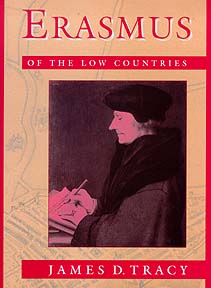
Erasmus of the Low Countries
James D. Tracy
Table of Contents
- Abbreviations
- Preface
- Introduction
- 1. Bonae Literae
- 1. The Burgundian-Habsburg Low Countries
- 2. Erasmus Against the Barbarians
- 3. The Ideal of Christian Civility
- 4. Between Wisdom and Folly
- 2. Philosophia Christi
- 5. Reformers of Doctrina
- 6. “The Name of Erasmus Will Never Perish”
- 7. “The Most Corrupt Generation There Has Ever Been”
- 8. The Philosophy of Christ
- 9. In Defense of Bonae Literae
- 3. Second Thoughts, 1521-1536
- 10. Christian Liberty in the Catholic Church
- 11. A Reformation Gone Wrong
- 12. The Parable of the Tares
- 13. Circumspect Reformer
- 14. Erasmus and His Readers
- Conclusion
- 1. Chronology of Erasmus’s Life
- 2. Erasmus’s Works Discussed in the Text
- Bibliography of Works Cited
Abbreviations
- P. S. Allen. Opus Epistolarum Des. Erasmi Roterodami. 12 vols. Oxford, 1906–1958.
- Opera Omnia Des. Erasmi Roterodami. Chairman of editorial board, Hans Trapman. To be published in multiple volumes arranged in 9 groupings or ordines; 16 vols. to date. Amsterdam and The Hague, 1969–.
- Peter G. Bietenholtz and Thomas B. Deutscher, eds. Contemporaries of Erasmus. 3 vols. Toronto, 1985–1987.
- Collected Works of Erasmus. Chairman of editorial board, James K. McConcia. To be published in 82 vols., of which 28 have appeared to date. Toronto, 1974–. Where I differ from the CWE translation, my reading is printed in italics, with a word of explanation in the note.
- Jean Leclercq. Opera Omnia Des. Erasmi Roterodami. 10 vols. Leiden, 1703–1706
Preface
Some may think that two books on Erasmus by one author are enough. I was once of the same opinion, having published my dissertation on Erasmus (1972), followed by a book on his political opinions in the context of the contemporary Habsburg Netherlands (1979). The latter book was in effect a bridge to subsequent projects on the political and fiscal history of the province of Holland, a subject that still engages me. But when Stanley Holwitz’s invitation to do a more general book for the University of California Press tempted me out of what I thought had been retirement from Erasmus studies, I found myself returning eagerly to old interests. For one thing, my work on the Low Countries made Erasmus appear in a new light; for another, postmodernist criticism, claiming to hobble the writing of intellectual history, has made all the more challenging the discipline of seeking to understand the thought world of an individual long dead. There was also much new scholarship to stimulate further reflection, and here I think especially of the invaluable translations and notes that make up the University of Toronto Press’s Collected Works of Erasmus series. Most of all, Erasmus himself is subtle and original enough to repay not just a second reading but a third or a fourth. My hope is that readers too may sense some of the excitement I have felt in grappling with the ever fresh perspectives of a thinker who to me seems like an old acquaintance.
Introduction
Few historical figures have been more important than Erasmus of Rotterdam in modeling the ideal of critical scholarship. Beholden to no party, he is one of the shapers of that European heritage whose significance in our lives has become an issue in contemporary cultural debates. Yet for Erasmus critical scholarship was not dispassionate. He cared passionately about the moral and religious renewal that in his mind was advanced by his editions of the Greek New Testament, the Church Fathers, and the Greco-Roman classics. His program for a reform of European Christian society through a reform of teaching (doctrina), both from the pulpit and in the classroom, will be the theme of this book.
The link between pagan and Christian sources was vital, for Erasmus believed that the wisdom of the classics found its fulfillment in Christian faith and that a critical mind nurtured by Greek and Roman authors made the difference between faith and credulity. In a broad historical perspective there was nothing particularly novel about seeking to harmonize the simplicity of the Gospels with the intellectual sophistication of the Greco-Roman world. Erasmus was merely refashioning, in terms appropriate to his age, the synthesis between Christian and classical values that the Church Fathers and the medieval scholastics had attempted in earlier ages. Contemporary scholars will of course differ sharply in their evaluation of this harmonization of disparate values. The same blending of critical reason and Christian piety which makes Erasmus seem for some a teacher for our age1 is dismissed by others as a form of “intellectual sleight of hand.” 2 My choice of theme for this book reflects my own belief that much depends on a continual reappropriation of our past, even and perhaps especially in a secular, technological civilization, and that Erasmus’s efforts to rejuvenate the early Christian and classical roots of his own culture deserve our respect, quite apart from the question of whether his synthesis of the values of faith and reason seems in all respects convincing. Personal views have helped shape this book in other ways, of which readers may also wish to be forewarned. First, I may fairly be accused of a bias toward development,3 that is, toward the belief that Erasmus never ceased learning and that his second or third thoughts on a given topic are often more interesting than his first. This approach means that the older Erasmus, certainly more waspish but arguably wiser as well, will here receive equal time. Second, although recent debates among philosophers and literary critics have provided good reason for thinking that it is not possible to see (as it were) into the mind of an author, this limitation does not mean that we have no access to the meaning of a text, especially if we can plausibly reconstruct the context or set of assumptions within which it would have made sense for an author to say what he says.4 Thus the focus here will be on the world of thought that Erasmus seems in some measure to have shared with contemporaries.
To speak of how one’s own views may influence one’s perception of Erasmus does not mean we should attempt to draw him into our contemporary cultural wars. As is true for any thinker worth taking the trouble to understand, his ideas cannot without distortion be marshaled on one side or another in the arguments of a far different century. Some defenders of the Great Books, for example, might applaud Erasmus’s emphasis on the Greco-Roman classics, except that for him the classics only made sense in a curriculum centered on the Gospels. Those who see the European heritage as the source of much that is amiss in our world might dismiss him as just another defender of Western values, except that in his polemics against the contentious temper bred by the Aristotelian logic of the universities or the war-making zeal bred by a chivalric upbringing among the aristocracy he sounds like a distant cousin of contemporary critics of European culture. In the end, though we must necessarily bring to the past questions from our own day, we cannot learn from it except on its own terms.
To understand Erasmus on his own terms is to read his works against a background that provides both a context for his ideas and a basis for assessing his originality. Three kinds of background are required for this purpose. First, Erasmus was, as a contemporary would have said, not a Dutchman but a “Burgundian,” that is, a subject of the Burgundian-Habsburg Netherlands, encompassing most of the present Benelux countries. He was born and educated in the county of Holland in the modern Netherlands, and even after he left the monastery (ca. 1493) he spent about a third of his remaining years in the neighboring province of Brabant, now mostly Belgian. If scholars have tended to pay little heed to his nationality, it is partly because Erasmus himself liked to speak of finding his fatherland (patria) wherever learning flourished and partly because the history and culture of the Netherlandish-speaking5 lands remains largely unknown outside Belgium and the Netherlands. Yet his political views (see chapter 7) were unmistakably those of a Netherlander, and he clearly wanted to return to his “fatherland” for his final years, even if circumstances did not permit him to do so (see the introduction to Part III). Moreover, one of Erasmus’s root notions, and one that takes many forms in his works, is the idea of Christian civility, involving a spiritual commonwealth made up of learned believers. This kind of religious individualism can best be understood as a reaction against the densely corporatist character of civil and religious life in his native provinces. Like many who have achieved fame, Erasmus bore the stamp of his homeland even in those areas where he differed from the common opinions of his countrymen.
Second, like not a few of his contemporaries, Erasmus was both a humanist and a man of the church. As a churchman he could hardly avoid turning his thoughts to the reform of Christian society, the burning issue that had preoccupied ecclesiastical writers for more than a century. As a humanist—that is, as one who promoted a new kind of intellectual culture, based on the classical Latin of ancient writers rather than on the medieval Latin of scholastic philosophers—he could hardly avoid thinking of reform as the substitution of a better kind of teaching (doctrina) for one that was false or deficient. In the early sixteenth century thinkers could choose among many conceptions of the reform of the church and of the larger society, only some of which focused on changes in doctrina, or Christian teaching in the broadest sense, including preaching. Among reformist writers who did have such a focus, some are more suitable for comparison with Erasmus than others (see chapter 5). By looking at Erasmus’s conception of reform against this background, we can see how much he had in common with some of his contemporaries and to what extent he marked out a path that was entirely his own.
Finally, the controversies that Erasmus’s works touched off provide a quite different but equally useful background. After the beginning of Luther’s Reformation, both conservative Catholics and sympathetic Protestants labeled Erasmus a secret adherent of the new doctrines. In his apologetic writings, one can as it were look over Erasmus’s shoulder as he seeks to explain what he had meant, giving his words a Catholic sense even as he drives home his continuing criticisms of the church.
The organization of this book reflects my choice of these three different backgrounds. Part I, “ Bonae Literae: The Making of a Low Countries Humanist, 1469–1511,” begins with a brief survey of culture and society in the Netherlandish-speaking provinces of the Low Countries (chapter 1). Here we can see how Erasmus formulated his ideas of intellectual culture and piety as a conscious alternative to the monastic culture in which he had been schooled and, in a broader sense, to the communal and corporatist values of which this form of religious life was but one expression. My discussion concentrates on his earliest major works: Antibarbarorum Liber (Book against the Barbarians), of 1493/1495, his statement of a humanist cultural program (chapter 2); Enchiridion Militis Christiani (Handbook of the Christian Soldier, 1503), a rule for Christian life drawn from his study of ancient texts (chapter 3); and Moriae Encomium (The Praise of Folly, 1511), in which the earnest moral wisdom for which so many writers (including Erasmus in earlier works) have striven is measured against the foolishness of God and found wanting (chapter 4).
Part II, “ Philosophia Christi: Erasmus and the Reform of Doctrina, 1511–1522,” focuses on the years when Erasmus, humanist and churchman, was at the height of his fame and influence. To provide a framework for Erasmus’s vision of how a better Christian society might be achieved through a reform of religious teaching, I first look briefly at three other proponents of such reform (chapter 5). Following a summary of Erasmus’s life and works during these frenetic years (chapter 6), there will be a more detailed examination of his diagnosis of the ills that plagued Christendom, focusing on the deliberate, self-serving distortion of Christian truth by powerful men in church and state (chapter 7). Erasmus’s hope for the future lay in the recovery, by careful scholarship, of the original Gospel message, the philosophia Christi, and in broadcasting this truth to the world, despite the anticipated furious opposition of powerful interests that had sought to obscure it (chapter 8). When the new biblical scholarship and all it portended seemed threatened by the furious reaction of traditional theologians to Martin Luther’s teaching as well as his own, Erasmus launched a daring if futile campaign to fend off the enemies of “good letters” by discrediting the papal bull excommunicating Luther (chapter 9). During these years in particular Erasmus had to nuance his position in writing to different audiences. Clever wordsmith that he was, he even thought it possible to “dissimulate,” that is, to convey one meaning to some readers and another to those who knew his mind better. It is thus helpful in Part II (notably in chapter 9) to use the letters Erasmus himself never published as a kind of reader’s guide for what he says in his published writings.
Part III, “Second Thoughts, 1521–1536,” considers Erasmus’s responses to Catholic and Protestant critics who disagreed on almost everything but shared the conviction that Erasmus’s critique of the church had paved the way for the Reformation he now disavowed. What makes these apologetic letters and treatises interesting, despite their often querulous tone, is Erasmus’s continuing effort to refine his ideas; the man whom some contemporaries called “circumspect,” no longer having latitude for the “dissimulation” of a more hopeful era, now tried to say precisely what needed saying and nothing more. Against Catholic critics he had to justify and in some ways clarify his vision of what Catholicism might be but was not (chapter 10). Against Protestant foes he had to make the case that the nascent churches of the Reformation were not in fact a credible approximation of the philosophia Christi (chapter 11). Meanwhile, he had to insinuate in high places in the Catholic world his own conviction that Catholic rulers must not in the name of the Gospel embark on a policy of fire and sword, by which religious dissent might indeed be driven underground but not suppressed (chapter 12). All of these efforts he made not with any real hope of success but in the belief that he could not in conscience do otherwise. In these years we can also see him in conversation as if with himself, especially in some of the long apologetic letters, recognizing how he himself had sown some of the confusion that his enemies now turned against him and pondering whether it was after all possible, even for a careful thinker and master stylist, to convey to a sympathetic reader everything he intended to say and nothing more (chapter 13). As a commentary on Erasmus’s attempts to clarify his position, chapter 14 assesses how he was understood by his contemporaries. Some attempted to put into practice ideas that can be recognized as his, while others took his ideas further than he himself might have wished but not necessarily further than a bare reading of the text might allow. This broad spectrum of interpretation seems a fitting epilogue for a writer who was above all a master of subtlety. In the end, we may say, Erasmus “dissimulated” only too well.
Bonae Literae
The Making of a Low Countries Humanist, 1489–1511
The Burgundian-Habsburg Low Countries
The boundaries of the Low Countries are geographically ill defined and historically fluid.1 Inhabitants of the region today speak languages descended from those heard in Erasmus’s time: Frisian in Friesland, Dutch in the rest of the Netherlands and in northern Belgium, French in southern Belgium, and a form of Low German in Luxemburg. Speakers of Netherlandish and French dialects in the sixteenth century were divided not by territorial borders but by a linguistic frontier that followed the old Roman road from Boulogne to Cologne. That different language communities converged on this area was not without influence in making the region a meeting place for merchants from all over Europe by the late Middle Ages.2
Political unification of the region was attempted more than once but never fully achieved. Between 1384 and 1477 the dukes of Burgundy brought most of the important territories under their control, including the three largely Netherlandish-speaking provinces of Flanders, Brabant, and Holland. But as the last duke lay dying on the field of battle in 1477 he left behind provinces and towns chafing under his hasty centralization.3 The new Habsburg dynasty in the person of Maximilian I, Holy Roman Emperor from 1495 to 1519, had to proceed cautiously in lands that he ruled only by right of his late wife (d. 1484), the daughter of the last duke of Burgundy. Maximilian was obliged to treat the distinct institutions of his separate Lowlands territories with respect, and it was in this era that Erasmus grew to manhood. Maximilian’s son, Archduke Philip the Handsome (reigned 1494–1506), was succeeded by his son, best known to history as the emperor Charles V (reigned in the Low Countries 1514–1555). As Charles was mostly absent from his native country, his authority was represented there by his aunt, Margaret of Austria (1506–1514, 1517–1530), and later by his sister, Mary of Hungary (1531–1555). These capable Habsburg women and their advisors made considerable progress in building national institutions.4 Still, the people of this nation in process of formation had no proper name for their country, and if they had a collective name for themselves it was “Burgundian,” in honor of the now-vanished dynasty.5 Under Charles’s successor, Philip II of Spain, the northern provinces, led by Holland, rebelled against Habsburg state building (1572–1648) and formed themselves into a new nation known to history as the Dutch Republic.
Politically fragmented, the Low Countries counted among Europe’s great powers only at intervals—under the fifteenth-century dukes of Burgundy or during the seventeenth-century era of Dutch naval supremacy. Yet as the patient work of economic and social historians has shown, the people of this region were often at the forefront of major transformations in European history. What defines the Low Countries geographically is the omnipresence of water: the North Sea, from Friesland to the Pas de Calais, and the Zuider Zee (South Sea); the Maas (Meuse), combining with the Scheldt and its tributaries to form a great delta; the Rhine, with branches running into the Zuider Zee, the North Sea, and the Maas delta; and the canals, which since Roman times have facilitated drainage and travel.6 By comparison with slow and costly methods of land travel, seas and rivers were the high roads of communication. This “exceptionally favorable geographic position” made the Low Countries in the late Middle Ages, along with northern Italy, “the most densely populated area in the world.” 7
Urbanization is one ready index of social and economic development, and in this respect only northern Italy can be compared with the western Low Countries, especially Flanders and Holland. The great industrial city of Ghent (Flanders), with an estimated 64,000 people in the fourteenth century, was then surpassed in northern Europe only by Paris. In Erasmus’s native Holland urbanization was slower and cities were smaller, but nonetheless in the early sixteenth century a province no larger than the state of Delaware could boast of no fewer than twenty-five walled towns. Calculating the percentage of population living in cities over 10,000, Jan De Vries creates a scale of urbanization for various modern nations in 1550, fourteen years after Erasmus’s death; the highest figures are for Belgium (21 percent), the Netherlands (15.8 percent), and northern Italy (15.1 percent).8 If one lowers the threshold to include agglomerations of 5,000 or more, Flanders was 36 percent urban by 1500 and southern Holland, from the north bank of the Maas to the south shore of the Zuider Zee, 54 percent. By this measure Erasmus’s home ground was perhaps the single most urbanized region of Europe.9
Urbanization on such a scale presupposes a flourishing agricultural economy. New land was brought under the plough all over Europe during the High Middle Ages, but in the Low Countries this process was enhanced by the reclamation of land that was waterlogged or even covered by water. From an early date villagers in what later became the County of Holland were cutting parallel drainage ditches into fenlands that rose gently above settled bottomlands, and “Hollanders” are first mentioned in a contract for such work (1117) in northern Germany. Monasteries and noble landlords along the Flanders coast pioneered in the building of sturdy dikes to enclose land under water at high tide, thus creating polders. By 1300 Holland was ringed by a network of sea dikes which ranks as one of the engineering wonders of the medieval world.10 Moreover, because of the stimulus that urban markets and urban investment provided to the spread of intensive farming, agricultural productivity continued to improve in the Low Countries during the period ca. 1300–1450 when productivity declined or stagnated elsewhere. If the labor of four peasants was required to feed a town dweller in most of the rest of Europe, here it required only two. Since productivity growth resumed after 1500, following a brief lag, and continued without interruption, Europe’s “Agricultural Revolution” dates in the Low Countries from the sixteenth century, much earlier than in England.11
From about 1300 galley fleets from Venice and Genoa called regularly at Bruges in Flanders; when the north German Hanseatic League established one of its principal depots here, Bruges became the main north European entrepôt for the exchange of goods and the settlement of merchant accounts. Silks and spices from the fabled Asian caravan routes, coming by way of Italy, were traded for the raw products of the Baltic, especially rye and wheat from the Polish plain and (somewhat later) copper from the mines of central Europe. Ships returning to the Baltic also carried the fine woolens in which the great cities of Flanders had long specialized, English woolens finished in Brabant, or, in the sixteenth century, lighter fabrics that came into favor as the old industry declined. By about 1500 Antwerp, in Brabant, had begun to outstrip Bruges as a European entrepôt. It was to Antwerp that the Fuggers and other great merchants of southern Germany brought their copper, and to Antwerp too came factors of the king of Portugal bringing spices from the new sea route from India, where, as it happened, copper could be sold for a premium. Because of far-flung exchanges of this kind, Antwerp, with a population of about 90,000 in 1550, may be considered the first world market. Erasmus Schets, perhaps the greatest merchant-banker of Antwerp, was heavily involved in refinement of copper, bid for the exclusive right to import Portuguese spices, and through his Lisbon contacts launched one of the early sugar mills in Portuguese Brazil. Schets was also an accomplished Latinist, proud to serve as personal banker to his friend Erasmus of Rotterdam.12
The political development of the Low Countries territories was in some respects commensurate with their advanced economy. Representative assemblies are common throughout Latin Christian Europe in the late Middle Ages,13 but none met so frequently as the provincial states of the Low Countries and few if any have left such copious documentation for this period.14 During the sixteenth century a Habsburg government desperate for funds to fight its wars had to grant the provincial states a growing share of authority in such matters as the collection and disbursement of tax revenues.15 There is at least one link between this vigorous tradition of representative government and the precocious economic development of the region: communal and interest-group associations here had long had the habit of managing their own economic affairs, and such habits had political implications. From the late eleventh century owners of land reclaimed from water organized themselves into polder boards that had the power to levy assessments and that were in time only partially brought under the control of the territorial princes. Crafts guilds were common in the southern Netherlands (not in the north), and after about 1300 they were a potent force in the industrial towns of Flanders; even in Brabant, where patrician and merchant interests remained stronger, the craft component or “member” of a sixteenth-century town magistracy could by itself hold up consent to a tax demanded by the central government. Before procedures for gaining subjects’ consent to taxation had developed into unified parliaments or “states” for each province, towns and landowners (noble and non-noble) in this region commonly sent representatives to district meetings where requests for an extraordinary tax had to be approved. There were also ad hoc assemblies of municipalities involved in the same trade, such as the “towns and villages engaged in the herring fishery” in Holland. The burghers who represented their towns at such meetings also had social organizations to mark their own elevated status. Low Countries towns were part of a cultural zone extending into Germany in which prominent burghers formed “shooting guilds,” or honorific militias; they were also part of another cultural zone extending into France in which burghers formed “guilds of rhetoric” for the performance of plays both pious and satirical.16 Rather than combating this penchant for corporative organization, the dukes of Burgundy sought to make use of it for their own purposes; they encouraged the formation of a unified parliament or states in each province to simplify consultative procedures and they gathered the great nobles of the region into a ceremonial brotherhood, the Order of the Golden Fleece, sworn to uphold the dynasty.
For the most part the currents of devotion and reform that defined medieval religious history were not of local origin and swept into the Low Countries from France and Germany. Moreover, prior to Philip II’s controversial redrawing of diocesan boundaries in 1559, bishops here were answerable to superiors in France or Germany. It seems too that waves of religious enthusiasm, or religious fear, were in this area tempered by a certain moderation. During the era of Europe’s great witch-hunt (ca. 1450–1650), for example, there were witchcraft trials in the Low Countries but few examples of the witchcraft panics that took place in parts of France, Germany, and Switzerland. But moderation did not mean indifference. In particular, the energy and sophistication of lay society in the Low Countries was visible also in the degree to which laypeople appropriated the devotional practices and the spiritual outlook of the religious orders. From the thirteenth century pious nuns and monks penned Netherlandish treatises on the life of prayer and spiritual perfection, suggesting an audience for such works among devout layfolk (especially women) who could not read Latin. To accommodate the admiration of monastic piety, there were richly illuminated books of hours for ladies of the court and in important urban parishes endowments for choral singing of the zeven getijden, or seven hours of the monastic office. Parishes also had multiple brotherhoods and sisterhoods for specific purposes, such as nursing the sick or honoring the patron saint of the parish. If a special characteristic distinguished Low Countries religious life, it was in the prominence of movements having at least a partly lay character. The Beguines, religious communities of unmarried laywomen, were in the thirteenth century a movement of European scope, but only in this region did they survive the hostile scrutiny of church authorities suspicious of any such groups lacking the discipline of monastic vows; well into the sixteenth century every Low Countries town of any size had its beguinage or begijnhof. The Brothers and Sisters of the Common Life, founded by Gerard Groote (d. 1384), spread mainly through Groote’s native northern Low Countries and adjacent regions of Germany. Like the Beguines, members of these communities remained free to leave and to marry. But many houses converted themselves into religious communities in the more normal sense, adopting either the Franciscan or the Augustinian rule, and the remaining houses of the Brethren developed into communities mainly composed of priests, with a special focus on the spiritual instruction of youth.17
The Low Countries might once again be compared with Italy in terms of the European fame and influence of local artists. To be sure, the international reputation of Low Countries musicians and painters profited from the patronage and prestige of the Burgundian court. The roster of leaders in the new polyphonic music of the fifteenth century includes a cluster of Low Countries composers who spent most of their careers at French or Italian courts. As for painting, the brothers Jan and Hubert van Eyck, pioneers in the ars nova with its stunning realism of detail, never left their native region, but what Italians called il dipingere di Fiandra soon commanded a good deal of interest in foreign art markets; in the next century, at least by the 1540s, Netherlands paintings were being exported to Spain by the crate.18 The sculptor Klaas Sluter, another creator of the ars nova and a contemporary of the Van Eycks, had no successors of comparable talent. But the elaborately carved polychrome wooden altarpiece, or retable, originating in the southern Netherlands around 1400, soon developed here a distinctive plasticity of form, and by 1500 retables too were an important export item. Save for Jan Borremans of Brussels, whose work can be found in places like Sweden and Estonia, no individual artist stands out. Rather, retables were known by the distinctive styles of the Brabant towns where they were mainly produced (Antwerp, Brussels, and Mechelen). Guilds of sculptors, cabinetmakers, and painters collaborated in the production of retables, and, in a form of quality control well known in other industries, guild masters affixed their trademark to each finished piece. After about 1480 the production of fine tapestries—yet another artistic export—was centered in Brussels and came under the stylistic influence of contemporary retables.19
In sum, corporative organization was the law of life in this highly urbanized society. In a sense the starting point for this conception of social order was the extended family. As elsewhere in Europe, people high and low depended on “kith and kin” (vrienden en magen) for protection and advancement.20 It was also a widespread European practice for people to band together at all levels to defend themselves against common foes and to further common economic interests, creating as it were an artificial family.21 Any society whose basic building blocks were the extended family and the sworn association, as was certainly true for the Low Countries, must be deemed “medieval” rather than “modern” in its principles of organization. Must we conclude, then, that the society in which Erasmus grew up was destined to decline, making way for modernity? Johan Huizinga’s Waning of the Middle Ages, still the most influential historical portrait of the Burgundian Netherlands, treats the late bloom of medieval ideals and institutions here as “overripe” and incapable of withstanding a challenge from the truly innovative spirit of the Italian Renaissance. Yet the question of what constitutes modernity has no simple answer. Huizinga’s argument holds up best in the case of religious literature, where subsequent and more thorough studies have found for the same period a widespread intensification of religious guilt, coupled with a timidity and anxiety in light of which the rebellious reaction of an Erasmus (or a Luther) is more readily comprehensible.22 But the case is not the same for aristocratic culture, not even for the ponderously ceremonious etiquette of the Burgundian court. We cannot, for example, dismiss as outdated and artificial an institution so useful to rulers as the Knights of the Golden Fleece.23 Guilds have likewise been found to have more vitality than was formerly thought, and even where guilds were not permitted, the impulse for collective solidarity could take other and equally impressive forms: it was precisely in the guild-free new industrial towns of Flanders that craftsmen formed the backbone for Calvinist or Anabaptist churches that flourished in the teeth of persecution by the Habsburg state. When the Dutch Revolt broke out not many years later, the rebellion was principally justified in the name of the cherished privileges or “liberties” that had always been a rallying point for local solidarity.24 Thus Burgundian culture was not about to collapse from its own weight and complexity; indeed the Low Countries pattern of continuous innovation within a traditional corporate framework turned out to have a promising future.
To come finally to learned literature in Latin, the aspect of Low Countries culture that bears most immediately on Erasmus’s intellectual formation, the traditional framework is here more in evidence than are any signs of innovation. The university of Leuven (Louvain), founded in 1427, was for some time under the shadow of its models, Paris and Cologne. The curriculum was dominated by scholastic logic and by a Latin that in the judgment of neo-Latin literature scholar Jozef IJsewijn had considerably declined from the achievements of medieval authors of earlier centuries; only occasionally did a professor of arts or theology show an interest in the new (Italian) humanist emphasis on classical Latin. The Brethren of the Common Life had scriptoria for copying manuscripts and often maintained a domus pauperum for poor boys enrolled in the town school, in order to encourage religious vocations. But the devotional treatises of the Brethren tended to be severely practical, discouraging intellectual curiosity as a form of sinful pride. By default, then, until the end of the fifteenth century monasteries were the main centers of a nascent humanist movement. The Premonstratensian abbey of Parc, outside Leuven, built a library rich in Italian humanist manuscripts, where Erasmus was to find Lorenzo Valla’s unpublished work on the New Testament, the Adnotationes (see chapter 6 below). The Cistercian abbey of Adwerth in Friesland was the meeting place for a circle of scholars that included Wessel Gansfort, a reformist theologian, and Rudolph Agricola (d. 1485), the earliest Low Countries humanist of any distinction, who felt more at home in Italy than in his native land. In Holland the most interesting early humanists were to be found in monasteries of Augustinian Canons Regular: Cornelis Gerard at Hemsdonk, near Schoonhoven, and at Steyn, near Gouda, Willem Hermans—and Erasmus of Rotterdam. This was a milieu in which the new humanist learning was understood mainly as an ornament to the study of theology.25 One certainly would not expect this milieu to produce a young man—the same Erasmus—whose goal was an intellectual revolution.
Erasmus Against the Barbarians
The facts of Erasmus’s early life are still disputed, in part because of questions about the authenticity of his fullest description of these years, in the Compendium Vitae of 1524.1 Most likely he was born in Rotterdam, the second of two illegitimate sons of Gerardus and Margareta, in 1469;2 Gerardus was a priest when Erasmus knew him, if not at the time of his birth, and Margareta was the daughter of a physician. As a small boy Erasmus attended the town school in Gouda, where he was taught by Pieter Winckel, assistant pastor of the town church. According to the Compendium Vitae, Margareta accompanied the nine-year-old Erasmus to Deventer in Overijssel, where he enrolled in the well-known St. Lebuin’s town school, a school that had eight classes instead of the usual six; the rector, Alexander Hegius, was a pioneer of humanist education. Though Erasmus never had Hegius as a teacher (he reached only the third-highest class), he heard him lecture to the whole school on feast days, and it was from older boys in the classes of Hegius and Jan Synthen that Erasmus “first caught a whiff of better learning.” Beatus Rhenanus, a close friend who penned a laudatory biography, adds that Erasmus reached Synthen’s class.3
When Erasmus was about fourteen his mother and father died within a few months of each other, and Erasmus, with his older brother Pieter, was entrusted to the care of three guardians, including the Gouda schoolmaster Pieter Winckel. Rather than sending Erasmus to a university, the guardians enrolled him for two years at the domus pauperum scolarium, or poor students’ hostel, of the Brethren in ’s Hertogenbosch in northern Brabant, which, like other such hostels run by the Brethren, was a recruiting ground for religious vocations. Since the town school attended by students at the hostel had only six classes there is support for Erasmus’s claim that ’s Hertogenbosch had nothing to teach him.4 Erasmus’s fullest description of his decision to enter the monastic life is clouded by the fact that the letter in question seeks to make the case that he was never suited for the cloister and should thus be dispensed from the obligation to return there. Erasmus and his brother had promised each other to remain firm against the self-interested wishes of their guardians, but Pieter yielded, joining the monastery of Augustinian Canons at Sion, near Delft, leaving Erasmus, “a youth of sixteen,” no basis for refusing what his guardians proposed. He chose to enter a house of the same congregation at Steyn, outside of Gouda (ca. 1485).5
In the information we have on Erasmus’s youth there are two qualities that stand out. First, in a society where folk high and low depended on “kith and kin” for the advancement of their interests, the circumstances of Erasmus’s birth placed him in a precarious position. That Erasmus was shamed by his illegitimate origins is suggested by his reticence, for a man otherwise so loquacious gives only one rather problematic account of his birth, in the Compendium Vitae. He recounts that Gerardus, destined for the priesthood by his nine brothers lest the family estate be further diminished, set off for Italy, leaving behind Margareta, “the woman he hoped to marry,” who (unbeknownst to him) was pregnant; only when his family wrote (falsely) that Margareta had died did Gerardus become a priest. When he returned home he discovered the deception and “never again touched” Margareta. It is indeed likely that Gerardus was not yet a priest when Erasmus was born.6 But the Compendium Vitae suppresses the existence of Erasmus’s still-living older brother and fellow monk, Pieter, to whom he had referred in published writings. In other letters, especially in one that he never published and that is very close in time and content to the Compendium Vitae, Erasmus bitterly condemns Pieter for having given in to pressure from their guardians to enter a monastery, thus leaving him in an exposed position. The Compendium Vitae tells a similar tale of how Erasmus went unwillingly into the cloister but without naming the “companion” who “betrayed” him.7 Had Erasmus mentioned his older brother by name, he could not have presented his father and mother as unhappy lovers, cheated of their lawful desire by avaricious kinfolk. By shielding the memory of his parents, he guarded for himself the semblance of a family life. Yet he evidently thought of his paternal kin in the unfavorable way he describes them in Compendium Vitae; the text refers to two of his mother’s brothers whom he once visited but says nothing about his father’s many brothers or their children.8 In the world of the sixteenth century, such a man needed friends.
The second point that stands out is that the young Erasmus was remarkably skilled in re-creating the classical style of Latin prose and verse, as prescribed by Italian humanists like Guarino of Verona and Lorenzo Valla. There is no proof for Erasmus’s description of his father as a man of humanist learning who studied Greek and traveled to Italy where he heard the lectures of the famous Guarino. Yet Gerardus did leave a valuable library, and it is tempting to see Erasmus’s early attachment to the classics as a precious link to an admired and perhaps distant father.9 During his school years at Deventer, or “as a boy,” he was “carried off as if by a force of nature” to “fine letters” (bonae literae), especially Horace.10 According to Beatus Rhenanus, Erasmus’s teacher Synthen predicted he would “rise to the highest rooftops of learning,” and modern neo-Latin scholars have been impressed by the elegant Latinity of early writings, like the Carmen Bucolicum, a pastoral poem probably written at Steyn. Jozef IJsewijn describes it as “more humanistic than all the pastoral poetry of Petrarch” (Francesco Petrarca, d. 1374).11 In his earliest extant letter Erasmus instructed his guardian Pieter Winckel to arrange forthwith an auction of his father’s books. Winckel may well have been put off by the peremptory tone of this youthful missive, but Erasmus later recalls his being offended by its recondite classical vocabulary.12
The young Erasmus thus outstripped his teachers in his mastery of the new classical style but could not turn to his kinfolk for support. Entering the cloister at Steyn may well have promised to provide what he needed most: a community of mutual love and support to replace the family he lacked and, as Erasmus himself says, the hope of an opportunity for further study.13 The Funeral Oration for Berta Heyen, written when he was nineteen, shows Erasmus comfortably taking his place as one of the “fathers” from Steyn whom this pious widow of nearby Gouda sometimes entertained at her table; the occasion for this declamatio in classical form allowed him to imitate consolatory letters in the Epistulae of his beloved St. Jerome.14
When he was “scarcely twenty” Erasmus wrote a hortatory epistle encouraging a young man to enter a monastery. De Contemptu Mundi (On the Contempt of the World) has been variously interpreted. Erasmus distanced himself from this early work in his preface to the published version (1521) and lamented the loss of a later declamatio (ca. 1506) that gave reasons against embracing the monastic life. Erika Rummel has suggested identifying this otherwise unknown treatise with the twelfth and last book of the printed De Contemptu, a “warning” based on the experience of those who have “regretted” entering the cloister.15 Many scholars have found the main body of the work to lack the ascetic flavor characteristic of such works; monastic discipline is presented not as a means of repentance but as a higher form of voluptas (pleasure), that is, tranquillity of conscience, leisure for contemplation and study, and a safe harbor against the turmoil and temptations of “the world” (seculum).16 More recently, however, others have shown convincing parallels with de contemptu mundi treatises of patristic and medieval literature, even in regard to the claim that it is the monks, not those who live in the world, who have a truly “Epicurean” way of life.17
Yet if Erasmus’s treatise fits into the great tradition of monastic writing, it fits less well with the heightened sense of sin that characterizes late medieval ascetic spirituality. As Jean Delumeau has written, “The fourteenth century witnessed the birth of what might be called a scruple sickness.…No civilization has ever attached as much importance to guilt and shame as did the Western world from the thirteenth to the eighteenth centuries.” 18 Thus the De Contemptu Mundi should be compared with contemporary ascetical works, like Jacobus de Vocht’s Narratio de Inchoatione Domus Clericorum in Zwollis, a house chronicle of a type often produced by the Brethren. De Vocht had entered the house in Zwolle (in Overijssel, not far from Deventer) in 1450, was ordained a priest in 1465, and was still compiling pious recollections of members of the community in 1503, when he was said to be in his eighties. Though the Brethren were not monks themselves, they were fierce champions of a life of prayer, penance, and seclusion from the sinful world; boys instructed at their hostels (as at ’s Hertogenbosch) were encouraged to embrace a religious life, either with the Brethren or with the Augustinian Canons Regular—especially in one of the houses grouped together in what was known as the Windesheim congregation. Hence even though the works of Erasmus and de Vocht are very different in genre—the one addressed to “worldly” persons willing to think about a cloister, the other to zealous companions who had long since forsaken the ways of the world—they come from the same spiritual milieu, that of the “new devotion,” or devotio moderna, associated with the Brethren. The group of Augustinian houses known as the congregation of Sion, to which the monastery at Steyn belonged, had been founded by members of the Brethren in the early fifteenth century, in the same spirit as the larger Windesheim congregation. Even the mature Erasmus sounds at times like a disciple of the Brethren, as when he describes the splendid Charterhouse of Pavia as nothing but a useless pile of marble filled by gawking tourists.19 Likewise, when he says that “Christian philosophy” should be so widely diffused that farmers behind the plow can recite the Gospels, he echoes not only the Epistulae of Jerome but also the practice of devout Brethren described by de Vocht.20 Despite his criticism of the Brethren in later life,21 Erasmus had more in common with de Vocht’s outlook than he might have cared to admit.
Yet Erasmus’s De Contemptu and de Vocht’s Narratio de Inchoatione are still so different that it is difficult to believe they could have come from the same background. By the conventions of monastic literature, the devout must flee a world (seculum) fraught with mortal peril; but if the leaders of de Vocht’s community fear contamination of the brothers and sisters through contact with “worldlings” (seculares), Erasmus sees “ those they call worldlings ” (seculares [quos vocant]) as merely misinformed: they flee monastic life because they have the impression it is sad and morose.22 While Erasmus speaks of attending a farewell dinner for a girl named Margareta who was entering a convent, the rector of a house of the Brethren roundly scolded a companion for having accepted “beguine cookies” from the sisters: “‘Cursed be all gifts that come to the brethren from women,’ he said, ‘especially from the sisters,’ and he crushed the cookies beneath his feet.” 23 De Vocht dwells on the importance of humilitas—the brothers compete to perform “the more vile tasks, the more humble duties”; they gladly endure humiliation in the presence of outsiders; and they “humble” one another by teasing—but Erasmus does not even mention this central monastic virtue.24 Erasmus writes about the tears of parting (at Margareta’s farewell the entire company weeps), but de Vocht writes about tears of remorse: in the privacy of his cell, the rector at Zwolle “often groaned and wept, for he was so penitent and fearful all the days of his life.” Erasmus can pity the “wretched soul…carried off to that austere and strict law court [praetorium]” of God’s judgment, but one hears a more frightening thunder in a sermon of another Zwolle rector: “Woe unto us, if we do not fix in our hearts and keep always before our eyes how great is the wrath of God and how much He is displeased by sin, on account of which He will cast the sinner into everlasting fire.” 25 De Vocht’s house chronicle provides evidence not only of the intellectual timidity and religious pessimism that historian R. R. Post has noted among the Brethren but also of a morbid preoccupation with death. Against this background there is much to be said for the sturdy good sense of Erasmus, who saw a positive value in the classical sense of self-esteem.26
Yet the monks at Steyn were not all students of the classics. Many will have been much closer in spirit to de Vocht and will not have been receptive to any argument tempering the urgency of self-mortification, regardless of what its pedigree may have been in earlier monastic literature. The letters that Erasmus wrote while at Steyn show him chafing against the reins of monastic life.27 There is no clear indication of his being unable to endure fasts and vigils, as he later complained.28 Rather, he was thwarted first in his effort to form a close friendship with a fellow monk, Servatius Roger, and subsequently in his attempt to create a kind of literary circle that included Servatius. Erasmus described himself as having a deep need for friendship,29 and his earliest letters to Servatius (letters 4–9) are brimming with affection: “As often as I read [your letter], which I do almost hourly, I think I am listening to the sweet tones of my Servatius’s voice and gazing at his most friendly face. Since we are seldom permitted to talk face to face, your letter is my consolation.” Some interpreters have suggested reading these letters as rhetorical exercises, but they are more plausibly taken at face value, as confirmation of Erasmus’s need for friendship, if not, as others have suggested, as evidence of latent homosexuality.30
In any case, beginning with letter 10, (as noted by P. S. Allen, the editor of Erasmus’s correspondence), Erasmus presents himself to a circle of friends, including Servatius, more as a teacher than as one seeking friendship. Some of what Erasmus-as-mentor now requires of Servatius and the others makes more sense if we assume that his friendship for Servatius was keenly felt as well as elegantly phrased: “It is of the greatest importance that you should be frank with me. Do you really think friends should have any secrets from each other? Our friend Horace describes the Graces as ‘ungirt,’ and yet you bind yourself about with a kind of girdle of pretense.” That Servatius does not respond to Erasmus’s letters seems linked to some kind of censure, presumably at the hands of a superior. Erasmus refers to this incident as “a small matter [rem exiguam],” as if the two had incurred the displeasure of their superiors because of some infraction of the rather stringent discipline observed in the congregation of Sion (for example, monks could converse freely only on Sundays and feast days).31
When Erasmus exhorts his disciples to “follow my precepts,” he wants them to “shake off laziness” and devote themselves “to the study of letters” and the cultivation of virtue. References to classical authors make it clear what kind of reading he has in mind. He also wants his friends to cultivate their own Latin style, not by culling quotations from authorities but by writing letters “ ex tempore…whatever comes into your head” (letter 15); this manner of composing seems congruent with the candor and openness he requires, as in the letter to Servatius quoted above. Finally, these learned friends are to love one another, “for nothing is more worthy of humanity [humanius] than to return the love of him who loves us” and to “be ever cheerful [hilaris]” (letter 13).32 Several times in these letters Erasmus tells his friends they will surely follow his advice if they look to their own salus, a word that means “well-being” in classical Latin and “salvation” in Christian Latin. It is not apparent what the cultivation of a proper Latin style might have to do with salvation, yet because most of these letters were addressed to monks it is also difficult to imagine that Erasmus was talking about nothing more than well-being.33 Perhaps the solution lies in looking to the De Contemptu Mundi, which is roughly contemporaneous with these letters, where Erasmus described monastic life as combining the pleasures of study and of tranquillity of conscience, another classical idea with a definite Christian meaning.34 From this perspective, we see Erasmus in the letters to his disciples trying to create a community of classical learning and Christian love modeled on De Contemptu’s ideal conception of the larger monastic community.
The next set of letters—Erasmus’s correspondence with Cornelis Gerard (letters 17–30)—shows Erasmus grappling with what he saw as the anti-intellectualism of fellow monks. Some scholars have seen the significance of these letters in the influence the older Cornelis seems to have exercised on Erasmus, tempering his enthusiasm for the more risqué classical authors and eliciting from him a promise to devote his pen to religious themes, so as to be, like Cornelis, a theologian as well as a poet.35 Yet if one reads De Contemptu Mundi as congruent with the great tradition of monastic literature, it is not clear that Erasmus at this time needed much by way of “conversion.” Cornelis’s importance to Erasmus lay rather in his respected status in the larger community of Holland Augustinians, for he could lend needed moral support to the younger monk’s campaign against obscurantism within his own cloister. In his first surviving letter to Erasmus, Cornelis acknowledges receipt of a poem “against the contempt [contemptu, a suggestive word] of the art of poetry,” which Cornelis has now divided into parts, making a verse dialogue.36 In a subsequent letter Erasmus makes clear that the “barbarians” who attack a pagan literature they cannot understand come from a milieu he and Cornelis know very well: “ Had they looked carefully at Jerome’s letters, they would at least have seen that lack of culture is not holiness.” 37 By the time the correspondence breaks off, Erasmus had finished an “oration” against the barbarians requested by Cornelis.38
The composition of Erasmus’s Book against the Barbarians, or Antibarbarorum Liber, roughly spans the years from 1489 to 1495, when little is known of his activities. He was ordained a priest (25 April 1492) by David of Burgundy, bishop of Utrecht, who gave him permission to leave the cloister in order to serve as Latin secretary to Hendrik van Bergen, bishop of Cambrai.39 Since Bishop Hendrik was a member of the privy council, Erasmus will have spent time at the Burgundian court in Brussels, but he was to be found as well in Bergen-op-Zoom (also in Brabant), the town ruled by Hendrik’s family, and at the bishop’s country house in Halsteren. It was at Halsteren that he finished the version of Antibarbari which survives in a sixteenth-century manuscript from Gouda. What started as an “oration” attributed to Cornelis Gerard was now a dialogue in which the main speaker was Jacob Batt, rector of the town school in Bergen and subsequently the town secretary. A layman, Batt was a friend of Erasmus’s, but he was no friend of clerical privilege,40 and he no doubt added spice to Erasmus’s polemic against those who lived in fear of contamination by worldlings (seculares). The text of 1493/149541 represents a considered critique of the religious culture within which Erasmus had lived for ten years.
Schoolmaster Batt “was as much an enemy to the barbarians as they were to letters,” and mendicant friars in Bergen denounced him for discarding traditional textbooks.42 One hears in Batt’s oration overtones of Lorenzo Valla’s polemic against the “Goths” who ruined Latin culture as well as Valla’s spirited defense of “secular” or “pagan” learning.43 One of the speakers suggests that the early Christians scorned pagan literary culture “from a zeal for the faith that was more vehement than wise,” but Batt insists that religion is nothing more than an “excuse” or “pretext” for men who are too lazy to learn about the writings they denounce.44 When he refutes the argument (put forward by “barbarians”) that Christian learning depends on divine inspiration, Batt’s language reaches a pitch of sarcasm that is rare in Erasmus:
There is a book to be written, let [the Holy Spirit] fly to our side and control our pen, with no effort of ours. A speech is to be written—then let him sit by our ear in the shape of a dove and himself guide our tongue—all we have to do is to remember to open our mouth, as one might sing with the psalmist, “I opened my mouth, and drew in my breath [spiritus].” 45
The barbarians against whom “Batt” takes aim come from a spiritual milieu that has characteristics distinctive to the devotio moderna. Like the Brethren of the Common Life, also known as “Hieronymites,” and like the monks at Steyn who did not “rightly understand” Jerome’s Epistulae, 46 they evidently had a special devotion to St. Jerome: Batt’s list of citations from “authorities” to refute the barbarians begins (as did Erasmus’s, while at Steyn) with a discussion of Jerome’s Epistulae. Elsewhere he attributes to his foes an argument that alludes to Jerome’s description of baptism as an oath (sacramentum) of service to Christ.47 Among the “splendid titles [the barbarians] adorn their nonsense with” is the Rosetum Exercitium Spiritalium of Jan Mombaer, a monk of the Windesheim congregation in Zwolle.48 Like Pieter Winckel, who feared that Erasmus and Pieter might “breathe in something of a worldly spirit ” if they attended a university, the barbarians “never…cease to urge the citizens not to send their children to the secular schools they call universities.” 49 Finally, if one keeps in mind a work like the de Vocht’s Narratio de Inchoatione Domus Clericorum Zwollensis, it is easy to understand Batt’s scorn for his adversaries’ excessive fear of falling into the sin of pride of intellect: “The childish, not to say perverse, timorousness of these people is what David was talking about…‘They were afraid where no fear was.’” 50
Some barbarians are altogether afraid of learning, but others are learned in canon law and scholastic theology,51 and in his critique of the latter Batt develops the ideal of a return to vetus theologia (ancient theology). It was a humanist convention that poets had been the “theologians” of ancient times, masking the truth about things divine in allegories. Erasmus alludes to this idea when one of the speakers adduces against the barbarians “proofs from the first theologians [priscis theologis], though of our religion [nostratibus].” 52 The old theologians of the Christian persuasion—that is, the Church Fathers—cultivated a “refined literary style,” and Batt says with praise of one of their modern imitators that he was “no less a rhetorician than a theologian.” Erasmus thus also followed Lorenzo Valla in his call for setting aside the scholastic theology of the Middle Ages, formed in a university culture dominated by Aristotelian logic, in favor of a theology nurtured by the rhetorical culture in which the Fathers had been educated.53
In effect, Erasmus’s grievance against the barbarians was that they accepted as suitable for Christians the passion for argumentation that animated students of logic but they rejected the passion for beauty and style that animated students of grammar and rhetoric. Yet while the logic-chopping of pagan philosophers was, according to Valla and Erasmus, a seedbed of heresy54 and thus a genuine danger to Christian faith, the taste for a more sophisticated literary culture was not in itself harmful. Indeed, as one of the speakers remarks, “Religion without letters has something about it that is almost supine and doltish, from which those with a taste for letters distance themselves as far as possible.” The literary culture of pagan antiquity not only can support a life of Christian virtue but was ordained to do so in the economy of salvation. Taking up a patristic theme, Batt/Erasmus contends that the subjugation of the world to Rome “through such great disasters and bloodstained victories” was “according to the divine plan, so that when the Christian religion was born, it might spread abroad the more easily.” The great cultural achievements of Greece and Rome served a preparatory function in like manner: “In law, in philosophy, how the ancients labored! Why did all this happen? So that we on our arrival could hold them in contempt? Was it not rather that the best religion should be adorned and supported by the finest studies?” 55 The Roman Empire was no more, but there was for Erasmus even in his day a litteraria res publica (republic of letters),56 and in his vision of Christian culture this international community of scholars and amateurs of good Latinity was meant to serve the res publica Christi (Christian commonwealth) as divine providence had ordained.
The Ideal of Christian Civility
Erasmus came to Paris in 1495 hoping to enhance his credentials as “poet and theologian,” after the manner of Cornelis Gerard.1 Bishop Hendrik van Bergen’s patronage permitted a few years of study at the University of Paris, if not the doctorate in theology Erasmus dreamed of earning at the University of Bologna.2 The Paris theology faculty, with its entrenched scholastic traditions, compelled this rather bemused “ primitive theologian” to “turn Scotist,” as he wrote to a pupil: “If only you could see your Erasmus sitting agape among these glorified Scotists…if you could but observe his furrowed brow, his uncomprehending look and worried expression, you would say it was another man.” 3 In November 1495 the completion of a small volume of poetry featuring an ode on the Nativity marked Erasmus’s return to the serious religious poetry he had been writing at Steyn. Robert Gaguin, general of the Trinitarian order and leading figure among Paris humanists, responded graciously to Erasmus’s overtures and gave the manuscript Antibarbari a good review. In turn, Erasmus adopted Gaguin’s standards for a chaste Christian eloquence in his laudatory preface (November 1496) to the Sylva Odarum of Willem Hermans, a longtime friend and member of Erasmus’s literary circle at Steyn who was also Gerard’s cousin.4 But as Jozef IJsewijn has suggested, Erasmus knew Latin poetry too well not to recognize his own limits. To a Netherlands friend (1499) he characterized his poetry as “dry, feeble, lacking both blood and vital sap, partly through a certain poverty of talent” and partly because he had been writing for Dutch ears, “that is, for very dull ears.” 5 Erasmus would find a way to the “primitive theology” that he at this time only dimly envisioned, but not through poetry and not in Paris.
To supplement his meager support from the bishop Erasmus gave lessons to boys who lodged with a guardian or tutor, and in the materials he prepared to teach them good Latin, not the scholastic Latin of the lecture halls, one can see the nucleus of his later pedagogical program. De Ratione Studii (On the Method of Study, 1497, published 1512) was meant for Thomas Grey and De Conscribendis Epistolis (On the Writing of Letters, 1498, published 1521) for Robert Fischer, another English pupil. He also wrote the earliest version of Familiarium Colloquiorum Formulae (Formulas for Friendly Conversation, ca. 1497, published 1518) for two brothers from Lübeck, Christian and Heinrich Northoff, and De Duplici Copia Rerum ac Verborum (Foundations of the Abundant Style, ca. 1499, published 1512) for Adolph of Burgundy, the son of Jacob Batt’s new patroness, Lady Anna van Borssele.6 The first publication that gained him notice among the learned, the Adagia (Adages) of 1500, was dedicated to William Blount, Lord Mountjoy, a pupil who had become a patron, and his first venture into textual scholarship, the 1501 edition of Cicero’s De Officiis (On Moral Duties), was dedicated to Jacobus de Voecht of Antwerp, a tutor to whose charges Erasmus gave lessons while staying briefly in Orléans.7
In a letter that Erasmus wrote for Heinrich Northoff to his brother Christian, “Heinrich” tells what he has learned from Erasmus:
He remarked that [bonae literae, fine letters] alone formed man’s proper wealth, wealth that Fortune could neither bestow nor take away.…They were not conferred, like worldly honors, upon the idle and undeserving. They did not distract one from practicing virtue but themselves conferred it. They alone, said he, could give peace to the spirit and abide as a refuge. Finally, without them we could not even be human.8
This capsule summary reflects a common humanist program, with roots in the Quattrocento (especially in Valla’s Elegantiae) and, among ancient authors, in the writings of Cicero, Quintilian, and Plutarch: Latin must be learned not from grammatical rules but from the usage of the great age of Latinity, roughly from Cicero to Quintilian: teachers should not whip pupils into compliance but rather engage their better instincts in the game of learning, for example, by using competition to appeal to their self-esteem. And just as it was the power of oratory that once persuaded savage men to leave their caves and dwell together in settled communities, so too the charm of bonae literae would soothe savage passions and fortify the instincts of sociability that Cicero called humanitas (humaneness).9Yet even in Erasmus’s earliest educational writings there are signs of a distinctive emphasis. The young Erasmus’s humanist heroes were Lorenzo Valla and, in his native Low Countries, Rodolphus Agricola, both of whom wrote important textbooks on dialectic (logic) in order to provide a humanist alternative in what was still the dominant field of study in the university arts curriculum. Erasmus borrowed a copy of Valla’s Dialectica from Robert Gaguin and later promoted efforts to locate manuscripts of Agricola’s De Inventione Dialectica, of which a partial edition appeared in 1515.10 But just as Erasmus was peculiar among humanists in not including any philosophers or theologians among the staple authors of his curriculum,11 his textbooks on Latin show a conscious focus on what Cicero called sermo, or familiar speech, as opposed to contentio, or argumentation. He apparently conducted his own teaching in a conversational setting, and he wanted his pupils to write down their thoughts as soon as they came to mind, in keeping with his own practice. Orators and dialecticians over the centuries had provided precepts aplenty for argumentation, but Erasmus’s Colloquia provided precepts for sermo, as did the De Conscribendis Epistolis, for he felt that writing letters should be like “whispering in a corner with a friend.” Of the various types of argument listed by classical rhetoricians, the only one in which he showed real interest was exempla—stories, or concrete images—which persuaded by their charm, not by boxing someone into a logical corner. De Duplici Copia skimps on the other kinds of argument in favor of a fulsome treatment of exempla, and the adages he so carefully collected from his reading of the classics were but pithy and striking exempla. 12
This preference for a discourse that was friendly and familiar rather than formal and contentious seems to mirror the human qualities Erasmus most admired in others and liked to think he himself possessed. Thus Thomas Grey, a pupil for whom he conceived an affection strong enough to rouse suspicions in the boy’s guardian, is praised for his “modest and gentle disposition.” Two years later Erasmus advertised himself to John Colet as “straightforward, frank, outspoken, incapable alike of pretense and concealment.” Just as with Servatius Roger at Steyn, Erasmus passed from being Grey’s friend to being his benevolent mentor. In both cases the connection between personal attachments and a cultural ideal is clear in outline, if elusive in its details: a man with a need for affection, who had not found in the monastic community a replacement for the comforting solidarity of family life, threw himself heart and soul into an intellectual program thought by its promoters to cultivate not merely learning and discernment but Cicero’s humanitas. 13 If the scholastic curriculum, with its emphasis on dialectic, produced men who were “seduced by the perverted and insatiable passion for quibbling,” it would be otherwise with the devotees of bonae literae. As Erasmus said in initiating correspondence with a man evidently well disposed to the new learning, “Associations between scholars are sacred and have to be inaugurated by a kind of holy pledge.” 14 There still shimmered in his imagination the humanist “republic of letters” of which he had spoken in Antibarbari.
Meanwhile, however, Erasmus’s own humanitas was sorely tested as he struggled with the practical ambiguities of his position as a professed monk living outside his cloister. It is hard to imagine that the author of Antibarbari can still have thought of the cloister as his home. Yet his ties to the Augustinian Canons Regular provided emotional support during the difficult Paris years when efforts to reform the Augustinians in France brought Low Countries monks to Paris, including Erasmus’s spiritual father, Nicholas Werner, to whom Erasmus reported how he had been cured of a quartan fever by the intercession of Ste. Geneviève.15 Erasmus would later have bad memories of his first lodging place in Paris, at the austere Collège de Montaigu, presided over by “our worshipful master Jan Standonck,” a native Brabander and reformer in the spirit of the devotio moderna. His relations with Standonck cannot have improved when, a few years later, the latter was deputed by Hendrik van Bergen to investigate persistent rumors that Erasmus was “wasting…time here in frivolity, feasting, and love affairs.” 16 When Erasmus briefly returned to Steyn after an illness in 1496 his friends encouraged him to continue his studies, but subsequent visits to Holland left him discouraged: he could not “stomach those Epicurean banquets; besides, the people are mean and uncultivated, humane studies are most actively despised.” 17
More pressing was the problem of material support. By late 1498, when Bishop Hendrik was “giv[ing] nothing while promising much,” Erasmus was beating importunately on the door of his old friend Batt, whose patroness, Anna van Borssele, was to be suitably instructed about Erasmus’s merits and deserts. Despite a visit to Tournehem castle, the family seat of Lady Anna’s father-in-law, Erasmus was not encouraged and chose to try his luck in England (ca. July–December 1499), whither he had been invited by Baron Mountjoy.18 England’s learned men delighted Erasmus—John Colet and Thomas More became friends for life, William Grocyn and Thomas Linacre impressed him by their knowledge of Greek19—but English customs regulations left him poorer for the experience: the precious gold and silver he had accumulated in his purse, with a value of twenty pounds sterling, was confiscated as he waited to take ship to Dover.20 There now followed a stream of letters to Batt in which Erasmus was by turns demanding, petulant, and obsequious. At one point he feared that Willem Hermans, whom he had introduced to Batt, might precede him in Lady Anna’s favor: “When you [Batt] sent me Willem’s letter, you seemed to me to be commanding me to choose, with the least possible delay, a tree from which to hang myself.” At other times he dictated to the ever-patient Batt flattering descriptions of himself: “Please explain to her [Lady Anna] how much greater is the glory she can acquire from me, by my writings [meis literis], than from the other theologians in her patronage. They merely deliver humdrum sermons; I am writing books that may last forever.” 21
In the end Erasmus had to make his own supplications. At Batt’s suggestion he addressed himself to Bishop Hendrik’s brother, Antoon van Bergen, abbot of St. Bertin in Saint-Omer (near Tournehem castle), with a long account of a witchcraft trial he had learned about while in Orléans.22 To Lady Anna herself Erasmus promised that his pen would make her equal in the eyes of posterity to the “three Annas…on whom ancient literature conferred enduring fame.” On the same day Erasmus wrote Batt that he had never written anything “so much against the grain” as the “nonsense” contained in his letters to Lady Anna and the abbot of St. Bertin.23 But flattery well applied proved to have useful results. These contacts permitted Erasmus to live better than a year in the vicinity of Tournehem castle and Saint-Omer until he established himself in the university town of Leuven (September 1502)24 where he was welcomed by the town council and by Adrian of Utrecht, then professor of philosophy and dean of St. Peter’s church, later to be chosen pope under the name Adrian VI.
When Erasmus took up residence at Tournehem in the summer of 1501 he had a much clearer notion than he did in Paris of how to focus his considerable energies. His first sojourn in England had brought an unexpected turn in his intellectual development, though not in the way in which the story has often been told. John Colet could not at this time have shaped Erasmus’s understanding of what it meant to be a theologian; as John Gleason has recently shown, Colet’s commentaries on Scripture are almost all of later date, and he lacked the humanist imperative for studying a text in its original language. Yet Grocyn and Linacre were in a position to show Erasmus something of the riches that lay open to those who knew Greek, and it seems to have been in England that he acquired the conviction that vetus theologia required a thorough knowledge of Greek so as to understand at least the New Testament in its pristine words.25 Apart from a reference to Rodolphus Agricola’s knowledge of Greek, there is no mention of Greek studies in Erasmus’s early letters, but within a few months of returning to the Continent Greek had become his passion: though readings in Greek without a tutor “all but crush my spirit,” he knew enough to see that “Latin education is imperfect without [Greek],” and he asked Batt to understand how much it meant “to my reputation, indeed my salvation ” to finish off his current projects and “acquire a certain limited competence in the use of Greek, and thereby go on to devote myself entirely to sacred literature.” Only with this solid foundation could he “edit works of divinity” in such a way as to “bid my multitudes of hostile critics go hang.” Erasmus was driven by the kind of ambition that, as he said in Antibarbari, applies a spur to the mind. Like Peter Abelard,26 one of the founding fathers of scholastic philosophy and theology, this man who would be the great pioneer of humanist biblical scholarship dreamed of a more solid glory, and he committed himself to the effort it demanded: “I would rather win a fame that is a little delayed, but endures, than a speedier reputation which I must afterward regret.” 27
The first fruit of these labors was the Enchiridion Militis Christiani (Handbook of the Christian Soldier), begun at Tournehem castle in the summer of 1501 and published in February 1503. Erasmus agreed to “write down a few things to shake religion into” a friend of his and Batt’s, a German cannon founder recently established in the Low Countries whose wife feared for his salvation (salus) and believed Erasmus was the one theologian to whom her husband might listen. He was encouraged to work further on the manuscript by the favorable reaction of “learned men, especially Jean Vitrier” (d. 1516), warden of the Observant Franciscan friary at Saint-Omer.28 The Enchiridion was thus more than an occasional piece.29 It can fairly be described as a distillation of all of Erasmus’s concerns in recent years: his newfound enthusiasm for Greek; his studies in classical literature; his efforts to revive the “primitive theology [vetus theologia]” that was the only viable alternative to scholasticism; and, last but not least, his bitter recollections of life in the cloister.
Origen (d. A.D. 223) was the first great scholar among the Greek Fathers, but his orthodoxy was considered dubious, and there is no evidence Erasmus had read him prior to meeting Jean Vitrier. He at first had his doubts about Vitrier, whose forthright attacks on loose-living clergy, popular superstition, and papal indulgences had got him in difficulty with church authorities. Soon, however, Erasmus was devouring a Greek manuscript of Origen’s works lent him by Vitrier, and his later sketch of Vitrier describes a man after his own heart. While respecting the vocation in which he found himself, Vitrier “used to say in my hearing” that doing everything by the sound of a bell “was a life for idiots rather than religious men.” He also quieted Erasmus’s scruples about breaking the fasting regulations at the abbey of St. Bertin (where he was then staying) so as not to hinder his studies.30 Not surprisingly, Erasmus’s preoccupation with Origen is highly visible in the Enchiridion, as has been demonstrated with exemplary subtlety and precision by André Godin. In structure the Enchiridion is a loosely knit series of “rules” for Christian piety, and both sixteenth-century readers and modern commentators are agreed on the central importance of what is by far the longest section, the “Fifth Rule,” which is that “perfect piety is the attempt to progress always from visible things…to the invisible.” 31 This principle suggests the influence of Plato, who is in fact cited more often than any pagan author, but as Godin remarks the Fifth Rule is inspired less by Plato himself than by “Christian Platonists,” that is, by Origen and possibly the Florentine Neoplatonists who were Erasmus’s near contemporaries, Marsiglio Ficino (d. 1499) and Giovanni Pico della Mirandola (d. 1494).32 The allegorical interpretations of the Old Testament that Erasmus uses to show the spiritual or deeper meaning of seemingly random events are often drawn from Origen, and Erasmus is nowhere fonder of allegory than in the Enchiridion. 33 When he urges his readers to “choose especially those interpreters of divine Scripture who depart as much as possible from the literal sense,” it is Origen, after St. Paul, that he has most in mind. Origen is even more central for Erasmus’s doctrine of human nature. The crucial identification of St. Paul’s distinction between “flesh” and “spirit” with the philosophical distinction between “reason” and “emotions” comes from Origen. Erasmus followed Origen again in offering an alternative tripartite division of human nature, with explicit reference to the sin of Adam and Eve as the source of the rebelliousness of man’s lower nature against the rule of reason, or spirit. In this view the three parts of man are spirit (spiritus), “by which we reproduce a likeness of the divine nature”; flesh, “in which through the fault of our first parents the cunning serpent has inscribed the law of sin”; and soul (anima), which is “free to incline to whichever direction it wishes.” Indeed, in language characteristic of Origen, Erasmus maintains that soul is “transformed” into one or the other, depending on whether it “hearkens to the harlot, that is, the flesh,” or despises the flesh “and is raised up to the spirit.” 34
In his own day Origen (d. 223) had exalted man’s moral freedom in order to combat the heretical determinism of Gnostic Christians, for whom some individuals were created with an immutable “carnal” nature.35 For Erasmus Origen’s moral optimism seems to have provided a welcome bridge between the outlook of his beloved classical authors and the Christian doctrine of sin. The Enchiridion makes assertions about the perfectibility of human nature that have some basis in works by Origen cited in the Enchiridion. First, man’s immortal soul has “such a capacity for divinity that we can soar past the minds of the angels and become one with God. If the body had not been added to you, you would be a divinity [numen].” The body pursues temporal things and “sinks downward,” but the soul, “remembering its heavenly origin, strives upward [nititur] with all its might.” 36 Despite being weighed down by the body, the soul still has within itself the power to restore reason to its rightful place as “king” of the inner commonwealth: he who “wants to be a Christian” with all his heart and soul can hardly fail, for “the human mind has never made vehement demands on itself that it has not accomplished.” Putting one’s heart into something might seem to mean engaging one’s passions, but for Erasmus the power of the soul to command man’s lower nature is really the power of reason, or understanding, which must always be clearly distinguished from emotion of any kind. In discussing Origen’s tripartite division of man, Erasmus warns against being deceived by certain neutral or indifferent passions “that seem honorable in appearance and are disguised by the mask of virtue.” The man who enjoys “fasting, attending religious ceremonies, going to church regularly” has no reason to be pleased with himself “if he is merely gratifying his own inclinations.” Thus piety is not a matter of feeling; the key is to have imbibed “convictions worthy of Christ,” as a child or even as an adult. Plato’s Socrates had a glimpse of this truth when he defined virtue as “knowledge of what is to be sought after and what avoided.” Aristotle was wrong to criticize Socrates for not understanding the difference between knowing and loving the good, for in Plato’s Protagoras “Socrates proves that knowledge has so great an importance in all virtue that sins arise solely from false opinions.” Plato envisioned a hierarchy of the soul in which noble passions, like the desire for honor, were reason’s allies in the struggle against base emotions like greed and lust. But Erasmus here seems (like Origen) more inclined to the opinion of the Stoics, for whom “the perfect wise man should be free of such promptings as if they were diseases of the mind.” In any event he performs the neat trick of detaching Socrates from the philosophers of the Peripatetic school—Plato and Aristotle—and associating him rather with the Stoic view.37
Yet the Enchiridion has its own hierarchy of emotions, one quite different from Plato’s. In Plato’s Republic the warrior-aristocrats of the commonwealth of the soul are animated by what he calls thumos, usually translated in Latin as spiritus, or spirit, in the sense that one might call a horse spirited. This noble passion involves a capacity to feel both anger and shame, and its role is to abet “king” reason in the conquest of shameful desire; it is akin to the “greatness of soul [magnitudo animi]” that for Aristotle is characteristic of the heroic temper, as illustrated by Homer’s account of the wrath of Achilles in the Iliad. 38 But Erasmus had no special admiration for spiritus in this sense of the term.39 The Enchiridion alludes to Plato’s argument by recognizing that anger may be an “incitement” to bravery, but the connection is merely instrumental, since “envy” can be a spur to “industry” in precisely the same way. The common herd of men (vulgus) believes that greatness of soul means “seeth[ing] with anger at the slightest injury,” but Erasmus insists that true magnitudo animi means rather that one does not lose one’s equanimity “because of a simple word.” There are indeed aristocrats (optimates) of the inner commonwealth, but for Erasmus they are emotions like “filial respect for one’s parents, love for one’s brothers and sisters, kindness towards friends,” and “fear of disgrace.” Plato’s “part of the soul which partakes of courage and wrath” is mentioned not among the “aristocrats” but merely as “a passion that is rebellious and must be held in check, but is not entirely bestial.” 40
Rather than connecting the sense of shame (“fear of disgrace”) with anger, as Plato does, Erasmus connects it with gentle and humane qualities. Thus in his reading of Socrates’ fable (in Phaedrus) of the charioteer driving two very different horses, symbolizing noble passion and base desire, the good horse is like those who are “born with such a moderate disposition and are so tractable that they can be instructed in the path of virtue without difficulty.” Similarly, just as “pernicious arrogance” always follows the diabolical wisdom of the world, “modesty and docility” are the attendants of the wisdom of Christ, and “the flesh, slavery, disquiet, and contention are inseparable companions, as are the spirit, peace, love, and liberty. The Apostle [Paul] drives this home over and over again.” 41 St. Paul is indeed Erasmus’s source for the contrast between charity and contentiousness. But the hierarchy of possible temperamental endowments which favors dispositions like modesty and docility comes neither from St. Paul nor Plato but from wellsprings of Erasmus’s personality which lie beyond the historian’s ken. One is reminded of the “modest and gentle disposition” for which he praised his dear pupil Thomas Grey or of the educational writings pointed at instruction in the familiar rather than the argumentative genus of discourse. It is also worth noting that the men whose character and integrity the Erasmus of these years most admired—John Colet and Jean Vitrier were known for intemperate zeal in defense of what they thought was right. Yet in the Enchiridion zeal for God (zelum Dei) denotes not the passionate ardor of the reformer but a mask for the jealousy and envy of self-righteous monks. Christ did come to bring a sword but, for Erasmus, only against that enslavement of reason to the passions which is falsely called peace.42 One thus finds in the Enchiridion a tension between two ethical imperatives: the subjugation of all emotion to the rule of the spirit, preached by Origen and the Stoics, and the inherent goodness of “humane” emotions, a point of view more distinctive to Erasmus.
Cutting across this tension is a deeper conflict between classical and Christian values, both of which were for Erasmus fused together in the vetus theologia he so admired in the Fathers. The harmonization of classical and Christian culture was at one level a matter of style, or rather of the connection between style and moral persuasion. As John O’Malley points out, Erasmus’s antagonism to the “recent theologians [neoterici]” springs from “dissatisfaction with the scholastic enterprise itself,” that is, its definition of theology “as primarily a ‘contemplative’ discipline,” which divorced it from piety and created a rupture in the “true and more ancient” theological tradition. If, as the Enchiridion says, “the ancient commentators” were able to provide “sustenance for the soul rather than mere titillation of the intellect,” it was because, schooled in eloquence, they knew how to move the hearts of listeners or readers. The Word of God does the soul no good, Erasmus repeats, if it does not pass “into the bowels of the emotions [viscera].” This accommodation of Scripture to the needs of the individual soul is best done through allegorical interpretation, but recent theologians either despise allegory or do it badly, for “mystical exegesis cannot fail to fall flat if it is not seasoned with the powers of eloquence and a certain gracefulness of style, in which the ancients achieved an excellence that we cannot even approach.” 43
Here and in many of his later writings44 one can see Erasmus himself imitating the eloquence of the Fathers, working bits of Scripture into the flow of his language, and using allegory to accommodate the text to everyday life. But if the Enchiridion seems lacking in persuasive power, it is at times because Erasmus fails to recognize that classical and Christian ethics cannot always be harmonized. He knows that the root of evil is called “foolishness [stultitia]” by the Stoics and “malice” by Christians, but he treats the two as equivalent, as in his endorsement of the principle that knowledge is virtue. Elsewhere he tempers the Gospel parable about the lilies of the field with bourgeois sagacity. He who thinks only of making more money is not a Christian, for he “has no confidence in the promise of Christ”; yet Erasmus has “no great admiration for those who abandon their whole fortune all at once so they can shamelessly beg what belongs to another.” Though the Enchiridion often insists that merely doing what pagans would be ashamed not to do (like loving one’s family) is not good enough for Christians, the Seventh Rule offers a halfway house for those who may not want to follow Christ just yet: “If Christ is of little account to you, although you cost him dearly, refrain from base conduct at least for your own sake.” 45 Such tepid injunctions, if heeded, might have made life a bit easier for the long-suffering wife of Erasmus’s cannon-founder friend. But they seem out of place in the manual of piety the Enchiridion in its finished form was meant to be.
Conversely, Erasmus is at his best when pointing up the contrast between standards the Christian world has grown comfortable with and the demands of the Gospel. Is your soul not stirred, asks Erasmus, when you see your brother treated unjustly, “as long as your own fortunes are not endangered?” Your soul is dead, for (echoing the Holy Thursday hymn) “where God is, there is love.” Likewise, the priest who “celebrate[s] the sacrifice of the mass daily” but is “not affected by the misfortunes of [his] neighbors” has only a “carnal” understanding of the mass. But “if you are afflicted by the misfortunes of others as if they were your own, then you celebrate mass with great profit, since you do so spiritually.” This appreciation of the mass as a communal rite is by no means peculiar to Erasmus or the Enchiridion; one can find comparable sentiments in (for example) The Imitation of Christ. 46 But for Erasmus the traditional understanding of the church as the mystical body of Christ means not just the solidarity of the faithful but a vision of what Christian society might be. Among “pagans good will or ill will is influenced to some degree by what orators call circumstances,” that is, affinities of kinship or place of birth. But Christians “are all members one of the other” and hence
it does not savor of Christianity that a general animosity should exist between courtier and townsman, countryman and city-dweller, patrician and plebeian, magistrate and private citizen, rich man and poor man, a man of renown and one of no notoriety, the powerful and the weak, the Italian and the German, the Frenchman and the Englishman, the Englishman and the Scot, the grammarian and the theologian, the logician and the rhetorician, the doctor and the lawyer, the learned man and the illiterate, the eloquent and the inarticulate, the bachelor and the husband, the young man and the old man, the cleric and the layman, the priest and the monk, the Franciscan and the Colletine, the Carmelite and the Dominican.
These lines from the Enchiridion are not a bad capsule description of Catholic Europe in 1500, suggesting larger conflicts among national monarchies as well as incessant local rivalries framed by the tightly knit corporative structure of society, as was nowhere more evident than in Erasmus’s native Low Countries. Broadly speaking, the church had modeled corporative organization, through its religious orders, and had sanctioned the community-forming impulse by providing parish churches for rural villages and patron saints for urban guilds. This traditional order, deeply embedded in custom and in its history deeply Catholic, Erasmus now questioned. The passage just cited continues with Erasmus insisting that the Body of Christ did not permit of such divisions: “These are all one: God, Christ, the body and the members. The common sayings ‘Like is attracted to like’ and ‘Dissimilarity is the mother of hatred’ have no rightful place among Christians.” 47 His countrymen were accustomed to using the term “members” or corporate bodies that had a vote in larger entities.48 But Erasmus envisioned individual believers, without intermediation, as members of the body of Christ. Now firmly anchored in the theological tradition, it was the “republic” of like-minded souls of which he had spoken in Antibarbari.Sending John Colet a copy of the Enchiridion nearly two years after its publication, Erasmus said he had written the book “solely to remedy the error of the common herd who make religion consist of almost more than Jewish ceremonies and observances of physical things, to the great neglect of those things that pertain to piety.” 49 The critique of a superstitious attachment to monastic “ceremonies” is one of the book’s principal themes. If “monastic piety is everywhere so cold, languid, and almost extinct,” it is because monks do not understand that “meditation on a single verse will have more savor and nourishment…than the whole Psalter chanted monotonously.” Perhaps thinking of such practices as laymen reciting from books of hours in the vernacular or the monastic hours (getijden) sung in town churches of his native provinces, Erasmus knew “from experience” that this error has also “taken hold of the minds of the common people.” 50 That common folk have a superstitious devotion to ritual is bad enough, but worse is the fact that the same error grips many priests and theologians and “practically all the flocks of those [greges eorum] who in name and dress [cultu] profess the spiritual life.” Erasmus deemed it shameful to contemplate “with what superstition so many of them observe silly little ceremonies” or “with what spite they exact these same ceremonies of others.” 51 At this point Erasmus breaks into a long apostrophe to self-righteous monks: “Is this the result of so many years of toil, that you are the worst element of mankind and think you are the best?” Instead of charity and the fruits of the spirit described by St. Paul, “I still detect in you the works of the flesh: jealousy worse than you would find in a woman, a military proneness to anger and violence, an insatiable passion for quarrelling.” These words were aimed not at openly immoral monks, detested even by the world, but at “those whom the common people admire not as men but as angels.” In fact even among the strictest orders there are “very few who do not walk in the flesh. And from this derives this great weakness of souls, which tremble with fear where there is nothing to be afraid of.” 52
Erasmus’s polemic was thus aimed at freeing layfolk from what he saw as the incubus of imitating monastic piety. He concludes the Enchiridion with the hope that his pious reader will not fall into the hands of those who “attempt to thrust you into a monastic order by means of the most impudent urging and threats and cajoleries, as if Christianity did not exist outside the cowl.” Such men teach one “how to tremble, not how to love. Being a monk is not the state of holiness, but a manner of life, which may be beneficial or not according to each person’s physical or mental constitution.” 53 This broad attack on monastic ceremonies is congruent with Erasmus’s adoption of Origen’s tripartite division of human nature, for, as noted above, taking pleasure in such things as “fasting, attending religious ceremonies, going to church regularly” belongs to the neutral realm of anima, not to the realm of spiritus. Yet the Enchiridion was also the work of a disenchanted Augustinian canon: “If Augustine, whom most of them vaunt as the founder of their way of life, were now to come back to life, he would not recognize this breed of men.” One may infer at times—as in the references to the superstitious fear of monks or their habit of gaining recruits by “threats and cajoleries”—a personal recollection that doubtless added spice to Erasmus’s principled critique of ritualism. Little wonder that in his preface to the 1518 edition Erasmus is aware that “certain people interpret the principles of this small book…as turning men’s minds away from the monastic life.” 54
As historian Cornelis Augustijn says, the implicit leveling effect of the critique of monasticism in the Enchiridion helps account for the many contemporary editions and translations of a rambling and diffuse book whose appeal is not always apparent to modern readers familiar with the rich literature of Christian spirituality. Monks led a different kind of life than layfolk but were not by that fact better Christians: “Did you think it was only to monks that private possessions were forbidden and poverty imposed? You were wrong. Both rules were meant for all Christians,” for Christ will “punish you if you withhold what is yours from your brother in need.” At the same time, as Augustijn remarks further, the Enchiridion was addressed to a spiritual elite, lay as well as clerical—those who were sufficiently independent-minded to see the merits of what Erasmus said about conventional piety and sufficiently learned to profit from his counsels about reading Scripture as the Fathers did. Thus he urged his reader: “Forcefully separate yourself from the common crowd” but without “reviv[ing] the practices of the [ancient] Cynics by snarling indiscriminately at the beliefs of others.” In the same vein he expected “those who have achieved [spiritual] manhood” not to scorn “the external ceremonies of Christians and the devotions of the simple-minded,” since such things “are almost a necessity for infants in Christ.” But “magical formulas” must not be allowed to entrap those who know better: “As for you, who are endowed with such good mental abilities, I should wish you not to linger over the sterile literal sense, but to hasten on to more profound mysteries.” 55 In sum, Erasmus was writing for cultivated souls who could understand themselves both as citizens of the republic of letters and as individual members of the Body of Christ.
Between Wisdom and Folly
Following the death of his friend Jacob Batt in July of 1502 Erasmus was again in need of patronage to continue his studies. Jean Desmarez, from a town near Saint-Omer, offered him hospitality at the college over which he presided at Leuven, but for real financial support Erasmus hoped to make connections with the entourage of Archduke Philip the Handsome (d. 1506), son of the Holy Roman Emperor Maximilian I and father of Charles V. In Orléans Erasmus had made friends with Jérome de Busleiden, whose brother François was archbishop of Besançon and Philip’s former tutor and a member of his council. Erasmus regretted not cashing in on this opportunity before Jérome went to Italy and François died in Spain (August 1502) while accompanying Philip on a visit to his in-laws, Ferdinand of Aragon and Isabella of Castile.1 Erasmus got another chance in the fall of 1503, when Desmarez and Jérome de Busleiden (now returned from Italy) introduced him to Nicholas de Ruistre, bishop of Arras and a member of the council. The bishop commissioned Erasmus to prepare a Latin oration to welcome the archduke on his impending return from Spain by way of Innsbruck, where he was to visit his father. By accepting this commission, Erasmus was in effect changing sides in an ongoing battle between two court factions. One, including Hendrik van Bergen (d. September 1502), the bishop of Cambrai, and his family, loyally backed Emperor Maximilian in his bellicose policy toward France, but the other, led by the late Jérome de Busleiden, had managed to guide the young archduke to a reconciliation with France. Erasmus was not so naive as to think he could be a client of both the Bergens and the Busleidens. But the Bergen family had not been very generous of late, and Erasmus was in any case not very sympathetic to the arguments made by partisans of imperial authority, as may be seen from the lukewarm preface he agreed to supply (April 1503) for the treatise On the Excellence of Imperial Power by Jacob Anthoniszoon, who had been Bishop Hendrik van Bergen’s vicar-general. Erasmus’s Panegyricus for Archduke Philip, delivered at the ducal court in Brussels on the feast of the Epiphany, 1504, and published soon thereafter, mixes flattery of Philip with clear signs of his patrons’ perspective: the late François de Busleiden is eulogized and Philip is warmly praised for making peace with France and reminded that after satisfying his obligations to God, a prince’s duty is owed first to patria (the Low Countries), not to pater (Maximilian).2
For his pains the archduke granted Erasmus “a very generous reward”—fifty Holland pounds, plus another ten pounds some months later, “to aid and maintain me,” as Erasmus acknowledged in the receipt he signed “at the colleges of Leuven, where I am presently studying.” 3 Erasmus may have had qualms about this way of earning his bread. His preface to Desmarez defends the panegyric as a genus of oratory in which the speaker is able to slip in some good advice along with the flattery a ruler expects, and when he sent Colet some of his works he deflected anticipated criticism of the Panegyricus by flattering himself, claiming, “I was completely frank while I flattered” Philip. Erasmus was now angling for patronage in England and by the summer of 1505 he was staying with Baron Mountjoy in London.4 Meanwhile, in the rich library of the Premonstratensian abbey of Park, just south of Leuven, Erasmus came upon Lorenzo Valla’s Adnotationes, offering corrections of the Vulgate (Latin) New Testament from Greek manuscripts, which Erasmus subsequently published in Paris (March 1505). Such was the modest beginning of the interest in New Testament philology that was to become Erasmus’s life work and his principal claim to an honored place in the history of scholarship. Thus if he came to Leuven in search of funding, the treasure he found there was Valla’s manuscript.
During the space of nearly a year in England Erasmus polished his knowledge of Greek. He and Thomas More both worked on translations of Lucian’s satirical dialogues. More, who had played a trick on Erasmus the first time they met, could appreciate the wit of this pagan whose satires on religion were useful for exposing “the impostures of certain persons who even today cheat the populace, either by conjuring up miracles, or with a pretence of holiness.” 5 Erasmus also found, at last, a means of traveling to Italy, as director of studies for the sons of the English king’s physician, Giovanni Boerio.6
The mercurial figure of Pope Julius II (1503–1513) dominated Italian politics in the early sixteenth century. Julius first went to war to subjugate refractory towns within the Papal States (including Bologna), then adhered (April 1509) to the anti-Venetian League of Cambrai in order to reconquer the formerly papal territory of Romagna, and finally sought to expel from the peninsula the French “barbarians” who had been his allies against Venice (Holy League, 1512). Little wonder that the deeds of this warrior pontiff also determined Erasmus’s movements during his sojourn (1506–1509) in the land where humanist scholarship was born. Italy for Erasmus had always meant Bologna and its university, but he and his party were barely established there when (as he later recalled) he heard the very walls of the city shaken by the thunder of papal artillery. While Julius in his battle armor personally directed the siege, Erasmus and his charges took refuge in Florence,7 but they were back in Bologna in time to witness the pope’s triumphal entry on 15 November 1506. This episode burned itself into Erasmus’s memory (see chapter 5 below) as an example of consummate hypocrisy—the Vicar of Christ making war on Christians. There are at least a few hints of this critical reaction in Erasmus at the time. In a letter to Jérome de Busleiden, published with some of his translations from Lucian, he described the triumphant pope as “playing Julius [Caesar] to the life”; since Erasmus’s Panegyricus had described Caesar as one who slaughtered men by the thousands for his own glory, this was not a compliment. Paolo Bombace, the professor of Greek and rhetoric at Bologna who became Erasmus’s friend for life, was an ardent partisan of the Bentivoglio, the ruling family ousted by Pope Julius, and cannot have encouraged in Erasmus kindly thoughts about the city’s new sovereign.8
In November 1507, as he was about to leave Bologna for a visit to Rome, Erasmus sent copies of what historian Erika Rummel has called his “virtuoso” translations of two of Euripides’ tragedies to the famous Venetian printer, Aldo Manuzio, hoping that Aldo’s careful work and his “elegant” Greek type would yield a better result than the error-filled volume produced by his Paris printer, Josse Bade.9 Aldo’s enthusiastic response led Erasmus to change plans and spend the better part of a year in Venice, where he lodged in the house of Aldo’s business partner, sharing a room and (as was the custom) a bed with the Hebrew and Greek scholar Girolamo Aleandro. Profiting from the advice of Aleandro and other members of the so-called Aldine Academy, Erasmus now guided through the press the fruit of all his reading of the classics over the last eight years. The modest Adagia of 1500, with its 838 entries, had now burgeoned into a fat book entitled Thousands of Adages (Adagiorum Chiliades), with 3,260 entries. This is the book for which Erasmus first achieved real fame.10
Erasmus then moved on to the university town of Padua, in Venetian territory, where he gave lessons to Alexander Stewart, the natural son of King James IV of Scotland who at the age of fifteen was already archbishop of St. Andrews. But as it was likely that Venice would be assaulted by the forces of the League of Cambrai, Erasmus and his pupil settled in Siena, whence he made at least two extended visits to Rome. Among the dignitaries who made him welcome there were the cardinals Giovanni de’ Medici, the future pope Leo X, and Raffaele Riario, Julius II’s nephew, who introduced Erasmus to the noted orator Tommaso Inghirami.11 Riario also invited him, “in Julius’s name,” to compose a hortatory memorandum urging the pope not to join in the war against Venice and another urging him to do so: “The latter oration won the day, although I worked harder on the former, which was more after my own heart.” Erasmus thought a summary of the main arguments for this losing speech was still “hiding somewhere among my papers,” and in fact lists of reasons why the pope should not make war on Venice are included among sample arguments in two of his writings.12 Yet it bears noting that the same Pope Julius whose wars Erasmus opposed had granted him in January 1506 a dispensation to hold ecclesiastical benefices (he was apparently hoping for preferment in England) despite the canonical obstacle posed by his illegitimate birth. Moreover, in Bologna he had abandoned the habit of an Augustinian canon—mistaken here for the clothing worn by those who tended plague victims—for the less distinctive garb of a secular priest. Fearing the sanction of his order, Erasmus apparently obtained a further papal dispensation approving his decision. Thus whatever his feelings about Julius may have been, Erasmus’s behavior in Rome was scrupulously correct. He refrained from accepting an invitation from Domenico Grimani, the Venetian cardinal, until just after it became known that Venice had surrendered to the pope and his allies.13
There are precious few extant letters from Erasmus’s stay in Italy, and none at all from the nearly two years he spent (ca. August 1509–April 1511) at Thomas More’s house in Bucklersbury, along with the Italian humanist Andrea Ammonio, who was then Mountjoy’s secretary. Letters are extant again from September 1511 when Erasmus established himself at Queen’s College in Cambridge and he and Ammonio in their frequent exchanges guardedly traded learned banter about the serious matter of papal hypocrisy. It may be, as historian J. K. Sowards suggests, that earlier letters were suppressed because Erasmus was too free in speaking his mind about Julius II.14 In any event we must gauge the impact of Erasmus’s experience in Italy from three major works produced in Italy or shortly after his return to England: the 1508 Adagia, the De Pueris Statim ac Liberaliter Instituendis (On the Education of Children), which Erasmus says he wrote in Italy though it was not published until 1529,15 and Moriae Encomium (The Praise of Folly), published in Paris in June 1511.
The Aldine Adagia is a monument of scholarship, but its learned explanations of ancient proverbs are not yet (as they will be in the 1515 Basel edition) vehicles for Erasmus to convey his assessment of the evils afflicting contemporary Christian society. The longer essays of this edition do allow him to exercise his talent for ranging freely over a variety of topics loosely connected to a main theme. “Make Haste Slowly,” for example, manages to touch on good Roman emperors, the noble pedigree of Aldo Manuzio’s dolphin-and-anchor emblem, and Egyptian hieroglyphics.16 The very last adage in 1508, and in all subsequent editions, was “Auris Batava” (“the Dutch Ear”). Erasmus had once used this phrase from the Latin epigrammist Martial to explain why his poetry was not well received, that is, because he wrote for boorish or “Batavian” ears. Now he wishes that “all Christians had ‘Dutch ears,’ so they would not take in the pestilential jests” of Martial. “If you call that rusticity, we freely admit the impeachment, along with the virtuous Spartans.” He goes on to praise Hollanders (Batavians) for being exceptionally “open to humanity and kindness” and for their “straightforward nature, without treachery or deceit”; if contemporary Batavia has few classicists, “in no country are there more people who have a tincture of learning than in Holland.” It has recently been suggested that Erasmus was here incorporating ideas from a treatise by his old friend Cornelis Gerard, identifying modern Holland with what the Romans called the island (between rivers) of the Batavians.17
We may also see in these lines a healthy reaction to the Italian penchant for treating other Europeans as “barbarians.” In Venice the Florentine Bernardo Rucellai insisted on speaking to Erasmus only in a vernacular he did not understand, even though from Rucellai’s Latin histories “you would think him another Sallust.” 18 Erasmus apparently had a northerner’s reaction to the pagan veneer of Italian literary culture; at a banquet in Rome he was called on to refute Pliny’s argument against the immortality of the soul, and he remembered the Latin poems of Michael Marullus (d. 1500) as “sounding just like a pagan.” 19 The 1508 adage “Labors of Hercules,” which Erasmus applies to his own Adagia, seems pointed against those who expected in such a work “flowers of rhetoric” for which he had no time. A reasonable man might consider clear explanations of these difficult matters eloquence enough, but there are certain “apes of eloquence,” or partisans of what they call “Roman eloquence,” who are pleased only by “flowers of speech” interwoven from Cicero and Sallust. This text is reminiscent of a much later work, the Ciceronianus of 1528, in which Erasmus recalls a Good Friday sermon at the papal court which friends promised him would show “how the language of Rome sounds in the mouth of a Roman.” The unnamed preacher employed the standard tactic of humanist rhetoric (used, for example, by Erasmus in the Enchiridion), arguing that just as the ancient Romans felt deeply about those heroes who sacrificed themselves for the republic, so Christians must a fortiori mourn the sufferings of Christ and rejoice in his triumphs. Yet Erasmus saw no one “in all that assembly showing the slightest sign of sorrow when he deployed his every oratorical gift in a harrowing description of the unjust sufferings of the entirely innocent Christ.” 20 Taken together, these passages suggest that Erasmus’s experience in Italy led him to reconsider not merely the “Batavian” roots he at times affected to despise but also the much vaunted elegance of Italianate Latinity.
De Duplici Copia, one of the as yet unedited educational writings Erasmus brought with him to Italy, shows how a theme can be treated “copiously” as well as briefly. The Declamatio de Pueris Statim ac Liberaliter Instituendis was the “theme” he chose for illustrating his own precepts. As historian Jean-Claude Margolin points out in his fine introduction to the text, the two classical authors whose influence is especially noticeable in De Pueris are Quintilian and Plutarch. The former’s Institutes of Oratory was the starting point for the discussion in De Copia, and Erasmus mentions that in Venice he had access to a Greek manuscript from which the first complete edition of Plutarch’s Lives and Moralia was being prepared by the Aldine press.21 De Pueris differs from similar works by Italian humanists of the Quattrocento in its insistence that, as the title suggests (statim, at once), boys should be introduced to the rudiments of classical learning as early as age three or four. According to Erasmus, character can easily be trained at a tender age but only with difficulty as boys grow older: “Nothing will the child learn more readily than goodness, nothing will it learn to reject more than stupidity, if only parents have worked to fill the natural void from the start.” One often hears that children are naturally prone to evil, “but these accusations against nature are unfair. The evil is largely due to ourselves,” for it is we who corrupt young minds before teaching them what is right. To be sure, even in the earliest years “it is always easier to forget good habits than to unlearn bad ones.” This truth caused pagan philosophers “great perplexity,” because they did not know that “since Adam, the first man of the human race, a disposition to evil has been deeply implanted in us.” Yet Adam’s sin is not the prime culprit: “The greater portion of this evil stems from corrupting relationships and a misguided education, especially as they affect our early and most impressionable years.” “While nature is strong, education is more powerful still.” 22 Thus in De Pueris, as in the Enchiridion, the problem is not the malice of a will corrupted by sin but (as Plato said) ignorance of the good on the part of those who have a natural disposition to virtue. The path to upright living is through the inculcation of right opinions, either in childhood, as Erasmus recommends here, or, with more difficulty, in adulthood. Plutarch and Origen make the same strenuous demand, albeit in different ways, for the conquest of passion by reason or spirit and express the same Stoic23 optimism about the moral powers of a mind armed with true doctrine. In this respect, then, the added knowledge of the classics Erasmus was able to gain in Italy merely strengthened a basic tendency of his thought.
Moriae Encomium is a work of extraordinary complexity.24 The goddess Folly (Moria) speaks here in praise of herself. Erasmus says he wrote the book at More’s house in the space of seven days while waiting for his books to arrive from Italy. Moriae Encomium is a pun on More’s name and was dedicated to More since, as Erasmus said, “you take immense pleasure in frolics of this sort.” Nothing is said of how the text may have changed between the time he “showed a specimen of what I had begun to several good friends” and its publication in 1511.25 The knottiest problem for interpreters is that Folly seems to assume three distinct personae in the course of her oration. For about half the book she praises herself as the benefactress of mankind, for it is only in their delusions that human beings find happiness. She then assumes the mantle of a satirist, mocking the self-serving pretensions of “important personages”—all those who think themselves wise, powerful, or holy. Finally and more briefly, she plays the theologian, citing chapter and verse to prove that the highest happiness to which Christians can aspire is that “folly” which is a foretaste of heaven.26 Whether Folly’s changes of role are marked also by shifts in tone is less clear. The text is most commonly read in a version that includes major additions, especially from the editions at Strasbourg (November 1514) and Basel (1516). The most striking of these, in the 1514 editions, pillory the impudence of scholastic theological speculation, the superstitious pedantry of mendicant sermons, and the self-righteousness of monks. In the cautious phrase of neo-Latin scholar Clarence Miller, Erasmus in these passages “seems perhaps more serious and straightforward than his persona allows.” 27 Literature scholar Michael Screech has argued that the 1511 text, stripped of these later accretions, acquires a unity of plan in which the irony of parts one and two, showing the folly of human wisdom, allows Erasmus to speak for himself in part three, thus vindicating his claim (1515) that “ Folly is concerned in a playful spirit with the same subject as the Enchiridion. ” But others, including Miller, find the irony sustained also in part three, suggesting that Erasmus and Folly are not wholly of the same mind. Moreover, even in the 1511 edition there are some sections of part 2 (see below) in which Folly’s mood of amused detachment seems to give way to indignation.28
Whether its various parts are successfully integrated or not, the 1511 Moria clearly shows the influence of Erasmus’s stay in Italy. If modern college students find The Praise of Folly almost impossible to read with pleasure, it is because of the corruscation of allusions flowing as if unbidden from the pen of one who, with access to Italian libraries, had now mastered the known corpus of Greek and Latin literature.29 Folly’s mask also permitted Erasmus a hitherto unwonted freedom of expression concerning Pope Julius II. Part 2 of Moria builds to a climax in the section dealing with popes. This passage initially sustains the underlying tone of irony—how miserable the popes would be if they imitated the poverty and the cross of Christ—but gives way to something more like anger as Erasmus broaches the subject of Julius’s wars against Bologna and Venice. For the popes of Erasmus’s day, to be conquered would be “disgraceful and quite unsuitable for one who hardly allows the greatest kings to kiss his blessed foot.” 30 The “horrific lightning bolt” of excommunication the popes employ “with a mere nod” 31 and “hurl at no one more fiercely than those who, at the instigation of the devil, seek to diminish and gnaw away the patrimony of Peter.” 32 Although war is so inhuman that it befits beasts rather than men and so impious that it is “utterly foreign to Christ,” the popes
neglect everything else and do nothing but wage war. Here you can see rickety old men demonstrate the hardiness of a youthful spirit, not upset by any expense, not wearied by any labors, not the least bit disturbed by the thought of reducing all human affairs, laws, religion, peace, to utter chaos.
Julius’s name is not mentioned, but many of Erasmus’s readers would have known the story of how the sixty-three-year-old pontiff led his army through the mountains in a November snow to besiege Bologna. There is more than a hint here of the biting sarcasm to come after the pope’s death in Julius Excluded from Heaven (1514).33More interesting in terms of Erasmus’s intellectual development is Moria’s distinct animus against the moral doctrines of the Stoics. The foibles of all mortals are fair game for Folly in part 1, but the Stoic wise man is nonetheless the butt of the joke. Though “the Stoics rank themselves only a little lower than the gods,” even a Stoic must play the fool “if he ever wants to be a father.” According to the Stoics, wisdom means being led by reason alone, while folly (stultitia)34 means “being swept along at the whim of emotion.” But Jupiter, “to keep human life from being dreary and gloomy,” established a proper proportion between the two, that is, “a pound of feeling to an ounce of thought.” Indeed, left to themselves “these gods of wisdom” cannot even strike up an ordinary friendship, and no one wants to see them socially: “Bring a wiseman to a party: he will disrupt it either by his gloomy silence or his tedious cavils.” When Seneca, “that died-in-the-wool wiseman,” removes “all emotion whatever” from his wise man, “he is left with something that cannot even be called human.” If there truly were such a man, “Who would not flee in horror from [him], as he would from a monster or a ghost?” 35 With the ground prepared in this fashion, Folly-as-theologian is able to show how Christ “despises and condemns those savants who rely on their own wisdom.” Rather, Christ himself “became somehow foolish in order to relieve the folly of mortals,” just as he became sin in order to heal sin. “Nor did he choose any other way to heal them but through the folly of the Cross, through ignorant and doltish apostles.” 36
Literature scholar Wayne Rebhorn has noted the sharp contrast between these passages and parts of the Enchiridion where Erasmus expounds a near-Stoic doctrine of man’s perfectibility. The difference in this sense between Moriae Encomium and De Pueris is even more striking, given that the latter was written while Erasmus was in Italy and the former shortly after his return to England. Diversity of genre mitigates the contrast, since De Pueris was a straightforward declamation and Moria a “paradoxical encomium.” Moreover, had Erasmus himself been conscious of attempting something radically different from the Enchiridion in his Moria, he would hardly have introduced, toward the end, a passage about the spiritual meaning of the Eucharist which could have been lifted from the Enchiridion. 37 But it will not do to overlook the conflict between Erasmus the neo-Stoic and Erasmus the critic of Stoic righteousness. The former does not disappear after 1511, but the latter’s appearance for the first time in Moriae Encomium marks a shift in Erasmus’s thought which has enduring consequences. The philosophia Christi that he begins to expound in his works about 1515 conveys a different vision of life than the Christian neo-Stoicism of the Enchiridion. It may be fruitful to make a comparison between the way he now questioned the moral wisdom of the ancients—the Stoics, in particular—and the way that some adages of the 1508 Adagia (as noted above) question the excessive devotion of learned Italians to classical forms. In both cases, it seems, Italy taught Erasmus the need to fashion a more subtle understanding of bonae literae. As Christians appropriated the pagan culture of the past as a counterweight to “barbarism” in their own ranks, it was not enough merely to follow in the footsteps of those “ancient theologians,” the Church Fathers. Rather, learned men of Erasmus’s day—citizens of the republic of letters and members of the Body of Christ—must sort out for themselves what did or did not comport with the Gospel.
Antibarbarorum Liber looks backward as well as forward. The notion of a res publica literaria in the service of Christ is but the projection onto a broader canvas of that ideal community of learning and Christian love that Erasmus had earlier striven to delineate and make compelling in letters to his circle of disciples at Steyn and in the De Contemptu Mundi. The Enchiridion gives this same basic idea yet another formulation in its discussion of the Body of Christ. This vision of a free society of cultivated individuals owes much to the Italian humanists (especially Valla), whose writings had been a breath of life to a precocious youth stifled by the turgid Latinity of the cloister. But my argument in Part I owes something too to Erasmus’s reaction against the familiar corporate solidarities of his native provinces, particularly as represented by the Brethren and by the Augustinian Canons Regular. Anthony Black, a historian of political thought, has identified the relation between “guild” and “civil society” as a defining polarity in European political thought, from the rise of towns in the twelfth century down to the nineteenth century. Together, the two sets of values—“mutual aid and craft honor” on one hand and “legal equality” on the other—formed “the moral infrastructure of our civilization.” At first, “the corporate organization of labor” and “liberal values” were balanced and harmonized; only later were the two seen as being in conflict.38 Students of religious history have suggested in similar terms that the community values of the medieval parish and the individual piety nurtured in the Reformation and Counter-Reformation form a defining polarity in the history of Christian thought.39 In this broad framework we may discern a deeper significance in the spiritual journey of the author of Antibarbari. Erasmus was striving not merely to envision an ideal community of Christian men of letters but also to condemn what he saw as the entrapment of the spirit within contemporary religious communities bound by inherited rules. Perhaps Erasmus’s true historical importance lies in his role as an uncompromising advocate for one of the two sides in a great dialogue that helped shape European civilization. If he was too much the Netherlander to be in fact the “citizen of the world” that he sometimes thought himself to be,40 his heart and his greatest effectiveness lay in propagating the idea of a Christian civility.
Philosophia Christi
Erasmus and the Reform of Doctrina, 1511–1522
Reformers of Doctrina
Lorenzo Valla
Raised in a sophisticated Roman milieu—both his father and his maternal grandfather were legists attached to the papal Curia—Lorenzo Valla nonetheless had no university training. Instead, his family provided tutors in Greek and Latin and through the Curia he had contact with a stream of learned visitors, like the Florentine humanist Leonardo Bruni (d. 1440), who spent a good deal of time with the twenty-year-old Valla during his stay in Rome as envoy of the Florentine republic (1426). Like his teacher Coluccio Salutati (d. 1404), Bruni vigorously defended the humanist intellectual program articulated by Petrarch (Francesco Petrarca, d. 1374). Contrary to the pretensions of the “ridiculous Aristotelians” who dominated university faculties of liberal arts, Petrarch and his disciples understood the aims of education in terms of Cicero’s ideal of the orator. If scholastic logic had formed a contentious race of “modern sophists,” what Cicero had called the studies of humanity (studia humanitatis: poetry, rhetoric, history, moral philosophy) would form not just eloquent speakers but men deeply conscious of their civic responsibilities; for as Cato had said, an orator was by definition “a good man skilled at speaking [vir bonus dicendi peritus].” 1 When Valla saw a university classroom for the first time, it was as a lecturer on rhetoric (1431–1433) at the University of Pavia. Pavia was a stronghold of Latin Averroism, rather like the University at Padua, where Petrarch had written his On My Own Ignorance and That of Many Others to combat what he saw as the irreligious dogmatism of young scholars in the faculty of arts. To this ongoing debate Valla brought his grasp of the new humanist learning and the fresh perspective of an autodidact in traditional university subjects like dialectic (logic).2 After leaving Pavia, while earning his keep through secretarial positions at the Roman Curia or at the royal court of Naples, he worked out in the corpus of his writings nothing less than a root-and-branch alternative to scholastic doctrina.
While still at Pavia Valla completed an early version of his first major work, the dialogue De Vero Bono (On the True Good). His purpose was to refute certain learned men who contended that salvation could not be limited to believers in the true God because ancient pagans were capable of a virtue not inferior to that of Christian saints. Valla chooses the Stoics, those most strenuous of classical philosophers, as the defenders of a virtus based on reason alone and has them represented by the first speaker in his dialogue. The second speaker argues in behalf of the rival Epicurean school’s belief that pleasure, not virtue, is the true good: for Epicureans, those heroic suicides thought by Stoics to have chosen death over dishonor—Lucretia, raped by the son of a king, or Cato the Younger, facing the tyranny of a victorious Caesar—died in fact not for some imaginary good called virtue or “probity [honestas]” but rather to escape a life filled with real trouble (molestia), that is, the opposite of pleasure. The third and final speaker, presenting the Christian view, chides his predecessor for not recognizing that happiness with God in heaven is the highest of all pleasures but endorses the Epicurean attack on the Stoics.3 For the Christian the claim that any school of philosophy can attain a life of virtue is nothing but a sham; from St. Paul’s heartfelt cry about the law of the flesh that made him still a prisoner to sin (Rom. 7 : 23–25), it is clear that “the mind of a wise man cannot be possessed of that tranquillity and serenity of which lying philosophers always boast.” The conclusion is obvious: “Let philosophy therefore depart from the most holy temple, let her depart I say, and take herself off like a painted prostitute.” 4
Yet philosophy could not be pulled down from her throne in the academy without confronting the massive authority of Aristotle. Earlier humanists, notably Bruni, sought to outflank the scholastics by noting the inadequacy of their Latin translations of Aristotle. Valla aimed at nothing less than refuting “Aristotle and the Aristotelians, in order to recall modern theologians from error, and bring them back to true theology.” This was the goal of Repastinatio Dialecticae et Philosophiae (The Uprooting of Dialectic and Philosophy), the earliest version of his treatise on dialectic, begun at Pavia and completed during his years in Naples.5 Valla repeatedly defends usage (usus) or “popular speech [popularis sermo],” which he considers the guide to correct speaking (magister loquendi), against the distortions of the Peripatetic or Aristotelian philosophers, whom he calls “a nation given to the corruption of native meanings” of words.6 The attempt to tear up Peripatetic philosophy by its linguistic roots begins with an attack on the “ten categories” of Aristotle’s logic, traditionally understood as defining not merely the basic rubrics of human thought but also the constituent properties of being. But “being” itself, the most important of the ten categories and the foundation stone of Aristotelian and Thomistic metaphysics, falls by the wayside as Valla analyzes “a being [ens]” to mean simply “a thing [res] that is,” so that the emphasis falls on res rather than on the property of existence, which properly speaking belongs only to God.7
If Aristotle’s rationalism distorts the meaning of words, it distorts even more a proper and Christian understanding of human nature, especially as regards moral virtue. How can one defend a philosopher who could say that it was “indecent for anyone to say that he loves Zeus”? As for the foolish notion that emotions belong to an inferior part of the soul that passes away at death, “the spirits of the dead, who have spoken or shown themselves to many…could have taught [Aristotle] that they…are not lacking in feelings.” Humans differ from the animals not by virtue of reason—for animals have the ability to reason, Aristotle’s opinions notwithstanding—but by virtue of having been created in the image and likeness of God.8 In an Aristotelian conception of virtue it is reason that commands the will, but in truth reason is not even the teacher of the will, much less its commander: “The will is not taught; rather, native disposition [ingenium] teaches itself by its own labor, with the help of memory.” Aristotle’s understanding of virtue as the mean between two extremes is logically flawed (it is more precise to see each virtue as the contrary of a single vice) and contrary to Scripture, for it is not the hot or the cold but the lukewarm who will be vomited forth from the mouth of God (Apocalypse 3 : 15). Because virtue is in the emotions (affectus), not in the intellect, Aristotle’s notion that virtue is a habit acquired by practice is equally useless: “Teachings [doctrine] are indeed acquired gradually and by certain steps, as if climbing up, but virtues can come without gradations and by a certain impetus and (if I may so put it) flight.” 9 For Valla the “seat of the soul” is neither the intellect nor the will but “the heart [cor]”: “It sustains and moves and warms other members of the body, like sun which, remaining in its place, trembles and excites the whole world, suffusing it with light and heat.” The distinction between intellect and will is artificial, for it is “the one soul that understands and remembers, inquires and judges, loves and hates.” So too “love [charitas] is the only virtue, for it is love that makes us good”; for example, fortitude is the name for love “when it is called into strife,” as with the apostles “who from cowards became the bravest of men when they received the Holy Spirit, Who is the love of the Father and the Son.” 10
For a doctrina that responds to this dynamic conception of human nature, Valla turns to rhetoric and especially to grammar, whose task it is to restore the Latin language to its former beauty and power. Elegantiae Linguae Latinae Libri VI (Six Books on the Elegance of the Latin Language), another work of his Neapolitan years, gives the correct or classical form for some four thousand locutions (at “about eighteen” the young Erasmus made a précis of the Elegantiae for a local schoolmaster).11 Prefaces to the several books extol pure Latin as the mother of civilization. During the many centuries when “no one could speak proper Latin,” the liberal arts declined and allied arts “such as painting and sculpture and architecture wholly degenerated and were in the same moribund state as letters.” But now that both letters and the visual arts are showing new life, “I am confident that the language of Rome will come back strongly…and with it all those disciplines will be restored to health.” With the fall of Rome, “Goths and Vandals” imposed on the Roman world not just their rule but their barbarous language, corrupting Latin script12 as well as the Latin tongue. One need only compare the “ornate and golden” Roman civil law to canon law, “which is for the most part Gothic.” As for the books of scholastic philosophy, “which not even Goths and Vandals can understand,” readers are referred to Valla’s On Dialectic. Only a beautiful language is suited to the praise of God: by restoring Latin to its former state, “we adorn the house of God, so that those entering the building will not be moved to contempt by its squalor, but rather excited to devotion by its splendor.” Though a theology student may forgo learning one or another of the arts, “if he be ignorant of eloquence, he is in my opinion utterly unworthy to speak of theology.” 13
In the Augustinian program Scripture itself is the doctrina by which hearts are molded to the love of God, and for Valla Scripture needed purification from error at least as much as the Latin language did. His Collatio in Novum Testamentum (Comparison of the [Greek and Latin] New Testament) exists in two versions. The one done in Naples is known by this title and the other, done after Valla’s return to the papal court and eventually published by Erasmus in 1505, is known by the title Erasmus gave it, Adnotationes (Annotations). In both versions Valla aims to correct the Latin Vulgate against the Greek: if St. Jerome (d. 431) in his day complained that “the stream flowing from the fountain [fons]” had become troubled with textual errors, “the stream that was never properly cleansed has collected slime and dirt” in the subsequent millennium. Valla detected14 hundreds of minor errors or inaccuracies in the Vulgate text and exposed what a modern scholar calls “an astonishing mistranslation” at 1 Cor. 15 : 51.15 Yet in dealing with the New Testament Valla held his usual boldness16 in check; the conjectural emendations that are the hallmark of his editions of classical authors are entirely lacking in the Collatio. 17 Here and there in the Adnotationes one can see signs of his tendency to defend human passions, as when he wonders why Christ should have condemned anyone who looks at a woman with desire (concupiscentia) in his heart (Matt. 5 : 28); perhaps, he speculates, the Greek word should be translated “wife” or “matron” rather than “woman.” 18 But in his sober exposition of the Greek fons of Gospel doctrine Valla provided an inspiration for Erasmus, and by refraining from critical examination of the Greek text itself he left room for the next great pioneer in humanist philology.19
Juan Luis Vives
Juan Luis Vives (1492–1540) was born in Valencia of Jewish parents who had converted to Christianity. Following an education in his native city which included some Greek, he received a thorough training in scholastic logic at the Collège de Montaigu in Paris (1509–1512). Breaking off his university career, Vives found a home among the long-established Spanish merchant community in Bruges, where local humanist scholars secured him a position as tutor to a prominent young aristocrat, Guillaume II de Croy, who was about to begin his studies at the university at Leuven.20 Here Vives met Erasmus, who not only encouraged his ambitions but, with Thomas More and others, organized a publicity campaign to promote Vives’s first published work, a humanist critique of scholastic logic.21 In Pseudodialecticos (Against the Pseudo-Dialecticians, 1520) attacks Parisian dialectic but not its Aristotelian premises. Like Valla, Vives considers usage the teacher of speech: grammar, rhetoric, and logic “do not teach language [sermo], rather they accept as a given the language spoken by the people.” But scholastic logic in Vives’s day routinely pressed words into unaccustomed phraseology in order to evaluate different types of “supposition” or predication. For example, the proposition “Thou a man art not” (if addressed to something nonhuman) could be true in a material sense but “strictly speaking [de rigore]” false, because “a man” was placed before the verb. For Vives the role of the logic of suppositions in the university curriculum was “like a Trojan horse, from which has come the ruin and conflagration of all the liberal arts.” Unlike Valla, however, Vives did not see Aristotle himself as a corrupter of good usage: “Does anyone think that Aristotle accommodated his dialectic to a language he made up himself, rather than to the common Greek spoken by all the people?” 22 Vives’s aim was thus to restore logic to its Aristotelian clarity, and for this plan Erasmus praised him lavishly, comparing his own efforts to “restore theology…to its ancestral dignity” with Vives’s endeavors to “recall studies in the university to better things.” 23
Just as Vives was beginning to make his reputation, news came that the Inquisition in Spain had arrested his father on charges of secretly practicing Judaism (1522); following his trial the elder Vives was burned at the stake in 1524. A few years later Vives’s mother, though dead since 1509, was tried posthumously for the same offense and her bones were exhumed in order to be burned. Vives’s extant writings contain not a whisper of these terrible events; indeed, the fate of his parents was not known to historical scholarship until the documents were published a few decades ago.24 Meanwhile, Erasmus had recruited Vives to assume responsibility for The City of God in the edition of St. Augustine’s works to be done by his publisher, Johann Froben in Basel. In his preface (1522) Vives lauds Erasmus as the restorer of true theology and explains that since he is a “profane man” (that is, a layman), his annotations on theological issues “will be more sparing than on other matters.” The annotations do in fact deal mostly with grammar, or classical literature, or Augustine’s Roman world, but occasional comments make it clear that Vives understood well enough the distinctive emphases of Augustine’s theology. A propos of Augustine’s comment that the body is not a mere ornament but “pertains to the very nature of man,” Vives contrasts Augustine’s “truer opinion” with that of the Platonists, for whom “the soul alone was man and the body something put on like clothing, or rather a prison.” Where Augustine says that even the most praiseworthy “yield in some things to carnal concupiscence,” Vives adds that nature has implanted sexual desire so deeply in the hearts of all besouled creatures “that we cannot even think of satisfying that desire without being touched by a certain hidden pleasure, which some consider at least a venial sin.” The views on sexual pleasure which Vives himself expounded in two later treatises on marriage have been characterized by a modern scholar as “almost Manichean.” 25 A sternly Augustinian view of the power of sin in human life was perhaps of some solace to a man whose parents had been so brutally stripped of life and reputation.
The premature death of young Croy (1521) left Vives without a livelihood, and for the next several years, with the help of Erasmus’s friend Thomas More, he hunted for patronage in England, albeit without much success.26 It was during this period of his life that Vives turned his thoughts to some of the great public issues of the day. Not surprisingly, his writings on war and peace appropriate some of Erasmus’s views, for example, the idea that wars come about because young noblemen are bored by their idleness in times of peace and because self-serving councillors fill the heads of young princes with dreams of emulating the glory of Caesar or Alexander the Great.27 But De Europae Dissidiis et Bello Turcico (On Europe’s Wars and the Campaign against the Turk, 1525) advances an idea that would have shocked Erasmus. Toward the end of a dialogue in which the shades of ancient and modern dead discuss Europe’s sad state, the great Scipio, hitherto silent, proposes that Europe’s Christian princes, raging against one another in blind fury, can satisfy their overweening ambition “more lavishly and copiously” by warring against the Turk; the vast riches of Asia lie open, for “Europe has never invaded Asia without capturing and holding it,” because “Asians are timid men little suited to war, more like women than men.” 28
De Europae Dissidiis conveys stereotypes about Asia conventional in European literature from the time of the Greeks,29 but it hardly reflects military reality in an era when the armies of Sultan Suleiman the Lawgiver (1520–1560) seemed invincible. Much better grounded in everyday life is Vives’s De Subventione Pauperum (On the Subvention of the Poor, 1526), which mirrors the grim social realities of the great industrial cities of Flanders and helped provoke discussion that led to the eventual adoption in much of Europe of poor laws aimed at centralizing the control of charitable agencies and putting sturdy beggars to work. Vives excoriates the tribes of beggars who “extort rather than plead,” importuning pious burghers even at mass. Meanwhile, though “the rich from their superfluity can support horses, dogs, whores, and elephants,” the honest poor “gnash their teeth in indignation, because they lack the wherewithal to feed their starving children.” In many an urban civil war, he notes, the angry multitude has “vented against the rich the first evidence of its fury.” Hence magistrates make a grave mistake if they think they are “put in office to decide disputes about money, when they ought to think more about how to make their people good citizens.” 30 In other words, just as it would profit the Christian commonwealth if princes slaked their thirst for empire at the expense of infidels, magistrates can both safeguard the property of the wealthy and improve the morals of their citizens by providing relief for the deserving poor while subjecting the unruly poor to the discipline of work. Vives did not inhabit a world in which human kindness was strong enough to contain human cruelty; his was a world ruled by sin—we may call it an Augustinian world—in which the best hope of struggling humankind lay in turning from greater evils to lesser ones.
Vives’s major works, dating from the last decade of his life, provide a bridge between early tracts on the humanist reform of the curriculum and the sober appraisals of practical reform in his treatises of the 1520s. De Anima et Vita (On Life and the Soul, 1538) features a rich and nuanced analysis of human passions, while De Tradendis Disciplinis (On the Handing on of Disciplines, 1532) describes how liberal learning can be an auxiliary force in the struggle to keep passion under control. Vives is more optimistic than Valla about reason’s place in the kingdom of the soul. In a passage reminiscent of humanist arguments about whether a wise councillor can influence his prince to the good (as in the first book of Thomas More’s Utopia), De Anima compares the will to a sovereign prince who can command his councillors to give him advice and then decide to ignore it. But Vives rejects the argument that animals can reason and, again contrary to Valla, believes that reason can indeed function as the “adviser [consultrix],” even the “teacher [magistra]” of the will.31
In order to play its proper role reason needs the help that a liberal education can provide. De Tradendis aims to make the liberal arts suitable for use in the education of the soul by drawing them “from pagan darkness into the light of our faith.” 32 For Vives, as for Valla, the pagan model of human behavior is one that sharply divides reason from emotion, while the Christian (or, one may say, Augustinian) model is one that recognizes their interpenetration.33 In the section “The Causes of the Corruption of the Arts,” Vives departs from the humanist paradigm according to which the pure fons (spring) of a putatively pristine antiquity can be taken as the standard against which to judge the turgid waters of modernity.34 From their earliest beginnings, he contends, the arts were corrupted by an undue admixture of human passion (affectus), so that, for instance, legists deliberately made their precepts as complicated as possible and philosophers put forward foolish ideas “out of lust for making a name for themselves.” If the text of Aristotle has indeed been corrupted by bad translations, “water from this spring [fons] was already turbulent when it went into the pipe,” for on some topics (like rhetoric and poetry) Aristotle was not free of the philosopher’s lazy habit of repeating the opinions of others rather than thinking things through for himself.35 Through their pagan origins the arts as they have been handed down are especially corrupt in their understanding of morals. Fortunately, Lorenzo Valla has shown that Aristotle was wrong about virtue being a mean between two extremes and that virtue is a vehemence of feeling (energeia) rather than a habit of the intellect; for if one compares the Beatitudes in the Gospel with Aristotle’s concept of happiness (beatitudo) on earth, it is clear that “if Aristotelian happiness is to be sought here on earth, the happiness of Christ is not to be sought.” As for the poets, “Homer expresses his image of the ideal prince in Achilles, than whom no one was more truculent or inhumane.” Orators imagined that to learn eloquence is to learn wisdom—as in Cato’s dictum that an orator is “a good man skilled at speaking”—but even Cicero glimpsed the truth of the matter when he said that teaching evil men to speak well is like giving weapons to madmen.36
In truth, piety is the goal of Christian schooling, and for Vives “piety is more a matter of behavior [actio] than a matter of expertise [peritia].” Yet no “knowledge of things” is in itself harmful to piety, not even if such knowledge comes from books written by pagans or Muslims or Jews. Moreover, in the struggle against that domination of our nature by passion which is the legacy of Adam’s sin, we must learn to know ourselves inside and out, especially “by what things passions are aroused or increased, and by what things they are checked, calmed, taken away”; to this end we may summon “the precepts of moral philosophy, like an army.” In the same way, history rightly taught—not the kind of history that glorifies an Alexander or a Caesar—is the “nurse” of the kind of prudence (prudentia) required to rule cities and peoples, “for what greater prudence is there than to understand by what things the passions of men are either aroused or quieted?” 37 The school Vives has in mind must isolate boys from girls and must not be located near a princely court or in a mercantile city; masters should be paid from the public purse and not by pupils; and boys should if possible live at home so as not to risk exposure to shabby and impure masters of the common type. Boys need public disputations to spur their competitive spirits, but not so often as to provide occasions for arrogance and boasting. If education is to “bring the Christian people back to true and genuine simplicity,” the liberal arts must have “fewer of those sparks by which souls are set ablaze”; students do not need to have their critical judgment “sharpened on the whetstone of depravity” if the goal is to make them “not more cunning [astutiores], but more prudent.” 38 To such a school a father may send his son not to gain riches or honor but for “cultivation of the soul [cultura animi], a rare and precious thing, so that the young man becomes learned and through sound teaching [doctrina] advances in virtue.” 39
John Calvin
Martin Luther (1484–1547) imbibed the principles of humanist philology at the margins of a typically scholastic theological education.40 John Calvin (1509–1564), born a generation later, received his legal education from humanist scholars who had set aside the glosses of medieval commentators in order to return to the fontes of ancient Roman jurisprudence. Calvin’s earliest works were a commentary on Seneca’s De clementia (1532) and a refutation of heretical ideas about the “sleep of souls” prior to the Last Judgment (1534); the latter showed a deep familiarity with the works of humanist pioneers in biblical philology, like Erasmus and Jacques Lefèvre d’Etaples (1465–1534), whom Calvin visited just before leaving France for Protestant Basel. Thus when Calvin gave himself heart and soul to the new theology, he carried into his career as a reformer “humanist linguistic and textual techniques for the interpretation of Scripture” as well as a characteristically humanist sense of “the importance attached to the study of the Fathers” and “the acceptance of a kind of Christian philosophy.” 41 As part of an ongoing polemic with erstwhile confreres in the French humanist movement,42 he was therefore able to employ humanist conventions about the reform of doctrina in the service of a theological teaching utterly at variance with humanist optimism about the moral endowments of the human soul.
The final Latin edition of Calvin’s summary of Christian doctrine, the 1559 Institutio Christianae Religionis (Institutes of the Christian Religion) is the one Calvin himself regarded as definitive.43 The Institutio’s use of a favorite humanist metaphor provides the clue to a radical shift in perspective. For humanists like Valla and Vives, as for St. Jerome, the contrast between fons (spring) and rivuli (streams) denoted the difference between an original text and the copies or translations derived from it; by analogy, the same contrast could also describe other forms of dependence on an originating principle.44 But for Calvin no human or created instrument, not even Scripture, could properly be called the source of anything good: God and God alone is “the wellspring [fons] of all good things…nowhere will be found even a drop [gutta] of wisdom and light, or justice, or power, or righteousness, or genuine truth, that does not flow from him.” In a related image, he maintained that such is the omnipresent power of God, as taught by Scripture, that “it is certain not even a drop [gutta] of rain falls without his express command.” 45
If for Valla the decay of doctrina subjected the world to Gothic barbarism, for Calvin the decay of doctrina subjected the world to medieval superstition: if “papists” argued that religious images are the bibles of the poor, Calvin admitted that “there are today people who cannot do without such so-called books, but whence comes that stupidity of theirs, except that they have been deprived of the doctrina uniquely suited to form their minds?” The doctrina Calvin has in mind is of course that of Scripture, whose distinctive power is “evident from the fact that no human text, no matter how artfully crafted, can affect us nearly as much.” Like Valla and Vives, Calvin too believed that the test of doctrina was whether it could break through the hardness of the human heart: “The heart’s lack of trust is greater than the mind’s blindness, and it is harder to gird the spirit with confidence than it is to instill thoughts into the mind.” 46 Yet while Valla believed in the power of pure language to touch the heart and Vives reposed a like confidence in the prudentia that understands human passions, for Calvin the abnegation of self that Scripture commands “is something of which our souls are not in the least capable,” especially since self-love has so many disguises. In different ways Valla and Vives had both rejected the Platonic idea that the human propensity for evil comes only from the passions of the body, not from the aspirations of the soul. But Calvin went farther, insisting that the corruption of sin “is diffused through all parts of the soul,” so that “wicked impiety occupies the very citadel of the mind, and pride has invaded the vitals of the heart.” 47
Yet from this impasse Scripture itself promises a way out: “There is no remedy but that love of conflict and self-love, noxious above all things, be torn up by the roots from our inmost vitals: as indeed they are torn up by the doctrina of Scripture.” What Scripture teaches is encapsulated in two complementary principles, bound together by a faith that trusts solely and entirely in God:
Above all, these two points are to be kept in mind, namely, that the glory of the Lord remain undiminished, as if under a sound roof, and that in the face of his judgment our consciences maintain a restful calm and a serene tranquility.…In a nutshell, no man may without sacrilege claim any particle of justice for his own, for in so doing he takes away and befouls just as much from the justice and glory of God.48
It follows that in his critique of what pagan philosophers have said about the life of virtue, Calvin made none of the compromises that Valla and especially Vives were prepared to make. In Calvin’s view, even though Christian writers have acknowledged the power of sin, “many have been far too close to the philosophers” in their discussion of human nature. One of the speakers in Cicero’s On the Nature of the Gods neatly expresses the problem when he says that virtue would be nothing to boast of were it a gift from God rather than a human achievement. For Calvin the native disposition (ingenium) in which philosophers (and Valla) placed such hope is real enough and not at all hopeful: because “an outstanding native disposition will not bear imperious mastery by another,” it is precisely those most apt for that self-glorification that philosophers would call virtue who are least able to suffer the discipline of God’s Word. Not that Calvin refused to recognize any difference between persons of great valor (Camillus, who saved Rome from an attack by the Gauls) and great wickedness (the emperor Caligula). Rather, Calvin in one place agrees with St. Augustine that the virtue of good emperors, like Trajan, amounted to the lesser vice of ambition, by which greater vices are held in check; in another, he says that the “most certain and the simplest” explanation of Camillus’s virtue is that it has to do “not with the common endowments of nature, but with special graces from God.” 49 Indeed it is the “special grace” of God, incomprehensible to human reason, that alone provides the tranquillity of soul of which philosophers boasted in vain:
However much [philosophers] may subscribe to Paul’s statement [Acts 17 : 28] that it is in God that we live, move, and have our being, they are nonetheless far from understanding the meaning of the grace whereof Paul speaks, for they have no inkling of the special care that God has for us, by which alone we come to know his favor towards us.
For Calvin, consciences plagued by doubts and troubled by scruples will never attain serenity “unless we seek it deeper than any human arguments or judgments or conjectures, namely, in the secret testimony of the Holy Spirit.” What the Spirit testifies in the heart of the believer is that God has chosen this one person to stand forever among his elect: “We will never be as persuaded as we ought to be that our salvation flows from the wellspring [fons] of God’s gratuitous mercy until we grasp that eternal election by which God grants his favor to some and denies it to others.” 50The clearest line of demarcation among these four thinkers is one that separates Calvin from Valla, Vives, and Erasmus. By insisting on the absolute sufficiency of divine grace and the absolute impotence of the human will, he negates the belief in the possibility of collaboration between nature and grace that the three humanists have in common. Yet there are differences too among the humanists. Valla differs from Erasmus in his thoroughgoing rejection of the claims of pagan philosophy, starting with a passionate attack on Aristotle’s logic (a topic in which Erasmus took only a mild interest) and a debunking of Stoic moral wisdom, similar to what Erasmus does in the Praise of Folly but not elsewhere in his writings. In contrast to Valla’s stress on the sovereignty of the will, not even teachable by the intellect, Erasmus shared a more conventional humanist belief in the character-building value of precepts,51 whether those of Seneca or those of Jesus in the Gospels. Vives differs from Erasmus by virtue of his sober grasp of human institutions; living among merchants, he understood something of the working of what would now be called market forces, and his reform treatises proposed checking one evil by a lesser one, just as in his pedagogical writings he stressed learning to recognize the incitements that touch off disorderly passions. Living among scholars, Erasmus preferred to hold up to the unruly world a standard or ideal defined by what he called the philosophy of Christ.
More important for the discussion in the following chapters, in a different sense Erasmus stands opposed to Valla, Vives, and Calvin.52 Despite their differences, the three other reformers of doctrina each laid claim to the broad intellectual heritage of St. Augustine. To be sure, the Augustine Calvin admired was less the author of De doctrina Christiana, an early work, than the author of the later treatises against Pelagius and his followers, which denied the human will any role at all in the process of salvation. (Even this Augustine was not “Augustinian” enough for Calvin, for he noted that “between us and Augustine there is this difference,” that though Augustine admits that the faithful while still in the body must needs burn with concupiscence, “he dares not call this malady sin.”)53 But contrary to some still prevalent impressions of the Renaissance humanist movement, it was not at all out of character for humanists to subscribe to some version of Augustine’s pessimistic doctrine of human nature.54 Valla may be called Augustinian in his emphasis on human passions and in his rejection of the mastery of reason over the emotions, as was taught in different ways by the ancient Stoic and Aristotelian philosophers. In his treatment of the relations between reason and the emotions Vives followed Aristotle more than Valla, but he too may be considered Augustinian in his understanding of the dominion of sin in the human soul and in human society.
Yet humanists were not necessarily disciples of Augustine. Erasmus in particular had the unusual distinction of being chided by contemporaries for being “unfair” to Augustine or for not taking his views into account.55 Certainly he took Augustine to task on many occasions—for accepting the legend (exposed by St. Jerome) that the standard Greek version of the Old Testament had been done by seventy scholars who all arrived independently at the same readings; for saying that one should rather starve to death than eat meat that had been offered to pagan gods; for being “mightily credulous”; and for having misread the New Testament in various places because of his inability to use Greek.56 Erasmus’s own preference for Jerome, the linguist and scholar among the Latin Fathers, is well known. When he listed eight Greek and Latin Fathers whose writings contributed to an understanding of Scripture, Augustine was last on the list; when challenged directly about his views on Augustine, Erasmus responded that he learned “more of Christian philosophy [philosophia Christiana] from one page of Origen than from ten of Augustine.” Elsewhere, he asserted that Augustine was not to be compared with any of the Greek Fathers and that among the Latins Ambrose and Hilary and even Cyprian were “more learned than he…but they wrote less.” 57
There are several reasons why Erasmus may have found Augustine uncongenial. He himself was dubious about the religious value of monasticism (see below, chapter 7), yet St. Augustine was one of monasticism’s great patrons; unlike modern scholars, Erasmus questioned the authenticity of the rule attributed to St. Augustine, in use among the Augustinian Canons, but he recognized that its contents were closely paralleled in one of Augustine’s genuine letters. Augustine may even have been something of a bogeyman at one point in Erasmus’s life; the humanist’s account of being pressured into taking his final vows as an Augustinian Canon relates that one of the monks warned him of the danger that “St. Augustine in a temper would visit some great evil on [me] in return for the insult of [my] abandoning the habit, and of this he recalled several horrifying examples.” 58 Erasmus may also have been cool to Augustine because scholastic theology, with its penchant for dogmatizing, had found in that Father such a great authority:
The reason why the academic fraternity [scholasticae tribus] put Augustine above Jerome is that he is more frequently quoted by those authors who have acquired a despotic position in our universities, either because they have found him easier to understand, or because he defines things more assertively than they do. 59
Finally, Erasmus balked at Augustine’s vision of a human will enslaved to sin. In his annotation to Romans 5 : 11, he was “the first in the history of Western exegesis” to give a variant reading for the text long thought to be the clearest scriptural justification for the doctrine of Original Sin; for Erasmus it was “death entered in for all men in that all have sinned” rather than “ in whom [Adam] all have sinned.” 60At Rom. 7 : 23–25 (“the law of sin in my members…who will deliver me from the body of this death?”) patristic interpreters were divided as to whether the apostle’s words had reference to the power of sin in the life of a faithful Christian like himself or in the lives of sinful men before they were redeemed by divine grace. Lorenzo Valla (as noted above) used this passage to show the vanity of hopes that mere philosophy could calm the turbulent passions of the human breast. By contrast, Erasmus used it to show that the apostle often spoke in a persona other than his own; in other words, Paul himself was not the wretched sinner described in these words.61 Similarly, where St. Paul says (Rom. 9 : 16) “There is question not of him who wills, nor of him who runs, but of God showing mercy,” Erasmus in his 1517 Paraphrase on Romans added a gratuitous qualification: “Or rather, some part of it depends on our own will and effort, although this part is so small it seems like nothing at all in comparison with the free kindness of God.” These passages may help to explain why critics accused Erasmus of paying too little attention to Augustine and too much to Origen, who was a source for each of the readings indicated.62 Origen, if not Augustine, permitted Erasmus to believe that Christ’s yoke is indeed light (Matt. 11 : 30) because his teachings correspond to desires for peace and harmony deeply imbedded in human nature: “Whatever is according to nature is easily borne.” 63 Thus, Erasmus’s understanding of the philosophia Christi, unlike Valla’s, would stress that innate goodness in human nature to which pagan philosophers also appealed. In diagnosing the evils of Christian society, Erasmus, unlike Vives, would stress the wickedness of powerful men, not the intractable power of sin.
“The Name of Erasmus Will Never Perish”
Between approximately 1511 and 1521 Erasmus enjoyed the most fruitful years of his life and attained the height of his fame and influence. At Queen’s College in Cambridge, where his English friends had secured him a lectureship, he completed his notes for a critical edition of St. Jerome’s Epistulae and collated Greek and Latin manuscripts for his path-breaking edition of the New Testament.1 It must have been at Cambridge, after the death of Pope Julius II (February 1513), that Erasmus penned the anonymous Julius Exclusus e Coelo (Julius Excluded from Heaven, published 1517), concerning the authorship of which there can no longer be any doubt.2 By the time he returned to the Continent in 1514, he was ready to speak more frankly, and in his own name, about senseless wars and other evils afflicting the Christian world. The 1515 Adagia, also prepared at Cambridge, was the first of Erasmus’s works to be published with his approval by Johann Froben in Basel, who was to become his printer of choice.3 The new entries for this edition were few in number, but many of them were substantial essays that lashed out at the greed and the dangerous amour propre of Christian princes and prelates of the church; some, like Dulce Bellum Inexpertis (War Is Sweet to the Inexperienced) were to be published separately and translated into vernacular languages.4
Soon after landing in his native Low Countries in July 1514 Erasmus had found a new and powerful patron, Jean Le Sauvage, then president of the privy council for the fourteen-year-old Archduke Charles (the future Charles V) and a close political ally of Charles’s erstwhile guardian and most influential adviser, Guillaume de Croy, lord of Chièvres.5 As Erasmus made his first journey to the Froben press in Basel (September 1514), the author of the Enchiridion was lionized by humanist clerics and cultivated patricians of the upper Rhine, especially in Strasbourg; flattered, Erasmus felt himself a “German” among the ardent patriots of Alsace and prepared for a Strasbourg printer an edition of Moriae Encomium with new passages pillorying the hypocrisy of popes and cardinals in a manner not consistent with Folly’s ironic tone. Yet Erasmus hoped that Leo X (1513–1522), patron of humanists, would be a different kind of pope. Recognizing that the patronage of distinguished prelates (like William Warham, archbishop of Canterbury) would not shield his New Testament from attack by traditional theologians, he made overtures to Rome which enabled him to dedicate the book to Pope Leo himself.6
In Basel (September 1514–March 1515) Erasmus made new friends among scholars in the Froben circle: Beatus Rhenanus, an editor of classical texts; Wolfgang Capito, Hebraist and cathedral preacher; and Ludwig Baer, a professor of theology at the university. Even while correcting proof he was still producing new material for his edition of the Epistulae and treatises that would make up the first four volumes of the Froben Opera Omnia of St. Jerome. Hieronymi Stridonensis Vita (Life of Jerome of Strido) is from one point of view a measure of Erasmus’s ambition, for as critics have noted there are striking resemblances between the Christian scholar Erasmus described (far different from the ascetic of hagiographic legends surrounding the figure of Jerome) and the role he claimed for himself in the contemporary world of letters. But the Vita also opened a fresh critical perspective on the holy man’s life and presented Erasmus’s view of what monasticism had been like prior to the virtual “slavery” of vows.7 During a longer stint at the Froben press in July 1515–May 1516, mainly to prepare the copy for his edition of the Greek and Latin New Testament (the Novum Instrumentum), Erasmus also added supplementary material, including the Paraclesis (Exhortation) imploring readers to put off all human pretense and embrace the simplicity of the Gospel, and the Methodus Verae Theologiae (Method of True Theology) showing how a knowledge of Scripture might be used to foster piety, as the Fathers of the Church had done, rather than to vaunt human pride, as in scholastic disputations. A greatly expanded version of the Method, entitled Ratio Verae Theologiae (1518), took on a life of its own as the programmatic statement for a new kind of theological education based on the biblical languages.8
The Novum Instrumentum itself was quite different from the commentary on the received Latin or Vulgate text (along the lines of Valla’s Adnotationes) which Erasmus had envisioned while at Cambridge. Encouraged by friends in the Froben circle, he prepared a Greek text, relying heavily on manuscripts available in Basel, as well as a first revision of his own Latin translation, substantially revised for the second edition of the Novum Testamentum (as it was thereafter called) in 1519.9 Annotations to the text, sometimes covering several columns, evaluated variant readings from manuscript sources or from the writings of the Church Fathers, raised questions of interpretation, and discussed applications of the text to the problems in the contemporary church. The annotations are a kind of imaginary conversation between Erasmus and the informed reader; phrases like “Let the diligent reader consider this” recur again and again, and he was uncommonly thorough about letting readers see for themselves the basis for his conclusions (direct quotes from earlier interpreters are often introduced with a disclaimer to the effect that he is only reproducing the words lest his critics accuse him of fabrication). In these pages readers could also see at work a critical intelligence that was not sparing of Christian apologetics founded on seeming falsehoods; Erasmus had a keen eye (perhaps too keen)10 for places where a word may have been added or subtracted by copyists in order to combat heresy or avoid giving scandal.11 His skill and acuity as a philologist were unmatched; for example, he intuited what modern scholars call the principle of the harder reading (that among variant readings the one that seems most puzzling is least likely to have been “corrected” by copyists over the centuries), even though this principle was not to be formally stated as such until over a hundred and fifty years after his death.12
Erasmus seemed poised to reap the material rewards that such achievements deserved. Le Sauvage, now chancellor of Burgundy, secured him an honorary appointment as councillor to Archduke Charles, with a noble salary of two hundred gulden per year.13 Payments assigned on the treasury could often not be made, but Le Sauvage advanced him the first year’s arrears out of his own pocket.14 Better yet, Le Sauvage, who became chancellor of Castile when Charles claimed the realms of Ferdinand and Isabella (his maternal grandparents), gave him the income of a canonry in Tournai and promised him a bishopric in one of Spain’s dominions.15 Erasmus professed to desire only the quiet life of a scholar, but a scholar could after all live very well as an absentee bishop; he went to England in August 1516 apparently in order to make use of contacts there in his appeal for a papal dispensation that would allow him to hold ecclesiastical preferment despite his illegitimate birth.16 On his return he lived for a time in Brussels (September 1516–February 1517), in close proximity to the court; this must have been the period when, as he later complained, he was expected to wait upon Chancellor Le Sauvage in order to sup with him, even if the great man did not return to his quarters until midnight.17 Meanwhile, in his capacity as councillor to Charles, Erasmus wrote his Institutio Principis Christiani (Education of a Christian Prince, published in June 1516), intended “to expose in a way the springs [fontes] of all good counsel.” Erasmus was able to present a copy to the young king of Castile and Aragon later that summer.18 Another political treatise, Querela Pacis (The Complaint of Peace) was written “on the instructions of Jean Le Sauvage,” when the Low Countries government was preparing for the peace conference at Cambrai (March 1517).19 Both works allowed Erasmus to vent his general objections to Christian Europe’s dynastic wars, but Le Sauvage no doubt appreciated his not-so-veiled critique of the campaigns against France launched while Emperor Maximilian I had ruled the Low Countries in the name of his grandson; along with Chièvres, Le Sauvage had reversed course by seeking good relations with France, in hopes of securing for Charles a peaceful succession to his Spanish inheritance.20
With Le Sauvage about to depart for Spain in the company of King Charles, Erasmus withdrew from Brussels to Antwerp, where his host was the learned town secretary, Pieter Gillis (February–June 1517). In Antwerp Erasmus wrote his Paraphrase of the Epistle to the Romans, intended to clarify difficult passages in the text and also to mollify those who were critical of interpretations he had presented in the Novum Instrumentum. The work was so well received that he proceeded over the next several years to paraphrase all the Pauline epistles, then all the Gospels. When Erasmus and Gillis had a famous diptych painted by Quentin Metsys (May 1517) as a gift to Thomas More, the Erasmus panel showed him “beginning his Paraphrase on the Epistle to the Romans. ” 21
For a more permanent residence Erasmus looked to nearby Leuven, both with interest and with trepidation. Like other universities of the day, Leuven was a fortress of scholastic philosophy and theology and thus in Erasmus’s view a breeding ground for enemies of bonae literae. Three years earlier Maarten van Dorp, a humanist and candidate for the doctorate in theology, had employed good classical Latin in a long letter politely taking Erasmus to task for the seeming disrespect to religion conveyed by his Moriae Encomium and questioning the need for correcting the Vulgate Bible. In his response Erasmus offered the concession Dorp had asked for, namely, an avowal that he was “almost sorry” he had published his Folly because of the offense it had given.22 When Dorp in reply raised further questions, Thomas More, then in Bruges, intervened with a lengthy and thorough justification of Erasmus’s position. Apparently impressed, Dorp in his inaugural lecture as a professor of theology (July 1516) cited scholastic as well as patristic authorities for the principle of correcting the Latin New Testament against the Greek. But pressure from Dorp’s more conservative colleagues led him to publicize his own critical notes on Erasmus’s Novum Instrumentum, making Erasmus more suspicious than ever of Dorp and the Leuven theologians, especially the elderly Jean Briart. He took matters in hand by visiting Leuven for a formal reconciliation with Dorp (a second time) and Briart, boasting afterward that he “blew all the clouds away, ending up on most friendly terms with the theologians.” 23 Could he but trust the theologians, Leuven had many attractions for Erasmus. He already saw the need for a revised Novum Instrumentum, and since Leuven was “where I keep my library,” it was the logical place to settle down and work. He had offers of lodging from Jean Desmarez, an old friend who also enjoyed the patronage of Le Sauvage, as well as from a new friend, Jan de Neve, regent of the College of the Lily.24 He had also agreed to serve as one of the executors for a legacy planned by another old friend, Jérome de Busleiden, which would endow chairs for Greek, Hebrew, and Latin and thus foster the serious study of all three languages necessary for understanding Scripture. Busleiden’s death in August 1517, not long after Erasmus had moved to Leuven, opened the door for him to begin thinking about scholars to be recruited as professors for what was to be called the Collegium Trilingue. When the theologians soon voted to coopt him into their faculty, he was better able to work for acceptance within the university of the new college that promised to give bonae literae a precious institutional anchor.25
But if Leuven seemed friendly, Erasmus and the new biblical scholarship still had enemies, especially, in his view, among certain orders of mendicant friars. Erasmus and his work were in fact attacked, and not just in Leuven, by preachers innocent of any knowledge of Greek and filled with an unreasoning zeal for combating heresy. No sooner had the Novum Instrumentum appeared than a certain Dominican in Strasbourg “was thundering against the book in full blast,” until one of Erasmus’s patrician friends ascertained that the indignant friar had not even seen the book. In England, according to More, Henry Standish, “that prince among the Franciscan divines…has entered into a conspiracy with certain choice spirits of the same Order and the same kidney to refute your errors in print, if they can find any.” In Leuven Nicolaas Baechem, the Carmelite prior of Antwerp and a member of the theology faculty, denounced Erasmus’s New Testament from the pulpit as a sign of the coming of Antichrist; on meeting Baechem some time later, Erasmus “asked him with some urgency to produce what had offended him,” only to be told that Baechem had neither read the book nor even seen a copy. On Pentecost 1517, as Erasmus attended mass with Pieter Gillis, an order-brother of Baechem’s, seeing Erasmus among those standing before his pulpit, denounced him to his face for having sinned against the Holy Spirit, first for daring to emend the Lord’s Prayer and the Hail Mary and second (as Erasmus recounted) for “attacking received truth, because having heard two preachers in one day, I had said at supper that neither of them really understood his text.” 26 Such incidents seemed to Erasmus to warrant an ominous conclusion: “The Dominicans and some of the Carmelites are beginning actually to call on the mob to start throwing stones, and nowhere do these pestilent folk flourish more than in my native country.” 27 Already in his response to Maarten van Dorp’s letter of 1514, Erasmus had suggested that those theologians who were ignorant of biblical languages were precisely the ones who “conspire” against good letters, for once the knowledge of ancient languages is revived, “it may become clear that they know nothing.” 28 Perhaps encouraged to think along these lines by reports from friends like Thomas More, Erasmus soon broadened the notion of conspiracy to include all the enemies of bonae literae, mendicants in their pulpits as well as theologians at their lecterns: “I know for an absolute certainty that the Philistines [barbaros] everywhere have put their heads together [conspirasse], meaning to leave no stone unturned that they may suppress humane studies [bonas literas].” Often repeated, the notion of a grand conspiracy against him and all he stood for, led by the mendicants, became something like an article of faith for Erasmus.29
But if Erasmus’s New Testament provoked genuine hostility from real clerical obscurantists, conspiracy theories usually tell us more about the theorist than about the alleged conspirators. Erasmus had a special animus against the mendicants, especially the Dominicans.30 He was the son of a secular priest, and, since doffing the habit of the Augustinian Canons in Italy, he dressed as a secular priest. Since the thirteenth century the mendicant orders, with the backing of the papacy, had contested the rights of secular priests in urban parishes and in university theology faculties. Erasmus bemoaned the fact that though the secular clergy, who were no less an “estate” (ordo) of Christian society than any mendicant order (ordo), the latter were much quicker than the former to defend their collective honor if attacked. He was no doubt thinking of mendicants—famous for their denunciation of clerical immorality—when he criticized preachers who “exaggerate in tragic fashion” breaches of clerical celibacy while overlooking worse sins; one wonders if he was remembering abuse heaped on his own father.31 Erasmus also saw the friars as lackeys of the papal monarchy (of which more below) and dangerous in their own right because of their influence among the commons; from his days in Italy he remembered a bit of gossip that had Pope Alexander VI (d. 1503) saying it was less dangerous to offend some powerful monarch “than any one individual among the troops of mendicants, who under the pretext of a humble name ruled Christendom, he said, with a tyrant’s rod.” 32 “Mendicant tyrants” became Erasmus’s pet name for the chief enemies of good letters and of the renewal of Christian life that good letters could make possible.33 The Dominicans in particular were “always setting on foot some mischief in the world”: the rabble-rousing career of Friar Girolamo Savonarola in Florence, burned at the stake in 1498; the scandal at Bern, where four Dominicans were burned (1509) on charges of having suborned a lay brother to make fake reports of a vision in which the Blessed Mother denounced the Franciscans and their advocacy of the doctrine of the Immaculate Conception (always opposed by the Dominicans); and the attack on Johann Reuchlin, Christian Hebraist and defender of Jewish scholarship, by the Dominicans of Cologne. The Carmelites, for their part, were “no doubt jealous of the Preachers [the Dominicans were known as the Order of Preachers] for the publicity Reuchlin gave them.” 34
Against the mendicant tyrants and their allies Erasmus envisioned the proponents of bonae literae drawn up in battle array. This self-described lover of peace will never be properly understood unless we recognize that he also loved a good fight. In the preface to Antibarbarorum Liber, published for the first time in 1520, Erasmus recalled how “a sort of inspiration fired me with devotion” to classical Latin: “I developed a hatred for anyone I knew to be an enemy of bonae literae, and a love for those who delighted in them.” 35 Indeed, it is hardly possible that one can have been captivated by the beauty of a bygone language without conceiving at the same time a loathing for the unfeeling clods who prattled away contentedly in barbarous Latin. Modern scholars, heeding the intellectual common ground shared by humanists and scholastics, play down conflicts between the two parties, even in regard to a cause celèbre like the controversy surrounding Johann Reuchlin, in which Reuchlin’s friends produced the celebrated Epistolae Obscurorum Virorum (Letters of Benighted Men) to lampoon their enemies.36 But we should not underestimate the intense passions felt by many contemporaries. When Maarten van Dorp asked why he wrote only to please “those who are steeped in humane studies [litterati]” and not also for “rustics” not versed in classical Latin, Erasmus apparently could not see the point of the question.37 As indicated in the last chapter, his vision of the res publica Christiana emphasized the love that should bind all Christians in one body, in contrast to the actual fault lines of a Christendom divided by bitter rivalries among nations, towns, guilds, and religious orders. Yet Erasmus was himself a product of this culture, deeply imbued with corporate loyalties, and he therefore saw the devotees of good letters as constituting an ordo (estate) of society, no less entitled than any other ordo to the respect and privileges that were their due. Thus when the French humanist Germain de Brie got into a patriotic battle of words with Thomas More, Erasmus urged him to make peace because devotees of good literature must agree among themselves, “especially since there is such a rancorous conspiracy everywhere against men of our estate [nostra ordo].” 38 Just as the young Erasmus saw the world of Latin learning divided into two warring camps, the barbarians and the followers of the Muses, the mature Erasmus saw the world of Latin learning divided by warfare between the partisans of good letters and the mendicant tyrants. In a letter from Leuven to a German humanist friend, he coined a long Greek word for this ongoing struggle: “You in your turn will want to know what is happening here. The Ptochoturannophilomousomachia [battle between mendicant tyrants and lovers of the Muses] still rages.” 39
The perspective of an ongoing combat against the foes of good letters defined Erasmus’s rather idiosyncratic view of Martin Luther’s early career as a reformer. In March 1518 he forwarded a copy of the Ninety-five Theses, printed at Wittenberg in November, to Thomas More. While he was in Basel (May–August 1518), preparing the second edition of his Novum Testamentum for the press, Froben issued a new edition of the Enchiridion, to which Erasmus appended a long letter to Abbot Paul Volz of Hügshofen (Alsace) which constituted an important statement of the philosophia Christi. In this letter he made an allusion that he knew would resonate through Germany: among Christians, the Philistines have grown in strength, preaching things “which tend not to Christ’s glory but to the profit of those who traffic in indulgences…and suchlike merchandise.” In the dedicatory letter (February 1519) for his Paraphrase on Corinthians, to Erard de la Marck, prince-bishop of Liège, he gave a thumbnail history of “what are now called indulgences, out of which I only wish it were as much our good fortune to grow rich in religion as it is certain other persons’ to fill their coffers with coin.” Yet it seems Erasmus also had doubts about Luther from an early date. Wolfgang Capito, the Basel Hebrew scholar, was the mutual friend who made sure Luther heard about Erasmus’s encouraging words in the letter to Volz.40 But as early as April 1519 Capito warned Erasmus to hold back on Luther: “Do not, I beg you, disparage the business of Luther in public. You know how much your vote matters.…There is nothing his enemies wish more than to see you indignant with him.” 41
As one of Erasmus’s confidants, Capito knew well that not everything Erasmus said or wrote was for public consumption. Another confidant, Maarten Lips, an Augustinian canon in Leuven, was told on one occasion to recopy Erasmus’s letter in his own hand if he meant to keep it; the autograph he should burn, lest it fall into the wrong hands. Often, like his humanist correspondents, Erasmus thought it caution enough to put a crucial phrase in Greek, as if daring the enemies of good letters to puzzle it out. Yet he could also write to a correspondent in the sure expectation that someone else he did not wish to contact directly would get the message.42 But there was much demand for published examples of Erasmus’s admired epistolary style, and since by this time he had an amanuensis who kept copies of most of his correspondence, he was not loath to choose letters to edit for publication; by far the largest such collection to date, the Farrago Nova Epistolarum Erasmi, would appear in August 1519. In effect, then, Capito was asking Erasmus not to let anything that might encourage Luther’s enemies appear in his published correspondence.43
In a way Erasmus did more than what Capito wanted. In the crucial two-year period that culminated with Luther’s condemnation by Rome (the papal bull was published in Germany in September 1520) and by the princes of the Holy Roman Empire at the Diet of Worms (April 1521), Erasmus’s opinion did count and he weighed his words carefully. Letters that he published himself struck a careful balance. He praised Luther’s talent for expounding the Gospel “after the ancient manner” and he blamed the turmoil in Christendom on the “mendicant tyrants” who, for the sake of their own bellies, seized on Luther as an excuse for destroying bonae literae; it was they who, by their merciless and unreasoning attacks, provoked Luther to an ever more wrathful response. But Erasmus also stressed his allegiance to the one Catholic Church and insisted that whatever “mendicant tyrants” might say to the contrary, the cause of Luther, a scholastic theologian by training, was not to be identified with the cause of bonae literae. In unpublished letters to ardent followers of Luther, Erasmus signaled his assent to the proposition that “the absolute rule of the Roman High-Priest, ” abetted by mendicant allies, was “the plague of Christendom. ” 44 But he also deplored Luther’s vehemence, and he urged friends to moderate Luther’s wrath. Unpublished letters to Catholic friends warned them about sending letters to Germany (some of his letters were published without his knowledge) and expressed deep misgivings about Luther’s wrathful “spirit” (spiritus). The correspondence as a whole suggests a desire to forestall an open breach between Luther and the church (see below, chapter 9). This strategy came to a head in the fall of 1520 when Erasmus collaborated on the Consilium cujusdam (Advice of a Certain Man), an anonymous treatise attempting to discredit the authenticity of the recently published papal bull excommunicating Luther.45 Thus in Erasmus’s mind he and Luther had the same enemies, if not the same inspiration. Strange as it may seem in the hindsight, in these years Erasmus saw the whole Lutheran controversy in terms of its bearing on his own program for a reform of Christendom through the advance of bonae literae.
In this larger struggle Leuven was the battleground that mattered most to Erasmus. The appropriateness of languages for biblical study had become a subject for debate when in March 1519 Jacobus Latomus, a member of the theology faculty hitherto friendly to Erasmus, published a defense of the traditional theological curriculum, rejecting the new plan of study put forward in Erasmus’s Ratio Verae Theologiae, although without mentioning him by name. Erasmus published a temperate response and was kept busy denying his responsibility for a scurrilous attack on Latomus and his colleagues penned by a young German friend who lodged, as Erasmus did, at the College of the Lily.46 Erasmus’s abilities as a Greek scholar were also under challenge. Edward Lee, an English priest and son of a former lord mayor of London, came to Leuven to learn Greek (1516) and his studies were at first encouraged by Erasmus. Trouble between the two men began when Erasmus declined to include Lee’s critical notes on the 1516 Novum Instrumentum in the Novum Testamentum that would appear in 1519. After Erasmus accused Lee of refusing to let him see the notes, and Lee accused Erasmus of blocking his efforts to have them published by printers in Leuven, their quarrel became a feud. Of the 343 extant letters from Erasmus in the years 1518–1520, over 70 deal at least in part with Lee.47 Why Erasmus should have been so exercised over criticism by a second-rate scholar (he was right about the slender value of Lee’s notes) has been something of a puzzle. But Lee could at least read Greek, making it more difficult for Erasmus to claim that his critics were “stupid, obstinate, or old,” men who had not read his New Testament and indeed could not. More ominously, he saw Lee as having been suborned by leaders of “the criminal conspiracy against truly Christian scholarship and humane studies,” including the English Franciscan Henry Standish.48
The theology faculty’s formal condemnation of Martin Luther’s teaching on 7 November 1519 opened the door to the most dangerous line of attack on good letters. During the following year the Carmelite Nicolaas Baechem, an old enemy, began bringing Erasmus’s name into his regular denunciations of Luther from the pulpit of St. Pieter’s, the university church. Erasmus’s complaints to the rector of the university led to a formal interview between the two men in the rector’s presence, but nothing was accomplished. Evidently seeing Erasmus as responsible for Luther’s doctrines, a fellow Hollander, the Dominican Vincentius Theodorici, blamed Erasmus publicly for his having been hooted out of the pulpit at Dordrecht when he sought to denounce Luther. Finally, since editions of the Consilium cujusdam were now being printed with Erasmus’s name as author, he had to accept a measure of responsibility for its views.49 But since the initial appearance of this tract in November 1520 Luther had been declared an outlaw in the Holy Roman Empire by the Edict of Worms (8 May 1521), and in a letter Erasmus complained that Luther “burns the decretals, publishes his De Captivitate Babylonica, issues his overemphatic [Assertion]—and has made the evil to all appearances incurable.” 50 Within two weeks of writing these last words Erasmus had migrated from Leuven to the village of Anderlecht, outside Brussels, accepting the generous hospitality of the schoolmaster, a canon of the collegiate church. He told friends he had made the move in order to improve his digestion in the fresh country air, and there is no reason to doubt that digestive considerations weighed heavily on a man plagued with kidney stones.51 But his change of residence can also be taken as an indication that he now believed his position in Leuven could not be maintained. He had not changed in his belief that “the source [fontes]” of this tumult among Christians lay in the fact that “the world…is burdened with the tyranny of the mendicant friars, who, though they are minions [satellites] of the Roman See, have risen to such influence and such numbers that the pope himself…finds them formidable.” 52 But now that Luther in his wrath had played into the hands of his (and Erasmus’s) enemies, the “mendicant tyrants” in Leuven were too powerful to resist. In October Erasmus embarked on a journey to Basel, where he was to prepare the copy for the third edition of his New Testament. He would never again return to his native Low Countries.
When the Novum Instrumentum and the Opera Omnia of Jerome appeared in print, both in February of 1516, Erasmus had done enough to rank as one of the great pioneers in the history of scholarship, even if he never published another word. Yet by his own lights, scholarship in and of itself was not enough for a Christian man. His ideal was to be, as St. Jerome had been, both a critical scholar and a man of prayer. One of the more perceptive historical portraits of Erasmus focuses on his sense of vocation as a Christian scholar, bound to the truth but bound also to the Gospel and to the communion of the church. But in Erasmus’s voluminous correspondence the scholar is rather more evident than the man of prayer. In the preface to a 1518 edition of his Enchiridion in which Erasmus praises Abbot Paul Volz for exemplifying the ideal of “pious learning” and “learned piety,” he admits that a friend had once quipped about his Enchiridion, “holiness of life is more noticeable in the book than in its author.” One recent historian has ventured a guardedly positive answer to the implicit question whether Erasmus himself ever made progress toward his fond hope of being “transformed” in the image of Christ. But again from his correspondence it is clear that his labors to uncover the pure text of the New Testament still had something to do with that burning desire to win immortal fame, so evident in the early letters to Batt. He surely did have a sense of calling, but he was also in some way driven. Another recent historian argues that Erasmus’s carefully constructed image as the devout scholar masks the overweening ambition that lent him the audacity to envision himself as another Jerome.53 This is hardly the place to speculate about what makes a saint or even a great scholar, but it may not be amiss to suggest that ambition of a kind has something to do with both. Alexander Pope in his Essay on Man captured well the ambiguous but hopeful sense of human striving that Erasmus himself conveyed in his better moments:
“The Most Corrupt Generation There Has Ever Been”
Preachers and reformers are by tradition pessimists in one sense, optimists in another. If they recognize the promise of betterment even for hardened sinners, they also harbor the belief that no age has been more sorely in need of betterment than the present. The underlying psychological truth seems to be that it is not humanly possibly to muster the energy to attack a problem unless one takes a view of its seriousness that dispassionate observers might consider exaggerated. Students of Erasmus’s program for the reform of Christian morals have not given much attention to his framing of the problem, perhaps because his claims about consummate evil in high places are too extreme and because his evident nostalgia for better and simpler days of yore is too conventional. But an eccentric or a perfectly commonplace idea is not for that reason any less vivid for those who profess it, and we cannot understand Erasmus’s remedy for the ills of Christendom unless we first look at the disease through his eyes. In the 1518 letter to the German abbot Paul Volz, Erasmus makes a major statement of the philosophia Christi, giving perhaps the fullest statement of his beliefs about the general wickedness of his age:
Is there any religious man who does not see with sorrow that this generation is far the most corrupt there has ever been? When did tyranny and greed lord it thus widely and go thus unpunished? When was so much importance ever attached to ceremonies? When did iniquity abound with so little to restrain it? When did charity wax colder? All we appeal to, all we read, all we hear, all our decisions—what do they taste of except of ambition and greed?1
Historical aperçus that make the same point about specific domains of experience are scattered throughout Erasmus’s writings, especially the Adages, where comparisons between an admired ancient world and the present occur naturally. Thus in regard to ancient and modern conceptions of musical harmony, he bemoans the modern composers’ temerity in going beyond two full scales, the limit set by classical theorists, even though “nature herself seems to have fixed this sort of limit to consonances, by arranging that the human voice should not reach beyond the fifteenth interval.” Against certain unnamed moderns who have justified the taking of modest rates of interest on loans, Erasmus maintains the traditional blanket condemnation of usury, according to “the authority of the holy Fathers.” But mere usury is not enough for this present world, in which there is a “sordid class of merchants” busy “buying in one market to sell for twice the price in another, or [fleecing the wretched public with their monopolies].” Similarly, the Christian religion itself, “once flourishing far and wide, has contracted into a narrow space” (he has in mind North Africa and the Middle East, lost to the spread of Islam) because, “referring all things to our own glory and convenience,” modern Christians have abandoned the simple and true apostolic way of preaching: “We do not teach, we terrify, we threaten, we coerce.” Worse still for Erasmus, lover of peace, is the mercenary warfare of modern times. Apropos of Jesus’ words to the soldiers at Luke 3 : 14 (“Plunder no one”), he remarks, “We read that the Hebrews went to war, but not that they served for pay under foreign captains.” Pope Gregory I (d. 606) reckoned the merchant’s trade as one of those not worthy of being pursued by baptized Christians, “yet we count among Christians those who, tempted by any wage whatever, fly off to battle and the slaughter of Christians.” Even the printing press, the one modern invention an Erasmus surely ought to have appreciated, portended a decline of culture because printers were flooding the world with “useless rubbish” to the detriment of “honorable fields of study.” Speaking in the accents of a townsman in the Low Countries, where provinces that had enjoyed substantial independence now faced a powerful Habsburg dynasty, Erasmus went on to suggest that a decline in the learned professions would undermine the authority of all those bodies or estates of society that stood in the way of tyranny: “legislatures, councils, universities, lawyers, and theologians.” Owing to a progressive concentration of power in fewer and fewer hands, the danger is that “we shall see in our midst the same sort of barbarous tyranny that exists among the Turks.” If only human society could follow the order of nature, “every element in the body politic would retain its own legitimate authority.” 2
This willingness to believe the worst of his own age may help to explain why Erasmus, perhaps the greatest critical scholar of his century, snapped up scurrilous rumors about the high and the mighty with an eagerness that can only be described as gullible. Of this tendency the anonymous dialogue Julius Exclusus is a special case. The heart of the matter is that Erasmus could see nothing but evil in a Vicar of Christ who donned armor to lead his troops into battle against fellow Christians, as Pope Julius had done in his assault on Bologna, where Erasmus was to witness his triumphal entry (1506). (Modern historians have tended to see Julius’s pontificate in a more positive light because he, unlike his immediate predecessors, used his conquests to consolidate the tottering Papal States rather than to enrich his family.)3 Erasmus had his informants about curial politics but evidently not very good ones. For example, Julius left strict orders in his will about the disposal of the surplus he had accumulated, but it was to be used for a crusade, not for continuance of the wars he had started against Christian states; and he did indeed postpone the Fifth Lateran Council, summoned to meet in Rome, but (contrary to what Julius Exclusus asserts) he did not then actually convene it on the day originally scheduled, so as to be able to hold “my council at Rome with just those I’d schooled for it.” Julius Exclusus also retails tidbits of gossip resembling the salacious limericks, or pasquillae, that Roman wits of this era often draped on statues, like the claim (common at the time, though not accepted by historians) that it was at the pope’s order that his nephew stabbed to death a curial foe, Cardinal Alidosi, or the rumors of homosexuality that were circulated by the pope’s enemies. In Erasmus’s dialogue Julius was not just a bad pope; in one outburst St. Peter describes him in language usually reserved for the Antichrist: “If the prince of evil, the devil, wanted to appoint a vicar, who better than a man like you?” 4
One might object that rhetorical exaggeration is to be expected from a Christian moralist, especially one who knew, as Erasmus did, that unfavorable comparisons with unbelievers had been a staple of Christian preaching since the time of the Fathers: “The virtuous acts of pagans are a sharper spur to goodness in ourselves” than are the good deeds of Christians, “when we reflect what a disgrace it is that a heart illumined by the light of the Gospel should not see what was clearly seen by them with only nature’s candle to show them the way.” 5 As for the special case of Julius Exclusus, the satirist must have license for hyperbole and ridicule, else the world will have no satire. But it seems that Erasmus was not just interested in rhetorical effect, that he truly did see Julius II as the most wicked pope of all ages. The proof is that he was ready time and again to believe absolutely the worst of certain types of men thought to have power or influence. This more general point can be established by briefly reviewing what he has to say about monks and especially mendicant friars, about the politics of his native Low Countries, about the papacy of Julius’s successor, Leo X (especially his 1518 plans for a crusade), and about Christian Europe’s despised Jewish minority.
On Monks and “Mendicant Tyrants”
What exactly Erasmus’s views on monastic life were has been a matter for some dispute. Some modern scholars, like many of his contemporaries, have accused him of rejecting monasticism in principle and not just criticizing its abuses, despite his protestations to the contrary. He does have warm words for the monasticism of ancient times and for the modern Carthusians, an eremitical congregation whose austerity was widely respected even in the anticlerical atmosphere of early sixteenth-century Europe.6 Otherwise it is indeed hard to find in his writings an endorsement of contemporary monasticism which carries conviction. He was at all times severely critical of what he saw as the religious fear with which modern monks tenaciously adhered to even the least of their “ceremonies” or ritual obligations. The Enchiridion, for example, excoriated the “superstition” with which “many monks” observed “certain petty ceremonies invented by ordinary men” and the “hatred” with which “they demand the same things from others.” When called to account for such seeming attacks on monasticism as an institution he would respond that he was merely pointing out abuses in a way of life whose basic principles he endorsed. In his letter to Volz, the preface to the 1518 edition of the Enchiridion, Erasmus professes to respond to those who “interpret the principles of this small book” as “turning men’s minds away from monastic life.” Yet the paragraphs that follow say nothing that could possibly encourage anyone to join a contemporary religious order; all of Erasmus’s praise is reserved for the early history of Christian monasticism, when monks “lived in sandy wastes and deserts” and sought only to live “a life according to the teaching of the Gospel in liberty of spirit,” long before the world became filled with monasteries “whose ways have sunk lower than the laity” and with “men called monks who spend all their time in the very heart of worldly business and exercise a kind of despotism [tyrannidem] in human affairs.” Similarly, in extolling the monastic life as practiced by St. Jerome, his Life of Jerome notes that “the life of a monk was far different at that time from what we see today, trammeled as it is by ceremonial formality.” 7
What Erasmus truly thought about the monasticism of his day is perhaps best expressed in an unpublished letter to Maarten Lips, the Augustinian canon who in Erasmus’s absences from Leuven was a reliable source of information about academic politics. As Lips wrote in the letterbook in which his copy of this letter from Erasmus is preserved, he had written to Erasmus referring to his “regrets” about the vow of celibacy “for I was afraid that he would think I made light of him if I appeared quite satisfied with my vows.” This was Erasmus’s response:
I do not approve of your regrets; so far are they from doing good that they may double your grievances. Though I should have no misgivings in dissuading a young man of promise from putting his neck into your noose, I would not dare persuade anyone who was once in the net to break out, unless some chance of freedom should present itself, so that it might seem heaven’s doing. So many are the traps and barricades with which those Pharisees of yours have fenced in their despotism [tyrannidem].
Both parts of his injunction to Lips should be taken seriously: one may not cast off the yoke of vows “unless some chance of freedom should present itself,” but a grievous yoke it is, far different from the mild yoke of which Jesus spoke in the Gospel.8The letter in which Erasmus petitioned Pope Leo X for (among other things) a renewal of his dispensation from the obligation of wearing monastic dress seems to have provided an occasion for venting some personal feelings. Whatever the actual circumstances of his entry into the cloister may have been, he was surely thinking of himself when he described monastic efforts to recruit boys “of unusual gifts or honorable birth” as “more monstrous than any form of kidnapping,” for “these skillful actors contrive to label as piety what is really a crime. One must flee to Christ, they say, even if it means trampling on one’s family.” He did not reject the possibility that some who take the cowl are inspired by the spirit of Christ, but “much the largest crowd is moved by folly or ignorance or desperation or a desire for idleness and good dinners.” Here one meets again the allegedly hypocritical “barbarians” who bedeviled Erasmus’s studies at Steyn and were the target of his Antibarbarorum Liber. Indeed, he believed, such was the low state of discipline in most monasteries that “in comparison with them there is more sobriety and more innocence in a brothel.” Yet monks “pride themselves on their ceremonies like the Pharisees, locating the whole of religion in externals and for the sake of ceremonial whipping boys to death every day.”
For the protection of their false reputation for piety, no stratagem was too wicked, especially for the mendicant orders. Swiss Cardinal Matthäus Schiner of Sion (Valais), who as a servitor of the Habsburgs had occasion to visit Brussels, was Erasmus’s source for the story about a friary where “the Dominicans buried a man alive because his father, who was a knight, was demanding the return of the son whom they had carried off by stealth.” It was perhaps also from the cardinal that he heard how “in Poland a certain nobleman, who in his cups had fallen asleep in a church, saw two Franciscans after the nightly office buried alive.” Schiner was well versed in such matters through his involvement in the notorious trial of four Dominicans at Bern; a lay brother, found to have fabricated a story about apparitions of the Blessed Mother, accused the four friars of masterminding the plot. Erasmus tells a similar story of an admired mentor from his days with Bishop Hendrik van Bergen, the Franciscan Jean Vitrier, who sought to reform a small convent where discipline was “so far collapsed that it was more truly a brothel than a nunnery.” When eight recalcitrant nuns lay in wait for the zealous preacher and “strangled him with their scarves…until by some chance they were interrupted,” Vitrier knew that his enemy, a Dominican theologian and suffragan bishop, was “responsible for this conspiracy.” 9
But we must remember that accusations of poisoning and other devilish tricks were rather thick on the ground in this era and, as in the case of the fabled crimes of Cesare Borgia and his sister Lucrezia, have often not withstood critical scrutiny. As for the Bern Dominicans, burned at the stake in 1509, some scholars now believe they were victims of a hasty decision by judges (including Schiner) who were predisposed to believe the charges against them. Moreover, though Erasmus showed little interest in witchcraft, these reports about Franciscans and Dominicans, seemingly anchored by facts (for example, “a knight,” “in Poland”), bear a disquieting similarity to the highly detailed reports presented in witchcraft treatises of the later sixteenth century, some by the greatest scholars of that era, like Jean Bodin.10 The truth is that learned folk, like everyone else, can choose to suspend critical judgment and believe what they want to believe.
Finally, Erasmus saw something sinister in the desire of layfolk to participate more fully in the life of the church by imitating monastic practices, like following the book of hours in the vernacular (there were now many such editions). For him it was a matter not of imitation but of entrapment. Though he did not condemn all mendicant friars, he was certain there were “very many” who “for gain and despotic power, deliberately ensnare the consciences of men.” For example, as one who displayed a rare willingness to recognize that orthodox dogma had evolved historically,11 Erasmus did not think it should matter whether auricular confession was instituted by the church rather than, according to the traditional view, by Christ himself. But when “certain men among us” vehemently protested the idea that the sacrament had not been instituted by Christ, Erasmus pointed out that they were “afraid lest their profit [quaestus] be taken away” (confession was a specialty of the friars). Similarly, Erasmus blamed the tumult associated with Luther on “certain men [who] saw their profit [quaestus] threatened by the purer doctrine of Christ,” which had no room for indulgences and dispensations, “nor for consciences falsely ensnared.” For proof of such greed he noted the cult of preposterous relics, like milk from the Virgin Mary or fragments of the true cross, “which if piled in a heap could scarcely be accommodated by a freight ship.” Such abuses were not just tolerated by the clergy as a way of indulging the religious feelings of simple folk (plebecula) but rather “described as the peak of religious devotion, because of the greed of priests, and the hypocrisy of certain monks, who are nourished by the foolishness of the people.” 12
Erasmus was hardly unique in harboring deep suspicions about the friars. After a slow start in the Low Countries, Dominicans and Franciscans, especially in the stricter Observant congregations, had flourished during the fourteenth and fifteenth centuries, but by Erasmus’s generation they were also provoking strong opposition, especially in towns that already had a surfeit of tax-exempt religious property and could not readily tolerate another convent or friary. One sometimes gets the impression that Erasmus would fain have seen the secular clergy recoup the role they formerly enjoyed in urban religious life before the friars gained such prominence as confessors and circuit preachers. For example, in the case of a Holland Franciscan who continued attacking him from the pulpit despite prohibitions from the magistrates, Erasmus saw “no steps one can take” except to cut off the income of such men by refusing the begging friars admission to decent households, by encouraging people to “confess to their parish priest,” and by depriving preachers of an audience by quitting the church “when they start ranting in this fashion.” 13 From this perspective it is evident that despite his vision of a Christendom in which bitterness and division would be dissolved in common allegiance to the philosophy of Christ, Erasmus was himself very much a part of a contentiously corporate social framework in which “orders” within the church (like the secular clergy and the mendicants) complained about their rivals’ devious tricks, just like rival “orders” (humanists and scholastics) within the smaller world of the university. Finally, it is now clear that Erasmus’s view of “mendicant tyrants” as the main opponents of his program of learning and reform had a deeper background. For him many or most of the friars (he would always add a qualification) were not just enemies of fine letters, they were enemies of Christ.
The Habsburg Government of the Low Countries
Just as he gave credence to charges of criminal behavior by the friars, Erasmus readily accepted rumors that painted the government of the Low Countries as bent on filching the wealth of an industrious people by any means possible. For the Holy Roman Emperor Maximilian I, the great adversary of the Netherlands court faction led by Chièvres and Le Sauvage, Erasmus could barely disguise his contempt. When a largely English army jointly led by Henry VIII and Maximilian captured the French city of Tournai (1514), the English king, reportedly angered by insults from townsmen, insisted on a siege to satisfy his honor, even thought the city had wished to surrender at once. But Erasmus nonetheless made Maximilian the prince who vindicated his honor in this way. In a thinly veiled reference to Maximilian and the sums he demanded of the Netherlands estates for governing the territory during his grandson’s minority (1506–1514), one of the 1515 adages notes that although nature does not allow the obnoxious eagle to hatch more than two eaglets at a time, “this practice is more to be desired than observed in Roman eagles, for whom there is neither any measure nor any end to fleecing the people.” Another 1515 adage seems to allude to the great nobles of the Habsburg-Burgundian Netherlands, often portrayed wearing the distinctive gold-chain necklaces that marked them as members of the Order of the Golden Fleece: “nowhere will you find less true nobility” than among those braggart dignitaries resplendent in their “golden collars.” 14 Not only were princes greedy, but Erasmus held the firm conviction that they regularly “colluded,” making war solely to extract more funds from their subjects. “They speak of just war when princes collude in a game [inter se colludunt], of which the outcome is to exhaust and oppress the commonwealth”; when all other means of filling the prince’s fisc have failed, “war is the excuse put forward: the generals all play the same game [colludunt], and the unfortunate public is sucked to the marrow.” 15
Erasmus spoke freely of such matters only in letters to close friends or confidants. To Thomas More (March 1517) he connected Maximilian’s presence in Brussels with an armed band, as well as mysterious troop movements in the nearby countryside, with deliberations in the provincial states of Brabant, where the third or urban estate16 were considering a request for a “vast sum of money” to which the clerical and noble estates (“the only people, that is, who will pay nothing”) had already given their consent: “I pity this poor country, gnawed by so many vultures! How happy it would be, if only the cities could agree among themselves.” To More again a few months later he reported (incorrectly) that the emperor had prevented Charles’s government from signing a peace with the duke of Guelders, France’s ally and the great enemy of the Netherlands; according to Erasmus, Maximilian acted as he did “for fear that we have no war anywhere.” To Beatus Rhenanus in Basel (August 1517) he reported on the rampage through Holland that summer by a mercenary army known as the Black Band, which put to the sack both the notable but unwalled city of Alkmaar and the small walled town of Asperen. The Black Band was in the pay of the duke of Guelders, but whether Erasmus knew this or not he thought there was more to the story: because the provincial states of Holland had refused to grant a subsidy, which he (incorrectly) described as intended to pay for Charles’s impending journey to Spain, “the storm was deliberately unleashed” on the Hollanders: “Everyone can see it was a trick, but it is not easy to find a remedy, nor safe to speak the truth.” This campaign was still in his mind when in August 1519 he commented to Georg Spalatin, Luther’s friend, on a mercenary force that was gathering in Württemberg, not far from the frontiers of the Netherlands: “Many people are still terrified by the example of Asperen, which was annihilated two years ago.” According to some, Erasmus said, the army in Württemberg was being kept in readiness by the powers-that-be “so as to have a weapon handy to oppress the common people if they show any reluctance to do as they are told.” In any case he did not view the outlook as good, for “I see how power is being gathered into a few men’s heads, while the relics of our traditional democracy [democratia] are being done away with.” 17
Erasmus allowed only some of these opinions to enter the public domain, and then only at the right time. He did publish the second letter to More and the letter to Spalatin, but only in a collection that appeared eight months after Maximilian’s death, the Farrago Nova Epistolarum. More explicit comments, as in the first letter to More and the letter to Beatus, he never published. Despite some factual errors in what Erasmus says, his familiarity with the workings of government shows that he was either reasonably well informed about Low Countries politics or frequented the company of men who were. But there is no shred of documentary evidence to support his picture of the deeper significance of these events. Many of his claims will strike a modern historian (especially a historian of state finance) as ludicrous: that rulers still indebted from previous wars could hope to make more money from war taxes than they spent on war costs; that any government would connive at the destruction of the tax-paying capacities of its own subjects; or that the Habsburg government would keep troops in the field as a way of bending the will of urban deputies in the provincial states, when it could do so much more cheaply by judiciously timed special concessions to the cities that had voting rights—as Erasmus himself hinted in wishing the towns could stick together.18
The more interesting point is that Erasmus’s way of thinking about such matters was, as he suggests, widely shared, at least in the Low Countries. Adrianus Barlandus, a friend and sometime professor in the Collegium Trilingue at Leuven, writing of the sack of a Brabant town by a Guelders army (1507), imputed a sinister motive to the Habsburg commander who waited passively nearby (in fact, as we now know, he had orders not to risk his forces in battle). Several other chroniclers, writing in Latin or Dutch, assert that major invasions of Holland by forces loyal to Guelders (1517, 1528) had the secret connivance of the Habsburg government. One could cite similar suspicions about the government from authors writing in other parts of Europe and under other governments.19 Erasmus’s comments and those of Low Countries chroniclers are in fact but tiny fragments of a vast and as yet unwritten history whose topic would be not the actual harm that rulers have done to their subjects but the much greater harm that their subjects have suspected rulers of wanting to do. Since suspicions are likely to be enhanced among those who have some knowledge of a situation but cannot control it, the Low Countries region, with its strong tradition of participation in affairs of state by urban elites, would have a prominent place in this hypothetical history.
The Netherlands provincial states, unlike many other such bodies at the time, regularly attached strategic conditions to their consent to subsidies (for example, that an army invade enemy territory, not just defend the frontier) and claimed a share in the management of war finance. Deputies from the states served as commissioners of muster, they badgered commanders for not observing the conditions set by the states, and they demanded and sometimes got access to government account books to determine whether their money was in fact being spent for the present war instead of for paying off debts from the last one.
Urban deputies’ mistrust of the government was all the stronger because Maximilian and Charles were absentee rulers; because provincial states had a keen sense of local interests, less so for the interests of the larger polity; and because of the social gap between Netherlandish-speaking burghers in the most populous provinces and members of a largely French-speaking high aristocracy who served the Habsburg dynasty just as their ancestors had served the Burgundian court. Erasmus’s comments reflect a decidedly urban and states perspective, despite his connections to the court through Le Sauvage. Thinking back to a protracted civil war among Holland’s towns, extending into his own lifetime, he blames not the bellicosity of the towns but the negligence of their ruler, Duke Charles the Bold of Burgundy (d. 1477). According to Querela Pacis, “the majority of the common people loathe war and pray for peace; only a handful of individuals, whose evil joys depend on general misery, desire war.” One of the 1515 adages laments that there is no “line of Brutus” to rise up against the sort of princes “and princes’ chief ministers” who are “cruel in their love of destruction, merciless in their tyranny.” Such men see clearly that “the one remaining sheet-anchor of public prosperity is the restraint of despotic power by honorable agreement between citizens and between cities [civitatum].” Ordinary property holders in the Netherlands were understandably resentful of the practice whereby noble commanders on both sides of a war made private truces to spare their own lands from fire and sword, and this complaint too one hears from Erasmus: if war must come, let it fall on the heads of those responsible, but as things are now “princes wage war unscathed and their generals thrive on it, while the main flood of misfortune sweeps over the peasants and humble citizens.” 20 If Erasmus was wholly one-sided, even naive in his view of conflicts between the provincial states and the Habsburg dynasty, he faithfully reflects something of the enduring tension that, under still more aggravated circumstances, erupted in the Revolt of the Netherlands some thirty years after his death. Paradoxically, he was perhaps nowhere more a Netherlander than in his profound suspicion of the Netherlands government.
Pope Leo X
In a comment meant for public consumption, Erasmus described Giovanni de’ Medici, Pope Leo X, as the opposite of Julius II: this learned man and friend of humanists would calm the storms of war unleashed by Julius and usher in “an age of gold” to replace an “age of iron.” 21 At the very least, he needed good relations with the Curia for papal endorsement of his Novum Instrumentum, as a shield against the criticism he expected, and for the dispensation removing canonical obstacles to his holding ecclesiastical preferment. In this context the publication of Julius Exclusus (1517) was a distinct embarrassment. When a servant-messenger reported to Erasmus in August 1517 that the Julius was being widely read in Cologne, perhaps still in manuscript, he wrote humanist friends to “get this kind of impious stuff suppressed before it can be printed” or to “have it suppressed, or destroyed, or anything else there may be of the same sort.” 22 In Cologne the following year, en route to or from Basel, he took occasion “in person” to “rebut” the “shameless calumny” that “that pamphlet fit only to be burned was written by me.” To friends in Rome he sent disclaimers, though couched in such a way as to leave the door ajar for a surmise that he might have had something to do with the Julius: “The man who wrote it was a fool, the man who published it deserves a heavier penalty.” 23
Erasmus may have had doubts about Leo when he learned in July 1517 that an old friend and patron, Raffaele Riario, was one of three cardinals arrested for complicity in a plot to assassinate the pope.24 But he was clearly convinced of the pope’s duplicity by the time he wrote five letters to friends in England, dated from about 22 February to about 5 March 1518, none of which he later published. The burden of these letters was that “the pope and the emperor have a new game on foot: they now use war against the Turks as an excuse, though they have something very different in mind.” His reference is to Leo X’s Consultationes of November 1517, sent to invite the major courts of Europe to join in a crusade to counter recent Turkish successes in the East. An essential premise of these discussions was a marriage alliance cementing the reconciliation between the French king Francis I (1515–1547) and the Medici pope, who at the beginning of his reign had allied with Spain, France’s enemy, as a means of restoring his family to power in Florence.25 This Medici family connection was the focus of Erasmus’s suspicions. “From Switzerland” he was informed that the real object of the pope’s machinations was to end Spanish rule in the Kingdom of Naples and place on the throne his nephew, Lorenzo de’ Medici, whose new bride was a kinswoman of Francis I. To Thomas More Erasmus sent a copy of the Consultationes, spinning out for More’s amusement a fictive papal regulation commanding that wives and husbands “may not even exchange kisses until by the mercy of Christ this terrible war is successfully concluded.” As if suggesting an antidote to the “new plays” being staged by pope and princes, he also enclosed a copy of Luther’s Ninety-five Theses. Truly, he wrote John Colet, “the Roman Curia has abandoned any sense of shame,” and “if this turmoil goes any further, the rule of Turks will be more tolerable than the rule of Christians like them.” He confided these fears to friends in England apparently because he was in these weeks thinking of settling among the English, “a people on the edge of the world, and perhaps the least infected province of Christianity,” where he might find a “retreat from the corruption of the whole world.” 26
Where Erasmus might have got special interpretation of papal and princely machinations he so readily accepted is not altogether clear. Beatus Rhenanus, in Basel, had evidently heard the same reports, for in an unpublished letter to him Erasmus could simply remark that “Pope and kings regard the people not as human beings but as beasts for the market,” without having to explain his meaning. Cardinal Schiner, based in Zurich and (unlike Beatus) Swiss himself, is a possible source, in light of his well-known antipathy to France and to the French influence that was then paramount in Switzerland, except for Zurich. If Erasmus did get his information from Schiner, he probably gave it a twist, casting in the villain’s role Pope Leo himself, then the emperor and other “princes,” but not France, which he was used to seeing as a victim of scheming by the war party in the Netherlands. In any case he could scarcely have received this picture of international developments from regions close to the Ottoman threat, like Austria or Italy. Friends based in Venice and Rome conveyed something of the alarm widely felt in Christian lands after Sultan Selim I crushed the armies of the Mamluk empire (1516–1517), whose control of Egypt and Syria had hitherto formed a counterweight to Ottoman power in the eastern Mediterranean.27 In letters that he published Erasmus at least refrained from expressing the full measure of his suspicion. “Rumors” of Turkish military preparations were “suspected by most people, who have so often discovered before now that while the oarsmen face one way the boat goes another,” an allusion to the many fruitless crusade plans over the previous century. Even if the rumors proved correct, “movements on the part of the Turks need give us no cause for fear, if only the Christian princes would be of one mind.” 28
But Erasmus’s reaction to the imperial diet of Augsburg (August 1518), when the Dominican Cardinal Cajetan sought approval for a crusade tithe, shows him as convinced as ever that a devilish plot was afoot. An unpublished letter to Colet described a topsy-turvy world in which “the princes, together with the pope, and I dare say the Grand Turk as well, are all in league against the well-being of the common people.” 29 If Erasmus was not alone in charging the Netherlands government and its enemies with “collusion” in making war, he had even more company, especially in Germany, in his jaundiced view of papal crusading efforts. Germany in the early decades of the sixteenth century was rife with antipapal sentiment, fanned by Maximilian’s conflicts with Rome and by German humanists who in their search for a proud national past hit upon noble medieval emperors ignominiously forced to bow to the yoke of papal tyranny. The frontispiece of Erasmus’s 1519 Novum Testamentum showed (probably without his knowledge) Arminius, the annihilator of three Roman legions (the battle of the Teutoberg Forest, A.D. 9), striking off the heads of a hydra; it need hardly be said that the monster, this primeval enemy of German freedom, was labeled “Roma.” 30 But unlike Luther, whom some humanists were already styling the liberator of Germany (eleutherios in Greek), Erasmus could not bring himself to think of the papacy as Antichrist, no matter the depths of wickedness to which individual popes might sink.31 Nonetheless he and Luther were as one in regarding the Roman Curia as a sink of iniquity.
The Anti-Semitism of Erasmus
During the fall of 1517 Erasmus learned of a new book published in Cologne by the inquisitor Johann Pfefferkorn, who was both the chief adversary of Johann Reuchlin, the humanist Hebrew scholar, and a fanatic opponent of Jewish learning. The book contained a slighting reference to Erasmus, though without mentioning his name; Erasmus had it translated from German into Latin and sent to his friend John Fisher, bishop of Rochester, an admirer of Reuchlin.32 Letters from this period (November 1517) to German humanist friends, none of which he later published, are replete with vicious attacks on Pfefferkorn as a converted Jew: “He had no other motive in getting himself dipped in the font than to be able to deliver more dangerous attacks on Christianity, and by mixing with us to infect the entire folk with his Jewish poison”; “what could these circumcised wretches hope for more, or Satan their leader, than to see the unity of simple Christians rent in twain” by the Reuchlin affair; and “if only the only saying were not true, that a bad Jew makes a worse Christian.” 33 It has been noted that Erasmus’s correspondence contains no previous outburst of this kind. Nonetheless, the notion that a bad Jew makes a worse Christian is evident elsewhere, as in his disdain for the New Christians, Spaniards whose ancestors (like the parents of Juan Luis Vives) had converted from Judaism. In his arguments for peace between France and the Low Countries, Erasmus liked to point out that France was the only Christian country not “infected” by heretics or schismatics, nor by “Jews” and “half-Jewish marranos” (an insulting term for New Christians). Even in supporting Reuchlin for trying to see to it that “the Jews should not suffer more than is just [ne quid praeter aequum patiantur],” Erasmus takes it for granted that no Christian will have a good word for Jews: “If it is Christian to detest the Jews, on this count we are all good Christians, and to spare.” 34
In an essay published in 1969 Swiss historian Guido Kisch opened a scholarly debate on anti-Semitism in Erasmus, finding in passages like those just quoted a “deep-rooted and boundless hatred of Jews” that aligned Erasmus with decidedly anti-Jewish writers of the time rather than with more tolerant Christian authors like Reuchlin. The issue is complicated by Erasmus’s persistent references to the “religion of ceremonies” that he so opposes as “Jewish,” or as a new form of Judaism. One explanation is that “Judaism” for Erasmus meant not the living religion, of which sixteenth-century Christians were wholly ignorant, but the self-righteous punctiliousness of the ancient Pharisees, denounced by Jesus in the Gospels. Seizing on this ambiguity, a defender of Erasmus has argued that even remarks that seem directed against Jews are in fact expressions of a religious “anti-Mosaïsm” that has nothing to do with actual Jews. But another scholar discounts the theological context and takes passages dealing with the “religion of ceremonies” as evidence that Erasmus’s hatred of Jews had become an “obsession.” Historian Heiko A. Oberman strikes a proper balance but one that is hardly favorable to Erasmus: Erasmus indeed hated Jews, and his thought was also permeated by a “virulent theological anti-Judaism” that was consistent with contemporary Christian fears of actual Judaism, even if it targeted Christian legalism rather than Jews.35
Scholars have been reluctant to recognize Erasmus’s hatred of the Jews because it seems so inconsistent with his earnest efforts to forestall or at least mitigate the increasingly violent intra-Christian polemics of the early Reformation era. But the apostle of concord was also a great hater of the evil designs he saw lurking beneath the self-professed good intentions of mendicant friars, princes, and popes. This readiness to believe the worst of certain kinds of people provides a context in which the fantasies of a Christian anti-Semitism seem, alas, perfectly natural. Erasmus’s comments about Pfefferkorn make it clear that in his mind “Jews” in some general sense were, through Pfefferkorn, conspiring to sow dissension among Christians, possibly even to subject Christians to the tyranny of “Jewish” ceremonies. To be sure, Erasmus’s denunciation of Jews was more global than his denunciation of hypocritical friars and princes and popes; in this one case he never (to my knowledge) qualified his remarks by saying that he was only speaking about evil Jews, not the good ones. Still, anti-Semitism may be counted as not the least but certainly the saddest example of Erasmus’s tendency to acquiesce in thinking of certain groups as sources of evil, then to give credence to “informed” reports of their devilish plots.
In the various kinds of fear or suspicion depicted here, Erasmus was hardly an original thinker setting out his own vision of the world. He was instead a barometer for different segments of contemporary opinion: for the unceasing distrust of the mendicant orders among secular clergy; for the sullen certitude of Low Countries taxpayers about betrayal in high places; for the antipapalism of an age when secular governments commanded increasingly more respect and the clergy increasingly less; and for the prejudices of sixteenth-century Christians, for whom hatred of the infidel (especially Jews and Muslims) was considered a virtue. Erasmus displayed his imaginative powers by fusing these disparate conventional themes into a single pattern of belief and behavior by which Christians were alienated from their true spiritual heritage and set on a path of wickedness: this he called the religion of ceremonies. He defined “ceremonies” in the Education of the Christian Prince (Institutio Principis Christiani) when he warned against identifying the Christian religion with “mere ceremonies, that is, precepts no longer seriously observed, and the constitutions of the church.” For Erasmus, the environment in which princes were raised was thoroughly corrupted by the hypocritical courtesies of ambitious courtiers and by the “magic superstition” of those who made it a crime to address a pope or a king with the wrong epithet: “Who introduced this superstition about titles into the world? Doubtless that pharisaical race of men who by other ceremonies and by the deception of false teaching [doctrina] and false religion have long tricked the gullible human race.” 36 This pharisaical race wore cowls, for, as Erasmus wrote Servatius Roger, his former friend and now the prior of the monastery to which he refused to return, “this belief [in monastic ceremonies] deceives and imposes on you, and not you alone, but almost all other men.” Jesus’ proclamation that his yoke is light (Matt. 11 : 30) was vital to Erasmus’s thinking here; his annotation on this passage points a finger at the popes who proclaimed regulations on external behavior as laws of the church and at the mendicant orders who spread among men the poisonous belief that such “ceremonies” were the heart of religion: “What would St. Augustine say could he see the free Christian people” caught up in “so many laws, ceremonies, and snares,” oppressed by the tyranny not just of secular princes but of cardinals and popes, “and beyond that of their hangers-on [satellites, that is, the friars], who having put on the mask of religious life serve the interests of their bellies?” As for “Judaism,” when “certain men abuse even the sacraments instituted for our salvation for their own profit, for pomp, for tyranny, for oppressing simple folk [plebecula],” the result is that Christians are more anxious even than Jews in the observance of laws relating to such practices as fasting and the keeping of feast days.37
Whether or not Erasmus was correct in diagnosing sixteenth-century Catholicism as suffused with a morbid anxiety about the externals of religion (an “obsessive-compulsive neurosis,” as one scholar has put it), the question is of great interest. Certainly a number of modern historians have noted a felt excess of the religious sense of guilt as a fundamental characteristic of the age and as an explanation for contemporaries’ experience of Luther’s theology of grace as a form of liberation.38 But Erasmus came to this profound question with something of an axe to grind; his perception of what religion meant to the plebecula and even to fellow monks was filtered through a personal experience in which monastic religion of a certain type stood as the principal obstacle to true piety as well as to genuine learning. By posing the problem of religious guilt in the way he did, he was able to trace the wicked behavior of Christians to a false version of Christian doctrina: the “religion of ceremonies” was only too efficacious in people’s lives because it had been taught only too well. The implication was that Christian doctrina truly understood and rightly taught would have a very different result. Erasmus’s critique of “ceremonies” served in his mind thus to clear the way for his exposition of that true and saving doctrina, the philosophia Christi, the only remedy for the ills of Christendom.
The Philosophy of Christ
Erasmus began speaking of “the philosophy of Christ” (sometimes “Christian philosophy”) in works about 1515. Already in Julius Exclusus he seems on the threshold of introducing the idea when St. Peter contrasts the divine simplicity of Christ’s teaching with the worldly arrogance of Pope Julius II:
The teaching of Christ [disciplina Christi] demands a heart wholly purged of the influence of worldly anxieties. Our great master did not come down from heaven to earth to give men some easy or common philosophy. It is not a carefree or tranquil profession to be a Christian.
To shun all pleasures like poison, to trample riches as if dirt, to hold one’s life as of no account: this is the profession of the Christian man. Again in “The Sileni of Alcibiades,” one of the 1515 adages, he contrasts the riches and power that Christ forswore with “the philosophy of His choice, worlds away from the principles laid down by philosophers and by the reasoning of the world.” 1 The Education of a Christian Prince (Institutio Principis Christiani, 1516) insists that the Christian prince is held to a standard unknown even to the best of pagan rulers: “You cannot defend your realm without a violation of justice, without a great waste of human blood and great damage to religion—rather lay down your title, and yield to the necessity of the moment.” 2 Yet if Christian charity demanded conduct very different from “the accepted tradition of centuries and the conduct laid down by princes in their laws,” princes should not be condemned for doing their duty as they saw it. What mattered was to preserve the integrity of the Gospel as a standard against which the world of power and privilege could be measured: one must not “sully that heavenly philosophy of Christ by confusing it with the decrees of man.” 3
The philosophia Christi also demanded conduct very different from the traditions of the universities, where amid all the talk about philosophy and theology “religious minds heard scarcely a word” about Gospel teaching (doctrina Evangelica). Thus in responding to a letter from Johann Eck, scholastic theologian and celebrated debater, Erasmus praised his recent triumphs but added a wish that has overtones of a rebuke: “I shall rejoice with you still more when you are blessed with leisure and with the spirit to ponder the secrets of the philosophy of Christ in deepest silence and in your inmost heart, when the Bridegroom will lead you into his chamber.” Like other reformers of doctrina, Erasmus saw no point in “teaching” or “philosophy” that did not change the lives of those who professed it. At the outset of Methodus Verae Theologiae, his initial outline of a theology based on Scripture and the Fathers, he explained that “celestial philosophy,” unlike that of the Stoics or Aristotelians, requires a soul purified of vices “so that the image of that eternal truth may shine forth as if in a quiet pool or a shining mirror” (the metaphor is borrowed from Augustine’s De doctrina Christiana). Thus the study of theology really meant to follow Christ: “to philosophize devoutly” in the New Testament, “praying rather than arguing, and seeking to be transformed rather than to be armed for combat.” “This kind of philosophy” was expressed “more in the emotions [affectibus] than in syllogisms,” it was a matter of “inspiration more than learning, transformation more than reasoning.” 4
This motif of inner transformation, familiar in Erasmus’s writings since the Enchiridion, is again highlighted in the passages where he sketches in outline form a “compendium” for easier understanding of the “philosophy” that Christ wished to be “accessible to all men, not beset with impenetrable labyrinths of argument”:5
Christ the heavenly teacher has founded a new people on earth, who depending wholly on heaven, and having put no trust in this world’s defenses [huius mundi praesidiis], are rich in a different way, also wise, noble and happy in different ways.…Having eyes without guile, these folk know no spite or envy; having freely castrated themselves, and aiming at a life of angels while in the flesh, they know no unchaste lust; they know not divorce, since there is no evil they will not endure or turn to the good; they have not the use of oaths, since they neither distrust nor deceive anyone; they know not the hunger for money, since their treasure is in heaven, nor do they itch for empty glory, since they refer all things to the glory of Christ.…these are the new teachings of our founder, such as no school of philosophy has ever brought forth.6
Thus the philosophy of Christ focuses on how Christians live, not on the credal statements they may espouse. Indeed, in Erasmus’s view of the early church, “the number and complexity of creeds increased as faith began to dwindle.” 7 But it would be a serious mistake to think of Erasmus as struggling to express something like the modern distinction between ethics and religion. Christ is always in the forefront, whether as the goal or target (scopus) to which Christians aspire, as the founder of a new people, as a “source of eternal fire” that “kindles and purifies [the order of priests] from all earthly contagion,” as the Bridegroom leading the soul into His chamber, or as “that solid rock” in whom the believer can place his trust even in the most perilous of times.8 Despite his critique of the Brethren of the Common Life,9 it apparently was not for nothing that Erasmus spent a good part of his youth in close contact with a religious movement whose most famous literary product was The Imitation of Christ.
Yet the philosphia Christi breathes a different spirit. Of that great, often excessive devotion to the monastic virtue of humility that one finds in the writings of the Brethren, there is in Erasmus not a trace. Instead, his way of conveying the inescapable contrast between the humble circumstances of Jesus’ life and the pomp and splendor of the world is expressed by the concept of “human defenses [praesidia humana]” or “defenses of this world [huius mundi praesidia].” These terms encompass every imaginable form of strength and power in which human beings find pride and security. Thus Christ won men and women to himself “not by engines of war,” nor by “the syllogisms of philosophers or the rhetorical figures of the orators,” for “He did not wish any kind of human defenses to be involved in this affair.” St. Paul wrote his Epistle to the Romans to “take away the Jews’ trust in themselves” and call them to rely only “on the defenses of Christ,” for “no one can truly trust in God unless he has abandoned trust in his own defenses.” In God’s providence it was “the simple and popular doctrine of the Gospel” that renewed the world, as previously no school of philosophy had been able to do, “lest any of the praise be ascribed to human defenses.” This theme has points of contact with Luther’s doctrine of “faith alone,” but it was clearly enunciated in prefatory writings to the 1516 Novum Instrumentum, and it was not something Erasmus learned from Luther.10 Rather, his own stress on the renunciation of praesidia humana helps to explain why he could see in Luther “a mighty trumpet of Gospel truth” (see chapter 9).
A further difference between Erasmus’s philosophia Christi and the spirituality of the Brethren is the ideal of learned piety (docta pietas), as expressed when the letter to Paul Volz praises the abbot and others like him: “Being yourselves endowed with pious learning [pia doctrina] and with learned piety [docta pietas], I know that you would approve of nothing that is not equally pious and learned.” 11 In a general way, phrases like “learned piety” and “pious learning” convey the root notion with which Part II of this book began, that is, the notion of a doctrina that offers nurture for the heart as well as for the intellect. In a more specific sense, piety for Erasmus had to be “learned” in the sense that it drank in Christian doctrina “from the purest springs [fontes],” that is, from Scripture understood and expounded according to the best scholarly norms. In Erasmus’s use of terms philosophia Christi is linked again and again to this simple but compelling metaphor: “All the springs and sources of Christian philosophy are enshrined in the books of the evangelists and the apostles”; the philosophy of Christ is drawn “from these few books, as if from the purest springs,” much more easily than Aristotle’s philosophy is extracted from spiny tomes, “and I dare say with much more profit”; so as not to taint “the heavenly philosophy of Christ” with the laws and disciplines of men, “let that one spring remain uncorrupted, let that true sheet anchor of evangelical doctrine be preserved.” 12
The “spring” metaphor expressed a principle for which Erasmus could claim the authority of both Jerome and Augustine—that is, that the Latin New Testament must be corrected against the Greek original, “for that is, as it were, the fountain-head.” In the same tradition humanist friends praised him for “opening the Greek sources [fontes]” of the New Testament or returning “to the Greek original (which means to abandon the runlets, and go back to the fountain-head.)” 13 If still further support were needed for the equation fons = original text = saving doctrina, Erasmus found it through an allegorical interpretation of the story (Gen. 26 : 14–19) of how Isaac reopened the wells dug in the days of his father Abraham but later stopped up and filled with dirt by the Philistines:
Judaism would have imposed on us the whole of Moses and even the crowning indignity of circumcision and would have reduced that heavenly philosophy to a matter of coarse and lifeless ritual, had not this valiant Isaac of ours [St. Paul] opened so many wells of the authentic Gospel, so many springs of living water against the Philistines that would fill all with dirt.14
This secondary metaphor—the wells of Abraham that have to be cleansed of Philistine dirt—provides a warrant for Erasmus’s combative stance against his critics and detractors. With his patient textual labors he was not merely cleansing the “springs” of Christian philosophy from the unconscious errors of copyists, he was also removing impurities deliberately introduced into the well, for “we are [not] quite free of Philistines nowadays,” who “tip earth into the Gospel springs.” 15 In the first instance, these enemies of truth were, as passages like the one quoted above suggest, proponents of a religion of ceremonies, ranging from the Judeo-Christians of the early church (Paul’s adversaries) to the monks and friars of modern times. Erasmus’s New Testament annotations offered a platform for showing how particular passages had been “twisted” to provide justification for modern “ceremonies,” as may be illustrated here by a few examples from Matthew. Thus at Matt. 3:2 (“Do penance” in the Vulgate) he points out that the Greek verb metanoiete (“repent” or “be changed in your heart”) has nothing to do with “the prescribed penalties by which one atones for sins” after receiving the sacrament of Confession, regardless what the “common herd” of theologians may think. At Matt.…(“In praying, do not multiply words”) he inveighs against the “little chants, clamors, murmurs and bombast” that have invaded the liturgy of the church, and he denounces especially certain prayers resembling “maunderings of old men or the foolishness of old women” which have been mixed in with the divine office that priests were obliged to recite daily. At 11 : 30 (“My yoke is easy”) he concludes that “a general council” of the church is the only remedy for the “tyranny” of laws and ceremonies which has so infested the lives of the faithful. At 16 : 18 (“Thou art Peter”) he marvels that certain theologians have “twisted” the reference to the rock on which Christ will build his church, “making it refer to the Roman Pontiff” rather than to all Christians, or to Peter’s faith, or to Christ himself, as the ancient interpreters suggest. Finally, at 23 : 2 (“The Scribes and Pharisees have sat on the chair of Moses”) he reads Christ as saying that only those who teach the law truly deserve respect: “But who will bear [bishops] measuring everything by their own profit and majesty, legislating for their own convenience, against the doctrine of Christ, exercising plain tyranny over the people.” 16
Dirt was also “tipped in Gospel wells” by palliating or explaining away the stringent moral demands of Christ in the Gospel. Here too Erasmus’s annotations on Matthew, especially for the Sermon on the Mount, may provide illustrations. At Matt. 5 : 22 (“Everyone who is angry with his brother”) he noted that some Greek manuscripts read “without cause,” but he accepted Jerome’s opinion that the addition had come from “some temerious scribe who wished to mitigate a saying that seemed too harsh.” At 5 : 37 (“Let your speech be, ‘Yes, yes’; ‘No, no’; and whatever is beyond this comes from the evil one”), he marveled how theologians had “twisted” the passage to mean that “evil” came from those who swore an oath falsely: “I think Christ intended that those who would be perfect should not swear at all, even on those occasions when people usually take oaths.” 17
The worst distortion of all was to blunt Christ’s injunction to suffer persecution in his name (Matt. 5 : 10–11), a command that stood squarely athwart the quarreling and war-making proclivities of sinful humankind. It was amazing how Christians turned a cold shoulder to such “dogmas of Christ’s most holy philosophy,” for
even those professing perfect religion are not ashamed to evade this commandment, as if it were antiquated and obsolete. They think it impious not to have made a successful career, no matter what it takes. Thus war is praised even in the churches by bishops, by theologians, by monks. I know certain men who have made themselves bishops by singing the praises of war.
He had equally harsh words for medieval commentators who read Luke 22 : 36 (“Let him who has no sword sell his tunic and buy one”) as a charter for undertaking wars in a just cause:This passage neatly illustrates how the philosophia Christi was calibrated to Erasmus’s perception of the deep and secret evils that afflicted Christendom. It was only because the wells of Gospel doctrina had been filled with dirt that the shameless effrontery of wicked men could cast off all restraint. Conversely, if the wells of Gospel doctrine could again flow freely, the machinations of princes and their tame theologians would be set at naught.To me no heresy is more pernicious, no blasphemy more criminal, than when someone following the example of the Philistines fills with dirt the wells of the Gospel fields, converting the spiritual sense to a carnal one, and corrupting heavenly teaching [doctrina] into something earthly.…It troubles me not a whit that some are worried lest the right of making war be taken away from princes, for it is hardly necessary to teach princes what they do anyway far too eagerly. I will not go into how princes fight wars nowadays, if indeed they do fight wars, instead of colluding among themselves for the destruction of the people, using the pretext of war to consolidate their own tyranny.18
The Exhortation (Paraclesis) prefaced to the 1516 Novum Instrumentum has a bright vision of the future. Although “it would perhaps be better to keep the mysteries of kings hidden from view, Christ wants his mysteries made known as widely as possible.” Thus Erasmus urged that the New Testament be translated into all vernacular languages, to be read “not just by Scots and Irishmen but even by Turks and Saracens,” so that snatches of the Gospel story could be sung by farmers at the plow, or weavers at their looms, or told among travelers to enliven a tedious journey, “for these are the occasions when Christians talk with one another, and we are such as our daily conversations make us.” As a dyed-in-the-wool Latinist Erasmus could not follow through on his own suggestion about translating Scripture, but he did his part through the New Testament Paraphrases, intended to explicate difficult passages and thus make the text more accessible to the Latin-reading public.19 But mere spreading of the Gospel was not the only task. There would be within not too many years “a more genuine kind of Christian” if “the three estates of men whose task it is to establish and promote the Christian religion” were of one mind in promulgating the pure Gospel:
If princes would stand by this seemingly ordinary philosophy [of Christ], if preachers would inculcate it in their sermons, if schoolmasters would instill it in their pupils, instead of a more learned philosophy drawn from the springs of Aristotle or Averroës, the Christian republic would not be troubled in this way by nearly unceasing wars, we would not see everywhere such a mad zeal for amassing riches by means fair or foul, we would not hear everywhere the echo of civil and ecclesiastical litigation, and we would not differ only in name and in ceremonies from those who do not profess the philosophy of Christ.20
This in a nutshell was Erasmus’s vision of a reform of doctrina, radiating outward from a cleansing of the Gospel springs, with the cooperation of civil and religious authorities as well as of those who taught from lectern or pulpit and over time bearing fruit in a world in which the Christian people would be spared much litigation and many wars.The great hope that the Paraclesis expresses seems to rest on several disparate premises. All of his life Erasmus was fascinated by the charm and the power of language and for him the divine speech of Scripture was the most compelling of all: “That heavenly World which once came down to us from the heart of the Father still lives and breathes for us and acts and speaks with more efficacy” in the writings of the evangelists and apostles “than in any other way.” 21 In addition, he drew encouragement from what he saw as the congruence between the philosophy of Christ and the inherent goodness of human nature: “That which is most in keeping with nature will easily take root in the souls of all. For what is the philosophy of Christ, which he calls a rebirth [renascentia], but the renewal of a human nature that was created good?” Gospel doctrine was “in keeping with nature” because “the consciousness of having done no wrong is the wellspring of true pleasure, as even Epicurus admits.” Erasmus explains Christ’s statement that his yoke is light by saying that “he prescribed nothing except mutual love,” adding that “whatever is according to nature is easily borne”; to grasp his meaning, we may connect this passage from the New Testament Annotations with another in Querela Pacis, where, borrowing from Cicero, he speaks of nature implanting in man “a mild and gentle disposition which is inclined towards good will between him and his fellows, so that he delights in being loved for himself and takes pleasure in being of service to others—so long as he has not been corrupted by base desires.” 22 Neither St. Augustine nor the other reformers of doctrina discussed earlier in chapter 5 would have suggested that base and quarrelsome desires are a corruption of man’s true nature. Here again one sees the profound congruity between Erasmus’s diagnosis of the ills of Christian society and his understanding of the philosophia Christi. If a political and religious elite “corrupted by base desires” had for its own selfish purposes “tipped dirt in the Gospel wells,” one could hope that the springs of truth, flowing fresh, might indeed produce “a more genuine kind of Christian.” In effect, his program for the renewal of Christendom was his own unique version of the ancient Christian principles that where evil abounds, there grace abounds more fully.
Philosophia Erasmi
Erasmus’s presentation of Gospel doctrine was both a work for the ages and a work very much limited by its author’s own horizon. It is possible that no one has ever done as much as Erasmus to disclose the meaning of the New Testament books in their original language, but it is clear that the message of Erasmus’s Gospel was very much in tune with his own ideas about religion. This idiosyncratic character of the philosophia Christi may be seen in his understanding of human nature (to be discussed in chapter 11, in connection with the debate with Luther). Here, the same point may be illustrated by considering first his use of allegorical exegesis to press home the attack on “ceremonies” and second the distinctive nuances of his understanding of ecclesiastical authority.
Among many of the Church Fathers a multiplicity of meanings in Scripture was seen as expressing the inexhaustible riches of divine wisdom. For Erasmus the practice of looking for spiritual or allegorical meanings was an essential part of the “ancient” or “rhetorical” theology he sought to emulate. In Ratio Verae Theologiae Erasmus, like the Fathers, argued that “there must be a figure of speech hidden in the words” where a scriptural passage seems “unsuitable to the divine nature or to the teachings of Christ.” Though critical of the excesses of some of the Fathers in this regard, Erasmus continued to defend the principle of allegorical interpretation, even though many of those who supported the humanist program for a theology based on the biblical languages argued for an exclusive focus on the literal meaning of the text.23 One may ask what was the basis for his allegiance to a method of exegesis many of his intellectual allies thought outmoded. Allegorical exegesis may have been for Erasmus, as for the Fathers, a means of conveying the central Christian mystery of the Incarnation; this view of the question has been proposed by one astute interpreter but doubted by another.24 What cannot be doubted is that he often used allegory, for example in the Ratio, as a means of conveying his trademark critique of the religion of ceremonies. Thus when Jesus tells the Canaanite woman it is “not fair to take the children’s bread and cast it to dogs” (Matt. 15 : 26), he speaks, according to Erasmus, “in the voice of the Jews, who thought they alone were holy.” When Jesus curses the fig tree that had green leaves but no fruit, he was “indicating that no kind of men is more hateful than those who are impious under the pretext of piety and live irreligiously while professing religion by their title and their dress.” 25 One may observe a similar tendency in the Paraphrases, where Erasmus exercised a certain freedom in presenting the text for a literate but nonscholarly audience. When St. Paul says that fire will test the materials one uses to build on Christ as a foundation (1 Cor. 3 : 11–13), Erasmus knows what kinds of materials the fire will consume: “petty human constitutions, on dress or food or frigid ceremonies and such things, which men are wont to mix in not for the sake of Christ but for their own glory, even for their own profit.” When Paul asserts that “food does not commend us to God” (1 Cor. 8 : 8), Erasmus has a bit more to say: “Choice among foods can make one superstitious, never pious. Christ taught no distinction in such things, and for some little man to burden another with constitutions of this sort is presumptuous.” 26 Those who viewed the fast and abstinence laws of the church rather more favorably than Erasmus might wonder at such use of the sacred text. If Erasmus had trouble understanding how he had given his critics any cause for offense,27 it was partly because he had trouble seeing that his own reading of the New Testament was, like anyone else’s, an interpretation.
Erasmus’s vision of the reform of Christendom was poised between an extraordinary optimism and an equally extraordinary pessimism, between the depths of evil to which major “orders” of Christendom had sunk (popes, princes, and mendicants) and the bright future that lay in prospect if only the Gospel springs could be cleansed of the dirt deposited by the self-interested proponents of the religion of ceremonies. Surely he could not have been so hopeful about what the philosophy of Christ might accomplish had he not fixed his attention on a kind of depravity that sprang not from the depths of human nature but from the greed and vindictiveness of certain powerful men.
This combination of optimism about the Gospel and pessimism about the church also sets up a certain tension in Erasmus’s thought; in effect, one may ask how his espousal of the pure philosophy of Christ squares with his professions of loyalty to a church that was far from pure. This question now seems less urgent than it did some decades ago, partly because careful scholarship has established that Erasmus never ceased to understand himself as a Catholic,28 partly because a better appreciation of the diversity of opinion within pre-Tridentine Catholicism makes some of his views seem less eccentric. For example, if his philosophia Christi has relatively little to say about the sacraments of the church, the same is true for the Imitation of Christ, except for a section presenting the mass as the enactment of a spiritual drama played out in the individual soul, an understanding Erasmus also expresses in the Enchiridion. It was thus not without reason that Erasmus grew tired of being told to say explicitly that he submitted his opinions to the judgment of the church: “So indeed I do, but to give and take many sureties is a sign of bad faith [signum malae fidei].” Moreover, as a critical student of church history, he knew better than most that “sometimes it is none too clear where the church might be found.” 29
Precisely this uncertainty about “where the church might be found” points to Erasmus’s belief that the determination of orthodox doctrine had been conditioned by historical circumstances, a view that many of his contemporaries would have found disconcerting. On the one hand, Erasmus knew enough about the early church not to accept modern popes and bishops as moral equivalents of the apostles in whose stead they claimed to rule; in his brief description of the five ages of the church, the fifth and last age is that of the church “lapsing and declining from the pristine vigor of the Christian spirit.” 30 On the other hand, he knew too much about the first few Christian centuries to be wholly captivated by the primitivist implications of the beloved humanist metaphor about the fontes of pure doctrine in early times. Thus he also believed that “it is possible that the spirit of Christ did not reveal the whole truth to the church all at once.” In context, he is defending his plea for modifying the church’s ban on divorce in his 1519 Novum Testamentum, at 1 Cor. 7 : 39. Here, in the longest by far of his New Testament annotations on a single verse, Erasmus had asked whether it would not be better for the church to allow some marriages to be dissolved, for grave reasons, than to force a man whose wife was “covered in crimes” either to continue living with her or to part from her only to live “the rest of his life bereft, destitute, and as it were emasculated.” To the objection that the “lapsing and declining” modern church lacked authority to dispense from Christ’s explicit prohibition of divorce, Erasmus would demur: “In regard to the sacrament of the altar, the church was late in prescribing the doctrine of transubstantion; for many centuries it sufficed to say that the true body of Christ is present, either under the consecrated bread or in some other manner.” 31
With regard to the locus of authority within the church, it was equally hard to pin Erasmus down. Though the belief that the popes exercised supreme authority in the church by divine right was gaining ground among sixteenth-century Catholics, Erasmus interpreted Christ’s promise to Peter—“Upon this rock I will build my church” (Matt. 16 : 18)—as referring to the whole body of believers. As for the theories of papalist canon lawyers, “if it be true, as some assert, that the Roman Pontiff cannot err in judgment, what need is there of general councils?” In fact, theologians and canonists who doubted papal claims looked to an ecumenical council to remedy the abuses of papal authority, but Erasmus was not exactly a conciliarist either, for he thought that even a council could be subverted to evil purposes.32 Yet he did see church and state as analogous commonwealths, each threatened by the tyranny of a few and each equipped with a framework of law and precedent which could be invoked to restrain tyranny, if only each estate in the church body or the body politic limited itself to its proper function.33 Thus the pope’s role in the body of Christendom was to intervene “with exhortations and prayers” in case “some prince designs to seize despotic power” or so that “if some bishop behaves like a tyrant, the common people will have a remedy.” The duties of a pastor included building up a library for the education of his flock and not allowing scurrilous circuit-preachers the use of his pulpit; an inquisitor’s duty was to make “inquiries and put the right people on notice,” not to stir up trouble by taking his case to the people in sermons.34
This vaguely constitutional sense of the church as an ordered polity was perhaps appropriate to the life experience of one who was both a Netherlander and a privileged cleric. What is more important, this attitude seems to have filled in for Erasmus what would otherwise have been a terrible chasm between the pure philosophy of Christ and the unspeakable tyranny sometimes exercised by those who claimed to rule in Christ’s name. Even though the reform of Christian society ultimately depended on the will of Christ, there might after all be a few “human defenses” for Gospel doctrine, and Erasmus was determined to use the slender threads of his influence as best he could to persuade those in positions of power to do their duty and set limits to the “tyranny” of the mendicants and their allies.
In Defense of Bonae Literae
From Erasmus’s perspective “mendicant tyrants” and other enemies of fine letters were especially dangerous because of their great influence at the centers of intellectual, religious, and political authority. Scholastic philosophers and theologians controlled the traditional university curriculum; mendicant friars wielded great influence with common folk because of their prestige as preachers and they often enjoyed unique influence in the courts of Europe through their role as confessors to princes. From Erasmus’s correspondence one can see that he paid such men the compliment of adopting a strategy to deal with them. First, he took pains not to give the “barbarians” a “handle” for attack. Sometimes this was a matter of simple tact, like checking with a mutual friend on rumors that he had been criticized by a fellow humanist rather than addressing the alleged offender directly, thus possibly giving ill-wishers a chance to crow over another humanist quarrel.1 Sometimes it was a matter of writing in such a way that his full opinions were obscured, if not actually contradicted. “Dissimulation” (dissimulatio) of this kind, Erasmus believed, was permissible to Christians and even warranted by the New Testament. Second, he did not allow direct attacks on himself to go unanswered. Many (though not all) of the criticisms of his works were inspired by ignorance, and Erasmus had a knack for bringing the foolishness of such carping to the attention of dispassionate readers. Finally, he spent a great deal of time cultivating secular rulers and princes of the church, whose common duty it was to defend learning as a public good by squelching its enemies. He had some successes in this regard, but they were in the end overmatched by his failure, following the death of his patron, Chancellor Le Sauvage (June 1518), to find consistent and reliable support in the entourage of Archduke Charles, king of Castile and Aragon, who following the imperial election of June 1519 became Holy Roman Emperor Charles V.
Dissimulatio
Many of the disputes between Erasmus and his critics led to an exchange of polemics (see Part III below), but others were apparently nipped in the bud by his consideration for the feelings of potential adversaries. For example, once he had determined that his Hieronymi Epistulae would be part of the edition of Jerome’s works planned by the Froben press, he made a point of asking for advice on certain textual difficulties from Gregor Reisch, a learned Carthusian who had been a principal adviser on the Jerome project. In addition, he tried as best he could to satisfy Maarten van Dorp’s critique of his Moriae Encomium, and despite his continuing doubts about Dorp’s loyalties, he avoided giving offense by deleting criticism of the young Leuven theologian from letters he sent on for publication in the Farrago Epistolarum (October 1519). To a friend of a scholar who aspired to the chair in Greek at the new Collegium Trilingue but whose candidacy Erasmus did not support, he wrote implying that the candidacy might succeed “unless some evil genius among the theologians prevents it.” 2
Dissimulatio was Erasmus’s term for what might be called strategic tact, that is, refraining from stating views that would likely provoke a quarrel, but without belying one’s true opinion. In his annotation to Gal. 2 : 11, where Paul tells how he reproved Peter for abandoning the practice of eating with gentile Christians, Erasmus noted St. Thomas Aquinas’s opinion that Peter had sinned because of the scandal occasioned by his dissimulatio, that is, his feigned acceptance of Jewish Christian scruples about eating with gentiles. Yet in Erasmus’s view Peter “would have sinned more gravely by not dissimulating, for he would have given greater scandal to his own people, for whom he ought to have had more consideration.” At Acts 17 : 23 Erasmus followed Jerome in approving Paul’s “pious cunning” in his sermon on the Areopagus, referring to an altar “to unknown gods” as if the inscription read “to the Unknown God.” Such “politeness [civilitas],” which involved “dissimulating many things,” could well be imitated by those whose task it was to bring princes “to a better mind”; thus good councillors may “insinuate themselves into the affection of the prince,” provided that “they not be authors of things that are plainly evil, though at certain things they will have to connive against their will.” So too in Peter’s preaching, as reported in Acts, “he does not yet declare that Christ is both God and man; this mystery he reserves until its proper time. For the present he calls him a just man and declares him to be the Messiah.” 3
We can see Erasmus in his published letters practicing dissimulatio in his own way, especially as the growing controversy surrounding Luther in late 1520/early 1521 put him under pressure to take a public stand. In private letters he had written that the papal monarchy in its present form was “the plague of Christendom.” Now he declared his allegiance to the Roman See in published letters to Cardinal Lorenzo Campeggi and to Bishop Luigi Marliano of Tuy in Galicia, an influential figure at the Habsburg court, but in such a way that friends could read between the lines. He will not oppose “the Roman Church, which does not differ, I conceive, from the Catholic Church”; “the Church of Rome I recognize and think it does not disagree with the Catholic Church. From that church death shall not tear me asunder, unless the church is sundered openly from Christ.” With the reservation indicated in the last phrase, Erasmus was professing loyalty to the one Catholic Church, only secondarily to the papacy that presided over it. This distinction is clear also from other expressions in published letters of the same period: “I am not impious enough to dissent from the Catholic Church, I am not ungrateful enough to dissent from [Pope] Leo, of whose support and exceptional kindness to me I have personal experience”; and “I will not abandon the peace of the Catholic Church, the truth of the Gospel, and the dignity of the Roman pontiff.” 4 Anyone who could read Latin would understand that impiety and ingratitude were not offenses of the same gravity, and those who knew Erasmus knew that for him the peace of the church and the dignity of the pope were not values of the same weight. Similarly, though he had co-authored an anonymous tract (the Consilium cujusdam) attempting to discredit the papal bull excommunicating Luther, Erasmus could write in a published letter to a Dominican critic that “I never said a word to any mortal man” about the bull, presumably because a written comment would not have been “said.” 5 Dissimulatio involved an element of casuistry, but casuistry was in this case the honorable refuge of a thoughtful scholar caught between the terrible simplicity of Luther’s crusade against the Roman Antichrist and the terrifying clarity of a campaign against heresy for which the judicial machinery of church and state was now beginning to mobilize.
Erasmus and his Critics
There is little need to belabor the point that Erasmus was extraordinarily sensitive to criticism, even if it came indirectly, for instance, as slighting comments in printed works about an unnamed but nonetheless recognizable innovator or as verbal aspersions others were reported to have made.6 Intellectual pioneers as clever as Erasmus are usually well endowed with amour propre and can hardly be expected to suffer in good grace the kind of stupidities sometimes visited on Erasmus in the name of defending orthodoxy. The Dominican Vincentius Theodorici, one of the younger members of the Leuven theology faculty, complained about a passage where he thought Erasmus had called St. Thomas Aquinas (also a Dominican) “undeserving” (indignus) until “a theologian who knew some Latin” explained to him that the passage actually said of St. Thomas that he “did not deserve to live in such times,” that is, that he was “worthy of a happier intellectual climate.” 7 At Cambridge the members of a certain college “steeped in theology” were said to have sworn a solemn oath not to allow Erasmus’s Novum Instrumentum to be brought within the precincts of the college “by horse, boat, wagon, or porter.” In Bruges the Franciscan Nicolas Burreau denounced Erasmus and Luther from the pulpit as “beasts, donkeys, storks, and blockheads,” but when the town pensionary asked him what he found in Erasmus’s books to justify the charge: “‘I have not read Erasmus’s books,’ said he, ‘I meant to read the [New Testament] paraphrases, but the Latin was most lofty, so I am afraid he may be able to slip into some heresy, with all that lofty Latin.’” 8 Little wonder that Erasmus could think his most vociferous critics would be men who had never made their way through the Latin of his New Testament, much less the Greek: “If he puts a bold face on it and says he has read it, urge him to produce a passage he disapproves of. You will find no one who can.” 9
Learned critics were of course not so easy to dismiss. Responding to the Leuven theologian Jacobus Latomus, Erasmus had to rein in the potentially anti-intellectual implications of his critique of the scholastic understanding of theology; he had never said that to be a theologian meant “nothing else” than to burn with the love of God (“or if I did say it, I am more than a little sorry”) but, alluding to De doctrina Christiana, he also pointed out that “before Augustine teaches us” about Scripture he asks us “to bring to the study of sacred letters a soul that is pure and as far as possible free of all vices.” 10 In 1517, in the second edition of his commentary on the Pauline epistles, the respected French humanist Jacques Lefèvre d’Étaples vehemently defended his reading of Heb. 2 : 7, as against Erasmus’s criticism of it in the 1516 Novum Instrumentum (for Lefèvre, God had made Christ “a little lower than God,” but Erasmus preferred “a little lower than the angels”). Erasmus was loath to start a controversy among humanists that would give their common enemies cause for rejoicing (letters he received from other humanists made the same point). Yet he could not ignore Lefèvre’s characterization as “impious” his statement that Christ in his suffering had been made not just lower than the angels but “among the most abject of men.” When Erasmus wrote his annotation on Heb. 2 : 7, he explains, he thought “it would serve the glory of Christ if I magnified as much as possible the humiliation he suffered on our behalf.” 11 Unfavorable reaction to Erasmus’s translation of the Greek logos by the Latin sermo (“speech,” instead of the traditional verbum or “word”) at John 1 : 1, “In the beginning was the Word,” induced him to issue a short Apologia. As he did against Lefèvre, he cited patristic precedent for his translation, as one would expect in a debate between scholars. But Erasmus could not refrain from suggesting that more was at stake: his enemies (including the English Franciscan Henry Standish and the Antwerp Carmelite Nicolaas Baechem) must have chosen his translation of this verse as a weapon “against the best kind of studies,” for “at the same time they all started shouting to the populace” about the difference between sermo and verbum. 12 As for the young Greek scholar Edward Lee, such was Erasmus’s antagonism to his English critic that he could not see in him anything but a willing instrument of the mendicant tyrants and their allies: “I suspect he has sung this song either from hatred of me, or to please certain others, and one man in particular.” 13
One thread that runs through these controversies is that Erasmus’s early critics had at best a slender appreciation of the philological problems his work sought to address. Yet another common theme is that Erasmus himself had little appreciation of the way what Wolfgang Capito once called his “wonderful gift of indirect expression” 14 could work against him. Erasmus did not think his warm praises for a theology of the heart had given Latomus cause to think he was denying the intellect its due, but he could not be sure. When he disagreed with Lefèvre on Heb. 2 : 7, he did so not just because of a recognized theological principle (that Christ had “emptied” himself of his divinity in becoming man) but also for the rhetorical purpose of “magnifying” this principle “as much as possible.” He could not understand Lefèvre’s attack on him, partly because of the verbal clues by which he had signaled, even in passages critical of Lefèvre, that he did not want a fight: though he could have raised many objections, he pointed out, “I dissimulated many things”; he cited Lefèvre “superfluously,” that is, praising him in places where he need not have mentioned him to make his point; finally, Lefèvre had also missed the “character of the language” by which he qualified certain statements, as in saying that St. Jerome “seems not altogether to have approved” an interpretation supported by Lefèvre.15 Such a careful wordsmith was too careful by half. In his own philological scholarship Erasmus exemplified the skill with which a finely honed critical mind infers shades of meaning from an ancient text. But he seems to have expected readers to bring to his own words the same dispassionate finesse. The dissimulatio by which Erasmus steered his own path between unacceptable alternatives was not the least of the reasons why he continued to have enemies.
The Politics of Reform
It was Erasmus’s good fortune that many of his humanist friends and admirers were in the service of princes temporal and ecclesiastical. He was therefore able to procure a letter from Pope Leo X for printing with his 1519 Novum Testamentum; the pope expressed “no little satisfaction” with the prospect of a revised and enriched edition: “Go forward then in this same spirit: work for the public good, and do all you can to bring so religious an undertaking into the light of day.” This valued endorsement came not by way of the cardinals Erasmus had met while in Rome but through a humanist friend from Bologna, Paolo Bombace, now secretary to Cardinal Lorenzo Pucci, who had Bombace’s draft of a papal letter to Erasmus “copied on parchment and sent to Pope Leo…to be examined and, unless he did not like it, sealed.” 16 Erasmus boasted of invitations or admiring letters from Francis I, king of France; Henry VIII, king of England; Duke Ernst of Bavaria; Elector Frederick the Wise of Saxony; Albrecht of Brandenburg, archbishop and later cardinal of Mainz; Philip of Burgundy, prince-bishop of Utrecht; Erard de la Marck, prince-bishop of Liège; Étienne Poncher, bishop of Paris; Cardinal Francisco Jimenez de Cisneros, archbishop of Toledo; Christoph von Utenheim, bishop of Basel; and his friend John Fisher, bishop of Rochester. His contacts with these great men were often mediated by humanists in their entourage, and in his published correspondence one sometimes finds back-to-back letters to the humanist and the bishop or the prince.17 With the court of Henry VIII Erasmus had connections through Thomas More, who joined the king’s council in 1518; through William Blount, Lord Mountjoy, once a pupil of Erasmus’s in Paris, who served in various military capacities; through Archbishop William Warham of Canterbury, who assigned Erasmus a pension on the income from a pastorate in Kent and who was chancellor of the realm until 1515; and through the new chancellor and royal favorite, Cardinal Thomas Wolsey, archbishop of York.18 But at the court in Brussels, following Chancellor Le Sauvage’s death, Erasmus’s contacts were less reliable. He was invited to be the tutor for Archduke Ferdinand, Charles V’s younger brother, who was in Brussels between 1518 and 1521 (Erasmus declined, recommending Juan Luis Vives instead), and he was no doubt pleased to hear that Ferdinand “has constantly in his hands” a copy of the Institutio Principis Christiani. 19 But there was no such report of Charles, to whom he had presented the volume, and Erasmus feared the influence of Charles’s confessor in the years 1517–1520, Jean Briselot, suffragan bishop of Cambrai and a protégé of Chièvres: “There is never a drinking party at which he does not hold forth against Erasmus, being particularly hot against the Moria, saintly character that he is, because he cannot bear any reflections on my lords Christopher and George.” 20 Relating how Henry VIII had “put to silence” certain “rascals” who were publicly attacking the study of Greek at Oxford, Erasmus wished that “we had some such prince or viceroy.” 21
Putting such rascals to silence and thus protecting the enterprise of good letters as a public good was for Erasmus part of the duties of rulers in church and state. Even though he himself was to organize a literary campaign against Edward Lee, he professed to find it a waste of time for scholars to do battle with the likes of Cologne inquisitor Johann Pfefferkorn, the great adversary of the Hebrew scholar Johann Reuchlin: “This is a task for the bishops. It is for that most just emperor Maximilian, it is for the magistrates of the famous city of Cologne.” Thus the “conspiracy” of Erasmus’s foes at court was for a time checked by the nobility, “who have a particular dislike of all divines,” and partly by Gianpietro Caraffa, who was then papal nuncio to Brussels (1516–1517). Spanish theologian Diego Lopez de Zu;atniga, another critic of Erasmus’s New Testament Greek scholarship, was able to bring “his poison out into the open” only because of the death (1517) of Cardinal Jimenez de Cisneros, archbishop of Toledo, who had forbidden him to publish. Once reassured of Leo X’s good will, Erasmus besought the pope in August 1519 to silence the enemies of good letters where such intervention was needed; the kings of England and France had done their part, but Germany was “parceled out among several lesser rulers,” and in the Low Countries the prince was “good and great alike but very far away.” 22
Closer to home, Erasmus sought the protection of influential men for the young and as yet fragile Collegium Trilingue at Leuven. He was convinced, with good reason, that traditional scholastic theology could not maintain its dominance once “knowledge of the three languages begins to secure public recognition in the universities, as it has already begun to do.” Writing to his humanist friend Juan Luis Vives, he rejoiced that “almost every university in the world enjoys a change of heart and settles down as it were to steady progress,” citing Paris (where Vives’s In Pseudodialecticos had been well received) and Cambridge, where John Fisher was chancellor; it seemed that “Louvain alone” was putting up “obstinate resistance” to the advance of fine letters.23 When Leuven’s arts faculty prohibited a course announced by Wilhelm Nesen, a German humanist associated with the Trilingue, four of Nesen’s pupils, in arms, called at the rector’s house to deliver a letter threatening him, and Rutger Rescius, the Trilingue’s Greek professor, was arrested for complicity in their disorderly conduct. Protesting Rescius’s innocence, Erasmus at once appealed for support from the respected dean of Mechelen, a fellow-executor of Jérome de Busleiden’s will: the arrest was a farce, for “conceal it how they will, those men cannot abide this college. ” When Nesen appealed the university’s decision to the Council of Brabant Erasmus wrote one of its members on his behalf, asking him to decide in favor of “academic freedom [libertas studiorum]” and against “a small cabal of men satisfied with their own attainments and more interested in filthy lucre than in fine letters.” 24
For a time Erasmus hoped that even the furor surrounding Martin Luther might be contained if the proper authorities behaved judiciously. In the spring of 1520 he intervened with Cardinal Wolsey to prevent (for the time being) the burning of Luther’s books in England: “I am not the man to pass judgment on what Luther writes, but I cannot swallow this dictatorial procedure [tyrannis].” 25 Meanwhile, when Froben was planning to issue further editions of Luther, Erasmus used “threats” to dissuade him, lest the printer now identified with his works should by publishing Luther as well lend credence to claims about Luther and good letters going hand in hand.26 But for all who would refuse to choose between Luther and his enemies, things were immensely complicated by the arrival in Germany and the Low Countries of Exsurge, Domine, the papal bull of excommunication. On 8 October 1520 Cardinal Girolamo Aleandro, bearer of the bull, presided over a burning of Luther’s books at Leuven, at which Erasmus’s great enemy Nicolaas Baechem stepped up and made water on the embers. Aleandro, a Greek scholar, had once befriended Erasmus at the Aldine press in Venice (1508), but Erasmus now believed he had chosen to serve the foes of good letters for his own reasons: “The Italians seem to have made a conspiracy with the object of depriving the Germans of all credit for scholarship. This is nearer to Aleandro’s heart than the Luther business.” 27
Just at this perilous moment Erasmus embarked on a bold gamble. He had struck up an acquaintance with Johann Faber, a Dominican from Augsburg who arrived in Leuven just as Charles V, whom he had hoped to see, was preparing for a journey to Aachen for his coronation as King of the Romans, the title by which an emperor-elect ruled in Germany. As a Conventual Dominican, Faber had a quarrel with the stricter Observant branch of the order, to which many of Erasmus’s critics belonged; he also discussed with Erasmus his plans for a trilingual college in Augsburg. It is thought the two men were jointly responsible for an anonymous tract seeking to discredit Exsurge, Domine, for the phraseology of the tract resembles that of Erasmus’s contemporary letters. The brief Consilium cujusdam was apparently carried by Faber to various important men who would be present for the coronation and to whom Erasmus now wrote letters of introduction, including Erard de la Marck and Albert of Brandenburg.28 Its message is that Luther has not had a fair hearing, that the so-called papal bull was concocted by the theologians of Leuven, and that the real villains of the piece are those whom Erasmus would call mendicant tyrants: “As far as the case of Luther is concerned, the greatest part of this trouble should be blamed on those who both in sermons and pamphlets made claims about the nature of indulgences and the power of the pope which no educated and religious audience could tolerate.” Pope Leo, whose mild spirit is not reflected in the bull ascribed to him, is urged to remand the question to a committee of scholars to be chosen by Charles V and by the kings of England and Hungary. Meanwhile, Erasmus too followed in the wake of the emperor’s entourage, in his capacity as honorary councillor. Following the coronation the train of princes repaired to Cologne. There Aleandro demanded that Elector Frederick of Saxony hand over Luther. This was the backdrop for Erasmus’s interview with Elector Frederick, to whom he complained about Luther’s “immoderate criticism” of abuses in the church. But Erasmus also noted that “it is said that the best authorities and those closest to the doctrine of the Gospel are least offended by Luther.” 29
For the project outlined in the Consilium there was only one flicker of hope. In December, not long after returning to Leuven, Erasmus was able to report to Capito that
our Hollanders have firmly rejected this bull from the pope, or rather from Louvain. The president [of the Council of Holland] has replied that he is waiting for something in writing from the pope when he is better informed, and that he has not yet received any proclamation from the prince [Charles V], but that if it arrives he will know by what means to give the prince satisfaction.
The president, Nocilaas Everaerts, was an old friend of Erasmus’s, and the council over which he presided was known to remonstrate with Habsburg authorities before agreeing to carry out their orders; it could well have agreed to recommend in this case the classic strategy for those who dissented from papal decisions, that is, the appeal to a pope “better informed.” 30 But by February Erasmus was acknowledging to Everaerts that Luther’s “ De Captivitate Babylonica alienates many people, and he is proposing something more frightful every day.” Erasmus could in perfect justice explain to the theologians of Leuven that Consilium cujusdam had been circulated “before the publication of De Captivitate Babylonica, when the situation was at yet more capable of remedy,” but it did him little good. By September 1521 Aleandro had started the rumor that Erasmus himself could well have been the author of De Captivitate. 31The question now was whether Erasmus’s credibility in Catholic circles was sufficiently damaged that he would have to write against Luther in order to restore it. A new collection of letters published in August 1521 contained a letter to William Warham saying that “some people are very urgent that I should write something against Luther”; he added that when he had disentangled himself from current tasks “I shall devote myself to reading all the works of Luther and his opponents.” Another letter in the same collection asks Paolo Bombace to get him the papal permission to read Luther’s works that he said Aleandro had denied him.32 But Erasmus seems not so much making a promise as fending off pressure to do something he did not want to do. Letters written after he had settled in Basel make it clear he was concerned that Charles V was “nearly convinced that I was the fountainhead of all the trouble over Luther” but also persuaded that “I was above all the ideal person to undertake” the task of refuting Luther. Had he remained in the Low Countries, Erasmus feared lest “the task of doing battle with Luther’s party might have been entrusted to me by a personage to whom it would have been unlawful to say no,” that is, by the emperor himself.33 Basel was a place where he could evade this daunting eventuality. At a time when Christendom seemed about to be sundered by the fury of mendicant tyrants, abetted by the opposing excesses of Luther and his party, Basel was also a place where Erasmus could ponder what future the philosophia Christi might have.
Second Thoughts, 1521-1536
Christian Liberty in the Catholic Church
Just as in his middle years, the older Erasmus viewed the twin evils of “mendicant tyranny” and “the superstition of ceremonies” as the great obstacles to evangelical religion in Catholic Europe. The one qualification he always made was to insist that he was not attacking the ordo of monks, or mendicants, or even Franciscans.1 His Catholic critics no doubt viewed such assurances with considerable skepticism in light of how friars and especially the stricter or Observant Franciscans were treated in the widely read Colloquia, where Erasmus, speaking through his characters, tossed off cracks about self-righteous friars “who would rather kill a man than touch money with bare nails” or who took a special fourth vow, “a vow far more sacred than the others: to have no shame whatever.” 2 But it seems Erasmus himself believed that in his critique of the behavior of individuals he had been able to avoid the trap of condemning entire groups of men. He boasted, apparently with reason, that there were monks he had personally persuaded not to join the exodus from the cloisters that accompanied the advance of the Reformation: “Many are the witnesses of how by exhorting and consoling I have strengthened not a few who were wavering.” 3 He sometimes had a good word for the Franciscans, as in his recommendation that “the myriads of Franciscans, among whom it is likely that there are many who burn with a truly seraphic ardor,” were especially suitable for preaching the Gospel in newly discovered parts of the world4—though here one suspects that those who knew his works read him as suggesting that Europe itself could get on quite well with fewer Franciscans. As proof of his willingness to recognize virtue among the Franciscans, Erasmus published two letters containing eulogies of Dietrich von Coelde, a famous Observant Franciscan preacher whose simplicity of life had deeply impressed Erasmus when they met at Bergen-op-Zoom in 1493. He observed that unlike contemporary friars who induce wealthy patrons to provide in their wills that “the house will always be open for each and every Observant Franciscan passing through,” von Coelde was a man who on his travels always lodged in a back room “and never went out save to go to church, and that by the back door; never was he seen in the best houses, nor in rooms reserved for wives, children and servants.” 5 In the second of these letters Erasmus also related a dream in which
blessed Francis appeared with a calm and friendly countenance, thanking me for denouncing abuses which he too had always condemned, calling me a friend of the Order. He was not dressed as painters now show him, for his tunic was not from yarn of different colors, but of dark wool, as if just shorn…nor did he have a pointed cowl; rather, the fold of his tunic was made so as to be pulled over the head during a rainstorm, as we see today in the dress of certain Irish folk…His cincture was plain, that of a countryman, without any artful knots, nor did he have see-through sandals, for his feet were quite bare. And of the five wounds that painters also show I saw no trace.
Whether Erasmus here recounted an actual dream (as I am inclined to think) or an artful invention is not easy to say. The point is that he either wished into existence or consciously constructed a Francis of Assisi to confound his opponents, a holy man indeed, but stripped of all those elements in the traditional hagiography that in Erasmus’s view so powerfully abetted “ceremonies” in his sense of the term, that is, “the kind of ceremonies in which are prescribed such things as the color, the fabric and the cut of a tunic, and whether the cincture be of leather or cloth, knotted or unknotted.” 6Behind this great man and others like him the true scoundrels of the world hid their own wickedness: “No one can deny that monks are today the most corrupt kind of men.” There was certainly no lack of religious quacks in Catholic Europe, men whom Erasmus described as “spreading rumors abroad in the world, hoping for a nice profit from fake miracles,” like the pastor who played the ghost for his wealthy niece in hopes of inducing her to summon him for a lucrative exorcism. But Erasmus saw a more serious, one may say institutionalized, corruption in the behavior of friars who did not scruple to impose on the dying by peddling indulgences or promising salvation to the man or woman who chose to die in a Franciscan tunic and cincture: “I know what they say in the schools of theology about the treasure of merits and how the Roman Pontiff may dispense from it, but I also know that what they say in their private conversations, and that sewer I prefer to pass by.” 7 Not least among their crimes was the way in which, with perfect cynicism, “mendicant tyrants” used the fearful judicial machinery of church and state to wreak vengeance on personal enemies. Referring to charges of heresy laid against Nicolaas of ’s Hertogenbosch, a schoolmaster whom he had befriended at Leuven, Erasmus insisted that this “excellent young man and a good scholar was treated by [Nicolaas Baechem] with a tyranny worthy of Phalaris because he once called Baechem a fool.” Erasmus also knew or at least knew about Cornelis Hoen, a learned advocate who pled cases before the Court of Holland in The Hague and who was arrested for heresy in 1523. Agents of Charles V’s new (and short-lived) Territorial Inquisition had provoked a firestorm of anger in the parliament or states of Holland when they dragged Hoen off to a fortress in Geertruidenberg, on Holland’s southern border, suggesting a violation of the privilege by which no Hollander could be tried outside the province. Hoen was in fact the author of an unpublished treatise, later to be of some influence on the thinking of the Swiss reformer Ulrich Zwingli, arguing that the body of Christ was symbolized by the Eucharist, not actually present. But Erasmus, like the Hollander he still was, saw Hoen as a victim of trumped up charges:
They dragged him back by a trick into some castle, and there they would have convicted him of heresy (for in such a place Baechem’s argument’s carry much more weight than in a lecture room), but he was set free immediately by the chief men of Holland. What made him a heretic was his audacity in arguing with Baechem.8
As for Louis Berquin, in whose trial his own works were directly implicated, Erasmus was cautious in expressing himself, even in letters he did not publish (“if he did not deserve his punishment, I grieve for him; if he did deserve it I grieve all the more”). But as friends in Paris provided more information, including details of the young nobleman’s courageous death, Erasmus could see that Berquin too had been a victim: he had got in trouble saying things like “the Blessed Virgin should not be invoked in sermons in the place of the Holy Spirit”; he was “no Lutheran” but had been done in by “the hatred of monks and theologians, by the freedom of his tongue, and by his simplicity and the trustfulness that goes along with it.” 9 Some years later Erasmus promised a correspondent in Holland to warn another impetuous humanist that “if he thinks monks and theologians can be corrected by him, or put down, he is totally mistaken.” One need only think of Louis Berquin to realize that such men were not amenable to persuasion by reason, and “you yourself remember what happened to Cornelis Hoen.” 10“Ceremonies” were for Erasmus the key to the unshakable self-righteousness that allowed these ecclesiastical tyrants to prosecute their private feuds in the name of Christ. Though “the counsels of Christ are not the same as monastic ceremonies,” 11 this distinction exceeded the grasp of those Carmelites and Franciscans who in Erasmus’s part of the world “think that God can be placed under obligation if they intone their psalms, counted out but not understood, with an disagreeable, indeed military roar.” A God who demanded to be worshiped with a ritual punctiliousness that far exceeded any court ceremonial could hardly be the Christ whose philosophy taught that men should renounce all their trust in human powers (praestigia humana):
They want us to worship not the true Christ but another in his stead, a Christ laden with riches, with territory, with the glory of empire, and pleasures, and whatever else human powers [praestigia] have to offer. Such a Christ we may indeed worship with ceremonies that are more than Jewish.
Whatever mendicant tyrants and their allies might think, “God is not so morose or irritable as to cast into hell for slight offenses those whom he has redeemed with his blood.” Erasmus made the same point indirectly, but perhaps more persuasively, by having a butcher instruct a fishmonger about the true character of the church’s fast and abstinence laws in his colloquy “The Fish Diet”: “Why do we hear our parish priests crying out from the pulpit, ‘Tomorrow you must fast on pain of eternal damnation,’ if we aren’t certain how far a human law binds us?” 12 Yet the widespread belief that God did indeed punish infringements of ceremonial laws with the pains of hell was the very nodal point of the tyranny that the friars exercised over layfolk. Erasmus insisted that he did not condemn the fast laws of the church, but it was another matter for “people to be threatened with eternal damnation because of the violation of a human custom. For this is what some pastors tell their flock about fasting, not speaking, I think, according to the intention of the pope.” 13Fast and abstinence laws were of course a sensitive point for Erasmus, who had a dispensation for eating meat during Lent for reasons of health. If the Freiburg town council had been “superstitious” about permitting such exceptions during Erasmus’s visit there (March 1523),14 he did not blame the councillors themselves so much as “certain Pharisees who, having no true religion themselves, defend the semblance of religion with titles and colors and shapes of vestments.” Fast laws were not the only sore point. Challenged to back up a statement in his notes to Jerome about layfolk being required under pain of damnation to attend the chanting of the monastic office, Erasmus recalled memories of England, with its unintelligible polyphonic chant, “where layfolk are told they must hear matins and indeed all the hours under pain of hell.” His worst fears were confirmed when he heard that three men had been arrested in southern France, two for eating meat during Lent even though they were ill and one for saying that money spent on a rich monastery could better have been given to the poor:
These are the beginnings of monastic tyranny .…The mendicants alone—it is the evil men I condemn, not the orders as such—are the source and origin of all [the tumult surrounding Luther], and the world will not grow quiet again until they are reduced to order.15
If the notion that layfolk could be bound under pain of hell to the observance of human laws was one pillar of mendicant tyranny, the other was the practice of confession, as cultivated by the friars in particular. Confession was another sensitive point for Erasmus, for his contention that private or auricular confession was not instituted by Christ had been under fire from conservative Catholic writers ever since Erasmus described in his Colloquia (1522) a pious youth who believed that confessing his sins to Christ alone “would be quite sufficient for me if it were so for the rulers of the church and accepted custom.” 16 As to what the practice of the early church had been, Erasmus refused to back down (he was right), and even while professing his willingness to submit to a determination by the church, time and again he cited the historical evidence that made it very difficult to believe that private confession was known in apostolic times.17 For his part, he considered the current practice of the church a sufficient refutation of the argument that confessions of one’s sins to another human being “was not strictly necessary”; he explained further, “If a mortal sin pressed upon my soul, I would not dare approach the Lord’s table, or face death,” without being reconciled to God by a priest “according to the long-established custom of the church.” 18 But the manual of confession Erasmus published in 1524, which, like the Paraphrases, only got him in more trouble with his critics, also cited specific problems in current penitential practice. Confessors could not always keep the silence imposed on them, for Erasmus remembered from his youth a preacher who divulged penitents’ secrets from the pulpit. Moreover, for priest and penitent alike, communication about sins—especially the kind of sexual sins that would never have occurred to the imagination of a pious confessor—“takes away that simple and natural innocence that we can still find in boys and girls not yet infected by the corruption of the world.” 19 Worst of all, Christian people have become anxious about matters that are no cause for anxiety, confessing nocturnal emissions (on which the famous fourteenth-century theologian Jean Gerson “wrote in a way that was full of anxiety”) or “sudden and volatile thoughts that never penetrate below the surface of the soul,” especially having to do with “things too abominable to mention, like doubts about the truth of Scripture or the articles of faith, or incest, or monstrous forms of sexual desire.” Such timidity of soul “argues for a good heart in boys and girls, but in grown men it is awkward, even pernicious.” Yet men like Noel Beda, Erasmus’s chief critic among the Sorbonne theologians, wrongfully identified scrupulosity (anxietas) with religious and moral concern (sollicitudo). It was the fault of monks and theologians who taught people to be scrupulous that the consciences of ordinary Christians were caught in snares “prescribed not by the church, but by some compiler of manuals [summularius] who dreams things up out of his head.” The final link in the chain of spiritual tyranny was that the stole fees paid by penitents gave confessors an obvious interest in the spiritual dependence of their flocks:
What is more salutary than private confession? And yet because they have made it anxious and overly demanding, and because they go hunting for the pennies of the simple on this pretext…thus have they converted what was created as a remedy for souls into an instrument of their tyranny.20
On this point Erasmus could not back down, even though he abhorred the assertiveness of scholastic debate:
I have always refused the role of dogmatizer [dogmatista], except in that I have along the way pointed out certain things conducive to correcting the misguided zeal and the preposterous opinions of men. The world slumbered in ceremonies as if drugged by the mandrake root. Monks, or rather false monks, reigned in men’s consciences, which by design they kept bound in insoluble knots.
Things had come to such a pass “that something must absolutely be done to succor the liberty of all Christian people.” During the brief pontificate of Adrian VI (1522–1523), whom Erasmus had known from his days as a professor of theology at Leuven, Erasmus allowed himself to think that Rome itself might not be averse to the abolition of “things which lay traps for the consciences of all men for the profit of a few.” 21 As these hopes faded Erasmus had more bitter words for the friars, who in his view “placed all their hope in the foolishness of the people,” when in fact like Nero, that other tyrant, they had every reason to fear “the silent judgment of the people.” Erasmus saw the Reformation as a popular uprising “against a tyranny of monks that had long since become intolerable,” and to a close friend and canon of Constance who was forced into exile when that city became Protestant he offered a meditation on how a loving God was chastising the church for the sins of the clergy: “We have deserved worse.” 22Such sharp attacks on “mendicant tyranny” were widely available in Erasmus’s letters and other published writings, and many of his admirers wondered how a man who attributed such a malignant influence to the all-powerful mendicant orders could nonetheless remain in the same church. One can state the matter more broadly by saying that Erasmus found little that was worthy of admiration in all of the great changes by which the life of the church had been transformed during what historians call the High Middle Ages. In his view no century had lacked for Christians who paid homage to the Gospel, “but all the same its energy in most hearts these last four hundred years has grown cold,” so that “the moral standard of Christians has partly sunk back to a way of life like that of the gentiles but worse, and partly has degenerated into a kind of Judaism.” The problem was not lack of learning but too much learning of the wrong kind, like that of the canonists whose subtle distinctions permitted sinners to ease their consciences: if the world has degenerated from the vigor of the Gospel, it is “ especially because of the work [idque eorum opera potissimum] of those who teach canon law in Italy, earning a great reputation for ability and hard work, and I wish one could say with a proportionate harvest of true piety.” 23
With his focus on “mendicant tyrants,” Erasmus viewed as particularly unfortunate two developments that had been intimately connected with the rise of the begging orders, the growth of scholastic theology and the growth of papal power over the church. From their earliest days the mendicant orders had obtained chairs of theology in the universities, and many of the most noted scholastic philosophers and theologians of the thirteenth and fourteenth centuries were themselves Franciscans or Dominicans.24 Even if he at times adopted the arguments of scholastic theologians, as in his debate with Luther,25 Erasmus could not find genuine religious value in the intellectual venture of scholasticism. Peter Lombard, the twelfth-century author whose Sentences still formed the basis of the scholastic theological curriculum, collected the opinions of the Fathers “and did not lightly add anything of his own,” but among those who came after him the “ lust for argument [quaerendi voluptas]” that could be traced to St. Augustine “advanced to the point of irreverent audacity.” 26 He was also pleased to edit the writings of prescholastic theologians, like the treatise of Alger of Liège (d. 1131) On the True Body and Blood of the Lord in the Eucharist, a rebuttal of the teachings of Berengarius of Tours (d. 1088), who had denied the real presence of Christ in the Eucharist. Men like Alger who flourished “before Bonaventure, Thomas, Scotus, Albertus Magnus and even Lombard” were able to “make their case with solid arguments, not as some do now, taking up much of a work with quarrels and insults, or using sophistries to bolster a point.” Erasmus perhaps appreciated Alger’s generation even more because in the eleventh century accused heretics were allowed “to give reasons for their teaching before a synod of bishops,” and a man like Berengarius was not punished in his body even after he returned to the condemned doctrine he had once abjured.27
What Erasmus called the “monarchy” of the pope began when the Gregorian reform movement brought forth a conception of papal power that made bishops of the church mere satellites to the pope. In his view the advance of papal power had been and continued to be abetted by an alliance with the friars, who championed papal supremacy in its most extreme forms in return for the papal privileges that freed them from the jurisdiction of bishops.28 Dependent as he was on the good will of the Roman Curia, where not a few influential men doubted his orthodoxy, Erasmus had to express himself on this point with some care, as in a letter to Cardinal Lorenzo Campeggio: “As to the sovereignty [monarchia] of the pope I have never doubted; but whether that sovereignty was recognized in Jerome’s day or exercised is a doubt I have raised somewhere when prompted by the context, I think in my published notes to Jerome.” Some months later, dedicating his second edition of Jerome to an old friend and patron, the archbishop of Canterbury, he put the matter more positively: “In those days the highest authority was shared by all bishops.” To Warham again he made it clear that he still refused to accept the interpretation of Matt. 16 : 19 put forward by defenders of papal authority: “Under Pope Liberius Rome was not altogether free from Arian errors, and under the emperor Constantius it maintained a dubious hold on that rock upon which rests the Catholic Church.” 29 Elsewhere he “vehemently doubted” that the “present primacy [primatus]” of the pope had been instituted by Christ and suggested that Rome’s “principate [principatus]” in the church was purely historical: it stemmed from “the consensus of monarchs and people” rather than from Christ. The college of Cardinals was not a “necessary member of the church,” since one could read in “papal registers” that it had been created when “the world acknowledged the Roman church as preeminent [principem] in the respublica Christiana ” and it was therefore understood that the pope “would require the counsel of learned men.” 30 None of these texts offers any reasons for thinking that Erasmus had ceased to view “the monarchy of the Roman pontiff” as “the plague of Christendom.” Indeed a later and never published letter to Martin Bucer, the reformer of Strasbourg, makes it clear that Erasmus had hoped to see the absolutist claims of papal monarchy eroded by the advance of biblical theology:
Many things could have been changed gradually, other things could have been put up with for a time [dissimulanda]. If the kingdom of the pope stood in the way of the Gospel, his tyranny had to be broken first, and this would not have been difficult if people on your side had been content with half a loaf, as the proverb says, instead of crying out for everything all at once.31
In his critical view of recent church history Erasmus had in fact much in common with the Protestant reformers, like his sometime friend in Basel, Konrad Pellikan, who saw evil men foisting off spurious works of the Fathers as authoritative, while at about the same time “the Paris theologians were beginning to take on Aristotelian airs, deceiving the see of Rome and the universities as well.” 32 Yet Erasmus differed from the reformers in that his pessimism was to some degree mitigated by a sense of how the church had changed over the centuries and might change yet again: “If you take the whole Christ in the sense of his mystical body, it is not absurd to say much is lacking to him, for he has not yet subjected all things to himself.” Even in the Gospels “the way in which our Lord says many things shows that he knew they could not be understood, and did not wish them to be understood, until the course of events should make his meaning clear.” 33 Erasmus knew that the church’s view of sexuality was now less grim than it had been in the early centuries, and he found it reasonable to hope that the sexual discipline of the church might be relaxed further to permit divorce for couples who could no longer live together in charity or to sanction the marriage of priests.34 Despite his dislike of vain curiosity and dogmatic contentions he could acknowledge that the divinity of the Holy Spirit, though not directly attested in Scripture, was established “by the devout probing of the orthodox” and that the church could learn from contention, for “many men of quality were provoked to take up their pens by the impudent error of Berengarius of Tours.” 35
More important, Erasmus’s deep suspicions of the mendicant orders and of papal power must be balanced against the deep respect for the dignity of the episcopal office and of the priesthood, which is especially clear in his later writings. Erasmus had no illusions about the secular preoccupations of an episcopate whose members owed their office to the favor of princes—“the bishops are no longer fathers in God”—nor about the gentlemen canons from whose ranks Germany’s prince-bishops were chosen: for such men the tragedy of the Reformation was that it deprived them of the revenues they needed to “maintain their horses, their birds, their dogs, their dicing, and their mistresses.” 36 But to the extent that one may speak of an Erasmian party in the Catholic church, reform-minded bishops were its backbone,37 starting with the longtime English friends so cherished by Erasmus, John Fisher of Rochester and William Warham of Canterbury. In faraway Castile he learned to have confidence in the firm support of Alonso de Fonseca, archbishop of Toledo, and even of Spain’s Grand Inquisitor, Archbishop Alonso Manrique of Seville.38 In Cracow, even farther away, Bishop Piotr Tomicki, vice-chancellor of the realm, was the key figure among a circle of officials at the court of Sigismund I who kept up a steady and admiring correspondence with Erasmus.39 In Basel he was befriended by Prince-Bishop Christoph von Utenheim, a man of irenic spirit, who carried about a copy of the 1515 Enchiridion in which he had made notes, and to whom he dedicated his Sermon on the Immense Mercy of God (1524).40 Prince-Bishop Christoph von Stadion of Augsburg came to Freiburg incognito “for no other reason than to see Erasmus.” Stadion, to whom Erasmus later dedicated the Ecclesiastes, was to be a key source of information about events in and around Germany—for example, he promised to send Erasmus “by his own messenger” a report of what happened at the 1532 diet of Augsburg. Erasmus no doubt valued his opinions all the more because “the bishop of Augsburg is a milder papist than certain men might wish.” 41 In the treatise dedicated to Stadion, Erasmus could even think of reasons why it might have been necessary for bishops in Germany to don the mantle of princely authority:
Those who use the writings of the ancients to attack priests and bishops ought to remember that the condition of nations is different now from what it was, and that certain things may have been introduced for good reasons. The savagery of the Germans led bishops to defend themselves against the rebelliousness of the people with riches, armies, castles, and worldly power, so that a multitude unwilling to heed salutary admitions might be coerced by fear of harm.
More broadly speaking, Erasmus concluded that if there was hope for the clergy, it lay in the firm and wise guidance of men like Stadion and Utenheim. “When the superstition of the populace reaches a point of insanity,” often as not abetted by “priests who are out for their own profit,” Erasmus noted, it was “the magistrates and the bishops who frequently and in vain” tried to curb the worst abuses.42A bishop was above all a priest, and in Ecclesiastes Erasmus set forth his ideal of the priesthood. As one would expect from a manual of preaching, his emphasis falls on the priest as preachers: “We do not approach the altar to say mass unless we have first purged our consciences by an accurate confession. This custom I approve. What I do not approve is that we do not approach proclaiming the Word of God with the same solicitude.” The priest is set apart for a special role in the respublica Christiana—in Erasmus’s view an ordinary parish priest (parochus) was of greater dignity than a king—and Ecclesiastes is of a piece with reform movements both Protestant and Catholic in its desire to make the minister of the Word stand above and apart from the foibles of ordinary folk, for if the priest be like other men “what authority will he have in teaching, what gravity in admonishing?” The priest must not frequent taverns, “lest he be carried home on the arms of those whose souls he should be raising up.” As for village drinking societies and popular festivals “like the superstitious processions for patron saints, like those for St. Lievin and St. Winoc in Flanders,” it would be better to abolish such folk rituals altogether, but so long as they persist the priest must avoid them, for familiarity breeds contempt.43 The liturgy and its precincts must also be kept free of profane concerns. In ancient times, when St. Ambrose induced the emperor Theodosius to repent of his sins, he still did not permit this highest of secular magistrates to take a place in the chancel, the space reserved for priests; “but now when any prince whatever deigns to enter a church we build him a seat more splendid than the altar, while within the chancel stand not only the nobles of the court but merchants stained by lucre.” Erasmus looked askance at the practice of having the choir sing Marian hymns during the consecration of the bread and the wine, the most solemn moment of the mass: “Is it fitting to call upon the Mother when her Son is present?” It would be better “to observe the custom of the early church, when not a voice was heard during these moments, with the people bowed low thanking God in their hearts.” 44 As for the nascent churches of the Swiss and south German Reformation, they had no proper priests, as Erasmus explained to his close friend Boniface Amerbach, who had remained in Basel after the Mass was abolished and was now inclined to submit to the city’s Protestant church despite the promptings of his conscience. It was true, as Boniface had written, that ministers of the church did not have the power to change the nature of the Eucharist, but in Erasmus’s view “if there is not a will to consecrate, at least according to the general intention of the church, there will be nothing but bread and wine.” Further, since the new churches had no bishops and hence no apostolic succession of the priestly office through the laying on of hands, “if only priests may consecrate, where will they get priests once those they now have are gone?” 45 Erasmus was of course a priest himself, but it is only during the last years of his life, when he was at work on the Ecclesiastes, that he talks explicitly in his letters about saying mass. During a bout of illness in Freiburg he said mass in his room at Easter, and he may have done so in Basel as well on Easter day of 1529, despite the city council’s ban on saying mass even in private.46
In sum, we may say that Erasmus’s vision of a reformed Christian religion reflected a sense of identification with a particular strand in the multilayered history of Catholicism. His ideal church might best be described as the grafting of the new biblical theology onto ecclesiastical foundations dating from the prescholastic, premendicant era of men like Haymo of Halberstadt and Alger of Liège. In chapter 9 above I noted that in his suspicions of monks and friars Erasmus often seems to have the instincts of a secular priest, like his father. Here I suggest that on the Catholic side of Europe’s religious divide, Erasmus’s ideas were particularly appreciated by men who themselves championed episcopal autonomy, the dignity of the priesthood, and a policy of combating error with mildness rather than with force, that is, men like Christoph von Utenheim and Christoph von Stadion. The future was not vouchsafed to such men, for the papacy emerged reinvigorated from the Council of Trent, and the Counter-Reformation of subsequent generations combined an iron discipline—the collected works of Erasmus were placed on the Expurgatory Index of Forbidden Books (Antwerp, 1570), as required by the third session of the Council of Trent (1561/1563)47—with the spiritual energy of new or reformed religious orders. But even under the strongest of popes the Catholic Church never lost its character as a loose federation of semiautonomous corporations and privileged benefice holders. In the two and a half centuries after his death the relatively few Catholic writers who cherished the memory of Erasmus represented various anti-ultramontane currents of thought within the church, Jansenist and Gallican in France or Febronian in Austria.48 These men too favored alternatives to a Catholicism dominated by an alliance between the papacy and the religious orders, and they recognized Erasmus as one of their own.
A Reformation Gone Wrong
Erasmus’s view of Martin Luther was deeply ambiguous, both in terms of the practical struggle against “mendicant tyrants” and in terms of theology. At the practical level Erasmus found Luther indispensable, for without him “such a tyranny of monks will arise that we will want Luther back.” 1 Philip Melanchthon, the young humanist turned theologian who stood at Luther’s side, expressed a similar idea when he wrote to Erasmus that he and Luther were “mostly in agreement” about “the proper use of ceremonies,” if not on the question of human free choice2 in matters of salvation.3 Erasmus could even entertain the possibility that Luther’s rage against the enemies of the Gospel might be the “violent physic” that was sometimes necessary to cure a deep-seated illness.4
Yet the extraordinary vitriol that Luther poured forth on the papal Antichrist and all his minions led Erasmus to have doubts from an early date about the “spirit [spiritus]” by which Luther was driven: “Whether it be from God I know not.” This phrase alludes to Acts 5 : 39, in which the high priest Gamaliel says that one must judge by the success of Jesus’ followers whether their faith is of God. Both contemporaries and modern scholars have taken Erasmus’s frequent comments about Luther’s spiritus as expressions of a prudent unwillingness to jump to conclusions, in the spirit of Gamaliel.5 But the word spiritus had for this lover of concord multiple contexts and associations. To Philip Melanchthon, a man who would take the point of such a comparison, he likened Luther’s “fiery and impetuous” animus (soul or spirit) to “the anger of Peleus’s son [Achilles], ‘who knows not how to yield.’ You understand what cunning schemes are laid for us by the enemy of mankind.” 6 A few months earlier, in a polemic against the late Ulrich von Hutten, the impetuous Luther’s more impetuous follower, Erasmus had offended Protestants by implying that unbridled attacks in the name of the Gospel looked like the work of the devil:
Even if I approved all of Luther’s doctrine, I could not but condemn such obstinacy in making assertions, and the bitter imprecations that for him lie so ready to hand. Nor can I persuade myself that the spirit of Christ dwells in the bosom from which such acrimony gushes forth. Would that my suspicion be wrong! The spirit of the Gospel has its own wrath, I understand, but of a different kind, for it never lacks the honey of charity to sweeten the bitter aloe of objurgation.7
Erasmus never committed himself to the proposition that Luther was guided by “an evil and perverse spirit,” and indeed it was just this hesitation to condemn that he found wanting in the reformers, Luther included, of whose cheerful willingness to consign the pope and his legions to the devil Erasmus offered a savage parody in his treatise against Hutten: “Impious Antichrist, extinguisher of the Gospel, oppressor of public liberty, lickspittle of princes…give this good man your petitioner a benefice, lest all your appointments be wicked.” 8 The “spirit” in which one presented Gospel doctrine could not be just a side issue, precisely because doctrina was a means of teaching Christians how to live as Christians. Erasmus could not imagine how a torrent of imprecation could induce men and women to love their neighbors.In terms of Luther’s theology Erasmus was equally torn between two quite different viewpoints. Having finally abandoned his unwillingness to attack Luther in public, he advertised the soon-to-appear De Libero Arbitrio (On Free Choice, September 1524) by telling friends that “the king of England [Henry VIII] urges me so hard to write against Luther that it looks as if he would take offense if I persist in saying no.” In fact, other friends had given Pope Clement VII and Henry VIII “reason to hope” that Erasmus would accede to their wishes, and “I too had somehow made promises that encouraged that hope.” 9 Keeping his own initiative in the background was part of an overall design to oppose Luther in such a way as not to “satisfy the Pharisees.” 10
Finding in Luther’s doctrina much to admire and much to condemn, Erasmus sought to justify both dimensions of his reaction to the Saxon reformer by making distinctions where Luther himself would admit no distinction. On the one hand, Luther challenged Erasmus to recognize that the Bible was rather more pessimistic about human nature than were the classical authors or his favorite Church Fathers, like Origen or St. Jerome. Behind Luther stood St. Augustine, with his insistence that human free choice without the aid of divine grace is utterly incapable of doing or even willing the good. But I have noted earlier that Erasmus regarded Augustine as having been excessively assertive in theological matters,11 and his scant respect for free choice was a case in point. In his preface to the Opera of St. Hilary of Poitiers (January 1523), while explaining that “because of our hatred of one error we must beware of falling into another,” Erasmus remarked that “St. Augustine in combating Pelagius with all his energy attributes less to free choice than those who now reign in the theological schools think ought to be attributed.” For example, “only Augustine” rejected the interpretation that sought to evade the apparent determinism of Gen. 25 : 23 (“the elder [Esau] shall serve the younger [Jacob]”) by suggesting that God distinguished between the two twins on the basis of his foreknowledge of their respective merits [merita].12 Yet if Augustine differed sharply from “those who now reign in the theological schools,” it cannot have been altogether to his discredit. Erasmus saw intransigent defenders of the religious status quo as condemning in Luther doctrines that in fact came from Augustine or even from St. Paul: “If Augustine were to write today what he wrote then, and what in our age must be said, these men would not bear him any better than they bear me.” Likewise, “if Luther’s doctrine be suppressed altogether, a good part of the genuine Gospel and of public liberty will be lost along with it.” 13
As to what “part of the genuine Gospel” would be lost if Luther were to be suppressed, we may think first of Luther’s moving testimony to the power of trust in God which he called faith. As one who had stressed that the philosophy of Christ meant putting one’s trust in the Lord rather than in “human defenses [praesidia humana],” Erasmus could not fail to be impressed. Catholic theologians who combed Erasmus’s writings for heretical nuances were quick to notice that his Gospel Paraphrases, mostly prepared in Basel, were larded with phrases like “ sola fide [by faith alone]” or “whoever has fiducia [trust] in the Son already possesses him.” 14 For a man as careful with words as Erasmus was, the resemblance to Luther’s distinctive vocabulary can hardly have been accidental. Yet in his 1526 Supputatio Errorum in Censuris Beddae (Reckoning of the Errors in the Censure by [Noel] Beda, syndic of the theology faculty in Paris) he asserted that it should have been clear that he did not mean the same thing by such language that Luther meant. Apropos of the New Testament context of the Paraphrases, he was saying that “only faith [sola fides]” was asked “of those who came from Judaism or paganism to the grace of the Gospel.” But Beda twisted his words by taking them to refer “to those baptized as infants, as if good works were not required of them.” 15
Context did in fact make a crucial difference for Erasmus. As De Libero Arbitrio makes clear, the perspective from which he could view many of Luther’s views in a positive light was fundamentally rhetorical or, one may say, pastoral. Given the connection he assumed between doctrina and moral formation, the proper formulation of doctrina could well depend on the circumstances of those to whom the Gospel was being preached. Because human pride was so deeply ingrained Erasmus could “willingly applaud, even to the point of hyperbole” those whose concern was
that the whole man should hang on what God chooses, placing in his promises all his hope and trust, acknowledging from the heart his own wretchedness, in loving wonder at the boundless mercy freely given to us—in short submitting himself wholly to God’s will, whether He wish to save us or destroy us,16 arrogating to himself no praise for his good deeds, but ascribing all to divine grace, and thinking of human beings as nothing but living instruments of the divine Spirit.
But to preach a doctrina was not the same as to assert a dogma. It made little sense to speak of docta pietas, as Erasmus did, if, as in Luther’s paradoxical assertions, “all the works even of pious men are sins” and “our will is no more active than clay in the hands of the potter” or if “whatever comes from us happens not by free choice by but pure [mera] necessity.” 17 At the deepest level Luther’s doctrine of divine grace and human nature involved an unequivocal either/or, as against the both/and implied by the philosophia Christi. 18 For Luther, since God was omnipotent and salvation was not an accomplishment of which sinful human beings could boast, it was blasphemy to think that the free gift of irresistible grace could be conditioned by any human act. But in the philosophia Christi salvation meant the “kindling and purifying” of the heart, the imitation of Christ, the “rebirth” of a nature created good, in sum the “transformation” by stages of the life of nature into the life of grace.19 Thus although Erasmus could for pastoral purposes agree with Luther’s understanding of faith as unconditional trust in God, when it came to making dogmatic statements of his own Erasmus parted company with Luther by insisting that “faith itself is a human work in which free choice has a role.” Further, since as Luther himself maintained “the faith of the just is joined with fear and trembling,” Erasmus also rejected the reformer’s contention that the person of true faith “must pronounce with certitude that his works are pleasing to God,” on the grounds that “not to do so would be a mark of unbelief.” 20 If Erasmus endorsed Luther’s sola fides, he did so in a way that Luther himself would find no endorsement at all.
De Libero Arbitrio was thus permeated by the assumptions of humanist rhetoric,21 not just because Erasmus aimed at persuading Luther’s followers that a Christian could have the benefit of Luther’s doctrina without his “paradoxes” but also because he defined this benefit of Luther’s teaching as a homiletic remedy against entrenched human pride. What mattered for Erasmus was not dogmatic clarity but a doctrina that, in Augustine’s words, “shapes the minds of men.” 22 So little did Erasmus delight in dogmatic assertions that “I would willingly take the side of the skeptics, where it is permitted by the inviolable authority of divine Scripture and by the decrees of the church.” He could not see that much had been accomplished by the great controversies about the person and nature of Christ which had wracked the church of the fourth and fifth centuries, such as the question whether the Virgin Mary might properly be called Mother of God, “except that we love one another less.” Likewise, he thought it sufficient to Christian piety to hold that “if there is an evil we ascribe it to ourselves, and if there is any good, we ascribe it wholly to the goodness of God.” Hence it was not piety but “irreligious curiosity” that prompted questions of the kind that Luther was asking—questions that were “abstruse, lest I say vain,” such as “whether God may foreknow anything in a contingent way.” 23
This basic stance, this defense of the ambiguous, patristic sense of doctrina, had two important corollaries. First, the test of what should be proclaimed to the Christian people was what was useful to piety, not what might be true in an abstract sense. Taking an example close to home, Erasmus asked readers to suppose it was true that the sacrament of Confession as now practiced was not instituted by Christ and was therefore not necessary for the church: “I would hesitate to broadcast such an opinion” because of the sinfulness of mortals, “whom we now see inhibited or at least restrained by the necessity of confessing their sins.” The same logic applied to points that Luther might wish to proclaim as truths: suppose it were true, as Augustine says, that “‘God works good and evil in us, rewarding in us his good deeds, and punishing in us his evil deeds.’ What a window to impiety such a statement would open for countless folk!” 24 Second, scriptural texts are to be read not as dogmatic statements but as elements of a spiritual rhetoric that shapes its words according to what different audiences most need to hear: “The special key to the understanding of divine Scripture is to look to the purpose the author has in mind.” Thus when St. Paul refuses to take any credit for what is accomplished in him by divine grace, he does not wish “to be understood as having done nothing; rather, he wishes to avoid seeming to ascribe to his own powers what he accomplished with the aid of divine grace.” Similarly, St. Augustine and those who followed him were “very much in favor of grace” because they knew “what a disaster for piety it is for a man to trust in his own powers.” 25 Hence if Erasmus too, in debate with Luther, tempered his words to the spiritual needs of Christian people, he was only following the path he saw marked out by Paul and Augustine.
This complicated strategy of articulating views that were pastorally appropriate and might command as much assent as possible sometimes left Erasmus defending opinions that were not really his own. In order to “applaud” the doctrine of trust in God, he had to suppress his own preference for a much more optimistic understanding of human participation in the process of salvation. Thus on the question whether human beings can prepare themselves to receive divine grace, he pronounced “quite probable” the opinions of those who insist that “man cannot even will the good without special grace, nor can he, without the constant help of sanctifying grace, embark, continue, or end his days in righteousness.” Yet elsewhere in De Libero Arbitrio Erasmus refused to exclude the possibility that “man can, before the advent of sanctifying grace, but with the help of God, prepare himself for the divine favor by works that are morally good.” 26 As to man’s need for grace, Erasmus finds that Luther and his followers “immensely exaggerate” Original Sin, making “even the finest human natures so corrupt they can do nothing of their own power except to ignore and hate God.” Here the middle ground is to hold that “the sin of our [first] forebears has devolved unto their posterity, so that a proclivity for sin is passed on to everyone.” But Erasmus had his doubts about how pervasive this inherent sinfulness was, because nature endowed some individuals with “the best disposition, as if they were born for virtue,” while instilling in others “a disposition so inclined to crime that they seem carried off in that direction as if by a force of fate.” 27
Luther in his reply, the De Servo Arbitrio (Bondage of the Will, September 1525), pounced on the gaps in Erasmus’s argument, including the appropriation of St. Augustine’s authority for opinions favorable to free choice.28 When Thomas More inquired about the reasons for the delay of the publication of the second and longer part of Erasmus’s response to Luther, the Hyperaspistes (Shield for the Warrior), Erasmus admitted that “if I follow Paul and Augustine, very little is left to free will.” He himself “would not be averse to” the opinion that held that human beings can prepare themselves for grace “by the mere powers of nature, without the help of special grace, but St. Paul stands in the way.” As for the Augustine of the anti-Pelagian works, in which he attributed to grace “that we will the good, and that we do the good,” he “so praises grace that I do not see what there is left for free choice to do.” 29
When Hyperaspistes II appeared a few months later (ca. August 1527) it did not signal a fundamental change in any of the positions Erasmus had articulated in De Libero Arbitrio; if anything, Erasmus was more forthright, as in his letter to More, in stating a personal preference for opinions that were more favorable to human free choice and thus less acceptable to a moderate Lutheran.30 But the later work did reflect a closer study of both Paul and Augustine. For example, regarding Rom. 9 : 18–22—a passage comparing human creatures to clay in the hands of a potter who makes both noble and ignoble pots, lines read not just by Luther but by many modern exegetes as a clear statement of the doctrine of predestination31—Erasmus acknowledged the difficulty that Paul’s words presented for those who would defend human free choice. In De Libero Arbitrio he had thought to resolve the problem by reference to a parallel passage in 2 Tim. 2 : 10–11, where there is no absolute distinction between the two kinds of pots that come from the hands of the divine potter. In Hyperaspistes II Erasmus said that Luther’s reading would be correct if the passage were taken in isolation but that the context suggested a contrast between the Jews and the gentiles rather than between saved and damned souls and that it must be read against “thousands” of other texts that “do not admit” of Luther’s doctrine of absolute necessity.32 As for Augustine, Erasmus now admitted that many of his opinions “support Luther,” but he also pointed out more clearly where Luther himself had put forward novel ideas not sanctioned by the orthodox tradition. Unlike Luther, Augustine and those who followed him closely “never posit necessity where there is will, indeed they say that neither good nor evil can be imputed where necessity reigns.” In addition, only Luther had taught that “just as the sinner cannot of his own power turn to the good, he who has been reborn of the Spirit cannot turn to evil.” 33 In the final analysis these are the arguments not of a theologian firmly grounded in scholastic logic but of an astute New Testament and patristic scholar somewhat unsure of where he wants to take a dogmatic stand and willing, as it were, to argue with himself before the public eye. In a century of theological polemics conducted by men brimming with certitude, it is just this honest hesitation that makes Erasmus stand out.
Swiss and South German Evangelicals
Erasmus was not troubled by any similar doubts or ambiguities concerning the Swiss and south German reformers.34 As soon as De Libero Arbitrio appeared, he forwarded copies to two men with whom he had been on friendly terms and who were now among Luther’s closest collaborators, Philip Melanchthon and Georg Spalatin. In both letters Erasmus distinguished between the fundamental saneness and integrity of Luther’s party and the extremism and duplicity of the “Evangelicals.” Lutherans “teach that those who cast out images as something impious are in error,” but in the Swiss canton of Zurich the reformer Ulrich Zwingli had roused an “uproar” by persuading the city council to order that all images be removed from the churches. Likewise, “You [Lutherans] teach that bishops and episcopal constitutions must be tolerated unless they lead to impiety,” 35 but “here [in Basel] they teach that all are impious and anti-Christian.” Likewise, Evangelical preachers “throw off the cowl and marry and then defend what they have done.” They are also wont to “scribble lunatic pamphlets with no name to them or a false name.” By contrast, “in this respect I approve of Luther: he puts his name to what he writes and teaches that things are lawful which he himself makes no use of.” 36
Erasmus’s differences with the Reformation in what would come to be known as its “Reformed” 37 version were partly a matter of what he saw as the duplicitous tactics of the Evangelicals. Though himself the anonymous author of a savage lampoon of the late Pope Julius II, he was offended by the yet more savage attack on Pope Adrian VI in Ulrich Zwingli’s anonymous Suggestion for Deliberating on the Proposition Made by Pope Hadrian to the German Princes at Nuremberg: “If the author had put his name to it, he would have been raving mad.” 38 More often than not, it was also Swiss or south German Protestants that Erasmus accused of devious tricks such as publishing letters of his that were obviously not meant for publication,39 repeating to others remarks he had made in private conversation,40 or praising him in public so as to associate him against his will with their cause.41 Thus much as he objected to the characteristic doctrines of the Swiss Reformation, such as that “there is nothing in the Eucharist but bread and wine,” “the morals of the preachers displease me even more than their dogmas.” 42
There was also the matter of temperament. Erasmus instinctively feared radical change, but preachers in towns like Zurich and Basel and Strasbourg were now beginning to attack Luther for not having gone far enough, for not having jettisoned all vestiges of “popish superstition”; such was the contempt of these men for tradition, Erasmus feared, that former priests and monks “take a wife for no other reason than that the laws of our ancestors do not permit it.” 43 Erasmus’s quarrel with Evangelical reformers, like his running battle with the Leuven theologians, was at times quite personal. For the former Paris professor and humanist preacher Guillaume Farel (Farellius), eager to sweep away idolatry and all its works in a surge of righteous indignation, the cautious and circumspect Erasmus could barely contain his loathing. The first one hears in Erasmus’s correspondence about the man he persisted in calling “Phallicus” is that “he grew angry with me because in the Spongia I expressed doubts about Luther’s spiritus. ” 44 Erasmus also knew that Farel was the author of a pamphlet (1524) “about the Paris school and the pope” marked by “pointless virulence, the slandering of many men by name. And yet the author is the one man whose name does not appear.” In return, Farel taunted Erasmus as a venal “Balaam,” on the grounds of rumors that he had accepted ecclesiastical preferment in return for a promise to write against Luther. Incensed, Erasmus demanded a meeting in the presence of others (May or June 1524). Erasmus challenged Farel’s biblicism: if he rejected invocation of the saints “because there was nothing expressly about it in Scripture,” let him “demonstrate from Scripture” that the Holy Spirit is to be invoked as God. Farel cited the so-called Johannine comma (1 John 5 : 7–8), which asserts that Father, Son, and Spirit are one, but Erasmus reminded him (as Farel might have known from his Novum Testamentum) that this highly dubious passage is not attested in any ancient Greek manuscript, “nor is it quoted by any of the principal opponents of the Arians.” Erasmus’s own views about the invocation of the saints are a bit hard to pin down,45 but he was convinced that “people are fools who take a tradition which dates back to the first beginnings of the church and is godly in itself, and make an uproar trying to expel it.” 46 In the sequel Farel published three no longer extant pamphlets against Erasmus, in one of which “there are sometimes ten consecutive lines without a single syllable of truth.” Erasmus’s complaint to the city council was instrumental in having Farel expelled from Basel. On the recommendation of Basel’s leading reformer, Johann Oecolampadius, Farel began, in nearby Montebeliard, what would be a long and successful career as a preacher of the reformed gospel around Lake Geneva. But Oecolampadius and others were troubled by the vehemence of his attacks on the Catholic clergy: “You have been sent to evangelize, not to curse.” How much Erasmus knew about Farel’s stormy career as a preacher is not clear, but he knew enough (or thought he did) to describe him as “the most poisonous and subversive liar I have ever seen.” 47
Erasmus’s relations with Ulrich von Hutten and with Hutten’s many loyal friends were even more important in forming his impression of the Evangelical Reformation. Hutten, a scholar among the Holy Roman Empire’s free imperial knights, had thrown himself with gusto into the humanist campaign against papal tyranny over the German nation, publishing an oration against papal demands for a crusade tax (1518) as well as several bitterly satirical dialogues (1519–1520).48 Like many German humanists he saw Luther and Erasmus as allies in the campaign against Roman oppression, and Erasmus initially reciprocated his admiration, writing letters that helped Hutten obtain a post at the court of Albert of Brandenburg, cardinal-archbishop of Mainz. Subsequently, however, Hutten committed what Erasmus regarded as a serious breach of trust by publishing a letter to the cardinal in which Erasmus gave his candid assessment of Luther. At about the same time, in June 1520, Erasmus gave Hutten letters of introduction to the court in Brussels but refused to back his plan for an armed assault on the wealth of the German church. In the end, failing to achieve the backing he expected from his allies among the imperial knights, Hutten launched raids of his own on church property in late summer 1521, holding up to ransom the Dominicans of Strasbourg. He did not join in the general uprising of the imperial knights in 1522, but when the revolt was put down by secular princes who came to the aid of their ecclesiastical brethren, Hutten fled Germany, already suffering from the syphilis that would soon claim his life; he was granted asylum in Basel in November.49
The subsequent quarrel between Erasmus and Hutten turns on Erasmus’s refusal to meet Hutten, a decision for which Erasmus subsequently offered a variety of reasons. In the response Erasmus wrote to Hutten’s polemic against him the following year, he said he had sent word he would be happy to receive his old friend if the matter was important, but otherwise he would prefer to avoid the obloquy (invidia) of being associated with Hutten. Some years later Erasmus recalled being told by Hutten’s go-between, Heinrich Eppendorf, that the meeting would have to be held in a room with a pot-bellied stove for the sake of Hutten’s health; Erasmus had replied that he himself was made ill by anything but an open-hearth fire. In a subsequent letter Hutten had written Erasmus that “Eppendorf stoutly denies” that Erasmus had said anything about not being able to tolerate German stoves. In Ecclesiastes (1535) Erasmus mentioned that doctors advised against speaking with syphilitics. Finally, in a letter to Melanchthon, Erasmus reports that Hutten had been cadging money from friends in Selestat and Zurich, as Zwingli had written, and no one could bear his “bitterness and endless boasting.” 50 In any event Hutten read Erasmus’s standoffishness as confirmation of what he had suspected, that Erasmus was too cowardly to give his public support to the bold positions he freely took in private conversation. By the time Hutten moved on to Mulhouse early in 1523 he was already at work on the Expostulatio, which appeared in July, to which Erasmus responded immediately with the Spongia (Sponge against the Aspersions of Hutten), which appeared shortly after Hutten’s death in August.51
Just as Erasmus saw “mendicant tyrants” conspiring to safeguard their own interests by attacking bonae literae, he also saw behind Hutten’s impetuousness a coterie of cynical men using Hutten for their own purposes. He especially blamed Eppendorf, a young humanist with whom he had been on friendly terms for some months before the quarrel with Hutten. Eppendorf, he now believed, had deliberately distorted the messages he carried between Hutten and Erasmus; his purpose was to provoke Hutten to write against Erasmus and then use the threat of publication to extort money from Erasmus to settle debts accumulated while Eppendorf was a student at Freiburg.52 Zwingli too had played a role, more than he had acknowledged in his letters (or so Erasmus thought), for Hutten had found a final refuge in Zurich: “Everyone here is persuaded that any support [Hutten] has in your part of the world he has through you, however much you may twist and turn.” 53 Behind Eppendorf’s continuing campaign against Erasmus was his erstwhile good friend Wolfgang Capito, now a Reformation preacher in Strasbourg, who had also instigated the Strasbourg schoolmaster Otto Brunfels to publish a defense of Hutten against Erasmus’s Spongia: “So much points to it that I know rather than suspect it is you who stir up Eppendorf to attack me as you did Otto before.” Like Eppendorf, Capito too continued his clandestine campaign to smear Erasmus, to such an extent that Erasmus had no qualms about resorting to tricks of his own, like availing himself of a letter that Capito had written to the Basel preacher Konrad Pellikan:
In an intercepted letter I have, Capito writes you that I must be made against my will to profess what you people profess. But six hundred Capitos will not make me profess something of which I am not persuaded. My end is not far, and I will at least offer my conscience to Christ whole and entire.54
This letter alludes to the controversy about the Eucharist, the one dogmatic question on which Erasmus found it necessary to make a public attack on the doctrines of the Reformed Reformation. But even here the theological disagreement was complicated by matters of personal ethics, having to do with Erasmus’s charges that Pellikan and others had both betrayed and distorted comments he had made in private conversation. Debate about the sacrament of the altar had begun in earnest when first Andreas von Carlstadt (1524) and then Ulrich Zwingli (1525) published works contending that the body of Christ was only symbolically present in the Lord’s Supper as reenacted among the faithful.55 In some of his published writings Erasmus admitted to questions about the Catholic understanding of the sacrament. Regarding the “form of words” by which the elements of bread and wine were consecrated, he could have wished for “a more certain response to the contentious,” for “what shall we say about the fact that the words used in the Latin rite are not found in the Greek liturgy?” He also wondered “whether the church has clearly enough defined how the body of Christ be present, whether under the accidents of bread or under true bread.” In an unpublished letter to his good friend Willibald Pirckheimer, who had himself joined in the public controversy, Erasmus went a bit further: “I do not see what purpose is served by a body not perceptible to the senses…provided that spiritual grace be present in the symbols, and yet I cannot withdraw from the consensus of the church.” 56
Erasmus was referring here to the doctrine presented in De Genuina Verborum Dei: “Hoc Est Corpus Meum” Expositione (On the true meaning of God’s words: ‘This is my body’), recently published by Basel’s leading reformer, Johannes Oecolampadius. In Oecolampadius’s view, as it was also explained to Erasmus by Konrad Pellikan, the “virtue” or spiritual power of Christ’s body and blood was present in the elements of bread and wine but not the body and blood themselves. This view, similar to the position later taken by John Calvin, was intermediate between Luther’s insistence on the real presence of the body and blood of Christ in the sacrament and Zwingli’s interpretation of the bread and wine as merely symbolizing Christ’s body and blood.57 Shortly after Oecolampadius’s book appeared, Erasmus wrote Konrad Pellikan to rebuke him for saying that he endorsed Oecolampadius’s opinion. Recounting a conversation with Pellikan in which “he felt he could speak freely,” Erasmus admitted having said that the new interpretation of the sacrament “ seemed simpler to me, for one could in this way avoid many labyrinthine questions [mihi istuc videri simplicius: quod ita vitarentur varii difficultatum labyrinthi si],” but he insisted that he had added a qualification: “if Christians could dissent from anything which had been established on the authority of councils and supported by the consensus of every church and nation throughout the centuries.” For him it was no small matter to hold that the elements of Eucharist are “nothing but bread and wine”: “May Christ himself deny me his mercy if such an idea ever lodged [insedit] in my mind! If some fleeting thought did ever enter my head, I rid myself of it at once.” 58
There are indications that Erasmus began a treatise on the Eucharist about this time but abandoned the project for reasons he only hints at. P. S. Allen, the editor of Erasmus’s letters, has plausibly suggested that Erasmus came to an agreement with the Basel reformers whereby he would not write against them and they would not maintain that his position on the Eucharist was the same as theirs.59 If there was such an agreement, Erasmus considered it shattered by the appearance in April 1526 of an anonymous German pamphlet claiming him as a partisan of the reformed Eucharistic theology, The Opinions of the Most Learned Erasmus of Rotterdam and Dr. Martin Luther on the Last Supper of Our Lord. Erasmus knew that the author was Leo Jud, a close collaborator of Zwingli, but he believed that Pellikan had put him up to it, just as he believed that Capito in Strasbourg was behind a larger effort to force him (“against my will”) to take his stand with the Swiss and south German reformers.60 Meanwhile, Erasmus took considerable pains to explain exactly what he had and had not said in private conversations with Pellikan so as to clear away any doubts about his orthodoxy on the Eucharist. To Jan Laski, a young Polish nobleman who had stayed with him for a time and was friendly also with Pellikan, Erasmus offered his own reconstruction of the crucial moments of his conversation with Pellikan:
[Erasmus:] “Do you believe that the body and blood of Christ is present only as a sign?” “No,” he [Pellikan] said, “I believe that the power [virtus] of Christ is also present.” I persisted: “Do you not believe that the body of Christ is present in substance [substantia]?” He admitted that he did not believe it. Then I asked him if he had ever heard me utter such an opinion, and he said what is true, that I never had.61
Invited by the Swiss Confederacy to attend a religious disputation at Baden, where Catholic and Protestant cantons were to present their views, Erasmus declined but took the occasion to denounce Jud’s pamphlet and to assert that “there has never settled into [desedit] my mind” any opinion on the Eucharist that conflicts with “what the Catholic church has hitherto defended with a great consensus. ” What prompted Erasmus to adhere to the consensus of the church was not “a human fear, but a matter of religion, and fear of the wrath of God.” 62 He made the same point in his reply to Jud, the Praestigiarum Libelli Cujusdam Detectio (Uncovering the Deceptions of a Certain Book), in which he gave an orthodox reading to passages from his earlier writings which Jud and others had tried to press into service for their cause: “My views in old age are no different than in my youth, though I might now have been able to waver because of the arguments on both sides, did not the authority of the church strengthen me.” 63
Thus the duplicity (as he saw it) of the Swiss and south German Protestants made Erasmus all the more aware of his own sense of identity with the consensus of the church, that broad faith of the ages from which he could depart only at the peril of his soul. Precisely because his sense of religious identity lay with the Catholic tradition broadly conceived rather than with the church militant girding for battle with its enemies, Erasmus’s adhesion to the consensus ecclesiae did not mean breaking off contact with adherents of the Reformation. There were Reformation preachers who were grateful to Erasmus for having led them “from the muddy pools of the scholastics to the sacred founts of Scripture” and who prayed God to spare him for that free council of all Christians that must sooner or later be convened. Erasmus himself claimed that he had “never renounced a friendship because of differences over dogma.” In contrast to those who betrayed and distorted Erasmus’s confidences, Melanchthon promised that “anything you write to me I shall keep absolutely to myself,” 64 and the candor of subsequent letters to Luther’s younger friend and ardent supporter shows that Erasmus took him at his word. For a man like Erasmus, as indeed for a man like Melanchthon, there had to be bridges across the religious divide.
The Parable of the Tares
The age of Reformation and Counter-Reformation was also an age of religious war, in which the coexistence of two different forms of Christianity in the same territory was possible only after the two sides had tried unsuccessfully to crush each other.1 Against this somber background Erasmus has often been hailed as a pioneer of the idea of religious toleration, but Mario Turchetti has recently made the case that such accolades are misplaced. To say, in Erasmus’s words, that religious error was to be “tolerated for the time being [interdum tolerandus est]” was not the same as advocating toleration as a principle of civil law. With the exception of a few spiritualist dissenters, like the Savoyard Sebastien Castellio (d. 1563) or the Dutchman Dirk Volkertszoon Coornhert (d. 1590), no sixteenth-century writer could envision as acceptable a permanent religious division of the body politic, a “legitimation of one or more religions different from the official religion.” The great majority of both Protestant and Catholic authors who opposed the forcible suppression of religious dissidents envisioned instead the emergence, under state guidance, of a single broad church. The idea of harmonizing different currents of Christian belief within a single religious community may, with a qualification to be noted below, be accepted as the proper framework for Erasmus’s arguments against the use of force in matters of belief. He was indeed a pioneer, not of the ideal of toleration in the strict sense but of the ideal of religious concordia (concord).2
To the extent that he kept in touch with his native country even after moving to Basel, Erasmus was familiar with a part of Catholic Europe where in the 1520s the campaign to eradicate Protestant dissent was more brutal than anywhere else. Charles V, unable to stop the rapid spread of Luther’s teaching in the vast Holy Roman Empire over which he had little effective control, was determined not to tolerate heresy in his well-governed native provinces. The two Augustinian friars (members of Luther’s order) who were burned at the stake in Brussels in January 1523 were Europe’s first Protestant martyrs. Erasmus’s reaction to these developments was necessarily personal, because the ultra-orthodox party that (unlike many in the Low Countries)3 backed the emperor’s placards (edicts) against heresy was also highly suspicious of Erasmus’s orthodoxy. But Erasmus was wise enough to elevate the debate to an issue of principle, in which three different strands of argument may be discerned.
First, Erasmus maintained that the use of force in religious matters was counterproductive. Writing in 1524 to Duke George of Saxony, an ardent Catholic patron who favored use of the temporal sword against heresy, he acknowledged that “one could argue” for the death penalty for anyone involved in “sedition” or for any who opposed “an article of faith or any other doctrine of the church that has been accepted by the general consensus of the church.” But such punishment employed on questions where theologians disagreed among themselves, such as papal authority, would have a result opposite to that intended: “Recantations, imprisonment, and the stake will simply make things worse. Two men were burned at Brussels, and it was precisely at that moment that the city began to favor Luther.” In case Duke George had not gotten the message, Erasmus repeated it nearly two years later to the duke’s humanist chancellor, Simon Pistoris: “Many think this evil can be quelled by laws and punishments, and perhaps it can be for a time, even for good, but the silent murmurs and judgments of consciences will not be stilled.” 4 To a man who seems to have been a member of the provincial Council of Brabant, one of the courts charged with enforcement of the heresy laws in the Low Countries, Erasmus put the same argument somewhat more bluntly: “Were this [heretical] way of thinking confined to a few, it might be restrained by savage means. As it is, there being more than twenty million people who support Luther in part and hate the pope, savagery against such numbers will be fruitless.” 5
This last comment suggests a second reason for mistrust of harsh measures: anticlericalism. Though himself a part of the clerical establishment—no small part of his income derived from ecclesiastical revenues assigned to him by his patrons—Erasmus was nonetheless among those priests and religious who could say of the wrath against the clergy touched off by Luther’s protest, “We have deserved worse.” 6 If Luther’s opinions won favor in the Low Countries, despite the fact that Charles V’s placards prescribed the death penalty for anyone who so much as possessed a Lutheran Bible, it was because “people are borne along by a more than capital hatred of the monks.” Men and women hauled off to the stake as heretics were widely seen as victims of the clergy’s determination to protect its wealth and power, much as Erasmus himself believed that Leuven theologians and others of their ilk acted under cover of the heresy laws to settle personal scores and preserve their own “tyranny.” 7 For this reason Erasmus considered violent rhetoric almost as counterproductive as the violence of a public execution: “Thus far, I do not know what has been accomplished by monks crying out from the pulpit, or the articles of theologians, or prison cells, or polemical treatises, or burnings.” Collecting “articles” or opinions from the writings of alleged heretics had not stopped Tertullian and Arius from spreading their teaching, nor would it stop Luther and his followers.8 The alternative to giving free rein to “men better suited for burning people at the stake than for conducting debate” was to “paper over [dissimulare] differences of belief by ambiguous articles.” Drawing on his knowledge of church history, Erasmus was convinced that “the authority of the church will not be shaken if certain things are changed by church leaders for grave reasons, for this was often done by our ancestors.” The changes he seems to have had in mind would have diminished the symbolic distance between clergy and laity. For example, he suggested in the above-mentioned letter to Simon Pistoris that just as the Bohemian Utraquists of the fifteenth century were reconciled to the church by permitting the laity to receive consecrated wine as well as consecrated bread in the Eucharist, church authorities of the present day might well decide to permit priests to marry or relax monastic vows.9 A church unwilling to make such concessions might itself become the victim in an all-out war against heresy: “Where will you find soldiers ready to fight for the rights of priests?” 10
For those he thought might listen Erasmus enunciated a third, more principled objection to a policy of force. When Cardinal Lorenzo Campeggi asked his advice about negotiations with the Protestant estates at the forthcoming Diet of Nuremberg (1525), Erasmus reminded him of the Gospel parable: “Let it be seen that…you have no wish to pull out the tares in such a fashion that you pull up the wheat by the roots at the same time.” Some years later, when Campeggi was against representing Pope Clement VII at the crucial Diet of Augsburg (1530),11 Erasmus reminded him that in the late fourth century, when the church was beset by Donatist dissenters in the West and Arians in the East, the emperor Theodosius “used the reins with moderation and without any bloodshed gradually pruned back the monstrous growth of heresy.” 12 To be sure, St. Augustine had at one time endorsed the use of imperial troops against the Donatists in his native North Africa, but Erasmus preferred to stress Augustine’s eventual opposition to the use of force: if the “sophists” were angered by the preface Erasmus wrote to the Opera of Augustine, it was because he had said there that “St. Augustine had used only the sword of God’s word in fighting the heretics.” 13 Writing in 1533 to Jan Laski’s elder brother Hieronim, an influential Polish noble who had also enjoyed his hospitality in Basel, Erasmus could describe his friend Thomas More’s career as lord chancellor of England (1529–1532) in a manner that historians will have difficulty in recognizing: even though Protestant sects had caused “most pernicious tumults” in England, “More’s mildness is sufficiently established by the fact that not a one was burned, beheaded or hung, as has happened to many in other kingdoms.” Just as More could not understand why his friend Erasmus hesitated about issuing a full and forthright condemnation of Luther’s doctrine, Erasmus could not believe that Protestant dissenters were being sent to the stake under More’s authority.14
If there was to be an alternative to the suppression of dissent by force, there had to be a plan for concord, and Erasmus thought he had one. His previous effort at conciliation, the anonymous Consilium cujusdam of 1520, had been a failure and may also have left a bad taste because Erasmus’s collaborator, the Augsburg Dominican Johann Faber, later “began denouncing me with great freedom, to please his brethren, as soon as he got to Rome.” 15 Nonetheless, soon after a Leuven theologian of his acquaintance, Adriaan Floriszoon of Utrecht, had become Pope Adrian VI (February 1522), Erasmus began dropping hints to members of Charles V’s entourage that he was working on “a short treatise on how to end this business of Luther”; he now had
high hopes that this plague may be rooted out in such a way that it may never grow again. This can be done if the roots are cut away from which this plague so often sprouts afresh, one of which is hatred of the Roman Curia (whose greed and tyranny were already past bearing), and along with that, much legislation of a purely human origin which was thought to lay a burden on the liberty of the Christian people. All these can easily be cured, without setting the world by its ear, by the emperor’s authority and by the integrity of the new pope.16
It looks as if such messages had the intended effect, as may be inferred from a remark by Mercurino Gattinara, Charles V’s chancellor, about a now lost letter from Erasmus: “‘This letter seems to hint at something else.’” In the letter in question Erasmus mentioned an “approach [via]” to religious peace, but, as Gattinara remarked, the letter did not explain what he meant.17 But there is no extant letter in which Erasmus sets forth his “approach” to the imperial court, and he later recalled, in reference to his correspondence with Gattinara and the emperor at this time, “they responded to the other points in my letters, not to this one.” 18In any case Erasmus apparently shifted his attention to Pope Adrian: “If your Holiness instructs me, I will make so bold as to give you an outline in a secret letter of my own proposal…for putting an end to this evil in such a way that it will not easily sprout again.” When the pope responded favorably, Erasmus sent off a letter known only from the version of it he published in 1529 which breaks off abruptly, presumably because he did not wish to print in full a document meant to be confidential.19 The letter restates his objections to those who think that disunion in the Christian commonwealth “should be healed by severity”:
I see more danger than I could wish that this matter may end in appalling bloodshed. I am not discussing now what they deserve but what is best for the public peace. This cancer has gone to far to be curable by the knife or cautery. In former times, I agree, that is how the Wycliffite party in England was suppressed by the royal power; but it was suppressed rather than extinguished. And yet what could be done at that period in a kingdom which was subject entirely to the will of one individual is not practical here [that is, in the Holy Roman Empire], over such a vast area and cut up among so many princes.
Thus instead of harsh measures, Erasmus proposes that “the world should be given some hope of changes in certain points where complaints of oppression are not unjustified. At the sweet name of liberty all men will breathe afresh.” Just as Erasmus is about to explain the steps to be taken “to relieve one’s consciences of their burdens, but no less at the same time to safeguard the dignity of princes and bishops,” the letter (as it survives) breaks off. In a nearly contemporary letter to a Low Countries friend now in Pope Adrian’s entourage, he expressed the hope that the pope might act in such a way that “Germans feel that he is not opposed to the abolition of things which even devout people find hard to bear, and which lay traps for the consciences of all men for the profits of a few.” 20 Thus the letter to Pope Adrian will have expressed Erasmus’s long-standing belief that “mendicant tyrants” posed the gravest threat to true religion. This message was not well received at the papal Curia. In a letter to Erasmus, John Eck, Luther’s most conspicuous Catholic adversary, boasted that his own consilium had met with approval in Rome. When Erasmus had no reply to his own letter after four months he concluded that the pope was offended by it.21 In any event Adrian VI died soon afterward (September 1523), and of his successor, Clement VII (1523–1534), Erasmus grew deeply suspicious.22
Still, Erasmus kept his “approach” on the shelf: “If monarchs really want my advice, whatever it is worth, I will not hesitate to impart it, provided it be done in secret.” 23 Erasmus and his ideas for religious peace were a part of the atmosphere at the Diet of Augsburg in 1530. With Zwingli and his followers excluded, Philip Melanchthon’s statement of Lutheran doctrine in the Augsburg Confession (June) impressed many Catholics by its moderation, and, despite the fact that Catholic theologians presented a confutatio in the emperor’s name, the way was opened to discussion between the parties. As of August 1, Melanchthon had heard what he considered a reliable report that Erasmus had written Charles V urging that Protestants be granted concessions with regard to the marriage of the clergy, Communion in both kinds for the laity, and monastic vows. (This report could have some connection with the above-mentioned letter to Simon Pistoris, published in the Opus Epistolarum of 1529, in which Utraquism and clerical marriage were linked, though only the latter was suggested by Erasmus; by 1529 Pistoris himself was reported by another of Erasmus’s correspondents at the Saxon court to favor both clerical marriage and Communion in both kinds for the laity.)24 Erasmus at once replied to Melanchthon (August 2) that he had written not to the emperor but to Cardinal Campeggi, the papal legate to the imperial court in Germany, and to Christoph von Stadion, bishop of Augsburg; he did not indicate what he had written to them.25 Three other pertinent letters of Erasmus are preserved, written between August 12 and August 17, just as the formal negotiations between Catholic and Protestant theologians and church leaders began. One letter assures Melanchthon that zealous Catholics urging their princes to make war against the Protestants will have no hope of success “once specific terms [conditiones] are put on the table.” A letter to Campeggi, so secret that Erasmus did not want his secretary to know about it, asserted that “if certain specific terms [conditiones] are conceded to the Lutheran sect, it will be a grave evil, I admit, but much better than a war.” Finally, in a letter to Stadion he judges that “the three proposals [conditiones] you mention can be conceded without any loss to religion, though I doubt very much that the leaders of the sect will be content with them.” From the first two of these references, if not the third,26 it looks as if Erasmus was endorsing the strategy of negotiating with the Lutherans. In September Campeggi (awaiting approval from the Vatican) signed off on a proposal that would concede clerical marriage and Communion in both kinds to the Lutherans, provided they in turn recognized papal authority, but in the end neither side could accept these terms.27
If the discussions at Augsburg in 1530 had no clear result, they nonetheless gave life to the idea of a reconciliation between Lutherans and Catholics, and many who thought in such terms continued to look to Erasmus for guidance. In May 1531, for example, Julius Pflug, humanist canon of Merseburg and an official in the service of Duke George of Saxony, wrote Erasmus that “the eyes of all who hope for peace are turned to you,” because only Erasmus had the authority to persuade Catholic princes that “certain of the church’s regulations may be relaxed and that human laws can be moderated in the interest of the church.” If Erasmus could perform this role, perhaps someone would step forward from the other side “a good man who is not adverse to peace among Christians, like Philip Melanchthon.” In reply, Erasmus pointed to published writings in which he had “suggested remedies for calming this tumult,” and he joined in Pflug’s praise of Melanchthon: “He tried very hard at the Diet of Augsburg to achieve what you propose, and had illness not prevented me from being there I would gladly have joined my efforts with his.” 28 In subsequent years Pflug helped promote a series of colloquies between Protestant and Catholic theologians, of which the first was sponsored by Duke George (1534). The climax to this development came at the Diet of Regensburg in 1541, where three Catholic and three Protestant theologians (including Melanchthon) agreed on a statement of the doctrine of justification by faith before disagreeing on the Eucharist and the nature of the church. Even after this failure, there were efforts lasting into the 1560s to reconcile Catholics and Lutherans on practical terms by allowing priests to marry and by allowing lay people to receive Communion in both kinds.29 The idea of religious concord was thus seriously pursued during what subsequent centuries look back to as the era of religious wars, and Erasmus’s role in giving the idea a concrete shape was, if difficult to determine precisely, not negligible.
But concord was not the only alternative to religious war. The policy of temporizing (if it may be called a policy) was sanctioned by the Recess of the Diet of Nuremberg in 1526, which suspended enforcement of the Edict of Worms (by which Luther had been condemned as an outlaw) and authorized the princes and the free cities of the empire to regulate religious affairs under the judgment of God until such time as a future council might settle contentious issues.30 One could at least imagine that such forbearance might extend not just to free cities within the empire but also to religious parties within the free cities. Erasmus took this further step in a letter of April 1526 to Johann Fabri, auxiliary bishop of Constance and a key adviser of Archduke Ferdinand: “It would perhaps be better if cities where the evil has taken root were asked only to leave each party to its own place, and each citizen to his own conscience, until the passage of time brings an opportunity for peace.” 31
Erasmus was of course alluding to the position of Catholic minorities in cities that now had a Protestant majority. In fact, in most German towns where the new doctrine took hold, Catholic worship was sooner or later suppressed altogether,32 in keeping with the ancient and deep-seated Christian belief that God would punish any territory that tolerated blasphemy or false worship; the suppression was often undertaken at the insistence of the craft guilds, which mostly represented ordinary folk. By 1526 Catholicism had already been banned in Ulrich Zwingli’s Zurich, but Erasmus hoped that coexistence might still be possible in Basel, where he lived, and in Augsburg, on which he was unusually well informed.33 He saw the religious division as following the major socioeconomic fault line between the commons, or major pars (greater part), and sanior pars (the wiser part), or patriciate,34 and since commons and patriciate had worked out a power-sharing modus vivendi over the centuries he may have assumed that Protestants and Catholics could do the same. He could accept an urban Reformation that, as in “the more moderate cities [ciuitates],” banned new admissions to the cloisters while allowing monks and nuns who wished to do so to continue in their former life.35 But he was offended by what he saw as infringements on the rights of the Catholic minority, as in Basel, when his friend Ludwig Baer was named a substitute cathedral preacher during his absence but the city council barred him from the pulpit “because he was attracting too many listeners: when such things can happen in a city, what is the use of laws?” It was of course far worse when Catholics were altogether denied the practice of their religion and even “forced by threats to take part in a Eucharist they abominate.” 36
Even when the Reformation triumphed completely in Basel (1529) and Augsburg (1533), Erasmus believed that matters had come to such a pass only because leaders of the Catholic parties in both cities had made tactical errors, thus rousing Protestants to still greater fury against the old religion.37 He evidently did not want to abandon his belief in the possibility of a coexistence that was both an alternative to religious war and an expression of the principle that in a properly ordered Christian polity, especially in a city, one ought to leave “each party to its own place and each citizen to his own conscience.” Erasmus’s argument lacks consistency because the few passages in which he couches the principle of forbearance in terms of the legal rights of minorities refer to Catholics under Protestant jurisdiction, while the more numerous passages making the same plea in behalf of Protestant minorities present the toleration of error as a lesser evil, as in his reference to the Gospel parable of the tares. Yet it is well to remember that most of these letters are addressed to Catholics in positions of authority who could not likely be persuaded to anything but the most grudging recognition of Protestant parties. It does represent a distortion of Erasmus’s stated position, but not a great distortion, to suggest that in the absence of any seditious behavior no government had right to force the consciences of Christian citizens, much less burn them at the stake.38
Emperor Charles V and the Dawning of “Confessionalization”
Men like Erasmus seem to have sensed that to champion religious peace was to struggle against the flow of events. His particular brand of pessimism focused on the emperor Charles V, the only Catholic prince who had the stature to promote a religious settlement on his own initiative, with or without papal approval.39 For a variety of reasons Erasmus was convinced that the emperor would never accept any solution short of the complete submission and/or annihilation of the Protestant party. As a Netherlander under Habsburg rule, Erasmus cherished the strong but false belief that an alien dynasty was milking the Low Countries for the needs of its other lands.40 Netherlandish too, in a more partisan sense, was his belief that responsibility for the continuing wars with France could be laid at Charles’s door.41 This enemy of “mendicant tyrants” also feared the emperor’s piety, for he took Charles’s devotion to “ceremonies” as implying a dependence on the friars.42 When Charles had a Franciscan confessor, Jean Glapion (d. 1522), Erasmus “dared not trust” the man, despite Glapion’s professions of support for him, “so important did the sacred habit seem.” Years later Erasmus admitted he had been mistaken.43 Such suspicions were to some degree mutual—courtiers grumbled that Erasmus did not come from Basel to pay his respects while Charles was in Germany, just as Erasmus complained that his “spies” in Brussels could not fathom what the emperor’s political aims were.44
Worst of all, Erasmus believed that Charles V had come under the baneful influence of Pope Clement VII. Erasmus was dubious of the role that popes played in high politics, as is evident from his comment to Krzysztof Szydlowiecki, the chancellor of Poland, about Pope Clement’s failure to end the strife between Christendom’s greatest monarchs, Charles V and Francis I of France: “In fact, bad popes like nothing less than peace among the greatest princes, whose dissension makes them not just popes but kings of kings. I wonder that princes have not learned this after so many centuries.” As for Pope Clement himself: “It would be better if the pope placed his trust in the strength [praesidiis] of Christ, rather than in the crowd of cardinals, the armed might of princes, and the wickedness of the monks whose manner of living was the seedbed for all these troubles.” 45 Like many humanists in Germany, Erasmus saw the ritual by which the emperor kissed the pope’s foot as an odious symbol of a papal will to power, as at Charles’s coronation as Holy Roman Emperor at Bologna in 1530.46 Soon thereafter, Erasmus formed a bad impression of the Medici pope from the subjugation of Florence to Medici rule by Spanish troops which took place in April 1530 as part of an overall reconciliation between the pope and the emperor.47 Thus in letters of this period Erasmus reiterated that even though “the world has never had a Caesar more powerful than this one, because of his piety and sense of religious duty to the Roman See, he will do whatever the bishop of Rome tells him.” 48
For all of these reasons Erasmus greatly feared the designs of this now mature ruler for whom as an adolescent he had written his Institutio Principis Christiani. What the Christian world needed was “ambiguous articles” to forestall a war between Protestants and Catholics, but, as Erasmus said of Charles’s treaty with France in 1526, “no treaty will be concluded among the princes except on condition that Luther’s faction is stamped out, and the emperor will not feel he is really emperor unless he brings that about.” Severitas would not work, as he said to anyone who might listen, yet “Charles and his brother Ferdinand seem to be looking to severitas as their last best hope.” Knowing that Charles planned to go to Germany after settling affairs in Italy following his coronation, Erasmus feared
lest the emperor’s arrival will touch off bloody uprisings in Germany, for many cities are prepared for the worst. Great is Caesar’s power, I know, but the greatest part of the people is everywhere devoted to the new sects, and nearly all the peasants too, for they have not forgotten their defeat [in the Peasants Revolt of 1525].49
Events in Florence intensified his anxiety: “I fear the devout obedience [to the pope] of this good prince will do great harm to Germany, as it has done to the Florentines.” That summer, while the diet was convened at Augsburg, Erasmus suspected Charles of making false promises to the Protestant estates: “He has said he will present the secular and ecclesiastical princes of the empire with a plan for remedying abuses in the church; but meanwhile, cities are told they must restore the property that have taken from priests and bishops.” Reports from friends in Augsburg led him to fear what might “befall that city of yours,” with its Protestant majority, for “the wrath of Caesar is keen, and King Ferdinand is high-spirited in no small degree.” 50Erasmus thus saw the emperor presenting himself as a defender of orthodoxy in order to increase his power, a design he attributed also to Charles’s Catholic allies, the dukes of Bavaria.51 The hypersuspicious Erasmus, expressing fears and anxieties that seem to have been widely shared among well-informed contemporaries, we have already met in these pages. Similarly, there has also been occasion to describe him as a thoughtful and consistent advocate of what historian of political thought Anthony Black has called “civil society.” 52 For Erasmus the proper Christian order was one that we might call protoliberal, characterized by the rule of law, pluriformity, and respect for the rights of all the various ordines that made up a Christian body politic, including, possibly, peaceable Christian religious minorities. But the middle decades of the sixteenth century were increasingly inspired by new visions of a uniform Christian social order. “Civil society” in Black’s sense of the term was losing out to what historians now call “confessionalization,” a process in which state power was enhanced as both Protestant and Catholic princes threw their full authority behind efforts to mold disparate populations into a cohesive community guided by a single standard of morals and belief.53 Erasmus seems to have had little sympathy for the principle of religious solidarity, whether on the part of Catholics who put aside their own criticisms in order to rally to the defense of an embattled church (like his friend Thomas More) or on the part of Protestants who demanded that the whole city conform to the true evangelical religion (like his friends in Basel). But he knew very well that such visions of the world were gaining ground. The future did indeed belong to those who on both sides of the divide called upon coreligionists to join together and gird themselves for a climactic struggle; it belonged also to the princes who built their own strength on a renewed alliance between throne and altar. From such a world an Erasmus could only withdraw, as he more and more did, and in the letters of his later years he often repeated that Christians could hope for an improvement in the affairs of the world only if God himself intervened, “as happens in Greek tragedies, when a deus ex machina suddenly shows himself.” 54 In a Christian body politic dominated by increasingly violent religious polemics and increasingly powerful princes, Erasmus could only wonder what the real impact of his own words had been, and this too he pondered in his waning years.
Circumspect Reformer
Early and late, Erasmus described himself as excessively “free” in expressing his thoughts, both in conversation with friends and in his writings. In 1499 he wrote to his friend Thomas More, himself an inveterate practical joker, that he appreciated their friendship because he was not afraid “that my plain-speaking may have offended you, for you are quite well aware of the Spartan habit of jousting without drawing blood [ad cutem vsque pugnandi].” 1 In his Apologiae he acknowledged that his besetting fault as a writer was that “what I publish is aborted rather than properly brought to birth; this vice is deeply engrained in me, and I cannot bear the tedium of revision.” In the last year of his life Erasmus still thought of himself as “extemporaneous by nature, and wondrously lazy about revising my works.” Amid the controversies of the Reformation era he was in fact frequently obliged to make excuses for the bons mots he tossed off among friends, such as that “my stomach is Lutheran” (he could not abide the fish that Catholic fast laws required).2 He knew he could make blunders, as when he added to a treatise written for Catherine of Aragon, even as King Henry VIII was beginning to think about divorce, a reference to his own view that divorce should be allowed in certain cases: “I had determined to say nothing of the sort, but while my thoughts went in one direction my pen wrote something else.” 3 If he was quick to suspect that friends had taken offense, even when they had not, it was because “I have so often experienced how much trouble the simplicity of my soul and the freedom of my tongue has caused me.” Yet Erasmus also believed that the best letters were those that expressed the mind of the author; for example, when selecting letters from eminent men for inclusion in his published correspondence, he chose “only those that I saw were written not by secretaries, but in the man’s own hand, and in his own spirit.” 4 The counterpart of the candor he admired in a letterwriter was good will on the reader’s part. Apropos of the medieval scribes who introduced errors into the text of works of St. Hilary of Poitiers, Erasmus remarked that “it is a mark of civility [civilitas] to interpret a work with indulgence [commode],” but to “change arbitrarily the actual words in the works of the ancients” was an “act of rashness, not to say irreverence.” Later in the same letter, he noted that even though this venerable Father of the Church had erred in certain ways, “it is the part of evangelical honesty [simplicitas] to interpret fairly the deeds and writings of our brothers [fratrum],” in the sure knowledge that “everyone errs.” 5
Putting these comments together, one may glean from Erasmus’s works elements of the idea that civility is the basis for intellectual exchange. It is in fact difficult to imagine a universe of meaningful debate founded on any other premise. The proposition that human beings can communicate intelligibly through their writings is of course under challenge in our day, and in its defense philosophers and critics like Hans Georg Gadamer or George Steiner have developed, in a far more sophisticated way, the basic idea suggested in these texts by Erasmus: a reader must pay the author the “courtesy” of presuming that he has something to say and taking what he says in its most reasonable sense.6
But if civility in discourse means treating respectfully even those with whom one strongly disagrees, this norm has not always prevailed, certainly not in the religious polemics of the sixteenth century, in which the more usual premise was that those who set themselves in the face of saving truth must be not just defeated by argument but overwhelmed with anathemas and obloquy.7 Even for its partisans, civility has often been an ideal shimmering in the distance, rather like Erasmus’s vision in the Enchiridion of a seamless Christianitas not riven by human factionalism.8 The learned world Erasmus inhabited was knit together by correspondence, and hand-written letters, though often eulogized as the vehicle of honest self-expression, in fact offered a multitude of opportunities for double-entendre and plain duplicity. A letter could be written to one person with the unstated intention of having it seen by a third party,9 it could be forged by someone who had learned to imitate another’s hand,10 it could be opened by intermediaries along the way,11 it could be reconfigured for publication,12 and it could be copied for unauthorized distribution and then misinterpreted13 or even given to a printer.14 Erasmus at one point circulated a “letter patent” to rebut the claims of a former servant-pupil that he entertained heretical opinions on the Eucharist:15 rather like a prince of intellect, Erasmus found it necessary to still gossip by addressing to particular persons letters that were in fact meant for all and sundry.
Moreover, this was an age when even the most critical minds had to struggle constantly to sort out the difference between rumor and event. For example, Erasmus made up his mind about the exact circumstances of Louis de Berquin’s death by fire in Paris by assessing the trustworthiness of his various informants. He reported to friends how rumors of his own death were embellished with detail in the interests of verisimilitude: “They give the place, the year, the month, the day and the hour, and they say they were present at burial, and trod on my grave.” There are few references in Erasmus’s works to the belief in witchcraft that was even then growing stronger, but his criteria for judging truth and falsehood apparently did not permit him to exclude all such reports. One can see him making a rough distinction between what was credible and what was not in his report of an incident alleged to have occurred in a village near Freiburg: “The rumor of this nearby event is so constant that it seems the story cannot have been made up. They tell many other things of this sort, but I will not burden your ears with these tales of the unlearned.” 16 In the same way, he could not altogether exclude the idea that his enemies were hatching devilish machinations. Thus in practice the ideal of courteous reading gave way to the suspicio that Erasmus brought to the writings of those he mistrusted, especially monks and friars, as when he decided that the tract written in his defense by a Spanish Benedictine must be a devious plot, until Juan Luis Vives assured him of the man’s good faith.17
Erasmus evidently concluded that in self-defense he also had to adopt a practice of saying things between the lines, so that only the right people would take his meaning; thus the ideal of candor in writing gave way in practice to what he called dissimulatio. As noted above in chapter 9, dissimulatio as Erasmus used the term meant saying less than the whole truth, especially when the intended audience was not prepared to receive or benefit from the whole truth.18 In this sense the term is closely related to discretion, as when Erasmus declined a friend’s request to publish a poem that he thought would bring the author “hostility” rather than “praise” or warned another friend for being too “free” in expressing his opinions in letters.19 But even if one believes (as I do) that one can usually read Erasmus’s dissimilitudo as a practice of mental reservation, there are times when he makes statements that could only have the effect of deceiving an intended reader. For example, in 1521, while planning to leave for Basel, he wrote his old friend Paolo Bombace, now attached to the papal court, that he might move on to Rome, especially since he was invited there by Girolamo Aleandro, “whose counsel in the affairs of life I value no less than his opinion on things literary.” This comment, in a letter that apparently appeared in print before it was sent, can only have been meant for the eyes of Aleandro, his presumed mortal enemy.20 In 1522 Cardinal Wolsey was told that Erasmus had always urged both Luther and his friends to “moderate his style of writing” and that while in Cologne in November 1520 Erasmus did not say “anything different” to Luther’s prince, Elector Frederick of Saxony. According to Georg Spalatin, who served as interpreter, Erasmus did indeed censure Luther’s “immoderate criticism” of the existing ecclesiastical order, but he also wrote out at the elector’s request a page of Axiomata or “Brief Notes for the Cause of Luther,” in which he said (among other things) that “Luther’s critics are using arguments which no Christian audience can tolerate” and “the pope should set Christ’s glory before his own, and the gaining of souls before any short-term gain.” 21 Writing to the theologians of Leuven, again in 1522, Erasmus discussed a statement in one of his colloquies to the effect that the youthful speaker would have been content to confess his sins to Christ alone “if the leaders of the church had been of that same opinion.” From these words a critic had (rightly) inferred that Erasmus was suggesting that auricular confession had been instituted by the church, not by Christ. Not wishing to acknowledge that this was in fact his opinion, he wiggled out of a tight spot by suggesting that this interpretation of the Colloquies passage would be plausible “if Christ were not one of the leaders of the church”; but since, “according to the words of Peter (1 Peter 5 : 4), he is the chief of shepherds,” it follows that “whoever speaks of the leaders of the church does not exclude Christ.” 22 When Erasmus in De Libero Arbitrio spoke of an “inclination [pronitas] to evil that is found in many people,” Luther not unreasonably asked whether God through Scripture “speaks of many men, and not rather of all.” In Hyperaspistes II he replied that proneness to evil “is not found, I think, in the mother of Christ, nor in Christ himself, and perhaps in many others unknown to us.” 23 It is sometimes difficult to imagine how he expected an adversary to credit his words, as when he wrote to a Franciscan critic that “I have always favored your congregation because it is less corrupt than the others,” or when he reminded Martin Bucer that even though a copy of the Julius Exclusus in his own hand was known to exist, “he who copies out a manuscript is not necessarily the author.” 24
Little wonder that enemies saw Erasmus’s skill at fine-tuning his words as a weapon of war, as Hutten’s defender Otto Brunfels charged:
Being unable to refute the charges [Hutten] brought against you with so much truth, you…overwhelm him with your rhetorical tricks, irony, innuendo, question-begging, suggestion, guesswork, and all the conjurer’s devices with which you habitually varnish over any deception and conceal any unwelcome truth.
More worrisome was that some good friends, or erstwhile good friends, did not trust Erasmus to stick to what they took to be his real convictions. In 1523 Wolfgang Capito, a humanist friend from the Froben press and now a reformer of Strasbourg, was defending Erasmus to those who suspected him of changing his opinions “because you cast aspersions on Luther while extolling the pope, I say this is just prudence”; but the time for such “prudence” was past, for “whether you will or no, you must be seen to be a clear friend of the truth or a dissembler.” A few months earlier Johann Botzheim, canon of Constance and a loyal friend, feared Erasmus would support the papal cause out of his love for peace and harmony: “I know your natural disposition [ingenium] in this regard. You would like to preserve truth entirely intact, if no one were hurt by it—which rarely or never happens.” 25In many cases Erasmus could and did reply that his words had been distorted in ways for which no author would reasonably be held accountable. He recalled, for example, that Jean Briart (d. 1520), the late dean of the Leuven theology faculty, withdrew his criticism of a particular work when informed that the word declamatio (oration) did not have the same meaning as concio (sermon). When Erasmus wrote that he had a plan for “extinguishing the Lutheran conflagration” in such a way that it would not be easily rekindled, Guillaume Farel thought he meant extinguishing the Gospel. When Erasmus in the “preface to the pious reader” in his Paraphrase on Matthew proposed introducing a ritual in which boys and girls reaching the age of puberty would reaffirm their baptismal vows, Noel Beda took him to be proposing rebaptism. Luther in reading De Libero Arbitrio sometimes either missed Erasmus’s qualifiers or failed to grasp that he was stating a given opinion only for the purpose of refuting it.26 As Erasmus put the matter more generally, “Since in our times everything is driven to extremes, how is it possible to express an opinion in such a thoughtful way [circumspecte] that it will not be used by others as an occasion for catering to their own wishes?” 27
At times Erasmus’s attempts to put the blame for misinterpretations on his readers are unconvincing, particularly when he assumed that readers (and listeners) must surely bring to his words the same refined techniques of analysis that he himself brought to the texts he studied and edited. Ulrich von Hutten, for example, should have been able to recognize that the “flattery” of Dominican inquisitor Jacob Hoogstraten in Erasmus’s published letter to him was not in earnest, because “the letter is not lacking in barbs, for when I call [him] an old friend, who does not fail to see the irony?” While the two were drinking after dinner and Hutten was telling Erasmus about his plans for a “war against the Romanists,” Hutten should have taken the circumstances into account in evaluating Erasmus’s flippant query, “And when shall we see Hoogstraten hang?” When Erasmus made statements to the effect that “even had [the Reformation] been a pious cause” it could better have been accomplished by other means, Martin Bucer, and by extension other Protestants, should have noted that the crucial clause was in the conditional, not the indicative. Similarly, when Erasmus published a letter to Francis I of France in which he described as “unfair” the terms of the treaty the king had had to sign with Charles V to obtain his release from captivity, partisans of the emperor should have understood that in a consolatory letter, as this one was, the writer makes accommodations to the feelings of the intended recipient. In the same vein Noel Beda should have understood from context that when Erasmus used the term sola fide, he was speaking “not about salvation in general [as Luther would use the term], but only about the first access to salvation.” To Beda again Erasmus expressed frustration that his efforts to anticipate the way in which his works could be read had been in vain: as he was working on his translation of the New Testament, “it seemed to me that I was saying things in such a temper that no sedition might arise from my words; certainly I tried as best I could.…Who could have forseen that this fatal storm would break upon the world?” 28
Sometimes Erasmus dug in his heels against criticism, as when he wrote Noel Beda that “I judged the Christian religion would be in danger, had I dissimulated on the matters I addressed.” Indeed, taking a second look at the issues raised by Beda, such as “the celibacy of the clergy, monastic vows, fasting and the interdiction of the eating of meat.…I see nothing to repent of and I would say so (as God is my witness) even if my life were near its end.” 29 But Erasmus was also at pains to anticipate the criticisms of men like Beda and Sadoleto, for he routinely had his treatises on sensitive topics screened before publication by the orthodox Catholic theologians he counted among his friends, like Ludwig Baer in Basel or Ambrosius Pelargus in Freiburg.30 Erasmus also responded to objections by issuing revised editions of some of his more controversial works, like the Colloquies and the Paraphrases. The Epistolae too he corrected before publication, setting some aside and correcting in others the passage that “seemed likely to cause anger,” though for the Epistolae Floridae of 1532 he was surprised, on taking the volume in hand, to see “how many things were included that should have been omitted, whether through my error, or that of scribes who copied out the wrong letters for the printer.” 31 Sometimes he admitted writing some things in a partisan spirit he later regretted, as he wrote on two occasions to a much friendlier critic, Jacopo Sadoleto, the humanist bishop of Carpentras: “Only now do I see how little I was helped by the applause of friends, and by voices crying ‘Go ahead, go ahead!’” 32
At other times Erasmus claimed for his practice of dissimulatio—suggesting rather than fully stating ideas that could lead to fundamental change—the most exalted of all precedents: if Ulrich von Hutten found it “sacrilegious” that Erasmus had “said somewhere that the truth is not always to be brought forth, and that how it is brought forth is more important,” let him consider that Christ himself, in summoning the apostles to preach the Gospel, “forbade them to reveal that he was the Christ.” 33 In keeping with his fundamental belief that human free choice had a role to play in the economy of salvation, Erasmus maintained, against Luther, that God’s grace acted to transform human nature step by step, rather than all at once:
We speak more worthily of the Holy Spirit when we say that He so tempers the force of his action that the human will is able to cooperate with the active power of grace, rather than if we say [as had Luther] that He acts in us in the same way as in an ass or an ox.34
In this perspective one way of allowing divine grace time to soften the hardness of the human heart could be “dissimulation for the time being [dissimulatio ad tempus],” as when Erasmus told Martin Bucer (1532) that the “tyranny” of the pope might have been “broken” if certain things could have been dissimulated for a time or when he wrote Jacopo Sadoleto (1531) that it would be better to “dissimulate and bear the Protestants for a time, as we have hitherto borne the Hussites and the Jews.” 35Thus Erasmus was not sorry for what he had written, for certain opinions should not be dissimulated; yet he sought to have comments that would provoke hostility screened out of his works before publication, and he was often willing to remove offending passages in a second or third edition. He regretted that he had written some things to please his friends (presumably friends who were not fond of “mendicant tyrants”), yet he also believed that some part of Gospel truth had to be insinuated into the world, rather than proclaimed openly, and he insisted that by “dissimulating” in this fashion he followed the plan that Christ and his apostles had exemplified for converting a sinful world. The one common denominator that ties together these different strands in Erasmus’s complex strategy of communicating his sense of the truth of things may be found in a character trait his friends sometimes noted, not always with admiration: circumspection. Duke George of Saxony, calling on Erasmus to attack Luther more forcefully, complained that the Catholic cause had not been appreciably helped by De Libero Arbitrio: “You must see that however circumspect [circumspectis] and prudent your advice may have been, it has not taken us very far.” Erasmus himself, responding to Noel Beda, said he had found Beda’s charges so severe that “Your scolding has had some effect, for I have begun to look at myself critically [circunspiciens] to see if such deadly weaknesses might be lurking somewhere in my character.” 36 Erasmus was nothing if not circumspect, always “looking about” to see what portion of the truth as he saw it could best be stated openly, and what should not be said to avoid giving needless offense, and after he had said something “looking about” again to see what might need to be said differently.
In the normal course of events, one does not expect those animated by reforming zeal to be “looking about” to gauge the possible consequences of their words, nor does one expect the truly circumspect to be launching reform programs that bite deeply enough to raise a firestorm of criticism. Erasmus cared enough about the ills of Christian society to work out a novel vision of reform, yet he understood enough about the fragility of human institutions to pull back from any tearing up of the spiritual ground that had allowed wheat to grow along with the tares. Once we see Erasmus as the circumspect reformer—once we grasp that these two dimensions of the human spirit that more commonly occur separately were joined in Erasmus—we can also grasp the inner logic of a way of looking at sixteenth-century Christendom that infuriated his contemporaries because of its ambiguity and that engages the abiding interest of posterity because of its subtlety.
Erasmus and His Readers
The rival images of the Rotterdam humanist which have governed the history of interpretation down to the present century1 can all be traced to his own era. One might be tempted to measure these various readings of Erasmus against the reformist-Catholic interpretation of his works that he himself provided, especially in his later years, consigning seemingly wayward views to some dustbin of historical errors. But a thoughtful scholar has questioned the maxim that the author is the best interpreter of his own work. Sylvana Seidel-Menchi acknowledges that Erasmus himself would surely have argued that his writings were distorted when religious dissenters in Italy read him “selectively,” isolating certain phrases from their context and making them yet more radical. In her view, however, “the selective reader offers a legitimate interpretation of the humanist’s religious writings” because “the radicalization effected by [the reader] was the result of the inevitable metamorphosis that thought undergoes when it descends into reality and becomes a principle of action.” 2 I take a more traditional approach, predicated on my belief that it is possible to reconstruct the assumptions in terms of which what an author says would make sense, and thus determine which interpretations are better than others. Yet there is no denying that a text once published to the world has a historical reality of its own, quite apart from how the author might have wished it to be read,3 and the truth of this wider, more diffuse reality must be all the more important for a writer like Erasmus, whose habit of “dissimulation” was not always transparent even to those who knew him best. Hence I propose to reverse the usual procedure by measuring the authorized reading Erasmus proposed for his own works against the ways in which he was understood by his contemporaries and near contemporaries. I will present an overview of sixteenth-century interpretations and then take a closer look at a typical but (for English-language readers) little known case of Erasmus’s influence among local elites, the kingdom of Poland-Lithuania.4
Erasmus as Read by His Contemporaries
In Catholic Europe there were many “circles or settings” where Erasmus’s memory was cherished as he might have wished it to be cherished: “among the reforming bishops, in the Habsburg entourage, especially among the court humanists of the dynasty’s east European lands…and of the Netherlands.” Friedrich Nausea, a reforming bishop of Vienna (d. 1552) who was to argue at the Council of Trent in behalf of clerical marriage and Communion in both kinds for the laity, insisted that Erasmus’s only enemies had been ignorant monks and theologians whose god was their belly, for through Erasmus’s writings one could see and hear Christ as the disciples did; indeed, for Nausea, sanctus enim erat Erasmus (“Erasmus was a holy man”).5 At Leuven the Collegium Trilingue, incorporating Erasmus’s scholarly ideals, continued to promote study of the biblical languages, even if scholarship was increasingly subservient to the needs of an embattled Catholic orthodoxy and thus lacked the boldness and independence of the master’s work. Meanwhile, patristic and Scripture studies made headway even among the theologians. The Augustinian school of thought for which Leuven would become famous (Cornelis Janssen, for whom the Jansenist movement was named, had been a professor of theology here) developed from the combined influence of Erasmian humanism and the Collegium Trilingue and the practical need to use Augustine in combating Protestant foes with their own weapons.6
Meanwhile, a very different Catholic view was taking hold in Italy. Girolamo Aleandro’s charges that Erasmus was secretly abetting Luther were echoed in no less than ten tracts published by Italian scholars between 1524 and 1534.7 Many of the authors were members or associates of the Roman Academy whose criticisms of his un-Ciceronian Latin Erasmus had scornfully rejected in a long letter of 1524 (published in 1529)8 as well as in the Ciceronianus of 1528. Like Aleandro in his dispatches from Germany and the Low Countries (1520–1521), Italian critics saw Erasmus as providing “kindling” for Luther, especially in works like the Colloquia, widely used in Italian schools, because of the way that his mockery of purely external religious observances undermined people’s faith in specific Catholic practices like abstinence laws and monastic vows. In fact, Italians called before the Inquisition on heresy charges between 1540 and 1550 were more likely to be accused of heterodox views on matters like abstinence laws or the veneration of saints than on justifying faith or the bondage of the will. In the 1560s, when the leader of a Calvinist circle in northern Italy sought to convert a local schoolmaster, he first gave him Erasmus’s Adagia to read, hoping to induce a critical attitude toward church authority.9 In the Rome of Clement VII (1523–1534) the policy was to treat Erasmus with respect, lest he be provoked into joining the camp of the reformers—an attitude that nicely mirrors Erasmus’s suspicions of Pope Clement and his entourage.10 But what Sylvana Seidel-Menchi calls the “Erasmus-is-a-Lutheran operation” had rapid success outside the Curia. Already in 1529 the Florentine humanist Francesco Vettori wrote a friend that he had stopped reading Erasmus, lest he be thought a Lutheran. Once Erasmus himself had passed from the scene, there was no reason for the Curia to withhold its support from the rising tide of condemnation. Pope Paul III (1534–1549) had offered Erasmus a cardinal’s hat in 1535,11 but the imperious Paul IV (1555–1559) personally supervised preparation of the first Index of Forbidden Books (1555), in which all of Erasmus’s works were completely forbidden. Following protests of this decision from the Habsburg courts in Brussels and Vienna, the 1559 Index, approved by the Council of Trent in 1562, banned only certain of his works, including the Colloquia and the Praise of Folly, and stipulated that the rest should remain forbidden until the theologians of Paris or Leuven had drawn up a list of passages to be expurgated, as was done in the Antwerp Index Expurgatorius of 1570. These decisions could not fail to undermine what Bruce Mansfield calls the moderate Catholic interpretation of Erasmus, especially in Italy, where after 1559 “not a single voice was raised from within the Catholic Church to vindicate the orthodoxy of Erasmus.” 12
In the kingdom of Castile, as in Italy, the fortunes of Erasmus were intimately connected with local trajectories of thought. Here his foes were led by Diego Lopez de Zuñiga, a scholar of biblical languages associated with the University of Alcala and its Complutensian Polyglot Bible (1522)13 who was the first critic to argue that Erasmus’s works were radically heretical, not just on the externals of religion but on fundamental points like the divinity of Christ.14 But Spain in these years had a home-grown movement of spiritual reform whose learned partisans were eager to connect their ideas with a figure of European stature like Erasmus, especially after about 1523. The allumbrados, or enlightened ones, who believed that prayer was a matter of turning the mind and heart to God, not of mumbling words, applauded in Erasmus not only his doctrina of a spiritual piety but also his disapproval of that dwelling in lugubrious detail on Christ’s Passion which was a staple of late medieval religious devotion. Hence in 1523 Erasmus Schets, the Antwerp banker, was informed by a correspondent in Valladolid that the leading men at court felt themselves “illumined by the Spirit of God” in reading Erasmus’s works.15
The stage was set for a protracted struggle. Despite the influence of Zuñiga, Alcala, a new university where the new biblical philology was treated with respect, weighed in for Erasmus, while Salamanca, the traditional intellectual center of Old Castile and a bastion of scholastic theology, marshaled its legions against him. At a gathering of theologians convened in Valladolid to pronounce judgment on Erasmus’s works (1527), the Dominicans and Franciscans (with the men of Salamanca) attacked him, while the Benedictines and other orders (with Alcala’s theologians) were more favorable. The inconclusive result of the assembly was good news for Erasmus’s supporters, led by a trio of court humanists whom historian Marcel Bataillon describes as the “headquarters staff”: Juan Vergara, secretary to Juan de Fonseca, archbishop of Toledo and primate of Spain; Alonso Valdes, Charles V’s Latin secretary; and the Benedictine Alonso Ruiz de Virues, who at some time prior to 1531 was named court preacher for the emperor. These men published their own ideas on reform even as Erasmus’s works were translated into Spanish at a rate that in Bataillon’s view finds no parallel in other European languages.16 But Valdes and Chancellor Mercurino Gattinara, an admirer of Erasmus, both died shortly after Charles V left Spain in 1530 for Italy and Germany, and Erasmus’s friends missed an opportunity when the Latin secretaryship did not go to the Fleming Cornelis de Schepper, another devoted admirer (de Schepper lacked the political clout of his successful rival, the nephew of the man now all-powerful in the emperor’s entourage, Francisco de los Cobos). Meanwhile, the Toledo chamber of the Inquisition brought formal charges against Vergara after a friar had identified him as a “Lutheran” because he said that St. Augustine had misunderstood the Bible because of his ignorance of Greek. Vergara stipulated that none of his judges should be monks or friars, and his mistrust of the regular clergy was borne out when Alonso Virues, Benedictine and erstwhile Erasmian (though initially mistrusted by Erasmus), came forward as a witness for the prosecution. Vergara was forced to make a public abjuration of his errors in December 1535. By now Charles V had returned to Spain (April 1533) with no Erasmians in his entourage. The new climate of opinion may be seen in the change of heart by Juan Maldonado, a priest-humanist of Burgos. This former correspondent of Erasmus now published On the Reading of Erasmus (1534), urging that the Colloquies and even the Paraphrases had best not be read, pending a judgment by the church.17
Protestant Europe was more evenly divided. Pier Paolo Vergerio, an Italian bishop who defected to Protestant Switzerland, regarded Erasmus as “a very important source [fonte]” for the different “streams” of Reformation doctrine. Thomas Cromwell (d. 1540), architect of the English Reformation under Henry VIII, sponsored translation of Erasmus’s writings into English in order to sow disrespect for the privileges of the old clergy and provide for lay devotion. Even under the more thorough-going Protestantism of Edward VI (1547–1553) an “Erasmian tradition” persisted in devotional literature.18 Other proponents of the Reformation paid Erasmus the backhanded compliment of putting their own (or Luther’s) ideas forward under cover of Erasmus’s authority. Louis de Berquin (or an unknown editor) included snippets from Luther in a translation of Erasmus; works by Luther and his disciple Nikolaus van Amsdorf were published in Venice under Erasmus’s name; and in Alcala Juan de Valdes, Alonso’s younger brother, praised Erasmus in his Dialogo de Doctrina (1529) and had it printed by the publisher of Spanish translations of Erasmus, but only to disguise the fact that the book was in good part a pastiche of citations from Luther and Oecolampadius.19 One assumes that in their own minds the authors of such stratagems were not so much foisting a deception on the public as closing the gap between Erasmus’s published statements and what the man who wrote as he did must surely have believed in private. In Italy an individual could be cited before the Inquisition for expressing doubt about the church’s fast and abstinence laws, and on the matter of “ceremonies” there was in fact little difference between Erasmus and Luther, as Melanchthon had written in a letter that Erasmus later published.20 Melanchthon, who alone among the reformers remained close to Erasmus through his correspondence, later delivered the Oratio de Erasmo Roterodamo (1557) praising God for the work of this great scholar and describing him at the end of his life as wishing to be a member of the Protestant church of Basel.21
Yet the predominant opinion among Lutherans was quite different. Following the publication of Hyperaspistes II (1527), Luther himself was relieved of all doubt that Erasmus was irreligious through and through: “All religions serve him as an occasion for ridicule, he writes not a single word in earnest”; or “He is as certain that there is no eternal life as I am that I have two eyes.” Even a seemingly pious work like Erasmus’s Explanation of the Creed was rejected out of hand by Luther, who thought it would have been better for even his educational writings “to be blown out of our schools”; Luther simply refused to believe reports from Capito and Bucer that Erasmus had died calling on the name of God. Amid the bitter struggles among German Lutherans that followed Luther’s death (1546) and Charles V’s victory in the First Schmalkaldic War (1547), Melanchthon and his party were more and more discredited.22 The future thus belonged to loyal followers of Luther like Johann Mathesius, an ardent foe of the “Philippists” (followers of Melanchthon), who in one of his sermons recounted a story about Erasmus’s staunch Catholic patron, Duke George of Saxony:
When the slippery man had given an equivocal and twisted answer, blowing neither hot nor cold, the wise Duke said: Dear Erasmus, you wash without making clean, I prefer the men of Wittenberg, who are not mealy-mouthed but say freely and honestly what they think.23
In German-speaking Protestant Switzerland such views were regarded as excessive; while Erasmus yet lived, Heinrich Bullinger, Ulrich Zwingli’s successor in Zurich, objected to Luther’s “calumnies” against “an old man who has deserved well of the church and of letters.” But in French-speaking Geneva the first preacher of the Reformation had been none other than Erasmus’s worst enemy among Protestants, Guillaume Farel. In Basel in 1557 Erasmus’s dear friend Bonifacius Amerbach, who had helped to make his now Protestant city a haven for religious refugees of all descriptions, had a bitter dispute about Erasmus with two Genevan travelers, Farel and Theodore de Bèze, who would succeed John Calvin on his death in 1564. In his Icones or Images of famous men, Bèze characterized Erasmus as one who preferred his own opinion to the authority of Scripture, who had been content to carp at superstition and refused to learn the truth.24 Spiritualist reformer Sebastian Franck (d. 1542/1543) launched a separate tradition of dissenter commentary on Erasmus with his Geschichtsbibel (Strasbourg, 1531), which presented as the sole teachers of religious truth all of those whom Catholic authorities had condemned as heretics. Erasmus was outraged to find himself in Franck’s catalog of counterheroes, all the more so because Franck attributed to him such radical ideas as the rejection of infant baptism. Antitrinitarian writers later took up a similar argument, finding in Erasmus’s critical review of biblical proof-texts used by the Fathers against Arianism a basis for repudiating the doctrine of Christ’s divinity. This appropriation of Erasmus by radical theologians naturally served only to confirm the orthodox, Protestant as well as Catholic, in their growing certitude that the Rotterdam humanist had been fundamentally unsound.25
The image of “slippery” Erasmus that now took shape was thus a by-product of Europe’s steady movement in the second half of the sixteenth century toward the consolidation of religious orthodoxies, a process known to historians as “confessionalization.” 26 Conversely, his memory was honored among the loose-knit fraternity of those who resisted confessionalization in the name of “concord” among Christians.27 These men drafted proposals for theological compromise or participated in the ecumenical colloquies organized under the auspices of various rulers, as at Dresden in 1538 (promoted by Duke George of Saxony), Regensburg in 1541 (by Charles V), or Poissy in 1562 (by Catherine de Medici as regent for her son, Charles IX). Protestant irenicists looked to the example of Philip Melanchthon and Martin Bucer, parties to the most promising of these discussions, at Regensburg, where Catholic and Protestant theologians agreed on a formulation for the doctrine of justification. For many unity-minded Catholics Erasmus was the exemplar, not least because of his treatise De Sarcienda Ecclesiae Concordia (On Restoring the Concord of the Church, 1533).28 George Witzel (1501–1573), a lay Catholic theologian who had been both a priest and a Lutheran pastor, urged the aged Erasmus to play a leading role in working “for the peace of the church.” 29 François Bauduin, a humanist jurist who helped organize the Colloquy of Poissy, drew on Erasmus for some of his ideas, like the notion that the mystical body of Christ should find its visible expression in the respublica Christiana. 30 In a letter written the same year that the Council of Trent decreed the expurgation of Erasmus’s works, Joris Cassander (1515–1566), a Flemish humanisttheologian and sometime collaborator of Witzel and Bauduin, could write of Erasmus that “because of his uncommon good sense in ecclesiastical matters he seems to me to have been almost a prophet.” 31
Another focal point for continuing admiration of Erasmus was his native Low Countries. In works of the “images of illustrious writers” genre published in the southern Netherlands, Erasmus was criticized for speaking too freely of theological matters, but Catholic authors of this region still retained something of the older, favorable interpretation. Petrus Opmeer (1526–1595) was the scion of a patrician family and a pupil of one of Erasmus’s Amsterdam friends. His works include a history of fellow Catholics martyred by partisans of the triumphant Reformation in Holland and the Opus Chronographicum (written in 1572 but published after his death), which presented the most well-informed account of Erasmus’s life that had yet appeared; Opmeer passed over in silence his hero’s censure by the Council of Trent. Erasmus had perhaps even more admirers among Dutch Protestant writers, though not among adherents of the orthodox Calvinist party that had by 1618/1619 asserted its full control over the Dutch Reformed Church. Among dissident Remonstrants,32 many of whom were disciples of Jacobus Arminius (d. 1609), Erasmus was proof that yearning for reform in the church was not the exclusive property of any one faction in Europe’s theological battles. Martin Lydius, an Amsterdam divine and friend of Arminius, may have been the first churchman who read Erasmus to clarify his own position. His Apologia pro Erasmo Roterodamo, written to prove Erasmus’s agreement with Protestantism, appeared for the first time in the monumental Opera Omnia of Erasmus (Leiden, 1703–1706), published by the Huguenot refugee Jean Leclercq.33 Arminius himself was known to quote Erasmus in support of some of his views, and his circle included men like Dominicus Baudius, who wrote an essay exculpating Erasmus of the charge of Arianism, and Paulus Merula, who penned an important early life of Erasmus.34 When members of the Arminian or Remonstrant party were expelled from the Reformed Church and forced to create their own ecclesiastical structures, the memory of Erasmus was a source of historical legitimacy for the new church. Simon Episcopius, rector of the Arminian seminary in Amsterdam, defended the inclusion of Erasmus in the curriculum by asserting that all of his works “breathed nothing but counsels of peace, tolerance, and moderation, no less learned than salutary.” For Geeraert Brandt, the Remonstrant church historian, Erasmus had helped fortify civil magistrates in the Netherlands with a sense of their own dignity in struggles against an overbearing Dutch Reformed clergy; the dominees read Calvin, in Brandt’s view, but the magistrates read Erasmus.35
Patriotic pride had of course more than a little to do with such sentiments. During Erasmus’s lifetime the provincial parliament, or states, of Holland had voted the not inconsiderable sum of two hundred guilders for a jewel or fur hat for Erasmus, “by reason of our common fatherland.” 36 When the future King Philip II visited Rotterdam (1549), he found a wooden statue of Erasmus created for the occasion hard by the gate where he entered the city, with a man behind the statue speaking words of welcome in the name of Rotterdam’s most famous native son.37 Somewhat more than a hundred years later, when Rotterdam proposed to erect a stone statue of Erasmus to replace the wooden one torn down by Spanish troops during the revolt, even the Calvinist synod of South Holland approved of the gesture on the grounds that honoring Erasmus was a political and not a religious act.38 In later centuries the cult of Erasmus in the Netherlands led Johan Huizinga to suggest that the Rotterdam humanist had imprinted his own outlook on his countrymen, especially among the patrician elite of the wealthy and prosperous towns in his native province of Holland:
Thoroughly permeated by the Erasmian spirit, too, was that class of municipal magistrates who were soon to take the lead and to set the fashion in the established Republic…If in the Dutch patriciate of that time those aspirations lived and were translated into action, it was Erasmus’s spirit of social responsibility which inspired them. The history of Holland is far less bloody and cruel than any of the surrounding countries.39
More recent Dutch scholarship has shown a healthy reaction against ascribing undue influence to Erasmus;40 rather than calling the Dutch Erasmian, it makes more sense to recognize that Erasmus was himself a product of the highly urbanized culture of the core provinces of the Burgundian-Habsburg Low Countries. Huizinga was not insensitive to this nuance, as his next sentence indicates: “Not for naught did Erasmus praise as truly Dutch those qualities which we might also call truly Erasmian: gentleness, kindliness, moderation, and a generally diffused moderate erudition.” 41Erasmus’s Polish Readers
Poland offers a particularly instructive example of the process by which Erasmus’s ideas became intertwined with local tradition. First, since Erasmus’s contact with Polish humanists effectively dated from the last twelve years of his life, when he was consciously endeavoring to correct what he saw as misunderstandings of his work, Poland is a good test of whether the Low Countries humanist could successfully propagate among readers the reformist-Catholic understanding he had of himself. Further, since most of Erasmus’s Polish correspondents—sixteen of twenty-one—had connections with the court of King Zygmunt I (reigned 1506–1548) in Cracow,42 we may assume that Polish scholars were in part using Erasmus as a sounding board for their own arguments about Poland’s place among the powers of Europe.
In these years the vast dual kingdom of Poland-Lithuania43 was beset by enemies all around, the grand duchy of Muscovy to the east, the Tartar khan of Crimea in the southeast, and in the north the military order of the Teutonic Knights, whose grand master was recognized as the ruler of a secularized and Protestant duchy of Prussia in 1525. Habsburg power loomed in the southwest, and to the south the feared might of the Ottoman Turks, though diverted from Poland’s frontiers by a series of truces for much of Zygmunt’s reign, was at its peak under the sultan Suleiman the Lawgiver (1520–1560), whose armies at one point laid siege to Vienna (1529).44 Factions among magnates and gentry tended to crystallize around alliances with one foreign power at the expense of others. For example, Queen Bona Sforza, Zygmunt I’s second wife (married 1518), was initially commended to the king by her Habsburg connections but later became the center of a pro-French grouping once it became clear that her imperial in-laws were not willing to recognize the Sforza family’s claim to the duchy of Milan.45 Chancellor Krzysztof Szydlowiecki (d. 1531) and vice-chancellor Piotr Tomicki (d. 1535), the bishop of Cracow, were the acknowledged leaders of a faction that advocated close ties with the Habsburgs as a means of undercutting support for the Teutonic Knights among ethnic Germans within the Holy Roman Empire. They were the promoters both of Zygmunt’s marriage to Bona and of the earlier dual marriage (1515) that paired Charles V’s brother and sister, Ferdinand and Mary, with Zygmunt’s nice and nephew, Anne of Bohemia and Louis II Jagiello, the future king of both Bohemia and Hungary. When Louis II was overwhelmed and slain by a Turkish army on the Hungarian plain at Mohacs in 1526, these arrangements were put to the test. Archduke Ferdinand of Austria met no effective resistance to his claims to the crown in Bohemia, but in Hungary a majority of the nobles rallied behind Janos Zapolyai, voivode (governor) of Transylvania and leader of the anti-Habsburg party. Unable to match the army Ferdinand mustered, Zapolyai took refuge in Poland, where he found support from the anti-Habsburg party led by the archbishop of Gniezno and primate of Poland, Jan (I) Laski (d. 1531). Hieronim Laski (d. 1541) shared his uncle’s anti-Habsburg or perhaps anti-German sentiments. He journeyed to Istanbul on Zapolyai’s behalf, obtaining promises of help in return for his master’s acceptance of Turkish overlordship in Hungary and then went on to Denmark and north Germany to raise troops. Meanwhile, though Szydlowiecki and Tomicki had to welcome the refugee king as Zygmunt’s erstwhile brother-in-law,46 they were determined not to compromise Ferdinand’s interests. Thus when Hieronim Laski brought his recruits to Cracow (1529), Szydlowiecki and Tomicki, acting in the king’s absence, ordered the mercenaries to quit Polish soil at once. The chancellor and vicechancellor were also concerned to avoid any alignment of forces—such as a settlement in Zapolyai’s favor—that would foreclose a future united campaign of Christian powers against the Turks. As a modern historian has noted, Zygmunt could have arranged a conclusion to the continuing civil war in Hungary “only through an understanding with the Turk, a point to which neither the king nor Tomicki was receptive.” Yet Tomicki and Szydlowiecki, pillars of the pro-Habsburg party, were not always of the same mind. The latter was so closely tied to Ferdinand that one recent scholar describes him as “a paid agent for the Habsburgs,” but Tomicki could write in these years that many Poles were “disgusted by the Germans” and by “their desire to rule the whole world, and not be satisfied to remain within their boundaries.” 47
Hieronim Laski and his younger brother Jan (II) were the first of a number of young Polish scholars who lodged for a time with Erasmus in May 1524. Jan returned the following spring for a six-month stay, during which he apparently paid Erasmus’s household expenses and also arranged to purchase the rights to the scholar’s library after his death.48 Other Polish visitors included Jan Antonin (July 1524), a physician who for a time served Bishop Tomicki (it was through him that Erasmus began correspondence with Tomicki), and Tomicki’s great-nephew, Andrzej Zebrzydowski (August–September 1528). Maria Cytowska has noticed that Erasmus’s letters to his erstwhile guests are friendlier in tone than those to court dignitaries, but few if any Polish correspondents made as much of an impression as Jan (II) Laski.49 It was Laski who encouraged Erasmus to write to Zygmunt I and (in P. S. Allen’s words) “no doubt supplied the information about his king’s achievements” which Erasmus worked into his missive of May 1527.50 In all these communications there is but a single hint of partisan divisions at the court in Cracow. When the younger Jan Laski suggested that Erasmus approach Szydlowiecki, through the dedication of his Lingua (The Tongue, 1525), a somewhat rambling essay on human garrulousness, he must also have suggested that the dedicatory letter include praise for his uncle (and Szydlowiecki’s enemy), the archbishop of Gniezno.51 As if to show that there were no partisan divisions among learned men, each of the two Laski brothers brought Erasmus a book by Tomicki’s nephew, the humanist poet and bishop of Ploc, Andrzej Krzycki, whom Erasmus wrote after the second gift.52 There are indications that Erasmus’s friends preferred to spare him the cutthroat details of court rivalries, and it seems his Polish admirers paid him the same courtesy.53
Yet correspondence with Erasmus was not without a symbolic political importance, especially if the great man was willing to pronounce on certain issues. As in other parts of Europe,54 his admirers in Poland would have expected him to be a loyal partisan of the Habsburg dynasty; after all, he had boasted in print of his appointment as an honorary councillor to the young Charles V and he chose to spend his declining years in a town that owed allegiance to Ferdinand. As presented in these pages, however, Erasmus was more a man of the Low Countries than a Habsburg subject. He was deeply suspicious of Charles’s and Ferdinand’s plans for ending the religious division of Germany (see my chapter 12), and when he turned the same critical gaze on Habsburg policy in southeastern Europe he can only have warmed the hearts of Polish readers. The dominant consideration in all political calculations of these years was Ottoman power. The court in Cracow viewed a prudent truce with the Turks as the better part of valor, and even a Habsburg loyalist like Piotr Tomicki could wonder why Ferdinand would break off negotiations and risk open war with Zapolyai and his Turkish backers: “Many are surprised that Ferdinand provokes such a potent enemy, especially since there are rumors the King of France will attack his brother, the Emperor Charles, who will thus not able to offer him much help.” But Erasmus had made a similar point some years earlier in a letter to Johann Henckel, court chaplain of the widowed Mary of Hungary in Buda.55 To be sure, he recognized that Christendom must defend itself, and he now endorsed the kind of appeal for a crusade of which in earlier years he had been highly dubious.56 Yet he seems to have seen the struggle in southeastern Europe more as a battle for world domination than as a defense of Christendom. Luis de Carvajal, a Spanish theologian, attacked Erasmus in Charles’s behalf over a passage in the 1526 Colloquia referring to Charles as “ aiming for a new kind of monarchy over the whole world. ” For the next edition Erasmus changed the text to read “Caesar aims at extending his monarchy beyond its present limits,” 57 but he did not change his opinion. In 1529 he set the alleged cruelties of Ottoman occupation in a larger context: “The Turk holds the greater part of Hungary and spares no one, for he sees whither the power of Charles and Ferdinand is headed. Would that Christian princes did not fear them as well!” In 1531 he reported it was public knowledge that “the Turk will invade Germany with all his forces, in a contest for the greatest of prizes, to see whether Charles will be the monarch of the whole world, or the Turk. For the world can no longer bear two suns in the sky.” 58
It seems likely that Erasmus’s thinking about Europe’s confrontation with the Turks was influenced by correspondence (only partly extant) with Jan Laski, whose brother Hieronim had regular contact with the Turks on behalf of Zapolyai and later on behalf of Ferdinand I. Erasmus did receive news, to be kept in the strictest confidence, about Hieronim’s service (in Zapolyai’s entourage) with the Turkish army against Ferdinand (1530). As to what the elder Laski brother’s views on the Turks may have been, Spanish archives preserve a report of his last mission to the Sublime Porte (1540) in which he was at pains to suggest that one need not go to war to gain the sultan’s attention—he was no less rational in calculating his interests than any Christian prince. Erasmus’s comment to Thomas More seems to reflect a broadly similar view, one he may have learned from Polish friends: “The Turk fears Caesar’s growing power, and thus prefers to have King John [Zapolyai] as his neighbor rather than Ferdinand.” 59
With regard to the struggle in Hungary there is little doubt that Erasmus adopted a “Polish” standpoint. His letter to Zygmunt I (15 May 1527) praised the king for having renounced any claim he himself might have had to succeed Louis II in Bohemia and Hungary and for sending Szydlowiecki to mediate “once you learned it would come to a trial of arms between Ferdinand and John, the King of Hungary.” This letter was published soon after delivery in Cracow, evidently through Tomicki; Stanislaw Hozjusz (Hosius), a young humanist whom Tomicki had placed in charge of a school in his episcopal palace, dedicated the unauthorized edition of Erasmus’s missive to his patron.60 Jan Laski reported to Erasmus that “there is no one here [Cracow] who does not think highly of you, because of your letter to our prince.” But the reaction in Vienna was rather different, for Erasmus’s reference to Zapolyai as “king” caused him “no small amount of grief at Ferdinand’s court”—until he checked his own copy of the letter to Zygmunt, Erasmus suspected someone had inserted the offending word in the published version to get back at him, “for I am always condemning these wars and calling for peace.” 61 In subsequent letters to Poland Erasmus avoided calling Zapolyai king, and in a published letter he urged Jan Antonin, who had been invited to join Zapolyai as court physician, not to take sides in the conflict.62 But in letters he did not publish, as in one to Tomicki while Charles and Ferdinand were conducting a joint campaign into Turkish territory, Erasmus still took a view of Hungarian affairs that Vienna would not have approved:
These crusades have frequently turned out badly for us; and if this war is against the whole empire of the Turks, on behalf of the common Christian cause, then it should be undertaken by the common consent of all Christian kings. But they say this is not so. Conversely, if it is a struggle for the Helen [of Troy] that is Hungary, why does the pope mix himself in the business?63
The correspondence of Charles V and Ferdinand64 is replete with references to “le bien de toute la chrétienté,” but it is not always clear the brothers are capable of distinguishing between “the good of all Christendom” and the interests of “our house of Austria.” Just this identification between the two was of course problematic for Christian foes of the dynasty and also for Erasmus: “There is hope of a truce with the Turks, which I think would be not only for the good of the commonwealth [respublica], but also more conducible to the propagation of the Christian religion.” 65 In other words, absent an agreement among all Christian princes, a crusade would be unlikely to damage the Ottoman Empire and would carry the risk of imposing a tyrannical monarchia on the lawful, pluriform order of the respublica Christiana. No one in Poland could have said things better.If Erasmus’s Polish friends sought in various ways to enlighten him about the politics of southeastern Europe, he for his part seemed eager to make the avowal of his Catholicism that admirers in Poland expected. His earliest contact with Polish humanists came after he had committed himself to writing against Luther.66 As it happened, Hieronim Laski, the first Polish humanist to seek him out, was hoping to invoke Erasmus’s authority against the incipient Protestant movement in Poland, especially among the German-speaking burghers of cities like Cracow. After the two men discussed Luther without revealing their opinions, Laski picked up from Erasmus’s table “a letter which Luther had recently written to me.” Erasmus put the letter back but later noticed that his visitor again had the letter “secretly” in hand: “‘It looks to me,’ I said with a smile, ‘as though you had in mind to steal something.’” Laski admitted with a laugh that “many people have actually tried to persuade our king that you are in very close alliance with Luther, and this letter will prove them wrong.” Erasmus then offered to give him the autograph, once he had a copy made, “and with it two others in which [Luther] uses even more offensive language about me,” so that Laski might prove “that my relations with Luther are not as close as many people maintain.’” 67 Laski also brought with him a copy of Andrzej Krzycki’s Encomia Lutheri, a satire that notes Erasmus’s opposition to Luther, apparently hoping for an approving response.68 When another Polish scholar seemed to be wavering in his orthodoxy, he received some avuncular advice. In 1529 Erasmus responded as follows to a lost letter from Justus Decius, the close friend of a man whose Cracow home was in later years the meeting place for supporters of the new religious doctrines:
I see that your piety is heartfelt, so that you are more dear to me, and resemble your name [Justus, “the just”]. The things Luther charges against our side are truer than I would wish .…And the points that Luther presses home, if treated with moderation, come in my opinion rather close to the vigor of the Gospel. That he rages against images in a hateful way has little to do with piety, and much to do with sedition. Nor do I see why the mass should be altogether abolished, even if what Oecolampadius teaches were true. For neither the body nor the soul of Christ is adored with what is called worship [latria], but only his divinity, which is nowhere not present.
He goes on to say that despite some sympathy for Oecolampadius’s view, “I stay with what is handed down by the Church, the interpreter of Scripture,” and “that you do the same, I vehemently approve: you are acting in the interest of your salvation.” 69 Some years later Andrzej Krzycki, bishop of Ploc, wrote Erasmus that he had invited Philip Melanchthon to his diocese. Erasmus’s first reaction, in a letter to a Low Countries friend, was favorable: “Melanchthon declares clearly enough in his Commentary on Romans and in private letters to me that he grows weary of the people on his side.” But he evidently had second thoughts, as he wrote to Jan (II) Laski: “One of your bishops tells me he has invited Melanchthon to Poland, which surprises me; he does indeed write less violently, but he departs not even a hair’s breadth from Luther’s dogmas.” 70Andrzej Zebrzydowski’s career may serve as an example of the Catholic Erasmian tendency in Poland. Once back from his stay with Erasmus and a brief period of study in Padua, the young aristocrat “spent most of his time in pursuit of wealth,” according to a recent biographer, and added to his cumulation of benefices through “diplomatic skill as well as bribery.” The official correspondence which is all that survives from his pen dates from his time as bishop of Wloclawek in Kujavia (1546–1551) and the first two years of his tenure as bishop of Cracow (1551–1553). These years marked the high tide of Reformation influence in Poland; the Sjem (diet) was increasingly under the influence of an informal coalition between outspoken Protestants and the mass of nobility who were determined to prevent any incursions on their privileges by the crown. In this context the writings of Erasmus were mined for arguments against the Reformation and for a Catholic vision of reform. For example, in preparation for a synod of bishops which was to discuss reform of the church (1551), the cathedral chapter of Cracow recommended two of Erasmus’s works for use by the clergy, the Enchiridion (presumably the 1518 edition) and the Modus Orandi Deum of 1524.71
Of the intellectual side of these great struggles there is little trace in Zebrzydowski’s official correspondence. One finds instead a prince of the church striving in difficult times to uphold his dignity, not to mention his income. In what proved a losing battle, he challenged the city council of Lutheran and German Gdansk (Danzig) for control of rural cloisters and the right to appoint city preachers; former revenues of the bishopric of Kujavia were at stake as well as the honor of the church and the Polish nation, forced to defend itself against the insubordination of the king’s German subjects.72 Zebrzydowski had trouble paying his debts, combined with a nobleman’s sensitivity to any slights against a personal honor or “dignity” that required some degree of conspicuous consumption; on one occasion he wrote Queen Bona that since he could not bear to be “scorned [contemni],” he would not permit himself to attend the upcoming diet in Cracow unless an order clearing all outbuildings from the street behind his residence were rescinded, because without his usual supplementary kitchen he could not possibly entertain the great men who would come to call on matters of state.73 Like bishops across Europe he was involved in unseemly petty disputes with his cathedral chapter, over such issues as who had the right to promise future vacancies in diocesan offices to favored candidates and who should pay for the services of the chapter’s physician when he was in attendance on the bishop.74 Yet through it all Zebrzydowski maintained his self-respect, and both Zygmunt I in his declining years and the young Zygmunt II August (1548–1572) apparently came to rely on him for shrewd advice on sensitive matters, such as how to deal with fractious magnates and nobles at meetings of the Sjem or how to keep the duke of Prussia in line without making it necessary for the Habsburgs to rally to his cause.75 In 1548, for example, the king turned to him for advice on an urgent request from his sister Isabella for military aid in behalf of her son, Janos Zygmunt Zapolyai, and his claims to the Hungarian crown. Zebrzydowski recommended the utmost caution—Zygmunt II should first send an envoy to determine if there were any real prospect of the grand anti-Habsburg coalition promised by Isabella’s Italian adviser, Giorgio Madruzzi—and as often happens in such cases he himself was appointed to carry out his recommendation. His subsequent reports from Hungary helped to lay this ambitious scheme to rest.76
Here and there in the discussion of these issues one finds a vocabulary that could have been formed by reading Erasmus. Zebrzydowski certainly had a strong consciousness of the ordo or rank of the church that he represented as a bishop. When he was prevented from entering a Prussian castle, it was “not so much an insult to me personally as to the name and ordo I share with others.” He told the archbishop of Gniezno, with whom he was not on good terms, that bishops could ill afford to quarrel among themselves, in light of the “disturbance” at a recent Sjem that was “directed especially against our dignity and ordo. ” In the closing oration for a synod of bishops held in the presence of Zygmunt the August in Cracow (1550), he warned the king that agitation against the church threatened his very throne: “If the ordo which anointed you king, and by that royal sacrament elevated you to the ranks of Christian kings, loses its authority, do not believe anything will be safe for you in Poland.” 77 His first reaction to Isabella and Madruzzi’s plan for Hungary was to urge the king to consider “the well-being of the Christian respublica. ” Rather like Erasmus in his doubts about Luther’s spiritus, full of rage, or in his condemnation of Farel’s wanton zeal, he warned correspondents against men whose character (ingenium) he found wanting in all sense of shame or moderation; this was his personal assessment of Madruzzi, and also his critique, in the just-mentioned oration, of Protestant magnates who so boldly argued their case at meetings of the Sjem. These possible borrowings from Erasmus’s vocabulary of social relations seem superficial, but it may be that Zebrzydowski had given more thought to Erasmus than his official correspondence indicates. Before he died (1560), he left instructions to have engraved on his tombstone the proud boast “Magni illius Erasmi Rotherodami discipulus et auditor” (“A follower and pupil of the great Erasmus of Rotterdam”).78
The Erasmus whom Poles came to know was thus sensitive to Poland’s suspicions of the Habsburgs, and hence the more appealing to Polish readers, and an outspoken foe of the Reformation. Accordingly, we would expect the reading of his works in Poland to be friendly rather than critical and Catholic rather than Protestant. Yet even in Poland there were at least two Erasmuses. This point may be made by briefly considering the later career of Jan (II) Laski (d. 1560), organizer of the reformed church at Emden and founder of Poland’s Calvinist church. Even while staying with Erasmus in Basel, Laski made the acquaintance of Ulrich Zwingli in Zurich, whom he would later remember as having given him the first inkling of true doctrine. He also studied Greek and Hebrew with Konrad Pellikan, later to be Erasmus’s adversary; his description (1544) of their quarrel over the Eucharist makes Erasmus’s position seem rather less assertive.79 Because of suspicions attached to his Protestant contacts abroad, on his return (1526) the young Laski was made by his uncle, the archbishop of Gniezno, to swear an oath of orthodoxy in the presence of a family enemy, Piotr Tomicki. Jan (I) Laski hoped that his nephew might eventually succeed him as primate of Poland, but the higher levels of ecclesiastical preferment eluded him and he became involved instead in Janos Zapolyai’s diplomatic offensive against the Habsburgs. By the time Zygmunt I got round to offering him an important bishopric (1538), Laski had become in his own mind a religious seeker who no longer desired such a post. He traveled first to Frankfurt and spent some time in Leuven (where he married a woman associated with the local house of the Brethren of the Common Life); he then moved on (1540) to Emden in East Friesland, safely beyond the reach of the Habsburg authorities’ campaign against religious dissidents. Summoned home to the deathbed of his brother Hieronim (1541), he again swore in public that he had not broken with the Catholic church but then returned to Emden (1542), where he did exactly that. In 1543 Anne of Oldenburg, regent of East Friesland for her son Edzard II, named him superintendent of the church in her lands, and in that capacity he prepared (1544) but did not publish an Epitome Doctrinae Ecclesiarum Frisiae Orientalis (Summary of the Doctrine of the Churches of East Friesland). He also engaged in a protracted and remarkably courteous controversy with Anabaptist leaders David Joris and Menno Simons—one recent scholar describes him as “genuinely committed to debate as a means of persuasion.” He is perhaps best known for creating a framework for cohesion among the clergy and discipline among the laity that made the Emden church a model for the later Dutch Reformed Church. When Charles V imposed the Augsburg Interim (1548) on most Protestant territories of the empire, Laski embarked on a period of exile, mainly in England and (after the accession of Mary Tudor in 1553) in Frankfurt; in both cities he organized Low Countries refugee churches. From Frankfurt he returned to Poland (1556), where in the last years of his life he built a church along Calvinist lines in Little Poland (the district centered on Cracow) and promoted his vision of a Protestant community that would include Lutherans and Bohemian Brethren as well as the Reformed—an ideal that was actually achieved some years after his death in the Consensus of Sandomierz (1570).80
The one biographer who has written about Laski’s relations with Erasmus has commented on how difficult it is to pin down the question of his dependence on the Rotterdam humanist.81 Writing in 1544 to Heinrich Bullinger, Zwingli’s successor in Zurich, Laski could introduce himself as a man whose letters might be found in the published correspondence of Erasmus, “who was my first instructor in true religion.” 82 The Epitome of the Teaching of the Churches of East Friesland offers a way of assessing Erasmus’s importance for Laski at this early stage of his career as a reformer—when his erstwhile mentor’s critique of the Reformation was presumably still fresh in his mind.83 Church authorities in Wittenberg withheld their endorsement from this first fruit of Laski’s theological reflection because Laski adopted a Zwinglian view of the Eucharist, while Zurich disapproved because Laski refused to exclude from the communion of the church partisans of the Anabaptist movement that had long been anathema to the church in Zurich.84 On the cardinal issues of sin and grace Laski stood squarely within a Protestant framework. Like Calvin, he asserts that “all Christian doctrina seems to revolve around two points, first concerning the knowledge of God, second concerning the true knowledge of ourselves,” for when the world is “convicted of sin” by the Holy Spirit, this judgment, to be learned only from Scripture, conveys what is essential in “the knowledge of God and of ourselves.” 85 Like Bullinger, if not Luther or Calvin, Laski insisted that God’s salvific will extended to all men and was not restricted to the elect only.86 Like Luther, he taught that even after grace the human will remained “servile [serva]” in the sense that “we are so unable not to sin that for the whole of our lives we do nothing but sin.” 87
Yet Laski’s sharp distinction between different kinds of sin seems to breathe a different spirit. “Venial” or “involuntary” sin was “inborn” in human nature, while “voluntary” sin was so great an evil that not even the grace of God could overcome it. The former was to be described as “weakness [infirmitas],” the latter as “contempt [contemptus]” of God and his word or as an utter lack of the fear of God. Satan through his wiles had reduced Adam to “unbelief” but not to “contempt” of God. In consequence of Adam’s sin man was “liable [obnoxious]” to evil but not under its domination (subjectus), “for whatever God has created is pure and holy”; in fact, “to charge all men and even newborn babes with contempt and hatred of God is itself a sin.” There was a connection between the two, for “voluntary sin” or contempt of God arose from acquiescence or “excessive indulgence [nimia indulgentia]” in involuntary sin. But the essential distinction was that while “weakness” was curable by divine grace, “God’s mercy does not extend to those who contemn him, for as Scripture says, ‘the Lord’s mercy is on those who fear him.’” Contempt of God is the sin against the Holy Spirit, the unforgivable sin; indeed, “there are many who would say that the pains of hell were created just for this sin.” 88 This doctrine seems to echo Erasmus, particularly in the Hyperaspistes, his refutation of Luther’s De Servo Arbitrio. 89 Here Erasmus had insisted that in consequence of Adam’s sin, man was afflicted by “weakness [infirmitas],” not by a “malicious aversion from God”; by “error” but not by “perversity,” for “perversity comes not from nature but from free choice”; by the “stain” of vice but not by “an impious disposition.” By an impious disposition he meant “extreme malice, to the point of having contempt [contumeliam] for God,” and “it is one thing to hate God, another to love God less than one ought.” For Erasmus too there was a link between the less and the greater forms of evil, in that “perversity” was “born from the habit of sinning,” and the will of those who “simply erred” was “more curable” than of those who had become “hardened in their vices by long practice.” 90 It would of course require a more detailed study to test the validity of the argument proposed here. Provisionally, one may say of Laski in 1544, as a recent scholar has said of an “Erasmian” among the radical reformers, that he looked to the major reformers for the “theological substance” of his doctrine and drew on Erasmus for the “structure” of his thinking on human nature.91
In his defense of Catholicism Zebrzydowski was more typical of the young Poles who had corresponded with Erasmus, but the Protestant Laski knew him better than any Pole and thought he had an understanding of Erasmus’s mind that went beyond the written word. Thus despite the strongly Catholic flavor of Erasmus’s letters to Poles, the reading of his works in Poland corresponded to a more general pattern in which those who admired the Rotterdam humanist made claims on him for one side or another of Europe’s great religious divide.92 Perhaps especially in works like Moriae Encomium or the Colloquia, where he had used ridicule as a weapon against superstitious dimensions of specific Catholic practices like pilgrimages or abstinence from meat on Fridays, Erasmus’s comments “lent themselves to a Protestant reading.” 93 Try as he might, the Catholic Erasmus of the Basel and Freiburg years could not add enough glosses or clarifications to control the interpretation of words and works already in the public domain.
Conclusion
Erasmus’s program for the reform of Christian society through a reform of doctrina can be summarized in four mutually supportive assertions, each of which reflects several different strands in his thinking. First, the philosophia Christi is expressed “more in the emotions than in syllogisms,” it is a matter of “inspiration more than learning, transformation rather than reasoning” and its efficacy is shown not in argumentation but in the way a person lives. The believer must renounce all of “this world’s defenses,” including intellectual prowess, and “refer all things to the glory of Christ.” The philosophy of Christ is found in the plain words of Jesus’ teaching, not in the subtle refinements of men who have sought to accommodate it to their interests, like “bishops singing the praise of war”: “I think Christ intended that those who would be perfect should not swear at all” (see above, pp. 105–106, 109). Erasmus’s version of the Christian message is not the first that has stressed the unadorned rigor of Gospel ethics; one thinks, for example, of the preaching of St. Francis of Assisi. But Erasmus was part of the humanist tradition, like Valla and Vives, and for him the philosophy of Christ had to be a doctrina in the sense of Augustine’s De doctrina Christiana, a teaching that offers sustenance for both the mind and the heart. In fact, intellectual achievement of a high order is required, for the “wellspring” of New Testament truth can be restored to its original purity of meaning, and hence its efficacy, only by cleansing the Greek text of the accumulated errors of centuries, especially those caused by “Philistines” who have “tipped earth into the Gospel springs” (see above, p. 108). There must be scholars and preachers to light the way for others, yet learning alone will not break open the meaning of the sacred page; in the Ratio Verae Theologiae, as in the patristic and indeed the scholastic tradition, the scholar of divine things must first be a believer. Regardless of whether or to what extent Erasmus personally exemplified this hoped-for harmony of simple trust in God and critical philology—docta pietas (learned piety)—he gave the ancient ideal of a synthesis between faith and reason a new and compelling formulation.
Second, doctas pietas was not just for scholars or theologians. The wellsprings of Christian philosophy were directly accessible to any believer with a modicum of learning. When Erasmus says that “any man can take [Gospel medicine] for himself, provided he has a faithful and true heart, and is eager to get well” (see above p. 130), he is thinking of his Gospel Paraphrases, meant to make the text more clear for all who could read Latin. As a native of the Low Countries, he could not have failed to be impressed by the intense loyalties binding people to the various self-standing units that made up the hierarchical and corporative society of Catholic Europe. Indeed, he accepted this framework when it suited him, arguing, for example, that the partisans of bonae literae were an ordo, or estate, like others, and hence, according to the rules of the game, entitled to be treated with respect. Yet he insisted, early and late, that the Christian’s true allegiance lay with the overarching Body of Christ, whose members were individual believers, not the legally or socially recognized corporate bodies (see above, pp. 88, 38–39). Ideally, even lack of Latinity ought not be a barrier to earnest seekers, for, as texts like the Paraclesis of 1516 assert, the message of Christ must be diffused as widely as possible, through vernacular translations. In practice, the scholar who himself used Latin even for life’s daily necessities had a more limited range. His writings, early and late, were aimed at cultivated readers who could understand themselves both as citizens of the republic of letters and as individual members of the Body of Christ. Coupled with his critique of monastic religion, this charter of spiritual autonomy for the educated laity helps account for the popularity of works like the Enchiridion (see above, pp. 39–40). Amid the tumults of the Reformation years the same idea took on a new dimension. For Erasmus the Christian body politic, the respublica Christiana, was both in its civil and ecclesiastical spheres an ordered polity subject to law and precedent, not the tyranny of raw power, so that even in a religiously divided society it was right and proper “to leave each party to its own place, and each citizen to his own conscience” (see above pp. 97, 114–115, 169–170). This ideal of a Christian civility (pp. 50–51), this framework of law and custom that ought to secure for cultivated individuals1 the freedom to drink for themselves at the Gospel springs, has often reminded historians of classical liberal ideals about the self-sufficiency of the individual in a properly ordered society.2 The point is not that we should apply to Erasmus a term that belongs to the political discourse of the nineteenth century but that the liberal conception of freedom has a long and complex pedigree.
Third, if Erasmus was for a time full of hope for changes to be wrought in readers of the pure Gospel and hearers of sermons based on it, if he believed that the springs of truth, flowing fresh, might produce “a more genuine kind of Christian,” it was because he saw a deep congruity between the teachings of Jesus and an innate human longing for harmony and tranquillity: “Whatever is according to nature is easily borne” and “That which is most in keeping with nature will easily take root in the souls of all” (see above, pp. 72–73, 111). In a general way, we see here evidence of Erasmus’s fondness for classical moral philosophy, with its confidence in the power of reason to dominate or at least guide man’s unruly emotions, and also his respect for the Church Fathers (like Origen and St. Jerome), who mirrored his own optimism about the moral capacities of human nature. More particularly, we may see evidence of his focus on those good and gentle spirits who were drawn to learning for its own sake, the prototype perhaps of the cultivated reader who could best profit from his annotated New Testament or the Paraphrases. Drawn to truth and beauty by an inner passion and to the philosophy of Christ by its deep congruity with human nature, such men had little need for the strict discipline and pugnacious loyalty characteristic of corporate or quasi-corporate bodies, like monasteries or schools of thought among scholastic philosophers; nor did they require the services of a “barbarous” schoolmaster cracking the whip or an ignorant friar thundering from the pulpit about the fires of hell. Unlike Lorenzo Valla and Juan Luis Vives, who had drunk more deeply at the Augustinian springs of Western Christian theology (see above, pp. 70–73), Erasmus did not think of conversion as a sudden transformation of the passions of the heart, nor did he envision institutional ways of using relatively benign forms of selfishness to check more destructive ones. Sweet persuasion coupled with a certain “dissimulation” in the face of ignorant prejudices (see above, pp. 116–118) was his prescription for the ills of Christian society.
Finally, Erasmus’s conception of the reform of Christian society remains incomprehensible unless we also take into account his beliefs about the real sources of the prejudices that obstructed true Christian philosophy. In his criticism of monks and friars for being excessively attached to their “ceremonies,” Erasmus sometimes envisioned members of religious orders as trapped within a superstitious mentality not of their own making. More often, and especially in a polemical context, he saw the friars in particular as serving their own “bellies” by deliberately fostering such superstition in the simple folk entrusted to their spiritual care (see above, pp. 90–94) and thus gravely threatened by the truth of the Gospel. Suspicions of this kind have a context and are seldom the product of one man’s imagination; Erasmus’s hostile image of the mendicants may reflect a popular anticlericalism that targeted these orders, or perhaps his own background as the son of a secular priest, just as his constant wariness about the Habsburg government has a background in the political culture of the Low Countries. But it is significant that all of Erasmus’s suspicions (including his anti-Semitism) come together in a single idea that targets the mendicant friars, who were in fact the chief opponents of the new biblical philology he represented: the Philistines who have “tipped earth” into the Gospel wells are none other than the friars, who have too long imposed on a credulous Christian world the “religion of ceremonies” or “more than Jewish ceremonies” (see above, pp. 102–103). Thus if sweet persuasion or Gospel medicine did not of itself produce the desired result, it was not because Erasmus’s assumptions about human nature were in need of revision but because these influential and respected men knowingly obstructed the philosophy of Christ for their own selfish reasons.
These four assertions form a pattern of thinking about reform which is fairly coherent, save for one glaring inconsistency. On the one hand, Erasmus preaches that the Christian’s true loyalty is to the community of the faithful, the Body of Christ, rather than to any of the often feuding subgroups (like religious orders) included within the larger community; on the other hand, he inveighs against the friars with a zeal that makes it seem he is mindful not only of contemporary polemics between friars and biblical scholars like himself but also of a more traditional fault line in Western Christendom between the secular clergy and the religious orders, the friars in particular. This seeming division of Erasmus within himself is directly related to the difficulty in which he found himself amid the controversies of the Reformation, for if Catholics mistrusted him and Protestants saw him as an ally, albeit a timid one, it was in no small part because of the criticism, indeed the ridicule, meted out to religious orders and to the “ceremonies” associated with them in works like The Praise of Folly and the Colloquies. There is no reason not to take Erasmus seriously when he declares allegiance to the Catholic church, which he understands as the community or consensus of believers through the centuries, or when he says that he fears “the wrath of God” if he departs from the consensus of the church on an essential matter of belief (pp. 118, 161–162). But there is a sting in his continuing jeremiads against “mendicant tyrants” (pp. 136–138), a tone that Catholics and Protestants alike found difficult to understand in a man who professed loyalty to a church now under attack from all sides. Yet at the time that Erasmus penned (for example) The Praise of Folly, the church suffered more from complacency than from any dissident movement, and at a distance of some centuries we can perhaps better appreciate his complaint that his words were being read out of season: “It seemed to me that I was saying things in such a temper that no sedition might arise from my words…Who could have foreseen that this fatal storm would break upon the world?” (p. 180). We must remember that in the history of Latin Christendom the conflicts of the Reformation era were preceded not by an era of good feeling but by bitter religious recriminations of a lesser sort. When, for example, Erasmus readily entertains terrible suspicions about the mendicants (see above, p. 92), he may be echoing the views of secular clerics (like Cardinal Schiner), who in turn would have been paying the friars back for their long habit of “ranting on against [secular] priests in such wise that they almost provoke people to throw stones.” 3 The age of rival Christian orthodoxies that was dawning as Erasmus died could not tolerate the ambiguities that in the pre-Reformation church were more or less accepted as instances of the regrettable fractiousness that must needs darken a sinful world. Since Erasmus could neither condemn the papacy as the Antichrist nor embrace the mendicants as paladins of the Gospel, he was labeled a “slippery” man (see above, p. 188). Conversely, he has gained new appreciation in a century when it has sometimes seemed, as to William Butler Yeats, that “the best lack all conviction, and the worst are full of passionate intensity.” If Erasmus continues to attract the attention of those who would understand the sixteenth century, it is perhaps because he himself spoke, in his varying assertions, for the divided consciousness of an as yet undivided Latin Christian Europe.
Chronology of Erasmus’s Life
28 October 1466/1469 (year in dispute). Birth at Rotterdam.
1487? Enters monastery of Augustinian Canons Regular at Steyn, outside Gouda.
1493? Enters service of Hendrik van Bergen, bishop of Cambrai; writes dialogue version of Antibarbarorum Liber.
1495. Enrolls in theology faculty, University of Paris.
1499. First visit to England; meets Thomas More and John Colet.
1501 to 1503. Resident at Tournehem castle, near St. Omer; writes Enchiridion Militis Christiani.
1504 to 1506. Resident in Leuven; discovers a manuscript of Lorenzo Valla’s Adnotationes on the New Testament (published by Erasmus in Paris, 1505).
1506 to 1509. Visit to Italy; publishes the expanded Adagiorum Chiliades in Venice, 1508.
1509 to 1511. Lives at Thomas More’s house in London; writes Moriae Encomium.
1511 to 1514. In Cambridge; works on his edition of the Greek text of the New Testament.
1514. Returning to the Low Countries, he meets Chancellor Jean Le Sauvage; is appointed honorary councillor of Archduke Charles (later Emperor Charles V).
1515. Travels to Basel to publish an expanded Adagiorum Chiliades at the Froben press.
1516. Froben press publishes his Novum Instrumentum.
1517. Accepted as member of the theology faculty at University of Leuven; foundation at Leuven of the Collegium Trilingue, based on his ideas about language study.
1517. Publishes first in his series Paraphrases of the New Testament, completed in 1523.
1518. New edition of Enchiridion Militis Christiani (Strasbourg) attains wider diffusion than the 1503 edition.
1520. Erasmus’s efforts to forestall a breach between Martin Luther and the Catholic church culminate in publication of the anonymous Consilium cujusdam, questioning the authenticity of the papal bull of excommunication.
1522. Moves from the Low Countries to Basel to escape expected pressure from Charles V to write against Luther.
1523. Forwards his ideas for ending the religious schism to Pope Adrian VI, receives no reply.
1524. Launches debate with Luther by publishing his De Libero Arbitrio.
1526. Drawn into dispute with Swiss reformers on whether he agrees with their view of the Eucharist, Erasmus publishes Detectio Praestigiarum to vindicate his orthodoxy.
1527. Spanish theologians convene at Valladolid to examine orthodoxy of Erasmus’s writings; their inability to decide a victory for his supporters.
1528. Ciceronianus declares Erasmus’s objections to slavish imitation of Cicero’s Latin style by some humanists (mostly Italian).
1529. Catholic worship abolished in Basel; Erasmus moves to Catholic Freiburg.
1530. Discussions between Catholic and Lutheran theologians at Diet of Augsburg; Erasmus invited but declines.
1535. Erasmus offered cardinal’s hat by Pope Paul IV; he declines.
1535. Erasmus travels to Basel to publish his Ecclesiastes.
12 July 1526. Erasmus’s death in Basel.
Erasmus’s Works Discussed in the Text
Adagia, later Adagiorum Chiliades (The Adages, later Thousands of Adages). First published 1500, later editions 1508, 1515.
Antibarbarorum Liber (The Book against the Barbarians). First published 1520 though written in the 1490s.
Ciceronianus (The Ciceronian). First published 1528.
Colloquia (The Colloquies). First published 1519 though some material was written in the 1490s. Later editions (1522, 1524, 1529, 1531) contain the dialogues in which Erasmus expresses his religious ideas through the speakers.
Consilium cuiusdam ex animo cupientis esse consultum et Ro. Pontifici dignatati et Christianae religionis tranquillitati (Advice of a Certain Man Heartily Desirous of Preserving both the Dignity of the Roman Pontiff and the Peace of the Christian Religion). Published 1520.
De Contemptu Mundi (On Contempt for the World). First published 1521 though written during Erasmus’s years in the monastery.
De Libero Arbitrio Diatribe (Diatribe on Free Choice). Published 1524.
Detectio Praestigiarum Cuiusdam Libelli Germanici Scripti (Disclosure of the Falsehoods in a Certain Book Written in German). Published 1526.
Ecclesiastes, sive De Ratione Concionandi (The Preacher, or On the Manner of Preaching). Published 1535.
Enchiridion Militis Christiani (Handbook of the Christian Knight). First published 1503, second edition 1518.
Epistolae (Letters). Major editions 1519, 1521, 1529, 1532.
Hyperaspistes Diatribae adversus Servum Arbitrium Martini Lutheri (Warrior’s Shield against Martin Luther’s “Bondage of the Will” ). Part I published 1526, Part II 1527.
Institutio Principis Christiani (Education of a Christian Prince). Published 1516.
Julius Exclusus e Paradiso ([Pope] Julius [II] Excluded from Paradise). Published (not by Erasmus) 1517.
Methodus Verae Theologiae. See Ratio Verae Theologiae.
Moriae Encomium (The Praise of Folly). Published 1511, second edition 1515.
Novum Instrumentum, later Novum Testamentum (The New Testament). Published 1516, subsequent editions 1519, 1522, 1527, 1535.
Paraphrases. Erasmus began his series Paraphrases of the New Testament with the Epistle to the Romans (1517) and completed it with the Gospel of Mark (1524).
Ratio Verae Theologiae (The Method of True Theology). Published 1516 as Methodus Verae Theologiae, 1519 as Ratio Verae Theologiae.
Spongia adversus Aspergines Hutteni (A Sponge to Wipe Off the Aspersions of Hutten). Published 1523.
Bibliography of Works Cited
Works Most Often Cited, With Abbreviations
- Allen, P. S.Opus Epistolarum Des. Erasmi Roterodami. 12 vols. Oxford, 1906–1958. Abbreviated Allen.Leclercq, Jean. Opera Omnia Des. Erasmi Roterodami. 10 vols. Leiden, 1703–1706. Abbreviated LB.Opera Omnia Des. Erasmi Roterodami. Chairman of editorial board, Hans Trapman. Vols. to be published in 9 groupings, or ordines; 16 vols. have appeared to date, e.g., Ordo I, vols 1–6. Amsterdam and The Hague, 1969. Abbreviated ASD.Collected Works of Erasmus. Chairman of editorial board, James K. McConica. To be published in 82 vols., of which 28 have appeared thus far. Toronto, University of Toronto Press, 1974–. Abbreviated CWE.Bietenholtz, Peter G., and Thomas B. Deutscher, eds. Contemporaries of Erasmus. 3 vols. Toronto, 1985–1987. Abbreviated CE.
Other Editions and Translations
- Novum Instrumentum. Basel, 1516.Novum Testamentum. Basel, 1519.W. Welzig, ed. Desiderius Erasmus Ausgewählte Schriften. 8 vols. Darmstadt, 1967–1975.Ferguson, Wallace K. Opuscula Erasmi. The Hague, 1933.Holborn, Annemarie, and Hajo Holborn, eds. Desiderius Erasmus Roterodamus Ausgewählte Werke. Munich, 1933.Margolin, Jean-Claude, ed. Declamatio de Pueris Statim ac Liberaliter Instituendis. Geneva, 1966.Reedijk, Cornelis. The Collected Poems of Desiderius Erasmus. Leiden, 1956.Reeve, Anne, and Michael Screech, eds. Erasmus’s Annotations on the New Testament: The Gospels. London, 1986.Reedijk, Cornelis———. Erasmus’s Annotations on the New Testament: Acts, Romans, I and II Corinthians. Leiden, 1990.Reedijk, Cornelis———. Erasmus’s Annotations on the New Testament: Galatians to the Apocalypse. Leiden, 1993.Erasmus and Cambridge: The Cambridge Letters of Erasmus. Trans. D. F. S. Thompson. Introd. H. C. Porter. Toronto, 1963.Cytowska, Maria. Korespondencja Erazma z Roterodamu z Polakami. Warsaw, 1965.Godin, Andre. Érasme, vies de Jean Vitrier et de John Colet. Angers, 1982.The Praise of Folly. Trans. Clarence Miller. New Haven, 1979.The Education of a Christian Prince. Trans. Lester K. Born. New York, 1936.Thompson, Craig R. The Colloquies of Erasmus. Chicago, 1965.
Secondary Literature
- Adams, Robert T. The Better Part of Valor: More, Erasmus, Colet, and Vives on Humanism, War, and Peace. Seattle, 1962.Rodolphus Agricola Phrisius. Ed. F. Akkerman and A. J. Vanderjagt. Leiden, 1988.Auer, Alfons. Die Vollkommene Frömmigkeit eines Christen. Düsseldorf, 1954.Augustijn, Cornelis. Erasmus en de Reformatie. Amsterdam, 1962.Augustijn, Cornelis———. Erasmus: His Life, Works and Influence. Toronto, 1991.Bainton, Roland, Erasmus of Christendom. New York, 1969.Bataillon, Marcel. Érasme en Espagne. 3 vols. Geneva, 1991.Béné, Charles. Érasme et Saint Augustin, ou l’Influence de Saint Augustin sur l’humanisme d’Erasme. Geneva, 1969.Bentley, Jerry H. Humanists and Holy Writ: New Testament Scholarship in the Renaissance. Princeton, 1983.Bentley, Jerry H———. Erasmus, Jean Le Clerc, and the Principle of the Harder Reading.
Renaissance Quarterly 31 (1978): 309–321.Bietenholtz, Peter G. Erasmus and the German Public, 1518–1520: The Authorized and Unauthorized Circulation of his Correspondence.Sixteenth Century Journal 8 (1977): 61–78.Bouyer, Louis. Autour d’Érasme. Paris, 1955.Boyle, Marjorie O’Rourke. Rhetoric and Reform: Erasmus’s Civil Dispute with Luther. Cambridge, Mass., 1983.Brown, Andrew. The Date of Erasmus’s Translation of the New Testament.Transactions of the Cambridge Bibliographical Society 8 (1984): 351–380.Bultot, R.Érasme, Epicure, et le De Contemptu Mundi d’Érasme. In Scrinium Erasmianum, ed. J. Coppens, 2 : 205–238. 2 vols. Leiden, 1969.Cavazza, Silvano. La cronologioa degli ‘Antibarbari’ e le origini del pensiero religioso di Erasmo.Rinascimento 25 (1975): 141–179.Chantraine, Georges, S.J.Mystère et “Philosophie du Christ” selon Érasme. Gembloux, 1971.Cavazza, Silvano———. Érasme et Luther: Libre ou serf arbitre? Paris, 1981.Cavazza, Silvano———. L’Apologia ad Latomum: Deux conceptions de la théologie. In Scrinium Erasmianum, ed. J. Coppens, 2 : 51–76. 2 vols. Leiden, 1969.Charlier, Yvonne. Érasme et l’amitié d’après sa correspondance. Paris, 1977.Chomarat, Jacques. Grammaire et rhetorique chez Érasme. 2 vols. Paris, 1981.Crahay, Roland. Récherches sur le Compendium Vitae attribué à Érasme.Humanisme et Renaissance 6 (1939): 7–19, 135–153.De Molen, Richard L. The Spirituality of Erasmus. Nieuwkoop, 1987.Dolan, John Patrick. The Influence of Erasmus, Witzel, and Cassander on the Church Ordinances of the United Duchies of Cleves. Reformationsgeschichtliche Studien und Texte 83. Münster, 1957.Flitner, Andreas. Erasmus im Urteil seiner Nachwelt. Tübingen, 1952.Gebhardt, Georg. Die Stellung des Erasmus zur Römischen Kurie. Marburg, 1966.Gleason, John B. John Colet. Berkeley, 1989.Godin, Andre. Érasme, lecteur d’Origène. Paris, 1982.Grafton, Anthony, and Lisa Jardine. From Humanism to the Humanities. Cambridge, Mass., 1984.Halkin, Leon-E. Erasmus ex Erasmo: Érasme, éditeur de sa correspondance. Aubel, 1983.Halkin, Leon-E———. Erasmus: A Critical Biography. Trans. John Tonkin. Oxford, 1993.Harbison, E. Harris. The Christian Scholar in the Age of Reformation. New York, 1956.Haverals, M. Une première rédaction du ‘De Contemptu Mundi’ d’Érasme dans un manuscrit de Zwolle.Humanistica Lovaniensa 30 (1981): 4–54.Hendriks, Olaf. Erasmus en Leuven. Bussum, 1946.Holeczek, Heinz. Die Haltung des Erasmus und Luther nach dem Scheitern seiner Vermittlungspolitik, 1520–1521.Archiv für Reformationsgeschichte 64 (1973): 85–112.Holeczek, Heinz———. Erasmus Deutsch: die Volkssprachliche Rezeption des Erasmus von Rotterdam in der reformatorischen Öffentlichkeit, 1519–1536. Stuttgart, 1983.Huizinga, Johan. Erasmus and the Reformation. 1924. New York, 1957.Hyma, Albert. The Youth of Erasmus. Ann Arbor, 1930.IJsewijn, Jozef. Erasmus ex Poeta Theologus. In Scrinium Erasmianum, ed. J. Coppens, 1 : 375–389. 2 vols. Leiden, 1969.Jardine, Lisa. Erasmus, Man of Letters: The Construction of Character in Print. Princeton, 1993.Jardine, Lisa———. Distinctive Discipline: Rudolph Agricola’s Influence on Methodical Thinking in the Humanities. In Rodolphus Agricola Phrisius, ed. F. Akkerman and A. J. Vanderjagt, pp. 38–57. Leiden, 1988.Kalkoff, Paul. Die Anfänge der Gegenreformation in den Niederländen. Studien des Vereins für Reformationsgeschichte 79, 81. 2 vols. Halle, 1903.Kisch, Guido. Erasmus’ Stellung zu Juden und Judentum. Tübingen, 1969.Koch, A. F. C. The Year of Erasmus’s Birth. Utrecht, 1969.Kohls, E. W.Die Theologie des Erasmus. 2 vols. Basel, 1966.Kohls, E———. Das Geburtsjahr des Erasmus.
Basler Theologische Zeitschrift 66 (1966): 96–121, 347–359.Lancee, J. A. L. Erasmus en het Hollandse Humanisme. Utrecht, 1979.Mansfield, Bruce. Phoenix of His Age: Interpretations of Erasmus, c. 1550–1750. Toronto, 1979.Mansfield, Bruce———. Man on His Own: Interpretations of Erasmus, c. 1750–1920. Toronto, 1992.Margolin, Jean-Claude. Érasme, précepteur de l’Europe. Paris, 1995.Markish, Shimon. Erasmus and the Jews. Trans. Anthony Olcott. Chicago, 1986.May, Harry S. The Tragedy of Erasmus. St. Charles, Mo., 1975.McConica, J. K. English Humanists and Reformation Politics. Oxford, 1965.McConica, J. K———. Erasmus and the Julius: A Humanist Reflects on the Church. In Charles Trinkaus and Heiko A. Oberman, eds., The Pursuit of Holiness in Late Medieval and Renaissance Religion. Leiden, 1974.Mestwerdt, Paul. Die Anfänge des Erasmus. Leipzig, 1917.Mout, M. E. H. N.. ‘Het Bataafse Oor.’ De lotgevallen van Erasmus’ Adagium ‘Auris Batava’ in de Nederlandse Geschiedschrijving.Mededelingen van de Koninklijke Nederlandse Akademie der Wetenschappen, Afdeling Letterkunde, n.s. vol. 56, no. 2. Amsterdam, 1993.Nauert, Charles. The Clash of Humanists and Scholastics: An Approach to Pre-Reformation Controversies.Sixteenth Century Journal 4 (1973): 1–18.Nolhac, Pierre. Érasme en Italie. Paris, 1888.Noordenbos, O. Erasmus en de Nederlanden.Bijdragen voor Vaderlandsche Geschiedenis en Oudheidkunde (7th ser.) 7 (1936): 193–212.Oberman, Heiko A. The Roots of Antisemitism in the Age of Renaissance and Reformation. Trans. James I. Porter. Philadelphia, 1984.Oelrich, Karlheinz. Der Späte Erasmus und die Reformation. Münster, 1961.Olin, John C.Six Essays on Erasmus. New York, 1979.Payne, John. Erasmus: His Theology of the Sacraments. Richmond, Va., 1970.Payne, John———. Erasmus and Lefèvre d’Étaples as Interpreters of Paul.
Archiv für Reformationsgeschichte 65 (1974): 54–83.Payne, John———. The Significance of the Lutheranizing Changes in Erasmus’s Interpretation of Paul’s Letters to the Romans and the Galatians in his Adnotationes and his Paraphrases. In Histoire de l’Exegèse au Seizième Siècle, ed. P. Fraenkel and O. Fatio, pp. 312–330. Geneva, 1979.Pfeiffer, Rudolf. Humanitas Erasmi. Studien der Bibliothek Warburg 22. Leipzig, 1932.Phillips, Margaret Mann. The Adages of Erasmus. Cambridge, 1964.Popkin, Richard. Fideism and Skepticism from Erasmus to Descartes. Assen, 1960.Post, R. R. Erasmus en het Laat-Middeleeuwse Onderwijs.Bijdragen voor Vaderlandsche Geschiedenis en Oudheidkunde (7th ser.) 7 (1936): 172–192.Post, R. R———. Geboortejaar en Opleiding van Erasmus.
Mededelingen der Koninklijke Akademie van Wetenschappen, Afd. Letterkunde, n.s. 16 (1953): 327–348.Post, R———. Nochmals Erasmus’ Geburtsjahr.
Basler Theologische Zeitschrift 66 (1966): 319–333.Rebhorn, Wayne. The Metamorphoses of Moria: Structure and Meaning in The Praise of Folly.. Publications of the Modern Language Association 89 (1974): 463–476.Renaudet, Augustin. Études Érasmiennes, 1521–1529. Paris, 1939.Rummel, Erika. Erasmus as a Translator of the Classics. Toronto, 1985.Rummel, Erika———. Erasmus and His Catholic Critics. 2 vols. Nieuwkoop, 1989.Rummel, Erika———. Et cum Theologo Poeta Bella Gerit:The Conflict between Humanists and Scholastics Revisited.
Sixteenth Century Journal23 (1992): 713–726.Schätti, Karl. Erasmus von Rotterdam und die Römische Kurie. Basel, 1954.Schantz, Douglas H. Crautwald and Erasmus: A Study in Humanism and Radical Reform in Sixteenth-Century Silesia. Baden-Baden, 1992.Schoeck, R. J. Agricola and Erasmus: Erasmus’s Inheritance of Northern Humanism. In Rodolphus Agricola Phrisius, ed. F. Akkerman and A. J. Vanderjagt, pp. 181–188. Leiden, 1988.Schottenloher, Otto. Erasmus im Ringen um die Humanistische Bildungsform. Münster, 1933.Screech, Michael. Ecstasy and the Praise of Folly. London, 1980.Scrinium Erasmianum. Ed. J. Coppens. 2 vols. Leiden, 1969.Seidel-Menchi, Silvana. Erasmo in Italia, 1520–1580. Turin, 1987.Shaw, S. Diane. A Study of the Collaboration between Erasmus of Rotterdam and His Printer Johann Froben at Basel during the Years 1514 to 1527.Erasmus of Rotterdam Society Yearbook 6 (1986): 31–124.Sowards, J. K. The Two Lost Years of Erasmus: Summary, Review, and Speculation.Studies in the Renaissance 9 (1962): 161–186.Stadtwald, Kurt. Roman Popes and German Patriots: Antipapalism in the Politics of the German Humanist Movement from Gregor Heimburg to Martin Luther. Travaux d’Humanisme et Renaissance, CCXCIX. Geneva, 1996.Telle, E. V. Érasme de Rotterdam et le septième sacrément. Geneva, 1954.Telle, E———. Le De Copia Verborum d’Érasme et le Julius Exclusus.
Revue de la Littérature Comparée 22 (1948): 441–447.Tracy, James D. Erasmus: The Growth of a Mind. Geneva, 1972.Tracy, James D———. The Politics of Erasmus: A Pacifist Intellectual and His Political Milieu. Toronto, 1979.Tracy, James D———. Erasmus Becomes a German.
Renaissance Quarterly 21 (1968): 281–288.Tracy, James D———. On the Composition Dates of Seven of Erasmus’s Writings.
Bibliothèque d’Humanisme et Renaissance 31 (1969): 355–364.Tracy, James D———. The 1489 and 1494 Versions of Erasmus’s Antibarbarorum Liber.
Humanistica Lovaniensa 20 (1971): 81–120.Tracy, James D———. Bemerkungen zur Jugend des Erasmus.
Basler Zeitschrift für Geschichte 72 (1972): 221–230.Tracy, James D———. Against the ‘Barbarians’: The Young Erasmus and His Humanist Contemporaries.
Sixteenth Century Journal 11 (1980): 3–22.Tracy, James D———. Erasmus and the Arians: Remarks on the Consensus Ecclesiae.
Catholic Historical Review 67 (1981): 1–10.Tracy, James D———. Two Erasmuses, Two Luthers: Erasmus’s Strategy in Defense of Free Will.
Archiv für Reformationsgeschichte 78 (1987): 37–60.Treinen, Hans. Studien zur Idee der Gemeinschaft bei Erasmus, und zu ihrer Stellung in der Entwicklung des humanistischen Universalismus. Saarlouis, 1955.Turchetti, Mario. Concordia o Tolleranza? François Bauduin (1520–1573) e i Moyenneurs. Geneva, 1984.Turchetti, Mario———. Une question mal posée: Érasme et la tolérance: L’idée de la Sygkatabasis.
Bibliothèque d’Humanisme et Renaissance 53 (1991): 379–395.De Vocht, Henri. History of the Collegium Trilingue Lovaniense. 2 vols. Humanistica Lovaniensa, vols. 10, 11. Leuven, 1951–1955.Vredeveld, Harry. The Year of Erasmus’s Birth.Renaissance Quarterly 46 (1993): 754–809.Weiss, James Michael. Ecclesiastes and Erasmus: The Mirror and the Image.Archiv für Reformationsgeschichte 65 (1974): 83–108.Wesseling, Ari. Are the Dutch Uncivilized? Erasmus on the Batavians and His National Identity.Erasmus of Rotterdam Society Yearbook 13 (1993): 69–102.Woodward, William H. Desiderius Erasmus concerning the Nature and Aims of Education. Cambridge, 1904.