

Crimes against Nature
Squatters, Poachers, Thieves, and the Hidden History of American Conservation
Karl Jacoby
Table of Contents
- Illustrations
- Tables
- Preface
- INTRODUCTION The Hidden History of American Conservation
- 1. Forest
- 1. The Recreation of Nature
- 2. Public Property and Private Parks
- 3. Working-Class Wilderness
- 2. Mountain
- 4. Nature and Nation
- 5. Fort Yellowstone
- 6. Modes of Poaching and Production
- 3. Desert
- 7. The Havasupai Problem
- 8. Farewell Song
- EPILOGUE Landscapes of Memory and Myth
- Chronology of American Conservation
- Notes
- Bibliography
- Index
Contents
| List of Illustrations | xi | |
| List of Tables | xii | |
| Preface | xv | |
| Introduction: The Hidden History of American Conservation | 1 |
Illustrations
FIGURES
| Following page | 76 | |
| 1. | Mitchell Sabattis. | |
| 2. | Adirondack guide. | |
| 3. | “Jacking” deer. | |
| 4. | Stolen shingles. | |
| 5. | Investigation of timber theft. | |
| 6. | Private park sign. | |
| 7. | Fire warning. | |
| 8. | Fire tower. | |
| 9. | Poacher's cabin. | |
| 10. | The “National Park Poacher”. | |
| 11. | Ed Howell escorted into Fort Yellowstone. | |
| 12. | G. J. Gibson. | |
| 13. | Joseph Stukley | |
|
xii
|
||
| 14. | William Binkley | |
| 15. | Army officers with confiscated buffalo heads | |
| 16. | Havasupai woman | |
| 17. | Chickapanyegi | |
| 18. | Havasupai construction crew | |
| 19. | Havasupai cabin | |
| 20. | Havasupai family | |
| 21. | Havasupai men with car | |
Tables
| 1 | Occupations of Male and Female Residents of Hamilton County, 1880 |
21 |
| 2. | Birthplaces of Residents of Hamilton County, 1880 | 22 |
| 3. | Classification of Lands within Adirondack Park, 1897 | 26 |
| 4. | Acreage of the Adirondack Forest Preserve, 1886–1910 | 46 |
| 5 | Causes of Fire within New York State Forest Preserve Counties, 1891–1913 |
74 |
| 6. | Population of Gardiner, Montana, 1900 | 96 |
| 7. | Occupations of Male Residents of Gardiner, Age 18 and Older, 1900 |
96 |
| 8. | Elk Shipped from Yellowstone National Park, 1911–1918 | 144 |
| 9. | Havasupai Population, 1900–1910 | 156 |
Preface
The volume that you hold in your hands is not the book I planned to write when I began this project some eight years ago. Initially, I set out to describe the rise of a peculiar American enthusiasm: the wilderness cult that, beginning in the latter half of the nineteenth century, propelled growing numbers of America's new urban classes into the United States countryside. What better way to approach this subject, I reasoned, than to focus on the history of American parks, which in the closing decades of the nineteenth century underwent an abrupt transformation from obscure locales to popular tourist destinations?
No sooner did I venture into the archives, however, than this tidy research project began to fall apart. Instead of encountering accounts of proper bourgeois tourists communing with nature, I found myself stumbling over documents about poachers, squatters, arsonists, and other outlaws. At first, I tried to ignore these materials. After all, most of the histories of the American conservation movement I had consulted suggested that, unlike in modernday parks in Africa, Asia, or Latin America, where confrontations between conservation officials and local inhabitants remain commonplace, such conflicts have been rare in the United States. They supposedly occurred only in distant Third World countries, not in a developed nation like the United States.1
Yet the more familiar I became with the documents produced during the early years of American conservation, the harder it became for me to maintain the view that poaching, squatting, timber theft, and other
Unsettled by these findings, I abandoned my previous focus and redirected my efforts toward the struggles over law enforcement that surrounded conservation's early years. With little other research to guide me, I was unsure of what I might find. But as I assembled the available shards of evidence, it quickly became apparent that what had at first seemed like a few isolated and minor rural crimes had in fact posed a considerable challenge to the nascent American conservation movement.
Revising the history of conservation to include this new perspective would eventually thrust me into some of the murkiest, least-explored nooks and crannies of American rural life—terrain that social historians and environmental historians alike had long avoided. Even though social history has long emphasized the import of revisioning the past “from below,” its chief focus has remained the development of the urban working class. The result has been a lopsided understanding of the past, one rich in studies of unions, workplaces, saloons, streets, and tenements, but considerably thinner on rural life during this same time. As the historian Hal Barron once observed, “The majority of people in nineteenth-century America lived in rural communities, but most of the social history of nineteenth-century America is not about them.”2
In contrast, environmental history—like social history, one of the “new histories” that emerged amid the ferment of the 1960s—has remained rooted in the American countryside. The field's practitioners, however, have often found it difficult to step outside the “man/nature” dichotomy prevalent in much of environmental thinking and analyze the complexity within each of these categories. As a result, they have frequently overlooked crimes such as poaching, timber stealing, and arson, which speak not only to the human relationship with nature but also to the distribution of power within human society—of the ability of some groups of humans to legitimize certain environmental practices and to criminalize others.3
Because of such lacunas, one of my ultimate goals for this study is for it to help erase the current boundaries between social and environmental history. We need a social history that is attuned to rural life and the
I never would have completed this project without the help of many other people. My first thanks go to the two individuals who codirected the dissertation on which this manuscript was based, Howard Lamar and Bill Cronon. Howard oversaw my study with the good humor and enthusiasm that are his trademarks. I could not have hoped for a more supportive or openminded mentor; indeed, Howard is the model of everything I hope to become as a historian. This book started as a research paper that I wrote in Bill's environmental history seminar during my first semester in graduate school. Through the intervening years and the intervening miles, Bill has helped me to refine my thinking and to express myself more gracefully. I am truly grateful for his patience, perseverance, and countless insights into the historian's craft. I was never fortunate enough to take a class with John Faragher, but I am very glad that he agreed to join my dissertation committee upon his arrival at Yale. Johnny has proven to be an exceptionally acute reader, and he and his wife, Michelle, have grown to be dear friends. Ann Fabian, Robert Johnston, and Karen Merrill did me the favor of reading large portions of my work, and I have benefited enormously from their trenchant comments. Lastly, special thanks to James Scott, who not only provided an invaluable intellectual resource through his Agrarian Studies Program but generously read my entire manuscript, providing many key connections drawn from his encyclopedic knowledge of rural life.
One of the best things about studying at Yale is coming into contact with a wonderfully talented group of fellow graduate students. I learned a great deal from everyone I met in New Haven, but there are a few people who deserve special mention for their help and inspiration: Sam Truett, Ben Johnson, Aaron Frith, Leslie Butler, Bob Bonner, Rob Campbell, Ray Craib, Greg Grandin, Patricia Mathews, J. C. Mutchler, Michelle Nickerson, Jenny Price, Jackie Robinson, Dave Saunders, K. Sivaramakrishnan, and Steven Stoll. All have become good friends as well as intellectual companions.
My colleagues at Oberlin College and at Brown University provided me with the stimulation and support necessary to turn a raw dissertation into a finished book manuscript. Clayton Koppes and Lynda Payne at
As a fledgling academic, I had the good fortune to be introduced to Monica McCormick at the University of California Press. Monica not only has endured all my questions and delays with considerable goodwill, she even has been generous enough to pretend that I still understand the publishing process despite having left it almost a decade ago. My readers at the University of California Press, Steve Aron and Louis Warren, both aided me tremendously during the rewriting process, saving me from far more errors of judgment than I care to recall. This is not the first time that Louis has helped me out. Much of what I know about environmental history I learned when I was his teaching assistant at Yale, and his path-breaking work on poaching, The Hunter's Game, was the first to identify many of the issues that I grapple with in these pages. Dear friend and bigcity agent Gordon Kato deciphered my contract for me and, through his timely phone calls and care packages, helped keep me tethered to the world outside academia. Portions of chapter 3 appeared previously in Environmental History. I am grateful to Hal Rothman, the journal's editor, for the permission to reprint this material here.
Research can be a trying experience, but during my adventures in the archives I was fortunate enough to meet many supportive librarians and scholars. I offer special notes of appreciation to Jim Meehan and Gerry Pepper of the Adirondack Museum; Charles Brumley, who knows more about Adirondack guides than anyone; the friendly staffs at the Hamilton, Essex, and Franklin County courthouses; James Folts at the New
Financial support as well as emotional support is vital to the completion of any manuscript. I am grateful to Richard Franke, the MacKinnon family, the Mellon Foundation, and Yale's Agrarian Studies Program for their timely grants.
My mother, to whom I have dedicated this book, passed away shortly after I completed the dissertation on which Crimes against Nature is based, but not before we were able to take a memorable trip together to upstate New York. I was researching the Adirondacks, she our family's genealogy, and to our mutual surprise, our projects converged. One branch of my mother's family, the McFarlands, came from a village on the southern fringes of the Adirondack Mountains. Once apprised of this fact, I noticed people with the McFarland surname appearing in the lists of those arrested for poaching deer in the forest reserve in the 1880s and 1890s.4 This finding embarrassed Mom, but as my readers will soon see, I have come to take a much more measured assessment of such lawbreaking.
The loss of my mother has made me treasure the remainder of my family all the more. Dad, Dean: thank you for all your years of love and support. Un abrazo de mucho cariño. Thanks, too, to my new family, Grace and William Lee, who, along with their children Victor, Leonard, and Michelle, have been welcoming in-laws and enthusiastic cheerleaders in all my academic endeavors. The most recent addition to our family, Jason Jacoby Lee, arrived just as this book was reaching its final stages. His presence has proven to be a great distraction from the long hours in the archives and in front of the computer that writing a history book entails, but I would not have it any other way. As for you, Marie, what can I say? You have been a continual inspiration, not only as a writer but also as the person who makes life worth living.
INTRODUCTION
The Hidden History of
American Conservation
Of all the decisions any society must make, perhaps the most fundamental ones concern the natural world, for it is upon earth's biota—its plants, animals, waters, and other living substances—that all human existence ultimately depends. Different cultures have approached this challenge in different ways, each trying to match their needs for natural resources with their vision of a just and well-ordered society. The following pages explore how one culture—that of the United States—attempted to balance these often competing objectives during a key moment in its environmental history: the late nineteenth and early twentieth centuries, when in an unprecedented outburst of legislation known as the conservation movement, American lawmakers radically redefined what constituted legitimate uses of the environment. Over just a few short decades, state and federal governments issued a flurry of new laws concerning the hunting of game, the cutting of trees, the setting of fires, and countless other activities affecting the natural landscape. We live amid the legacy of these years, which has bequeathed to us many of the institutions—parks, forest reserves, game laws, wardens, rangers, and the like—that even today govern our relations with the natural world.
Among historians, the conservation movement is best known for what Richard Grove once termed its “pantheon of conservationist prophets”: celebrated figures such as George Perkins Marsh, John Muir, Gifford Pinchot, and Theodore Roosevelt, who collectively laid the
Law and its antithesis—lawlessness—are therefore the twin axes around which the history of conservation revolves. To achieve its vision of a rational, statemanaged landscape, conservation erected a comprehensive new body of rules governing the use of the environment.3 But to create new laws also meant to create new crimes. For many rural communities, the most notable feature of conservation was the transformation of previously acceptable practices into illegal acts: hunting or fishing redefined as poaching, foraging as trespassing, the setting of fires as arson, and the cutting of trees as timber theft. In many cases, country people reacted to this criminalization of their customary activities with hostility. Indeed, in numerous regions affected by conservation, there arose a phenomenon that might best be termed “environmental banditry,” in which violations of environmental regulations were tolerated, and sometimes even supported, by members of the local rural society.4
To the conservationists who found themselves arrayed against such outlaws, the most common explanation for these illegal acts was that they were manifestations of the “malice” and “criminal instincts” of a backward rural populace. Lawbreaking, after all, was deviance; those who engage in unauthorized uses of the environment must therefore be “depredators” and “degenerates.”5 Historians have largely concurred with such judgments, viewing rural folk as operating with a flawed understanding of the natural world. “The appreciation of wilderness … appeared first in the minds of sophisticated Americans living in the more civilized East,” writes Roderick Nash. “Lumbermen, miners, and professional
In the chapters that follow, I have tried to reveal the complicated reality that the prevailing narrative about conservation has long obscured. In particular, I seek to recreate the moral universe that shaped local transgressions of conservation laws, enabling us to glimpse the pattern of beliefs, practices, and traditions that governed how ordinary rural folk interacted with the environment—a pattern that, paraphrasing E. P. Thompson, I have come to term the participants' moral ecology. This moral ecology evolved in counterpoint to the elite discourse about conservation, a folk tradition that often critiqued official conservation policies, occasionally borrowed from them, and at other times even influenced them. Most of all, though, this moral ecology offers a vision of nature “from the bottom up,” one that frequently demonstrates a strikingly different sense of what nature is and how it should be used.8
If historians have largely shied away from such an approach, no doubt part of the reason has been the difficulty involved in illuminating the rural demimonde that nurtured these alternative visions of nature. In contrast with the voluminous body of documents generated by conservationists—sporting journals for the well-to-do such as Forest and Stream, travel accounts written by upperclass tourists, and the countless letters, memos, reports, and regulations produced by the government agencies charged with executing conservation policy—there exist few sources produced directly by those who engaged in acts such as poaching or timber stealing. These were by definition clandestine activities—deeds that one tried to commit surreptitiously, leaving behind as few traces as possible. Moreover, even if some of those who engaged in violations of conservation law had been willing to leave a written, potentially incriminating record of their actions and beliefs, it is not clear they could have done so. Literacy was by no means universal in the American rural periphery during the nineteenth century, especially among the Indians and poor whites who made up the largest portion of the transgressors of the laws relating to conservation.9 While many of the regions affected by conservation possessed a rich oral tradition
Nonetheless, the “unofficial mind” of rural Americans need not be completely closed to us. There exist a number of often-overlooked sources that can transmit to us the voices of rural folk: court cases, the few newspapers from rural areas, the scattered personal accounts written by country people. These materials can be supplemented by an informed rereading of the documents produced by conservationists. By turning these documents on their heads, as it were, it is possible to peer beyond the main text (the attitudes of conservationists toward nature) to glimpse the counternarrative embedded within (the attitudes of country people toward nature). This counternarrative is perhaps clearest in the various state investigations into lawbreaking in rural areas, which were often little more than official attempts to eavesdrop on the “hidden transcripts” of the local populace.11
We can also reach a fuller understanding of the encounter between rural folk and American conservation by situating the history of conservation within its larger context. Involving as it does factors such as the rise of the state, the development of natural resources, and conflict with Indian peoples, the story of conservation may at first glance seem to fit neatly into the larger tale of the American West, the region where many early conservation projects were located. Yet, as notable as the ties between conservation and the West surely are, there were also significant conservation experiments east of the Mississippi, perhaps the most important being the forest preserve located in New York's Adirondack Mountains. Furthermore, it is important to recognize that conservation was a transnational phenomenon. The movement's roots can be traced back to Europe, where scientific forestry first developed in the 1700s. Several leading American conservationists, such as Gifford Pinchot (who would head the Forest Service under Theodore Roosevelt and help to found the Yale Forestry School in 1900), went to Europe for their training. Others, such as Bernhard Fernow (the chief of the federal government's Division of Forestry from 1886 to 1898) and Carl Schenk (the founder of the first forestry school in the United States), were direct imports from the famed forestry academies of Prussia and Saxony.12
Along with many other early American conservationists, these figures held up the environmental measures already in place in Europe as a model to be emulated in the United States. As the Prussian-trained Fernow argued in 1887: “The forestry problem presents itself for consideration to every nation, and nation after nation has recognized its importance and acted accordingly. … All the European governments have properly equipped forest administrations. Russia, the English colonies in Asia and Australia, Japan, and even China have recognized the necessity for action in this direction, and have acted. The United States alone, among the civilized nations, has as yet failed to perceive the wide bearing which a proper forestry policy has on the material and moral development of a country.”13
Such calls to emulate European conservation were not, however, without their perils. The parks and forest preserves of the Old World might appear to be peaceful pastoral landscapes, but such institutions in fact precipitated numerous episodes of social unrest. Among the most notable of these were the actions of the armed poachers known as “Blacks,” who roamed Great Britain's woods during the 1720s, to which we might add the “Captain Swing” riots that flared up in England in 1830–31 and the “War of the Demoiselles” staged by French peasants in the Pyrenees against the National Forest Code of 1827.14
Less spectacular, but no less significant, were the everyday manifestations of resistance that European peasants made to the new state regulation of the environment. During the 1800s, for instance, Prussia, the birthplace of modern forestry, experienced a steep rise in forest crime as peasants engaged in widespread poaching of wood, fodder, and game from lands that had once been under village oversight but which were now state controlled.15 This bitter clash attracted, in turn, the attention of a young Karl Marx, whose first published articles included a defense of Prussian peasants prosecuted for the theft of wood.16 After European colonialism exported conservation to Africa, Australia, India, and much of the rest of the world, it inevitably spawned new conflicts in these regions as it crossed swords with preexisting ways of interacting with the environment.17
What made conservation so controversial in such locales was the fact that it ultimately concerned far more than mere questions of ecology—how many trees to cut and where, what animals to hunt and for how long. In redefining the rules governing the use of the environment, conservation also addressed how the interlocking human and natural communities of a given society were to be organized. Conservationists
It is much harder, of course, to understand the country people who contested conservation measures. The writings of such folk are diffuse, their actions frequently cloaked in secrecy. But understanding how these individuals imagined their world and their place in it is no less important—for, like their opponents, these folk were trying to determine what kind of society they should inhabit and how this society should relate to the natural world around it. That many of the inhabitants of the American countryside came up with a distinctly different set of answers to these questions than did conservationists underscores the divergent visions of the economic and social order—and ultimately of nature itself—that competed with one another in the United States at the turn of the century. Recent scholarship has done a great deal toward illuminating these alternative perspectives by recapturing such voices of radical agrarian dissent as the National Farmers' Alliance, the Populists, and the Knights of Labor. Yet we know far less about that vast substratum of society composed of the inarticulate and the unorganized, among whose ranks some of the most marginal inhabitants of the rural United States could be found. Examining the struggles that took place over conservation in the American countryside offers a rare opportunity to place such previously overlooked folk in the forefront of our historical analysis, allowing us to better understand their lives and the landscapes they called home.
It is to these landscapes that we now direct our attention. In order to root my discussion of conservation in the specifics of time and place, I have selected three geographically bounded locales around which to weave the narrative that follows. The first is New York's Adirondack Mountains, site of one of the first attempts at applied conservation in the United States and a telling illustration of conservation's evolution in the east. The second is Yellowstone National Park in northwestern Wyoming, where the federal government took its initial, faltering steps toward implementing a conservation policy in the late nineteenth century.
Telling the tale of conservation in this manner inevitably produces a narrative at odds with standard discussions of the movement. National policy makers fade into the background, while local actors seize the foreground. Certain highly charged issues, such as poaching, arson, and squatting, reappear at several key points. Although the result may be a less tidy narrative, it is also, I believe, a more honest one—a narrative that reflects the vastness and complexity of a world that, until now, has remained lost in shadow.19
Forest
The Adirondacks
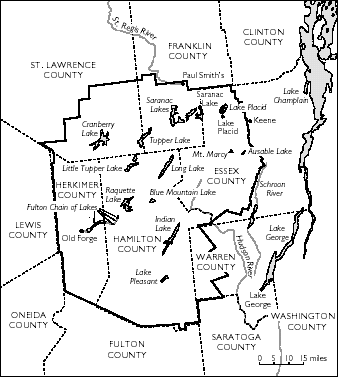
Map 1. Adirondack Park 1892
The Recreation of Nature
When the New York City minister Joel Headley collapsed in 1849 from a nervous breakdown, he was ordered by his doctor to try what was, for a mid-nineteenth-century American, a most unusual undertaking: a vacation. As a destination for this peculiar endeavor, Headley selected the little-known Adirondack Mountains, a series of heavily forested peaks that crowned New York's northernmost counties. The Adirondacks' clean air, tranquil scenery, and remoteness from urban centers, Headley reasoned, would provide a tonic for his shattered nerves. Although at the time upstate New York was better known for its hardscrabble farms and lumber camps than for its recreational opportunities, the frazzled minister had made a wise decision. A few weeks in the “vast wilderness” of the Adirondacks rejuvenated Headley's constitution, leading him to pronounce the region's “glorious woods” the perfect antidote to the stresses of urban life. “I could hardly believe,” he exulted, “I was in the same State of which New York was the emporium, whose myriad spires pierced the heavens.”1
These cries of amazement were echoed by several other nineteenth-century observers, all of whom, like Headley, puzzled over the existence of extensive forestlands only two hundred miles from New York City. As one anonymous author put it in 1865, “One might expect to find it [the Adirondacks], or its fellow, somewhere in the faroff West, that mythical land which is every day drawing nearer to us,—but not on the Eastern side of the continent,—not in
Headley, Northrup, and Sylvester were just a few of the many voices joining in a debate that had by the midnineteenth century assumed an increasingly prominent place in American culture. The discussion's core questions were deceptively simple: What is nature? And how does it shape human affairs? But at perhaps no time in United States history were the answers the source of so much intellectual ferment. The Anglo-American world of the nineteenth century witnessed an efflorescence of works seeking to plumb nature's inner workings: the transcendentalism of Ralph Waldo Emerson and Henry David Thoreau; the American school of landscape painting, developed by artists such as Thomas Cole, Frederic Church, and Thomas Moran; the rise of natural history, heralded by the founding of journals such as Nature and the American Naturalist in the 1860s; the eugenics movement led by Herbert Spencer and Francis Galton; even the popular books of Henry William Herbert, who in the 1830s immigrated to the United States, renamed himself Frank Forester, and introduced the American elite to the upper-class European tradition of sports hunting. Nature, as the historian David Arnold has aptly observed, was “one of the principal metaphors of the age, the prism through which all manner of ideas and ideals were brilliantly refracted.”3
Yet in spite of this shared subject matter, the era's nature studies did not always cohere in any clear or consistent manner. At the same time that A. Judd Northrup might reason that the law of nature protected the Adirondacks from development, a far more pessimistic—and influential—series of natural laws was being promulgated by a onetime schoolteacher, newspaper editor, and diplomat from Vermont named
Marsh's grim scenario both explained the past (making Marsh arguably the first environmental historian) and predicted the future. The same environmental catastrophe that had devastated the Old World, Marsh asserted, now threatened to spread to the United States and the rest of the globe, with potentially apocalyptic consequences: “The earth is fast becoming an unfit home for its noblest inhabitant, and another era of equal human crime and human improvidence … would reduce it to such a condition of impoverished productiveness, of shattered surface, of climatic excess, as to threaten the depravation, barbarism, and perhaps even extinction of the species.”5
One spot that Marsh singled out as being in urgent need of protection was Headley's beloved Adirondack Mountains, which contained the headwaters of several of New York's most important rivers, including the Hudson. While the region's remoteness had so far prevented its development, Marsh feared that with each passing year settlers and lumber companies were whittling away more of the Adirondacks woodlands. Left unchecked, Marsh maintained, such actions would place New York in grave danger: “Nature threw up those mountains and clothed them with lofty woods, that they might serve as a reservoir to supply with perennial waters the thousand rivers and rills that are fed by the rains and snows of the Adirondacks, and as a screen for the
To prevent such disaster, Marsh proposed a novel solution: New York should “declare the remaining forest [of the Adirondacks] the inalienable property of the commonwealth” and become the forest's administrator and protector. The current land policy in the United States—converting the public domain into private property—was, in Marsh's opinion, a grave mistake. “It is a great misfortune to the American Union that the State Governments have so generally disposed of their original domain to private citizens,” he wrote. “It is vain to expect that legislation can do anything effectual to arrest the progress of the evil [of the destruction of woodlands] … except so far as the state is still the proprietor of extensive forests.”7
Marsh advocated this radical shift in policy for two reasons. The first was a distrust of the inhabitants of the countryside, particularly the small-scale farmers who made up the bulk of the residents in places like the Adirondacks. In keeping with his Whig political beliefs, Marsh viewed these members of the lower classes as lacking the foresight and expertise necessary to be wise stewards of the natural world. Man and Nature thus included pointed critiques of “the improvident habits of the backwoodsman” and “the slovenly husbandry of the border settler.” Second, Marsh believed that in a world dominated by the search for short-term private gain, only the state had the longterm public interest at heart. Marsh pointed approvingly to Europe, where coalescing national bureaucracies had established state forest academies, carefully regulated forests, and the new science of silviculture. “The literature of the forest, which in England and America has not yet become sufficiently extensive to be known as a special branch of authorship, counts its thousands of volumes in Germany, Italy, and France,” he noted. If the Old World's ecological disasters had something to teach the United States, then so did its recent successes in uniting science and the state.8
Undergirding Man and Nature's critique of backwoodsmen and its appeals to the lessons of European forestry lay a powerful new vision of nature. In Marsh's view, the natural world existed in a state of balance and stability. “Nature, left undisturbed, so fashions her territory as to give it almost unchanging permanence of form, outline, and proportion,” he wrote in a passage anticipating twentieth-century ecology's
Man and Nature's unique perspective on the natural world not only made the book a bestseller, it established the text as, in Lewis Mumford's words, the “fountainhead of the conservation movement.” Indeed, Marsh's work originated the degradation discourse that would dominate conservationist narratives about landscape change for the next century. The discourse's essential ingredients were a natural world that was stable, predictable, and manageable; a rural populace engaged in “unwise” environmental practices that would have potentially catastrophic ecological consequences if left unchecked; and an interventionist state armed with technical and administrative expertise. Combined with one another, these narrative elements formed the central story of conservation—a tale that prophesied imminent ecological doom, unless natural resources were removed from local control and placed in the hands of scientifically trained governmental managers.10
With its dire predictions of what deforestation in the Adirondacks would mean for the state's waterways, Man and Nature attracted immediate attention in New York. As early as 1872, the state legislature, prodded by an unlikely alliance of sports hunters who wanted to preserve New York's northern counties as a permanent hunting and camping ground, and industrialists concerned about maintaining an adequate flow of water for the region's mills and canals, formed a committee to look into the feasibility of adopting Marsh's recommendation to establish a park in the Adirondacks. The following year, the committee issued a report concluding “that the protection of a great portion of that forest from wanton destruction is absolutely and immediately required” and calling for the creation of a “timber reserve and preserve” in the Adirondacks. While the committee members drew much of their discussion directly from Marsh, they appended to his argument an additional point of their own: “[Besides] these weighty considerations of political economy, there are social and moral reasons which render the preservation of the forest advisable. … The boating, tramping, hunting and fishing expedition afford that physical training which modern Americans—of the Eastern
This linkage of an environmental crisis (deforestation and water loss) and a social crisis (urbanism and the undermining of traditional models of masculinity) captures the modern and antimodern impulses that, in uneasy combination, lay at the core of the nascent conservation movement. On the one hand, conservation, with its emphasis on using the power of science and the state to rationally manage natural resources, represented a quintessentially modern approach toward the environment. On the other, conservation frequently invoked the Romantic search for authentic experience, in which nature was offered as the antidote to an increasingly industrial, “overcivilized” existence. These two positions did not necessarily contradict one another; it was possible to be an industrialist during the week and a sports hunter on the weekend (as many of the leading proponents of conservation in fact were). But tensions between the two perspectives would, at times, prove difficult to reconcile. As a result, conservation never traveled a simple trajectory. Although its central beliefs remained remarkably consistent—an emphasis on professionalization, on governmental ownership and management of the environment, and on the inherently stable and predictable character of the natural world—conservation charted an irregular orbit around these positions, as first one force than another exerted its gravitational pull on the movement.12
In the case of the Adirondacks, recommendations for state action languished until 1883, when a severe drought gripped New York and the water level in its principal rivers, the Hudson, the Mohawk, and the Black, dipped to alarmingly low levels. Concerned with the effect this decline could have on the Erie Canal and downstream mills, the New York Chamber of Commerce and the New York Board of Trade added their weight to calls for state management of the Adirondacks. In response, the New York legislature passed a measure in 1883 forbidding any further sales of state lands in the Adirondacks. Over the next few years, state control over the region ratcheted steadily upward. In 1885, the legislature reorganized its holdings in the Adirondacks into a forest preserve, overseen by a forest commission. In 1892, lawmakers consolidated these efforts into the three-million-acre Adirondack Park, made
The ultimate result of these actions was to turn the Adirondacks of the mid-1880s into the most advanced experiment in conservation in the United States. Many of the people who would later lead the national conservation movement—Franklin Hough, Bernhard Fernow, Teddy Roosevelt, and Gifford Pinchot among them—gained their first insights into the challenges of American forestry in the woods of northern New York.14 Moreover, for conservationists, New York's Forest Preserve established a viable new role for the state: active supervisor of the environment. Inspired by the example of the Adirondacks, several prominent conservationist organizations, including both the American Forestry Congress and the federal Division of Forestry (which at the time possessed only an educational function, since there were no national forests to administer), held up New York's Forest Preserve—“this first attempt at making a reality of forest preservation”—as a model to be emulated nationwide.15 Congress eventually accepted such suggestions in 1891 when it passed the Forest Reserve Act. But during conservation's early years, it was New York's unprecedented undertaking in the Adirondacks that set the pace for the rest of the nation.16“Here [in the Adirondacks], then, for the first time on the American continent, had the idea of State forestry, management of State lands on forestry principles, taken shape,” observed Fernow in his 1911 textbook, A Brief History of Forestry. “A new doctrine of State functions had gained the day.”17
One point, however, was frequently obscured amid such celebrations: the consequences that the coming of conservation would have for the approximately 16,000 people already living in the Adirondacks.18 On those rare occasions when New York authorities pondered the impact
Given such conditions, officials assumed that the region's residents would readily embrace conservation. “The little settlements already existing in the region are not incompatible with the project [of a park],” concluded the 1873 report of the Commissioners of State Parks. Recognizing the money to be made from the increased tourism that an Adirondacks park would attract, the inhabitants of the region would, the commissioners predicted, “take a direct interest in the welfare of the park” and “would voluntarily protect the game and timber from unlawful destruction.”21
There was a grain of truth to this hypothesis. When the Forest Commission dispatched agents in 1885 to interview local inhabitants about their reactions to the newly created Forest Preserve, it found many residents ignorant of the specifics of the reserve but in agreement with the larger project of protecting the Adirondacks' forests. “I have lived here forty-five years, being a hunter and passing a large portion of my time in the woods,” declared one local. “The woods must be taken care of if they want any left worth calling a forest. I am in favor of the best plan.” Offered another: “We depend on the woods and the attractions of the place for our living, and don't want to see either destroyed or marred.” “People through this valley are very much in favor of the work of the Forest Commission,” added a resident of Keene Valley in Essex County. “We need the protection, as the woods are our one source of income.”22
Despite this promising start, however, relations between conservationists and Adirondackers quickly soured. Following their first patrols, the Forest Commission's newly appointed foresters reported “gross infractions” of the state's new game, timber, and fire laws. Noting the frequent hostility the foresters encountered whenever they tried to arrest those responsible for such crimes, the New York Fisheries Commission concluded that “in the whole Adirondack region … the utmost lawlessness prevail[s].” Contemporary newspaper accounts added to the sense of crisis. In 1889, for example, the New York Times published a string of articles bearing such lurid headlines as “Pirates of the Forest,” “Stealing Is Their Trade,” and “Useless Forestry Laws” that depicted violations of the state's conservation code as common throughout the Adirondacks. As such accounts multiplied, many conservationists began to fear that their celebrated new plans for the region were on the verge of being swept away by a wave of inexplicable popular disorder.23
Perhaps in no nation are agrarian fantasies as complex and contradictory as in the United States. Nineteenth-century discussions of the Adirondacks, for instance, pivoted on two countervailing agrarian tropes. The first, which might be called the pastoral, stressed the simplicity and abundance of rural life. “An easy life is theirs,” remarked Headley upon encountering some settlers at Raquette Lake: “No taxes to pay—no purchases to make—and during most of the year, fish and deer and moose ready to come almost at their call.” William Murray—whose popular 1869 book, Adventures in the Wilderness: or, Camp-Life in the Adirondacks, brought a stream of tourists to the region—offered a similar vision: “A more honest, cheerful, and patient class of men cannot be found the world over. Born and bred, as many of them were, in this wilderness, skilled in all the lore of woodcraft, handy with the [fishing] rod, superb at the paddle, modest in demeanor and speech, honest to a proverb, they deserve and receive the admiration of all who make their acquaintance. … Uncontaminated with the vicious habits of civilized life, they are not unworthy of the magnificent surroundings amid which they dwell.”
A second trope, which might be called the primitive, focused on the backwardness and privations of rural life. J. P. Lundy, who visited the Adirondacks in the 1870s, saw only the region's “hard and grinding poverty.” The typical Adirondacker, Lundy reported, “looked upon all physical and mental superiority with aversion or disdain. … He trapped
Of course, neither pole—the pastoral nor the primitive—offered more than a crude approximation of a place like the Adirondacks. Both interpretations, by seeking to capture the unchanging essence of rural life, missed the dynamism that had long marked the region and its shifting human populations. For much of the 1600s and 1700s, the Adirondacks had been a lightly inhabited border zone fought over by the Iroquois to the south and Huron and Algonquin to the north. Bands from these nations sometimes hunted for moose and beaver in the Adirondacks, but because of the risk of attack and the short growing season, they rarely established permanent villages. Warfare under these circumstances functioned as a sort of crude conservation policy, limiting the ability of native peoples to exploit the region's resources for any extended period of time.25
Once the power of the Iroquois was broken in the aftermath of the American Revolution, a variety of newcomers drifted into the area: Yankees from Vermont and the more southerly parts of New York, and French Canadians from the north. Preceding these pioneers were Indian settlers, many of them refugees from tribes such as the Penobscot (an eastern Abenaki people originally from Maine) and the St. Francis (a western Abenaki group originally from Vermont and southern Canada) displaced from homelands farther east. As the settler Harvey Moody recalled in 1860, a number of Native American families were already well established in the Adirondacks when he arrived in the region as a young boy: “When I fust come to the S'nac [Lake Saranac] with father, there was nobody else about there but Injins. I used to meet 'm on the lakes fishin' in their bark canoes, and trappin' about the streams, and huntin' everywheres.”26
| SOURCE: 1880 Population Census, Manuscript Schedules, Hamilton County, New York, Roll 837, T9, Records of the Bureau of the Census, RG 29, National Archives. | ||
|---|---|---|
| male | ||
| Agriculture (farmer, hired hand) | 564 | (48.6%) |
| Timber industry (“worker in lumberwoods,” shingle maker) |
228 | (19.6%) |
| Crafts (mason, boatbuilder, blacksmith, carpenter |
56 | (4.8%) |
| Laborer (unspecified) | 180 | (15.5%) |
| Professions (minister, teacher, surveyor, clerk |
40 | (3.4%) |
| Services (hotel keeper, guide, gamekeeper) | 86 | (7.4%) |
| Miscellaneous (pauper, hermit) | 8 | (.7%) |
| TOTAL | 1,162 | (100%) |
| Female | ||
| Homemaker (“keeping house,” keeping shanty”) |
731 | (94.7%) |
| Professions (teacher, nurse) | 14 | (1.8%) |
| Domestic service (servant, hotel maid) | 19 | (2.5%) |
| Trades (glove maker, dressmaker) | 8 | (1.0%) |
| TOTAL | 772 | 100%) |
Encroaching white settlers both feuded and intermarried with the Indian peoples they encountered in the Adirondacks.27 By the time federal census takers arrived in the region in the midnineteenth century, New York—born whites had become the predominant group in the region, but there remained Indian families, wives, and husbands scattered throughout the communities of the central Adirondacks. The 1880 census, for example, records that Hamilton County—the only one of New York's northern counties located completely within the Adirondack Park—was home to eleven Indians, eight living at Indian Lake and three at Long Lake.28 For whites and Indians alike, the most common occupation for men listed in the federal censuses of the 1800s was “farmer,” while the activities of women were typically classified as “keeping house.” (See Tables 1 and 2.) Neither category illuminated the diversity of economic life in the Adirondacks with much precision. The region's women undertook countless domestic chores, from gardening to gathering medicinal herbs to maintaining the networks of mutuality and
| SOURCE: 1880 Population Census, Manuscript Schedules, Hamilton County, New York, Roll 837, T9, Records of the Bureau of the Census, RG 29, National Archives | |||
|---|---|---|---|
| New York | 3,449 | (87.8%) | |
| Northeastern United States | 129 | (3.3%) | |
| Connecticut | 11 | ||
| Maine | 4 | ||
| Massachusetts | 16 | ||
| New Hampshire | 9 | ||
| New Jersey | 4 | ||
| Pennsylvania | 12 | ||
| Rhode Island | 3 | ||
| Vermont | 70 | ||
| Southern/Western United States | 5 | (.1%) | |
| llinois | 3 | ||
| South Carolina | 1 | ||
| Virginia | 1 | ||
| Canada | 144 | (3.7%) | |
| Europe | 200 | (5.1%) | |
| England | 36 | ||
| France | 12 | ||
| German States | 44 | ||
| Holland | 3 | ||
| Ireland | 87 | ||
| Scotland | 16 | ||
| Switzerland | 2 | ||
| TOTAL | 3,927 | (100.0%) | |
These same forests provided Adirondackers with much of their annual support. In spring and summer, men collected wild ginseng (Panax trifolius) for resale to outside traders, while their wives and children gathered medicinal herbs such as sweet fern (Comptonia peregrina) and the wild leeks (Allium tricoccum), cowslips (Caltha palustris), adder tongues (Botrychium virginianum), and berries that Adirondacks families used to supplement their diets. “When the berries came it was nothing but pick berries with mother and the children that were old enough to go,” recalled Henry Conklin, an early resident of Herkimer County. In the fall, men—and, upon rare occasion, women—went into the woods in pursuit of deer, bear, or partridges. Younger boys occupied themselves closer to home by setting snares for smaller game like rabbits or woodchucks. All caught fish for their families' tables in the multitude of streams and ponds throughout the Adirondacks. In the winter months, local males ventured into the woods yet again, lacing on their snowshoes to collect valuable forest products such as spruce gum or wild furs. It was not unusual for Adirondacks men to be gone for a week or more on such expeditions, during which they usually camped in bark shanties that they erected wherever they happened to be at the time.30
The far-flung character of these undertakings reflected themselves in turn in local property rights. Although state officials in the 1880s charged Adirondackers with looking upon the forests as “a piece of ‘commons,’ or as a public crib where all may feed who choose,” matters were more complex than this assessment implied. In keeping with the common-rights ideologies prevailing elsewhere in the rural United States at this time, locals did regard undeveloped lands, whether state or private, as open to hunting and foraging. Engaging in such activities on another's property “we would not call a trespass,” admitted the Adirondacks resident Freeman Tyrrell in 1895. “I know I don't when they go on my lands.”31 These “rights in the woods,” however, were hedged by numerous constraints. Inhabitants often considered certain features of the woods, such as game blinds, fish weirs, or traplines, to be—like homesteads or other “improved” areas—exclusive property. Interference with these could prompt violent confrontations, as happened in the late 1800s, when H. Dwight Grant and his
This common-rights ideology persisted in the Adirondacks despite the changes that, in the years following the Civil War, pulled the region with increasing force into the expanding national economy. Unlike much of the rest of the American countryside, the economic modernization of the Adirondacks did not center on agriculture—the region remained too remote and its soil too thin to support intensive farming—but rather on the forests themselves. By the 1860s, northern New York had become home to an extensive forest industry composed of tanneries (which used bark from the area's abundant hemlocks to cure hides) and lumber operations (which regularly hired crews of local men to cut and skid logs during the winter months). Although these companies purchased vast portions of the Adirondacks landscape after the Civil War, they seldom tried to close their property to local hunting and foraging, as such activities posed little threat to the spruce, pine, and hemlock that the lumber companies sought. Moreover, these corporations seldom sought to exercise their property rights for very long. Typically, they would cut the marketable timber; then, rather than holding the
Technological limitations posed an additional barrier to the Adirondacks timber industry in the immediate post—Civil War years. Today, the term “lumbering” may conjure up images of vast clearcuts, but up until the late 1880s most timber operations in the Adirondacks logged on a selective basis. Because companies transported logs to saw mills via streams, only those trees located within a few miles of a waterway could be cut—and then only those species that floated well. Softwoods such as black spruce (Abies nigra) and white pine (Pinus strobus) were the lumberman's favorites, while hardwoods such as the sugar maple (Acer sacharinum), red oak (Quercus rubra), red beech (Fagus ferruginea), and white birch (Betula populifolia), all of which floated poorly, were rarely cut, except for local consumption. These circumstances ensured that only a limited number of the region's trees were felled. “The lumberman did not take more than eight trees to the acre, on an average,” explained the Forest Commission in 1891.36“The phrase ‘lumbered land’ is a somewhat misleading one. It does not imply that such land is cleared, devastated, or even stripped of timber. The term is used, locally, to describe lands from which the ‘soft wood’ (spruce, hemlock, pine and tamarack—one or all) has been taken, leaving the hard wood (birch, cherry, maple, beech, etc.) standing. Generally there is so much of this hard wood left on a ‘lumbered’ tract that an inexperienced eye glancing over it would scarcely detect the work of an axe. The woodsmen expect to see such land covered with spruce again, large enough to be marketable, in about fifteen years.”37 In fact, Forest Commission records from 1897 indicate that for all the dire accounts of deforestation circulating at the time of the Forest Reserve's creation, most lands in the Adirondacks retained their tree cover, and many never felt the woodsman's ax.38 (See Table 3.)
Lumbering nonetheless set in motion profound ecological changes in the Adirondacks. The opening up of the forest canopy that accompanied timber operations promoted what ecologists have come to term the edge effect: a transition zone between open land and woodland,
| SOURCE: New York Fisheries, Game, and Forest Commission, Third Annual Report, 1897, 269. | ||
|---|---|---|
| Cleared for agriculture | 75,819 | (2.5%) |
| Wild meadow | 724 | (>.1%) |
| Water | 59,111 | (2.0%) |
| “Wastelands” | 22,424 | (.7%) |
| Burned areas | 18,220 | (.6%) |
| “Denuded lands” | 61,009 | (2.0%) |
| Forested, soft timber removed | 1,627,955 | (54.2%) |
| Untouched forestlands | 1,139,593 | (37.9%) |
| TOTAL | 3,004,855 | (100.0%) |
This growth in the whitetail population had a significant impact on another forest industry taking shape in the Adirondacks in the 1860s: the tourist trade. Headley had been an anomaly when he visited the region in the 1849, but following the Civil War, members of a growing urban elite began to flock to the Adirondacks. Many of these visitors were what local residents called “sports”—well-to-do professional men who hoped to indulge in the masculine pastimes of hunting and fishing in one of the largest extant forests in the Northeast. These sports rarely ventured into the Adirondacks' woods without hiring local guides, whose job it was to conduct hunters to likely hunting spots, set up camp, and track deer and other game. Much to their delight, Adirondacks men discovered that at a time when laboring in a lumber camp
For all its monetary benefits, however, tourism unleashed new pressures as well. The arrival of large numbers of sports placed increased demands on the Adirondacks' limited supply of fish and game, while the rise of the tourist industry created fresh class divisions in the region, with a few locals capitalizing on the trade to become large landowners and employers. Perhaps the most successful of these entrepreneurs was Apollos “Paul” Smith, a onetime trapper and guide. In 1852, at the suggestion of one of his clients, Smith built a small “hunter's retreat,” where he and his wife could take in eight or ten sports as boarders. Bit by bit, Smith added to his holdings, until by the time of his death in 1912 he owned some thirty-five thousand acres and a four-story hotel overlooking lower St. Regis Lake that could accommodate a hundred guests. Smith's clientele included such members of the eastern upper classes as Gifford Pinchot, who as a child summered in the Adirondacks with his family in 1879, and a young Theodore Roosevelt, who stayed at Smith's when he made his first visit to the Adirondacks in 1871. Besides running a hotel and employing many of his neighbors to wait on his guests, Smith sold lots to wealthy vacationers who wanted to construct summer homes nearby. Although these homes were euphemistically called “camps” after the rough cabins occupied by the region's inhabitants, many became luxurious and exclusive estates. “The guide told me that in some of these ‘camps’ there was hot and cold water, and in one electric lights,” remarked one visitor in 1898. “It all seemed to me like playing at roughing it.” Even Smith, in his more candid moments, admitted his bewilderment at the odd business in which he found himself: “I tell you if there's a spot on the face of the earth where millionaires go to play at housekeeping in log cabins and tents as they do here, I have it yet to hear about.”41
Such developments made the Adirondacks of the late nineteenth century a region that defied easy categorization. It was a place of abandoned farms and of grand new estates, where daily rhythms were set by commercial timber operations and by subsistence agriculture, by wage labor
Public Property
and Private Parks
“The people, as a rule, know nothing of the existence of a Forest Commission.” So reported one of the commission's agents following a special investigative tour of the Adirondacks in the summer of 1885, in a comment that portended the enormous challenges facing the region's newly appointed managers. It had been a relatively easy matter for officials in Albany to draw a “blue line” around some three million acres of state and private land in northern New York and to proclaim this space a park and forest preserve governed by a new series of environmental regulations. But landscapes do not magically reshape themselves in accordance with the desires expressed in legislation. Establishing a functioning conservation program would require not just new laws but new mechanisms of enforcement as well, for, as New York officials soon discovered, managing the ecology of the Adirondacks was possible only if one monitored the daily interactions of local residents with the natural world.1
To facilitate the expanded state supervision of the countryside that conservation required, the Forest Commission embarked upon a program of what the political scientist James Scott has termed “state simplification,” in which officials standardized and rationalized local practices to make them more comprehensible—and ultimately more controllable—by government agencies.2 Creating a simplified Adirondacks, however, was far from a simple process. The new agencies charged with overseeing the region's ecology often lacked basic knowledge about local conditions. Even data that one imagines to have been
Differentiating between state and private lands was therefore essential if the Forest Commission was to apply the state's conservation laws in the appropriate manner. Yet instead of organizing its property documents in one central place, New York had long left this task to each county, which kept track of its records in whichever way seemed to best fit local practice. As a result, simply to compile an accurate list of the lands in its domain, the Forest Commission had to spend almost fifteen years sorting through the often confusing and contradictory land titles and tax records filed with the six counties that had lands located within the Adirondack Park. Not until 1901 did the commission complete this project, releasing what the superintendent of state forests considered to be “the most important and valuable publication issued by the Department”: a definitive, 367-page list of all “the 5,934 separate parcels of land which constitute the Forest Preserve.”3
In addition to clarifying the title to its lands in the Forest Preserve, the Forest Commission also needed to locate each of its holdings—a task complicated by the lack of a standardized grid of lot lines in the region. Most of the Adirondacks had been surveyed only roughly, sometimes not since the 1700s. Furthermore, many parcels were bound by idiosyncratic limits, which, while they made sense to those on the ground, often confused state officials and other outsiders. One plot in Herkimer County, for example, was delineated at one corner by “a large rock marked (+)”; another by “a soft maple tree at the end of Brown's Tract road marked 13 ¼ miles from Moose River.” A 737acre parcel of public land in Hamilton County began at the northwest corner of a farm owned by one Charles Fisher and then proceeded in a northwest direction until it reached the shore of “Mud or Gilmour's Lake.” From here it continued north along the shore of the lake until reaching “a hemlock tree marked for a corner.” It then went south along a roadway until touching upon Charles Fisher's farm again, at which point it traced an eccentric arc marked by a birch tree, a beech tree, and two township lines.4
Those not familiar with local geography often found it tedious and time consuming to chart the unusual boundaries of such plots. As Verplanck Colvin, the state official who headed the Adirondack Survey throughout the 1880s, observed, the “old reference points” mentioned in property documents frequently eluded his survey team. “While there are numerous references to ‘a stake’ or a ‘heap of stones,’ it has been found by experience in the field that the stakes have in most places entirely decayed and disappeared and the ‘heap’ of stones are generally quite indistinguishable from other stones, scattered throughout the woods.” Because of such conditions, it was, “extremely difficult in all, and impossible in many cases, to establish the exact boundaries of the various tracts and subdivisions [of the park].” In 1896, Forest Commission officials admitted that even after a decade they had yet to find and mark all the boundaries in the region: “It should be understood that the lot lines which are so distinctly shown on our Adirondack map are not always so apparent in the forest itself, where, at the best, they can be traced only by the occasional faint ‘blaze,’ made in most cases fifty, and perhaps ninety years ago,—marks discernible only by those experienced in this peculiar woodcraft. In fact, the boundaries of the 160 or 200-acre lots in some townships never existed except on the map of some early surveyor who, having surveyed the outer lines, contented himself with making a ‘paper allotment,’ and doing nothing further in the way of surveying and marking these interior lines on the ground itself.” While these conditions rarely interfered with local residents' uses of the forests, they often placed the Forest Commission in the awkward position of being unable to locate, let alone manage, its holdings.5
To counter such obstacles, the Forest Commission embarked on one of the essential practices of state simplification: the creation of a new, more detailed map of the region to be supervised. A cartographic representation of the Adirondack Park, the commission reasoned, would condense the information necessary for its conservation policies into a single page, thus providing a handy synoptic overview of the region and facilitating many of the chores associated with administration: “Ever since the organization of this Commission the necessity of a map which would show correctly the allotments of the various townships in the Great Forest of Northern New York has been felt, both in our office business and in our field work. … The Wardens, Inspectors and Foresters have been greatly impeded in their work by the lack of some accurate diagram which would show on one sheet the complete allotment of that territory. The Commission has accordingly directed that a map be
Besides making the Adirondacks more legible to outside agencies like the Forest Commission, such maps also played an important role in the region's reorganization. The Forest Commission's official maps documented the agency's idealized conception of the Adirondacks under conservation as a tidy grid of property units and forest types. At the same time, the agency neglected to record local uses of these same woodlands—the locations of traplines and hunting shanties, of areas frequently used for hunting, fishing, or gathering wild plants, of favorite spots for cutting firewood or building supplies, and so on—that might cloud the state control that the Forest Commission sought to achieve. For these reasons, many inhabitants viewed the agency's mapping efforts as a threatening first step toward erasing all local claims to the forest. When asked by surveyors for information on the location of local lands within the Forest Preserve, therefore, residents frequently responded by feigning ignorance or giving intentionally misleading responses. As investigators for the Forest Commission fumed in 1895, “Few persons of those examined have appeared to know of the exact locations or bounds of State lands in any township.” Other locals, as soon as the survey left their vicinity, burned, cut down, or otherwise destroyed the blazed trees and other monuments that surveyors had erected to indicate boundaries—so frequently, in fact, that the New York legislature in 1888 increased its penalties for anyone who “willfully or maliciously remove[s] any monuments of stone, wood or other durable material, erected for the purpose of designating the corner, or any other point, in the boundary of any lot or tract of land.”7
By destroying monuments, which in turn obscured the location of the state's landholdings, locals hoped to preserve their access to the resources on nearby public woodlands. Indeed, as one exasperated warden noted, those arrested for trespassing on state lands often defended their
Of all the issues associated with the state's efforts to delineate its territory in the Adirondacks, by far the most volatile concerned the location of local homesteads. Throughout the nineteenth century, Adirondackers had tended to establish homes and farms on any available plot of land, often neglecting, because of the costs and difficulties involved, to obtain any title to their holdings. In place of a system of property rights that flowed from the state downward, such folk substituted a property system based on usufruct rights—rights based on use and occupation, in which lands that were unused were unneeded and therefore open to settlement by others. This “homestead ethic,” which derived its authority from the republican belief that the ownership of land was crucial to one's political and economic independence, had been workable when the state was a remote presence. But after the arrival of conservation in 1885, many settlers suddenly found themselves at risk of occupying the wrong space on the Forest Commission's new map and being recategorized as squatters.9
By 1891, the Forest Commission's chief warden, Samuel Garmon, had identified squatting on state lands as one of his most pressing concerns.10 Subsequent reports from the Forest Commission bewailed “the occupation of land in the Forest Preserve … [as] one of the most perplexing and complicated questions with which this Commission has to deal.” With the boundaries of so much of the Adirondacks in question, it was difficult even to determine the exact scope of the problem. Official tallies varied widely, with the total number of illegal dwellings ranging from ninety-eight to more than nine hundred. Squatters also came from a surprising variety of backgrounds. While many of those dwelling on state land were longtime inhabitants of the region (“farmers who have occupied the premises as homes for over thirty, and, in many instances, forty years”), other squatters were wealthy tourists who had built vacation homes on plots purchased from Adirondacks locals.11 Consequently, in the words of the Forest Commission, “these occupancies range all the way from the most primitive shanty to costly and beautiful summer homes.” Since many of the wealthy summer
In the face of such dilemmas, the Forest Commission adopted a policy of benign neglect for much of the nineteenth century, limiting new settlements but doing little to oust longtime squatters. Not until the early 1900s did the commission begin to push more aggressively to reclaim control of its lands. In 1901, for example, the state issued ejection notices to a large number of residents of the Raquette Lake area. Many squatters, however, refused to leave their homes. After several delays, the commission finally dispatched foresters to tear down and burn the offending structures. In November of 1905, District Game Protector John B. Burnham and fifteen men went into Raquette Lake with orders to destroy some fifty houses on state lands, only to be met by angry locals: “threats of violence to the state officers if property was harmed by them were freely given out at the village, and it was expected that there would be trouble,” noted a reporter for the New York Times. Residents tried to counter the state's attempt to eject them by emphasizing the public nature of the park as well as their lengthy residence in the area. “[The squatters] offer as a defense that the Adirondack forest park was created at the expense of and for the use and enjoyment of the people of the State, and that they, as citizens, are entitled to such use as they now make and always have made of it.” While the Forest Commission did end up expelling a significant portion of the squatters after 1910, some settlers continued to resist their removal, with the result that property rights in certain portions of the Adirondack Park, including Raquette Lake, remain contested even today.13
To project its authority in these and other tense situations, the Forest Commission relied on its “forest police,” or foresters. Adopting a policy
In 1886, the Forest Commission hired an initial force of 25 foresters. Although this number dipped to 15 the following year because of budget shortages, the next several decades witnessed a steady upward progression in the force. In 1892, the number reached 20; in 1895, 38; in 1902, 50; in 1910, 90; and in 1912, 125. Despite such growth, there were never enough foresters to satisfy many conservationists. Outraged letters to the editor complaining of continued violations of the game and timber laws were standard features of such leading conservation journals as Forest and Stream and Garden and Forest throughout the late nineteenth and early twentieth centuries. The Adirondack Park was so large and the lawbreaking by local people so incessant that some letter writers suggested that only by radically expanding the force to 400 or even 1,000 foresters could the state prevent violations of the conservation code.15
To be sure, the vast territories that foresters had to cover often hindered their abilities to enforce the forestry laws. Isaac Kenwell, the fish and game protector based in Indian Lake during the 1890s, for example, was assigned to a district that included not only much of Hamilton County but portions of neighboring Essex County as well. During the winter of 1893–94, Kenwell reported to his superiors that he had traveled an average of 481 miles per month (his high being 738 miles in January 1894). Because of the lack of trails, much of this patrolling was slow, laborious work. “There is a large part of my district so situated that it is impossible to get from one section to another very quickly,” explained Kenwell. “Large parts have to be travelled on foot.” Even in
But there were other factors beyond a simple calculus of square miles per forester that inhibited the enforcement of state forestry laws in the Adirondacks. While the hiring of local people as foresters provided the Forest Commission with individuals who possessed a detailed knowledge of the Adirondacks forest, it also meant that foresters possessed strong allegiances to the rest of Adirondacks society and, as a result, often felt the tug of local loyalties. Since it was impossible for the Forest Commission to monitor every facet of their daily behavior, foresters often had considerable latitude in deciding how to enforce—and not enforce—the forestry laws. As Forest and Stream charged in 1885: “The constables being appointed from the country round and knowing many of the guides, it is a generally understood thing that if no venison is in sight there will be no search for any. As soon, therefore, as a deer is killed the carcass is buried or hidden in the underbrush, and if a constable should pay a visit to the camp he and the campers have so many pleasant topics of conversation that it seems a pity to introduce unpleasant ones.”17 Fourteen years later, the situation, according to the journal, remained much the same: “The game protectors realized the hardships which a thorough and effective execution of their powers would entail, and in most cases it was more than their positions were worth to buck up against public sentiment and antagonize the community in which they lived by a strict enforcement of the text [of the law].”18
Indeed, a standard feature of Adirondacks folklore was the “good” forester. This figure might overlook certain violations; or, rather than arresting an offending local immediately, he would first issue a warning, giving the lawbreaker an opportunity to mend his or her ways and thus avoid arrest. Ira Gray, born in the Adirondacks in 1886, recalled one such story about a protector who paid a visit to a local who was wellknown for hunting deer out of season. After the two had enjoyed a friendly dinner together, the forester asked the man to poach deer no longer, confessing, “I would be awfully sorry to catch you.” Similar
Such stories, however, formed only a small portion of the strategies that local people employed to regulate the behavior of foresters. One other common tactic was the social ostracization of an overzealous forester. Fletcher Beede, the district game and fish protector of Essex County, charged that after arresting several locals for hunting deer out of season and for using illegal fishing devices, his family's position in the local community had become quite difficult, for he was “getting to be the most cordially hated man in the county.” Locals relied on more direct forms of intimidation as well. One frequent strategy, according to Adirondacks folklore, was to warn the protector that he looked like a deer out in the woods and that he might therefore get shot “by accident.” “Mighty easy to think it's a deer if the game constable's around. … What can anybody do? The man shoots at a deer and the game constable happened to be there.” At times, such threats crossed the line to direct action. As the Forest Commission admitted in one of its annual reports, attempted shootings were a persistent feature of the foresters' profession: “It is not uncommon for protectors to be shot at while in pursuit of their duties. There are few protectors who have served any length of time on the force who have not had an experience of this kind.”20
Foresters also found themselves constrained by local surveillance. Bill Smith, recalling his childhood in the Adirondacks in the early 1900s, remembered that when a new game warden arrived in their township, the first reaction of those living nearby had been to learn as much about him as they could: his habits, his tracks, his schedule. “The poor man, of course, he probably didn't have any idea he was being watched anywhere near as close as he was. But we wanted to know
From time to time, a clever forester might find ways to avoid such surveillance. Seymour Armstrong, for instance, once pretended to be a traveling salesman for Quain's Dictionary of Medicine as he patrolled his district. More often, however, Adirondacks communities were so familiar with their local warden that it was necessary, as one forestry official put it, “to send the forester into an entirely new district where he wasn't known for the purpose of catching or getting on to the evidence of trespasses.” “They [the foresters] have to be transferred from their home counties, at much expense, to other and distant counties to work incognito where the local protector is known to every citizen, and word is sent of his coming in advance of his movements,” grumbled the Forest Commission in its 1901 report. “Habitual law violators soon become acquainted with the habits of the local protector, and devise clever schemes for keeping tabs on the protector's movements. It is, therefore, often necessary to bring in from other sections men who are not known locally, in order to secure convictions of this class of violator.”22
The peculiar pressures bearing upon foresters highlight the new social and political relationships that the rise of conservation generated in the Adirondacks. Foresters played a dual role in the region: not only were they the means by which state power was projected into the countryside, they were also the means by which local influence penetrated into the state. As a result, foresters had to navigate between several competing allegiances. On the one hand, the Forest Commission sought to make the forester an extension of its conservation program; on the other, the forester's friends and neighbors often tried to render him an accomplice in their efforts to evade the state's environmental regulations. While the forester who became too aggressive in pursuing his duties risked being ostracized or shot by local residents, the forester who was found to be too cozy with lawbreakers could lose his job or even be arrested for corruption, as happened on several occasions to foresters who were alleged to be taking bribes to ignore the illegal cutting of timber in their districts. The daily dilemmas that foresters faced
As central as state simplification was to New York's conservation program for the Adirondacks, not all of the region's conservation efforts at the turn of the century were, in fact, state directed. By the 1890s, one of the dominant features of the Adirondacks landscape was the private park. Even before the Forest Preserve's creation, wealthy sports hunters had upon occasion bought up large tracts of abandoned timber land and converted these still-wooded plots into hunting preserves. The size and number of private parks, however, surged during the 1890s, as the New York State Legislature, reluctant to authorize the funds necessary for the repurchase of all private lands in the Adirondack Park and seeing the interests of estate owners as “identical with those of the State,” revitalized a preexisting law allowing for the creation of preserves on private land. This statute permitted people or clubs who wanted to “encourage the propagation of fish and game” to set up private parks from which they could exclude trespassers at greatly increased penalties. (In 1892, the state even flirted briefly with a program which would have exempted estate owners from taxes if they agreed to restrict timber cutting on their holdings.)24 By 1893, there were some sixty private parks in the Adirondacks, containing more than 940,000 acres of private lands, including many of the region's best hunting and fishing grounds, at a time when the stateowned Forest Preserve contained only 730,000 acres. As Forest and Stream observed the following year, “Private parks in the Adirondacks today occupy a considerably larger area than the State of Rhode Island. … a man might travel ninety miles in a comparatively straight line without being fifteen minutes out of sight of a trespassing notice.” Many of these parks were owned by wealthy individuals such as William Rockefeller. Others, such as the Adirondack League Club's (ALC), belonged to associations of well-to-do sports hunters. To increase their hunting opportunities, the new owners of these parks frequently stocked their ponds and streams with fish, engaged in largescale feeding programs for deer and other wildlife, or imported exotic game animals, such as boar, caribou, western elk, or English deer.25
Although they initially faced many of the same problems with setting boundaries and enforcing regulations as the state, most private parks surmounted these obstacles through expenditures of funding and manpower that far exceeded the state's efforts during this same time.
As Yell's reference to “the land being watched” implies, almost all private parks employed a number of guides who acted both as a private police force and as a supplement to the Forest Commission's foresters. By the late nineteenth century, the Adirondack League Club alone had a contingent of over twenty guides, all of whom were required as part of their employment to sign a pledge that they “shall consider themselves game protectors.” According to the ALC's handbook, the guides in the club's employ were to report all cases of trespassing and poaching and to “use every effort for the successful apprehension and punishment of every such offender.” To reinforce the guides' role as law enforcers, the ALC distributed to each of its employees a silver, star-shaped badge that bore the words Police Guide. Despite such regulations, the guides at many parks, much like their counterparts in the state's forester corps, seem to have demonstrated a certain ambivalence about their new role as law enforcers. Many guards were efficient enough to earn the enmity of local communities. But examples do exist of conflicts between guides and private park owners. At the ALC, for instance, there were sporadic attempts among the guides to unionize for better wages and, on at least
Among Adirondackers, private parks soon became the most hated facet of conservation. In little more than a decade, private park owners had sealed off many of the region's best hunting and fishing areas, defying the previous convention of leaving undeveloped forestland open to hunting, fishing, or foraging by local community members—a restriction that not even the Forest Commission, which still permitted public passage and the taking of game on Forest Preserve lands during the hunting season, had attempted. Private parks' stringent efforts against trespass, combined with their concentrated landholdings and extensive corps of guards, made them, for many rural folk, a powerful symbol of the class biases lurking at the heart of conservation. Observed an investigative committee of the New York State Assembly in 1899, “The poor [in the Adirondacks], as well as the men of moderate means, are complaining that our forest lands are rapidly being bought up by private clubs, and are closely watched by alert game keepers, and thus, as they claim, and not without some reason, our [woods] are all being monopolized by the rich; that we are apeing the English plan of barring the poor man from the hunt, etc.”29
In 1903, the resentment of private parks long bubbling beneath the surface of Adirondacks life finally boiled over. On September 20, Orrando Dexter, an estate owner in Franklin County who had launched numerous lawsuits against local trespassers, was shot dead as he drove his carriage down a once-public road that he had enclosed within his estate. Dexter's outraged father, the wealthy founder of the American News Company, offered a five-thousand-dollar reward for information and hired a team of Pinkerton detectives to search for his son's killer, but the murderer was never located. All evidence, however, indicated that the killer must have been a local resident. Not only was the bullet that killed Dexter of a type commonly used for deer hunting, but near the murder scene were several footprints made by a “coarse shoe or boot such as are worn a great deal by the workmen, woodsmen and hunters of the Adirondacks.” Seizing upon such clues, many newspapers trumpeted Dexter's death not as an isolated incident but as “only one demonstration of the hatred that exists in the woods.” Editorialized the New York World, “Dexter's murder illustrates and must intensify the bitterness felt by the small farmers and woodsmen in the Adirondacks, and by those who have been long accustomed to hunt and fish where they wished, against the rich men who have established great
Although few cases reached the extremes of Dexter's, the unpopularity of private parks did, as one local newspaper put it, have “the effect of breeding lawlessness.” Local people ripped down the “no trespassing” signs that ringed the parks' boundaries. They cut the elaborate wire fences that enclosed many estates, hoping that the deer and other game within might escape. They set fire to private parklands, sometimes with the intention of damaging fences, other times with the apparent desire to make the preserve an undesirable refuge for game animals.31 And they shot at the guides hired to protect the private parks. “The position of guard on the vast forest preserves of William Rockefeller is not one to be much desired,” observed the New York Times dryly in 1904: “Several of these guards have been fired at recently while patrolling their lonely beats in the dense forest, and one who had a bullet pass through his coat sleeve, narrowly missing his shoulder, has resigned, declaring the job too strenuous for him. As smokeless powder has been used in every case, all efforts to locate and capture these ‘snipers’ have proved futile.” Even Rockefeller's house did not prove immune from such attacks. On several occasions, locals fired late-night shots at the buildings on Rockefeller's estate, leading the Standard Oil heir—who already took the precaution of never leaving his grounds without several bodyguards—to erect bright floodlights all around the perimeter of his Adirondacks “camp.”32
Although vandalism and shootings were by far the most common forms of resistance to private parks, a few locals challenged the estates by means of the court system. The ALC was the target of one such case in 1898. As the club's manager wrote in his annual report, “We reported last year seven convictions of trespassers on the preserve. Several of them threatened reprisal and in some cases bloody revenge. George Thomas, who had unwillingly paid us $ 58 after staying seventeen days in jail, brought suit for false imprisonment. George did not get anything.”33
Within a few years, some two to three hundred of Brandon's homes had disappeared, along with the village's hotel, church, and mill. The fourteen families remaining in the town relied mainly on hunting and fishing in the surrounding forest to survive—or, in the words of Oliver Lamora, one of the holdouts, “my occupation is, well, doing nothing.” A veteran of the Civil War, Lamora received what one observer termed “a pension enough for a plain subsistence, which he ekes out with trout from the streams, partridge and deer from the forest, and berries from the mountainside.” Such activities brought Lamora and the other residents of Brandon into inevitable conflict with Rockefeller, on whose lands any hunting, fishing, or foraging had to occur, since Rockefeller's park completely surrounded the village.35
In late April 1902, Lamora took one of the paths leading out of Brandon and crossed into Rockefeller's park, where he began to fish in the St. Regis River. He did so, Lamora later admitted, “with full knowledge that Mr. Rockefeller had … forbid me to go there.” One of Rockefeller's guards, Fred Knapp, spotted Lamora and ordered him to leave the park. Lamora replied that he would go when he was ready. He spent a little less than two hours at the river, catching nineteen fish, before he returned home. As this was not the first time that Lamora had engaged in such behavior, Rockefeller decided to have the bothersome French Canadian prosecuted under the Fisheries, Game and Forest Law for trespass.36
Lamora demanded a jury trial, and the result was a series of lawsuits that dragged on for the next four years. Lamora won many of the early
The case of Rockefeller v. Lamora commanded considerable attention throughout the Adirondacks, with many residents viewing the case as a pivotal challenge to the power of private park owners to restrict public passage and hunting on their lands. Seeing Lamora's cause as their own, a number of inhabitants began a popular subscription to raise money for the pensioner's mounting court costs. Lamora's initial victories also emboldened many locals to assert claims of their own against private parks. “Mr. Rockefeller's men have taken the names of upward of fifty different persons who were found fishing in the Rockefeller park,” reported the Times in 1903. “The success Lamora had in the lower courts prompted fishermen in other localities to enter private parks, and the gamekeepers of the preserves of William C. Whitney, Dr. W. Seward Webb, Edward Litchfield, and others were troubled as they had never been before by poachers.”38
Within the courtroom, the case hinged on two key issues. The first was whether Rockefeller had the right to make private the preexisting pathway that Lamora had taken to reach the St. Regis River, a route that some inhabitants of Brandon testified had been in use since 1886. Lamora maintained that he had always respected Rockefeller's property rights; he had always stayed on this pathway, which he considered public property, when on his way to the St. Regis River. (Although Lamora's argument concerned this one path, a friend of Lamora's, Fred McNeil, stated outside the courtroom that for the past several years he had been traversing all the trails on the Rockefeller estate to demonstrate that they were still in public use.) The second issue was what right Rockefeller had to the wild game found within his park. Lamora's lawyers argued that since the state had in past years stocked the waters of
The opposition to private parks manifested by locals such as Lamora in the early 1900s even struck a chord with a growing number of sports hunters. Originally, most visiting sports had celebrated estate owners as the saviors of the region's game. “[The deer] would long ago have been exterminated, if it were not for the large areas of private parks, where they do receive protection,” declared Forest and Stream in 1894. But as it became apparent that the expansion of private parks meant that those sports hunters who could not afford to buy large estates or to become members of clubs were being excluded from significant portions of the Adirondacks, the attitude of many outsiders began to shift. By the time of Dexter's murder in 1903, several New York newspapers had begun to argue against the private park law. In the words of the Albany Press-Knickerbocker, “William G. Rockefeller, J. Pierpont Morgan, Dr. Seward Webb, Alfred G. Vanderbilt, and other landed proprietors in the Adirondacks are only doing with our woods what they have already done with our industries. They are bringing forests and streams under the control of a few, for the benefit of a few, and at the expense of many.” Within a few years, even Forest and Stream was running angry articles with titles such as “Private Parks Do Not Protect Game” and protesting preserve owners' efforts to “restrict the common-law right of … citizens to take wild game.”40
As a result of their mutual opposition to private parks, sports hunters and local residents occasionally forged alliances with one another against their common foe. One such example occurred in 1896, when William West Durant enclosed the South Inlet entrance to Raquette Lake within his private park. The first to challenge Durant's efforts was a visiting sport from New York City named John Golding. Golding and his guide, Ed Martin, dragged their boat over the log barrier that Durant had erected across the South Inlet and proceeded to fish in Durant's
| Year | Acreage | ||
|---|---|---|---|
| SOURCE: Association for the Protection of the Adirondacks, Eighteenth Annual Report of the President, 7. | NOTE: The preserve's recorded size varied in the late 1880s and early 1890s because of inaccuracies in the property records of the time. | ||
| 1886 | 681,374 | ||
| 1888 | 803,164 | ||
| 1891 | 731,674 | ||
| 1894 | 731,459 | ||
| 1897 | 801,473 | ||
| 1898 | 852,392 | ||
| 1899 | 1,109,140 | ||
| 1900 | 1,290,987 | ||
| 1901 | 1,306,327 | ||
| 1902 | 1,325,851 | ||
| 1906 | 1,347,280 | ||
| 1907 | 1,415,775 | ||
| 1908 | 1,438,999 | ||
| 1910 | 1,530,559 | ||
As the resolution to this particular standoff suggests, the combined outrage of locals and sports hunters over private parks did eventually lead the state to alter some of its conservation policies in the Adirondacks. In 1897, the New York legislature established a new fund to buy additional land for the Forest Preserve. Within four years, this effort raised the number of stateowned acres in the park to more than a million, surpassing for the first time the acreage of private preserves, which dipped during this same time from 900,000 to 705,000. Many of these new holdings came from some of the largest of the private parks:
Despite such measures, the repurchase program was far from a total victory for the region's inhabitants. Adirondackers never eliminated the hated private preserves: even today, significant portions of the park remain in the hands of private owners, who continue to post their land against local trespass. Moreover, in certain respects, local opposition to private parks reinforced the state's control of the region—for, as the Lamora case evinces, in voicing their opposition to private parks, the region's residents frequently resorted to a vocabulary of public property and public rights that echoed the language used to legitimize state conservation. Although this congruence was often unintentional, at other moments locals consciously advocated state ownership as a more attractive alternative to private parks. As one inhabitant of Brandon put it in 1903, he hoped “Mr. Rockefeller will sell out to the State. … then we will be allowed to make our town again what it once was.”43
Such expressions of local support for New York's conservation program, however, often proved fleeting at the turn of the century. No doubt residents preferred state conservation to the vast and exclusionary estates of a Dexter or Rockefeller. But if New York's purchase program prevented a rash of Orrando Dexter—style murders from erupting across the Adirondacks in the early 1900s, it still left many of the central tensions of conservation unresolved. Adirondackers would soon find that the state control over the environment that the Forest Commission sought posed almost as great a challenge to their land use practices as had the region's hated private parks.
Working-Class Wilderness
In planning the Adirondack Park, conservationists had envisioned nature as stable and predictable, an entity that followed fixed laws easily comprehensible to trained experts. If park supporters had initially focused little attention on the people inhabiting their new conservation experiment, they soon concluded that the region's human populace possessed few of the qualities that characterized its natural systems. In place of nature's order and harmony, Adirondackers seemed to be governed by a “peculiar moral attitude” that manifested itself in unpredictable, lawless behavior. “I have not found a single instance in which the State forestry laws are obeyed or even respected,” reported an outraged correspondent to the New York Times in 1889. “Instead of the employees of the State guarding against violation of the statutes or trying to enforce their provisions they assist in breaking them. The statement that the Commonwealth owns certain portions of the territory upon which they live has no apparent meaning to the mountaineers. … Not alone are the laws forbidding the cutting of timber upon State lands violated, but the game restrictions are never thought of by the mountaineers.”
This “opposition from the inhabitants of the northern counties … to every serious attempt made for the care and protection … of the North Woods” seemed inexplicable to most conservationists, given the benefits they believed the movement was bringing to the region.1 As a committee of the New York State Assembly stated following an investigative tour of the park in 1899, “[We encountered much] grumbling by the old hunters
There is, to be sure, much that is correct about such analyses. The settlement of the American countryside was accompanied by tremendous ecological devastation as settlers endeavored to find marketable goods and remake the “wild” nature they encountered into a more familiar world of fields and fences. Yet the current scholarship remains elusive on a number of critical issues. Above all, while many environmental historians place capitalistic economic relations at the center of their analyses, they frequently treat capitalism as little more than a marketplace for the buying and selling of natural resources. Rarely do their discussions touch upon capitalism's social or cultural dimensions: its division of labor, its contesting classes with their distinct ways of conceptualizing the world. Submerging these differences has lent environmental history tremendous rhetorical power, but at the cost of obscuring the diversity of relationships that Americans forged with the natural world. Moreover, by failing to engage the perspective of nonelites, environmental historians have inadvertently recapitulated much of the degradation discourse of early conservation, especially the movement's leaders' vision of themselves as saving nature from “the ignorant or unprincipled.”4
The timber stealing and game poaching in the Adirondacks that so troubled the New York Forest Commission provide useful vantage points from which to reexamine this scholarly consensus. After all, at
Because maintaining the region's tree cover was a central rationale for conservation in the Adirondacks, one of the Forest Commission's initial goals was simply to prevent the illegal cutting of timber on state lands in the park. As Theodore B. Basselin, the prominent lumberman appointed forest commissioner, recounted, “When we took office in 1885, we knew but very little of the State management of the forest.” Upon surveying their new holdings, however, Basselin and the other commissioners “found a large number of trespasses, some very large and some small—the number so large that we were very much surprised.” Equally alarming, many residents appeared to consider the theft of wood from state lands a perfectly acceptable practice: “We also found that the people around the borders of this wilderness had been educated from time immemorial, that is, from the first settlement of the country, that what belonged to the State was public property, and that they had a right to go in there and cut as they wanted to; their fathers and grandfathers had been doing that, and that they had a birthright there that no one could question.” Finding it impossible to prosecute so many trespassers all at once, the commission “endeavored to single out the more glaring ones and endeavored to strike terror, as it was, into the people who were trespassing in that way.”6
To their dismay, however, Basselin and his colleagues encountered frequent difficulties in persuading locals to testify against the “timber poachers” in their midst. The inhabitants of the Adirondacks, the Forest
The Forest Commission's enforcement problems arose, however, not only from the mixture of neighborliness and intimidation prevailing in many Adirondacks villages but also from an even more fundamental cause: a profound disagreement with local residents over the definition of timber stealing. While conservation officials, in keeping with their program of state simplification, insisted on classifying all cutting of trees on public lands as theft, local residents considered such “crimes” to be, under certain circumstances, perfectly legitimate. These differing perspectives emerged in sharp relief during the investigation into lumber trespasses that the Forest Commission conducted in 1895. Asked about the frequent timber theft in the region, Robert Shaw, a farmer in Long Lake, retorted, “This country has been wild, you know, until within a few years, and the owners of lands here used to let the people, for their own use, cut any timber they were a mind to, anywhere; that was the former practice, and it never has been fully abandoned.” Flabbergasted, state officials queried Shaw as to whether the felling of trees on another's property was not a crime. “No, sir; it is not considered by the majority of the people a heinous crime at all,” replied Shaw. “Half of the people haven't got any wood of their own that lives around the vicinity. … and so they never have considered it any crime.”10
Adirondackers typically justified such behavior by claiming a natural right to subsistence. Under this logic, many of the acts recorded in the Forest Commission's trespass files—the cutting of “17–18 cords of stove wood,” the theft of “hard wood for fire purposes,” the stealing of state timber “to build a house and barn”—were not crimes at all but legitimate appropriations of necessary household resources.11“Men we would call in this locality honest, straight, lawabiding citizens,” noted Burke, “would consider it no crime whatever to take a few logs from State land.” Indeed, to those Adirondackers who depended on state woodlands for firewood, building materials, and other supplies, New York's Forest Preserve appeared less an exercise in the wise stewardship of nature than the callous denial by the Forest Commission of local access to essential resources. In numerous Adirondacks communities, almost all the nearby woodlands belonged to the state, leaving residents with little option but to steal timber from the new Forest Preserve. “In many localities, e.g., Raquette Lake, Long Lake village, and Saranac Lake village, the State owns nearly all the forest land, thereby making firewood and lumber scarce and high priced,” acknowledged the Forest Commission at the turn of the century. “Consequently, the inhabitants, becoming somewhat desperate, felt justified in obtaining their wood and lumber where it was most convenient, without regard to ownership.”12
Although conservation officials realized that many such trespasses were committed “for the sole purpose of obtaining firewood,” they nonetheless insisted that “the people who did the cutting [be] arrested, convicted and fined. … These parties, all of whom were very poor, pled in their defense that the State owned all the land in their vicinity, except for some small private preserves whose owners would not sell to them any timber for fuel. They claimed that they had gathered all the dead or fallen timber for a long distance, and that to go farther for such fuel made it cost more than firewood of any kind was worth. They complained loudly of the worthless quality of the old, fallen trees, which they dislike to burn, accustomed as they have been all their lives to using good ‘body wood’ in their cook stoves.” Several Adirondackers even dispatched anguished letters to the Forest Commission, asking officials to rethink their policies. As William Dunham of Piseco, Hamilton County, wrote in 1899, “I have been informed by one of the officers of your Commission that the people of this vicinity are forbidden to cut any firewood on State lands. … As a good many of the people here have no woodland of their own and cannot buy any of their neighbors, it becomes
Many locals defended their thefts of trees not only by stressing their right to subsistence but by placing their activities outside of the market nexus. As the Adirondacks native Henry Bradley explained in 1895, residents considered it perfectly legal to take firewood or building supplies from state lands if the materials were used for one's immediate household subsistence. From the local perspective, such activities only achieved the status of crimes if, in Bradley's words, one cut trees “for the purposes of marketing and selling the logs again.” “Though the cutting of timber from State lands for the market has been recognized as done in violation of the law,” agreed an investigative committee of the Forest Commission, “it seems not to have been considered a crime or offense of any kind for trespassers to cut timber upon State lands for firewood or for building purposes, chiefly of hardwood.” In keeping with this division between subsistence and market activities, local people also distinguished between which species of trees might legitimately be cut. To fell spruce, pine, or any other marketable softwood remained questionable (the only notable exception to this trend being the special cuts of cedar and pine essential for the construction of guide boats). In contrast, to take nonmarketable hardwoods was considered perfectly acceptable, as William Dunham's letter to the Forest Commission on his need for firewood suggests: “All the woods used as firewoods are hardwoods, no evergreen timber being used.”14
If the persistence of this subsistence, nonmarket ideology illustrates the reluctance of many rural folk to embrace a completely capitalist orientation, it also reveals the uncertain ethical terrain Adirondackers had come to inhabit by the close of the nineteenth century. Residents might, in keeping with enduring agrarian notions of simplicity and self-sufficiency, give moral primacy to subsistence practices. But by the 1880s, none lived a completely subsistence lifestyle. Thus, as much as holding up subsistence as a moral ideal may have appealed to Adirondackers' image of themselves as independent pioneers, it curtailed their ability to address the true dilemmas that they faced—issues such as
As a result of this confusion, residents found it difficult to arrive at a consensus as to what constituted an appropriate middle ground between subsistence and capitalist engagement. In the case of timber theft, some Adirondackers reasoned that if the taking of firewood and building supplies for subsistence was a reasonable practice, it should also be justifiable to sell stolen timber if the resulting cash was used to buy household staples. Such logic held a particular appeal for residents with few other means of generating revenue, and throughout the 1880s and 1890s one could find a “mostly … poor class of citizens who own little or no land of any character” pilfering logs from the Forest Preserve. One of the most common targets for such thieves was trees stolen for shingles or “fiddle butts” (the bottom part of large spruce, used to manufacture sounding boards for fine pianos). Those who committed such crimes often claimed that since they possessed little property of their own, they had few alternatives but to sell resources from state lands. When Inspector Seymour C. Armstrong confronted a man he caught stealing logs from the Forest Preserve in 1895, for example, the thief responded that he was “a poor man and was obliged to take the timber to get something to live on.” Foresters reached a similar conclusion about the timber thief Charles Barney: “Barney has no means of support except cutting and selling wood and timber from state lands on which he resides.” Local juries, the Forest Commission soon learned, displayed frequent sympathy to such arguments. “If this man happens to be a poor man who is being prosecuted,” grumbled one inspector, “he has the sympathy of his friends and neighbors, and the very men who are on the jury are men possibly who have been engaged in some such operations themselves.”15
Residents may have also tolerated the theft of trees for shingles or fiddle butts because they recognized that neither activity posed an overwhelming threat to local forests. Only a few trees were suitable for either product, forcing trespassers to cut selectively. Furthermore, after felling their trees, the thieves still had to invest a considerable amount of time and labor to transform the raw timber into a marketable commodity. Shingles, for instance, were produced using a shaving horse, on which the shingle maker would sit and, using a drawing knife, shave shingles from a carefully trimmed log. Fiddle butts required less intensive reworking prior to sale, but, unlike other logs, they could not be floated to downstream mills, as water was believed to damage the
Although the Forest Commission devoted much of its resources to stopping such practices, the stealing of trees for fiddle butts or shingles did not constitute the Adirondacks' most common form of timber theft in the 1880s and 1890s. Measured in terms of quantity of trees stolen, by far the most common form of timber theft was in fact the largescale cutting of timber by crews working for lumber companies. Such trespasses were typically planned in advance and sifted through several layers of oral contracts. “A contract to cut timber usually passes through many hands before it comes to the man who actually does the work,” charged state investigators in 1895. “An effort to shift the responsibility for cutting over the lines is shown. … In general the jobbers have cut the timber wherever employed by contractors or lumbermen to do so, without investigation or concern as to whether the land belongs to the State or not; and the common workmen have been, if possible, even more indifferent to the ownership of the land, so long as they have made a living from their work.” These arrangements enabled timber concerns to shield their involvement while leaving the woodsmen who did the actual trespasses on state lands to face the risk of fine or arrest alone. Observed the New York Times in 1889, “The scheme of ‘letting jobs,’ as it is known here, is partly responsible for the difficulty of fastening the guilt of the illegal cutting upon the persons who authorize it. A boss lumberman will direct a lumberman to cut a specified tract. The lumberman employs his men and they henceforth go on with the work not in any sense subject to the direct control of his employer. … Should proceedings be taken by the State, [the subcontractor] is compelled to show his instructions very clearly or he is the man who is regarded as responsible.”17
The rise of this widespread theft occurred at much the same time as several other key shifts in the timber industry, which would in the 1880s transform lumbering in New York into an enterprise far different from the one Adirondackers had known just a few years before. While earlier timber operations had focused on cutting large softwoods located within a few miles of waterways, the rise of the railroad and the pulp mill in the closing decades of the nineteenth century altered this longstanding pattern. Liberated by the train from their dependence on rivers for transportation, lumbermen expanded their activities dramatically, cutting many previously untouched portions of the Adirondacks and taking many of the hardwoods that timber crews had previously left
Because of the pressure that these changes placed on wildlife habitats and their own wood supplies, a number of Adirondackers began to insist, in the words of resident D. F. Sperry, on the need “to protect the state lands from the vandalism of the lumberman.” “There is no prejudice existing in Franklin county in favor of lumbermen,” observed the county's chief fish and game protector, J. Warren Pond, in 1891. “On the contrary they are regarded with some suspicion on account of the desire of people to preserve the forests and [waters] and the game therein.” That same year, in a move that would have surprised those who believed that rural folk uniformly favored the rapid exploitation of natural resources, the Adirondack News called for stricter supervision of the region's lumber industry. “Let the state appoint wardens to supervise the cutting of timber and allow no trees of less than twelve inches in diameter to be cut; and let the most stringent enactment be made against charcoal manufacturers and the establishment of pulp mills,” editorialized the News, “and there will always be forests.”19
As a result of this local opposition to the timber industries' rapid expansion, those working for illicit timber crews did not always enjoy the same popular acceptance as the region's other timber thieves. To those Adirondackers worried about lumbering's growing impact on their region, such groups seemed too cozy with the timber industry that, in their eyes, constituted the real bandit in the region. Nathan Davis, a local surveyor, contended that it was such companies, not the poor resident taking some firewood or building supplies for his or her own use, that were the Adirondacks' true criminals: “Trespasses are done by men of some considerable means, lumbermen. … ordinary people, as a general thing, do not steal timber from State lands.” To contain such local unease, a few black marketeers took the precaution of organizing themselves into gangs—some sporting names such as the “State Troops” and the “Grenadiers” that offered ironic commentary on the Forest Commission's conservation efforts—and issuing threats designed to keep residents from interfering with their activities. A favorite territory of one
Despite such measures, the heyday of the Adirondacks timber gang lasted little more than a decade. The Forest Commission's ability with each passing year to map and patrol its holdings with greater precision soon made it difficult for organized groups to steal the large quantities of logs that the timber industry sought. By 1900, the Forest Commission could report that of the forty-six cases of trespassing it had prosecuted that year, only one had been connected to a lumber company. Instead of stealing timber outright, many lumber concerns began to exploit the weaknesses of conservation in other, more subtle ways. A number of companies seized upon the confused status of property titles in the region to strike sweetheart land deals with sympathetic members of the commission (several of whom, like Basselin, were drawn from the ranks of New York's prominent lumbermen). In 1894 and again in 1910, such scenarios led New York to investigate charges of fraud in the Forest Commission and to dismiss several leading conservation officials.21
Yet, even as theft by the lumber industry declined sharply at the turn of the century, subsistence pilfering continued unabated in the park. Exasperated commission members admitted in 1897 that “petty trespassing” remained widespread throughout the Adirondacks, especially “by residents who wanted some building material or fuel.” Well into the twentieth century, the bureau found itself plagued by “the poorer class of residents who t[ake] trees for firewood,” with thefts of fuel constituting the vast majority of the trespass cases the commission investigated. Because of their detailed knowledge of local conditions, these thieves proved nearly impossible for the commission to apprehend. Typically, local timber poachers slipped onto state holdings late at night, bringing along their dogs to warn them of the approach of any strangers. After tying a coat or blanket around the trunk of a tree to muffle the sound of the ax, they would cut a few logs, which they would then spirit out of the preserve as quickly as possible. “A man will go with his boy or his neighbor and cut two or three trees and take them away in the middle of the night,” declared Warden Samuel Gorman. “There is no way of getting hold of them.”22
Although this ongoing pilfering posed little threat to the survival of the Adirondacks forest, it stood as a potent symbol of the standoff that had developed between the Forest Commission and local residents. In spite of its foresters and its attempts at simplification and surveillance,
For all the controversies surrounding timber theft, no facet of conservation proved more contentious in northern New York than the game law. To the deer and other animals of the chase, it doubtless mattered little who was trying to kill them. But to the other participants in the process—sport hunters and local residents alike—who was hunting, how, and why mattered a great deal, turning the pursuit of game into a flash point over the questions of who should control the Adirondacks' natural resources, and to what ends.
Sports' approach to hunting was derived from a curious amalgam of British upperclass tradition, imported to the United States by English expatriates such as Frank Forester, and a homegrown desire to recreate the imagined world of the American frontier through “occasional relapses from the restraints of civilization into the primitive conditions of the backwoods.”23 Out of this peculiar mixture of history, militarism, and upperclass pretense, there developed during the late nineteenth century a sportsman's code in which how one hunted was almost as important as what one hunted. This approach led, in turn, to impassioned debates among sports hunters over what constituted the best test of the manly skills that hunting was supposed to measure. Some sportsmen contended that “driving with dogs” represented “the fairest, manliest and most interesting” way of hunting, while others asserted that the still hunt (the unaided stalking of game) was “the only fair and manly way of hunting anything.”24
If there was one point that sports did agree upon, it was that their behavior was not the cause of game scarcities in popular hunting spots like the Adirondacks. “We believe that more deer are killed by the few score guides in [the Adirondacks] … than by all the sportsmen put together,” declared Forest and Stream in 1874. This indictment of local practices, echoed repeatedly in the pages of the leading sporting journals of the day, pointed toward an obvious conclusion: that protecting the wildlife in the Adirondacks depended on setting stricter limits for
As might be expected, most Adirondackers strongly disagreed with such interpretations. Residents pointed out that wealthy sports hunters did not need the game they killed—hunting, after all, was for tourists a leisure activity. By contrast, hunting was for locals an integral component of household subsistence. “We lived off the land, and the deer were there, and you ate them the year around,” noted resident Bill Smith.26 To such folk, it seemed unfair that New York's game law failed to distinguish between rural need and elite leisure. Rather than passing laws for “the benefit of the cities alone,” argued Christopher J. Goodsell of Old Forge, the legislature should “make the game laws for the poor as well as the rich.”27 Many inhabitants fondly recalled an earlier era when the state had not meddled in their hunting practices. “Times is different now,” grumbled Alvah Dunning in 1897: “In them days nobody said a word ef a poor man wanted a little meat an' killed it, but now they're savin' it until the dudes get time to come up here an' kill it an' some of 'em leave a deer to rot in the woods, an' on'y take the horns ef it's a buck, or the tail ef it's a doe, just so's they can brag about it when they go home, an' they'd put me in jail ef I killed a deer when I needed meat.” To Dunning and others like him, this contrast between the seriousness of local subsistence and the frivolity of outside sport highlighted the obvious inequities of the game law.28
By the close of the nineteenth century, the growth of tourism had propelled such issues to center stage in the Adirondacks. One glimpse of the resulting clash in perspectives can be found in the brief exchange that took place between Charles Hoffman, a visiting sport, and John Cheney, his guide. The two were out hunting and had already killed some birds and a deer when Hoffman spotted a covey of partridges. To Hoffman's suggestion that they increase their bag by shooting some of the partridge, Cheney replied, “It's wrong, it's wrong, sir, to use up life in that way; here's birds enough for them that wants to eat them; and the saddle of venison on the buckboard will only be wasted, if I kill more of these poor things.”29 Adirondacks local David Merrill offered an even more caustic critique of sports hunting as a wasteful, even cruel, activity. On several occasions, foresters arrested Merrill, his father, and brother for netting fish in the lake near their home. Yet the Merrills maintained that a net, while illegal under the new game law,
A party of young gentlemen came north to kill some deer;They did not know Brave Golden was well known to hunters here;They struck his track with well-bred dogs and boasted of the same. Lo! soon the king through grove and glen proved both grit and game.
For three long days they chased him o'er hills and mountains high, Till hounds and men surrounded him, each moment pressing nigh;He seemed to plead for mercy. Alas! it was in vain;He was shot and shed his life's blood on the bosom of Champlain.
We miss Brave Golden from his herd, we miss him from his home, We miss him from each grove and glen through which the king did roam;Our hounds will never strike his track to make the valley ring;The stranger's cruel, deadly shot laid low our noble king.31
The regret running through Sheehy's poem was not only for the demise of Old Golden but also for the loss of the system of local controls over the environment that the Adirondackers had once exercised. Residents found their environmental practices under attack on several fronts during the 1880s, first by a loss of legitimacy to the state's conservation code and then by the scores of sports hunters, “strangers” unfettered by community ties, pouring into the region.
Initially, most Adirondackers viewed New York's new game laws as offering few solutions to these problems. Locals were quick to observe
Information reaches us that along the Moose river and in many parts of the Adirondack region, deer are being slaughtered in a great number by certain parties who hunt and shoot these beautiful creatures for mere sport. A week or more ago hunters from Utica and Holland patent killed twelve deer near Moose river and the carcasses of the animals were left in the woods to rot. Such “sportsmen” as these should not be permitted to pursue their cruel and destructive business, which will soon rid the forests of the game that is so prized and ought to be in some manner protected from the wholesale slaughterers. … Altho' the letter of the law does not prohibit such unnecessary slaughter, the spirit of it certainly does. The man who shoots more game or catches more fish than he can make use of, is not a sportsman in any sense of the word.
There was only one solution, according to the Herald: “persons who are interested in preserving the game in the Adirondacks should band together for the purpose of keeping out the deer slayers.”32
Apparently, others agreed. The closing decades of the nineteenth century witnessed a number of collective efforts by residents to control the hunters in their midst. During a return trip to the Adirondacks in 1875, for example, Headley learned of one sportsman who had recently visited the region, killing large numbers of deer. His overhunting so enraged “the scattered settlers and guides” that “at length [they] sent him word that if he ever came there again they would make an example of him, and he has since prudently stayed away.” Local outrage coalesced into more formal modes of action at this time as well. In early 1883, for instance, a number of the inhabitants of Boonville, upset by the “unscrupulous butchers in the guise of sportsmen [who] have unmercifully slaughtered hundreds of deer in this section of the country,” formed a club to watch over their local forestlands. The club members raised money among themselves to pay for “two able and efficient guides … to secure evidence against parties who engage in illegally killing deer.” Three years later, a similar movement took place in the Keene Valley area of the Adirondacks. Despite the opposition of
Such developments complicate the prevailing interpretation of game laws as an unwelcome sanction from above, imposed on a restive and resisting rural populace. To be sure, many Adirondackers manifested open hostility to the new laws that governed when and how they could hunt. But others came to find ways in which the state's conservation program could be used in place of the region's earlier, community-based regulatory regimes. The forester John Hunkins noted just such a shift in his territory in St. Lawrence County. “On my first trip,” Hunkins recalled, “I was unable to obtain a boat or any accommodations from these people for any consideration. Our lives were in constant jeopardy, either from those we had prosecuted or from those who feared being called to account for their many misdeeds.” With the passage of time, however, some residents began to see Hunkins as a useful ally against those who abused local resources. “Now,” declared the forester, “some who had been the most outspoken are my most valuable and able assistants; ever ready to carry me from point to point and give any information they possess.”34
Adirondackers were especially quick to direct foresters against unpopular outsiders such as sports hunters and preserve owners. In the 1890s, for example, people living near Lieutenant Governor Woodruff's private park in the Adirondacks tipped off local foresters that Woodruff was keeping a pack of dogs for deer hunting, in violation of the law against hounding. At much the same time, locals employed at J. Pierpont Morgan's private park confided to the Raquette Lake game protector that Morgan had been fishing out of season. The protector's search of Morgan's camp revealed thirteen lake trout, resulting in a $ 155 fine. In 1903, the Adirondack News celebrated the fact that “twenty-four violators of the game laws, who were hunting on state lands in the Adirondacks, the number including prominent business and professional men of New York, Albany, Troy, Schenectady and Saratoga, have been arrested as the result of good work done by Protectors Mattison and Hawn.” And, in 1906, in what was perhaps their crowning achievement, some friends of Oliver Lamora brought about the arrest of John Redwood, the superintendent of William Rockefeller's private park, and Harry Melville, one of Rockefeller's gamekeepers, on charges of deer hounding, causing them to be fined one hundred dollars apiece.35
By exposing elite lawbreakers, Adirondackers sought not simply to punish certain individuals but also to undermine a key assumption of conservation's degradation discourse. While conservationists might depict rural folk as ignorant and environmentally destructive, residents pointed out that many violators in the Adirondacks were in fact drawn from the ranks of ostensibly enlightened sports hunters. “Sportsmen come here and force their guides under penalty of dismissal to fish out of season,” charged C. H. Larkin, a guide from St. Regis Falls. “What is a guide to do under such circumstances? A guide has no influence to inforce [sic] the laws or prevent the infraction of them, particularly when opposed to sportsmen who are oftimes among the richest lawgivers of opulent cities.” In a similar vein, when the inhabitants of Tucker Lake formed a club to “fight Rockefeller's men” in 1903, they called themselves the Adirondack Game and Fish Protective Association—a name that appropriated the very language of conservation to articulate the residents' vision of themselves as the genuine protectors of the Adirondacks wildlife against rapacious private preserve owners.36
Yet if Adirondackers insisted on strict enforcement of game laws against outsiders, they rarely applied the same standards to fellow community members. As Forestry Quarterly noted in 1902, residents frequently overlooked violations when “bound by the ties of kin, of friendship, of neighborliness. … The game wardens are prompt against a stranger, but the local offenders who go unpunished are numberless.” Even when foresters did arrest locals for breaking the game law, sympathetic courts often refused to punish the wrongdoers. “It has been said that a Hamilton county jury would not indict a resident for violation of the game law,” griped Seymour Armstrong, the game and fish protector in Hamilton County, in 1887. The career of Isaac Kenwell, Armstrong's replacement, demonstrates the validity of Armstrong's observation. Of the seven people that Kenwell prosecuted in 1894 for violations of the game law, three were acquitted, one never showed up to trial, and one, having pled guilty to killing a deer out of season, received only a suspended sentence. Only two suffered any penalty: fined ten dollars apiece for “illegal fishing,” the defendants never paid, serving ten days of jail time instead. Concluded Kenwell, “It is very hard to get a conviction in the County Court of Hamilton for violation of the Game Law, as the jurors are most all old violators or are friends of the violator, and their sympathy is with the offender.”37
To justify their violations of the game law, Adirondackers called upon a complex of beliefs that linked hunting to the proper ordering of
In addition to asserting their right to this republican ideal, residents claimed—just as with the cutting of trees for firewood or building supplies—that they also had a natural right to subsistence. “If I'm hungry, I've a right to furnish myself with venison,” maintained one local when asked about his violations of the game law. “The law of [nature] and necessity permits it, and that I say, again, is higher than the statut' book.” “[The deer] were given to us for food, and it matters not how we kill them,” contended another. Adirondackers asserted that this right to subsistence predated and preempted any claims the state might have to the same resources. As one longtime resident quipped, “When they made the game laws down in Albany, somehow they skipped Spruce Mountain,” his favorite local hunting area.39
The ethical framework that residents applied to hunting paralleled their approach to timber cutting in other respects as well. In much the same manner that Adirondackers considered the felling of trees for nonmarket uses to be the most justifiable form of timber trespass, they viewed the taking of game to be most morally defensible when the hunter used the animals for family subsistence rather than selling them. Recalling his boyhood hunting in Herkimer County, Henry Conklin declared, “Everybody got them [white-tailed deer] and supposed they were free as water. There was never any wasted, for they were not killed expressly for their saddles to supply the market. No, they were killed because we were poor and had to have meat.” Questioned in 1885 about conditions in the region, Ernest H. Johnson of Tupper Lake ventured a similar preference for nonmarket hunting: “Stop the hunting and fishing (out of season) for market, and pass an act making it unlawful to buy or offer for sale any venison in the Adirondacks. I would
Much as occurred with lumbering, however, the moral certainties of this subsistence position began to erode in the late nineteenth century. As the market cast an increasingly long shadow over the region, a number of inhabitants fastened upon market hunting as a preferable alternative to other, seemingly more dependent and less profitable forms of capitalist engagement, such as wage labor. Both such factors exhibit themselves, for instance, in the thinking of Albert Page of Lake Pleasant, who enthused after killing a partridge in the early 1900s that “he had … made a good day's wage as he was going to sell [the bird] for $ 1.” At the same time, the activities of market hunters such as Page placed them at odds with residents who adopted other economic strategies during this period—especially guides, who sought to preserve their relatively well-paying jobs by maintaining a pool of wildlife that would attract employers to the region.41
As such divisions reveal, the conflicts that unfolded in the Adirondacks over the game law pitted residents against not only outside conservationists but also against members of their own communities. The peculiar mixture of subsistence, lumbering, and tourism that prevailed in the Adirondacks left the region's inhabitants with a number of tensions that were difficult, if not impossible, to reconcile. As a correspondent for the Hamilton County Record reported in 1895, “After a deliberate and diligent inquiry with the people, regarding the proposed changes in the game laws of the state that are now agitating people here … I am forced to the opinion that no law can be framed which will be satisfactory to all.” Some residents hoped to preserve their economic autonomy through market hunting. Others wanted to outlaw market hunting completely because of its potentially devastating effect on the region's game population. Some residents preferred to hunt by hounding and jacking because of the efficiency of such techniques. Others feared that these practices enabled sports hunters to decimate local wildlife. Some residents were willing to accept the larger quantities of deer that sports killed with hounding and jacking, because these successes attracted more
Much like the timber law, then, the game law became the terrain on which Adirondackers negotiated the new circumstances governing their lives. If they were never able to resolve all the competing agendas of their fellow community members, the considerable energy that Adirondackers devoted at the turn of the century to debating game legislation demonstrates that they were not, as conservationists often imagined, opposed to laws per se. Moreover, in many cases residents advocated not “wide open laws” but regulations, such as those against market hunting or the killing of does, that were far more restrictive than New York's existing statutes. Viewed from this context, Adirondackers' violations of the forest code emerge not as a manifestation of their inherent disregard for all law but as a sign of their frustration with a simplistic regulatory regime that failed to take into account their wants and needs. As one resident put it, “The laws were made by men who don't know what we need here. Give us some laws we can take care of and we'll put them through.”43
As a result of the coming of conservation, the residents of the Adirondacks inhabited a landscape that, by the mid-1890s, was far different from the one they had known only a decade or so earlier. Many of the forests where locals used to cut firewood and building supplies had become part of New York's Forest Preserve and were now patrolled against trespass by the state's new forester force. The wildlife in the region was now subject to an array of new state laws that limited the season and manner in which game could be hunted. The building of homesteads on unused state land had become criminalized as squatting.
Wage work assumed a variety of forms in the Adirondacks, from sawing logs in a lumber camp to cleaning dishes in a hotel. But the guiding of sports emerged as the most avidly sought position, for it offered comfortable working conditions and, by regional standards, relatively high pay. As the competition for employment increased in the closing decades of the nineteenth century, guides responded by establishing a number of local clubs designed to increase their control over hiring and wages. A correspondent to Forest and Stream explained in 1883 that the Adirondacks' guides had become “nearly all members of associations. … There are Blue Mountain guides, Saranac guides, Long Lake guides, Fulton Chain guides, St. Regis, Raquette, and I don't know how many others, and a migratory sportsman finds that he cannot depend upon a cordial reception being given to his guide if he takes him into the limits claimed by a body of which he is not a member.”45 Over time, these clubs established a system of work rules that was closely followed throughout the Adirondacks. These practices subdivided the region into different districts, each served by a corps of guides drawn from the local community. “Adirondack guides do not roam aimlessly through the entire wilderness in search of employment,” noted the New York State superintendent of forests, William Fox. “Each one attaches himself to some particular locality. They strictly adhere to the rule that the guides in each locality are entitled to the patronage of all tourists, travelers, or sportsmen starting from within the precincts of certain guides' territory.” Under this system, a guide who lived in the vicinity of Blue Mountain Lake, for instance, would guide only visitors to that area. If his sport subsequently decided that he wanted to journey on to the lakes of the Fulton Chain, the guide would convey his client to a place where
Guides followed other rules as well. No guide, for example, accepted employment for less than a day. Nor did guides rent out untended boats. Visiting sports who wanted the use of a boat were required to hire a guide to accompany them. Should these controls be threatened, it was not unknown for guides to take violent measures to protect what they took to be their prerogatives. When a man named Theodore White brought a steampowered boat, the “Lake Lily,” to Lake Placid in the 1880s, for example, it was consumed not long afterward in a suspicious blaze, said to have been ignited by angry guides who considered transporting tourists to be their exclusive right and the handrowed guide boat the only acceptable vessel for doing so.47
Localistic, informal associations throughout the 1880s, the guide clubs reshaped themselves in the 1890s as conservation heightened the importance of wage labor. In 1891, representatives from the region's various clubs gathered together in Saranac Lake to form the Adirondack Guides' Association (AGA)—the first time all the guides in the Adirondacks had ever been unified into a single organization. While the exact membership varied over the years, over 200 guides attended the AGA's formative meeting, and a broadside that the association published in 1897 lists 233 guides as members.48
Although the AGA carefully avoided calling itself a union, in a number of key respects it paralleled the craft unions founded by artisanal workers during this same period. Like a craft union, the AGA provided sickness, death, and disability benefits to members and their families, and it strove to maintain a uniform rate of pay: three dollars a day plus expenses. “The rates asked by the guides are uniform throughout the entire region … and firmly fixed,” noted the Forest Commission in 1893. “The tourist and sportsman will find that there is nothing to be gained by haggling over them.” Most important, the AGA sought to limit membership, and thus employability, to a select few. Potential AGA members had to pass through a rigorous accreditation process.
Despite these resemblances to other craft unions, the AGA possessed several features that set it apart from the typical labor organization. By far the most unusual concerned membership. While the AGA accepted only guides as full members, it invited sports hunters to join as “associate members” who paid dues but were unable to vote on any of the association's resolutions. Following his election in 1891, the AGA's first secretary, J. Herbert Miller, initiated an aggressive mailing campaign to attract as many prominent sportsmen as possible to join the AGA. Surprisingly, many sports—perhaps because of the appeal of rubbing shoulders with manly Adirondacks hunters—responded enthusiastically to the opportunity to become duespaying, nonvoting members of what was, in effect, a rural craft union. In the words of Forest and Stream, “Many of the most prominent citizens of New York State have enrolled. Among them are State officials, hotel men, prominent physicians and attorneys, members of the press and of the various Adirondacks clubs.” Another of the AGA's unusual features was its creation of the post of honorary president, which was held not by a local guide but by a prominent outsider. For most of the AGA's early years, Verplanck Colvin, the head of the Adirondack Survey, filled the position. Colvin's main duty was delivering annual addresses, in which he typically celebrated the AGA as a unique organization, able to bridge the class divide that so troubled American society elsewhere. “In this form of association you have set a wonderful example to the labor organizations of the world,” he remarked at the AGA's first annual meeting. His annual speech four years later struck a similar note: “You have brought about … the preliminary steps toward that combination of capital and labor which has been the dream of some political economists and the hope of patriots.”50
As Colvin's words underscore, the fact that the AGA was willing to accept both laborers (guides) and their employers (sportsmen) would seem to make it a curious union indeed, one that scarcely seems to demonstrate the class consciousness that, according to some definitions, is essential to a workers' organization.51 As peculiar as it was, however, this arrangement offered several tactical advantages. The first and most
A final incentive for including sportsmen in the AGA was the leverage that sports provided in the union's efforts to shape regulations in the region. Each year at their main meeting, AGA members voted on resolutions recommending changes in the state's timber and game laws. In 1895, for example, the AGA voted in favor of a measure urging the New York State Legislature to enact a law “that no brook or lake trout, or venison, be sold or offered for sale in any of the counties comprising the forest preserve at any season of the year.”55 Other measures passed in subsequent years by the AGA and by the Brown's Tract Guides' Association (BTGA, a group from the Fulton Lake district that split from the AGA in 1898 over the issue of hounding) called for increasing the quantity of state land in the park, for an end to the killing of does, and for more protection of the black bear.56 The inclusion of well-connected associate members provided both groups with a conduit through which such resolutions could reach an audience beyond
Through such measures, the members of the AGA and BTGA sought not simply to improve their immediate working conditions but also to articulate their own vision of conservation. Members stressed their ties to the Adirondacks, which, they argued, made them especially sensitive to the condition of local plants and wildlife. Rather than threatening the region's natural resources, as conservation's degradation discourse posited them as doing, the guides envisioned themselves as “the true gamekeepers of the magnificent park in which most of their lives have been spent.” While conservationists believed that rural folk's economic dependency led them to embrace destructive practices, guides turned this dependency into a positive good, arguing that it forced them to steward local resources. A guide “sees in the forests, in the fish, in the game his stock in trade,” explained J. Herbert Miller, the AGA's secretary, in 1895. “The forests,” Miller added, “can best be protected by those residing within their borders, especially by those who are interested in their preservation that their means of livelihood may be retained.”58
With their allusions to virtuous locals and misguided outsiders, the AGA and BTGA shared some of the anticonservationist, antisportsman rhetoric of other Adirondackers.59 But the guides' language of protection and their economic and social links to prominent sports also gave them the ability to forge alliances with conservationists. In fact, in the 1890s and early 1900s the AGA and the BTGA were active participants in several conservationist schemes to restore the Adirondacks wildlife. The most successful was an effort to increase the beaver population in the Adirondacks, which by 1900 had dipped to an estimated twenty animals, all located in Township 20 in Franklin County. In 1904, the Forest Commission bought seven Canadian beaver. The animals wintered in Old Forge, where they were cared for by the BTGA at its own expense. The following spring, an “Army of Liberation” composed of BTGA members released the animals at various promising spots within the park. In 1906, the Forest Commission purchased twenty-five more beaver, this time from Yellowstone National Park. The BTGA again oversaw the care and release of the animals, which took so readily to their new surroundings that by the 1920s the beaver population within the park had climbed to an estimated twenty thousand.60
The fact that some Adirondackers would maliciously shoot the very same animals that other community members were caring for testifies to the deep fissures that had developed within Adirondacks society by the turn of the century. Ironically, at the very moment that the region's guides had begun to accommodate the new conservationist order, other inhabitants were unleashing a wave of spectacular protests against conservation, of which the killing of the unfortunate moose and elk comprised just one example. In 1899, 1903, 1908, and again in 1913, vast forest fires swept across the park, burning more than a million acres of state and private land. While many of these fires could be attributed to the fire hazards created by the region's spreading railroad system, a significant proportion was the work of arsonists. (See Table 5.) After the forest fires of 1903, for example, which scorched over 450,000 acres in the Adirondacks, the Forest Commission declared that “some conflagrations were started by incendiaries and degenerates, prompted by malice, revenge, or criminal instincts.” Commissioners charged that “in nearly every [Adirondacks] village there is a disreputable class whose presence is inimical to the preservation of our forests. They are the men who, having been arrested at some time for violation of the Game Law or timber stealing, have a grievance against the authorities.
One potential answer to this puzzle comes to us from other nations' experiences with conservation. The scholar Ramachandra Guha, for example, has proposed that the frequent arson in India's forest districts reflects an alienation from nature produced by state forestry policies. According to Guha, peasants excluded from woodlands where they had once foraged began to view the forest not as source of sustenance but “as an entity opposed to the villager”—a symbol of their displacement and disempowerment. Consequentially, peasants retaliated by burning the woodlands they had once depended upon. In much the same manner, the historian Eugen Weber has explained the massive fires that greeted the rise of forestry in France by arguing that the French peasantry “had come to hate the forests themselves, and hoped that if they ravaged them enough they would get rid of their oppressors.”68
Revenge certainly explains a substantial portion of the arson in the Adirondacks. Asked years later about the region's frequent forest fires, one longtime inhabitant recalled, “Hell, we had to wait for droughts to get even. I remember my father cursing the rain that seemed to be always falling on the Adirondacks. We didn't get much chances, but we took them when we got them.”69 Residents had multiple reasons for seeking vengeance: the state's restrictive new hunting law (“If they don't stop bothering us with this game law business, the people will burn down the whole north woods”); the Forest Commission's efforts to uproot squatters (“Threats have been made by certain squatters that if ejected they would seek revenge by burning up the North Woods”); and the prosecution of timber thieves (“If the State attempted ‘to slaughter’ these men, it would be the worst thing the State could do to preserve the lands. … the trespassers would retaliate by firing state lands”).70 Such threats, which transformed the forest into a hostage whose very survival depended on the state not antagonizing local residents, often proved
| Causes | |||||||||
|---|---|---|---|---|---|---|---|---|---|
| Year | Number of Fires |
Acreage Burned |
Carelessness | Fisherfolk | Berry Pickersa |
Smokers | Huntersb | Railroads | Clearing landc |
| SOURCE: Howard, Forest Fires, 19. | |||||||||
| NOTE: Forest Preserve counties were located both in the Adirondacks and in the Catskills. | |||||||||
| 1891 | 65 | 13,789 | 4 | 5 | 2 | 1 | 7 | 18 | |
| 1892 | 33 | 1,030 | 1 | 8 | 18 | ||||
| 1893 | 13 | 8,790 | 1 | 2 | 5 | ||||
| 1894 | 50 | 17,093 | 6 | 1 | 10 | 14 | |||
| 1895 | 36 | 2,448 | 2 | 2 | 1 | 1 | 4 | 14 | |
| 1896 | 116 | 29,817 | 4 | 4 | 3 | 2 | 9 | 41 | |
| 1897 | 98 | 26,187 | 6 | 1 | 1 | 5 | 3 | 11 | |
| 1898 | 98 | 9,648 | 3 | 6 | 1 | 1 | 4 | 16 | 28 |
| 1899 | 322 | 51,565 | 7 | 15 | 30 | 11 | 62 | 24 | 31 |
| 1900 | 127 | 14,893 | 6 | 5 | 2 | 6 | 8 | 21 | 19 |
| 1901 | 7,780 | ||||||||
| 1902 | 21,356 | ||||||||
| 1903 | 643 | 464,189 | 6 | 47 | 3 | 23 | 7 | 121 | 89 |
| 1904 | 101 | 2,627 | 3 | 8 | 14 | 9 | 21 | 20 | |
| 1905 | 126 | 4,795 | 9 | 2 | 2 | 18 | 10 | 31 | 8 |
| 1906 | 142 | 12,500 | 1 | 14 | 2 | 14 | 8 | 20 | 9 |
| 1907 | 198 | 5,653 | 6 | 10 | 6 | 5 | 2 | 48 | 21 |
| 1908 | 596 | 368,072 | 15 | 19 | 14 | 34 | 100 | 89 | 21 |
| 1909 | 356 | 11,759 | 28 | 14 | 31 | 25 | 19 | 45 | 38 |
| 1910 | 277 | 12,680 | 12 | 23 | 3 | 39 | 37 | 60 | 24 |
| 1911 | 595 | 37,909 | 40 | 35 | 38 | 72 | 10 | 109 | 35 |
| 1912 | 383 | 6,990 | 13 | 37 | 7 | 59 | 10 | 93 | 17 |
| 1913 | 688 | 54,796 | 120 | 31 | 224 | 14 | 78 | 43 | |
| TOTAL | 5,063 | 1,186,366 | 159 | 375 | 177 | 551 | 310 | 819 | 524 |
| PERCENT OF TOTAL NUMBER OF FIRES |
3.1 | 7.4 | 3.5 | 10.9 | 6.1 | 16.2 | 10.4 | ||
| Causes | |||||||||
|---|---|---|---|---|---|---|---|---|---|
| Arson | Campers | Lightning | Burning Buildings |
Children | Logging Engines |
Sawmills | Bee Huntersd |
Blasting | Unknowne |
| 3 | 2 | 1 | 1 | 21 | |||||
| 1 | 1 | 1 | 3 | ||||||
| 2 | 3 | ||||||||
| 4 | 3 | 1 | 11 | ||||||
| 5 | 7 | ||||||||
| 6 | 4 | 1 | 1 | 41 | |||||
| 8 | 2 | 3 | 58 | ||||||
| 1 | 1 | 1 | 36 | ||||||
| 9 | 47 | 9 | 5 | 7 | 3 | 62 | |||
| 13 | 6 | 3 | 1 | 1 | 1 | 35 | |||
| 6 | 6 | 1 | 6 | 1 | 327 | ||||
| 4 | 4 | 1 | 2 | 1 | 14 | ||||
| 5 | 2 | 6 | 1 | 1 | 31 | ||||
| 11 | 6 | 1 | 4 | 1 | 51 | ||||
| 5 | 8 | 1 | 3 | 83 | |||||
| 48 | 27 | 9 | 1 | 6 | 1 | 2 | 210 | ||
| 21 | 47 | 4 | 3 | 5 | 1 | 1 | 74 | ||
| 22 | 23 | 11 | 9 | 2 | 2 | 10 | |||
| 37 | 29 | 65 | 1 | 1 | 1 | 122 | |||
| 20 | 32 | 34 | 5 | 4 | 1 | 2 | 1 | 48 | |
| 30 | 64 | 26 | 8 | 7 | 2 | 1 | 40 | ||
| 256 | 316 | 165 | 52 | 44 | 6 | 4 | 11 | 7 | 287 |
| 5.1 | 6.2 | 3.3 | 1.0 | .8 | .1 | <0.0 | .2 | .1 | 25.4 |
quite effective in restraining officials. One reason that the Forest Commission tarried so long in ejecting squatters from state lands, for instance, was out of concern for what “a man who had a spite could cause to the State by fires.”71
But to focus exclusively on revenge obscures some of the other reasons Adirondackers set forest fires. Timber poachers, for example, frequently burned the area where they had illegally cut wood in the hope of erasing any traces of their trespasses. Other Adirondackers, adopting a longstanding Indian practice, burned local woodlands to encourage the growth of berries or fresh browse for livestock or wildlife. Others set fires on the private parks within the Forest Preserve with the intention of damaging estate property or driving deer and other game animals onto lands where they might be hunted.72 And still others set fires because they sought the cash wages that employment on a firefighting crew could bring or, once on a fire-fighting crew, hoped to prolong their employment. “The poor people of a certain community cut wood on State land last winter and were fined for it,” reported Forest and Stream in 1903. “Partly to ‘get even’ and partly to earn money to make up the fines by fighting fires, the poachers were believed to have set the fires.”73
In addition, any full understanding of the arson that gripped the Adirondacks at the turn of the century needs to situate such acts in relation to the fire control laws that New York instituted in the region in the mid-1880s. Prior to the coming of conservation, Adirondackers had traditionally set “fallow fires” to prepare their fields for planting. This practice came under new state regulation in 1885, when Bernhard Fernow wrote the fire code for New York's new Forest Preserve. (The “first effective law against forest fires” in the nation, Fernow's code was later copied by Maine, New Hampshire, Wisconsin, and Minnesota, among other states.) Because fallow fires sometimes strayed into nearby forests, the code required that all agricultural burning be limited to certain seasons and conducted under the supervision of fire wardens. Should any large fires break out in the vicinity, the law mandated that all residents participate on fire-fighting crews, with anyone who refused being subjected to a fine of up to twenty dollars.74
These changes proved unpopular with many residents, for they conflicted with the exigencies of local agriculture. Previously, Adirondackers had fired their fields in the spring, before planting, and in the fall, after the harvest. But as these were also the dry seasons in the region, the new regulations required that locals instead burn their plots in
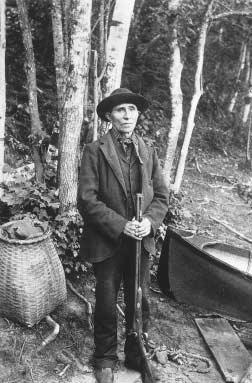
Figure 1. Mitchell Sabattis, an Abenaki Indian and longtime resident of Long Lake, standing between two examples of the hybrid European—Native American material culture that developed in the Adirondacks during the nineteenth century: the pack basket and the Adirondack guide boat. (Photo courtesy of Adirondack Museum.)
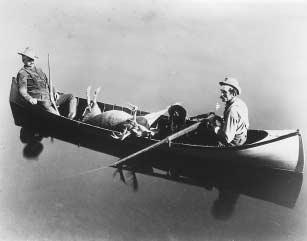
Figure 2. A guide transporting his “sport” in the distinctive Adirondack guide boat, which combined elements of both the Native American canoe and the European rowboat. (Photo courtesy of Adirondack Museum.)
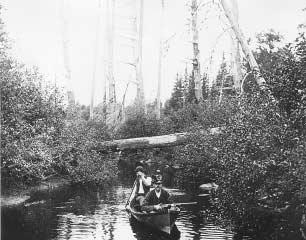
Figure 3. Two Adirondackers “jacking” deer. The man in the bow of the boat used the bright light from the lantern on his head to blind his prey. Although popular among many of the region's residents, this form of hunting was outlawed by the New York State Legislature in 1897. (Photo courtesy of Adirondack Museum.)
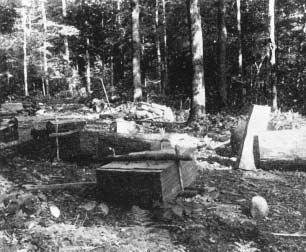
Figure 4. Shingles made from trees illegally cut on the Forest Preserve, abandoned by timber thieves fleeing state authorities. (Collection of author.)
Figure 5. Forest Commission officials (note the figure by the stump at right) investigating the theft of a large pine log from state lands near Raquette Lake in 1901. (Collection of author.)
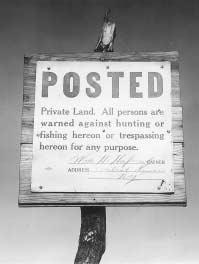
Figure 6. A sign from a private park in the Adirondacks. Most estates in the region were ringed by scores of such signs, which prohibited locals from hunting, fishing, or otherwise using private parklands. (Photo courtesy of New York State Archives.)
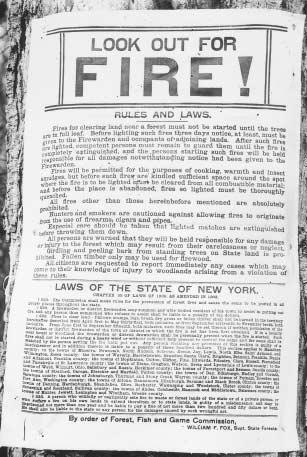
Figure 7. One of the many signs detailing New York's regulations for the use of fire that the Forest Commission posted throughout the Adirondacks at the turn of the century. (Photo courtesy of New York State Archives.)
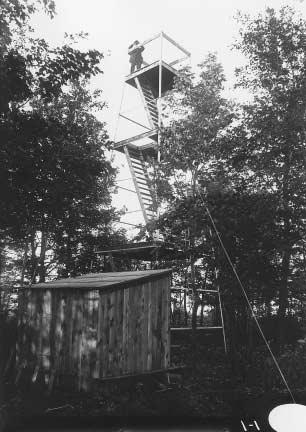
Figure 8. A new fire tower. Following a devastating series of forest fires in 1903 and 1908, New York authorities constructed towers such as this one at many high points in the Adirondacks, enabling Forest Commission employees to expand their surveillance of local conditions. (Photo courtesy of New York State Archives.)
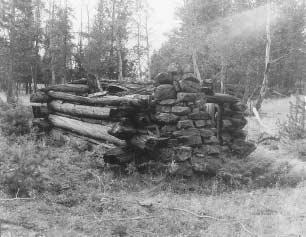
Figure 9. The remnants of a poacher's cabin in Yellowstone. This particular structure was so well hidden that it was not discovered by park authorities until the 1960s. (Photo courtesy of National Park Service, Yellowstone National Park.)
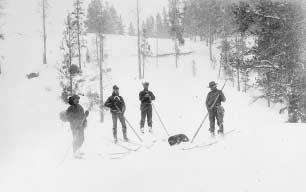
Figure 10. “The National Park Poacher.” The buffalo poacher Ed Howell is on the far right, with his dog curled up by his feet; the scout who brought him in, Felix Burgess, is on the left; two of the U. S. Army soldiers assigned to the park appear between them. All are outfitted with the long wooden skis that patrollers and poachers alike favored for getting around during Yellowstone's harsh winters. (Photo courtesy of National Park Service, Yellowstone National Park.)
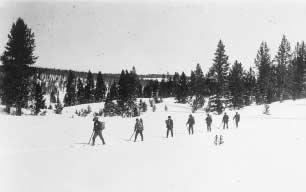
Figure 11. Ed Howell being escorted into Fort Yellowstone by army patrollers, following his arrest. (Photo courtesy of National Park Service, Yellowstone National Park.)
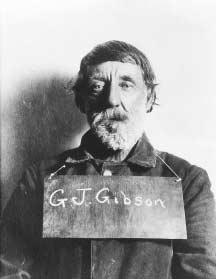
Figure 12. G. J. Gibson, arrested by the army in 1908 for trapping beaver in Yellowstone National Park.(Photo courtesy of National Park Service, Yellowstone National Park.)
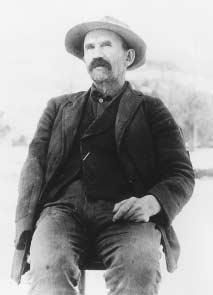
Figure 13. Joseph Stukley, a former miner from Electric, Montana, following his arrest for hunting deer in Yellowstone. Stukley had lost his right arm in a mining accident and presumably turned to poaching because his injury made it difficult for him to find employment as a miner. (Photo courtesy of National Park Service, Yellowstone National Park.)
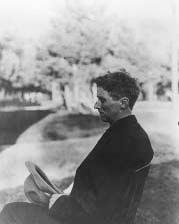
Figure 14. A mug shot of William Binkley, taken by army photographers shortly after Binkley's 1907 conviction for poaching elk in the park. (Photo courtesy of National Park Service, Yellowstone National Park.)
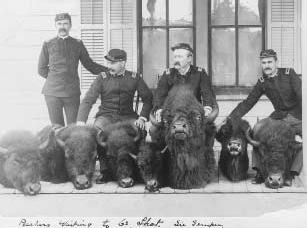
Figure 15. Army officers posing at Fort Yellowstone with fbuffalo heads confiscated from park poachers at the turn of the centuey. (Photo courtesy of National Park Service, Yellowstone National Park.)
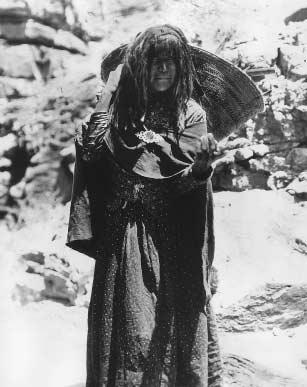
Figure 16. A Havasupai woman photographed in the 189os. She is wearing colthing made of calioc and carring mescal ahoots in the basker on her back. (Photo courtesy of Grand Canyon Nationl Park Museum Collection.
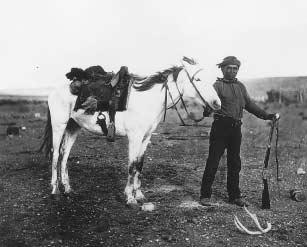
Figure 17. Chickapanyesi as he apperared in 1898 in a photograph most likely on the plateau above Havasu Canyon. Note his rifle and the deer antler at his feet (Photo courtesy of Grand Canyon National Park Museum Collection.)
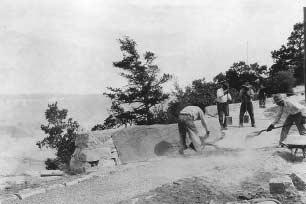
Figure 18. Havasupai men putting the finishing touches on a new trail along the Grand Canypn's South Rim.(Photo courtesy of Nation Archives and Records Administration.)
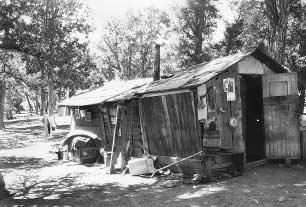
Figuer 19. One of the cabins constructed by the Havasupai in the early twentieth century from materals salvaged from the Grand Canyon Village drum. (photo courtesy of Grand Canyon National Park Museum Collection.)
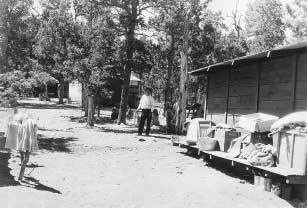
Figure 20. A Havasupai family photographed in the early 193os at the camp near Grand Canyon Village.(photo courtesy of Grand Canyon National Park Museum Collection.)
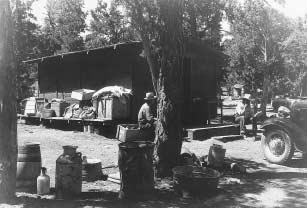
Figure 21. Another cabin in the Havasupai camp near Grand Canyon Village. The assorted barrel and just were used to store drinking water, while the automobile—a reatively recent addition to Havasupai life—eanbled the tribe's men to serch for seasonal wage labor over a much wider geographical area.(photo courtesy of Grand Canyon National Park Museum Collection.)
Given such regulations, the Adirondacker who set local woodlands on fire was engaging in an act that was deviant on a multitude of levels. Not only was he (arsonists, like poachers and timber thieves, seem to have been overwhelmingly male) asserting his disregard for the state's attempts to control the time and space where fires were permissible, he was also rejecting the model of civic duty proposed by the Forest Commission, in which “good citizens” participated on fire-fighting crews. The arson that periodically swept the region can therefore be interpreted not simply as a manifestation of revenge but as an effort by those residents who believed that the Forest Commission's regulations had unfairly deprived them of their rights to hunt, farm, or lumber to assert their—and the forests'—freedom from state supervision.76
Unable to halt such arsonists (“the miscreants who start these fires … enter the forest alone and unobserved … and then, aided by their knowledge of the wilderness, emerge at some point many miles distant”), the Forest Commission could only increase its fines, which by 1910 reached two thousand dollars or ten years in prison, and try to limit the fires' spread once they started. Following the devastating conflagrations of 1903 and 1908, the commission erected “observation stations” from which watchers could spot blazes as soon as they began. By 1914, there were fifty-one towers located at strategic high points
Mountain
Yellowstone
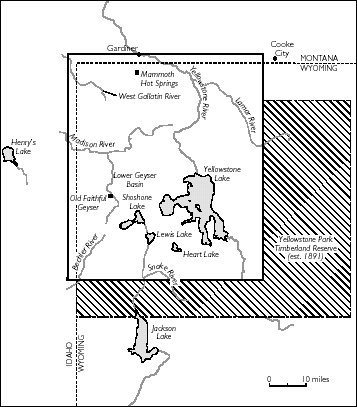
Map 2. Yellowstone National Park, 1872
Nature and Nation
On the morning of August 24, 1877, Frank Carpenter awoke to a sight unlike any other he had encountered in Yellowstone National Park: five mounted Indians riding into his camp in Yellowstone's Lower Geyser Basin. For the past two weeks, Carpenter, along with several friends and family members, had been sightseeing in the nation's first park, created some five years earlier to protect Yellowstone's unique natural features. Dramatically situated on a high plateau, the new park boasted thousands of geysers, boiling springs, mud pots, fumaroles, and other geothermal oddities—all testimony to the region's location over a rare volcanic hot spot in the earth's crust. Like the handful of other sightseers trickling into the area in the 1870s, Carpenter and his companions quickly became enchanted with Yellowstone's strange geological formations, which had already earned the park the nickname “Wonderland” after the recently released Alice's Adventures in Wonderland. 1
Tourists at a time when the industry was in its infancy, Carpenter's party met few other visitors during their initial days in Yellowstone. This situation changed abruptly, however, in the early hours of August 24. Shortly after dawn, just as the travelers were beginning to awaken, a party of five Nez Perce Indians, led by a man who called himself Yellow Wolf, rode into view. The Indians demanded food and ammunition and, after unsuccessfully attempting to pass themselves off as Shoshones, admitted to being members of Chief Joseph's Nez Perce band. This was a shocking revelation, for as both the Indians and the tourists
This encounter between tourist and Indian was scarcely the sort of interaction that Congress had intended when it established Yellowstone National Park in 1872. Rather, the chief goal in setting aside some two million acres at the junction of Wyoming, Montana, and Idaho territories as “a public park or pleasureing-ground [sic] for the benefit and enjoyment of the people” had instead been to preserve the region's unusual geothermal features, both as a “laboratory” for natural scientists and as a unifying national emblem for a nation just emerging from a bloody and divisive Civil War.3 At the time, so little was known about Yellowstone's topography (one of the remotest places in the continental United States, it would not be mapped until the mid-1880s) that lawmakers, not wishing to leave any of “the greatest wonders of Nature that the world affords” outside of the future park, drew its boundaries generously, taking in much of the area surrounding the known geysers and fire holes.4
As a result, even though the congressional debate leading up to Yellowstone's creation involved little reference to Marsh or the other early conservation thinkers who had proved so instrumental to New York's efforts in the Adirondacks, the nation's new park was expansive enough to encompass not only the headwaters of several major western rivers and extensive herds of elk, deer, and mountain sheep but also one of North America's last surviving buffalo populations. Once later investigations revealed Yellowstone's potential for conservation, federal officials, at the urging of eastern conservationists such as George Bird Grinnell, Teddy Roosevelt, and the elite, New York—based Boone and Crockett sports hunting club, expanded the park's timber and wildlife regulations. By 1895, a congressional report on Yellowstone could speak of the park as serving three central functions:
First. As a region containing some of the chief natural wonders of the world.
Second. As the largest of the forest reserves.
Third. As the greatest existing game preserve.5
Despite the haphazard manner in which conservation began at Yellowstone, the park nonetheless marked a turning point in federal land policy. In keeping with the goal of fostering the independent yeoman farmers so prized by republican ideology, previous federal programs had focused on converting the public domain into smallscale, privately owned plots of land. But the creation of a two-million-acre park signaled a significant shift in federal priorities. No longer was the national government to be merely a temporary caretaker of the American countryside, eager to surrender its role to private property owners: henceforth, it would be an ongoing presence in the landscape, the permanent manager of vast portions of the rural United States. And Yellowstone, as the location where the federal government first undertook this new role, would serve as proving ground and template for federal efforts elsewhere.6
Federal planners, however, were not the only people with designs for the Yellowstone landscape during the late nineteenth century. In ways that the nascent conservation movement seldom cared to acknowledge, Yellowstone was also part of a preexisting native world. The Nez Perces' unexpected arrival at Frank Carpenter's camp in 1877 testifies to at least one aspect of this Indian Yellowstone: the network of Indian trails lacing the new park. In their flight to Canada, the Nez Perces were following a familiar route, one they had used many times before to cross the Rocky Mountains and reach the once buffalo-rich prairies of the northern Great Plains.7 This pathway, rutted from the passage of countless travois and Indian ponies over the years, fanned out in the Yellowstone region into a dense web of Indian trails. Some led to the game grounds surrounding Yellowstone Lake, others to the sites where one could quarry obsidian, a glasslike stone created by volcanic action, out of which Indian peoples fashioned knives, arrowheads, and other tools. In the words of Hiram Chittenden of the U.S. Army Corps of Engineers, “Indian trails … were everywhere.”8
These trails reflected the passage of a wide spectrum of native groups, of which the Nez Perce, who spent most of the year in presentday Idaho and Washington, were far from the most prominent. The Yellowstone Plateau was situated at the point where several different Indian nations overlapped and contested one another. To the north were the Blackfeet, who occasionally ventured into the area to hunt elk or trap beaver. To the east were the Crow, whose territorial claims, although battered by the incursions of the expansive Lakota, took in both sections of the Great Plains and the foothills of the Rocky Mountains.
Perceptive nineteenth-century observers found the Yellowstone landscape saturated with traces of these Indian groups. Early park managers discovered abandoned Indian shelters—“circular upright brush heaps called wickeups”—“in nearly all of the sheltered glens and valleys of the Park,” and in most every meadow they found “extensive pole or brush fences” designed to funnel deer, mountain sheep, and other animals to canyons or enclosures where they could more easily be killed.10 Other visitors encountered even more direct evidence of Yellowstone's Indian presence. Near the confines of the presentday park, the members of an 1869 survey of the area met “a band of Indians—who, however, proved to be Tonkeys, or Sheepeaters.” The following year, another party of “explorers” not only followed “an old Indian trail” into the area, along which the group found “plenty of Indian ‘signs,’” they also spotted a number of Crow Indians keeping a wary watch on the party's progress. During a U.S. Geological Survey mapping expedition in 1871, surveyors “accidentally discovered … the camp of a family of the Sheep-eater band of Bannacks [sic].” Because of such peoples' detailed knowledge of local geography, later expeditions frequently employed Bannocks or Shoshones as guides. (For their part, members of these bands were not above capitalizing on their intimate knowledge of the landscape by stealing horses from Yellowstone's early surveying parties.)11
Despite such encounters, park backers nonetheless persisted in describing the Yellowstone region as existing in “primeval solitude,” filled with countless locations that “have never been trodden by human footsteps.” The native peoples of the area, supporters maintained, seldom visited the lands bounded by the newly created park, for they were afraid of its spouting geysers and boiling hot springs. “The larger [Indian] tribes never enter the basin, restrained by superstitious ideas in connection with the thermal springs,” proclaimed Gustavus Doane, an army officer who accompanied an 1870 expedition to the region. “The
As the Carpenter party soon discovered, however, the Nez Perce exhibited little superstitious awe of Yellowstone's geothermal formations. Shortly after his capture, Carpenter ended up chatting with one curious Nez Perce about the source of the geysers' energy (“Heap fire down under the ground,” explained Carpenter in what he considered to be the appropriate Indian terminology). Carpenter's companions noted that female members of the tribe used the region's hot springs to cook and clean their meager supplies of food. Other Indian peoples seem to have a similarly nonchalant response to Yellowstone's geysers. In fact, Yellowstone's volcanism may actually have drawn Native Americans into the region: the warmth given off by its ten-thousand-odd hot springs and other geothermal oddities encouraged snowfree winter grazing zones and extensive meadows, both of which made the area unusually rich in elk, deer, bison, and other game animals.13
Ultimately, the effort by park backers to disavow any Indian connection to Yellowstone National Park reveals far more about Euro-American conceptions of Indian land tenure than it does about the realities of Indian life. Drawing upon a familiar vocabulary of discovery and exploration, the authors of the early accounts of the Yellowstone region literally wrote Indians out of the landscape, erasing Indian claims by reclassifying inhabited territory as empty wilderness. Those “explorers” who, during the course of their travels, encountered Indian peoples within the confines of the park simply dismissed these natives as transitory nomads. Neither the Bannock, the Shoshone, the Crow, nor the Blackfeet practiced agriculture, and seeing no landscapes in the Yellowstone region that had been “improved” through farming, many Euro-Americans conveniently concluded that the area's Indians were rootless beings, with no ties to the lands they roamed across.14
What this ideology of dispossession overlooked was that Indian migratory patterns were not a series of random wanderings but rather a complex set of annual cycles, closely tied to seasonal variations in game and other wild foodstuffs. Moreover, while they were not farmers,
Following their adoption of the horse in the early 1700s, the region's Native Americans expanded their use of fire, setting periodic blazes to improve the grazing lands available for their growing herds of ponies. This heightened proscriptive burning may explain the large blazes that, according to the archaeological record, swept through Yellowstone's upland forests in the 1700s as well as the repeated fires that took place in the lower lying grasslands during this same period. Eyewitness accounts suggest a link between Indian peoples and several fires that took place within the park during the 1870s and 1880s. During his 1870 survey of the park, for example, Doane observed that “the great plateau had been recently burned off to drive away the game, and the woods were still on fire in every direction.” In 1881, another army officer, the Civil War hero Philip Sheridan, similarly discovered “the forests on fire for miles, at five or six different places.”16
Not understanding the role that it played in increasing plant diversity or forest reproduction, nineteenth-century conservationists considered fire a uniquely dangerous and unpredictable force. Sheridan, for instance, considered the fires he witnessed in Yellowstone evidence of the “indifference shown by the government” toward the park, while John Wesley Powell, in his famous Report on the Lands of the Arid Region of the United States, released in 1878, asserted that Indian burning represented the largest single threat to forests throughout the American West. “The protection of the forests of the entire Arid Region of the United States,” wrote Powell, “is reduced to a single problem. Can these forests be saved from fire?” For Powell, the answer was clear: since “in the
Powell's suggestions dovetailed with already existing arguments in favor of confining Indians to reservations, which stressed the need for Native Americans to abandon their migratory practices and to adopt a settled, agricultural lifestyle modeled on that of the self-reliant Euro-American yeoman farmer. As one agent to the Shoshone wrote his superiors in 1865, “This people have never turned their attention to agricultural pursuits, nor can it be expected of them until they are placed upon a reservation. … If they are not provided with such a home, they are destined to remain outside of those influences which are calculated to civilize or christianize them … [and to render them] useful members of society. Wild Indians, like wild horses, must be corralled upon reservations. There they can be brought to work, and soon will become a selfsupporting people, earning their own living by their industry, instead of trying to pick up a bare subsistence by the chase.” The rise of conservation added another imperative to such arguments. Not only would the sedentarization of Native Americans on reservations teach Indians how to be “civilized,” it would limit the risk of further Indian damage to the environment.18
It was more than coincidental, then, that the 1872 proclamation setting aside Yellowstone park took place amid a flurry of reservation building, during which the Blackfeet, Crow, Bannock, and Shoshone were confined to reservations in Montana, Wyoming, and Idaho. The vision of nature that the park's backers sought to enact—nature as prehuman wilderness—was predicated on eliminating any Indian presence from the Yellowstone landscape. Whether or not the tourists who later came to the park realized it (and most, of course, did not), Yellowstone's seeming wilderness was the product of a prior, stateorganized process of rearranging the countryside, in which native peoples and nature were slotted into distinct categories and separated from one another.19
In theory, this compartmentalization of the countryside—the creation of what the historian Sarah Deutsch has called a “landscape of enclaves”—should have eliminated any further Indian presence at Yellowstone.20 Ironically, though, the setting aside of reservations may have helped set the stage for continued Indian incursions into Yellowstone. Not only did reservations consolidate Indian bases of operation close to the park, the limitations of the reservation system—most notably the frequent shortages of rations—often left the hungry inhabitants with
Each fall, hunting bands from nearby reservations gravitated toward Yellowstone—in part out of habit and in part because the area bordering the park was one of the largest open spaces remaining in the region. These incursions attracted little notice in the park's early years, when the number of visitors was small (only an estimated five hundred tourists came to Yellowstone in 1876, for instance) and official oversight limited. But by the 1880s, as the number of visitors crept upward and as administrators began to assume a more permanent presence at the park, it became increasingly obvious that “raiding Indians,” evincing no superstitious fear of Yellowstone's strange geological features, were making yearly forays into the park. “[Having] discovered that the best hunting grounds are on the borders of the National Park,” noted Forest and Stream in 1889, “the Crows on the east, the Shoshones on the south and east, the Bannocks from Fort Hall and Lemhi on the south and west all send annually their hunting parties into the region surrounding the Park for a winter's supply of meat.”23
Rather than looking upon these native hunting expeditions as part of a seasonal cycle that predated the park's existence, Yellowstone's managers viewed any Indian presence in the park as a new and artificial intrusion. Park superintendents labeled Indians invaders, their hunting expeditions “an unmitigated evil,” their setting of fires an affront to the “spirited cautions against fire” posted throughout the park. All constituted, in the eyes of Yellowstone officials, clear evidence that the inhabitants of nearby reservations were allowed “entirely too much liberty.”24
What made these Indian actions all the more galling to park administrators was their apparent depravity. Indians did not just hunt, according to Yellowstone authorities; they overhunted. The Bannock, fumed one Yellowstone superintendent, used such “wasteful and improvident methods” that during their “protracted hunts of several months duration” they killed a staggeringly “large number of game animals.” Forest and Stream issued similar accusations, charging the Bannock with “slaughtering [game] in such quantities as to have tons of meat hanging on their scaffolds” and the Crow with “killing what[ever] they could find.” To conservationists, such behavior proved Indians' “love of gamebutchery.” But the prolonged hunts by the Crow, Bannock, and Shoshone on the fringes of the park may, in fact, have been signs of communities in crisis. Deprived of their traditional quarry, the buffalo, and forced to cope with the diminished resource base of the reservations, Indian peoples doubtless had to make much more intensive use of the game in Yellowstone National Park than ever before.25
Park authorities responded to such behavior in a manner similar to that of their counterparts in the Adirondacks: by drawing a sharp contrast between upperclass sports hunting, with its elaborate code of the chase, and the excesses of local hunters: “These Indians have no knowledge of the law, and submit to no restrictions; and it is believed that a single one of these hunting parties works more destruction during a summer's hunt than all of the gentlemen sportsmen put together who annually visit this region.”26 Although park officials considered the Native Americans hunting in Yellowstone little more than common criminals, neither the Shoshone nor the Bannock nor the Crow seem to have believed they were doing anything illegal. Instead of moving surreptitiously in small bands, as white poachers at this time did, the members of these tribes hunted as they always had: in large kin groups that often numbered fifty or a hundred individuals.27 These sizable camps, along with the Indians' practice of setting fires when hunting, made native groups relatively easy for park authorities to locate. But lacking any jurisdiction over Indian peoples, officials could do little more than insist that hunting parties move outside the park's boundaries.28 Supervisors found this a less than satisfactory solution, for Yellowstone's ecosystem did not fit neatly within the park's rectilinear borders. A fire that Bannocks set while hunting outside the park, for example, could easily stray inside the park and burn its forest cover. Similarly, as game animals migrated out of the park to lower elevations in the early fall, they were often killed by waiting Indian bands—a scenario unattractive to park
Frustrated park supervisors spent much of the nineteenth century searching for a more permanent solution to such dilemmas. In his 1878 report to the secretary of the interior, Superintendent Philetus Norris made the first of several attempts to enlist the U.S. Army and the Bureau of Indian Affairs in his efforts to prevent Indian incursions into Yellowstone: “The few Sheepeaters, Bannocks, or Shoshones who alone once resided within the park, now belong at their agencies with the other annuity Indians. Hence, no Indians now visit the park save as a haunt for the purposes of plunder, or of concealment after bloody raids upon the ranchmen, pilgrims, or tourists. Therefore, I urge the necessity of the agency Indians of all the surrounding tribes being officially notified that they can only visit the park at the peril of a conflict with each other and the civil and military officers of the government.”30 Although Norris never achieved the absolute ban on Indian visits that he sought, his actions did help precipitate a fresh round of treaty making with the Crow. One particular source of confusion had been the overlap between the northern edge of Yellowstone National Park and the Crow Indian Reservation as established by the Treaty of Fort Laramie in 1868. A new treaty in 1880, in which the Crow ceded the western portion of their homeland, erased this conflict. Norris seized upon this agreement—as well as upon a treaty signed with the Shoshone and Bannock at the same time that reduced the size of the Lemhi Reservation—as an excuse to visit several of the surrounding Indian agencies and to extract “a solemn promise” from the “aboriginal owners of, or occasional troublesome ramblers in portions of the Park … to abide by the terms of their treaty” and “not enter the Park.”31
What the Indians who issued this “solemn promise” thought they were doing remains unclear. It may be that they were merely making a polite gesture in the hopes of dismissing Norris. It is equally possible that they were offering a sincere commitment not to pursue game within the park. It does seem that in subsequent years the region's Indians frequently confined their hunting to Yellowstone's poorly marked periphery. However, this compromise (if that is what is was) only partially mollified park administrators, who had hoped to stop native peoples from even “approaching the park boundaries.”32
In their campaign to discourage Indian “raids” into the park, Yellowstone authorities received valuable aid from a number of eastern
These efforts were rewarded by the tightening of some reservation regulations. In 1888, for example, the Commissioner of Indian Affairs forbade the Bannocks and Shoshones on the Wind River Reservation from hunting off reservation without written permission from the Indian Bureau in Washington, D.C. But stricter rules did not in and of themselves reduce hunting in the park. As the Indian agent at Wind River admitted, “The bad element … steal away and disobey the order, as it is almost impossible to detect them.” “I refused to give them passes and [warned them] that if they went and didn't behave themselves they were liable to get into trouble,” reported the equally frustrated agent at the Lemhi agency in Idaho. “They say they don't get enough to eat and that it is necessary for them to go hunting. … An agent is powerless to compel Indians to remain on their Reservation unless he has some substantial support.”34
Except for extraordinary events such as the Nez Perces' seizure of Carpenter and his companions in 1877, however, the struggles between park authorities and native peoples over access to Yellowstone largely took place offstage, out of sight of the growing number of tourists to the park in the 1880s and 1890s. In 1886, the same year that Yellowstone's superintendent was sending desperate telegrams to his superiors at the Department of the Interior about dozens of Bannocks hunting in the park, the travel writer George Wingate confidently stated that in Yellowstone “the Indian difficulty has been cured, the Indians have been forced back on their distant reservations, and the traveler in the Park will see or hear no more of them than if he was in the Adirondacks.” At best, Wingate's analysis was only half right. It was true that visitors to the park seldom encountered Indians near Yellowstone's famous geysers and hot springs. But the Native American presence in the park had not ended; it had simply shifted to Yellowstone's outer fringes. Indians
Given the prevailing frontier ideology of the time, one might expect that park officials celebrated the changes taking place in the Yellowstone region in the late nineteenth century. After all, the creation of the reservation and the subsequent opening of new territories to Euro-American settlement would seem to represent pivotal milestones in the triumphant tale of progress and civilization that Americans have come to expect of their western lands. In reality, however, park supervisors manifested a rather ambivalent attitude toward such changes. Rather than establishing prosperous, independent farms, many newly arriving settlers seemed to devote much of their time to illegal hunting or trapping in Yellowstone, leading many park officials to conclude that there was little to distinguish the “lawless whites” filtering into the region from the “raiding Indians” they were supplanting.
As a result, rather than drawing a sharp racial distinction between local Indians and rural whites, park managers and their supporters often lumped the two into one uniformly dangerous class. At times, this linkage could be subtle, as when park supporters, using terms that had no distinct racial component, spoke of the “western nomads, who would rather kill one elk in the Park than three outside of it” and the “savage barbarism” of buffalo poachers.36 But often the parallels were drawn more explicitly. In 1891, for example, Forest and Stream warned its readers that Yellowstone was fast becoming “a hunting ground both for whites and Indians, and the forests which cover its mountains are in constant danger of fire from these wandering and often careless invaders.”37 On occasion, park authorities even claimed that whites and Indians were actively cooperating with one another to undermine conservation at Yellowstone. In 1886, the park's superintendent blamed “squawmen” (white men married to Indian women) for recent fires in the reserve, claiming that the Indians troubling Yellowstone had been “incited to hunt in the Park by unscrupulous white men.”38 Such formulations led to a peculiar blurring of the standard categories of race in much of early conservation literature. Accounts of poaching at Yellowstone, for instance, feature frequent mentions of “Indians red and Indians white” and of “red or white Indians”—usages that suggest that the privilege of whiteness could depend on one's environmental practices.39
In certain respects, park authorities considered “white Indians” to constitute even more of a threat to Yellowstone than Indians did. Not
Given its surreptitious character, it is difficult to gauge the precise extent of white poaching in Yellowstone's early years. Some visitors, however, ventured enormous estimates. Superintendent Norris supposed that “at least 7,000” elk had been “slaughtered between 1875 and 1877 for their hides,” while the army officer William E. Strong reported in the summer of 1875 that “over four thousand [elk] were killed last winter by professional hunters in the Mammoth Springs Basin alone. Their carcasses and branching antlers can be seen on every hillside and on every valley.”43
Strong directed his criticism not only toward the “human vultures” who committed such acts, but also toward the park's administration. “How is it that the Commissioner of the Park allows this unlawful killing?” he demanded. “It is an outrage and a crying shame that this indiscriminate slaughter of the large game of our country should be permitted. The act of Congress setting aside the National Park expressly instructs the Secretary of the Interior to provide against the wanton destruction of the game and fish found within the limits of the Park, and against their capture or destruction for the purposes of merchandise or profit. No attempt has yet been made, however, to enforce the act in the Park.”44 Strong's charges point toward what was indeed Yellowstone's greatest weakness: its lack of an enforcement mechanism for the park's environmental regulations. If events in the Adirondacks demonstrated how difficult it could be to enforce game and timber laws despite a yearround Forest Commission and a corps of experienced foresters, this difficulty was compounded at Yellowstone, where no administrative force existed at all. For many years, Congress did not even set aside funds to cover the salary of the park's superintendent. Consequently, Yellowstone's first superintendent, Nathaniel Langford, maintained a full-time job elsewhere as a bank
Not until 1883 did Congress designate funds to set up a force of ten “assistant superintendents” to help protect the park. Even so, these assistants had only a limited impact on violations of the park's regulations. Largely out-of-state political appointees, they found it difficult to apprehend Indians, poachers, and other rule breakers, most of whom possessed a far more complete knowledge of the park's geography than they did. “The Government has not the kind of men holding the position of assistant superintendents that it should have,” concluded an agent for the General Land Office after an investigative tour of Yellowstone in 1883. “The duties of the office require men possessing both judgment and nerve, men who have the physical courage to do their full duty in the face of the rough element which is to be found in the Park, and which has not yet been made to realize that the regulations of the Interior Department for the government of the Park must be respected and observed. In making selections of men to fill these positions, I think the interests of the Government would be subserved by taking those who have lived on the frontier and are accustomed to hardships.”46 But the Interior Department neglected to follow these suggestions, leaving the park's superintendent to plead two years later for the funds to hire “mountaineers able to anticipate the wary ‘skin hunter.’ … Even now there are parties hunting in the park because I haven't enough men of the right kind to cover the large extent of hunting ground that I am compelled to protect.”47
Yellowstone's lack of game wardens was only part of its enforcement problem. The act creating Yellowstone National Park had also neglected to include any method for administering punishments to wrongdoers. “Under the law as it now stands … I have not the legal right or power to arrest and detain any person charged with a violation of any of the rules governing the Park,” lamented Yellowstone's superintendent in 1883. “Now what am I to do?”48 On those occasions when assistants did catch violators of the park's rules, the severest penalty that the wrongdoer faced was expulsion from the park with orders never to come back. Should the offending party return, all park authorities could do was to expel that person yet again. Unsurprisingly, park managers came to view expulsion as a toothless punishment, a measure that was almost more of an incentive to wrongdoing than a check. Stated one superintendent,
Casting about for a way to end this impasse, the Interior Department arrived at an unusual solution. In 1884, it persuaded the Wyoming territorial assembly to place the park under Wyoming jurisdiction, an action that gave the Department of the Interior's regulations at Yellowstone the force of law in Wyoming. The territory appointed two constables and two justices of the peace to the park, supplementing the existing force of ten assistant superintendents. Although this arrangement had the potential to cloud whether the territory or the federal government exercised ultimate control at Yellowstone, it was seized by the park's beleaguered superintendents as their long-awaited opportunity to counter the “hard cases getting in to the Park.” Yellowstone authorities soon boasted of having made the first arrest of a poacher in park history (“a fellow by the name of George Reeder,” who was “killing elk and trapping beaver in the Park”) and of moving against squatters and other “vagabonds and tramps that under various pretenses are trying to obtain some sort of a foothold or settlement in the park.”50
These advances in administration, however, had to contend with a rapidly growing local populace. When the park was first established in 1872, there had been few centers of population nearby. The two closest towns—Bozeman and Virginia City, each claimants to the title “Gateway to the National Park”—were both more than seventy miles away. With each passing year, however, the tide of settlement lapped a little closer. In the early 1880s, the arrival of the Northern Pacific Railroad led to the founding of Livingston, Montana, fifty miles to the park's north. A growing number of homesteads soon clustered along the Yellowstone River valley between Livingston and the park. Then, in 1883, Gardiner, Montana, a “village of rough board shanties and log cabins” with a population of approximately a hundred and fifty, sprung up on Yellowstone's very border—so close, in fact, that the front doors of many of the residents' homes opened up directly onto the park.51 (See Tables 6 and 7.)
To worried Yellowstone officials, this new neighbor, which fast became a trading center for nearby ranches and a supply stop for visiting tourists, represented a grave threat to park security. “The disorders of the neighboring town of Gardiner …, which now overflow into the park, are a constant and serious source of annoyance,” complained one. “[Gardiner is] destitute of all means for the preservation of law and order …, the resort of hard and worthless characters who assemble to
| SOURCE: 1900 Population Census, Manuscript Schedules, Park County, Montana, Roll 913, T623, Records of the Bureau of the Census, RG 29, National Archives. | ||
|---|---|---|
| Women | 46 | (30%) |
| Men | 107 | (70%) |
| TOTAL | 153 | (100%) |
| SOURCE: 1900 Population Census, Manuscript Schedules, Park County, Montana, Roll 913, T623, Records of the Bureau of the Census, RG 29, National Archives. | |||
|---|---|---|---|
| Agriculture (farmer, hired hand) | 6 | (7.1%) | |
| Mining (coal miner, quartz miner) | 6 | (7.1%) | |
| Laborer (unspecified) | 18 | (21.5%) | |
| Crafts (blacksmith, carpenter, mason) | 10 | (11.9%) | |
| Professions (engineer, landlord) | 5 | (6.0%) | |
| Services (saloonkeeper, barber, park guide) | 19 | (22.6%) | |
| Transportation (teamster) | 20 | (23.8%) | |
| TOTAL | 84 | (100.0%) | |
To cope with these new challenges, Yellowstone's authorities could only resort to an odd, improvised administration divided between federal superintendents and territorial constables and justices of the peace. Had this peculiar arrangement held together, it might have set a precedent for a national conservation program based on power-sharing between federal and local governments. But it quickly disintegrated, a victim of corruption among the Wyoming constables assigned to the park. In 1885, the botched arrest of a visiting congressman, Lewis E. Payson of Illinois, revealed that the constables were using their position to extort fines from passing tourists. Embarrassed by the ensuing controversy, the Wyoming territorial assembly quietly revoked its previous measures for the park. Violations soon soared, as local residents realized that Yellowstone's officials once again had no way to enforce the park's regulations.54
Even before this latest crisis, a number of observers had argued that only the institution of martial law would enable the federal government to counter the Indians, poachers, and other wrongdoers ravaging Yellowstone. As early as 1875, the army officer William Ludlow had suggested that “the cure for … [these] unlawful practices and undoubted evils can only be found in a thorough mounted police of the park. In the absence of any legislative provision for this, recourse can most readily be had to the already-existing facilities afforded by the presence of troops in the vicinity and by the transfer of the park to the control of the War Department. Troops should be stationed to act as guards at the lake, the Mammoth Springs, and especially in the Geyser Basin.”55 Other conservationists soon arrived at a similar conclusion. In 1882, Samuel S. Cox, representative from New York, proposed placing Yellowstone National Park “under the exclusive care, control and government of the War Department.” That same year, General Sheridan recommended that troops from nearby forts be used to “keep out skin hunters … and give a place of refuge to our noble game.”56
This domestic deployment of American armed forces was not unique to conservation. Throughout post—Civil War America, the army was the police of choice for restive areas: the Reconstruction South; urban areas beset by labor strikes; a West still engaged in wars against various Indian nations. With such precedents already in place—and with many of the same perceived opponents (Indians, lowerclass white lawbreakers)—it was but a small step to expand the army's role in the “defense of national property” to include conservation sites.57 Perhaps the sole official to express any disquiet with this proposed shift was the
Although the army's presence was intended to be only temporary (Harris and the other officers who oversaw Yellowstone all bore the title “acting superintendent” on the assumption that they would soon be superseded by civilian officials), the military ended up remaining at the park for the next thirty-two years. During its prolonged tenure at Fort Yellowstone, the army would reshape federal conservation in its own image, turning a once inchoate venture into a well-organized bureaucracy, complete with uniforms, armed patrols, and detailed record-keeping procedures. If only a few years earlier Yellowstone had been one of the most remote spots in the continental United States, its destiny had now become linked to one of the agencies at the forefront of building the modern administrative state.60
Fort Yellowstone
To most nineteenth-century conservationists, the military's arrival at Yellowstone marked a clear turning point in the park's fortunes. John Muir, for instance, rejoiced at seeing Yellowstone “efficiently managed and guarded by small troops of United States cavalry.” “Uncle Sam's soldiers,” the Sierra Club president enthused, are “the most effective forest police.”1“I will not say that this Rocky Mountain region is the only part of the country where this lesson of obedience to law is badly needed,” agreed Charles Dudley Warner in Harper's magazine, “but it is one of them.” Like Muir, Warner saw Yellowstone's military administration as a notable improvement on its civilian predecessor: “Since the Park has passed under military control, fires are infrequent, poaching is suppressed, the ‘formations’ are no longer defaced, roads are improved, and the region is saved with its natural beauty for the enjoyment of all the people. … The lawless and the marauders are promptly caught, tried (by a civil officer), fined, and ejected.” The conclusion to be gathered from such evidence was clear: “The intelligent rules of the Interior Department could only be carried out by military discipline.”2
Sharing Muir's and Warner's enthusiasm for “military discipline,” many conservationists soon suggested that much of the rest of the federal government's conservation program be delegated to the military. In 1889, the American Forestry Association (AFA) passed a resolution recommending that the army “be employed to protect the public forest from spoliation and destruction.”3 The following year, Charles Sargent,
Yet at the very moment that the national press was holding up the military at Yellowstone as a model to be emulated nationwide, quite a different perspective was being voiced in the newspapers from the small Montana villages bordering the park. To the correspondents for this local press, the sight of armed soldiers patrolling the park represented not a triumph of conservation but rather the unwarranted imposition of martial law. “Military rule in time of profound peace is distasteful to the American people under any conditions,” charged the Livingston Enterprise, a newspaper whose general assessment of the army's involvement with conservation was perhaps best conveyed by the headline “Military Government and How It Is Employed in Yellowstone Park to Work Hardship on Law-Abiding Citizens of Montana.”6 Even the Livingston Post, typically the Enterprise's ideological sparring partner, viewed the army's presence at Yellowstone with alarm. Noting “the American sentiment against a military law,” the Post portrayed the various army officers who served as Yellowstone's acting superintendent as authoritarian despots.7 A favorite target of abuse was Captain George S. Anderson, the park's superintendent from 1891 to 1897. An avid sportsman and a member of the Boone and Crockett Club, Anderson was particularly aggressive in his efforts to rid the park of lawbreakers, for which he was regularly lionized in the pages of sporting journals such as Recreation and Forest and Stream. 8 Locally, however, the captain's endeavors earned him the nickname “the ‘Czar of Wonderland’”—a moniker no doubt designed to underscore the “un-American” character of the army's conservation policies—and the scorn of newspapers such as the Post: “Capt. Anderson's greatest activity has taken the form
The animosity behind such critiques derived in large part from the confrontations between residents and the army that began almost immediately after the military arrived at the park. Under Yellowstone's previous, weak civilian administration, many settlers had treated the park much as they did undeveloped property elsewhere in the American countryside—as land open to timbering, grazing, hunting, and foraging by local community members. Such practices, however, conflicted with the army's attempts to institute the technical oversight and state simplification that conservation demanded. Thus, even though the villages surrounding Yellowstone were founded after the park's creation in 1872, the result was a situation not unlike that in the Adirondacks, where many of the region's inhabitants perceived conservation as interfering with their preexisting rights to the natural world.10
As in the Adirondacks, one early point of conflict concerned the park's timber. Because of Yellowstone's remote location, regulations against the cutting of trees had lain dormant until 1883, when the establishment of Gardiner on Yellowstone's northern border propelled the issue to center stage. Alarmed at the removal of lumber by the park's new neighbors, the Department of the Interior tightened its ban on tree cutting. Yellowstone's civilian superintendent, Patrick Conger, placed the town's residents under close surveillance (“near the village of Gardiner I found it necessary to place some men, not only to watch the hunters, but to keep the villagers from stealing wood from the Park”), but with limited success.11 Although Conger's force of ten assistants did catch a few inhabitants of Gardiner loading up wagons with firewood and building supplies, many residents, when informed that “they would have to stop cutting and hauling wood off of the Park,” responded in a manner similar to that of a “Mr. Wannakee” of Gardiner: “He said he did not care what you [Conger] said, if he wanted a load of wood he would go and get a load, and I could report him if I wanted to. He said that he would not be afraid to stand trial or such words to that effect.”12
Viewing their cutting of wood as a justifiable subsistence use of the environment, Gardiner's residents circulated a petition calling on the Department of the Interior to revise its policies. Signed by fifty male
From the perspective of the park's newly arrived military commanders, this practice of letting locals gather wood in Yellowstone was far too openended. It allowed residents too much discretion in deciding what constituted “down wood,” and it gave poachers and other wrongdoers a pretext for wandering, unsupervised, throughout the park. In its place, the army instituted a system of permits, which required the town's residents to get approval in writing before gathering wood from parklands. Besides allowing for the more precise dictation of where and when wood could be gathered, this arrangement enabled Yellowstone's superintendents to exercise a form of social control over Gardiner in which informers and others sympathetic to the park authorities were rewarded with permits while poachers or other lawbreakers could have their woodgathering privileges withheld.
The mass of correspondence that this new policy generated documents Gardiner residents' reliance on park timber for a variety of subsistence uses. Joseph Duret asks that he be allowed to gather two loads of driftwood from along the Gardiner River to be used as firewood; Richard Randall requests permission to cut logs “to be used in building a house and stable at Gardiner”; S. C. Gassert inquires whether the superintendent would “send me a permit to get some wood for fuel out of
In 1898, apparently dissatisfied with its permit system, the military declared all gathering of wood in the park illegal. “Another order of this season,” reported the Livingston Enterprise, “prohibits the townspeople from hauling wood for domestic uses from a burned tract on the slopes of Sepulcher Mountain, which had hitherto been permitted. … citizens of Gardiner are prohibited from getting wood for home consumption from the limits of the Park.”17 Local residents opposed to the measure continued to sneak wood out of the park (an activity for which Joseph Duret, among others, was arrested and fined in 1908). But access to timber never became as bitterly contested an issue at Yellowstone as it did in the Adirondacks. Nor did there arise in Gardiner organized gangs of timber poachers akin to the “State Troops” or “Grenadiers” that during this same period challenged the authority of conservation officials in New York.18
Understanding why the local response to the ban on timber cutting developed so differently in the Adirondacks and in Yellowstone reveals a great deal about the distinctive character of conservation in each region. It was not that the residents of each area differed markedly in outlook—indeed, inhabitants of both places seemingly agreed that there was little illegal about the appropriation of game or wood for subsistence purposes. But whereas conservation in the Adirondacks had involved the placing of state controls over a preexisting grid of human communities, Gardiner had been founded after Yellowstone's creation. (There were, of course, human communities that predated Yellowstone National Park, but these had been Indian communities, whose rights to parklands the federal government had extinguished.) This difference alone created quite different spatial arrangements at the two locales. Gardiner, for instance, was situated on the edge of the park, rather than being surrounded on all sides by state land as were many communities
The final reason why the theft of timber never achieved the prominence in Yellowstone that it did in the Adirondacks had to do with the relative ecologies—and resulting economies—of the two regions. Unlike upstate New York, the area abutting Yellowstone never developed an active timber industry. (In fact, when Gardiner was founded in 1883, the first homes erected in the village were all constructed out of unmilled logs because of the lack of any local sawmill.) While such conditions were in part a reflection of Yellowstone's remoteness, they also had much to do with the composition of the region's forests. The park's dominant tree, the lodgepole pine (Pinus contorta), was only marginally marketable—indeed, elsewhere in the West, foresters, considering the lodgepole something of a pest, devoted considerable energy to eradicating it and encouraging more valuable species of trees to grow in its place. Consequently, there were few outlets for timber poached from Yellowstone and no especially valuable cuts of lumber—like the “fiddle butts” of the Adirondacks—that made particularly tempting targets for thieves.19
In contrast, because many of the settlers around Yellowstone established ranches on the grass-rich plains of the Yellowstone Plateau, park officials found themselves faced with an issue that had rarely troubled their counterparts in the Adirondacks: the grazing of livestock within park borders. Prior to Gardiner's founding, park authorities had not even anticipated such an issue arising. As a result, there were no standing regulations about grazing when the town was created. As in imany other rural communities, Gardiner residents often let their animals roam loose. Since the boundary with the park was unfenced, domestic stock from the village soon made its way into Yellowstone, just as wildlife from Yellowstone often ventured out of the park.
Initially, Yellowstone's military superintendents, continuing the policy of their civilian predecessors, tolerated the incursions of livestock into the park. But as the region's populations of antelope, deer, and elk
Nevertheless, many locals continued to graze their animals in the park, leading the army to increase its penalties. In 1900, Colonel Samuel B. M. Young implemented a policy of driving any loose domestic animals found in the park out through the distant Wyoming entrance, escalating Gardiner residents' complaints about being subject to an un-American tradition of martial law. “In days gone by the National Park has been ruled over by refmany an autocrat, many who would make the Czar of Russia ashamed that he ever ascended the throne,” wrote one Gardiner inhabitant; “but of the long list of those who have made life miserable for residents of the upper Yellowstone country none could compare with Col. S. B. M. Young.” Residents expressed particular frustration with the army for allowing a seemingly arbitrary boundary to curtail a well-established right to graze local public land:
For years the cows and horses at Cinnabar and Gardiner had been permitted to graze on the public domain without molestation. Only an imaginary line divided the world from the czar's domain, and, as long usage had made all grass look alike to the animals around Gardiner, it not infrequently happened that some strayed across this imaginary line and clipped a few mouthfuls of bunch grass from Uncle Sam's possession. But this was too much for the colonel. The idea of a plebeian cow or horse eating off the same domain with the petted animals of the Park rankled in his bosom to such an extent that an order was soon issued that any animal caught grazing on the Park side of Gardiner would be driven to Mammoth Hot Springs and from there escorted out of the Park on the Wyoming side. From the point of exit back to Gardiner, outside the confines of the Park, meant a nice jaunt for the unfortunate animals of a couple of hundred miles, and while it no doubt added greatly to their digestive qualities it provoked an epidemic of indigestion among upper Yellowstone residents that made the colonel the victim of more
Despite several other punitive measures, roaming livestock plagued Yellowstone officials well into the twentieth century. In 1903, rather than increasing its penalties further, the army tried a new approach: erecting a wire fence for about four miles along the northern boundary of the park. “This fence has long been needed, and it now affords a means of keeping stock of all kinds off that section of the park.” In 1914, soldiers replaced much of this woven wire fence with an even more imposing barrier: a set of five-foot-high steel spikes designed “to keep cattle and dogs out of the park.”22
Such fence building reinforced another project of the army's: the delineation of all of Yellowstone's boundaries. As early as 1878, officials had acknowledged that, much as in the Adirondacks, conservation regulations could be enforced only if the spaces where they applied were clearly bounded: “That the special rules and regulations, necessarily anomalous and conflicting with the roving-hunter habits of the surrounding mountaineers, cannot be effectively enforced without the limits of their operations (the boundaries of the park) being established and plainly marked, is too evident for controversy.” But attempts by the civilian administration to mark the park's borders had stalled, leading Captain Harris, after taking office in 1886, to plead for funds to complete such a project: “The present uncertainty [of the boundaries] is a constant invitation to lawless hunters and others to encroach upon the Park, and adds greatly to the annoyance and labors of those charged with its protection.”23
Later superintendents were to echo Harris's pleas, for it was obvious that making any official judgment about the legality of certain practices—such as when hunting constituted poaching, when the cutting of a tree was stealing, or when the building of a home represented squatting—hinged on fixing these activities in space. Complicating this task was the peculiar nature of the park's borders. Since the congressmen who had originally set Yellowstone's perimeters in 1872 had had only the vaguest idea of the topology of the area, the park's rectangular borders did not follow any convenient, “natural” boundaries such as rivers but rather cut across streams, mountain ranges, and other geographical features in a way that often proved disorienting when viewed from the ground.
As in New York's Forest Preserve, mapping and marking boundaries therefore emerged as fundamental to establishing administrative control of the park. The military officials at Yellowstone floated a number of plans designed to accomplish this mission. Some favored the construction of “a suitable fence … inclosing the entire reservation,” while other supervisors were partial to a scheme to cut “a wide swathe … along the entire boundary line wherever timber exists.” Both plans proved unworkably expensive, but between 1900 and 1903 the army did dispatch surveyors from the Corps of Engineers, who mapped the park's borders and erected stone boundary markers every half mile along Yellowstone's perimeter.24
During this time, the army also embarked upon a program to simplify the trails within the park. Upon its arrival at Yellowstone, the military had discovered a latticework of paths, some produced by Indian peoples, others “originally made by hunters, trappers, and prospectors,” crisscrossing the park. In place of this dispersed network, the army established a system that funneled travelers through just four entrances, corresponding to Yellowstone's north, east, south, and west sides—an arrangement that allowed soldiers to monitor closely the comings and goings of visitors. At each entrance, “as a precautionary measure against violations of the laws relating to hunting and forest fires,” troops took down the name, address, and intended length of stay of every visitor.25 Those who journeyed through Yellowstone after the summer tourist season were subject to even more checks. “All persons traveling through the park from October 1 to June 1 should be regarded with suspicion. They will be closely questioned and carefully inspected, and, if necessary, will be watched from station to station.”26 Even if one possessed the requisite permit for offseason travel, it had to be “presented at each station passed and … carefully scrutinized by the man in charge of the station,” who then had to endorse the permit on the back. Those who lacked the proper permission or endorsement, or who were deemed to have tarried unnecessarily between checkpoints, were liable to be detained by park authorities.27
The establishment of official entrances also allowed the army to control what visitors brought into the park. To prevent Yellowstone from becoming “a thoroughfare for sportsmen, hunters, and game slaughterers,” the army forbade the transportation of game (even that killed legally outside the park) across park borders, prompting “much adverse criticism by hunters and guides.”28 The military also issued
The fact that targmany locals learned how to slip this red tape off their rifles and to hunt in the park as before provides an apt illustration of the ability of the region's residents to elude the army's controls. This resistance manifested itself in etmany ways, most dramatically in the creation of a shadow landscape of surreptitiously erected footbridges and “unfrequented and little known trails,” used by those who wanted to sneak past the official entrances and gather an illegal load of wood or poach some game.30 A number of poachers even built cabins or dugouts in the park, where they could hide for the night and hastily preserve any illicit game before smuggling it out over Yellowstone's borders. These structures were secreted at regular intervals in the densest forests of the park where they were unlikely to be stumbled upon by passing tourists or Yellowstone officials. Although its traces were, as intended, indistinct, this shadow landscape extended throughout the park, an illicit counterpoint to the officially sanctioned tourist landscape of hotels and campsites that spread across Yellowstone in the late nineteenth century.31
If most of the ever-increasing numbers of tourists to Yellowstone were unaware of the network of hidden trails and cabins throughout the park, so, too, were park officials. It was not that the various army officers who served as the park's acting superintendents during the late nineteenth and early twentieth centuries were ignorant of the violations that occurred within Yellowstone's bounds. As Captain Anderson admitted in 1891, “I am satisfied that both hunting and trapping are carried on within the limits of the Park.” But the shadow landscape of poachers and other wrongdoers nonetheless remained difficult for Yellowstone's military managers to penetrate. Contrary to the predictions of conservationists, “many soldiers did not immediately take to their new roles as law enforcers. “The enlisted men of the Army,” explained Colonel Samuel B. M. Young, “are not selected with special reference to the duties to be performed in police patrolling, guarding … and in protecting
All too often, the soldiers guarding Yellowstone resembled the unit that Lieutenant Elmer Lindsley inspected in 1898: “absolutely unfamiliar with the country and their duties as game wardens.” Even under the best of circumstances, the constant transfers involved in military life meant that just as the soldiers at the park had begun to master Yellowstone's rugged geography and the cumbersome cross-country skis used in winter patrolling, their tour of duty at Yellowstone had drawn to a close. “The troops assigned from time to time for guard duty in the park can scarce all become familiar with its topography and trails ere a just regard for the proper maintenance of organization and discipline and division of duties … require their withdrawal,” noted Young. These shifts in personnel did not go unnoticed by local residents, who often timed their lawbreaking so that it occurred when the troops stationed at the park were unseasoned new arrivals. “From “many sources information comes to this office that preparations are in progress by lawless characters for poaching on a large scale during the present season,” wrote the colonel in 1897. “These people are encouraged by the knowledge that all my soldiers are new and untrained in the duties necessary to protect the Park properly.”33
The inexperience and indifference of tymany of the soldiers assigned to guard Yellowstone also appear to have made them susceptible to various forms of petty corruption. Army records from 1902 reveal repeated instances of soldiers colluding with local lawbreakers. In February of that year, Colonel John Pitcher, the park's acting superintendent, notified the secretary of the interior that a Sergeant Knapp at the park had been caught trafficking in elk teeth.34 The following month, Pitcher received a series of letters from Ed Romey, a scout assigned to patrol the park's southern boundary, detailing several cases of corruption among Yellowstone's enlisted men. In one instance, a poacher traded a pistol to two soldiers for the skins from several moose. In another, “a soldier named Flegal … made a deal with two poachers to drive two buffalo out of the park so that poachers could get them.”
Although all the available evidence indicates that the majority of soldiers performed their duties in an honest manner, local newspapers preferred to emphasize the “venal and corrupt” features of the army's management of the park.37“The acceptance of bribes,” maintained the Livingston Post, “is ‘so open and notorious that westerners have ceased to express surprise at it.’” The Post even charged one enlisted man with soliciting so pemany illicit payments during his tour of duty that he was able to buy a large ranch near the park upon his discharge.38 On the most immediate level, such accusations reflect the antagonism that “many residents felt toward the park's military supervisors. But they can also be read as attempts to disprove a key element of the logic of conservation. Rather than delivering the enlightened oversight of natural resources that its advocates had promised, conservation seemed instead to create new opportunities for corruption and mismanagement. As one resident of Gardiner put it, “the military up at the Park was all a fake. … it didn't protect the Park and was no good.”39
One reason the soldiers posted to Yellowstone may have been so vulnerable to corruption was the necessarily decentralized nature of law enforcement at the park. To counteract the hidden network of paths and hideouts used by local poachers, the army erected its own far-flung system of trails, cabins, and guard posts, designed, in the words of Frederic Remington, to leave “the track of the cavalry horse-shoe in the most remote parts of the preserve, where the poacher or interloper can see it, and become apprehensive in consequence of the dangers which attend his operations.”40 At each guard post, the army deployed “three to ten enlisted men,” often leaving the soldiers isolated for weeks at a time with little official oversight. During the 1890s, the military supplemented these posts with a network of log cabins spaced a day's journey from one another. Nicknamed “snowshoe cabins” because they were primarily used for winter patrolling, these structures allowed the army to extend its reach into the remoter, previously unguarded sections of
This adoption of winter patrolling highlights a central component of the army's tenure at Yellowstone: the appropriation of tactics used in Indian warfare for peacetime conservation. The flow of techniques from combat to conservation was no doubt reinforced by the frequent shifts between the roles of Indian fighter and park policeman that pagmany soldiers engaged in during Yellowstone's early years. Several troops serving at the park, for instance, came directly from assignments against “hostile tribes,” while others were “ordered into the field on account of … Indian troubles” during their tours of duty at Yellowstone.42 But this appropriation of military tactics for use in conservation likely made sense to army officials for other reasons as well. To capture elusive Indian opponents, for example, the army had found winter campaigns and the use of regularly spaced supply depots invaluable. The establishment of “snowshoe cabins” and winter patrols at Yellowstone enabled the military to apply these familiar tactics against another elusive target: poachers. Similarly, having discovered its unfamiliarity with the geography of the Far West to be a hindrance in Indian campaigns, the army began after the Civil War to employ Native Americans and other locals as scouts whenever possible. This policy, first made official under the Army Act of 1866, was also well suited to Yellowstone, where the army found itself lacking “men who are accustomed to the mountains.” Following wartime precedent, the park's military superintendents soon hired scouts from among the local populace—men capable of guiding army patrols and of “measur[ing] wits, experience, and mountain skill with [the] other mountain men who constitute by far the most dangerous class of poachers.”43
In certain respects, the peculiar demands of conservation expanded the role of the park's scouts. Unlike wartime scouts, whose duties seldom extended beyond directing army columns to hostile encampments, Yellowstone's scouts often worked undercover in the communities abutting the park, tapping into the rumors and gossip about violations of park rules that circulated among the region's residents yet remained inaccessible to Yellowstone's authorities. When seeking to capture a “gang [of poachers] who had been operating from Idaho” in the 1890s, Captain Anderson turned to secret operatives, “who went among the residents of that country, and brought me back a full report of their names, and their places of operation.”44 Anderson's successor as acting superintendent, Colonel Samuel B. M. Young, continued this policy,
Not surprisingly, such undercover operations generated considerable unease in eremany of the villages surrounding Yellowstone. One Montana newspaper complained that Yellowstone authorities had “spies at every turn”; another spoke derisively of the park's “mysterious scouts.” As one officer explained to his superiors, “The people are very suspicious of us and it is hard to get information, and harder still to get reliable information.”46 Added the scout Ed Romey:
Why they [the local inhabitants] all say how is it. We never yous [used] to see a scout or a soldier in this section of country. And now they have soldiers stationed on Bechler [River] and we don't know when we are talking to a scout.47
Not that such confusion always lasted for long. Locals were often quick to discern who was on the army's payroll. Much as happened with New York's foresters, f">many of Yellowstone's scouts became “so well known that their presence in the section of country where these men [poachers] live is the sign, either for them to clear out, or to surround themselves with such safeguards that it is impossible to secure evidence against them.”48
Like their New York counterparts, Yellowstone's scouts occupied a contested place in the region's social order. To [.many residents, the park's scouts functioned simultaneously as emblems of an intrusive state and as guardians of the local community. Rarely able to reconcile these roles with much success, the scouts often found themselves criticized by fellow residents for failing to fulfill one or another of their responsibilities. “There is a great deal of game killed in and out of the Park[,] and the scouts never made a pretense of capturing the hunters,” complained a correspondent in Gardiner's shortlived newspaper, Wonderland, in 1903. “Instead of being out on the line watching the game, as they are told to do, they loaf around the saloons in Gardiner and Cinnabar until evening; then ride to the post and report … that everything is O.K.” A few locals even charged that the scouts were not as law-abiding as they pretended. As one sarcastic inhabitant of Gardiner put it, he hoped to “trap the beaver and kill the buffalo and get on as a scout, and ride a sorrel horse and wear a big six-shooter with ‘U.S.’ on it.”49
Despite such charges of corruption, several of the locals volunteering for the scout position professed an apparently genuine desire to restrain the environmental abuses of fellow community members. “I know all of the pochers that live at Henerys lake and the Madison Bason and I would like to have them stoped if posiable,” wrote one resident, offering himself for the position.50 Another settler from Jackson Hole presented as his credentials the fact that he had “incurred the displeasure of nearly all my neighbors through my upholding the protection of the game[,] for the majority of them are trappers. … I will do so to a much greater extent if I can receive the appointment of warden.” A subsequent letter clarified the reasoning behind the wouldbe scout's position: “This is one of the best game countries that I know of. … Now with a good game warden here and the Park on the north, we can do much in the way of preserving the game.”51
A more detailed portrait of the scouts can be found in the diaries that the army required all scouts to keep during the late 1890s. Generally, while on duty, the scouts followed a well-established routine. Accompanied by a few enlisted men, the scouts would ride—or, if the snows were deep, ski—from point to point in the park, checking on the location and well-being of Yellowstone's wildlife, and looking for the tracks that might indicate the presence of poachers in the park. The diary entry of the scout James Morrison for November 24, 1897, was typical: “Took back trail down Fawn Creek about 4 miles, thence south along Quadrant Mountain to Indian Creek and up it about 4 miles to snowshoe shack, where we camped. Saw about 150 elk;,;: many signs of beaver on this creek. Distance traveled, about 15 miles.” For the most part, scouts focused their patrols along Yellowstone's periphery, where they would search for “fresh trails leading to the park” and listen for the gunshots that indicated that poachers were in the vicinity.52
While the scouts searched for poachers, the park's poachers, in turn, searched for the scouts. Noted one resident to Yellowstone authorities, “People who make a business of poching have studied the moovements of your Patrole.” Astute lawbreakers soon learned how to turn many of the scouts' tactics against them. The army's regular system of patrol cabins, for instance, made the location of scouting parties easy to predict. “Experiance has tought them [poachers] that the patrole plan on getting back to their quarters by dark if not earlier, and they ar not far from their station before 8 AM. So they [poachers] do their hunting early morning but more often leight of an evening.”53 In addition, poachers discovered that firing a shot into the air could often trick
To counteract such tactics, the army soon ordered the scouts to conceal their movements and camping spots. “During the winter period,” mandated the army's regulations of 1907, “patrolling and scouting will be constantly carried on, and when camps are made they will, if possible, be selected so as to be hidden from poachers who may be in the park. Patrols and scouts will avoid the regular trails as far as possible, and will vary their different trips as much as the character of the country will allow.”55 To achieve such goals, patrols would often split up and approach their destination from several directions or switch their locations under cover of darkness. Explained one scout, “My idea for doing this [breaking camp] at night is to keep the hunting class of people thinking the camps were still out where they were.”56
If one part of the scouts' job was making extensive, unobserved reconnaissances of Yellowstone, the other involved remaining in place, watching and waiting. Occasionally, scouts would situate themselves on a high ridge from which they could watch the park's borders, as Scout Whittaker did on a peak overlooking Gardiner on November 11, 1898. From this vantage point, he was able to witness two men using a clever subterfuge to mask their attempts at poaching in the park. They began by deliberately driving a herd of horses into the park: “My opinion,” wrote Whittaker in his diary, “is they are men who intend to kill some antelope and if caught they will say they were looking for horses that will be their excuse.” A few hours later, Whittaker spotted the men herding the horses back out of the park—and, while so doing, trying (unsuccessfully) to drive some of the park's antelope out with them.57 More commonly, long waits ensued whenever scouts happened upon a poacher's campsite or a freshly killed animal. The scouts would stake out these positions, hoping that the poachers might make a return appearance to reclaim their prey. In the winter of 1898, Sergeant M. J. Wall had several such experiences. At one point he discovered a “poachers' cabin on Buffalo Mountain. … There was a fire burning inside, but no one at home. I looked all around and saw some mink skins and what I thought to be fox skins.” Wall “waited to see if anyone would show up,” but his arrival must have spooked the occupants, for they did not
While the scouts' duties were largely routine (“monotonous, toilsome, and uneventful work,” in Frederic Remington's words), lurking beneath the daily tedium of patrolling and surveillance lay the potential for violent confrontation at any time.59 An excerpt from the diary of Scout Whittaker provides a vivid illustration of the suddenness with which such incidents could occur. On November 24, 1898, Whittaker, hearing some shooting near the antelope herd that wintered along Yellowstone's northern boundary, went with one of the park's soldiers to investigate: “We struck the trail of two men they went within ten feet of the line then followed along the line toward Reese Creek I sent sgt Wall off to my right and told him to watch for anybody that might come that way while I would follow the trail made by the two men I did not go over ¾ miles when two shots were fired directly at me after the first shot I droped down on my knee and got ready to shoot but I did not see where the first shot came from but I saw the flash of the second one and whoever it was that did the shooting got up and ran down a little draw or ravine by the time I got to where the shot was fired they were all of 300 yds away but I fired two shots at them don't believe I hit either.”60 The scout Jim McBride related a similar incident from the early 1900s: “Two of us found a fellow near Snake River, whom we suspected of possessing furs. I started up to him and he shot at me. I dropped on the ground and lay behind a rock while he fired seven times. When he had emptied his rifle I knocked him off his horse with the butt of my gun.”61
Perhaps the most significant insight to emerge from the scouts' diaries, however, is an awareness of how difficult it was for Yellowstone authorities to catch wrongdoers. The diaries are filled with references to hearing gunshots, finding dead or wounded animals, encountering the campsites and tracks of poachers, and the remains of trees cut by timber thieves. Yet, despite near-constant patrolling, the scouts were able to capture only two wrongdoers during the winter of 1897–98—a rate consistent with present-day studies of poaching, which conclude that authorities typically apprehend only 2 or 3 percent of all game-law violators.62
The first of those arrested was the colorfully nicknamed “Horse Thief Scotty” Crawford, whom a patrol led by Scout Whittaker seized on the park's northern border. Some days earlier, Whittaker and his men had spotted Crawford's camp, located some “five hundred yards outside of the north boundary, conveniently close to watch both the mountain sheep, elk, and antelope on Gardiner flat and Mount Everts,” and had kept it under steady surveillance. Only when it seemed as if Horse Thief Scotty, rifle in hand, had crossed over into the park in pursuit of game, did Whittaker and his escort emerge from their hiding place. Crawford quickly dropped his rifle in the snow and tried to cover it up, but it was found by one of the soldiers of the patrol, as were some six hundred pounds of elk meat that Crawford had hidden underneath a blanket in a nearby aspen grove. This seemingly airtight case against Horse Thief Scotty quickly fell apart, however, when it turned out that he had been apprehended several yards outside of the park. The army turned Crawford over to the county sheriff on charges of violating Montana's game laws, but “a jury composed of men more or less engaged in breaking the Montana game laws” soon acquitted Horse Thief Scotty of all charges.63
The case of Thomas Miner, the other man Scout Whittaker arrested during the winter of 1897–98, came to an only slightly more satisfactory conclusion. Miner, who inhabited a small cabin near Gardiner, was hunting legally outside of Yellowstone when he spotted an elk. Miner's first shot only wounded his target, and the elk fled several hundred yards south into the park, where Miner finally killed and butchered the animal. For such behavior, Scout Whittaker felt “duty bound to arrest” Miner, who ended up spending thirty days in the guardhouse at Fort Yellowstone.64 Judging from newspaper coverage of the incident, local sympathy was on the side of Miner, who seemed less like a rapacious poacher than an ordinary citizen tripped up by an unusual set of circumstances. “The offense was slight and should have been condoned,” opined the Livingston Enterprise. “[Miner] has always been regarded as an honest, truthful man.”65
In retrospect, then, neither of the apprehensions during the winter of 1897–98 culminated in a clearcut victory for park authorities. Horse Thief Scotty eluded all punishment, thanks to a sympathetic jury, while the arrest of Tom Miner—a man who would seem to fit only the narrowest definition of a poacher—doubtless reinforced local perceptions that Yellowstone's military administrators cared more about legal fine points than about the wellbeing of the rural folk living near the park. Other
Such assessments were more accurate than their authors may have realized. From a presentday perspective, even a number of the military's supposed successes at Fort Yellowstone appear far more limited than most nineteenth-century conservationists recognized. Indian incursions into Yellowstone, for instance, did decrease significantly during the military's years at the park. But closer examination suggests that this was as much the product of changes going on outside Yellowstone as it was of any actions taken by the army. Each passing year, increasing numbers of Euro-Americans settled in the areas abutting the park, claiming the open public lands on which Indians had previously hunted. These newly arrived ranchers and farmers had little tolerance for the annual hunting expeditions of the Bannock, Shoshone, and Crow—especially since native peoples were not bound by the same game laws that non-Indians were theoretically obliged to obey. Observed the Commissioner of Indian Affairs in 1894, “Complaints were [recently] received from Idaho, Wyoming, and Montana that parties of Indians were continually leaving their reservations with passes from their agents to make social and friendly visits to other reservations; that en route they slaughtered game in large quantities merely for the sake of killing and for the hides, particularly in the country adjacent to the Yellowstone National Park. … if such depredations were allowed to continue, it would probably result in a serious conflict between the white settlers and the Indians.”67 As predicted, “serious conflict” did indeed erupt, most notably in July 1895, when a self-proclaimed posse of twentyseven men from Jackson Hole “arrested” several families of Bannock Indians “for wantonly killing game” to the south of Yellowstone park. On previous occasions, local settlers had confronted Indian hunting parties with little violence. This time, however, when the alarmed Bannocks tried to escape into the woods, posse members opened fire, wounding five and killing one of the fleeing Indians.68
Although this unprovoked assault occasioned both a federal investigation and considerable public outcry, it was the settlers who emerged
If in this instance the army exercised less control over events than most conservationists realized, in other cases the military's policies produced outcomes far different than intended. Such was the case for the army's aggressive campaign against forest fires, initiated the very day that troops marched into the park (indeed, the first sight to greet Captain Harris and his soldiers when they arrived at Yellowstone in 1886 was “three large fires raging in the Park,” and Harris's first order as acting superintendent was to direct his forces to extinguish the blazes).70 Previous civilian superintendents had also made attempts to prevent fires in the park, but the army, by setting up a “ceaseless and numerous system of patrols” and by mobilizing the two to four hundred enlisted men posted to the park, soon established an impressive record of locating and stopping forest fires before they could spread (a record no doubt facilitated by the decrease in fire-setting Indian hunting parties during this period). In 1888, the army limited the fires in the park to one hundred; the following year, this number was down to seventy, with most of them being small, localized blazes. By 1895, the officer in charge of Yellowstone could boast that “in the four seasons during which I have been in the Park but one fire of any magnitude has occurred.”71
The full effects of this campaign did not become apparent until decades later. Army officers believed that by preventing forest fires they were defending Yellowstone against destruction, but their policy actually led to dramatic alterations in the park's ecosystem. In the lower elevations,
The army's management of Yellowstone's wildlife had similarly unexpected results. Hoping to increase the park's ungulate population, the military launched periodic campaigns against mountain lions, coyotes, wolves, and other predators.73 Combined with the army's efforts against Indian hunters and white poachers, these measures reduced?] many of the checks that had long restrained the park's elk population. As early as 1895, Captain Anderson noticed that the elk at Yellowstone were growing so plentiful as to “possibly make them more numerous than the food supply could well support.” By 1909–10, superintendents estimated that the park's elk herd ranged from 30,000 to 40,000 animals. (Later ecologists, expressing some reservations about the army's census techniques, have revised these figures downward, suggesting that the elk population may have climbed from some 5,000 to 6,000 animals in the 1880s to around 10,000 by the early 1900s.)74 The soaring number of elk heightened the pressure on the park's grazing lands, triggering soil erosion and a decline in the aspens and willows that were among elks' favorite browse. The park's beaver population, which relied on aspens and willows to build their dams, proved unable to compete with the resurgent elk, leading Yellowstone to lose many of these aquatic rodents, and with them, the ecologically rich wetlands that their ponds had once sustained.75
This array of undesired outcomes to the army's policies at Yellowstone points to a central danger of conservation's program of state simplification. In theory, concentrating decision making in the hands of a few highly trained officials ensured that natural resources were administered in the most enlightened manner possible. In practice, however, this centralization increased the potential for disaster, especially when those in power misjudged—and over simplified—complex natural systems. While such perils existed everywhere conservation policies were enacted, they loomed especially large at Yellowstone during the years it was under the military's management. With little other training to guide
Modes of Poaching and Production
As the fall of 1892 drew to a close, Yellowstone's acting superintendent, Captain George S. Anderson, paused to reflect on recent events at the park. The past year had witnessed a number of developments: the erection of a new army barracks at Mammoth Hot Springs; heavy rains that had washed out ef>many of the park's roads and discouraged tourist travel to Yellowstone; an early September snowstorm. Still, one issue above all preoccupied the captain. “Trouble with poachers,” railed Anderson, “continues to be one of the greatest annoyances the superintendent has to contend with. There is gradually settling about the park boundaries a population whose sole subsistence is derived from hunting and trapping.” It especially irked the superintendent that the poachers surrounding Yellowstone operated with the knowledge—and seeming cooperation—of the local population. “In most civilized countries the occupation of such vandals as these is held in merited contempt,” grumbled Anderson. “But it is not so in the region of which I have made mention.” The captain identified numerous violations during the previous months: “All the people are thoroughly cognizant of the location of the boundary lines, but only respect them in the presence of some member of the park force. Live elk, deer, antelope, and bears are caught and sold; the various furbearing animals are trapped for their pelts, and hunting parties are guided into the best game region.”1
More than any other phenomenon, it was Yellowstone's prolific poaching that defined the relationship between park officials and the
Settlers near Yellowstone typically responded to such critiques in much the same manner as their counterparts in the Adirondacks. Stressing their natural right to subsistence, residents argued that conservation laws unfairly interfered with the frontier custom of “killing for the table.” As one Wyoming resident contended in 1895, “When you say to a ranchman, ‘You can't eat game, except in season,’ you make him a poacher, because he is neither going hungry himself nor have his family do so. … More than one family [here] would almost starve but for the game.”5
This defense of poaching as a pioneer tradition, however, simplified local practices almost as much as did many conservation policies. By the turn of the century, poachers killed game for many reasons besides
At daybreak, March 14, 1894, Scout Felix Burgess located what he had been searching for: a set of ski tracks confirming official suspicions that a lawbreaker was lurking somewhere in the park's northeastern corner. For some time, rumors had hinted that someone from Cooke City was in Yellowstone killing buffalo for their hides and heads, which could bring from one hundred to four hundred dollars in nearby Montana towns. In addition, the soldiers at one of the army's outposts on the park's eastern edge had recently found tracks indicating that a man pulling a toboggan had slipped by their station late one night in the middle of a blizzard. After efforts to locate this mysterious traveler had failed, Captain Anderson had directed Burgess to make periodic patrols of the area where the tracks had been discovered. But days of searching had yielded nothing—until this morning.7
Together with Private Troike, an enlisted man posted to the park, Burgess followed the tracks a short distance. The two soon stumbled across a “teepee” and, bundled in gunny sacks and hoisted into a tree to keep them away from the park's scavengers, the heads of six buffalo. Burgess and Troike also picked up a fresh set of ski tracks, which they pursued to “a newly-erected lodge” where the poacher had been staying. The next question—figuring out where the poacher himself might be—solved itself shortly afterward: the pair heard six rifle shots in rapid succession. Upon investigation, Burgess and Troike spotted five dead buffalo several hundred yards away. The animals had been driven into the deep snow and shot. Hunched over one of the carcasses was a man removing the buffalo's hide with a knife.8
Despite the two hundred yards separating him from the poacher, Burgess decided he needed to act before the wrongdoer detected the
Howell's capture became an immediate national sensation. Not only was this the first instance of a poacher being caught in the park in the act of killing and dressing an animal, but, through a curious twist of fate, the arrest came at the same time that Emerson Hough, a correspondent for Forest and Stream, happened to be visiting Yellowstone. Hough telegraphed his editor, George Bird Grinnell, with the news of Howell's capture, and Grinnell, with the help of the Boone and Crockett Club, publicized the event as incontrovertible evidence of the need for expanded protection of Yellowstone.10 Grinnell and his supporters found it especially galling that Howell, after killing at least eleven buffalo in the park, could be punished only by expulsion—the same weak penalty that civilian superintendents had complained about years earlier. “The man Howell, who has just been arrested, has destroyed property belonging to the Government—that is, to the people—which was worth from $ 2,500 to $ 5,000; yet if we may judge the future by the past, he will be allowed to go on his way practically without punishment,” fumed Forest and Stream. “If he had committed a similar act anywhere else—if he had destroyed Government horses or mules or grain or supplies of any sort to this extent—he would have served a long time in prison. So long as these lewd fellows of the baser sort … know that they will not be punished for their invasions of the Park, ten regiments of troops could not protect it against their raids.” The only solution, according to Grinnell and his associates, was to greatly increase the penalties for violating the regulations governing Yellowstone National Park.11
In their effort to compensate for the weakness of the park's official penalties against poaching, Yellowstone's military superintendents—Captain Anderson in particular—had over time cobbled together a variety of semilegal sanctions. As one local newspaper phrased it, “It has been the custom … for Capt. Anderson, superintendent of the Park, to
The second penalty concocted by the park's military authorities was the confiscation of all goods that lawbreakers had used in committing their crimes. Unlike imprisonment, this measure at least had some basis in Department of the Interior regulations. At first, the officers in charge of the park had construed confiscation as applying only to rifles, traps, and other items of hunting equipment. Under Anderson, however, this policy expanded to include horses, saddles, harnesses, sleds, tents—anything of value that wrongdoers might have in their possession. When the captain compiled an inventory of the goods taken from poachers in 1893, the list made for “quite an array of confiscated property,” including seven or eight horses. Many poachers, however, soon learned how to take the sting out of this penalty by claiming that whatever they had with them at the time of their capture was the property of someone else. When George and Henry Rockinger, from Gardiner, were apprehended in the park at midnight on December 17, 1894, with a sled load of freshly killed elk, for example, the army initially confiscated all the Rockingers' equipment. Not long afterward, though, another resident of Gardiner came forward to state that the horses, sled, harness, and butcher cleaver taken from the Rockingers actually belonged to him; he had lent them to the Rockingers without knowing that they were going to use his property to poach elk. Park authorities had no alternative but to return the items. Similar scenarios occurred with such frequency that Anderson could only observe that “it seems strange to me that whenever a thief is caught poaching in the park everything he has with him, but his skin and bones, belong to some good citizen.”14
Howell's well-publicized arrest created the ideal opportunity to replace this improvised, legally questionable system of enforcement with a more comprehensive and permanent arrangement. Building on their network of well-placed allies in Congress, Grinnell and the Boone and Crockett Club sped through both houses “an Act to protect the birds and animals in Yellowstone National Park, and to punish crimes in said park.” Signed into law by Grover Cleveland less than sixty days after Howell's capture, this measure declared all violations of the Department of the Interior's regulations at the park to be misdemeanors, punishable by a fine of up to one thousand dollars and two years in prison. The act also assigned a magistrate to the park with the power to try and punish offenders. “In one sense it [Howell's killing of park buffalo] was the most fortunate thing that ever happened in the Park,” enthused Captain Anderson, “for it was surely the means of securing a law so much needed and so long striven for.”15
Many of those living on the park's perimeter, however, drew a different set of lessons from Howell's arrest. A few inhabitants, in keeping with the view that violations of the game laws were forgivable when done to meet basic subsistence needs, expressed sympathy for the pressing hunger that, they felt, must have pushed Howell to his “perilous” deed. Asked the Livingston Post, “Was he, like many another man in these times, out of employment and destitute of the means of securing clothing, a bed, or perhaps even food? Indeed, it would seem that he must have been surrounded by some such circumstances to induce him forward.” While the Post did not think Howell's “slaughter of buffalo” should go unpunished, the newspaper did raise mitigating circumstances: “The plea of ministering to his own necessities ought certainly to have some weight in determining Howell's punishment.”16
Far more common, however, were expressions of local disgust at Howell's killing of rare animals (by the 1890s, there were only two hundred to three hundred buffalo at Yellowstone) simply to sell their heads and hides to the commercial trophy market. Howell “will find no apologists in this section … for his nefarious work,” declared the Livingston Enterprise. “The sentiment here is universal that the small remnant of American bison still in the Park should be protected by rigid laws to prevent their extermination at the hands of poachers whose only object is to secure the valuable consideration offered for their scalps and hides.”17 More often than one may suspect, such public declarations were supported by private gestures. During the 1890s, park authorities received a steady trickle of notes from anonymous local sources, providing tips
Other residents fretted that deeds such as Howell's only confirmed the harsh opinions of them voiced by conservationists, and thus provided a justification for the army's unwanted presence in their midst. As one inhabitant of Cooke City griped, “This place has a bad reputation as a roost for poachers. … everybody living here is held responsible for the trespassing of a few men[,] and the general opinion prevails that we are nothing else but a whole community of outlaws.” “The residents of Park County do not desire to have odium cast upon them or any justification given for the obnoxious and unjust rules of the Park military authorities by the lawless acts of buffalo slayers,” agreed the Livingston Enterprise. “They will stand upon their rights as citizens of Montana in the matter of killing game in this state in the open season, but very few if any will be found to condone so open and flagrant a violation of the laws of Montana as the killing of the few remaining buffalo.”19
Intriguingly, Howell, who was by no means silent in this debate, chose not to describe his actions in the economic terms employed by his defenders. Instead, in the chatty letters to the editor that he contributed to the newspaper, he attempted to defuse popular impressions of him as “a desperate, bad man” by focusing on the skill and daring that had enabled him to elude park patrols for so long and to survive a harsh Yellowstone winter over a hundred miles from the nearest settlement. “I was doing what a great many more would do if they had my courage and ability,” he contended in one letter.20 Delighting in his notoriety as the “National Park Poacher,” Howell indulged a correspondent for Forest and Stream with a detailed description of the techniques he and other poachers used to outwit Yellowstone's patrols when hunting elk: “It is the simplest thing in the world. When the snow begins to fall in September and October, we wait until a nice snowstorm has set in, and then taking a saddle horse and two or more pack horses, we start for the Park and travel fast. After reaching the ground we have previously selected to hunt over, we make a long detour and cross our tracks perhaps
As his account underscores, poaching for Howell involved more than simply the killing of game. It was a test of his bravery, of his knowledge of the local landscape, of his skill as a hunter and tracker—in sum, an exercise that called upon many of the qualities at the core of rural masculine identity. This connection between poaching and manliness may help explain why poachers, despite the care they took to hide their lawbreaking from Yellowstone's authorities, so often bragged about their risk-taking to fellow community members, an activity that frequently appears to have taken place in the male venue of the local saloon. Several of the anonymous notes received by park authorities tell of overhearing poachers in barrooms “mak[ing] their bosts [sic] of hunting in … the park” and “remark[ing] that he was ‘too cute for any park policeman to take him in.’” Trial transcripts reveal that some poachers avidly displayed the results of their illegal hunting to bartenders and other saloon regulars.22 Such evidence suggests that poaching satisfied a number of masculine functions. Not only did it allow local men to fulfill their idealized male role as provider of food and income, but the risk that illegal hunting involved gave it—in certain circles, at least—a manly cachet. Poaching's many similarities (killing, the use of weapons, the risk of encounter with armed opponents) to the quintessential male activity, warfare, can only have amplified these connotations, especially once the army assumed control of the park in 1886.23
Because of such factors, even those who decried poachers as outlaws were not immune to admiring their masculine qualities. Forest and Stream might sniff that Howell was “a most ragged, dirty and unkempt looking citizen … dressed in an outer covering of dirty, greasy overalls,” but the magazine still expressed amazement at his skill in constructing his own skis and in hauling a heavily loaded, 180-pound toboggan across the frozen Yellowstone landscape. Impressed that Howell had endured harsh winter conditions during his surreptitious foray alone in the park, one correspondent for Forest and Stream termed Howell “in his brutal and misguided way a hero in self-reliance. … Howell, or any like him, I hate instinctively, but I salute him.”24 Even the park's scouts, who as local residents doubtless realized better than anyone else the hazards involved in venturing into the park during its harsh winters,
Yet manliness was not the sole province of poachers, as the curious coda to Howell's experience at Yellowstone reveals. In 1897, following a stagecoach robbery in the park, acting superintendent Colonel Samuel B. M. Young hired Howell, “who knew all the bad men and poachers around the park,” as a scout. Howell's skillful tracking soon led park authorities to the robbers' trail, and after their capture Howell received $ 150 in reward money (despite Theodore Roosevelt's strenuous objections to any sort of payment to the former poacher). During his time as a scout, Howell also patrolled Yellowstone's western perimeter, reporting to Young that “I would like to locate all the buffalo I can on this trip that I may know where to go to protect them during the hunting season.”26
On one level, Howell's apparent change of heart—from poacher of buffalo to the animals' protector—may seem like an extraordinary leap in moral perspective and in mode of relating to nature. On another level, though, there were inescapable continuities between the two positions. Tracking and other outdoor skills, the competitive challenge of outwitting an opponent, toughness, and physical bravery: all were qualities that poachers and scouts alike called upon to perform their assigned roles. Paradoxically, many of the same qualities that animated poachers could animate the park's local defenders as well.27
While Howell's arrest rid Yellowstone of “a notorious poacher” and helped establish a stricter enforcement policy, it did not, as Captain Anderson had initially hoped, signal the end of poaching in the preserve. Game continued to be killed in the park, not only by solitary poachers like Howell but also by organized groups of lawbreakers. The most daring and dangerous of these bands was the “merciless and persistent lot of head and skin hunters” that headquartered itself in Henry's Lake, a small Idaho village of ninety-eight people located not far from the park's western boundary.28 As one army officer put it, “[At Henry's Lake there] lives a gang of hardy mountain pirates who make a scanty living by hunting, trapping, and fishing. … Natural poachers, they are banded together and work in concert, completely dominating the sparsely settled section, adjoining the Park, in which they live. Such skilled robbers are they and so minute their knowledge of the country that it is almost impossible to convict them.”29 Attempting to build on
Whether or not the target of Anderson's attention can best be described as a criminal gang remains open to interpretation. There is little question that a number of the inhabitants of Henry's Lake were participants in a systematic poaching operation that sold meat, heads, and hides to area taxidermists and mining camps. But whether this group was a just a loose association of familiars or a hierarchically arranged band with a clearly defined membership—a true gang—is less clear. The group at Henry's Lake was certainly less organized than the “poaching fraternities” active in rural Great Britain at much the same time. Such fraternities, which often had as many as forty members, possessed a highly developed hierarchy of armorers, treasurers, and other officers and a complex initiation process that usually involved swearing oaths of loyalty and secrecy.31 By contrast, the lawbreaking at Henry's Lake appears to have been much less structured, with the prevailing unit of organization being the family. Two of the leaders of the supposed gang were the brothers James and Al Courtenay; their father-in-law, Silas McMinn, and his step-son, Jay Whitman, also participated from time to time in their poaching activities, as did McMinn's neighbor, Dick Rock. This reliance on family and neighbor recurred in other Yellowstone poaching operations, no doubt because of the heightened loyalty such arrangements offered. A pair of well-known poachers from Idaho, George and John Winegar, were also brothers; William Binkley, the leader of a band of poachers in Jackson Hole, often hunted with his son-in-law.32
Although the group from Henry's Lake endeavored, like poachers everywhere, to avoid keeping a predictable routine, they did have a repertoire of favorite techniques. Typically, the village's poachers hunted in the southwestern corner of the park, particularly in the Madison River basin and the Bechler River basin. Their standard procedure was to haul a sled or wagon up to Yellowstone's western border, then slip across on horseback, often following a streambed so as not to leave any tracks. After killing whatever game they could find, the poachers would then load their packhorses and use the cover of darkness to steal back out of the park, trusting their horses to remember the route. Occasionally, the band relied on other tricks to fool the park authorities. One common technique was to cache one's rifle and ammunition in the park
One frequent target of the Henry's Lake poachers was elk. After killing an elk in the park, the poachers would butcher the animal, taking only the best cut of meat (the “saddle”) back to the village with them. Once at Henry's Lake, the poachers would box the meat or cover it in burlap and then ship it via stagecoach to nearby mining camps such as Virginia City disguised as “beef or domesticated elk.” (The McMinns' neighbor, Dick Rock, owned a number of domesticated elk, providing a convenient cover for the steady shipments of elk meat from the village.) Another of the poachers' favorite targets was buffalo. The risks involved in killing a buffalo in the park were such that poachers seldom took the time to butcher the animals for their meat but would smuggle the heads and hides out, as these could be sold for several hundred dollars on the trophy market. In addition, during the spring some of the residents of Henry's Lake would try to capture buffalo calves, which they would then corral in remote locales outside the park. Once the buffalo were full grown, the poachers would arrange for the sale of the animals' heads to one of the not overly scrupulous taxidermists with whom they did business.34
Although many of the people of Henry's Lake apparently knew what the poachers in their midst were doing (“there is no secret made about these hunting expeditions,” remarked one inhabitant to park authorities), this knowledge did not equate with full support of the group's activities.35 In fact, at the same time that some of the inhabitants of Henry's Lake's were slipping into the park to poach, other inhabitants were slipping notes to park authorities, urging the army to curb the poachers' activities. “What is the game warden doing?” queried one such letter. “Is he going to let a few men kill all the elk in the Park[?] they come across the line to fead and they are killing them bye the four horse load and shiping them.”36“Dick Rock of Henry's Lake Idaho has
Almost without exception, those who passed such information to the authorities at Yellowstone either ended their letters with a plea that their identities be kept secret or chose to shield themselves behind pen names. (Intriguingly, like the letter writers above, many of those who selected this latter option signed themselves “a citizen,” providing suggestive, if fragmentary, evidence that such informers viewed the control of game to be connected to issues of community and civic responsibility.)38 The authors of these letters offered a harrowing litany of the woes that could befall those known to have informed on poachers to park officials. “Keep my name still if your man ketch them,” pled one informant. “I have horses here on the range and if they should find me out they wood run them off.” “This must be confidential,” added another. “If it were known my house and stock would not be worth a cent, we have some hard citizens here.” A third letter writer was even more alarmist: “You will pleas keep this perfectly secret if they should find out that I have given you any information [I] would be in danger of my life as there is some tough cases up here.”39
As such pleas reveal, the public acceptance that the Henry's Lake gang enjoyed masked considerable private resentment. While community members may have been afraid to confront the poachers directly, they proved more than willing to work behind the scenes to bring about the group's downfall. Once they realized the extent of the efforts against them, the village's poachers, much like timber gangs in the Adirondacks, attempted to intimidate local residents into halting the flow of information to conservation officials. “After you was at the lake they [the gang members] tried very hard to find out where you got yor information from,” explained one informant following a surprise patrol of the village by park scouts. “Be very carefull don't let yor best friend no our business.”40 During a subsequent patrol, the military interrogated Henry's Lake's lone storekeeper. The man, while apparently anxious to dislodge the poaching operation in his village, was afraid of appearing to cooperate with park authorities. “I think Sherwood [the storekeeper] will give up any information he gets,” reported the officer in charge, “but only in secret, as he claims—and I think truly—that they would
With Idaho authorities doing little to restrain the dangerous cast of characters in their midst, the residents of Henry's Lake turned to one of the few alternatives available to them: the conservation forces at Yellowstone. Inhabitants' behind-the-scenes information enabled the military to put together one of its most successful antipoaching campaigns ever. Thanks to its improved intelligence on the poachers and their compatriots, the army broke up the group's distribution network, arresting some of the taxidermists to whom the gang had sold heads. Similarly, after locals identified the poachers' favorite hunting spots, the army stepped up its patrols of the affected areas and resurveyed the boundaries in the park's southwestern quadrant, eliminating the ambiguity that had previously allowed poachers to argue that they had captured their game outside Yellowstone's borders.42
Such measures allowed park administrators to celebrate the new century with their first successful prosecution of any of the poachers from Henry's Lake. In 1900, James Courtenay and Jay Whitman were arrested and fined three hundred dollars apiece for killing an elk in the park. Deciding that “Park authorities had it in for him,” Courtenay and his brother left the area shortly afterward, while Whitman moved to the new town of West Yellowstone, Montana, where he eventually opened a tourist campground. In 1902, their companion Dick Rock, having eluded all attempts by the army to catch him poaching, suffered a more poetic form of justice: he was gored to death by one of his captured buffalo. As such losses mounted, the gang at Henry's Lake, if a gang it was, dwindled to a shadow of its former self, its participants no longer able to inspire the terror that had once so gripped their village.43
In 1899, Edwin Daniel, a businessman from Chicago, wrote to Forest and Stream about a strange new poaching practice he had encountered during a recent hunting excursion to Wyoming. Just outside Yellowstone, Daniel reported, he had discovered a large number of elk that had been “simply shot recklessly and wantonly, and without any object whatever, except it might be perhaps to get their teeth.” To Daniel as well as to many of Forest and Stream's other subscribers, such behavior could only be described as bizarre. As one of the magazine's puzzled
There was nonetheless a rational explanation for such goings-on. Elk teeth—or, to be more precise, the prominent upper canines, or “tusks,” of the adult elk—had long been used by the Assiniboine, Cheyenne, Shoshone, and other Indian peoples as a form of adornment. The women of the Crow tribe, for example, ornamented their buckskins with hundreds of elk teeth, so that a single costume might weigh as much as ten or twelve pounds. Following the rise of the reservation, these practices became increasingly rare among Indian peoples. In their place, however, there arose another group whose members decorated themselves with elk teeth: the Benevolent and Protective Order of Elk, a fraternal organization founded in New York City in 1868. With growing numbers of club members wearing elk tusks—favorite fashions included using the teeth as watch fobs, rings, cuff links, and hat pins—the price of the teeth shot upward. “Five years ago I bought them in Idaho for 50 cents,” lamented one club member, “whereas now a pair of fine teeth cannot be had for $ 5.” Other commentators placed the price even higher, from ten to fifty dollars a pair, depending on the size and coloration, with the larger tusks from mature bulls bringing the best money.45
For the inhabitants of the Yellowstone region, who had the good fortune to live near some of the largest remaining elk herds in the United States, this booming market in elk tusks was an unexpected windfall. Under Wyoming law, residents could kill two elk during hunting season. The teeth from these animals, which previously might have been discarded, could now be sold for a tidy sum. In addition, if one chanced across the remains of a dead elk—a none-too-infrequent occurrence during the region's harsh winters, when elk sometimes died by the hundreds—it was a simple matter to collect additional tusks with the aid of a pair of pliers.46
Yet not all the settlers living near Yellowstone were content to gather tusks through legal means. Some, as Forest and Stream's correspondents had discovered, killed elk simply for the animal's two canine teeth. Such illicit “tusking” could often be quite extensive. In 1916, for instance, park scouts reported finding “the bodies of 257 elk which had been killed for their teeth” by “certain lawless individuals” near Gardiner. Trial records from this period tell of tooth hunters who were observed with anywhere from 24 to 270 elk teeth in their possession.47
Even more than earlier poachers like Howell or the gang from Henry's Lake, tuskers proved difficult for park authorities to apprehend. Since elk teeth were small, the fruits of one's lawbreaking could easily be hidden in a shirt pocket or tobacco sack, where they were safely out of view of any passing park official. Once safely outside of Yellowstone, it was simple to conceal one's loot amid one's personal possessions. The compact size of elk teeth made selling them easy as well. Rather than smuggling a cumbersome animal head or hide to a nearby taxidermist or having to preserve and market large cuts of meat, the tusker could simply mail a small package to any one of the dealers in elk teeth who advertised in local papers. And because elk teeth did not spoil, they could be gathered year-round, whereas most other forms of hunting were pursued in the winter months when the cold weather ensured that animals' pelts were at their thickest and that whatever meat one killed would not spoil.48
In addition to these inherent advantages, many tuskers utilized a variety of tricks that enhanced their elusiveness, as the career of one notorious tooth hunter, William Binkley of Jackson Hole, Wyoming, demonstrates. Like most inhabitants of the Yellowstone region, Binkley made a living through a variety of means. Besides “prov[ing] up on a home-stead,” where he ran a few cows and “raised some garden,” he also worked from time to time as a butcher, a guide for visiting sports hunters, and, according to the 1900 census, a teamster.49 But Binkley seems to have spent most of his time tusking, an undertaking in which he was frequently joined by a number of accomplices from Jackson Hole. (Park authorities dubbed the group the “Binkley-Purdy-Isabel gang,” in honor of its primary participants.) When poaching, Binkley relied on a small-caliber rifle, a weapon that could seldom be heard from more than fifty yards away. (Other poachers, concerned that their shots might attract the attention of passing army patrols, fashioned homemade silencers that muffled the noise of their rifles.)50 After he killed an elk, Binkley seldom removed the teeth right away. Rather, as one game warden explained, the standard practice for Binkley and his compatriots was “to shoot an elk, and probably not go to him for a week. His teeth wouldn't be hurt, at all. His teeth would be just as good in a week, and the elk would be partly ate up by animals, and then the man would be plumb safe to go back and get the teeth. There would be no evidence agin him.” When it did come time to extract the elk's teeth, Binkley often took the added precaution of using a “skee”—“a flat piece of board and
The careers of Binkley and his partners in crime also offer some tantalizing clues as to their motivations. One piece of evidence comes from a Wyoming saloon, where Binkley showed the bartender his finger, telling the man that it had a callus from “pulling the trigger, shooting elk.” Binkley proudly noted that this callus was the only one on his hand because he “didn't work.”52 A similar contrast between poaching and work was drawn by one of Binkley's compatriots, Oscar Adams. Telling an acquaintance that “he was making more money [tusking] than by working on a ranch,” Adams added that he believed it “was foolish to work for wages.”53
Binkley and Adams's positioning of poaching and work as opposed categories may initially appear peculiar. After all, to be successful, a poacher had to exert considerable physical effort. He might spend days in the saddle or on snowshoes, making long, surreptitious journeys through rough terrain. To avoid encountering any of the scouts or soldiers patrolling Yellowstone, a poacher frequently operated at night or during snowstorms and other bad conditions. Moreover, neither Binkley nor Adams belonged to the one group for whom hunting truly was play: upperclass sports hunters, such as the members of the Adirondack League Club or the Boone and Crockett Club, who found the chase most glorious when it fulfilled a cultural rather than economic function. For Binkley and Adams, poaching was no amusing pastime; it was the source of much of their annual income.54
Where tusking did diverge from the world of work for Binkley and his compatriots was in the contrast that it posed to wage labor. When he stated that it was “foolish to work for wages,” Adams was no doubt celebrating the poacher's freedom from the dependency and time discipline of the workplace. Despite the risk of arrest (apparently never overwhelming: Binkley and Adams, like many of Yellowstone's poachers, evaded capture for years), poaching allowed its practitioners to embrace many long-standing producerist ideals—to work with a rhythm, and at the time, of their own choosing; to avoid subservience to bosses and employers—while also earning far more than the typical wage laborer.55
Because of such factors, poachers at Yellowstone were predominantly drawn from the region's growing working class. Although the army kept no precise data on the occupations of the poachers it arrested in the park, observers noted that a large number were agricultural and industrial
Drawing upon republican traditions that equated hunting with independence f"and self sufficiency, many of those arrested for poaching in the park defended themselves by pointing to the debilitating circumstances that had driven them to their illegal acts. After his capture in 1914, for instance, the unemployed worker Harry McDonald maintained that he had hunted in the park only because he was “broke all the time.” McDonald noted proudly that he had never poached for trophies; he “wanted no heads but wanted some meat whether it was a deer, elk or [mountain] sheep.” Although unsympathetic to McDonald's plight, park authorities were not unaware that hunting often provided a subsistence cushion for local laborers. As Yellowstone's superintendent acknowledged in 1912, many of the elk killed after migrating out of the park went “to families that otherwise might have had a slim meat ration for the winter due to dull times for workingmen in this section of country.”59
This use of poaching to distance oneself from the strictures of the workplace, however, left its practitioners vulnerable to charges that they lacked the appropriate commitment to the work ethictaand to community improvement. “We have a splendid game country here, but there is a certain element who seem to be doing the best they know how to deplete it,” contended one Montana resident in 1897. “There are men here engaged in trout fishing rgetand selling, in the open market, which is against the law. … Elk meat was brought in by the wagon load, for sale, last winter. There are men here who are always at such work; but would not do an honest day's work.” A correspondent for
Because of such factors, disputes over poaching often brought to the surface local class tensions. William Simpson of Jackson Hole, for example, explained the activities of Binkley and other neighborhood poachers by dividing the community's inhabitants into “two classes. … One is those who see in the country a future for themselves” and families, typeand who are particularly anxious to protect the game within the borders of Uintaz and Tremount counties. The other class is those who have no permanent interest, no property, nor anything to keep them, outside of being able to kill game for the meat, hides, heads nand teeth; otand in this manner they make a partial living without work.” For Simpson ereand others like him, poaching spoke of the larger struggle between agrarian modernizers f">and backward rural holdovers (whose primitivism merited the charge of “white Indian”). Yet in certain respects the two groups were not as far apart as they may have appeared. A poacher like Binkley might resist entering the labor market, but he did so by intensifying the sale of natural resources. Thus, both the poacher [.and his detractor sought to capitalize on the spread of market relations. Indeed, by certain measures, a poacher like Binkley could be considered even more attuned to modern economics than his critics: through his intensive sale of game, Binkley was commodifying a good that many other residents resisted bringing entirely within the marketplace.61
For all of Binkley's ability at eluding park authorities, he had less success in evading the volatile emotions that poaching excited among the members of his own community. Jackson Holers' first effort to control the poachers in their midst came in 1899, when the town's inhabitants took up a collection to hire an additional game warden, primarily to prevent outsiders from hunting illegally in the area. Three years later residents formed a “Game Protective Association” designed, in the words of one participant, to “make it hot for the game hogs.”62 Despite being early targets of the association, Binkley,;@and his accomplices did not alter their behavior. By 1906, the wily tuskers' neighbors had had enough. Some twenty-five Jackson Holers formed a “citizens' committee” to bring the poachers to justice. After a brief meeting to debate the merits of a summary lynching, the group decided to offer Binkley,
Even after this close call, Binkley professed ignorance as to why his actions had triggered the wrath of his fellow residents. After all, he observed, many other members of the “citizens' committee” also hunted illegally. Thus, “they are not any better than I am. … They have been doing just the same.” While it was certainly true that many other Jackson Holers ignored local game laws, Binkley overlooked the distinctions that rural folk had long drawn between different modes of poaching. Viewing subsistence as a natural right, the residents of Jackson Hole—much like country people in the Adirondacks and elsewhere—rarely opposed poaching done for necessities such as meat, hides, or tallow. On an earlier occasion, in fact, Binkley had been a beneficiary of this local tolerance of subsistence poaching. A few years before his nearlynching, Binkley shot an elk out of season for an ill neighbor who needed meat, an act for which he was arrested not long afterward by the state game warden. Outraged at what they considered to be Binkley's unjust treatment, Jackson Holers took up a collection ef>and paid his hundred dollar fine.64
These same residents, however, were far less willing to be similarly tolerant of Binkley's foray into tusking. The distinctions rural Americans had attempted to draw between subsistence activities and commercial behavior may have been breaking down in the increasingly cashbased economy of the late nineteenth century. But Binkley's tusk hunting presented few such ambiguities. His slaughter of hundreds of elk—at the time of his arrest, Binkley had close to three hundred tusks in his possession—simply for their teeth represented an unmistakable example of destructive market engagement that, if allowed to continue unchecked, would destroy the natural resources upon which all the village's inhabitants depended. (These same fears about overexploitation—about “a few men kill[ing] all the elk in the Park”—no doubt played a large role in animating local opposition to the poachers at Henry's Lake as well.)65
In creating a “citizens' committee” to discipline Binkley, Jackson Holers drew upon a lengthy, if informal, tradition of community control over local resources. Most often, this control had taken the form of excluding those seen as outsiders—Indians such as the Bannock and
Sheep Men Warning
Those shepherds brave or foolish enough to enter the valley were beaten and had their sheep killed by Jackson Holers determined to protect the local elk habitat. While attacks on fellow community members were rarer, the relentless tusking of Binkley and his compatriots eventually placed them outside the communal circle, making them targets for the same sort of violence.66
Binkley's forced exile from Jackson Hole did not end his connection with the region. Following their flight from Wyoming, Binkley and Charles Purdy were arrested in Los Angeles, where a California game warden discovered their stash of “hides and horns underneath the floor of an unused room” in a local taxidermy shop. Tried on charges of having violated the 1900 Lacey Act forbidding the transportation of illegally killed game across state lines, the two were fined the maximum amount allowed, $ 200 apiece. The pair were then sent to Yellowstone, where they faced a second trial on charges of having poached game in the park. Found guilty on these counts as well, Binkley and his compatriot were fined another $ 933 and confined to the park's guardhouse for three months. Binkley's confinement, however, did not last for long. In October 1907 he managed to escape from his cell. Calling upon the detailed knowledge of Yellowstone's hiding places and secret pathways that he had acquired during his many years as a poacher, he eluded all attempts to recapture him.67
Having made good his escape, Binkley may—or may not—drop from the historical record. A number of clues—hair color, height, and a raspy voice—point to Binkley as the masked man who, on the morning of August 24, 1908, undertook the most daring robbery in Yellowstone's history: the armed holdup of several of the park's tourist stagecoaches. Perhaps Binkley needed money to finance a final escape from the region. Or perhaps he wanted to “show” park authorities, as he had threatened during his confinement. But if the robber was indeed Binkley, his concern over the inequities of the wage labor system apparently remained intact: when the first stagecoach pulled into view, the robber announced that he
If many park observers thought tusking an odd endeavor, they found the events that took place at Yellowstone in early February 1915 even more bewildering. The incidents began around midnight on February 1 when “some miscreant” cut the woven wire fence that ran along the park's border with Gardiner. The following evening, one or more figures slipped into a holding pen of elk located near Yellowstone's northern entrance, “in sight of the town of Gardiner.” Fashioning an impromptu spear from a knife tied to a long stick, the trespassers proceeded to stab to death seven of the elk stored in the pen. The savageness of the attack as well as its lack of any understandable motive baffled park officials. “Scarcely any of the meat had been taken,” noted the park's superintendent, who speculated that “it appeared likely that the work was done by some one for spite, possibly by the same persons who cut the fence.”69
This assault on the park's elk, for which no one was ever arrested, remains one of the oddest episodes of poaching in Yellowstone's history. Unlike the illegal hunting undertaken by Howell, the Henry's Lake gang, and Binkley and his colleagues, it was a crime without a clear beneficiary. Why kill so many elk, especially if one was to leave the most valuable parts of the dead animals, the teeth and the meat, behind? Given this seeming senselessness, it is tempting to dismiss the attack as an irrational act of animal cruelty—the work, in the words of one observer at the time, of a “fiend.” Such a position becomes harder to maintain, however, once we piece together the conditions prevailing at Yellowstone during the early 1900s. It seems that a certain grim logic may indeed have underlain the actions that unfolded on those cold nights in February 1915.70
Our investigation starts with the prologue to the elk stabbing: the cutting of the fence running along the park's border with Gardiner. As we have seen, the army began construction of this fence in 1903. Although its initial purpose was to serve as “a means of keeping stock of all kinds off … the park,” the fence also helped prevent wildlife from wandering out of the park—especially Yellowstone's antelope herd, which often wintered on the grassy plain abutting Gardiner. Making the fence serve this second function, however, required constant adjustments. Elk regularly tore down or leapt over fences designed for livestock, while antelope, because of their small size, often slipped through openings that
This fence building was part of a larger program by Yellowstone's superintendents to limit the mobility of the park's game animals (a rare example of a program of state simplification aimed not at local residents but at wildlife). The first effort in this direction came in the mid1890s, when park authorities endeavored to build a “tame” buffalo herd from animals purchased from commercial ranches. These buffalo were corralled at all times as a protection against poachers like Howell and the “gang” from Henry's Lake. A more indirect form of controlling animal mobility was the winter feeding program that the army initiated in the early 1900s. Each year, the military harvested several tons of hay from alfalfa fields the soldiers planted in the park. Soldiers then fed this pasture to Yellowstone's deer, antelope, mountain sheep, and elk during the winter months in an attempt to dissuade the animals from wandering to the lower elevations outside of the park in search of forage, where they might be killed by local hunters.73
As might be expected, those living on Yellowstone's fringes seldom appreciated these policies, which pinched off much of the area's animal supply. The ensuing shortages of game exacerbated tensions over Yellowstone's borders, particularly over the issue of how one determined when an animal had left the protection of the park and become fair game for passing hunters. While settlers considered any animal that strayed even momentarily beyond Yellowstone's confines a legitimate target, park authorities took a more expansive view. As Major Harry Benson explained to the secretary of the interior in 1909, “It is not believed that the State authorities intended game to be killed by these
Protesting that they were “neither the ignorant or lawless element as charged by Col. Young,” several of the participants pointed out that their killing of the antelope had been legal under Montana's game laws: “A law-abiding citizen of Montana tried, convicted and sentenced because it was rumored that he had killed game in his own county and state. Can, then, a superintendent of the Park or commander of a military post deprive a citizen of an adjoining state of the rights vested in him by the constitution? It is not claimed that the offense (?) was against the rules, and within the jurisdiction of the Park authority or military reservation. Game is migratory.”75 Despite such arguments, Yellowstone authorities maintained that many of the animals that strayed beyond the park's boundary were only out of the park temporarily and therefore should not be hunted. In 1908, the army barred thirteen people charged with “killing park antelope that had escaped through [the] fence near Gardiner” from any future access to the park. Two years later, the military issued a similar judgment against Shirley Brown of Gardiner for killing a deer “that had just jumped over the park fence into Mont[ana]. … This [shooting] was not in violation of the letter of any law but was in violation of spirit of same.”76
In light of such policies, the cutting of the fence in February 1915 can perhaps best be understood as a rebellion against the army's efforts to control the region's wildlife. There were reasons both practical (to allow animals out of the park) and symbolic (to demonstrate one's disregard for the army's attempts to impose its own boundaries on the landscape) that could have motivated a disgruntled local to damage the barrier that was the most visible marker of Yellowstone's northern limit. The timing was equally significant: the attack came shortly after the army had replaced the previous fence with a seven-foot, wovenwire version, which
| SOURCE: U.S. National Park Service, Annual Report of the Director of the National Park Service, 1917, 132; U.S. National Park Service, Annual Report of the Director of the National Park Service, 1918, 127. | |
|---|---|
| Winter 1911–12 | 137 |
| Winter 1912–13 | 538 |
| Winter 1913–14 | 99 |
| Winter 1914–15 | 375 |
| Winter 1915–16 | 618 |
| Winter 1916–17 | 496 |
| Winter 1917–18 | 145 |
| TOTAL | 2,408 |
But what about the attackers' choice of target—the elk corralled near Yellowstone's northern entrance? It may have been that these were simply the closest and easiest park animals for the poacher to kill, but there are also reasons why attacking such animals would have resonated symbolically with some of the local population. Herding elk into pens was a recent development at the park—an outgrowth of official concerns that Yellowstone's elk population was rising to unmanageably high levels. But rather than revising the antipredator and winter-grazing policies that had led to this surge in the elk's population, the army opted instead to ship thousands of “surplus” elk via railroad to zoos, parks, and other conservation sites. (See Table 8.) The collection point for these shipments was situated just across the border from Gardiner—a location convenient to the town's railroad station but also one that gave the village's inhabitants a prominent vantage point from which to watch the removal of the region's most popular game animal. Moreover, many of those who witnessed the army's shipments doubtless disagreed with the park authorities' belief that the region was suffering from an oversupply of elk. Because of the military's fence and feeding policies as well as some uncooperative winter weather, the game supply beyond the park's borders had been quite sparse of late. “Hunting has been very poor during the last two seasons,” noted Yellowstone's superintendent in 1915.
Under such circumstances, the attack on the penned elk at Gardiner may well have represented a protest against the army's conservation policies. Once integral to local subsistence, the park's elk had instead come to symbolize the new conservation order taking shape at Yellowstone. Viewed from this perspective, the stabbing of the penned elk constituted not an attempt at illegal appropriation of resources but rather a crime against property: the destruction of something belonging to Yellowstone officials (much as the setting of forest fires in the Adirondacks at this same time sometimes appeared to be intended to destroy state-controlled forestlands).78 Perhaps the stabbing even represented, as the historian John Archer has argued in his study of incidents of animal maiming in nineteenth-century rural England, “a form of symbolic murder,” in which the animals were killed in place of a despised park administration. This theory would help explain why the killers took “scarcely any of the meat” from the dead elk: the deed they were performing was more akin to assassination than to hunting.79
It is even possible that the attack on the elk was a form of vengeance against the animals themselves. To some locals, it may have appeared as if Yellowstone's wildlife, having become comfortable with the protection the army provided, did not venture outside the park as they once did and still should have. As one resident of Gardiner lamented in the early 1900s, the animals, having learned “where the line is,” no longer allowed themselves to be hunted as before. The killers' decision not to take any of the meat or teeth from the dead elk may therefore have been an act of revenge designed to demonstrate local outrage at the animals' seeming betrayal of their preexisting relationship with the region's inhabitants.80
Yet for all the elements of possible social protest underlying this savage attack on the park's elk, apparently not everyone in Gardiner shared the perpetrators' motives. After the stabbing, several of the village's inhabitants, expressing revulsion at the slaughter of “a large number of … helpless animals,” started a popular subscription that raised over three hundred dollars in reward money for the arrest of the elk killers. Other residents hinted at an even darker fate for the animals' assailants. “It would not be lucky for the guilty person or persons if some of the citizens of Gardiner apprehended him, so incensed are they with the cowardly crime,” observed a local newspaper.81
Such a response—Gardiner's residents raising money to help capture a poacher—was not the sort of local behavior that Captain Anderson had predicted in 1892. However, in his haste to lambaste the “people who live on the borders of the park” for “intentionally and purposely … depredating” in Yellowstone, Anderson had missed an important truth. At no time did the poachers plaguing Yellowstone enjoy the total acceptance that Anderson and other park officials imagined. In fact, on many occasions illegal hunters found themselves the targets of popular efforts designed to restrain their efforts. Thus, rather than divide rural folk and park authorities into two mutually exclusive camps as early conservationists often did, it is more telling to emphasize the extent to which each category flowed into the other, complicating any easy moral tale about conservation. There were, for instance, those associates of the park, such as the soldiers who cooperated with local poachers, who evinced little interest in the goals of conservation. And there were those local inhabitants who aided the Yellowstone administration, either by seeking employment as scouts, by passing along information on poaching or other wrongdoing, or, as in the case of the stabbed elk, by raising money to support the arrest of lawbreakers.82
In the end, the fact that the American countryside produced both prolific poachers and a moral ecology that criticized certain poaching practices should not prove surprising. Poaching touched on many issues at the heart of turn-of-the-century rural life—the desire for self-sufficiency, the drive to prove one's manliness and daring, the hope of avoiding the dependency of the workplace—as well as on abiding notions of community responsibility and of one's right as an American to the hunt. These factors sometimes coincided but often conflicted, prohibiting rural folk from reaching any easy consensus about poaching's moral stature. In subtle yet unmistakable ways, Yellowstone by the early 1900s had become as much a monument to such tensions as it was to the geothermal energies that powered its famous geysers.
Desert
The Grand Canyon
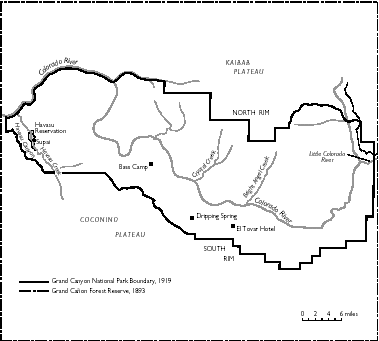
Map 3. Grand Cañon Forest Reserve, 1893
The Havasupai Problem
In the fall of 1915, Captain Jim, a member of the Havasupai tribe of northern Arizona, dispatched an urgent letter to the Commissioner of Indian Affairs. Captain Jim opened his missive by detailing the close relationship that had once existed between his people and the wildlife of the region, particularly mule deer, the area's most plentiful game animal: “A long time ago the Gods gave the deer to the Indian for himself. The women and children all like deer meat very much. The Indian men like buckskins to trade for grub, saddles, horses, saddles, blankets, and money. A long time ago … the Indians all go out on the plateau and hunt deer for two or three months and then all come back to Supai [the Havasupais' main village] to stay.” But recent changes, Captain Jim observed, had disrupted this long-standing pattern: “Now the Indians are all afraid about the hunting and never go far away. I want you to send me a hunting license and tell me good and straight that I may hunt deer. … The white man should now help the Indians by giving him permission to hunt deer as there be no trouble with the Game Wardens. … This is all.”1
In its own abbreviated way, Captain Jim's letter summed up the altered circumstances that conservation brought to many Indian peoples. It was above all a narrative of loss—of the deprivation of traditional resources; the breakdown of seasonal cycles and of customary gender roles; the undermining of belief systems—at the conclusion of which Native Americans found a bewildering array of licenses and game wardens mediating between them and the natural world. Yet, in
For Captain Jim and his people, the challenges conservation posed were especially dramatic. Two decades earlier, in 1893, the federal government had created the Grand Cañon Forest Reserve (later, Grand Canyon National Park), which encompassed the territory that the Havasupai people had long claimed as a hunting ground for game, a gathering area for wild foodstuffs, and a grazing spot for their horses. The establishment of this reserve left the tribe with a reservation completely surrounded by national forestlands, so that any effort by the Havasupai to venture outside their reservation—for hunting, the gathering of plants and firewood, the grazing of animals, or other activities—risked bringing them into conflict with the forest's new federal managers. Unsurprisingly, the Havasupai, much like the rural folk in the Adirondacks and at Yellowstone, continued their customary use of the resources now enclosed within conservation lands. But they did so now as outlaws who often had to dodge the rangers sent to enforce the reserve's regulations (as Captain Jim's reference to “trouble with the Game Wardens” reflects).
While the Havasupai may seem like an extreme example of the displacement that Indian peoples experienced with the coming of conservation, theirs was not an isolated case.2 The files of the Bureau of Indian Affairs (BIA) bulge with letters authored by Native Americans protesting the limits that game laws and forest reserves placed upon the ways in which they had previously interacted with the natural world. In 1897, for example, twenty-two Lac du Flambeau Indians in Wisconsin sent the bureau a petition protesting that when tribal members had sold their land “they were not selling the deer and game that belonged to them. … they were always to have them.” “It is not the Indians that have killed all the game and deer, it is the white men,” added the petitioners, “[yet] when they catch us killing deer or game they lock us up in jail.” In 1903, Charley Bailey, an Indian from Michigan, expressed a similar objection to the limits that game laws had placed upon natives' hunting: “I … write these few lines to request you to give me a privilege to kill the deer for my food, as the Government promised us when [it] bought our land[,]
Through such deeds, Indian peoples offered a powerful collective dissent from the official mores of conservation. Native Americans were not alone, of course, in finding their customary use rights rendered obsolete by state planners, their foraging areas reborn as parks and forest reserves, and their hunting practices and use of fire decried as environmentally destructive. Many non-Indians, such as the squatters evicted from the Adirondacks Park, could recount similar tales of dispossession. The settlers near Yellowstone were also disparaged as examples of people who engaged in the wasteful, disorderly use of the environment that conservation intended to replace. Yet of all the inhabitants of nine-teenth-century rural America, it was Indians who were the most powerless, and consequently, it was Indians whose lives were most remade by the coming of conservation. As events at Yellowstone illustrate, the movement's arrival shut off vast portions of tribal hunting and foraging areas while also inhibiting Native Americans' use of fire to shape the landscape around them. Even more strikingly, conservation interlocked on multiple levels with other, ongoing efforts—treaties, the establishment of reservations, allotment—to displace Indians' claims upon the natural world in order to open up such areas to non-Indians. In this sense, conservation was for Native Americans inextricably bound up with conquest—with a larger conflict over land and resources that predated conservation's rise. Any discussion of the consequences that conservation had for Indian peoples thus needs to take these coterminous incidents into account. From the perspective of Native Americans, conservation was but one piece of a larger process of colonization and state building in which Indian peoples were transformed (in theory, at least) from independent actors to dependent wards bound by governmental controls.4
As dramatic and wrenching as these efforts to remake Indians proved, they also remained incomplete. Despite the unequal balance of power between themselves and non-Indian society, native peoples were able through a variety of tactics to elude the controls placed on them
According to one of their stories, the Havasupai learned how to cultivate their staple agricultural crop, corn, from Coyote. Coyote planted the first kernels of the plant near the canyon creek from which the Havasupai took their name for themselves: Havsuw 'Baaja, people of the bluegreen water. (Later visitors would corrupt this term into Yavasupai, Suppai, and finally the name by which the tribe is known today, Havasupai.) But Coyote did not have enough seeds. The Havasupai, he told the tribe, could farm only part of the year. The rest of the year they would have to hunt for their food as he did.6 As a result, during the prereservation era the Havasupai lived an existence divided between intensive agriculture and extensive hunting and gathering. The farming portion of the tribe's seasonal cycle began each spring, when the Havasupai would clear and plant their fields in Havasu Canyon, a narrow tributary of the Grand Canyon, located some three thousand feet below the surrounding plateau lands. Here, on the limited land available between the steep cliffs on either side, the tribe developed a system of dams and irrigation ditches that enabled them to use Havasu Creek—one of the few sources of permanent water in the area—to nourish their crops of corn, beans, sunflowers, squash, and other plants.7
The tribe's crops typically began to mature sometime in June, and in late summer, once most of the crop was in, the Havasupai held their annual harvest festival. This celebration also marked the onset of an intensive period of trading, as the Havasupai exchanged their seasonal abundance with the members of neighboring bands: the Walapai (a closely related group with which the Havasupai frequently intermarried); the Hopi; the Mohave and the Paiute (two nearby groups with whom the Havasupai had sporadically hostile relations); and, after they began to filter into the area in the mid-1800s, the Navajo.8 Of all these trading relationships, the most crucial was with the Hopi, whose village was located several days' journey to the east. In exchange for Hopi specialties such as pottery, jewelry, and blankets and other woven goods, Havasupai women would trade baskets and the fruit of the agave cactus, as well as salt and a red paint made from minerals gathered in the Grand Canyon.
As fall arrived and the trading season drew to a close, much of the Havasupais' crop was dried and stored in granaries built into the sheer stone face of Havasu Canyon. The tribe then broke up into smaller units and spent the winter on the mesa lands above, where each family had its customary camping ground. As Big Jim, a Havasupai born sometime around 1860, recollected years later, on the plateau south of the Grand Canyon there were “certain areas that each family [had] … place[s] that they used a whole lot, known as permanent places.” Because of the aridity of the Havasupais' homeland, most of these familyuse areas centered on “tanks”—the scattered springs that for much of the year were the sole sources of water in the area and were therefore accorded special prominence in Havasupais' mental maps of the plateau. “They usually come back to [the] same destination every year where the permanent waters [are],” observed Big Jim. Added fellow tribe member Allen Akaba, born in 1881, “There is springs just all along that country. That is where the tribe used to go to stay.”10
Moving onto the plateau for the winter enabled the Havasupai to tap the annual bounty of the Coconino Forest that bordered the south rim of the canyon. Using their intimate knowledge of the local ecology, the women of the tribe would gather wild plant foods ranging from piñon nuts to the seeds of grasses such as goosefoot (Chenopodium), mutton grass (Poa fendleriana), and Indian millet (Oryzopsis hymenoides). For their part, Havasupai men engaged in extensive hunting expeditions along the south rim, especially after the first snows, which facilitated their tracking of the deer, rabbits, porcupine, antelope, and other game animals that inhabited the area. “That is when the hunting season [was] fair, during the snow,” explained Big Jim.11
Coyote's plan for the Havasupai had been a wise one, then, for such an arrangement enabled the tribe to take advantage of two different ecosystems: the first, the well-watered semitropical setting in Havasu Canyon; the second, the arid, game-rich highlands that characterized
Even the entrada of Spain into the Southwest in the sixteenth century, which was to have a major impact on groups such as the Pueblo, Hopi, and Navajo, did little to disrupt the Havasupais' annual cycle. Isolated by the fastness of their rugged canyon home, the tribe, unlike their trading partners to the east, had little direct experience of Spanish (and later, Mexican) colonialism. Instead, for the Havasupai, the Spanish presence was notable principally for the gradual diffusion of European material culture into the region—tools, plants, domestic animals, and the like. By providing a whole new array of valuable goods to be exchanged, the Spanish may, in fact, have infused new vitality into preexisting trade networks between the native peoples of the Southwest. The Havasupai soon became an important link in an eastwest trade route in which goods from New Mexico—cloth, metal, new crops, and horses and other livestock—obtained by the Hopis and other groups in close contact with the Spanish were traded from tribe to tribe, passing to the Havasupai and then to the Walapai, the Mohave, and even remoter groups. Although the Havasupai did not adopt every piece of European material culture that this trade made available, they quickly accepted peach and apricot trees, which flourished in the semitropical environment along Havasu Creek, and the horse, prized because it greatly aided the tribe's mobility while hunting, trading, or traveling between the plateau and their agricultural plots in Havasu Canyon.13
The geography that insulated the Havasupai from the impact of Spanish colonialism in the 1600s and 1700s also limited the immediate repercussions of 1848, when Mexico, the theoretical ruler of the Havasupai homeland, ceded political control of the region to the United States. However, if the first years of the American conquest of the
The pace of change accelerated in the 1880s, as the Atlantic and Pacific Railroad snaked its way across northern Arizona, opening the territory to outside settlers and markets. Miners searching for precious metals began to probe the inner recesses of the Grand Canyon, polluting the local water supply and intruding into areas that the Havasupai claimed as exclusively their own. In 1879, for instance, two miners,
W. C. Beckman and H. J. Young, located a lead-silver mining claim along Havasu Creek, just a short distance downstream from the Havasupais' summer fields.15 The Havasupai lost further territory during this time to the incipient tourist industry that began to develop along the south rim of the Grand Canyon. In 1883, a sometimes asbestos miner named John Hance constructed a log cabin on the canyon edge and advertised himself as a guide for visiting tourists. He also laid claim to a Havasupai path that led into the Grand Canyon, which he widened and renamed the Hance Trail.16 At much the same time, two brothers, Ralph and Niles Cameron, parttime prospectors and sheep ranchers, seized control of another Havasupai pathway, renamed it Bright Angel Trail, and proceeded to charge a toll to any passing tourist who wanted to take the trail into the canyon.17 Even more wrenching disruptions followed, as the diseases that miners and tourists left in their wake devastated the Havasupai. The tribe's population, which had probably hovered around 300 in the eighteenth century, dropped to 265 in 1886. By 1906, it had reached a low of 166, with a disproportionate share of the decline resulting from deaths of the tribe's women and children.18 (See Table 9.)
In enumerating the many losses that the Havasupai endured during this era, one needs to take care not to miss the other side of the story: the remarkable resilience that the tribe displayed in the face of the limited opportunities available to them. One telling example of the Havasupais' creativity amid strange new circumstances can be seen in the adaptations that the tribe members made in their mode of dress. The 1880s witnessed
| 1900 | 1910 | |||
|---|---|---|---|---|
| SOURCE: 1900 Population Census, Manuscript Schedules, Coconino County, Arizona, Roll 48, T623, Records of the Bureau of the Census, RG 29, National Archives; 1910 Population Census, Manuscript Schedules, Coconino County, Arizona, Roll 39, T624, Records of the Bureau of the Census, RG 29, National Archives. | ||||
| Women | 111 (44.4%) | 75 (43.9%) | ||
| Men | 139 (55.6%) | 96 (56.1%) | ||
| Under 15 years old | 116 (46.4%) | 50 (29.2%) | ||
| 15–45 years old | 90 (36.0%) | 90 (52.6%) | ||
| Over 45 years old | 44 (17.6%) | 31 (18.1%) | ||
| TOTAL POPULATION | 250 (100.0%) | 171 (100.0%) | ||
However, as a result of the radical changes in the region, trade no longer flowed in the same channels as before. The Navajo, Hopi, Walapai, and other groups, confined to reservations, often had fewer goods to trade than before, while the array of controls erected by the Bureau of Indian Affairs frequently hindered travel between Indian communities. Intertribal exchange still continued—as late as 1898, the travelbook writer George Wharton James could report that “every summer trading-parties of both Hopis and Navahoes come down to the [Havasupai]
In response to such shifts, during the 1880s and 1890s the Havasupai began to redirect their trade to white merchants in such newly created railroad towns as Williams, Peach Springs, and Ash Fork, where tribe members found a ready market for the deerskins, dried peaches, baskets, and other goods they had once traded with the Hopi and other Indian groups. Soon, Havasupais “go[ing] down to the railroad [to] trade for clothes and money” became a familiar sight to settlers. Observed the Arizona Journal-Miner in 1890, “[Tribe members] visit all the towns along the Atlantic and Pacific railroad, as well as Prescott, and trade with citizens of them.” Added Clarkson Thurston of Flagstaff, “[The Havasupai] manufacture and sell [many] articles—baskets, etc. They also sell deer skins, antlers, venison, arrowheads, etc., and are very shrewd in trade.” Although it is difficult to gauge the precise magnitude of this trade, it appears to have been substantial. Asked in 1893 to describe his dealings with the Havasupai, John Davis, a store owner in Williams, responded, “We buy from them skins and dried peaches and would suppose their trade with us amounts to about $500 or $600.” Other merchants in the area gave similar answers.22
With the money they received from these merchants, the Havasupai frequently purchased the manufactured goods that they had been able to procure before only through the Hopi, as well as such previously unknown luxuries as matches, coffee, sugar, and tobacco. As early as the 1880s, visitors to the tribe reported that most every family was well equipped with brass kettles and iron knives and hoes. During this same period, Havasupai men, according to Frank Hamilton Cushing, “universally possess[ed] repeating rifles of the most improved models and an abundance of ammunition,” which they used during their annual hunts on the plateau lands. Perhaps the most eloquent summary of the changes in material culture that the Havasupai experienced during this era comes from the tribal leader Navajo (so named for his killing of a Navajo Indian). Gazing around at the ample supply of manufactured goods among his people, Navajo observed to Cushing, “You know that we were a poor people; we used the flint knife, the stone axe, and in our agricultural operations we took a deer horn and a pointed stick. This day, look around you, you see the iron hoe, the pick, shovel, the knife of steel.”23
On one level, then, the Havasupais' shift from intertribal trade networks to the newly developing railroad towns of northern Arizona can be seen as an astute improvisation—a demonstration of how the tribe, in the face of United States conquest, managed to expand its trade networks in fresh directions, acquiring valuable new goods in the process. But this trade with non-Indian merchants also carried increased risks for the Havasupai, for such dealings brought the Havasupai into the cash economy—and, however peripherally, into the national market as well. In this setting, the value of trade goods could often fluctuate markedly, as the Havasupai found when preserved peaches from California pushed aside the dried peaches from the Indians' orchards, relegating them to stores that specialized in the “Mexican trade.” In the same manner, the value of Havasupai deerskins suffered when forced to compete with both commercially tanned leather and machine-woven cloth, while the red paint that tribe members had made from minerals collected in the Grand Canyon lost its value when manufactured paints became readily available in the region. Moreover, this new trade network existed outside the networks of reciprocity that had characterized the trading relationship between the Havasupai and the Hopi, where each group might support the other in times of need.24
Nevertheless, given their skill as hunters, agriculturists, and traders, the Havasupai might have been able to weather the instabilities that resulted from their insertion into the national marketplace had their resource base not been declining at the very same time. There were several reasons for this decline, most of them linked in some way to federal attempts to place the Havasupai on a reservation in Havasu Canyon. The first step in this process had taken place in 1880, when, following Havasupai protests about the intrusions of miners near their fields, President Rutherford B. Hayes issued an executive order setting aside a block of land five miles wide by twelve miles long as a reservation for the Havasupai.25 The following year, the officers in charge of mapping this new reservation, finding it nearly impossible to plot such a shape amid the jagged landscape of the Grand Canyon, “gave up all idea of marking upon the ground the boundaries as set forth in the Executive Order [creating the reservation].” Instead, after consulting “with Navajo, chief of the Yava-Suppais, as to the lands occupied or desired by him,” Lt. Carl Palfrey of the Army Corps of Engineers decided just to mark the two-mile-long segment of Havasu Canyon that contained the tribe's summer village and irrigated fields. As a result, the Havasupai found themselves the possessors of a plot some two miles long by a
Given these shortcomings, it may seem odd that, as one of the officers involved put it, “all the Supais seemed much gratified when the monuments [marking the reservation's boundaries] were erected.” And it may seem stranger still that the army erected its monuments “at points they [the Havasupai] themselves indicated,” in one instance even making the boundaries more expansive than those Navajo suggested. One should be careful, though, not to assume, as the federal government and many non-Indians in the region did, that, because the Havasupai were active participants in the laying out of their new reservation, the tribe willingly surrendered all claims to lands elsewhere. Rather, to Navajo and his people, a reservation simply represented recognition from the federal government that the Havasupai had an inalienable right to their farmland in Havasu Canyon. As the Havasupai envisioned it, their newly created reservation was to serve as a protective curtain around their crops and water, shielding them from the intrusions of miners and other newcomers. Thus, even after one of the floods that periodically swept through Havasu Canyon obliterated the stone monuments erected by the army to mark the reserve, the Indians continued to remember where the monuments had been placed and to point out their location to arriving prospectors.27 In addition, tribe members also insisted that the military, having created the reservation, preserve its integrity. Chief Navajo, for instance, asked that the army “send him an order directing white people to keep off his reservation,” complaining that “there are many miners constantly trespassing upon him; that they spoil his water and make mining locations in his country, and when he tells them it is a reservation, they pay no attention to him. He wants to have no trouble with the whites, but wishes the General to protect him.” Displaying their typical inventiveness, the Havasupai were attempting to co-opt the army and federal government, turning them into allies whom they could call upon to protect them from the disruptions of the outside world.28
While tribe members may have acquiesced to the proffered reservation because it promised to secure at least one part of their resource base against intrusions, they continued to see other places—particularly the forested plateau to the south of the Grand Canyon—as crucial to
By the late 1880s, however, the campsites that each family had once possessed on the plateau had begun to slip out of their control. Following establishment of the tribe's reservation in 1881, Euro-American ranchers began to move onto the grazing lands bordering the canyon's south rim, which they now viewed as territory to which all Indian title had been extinguished. Inevitably, the competing sets of claims put forth by these ranchers and the Havasupai gave rise to a number of conflicts, focused in particular on access to the area's limited number of water tanks. One notable clash occurred in 1888, when, according to alarmed army officers, “a party of citizens [were] ordered away by the Suppai Indians from some tanks about 60 miles north of Prescott Junction.” Navajo and some of his family members had been staying at a spot known as Black Tanks, when several cattlemen arrived, led by an individual named John Duke. The Havasupais did not initially object to Duke and his companions camping at the site. (On other occasions, members of the tribe even “rented” water holes to passing non-Indians for small sums of money.) But when the men “commenced to build a corral for the purpose of driving in cattle, [the Havasupai] considered that an infringement upon their rights and ordered the citizens away.” Interviewed shortly afterward by army officials, who questioned the Havasupais' claim to a water hole some thirty-five miles off their reservation, Navajo invoked both custom and utility to defend his position. He told the officers that “for many years he had camped at the black tanks and hunted in that locality, that if the white[s] drove in cattle they would drive the game away, and the cattle would drink up the water, which lasts but a short time.” The investigating officer professed sympathy for Navajo's plight, but “explained to him that he had no right to the tanks or to the country outside of his reservation.” With no outside
Similar conflicts soon followed. In 1890, for example, a nearly identical scenario unfolded involving Captain Tom, a Havasupai who had long camped at Rain Tank, one of the few water holes along the trail to the Hopi villages to the east. No doubt hoping to give the impression of a more permanent Indian presence at Rain Tank, Captain Tom had begun to build himself a log cabin at the tank and had enlarged the basin around the spring so that it would hold more water for his horses. Yet during one of Captain Tom's periodic absences, “a party by the name of E. Randolph set up a claim to the place and took the logs from the uncompleted house and built one for himself.” “Intimidat[ing] the Indians with threats,” Randolph set about establishing a sheep ranch on the location. In response, Captain Tom and some of his friends went to Flagstaff to demand that the authorities remove Randolph. But as the tank was not on the Havasupai reservation, Captain Tom “met with but little encouragement from any source.” He, like Navajo, lost his site on the south rim.31
Given such incidents, it should not prove surprising that when late nineteenth-century visitors queried the Havasupai about their conditions, the Indians' first complaint was of “the constant persecution of cattle men on the mesa.”32 Reported an army officer who encountered the band during the winter of 1890, “[The Indians said that] as long as they could remember the custom had been to cultivate the land during the summer in Cataract [Havasu] Canyon, and in the winter to hunt on the high mesa lands. … Now all the game in the country had been killed off and white men were driving in cattle and taking all the water. Their hereditary winter camp at Black Tanks had been taken from them two years ago. In a little while all the water would be taken up and the Indians would have no place to go.”33 In their own accounts of past events, the Havasupai preserved a palpable sense of outrage over what they viewed as their unjust displacement from their customary spots on the plateau. As Allen Akaba recalled, “They [the Havasupai] gave up their place on top due to white settlers, homesteaders, cattle owners, would come in here and the Indian would have a spring back in the hills, the cattle owner would come along, he would water his stock where the Indians were. He would stay along with them; told them later on that this spring water hole was his. The Indian had nothing to do
What made the arrival of cattle and sheep ranchers on the plateau all the more disturbing for the Havasupai was the fact that the outsiders' livestock usurped much of the water and browse that would have otherwise supported the deer, antelope, and other animals that the Havasupai customarily hunted on the south rim.35 In the face of such competition, the game population plummeted. Observed one Arizona legislator, C. C. Bean, to the Commissioner of Indian Affairs in 1885, “The introduction of herds of cattle and flocks of sheep, of miners, prospectors and tourists have all combined to render [the Havasupais'] vast hunting ground useless.”36 Not only did the loss of game mean less meat for tribe members, it also meant fewer deerskins to trade for supplies. According to W. W. Bass, a rancher and touristcamp owner who sometimes hired Havasupai Indians as guides or packers, “Game is so scarce that their [the Havasupais'] supply of meat has become a serious consideration, while Buckskin which was their source of revenue has become so scarce that they cannot procure enough to use for Mockazins [sic], while formerly it was traded to other tribes for blankets.”37 No longer did the Havasupai “have buckskins that could be traded to the Moquis [Hopi] for seeds or sold for cash,” wrote another observer at much the same time. What meat the tribe did consume appears to have come from marginal sources. Visitors to the tribe in 1890, for example, reported that instead of dining on deer or antelope, the Indians were eating “rats and mountain squirrels which they dig from their dens.” The following winter, others noted that because of the scarcity of game, the Havasupai were “killing and eating their horses and burros.”38
By the early 1890s, the dire circumstances in which the Havasupai found themselves had attracted the attention of the Bureau of Indian Affairs, the federal bureau within the Department of the Interior that was the tribe's theoretical protector. But rather than restoring the Indians' hunting grounds as the tribe itself urged (and as several army officers sent to investigate the condition of the Havasupai suggested), the BIA proposed that the tribe's salvation lay in their becoming intensive agriculturists.
Gaddis's attempts to teach the Havasupai to be yeoman farmers met with only limited success. No doubt feeling that they already knew how to plant crops, tribe members often proved resistant to Gaddis's earnest efforts to enlighten them. “The introduction of the plow did not meet with as much approval as I had anticipated,” he wrote to his superiors in 1892. “They were slow to catch on, they still cling on to their former ways.” While tribe members readily accepted the “variety of fruit trees and vines which were supplied them by the Government,” using these plants to expand their already substantial orchards of peaches and apricots, they demonstrated much less enthusiasm for the goats that the BIA insisted they adopt as a substitute for wild game. “They will not have them [the goats] nor will they look after them,” complained Gaddis. “I left them in charge of an Indian when I left before. He paid no attention to them but let the dogs kill several and scatter them all over the cañon.”40
While the Bureau of Indian Affairs interpreted such opposition to its policies as stubborn backwardness, this behavior likely had more to do with tribe members' belief that agriculture alone was not an adequate replacement for their traditional seasonal cycle. With flash floods a fact of life in Havasu Canyon, it made little sense for the Havasupai to devote all their energies to cultivating crops that might be destroyed at any time—indeed, in 1898 “their crops were nearly all washed away” as a result of “disastrous floods.” In addition, radically expanding the amount of lands that they planted, as Gaddis urged, meant that the tribe would have to sacrifice the brushlands bordering their village—which, given the small size of the Havasupais' reservation, served as
Instead of becoming totally dependent on agriculture as the BIA advocated, the Havasupai adopted a modified seasonal cycle of their own devising. Each fall, even though many of their old camping sites had been taken up by settlers and large game was increasingly scarce, tribe members returned to the plateau south of the Grand Canyon. Here in the Coconino Forest there were smaller game animals, such as rabbits, in relative abundance. Here, too, were also ranchers' cattle, which the Havasupai may have clandestinely killed from time to time as a substitute for the deer and antelope they had once hunted. (Recalled tribe member Mack Putesoy, “Too many cattle, no more game. So sometimes we'd have to get a big steer.”) Moreover, the plateau possessed thick growths of junipers and piñons, which furnished the tribe with plentiful firewood, and grass, which served as pasture for the Havasupais' horses. In the absence of water holes, drinking water could be supplied by melting snow.42
To supplement this annual cycle, many Havasupai men turned to seasonal wage labor. Finding work at nearby ranches, mines, or along the railroad, the men would typically work just long enough to buy whatever supplies their families needed to tide them over until the fall harvest—at which point they would quit and return to their reservation. “The Havasupai are good workers, and are eagerly sought after by surrounding ranchmen,” declared one BIA employee, “but their love for their canyon home prevents their remaining away very long at a time.” As Mark Hanna, whose own experiences with wage labor varied from herding cattle to picking crops to washing dishes at one of the hotels that sprung up on the south rim of the canyon during the late 1800s, explained, “I never stayed out too long. I always came back and checked if my mother was out of food or wood and helped in the garden.” Wage labor thus functioned as only a partial insertion into the cash-based economy of the outside world, not so much dissolving the Havasupais' communal obligations and preexisting seasonal cycle as reworking and reinforcing them.43
Despite such adaptations, Havasupai society remained under great stress during this period. Game was scarce, most families had lost their water holes on the plateau, disease had ravaged the tribe. White ranchers
It was at this moment, as the Ghost Dance movement was reaching its high-water mark with the Havasupai, that the tribe found itself confronted by what would prove to be its greatest challenge since the army's efforts to place them on a reservation in 1881: an executive order issued on February 20, 1893, by President Benjamin Harrison, setting aside the Grand Cañon Forest Reserve. This newly created reserve—a rectangular block straddling both sides of the Colorado River and containing some 1,850,000 acres—took in not only the Havasupais' hunting and grazing lands on the plateau but all the territory for miles in every direction from the tribe's reservation, leaving the village in Havasu Canyon a solitary island in a sea of conservation land. Although the Havasupai did not realize it at the time, their struggles for their foraging sites and water holes on the plateau to the south of the Grand Canyon had been thrust into a new context, one in which their opponent was not the scattered ranchers and tourist-camp owners along the south rim but their nominal protector: the federal government.47
The forest reserve that Harrison established at the Grand Canyon in 1893 was one of seven forest reserves that the president created that year alone. All were part of a dramatic expansion in federal conservation policy that took place following the passage of what has come to be known as the Forest Reserve Act of 1891. Motivated largely by the example of the Adirondack Forest Preserve and George Perkins Marsh's predictions about the negative impact of forest destruction on water
Like their predecessors in the Adirondacks, the administrators of the federal forest reserve system invoked conservation's degradation discourse to predict that rural folk would irredeemably damage the environment if left unchecked by government regulations. At times, this discourse focused on Native Americans, with some conservationists echoing John Wesley Powell's warnings about the need to control Indians' use of fire.49 As an agent for the General Land Office asserted in an early study of the Grand Canyon, “Indians should be rigidly excluded from the Cañon country … being reckless of fire, they destroy large bodies of timber and slaughter game by the wholesale.”50 But when groups such as the American Forestry Association began the campaign for federally protected woodlands in the 1880s, their chief concern was
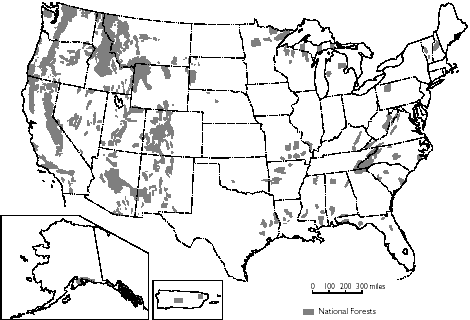
Map 4. National Forests, 1936
To Hough, Sparks, and other early conservationists, such appropriations were not only illegal, they nurtured a worrisome set of values. In the absence of governmental oversight, many rural Americans had, it seemed, formulated their own, deviant interpretation of property rights. “Depredations [upon the public lands] have been going on through a long period of years …, until the practice has gained from long indulgence the semblance of a right,” warned a special investigating committee of the American Association for the Advancement of Science in 1882. “Criminal practice” had become “sanctioned by custom.” Garden and Forest took a similar stance: “The frontiersman has become so
The “unstable and transient” lower classes were not the only group to find their environmental practices under assault at this time. Conservationists also focused their ire on the threat from above—the “unscrupulous companies, composed of men of wealth and influence …, [that] seek by every means known to such combinations to thwart the efforts of the Government.” Along with other Progressive Era reformers, conservationists stressed the need to rein in reckless monopolies and eliminate unethical business practices. The ultimate goal of conservation, however, remained not the elimination of industrial capitalism but its reformation. “The first principle of conservation,” emphasized Gifford Pinchot in 1910, “is development. … [Conservation] proposes to secure a continuous and abundant supply of the necessaries of life, which means a reasonable cost of living and business stability.” Industry often welcomed the coming of conservation for these very reasons. From the perspective of many large businesses, conservation meant predictability. The movement regularized the supply of materials and maintained conditions such as water flow that were vital to downstream navigation, mills, and irrigation projects. Many corporations discovered that their goals meshed well with those of government planners, for both shared a concern with limiting inefficient uses of the environment.55
At the Grand Canyon, this close relationship between forestry officials and business interests began to take shape not long after the forest reserve's creation in 1893. By the early twentieth century, the canyon's new federal managers had reached a series of accommodations with the local mining, railroad, and lumber companies that allowed these businesses access to the reserve's natural resources. In 1901, for example,
Left outside of the Forest Service's plans were groups such as the Havasupai, whose uses of the environment seldom met conservationists' definitions of productive or efficient. Indeed, to administrators attempting to institute a system of governmental controls over the Grand Canyon landscape, the presence of a group of transient Indians like the Havasupai was at best a reminder of a vanishing era and at worst an ongoing menace to official efforts to manage the canyon in a rational manner. The Havasupai, of course, did not view matters in quite the same light. Having managed to preserve a presence on the plateau to the south of the Grand Canyon despite the encroachments of ranchers, tourist-camp operators, and the Bureau of Indian Affairs, tribe members regarded this territory as still rightfully theirs. The Havasupai were not about to abandon their lands on the canyon's rim simply to accommodate the new vision of nature put forth by conservationists.
Farewell Song
History does not record how or when the Havasupai became aware of the existence of a forest reserve at the Grand Canyon. Perhaps they first learned of the reserve's creation in April of 1894, when federal administrators, upset by the numerous attempts that had been made “to secure right of entrance, occupancy and use of tracts of public land embraced in forest reservations,” posted signs printed on linen cloth at reserves throughout the West, detailing the new reserves' prohibitions against the setting of fires, the cutting of trees, and the grazing of livestock. Any violators of these rules, the signs cautioned, would be “prosecuted for trespass, and will be held responsible pecuniarily, for any waste or damage, whether done intentionally or caused by neglect.”1 At many reserves, irate locals tore down these newly erected signs (a gesture that officials deemed “indicative of the spirit of lawlessness prevailing among those depredating upon these lands”), but whether the Havasupai acted in such a manner is uncertain. Most likely, given the fact that most of the Havasupai could not read English at the time, these signs did not mean much to them, although the sudden posting of linen squares on trees throughout the plateau to the south of the canyon must have signaled to tribe members that something peculiar was afoot.2
What exactly this something was, however, may have remained unclear to the Havasupai for some time. During the forest reserves' early years, posting warnings was about all that the reserves' nominal manager—the General Land Office (GLO), the branch of the Department of
As a solution, outraged conservationists and federal administrators proposed that the militarized conservation already enacted at Yellowstone and the other national parks be expanded to the forest reserves. “Unless the reservations are protected by detachments from the army, as has been done in the Yellowstone Park[,] … there is no way to save them from the depredations of thieves or the still more sweeping desolation by fire,” asserted Garden and Forest, perhaps the era's leading advocate of enlarging the military role in conservation.4 The viability of the forest reserves, according to the magazine, could be ensured only by “the presence of the visible power of the Federal Government”: “These forests would be safer under the control of the army than under any other administration. As matters now stand, the army is the only force that will be likely to represent with any firmness the dignity of the nation against local interest, and against the right which herders and lumbermen, and, in fact, settlers of all kinds, feel they have acquired by long usage, to cut or pasture or burn over the woods on the public lands as it may seem for their profit or pleasure to do so.”5 These themes were echoed by Robert Underwood Johnson, the editor of Century magazine and an early associate of Muir and Pinchot. In a series of influential editorials, Johnson linked the defense of the forest reserves with the defense of the nation itself: “There is in time of peace no other work of national defense or protection so valuable as this which the army can perform, and … the national forests cannot be adequately guarded and protected by any other means.”6 But even after the assistant commissioner of the GLO, Edward Bowers, made a formal appeal to the secretary
As a result, the forest reserves languished in an administrative vacuum during their early years. As the commissioner of the GLO observed in his annual report of 1896, “Forest reservations have been made which are such in name only. For lack of means they are no more protected by reason of reservation than other public lands.” Capitalizing upon their knowledge of the rural landscape, many locals found it a simple matter to hide their activities from the GLO's special agents during the agents' rare trips to their jurisdictions. At other times, such guile may not even have been necessary. The Havasupai, for example, did not learn for several years that their annual trips to the plateau involved any violation of reserve regulations: the tribe's use of the lands within the reserve occurred primarily in the winter, when the GLO's agents, because of the region's heavy snows and the difficulties of transportation, were seldom present. Thus, the same year that the Grand Cañon Forest Reserve was created, the BIA's instructional farmer at the reservation, John Gaddis, could report that his charges were making much the same use of the lands within the reserve as they always had: “There was [sic] very few Indians that spent the winter in the Cañon. They most all went on a hunt.” This pattern held in later years as well. Despite the fact that their activities on the plateau to the south of the Grand Canyon were illegal according to the GLO's regulations, the Havasupai went untroubled by federal officials for several winters. Nor were the Havasupai the only rule breakers within the Grand Canyon reserve during this period. On the mesas to the south and north of the canyon, both white ranchers and Navajo Indians could be found hunting, grazing livestock, and kindling fires.8
As ineffective as the early forest reserves often were, their creation nonetheless reconfigured property rights throughout much of the American countryside. In accordance with conservation's logic of placing natural resources under scientific management, the Forest Reserve Act stripped away any competing local claims to the lands within the reserves. Only those individuals who had already filed a homestead entry on property enclosed within a forest reservation would be allowed to remain within the reserve. Explained the GLO's commissioner in 1893, “Persons who established residence on land within the reserve prior to
In theory, such policies were race blind. In actual practice, however, they posed a special barrier for the Havasupai, who, like many other Indian peoples, were unfamiliar with English and the United States legal code and based their land claims on tribal custom rather than American law. Under such conditions, the establishment of a forest reserve at the Grand Canyon reinforced the Havasupais' displacement from their traditional hunting and gathering areas on the south rim. Previously, the Havasupais' use of the lands along the canyon's edge had been problematic only when it conflicted with the undertakings of ranchers and tourist-camp operators. Now tribe members had become “squatters” whose very presence on the plateau was being called into question. Initially, of course, this change existed solely on paper, for the federal government lacked the ability to turn its vision for the forest reserves into a reality. But the stage had been set for a confrontation pitting conservationists and the Havasupai against one another. All that was needed was for the federal government to attempt to enforce its newly created conservation policy.10
The first step in this direction came in 1897. After years of pleading, the GLO finally obtained—via Congress's passage of the Forest Management Act—the funding necessary “to inaugurate a practical scheme of administration” for the forest reservations. The agency quickly set about creating a corps of forest rangers, whose primary duty, following the pattern established by the army at Yellowstone, was “to patrol the reserves, to prevent forest fires and trespasses from all sources.” Other tasks allotted to the rangers included marking the reserves' boundaries, cutting firebreaks, and, to speed official travel through the forests, building trails. To oversee these activities, the GLO installed several layers of managers. Rangers reported to forest supervisors, each of whom had a specific reserve under his care. Supervisors, in turn, reported to regional superintendents, who were responsible for a number of forest reserves, often across several states. These forces expanded rapidly, so that by 1900 the GLO had 445 rangers, 39 supervisors, and 9 superintendents working in forest reserves nationwide.11
The first force of rangers at the Grand Canyon arrived in August 1898, when the newly appointed forest supervisor, W. P. Hermann, hired five men “to reside in forests at danger points to prevent fires and trespass.” These rangers were to make regular patrols of the Grand Cañon Forest Reserve and “report upon all squatters, or other parties occupying or using lands therein without right or title,” so that the reserve could “be cleared of all parties intruding thereon unlawfully.”12 In the course of fulfilling their duties, the rangers stumbled across the Havasupai, triggering the first of many complaints about the tribe's behavior within the forest reserve. The initial confrontation came in the fall as the Havasupai began to leave their village in Havasu Canyon and move out onto the plateau to gather plants and hunt wild game as they had for generations. In November 1898, Supervisor Hermann informed his superiors that bands of “Supai Indians” were pursuing “the very few beautiful and agile antelope and deer, yet proudly roaming in the Coconino forest.” Not only were these Indians violating Arizona's game law (which in 1897 barred all Indians from hunting off their reservation), in Hermann's eyes, they were acting in a wasteful, deliberately provocative manner: “It is principally to obtain the hides for the tanning of buckskin, that the Indians kill these noble animals, and then trade the buckskin to the Moqui and Navajo Indians for blankets & c., and to the town Merchants for clothing & c. The Indians boast and threaten to kill the deer and antelope, so long as the ‘Government does not supply them with cow meat.’” Moreover, Hermann asserted, the Havasupai disturbed the scenic beauty that the forest reserve sought to protect: “The Grand Cañon of the Colorado River is becoming so renowned for its wonderful and extensive natural gorge scenery and for its open clean pine woods, that it should be preserved for the everlasting pleasure and instruction of our intelligent citizens as well as those of foreign countries. Henceforth, I deem it just and necessary to keep the wild and unappreciable Indian from off the Reserve and protect the game.”13
To achieve these aims, Hermann instituted a ban against not only the Havasupais' winter hunting and gathering expeditions but also any travel by tribe members through the forest for whatever purpose, “even … to get from his little reservation in the cañon to the railroad or anywhere else.” Since the forest reserve completely surrounded the Havasupai Indian Reservation, this edict in effect made it illegal for tribe members to set foot off their reservation. As a committee investigating conditions among the tribe concluded in 1902, “The authorities in
While Hermann's policies may seem extreme, they were in no way unique. The ban on Indians at the Grand Canyon was paralleled at many other forest reserves—from Washington State, where administrators complained that the Yakima and Klickitat Indians “roam about [Ranier Forest Reserve] with large bands of horses, setting fires for amusement”; to Oregon, where GLO agents were attempting to keep Indians from the Warm Spring Agency off the Cascade Forest Reserve; to New Mexico, where officials grumbled that hunters and herders from the Navajo and White Mountain Apache agencies were “slaughtering game and causing fires” in the Gila River Forest Reserve.15 As the administrators at these and other reserves discovered, it was a simple enough matter to order “the wild and unappreciable Indian … off the Reserve.” But enforcing this policy upon a group of people with powerful incentives to act otherwise—and often with a much more thorough knowledge of the reserves than the officials involved—was much harder. Administrators were further hindered by the fact that, despite the seemingly impressive set of state agencies arrayed against Indian peoples, these agencies were often fractured among themselves, each lacking the power to act independently. The responsibility for dealing with the Havasupai at the Grand Canyon, for instance, was spread across several offices. While the GLO (and later the Forest and Park Services) had authority over the Grand Canyon and other forest reserves, jurisdiction over Indian peoples rested in another office, the BIA. Moreover, the game law that prevailed at the Grand Canyon for much of the late nineteenth and early twentieth centuries was not a federal statute at all, but a measure passed by the Arizona legislature, which the territory's game wardens were supposed to enforce. There were attempts to coordinate efforts between these various groups—the GLO, for example, regularly communicated with state game agencies and distributed maps of the various forest reserves, along with pamphlets detailing its forestry regulations, to all Indian agents—but bureaucratic divisions remained, which the Havasupai and other tribes often exploited to their benefit.16
Many Indians realized that the figure most susceptible to their pressure was the Indian agent, who occupied a rather ambivalent position as both the defender of his or her Native American wards and the enforcer of governmental programs designed to extirpate native customs. Since the agents' chief concerns typically involved enrolling their charges in schools and other training programs, they often felt little inclination to squander their energies on a rigorous enforcement of the GLO's unpopular rules against off-reservation travel and hunting. In addition, one measure of success for agents was their ability to keep the distribution of food rations to a minimum—a goal that competed with the efforts of the GLO to end Indian taking of game. As a result of such tensions, a number of agents appear to have been willing to tolerate a certain level of violations of conservation laws, so long as their charges were not blatant in their lawbreaking. Flora Gregg Iliff, the superintendent on the Havasupai reservation in the early 1900s, for instance, refused to report the Indians she encountered hauling home deer poached in the forest reserve—a stance which earned her the scorn of the rangers at the Grand Canyon, who informed her, “You permit the Indians to kill deer out of season.”17 The Havasupais' agent during the 1890s, Henry P. Ewing, also took few steps to prevent the tribe's annual winter journey to the plateau. Just months after receiving orders to “prevent, as far as possible, Indians under your charge from causing forest fires and unlawfully killing game upon the various forest reservations in the neighborhood of your agency,” Ewing admitted that “during January the Supais have been out of their cañon home, upon the mesas, hunting nuts, fruits, and other means of subsistence.”18 Unamused forest reserve managers responded with a chorus of angry letters to the BIA: “Forest Superintendent Isaac B. Hanna … reports that the Grand Cañon Forest Reserve in Arizona is overrun with Suppai Indians who kill game and start forest fires”; “a great many of the Suppai Indians have entered the said reserve with their horses. … they are slaughtering the deer, killing not only the bucks but the does”; “The Indian claims the deer as his ‘cows’ and his property and not the property of the white man.” To prevent such developments from spiraling out of control, forestry officials demanded that the BIA's orders “that certain Indians be prevented from entering the Grand Cañon Forest Reserve” be strictly enforced.19
As similar complaints flowed into the Bureau of Indian Affairs from forest reserves throughout the West, the BIA did indeed take an
Yet neither agency had much success in making the Indians perform in accordance with this agreed-on script. Ewing stopped issuing passes to the Havasupai for travel off the reservation and endeavored to make regular counts of his charges in an effort to make sure that none had slipped away, but the tribe still persisted in making its annual winter journey to the forest reserve. As J. S. Perkins, Ewing's replacement as Indian agent, acknowledged in 1904, “The Havasupais hunt in the winter and get a great deal of deer meat in that way.”23 A BIA employee sent to investigate conditions on the reservation the following year issued a similar report. Tribe members, the inspector declared, were continuing to go into the “forest reserve, hunting and visiting,” despite the protests
As it became increasingly apparent that simply ordering the Havasupai off the forest reserve was having little effect, several administrators decided there might be an easier solution: recognizing the Havasupais' presence while at the same time placing limits on its extent. The Indian agents at the Havasupai reservation, for example, arranged for an unusual two-month school vacation during the winter, timed so as to coincide with the tribe's journey to the plateau. Observed the BIA's inspector in 1905, “It has heretofore been the custom to discontinue the school for two months in the fall and winter season and thus permitting all … to leave the canyon and go where they chose over and through the vast forest reserve.” After assuming control of the reserve in 1907, the Forest Service set aside some 75,000 acres on the south rim for the Havasupai, located near the trail leading down to their summer village in Havasu Canyon. Technically, this area, known among the rangers as Indian Pasture, was to be a grazing area for the tribe's livestock, but it became a de facto winter camping ground, within which forestry officials tolerated the Havasupais' constructing of hoganlike shelters out of logs and dirt, cutting of trees for firewood, and setting of fires for cooking and warmth.25
Such an arrangement could be interpreted as evidence that the Havasupai had finally won a victory in their battle against conservation. But the situation at Indian Pasture represented not so much a triumph as a temporary truce—one in which the tribe agreed to become short-term renters with “no right[s] excepting some grazing permits” on lands that had once been theirs.26 Under these conditions, the Havasupais' position on the plateau was virtually identical to that of the non-Indian ranchers whom the Forest Service, in a break with the GLO's previous policies, allowed to graze a specified number of animals within the forest reserve. Moreover, as the Forest Service's grazing permits were good for only twelve months, the Havasupai had to renegotiate their rights to Indian Pasture every year. Access to this grazing area could, as one of the tribe's later permits read, “be terminated at any time at the discretion of the Director,” making it unclear, in the words of one BIA official, “how permanent the present arrangement as to this land is.”27 In fact, the Forest Service did upon occasion open up the Havasupais' area to
The decision by the Havasupai to graze livestock on the plateau marked an important shift in tribal subsistence for other reasons as well. Although the Havasupai had been exposed to European livestock for generations, even as late as the 1880s and 1890s, tribe members had kept horses and burros almost exclusively. “Those years they don't have no cattle; just one or two horses each family,” remembered one Havasupai, Big Jim. Beginning sometime in the early 1900s, however, a few of the tribe members who had found temporary wage work on nearby ranches brought back cattle with them to the reservation. Together with “a pretty scrubby lot” of cows that other tribe members “traded for and purchased from the Navajos,” these animals became the nucleus of a Havasupai cattle herd, which by 1918 numbered about eighty head. This incipient herd represented what was, in essence, an effort by the Havasupai to privatize the animal supply upon the plateau. Cattle were a key element of this strategy, for in contrast with deer and other wild animals, whose ownership under U.S. law was established only once someone killed them, steer belonged to specific individuals. By adopting domestic livestock, then, the Havasupai were in essence repopulating the plateau with grazing animals—but, this time, with animals to which they would have clear rights of ownership. It is possible that tribe members once thought about the deer, antelope, mountain sheep, and other creatures that roamed the south plateau in similarly proprietary terms (such a belief might help explain the complaints of GLO administrators that “the Indian claims the deer as his ‘cows’”). But this sense of ownership had meant little to forestry officials, who persisted in viewing Havasupai hunting as poaching. Such misunderstandings were less likely to occur if tribe members substituted domestic cattle into the niche once occupied by wild game.29
Yet as ingenious a solution as cattle raising was to some of the limits that conservation had placed on the Havasupai, it nonetheless possessed certain drawbacks. Most immediately, cattle were more environmentally destructive than deer, for they ate several of the plants from which female tribe members had traditionally gathered seeds.30 Thus, by stocking the plateau with cattle, the Havasupai were increasing their
For such reasons, cattle raising represented an incomplete solution to the challenges confronting the Havasupai, one that did not totally replace other, preestablished ways of interacting with the environment. Even as the Grand Canyon went through a flurry of administrative changes—it became a federal game reserve in 1906, was declared a national monument in 1908, and, in 1919, was made a national park and placed under the management of the newly created Park Service—the Havasupai clung to their customary uses of the plateau to the south of the canyon. Tribe members, for instance, gathered piñon nuts—one of the few foodstuffs unaffected by the expansion of cattle raising—well into the 1920s. Reported the agent to the Havasupai in 1921, “All the Indians are now on the flats, some being away from the reservation as far as Flagstaff, Arizona, which is 80 to 100 miles from this village. All of those Indians are picking piñons.” Although the supply of these nuts varied from year to year, in good years, rangers observed large numbers of Havasupai “squaws” in Grand Canyon National Park, each gathering several hundred pounds of piñon nuts, which they stored in cast-off flour sacks. During this time, tribe members also continued to harvest the agave cactus, which they would prepare by roasting for several hours in a deep, rock-lined pit.32
While rangers seem to have tolerated the tribe's gathering of wild plants, they were much less accommodating of other aspects of Havasupai subsistence, particularly male tribe members' persistent hunting of deer, which conflicted with official plans to turn the Grand Canyon into a game preserve. By 1908 “hunting, trapping, killing, or capturing of game animals” within the forest reserve had become a crime punishable by a fine of one thousand dollars or a year in prison.33 Nevertheless, the Havasupai, declared the tribe's agent, “pay no heed to the existing Game Law and go on continually killing all those animals which the Government is trying so hard to protect. Since being stationed here 3 cases of deer killing upon the mesa has [sic] come under my observation. Those deer were either killed in the Park forest or adjacent to the same and out of season. After the killing the Indian or Indians bring the
To elude such surveillance, the Havasupai relied upon their encyclopedic knowledge of their home territory—its topography and vegetation, its game trails and hiding places—acquired through generations of inhabiting the area. They may have also reworked certain traditions to fit the tribe's altered circumstances. Male tribe members, for instance, likely revived several hunting techniques that predated the tribe's adoption of firearms, since traditional devices such as snares and clubs enabled the Havasupai to kill rabbits, birds, and other small game without making the noise that would have attracted the unwanted attention of rangers. On other occasions, the tribe adopted new practices designed to hide all evidence of wrongdoing from prying rangers. Hunters never kept wild game or buckskins in camp, for example, but instead secreted such goods in a secluded location nearby. Once the winter snows arrived, tribe members often placed hides or meat under the snow, then wiped away any tracks leading to the spot; any bones or other remains from the butchering process that the Havasupais' dogs did not eat were quickly buried as well.37
The Havasupais' efforts at eluding the park's rangers were facilitated by the highly stratified form that conservation assumed at the canyon. Unlike either the Adirondacks or Yellowstone, where conservation officials found their most effective enforcers to be local people hired as wardens or scouts, administrators at the Grand Canyon never sought to
With few go-betweens to mediate conservation's impact, the Havasupai found their environmental practices subjected to an especially radical program of state simplification at the turn of the century. The new regulations at the canyon wreaked havoc on several facets of Havasupai subsistence. Firewood, for instance, had long been scarce in Havasu Canyon. Many of the trees that grew in the canyon's moister climate, such as the willow and the cottonwood, while suitable for making baskets or fence poles, burned poorly. The Coconino Forest on the plateau above, however, abounded with piñon, ponderosa pine, and juniper, all of which burned well. For this reason, the Havasupai had traditionally located their winter camps in thick stands of these trees, which provided both firewood and protection against the wind. Since bringing an entire season's supply of fuel down the steep, fourteen-mile trail from the mesa to Havasu Canyon was impractical—if not impossible—the Havasupai, even after the coming of conservation, tried to spend part of each winter on the plateau above their reservation. As one tribe member, Billy Burro, explained, “They are up here because there is a shortage of wood in Supai. … In the summertime when wood is not needed very much they would drift back into Supai and do their gardening.”38
Like firewood, meat was another subsistence item whose supply was disrupted by the creation of the Grand Cañon Forest Reserve. If records from 1896 (the last year it was legal for tribe members to hunt) are any indication, the Havasupai typically killed more than three hundred deer on the plateau each winter. Although male tribe members continued to hunt game after 1896, the secrecy poaching demanded
To this defense, Chickapanyegi appended a few revealing lines: “Indians, deer, here first. White man no here. Now white man make law.”41 This issue of prior right doubtless underlay much of the Havasupais' critique of federal conservation policy. From the tribe members' perspective, there was something capricious about the establishment of the Grand Cañon Forest Reserve and the ensuing conversion of long-standing tribal customs into crimes. Moreover, the rationale that conservationists put forth for implementing this stringent new set of rules over the landscape must have appeared misguided to the Havasupai. After all, it was not the region's Indian peoples who caused the collapse of the wildlife population during the 1890s. Nor was it Indian peoples who brought about the environmentally devastating overpopulation of deer on the Kaibab Plateau north of the Grand Canyon in the 1920s, which took place after the Forest Service forbade Indians to hunt and exterminated the wolves and cougars that had been the deer's natural predators.42 Yet Native American groups bore the brunt of the state's new environmental regulations. Many of Arizona's game laws, for instance, were targeted specifically at Indians' hunting. Similarly, the GLO had taken special efforts to limit travel by Native Americans through the forest reserves.43
To the Havasupai, the message behind such measures was simple: conservationists believed them to be irresponsible and immature. As
The issue of prior right may have animated Havasupai lawbreaking in the forest reserve for another reason as well. For the Havasupai, property rights depended on the use of the goods one claimed. Thus, had the Havasupai failed to return to their traditional wintering places on the plateau or to hunt the local mule deer, they would have considered themselves to be relinquishing their title to these items. On the other hand, by continuing to use the plateau, the Havasupai saw themselves as strengthening their claim to the south rim's water tanks and hunting grounds.45
The Havasupais' opposition to conservation, however, extended beyond these material bases. To the Havasupai, their environmental practices were fundamental to the structure of their culture. An activity such as hunting, for example, was embedded in a number of rites essential to one's journey to manhood. A Havasupai father with an infant son would run early every morning for a month so that his child might grow up to be a swift and tireless hunter. Once the boy was a few years older, male elders would teach him that to be successful in the chase he needed to exercise every morning and to keep himself clean. Explained a Havasupai named Sinyella, “When you wash, your sight will be sharp, then you can see the game—rabbits lying under the bushes, or deer visible only through an opening in the trees. If you do not wash every morning, you will miss seeing a deer, even though he stands close to you; he will scare you when he bounds off.” The killing of a boy's first deer marked
To hunt was also to bring the natural and the supernatural into proper alignment with one another. The Havasupai had a number of game shamans whose task it was the night before a hunting expedition to sing special songs to quiet the deer and to express the hunters' sorrow for having to kill the animals. The typical song was described by one Havasupai as follows: “So this man, when he's ready to go, this is just like praying, he sing this, then go out and kill deer. If he don't kill deer in four days, he'll sing it again, then go out and get meat for relatives.… Someplace in the song he talking to the deer—not just the deer; the trees, rocks, air, everything—he tell them not to turn the deer wild. Just stand still, lay down so he could come close, shoot the deer, kill him with bow and arrow.”47 Other songs asked the sun, who was thought to be the source of deer and other game, permission to kill some of his animals: “Sun, my relative/look at us/that is why I am here/you should give us/your domestic animals/let us see them quickly/we want to kill some.” Besides such songs, a hunter's success also depended on a number of rites, such as the burning of deer droppings and marking one's face with the ashes, as well as on the visions that occasionally came in dreams.48
In much the same manner, Havasupai women took great pride in their vast knowledge of the local plant ecology. These skills allowed them to gather the foodstuffs and medicinal plants on which their families depended, and mothers seem to have taken special care to pass their expertise on to their children. “My mother told me a lot of sweet things to find to eat that grow around here,” explained Mark Hanna. “She told me where to find them. I learned a lot about where things grow from my mother.”49
Given this context, to insist that the Havasupai stop their hunting, gathering, and other subsistence activities in the Coconino Forest was, in essence, to insist that the tribe abandon many of the cultural forms that composed the backbone of daily existence. Much of an individual's identity—as male, as female, as a member of the Havasupai tribe—was linked to how they interacted with the landscape around them. And so,
Of all the many changes that conservation brought in the opening decades of the twentieth century, the most significant for the Havasupai was the creation of the Grand Canyon National Park in 1919. The Park Service's arrival at the canyon signaled a marked shift in the Havasupais' ability to hunt and gather within the reserve. If never able to completely halt such illegal activities, the Park Service, with the expanded force of rangers at its disposal, did make the Havasupais' covert uses of the plateau more difficult to pursue than before.50 Just as important, the establishment of a park at the Grand Canyon marked the onset of a determined federal effort to open the region to large-scale tourism. Park officials drew up plans for a village to be built on the south rim, surrounding the El Tovar, the fashionable hotel that the Atchison, Topeka, and Santa Fe Railroad had constructed near the canyon's edge in 1905. According to the plans, a network of well-groomed trails would radiate outward from the village, leading tourists to a series of scenic overlooks—many given exotic Indian names such as Yavapai Walk, Papago Point, and, ironically, Supai Formation—where they would find seats and shelters to accommodate them, and unimpeded views of the canyon beyond, created by clearing away the trees and bushes along the rim.51
Making the canyon more accessible in this way, however, required the Park Service to embark on a rash of construction projects, from erecting ranger stations, warehouses, mess halls, and administration buildings to paving roads and building trails along the rim itself. With labor scarce because of the canyon's remote location, administrators often found themselves casting about for workers. “About the middle of the month,” reported the park's superintendent in 1919, “the labor force was almost entirely depleted and work for a few days almost at a standstill.” Struggling to secure enough laborers for their various undertakings, the Park Service eventually fastened upon the Havasupai, who in past years had found temporary wage work along the south rim, washing dishes or doing other odd jobs for the Fred Harvey Company and other tourist businesses that had developed in the area. Concluding that “for ordinary labor such as digging ditches, mucking, etc., Supai Indians are at least equal to any labor,” park administrators soon began to hire large numbers of male Havasupais during the summer and fall
Even when there were no such ambitious projects going on, the number of Havasupai laborers at the south rim could be quite large. “Our Indians are employed here at the park a good deal,” observed the tribe's agent. “I expect … as many as 20 and 30 at a time.” While most of the labor available to the Havasupai was unskilled “road work, pick and shovel” paying three dollars a day, with time a few tribe members moved into more skilled and slightly better paying positions. By the late 1920s the Park Service payroll included a Havasupai named Jim Crook, who worked as a powder man responsible for setting the dynamite blasts used to clear pathways along the canyon's rock walls; another Havasupai who worked as an air-compressor operator; and a third who was a truck driver. During this period, the Atchison, Topeka and Santa Fe Railroad also employed several Havasupais, including one who ran the company's garbage incinerator and can-mashing machine.55
As dirty and dangerous as the jobs available to them frequently were, such wage labor had by the early twentieth century become an inescapable fact of life for Havasupai men. As early as the 1890s, male tribe members had experimented with temporary wage labor as a way to supplement a subsistence cycle diminished by the loss of game and the tribe's increasingly unstable trading situation. In subsequent years, the Havasupais' need for the cash and supplies that wage labor brought had only increased. By 1914, the tribe's agent, D. Clinton West, could report that “every able-bodied man must leave the reservation and his family (if he has a family) and procure work in railroad camps or with white men in order to earn the means of support that cannot be produced upon his little farm.” The necessity of finding outside sources of income reached an even more acute level in the 1920s, as what remained of the
Although tribe members continued to return to the plateau after the establishment of the park in 1919, the locus of their activities gradually shifted eastward, away from the grazing area at the head of Havasu Canyon, to Grand Canyon Village itself. Here, using lumber, cardboard, and other materials salvaged from the village's dump, tribe members built themselves a collection of “ramshackle huts.” From their base in this improvised settlement, many Havasupai males passed a large portion of each year in Grand Canyon Village, where they could find frequent day labor. Declared the tribe's agent in 1926, “Most of the male, able-bodied Indians [are] employed in the vicinity of Grand Canyon with the Park Service and the Fred Harvey System, for which they receive $3 per day. These Indians remain at Grand Canyon with their families about nine months of the year.” Under these circumstances, Supai, as the tribe's summer village in Havasu Canyon came to be known, remained a touchstone for communal life, but only on certain ceremonial occasions did the entire tribe come together there. During much of the rest of the year, the Havasupai community was segmented along the lines of age and gender, with those living in the camp on the south rim tending to be younger and male, and those residing in Supai older and female. It was this latter group that now had the responsibility for minding the tribe's fields during much of the spring and summer season. “The farming activities,” noted an investigator for the Indian Service in 1926, “are mostly carried on by the men unable to go outside to work, and the women.” Tribe members “cultivat[ed] just enough land to supply the older members of the tribe (those who are unable to go outside and work) with such products as corn, beans, pumpkins and a few melons.” To supplement these crops, the men working in the Grand Canyon Village would “send in provisions, such as flour, sugar, and coffee, to their families, and whatever clothing they may need.”57
One might expect that the presence of an “impoverished and unauthorized camp built by the Indians” only a few miles from park headquarters would draw official criticism. And at times this was the case. “The Indians now living in the Colony,” charged one administrator, “apparently, have simply ‘moved in’ and, by constructing shacks of all
An implicit bargain underlay such practices. In exchange for the Havasupais abandoning their subsistence uses of the lands within the reserve, the Park Service was, in essence, offering to make tribe members the favored casual laborers at the park. On one level, this pact reflected the arrangement that eventually took hold at the Grand Canyon, for the Havasupai did end up performing much of the off-stage labor necessary to make the park more accessible to tourists. But this unspoken agreement never functioned as elegantly in practice as it did in theory. Tribe members remained unwilling to surrender their ties to Supai, and to their traditions of hunting and gathering on the plateau, and transform themselves into the disciplined workforce that the Park Service sought. The park's managers, for their part, rarely had enough work on hand to employ all the male tribe members needing wage labor. The result was a situation rife with friction. While park authorities tried to limit the inhabitants of the Indian camp to the people actually employed at the canyon, the Havasupai, considering the camp a tribal enclave, used it as a general camping spot, a place where any tribe member or their guests might stay and, to the dismay of the park's managers, bring along their dogs or horses. Inevitable confrontations followed, with the Park Service even razing the camp in the late 1930s during the tribe members' absence in an attempt to force the Havasupai into park-controlled housing.59
Although such skirmishes would have important consequences for the Havasupai, they did little to alter the fundamental conditions that
There was much more going on in such a song, of course, than a mere critique of conservation. “Farewell Song” gains much of its power from the sense of lost youth and of human mortality that runs through it, and from the links that it draws between these interior emotions and the exterior landscape. Yet this intimate subject matter intersected in significant ways with the history of conservation. The “Dripping Spring” referred to in the song was located in the tribe's former territory on the plateau—“land I used to roam”—terrain which had been lost to the forest reserve and subsequent national park. The nostalgia and sense of loss that pervade the song can therefore be read as referring not only to the singer but to the tribe as a whole. Set in this context, “Farewell Song” becomes a composition about the Havasupais' journey into a new and confusing era—one in which the practices of the past were forbidden and the future appeared uncertain.61
EPILOGUE
Landscapes of Memory and Myth
Once an event takes place, it lingers on in “the present of things past”: memories preserved in the human consciousness. Memory, however, is rarely an impartial record keeper. Details can fade over time. Understandings can shift as individuals reimagine the past in light of current concerns. The powerful can attempt to advance their own visions of the past, dismissing those whose recollections they find threatening or inconvenient. In the case of American conservation, memory formation and policy making evolved in tandem with one another, for in justifying their programs, many of the movement's leading proponents found it useful to offer a vision of the past to which conservation emerged as the only logical response. With rural folk seldom possessing the same means by which to disseminate their own versions of events, the accounts put forth by Marsh, Fernow, Pinchot, and other early conservationists have come to occupy a prominent place in American popular memory. Even today, they shape our understanding of conservation, supporting a number of myths about the movement's early years that deserve closer historical scrutiny.1
The first of these myths is perhaps the most pervasive: the belief that prior to the advent of conservation, rural folk, in keeping with the supposed rugged individualism of the American frontier, did as they pleased with the natural world. In Gifford Pinchot's words, “The American people had no understanding either of what Forestry was or of the bitter need for it. … To waste timber was a virtue and not a crime.” In fact, as we have seen, country people fashioned a variety of arrangements designed to safeguard the ecological base of their way of life. In the
It is important not to sentimentalize these local, extralegal systems. They functioned best only under particular circumstances—when participants had inhabited an area for an extended period of time, had come to understand the local ecology, and expected to remain in the vicinity, which gave them an interest in stewarding local resources—conditions that were often the opposite of what one found among the disrupted and transitory communities of the American frontier. In addition, most systems of local control hinged on exclusion as much as on inclusion, be it of non—village members in the Adirondacks, of Indians and migratory shepherds in the villages near Yellowstone, or of non-Havasupais in the Grand Canyon. Indeed, to protect local resources from potential intruders, most communities relied on the frequent exercise of physical violence against outsiders, a tendency that was sometimes turned inward to restrain those seen as wayward community members. In sum, as E. P. Thompson has observed, there was no “generous and universalistic communist spirit” underlying the concept of customary use rights. Instead, such rights were “parochial and exclusive,” connected to a “bounded, circular, jealously possessive consciousness.” Moreover, since customary rights regimes were not static but rather existed in a constant state of flux, as issues such as insider/outsider status or environmentally appropriate behavior were renegotiated in light of changing circumstances, a certain level of conflict was likely endemic to any system of local control, making the American countryside in the preconservation era a surprisingly violent place.3
Still, the existence of this patchwork of local controls serves as an important reminder that rural folk were not ignorant of their impact on the natural world. Conservation did not, as its nineteenth-century supporters
The implications of this shift for the inhabitants of the American countryside proved to be complex and contradictory. On the one hand, the imposition of law as the dominant mode of determining rights to natural resources may well have curbed the violence between rural folk that had been so much a part of the previous, decentralized system.5 Even though early regulations were often designed to benefit sports hunters and other outsiders, by establishing a legal framework governing struggles over natural resources, conservation opened up a space where the principles governing the use of the environment could be publicly debated.6 Such actions could be both indirect (as when those arrested for violations of the new conservation code escaped prosecution by appealing to the sympathies of local juries) or direct (as when individuals, such as Oliver Lamora or the Bannock chief Racehorse, used the legal system to challenge what they considered to be the inequities of conservation). At the same time, however, the substitution of law for custom by no means relegated all struggles over the environment to the courtroom. If the coming of conservation reduced the violence between rural folk that had been so integral to the earlier pattern of resource control, the movement also created new conflicts as conservation authorities and the inhabitants of the American countryside battled over access to the resources contained within the newly protected areas. Conservation thus did not so much eliminate violence as redefine it, with the legitimate exercise of violence becoming the sole prerogative of the state, and rural folk resorting to violence as a potent but illegal way of resisting or reshaping the new conservation order taking place in their midst.7
The second myth associated with conservation was that it acted upon a pure, self-regulating nature, one that existed wholly apart from human institutions. The origins of this particular myth can be traced to the very birth of the conservation movement and George Perkins Marsh's depiction in Man and Nature of a sharp divide between humanity and the rest of the natural world. “Of all organic beings,” wrote Marsh, “man alone is to be regarded as essentially a destructive power. … though living in
In a certain sense, Marsh's and Hough's observations were entirely correct. In contrast with many other countries, the United States did not possess a legally recognized tradition of usufruct rights. Yet such a state of affairs did not necessarily mean that the doctrine held no appeal for rural folk in the United States. Left to their own designs, country people often spun a web of local use rights that held the natural world in a tight embrace. As evidence from the Adirondacks, Yellowstone, and the Grand Canyon reveals, even at the turn of the century large numbers of rural Americans regarded usufructure as a valid ideology, especially in those cases where natural resources were appropriated for purposes of basic subsistence: food, firewood, building supplies, and the like. Claiming access to such staples as a natural right, rural folk launched persistent efforts to impose a common rights doctrine from below. And from time to time, there were brief moments when local pressure did bring something close to such a regime into existence: in the Adirondacks during the early 1880s, when much of the region was controlled by community-based guides' clubs; in Yellowstone during the 1880s and 1890s, when the area's inhabitants were allowed to pasture livestock and gather dead wood in the park; at the Grand Canyon in the early 1900s, when the Havasupai managed to obtain from the Forest Service a grazing and
The third myth associated with conservation concerned the landscapes that the movement created. Drawing on a vocabulary of protection and preservation, conservationists consistently portrayed the areas affected by their policies as uniquely natural spaces. In its most extreme form, this vision expressed itself through the trope of wilderness—primordial, undisturbed nature. “The dominant idea” of Yellowstone National Park, contended the secretary of the interior in 1886, is “the preservation of the wilderness of forests, geysers, mountains, & c … common to that region in as nearly the condition of nature as possible.” “[In] a great park like the Adirondack, or the Yellowstone,” agreed Robert Underwood Johnson in 1892, “the essential quality is that of a solitude, a wilderness, a place of undisturbed communion with nature in all her primitive beauty.”9 In the Adirondacks, the language of wilderness even inscribed itself into New York's 1894 constitution, which proclaimed that “the lands of the State … constituting the forest preserve … shall be forever kept as wild forest lands.”10 While conservationists did not always employ the trope of wilderness when describing their policies, the very term conservation, with its etymological links to conservative and its connotations of guarding and preserving, summoned up many of the same images: the protection of an unchanged, unchanging natural landscape.11
In reality, however, the movement played a powerful role in transforming the American countryside. The rise of conservation involved a number of unprecedented state interventions into the rural periphery: the passage of new laws governing the setting of fires, the taking of game, the cutting of timber, the grazing of animals, and other longstanding practices; and the deployment of a veritable army of wardens, foresters, rangers, scouts, and soldiers to ensure compliance with these measures. Such actions rewove the existing web of social and environmental relationships in much of the rural United States. Plant and animal populations, for instance, underwent significant shifts as officials took steps to prevent poaching and predation, while new regulations undermined the subsistence patterns of rural folk, pushing them farther into the market economy, particularly the market for wage labor.
The arrival of conservation thus marks a crucial divide in the history of rural America. Amid the swirl of regulation and resistance that
Conservation's final myth involved the relationship between the movement and the people it most directly affected. Ever since Marsh's Man and Nature, a key component of conservation's degradation discourse has been the need to use science and the state to protect nature from the recklessness of rural folk. If Marsh's work prefigured any sustained governmental effort to manage the environment, the dissatisfaction that country people manifested with early projects such as the Adirondack Park only confirmed conservationists' initial suspicions of them. As Ernest Bruncken, a member of the Wisconsin State Forestry Commission, asserted at the turn of the century, “The backwoodsman, to be sure, derive[s] his sustenance from the woods, but he d[oes] so by destroying them. … The latter-day backwoodsman has the poverty, the ignorance, the lack of civilized ways which we found in his predecessor, to an exaggerated degree.” Perceiving rural folk to be stubborn obstacles rather than potential allies, conservationists made little effort to build on the local systems of environmental control already existing in the areas they targeted (although, ironically, conservationists did find local knowledge invaluable when it came to matters such as finding foresters or scouts to enforce their new regulations).12
By adopting what can only be termed an authoritarian stance toward environmental problems, early conservationists were able to formulate quick responses to some of the nation's more pressing ecological concerns. Yet these actions also left behind a troubling legacy. As conservation's hidden history reveals, Americans have often pursued environmental quality at the expense of social justice. One would like to imagine that the two goals are complementary and that the only way to achieve a healthy environment is through a truly democratic society. But for now, these two objectives remain separate guiding stars in a dark night sky, and we can only wonder if they will lead us to the same hoped-for destination.
Chronology of American Conservation
- George Perkins Marsh publishes Man and Nature.
- William H. H. Murray releases Adventures in the Wilderness; or, Camp-Life in the Adirondacks. The book quickly becomes a bestseller, attracting extensive public attention to the Adirondacks region.
-
The New York State Legislature establishes a State Park Commission (members include Franklin Hough and Verplanck Colvin) to explore the viability of a forest preserve in the Adirondacks counties.
The U.S. Congress creates Yellowstone National Park.
-
Forest and Stream commences publication.
Franklin Hough gives a speech, “On the Duty of Governments in the Preservation of Forests,” at the annual meeting of the American Association for the Advancement of Science. The association subsequently submits a memorial on forest preservation to Congress.
Congress passes the Timber Culture Act, granting settlers 160-acre plots if they will cultivate trees on one-fourth of the land for four years.
- The American Forestry Association is founded.
- Franklin Hough becomes the first federal forestry agent.
- John Wesley Powell publishes Report on the Lands of the Arid Region of the United States.
- George Bird Grinnell assumes editorship of Forest and Stream.
- The Division of Forestry is established in the Department of Agriculture. Franklin Hough is named the division's first chief.
- Franklin Hough, Bernhard Fernow, and John Warder found the American Forestry Congress.
- New York discontinues the selling of state-owned land in the Adirondacks.
-
The New York State Legislature appoints a commission chaired by Charles Sargent, professor of arboriculture at Harvard and head of the Arnold Arboretum, to “investigate and report a system of forest preservation” on state lands.
Charles Sargent publishes Report on the Forests of North America as part of the tenth federal census.
- New York State establishes the Adirondack Forest Preserve, to be “forever kept as wild forest lands” and to be overseen by a Forest Commission.
-
Bernhard E. Fernow is named chief of the Division of Forestry.
The U.S. Army assumes control of Yellowstone National Park.
George Bird Grinnell founds the nation's first chapter of the Audubon Society.
-
Theodore Roosevelt and George Bird Grinnell found the Boone and Crockett Club.
Charles Sargent commences publication of Garden and Forest.
- Robert Underwood Johnson publishes the first of several editorials in Century magazine calling for federal forest conservation.
-
Congress establishes Sequoia National Park (California), Yosemite National Park (California), and General Grant National Park (California).
The Census Bureau announces the “closing” of the frontier.
-
Congress repeals the Timber Culture Act of 1873 and passes the Forest Reserve Act, authorizing the president to create forest reserves (later national forests) on public land.
President Benjamin Harrison establishes the Yellowstone Park Timberland Reserve, the nation's first forest reserve.
-
New York State creates the Adirondack Park. The park's “blue line” encloses some 2,800,000 acres, including Forest Preserve lands as well as private holdings.
The Sierra Club is founded in San Francisco. John Muir serves as the club's first president.
-
Grand Cañon Forest Reserve (Arizona) is created. By the end of the year, fifteen forest reserves with a total area of some 16.7 million acres are established in the western United States.
201Gifford Pinchot, the nation's first “consulting forester,” opens an office in New York City.
-
The New York State Constitutional Convention passes a constitutional amendment stating that the lands of the Forest Preserve “shall be forever kept as wild forest lands” and that the preserve's timber shall not be sold, leased, or otherwise harvested.
Congress passes “An Act to Protect the Birds and Animals in Yellowstone National Park” (also known as the National Park Protective Act) clarifying and reinforcing the parks' role as wildlife preserves.
- New York combines the previously separate Fisheries and Forest Commissions into the Fisheries, Game, and Forest Commission.
- Congress passes the Forest Management Act, placing the forest reserves under the management of the General Land Office and authorizing it to oversee the reserves for purposes of lumbering, grazing, and mining. The Forest Management Act defines the character of the national forests for the next sixty years, being superseded only when Congress passes the Multiple Use-Sustained Yield Act in 1960.
-
Gifford Pinchot succeeds Bernhard E. Fernow as chief of the Forestry Division.
Carl Schenk opens Biltmore Forest School, the nation's first forestry school. One month later, Bernhard Fernow establishes a forestry school at Cornell University.
-
Gifford Pinchot helps to found the Yale School of Forestry.
New York reorganizes the Fisheries, Game, and Forest Commission into the Forest, Fish and Game Commission.
Congress passes the Lacey Act, prohibiting the interstate shipment of wildlife killed in violation of state game laws.
-
Theodore Roosevelt becomes president.
The city of San Francisco applies for a permit to build a reservoir in Yosemite's Hetch Hetchy Valley, igniting a twelve-year fight between the “utilitarian” and “preservationist” wings of the conservation movement.
- Bernhard Fernow begins publication of Forestry Quarterly.
- Under the terms of the Transfer Act of 1905, control of the forest reserves passes from the General Land Office to the Bureau of Forestry, which is thereafter known as the Forest Service.
- Congress passes the American Antiquities Act, authorizing the president to establish national monuments. Devil's Tower (Wyoming) and the Petrified Forest (Arizona) are proclaimed the nation's first two national monuments.
-
The Governors' Conference on the Conservation of Natural Resources, organized by Gifford Pinchot, is held at the White House. The meeting leads to creation of the National Conservation Commission.
Grand Canyon National Monument is created.
- Theodore Roosevelt presides over the North American Conservation Conference, which attracts delegates from the United States, Canada, and Mexico.
- Gifford Pinchot is dismissed from the Forest Service. He becomes president of the National Conservation Association (founded the previous year) and publishes The Fight for Conservation.
- New York reorganizes the Forest, Fish and Game Commission into the Conservation Commission.
-
Congress passes the Migratory Bird Act, proclaiming all migratory and insectivorous birds to be subject to federal oversight.
Congress passes the Raker Bill, permitting San Francisco to convert Yosemite's Hetch Hetchy Valley into a reservoir.
- The National Park Service is established within the Department of the Interior. Stephen Mather is named the service's first director.
- The National Park Service assumes control of Yellowstone National Park from the U.S. Army.
- Congress elevates the Grand Canyon to the status of national park.
Bibliography
MANUSCRIPT COLLECTIONS
- Adirondack Museum Archives Adirondack Guides' Association files Fish and Game Law files
- Franklin County Courthouse, Malone, New York Records
- Grand Canyon National Park Museum Collection Havasupai Indian Collection, File 32906 and File A9431
- Hamilton County Courthouse, Lake Pleasant, New York Records
- Jackson Hole Historical Society Binkley files Tusk Hunters files
- Lake Pleasant Township, Hamilton County, New York Records
- National Archives
- Records of the Adjutant General's Office, Letters Received, 1991–1889 (M689), Record Group 94
- Records of the Bureau of Indian Affairs, Record Group 75
- Records of the Bureau of the Census, Manuscript Schedules, Record Group 29
- Records of the Department of the Interior, Record Group 48
- Records of the Forest Service, Record Group 95
- Records of the General Land Office, Record Group 49
- Records of the Indian Claims Commission, Havasupai Tribe, Docket 91, Record Group 279
- Records of the National Park Service, Record Group 79
- New York State Archives Records of the New York Department of Taxation and Finance
- New York State Department of Environmental Conservation Records of the New York Forest Commission, Bureau of Real Property
- Warren County Courthouse, Queensbury, New York Records
- Wyoming State Archives Records of the Wyoming State Auditor
- Yellowstone National Park Archives Records of Yellowstone National Park
COURT CASES
- Horace Gilman v. Orrando P. Dexter. Supreme Court of Franklin County. 1900. Judgments: Box 73, Folder 2, Position 3. Franklin County Courthouse.
- Lelia E. Marsh and George W. Ostrander v. Ne-Ha-Sa-Ne Park Association.
- Supreme Court of Hamilton County. March 1897. Civil Case #352. Hamilton County Court House.
- Orrando P. Dexter v. Warren Joseph Alfred. Supreme Court of Franklin County. 1891. Cases on Appeal: Box 7, Folder 1, Position 2. Franklin County Courthouse.
- The People v. Alvin Pasco. Supreme Court of Warren County. June 1903. Minutes of the Supreme Court, 1901–21, D/7 Box 3. Warren County Courthouse.
- The People v. Alvin Pasco and Harry Wood. Supreme Court of Warren County. June 1903. Minutes of the Supreme Court, 1901–21, D/8 Box 4. Warren County Courthouse.
- The People v. Jennie H. Ladew and Joseph H. Ladew. Supreme Court of New York, Appellate Division, Third Department. Manuscript 65–26, Box 6. Adirondack Museum Archives.
- Transcript of Trial of James Courtenay, December 26, 1895. “Undesirables in Park,” Item 78. Yellowstone National Park Archives.
- United States v. William Binkley, Charles Purdy, and Oscar Adams. United States District Court, Ninth Circuit, Southern District of California. 1906. Yellowstone National Park Archives.
- William Rockefeller v. Oliver Lamora. New York Supreme Court. Cases and Briefs, 4004, Appellate Division. 1896–1911. New York State Library.
INTERVIEWS
- Blanchard, Paul. “Reminiscing the Old Guide Days.” Sound recording. August 10, 1986. Tape C-46. Adirondack Museum Archives.
- Smith, Bill. “Songs and Stories from the ‘Featherbed.’” Sound recording. Voorheesville, N.Y.: Front Hall Enterprises, 1987.
- Whitman, John. Interview by author. October 26, 1994.
- Whitman, Roland. Interview by author. March 5, 1996.
STATE GOVERNMENT PUBLICATIONS
- Colvin, Verplanck. Report on the Progress of the Adirondack State Land Survey to the Year 1886.Albany: Weed, Parsons, .Howard, William G.Forest Fires. New York Conservation Commission Bulletin No. 10. Albany: James B. Lyon, .New York Commissioners of State Parks.First Annual Report, 1872.Albany: Argus, .New York Conservation Commission.Circular of Information Relating to Lands and Forests.Albany: James B. Lyon, .New York Conservation Commission.Fourth Annual Report, 1914.Albany: James B. Lyon, .New York Fisheries Commission.Eighteenth Annual Report, 1889.Albany: James B. Lyon, .New York Fisheries Commission.Fifteenth Annual Report, 1886.Albany: Argus, .New York Fisheries Commission.Nineteenth Annual Report, 1890.Albany: James B. Lyon, .New York Fisheries Commission.Sixteenth Annual Report, 1887.Albany: Troy Press, .New York Fisheries Commission.Twenty-second Annual Report, 1893.Albany: James B. Lyon, .New York Fisheries Commission.Twenty-third Annual Report, 1894.Albany: James B. Lyon, .New York Fisheries, Game, and Forest Commission.First Annual Report, 1895.Albany: Wynkoop, Hallenbeck, Crawford, .New York Fisheries, Game, and Forest Commission.Preliminary Report to the Fifth Annual Report, 1899.Albany: James B. Lyon, .New York Fisheries, Game, and Forest Commission.Second Annual Report, 1896.Albany: Wynkoop, Hallenbeck, Crawford, .New York Fisheries, Game, and Forest Commission.Third Annual Report, 1897.Albany: Wynkoop, Hallenbeck, Crawford, .New York Forest Commission.Annual Report, 1888.Albany: Troy Press, .New York Forest Commission.Annual Report, 1890.Albany: James B. Lyon, .New York Forest Commission.Annual Report, 1891.Albany: James B. Lyon, .New York Forest Commission.Annual Report, 1892.Albany: James B. Lyon, .New York Forest Commission.Annual Report, 1893.Albany: James B. Lyon, .New York Forest Commission.First Annual Report, 1885.Albany: Argus, .New York Forest Commission.Preliminary Report, 1885. New York State Assembly Document No. 36. .New York Forest Commission.Second Annual Report, 1886.Albany: Argus, .New York Forest, Fish and Game Commission.Annual Reports for 1904, 1905, 1906.Albany: James B. Lyon, .New York Forest, Fish and Game Commission.Annual Reports for 1907, 1908, and 1909.Albany: James B. Lyon, .New York Forest, Fish and Game Commission.Eighth and Ninth Annual Reports, 1902–1903.Albany: James B. Lyon, .
FEDERAL PUBLICATIONS
- Betts, H. S.Possibilities of Western Pines as a Source of Naval Stores. Forest Service Bulletin No. 116. Washington, D.C.: GPO, .Cramton, Louis C.Early History of Yellowstone National Park and Its Relation to National Park Policies.Washington, D.C.: GPO, .Doane, Gustavus. Yellowstone Expedition of 1870. 41st Cong., 3rd sess., 1870–71. Senate Ex. Doc. 51.Fernow, Bernhard E.Report upon the Forestry Investigations of the U.S. De partment of Agriculture, 1877–1898.Washington, D.C.: GPO, .Fox, William F.A History of the Lumber Industry in the State of New York. Bureau of Forestry Bulletin No. 34. Washington, D.C.: GPO, .Henderson, Earl. The Havasupai Indian Agency, Arizona.Washington, D.C.: GPO, .Hough, Franklin B.Report upon Forestry, 1877.Washington, D.C.: GPO, .Hough, Franklin B.Report upon Forestry, 1878–79.Washington, D.C.: GPO, .Hough, Franklin B.Report upon Forestry, 1882.Washington, D.C.: GPO, .Jackson, W. H.Descriptive Catalogue of Photographs of North American Indians.Washington, D.C.: GPO, .Jones, William A.Report upon the Reconnaissance of Northwestern Wyoming, including Yellowstone National Park.Washington, D.C.: GPO, .
MAGAZINES
- American Angler
- American Naturalist
- Angler and Hunter
- Century
- Collier's
- Daily Graphic
- Field and Stream
- Forest and Stream
- The Forester
- Forestry and Irrigation
- Forestry Bulletin
- Forestry Quarterly
- Frank Leslie's Illustrated Newspaper
- Garden and Forest
- Grand Canyon Nature Notes
- Harper's
- Harper's Weekly
- The Indian's Friend
- The Nation
- National Parks
- Nature
- Outing Magazine
- Overland Monthly
- Recreation
- Sportsman's Magazine
- Woods and Waters
NEWSPAPERS
- Albany Argus
- Albany Press-Knickerbocker
- Albany Times-Union
- Boonville (N.Y.) Herald
- Chicago Tribune
- Flagstaff (Ariz.) Champion
- Gardiner (Mont.) Wonderland
- Hamilton County (N.Y.) Record
- Livingston (Mont.) Enterprise
- Livingston (Mont.) Post
- Malone (N.Y.) Palladium
- New York Herald
- New York Sun
- New York Times
- New York Tribune
- New York World
- Pocatello (Idaho) Tribune
- Phoenix Territorial Expositor
- Prescott (Ariz.) Journal-Miner
- Salt Lake Tribune
- St. Regis (N.Y.) Adirondack News
- Tucson (Ariz.) Daily Citizen
- Utica (N.Y.) Herald-Dispatch
UNPUBLISHED SOURCES
- Craib, Raymond B., III. “Power and Cartography in Early Modern Spain and Early Colonial New Spain.” Seminar paper, Yale University, 1997.
- Hough, John. “The Grand Canyon National Park and the Havasupai People: Cooperation and Conflict.” Manuscript, n.d.
- McMahon, Felicia Romano. “Wilderness and Tradition: Power, Politics, and Play in the Adirondacks.” Ph.D. diss., University of Pennsylvania, 1992.
- Parnes, Brenda. “Trespass: A History of Land-Use Policy in the Adirondack Forest Region of Northern New York State.” Ph.D. diss., New York University, 1989.
- Summerhill, Thomas. “The Farmers' Republic: Agrarian Protest and the Capitalist Transformation of Upstate New York.” Ph.D. diss., University of California at San Diego, 1993.
- Taylor, Alan. “The Unadilla Hunt Club: Nature, Class, and Power in Rural New York during the Early Republic.” Manuscript, July 1996.
- Truett, Samuel. “A Wilderness of One's Own: Sports Hunting and Manliness in Nineteenth-Century America.” Seminar paper, Yale University, 1992.
BOOKS, ARTICLES, AND PAMPHLETS
- Abbiateci, André. Arsonists in Eighteenth-Century France: An Essay in the Typology of Crime. In Deviants and the Abandoned in French Society: Selections from the Annales, ed. Robert Forster and Orest Ranum, trans. Elborg Forster and Patricia M. Ranum. Baltimore: Johns Hopkins University Press, .Aber, Ted. Adirondack Folks.Prospect, N.Y.: Prospect Books, .Aber, Ted, and Stella King. The History of Hamilton County.Lake Pleasant, N.Y.: Great Wilderness Books, .Aber, Ted, and Stella King. Tales from an Adirondack County. Prospect, N.Y.: Prospect Books, .Address of Dr. Franklin B. Hough on State Forest Management before the Committee on the Preservation of the Adirondack Forests of the Chamber of Commerce of the State of New York.New York: Press of the Chamber of Commerce, .Adirondack League Club.Adirondack League Club Hand-Book for 1894. N.p., n.d.Adirondack League Club.Annual Report, 1898. N.p., n.d.Adirondack League Club.Annual Report, 1899. N.p., n.d.Adirondack League Club.Annual Report, 1904. N.p., n.d.Adirondack League Club.Annual Report, 1911. N.p., n.d.Altherr, Thomas, and John Reiger. Academic Historians and Hunting: A Call for More and Better Scholarship.Environmental History Review19 (fall 1995): 39–56.American Forestry Congress, Proceedings, 1883. N.p., n.d.American Forestry Congress, Proceedings, 1885.Washington, D.C.: Judd and Detweiler, .American Scenic and Historic Preservation Society.Annual Report, 1910.Albany: James B. Lyon, .Amigo, Eleanor, and Mark Neuffer, Beyond the Adirondacks: The Story of the St. Regis Paper Company.Westport, Conn.: Greenwood Press, .Anderson, Benedict. Imagined Communities: Reflections on the Origin and Spread of Nationalism. Rev. ed. New York: Verso, .Anderson, David, and Richard Grove, eds. Conservation in Africa: People, Policies, and Practice.Cambridge: Cambridge University Press, .
Index
-
Abenaki tribe, 20
-
Adirondackers, 17–23; access to re sources, 33, 50, 52, 67; arson by, 73, 76, 77; disregard of regulations, 48–49; divisions among, 72; exclusion from decision-making, 265n12; farmers, 14, 21; feuds among, 213n32; foresters, 36; on game laws, 58–66; homesteads of, 33, 66; illiteracy of, 205n9; land use practices of, 47; mar riage with Indians, 21; non market ide ology of, 53–54; occupations of, 21, 27–28; opposition to private parks, 41–46, 47, 67; opposition to state control, 227n69; protection of deer, 60, 223n31; relations with Forest Commission, 19, 57–58; right to sub sistence, 52–53, 64; support for con servation, 47; surveillance of foresters, 37–38; use of natural resources, 50; view of timber cutting, 51–54, 65; vi olation of forest code, 66, 76–78; vio lation of game laws, 63–64, 72–73; wage labor by, 27–28, 67; women, 21, 27. See also Rural society
-
Adirondack Game and Fish Protective Association, 63
-
Adirondack Guides' Association (AGA), 68–71; and game laws, 70–71; on hounding, 225n56; membership of, 69–70, 225n48
-
Adirondack League Club (ALC), 39, 47, 136, 209n14; court cases against, 42; guides of, 40–41, 218n28; vandalism against, 218n31
-
Adirondack Park: acreage of, 215n1; creation of, 16–17, 168, 209n14; destruction of property markers, 32, 215n2; environmental regulations in, 30, 224n43, fig. 7; fishing in, 17, 32, 59–60; hounding in, 17; land classification in, 26; local use of, 32; map of, 10; mapping of, 31–32; planning for, 48. See also New York Forest Preserve
-
Adirondacks: arson in, 2, 72–73, 76, 218n31; beaver population of, 71; common rights ideology in, 23–24, 213n31; community solidarity in, 37; conservation program in, 4, 6, 29, 38, 47, 82; crops of, 22–23, 212n29; deerpopulation of, 26, 36–37; deforestation of, 14, 25; depopulation of, 18, 210n20; dialect of, 224n39; early settlers of, 20–21; economic life of, 21; in eighteenth century, 20; elk population of, 72, 226n64; farmers of, 14, 21; feuds in, 213n32; fire towers in,
77–78; under Forest Commission, 29–31; forest fires in, 72–76; huntingin, 23; local game regulations in, 224n43; lodging in, 27; Marsh on, 13–14; moose population of, 26, 72; Native Americans of, 20–21, 233n35; poaching in, 35, 36–37, 41, 43–46, 49, 58–66; population of, 210n18; private property in, 39–47, 49, 219n43; property rights in, 23–24, 57; protection of, 12; pulp mills of, 55, 221n18; railroads in, 226n59; resistance to conservation in, 2, 19; restocking attempts in, 72; role in watersupply, 16; squatting in, 33–34, 66–67, 151; subsistence agriculturein, 27; surveying of, 215n2; timbergangs in, 55–57, 103; timber industryof, 25, 27, 55–56, 221n19; timbertheft in, 49, 50–58, 64, 103, 221n22; tourism in, 18, 19, 26–28, 65, 66; traplines of, 23, 32, 212n30, 213n31; vacation homes in, 33–34; as wilderness, 11–12, 197, 265n10; “woods bandits” of, 224n40. See also Foresters; Guides; Poaching; Private parks; Sports hunters
294 -
Adventures in the Wilderness (Murray), 19
-
AGA. See Adirondack Guides' Association
-
ALC. See Adirondack League Club
-
Algonquin tribe, 20
-
Altherr, Thomas, 222n23
-
American Association for the Advancement of Science, 168, 229n3
-
American Forestry Congress, 17
-
American Naturalist, 12
-
Anderson, Benedict, 229n3
-
Anderson, George S., 123; campaigns against poaching, 100–101, 124–25, 129–30, 146; on elk population, 119; on poaching, 108, 121, 129; scouts, use of, 111
-
Archer, John, 145
-
Arizona: forest reserves of, 166; game laws of, 175, 184, 258n13
-
Arizona Journal-Miner,157
-
Arizona Lumber and Timber Company, 170
-
Arnold, David, 12
-
Arson: in Adirondacks, 2, 72–73, 76, 218n31, 226n67, 227nn69, 72, 73; at Ne-Ha-Sa-Ne Park, 227n72; against paper companies, 221n19
-
Assiniboine tribe, 134
-
Atlantic and Pacific Railroad, 155
-
Australia, conservation in, 5
-
Backwoodsmen, Marsh on, 14. See also Frontiersmen; Rural society
-
“Bannock Trail” (Yellowstone), 229n7
-
Bannock tribe: confinement to reservation, 87, 231n19; conflict with settlers, 117–18, 258n13; exclusionfrom resources, 139; fire, use of, 86, 89; as guides, 230n11; hunting by, 88; hunting privileges of, 91; incursions into Yellowstone, 88, 89, 90, 117, 241n69; migratory patterns of, 85; treaties with, 90
-
Barney, Charles, 54
-
Barron, Hal, xvi
-
Bass, W. W., 162
-
Bean, C. C., 162
-
Bechler River basin, 130
-
Beckman, W. C., 155
-
Beinart, William, 203n1
-
Benevolent and Protective Order of Elk, 134
-
Bennett, Charlie, 46–47
-
BIA. See Bureau of Indian Affairs
-
Binkley, William, 135–36, 138–39, 248nn63, 65, fig. 14; arrest of, 140, 249n67
-
Binkley-Purdy-Isabel gang, 135
-
Black bear, protection of, 70
-
Blackfeet tribe, 83; confinement to reservation, 87, 231n19; migratory patterns of, 85
-
Black marketeers, of Adirondacks, 57
-
“Blacks” (poachers), 5
-
Black Tanks (watering place), 160; Ghost Dance at, 165; winter camp at, 161
-
Boone and Crockett sports hunting club, 100, 136; on Indians' hunting, 91; role in Yellowstone, 82, 126, 244n15
-
Boonville (N.Y.) Herald,61
-
Bowers, Edward, 172
-
Bozeman, Montana, 95
-
Bradley, Henry, 53
-
A Brief History of Forestry (Fernow), 17
-
British Army, role in conservation, 100
-
Brown, Shirley, 143
-
Brown's Tract Guides' Association (BTGA), 70, 71–72; founding of, 226n59; on hounding, 225n56
-
Bruncken, Ernest, 198
-
Buffalo: hunting of, 89; poaching of, 92, 123, 126, 131–32, fig. 15; “tame,”142
-
Buntline, Ned, 213n32
-
Bureau of Indian Affairs (BIA): control of travel, 156, 177, 178; and Havasupai, 162–63, 176; petitions to, 150–51; and Yellowstone incursions, 90
-
Burnham, John B., 34
-
Burns, Edward, 40
-
Burro, Billy, 183
-
Burros, feral, 254n35
-
California, forest reserves of, 166
-
Cameron brothers (Ralph and John), 155
-
Cameron trail, 252n17
-
Cañon Copper Company, 170
-
Capitalism: conservationists' view of, 169; and environmental destruction, 219n3; view of nature under, 49
-
Cascade Forest Reserve, 176
-
Causation, structural models of, 243n6
-
Changes in the Land (Cronon), 49
-
Cheyenne tribe, 134
-
Chippewa tribe, 151
-
Chittenden, Hiram, 83
-
Church, Frederic, 12
-
Clements, Frederic, 208n9
-
Cleveland, Grover, 125
-
Coates, Peter, 203n1
-
Coconino Forest, 153, 164; firewood in, 183; Havasupai in, 175; subsistence activities in, 186
-
Cole, Thomas, 12
-
Colonialism, Spanish, 154
-
Common rights ideology, 169, 194, 196–97; in Adirondacks, 23–24, 213n31; in United States, 213n31
-
Conger, Patrick, 101–4
-
Conservation: in Adirondacks, 4, 6, 29, 38, 47, 82; in Africa, 5, 183, 264n5; antimodern impulses in, 16, 209n12; chronology of, 199–202, 207n19; corporations and, 169, 256n55; degradation discourse of, 63, 71, 166, 198, 208n10; effect on moral development, 256n54; effect on Native Americans, 4, 7, 151, 250n2; effect on rural society, 198; elite discourse on, 3; etymology of, 197, 265n11; folklore surrounding, 205n10; Havasupai's opposition to, 185; in India, 5, 100, 206n17; memory formation and, 193; militarization of, 100, 172–73, 235n5; myths of, 193, 264n1; New Englanders in, 204n2; rise of, 7; social issues in, xvi, 5–6, 198; socio-political relationships in, 38; vision of the past, 193; at Yellowstone, 83
-
Conservationists: alliance with guides, 71; documents of, 4; Marsh's influence on, 208n10; view of capitalism, 169; view of fire, 86; view of frontiersmen, 168–69; view of poachers, xvi; view of rural society, 198, 220n4; on Yellowstone, 91, 96, 117
-
Corporations: and conservation, 169, 256n55; in Grand Canyon, 170
-
Cowan, Mrs. George, 230n12
-
Crawford, “Horse Thief Scotty,”116
-
Crèvcoeur, J. Hector St. John de, 233n35
-
Crook, General, 160
-
Crook, Jim, 188
-
Crow tribe, 83, 84; confinement to reservation, 87, 231n19; incursions into Yellowstone, 88, 89, 117; migratory patterns of, 85; shortage of rations, Crow tribe,
232n21; treaties with, 90; fire, use of, 86
296
-
Daly, Jack, 46–47
-
Daniel, Edwin, 133
-
Davis, John, 157
-
Davis, Nathan, 56
-
Dean, Forest of, 206n14
-
Deer, 222n29; in Adirondacks, 26, 36–37, 58–66, 70, 223n31, fig. 3; in Grand Canyon, 181–82, 183–84; “jacking” of, 65, 66; in Yellowstone, 104
-
D'Elia, Anthony, 227n69
-
Deutsch, Sarah, 87
-
Dexter, Orrando, 47; burning of estate, 227n72; murder of, 41, 45, 70
-
Dogs: hunting with, 17, 65, 66, 225n56; shooting of, 24, 108, 213n34
-
Donaldson, William, 170
-
Dorman, Robert L., 208n8
-
Ducey, Patrick, 43
-
Duke, John, 160–61
-
Dunning, Alvah, 59; arrest of, 222n28; feud with Ned Buntline, 213n32
-
Ecology: moral, 3; plant, 186; political, 205n8; of Yellowstone, 84, 118–19, 242n72
-
Edge effect, 25–26
-
Elk, of Yellowstone, 104, 116, 119; domesticated, 131; penning of, 144–45; poaching of, 93, 131, 133, 137, 247n56; shipments from park, 144; stabbing of, 141, 143–46, 250n79
-
Elk teeth, poaching of, 133–36, 139, 140, 141, 247nn46, 48, 248n65
-
El Tovar (hotel), 187
-
Emerson, Ralph Waldo, 12
-
Environment: authoritarian stance to ward, 198; degradation of, in Europe, 13, 14; government management of, 16; impact of livestock on, 180. See also Laws, environmental; Regulations, environmental
-
Environmental history: development of, 204n4; and social history, xvi
-
Eugenics movement, 12
-
Europe: environmental degradation of, 13, 14; forestry in, 4–5, 14, 206nn12, 13
-
“Farewell Song,”191
-
Fenton (forest ranger), 179
-
Fernow, Bernard, 4, 256n54; and Adirondack Park, 17, 209n14, 210n17; A Brief History of Forestry, 17; on European forestry, 5, 206n13; and fire code, 76; Marsh's influence on, 208n10
-
Fire: conservationists' view of, 86, 168; “fallow,”76–77, 228n75; Native Americans' use of, 86–87, 88, 89, 118, 166, 231nn16–17, 233n35, 255n49; role in Yellowstone ecology, 118–19, 242n72. See also Forest fires
-
Fire-fighting, wages for, 227n73
-
Firewood: in Adirondacks, 52–53, 54, 56, 57, 64, 66; in Havasu Canyon, 183; usufruct rights to, 196; in Yellowstone, 102. See also Timber theft
-
Fisher, Charles, 30
-
Fisheries, environmental history of, 220n5
-
“Fisherman's problem,”220n5
-
Flagstaff Lumber and Manufacturing Company, 170
-
Forest and Stream, 100; and administration of Yellowstone, 117, 244n15; on foresters, 35, 36, 38; on forest fires, 76; on guides, 67, 69; on Indian incursions, 88, 89; on private parks, 39, 45; on rural society, 20; on sports hunting, 58; on squatters, 34; on Yellowstone poaching, 92, 93, 124, 127
-
Foresters, of Adirondacks, 30, 34–39, 57, 198; corruption among, 38, 217n23; discretion of, 36–37; hostility toward, 19, 37–38; local people as, 36; numbers of, 218n26; and sports hunters, 62
-
Forest fires: in Adirondacks, 72–76; conservationists' discourse on, 168; in India, 231n17; in Yellowstone, 118–19, 241n72. See also Fire
-
Forest Management Act (1897), 174
-
Forest rangers: conflict with Havasupai, 175; ex-soldiers as, 235n60; of Grand Canyon, 174–75; surveillance of Havasupai, 182
-
Forest reserves: of California, 166; effecton Native Americans, 176; forestrangers on, 174; Hispanos' land in, 258n10; homesteads on, 173–74; influence of Adirondacks on, 209n16; livestock in, 257n1; maps of, 176; military control of, 172–73, 257n7; of New Mexico, 166; posting of, 171, 257n2. See also National parks
-
Forestry: European, 4–5, 14, 206nn12, 13; in Grand Canyon, 170; rural attitudes toward, 193; scientific, 4–5; water protection and, 166, 255n48
-
Forestry Quarterly, on game laws, 63
-
Forests, federal protection of, 165–66, 168. See also Forest reserves
-
Fort Bridger, treaty of, 231n19
-
Fort Hall Reservation, 88
-
Fort Yellowstone, 98, 99–120; confinement of poachers at, 125. See also Scouts; Soldiers
-
Fox, Stephen, 205n7
-
Fox, William, 67–68
-
Franklin County, New York, 224n43
-
Fred Harvey Company, 187
-
Frontier, ideology of, 92
-
Frontiersmen: conservationists' view of, 168–69; poaching by, 121–22; rightto subsistence, 122
-
Fuller, Andrew, 208n10
-
Galton, Francis, 12
-
Game hunting: civic responsibility for, 132; by Native Americans, 88–90; state intervention in, 197; for subsistence, 103; by Yellowstone locals, 122, 243n5. See also Hunting; Sports hunters
-
Gamekeepers, English, 216n14
-
Game laws: of Montana, 116; Native Americans' response to, 251n3; as un-American, 64, 223n38; violation of, 2. See also Laws, environmental
-
Game laws, of Adirondacks, 58–66; role of AGA in, 70–71; violation by Adirondackers, 63–64, 72–73; violation by sports hunters, 62–63
-
Game wardens: role in rural society, 216n14; unpopularity of, 217n23; of Yellowstone, 94. See also Foresters; Scouts
-
Garces, Francisco, 252n13
-
Garden and Forest: on frontiersmen, 168–69; on poachers, 242n1, 243n11; on use of fire, 172
-
Gardiner, Montana, 95–96; and elk stabbing incident, 144, 145; populationof, 96; timber use in, 101, 102, 103–4
-
Garmon, Samuel, 33
-
Gassert, S. C., 102–3
-
General Land Office (Interior Department), 171–72, 176, 258n8; grazing policies of, 179; management of, 174; travel regulations of, 173, 177, 184
-
German Royal Forest Academy, 206n13
-
Gibson, G. J., fig. 12
-
Gila River Forest Reserve, 176
-
Golding, John, 45–46
-
Gorman, Samuel, 57
-
Grand Cañon Forest Reserve, 166; creation of, 150, 165, 173, 255n47; effecton Havasupai, 171, 174, 175–76, 184–85; federal game reserve in, 181; map of, 148; Native Americans in, 178; poaching in, 262n43; posting of, 171
-
Grand Canyon National Park: construction projects in, 187, 188; creation of, 150, 181; effect on Havasupai, 187; forest rangers of, 174–75; under General Land Office, 176; livestock in, 170; natural resources of, 169–70;timber industry in, 170; tourism in, 155, 187, 188, 252n16
-
Grand Canyon Village, 262n50; Havasupai at, 189–90, 263n59; sewage system of, 263n53
-
Grant, H. Dwight, 23–24
-
Grazing: state intervention in, 197; in Yellow stone, 104–6, 197
-
Great Britain: animal maiming in, 145; army, 100; colonial conservation regimes of, 183; poachers of, 5, 130, 137, 244n23, 245n31; state controlof forests, 206n14
-
Guha, Ramachandra, 73
-
Guides: Havasupai as, 162, 261n37; Indians as, 84; of Swiss Alps, 225n49
-
Guides, Adirondack, 40–41, 65, fig. 2; alliances with conservationists, 71; associations of, 67–72; communitybased, 67–68, 197; New York Forest Commission on, 68; wage disputes of, 218n28
-
Halper, Louise, 209n12
-
Hamilton County, New York, 18; birthplace of residents, 22; occupations in, 21; poachers in, 35; population of, 210n18; violation of game laws in, 63
-
Hance, John, 155
-
Hanna, Isaac B., 177
-
Hanna, Mark: on clothing, 252n19; on diet, 254n38; on plant ecology, 186; on trading, 153, 157; on wage labor, 164, 188, 263n53
-
Harms, Robert, 264n5
-
Havasu Canyon, 152; agriculture in, 153, 159, 163; firewood from, 183; reservation in, 158–159, 163–64, 253nn27, 28, 254n39
-
Havasupai tribe, 149, figs. 16, 17, 18, 20; access to resources, 158–60; adaptation to change, 155–56; agents of, 177, 179; agriculture of, 152, 153, 154, 159, 163, 189, 263n57; and Bureau of Indian Affairs, 162–63, 176; cabins of, figs. 19, 21; in cash economy, 158; ceremonial songs of, 186, 262n48; coming-of-age rituals of, 185–86, 262nn46, 48; conflict with ranchers, 160–62; conflict with rangers, 175; cultural identity of, 185–87; deer hunting by, 181–82, 183–84; dietary habits of, 184; dress of, 155–56, 252n19; effect of forest reserve on, 171, 174, 175–79, 184–85; effect of Grand Canyon National Park on, 187; “Farewell Song” of, 191; and Forest Service, 170, 179; game shamans of, 186; gathering by, 153, 189; in Ghost Dance movement, 165, 255nn45, 46; at Grand Canyon Village, 189–90; grazing areas of, 179–81; as guides, 162, 261n37; hunting grounds of, 150, 153, 160, 162, 164, 258n13; hunting techniques of, 182, 261n37; knowledge of plants, 186; language of, 251n8; livestock cultivation by, 163, 164, 180–81, 260n29; loss of territory, 155; meat supply of, 162, 183–84, 254n38, 261n40; modes of production, 181, 191; nostalgia for past, 191; off-reservation activities of, 177–79; poaching of mountain sheep, 261n41; ponies of, 165, 252n13; population size, 155, 156; of pre-reservation era, 152; relations with neighbors, 251n8; reservation of, 158–60, 163–64, 253nn27, 28, 254n39; resistance by, 152, 185; sea sonal cycle of, 154, 164, 173, 177, 178, 183, 189, 252n11; subsistence practices of, 189, 190, 263n56; surveillance by rangers, 182; trade networks of, 152–153, 154, 156–57, 162; trade with whites, 157–58; traditions of redistribution, 181, 260n31; travel restrictions on, 184–85; manufactured goods, use of, 157; natural resources, use of, 194; wage labor by, 164, 180, 187–91, 254n43; water rights of, 153, 155, 160–61, 164; winter camps of, 161, 182, 183; wood supply of, 183
-
Hayes, Rutherford B., 158
-
Hays, Samuel, 256n55
-
Headley, Joel, 10, 12, 22; on rural life, 19; on sportsmen, 61
-
Helms, William, 28
-
Henry's Lake, Idaho: population of, 245n28
-
Henry's Lake gang (poachers), 129–30, 139, 194; buffalo poaching by, 132, 142; resentment of, 132–33; sale of meat by, 131
-
Herbert, William Henry, 12
-
Herb gathering, in Adirondacks, 23
-
Herkimer County, New York, 23; black marketeers of, 57; game regulations of, 224n43; public land in, 30–31; shingle-making in, 221n16
-
Hispanos, loss of collective lands, 258n10
-
Hofer, Thomas, 129
-
Hoffman, Charles, 59
-
Homesteads: of Adirondackers, 33, 66; on forest reserves, 173–74
-
Hopi tribe: effect of Spanish on, 154; trade with Havasupai, 152, 153, 156–57, 162
-
Hot springs, 84
-
Hough, Emerson, 124
-
Hough, Franklin: and Adirondack Park, 17, 196, 209n14; on Prussian forestry, 206n13; on rural society, 168, 169
-
Hounding: in Adirondack Park, 17, 65, 66; guide associations on, 225n56
-
Howell, Ed, 124, 126, 137, figs. 10–11; reward of, 129, 245n26; self-defense of, 127–28; tracking skills of, 129
-
Hunkins, John, 62
-
Hunter, Ed, 238n34
-
Hunting: by Bannock tribe, 88, 91; in British culture, 222nn23, 25; of buffalo, 89; Commissioner of Indian Affairs on, 91, 117; of does, 66, 70; in Grand Canyon, 181–82, 183–84; by Native Americans, 88–90, 91, 150, 241n69; republican ideology of, 64, 137; violent disagreements over, 213n34. See also Game hunting; Poaching; Sports hunters
-
Hunting, in Adirondacks, 23, 32; for market, 65–66; subsistence, 59–60, 64, 223n30
-
Hunting grounds: fights over, 212n27; of Havasupai, 150, 153, 160, 162, 164, 258n13
-
Hutchins, Arvin, 65
-
Iliff, Flora Gregg, 177
-
Immigrants, effect of conservation on, 204n2
-
India: conservation in, 5, 100, 206n17; forest fires in, 231n17
-
Indian agents: of Havasupai, 177, 179; refusal to prosecute, 259n17
-
Indian Lake (Adirondacks), 35
-
Indians: of Adirondacks, 20–21, 233n35; belief systems of, 149; in census, 212n28; confinement on reservations, 87–88; conflict with settlers, 117–18; deprivation of resources, 149, 151; dispossession of, 85, 151, 251n4; effect of conservation on, 4, 7, 151, 250n2; effect of forest reserves on, 176; effect of wage labor on, 263n57; exclusion from resources, 139, 140; game hunting by, 88–90; in Grand Cañon Forest Reserve, 178; of Grand Canyon region, 7; as guides, 84; hunting privileges of, 88, 91, 150, 241n69; impact of national parks on, 204n2; impact of wilderness concept on, 231n19; incursions into Yellowstone, 81–82, 87–92, 117, 233n35; knowledge of environmental laws, 233n40; migratory patterns of, 85, 87; names of, 250n1; petitions to Indian Affairs, 150–51; resistance by, 150; as scouts, 111, 182; in tourist literature, 84–85, 230n12; travel restrictions on, 184, 232n31; treaties with, 90, 151, 231n19; use of fire, 86–87, 88, 89, 118, 166, 231nn16, 17, 233n35, 255n49; use of horses, 86; as wards of state, 151; of Yellowstone Plateau, 83–92, 230nn9, 11, 12
-
Isabel (poacher), 248n58
-
Jackson Hole, Wyoming: control of resources at, 139–40; poachers at, 135, 138–39; posses from, 117; tusking in, 247n48
-
Jim, Captain (Havasupai), 149, 150, 152; name of, 250n1; on venison, 184
-
Johnson, Andrew, 231n19
-
Johnson, Ernest H., 64
-
Joseph (Nez Perce chief), 81
-
Joseph, Gilbert, 204n4
-
Judd, Richard, 204n2
-
Kaibab Plateau, deer population of, 184
-
Keene Valley (New York), 61–62
-
Kinsman, Emery, 36
-
Kirby, Jack Temple, 227n73
-
Klickitat tribe, 176
-
Knack, Martha, 263n56
-
Knapp, Sergeant, 109
-
Knights of Labor, 6
-
Labor market, rural society in, 67. See also Wage labor
-
Lac du Flambeau Indians, 150
-
Lacey Act (1900), 140
-
Lake Pleasant (New York), 18
-
Lakota tribe, 83
-
Lamora, Oliver, 42–45, 62, 195; penalty for poaching, 219n37; pension of, 218n35
-
Landscape: as natural space, 197; “of enclaves,”87, 231n20; state management of, 2. See also Wilderness ideology
-
Landscape painting, 12
-
Larking, C. H., 63 Lawlessness: in Adirondacks, 48–50; of elites, 62–63; in environmental history, 2; in Yellowstone, 97, 99, 106.See also Arson; Poaching; Timber theft
-
Lawrence, Verba, 238n31
-
Laws, environmental: local transgressions of, 204n3; Native Americans' knowledge of, 233n40; of New York, 17; resistance to, 195. See also Game laws; Regulations, environmental
-
Leston, Charles, 77
-
Lindsley, Elmer, 109
-
Litchfield, Edward, 44
-
Littlefield, Alice, 263n56
-
Livestock: effect on food plants, 180, 260n30; environmental impact of, 180; in forest reserves, 257n1; in Grand Canyon, 170; grazing in Yellowstone, 104–6, 197, 236n22; Havasupai's use of, 163, 164, 180–81, 259n29; poaching of, 254n42, 260n29
-
Livingston, Montana, 95
-
Livingston Enterprise, 100; on poaching, 116, 126, 127, 138; on timber use, 103
-
Lodgepole pine, 104; early treatment of, 236n19; reproductive cycle of, 119
-
Ludlow, William, 97
-
Lundy, J. P., 19–20
-
Lynch, Daniel, 77
-
Madison River basin, 130
-
Maine, timber industry of, 213n35
-
Manakaja (Havasupai chief), 252n28
-
Manning, Roger B., 244n23
-
Map of the Adirondack Forest and Adjoining Territory (Forest Commission), 32
-
Marsh, George Perkins, 165, 255n48; and the Adirondacks, 15, 208n11; contribution to land management, 207n4; influence on conservationists, 208n10; Man and Nature, 13–15, 196, 198; Whig politics of, 208n8
-
Marx, Karl, 5
-
Masai warriors, slaughter of game animals, 249n78
-
Masculinity: and poaching, 128–29, 146, 244n23; traditional models of, 16, 225n50
-
McBride, Jim, 115
-
McCann, James C., 208n10
-
McDonald, Harry, 137
-
McMartin, Barbara, 214n38
-
McMinn, Silas, 130
-
Mediterranean basin, deforestation of, 13
-
Melville, Harry, 62
-
Merrill, David, 59–60
-
Meveigh, William, 77
-
Miner, Thomas, 116
-
Miners: incursions into Havasu Canyon, 159; poaching by, 247n56; supplements to income, 248n57
-
Minnesota, hunting rights in, 241n69
-
Mohave tribe, 152
-
Moore, Carl, 184
-
Moose: in Adirondacks, 26; parasites of, 26, 72, 214n39; restocking of, 72
-
Moral ecology, 3
-
Morrison, James, 113
-
Muhn, James, 258n8
-
Mule deer, 149
-
Mumford, Louis, 15
-
Murray, William, Adventures in the Wilderness, 19
-
Nash, Roderick, 2–3, 204n6; Wilderness and the American Mind, 49
-
National Farmers' Alliance, 6
-
National forests, 167; creation of, 166; in eastern United States, 255n48; military administration of, 100; squatting in, 2; timber theft in, 2
-
National parks: impact on Native Americans, 204n2; of South Africa, 203n1. See also Forest reserves
-
Native Americans. See Indians
-
Natural history, rise of, 12
-
Natural resources: Adirondackers' use of, 50; community control over, 194–95;cultural attitudes toward, 1; Havasupai's use of, 194; legal rights to, 195; noncapitalistic management of, 220n5; regulation of, 67; settlement of disputes over, 264n3; state interventionin, 197–98; usufruct rights to, 196
-
Nature: alienation from, 73; alternative visions of, 3; effect of capitalism on, 49; myths concerning, 195–97; nineteenth-century views on, 12; protection from rural society, 198; rural attitudes toward, 4, 49–50, 193–96; rural knowledge of, 247n54; state management of, 122, 196. See also Wilderness
-
Nature, 12
-
Navajo (Havasupai chief), 156, 157, 252n20; and creation of reservation, 158, 159, 253n27; in Ghost Dancemovement, 165, 255nn45, 46; andhunting privileges, 160
-
Navajo tribe: effect of Spanish on, 154; in Gila River Forest Reserve, 176; poaching by, 261n43; relocation of, 155; trade with Havasupai, 152, 156–157
-
Ne-Ha-Sa-Ne Park (Adirondacks), 40, 47; arson on, 227n72; creation of, 218n26
-
Newcomb, Tom, 240n49
-
New Englanders, in conservation movement, 204n2
-
New Mexico, forest reserves of, 166
-
New York: amendment to constitution, 197, 265n10; Commissioners of State Parks, 18; environmental legislation of, 16–17; Euro-American settlement of, 212n28; fire control lawsof, 76; forest police of, 17; Forest Reserve Act, 17; game laws of, 58, 60–61
-
New York Board of Trade, 16
-
New York Chamber of Commerce, 16
-
New York Conservation Commission, 215n1
-
New York Fisheries, Game, and Forest Commission, 215n1
-
New York Forest Commission, 18; andbeaver population, 71; enforcement problems of, 50–51; foresters of, 34–39, 40, 57, 62, 66; on forest fires, 72; fraud charges against, 57; onguides, 68; and land titles, 25; management of Adirondacks, 29–31;members of, fig. 5; name change of, 215n1; relations with Adirondackers, 19, 57–58; on squatters, 34, 73; threats to members, 42; on timbercutting, 25, 50–51, 53, 55
-
New York Forest Preserve: acreage of, 46; additions to, 46–47; boundariesof, 30–33; legislation for, 17, 209n13; local opinion on, 18; localuse of, 66; public passage through, 41; state-owned lands in, 219n42; trespasses in, 220n11. See also Adirondack Park
-
New York state legislature: Adirondack legislation of, 16–17; Adirondack studies of, 15–16, 48; repurchase program of, 46–47
-
Nez Perce Indians: incursions into Yellowstone, 81–82, 83, 85, 91; murderof tourists, 228n2
-
Northrop, A. Judd, 12
-
Novak, William, 195
-
Nunu people (Africa), 264n5
-
Page, Albert, 65–66
-
Paiute tribe, 152
-
Palfrey, Lt. Carl, 158
-
Patraw, P. P., 190
-
Payson, Lewis E., 97
-
Peasants, displacement of, 73
-
Penobscot tribe, 20
-
Petty, Clarence, 37
-
Pierce, Seth, 28
-
Pinchot, Gifford, 4, 170; and the Adirondacks, 17, 27, 209n14; on development, 169
-
Pinkerton Detective Agency, 239n46
-
Piñon nuts, gathering of, 181
-
Poachers, in Yellowstone, 242n1, 243n11, figs. 10–14; arrest of, 241n62, 248n58; cabins of, fig. 9; confiscation of goods from, 125; knowledge of Park, 121; prosecutionof, 133; retaliation by, 132–33; asscouts, 238n35; tactics of, 135, 247n48; theft of army supplies, 239n40; trials of, 128
-
Poaching, 7, 204n2; in Africa, 245n31; in Germany, 5, 206n15; in history of conservation, xv–xvi; of livestock, 254n42, 260n29; and masculinity, 128–29, 146, 244n23; in national forests, 2; by Navajo, 261n43; as regressive phenomena, 122; rural attitudes toward, 146, 198; as substitute for war, 244n23; versus wage labor, 136–38, 248n61. See also Hunting
-
Poaching, in Adirondacks, 35, 36–37, 58–66, 222n28; by guides, 41; New York Forest Commission on, 49; on private parks, 43–46. See also Adirondackers
-
Poaching, in Yellowstone, 92–93, 108–17; community resistance to, 138–40, 248n65; community standards on, 146, 194; defense of, 122–23; by families, 130; by groups, 123, 129–30; informants on, 131–33, 246n38; local opposition to, 126, 131–32; for market, 139; modes of, 121–46; from neighboring towns, 96; penalties for, 124–25; popular support for, 121–22; by scouts, 240n49; scouts' surveillance of, 113–14; skills needed for, 127–29; soldiers' role in, 110; subsistence, 137–38; techniques of, 130–31; Theodore Roosevelt on, 129; by working class, 136–38. See also Henry's Lake gang
-
Poaching fraternities, 245n31
-
Populists, 6
-
Preservationists, 209n12
-
Private parks, of Adirondacks, 39, 49, 62, 67; boundaries of, 40, fig. 6; guards on, 42; lawsuits against, 42–44; opposition to, 41–46, 47; poaching on, 43–46; vandalism on, 42
-
Professionalism, in environmental management, 16
-
Progressive Era, reformers of, 169
-
Prussia: forest crime in, 5; forestry academies of, 4, 206n13
-
Public lands: in Herkimer County, 30–31; local customs surrounding, 236n10; of United States, 14
-
Pueblo Indians, effect of Spanish on, 154
-
Railroads: in Adirondacks, 55, 226n59; Atlantic and Pacific, 155; northern Pacific, 95; western, 187, 188
-
Rain Tank (watering place), 161
-
Ranchers: conflict with Havasupai, 160–62; theft of ponies, 165
-
Randall, Richard, 102
-
Randolph, E., 161
-
Rangers. See Forest rangers
-
Rawson, Edward, 223n31
-
Recreation, 100
-
Redwood, John, 62
-
Reeder, George, 95
-
Regulations, environmental, 2; of Adirondacks, 30, 224n43, fig. 7; enforcement of, xvi; rural resistance to, 2; of Yellowstone, 93–95. See also Laws, environmental
-
Reiger, John, 222n23
-
Republicanism: ideology of hunting in, 64, 137, 223n38; ideology of self-sufficiency in, 64
-
Reservations: confinement on, 87–88; establishment of, 151; of Havasupai, 158–60, 163–64, 253nn27, 28, 254n39; travel away from, 177
-
Revenge: as motive for arson, 73, 77; asmotive for slaughter, 145, 250n79
-
Rockefeller, William: Adirondack park of, 39, 42, 45, 62, 218nn27, 34; arson against, 227n72
-
Rockinger brothers (George and Henry), 125
-
Rocky Mountain National Park, 242n75
-
Roosevelt, Theodore, 4; and the Adirondacks, 17, 27; on poaching, 129; and Yellowstone, 82, 91
-
Rural society: attitudes toward nature, 4, 49–50, 193–96; attitudes toward poaching, 146; conservationists' view of, 198, 220n4; dissent in, 6; and environmental movement, xvi–xvii, 71, 198; idealization of, 19; knowledge of nature, 247n54; market orientation of, 67, 214n42; of nineteenth century, 211n24; oral traditions of, 3–4; outmigration by, 210n20; privations of, 19; protection of nature from, 198; records of, 3–4; resistance to environmental regulation, 2–3; role of game wardens in, 216n14; subsistence patterns of, 198; of Yellowstone, 92–93. See also Adirondackers
-
Sabattis, Mitchell, fig. 1
-
Saberwal, Vasant K., 208n10
-
Saginaw and Manistee Lumber Company, 170
-
Santa Clara Reserve (New York), 47
-
Sargent, Charles, 99–100
-
Schenk, Carl, 4
-
Scott, Charles B., 102
-
Scott, James, 29
-
Scouts, of Yellowstone, 111–12, 198, fig. 10; arrests by, 115–16; corruption among, 112–13, 240n49; diaries of, 113, 114, 115; on poachers, 128–29; poachers as, 238n35; surveillance of poachers, 113–14; tactics of, 114–15; undercover operations of, 111–12, 239n46; violence against, 115; wages of, 240n50. See also Soldiers
-
Seelye, Elizabeth, 20
-
Self-sufficiency: of Adirondackers, 53; republican ideology of, 64
-
Shaw, Robert, 51
-
Sheehy, Patrick, 60
-
Sheep, poaching of, 261n41
-
Sheep Tank (watering place), 165
-
Sheldon, Charles, 261n37
-
Shoshone tribe, 84; confinement to reservation, 87, 231n19; elk teeth, use of, 134; exclusion from resources, 140; fire, use of, 86; as guides, 230n11; and hunting, 88, 91; incursions into Yellowstone, 88, 89, 90, 117, 241n69; migratory patterns of, 85, 87; treaties with, 90
-
Simpson, William, 138
-
Sinyala (Havasupai), 261n37
-
Sivaramakrishnan, K., 231n17
-
Skiing, by army patrols, 109
-
Skowronek, Stephen, 195
-
Smith, Apollos (“Paul”), 27
-
Society, power distribution in, xvi. See also Rural society
-
Soldiers, of Yellowstone, 108–11; antipoaching efforts of, 110–11, figs. 10, 11; corruption among, 109–10, 238n37; Indian fighting by, 111; inexperience of, 109, 238n32; poaching by, 238n34. See also Scouts
-
South Africa, national parks of, 203n1
-
Sparks, William A., 168
-
Spencer, Herbert, 12
-
Sperry, D. F., 55
-
Sports fishing, 60
-
Sports hunters, in Adirondacks, 26, 27, 58–59, 108–11; in AGA, 69–70; British antecedents of, 222n23; ethics of, 58; laws favoring, 61–62; opposition to private parks, 45–46; private parks of, 39, 45; resentment of, 61–62; techniques of, 222n24; violation of game laws, 62–63
-
Sports hunters, in Yellowstone, 89
-
Squatters, 7, 216n11; in Adirondacks, 33–34, 66–67, 151; on forest reserves, 174; in history of conservation, xv–xvi; in national forests, 2; New York Forest Commission on, 73; timber theft by, 168; in Yellowstone, 234n50
-
State, decision-making power of, 6
-
State simplification: in Adirondacks, 29; ecological dangers of, 242n76; in Yellowstone, 119, 142
-
St. Francis tribe, 20
-
St. Regis River, poaching in, 44
-
Strong, William E., 93
-
Stukley, Joseph, fig. 13
-
Subsistence: in Coconino Forest, 186; frontiersmen's rights to, 122; game hunting for, 103; in Havasupai practices, 189, 190, 263n56; natural
-
Subsistence (continued) resources for, 196; poaching for, 137–38; rural patterns of, 198; in timber use, 102–3
-
Subsistence, in Adirondacks: agricultural, 27; and hunting, 59–60, 64, 223n30; as right, 52–53, 64
-
Swiss Alps, guides of, 225n49
-
Sylvester, Nathaniel, 12
-
Taggart, 259n24
-
Taylor, Alan, 203n1
-
Thomas, George, 42
-
Thoreau, Henry David, 12
-
Thurston, Clarkson, 157
-
Tillotson, M. R., 190
-
Timber: state intervention in, 197; subsistence uses of, 102–3; of Yellowstone, 231n16
-
Timber industry, in Adirondacks: collusion with forestry officials in, 57, 221n21; local opposition to, 56–57;resolutions against, 221n19
-
Timber theft, 7; from federal lands, 168, 169; in history of conservation, xv–xvi; in national forests, 2; from Yellow stone, 101–4, 236n18. See also Firewood
-
Timber theft, in Adirondacks, 49, 50–58, 64, 103; definition of, 51; large-scale, 55; revenue from, 54; in twentieth-century, 221n22
-
Tom, Captain (Havasupai), 161
-
Tonkey tribe, 84
-
Tourism: in the Adirondacks, 18, 19, 26–28, 65, 66; eco-tourism, 210n21; in Grand Canyon, 155, 187, 188, 252n16; in Yellowstone, 81, 91, 108
-
Transcendentalism, 12
-
Trapping: in Adirondacks, 23, 32, 212n30, 213n31; in Yellowstone, 121, 122
-
Troike, Private, 123
-
Trophy market, 126
-
Trumbull, Walter, 84
-
Turner, Frederick Jackson, 168
-
United States: acquisition of southwest territory, 154–55; common rights ideology in, 213n31; forestry policies of, 5; land policy of, 83
-
United States Army: Corps of Engineers, 107; and internal security, 235n57; jurisdiction over Yellowstone, 97, 98, 99–120; in modern state, 235n60; and Yellowstone incursions, 90. See also Scouts; Soldiers
-
United States Congress: establishment of Yellowstone, 82–83; forest legislation of, 165–66
-
United States Division of Forestry, 17
-
United States Geological Survey, 84
-
United States Interior Department, 95, 98, 99, 100; poaching policy of, 126; timber policies of, 101. See also General Land Office
-
United States War Department, Yellowstone under, 97–98, 99–120
-
Usufruct, ideology of, 196
-
Ute tribe, 151
-
Vanderbilt, Alfred G., 45
-
Van Dyke, E. E., 125
-
Venison: Captain Jim on, 184; importance to Adirondack diet, 224n39; sale of, 64–65
-
Virginia City, Montana, 95
-
Wage labor: by Adirondackers, 27–28, 67; alternatives to, 248n61; Americanviews on, 247n55; effect on Native Americans, 263n57; by Havasupai, 164, 180, 187–91, 254n43; versuspoaching, 136–38, 248n61
-
Wagner, R. A., 238n37
-
Walapai tribe: clothing of, 252n19; language of, 251n8; poaching of livestock, 254n42; trade with Havasupai, 152, 154, 156
-
Wa luthma (Supai Charley), 260n29
-
Ward v. Racehorce,118
-
Warner, Charles Dudley, 99
-
“War of the Demoiselles,”5
-
Warren, Louis, 204n2
-
Watahomigie (Havasupai), 184
-
Water supply: effect of deforestation on, 16, 165–66; of Havasupai, 153, 155, 160–61, 164; for New York, 16; Pinchot on, 257n55; role of forestry in, 166, 255n48
-
Weber, Eugen, 73
-
White, Theodore, 68
-
White Mountain Apache agency, 176
-
Wickeups, 84
-
Wilderness and the American Mind (Nash), 49
-
Wilderness ideology, 197; of Adirondacks, 11–12, 197, 265n10; aesthetic of, 209n12; American, 231n19; as cult, xv; effect on Native Americans, 231n19. See also Nature
-
Williams, A. P., 36
-
Winegar brothers (George and John), 130
-
Wonderland (newspaper), 112
-
Woodruff, Lieutenant Governor, 62
-
Woodward, J. H., 59
-
Working class: hierarchies of, 225n49; poaching in Yellowstone, 136–38
-
Worster, Donald, 49
-
Wyoming territory: game laws of, 118; Yellowstone under, 95, 97, 98
-
Yakima tribe, 176
-
Yavapai tribe, 154
-
Yell, Louis, 40
-
Yellowstone National Park: beaver population of, 119; boundaries of, 106–7; conservation policy in, 6, 83, 236n11; creation of, 229n4; dogs in, 108; ecology of, 84, 118–19, 242n72; enforcement of regulations in, 93–95; entrances to, 107; establishment of, 82–83, 87, 229n4; fence cutting at, 141–42, 143–44; fencing of, 106, 142–44; firearm use in, 108; forest fires in, 118–19, 241n72; game herds of, 142–43; game wardens of, 94; geothermal features of, 81, 82, 85; Indian incursions into, 81–82, 87–92, 117, 233n35; Indian trails of, 83, 84, 107, 229n7; Indians' use of, 230n9; livestock grazing on, 104–6, 197, 236n22; map of, 80; mapping of, 82, 84, 107; martial law in, 105–6; military administration of, 97, 98, 172; predator population of, 119; protective legislation for, 125; resistance to conservation in, 2; role in federal policy making, 229n6; role of fire in, 118–19; rural society of, 92–93; scientific interest in, 229n3; spies in, 111–12, 239n46; squatters in, 234n50; stagecoach robberies in, 140–41; superintendents of, 93–95, 143; symbolism of, 229n3; territorial constables of, 97; timber of, 231n16; timber theft from, 101–4, 236n18; tourism in, 81, 91, 108; trapping at, 121, 122; travel permits for, 107, 237n27; ungulate population of, 119; villages surrounding, 95–96, 101; winter patrolling of, 110–11; under Wyoming jurisdiction, 95, 97, 98. See also Elk; Poaching; Scouts; Soldiers
-
Yellowstone Park Timberland Reserve, 166
-
Yellowstone Plateau: Indian peoples of, 83–92, 230nn9, 11–12; ranches of, 104; social order of, 112
-
Yellowstone River Valley, 95
-
Young, Eric Van, 243n6
-
Young, H. J., 155
-
Young, Samuel M. B., 105–6, 108–9, 129; poaching policy of, 111–12, 143
-
Yuman language, 251n8