
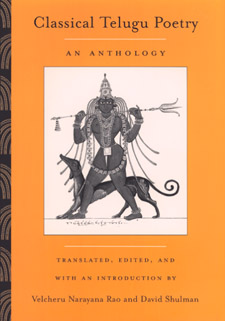
Classical Telugu Poetry
An Anthology
TRANSLATED, EDITED, AND WITH AN INTRODUCTION BY Velcheru Narayana Rao and David Shulman
Table of Contents
- ACKNOWLEDGMENTS
- NOTE ON PRONUNCIATION
- Introduction
- 1. Nannaya
- 2. Nanněcoda
- 3. Pālkuriki Somanātha
- 4. Tikkana
- 5. Mañcana
- 6. Ěrrāpragada
- 7. Nācana Somanātha
- 8. śrīnātha
- 9. Bamměra Potana
- 10. Annamayya
- 11. Allasāni pěddana
- 12. Krsnadevarāya
- 13. Nandi Timmana
- 14. DhŪrjati
- 15. Těnāli Rāmakrsna
- 16. NŪtana-kavi SŪranna
- 17. Pingali SŪranna
- 18. Appakavi
- 19. Ksetrayya
- 20. śatakas
- 21. Cātu Verses
- 22. śāhāji
- 23. Samukhamu Venkatakrsnappa Nāyaka
- 24. Muddupalani
- 25. Tyāgarāja
- BIBLIOGRAPHY
- INDEX
CONTENTS
| ACKNOWLEDGMENTS | xi | |
| NOTE ON PRONUNCIATION | xiii | |
| Introduction | 1 | |
| 1. | Nannaya | 55 |
| Entering the Mahābhārata | 56 | |
| Udanka and the Snakes | 61 | |
| 2. | Nanněcoda | 67 |
| On Poetry in Telugu | 68 | |
| How to Make God Fall in Love | 71 | |
| 3. | Pālkuriki Somanātha | 76 |
| The Brahmin Widow and the Untouchable God | 77 | |
| 4. | Tikkana | 82 |
| The Slaying of Kīcaka | 83 | |
| 5. | Mañcana | 102 |
| The Brahmin Who Kept His Wife in the Basement | 102 | |
| Quick Wit | 104 | |
| The Obliging Husband | 104 | |
| 6. | Ěrrāpragada | 106 |
| Vena and Prthu | 107 | |
| 7. | Nācana Somanātha | 112 |
| Naraka and Ūrvaśi | 113 | |
| 8. | śrinātha | 118 |
| A Definition of Poetry | 119 | |
| Burning the Three Cities | 120 | |
| The Birth of Sukumāra | 127 | |
|
|
||
| 9. | Bamměra Potana | 133 |
| Visnu the Dwarf | 135 | |
| The Rescue of Gajendra | 143 | |
| 10. | Annamayya | 147 |
| Songs for the Lord of the Hills | 148 | |
| 11. | Allasāni Pěddana | 156 |
| The Brahmin Meets the Courtesan | 158 | |
| Sanskrit and Telugu | 164 | |
| 12. | Krsnadevarāya | 166 |
| The King's Dream | 168 | |
| Visnu-citta of VilliputtŪr | 170 | |
| 13. | Nandi Timmanna | 178 |
| Satyabhāma Kicks Krsna | 179 | |
| 14. | DhŪrjati | 191 |
| The Story of Natkīra | 192 | |
| 15. | Těnāli Rāmakrsna | 201 |
| On Becoming a Frog | 202 | |
| 16. | NŪtana-kavi SŪranna | 216 |
| Beauty or Wealth? | 216 | |
| 17. | Pingali SŪranna | 222 |
| Beauty Unadorned | 223 | |
| 18. | Appakavi | 230 |
| On Poetry and Grammar | 231 | |
| On Good Books | 235 | |
| 19. | Ksetrayya | 239 |
| Courtesan Songs | 240 | |
| 20. | śatakas | 245 |
| DhŪrjati. Kālahastīśvara-śatakamu | 246 | |
| Kañcarla Gopanna [Rāmadāsu]. Dāśarathi śatakamu | 247 | |
| Kāsula Purusottamakavi. āndhra-nāyaka-śatakamu | 248 | |
| 21. | Cātu Verses | 251 |
| 22. | śāhāji | 256 |
| Take My Wife | 257 | |
| 23. | Samukhamu Venkatakrsnappa Nāyaka | 279 |
| The Love of Indra and Ahalyā | 279 | |
| 24. | Muddupalani | 293 |
| How to Read a Book | 294 | |
| Rādha Instructs Ila, Krsna's New Bride, in the Arts of Love | 294 | |
|
|
||
| 25. | Tyāgarāja | 297 |
| I Can't See You Smile | 298 | |
| Take Me for Your Guard | 298 | |
| What Did You Give Them? | 299 | |
| Reach Him Through Music | 299 | |
| Won't You Remove the Screen? | 300 | |
| BIBLIOGRAPHY | 301 | |
| INDEX | 305 | |
ACKNOWLEDGMENTS
This anthology opens a window to a thousand years of classical poetry in Telugu, the mellifluous language of Andhra Pradesh in southern India. The classical tradition in Telugu is one of the richest, most original, and least explored of all South Asian literatures. We hope this collection will bring the world of Telugu poetry to the awareness of a wider audience of aficionados, connoisseurs, and scholars.
An introductory essay sets out our understanding of the evolving structure and dynamics of this tradition from its beginnings in the eleventh century to the twentieth century, when classical styles were gradually transformed and replaced by modern modes. We have attempted a synthesis that reflects our own work of the past two decades but that also stands firmly on the foundations laid by great Telugu scholars of this century: Vedamu Venkatarayasastri, Manavalli Ramakrishnakavi, Veturi Prabhakara Sastri, Rallapalli Anantakrishnasarma, Arudra, Bommakanti Srinivasacaryulu, Bommakanti Venkatasingaracarya, Balantrapu Nalinikantaravu, Bh. Krishnamurti, and others. Our debt to these pioneering scholars is profound.
We wish to acknowledge with gratitude the generous support provided by the National Endowment for the Humanities during the years 1994–1996—support that allowed us to meet regularly for sustained periods of work on this anthology—as well as Sharon Dickson's skillful ministrations at the Center for South Asian Studies, University of Wisconsin.
Jerusalem and Madison
May 1998
NOTE ON PRONUNCIATION
Long vowels are double the length of short vowels. The Sanskrit diphthongs e, o, ai, and au are always long and are unmarked; we mark the short Dravidian vowels ě and ô. Sanskrit names ending in a long vowel, appearing in Telugu texts, are consistently marked as short, in keeping with Telugu practice: Sīta < Sītā, Draupadi < Draupadī. Long vowels resulting from sandhi combinations, except for diphthongs, are marked with ^. The consonant sounds t, d, th, dh, n, and l are retroflex, pronounced by turning the tip of the tongue back toward the palate.
In transliterating Telugu text, we have improvised a mark for plosives voiced after a nasal (drutamu: whether the nasal is a sunna or an arasunna or in its svatva-rŪpa). A line under the plosive indicates the reciter has an option of pronouncing it as either voiced or unvoiced, according to context or convention of recitation. For suffixes following upon an infinitive, we reproduce the Telugu orthography. When for other reasons an unvoiced plosive turns voiced, we follow Telugu graphic conventions.
No diacritics are used for the names of modern authors.
Introduction
A TELUGU WORLD
This verse by the sixteenth-century poet RāmarājabhŪsana celebrates a vital and continuous literary tradition, fully formed and mature, in the language of Andhra in southern India. The poet, working at a historic moment of intense creativity in Telugu, points to a canon already in place. Each poet is paronomastically identified with a divinity. First there is Vāg-anuśāsanundu, the Maker of Speech—Brahmā, in the classical Hindu pantheon—who has both created and married the goddess Vāc, Language or Speech. Within the Telugu tradition, however, this is also the title given to the first poet Nannaya (eleventh century), who established the contours of poetry and poetic style. The thousand tongues belong to the serpent Kundalîndrundu-ādiśesa, who holds the world on his thousand hoods; ādiśesa is also the underlying
Our anthology attempts to represent, in a modest way, the world of Telugu poetry as imagined by poets such as RāmarājabhŪsana. We present selections from each of the major poets over a period of some nine centuries, from the eleventh to the nineteenth, on the verge of modern times (although in some sense the classical tradition has continued in Andhra into the twentieth century).
Perhaps something of the integrity of this literary world and the striking originality of its makers will come through the distance of time and language. In the following pages we offer a synoptic overview of the Telugu literary tradition, pausing to consider certain key figures in detail.BEGINNINGS
Telugu literature begins with Nannaya, but Telugu language is much more ancient, attested in place names from as early as the second century A.D. Prose inscriptions from the middle of the first millennium show a gradual evolution toward the classical language. Verse and the appearance of a literary style are attested in inscriptions from the late ninth century on (or even earlier: the Turimělla inscription of Vikramâditya I, in the seventh century, is sometimes seen as already marked by a "high" style).
Early references toAlready, however, we begin to sense the richly composite nature of the Telugu world. One might think of Andhra as one of the great internal frontier zones of South Indian civilization and at the same time, as such, a melting-pot—a domain of intense interaction among rival cultural currents, with their associated social and historical formations. It is not simple to isolate the various currents or to date their appearance in Andhra history, and one must bear in mind that much of the prehistory—before Nannaya—is hardly known. Still, there are some things that can be said in a general and perhaps slightly abstract manner.
The frontier is structured, in part, along geographic lines. Andhra is divided in three: (1) the coastal zone (Andhra proper), largely deltaic, especially to the north, where the Godāvarī and Krsnā Rivers flow into the Bay of Bengal (as elsewhere in South India, the delta is associated with heavy Brahmin settlement and influence); (2) Tělangāna, the dry Deccan plateau, home to peasants, artisans, and warriors; and (3) Rāyalasīma ("the royal domain"), the southern reaches of this plateau, tapering off into the mixed ecological regions of northern Tamil Nadu.
In early medieval times, Rāyalasīma was apparently far more fertile than it is today. But even the fertile delta to the north was largely wilderness beyond the immediate proximity of the great rivers; this situation changed dramatically only in the nineteenth century, when the major anicuts were created, thus opening up vast areas for rice cultivation. In medieval times the wild drylands of the interior, peopled by shepherds, artisans, warriors, and a growing proportion of agriculturists, were bound up linguistically, culturally, and sometimes politically with the hardly less untamed but wetter regions of coast and delta.Andhra history and culture reflect the constant interplay of these ecologically distinct zones, especially of the delta and the Deccan, with cultural innovation often emerging in the latter to be reshaped and domesticated in the former. Over time, ever more serious attempts at integration were in evidence as states based in one region spilled over into, or attempted to absorb, political units rooted in the other areas. Early Andhra history, just this side of prehistory, reveals a Deccan-based kingdom, that of the Sātavāhanas, represented mostly by inscriptions in Prakrit, with only tenuous linkages to the coast. The early state structures in coastal Andhra (especially to the north, in the region known as Vengi) culminated in the rule of the Eastern Chālukyas, who eventually married into the Chola system in the Tamil south. Under the Chālukya king Rājarājanarendra, Telugu literature as we know it began, with the poet Nannaya. By the thirteenth century, the center of Telugu state-building
To what extent do these relatively distinct regional-ecological systems combine in awareness to form a single cultural entity—Andhra, as we think of it today? How old is such an awareness? The great poet Tikkana, in the thirteenth century, is apparently the first to refer to an imagined community named Andhra (andhrâvali),
but the boundaries of this community are unknown. Originally, the term seems to be a purely dynastic family title. The earliest fully formed reference to a geographical entity known as Andhra within the Telugu tradition may well be śrīnātha's in the late fourteenth century: here the temple of Daksârānāma in Konasīma is said to be the center (karnikā) of a lotus that is itself identified as the middle part of the Andhra country (āndhra-bhŪ-bhuvana-madhyamu). This suggests that Andhra extends far beyond the delta, conceived (perhaps metaphorically) as the center of this cultural and geographical universe; deltaic Andhra, for śrīnātha, is the symbolic heart of the culture. There are, however, other mandala-like schemes superimposed on the geographic realities of medieval Andhra. For example, the important temple to śiva-Mallikârjunasvāmi at śrīśailam on the Andhra-Karnataka border to the west is said to have four encompassing gateways: Tripurântakam to the east, Siddhavatam to the south, AlampŪr to the west, and Umā-māheśvaram in PālamŪru (near Accampeta) to the north. In this mapping the center has shifted dramatically to the west, to the point of intersection between Tělangāna and Rāyalasīma. This tendency to reorient and to situate a new center contextually is perfectlyThe frontier inheres in Andhra culture in several powerful ways. If we look first to the northern delta, we strain to see traces of a largely invisible Buddhist proto-Mahāyāna culture flourishing in what is called Konasīma, "the corner" between the two great rivers. We know something of this Buddhist culture from archaeological findings at Nāgârjunakônda and Amarāvati, and from the surviving works of the famous philosopher Nāgârjuna, who may have spoken a language that was a precursor to classical Telugu. Five major temple sites in Andhra—Daksârāma, Bhīmârāma, Somârāma, Ksīrārāma, and Amarârāma—were in all likelihood originally Buddhist shrines, as the name ārāma suggests. Today all five are entirely Hindu, though Buddhist statuary is scattered throughout the temple courtyards. This process of Brahminizing an early Buddhist substratum, so evident in the five shrines, must have been general and formative. It was successful in the sense that Buddhism disappeared entirely from Andhra. And yet the Buddhist presence seems to have left behind an active and creative level of esotericism in praxis and concept, including Yogic, Tantric, alchemical, and "magical" trends that became a diagnostic feature of medieval Telugu culture.
One sees hints of this fascination with esoteric strains of thought in central works of Telugu poetry such as Pěddana's Manucaritramu—the height of the classical tradition—as well as in a range of other textual traditions, such as Gaurana's fifteenth-century summation of the Nātha mythology, Nava-nātha-caritra, one of the earliest and richest accounts of the magically oriented Nāths inLook now to the harsh Deccan hinterland, a true frontier in many senses. A long process of settlement privileged the resilient warrior, perhaps epitomized by the Deccani god Vīrabhadra—śiva as hero. We find him at Lepâksi, in Rāyalasīma, at the southern edge of today's Andhra—a black, furious deity.
The cultic history of the Deccan must include the expansion of Vīraśaivism, originally a militant movement of antinomian worshipers of śiva drawn mostly from the so-called "left-hand" castes, that is, those not tied to the land (artisans, merchants, migratory groups, and so on). At śrīśailam, in the midst of the wilderness, one can observe stages of a long process—still encapsulated in the temple ritual—that seems to have taken this shrine through Buddhist, Vīraśaiva, more normative śaiva, and finally Brahminized/Sanskritized phases. The exotic "heroic" mode is, in any case, still apparent throughout this region, and we may look here for the first signs of that characteristic individualism—a surprisingly powerful and self-conscious presentation of self as subject—that turns up with consistency in Telugu poetry from at least the time of śrīnātha onward. We would go so far as to posit this interest in the uniquely individual subject, initially present in unsystematic occurrences in the literature but later exfoliated luxuriantly in Nāyaka-period texts, as a diagnostic feature of the Telugu tradition over many centuries.To these two prominent thematic drives, each in its own way born of the frontier, that cut through varying strata, periods, and milieux, we may add a third, from the still more deeply internalized boundary zone of language. As the verse quoted at the beginning of this essay suggests, Telugu poets have consistently been drawn to an examination of language in its life-creating, world-generating aspect. Perhaps something of this fascination derives from the experience of living within a linguistic reality that is itself unusually lyrical and fluid, a constant exposure to language itself as musical sound. It is
FIRST POET: NANNAYA
Great literatures classicize their own texts, selecting certain major works or authors over others; they also tend to produce retrospective narratives to make sense of this selection. The result, in the case of Telugu, is a simple developmental scheme that can be found, in one form or another, in all modern histories of this literature, in Telugu or other languages. In this framing of the tradition, all begins with Nannaya, the First Poet (and First Grammarian, since an ordered, premeditated grammar must, in this perspective, precede both normal linguistic reality and the creation of poetry). Earlier poetic works may be presumed to have existed, but they are lost. Nannaya is said to have initiated the age of purāna-like compositions with his adaptation of the first two and a half books of the Mahābhārata epic into Telugu.
After some four centuries, this vogue in purānic poetry gave way to full-fledged kāvya or prabandha texts—elevated and sustained courtly compositions. The transition to kāvya of this type is usually said to have reached its apogee in the Golden Age of Telugu literature at the court of Ksnadevaraya of Vijayanagara (1509–1529). Following the breakdown of the Vijayanagara state-system in 1565, literature is seen as slowly sinking; with the displacement southward of Telugu political power into the Tamil country under the Nāyaka kings (sixteenth to eighteenth centuries), new forms of poetic production, some of them supposedly "decadent," became prominent in the afterglow of the classical efflorescence. Modern poetry then represents a blinding flash of revolutionary brilliance against the smoldering backdrop of the Nāyaka and post-Nāyaka decline.Such is the standard format, a still regnant mythology of poetic evolution, useful, perhaps, for rudimentary classification of the poets. It bears almost no relation to the deeper currents of this amazingly rich and intricate
We can attempt to substitute for the standard evolutionary scheme a more subtle template that will take account of the profound shifts in style and expressivity as well as changes in major cultural themes and premises. Certain key, perhaps emblematic, figures help us to orient this picture of the tradition: Nannaya, Tikkana, śrīnātha, Pěddana, and Ksnadevarāya, in the early stages. Each of these poets, by virtue of creative innovation, changed the rules of play and transformed the classical tradition. Here again we must begin with Nannaya, not as grammarian
but as the poet who first produced a Telugu style commensurate with a complex, and entirely Telugu, sensibility. Clearly, he knew that he was doing this—knew that he was innovative in creating a musical and flowing poetic form, dense with expressive possibilities and unique to his mother tongue. Listen to the way he describes himself (in the third person):Let us restate this achievement in somewhat different terms: what Nannaya invented was a style of poetic narrative in which the story line is clear, pleasing, and uninterrupted, but that at the same time allows the hearer/reader
This same process applies to the transformation of genre. Nannaya's Mahābhārata both is and is not a purāna. It follows the inherited story line, usually with remarkable fidelity to the prototype. But it also allows, indeed demands, reflection upon this narrative and an aesthetic savoring of the texture of its telling on the part of the reader, a process mostly unknown to Sanskrit purānas.
Something quite new happened, and it became the starting point of a process that continued for a thousand years of Telugu literary production. Technically, too, there is the pattern of interspersing verse, in varying meters, and rhythmic prose (the campŪ style that became normative).Nannaya's adapation of the campŪ style also implies a particularly active, participatory role for the listener. The itihāsa epic frame normally requires the presence of a speaker and a listener; for example, Sañjaya speaks to Dhtarāstra within the story, describing the battle to his blind master, but his words are reported by the SŪta-narrator to the "original" listener, śaunaka, and other sages. The SŪta, however, is merely repeating what Vaiśampāyana recited, on the basis of his teacher Vyāsa's composition, to King Janamejaya at the time of the latter's sacrifice of snakes. These concentric frames are reframed by Nannaya, who sings the same story to his patron, Rājarājanarendra. And we, listening to a paurānika reciter, find ourselves in precisely the same dialogic situation. The innovation lies in the assimilation of this format to what is, in effect, a kāvya: an aesthetic, self-conscious literary work. Sanskrit literary kāvya, for whatever reason, does not share this need to internalize the listener. Part of the great power of Nannaya's campŪ lies precisely in this activation and co-option of the listener—a characteristic feature of the oral storytelling mode—within a reinvented literary genre.
In general, Nannaya's manner of narration skillfully combines an economy of words with a perfect choice of phrases that embody the emotional progression in events.
The story often unfolds with great rapidity that unexpectedly allows room for reflection on the depth of feeling: this is the "lively narrative with inner purpose" of which the poet himself speaks. Sometimes a single verse encompasses a carefully articulated transition in state or a progression in emotion. For example, King Yayāti, riding through the forest, hears a young woman—Devayāni—calling for help from the dry well into which she has been pushed by her rival. The king dutifully extends his hand to help her out:First, there is the hand itself—strong enough to bear the earth with its surrounding oceans, all part of a single strong compound. On the other end, another hand, raised, ready to be grasped, wet with the delicate drops of her perspiration that make it even more beautiful, kamra. Everything lies in the readiness that reflects an intention: Devayāni wants to marry this king. But Yayāti as yet knows nothing of this, and feels nothing; he pulls her out, divicě, with a neutral, simple verb, utterly without feeling. Why does he do this? Because he is vísruta-kīrti, a man of good name; he is doing his duty—all part of a day's work. And then, suddenly, unexpectedly, in the very last word of the verse, there is feeling: prītiton, "with love." Before he realizes it himself, he is lost, taken with her beauty, and not only the beauty of her outstretched arm, which he has held and pulled, but also that of her whole body, since Devayāni was pushed naked into the well. We are not, however, told this explicitly; it is implicit in the earlier part of the story, which the listener certainly knows. A lesser narrator might have elaborated the point, but Nannaya is content to suggest it, or to remind his audience of it, with a single word that closes the verse by revealing the shift in the king's perception. It is one thing to show an object, another to reveal this object through the feelings of a participant or onlooker within the story.
There is yet another aspect to Nannaya's originality, at the very limit of linguistic expression. Perhaps more than any later Telugu poet, with the possible exception of śrīnātha in his Bhīmeśvara-purānamu, Nannaya produces a "magical" or "mantric" effect. At certain points—for example, in the hymn to the snakes in the Udanka section translated below—he exceeds the bounds of poetry, or of reference.
One long Sanskrit compound gives us the whole massiveness and heaviness of earth, indicated both by the long string of elements (forests, oceans, mountains, rivers, and lakes) and by the repeated ha sounds—also built into the rhyme scheme in the second syllable of each line—as if to demonstrate the breathlessness of the great snake who bears this burden on his thousand heads. But this dense alliteration has only begun: it is resumed by a dangling, unusual adverb: ajasra, "always," another Sanskrit loan that would normally require a Telugu case-ending but which here simply flows into the line, rhyming with the following word, sahasra ("thousand"). The dangling adverb, in the rush of alliterating sound, suggests the uninterrupted process of bearing the earth's burden. Now, at last, there is a small piece of Dravidian, the nonfinite verb dālci, "bearing." The work is thus still incomplete; another burden must still be borne. The snake ādiśesa, along with bearing the earth, is also the bed on which the god Visnu sleeps in the ocean of milk, and the poet makes sure that we feel this additional, indeed infinite, weight of the god by another gush of sibilants and aspirates, spilling over the line-break: du-Sa Hatara-mŪrtikin jala DHi-śāyiki pāyaka śayyayaina ay-ya Hi-pati.… These two burdens, incidentally, are never seen together in iconography or joined in story; Nannaya has fused them, doubling the snake's dreadful task and arousing our admiration for him. The listener, by now bent double himself under this weight, miraculously made present through the language, needs to rest. For the god, at least, a soft bed is available: the repeated cushioning of the soft double semivowels, - yy(a)-, a delicately iconic reproduction of the texture of the snake's body. And this entire description is part of an appeal to the snakes on the part of the young Udanka who, as is customary, preludes his request with flattery or praise. This verbal production of overpowering sounds has the effect of making palpable and present the snake's own experience; what is more, the verse also controls the reality it has created, like a snake-charming mantra. Indeed, Nannaya's verses in this passage are believed to serve this very purpose of providing protection from snakes.
Here, as one sometimes finds in Nannaya, it is the sound that matters most, more even than any translatable meaning. The sounds, even beneath the words, create a world of their own. Perhaps all language oscillates between the poles of denotative reference and existential creativity; Nannaya
TIKKANA: BOUNDARIES OF THE ORAL
Nannaya belongs to the Delta, and the north, and to a transient moment in the history of the Eastern Chālukya state. He was also, like the great majority of Telugu poets throughout the centuries, a Brahmin. Literary historians have tended to class him as a court poet and his poetry as an elitist, courtly production. These terms may, however, be inadequate descriptions of the poet's reality. One hesitates to ascribe or to attempt to explain anything of Nannaya's power and stature by reference to the weak, short-lived political system within which he found a place. As was so often the case in Telugu literary history, this poet dwarfed by far his supposed patron. Indeed, in a deeper sense, the poet may be said to have created his patron and to have invested him with fame. Moreover, it is the poet who supplied the ideological or conceptual frame within which the state functioned. This is, in fact, one of the historic roles of major Telugu poets.
Nannaya's immediate successor, Tikkana, came from much farther south, in NěllŪru, and from a smaller political system, that of Manumasiddhi, loosely connected to the powerful Kākatīya state (thirteenth century). Tikkana was minister to this king, and later traditions credited him with active roles in politics and war.
The localization of Mahābhārata themes and contents in an Andhra cultural frame achieved a new impetus in Tikkana's poetry. And if Nannaya invented Telugu poetry, as the tradition correctly insists, it is Tikkana who imagined this tradition into self-conscious existence, making Nannaya, retrospectively, the first poet. "First" implies that others follow, and Tikkana is first among these, even in his own eyes. But the Telugu world that he imagined also has expanded to include new domains: dharmaśāstra texts, foundational texts of grammar, and the story (kathā) tradition, seen as kāvya, for example. Tikkana's disciple Ketana was responsible for early works in these genres. Under his master's sponsorship, Ketana produced the Vijñāneśvarīyamu, a legal commentary, as well as the Telugu Daśa-kumāra-caritramu, after Dandin, and the āndhra-bhāsā-bhŪsanamu, probably the earliest Telugu grammar. Law, grammar, poetry, and "history"In stylistic terms, Tikkana's own large corpus—fifteen parvans of the epic —stands alone; no later poet was able to follow his example. Syntactically, his poetry embodies idiomatic, almost colloquial, Dravidian patterns. At the same time, long Sanskrit compounds serve him whenever there is an architectural need for elevated emphasis:
Translation fails to reproduce the effect of what is a single compound entirely in somewhat arcane Sanskrit—a kind of drawn-out explosion of language intensified by the resort to a borrowed register, where the Sanskrit phonemes, with their conjunct consonants, aspirates, and harsh plosives, carry the expressive urgency. Draupadi is threatening Kīcaka, and the threat comes across precisely because of this borrowed but internalized phonotactic feature. Dravidian clusters tend to be softer, voiced, and much shorter; Sanskrit allows a buildup of dense linguistic pressure. But the real expressivity of a verse like this depends on the combination of these two levels: the relentlessly intensifying, semantically compacted Sanskrit compound striving breathlessly toward a pause, and the framing and containing Dravidian syntax, which tends to break into discrete, short units:
The verse that began with a single long compound that perfectly represents the fearsome internal qualities of the heroes devolves in its second half into a string of singular, largely indexical, staccato movements: "the five of them—right now—you—easily—getting angry—will get you—your honor—your life—no doubt—somehow or other." There is no place inside this verse for Kīcaka to hide: the gandharva husbands will hunt him to the ends of the earth, as if they had marked him with their pointing finger,
Effects such as these are standard in Tikkana. The listener maintains a necessary syntactic presence, within the verse, more than an imagined narrative presence. In this respect Tikkana remains close to an oral, conversational mode, as if speaking to a listener in front of him. His text speaks rather than sings—he is thus less lyrical and more expressive than Nannaya —and the audible dimension is never lost. These are not verses written on palm leaves, printed on pages, read silently in libraries. They exist in the living space between the poet and his listener, who hears and feels every syllable in the body.
By the same token, Tikkana begins a narrative style in which the speaker within the text is entirely identified with the character. It is Draupadi who speaks the above verse, not the poet. She speaks in accordance with welldefined, individualized, subjective patterns that are wholly hers, and no one else's. This is not to say that the poet is absent; his style still overrides, or colors, the speech of his characters. However, within the frame of Tikkana's poetic language, one can hear distinct voices. This individualized "voicing" marks a quantum leap in Telugu poetry (sometimes described, rather lamely, by modern critics as Tikkana's natakīyata, "dramatic quality"). Strikingly, however, this feature seems to stop with Tikkana. For the same reason, Tikkana's verse does not flow with the same ease as Nannaya's, or as purely oral poetry, which must have been dominant in his time. It is not easy to read a Tikkana verse; the syntactical breaks tend to be unpredictable—as in living speech—retarding the movement of the meter, stopping and starting afresh, laden with indexicality. This is poetry at the very edge of everyday language, with all its freshness, individuality, and continual surprise.
Listen, for example, to Sudesna, Draupadi's mistress, as she urges Draupadi, against her will, to go to Kīcaka's house to fetch some liquor:
Sudesna starts, breaks, starts again, breaks off, resumes; literally, the verse looks something like this: "I wanted it. Badly. My favorite drink. Didn't want to send a lowly servant. Asked you. You're making a fuss. As if it's something improper. You're upset. Really. Is this good friendship, my friend?" One long sentence, built around a series of nonfinites, infinitives, and conditionals that break it into a choppy sequence of part-utterances. The sequence culminates in a final appeal, a rhetorical question, which nicely masks the speaker's true intention. Not by chance, perhaps, the fourth line begins, at the point of greatest poetic tension, with the adverb nikkama:"truly." This is followed by the one finite verb, ummaliñciti(vi), "you're upset," an example of the kind of Dravidian root that is common in Tikkana but that later gradually fell into disuse. The feeling of the verse as a whole is one of actual conversation, with a hidden subtext, in a natural syntax that continually frustrates the flow of the utpala-māla meter.
Perhaps it is this recurring frustration in the internal movement of the verse that produced a revolutionary problem and that encapsulates the tension between Tikkana's innovative power and the ingrained habits of recitation. Someone trained to recite, for example, utpala-māla verses in the oral style comes up against tremendous obstacles when he comes to Tikkana. Oral versification requires dhāra—the unimpeded flow of words—and dhorani, the "mode" in which the flow takes place. Shifting to another meter brings the expectation of another mode, but a similar flow. But in Tikkana neither happens. The reciter begins, stops, tries again, is again checked—very much like in ordinary speech, but utterly unlike the normal sung stanza. The combination of speech and meter, which is required if the poem is to speak, explains this difficulty, apparently keenly felt by the singers. It may also explain Tikkana's isolation within the tradition; his style was never taken up or imitated by later poets.
Indeed, the tradition itself recognized and commented upon this feature. Tikkana is said to have made a pact with his scribe, Gurunātha, from the potters' caste, to the effect that Gurunātha would record, without pausing, the poems Tikkana was improvising on condition that the poet never stop the flow of verse. If Gurunātha were to fail to keep his side of the pact, he would cut off his right hand; if Tikkana failed, he would cut off his tongue. The arrangement worked well until, at a point in the text where the internal narrator Sañjaya was describing the epic battle to Dhrtarāstra, Tikkana became stuck in the middle of a verse, unable to complete it. In despair, he
This story, disarmingly simple in appearance, actually offers powerful expression to the peculiar boundary zone that Tikkana inhabits in Telugu poetry. It seeks, on the one hand, to rehabilitate him, turning him back into an oral poet, since at this period, real poetry is still perceived as inhering in the oral, flowing qualities of a verse. Oral poetics remained dominant, and "literariness"—with its concomitant freedom—was still not poetically acceptable. A literary poem, in this sense, had to conform to the dominant poetics. On the other hand, the story implies a recognition of the innovation that Tikkana had introduced into the tradition. The ambivalence is striking: the story attempts to mitigate the full force of this innovation by assimilating the poet to the older model. Tikkana, in the story, unconsciously fulfills this role, though his completion of the verse is really a cry of despair, at the moment before he will strike himself speechless, cutting off his own tongue. It is as if more deeply, unconsciously, the poet remains a singer. Gurunātha's origin from the potters reinforces this claim, since the potters, a "left-hand" caste, are closely linked to the singing of texts. The story also shows us the new value attached to writing down a text, fixing it graphically without relinquishing the still-valued singing mode (which depends on audible utterance). In fact, the verse "works" only when sung: in writing, kurunātha becomes gurunātha, the cry of despair to the scribe; in recitation, this remains kurunātha, an address to the Kuru lord. One can see, in this vignette, the whole burden of the transition that Tikkana articulates for this tradition.
This transition has further features related to the wider literary world of Tikkana's time. Tikkana refers to himself in the colophons to his work as ubhaya-kavi-mitra, "a friend to both [kinds of] poets." This somewhat enigmatic phrase has several possible meanings, and implies tension between two schools of poets. It could be a question of Sanskrit in relation to Telugu; or of śaivas in relation to non-śaivas; or Brahmins versus non-Brahmins (this categorization, however, is probably a back-formation that we tend to read into the early medieval period); or of oral/folk poetics in relation to the written and scholarly/literary genres, newly emerging from Nannaya's time. We have seen the originality that Tikkana brought to the reconfiguration of Sanskrit and Telugu, and we have noted the particular prominence Dravidian syntactic, especially idiomatic, patterns have for him. But there is a sense in which Tikkana clearly faced a coherent, contemporaneous counter-tradition—that
Since beautiful, idiomatic Telugu is more commonly understood than heavy compositions of mixed prose and verse, I have chosen to compose this [work] entirely in the dvipada meter. Let it not be said that these words are nothing but Telugu. Rather look at them as equal to the Vedas. If you wonder how that can be, remember, "If a tŪmu is a [large] standard for measure, so is a sôla." Is it not generally agreed that the stature of a poet derives from his ability to compose great poetry in simple language?"
Dvipada, in the hands of Somanātha, offered tremendous promise, given its enormous range of syntactic variation and the hypnotic power of the chanted string of couplets. Lesser poets, however, were unable to equal Somanātha's virtuoso handling of the restricted couplet form (and even Somanātha himself, in his Panditârādhya caritra, fails to maintain the emotional subtleties and syntactic fascination evident in his Basava-purāna). But dvipada tends, in any case, to limit the active role of the listener (and we insist again that at this period poetry was always read aloud to a group of listeners). CampŪ, with its mixture of verse and prose and its dependence upon the elaboration of the single stanza, always allows space for breaks in recitation, for commentary and reflection. In this sense, campŪ, as a final product in performance, always has two authors: the poet who produced the text and the reciter who sings it, explicates it, and opens it up to new experience. In effect, the reciter re-creates the text continually. Dvipada, despite its powerful narrative capabilities, tends to monotones and lulls the listener into passivity. This is a structural feature of the genre, incapable of resolution even by a brilliant poet; it helps to explain the eventual marginalization of the dvipada mode, as opposed to the almost infinite exfoliation of the campŪ style.
Nonetheless, dvipada maintained a presence in the ongoing evolution of the tradition, at least through the seventeenth century.
In the fourteenth century, Gona Buddhārěddi composed a dvipada Rāmāyana (the so-calledTikkana faced this cultural challenge directly, attempting a synthesis of the conflicting pulls. Populist and elitist strands—or, if one prefers, regional and pan-Indian/Sanskritic—come together in his poetry, which stylistically and thematically forged a new sensibility. The same move toward synthesis is apparent in his choice of deity, Hari-Hara, a composite form of Visnu and śiva whom he addresses in his invocations.
It is also important to realize the more generalized direction of aesthetic transformation that Tikkana brought to his reworking of the Mahābhārata text. The stylistic and syntactical features we have outlined are perfectly in line with this wider shift, which turns the Sanskrit epic into a Telugu family drama of local south Indian chiefs. Emotions are "Teluguized," situated in wholly familiar frames and integrated with a Telugu psychology. When the young hero Abhimanyu is cruelly killed in battle, the response that Tikkana produces from his audience—through the voices of Dhtrarāstra or Yudhisthira and others—is something like, "How could you do this to my grandson (or nephew)?" Here is Dhtarāstra after he hears of Abhimanyu's death:
And here is Yudhisthira, Abhimanyu's uncle:
If we compare Tikkana's articulation of this moment with that of the Sanskrit original, we immediately notice a striking difference in tone, despite the very close verbal correspondence between the two texts. In Sanskrit, Yudhisthira says:
Yudhisthira, whether speaking Sanskrit or Telugu, has definite tendencies toward self-reproach, guilt, doubt, and disgust with his public persona and role. This is a given. But listen to how differently he tells us this in the two languages. In Telugu, the first-person pronoun and first-person verbal forms dominate the utterance: "I should have known; I am the one who sent him; I could have done otherwise; I was greedy; what can I say"—and, finally, "I am bad." Everything is personal, immediate, and fully internalized, and grief speaks directly along with guilt. Moreover, Yudhisthira takes responsibility here for the rest of the family. It is a family tragedy, focused on a Deccan patriarch-hero, that is being displayed, before it becomes the story of a warrior's death. The quality of emotion is closer to home. In some sense, these emotions are also embedded in the Sanskrit prototype, and to that extent we can say that Tikkana is extremely faithful tothe original. But the Sanskrit Yudhisthira wavers, loses focus, and slips into abstract gnomic statements: "A greedy person has no understanding of his faults" (in contrast to Tikkana's "It was greed that blinded me to my faults"). Before this thought is complete, he is already elsewhere, anticipating Arjuna's furious revenge (and, as the Sanskrit text continues, the pragmatic usefulness of Arjuna's rage in the ongoing war). We lose, as he himself does, the full integrity of his grief, and are left with his confusion. Then, concluding the lament, comes Yudhisthira's usual inner move (missing from Tikkana's passage): he is sick of it all, indifferent to victory, and reluctant to rule; none of it has meaning for him any more. In short, he wants to renounce the world. The personal tragedy is already, all-too-easily, precipitated into an almost generalized cultural predicament.
What this implies, among other things, is that Tikkana's characters achieve a deliberately intended coherence in speech, in the way their actions and movements are described, and in their entire presence within the Telugu text. This is a function of a well-constructed written text, and is distinct
For a Telugu audience, there is something irreversible in Tikkana's reworking of the epic. While Tikkana adheres closely to the verbal text of the Sanskrit Mahābhārata, he has in effect re-created the text in a Telugu mode, alive with Telugu-speaking heroes. Once one has seen the Mahābhārata through Tikkana's lens, which emphasizes and selects elements of the original, it is almost impossible not to experience these elements even in Sanskrit—as when a hitherto unnoticed pattern is pointed out in a design and then can no longer be ignored. A good "translation," in this perspective, creates a new original. This is not a matter of adapting, imitating, or following. The new original preexists in the "old" original, before the translation, but it needs the translator to reveal it. (Put backward, this means that the original anticipates its own translations—perhaps an inexhaustible series—and depends on these translations for its own total expression.) This also explains why "translation," understood in this manner, can be the beginning of an entirely new literary culture.
To sum up to this point: Tikkana reveals an activist, imaginative drive toward fashioning the universe of Telugu literature and culture. This universe expanded under his tutelage to incorporate new levels and genres, including not only dharmaśāstra, grammar, kāvya, and itihāsa, but also the restless, antinomian śaiva world couched in a highly regional idiom. This incorporation of wider elements actually meant the co-option of more specific modes into what now became the mainstream of Telugu poetry, directly evolving out of Nannaya's original template. From this point onward, the distinctive, volatile, and creative fusion of elements inherent in the literary campŪ institutionalized itself as the expressive arena for most Telugu poets. At the same time, Tikkana's expansion of this mode, along the lines we have discussed, prepared the ground for the extraordinary developments of the fourteenth century.
POEMS AND ARROWS: NANNĚCODA
Before we turn to these developments, we may pause to consider the enigmatic figure of Nanněcoda, of undetermined date, but perhaps belonging
Given this definition, we nonetheless hear Nanněcoda demanding a radical Teluguization of both modes in the poetry he regards as best (vastu-kavita):
This statement—and the long poem on the birth of the god Kumāra that it precedes—mark Nanněcoda as effectively the first kāvya-poet in Telugu. And yet he stands alone, a maverick whose textures and style were never followed. Telugu kāvya at its height emerges out of the poetic revolution propelled by śrīnātha. Nanněcoda seems to reflect a consciousness of a strictly regional or local poetics, which also produced full-fledged theoretical statements such as Ketana's āndhra-bhāsā-bhŪsanamu (in the generation after
It is also striking that Nanněcoda introduces explicit attacks on unsuccessful poets (kukavi-ninda) who fail to meet the standards of this regional aesthetic, and also on bad critics. Elaborate images of what constitutes a good or bad poem are now present in the introduction to a kāvya-work:
Such attacks on the poetic antagonists become standard features of the introductory portions to kāvya works, but each time the antagonist is defined anew, in terms of the shifting and evolving poetic ideal. For Nanněcoda, poetic failure is keyed to the image of what is possible in the best poem—a compacted profusion of expression, an organic quality of liveliness, inside
Despite this highly articulated vision, Nanněcoda's model remained outside the mainstream of the classical tradition for reasons still not understood.
ś RīNāTHA: POETRY AND EMPIRE
By the fourteenth century, then, we have a ripening tradition, already extraordinarily rich in forms and resonance, with a range of available modes. An enormous effort to produce narratives, mostly from the epic and purānas, permeates the literary scene. These narratives are all in campŪ style, imbued with a Sanskritic atmosphere and imparting dignity to both language and theme. Mārana's Mārkandeyapurānamu, Ěrrāpragada's Nrsimhapurānamu and Harivamśamu, and Nācana Somanātha's [Uttara]harivamśamu are but a few of the major works. This vogue in purānas, in the campŪ style, continued all the way to the twentieth century. But the last decades of the fourteenth century and the first decades of the fifteenth also witnessed a great breakthrough in the literary-cultural domain with the appearance of the revolutionary figure of śrīnātha, arguably the most creative poet in the entire history of this literature. Once again, the poet was aware of his own innovation. śrīnātha is the first to attempt to produce in Telugu a version of Sanskrit kāvya, a task previously considered impossible or even taboo. Here is how śrīnātha speaks of his achievement, with reference to the Sanskrit original of śrīharsa, the Naisadhīya-caritra:
naisadha-śrngāra-kāvya-prabandha-viśesambunan aśesa-manīsi-hrdayam.-gamam-
bugā śabdam' anusariñciyun' abhiprāyambu guriñciyu bhāvamb' upalaksiñciyu
rasambu posiñciyun' alankāambu bhŪsiñciyun' aucityamb' ādariñciyun' anau-
cityambu parihariñciyu mātkânusārambuna ceppa-badina yī-bhāsā-naisadha-
kāvyamb[u] … vilasillun ā-candra-tārârkambu.
unseen by other poets, is here rendered into Telugu in a way that makes use
of the special features of the language, to touch the hearts of the wise—
keeping the poetic feeling (bhāva) in view, supporting the mood (rasa), embellishing
the figures of expression (alankāra), taking care of propriety (aucitya)
and avoiding impropriety (anaucitya), closely obeying the original. This
Telugu Naisadhamu will last as long as the moons, the stars, the sun.
This statement of translators' protocol is unique to Telugu literature; it shows us an intense awareness of the new enterprise śrīnātha has undertaken. For the first time, a Sanskrit kāvya has been entirely transmuted into Telugu in a sustained and elevated style appropriate to the original text. What has śrīnātha translated? He lists a series of separate components— sound, intention, feeling, mood, figuration, and propriety—all of which add up to an attempt to reproduce the texture of the Sanskrit. Sound lies at the root of this attempt and generates the real problem, given the obviously divergent phonoaesthetics of the two languages. Here is where the poet's originality is truly tested. Often in this text, the Naisadhamu, śrīnātha appears to reproduce the phraseology of his model, sometimes to the point of lifting, verbatim, most of a verse. For this very reason, the tradition mocks him: when śrīnātha showed his translation to Sanskrit pandits, they laughed at him and said, "Take your Telugu case-endings—du, mu, vu, and lu—and give our Sanskrit text back to us." Even more trenchant an expression of this same view lies in the story that śrīnātha, upon finishing his poem, sought the approval of a young poetic genius called Pillalamarri Pina Vīrabhadrudu, whom śrīnātha found playing in the street with his friends. The boy, called upon to judge śrīnātha's complex kāvya, asked the poet how he had handled one of śrīharsa's arcane phrases: gami-karmī-krta-naika-nīvr;tā [literally, "having put into effect the verb ‘to go' by wandering through many lands"]. śrīnātha immediately recited his corresponding verse, with the "Telugu" phrase gami-karmī-krta-naika-nīvrtudanai (that is, the Sanskrit original rendered verbatim, swallowed whole by the Telugu line with the sole addition of the Telugu first-person and adverbial endings udan-ai). Here are the two verses, in an attempt at English translation; one should bear in mind that the Sanskrit original is deliberately opaque, erudite, and enigmatic, its diction elevated to a point of near-absurdity (which is, in a sense, the point) —while śrīnātha's Telugu rendition, although almost entirely couched in Sanskrit, has a happy grace and ease. The context is the first meeting between Prince Nala and the famous captive goose, who has seen the lovely Damayantī and wants to make Nala fall in love with her:
Like all beautiful Hindu women, Damayantī is so thin at the waist that one can legitimately wonder if her body has a middle part at all. The bird is evidently well-trained in grammar, as we see from the critical compound cited above, "recycled" by śrīnātha in the first of two verses based on the Sanskrit prototype:
Obviously, śrīnātha has completely "re-Sanskritized" the verse, which has only a single Dravidian root (the finite verb, kan tin, "I saw"); all the rest is a combination of elegant and playful invention (in the long composita) on the one hand, and a mellifluous cumulation of familiar metaphors and attributes (the conventional descriptions of Damayanti's beauty) on the other. Within this ludic reshuffling of the given terms of the message, the refractory compound in question now stands out in all its ostentatious obscurity
None of this, however, was apparently capable of impressing the young Vīrabhadrakavi, who is said to have remarked with scorn, on the basis of this example—like the Sanskrit pandits mentioned earlier—that śrīnātha's version of S or ai.
Reading through the Naisadhamu, one can sometimes see why he (speaking for the literary tradition) adopts this sardonic view. As always, the folk-literary-critical narrative makes an incisive comment, although it fails, in this case, to illuminate the subtleties of śrīnātha's Sanskritizing techniques, often deeply transformative of tone despite the surface impression of wholesale, almost mechanical transposition of entire blocks of Sanskrit. If anything, the Telugu Naisadhamu seems to bear out a happy speculation by Seferis:My fancy sometimes reaches even this absurd limit: if all the poets of the world were permitted to use one word only—the same word—the good poets would still find a way to differ from each other and create with this single word different personal poems (a thought that verges on Zen).
We might also invoke the shade of Borges's hero Pierre Menard, "the author of Don Quixote," whose early twentieth-century version of Cervantes' classic presents us with passages identical to the seventeenth-century original, but entirely different in tone and meaning in their new cultural and temporal context. "The text of Cervantes and that of Menard are verbally identical, but the second is almost infinitely richer. (More ambiguous, his detractors will say; but ambiguity is a richness.)"
The story we have cited highlights both the radically innovative nature of śrīnātha's work and the tradition's resistance to it. A given verse of śrīnātha's Naisadhamu may look and sound remarkably like—indeed, almost identical to—śrīharsa's original verse, but in fact it is always something quite new, and entirely Telugu. This is the true miracle of transubstantiation. However, the tradition also mocks this miracle. In effect, śrīnātha has subverted the older distinction between mārga ("high," "Sanskritic") and
But the actual achievement can be more precisely defined. śrīnātha's claim is to have translated Sanskrit kāvya into Telugu kāvya. In fact, however, kāvya is not really a genre, but admits tremendous variation, and śrīnātha works his own particular transformation on the Sanskrit model. Again, we need to look at a specific example. Here is śrīharsa's description of the women of India in relation to the as-yet-unmarried Nala:
The Sanskrit is so densely compacted that the initial effort merely deciphers it, restoring some kind of linear syntax. śrīnātha, however, narrativizes the verse, producing an expanded and well-defined sequence of events leading up to the suggestion of Damayantī's unique beauty:
In the Sanskrit, the word order completely masks the narrative order: "Am I a match for him?"—to see themselves—in the hand—seeing him—by a beautiful woman—held—except for Damayantī—deflated—by which [such beautiful woman]—was the mirror—by a sigh—unclouded?" The reader struggles to reconstruct a more intelligible syntactic pattern, which would follow the natural sequence of events. It is this sequence that śrīnātha has strung out and re-imagined. Moreover, each phase of the sequence is marked by a repetition, in nonfinite form, of the previous finite verb: "They stare.… staring." This kind of repetition constitutes a figure in alankāra texts: mukta-pada-grasta, "picking up the earlier word."
Not only does the figure serve to highlight the continuity and its recurrent, and universal, elements, it also sets off the uniqueness of the poem's striking denouement, in which Damayantī comes to constitute a set of one. Her, and her alone, the mirror does not disappoint. Even she, it seems, has run to check out her beauty, with the same doubt in her mind that afflicts all other women, but in her case, the doubt is ultimately dispelled. This is not merely a technical triumph, the final decision in a beauty contest. What śrīnātha has succeeded in suggesting is that there is something unique in Damayantī's presence, a hint of subjectivity and entirely individual potentiality—almost as if she were herself emerging from the mirror. Of course, in a sense, the same conclusion is implicit in śrīharsa's verse, though it appears so densely and intricately compressed and so deeply hidden by the nonlinear syntax that one can reach it only by a process of logical deduction. It is this logical progression that śrīnātha turns into a lyrical statement, wholly unpacking the Sanskrit puzzle and ultimately projecting the image of a living, irreducily unique woman. Another way to state the difference is to notice how a near-total nominalization in the Sanskrit verse—a series of nouns and their modifiers—turns into a straightforward verbal series that completely dominates the Telugu poem.While this example may be slightly more vivid than usual in śrīnātha has invented. It still tends more toward lyrical narrative than toward the deliberately nonlinear, timeless, self-reflecting expression of śrīnātha's reworking of the Naisadhīya text, it does illuminate the poetic mode that śrī-harsa's Sanskrit kāvya. We are still some way away from the full-fledged, autonomous kāvya-world of the sixteenth-century Telugu poets—for whom, however, śrīnātha has opened the way.
Naisadhamu is the earliest of śrīnātha's extant works. Already it contains many of the hallmarks of his mature style—a dimension of full-throated orality and musicality, where the words flow with ease without losing their scholarly elevation; a gift for producing, perhaps even improvising, a long Sanskrit compound without scuttling the Telugu syntax; and above all, the alchemical power to do things with language that bring a reality into existence. In a sustained way, these features blended together to produce, elaborate, and establish an entire temple, that of Daksârāma in the Konasima delta śrīnātha's Bhīmeśvara-purān amu became the foundational text for this shrine, which it more or less sang into existence in its medieval (Hindu) form.
Bhīmeśvara-purānamu is a symphony swelling slowly to a pitch of almost unimaginable presence, as the poet calls the god himself down into the shrine. This is a text which cannot be retold or paraphrased, only performed and re-performed, creating its own reality anew each time. It is, from a certain perspective, not unlike a Vedic text, pregnant with mantric power (in the sense of bringing a world into existence, not simply of controlling an already existing reality or coercing a presence). But these same qualities are abundantly evident in many of śrīnātha's individual stanzas, or even in single lines.He had his own way of stating this aesthetic, at the start of Bhīmeśvarapurānamu:
Three features produce poetry for śrīnātha: a curved line that suggests the potential full (rounded) form; a firmness, almost toughness, replete with some destructive energy that is also somehow erotic and creative; and a fluid, seductive softness. At the center of the series is the goddess, angry, intent upon putting an end to time, her breasts thrilling at this prospect— but, for śrīnātha, they are still breasts, attractive, possibly nurturing, enticing, womanly. The compound that says all this takes up almost half of the verse, connecting to the first two lines in a single syntagma crackling with sharp dentals and retroflexes: kālânta-sphurac-candikā-parusodgādha-payo-dhara-sphuta-tatī-parayanta-kāthinyamun;. Here everything is distinct, sharply outlined, yet still musical, with a suggestion of tactile softness. This is just how a good poem should work—at the edge of temporality, almost transcending time itself; destructive if misunderstood or misappropriated; and rewarding to a devoted listener. Everything depends upon the blend, as the verb sambhaviñcu—a co-occurrence, a coming together—indicates. Or we might picture this as a process actually undergone in the course of listening to this, or any other, good verse: the articulated point at the end of time (kālânta), where disjunction and discontinuity are present with other harsh boundaries, is superseded by the liquid internal state of softness (sarasatva) which is continuous, nonspecific, untimed (cira-kālam)—an unbroken movement, a dance.
The result is a new kind of poetry, a new, dynamic line, resonant with oral energy, breaking the bounds of earlier poetic forms. And what is true of the individual line is also true of this poet's traditional biography, which sets up a new model for poetic identity. In fact, śrīnātha is the first Telugu poet to have a full-fledged, orally elaborated biography, structured around oral verses attributed to him. These verses tell, for example, of his competition with the scholar-poet Dindima Bhattu at Vijayanagara; the contest ends, of course, with śrīnātha's vicorty and the destruction of Dindima's bronze drum. Similar stories take śrīnātha to other courts and other kings. The poet moves throughout Andhra and even beyond its geographical range, from patron to patron, kingdom to kingdom, drawing together this spatial map into a virtual literary empire of which he, śrīnātha, is the emperor (kavisārvabhauma). This literary kingdom will eventually become the necessary prototype for the political structure created by the innovating Vijayanagara kings nearly a century after śrīnātha.
So powerful is the creative presence of śrīnātha that it engenders, within
All of this adds up to a moment of far-reaching transition. The literary horizon has expanded enormously; so has the internal complexity of the individual poetic line and the individual stanza. A powerful integration of oral poetic features with fixed, classical forms has become possible. Institutionalized modes of purānic or Brahminical ritual, linked with the great temples of the delta as well as with śrīśailam in the interior, have become reflected in literary production. Sanskrit has entered into the inner life of the poem in surprisingly innovative ways. Parody and other commentaries have appeared in relation to newly dominant texts. The image of the poet—his powers, his language—has shifted. A direct line leads from this set of features to Pěddana, probably the most "classical" of all Telugu poets, whose work is unimaginable without śrīnātha
—just as the Vijayanagara super-state could hardly be imagined without the role of this Emperor of Poets, kavisārvabhauma.Pěddana takes the poetic line to new levels of intensity, luminosity, and lucidity. At the same time, the impulsive orality and expressive extravagance of śrīnātha have lost their usefulness for Pěddana, who invents a more controlled, economical, and highly reflective style. His is also one of the strongest voices in what might be considered a thematic shift in Telugu literature: it is not by chance that Pěddana chose for his text the story of Svārocisa Manu, the First Man. Manucaritra, which tells the story, focuses on issues of generativity in the definition and genealogy of humankind.
But similar themes turn up consistently in the works of contemporaneous poets,KāVYA: REALITY IN THE MIRROR
The early sixteenth century marks the acme of the last major supra-regional state-system in south India, that of Vijayanagara, with its capital at Hampi in the western Deccan. As we have said, the poet-king Krsnadevarāya (1509–1529) has come—apparently since the mid–seventeenth century—to exemplify this period of political, military, economic, and cultural expansion. His rule also witnessed structural change in Vijayanagara society, with the mobilization of a new regional-based aristocracy directly tied to the royal center at Hampi and to the person of the king.
The literati and courtiers drawn from the ranks of these families were the first audience for a major breakthrough in the literary domain. In the hands of several poets of genius, Telugu kāvya came into its own, assuming a form distinct from well-known Sanskrit kāvya modes. The Vijayanagara poets produced complex, visionary narratives that are self-contained, stylistically sustained, and thematically integrated; each such work also reflects the inimitable voice of its author, who claims credit for his creation.Like Nannaya long before them, the major sixteenth-century kāvya poets, such as Pěddana, Krsnadevarāya, and the somewhat later Bhattu-mŪrti/RāmarājabhŪsana, knew they were doing something unprecedented. Pěddana, for example, has his patron-king, Krsnadevarāya, refer to him— the outstanding poet at his court—in the following terms:
This verse forms part of the king's invitation to Pěddana to compose a book on the subject of the First Man, Svarocisa Manu. In explaining his invitation, the king (as cited by the poet himself) defines the poet as āndhra-kavitāpitāmaha, "the creator of Telugu poetry," who has a living memory linked to the whole of the earlier tradition. Not only has the poet learned the texts, but he has internalized their meanings in a manner that provides depth for
Let us examine one of Pěddana's invocatory verses to the Manucaritramu in order to see something of what the new kāvya means. Here is a prayer to Ganeśa the elephant-headed god, seen as a child sucking at his mother Pārvatī's breast:
There are three superimposed elements of desire and illusion: the young child reaches for his mother's second breast, which isn't there (since Pārvatī is here the left, female half of śiva's androgynous form, Ardhanārīśvara); he finds, instead, the snake-necklace draped around śiva's neck; and he mistakes the snake for something no less tasty to him than the breast, that is, the lotus-stalk so similar in texture to the snake. Is the child frustrated? Not at all. Is his mistake a mistake? Only in a certain technical sense. In "reality," the superimposed or imaginatively recognized object is no less substantial than the one originally sought. This kind of creative illusion, or projection, is characteristic of the mature kāvya world, where the poet's creation can stand on a par with any external universe. The story he tells is thus an autonomous, fully existing, organic creation, produced entirely within language, and language here also contains the material world, residually present as memory, as we saw in the case of the definition of a poet above. Neither of these worlds—that of the poem or story and that outside it—needs to rival the other. True, there is some awareness of "illusion"—the god's mistake, substituting one thing for another in his mind—yet this apparent mistake has the quality of a happy and even generative projection. Compare this
This entire process becomes a theme throughout Pěddana's great poem, in which the beautiful VarŪthini, who has fallen in love with the Brahmin Pravara and been rejected by him, "mistakes" a love-stricken gandharva male for her lost lover, makes love to him, and thus, through a further series of displacements, becomes the progenitor of the first human being. Everything depends on the creative illusion, which ultimately generates a real world. Pěddana's text is thus sprinkled with verses like the one just discussed, where one thing is lovingly taken for another. The kāvya poets are fascinated with this playful movement, internal to language and consciousness, and its existential and experiential consequences.
If we look at the way the above verse is put together, we see a single continuous sentence with a narrative sequence, in complex hypotactic embeddedness, entirely subordinated as modifiers togajâsya, the "elephant-headed god." Syntactic complexity of this sort constitutes a major step forward in the formation of kāvya. At the same time, the "narrative" is itself pregnant with cultural information that is simply assumed to exist in the mind of the listener: Ganeśa has an elephant's head; śiva is divided in his body into female and male halves; he has snakes around his neck; and so on. The verse has no need to retell the story in the more straightforward narrative syntax familiar from earlier periods. Rather, satiated as it is with the memory of this knowledge, the culture can revisit it only at a higher level of complexity, reintegrating the various elements into a new syntactic pattern where narrative becomes an adjective and the elements making up this narrative can be playfully interchanged. It is as if the language that contains this world had turned in upon itself in order to explore the details and arrangement of its own inner space. Within this space, projection, memory, mirroring, and perceptual disjunction are the main creative features.
We can illustrate this turn with two more "mirror" verses, each emblematic, in its own way, of the new kāvya style and themes. Listen to the way Krsnadevarāya begins his great text, the āmukta-mālyada, invoking his per-sonal deity, Visnu/Venkateśvara at Tirupati:
Once again we have three levels, sequenced and linked. One—although this level is almost entirely unexpressed in the verse—is that of the two figures standing, as it were, in some visible, external world. They are, however, seen not in this freestanding mode but rather as reflected in each other's ornaments, each thus seeing himself or herself on the surface of the other; this is level two. But we then learn that these reflections are really like externalizations of the deeply internalized images each one carries of the other in mind or heart (ātmal'andu). This is the third, perhaps most important level, which is made to coalesce with level two—that of the mirror images. One actually forgets, reading the poem, that in between the inner image and its reflection in the jewels there exists the full-fledged "objectified" presence standing before the poet's eyes (and of course, if we wished, we could regard his inner visualization and linguistic embodiment of the god as yet a fourth, and perhaps fifth, level). Indeed, the objective, outer stance seems intended only to bring about the coalescence of the depth image with its reflection. Put differently, the apparent reality—the mirror vision—is brought into relation with, or indeed merged into, the "real" reality of the inner image expressed outward. The several levels are present, quite explicitly, in the repeated forms of the verb tocu, "to appear, to seem to be, to occur in the mind": first the infinitive/nonfinite topa in the second line, referring to the reflections as seen by the "normal" lay observer (a face and its mirror image); then (paiki) toci in the third line, the inner images coming out; and finally the finite verb tocěn in the fourth, the complete, full appearance of the god and goddess. More precisely, the final tocěn explains the earlier topa; that is, it uncovers the depth and reality of the mirror image, which is no longer, in any sense, a reflection.
This rather nonlinear progression can be restated discursively. The mirror image is not of the outer, concrete object (were this the case, the mirror image would be unreal). What the mirror shows is not a reflection but a reality. The inner images of the two deities have emerged and now inhabit the space of the mirror. There is a notion of fullness and clarity in this "appearance," as intimated by the adverb astokatan, which bridges the gap between the penultimate and ultimate lines—the final emerging into visibility is full, whole, and literally "not diminished." Syntactically, the key to the
We could also say that, in kāvya of this kind, language has syntactically cut loose from external reference, although external reality continues to inhere in it in all its potential fullness. In this light we can understand better the extreme tangibility and concreteness of Krsnadevarāya's descriptions of reallife scenes and events. This is realism of a different kind than what we might encounter in Western literatures, where language subserves a supposedly outer reality. Here external reality subserves language, which enhances and intensifies its ontology. We have to emphasize that this view is totally remote from the romantic understanding of a purely internal world of felt essences, a world that supersedes the material one. There is nothing romantic about of Krsnadevarāya's kāvya. Rather, the poem, like the mirror above, holds the real presence, only making it more real than anything outside language.
A very self-conscious variation on this same vision occurs in RāmarājabhŪsana's invocation to the goddess of speech, Sarasvati, at the start of his Vasu-caritramu:
Speech—Vānī, who is Sarasvatī—holds in her hand an aksa-sara, a string of beads identified here as the phonemes that constitute language. But the
āMUKTA-MāLYADA: REALISM AND BEYOND
The new kāvya aesthetic, fully developed at the royal court in Vijayanagara in the first half of the sixteenth century, allowed for striking individual variation sustained through long, internally coherent works, though common to all of them is the fascination with the autonomous and encompassing powers of the word and with the internalization of this creative potential in the living human subject. An emergent subjectivity of a new type—in certain ways recognizably linked to earlier developments in śrīnātha and others, and to a cultural substratum of resilient individualism at work in the Tělangāna cult of heroism
—speaks to us in a chorus of mature voices from this period. One strand is evident in the courtly kāvya of Krsnadevarāya, who presents us with remarkable, minutely realistic descriptions of everyday life:It is the height of the hot season: booths are set up for wayfarers, to give them water. The young women who pour water into the outstretched hands of these thirsty travelers are standing slightly above them. As they revive, the men forget their former distress and switch modes, and the women note this as a reliable signal for them to stop pouring. It all happens in the eyes, a rich and silent communication against the backdrop of the trickling water. The effect is akin to a compressed drama, in four lines amazingly full of movement: the men come shaking and shivering, stretching out their hands, with nothing but thirst on their minds; they drink and gradually recover, their heads initially lowered into their cupped hands; as thirst recedes, the heads are raised and the eyes look up, engaged in what a new frame has to offer—breasts, armpits, faces. Still, they have to pretend to go on drinking, so they look down again, or back and forth, though the game is transparent to the girls, who signal to one another with their eyes that it is time to stop. Still, the play continues with their smile, as if the poem had done away with closure. The poet's eye moves with the internal movement he is depicting, both physical and mental, as if a series of close-up frames were quickly strung together in sequence (syntactically, as usual in high kāvya, there is a single complex sentence with its series of dependent clauses). A tremendous activity stretches the verse to its limits, or beyond them, extending outside the poem. And this sense of bubbling movement also comes through in the phonological configuration of the lines: the early part of the verse is dominated by repeated dentals (t, d), highlighting the demand of the tongue, thirsty for water, striking dryly against the teeth; the middle section is rich in playful gutturals (k, g), indicating, perhaps, the pretense of drinking, once the initial thirst has been satisfied; and the poem ends with a powerful series of liquid bilabials, lips smacking in delight, or even pursed for a kiss. Moreover, the double nasals in the middle of the last line—sannalan nagiri—actually force the lips apart, revealing the teeth in a smile that imitates the girls' culminating smiles; there is no way to recite the verse without reaching this point. The reader/reciter is compelled to undergo the same process experienced by
This verse is, of course, part of a longer passage devoted to the hot season (such seasonal depictions being a staple of kāvya), all this a prelude to the king's visit to his courtesan's house. Thus the erotic tinge foregrounds the narrative event that is to follow. More generally, however, it is important to note that verses like the above, with their pointed observations drawn from experiences of real life, are embedded in a text which is also erudite, philosophical, and at times dreamily imaginative, as if drawing on experience from another world. These seemingly disparate domains— meticulous realism, doctrinal erudition and precision, and baroque imagination—merge into a coherent whole organized by the narrative frame. There is much more that could be said about that frame and its thematic drives; something of the force implicit in the choice of story can, perhaps, be sensed in the dream-narrative that the poet relates at the beginning of the book, when his personal god requests him to compose the poem.
Everywhere, there is a startling profusion of detail: the Brahmin Visnucitta goes off to a scholarly dispute in Madurai, and his wife packs him provisions for the way. We hear exactly, in mouthwatering detail, what kind of food he prefers, how it is prepared ("tamarind and spiced jaggery in equal portions for sambar," cěrakadamu sābāl' Ūnpa jělagu sambārampu jintapandu, 2.97), and which servant should carry what. This same wealth of minute description is then applied to the actual philosophical debate. The same drive toward precise observation and articulation is operative throughout. There is no distinction whatsoever in level; the kitchen merits the same attention as the scholars' chambers or the royal court, and the poet-king is equally at home —alive, observing, internalizing, recording, and making connections—in all of these milieux.His voice is absolutely distinctive, that of an integrated and self-conscious subject. He sees the world differently than any earlier poet, with an extraordinary sweep and magnanimity of vision expressed in a syntax that sometimes appears tortuous, replete with oddly compacted, sometimes phonologically harsh compounds. Rarely does a verse simply flow smoothly, in the more conventional matter. He also speaks of himself in this same highly energized, intensified, utterly unconventional mode; an example is in the colophon verses at the end of each canto:
One long, high-voltage Sanskrit compound contains a story: when Krsnadevarāya besieged Udayagiri Fort, Prahareśvara Pātra, the Gajapati king's uncle, held it successfully for some days. Krsnadevarāya became impatient and took a vow not to bathe that day until he had stamped on his opponent's head. Terrified, Prahareśvara Pātra sent his crown in lieu of his head, and Krsnadevarāya stepped on it and then bathed. The same self-confident, brazen excess runs through each of his verses and the book as a whole.
TEMPLE POETS: POTANA, ANNAMAYYA, DHŪ RJATI
Kāvya, of the kind we have been exploring, belongs to the royal courts, or to a courtly mode. It presupposes a highly educated, elite audience of connoisseurs and a sustained network of patronage (or a merging of poet and patron-king, as in the case of Ksnadevarāya, just discussed). Patronage of this sort also reveals the latent structure of power relations between these figures: although it looks as if the poet were dependent upon his patron, in effect it is the poet who creates the latter as king.
In stark contrast to this pattern and to the poetic works it produced stands the parallel and contemporaneous tradition of what we have called "temple poets," whose only patrons are the gods they worship. Such poets conventionally look with contempt at the court poets and their presumed sycophantic compulsions. The temple poet proudly refuses to dedicate his book to anyone but the god himself. Prototypical in this respect is śrīnātha's contemporary Potana, the author of the Telugu Bhāgavatamu, who says explicitly:
Potana's text, though couched in the campŪ idiom with its conventional range of meters and prose, is entirely permeated by the tone of devotional surrender. His textures are soft, fluid, and relatively simple, though lexically often erudite.
Often one senses that this work of passionate devotion, like so many of the earlier Tamil bhakti texts, is meant to evoke, or actually to conjure up fully and realistically—that is, to create—the latent or hidden presence of the god. A line leads directly from this foundational text of Telugu Vaisnava devotion to the rich developments at the great Tirupati temple in the fifteenth century, where Tāllapāka Annamacarya (or Annamayya) produced his corpus of songs for Venkateśvara-Visnu.Here is an example of one of Annamayya's poems:
Annamayya uses a different register than the kāvya poets—a register developed for singing, in immediate and intimate tones. There is less aesthetic distancing than in the courtly works: Annamayya's songs are meant as direct communications to the god he worships, Venkateśvara, for whom he is said to have composed a song a day for many decades. These songs can be celebrative, playful, erotic, meditative, and contemplative, sometimes all at once. There is an old classification (attested already in the generation after Annamayya) of all the surviving poems as either adhyātmika ("metaphysical") or śrngāra ("erotic"). However, this broad division can be deceptive: the above poem, for example, is classed as metaphysical. The poems, known as padams, were engraved on copper plates in the Tirupati temple in one of the most expensive publishing ventures of all times. Tradition says there were over 30,000 such poems, though the surviving corpus is roughly half that figure.
These poems were apparently lost for some centuries and rediscovered only at the beginning of this century, in a locked room of the temple, although there is some mystery about this story.The padam genre in Telugu began with Annamayya, in the temple setting, and was continued in the works of his sons and grandsons there; later poets, such as Ksetrayya in the seventeenth century and Sārangapāni in the eighteenth, produced padams for courtesan-singers outside the temples. Each such poem was set to a rāga and meant to be sung to the accompaniment of a stringed instrument. The sheer inventiveness of the poets is evident in the amazing spectrum of themes and imagined situations (often lovevignettes of every possible variety). This is a poetry of what we might call "moods," in the sense that each poem calls up a wholly unique and irreducible emotional coloring, resistant to any typologizing, and each poem stands alone, a single experienced moment, unconnected formally to any of the others.
From out of this mood-pregnant moment, a whole theology can be suggested. "Anyone would become like him": there is a hint, perhaps, of the goal of assimilation to the god, sāyujya, here somewhat ironically grounded in erotic obsession. And at times the god seems to turn his face away, to become inaccessible; the poet offers a rationale for this movement. What might border on ridicule, on the surface, actually hides a profound philosophical statement about god. He suffers from kāmâturatvamu, an addiction
Although the poet is describing his god, the tone is that of coming into contact with a familiar person, intimately known. But this person has unusual attributes: for example, the long fingernails—actually claws—with which Visnu, as the Man-Lion, disemboweled the demon Hiranyakaśipu. These fingernails have here become part of a general depiction of the god's beauty. There is a consistent and subtle progression within the verses, each syntactically completed by the opening pallavi refrain, from the image of the human lover to the slowly crystallizing identification of him with the god of the Tirupati mountain—that is, with an entirely different existential plane—and then, at the culminating moment, with the inner ground of all being. This progression is carried along in a transparently light, even humorous style that manages to articulate the simultaneous distance and intimacy that the devotee feels vis-à-vis the god.
Annamayya was the pioneer of this style, but his direct descendants continued his work, eventually producing an immense Tāllapāka corpus, in various genres, including a hagiography of Annamayya by his grandson Cinnanna. The latter work, Annamâcārya-caritramu, makes the opposition between court poets and temple poets entirely clear: the Vijayanagara king Sāluva Narasimha is said to have asked Annamayya to compose a song for him analogous to one he heard the poet recite to the god;
. this request—natural enough in a period in which the king and deity were, in fact, merging into one within the new political culture we call Nāyaka (from the sixteenth century, the time of Cinnanna, on)—is said to have been met with violent scorn by the poet. The king imprisoned Annamayya, but the god freed him from his chains. This story may anachronistically render the typological opposition too starkly; it remains true, however, that Annamayya's songs reflect a highly sensitized subjectivity, which may require the space of the autonomous relationship between poet and temple deity rather thanNot all temple poets achieved this extremely personal idiom; not all of them used the space and freedom. The other major example, this time from a S context, is DhŪrjati, probably of the sixteenth century. The literary tradition insists that DhŪrjati underwent a transformation from one category to the other. Beginning as a court-poet with Krsnadevarāya, he became disgusted with this life, left the court, and came to reside at the temple of Kālahasti, near Tirupati in southern Andhra. There he composed two works: the Kālahasti-māhātmyamu, a kāvya-work on the foundation and local tradition of the temple, and the Kālahastiśvara-śatakamu, a century of highly reflective poems formally addressed to the god, śiva, at Kālahasti. It is in this latter work, in the productive śataka genre,
that we hear the profound individuality of this poet's voice:Often the rhetorical address to the god is hardly more than a device allowing the poet to explore his own inner landscape—especially the darker reaches of this inner world. In this sense, the communication is really within the poet, between parts of the self. The individual stanzas are crafted in the standard meters; but whenever a depth of inner feeling becomes so intense, language becomes lyrical in the extreme, heartrending in effect. DhŪrjati is unusual precisely because of this set of features, but we find similar trends in the so-called prose-poems (vacanamulu) composed by other poets at other temples, such as Krsnamâcārya and Pěda Tirumalâcārya (at Simhacalam and Tirupati, respectively).
SEVENTEENTH CENTURY: GRAMMAR REVISITED
Mature, elegant, manifold: the tradition that produced the great kāvyas on the one hand, and the playful and precise mood-poems of Annamayya and DhŪrjati on the other, had expanded its range and the sheer quantity of literary activity to an unprecedented degree throughout the sixteenth century, well past the collapse of the Tuluva dynasty and the loss of the imperial capital of Vijayanagara. Indeed, the new style and forms produced at the courtly center rapidly spread throughout the Telugu-speaking region, including, especially, small-scale courts in remote parts of Tělangāna and further east, toward the coast. These dusty towns and villages, such as Nandyāla (home to Pingali Süranna) and Kāměpalli (in Palnādu, associated with Appakavi),
gave birth to powerful new currents of literary and philosophical creativity. In some sense, as we have said, the classical tradition culminates in these works.By the mid–seventeenth century, a new synthesis was clearly called for. It was at this point that the retrospective orientation toward Krsnadevarāya was fashioned, possibly by a new elite of largely left-hand castes that had come into its own in the political sphere. A literary mythology focused its vision on the court of this synoptic "great king," even as a rich system of oral commentary on the classical texts came into being.
This systemic elaboration and reorganization of the tradition seem to reflect a perceived disturbance in the literary world, exemplified primarily in works from the far south, in the Tamil country, where Telugu Balija families had established local Nāyaka states (in Senji, Tanjavur, Madurai, and elsewhere) in the course of the sixteenth century. Telugu poets at these Nāyaka courts experimented with new genres such as yaksagāna, the courtly dance-drama, or the abhyudayamu, celebrative "biographies," now brought into the literary mainstream. Moreover, the themes that dominate this literature had shifted: in particular, there was a fascination with stories of social, moral, or sexual violation (Indra's seduction of Ahalyā, Candra's love affair with his guru's wife Tārā, and so on). Hitherto clearly distinct social or cultural categories were now mixed: thus the opposition between queen and courtesan was blurred (and courtesan-poetesses became a common feature of the courts); merchants and warriors fused in a world ruled by mobile, self-made men rooted not in inherited ownership of land but in the possession of acquired liquid wealth; and most striking of all, the king was now conflated with the god and worshipedPartly in response to these developments, but also following on the new awareness of language and its power that emerges from the kāvya world, poet-scholars such as Appakavi took it upon themselves to reestablish the linguistic and literary value systems of the classical order. We can see in Appakavi's great text a mythology of grammar itself, projected backward onto the First Poet, Nannaya. According to Appakavi (reporting on what the god Visnu tells him in a dream), Nannaya's "original" grammar, the āndhra-śabda-cintāmani, was destroyed by his rival Bhimana; fortunately, Nannaya's student, Sārangadhara (the son of King Rājarājanarendra), had memorized the whole book in childhood. This same Sārangadhara was mutilated by his father for allegedly having coveted his stepmother, the beloved young wife of the king. But Sārangadhara managed to give Nannaya's grammar to Bālasarasvati, from Matanga Hill (at Vijayanagara), and a Brahmin from this same site eventually delivered the book to Appakavi.
This story produces a chain of transmission authorized by Nannaya's prestige as the first poet, and therefore also the first grammarian; there is a perceived necessity for these two roles to stand together at the start of the tradition, now nicely tidied up in the retrospective mode. In effect, however, Appakavi has himself synthesized the floating materials of grammar in a new authoritative system.At the same time, the incorporation of Sārangadhara into the chain of transmission seems designed to address the themes of violation proceeding from the far south, where Sārangadhara's story is the subject of one of the major kāvya texts (Sārangadhara-caritramu of CemakŪra Venkata-kavi).
In line with this redefinition of the role of grsammar, Appakavi reveals a deep awareness of language as creatively reworked by the poet:
In this perspective, Appakavi forms part of a much wider reconceptualization of linguistic themes. This reformulation is not limited to Telugu alone; in Sanskrit grammar from roughly the same period, we find works such as Bhattoji Diksita's Siddhântata Kaumudi, which entirely transform the internal organization of the classical Pāninian system—in large part, away from the generative direction of the latter and toward a more prescriptive and linear pattern. Outside the realm of grammar proper, and reaching toward a radical linguistic metaphysics perhaps unique in the Indian tradition, we find the complicated narrative kāvya by Pingali SŪrana, KalāpŪrnodayamu, from the mid-seventeenth century in Tělangāna. This amazing work demonstrates "practically," one might say—in the course of telling its convoluted story—that speech is narrative, and narrative is reality, already implicit in the mere existence of subtle linguistic forms. SŪrana seems to take up and concretize philosophical positions, or intuitions, similar to those articulated by the great Sanskrit grammarian-philosopher Bhartrhari in his Vākyapadiya. His fascination with making things through language also extends to a playful work of sustained paronomasia (ślesa, the Rāghava-pāndaviyamu, which tells simultaneously the stories of the Rāmayana and the Mahābhārata.
Appakavi and SŪrana epitomize the widespread cultural interest in topics of language in this period that we find in the many oral verses (cātus) on metapoetic and metalinguistic topics. This orally circulating system of literary production and literary criticism also produced a specific image of the poet as the omniscient creator whose utterances can never go wrong, and who can thus make and unmake things—indeed, an entire world—with his words. We thus find at this moment of powerful reconceptualization and reorganization within the tradition—in effect, a time of stabilizing a classical canon and anchoring it in a shared universe of critical values and perceptions—several highly intertextual modes of articulating the uniqueness of language, especially Telugu language: Appakavi's confident and authoritative model of grammar, SŪrana's inventive narrative of language in its lifecreating and consciousness-creating aspects, and the cātu metalinguistic commentary on the literary corpus and on the poet's potentially transformative role. Central to all these modes is the assertion of an essential link between poetry and grammar. In the vision of the seventeenth-century authors, the purpose of grammar is not to tell people in general how to use language (or to describe such usage empirically, as in the early Pāninian school) but to help poets use language. For it is poetic usage, with its particular expressive and active, indeed magical, powers, that is language at its most real.
THE END OF CLASSICAL FORMS
This anthology closes with the eighteenth and early nineteenth centuries (Muddupalani and Tyāgarāja), but the genres and forms of the high-medieval
The classical tradition had a powerful final flourish in the work of one of the greatest of Telugu poets, Visvanatha Satyanarayana (1895–1976). No one had a deeper understanding of the cultural transformation that Andhra was undergoing through colonial modernization. And like his great predecessors Krsnadevarāya and Pěddana, Visvanātha combined, in penetrating and lyrical expression, the three components of vast erudition, meticulous realistic observation, and the ability to create an entirely imagined world.
He composed in both modern and traditional forms, in complex modes; his novels and novellas incorporate traditional structures, and his classical genres include a modern sensibility. Among his outstanding works are a novel of Tolstoyan scope, Veyi padagalu ("A Thousand Hoods"), and a verse Rāmayana in six volumes, the śrimad-rāmāyana-kalpa-vrksamu. The latter work is of a magnitude and complexity on a par with the finest works of the classical authors. Despite this achievement, Visvanatha remains the most misunderstood of all Telugu writers, since the literary establishment has moved into a modern critical mode largely incapable of addressing his organic and innovative genius.To conclude this introduction, we would like to give one short example of Visvanatha's style, a taste of the unique richness that appeared at the moment of the tradition's passing. Here is a verse from the first book of his śrimad-rāmāyana-kalpa-vrksamu, from the passage describing Ahalyā's liaison with Indra, king of the gods.
Indra has fallen in love with this woman,Probably no translation can begin to reproduce the power of Visvanatha's unprecedented Sanskrit compounds, bursting the seams of the Telugu syntax of the poem. These ancient words, yoked together in a relentless rush towards unthinkable climax, are forced to present wholly modern meanings, a consciousness that is exploded and fragmented by desire and memory. Nowhere in the medieval culture does Indra appear with this degree of tormented subjectivity, his mind torn to shreds by fantasy, pointedly described and effectively embodied in the shattering combination of words: manonugā-viśada-tanŪ-samârdra-viniveśana-darśana-dhī-jharī-sahasra-śakalitâksi-golunaku. Each of the units of this compound somehow stands alone, despite the supposition of syntactical unity; it is like a series of blows, each in a different place, mimicking the overwhelming visual attacks upon the nerve endings of the eyeballs: "Images of her limpid body—yielding, wet, / flowing, enfolding—came in torrents, / shattering his eyeballs into a thousand pieces / from within." This compound follows upon an earlier, softer one, in which Ahalya's provocative sentence has begun to echo in Indra's mind. At first, these words and their associated images are beautiful, but as they echo unendingly, obsessively, in his mind, they turn it into a chaotic marketplace; the next stage is the destructive torrent. Compounds like these, combining unusual depictions with totally unfamiliar forms (such as vipanī-krta, the mind "turned into a marketplace," or the nominals strung helplessly
As one reads through the following collection, it is good to bear in mind that the classical tradition was never monolithic; even when new genres or modes became prominent, revolutionizing the previous literary ecology, they never dominated to the exclusion of other, previous forms. Thus we see Nannaya's purānic mode continuing almost into the twentieth century, though kāvya-prabandha becomes central to literary experience from śrīnātha onwards. So-called "minor" or "marginal" genres, like śataka, continued to generate new works alongside highly visible, more elaborate or prestigious genres. To no small extent, this statement applies even today, after more than a century of modernist poetry shaped by the influence of an international "print culture." The Telugu tradition is one of enormous heterogeneity, with highly original impulses continuously embodying themselves in unexpected forms, often from the most remote and localized corners of the cultural universe. Even our tentative attempts at periodization and the description of a developmental sequence may hide deeper continuities. A similar statement can be made about categorical distinctions: court poets may not have needed anything approaching our image of a major royal court, and temple poets did not always belong to a major temple. Still, the Telugu literary sources consistently reveal the workings of an autonomous literary universe characterized by its own dynamics and by a fascination with certain recurrent themes. We have tried in the following pages to allow this tradition to sing in English in its many modes and forms and, insofar as English can allow this, its diverse and startling textures.
Nannaya
Early to middle eleventh century
Nannaya (also Nannayya, Nannayabhattu, Nannapārya) is the first Telugu poet whose works have survived. The tradition attributes to him not only the early books of the Telugu Mahābhārata but also the first Telugu grammar (in Sanskrit), āndhra-śabda-cintāmani. The first poet is thus, by definition, the first grammarian—vāg-anuśāsanudu, "legislator of language"—as well. The phrase, rooted in the later literary tradition, imitates one of Nannaya's: he refers to himself as vipula-śabda-śāsanudu, "an authority on language"; the implication is one of control and power over words. The attribution of grammatical sŪtras to Nannaya is, however, unlikely in the extreme.
By his own description, Nannaya was a kula-brāhmana, "family guru," of the Eastern Chālukya king Rājarājanarenda, who ruled from Rajahmundry in the Godavari Delta (1018–1061). In the preface to his Mahābhārata, Nannaya tells us that this king commissioned the work, the foundational text of classical Telugu literature. Rājarājanarendra's rule was unstable; he was constantly embroiled in conflict with his half-brother Vijayâditya, the son of his father's Telugu wife (Rājarājanarenda was himself the son of a Tamil wife, Kundavai). It is not impossible that the factor motivating this Tamil king to patronize a Telugu work was his wish to make himself more popular among his Telugu-speaking subjects.
Nannaya completed only the first two and a half books of the Mahābhārata (up to 3.4.1422). His final verse is a lyrical description of an autumnal moment in the forest:
But there is an alternate, and better, reading for the concluding line: pŪramul' ambara-pŪritambulai,
The oral cātu tradition naturally prefers (and perhaps even created) this latter reading, which also allows for a pregnant pun: dividing the words differently, we get-para-pŪritambulai, "completed by others." This, says the tradition, is evidence that Nannaya knew that this verse was his last and that his work would be completed by others.
A collaborator, Nārāyana Bhattu, is mentioned by Nannaya in his preface. There is an inscription of 1051, composed by Nannaya himself, in which the king donates the village of NandampŪdi to this Nārāyana Bhattu.
Nannaya's style, combining long Sanskrit compounds and Dravidianbased Telugu words and adapting a variety of Sanskrit and regional meters to his narrative purpose, became the paradigm for classical poetry in Telugu in all subsequent centuries. His mellifluous textures have no precedent in Telugu; he is always lyrical, laconic, and precise. In this sense, the traditional vision of Nannaya as the original maker of literature is fully justified.
ENTERING THE MAHāBHāRATA
This is praise for the lords who protect the whole universe, the very first, Hari, Hara, and Hiranya-garbha, husbands to Padma, Uma, and Vāni.
Their blessing has sustained the brilliant and ever-expanding kingdom of Rājarājanarendra. All his enemies have been subdued by the strength of his arm; he is like an ocean rich with gems, the manifold virtues sung all over this world.Vimalāditya's son, lucid in thought, trained in the science of Kumāra,
a good Chālukya, luminous as the moon, finds peace in studying the ancient texts.If the earth is a beautiful woman enveloped by all the seas, then Vengi
is her necklace, and the central stone in that necklace is the royal city, Rājamahendrapuram. One day the king was holding court there, in his enchanting palace where all the world's wealth resides, as if he were the king of the gods, vibrant with joy and the unlimited goodness that comes with kingship. Serving him were his ministers and priests, generals and policemen, ushers, chief ministers, an infinity of lesser kings, and lovely women; also specialists in grammar who had reached the end of the endless study of words; masters of ancient lore, beginning with Bhārata and Rāmayana and many other purānas; great poets skilled in inventing new ways of uttering poetic speech, soft and delicious; penetrating logicians who had immersed themselves in all kinds of reasoning; and other gifted people. Sitting at his ease in this atmosphere of learned conversation, he was enjoying his favorite stories. That was when he looked at Nannapārya—The illustrious Chālukya king, supremely knowledgeable in dharma, gently said:
When the poet heard this command of the king, he replied:
Yet, my lord, by your command and with the support of the learned scholars, in so far as I am able, I will compose this poem."
UDANKA AND THE SNAKES
There was this Udanka, a student of Paila's, as good as Brahmā himself, who could wash away evil with his inner discipline as water removes mud—a fearless man. In his guru's house he served his elders and achieved knowledge through single-minded concentration and, through his teacher's kindness, the eight superskills.
To please his teacher, in accordance with a request from the teacher's wife, he undertook to bring the earrings of King Pausya's queen. He was walking alone through the wilderness when he saw a striking man riding a huge bull; the man ordered him to eat the bull's dung. Passing this test, Udanka was blessed by the man and rapidly went on to see Pausya. He greeted the king and was honored by him. He said:Pausya was overjoyed at this opportunity of giving something to so worthy a recipient and said: "As it happens, my wife is just about to put on those earrings. Go take them from her in my name." Udanka went to the inner chambers but could not find the queen anywhere. Returning to the king, he said: "Your queen is nowhere to be seen. You go bring the earrings for me."
When he heard this, Udanka thought: "It must be because I ate that cow dung and became impure. What else could explain the fact that so devoted a wife escapes my vision?" So he faced east and washed his hands and feet and mouth with water, took a ritual sip, and, at Pausya's urging, again approached the queen. This time she greeted the sage and offered him her earrings:
Udanka promised to do so, and took his leave. As he was going, Pausya invited him: "You're a guest in my house. Eat something before you go." Udanka agreed. But as he was eating, he was disgusted to find a hair in the rice. Angry, he cursed the king: "You served me unclean food without examining it. Therefore, go blind." Pausya gave him a counter-curse: "Since you have cursed me for a minor omission, you will never have a son." Udanka said: "I cannot bear to be without a son. Take back your curse." Pausya replied:
So I am unable to do so. But please reverse your curse." Udanka said: "In that case, you will soon be released from my curse." And he left. He was thinking happily that he had got the earrings to give to his teacher's wife. In front of him he saw a pool. Putting down the earrings in a clean place,
Udanka ran right behind him into the serpents' domain. He praised the great snakes:
After he had sung to the clans of snakes in this way, he saw two women weaving a fabric with threads black and white, six young men turning a twelve-spoked wheel, and a striking man astride a huge horse. Again he sang with deep concentration, verses rich in meaning. The striking man was pleased and said:
Udanka was very glad: "Please give me power over all these serpent clans."Said the man: "In that case, blow into the ear of this horse."
Udanka obeyed, and at onceUdanka, after wreaking havoc in the world of the snakes and thus getting back the earrings from Taksaka, thought to himself:
"My teacher's wife told me to bring these earrings within four days. Today is the day she has to wear them. Can I get there in time? How do I get out of this house of snakes? If I fail to go there today, this enormous effort will have been wasted." The striking man saw how worried he was, and said: "Mount this horse and go, for he is faster than thought, faster than wind."
Udanka followed this command. The very moment he mounted the horse he was in his teacher's house. There the wife had taken her bath and put on new clothes; she was waiting to put on the earrings, hoping Udanka would arrive. Right then she saw him. Happily, she put on those diamond earrings, worshiped the Brahmins, and completed the ritual she had vowed to perform.
So Udanka had carried out his teacher's mission. His teacher looked at him and said:
Udanka replied: "You're right, there was no need to tarry so long. But I had no choice—because of Taksaka, the vicious snake, who put obstacles in my way. Listen. Right after leaving you, I saw a striking, blazing man riding a huge bull. He ordered me to eat the bull's dung. Then I went on and took the earrings from Pausya's queen. On my way back, they were stolen by Taksaka. I followed him into the netherworld, where I sang praises to all the great snakes. There I saw two women weaving a fabric with threads black and white, six young men turning a twelve-spoked wheel, and a striking man astride a huge horse. Through his blessing I got the earrings, and at his command I mounted the horse and came here. Tell me what all this means." The teacher said:
"That man is Indra. The bull is Airāvata. The dung you ate is the essence of immortality. The two women you saw in the snakes' domain are Dhāta and Vidhāta, who propose and dispose. The fabric they were weaving with threads black and white is day and night. The twelve-spoked wheel is the year with its twelve months. The six young men are the six seasons. The horse is Fire. The man is Parjanya, lord of rain, a friend of Indra's. Sage that you are, once you saw Indra and ate the essence, you were able to achieve what you wanted.
My heart is happy because of you. You are now free from your debt to your teacher. Go your way." So with his teacher's permission, Udanka gave himself to inner discipline for a long time. He was thinking about taking revenge for the harm Taksaka had done him. One day he went to King Janamejaya and said:
That is how Udanka planted the idea of a serpent sacrifice in Janamejaya's mind.
Nanněcoda
Twelfth century?
The discovery by Manavalli Ramakrishnakavi, at the turn of the century, of Nanněcoda's Kumāra-sambhavamu set off a literary storm. Ramakrishnakavi, who edited the manuscript and published the first seven cantos in 1909, made the shocking claim that Nanněcoda was earlier even than Nannaya. Unfortunately, there is no hard empirical evidence to determine this poet's date. He tells us in his preface that he was ruler of a small area called ôrayŪru (unidentified). That is all we know about one of the pioneers of Telugu poetic style. His book seems to have disappeared from the horizon of literary discourse already in medieval times; later poets never mention him.
One verse of his preface suggests indirectly that he knew Nannaya's work:
Earlier, there was poetry in Sanskrit, called mārga. The Chālukya kings and many others caused poetry to be born in Telugu and fixed it in place, as dési, in the Andhra land.
Although neither Nannaya nor Rājarājanarendra are named explicitly, it is not unlikely that Nanněcoda is referring to them, and to the birth of Telugu poetry connected to these names. He refers to no other Telugu poet, but he clearly has a conception of a regional dési tradition evolving in Telugu, in contrast with Sanskrit.
What can be said is that the texture of his composition points to an early date. There is an archaic quality to his verses, and also a freshness of perception or understanding—as if one were encountering a highly individual reworking of classical śaiva narrative, perhaps drawn from sources now lost to us (for example, Nanněcoda mentions in his preface a Sanskrit Kumārasambhava composed by Udbhata, which has not survived). This unusual vision is also apparent in the metapoetic statement he makes in his introduction, translated below. Much of this statement remains opaque to us, including
The second selection describes the dialogue between Manmatha, god of desire, and his wife Rati, after Manmatha has accepted a suicide mission from Indra to attack the great god śiva with his arrows of love. This passage has no precedent in Kālidāsa's famous kāvya. (It may follow Udbhata's lost poem on this theme, since Nanněcoda praises Udbhata's in 1.21.) The selection reveals both the poet's pointed insight into the human dimension of the classical story and his deft formulation of the characters' inner feelings.
ON POETRY IN TELUGU
HOW TO MAKE GOD FALL IN LOVE
[Indra, king of the gods, has commissioned Manmatha, "Desire," to disturb śiva in his meditation and make him fall in love with the divine Uma, so that śiva will produce through Uma a son to lead the gods in war against their enemies. Manmatha has accepted this dangerous mission.]
"This job is just right for me," Manmatha said to Indra. "I accept. Give me the betel."
Thus honored by the king of the gods, Manmatha took his leave and headed home, together with his friend, Spring. Meanwhile, at home,She pressed him. He saw her feelings on her face. A little irritated, he replied, with a smile:
So she told him about the mysterious omens, some from the gods, some from the sky, some from the earth, and some from her own body. "Tell
While Rati was telling him about śiva, and trying to discourage him, Manmatha looked at her and said:
Manmatha thought this should put an end to the argument, but Rati was still thinking about śiva's power, and she said:
He listened, and replied: "Strength, valor, magical spells, schemes, meditations, mind control, and other such superhuman powers, however marvelous they may be, become soft under the influence of passion, like the moonstone when touched by moonbeams. Everyone knows this by experience.
Then he explained to her the supremacy of desire—the prime cause of the first creation—and convinced her. He was ready, now, to advance against God.
Pālkuriki Somanātha
Thirteenth century
The outstanding representative of the dvipada style, and as such the dominant voice in the counter-tradition competing with the campŪ style of Nannaya and his successors, Pālkuriki Somanātha also embodies the crystallization of a Vīraśaiva hagiographic corpus in Telugu, perhaps a century after the Vīraśaiva foundational poet Basava, whose story he tells in his Basavapurānamu.
His tradition is anti-Brahminic, anti-court, anti-temple; it is also closely associated with the so-called "left-hand" castes of artisans, merchants, and other groups not tied to the land. This milieu inherited the great wealth of śaiva narrative from further south, in the Tamil country, and refashioned it radically. Thus, the story of Tirunālaippovār, embedded in the selection below, is known from the Tamil Pěriya purānam of Cekkilār, who tells it in a "right-hand" (Velala) mode; according to Cekkilār, the Untouchable hero, intent on reaching the great temple of Cidambaram, is purified by fire outside the shrine. By the time this story has entered the Vīraśaiva Telugu stream, even the name of its Untouchable protagonist has been reconceived, apparently on the basis of a linguistic misunderstanding. Instead of "the one who wants to go [to Cidambaram] tomorrow," we now have "one who is going to the festival [tirunāllu]." In addition, this story of an Untouchable is now part of a radically subversive set of stories highly antagonistic to the ordered society of the medieval south, with its well-defined castes, its rules of purity, and its hierarchically graded spaces.This short selection is an embedded narrative in Somanātha's
THE BRAHMIN WIDOW AND THE UNTOUCHABLE GOD
There was a woman called SŪrasāni of Porandla, a Brahmin village. Her husband died, but she went on serving the jangamas.
The foolish Brahmins of the village went to the king and complained: "Lord, calamity has come to our village. This woman SŪramma was fine until recently, but now she has discarded all the rules of widowhood. Maybe she ate some of the crazy fruit. Or she became confused and lost her senses. She smears her cheeks, her eyes, and her forehead with a thick layer of ashes; drapes her head, neck, ears, and wrists with rudrâksa beads. When Untouchable jangamas turn up begging, she falls at their feet, washes their feet and drinks the water, feeds them and eats their leftovers. What is worse, she has polluted the whole village with these Mālas. This village has become an Outcaste colony. Will you punish her if we find her entertaining Mālas at home?"The king, angry, said, "Yes. Just catch her in the act." So the Brahmins lay in wait. One day:
śiva came, as an Outcaste, announcing to the Brahmins, at a distance: "Sembali, sembali—don't touch me." He bowed to them, moving away. "Leather strings, anybody? Ropes, anybody?" Again and again, he walked the streets. At every house people called him, asked the price. He named a high price. Whenever he saw a devotee of Black Neck, he smiled at him and cried, "You are my refuge." He carried their sandals.
He pretended not to see the Brahmins lying in wait. He kept them on edge. Finally, he came to SŪrasāni's house. She saw him and came straight to him; she bowed to him; she hung his ropes and leather strings on a hook, put his knife down on the porch, stuck his stick into the eaves, washed his feet and sipped that water, took him inside and locked the door. Overjoyed, she seated him on a throne. She worshiped him, spread the banana leaf, and fed him a cooked meal.
Meanwhile, outside, the Brahmins were calling: "SŪramma! You've made this village a Māla colony for all these days. At last we have caught you. Where can you hide? Your sin has ripened. You'll pay for everything inside your own house." They pulled the doors together and padlocked them from outside. Leaving a few Brahmins at the door, on guard, and some all around the house, they yelled to one another, "Hey Yegenna, Hey Bhinna, Balabhadra, Mailāra, Mattena—we've won. Call the police
"What can we say, lord? Listen. SŪramma's penance has borne fruit. Is this how a woman should behave after her husband dies? What wonderful ways! Her devotion is complete, in all its limbs. This Mādiga
came through the streets, selling ropes at every door. When nobody was buying, he got tired and came to her house. She saw him, went to him, bowed to him, happily brought him home. You can see how she washed his feet. Just look where she put his stick, his knife; she hung his ropes on a hook. She didn't care if anyone was looking; she took him inside and closed the door. So we locked it from the outside and called for you."Meanwhile, inside, śiva was eating with gusto, belching loudly, slurping, chewing noisily, swallowing, sucking, and enjoying every sip and morsel. At last he took a cup of cold water, gargled with it, and spat it out; he licked his lips, washed his teeth with his finger, and spat one more time, loudly. It was all very crude. The Brahmins got up, as they said to the king: "You've heard it all, haven't you? This drunk is eating there, without fear. It doesn't bother him that this is a Brahmin village, full of Brahmin houses. He's not worried that people have come to catch him. He's not afraid of us, or of you. He doesn't seem to mind that he'll be punished. He thinks he's master of the house. This imposter just goes on eating. Maybe he decided to die after one good meal. And see this woman: no awareness of how bad she is, of what she's doing, ruining her character and losing caste. She's lost the respect that goes with widowhood, and with being a Brahmin. She didn't consider that her husband would lose his place with the ancestors. She's not afraid of the king. She fears no ridicule from her relatives. She's thrown our caste into an abyss of darkness. We've been hearing about this for days, and now we can see it plainly." Then, in anger: "Break down the walls! Break open the doors! Tear down the house from the roof! Smash the bolt! Dismantle the eaves! Jump inside! Bring both of them out! Beat them up! Burn them alive!"
She spoke up, without fear. "You yell, ‘Untouchable, Untouchable!’ Who's the Untouchable here? How can an Untouchable enter my house when even Brahmins like you cannot enter the home of a devotee? You don't seem to have eyes that can see. Where are the low-caste people in my house? In the home of a devotee, there is no one but Rudra—no one less than he.… God is in my house: see him, if you can." To teach them a lesson, she opened the door.
They went in. God, inside, became formless. "He's gone," they cried.
"Stop all these games," they said to her. "Show us that idiot Mādiga. Where have you put him?" Looking at those bastard Brahmins, SŪramma spoke in anger.
"When a drama is performed in the theater and the players put on various guises, won't a wife in the audience recognize her husband? God takes many aberrant forms to test the hearts of his devotees. For their part, they will recognize him."I'll tell you a story. In the Dravida land there was a man named Tirunāllappova,
who was working for a daily wage in a Brahmin's house. He worshiped the linga and took care of the jangamas. He wanted to go to the festival at PerumattapuryŪru. But day after day passed, for twelve years, and each day he said, ‘Tomorrow I will go.’ Finally, luckily, one day he had to go there to perform corvée labor for the Brahmin. He was thrilled: at last he would get to see the city. He started early and, to begin his labor, he picked up a big load of grass. Suddenly, as if someone had turned a huge pot upside down, a downpour began. Somehow or other, he managed to get to the town, long after his companions had already arrived. Night fell. He stood all night in water up to his waist, leaning against a wall. Though he used the grass to cover his head, he was still soaked through. But he was thinking only about when he would see the god in his festival; in his joy, he stood still as a rock, until dawn."Meanwhile, śiva went into the dream of his devotees and said, ‘Eastnortheast of this town, at the corner where the outer wall of the temple meets the tower,
a man is standing in a flood of water, with a bundle of grass on his head. Grass is floating all around him; his belly is bloated, his sinews frozen, his body shivering. His lips are pale, his eyelids puffy, his tongue heavy, the joints of his fingers stiff. His feet are swollen, and the soles blistered: he is thoroughly soaked. I went to where he is, and I am"If you look with the eyes of karma, the illusion of caste looks like dharma If you see it with the eyes of śiva's dharma, you'll see that caste is false dharma. That is the power of śiva's devotees. But no more lectures. I'll teach you a lesson. You can't really see the true form of śiva, but look anyway. Try your best." She removed the throne on which she had seated the god, and a linga appeared of its own accord, as if the root-mantra in her heart had taken external shape, or as if the joy of imagining śiva had become solid, or as if her faith had turned into a rock. "Here is the beggar who ate in my house," she said. "He is Rudra. He is God."
They fell at her feet, begging forgiveness. "We idiots who study the Veda, morons who perform rituals—we are the Untouchables," they cried. They rolled in the dust at her feet. They danced with the Untouchable's stick that had been hung in the eaves. They vied with one another to put his sandals on their heads; they threw them into the sky, and caught them again. They danced, with slow rhythmic steps. Moved by the power of her devotion, they composed new poems and songs.
As for SŪrasāni, she went on living, with love for śiva, just as before.
Tikkana
Thirteenth century
Nannaya's great successor, who completed most of the Telugu Mahābhārata, was Tikkana, minister to a small king called Manumasiddhi in NellŪru (present-day Nellore). We know the names of his parents, Annamâmba and Kommanâmātya, and his title, Somayāji, which seems to reflect a ritual (Vedic sacrificial) role. He plays a major part in later literary tradition, such as in the Pratāparuda caritramu of Ekâmranātha and the Siddheś;vara caritramu of Kāse Sarvappa (17th century), where he appears as a deft negotiator and a relentless enemy of Buddhism and Jainism. He is said to have won a victory for his king—in effect to have reinstated him on his throne after Manumasiddhi had been driven away by his enemies, Akkana and Bayyana—by a personal mission to the Kākatīya king Ganapati Deva. His image is of an active, imaginative ideologue no less than a sophisticated and innovative poet.
Along with his parts of the Mahābhārata, Tikkana composed an Uttararāmāyanamu, popularly known as Nirvacanottara-rāmāyanamu because it contains no prose passages (vacanam); the book is dedicated to Manumasiddhi. His Mahābhārata is dedicated to the god Hariharañatha, a conjoined form of Visnu and śiva.
In his colophons, Tikkana calls himself ubhaya-kavi-mitra, "a friend of both schools of poetry." It is unclear what he means by this, but it is possible that the reference is to ś;aiva and non-ś;aiva streams, which in this context run parallel to deśi ("local, regional, popular") and mārga (elevated, Sanskritic, classical). Both his syntax and diction were strikingly Dravidian, and never emulated by his successors. Straddling the boundaries of oral/performative and written/monological composition, Tikkana stands alone in the whole history of Telugu literature, a figure of remarkable individual creativity.
The passage chosen for this anthology, from the fourth book of the
THE SLAYING OF KīCAKA
The Pāndavas were living, together with Draupadi, in Virāta City. They were a few days short of concluding one whole year.
One day the eldest Kīcaka, Simhabala, the brother-in-law of the Matsya king and his commander-in-chief, was going to pay his respects to his older sister, Sudesna, when he caught sight of Draupadi, who was standing closeby. Kīcaka was always enamored of appearances; he was himself decked in fine ornaments and rather flamboyant, and proud of his physical strength.Thus overtaken by Desire, Kīcaka, hoping to find out from his sister who this woman was, finally managed to turn his eyes away from her. He bowed to the queen and asked:
The queen saw at once that his heart was torn by desire. She tried to think of some way to turn his mind away. She pretended to ignore his questions, and spoke of other matters. But he, empty as he was, quickly went back to where proud Draupadi was standing and, pacing beside her, asked,
She heard, but pretended not to hear. She stood still, without emotion. But he went on, in his fickle way:
He was staring at her, coming closer, hungry to hear her speak, trying to get hold of her hand with his, dying to show his passion. She was angry, but she controlled her deep sense of humiliation and calmed herself. "This man is filled with false pride. It's not good to be hasty. I have to extricate myself with some skill," she thought, and said:
He could not see the wisdom of her words. Returning, burning with desire, to his sister, he showed her a pathetic face: he was sighing hot sighs, inflamed. But she paid no heed and made no attempt to console him. Hesitantly he said:
"My heart is stuck on that woman whose name I asked you about, and I'm in agony. Only you know what to do now. She has been with you all this time. Where did she go now?" Sudesna saw his frenzy and shook her head in disapproval.
He rejected her words, looked at her, and said:
Sudesna replied:
Quickly he got up and threw himself at his sister's feet, all his misery showing on his face. Sudesna was taken aback, and thought:
in her eyes, she said:
Kīcaka heard and was happy. He went home, prepared sweet drinks and snacks, and made sure no one else was around. His infatuation with Pāñcāli was pressuring his mind. He began to fantasize, out of his inflated self, that she would crawl all over him as soon as she saw him.
Meanwhile, Sudesna, pretending to be thirsty, sent for Draupadi and said:
"My mouth is dry. I want a drink, a good one. Kīcaka always has the best liquor in his home. Go at once and bring some: let's see how fast you can walk."
scared."What a crisis," she thought. "I can't say I won't go, and I can't just go.I need some skillful tactic to get me out of this."
Her mind swinging back and forth, she said to Sudesna:
pain.In a friendly tone, she said,
And she went on in this vein, entreating her, and Draupadi saw that there was no way to struggle against her. She said, her mind still hesitant:
Thinking of God protects one from all calamities, she knew, so she held Visnu of the lotus eyes in her heart as she left Sudesna's palace. Seeing the sun, she bowed her head in prayer.
She said to Kīcaka:
Everything I have—my elephants and horses and chariots—are yours. You are the mistress of all my wealth. I'll give you brilliant jewels and ornaments, palaces fit for pleasure, lovely servant girls; even my wives will serve you, and I, too, will obey the merest sign from your eyes. You rule from now on."
Inside him, lust was raging, more and more wild, and, forgetting he who was, he fell on her.
Now the power of the demon who was guarding her from behind entered into her body, so she easily extricated herself from Kīcaka's grip, and fled the house.
Pushed away, he pursued her. She looked back in fear, wondering where she could take refuge. Luckily, King Virāta was holding court, so she ran straight into the assembly. But Kīcaka, driven by lust and crazy with pride, followed right after her, unconcerned that his secret desire would be seen.
She heard him out, but still she did not move from that place. There was more she wanted to say. Watching her, he went on:
So I know very well how to act. And my husband is not only an actor—he's a gambler too. Does a gambler's wife have any self-respect?" And she went away.
She was burning with humiliation. She threw herself down on her bed, her tears overflowing, and she thought, "That Simhabala is a powerful man. The only man who could defeat him is Bhīma, son of the Wind—with some luck." It was night, everyone was asleep. She got off the bed, washed the dust from her body, dressed in clean clothes, and went to the kitchen, where Bhīma was asleep.
She was speaking softly, and he woke at the touch of her hand. "Who is this?" he said, and when she said, "It's me," he knew her voice. "She has come to tell me about Kīcaka's crime and to give me the task of punishing him," he thought, "but let me hear the way she tells it." So he said,
He countered me with more bragging. With words right for that moment I got rid of him and left. Later, wicked Sudesna sent me to Kīcaka's house to bring some liquor. I objected, but she blocked me at every word, insistent. So I stopped struggling and went there for the wine; I was trusting in your strength, certain no one could do anything to me.
blamed.But we're not giving up on killing Kīcaka. Don't be sad:I'll finish him just like that and make you happy.
is nothing hard." She replied:
should praise.
Bhīma smiled and said,
Until Duryodhana, Duhśāsana, Karna, śakuni, Saindhava and the rest of that evil lot are dispatched to the netherworld, my heart will be eaten away by worry, mired in disgrace, stirred to anger, impatient. Just as their time on earth is nearing its end, so our pact with them is ending. Eleven months have passed since we began this period of disguise, and the twelfth, too, is nearly over. As soon as the rest of this month is behind us, your sufferings will also end. Take heart. Simhabala humiliated you and still lives, but we will kill him tomorrow. Pretend to go along with him, set up a rendezvous at the theater, and tell him to come alone. When he comes, I'll kill that pretty fellow and show you his body, to deserve your love. There is no other way. This is final. We'll do just like this. Don't stray from this plan. It's almost morning. If people wake up and see us here, they'll see through our disguise and the whole plan will be ruined. We must fulfill my wish to kill him. Go back to sleep."
He left his bed and walked a few paces with her. Then he returned to his bed and lay down in anger. Draupadi went back to her sleeping quarters and threw herself on her bed; her heart was agitated, but she closed her eyes, though she could not sleep.
The sun rose. Simhabala quickly finished his morning activities, dressed in style, and went to Sudesna's palace. In his heart he was thinking,
spoke to Draupadi:
She could see he was very hot, and that all would be lost if she could not restrain him now with words.
dark as the mind of a fool, mysterious as the love of a proud woman, unpeopled as a dense and terrible forest, useless as the wealth of a miser, impenetrable as a text unread, invisible as an object found in a dream, unilluminated like a bad poem, and attractive to adulterers and thieves like the kingdom of an inefficient king.
Groping with his hands, he found, in the middle of the room, the bed that served Virāta's daughter. He asked Draupadi to sit quietly, not too far away, while he lay down on the bed.
And Kīcaka came: all dressed up, his body swollen with lust, moving lightly, his mind reeling from the liquor of longing.
Bhīma said:
happiness:
He liked hearing this. Yudhisthira's younger brother was happy as he said to Draupadi: "You shouldn't stay here any longer." And he went away.
Mañcana
Late twelfth to early thirteenth centuries?
A poet of uncertain date, but clearly exemplifying the early and relatively simple prabandha style, Mañcana presents us with the earliest Telugu extract from the kathā narrative tradition. His KeyŪra-bāhu-caritramu takes Rājaśekhara's Sanskrit play, Viddha-sālabhañjikā, for its frame narrative, but the superb short tales that constitute most of the work are derived from other kathā sources, including some known from the Pañcatantra literature (as in our third selection, below).
THE BRAHMIN WHO KEPT HIS WIFE IN THE BASEMENT
Once there was an aged Brahmin, skilled at physiognomy. He took to wife a young virgin whose body had all the good signs, and he kept her in the basement, so that she would not become addicted to other men. She matured there
and became beautiful. Her husband waited for the right moment and went down there one night. He looked at her affectionately; he wanted to make love right away. She pointed at a burning lamp and said, "Fire is a man. The light is fire. I shouldn't set my eyes on another man, and it isn't right for him to see me. I disapprove of women who make love to their husbands with the light on." So she put out the light and made love to him.He was happy. His wife's gentle words touched him, and he was sure
Her husband believed her and brought her out of the basement and into the house. She gave birth to a son, whom she raised without ever looking at him. Everybody laughed at her strictness.
One day her husband's uncle came from another village to see his grandnephew. He found out what was going on in the house, and he thought: "This whore is pretending to be a pious and innocent girl, while she eats up all three worlds in the night. If I don't tell that fool of a nephew, he'll never know. Moreover, if a woman is left alone in the house, without any of her husband's family near, or if she spends a lot of time in her mother's house, or goes to fairs and festivals, or hangs out with the neighbors or with other men, or makes friends with bad women, or if her husband travels a lot, or is harsh with her, or takes up with another woman in her place—no woman in these conditions will be faithful. A young woman gives fresh life to an old man, but an old man is like poison to a young woman. A young man brings new life to an old woman, but an old woman is poison to a young man."
So one morning, when his nephew went out to visit his farm at the edge of the village, the uncle went, too. He chatted with him a little, and then said: "It's only proper that I should let you know what your wife is doing at night. I've found out everything. Not trusting women at all, or trusting them too much—both are bad. When she was little, you kept her in the basement, and now you are blind and give her too much freedom. You don't have to hide something you don't do, but you can never hush up something you've done. This holds true even for gods, how much more so for human being? Even Indra, king of heaven, Brhaspati's friend, with all his power and wealth, couldn't hide his deeds. Don't think of your love for your son, or your love for her. Punish her. Are wives meant to ruin families? Anyway, I'm leaving." And he left, with tears in his eyes.
The Brahmin stood there for a while and then went home, deeply ashamed. He told his wife he was going to a distant village, spoke gently and affectionately to her, and left from the front door. He spent the day in hiding. That evening he slipped back into his house and went up to the attic, from where he could see his wife. Late in the night, the washerman came, very eager, under the pretext of bringing clean clothes. The wife quickly removed the cloth from her eyes, closed the door tightly and
The Brahmin saw them both eating from this plate and was struck with amazement, shame, grief, and anger. He came down from the attic, which opened into the courtyard; he fetched the night watchmen and ordered them to arrest the lovers and take them to the king. The king was very angry and had the pair punished. The villagers recounted the story of this atrocious whore again and again. The Brahmin, wounded from his experience, was unwilling to remarry. He went off to Benares.
QUICK WIT
In Razor City lived a Brahmin named Competent, very smart and very young and, through the fault of youth, very lusty. His neighbor's wife was extraordinarily beautiful. Her husband was a fierce, angry soldier. Still, Competent was determined to seduce her. Whenever she walked alone, he would bow down to her, begging for her favor. The soldier husband caught wind of this from the neighbors and was disturbed. "I'll see what that Brahmin fellow is up to," he thought. So he waited in the courtyard, behind a wall, unseen by Competent.
His wife came there on some household errand. Competent emerged from his house and walked toward her and, as always, bowed to her quickly. The soldier suddenly pounced on him. The Brahmin didn't panic. He went on bowing, in each of the directions, made a circumambulation with a loud chant, and repeatedly bowed to the Sun God. The soldier thought to himself that this must be his usual morning ritual, so he let go of his anger and went away.
It's good to think fast in an emergency.
THE OBLIGING HUSBAND
In the city of the Yaksas
lived Soft-Spoken with his wife, Clever, to whom he was deeply devoted. She was very pregnant. The people of the town were all going to see the festival of the god Visnu. Soft-Spoken spoke to his wife, softly: "You're a young girl. You haven't been out muchHe answered, "Go anyway, and I'll carry the pregnancy until you come back." And he took over the pregnancy, while she went off. She enjoyed watching the festival, but when it was finished, and everyone was going home, her mind took a different direction. She stopped herself on the way back, forgetting the favor her husband had done her. For she was thinking, "What's the point of going home? He'll just give the pregnancy back to me. I wasn't even able to sleep well. Why should I put up with this? Did he feed me, or give me anything? I gave him back his lousy seed. What do I care if people blame me or praise me? Why should I suffer through the pregnancy, weak and moaning? To say nothing of the labor pangs and the risk of dying. I was lucky enough to get out of it. Why go back?" So she found another Yaksa and went her way.
Her husband bore the child as it grew heavier and heavier, until he could hardly breathe. He called deliriously for his wife—and died.
Don't trust others. If you have to trust somebody, don't trust your enemies. Even worse, don't ever trust your wife.
Ěrrāpragada
Fourteenth century
The third and last of the Telugu Mahābhārata poets (known collectively as kavi-traya, the Trinity of Poets), Ěrrāpragada completed the āranyaparvamu from the place where Nannaya left off.
Significantly, in the early colophons to that section of the work, Ěrrāpragada does not mention his own name; rather, in an extraordinary statement of respect for Nannaya, he signs the latter's name and continues the dedication to Rājarājanarendra (dead for 300 years). Only in the final colophon verses (3.7.469–470) does he assume responsibility for having composed the work "in a style that reveals something of Nannaya's" (tat-kavitā-rītiyu kônta dopa tad-racanayakā).In addition, Ěrrāpragada composed a Telugu Harivamśamu and a Nrsimha-purānamu (on the shrine of Ahobilam). A Rāmāyana attributed to him has been lost, as has a polemical work on poetry (Kavi-sarpagarudamu)—although the attribution of the latter may well be imaginary.
Later in the fourteenth century, śrīnaātha, in the voice of his patron Vemārěddi, praises Ěrrana's sŪkti-vaicitri, "complexity of utterance." The tradition offers Ěrrāpragada the title prabandha-parameśvara, "master of compositions." Modern scholars have sometimes argued that even this title reflects only Ěrrāpragada's ability to connect and complete the portions left over by Nannaya and Tikkana.Pragada, in the poet's name, is actually a title, "minister," perhaps adopted by Brahmins who achieved political power. Ěrrā/Ěrrana probably derives from the name of the god Poturāja, the "red" meat–eating god who
The selection below illustrates Ěrrāpragadapos;s straightforward purāna-style narrative mode, very characteristic of this period in Telugu prabandha forms.
VENA AND PRTHU
In the first age, a king called An'ga married Death's daughter. She gave birth to strong-armed Vena. He became king and, cruel as his maternal grandfather, made people suffer. He put aside right action and became addicted to whatever was contrary to the Veda. "Do nothing good," he ordered his people. "Don't even think of performing rituals. I'll kill you, whoever you might be, if you disobey.
The sages were alarmed at this state of affairs. They went to the king and said:
You are fools. Get away from here." They, however, kept trying to convince him. The more they tried to instruct him, the uglier he became. Finally, they were so angry that they bound him by their inner power and crushed him to death. Then they churned his left thigh with kuśa grass andmantras. Like half-burned wood, a black dwarfish man appeared, too ugly to look at. Fearfully, he stood before them with folded hands. The sages said to him in Sanskrit, "Nisīda—drop dead!" They banished him. That's how the Nisādas
were born, out of impurity. The evil people who inhabit the Vindhyas and other mountain regions, the Kirātas and Kaivartas, are his children. Those great Brahmins, however,And the gods returned to their homes, satisfied, after giving the king wealth and strength.
At that time, Brahmā was performing a sacrifice. Out of the Somapressing a sage called SŪta was born, and from the sacrifice came a another sage called Māgadha. Brahmā ordered them to become bards, praising the gods. The gods and sages called them and said, "Go and praise King Prthu, after you find out, in your hearts, what he intends to do, his special acts." They went there and sang his praises in words sweet, deep, and delicious, noble and perfect. Prthu, the first great donor, was pleased and gave the SŪta and the Māgadha land to the Māgadha, for their livelihood. People who had come to the king on other business saw these acts of largesse and hoped that they, too, would be given land for living, so, winning him over, they requested: "Please give us permanent income." The king agreed.
so she surrendered to him and said, submissively:
I know you can give everything. You just want to cause me pain by refusing me. The other way is for you to become the milkmaid
of my needs, and thus to survive. In that case I will withdraw my dreadful arrow, aimed at you." The Goddess Earth thought a little, looked at him, and said:"Make different creatures into calves to draw whatever they want as milk from me, with this bovine body. I'll give what is needed. This is the best strategy. And one thing more. My body is not level, with high places and low. Make it look good." Agreeing, he employed many workmen and gathered rocks into mountains; he made all places lovely, and ordered villages and downs to be built. In the beginning, there were no houses, no crops, no cattle-breeding, no trade. People just gathered food, like roots and berries, with great effort. Because of Prthu's rule, all things were produced—or so we have heard.
That unequaled man made Svāyambhuva Manu into a calf and, using his own hands as a vessel, milked the earth-cow. He made it possible for human beings to raise crops forever into the future, so that nothing was wasted.
He then called all who live in the universe and told them:
"Milk this earth as you please, with your own calves, one by one."
And so they did:
everything, moving or still, achieved its aim. The earth, gushing with milk, followed Prthu's command and became his daughter; that is why she is called Prthvi, just as she is called Medini because she was made out of the fat (medas) of Madhuand Kaitabha, whom Visnu killed. She became rich with crops, minerals, and precious stones, peopled with cities and villages, filled with living beings. Prthu, who did this, was the first king, happy in kingship.Nācana Somanātha
Fourteenth century
In an inscription in 1344 (although there are competing readings that would move the date backwards), the Vijayanagara king Bukkarāya I gives Nācana Somanātha the village of Pěñcukaladinně, also known as Bukkarāyapuram. This poet consciously connected himself to Tikkana's Mahābhārata, which he claimed to have completed with his own Uttara-harivamśamu. Like Tikkana, Nācana Somanātha dedicated his work to the god Harihara. Since Ěrrāpragada also composed a Harivamśamu, scholars have argued at length over the relative merits of these two poets. There is much justice in the epithets Nācana Somanātha gave himself in his colophons: samvidhānacakravarti, "a master of structure/storytelling," and navīna-guna-sanāthudu, "innovative poet"; in these respects he contributed to the transition from a straightforward narrative (purāna) to a more intense style (kāvya) seen, for example, in śrīnātha. In addition, he was a brilliant creator of images and of forceful, articulate characters, such as Narakâsura and Ūrvaśi in the selection we have chosen.
Here the demon Narakâsura has overrun Amarāvati, the city of Indra and other gods. As the conquering king, he summons Ūrvaśi, Indra's courtesan, the most beautiful woman in the world. This is a delicate situation for Ūrvaśi: as a courtesan, she cannot refuse the commands of the king, but she has no love for the demon and does not want to go. Nācana Somanātha shows us her intelligent handling of this problem; moreover, in the course of her response, Ūrvaśi exposes Narakâsura as a tasteless, macho braggart.
Nācana Somanātha's text presents only the second part of Harivamsa; it seems the first half lacked the narrative power to interest him. In any case, there is no evidence that he ever composed a Telugu version of the first part of this work. Another work attributed to him, quoted briefly by KastŪri Rangakavi (eighteenth century), is a Hari-vilāsamu or Hara-vilāsamu
NARAKA AND ŪRVAśI
Rampaging demons dragged deserted women from their houses, where they were hiding to save their honor, and chose the most beautiful among them, herding them to one place. Some of the women tried to run away, but the heartless demons caught them by the hair and threatened them as they pleaded, "I'm your sister! Please let me go," wiping their tears on the edge of their saris. Other demons were searching everywhere for nubile women to give as gifts to their masters; when they took them, the girls' mothers fell upon them, unable to let them go, and the demons brutally threw them off, cursing them as they went off happily with their prey. Others, more intelligent, went looking for gold, tearing apart the palaces; some would carefully pry off the jewel-studded door frames and then force the young sons of the gods to carry them on their heads to their homes. The demons who had come without horses or elephants tied
She was a strong woman. She faced them, though still there was fear.
Now Ūrvaśi was a little disturbed. Recovering somewhat, she said:
Now he answered:
So he agreed and sent Ūrvaśi away.
śrīnātha
Late fourteenth to early fifteenth centuries
Kavi-sārva-bhauma, "universal sovereign of poets," is the title the literary tradition has given to śrīnātha, whose amazing versatility and originality produced a revolution in literary style and taste. (The title is taken from śrīnātha's own introduction to his Kāśī-khandamu.[1.14] where he inserts it into the mouth of Allāda Vemāředdi, older brother of the king, VīrabhadrārĚddi; this older brother heard that śrīnātha was composing the book about Kāśī and asked the poet, whom he praises in this way, to dedicate it to the king.) Like a conquering emperor, śrīnātha traveled throughout the entire Andhra region and beyond, establishing the image of a cultural community bound together by its language and poetry. Patronized by many great lords, he transcended all his patrons, in a sense creating for them the stature and power to which they pretended. śrīnātha wrote these patrons into existence; he created gods and kings.
He mentions his mother, Bhīmâmba, and his father, Mārayâmātya; with even more signal respect he refers to his grandfather, Kamalanābhâmātya, from an unidentified town named Kālpattanam, somewhere on the Andhra coast. We know several of his patrons: Māmidi Singanna, the minister of Pěda Komati Vemārěddi of the Kôndavīdu Rěddi kings (Naisadhamu); Avaci Tippayya Sětti, a wealthy merchant of NěllŪru (Haravilāsamu); King Vīrabhadrārěddi of Rajahmundry (Kāśī-khandamu); BěndapŪdi Annayâmātya, a rich relative of the poet's and a minister of the Rěddi kings (Bhīma-khandamu); and Mummadi-devayya śāntayya of śrīśailam (śiva-rātri-māhātmyamu), although it was the head of the Bhiksā-vrtti math at śrīśailam, śānta Bhiksā-vrtti, who encouraged him to write the latter work (1.18). In addition to these patrons, the cātu tradition associates him with Harihara II of Vijayanagara, where he is said to have defeated the rival poetscholar Gauda dindima Bhattu.
śrīnātha gives us a list of his earlier compositions: Marutta-rāt-caritramu, written when he was still young (now lost); śāli-vāhana-sapta-śati, also lost, composed "when his mustache was just starting to grow" (nŪnŪgu mīsāla nŪtna-yauvanamuna); then Naisadhamu, from the prime of his youth; Bhīma-khandamu, in maturity; and Kāśī-khandamu, "before he became too old" (prāyam' intaku migula kaivrālakunda, Kāśī-khandamu, 1.7). Another no longer extant work is his Panditârādhya-caritramu. Many scholars believe the śiva-rātri-māhātmyamu to be the poet's last work, partly because it is never mentioned in ealier verses like the one just cited. The popular tradition also ascribes to śrīnātha various other works, including many cātus as well as written versions of the oral epics Palnāti vīrula kathā and Kātamarāju kathā; in the latter cases, śrīnātha's name serves to provide a needed authority for materials emerging out of oral milieux.
In his colophon to Naisadhamu, the poet makes it clear that he has achieved the feat of translating Sanskrit kāvya into Telugu—apparently a first. All of his other surviving works produce kāvya, of a vigorous and sustained nature, out of purāna themes. These works are self-contained, complete poetic compositions, with an integrity of structure and theme. We have chosen two distinct samples: the story of śiva's war against the Tripura demons, as told at the famous temple of Daksârāma, which received its linga as a result of this conflict (Bhīma-khandamu); and the detailed description of the pregnancy of Suśīla and the birth of her son, Sukumāra, the roguehero of the śiva-rātri-māhātmyamu, along with the rituals associated with pregnancy and childbirth.
A DEFINITION OF POETRY
BURNING THE THREE CITIES
After serving the Fierce God, who gives whatever is asked, they received as his gift an everlasting, energetic, extraordinary power.
This intoxicated them: they took over all beings and tormented the gods for no good reason other than their fearless, unfettered sense of excess.
At that point, Visnu and Brahmā, tormented by the antigods, contemplated a way out. They mounted their golden-winged eagle and regal goose, respectively, and approached the Enemy of Desire,
Son-in-law of the Snow Mountain, in his home at Daksârāma on the shores of the southern sea. They threw themselves full length on the ground at his feet, chanted mantras, and praised him for the sake of the world:śiva, praised in this manner by Brahmā and Visnu, by Indra and other gods, was immensely pleased. The Protector of the World, the Fierce God who emerged out of the inner sphere of the seven netherworlds as a self-born, self-luminous linga, abandoned that unthinkable, unconditioned, unblemished form and took on another wholly radiant, visible one: an unruly mass of hair, yellow and red like brass and kusumbha flowers; a string of Brahmā's skulls, white as a garland of lotus buds or a two-headed snake; serpent earrings reflected in the sheen of his cheeks, lit by a smile; a dark elephant's skin dripping fresh blood, like a dark cloud streaked with red from the setting sun; ink-black poison in his neck, as if it were musk smeared as makeup on an actor in love with the goddess Earth, his newfound heroine; a body white as jasmine flowers unfolding as evening comes; a golden crown, like a golden pot filled with Ganges water, which he had placed there just in case his scorching third eye would flare up again and spark off a violent conflagration in his hair whenever he blinked, since he was still hot and angry after burning up the impudent god of desire; subtle glimmerings of moonlight continuously flashing upon him, as if broken pieces of the moon were gathered there; a playful fawn that was trying to jump up into the sky after bracing itself with its hooves against his thumb, red as lotus. He extended his hand, red with the fragrant saffron which he had smeared on Pārvatī's breasts and as potent as the jewel that can absorb the most terrible poison,
and reassured them with his resonant voice, deep as thunder from a monsoon cloud:In this way the Fierce God began his work of destruction: he stretched the bow that was the Golden Mountain with the violent force of his arms until the ends made a circle. Under the strain of that stretching, the Serpent King vomited poison from all his thousand hoods. The poisoned tongues of black flame leaping from the snake's nostrils flickered like the Hālāhala poison that emerged when the ocean was churned.
Lest these flames engulf the universe, the god shook his head wildly, showering Ganges water, and sprinkled moonbeams from his left eye. Disaster was averted. Now, with Durga's help and the blessings of Ganapati, he looked at the Three Cities—those uneven targets—and made Visnu, the First and Ancient God, Purusottama, into an arrow. Invoking the P'āśupata weapon with chants, he pulled the bowstring back to his ear, almost burning it with the fire of his third eye. With a terrible roar and a violent laugh, he released the shot.In this way the Fierce God rode his chariot Earth with the four Vedas as its horses, sun and moon as its wheels, and Brahmā as its charioteer. He placed the arrow that was Visnu on the bowstring that was the great serpent, tied to the Golden Mountain bow, and burned the Three Cities. He stood victorious, full of joy, sung by the musicians of the gods.
Then he unstrung the great bow fashioned from the Golden Mountain and put it down. He sent the snake back to work holding up the earth, and Visnu back to the ocean of milk. He dismissed the gods and sent Brahmā to his world. He mixed the Vedas back into his own breathing and ordered the sun and moon to measure time. His work was finished. The remarkable linga that was the family deity of the Three City antigods he cut into five pieces, because it was made up of five Brahmās, five syllables, five essences, and the five elements. One became Amarârāma, since it was set up by Amaretvara-Indra in the village called Dharanālakota on the bank of the Krsnaveni River. The second was Somârāma, established by Soma—the Moon—in the village of GunapŪdi on the south bank of the Gautami River.
The third was Ksīrâāma, established by Rāmacandra in the village of Pālakota. The fourth was Bhīmârāma with the Kumāra-bhīma-linga established by Kumārasvāmi, śiva's son, in the village of Cālukyabhīmavara, the capital of the Cālukya dynasty. The fifth was Daksârāma, the place of śiva's first father-in-law, Daksā Prajaāpati. That is were śiva himself lives. He caused all of these lingas to be set up as the Five ārāmas, all of them offering both pleasure and release. But śiva' favorite place of residence is the pure crystal linga who is the Fierce God, bathed in moonlight radiating from the eyes of heavenly women, at the Daksavāta on the shore of the sea.This is the story of how the Three Cities were defeated. Those who hear it, recite it, record it, ask for it, or teach it will be free of all evil and will acquire good life and release—and all good things.
THE BIRTH OF SUKUMāRA
[The Brahmin minister Yajñadatta and his wife Suśīla were childless, until śiva responded to Suśīla's worship:]
By fasting, vows, gifts, and other acts of charity, and by worshiping the gods, Suśīla was freed from obstacles: an embryo appeared in her womb, like the moon reappearing in water.
One woman set up pots for worship on the four corners of a raised platform. Another planted seeds of the nine grains in separate bowls and sprinkled them with water. Someone else rolled a pestle across the mortar decked with a banyan branch. Yet another spread purified cloth over flat stools, hiding their legs. Three others held fans—made of yak hair, of palm leaves, and of cloth—while one more held a golden box of betel leaves.
A Brahmin, sitting on the officiant's seat, had the minister offer two oblations into the fire, as the Grhya books prescribe—beginning with chants from the three Vedic texts, and ending with chants of victory.
A servant from the inner quarters rushed to inform the minister that Suśīla had given birth to a son. Her words flooded his heart with delicious feeling. His whole body thrilling, a soft smile on his face,
[This Sukumāra, for all the promise of his birth, later grows up to become a debauched profligate, carnivorous and alcoholic, who eventually makes love to an Untouchable woman in her period, then fathers daughters with her and seduces them. He is ultimately saved by an accidental act of devotion to śiva while spending śivarātri night in a temple.]
Bamměra Potana
First half of fifteenth century
Despite the existence of a large body of legendary material about Potana, factual information about him is extremely sparse. From his colophons we know the names of his parents, Kesana and Akkasān'amma; his ancestral village, Bamměra, is in northern Tělangāna, near Warangal. His masterpiece is the (unfinished) Telugu Mahābhāgavatamu, a landmark in the evolution of Andhra Vaisnava religion. Portions of this work were completed after the poet's death by Věligandala Nārayya (books 11 and 12, and perhaps part of book 2 as well), ErcŪri Singanna (book 6), and Bôpparaju Gangayya (book 5).
In explanation of this textual situation, the tradition insists that Potana refused to dedicate his book to the local king, Sarvajña SingabhŪpāla; the king then ordered the manuscript buried. The god appeared to the queen and ordered her to redeem the book, but when it was retrieved from the earth, whole portions were found to have been ruined.
The story is mentioned in 1756 by KŪcimanñci Timmakavi in his Sarva-laksana-sāra-sangrahamu. Its rationale may, in part, derive from the existence in the text of deviations from courtly norms of meter; there is thus an attempt to free Potana from responsibility for these "mistakes." Even earlier, in the seventeenth century, Appakavi implicitly attacked Potana for confusing the two homophonous sounds, r and r. But Potana refers to himself as a sahaja-kavi, "a poet by nature or birth," as opposed to a trained, erudite author. The title reflects Potana's desire to distinguish himself from his courtly predecessors and contemporaries and to proclaim a separate set of standards, keyed to hisAnother attempt to distinguish Potana from the courtly poets, is the legend that identifies the great śrīnātha as his rich brother-in-law. śrīnātha dedicated his books to kings and other wealthy patrons and was rewarded by them; Potana supposedly remained a poor farmer, refusing contact with such (human) lords. The opposition is worked out in several striking stories. In one, Potana sings of the moment when Visnu rushes—without his usual weapons or attributes—to save the elephant Gajendra, who has called on God for help. śrīnātha supposedly mocked this passage: how could the god not have the presence of mind to arm himself with the minimal necessities to save his devotee from the clutches of a devouring crocodile? When the two poet brothers-in-law were having lunch one day, a cry was heard to the effect that śrīnātha's son had fallen into a well. The learned poet rushed off to the well without even washing his hands. When it soon transpired that this was a false alarm, Potana drew the obvious lesson, taunting śrīnātha: "Where are the ropes and ladders? Why have you hurried here with bare hands? How were you going to save your son?"
In Potana, immediacy of feeling counts for everything. This flow of feeling is itself seen as divine: the poet disclaims authorship and attributes his poetry to the god.
Thus in the course of composing his Gajendra-moksa section, Potana became stuck at a critical moment—just before the god's intervention to save the elephant (this is the verse beginning "Far away in heaven" in the second section translated below, on pp. 143–46). He went out for a walk. In his absence, God himself entered the house in Potana's form and wrote down the rest of the verse, while Potana's daughter was watching. When the poet returned and found the verse completed, he asked his daughter who had written it. "You did it yourself," she replied.
Potana is also the author of a śaiva work, Vīrabhadra-vijayamu, and a poem praising a courtesan, Bhoginī-dandakamu; the latter work is dedicated to the same king, Sarvajña SingabhŪpāla, whose claim on Potana's devotional poetry was denied by the poet. It is his Bhāgavatamu, however, that remains the most widely copied and the most frequently read and performed text in Telugu, its verses learned by heart by many.
VISNU THE DWARF
[Visnu comes as a dwarf to the sacrificial site of the demon king Bali, who was dispensing gifts during an aśvamedha, and greets him:]
So he spoke, as it was right for him to do, and the god, pleased, replied:
Your great-granduncle, Hiranyâksa, conquered the whole world. He roamed the earth with his club in search of someone capable of fighting him. That is when Visnu, in the form of a boar, killed him. His brother, Hiranyakaśipu, came to know of this and was amazed at Visnu's valor. Straightaway he sought out Visnu in his house, mocking his strength.
He was the Ultimate Beggar, and the eager donor now said:
A knowing smile played on the boy's lips as he replied:
The boy finished speaking, and now, as Bali was about to pour the water that would mark the gift, śukra, whose advice sustained the kingdom, said:
There's also an ancient chant that speaks of this. Listen carefully:
The king was determined to keep his word, and eager to give the gift. His heart was firm. śukra looked at him in anger and cursed him: "Because you disobey my orders, you will quickly lose your kingdom." Though burned by his teacher's curse, Bali was set on truth.
And the king called to him: "Come, young boy. I want to give you what you asked. Let me wash your feet." As Bali bowed to him with folded hands, the god stretched out his foot—the foot that gives gods what they seek, fragrant with musk from Laksmi's forehead, the anklets ringing Vedic song. The king washed first his right, then his left foot, and sprinkled that pure water on his own head. Sipping water, he announced his intention with reference to time and space.
And the wide-eyed god took this water in his hand as if it were the tears that would soon flow from the eyes of the demon's wives.
THE RESCUE OF GAJENDRA
[At some points Potana leaves his original far behind. One of the most beloved passages in his work occurs at the end of the famous myth of Visnu's rescue of the elephant Gajendra, who has been fighting a losing battle with a crocodile in a pond of lotuses in South India. The struggle has gone on for thousands of years until Gajendra, in despair, cries out to Visnu for help. Potana first offers a new version of this desperate call for help: here Gajendra, in effect, forces the god to appear by uttering a series of riddle-like, doubting verses that put into question the reality of the god's commitment to his devotees.
Visnu, hearing this voice from the depths, rushes off to save the elephant—at the same time leaving his wife, Laksmi, in an embarrassing situation of erotic distress. There is no parallel to this description, in its imaginative intensity and erotic color, in any earlier version of the myth in the classical sources.
Gajendra speaks, in despair, still struggling with the crocodile:]
So he spoke, pleading that the lord who protects the unprotected would save him. He stretched his trunk toward the sky, sighing deeply as he scanned the horizon.
Moved only by the single purpose of saving the elephant's life, Visnu, racing like thought, heedless of the other gods, soon caught sight of the lotus pond—looking, from above, like a ring of porpoises; or as if the stars Jupiter, Makara, the Crab, the Fish, and the Twins had infiltrated its depths; or like Kubera's store of treasures, some shaped like brilliant tortoises. Its waters, soaked with pollen, were like the good fortune of a lucky man, whose life achieves fulfillment; or you could think of it as Visnu's heaven, home to the conch and discus and the Goddess; or perhaps this pool revealed the essential mode of our existence in its constant flow, its disturbing opposites locked in combat.
Annamayya
1424–1503
According to the hagiographical account written by his grandson, Cinnanna (Tiruvengalanāthudu), this singer of padams to Lord Venkateśvara was born in Tāllapāka in CittŪr District. As a young boy, he was already intoxicated with the god and made his way to his temple at Tirupati—a massive cultic complex spread over the Venkatam hills, today the outstanding pilgrimage site in South India. Although legend also connects Annamayya (also Annamâcārya) with the royal palace at Pěnugônda and the Vijayanagara king Sāluva Narasimha—whom the poet is said to have refused to praise in song—the poet must have lived most of his life in Tirupati. Tradition says he composed a poem each day for the god, producing a corpus of some 32,000 sung padams. Roughly half this number survive, engraved on copperplates during the lifetime of Annamayya's son and kept in the temple. Annamayya founded a family of poets who flourished in Tirupati for several generations and who created an entire literature centered on the Tirupati cult.
Annamayya's padams are addressed to the god, the Lord of the Hill, whom he imagines in a seemingly inexhaustible series of modes and moods, each moment unique and irreplaceable. The poems have been divided (after Annamayya's death) into the two categories of śrngāra, "erotic," and adhyātma, "metaphysical." We might rephrase this slightly artificial distinction to include poems in which the poet sings to Venkateśvara, out of his own knowledge of the god's love life and feelings, about this god, and those in which the poet sings about himself and about his relationship with and understanding of the god. In the first mode, the poet usually adopts the voice and persona of Venkateśvara's wife, Padmāvati, or of one of his female lovers.
In contrast to the kāvya tradition in the high courtly style, Annamayya's diction is largely non-Sanskritized and idiomatic, reflecting spoken rhythms.
SONGS FOR THE LORD OF THE HILLS
I
II
III
IV
V
VI
VII
VIII
IX
X
Allasāni pěddana
Early sixteenth century
In the courtly tradition of classical Telugu, Allasāni pěddana stands out as possibly the supreme achievement. Only one great work of his has survived: the Manu-caritramu, which tells the story of the birth of the First Man, Svārocisa Manu, on the basis of the earlier narration in Mārkandeya-purāna (probably known to Pěddana through Mārana's late thirteenth- or early fourteenth-century Telugu version). Pěddana's choice of this text is surely meaningful, for it offers a vision of human generativity and human fate very much in line with the dominant concerns of the early sixteenth century at the Vijayanagara capital.
Pěddana is closely tied to Krsnadevarāya, whose genealogy he gives in the preamble to his book. (Krsnadevarāya quotes from Pěddana's genealogical verses in the introduction to his work, the āmukta-mālyada; this citation may have contributed to the erroneous notion that Pěddana was the author of the latter work as well.) The cātu tradition asserts that the king himself tied the ganda-pěnderamu, the "hero's anklet," onto the poet's left foot; the anklet bore the images of all rival poets, so that anyone who wore it would be seen as kicking these rivals on their heads. This act of royal recognition is said to have followed Pěddana's improvisation of the long utpala-mālika, translated below, which sets out the new contours of poetic composition in Sanskrit and Telugu. The existence of this verse, in the oral tradition, signals the emergence of a new aesthetic in Telugu kāyva.
The Manu-caritramu itself bears witness to Pěddana's place among the literati: the king, in commissioning this work, refers to its author as āndhra-kavitā-pitāmaha, the "creator of Telugu poetry" (1.15). There is clearly a sense in which this is true: Pěddana transformed kāyva into a medium of amazing density, precision, and exquisite lyricism. His descriptive passages
A rich texture of literary legends envelops the images of the two great figures of Pěddana and his patron, Krsnadevarāya. They serve as the prototype for the core-relationship of poet and patron in all subsequent generations, even up to the present day. A cātu verse couched as a lament by Pěddana at the death of his king tells us of the honor and affection that the latter had for his poet:
The royal gift of Kokata village to the poet is borne out by inscriptional evidence from 1519 where, once again, the title āndhra-kavitā-pitāmaha appears. Other epigraphs suggest that Pěddana was given a nayannkāra—rights over land in return for military services and collection of taxes—and that he played an active role in the affairs of state.
THE BRAHMIN MEETS THE COURTESAN
[The passage translated below describes what is perhaps the most famous erotic counter in Telugu literature, contextualized by the anthropogonic theme at the heart of Pěddana's great text. Manu, the first man, is born after a convoluted prehistory beginning with Pravara, an innocent Brahmin who suffers from wanderlust. Given a magic ointment for his feet that allows him to fly to the Himâlayas, Pravara soon finds himself stranded there: the ointment has washed off in the snows, and he has no idea how to return home, to his wife and family. In this unhappy predicament, Pravara encounters the divine dancing girl VarŪthini, who promptly falls in love with him and seeks to seduce him. The attempt ends in frustration: Pravara, clearly cognizant of VarŪthini's charms, rejects her advances (and eventually makes his way home with the help of the god of fire, Agni); for her part, the hapless woman of love is driven to ever more explicit statements culminating in the dramatic ideology of passion in the final verse of our selection.
We will follow Pravara through the initial stages of this meeting, from the moment the apparition of perfect female beauty invades his consciousness to the point where, unsettled, close to panic, he makes his decision; we then turn briefly to VarŪthini's despairing response. Pravara is first made aware that he is not alone in the remote mountain landscape by a characteristic fragrance, which he innocently mistakes:]
Drunk on his beauty and movements, she was thinking:
So she said, playfully hiding her meaning, and went on:
The Brahmin answered:
Now her face showed disappointment, as she said:
SANSKRIT AND TELUGU
Krsnadevarāya
r. 1509–1529
The emblematic king of the Vijayanagara state at its peak, Krsnadevarāya was also a Telugu poet of the first order. His father, Narasā Nāyaka, founded the third, or Tuluva, dynasty at Vijayanagara; his mother was a Tulu woman, Nāgâmba, so there is reason to believe that Krsnadevarāya's first language was Tulu. Krsnadevarāya's ascension to the throne marks a moment of dramatic expansion in the state-system over which he ruled—a period of military conquests, social change (including the mobilization of a new elite bound in ties of personal loyalty to the king), vast public building, and literary and artistic innovation. In the eyes of the south Indian tradition, Krsnadevarāya has always remained the synoptic "great king," a symbol of elegant power, wealth, and love for his god: Venkateśvara at the Tirupati temple, which the king visited many times as a pilgrim.
He is the only Telugu poet whose physical portrait we can realistically reconstruct. Domingos Paes, a Portuguese visitor to the court, describes him as pock-marked, irascible, "of fair complexion and good figure, rather fat than thin."
This image is at odds with the idealized images of Krsnadevarāya that we see, for example, in bronze sculpture at Tirupati (together with his two wives), or on the north gateway at Cidambaram. Along with these visual images, we have a rich depiction of this king in the oral cātu tradition, which connects him to various women, to the court jester Těnāli Rāmalingadu, and to a series of eight great poets, the asta-dig-gajas. This retrospective cātu vision of the royal court, which seems to have crystallized in the mid–seventeenth century, gives a sense of constant poetic productionHis great work—the only one of many to have survived—is the āmuktamālyada, which tells the story of the Vaisnava poetess Godā/Antāl, from VilliputtŪr. Venkateśvara himself is said to have commissioned the poem by appearing to the king in a dream at śrīkākulam, in Krsna District (see the first selection below). This remarkable book is couched in a unique style, which jogs the listener's sensibility and prevents him or her from taking anything for granted. Language is radically deroutinized, both lexically and syntactically. Nearly every verse demands long attention if one is to absorb the new world that it reveals. Unprecedented combinations of words and images are powerfully compacted, and require unraveling. An enormous erudition in many branches of traditional science and learning is brought to bear upon scenes of ordinary life, of peasants and housewives, meticulously observed with all the care of a modern anthropologist. Both an extraordinary realism and a sweeping imagination come into play as the poet moves from the kitchen to the battlefield, from the courtesan quarters to the temple or the royal palace. This highly crafted style was beyond imitation; no later Telugu poets attempted anything like it.
Within this linguistic and poetic domain, we can also observe the attempt to lay down an entirely new basis for kingship and the political order. Like Krsnadevarāya himself (as the medieval tradition insists), the royal heroes of his poem are, in a sense, renouncer-kings, only reluctantly drafted into ruling, but, once incorporated in the political sphere, effective, empowered, and wise. This new understanding of politics, which encompasses the inherent conflicts and tensions of kingship within the total, unitary self of the king, is part of the more general innovative elaboration of the early sixteenth-century psychosocial world at the imperial capital, as we see, for example, in the works of Krsnadevarāya's contemporary poets, Pěddana and Timmana.
In addition to the preamble of the āmukta-mālyada, which describes the circumstances of the work's composition, we have translated some verses of naturalistic and socially realistic description as well as the opening to the story of Visnu-citta (Pěriyālvā), which provides the central frame for the entire book. Visnu-citta's daughter, Godā, will eventually go on to marry the god, Visnu as Ranganātha, at the great temple of śrīrangam. In the Tamil story of Godā/Antāl., this young girl is said to have been in the habit of garlanding herself with the flowers woven for the god; when her father discovered this by noticing a hair in the garland, he rejected the polluted garland and made another for the offering. Visnu came to him in a dream, however, and informed him that he wanted only the garland worn by Godā. This part of the story is missing from the Telugu text, although it is still named āmukta-mālyada,"the woman who gives a garland already worn."
THE KING'S DREAM
Some time ago, I was determined to conquer the Kalinga territory. On the way, I camped for a few days with my army in Vijayavāda. Then I went to visit.āndhra Visnu, who lives in śrīkākula.
Observing the fast of Visnu's day, in the fourth and final watch of that god's night,I held court in the presence of my army men and subordinate kings, but dismissed them early to their homes. Then I called the scholars learned in many old texts, of various traditions, honored them, and related my
VISNU-CITTA OF VILLIPUTTŪR
Through the compassion of his teacher, whom he found as the result of the good actions he had done in many previous lives, he was led to certain knowledge, as a hidden gift in one life always leads one to a treasure in the next: he knew that he was separate from the elements, and that God was separate from him, and that the relation between his Self and the Supreme Self, between part and whole, had no beginning. He believed: "If a Yogi has achieved the unfragmented joy that comes with this knowledge, what use to him are all the troublesome forms of learning? Without insight, Logic is empty magic, Analysis is paralysis, the Kapila system is a poor copy, Exegesis is facetious, Grammar is a stammer. Moreover, if a person does begin to study, time is never enough, and obstacles always intervene; resources are scant, but as soon as he acquires partial knowledge, his pride takes over. On the other hand, if he studies to the end and achieves real wisdom, he will want to reject anything qualified or conditioned, just as someone who has been given paddy rejects the dry stalks, or someone enriched with honey rejects the empty comb. So what use is there in mastering these texts only to give them up afterward, if one
Nandi Timmana
Early sixteenth century
Later tradition imagines Nandi Timmana as one of the so-called asta-dig-gajas, the eight elephants of the cardinal directions, who supposedly graced the court of Krsnadevarāya at the apogee of the Vijayanagara period. Although this set of eight is probably a later (seventeenth-century) invention, Timmana's presence at Krsnadevarāya's court is historically verified. The poet dedicated his work, Pārijātâpaharanamu, to this king. The tradition asserts that the poet arrived in the court as a gift from the family of Tirumaladevi, Krsnadevarāya's senior wife.
The poet has another name: Mukku Timmana, "Timmana of the Nose." The title is associated with a verse supposedly composed by Timmana and then purchased by BhattumŪrti, in whose Vasu-caritramu it now appears. Here is the verse, based on the convention that bees avoid the campaka flower and on the standard comparison of the woman's nose to that flower (note the preponderance of nasal sounds in the Telugu original):
Timmana's famous poem, Pārijātâpaharanamu, describing Krsna's attempt to appease his wife Satyabhāma by prostrating himself at her feet and by bringing her the gods' pārijāta tree, is said to have been composed under specific circumstances. One day Krsnadevarāya awoke to find Tirumaladevi asleep with her feet touching his face. The king was deeply upset at the queen's lack of respect. The poet—a protégé of this queen's, as we have said—composed his work in order to help her win back Krsnadevarāya's favor by educating the king in elementary matters of love.
SATYABHāMA KICKS KRSNA
[when Nārada arrived from heaven on a surprise visit.]
With a full heart, the sage gave Krsna a fresh pārijāta flower, folded in a golden lotus leaf; buzzing with bees, who seemed to be singing the
Krsna took it with respect and amazement, and looked at Rukmini, though in his mind he was thinking of Satyabhāma.
and eyeare quivering, and that's not good. There is a certain sadnessin my mind. I'm scared. Maybe my dear husbandhas found some other young woman, and is doing somethingI won't like."
themlike life itself. You lover of cowherd girls: I've had morethan enough. Don't make me any angrier.Stop pretending.
[The remaining cantos narrate Krsna's war with Indra for the pārijāta tree, which he eventually brings to Dvāraka as promised—to Satyabhāma's satisfaction.]
DhŪrjati
Sixteenth century
It is difficult to disentangle DhŪrjati from the literary legend of Krsnadevarāya's eight great poets, the asta-dig-gajas, with whom the king-poet is supposed to have spent most of his time in a pavilion called bhuvana-vijaya, "conquest of the world."
There is clearly a powerful investment in this legend—a poet's fantasy of constant royal attention. Within the framework of this tale, DhŪrjati, always named as one of the eight, undergoes a conversion or transformation from court poet to temple poet. Sickened by life at court, he is supposed to have headed for the temple of śiva at Kālahasti, in the southern reaches of the Andhra land. His Kālahastîśvara-sátakamu poignantly embodies his introspective vision and rejection of life in the world. Along with this expressive text, however, DhŪrjat composed a kāvya on Kālahasti—the Kālahasti-māhātmyamu—lyrically narrating the main purānic stories about this remarkable temple. We have translated a section of this text, in which the Kālahasti tradition appropriates and recycles a well-known Tamil story from Madurai about the great classical poet Nakkīrar and his "conversion," which is similar to DhŪrjat I's.
DhŪrjati was the son of Jakkayya Nārāyana and Singamma. This is the sole hard biographical fact we possess about him. For the rest, we are left to construct a biography from the highly personal tones of his śataka—assuming that these verses are indeed by a single hand, that of the author of the
THE STORY OF NATKīRA
figures. He wrote the eighteen primary syllables on a clean slatemade of conch and brought it to the Pāndya king."This is the path of Tamil poetry," he said. "It will make roomfor any number of poets, if they are worthyof the goddess of learning. And if there is only onesuch poet, it will give just enough spacefor him to sit. Guard it well, for all generations."
Tenderly, śiva gave him a Tamil poem he had composed, couched in the poetic mode of erotic love, about the king of that land. "If you recite this, the king will give you a bag with a thousand gold coins," he said. "It will provide for your expenses, and you'll be able to live happily. Then the famine will be over; rain will fall; crops will grow; and people will rejoice." So the Brahmin went to the king and recited that marvelous verse authored by the god. The poem implied that a graceful woman's hair has a natural fragrance.
[Natkīra proceeded north, visiting great shrines and rivers along the way —Tiruvānaikkā, Tiruvannāmalai, TiruvattŪr, Kāñcipuram, NěllŪru, the Godāvarī, Pithāpuram/Kukkuteśvara, Simhâcalam, śrīkŪrmam, PŪri and other Orissan shrines, Gaya, and Benares.]
The people imprisoned there looked at Natkīra and said: "
This is how he praised Subrahmanya, reminding him that a Brahmin should not be killed. The god, his heart overflowing, set off with furious speed. He pinned the demon to the ground and, with a flick of his hand, threw off the rock that blocked the cave. "Everybody out," he said, and all of them, overjoyed, bowed to śiva's son and went their respective ways. But Natkīra just stood there, with folded hands. Subrahmanya smiled and asked, "What brought you to this place?" Natkīra answered:
Těnāli Rāmakrsna
Mid–sixteenth century
An outstanding figure in the literary world of the sixteenth century, Těnāli Rāmakrsna was the son of a śaiva priest, Gārlapāti Rāmayya, who served in the temple of Rāmalingeśvarasvāmi in Těnāli. The son was named after this deity. His earliest work was probably the Udbhatârādhya-caritramu, where he calls himself Těnāli Rāmalinga; the book is dedicated to Ūra Decayya, an employee of Nādělla Gopamantri, the commander of the Kôndavīdu fort under the Vijayanagara kings (and a nephew of the famous Timmarasu, the minister of Krsnadevarāya). The Ghatikĉcala-māhātmyamu narrates the stories of the śaiva shrine at Ghatikâcala (Sholinagar in Maharashtra); the Pānduranga-māhātmyamu offers a Telugu version of the tradition centered on Vitthala-Visnu at PandharpŪr (also in Maharashtra). In both the latter works, the poet names himself Rāmakrsna. It is possible that this change in name reflects a conversion from śaivism to Vaisnavism, as is also suggested by the shift from a śaiva to a Vaisnava cultic focus in the poet's works. śiva, however, remains an internal narrator of the Pānduranga-māhātmyamu, as we see in the story translated below.
The Pānduranga-māhātmyamu is dedicated to VirŪri Vedâdri-mantri, a small official (rāyasam, a scribe) working for the local ruler Sangarāju in Pôttapi-nādu near Kālahasti in the second half of the sixteenth century.
The scope and prominence of this text reflects the rise of the Vitthala-Vithoba cult in Andhra during the first half of this century; there is a famousStray verses from two further works by this poet—Kandarpa-ketu vilāsamu and Hari-līlā-vilāsamu—are quoted by Pedapāti Jagganna in his Prabandha-ratnâkaramu; neither work is extant.
There is an arid debate among Telugu scholars about the identity of this poet as Těnāli Rāmalingadu, the famous court jester associated by the popular cātu tradition with Krsnadevarāya. This identification has nothing to recommend it.
ON BECOMING A FROG
[śiva narrates the following story to Nārada in response to a question about how various householders achieved release:]
He had thousands of disciples, their hearts always open to serve him. Among them were the two sons of the sage Prayuta, named Ayuta and Niyuta, who were particularly beloved of Agastya. One day he was thinking about them:
So he went to the world of Brahmā [and woke up the god with a song of praise.]
Indra, dressed as a pilgrim traveling with his fire, a skilled actor, rested a bit on the porch of a hut in that hermitage, which was full of Ayuta's burning power. He performed the midday rituals and the sacrifice of breaths.
He let the cow rest, too, along with his disciples. Toward"Our home is where the gods live. Flowing with beauty,
it is shaded by pārijāta trees and others, endlessly fruitful, on the slopes of the Himâlaya. Only passion, greed, and anger fail to grow there.I am on my way, together with my disciples, to serve that god. And who, may I ask, are you? What do you seek, that makes you burn up the world with such fearsome practice? You child of ascetics, your heart, which has driven you to the point of torturing your body, must be hard and dry. I am sorry to say this: my mouth blisters with the words. Please tell me exactly how it is."
Ayuta replied:
In this way, for every argument of the sage, Ayuta gave ten in reply; and for every ten, he offered a hundred. Pleased with his firmness but also angry, the god in disguise gave way:
[The cow became pregnant and gave birth to calves, and Ayuta became absorbed in caring for her, to the neglect of his yogic exercises. At last, disgusted with her, he decided to drive her out of the forest.]
And he told him the whole story, from the moment the cow arrived until it was driven out.
[VādhŪla then sent Ayuta to worship the god Narasimha on the bank ofthe Bhīmarathi River, promising him that he would find a female frog who would bear his children and in this way remove his debt to his ancestors. Ayuta made his way to the Pānduranga shrine at PandharpŪr, worshiped Krsna in the form of Vitthala there, and found Narasimha to the north in a fig tree. When he saw the god, VādhŪla's curse took effect, and Ayuta felt a change slowly come over him: he began to think like a frog.]
NŪtana-kavi SŪranna
Fifteenth–sixteenth century?
Little is known about this self-styled "New Poet," who claims, without elaboration, to have been born in the family of Tikkana. He must be dated between Nācana Somanātha, whom he mentions in his book, and Pědapāti Jagganna, who includes a verse by SŪranna in his Prabandha-ratnâkaramu, an anthology of collected verses from ca. 1600. In terms of style, SŪranna hardly stands out; what is "new" in his work is the intelligent presentation of an unusual theme, the open conflict between wealth and beauty—and also the surprisingly practical resolution he proposes to this conflict. The story takes place in the ancient temple of Bhīmesvara-śiva at Daksârāma in the Konasīma delta formed by the branches of the Godāvari.
BEAUTY OR WEALTH?
[One day Manmatha, the handsome god of desire, came to visit Indra in heaven. All the gods' women in Indra's court were overwhelmed by the visitor's beauty.]
The king of the gods looked at the immortal women and asked, "What do you need more—looks or money?" The women tried to recover
Now Manmatha himself said to Indra: "Here or there, in both heaven and earth, women care only for looks, not for money. If a man endowed with youth and beauty, who knows all about the erogenous zones and the types of women, a skillful lover—if such a man brings delight to some woman, would she be willing to sleep with anybody else, for any money?" In this way the god of desire made the point that women fall in love only with beauty, and denigrated money.
Kubera, the god of wealth, was sitting there, and he was angry. "I don't agree with what you're saying. Money is what brings affection. Handsome looks are as good as dust.
A man may be master of all arts and very handsome, with a perfect body, but if he has no money, no one will let him come close. A corpse and a penniless man are the same. On the other hand, a miserable lover; a sickly man; an ugly fellow; a crude, pale, uncouth man; an ignoramus—women cannot say no to such as these, if they bring gifts of expensive clothes and gold. Status, beauty, knowledge, patience—none of these mean anything. Money is the best drug to make women fall madly in love."
When Manmatha heard Kubera arguing that the whole world rests on money, he said, eyes red with anger: "Stop this false argument. You shouldn't mix up things that are real with things that aren't; the public will not approve of it. A crazy person won't admit he's crazy, and an old man will never admit his age. It's beauty that brings money, beauty that enhances caste; with beauty, you can control the whole world. Women detest a man who is not handsome.
Kubera said: "What's the use of all these arguments? Let's go to earth, to the city of Daksârāma.
You show your skill and beauty, and I'll come later and show the power of my money. Moreover, as Indra is our witness: whoever loses will be cast out of heaven." Very angry, Kubera took this as a vow, and Manmatha, no less angry, agreed: "Be it so."[It was springtime when Manmatha arrived in Daksârāma with its great temple to the god Bhīmeśvara. Among the courtesans who served the god, he saw one named Sugunavati, "Virtuous,"] who could dance, sing, recite poetry, write down verses as they were being composed, and play the vina; she was intelligent and strikingly beautiful, skilled in all the arts. He shot his arrows at her, as a hunter spears fish. The gods watching this were wondering: "If women are beautiful, there's nothing surprising when men fall in love with them. But will she love him, and will he win?" Manmatha, certain that she was already in his power, went off to sit on the entrance porch of the temple. The courtesans finished their worship and went home, but Sugunavati stayed there, staring at the god of love.
[Her girlfriends asked her what was wrong, and she confessed:] "After happily worshiping the god, I caught sight of a young man as handsome as Manmatha himself. He looked at me too. Why talk more? I'm stuck on him. Everybody is always falling in love with me, and I never love anyone. What can I say now, with Manmatha as my witness?"
[Her girlfriends tried to discourage her from an emotion so inappropriate to a courtesan, but she insisted:] "Who needs all these jewels and ointments and riches? Who needs those lousy customers who have no sense of what a woman wants? If you won't bring me this man that my heart desires, my life won't last. Bring him now."
[So a messenger went to call the handsome stranger, who introduced himself as Prince Manohara, Heart-Stealer. But this prince was somewhat reluctant to accept Sugunavati's invitation:] "One simply can't go to a whore's house without sending money in advance. And at the moment I
[The messenger reported back to Sugunavati, who was faint with lovesickness and declared:] "I have everything I need. He doesn't have to pay me anything. Even if a man as rich as Kubera, the god of wealth himself, should come, I wouldn't leave him."
[With this promise, Manmatha came to Sugunavati, made love to her, and lived happily with her for some days. Meanwhile, Kubera came down to Daksârāma dressed as a Siddha, a man of yogic powers, and offered prayers to the god and a hundred flowers made of real gold. To all the dancing women he distributed precious jewels and fine clothes; he lavished bags of gold on the drummers and musicians; he showered ornaments and garments on the courtesans who were waiting nearby. Soon the whole town was captivated by his ostentatious wealth, and Sugunavati's mother heard about him. She rushed over to the temple porch where he was staying, bowed before him, and begged him to come to her house for alms from her daughter.]
"My daughter," she said, "can sing and dance and read; she can play the vina and other instruments; she intoxicates her lovers with her finesse, her exquisite knowledge of erogenous sensation. No one is her equal in this town. She doesn't know that you are here, or she would have come herself to serve you.… " He smiled: "If you invite us so respectfully, it isn't right for us to say no. We'll definitely come today. However, courtesans' houses are usually packed with customers. If someone is already there, that wouldn't be good." The mother replied: "Why be so suspicious? Can any man enter my house without my consent? I'm a killer of customers. Even if it were Manmatha himself, I would drive him away."
[Satisfied by this promise, the Siddha followed her home. She seated him on a stool, washed his feet, and called all her girls.] "A son-in-law has arrived. All our needs are fulfilled. Come, all of you, bow to him." He presented them with fine jewels, expensive clothes, and perfumes. They brought him a good liquor extracted from ippa flowers, cooked with candied sugar and mixed with camphor of the best quality. He sipped it in his own cup, inlaid with precious jewels, but decided it was no good and threw it out—with the cup. The girls were amazed: "Not even a million gold coins could buy this cup, and he has thrown it away!" They quickly recovered it. Meanwhile, he addressed the madam: "Where is
[The madam immediately went to lecture Sugunavati on the professional ethos of courtesans.] "You should speak honeyed words and act sweetly to attract customers. Make them feel you belong to them, and don't let them slip away. Cleverly milk them of their wealth so you can take care of your own people. That is the best way for a whore. What isn't right is to get stuck with one man. If you fail to follow my advice day by day, where will you get money? After a whore loses her youth, her looks, her glow, no one will give her so much as a betel nut. What else is there to say? Hurry up, check out that Siddha right away."
This line of reasoning convinced the girl, and she changed her mind. Now she was eager to see the Siddha, so she put on the jewels he had sent and said to Manmatha: "I just want to go and see that unusual Siddha my mother was telling us about. The whole city is paying respect to that good man, and now he's come to our very own home." Manmatha studied her face and said, "Sources of all sin, hard-hearted, vicious, with no redeeming features, liars, unscrupulous, deceitful in every way—whores are like that, by God. It's my own fault for coming here. They said you were the best in Daksârāma; all the respectable regulars sang your praises. So I didn't even look at any other whore in this town. I came straight to you. Now you're doing this to me. You know very well what you're about. Remember what you said to me—that as long as I am here, even if Kubera himself were to come and offer thousands of rupees, you wouldn't talk to him. That was your promise when you brought me here. Suddenly you want money; you want to go. What can I say about you? There's no truth in a whore. You're not really interested in good looks, in arts and skills, in culture. All you care about is money. You're no different from any other woman."
Sugunavati said nothing in response, but her fearsome mother became angry and said: "How many women have you charmed with tricks and drugs before this? And as if that weren't enough, now you've made this one crazy for you. You've eaten us out of house and home. You give nothing. Stop your crooked ways and leave, fast. Your good looks, your youth, your winning ways—who needs them? Are they precious jewels or gold or clothes? You're just pretending, but it won't work with me. Cut it out. Whoever heard of a whore paying her customer? You don't seem to know anything. What have you given this woman? Did you bring her any jewels, or help her out in any way? You seem impervious even to insult. We can't get even a single rupee out of you. Enough is enough. Get out. A customer shouldn't hang around." With these harsh words she hurt his feelings and pried Sugunavati away from him. Ashamed, Manmatha left the house: "I almost never go to Indra's court. Why did I have to go that
[Manmatha went to the temple in Daksârāma and prayed to the god, who appeared before him together with Kubera, in the form of the Siddha, in his retinue. The god said to Kubera:]
"You are the lord of wealth, and Manmatha excels in beauty. Both of you, listen to me carefully, if you wish to understand truly the way of the world. Without beauty, no one pays you any attention. And if you have no money, you're in trouble. You need both—looks and money. This is true for gods as it is true for human beings. There is no need for conflict between you. Go back to the way you were before." God made peace between them, gave them gifts, and disappeared into the triple linga.
The gods all returned to their homes, and the women of Daksârāma lived as happily as before, endowed with both beauty and wealth.Pingali SŪranna
Second half of the sixteenth century?
Although the later tradition associates this poet with Krsnadevarāya's group of eight great poets, there is good reason to date him considerably later in the sixteenth century, or even the early seventeenth century, and to locate him far from the Vijayanagara capital. SŪranna lived in Nandyāla in Rāyalasīma. He dedicated his KalāpŪrnodayamu to the local ruler, Nandyāla Krsnamarāju, a member of a collateral branch of the Aravīdu family that produced the final imperial dynasty at Vijayanagara. Another patron, ākuvīti Pěda Venkatâdri, sponsored his Rāghava-pāndavīyamu, a tour de force that tells, simultaneously, the stories of the Rāmāyan and the Mahābhārata (though this work is actually dedicated to the god Pampa VirŪpâksa-deva at Vijayanagara). His third surviving kāvya, Prabhāvatī-pradyumnamu, is offered to his father, Amaranârya.
What is clear from all SŪranna's surviving works is his intense interest in the poetic and creative powers of language. The story he tells in his KalāpŪrnodayamu for example, shows us a linguistic utterance materializing itself in consciousness and in the world. The hero of the tale, Kalā-pŪrna ("Moon/ Fullness of Art"), first exists as a name in a story invented by the god Brahmā to pacify his wife Sarasvati, but this purely narrative and verbal existence soon becomes entirely real in a living human being with a complex, emotionally vital biography. The narrative is far too complicated to be summarized here: the section we have translated is a small, embedded subtext, one of many subsumed by the wider narrative frame. In a sense, SŪranna is the true inheritor of the linguistic metaphysics known from Sanskrit sources, such as Bhartrhari, but in another sense, he belongs to a period of renewed interest in language—including grammar, poetics, metrics, and linguistic philosophy—that seems to have swept through the Deccan in the late 16th
In this lies the true originality of this poet, who has been extravagantly praised in the twentieth century for a rather irrelevant technical reason—the fact that he produced a work, the KalāpŪrnodayamu, that has no Sanskrit original behind it. This critical viewpoint reflects a basic misunderstanding of the relation between Sanskrit texts and their Telugu retellings. Moreover, SŪranna's sources, largely from thekathā tradition, are in any case apparent. What is unique is the penetrating insight into the inner workings of language within consciousness exemplified, with an astonishing wealth of invention, in the tale he unfolds. The interest in linguistic themes is also naturally carried over into the dvyarthi-kāvya, Rāghava-pāndavīyamu, with its double register of stories embodied in the same text and the same sounds.
BEAUTY UNADORNED
[Manikandhara, a gandharva musician, narrates the following tale to his beloved Kalabhāsini:]
Once I went to the throne of the goddess of arts
in order to prove myself in poetry. There, in one of the halls, I saw a Brahmin master engrossed in teaching Veda: first he would give the proper tone, to ensure precision in word and syllable; then he would guide the pupils in the tonal accents by dramatic movements of his eyebrows. He also gave them mnemonic devices to help them to distinguish one section from another. If one of them was not concentrating and uttered a wrong note, the teacher would pinch his cheeks in punishment. When I approached him, he said: "Come. Who are you? You shine with an internal brightness." And he asked me about my family and my name. Then he dismissed his class—since the arrival of a guest was reason for a holiday—and offered me hospitality.Soon a student arrived, wearing a belt of muñja grass and a garment yellow with turmeric, draped around his delicate body. His face was alive with intelligence and inner fire. He had an antelope skin, a sacred thread, a brilliant forehead dot and the marks of a servant of Visnu: a ring, a staff, and a thin tuft of hair. He was carrying a book and seemed
rather agitated. The teacher looked at him and said, "Why are you so late?" He answered: "There's a good reason. You must not have heard. I'll tell you. I went at your command to the flower garden where śālīna was sitting in a pergola while his wife, Sugātri, was rubbing his feet, held in her lap. They were conversing happily. He saw me and smiled: ‘Has your teacher sent you for the book? I have kept it here for you’ He pointed to a branch above his head. ‘You can take it; just sit with us for a while’ And he showed me a seat in the shade of a young mango tree. Then he put his hands on his wife's shoulders and said to her, ‘Have you been drinking the juice of lasting life, my dear, or have you found some magical potions? You become more beautiful and youthful day by day. They say women age faster than men, so what is it that constantly enhances your vitality?’ She smiled a little and said, ‘I don't really know. Probably it's because you are so much in love that you always see in me such youth and beauty.’ śālīna replied, ‘No, I'm not imagining things. If you don't know, I'll tell you. I am the reason.’ He bent her head close to his mouth and whispered something, with a smile, in her ear. She made a face, surprised. Looking into his eyes, she said, ‘When I asked that goddess earlier for something, she said yes. How is she going to keep her word? Listen, I'll tell you what I asked for.’ And she brought her lips close to his ear and whispered something. Suddenly, śālīna was furious. He rushed off in a huff, with his wife racing after him, and jumped into the lake deep as a hundred palm trees. She cried, ‘What is there for me to do except to follow his footsteps? I won't leave him even if he has left me!’ And she took a running jump into the lake, at the very same spot. You probably didn't hear of this because the place is far from here. All the villagers have been dredging the lake with nets, with no success. They've only now given up. I went back to get the book from the place śālīna had shown me."
224The teacher was overcome with grief and amazement. "Alas," he said, "that happy couple has suffered an undeserved fate. That lake is famous for its depth. No one who falls into it can survive. Who can escape their karma?" I then asked him, in his sadness, "Who are these two people, Sugātri and śālīna? You have praised them as noble; tell me their story." He replied, "This book tells their story. It's good luck to hear it—especially now that we no longer have the good fortune to be able to see them." He picked up the book that his student had brought, touched it to his head and to his eyes, then gave it back to the boy and asked him to read it. Here is what he read:
Once there was a Brahmin girl called Sugātri, daughter of a priest who served the goddess of learning, established on her throne in the middle
of the Kashmir land. Her husband, śālīna, lived with his in-laws. Sugātri's girlfriends decorated her sumptuously on her nuptial night and sent her to her husband, while they waited outside. But he was so startled by all her jewels that he hesitated to touch her. She waited for some time and left.
225Her girlfriends told her mother. They wondered: "This is unheard of on this earth. What could be the reason? What a fun young fellow you've got! Anyway, tonight is lost; tomorrow he'll show us his wild ways." They laughed, and the mother said: "Quiet, you silly girls! He'll hear you. Shy people sometimes give up everything if they suspect they are being ridiculed."
So she sent her daughter to the son-in-law for two or three more days. But he treated her in exactly the same way as the first night. The young bride went and came for nothing. Her girlfriends, with the mother's permission, said to her: "It doesn't look like you're acting as husband and wife. Both of you are clearly experts. What can we say?
If the man knows what to do, it's right for the womanto be shy. If, however, the man is a moron,and the woman is also timid, what's the pointof being married?Listen. You're no longer a little girl. You can't just sit around waiting, just because he doesn't talk to you. Men are lucky, but a woman cannot keep her pride too long. You should serve him on your own initiative; eventually, his heart will melt. You shouldn't have come back just because he hasn't called you lovingly right away. Offer him betel nut with camphor, and a folded leaf.
You must be a fool. It just isn't right that you waste your youth, so ripe for pleasure, on an empty bed. Women need the joys of a husband when they're young; what good are they when youth is gone?"She listened and said, a bit coy, "You're killing me with all these words. I can't bear to hear them." But that night she tried out their advice—with no results. She thought: "If I do anything more, he'll probably leave me for good. It's no use. At least I have a living husband, and a marriage thread." She went on decorating herself fully, each day, to bring good luck to her husband,
and she begged her mother not to humiliate him. The mother held her tongue for many days, waiting patiently. One day she said, "I've never seen such a good-for-nothing. If I say anything against him, you defend him. Are you about to give birth to a male child who could take care of my property? We've seen his ways. It's like givinga loan with a barren cow for collateral. But if I throw him out, you will be distressed. At least we could send him to take care of the flower garden." So she called him respectfully and put him to work, taking care to instruct him and to discipline him in the necessary skills.
226śālīna was happy because this work was a service to the goddess śārada, so he performed it with concentration. He tended the lovely flowers, heavy with honey, pollen, and masses of drunken bees. He watered at the proper times, making channels for every plant; he turned over the earth and carried baskets of manure in his own hands without any hesitation; he grafted plants together, gently bending their tender branches; he prepared seedbeds and planted grafts—all with mounting excitement. He would skillfully cut the flowers and weave them into garlands and bouquets in many inventive ways, to be offered to the goddess of arts.
Now Sugātri, out of a sense of duty as a wedded wife, and unable to watch from afar the hard work her husband was doing at her mother's behest, wanted to go there and help him—but she was too shy to do so. One day when śālīna had gone off to the garden, lightning streaked through the skies, striking everywhere; there was thunder, and a terrifying downpour of rain. From the moment the clouds appeared and the first drops smashed into the earth, Sugātri was afraid her husband would be soaked. She addressed him in her mind: "How will you survive this torrential rain, beloved husband? How did you get stuck with this miserable work in the garden?" She scanned the skies over and over and prayed to her family goddess, Sarasvati: "O śārada, our compassionate mother, please watch over my husband. I have no support except for you. If I have done anything good in this body, or in some previous bodies—some vow, or act of meditation, or donation—may its merit save my husband from the calamity of this rain. Let me bear the effects of whatever evil he has done that has brought this upon him."
Not content with that, and indifferent to the heavy rain, she left the house in desperation, without her mother's knowledge. Because of her loyalty to her husband, the rain did not affect her; the flooding water gave way before her, opening a dry path. She reached the garden where her husband was and watched him from a distance. She saw that he was safe, untroubled by the winds or rain, protected by the goddess in response to her prayer. "Mother Sarasvati, you have shown your concern for us," she thought, overjoyed. She returned home, and no-one knew that she had gone there. In her shyness, she went on just as before. People were amazed that the flower garden was undamaged by the storm.
Shy Sugātri patiently suffered as her husband toiled. Finally she conquered her bashfulness and, her heart full of love for her husband, paying no more heed to her mother's words, she went, dressed as usual, to the garden. At first he would not let her work with him, but she was insistent:
227she put her jewels away in a corner and tied her sari around her waist. She started digging with a shovel, her breasts swaying up and down, her full buttocks shaking as she walked briskly back and forth. She fed water to the plants through muddy channels, and mud splashed onto her smooth cheeks. She carried bundles that burdened her tiny waist and made it tremble. Sweating a little, her hair dancing, graceful, she performed each task before he could. And as she worked, the God of Desire, noticing her quivering buttocks and breasts and hair, let loose his arrows at her husband, as if in target practice.
śālīna could not fend off those arrows. "You crazy woman," he said, "you just won't stop, even if I ask you. You're so far removed from gardening." With the edge of his upper cloth, he wiped the beads of sweat from her cheeks. But the sweat kept pouring out, through Desire's tricky power. Looking at her glistening cheeks, he said, "You couldn't bear to watch me toil, and now you've exhausted yourself with this work." Hungrily he embraced her neck, and hugged her. Then he carried her to a soft bed of flowers and made love to her with joyful passion.
Afterward, he held her even tighter, his desire still growing. She said, "All this is quite new. Shouldn't we go home?" Gently she made him let go. Putting on the jewels she had hidden, she walked toward home, her heart full of her husband's ways. After that lovemaking, she was pleasantly tired, like a fresh flower exposed to the springtime sun. Loved by her husband, Sugātri reached home. Her girlfriends could tell at a glance that her wish had been fulfilled; they teased her, and her mother was also pleased. That night her girlfriends eagerly adorned her even more than normally and sent her to her husband in the bedroom.
Her tremulous waist, wearied by effort; her slightly soiled, thin sari slipping over her buttocks; the necklace rippling over her swinging breasts, tightly tied in the top of her sari; the dot of turmeric and musk on her forehead, smudged by sweat; her huge bun of hair, trembling at every move—all these combined in a single image as she ran ahead of him to perform the various tasks in the garden, and that image stuck in his mind. So now, at night, he did not even look at her splendid ointments, ornaments, and dress. As usual, he sat distracted. His wife waited for quite some time, wondering sadly what she had done wrong. She thought of leaving, but then she thought: "If I go, who is there for me? I'll wait here. What will be will be." She stayed by the door. After a long time, she gathered herself up and approached him. "You must be very tired after all that work. Shall I go? Would you like to sleep?" she whispered, wafting fragrance, in his ear.
Still distracted, he asked: "What do you want from me?" She answered with a languorous lilt in her voice, "What do women usually want from a husband?" Then, patiently: "My lord, forget all the rest. I'm happy that
you took enough interest to ask. How can I blame you? It's dawn already, and you haven't even asked me to rub your feet, or to come near you. You didn't even open your eyes enough to look at me with a little love. Today in the garden, my good fortune must have ripened fully. It's only after finding your love in that way that I have spoken to you so openly. I know this is not the way a good wife should talk."
228In her heart, she was feeling the pain of increasing desire. She thought a little and said, "Even a rock is better than your heart. You'll never do anything by yourself." She gently touched his foot. Pressing it, she sat on the edge of the bed and placed it on her thighs, soft as golden silk. Then she pressed it against her breasts, brought it near her eyes, and touched it tightly to her cheek in evidence of her love. He remained lost in thought. She wondered what was going on. In agitation, she said: "Perhaps you're in love with some other woman and can't take your mind off her. So bring her here. Or, if she'll listen to me, send me and I will bring her. I will serve her just as I serve you, as a slave. Believe me. Why all these knots? It's enough if you are fulfilled. You can sell me off if you want. Tell me what's worrying you."
All the while she was massaging his foot. He had no idea at all what was happening. He was obsessed with that first vision of her beauty, the disheveled form, the quick movements as she was working, the gentleness and comfort of her affection, her ways of making love. So the night passed, as she tirelessly pressed his feet in true devotion, without another word.
The next day she went, like the day before, to work in the garden. Once again she found her husband's love, and she realized: "He cares only for this sort of beauty, but not for ornaments." From then on she went there every day, worked in the garden, and made her husband happy with lovemaking as he pleased.
Eventually her mother came to know about all this. She spoke in private to her daughter: "My dear, your were born with the blessings of the goddess of arts. The goddess came to me in a dream and promised that our whole family would become pure through your acts—as if she knew you very well. My husband, your father, has gone away to another land. I am counting on your children to take care of me in my old age; that's why I keep waiting for you to have sons. But one thing is bothering me. Listen to me. People say that making love at the wrong time produces sons without good qualities. At the beginning, for some strange reason, he didn't want you, and I spoke to him in anger. But we have our old servants to work in the garden, don't we? Why should your husband work there? Why should you? You are young in age, but old in wisdom. You know what's right and what's wrong."
Sugātri broke into a gentle smile. "Whatever my husband likes is right,
and what he doesn't like is wrong. That's my natural way of thinking. I won't change it. To me, the husband is God, text, and teacher. I will follow his commands, without considering any other rights or wrongs. I'm not refraining from anything just because it is forbidden, nor doing anything just because it is prescribed. I will do what he wants, without any hesitation, and reject whatever he rejects."
229When she said this, the goddess of arts herself appeared, full of praise for her loyalty to her husband. She held her with a motherly embrace, looked at the mother, and said: "Don't try to fix this fine woman's ways. With her strong love, she has washed away not only her own sins but also those of both families. From now on, her story will be my very favorite. I myself will publicize it in the world."
The Brahmin boy finished reading and tied up the book.
The teacher looked at me and said, "It's a good story. The goddess of arts must have immeasurable love for Sugātri and śālīna. She came to me in my dream and told me to read this book every morning. That same night she also gave this book to all the literate people in the town. Everyone has been talking about this in amazement. Just yesterday I myself went to that garden to see the happy couple. They received me with honor—but I forgot the book there. Today, early in the morning, I wanted to read it and remembered. I sent this boy to bring it, and now this bad news has come." I left him there, grieving for this couple in many ways.
[The narrator, Manikandhara, will shortly learn what the young couple had whispered to one another. śālīna informed his wife that he had asked the goddess to stop her from getting pregnant, in order to keep her young forever. Sugātri, on the other hand, had asked that her husband should have a son through their lovemaking. These contradictory boons, both granted by the goddess, drove the two lovers to their suicidal jump. Both, however, survive, and both boons come true when Sugātri becomes a man, śālīna becomes a woman, and in this transformed state they mate and produce a son—KalāpŪrna, the hero of this work.
Appakavi
Mid–seventeenth century
Perhaps the most influential grammarian in Telugu, KākunŪri Appakavi tells us in extraordinary detail, in the introduction to his Appakavīyamu, how he came to compose his book in 1656. He was living in the village of Kāměpalli in Palnādu when, one night, Visnu appeared in his dream and prepared him for the arrival the next morning of a Brahmin from Matanga Hill, who would be carrying a written copy of the grammatical sŪtras attributed to Nannaya and known as āndhra-śabda-cintāmani Like other important books, this grammar is said to have been lost and miraculously recovered. Appakavi tells us that he made his own copy of the Brahmin's text; Appakavi's work then takes the form of a commentary on the original sŪtras. Although some of the sŪtra material may go back as far as Nannaya, the story seems to preserve the memory of a moment of creative synthesis in Telugu linguistics and poetics, in the mid–seventeenth century, retrospectively linked with an imagined original text that can be attributed to the first poet. Moreover, despite the self-description of the Appakavīyamu as a commentary, it is really a highly original book that uses the sŪtras as little more than a hook on which to hang new ideas.
Unfortunately, only two chapters of Appakavi's text have survived: the sections on phonology and metrics. The latter subject clearly engaged the attention of Andhra poets and scholars in this period and earlier,
as dozens of surviving metrical treatises can attest. This fascination with metrical rules is part of a wider and more fundamental interest in the potent properties ofAlthough other works attributed to Appakavi have been lost, we can see from the surviving portions of the Appakavīyamu that he had a wide-ranging erudition in Vedic sciences, astrology, āgamas, poetics, linguistics, and the systems of philosophy. Both his father and his grandfather were great scholars; his father, Věnganna, was known as mārata brahma, "a second Creator." The family, apparently independently wealthy, stemmed from Tělangāna (KakunŪri in present-day Mahbubnagar District). Unlike other Telugu authors, Appakavi has no patron—except for the god himself, who appeared in his dream.
ON POETRY AND GRAMMAR
[One evening in the śāka year 1578,
in the village of Kāměpalli, Appakavi, who had declared his intention to compose a book, worshiped Krsna conversed with scholars about the purānas, and then went to sleep. That night appeared to him in his dream. The dreamer recognized the god by the weapons and other attributes he held in his hands, and bowed to him (in the dream). Visnu said:While he was busy with the Bhārata, Nannaya suppressed his rival Bhīmana's book, Rāghava-Pāndavīya. Nannaya's grammar was also a potential rival to Bhīmana's treatise on meter, so the jealous Bhīmana stole Nannaya's book and destroyed it.
called everybody around, and told them my dream. Hearing it, all were delighted. Among them were some relatives on my mother's side, luminaries
ON GOOD BOOKS
Ksetrayya
Seventeenth century
This great master of the padam form belongs primarily to the Tamil country under the so-called Nāyaka kings. Nothing solid is known about him. His signature line usually refers to his god as Muvvagopāla—perhaps "Krsna from the village of Muvva" (often identified with a village near KŪcipŪdi in Krsna District, though there are also other Muvvas further south, in North Arcot and in CittŪr near Kārvetinagaram). But the name could also mean something like "Gopāla of the jingling bells" and have nothing to do with any village.
One of Ksetrayya's padams refers to Vijayarāgahva Nāyaka of TañjāvŪr, Tirumala Nāyaka of Madurai, and the Golconda Padshah; this locates him clearly in the mid–seventeenth century. Unlike Annamayya, he is not firmly associated with any single shrine but seems to have wandered through south India—hence, by popular etymology, his name (from ksetra, "temple site" in Sanskritized form, he is Ksetrajña). It is more to the point, however, to imagine him in the courtesans' quarters of the temple towns; he sings of courtesans and their lovers, usually in a female voice, and his compositions were probably meant for performance by courtesans themselves. In the dance tradition, these songs were sung orally by the male teacher (nattuvaār) while the courtesan danced—a male voice singing in an adopted female persona a song composed by a male poet for a woman. Here the courtesan's lover or patron is addressed as the god Muvvagopāla, and the intimacy of feeling and knowledge between god and devotee is explicitly sexual in text and texture. Only an apologetic, post-Victorian sensibility has managed to mask the eroticism and tone in modern contexts of performance by offering spiritual or allegorical readings of these utterly uninhibited songs.
COURTESAN SONGS
[This padam is said to have been composed in two stages. When the court poets of Vijayarāghavanāyaka at Tanjavur complained to the king that he was elevating Ksetrayya—an "unlearned" singer, more at home with courtesans than with scholars—to an undeserved status, Ksetrayya sang all but the last two lines of this padam and went away, leaving the king's poets to complete it. They were unequal to this task and eventually begged Ksetrayya himself to complete the poem upon his return to Tanjavur. The story attempts to assimilate Ksetrayya to the familiar status of a court poet—despite the obvious inappropriateness of this category for a peripatetic devotional singer of love songs addressed to the god.]
śatakas
A vast literature, beginning with Pālkuriki Somanātha's Vrsâdhipa-śatakamu in the thirteenth century and continuing up to the present day, was composed in the formal structure of śataka(mu)—literally, a century, with approximately 100 verses addressed to a deity, a guru, or, later, some other person (a courtesan, a friend, even a cat). The earlier, largely hymnal or devotional themes eventually gave way to a wider range, including statements of deep personal feeling, social criticism, political satire, jokes, curses, and so on.
Each individual verse in the śatakamu is highly portable, devoid of narrative or other context, so it could be easily memorized and quoted as a unit. Statistically, śataka is certainly the largest genre in Telugu.To some extent, we may observe a correlation between the efflorescence of this flexible and expressive genre and a perceived disturbance in the established political order—as, for example, in the satirical śatakas addressed to temple deities in the seventeenth century that reflected the political weakness of Andhra at that time. No poet who had a sustained and stable relationship with a patron composed a śataka for that patron; rather, these works emerged from individual poets not integrated into any particular community or courtly setting. Equally symptomatic of this genre is a certain freedom or relaxation in the standards of language and meter. Some śataka writers, such as DhŪrjati at Kālahasti and śesappa-kavi in his Narasimha-śatakamu, make explicit ideological statements about this freedom from constraint and lack of formal training:
Note that this stance reflects a radical departure from the perception of language implicit in the works of the courtly poets and the formal theorists such as Appakavi.
DHŪRJATI
The first of the śataka poets represented here is DhŪrjati (see p. 191), writing at Kālahasti in the sixteenth century—the only śataka poet to produce truly great poetry, of a highly personal and lyrical texture, in this form
Note that each śataka verse ends with a makutam refrain in the vocative, addressed to the god or other subject. Kālahastīśvara-śatakamuKAN˜CARLA GOPANNA [RA¯MADA¯SU]
Kañcarla Gopanna, also known as Rāmadāsu, was the tax collector (tahsildār) at Bhadrâcalam under Abu 'l-Hasan Tanashah [Telugu Tanisah] of Golconda. He was the nephew of the famous Brahmin ministers Akkanna and Mādanna. The tradition has it that he took money from the treasury to build the Bhadrâcalam Rāma temple and was imprisoned for this for twelve years; during these years he composed beautiful kīrtanas to Lord Rāma (Bhadrādrirāmadāsu kīrtanalu), until Rāma himself, together with his brother Laksmana, went in disguise to the Sultan, paid him the cash that was missing (six lakhs of rupees), and insisted on taking a receipt—which they showed to the jailer in order to release the poet. Since that time, the rulers of Golconda and, later, Hyderabad have been patrons of the Rāma temple, to which they send gifts each year at the time of the rāma-navami festival.
Dāśarathi śatakamu
KāSULA PURUSOTTAMAKAVI
Many Telugu śatakas from the late medieval period sound a stylized note of attack: the temple is portrayed as damaged and in decline, and the poet playfully and somewhat bitterly denounces the god for his ineptitude and weakness in allowing this state to come about. The Venkatâcala-vihāraśatakamu adds the theme of Muslim depredation, in the face of which the god is unaccountably passive. To some extent, these works reflect the historical situation of Muslim advance deep into Andhra. On another level, however, their tone is a variation of nindā-stuti, "praise-through-blame"—a prominent form in medieval south India.
Kāsula Purusottamakavi was the court poet of Yarlagadda Ankinīdu Prasādu I of Callapalli, Krsna District (r. 1792?–1819), and perhaps of this king's father as well. The temple of śrīkākuleśvara-Visnu, known as āndhra Nāyaka, is a major shrine in the Krsna Delta; this temple is the site of Krsnadevarāya's famous dream, which impelled him to compose the āmukta-mālyada (see p. 168). The makutam refrain, characteristic for these śatakas, refers to the god as hata-vimata-jīva, "killer of false believers"—a suggestion of religious conflict of a new type in this period. The tone of taunting and upbraiding the deity is consistent throughout. Three other epithets complete the refrain: citra-citra-prabhāva, dāksinya-bhāva, śrīkākulândhra-deva—"god of many miracles," "darling of women," "lord of Andhra in śrīkākulam." We have distributed these ironic vocatives through the verses of our translation.
āndhra-nāyaka-śatakamu
Cātu Verses
Until relatively recently, whenever connoisseurs of poetry would meet, they would quote to one another from memory oral verses known as cātus, usually ascribed to the classical poets and often associated with a story. Such verses conjured up images of kings, courtesans, great poets, and scholars— in short, an entire literary milieu, in which the classical texts of the literary tradition could be situated and commented upon. In some ways, these oral verses constitute a particularly penetrating form of literary criticism, highlighting stylistic and thematic features of the poets in question, pitting one voice against another in profound intertextual modes, and bringing powerful narrative contexts into play. In addition to literary-critical and metapoetic statements, these verses also subvert figures of authority, patrons, and pedants and offer social criticism in various wide-ranging forms.
The ascription of a cātu verse to a particular, well-known poet often merely hides the popular provenance of the poem, which is meant to express a certain understanding of that poet, his style, and his role in the literary culture. Historians of literature have often misunderstood this dynamic and taken the poems to be literally authored by their imputed "authors," thereby missing the social function of the cātu and its communal authorship. Moreover, these verses, taken together, have a systemic quality that underlies the densely textured and conceptually interconnected nature of this tradition. Thus a cātu may look, deceptively, like a single, isolated poem; in fact, it resonates as part of a much wider system.
BACK OT ME
GREETINGS TO MY FRIENDS
WHAT'S WRONG?
NOT ENTIRELY HIDDEN
LOVE LETTER
WHAT'S THE DIFFERENCE?
DROWNING
TOPS
One day a courtesan embraced the famous poet KŪcimañci Timmakavi in the middle of the street; embarrassed, Timmakavi turned away his face. She then asked him:
PHILOSOPHERS
śāhāji
r. 1684–1712
This Maratha king of TañjāvŪr, in the Kaveri delta, was also a major Telugu poet—indeed, his considerable literary activity was almost entirely in Telugu, although his mother tongue must have been Marathi. His father, Ekoji, conquered TañjāvŪr in 1676 from its Madurai overlords and founded the dynasty of Maratha kings. Their court was the scene of scintillating literary production, mostly in Telugu and Sanskrit, in genres continuing the Nāyaka-period productions: yaksagānas, kuravañcis, dvipada kāvyas, padams, and popular dance-dramas that go by other names. These texts all integrated musical and verbal performance. śāhāji, who came to the throne at the age of twelve, was also the author of over 200 padams on the god of TiruvārŪr (Tyageśa-padamulu) and of a long series of texts meant to be produced at court; in this period, in general, written texts were primarily scores for theatrical or musical performance. śāhāji is the subject of a well-known Sanskrit "biography" by one of his court poets, Ayyāvāl (śāhendra-vilāsa). śāhāji also patronized Sanskrit scholars, and whole areas of Sanskrit erudition—in particular, grammar (vyākarana)—flourished in TañjāvŪr during his rule. There was also considerable activity centered on the copying and preserving of manuscripts (including some Telugu manuscripts copied in Nagari script);
this king began the collection that subsequently became the famous Sarasvati Mahal Library in TañjāvŪr.The Sati-dāna-śŪramu is a work of extreme, deliberately outrageous provocation: a liaison is established between a Brahmin and an Untouchable woman, with the active connivance of the woman's husband. The text frames
TAKE MY WIFE
Now that we know the theme, here comes Vighneśvara
in response to our prayers.Now that all obstacles have been removed by Vighneśvara's arrival, what happens next? The herald announces Rāja-gopāla-svāmi, the lord of Mannārkudi
No sooner has he informed everyone of Rāja-gopāla's arrival than the latter appears, together with the goddess Laksmi, for his festival.
While Visnu is sitting in state in the Campaka Forest,
a Matanga woman comes to see his festival.She sings before the god, with her native skill. Now, as she waits in a pleasant spot, what happens? A good Brahmin named Morobhatlu comes to visit the god's festival.
On his way, he notices something remarkable and says to his student:
That thing is entirely charming, lovely; she speaks with a gentle, intoxicating voice. If you see a woman like that, who will fail to fall in love? And let me tell you something more.
You might be deep in meditation or yoga or some other discipline, but the moment you hear the syllables "woman" you let it all fall away, and your mind flows toward her. You become agitated. What is more, who could possibly control the mind when looking at a woman whose very eyebrows captivate with their grace?
Those good people who desire dharma and moksa should never look at another man's wife. How is that? You should avoid her, as one avoids seeing the moon on Ganeśa's festival.
Just because we say we shouldn't look at her, will the mind obey? Listen.
This woman, first of all, is light-skinned, with saffron powder on top, big breasts, and a necklace of precious gems and pearls dangling over them. The anklets and bells on her feet are jingling. Can anyone help but fall in love with her?
Listen to me, my master. They see her face dripping with snot and compare it to the moon. Her breasts, just balls of flesh, are said to be golden pitchers. Her buttocks, filthy with shit and piss, are like an elephant's head. This horrible female form is celebrated by poets. You, and they, are crazy—not me.
To hell with your oath. I swear, what you say is a lie. Listen to what I say.
A woman is a whirlpool of doubts. A house of disobedience. A city of adventure. Always close to trouble. Full of wiles. A pit of downfall. The obstacle at the doorway to freedom. The direct route to hell. A treasury of all illusion. Who created this trap called "woman"? Though she is pure poison, she appears like delicious nectar. She is a noose around everyone's neck.
So you're thinking of renouncing the world, shaving your head, putting on ocher robes, and taking a staff and a water pot? Is that your plan?
Someone like you should instruct those like me, who lack wisdom. If you fall for a woman, your reputation will be ruined.
You crazy idiot! What does my reputation lack? Better men than I couldn't control themselves when they saw a woman. How can I?
Those great sages such as Viśvāmitra and Parāśara, who lived on wind, water, and dry leaves, still fell in love as soon as they saw the face of a beautiful woman. People like us, who feast on good rice, fresh ghee, milk, and curds have no hope of self-control any more than the Vindya Mountains can float across the sea. You want to know what I want?
When will I sleep with her on a bed of flowers? I want to kiss that sweet, smiling face after making love with my eyes half-closed. I want to fall asleep on top of her, her earrings pressed into my face.
Wherever I look, I see her. Listen:You want me to come home? Why should I?
The Brahmin and his pupil are going on about this. Listen to how the Guru attacks the Moon and the Love God, his tormentors.
Gurusvāmi, learned teacher. You want to leave your own house and wife and family, and you'll be happy if this wife of somebody or other just says a word to you? You say you'll be translated bodily to heaven. But to me she looks like a demoness.
Great! I've had enough of this teacher-student stuff. I'm not going near any demon. I'm scared.
Fine, fine. The texts say: brāhmanârthe gavârthe vā samyak prānān parityajet. You should give up your life to save a Brahmin or a cow. You're a Brahmin, and, what is more, my guru. For your sake, I'm handing over my life to her. Hold on tome tightly. [To the audience:] Listen, respected sirs. My teacher wants to send me to this demon. Maybe one of you would like to volunteer in my place?
[To the teacher]: You're an old man. Learned, too. With a house, wife, and children. I'm young. I have yet to gain knowledge, a wife, a house, a family. It makes no difference if you live or die, so you should go.
Hey you, are you a spirit, a ghoul, a demon, or a human being? My teacher sent me to find out. [To the audience:] Listen, respected sirs. Three times I've called out to her, and she doesn't respond. You are my witnesses. I did my job. I'm out of here.
[To the Mātangi]:
Why are wasting your time on her? You're wearing a sacred thread, a light-red dhoti, with sandal and sacred rice on your forehead. She's disgusting. It's like an elephant talking to a goat.
My god! Why did you come here? Come away. Where have your Vedas and Puranas and śāstras disappeared to? I came to study with you because you are a learned man, and here you are deep in conversation with a Mātangi.
In that case, I don't want to be around. I'm off. I'm still young, unmarried. If you hang out with Untouchables, and I'm close by, no one will give me their daughter. I'll keep my distance.
You said you're Untouchable, but there's no blame in that. We are also Untouchable. Let me explain.
Anyway, śiva himself married a Mātangi woman, from your caste.
So you want her to examine you? Eating beef, by the way, is proper for their caste. Do you want them to eat lentils, vada, tamarind curry, and watery buttermilk, like us? You're mad.
One shouldn't leave a husband. It's not right for a wife to do. If you deceive your husband, you lose this world and the next. Even if he's no good, or a drunkard, or weak, a husband is your real friend, and your treasure.
She's right. She holds to her dharma. She is a loyal wife. It's better to serve her than you, now that you've lost your Brahminhood and
Now Lone Tiger, the Mādiga husband, comes looking for his wife. He thinks she has gone to the Campaka Forest to see the festival, so he searches for her there, drunk on toddy, unsteady, twisting his mustaches, proud of his skill.
Now we're lost. You've ruined not only yourself but me, too. She told you he would come, but you wouldn't listen. It's still not too late to run away.
You crazy fool! Let him come, let his grandfather come! I'm not afraid. I have a few things to say to him. I won't give up on what I want.
You're insane. I won't stick with you. Don't call me your pupil, and I won't call you my teacher. Your time has come. That's why your mind is like this. Don't even hint to him that I'm your student. He can beat us both. You're completely deluded, so you can probably take it. But I'm just a little guy, I can't take even one blow.
You're right, I shouldn't be afraid when you are here. And when you are lying there kicking and screaming, should I follow you then, too? Don't mention my name. I swear by her feet.
You swear by her feet? What happened to all the Vedas and śāstras and Purānas?
You seem to prefer her feet to all the Vedas and śāstras! [To the Mātangi]: I bless you, Madam. If your husband asks, don't tell him I am this man's student. Please protect me.
The Mādiga husband is here, in the hubbub of the festival. He has found his wife.
There are so many ways of cursing someone in this world when you get angry, like "you whore," "you bitch," "you slut," and so on. What is this new curse of yours, about a heart made of stone? If you let me curse her, I'll do it properly.
The Mādiga tries to hit the Brahmin, but the pupil stands in the way and says:
Listen, Lone Tiger. I bless you. My teacher has gone mad. But don't hit him because of his words. He has a family, a wife, a home. If you want to hit him, hit me instead. I'm like a Sannyāsin, a Brahmacāri.
Let me tell you what I understand. In disaster, courage; patience in good fortune; eloquence in the assembly; valor in battle; desire for fame; a weakness for learning—all this is second nature to good people. So I've heard, but never seen it with my own eyes. You have now convinced me. I'm happy with your courage, your learning, your wisdom, and I won't hit you or your teacher.
Listen, Tiger. We're Brahmins, you're a Mādiga. My master was thinking of doing something unacceptable. You weren't here then. We were afraid of you. When you heard all this, you were angry and came to hit us. We didn't try to attack you. Should we have just stayed passive when you came? ātatāyinam āyantam yo na hanyāt sa hanyate: if you don't strike at one who is coming to attack you, you will be struck yourself. So the śāstra says. Although you are strong from eating meat and drinking liquor, and armed with weapons, for every four times you hit us we will hit you at least twice with our Brahmin stick. We didn't want to get in your way; even if you become aggressive, we will stick to the path of courage and fairness. Whether those who know the śāstra of good conduct praise or blame, whether wealth comes or goes, whether death comes right away or after many years, courageous people never stray from the path of justice. Know this, and behave yourself.
So someone as big as you must surely have self-control. Why behave like this?
Moreover,
What greater happiness than this? I must have her at least once. I'm not afraid of anything you might do to me. I'll tell you what I think.
A big man like you, my master, shouldn't talk like that. Here is how you should be:
O my master, that's how you should be. Furthermore,
While the teacher and the student are arguing, something else happens. The Mādiga, contemplating the Brahmin's mood and his readiness to give up his life for the woman, his determination to make love to her even at the risk of being reborn as a demon, decides it would be better simply to give the Brahmin his wife as a gift rather than let her go this way. Anyway, he's a Brahmin, so this sort of a gift to him will make the Mādiga a hero among givers. Moreover, this kind of giving was his family's tradition: avaśyam pitur ācāram putras tad anuvartate, a son should always follow his father's path. This principle should be demonstrated to the world. So, looking at the Brahmin, the Mādiga says:
Teacher, what he says is true. What you wanted is coming true. But don't accept the gift. You have your Brahminhood, the Vedas and the śāstras to think about. Have a little detachment. Think of the subtle meaning of the Vedic words. Follow the path that will give you this world and the next, so people will praise you.
The Guru listens to his pupil, listens to the Mādiga, and goes into deep meditation, contemplating the meaning of the Veda. In his mind, detachment arises, and he remembers all he has done. He stands up and bows.
śiva, śiva! Nārāyana! To whom are you bowing? To this Outcaste woman, to the Outcaste man, to the god who fulfilled your desire? But you seem a little pensive. Tell me.
Listen, O great mind! I bow not to the Mādiga lady, or to her husband, and not even to Lord śiva.
Because of you, my student, I have realized this truth. Sat-sangatih kim na karoti pumsaām: people can achieve anything through good company.
Moreover,
All these days I have treated you as my pupil, but you're no longer that. You are my intimate friend, the god I worship, my guru. In this emergency, you have stood by me and given good advice. How can I thank you enough for keeping me from doing what I wanted to? I will follow your instruction.
śiva, śiva! Nārāyana! A teacher shouldn't talk like this. Please forgive me if I have been at fault.
The Brahmin looks at the Mādiga and says:
Now that the Brahmin, his pupil, the Outcaste woman, and her husband have all invoked śiva, the god responds and arrives on his bull, together with Pārvatī
After these gifts from god—fusion for the Brahmin, likeness in form for the Mādiga, proximity for the Mātangi, and śiva's world for the pupil— Nārada and the other musicians sang songs of conclusion.
Samukhamu Venkatakrsnappa Nāyaka
Late seventeenth to early eighteenth centuries
This poet, a commander of the king's army, was a product of the Madurai Nāyaka court during the rule of Vijaya-ranga Côkkanātha (1706–1732). His major work is the Ahalyā-sankrandanamu, telling of the love between Indra, king of the gods, and Ahalyā, wife of the sage Gautama; this tale of sexual violation is typical of the themes favored by Nāyaka poets.
Venkatakrsnappa Nāyaka also composed a prose work, the Jaimini-bhāratamu, a Telugu version of the "counter-Mahābhārata" ascribed to Jaimini (previously represented in Telugu by a kāvya work of Pillalamarri Vīrabhadra-kavi).THE LOVE OF INDRA AND AHALYA
[When Brahmā created Ahalyā, the most beautiful woman in the cosmos, Indra, king of the gods, saw her and fell in love, but Brahmā married her to the crusty old sage Gautama. Ahalyā, for her part, also dreamed of the king of the gods.]
Burning with eagerness to begin, they were maddened by the heavy perfumes of sandal and musk. She was as if possessed by hunger for him, but also held back by shyness she couldn't shake, and as she struggled, he gathered her up in his embrace, but she slipped away; he reached for her full, luscious breasts, and she pushed away his hand; he tried to stroke her hair, black as night, but she shook him off; he scratched at her smooth cheek, and she turned her head; he sucked at her lower lip, streaming with the sweetness of heaven, but she averted the kiss. He tried to touch the golden palace of love, softer than the most delicate of flowers, yet she was still not ready, and stopped him, but he tricked her into forgetting and carried her to the bed of blossoms. He cajoled her, held her, embraced her, warned her, twined himself into her, hand to hand, hair to hair, moving toward that, untying the knot on her sari, kissing her right through her lips, mounting her, and she was moaning and murmuring sweet throat-sounds like the cuckoo in its cry, and they were calling out to each other yes, more, good, don't stop, their bodies pressed against one another, inventing new names, never known before, their eyes half-closed as they reached toward the highest point of love, which is infinite.
[Gautama went off to the Himâlayas, leaving Ahalyā behind in the form of a stone. In course of time, Rāma passed by the deserted ashram, together with Viśvāmitra. He asked the sage to explain why the site was desolate, and Viśvāmitra replied:]
Muddupalani
Mid–eighteenth century
In Nāyaka and Maratha TañjāvŪr, women were prominent literati. Rangājamma, the courtesan-wife of Vijayarāghava Nāyaka, composed several virtuoso works, which also attest to her knowledge of many languages (this multilingualism was taken for granted in the courtly life of this period). A century later we find the poetess Muddupalani, a courtesan at the court of the Maratha king of TañjāvŪr, Pratāpa Singh (1739–63), to whom she dedicated her book, Rādhikā-sāntvanamu. The work must have enjoyed a considerable popularity through the nineteenth century, for a Telugu scholar employed by C. P. Brown, Paidipati Venkata Narusu, wrote a commentary on it. By the end of the nineteenth century, such works were, however, already proscribed by the government, determined by Victorian moral standards to be obscene.
Muddupalani's śrngāra-kāvya—an elaborate love poem on the theme of Krsna's love for his new wife Ila and the consequent jealousy of his senior wife, Rādha—offers a rich expression of a woman's sensibility and self perception in the domain of sexuality. Such a focus is not unique to women poets of this period, since male poets, too, adopted a female voice: Ksetrayya is a major example. Muddupalani's poetry is, on the whole, very close to that of such poets, although not of the same caliber. She is interesting in her own right for the unmediated articulation of a courtesan's view of love and for the inventiveness she brought to bear upon a rather routinized Krsna theme.
Following the model of Krsnadevarāya, Muddupalani reports that Krsna came to her in a dream as a little boy and asked her to compose this work on "appeasing Rādhika." She reported her dream to her guru, Vīrarāghavadeśika, in the company of other scholars, and they confirmed the revelation and advised her to compose the book and dedicate it to the god. Muddupalani
how to read a book
RāDHA INSTRUCTS ILA, KRSNA'S NEW BRIDE, IN THE ARTS OF LOVE
[Rādha has dressed up the young bride, while Krsna waits in the bedroom.]
Tyāgarāja
1767–1847
Born in 1767 in TiruvārŪr in the Kāveri Delta, in the Tamil heartland, to Rāmabrahmamu and Sītamma, this poet and devotee of Rāma is among the most outstanding names in the history of Carnatic music. (He was an older contemporary of the great composer Muttusvāmi Dīksitar [1776–1835], who also lived in this small Tamil town.) His great-grandfather emigrated to TiruvārŪr from the Kurnool area in the early seventeenth century; Tyāgarāja's grandfather, Girirājakavi, was patronized by King śāhāji of TañjāvŪr. Sītamma, the poet's mother, is said to have taught her son to sing the padams of Jayadeva, Purandaradāsa, and Annamâcārya. The boy wrote his first compositions, in padam form, on the walls of his house; his father copied them down and showed them to scholars, who advised that they be saved. He then studied with a great musician, śonthi Venkataramanayya, with connections to the court of Tulajāji.
In the eyes of the tradition, Tyāgarāja fits the pattern of the temple poet—poor, surviving by begging, and completely oriented toward his chosen deity, Rāma. He is said to have rejected invitations and gifts from King Serfoji II as well as from the king of Travancore, Svāti Tirunāl. Like other itinerant singers, Tyāgarāja traveled to other temples and composed music for their gods. Tradition ascribes to him some 14,000 kīrtanas, of which about six hundred survive. He was inventive in expressive forms; among his surviving works are sustained "operatic" compositions (sangīta-nātakas), the Nauka-caritramu,
Sītā-rāma-vijayamu, and Prahlāda-bhakta-vijayamu. This was also a period in which musical composition was being fixed in written form. Despite the trend in modern performance to give primacy to theAccording to the tradition, Tyāgarāja was informed by the god, in a dream, of the date of his death in 1847. He died fully aware and still composing poetry, surrounded by disciples singing his songs; he is buried (as a renouncer) on the banks of the Kāveri at Tiruvaiyāru.
I CAN'T SEE YOUR SMILE
TAKE ME FOR YOUR GUARD
WHAT DID YOU GIVE THEM?
REACH HIM THROUGH MUSIC
WON'T YOU REMOVE THE SCREEN?
BIBLIOGRAPHY
PRIMARY SOURCES
- Annamayya. Adhyātma-sankīrtanalu. Vol. 2. Edited by Gauripeddi Ramasubbasarma. Tirupati: Tirumala Tirupati Devasthanam, .Annamayya. Adhyātma-sankīrtanalu. Vol. 3. Edited by Gauripeddi Ramasubbasarma. Tirupati: Tirumala Tirupati Devasthanam, .Annamayya. Adhyātma-sankīrtanalu. Vol. 8. Edited by Rallapalli Anantakrishnasarma and Udayagiri Srinivasacaryulu. Tirupati: Tirumala Tirupati Devasthanam, .Annamayya. Adhyātma-sankīrtanalu. Vol. 11. Edited by Rallapalli Anantakrishnasarma and Udayagiri Srinivasacaryulu. Tirupati: Tirumala Tirupati Devasthanam, .Annamayya. Annamâcāryula kīrtanalu. Edited by Ponna Lilavatamma. Madras: Balasarasvati Book Depot, .Annamayya. śrngāra-sankīrtanalu. Vol. 32. Edited by P. T. Jagannatha Ravu. Tirupati: Tirumala Tirupati Devasthanam, .Annamayya. śrngāra-sankīrtanalu. Vol. 18. Edited by P. T. Jagannatha Ravu. Tirupati: Tirumala Tirupati Devasthanam, .Appakavi. Appakavīyamu. Madras: Vavilla Ramasvamisastrulu and Sons, .DhŪrjati. Kālahasti-māhātmyamu. Madras: Vavilla Ramasvamisastrulu and Sons, .DhŪrjati. Kālahastiśvara-śatakamu. Edited by Nidudavolu Venkata Rao. Vijayawada: Emesco, .Ěrrāpragada. Harivamśamu. Madras: Vavilla Ramasvamisastrulu and Sons, .Kañcarla Gopanna. Dāśarathi śatakamu. In śataka-ratnamulu. Vijayavada: Sri Sailaja Publications, .Kāsula Purusottamakavi. āndhra-nāyaka śatakamu. Edited by Yarlagadda Balagangadhara Ravu. Visakhapatnam: Nirmala Publications, .Krsnadevarāya. āmukta-mālyada. Edited by Vedamu Venkatarayasastri. 2nd ed.Madras: Vedamu Venkatarayasastri and Brothers, .
SECONDARY SOURCES
Telugu
- Arudra. Samagra āndhra sāhityam. 2nd ed.13 vols. Vijayavada: Prajasakti Book House, .Balantrapu Rajanikanta Ravu. āndhra vāggeyakāra caritramu. 2nd ed.Vijayavada: Visalandhra Publishing House, .Balantrapu Nalinikanta Ravu and Bommakanti Srinivasacaryulu. Telugu cātuvu, puttu pŪrvottarālu. Madras: Kalyani Pracuranalu, .Caganti Sesayya. āndhra kavitā tarangini14 vols. Kapilesvarapuramu: Hindu Dharmasastra Grantha Nilayamu, n.d.G. Nagayya. Telugu sāhitya samīksa. Tirupati: Navyaparisodhaka Pracuranalu, .Gurujada Sriramamurti. Kavi jīvitamulu. 3rd ed.Madras: Vavilla Ramasvamisastrulu and Sons, .Kandukuri Viresalingam [K. Veeresalinga]. āndhra kavula caritramu. Rajahmundry: S. Gunneswararao Bros., .Kavitvavedi Venkatanarayanaravu. āndhra vānmaya caritra sangraha. Madras: Vavilla Ramasvamisastrulu, . Reprint, 1967.Khandavalli Laksmiranjanam. āndhra sāhitya caritra sangrahamu. .Nidudavolu Venkata Ravu. Daksina-deśīyândhra vānmayamu. Madras: Madras University, .Pingali Laksmikantam. āndhra sāhitya caritra. Hyderabad: Andhra Pradesh Sahitya Akedemi, .Sista Laksmikantasastri. Vijayanagaraândhra kavulu. Vijayavada: Nirmala Publishers, n.d.Tělugu sāhitya kośamu: prācīna sāhityamu. Hyderabad: Telugu Akademi, .Utukuri Laksmikantamma. āndhra kavayitrulu. Rajahmundri: Majestic Press, .Velceru Narayana Ravu. Tělugulo kavitā vipravāla svarŪpam. Vijayavada: Visalandhra pracuranalayam, .
Other Languages
- Chenchayya, Pandipeddi, and M. Bhujanga Rao Bahadur. A history of Telugu literature. Oxford: Oxford University Press, . Reprint, New Delhi and Madras: Asian Educational Services, .Gurov, Nikita, and Z. Petrunicheva. Literatura Telugu. Moscow, .Heifetz, Hank, and Velcheru Narayana Rao, trans. For the lord of the animals: The Kālahastīśvara of DhŪrjati. Berkeley: University of California Press, .Krishnamurthy, Salva. A history of Telugu literature. Madras: Institute of Asian Studies, .Kulasekhara Rao, M.A history of Telugu literature. Hyderabad, .Marr, John. "Letterature Dravidiche." In Storia delle letterature d'Oriente, edited by Oscar Botto. Milano: F. Vallardi, .
On Individual Works
- Nannaya. Visvanatha Satyanarayana. Nannayagāri prasanna-kathā-kalitârtha-yukti. 4th ed.Vijayavada: Visvanatha Satyanarayana, .Pěddana. Visvanatha Satyanarayana. Allasānivāni allika jigibigi. Vijayavada: Vi. Es. Es. and Sons, .Pingali SŪrana:KalāpŪrnodayamu.Kattamanci Ramalingareddi. Kavitva tattva vicāramu. Pingall sŪranâryakrta kalāpŪrnodaya prabhāvati-pradyumnamula vimarśanamu.6th ed.Visakhapattinam: Andhra University Press, .G. V. Krisna Rao. Studies in Kalapurnodayamu. Tenali: published by the author (Sahiti Kendram), .Těnāli Rāmakrsna: Pānduranga-māhātmyamu.Rallapalli Anantakrishna Sarma. "Pānduranga-māhātmyamu: Těnāli Rāmakrsnakavi."; In Rāllapalli pīthikalu, edited by G. Asvatthanarayana and R. V. S. Sundaram. Mysore: Rallapalli Abhinandana Samiti, .Annamayya. Rallapalli Anantakrishna Sarma. Rāllapalli pīthikalu, edited by G. Asvatthan rayana and R. V. S. Sundaram. Mysore: Rallapalli Abhinandana Samiti, .
INDEX
-
abhyudayamu, celebrative "biographies," 48
-
AbŪ 'l-Hasan Tānashāh, 247
-
ādiśesa, 1
-
Aditi, 139
-
Ahobalapanditīya,234n11
-
Ahobilam, 106
-
Aitareya Brāhmana,6n17
-
Akkanna, 247
-
ākuvīti Pěda Venkatâdri, patron of Pingali SŪranna, 222
-
Allāda Vemāreddi, 118
-
ālvār, 177
-
Amarârāma, 127
-
Amaru 263n16
-
ānandaranga Pillai, 7n23
-
āndhra Nāyaka, Visnu at śrīkākulam, 248–50
-
Andhra: as cultural entity, 5; divided into three zones, 4; melting pot of South Indian civilization, 4
-
āndhra-mahāvisnu, 6
-
āndhra-visnu, 6n17
-
Annamâcārya. See Annamayya
-
Annamâcārya-caritramu,46
-
Anubhava-sāramu,77
-
Appakavīyamu,230–38
-
apsaras,179
-
ārāma,6
-
Aśvatthāman, 250n11
-
Avaci Tippayya Sětti, 118
-
Ayuta, 203–15
-
Ayyāvāl, 256
-
Bālasarasvatīyamu,234n11
-
Bāna, 69
-
Benares, 104
-
Bhadrâcalam, 247
-
Bhadrâdri rāmadāsu kīrtanalu,247
-
Bhāgavatamu. See Bamměra Potana
-
Bhairava, 127
-
Bhatta Harsa. See Harsa
-
Bhattoji Dīksita, 50
-
BhattumŪrti. See RāmarājabhŪsana
-
bhāva-kavitvamu,51
-
Bhīmakavi, 233
-
Bhīma-khandamu. See Bhīmeśvara-purānamu
-
Bhīmârāma, 127
-
Bhoginī-dandakamu,135
-
Bhoja, 179
-
Bhrngin, 300
-
Bhujanga Rao Bahadur, M., 29n45
-
Bommakanti Venkata Srinivasacaryulu, 29n45
-
Bôpparāju Gangayya, 133
-
Borges, Luis Jorge, 29
-
Brahma, 1, 110, 121, 122, 123, 126, 127, 128, 140, 141, 144, 203, 222, 280, 286
-
Bharata, idiot Brahmin, 173
-
Brahminical ideology, 49
-
Brahmins, 257–78
-
Brhaspati, 103
-
Buddhist proto-Mahāyāna culture, 6
-
Buddha, avatar of Visnu, 249
-
Buddhism, 82
-
Candra, 48
-
Cankam poetry, 6n18
-
Carnatic music, 297
-
Caturveda-sāramu,77
-
Cayankôntār, 8
-
Cekkilār, 76
-
Cellapilla Venkata Sastri, 51
-
CemakŪra Venkata-kavi, 49
-
Chola kings, 4
-
Cidambaram, 76
-
Citrarekha, 217
-
Citrasena, 250n12
-
courtesan songs, 239–44
-
creative illusion, characteristic of mature kavya, 36–37
-
Daśa-kumāra-caritramu,14
-
Daśaratha, 131
-
Dāśarathi śatakamu,247–48
-
Deccan, 7
-
Devayāni, 11–12
-
Dhanâbhirāmamu,216–21
-
Dhāta, 65
-
Dindima's bronze drum, 33
-
Divakarla Tirupati Sastri, 51
-
Drāvida land, 80
-
Durgā, 125
-
Durvāsas, 299
-
dvipada rāmāyana,19
-
dvipada,76–77
-
dvipada bhārata,256n1
-
Gajendra, 143
-
ganda-pěnderamu,156
-
Gandhi Babu, K. C., 3n8
-
Ganeśa-caturthi,260
-
Ganges, 170
-
Gārlapāti Rāmayya, 201
-
Garuda, 144
-
Gaurana, 6
-
Gaya, 206
-
Ghatikâcala, 201
-
Ghatikâcala-māhātmyamu,201
-
Godā/āntāl, 167
-
Godāvari, 197
-
goddess of poverty, 132
-
Gogulamma, 124
-
Golconda Padshah, 239
-
Golconda, 247
-
Gona Buddhārěddi 19
-
Grhya sŪtras,130
-
Gurunātha, scribe of Tikkana, 17
-
Hālāhala poison, 125
-
Handelman, Don, 31n50
-
Hanumān, 300
-
Harihara II, 118
-
Hari-līla-vilāsamu,202
-
Hariścandra, 273
-
Harsa, 26
-
Hell called "Put," Hell of sonlessness, 109
-
Hiranyâksa, 137
-
householder's life, 202
-
Hulakki Bhāskara, 2
-
Ila, 294–96
-
individualism, 40
-
Indra, 51, 65, 70, 71, 72, 87n9, 103, 112, 115, 116, 117, 121, 123, 189, 205, 215, 217, 279–92
-
Jaggana, Pědapāti. See Pědapāti Jaggana
-
Jaimini-bhāratamu,279
-
Jainas, impact on Telugu culture, 7
-
Jainism, 82
-
jangamas,80
-
jāvallis,51
-
Jayadeva, 297
-
JñānaprasŪnâmbika, 200n22
-
Jyesthādevi, 132
-
Kaitabha, 111
-
Kākatīya king Ganapati Deva, 82
-
Kākatīya Orugallu/Warangal, 34
-
Kākatīyas, 14
-
KākunŪri Appakavi. See Appakavi
-
Kalabhāsini 223
-
KalāpŪrna, 229
-
Kalinkattup-parani8
-
Kamalanābhâmātya, śrīnātha's grandfather, 118
-
Kāměpalli, in Palnādu, 48
-
Kamsa, 180
-
Kañcarla Gopanna, 247–48
-
Kandarpa-ketu vilāsamu,202
-
Kankubhattu, Yudhisthira's name during his period of disguise, 91
-
karma,81
-
Karnāta-bhāsa,120n3
-
Karvetinagaram, 239
-
KastŪri Rangakavi, 112
-
Kāśyapa, 139
-
Kātamarāju katha,119
-
Kauravas, 250
-
Kavi-sarpa-gārudamu,106
-
kavi-sarva-bhauma,118
-
kavi-traya, the Trinity of Poets, 106
-
Kāvyâdarśa,57n10
-
Kāvyâlankāra-cŪdāmani,25
-
Kayilaipati kālattipati antâti,200n21
-
Kerala, 7
-
KeyŪra-bāhu-caritramu,102–5
-
king, conflated with god, 48
-
Konasima, 6
-
Kôndavīdu Rěddi kings, 118
-
Korada Mahadeva Sastri, 2n5
-
Krīdâbhirāmamu,34
-
Krishnamurti, Bh., 2n5
-
Krsna, 21, 179, 180, 182, 183, 184, 186, 188, 190, 212, 250n13, 293–96
-
Krsnadevarāya, 6, 68, 9, 35, 39, 40, 43, 47, 48, 51, 156, 157, 166, 166–77, 178, 179, 191, 293
-
Krsnamâcārya, 47
-
Ksirârāma 127
-
Kunti, 93
-
Kuruntôkai,194n14
-
Madanna, 247
-
Madhu, 111
-
Mādigas, leather-workers, Untouchable caste, 79, 80, 264, 268–78
-
Madiki Singanna, 254
-
Māgadha, 110
-
Mahābhāgavatamu,133
-
Mahābhārata war, 250n11
-
Mahaābhārata,8–11, 14, 20, 23, 50, 55–66, 106, 82–101, 112, 222, 279
-
Māla, Untouchable caste, 78
-
Mallikârjuna Panditârādhya, 77
-
Māmidi Singanna, 118
-
Manñcana, 102–5
-
Mañjughosa, 217
-
Mannanāru, 176
-
Mārana, 26
-
Marathi, 256
-
Marathi, 77
-
Mārkandeya-purāna,156
-
Mārkandeyapurānamu,26
-
Marutta-rāt-caritramu,119
-
Miller, Barbara Stoller, 43n57
-
modernists, 53
-
Mukku Timmana. See Nandi Timmana
-
mukta-pada-grasta, an alankāra, 31
-
multilingualism, 77
-
Mummadi-devayya śāntayya, 118
-
Muslims, 248
-
Muttusvāmi Dīksitar (1776–1835), 297
-
Nāgârjuna, 6
-
Nāgârjunakônda, 6
-
Nammâlvār, 45n62
-
NandampŪdi, 56
-
Nandi Timmana, 178–90
-
Nandyāla Krsnmarāju, patron of Pingali SŪranna, 222
-
Nannaya, 1, 2, 3, 3n7, 4, 8–14, 24, 35, 49, 53, 55–66, 67, 76, 82, 106, 230, 232, 233, 235
-
Nannayagāri prasanna-kathā-kalitârtha-yukti of Viswanatha Satyanarayana, 11n29
-
Nārada, 120, 145, 179, 180, 181, 182, 183, 184, 202, 278, 299, 300
-
Narasimha-śatakamu,245
-
Natarāja, 300
-
Natkīra, 192–200
-
Nauka-caritramu,297
-
Nava-nātha-caritra,6
-
Nidudavolu Venkata Ravu, 254n5
-
nindā-stuti, "praise-through-blame," 248
-
Nirvacanottara-rāmāyanamu,82
-
non-Brahmin poets, 49
-
Nrsimha-purānamu 26, 106–7
-
NŪtana-kavi SŪranna, 216–21
-
NŪtna-Dandi, Ketana, 233
-
Padmāvati, 147
-
Pālagiri Cěnnudu, Visnu, 242–43
-
Palnāti vīrula katha,119
-
Pampa, 10n28
-
Pampa VirŪpâksa-deva, śiva at Vijayanagara, 222
-
panñcârāmas,130n30
-
Panñcatantra,102
-
Pandharpur, 212
-
Pandipeddi Chenchayya, 29n45
-
Pānduranga shrine, 212–15
-
Pānduranga-māhātmyamu,201
-
Pārijātâpaharanamu178–90
-
Pariksit, 66
-
Pātāla Bhairava, 124
-
Patanñjali, 2
-
Pausya, 61–66
-
Pěda Komati Vemārěddi, 118
-
Pěda Tirumalâcārya, 47
-
Pěddana. See Allasāni Pěddana
-
Pierre Menard, 29
-
Pithapuram, 197
-
Porandla village, 77
-
Potana. See Bamměra Potana
-
Poturāja, 106
-
Prabhāvatī-pradyumnamu,222
-
Prahareśvara Patra, 43
-
Prahlāda, 136
-
Prahlāda-bhakta-vijayamu,297
-
Prakrit, 4
-
Pratapa Singh (1739–63), 293
-
Pratāparuda caritramu,82
-
Pratāpa-rudra-yaśo-bhŪsana3n8
-
Prayāga, 206
-
prose poems, 47
-
proto-kāvyas, 34
-
Purandaradāsa, 297
-
Purusottamakavi, Kāsula. See Kāsula Purusottamakavi
-
Rādha, 293–96
-
Rādhikā-sāntvanamu,293–96
-
Raghunāthanāyaka, 19n33
-
Rāhu, 131
-
RahŪgana 173n12
-
Rāja-gopāla-svāmi, 257–58
-
Rājamahendrapuram. See Rajahmundry
-
Rājaśekhara, 102
-
Rallapalli Ananthakrishnasarma, 44n60
-
Rāmadāsu. See Gopanna
-
Rangājamma, 293
-
Ranganātha Rāmāyana,20
-
Ranganatha, 167
-
Ravva Srihai, 60n18
-
"right-hand" (Velala) caste, 76
-
romantic poetry, 51
-
sacrifice of snakes, 11
-
śāhāji, 256–78
-
śāhendra-vilāsa,255
-
Sakala-nīti-sammatamu,254
-
śakuni, 94
-
śalīna, 224–29
-
śālivāhana-sapta-śati, 119
-
Sāluva Narasimha, 46
-
Samukhamu Venkatakrsnappa Nāyaka, 279–92
-
Sañjaya, 11
-
Sankīrtana-laksanamu,25
-
śānta Bhiksā-vrtti, 118
-
Sārangadhara-caritramu,49
-
Sārangapāni, 45
-
Sarasvati Mahal Library, 256
-
Sarvajña SingabhŪpāla, 133
-
Sarva-laksana-sāra-sangrahamu,133
-
Sarvappa, Kāsě. See Kāsě Sarvappa
-
Saturn, 194
-
Satyanārāyana, Viśvanātha. See Viśvanātha Satyanārāyana
-
śaunaka, 11
-
Seferis, George, 29
-
Senji, 48
-
Serfoji II, 297
-
śesappa-kavi, 245
-
Seven Mothers, 124
-
short stories, 51
-
śibi, 141
-
Siddhânta Kaumudī,50
-
Simhagiri-vacanamulu,47
-
Sīta, 299
-
Sītā-rāma-vijayamu,297
-
śiva, 20, 37, 68, 69, 71, 72, 73, 74, 78, 79, 80, 81, 107, 119, 120–127, 141, 192, 193, 194, 197, 199, 265, 273, 274, 275, 276–278, 279
-
śivarātri, 281
-
Skanda-purāna,202
-
ślesa, paronomasia, 50
-
Somanātha, Pālkuriki. See Pālkuriki Somanātha
-
Soma-pressing, 110
-
Somârāma, 127
-
Sonthi Venkataramanayya, 297
-
Southern Kailāsa, 200
-
śrīkākuleśvara-Visnu, 248–50
-
śrīkŪrmam, 197
-
śrīmad-rāmāyana-kalpa-vrksamu,51
-
śrīnātha, 2, 5, 6n19, 7, 9, 12, 24, 26–34, 40, 43, 53, 112, 118–32, 134, 252–55
-
Srinivasacaryulu, Bommakanti. See Bommakanti Venkata Srinivasacaryulu
-
śrīvenkateśvara vacanamulu,47
-
subjectivity, 40
-
Subrahmanya, 199
-
Subrahmanyam, Sanjay, 279n1
-
Sudesna, Draupadi's mistress, 16, 17, 83, 86, 87, 88, 91, 94, 97
-
śŪdra, 237
-
Sugātri, 224–29
-
Sulaksana-sāramu,233n9
-
SŪrasāni, 77–81
-
śŪrpanakha, 299n5
-
Suśīla, 127–31
-
Svārocisa Manu, the First Man, 34
-
Svāti Tirunāl, 297
-
Svāyambhuva Manu, 111
-
śyamantaka gem, 189
-
Taksaka, king of snakes, 62–66
-
Tāllapāka Annamâcārya. See Annamayya
-
Tāllapāka Cinna Tirumalâcārya, 25
-
Tāllapāka corpus, 46
-
Tamil bhakti, 44
-
Tamil Nadu, 4
-
Tamil, 3, 6n18, 7n20, 7n23, 8, 48, 77, 167, 171, 174, 192, 194, 200
-
Tānīsāh, AbŪ Hasan Tānashāh, 247
-
Tāraka, 199
-
Tātaka, 291
-
Tātana. See Vellanki Tātam Bhattu
-
Telugu Codas, 24
-
Telugu meter, 10
-
Telugu, etymology of, 3
-
Těnāli Rāmakrsna, 201–15,
-
Těnāli Rāmalinga, 252
-
těn-môli, Tamil, the southern language, 3n10
-
Tikkana, 2, 5, 9, 14–23, 24, 25, 82–101, 112, 216, 235; pact with Gurunatha, 17
-
Timmakavi, KŪcimañci. See Kücimañci Timmakavi
-
Timmana. See Nandi Timmana
-
Tirumala Nāyaka, 239
-
Tirumaladevi, 179
-
Tirunāllappova, 80–81
-
Tirupati Venkata Kavulu, 51
-
Tiruvaiyāru, 298
-
Tiruvānaikkā, 197
-
Tiruvannāmalai, 197
-
Travancore, 297
-
tri-kalinga,3n8
-
trilinga,3
-
triple linga, 221
-
Tulajāji, 297
-
Tuluva dynasty, 48
-
ubhaya-kavi-mitra, Tikkana, "a friend of both schools of poetry," 20, 82
-
Udayagiri Fort, 43
-
Udbhata, 68
-
Udbhatârādhya-caritramu, 201
-
utpala-mālika, 156
-
Uttara-rāmāyanamu, 82
-
Vākyapadīya, 50
-
Vāc, goddess of speech, Sarasvati, 1
-
vacanamulu, 47
-
Vāni, Sarasvati, 39
-
Varuna, 281
-
vata-môli, Sanskrit, the northern language, 3n10
-
Vedas, 56, 123, 127, 130, 135, 145, 172, 214, 223, 237, 258, 266, 267, 273, 275
-
Vedamu Venkatarayasastri, 6n17
-
Vedânta-rasâyanamu, 51n73
-
Věligandala Nārayya, 133
-
Věllanki Tātam Bhattu, 233n9
-
Vengi, 4
-
Venkatâcala-vihāra-śatakamu, 248
-
Venkata Sastri, Cellapilla. See Cellapilla Venkata Sastri
-
Veturi Anandamurti, 45n61
-
Veyi padagalu, 51
-
Viddha-sālabhañjika, 102
-
Vidhāta, 65
-
Vidyānātha, 3n8
-
Vijayâditya, 55
-
Vijayanagara kingdom, 5, 6, 8, 33, 35, 40, 46, 48, 49, 112, 118, 147, 166, 222
-
Vijaya-ranga Côkkanātha (1706–32), 279
-
Vijayavada, 168
-
Vijñāneśvarīyamu,14
-
Vinnakota Pěddana, 25
-
Vinukônda Vallabharāya, 34
-
Vīrabhadra (Deccani god), 7
-
Vīrabhadrārěddi, 118
-
Vīrabhadra-vijayamu,135
-
VirŪri Vedâdri-mantri, patron to Těnāli Rāmakrsna, 201
-
Visnu, 46, 49, 72, 89, 104, 111, 121, 122, 123, 124, 125, 126, 134, 137, 139, 141, 142, 144, 145, 146, 167, 168, 192, 223, 235, 257, 258, 280, 290; Dwarf avatar, 135–43
-
Viśvāmitra, 291