

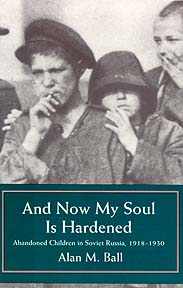
And Now My Soul Is Hardened: Abandoned Children in Soviet Russia, 1918-1930
Alan M. Ball
For my mother and father
Table of Contents
- Preface
- Terms and Abbreviations
- A Note on Conventions
- A Note on Renamed Cities
- Introduction: Tragedy’s Offspring
- Part 1
- 1. Children of the Street
- 2. Beggars, Peddlers, and Prostitutes
- 3. From You I Can Expect No Pity
- Part 2
- 4. Children of the State
- 5. Primeval Chaos
- 6. Florists and Professors
- 7. Progress and Frustration
- 8. Conclusion: On the Road to Life?
- Select Bibliography
- Photo Credits
Preface
This is our own Russia tramping along the road, our own Russia, as young and orphaned as these abandoned children, as visionary and embittered, without a corner of her own, with never a caress, with no one to look after her. Our own Russia—that strange child who has already experienced everything.
No spectacle in Soviet cities more troubled Russian and foreign observers during the first postrevolutionary decade than the millions of orphaned and abandoned children known as besprizornye.1 Whether portrayed as pitiable victims of war and famine or as devious wolf-children preying on the surrounding population to support cocaine and gambling habits, they haunted the works of journalists, travelers, and Party members alike. “Every visitor sees it first,” noted an American correspondent, “and is so shocked by the sight that the most widely known Russian youth are the…homeless children flapping along the main streets of cities and the main routes of travel like ragged flocks of animated scarecrows.”2 Averell Harriman recalled them as “a particular tragedy of the time…, begging or stealing and living as wild animals unconnected with the normal community life.”3 The very fact that no one could remain indifferent to their travail made them tempting ammunition in the ideological charges and countercharges exchanged in these years. On one side of the battle lines, critics of the Bolsheviks featured the children as “proof” that the new regime had failed even to care for its own young. In reply, Soviet officials pointed to the problem’s origin in disasters largely beyond their control and insisted that the Party had assigned far higher priority to rehabilitating homeless juveniles than “bourgeois” governments allocated to the care of their own downtrodden.
In other ways as well, these children meant different things to different people. Government officials, for instance, set out to rescue them with widely varying understandings of who belonged in the category of besprizornye.4 Translated literally, the singular besprizornyi means “unattended” or “neglected,” though “homeless” or “waif” would be closer to the meaning intended by most Russians.5 While everyone agreed that the label fit children orphaned or jettisoned by their parents and left to the streets, numerous educators, scholars, and social workers applied the word to a broader range of candidates. Their capacious definitions often encompassed minors still living with parents or relatives but not receiving a proper upbringing. Any number of factors—parental destitution, neglect, cruelty, or debauchery—could deprive offspring of a healthy adult influence and place them, advocates maintained, in the category of besprizornye. According to the principal Soviet encyclopedia of the time, “One must not restrict the term besprizornye to children who have lost their parents (or guardians) and homes. If parents (or guardians) deprive children of food, treat them crudely, steer them to crime, or set a harmful personal example—children of such parents are also besprizornye.”6
We will focus primarily on youths who spent all, or at least most, of their time in the street. Our gaze thus takes in juveniles who drifted out of families, as well as the more obvious millions orphaned, discarded, or otherwise separated involuntarily from parents. Those who remained at home will not be included, regardless of the abuse or neglect they may have experienced there. Soviet administrators responsible for raising indigent children inclined toward a similar sense of their mission’s scope, for even the narrowest definition of the besprizornye yielded more candidates than state institutions could absorb. The time when other youths, living with parents in unsatisfactory settings, could be lodged in children’s homes together with the nation’s orphans—a goal often avowed immediately following the Revolution—quickly receded far over the horizon.
Thus defined, the besprizornye represented first and foremost a stubborn challenge remaining to confront the Bolsheviks after their victory in the Civil War. The dismaying presence of countless young beggars and thieves underscored how deeply war and famine plague a society long after guns fall silent and crops return to fields. Even a wealthier and more experienced government than the one newly ensconced in Moscow would have been hard pressed to overcome rapidly the adversity bequeathed by nearly a decade of catastrophes. Later in the 1920s, though the street children’s ranks diminished considerably, factors such as rural poverty and the unraveling of traditional families spawned additional urchins at a rate that frustrated the government’s attempts to rid the country of their misfortune. As a result, in Alexander Solzhenitsyn’s estimation, any description of Soviet urban life in this period remains incomplete without attention to abandoned juveniles, so common were they in train stations, markets, and other public places.7
Meanwhile, the government’s desire to create a new socialist generation touched homeless boys and girls in a manner that revealed the new regime’s hopes and fears. As banners unfurled to proclaim children “the flowers of the future,” ubiquitous besprizornye prompted many to worry that weeds choked the country’s flower beds, portending numerous thistles among the roses. Others, more optimistic, saw an opportunity to employ various theories of education and upbringing that competed for acceptance in the years following the Revolution. In their view, the Commissariat of Enlightenment’s long-term boarding institutions possessed a seemingly unsurpassed opportunity to orchestrate the training of adolescent bodies and minds. What better facility, visionaries asserted, than a children’s home in which to nurture the country’s flowers—and the ragged crowds in the street insured that institutions would not lack seedlings to cultivate.
Despite their significance as a massive social problem and the many parallels between their predicament and that of the world’s growing number of homeless juveniles today, the Soviet Union’s abandoned children have eluded thorough investigation in Western scholarship. They find spotlights in only a few recent articles and figure peripherally in a handful of other works on education, the family, and crime.8 Though useful, these studies’ nature limits them to an overview—mainly of policies adopted to cope with the affliction—with little on the lives of the youths themselves. A lengthier treatment of the subject did appear in English translation some sixty years ago, but it consisted primarily of quotations from several Soviet newspapers, a minuscule sampling of the sources available.9 The only extensive English-language work on the topic to surface in the decades since is a dissertation unnourished by published and archival materials accessible exclusively in the former Soviet Union.10 Beyond this, one must look principally to memoirs and travel accounts if Western volumes mark a search’s limits.
Meanwhile, a much larger body of sources evolved in the Soviet Union during the 1920s. Scholars, social workers, educators, and journalists published books, articles, collections of laws, and statistical information on the plight of waifs and the measures taken to save them.11 National and provincial branches of the Commissariat of Enlightenment issued many of these works (and generated numerous internal documents that archives have recently been willing to provide), though other government agencies, notably the Commissariat of Health, contributed as well. So, too, did citizens’ “volunteer” organizations, especially the “Friend of Children” Society (Obshchestvo “Drug detei” or ODD). ODD cells in several cities published periodicals (sometimes with the participation of government agencies) that carried reports from around the country. Two of these journals, composed in Moscow and Khar’kov and both titled Drug detei, are particularly rewarding vehicles for an often unflinching look at the street habitat of abandoned children. Similarly forthright reports appeared in newspapers—national papers with their far-flung staffs and local gazettes concentrating on a single city or region—as correspondents explored derelict buildings, train station basements, and other entrances to a harsher world. The dispatches carried by their papers displayed a frankness unmatched in the Soviet press until the ascendance of Mikhail Gorbachev.
Once the 1920s gave way to decades of more regimented tone, Soviet scholars added comparatively little to these earlier publications. Prolonged interest in tragedies that accompanied the nation’s infancy seemed out of place, indeed undesirable, on a stage featuring triumphant remembrances of the Revolution and pageants of “socialist construction.” The most helpful exceptions have been scattered regional studies of the besprizornye, a few essays on juvenile delinquency, and biographical material on such personages as Feliks Dzerzhinskii and Anton Makarenko who strove to rehabilitate difficult youths. As with Western historians, the emphasis here rests invariably on official responses to the problem (rather than on the children’s street experiences), though Soviet authors naturally view the policies more favorably.
Taken as a whole, the array of Western and Soviet sources now available suggests two broad avenues of investigation: the children themselves and the government’s reaction to their presence. Following an introductory chapter on the origins of the youths’ distress, the remainder of the work adopts this dual approach. Chapters 1–3 examine the lives of juveniles on the street and provide a glimpse into corners of the urban underworld. Principal topics include the forms of shelter sought by waifs, the measures they adopted to secure sustenance, and their mores, amusements, and views of the surrounding society. Illegal activities and the ties many children acquired with adult criminals appear throughout.
This survey of the street then yields in chapters 4–7 to an analysis of the government’s response. How serious a problem, for example, did authorities regard the tattered figures of tender years? Did confidence prevail that the besprizornye could be recast as builders of socialism? In what ways did official assumptions and remedies change during the period under consideration? Looking beyond policy to its implementation, how were children actually captured or otherwise channeled into orphanages? What was the nature of these facilities, and did they succeed in clearing the streets? Finally, what happened to adolescents after their discharge from institutions? Did their paths lead back into the mainstream of Soviet society, or did other fates await them?
Many people have assisted me generously during various stages of this project, and I am pleased to acknowledge my debt to them. Samuel Baron read a draft of the entire manuscript, while Richard Stites and Lynne Viola each scrutinized portions. Their comments both encouraged me to continue with the endeavor and suggested numerous improvements. In addition, I would like to thank Bill Creech and Dane Hartgrove at the National Archives for steering me reliably to documents of the American Red Cross, Wendy Goldman for alerting me to certain archival fondy prior to my departure for the Soviet Union, and Don Raleigh for kindly sharing materials he acquired while conducting his own research in Saratov. Professor V. M. Selunskaia of Moscow State University was most congenial and accommodating during my stay there in 1987–88 as a participant on the US-USSR Long-term Exchange of Advanced Researchers administered by the International Research and Exchanges Board (IREX). Needless to say, I am grateful to IREX for supporting this year of research in the Soviet Union. Numerous Soviet archivists and librarians aided me as well, but the staff at the Central State Archive of Literature and Art (TsGALI) deserve special mention for their willing help in obtaining copies of several archival photographs. They made work in TsGALI more rewarding than I could ever have anticipated. Closer to home, at the University of California Press, Sheila Levine’s sure-footed combination of encouragement and advice served the project well. She, with able assistance from Monica McCormick, Dore Brown, and Anne Canright, brought the book into this world with a deftness that required no recourse to the profession’s equivalent of forceps or general anesthesia. Finally, excerpts from earlier versions of some chapters have appeared as the core of articles in Slavic Review, Russian Review, and Jahrbücher für Geschichte Osteuropas. I thank the editors of these journals for allowing me to draw on that material here.
Terms and Abbreviations
- In the years after World War I, this agency (under the direction of Herbert Hoover) provided relief for famine victims in a number of countries. It was by far the largest of the numerous Western organizations so engaged in the Soviet Union during the early 1920s.
- A producers’ collective composed of handicraftsmen.
- The condition of abandonment and homelessness.
- A single orphaned or otherwise homeless and abandoned child (pl., besprizornye, pronounced bespreeZORneeye). Also used as an adjective. The variant besprizornik (pl., besprizorniki) is used only as a noun.
- The Ukrainian equivalent of the Children’s Commission.
- The secret police. During the 1920s the Cheka became first the GPU (Gosudarstvennoe politicheskoe upravlenie) and then the OGPU (Obedinennoe gosudarstvennoe politicheskoe upravlenie).
- An interagency body formed in 1921 on the initiative of Feliks Dzerzhinskii, head of the secret police. The commission was active in the campaign against besprizornost’ throughout the decade.
- A division of MONO formed to combat besprizornost’ and its consequences. Combined with another body to form a SPON unit in 1925.
- A corps of social workers administered by Narkompros and intended to replace the police in most dealings with minors. Among other duties, they were to search out besprizornye and steer them into institutions.
- An ineffective interagency body formed in 1919 and headed by Narkompros with the goal of coordinating the provision of aid to juveniles. Supplanted by the Children’s Commission in 1921.
- Children’s home. The most common long-term boarding institution for raising homeless juveniles. The vast majority of detdoma were administered by Narkompros.
- Children’s towns. Usually large units composed of several (occasionally dozens) of individual institutions; sometimes a loose collection of formerly independent detdoma or, in other instances, a colony of more tightly integrated buildings.
- A flophouse in Moscow.
- Programs combining postprimary education with industrial training in a host factory.
- The central branch of Narkompros most responsible for responding to the problem of besprizornost’.
- See Cheka.
- Province-level branch office of Narkompros.
- Province-level equivalent of Glavsotsvos.
- Social workers intended primarily to assist Juvenile Affairs Commissions.
- A board, administered by Narkompros, established to resolve the cases of juvenile delinquents.
- A large outdoor market in Moscow.
- A district in Moscow, just east of the Kremlin.
- Communist youth organization intended mainly for those in their teens and twenties.
- A wealthy peasant (literally, “fist”). The term has a negative connotation suggesting that the kulak exploited other peasants.
- A lightly fermented beverage, somewhat similar to beer.
- Facilities intended to rehabilitate “difficult” juveniles with a variety of “enlightened” measures, rather than through imprisonment and punishment.
- Facilities run by the Commissariat of Justice until 1922 (and through the rest of the decade by the Commissariat of Internal Affairs) for juvenile offenders sentenced by courts to terms of confinement.
- The Moscow branch of Narkompros.
- The People’s Commissariat of Enlightenment.
- The New Economic Policy (in force from 1921 until the decade’s close) that permitted considerable private commerce and manufacturing, small-scale peasant agriculture, and free trade of grain.
- A flophouse.
- Facilities designed to examine children for an extended period in order to determine their mental and physical condition and thus establish the most suitable type of boarding institution for their rehabilitation.
- “Friend of Children” Society. Composed of volunteer groups expected to contribute time and money to various endeavors benefiting children—in particular the campaign to rescue and raise besprizornye.
- See Cheka.
- Foster care. In the case of besprizornye, generally implemented by transferring children from detdoma to peasant families.
- Communist youth organization intended mainly for those of primary-school age.
- A facility designed to receive children directly from the street and tend to their immediate needs before passing them on to other institutions.
- “Self-service.” A program in which youths in children’s institutions assumed wide responsibility for daily chores.
- “Self-government.” A program in which youths in children’s institutions participated to one degree or another in the administration of their facilities.
- The Council of People’s Commissars.
- The subsection of Glavsotsvos most responsible for rehabilitating besprizornye.
- A large outdoor market in Moscow.
- Train cars designed to range over principal lines, stopping at stations to collect besprizornye for initial processing before transfer to stationary receivers.
- A district within a province.
- The All-Russian Central Executive Committee elected by the All-Russian Congress of Soviets.
- A turbulent period (1918–1920) of civil war, foreign intervention, widespread starvation, frequent epidemics, sweeping nationalization decrees, grain requisitioning, and zeal in Bolshevik ranks about building a communist society. Followed in 1921 by NEP.
A Note on Conventions
- This work employs the Library of Congress system of transliteration, with the following minor modifications: (a) diacritical marks are omitted; (b) certain familiar names (e.g., Trotsky, Mayakovsky, Zinoviev) are spelled as they customarily appear in English.
- Fiscal years (i.e., twelve-month periods beginning on October 1) are designated with a “/” between the two years in question: thus “1926/27” stands for the period October 1, 1926–September 30, 1927. If the reference is to consecutive calendar years, a “–” is employed (e.g., 1926–1927).
- When quotations are presented from sources with Russian titles, the translations are my own.
A Note on Renamed Cities
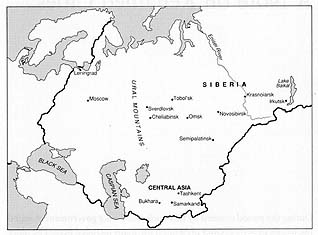
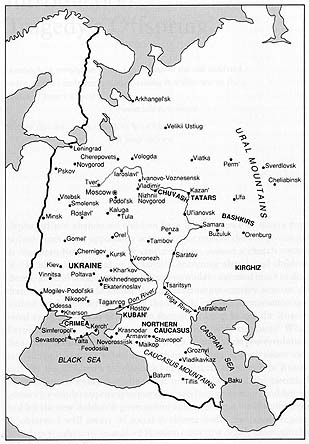
During the period covered by this book, the Soviet government changed the names of several cities present on the maps included here. The older or newer designations for some municipalities turn up from time to time in the following pages, and the list below supplies these names accompanied (on the right) by the maps’ alternatives. Names bestowed after 1930 do not appear.
- Dnepropetrovsk—Ekaterinoslav to 1926
- Ekaterinburg—Sverdlovsk from 1924
- Ekaterinodar—Krasnodar from December 1920
- Novo-Nikolaevsk—Novosibirsk from 1925
- Petrograd—(St. Petersburg to 1914), Leningrad from 1924
- St. Petersburg—(Petrograd from 1914 to 1924), Leningrad from 1924
- Simbirsk—Ul’ianovsk from 1924
- Stalingrad—Tsaritsyn to 1926
Introduction: Tragedy’s Offspring
Inasmuch as revolution is the destruction of the old outdated order, of old family and social relations, it is also one of the causes of besprizornost’.
We are thrown out like puppies born blind.
Orphaned and abandoned children have been a source of misery from earliest times. They apparently accounted for most of the boy prostitutes in Augustan Rome and, a few centuries later, moved a church council of 442 in southern Gaul to declare: “Concerning abandoned children: there is general complaint that they are nowadays exposed more to dogs than to kindness.”1 In tsarist Russia, seventeenth-century sources described destitute youths roaming the streets, and the phenomenon survived every attempt at eradication thereafter. Long before the Russian Revolution, the term besprizornye had gained wide currency.2 What, then, distinguished vagrant juveniles of the nation’s first postrevolutionary decade? To some extent it was their privation, though taken individually the children’s experiences knew precedent enough in Russia. Much more shocking was their vast number. By 1922 the twentieth century’s relentless opening sequence of warfare, epidemics, and famine had left the new Bolshevik government at least seven million waifs. Even to observers well aware of social problems under the tsarist regime, homeless youths now inundated Russian cities to a degree unimaginable only ten years earlier.
To be sure, few imaginations accurately forecast horrors of unusual dimension. The exuberant demonstrations that attended the march of tsarist troops to the front, for instance, appear now as exultation around an unquenchable inferno. Those shouting for blood in August 1914 did not anticipate the scale of impending havoc that would extinguish some sixteen million lives within the nation’s borders by 1922.3 Yet this was the reckoning which commenced that summer—and hardly the Great War’s sole measure of grief. Along with its slaughter in the trenches, the conflict administered a variety of blows that severed contact between millions of children and their parents.4
From the beginning, mobilization of adult males deprived numerous families of their primary breadwinners and compelled mothers to work outside the home. Sons and daughters sought subsistence in any way possible, with little or no supervision. Whatever their choice—begging, peddling, prostitution, or theft—they spent an ever larger portion of their time on the street, drifting out of shattered families that could no longer support them. Those who turned to relatives often discovered these havens to be just as precarious, for if wartime adversity overcame their adoptive guardians, the newcomers’ weak claim on household resources saw them first out the door. By summer’s end in 1917, a Provisional Government ministry noted the presence in Petrograd of “5,000 children without parents and absolutely homeless. According to the estimates of the city there are about 150,000 children who are partly destitute, their fathers being in the army and their mothers at work.”5
One family shredded by the conflict included a boy named Aleksei, born in the city of Ekaterinburg. His father, who had worked as a cobbler in a factory before the war, perished in the fighting, leaving his mother, a washerwoman, to support five children. After making ends meet for a time through the sale of household property, she fell ill, suffered a mental breakdown, and was taken to a hospital. Testimony is silent on the children’s fate, but at some point they lost their dwelling, for on their mother’s discharge the family sought refuge in a crude dug-out shelter. Soon, another breakdown returned the woman to the hospital, and she appears no more in the account. After an unspecified interval, her sons and daughters were placed in children’s homes—from which Aleksei escaped repeatedly to spend ever longer periods stealing from traders in local markets.6
Meanwhile, as the Russian army suffered one defeat after another, the combat moved eastward, pushing residents out of villages and towns in the western portion of the country. A stream of over three million refugees issued from four provinces in Belorussia alone by early 1917, as people left on orders from officials or fled independently.7 Those evacuated at the bidding of authorities were generally informed that they would be conveyed by train or other means to safe regions deep inside the country. Inevitably, youths lost contact with their parents during these wartime relocations. Mothers and fathers (and, of course, some juveniles as well) died of starvation or disease as periods of travel in packed train cars alternated with endless waiting at stations. Looking back a few years later to describe their abandonment, children sometimes recounted that while they were off searching for food during such stops, the trains—with their parents aboard—were ordered to depart. Here and there, local officials sorted minors from adults, sending them to different, often remote, destinations. Inadequate coordination and record keeping commonly accompanied the shunting of citizens from place to place and made it difficult to reunite families later on. The government, in short, handled millions of refugees with the same lumbering confusion that it displayed in conducting other aspects of the war.8
Many evacuees washed up as far east as the Urals, particularly the area around Cheliabinsk. Children whose parents had perished or disappeared en route could rarely hope for anything more than refuge in squalid orphanages or temporary shelters. As the months dragged by, they were joined by others whose parents had died after reaching evacuation regions—often carried away by outbreaks of cholera and typhus that also claimed many juveniles. The brief autobiography of an orphan, identified only by the surname Korneliuk, reports that World War I forced his family to flee their village. With hardship and illness ever at hand, he and his parents covered thousands of miles (presumably part of an evacuation managed by the government) to reach a village in Cheliabinsk province, where he worked five years as a hired laborer for a prosperous peasant. After the war, his family joined others in the province petitioning to return to their native region, now part of Poland. When the passage of time brought no response, they journeyed to Cheliabinsk to take up the matter with authorities there. The city thronged with refugees, many of whom clogged a barracks previously stocked with Austrian prisoners of war. In this setting the boy survived a bout with typhus but discovered upon recovery that his parents had died. Some time thereafter, his name appeared on a list of orphans collected in the barracks and transported westward back across the country to the town of Velikii Ustiug, where he worked on a state farm. Six months later, local officials dispatched him to Poland, a trek destined to lead instead to a children’s home in Moscow.9
Juveniles routinely fended for themselves after overcrowded shelters denied them entry. Others vanished from official sight in the shuffle from one institution to another or fled facilities whose conditions seemed more wretched than life on the street. Even families that survived intact the long journey to the Urals or one of the cities in the middle Volga region did not always withstand the trials that lay ahead. After a lifetime of misery compressed into less than a decade, they faced in 1921 a famine that desolated the territory to which manmade ruin had flung them.10 This sequence of events forms the heart of an autobiographical sketch left by an orphan from the city of Grodno. His family numbered among the millions pouring from western districts to the interior during World War I, in this case again to a village in Cheliabinsk province. Here the boy quit school and found work with local peasants in order to help support the family, his father having died in 1914. For six years they managed in this fashion, until famine arrived to eliminate the village’s food and drive them in desperation to Cheliabinsk. Five people in a starving multitude, they were swept into a cold, typhus-ridden barracks that soon claimed the boy’s mother and a sister. Three days later his other sister died, leaving him alone with an ailing brother. “There were many like us.”11
But before the scourge of famine descended on the country, civil war between the Bolsheviks and diverse adversaries beset a society already bled pale by World War I. From 1918 through 1920 families continued to disintegrate under the assault of combat, flight, hunger, and disease, casting adrift still more children. Every contested province revealed them in abundance. As the fighting approached its last summer in southern Russia, for example, American Red Cross personnel in the vicinity told of “1,000,000 Russian children separated from their parents and needing food and clothing.”12
With warfare spread across much of the country, refugees streamed in huge numbers and in all directions. A Red Cross document titled “The Agony of Western Siberia” portrayed scenes by no means unique to the Siberian front: “The whole of the towns in this region are over-crowded in an incredible manner, and the congestion is indescribable. To quote one example, in Omsk where the population prior to the war was about 180,000 souls, it is estimated that there are at the present time 700,000 herded in and around this town.”13 City after city near the ever-shifting front lines teemed with people on the run. By 1920, over three hundred thousand refugees jammed the Crimean city of Sevastopol’, normally home to only seventy-five thousand. In the Northern Caucasus sector, as Bolshevik troops approached Rostov-on-the-Don during the winter of 1919–1920, “trains went out with refugees clinging all night to the platforms, bumpers and huddling on the roof. This is not unusual inthe summer,” commented a Red Cross official, but it was then “bitter winter weather.” No doubt many of these people made for the neighboring Kuban’ region—where they joined five hundred thousand to one million other uprooted adults and children.14 With even less guidance than that provided by the tsarist government for evacuations during World War I, the Civil War’s refugees plodded blindly into chaos and death that stripped innumerable children from their parents.15
As casualties from battles, reprisals, and executions grew, so did the number of households deprived of their principal source of economic support. Most of those killed in military operations were men, of course, and the tragedy of newly widowed mothers unable to support their offspring remained the fecund source of homeless youths that it had become after 1914. Furthermore, the collapse of government authority in numerous areas left armed bands to roam the countryside, seizing whatever they could, killing whomever they pleased, and strewing additional orphans in their wake.16 Such was the experience of the Aleichenko family in the village of Fliugovka, Voronezh province. A few months after the father departed for the trenches of the First World War, notification arrived that he had sacrificed his life “for the faith, tsar, and fatherland.” Then, after a yearlong illness, the mother died, leaving five children with their grandfather, Anton. One of the five, a boy named Vasilii, recalled that in 1919 or 1920 groups of armed men began to raid their village. As the peasants scrambled to bury their grain and conceal their livestock, Anton sought to hide his only horse. In the process, the animal kicked him in the chest, a fatal blow that deprived the children of their guardian. Vasilii’s older brother took the youngest of the three boys to live in the Northern Caucasus region with distant relatives and managed to find refuge for his two sisters with compassionate neighbors. Then he and Vasilii set out for the Northern Caucasus, hoping to survive in any manner possible. Along the way they were separated, not destined to meet again until 1964, and Vasilii began a vagrant life that would take him throughout the Crimea, Northern Caucasus, and beyond. Eventually he entered an orphanage, from which his path led to school, the communist youth organization, factory work, action in World War II, and service in the Cheliabinsk police force.17
Behind the Civil War’s violence trailed a retinue of hunger and disease, tearing untold thousands of youths from their guardians. Years of fighting had bequeathed the population severe shortages of food and other essentials, thereby inviting epidemics and starvation for lengthy stays. Perhaps typhus or cholera arrived to gut a child’s village, or a father journeyed off in search of food and never returned. Entire families left home, fleeing privation or soldiers, only to be decimated by disease along the rails, roads, or waterways.18 In Omsk, for instance, the American Red Cross opened an orphanage for children whose parents had succumbed to typhus and other maladies—often spread by soldiers, as described in the following report:
[In the rail yards across the Irtysh River from Omsk] the congestion of trains of soldiers coming from the West ahead of the advancing Bolsheviks soon led to a frightful situation. Hundreds upon hundreds of patients in the height of typhus fever arrived from the West and many of them wandered delirious in and out among the other trains and among the refugee families, spreading the disease. Lacking water, lacking food, lacking fuel, lacking every facility for decent living, the railway yards at Kolumzino became a [sic] inferno of suffering.19
Hunger, too, pried children from households that could no longer sustain them, including a boy named Andrei growing up in the industrialized core of the Donets basin. One day in 1917, after news of the tsar’s fall reached the area, unrest broke out at an iron mill. Policemen responded, and the ensuing battle claimed among its casualties a worker from Orlov province—Andrei’s father. His mother had died years before, so the children were sent back to their home region to live with an uncle. Here they managed to get by until hunger overcame the area in 1919, prompting the beleaguered uncle to evict one of the boys, Andrei, to forage on his own. “I cried, not knowing what to do, and set off with no idea of a destination. I got on a train and left without knowing where I was going. I wanted to eat, but I was afraid to beg and afraid to steal . . .”20While Andrei groped for survival among the homeless, conditions also deteriorated in Petrograd, Moscow, and other large cities. Desperate officials even evacuated children to colonies in Ufa province, the Caucasus, Ukraine, and Crimea, where they hoped for more abundant food and fuel. Some evacuees subsequently lost contact with their parents when the ebb and flow of fighting cut off regions temporarily from Soviet Russia, as the American Red Cross observed: “Poltava was the centre of a district selected by the Bolsheviki where the children from the northern cities were to be sent, consequently, with their [the Bolsheviks’] forced evacuation, some 8000 children were left to be taken care of by the new [White] government. Conditions in this respect were very bad and unless some outside assistance is given this winter much suffering will result.”21 Colonies left in such straits frequently crumbled, and their inhabitants dispersed to fend for themselves.22
Thus it was that by 1920, as combat finally diminished, local officials noted an alarming number of orphans and abandoned children, growing ever more primitive and dissolute as they swelled the contingent of delinquents, prostitutes, and hawkers clinging to life on the street.23 More would soon join them.
Within a matter of months, in the second half of 1921, the bony hand of famine strangled countless villages in the nation’s heartland. The territory devastated most completely stretched along the Volga basin all the way from the Chuvash Autonomous Region and the Tatar Republic through Simbirsk, Samara, Saratov, and Tsaritsyn provinces down to Astrakhan’ at the river’s mouth. It extended as far north as Viatka province, as far east as Cheliabinsk and the Bashkir and Kirghiz republics, including Orenburg, Ufa, and Perm’ provinces, and west as far as southern Ukraine. The long period of war had removed hundreds of thousands of peasants from the soil and cut sharply into the number of draft animals available, reducing acreage under cultivation. Also, the Bolsheviks’ policy of grain requisitioning (not to mention similar measures taken by their opponents), while possibly necessary for victory in the Civil War, diminished the peasantry’s grain reserves and rendered them more vulnerable to unfavorable conditions that might subsequently arise.24 And arise they did, for a severe drought blighted the crops of the Volga basin by the summer of 1921, inaugurating a catastrophe destined to claim at least five million lives.25
For nearly two years, chilling accounts surfaced from the famine region, describing a population driven to ever more wretched extremes by hunger. Investigators found village after village where people had abandoned hope in exchange for numbing apathy. They lay in their huts with changeless, blank expressions—after having dug their own graves on occasion—and waited quietly to die.26 Others committed the most brazen thefts from homes, mills, storehouses, and similar facilities thought to contain food. Newspaper articles and telegrams from local officials reported a huge increase in such offenses, though in some localities they were so common that no one bothered to count them or even view them as crimes.27 As starvation and disease spread in the second half of 1921, millions resolved to flee their villages. Many thronged to provincial capitals or more distant sites rumored to be better supplied, including Central Asia, Siberia, and Ukraine. Some wandered aimlessly down the roads, passing forlorn figures trudging just as blindly in the opposite direction. For a long time thereafter, human remains dotted these routes, marking the end of refugees’ ordeals.28
In Orenburg, a former waif recalled, hunger reduced his family to such misery that he and his father boarded a train for Tashkent, said to harbor substantial grain stores. Day by day, the journey took one frightening turn after another. First, illness overcame his father. Then, at a station, other passengers ordered the boy to take a bucket and steal some oil for the stove in the crowded car. They promised to throw him and his father out if he failed, but the terrified boy managed to pilfer the oil and preserve his place among the travelers. On another occasion he narrowly escaped a fire that destroyed much of the car. Later, when he and his father were searching for tea in a station, the train departed, stranding them until accommodations turned up in a freight car. Eventually his father died, leaving the boy to push on alone to Tashkent and then Samarkand before returning to Orenburg. He supported himself along the way by selling his clothing and begging, with adversity continuing to overshadow good fortune.29
As food supplies disappeared from the Volga provinces, ravenous inhabitants turned for sustenance to leaves, bark, acorns, roots, weeds, grass, chaff, straw, and sunflower stalks. Peasants hunted dogs, cats, mice, rats, and crows until none remained in their villages. A delegation from Samara reported that “people deranged from hunger are wandering about like packs of wolves, tearing apart the burrows of rodents, digging up the carcasses of diseased cattle, and grinding their half-decayed bones into flour.” Others vainly sought nourishment in carrion, manure, leather, and clay.30 Numerous dispatches told of suicides and of parents resolved to end the anguish of their emaciated offspring by suffocating the children or throwing them into wells and rivers.31
Even this did not mark the limit of ghastliness inflicted by the famine. When references to cannibalism first reached Moscow and Petrograd, they seemed wild exaggerations, inconceivable in twentieth-century Europe. But with each passing month, cases multiplied, reaching into the thousands by 1922. In the town of Nikopol’, two American relief workers sought confirmation from local officials: “Comrade Titov, the ruler of the town, verified these reports and even showed us official photographs of two children picking the meat from the head of their dead mother; and another where the members of the family, father, mother and several children, were satisfying their insane appetite on the cooked remains of one of the members of the family.”32 The practice occurred frequently enough in some districts that local inhabitants ceased to regard it as remarkable. Here and there people plundered graves and morgues in search of corpses, and human flesh even appeared for sale.33
The famine’s wrath added legions of abandoned juveniles to the millions already at large. Clad in filthy, lice-infested rags and staggering from exhaustion and hunger, they began to appear on the streets of Moscow by late summer of 1921. From Kazan’ came word that every ship and train arriving in the city brought waifs from the surrounding area. With the onset of cold weather and the ever-worsening supply of food in their home districts, they flooded numerous cities, both in and out of the famine region. Reports described “whole armies of children—grimy, starving vagrants”—who jammed train stations, docks, and bazaars.34 Armand Hammer, traveling on business in 1921, was shocked by the spectacle surrounding his train at the station in Ekaterinburg:
Children with their limbs shrivelled to the size of sticks and their bellies horribly bloated by eating grass and herbs, which they were unable to digest, clustered ’round our windows begging piteously for bread—for life itself—in a dreadful ceaseless whine. We could not help them. Here and there it was possible to give one youngster a meal, but if we had distributed every scrap of food on our train, it would have been as nothing to feed this multitude.35
A telegraph from Simbirsk province sketched some victims as “little wild animals” living in the woods and fields, where they fed on roots and avoided adults. As late as the end of 1923, well after the drought had passed, approximately 70 percent of the youths still roaming Moscow were originally from the Volga famine territory.36Simply put, the famine played a greater role in depriving children of their homes than did any other single cause. Proof abounded in city streets and welfare institutions, overrun with juveniles in 1921–1922.37 While it is impossible to be certain how many boys and girls lost parents during the famine, the total certainly reached into the millions.38 By May 1922, each day saw three to four hundred newly forsaken children accumulate in most principal municipalities of the middle-Volga basin. Cities located at rail hubs in the famine region found themselves overwhelmed with as many as 50,000 young refugees—36,000 in Simbirsk, 50,000 to 60,000 in Ufa, 48,000 in Cheliabinsk, and 55,000 in Orenburg.39 As early as the autumn of 1921 a Soviet journalist discovered “many children around the Ufa train station. Their bodies are filthy; their faces deathly pale, skin and bones. In the rain and slush they sit and silently watch passersby and travelers. The fortunate among them receive alms on rare occasions. On every street, wherever one turns, there are children starving, homeless, and even dying in the dirt and dampness.”40 In Ufa province, the number of besprizornye grew from 100,000 in June 1921 to 280,000 just four months later. Figures from the Kirghiz Republic jumped from 129,000 in December 1921 to 408,000 the following March, while the Workers’ and Peasants’ Inspectorate reported a total of nearly 800,000 waifs in the Tatar Republic well before the end of 1921.41 Clearly, the tragedy’s scope had reached catastrophic proportions.
The famine severed children from parents in a variety of ways. Juveniles typically received priority over adults where relief supplies existed, and in such cases—as in families where parents ate less in order to continue feeding their offspring—children could elude death more successfully than did their elders.42 Others lost parents during flight from famine areas or on long expeditions by the family (or some of its members) in search of food. Numerous variations on this theme occurred as hunger and disease took their toll. Parents also disappeared during chaotic layovers at train stations, as in the evacuations forced earlier by World War I. “There were sad scenes,” a traveler observed, “when the trains came into stations. People rushed to the doors of the third-class carriages. Every place was soon taken, every space filled, corridors packed, the platform full. Children were separated from their parents, never to see them again.” After languishing several days, refugees could be herded unexpectedly onto a departing train and torn from relatives who happened to be off foraging for food or otherwise temporarily engaged away from the station. Parents or children who fell ill, as many did, might be taken from trains to hospitals or barred from continuing with the other passengers. Adults thus stripped of dependents often learned upon recovering that their progeny’s trail had grown cold in the streets or the maze of overcrowded relief institutions.43
One boy recalled that World War I forced the evacuation of his family to a village in Kazan’ province, where they lived tolerably well until the famine arrived in 1921. As hunger and death closed in, they headed for Kazan’, some eighty miles away, hoping to secure passage to their native Grodnensk province. But the appalling conditions around Kazan’ crushed the health and morale of the boy’s parents. Bloated from hunger, they lay inert, four or five miles outside the city. After supporting the family for a time through begging and stealing, the boy could no longer endure his parents’ hopeless condition. Bidding them and his elder sister farewell, he departed for Kazan’ with his two younger sisters, Vavara (age eight) and Anna (ten). Hardly had they begun when Vavara sobbed that she could go no further. Drivers of passing carts ignored their pleas for a ride, so they supported Vavara by the arms and even dragged her along the ground for much of the way. It was a cold Christmas Day. On they walked, crying and hitting Vavara in the back with their fists because she was not bearing her weight. People coming from the city shed tears when they encountered the trio, and two travelers gave them a little bread. At last they reached Kazan’ and found a children’s home willing to admit them. Relief appeared at hand, until Vavara contracted typhus and died. The journey of her brother and sister had only begun.44
Sources commonly include accounts of children jettisoned by parents. With hunger paramount, any number of motives—a sense of helplessness to ease a child’s torment or, alternatively, a desire to shed a burden and save oneself—prompted adults to abandon youths. As noted earlier, such feelings provoked some parents to kill offspring, but much more frequently they elected to part company with their children and entrust the outcome to providence.45 In some cases, parents simply thrust them out of the home to wander hungry, swollen, and undressed through the village, filling the road with their sobbing. Others decided to take youths to neighboring settlements and forsake them there (or leave them at home and ply the roads themselves). So many peasants chose to desert children at urban bazaars that market days doubled or tripled the flow of minors to relief institutions in some cities.46 From Rostov-on-the-Don, a journalist reported that parents regularly stranded dependents in the large square outside a train station, telling them to wait there just a minute until they returned from some minor undertaking. As time passed and the adults did not reappear, children around the square began to wail helplessly. Rarely did anyone respond to their grief, merely a drop in a sea of misery.47
Adults also discarded children after joining the throngs of refugees. Sometimes this had been the parents’ intent from the moment they left home, though often the decision was reached only after considerable travail in an increasingly bleak odyssey. In Samara, a young peasant girl sat in a temporary facility for homeless children and asked all who passed if they had seen her mother. Earlier, as the famine drove her parents toward this provincial capital on the Volga, she and her mother lost contact with her father. One day, after further wandering, her mother set the child outside a house, telling her to wait until she returned with an egg. There the little girl remained, all through the night. When she was found the next morning and taken away, she protested desperately that she had to wait there for her mother.48
Other parents, drained by the famine to the point where they could no longer support their young, brought them to the nearest orphanage or government agency that administered these institutions. If told by officials that no resources or space remained in a facility, they frequently deposited offspring in the hallways and stairwells of the building or on the street outside. In Samara, the local head of the Commissariat of Enlightenment (Narkompros) discovered some children dumped at the door of his apartment.49 Here and there, adults no longer able to care for dependents would engage an unusual type of unscrupulous entrepreneur who made the rounds of famine-stricken villages, collecting payments from peasants in return for promises to place their children in urban institutions. Having assembled a batch of perhaps twenty to thirty youths, he or she herded them off to town and then disappeared after disposing of the group in the street.50
The millions of abandoned juveniles scattered across the country by war and famine diminished in following years to the range of several hundred thousand halfway through the decade. Such a sharp drop inspired the view that remaining waifs were merely a fading inheritance from the old “capitalist” order and the calamities of 1914–1922—a comforting suggestion that time would soon eliminate the problem altogether. But the assumption withered under scrutiny in studies at a variety of children’s institutions, where investigations revealed that many residents—sometimes 50 percent or more—had first landed on the street in the years after the famine.51 “I myself wrote previously that besprizornost’ is the legacy of war and devastation,” admitted Nadezhda Krupskaia, Lenin’s widow and a figure active in Narkompros from its foundation. “But, having observed besprizornye, I see that we must cease such talk. We must state that the roots of besprizornost’ are not only in the past but in the present.”52 In short, a variety of factors continued to generate homeless youths throughout the 1920s—not in the vast quantities of 1921–1922, but enough to prevent the government from realizing its goal of clearing them from the streets.53
The countryside, home to some three-quarters of the population, long supplied reinforcements. Partial crop failures that plagued one region or another did not have to approach the nightmare of 1921–1922 to foster additional street urchins. Through much of the decade, in other words, an experienced urban eye had no difficulty spotting quaintly clad peasant children gazing around in bewilderment at train stations or walking nearby with the hesitant gait of newcomers. Though they soon sank into the unsavory world around them, new arrivals from the villages followed fast on their heels.54 Even a good harvest failed to halt the flow of rural youths to cities, for most villages contained landless or at least impoverished families, often headed by widows. Sooner or later, the absence of adequate support or employment pushed many children of such households, along with village orphans, to seek life’s necessities in cities or towns. These themes echo throughout the sources, time and again accounting for the departure from a village of juveniles who could not be fed or employed.55
In some cases, youths worked in the countryside for several months each year, from spring until the autumn harvest brought the agricultural season to an end. With the onset of winter, the village could no longer support them, and they decided—or were ordered by parents and relatives—to migrate to cities in hopes of eking out a living. While they generally intended to return to their villages in the spring or at least at the end of summer for the harvest, some found life in the city’s stations and marketplaces more appealing than the rural alternative. Wedded to the bustle of urban thoroughfares, they did not set out for the countryside when the sun had melted the snow and warmed the fields.56
Abandoned youths emerged as well from urban homes whose adults lacked the means to raise offspring, a predicament that gripped with special tenacity families headed by single parents, usually widowed or divorced women.57 Heavy male casualties from World War I and the Civil War created many such households, and new developments in the 1920s added more. The Family Codes of 1918 and 1926, for example, made divorce much easier to obtain than before the Revolution, contributing to a dramatic increase in the number of marriages dissolved. The Soviet divorce rate climbed to almost three times that of Germany and twenty-six times that of England and Wales. As one might expect, urban areas far outstripped the countryside in this regard, with Moscow leading the way at a pace of almost one divorce for every two marriage “ceremonies” in 1926. The new laws—intended to promote equality between the sexes—had the effect of encouraging men to leave their spouses (at a time when the numerical imbalance between the sexes due to war losses increased the “competition” among women for those men who remained). The difficulty women met in vying with men for jobs outside the home meant that a woman abandoned by her spouse could face an extended period of poverty—especially if she had dependents. Soviet law provided for the payment of alimony in such cases, but in amounts insufficient for adequate support and, in any event, frequently not delivered by ex-husbands.58 Mothers deserted in this fashion (or by men they had not married) often could not sustain their sons and daughters. Whether a child’s route to the street thereafter proved direct or passed through intermediate stops in relatives’ homes, the broken families of the 1920s represented a fertile seedbed for waifs.59
Along with families headed by single parents, numerous other domestic arrangements funneled children—through poverty, abuse, or neglect—into the ranks of the besprizornye. Much as in other eras and countries, harsh treatment at home, especially when combined with penury, could accelerate a child’s exit. Blows from a drunken father, for example, presented the street in a different light—that of refuge—to the victim of the thrashing. In addition, adults reduced to rage by drink or by dependents’ demands on scant family resources might lash out and banish youths without waiting for them to run away. A child’s failure to perform a chore properly could also spark parental fury and lead to expulsion, as could exasperation at offspring continually under foot in a crowded hovel.60
Juveniles ignored (rather than ejected) by parents were likewise free to occupy themselves in nearby lanes and market squares, where they might encounter street children and learn the ways of a new world.61 Meager supervision often stemmed directly from poverty, which inclined adults to send children out to beg, steal, or engage in petty hawking to help support the family. Thus deployed, they absorbed the street’s mores along with techniques for scratching a living from a difficult environment. This knowledge, accompanied by dire poverty at home, prodded them to loosen family bonds and spend more time in the company of other roving juveniles.62 A group based on Khar’kov’s Sumskaia Street contained several members whose passage to vagrancy included a stretch of work as bootblacks. One boy, who had lost his father years before, experienced a childhood of relentless but scarcely unusual privation. Eventually, he and his mother moved in with his married sister, a sickly, impoverished woman burdened with a large family. Both newcomers were regarded by the others as parasites, which goes far to explain the youth’s appearance with polish and rag on the sidewalk and his preference for life there with footloose friends.63
Neglect also occurred as a by-product of parental employment outside the home. The absence of a comprehensive system of day care institutions compelled adults lacking assistance from their own parents or other stand-ins to lock offspring in rooms each day or, more likely, abandon them to the street’s tutelage. Left to forage like stray animals, some youngsters soon passed their time with full-fledged waifs and took up petty thievery. In households with just one parent, the odds in favor of this outcome climbed even higher, for only the most fortunate individual could support a family and supervise it at the same time.64
Two other factors deserve mention as well. First, the unemployment rate among teenagers remained high after the introduction of the New Economic Policy (NEP) in 1921. NEP itself bore some responsibility for the problem, because it required numerous state organizations to operate profitably. This new discipline stirred such enterprises to cut expenses by dismissing staff—with women and adolescents representing a disproportionate number of the layoffs. In many types of production, labor laws stipulated that juveniles work fewer hours per day than adults, with lower output norms but at the same wage scale as their older coworkers. Moreover, the preceding years’ turmoil deprived youths of adequate schooling and labor training, and thus of qualifications needed to compete for jobs.65 Under these conditions, supervisors had little incentive to hire minors as long as capable adults remained available—as they did in considerable number until the industrialization drive at decade’s end. In the meantime, teenagers forced to support themselves found the labor market a difficult nut to crack, closing for many a gateway that might have saved them from indigence.66
While unemployment blocked an escape route for the homeless, the ineffective work of welfare institutions returned juveniles to the street. Countless thousands over the years fled the abysmal conditions in orphanages and headed for their former stamping grounds. Even among those who remained, many did not receive adequate training to secure steady work upon discharge into a glutted labor market and thus replenished the ranks of abandoned youths after failing to find employment.67 In addition, local officials struggled throughout the decade to reduce the strain on their budgets caused by orphanages—sometimes disbanding institutions altogether, even in defiance of orders from Moscow to maintain the existing network. Residents discharged early for budgetary reasons often landed on the street, either directly or after transfer to the families of relatives or strangers who could not support them and did not relish the financial burden any more than did local officials.68
The homeless wave crested during the famine of 1921–1922, with estimates ranging typically from four to seven and a half million orphaned and forsaken youths.69 Lists compiled around the country commonly identified 75 to over 90 percent as Great Russians, reflecting both their numerical predominance in the nation and the famine’s devastation of several Great Russian provinces. The catastrophe, of course, spared no one in its path and thus accounted as well for sizable pockets of Chuvash and Tatar waifs, both in their home territories along the Volga and as refugees elsewhere. Many young Ukrainians also appeared in the totals, after famine in the south followed years of warfare in much of the republic. Other street children sprang from smaller ethnic groups—Jews, Volga Germans, Poles, Bashkirs, Armenians, Georgians, and Moldavians, to name a few—typically emanating from regions scourged by violence, disease, and hunger.70
While the quantity of street children clearly declined in the years following the famine, sources continued to offer widely varying assessments of their number in any given year. Estimates for 1923 generally fell between one and four million, though a few ranged even higher, or as low as 800,000.71 In 1924, figures from local offices of Narkompros prompted tabulations for the Russian Republic that ran from 125,000 to 300,000 youths. But totals of this order could not have convinced the author of an article in Komsomol’skaia pravda, who warned that “before us stands the fact of the insignificant reduction in the number of besprizornye in 1924 compared to 1922 and 1923.” Earlier, in the spring of 1924, an article in Izvestiia placed the total at “over one million.”72 Estimates for 1925, 1926, and 1927 covered a span from the neighborhood of 300,000 to less than 100,000.73 Even as late as 1930, when most sources trumpeted the virtual elimination of the problem, an article in a provincial journal maintained that 200,000 abandoned children continued to inhabit the Russian Republic alone.74
It bears stressing that accurate data eluded officials throughout the decade, a fact acknowledged by nearly everyone from Anatolii Lunacharskii, head of Narkompros, to provincial investigators.75 The youths’ very nature—streetwise and wary of outsiders—rendered futile all attempts to count them precisely. Furthermore, local officials worked with differing understandings of the term besprizornye and diverse methods for determining their number. The results proved difficult to compare with one another and unreliable in combination as a national total.76 More often than not, the numbers relayed from the provinces to Moscow were far too low. In fact, the slippery street children left some investigators able to count nothing more than those already in institutions.77 Even special efforts to tally homeless juveniles during the national census of 1926 produced results widely judged as well below the actual total. Substantial numbers evaded the census takers with ease, on occasion greeting them with a hail of stones before fleeing.78
Statistical difficulties, however, cannot obscure the massive nature of the problem, evident to anyone touring Russian streets, markets, and train stations in the 1920s. Nor can there be any doubt that a majority of these youths issued from nearly a decade of calamities—wars, epidemics, and famine—that had battered the land since 1914. Thereafter, while the number of victims dropped sharply, other types of misfortune replenished their ranks at a rate exceeding the government’s ability to respond as rural poverty, unemployment, and numerous single-parent families stubbornly continued to restock the streets. To be sure, the adversity faced in mid-decade paled before that of preceding years and therefore offered hope of satisfactory control before long. But that day arrived much later than anyone could have imagined at the time, for new upheavals—collectivization, dekulakization, the famine of 1933, and World War II—cast fresh waves of homeless children adrift in a country that had already seen far too many.
Part 1
Children of the Street
Who has not seen them, sleeping in caldrons and garbage bins, traveling under train cars, singing songs and begging in every station?
. . . waifs in drab tatters who scurried hither and thither thieving and warming themselves at asphalt caldrons on the streets, without whom one could not picture the urban life of the twenties . . .
By the early 1920s, abandoned children crowded cities and towns across much of the new Soviet state. Their wretched appearance advertised misery already endured, and an untold number, weakened by hunger and disease, soon perished as anonymously as they had arrived. Survivors were left to confront a world in which sustenance issued from practices both alien and disagreeable, for little in their lives had prepared most to face the street alone. Their responses, shaped to some extent by age and other personal characteristics, reflected in a broader sense the imperatives of this harsh environment—a setting that must be explored to understand the conduct of besprizornye.
Waifs did not scatter evenly over the Soviet Union. Nor did they always congregate in areas with the greatest population densities. Efforts to account for clusters of them in various regions focused time and again on the following questions: Had a province recently experienced famine or some other misfortune? Did the territory contain a major rail junction or sit astride an important waterway? Was the district’s climate mild? If not, was refuge accessible? Just as important, did the area, if not a goal itself of vagrants and refugees, lie along a main route to popular destinations? The more closely a locale met such criteria, the more homeless children it drew.1
Within these general limits, cities exerted a far more powerful attraction than did the countryside. During the famine, starving children poured from villages to the capitals of their provinces, and subsequent years did not reverse the current. To a homeless youth, the train stations, markets, crowded streets, and derelict buildings of a city offered a more promising field for begging and shelter than did a rural hamlet. For those seeking escape from the street, the concentration of government assistance in urban areas further enhanced their appeal. Others of more incorrigible bent also preferred cities, where amusements and thieving opportunities eclipsed anything the countryside could offer.2
Cities situated at major railroad junctions or along important waterways often acquired throngs of abandoned offspring—not just from their own environs but from throughout the country—while towns well removed from these arteries generally tempted fewer.3 In Nizhnii Novgorod, for example, the number of young visitors began to increase each spring with the opening of navigation on the Volga and Oka rivers, and before long the waterfront quarters teemed with dirty, barefoot children. This homeless host continued to expand through the summer months, peaking at the time of the city’s famous fair, which summoned youths from all parts of the nation. During opening day alone in 1925, authorities apprehended over a hundred inside the fair’s boundaries in a largely futile effort to preserve the premises from depredation.4
Numerous cities, not destinations themselves, nevertheless accumulated sizable populations of nomadic children during certain times of the year, owing to their location along well-traveled routes. Orenburg, for instance, found itself the first extended stop for many venturing in early summer from their winter quarters in Tashkent or Samarkand to resort towns of the Northern Caucasus or Crimea. Along the Volga, cities such as Samara did not maintain their large homeless populations solely with local victims of the famine. By linking the river with rail lines leading to and from Siberia and Central Asia, Samara collected year after year a considerable transient community of juveniles, especially during navigation season on the Volga.5
No city, however, could match the potent attraction exerted by Moscow. “It would be difficult,” wrote secret police chief Feliks Dzerzhinskii, “to find in the entire republic a city or town from which there has not been a pilgrimage to Moscow of abandoned children. . . . [Moscow] has become the national refuge to which besprizornye stream from all ends of the country.” Only the most reclusive resident of the capital could fail to notice the bedraggled flocks in central squares, train stations, and markets—a multitude twenty thousand strong according to an estimate for the beginning of 1923. Leningrad, because of its location in the far northwest corner of the country, did not share Moscow’s magnetism.6 Asked why they journeyed to Moscow, youths often responded simply, “Moscow is the center,” “Here is the power,” “They say food is given out in Moscow.” Peasant children, traveling to the metropolis to obtain food through begging, stealing, or petty street trade, sometimes described the trip as “going to pasture.” Rumors and reports of better conditions in the center—more food or easier access to welfare institutions, for example—passed among homeless juveniles in all corners of the country, even prompting some to flee remote orphanages and set out for the capital.7 This allure produced such an influx that native Muscovites numbered no more than 10–20 percent of the city’s waifs in the middle of the decade, earning Moscow the informal title “All-Russian Receiver” of besprizornye.8
In years following the famine, the Northern Caucasus region possibly contained more street children than any other section of the country, and its principal city, Rostov-on-the-Don, probably absorbed more than any site but Moscow. Many gathered in Rostov with much the same expectations that propelled others to the nation’s capital. Here, they thought, waited opportunities to acquire food, shelter, and perhaps admission to government boarding institutions. In one estimate the Northern Caucasus, with a mere thirteenth of the Russian Republic’s total population, accommodated fully a seventh of all abandoned youths in the republic midway through the decade.9 Only a third of these were indigenous. Early in the 1920s, most came as refugees from neighboring famine provinces of the Volga basin, but Rostov continued to woo others long after. The city’s relatively warm climate and location at the hub of a rail network—with tracks leading south to the Caucasus, north to Moscow, and west to the Crimea—insured for years a steady stream of new arrivals.10
One day, on just such a line to the Crimea, a passenger noticed that the railroad bed was covered in sand along stretches near the sea. Well-scrubbed boys and girls, traveling on vacation, jumped out at a stop and plunged under the cars to gather seashells from the sand. No less abruptly they recoiled from the train as if stung, crying to their parents in fright, “Besprizornye! besprizornye!” They had discovered other young passengers ensconced in the undercarriage, as determined as anyone else on the train to reach the sunny resorts.11 Hospitable weather and the food it nurtured lured thousands of urchins to the Crimea and Black Sea coast, augmenting the ranks of native youths left adrift by the Civil War and, in southern Ukraine, famine. As word spread among homeless children elsewhere in the country, cities such as Krasnodar, Simferopol’, Sevastopol’, Feodosiia, Kerch’, and Odessa mustered large crowds. In particular, when pale citizens headed south in the summer to Black Sea sanatoriums, waifs followed close behind, hoping to secure a living during the resort season by begging or stealing directly from the crowds of vacationers or from the stores, markets, and restaurants they frequented.12
Many other regions and cities also hosted considerable numbers of besprizornye. In Ukraine, Khar’kov deserves special mention, while along the Volga, in addition to Samara, cities such as Kazan’, Simbirsk, and Saratov retained sizable homeless populations well after the famine. The quest for food and shelter (or warm weather) even carried youths over the frontiers of European Russia. During the famine, they followed the rails to the Urals and often far beyond—to cities in Siberia (such as Omsk and Novosibirsk) and Central Asia (notably Tashkent and Samarkand). In the years thereafter, the prospect of accessible food and a mild climate continued to attract them to Central Asia—and through the Caucasus to Baku and Tiflis. They made these treks in surprising numbers, so large in fact that Tashkent’s population of abandoned juveniles reportedly ranked third among all Soviet cities in the middle of the decade.13
A city’s complement of street children fluctuated considerably during the course of a year, even in the absence of such misfortunes as an epidemic or poor harvest that always produced a local proliferation of homeless minors. More than anything else, apart from famine and war, seasonal changes dictated their travel. As chilly nights heralded the approach of autumn, major cities found their streets sheltering larger numbers of youths. They crowded into train stations, abandoned buildings, and any crevice affording protection from the wind. Some had spent the warm season living on the outskirts of cities or deeper in the countryside, perhaps engaged by peasants for agricultural work.14 Others, typically the more experienced and adventurous, had departed in the spring or summer to journey around the country, often south to the resorts of the Northern Caucasus and Crimea. At the end of the season, beaches and mineral baths lost much of their clientele, prompting markets, restaurants, and hotels to close or scale back their activity. Because dormant resort towns could not support large numbers of young beggars and thieves, many left until the following summer. Some remained in the general area of the Black Sea’s mild temperatures, but more headed north again to major cities.15
Veterans of the circuit often entered a city in the fall intending to gain admission to a children’s institution, live there through the winter, and then run away with the return of warm weather. Some repeated this pattern year after year, returning each winter to one city or another like migratory birds. These “seasonals” (sezonniki) effectively transformed certain orphanages into way stations providing food and shelter (but not rehabilitation) to juveniles waiting for the spring thaws to trigger their escape. On occasion, as winter approached, streetwise youths even committed intentionally clumsy crimes, planning to be apprehended and placed in institutions—from which departure in the spring, experience taught, would be a minor challenge.16
Winter survival, then, required that street children avoid exposure to frigid weather in one of two ways. They could seek shelter, or they could attempt to outrun the approaching frost by traveling south to such havens as Odessa or even farther to Transcaucasia or Central Asia. Though the number journeying to remote ranges for the winter did not equal the total remaining in European Russia, southbound traffic of diminutive stowaways on the railroads did strike observers each autumn, as did the swollen numbers of tattered youths in cities as distant as Baku and Samarkand.17
While most homeless juveniles settled in one area or another for at least a few months, some (approximately 10 percent, according to one estimate) traveled incessantly. Whether lodged aboard ships or clinging to trains, they roamed the length and breadth of the land. Astonishing odysseys took them across Siberia, Central Asia, and to every important municipality in European Russia. “They discuss Khar’kov, Moscow, Baku, and Sverdlovsk,” marveled an observer, “as if they were talking about the streets of a single large city.” One boy, hidden on a ship, even reached Marseille and thereafter several other cities in France, Belgium, and Germany before he was evacuated back to Russia along with former prisoners of war.18 These travels often amounted to a quest for more favorable living conditions, inspired by rumors of greener pastures down the line. But other youths remained on the move because they enjoyed it or at least felt restless staying long in any one location. Years after reentering society, some reported that, come spring, they still sensed the call of the road.19
Such instincts guided Vasilii G———shev, a thirteen-year-old boy dispatched to a children’s colony at the beginning of 1923. Information gathered during the handling of his case portrayed a difficult life at home. His father, who worked for the postal service and then in a railroad telegraph office, drank heavily and beat the rest of the family. In 1915 he moved in with another woman, leaving his former wife and eight children with nothing but a modest monthly payment, which he cut off two years later. Vasilii’s mother, prematurely aged by her travail, worked as a messenger for wages insufficient to lift the family from poverty. At some point, probably the early 1920s, Vasilii began to disappear from home for periods of a few days. He would return hungry, dirty, and emaciated, refusing sullenly to disclose his itinerary. This pattern continued until he was sent to the colony for examination by personnel from the Commissariat of Health. His mother did not conceal her skepticism and asserted (with Vasilii’s affirmation) that he would not remain long in any institution. He seemed to have a passion for travel and yearned to journey as far as America. According to the colony’s log book, the slender boy with sparkling eyes did not adjust well to the facility’s regimen or the other youths. An entry for January 16, 1923, reads: “Vasilii does not get along with the other children; he fights with them and is always beaten. Even Vitia D———kov, who is always beaten when he fights others, manages to pummel Vasilii and celebrate a victory. Whether as a result of this abuse, as Vasilii claims, or because of his own insurmountable urge to roam, he has already tried to flee the colony three times.” Four days later he escaped. At the end of the month his mother arrived to declare that he had come home and would not be returning to the colony. When questioned later, he spoke with contempt of the institution’s residents, who he felt had surrendered their freedom for life in a “stone sack.” Before long his wanderings commenced again. At first the forays consumed no more than a week, but in the middle of April he departed for two months, apparently turning back only after failing to breach the Romanian border. Shortly thereafter he bolted once more, and his family concluded as the months passed that he had perished. Eventually, word arrived through one of Vasilii’s friends that he had reached the Siberian city of Chita, beyond Lake Baikal, and would not be returning to Moscow.20
Official documents, journalists’ reports, and children’s autobiographical sketches portray rail journeys as routine among homeless youths.21 A handful traveled legally, using money they had stolen or begged to purchase tickets.22 But far more concealed themselves on board, in a wide variety of locations accessible to slight physiques. Coal bins, storage boxes, footsteps, bumpers, roofs, recesses inside the cars, rods underneath, and cavities deep among the pipes and moving parts of the engine all served as accommodations. At the station in Tashkent, Langston Hughes encountered an insouciant waif who indicated that his destination was Moscow. “ ‘Have you got your ticket?’ we asked. ‘Sure, ten of ’em,’ he said, and held up his hands,” revealing the fingers with which he intended to grasp his perch on the train.23
Many factors—including body size, experience, weather, vigilance of conductors, and availability of spots not already claimed by other young stowaways—influenced the choice of “berths.” Each presented drawbacks that an experienced vagabond knew all too well. Clambering into coal bins was difficult, for instance, and, once inside, lack of oxygen posed a serious threat. Some children carried nails with which to claw air holes in the walls and thus avoid suffocation amid the coal dust.24 Nooks in the bowels of a steam engine were hot, grimy, and cramped—not to mention dangerous if located near moving parts. Mechanics tending engines gaped at the dexterity and hardiness of creatures, completely blackened by grease and dirt, who crawled out of the machinery like imps before their eyes.25 A boy who traveled to Khar’kov from the Kuban’ described just such a niche under the engine: “It was like a bathhouse there, but I didn’t climb out [at stops]. You can’t do this because you may return too late and find new passengers in your place. In Khar’kov I climbed out and everyone looked at me wondering whether I was a human or a devil. I ran around the station and people hurried out of my way.”26
Those who chose to ride in one of the small storage compartments, or “dog’s box” (sobachii iashchik), underneath a car did not face coal dust, grease, or a boiler’s heat, but they often had to remain curled up in the tiny, dark chambers for long intervals—prepared to defend their quarters from challenges at stations by other would-be squatters, all the while hoping to escape the eye of railroad personnel. Izvestiia reported that, on occasion, conductors who noticed children in these boxes locked the covers and left the victims trapped inside for hours or even days. Farther underneath a car, axles and beams offered billets less cramped but more exposed to cold temperatures. They were also more precarious as the tracks whizzed by inches below, ending suddenly the lives of many a careless or clumsy traveler. Those who hid inside cars sidestepped these problems but risked discovery by conductors, who might administer a beating and hand them over to the police at the next station.27
Hardships associated with the various toeholds aboard trains did not exhaust the list of a young vagrant’s concerns. Simply reaching the train (or ship) was itself often a challenge. Conductors and policemen kept a close eye on children loitering at stations and guarded the cars waiting to take on passengers. If faced with such obstacles, hopeful stowaways usually concealed themselves as close to the tracks as possible and waited for the sound of two bells, signaling the train’s imminent departure. At that moment (or even later, as the train lurched into motion and the conductors climbed into the cars), they darted across the tracks and slipped aboard. Some waited inside a station for the two bells to summon a crowd of passengers pushing toward the train. Inserting themselves into this human tide, they attempted to evade a policeman or conductor at the station door and then disappear into or under the cars.28
Not all boarded successfully, as Theodore Dreiser noticed while on a ship docked at the Black Sea port of Novorossiisk. A girl discovered on the vessel and placed ashore tried repeatedly to dodge sailors and dart back up the gangplank.
But regularly one of the large, genial sailors is picking her up and carrying her a little way down the dock; shooing her off, as it were. But always as he releases her she eludes him and runs screaming toward the plank. And now the other sailor repeats the process. Only, like so much of all that one comes upon in Russia, it is all so casual. No real excitement in so far as any one else is concerned, passengers or sailors or officers all going their several ways. Some soldiers conversing indifferently on the dock. Stevedores taking up hay, crates of geese, boxes of canned goods. Altogether quite a brisk industrial scene. But here is the child, still screaming and kicking. And the sailors always heading her off or carrying her away again, her ragged little skirts far above her waist, her naked legs exposed to the cold. And one sailor carrying her far down the dock to a gate guarded by soldiers.29
No one mourned the passing of summer more deeply than did abandoned children, and no one waited more impatiently for its return. The icebound months racked them so severely that people in Dnepropetrovsk dubbed the unseasonably warm weather of early December 1923 an “orphan’s winter.”30 Across most of the country, as the temperaturefell along with the leaves, a source of protection from the icy winds became a matter of survival. Indeed, whatever the season, virtually any location offering concealment and protection from the elements did not long escape attention. Youths slept under boats upturned on river banks, in forests on the edge of towns, under bridges, in discarded trunks and barrels, under or along fences, inside wooden columns set up for displaying posters, and in stalls vacated overnight in bazaars and markets.31 The entryways to apartment complexes (and sheds in the yards of these buildings) provided warmth and thus attracted many. Custodians often drove the waifs away, but only the most closely watched or securely locked structures did not acquire new complements of squatters.32 Public toilets and garbage bins also served as domiciles. An investigator in Odessa reported that one could walk the streets at night opening trash bins and find in most of them clusters of young lodgers sleeping on top of the litter. In parts of Moscow, during warm weather, there appeared to be something of a rule among them that no more than six could sleep in a single bin. “This is not a tram!” one lad proudly informed an inquirer, meaning that the youths did not wish to duplicate the crowding prevalent in public transportation.33 A few turned up in the most unlikely places—on board ships anchored overnight, for example, and even on the roof of a building in the Kremlin.34The search for shelter sent children burrowing into woodpiles, haystacks, reserves of coal at train stations, drainage pipes, mountains of industrial waste products, and even a cemetery’s burial vaults.35 Garbage dumps, in particular, served as refuge for considerable numbers. Here, social workers, newspaper correspondents, and others seeking homeless youths found them living like nests of insects in rotting waste amid an overpowering stench.36 Juveniles also fashioned shelters by tunneling directly into the earth. Their warrens ranged from the simple and temporary—a shallow dugout or a cavity scraped out under the edge of a sidewalk—to quite elaborate subterranean chambers. Hillocks, sides of ditches, and river banks engaged these excavators, who sometimes produced extensive networks of tunnels or caverns large enough to accommodate dozens, along with campfires and watchdogs. A group living in a cave near a rail depot in Tashkent even planned to run electrical wires from the station into their dwelling. (They had to abandon the scheme when one of their number, a boy claiming to possess the expertise required for the project, was taken into a reformatory.) Natural grottoes, too, in parks or in hills and cliffs on the outskirts of cities, harbored waifs and highlighted most vividly their animal-like existence.37
Ruined or otherwise abandoned buildings, frequently in slums or on the fringes of town, beckoned irresistibly to the homeless. Virtually any unutilized structure, including cellars, old bathhouses, storage facilities, and buildings destroyed by fire, could provide at least a wisp of shelter—and to far more people than the casual eye imagined. In Odessa, large groups of children lived in the skeletons of buildings destroyed by French naval bombardment and the explosion of German ammunition dumps. The remnants of an edifice in the center of Dnepropetrovsk housed youths in such number that it was dubbed their “headquarters” for the city. Abandoned structures that remained comparatively intact sometimes drew so many new inhabitants (adults as well as juveniles) that investigators entering at night had difficulty proceeding without stepping on the dark shapes sprawled at every turn.38 A newspaper correspondent, exploring a large cement granary in the “Rostov slums,” encountered the following scene in 1925:
Snoring, moaning, and delirious babbling can be heard from all corners of the building. We strike a light and behold a scene recalling our train stations during the years of ruin and civil war. Human beings, shivering from the advancing predawn cold, lie along the walls and in the corners in “heaps,” pressing close to each other. . . . Disturbed by the light and our voices, they begin to stir, poking their heads out from under the rags that cover their bodies, and regarding their night visitors with fright.
Half an hour later, as the light of early dawn struggled through cracks in the building, they arose and set off “to fill the streets and bazaars” in their daily search for food.39Many cities retained ramshackle portions of walls and towers built in earlier centuries as fortifications or embellishments. Often constructed by filling a stone or brick shell with a softer core of dirt and debris, these walls developed large cavities as time erased their original function. But if municipalities no longer valued the protection they afforded, street children had a different view. Just east of Moscow’s Kremlin, stretches of the kitaigorod wall housed a hundred or more at a time, prompting some Muscovites to dub it “the dormitory.” The wall’s inhabitants dragged in junk to serve as furniture, cooked food and warmed themselves over campfires, and, in the case of one group, deployed a watchdog to warn of outsiders approaching. Youths also slept in old structures such as the famous tower at Moscow’s Sukharevskii Market and the watchtower at the Red Gates. Over a period of a few months in 1922/23, the police removed several hundred from the second tower alone, netting up to forty in a night.40
As Soviet cities recovered in the 1920s from the turmoil of the previous decade, repair and construction projects dotted the urban landscape. Pedestrians passing these sites after the working day often noticed strange noises emanating from large tanks used to heat asphalt or tar. If curiosity prompted closer investigation, they discovered children prattling inside. The caldrons, heated during the day, did not surrender their warmth until long after the workers departed, thus attracting those seeking shelter for the night. In Moscow, to cite one instance, city officials decided to remove streetcar rails from the Arbat and repave the thoroughfare with asphalt. During the project, immense boilers for the asphalt stood on each block and soon acquired flocks of urchins. “There were dozens and scores of them there,” recalled a resident of the street, “tattered, half-famished, dirty, all of them sneaking about these big warm boilers like little animals.”41 Residue in caldrons, which left inhabitants black and sticky, seemed a small discomfort to endure in return for sanctuary. Even as the night wore on and the vats cooled, they continued to offer some protection from the wind (and the rain or snow, if tenants devised a means to cover them). The tanks could generally accommodate half a dozen occupants, though the bottom of the caldron—the choicest spot in winter because it retained heat longest—could typically hold no more than three or four. In some cases, fights determined the distribution of places, with losers relegated to the vessel’s sides. Once in their vats, youths remained vulnerable to eviction by watchmen and the police—though one group managed to secure a watchman’s indifference by supplying him with stolen food.42 In any case, such hazards were routine on the street and did not diminish significantly the caldrons’ appeal.
Almost any other source of heat also enticed waifs. Institutional garbage incinerators, for example, remained warm long after their fires had died, and children often tried to slip onto the premises and crawl into the openings of furnaces. One could sometimes see their rag-covered legs protruding from the brick burrows where they lay asleep. Electric-power generators, too, resembled oases to shivering figures who spared no effort to approach the buildings. Even if unable to secure places near boilers and steam pipes, they might find warmth huddled next to reservoirs of hot water discharged by the plants.43 In the absence of shelter and heat produced by other sources, youths sometimes resorted to sleeping on the ashes of their own campfires after lighting second fires alongside. Others, frequently the weakest or most inexperienced and thus the most helpless and exposed, tore down posters tacked up around every city and used them as blankets.44 Even those able to secure a niche in a train station or derelict building did not entirely escape the frigid winter temperatures. They often slept—like their less fortunate brethren bunched on the sidewalk under posters—pressed tightly together, resembling a nest of shivering mice. In some cases, these grimy piles clutched live dogs for additional warmth.45
Street children who gained a few coins by the end of the day might opt, especially in the winter, to spend the night in a flophouse (nochlezhka). Moscow’s Ermakovskii nochlezhnyi dom (located near the Riazan’ Station and dubbed the Ermakovka) was the best known, but the capital contained several, as did other major cities. A relatively modest fee, typically ten to twenty kopecks, secured entry and thus a night’s protection from the elements. Adults—thieves, prostitutes, drunks, drifters, the unemployed, and other people down on their luck (including a sixty-two-year-old Princess Viazemskaia, reduced to begging in Leningrad)—made up most of the clientele, but youths were admitted too, as long as they could pay.46
Each day unruly crowds formed outside the institutions, waiting noisily for the doors to open in the late afternoon or early evening. If the “line” contained more people than could possibly be admitted, the pushing, cursing, and pleading grew energetic. Policemen helped restrain the crowds at some locations, but in their absence, fights broke out periodically. At the Ermakovka one afternoon, over twenty men reportedly raped a drunken woman without intervention by the building’s administration. People lacking enough money for admission sometimes tried to beg a few kopecks from others in line or sold pitiful possessions to entrepreneurs on hand for such opportunities. More brazen individuals simply seized money from the docile and weak who waited along with them to purchase admission tickets.47
Some flophouses accepted only adult men or only women and juveniles, but others designated sections for a variety of people. Those who could afford to pay more than the regular entry fee had the option in certain institutions of sleeping in comparatively clean portions of the building. In any case, when the doors opened, children entered along with unsavory company. Thieves tutored them in the underworld’s values and diversions (including cocaine, hashish, and other drugs) and drew them into their gangs. The Ermakovka contained six floors, and as people purchased their tickets, the cashier sized them up and assigned them to one or another of the levels. Women went to the second floor (food was sold on the first), while men able to pay a bit more—and judged by the cashier not to be criminals or unacceptably rank—were directed to one of the three upper floors. Urchins found themselves steered to the third floor, reserved for the most unpalatable lodgers.48
Flophouses commonly sold tickets in numbers far exceeding their legal capacities. An investigation of two institutions in Khar’kov, for instance, found that in 1925 approximately one thousand people occupied space suitable for no more than two hundred. Reports from many cities described rooms so crowded that only the most fortunate lay on bare plank beds. Many slept side by side on the floor—under the beds, in the halls and stairways, and on windowsills.49 As one would expect, the level of sanitation left much to be desired. In some facilities people relieved themselves wherever they pleased, but even in the absence of this practice, putrid air remained the rule. Marauding armies of bedbugs, typically reinforced by lice and other vermin, held sway throughout the buildings, and numerous infectious ailments flourished. As the years passed, establishments began to set aside rooms for disinfecting clothing, which improved conditions somewhat. These efforts reportedly purged so many lice from garments in Leningrad’s flophouses that the creatures had to be removed from the floor with scoops and shovels. In fact, lice infested some of this clothing so thoroughly that officials included samples of the apparel in an exhibition at the Pasteur Museum in Paris.50
Unlike flophouses, which few abandoned children could regularly afford, train stations and their immediate environs sheltered more youths than any other area of comparable size in most cities. During the Volga famine, when people fled the stricken provinces in droves, juveniles traveled along the rails in such force that scores might crowd even a minor provincial station. In the years thereafter, while the number of waifs diminished, stations lured many who remained. Several of Moscow’s terminals, none more notorious than the Kursk Station, long bore reputations as their dens. Far to the east, in the Siberian city of Omsk, an investigation of the local station in February 1924 turned up fifty children ranging from eight to seventeen years of age. Repeatedly apprehended in the past and turned over to the police, many reappeared before long at the depot and set about supporting themselves through begging and thievery.51
Railroad stations of ample size commonly housed a wide variety of youths. These included vagabonds who arrived in cities by train, stayed for a time, and then set off again. Newly homeless juveniles, too, fresh from the countryside and completely at sea in the urban environment, typically remained, at least initially, in or near the stations at which they arrived. Conspicuous in their peasant clothing and palpably intimidated by the stations’ noise, they made a painful impression on many observers. They also served as prey for more experienced street children, who beat newcomers and stripped them of their possessions. A lad who arrived at a station wearing relatively serviceable clothes likely found himself forced at knife point in a dark corner to surrender his garments or footwear—in return, perhaps, for foul lice-infested attire.52
Many others as well, neither transients nor novices, spent much of their time at stations. The ever-changing crowds of travelers attracted youths intent on begging or such endeavors as shining shoes, carrying baggage, and selling water in the summer. The bolder or more desperate among them found stations rewarding areas in which to steal from passengers, vendors, or freight shipments. Terminals also sustained those, primarily girls, who had turned to prostitution, for the buildings furnished both customers and secluded nooks. Others went out into the city during the day to beg or steal, returning “home” most evenings to sleep in or around the station. Some clambered aboard local trains to solicit or rob the passengers, ending the day back at the depot to await the next morning’s tide of commuters.53
Children sought refuge in even the most squalid or uncomfortable corners of stations. In Saratov, a census of abandoned juveniles conducted in 1924 found twenty-seven, from six to seventeen years of age, living in a derelict lavatory. Though emaciated and covered with filthy rags, they stubbornly refused to enter an orphanage.54 In Omsk, the departure of the last passenger train each evening left the terminal almost deserted. Officials must then have closed the building, for a crowd of youths departed to spend the night in a dilapidated empty barracks behind train cars on the siding. Adopting the station’s language, they referred to their quarters as “first class.” Those with venereal diseases were compelled by the others to sleep “second class” in the station’s latrine—a fetid series of outdoor pits covered by a few boards encrusted with excrement. Here they huddled, soaked by the rain and covered with sores, beseeching investigators for access to “first class.” One even complained that two boys in the barracks had gonorrhea but were not expelled because they stood watch and ran errands for the others.55
Many stations, especially the larger ones in major cities, contained basement cavities and underground passages for heating pipes and other equipment. Offering a measure of security from outsiders as well as shelter from severe weather, these caverns enticed throngs. The maze under the station in Khar’kov, known locally as the catacombs, housed over a hundred youths as late as the second half of the decade. Eerie whistles from invisible children, signaling to their comrades the approach of strangers, greeted census takers (escorted by policemen) descending the dark spiral staircase into the catacombs at the end of 1926. Upon reaching the bottom and electing to push on, the officials negotiated long, narrow corridors lined with burning-hot steam pipes that produced a stifling atmosphere. When the passageway widened at last, they found themselves in a chamber packed with scores of juveniles.56
Others lived above ground in the recesses of main terminal buildings. Here, of course, they were generally more visible and thus more likely to be driven out periodically by policemen and station officials. In this event, they often departed for a few hours, or all night, and then returned. Upon eviction from their train-station home in Khar’kov, two young girls—described as having the faces of children and the voices of old prostitutes—commonly spent the night in a public lavatory across the street but soon slipped back to the terminal. In Moscow, early in the decade, youths (along with adult criminals and tramps) moved from the Riazan’ Station when it closed at 2:00 A.M. to the Kursk Station, which opened at 4:00 A.M., where they lounged in the corridors and waiting rooms.57 Investigators choosing to search outside the main buildings could expect to find juveniles living in empty train cars, especially in derelict rolling stock on the fringes of rail yards. At Moscow’s Kursk Station alone, the 1926 census recorded 131 children so sheltered.58 Here and at other depots a single car might house an entire colony, as described in an article titled “How I Lived Free,” written for a newspaper issued by a children’s colony:
There were about 30 of us living on the railroad. In the summer we slept wherever we pleased, out in the open on the ground. Winter was a different matter. We did not go into the station building because another group of kids, hostile to us, lived there. If someone from our group appeared at the station, he was driven away immediately with kicks and blows. In turn, if we caught an outsider on our turf, he, too, got it hot. And so came the rainy days of a long autumn. We chose an empty train car with warm boarding and occupied it as our own fine dwelling, feeling ourselves the masters. We worked in the following manner: at daybreak we took sacks to the park where the steam engines were kept. We knew some mechanics there, and they gave us coal in return for cigarettes. Each of us got nearly a sack full of coal, which we carried away and sold. This was what the older boys did. The younger kids, whom we called “patsany,” had their own duties and work. One remained in the train car, swept it out, and kept it warm until evening. The rest went out after food. Into the station came the Minsk-Khar’kov train. Before the passengers had even climbed out of the cars, the “patsany” were scouring the train, looking for bread. On the tables they found pieces of fat, sausage, apples, and the like. We lived on this. It also happened on occasion that a passenger would leave in too great a hurry and forget to take along a bundle, suitcase, or basket. Ten minutes later he would run back to the car—too late. His possessions had long since disappeared. In the evening, after such a success, we enjoyed cocaine, cards, liquor, and all sorts of bread. When the watchmen came by, they were treated royally, given cigarettes, and good-bye! Only by morning did it grow quiet in the car as everyone fell asleep. That is how I lived free.59
Case histories and autobiographical sketches of homeless youths indicate that many, after arriving at city stations, sooner or later shifted the focus of their activity to bazaars. Some discovered the markets rapidly and on their own; others were introduced to these bustling sites only after coming under the influence of those more experienced.60 In any case, whether or not their paths had previously taken them through train stations, numerous street children spent their days (and often nights) in and around markets. Moscow’s Zemlianyi Val—a large bazaar located in the relative vicinity of six stations—contained thousands of petty entrepreneurs and a sea of shoppers that beckoned temptingly to abandoned juveniles early in the decade. Of all the city’s markets, however, none matched the fame and notoriety of the Sukharevskii and the Khitrovskii. Known popularly as the Sukharevka and Khitrovka (or Sushka and Khiva in the jargon of the street), these bazaars drew so many waifs that a survey of the Sukharevka in 1925 counted 123 in a matter of two or three hours.61As sites containing large concentrations of food in accessible booths and stands—as well as numerous customers carrying cash, handbags, and bundles—markets attracted forsaken children all across the country. Hungry young thieves on the prowl found them fertile stalking grounds, and the terrain also offered opportunities to beg scraps of food, perform odd jobs, or engage in petty trade oneself. If nothing else, a youth could wander the rows of stalls, gathering meals from discarded peelings, apple cores, and similar garbage. When policemen or vendors chased them away, they often scattered for an hour or two and then returned to their former activities.62
Wherever they lived, street children frequently did so in groups. Typically numbering under a dozen members (though occasionally much larger), bands developed customs and rules of conduct that were often quite similar from one region of the country to another. In many cases, they patterned their behavior after the example set by gangs of adult thieves, whose domain overlapped their own.63 Seasoned toughs predominated, of course, but the very nature of street life often prompted novices as well to join forces. A group could seize and defend more effectively a desirable location to spend the night or lay claim to a section of street or market square. Teamwork, such as the participation of a lookout or decoy, made possible various thefts beyond the capability of loners.64 Gangs, in short, enjoyed advantages in most areas vital to homeless youths.
The longer the members of a band remained on the street, the more likely they were to develop a sense of their group as removed or isolated from the society around them. Outsiders came to represent a threat from whom the group’s secrets and turf had to be protected. Whether a nonmember appeared to the gang as a menace or as their intended victim, the person could expect no restraint or pity. The most cohesive, tightly knit bands were those in which a sense of separation and alienation had fully matured. At the other end of the spectrum, clusters of juveniles who still returned occasionally to the homes of relatives for sleep or a meal tended to display a less wary or hostile outlook.65
The suspicion and enmity brandished by gangs toward the outside world often extended to other abandoned children, especially to green youths newly on their own. Regarded as outside the pale (ne svoi) by hardened adolescents, many a novice found himself stripped of his clothing and beaten by a group whose path he crossed while groping about in a harsh, unfamiliar environment. The outcome was grimmer for sixteen-year-old Vasilii Riabov, fresh on the street in November 1924. Facing ever colder nights, he sought shelter in the ruined basement complex of a large building on Moscow’s Tverskaia Street, a frequent refuge of the homeless. As he entered the cellars, other pairs of eyes noted the comparatively good condition of his apparel, and after he had fallen asleep a group of four (three besprizornye and a twenty-three-year-old man) sprung to action. Grabbing his arms and legs, they suffocated him by stuffing ashes into his mouth and then removed his clothing. The corpse they buried in the cellar.66
Recently a Russian student of organized crime pointed to underworld slang as an indication that the nation’s criminal stratum amounted to a subculture distinct from the rest of society.67 Much the same could be said of experienced besprizornye in the 1920s. The argot developed in their groups, with hundreds of words and expressions unintelligible to ordinary citizens, underscored the gulf between the street and the sur-rounding population. In Moscow, for example, a committee investigating the case of a fourteen-year-old girl found her testimony so studded with this jargon as to be nearly inaccessible, and youths conspiring among themselves sometimes took advantage of the language barrier to confound adults within earshot. There were even reports that veterans employed their patois as a test to determine whether others just arrived in the area were “genuine”—that is, experienced members of their world. Those unfamiliar with the language of the street found themselves regarded as informers or novices—and thus targets of abuse.68
Waifs acquired much of their slang from the lexicon of adult thieves, testimony again to the close contact between the two groups. However, they also added words of their own and altered the meaning of some terms borrowed from their older neighbors in the underworld, which resulted in a new dialect.69 While a thorough study of the language lies beyond this book’s scope, a few examples will provide a sense of the flavor and subjects commonly encountered:
- a derogatory term used to denote children new to the street and unfamiliar with its ways. Sometimes applied contemptuously to youths who supported themselves by begging rather than stealing.
- a streetwise, veteran besprizornyi.
- a person having no understanding of the street world. Often applied to the victim of a theft.
- a betrayer or informer. Used by some as a strong term of reproach for almost any occasion.
- a train station.
- a train.
- a den or haunt.
- a cigarette butt.
- playing cards.
- cocaine.
- a street girl taken as a lover by a besprizornyi.
- to beg.
- go away!
- a pickpocket.
- a policeman.
- a prison.70
Among a minority of youths, the influence of the criminal world also appeared in the form of tattoos, which urchins as young as nine sought to acquire in imitation of the adornments sported by older thieves around them. Prisons, the street, and even orphanages here and there all sheltered practitioners able to oblige. A study of 146 juveniles in the Moscow Labor Home discovered 37 with at least one tattoo in 1924, and a later investigation reported such decorations on “nearly all” the residents. Popular motifs included nude figures, the sex organs, and emblems signifying membership in a gang. Nearly any part of the body might carry a design, including locations chosen to allow the characters a semblance of animation. A naked man on one shoulder blade, for example, and a naked woman on the other, or a cat and mouse on the buttocks, could be moved in provocative or amusing fashion.71
Some adolescents, including a sixteen-year-old orphan dubbed Odessit, managed as well to ape adult criminals’ lusty, unbridled lifestyle. In Odessit’s case, the models who swayed him inhabited Ukraine and the port that inspired his nickname. Since 1922, this bold and resourceful boy had ranged through all the republic’s principal cities, imbibing the underworld’s habits and vocabulary. Eventually his travels brought him to Khar’kov, where he joined the Sumskaia Street group mentioned in the Introduction and turned the boys more resolutely to crime. Apart from facilitating thefts, membership in the group provided Odessit with a setting for his favorite amusements. He had a passion for gambling, drink, and ostentatious displays of money when treating comrades—among whom he developed a reputation for strictly honoring obligations. A rough-edged dandy, he dressed well by the standards of the street and rarely stood in need of cash.72
Like Odessit, most experienced waifs—and especially those in groups—went by nicknames. In fact, with the passage of time, many forgot their original surnames and identified themselves only with street names.73 This evolution, too, symbolized and further emphasized the void between them and the surrounding society. Nicknames often sprang from a youth’s physical appearance—hence appellations such as Krivoi (one-eyed), Kosoi (cross-eyed), Riaboi (pock-marked), and Ryzhii (redhead). Those with a countenance wasted by heavy consumption of cocaine or vodka might answer to Starik (old man). One pale thin lad acquired the name Monashka (nun), and another, whose blanched, oblong face suggested an icon figure, became known on the street as Bogomaz (icon dauber). In addition to physical features, children’s special skills or experiences provided inspiration for names. The moniker Sevastopol’skii (from the Crimean city Sevastopol’), for example, referred to a youth who had traveled extensively in the southern part of the country, while the leader of a gang in Odessa received the name Simuliator because of his ability to assume a variety of roles in order to escape capture.74 Diminutive forms of girls’ names, applied to boys, also enjoyed circulation, as did names of animals such as Medvezhenok (bear cub), Lebed’ (swan), and Krysa (rat). In at least a few instances, girls’ nicknames stuck to boys who worked as prostitutes.75
With the passage of months, a group’s Krysa or Kosoi would fall into the hands of the police or depart for other reasons. The band’s core of veterans therefore took in new boys now and then, typically from among recent arrivals at a station, market, or other location that served as the gang’s base. An initiate often underwent a trying, sometimes brutal, probationary period of beatings and orders to perform difficult tasks. If he proved himself by enduring these tests, which could last for weeks, the group accepted him as a reliable member. Those who ran away to escape the torment were dismissed by the others as sniveling babies or worse.76
According to some observers in the 1920s, many gangs divided stolen goods among all members equally or, failing that, in proportion to their involvement in the theft.77 No doubt something of the sort occurred here and there, though the true extent of the practice remains difficult to determine. One sometimes senses in these accounts an author’s eagerness to emphasize the cooperative nature of street children, even to the point of suggesting that they harbored embryonic collectivist qualities that educators could cultivate to transform them into builders of a communist society. Other reports, while noting that youths on occasion displayed considerable unity inside their groups, stressed as well that dominant members often tormented the rank and file. This abuse—which included beatings, appropriation of the most desirable portions of food, and sexual exploitation of other boys or girls in the gang—stood in vivid contrast to any custom of communal disposition of spoils.78
However sharply the conduct of groups might differ in some respects, certain rules of behavior and discipline gained wide currency, especially among adolescents experienced on the street. Loyalty to comrades, for example, was embedded deeply enough to prevent many, when questioned by police or social workers, from informing on the gang. “Betrayal” represented a sin of such proportions that young boys raped by older residents of the Moscow Labor Home complained to the staff only with great reluctance, fearing the merciless retribution likely to follow. Also, while respecting those of their world most adept at deceiving outsiders, vagrant children typically regarded cheating at cards or other games played among themselves—not to mention failing to pay debts incurred—as a grave transgression. Offenders risked savage reprisals, usually in the form of beatings, though the authors of one study witnessed instances of gang rape of group members considered guilty of such offenses. In a few reported cases the exaction of vengeance resulted in the victim’s death.79
A youth who fled his group after violating one of its rules might well find that word of his act followed in short order. Gangs sometimes maintained connections with groups in other markets and train stations—even other cities—and could pass information along regarding the misdeeds of former members. In one such case, a boy who had fled from Tula to Moscow was eventually tracked down and dragged out of an institution. Only the staff’s intervention saved him.80 In a few instances, children arriving at shelters requested permission for a brief visit to the street in order to “earn” some money with which to settle their obligations before entering the institution. Among other things, they apparently felt that a safe return to the street in the future hinged on paying their debts.81
Most groups featured a leader (sometimes more than one), known in the youths’ slang as a vozhak, glot, or glavar’. In some cases, leaders reportedly attained their preeminence by exercising such qualities as resourcefulness, intelligence, and strength of will, but this seems to have been the exception. Usually the oldest and strongest members (who might also possess the traits just mentioned) employed their physical attributes to intimidate others in the gang and thereby assume the dominant position.82 A leader made the group’s important decisions, enforced discipline as he saw fit, and in some cases demanded payment of tribute (cigarettes, perhaps, or something similarly desirable) from other members. While he might experience a challenge periodically, observers were more often struck by the unhesitating obedience his commands received.83 Some groups depended so entirely on a leader’s initiative that they crumbled when arrest or other misfortune removed him from the scene. Cohesiveness returned only with the emergence of a new vozhak from the ranks or the arrival of a strong figure from outside. The most submissive and dependent members followed their leaders with blind determination, whether to commit a risky crime or to enter an orphanage.84
One day, a man looking over the waifs gathered in the reception room of Narkompros’s Moscow branch found his eye drawn to an older lad who sat smoking cigarettes and spitting frequently on the floor. There could be no mistake; it was Chainik. As the boy haughtily surveyed the room’s other ragged children, the adult recalled their previous encounter in Moscow’s Alexander Station. Like other large railway terminals, the station sat above a basement labyrinth of tunnels and steam pipes that sheltered many homeless youths from winter’s frost. When Narkompros officials learned of this lair, they organized a foray to collect its urchins and place them in institutions. The man in the reception room had been among those in the search party that descended with quivering nerves into the station’s basement. Aided by a single lantern, they groped down a long passage, clambering over pipes and turning several corners. With each step, oxygen seemed to grow scarcer, until one of the group lost consciousness. After carrying her from the basement, the others retraced their steps and arrived at an oval aperture in the wall—the mouth of a steam-pipe conduit so narrow that it could be negotiated only by crawling. A few minutes of this squirming sapped two members’ resolve, leaving the party’s leader to continue down the channel alone, his lantern now extinguished. The others backed out of the duct and crouched at its entrance, where they could hear muffled cries of besprizornye awakened in their chambers. The expedition had penetrated Chainik’s winter home, and before long he stood among a score of cohorts herded out of the basement and assembled in the station for processing.
Years before, as it happened, his mother had brought the seven-year-old boy to this same hall with the apparent intention of deserting him. She placed her son on a bench and then lingered to watch from a distance, perhaps reluctant to take the final parting step. In any case, as evening approached, she told him that she would go out for a minute to buy a roll in the bazaar—and disappeared. That night, when the station closed, someone noticed the boy asleep under the bench with a raw carrot protruding from his mouth like a pacifier. He stuck to the premises for weeks, living on handouts from passengers, until he overcame his shyness and adjusted to the city’s bustle. His nickname derived from the ploy of carrying a teakettle (chainik) to impersonate passengers, who often took pots and kettles into stations to obtain hot water. Under this cover he ran less risk of challenge while stealing baggage for his group to sell in the Sukharevskii Market. Come spring he migrated to the Crimea and did not return to Moscow until autumn, when stinging temperatures drove him into the caverns underneath “his” station.85
Chainik’s experience illustrates the challenge faced by all children thrust out on their own, for even the most Spartan set of requirements included shelter from winter and other perils. The very young, weak, or ailing—those most handicapped on the street—could often hope for nothing beyond garbage piles, ditches, and the like. Unless admitted to institutions, few survived long. Others, more experienced or fortunate, managed to sniff out and cling to niches in structures that afforded securer refuge. But sanctuary lay not only in the basement of a train station or an abandoned building; it also resided in numbers. Like an irresistible force, the advantage of teamwork in activities essential for survival drew many into groups. With life a matter of competition reduced to its most unvarnished form, those who could not defend their dens soon lost them. Under these stark rules, gangs wielded the upper hand. This applied not only to the apportionment of shelter, but to all other matters of importance in an environment that prompted more than one observer to recall the name of Charles Darwin.
Beggars, Peddlers, and Prostitutes
What the besprizornis live on I do not know.
Besprizornost’, often appearing in the most twisted, horrifying forms—such as juvenile crime and prostitution—threatens the young generation with the most severe and alarming consequences.
Whereas the need for shelter waxed and waned with the seasons, other difficulties confronted waifs throughout the year. Disease, harassment, and drug addiction numbered among the predicaments that tormented many, but a far more widespread challenge lay in the unremitting urgency of procuring food. Death in short order faced those unable to wrest provisions from the street. No abandoned child, from the greenest beggar to the sliest gang member, was immune, and some spent nearly every waking hour in search of bread. Techniques ranged from the passive to the criminally aggressive, with the choice influenced by a multitude of factors including age, health, gender, location, level of desperation, and degree of experience with street life. As among wild animals—with whom they frequently found themselves compared—the strongest and cleverest extracted the most food and clung to life with the securest grip.
Youths neither strong nor clever could often do no more than pick through garbage piles. Here they encountered minimal competition for their wretched bits of “food” and ran little risk of punishment from policemen or other citizens. Because this activity required no special skills or experience, it attracted children only recently thrown onto the street and those otherwise desperate and helpless. During the famine, when an observer recorded the following scene in a town along the Volga, similar cases appeared numberless:
Three men were sitting on the top of a low shed eating water-melon. The side of the shed was filthy with dirt and excrement. As they ate their slices of melon they threw the rind into the dirt, and, unseen by them, a little boy would come and pick it out and chew it ravenously. Not far away were women selling rolls of bread and large but unpleasant-looking sausages; the hungry child looked at them, and they at him, but at such a time nobody can help anybody else. Besides, such sights as these are commonplaces all through the vast famine area.1
Discarded scraps—whether fish heads and peelings thrown in the dirt of market squares or the daily trash generated by apartment dwellers— enticed juveniles in later years as well.2 Some tried to intercept unwanted food even before it reached the refuse heap. A man who pushed away his plate at a restaurant in Kherson was startled by the events his action triggered:In Saratov, youths known as tarelochniki (from tarelka, plate) lingered around cafeterias and snack bars, waiting for patrons to finish their meals. As soon as a diner departed, they scurried to the table and devoured anything left on the plate. Every cafeteria in town had a contingent of tarelochniki, most of whom remained throughout the day.4No sooner had I shoved the plate aside than a boy of about seven, attired in nondescript rags, rushed in like a fury, grabbed a piece of meat from my plate and as quickly rushed out again. The whole scene transpired in the twinkle of an eye. It gave me the creeps. But there was still more to come. A minute later, a tiny tot crept in, almost naked, except for a skimpy dirty shirt which he lifted and cupped apronwise. Suddenly he seized a piece of meat and threw it in his shirt, where it found congenial company among bones, bread crusts, and other refuse.3
In a manner of speaking, begging represented a step up from the practice of rummaging through garbage, because it required a youth to make an impression on another citizen. The rewards, too, while often modest compared to those of other activities undertaken by homeless adolescents, generally exceeded anything available in piles of trash—especially for skilled practitioners. According to a number of accounts, juvenile begging did not assume mass proportions in most of the country immediately following the Revolution. Its scale doubtless increased during the Civil War, but not until the famine of 1921–1922 did young beggars inundate cities and towns across much of the nation.5 A report from Saratov province told of tattered, starving boys and girls roaming the bazaars and streets in the summer of 1921, beseeching passersby, “Uncle, give a bit of bread.” Others could manage nothing more than to approach silently, with outstretched hands and tear-stained faces.6 Rail passengers at major stations in famine districts and neighboring regions described a continuous wail produced by multitudes—often hundreds or even thousands—of children’s voices clamoring for food from travelers. Variously described as flocks of sparrows and ravenous locusts, they swarmed instantly over any scraps of food or garbage thrown to them from the cars, fighting for every crumb. The scene recurred at station after station, testifying graphically to the scale of destitution produced by the famine.7
For years thereafter juvenile beggars remained a common sight.8 Indeed, most studies concluded that a majority of abandoned children took up begging during a portion of their time on the street. A survey of 1,183 youths passing through one institution found that 952 had previously solicited alms.9 While a child newly arrived among the homeless rarely shunned thievery if a safe opportunity presented itself, most novices did not possess the experience or resolve to plunge immediately into such a career. Instead they commonly clung at first to begging. Only when steeled by the street and schooled in crime did they graduate to bolder illegal pursuits.10 Youths with physical or mental disabilities found few alternatives to begging. Their infirmities rendered them unlikely even to contemplate an active life of robbery, let alone pursue it successfully. Tests of physical adroitness administered in a children’s institution during the second half of the decade revealed that those who had supported themselves only with begging scored considerably lower than their counterparts who had left begging for crime.11
Young beggars naturally assembled in public locations crowded with citizens carrying money or provisions. Thus, train stations and markets, favorite sites for other reasons as well, lured many bent on panhandling. So, too, did stores, nightclubs, cinemas, and theaters, around whose doors children congregated to implore patrons for a few coins or a piece of bread. Some did not wait for people to venture forth to these establishments, choosing instead to make the rounds of apartments to beg from the occupants. Churches and cemeteries also drew them, especially on Saturdays, Sundays, and holidays—when youths could hope for larger, more philanthropic crowds.12 Competition for favorable locations flared frequently, with those who had established their positions resisting newcomers vigorously. One lad, who sang for money on a train each day, was expected by other beggars not to continue past a certain station. Eventually he pushed beyond this limit—and fell victim to knives, according to the boy who soon replaced him.13
Children often haunted entrances to restaurants, cafeterias, snack bars, taverns, and the like—in many cases entering the premises to seek money or a portion of the repast directly from diners.14 They were not always greeted warmly, as Ilya Ehrenburg noticed in the refreshment room of the train station in Gomel’: “Here, too, wandered homeless children in the hope of scraps. A passenger handed one girl his plate with some bits of meat and gravy: ‘Here, gobble it up!’ A waiter (or as they used to say then a ‘serving citizen’) ran up, tore the plate out of the child’s hands and threw the pieces of meat and potatoes all over the rags she was wearing. I was revolted, but nobody backed me up. The little girl cried and ate hastily.”15 Another observer described mentally deficient juveniles begging in taverns whose coarse clientele made them the butt of crude jokes and abuse. Before receiving food or money, they might be required to clown, recite obscene verses, or down considerable amounts of liquor. Some youths recognized the tone of these establishments and developed their own acts of ribald tomfoolery to perform in return for sustenance.16 Indeed, alert minds soon learned that success hinged on adjusting an approach to suit the nature of one’s prospective benefactor. According to several children, the following “rules” had guided them in begging from patrons in dining facilities:
- Never approach a diner who has just sat down to the table, because his hunger leaves him disinclined to give anything. Wait for a break in the meal, such as between the first and second courses. Do not wait to approach him after the second course, because he will likely be hurrying and therefore unreceptive to appeals.
- Do not approach a diner from behind and surprise him with a request. The reflex response of a person startled in this way will probably be a refusal, and then he will not want to appear to change his mind.
- Try to determine in advance what sort of person the diner is. Do this by noticing how he is dressed, what type of luggage he has, what brand of cigarette he is smoking, and so on. Then one can adopt the physical carriage and deportment most likely to appeal to the patron.
- Beg in a cheerful manner (veselo) from a fat person—unless he appears short-winded, because then he will be cross. With a thin person, adopt a sad, whining voice.
- If the diner is sitting with a woman and does not talk with her during the meal, beg from him, because the woman is his wife and probably will not give anything. If he speaks and jokes with the woman during the meal, beg from her—and the man will more quickly give something.
- If there is a group of people at the table, approach the person who first places his order with the waiter. He will be the one who pays for the meal, which means that he has money.17
Youths appealed for charity with a wide variety of techniques, ranging from the passive to the energetic and deceitful. Some did nothing more than sit or stand in place for hours on end, often mute, with upturned palms and vacant expressions. A girl begging in the Sukharevskii Market stood barefoot, clad in a torn dress and jacket, silently watching the traders. Her swollen face, its dull eyes encased in dark circles, appeared set in a listless expression, divorced from nearby arguments and the market's other pungent qualities. Finally, she approached a row of booths and rooted herself before them without a word, never diverting her worn gaze from the broiling sausages. Sedentary methods of this sort, involving little effort to seize the attention of prospective donors, were adopted most often by the frightened and inexperienced, along with those in poor physical and mental health or otherwise reduced to apathy. A doctor in the Crimea during the famine noted that hunger had so weakened some children that they lay crying softly on the sidewalks of busy streets, no longer able to make any overt effort to beg.18
Bolder urchins selected individual pedestrians and scampered along with them, appealing relentlessly for a few kopecks. Pravda reported from Odessa that “on warm days, no one on the boulevards can avoid them. Their badgering is tenacious, and the pedestrian simply cannot drive them off.” Others performed little services—such as brushing the snow or dust off people or opening a shop door for customers—as part of their appeal for alms.19 Some fabricated stories to exploit their conclusion that adults would respond more sympathetically to the temporary distress of “ordinary” children than to requests from waifs. Tales included variations on a claim that the juvenile, arriving in the city to visit relatives, had been unable to find them. Now, with his money and documents allegedly lost or stolen, he begged for funds to purchase a train ticket home. In addition to the pitch itself, youths employed “props” (such as a knapsack) to bolster their credibility. Several roamed the bazaars of Rostov-on-the-Don in 1922 carrying coffin lids, pleading for money to bury their parents, said to be just deceased. Children also claimed, with tears in their eyes, that they had lost coins given them by parents to buy food for the family. How could they return home, they lamented, without recovering the sum in question? Whatever the entreaty, polished supplicants adjusted the contents, delivery, and form of address—from the familiar bratishka (roughly, pal, buddy, or brother) to the deferential gospodin (mister or sir)—to suit the targets of their appeals.20
Rather than concoct stories, others feigned illness or injury to win sympathy. This tactic commonly involved simulating blindness, convulsive fits, or the loss of a limb (by doubling it up under clothing). One cold winter day, a fourteen-year-old boy noticed that he received more money when he shivered visibly, and thereafter he resolved to quiver whatever the temperature. When spring finally arrived, he found that this trembling, initially a ploy, had become involuntary. Some children even equipped themselves with festering sores. Dirty needles stuck under the skin, for example, and left there for a few days, produced wounds to help stir the hearts of potential benefactors.21
The most conspicuous young beggars relied on songs to elicit contributions. “On any day in Moscow you can hear and see some besprizorni ‘perform,’ ” a visitor to the capital wrote in 1926, and the experiences of many citizens prompted similar observations. Trams, for instance, stopped at certain points along their routes for five or ten minutes, presenting children opportunities to climb aboard and sing to people awaiting the vehicles’ departure. A passenger recalled one such youth, about seven years old, clad in shredded garments revealing much of his body, which was blue from the cold. When the conductor ordered him out, he jumped to the sidewalk, pulled out a cigarette, and hurled abuse at his evictor—then slipped onto the next tram approaching the stop.22 Juveniles (including Chainik) also dodged conductors to ply their songs on the railways. Some worked the same suburban lines so frequently that commuters gave them nicknames, as in the case of a lad dubbed Solovei (nightingale). While his voice bore no resemblance to a songbird’s, the sole selection in his repertoire lamented that after his death, no one save a nightingale would visit his grave. He introduced some new material at the beginning of the year but soon returned to his lachrymose standby, explaining that the mournful song drew more money. Another boy regaled passengers on local trains with a few short tunes and then always ended his performance with the appeal: “Help a future Shaliapin!” After making his rounds among the audience, during which he collected as much as thirty kopecks on a good day, he proceeded to the next car for another performance.23
In addition to targeting mass transportation, street children aimed their songs at citizens in other busy public sites.24 The lyrics (sung for entertainment or solace, as well as to solicit donations) most often featured some aspect of a vagrant, thieving life. Frequently, as in the nightingale lament, the singer described an adolescent at turns neglected and abused—ultimately dying anonymously and unnoticed in a cold land. Konstantin Paustovsky heard the following verse from a homeless boy in 1924.
Some songs focused on the transformation of an artless pup into a petty thief and ultimately a hardened criminal.26 In one, the protagonist reproached citizens who had refused to offer him any assistance and thereby turned him to crime. “Because of you, I suffer. Because of you, I will find my grave.”27 In other selections, lyrics featured portrayals of life in prison—including debilitating idleness, abuses, and even death—or descriptions of Dickensian children’s institutions.28 While most songs presented a rough-edged world, a number praised at the same time the vagabond “freedom” of life on the street.29 Some even adopted a saucy air, such as a tune in which a thief secured his freedom by bribing a policeman; thus enriched, the officer proceeded to the Khitrovskii Market and purchased cocaine.30 Finally, man songs depicted romances—affairs generally doomed to misfortune as one partner forsook the other or was caught committing a crime. In a composition set to the melody of a well-known lullaby, a mother sings her baby to sleep with the prediction that he will grow up to become a pickpocket and abandon her for a hussy. With this lass, and cocaine in his pocket, the prophesy continued, he would spend his evenings on the town. In the end, while stealing for his lover, capture by the authorities awaited him.31Along with singing, youths staged other performances in public locations—simple acrobatics, dancing, or juggling, for example—as part of their appeal to passing citizens.32 Reports from a number of cities described groups that roamed thoroughfares, markets, and apartment courtyards accompanying their songs with primitive instruments fashioned from pans, plates, and the like.33 Vasilii Aleichenko, the orphan whose grandfather died trying to conceal a horse during the Civil War, joined forces on the road with a boy skilled at mimicking the sounds of machinery and animals. Once the pair learned to evade policemen, they found that spectators would reward them for these imitations.34 Others practiced more unusual forms of begging. Passengers on board a ship in Sevastopol’ harbor noticed several waifs who had undressed and swum out to the ship as it prepared to depart for Yalta. Treading water, the boys called to people on deck to throw them kopecks—which some travelers did to amuse themselves, watching the swimmers dive far to the bottom in search of the coins.35 A handful of children earned money from onlookers by humiliating themselves in grotesque fashion. In Omsk, a boy who lived at the train station clowned oafishly for money and let people do anything they pleased to him in return for a kopeck. For five kopecks he smeared his face with his own excrement. At the Nikolaev Station in Moscow, a child covered himself with oil from a steam engine and then rolled in the dirt to win a few kopecks from petty traders nearby.36 More coercive juveniles, claiming to have syphilis or other venereal diseases with which to afflict hesitant donors, transformed the art of pleading into extortion. They threatened to bite or spit on passersby, hoping that purses would open to ward off the alleged risk of infection.37
Finally, some homeless youths begged together with one or more adults. According to numerous accounts, the latter took all the money earned by children, generally in return for providing food and a corner in which to sleep. In some cases adults sent juveniles out to beg alone, while in others they worked as a team. A grownup might pretend to be blind or crippled, for instance, hoping that the child’s presence would enhance the pathos of his spectacle and melt the indifference of passersby. Adult beggars who did not shrink from thefts to augment their income introduced their assistants to a darker side of street life and another means of support. Other youths participated in the acts of older street performers (musicians, conjurers, or acrobats), sometimes running away eventually to continue routines on their own.38
The question remains, how did juveniles fare when they approached the surrounding population for assistance? There seems little doubt that a majority of citizens regarded abandoned children as nuisances, quite possibly thieves, and rebuffed their appeals for alms.39 But the plight of the homeless did move some people to offer them money, food, cigarettes, and other items without hesitation. In response, books, articles, letters to editors, and slogans of official campaigns implored the Soviet population throughout the 1920s not to contribute anything to young mendicants. Such gifts, some contended, contributed to the ruin of children in the grip of vodka and cocaine by encouraging them to continue begging rather than enter institutions. Those wishing to assist were advised to donate money or time to the various organizations formed to rescue youths from the street.40
While such recommendations may well have diminished the contributions citizens made to beggars, the flow certainly did not dwindle to the point where it no longer behooved hungry urchins to pursue charity. Handouts supported many indefinitely. Langston Hughes learned of an old woman who had placed bread on her windowsill each day all winter for a group of boys living in a nearby train station. When the warm weather of spring finally summoned them to the rails for another season of travel, they presented her in parting with an attractive handbag stolen from a foreigner at the station. Most full-time beggars, of course, could not hope for a constant source of generosity and depended on passing, anonymous benefactors for a few coins and morsels. A day’s take rarely exceeded one ruble. Two boys interviewed in 1925 received a total of 1.05 rubles (30 kopecks and 75 kopecks, respectively), which they spent as follows: 14 kopecks for two hundred grams of sausage, 28 kopecks for two rolls, 16 kopecks for two hundred grams of sugar, and 7 kopecks for candy. The youth who had brought in the larger amount claimed 40 kopecks to attend the movies. This budget, similar to those of other juveniles in the same study, indicates that beggars could survive on the street for well under 30 rubles per month. A handful of the most talented or fortunate exceeded this sum three or four times over, prompting a few to reject any thought of learning a craft in an institution. Begging, they felt, promised a better income.41
Children also sought money from the surrounding population by offering something in return—that is, through trade. To be sure, the boundary between begging and trade was indistinct on occasion, as when youths played primitive instruments or opened doors for shoppers. In some cases, too, when the items offered for sale by a peddler were particularly meager, trade could serve as a mask or a means for begging. But such qualifications aside, numerous observers remarked in the 1920s on the clusters of waifs roaming markets and other crowded locations, trying to interest people in their modest inventories. Even before the 1920s, during the War Communism years when the state attempted to ban private trade, youths were much in evidence on the streets carrying small quantities of food and other goods for sale. The elimination of large private enterprises and the inability of the state to supply more than a trickle of consumer products compelled the population to rely heavily on petty, itinerant traders. Some in the corps of vendors were dispatched by parents to help support families during these years of privation, while others sprang from the burgeoning ranks of homeless children and traded anything they could steal or otherwise acquire. With no adequate alternative to small-scale private trade, officials in many cities watched the proceedings through their fingers and cracked down only intermittently—even then rarely focusing their energies effectively on juveniles.42
The legalization of private trade by the New Economic Policy in 1921 nudged authorities in most regions to adopt a still more indulgent attitude toward young street entrepreneurs. While the law required that traders possess licenses and stipulated that only people at least sixteen years of age could obtain them, these provisions were frequently ignored. Numerous unlicensed juveniles worked the streets and markets openly, often without any interference from the police. Even if apprehended, youths generally faced nothing more than a reprimand, after which they could return to hawking their wares.43 Eventually, the government’s diminished opposition to private trade amounted to a mixed blessing for small-scale peddlers, because the New Economic Policy also spawned larger shops and stalls that presented stiff competition to petty vendors. But the millions of abandoned children created at the same time by the famine insured that ragged young hawkers would remain a common sight in cities for years to come.44
Waifs often worked in groups when conducting trade. A need to defend themselves from plunder by gangs, and to assemble enough eyes to watch in all directions for the approach of the occasional zealous policeman, frequently inspired this clustering.45 Early-warning functions aside, some groups operated much like guilds. They attempted to restrict competition by driving away others displaying similar wares in what they regarded as their own territory.46 At the very least they sought to prevent outsiders from offering merchandise at lower prices. Studies of street children reported a few groups that regulated their own activities to an even greater degree. The leader of several boys selling candies in the Sukharevskii Market made the rounds of the members periodically to collect their take and later divided the receipts among them. A second group of young candy peddlers in the market pooled and redistributed their receipts with those of a youth who shined shoes and two who sold kvass.47
The means employed to acquire merchandise varied as widely as the goods themselves. Some children stole the items they sold, or hawked commodities purloined by others. One boy described how he pilfered apples, marketed them, and used the money to purchase cigarettes, which he resold.48 Youths occasionally captured animals—pigeons, for example—intending to sell them to consumers. Some hunted rats to eat the flesh and peddle the skins. A group of about thirty homeless people (adults and children) living in an abandoned building in Leningrad specialized in trapping cats, skinning them, and dying the pelts to resemble other furs more desired in the markets.49 Another illegal, but rarely prevented method of obtaining goods involved waiting in lines at movie theaters to buy tickets for resale later at higher prices.50
Juvenile traders secured some products from state agencies unable to market all of their stock through the rudimentary and ponderous official distribution network. Thus tobacco trusts recruited children to sell a portion of the trusts’ merchandise in the streets.51 But no other state-supplied commodity attracted as many young hawkers as did newspapers. According to an extensive study conducted over a period of months, Moscow contained several hundred such peddlers (less than 500 in the winter and about 750 in the summer) in 1926/27, and their counterparts were visible (and audible) at major intersections, stations, and tram stops in other cities as well.52 Responding to the question of why a large number of juveniles engaged in selling newspapers, the study stressed the activity’s accessibility. It required neither registration with the labor exchange nor special training. Anyone with the small sum necessary to purchase a few papers could join the others waiting at distribution locations. Also, while the earnings were not lavish, most youths could count on garnering from one to one and a half rubles per day— enough to survive on the street.53
As described in the study, morning newspapers (Rabochaia gazeta, Rabochaia moskva, Pravda, and Izvestiia) were distributed to vendors (adults as well as children) at many points around Moscow between 5:30 and 7:00 A.M. Some hawkers lined up earlier, seeking to be among the first to reach the public with their papers and thereby sell them more rapidly. Out on the street, the work still included an element of competition. Who would infiltrate most successfully such places as tram cars and dining halls, where the sale of newspapers was forbidden but lucrative? Who could yell most convincingly and loudly the sensational news supposedly—but not always in fact—contained in the papers? A majority of vendors sold all their morning papers by 10:00 or 11:00 and returned to distribution points by 1:00 P.M. to await the evening paper, Vecherniaia moskva—handed out between 2:00 and 2:30, if it appeared on time. Roughly five hours later, most youths had exhausted their second stock and their bodies.54
Rather than ply stolen wares or merchandise purchased from state agencies, some street children sold products easily procured at no charge, notably water. During the summer months in many cities, youths traversed market squares carrying large containers from which they dispensed drinks. After obtaining water from a variety of sources close to the market, including faucets in public lavatories, they often tried to enhance the liquid’s appeal by coloring it with powders or other fluids. One child, under observation for a few hours in the Sukharevskii Market, changed the tint of his water three times before arriving at a hue that tempted customers. This study found that, unlike juveniles purveying other goods, those selling water generally did so on their own rather than in groups. As a result, prices varied considerably around the market, ranging from two kopecks per glass to two glasses for one kopeck. The lack of organization may have been due to the temporary, seasonal nature of this trade and to the likelihood that those selling such commodities as water had just begun their trading careers.55
The inventory hawked by unsupervised children also featured other types of food (including fruit, seeds, rolls, and fish), flowers (often near the entrances to theaters), programs (near theaters, race tracks, and the like), and cheap haberdashery. A newspaper article describing the situation in Leningrad near the middle of the decade reported numerous abandoned boys and girls on the street selling homemade cigarettes, chocolate, matches, seeds, rotten apples, and “in general anything that comes to hand.” Young bootblacks, too, graced the sidewalks, with little more than a box, a rag, and a tin or two of polish. Some youths changed lines of trade repeatedly, peddling whatever seemed profitable and in reach.56 A few in Odessa worked as guides, though not to sights customarily visited by city tours. They led sailors from foreign ships to the city’s prostitutes. Because they navigated this terrain on a daily basis, they knew “where is better and where is worse,” as Pravda put it, and could make expert recommendations.57 In the absence of merchandise and special knowledge, adolescents sometimes sold raw labor—hauling loads at train stations and markets or holding places for people waiting in long lines. According to a report in the middle of the decade, such unskilled work typically netted a child no more than forty to seventy kopecks per day. Nevertheless, youths continued to seek out this employment, a fact that testified to both the difficult conditions on the street and the steady appearance, year after year, of new, inexperienced waifs.58
Thousands of children, unable to support themselves through other means, turned sooner or later to prostitution. “Who among the inhabitants of Moscow,” an author inquired, “is not familiar with the figures of rouged and curled adolescents, flooding every evening the sidewalks of the Tverskaia [Moscow’s main street]? Who has not seen the disheveled, ragged inhabitants of the Smolenskii, Trubnyi, and other markets? They are all a juvenile ‘commodity,’ awaiting its consumer.”59 While very little statistical information exists concerning prostitution, especially during the chaotic years immediately following the Revolution, a wide variety of sources stressed the direct link between homelessness and the multitude of juvenile prostitutes in evidence by the beginning of the 1920s.60 As abandoned children proliferated during the years of War Communism—that is, even before the famine of 1921–1922—several studies and reports warned of an enormous increase in the number of young prostitutes. “The results of my investigation are horrifying,” a professor informed his colleagues. “They show that child prostitution, which formerly was only an isolated phenomenon, is now very widespread.” According to one estimate, the number of juveniles engaged in prostitution had increased twentyfold since 1917. Whatever the precision of this figure, it would not have astounded a woman who operated a brothel near Moscow’s Khitrovskii Market. She disclosed that the problem of finding enough young girls, previously a difficult task, no longer plagued her establishment.61
Not until the famine triggered a new deluge of castaways, however, did the tide of juvenile prostitutes reach its crest—a “catastrophic” increase, according to the editor of a recent Soviet work.62 Relief officials and others noted that among the millions of destitute youths, many clung to life, at least for a time, by selling their bodies for as little as a piece of bread.63 By the middle of the decade the number had decreased, but the variety of forces that continued to generate street children insured that young prostitutes would remain visible and very much a cause of concern.64
A considerable proportion of homeless girls supported themselves, at least in part, through prostitution—in contrast to boys long at large, most of whom depended primarily on theft. At the beginning of life on their own, some girls (probably most) tried to acquire sustenance through begging or petty trade. If these endeavors proved fruitless—and often after being raped by denizens of the underworld or even passersby—they undertook prostitution. Reports also told of juveniles, trading without licenses, who obtained the forbearance of policemen in return for sexual favors and eventually dropped their original enterprises to sell themselves.65 Though prostitutes’ income was far from steady, a number divulged earnings as high as three to five rubles in a single day. This amounted to more than they could realize through the other dismal alternatives available to them and thus was incentive enough to begin.66
While there can be no precise estimate of the percentage of all abandoned girls who tried to survive by marketing their bodies, local investigations suggested a high figure—quite possibly a sizable majority, at least among those who had been homeless for more than a few months. In 1920, for instance, a survey of 5,300 street girls up to the age of fifteen found that 88 percent had engaged in prostitution. Among a smaller assortment of children (mostly boys) removed from the Northern Caucasus railroad at the end of the decade, every one of the girls had worked as a prostitute.67 Though nearly all young prostitutes were girls, a few investigators also discovered boys who were similarly experienced. The latter, according to an article describing the situation in Khar’kov in the middle of the decade, tended to be very young—often no more than seven to nine years of age—and frequently turned to prostitution after first finding shelter with adult males. Their number increased in the winter, as harsh conditions made survival by other means more difficult.68
The boys’ tender age did not distinguish them greatly from their much more abundant female counterparts. In fact, nothing struck observers more sharply than the girls’ youth. By their middle teens, many ranked as veterans, and reports of prostitutes no more than eight to ten years of age appear in numerous sources.69 When asked how old girls had to be in order to work for her, the proprietress of the previously mentioned Moscow brothel replied: “It doesn’t matter. We take whoever comes along. The younger the better.” Her visitor noticed a prostitute there who appeared to be eight or nine years old.70 The engagement of a young girl in such activity (and much the same could be said to a lesser degree of street life in general) often produced a child bearing vividly incongruous personality traits—cynical, sexually experienced, and accustomed to alcohol and cocaine on the one hand, but eager to play with dolls and listen to stories on the other.71
A city’s juvenile prostitutes worked in a variety of districts and facilities—some, as just indicated, in brothels. Girls alone and without shelter quickly caught the attention of “aunties” (teten’ki) or pimps (koty), who lured them to prostitution in return for a corner in a room.72 In 1920 a girl named L, who could not have been much older than ten, ran away from a children’s shelter. She had lost her mother shortly after birth and did not know her father, so she joined some other youths climbing aboard a train bound for Moscow. Along the way she was separated from her companions and found herself groping alone in one of Moscow’s stations. Suddenly, it seemed, fortune smiled on her, for a woman approached, offering food and clothing if L would come to her apartment. Off they went, but their destination proved to be a tearoom near the station where L was sold (prodana) to a “well-dressed man.” He proceeded to intoxicate his new acquisition and then led her to his apartment. L regained consciousness the next day in a hospital. Upon discharge from the facility two weeks later, she was evidently left to her own devices, for she made her way back to the man and lived with him for a few weeks. When, at the end of this period, he announced plans to leave Moscow for his native Khar’kov, he bought her some dresses and shoes and returned her to the street.73
Most juvenile streetwalkers, however, did not reside in brothels or settings similar to that of L. They sought customers on their own, frequently in large urban markets (the Smolenskii, Trubnyi, Tsvetnoi, Khitrovskii, and Sukharevskii in Moscow, for example, and the Nevskii, Ligovka, and Aleksandrovskii in Leningrad).74 Among the waifs in Moscow lived an eight-year-old girl whose parents had divorced in 1918. Her father moved into another household, and her mother was imprisoned for concealing stolen property, leaving the girl and her brother alone on the street. They soon made their way to the Khitrovskii Market, which became their new home and school. Here the girl not only took up prostitution but also discovered a rich underworld lexicon, the art of stealing, and cocaine. The children returned to their mother after her release from prison, and a social worker managed to interest the girl for a time in literacy. She gave up cocaine but not prostitution.75
Train stations, too, supported contingents of young prostitutes, who utilized lavatories, dark corners in the terminals, empty train cars, outbuildings, and secluded spots around the rail yards to conduct their business. Clients included passengers, depot employees, and members of train crews.76 While markets and stations may have been their points of greatest concentration, homeless children also worked as prostitutes in other sites, including abandoned buildings, vacant lots, taverns, restaurants, squares, public baths (such as the Sandunovskie and Samotechnye in Moscow), movie theaters, parks, and other outdoor locations, especially in the summer. A teenager apprehended in a public bathroom at Moscow’s Strastnaia Square indicated that her sexual activities with customers—as many as five or six in an evening—took place in their apartments or the entryways of buildings.77
This general habitat, combined with the nature of the youths’ work, insured close contact between them and the criminal underworld. Much of their sexual activity transpired with the unsavory individuals who frequented the same parts of town as they, and girls sometimes moved in with petty thieves while continuing to work as prostitutes.78 Little wonder, then, that many in this position—with criminals as customers, lovers, and acquaintances—soon began to combine prostitution with thievery. Some even worked to funnel victims to adult thieves by luring unsuspecting clients to dens where bandits could later prey on them.79
Children long exposed to these influences naturally developed personalities lacking common ground with societal norms. An eleven-year-old girl in Khar’kov, for example, already a prostitute for three years, considered the street her home and resisted all efforts to dislodge her. When placed in a family, she ran away. She smoked, used cocaine, and decorated her body with tattoos in the style of the underworld. After falling under a tram—which tore the skin from one side of her face and head, leaving her terribly disfigured—she was taken to a hospital. There she lay, swearing wildly, demanding to be released to the street.80 In children’s institutions, former prostitutes were among the most difficult cases. Many flew into fits of rage or tears at the slightest provocation, while others appeared completely indifferent to everything around them.81 Well after leaving the street for an institution or a job, their experiences as prostitutes continued to torment some in their dreams, prompting them to wake up screaming in the night.82
Thus, numerous youths adrift on the street relied on begging, petty trade, or prostitution to maintain an often precarious existence. Of the three endeavors, begging attracted the most practitioners, especially during years of widespread misfortune, when destitution left countless juveniles too broken to do more than appeal with extended hand. Later in the decade, the “advantages” of begging remained compelling. It demanded no experience or inventory and could be practiced almost anywhere. Indignant rejection—not beatings or arrest—represented the most disagreeable outcome normally endured. For these reasons, homeless children tended to try begging first. Later, if alms grew scarce, or when experience revealed more lucrative options, their energies might shift elsewhere. In the case of girls, a deeply worn path led abruptly to prostitution. But the large majority (roughly two-thirds to three-fourths) of street children were boys, and when they looked beyond begging or trading, it was rarely to prostitution.83 Instead, they turned to stealing, the activity most indelibly associated with besprizornye in the popular mind.
From You I Can Expect No Pity
To those who are used to angels’ twitter,
I say: ponder the words of besprizornye bitter.
We’re against you, and you’re against us!
“Rarely does one encounter two phenomena so closely linked, one proceeding so directly from the other,” asserted a provincial author, “as the phenomena of ‘juvenile besprizornost’ ’ and ‘juvenile crime.’ ” Certainly no one should have been surprised that the creation of millions of homeless youths led year by year to extensive juvenile delinquency. “Besprizornost’,” the saying went, “is the mother of crime.”1 Reports from around the country—especially at the beginning of the 1920s, but also later in some cities—spotlighted waifs, far too numerous for institutions to absorb, as the source of sharp local surges in thefts by minors.2 A number of authors observed that abandoned children did not merely expand the ranks of young offenders; they represented the large majority in the first half of the decade, with the most incorrigible hoodlums the most likely to have spent time on the street.3
As more youths found themselves deprived or neglected during the course of World War I, juvenile crime assumed ever larger proportions in Russia—and hardship associated with the Civil War and War Communism only furthered the trend. According to one source, while the number of residents five to eighteen years of age in St. Petersburg/Petrograd plunged from 400,000 in 1910 to 175,000 in 1920, property offenses committed by minors more than tripled in the city during the same interval.4 By all accounts, though, the volume of juvenile crime grew most rapidly—and reached its peak—during the period 1921–1922, when the famine created additional millions of bereft children.5 In the Russian Republic (excluding Moscow, Petrograd, and certain other regions), during a six-month period in 1921, the number of youths appearing before Juvenile Affairs Commissions (boards that determined what to do with most delinquents) soared 161 percent compared to a similar period the previous year. In Krasnodar, Moscow, and Rostov-on-the-Don, the volume of cases handled by commissions in 1921 swelled by 27 percent in the first two cities and by 143 percent in Rostov.6 Juvenile crime may well have increased not only in absolute terms but also more rapidly than adult crime. Minors arrested by the Russian Republic’s police in the first quarter of 1920 reportedly amounted to 6 percent of all people apprehended; a year later the total jumped to 8 percent, and by the first quarter of 1922 it stood at 10 percent. The juvenile share of arrests in Moscow approached 20 percent in 1920, 15 percent in 1921, and 13 percent in 1922. By contrast, national figures for the period 1911–1913 ranged between 3 and 5 percent.7
One sign of homeless children’s central role in the juvenile crime wave lay in statistics showing a much higher percentage of orphans among delinquents by 1921–1922 than before 1914. According to an estimate for Moscow, only 3.5 percent of the delinquents surveyed in 1909 were orphans, compared to 28.8 percent in 1921. In St. Petersburg/Petrograd the figure sprang from 5.7 percent in 1914–1916 to 31 percent in 1920.8 Thereafter, cities that attracted large numbers of waifs, such as Moscow and Rostov-on-the-Don, maintained an extremely high percentage of orphans among their underage offenders. According to data for 1925, approximately 22 percent of the youths appearing before Juvenile Affairs Commissions in the Russian Republic (excluding Moscow) were orphans, while for Moscow the number doubled to 44 percent—and reached 59 percent in Rostov.9 Most studies of young lawbreakers in various regions throughout the 1920s revealed that approximately 60–70 percent lacked one or both parents, with the highest percentages generally found among recidivists.10
Statistics naturally present certain problems of interpretation. The growing volume of cases heard by Juvenile Affairs Commissions, for example, followed in part from an increase in the number and efficiency of the commissions themselves. Moreover, the actual dimensions of juvenile crime in famine regions exceeded official figures by a large margin. “In the atmosphere of ‘famine life,’ ” one author observed, “they [juvenile crimes] became so commonplace that it was not worth reporting them or even reacting to them.”11 Data showing a significant decrease in the number of adolescents appearing before commissions in 1922 also create confusion. This drop appears to result largely from a change made to the Criminal Code in June 1922, which sent the cases of most youths sixteen to eighteen years of age directly to the courts, rather than to commissions.12 Statistics aside, however, no one would dispute that juvenile crime reached unprecedented levels during the famine and that homeless children accounted for the lion’s share.
After an improved harvest in 1922, the volume of juvenile offenses moderated by 1923–1924.13 But hunger continued to prompt remaining and newly spawned waifs, still far more numerous than in the prewar era, to seize the necessities of life in any way possible. Clearly, the pressing requirement of food (and, to a lesser extent, clothing) underlay most thefts. Autobiographical sketches of street children describe the turn to these crimes prosaically, as a natural feature of their world, requiring no special explanation or justification. Many undertook their first robberies with nerves tingling and even trembling with fright, but before long the forays became routine.14 This said, and without refuting the statement that most stole to satisfy basic needs, other motives appeared from time to time. Thefts provided the funds to acquire narcotics, stylish clothes, movie tickets, and similar items well outside the category of necessities. They also served as a form of amusement or adventure—and as a means of proving one’s reliability and prowess to the rest of a gang.15
Many youths did not plunge into crime immediately after landing on the street. Any number of factors contributed to the hesitation, including a lingering inhibition carried over from the society a child had departed, fear of capture and beatings, sufficient earnings produced by begging or petty trade, and lack of experience in the realm of illegal undertakings. On this issue, a study conducted over the period 1925–1928 of more than a thousand “difficult” children concluded that those who had engaged in begging only briefly before moving on to stealing came much more often from urban families than from the peasantry. By the same token, youths who had clung to begging longer revealed a greater tendency to have arrived from the countryside. Other things being equal, the author concluded, a peasant lad’s inexperience with city life made him less likely than a homeless boy of urban background to embrace thievery rapidly.16
Some indigent juveniles, of course, never became criminals, certainly not habitual bandits. But in general, the longer a child remained adrift, the more likely he was to join the corps of petty thieves. Probably a large majority of boys on their own for at least several months supported themselves to a significant extent by stealing.17 Aside from level of desperation and tenure on the street, several additional considerations encouraged or retarded the turn to crime. Older children, for example, those at least fourteen years of age, generally took up stealing with less hesitation. Doubtless their greater speed and strength emboldened them, as did, perhaps, the reported adverse relationship between one’s age and begging receipts. Conversely, according to the study just mentioned, youths hampered by physical or mental deficiencies remained beggars longer than their healthier comrades. Finally, whatever a waif’s personal qualities, the sooner he joined a gang, the shorter his path to crime under the tutelage and prodding of the group’s veterans.18
The immediate circumstances that convinced a child to exchange other means of support for thefts varied considerably. Perhaps a beggar or vendor saw his customary flow of coins dry up for a few days or simply tired of the work’s monotony. Maybe he stumbled upon an unexpected opportunity to steal with impunity—goods left temporarily unguarded outside a store or restaurant, for example. Having profited from the chance to acquire far more than he could hope to earn begging or trading, he kept an eye peeled for new openings. In some cases, gambling debts or an introduction to narcotics prompted robberies. So too might a desire for other “luxuries,” such as the better food and clothing enjoyed by experienced thieves.19 In any event, when a boy replaced (or supplemented) begging or peddling with stealing, the thefts often bore a relationship to his previous occupation. A former beggar on trains, for instance, might specialize in burglarizing railroad cars and their passengers. Children who made the rounds begging in apartments began sometimes to enter antechambers, communal kitchens, and other rooms surreptitiously, no longer intent on soliciting. Similarly, those accustomed to begging or trading amid crowds in streets and markets recognized opportunities to raid vendors and snatch purses.20
Indeed, few inhabitants of Soviet cities in the 1920s had not heard startled cries to seize small ragged figures darting off with handbags or parcels.21 Before long, the image of a waif probably coincided in most minds with that of a petty thief. Unfair though it may have been to regard all street children in this light, persons in crowded public places were well advised to guard their bundles and pockets, especially in the decade’s early years. “More and more often,” an author from Kazan’ observed at this time, “one hears complaints from citizens about the extraordinary boldness and brazenness of juvenile delinquents” working the streets, stations, wharves, and markets of large cities. According to a report from the famine-stricken Crimea, attacks by bands of hungry youths grew so frequent that many women ceased venturing to bazaars without escorts.22
Groups as large as ten to thirty children swooped in lightning fashion on individuals, knocking them down and making off with their purses, bags, or packages. While gangs generally preferred to ambush women and the elderly, even healthy men, stunned by the suddenness of an assault and swarmed over as if by a school of piranhas, found themselves stripped of belongings on occasion. A doctor, strolling through a bazaar in Simferopol’ with another man of substantial height and strength, described the following scene. His friend paused to purchase some bread, while the doctor went on ahead to a cigarette vendor. As he paid for the cigarettes, he noticed a group of children dash by and, a second later, heard a cry.
My companion was literally enveloped by a pile of boys: some hung on his arms; others clambered up his legs, trying to reach a parcel that he held high above him in his hand. The bread had already vanished; they seized it first of all. One lad managed to grab the parcel, which turned out to be a box of cigarette wrappers, and tore it open. The wrappers fell out, but the boys did not pay any further attention to them and dashed off. All of this happened so quickly that I did not have time to run to my companion’s assistance.
As a result of such attacks, officials increased patrols in the bazaars—to which some youths responded by carrying tobacco to throw in the eyes of resolute policemen.23 Other reports described boys who waited for passengers to pull out money to pay cab drivers and then made a grab for the funds before dashing off. Even toward the end of the 1920s, back pages of newspapers contained reports of street children surrounding a pedestrian, seizing her purse, handbag, or other possessions, and then scattering. Their familiarity with the neighborhood’s escape routes and hiding places made them difficult to apprehend. If people nearby caught one or more of the culprits, the latter had often managed already to relay the stolen goods to others in the group.24
Rather than rush at their targets or overwhelm them with sheer numbers, many children preferred to steal more discreetly from passing citizens. Hence the legions of young pickpockets in the nation’s cities.25 These thieves naturally selected such locations as squares, bazaars, and train stations, where the press of bodies facilitated their probes. One observer watched for an hour as a boy took advantage of the crowds struggling to board trams at a stop near the Sukharevskii Market. Carefully gauging a group’s flow, he reached into pockets just as people grabbed for the rail at the tram’s entrance—and rarely emerged empty-handed. Far to the south, on the busy thoroughfares of Sevastopol’, a visitor noticed many filthy, half-naked street children, their long hair bleached by the sun, worming in and out of the sidewalk traffic. Few paid them attention until a man grabbed at his pocket and turned to pursue one of the boys. Like a rabbit reaching a thicket, the lad darted into the crowd, leaving the victim to gesture in resignation and continue on his way.26 Other youths exploited opportunities presented not by the jostling of torsos but by temporary distractions. Street singers, jugglers, contraptions set up in market squares to test one’s strength—anything would do that drew the curious and diverted their attention momentarily from belongings. In the case of inebriated citizens sprawled unconscious outdoors, adroit fingers required no artifice at all to relieve the dormant revelers of boots and other possessions.27
Witnesses noted that some juveniles maneuvered in teams to concoct distractions for their prey. Two children in a market, for example, approached a woman from different directions. One occupied her vigilance by creating the impression that he sought an opening to snatch her basket, while his companion moved in from the side and put his hand in her pocket under the cover of a little board he held.28 At a train station, another pair employed a strategy in which one diverted a woman by begging persistently, even tugging her sleeve, despite her threats to call for the police. Meanwhile the other slipped in unnoticed and deftly removed parcels from her basket.29 A group of four prowling the Sukharevskii Market concerted their efforts somewhat differently. The lead youth scrutinized a line of shoppers until a promising target caught his eye. He then wormed his way into the densest portion of the line, seeking to position himself to explore the quarry’s pockets. Following this move, his three comrades pushed vigorously into the line behind him, trying to magnify the jostling and thus avail the group’s undertaking. On this occasion, however, their efforts bore no fruit, as the intended victim turned quickly and left.30
After committing thefts of one sort or another, the perpetrators did not always make good their escape. Victims or others nearby managed now and then to seize some of the culprits, and youths so detained did not expect or generally receive mercy. Before ceding a boy to the police, those robbed—and even groups of onlookers—often expressed their exasperation by administering beatings that could leave arms, legs, ribs, jaws, or skulls broken. A survey of the Moscow Labor Home’s residents reported that 85 percent had received drubbings from citizens who apprehended them.31 Aleksei P——iaev, the boy whose father’s death in World War I and mother’s mental breakdown lay behind his arrival on the street, carried scars on his head from such batterings. “When you are caught stealing,” he confided, “it is good if they send you straight to the police station. Many people, when they catch you, begin beating you so hard that you go away scarcely alive.”32 Even so, hungry juveniles resigned themselves to the blows, a routine feature of their struggle for survival that could not be avoided. A scene in a market square brought this point home to an observer, who marveled at a ravenous lad devouring bread during the course of a thrashing:
I myself saw a boy of about 10–12 years of age reach out, while being beaten with a cane, for a piece of bread already covered with grime and voraciously cram it into his mouth. Blows rained on his back, but the boy, on hands and knees, continued hurriedly to bite off piece after piece so as not to lose the bread. This was near the bread row at the bazaar. Adults—women—gathered around and shouted: “That’s what the scoundrel deserves; beat him some more! We get no peace from these lice.”33
Bantam thieves focused as much attention on street hawkers and market vendors as on pedestrians and shoppers. Most days, a line of petty traders (adults and children) stretched along Moscow’s Strastnoi Boulevard near the statue of Pushkin, where they sold cigarettes, apples, rolls, and the like. From time to time one of their number, sighting a gang bearing down on them at full speed, let out a warning cry, prompting the vendors to gather up their baskets or trays and scamper off in all directions. Encumbered with their wares, they did not always manage to escape. The New York Times correspondent in Moscow was struck by the raids’ explosive nature. “Suddenly there materializes beside you a group of children, seven, ten, and twelve years old. . . . They shuffle together, taking counsel, then swift as swallows make one after another a leap for the counter, grabbing anything, running like the wind.” Such attacks—everyday occurrences early in the 1920s—remained common throughout the decade. Nowhere could waifs expect to find food so accessibly displayed day after day as on street traders’ stands and in the market stalls of any large city.34
Inexperienced juveniles, reduced by their circumstances to desperation, sometimes stalked vendors alone. But traders faced a more serious threat from thieves who struck in groups—occasionally numbering as many as thirty to forty youths—intent on overwhelming an entrepreneur and stripping her (less often his) stand of its goods.35 A long-term study of street children in Khar’kov yielded an unusually detailed description of such a raid on a woman selling cigarettes. The group’s leader deployed members with instructions to play one of four roles. Some were to distract the woman by asking about the prices she charged, while others, apparently as another diversion, pretended to look for lost coins nearby. Taking advantage of the opportunity thus created, the remaining participants were either to snatch cigarettes from her stand or seize bags hanging underneath. Once set in motion, however, the plan immediately ran into difficulty. The woman paid no attention to the youths pretending to look for coins and stared instead at the “assault troops” fidgeting nearby. Rather than abort the venture, the group’s leader took matters into his own hands by suddenly shoving the woman into her stand. During the resulting turmoil, those assigned to the task rushed in and grabbed cigarettes and bags.36
Whatever the target, this organized approach typified a large number of thefts carried out by experienced children. One or more often stood watch to warn of approaching danger, especially if the crime involved surreptitious entry of an apartment, warehouse, or other facility. Depending on the undertaking’s nature, a decoy might also be stationed to distract the attention of a policeman, passersby, or owner of the item to be stolen—perhaps by feigning a fit or in the manner just described. Apart from those who actually seized the goods, others frequently positioned themselves in preparation to receive the loot and relay it instantly to a safe hiding place, especially if the group anticipated that the crime would be detected immediately.37 These support roles commonly fell to younger or less experienced participants, including a boy who had fled a children’s home in Khar’kov and traveled to Moscow. Youths with whom he became acquainted in a train station introduced him to the Khitrovskii market, where he received lessons in stealing from apartments. As a first step, his friends left him just outside the targeted building, poised to dash away with the stolen goods. Despite the operation’s success (celebrated with a drinking binge), teamwork did not strike him as essential, for he soon attempted a robbery on his own—resulting in a six-month prison sentence. As he headed back to the market following his confinement, he noticed an open door and crept in to steal whatever lay at hand. Once again, prison rather than riches ensued.38
As this impulsive attempt indicated, not all raids germinated from careful planning. Sometimes a group simply rushed down the street—“like a pack of young wolves,” according to an observer in Moscow—with one member or another snatching on the run any exposed item that caught his eye in the booths or stands they passed.39 On occasion, children undertook these dashes as much for the adventure as for the spoils. In Khar’kov one day, the same leader who planned the attack on the cigarette vendor proposed two options for his followers to consider while loitering outside a movie theater: sneak into the theater or launch a thieving spree. Opting for the latter, the group set out immediately in unorganized fashion down the street, accompanied by a few school children caught up in the excitement of the impending escapade. Descending on the first cigarette trader to appear in their path, they seized some of his cigarettes and his cash box. The money fell out onto the ground, but the band did not break stride to gather it up and sped on, as if to outrun the vendor’s cries. Reaching the end of the street, they grabbed more cigarettes from another tray (at which point the police managed to apprehend two of the youngest, most passive participants) and rounded the corner. This new tack soon brought them upon snack bars, which surrendered a few bottles of mineral water to the passing raiders. As they approached a pharmacy, one of the boldest darted in and, a moment later, leaped out carrying a vessel extracted from a tank of boiling water. The group then made for the sanctuary afforded by back lanes, where they consumed the mineral water before returning to their home street.40
Rather than harry vendors and pedestrians, some children preferred to steal from apartments. To this end they devised a variety of techniques for entering rooms, ranging from picking locks and crawling through windows to masquerading as laundresses or delivery boys.41 The strategies often entailed considerable risk, as suggested in the youths’ songs:
D. Sergeev, who lived in the Gor’ky colony administered for years by Anton Makarenko, described a similarly bold robbery he had earlier attempted. Under night’s cover, he and some friends escaped from achildren’s home and hopped aboard a train that reached Taganrog the next morning. After carousing much of the day in this southern city, just down the line from Rostov-on-the-Don, they decided to break into a dwelling. When darkness fell, the group set to work on the chosen structure and silently removed a window pane. Sergeev climbed inside, threw some linen out to the others, and turned to a dresser in search of money. As he probed for the key, it fell to the floor with a clatter that sent him scrambling for cover behind the piece of furniture. Almost at once a woman appeared with a light and walked around the room, while Sergeev crouched motionless, afraid to breathe. Then she approached another bed to wake a man who arose and noticed the broken window. Alarmed by the discovery, he came over to inspect the dresser, where his startled gaze fell on the intruder. Sergeev made a dash for the window, but the man seized his legs and beat the boy severely before turning him over to the police.44
Warier urchins stole from apartments by reaching inside the outer door for galoshes or a coat. Only as their experience and nerve developed did they penetrate further in search of more valuable items—forays that often took place under the cover of begging. A boy who found the door to an apartment or communal kitchen open, and with no sign of people within, would slip inside. If the occupants or someone in the hall noticed him, he began begging for food or money as if that had been his intent all along.45 Aleksei P——iaev stumbled upon this tactic by chance, after escaping from a children’s home. His travels took him through Viatka and Vologda to Moscow’s Iaroslavl’ Station, where hunger or some other motive drove him to beg at a nearby block of apartments. Inside the building, an unattended pair of boots changed his plans. With footwear in hand, he sped away and later resold his plunder in the Sukharevskii Market. Here he chanced upon a boy he had met in Vologda, and the two decided to join forces stealing from apartments in the guise of beggars. For a time, they mainly pilfered Primus stoves—so many, in fact, that Aleksei could not pass the market without middlemen shouting to inquire if he had more stoves to sell.
Before long the boys began to seize anything of value that opportunity presented. Nor did they confine themselves to rooms with doors ajar. Aleksei later offered the following tip on breaking windows to a staff member of a children’s colony: “You smear honey on the glass and break it with a rag. All the splinters will stick to the rag without making any noise.” During the pair’s last successful robbery, in a building near the Arbat, they entered a corridor lined with several locked doors. Scarcely discouraged, the “beggars” broke into four apartments using a piece of iron and a skeleton key without attracting other residents’ attention. Their exploits yielded two large sacks of loot, including men’s suits and a fur coat, which they sold in the Novo-Spasskii Market for more than enough money to outfit themselves with boots, leather jackets, and other clothes well beyond the reach of most street children.46
Thefts from individuals and apartments, while accounting for the majority of robberies committed by homeless juveniles, did not exhaust the list of their targets. They pillaged storage facilities, workshops, and stores—sometimes smashing the glass to reach goods in window displays—and preyed on deliverymen’s vehicles and the carts of peasants bringing food to markets.47 Some who obtained work carrying loads at wharves, markets, and similar locations took advantage of opportunities to divert goods to destinations unintended by their employers.48 On the railways, precocious thieves stole baggage so frequently that travelers were well advised to close carriage windows as stations neared, however hot the weather. “One day this past summer,” a foreigner recounted, “as the train slowed up for a station, one of my friends saw a ragged little arm insinuate itself into the compartment through the window and gracefully appropriate his valise; four besprizorni fled with the booty, thumbing their noses at the despoiled.”49 During the unloading of fruit and vegetables, youths became a common sight in rail yards, maneuvering for opportunities to slink under cars and snatch produce. One boy even bored holes in cars and then filled up bags with the grain that poured out.50
These illegal activities, not to mention the street setting that encompassed every aspect of waifs’ lives, insured contact between them and the underworld of adults. Locations in which children sought refuge often sheltered older vagabonds and criminals as well, thereby serving as schools for newcomers in the occupations and diversions of the street.51 Little wonder, then, that numerous groups quickly developed ties with grownups and conducted thefts under their direction.52 Many sources told of adolescents living in thieves’ dens, sometimes as camp followers, but frequently as active participants in the bands’ activities.53 From a youth’s point of view, membership in an adult gang offered multiple advantages—not the least of which were food, shelter, and protection from threats that menaced one alone on the street.54 He in turn performed a variety of tasks to earn his keep. Even a relatively inexperienced boy could soon be trained to stand watch at a lair or during robberies, and children were likewise deployed to observe buildings—in order to determine the residents’ daily schedules, for example—or gather other information.55 The underworld also utilized juveniles to spirit away stolen goods and serve as couriers if messages or parcels had to be delivered around town. Purveyors of bootleg liquor and cocaine sometimes marketed their products through street urchins, who might also be instructed to take orders for new deliveries.56 Finally, echoing Bill Sikes’s manipulation of Oliver Twist, thieves on occasion dispatched diminutive accomplices through narrow apertures or up drainpipes toward destinations inaccessible to larger bodies.57 Lacking Charles Dickens to rescue them, youths who fell in with this company stood the greatest chance of entering adulthood as proficient and habitual criminals.
That prospect appealed to a boy named Alexander as he served a sentence in the Moscow Labor Home. A few years earlier, after the death of his widowed mother, his older brothers had placed him in school, where nothing engaged his interest. Deserting the classroom to romp with street children, he began to commit petty thefts and eventually gravitated into the orbit of an adult criminal. This man, an Estonian who had fled his native land, fed and clothed Alexander and trained him as an assistant. Over a span of two years they succeeded in several large thefts and lived comfortably on the proceeds. But one day Alexander decided his schooling was complete and undertook a robbery alone, without his mentor’s knowledge. Capture and imprisonment were the result, and Alexander expressed regret in the Moscow Labor Home over venturing forth without the master’s guidance. He continued to idealize the Estonian as an “invincible thief” and dreamed of achieving similar standing. The opportunity may have arisen, for the Estonian promised to take him in again upon his release.58
Abandoned children vexed many people around them even when not stealing. To the fastidious eye, their mere appearance represented an affront and caused numerous pens to shudder when describing lice-ridden creatures encountered about town. Caked with grime and clad in filthy garments, their sooty feet often bare or wrapped in newspaper, they inspired revulsion as often as pity. Some wore shoes and clothing of outlandish size, stolen from adults or retrieved from garbage, as a traveler noticed in Batum. There, a boy begging in the train station flopped about inside pants so big that he could pull them over his head. The man who noticed Chainik in Narkompros’s waiting room described the other youths present as “clad just in underwear, blackened by dirt, with rags hanging down to the knees; or barefoot, with the remains of a coat over an otherwise bare body. Some wore sacks in place of outer clothes, with immense galoshes on their feet.”59 A sympathetic Konstantin Paustovsky came upon a group in similarly mangy dress:
These jackets obtained from some grown-up man or woman were long, reaching below the knee, with dangling sleeves. Time, dust and dirt had given them a uniformly mouse-grey colour and made them shine as if covered with oil. In the torn and battered pockets of these jackets the besprizorniki kept all their belongings—bits of broken combs, knives, cigarettes, crusts of bread, matches, greasy cards, and bits of dirty bandages. They did not even have shirts, however old or decayed, under their jackets—just their frozen, dirty, greenish-yellow bodies, covered with bleeding streaks which they got from scratching.60
Youths in need of warm clothing donned whatever came to hand, turning themselves into strange spectacles, as when boys sported both men’s and women’s apparel. Pravda described a girl in Moscow wearing meager tatters through which appeared her naked body, bluish from the cold—by itself, scarcely an exceptional sight among the homeless. But on her feet glistened new, fur-trimmed overshoes, evidently stolen. The juxtaposition of these foppish boots with the rest of her attire jarred the eye.61Such children stood out everywhere—splashing in mud puddles, loitering in public areas, riding on the bumpers of trams, and dashing through crowds, lacing the air with vulgar observations.62 Their recreation filled many with the aversion registered by a woman watching a group playing cards on the sidewalk: “Dirty, infested rags hung in shreds over them, and it was difficult to say which looked dirtier and more revolting, the rags or the bare parts of the body that could be seen through the rags.” Before long a stray cat walked by. “Immediately a boy jumped up, threw his cap over its head and began to choke it. A minute later he removed the cap and started on a run, pulling the wretched animal by the tail amid a chorus of screams and oaths.”63
While some citizens might dismiss these antics as mild annoyances at worst, other pastimes of vagrant youths displayed more destructiveness, frequently taking the form of vandalism. “Besprizornye,” one official emphasized, “are the breeding grounds of hooliganism.”64 At railroad terminals, on occasion, they broke windows in cars and buildings, showered station personnel and passengers with rocks, and threw objects under passing trains. From the provinces came word that street children in the town of Podol’sk broke windows in the women’s section of the bathhouse on Fridays and Saturdays, its period of operation.65 Spiteful waifs also molested pedestrians—tripping passersby, setting dogs on them, staining their coats with various substances, and cutting off women’s braids. In at least a few instances, they abducted other youths and stripped them of their clothing.66
Among the more private indulgences of homeless juveniles, none surpassed the allure of gambling. Cards apparently captured the largest number of enthusiasts across the country, but many other vehicles for betting, such as guessing which side of a thrown coin would land up, enjoyed popularity as well. Aside from children only recently orphaned, most youths whose lives centered on the street—from newspaper vendors and other petty traders to thieves—were well acquainted with games of chance. In the absence of commercially produced playing cards, they manufactured their own by such methods as laminating a few sheets of paper together with glue made from bread, cutting out blank rectangles from this stock, and adding the appropriate designs and numbers.67 Some groups even made gambling their full-time occupation and supported themselves for the most part with their win nings. Roaming a city’s seedy districts, they stirred up games with other lads, whom their expertise and trickery often relieved of coins and possessions.68
Passionate gamblers added their clothing to the stakes frequently enough that the appearance of a half-naked child amid a group of urchins could well testify to the youth’s recent setback at cards.69 Rather than play for cash or goods—or lacking such items—some elected to gamble for the right to inflict blows of one sort or another on the loser. At the train station in Omsk, a boy nicknamed Baldy (Lysyi) preferred to gamble na volosianku: that is, the winner gained the right to yank out a tuft of hair from the head of the loser. His half-bald head, covered with bloody wounds, suggested that good fortune had not been his steadfast companion.70 Card players at the Moscow Labor Home, after losing everything else, occasionally stayed in the game by agreeing to undergo sodomy if their reversals continued. One who lost “himself” in this fashion avoided the penalty by slashing his body with glass splinters to secure admission to a hospital.71
In games demanding the wager of money or goods, youths without either might gamble on credit. They promised to cover any losses with future income generated by begging, trading, or stealing—in some cases an amount requiring several days’ work. Such debts inspired a verse heard among juvenile newspaper vendors in Moscow: “For aces and jacks, I traded all summer” (Za tuza i za valeta, torgoval ia tselo leto).72 On occasion, a boy gambled away to others in his group a promise of everything that he could beg or steal the next day (or several days), rather than a fixed amount of money or food.73 Those who ran up debts far larger than they could ever hope to pay might be required to perform services desired by creditors. In Odessa, a group of children prowling the streets came upon a cluster of youths singing in public for money. As it happened, one of the performers was deeply in debt to the leader of the first band, a boy named Kolia. Recognizing the debtor, Kolia instructed him to sing for his group, forgiving anywhere from fifty kopecks to one ruble of the debt for each song. Even as his voice grew hoarse, the child acknowledged his obligation and sang on endlessly as ordered.74
Though hardly as popular as gambling, motion pictures also occupied the time of juveniles on their own. Large cities contained numerous movie houses by the 1920s, and these enticed homeless youths along with the rest of the population. To be sure, part of the cinema’s appeal had little to do with the films themselves. The bright lights, nearby vendors of cigarettes and candy, and (in some cases) prostitutes lured street children whose intentions did not include an evening inside the theater. Even those actually seeking to enter the buildings often viewed the facilities as more than purveyors of gripping tales. Cinemas offered shelter from the cold and a dark hall in which other viewers, absorbed in the screen’s story, did not always pay sufficient attention to their pockets and handbags.75
That said, numerous abandoned youths did enjoy the movies. According to reports from several cities, they—like many others then and now—preferred fast-paced adventure films with vivid plots, bold stunts, and exotic settings. Their favorites included several American productions, such as The Mark of Zorro, as well as various Soviet sagas of action and peril, among them The Battleship Potemkin. When asked in an anonymous survey which actor they would most like to emulate, thirty of thirty-three named Americans, with Douglas Fairbanks alone garnering eighteen votes.76
Homeless children seeking to enter cinemas generally faced obstacles. Certain theaters did not admit them—even those with tickets in hand—because of their soiled appearance and no doubt their reputation as thieves. Even at less immaculate movie houses, many waifs did not possess sufficient money for tickets and therefore developed a number of techniques for entering free of charge. Some slipped in past the door attendant by taking advantage of distractions. A few stole tickets purchased by others. On occasion, crowds of juveniles overwhelmed ticket takers and burst into theaters. At least one group pooled their coins to buy a single ticket, enabling a member to enter the building. Once inside, he waited for the lights to dim and then admitted his comrades through a back door. In some neighborhoods, gangs defended “their” cinemas from other groups based along nearby thoroughfares, insisting that only they had the right to sneak into the building in question.77
Among the other diversions pursued by street children, tobacco figured prominently. More than one investigator concluded that “almost all” homeless youths smoked, and this assessment struck close to the mark, at least in the case of those long at large.78 Reports from numerous children’s institutions listed anywhere from 50 to 100 percent of the residents as smokers—some of whom had consumed twenty-five to thirty cigarettes per day on the street when only six years old. Efforts to eradicate the practice encountered tenacious resistance and prompted one boy to shout defiantly: “Down with Soviet power, not cigarettes!”79 Alcoholic beverages, too, attracted besprizornye (though not in numbers to match tobacco’s devotees).80 Despite restrictions on the sale of liquor, juveniles had little difficulty locating willing vendors. Some acquired enough money to purchase comparatively palatable spirits and cigarettes, but most consumed tobacco and alcohol of a sort unlikely to tempt connoisseurs. Unless they could steal alternatives, they made do with makhorka (coarse, acrid tobacco), discarded cigarette butts, home-brewed drinks, or even substitutes such as varnish.81
Investigators who scarcely regarded it a revelation to find urchins familiar with tobacco and alcohol were struck by the number using cocaine, for only a decade earlier few adolescents knew of the drug. The first half of the 1920s witnessed a dramatic change, owing both to the larger supply of cocaine in general and the newly deserted multitudes living in close proximity to dealers and consumers of narcotics.82 Thus, forms listing information to be gathered by Juvenile Affairs Commissions incorporated a question on cocaine, and many sources mentioned street children who had acquired the substance.83 Some youths tried other narcotics as well, notably opium, morphine, and hashish (especially in Central Asia). But none approached cocaine’s popularity, probably in large part because of its wider availability and ease of use, with no special facilities or equipment required.84
For obvious reasons, precise information is unavailable regarding the number of juveniles introduced to narcotics. In the realm of estimates, a publication of the Commissariat of Health in 1923 mentioned young cocaine users as totaling “in the thousands,” and other sources surmised that 10 to 15 percent of homeless children in large cities consumed drugs (which included heavy drinking).85 Among institutions, those stocked with the street’s veterans naturally recorded the highest percentages of these narkomany. A group of doctors investigating three of Moscow’s labor communes in 1924 established that every one of the residents in a compound for the most “difficult” had used cocaine, while no one in the other two facilities gave indication of this experience. The previous year, an examination of juvenile delinquents in the Moscow Labor Home found 28 percent to have taken cocaine (some starting as early as seven to ten years of age), and results from another study published in 1926 put the figure at 85–90 percent.86 A boy’s physical appearance alone might advertise his drug habit to investigators. As previously noted, waifs sometimes bestowed telling names on heavy users of cocaine and alcohol—youths whose wasted, shriveled cast stood out even in their rough surroundings.87
Such was the drug’s effect on Grigorii Valentinov. He had parted with his parents in Samara during the famine and traveled to Moscow, where officials placed him in a shelter. After learning from some of the other children how to steal, he escaped.
I began to hang around train stations and markets, looking with dark thieving eyes for something to swipe. When evening comes there is nowhere to sleep. You have to sleep somewhere on the street, on the cold dirty grit. In the morning you get up filthy and go about business. Sometimes, when you are unable to steal anything, you go around hungry, mean, and depressed.
In this way I lived two years—in cold and hunger. One day I went to see some of the guys at the train station. They were snorting some sort of white powder. I asked with surprise what this was. They answered: “This is marafet,” that is, cocaine. They gave me some to take, and I became like a madman, unable to say a word.
From that time on, I began to take cocaine. Whatever I stole went to get cocaine. I took cocaine for two and a half years and became thin and pale, hardly able to walk. Eventually I landed in a clinic and began to recover.88
Cocaine and other narcotics were most readily available in the nation’s principal metropolises, but lesser cities also included drugs among their underworlds’ distractions. A study in 1925 of the links between cocaine and crime ascertained that a “significant number” of the criminals under consideration had first encountered cocaine in the provinces.89 Whether in the capitals or far removed, street children were often introduced to cocaine by older thieves and prostitutes. Some hoodlums drew juveniles to their gangs and kept them loyal by periodically supplying the boys with drugs. On occasion, criminals gave doses of cocaine to youths in order to render them less reluctant to perform such harrowing tasks as climbing a drainpipe to enter a second-floor window.90 Whoever first acquainted them with narcotics, though, most underage users had to obtain the drugs themselves. As with addicts of other ages and countries, the habit’s expense inspired thefts.91Cocaine could be purchased in a variety of urban quarters. Large outdoor markets and the lanes around them often proved abundant sources, as did certain bars, cafes, flophouses, restaurants, and theaters. Derelict buildings and labyrinthine alleys of rundown neighborhoods also provided suitable cover for transactions and soon acquired a corresponding reputation. Among the purveyors, newspaper accounts listed several dens operated by Chinese and Koreans, who sold morphine, opium, and cocaine.92 Those at home on the street knew of convenient buildings where they could buy cocaine and stay to consume it. A proprietor generally did not charge for use of the room—in which dozens of youths sometimes gathered—making his money instead by selling the drug. In Moscow, a group of formerly homeless boys showed authorities a lair where children (and others) could exchange stolen goods for cocaine. The author of another account visited an urban wasteland of debris, pits, and ramshackle structures, not far from the Sukharevskii Market, where he watched youths and prostitutes purchase cocaine openly. An even brisker trade transpired there at night, he was told, but it would be dangerous to return then for a look.93
In addition to tobacco, alcohol, and cocaine, the street introduced many of its inhabitants to sexual activity without delay. A study in 1925 of ninety-four former waifs in Odessa determined that 40 percent had begun their sex lives by the age of fourteen. Sources are filled with accounts of sexually active children only ten or twelve years old, and some began even earlier. Investigation at an institute for girls (many of them former prostitutes) revealed that 3 percent first had intercourse by the age of seven.94 One way or another, abandoned juveniles commonly learned sexual practices from the adults who shared their seedy domain. In this respect, as with underworld jargon and criminal skills, thieves and prostitutes served as tutors readily emulated.95 Of course, the first sexual encounters of many youths, especially girls, were entirely involuntary, the product of rape. Those newly on their own fell to the mercy of experienced street children, adult thieves, railway workers, and others, with rape time and again a result.96 According to a report presented at a conference on juvenile problems in the summer of 1920, one reason for the extensive sexual experience among a sample of institutionalized girls lay in the long period of warfare the country had just endured. World War I and the Civil War spread large numbers of soldiers as well as refugees throughout the country, and sexual contact between the troops and homeless girls (either as prostitutes or rape victims) was apparently substantial.97
As in attempts to gauge drug use, confidence shuns efforts to estimate the number of sexually active juveniles. No doubt initiation was routine among those long on the street—not just prostitutes, but others who engaged in sex with fellow orphans, adult prostitutes, and thieves. A report that lists fully three-fourths of the Moscow Labor Home’s delinquents as experienced in this regard provides some idea of the practice’s extent among boys accustomed to the underworld. Sexual relations frequently appear to have been casual and fleeting, though a few accounts describe instances of a girl and boy living together, or sometimes one girl and several boys, imitating arrangements chosen by adult thieves and drifters.98 A handful of observers noted boys who engaged in sex among themselves—by means of rape, for example, or prostitution within institutions.99
Before long, some sexually active youths contracted venereal diseases, usually syphilis or gonorrhea.100 Investigations of children in Khar’kov, Odessa, and Tashkent found that from 4 to 12 percent of the sample (some straight from the street, others by then in institutions) had at least one such disease. These figures may apply accurately to the country as a whole, but the small number (several hundred) involved in the studies renders such a conclusion difficult to embrace with confidence. If this extrapolation proved reasonably accurate, however, it would challenge the conclusion, shared widely in the general population, that waifs as a group were saturated with sexually transmitted diseases.101 Among street girls alone, the percentage almost certainly was higher. While here, too, fragmentary data do not permit precise calculations, the numerous girls who worked as prostitutes or suffered rapes doubtless resulted in a larger portion—30 percent of a thousand girls in one study—contracting venereal diseases.102 In any case, it seems safe to accept the conclusion of a medical journal in Khar’kov that homeless youths accounted for the lion’s share of juveniles who acquired syphilis through sexual contact. As another author put it in 1921, the surge in the number of boys and girls treated for venereal diseases stemmed directly from the high tide of besprizornye.103
Life as described in the preceding pages naturally left a deep imprint on those who experienced it. Few could endure this existence for long without developing characteristics regarded as undesirable by much of society. To be sure, a big difference existed between a starving village youth, newly arrived in a strange city, and an adolescent tempered by years in the street. The huge contingent of homeless children produced by war and famine struck observers most often as exhausted and helpless, not wicked and perverted. As the years passed, many died, returned to relatives, or entered state institutions. But others remained at large and learned to cope in ways that inclined few to view them as pitiable victims. Similar differences existed among juveniles who replenished their ranks in the middle and later years of the decade. A boy long accustomed to train stations and markets as a result of parental neglect joined the homeless with an outlook far different from that of a child thrown suddenly into the same milieu by unanticipated adversity. Whatever their route to the street, though, the longer they remained there, the more vividly they displayed qualities considered twisted and threatening by society beyond the underworld.104
Some authors argued that the rigors of independent life nurtured certain positive attributes rarely exhibited so prominently by “normal” children. Boys and girls struggling to survive, in other words, allegedly developed impressive resourcefulness, adaptability, boldness, and similar qualities.105 No doubt something of the sort did occur, at least among youths not reduced by their plight to illness or apathy. Occasionally, though, the claims went further, suggesting against most evidence that a Spartan life in groups on the street rendered juveniles collectivists at heart, hostile to “bourgeois materialism.” Forced by their harsh environment to work together, the argument went, they developed an unspoiled, cooperative outlook, which social workers were urged to utilize in reclaiming them as part of a new generation of communists.106
For the most part, however, observers acknowledged the obvious: homelessness yielded bitter fruit. Time and again, studies revealed a wide range of personality problems among waifs, ranging from abysmal hygiene habits to severe psychopathic disorders. Reports frequently described veterans among them as emotionally volatile, vengeful, unreliable, disinclined to work, and devoted to any number of underworld vices.107 Whatever qualms a Bolshevik might harbor regarding traditional schools, only the most naive could fail to prefer their work over lessons taught in the alleys outside. Anyone who argued that vagrancy helped groom countrymen for socialism betrayed either a fanciful view of street life or an alarming image of the Party’s goal.
Little effort is required to imagine that forsaken youths, miserable in their wretched habitat, clamored for escape into relief institutions. Many certainly did, sometimes besieging government buildings in large numbers to press their desire.108 Investigators often discovered groups in whose midst appeared individuals pleading desperately for admittance to already overcrowded facilities.109 Nevertheless, such scenes should not obscure the fact that numerous juveniles adjusted to the street in one way or another and displayed no desire to change their way of life. Greater success in begging, crime, or prostitution—not entrance to a school or boarding institution—occupied their concern. A teenage girl, working as a prostitute since the age of thirteen, stated bluntly: “When I have money, I like to take a little cocaine and smoke a bit. I like this life and will never change it.” A twelve-year-old boy, living on his own, declared: “It’s better to live free like this. I eat what I please and don’t starve. It’s cold here, yes, but I like it better than in an orphanage. I can go wherever I please.”110 Children rounded up and placed in institutions fled by the thousand and returned to the markets and rails. Many repeated this cycle for years, driven in part by the facilities’ deplorable conditions, but just as powerfully by a desire, as they often put it, “to be free.”111
Out on the street, they typically regarded the society beyond their world with emotions that ran from wariness to loathing. Probably a majority of the population viewed them with much the same feelings—as thieves and degenerates. This produced a chasm between the two camps that appeared in the youths’ songs:
Or
Nor was this an isolated incident. Time and again, in their actions, interviews, and reminiscences, homeless youths expressed aversion for a surrounding citizenry that represented to them only potential victims or persecutors.114 At a station near the Black Sea, a young passenger leaned out of his train car and spat in the face of an adolescent vagabond below. The latter riveted his gaze on the window from which the offense had come and picked up a rock. But at that moment a whistle sounded, and the train lumbered into motion. He slipped back into his spot under the carriage, still clutching the stone and muttering that he would yet pay back the little burzhui. At another station, near Saratov, a peasant recounted to a traveling companion how street children had robbed him on several occasions. Warming to the topic, he promised a thrashing to the next one he caught and punctuated the vow with a menacing gesture out the window to a group of his antagonists standing near the train. They responded with their own threats, assuring him in turn that they would find an opportunity to carry them out.115
Youths such as these did not view stealing as a transgression. Questioned on the point, they responded along the following lines: “Some people have things. We don’t. So why shouldn’t we steal from them?” and “Since I don’t have it, why shouldn’t I take it?” Some did not hesitate to blame their deeds on the callousness of society, in the process abandoning pity for any but themselves. “And now my soul is hardened,” proclaimed one of their songs—a reproach to those whose refusals of assistance had steered many to crime.116 An investigator in Saratov described the alienation in stark terms:
People fear the besprizornyi, shun him, sometimes avoid him. And he, this juvenile delinquent, learns early to pay back this cold society in the same coin. Feelings of sympathy for people are removed from him; people become hateful to him. It is a pleasure for him to cause them any sort of unpleasantness. Thus, crime in his eyes amounts to a violation of the laws only of these well fed, clothed, and complacent people—not something to trouble his conscience. Anything may be done when it comes to these alien, hostile people.117
Little wonder, then, that many considered waifs depraved and malignant to an extent that precluded any prospect of rehabilitation. An investigator in Omsk, distressed by the conditions in which children were living in the city’s train station, approached a police official to see if something could be done. The policeman revealed no enthusiasm for the topic and cut short the conversation with an emphatic assessment: “Here’s how it is, comrade. Officially, I have nothing to say to you. Unofficially, my opinion is this: the sooner all your besprizorniki die, the better. I have to deal with them daily, and I tell you sincerely that they are a hopeless bunch, soon to be bandits. And we have enough bandits without them. Is that clear?”118 Even the chairman of the Baku Juvenile Affairs Commission—whose organization was entrusted with the very task of placing delinquents on the road to recovery—once remarked: “When all is said and done, you will not make a human being out of a besprizornyi. They are all toughs, thieves, hooligans, and murderers.”119 The youths themselves sometimes expressed doubt that they would ever be able to change their ways, even if they so desired. “A thief I have been, and a thief I will remain,” declared one on his dispatch to an institution. Said another to a social worker: “I will put it to you this way, sister. Half of us are such that nothing will work with us now.”120 In the face of such pessimistic assessments, the young Soviet government set out not merely to save the besprizornye, but to transform them into builders of a new, communist society.
Part 2
Children of the State
Children in orphanages are state children.
Their father is the state and their mother is the whole of
worker-peasant society.
Prison, prison! What a word,
Shameful, frightful to the ear.
But for me it’s all familiar,
I have long since lost my fear.
In the heady days of revolutionary triumph, the new Bolshevik government sought to take upon itself the task of feeding, clothing, and even raising a large share of the country’s children. Decrees instructed central and local agencies in 1918 and 1919 to arrange the distribution of food to juveniles—free of charge—from schools, special dining halls, and other outlets.1 As late as July 1921 the Council of People’s Commissars (Sovnarkom) noted that while the rest of the population was expected to provide for itself, the state would continue to assume responsibility for supplying food to minors.2 More ambitious still, Narkompros and other government agencies anticipated the development of a network of children’s homes that would be capable before long of raising the nation’s offspring.3 Enthusiasts viewed the institutions as far better equipped than the “bourgeois” family to fashion youths into productive, devoted members of a communist society. What task could be more important, they asked, than replacing the traditional family environment—often steeped in ignorance, coarseness, and hostility toward the Bolsheviks—with homes administered by the government itself?4 “The faculty of educating children is far more rarely encountered than the faculty of begetting them,” observed The ABC of Communism. “Of one hundred mothers, we shall perhaps find one or two who are competent educators. The future belongs to social education.”5
Ambitious in the best of times, these plans were deflated by the dire reality of the Soviet regime’s early years. As millions of waifs overwhelmed government institutions and budgets, Bolshevik hopes of rearing most other youths appeared practical only to unflinching visionaries. Children’s homes may have been intended originally for all juveniles, but they soon acquired a reputation as refuges for the multitude of young vagabonds bred by war and famine. Even this restricted clientele proved so vast that most facilities could long do little more than struggle to prevent their charges from dying or running away. The goal of a socialist upbringing retreated to await more auspicious days.6
As commissariats of the Soviet government took shape following the Revolution, rivalry soon developed among three of them—Narkompros, the Commissariat of Health, and the Commissariat of Social Security—over responsibility for child welfare. Each pressed claims to administer a variety of institutions entrusted with aiding abandoned juveniles.7 At first, early in 1918, decrees specified that care of homeless youths (including the operation of children’s homes) belonged in the Commissariat of Social Security’s hands.8 But Narkompros, undaunted, continued to lobby Sovnarkom for a greater share of responsibility in this area and gradually prevailed. As early as June 1918, Sovnarkom ordered the transfer to Narkompros of institutions for delinquents, and the following month Narkompros sent circulars to provincial agencies, instructing them to turn over Juvenile Affairs Commissions (which handled the cases of delinquents) to Narkompros offices on the scene. Unimpressed by these instructions, some local branches of the Commissariat of Social Security refused to relinquish control, and the matter lay unresolved for months. As a result, from province to province, one found commissions run by each of the two commissariats and even, in a few instances, by the Commissariat of Health.9 Finally, in February 1919, Sovnarkom ordered the Commissariat of Social Security to transfer its remaining children’s institutions to Narkompros by year’s end, thereby terminating the former’s brief tenure in the vanguard of the campaign to rescue street urchins.10
Narkompros also bickered with the Commissariat of Health, for each claimed a larger role in the care of indigent children than the other deemed appropriate.11 Champions of Narkompros naturally stressed the importance of providing a proper education and general upbringing, while health officials emphasized the need for medical care. Beset by these competing appeals, Sovnarkom issued a series of decrees beginning in the autumn of 1919, spelling out the domain of each agency. In general, the Commissariat of Health retained control of children’s clinics, sanatoriums, and similar institutions where medical treatment and physical therapy represented the principal activity, while pedagogic facilities remained under the administration of Narkompros. According to a decree issued by Sovnarkom in September 1921, doctors chosen and paid by the Commissariat of Health would provide medical treatment for youths in Narkompros’s establishments. At the same time, local Narkompros branches received the right to nominate candidates for these positions and to dismiss individual physicians.12 Jurisdictional rivalries flared now and then during the remainder of the decade, but they were not so severe as to prevent the two agencies from reaching an accommodation. Health officials operated homes for juveniles up to age three (as well as medical facilities for older youths), and Narkompros administered institutions for residents three years of age and older.13
Thus Narkompros emerged with primary responsibility for the rehabilitation of street children. By the beginning of 1923, after a series of internal reorganizations, the agency had evolved the following departments and subsections to undertake the mission: At the highest level, in Moscow, the commissariat’s branches (covering such bailiwicks as publishing, the fine arts, censorship, propaganda, higher education, and vocational training) included one titled Main Administration of Social Upbringing and Polytechnic Education of Children (Glavsotsvos). Glavsotsvos in turn contained a number of subsections with responsibilities that included preschool and primary school education, teacher training, and experimental educational institutions. The subsection of central importance in the attempt to reclaim abandoned youths bore the name Social and Legal Protection of Minors (SPON).14
SPON’s four subdivisions focused their attention respectively on (1) the struggle against juvenile homelessness and delinquency; (2) the establishment of guardianships for youths; (3) the rearing of “defective” children (which included delinquents); and (4) the provision of legal assistance and information of benefit to juveniles (such as locating lost dependents and reuniting them with relatives). SPON thus administered most of Narkompros’s orphanages, supervised its Juvenile Affairs Commissions, and dispatched social workers to approach young inhabitants of the street.15 Throughout the Russian Republic, each province maintained its own Narkompros office (GubONO), generally organized to resemble the basic blueprint of Narkompros in Moscow. Among the branches of a GubONO, therefore, one customarily found a Gubsotsvos (the provincial equivalent of Glavsotsvos) with its own SPON subsection shouldering assignments similar to those of SPON in Moscow. Even smaller administrative units, such as districts (uezdy) and cities, sometimes opened their own Narkompros offices, which commonly retained a structure close to that described above.16 In Moscow, the thousands of tattered youths thronging the capital by 1922 prompted formation of an Extraordinary Commission in the Struggle with Juvenile Besprizornost’ and Juvenile Crime (the Children’s Extraordinary Commission, for short)—a division of the Moscow City Narkompros organization (MONO). Thereafter the Children’s Extraordinary Commission sought out Moscow’s homeless, handled cases of juvenile delinquents, and administered welfare institutions until it was combined at the beginning of 1925 with another unit of MONO to produce a new division bearing the SPON title.17
In January 1919, amid the commissariats’ wrangling, Sovnarkom decreed the formation of a Council for the Defense of Children. Headed by a representative from Narkompros and including members from the commissariats of labor, food, social security, and health, the council received instructions to coordinate the work of individual government agencies to improve the supply of food and other essentials to juveniles.18 However, as it lacked the leverage to command respect from even the commissariats represented in its own offices, the council made little headway promoting bureaucratic cooperation and played an insignificant role in providing relief to destitute youths.19 Before long, it gave way to a more imposing interagency body, a commission driven initially by the zeal and clout of the secret police.
To some, the name Feliks Dzerzhinskii, head of the Cheka (secret police), suggested dry-eyed ruthlessness—an image that Dzerzhinskii himself scarcely shunned. But when conversation turned to the plight of waifs, his expressions of dismay at their misery struck more than one interlocutor.20 In just such a conversation he told Anatolii Lunacharskii, head of Narkompros:
In this matter we must rush directly to help, as if we saw children drowning. Narkompros alone has not the strength to cope. It needs the broad help of all Soviet society. A broad commission under VTsIK [the All-Russian Central Executive Committee]—of course with the closest participation of Narkompros—must be created, including within it all institutions and organizations which may be useful. I have already said something of this to a few people. I would like to stand at the head of that commission, and I want to include the Cheka apparatus directly in the work.21
Pursuing this goal, Dzerzhinskii took the lead in establishing, on February 10, 1921, a Commission for the Improvement of Children’s Life attached to the All-Russian Central Executive Committee.22 Apart from Dzerzhinskii as chairman, the commission included six other representatives, one each from the Cheka, Narkompros, the commissariats of health and food, the Workers’ and Peasants’ Inspectorate, and the Central Trade Union Council. In some respects their duties differed little from those of the earlier Council for the Defense of Children. They were to facilitate the flow of supplies to agencies responsible for juveniles’ welfare and oversee implementation of decrees (as well as suggest new legislation) to protect minors. But the Children’s Commission, more than the council, focused its energy and resources on the problem of homelessness, underscoring the government’s growing concern with this phenomenon. The order creating the council in January 1919 had called for aid to needy youths in general, without referring specifically to those abandoned. Two years later, in February 1921, the All-Russian Central Executive Committee directed the newborn Children’s Commission to assist “first of all” agencies caring for boys and girls of the street.The same decree of February 10 instructed province and district executive committees to designate officials for children’s commissions at these levels in the Russian Republic, and similar organizational structures took shape in other republics. In Ukraine, for example, the equivalent of the Children’s Commission bore the title Central Commission for the Assistance of Children and was attached to the All-Ukrainian Central Executive Committee.23 The primary role of the commission in the Russian Republic, and of analogous bodies elsewhere, was to assist other government agencies, most notably Narkompros, rather than operate their own orphanages and schools. Nevertheless, Lunacharskii and his lieutenants at Narkompros displayed little enthusiasm for the commission and proposed the creation of interagency bodies featuring a more prominent role for Narkompros and none for the Cheka.24 But the commission weathered these early challenges (it survived for nearly two decades), and other agencies eventually accepted it as a partner in their labors.
Meanwhile, the number of homeless juveniles steadily increased. As the government struggled to assign general responsibility on this front to such bodies as Narkompros and the Children’s Commission, the question remained: how should they go about aiding millions of beggars and thieves? Everyone desired that prerevolutionary shelters be replaced, but many social workers and educators had no idea—others a bewildering variety of utopian theories—how to organize and operate new institutions.25 Ilya Ehrenburg described the chaos that reigned among facilities for “morally defective” youths in Kiev during the months of Bolshevik control in 1919. Though he possessed no experience or even any connection with such work—and thus much to his surprise—he received an assignment to help rehabilitate children.
We spent a long time working out a project for an “experimental pilot colony” where juvenile law-breakers would be educated in a spirit of “creative work” and “all-round development.” It was a great time for projects. In every institution in Kiev, it seemed, grey-haired eccentrics and young enthusiasts were drafting projects for a heavenly life on earth. We discussed the effect of excessively bright colours on excessively nervous children and wondered whether choral declamation influenced the collective consciousness and whether eurhythmics could be helpful in the suppression of juvenile prostitution.
The discrepancy between our discussions and reality was staggering. I began investigating reform schools, orphanages and dosshouses where the besprizornye (lost children) were to be found. The reports I drafted spoke not of eurhythmics but of bread and cloth. The boys ran away to join various “Fathers”; the girls solicited prisoners of war returning from Germany.26
The approach developed at Narkompros by the early 1920s called for three stages of institutions: one to remove a child from the street and tend to his or her immediate needs; a second to observe and evaluate the youth; and a third to achieve rehabilitation. Closest to the street in this system were the receivers (priemniki), facilities generally administered by SPON personnel and often located near markets, train stations, and other settings frequented by the homeless.27 Narkompros planned for receivers in all cities and towns down to the district level and intended that they admit waifs twenty-four hours a day for emergency shelter, care, and questioning.28 In addition to youths who arrived on their own, receivers were to accept children dispatched by social workers, the police, and private citizens. This included juveniles apprehended for begging, prostitution, street trade, and thefts, as well as those who appeared to have lost contact with their parents only temporarily. In the case of delinquents, Narkompros hoped that receivers would provide a less pernicious environment than police-station cells and issued instructions in 1920 that staff members greet all entrants with warm attention.29
Upon arrival, a youth was to be questioned (in an effort to establish identity, recent activities, place of residence, reason for entering the facility, and so on), then taken to receive a bath, haircut, medical exam, and disinfected clothes, followed by isolation for those with infectious diseases. Narkompros intended that children remain in receivers no more than two or three days and therefore did not foresee extensive pedagogic activity at this stage—nothing more than exercise, crafts, singing, readings by the staff, domestic chores, and attempts to nurture better personal hygiene.30 The plan stipulated that inhabitants be sorted and housed separately according to age, sex, and other characteristics to prevent contact between a practiced young criminal, for instance, and a lad new to the street.31 Finally, after a few days of observation, a child faced discharge to a destination deemed appropriate by the staff. This might be to parents or relatives if they could be located, to a Juvenile Affairs Commission in most cases involving crimes, to a children’s home to begin rehabilitation, to a hospital, or to an intermediary institution for additional observation.32
The last option routed a child to an “observation-distribution point.” Here ensued an extended period of examination designed to establish the subject’s mental and physical condition—and thus the type of institution likely to provide suitable upbringing. Narkompros considered observation-distribution points particularly appropriate for difficult or troubled youths and intended that information assembled at this stage be passed on to assist Juvenile Affairs Commissions in deciding the means of rehabilitation for delinquents.33 According to a circular prepared by a division of SPON in Moscow, the normal length of stay in an observation-distribution point was to range from one to three months, though it could reach “six months or more” if necessary. Under these conditions, regular school classes still made little sense, but SPON recommended that some form of rudimentary instruction take place—making a start toward literacy, for example—in addition to the sorts of activities suggested for a receiver.34 Given the resources and staff required to maintain observation-distribution points, Narkompros must have expected them only in large cities, a pattern of concentration that soon developed in any case.35 As the years passed, so few such facilities appeared that the vast majority of Narkompros’s wards never entered their doors, moving instead from receivers (or the street) directly to institutions of rehabilitation.
Lunacharskii’s commissariat intended the children’s home (detskii dom, often shortened to detdom, pl. detdoma) to be the most common site of extended rehabilitation. A model charter for detdoma sent by Narkompros in 1921 to its provincial branches presumed an extensive array of these institutions—some for preschool candidates, some for older youths, some for delinquents, some for the physically handicapped, and so on.36 Narkompros emphasized repeatedly that the network’s success hinged on detdoma admitting only children who had already undergone preliminary sorting in a receiver and, ideally, an observation-distribution point. In addition, detdoma were to conduct periodic evaluations of their residents’ mental and physical health so that those with problems rendering them unsuitable for a particular detdom could be identified and sent to a more appropriate institution or to an observation-distribution point for further appraisal.37
As spelled out in the charter, a model detdom maintained the following facilities: ample sleeping quarters, kitchen, dining room, laundry, bath, storerooms, quarantine, separate rooms for the staff, rooms for special projects, and a few workshops for activities such as carpentry, leather work, and sewing. Narkompros also desired the children to receive a standard education, either inside the detdom or at a nearby public school. To supplement traditional classroom instruction and fill free time productively, detdoma received strong encouragement to organize clubs and circles. Suggested activities included drama, music, handicrafts, sports, animal and plant raising, investigations of nature in the surrounding area, and studies of local folklore.38 In addition, every detdom was to have at its disposal sufficient land for a kitchen garden and, if possible, a larger field to provide food and labor training for the inhabitants. An order from Narkompros and the Commissariat of Land in December 1923 specified that a detdom receive approximately one-quarter of an acre per child.39 Finally, institutions were urged to implement a program of “self-service” or “self-government” (samoobsluzhivanie or samoupravlenie), which, broadly speaking, meant that youths assumed responsibility for daily chores and some administrative decisions.40 Such measures, designed to imbue residents with a sense of control over their lives and an instinct for collective responsibility, were destined to receive considerable attention in years to come.
While the government anticipated that most homeless children would follow the path just described, from receiver to detdom, it made additional provisions for youths charged with crimes. Shortly after the Revolution, in January 1918, Sovnarkom and the Commissariat of Justice directed that juvenile delinquents not appear before courts or receive prison sentences. Instead, the decree ordered the formation of Juvenile Affairs Commissions to handle cases of all offenders less than seventeen years of age.41 Originally placed under the Commissariat of Social Security, but transferred to Narkompros in 1920, each commission comprised three members from local offices of Narkompros and the commissariats of health and justice, with the first serving as head.42 Soviet authors proclaimed at the time (some noting the contrast with the treatment of delinquents in tsarist Russia and Western countries) that youths would now be rehabilitated, not punished.43 At the beginning of the 1920s, plans called for commissions in virtually every city down to the level of district towns, a network as dense as that envisioned for receivers. Indeed, Narkompros intended the closest cooperation between commissions and receivers, with the latter (or observation-distribution points, where these existed) holding delinquents temporarily and providing commissions with information on their mental and physical condition.44
Commissions were instructed to conclude cases by selecting one of numerous options, among them a simple conversation or reprimand, the dispatch of children to parents or relatives (if these could be located and appeared capable of providing a satisfactory upbringing), or placement in a job, school, detdom, or medical facility. By 1920, however, instructions recognized that such measures might not be appropriate for inveterate young criminals (who were proliferating along with homeless adolescents in general) and therefore granted commissions the choice of passing particularly difficult offenders on to the courts.45 In March, Sovnarkom increased by one year the maximum age of juveniles whose cases were to be handled by commissions—but at the same time allowed these bodies to transfer intractable youths at least fourteen years old to the courts. Because such decisions required the establishment of a child’s age, often difficult under the circumstances, additional directives advised commissions to rely, if necessary, on estimates derived from medical examinations. The Commissariat of Justice received orders to hold teenage defendants apart from adult criminals in all stages of the judicial process and place those sentenced by the courts in special reformatories.46
When commissions (as opposed to the courts) channeled delinquents into institutions, the destination was generally a facility operated by Narkompros. Here and there around the country, officials inaugurated establishments bearing a variety of names—detdoma, colonies, communes, institutes—intended exclusively for a “difficult” or “morally defective” clientele. Narkompros issued detailed instructions for the proper operation of these institutions, accompanied by articles in its journals stressing the wisdom (and economy) of reclaiming youths before crime became their adult profession.47 According to reports and resolutions at the First All-Russian Congress of Participants in the Struggle with Juvenile Defectiveness, Besprizornost’, and Crime (held in the summer of 1920 in Moscow) and instructions issued later by Narkompros, facilities for difficult children were to resemble regular detdoma in many respects. Officials stressed, for example, that an institution contain residents of the same sex, age, and level of development (or degradation). Also, activities in schools, clubs, and workshops had to fill the inhabitants’ lives, eliminating unsupervised idleness. In particular, guidelines emphasized labor training, whether on the land or in workshops, as essential in nurturing desirable work habits and good character—besides preparing trainees to help build a new society.48
At the same time, Narkompros’s resolutions and instructions indicated a number of ways in which institutions for delinquents should differ from ordinary detdoma. Discipline, for instance, had to be stricter, though never vindictive. If a violation of the rules seemed to warrant sanction stiffer than a reprimand, additional punishments could include extra chores, temporary deprivation of recreation and other pleasures, or even isolation in a separate room (under staff supervision). Corporal punishment was not permitted.49 Narkompros also advised that facilities for difficult children operate on the principle of “closed doors” (zakrytye dveri), meaning that instruction take place on the premises and youths not be permitted to leave the grounds on their own.50 Institutions themselves belonged mainly in the countryside, far removed from temptations afforded by train stations, markets, and other bustling urban sites.51
Commissariats other than Narkompros (and the Commissariat of Health) also administered facilities for delinquents—in particular, for teenagers whose cases Juvenile Affairs Commissions had transferred to the courts. Once before a court, a youthful offender faced sentence to a labor home (trudovoi dom) run by the Commissariat of Justice until 1922, and through the rest of the decade by the Commissariat of Internal Affairs.52 Activities favored here resembled those expected in Narkompros’s detdoma for difficult children—school, workshops, agriculture, sports, even a form of “self-government”—but with still more emphasis on rehabilitation through labor.53 Guidelines for operating labor homes appeared in the Russian Republic’s Correctional Labor Code rather than Narkompros’s publications. Also, while labor homes shared many of the pedagogic methods of detdoma, they were to employ stricter discipline together with window bars and guards to restrain their charges.54 As in other “institutions for the deprivation of freedom,” those assigned to labor homes served sentences, which a court could extend to an inmate’s twentieth birthday.55
This, in broad strokes, completed the array of facilities intended at the beginning of the 1920s for most abandoned and other abused or delinquent children. To guide them into such institutions, Narkompros set about deploying a corps of social workers. In September 1921, Sovnarkom ordered the formation of a Children’s Social Inspection, under the administration of Narkompros, to spearhead the battle against juvenile homelessness, delinquency, begging, prostitution, and speculation (a term often applied to street trade). The inspectors were intended to replace the police in most dealings with minors, and their duties included patrolling markets, stations, and other locations that attracted waifs. They could call on the police for assistance but did not carry weapons or wear uniforms themselves. Narkompros hoped they would manage to establish contact with youths, draw them out of places exercising an unhealthy influence, and direct those lacking homes to receivers.56
The doorstep of a receiver or Juvenile Affairs Commission did not mark the end of the Social Inspection’s beat. Sovnarkom noted in its September decree that inspectors’ duties included supervising youths admitted to receivers (or observation-distribution points) and assisting in their examination. Both receivers and commissions, as interested parties, held the right to submit candidates for positions in the Social Inspection.57 Commissions themselves were to rely first on another set of social workers, known as investigators-upbringers (obsledovateli-vospitateli), for the following assistance: (1) investigation of offenders (their backgrounds, personalities, and crimes) scheduled to appear before commissions; (2) presentation of this information in commission hearings; and (3) implementation of decisions reached by commissions (supervising guardianship arrangements, for example, or escorting youths to institutions). The general similarity between the duties of the Children’s Social Inspection and investigators-upbringers allowed commissions to call on the former for assistance in the absence of the latter.58
This was the plan. Almost at once, however, the problem’s breadth overwhelmed officials and the institutions just described. Even during the period from 1918 to early 1921—before the Volga famine confronted the state with additional millions of starving refugees—youths roamed the country in numbers far exceeding the government’s capacity to respond. At this time, investigations of children’s institutions around the country revealed that shortages of food, clothing, buildings, equipment, and staff not only complicated the opening of new facilities but prevented many already in existence from meeting their charges’ most basic material needs (to say nothing of education and rehabilitation). Nearly the entire population, after all, suffered privation during the gaunt years of War Communism, and detdoma bore no immunity to these hardships.59 Conditions in some institutions appeared as deplorable as life on the street and left officials uncertain whether to continue packing urchins inside.60 Despite instructions from Moscow that no effort be spared to supply orphanages (and, at a minimum, to distribute food to hungry youths left outside), stern commands could not alter the stark reality of pervasive shortage.61
Throughout the Civil War, the army naturally consumed a sizable portion of the government’s meager resources, including materials previously earmarked for children’s institutions. In many regions military authorities commandeered buildings in use or intended as juvenile facilities—and sometimes proved reluctant to surrender the structures to Narkompros or the Commissariat of Health after hostilities had ceased.62 Government agencies besides the army, facing the same shortage of serviceable buildings, appropriated detdoma while shrugging away protests from provincial children’s commissions and Narkompros. Ironically, given Dzerzhinskii’s leading role in the Children’s Commission, a report from Irkutsk told of the local Cheka requisitioning such an institution during the Civil War and refusing to relinquish it after the Bolsheviks’ triumph. These difficulties left Narkompros (and the Commissariat of Social Security earlier) to enlist many substandard structures in the expanding network of detdoma.63
The torrent of waifs loosed by the Volga famine thus descended upon a makeshift network of receivers and detdoma already swollen with victims of previous catastrophes. From the summer of 1921 well into 1922, Narkompros offices across broad stretches of the starving heartland found themselves besieged daily by dozens and even hundreds of juveniles clamoring for admission to detdoma. Some beleaguered officials could scarcely stir in their own buildings, so clogged were the halls with children who had often been waiting weeks for assignment to the orphanages. Parents, too, joined this throng and thrust forth offspring they could no longer feed. Desperate appeals from provincial agencies to Moscow grew routine—and could not be satisfied, as the calamity’s scope dwarfed resources at hand.64
Throughout the famine territory, and in many nearby provinces, children swamped detdoma even after officials had scrambled to open additional institutions in every conceivable structure. For each building pressed into service, thousands of homeless youths remained on the street. A Narkompros office in Simbirsk province accepted only candidates facing imminent death, so overcrowded were the facilities.65 To ease institutions’ congestion, Narkompros branches around the country ordered the discharge of low-priority inhabitants whose parents or relatives could be located.66 Many residents shown the door had been placed in detdoma by parents pleading inadequate family resources or (less often) a desire that their sons and daughters receive a collectivist upbringing. Some were progeny of the institutions’ own staffs. In a number of regions, local officials transferred adolescents from detdoma into the care of peasant families. By no means all peasants selected had volunteered—with the predictable result that “their” new children often fared poorly and soon fled to the street.67 Narkompros hoped, of course, that these measures would free more places in detdoma for the genuinely homeless, which they did. But those inside the walls of institutions still represented a small fraction of the crowds on their own.
The introduction of the New Economic Policy during 1921 presented administrators of children’s institutions with another set of problems. NEP forced many state enterprises and provincial government agencies to assume greater responsibility for their own finances. Unable to rely any longer on Moscow for more than a fraction of their budgets, and finding other government bodies in similar straits now unwilling to supply necessities free of charge, local Narkompros officials moved to close some detdoma in order to reduce expenses. By 1922–1923 they had done so in substantial numbers.68 The children involved were squeezed into other detdoma, placed in families of the surrounding population, or left to fend for themselves. Whatever the economic advantages of NEP’s “market discipline,” they were difficult to ascertain at once from the vantage point of orphanages.
A decade later, looking back over her years of work with abandoned youths, Asya Kalinina recalled that in 1922 the task appeared nearly hopeless. She and her colleagues feared then that juvenile homelessness and delinquency, which were assuming ever more dire proportions, might eventually corrode the foundation of the Soviet state.69 The briefest tour of famine provinces erased any thought that the boarding institutions of Narkompros and other agencies might perform as planned. How could anyone press ambitious programs for rehabilitation and upbringing on facilities buried in wraithlike children? Yet something had to be done.
As early as the summer of 1921, the number of people threatened with starvation had reached a scale sufficient to trigger planning for a variety of emergency measures, none more dramatic than mass evacuations of juveniles from afflicted provinces. The Children’s Commission, Narkompros, and other bodies formed special divisions for the project, with Narkompros’s Evacuation Bureau (whose members included representatives from several agencies) most directly involved in its implementation.70 Officials in comparatively prosperous regions received telegrams instructing them to inform Moscow how many Volga youths they could accept, while evacuation procedures were devised to guide authorities in the famine zone. The ambitious plan for September–October 1921 called for removing approximately 40,000 boys and girls.71 Not surprisingly, as soon as the policy of evacuation appeared on the government’s list of options, officials in ravaged districts showered Moscow with communications emphasizing the distress in their areas and pleading that thousands of juveniles be transported to other parts of the country. Well before year’s end the number claimed to require evacuation approached 175,000—exceeding by nearly 100,000 the total that other sections of the country agreed to support.72 Authorities in some stricken cities abandoned all restraint and placed candidates—in a few cases, the entire populations of detdoma—on trains headed out of the region, without waiting for Moscow’s permission.73
Altogether, from June 1921 to September 1922, the government evacuated approximately 150,000 children. A majority appear to have been orphans or otherwise homeless, though information is far from complete. Nearly all came from seven provinces (Samara, Saratov, Simbirsk, Ural, Ufa, Cheliabinsk, and Tsaritsyn), three Autonomous Republics (Tatar, Kirghiz, and Bashkir), and several smaller Autonomous Regions (those of the Volga Germans and Chuvash among them). Saratov and Samara provinces alone each supplied over 25,000, and the Kirghiz Republic over 20,000, in scarcely more than one year.74 Destinations lay in every direction from the Volga basin and included Siberia (notably Omsk and Semipalatinsk), Central Asia (Samarkand, Bukhara, and Tashkent), the Transcaucasian republics, Ukraine (mainly the provinces of Podol’sk, Kiev, Poltava, Volynsk, and Chernigov), and Petrograd. Many other cities (and their surrounding districts) also received contingents numbering in the thousands, including Vitebsk, Novgorod, Pskov, Smolensk, Gomel’, Kursk, Nizhnii Novgorod, Orel, Tula, Iaroslavl’, and Tver’.75 Published plans did not designate an especially large share for Moscow, possibly because young refugees arriving on their own had already inundated the city. Finally, in the fall of 1921, the Children’s Commission even approved projects for evacuating juveniles to Czechoslovakia, Germany, and England. The documents do not indicate whether any ever set out for Germany and England, but agreement was reached with Czechoslovakia on the evacuation of 600 children, at least 486 of whom arrived.76
While several thousand youths made their journeys by boat, commonly sailing up the Volga to Nizhnii Novgorod, well over 90 percent traveled by train.77 Special “sanitary trains” (sanpoezda) often carried from 400 to 600 children, and one hauled 983.78 Juveniles selected for these trips were to receive haircuts, baths, and disinfected clothes, along with a clean bill of health. Indeed, no one qualified for evacuation from a detdom if cases of any severely contagious disease had been detected at the facility during the previous two weeks. Those living outside institutions faced a two-week quarantine before departure.79 As it turned out, in areas where the starving population lived far from rail lines, youths did not always assemble at stations in accordance with Moscow’s timetable. Authorities in Saratov, for example, received instructions initially to load each arriving train only with residents of one district or another. When the intended passengers did not materialize in Saratov on time, trains had to wait, thus disrupting the evacuation schedule. Before long, new orders permitted officials to fill trains with any candidates available.80
Conditions on board varied considerably. Some trains were clean and warm, with ample food, medical attention, and dedicated personnel.81 Others left a different impression. Trains deployed to pick up children were supposed to contain supplies of food, clean clothing, and bedding, but many clattered into town empty and filthy. A telegram from the Samara Children’s Commission to Moscow complained on one occasion that officials had to strip clothing from juveniles left behind in order to outfit those departing. In Saratov, a local journal revealed that train crews stole shoes and clothing sent for evacuees and sold the items in bazaars. Once a trip had begun, shortages of food sometimes prompted the young passengers to slip out at stops to forage for provisions. Delays at stations could stretch on for days—as when depot authorities unhitched the trains’ engines for other tasks or refused to provide fuel and similarly vital supplies. Meanwhile, poor sanitation produced illness and death. In fact, officials among the Volga Germans, after evacuating a few trainloads of the region’s offspring, resolved to send out no more. Such wretched conditions obtained aboard the trains, they concluded, that youths possessed a better chance of surviving in the famine region itself.82
The most vociferous complaints sounded outside the famine territory—from authorities who received the deliveries. Time and again they bombarded the Children’s Commission and Narkompros in Moscow with indignant reports of trains unloading boys and girls clad only in undershirts or similarly inadequate apparel. According to a Narkompros official in Poltava, “all of the children who arrived were, without exception, absolutely naked and barefoot.” The Ukrainian Central Commission of Aid to the Starving protested repeatedly to the Russian Republic’s Narkompros that youths evacuated from the Volga provinces to Ukraine had not been given adequate clothing for their journey. This violated Moscow’s own instructions on evacuation, the Ukrainians reminded Narkompros, adding that they could not themselves supply all the arrivals with clothes.83 Worse still, dispatches from many cities described disease as commonplace among evacuees, an indication of disregard in the famine zone for the two-week quarantine rule. Of the 578 juveniles delivered by a single “sanitary train” to Vladimir, “over 100” had to spend the first few weeks in hospitals with cases of typhus, measles, and smallpox. Narkompros’s office in Novgorod reported in December 1921 to the Evacuation Bureau in Moscow that “many” on the most recent train from the Volga were sick—and a “few” dead. A health official in Novgorod telegraphed to Moscow that trains from famine provinces had saturated local hospitals with typhus cases, exhausting resources available to treat them and threatening the entire region with infection.84
Instructions from Moscow specified that children evacuated from famine districts be housed, upon reaching their destinations, in special facilities (such as a converted receiver, detdom, or clinic) for a two-week period of medical examination and quarantine. Youths routed to Smolensk province, for example, traveled initially to the town of Roslavl’, where they stayed in a set of old barracks for medical processing. Only then were they deemed fit for transfer to more permanent accommodations.85 More often than not around the country this meant detdoma—supported in part by trade unions, factories, military units, institutes, newspapers, cooperatives, and the Cheka. Even the involvement of these organizations did not provide sufficient resources to sustain all famine refugees, however, and officials turned to placing some children in local peasant families.86
Regions struggling to absorb evacuees found the task complicated by still more boys and girls, at least 100,000 strong, arriving from the famine zone on their own.87 In December 1921 and January 1922, for instance, the Kuban–Black Sea province received 200 youths in “organized fashion” from famine districts and another 3,400 whose travel arrangements appeared in no government plans. Thousands of miles to the east, in Siberia’s Eniseisk province, 967 children arrived through official channels between March and November 1922, while 280 made the journey themselves.88 Some authorities in the Northern Caucasus and Georgia, areas that attracted many refugees, attempted to seal their borders by stationing detachments there to repulse anyone traveling without “legitimate” purpose.89 Though the success of these measures is questionable, their extraordinary nature testifies to the difficulties that those fleeing the famine caused administrators of territories they entered.
The seemingly endless stream of refugees, “organized” and otherwise, combined with the central government’s inability to provide anything approaching the resources necessary to support them, soon moved provincial officials to appeal that Moscow route no more shipments their way. On occasion these entreaties included threats to turn any future trains around and send them, still loaded, out of the region. A few district authorities eventually did refuse to unload evacuation trains and dispatched them down the line to other towns—which in turn sometimes passed them on further.90 While open defiance did not constitute the norm, the provinces made no secret of their impatience for permission to reevacuate those who bulged their detdoma and exhausted their resources. By the middle of 1922, with a better harvest anticipated in the Volga basin, Moscow heeded such complaints and began the process of sending refugees home.91
According to guidelines developed in the capital, officials were authorized to reevacuate minors only after obtaining written confirmation of parents’ consent and only if the children received shoes, clothing, food, and train tickets.92 It often proved next to impossible, however, to locate mothers and fathers hundreds of miles away and document their agreement for the return of offspring. During the famine, parents themselves traveled far and wide as refugees, and many had left this world altogether. In response, local authorities began sending juveniles back to home regions—or any other available province—without authorization from Moscow and without observing the guidelines they received. Eager to reduce the financial strain imposed on them by thousands of evacuees, they shipped them home, observed a Narkompros report, “allegedly to their parents, who almost never, incidentally, turn out to be alive.” Approximately 25 percent of the youths reevacuated to the Tatar and Bashkir republics fit this description, and close to 30 percent of those transported “home” to Saratov and Samara provinces found neither parents nor relatives on their arrival. They either crowded into receivers and detdoma just as overtaxed as those they had departed or hunted for shelter in alleys and train stations.93
Among the children reevacuated into a void were the boy and his sister, Anna, who had dragged their younger sister, Vavara, along the road to Kazan’ on Christmas Day of 1921. After Vavara succumbed to typhus, the children’s parents and elder sister arrived in Kazan’ and found room in other shelters; thus family members were reunited in the same city if not the same building. But as each week of famine left the region ever more desperate, officials decided to evacuate the two youngest children (and many others) by rail to Ukraine. At the end of a month’s journey, the special train reached Vinnitsa, where local authorities, already swamped with starving youths, turned it away. The train itself became something of a besprizornyi, rumbling down the tracks to the town of Mogilev-Podol’skii on the Romanian border. Here the passengers’ fortunes improved. They landed in a children’s home that provided not only ample food but also schooling and other activities. Several months later, after the famine had abated, the youths were reevacuated to Kazan’. Anna and her brother discovered no trace of their parents and could do nothing but enter a foul shelter for indigents. The conditions soon prompted them to leave Kazan’, bound initially for their native Grodnensk province (by then part of Poland), but destined instead for separate children’s homes in Moscow.94
For years the government struggled to reassemble such families. Even before the famine scattered its victims across the country, parents and relatives approached officials regularly for help in determining the whereabouts of progeny lost during World War I and the Civil War. Toward the end of 1921, Narkompros organized a Central Children’s Address Bureau to collect information on institutionalized juveniles for use in responding to these inquiries—which multiplied in the aftermath of the Volga basin evacuation.95 The Address Bureau did manage to locate some youths sought by relatives (582 in 1923/24), but the numbers never exceeded a small fraction of those who had disappeared.96 Such modest results prompted Narkompros and the Children’s Commission to approach local officials and the public more directly by publishing lists of vanished offspring. These rosters appeared now and then in various periodicals by the middle of the decade and commonly included the names and ages of dozens or even a few hundred youths missing from one region or another. On occasion, the inventories produced responses that reunited families, but not at a rate sufficient to trim the homeless population perceptibly. The lists that Narkompros placed in its weekly bulletin, for example, succeeded in uncovering only four lost children.97
Why were tens of thousands of sons and daughters, even those transported from famine districts by the government itself, so difficult to find as conditions slowly improved after 1922? No doubt many parents whose children had embarked on “sanitary trains” shared this perplexity. Much of the frustration stemmed from the evacuation’s chaotic nature. Four copies of a form (containing such information as the child’s name, location of original family home, and addresses of the dispatching and receiving institutions) were to be prepared for each boy or girl shipped out of the famine zone. But all too often the records were transcribed inaccurately, lost, or not compiled in the first place. Haste and sloppiness in these desperate times corrupted data to the point where someone searching for, say, Anastasiia Shcherbakova, and finding on the list an Anastasiia Shcherbaniuk, had grounds to wonder whether the two names identified the same girl. More likely, the object of an inquiry failed to appear in government registers at all. According to an article published in 1928, the list of evacuated minors composed by the middle of the decade contained only about thirty thousand names. Even when records were filed properly, subsequent undocumented transfers of juveniles to peasant families or from one institution to another rendered the original paperwork obsolete—as did the flight of youths from foster homes and detdoma.98 Many children obscured their tracks by entering relief facilities under fictitious names. Wily vagrants, with no desire for a trip home, proffered aliases with polished ease. Others, especially the very young, who could not remember their identities, received names (and even nationalities) arbitrarily from officials. Revolutionary heroes numbered among the sources of inspiration for these choices—leaving some orphanages stocked with such ersatz celebrities as Klara Tsetkin, Inessa Armand, Mikhail Kalinin, and Sof’ia Perovskaia.99
As early as 1921, an occasional voice questioned the mass evacuations then in progress, arguing that the exercises wasted government relief funds and even harmed some of the children involved. A teacher traveling in 1921 with a train transporting youths from Saratov to Vitebsk contended that this method rescued only an insignificant percentage of those starving, far fewer than could be saved by allocating equivalent resources to the blighted provinces themselves.100 If such objections did not sway Narkompros initially, problems beleaguering the evacuation and reevacuation campaigns convinced the government by 1923 to abandon these large-scale endeavors. In 1924, the All-Russian Central Executive Committee ordered a halt to mass transfers of children. Individuals might still be reevacuated, if parents or relatives awaited them and possessed means to provide proper care. Otherwise, juveniles qualified for transfer only by consent of the Narkompros office in the province of their destination. When partial crop failure returned to several Volga provinces in 1924, Narkompros rejected another round of mass evacuations and concentrated instead on directing aid to the stricken districts.101
Whatever the wisdom of evacuation in 1921–1922, the policy sprang from the sound conclusion that receivers, detdoma, and clinics in the region could not begin to cope with the prostrate multitudes. This same realization prompted the opening of food distribution points in the famine zone, as a socialist upbringing for residents of detdoma yielded to efforts aimed at keeping the starving alive wherever they huddled. To this end, the government established cafeterias and dispatched trains to traverse the famine provinces distributing meals and medical care.102 The public, too, was pressed to donate funds for the emergency. Newspapers carried frequent articles on contributions (doubtless not always as voluntary as described) by soldiers, sailors, workers, and private entrepreneurs to bolster detdoma and provide assistance to other young famine victims.103 At its peak, aid from individuals, factories, trade unions, military units, and other organizations appears to have maintained at least two hundred thousand juveniles, with trade unions responsible for over half the total.104
The government even opened afflicted areas to foreign relief groups.105 By July 1922, according to Soviet figures for the Volga basin and Crimea (but not Ukraine), foreign organizations were feeding nearly 3.6 million children, with the American Relief Administration (ARA) responsible for slightly over 80 percent of the total. An American account credits the ARA in July with supplying daily nourishment to 3.6 million minors and 5.4 million adults, totals that peaked the following month at 4.2 and 6.3 million respectively. Meanwhile the state distributed food to approximately 1.3 million boys and girls (30,000 by means of the special trains), bringing the number of youths receiving at least occasional meals from these sources close to 5 million.106 Yet despite this valiant undertaking, millions more went unfed.
The gap between these figures and the enthusiasm fostered by the Revolution for child-rearing projects could not have been greater. As Narkompros put the finishing touches on plans for a network of institutions intended to fashion waifs into a new socialist generation, the famine shifted official priorities to stark survival. Here, obscured by the overwhelming tragedy of the spectacle, resided a forlorn irony. In 1920, as it wrenched primary responsibility from the Commissariat of Social Security for the care of destitute juveniles, Narkompros justified its action by claiming preeminent expertise in educating and rehabilitating youths, as opposed merely to providing for their material well-being. But when Lunacharskii’s commissariat finally turned to the mission it had won, officials found themselves facing conditions that rendered education and rehabilitation all but impossible. The new generation, its members dying by the million, had to be saved before it could be trained.
Primeval Chaos
A revolution does not deserve its name if it does not take the greatest care possible of the children—the future race for whose benefit the revolution has been made.
At the time the tragic problem of these children seemed unsolvable.
While the famine scuttled any thought that Narkompros’s receivers and detdoma could operate as planned, it did not eliminate these institutions. Quite the contrary. In 1921–1922 they multiplied as rapidly as the most ardent partisan of “social education” could have dreamed three years earlier. But the reason for the increase—the soaring number of waifs—did not coincide at all with the expectations of euphoric revolutionaries in 1917–1918. As the crisis deepened, officials in Narkompros and other agencies asked ever more urgently how the network of children’s institutions could absorb the deluge of abandoned girls and boys. They wondered, too, about the effort to decriminalize juvenile delinquency when young thieves appeared at every turn. Such concerns prompted, or stemmed from, another question: What was actually happening inside facilities for homeless youths during these difficult years? The answer would help shape renewed efforts to salvage a socialist generation from the street, once the famine had run its course.
Nowhere did children’s institutions proliferate more rapidly than in the nation’s capital. As early as June 1921, Narkompros acknowledged the need to enlarge Moscow’s network of receivers in order to absorb urchins, who seemed more numerous each day. Plans called for several additional receivers (and observation-distribution points, sometimes combined with receivers), whose intended capacities ranged as high as one thousand.1 The space would not go unused. From November 15 to December 15, with refugees pouring into Moscow from the famine zone, the Pokrovskii receiver alone admitted 3,925 youths. Slightly under 1,000 had been evacuated by the state, while the remaining 3,000 had fled starvation on their own. During the course of 1922, the city’s receivers processed approximately 1,000 juveniles per month, only 4 percent of whom were native Muscovites.2
In the country as a whole, the number of receivers increased steadily during the famine period, reaching 237 (along with 160 observation-distribution points) in the Russian Republic by the summer of 1922.3 Unfortunately, this represented only a fraction of the quantity required to accommodate the homeless millions, and remained more than 300 below Narkompros’s original goal of one receiver per district. Local officials, lacking resources to open hundreds of additional facilities, packed existing receivers five and even ten times over intended capacity.4 A doctor in Simferopol’ characterized the city’s receivers as “dumps” into which boys and girls were crammed without attention or even count, and whose exhausted staffs simply “threw up their hands before the ceaseless influx.” In one large room, roughly two hundred children covered plank beds, the floor, window sills, and a piano. Circumstances numbed them to the point where they matter-of-factly utilized as tables the bodies of others who had already died. “Corpses served as pillows for those who, tomorrow, might expect the same fate.” Every evening, personnel counted the inhabitants and then placed an order for the next day’s food. By morning, the census was usually obsolete: residents had died, run away, or, conversely, arrived during the night. Furthermore, a constantly changing number materialized from the bazaars each day at mealtime—and disappeared again after eating.5 American relief officials inspecting receivers in Samara described the conditions as “heartbreaking”: “The first place we visited was a ‘receiving home.’ Before the war this building was erected as an orphanage for fifty children; today [September 1921] it holds more than six hundred. They lie in the yard, on the floor, on wooden benches, one on top of another, sick and well together, covered with dirty, lousy rags. For this large number of children there are only ten small soup dishes and fifty wooden spoons.”6
During the famine, youths often arrived at receivers and observation-distribution points in deplorable condition: grotesquely swollen stomachs bulged from shriveled physiques covered with excrement, dirt, and lice. Now at death’s portal, many expired shortly after entering crowded rooms and sinking into vacant spaces on the floor. Figures do not exist to reveal the toll in institutions at this time, but reports from individual facilities underscore the obvious. Children succumbed in droves. At a receiver in Orenburg, 118 (from a total of 935) perished in just two days. Institutions in Groznyi and Vladikavkaz recorded mortality rates as high as 30 percent in the period November 1921–early January 1922, while in Simferopol’ thirty inhabitants died every day in one receiver during the emergency’s peak. Given the shortage of buildings and the vast quantity of victims, those with infectious diseases could not be isolated from the rest. Bodies weakened by the famine offered little resistance to myriad ailments, which thus spread rapidly in crowded rooms. Staff members themselves sometimes contracted the maladies, a risk that prompted a few to sever all contact with their charges and even flee the institutions.7
As the famine waned in 1922–1923, receivers’ primary clientele changed gradually from emaciated, desperate refugees to juveniles adept at fending for themselves. These vagrants, cast loose by the famine or earlier misfortune, drifted in and out of institutions or tried to avoid them. With time, they mastered the skills necessary to survive indefinitely on the street and absorbed its manners and recreations. Thus endowed, they presented different problems to receivers than did famine victims listing on grave’s edge. Of course, some abandoned adolescents in 1923 could not yet be classified as veterans of markets and train stations, while numerous children at large during the famine had already been hardened by years in such haunts. But after 1922, as fewer new urchins appeared, inveterate waifs accounted for an increasing portion of the remaining pool of homeless children.
These pupils of the underworld complicated greatly the work of receivers, sometimes disrupting them to such an extent that institutions assumed the air of criminals’ dens. Even when a staff managed to maintain control—by driving out, transferring, or domesticating troublemakers—the process rarely proved smooth or rapid.8 In overcrowded buildings, practiced young thieves could not be separated from weak or green occupants (often dubbed ogol’tsy, meaning stripped or naked ones), thereby enabling the former to prey on the latter. In receivers where seasoned youths held sway, they greeted newly arrived ogol’tsy with beatings, just as they had on the street, and commonly seized clothing, blankets, and meals from those unable to resist. At Moscow’s large Pokrovskii receiver, a staff member noticed the leader of a gang brazenly consuming several servings of food while a newcomer in poor health sat quietly in the corner with only a meager portion of thin soup. She demanded that the leader share his repast with the silent diner—and received an indignant refusal. Her order struck the gang member as an affront to the institution’s protocol; the idea that he be placed on the same footing as the sickly figure in the corner seemed absurd. Thus he continued his meal, rebuffing the woman with icy rudeness. Flinty aristocrats of this sort reigned throughout the Pokrovskii receiver early in the decade, reserving the best places to sleep, buying and selling others’ belongings, “hiring” lads to perform chores, and collecting “tribute” from weaker neighbors. One boy extracted protection payments from a group of Tatar children who feared abuse at the hands of their Russian counterparts. In some receivers, toughs exercised more control over other residents than did the institutions’ staffs.9
Juveniles despoiled not only each other but the receivers themselves. Food, sheets, blankets, clothing, even furniture disappeared with daily regularity at some institutions, often to be resold in nearby streets and markets. Thieves also slipped out to steal from the surrounding population, in one case filling an entire neighborhood with fear of the adjoining receiver.10 In such conditions, the relations between adult personnel and their charges bore little resemblance to those desired by Narkompros. It took a patient, optimistic staff member not to regard experienced waifs as irretrievable hooligans, and many adolescents in turn expressed sullen mistrust toward their “upbringers.” Most often, the suspicious, restless, and unhappy (including those abused by other youths) ran away before they could be sent on to an observation-distribution point or detdom. Some remained less than a day, long enough only to secure a set of new clothes or a meal.11
Narkompros had anticipated that receivers would hold children for no more than a few days of preliminary observation and processing before distributing them to Juvenile Affairs Commissions, detdoma, or other destinations. But the homeless tide that flooded receivers also engulfed detdoma, colonies, and clinics, leaving few openings to which receivers could discharge their multitudes. As a result, receivers found themselves obliged to keep youths for months rather than days, which greatly exacerbated overcrowding and related problems.12 It also meant—for something had to be done with wards remaining indefinitely—that receivers came to assume responsibilities originally intended for detdoma, including the provision of classroom education and labor training.13 In most cases the transformation took place by force of necessity and without prearrangement, as staffs contended with a situation thrust on them by reality rather than decree.14 The outcome varied greatly. Despite setbacks and disappointments, some receivers managed to break (or at least loosen) the street’s hold on their residents, even arrivals wedded to a vagabond life.15 More often, however, sources early in the decade portrayed facilities plagued by the aforementioned deficiencies—hardly grounds for astonishment, given the magnitude of the problem facing an inexperienced government armed with modest resources.
While the process often required several months, receivers did eventually discharge children who had not already left on their own. The intended destinations included relatives’ homes, hospitals, clinics, and observation-distribution points, but the route traveled far more frequently, especially by the genuinely homeless, led to detdoma.16 In broad terms, the designation detdom referred to a facility housing children during the extended period of education and labor training considered essential for a productive life. Institutions of this sort received a wide assortment of other names in various localities—including colony or labor colony, labor institute, school-commune, and home-commune, to list a few—with a document sometimes employing first one label and then another (and perhaps a third) in reference to a single detdom. Some authors observed clear distinctions when using these terms, but many others interchanged them freely. As a general rule, establishments sporting “colony” in their titles were located in the countryside and occupied youths primarily with agricultural pursuits. They, along with facilities whose titles included “labor,” were typically intended for the rehabilitation of “difficult” or “morally defective” juveniles. But institutions so named did not all share these characteristics, and they did not monopolize them.17
As local authorities scrambled to acquire buildings for expanding the network of detdoma, they faced the same difficulties that beset them in securing premises for receivers. With resources insufficient to construct hundreds of new facilities, they pressed the widest variety of existing structures into service, including municipal buildings and establishments used prior to the Revolution as shelters for orphans and delinquents.18 Officials also sought the rights to houses, dachas, and estates confiscated from the prerevolutionary elite. In this event, if someone of Dzerzhinskii’s stature intervened, splendid mansions opened their doors to the homeless. More often, though, the modest clout mustered by provincial offices of Narkompros (and the Commissariat of Social Security before it) yielded estates and residences in extreme disrepair. A detdom in Zvenigorod district, for example, appeared at first glance to be a superb facility. Standing in a large park on a bank high above the Moscow River, the manor, formerly property of the wealthy Morozov family, boasted thirty-six rooms, a marble stairway, central heating, running water, and electricity. But closer examination revealed that the local population had carried off everything movable and smashed most of what remained, including the heating, electrical, and water systems. Similarly, when a “labor school-commune” was established on a former noble’s estate near Simbirsk, children and staff had to enter the building with shovels to clear it of filth deposited during the previous few years by hundreds of deserters.19 Churches and especially monasteries also took on new roles as detdoma. Some had lain abandoned for months or years after 1917; others sheltered monks or nuns throughout the revolutionary period, until they were evicted to make room for waifs. A few continued ecclesiastical activities, at least for a time, even after the youths arrived.20
The legions of juveniles who disrupted receivers moved on to burden detdoma with many of the same predicaments—most obviously overcrowding. Even before the famine, the Workers’ and Peasants’ Inspectorate discovered that detdoma in numerous provinces bulged with as many as several times their intended volume of inhabitants. So, too, did shelters in sectors outside Bolshevik control during the Civil War, as American Red Cross representatives noted in Ukraine. There a local official told them of “54 orphanages in the country controlled by Petliura with 30,000 children inmates [an average of 556 youths per orphanage!].”21 By autumn of 1921, the squalor described in these accounts paled against the horror reported routinely from the Volga basin, southern Ukraine, and nearby regions inundated with famine refugees. Skeletal forms packed every square foot of detdoma, while hundreds more waited outside many facilities, begging for admission and perishing in untold numbers.22 Altogether, the detdoma of Ufa province took in 60 to 100 youths every day as early as June 1921. By December the total reached 150 per day—and exploded to 500 two months later. As a result, the province’s detdoma staggered under a load estimated at 500 percent of their planned capacity at the beginning of 1922, with an additional 50,000 candidates left in the street.23 One of Samara’s detdoma struck a visiting journalist as nothing so much as “a ‘pound’ for homeless dogs”:
They picked up the wretched children, lost or abandoned by their parents, by hundreds off the streets, and parked them in these “homes.” At the place I visited an attempt had been made to segregate those who were obviously sick or dying from their “healthier” fellows. The latter sat listlessly, 300 or 400 of them in a dusty court-yard, too weak and lost and sad to move or care. Most of them were past hunger; one child of seven with fingers no thicker than matches refused the chocolate and biscuits I offered him and just turned his head away without a sound. The inside of the house was dreadful, children in all stages of a dozen different diseases huddled together anyhow in the most noxious atmosphere I have ever known. A matron and three girls were “in charge” of this pest-house. There was nothing they could do, they said wearily; they had no food or money or soap or medicine. There were 400 children or thereabouts, they didn’t know exactly, in the home already, and a hundred or more brought in daily and about the same number died; there was nothing they could do.24
All across the famine zone, as homeless children proliferated at a much faster rate than did institutions to house them, the populations of existing detdoma mounted (table 1). Many local authorities could have written the lines sent to the Children’s Commission in Moscow by a Narkompros official in Baku: “I declare without exaggeration that we have, not children’s homes, but children’s cemeteries and cesspools in the literal sense of the words.”25 Later, when the famine subsided, it left behind institutions in such dismal condition that one author wondered pointedly whether boys and girls already in detdoma might require aid just as urgently as those still on their own.26Inevitably, severe food shortages accompanied overcrowding. Malnutrition and outright starvation occurred most routinely during the famine, of course, but the lack of sufficient provisions crippled institutions throughout these early years—reflecting the privation faced by much of society. Time and again, as the number of waifs increased in a province and local officials opened additional detdoma, they received ever more irregular and inadequate deliveries of food. Appeals to superiors rarely availed, because the same misfortunes that spawned a surge of homeless juveniles often reduced a region’s food supplies.27 As rations dwindled in detdoma, some children not yet incapacitated by starvation launched forays to steal from nearby markets or peasants. Even before the famine, girls at an institution in Petrograd engaged in prostitution to acquire food, and desperate authorities in Beloozero (Cherepovetsk province) sought permission to release detdom residents to forage for themselves. By the end of 1921, ravenous staff members joined youths at some institutions on expeditions to beg for sustenance.28
1. Increase in the Number of Detdoma and Their Inhabitants, 1921 January 1, 1921 December 31, 1921 Detdoma Children Detdoma Children source: TsGA RSFSR, f. 1575, o. 6, ed. khr. 4, l. 25. Volga Germans 12 |428 33 3,300 Simbirsk province 65 3,530 117 11,719 Stavropol’ province 40 2,279 125 12,490 Tambov province 113 7,834 134 13,372 Tatar Republic 110 5,670 232 17,971 Ufa province 103 4,976 239 23,985 Cheliabinsk province 90 6,103 222 22,200 Tsaritsyn province 51 2,374 159a 14,721a Samara province 294 18,000 407b 44,660b Astrakhan’ province 67c 2,964c 92 5,509 Viatka province 89c 3,347c 109 10,934 Perm’ province 165c 7,703c 203 12,214 Saratov province 145c — 180 18,000 Chuvash region 12c 489c 40d 4,500d
In these grim years, detdoma lacked not only food but adequate supplies of nearly everything else as well—furniture, clothing, utensils, tools, books, and agricultural implements. Reports streamed in to provincial capitals and to Moscow, describing children who lapped soup out of cupped hands (in the absence of bowls), occupied themselves with disturbing activities learned on the street (as insufficient books, equipment, and staff thwarted more wholesome projects), and, in general, languished in buildings devoid of the most basic conveniences.29 Administrators of many detdoma, left to shift for themselves, received no supplies for weeks and even months. Anton Makarenko explained in 1922 that when he needed kerosene to light the buildings of his colony, the local Narkompros office instructed him to catch dogs and melt down their fat.30
Most detdoma, overcrowded as they were, could not maintain ample sleeping facilities. Three or four youths often shared each bed, and many simply huddled on the bare floor, covering themselves with anything at hand, including old curtains and rugs. An institution in Viatka, with no blankets at all, issued sacks to sleep in.31 Similarly meager supplies of shoes and clothing did not stretch to outfit the ragged and half-naked millions. Reports told of numerous institutions providing footwear for as few as a quarter of their inhabitants, and even these shoes were not always serviceable. The entire populations of some detdoma faced winter barefoot or with only a few pairs of boots and shoes to share. This, combined with a dearth of warm clothing, commonly required detdoma to keep their charges indoors all winter, which in turn prevented the children from attending school if the detdom did not operate one of its own.32 Even inside, the bite of winter left its mark. Crumbling walls, broken windows, and lack of heating fuel permitted icy winds to roam buildings as master, lowering interior temperatures to the neighborhood of zero degrees Celsius. From the Kuban’ came word of frostbite acquired indoors and floors coated with ice after a washing; in Tashkent, desks were smashed and burned as fuel; and in Iaroslavl’, children slept embracing each other tightly for warmth. A report to Dzerzhinskii described certain detdoma in Simbirsk, Saratov, Penza, Vladimir, and other provinces as completely unheated—so vulnerable to the cold, in fact, that snow drifts developed now and then inside rooms.33
Shortages of food, clothing, heat, and space contributed to levels of hygiene and illness in detdoma that shocked investigators. Early in 1923, a health commission portrayed a detdom in Samarkand as “an utter cemetery of decaying, live children,” and this spectacle was not restricted to Central Asia. In Samara province, health officials were brought before a revolutionary tribunal “because of the horrible, unsanitary condition of children in institutions.” Many detdoma had no lavatories at all, so that boys and girls relieved themselves in yards, hallways, and even their own beds. Existing latrines often overflowed with filth, through which barefoot youths walked routinely. In some overburdened facilities, juveniles caked with grime and parasites received baths only at intervals of several weeks.34 Their crowded buildings also lacked space to isolate the ailing from the relatively healthy, which further hastened the march of infections. Rare indeed was the institution at this time whose inhabitants did not suffer from a wide variety of maladies, and in some facilities nearly everyone (even the staff) was stricken. In Kazan’, for instance, fully 85 percent of the residents in one detdom had malaria early in 1921. Throughout the country, common ailments included skin and eye infections, fungi, parasites (often lice), typhus, dysentery, tuberculosis, malaria, and scurvy. Nor were venereal diseases strangers to institutions, especially those for delinquents. Among 290 at a home for the “morally defective” in Ekaterinodar toward the end of 1920, 60 had contracted syphilis.35
In light of the preceding, there can be no doubt that many thousands (perhaps hundreds of thousands) died in detdoma during the period 1918–1923. While precise information for the country as a whole has not been published, and may well have escaped compilation in these turbulent years, a few detdoma reported during the famine that half or even three-fourths of their occupants had perished. “At one children’s home that I visited,” wrote a traveler in Buzuluk, “of 141 boys and girls received in the course of the previous week, 76 had died. This was by no means an exception.” More often, however, dispatches told only of “high” or “very high” mortality, leaving details to the imagination.36
Along with illness and death, thefts appeared among the consequences of shortages rife in detdoma, for hunger stimulated much the same desperation within institutions as it did on the street. Underworld veterans, of course, might plunder any detdom, well supplied or not, to support habits acquired while at large or merely for the adventure. But insufficient food in a facility prompted others to join them in pilfering anything at hand—sheets, blankets, shoes, clothing, tools, utensils—and spirit the items away to the nearest market for sale. Such transactions deprived detdoma of essential supplies, to be replaced with great difficulty if at all. Some residents, rather than (or along with) stealing from detdoma, took to raiding other targets in their neighborhoods, such as peasants’ storerooms and passing travelers.37 As Makarenko put it, recalling the early years of his colony:
In full accordance with the theories of historical materialism, it was the economic base of peasant life which interested the boys first and foremost, and to which, in the period under consideration, they came the closest. Without entering very deeply into a discussion of the various superstructures, my charges made straight for larder and cellar, disposing, to the best of their ability, of the riches contained therein.38
Finally, youths not disabled by hunger or disease frequently responded to woeful conditions in detdoma by fleeing. Though they abandoned institutions for other reasons as well—a city’s lights and excitement, perhaps, or to escape beatings and gambling debts—it appears reasonable to suppose that lamentable facilities prompted most flights in these initial years. In any case, children slipped away and returned to the street in countless thousands, often absconding with clothing and other property to sell for food and entertainment.39
Facing so many obstacles, it must have been a rare staff member who did not succumb at least occasionally to bottomless despair.40 Aside from the formidable difficulties just described, gangs, gambling, drinking, brawling, anti-Semitism, rapes, vandalism, insolence, and occasional attacks on adult personnel plagued many detdoma that housed streetwise youths.41 Little wonder these institutions often failed to attract and retain qualified educators. Those not intimidated at the outset by the prospect of working with troubled adolescents often left their positions before long, fed up with the grueling work and monthly pay (when it materialized at all) lower even than that of teachers in schools for “normal” pupils.42 Congresses of concerned officials and investigations of detdoma identified a crying need for more trained staff, especially in the growing number of institutions for “difficult” residents. Detdoma did attract people of generous spirit, prepared to shoulder considerable sacrifice to assist abandoned juveniles. But the institutions also served as refuges for those who could not find or hold jobs elsewhere and who viewed their positions as little more than nests in which to live off supplies intended first of all for the children.43
Despite the abundant and often overwhelming hardships faced by detdoma during the Revolution’s first half-decade, their portrait should not be painted solely in black. Studies did find most institutions in miserable condition, but a minority received favorable reports. Comparatively clean and adequately equipped, they left an encouraging impression, even if they also displayed room for further improvement. Where their histories are known, one finds almost invariably that they faced the same problems besetting detdoma in general—dilapidated facilities, few supplies, and unruly inhabitants. But eventually, sometimes not until the passage of several trying months or even a few years, signs of progress began to reward the efforts of a dedicated staff. Workshops, schools, clubs, kitchen gardens, and livestock came to occupy the children’s energies, while flight and theft faded to occasional nuisances. Thus nurtured, most youths in these establishments gave reason to believe that they had broken, or were breaking, their bonds with the street and might well join society before long as productive, well-adjusted citizens.44
A detdom for difficult juveniles in Moscow provided a vivid illustration of this transformation. Prior to the arrival in December 1920 of new teachers and administrators, the youths did whatever they pleased, completely intimidating the staff. Some disappeared for hours each day, taking food and clothing along to sell in the Sukharevskii Market. Others remained in the detdom and engaged in such “manual labor exercises” as destroying furniture to make sleds and slamming a piano with wet towels to frighten a teacher when she tried to “meddle” in their lives. Many were extremely volatile, quickly vexed by the slightest obstacle, and prone to fly into rages and fights on trivial grounds. They shouted from morning to night, even while conducting mundane conversations. In short, numerous obstacles greeted the new staff’s effort to bring rudimentary decorum to classes, meetings, and meals. Activities requiring collective discipline and the observance of rules, such as team sports or simple theatrical productions, were completely beyond the residents at first. When rehearsing a play, for instance, some actors saw no need to wait for others to finish speeches before sounding forth with their own. Informed of the coherence yielded by the delivery of lines in proper order, they stormed from the room. Though the new group of educators had resolved initially to abjure compulsion, they soon concluded that basic rules of behavior would have to be introduced, beginning in the dining room. Here children leaped up from the table throughout the meal, screamed whenever they pleased, made obscene gestures, and ate out of their hands. It was therefore announced that no one who arrived late, left the table early, or ate sloppily would receive any more food that meal. This tactic soon diminished chaos in the dining room, though shouting was not overcome for several months.
As time passed, the staff’s devotion to the detdom won the youths’ trust. Thefts and destruction of property shrank to trivial proportions. Abusive and hysterical inhabitants, though still capable of rough moments, grew more stable and dependable. Eventually the group even received invitations to attend festivities in other institutions, something their reputation for wildness had earlier precluded. To be sure, the success did not extend to all children, a handful of whom remained immune to the adults’ efforts and finally ran away or were conveyed to relatives or other facilities. But isolated setbacks notwithstanding, the detdom made striking progress from year to year—organizing clubs, excursions, and schooling, for example—and by 1923 bore few traces of its former seedy character.45
A perusal of such histories indicates that detdoma required nothing so much as an energetic, dedicated staff. Without instructors and administrators devoted to weaning juveniles from the street, even a well-equipped facility could achieve little. It should also be noted that the Moscow detdom featured here contained six teachers and only 25 to 38 children. Had the staff been swamped by 100–150 boys and girls, a common occurrence in this period, the institution’s accomplishments would have remained modest. The most saintly corps of educators could not absorb an unlimited number of starving or unrepentant youths and expect, with completely inadequate supplies and facilities, to reshape their lives. In any case, ardent, skilled personnel did not represent the norm in detdoma. Thus, despite individual successes, these institutions taken collectively made little progress toward the goal of rehabilitating waifs in the first five years of Soviet power.
As described in the preceding chapter, Narkompros (and the Commissariat of Social Security from 1918 to 1920) intended to rely on hundreds of Juvenile Affairs Commissions to replace the courts in deciding proper treatment for young lawbreakers. No longer regarded as criminals, the children were to be spared traditional trials and incarceration. Although the plan envisioned a network of commissions reaching nearly every municipality down to the district level, implementation proceeded slowly. By March 1920, when Narkompros assumed responsibility for the commissions, only about 50 had been established, nearly all confined to the largest cities. As the ranks of homeless youths (and thus juvenile thieves) continued to increase, so too did the number of commissions. In the Russian Republic the total reached 190 by May 1921, 209 by September 1922, and 236 by December. Thereafter the figures leveled off at 273 in 1923 and 275 in 1924—in other words, roughly paralleling the opening of new receivers and still approximately three hundred short of the goal.46
The number of children processed by a commission in any given area depended on numerous factors, including the board’s efficiency and the region’s share of offenders. In Petrograd, ravaged during the War Communism years but far removed from the subsequent Volga famine, the caseload of the city’s commission rose steadily from 5,888 in 1918 to 8,404 in 1919 and peaked at 9,106 in 1920. As local conditions improved, volume dropped to 7,902 in 1921 and then plunged to 4,520 the following year. Moscow’s commissions, by contrast, were busiest during the famine year of 1921, handling by one account 14,307 youths (down to 7,121 in 1922).47 Figures available for the Russian Republic as a whole must be regarded merely as rough estimates, given the incomplete compilation and reporting of information from the provinces. According to one source, commissions decided the cases of 54,424 juveniles in 1921, while a second author estimated that the actual total approached 85,000. A work published later in the decade listed the number who appeared before commissions as 50,580 in 1922, 43,484 in 1923, and 48,945 in 1924.48
The volume of children passing through commissions was affected not only by the country’s supply of delinquents and commissions at any particular time, but also by periodic changes in the law. The decree of January 1918 had stipulated that commissions decide the cases of all minors (defined then as anyone under seventeen), stressing that adolescents no longer be sent before courts or to prisons. But the relentless increase in delinquency that accompanied the epidemic of homelessness during the next few years overwhelmed commissions and convinced the government to enact stricter measures. Thus Sovnarkom’s decree of March 1920, while increasing by one year the maximum age of youths sent before commissions, permitted the transfer of those fourteen through seventeen to the courts if commissions considered inadequate the “medical-pedagogic” measures at their disposal.49 Similar concern over a country saturated with young bandits colored the Russian Republic’s new Criminal Code, issued in June 1922, which reduced from eighteen to sixteen the minimum age at which an offender’s case went directly to a court. Only for those fourteen and fifteen years old did commissions retain authority to decide whether they or the courts should determine treatment.50
In the summer of 1922, the expansive scale and brazenness of juvenile crime prompted a series of interagency meetings to consider transferring from Narkompros to the Commissariat of Justice all responsibility for rehabilitating delinquents. Although Narkompros managed in the end to retain its Juvenile Affairs Commissions, an amendment to the Criminal Code approved by the All-Russian Central Executive Committee in October 1922 further reduced their competence. More specifically, the new wording granted courts the sole authority to decide in each instance whether they or commissions would hear cases of children fourteen and fifteen years old. These provisions of the Criminal Code and the October amendment, rather than a significant abatement of crime, appear to account for most of the sharp drop in the number of youths coming before commissions in 1922. More now traveled straight to the courts.51
Meanwhile, Narkompros petitioned the All-Russian Central Executive Committee to repeal the October amendment. Among the agency’s arguments numbered a reminder that the courts possessed only a handful of juvenile institutions (administered at the time by the Commissariat of Internal Affairs) to which they could sentence the tens of thousands of adolescents now destined by the Criminal Code to appear before them. Either an expensive network of detention facilities would have to be constructed—a most unlikely development—or courts would sentence minors to confinement in regular prisons cheek by jowl with adult criminals. Habits and skills acquired here would likely remain beyond the ken of rehabilitation programs. Appeals along these lines may well have struck home, for in July 1923 Narkompros’s commissions regained the responsibility stripped from them by the previous year’s amendment to the Criminal Code.52
By no means every local commission, court, and police force followed nimbly, or at all, the series of legal changes sketched above. Even when agencies learned of the latest guidelines and attempted to implement them, they often lacked instructions or resources adequate to insure uniform application from one district to the next. More than a few officials regarded vagrant adolescents as hopeless criminals, “morally defective” and impossible to salvage, who deserved the same treatment as adult thieves. Authorities who shared this view sometimes refused to recognize the competence of Juvenile Affairs Commissions and locked up underage offenders in prisons and labor camps. In contrast, others flooded commissions with delinquents at the first opportunity, apparently seeking to shift the burden of feeding and supervising them onto different shoulders.53 A minority of commissions behaved much like courts themselves and referred to their decisions—including fines, forced labor, and imprisonment—as “sentences.” To mark major holidays, a few granted early release through amnesties similar to those accorded adult criminals. This, Narkompros superiors complained, made no sense if one supposed that the children had been placed in settings designed to provide a healthy upbringing.54
Once a boy (rarely a girl) appeared before a commission, its members were to discuss his background and the case’s particulars in order to select a suitable course of rehabilitation. As shown in table 2, the action taken was often nothing more than a conversation, reprimand, or the youth’s placement with relatives. Unregenerate offenders (including most veteran street children) found themselves routed to institutions or transferred to the courts.55 The data for 1922 reveal that courts received nearly a fifth of all cases, reflecting (temporarily) the terms of the new Criminal Code and its October amendment.
| 1921 | 1922 | 1923 | First half of 1924 |
|
|---|---|---|---|---|
| Source: V. I. Kufaev, Bor’ba s pravonarusheniiami nesovershennoletnikh (Moscow, 1924), 13. | ||||
| Conversation or reprimand | 26.5 | 23.9 | 25.4 | 28.6 |
| Place under supervision of a social worker | 6.2 | 3.3 | 4.5 | 4.6 |
| Place under supervision of parents or relatives | 14.8 | 11.4 | 13.7 | 16.3 |
| Dispatch to home region | 3.6 | 1.6 | 2.4 | 2.1 |
| Place in a job | 2.8 | 1.7 | 1.6 | 1.1 |
| Place in a detdom | 4.0 | 4.2 | 7.2 | 5.9 |
| Place in a detdom for “morally defective” youths | 5.8 | 7.2 | 12.5 | 8.6 |
| Transfer case to the courts | 7.1 | 18.8 | 11.9 | 9.7 |
| Halt proceedings | 26.6 | 26.4 | 18.4 | 20.1 |
| Other measures | 2.6 | 1.5 | 2.4 | 3.0 |
| TOTAL | 100.0 | 100.0 | 100.0 | 100.0 |
The three members (representatives from Narkompros and the commissariats of health and justice) who made up a Juvenile Affairs Commission could not themselves assemble pertinent information on all cases and supervise the implementation of decisions reached in their hearings. For support, they were expected to rely on social workers, as explained in the previous chapter. Many Narkompros offices, however, especially at the district level, lacked funds to provide such personnel, thereby reducing the number of cases commissions could handle and the effectiveness of their rulings. In these straits, commission members relied on their own efforts or cast about for assistance from the Children’s Social Inspection, the police, and recruits from the ranks of schoolteachers, Komsomol members, and officials in local soviets. Most people thus enlisted had to perform their new tasks on top of prior obligations and without extra pay—not a recipe for swift, enthusiastic work.56 Apart from this, commissions here and there were crippled by the frequent turnover and poor quality of their own members. Some provincial offices of the three commissariats ranked work with juvenile delinquents low among their responsibilities and shunted less able employees to commissions. These factors, and severe budget cutbacks brought by the New Economic Policy to Narkompros branches, idled local commissions on occasion for weeks and even months.57
Nevertheless, many commissions, especially those in large cities, met regularly—roughly twice a week on average for the country as a whole and nearly every day in Moscow—hearing hundreds or thousands of cases in a year.58 But even the most efficient, well-staffed commission sometimes found its work frustrated by the inadequate number of institutions to which offenders could be sent for rehabilitation. In fact, “inadequate” appeared too generous a characterization in numerous regions, where no detdoma at all existed for the “morally defective.”59 As a result, commission members frequently found themselves forced to adopt measures they regarded as inappropriate for the individual before them. If a child required placement in an institution, and no facility contained an opening, what could they do? This quandary goes far in explaining the large percentage of youths dismissed with merely a reprimand or channeled to relatives or home provinces. Some commissions also turned to the opposite extreme among their options and disposed of cases by shunting them to the courts.60 Juveniles so transferred, in other words, included not only those deemed incorrigible but candidates considered suitable for Narkompros’s custody, if only the appropriate institutions were available.
After reaching the courts, adolescents sentenced to “deprivation of freedom” were generally expected to spend this period in labor homes (trudovye doma) intended exclusively for minors and administered by the commissariats of justice (until 1922) and internal affairs (through the remainder of the decade).61 There appear to have been three labor homes functioning in or near Moscow, Petrograd, and Saratov in 1921, joined by a fourth in Irkutsk the following year. The intended total capacity of these facilities—531 youths—far exceeded the number actually housed, 310, owing to shortages of equipment and supplies. By 1923, published lists included three more locations, adding the cities of Khar’kov, Kiev, and Kazan’ to the four earlier sites. Thereafter the number of institutions continued to grow slowly, reaching ten by 1926–1927, with a joint capacity of 1,883.62 This handful of structures could not begin to accommodate the thousands of delinquents nurtured by the country’s misfortunes, and courts found no alternative but to send young offenders to prison. In 1922, approximately three-quarters of all children deprived of freedom landed in regular penal facilities rather than in labor homes. Even Juvenile Affairs Commissions occasionally consigned teenagers to prisons, despite legal prohibitions.63
Youths sentenced to prison were to remain isolated from adult inmates in order to avoid the grownups’ unsavory influence. In theory, sections of prisons shielded by this quarantine might then function much like labor homes. But the reality of prison life subverted partitions in most facilities, and children mingled with other convicts.64 Whatever else a boy acquired in this environment, it was not rehabilitation. Viewed by older prisoners as a golets, plashketa, shket, or margaritka—all underworld terms denoting an uninitiated and vulnerable individual, ripe for plucking—he likely suffered numerous rapes in their domain.65 He also learned from a ready corps of instructors the criminal world’s thieving techniques, language, and diversions. While he may have entered prison relatively unscarred, forced by hunger to take up petty thievery, he walked out of the institution in all probability a more formidable practitioner of the craft that had led originally to his confinement.66 Thereafter, especially if he lacked relatives able and willing to support him, the imperatives of survival pulled him back among the besprizornye. He returned to them, however, with a new store of knowledge (and possibly venereal disease) to pass on to those less experienced, whom he beheld in much the same light as adult convicts had appraised him in prison. Regardless of his transgressions prior to incarceration, a more hardened criminal now faced society, as chronicled by street children in song.
The Street World
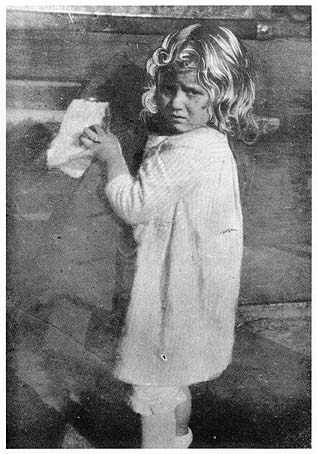
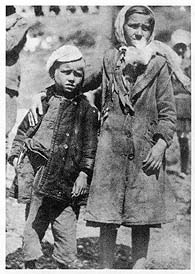
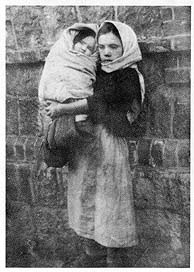
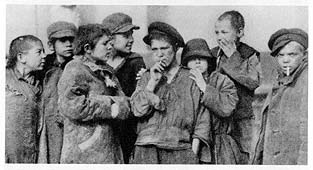
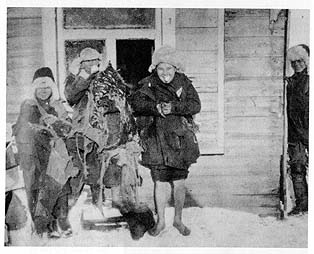
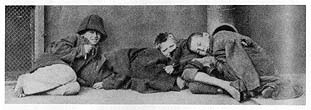
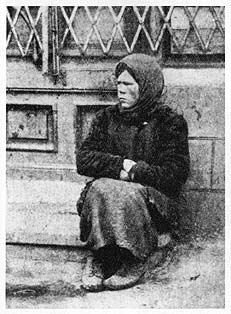
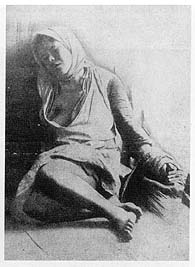
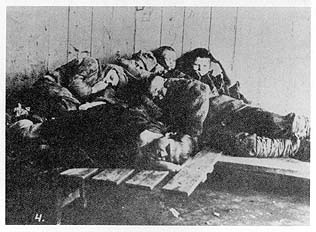
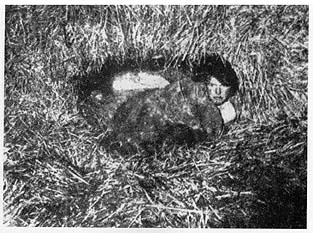
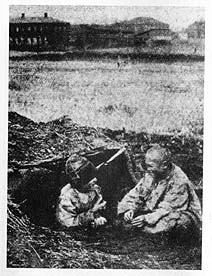
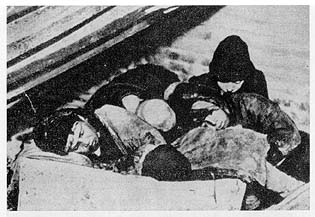
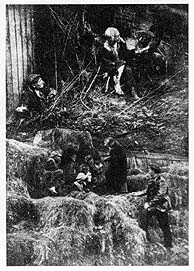
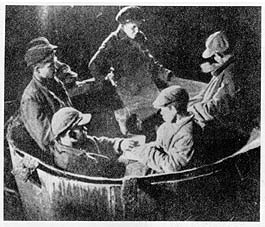
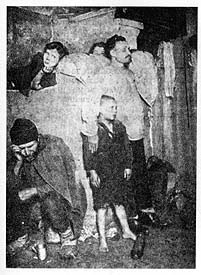
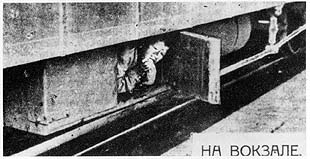
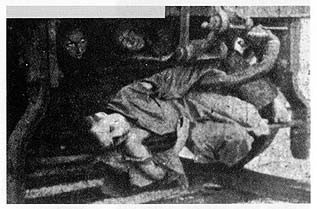
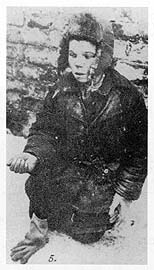
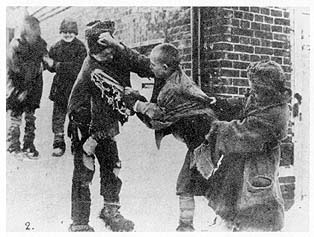
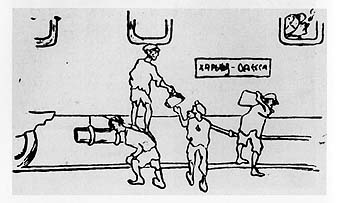
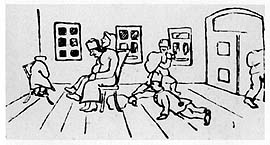
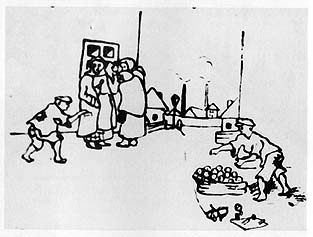
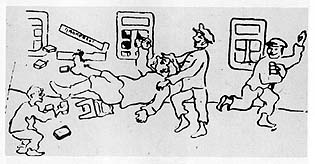
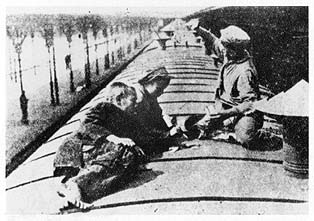
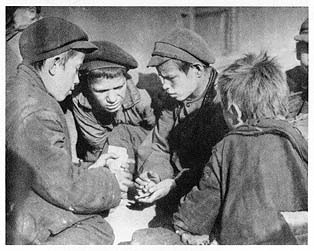
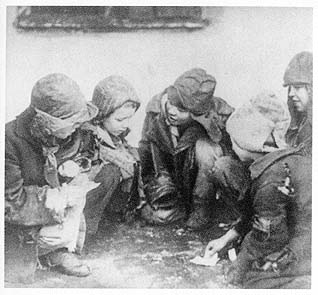
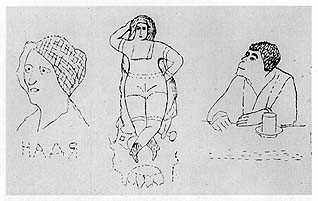
Responses to the Problem

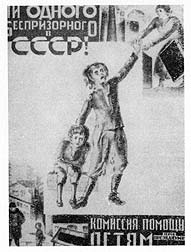

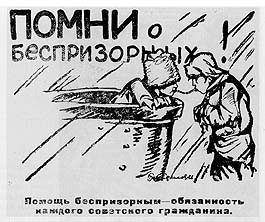
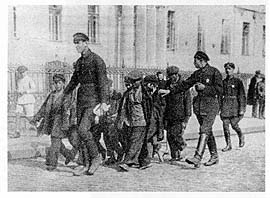
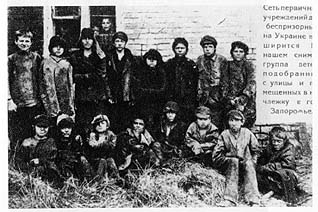
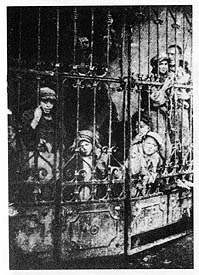
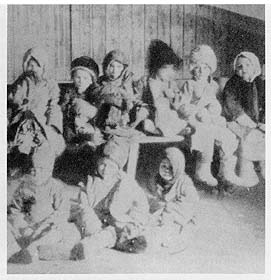
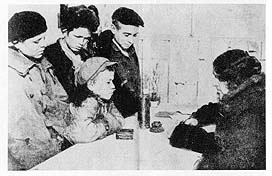
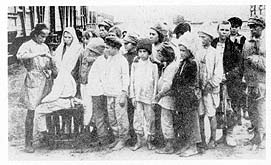
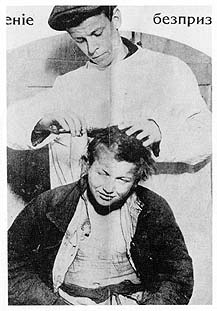
Institutions
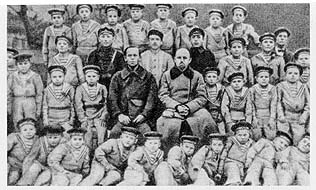
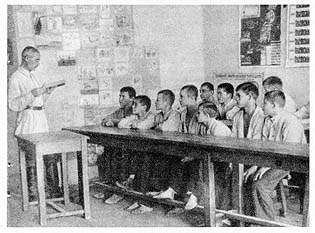
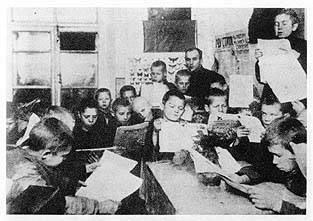
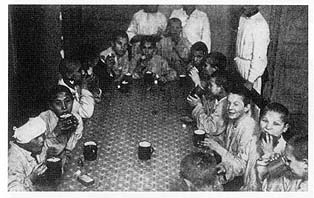
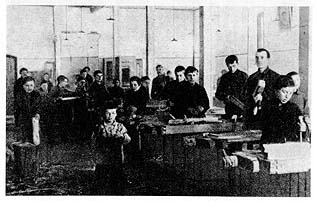
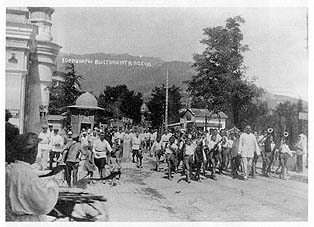
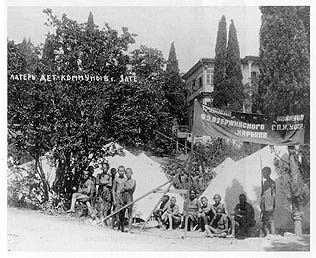
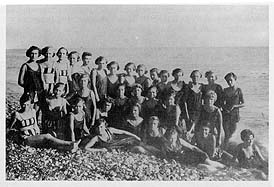
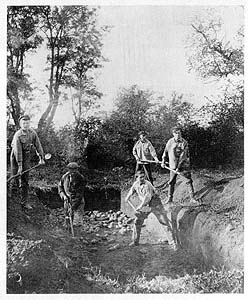
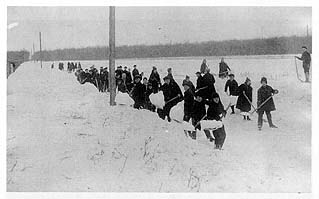
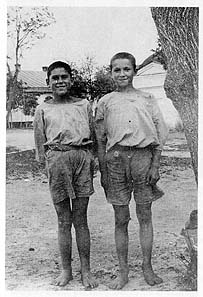
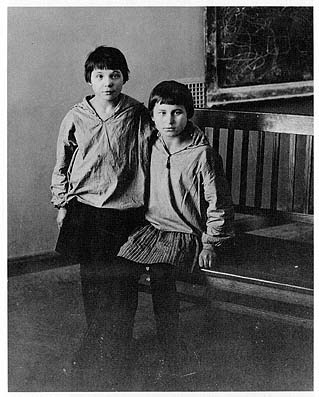
Florists and Professors
There must not be deprived and homeless children in the republic. Let there be young and happy citizens.
If you read sometime about the condition of our “pedagogic institutions” for besprizornye, your hair would stand on end.
By 1923 the famine had subsided, and emergency assistance agencies set about winding down their operations. Leaders in Moscow, and no doubt much of the remaining population, expressed relief that the worst of the horror had passed. But the problem of abandoned juveniles remained stubbornly at hand, both in the streets and in the teeming detdoma. Lunacharskii and other Narkompros officials called urgently in 1923–1924 for a drive to rescue homeless youths and joined the authors of numerous books, articles, and hortatory slogans in prophesying calamity if the effort failed. The most ominous danger appeared to loom in the guise of a thief, as observers pondered the prospect of desperate adolescents acquiring instincts and skills that would steer them by the million to lifelong crime. Campaigns to focus public attention on their plight included such slogans as: “Besprizornost’ in childhood means criminals as adults” and “Besprizornost’ begets crime.” “If we do not build schools and shelters for them,” one author concluded, “we will be forced to build prisons for them later.” Even the poet Vladimir Mayakovsky, scarcely an avatar of decorum, worried that street children represented a “limitless source of hooligans.”1 Aside from tomorrow’s criminals, young vagabonds were often portrayed as a potentially malignant cancer within the new generation expected to shape a better society. Those pursuing the medical analogy most literally claimed that waifs’ unsanitary, itinerant existence rendered them prime transmitters of infectious diseases. Others, fearing contamination on a different plane, warned that the youths’ adventuresome life could entice unsupervised, “normal” boys and girls. “Struggling with besprizornost’,” proclaimed a slogan, “we save our own children.”2
As speeches, slogans, and publications paraded the dire consequences of juvenile homelessness through Narkompros and before the public, many people both in and out of government recognized that the past five years of struggle on this front had not yielded heartening results. Something clearly had to be done, given the peril associated with failure, but what? Erect more detdoma? The cold reality of budgetary restrictions paralyzed such plans. In any case a chorus of voices, centered in Narkompros and broadcast most powerfully through the agency’s publications, rose by 1924 to question even the existing array of institutions. It was not an issue of numbers—though more buildings, of course, would be better than fewer. Reformers demanded instead a fresh look at the operation of facilities, based in turn on a rejection of common assumptions about street children.3
In particular, they showered criticism on the concept of “moral defectiveness” (moral’no-defektivnost’)—the view that long-term vagrancy and delinquency resulted primarily from a child’s own psychological defects rather than from outside influences.4 The issue represented part of a larger debate that continued to ricochet through much of the 1920s among Soviet criminologists, legal theorists, and others. Controversies flared over such topics as the causes of crime and the character of offenders—questions that often boiled down to disputes over human nature. Regarding the roots of criminal behavior, for example, one school blamed genetic disorders or other innate personal qualities rather than external circumstances. Opponents insisted that deviance arose not from congenital flaws but from unfavorable living conditions. Improve a person’s surroundings, they advised, and antisocial traits would no longer appear indelible.5
Among those concerned with the treatment of juveniles, the second, or “environmental,” outlook rose to prominence. Enthusiastic applause punctuated a debate at the First Moscow Conference on the Struggle with Besprizornost’ in March 1924, when a participant remarked that anyone who clung to the doctrine of “moral defectiveness” suffered from “scholarly defectiveness.”6 After spirited discussion, the conference rejected the theory of “moral defectiveness,” though this hardly ended dispute. The theory’s defenders, dubbed the “Leningrad professors” because several scholars among them were based in Leningrad, crossed swords repeatedly at conferences and in print with reformers known as “Moscow florists” (from the slogan “Children are the flowers of life.”). While “florists” gained the upper hand in the controversy—especially in central organs of Narkompros, its principal publications, and numerous provincial branches—the notion that many homeless juveniles were “morally defective” proved impossible to eradicate among teachers, scholars, and the general population.7
The “florists” tried, however. Time and again in the middle years of the decade they contended that grievous social and economic forces accounted for nearly all instances of children wandering at large and committing crimes. An inclination to shift blame to the youths struck them as typical of bourgeois scholarship and capitalist society, which, in their opinion, demonstrated no interest in assisting the downtrodden. The admittedly antisocial demeanor of numerous urchins sprang not from inherently twisted personalities, they asserted, but from the harsh setting into which they had been swept by currents beyond their control. Inveterate psychopaths stemmed no more frequently from the street than from the “normal” population, proclaimed a resolution adopted by the Moscow conference.8 The very phrase “juvenile crime” was an oxymoron. Hardship might impel its young victims to violate the law, but this did not make them criminals. “There are no child criminals,” announced a slogan prepared for public display; “there are sick and neglected children.”9
Many authors went further, insisting that while street life encouraged various undesirable habits, it also nurtured virtues. As noted in chapter 3, these alleged boons included boldness, resourcefulness, perceptiveness, a collectivist spirit developed from living in groups, and even a dislike for prosperous, bourgeois elements of society. Institutional personnel who counted their charges as “morally defective” thus remained oblivious to the potential supposedly acquired in the austere arena outside. Instead, a critic fumed, they behaved as if confronting incorrigible criminals or the mentally ill, thereby rendering ineffective a “whole mass of institutions for besprizornye” prior to 1924. The staff of a properly run detdom, the argument concluded, employed an understanding of waifs’ true nature to strip away their coarse veneer and cultivate the worthy qualities sprouted in hothouse fashion by their previous struggle for survival.10 Viewed in this light, homeless youths shed the label of “lost children,” immune to rehabilitation. “We regard the besprizornyi as a child of the Revolution,” a Komsomol delegate informed the Moscow conference. “If he is approached correctly, he can become an active builder of a socialist state.”11
Despite such revelations, reformers complained, many detdoma continued to treat residents as embittered, irredeemable spirits beyond the reach of pedagogy—in short, as “morally defective” inmates. Resolutions repudiating the theory of “moral defectiveness” meant little if they failed to stir these institutions—which were said in some cases to resemble prisons “still awaiting their own October Revolution.”12 Partisans of change (sounding much like today’s critics of juvenile penal colonies in Russia) attacked the common practice of isolating youths from the community, the policy of “closed doors.” They argued that high walls and barred windows, adopted under the assumption that those inside were “morally defective,” ostracized the inhabitants and hindered their reintegration into society. Reformers also judged disciplinary measures employed in numerous detdoma as excessively harsh and likely to drive children further from rehabilitation. Common punishments—especially in the provinces but also encountered in Moscow and Leningrad—included deprivation of food or recreation, isolation in a separate room for as long as a few days, removal of an offender’s clothes, icy showers, extra work assignments, and beatings. Consensus regarding appropriate means of discipline never emerged—as was evident at a conference of personnel from institutions for difficult juveniles, held in November 1925—and even reformers did not always agree where, short of corporal punishment, to draw the line.13 But they did concur that severe methods yielded little but disappointment. Despite the bars, locks, and guards at institutions for hardened delinquents, thousands fled every year. Even those who remained, critics emphasized, often emerged alienated, untrained for available jobs, and destined once again for the criminal world.14
What, then, was to be done? Mass homelessness had transformed the nature of detdoma. The primary role first envisioned for these facilities following the Revolution—that of providing an upbringing for any and all children of working parents—now appeared a dream for the remote future. In the meantime, the structures bulged with indigent and sometimes hostile youths, many unintimidated by compulsion and rigid discipline.15 Facing this reality, Narkompros reformers issued detailed instructions, both from Moscow and in provincial journals, on the proper operation of institutions engaged first and foremost in the rehabilitation of abandoned, difficult, but not “morally defective” juveniles.16
First of all, official documents and individual authors urged that detdoma encourage healthy contact between their wards and the society they were to enter upon discharge. Adolescents had to learn how to participate productively and eagerly in life, reformers declared, not glimpse it sullenly from behind bars. An institution secured only pedagogic bankruptcy by relying on “closed doors” to retain occupants.17 Narkompros instructed local officials to open these doors by removing schools from inside detdoma and sending youths to attend regular schools side by side with other pupils. Where possible, children were also to visit nearby workshops, factories, and state farms for at least a portion of their labor training. If such options did not exist, thereby requiring detdoma to maintain their own schools and workshops, contact could still be established with society by opening these facilities to boys and girls from the neighborhood.18
At the same time, Narkompros called with greater insistence for many other activities to supplement classroom instruction, both inside and beyond the walls of detdoma. These pursuits included circles and clubs (science, reading, drawing, drama, music, hobbies, and the like), involvement with communist youth groups, and extended summertime excursions to camps at natural attractions. The endeavors were said to provide fresh opportunities for social and political education, as well as promote the policy of “open doors.” They would also spice the routine of institutional life, dissuading the restless from escape.19 Toward the objective of maintaining detdoma without bars and locks, many Narkompros documents in the middle of the decade stressed more vigorously than before that residents be made to feel a part of their institutions through participation in “self-government.” This usually meant at a minimum the organization of groups to assume responsibility for daily chores, while more ambitious efforts centered on meetings (run, at least nominally, by the children themselves) to discuss house operations, emergencies, and disciplinary matters. Reformers regarded condemnation of offenders by their own “collective” as preferable to punishment imposed by the staff. A firm adult hand might be necessary temporarily, when most inhabitants had just arrived from the street, but discipline maintained by youths themselves represented the goal as “collectives” matured.20
Of all the improvements desired for detdoma, none received as much emphasis as expanded labor training in workshops and fields. Workshops in particular were often depicted as the heart and soul of detdoma, the feature that most distinguished them from prerevolutionary shelters and flophouses. Reformers claimed that the shops nurtured a healthy labor psychology—namely, good work habits and a respect for manual labor—essential in preparing adolescents to join the proletariat. Facilities that produced goods for sale in local markets also helped cement relations with the surrounding community while securing additional income for detdoma. Finally, by providing skills (metalworking, leatherworking, carpentry, and so on) with which juveniles could later support themselves as adults, workshops offered homeless children a clear hope for the future and an incentive to remain in detdoma.21
Official zeal for workshops rose in part from the reforms favored by many Bolsheviks and their supporters for schools in general. In the early postrevolutionary years, Narkompros insisted that arid, bookish rigidity—seen as characteristic of tsarist schools—give way to a curriculum featuring “socially productive labor.” The nation’s students would then accrue essential academic skills, including the three R’s, while engaged in diverse projects that took them outside the classroom. Even theoretical fields were thought more accessible to pupils steeped in practical work than to those who remained all day behind desks. As youths progressed through their school years, they would receive broad polytechnic training to ready them for flexible and productive lives in a modern industrial society whose features could not yet be fully divined. Moreover, asserted the ABC of Communism, they would learn “to look upon labour, not as a disagreeable necessity or as a punishment, but as a natural and spontaneous expression of faculty. Labour should be a need, like the desire for food and drink; this need must be instilled and developed in the communist school.”22 “Indeed,” explained a treatise titled The Unified Labor School, “the wise and experienced teacher cannot help but notice that for these three questions: how to form the child’s will, how to mold character, how to develop a spirit of solidarity, the answer is one magic word—labor.”23 Such exertion, in other words, did far more than train hands; it shaped the identity of a socialist citizenry.
If so, the argument for labor training applied with special urgency to street children. The point had been made before, but reformers turned spotlights on it in the middle of the decade. Who stood more in need of labor’s civilizing touch, they asked, than the besprizornye? Unfortunately, the difficult years just past had prevented most detdoma from acquiring equipment and instructors to establish proper workshops. The desperate quest for food, clothing, and medical care exhausted resources and rendered labor training a secondary concern. In the aftermath, as the flood of orphans slowly ebbed, this shortcoming proved difficult to overcome. Investigators surveying detdoma found the room for improvement of labor instruction to be far more substantial than resources necessary for progress. Where shops existed at all, they often lacked equipment and staffs to do anything but occupy children with the most primitive handicrafts—skills unlikely to provide passage from the street.24
The gap between goals and reality vexed reformers wherever they turned. Some detdoma appeared to be operating properly, either in response to instructions from Moscow or on the basis of methods developed independently, but more establishments persisted with minimal labor training, harsh punishments, and “closed doors.”25 When a facility with “open doors” encountered difficulty managing its charges, the setback emboldened skeptics to proclaim reform “reckless and harmful sentimentalism.” At conferences and in the field, voices could still be heard insisting on stricter discipline. “ ‘Open doors,’ ” a critic asserted in 1926, “in no way give an institution any sort of special significance regarding upbringing. They lead only to corruption in every sense, if they are adopted in institutions containing youths with antisocial tendencies.”26 Thus in the middle of the decade, though instructions for change crowded conferences and publications, the desired improvements remained far less evident in detdoma. “Florists” found their tussle with “professors” a mere skirmish compared to the challenges beyond.
Even the most optimistic reformer likely recognized that central and local budgets would not soon relinquish funds to support accommodations for all abandoned juveniles. This reality spurred various Narkompros bodies, notably the State Scientific Council, to advocate “halfway” institutions designed to provide something short of full-time room, board, and instruction.27 In 1923–1924 night shelters (nochlezhki, not to be confused with flophouses of the same name that required payment and catered mainly to adults) were established for street children in many cities, especially as the approaching winter drove larger numbers to seek asylum from the elements. If detdoma could not absorb all candidates, in other words, some could turn to night shelters for temporary sanctuary from the worst rigors of their environment.28
The shelters were envisioned not only as a less expensive alternative to other institutions, but as a means of enticing the obstinate and wary to take a first small step off the street. They could come every night, if they wished, or only intermittently. At any rate, they were not to be rounded up and brought against their will. If they violated a facility’s rules, they might be denied the evening meal and expelled, but they would not be hauled to institutions for delinquents. To a degree, shelters resembled receivers in that they were designed to receive youths directly from a brutalizing world, introduce them to rudimentary education, and eventually send them (voluntarily, in the case of shelters) to permanent institutions for rehabilitation.29 Before long, some shelters began to operate daytime divisions, hoping thereby to wean children entirely from the street by offering them each morning an alternative to train stations and markets. Activities—drama clubs, reading circles, literacy training, and simple workshops—remained voluntary, though house rules required typically that one participate for a stipulated number of hours in order to receive lunch. Where these daytime operations emerged, they further enhanced the similarity between shelters and receivers, sometimes to the point where significant differences vanished altogether.30
As expected, a large share of those who frequented shelters came from the street’s hard core. They had escaped repeatedly from other institutions and were long accustomed to life in seamy quarters of town. According to a study of two hundred juveniles who passed through a certain Moscow shelter in 1924–1925, approximately 40 percent had already roamed the land for over three years.31 When they entered shelters, they brought their mores with them and frustrated the facilities’ work. Investigators discovered ragged, lice-covered urchins of all ages crowded together in filthy rooms, obscured by clouds of their own cigarette smoke. Many departed periodically to engage in thievery and other exploits unscheduled by Narkompros. Veterans commonly entered in groups—the same gangs in which they lived outside—and their leaders sometimes sabotaged the plans of an institution’s staff. Even in the absence of gangs, experienced youths routinely beat the new or feeble and seized their clothing. In some facilities, gambling and cocaine enjoyed much wider appeal than workshops and clubs. The Moscow study found approximately one-third of the sample to be long-term cocaine users, and other accounts confirm that such children saw no reason to abandon the practice in shelters.32
Thus, numerous shelters resembled an extension of the street more than a stepping-stone away from it. Not all youths disrupted regimens, but even the docile could prove difficult to work with because of their physical and emotional debilitation. An observer described children in a Moscow shelter as emaciated wraiths, with sunken eyes encased in enormous black circles, gazing about with “a sort of senile expression.” Shriveled black rootlets protruded from the gums of those who had already lost their teeth.33 While some shelters managed eventually to steer 40–50 percent of their visitors to other institutions, the nature of the juveniles they courted made this an achievement that few facilities could surpass.34 Vagrant life did not surrender readily its favorite apprentices.
Night shelters were the most ambitious “halfway” institutions of the period, but they shared some of the street’s brood with others, notably daytime playgrounds set up in parks, squares, and vacant lots during the year’s warm months. Much like shelters, playgrounds were intended to attract homeless and other unsupervised youths voluntarily, by offering a meal, games, excursions, and crafts. The staff hoped to gain newcomers’ confidence, erode their bond with the street, and eventually convince them to enter institutions or at least to spend the night in shelters.35 Confronting an often troublesome clientele, shelters and playgrounds deserve credit for guiding any children (certainly several thousand over the years) out of slums and down the road to a productive life. But it must be stressed that these facilities never multiplied to admit (let alone win over) more than a small percentage of abandoned juveniles. They remained modest projects to retrieve some of the neglected and alienated who had not settled in Narkompros’s much larger network of detdoma.
By 1923–1924 it was clear that the solution to the problem of street children lay in something more than scooping them up for delivery to receivers and detdoma. Thousands had already traveled this route repeatedly, each time running away to their familiar haunts. Such discouraging results encouraged experiment with alternative approaches, and none more fully embodied the reformers’ spirit than the labor commune (trudovaia kommuna).36 Here was an institution organized in the belief that even the most belligerent adolescent could be rehabilitated—indeed, an institution intended especially for teenage delinquents, many of whom had prowled the streets for years. While some might regard prison as the only place for these ruffians, communes faced them having disavowed traditional measures of control, including “closed doors” and harsh punishments. Instead, supporters predicted, youths and staff would work together as comrades.37
The most striking difference between detdom and commune, a feature heralded tirelessly by the latter’s champions, was the principle of voluntary entry and departure. Children were to join only if they so desired, and they could leave if disenchantment overcame them subsequently.38 Ideally, they would emulate a group that formed the initial nucleus of the Rosa Luxemburg Labor Commune, established on the outskirts of Moscow in 1924. Late one night in February, a social worker (accompanied by a policeman) descended into a tunnel leading under the Alexander Station. Among the adult criminals and tramps ensconced in the basement, she found a group of nine boys, some of whom had been living on the premises for years. Several had passed more than once through Juvenile Affairs Commissions and on to detdoma—from which they always fled back to the station. Calming them with assurances that they did not face another roundup that night, the social worker described a labor commune and asked them merely to think about the opportunities available there. On subsequent visits in weeks thereafter, she continued the discussion with this group, suggesting that they consider such an undertaking. Eventually, after their leader and a few other lads inspected a proposed site, the group agreed to embark on the venture.39
In addition to voluntary entry and departure, labor communes were expected to devote particular emphasis to practices promoted by reformers for detdoma, most notably “self-government” and labor training. As indicated previously, “self-government” (and “self-service”) meant that children were to assume responsibility for daily chores and participate in the commune’s general assembly to run the institution. Treated as full-fledged partners and sustained by a sense of control over their lives, they would bear no resemblance to the bitter, unruly inmates of other facilities.40 Nor would they lounge about the grounds, as the name labor commune suggests. Even more than in detdoma, instruction in workshops or in nearby factories and state farms represented the key to rehabilitation. Benefits thought to derive from labor in any institution—access to a profession, self-respect, and a sense of solidarity with other workers—seemed to be urgent requirements for commune members. Their difficult nature and the fact that, as teenagers, they would soon be discharged to support themselves made training for workbench and field the first priority.41
Communes appeared here and there in 1923 and then mushroomed to such a degree that, by the end of the following year, they had lost the quality of puzzling curiosities.42 Some were established on the initiative of social workers and local officials before Narkompros could issue guidelines, which did not circulate in comprehensive form until 1925.43 Viewed in a broader context, the institutions were a comparatively late, government-inspired manifestation of communal living endeavors that had flourished spontaneously among diverse segments of the population ever since the Revolution. In October’s glow and the ensuing adversity of War Communism, groups of students and workers had rushed to pool resources and live in what they took to be the new socialist manner. Communes also sprouted (or were rejuvenated) among people less drawn to socialism—peasants and religious sectarians, for example—who shared nonpersonal property and organized collective living arrangements. Even in the case of sectarians, the Bolsheviks displayed remarkable sympathy for their efforts during the 1920s, often finding in them aspects of a communist lifestyle.44 Still more attractive, then, seemed the prospect of Narkompros’s communes, for they would lack religious or superstitious blemishes associated with communities conceived by sectarians and peasants.
While Narkompros administered the majority of labor communes for besprizornye, other agencies, most notably the secret police (OGPU), operated similar facilities of their own. The first OGPU commune (as distinct from the agency’s earlier institutions for homeless children) appeared near Moscow in 1924. Dzerzhinskii and some of his colleagues hoped to demonstrate that a suitable atmosphere could salvage even the most unrepentant delinquents—though others in police circles harbored less fervor for the enterprise and referred to the project as their chief’s “baby farm.” At any rate, more OGPU communes soon followed, and by 1928 the total stood at thirty-five. Best known in the long run was the Dzerzhinskii Labor Commune, established near Khar’kov in 1927 and directed for several years thereafter by Anton Makarenko. In theory, the communes of Narkompros and the OGPU shared basic principles—voluntary entry, “self-government,” and extensive labor training—though stricter discipline was generally expected on the part of the OGPU. Its facilities sought the most difficult youths, often recruited from jails. The Rosa Luxemburg Labor Commune, for example, after several months in Narkompros’s hands, passed into the OGPU’s domain late in 1924 and began to receive juveniles from Moscow’s Butyrskaia Prison.45
Some communes, of both Narkompros and the OGPU, reportedly enjoyed considerable success. They implemented “self-government,” involved members in labor training, and gradually broke the binding spell of life on the street. A number of institutions appear to have retained nearly all their recruits, including those who had previously fled countless detdoma.46 But even descriptions of the most successful communes usually shrank from suggesting that rehabilitation proceeded smoothly. Thefts, gambling, drinking, cocaine use, and fights proved difficult to eradicate and flared up from time to time, especially when a large new contingent arrived from the street or prison. “Self-government” might degenerate into a charade or collapse entirely, and gang leaders could disrupt an institution by continuing to demand the deference and tribute they had customarily enjoyed.47 Youths in communes located near markets and train stations succumbed on occasion to the lure of these locations and disappeared. Even an article endorsing labor communes as the most suitable place for difficult juveniles acknowledged that, despite the success of a few institutions in retaining their populations, the overall percentage of residents who abandoned communes was “very large.”48 Though information is sketchy, certain ventures clearly failed altogether, torn by mass brawls requiring police intervention or simply disintegrating until adolescents roamed without any supervision.49
No less a trademark of communes than the policy of voluntary entry faded rapidly. At a meeting in May 1925 of a subsection of Narkompros’s State Scientific Council, a participant remarked: “Labor communes, as a mass institution, have not proven themselves because life has forced the violation of their basic principle—voluntary entry. Now [juveniles] are dispatched to labor communes by force.” Instructions sent in October of the same year to provincial Narkompros offices praised the rule of voluntary entry, but then explained that the principle did not mean a youth could be delivered to an institution only if he consented. That would be “too facile and narrow” an interpretation, noted the order, because adolescents often had no desire to enter facilities. The document urged tenacious exertion to secure a child’s approval, but the clear implication remained that absence of assent need not thwart the routing of new members to communes.50
Numerous resolutions and instructions generated by various Narkompros bodies in 1924–1925 favored the reorganization of all detdoma (or all institutions for difficult youths) as labor communes.51 Articles on communes that appeared in Narkompros publications focused almost invariably on the most successful, and the positive impression left by these descriptions encouraged, sometimes explicitly, the transformation of detdoma along similar lines. But no such mass reorganization occurred, and it seems plausible to conclude that most, less publicized, communes experienced enough difficulties to eliminate their appeal as models. Had they consistently delivered superior results, nothing would have prevented the recasting of detdoma in their image. Whatever the accuracy of this speculation, labor communes never flirted with ubiquity. A work published in 1926 calculated that they housed less than 4 percent of all institutionalized street children, and this share scarcely soared as the decade waned. For better or for worse, the vast majority of these wards (roughly 90 percent, according to the account just mentioned) resided, as before, in detdoma.52
As Narkompros struggled to reform its children’s institutions, many social workers, journalists, and government officials, while praising these efforts, concluded that the task of recovering abandoned boys and girls exceeded the state’s capabilities. With the homeless continuing to deplete resources applied by Narkompros and other agencies, publications and official resolutions called more frequently for society as a whole to lend a hand.53 Apart from individual citizens, the public (obshchestvennost’) targeted in these appeals included semiofficial bodies such as trade unions and communist youth groups (the Komsomol and Pioneers), individual factories, institutes, military units, and societies of volunteers devoted to saving destitute juveniles. During the famine, many such people and organizations had strained to provide whatever they could to rescue victims of the catastrophe, but by 1923 the sense of emergency had passed. In addition, the New Economic Policy, by requiring state agencies to support themselves with less subsidization from Moscow, helped dry up contributions from factories and other enterprises.54 Finally, as some observers alleged, a considerable portion of society may have grown accustomed to young ragamuffins in the streets and accepted the phenomenon with less distress or even contemplation than had been the case a year or two previously. Those who found their attention drawn to the scruffy figures were more likely than during the famine to regard them as scoundrels, whose plight merited no sympathy.55
Hence, in the middle of the decade, Narkompros and the Children’s Commission redoubled their push to secure assistance from individuals and groups. Books appeared describing the bleak street world, and rebukes stung organizations for their passivity in aiding the homeless.56 Many newspapers carried fund-raising displays listing recent donors (individuals, Party cells, work units, editorial boards, and so on), followed by names of others who were challenged to respond. In Izvestiia, for instance, under the title “Help the Besprizornyi,” a group of authors called on such colleagues as Alexei Tolstoi, Boris Pil’niak, Vladimir Mayakovsky, Andrei Belyi, and Osip Mandel’shtam to join them in contributing. Some papers ran these appeals with near daily frequency for months. During the first half of 1926, most issues of Pravda contained a section urging readers to donate funds for a labor commune, and by late July, when Pravda described the commune’s opening, gifts totaled nearly 140,000 rubles. From time to time, following the death of well-known personages, the paper listed those who forwent customary wreaths and chose instead to commemorate the deceased by giving money to care for waifs.57
The government also encouraged special “weeks” (or, less often, other periods), with the goal of focusing public attention on abandoned children’s misfortune. These undertakings—with such titles as “Week of the Besprizornyi,” “Fortnight of the Besprizornyi and Ill Child,” and “Week of Aid to Besprizornye”—were usually local operations centered in a single city and sometimes projected through the province, though drives occasionally encompassed an entire republic.58 Bodies in and out of government might share responsibility for implementing a “week”; as a result, the exact array of sponsors varied considerably from place to place. “Society” most often contributed such partners as trade unions, teachers, the Women’s Section of the Party, the Komsomol, and volunteer groups formed to aid minors. Less frequently, military units and even boys and girls from detdoma participated.59
Because promoters of a “week” could choose any number of activities, their plans differed markedly from one region to the next. But even with all the local variations, fund-raising remained a common attribute. Money was solicited from enterprises and collected through the sale of flowers, handicrafts (some made by youths in detdoma), special stamps, postcards, pins, emblems, and other petty objects. Slogans usually appeared in public places, rousing the population to make donations. Auctions and lotteries also generated funds, as did special shows featuring plays, movies, music, and other productions for which admission could be charged. Aside from gathering revenue, “weeks” often sought to familiarize society with the misery of street life and explain the problem’s importance by means of public lectures, exhibitions, pamphlets, and newspaper articles. Here the aim might extend to recruiting citizens for voluntary organizations in which they could assist state officials. “Only with participation of the entire population,” proclaimed a slogan, “can victory be achieved on the long and difficult front of besprizornost’.” In some cases a “week” included inspections of local detdoma and even expeditions to round up homeless juveniles and convey them to institutions.60
It is difficult to gauge popular reaction to these appeals. Reports from numerous regions told of workers and officials donating small portions of their pay (either as a single gift or in regular installments over many months) and volunteering to prepare clothing for children in local receivers and detdoma. Some organizations, especially Pioneer and Komsomol units, staged shows and contributed extra days of work on weekends to raise money for the cause.61 Occasionally, a factory, trade union, or military unit gave considerable sums to a nearby institution and even assumed formal responsibility for its material support. Such accords often called as well for the sponsoring organization to carry out periodic inspections of the facility and assist Narkompros with labor training and general upbringing.62 As improbable a benefactor as the state film agency auditioned some three hundred juveniles fresh from the street and selected twenty for instruction. After a difficult start, during which several trainees fled or displayed little enduring talent, those who persevered set to work producing a children’s film.63
The labor and resources supplied through these channels by a small minority of citizens spoke well of their devotion to a worthy cause and helped save youths from prolonged vagrancy. At the same time, critics asserted that the public’s interest wandered fast on the conclusion of officially orchestrated exhortation. All fell quiet, and the problem remained much as before.64 A few children’s institutions did benefit greatly from local donations, but the overwhelming majority of facilities remained primarily dependent on funds and materiel provided (or not provided) by central and local government bodies.
Apart from money and supplies, Narkompros lacked sufficient personnel, especially social workers out in the street. Most cities, including Moscow, found their branches of the Children’s Social Inspection grossly understaffed and unable to work effectively with hundreds or thousands of youths peering from the urban landscape’s nooks and crannies. In response, communities around the country recruited groups of “volunteers” (druzhinniki-dobrovol’tsy), often from the Komsomol in general and universities in particular, along with participants from trade unions, the Women’s Section of the Party, and other organizations. Large numbers were marshaled in this fashion, especially during academic vacations and for special exercises of short duration. Approximately one thousand “volunteers” worked with besprizornye in Moscow’s streets in 1925, “over eight hundred” in Leningrad the following year, and in 1924 roughly three hundred young people helped conduct a census of homeless children in Saratov.65
“Volunteers” assumed, with varying degrees of training and supervision, duties that took them deep into a city’s shadows. They helped tally the local street population, usually by groping through shabby sections of town at night when the search’s objects were most likely to be in their “dwellings.” More routinely, they patrolled markets, stations, and other prime locations, searching for lairs and keeping an eye peeled for new arrivals. Many received instructions to establish contact with veterans of this terrain, win their trust, and coax them into permanent institutions or temporary accommodations such as night shelters.66 The work naturally entailed certain dangers, for juvenile delinquents, not to mention the adult criminals among whom they commonly lived, rarely summoned enthusiasm at the approach of social workers and census takers. Most often, youths simply vanished into the urban labyrinth they knew so well. But on several reported occasions, similar no doubt to many that went unrecorded, they greeted visitors with barrages of stones.67
Citizens also participated in dramatic mass roundups of homeless children conducted repeatedly in cities across the country. On the given day, scores, hundreds, and even thousands of “volunteers” were divided into small groups and assigned to search various districts known to harbor concentrations of their quarry. After receiving instructions, brigades set out—usually at night—to comb train stations, ruined buildings, flop houses, taverns, apartment entryways, dumps, and other promising habitats. In a few instances, boys recently removed from the street helped guide search parties to abodes of cohorts still at large.68 The objects of a roundup often displayed no inclination to exchange their domiciles for an institution. Many had already fled more than one detdom and quickly disappeared into the night as brigades approached. If cornered, they responded with searing obscenities and even violence. The following taunts, dispensed by a youth netted one night, ranked as a comparatively mild expression of defiance.
—“What is your name?” [asked a social worker].
—“Ivan, or maybe Aleksei.”
—“And your last name?”
—“I have forty. I’ll say them all if you like. Choose one.”
—“How old are you?”
—“One thousand! And then some.”
—“Where were you born?”
—“In Peter [i.e., St. Petersburg]. In the Winter Palace.”
—“Who were your parents?”
—“Nikolai Romanov. But perhaps someone helped him. I don’t remember exactly.”69
In turn, most brigades devoted little attention to securing the consent of those corralled. Briefings might discourage the use of force, but headlong chases after elusive urchins tended to drain pursuers’ patience. Only the most pacific men and women confined themselves to persuasion when steering a struggling, abusive lad to an institution. More likely he was marched off under guard—with hands bound, according to a report from Saratov—and the frequent participation of policemen further insured a tone remote from the reformers’ spirit.70 Where possible, children apprehended in the sweeps were taken to receivers for processing and then dispatched to permanent institutions. But the numbers amassed in a single night, sometimes reaching into the hundreds, often far exceeded the capacities of local primary facilities. In this event, the night’s catch waited in any quarters available, including police stations, until they could be moved to more appropriate buildings.71
One of the most common vehicles by which citizens joined the effort to aid abandoned minors was the “Friend of Children” Society (Obshchestvo “Drug detei” or ODD). Formed on the initiative of the Children’s Commission in Moscow and Khar’kov at the end of 1923, ODD soon grew into a nationwide network of cells, with an official membership of one million by October 1926.72 Many cells functioned inside trade unions, Komsomol groups, Women’s Sections of the Party, military units, and other organizations, though ODD branches also existed outside the framework of such bodies and recruited participants from society at large. With resources obtained from initiation fees, yearly dues, donations, and public fund-raising drives, cells engaged in a wide range of activities.73 They furnished “volunteers,” helped conduct “weeks” and similar campaigns, contributed money and supplies to detdoma, and assisted state agencies in the operation of receivers, shelters, playgrounds, workshops, and cafeterias. They also sought to place youths with guardians or, following their discharge from institutions, in jobs and decent living quarters. In addition, ODD provided aid to poor families and worked to improve the methods with which parents raised their offspring—thereby seeking to prevent children from reaching the street at all.74
Of course, few ODD cells managed all these endeavors. Many did little more than collect dues for occasional contributions to the cause, and in some units even fund-raising fell by the wayside. Reports often noted cells that formed and then lay dormant for want of local initiative or encouragement from above. The only sign of their members appeared on rolls of names initially filed.75 In Moscow, Leningrad, Khar’kov, and a number of other cities, ODD did emerge as a mass organization, visibly engaged in the struggle to end juvenile homelessness. But in other regions—especially the countryside, where ODD was expected to help stem the flow of peasant youths to the cities—cells remained few and far between.76
In its review of the well-known motion picture Road to Life (which portrayed a group of delinquents led to better ways in a labor commune), ODD’s Moscow journal complained in 1931 that no hint of the organization’s work appeared on the screen. An individual member of ODD did materialize briefly in the film, but in a decidedly unflattering role of “a petty bourgeois beating a besprizornyi.” More serious, resolutions issued by various bodies early in the 1930s repeatedly characterized ODD’s work as inadequate. The All-Russian Central Executive Committee went so far as to claim in 1934 that ODD had not fulfilled the mission entrusted to it and “does not play any sort of discernible role in work with children.”77 Such an assessment is too harsh, at least when characterizing ODD during the 1920s. Certainly it had problems, and the organization never lived up to the expectations that accompanied its inception. But in many cities, and even in some smaller towns, ODD cells received frequent mention as participants in charitable projects. Judging from the evidence at hand, ODD assisted thousands of youths in one way or another over the years, either helping to remove them from the street or reducing the likelihood that they would find their way there. The fact that these efforts overall generated only modest progress toward the goal of eliminating homelessness demonstrated not only ODD’s shortcomings but also the imposing scope of the task.
No more direct means existed for citizens to help juveniles and reduce demand on Narkompros than to open the doors of their homes. During the years of war and famine, a multitude of young refugees—one hundred thousand according to one estimate—were placed with private citizens. Though host families came mainly from the peasantry, the nation’s titular head, Mikhail Kalinin, and his wife also adopted two orphans found wandering the parched roads. Officials generally resorted to these arrangements as emergency measures, particularly when boys and girls were evacuated into districts in quantities that engulfed local institutions.78 While results in some instances appear satisfactory, most evidence conveys a discouraging impression. Families commonly accepted wards under pressure from authorities, and this compulsion did not presage a hearty welcome for the household’s newcomers, even assuming they possessed no diseases or troublesome individual qualities. At any rate, peasants living near the subsistence level found an extra mouth a considerable burden, as an American Red Cross agent discovered near Arkhangel’sk: “I enquired of [a local official] how the refugees [adults as well as children] were received by the families where they were quartered and from his reply I gathered that in the majority of cases they were not very welcome.” Children regarded by their hosts in this light often lived miserably—exhausted by work, begrudged food and clothing, and made to feel every inch an affliction. Some families refused to feed their new lodgers or sought to return them to local Narkompros offices, unless the youths took matters into their own hands first and ran away. An investigator concluded that the hardships confronted by famine refugees after assignment to private homes soon drove “a huge percentage” to the street.79
Placement of the homeless in foster families grew far less common in 1923–1924 compared to the preceding years.80 The famine had abated, and there seemed little reason to pursue a policy widely judged to be disappointing. Like evacuation, mass foster care appeared a crisis tactic whose time had passed. Within a year, however, Narkompros resolved to revive the practice in modified form, not as an emergency measure but for the long term. The decision represented yet another thrust at problems associated with detdoma. First, observed numerous journalists, officials, and Narkompros orders, the nation’s overcrowded network of institutions could not possibly absorb all those still on their own. Second, not a flicker of hope existed that additional funds would be forthcoming to construct enough new facilities. Diverting children to families of peasants and artisans would diminish the financial burden on Narkompros. Properly screened, some might pass directly from the street to private households, bypassing detdoma altogether. In addition, many adolescents already living in institutions could be discharged to families, thereby freeing places in detdoma for younger candidates. It was far more cost effective, proponents of foster care maintained, to offer financial incentives to peasant families than to pay for upbringing in institutions. Furthermore, they claimed, juveniles would more likely acquire labor skills in properly selected households than in underequipped and poorly organized detdoma. These arguments were bolstered in 1925 by a study conducted in Samara province, indicating that youths placed previously in peasant families had flourished more than their counterparts in detdoma.81
To be sure, notes of anxiety also registered in meetings and publications. Foster care, after all, signaled a retreat from the goal of collective, institutional upbringing and promised to expose some children to religion and other influences scarcely compatible with Narkompros’s curriculum.82 But the arguments for relieving pressure on detdoma outweighed these objections, and decrees soon began to include foster care (patronirovanie) routinely in the list of options for authorities confronted with homeless juveniles. Some local officials, eager to reduce the strain detdoma placed on their budgets, discharged youths into families in 1924–1925 even before receiving guidelines from Moscow.83
When such instructions did appear in 1925–1926, they reflected an awareness of the sorry results obtained four years earlier. No family, they stressed, should be compelled to accept new members. Local Narkompros personnel were encouraged to promote foster care among the surrounding population, but the peasants themselves had to desire the arrangement and take the initiative in communicating their decision to officials.84 Few could be expected to do so without enticements, of course, and the government offered several. Families accepting children were to receive an extra strip of land (freed of the agricultural tax for three years), a cash payment, and additional privileges regarding local taxes and fees to be worked out by officials on the scene.85 Should a household rise to these offers, Narkompros staff in the area had instructions to initiate an investigation of the family to insure that it could provide a suitable environment. This meant that a representative of the Children’s Social Inspection—or, in the unit’s absence, nearly anyone else available, including a recruit from the Komsomol or ODD—had to ascertain that the prospective hosts exhibited no such disqualifying brands as infectious diseases, poverty, alcoholism, or criminal proclivities. Similarly, Narkompros reminded its provincial offices that a successful program required careful selection of youths. Those with illnesses, a disinclination for agricultural work, or objectionable habits acquired in the underworld did not make promising candidates.86
After screening of this sort had produced an acceptable match, representatives from the family and Narkompros drew up an agreement. It listed the promised remuneration and detailed the household’s obligation to provide agricultural training and raise the child as one of its own for a certain number of years.87 Every six months thereafter, the Children’s Social Inspection or one of the substitutes just mentioned was to visit the dwelling and verify the terms’ fulfillment. In some provinces, officials chose to appoint separate legal guardians as well.88 When a boy came of age and left his foster family, the strip of land contributed previously by the state became his. In addition, the peasant household was to provide him with agricultural implements and other supplies as specified in the agreement. If both parties wished, he could continue to live with the family, which then retained the extra land. Should he run away or otherwise depart prematurely, the field reverted to the state.89
Narkompros also sought to transfer youths from detdoma to live with artisans. The rationale was much the same as when peasant families represented the intended hosts, and agreements likewise offered incentives (monetary rather than land) to participating artisan households and larger groups (arteli) of craftsmen. In addition to any initial outlays negotiated, Narkompros agreed to pay for the support of apprentices during the first year of instruction. The hosts in turn were to set aside funds each month to help establish their charges in arteli or as independent handicraftsmen upon completion of training.90
The total number of children transferred to peasants and, less often, artisans appears to have ranged between fifteen and twenty thousand by 1925–1926, including a few thousand placed during the famine and still living with families. According to a Narkompros report, peasant households concluded agreements in 1926 to receive approximately 4,400 inhabitants of detdoma in the Russian Republic, and the following year they took in an additional 7,500.91 In certain provinces (most notably Samara), as many as several thousand juveniles lived in foster homes, while in other regions the policy failed to take root.92 Overall, the practice gradually developed beyond a negligible scale but did not yield the volume of transfers desired by Narkompros. Even the optimistic figure of twenty thousand equaled less than 10 percent of those in the country’s detdoma.93
What accounted for the population’s lukewarm response? The difficulties varied from place to place, but generally included some combination of the following. Numerous local officials remained unfamiliar with foster-care legislation or did not bother to publicize the new terms and incentives. Perhaps in some cases they recoiled from the program’s extra administrative work. More often, they lacked or refused to commit money and land called for in the decrees. Here and there, as before, they forced children on families—with predictably discouraging results, Narkompros pointed out to its provincial offices. Reports also told of peasants failing to receive payments after accepting new “sons” or “daughters,” which cooled a village’s interest in further participation.94 Even where incentives were distributed punctually, peasants did not always evince enthusiasm for the program. Some refused candidates younger than fourteen or so, deeming the pact worthless if it did not provide a capable worker. Others wanted nothing to do with any child from a detdom—an institution, they felt, whose walls sheltered only miscreants.95
Testimony varied considerably regarding the fate of those placed in families. Many cities, including Moscow, registered encouraging results, and a number of sources asserted that a scant tenth of the country’s foster-care arrangements collapsed. Samara province boasted a failure rate of only 2 percent.96 But other investigations and Narkompros documents created a different impression, sometimes of the same region praised elsewhere. In an account published in 1927, for example, Irkutsk appeared on a list of cities where no more than 6 percent of host families returned to Narkompros the boys and girls they had received—in contrast to another journal’s report that out of four hundred juveniles sent in 1927 from detdoma to families in the Irkutsk region, “about two hundred” had run away. Both figures may be accurate, but each casts the policy in a decidedly different light. Where children remained with their hosts, fragmentary evidence suggests that sooner or later they may not have received what Narkompros considered adequate food, clothing, labor training, or opportunities to attend school. Some peasants even took in youths for work during the agricultural season and then drove them out at the onset of winter.97 Much of the difficulty in appraising mass foster care derived from Narkompros’s inability to supervise those it transferred to peasant villages. The agency’s staff did not approach the size necessary to bring most of the countryside into view, and many youths thus disappeared over the bureaucratic horizon when they entered new families. Some local officials, having signed an agreement with a peasant or artisan, regarded the matter as closed and severed all contact with the household. There were offices that failed even to compile a list of families receiving children. Such practices left Narkompros personnel in Moscow squinting through fog in their efforts to evaluate the program.98
At the end of the decade, as the Party prepared to launch its twin campaigns of collectivization and dekulakization, journal articles and Narkompros orders hearkened to the new winds blowing from the Kremlin and questioned the practice of distributing youths to individual peasant families. Warnings focused in particular on the pernicious influences allegedly awaiting boys and girls sent to prosperous kulak households—a peril best avoided in the healthy setting of collective farms expected soon to blanket the countryside.99 Some authors dismissed the topic by contending that the surge to socialism would eliminate vagrancy and with it the need for any policy of foster care. As it turned out, devastation loosed on the peasants by collectivization, dekulakization, and the famine of 1933 sired new millions of street children and insured that decrees would continue to promote foster care in that turbulent era. Later still, the sea of homeless juveniles produced by the Second World War forced Soviet officials to resort as never before to foster care and such kindred measures as adoption. According to incomplete data, the end of hostilities saw some 350,000 orphans placed in families that had managed to survive the savage conflict intact.100
The stubborn problem of abandoned youths prompted a variety of remedies in the mid-1920s. Some were new, at least as measures vigorously promoted by the central government, while others bore a strong resemblance to previous policies. As an assortment, they represented a combination of what might be called revolutionary idealism and strategic concession—in the latter instance paralleling the concurrent New Economic Policy. Foster care, for example, did not inspire passionate endorsement as a means to implement October’s dreams. Just as the New Economic Policy signaled a retreat from socialism by calling on private entrepreneurs to help revitalize the economy, the enlistment of private families to raise homeless children marked an about-face from the goal of socialist upbringing in state institutions. Foster care, in short, stemmed from the painful recognition that resources for detdoma were inadequate. Much the same could be said of night shelters, at least to the degree that they were promoted as an inexpensive stopgap source of minimal care. Even the call for society’s assistance—whether as volunteers in the street or contributors of funds—usually appeared in official documents accompanied by an explanation that the government alone had been unable to muster sufficient resources for the task. Phrased in this way, suggesting that Narkompros and other agencies would have preferred to accomplish the undertaking on their own, participation of civilian volunteers could be seen as a bow to necessity rather than a long-desired stride toward a Bolshevik vision. At the same time, however, conviction characteristic of the revolutionary dawn found voice in the arguments of “florists” and glistened in the promotion of labor communes by directives, resolutions, and other publications. Here the dominant tone remained faith in government institutions to produce a new socialist generation, even from the most unpromising raw materials.
As the Soviet Union entered the second half of the 1920s, then, it did so having deployed a wide range of measures to eliminate the spectacle of youths roaming the streets. Difficulties remained, of course, along with differences of opinion on how best to proceed. But the nation had safely weathered the storms that attended its inception and no longer faced anything like the catastrophes that poured millions of waifs across the land five years earlier. Time at last appeared an ally in the drive to reclaim the “Revolution’s children,” and those involved in the effort did not consider it audacious to anticipate success by the end of the decade.
Progress and Frustration
In my view, the policy of Soviet power toward the “besprizornyi” and the “socially-dangerous individual” has yielded and is yielding results which it can proudly count as one of the most remarkable achievements of its wise, deeply-humane work.
…those numerous homeless children for whom Russia is always going to do something and never does…
Whatever their differences, all strategies for reclaiming street children demanded money. Nobody realized this more acutely than central and provincial government officials, whose treasuries provided the lion’s share of resources.1 They also knew that their regular budgets could not stretch to embrace every waif, and the shortfall drove them after extra revenue from diverse sources. Most directly, they tapped the local population with additional taxes, including surcharges on specific groups (usually private traders), on various commodities (among them playing cards, tram fares, movie tickets, and alcoholic beverages), and on establishments (typically restaurants, taverns, theaters, and other places of leisure). Some assessments did not outlive brief campaigns to assist the homeless, while others remained on the books for years.2 In either case, the levies often revealed a desire to place more of the bill on idle, prosperous, or otherwise “bourgeois” citizens.
Another supplementary conduit of money ran through the Children’s Commission and its Ukrainian equivalent, the Central Commission for the Assistance of Children. These bodies and their provincial branches acquired funds through (1) government subsidies, (2) contributions from individual citizens and ODD, (3) income from businesses operated by commissions, and (4) proceeds from bazaars, concerts, movies, andother shows they staged.3 As further encouragement, the government shielded a variety of the commissions’ enterprises (including dining facilities, dairies, workshops for abandoned youths, and stores that sold goods produced in the workshops) from state and local taxes.4 Casinos, lotteries, and billiard halls opened by commissions around the country often proved especially lucrative. Indeed, the Ukrainian division planned for gaming rooms to generate fully half its budget in 1925/26.5 The Children’s Commission eventually instructed branches to cease such fund-raising practices because of their unwholesome aura, and by 1928 demanded as well that its network close taverns and other facilities selling alcoholic beverages. The appeals for reconsideration presented by a number of local offices underscored how profitable these ventures had been.6
Lenin’s death early in 1924 inspired creation of yet another revenue channel. On January 26, in memory of the nation’s father, the All-Union Congress of Soviets called for a V. I. Lenin Fund of Assistance to Besprizornye Children, and in July the All-Union Central Executive Committee issued a decree to this end. The All-Union Lenin Fund was set at 100 million rubles—50 million from the central government and 50 million to be provided by Lenin Funds at the republic level. The government was to make its contribution over five years, with no yearly payment less than 10 million rubles. Only the interest generated by this money could be spent, and decisions regarding distribution rested with a committee of the Central Executive Committee’s Presidium.7 In the spring of 1926, a newspaper reported that the fund had already disbursed 600,000 rubles around the country. While hardly approaching the tens of millions of rubles budgeted more directly through Narkompros for work with street children, this did represent more than trivial assistance. In certain regions with large concentrations of detdoma, Narkompros viewed the Lenin Fund as an essential supplement to the budgets of its local offices.8
These offices needed such reinforcement because the duty to maintain detdoma fell on their shoulders soon after the famine. By 1924/25, 80 percent of the sixty million rubles spent to run the institutions came from provincial budgets.9 Just a few years before, when millions of homeless youths swarmed across the nation, the central government had taken the lead in funding detdoma. But 1923 saw Moscow busy depositing this financial obligation on the doorsteps of Narkompros branches around the country, where it represented a staggering burden. In 1923/24 detdoma typically swallowed a third to a half of local Narkompros budgets, roughly a quarter in 1924/25, and often a fifth or more in 1925/26—debilitating expenses for authorities with many other responsibilities, including regular schools.10
Once Narkompros offices discovered themselves obligated to support most detdoma in their areas, they sought not only to raise revenue but to reduce expenses. Across the country they began dismissing children from institutions and closed thousands of facilities altogether by 1925, leaving less than half the number that existed only three years before. Narkompros headquarters itself urged the discharge of older inhabitants and those whose parents or relatives had been located—but with the goal of making room for an equivalent number from among the multitude still on their own. Local officials generally required no prodding to implement the remedy’s first stage, sending juveniles out to face the world, but they displayed no enthusiasm for bringing new candidates into places vacated by those departing.11 According to data from twenty-five provinces in the Russian Republic, the number of youths discharged from detdoma more than doubled the total crossing institutions’ thresholds in the opposite direction. During the period January–September 1926, thirty-six provinces reported bidding farewell to approximately 26,000 boys and girls from facilities that accepted only 9,800 replacements during the same interval. In Moscow province the numbers discharged and admitted were 4,334 and 1,616, respectively; in Siberia, 3,537 and 705; and in Saratov province, 1,877 and 323.12
This trend continued throughout the decade, impervious to frequent orders from Moscow to halt further attrition in the nation’s system of detdoma.13 Instructions to preserve children’s facilities did not move the head of Narkompros’s office for Stalingrad province, in whose view “[some district officials] are carrying out their work without sufficient vigor, often appearing too soft-hearted and trying to preserve detdoma. This must cease. The course of reducing the number of detdoma and emancipating local budgets must be pursued resolutely.”14 From one end of the country to the other, such concerns closed homes for abandoned children. In the Ural region, 311 institutions dwindled to 189 between 1925 and 1927. The Crimean Autonomous Republic’s total fell from 47 to 30 over a roughly similar period, and Moscow province’s network withered from 386 to 208.15 Of course, the quantity of detdoma required to meet the nation’s needs diminished along with the number of homeless juveniles after 1922. But financial considerations swayed local authorities to close detdoma at such a brisk rate that those remaining could not accommodate thousands of youths still on the street. In the summer of 1925, according to an article in the Komsomol’s principal newspaper, surviving institutions could shelter little more than half the nation’s waifs. Moreover, many of those hastily discharged found themselves alone, without employment or training, and soon rejoined the homeless world.16
Short of closing buildings, officials conceived other ways to curtail support for detdoma. Some shifted as much of their financial responsibility as possible to the Children’s Commission or, less often, to ODD. Numerous reports and reprimands from Moscow focused on local authorities who received funds from the Children’s Commission and then trimmed their own expenditures by the same amount or spent the contributions on inappropriate projects.17 In at least a few instances, provincial Narkompros offices displayed a determination to regard labor colonies and communes as self-sufficient institutions requiring no support at all. Budgetary concerns rendered them immune to abundant evidence that few children’s facilities could long flourish on their own.18
In some regions, especially localities that attracted large numbers of young refugees and vagrants, authorities provided aid only to those identified as natives of the province, district, or city in question. Others they simply left on the street or shipped back to areas thought to contain their original homes.19 In addition, rural officials commonly placed local urchins they could not or would not support on trains bound for the nearest city. Thus launched, a child arrived in the metropolis with no money and only a document identifying him as an orphan requiring placement in an institution. All too often he landed on the street instead. As far back as 1924, various government agencies forbade these unsanctioned transfers, but the practice continued along with the prohibitions throughout the decade. Occasionally, the dumping of youths from one area into another (what one newspaper called the “get out of our sight” approach) assumed mass proportions. Officials in Baku, for example, decided to “cleanse” themselves of rootless juveniles in the autumn of 1930 and jettisoned eight hundred into the territory of their Georgian neighbors. One wonders how many soon headed back across the border.20
By the middle of the decade, then, detdoma were harried on multiple fronts. Local officials begrudged them funds, while others promoted alternatives such as labor communes and foster care. It may have seemed that detdoma faced an institutional equivalent of the abandonment experienced earlier by the children they housed. But despite these threats, the welfare of homeless youths remained primarily in the hands of Narkompros’s original network of facilities. No other option caught on sufficiently to displace them. Throughout the 1920s, the overwhelming majority of orphans who left the street via officially devised channels entered receivers and detdoma without ever seeing communes or foster families.
Of the two institutions—receiver and detdom—the latter played by far the more important role. Numbers alone erase any doubt. Receivers (including observation-distribution points) never reached a total of even 300 in the Russian Republic, increasing from 175 to 284 between 1921 and 1926 according to one calculation, while detdoma towered above these sums by a multiple of over thirty in 1921–1922 and nearly ten in 1926.21 Children often moved directly from the street to permanent institutions, with perhaps a visit to a night shelter enroute, in either instance never entering a receiver.22 For that matter, many receivers themselves came to resemble detdoma. Originally, they had been expected to provide little more than preliminary screening and preparation (haircuts, baths, clean clothes, and the like) before passing a child along to a detdom for education and training. But as the number of candidates continued to exceed vacancies in detdoma, receivers could not place youths promptly. The average stay stretched into months, confronting facilities with upbringing duties previously reserved for detdoma.23 A majority of those eventually dispatched from receivers continued on to detdoma, but the transition had ceased to be striking.24
In short, the aggressive pruning of their ranks did not challenge the position of detdoma as the state’s principal means for rehabilitating waifs. Underscoring this point in 1926, Lunacharskii noted that the government spent forty-five million rubles per year on the struggle with juvenile homelessness—“almost exclusively on raising children in detdoma.”25 The Russian Republic’s complement of facilities surpassed 6,000 during the famine and still topped 2,000 during the first half of 1927, as evident in the following totals.26
| 1921–1922 | 6,063 | |
| October 1, 1923 | 3,971 | |
| June 1, 1924 | 3,377 | |
| January 1, 1925 | 2,836 | |
| December 1, 1926 | 2,224 | |
| December 15, 1927 | 1,922 |
According to less complete information, Ukraine contained nearly 2,000 detdoma early in 1923 and 788 in 1925. The Soviet Union as a whole supported 5,119 detdoma on January 1, 1924; 3,827 a year later; 3,119 in 1925/26; and 2,493 in 1926/27.27 The numbers of children housed in the Russian Republic’s institutions are shown in the following list.28
| 1917 | 25,666 |
| 1918 | 75,000 |
| 1919 | 125,000 |
| 1920 | 400,000 |
| 1921 | 540,000 |
| 1922 | 540,000 |
| 1923 (October 1) | 252,317 |
| 1924 (June 1) | 239,776 |
| 1925 (January 1) | 228,127 |
| 1926 (December 1) | 177,000 |
| 1927 (December 15) | 158,554 |
| 1927/28 | 136,989 |
| 1928/29 | 129,344 |
Ukrainian detdoma sheltered an additional 114,000 juveniles at the beginning of 1923 and approximately 72,000 by the summer of 1925. One source estimated that all detdoma together in the Soviet Union contained “about 1,000,000” youths in 1922/23—an immense figure compared to that of 1917, but only a fraction of those in need of care. For reasons just presented, the nation’s detdom population plunged in the years thereafter, but it nonetheless totaled roughly 359,000 on January 1, 1924; 317,000 a year later; 293,000 in 1925/26; and 222,000 in 1926/27.29 During this period, as officials began discharging children whose relatives could be located, two-thirds to three-fourths of those remaining in most detdoma were classified as full orphans, and over 90 percent had lost at least one parent.30
These statistics should be viewed as approximations, useful in revealing trends and the rough scale of action, but scarcely precise measures of detdoma. Complete information never arrived from many remote provinces and autonomous regions, especially during the period’s chaotic early years. In addition, despite instructions from Moscow to standardize institutions’ names (as detdom, agricultural colony, or labor commune, for example), numerous facilities around the country bore other titles such as “besprizornye shelter” or “handicraft school.” Moreover, some changed their names when the concept of “moral defectiveness” came under attack in the middle of the decade. The “Saratov Home for the Morally Anomalous” continued on as a “Children’s Agricultural Labor Commune,” for instance, and the “Rostov Children’s Home for the Morally Defective” became the “Rostov Institute for Social Rehabilitation.”31 The bewildering variety of titles contributed discrepancies to data, as some investigators were more inclined than others to regard a detdom by any other name as a detdom.
Further complicating the statistics, some sources divided institutions into numerous subcategories, with different bodies (notably Narkompros and the Central Statistical Agency) employing their own, slightly varying lists.32 Column headings might include detdoma for preschool children, detdoma for school-age youngsters, “experimental demonstration” facilities, labor communes, agricultural colonies, agricultural detdoma, handicraft detdoma, homes for adolescents, and a variety of institutions (including detdoma, colonies, and communes) specifically for “difficult” inhabitants or those with physical impairments.33 While all these categories could be maneuvered into a coherent array on paper, they acquired an air of unreality when applied to actual establishments around the country. Waifs outstripped the capacity of facilities by such a margin that local officials often had no choice but to send groups of disparate age, health, and experience to the same place. Thus a detdom designated for relatively unscarred youths might also contain a sizable complement of teenage delinquents for whom no other institution could be found. In similar fashion, authorities lacking more suitable options deposited emotionally disturbed and retarded wards in “normal” detdoma and even in colonies for unrepentant veterans of the street.34
Subtleties and confusion aside, most facilities bore the general characteristics and often the title of a detdom.35 According to figures published in 1926 that arranged children’s institutions into several categories—including three labeled detdom, agricultural colony, and labor commune—detdoma accounted for nearly 90 percent of the total.36 The vast majority of these establishments, whatever their name, were administered by Narkompros. Other agencies (including the Children’s Commission, the Central Commission for the Assistance of Children, the OGPU, and the commissariats of health and transportation) did operate their own detdoma, colonies, and clinics. But Narkompros’s share of institutionalized street children, estimated by one account to exceed 90 percent, dwarfed the rest.37
The mission desired for detdoma, namely education and upbringing (as opposed, say, to alms, quarantine, or punishment), explains Narkompros’s dominant role. From the beginning, Lunacharskii’s commissariat strained to provide all residents an opportunity to attend school—though not often, as it turned out, inside detdoma. Fewer than 20 percent of the Russian Republic’s detdoma contained primary schools in the spring of 1924, and fewer than 10 percent offered advanced instruction.38 Generally, detdoma did not possess the resources and staff to furnish more than rudimentary education, which prompted Narkompros to order that most instruction take place in regular schools outside institutions. However numerous the shortcomings of general public schools, they seemed better able than detdoma to conduct the training desired by Moscow, and they also represented to reformers a means of integrating detdoma into the surrounding society.
But the absence of classroom activities at a detdom did not guarantee youths an education elsewhere. Inadequate resources that precluded instruction inside facilities also reduced the accessibility of classes “beyond the walls.” Numerous accounts described children unable to walk to school during cold weather (a substantial portion of the academic year in much of the country) because they lacked coats and other outdoor attire. Although statistics listed most detdom inhabitants as attending school, a Narkompros report for 1923/24 added that a “majority” missed many lessons for want of shoes and warm clothing.39 An overall assessment of the schooling provided is colored by the direction in which one gazes. Much improvement stood out compared to the desperate conditions of 1921–1922, when the struggle for survival all but eclipsed education. Who could doubt that a larger percentage of institutionalized juveniles received instruction in the second half of the decade? Still, turning to face the future, it was clear as well that a long interval remained before most teenagers who walked out the doors of detdoma for the last time would carry with them a secondary or even primary education.40
From the first years after the Revolution, and as reformers emphasized again in the middle of the decade, detdoma were expected to provide an upbringing much broader than instruction in traditional classroom subjects. Reading, writing, and arithmetic represented a small part of the process and could not by themselves insure employment. To survive—and contribute to the construction of socialism—adolescents required vocational preparation. Most detdoma (except those whose charges received training in factories and other enterprises outside the home institution) were urged year after year to open workshops, and many scrambled to comply. According to a study of approximately 1,300 workshops in the Russian Republic’s detdoma in 1926/27, the trades most commonly taught in these settings (roughly 300 of each) were carpentry, leatherworking, and sewing. Close to 100 shops engaged in metalworking, and a similar number bound books. A variety of other handicrafts, such as basket making, were also represented, and some detdoma maintained smithies.41 While training remained the workshops’ primary purpose, some of the healthier operations also acted as businesses and accepted orders from state agencies and the surrounding population. Such transactions helped motivate the young craftsmen (who were allowed here and there to keep a small portion of their shops’ earnings), and they also brought in revenue for the detdoma.42
Most workshops, however, appear to have sold little if anything to customers outside the institutions. In some cases the reason boiled down to competition from factories and artisans, or the failure of local Narkompros offices to purchase goods produced by their detdoma.43 More often, the impediments were internal. Shortages of equipment, instructors, and raw materials, along with poor discipline and low morale, resulted in products of distressing quality or no output at all.44 Furthermore, detdoma could not afford to provide proper labor training for everyone and thus frequently limited instruction to adolescents closest to discharge. While the percentage of residents with access to training in workshops increased from year to year, the figure amounted to only about 40–50 percent for teenagers as late as 1926/27, and no more than half that for children of all ages.45 Even toward the end of the decade, then, workshops did not serve as a means of rehabilitation for many who entered institutions.
Facilities for homeless youths were also expected to introduce their wards to agricultural labor. Colonies and communes in particular, while not shunning workshops, devoted large portions of their resources to farming, as did rural detdoma. Even some of their urban counterparts sent children to work on state farms during the summer.46 Each year, the agricultural season’s opening moved such institutions to abridge or eliminate activity in schools and workshops in order to focus effort on the fields.47 The scope of their projects ranged from little more than a kitchen garden to well over one hundred acres of crops and orchards. Successful undertakings also acquired dozens of pigs, horses, cows, and, in a few cases, a tractor and steam-powered mill.48
Some rural institutions so flourished that they could boast herds of pedigreed livestock and harvests surpassing yields obtained by neighboring peasants—a situation that occasionally stirred the latter to adopt new agricultural and animal husbandry practices. A bountiful harvest also left facilities less dependent on government agencies and permitted dietary improvements, no small matter in an institution’s well-being.49 In general, though, the work of agricultural detdoma, colonies, and labor communes remains difficult to evaluate. Almost by definition, they lay off the beaten track, frustrating a comparison of them with individual success stories publicized in some districts. A survey of detdoma in the Northern Caucasus region concluded that labor training (in workshops and fields) functioned poorly in many facilities but proceeded effectively in others, “especially in detdoma of an agricultural type.” Less encouragingly, a second study asserted that agricultural work in a “majority” of Soviet children’s institutions suffered from deficits of equipment, seeds, and funds for hired assistance with heavy tasks. In a similar vein, Narkompros estimated that detdoma utilized no more than 40 percent of their land in 1923/24 owing to such shortages.50 The success of their agricultural endeavors was far from universal, in other words, but precisely how far eludes specification.
Schools, workshops, and agriculture did not exhaust the means of rehabilitation. Detdoma were also instructed, as previously observed, to occupy youths’ leisure hours with a variety of clubs and circles.51 Here boys and girls could work productively with others, expand their knowledge, and acquire a social and political outlook congenial to the Party. The groups, ideally several in each institution, featured activities and hobbies as diverse as sports, military drill, photography, model airplanes, singing, and drawing.52 Most detdoma claimed the existence of at least a few circles by the second half of the decade, though questions surfaced regarding their vigor. Observers pointed out that personnel often formed clubs on paper in order to improve an institution’s appearance in their superiors’ eyes, but with little concern that the ventures thrive.53 There were exceptions to this rule, however, and considerable evidence reveals energetic activity at scattered institutions. Some, for example, maintained libraries offering thousands of volumes and several current periodicals. These collections, and those of more modest dimensions elsewhere, attracted literary circles whose members (children and staff) read stories aloud, discussed works, and occasionally took up pens themselves.54
Drama circles, too, burst into view, though the young thespians’ volatile nature and the rowdy audiences they sometimes faced lent additional meaning to the label “drama.” Generally, a group worked under an adult’s direction and staged anything from frothy, raucous pieces to classics from previous centuries. Productions with political subjects (revolutionary themes, the Civil War, or the menace of religion, for instance) also figured prominently in repertoires. In Ivanovo-Voznesensk, youths prepared a play based on Lidiia Seifullina’s story “Lawbreakers,” an account of street children’s lives. This amounted to the cast playing themselves, which yielded a most convincing performance, a spectator recorded, except when the actors forgot their lines. At some institutions the productions developed such an appeal that they drew audiences from beyond the facilities’ walls, especially in the countryside, where fewer alternative forms of entertainment existed.55
In Moscow, the absence of girls in Labor Commune No. 8 complicated rehearsals of a play on the Paris Commune. Evidently, none of the boys would consider a female part, and thus an invitation went out to a local Pioneer detachment. The Pioneers responded with a girl named Budkova, who filled in effectively and earned the cast’s respect—so much so that cursing diminished in her presence. Later, when the drama circle embarked on a play about a fascist plot uncovered by Pioneers, the previous success with Budkova prompted the group to request that she bring a second girl to act in the new production. But unlike Budkova, the newcomer’s discomfort and affectation drew laughter with every entrance, and her acting did not improve with anger. Additional harassment awaited offstage, beyond the staff’s capacity to intervene. Soon the girl’s mother arrived to complain of nocturnal attention shown her daughter by commune members, and the beleaguered youth withdrew from the drama circle shortly thereafter. Her departure left open the second female role and gave rise to a new problem. Some of the older boys caroused with girls still on the street, and one of these adolescents dreamed of stationing his favorite inside the commune. Was an actress needed? He knew of a lass who might be available. Unfortunately for the young couple and others that would have followed, the circle’s adviser had divined the ambitions of the institution’s Lotharios and scrambled to prevent the transformation of her troupe into a conduit for paramours. A quick amendment of the group’s “charter” thwarted such levies of talent. In the end, the company supplemented its ranks with two more Pioneer girls, though only one managed to win the boys’ acceptance.56
Many detdoma, colonies, and labor communes also issued their own wall newspapers (stennye gazety), which typically assumed the form of a thick paper scroll, often several yards long, on which articles and illustrations were pasted for display.57 Literary circles and other groups of children and staff assembled the papers with a frequency ranging from every few days to a handful of times per year for official holidays.58 Certain papers focused mainly on life in the home institution—day-to-day activities, problems, accomplishments—and contained numerous drawings, poems, and stories contributed by the youths themselves. Much of this material was lively and easy to read, no doubt more appealing to juveniles than the heavily political essays (often written by adults) that dominated other wall papers at some children’s facilities. Typical articles in the paper “Young Leninist,” prepared at a detdom in Maikop, groaned under such titles as “The Red Army,” “Why There Is No Soviet Power in America,” “We Set Up a Bond with the Peasants,” and “Our Participation in Elections to the Rural Soviet.” The contents, an investigator concluded, were too dry and required the spice of more humorous, buoyant selections.59
While literary circles, drama clubs, and wall newspapers did not shun themes from the world of contemporary politics, the most concentrated exposure usually occurred in another setting, the “political circle.” These bodies organized an institution’s most “conscious” residents to discuss articles in Pravda and other papers, conduct ceremonies in honor of special events and people (the October Revolution, May 1, Lenin, and local revolutionary heroes, for example), and perhaps compose their own wall newspapers.60 Frequently, participants belonged to the Komsomol (or, in the case of the youngest, the Pioneers), sometimes in such numbers that a Komsomol cell assumed a political circle’s place.61 According to published figures, as many as three-fourths of the children in detdoma wore the Pioneers’ red neckerchief, and approximately 60 percent of the adolescents joined the Komsomol.62 Behind these impressive totals, however, lay a somewhat different reality. As with circles and clubs, the existence of a Komsomol cell on paper did not guarantee that it met regularly or kindled any fervor. Some groups plainly did; others clearly did not. In most cases a cell’s vitality is obscure.63
Narkompros’s array of rehabilitation measures culminated in a sense with the policies of “self-service” and “self-government.”64 Spurred on by reformers in the middle of the decade, facilities often adopted the policies’ trappings. Youths attended general meetings along with the staff to assess performance and approve future courses of action. They elected representatives to various committees, councils, and brigades to oversee daily work.65 In numerous institutions they assumed more responsibility for cleanliness and order: washing floors, sweeping the grounds, tending animals, helping to prepare food, serving meals, guarding storerooms and kitchen gardens, mending clothes, and collecting firewood, to list jobs commonly mentioned.66 A few establishments reportedly went far beyond increasing juveniles’ involvement in routine chores. Young voices were portrayed as decisive in resolving what to plant and whether to take on more animals at the Perm’ labor colony, and they allegedly dominated general meetings at a detdom in Tobol’sk. In some facilities, children accused of infractions were tried and sentenced by panels of their peers. More surprising, sources occasionally described special meetings called by youths to judge staff members accused of misdeeds (such as striking a child). As the proceedings unfolded, teachers and even a director humbly asked forgiveness or sought in shame to resign.67
Whatever the reliability of these firsthand accounts, one can scarcely imagine similar assemblies in the vast majority of institutions. Observers more often described “self-service” and “self-government” as measures implemented to enhance discipline and control rather than bestow greater independence. Reports sent to superiors might stress the adoption of “self-government,” but the actual consequences likely amounted to a more effective harnessing of children for mundane duties. While this sometimes trimmed reliance on hired help (cooks, cleaning ladies, and so forth), the consequent reduction of expenses did not rank high on the list of benefits heralded by advocates of “self-government.” Far from developing a positive attitude toward work, some argued, piling domestic tasks on youths (without additional measures to win their enthusiasm) encouraged them to view labor as a burden or even a punishment.68
At the same time that Narkompros promoted the policy of “self-government,” it was “administering” some detdoma, colonies, and communes in which children already ran their own lives in a different fashion. They smashed windows, obstructed meetings, and crawled over buildings and grounds at will. Ignoring or intimidating their teachers, they roamed streets and markets during the day and cavorted with juveniles yet at large.69 D. Sergeev, the boy discovered hiding behind a dresser after breaking into a dwelling, had previously spent several years in a detdom. He passed a good deal of this time in the bazaar, absorbing lessons on theft and striking up an acquaintance with youths on the street. Evenings commonly saw him slip out to spend the night playing cards in a shed with his friends.70 Problems such as theft, widespread at the beginning of the decade, succumbed only slowly as residents persisted in spiriting away sheets, blankets, clothes, food, and anything else that could be sold in adjacent markets. Rarely did cohabitants reveal thieves’ identities, for the “law” of the street maintained its sway tenaciously.71 Here and there, as before, seasoned adolescents greeted newcomers with beatings and tormented the defenseless, especially girls and young boys. Rival groups of occupants continued to mar institutions on occasion, transforming them into arenas of gang warfare.72 Certainly, improvement over the years left fewer detdoma out of control by the mid-1920s. But many still suffered to one degree or another from the foregoing afflictions.
Narkompros had hoped that detdoma would be able to develop cordial relations with the surrounding population in order to ease the introduction of former waifs into society. Institutions could (and did) make encouraging progress by inviting neighbors to attend plays and festivals and by opening their schools, workshops, and reading rooms to those living nearby. Some facilities provided agricultural assistance (even electrical power in one instance) to local peasants and took part in election campaigns for rural soviets. Children also participated now and then in various civic ceremonies, notably May Day, and in municipal projects (helping to clean up a park, for example, and move a library).73
But incidents common in earlier years (such as thefts by detdom residents from neighboring apartments) did not diminish rapidly enough to win applause from much of the population.74 Reports arrived from numerous cities attributing acts of hooliganism to aggressors from institutions. Here they attacked schoolchildren, seizing their books and caps; there they loitered menacingly around stores and movie theaters, looking for opportunities to make off with possessions briefly unattended. A group of boys ranging daily through a Siberian town amused themselves from time to time by pelting a statue of Lenin with stones.75 In Rostov-on-the-Don, 14 percent of the delinquents processed by the Juvenile Affairs Commission in 1924 were already living in detdoma, and the figure climbed to 16 percent the next year.76 However benign the conduct of many other “state children,” boarding institutions established for them gained little popular favor as the years passed.
While detdoma contained fewer youths in the middle of the decade than in 1921–1922, a larger percentage of this dwindling number had spent years on the street and in relief institutions. The famine victims who had earlier flooded detdoma included accomplished thieves, but these crowds were more often harmless—new to their condition and crushed by hunger—than the less abundant street children of subsequent years.77 Novices continued to appear among the latter, of course, but the passage of time left an ever more incorrigible residue of juveniles confronting Narkompros. Steeped in the ways of the underworld and scornfully familiar with receivers and detdoma, they resisted the government’s efforts to reclaim them. Schools, workshops, and circles ran a poor second, in their view, to gambling, tobacco, alcohol, and cocaine. Indeed, a desire to obtain money for such pastimes frequently lay behind the youths’ thefts from detdoma and other facilities.78 Along with gambling and narcotics, they brought with them sexual experience, which forced some educators to contend with the rape of younger boys, with girls who worked as prostitutes, and even with abortions on the premises.79
Institutions that had managed to conceive reasonably effective programs found them disrupted temporarily by the arrival of these veterans. Thefts increased, discipline waned, and teachers despaired. Time and again, like Sisyphus, they saw hard-won progress threatened as facilities approached for a time the troubled condition that had marked their inception. Authorities responsible for apprehending urchins often sent them to any institution at hand, regardless of suitability. Thus a detdom for comparatively manageable youths might receive a truculent group completely unfit for activities devised by the staff. Perhaps this was unavoidable, given the shortage of detdoma, colonies, and labor communes; but the immediate result left instructors anything but poised to boast of their wards’ rehabilitation.80
Leaders of street gangs represented a special challenge. In facilities where they retained (or rebuilt) a band of cohorts, they could undermine a staff’s authority. Other children, fearing reprisals from the gang, dared not ignore the leader’s will. If he told them to shun the classroom, perform his own chores, or turn over the best food, they did not have to think twice about obeying. Dominant figures of this sort (perhaps several at a single institution) sometimes ordered younger lads to slip out and steal money or treats.81 At a colony near Khar’kov, Anton Makarenko encountered the following situation:
They [the older boys] call the little ones their “pups.” Each of them has several “pups.” In the morning they say to them—“go where you like, but bring me this or that in the evening.” Some of them steal—in trains or at the market, but most of them don’t know how to steal, they just beg. They stand in the street, at the bridge, and in Ryzhov. They say they get two or three rubles a day. Churilo’s “pups” are the best—they bring in as much as five rubles. And they have their norms—three-quarters to the boss, one-quarter to the “pups.”82
Where leaders flourished, attempts to implement “self-service” and “self-government” commonly fell under their control and enabled them to exploit others more efficiently. Thus entrenched, they could be neutralized only by deft maneuvering on the part of the staff.83 Some administrators preferred to wash their hands quickly of troublemakers through a variety of artifices: by engineering their transfer, conveying them to the courts, or simply discharging them back to the street.84
Directors often strove to assert control through stern discipline—sometimes executed by monitors in rooms and guards outside buildings—even demanding absolute silence during meals, lessons, and activities. At least a few institutions (among them Makarenko’s) assumed features of military schools, with uniforms, banners, and strict marching drills.85 Despite objections from Narkompros officials, especially those opposed to the concept of “moral defectiveness,” corporal punishment endured. This included not only beatings but such practices as forcing children to remain standing for long periods, driving them out into the cold clad only in shirts, and ordering them to wash their bodies with snow. At a detdom in Odessa, iodine smeared on a boy’s tongue served as the penalty for a rude comment. The staff punished two other youths by sewing their underwear together, turning them into so-called Siamese twins.86
Institutions frequently maintained an “isolator” (kartser), a room in which disruptive youths could be held for a few hours or even days. Those in less drastic disfavor might be confined to the buildings in which they lived. In the town of Nikolaev, children guilty of infractions in a detdom were prohibited for a time from leaving to attend school—a restriction usually enforced by removal of an offender’s outer clothing. One girl had been barred from school in this fashion for nearly a year. Administrators also employed as punishment the assignment of extra chores or particularly unpleasant duties, such as cleaning latrines. At a detdom in Barnaul, several residents were sent to work on a state farm as a penalty for their misdeeds.87 Some facilities for “difficult” juveniles divided occupants into categories, with different rules applied to each. The least desirable status belonged to newcomers and others deemed especially unruly. Rarely allowed out of the buildings, they were often kept in their underwear or housed behind bars to prevent escape. Those in more advanced categories, thought to have shown progress toward rehabilitation, received such privileges as greater freedom of movement, better food and clothing, and permission to smoke.88
Despite all precautions, however, children continued to flee. At some poorly administered facilities they received so little attention that many vanished without ever being registered. Even strict-regime establishments failed to hold the most determined spirits.89 Each year at the Moscow Labor Home, for instance, spring’s advent germinated a flurry of escape attempts that occasionally succeeded, despite the institution’s barred windows and armed guards. The most popular method required a stolen knife blade or similar object to rub on a rock until the metal developed the teeth of a primitive hacksaw. On the chosen night, with other youths deployed to warn of approaching guards or teachers, the tool’s creator severed a window bar and waited. When the guard outside occupied himself in another sector of the yard, out the window flew a “rope” made from torn sheets and towels down which the fugitive slid in hopes of making his way undetected to a low point in the wall.90 Few detdoma presented such a challenge. Over a period of years, many children fled up to ten times from sundry institutions, and some compiled dozens of escapes.91 At a number of facilities for delinquents, close to half the youths ran away in 1923/24. While the rush for the road gradually diminished thereafter, escapees still accounted for a third of all departures from these sites in 1927. At “normal” detdoma, Lunacharskii wrote in 1928, fewer than 2 percent of the inhabitants now disappeared—a worthy achievement for Narkompros—though the total sometimes exceeded 10 percent at receivers and institutions for “difficult” juveniles.92
Motives for escape abound in the preceding pages. Dilapidated or crowded buildings, inadequate supplies, and harsh personnel all inspired flight. So, too, did beatings and other abuse received from stronger youths. Even gambling setbacks lay behind some exits, as losers disappeared to evade debts or obtain funds to pay them.93 The most resolute young fugitives abandoned facilities because they felt stifled by the structured life. Long accustomed to rough freedom and mores remote from those preached by Narkompros, their restlessness seemed beyond the reach of detdoma.94 Chainik, after his removal from the basement of the Alexander Station, entered a detdom and became a model resident. He studied diligently, and his art was soon displayed as evidence of the achievements possible in work with wayward adolescents. But time did not reinforce this progress. Chainik’s inclination for travel and adventure resisted the institution’s routine, which grew ever more monotonous for the boy. He ran away, returned, and fled again.95
Some transient residents chose to enter institutions temporarily, just to obtain food, clothing, and perhaps shelter for the winter. With no intention of staying long, they proved troublesome for teachers—who may thus have shared the boys’ sense of release when spring’s warmth called them back to the street.96 Youths could avoid even the modest challenge of escape if they convinced staff members to send them “home,” a technique mastered by one Grisha M——ov. After his father’s death, his mother placed her son in a children’s shelter in the town of Sudogda (Vladimir province), where Grisha’s misbehavior began a series of transfers to institutions around Vladimir’s environs. These steps finally reached a colony in which severe discipline sent Grisha fleeing to board a train for Moscow. Over the next month he wandered the capital’s markets and stations amid a group of boys, supporting himself with thefts from street vendors and with begging receipts generated by acrobatics and lewd songs. When this life grew tiresome, he presented himself at Moscow’s Narkompros office, whose staff decided to return him to Vladimir. Grisha had no intention of rejoining his mother—who “was always yapping at us,” he maintained later, “and now she’s probably glad that she doesn’t know where I am”—and hopped onto another train after arriving in Vladimir. His travels eventually brought him back to the thoroughfares of Moscow and later the Pokrovskii receiver, where he requested passage “home” to Vladimir. The receiver’s personnel obliged with clothes, shoes, and food for the journey, and off he went to initiate another cycle. Time and again the emaciated, lice-covered boy appeared at the “Pokrovka” to lounge in the receiver before another trip. Grisha claimed to have set out for Vladimir ten times—clothed, washed, and fed—and boasted with a smile of his ability to deceive administrators of children’s institutions.97
As noted earlier, the pressure placed by detdoma on local budgets prompted provincial authorities, in defiance of orders from Moscow, to reduce sharply the ranks of detdoma after 1922 and to limit supplies allocated to those that survived.98 Consequently, conditions at institutions improved less rapidly than the declining number of waifs might otherwise have permitted. Homeless juveniles continued to exceed the much-reduced capacity of the nation’s network of detdoma in the middle of the decade, as confirmed by reports from around the country. Though congestion did not approach that of the famine period, over 40 percent of residents slept two or three to a bed, and inadequate resources long hindered elimination of other problems endemic in 1921–1922.99 Years later, those in some establishments still greeted winter shivering in frosty rooms, barefoot and without blankets. Poor sanitation and shortages of clothing remained, as did complaints from detdoma forced to feed each child on five rubles (or less) per month.100 A large majority of facilities entered the second half of the decade without medical personnel and with no clinics or rooms in which to quarantine the sick.101 Lists of diseases encountered by investigations seemed to contain every conceivable childhood ailment as well as afflictions normally restricted to adults. A summary includes malaria, dysentery, tuberculosis, anemia, syphilis, gonorrhea, trachoma, and other eye, skin, tooth, and gum infections.102 In the Northern Caucasus, a survey of 130 detdoma detected such illnesses among 45 percent of the occupants, while another investigation of several thousand youths housed in the detdoma of Saratov, Kazan’, Simferopol’, Verkhnedneprovsk, and Ekaterinoslav discovered 25 percent suffering from trachoma alone. In a few of the nation’s detdoma fully 85–100 percent of the children had tuberculosis.103
Along with the inhabitants, the buildings themselves were frequently in poor condition or of otherwise dubious suitability. Many required urgent repairs, and only a few—about 13 percent in the middle of the decade—had been designed originally as boarding institutions for juveniles. Instead, approximately 8 percent of detdoma turned up in monastery buildings; another 9 percent on estates confiscated from nobles; 29 percent in stables, barns, and previously private quarters; and 41 percent in former schools, barracks, almshouses, infirmaries, libraries, clubs, rest homes, community buildings, and so on.104 Whatever the structure, it rarely shined, as detdoma did not command high priority when local authorities allocated quarters. Even institutions fortunate enough to be situated in stout, well-appointed rooms could lose them later. Officials in search of buildings risked little by drafting instructions to move orphanages, for Narkompros was not among the most powerful of government agencies. Authorities in the Northern Caucasus, uninhibited by the irony, transferred a detdom to an inferior site so that the original facility could serve as an incubator for chicks. In disregard of restrictions that Moscow placed on such transfers, moves took place (from cities out to rural locations more often than not) with great regularity in the second half of the decade. Occasionally, youths and staff ousted from a building had to live under the open sky for a time before another dwelling materialized. Even where a new home awaited, its decrepitude had sometimes reached the point of broken windows, collapsed ceilings, and frigid interiors.105
Another chronic weakness of detdoma—stemming once again from the familiar lament of insufficient resources and the prickly disposition of many street children—centered on the quantity and quality of teachers and other personnel. A shortage of capable educators persisted, especially in the provinces and at facilities for delinquents, because work in conditions described above struck few as appealing.106 Turnover remained high, pay and training low. As late as 1926–1927, a Narkompros report lamented that a quarter of the teachers (pedagogicheskie rabotniki) in the Russian Republic’s detdoma possessed no more than a primary school education, and virtually all the rest had not gone beyond secondary school.107 The problems of rapid turnover and low motivation emerged vividly at a detdom in Kaluga province. A new director, Smirnova, was assigned in 1926 to replace a man who had scarcely bothered to visit the institution. Though Smirnova sought at first to administer the facility, she soon discarded the mission in favor of a love affair and other personal pursuits, thereby triggering her removal in favor of a man named Sedov. He, in turn, seemed primarily concerned with living comfortably on his own property and devoted no attention to the detdom. On Sedov’s heels came a director, Gerasimov, who swiftly made clear his partiality for vodka. In this case, neglect of the children might have been preferable, for he dispatched youths to purchase liquor and invited them to share it with him. Following Gerasimov’s dismissal, a sick, irritable man assumed the director’s position—and soon died. Alas, concluded the account, his replacement represented no improvement over the others.108
Dedicated teachers and administrators, undeterred by inadequate facilities and meager pay, still faced myriad disappointments in raising waifs.109 Adolescents who had embraced the criminal world’s practices over a period of several years were especially difficult, but others as well acquired characteristics that sorely tried instructors. Only combativeness or cunning, the street had taught, deterred abuse at the hands of others. Initially, and sometimes for months after entering a detdom, youths remained suspicious and mistrustful—qualities ingrained by even a comparatively short period of victimization in train stations and slums. Numerous reports described them as high-strung, irritable, belligerent, and coarse, ready with tears or rage at the slightest imagined provocation. All this, combined with an advanced disinclination to sit quietly, made them daunting pedagogic challenges.110
Grisha M——ov, the boy who had repeatedly convinced personnel at the Pokrovskii receiver to send him “home,” grew so disruptive during his last stay that the staff routed him to a colony administered by the Commissariat of Health. Here, they hoped, he could be examined and then raised in a manner calculated to overcome his vagrant ways—a task that proved formidable. Grisha flouted the facility’s rules and revealed no interest in classroom activities, preferring to slip away and balance on window ledges, clamber up trees, or penetrate locked rooms. Teachers who upset him became targets of the searing epithets that had served as a means of attack and defense on the street. These qualities alone were sufficient to aggrieve the colony’s instructors, but Grisha undermined their efforts further with periodic escapes. The institution’s daily log noted: “He often runs away from the colony to the Smolensk Market [in Moscow], where evidently he steals, because in the evenings he returns with makhorka [coarse tobacco], candies, and seeds.” When told that further escapades would bring his transfer to another facility, he fled with a companion. A few days later they returned and secured readmittance with a promise to obey the establishment’s rules (though Grisha soon disdained them much as before). Then, amid inaccurate rumors of the colony’s imminent closure, he and a handful of other boys departed once again for the neighborhood of the Smolensk Market. This time, ten days elapsed before an emissary from the group appeared with a request to return. “Don’t think that we are mangy,” he insisted. “It is clean where we are. We cleared out a corner in a tumbledown building, piled up fresh straw, and do not let in outsiders. We always have someone on duty, just like in the colony. Each day we go to the river to bathe.” The staff detected grounds for hope in this declaration and granted the runaways’ desire. Shortly thereafter, Grisha allowed that he would remain in the colony “for the time being” (where he was well fed and not forced to do anything), while flatly refusing to stay “forever” or participate in classroom instruction. He did not rule out spending some time in a cobbler’s workshop but never retreated from his view of stealing as an honorable occupation. More than once he stated without hesitation (or bravado), “I am a thief and will remain so.”111
Teachers entrusted with Aleksei P——iaev (the boy who had entered apartments to steal Primus stoves under the pretense of begging) also found their hands full. Aleksei appeared unmanageable, though his impetuosity occasionally turned engaging, as during a stay in the colony’s clinic for treatment of an eye ailment. The young patient refused to remain in bed and scurried around the ward looking for something to read, until a book on the meaning of dreams turned up. Armed with this manual, he pressed staff members to divulge their nighttime visions for interpretation and longed himself to dream of diamonds, said to foretell happiness and wealth. However, no sense of restraint moderated this youthful exuberance. While still in the clinic, Aleksei slipped outside to gather wood and then fired the stove so hot that emergency measures were required, much to his delight, to cool the metal. On returning to the colony’s general quarters, he displayed the same troubling qualities—irritability, aloofness, and suspicion—that were evident during his first days in the facility. He rejected the institution’s rules and refused to participate in schooling and other group activities. When rebuked, he fell into a rage, swore savagely, and threw nearby objects at instructors. They, in turn, despaired at his intransigence and decided to confront him with an ultimatum: either obey the colony’s rules (general decorum and attendance in classes and workshops) or leave to stray wherever he pleased. Aleksei did not require time to ponder the options and, cursing everyone encountered in parting, disappeared.112
On top of everything else, men and women who worked with former street children doubtless wondered now and then if the adolescents would assault them. Attacks on staff members rarely erupted in most institutions, but at some, especially those for “difficult” adolescents, they arose with enough frequency to intimidate or even drive teachers away. Though abuse more often remained verbal—nevertheless unnerving and vulgar for those unaccustomed to the street’s argot—beatings and even attempted rapes did take place. So did other harassment, including batches of lice dumped on instructors.113 At a detdom in Leningrad, a boy threw a rock at a teacher and was sent to the director’s office. Roughly twenty-five of the youth’s comrades rose on his behalf and set to smashing the institution’s windows and thrashing personnel. This so terrorized the latter that many tendered notice.114 Much the same thing transpired regularly during the first few months of a clinic for juvenile drug users in Moscow. The entire staff had to be replaced several times following their mistreatment by young patients ever primed to sack the facility and escape.115
A compendium of problems common to detdoma dominated newspaper articles about a colony in the village of Pushkino, fifteen miles outside Moscow. Altogether, the site contained approximately 1,500 children housed in nearly a hundred structures—by no means the worst of which was the Voroshilov detdom, a coeducational facility for some 45 youths, none older than fourteen. A correspondent expressed shock upon entering this dismal, cold building whose broken windows and general dilapidation represented in large measure the occupants’ own handiwork. Many of the inhabitants, dressed in rags and such accessories as torn boots of adult size worn over bare feet, appeared indistinguishable from children still on the street. Had their faces been smeared deliberately with mud and soot they could not have been dirtier. As dinnertime approached, the youths huddled together in a room lit by a single kerosene lamp to consume their “meager” fare with “black and revolting” utensils. Afterward, though it was only six o’clock, they went to bed because the home possessed no additional lamps to ward off the darkness. Underworld jargon caught the ear, and thefts occurred, as did other forms of abuse (including rape) suffered by the defenseless—among whom probably numbered several retarded children assigned inappropriately to the home. Girls in particular seemed “intimidated and absolutely cowed,” some even fearing to appear at meals. The visitor expressed no surprise that people living nearby regarded their young neighbors as vandals and hoodlums.
To be sure, the colony’s numerous schools and workshops suggested a model facility at first glance. “But look a little closer,” advised the journalist, “and you will see that all these things remain mere devices and produce no results at all.” The morning school, for instance, was well run but could accommodate only 380 pupils, while the carpentry shop fashioned its crude tools from stolen train rails. All told, fewer than 200 youths frequented the workshops, and even they generally departed “entirely untrained.” In short, worried the author, “we are in danger of producing an army of useless unemployed, thieves, hooligans and prostitutes.”116
How should one assess the condition of detdoma during the middle years of the decade? A case for positive appraisal would stress, quite correctly, significant gains in care and training compared to the fetid chaos that reigned at the beginning of the 1920s. In subsequent years, no matter how many shortcomings observers identified in detdoma, they could hardly fail to recognize that the situation had improved.117 Disastrous institutions still caught the eye, but not on a scale to duplicate the crushing hopelessness of 1921–1922. Beyond noting a reduction of debacles, numerous accounts described institutions that had managed to establish schools, workshops, clubs, and features of “self-government” along lines sketched earlier in the chapter. Even authors who criticized many of the detdoma in one region or another commonly identified others as respectable. Nor were the achievements limited to facilities for docile, inexperienced street children. Some of the most heartening successes had been little more than seedy shelters for juvenile thieves before the arrival of devoted personnel.118
At the same time, contemporaries concluded with near unanimity that most detdoma, especially those in the provinces, floundered in defects. The All-Russian Conference of Detdom Personnel heard a report in 1927 that over 80 percent of the children’s institutions in the Russian Republic were not organized or operating properly. Many directors and teachers misunderstood or disliked the changes advocated by Narkompros’s reformers and ignored these measures where possible.119 Furthermore, whatever one’s opinion of the reforms, the actual state of affairs in most detdoma hardly ignited enthusiasm. Excluding the best and the worst facilities, life inside appears to have been drab and monotonous. Children generally received rudimentary shelter and some food, but little in the way of clubs, excursions, well-supplied workshops, or stimulating instruction. No longer did they die by the thousand in the state’s hands, but the goal of a socialist upbringing had scarcely moved within reach. In the meantime they sat idly, according to one report, with the same bored expressions encountered among people waiting for hours in a train station.120
Efforts to overcome the predicament by forming new types of facilities made little headway. Along with labor communes, the innovations included “children’s towns” (detskie gorodki), usually amalgamations of a few (sometimes many) detdoma, similar in configuration to the Pushkino colony. Here the goal was bigger institutions that could pool facilities, equipment, land, and personnel to provide a more fruitful upbringing. A few children’s towns took shape as early as 1918, but most lumbered into existence after the famine. They ranged in size from undertakings equivalent to an ample detdom (roughly a hundred inhabitants) to sprawling ventures totaling as many as several thousand youths.121 In some cases all lived in close proximity, while elsewhere they remained in what had been a series of independent detdoma, separated from one another by miles. As it turned out, the settlements generally suffered from the same problems as detdoma, though their unwieldy size and loose structure also saddled them with shortcomings all their own.122 Like labor communes, they never assumed a major role. Less than 5 percent of all institutionalized waifs lived in them during the mid-1920s, and Narkompros soon discouraged the opening of any more.123
For better or for worse, then, detdoma continued to receive most youths removed from the street as the Soviet regime marked its first decade of existence. Authors who paused on this anniversary to assess the ten years of raising “state children” could rarely avoid misgivings. They might note certain accomplishments, but they emphasized enduring deficiencies more forcefully. An article in the journal of Narkompros’s Moscow division went so far as to claim impressive progress in all areas of education save one: facilities for homeless juveniles.124 Anxious questions thus persisted as detdoma began their second decade. Did their “graduates” find promising opportunities to begin independent lives upon departing the institutions? If so, how successfully did the young men and women navigate thereafter in a society that often regarded them warily? These concerns loomed large at the same time that Stalin and his supporters launched the Soviet Union on its own dramatic voyage—in the process, confronting detdoma with new opportunities and new obstacles.
Notes
The overwhelming majority of detdom residents came from the peasantry and the urban working class—hardly a surprise. According to data from the middle of the decade, slightly over 50 percent of the inhabitants of detdoma in the Russian Republic were classified as children of peasants; roughly 25 percent were the offspring of workers; over 5 percent were the progeny of artisans; and the rest came from other social backgrounds. In Ukraine, almost exactly half the youths in detdoma came from peasant families, with another third labeled children of workers. For the Belorussian Republic the shares were 37 and 40 percent, respectively. See Tizanov et al., Detskaia besprizornost’, 186–187; Bol’shaia sovetskaia entsiklopediia 5:
Conclusion: On the Road to Life?
Ten years ago, every traveler in Russia came back with stories of the hordes of wild children who roamed the countryside and infested the city streets. . . . After methods of repression had failed, they gathered these children together in collective homes; they taught them cooperation, useful work, healthful recreation. Against great odds they succeeded. There are today no wild children in Russia.
If there were old people…who could not adjust to Soviet society, there were young ones, too, who could not—or would not. My roommate, Nichan, had adjusted brilliantly after his years of wandering, and had become an inspiring and useful citizen under state guidance, helping others along the path of progress. But many young vagabonds had refused to accept—or accepted only temporarily—the aid of institutions established for them. These determined little hooligans were making a last stand for freedom.
Toward the end of the 1920s, as the Party set a new course for socialism, comprehensive planning took the helm amid feverish acclaim. Zeal for blueprints and guidelines, most prominent in fanfare surrounding the First Five-Year Plan, spread beyond the economy to many other undertakings, including the campaign to eliminate homelessness. Narkompros tacked to the changing winds as early as 1927, when the preface to one of its publications announced that “the struggle with juvenile besprizornost’, like all other areas of Soviet construction, is taking on a planned, systematic character.”1 In November of the same year, a report to the All-Russian Conference of Detdom Personnel urged that uncoordinated bursts of activity, which had failed to clear the streets, give way to a deliberate approach. Improvised emergency measures may have been unavoidable when desperate millions inundated the country, observed the report, but current conditions dictated a meticulous, studied solution. This was not an instruction to be ignored. Only a few months before, the government had unveiled a Three-Year Plan to rescue abandoned children, and the conference dutifully urged that local officials compose similar documents tailored to their own regions.2
The Three-Year Plan was approved by the Council of People’s Commissars and the All-Russian Central Executive Committee on June 20, 1927. It followed a draft prepared by the State Planning Commission, based on an estimate that in 1925 the Russian Republic contained 125,000 homeless juveniles requiring “full maintenance.” Of this total, the planners calculated that 20,000 would enter institutions by the end of 1925, leaving 105,000 in need of accommodations. Places were to be created for nearly two thirds by discharging 68,000 inhabitants from detdoma and other facilities over three years (23,000 in 1926/27, 22,000 in 1927/28, and 23,000 in 1928/29). Concurrently, the plan expected construction of new institutions and expansion of existing establishments to accept the remaining 37,000. As before, Narkompros figured prominently. Fully 34,000 of the 37,000 youths were earmarked for its facilities, with only 2,000 intended for the Commissariat of Internal Affairs’s labor homes and 1,000 for the Commissariat of Health’s sickbeds. At the same time, the decree ordered provincial officials to draft local plans following the guidelines sketched above, thus forbidding further reductions in the budgets and capacities of detdoma during the three-year interval.3
The decree of June 20 also called for a concerted effort to remove juvenile stowaways from the nation’s railways, a goal promoted again five months later by Lunacharskii at the All-Russian Conference of Detdom Personnel.4 While the passage of time had reduced the number of youths plying the rails, many who persisted (some 24,000, according to an estimate in 1926) now boasted years of experience on the road. In contrast to refugees from war and famine, they were skilled in the tricks of survival and familiar with the criminal subculture at stations. More comfortable in this footloose world than in children’s institutions, they (along with a smaller number who traveled aboard ships on inland waterways) presented facilities with a severe challenge. Regulations and discipline struck them as chafing impositions, and they kept an eye open for opportunities to flee. It came as no surprise that a majority plucked from the rails late in the decade had already compiled records of escape from detdoma.5
Waifs on the railways confronted other government agencies and citizens with vexations, too, notably damage to train cars and equipment, frequent safety hazards, and thousands of thefts each year.6 In 1926, well before the Three-Year Plan, the Council of People’s Commissars ordered the Commissariat of Transportation to invigorate its heretofore ineffectual efforts to remove young vagrants from trains and ships. The resulting strategy required the deployment of thirty stationary receivers along routes heavily traveled by juveniles and the dispatch of sixty special train cars intended to range over principal lines, stopping at stations to collect children for preliminary processing (haircuts, disinfection, meals, questioning, and so forth). After no more than three days, youths were to be transferred from the cars to the commissariat’s stationary receivers for up to sixty days of further study and rudimentary education similar to that in ordinary receivers.7 Thereafter, most were expected to enter Narkompros’s domain, following the well-worn path to detdoma, with a much smaller number placed directly into production work or institutions operated by other agencies. Those discovered to have parents or relatives were to be sent home.8
The Commissariat of Transportation’s train cars and receivers removed thousands of urchins (at least temporarily) from the rails. But the procedure also encountered predictable difficulties, including the same shortages of resources and trained staff so evident in Narkompros’s institutions. At the station of Armavir in the Northern Caucasus, for instance, a fire hose served to douse youths in the absence of disinfection equipment, and children had to prepare their own meals while living in a derelict freight car.9 In addition, provincial Narkompros branches did not fling open the doors of their detdoma to candidates from the Commissariat of Transportation’s receivers. Balking at the prospect of still more mouths to feed and bodies to clothe, they delayed or refused outright to accept juveniles gathered from the railroads by transport authorities. The string of reprimands and orders on this score, issued from Moscow into the 1930s, could not erase the defiance of officials determined to conserve their means.10
Fragmentary data (and the Three-Year Plan’s renewed attention to the problem) suggest that the number of receivers and roving train cars never reached the totals anticipated in 1926.11 It appears that in most regions the strategy had shifted by 1930 to one of maintaining fixed receivers at stations—often in cars on sidings—rather than moving them up and down the tracks. Some mobile receivers continued to operate, but preference grew for establishing cordons at important junctions to apprehend extra passengers as they arrived. Frequently, the stations chosen bespoke not only a desire to collar stowaways and deposit them in receivers, but also a hope to block their perennial migrations to major cities, first and foremost Moscow. To assist employees of Narkompros and the Commissariat of Transportation, members of “society” (representatives from the Komsomol, ODD, trade unions, schools, and so on) were urged to form brigades to search trains at local depots. The tiny Tikhonova-Pustyn’ station, on the Moscow-Kiev-Voronezh line, fielded an effective inspection unit consisting of one person, a former waif, familiar with all the crevices on trains. Within two weeks he apprehended fifteen youths and sent them to a receiver in Kaluga.12 Around the country, such efforts helped reduce markedly the number of homeless children riding the rails by the end of the 1920s. Optimism seemed in order—just before the next decade’s upheavals in the countryside left thousands more clinging to trains in search of sustenance.
The decree of June 20, in approving the Three-Year Plan, pointed to other sore spots as well, among them an insufficient effort to pre vent impoverished, abused, or neglected juveniles from landing on the street in the first place. Reiterating the complaint, a resolution of the All-Russian Conference of Detdom Personnel observed that three years earlier, another congress on homelessness had appealed for more attention to this very issue—with little discernible improvement. As a result of the problem’s tenacity, concluded the resolution, even if all needy youths entered institutions immediately, new contingents would likely materialize to void the accomplishment.13 This was an important point. How could the Three-Year Plan, whose arithmetic did not allow for newly abandoned offspring, retain any chance of success if the street acquired more boys and girls on the heels of those wedged into detdoma? Quite apart from the plan, anyone could understand that the declining number of homeless children in the second half of the decade presaged the blight’s complete eradication only if reservoirs of potential replacements were drained.
Thus, while resolutions and directives prior to 1927 mentioned prevention now and then, agencies promoted this goal more frequently in the period 1927–1929.14 Attention centered on youths thought most vulnerable, especially those whose parents or guardians left them unsupervised for extended intervals. Whatever the reason for neglect—parental disinterest, jobs far from home, or poverty (forcing dependents out to beg, trade, or steal)—it led to unattended children roaming their neighborhoods. These juveniles prompted observers and government decrees to demand action, including (1) material assistance to impoverished families and single mothers, (2) out-of-school activities to occupy the idle (similar to clubs, circles, and workshops desired in detdoma), and (3) employment for adolescents. Occasionally, appeals also sounded for criminal charges against comparatively prosperous parents who left offspring to grow up on their own.15 Responses of this sort, implemented broadly, would doubtless have depleted the street’s reserve army. But the massive industrialization and collectivization drives begun in 1929 eclipsed such modest programs. Industrialization did provide jobs for teenagers who might otherwise have floundered, but the concomitant traumas of collectivization and dekulakization churned a new homeless wave across the country.
Meanwhile, by no means all “new” waifs were new. Thousands on the street arrived there from detdoma. Some had run away; others had been discharged with minimal training and then failed to catch on in work or school. As the years passed and this “recycling” pattern developed, substandard conditions in detdoma gained wider recognition as a cause of “secondhand” homelessness. Here lay another reason for reform. During the years 1928 to 1930 numerous decrees from the Council of People’s Commissars, the All-Russian Central Executive Committee, and the Children’s Commission demanded the facilities’ improvement.16 Most of these commands, especially by 1930, did not restrict their attention to remedies indistinguishable from previous years’ legislation. Breaking new ground, and also promoting certain old ideas much more insistently, they called for reorganization of institutions to bring them in line with the dramatic economic policies launched by Stalin and his supporters.
Few corners of the Soviet Union remained untouched by the industrialization and collectivization campaigns of this era, and juvenile facilities, the forges of a new generation, received their marching orders promptly. A conference on neglected and homeless minors, for example, declared it essential in 1930 “to restructure fundamentally the whole system of children’s institutions to prepare cadres for industry and agriculture.” Shortly afterward, a circular issued by a number of government agencies, including Narkompros, warned: “Against the background of rapidly growing industry and the socialist reconstruction of the countryside, and with the consequent huge demand for workers, it is especially intolerable that children’s institutions contain adolescents who are not receiving sufficient training and who are not finding a use for their strengths and skills in a single branch of construction.”17 The new priorities even affected documents retroactively. As late as April 1928, the Council of People’s Commissars had instructed Narkompros and the Commissariat of Health to prepare residents of their establishments for handicrafts as well as factory work in order to expand the youths’ opportunities for employment. But almost as soon as these instructions appeared, the government’s burgeoning appetite for industrial labor rendered them obsolete—and a collection of documents published in 1932 displayed the decree minus its offending advocacy of handicrafts.18
Numerous resolutions and directives sought to incorporate detdoma and similar facilities more fully into the transformation of Soviet life by “attaching” them to nearby factories. This could take the form of an arrangement where teenagers worked by day as apprentices in a plant and, after discharge from their detdom, found employment and housing at the enterprise in which they had trained. In November 1929, the Council of People’s Commissars ordered Narkompros and the Supreme Council of the National Economy to establish “apprentice brigades” of detdom occupants to undergo instruction in factories. After their training (for which the local Narkompros office and factory shared expenses), each youth, the decree insisted, had to receive permanent employment commensurate with his qualifications. Less ambitious variants of “attachment” included a factory’s agreement to supply the workshops of a detdom with tools, raw materials, and instructors. But whatever the details, they pointed to the same end: more adolescents with skills readily harnessed by industry.19
At rural institutions, the onslaught of forced collectivization generated official demands for change along analogous lines. Many of the decrees and circulars that promoted industrial “attachment” stipulated likewise that agricultural detdoma, colonies, and communes be “attached” to state or collective farms. Some urged the transformation of facilities into collective-farm training schools or pressed for their merger with nearby farms already in existence.20 The policy of foster care also felt the new winds. Without ceasing immediately to place children in peasant families, Narkompros began to recommend that institutions transfer residents to collective farms instead. The general terms resembled those announced a few years earlier for private families and artisans: the child had to agree to the move, and the collective farm received a strip of land and various payments. In return, Narkompros expected, youths would be raised in a communal atmosphere more conducive to socialism. Just as decrees lauded factory apprenticeship as a means to marshal foot soldiers for the industrial front, a Narkompros order proclaimed that training in collective farms promised to “make former besprizornye into future fighters for economic and cultural revolution in the countryside.”21
Many other features of the “Stalin Revolution” crowded directives on detdoma. The period’s militant language muscled forward in some publications to attribute deficiencies in work with street children to the now ubiquitous bogies of “opportunism” and “wrecking.” Official documents and journal articles recommended to detdoma such favorites of the season as “friendly socialist competition” and “shock brigades” of ardent workers. Grounds for “socialist competition” between institutions or inside individual facilities included the performance of workshops, the level of Pioneer/Komsomol activity, the organization of “self-government,” and attendance at school. Some contests covered extensive territory—Siberia or even the entire Russian Republic—with victorious detdoma qualifying for prizes that could reach thousands of rubles.22
Labor training in factories, work on collective farms, “socialist competition,” and shock brigades: these were among the endeavors desired by the government for detdoma—and much of the rest of society for that matter—in 1930. But staging competitions between facilities and organizing youths into “shock units” to perform their customary work could not alone erase the chronic problems of detdoma. If anything, resources for institutions grew scarcer by the early 1930s as the government channeled investment into industrialization with growing determination. Reports from around the country still found children’s establishments dilapidated, overcrowded, poorly supplied, and hobbled by inhabitants of inappropriate age or disposition. Complaints over freezing indoor temperatures, filthy bathrooms, snow eaten in the absence of water, and schools unattended for lack of warm attire dotted newspapers and journals.23 So, too, did allegations of wretched sanitation—“beneath all criticism,” according to one article—and diseases that appeared more frequently than doctors.24
The shortcomings helped keep universal labor training far beyond Narkompros’s reach. Though some facilities were indeed “attached” to factories or collective farms and provided vocational preparation to most of their charges, others could do so for only the oldest. In many regions, fewer than half and sometimes none of an institution’s residents received labor instruction of any sort. Here and there youths loitered unattended, broke windows in nearby buildings, and threw rocks at passersby.25 Fighting, gambling, narcotics, and sexual abuse endured at some addresses in both Moscow and the provinces.26 These conditions and the street’s lure continued to pull thousands of juveniles from facilities as escapees rather than as new workers striding forth to the factory bench.27
It would be incorrect, of course, to suggest that few if any institutions yielded impressive results as the decade waned. Some did, and a larger number managed to propel children into worthy occupations at least occasionally.28 Say what one might of discipline or sanitation, the most compelling measure of a facility remained its ability to place “graduates” in productive careers. Substantial numbers participated in the test each year, as the Russian Republic’s detdoma discharged twenty to thirty thousand youths annually in the second half of the decade.29 A majority headed for one of four destinations: (1) relatives or parents whom authorities had located; (2) other families (generally peasants) on a foster care basis; (3) production jobs in factories, agriculture, and handicrafts; or (4) schools and apprenticeship programs.30 In 1927, for example, inhabitants of institutions for “normal” children in urban areas of the Russian Republic departed as follows:31
- 25 percent to parents or relatives
- 7 percent to factories
- 5 percent to agricultural work
- 2 percent to handicraft occupations
- 7 percent to foster families
- 10 percent to schools and apprenticeship training
- 26 percent to other children’s institutions
- 11 percent to other or unknown destinations
- 6 percent ran away
- 1 percent died
The government had long tried to place more of its wards in industry. Early in the decade, factories and plants received instructions to reserve quotas of jobs—between 3 and 20 percent, depending on the branch of production—for minors. Youths who qualified need not have come from children’s facilities, but in 1923 the All-Russian Central Executive Committee stipulated that 25 percent of the places reserved for juveniles through labor exchanges go to candidates from detdoma. In subsequent years provincial officials in many regions set aside even more, as much as 30–50 percent of the juvenile quota, for residents of institutions.35 Still, the implementation of these orders remained spotty for some time. Factory administrators resented requirements that adolescents work reduced hours while receiving full pay, and trade union members tried on occasion to reserve jobs for their own offspring.36 Only the First Five-Year Plan’s boundless demand for labor overcame such obstacles by multiplying opportunities in the industrial sector for recruits from detdoma.
Much the same could be said about schools. Officials had sought from the beginning to reserve places in technical schools for former street children, and incomplete data suggest that increasing numbers left detdoma for additional education over the years.37 Whatever progress may have been made in the mid-1920s, however, was dwarfed at the end of the decade as industrial acceleration brought with it a much greater demand for technical training. New institutions to provide this education opened their doors across the land, creating room for a larger contingent of pupils from detdoma. They (and other recruits) often entered programs that maintained a direct relationship with production, notably factory-apprenticeship schools. Here basic industrial training accompanied postprimary education, with students frequently supported at the host factory’s expense. By 1930, detdoma hoped to discharge most occupants along paths of this sort, anticipating no doubt that the climate of full employment and abundant educational opportunity would ease the youths’ transition into society’s mainstream.38
What happened when an adolescent walked out the door of a detdom for the last time? Did a life of independent respectability commence, or were impediments forthcoming that few could surmount? While no statistics or even reasonably precise estimates indicate the number who turned their fortunes around, the undertaking clearly represented a steep climb for many. In the case of juveniles sent from detdoma to relatives (and, less often, to foster families), Narkompros and the Children’s Commission complained throughout the decade that local officials, keen to reduce demands on their budgets, proceeded without assurances that the households could support new members. As a result, boys and girls risked landing in families that did not want them or could not feed them, with the street a likely refuge.39
The scarcity of effective labor training in detdoma also impeded juveniles’ reentry into society. Accounts from around the country described institutions clogged with residents in their late teens and early twenties, still without skills needed for employment. An author from Saratov expressed amazement in 1930 that the city’s nine detdoma contained 208 adolescents between sixteen and eighteen years of age whose lack of training prevented them from securing jobs even as the country’s demand for labor soared.40 Just as often, local officials simply discharged youths, including those with little vocational instruction, rather than house them year after year. “Unloading” children seemed the quickest way to alleviate overcrowding, reduce expenses, and dispose of troublemakers—enough to preserve the practice despite official condemnations. But in time, numerous teenagers released with slim employment prospects rejoined the homeless and later appeared again in detdoma.41
When youths left an institution for work or school, the first days and weeks were generally difficult. They entered an unfamiliar environment, perhaps without a job or stipend in hand, and encountered neighbors who viewed them askance. To reduce the jolt of the transition and help anchor juveniles in their new lives, Narkompros ordered on several occasions that detdoma give clothing and food (or money) to those setting out into the world. Some institutions apparently did. But the chronic poverty of many others left them unable to provision departing wards.42 Of course, support could take forms beyond bread and shoes. As early as 1921 Narkompros directed facilities to preserve contact for two years with former occupants in order to encourage the youths with demonstrations that others shared an interest in their well-being. Correspondence, visits, or gifts could assure adolescents that they had not been abandoned once again. The effort might make the difference, Narkompros felt, in convincing some to persevere in the face of difficulties confronted while adjusting to a new life. Toward this end, a children’s institution in Moscow province organized a society of “graduates,” now working in factories and schools, to help those who came after them to navigate securely. Publications of the period reveal a few similar undertakings; but much more frequently, into the 1930s, they criticized detdoma for treating residents’ farewells as deliverance from an onerous obligation best terminated with all speed.43
Out in the provinces, officials continued to send children on journeys to cities armed only with one-way tickets and instructions to seek employment or admission to schools. A Narkompros circular complained in 1928 that local authorities began shipping adolescents from detdoma to Moscow shortly before each school term—transferring their responsibilities to the capital, in other words, and hoping for the best. Without money for food and lodging, and with no advance application to the schools and factories approached, these ill-fated quests generally foundered before long. Youths had to beg or steal to survive, and all too often the street reclaimed them for its own. In short, warned the Children’s Commission three years later, launching teenagers to cities under these conditions bordered on a criminal act, for which prosecution was now contemplated.44
Even those who stayed in detdoma until a school or enterprise accepted them did not always enjoy smooth sailing. Prospective students bound for educational institutions might receive their stipends only after classes began—or not until the start of a new budget year—and hence be stranded financially for weeks. To make ends meet, some turned to selling their clothes and sleeping in train stations or night shelters, establishments whose atmosphere contributed little to academic success.45 Housing represented a particularly intractable problem. Millions of citizens suffered from a shortage of accommodations that aggravated the plight of youths discharged from detdoma. Factories and schools, if they provided housing at all, often placed these children in ramshackle dormitories worse than their previous abodes. A correspondent in Tula described one such building itself as a besprizornyi, while a report from Vladimir told of juveniles leaving primitive barracks assigned them by a factory and returning ragged and hungry to their detdoma.46 At the end of the decade, Narkompros went so far as to seek control over the apartments of parents who had died and left offspring to state care. Living space previously occupied by those now entering children’s facilities should be reserved, the agency argued, for others leaving.47 Unacceptable to brawnier government bodies, the unorthodox proposition succeeded mainly in demonstrating Narkompros’s difficulty in competing for scarce resources.
A long series of resolutions and decrees stipulated that adolescents from detdoma receive preference in the allotment of housing and jobs—often at the high level of priority extended to workers and demobilized soldiers. While this seemed encouraging, many of the same sources complained that the orders were widely ignored.48 Part of the problem stemmed from the deficit of housing and (until the end of the decade) jobs, for laws alone could not erase the nation’s shortages. But there was more to it than that. Beyond economic and bureaucratic difficulties lurked the widespread view of waifs as thieves, prostitutes, and drug addicts. “Who,” asked a Siberian author, “does not speak often with annoyance, indignation, and contempt of these youths, feared by people in the bazaar, station, wharf, train, bus, and at home?!” A woman in Moscow overheard someone encourage bystanders to douse a pair with kerosene and set them on fire. In one of Leningrad’s schools, a large majority of pupils, questioned on the sources of hooliganism, included street children in their lists. Around the country, many observers commented on the bitter remarks uttered by citizens who spotted urchins: “Beasts!” “Damned bandits!” “They should be destroyed!” These and similar convictions filled the air. Even the chairman of the Baku Children’s Commission, as previously noted, characterized them as robbers, hooligans, and murderers, impossible to mold into human beings—an opinion shared by the head of a receiver in Moscow. She called her charges “bandits” and told them: “You will never become human beings; every one of you will end up in the Solovki [labor camp].”49
The unsavory reputation of homeless adolescents rubbed off on detdoma. Facilities that overcame initial hostility from the surrounding population and established better relations with their neighbors appear to have been the exception.50 Most evidence suggests that people viewed detdoma at best as barracks where children languished in idle poverty and, at worst, as lairs of unspeakable debauchery. Some citizens feared or loathed residents of detdoma to the point where they refused to walk nearby.51 As shown in preceding chapters, many institutions merited unflattering reputations, and there were indeed buildings best given a wide berth. Youths of the Lenin detdom in Tambov, when not engaged in such activities as burglarizing nearby apartments, amused themselves by pelting passersby with rocks. Occupants of a receiver in Saratov poured tubs of water from an upstairs window on pedestrians and showered them with stale bread, melons, and stones.52
In turn, the unpalatable image of detdoma haunted those who passed through them. According to a report from the Urals, for example, a group of peasants working the land noticed a fire in their village and rushed back to help extinguish it. Upon learning that the conflagration raged only at the local children’s institution, however, they returned without further ado to the fields. Long after discharge from their facilities, wards of detdoma remained soiled in the public mind—for girls in particular, a possible hindrance to marriage.53 To this day, negative opinions of detdoma and their charges persist, as a recent letter to Pravda made clear. The anonymous author, who had adopted youths from a detdom, implored readers not to spread word of boys and girls with this background, for those so informed tended to regard the youngsters as misfits. “People,” she appealed, “have pity on me and my children. Why can’t you be quiet after discovering that a neighbor has children from a detdom?”54
Thus, when former denizens of the street left institutions to enroll in schools and factories, they often encountered suspicion and even hostility from supervisors, teachers, workers, and students. Some enterprises and schools wanted nothing to do with detdom veterans, considering them poorly trained, wanton at heart, and likely to corrupt others. “It is important to bear in mind,” Narkompros reminded its provincial offices, “the widespread (even if to a considerable extent preconceived) opinion of economic organs and enterprises that those raised in detdoma are unreliable and poorly suited for systematic work.” In short order, complaints from schools, dormitories, and factories piled up at the youths’ doorstep, alleging thefts, hooliganism, laziness, and absenteeism. Even if a former inhabitant of a detdom did not deserve to be viewed in this light, at some point after leaving the institution he or she probably was. Hounded, branded as “detdomers” (detdomovtsy), and assigned to the least desirable living quarters and jobs, many faced greater initial trials in schools and plants than the “normal” juveniles who entered with them.55 As if their past had not been difficult enough, it clung to them as a notorious stain, throwing up one more obstacle to overcome.
Narkompros’s concern led it to conduct surveys here and there to ascertain how youths fared after growing up largely in government hands. An investigation in 1929 of detdom “graduates” in approximately twenty factory-apprenticeship and other technical schools in the Moscow area determined that half the sample had lived in detdoma for seven to ten years, very much Lunacharskii’s “state children.” As the author of an article on the survey put it, “we are completely responsible for them.” If so, the study’s results represented grounds for neither euphoria nor despair—about the best Narkompros could reasonably expect. Only half the respondents felt that they had received adequate training in detdoma, but three-fourths indicated satisfaction with work in their current institutions. The average success rate hovered unimpressively between 50 and 55 percent, though school administrators evaluated students from detdoma as “no worse than children from the general population.”56 If this last assessment (which ran contrary to the impression of other officials just cited) were true throughout the country, Narkompros would deserve credit for a remarkable salvage operation.
Certainly, the sources do not lack for portraits of individuals who made a successful start in work or school after leaving institutions. Some returned to visit their detdoma and communes; others sent photographs and letters—all of which must have heartened staff members. When Anton Makarenko died, former inhabitants of his colony and commune came from around the country to pay their respects, no longer as delinquents but as engineers, journalists, students, and army officers. Veterans of the street also pursued careers as musicians, actors, teachers, economists, doctors, artists, athletes, skilled workers, and activists in the trade unions, Komsomol, and Party.57 A few became well known in their fields within the Soviet Union, as the journalist Mikhail Leshchinskii discovered. In 1955 he met Anna Kurskaia, widow of the country’s first procurator general and a participant in the effort to assist homeless youths thirty years before. Sometime after their introduction, she communicated to Leshchinskii her curiosity about the fate of these children, adding that too much time had likely passed now to pursue the matter successfully. Leshchinskii took up the challenge by writing a newspaper article that soon called forth responses from a number of former urchins. He then tried to contact them and eventually produced a book depicting the lives of several, including a major general in the Red Army and a conductor with the rank of People’s Artist of the USSR.58
And yet, in the laborious process of tracking down a handful, Leshchinskii uncovered no records to show what became of the vast majority. Reports and resolutions at conferences occasionally tossed off such figures as “many tens of thousands” of former waifs engaged in “socialist construction,” and one article in 1930 mentioned, without reference to a source, “hundreds of thousands” helping to build socialism after time in detdoma.59 But even assuming these totals to be accurate, they leave millions from the 1920s unaccounted for. Many perished, especially at the beginning of the period, but how many? Tens of thousands? Hundreds of thousands? Millions? A multitude doubtless slipped back into the criminal world as adults (including some who later attracted attention in the dock at murder trials) or continued to drift elsewhere on the fringe of society. In all these areas, estimates differ little from guesses.60 There appears no reason to question that “hundreds of thousands” from detdoma found themselves shoulder to shoulder with most of the population, straining to fulfill the First Five-Year Plan’s goals. A substantial number, together with a boy mentioned in Leshchinskii’s book, must have added their names later to the country’s long list of casualties from the Second World War.61 According to scattered claims, youths also gained employment in the secret police, thereby exchanging the roles of defendant and inmate for those of guard, interrogator, and executioner. Hardened by their experiences in the street and alienated from the surrounding community, they purportedly carried out the security force’s chilling commands without hesitation. Similar charges have recently described Romania’s orphanages as recruiting grounds for the dreaded Securitate. The Soviet police had indeed long run some juvenile institutions, providing ample opportunity to enlist residents; but the meager evidence available cannot suggest the extent of such levies.62
In any case, scathing criticism of detdoma at decade’s end (and earlier) from educators, observers, and official bodies accentuates a judgment that teenagers routinely emerged from the institutions unqualified for respectable careers. Looking back in 1930, Krupskaia concluded that most detdoma “have not provided any sort of vocational training,” and therefore “the detdom has not prepared [children] for life.” From Siberia an author argued that “our detdoma have failed their exam,” turning out “useless” adolescents, whom another pen labeled “junk.” “In the final analysis,” concluded an article in one of Narkompros’s journals, “no type of educational facility has received so much criticism and, perhaps, contained so many shortcomings as the detdom.”63 Surely, if even a half or two thirds of the juveniles who departed institutions did so prepared for productive work, reproach would not have flared so vehemently. No doubt the demand for labor created by the First Five-Year Plan absorbed thousands of these ill-trained youths. But it strains credulity, as it did in 1930, to conclude that nearly all overcame in this way their schooling in the street and their years in dismal detdoma.
Criticism of detdoma helped spark a debate in Narkompros and its publications over the institutions’ future. The journal Detskii dom carried articles in 1929 arguing a variety of positions on such questions as: Should the facilities be restricted to street children—and thus gradually disappear along with homelessness—or should an ever larger number of places be made available to youths from viable families? At a conference in June a Narkompros report urged discussion of the institutions’ role in the new society then under construction, in light of the great disparity between the work of existing detdoma and the function originally envisioned for them.64 Immediately following the Revolution, many in the Party had viewed detdoma as sites for raising children of the population in general—a means to provide them with a socialist outlook rarely cultivated in traditional families. Instead, as the years passed, homeless juveniles saturated the structures and precluded institutional nurturing for most other boys and girls. Not only that, severe overcrowding prompted the transfer of some out of detdoma and into peasant families—opposite to the direction desired in 1918. Among the issues debated in 1929, then, stood the question of whether the institutions’ initial mission could, or should, be restored.
One side in the dispute echoed sentiments of 1918, demanding that detdoma be multiplied, not closed, after the elimination of homelessness. The need to provide institutions for the working population’s sons and daughters mounted without pause, enthusiasts maintained, as the nation accelerated its economic development. On a practical plane, sweeping industrialization employed additional millions of parents, requiring mass child care as never before. If nothing else, in other words, detdoma could help working families fulfill the Five-Year Plan. To the ideologically minded, though, there was something else, aimed not at supporting families but at supplanting them. The country’s quickening pace increased the urgency of instilling socialist principles in youths soon to reach adulthood in a society fundamentally different from that of their parents. Detdoma, not the family hearth, advocates emphasized, could provide this upbringing.65
A more powerful battery of voices opposed proliferation of the facilities. Some stressed the expense and ineffectiveness of detdoma and called for their elimination. Others combined financial arguments with observations on the population’s low “cultural” level to reject as premature the transfer of numerous offspring from families to institutions. Few people were ready for such a step, the authors contended, even if the state could afford it. Moderates favored the preservation of detdoma at roughly current number—and as institutions devoted primarily to the destitute.66 This was the road followed by the government as it entered the 1930s. Detdoma and similar institutions did not face oblivion, but they remained by and large the preserve of abandoned children and other unfortunates. A swift expansion of the network to accommodate the general population’s progeny, while not rejected once and for all, became a goal too remote for serious consideration.
There was no going back to 1918. Ten years after the Revolution, in his greeting to the All-Russian Conference of Detdom Personnel, Lunacharskii characterized as “utopian” the initial hope of some comrades that families would rapidly yield juveniles’ upbringing to the state.67 In one respect, of course, this anticipation was anything but quixotic, for civil war and famine, as if granting the wish in ghastly fashion, soon shattered millions of households. But the aftermath bore slim resemblance to Bolshevik reverie. Instead, the government found itself swamped by a multitude of youths it could not properly raise and who obliterated the original mission of detdoma. Not even the hypothetical absence of catastrophes in 1918–1922 restores plausibility to the Party’s original expectations, for without the privation of these years it seems unlikely that many families would have desired to hand over their children to institutions. As it turned out, whatever the popular view of detdoma in 1918, virtually no enthusiasm flickered for them among citizens a decade later, because the facilities had become widely stigmatized as shelters for society’s dregs.68 Only the desperate and the ideologically zealous could want to place dependents in settings now more commonly regarded as dens of sloth and depravity.
In 1925 Viktor Shul’gin, director of what came to be known later as the Marx-Engels Institute of Pedagogy, asserted that street children, by their very nature, lived in constant struggle with bourgeois notions of property and order. “The besprizornye are objectively interested in the destruction of bourgeois society,” he concluded, “and they are destroying, undermining it.”69 Other Soviet commentators chose a different emphasis, regarding the poison of homelessness as toxic for socialism too. They might view capitalism as the problem’s cause, and they all presumed a socialist government more inclined to assist the needy. But few considered their socialist aspirations unmenaced by the presence of abandoned juveniles. On the eighth anniversary of the October Revolution, President Mikhail Kalinin warned: “Both the government and our society must, with all their energy, set to saving the besprizornye. The situation here threatens grave dangers for the future if we are not able to eradicate promptly in youths the bad habits that a vagrant life imparts to them.”70
Throughout the second half of the decade, officials and other authors repeated arguments offered in previous years regarding the danger at hand. Boys who are petty thieves today, ran a common refrain, will tomorrow be adults able to subsist only through crime. Even those who did not become full-time criminals would hardly emerge from the street’s forge as champions of the new society that Bolshevik leaders prophesied. Concern also persisted throughout the 1920s that waifs would infect others with their language, behavior, and values. Viewed in this light, they not only sapped government resources in the short run, but threatened to corrupt a portion of the next generation—themselves and those susceptible to their influence—on whom the Party counted to remake the nation. Visible to all, their presence daily spotlighted serious problems still to be overcome before one could hail the victory of socialism.71 Stanislav Kosior, a secretary of the Party Central Committee, took to the pages of both Pravda and Izvestiia to caution in 1928 that “juvenile besprizornost’ remains a great evil in the country. Although its dimensions have diminished significantly, thousands of socially neglected children and adolescents on the streets of our cities stand in sharp contrast to the growing economic prosperity of the country and its rising cultural level.”72
Kosior sought not to paint a picture of unrelieved pessimism. He combined the concern quoted above with an assessment that the government could eliminate the problem nearly completely “during the next year or two.” Numerous officials, resolutions, and individual authors gave further voice to this confidence, maintaining that prosperity and enlightenment brought by “socialist construction” would soon expunge homelessness.73 By 1930–1931, if decrees and other exhortations served as a guide, the blight faced welcome extinction. During the “third, decisive year of the Five-Year Plan,” when so many corners were to be turned, the end of juvenile destitution ostensibly waited around one of them. “In 1931,” trumpeted a slogan in one of Narkompros’s journals, “not a single besprizornyi in the Soviet Union!”74
That year witnessed the release of the early Soviet sound film Road to Life, which portrayed the lives and eventual rehabilitation of several delinquents from the street. A Soviet reviewer welcomed the film, but with the words “better late than never” to underscore an observation that its subject had ceased to plague the country. Hence, the article concluded, “this film has become today a historical document that illuminates a stage through which we have now passed.” The American educator John Dewey, who appears onscreen to introduce the feature, apparently reached much the same conclusion, for he assured audiences that “wild children” no longer inhabited the Soviet Union.75 Many other enthusiastic pens joined in celebrating the accomplishment (variously claimed to be total or virtual), including that of Nikolai Semashko, chairman of the Children’s Commission: “At last in 1931 Soviet society could state with pride that besprizornost’ in the Russian Republic was liquidated in the main. Socialist construction was enriched with yet another historic achievement: the end of this sad inheritance from the years of famine, war, and ruin.”76
The Three-Year Plan approved in 1927 bred similarly buoyant predictions of triumph. Amid the optimism, however, thoughtful observers regarded as unlikely the satisfaction of requirements essential to the plan’s fulfillment.77 For the project to succeed, local officials would have to obey instructions to replace adolescents discharged from detdoma with similar numbers of incoming residents, while providing additional beds for still more. At the same time, no new homeless urchins could surface. As it happened, these conditions were not met—and thus neither were the plan’s goals for 1928/29, its final year.78 Far fewer youths traversed cities and rails in 1929 than in 1921, but claims of the problem’s demise rang false. Pravda, for example, reported in 1928 the absence of abandoned children in seventeen major regions, including the Northern Caucasus. This territory, long a gathering place for vagrants, could not possibly have been emptied so soon—a point supported by a recent Soviet account that included the Northern Caucasus in a list of areas (along with Moscow and Leningrad) on whose streets juveniles still lived in 1929.79
Nevertheless, had the corps of forsaken youths continued to thin during the early 1930s as it had in the late 1920s, the problem would have shrunk rapidly to negligible proportions—in line with announcements of the tragedy’s elimination that resounded in 1930–1931. Perhaps some readers were puzzled, then, by a handful of articles and other sources that mentioned considerable numbers of street children shortly after the decade’s turn. Most likely, few noticed these hints of trouble, for the documents remained widely scattered and sometimes unpublished.80 In the new political climate, the government would no longer concede a swell of homeless youths, let alone permit detailed studies routinely conducted a few years before. With the country now allegedly speeding to socialism, there could not be another tide of abandoned juveniles. Then, too, the problem’s origins differed in each era. A majority of the 1920s’ orphans owed their distress to war, famine, and associated epidemics—none of which could be blamed primarily on the Soviet government. But how could a new army of the uprooted be explained in the first half of the 1930s without reference to collectivization, dekulakization, and the famine of 1933? Faced with this question, the Party chose not to acknowledge such traumatic consequences of its actions—and in the case of the famine denied the event itself. In contrast, when Hitler’s invasion filled the country yet again with roving children, they were recognized openly and presented as products of fascist brutality.81
By shunning in the 1930s an honest assessment of juvenile destitution’s scale, the government broke with the previous decade’s practice. It did so as well by adopting a harsher view of young deviants, formerly declared victims of their environment. If a community on the verge of socialism could not generate mass homelessness and vice, how could it be faulted for those hooligans who endured to blemish an otherwise dazzling vista? Responsibility shifted to the culprits themselves, who were now regarded as criminals rather than victims of their surroundings. This reappraisal of juvenile delinquency corresponded to a change in Soviet criminology as a whole. Thereafter, as one scholar observed, “Soviet criminal law has stressed condemnation and disapproval of the crime and the criminal. Earlier jurists have been reprimanded for failing to understand the educative value of punishment.”82 As the sterner disposition gained prominence in the 1930s, police and courts pushed aside Narkompros’s social workers and stepped forward to confront offenders. Streets were cleared more aggressively, and journals ceased promoting rehabilitation through “voluntary entry” and “open doors.”A defector from the secret police even claimed that Stalin ordered the execution of waifs caught stealing or found infected with venereal diseases.83
While no confirmation of the executions has appeared, laws on delinquency did grow far more severe by the middle of the decade. A decree of April 7, 1935, specified that children as young as twelve, charged with such crimes as theft, rape, assault, and murder, bypass Narkompros’s Juvenile Affairs Commissions for trial in regular courts as adults. The commissions, now roundly criticized for coddling offenders, were abolished a few months later.84 Following the April 7 decree, a wave of arrests swept up teenagers between the ages of twelve and fifteen, mainly for petty theft. Once in official hands, they landed ever more frequently in labor colonies—not facilities of the sort run by Narkompros in the 1920s, but penal institutions administered by the Commissariat of Internal Affairs. In 1934 approximately 17 percent of minors charged with hooliganism entered these colonies; three years later the figure reached 65 percent.85
Meanwhile, juvenile homelessness soared. As a benchmark, consider a report from the Children’s Commission listing a sum of seven to eight thousand stowaways plucked from the nation’s rails and waterways in 1928/29. This total was dwarfed not only by those of a few years before, but also by quantities suggested in fragmentary data for 1930–1933. A single train-car receiver in Rostov-on-the-Don, for example, processed fully 600 to 800 youths per month in 1930/31. Over a six-month period beginning in March 1930, the receiver at Moscow’s Kazan’ Station took in 7,000 children. During a similar stretch, over 26,000 boys and girls packed train-car receivers throughout the Soviet Union. From April 1930 to April 1931, nearly 8,000 were gathered from the network of railroads and waterways around Leningrad, while an ODD document reported that the organization’s members participated in removing 21,985 from seven railroad lines in 1933.86 There is no reason to suppose that the tens of thousands of itinerant adolescents discovered on railways in the early 1930s had been there earlier, awaiting detection by more vigilant officials. The facts point instead to another cycle of refugees searching desperately, as in 1921–1922, for necessities of life no longer available in their villages.
If official sources shrouded the new eruption of indigence—and especially its link to government policies in the countryside—others reported the calamity without hesitation. Foreign residents and Soviet citizens who later departed for the West described crowds of hungry peasant children in the streets and around railway stations. No sooner had the nation weathered the previous decade’s flood, an American journalist observed, than “new thousands of boys and girls, mere infants some of them seemed, roamed through the land. They were the children of kulak parents who had died or who preferred to leave their children to shift for themselves rather than to drag them into exile.”87 An anonymous contact of the émigré newspaper Sotsialisticheskii vestnik depicted youths abandoned during the famine of 1933 as sick, swollen beggars, nothing like the adroit, devious figures who had earlier shaped the popular image of besprizornye. Though the government systematically drove the newcomers out of Moscow, noted another article in the paper, they continued to arrive at a rate sufficient to fill cellars and other refuges in the capital.88
Some decrees and other official documents in the 1930s conceded a small number of street children, generated by such problems as lack of supervision, poorly functioning detdoma and schools, inadequate work by local officials and “society,” and crumbling traditional families. Most often, the sources claimed that escapees from detdoma—that is, restless souls orphaned by difficult conditions no longer prevalent—made up the main contingent.89 All these factors did yield homeless juveniles, but the total could not have compared with the number deprived of parental care by collectivization, dekulakization, and the famine of 1933.90 On this point, Soviet documents and articles of the time remained largely silent. Brief references to “unorganized influxes” of people from rural areas and beleaguered kulak families expelling adolescent laborers only obscured the scope and nature of events that left untold millions desperate and alone once again.91
Throughout the 1920s, Soviet authors and officials responded indignantly to Western and émigré claims that the ragged children crowding the nation’s streets stemmed chiefly from the Revolution and subsequent canons of the new order. They also scoffed at various foreign statements on the problem’s extent and rejected allegations that the government treated urchins brutally.92 In so doing, fervent or unscrupulous partisans strayed far from the facts, especially on the number of homeless, and ignored evidence published widely within their own borders. Rebuking a German newspaper in 1929, for instance, an ODD journal contended ludicrously that the country had never been overrun by millions or even hundreds of thousands of waifs. Soviet embarrassment over youths still on the street ten years after the Revolution also inspired such window dressing as mass roundups to cleanse Moscow temporarily before foreign guests arrived to attend decennial festivities.93 In some cases, however, Western criticism swept too broadly, as in charges that an iron fist formed the essence of government policy in the 1920s. While local officials abused orphans here and there, the dismissal and occasional prosecution of personnel for such offenses better reflected the sentiments of Lunacharskii. Indeed, the treatment of delinquents desired by Narkompros surpassed the West in leniency. If actual conditions and achievements in Soviet children’s facilities ranked below those of other European countries—which might be difficult to prove—one could not fairly attribute the Soviet showing to heartless motives in the capital or most institutions.
Finally, it is misleading to seize on the millions of abandoned children from the early 1920s and identify them as progeny of the Revolution and “communist” policies that followed. Though most (but by no means all) had lost their homes after 1917, primary blame does not lie necessarily with the Soviet government. The Bolsheviks deserve only half the onus for the Civil War, still less for the famine of 1921–1922. Nor does the imagination suggest an alternative government capable of eliminating the crush of rural overpopulation and poverty that continued to drive youths in smaller numbers to cities later in the decade. This is not to judge Lenin and his colleagues free of all responsibility. Besides the cruelty of the Civil War (alien to none of the major participants), measures adopted by the Party after the famine—certain aspects of the New Economic Policy and family law, for instance—contributed to the suffering. But the number flung inadvertently onto the streets by these decrees represented a small fraction of the amount deposited there earlier.
If nothing else we should avoid the mistake, made by some observers in the 1920s, of attributing all troubling phenomena in a state to the agenda of a new government one may find disturbing. In countries of very different political stripe today, combat and hunger have left myriad orphans living much like the besprizornye seventy years ago, and caution of new sorrow should current adversity escalate among the independent remnants of the Soviet Union. Beyond locales ravaged by war and famine, many other nations report flocks of boys and girls fending for themselves, as populations stream from impoverished villages to the shantytowns of Manila, Bombay, Nairobi, Mexico City, Rio de Janeiro, and other bulging cities. Childhope, an organization partially funded by UNICEF, has estimated that approximately one hundred million homeless youths now inhabit the planet.94 By no means all are confined to war-torn, parched territories and the slums of developing lands. Governments of the United States, Great Britain, and other Western countries—far more experienced, wealthy, and secure than Third World states or the Soviet regime in 1921—have presided over expanding populations of street children in recent years. Estimates of the runaway, “throwaway,” and otherwise abandoned adolescents living in New York City reach twenty thousand or higher, and the nation’s total ranges over one million by some reckonings. “The growing phenomenon of homeless children is nothing short of a national disgrace,” the American National Academy of Sciences concluded, “that must be treated with the urgency such a situation demands.”95
Had this been foreseen by those most eager in the 1920s to associate homeless juveniles with Bolshevik rule, they might have hesitated with their charges. In any case, numerous Soviet officials, educators, and journalists deserve credit for publicizing the problem and struggling to overcome it. The concern they displayed for children’s welfare rings true. But just as it served no useful purpose to link the youths’ plight to a “communist” government, Soviet commentators did not further the campaign to save them by portraying their misfortune as an inheritance from “capitalist” society. Shul’gin, for example, dismissed contention that the root of the matter lay in war and famine. These afflictions sprung from the bourgeoisie’s rule, he maintained, adding that, come war or peace, castoffs always thronged capitalism’s harsh landscape. While many of Shul’gin’s compatriots did not insist as narrowly on “capitalist” responsibility, their statements approached unanimity in asserting that social and economic development in the Soviet Union would purge conditions that drove human beings to the street.96 In such accomplishments lay the appeal of socialism. How ironically tragic, then, that the very “socialist construction” billed as the means to overcome juvenile homelessness produced instead another wave in the 1930s. Here were orphans for whom the Soviet leadership bore full responsibility—and whom it refused even to acknowledge.
Select Bibliography
Archives
- British Foreign Office Records of General Political Correspondence for Russia, 1906–1945 (F.O. 371)
- Records of American National Red Cross, 1917–1934. National Archives Gifts Collection. Record Group 200.
- Records of the Smolensk Oblast’ of the All-Union Communist Party of the Soviet Union, 1917–1941 [Smolensk Archive]
- Tsentral’nyi gosudarstvennyi arkhiv literatury i iskusstva SSSR [TsGALI]
- Fond 332 (A. S. Makarenko)Tsentral’nyi gosudarstvennyi arkhiv Oktiabr’skoi revoliutsii, vysshikh organov gosudarstvennoi vlasti i organov gosudarstvennogo upravleniia SSSR [TsGAOR]
- Fond 5207 (Detkomissiia pri VTsIK)Tsentral’nyi gosudarstvennyi arkhiv RSFSR [TsGA RSFSR]
- Fond 298 (Gosudarstvennyi Uchenyi Sovet)Fond 393 (Obshchestvo “Drug Detei”)Fond 1575 (Glavsotsvos)
- Fond 2306 (Narkompros)
Periodicals
The city of publication is Moscow unless otherwise indicated. In cases where a periodical’s title varied over the life span listed after each entry, only those variants actually consulted—and found to contain material on the besprizornye—are included here. If no final year of publication is provided, the periodical appeared at least until 1960.
- Administrativnyi vestnik, 1925–1930
- Biulleten’ gosplana RSFSR, 1925–1929
- Biulleten’ narodnogo komissariata zdravookhraneniia, 1922–1935
- Biulleten’ saratovskogo gubotnaroba (Saratov), 1921–1922
- Biulleten’ tsentral’noi komissii pomoshchi golodaiushchim VTsIK, 1921
- Derevenskaia pravda (Petrograd), 1918–1922
- Detskii dom, 1928–1931 (also cited under the title Okhrana detstva, 1931)
- Drug detei (Khar’kov), 1925–1933
- Drug detei, 1925–1933
- Dvukhnedel’nik donskogo okruzhnogo otdela narodnogo obrazovaniia(Rostov-on-the-Don), 1924–1926
- Ezhenedel’nik sovetskoi iustitsii (see Sovetskaia iustitsiia)
- Gudok, 1917–
- Illiustrirovannaia Rossiia (Paris), 1924–1939
- Iskusstvo i deti, 1927–1932
- Iugo-Vostok (see Severo-Kavkazskii krai)
- Izhevskaia pravda (Izhevsk), 1917–
- Izvestiia, 1917–
- Izvestiia otdela narodnogo obrazovaniia (see Narodnoe obrazovanie olonetskoi gubernii)
- Khoziaistvo TsChO (Voronezh), 1928–1937
- Kommunistka, 1920–1930
- Komsomol’skaia pravda, 1925–
- Krasnaia gazeta (Petrograd/Leningrad), 1918–1939
- Krasnaia gazeta, evening edition (Petrograd/Leningrad), 1922–1936
- Krasnaia nov’, 1921–1942
- Krasnoarmeets, 1919–
- Krasnoiarskii rabochii (Krasnoiarsk), 1917–1918, 1920–
- Krasnyi flot (Petrograd/Leningrad), 1922–1928
- Leningradskaia oblast’ (Leningrad), 1928–1929
- Molot (Rostov-on-the-Don), 1917–1918, 1920–
- Moskovskii meditsinskii zhurnal, 1921–1931
- Na putiakh k novoi shkole, 1922–1933
- Narodnoe obrazovanie olonetskoi gubernii (Petrozavodsk), 1918–1919 (also cited under the title Izvestiia otdela narodnogo obrazovaniia, 1918)
- Narodnoe prosveshchenie (Kursk), 1921–1922
- Narodnoe prosveshchenie, 1918–1930
- Narodnoe prosveshchenie (Odessa), 1921–1922
- Narodnoe prosveshchenie (Saratov) 1921–1922 (also cited under the title Vestnik narodnogo prosveshcheniia, 1921)
- Narodnyi uchitel’, 1924–1935
- Nash trud (Iaroslavl’), 1922–1929
- Nizhegorodskii prosveshchenets (Nizhnii Novgorod/Gor’kii), 1929–1935
- Nizhegorodskii sbornik zdravookhraneniia (Nizhnii Novgorod), 1925–1928
- Novaia zhizn’ (Petrograd), 1917–1918
- Novyi put’ (Riga), 1921–1922
- Okhrana detstva (see Detskii dom)
- Okhrana materinstva i mladenchestva, 1926–41
- Posle goloda, 1922–1923
- Pravda, 1917–
- Pravda Zakavkaz’ia (see Zaria Vostoka)
- Pravo i zhizn’, 1922–1928
- Profilakticheskaia meditsina (Khar’kov), 1922–1937
- Proletarskii sud, 1922–1928
- Prosveshchenie (Krasnodar), 1921–1923
- Prosveshchenie (Penza), 1926
- Prosveshchenie (Riazan’), 1918–1919
- Prosveshchenie (Viatka), 1922
- Prosveshchenie na transporte, 1922–1930
- Prosveshchenie na Urale (see Ural’skii uchitel’)
- Prosveshchenie Sibiri (Novo-Nikolaevsk/Novosibirsk), 1923–1935 (also cited under the title Sibirskii pedagogicheskii zhurnal, 1923–1925)
- Psikhiatriia, nevrologiia i eksperimental’naia psikhologiia (Petrograd), 1922–1923
- Put’ prosveshcheniia (Khar’kov), 1922–1935; (Kiev), 1936–1941
- Puti kommunisticheskogo prosveshcheniia (Simferopol’), 1925–1928
- Rabochaia moskva, 1921–
- Rabochii krai (Ivanovo-Voznesensk), 1917–
- Saratovskii vestnik zdravookhraneniia (Saratov), 1920–1931
- Severo-Kavkazskii krai (Rostov-on-the-Don), 1922–1935 (also cited under the title Iugo-Vostok, 1922–1924)
- Shkola i zhizn’ (Nizhnii Novgorod), 1923–1929
- Sibirskii pedagogicheskii zhurnal (see Prosveshchenie Sibiri)
- Smolenskaia nov’ (Smolensk), 1922–1923
- Sobranie uzakonenii i rasporiazhenii rabochego i krest’ianskogo pravitel’stva [SU], 1917–1949
- Sobranie zakonov i rasporiazhenii raboche-krest’ianskogo pravitel’stva Soiuza Sovetskikh Sotsialisticheskikh Respublik [SZ], 1924–1949
- Sotsialisticheskii vestnik (Berlin, Paris, New York), 1921–1965
- Sotsial’noe vospitanie, 1921
- Sovetskaia iustitsiia, 1922– (also cited under the title Ezhenedel’nik sovetskoi iustitsii, 1922–1929)
- Sovetskoe stroitel’stvo, 1926–1937
- Trud, 1921–
- Turkestanskaia pravda (Tashkent), 1922–
- Tvorcheskii put’ (Orenburg), 1923
- Ural’skii uchitel’ (Sverdlovsk), 1925–1935 (also cited under the title Prosveshchenie na Urale, 1927–1931)
- Vechernee vremia (Rostov-on-the-Don), 1918–1920
- Vecherniaia moskva, 1923–
- Venerologiia i dermatologiia, 1924–
- Vestnik narodnogo prosveshcheniia (see Narodnoe prosveshchenie)
- Vestnik prosveshcheniia (Kazan’), 1921–1924 (also cited under the title Vestnik prosveshcheniia T.S.S.R., 1922)
- Vestnik prosveshcheniia, 1922–1929
- Vestnik prosveshcheniia (Voronezh), 1921
- Vestnik prosveshcheniia i kommunisticheskoi kul’tury (Tashkent), 1920–1921
- Vestnik prosveshcheniia T.S.S.R. (see Vestnik prosveshcheniia)
- Vestnik prosveshchentsa (Orenburg), 1925–1928
- Vestnik statistiki, 1919–
- Vlast’ sovetov, 1917–1938
- Volna (Arkhangel’sk), 1920–
- Voprosy izucheniia i vospitaniia lichnosti (Petrograd/Leningrad), 1919–1932
- Voprosy prosveshcheniia (see Voprosy prosveshcheniia na Severnom Kavkaze)
- Voprosy prosveshcheniia na Severnom Kavkaze (Rostov-on-the-Don), 1926–1934 (also cited under the titles Voprosy prosveshcheniia, 1926, and Za sotsialisticheskuiu kul’turu, 1930–1934)
- Vozhatyi, 1924–
- Za sotsialisticheskuiu kul’turu (see Voprosy prosveshcheniia na Severnom Kavkaze)
- Zaria Vostoka (Tiflis), 1922– (also cited under the title Pravda Zakavkaz’ia, 1922)
- Zhizn’ Buriatii (Verkhneudinsk), 1924–1931
Other Published Sources
- An American Report on the Russian Famine. New York, 1921.Artamonov, M. Deti ulitsy. Ocherki moskovskoi zhizni. Moscow, 1925.Asfal’tovyi kotel. Khudozhestvennye stranitsy iz zhizni besprizornykh. Compiled by M. S. Zhivov. Moscow, 1926.Astemirov, Z. A. Iz istorii razvitiia uchrezhdenii dlia nesovershennoletnikh pravonarushitelei v SSSR. In Preduprezhdenie prestupnosti nesovershennoletnikh, 253–269. Moscow, 1965.Balanon, Lourdes G. Street Children: Strategies for Action.Child Welfare 68 (March–April 1989): 159–166.Ball, Alan M. Russia’s Last Capitalists: The Nepmen, 1921–1929. Berkeley, 1987.Bartlett, Marcella. Stepchildren of the Russian Revolution.Asia 26 (April 1926): 334–338, 367–369.Bater, James H. St. Petersburg: Industrialization and Change. Montreal, 1976.Bauer, Raymond A. The New Man in Soviet Psychology. Cambridge, Mass., 1952.Beal, Fred E. Proletarian Journey. New York, 1937.Berkman, Alexander. The Bolshevik Myth (Diary, 1920–1922). New York, 1925.Besprizornye. Compiled by O. Kaidanova. Moscow, 1926.Bich naroda. Ocherki strashnoi deistvitel’nosti. Kazan’, 1922.Boldyrev, E. V. Mery preduprezhdeniia pravonarushenii nesovershennoletnikh v SSSR. Moscow, 1964.Bol’shaia sovetskaia entsiklopediia. 65 vols. Moscow, 1926–1947.Bor’ba s besprizornost’iu. Materialy 1-i moskovskoi konferentsii po bor’be s besprizornost’iu 16–17 marta 1924 g. Moscow, 1924.Bor’ba s detskoi besprizornost’iu. Compiled by B. S. Utevskii. Moscow-Leningrad, 1932.Borders, Karl. Village Life Under the Soviets. New York, 1927.Borovich, B. O., ed. Kollektivy besprizornykh i ikh vozhaki. Khar’kov, 1926.Bosewitz, René. Waifdom in the Soviet Union: Features of the Sub-Culture and Re-Education. Frankfurt am Main, 1988.Boswell, John. The Kindness of Strangers: The Abandonment of Children in Western Europe from Late Antiquity to the Renaissance. New York, 1988.Bowen, James. Soviet Education: Anton Makarenko and the Years of Experiment. Madison, Wis., 1962; reprint, 1965.Bugaiskii, Ia. P. Khuliganstvo kak sotsial’no-patologicheskoe iavlenie. Moscow-Leningrad, 1927.Bukharin, N. I., and E. A. Preobrazhenskii. The ABC of Communism: A Popular Explanation of the Program of the Communist Party of Russia. Ann Arbor, Mich., 1966.Burrell, George A. An American Engineer Looks at Russia. Boston, 1932.Chamberlin, William Henry. Soviet Russia: A Living Record and a History. Boston, 1935.Chase, William J. Workers, Society, and the Soviet State: Labor and Life in Moscow, 1918–1929. Urbana, Ill., 1987.Cheliabinskaia guberniia v period voennogo kommunizma (iiul’ 1919–dekabr’ 1920 gg.). Dokumenty i materialy. Cheliabinsk, 1960.Chto govoriat tsifry o golode?. Vypusk 2. Moscow, 1922.Chulitskaia-Tikheeva, L. I. Doshkol’nyi vozrast i ego osobennosti. Moscow, 1923.City of Lost Boys.Life 11 (June 1988): 73–78.Connor, Walter D. Deviance in Soviet Society: Crime, Delinquency, and Alcoholism. New York, 1972.Conquest, Robert. The Harvest of Sorrow: Soviet Collectivization and the Terror-Famine. New York, 1986.Cuomo, Mario M. 1933/1983—Never Again: A Report to the National Governor’s Association Task Force on the Homeless. Portland, Maine, 1983.Deti posle goloda. Sbornik materialov. Khar’kov, 1924.Detskaia besprizornost’ (preduprezhdenie i bor’ba s nei). Moscow, 1923.Detskaia defektivnost’, prestupnost’ i besprizornost’. Po materialam I vserossiiskogo s"ezda 24/VI–2/VII 1920 g. Moscow, 1922.Detskii dom. Compiled by B. S. Utevskii. Moscow-Leningrad, 1932.Detskii dom i bor’ba s besprizornost’iu. Moscow, 1928.Detskoe pravo sovetskikh respublik. Sbornik deistvuiushchego zakonodatel’stva o detiakh. Compiled by M. P. Krichevskaia and I. I. Kuritskii. Khar’kov, 1927.Diushen, V., ed. Piat’ let detskogo gorodka imeni III internatsionala. Moscow, 1924.Dreiser, Theodore. Dreiser Looks at Russia. New York, 1928.Dunstan, John. Soviet Boarding Education: Its Rise and Progress. In Home, School, and Leisure in the Soviet Union, edited by Jenny Brine, Maureen Perrie, and Andrew Sutton, 110–141. London, 1980.Duranty, Walter. Duranty Reports Russia. New York, 1934.Duranty, Walter———. I Write as I Please. New York, 1935.Dzerzhinskii, F. E. Izbrannye proizvedeniia. 3d ed. 2 vols. Moscow, 1977.Eaton, Richard. Under the Red Flag. New York, 1924.Edelhertz, Bernard. The Russian Paradox: A First-Hand Study of Life Under the Soviets. New York, 1930.Ehrenburg, Ilya. First Years of Revolution: 1918–21. London, 1962.Ehrenburg, Ilya———. Memoirs: 1921–1941. New York, 1966.Ehrenburg, Ilya———. A Street in Moscow. New York, 1932.Enik, K., and V. Blok. Iz trushchob na stroiku. Moscow-Saratov, 1930.Fall, Merrick. Streets Apart.UNESCO Courier 38 (June 1985): 25–27.Feiler, Arthur. The Russian Experiment. New York, 1930.Fisher, Harold H. The Famine in Soviet Russia, 1919–1923: The Operations of the American Relief Administration. New York, 1927.Fitzpatrick, Sheila. The Commissariat of Enlightenment: Soviet Organization of Education and the Arts Under Lunacharsky, October 1917–1921. Cambridge, 1970.Fitzpatrick, Sheila———. ed. Cultural Revolution in Russia, 1928–1931. Bloomington, Ind., 1984.Fitzpatrick, Sheila———. Education and Social Mobility in the Soviet Union, 1921–1934. Cambridge, 1979.Fridland, L. S raznykh storon. Prostitutsiia v SSSR. Berlin, 1931.Fry, A. Ruth. Three Visits to Russia, 1922–25. London, 1942.Gailis, Ia. R., ed. V pomoshch’ perepodgotovke rabotnikov sotsial’nogo vospitaniia. 2d ed. Moscow, 1924.Gernet, M. N. , ed. Deti-prestupniki. Moscow, 1912.Gernet, M. N.———. Prestupnyi mir moskvy. Moscow, 1924.Gerson, Lennard D. The Secret Police in Lenin’s Russia. Philadelphia, 1976.Gibbs, Philip. Since Then. New York, 1930.Gide, André. Back from the U.S.S.R. London, 1937.Gilev, P. S. Detskaia besprizornost’ i bor’ba s nei v Buriatii za poslednie piat’ let. Verkhneudinsk, 1928.Glatman, L. G. Pioner—na bor’bu s besprizornost’iu. Moscow-Leningrad, 1926.Glatman, L. G———.Pionery i besprizornye. Moscow-Leningrad, 1925.Golder, Frank Alfred, and Lincoln Hutchinson. On the Trail of the Russian Famine. Stanford, 1927.Goldman, Wendy Z. The ‘Withering Away’ and the Resurrection of the Soviet Family, 1917–1936. Ph.D. diss., University of Pennsylvania, 1987.Goldman, Wendy Z———. Working-Class Women and the ‘Withering Away’ of the Family: Popular Responses to Family Policy. In Russia in the Era of NEP: Explorations in Soviet Society and Culture, edited by Sheila Fitzpatrick, Alexander Rabinowitch, and Richard Stites, 125–143. Bloomington, Ind., 1991.Golod i deti na Ukraine. Po dannym sektsii pomoshchi golodaiushchim detiam pri tsentr. sov. zashchity detei na Ukraine i po drugim materialam. Compiled by V. A. Arnautov. Khar’kov, 1922.Golod, 1921–1922. New York, [1922].Gor’kaia pravda o Povolzh’i i otchet tulgubpomgola. Tula, 1922.Gornyi, Viktor. Besprizornyi krug. Leningrad, 1926.Greenwall, H. J. Mirrors of Moscow. London, 1929.Grinberg, Anna, ed. Rasskazy besprizornykh o sebe. Moscow, 1925.Grishakov, N. P. Detskaia prestupnost’ i bor’ba s neiu putem vospitaniia. Orel, 1923.Gusak, A. A. Komsomol Ukrainy—pomoshchnik kommunisticheskoi partii v bor’be s bezrabotitsei molodezhi kak odnim iz istochnikov besprizornosti (1921–1928 gg.). In Kommunisticheskaia partiia Ukrainy v bor’be za pod"em trudovoi i politicheskoi aktivnosti trudiashchikhsia, vypusk 3, 173–183. Dnepropetrovsk, 1975.Haines, Anna J. Children of Moscow.Asia 22 (March 1922): 214–218.Haines, Anna J———. Health Work in Soviet Russia. New York, 1928.Hammer, Armand. The Quest of the Romanoff Treasure. New York, 1932.Harriman, W. Averell. America and Russia in a Changing World: A Half Century of Personal Observation. Garden City, N.Y., 1971.Hayes, Robert M. Homeless Children. In Caring for America’s Children, edited by Frank J. Macchiarola and Alan Gartner, 58–69. New York, 1989.Hersch, Patricia. Coming of Age on City Streets.Psychology Today 22 (January 1988): 28–37.Hibben, Paxton. Report on the Russian Famine. New York, 1922.Hiebert, P. C., and Orie O. Miller. Feeding the Hungry: Russian Famine, 1919–1925. Scottdale, Penn., 1929.Holmes, Larry E. Soviet Schools: Policy Pursues Practice, 1921–1928.Slavic Review 48 (Summer 1989): 234–253.Hughes, Langston. I Wonder as I Wander. New York, 1956.Istrati, Panait. Russia Unveiled. London, 1931; reprint, Westport, Conn., 1975.Itogi bor’by s golodom v 1921–22 g.g. Sbornik statei i otchetov. Moscow, 1922.Juviler, Peter H. Contradictions of Revolution: Juvenile Crime and Rehabilitation. In Bolshevik Culture, edited by Abbott Gleason, Peter Kenez, and Richard Stites, 261–278. Bloomington, Ind., 1985.Kaidanova, O. Besprizornye deti. Praktika raboty opytnoi stantsii. Leningrad, 1926.Kalinina, A. D. Desiat’ let raboty po bor’be s detskoi besprizornost’iu. Moscow-Leningrad, 1928.Kalinina, A. D———. ed. . Komsomol i besprizornost’. Khar’kov, 1926.Kirsanov, M. F. Rukovodstvo po proizvodstvu del v mestnykh komissiiakh po delam o nesovershennoletnikh. Moscow-Leningrad, 1927.Kogan, A. N. Sistema meropriiatii partii i pravitel’stva po bor’be s golodom v Povolzh’e 1921–1922 gg.Istoricheskie zapiski 48 (1954): 228–247.Konius, E. M. Puti razvitiia sovetskoi okhrany materinstva i mladenchestva 1917–1940. Moscow, 1954.Kozhevnikov, A. V. Stremka. Moscow-Leningrad, 1926.Krasnushkin, E. K., G. M. Segal, and Ts. M. Feinberg, eds.Nishchenstvo i besprizornost’. Moscow, 1929.Kratkii sbornik zakonodatel’nykh materialov po bor’be s detskoi besprizornost’iu. Voronezh, [1926].Kravchenko, Victor. I Chose Freedom. New York, 1946.Krist, Gustav. Prisoner in the Forbidden Land. London, 1938.Krupskaia, N. K. Pedagogicheskie sochineniia. 11 vols. Moscow, 1957–1963.Kufaev, V. I. Bor’ba s pravonarusheniiami nesovershennoletnikh. Moscow, 1924.Kufaev, V. I———. Iunye pravonarushiteli. Moscow, 1924.Kufaev, V. I———. Iunye pravonarushiteli. 2d ed. Moscow, 1925.Kufaev, V. I———. Iunye pravonarushiteli. 3d ed. Moscow, 1929.Kufaev, V. I———. Iz opyta raboty komissii po delam nesovershennoletnikh v period 1918–1935 gg.
Voprosy kriminalistiki, 1964, no. 11: 89–109.Kufaev, V. I———. Pedagogicheskie mery bor’by s pravonarusheniiami nesovershennoletnikh. Moscow, 1927.Kufaev, V. I———. Shkola-kommuna imeni F. E. Dzerzhinskogo. Moscow, 1938.Leshchinskii, M. Ia. Kto byl nichem…. Moscow, 1967.Letnie kolonii. Sbornik, sostavlennyi otdelom reformy i otdelom edinoi shkoly narodnogo komissariata po prosveshcheniiu. Moscow, 1919.Lewin, Moshe. The Making of the Soviet System: Essays in the Social History of Interwar Russia. New York, 1985.Lilge, Frederic. Anton Semyonovitch Makarenko: An Analysis of His Educational Ideas in the Context of Soviet Society. Berkeley, 1958.Liublinskii, P. I. Bor’ba s prestupnost’iu v detskom i iunosheskom vozraste. Moscow, 1923.Liublinskii, P. I———. Zakonodatel’naia okhrana truda detei i podrostkov. Petrograd, 1923.Livshits, E. S. Detskaia besprizornost’ i novye formy bor’by s neiu. Moscow, 1924.Livshits, E. S———. Sotsial’nye korni besprizornosti. Moscow, 1925.Lukin, Iu. B. A. S. Makarenko. Kritiko-biograficheskii ocherk. Moscow, 1954.Lyons, Eugene. Assignment in Utopia. New York, 1937.McCormick, Anne O’Hare. The Hammer and the Scythe. New York, 1929.Mackenzie, F. A. Russia Before Dawn. London, 1923.Madison, Bernice Q. Social Welfare in the Soviet Union. Stanford, 1968.Magul’iano, G. G.. K voprosu o detskoi prestupnosti i merakh bor’by s nei za gody revoliutsii. In Sbornik trudov professorov i prepodavatelei gosudarstvennogo irkutskogo universiteta. Fakul’tet obshchestvennykh nauk, vypusk 6, 167–221. Irkutsk, 1923.Maiakovskii, Vladimir. Besprizorshchina. In Polnoe sobranie sochinenii, 7:170–172. Moscow, 1958.Makarenko, A. S. The Road to Life. 2 vols. Moscow, 1951; reprint, 1973.Manns, G. Iu. Bor’ba s besprizornost’iu i prestupnost’iu nesovershennoletnikh i ee ocherednye zadachi v sibirskom krae. Irkutsk, 1927.Marinov, A. Gosudarstvennye deti.Novyi mir, 1974, no. 2: 200–226.Maro [M. I. Levitina]. Besprizornye. Sotsiologiia. Byt. Praktika raboty. Moscow, 1925.Maro———. Rabota s besprizornymi. Praktika novoi raboty v SSSR. Khar’kov, 1924.Min’kovskii, G. M. Osnovnye etapy razvitiia sovetskoi sistemy mer bor’by s prestupnost’iu nesovershennoletnikh. In Voprosy bor’by s prestupnost’iu, vypusk 6, 37–74. Moscow, 1967.Monkhouse, Allan. Moscow, 1911–1933. London, 1933.Na fronte goloda. Knigi 1 and 2. Samara, 1922–1923.Na pomoshch’ detiam. Semipalatinsk, 1926.Na pomoshch’ detiam. Obshchestvenno-literaturnyi i nauchnyi sbornik, posviashchennyi voprosam bor’by s detskoi besprizornost’iu. Moscow, 1926.Na pomoshch’! Illiustrirovannyi zhurnal. Samara, 1922.Na pomoshch’ rebenku. Petrograd-Moscow, 1923.Narodnoe obrazovanie v R.S.F.S.R. (po dannym godovoi statisticheskoi otchetnosti mestnykh organov narodnogo komissariata po prosveshcheniiu na I/VI 1924 goda). Moscow, 1925.Narodnoe obrazovanie v SSSR v 1926/27 uch. godu. Moscow, 1927.Narodnoe prosveshchenie v R.S.F.S.R. k 1924/25 uchebnomu godu. (Otchet narkomprosa RSFSR za 1923/24 g.). Moscow, 1925.Narodnoe prosveshchenie v R.S.F.S.R. k 1925/26 uchebnomu godu. (Otchet narkomprosa RSFSR za 1924/25 g.). Moscow, 1926.Narodnoe prosveshchenie v RSFSR k 1927–28 uchebnomu godu. Otchet narkomprosa RSFSR za 1926/27 uchebnyi god. Moscow-Leningrad, 1928.Narodnoe prosveshchenie v RSFSR k 1926/27 uchebnomu godu. Otchet narkomprosa RSFSR za 1925/26 uchebnyi god. Moscow-Leningrad, 1927.Narodnoe prosveshchenie v RSFSR 1927–28 god. Moscow, 1929.Nesovershennoletnie pravonarushiteli. Compiled by B. S. Utevskii. Moscow-Leningrad, 1932.Neuberger, Joan. Crime and Culture: Hooliganism in St. Petersburg, 1900–1914.Ph.D. diss., Stanford University, 1985.Newman, E. M. Seeing Russia. New York, 1928.Obshchestvo Drug detei. Compiled by B. S. Utevskii. Moscow-Leningrad, 1932.Obzor deiatel’nosti gubernskogo ispolnitel’nogo komiteta za 1923 god. Novgorod, 1923.Obzor narodnogo khoziaistva tambovskoi gubernii oktiabr’ 1921 g., oktiabr’ 1922 g. Tambov, 1922.Obzor raboty po bor’be s detskoi besprizornost’iu i beznadzornost’iu v RSFSR za 1927/28 g. Moscow, 1928.Obzor raboty po bor’be s detskoi besprizornost’iu i beznadzornost’iu v RSFSR za 1929/30 god. Moscow, 1930.Ognyov, N. [M. G. Rozanov]. The Diary of a Communist Schoolboy. New York, 1928; reprint, Westport, Conn., 1973.Okhrana zdorov’ia detei. Compiled by N. N. Spasokukotskii. Moscow-Leningrad, 1932.Orlov, Alexander. The Secret History of Stalin’s Crimes. New York, 1953.Otchet cherepovetskogo gubernskogo ispolnitel’nogo komiteta XII-mu gubernskomu s"ezdu sovetov za vremia s 15 dek. 1922 g. po 1-e dek. 1923 g. Cherepovets, [n.d.].Otchet ekonomicheskogo soveshchaniia avtonomnoi oblasti Komi na 1-e aprelia 1922 g. Viatka, 1922.Otchet gorskogo ekonomicheskogo soveshchaniia za period aprel’–sentiabr’ 1922 g. Vladikavkaz, 1923.Otchet gorskogo ekonomicheskogo soveshchaniia za period ianvar’–mart 1922 g. Vladikavkaz, 1922.Otchet krymskogo narodnogo komissariata po prosveshcheniiu vtoromu vsekrymskomu s"ezdu sovetov rabochikh, krest’ianskikh, krasnoarmeiskikh i voenmorskikh deputatov. (S oktiabria 1921 g. po oktiabr’ 1922 g.). Simferopol’, 1922.Otchet kurskogo gubernskogo ispolnitel’nogo komiteta X-mu gubernskomu s"ezdu sovetov. Kursk, 1922.Otchet o deiatel’nosti riazanskogo gubispolkoma za vremia s X po XI gubernskii s"ezd sovetov rabochikh, krest’ianskikh i krasnoarmeiskikh deputatov. Riazan’, 1922.Otchet o deiatel’nosti saratovskogo gubernskogo ispolnitel’nogo komiteta sovetov rabochikh, krest’ianskikh i krasnoarmeiskikh deputatov i saratovskogo gorodskogo soveta XII-go sozyva za 1923 goda. Saratov, 1923.Otchet o deiatel’nosti tul’skogo gubernskogo ispolnitel’nogo komiteta sovetov rabochikh, krest’ianskikh i krasnoarmeiskikh deputatov za 1922–23 khoziaistvennyi god. Tula, 1924.Otchet o sostoianii narodnogo obrazovaniia v eniseiskoi gubernii IV-mu gubs"ezdu sovetov. Krasnoiarsk, 1922.Otchet samarskogo gubernskogo ekonomicheskogo soveshchaniia. Vypusk II-i. Polugodie 1 oktiabria 1921 g.–1 aprelia 1922 g. Samara, 1922.Otchet sengileevskogo uezdnogo ispolnitel’nogo komiteta. Za vremia s 1-go iiulia 1921 goda po 5-e fevralia 1922 goda. Sengilei, 1922.Otchet sovetu truda i oborony za period 1/X 1921 g.–1/IV 1922 g. Kursk, 1922.Otchet stavropol’skogo gubekonomsoveshchaniia sovetu truda i oborony za aprel’–sentiabr’ 1922 g. Stavropol’, 1923.Otchet tambovskogo gubernskogo ekonomicheskogo soveshchaniia sovetu truda i oborony za period s 1 oktiabria 1921 g. po 1 aprelia 1922 g. Tambov, 1922.Otchet tverskogo gubernskogo ekonomicheskogo soveshchaniia sovetu truda i oborony. No. 1 (iiul’–sentiabr’). Tver’, 1921.Otchet vladimirskogo gubispolkoma i ego otdelov 14-mu gubernskomu s"ezdu sovetov (10 dekabria 1922 goda). Vladimir, 1922.Paustovsky, Konstantin. The Restless Years. London, 1974.Pedagogicheskaia entsiklopediia. 3 vols. Moscow, 1927–1930.Pedagogicheskaia entsiklopediia. 4 vols. Moscow, 1964–1968.Pervyi vserossiiskii s"ezd deiatelei po okhrane detstva. 2–8 fevral’ia 1919 goda v Moskve. Moscow, 1920.Pogrebinskii, M. S. Fabrika liudei. Moscow, 1929.Poliakov, Iu. A. 1921-i: pobeda nad golodom. Moscow, 1975.Pomoshch’ detiam. Sbornik statei po bor’be s besprizornost’iu i pomoshchi detiam na Ukraine v 1924 godu. Khar’kov, 1924.Popov, M. Detskaia besprizornost’ i patronirovanie. Ivanovo-Voznesensk, 1929.Poznyshev, S. V. Detskaia besprizornost’ i mery bor’by s nei. Moscow, 1926.Raleigh, Donald J., ed. A Russian Civil War Diary: Alexis Babine in Saratov, 1917–1922. Durham, N.C., 1988.Ransel, David L. Mothers of Misery: Child Abandonment in Russia. Princeton, 1988.Report on Economic Conditions in Russia with Special Reference to the Famine of 1921–1922 and the State of Agriculture. Nancy-Paris-Strasbourg, 1922.Reswick, William. I Dreamt Revolution. Chicago, 1952.Rezoliutsii 3-go vserossiiskogo s"ezda po okhrane detstva 25–30 maia 1930 g. i 1-go vserossiiskogo soveshchaniia po bor’be s detskoi besprizornost’iu i beznadzornost’iu 7-go dekabria 1930 g. Moscow, 1931.Roberts, C. E. Bechhoffer. Through Starving Russia. London, 1921.Rudkin, V. G. Deiatel’nost’ organov sovetskoi vlasti i obshchestvennykh organizatsii Belorussii po preduprezhdeniiu detskoi besprizornosti (1921–1930 gg.). Minsk, 1983. MS. 14431 at INION AN SSSR, Moscow.Rudkin, V. G———. Prichiny massovoi detskoi besprizornosti v Belorussii i zakonomernosti ee likvidatsii (1917–1930 gg.). Minsk, 1983. MS. 14433 at INION AN SSSR, Moscow.The Russian Famines, 1921–22, 1922–23. Summary Report, Commission on Russian Relief of the National Information Bureau, Inc. New York, [1923].Ryndziunskii, G. D., and T. M. Savinskaia. Detskoe pravo. Pravovoe polozhenie detei v RSFSR. 3d ed. Moscow-Leningrad, 1932.Ryndziunskii, G. D., and T. M. Savinskaia———. Pravovoe polozhenie detei po zakonodatel’stvu R.S.F.S.R. Moscow, 1923.Ryndziunskii, G. D., T. M. Savinskaia, and G. G. Cherkezov. Pravovoe polozhenie detei v RSFSR. 2d ed. Moscow, 1927.Salisbury, Harrison E. Russia in Revolution, 1900–1930. New York, 1978.Sbornik deistvuiushchikh uzakonenii i rasporiazhenii pravitel’stva Soiuza SSR i pravitel’stva R.S.F.S.R., postanovlenii detkomissii pri VTsIK i vedomstvennykh rasporiazhenii po bor’be s detskoi besprizornost’iu i beznadzornost’iu. Vypusk 3. Moscow, 1932.Sbornik deistvuiushchikh uzakonenii i rasporiazhenii pravitel’stva Soiuza SSR i pravitel’stva R.S.F.S.R., postanovlenii detkomissii pri VTsIK i vedomstvennykh rasporiazhenii po bor’be s detskoi besprizornost’iu i ee preduprezhdeniiu. Vypusk 2. Moscow, 1929.Sbornik uzakonenii i rasporiazhenii pravitel’stva Soiuza SSR i pravitel’stva RSFSR o meropriiatiakh po bor’be s detskoi besprizornost’iu i po ee preduprezhdeniiu. Moscow, 1927.Seifulina, Lydia. The Lawbreakers. In Flying Osip: Stories of New Russia Freeport, N.Y., 1925; reprint, 1970.Serge, Victor. Russia Twenty Years After. New York, 1937.Shishkov, Vyacheslav. Children of the Street. Royal Oak, Mich., 1979.Shishova, N. V. Rol’ obshchestvennosti v preodolenii detskoi besprizornosti na severnom Kavkaze v 1920–1926 gg.Rostov-on-the-Don, 1979. MS. 4764 at INION AN SSSR, Moscow.Shishova, N. V———. Sovershenstvovanie raboty partiinykh, gosudarstvennykh i obshchestvennykh organizatsii Dona i Kubano-Chernomor’ia po likvidatsii detskoi besprizornosti v 1926–1929 gg.Rostov-on-the-Don, 1982. MS. 9322 at INION AN SSSR, Moscow.Shishova, N. V———. Sozdanie sistemy detskikh uchrezhdenii dlia spaseniia besprizornykh detei na Donu i Kubano-Chernomor’ia v period vosstanovleniia narodnogo khoziaistva.Rostov-on-the-Don, 1986. MS. 25907 at INION AN SSSR, Moscow.Shveitser, V. L., and S. M. Shabalov, eds.Besprizornye v trudovykh kommunakh. Praktika raboty s trudnymi det’mi. Sbornik statei i materialov. Moscow, 1926.Siemsen, Hans. Russia’s Self-Educated Children.Living Age 340 (August 1931): 555–559.Sinitsin, A. M. Zabota o beznadzornykh i besprizornykh detiakh v SSSR v gody velikoi otechestvennoi voiny.Voprosy istorii, 1969, no. 6: 20–29.Snabzhenie detei. Compiled by N. K. Zamkov and B. S. Utevskii. Moscow-Leningrad, 1932.Sobranie russkikh vorovskikh slovarei. Compiled by V. Kozlovskii. 4 vols. New York, 1983.Sokolov, Boris. Spasite detei! (O detiakh sovetskoi Rossii). Prague, 1921.Sokolov, P. N. Besprizornye deti v g. Saratove. Rezul’taty odnodnevnoi perepiski 19 oktiabria 1924 g. Saratov, 1925.Sokolov, P. N———. Detskaia besprizornost’ i detskaia prestupnost’ i mery bor’by s etimi iavleniiami s sovremennoi tochki zreniia. Saratov, 1924.Solzhenitsyn, Aleksandr I. The Gulag Archipelago 1918–1956: An Experiment in Literary Investigation. 3 vols. New York, 1974–1978.Sorokin, Pitirim A. Hunger as a Factor in Human Affairs. Gainesville, Fla., 1975.Sorokin, Pitirim A———. Leaves from a Russian Diary—and Thirty Years After. Boston, 1950.Spasennye revoliutsiei. Bor’ba s besprizornost’iu v irkutskoi gubernii i okruge (1920–1931 gg.). Irkutsk, 1977.Spaull, Hebe. The Youth of Russia To-Day. London, 1933.Statisticheskii obzor narodnogo obrazovaniia v permskoi gubernii za 1922–23 god. Compiled by B. N. Ber-Gurevich. Okhansk, 1924.Statisticheskii obzor narodnogo obrazovaniia v permskom okruge, ural’skoi oblasti za 1923–24 uch. god. Perm’, 1924.Statisticheskii spravochnik po narodnomu obrazovaniiu 1923 g.Vypusk 1. Pokrovsk, 1923.Stevens, Jennie A. Children of the Revolution: Soviet Russia’s Homeless Children (Besprizorniki) in the 1920s.Russian History 9, nos. 2–3 (1982): 242–264.Stites, Richard. Revolutionary Dreams: Utopian Vision and Experimental Life in the Russian Revolution. Oxford, 1989.Stites, Richard———.The Women’s Liberation Movement in Russia: Feminism, Nihilism, and Bolshevism, 1860–1930. Princeton, 1978.Stolee, Margaret Kay. ‘A Generation Capable of Establishing Communism’: Revolutionary Child Rearing in the Soviet Union, 1917–1928. Ph.D. diss., Duke University, 1982.Stolee, Margaret Kay———. Homeless Children in the USSR, 1917–1957.
Soviet Studies40 (January 1988): 64–83.Street-wise, Street-foolish.The Economist 305 (December 26, 1987): 57.Thompson, Dorothy. The New Russia. New York, 1928.Tizanov, S. S., and M. S. Epshtein, eds.Gosudarstvo i obshchestvennost’ v bor’be s detskoi besprizornost’iu. (Sbornik statei i pravitel’stvennykh rasporiazhenii). Moscow-Leningrad, 1927.Tizanov, S. S., V. L. Shveitser, and V. M. Vasil’eva, eds.Detskaia besprizornost’ i detskii dom. Sbornik statei i materialov II vserossiiskogo s"ezda SPON po voprosam detskoi besprizornosti, detskogo doma i pravovoi okhrany detei i podrostkov. Moscow, 1926.Tizanov, S. S., V. M. Vasil’eva, and I. I. Daniushevskii, eds.Pedagogika sovremennogo detskogo doma. Moscow-Leningrad, 1927.Tolmachev, V. N., ed. Khuliganstvo i khuligany. Moscow, 1929.Trekhletnii plan bor’by s detskoi besprizornost’iu. Moscow, 1927.U.S. Congress. Senate. Committee on the Judiciary. Subcommittee on the Constitution.Homeless Youth: The Saga of Pushouts. and “Throwaways” in America. 96th Cong., 2d sess., 1980.Utevskii, B. S. V bor’be s detskoi prestupnost’iu. Ocherki zhizni i byta moskovskogo trudovogo doma dlia nesovershennoletnikh pravonarushitelei. Moscow, 1927.Utley, Freda. The Dream We Lost. New York, 1940.Vasilevskii, L. A., and L. M. Vasilevskii. Kniga o golode. 3d ed. Petrograd, 1922.Vasilevskii, L. A., and L. M. Vasilevskii———. Prostitutsiia i novaia Rossiia. Tver’, 1923.Vasilevskii, L. M. Besprizornost’ i deti ulitsy. 2d ed. Khar’kov, 1925.Vasilevskii, L. M.———. Detskaia prestupnost’ . i detskii sud Tver’, 1923.Vasilevskii, L. M.———. Durmany (narkotiki). Moscow, 1924.Vasilevskii, L. M.———. Prostitutsiia i rabochaia molodezh’. Moscow, 1924.Vatova, E. Bolshevskaia trudovaia kommuna i ee organizator.Iunost’, 1966, no. 3: 91–93.Vchera i segodnia. Al’manakh byvshikh pravonarushitelei i besprizornykh. No. 1. Moscow, 1931.Viollis, Andrée. A Girl in Soviet Russia. New York, 1929.Vserossiiskoe obsledovanie detskikh uchrezhdenii. Doklad NKRKI v komissiiu po uluchsheniiu zhizni detei pri VTsIK. Moscow, 1921.Vtoroi otchet irkutskogo gubernskogo ekonomicheskogo soveshchaniia (oktiabr’ 1921 g.–mart 1922 g.). Irkutsk, 1922.Vtoroi otchet tverskogo gubernskogo ekonomicheskogo soveshchaniia sovetu truda i oborony (oktiabr’ 1921 g.–mart 1922 g.). Tver’, 1922.Vtoroi otchet voronezhskogo gubernskogo ekonomicheskogo soveshchaniia (1 oktiabria 1921 g.–1 oktiabria 1922 g.). Voronezh, 1922.Weissman, Benjamin M. Herbert Hoover and Famine Relief to Soviet Russia, 1921–1923. Stanford, 1974.Wicksteed, Alexander. Life Under the Soviets. London, 1928.Winter, Ella. Red Virtue: Human Relationships in the New Russia. New York, 1933.Zenzinov, Vladimir M. Deserted: The Story of the Children Abandoned in Soviet Russia. London, 1931; reprint, Westport, Conn., 1975.Zhukova, L. A. Deiatel’nost’ Detkomissii VTsIK po okhrane zdorov’ia detei (1921–1938).Sovetskoe zdravookhranenie, 1978, no. 2: 64–66.
Photo Credits
- Records of American National Red Cross, 1917–1934. National Archives Gifts Collection, Record Group 200, box 916, file 987.08.
- Records of American National Red Cross, 1917–1934. National Archives Gifts Collection, Record Group 200, box 916, file 987.08.
- Records of American National Red Cross, 1917–1934. National Archives Gifts Collection, Record Group 200, box 916, file 987.08.
- Asia 26 (April 1926): 334.
- Asia 26 (April 1926): 337.
- Asia 26 (April 1926): 334.
- Drug detei (Khar’kov), 1926, nos. 8–9: 45.
- Illiustrirovannaia Rossiia (Paris), 1927, no. 3.
- Illiustrirovannaia Rossiia (Paris), 1924, no. 1: 11.
- K. Enik and V. Blok, Iz trushchob na stroiku (Moscow-Saratov, 1930), 17.
- Drug detei (Khar’kov), 1926, no. 1: 8.
- M. Ia. Leshchinskii, Kto byl nichem…(Moscow, 1967), 65.
- Drug detei (Khar’kov), 1926, no. 1: 9.
- E. M. Newman, Seeing Russia (New York, 1928), 42.
- Enik and Blok, Iz trushchob na stroiku, 15.
- Drug detei (Khar’kov), 1925, no. 6: 5.
- Drug detei (Khar’kov), 1925, no. 6: 6.
- Illiustrirovannaia Rossiia (Paris), 1924, no. 1: 11, 10.
- Illiustrirovannaia Rossiia (Paris), 1924, no. 1: 11, 10.
- Drug detei (Khar’kov), 1925, no. 9: 20–23 (figs. 20–23); no. 6: 7 (fig. 24)
- Drug detei (Khar’kov), 1925, no. 9: 20–23 (figs. 20–23); no. 6: 7 (fig. 24)
- Drug detei (Khar’kov), 1925, no. 9: 20–23 (figs. 20–23); no. 6: 7 (fig. 24)
- Drug detei (Khar’kov), 1925, no. 9: 20–23 (figs. 20–23); no. 6: 7 (fig. 24)
- Drug detei (Khar’kov), 1925, no. 9: 20–23 (figs. 20–23); no. 6: 7 (fig. 24)
- Asia 26 (April 1926): 335.
- Nadezhda Azhgikhina, All Children Are Our Children (Moscow, 1988), 16.
- B. S. Utevskii, V bor’be s detskoi prestupnost’iu. Ocherki zhizni i byta moskovskogo trudovogo doma dlia nesovershennoletnikh pravonarushitelei (Moscow, 1927), 87.
- Drug detei (Khar’kov), 1926, no. 10: 46.
- E. M. Konius, Puti razvitiia sovetskoi okhrany materinstva i mladenchestva 1917–1940 (Moscow, 1954), 143.
- Leshchinskii, Kto byl nichem…, 17.
- Izvestiia, 1926, no. 39 (February 17), p. 3.
- Leshchinskii, Kto byl nichem…, 67.
- Drug detei (Khar’kov), 1926, no. 2: 24.
- Drug detei (Khar’kov), 1926, no. 1: 10.
- Frank Alfred Golder and Lincoln Hutchinson, On the Trail of the Russian Famine (Stanford, 1927), facing p. 19.
- Illiustrirovannaia Rossiia (Paris), 1929, no. 24: 7.
- P. C. Hiebert and Orie O. Miller, Feeding the Hungry: Russian Famine, 1919–1925 (Scottdale, Penn., 1929), between pp. 224 and 225.
- Illiustrirovannaia Rossiia (Paris), 1929, no. 24: cover.
- Leshchinskii, Kto byl nichem…, 23, 111.
- Leshchinskii, Kto byl nichem…, 23, 111.
- Illiustrirovannaia Rossiia (Paris), 1929, no. 16: 7.
- Illiustrirovannaia Rossiia (Paris), 1926, no. 47: 5.
- V. L. Shveitser and S. M. Shabalov, eds., Besprizornye v trudovykh kommunakh. Praktika raboty s trudnymi det’mi. Sbornik statei i materialov (Moscow, 1926), 59.
- TsGALI, f. 332, o. 2, ed. khr. 72, ll. 7–8 (figs. 44–45); ed. khr. 74, ll. 69, 60 (figs. 46–47); ed. khr. 72, ll. 37, 2 (figs. 48–49); ed. khr. 74, l. 246 (fig. 50).
- TsGALI, f. 332, o. 2, ed. khr. 72, ll. 7–8 (figs. 44–45); ed. khr. 74, ll. 69, 60 (figs. 46–47); ed. khr. 72, ll. 37, 2 (figs. 48–49); ed. khr. 74, l. 246 (fig. 50).
- TsGALI, f. 332, o. 2, ed. khr. 72, ll. 7–8 (figs. 44–45); ed. khr. 74, ll. 69, 60 (figs. 46–47); ed. khr. 72, ll. 37, 2 (figs. 48–49); ed. khr. 74, l. 246 (fig. 50).
- TsGALI, f. 332, o. 2, ed. khr. 72, ll. 7–8 (figs. 44–45); ed. khr. 74, ll. 69, 60 (figs. 46–47); ed. khr. 72, ll. 37, 2 (figs. 48–49); ed. khr. 74, l. 246 (fig. 50).
- TsGALI, f. 332, o. 2, ed. khr. 72, ll. 7–8 (figs. 44–45); ed. khr. 74, ll. 69, 60 (figs. 46–47); ed. khr. 72, ll. 37, 2 (figs. 48–49); ed. khr. 74, l. 246 (fig. 50).
- TsGALI, f. 332, o. 2, ed. khr. 72, ll. 7–8 (figs. 44–45); ed. khr. 74, ll. 69, 60 (figs. 46–47); ed. khr. 72, ll. 37, 2 (figs. 48–49); ed. khr. 74, l. 246 (fig. 50).
- TsGALI, f. 332, o. 2, ed. khr. 72, ll. 7–8 (figs. 44–45); ed. khr. 74, ll. 69, 60 (figs. 46–47); ed. khr. 72, ll. 37, 2 (figs. 48–49); ed. khr. 74, l. 246 (fig. 50).