
A Silent Minority: Deaf Education in Spain, 1550–1835
Susan Plann
For Paul
Table of Contents
- Acknowledgments
- Introduction
- Chapter 1 On the Hands of the Monks The Sixteenth Century
- Chapter 2 Out of the Monastery The Seventeenth Century
- Chapter 3 The First Shall Be Last The Eighteenth Century
- Chapter 4 The "Entirely Spanish Art" Returns to Its Homeland 1795–1805
- Chapter 5 The War of Independence Disrupts the Teaching Background and Conflict, 1805–1814
- Chapter 6 Return to Oralism and Descent into Chaos 1814–1835
- Conclusion
- Epilogue
- Notes
- Bibliography
- Index
Acknowledgments
This research was carried out in the following libraries and archives:
In Madrid: Archivo de la Casa de Alba; Archivo de las Escuelas Pías de Castilla; Archivo Histórico Nacional; Archivo Histórico de Protocolos de Notarios; Archivo del Palacio Real; Archivo de la Parroquia de San Sebastián; Archivo de la Parroquia de Santiago y San Juan Bautista; Archivo de la Real Academia de Bellas Artes de San Fernando; Archivo de la Real Academia de la Historia; Archivo de la Real Sociedad Económica Matritense; Archivo del Servicio Histórico Militar; Archivo de la Villa; Biblioteca de la Asociación de Sordos de Madrid (Santa María de la Cabeza); Biblioteca del Ateneo; Biblioteca Central del Consejo Superior de Investigaciones Científicas; Biblioteca del Círculo de Bellas Artes; Biblioteca de la Confederación Nacional de Sordos de España; Biblioteca Nacional; Biblioteca del Palacio Real; Biblioteca de Pedagogía del Consejo Superior de Investigaciones Científicas; Biblioteca General del Consejo Superior de Investigaciones Científicas; Biblioteca de la Real Academia Española; Biblioteca de la Universidad de Comillas; Centro Público de Educación Especial de Sordos (formerly, Instituto Nacional de Pedagogía de Sordos); Centro de Educación Especial del Ministerio de Educación y Ciencia; Hemeroteca Municipal; Hemeroteca Nacional; Instituto Municipal de Educación Especial; Instituto Nacional de Servicios Sociales.
Elsewhere in Spain: Archivo, General de la Administración Civil del Estado, Alcalá de Henares; Archivo del Colegio de las Escuelas Pías de Zaragoza; Archivo Diocesano, Lugo; Archivo Diocesano, Zaragoza; Archivo de la Fundación Casa Ducal de Medinaceli, Seville; Archivo
General, Simancas; Archivo Histórico de Barcelona; Archivo Histórico Diocesano, Oviedo; Archivo Provincial de las Escuelas Pías de Aragón, Zaragoza; Archivo de la Real Academia de Bellas Artes de San Carlos, Valencia; Biblioteca del Monasterio de El Escorial; Biblioteca Pública del Estado de Cáceres; Biblioteca Universitaria de Granada; Biblioteca Universitaria de Salamanca.
In France: Archives Départementales des Bouches-du-Rhêric, Marseille, Archives Municipales de la Ville de Marseille; Bibliothèque Municipale, Marseille; Bibliothèque Nationale, Paris; Institut National de Jeunes Sourds de Paris.
In the United States: the various libraries of the University of California at Los Angeles; California State University at Northridge; Gallaudet University, Washington, D.C.
My most sincere thanks to the directors and staff of these institutions for allowing me access to their collections, and for their generous assistance.
My initial interest in this topic was sparked by Carlos Otero, who first brought to my attention Juan Pablo Bonet's 1620 Reduction de las letras y arte para enseñar a ablar los mudos, mentioning that a first edition exists in the Special Collections of the UCLA Graduate Research Library. I gratefully acknowledge the source of inspiration for this work.
I also wish to express my gratitude to the following friends, colleagues, and students, who assisted mainly in the area of research: María Jesús Almeida Pujadas, P. Francisco Javier Alonso Beato, María Dolores Alonso Roldán, Pedro Alvarez Lázaro, Miguel Batllori, Eloise Brown, Robert Burns, S.J., Angel Calafell, Luiza Carrano, Irene Caso Neira, Antonio Cecilia Tejedor, Moisés Cecilia Tejedor, P. Dionisio Cueva, Diane Davis, David L. De Lorenzo, R. Anselmo del Alamo, Francisco Javier Delicado Martínez, Caroline Fernández, Ana María Fisac de Lorca, Lawrence Fleischer, Audrey Freudberg, Ana García Hoz, Marguerite Glass-Englehart, Lourdes Gámez Monterde, Mary Greco, Margarita Guinart, Ulf Hedberg, Ivonne Heinz, Amparo Herrero Villanueva, Agustín Hevia Ballín, presbítero, P. Vicente Hidalgo, Edward Ingham, Marisol Jacas Santoll, Alexis Karacostas, Kurt Kemp, Teresa las Heras, Günther List, Jesús López Solórzano Arquero, Gustavo Angel Lorca Calero, Arturo Lozano, Nathie Marbury, Juan Luis Marroquin Cabiedas, Ana María Marroquín González, María Mercedes Martín-Palomino y Benito, José Martínez Millán, Marta Mejía, Joshua Mendel-son, Gonzalo Navajas Navarro, Olegario Negrín Fajardo, José Ignacio Nieto Benayas, Michael Olson, Inez O'Neill, Jorge Perelló, Félix-Jesús
Pinedo Peydró, Juan José Prat Ferrer, P. Manuel Quiroga, María Angeles Rodríguez González, Luisi Sanagustín Seser, Antonio Sánchez González, Gonzalo Sánchez Herranz, P. Francisco de Paula Solá, Francisco Tortosa Peidró, Beatriz Tseng, Luis Miguel Vicente García, P. Claudio Vilá, George Voyt, Begonia Wang, Doris Weiner, and Stacy Ziegenbein.
Special thanks go to Rubén Benítez, Eduardo Dias, Joaquín Gimeno Casalduero, Carroll B. Johnson, Efraín Kristal, Harlan Lane, Mary Elizabeth Perry, Mike Rose, Julio Ruiz Berrio, Paul Smith, and John V. Van Cleve, all of whom read the manuscript, either in its entirety or in part, and made valuable suggestions. I am particularly indebted to Anne Quartararo, who offered insightful observations and suggestions on every chapter, and to Leslie Johnson, who sacrificed much of her vacation in England to prepare detailed editorial comments that led to numerous improvements in the manuscript.
Special recognition is also due to to Craig Ball, who came aboard early on as my student and research assistant, and soon became a treasured friend and confidant.
Over a period of years Luis Silva Villar provided invaluable assistance with this research, which culminated in his preparation of the bibliography.
Robert C. Johnson of Gallaudet University graciously answered innumerable questions of an editorial nature, and Natasha Dalzell-Martínez, Mary-Louise Giunta, Heather Way, and Julie Wilson helped with preparation of the manuscript. The final version of this work benefited greatly from the comments of an anonymous referee for the University of California Press and the suggestions of my editor, Edith Gladstone.
The French abbé Charles-Michel de l'Epée, celebrated teacher of deaf children, referred to the works of the Spaniard Juan Pablo Bonet and the Swiss Johann Conrad Amman as "two torches, which have lighted me on my way," adding that "in the application of their principles I have followed the route that appeared to me the shortest and easiest." In a similar vein, I would like to acknowledge the work of Harlan Lane and John V. Van Cleve, two torches that have illuminated this investigation. In the end, however, like the abbé de l'Epée, I have had to find my own way.
This work would not have been completed without the friendship and support of María del Mar and Pilar Caso Neira and Irene Neira González, who welcomed my son and me into their family home dur-
ing our numerous and often lengthy stays in Madrid, and Ana García Hoz, with whom we shared, among other things, exquisite paellas and langorous days in Las Navas del Marqués. They have my most heartfelt thanks. I am grateful to María del Mar as well for her invaluable collaboration. A self-proclaimed member of the "mafia de bibilotecarias," she furnished me with a wealth of information, much of which, if left to my own devices, I would most likely have never encountered. Her contributions ranged from the news updates on the Spanish deaf community to lively anecdotes about historical figures appearing in this work. But above all I am grateful to Mar for her friendship, which I cherish beyond measure.
I would like to thank my parents, Paul and Paula Plann, for always being there.
And finally, I thank my son, Paul Navajas-Plann, who has shared the better part of his childhood with this project, and who cannot remember a time when I was not working on it. This book is dedicated to him.
This work was supported in part by numerous research and travel grants from the Academic Senate and the International Studies and Overseas Programs of the University of California at Los Angeles, by a UCLA Del Amo Faculty Fellowship, and by a research fellowship from the Council for the International Exchange of Scholars. It was completed during my tenure as the Powrie V. Doctor Chair of Deaf Studies at Gallaudet University (July–December 1994). This assistance is gratefully acknowledged.
Portions of this work have appeared previously in Das Zeichen 18, no. 5 (1991)—the English version in John Vickrey Van Cleve, ed., Deaf history unveiled: Interpretations from the new scholarship (Washington, D.C.: Gallaudet University Press, 1993); in Renate Fischer and Harlan Lane, eds., Looking back: A reader on the history of deaf communities and their sign languages (Hamburg: Sig Verlag, 1992); and in Carol J. Erting, Robert C. Johnson, Dorothy L. Smith, and Bruce D. Snider, eds., The Deaf Way: Perspectives from the International Conference on Deaf Culture (Washington, D.C.: Gallaudet University Press, 1994).
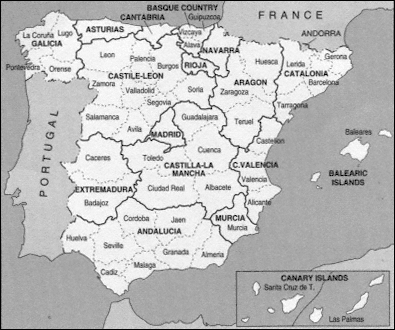
Map 1. The autonomous communities of present-day Spain.
Introduction
We have no right to demand that people suppress all the differences to which they cling, whether rightly or wrongly; or to use universal integration as an excuse for the domination of one community by another, of a minority by a majority group, or of one people by another.
—Albert Memmi, Dominated Man
The challenge ... is to stop thinking of culturally deaf people as hearing people who have lost their hearing and to start thinking of them as members of a linguistic minority, as hale as the rest of us, as wise and as foolish, and equally entitled to self-determination.
—Harlan Lane, The Mask of Benevolence
The history of deaf education begins in Spain, for the teaching of deaf children is widely believed to have originated there, and events there led to the spread of this instruction throughout the world.1 This work focuses on the "preprofessional" era, beginning in the mid-sixteenth century with the emergence of the teaching and extending through the first third of the nineteenth, when this instruction was entrusted for the first time to professional educators—a moment that coincided with Spain's implementation of a national system of education. The period under consideration here was a time of experimentation in which a colorful cast of characters—among them a Benedictine monk, a secretive schoolteacher turned tutor to the aristocracy, an ambitious secretary to a noble household, a scholarly ex-Jesuit in exile, an intellectual abbé inspired by the philosophy of the European Enlightenment, a liberal lawyer, an award-winning deaf artist—all set aside other
pursuits to dedicate themselves to instructing deaf students. In so doing, they laid the foundation for the professionalization of deaf education.
As a linguist, I am especially interested in the deaf community and its visual spatial language, and I am persuaded that its members are best regarded as a linguistic minority who are handicapped only when they are educated in a mode that is to them inaccessible, namely, oral language.2 That deaf people are a linguistic minority is a position espoused by members of the deaf community themselves, and it has been confirmed by linguistic studies dating from the 1960s that reveal sign languages to be full-fledged human languages.3 Seen from the perspective adopted here, the deaf community emerges as Spain's "newest" linguistic minority, and the present study, written at a time when that nation's principal minority languages—Galician, Basque, Catalan—have been accorded official status along with Castilian (also known as "Spanish") in their respective regions, reveals the history of the deaf community to be a textbook case of the oppression of a minority by the majority. Although the work at hand is historical, and although the group under consideration is the Spanish deaf community, the questions raised here apply to other minority communities as well, and they could hardly be of greater contemporary relevance, for at issue are the rights of minority communities, their place in the larger society, and ultimately, our tolerance for human diversity and linguistic and cultural pluralism.
The premise underlying this study—that deaf people are a linguistic minority—applies to those deaf persons who are members of the deaf community. For hearing people who lose their hearing, deafness can be a tragedy, but for members of the deaf community, it is simply a way of life. Such individuals resemble members of other minorities, specifically, other linguistic minorities, in important ways. Thus, like speakers of Spain's other minority languages—Catalan, Basque, or Galician—deaf Spaniards have a common history and a common cultural heritage.4 Like members of closely knit ethnic groups, they have a high rate of intermarriage (90 percent of deaf Spaniards choose a deaf spouse),5 and most tend to socialize with other deaf individuals, often congregating in deaf clubs and associations where they can converse, exchange information, and pass their leisure time with fellow users of Spanish Sign Language (LSE).
For above all, deaf people are united by their use of a common language, a visual manual system of communication uniquely suited to their needs. That language plays a central role in the identity of linguistic minorities is widely acknowledged and accepted in Spain today. For
instance, legislation in Galicia, in northwestern Spain, recognizes the Galician language as the "vital nucleus of our identity ... Galicians' greatest and most original collective creation, the real spiritual force that gives internal unity to our community," a "legacy of identity" linking Galicia's past, present, and future.6 To members of the Spanish deaf community, their language is no less central to their identity, and no less cherished.
While this work looks upon the deaf community as a linguistic minority, this is not the prevailing view. Instead, deaf people today—in Spain as elsewhere—are most commonly regarded from the perspective of the so-called medical, or infirmity, model, which considers them as incomplete hearing people, diseased or disabled versions of their hearing counterparts, and brands them as deficient, deviant, and above all, in need of a cure.7 Not surprisingly, the proposed cure is to make them as much as possible like talking, hearing people: to induce them to forsake their sign language for artificially acquired speech and lipreading, to exchange a mode of communication perfectly adapted to their organization for one to which they can never have complete access.
But if the infirmity model is inappropriate, evidence of it is nevertheless everywhere. At a symposium held in Barcelona in September 1992 and organized by that city's Centre Recreatiu Cultural de Sords, for example, a hearing representative from the mayor's office boasted of the municipality's efforts to make Barcelona more accessible to the handicapped and pointed with pride to the wheelchair ramps already installed on many street corners. Deaf people in attendance greeted the news with polite indifference, however, for their frame of reference was entirely distinct. They consider themselves members of a linguistic minority, and instead of wheelchair ramps, they want recognition of Spanish Sign Language as one of the nation's official tongues.
Through its failure to recognize the deaf community as a linguistic minority, the infirmity model of deafness portrays deaf people's use of sign language and their penchant for the company of others like themselves as an inability to integrate into the society of the hearing majority. Yet when speakers of minority tongues, for instance Galicians or Basques, fraternize with others who speak their language, such behavior is viewed as understandable and natural. If members of linguistic minorities prefer to associate at least part of the time with persons who share their language rather than with the Castilian-speaking majority, it is their right to do so. By the same token, if members of the signing community prefer to associate at least part of the time with persons who
converse as they do, rather than with the hearing and speaking majority, it is their right to do so as well.
The medical model, the view of deafness as pathology, often goes along with the mistaken notion that sign languages are but crude pantomime, mere gesture systems at best, primitive, concrete—in other words, not really language at all.8 But sign languages, like their spoken counterparts, have emerged from communities of users over time to become complete communication systems with their own rules of grammar, and linguists have shown that, although differing in modality, manual and oral tongues share the same essential characteristics. Neurological evidence corroborates the linguists' findings, for signed and spoken languages alike are processed in the left hemisphere of the brain, the area that is biologically specialized for this function.9 The belief that language formed on the hands and perceived by the eye must be inferior to language articulated orally and received by the ear is often rooted in the equally mistaken notion that language is speech. Language is not speech, however, but rather, a mental representation that relates words—or signs—to meanings. It follows that speech is just one of the possible manifestations of language; manual signs are another.
The belief that sign language does not constitute an authentic human language was clearly at work when teachers at the Centro Público de Educación Especial de Sordos, in whose archives it was my privilege to work for several months, told me repeatedly, "These children need language, language, language."10 All around me and contrasting with the instructors' assessment of their pupils' linguistic needs was the language these youngsters already had: the air was a blur of movement as students chatted animatedly in the idiom of Madrid's deaf community. Nevertheless, their teachers did not seem to consider signed communication to be a manifestation of language at all, most likely because what they really had in mind was speech, and it was in spoken Spanish that they attempted to carry out classroom instruction.11
Harlan Lane, in his landmark book When the mind hears, posed the question, "Why do we hearing people consider the deaf disabled, defective? Why do we and our institutions class them not with groups such as Spanish-speaking Americans but with groups such as blind Americans?"12 In Spain today, the appropriate question is, "Why are deaf people not seen as comparable to, say, Catalans, Basques, and Galicians?" And if they were? What if deaf Spaniards were considered not as disabled, but as yet another of Spain's linguistic minorities?
What changes would adoption of this model of the deaf community imply?
We can best answer this question by first considering the situation of speakers of Spain's minority tongues. Most of these languages date from the second century B.C. , when the Roman occupation of the Iberian peninsula first endowed the inhabitants of what would become Spain with a common tongue. The Latin spoken there varied considerably from region to region, however, owing in part to the substratum influence of languages in use before the Romans' arrival; over time, the distinct varieties of Latin diverged even more, eventually leading to the development of different Romance languages. Among the languages that antedate the Roman occupation, only Basque, a non-Indo-European tongue of uncertain origin, survives today; it can be heard in the Basque Country and Navarre. Of the languages derived from the Latin taken to Spain, the principal contemporary survivors are Catalan, spoken with regional variations in Catalonia, Valencia, and the Balearic Islands, Galician, spoken in Galicia, and Castilian, the nation's official tongue, which has come to be known as Spanish (see the map of Spain's autonomous communities).
Castilian first arose in northcentral Spain; its steady expansion at the expense of the other languages of the peninsula dates from the time of the Reconquest (711–1492), in which the kingdom of Castile played a leading role in expelling Moorish invaders from North Africa. With the 1469 marriage of the Catholic monarchs, King Ferdinand of Aragon and Queen Isabel of Castile, there began a process of unification of the territories that would eventually make up Spain, and in this process Castilian was destined to become the dominant language. In the seventeenth century the pursuit of political unification became more explicit, as Spain sought to become a nation in the modern sense of the word. (This intent was clearly stated by the count duke of Olivares, who counseled Felipe IV, "The most important undertaking of your monarchy must be to become king of Spain," adding, "Your Grace must not be content to be king of Portugal, Aragon, and Valencia, and count of Barcelona, but rather, you must work and think with mature and secret counsel to bring these kingdoms of which Spain is composed under the customs and laws of Castile, with no difference among them.")13 The aim at this time was political and administrative unification, but Spain's linguistic diversity—or more specifically, lack of knowledge of Castilian—was beginning to be seen as an obstacle, and by the reign of the Bourbon monarch Felipe V (1700–1746), linguistic uniformity, which had been converted into a symbol of national unity, had been added to the crown's objectives. The
eighteenth century saw Castilian firmly established as the language of administration and culture and of the upper classes, and throughout the nineteenth, the imposition of Castilian as the medium of instruction, first decreed by Carlos III in 1768, expanded its use among the common people as well. Although Spain's minority languages continued to exist—albeit more often in rural areas than in the cities, more often among the humbler classes than among the well-to-do, and almost exclusively in oral, rather than written, form—it seemed only a matter of time before they would entirely disappear.
The minority languages managed to avoid extinction, however, and emerged with renewed vitality when movements of linguistic recuperation, born of European romanticism, arose around the middle of the nineteenth century. In the Basque Country a radical brand of nationalism appeared, and in Catalonia and Galicia a literary renaissance gave rise to nationalist sentiments, which in the case of Catalonia were transported to the political arena as well. Under Spain's Second Republic, which was proclaimed in 1931, these regions would be granted statutes of autonomy providing for considerable self-government, and in Catalonia, Catalan was made the official language of government.14
In 1936 a fascist uprising led by General Francisco Franco ushered in the Spanish civil war. When it ended three years later, the victorious Generalísimo made national unity a principal tenet of the new regime's ideology. Under the ensuing dictatorship, regionalism in any form was persecuted, and the minority languages were systematically repressed. Castilian, now cast as a symbol of national unity, was made the "sole" language of Spain, the only one permitted in public acts, whether official or nonofficial. The minority languages no longer appeared in published works, nor were they heard on the radio; they could not be used in religious ceremonies or as a medium of instruction, and they could not be taught. For good measure, in Catalonia a government-sponsored slogan appeared everywhere to urge recalcitrant Catalans, "If you are Spanish, speak the language of the Empire," while signs in public telephone booths there listed the languages in which callers could converse (among them Castilian, French, English), pointedly omitting any mention of the minority tongues and stating that calls in languages not specifically mentioned would be cut off.15 The minority languages had officially ceased to exist.
Not surprisingly, resistance to these policies of linguistic repression was greatest in regions where languages other than Castilian were used most. The minority languages continued to be spoken in private, but
children who learned them at home were now illiterate in their mother tongue, since its teaching was forbidden. Government policies toward these languages eventually softened, and opposition movements in time led to the use of Catalan, Galician, and to a lesser extent Basque, in published works and in public acts. Promotion of the minority languages gradually became linked to opposition to the dictatorship, and as these tongues were converted into symbols of resistance, opposition to the dictatorship in turn became linked to their support, even in those regions where only Castilian was normally spoken. The most important result of Franco's policy of linguistic unification, then, proved to be the "boomerang effect," for a correlation was established between the struggle for democracy, on the one hand, and the defense of the minority languages, on the other.16 When the Generalísimo died in 1975, bringing to a close nearly four decades of repression in the name of national unity, popular support for the nation's minority tongues was stronger than it had ever been before. In the transition period following Franco's death, the democratic forces agreed that the demands of Spain's "historic nationalities," now associated with opposition to the dictatorship, should be met, and that entailed granting these regions at least the degree of autonomy they had held—albeit briefly—under the republic.
Post-Franco Spain is now divided into seventeen autonomous regions, or communities, and the constitution, while affirming the "indissoluble unity of the Spanish nation," also recognizes and guarantees the right to autonomy to the nationalities and regions that compose it. Moreover, the constitution enshrines Spaniards' linguistic diversity, referring to "the richness of Spain's linguistic modalities" as a "cultural patrimony that shall be the object of special respect and protection."17 This document, while establishing Castilian as the official language of the nation, also states that the "other Spanish languages" shall likewise be official in their respective autonomous communities, as determined by their statutes.18 Six of these communities, Catalonia, the Balearic Islands, Valencia, Galicia, the Basque Country, and Navarre, have another language that shares official status with Castilian, and the combined population of these territories takes in somewhat more than 40 percent of all Spaniards.19 The autonomy statutes of the various communities that have their own language generally concur in prohibiting linguistic discrimination and in recognizing members' rights to know and use the language of the community, while the constitution obligates all Spaniards to know Castilian and guarantees their right to use it. Communities with their own languages have passed legislation intended to
defend and promote the use of these tongues, and to encourage their utilization in the news media, especially radio and television, as well as in published works, theater, and motion pictures. Children have the right to receive their primary education in their mother tongue, and the teaching of the autonomous communities' respective languages is compulsory at all levels of primary and secondary instruction, with the goal of competency in both Castilian and the co-official language to be achieved by the end of schooling.20 Indeed, linguistic rights have been extended even to the remote Valley of Aran, where only some three thousand inhabitants (that is, 55 percent of a population of 5,241) report being able to speak Aranese, a variety of Gascon that is closely related to Provençal, the language once spoken throughout the south of France.21 At present the Valley of Aran forms part of the autonomous community of Catalonia, and although Aranese does not have official language status, legislation provides for its teaching and use in the schools, and recommends that preschool and reading instruction be conducted in the language of the child's home. Clearly, then, for Spaniards who hear and speak, linguistic and cultural pluralism is now a fact of life, and it is understood that the "indissoluble unity of the Spanish nation" need not imply linguistic homogeneity.
Returning now to the question of what recognition of the deaf community as a linguistic minority would imply, plainly it would entail the extension of the linguistic rights of the hearing majority to the deaf minority. The present situation of deaf signers contrasts sharply with that of speakers of minority tongues, however. Although by conservative estimates users of Spanish Sign Language are some ten thousand strong, outnumbering speakers of Aranese by more than three to one, legislative protection against linguistic discrimination does not apply to these citizens, for unlike their hearing counterparts, they are guaranteed neither the right to know and use the language of their community, nor the right to be instructed in their primary tongue.22 Sign language is not taught in the schools, no systematic provision is made for its use in teaching deaf children, and bilingualism in Spanish Sign Language and Castilian is not among the goals of their education. Thus, while Spaniards who were once exhorted to speak solely in the "language of the empire," Castilian, are now free to use their minority tongues, deaf people do not yet have the same right.
Spain may be no different from many other nations in its view of deaf people as handicapped, yet Spain's tolerance of linguistic and cultural diversity makes the situation of its deaf community especially interesting, for if a change of consciousness with respect to deaf people were
effected there, that is, if deaf Spaniards were recognized as a linguistic minority rather than as "disabled," legislation already in place would guarantee their language rights. The question, then, is whether Spain will be able to embrace the deaf community there on its own terms, as yet another linguistic group, or whether it will continue to impose on them the infirmity model. Just how far can this nation's respect for linguistic and cultural diversity extend? The answer to these questions has implications of the greatest importance that extend far beyond the Spanish borders.
Chapter 1 of this study considers the situation of deaf people in Spain during the sixteenth century, when monks undertook the instruction of aristocratic deaf children hidden away in monasteries and convents. At the monastery of San Salvador at Oña, the Benedictine Pedro Ponce de León taught his deaf charges to talk, for which feat he achieved great celebrity, and news of his highly accomplished noble students spread far and wide. A Spanish jurist who visited the monastery wrote a treatise on the legal status of deaf mutes, and another visitor published an account in which he confirmed that, contrary to popular opinion, deaf people could be taught by means of writing, without the intervention of speech, and that they could achieve salvation. Word of the events at Oña led to reevaluation of various long-held beliefs concerning deaf individuals, and all of this contributed to a gradual shift in consciousness regarding deaf people and their place in society.
Chapter 2 discusses the seventeenth century, when deaf education, though still limited to the privileged classes, moved outside the monastery. When the teaching passed from monks to the laity, the methodology changed considerably, and deaf children came to be instructed by methods originally devised for their hearing counterparts. A secretive tutor, Manuel Ramírez de Carrión, used the hearing pedagogy of his day to instruct deaf sons of the nobility, preparing them to assimilate to the society of the hearing majority. Although de Carrión went to considerable lengths to conceal his techniques, in 1620 a book appeared that may summarize his method: Reduction de las letras y Arte para enseñar a ablar los mudos, by Juan Pablo Bonet. In this work the credo of oralism, which sought to proscribe deaf people's sign language and oblige them to speak, was first clearly set forth; its influence would soon be felt all over Europe, and it continues to this day. Several of de Carrión's students went on to lead very public lives, and educated deaf noblemen now became visible in high places, probably for the first time.
Although few in number, their example must have further advanced the change in consciousness regarding deaf people.
Chapter 3 examines how during the last decades of the seventeenth century and throughout the eighteenth, instruction of deaf people in Spain was neglected and virtually abandoned. The teaching spread abroad, however, owing in no small part to Bonet's Arte and to published accounts of events in Spain. Plainly, the initiative had passed to other European nations, but in the mid-1700s a Spaniard once again took center stage when he carried the teaching to France. True to his country's tradition, Jacobo Rodríguez Pereira strove to teach his deaf pupils to talk. His approach contrasted sharply, however, with that of his French contemporary, Charles-Michel de l'Epée, who reached out to deaf people on their own terms, teaching them with manual signs and thus ushering in a new era in their education. Implicit in de l'Epée's method was the recognition that language could manifest itself in more than one way, either as articulated sounds or as manual signs, an insight entirely in keeping with Enlightenment interest in language as a system of communication, as opposed to the erroneous equation of language with speech. The manual instruction of deaf people became known as the French method. Their oral instruction, although it had originated in Spain, came to be associated with the Prussian Samuel Heinicke and known as the German method. But behind the question of methods—should deaf people be educated orally, or in the language of signs?—lay the question of instructional goals: should deaf signers be assimilated to the hearing, speaking majority, or should they be accepted as a minority community with a language of its own? During the 1700s these questions were brought sharply into focus; the controversies surrounding them continue to the present day.
Although the second half of the 1700s saw deaf schools opened in various countries, in Spain no such establishments were to be found. In 1793 a Spanish ex-Jesuit living in Italy, Lorenzo Hervás y Panduro, published an important book on deaf education, and as the century drew to a close, Spain took its first steps toward reestablishing the teaching.
Chapter 4 discusses the foundation of Spain's first public schools. With the opening of such establishments, the educational focus shifted to deaf members of the humbler classes, breaking with the long tradition of instructing only deaf people from wealthy families. A class for deaf children founded in 1795 by a Piarist priest was followed ten years later by a more ambitious establishment, the Royal School for Deaf-Mutes, which was sponsored by the reform-minded Royal Economic
Society of Friends of the Country. When the teaching was reestablished in Spain, it was, in effect, imported from abroad, for the Royal School mandated the use of French methodology and ignored the teaching of articulation, turning its back on the oral tradition Spain had pioneered.
Chapter 5 explains how, shortly after the opening of the Royal School, the Friends of the Country were joined in their endeavor by Roberto Prádez, a young deaf artist. Economic difficulties threatened the school at every turn, and the beleaguered establishment lurched from crisis to crisis. The replacement of a cruel and incompetent head teacher, Juan de Dios Loftus y Bazán, by José Miguel Alea, Spain's leading authority on deaf people and their language, offered a ray of hope, for under the guidance of this progressive linguist and pedagogue, the Royal School for Deaf-Mutes might well have flourished. Instead, its doors were shut and its pupils packed off to the poorhouse, as deaf education fell victim to the upheaval and misery caused by Spain's war against the Napoleonic occupation. At the close of the conflict the Royal School was reestablished, but one of the key players, José Miguel Alea, had been forced to emigrate, and the spirit of enlightened inquiry he had brought to the study of deaf people and their language left with him.
During the decades following the war of independence, the period under discussion in Chapter 6, political considerations, which had always influenced selection of teachers and administrators at the Royal School, now affected its pedagogy as well. Because the institution was supported by the state, politics and deaf education were always closely intertwined, frequently to the detriment of the deaf minority. Not long after Napoleon's troops had been driven from Spanish soil, Tiburcio Hernández, the new head teacher, banished the invader's methodology from the classroom as well, replacing French manualism with Spanish oralism and thus "cleansing" the Madrid institute of foreign influence. Yet this patriotic gesture did not suffice to ensure Hernández's survival at the school: teachers with ties to a particular regime were not likely to outlast it, and in 1823 a change in government brought an end to the efforts of head teacher Hernández, whose impassioned participation in political events of the day had been rewarded with a death sentence. Around this same time the Economic Society of Friends of the Country was dissolved—for political reasons, of course—and deaf education entered a period of decadence and chaos. The year 1835 saw the Economic Society reestablished and the Royal School returned to its care, but not before students had instituted a dramatic revolt against the barbaric treatment meted out by men charged with their welfare and
instruction. The preprofessional period of deaf education in Spain now drew to a close.
The conclusion considers the changes in the prevailing view of deaf people that occurred during the preprofessional period of their education and compares the pace of their education with that of hearing Spaniards. It also outlines the characteristics of the following era, which brought pedagogical and administrative renewal, the expansion and professionalization of the teaching—and the deliberate and systematic exclusion of deaf people from academic teaching positions. At the dawn of the nineteenth century, the Royal School's enlightened founders had welcomed a deaf man, Roberto Prádez, into their midst, seeming to open the door to the possibility of deaf people's full participation in the educational enterprise. Three decades later, however, when deaf education became the province of professional educators, deaf instructors were banned from the classroom—a decision from which deaf education in Spain has yet to recover. The exclusion of deaf people from academic teaching positions continued throughout the nineteenth century and well into the twentieth, and even today, in all of Spain there exists but a handful of deaf teachers of deaf children (see note 1 of the epilogue). The epilogue examines the situation of deaf people in Spain today.
The present study is intellectually indebted to works on deaf history that have preceded it: Jack Gannon's Deaf heritage, Harlan Lane's When the mind hears, John Vickrey Van Cleve and Barry A. Crouch's A place of their own, the contributors to recent anthologies edited by Renate Fischer and Harlan Lane and by John Vickrey Van Cleve, and studies by Justo Pérez de Urbel, Antonio Eguiluz Angoitia, and Olegario Negrín Fajardo, to mention but a few. Spanish deaf history has received scant attention to date, however, and this book, which makes use of new interpretations and previously unpublished sources, is the first to examine the topic from the perspective offered here.23
Although I do not presume to speak for deaf Spaniards, I hope that this work will contribute to the recovery and reevaluation of their history and, in so doing, provide them with cultural heroes and positive role models, along with the sense of empowerment that comes from a knowledge of one's past. With luck perhaps this book will stimulate further study of deaf people's history, their language, and their community, and ultimately advance their struggle for acceptance as a linguistic minority, for official recognition of Spanish Sign Language, and for self-determination.
Chapter 1
On the Hands of the Monks
The Sixteenth Century
On doors, windows, and stairs, and arches and tables and all things put their names in writing, so that they may know their names and, lastly, all for the good, indicate them to them by signs.
—manuscript attributed to Pedro Ponce de León
The most correct procedure for deaf-mutes is to begin with writing.
—Francisco Vallés
During the sixteenth century, Spanish monks undertook the teaching of young deaf aristocrats entrusted to their care, and the Benedictine Pedro Ponce de León attracted much attention and admiration when he taught his deaf disciples to talk. The achievement directly challenged the conventional wisdom of the day, which held that deaf people were ineducable, could not learn to speak, and could not achieve salvation. His pupils' successes contributed to a gradual shift in consciousness regarding deaf people and their place in society.
In the mid-sixteenth century two deaf brothers, Francisco and Pedro Fernández de Velasco y Tovar, were sequestered in the Benedictine monastery of San Salvador at Oña by order of their father, Juan Fernández de Velasco y Tovar, marquis of Berlanga and Astudillo. In sending his sons to the monastery at Oña, Juan de Velasco followed the time-honored tradition of wealthy families who concealed their "defective" children—those who were deaf, retarded, mentally ill, and the like—in convents and in monasteries.1 The shame of an "imperfect" offspring
was best hidden from the public eye, for the birth of such a child was taken as proof of God's disfavor toward human depravity, the sins of the parents visited upon their children.2 Thus, Pedro and Francisco de Velasco were sent to Oña, where they donned Benedictine robes and prepared to live out their lives among the monks.
The deaf siblings belonged to one of Spain's most powerful families: the Velascos were feudal lords of most of the towns in the vicinity of Oña, and the boys' uncle, Pedro de Velasco, was the constable of Castile, a post equivalent to vice-king.3 The brothers' parents, Juan de Velasco and Juana Enríquez de Rivera, were blood relatives whose union produced at least nine children; no fewer than four of them, Francisco, Pedro, Juliana, and Bernardina, were deaf.4 For the Velascos, as for other noble families, marriage among relatives had long provided a means of increasing wealth and influence while avoiding dispersion of familial holdings. Over time, many of Spain's most important families had come to be related through marriage, resulting in a high incidence of hereditary deafness among the nobility, for as many as ten percent of children born of consanguineous marriages are likely to be deaf.
In late 1544 or early 1545 Juliana de Velasco, who was probably the eldest of the four deaf siblings, entered the convent of Santa Clara de Medina de Pomar. Three years later her sister Bernardina was sent to the convent of the Concepcionistas de Berlanga, and it was probably around then that Francisco and Pedro de Velasco joined the monks at Oña. Francisco would have been about eleven years old at the time, and his brother Pedro about seven.5
The new arrivals passed through parapeted walls guarded by massive towers and emblazoned with the wolf and tree of the Velasco coat of arms—mute testimony to the family's munificent patronage. Cradled in the mountains of Burgos in northern Spain, the boys' new home resembled a medieval fortress. San Salvador at Oña was one of the kingdom's greatest Benedictine monasteries. Its abbots were men of extraordinary power and influence who attended the royal councils; its monks were renowned for their brilliance and their virtue. Royalty and nobility regaled the monastery with gifts and special privileges, and many sought burial there. During the sixteenth century, as Spain was on its way to becoming the richest and mightiest nation on earth, San Salvador was at the height of its power and prestige, and what was about to transpire there would ultimately lead to a change in consciousness regarding deaf people, their education, and their place in society.
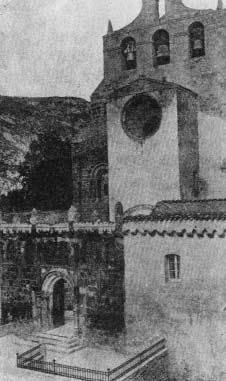
Figure 1.
Monastery of San Salvador at Oña.
From Enrique Herrera Oria, "Pedro Ponce de
Léon en el monasterio de Oña," La Paraula
3, 1920–1921. Biblioteca Nacional, Madrid.
The day of their arrival at Oña, the Velasco brothers displayed a particular affection for a monk by the name of Pedro Ponce de León, and the abbot, observing the boys' attachment to Ponce, entrusted them to his care. Fray Pedro took a liking to his young charges and, moved by their deafness, he undertook to teach them.6
Like Francisco and Pedro de Velasco, Pedro Ponce de León was of noble lineage, a descendent of Count Ponce de Minerva.7 The name Ponce de León figured prominently in the history of Spain and the conquest of the Americas, and it could be found in the genealogies of most of the kingdom's first class of grandees.8 The monk had been born in the early years of the sixteenth century in Sahagún, in the present-day province of León.9 He entered the Benedictine monastery of San Benito el Real in 1526, but he spent most of his life at the monastery of San Salvador at Oña.10 As a novice Fray Pedro would have studied
theology, canon law, and liberal arts at the monastery school. Beyond this, he seems to have received no higher education, although he was, in the words of a contemporary, "much inclined to the profession of herbalist and other natural secrets."11
The facts surrounding Pedro Ponce's birth are shrouded in silence, and there is no known record of his parentage, but circumstantial evidence suggests he may well have been illegitimate.12 Although one document from the monastery at Oña referred to Ponce as a man of noble birth on his father and grandfather's side,13 the remarks of his contemporary Fray Romualdo Escalona, historiographer of the monastery at Sahagún, suggest that something may have been amiss: Escalona was the first to trumpet the noble parentage of his fellow religious, and there can be no doubt but that he knew all about the illustrious Ponce de León family, yet when writing about Fray Pedro, he described him merely as "a native of this town."14
The hypothesis that Ponce was illegitimate may also explain another fact about his life: although he was a man of talent and accomplishment who was highly esteemed by his community, in all his years at Oña he seems never to have held an important post—not in the monastery, nor in his congregation, nor in any of the monastery's priories. One monk at Sahagún sought to attribute this to excessive modesty, but legislation of the day prohibiting the illegitimate from occupying such offices may provide a more plausible explanation.15
In Francisco and Pedro de Velasco's era it was generally believed that deaf people were inherently ineducable, and that they could not learn to speak.16 Support for these assumptions was adduced from a variety of fields, including medicine, philosophy, the Church, and the law. Physicians attributed a common origin in the brain to both speech and hearing, the commune sensorium, believing that a lesion to this region would result in both deafness and muteness. The crucial link between speech and hearing had yet to be recognized.17
Philosophers throughout the classical and medieval periods and up through the Velasco brothers' day did not clearly distinguish between language and speech. Language is a mental representation and speech is but one of its possible manifestations, but speech, rather than language, was viewed as the mark of our species, the crucial attribute that distinguished humans from beasts. (The Spanish word for "language" is lengua, which also means "tongue," clearly suggesting the conceptual link between language and speech; the same is true in other Romance languages as well.) Speech was believed to be not an acquired skill but
an instinct, from which it followed that speech could not be taught. Indeed, even to attempt such instruction would be folly. If speech was the identifying characteristic of humans—at least, hearing humans—the identifying characteristic of deaf humans was apparently taken to be not their lack of hearing, but their inability to speak. To this day, both Spanish Sign Language and American Sign Language make the sign for "hearing" (as in "a hearing person") not at the ear but at the lips, and in American Sign Language this same sign can also mean "speech," thus designating hearing people not by their auditory capacity but by their ability to talk. And until the end of the eighteenth century, the usage in many languages was to refer to deaf people who could not speak as "mutes."18 Speech distinguished humans from the beasts, and speech was inevitably lacking in those who were deaf from birth or from an early age. The negative implications for deaf people who could not talk were obvious.
In the centuries preceding the Velasco brothers' arrival at Oña and up through their time as well, the pronouncements on deafness of one philosopher in particular were quoted, and misquoted, repeatedly: Aristotle, whose work was venerated throughout the Middle Ages, asserted that those deaf from birth were inevitably mute. He held that deaf people, like animals, could make vocal sounds but could not articulate.19 Speech was the result of the soul acting on those body parts that humans shared with animals, which had no soul. Speech flowed from the soul, animals had no soul, and speech was absent in both animals and deaf people. Again, the negative implications for deaf persons who were also mute were clear.
For Aristotle, hearing was the sense most crucial to knowledge and learning. Yet he understood that the role of hearing in education was not essential but rather, accidental, because hearing conveyed sound, which he took to be the vehicle of thought.20 Theoretically, then, there could be other ways to access the mind. Although Aristotle never wrote that deaf people could not be taught, in time his remarks came to be so construed, and the belief that deaf individuals were ineducable, wrongly attributed to him, was widely accepted.21
The views of the Church held out no hope for deaf people either. The apostle Paul had written that "faith cometh by hearing," and according to Saint Augustine, deafness "hinders faith itself."22 Although the intent may well have been no more literal than that of such pronouncements as, "There are none so blind as those who will not see," eventually the saints' words were taken to mean that deaf people could not be taught
the Christian faith, and once again the implications for the deaf were disastrous.23
In a society that believed them to be beyond the pale, outside the realm of both learning and salvation, deaf people—or more accurately, deaf people who could not speak—fared no better in the eyes of the law. The law had long distinguished between deaf-mutes and those who were merely deaf ex accidente, that is, deaf people who could talk, and only the latter were recognized as persons at law. Deaf-mutes, in contrast, were routinely classified with minors, the mentally defective, and the insane. In the thirteenth century the Spanish king Alfonso X had denied them the right to bear witness, to make a will, or to inherit a feudal estate, but he had allowed that they could assent to marriage by way of signs, observing that "signs that demonstrate consent among the mute do as much as words among those who speak."24
If deaf people in Francisco and Pedro de Velasco's time were generally considered incapable of receiving instruction, this view was occasionally challenged by empirical observation. Thus, the Renaissance humanist Rudolph Agricola recounted having seen a person "deaf from the cradle, and by consequence mute," who could express his thoughts and understand those of others by way of writing.25 But Agricola's account was greeted with skepticism by the Spanish philosopher and humanist Juan Luis Vives (1492–1540). Citing Aristotle's remark that hearing was the "learning sense" and interpreting it to mean that without hearing, learning could not take place, he remarked, "For this reason I am more than surprised that there has been a person born deaf and mute who learned to read and write."26 Oddly enough, however, Vives explicitly recognized the potential for manual communication elsewhere in this same discussion: "Nature gave man, by far the most eminent of intelligent beings in this world, an external tool, to which nothing at all can be compared: to wit, his hand.... The hand by itself can even replace words; that can be observed in mute persons."27 Yet it seems not to have occurred to him that the hand might supplant the spoken word, the eye might become the "learning sense," and deaf people might be educated through it.
Like others of his time, Vives believed that speech and reason were inextricably linked. "Speech flows immediately from reason and from intelligence like a fountain," he wrote, "and because speech is born of reason, the former is as natural as the latter in man, since wherever is the spring, there also is the stream that it forms."28 This line of thinking might easily lead one to conclude that the absence of speech implied the absence of reason: if the stream was nowhere to be found, perhaps it was
because the spring was likewise lacking.29 If so, it was clear that deaf people could never receive instruction.
While Agricola's account led Vives to defer uncritically to the doctrine of Aristotle—or at least, what Vives took to be the doctrine of Aristotle—it stimulated another Renaissance thinker, the Italian Girolamo Cardano, to reflect on the possibilities of educating a deaf person.30 Cardano theorized that such an individual might be taught to "hear" by reading and to "speak" by writing. The memory would come to understand that bread, for instance, refers to that which is eaten, and the written word would be directly associated with the concept.31 Cardano thus called into question the commonly assumed link between speech and reason, asserting that it was possible to think without speech. Also implicit in these speculations was the distinction between language and speech: deaf people, this author hypothesized, could acquire language by way of writing, without the intervention of speech.
What influence, if any, did these thinkers exert on Pedro Ponce, the man who would instruct Francisco and Pedro Velasco? The monk was no doubt familiar with the works of Aristotle, Paul the apostle, and Saint Augustine. But what about Agricola and Cardano? It is clear that Cardano's writings could not have inspired Fray Pedro's teaching, since they were still unpublished decades after he had successfully instructed Francisco and Pedro de Velasco.32 Nevertheless, because the monastery at Oña maintained contact with both Spanish and foreign universities, and because some of its monks traveled widely throughout Europe, either Agricola's account of the deaf person who understood and communicated by writing or Cardano's ideas on how to teach deaf pupils might have reached Ponce by word of mouth, inspiring him to consider teaching the deaf children residing at Oña.33
Another possible inducement for Ponce to try his hand at deaf education was the example of educated deaf people of his day, who by their achievements proved that they could be taught. One such man was Ponce's contemporary, Juan Fernández Navarrete, painter to Philip II.34 Fernández Navarrete, like Francisco and Pedro de Velasco, was of noble birth, and when illness left him deaf at the age of two and a half, Navarrete, like the Velasco brothers, was sent to the monks.35 Under the tutelage of a certain Fray Vicente de Santo Domingo of the Order of Saint Jerome, he learned the rudiments of drawing at the monastery of La Estrella in Logroño, in what is now La Rioja province in northern Spain. Later Fernández Navarrete traveled to Italy, where, over a period of some twenty years, he perfected his art. Upon returning to his homeland, he came to the attention of the Spanish king, in whose employ he
decorated the monastery of El Escorial with paintings in a style closely resembling that of Titian.36
Fernández Navarrete was called El Mudo (the mute) because he could not talk. Yet no one would have suggested that the artist was lacking in reason—especially not at the Spanish court, where he was well known for his intelligence, and for his skill at the gaming table, and the precision with which he kept score of wins and losses.37 In a petition to the king requesting that he be allowed to leave a will, enter into contracts, and do all those things he would be permitted to do if he were not deaf and mute, Navarrete described himself as one "different from other mutes, because although he lacks speech and hearing, God chose to give him a shrewd and able intelligence." Thus, El Mudo portrayed himself as the exception to the rule: his keen intelligence made him unlike other mutes. The artist then went on to enumerate his other accomplishments, stating that he "understands what he sees, and makes himself understood easily to those of his acquaintance by way of signs and gestures as appropriate and exact as others do by speaking, and he knows how to write and sign his name and how to reckon, and in the art of painting he is an extraordinary and perfect craftsman and he has knowledge of the Scriptures and of history and paints precisely according to them, and he confesses and takes communion and performs the other acts of a faithful Christian with real understanding, he keeps to himself and is thrifty with his estate, so that what he lacks in speech he more than makes up for in intelligence."38 On his deathbed Navarrete penned his own testament, and according to the parish priest who attended him, his last confession, delivered by way of signs, was as complete as that of any hearing person, for "what he lacked in speech, he compensated for completely with signs and gestures."39
Fernández Navarrete's fame spread throughout Spain, and his talent was celebrated in the following verse, dedicated to him by Lope de Vega Carpio, the most important playwright of Spain's Golden Age: "Heaven denied me speech,/that by my understanding/I might greater feeling give to the things I painted;/and such great life did I give them/with my skillful brush/that, as I could not speak,/I made them speak for me." But the example he provided of an educated deaf person, considerable fame notwithstanding, could hardly have inspired Pedro Ponce's teaching, for the monk had been instructing his pupils for decades before he could have learned of the deaf artist: Francisco and Pedro de Velasco arrived at Oña around the middle of the sixteenth century, and Fernández Navarrete did not return to Spain from Italy until
some twenty years later. Yet even without knowledge of educated deaf people such as El Mudo, even without Agricola's account of the deaf and mute man who could read and write and without Cardano's reflections on the subject, Spain's intellectual climate was such that Ponce might well have surmised on his own that deaf people could be educated, for his was an age characterized by a new interest in pedagogy and in the education of society's marginal classes. In 1531 Alejo de Vanegas wrote on teaching blind people to read, and the following year Luis Vives, who seemingly dismissed the possibility of teaching a deaf person, advocated the education of poor children, blind people, and even the mentally retarded.40
But perhaps most important, Ponce had evidence quite close at hand, within the monastery itself, that must have shown him that the absence of speech need not go hand in hand with a lack of reason, and that consequently, deaf people might indeed be educable. The monks at Oña, as in many other monasteries throughout Europe, were obliged to observe total silence in certain areas—in the chapel, in the refectory during meals, in the dormitory, and so on—and at certain hours of the day.41 Silence was considered both a sign of humility and a way to avoid inadvertently sinning against God through a thoughtless word. Centuries earlier, however, the monks had already discovered that they could communicate without violating obligatory silence by using manual signs, and by Ponce's day the Benedictines had at their disposal "signs for all the most important things, [with which] they made themselves understood," according to one chronicler of the order.42 The signs referred mainly to objects of daily life in the immediate environment, such as eating utensils, objects used in the mass, garments, foods, and tools, as well as habitual actions, emotional states, dignitaries of the monastery and of the Church, and so on. There were signs for the most significant elements of religious life, such as God, the Virgin Mary, Saint Benedict, book, water, wine, and mass. Pedro Ponce must have understood, then, that it was possible to express reason without speech, for he himself did so each time he conveyed his thoughts by way of monastic signs.
When Francisco and Pedro de Velasco entered the monastery at Oña, they too must have employed a gestural system of communication. Deaf children raised in an oral environment are known to invent their own sign system, called home sign.43 The phenomenon is testimony to our innate biological capacity for language and our need to communicate, and it reveals our flexibility and resourcefulness: language, when blocked in the hearing-speaking mode, emerges in a visual-signing mode.
Beginning as simple gestures to describe people, objects, and actions, home signs eventually become more stylized and arbitrary, and various signs may be strung together to produce simple sentences. With time, these elementary gestural systems may develop the rudiments of syntax and morphology.44 They do not, however, develop a full-blown grammar; a community of signers and several generations are necessary for a real language to evolve. Young Francisco and Pedro de Velasco must have had a well developed system of home sign—after all, they came from a family with four deaf children—and their signed communication would have served to confirm what Fray Pedro already knew: the absence of speech need not imply a lack of reason.
By custom, newcomers to the monastery at Oña were assigned a "guardian angel," a paternal older member of the community whose duty it was to provide for their physical needs, instruct them in reading and arithmetic, and teach them the prayers and ceremonies of the order—not the least of which were the signs used in silent communication.45 When Francisco and Pedro de Velasco were placed in the care of their "guardian angel," Pedro Ponce, manual exchanges between the deaf brothers and the monk must have occurred almost immediately, as the Benedictine taught his signs to the deaf boys—and most likely they taught theirs to him.46 And so we may conjecture that the Velasco brothers themselves, with their home signs, may well have set Ponce on the path to their instruction.
Although both the monk and his charges communicated with signs, there were, nevertheless, important differences between Fray Pedro's monastic sign and the deaf Velascos' home sign. Monastic sign is merely a manual lexicon without a grammar, a collection of signs used with the native language as a point of reference; thus, it is not really a language at all.47 The syntax of the monastic sign used at Oña would reflect that of the monks' spoken Spanish, while the same signs on the hands of their brethren in France would reflect the syntax of spoken French. The grammar of home sign, in contrast, is not based on any oral language. Instead, it emerges from the language capacity of the individuals themselves. Monastic orders deliberately limit their lexicon to a list of officially approved signs—the goal here is to keep communication to a minimum—but deaf children 'in a non-signing environment encounter no such artificial restrictions, and giving free reign to their linguistic creativity, they may invent many, many signs.48
Thus, the arrival at Oña of two deaf brothers who communicated by way of home sign may have paved the way for Pedro Ponce to teach them. In so doing, the monk disproved the commonly-held belief that
deaf people were ineducable. Given the intellectual climate of the times, bearing in mind that the Velasco children, like the monks, communicated manually, and remembering that one of Ponce's first duties was to teach these youngsters the signs of his order, the feasibility of their instruction would have been difficult to ignore. It must have been clear to Ponce that speech was not the only possible conveyor of reason. Reason could also be conveyed on the hands.49
Under these same favorable circumstances, it is easy to surmise that another silent monk in another silent monastery could have also taught a deaf child. Indeed, someone must have taught the deaf artist Fernández Navarrete, for how else can we account for his knowledge of reading, writing, history, and the Scriptures? At the Order of Saint Jerome—an order that practiced obligatory silence—might not Fray Vicente de Santo Domingo have taught El Mudo something more than art?50
Fernández Navarrete joined the monks of Saint Jerome more than a decade before the Velascos took up residence among the Benedictines. If Navarrete was indeed taught by Vicente de Santo Domingo, the monk at La Estrella had already instructed a deaf person before Pedro Ponce began his teaching. We cannot be certain, however, about the nature of Vicente de Santo Domingo's pedagogical activities, other than that he instructed Fernández Navarrete in drawing, and it is Pedro Ponce whom Spaniards hail as their nation's first teacher of the deaf.51 It is not difficult to explain why the name of El Mudo's teacher—and conceivably those of others as well—has been lost, while Ponce's fame has endured: Fray Pedro alone got his disciples to talk.52 In an era in which speech was held to be an instinct, and deafness and muteness were believed to be inextricably linked, apparently Ponce was the first to challenge the conventional wisdom, and the news that persons deaf from birth had been taught to speak was greeted with amazement, and heralded as "unheard of," "new," and even "miraculous."53
And why would Ponce teach speech to his disciples? No doubt one factor was the law, and in particular, the constraints it could impose on deaf people's right to succeed. As we have seen, deaf-mutes, unlike those who were merely deaf, were not considered persons at law; hence, they might be excluded from the line of succession. This question worried Francisco and Pedro's father, Juan de Velasco y Tovar, for he was anxious to avoid the dismemberment of his entailed estates. The Tovar and Berlanga estates excluded only females, but the more recently established ones of Osma and Gandul y Marchinilla also excluded descendants affected by certain physical and psychic conditions, among them, deaf-mutism. In 1543 Juan de Velasco petitioned the Holy Roman
Emperor to make the conditions for succession of all his dominions conform to those of the Tovar and Berlanga estates. His request was granted that same year, thus ensuring that any of his sons, deaf or hearing, could legally inherit the title of the house of Tovar and all the estates annexed to it.54 In his will, Juan de Velasco specified that if his brother Pedro, the constable of Castile, were to die without issue and if Juan's first son Iñigo, who was hearing, were then to inherit the Velasco estate, under these circumstances Francisco, the deaf second son, should inherit his father's estate, that of Tovar, reasoning that although "it was Our Lord's will to deprive [Francisco] of speech, I would not because of that deprive him of his possessions."55
So Juan de Velasco had secured his deaf sons' right to succeed (at least in theory) some years before Pedro Ponce ever began to teach them.56 But even though the emperor had allowed that deaf-mutes could succeed to any of Juan de Velasco's estates, there was, of course, nothing to preclude a legal challenge should any interested person attempt one, and indeed, such challenges were not unheard of.57 Thus, because the right to succeed might be denied to persons who were both deaf and mute, it would surely suit the interests of the powerful Velasco family for Francisco and Pedro de Velasco to learn to talk.
What other barriers would fall if Francisco and Pedro de Velasco could speak? In addition to being excluded from succeeding to certain entailed estates, they were also subject to numerous other legal restrictions that, under civil law, applied to persons both deaf and mute. We have already seen that they could not bear witness, for instance, or leave a will. Moreover, canon law barred them from the priesthood, on the grounds that they could not pronounce the words of the Eucharist necessary for the transubstantiation, the conversion of the host and the sacramental wine into the body and blood of Christ. In short, deaf-mutes were routinely denied rights and privileges accorded deaf people who could talk.
But it should follow, then, that mutes taught to speak would attain those rights denied them under civil law on account of their muteness. It should also follow that they could be admitted to the priesthood if they could utter the words needed for the consecration of the Eucharist. And this is exactly what was argued by the Licenciado Lasso, a jurist from Madrid who had heard of the astonishing events at Oña and went to the monastery in 1550 to see for himself.58 During his sojourn there, Lasso spoke at length with Ponce and came to know Francisco and Pedro de Velasco. He was not disappointed by what he saw. That men
"mute by nature" should speak, read and write, and say confession, and that they should lack none of those things bestowed by nature save the sense of hearing, Lasso claimed to find so astounding that not even after having witnessed it himself could he cease to be incredulous.59 A talking deaf-mute was in Lasso's words a "mysterious novelty and such a great miracle" (16). For the feat of teaching deaf people to speak, the lawyer from Madrid exalted Pedro Ponce over Archimedes, Plato, Seneca, and "all the other philosophers and even jurists that there have been in the world" (10). Moreover, although Lasso repeatedly used the term "miraculous," he made clear that the monk had achieved it all through "industry, judgment, and curiosity" (22).60 Indeed, Ponce himself attributed his success not to miracles but to "the industry God has been pleased to give me in this Holy House, through the merits of Saint John the Baptist and our father Saint Iñigo," patron saint of the monastery at Oña who had been its first abbot.61 Deaf-mutes had been outcasts, outside the circle of humanity, yet by dint of "industry" Pedro Ponce had ushered in two of them, Francisco and Pedro de Velasco.
During his stay at Oña, Lasso penned a legal treatise on the rights of deaf-mutes, written in Spanish rather than in Latin because of the author's "laudable desire ... to make known what until now was not believed possible in nature or in law" (15). The manuscript, dated October 8, 1550, was not to see publication until more than three and a half centuries later, however.62 The treatise took the form of a letter addressed to "the most illustrious Señor Don Francisco de Tovar, legitimate heir to the marquisate of Berlanga and oldest relative of the house of Tovar," and in it the author repeated many commonly held views of his day. He accepted, for instance, the notion that deafness and muteness were inextricably linked, explicitly rejecting the idea that deaf individuals were mute merely because they could not hear, and maintaining instead that deafness alone was not sufficient to cause muteness. "It is clear that if a man had no other impediment but that of the ear, guided and assisted by nature he would still speak, although not as soon as those who hear," he insisted, because "speech is natural in men"—that is, an instinct (34). If those who were deaf were also mute, the author stated, it was because the same illness that caused the deafness also rendered useless the organs needed for speech. As Lasso put it, "at the same time that with illness the sense of hearing is blocked, the delicate parts employed in speech come to be blocked and closed" (35). In his view of speech (as opposed to language) as the mark of our species, Lasso likewise repeated the conventional wisdom of the day: "Birds and
animals have voices," he wrote, "[but] only rational animals [i.e., humans] have significant voice [i.e., speech]."63
But Lasso broke new ground when he discounted some commonly held beliefs of his era. His central thesis, to which he returned again and again, was that mutes excluded from succeeding to entailed estates should not be so excluded if they learned to talk. He argued that mutes taught to speak should also be able to leave a will, to be ordained—in short, to enjoy those legal rights and privileges commonly denied them on account of their muteness. The jurist's logic was irrefutable: the mute who had learned to speak was no longer mute, and consequently legal restrictions imposed because of muteness should no longer apply. Lasso went on to reject the legal distinction between deaf persons who were mutes (those mute "by nature") and deaf people who could speak (those deafened "ex accidente," by illness). Muteness, he maintained, was due to illness, and it followed then that "there is no mute even though he be mute from birth who is not so ex accidente, because of some illness" (42). If so, the mute who learned to speak should have the same legal rights as the person deafened ex accidente . Finally, in considering the ancient injunction to shun "those whom nature has marked," Lasso argued that it did not apply to deaf-mutes, because they were not marked by nature but rather by illness. Muteness was but a sign, then, of "lack of disposition of the material nature had to work with" (93). Lasso's view of deaf people as "ill" was no doubt an advance of sorts over the more sinister claim that they were marked by nature. Deafness and muteness thus construed constituted a physical defect, rather than a moral one. His vision of deaf people as impaired persists to this day in the infirmity model of deafness.
Lasso stated that professional curiosity alone was "the motive and final cause of my study" (29), and he insisted that he had written his treatise "with no [personal] interest whatsoever" (96). But there is reason to question this disclaimer. In his dedication to Francisco de Velasco, the author expressed a wish "to be able to do more and to be more worthy in order to occupy myself in more that may arise in the service of Your Grace" (7), and elsewhere he pointed to "the debt I have to the service of Your Grace" (78). This suggests a commissioned work, and the writer's desire to curry favor with the influential Velascos should not be overlooked.
The lawyer's arguments concerning the rights of talking deaf-mutes to inherit an entailed estate were never put to the test; despite the steps taken by Juan de Velasco to secure his deaf sons' right of succession,
events did not unfold as he had anticipated. When Juan died in 1545, his eldest son, Iñigo, inherited the title of the house of Tovar, and when Juan's brother Pedro, the fourth constable of Castile, died fourteen years later without legitimate heirs, Iñigo then inherited the titles of the house of Velasco as well. Thus arose the situation that Juan de Velasco had foreseen, in which one of his deaf sons could inherit the dominions of Tovar and the town of Berlanga. Francisco, the elder deaf son, had died at an early age, probably well before the death of his uncle the constable.64 The inheritance might then have passed to Francisco's younger brother Pedro. By this time, however, Iñigo had two children of his own: Juan, future heir of the house of Velasco, and Pedro, who as the second son would now inherit the marquisate of Tovar and Berlanga. Hence Juan de Velasco's sons were no longer first in the line of succession to their father's estates, and Lasso's arguments concerning their right to succeed were rendered moot.65
The jurist's claim that mutes taught to speak should not be barred from the priesthood was vindicated, for Pedro de Velasco was ordained with papal dispensation and became, quite possibly, Spain's first deaf priest.66
By Lasso's own account, Francisco and Pedro de Velasco possessed many accomplishments, but clearly the one that most impressed him, and the only one that mattered in the campaign to redeem mutes in the eyes of the law, was speech. The visitor to Oña belonged solely to the hearing and speaking world, and although he spent some time at the monastery, there is no reason to suppose he learned the system of manual communication employed there by deaf and hearing residents alike. In fact, no mention of it appears in his manuscript. And while he argued that through speech, mutes could obtain their legal rights, a position that was ahead of its time, apparently it did not occur to him that these same rights might also be extended to deaf people who could not speak but could express themselves either in sign language or by writing. Because it was speech, not signs or writing, that was taken to indicate the presence of reason, in Lasso's view speech was what was needed for deaf people to attain full legal rights and privileges—indeed, to attain their full measure of humanity. Interestingly enough, however, this author maintained that in order to testify, the ability to speak should not be required. Instead, it should suffice for neighbors or relatives familiar with the mute's signs to interpret for him, and testimony so rendered should be
given as much weight as if the mute had given it "with his own mouth" (90). Implicit here was the recognition that deaf-mutes were both rational and intelligent.
Lasso may have been the first to formulate the oralist claim that speech could "restore deaf people to society." The insistence on speech, and the concomitant devaluation of sign language, are characteristic of the pathological model of deafness, a version of which, as we have seen, Lasso espoused. Deaf people, instead of being accepted on their own terms, are "pathologized," stigmatized, and defined as handicapped; in Lasso's terms, they are "ill." Their sign language is portrayed not as a real language but merely a crude gesture system, and speech is held up as the redeemer. The issue of the role of speech for deaf people, raised for the first time in Lasso's treatise, continues to be central to questions concerning their education and, ultimately, their place in society.
It is important to realize, however, that Ponce's teaching was not limited to speech alone. Documents of the era reserved special praise for Pedro de Velasco, who was Ponce's most accomplished student and, in the words of one chronicler, "a perfect man and very capable in all subjects."67 Widely acclaimed for his intellect and for his prodigious achievements, Don Pedro could speak, read, and write Spanish, he could pronounce and write Latin with almost no solecisms, at times even with elegance, and he could write Greek letters.68 According to his nephew, Baltasar de Zúñiga, he made such good use of Ponce's teachings that "without hearing any more than a stone, he spoke, but like men who stammer; he wrote with an excellent hand, he read and understood books in Italian and Latin, [and] conversed on any subject with as much judgment and taste as any well informed person. He came sometimes to Salamanca to see his sister the countess [Zúñiga's mother, Inés de Velasco, who was married to Jerónimo Fonseca y Zúñiga, the count of Monterrey], and afforded her and her children much pleasure and amusement on account of his great wit and prudence. And although his pronunciation was somewhat irritating, he more than made up for it with the subtlety of his arguments."69
Pedro de Velasco was undoubtedly devoted to his teacher, and when the monk's most gifted pupil died in 1572—"in the flower of his youth"70 —he bequeathed to Fray Pedro, whom he referred to as "my teacher and my father," three wooden chests and his bed with its mat-
tresses, bedding, and blue canopy. He emphasized that Ponce was to have his silver saltshaker and sugar bowl "for himself," and he left the monk all his books except those in Italian, which he bequeathed to his valet, Francisco Frenado.71
Over the years Ponce taught some ten or twelve deaf students in all, among them a deaf sister of Francisco and Pedro de Velasco, Gaspar de Gurrea, son of the governor of Aragon, and the noble Gaspar de Burgos.72 Gaspar de Gurrea came to read and express himself easily in writing, and he had some knowledge of Latin as well.73 Gaspar de Burgos learned some speech, enough, according to a Benedictine chronicler, "to confess and recite Christian doctrine and other such things," and although he spoke but little, he wrote very well; he became an excellent scribe and illuminator of manuscripts and served most diligently as the monastery's sexton.74 Of his pupils, Ponce said,
I have had disciples who were deaf and mute from birth, sons of great nobles and men of distinction, whom I taught to speak, and read, and write, and reckon, to pray, to assist at mass and to know Christian doctrine and to confess by speech, and to some I taught Latin, and to others Latin and Greek, and to understand the Italian language, and one came to be ordained and to hold an office and benefice of the Church, and to pray the Canonical Hours; also this one and some others came to know and understand natural philosophy and astrology; and another was heir to an estate and marquisate, and was to follow the career of arms, in addition to all that he knew, as has been said, he was instructed in the use of all kinds of arms, and was a very skillful equestrian. Besides all this they were great historians of Spanish and foreign history; and above all, they made use of the Doctrine, Policy and Discipline of which Aristotle had deprived them.75
The situation at Oña was, in many respects, ideal for teaching deaf children. A small group of students from cultured, privileged families were taught by a devoted "guardian angel" in a community in which speech was at times already proscribed and signed communication had long been established.76 Under such favorable circumstances, it is not surprising that the results should be spectacular.
Just how did Ponce go about instructing his pupils? According to one observer, he began by teaching them to write, pointing to the objects designated by the written words, then proceeded to teach pronunciation.77 Another contemporary related that the monk communicated
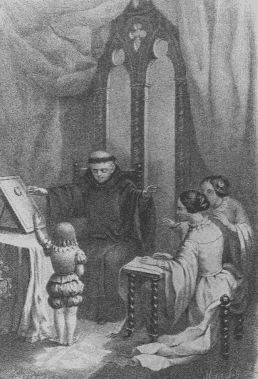
Figure 2.
Fray Pedro Ponce de Léon teaching a
deaf student. Gallaudet University Archives.
with his pupils in signs or in writing, and they in turn responded orally or with the written word.78 And according to one of Pedro de Velasco's hearing nephews, Fray Pedro instructed them that when addressing their deaf uncle, they should use a manual alphabet, a way of spelling in the air by forming letters with the fingers.79 Asked by a visitor to the monastery how he had begun the teaching, Ponce put the question to Pedro de Velasco, and his best student replied first orally, then in writing:
I would have Your Grace know that when I was a child who knew nothing, like a stone, I began to write first the things my teacher taught me, and then to write all the Spanish words in my notebook, which for this purpose had been made. Next with the help of God I began to join the sounds together, and next to pronounce with all the strength I could, although there came from me an abundance of saliva. I began then to read histories, and
in ten years I have read histories of the whole world, and next I learned Latin, and it was all by the great mercy of God, without which no mute could survive.80
According to several of his contemporaries, Pedro Ponce himself wrote an account of how he taught his students. The first known reference to Ponce's manuscript appeared in the Licenciado Lasso's treatise. Writing in the year 1550, Lasso stated that he would not comment on the monk's method because the inventor "has it recorded, stored away, and reserved for himself" (10–11). This writer urged that Ponce publish his work and make it known to all because of the great benefit to be derived from it, but apparently our Benedictine had no intention of following this suggestion, for Lasso added that Pope Julius III and the emperor Charles V should order him to do so. Some thirty years later a fellow monk at Oña, Juan de Castañiza, wrote that Fray Pedro had discovered how to teach deaf-mutes to talk and that he would "leave it well demonstrated in a book he has written about it."81
Ponce's work was never published, however, and there remains todaybut a single page, which, to judge from the handwriting and its contents, may have formed part of his manuscript.82 The text, whose intended reader was the teacher of deaf students, advocated writing the letters of the alphabet on the joints of the pupil's hand.83 (Although space was left on the page for the drawing of a hand with letters represented on it, the illustration itself was not included.) By writing words and pointing to the appropriate letters on the fingers, the student learned the names of objects, beginning with common foods with short names, for instance, pan (bread), miel (honey), and so on. In this way, according to the author, "the senses and the faculty of mind are exercised, for up until now he has them and has had them like a brute because they have been so closed off and shriveled up, due to having no door nor way to make use of them." Much emphasis was placed on penmanship: "their continual drill is and should be writing the letters and attempting to make them good and clean." The student was admonished to indicate with periods the separation between words: "Have him always write it with the letters together and the parts separated, . with periods . on each part so he knows what is part or word," the author advised. The outward signs of the Christian religion were introduced early on, and as soon as the student knew the alphabet by heart, he learned the words, "In the name of the Father, the Son, and the Holy Spirit," and to cross himself. Vocabulary was taught by labeling objects with their names in writing and conveying their meaning with signs: "Show him words,"
said the author. "On doors, windows, and stairs, and arches and tables and all things put their names in writing, so that they may know their names and, lastly, all for the good, indicate them to them by signs." And as for pronunciation—and gait—the writer counseled, "The teacher should take care that the mute not pronounce through the nose but rather through the mouth, correcting them that they not walk dragging their feet."84
Ponce continued his teaching at Oña for more than three decades, and the students brought together there may have constituted Spain's first deaf community. In their hands, Spanish Sign Language no doubt flourished. Given these circumstances—a community of deaf people that remains together over time—the rude home sign created by deaf children raised in an otherwise oral environment would eventually become a real language, on a par in complexity and sophistication with any spoken language. The deaf residents were apparently well integrated into monastic life—no doubt because manual signs provided a mode of communication equally accessible to deaf and hearing brethren alike.85 Thus, Gaspar de Burgos served as sexton, and according to the Licenciado Lasso, Pedro de Velasco sang plainchant with his fellow monks. "Not that he was able to follow the tune and order of what was sung in that monastery," the lawyer added, "because he was deprived by nature of hearing; but when Don Pedro commenced to sing according to the time and notes of the plainchant, the monks who were present and singing with him followed him, and helped him to follow their tune and time, by which the music was kept in perfect order" (23). And so it seems that harmony prevailed among deaf and hearing residents at Oña, as all parties accommodated one anothers' needs, and lived and worked together.
The deaf pupils' life among the monks was neither austere nor reclusive. Considerable amounts of money—all that the children's families paid Ponce for educating them and more—was lavished on their food, servants, and guests who regularly came to call.86 During the years that the deaf community existed at Oña, the monastery was honored by the visits of various rulers and members of their families. In 1556 the emperor Charles V (King Charles I of Spain), accompanied by his sisters Queen Eleanor of France and Queen Marie of Hungary, stopped there while in route to Yuste, as did his son, King Philip II, on his return from England some three years later. Among the royal retinue on this latter occa-
sion was the fifth constable of Castile, Iñigo de Velasco, whose deaf brothers Francisco and Pedro were among Ponce's disciples.
If Ponce's pupils led rather worldly lives, so too did their teacher. True, contemporaries praised Fray Pedro as "a monk of very good customs," a man of "good, pure life and religion" and commendable for his humility, and Ponce himself displayed considerable modesty when he credited his achievements not to any special talent of his own but rather to God, Saint John the Baptist, and Saint Iñigo.87 Nevertheless, the familiar image of Ponce as a secluded monk devoted solely to prayer and meditation is surely unwarranted. Far from remaining in the silence of the cloister, where time hung heavy on his hands and there was nothing better to do than ponder the instruction of his charges, the record suggests that Spain's most celebrated educator of deaf children was a busy, worldly man, engaged in a whirlwind of activities that competed for his attention. From 1546 to 1548 he served as teniente mayordomo, an administrative position concerned with rent payments, tithes, first fruits, and contributions to the Church. And in an era in which monasteries were frequently embroiled in litigation, more than once he served as procurator, a post that would have required him to leave the cloister to defend monastery interests in the court of law.88
Our celebrated Benedictine also devoted himself wholeheartedly to another worldly activity, that of money lender. (To judge from the number of loans recorded in Ponce's name, "one might think ... that the humble and charitable monk had organized in the monastery something like a mortgage bank," according to one author.)89 The loans Ponce extended were censos redimibles (redeemable rent charges), and toward the end of the sixteenth century and the beginning of the seventeenth such loans became widespread. Secured by debtors' property at an annual interest charge of 7.14 percent—a rate that was regulated by law and accepted by the Church—the loans often led to the passage of property from small landowners to powerful moneylenders. Treatises of the day, asserting that redeemable rent charges would lead to the ruin of agriculture, condemned them on economic grounds—and on moral grounds as well, for they were viewed as a form of usury. Ponce issued a good many of these loans, so many that it seems he was eventually overwhelmed by the responsibilities they entailed, for he authorized a resident of Oña, one Alonso Díaz, to collect payments on his behalf.90 Over the years, the loans earned Fray Pedro the moneylender a handsome profit that, together with the valuable gifts and monies bestowed on him by his students' wealthy families, enriched both his community
and the monk himself—bringing him into direct conflict with the vow of poverty he had made at profession.91
No doubt Ponce was kept busy by his various activities, so busy that he often failed to attend memorial services and masses.92 Although he was excused by his superiors from participating, clearly the arrangement weighed on his conscience. On his deathbed in August 1584 he lamented, "because I was busy ... with license of my ecclesiastical superiors both in this monastery and outside of it, I was not present in memorial services and anniversaries of the kings, counts and founders and I could not say, nor did I say, masses for the benefactors when they were to be said and for the monks of this house and outside of it who were dying, nor for the parents and brothers and sisters of the monks who were dying, being as I was obliged to correspond as a member of the Order, even though I was obeying orders that excused me."93
Ponce was entombed within the church, in front of the pulpit where the transept crosses the nave, an honor that had never before been bestowed on one who was not an abbot.94 On his sepulcher was inscribed, "Here lies the venerable Father Fray Pedro Ponce, worthy of eternal memory for the gift God gave him of teaching the mute to speak."
Inevitably, Ponce's fame grew. Talk of the astonishing events at Oña must have spread throughout the kingdom, since the deaf students belonged to Spain's most prominent families. The news would have been carried abroad as well, for Poncc's fellow monks maintained contact with their brethren throughout Europe. Visitors to Oña—emperor and king Charles I, the queens of France and Hungary, the Spanish king Philip II, and the Licenciado Lasso, among them—would have put out the word. Publication of various eyewitness accounts likewise documented what the industrious Benedictine had wrought. Another monk, Fray Juan de Castañiza, described Ponce's feat in a book on the life of Saint Benedict, and Philip II's historian, Ambrosio Morales, writing about his nation's most illustrious sons, lauded Ponce as an "eminent Spaniard of singular genius and incredible industry."95 Fray Pedro's friend Francisco Vallés, the king's physician, also visited the monastery, and based on what he witnessed there, he published proof of what the Italian Girolamo Cardano had merely hypothesized: deaf people could be instructed by way of writing. "Those who cannot hear can use writing in place of speech," Vallés affirmed. And what was more, from wri-
ting they could proceed to speech, for neither mode of expression was inherently primary: "It is not the natural order that one first learn to speak and afterwards to write; it is practiced that way because it is easier; but that one can do the opposite has been shown by Pedro Ponce, a Benedictine monk and a friend of mine, who—admirable thing!—teaches mutes to speak with no other method than teaching them first to write, pointing out to them with his finger the objects that correspond to the written words, then teaching them the movements that in speech correspond to the letters, and just as with those who hear one begins with speech, with mutes one begins with writing." Vallés went on to refute the commonly held belief, unjustly attributed to Saint Augustine and to the apostle Paul, that deaf people could not achieve salvation: "By way of sight, as others do by way of hearing, they can receive word of the sacred," he affirmed. The physician's testimony was not to be doubted, for he had firsthand knowledge of his subject: "To all this I am witness in my friend's disciples," he concluded.96
In rejecting the "commonsense" views of his day, Ponce had refuted beliefs that had gone unquestioned for centuries. He had shown that deaf people could be taught and that they could receive the Sacraments. He was committed to articulation as part of their education, quite likely because of the legal restrictions imposed on deaf people who could not talk, and specifically because of the prohibition against succeeding to an entailed estate, which could have affected some of his aristocratic pupils.
Although a deaf community of sorts must have existed at Ofia during these years, there is no reason to believe the monk ever viewed deaf people in general, or his deaf pupils in particular, as such. Deaf residents seem to have been integrated into monastic life to a considerable extent, and the hearing brethren also signed. Ponce's instruction was limited to the privileged few97 —several centuries would pass before deaf education would be extended beyond the aristocracy—yet his work contributed to a shift in consciousness regarding deaf people.
For his achievements, Pedro Ponce was, according to his funeral eulogy, "renowned in all the world."98 "All Spaniards and foreigners honored [him] because of his miraculous creativity," wrote another Benedictine some years later. But as this same monk went on to observe, "He never tried to teach [his method] to another; and we all know how much more it is to form teachers in a profession than to be one."99 And thus, at Ponce's death in 1584, the teaching of deaf pupils at Oña came to an end.
Chapter 2
Out of the Monastery
The Seventeenth Century
In any home where there are mutes ... it is not well that those who talk to him use signs, nor that they permit him to make use of them.
—Juan Pablo Bonet
Sire, Your Highness will forgive me, but I cannot tell you, because I gave the teacher my word that I would keep his secret.
—Bernardino de Velasco
He did not need to speak in order to govern his estates, [for] the majesty of his judgment and talent put everything in order.
—F. Llamas y Aguilar
Pedro Ponce lived and taught in a silent, signing monastery but trained no successor, and after his death the teaching of deaf people in Spain seems to have been interrupted for a time.1 Recorded instances of their instruction surface once again, however, early in the seventeenth century. At this point the teaching was no longer solely in the hands of members of religious orders, and the students, while still from aristocratic families, could now be found living outside the monastery. Yet each tutor continued to have only a small number of students to whom he devoted an extraordinary amount of time and effort. The results thus obtained were excellent—it could hardly be otherwise, given these conditions. But when the teaching moved beyond the monastery walls, the methodology changed considerably. Deaf students came to be instructed by methods originally devised for the hearing, and
the tenets of oralism, which would prohibit deaf people from signing and oblige them to speak, were clearly set out for the first time in a book on their instruction, the first known published work on the topic. Educated deaf aristocrats entered the public arena, rising to positions of great visibility and importance at home and abroad; by their example, which could hardly have passed unnoticed, they contributed to the growing awareness that deaf people could be educated, and assume their rightful place in society.
Alonso Fernández de Córdoba y Figueroa, the fifth marquis of Priego, was born in 1588, four years after the passing of Pedro Ponce. He was deaf from birth. Deafness was no stranger to Don Alonso's family, for in keeping with the practice of the Spanish aristocracy, the family had often opted for consanguineous marriages.2 Alonso's mother, Juana Enríquez de Rivera y Cortés, granddaughter of the famous explorer Hernán Cortés, was a cousin of the deaf Velasco brothers taught by Pedro Ponce; his father, Pedro Fernández de Córdoba y Figueroa, fourth marquis of Priego, had been born of a marriage between uncle and niece that had also produced a deaf daughter, Alonso's aunt, Ana Ponce de León.3 And Don Alonso had a deaf sister as well, Ana Fernández de Córdoba y Figueroa. All these deaf relatives had been sent to the convent, but in a break with this tradition, the deaf marquis would be educated at his home in Montilla, in Seville.4 Upon his father's death in August 1606, Don Alonso succeeded him to become the fifth marquis of Priego, third marquis of Villafranca, and second marquis of Montalbán. The young nobleman was eighteen years old. The following February he wed his first cousin, Juana Enríquez de Rivera y Girón, and in December of that same year they celebrated the birth of their first child.5 Eventually there would be seventeen more—none of them deaf.6
At some point in Don Alonso's youth, there arrived at Montilla a tutor, one Manuel Ramírez de Carrión.7 De Carrión had been born in Murcia, in the village of Hellín, where he had most likely been a teacher, and there he had taught his first deaf student.8 Upon arriving at the palace at Montilla, he set about instructing his new pupil.
Don Alonso's lessons were interrupted around 1615, according to de Carrión "at the best age," when the tutor was summoned to Madrid by Juana de Córdoba, duchess of Frías, widow of the sixth constable of Castile and mother of the seventh.9 The duchess had a deaf son, Luis Fernández de Velasco, for whom she needed a teacher.10 As one member
of the household would later relate, the boy's mother took "immense care" to find "possible remedies to overcome this defect, looking for people and spending liberal sums, so that such a great lord might not be left without a cure."11 The child was none other than the grandnephew of Francisco and Pedro de Velasco, the deaf aristocrats who had been taught by Pedro Ponce at the monastery at Oña. Francisco and Pedro's hearing brother, Iñigo, had been the fifth constable of Castile; his son Juan, the sixth constable, was the father of Bernardino, the hearing elder son destined to become the seventh constable, and Luis, the deaf second son, for whom the duchess of Frías was now desperately seeking a teacher.12 The families of both pupils were related, for while Luis de Velasco was Francisco and Pedro de Velasco's grandnephew, Alonso Fernández de Córdoba's mother, Juana Enríquez de Rivera, was their cousin—making Alonso's mother and Luis first cousins twice removed, and Luis and Alonso second cousins once removed. Thus, the duchess was surely aware that Ramírez de Carrión was educating her deaf relative Alonso Fernández de Córdoba at Montilla.
The marquis of Priego was at first reluctant to allow his teacher to depart. His instruction was incomplete; moreover, the young nobleman was no doubt somewhat dependent on his tutor to administer his estates. His initial unwillingness was overcome, however, when the duchess of Frías enlisted the support of powerful allies such as the archbishop of Burgos, the president of Castile, and the count of Salazar.13 So it was finally agreed that de Carrión would go to Madrid to teach Luis de Velasco, but only for a limited period, after which he would return to the marquis of Priego at Montilla.
At the Spanish court, Ramírez de Carrión undertook the instruction of young Luis, who was then around five years of age, and at the same time he also taught the boy's hearing brother, Bernardino, the seventh constable of Castile, who was one year Luis's senior.14 De Carrión would remain at the duchess of Frías's home for some four years, journeying to Montilla only occasionally during this period.
Unlike his predecessor Pedro Ponce, de Carrión had lived all his life in the hearing world. His deaf students too were on hearing turf, de Carrión's turf. The tutor, it will be remembered, had in all probability been a schoolteacher before turning to deaf education, and from what can be pieced together, the pedagogy he employed with deaf children was much like that he had used with the hearing. One technique consisted of teaching reading by reducing the name of each letter to the sound associated with it. The letter s, for instance, which in Spanish is called
ese, would be designated simply as sss, the letter m, eme in Spanish, would be designated as mmm. This phonic approach was intended to facilitate the next step, joining the sounds together to form syllables and words, and Ramírez de Carrión utilized this technique with Luis's hearing brother, as well as his deaf pupils. The tutor would boast some years later that with his method, in but a short time, "a child can learn to read aloud without faltering ... as perfectly as if he had studied for two years with the method commonly taught in the schools." As proof of his claim, de Carrión continued, "I shall give a highly visible example of this, and I could mention many. In Madrid, when he was six years old, I taught the constable of Castile, who is alive today, to read in thirteen days, with such success that he needed no additional teaching other than practice in order to read fluently. His Excellency Our Lord the King attested to it when His Majesty wished to hear the marquis of Fresno [young Luis Velasco] read and speak in my presence, such inventiveness being accredited and the inventor honored in the presence of such a great monarch."15
De Carrión had no more to say about his reading method, and for an account of the particulars we must turn to Juan Bautista de Morales, a publisher, and his brother Cristóbal, a schoolteacher. The two became acquainted with de Carrión at Montilla when he was called there to teach the marquis of Priego. Sometime after Cristóbal Bautista's death, Juan found among his brother's papers an account of how to teach reading by reducing the names of the letters to the sound they represent, then linking them to produce syllables and words. This technique Cristóbal said he had learned from Ramírez de Carrión. By 1618 Juan Bautista had prepared for publication a book that included his brother's materials;16 his Pronunciaciones generales de lenguas appeared five years later.17
De Carrión claimed to have invented the reading method he employed, and the Bautista brothers attributed to him the technique of teaching the sounds the letters stood for, rather than their names. In reality, however, the idea was not new, for already more than one hundred years earlier the Spanish grammarian Antonio Nebrija had advocated designating the letters by their sounds, and by the early seventeenth century this approach was fairly widespread.18 Contrary to what de Carrión claimed, then, he was not the inventor of this approach but may have been the first to teach deaf youngsters as if they were hearing.
Another tool in de Carrión's bag of tricks was the manual alphabet. Once again the evidence is provided by Juan Bautista's book, which
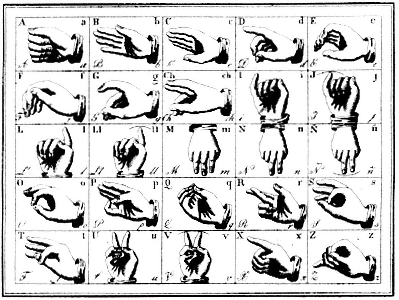
Figure 3.
The Spanish manual alphabet. From Juan Manuel Ballesteros,
Manual de sordo-mudos y que puede servir para los que oyen y hablan
(Madrid: Colegio de Sordomudos, 1836). Biblioteca Nacional, Madrid.
contained a chapter on "the letters [formed] by the hand in order to speak and make oneself understood mainly with mutes and the deaf." With this finger alphabet, Bautista explained, de Carrión "teaches mutes to write, read, understand, and speak, with such accurate pronunciation, [it is] as if they had studied and learned many languages."19
Spelling on the fingers, like the technique of using sound-letter correspondences to teach reading, was hardly an innovation, for the hand alphabet described by Bautista was essentially the same one published in 1593 in Fray Melchor Yebra's Refugium infirmorum .20 The book, with alphabetically ordered paragraphs accompanied by woodcuttings of the appropriate hand positions to represent each letter from A to Z, was intended to comfort the sick and dying, and the author recommended use of the finger alphabet to facilitate communication with those whose illness had rendered them unable to speak, as well as to enable confessors to communicate with deaf people.21
Yebra may have been the first to publish the manual alphabet in Spain, but he was not its inventor, for systems using the hands and parts of the body to represent numbers and letters have been attested as far back as
Greek and Roman antiquity.22 Yebra stated that the alphabet he advocated was commonly employed, and he suggested an additional use for it, namely, "to console other deaf people" (the reference here was to sordos, deaf people who could talk, and not to mudos, those who were also mute). Yebra added that some of these individuals, "compelled by necessity," had already mastered the hand alphabet "in order to deal with and communicate with people."23
Manuel Ramírez de Carrión made use of the manual alphabet, then, in teaching his deaf pupils—we have it on the word of the Bautista brothers—and most likely he relied on a phonic approach to teach them pronunciation and reading. But we have no direct knowledge of how he went about instructing deaf students, for he left no written record of his methods. Instead, there has come down to us only an account of his penchant for secrecy. Upon relating "a reply the constable gave to His Majesty when he was a prince," Ramírez explained:
The first day I was to begin the lessons of the marquis of Fresno [Luis de Velasco], since he was so young he was not yet eight years old, he refused to go in alone with me for the lesson, and asked that his brother the constable attend. That was what was done, and before beginning I asked the constable to give me his word as a gentleman that he would reveal to no one the secret of that teaching. His Excellency promised me, and he kept his word so well, that one day when His Highness asked him whether his brother could speak yet, he answered affirmatively. And when asked who was teaching him, he gave the teacher's name. And when asked if he had seen him give a lesson, he again said yes. And when he came to ask him how he taught him, he replied with great integrity, "Sire, Your Highness will forgive me, but I cannot tell you, because I gave the teacher my word that I would keep his secret." His Highness esteemed and praised such a discreet reply, and the count of Medellín, who was also present, said: "Sire, one who knows so well how to keep a secret and fulfill his promise as a child, will know even better how to keep those Your Highness may entrust to him when he is older." Since in truth the constable was not then more than nine years old.24
De Carrión must have been delighted at Bernardino's refusal to divulge his techniques, for he deemed his circumspect response "worthy of being written in marble and bronze and dedicated to immortality." This was not exactly the age of altruism, and the secrecy in which he shrouded his methods allowed de Carrión to protect his livelihood.
Despite the measures de Carrión took to conceal his procedures, and despite Bernardino's discretion, one man in particular seems to have made it his business to learn a great deal about the master's methods.
When the tutor was summoned from Montilla, the Aragonese Juan Pablo Bonet, secretary to young Constable Bernardino, was residing in the Velasco household.25 An ambitious man of the world inclined toward politics and the military, Bonet had begun his career under Spain's captain general of artillery, doing battle with the Barbary pirates and in Italy and Savoy, then serving as secretary to the captain general of Oran, in Algeria, where he became friends with Lope de Vega Carpio, the most celebrated playwright of Spain's golden age. Bonet was also a man of letters, a scholar of classical languages, as well as French and Italian, and an author of mediocre verse.26 In 1607 he had been named secretary to Juan de Velasco, the sixth constable of Castile, and some five years later he had accompanied his employer on a mission to Milan, serving him as both secretary and captain of artillery. After the constable's death in 1613, Bonet had stayed on in the service of his son and successor, Bernardino, who was but four years old at the time.
When Ramírez de Carrión went to Madrid in 1615, summoned by the duchess of Frías, the tutor and the warrior-turned-secretary found themselves living under the same roof. After some four years, however, the leave granted de Carrión by the marquis of Priego expired, and the teacher returned to his pupil at Montilla. Young Luis's education was incomplete, and the duchess once again searched for a teacher for her son. Various individuals attempted to continue his training, among them Juan Pablo Bonet. (Bonet would later recount that he had been moved to his efforts as much by love and obligation to the house of the constable as by the duchess's enormous and heartfelt endeavors on her son's behalf).27 But the secretary seemed an unlikely choice, for his experience in deaf education up to that point had apparently consisted solely of observing what he could of Ramírez de Carrión's procedures—procedures Ramírez did his best to conceal. Thus, it is not surprising that Luis's new tutor met with no success.28
This failure deterred the loyal employee neither from composing a book on the subject—the first published work of its kind—nor from professing to have been Luis's teacher, nor from intimating that he was the inventor of the art of teaching deaf people, claiming to have found at last a "secret path by which to enter and a smooth road by which to depart."29 Bonet stopped short of asserting that no one else had previously instructed a deaf person, saying only that "the ancient sages and modern philosophers, extremely scrupulous scrutinizers of nature and its admirable effects, who expended so much time and effort looking for
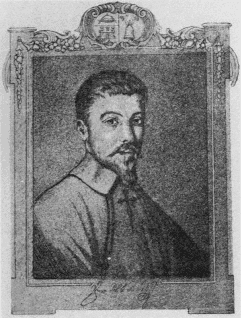
Figure 4.
Juan Pablo Bonet. From Miguel
Granell y Forcadell, Homenaje a Juan Pablo
Bonet (Madrid: Imprenta de Sordomudos,
1929). Biblioteca Nacional, Madrid.
cures for each and every one of our parts that suffers a lesion, never sought [a cure for muteness], or they never found it" (26). Moreover, he noted that "we know of not one [mute] who has spoken ... in virtue of nature, but rather, by art, because someone had taught them our language" (114). Here the author appeared to acknowledge the existence of other mutes who had been taught to talk—small wonder, considering that when he composed his book, he was living in the home of the constables of Castile, whose ancestors had been taught by Pedro Ponce two generations earlier.)
Reduction de las letras y arte para enseñar a ablar los mudos (Reduction of the letters and art for teaching mutes to speak) was dedicated to Philip III, and it contained among its introductory pages a poem by Lope de Vega Carpio praising the author's "divine inventiveness." The book was published in Madrid in 1620, about one year after Ramírez de Carrión had left the Spanish court to return to the marquis of Priego
at Montilla. Although this work contains no mention of de Carrión, it most likely represents an account of at least some of the methods he used to teach Luis de Velasco, methods Bonet must have glimpsed while both men were residing in the Velasco household.
In the first part of the book, Reduction de las letras, Bonet wrote that children learning to read should not be taught the names of the letters, but instead, the sounds associated with them. This was the phonic method Manuel Ramírez de Carrión seems to have used with Luis de Velasco's hearing brother Bernardino. Although Bonet implied that he had invented the technique, no doubt he had lifted it from de Carrión. He advocated the same procedure to teach deaf people to speak; this too he no doubt appropriated from the tutor from Hellín. In addition to the discussion about teaching reading, the Reduction de las letras also contained a good many curious and farfetched observations about the nature of the letters. For instance, the author argued that the form of each letter was itself suggestive of its pronunciation. Thus the letter A, he maintained, when laid on its side, suggested the wide open position of the mouth, and the line that crosses it indicated that the mouth was to remain open during its articulation; the letter B, with its two semi-circles joined in the center, suggested the closed position assumed by the lips to produce it; and so on.
In the second part of the book, Arte para enseñar a ablar los mudos, Bonet identified deafness as the "first and most general" cause of muteness. "Since to speak is the same as to imitate what one has heard," he asserted, "it follows that whoever cannot hear will not be able to speak, even though the instrument of the tongue may be agile, loose, and free to perform the movement used in the pronunciation of words" (109–110). A second cause of muteness, he wrote, was a defect of the tongue, so that an individual might be mute but not deaf. A person with both defects would be deaf as well as mute. Only those in whom muteness was due to deafness alone could be helped by the precepts of Bonet's Arte . The work contained a method for instructing deaf students, along with an essay on how to formulate an indecipherable code and decipher coded messages, and a treatise on Greek. Also included was an explanation of how to apply the principles of the Arte to teach mutes of other nations, since muteness was, in this writer's words, "a common illness" (249).
Bonet's identification of deafness as the most common cause of muteness constituted an advance over the thought of the Licenciado Lasso, who, writing at Oña seventy years earlier, had maintained that
the explanation for muteness did not reside in deafness alone. But if Bonet's account of the underlying cause of muteness was correct, his view of muteness itself could hardly have been more negative, for he contended that it impeded "the manifestation of the rational soul"—the belief that speech came from the soul and was the sole purveyor of reason was still with us—and he held that as a consequence, mutes "lose their standing as men before others, being left so unfit for communication that it seems they serve as no more than piteous monsters of nature, which imitate our form" (26). It is doubtful that Pedro Ponce, living in a monastery where speech was proscribed and sign language was used regularly to communicate, would have shared such uninformed views about muteness.
The author of the Arte rejected the harsh and futile methods deaf people were subjected to in his day, procedures such as "taking the mutes to the countryside, and in valleys where the voice has greater sonority, to make them give loud shouts, and with such violence that they came to bleed from the mouth, putting them also in buckets where the voice reverberated loudly, and they could hear it amplified." Dismissing such tactics as "very violent and not at all appropriate" (111), he advocated instead a different approach to the teaching of speech, one in which the sense of sight would compensate for the lack of hearing. He reasoned that knowledge of articulation could be acquired visually, and in that way the deaf person might be taught to speak, albeit without hearing. The deaf pupil would produce the right sound when shown how to correctly position his articulators, just as strumming a guitar would produce the desired chord when the student's fingers were properly positioned on the strings.
The optimal time to teach the deaf child to talk, Bonet believed, was when the pupil was between the ages of six and eight. The first step was to teach the manual alphabet—not coincidentally, the same one used by Ramírez de Carrión. (Thanks to Bonet's book, this alphabet would eventually spread throughout continental Europe and the Americas, where its use among deaf people continues to this day.) At the same time the student learned to form the letters on his fingers, he also learned to write them. The next step was articulation. At this point the pupil was to be alone with his instructor, according to the author, because "the task requires very great attention, and that he not be distracted" (128). The two should be in a well-lit place, so the learner could readily observe the tutor's mouth. The teacher was counseled to be very patient, and to allow the pupil many tries. If the student became distressed because he
was unable to pronounce a particular sound, he should be allowed to go on to another, for he would master the troublesome articulation at a later time. Bonet likened the teaching of pronunciation to the task of tuning two instruments to the same pitch when neither tuner could hear the other's instrument.
The Arte recognized that many aspects of articulation occur inside the mouth and consequently are not visible to the student. Nevertheless, the author advised, "it would not be prudent to oblige all who address the mute to do so with the mouth open"; were hearing people to pronounce in such an exaggerated fashion, it would lead the mute to make faces when he spoke, and such grimaces would be "ugly" in deaf and hearing alike (229). To teach articulation, "for ease and so as not to go around putting one's fingers in the mute's mouth positioning his tongue," Bonet advocated use of a leather tongue to demonstrate the shapes it assumed and to supplement what could be seen of the tutor's mouth (129–130). And to illustrate the multiple vibrations of the Spanish rr, he recommended a paper tongue, to be set in motion by blowing across it.
Bonet's approach was highly methodical, with the complexity of the material increasing gradually. After the student learned to pronounce individual sounds—first the vowels, then the consonants—he progressed to syllables, then simple words referring to concrete objects present in the room. Next he learned to read aloud from a printed text; comprehension was not deemed important at this point but would come later. The tenses were reduced to three: past, present, and future, with the finer points of meaning to be acquired through usage. The parts of speech were also reduced to three: noun, verb, and conjunction. Concrete nouns were taught by directly associating the word with the referent; abstract nouns were taught by "demonstrative actions," which Bonet declined to describe, "leaving this to the teachers' good judgment and discretion," but suggesting that the gestures they devised should evoke what they wished to depict (146). Action verbs (e.g., run, walk, laugh) were likewise to be acted out. The "passions of the soul," however—love, hate, jealousy, contrition, anger, cruelty, and so on—were not to be taught by demonstration; instead, the teacher was to wait until the pupil found himself in the throes of one of these emotions, then supply its name. These passions might be provoked in the learner for pedagogical purposes, but in so doing, Bonet cautioned, care should be taken not to lead him to sin.
The student should be asked each evening what he had done during the day, and if he could not reply, the tutor should supply him with the appropriate response. Once the fundamentals of language had been mastered, the written word would form the basis for further acquisition. At this point the pupil should be given books to read, beginning with the most simple, and he should be obliged to pen answers to questions about them posed in writing, and thus engage in "lengthy conversations" (227–228).
As for lipreading, Bonet was convinced that it could not be taught. He argued that since the teacher himself did not possess this ability, and since he could not teach what he did not know, he could not possibly impart this skill to the pupil. Nevertheless, the author acknowledged that "many mutes" could read from the lips without instruction. He considered such individuals "exceptions" and credited their skill to their own "great attention," rather than to the genius of the teacher. "There is no set rule by which to teach the mute to understand from the movement of the lips," Bonet concluded, "and whoever dares to offer such a system does so, not trusting in himself, but rather in the mute, from whom he wishes to take that excellence in order to honor himself with it, because since people see him speak, read, and write, and together with this he understands well from the movement of the lips, they will believe that all is due to teaching, and the teacher will attribute it to himself" (229–230).30
Although Bonet's pedagogy allowed for pantomime and gestures, which he called "demonstrative actions," he took a dim view of the use of signs. "Care shall be taken whenever asking the mute questions or responding to him ... never to reply with signs," he cautioned the teacher (148).31 And not surprisingly, his book contained very few instances of arbitrary signs, that is, signs whose meaning is derived from agreement among the users rather than from a transparent resemblance to an activity or a referent. One such sign was used, however, to instruct the pupil to join sounds to form syllables, or to join syllables to form words. One hand described a circle in the air, or as an alternative, the two hands were clasped tightly together (139–140). Arbitrary signs were also used to explain verb tenses. For "past" the hand moved back over the shoulder, and for "future" the hand arched forward in front of the body. Another arbitrary sign conveyed the concept "many": the teacher brought all five fingers together and wiggled them. (The description is rather imprecise, but the gesture seems similar, if not iden-
tical, to the sign for "many" in use in Spain today.) At this point Bonet made his only reference to the signs in use among deaf Spaniards at that time, commenting that this gesture, which was apparently unfamiliar to hearing people, "in the mutes signifies 'many'" (167).
This last remark is intriguing, for it seems to imply that there were common, agreed upon signs among an identifiable group of deaf people, suggesting their regular interaction in a confined geographical area, and possibly the existence of a deaf community and an established sign language. Such a group could no doubt have included the deaf members of the Velasco family, their deaf relatives, and most likely some hearing members of their households as well. The signs could well have been in use for generations, formed on the hands of Ponce's pupils Francisco and Pedro de Velasco, their deaf sisters Juliana and Bernardina, their grandnephew Luis de Velasco, and their deaf relatives at Montilla—the marquis of Priego, his aunt, and his sister. But the author had nothing more to say about this matter, leaving us to speculate on the existence of a Spanish deaf community and a Spanish sign language in his day.
Bonet was well aware of the ease of communication afforded by signs, for he held that they were our "natural language," and he observed that when two deaf people met, albeit for the first time, they could understand each other by way of signs (113). Nevertheless, when it came to the use of signs in the deaf student's household, Bonet was adamantly opposed. The pupil should be forbidden to use them, as should those hearing people who communicated with him. Instead, hearing individuals were to address the deaf person via the manual alphabet, and the deaf person was to respond orally. "It will be very necessary that in any home where there are mutes, all those who know how to read should know this [manual] alphabet to speak with it to the mute, and not with signs," Bonet advised, "because understanding by the hand or in writing, it is not well that those who talk to him use signs, nor that they permit him to make use of them, but rather that he respond by mouth to whatever he is asked, although he may err in the locution of his responses, and care must be taken to correct him always, because all those who learn a foreign language, by making errors and noting how they are corrected, come to learn it" (117). In all likelihood, however, deaf persons would have used signs to communicate with hearing members of the household, and hearing people would have responded in the same fashion. Indeed, the fact that Bonet admonished his hearing readers not to use signs with the "mutes" suggests that they were doing just that. And after all, the author himself learned deaf people's sign for "many."
Bonet's intransigence, his insistence on speech and on the total exclusion of signs in communicating with deaf people, would become the cornerstone of oralism. As we have seen, this misguided effort to "rehabilitate" deaf students through artificial speech, and thus to restore to them their "standing as men before others," as Bonet put it, arose when an already existent pedagogy was inappropriately applied to a population for whose needs it had not been designed. Indeed, the "oral method" might be more accurately called the "hearing method." In short, when deaf education moved outside the silent, signing monastery, it was no longer tailored to the needs of the student. Instead, an attempt was made to force deaf signers into a speaking and hearing mold, and this entailed suppressing their sign language.
What was Manuel Ramírez de Carrión's reaction to Bonet's Arte, and the author's claim that he had been Luis de Velasco's teacher? De Carrión was surely apprised of the book, for he was in Madrid in 1623, just three years after his rival's work had been published there.32 Even so, he never deigned to acknowledge the existence of Bonet's work, or to refute the claim that Bonet had taught Luis de Velasco. But some years after publication of the Arte, de Carrión published a book of his own, Maravillas de naturaleza .33 The work consisted of a collection of aphorisms, attributed to various authorities or to the author's own observations, and arranged in alphabetical order:34 "Abeja (bee), does not light on a dead body or on a wilted flower"; "Agua (water), weighs more in winter than in summer"; "Aguila (eagle), alone among birds is not struck by lightning"; "Cuerpo muerto de rayo (corpse struck by lightning), will not rot," and so on.35
De Carrión's book was in no sense a manual on deaf education. Nevertheless, in the prologue the author discussed various inventions, among them the instruction of deaf people, and like Bonet before him, he too represented himself as the inventor of the teaching:
And why should we not enumerate among the greatest [inventions] (albeit to our own glory) the art of teaching the mute—be they mute from birth, or because they became deaf in childhood because of an accident—to read, write, and speak with the voice, an invention of which I am exceedingly proud, [and] of which I have numerous accredited examples. The first would be the marquis of Priego, my employer[;] had his teaching not been interrupted at the optimal age, he would speak with much perfection, just as he had started to do at the beginning of [his instruction]; but with what His Excellency reads and writes, assisted by his great understanding, he governs his estates in such a way that he justly deserves the name of prudent
Christian prince. The second example, fully consummated, would be the marquis of Fresno Don Luis de Velasco, brother of the constable of Castile, in whose teaching I spent four years, and what with having had some interruptions, I barely had three; he reads, writes, speaks, and reasons with such ability that one notices in him no other impediment except his deafness.36
De Carrión went on to describe various other, less famous, pupils: "Don Juan Alonso de Medina, twenty-four, of Seville, at eighteen months of age, having been born with no impediment of the ear whatsoever and when he was already saying many things, fell from a bureau on which he had been seated and when his brain struck the floor he was left completely deaf from the fall, and in a few days he gradually forgot what he could say before, until he became mute, just as if he had been so from birth. Don Antonio Docampo y Benavides, knight of the Order of Alcántara and a resident of Madrid, who at the age of five could hear perfectly well and could talk as much as is usual for his age, suffered a great illness from which there followed a profound deafness, and in a few months he lost his speech and was left with the voice that is heard in mutes without articulation; this defect has been repaired in both [Don Alonso and Don Antonio] with my teaching, and they speak today in the manner that is known to all."37 De Carrión alluded to still others whom he had taught as well, but whose education, for one reason or another, had not been completed. In the same prologue the author also claimed to have invented the reading method he had utilized with Bernardino de Velasco, the seventh constable of Castile, even though, as we have seen, the technique was already well known.
Elsewhere in the book, de Carrión commented on the relationship between deafness and muteness:
Those deaf from birth will of necessity be mute, and also those who become deaf in childhood, even if they had been able to speak. The reason for the first [phenomenon] is that since words are chosen arbitrarily by the will of men and have by nature no more meaning than that which is given them by the consent of their first inventors, he who has never heard can hardly know what name was given to the "hat" by one who, just as he called it thus, could as well have called it "taratala" and it would mean the same. ... Whence we understand that of necessity what the tongue is to pronounce must first enter by the ear. The same occurs in one who loses his hearing in childhood, since being unable to conserve the notion of the words because the brain is very tender and because he has made little use of them, he forgets them easily. To which is added the fact that it is not possible to reinforce the memory with the use of his own pronunciation or that of others, since he lacks
hearing, the judge of words and that which tells us when we pronounce well or badly. Because he who is totally deaf not only does not hear what is said to him, but not even what he himself pronounces; whence it is demonstrated also that the mute's impediment is born of the deficiency of the ear and not of the tongue, because the latter is free and disposed to speak if the memory administers the words and they know how to form the articulation. Which doctrine is proven with the example of mutes taught to speak by art, who move the tongue and articulate without impediment. And if someone tells me that they do not do so with the perfection of those who hear, I will reply that that is not much, since they have not perceived what is spoken by way of the instrument nature destined for their apprehension, which is the ear, on account of being deprived of it, and art must make use of extraordinary measures to inform the tongue.38
De Carrión never elaborated on the "extraordinary measures" he employed to "inform the tongue," however. For this we may rely at least in part on Bonet's book, which as we have seen most likely represents what the author could glean of the secretive tutor's tactics. We find another reference to de Carrión's methods in the account of Pedro de Castro, a Jewish physician who practiced medicine in Spain and France, as well as in Italy, where he served as first physician to the duke of Mantua.39 De Castro himself had reportedly taught a deaf child in Vizcaya, and he claimed to have learned the "rare secret" of making deaf people hear by talking with Ramírez de Carrión, whom he referred to as the inventor, and by "philosophizing with extraordinary perseverance."40 Although he promised to publish the secret at a later date, apparently he never did. But another physician by the name of Sachs of Lewenheim provided an account of a cure for deafness attributed to Pedro de Castro. After the patient had been purged "according to his physical constitution, or temperament," the crown of the head was shaved, then slathered with an ointment concocted from spirits, saltpeter or purified niter, and oil of bitter almonds. The mixture was boiled until the spirits evaporated, after which one ounce of naphtha was mixed in well with a spatula. The salve was applied twice daily, and especially at night before the deaf person retired. In the morning, once his face was washed and his hair combed back with an ivory comb, the patient was spoken to at the bald spot, with the result that "the deaf-mute hears with clarity the voice that in no way could he hear through the ears."41 This part of the "cure" Sachs described was entirely in keeping with the medical ideas of the time, dominated as they were by the theory of humors, and the origin of these practices was most likely to be found in the "philosophiz-
ing" of de Castro the physician, rather than in the pedagogy of de Carrión the schoolmaster. If so, we can understand why no such procedures appear in Bonet's book.
The teaching method described by Sachs differed not one whit from the techniques advocated by Bonet: "If the deaf-mute does not know how to read, he shall be made to learn the alphabet; and each letter of it should be said to him several times until the deaf-mute can pronounce it; and then he will proceed to the pronunciation of words, showing him successively the objects named so that he will learn their names; and lastly he will be spoken to by joining words together, so that he may know how to order the words."42
We have seen that Juan Pablo Bonet in his Arte made no mention of Ramírez de Carrión, and similarly de Carrión in his Maravillas made no reference to Bonet. Moreover, both men failed to acknowledge their predecessor, Pedro Ponce de León, who had died nearly four decades before Bonet's work appeared. The omission of any reference to Ponce is particularly glaring because both writers cite a goodly number of authorities—Bonet, for instance, at the beginning of his book lists seventy-four authors cited in the text. (Ponce's name does appear once in Bonet's Arte, however—in the censor's approval Antonio Pérez, abbot of the Benedictine monastery of San Martín in Madrid, remarked that such a work was "very much desired in our Spain since our monk Fray Pedro Ponce de León initiated this marvel of making the mutes speak.")43 Despite this reticence concerning their predecessor at Oña, it is inconceivable that either man could have been unaware of Fray Pedro's legacy. Both were, after all, in the employ of the Velascos, whose deaf ancestors Ponce had instructed two generations earlier, and no doubt the family had kept alive the memory of those deaf relatives and their venerable teacher. Juan Fernández de Velasco, the sixth constable of Castile, had been personally acquainted with his deaf uncle Pedro, Ponce's most gifted student, and was himself the father of a deaf child, Luis de Velasco; thus, he was surely apprised of the monk's activities at Oña. Because of the Velasco family history, then, both de Carrión and Bonet must have known about Pedro Ponce.
Just how much they knew about his techniques is another question, and there has been no shortage of theories concerning the connection between Ponce, Bonet, and de Carrión. Some have speculated that Bonet, while in the employ of the constable, would have had access to notebooks belonging to Ponce's students, their papers, and possibly even the monk's manuscript, and that in his Arte he merely plagiar-
ized Ponce's method.44 But a simpler scenario has already been suggested, namely, that Bonet plagiarized not Ponce but Ramírez de Carrión. De Carrión taught the marquis of Fresno during a four-year period when Bonet was present in the Velasco household, providing ample opportunity for the constable's secretary to learn something of the tutor's procedures. With de Carrión close at hand and successfully instructing young Luis, Bonet would have had no need to plagiarize Ponce.
And what about Ramírez de Carrión? What, if any, was his link to Pedro Ponce? Prior to his arrival at the Velasco home, de Carrión had already tutored several deaf students—first in his hometown of Hellín, then at Montilla.45 His procedure of choice—the unimaginative application of hearing pedagogy to deaf signers—was already in place years before his services were required in Madrid.46 But did he draw on Ponce's methods once he joined the Velasco household, and are those methods what is reflected in Bonet's Arte ?47 The answer would seem to be no, for evidently the two approaches differ significantly—assuming, of course, that Bonet's work is indeed a reflection of dc Carrión's procedures, and that we can rely on the accounts of Ponce's contemporaries and the page from the manuscript found at Oña to evaluate the monk's methods.
For one thing, there was the role of signs in instruction. Bonet's prohibition of their use marked a radical departure from Ponce's approach, which apparently employed them liberally. ("On doors, windows, and stairs, and arches and tables and all things put their names in writing, so that they may know their names and, lastly, all for the good, indicate them to them by signs," the author of the manuscript from Oña had recommended.)48 The two also differed on the use of signs for communication, as opposed to teaching. Bonet sought to banish signs from the deaf person's household and advocated obliging him to speak—"it is not well that those who talk to him use signs, nor that they permit him to make use of them, but rather that he respond by mouth," he declared.49 But Ponce lived in a signing milieu in which deaf and hearing alike communicated regularly in manual language, the monk himself had taught the Velasco brothers the signs of his order, and within the monastery it was speech, not signing, that was frowned upon.
Then there was the question of the manual alphabet. De Carrión had already employed this procedure to instruct his deaf students before he journeyed to Madrid, so he did not learn it from any of Ponce's
materials the Velascos might have had.50 And the alphabet of the Oña manuscript, in which the letters were represented on the joints of the fingers, was different from the one used by de Carrión and reproduced by Bonet, in which each letter was represented by a different hand shape. Finally, there was the phonic method of teaching the sound for each letter. It is not known whether Ponce employed this procedure, but the Bautista brothers made clear that Ramírez de Carrión had used it before ever crossing the constable's doorstep, suggesting that he did not plagiarize this technique from any of the monk's papers that might have been in the Velascos' possession, either.51
In addition to differences in the tools of the trade like signs and the manual alphabet, there was another, even more important distinction between the two methods. For the author at Oña, the written word formed the basis of instruction, while in the method set forth by Bonet, the foundation was articulation. Both Pedro de Velasco, Ponce's most outstanding student, and Francisco Vallés, the king's physician, stated that the monk began with the written word and that only later did he teach speech. Pedro de Velasco related having filled his notebook with "all the Spanish words" before ever progressing to articulation,52 and Vallés, after observing the venerable Benedictine in action, concluded that "the most correct procedure for the deaf is to begin with writing."53 But in the Arte para enseñar a ablar los mudos, articulation, the mechanical production of speech sounds, was the cornerstone of instruction, and the student was first led to pronounce the letters, then syllables and words, and finally to read aloud, at which point, according to Bonet, "there is no need to be concerned that he might not understand what he reads, because up to now we don't intend anything other than that he join the letters in such a way that his reading shall be intelligible to whoever hears him, although he may not know what he is saying, because this is to be taught later."54 In Ponce's method comprehension of the written word accompanied by signs preceded production, while in the method recommended by Bonet, oral production, which must have been parrotlike, preceded comprehension.
It would seem, then, that although de Carrión must have known about Ponce's teaching, the secretive tutor did not appropriate his predecessor's methods. Ponce, both in his use of sign language and in his initial reliance on the written word, seems to have tailored the method to the student—proceeding from reading to speech was, as Vallés had noted, just the opposite of what was done with hearing children. But de Carrión, assuming still that Bonet's Arte actually reflects his method,
attempted to mold the students to the method, banning the use of signs and eliciting speech before comprehension. In short, he treated deaf pupils as if they were hearing. In so doing, he emerges as the oralist par excellence.
After publishing his book in 1620, Juan Pablo Bonet showed no more interest in deaf education; instead, he dedicated the remainder of his life to politics. His career had been at a virtual standstill since 1607, when Juan de Velasco, the sixth constable of Castile, had died, and the world's first published author on deaf education had stayed on in the service of Don Juan's son Bernardino, the seventh constable. That same year Philip III made Bonet a varlet servant, a modest palace official whose duty it was to inspect and clean the king's cutlery on days when the monarch was to eat in public, to supply him with bread wrapped in a napkin, and to see to the tasting of foods before they were served.55 No doubt the ambitious Bonet grew restless in his post as royal silverware inspector and food-taster, and his position as secretary to Don Bernardino, who was still a child, held little promise of excitement. Thus in 1621, one year after publication of Reduction de las letras y arte para enseñar a ablar los mudos, Bonet left the Velascos to sign on as secretary to their relative the count of Monterrey, brother-in-law of the royal favorite, the count duke of Olivares, and at this point his adventures began anew. The following year Philip IV named Bonet's new employer special ambassador to the Holy See, and the author of the Arte packed his bags and journeyed with the count of Monterrey to Rome.56 Upon Bonet's return to Spain, Philip IV made him royal counselor and secretary of the Supreme Council of Aragon, and when the count of Monterrey presided over the Aragonese parliament in Barbastro and Calatayud in 1626, Bonet was elected promovedor, or president, of the noblemen. Despite widespread opposition to the king's request of a new subsidy of men and monies from Bonet's native Aragón, the promovedor vigorously defended the crown's interests against those of his own region, bringing to bear all his skill as a statesman and politician to gain the approval of the cortes . For his efforts he incurred the enmity of his compatriots, but a few months later Philip IV rewarded his loyalty by making him a member of the Order of Santiago.57 In 1628 Bonet returned to Rome with the count of Monterrey, whom Philip IV had sent once again to the Holy See.58 Five years later he was back in Spain recruiting troops for service in Naples, where the count of Monterrey
had been appointed viceroy and captain general. This would be Bonet's last mission, for he died in Madrid in 1633.
Luis de Velasco was left in Madrid without a teacher when Ramírez de Carrión returned to the marquis of Priego at Montilla in 1619. After Bonet tried his hand—unsuccessfully—at teaching young Luis, his mother, the duchess of Frías, sent the boy to be schooled at Montilla, where he lived for nearly a year in the home of his deaf cousin. Eventually she arranged for Ramírez to return to Madrid to finish her son's education.59 The tutor would later refer to Luis's instruction as having been "fully consummated," and Luis himself was fond of saying, "I am not mute but merely deaf."60 A chronicler of the house of Velasco recounted that only "the rage of his actions" could on occasion trip up Luis's tongue, for he was a "passionate and daring gentleman of heroic spirit and gallantry, strong and extremely courageous."61 In January 1628, when Luis had not yet turned eighteen, he married Catalina de Velasco y Ayula—a blood relative, of course—and shortly thereafter Philip IV conferred upon him the title of first marquis of Fresno. In later years he was granted the privilege of wearing jewels and colored apparel, and was named comendador, or high ranking knight, of the Order of Alcántara. The order, which Luis was authorized to enter in the town of Berlanga, granted him lands, jurisdiction over them, and the right to collect rent, and exempted him from the obligation of residing there. He maintained correspondence with various Spanish and European personalities and stood in for his elder brother Bernardino, the seventh constable of Castile, when the latter was called away because of his obligations as governor of Milan and captain general of the army of Old Castile. During Don Bernardino's absences Luis de Velasco was left in charge of the household, on occasion replacing the constable in his duties at the royal palace and representing him at various public functions. Here, then, was a highly visible deaf nobleman who by his example no doubt contributed to the growing awareness that deaf people could be educated and could execute the duties associated with their station in life.
As for the marquis of Priego, Luis de Velasco's deaf cousin, it was only with the greatest reluctance that he had allowed his tutor to depart from Montilla in 1615, when de Carrión had been summoned to the Velasco household in Madrid. The Young nobleman's instruction had been interrupted at a crucial stage, and his teacher was not to return until some four years later.
Throughout his life, the marquis of Priego seldom ventured from his estates at Montilla, for to do so was to find himself handicapped by the hearing and speaking world, and forced to deal in a medium not suited to his needs. On one such occasion Don Alonso committed a breach of etiquette before the king himself, jeopardizing his rights and those of his descendants as grandees of the highest order. A contemporary who years later sought the king's comprehension and forgiveness on behalf of the house of Priego explained the behavior of the deaf marquis:
[Don Alonso] went to Seville to kiss Your Majesty's hand in 1624, and then Your Majesty saw fit to order him to cover his head after he had spoken, as with grandees of the second class. But this act should not harm his House nor the successor to it, for many reasons. The first, because of his natural impediment, since he is mute by nature and because it is necessary to communicate with him by way of interpreters and signs, for which reason he cannot be as attentive to the ancient rights.... As soon as they advised him that his standing had been harmed, he begged for their restitution, and thus when he kissed the queen's hand in the year 1644, he did not speak until Her Majesty had ordered him to cover his head.62
Spanish grandees of the first class had the right to greet the king with their heads covered; those of the second class greeted him with heads uncovered, then covered them to hear the king's reply; and those of the third class both greeted the king and heard his reply with heads uncovered. By addressing his sovereign before being instructed to cover his head that day in Seville, the marquis of Priego had behaved like a grandee of the second class, rather than of the first, endangering his standing and that of his successors.
At his home at Montilla, however, it was a different story, for there Alonso Fernández de Córdoba surrounded himself with able administrators with whom he could communicate easily in signs or in writing.63 (So much for de Carrión/Bonet's admonition that those residing in the mute's household should never address him in signs and should oblige him to respond orally.) During the nearly forty years he ruled over his marquisate, Don Alonso skillfully managed his estates, and his achievements on behalf of his noble lineage left nothing to be desired. In 1624 he was made a knight of the Order of the Toisón de Oro, the Golden Fleece, by Philip IV, and a few years later he secured from the king the title of "city" for what had until then been the "town" of Montilla.64 A younger hearing brother disputed his deaf sibling's right to rule his estates, but Don Alonso successfully fended off the legal challenge.65 And on several occasions he increased the patrimony of the house of Priego. In 1634 his young grandson Lorenzo Gaspar Suárez de
Figueroa y Córdoba, fourth duke of Feria, died childless and unmarried, paving the way for the marquis of Priego to inherit the duchy of Feria. As a result, Don Alonso, fifth marquis of Priego, third marquis of Villafranca, and second marquis of Montalbán, became the fifth duke of Feria, fourth marquis of Villalba, and master of all the house of Figueroa and Manuel. One year later when his cousin Alonso Gaspar Fernández de Córdoba y Alvarado, marquis of Celada, also died without issue, the deaf marquis inherited the marquisate of Celada as well.
The marquis of Priego died at his refuge at Montilla in 1645 at the age of fifty-six and was laid to rest, according to his own instructions, in the family pantheon in the church at Montilla's Jesuit school, "in the most ordinary part and close by where people regularly walk."66 In the words of one family chronicler, "With the greatness of his understanding he made art overcome nature, and ... he did not need to speak in order to govern his estates," for "the majesty of his judgment and talent put everything in order."67 Here was another deaf person schooled outside the monastery who by his example showed that deaf people could be taught, they could succeed in high places, and "judgment and talent" were not limited to the hearing.
Manuel Ramírez de Carrión bade farewell to the Velascos and returned to the marquis of Priego around 1619, one year before Bonet published his book. For nearly two decades he continued on at Montilla, where he served as both teacher and secretary to the marquis. In the fall of 1636 he was again called to Madrid to teach a deaf child. This time it was Philip IV himself who sent for de Carrión, and the pupil was none other than the king's own relative, Emmanuele Filiberto Amadeus II, prince of Carignan and grandson of a Spanish infanta. The new disciple was the eldest child of María de Borbón Soissons and Duke Thomas of Savoy.68 Duke Thomas, one of Italy's leading aristocrats, was a general of the Spanish armies, and it may be on account of this that the family had heard of the teacher of deaf noblemen.69 A more likely source, however, was the king himself, for years earlier and in Ramírez's presence he had questioned Bernardino de Velasco concerning his brother Luis's instruction. (Bernardino, it will be recalled, told the future king that Luis's teacher was Ramírez de Carrión and assured him that his brother was able to speak, but declined to reveal the tutor's methods.) At any rate, Emmanuele Filiberto's mother appeared at the Spanish court with her young son, and Philip IV called for Ramírez de Carrión.
De Carrión had been instructing the prince of Carignan in Madrid for some two years when the historian José Pellicer y Tovar wrote his Pirámide baptismal in honor of the young tutee. The preface was addressed to the boy's teacher, whom Pellicer referred to as "the intelligence that moves with his teaching the lips of the most serene Emmanuele Filiberto Amadeus."70 The historian gave this account of the events that had led to Ramírez's instruction of the prince:
Everyone rightly agrees that, among the pomp and splendour the King Our Lord (may God protect him) bestowed upon the serene Princess of Carignan, among the honors and favors Her Highness received from His Majesty, one of the greatest was having arranged with such loving care that Your Grace should come from Montilla to this court as teacher of her first born, who found in such a great Monarch not only assistance, protection, and shelter, but also speech, teaching, and knowledge, placating with liberality and largess the slights of fate.... Your Grace was attending the most excellent Don Alfonso Fernández de Córdoba y Figueroa, marquis of Priego, duke of Feria, whose teacher and secretary you were, and who, because he suffers from this defect, was fortunately beginning to experience the art of which your work was the inventor. His Majesty commanded him in a letter of October 10, 1636, to send Your Grace to this court, requesting you on loan for temporary employment, and offering to return you to him when the purpose for which you were summoned had been achieved. And even though that prince, grandee of Spain many times over, needed you so much at his side, as is revealed by his replies, which were as distressed as they were submissive, and which go as far as a vassal may go with his king, he had to obey, having been informed that in all the kingdoms that form part of his extended monarchy, there could be found no other person to whom to entrust a doctrine of such importance, education of this kind. And just as the defect that nature placed in so distinguished a personage as Emmanuele Filiberto Amadeus, denying him the use of speech, caused universal pity, so it has caused no less astonishment to see teaching correct such a great deficiency, restoring speech to him in the noble Castilian language, so that as far as possible that natural defect is remedied. And for your diligence and proficiency His Majesty awarded the title of Royal Secretary that Your Grace now enjoys, along with other favors, which are but the beginning of the reward owed to such efforts and such superior ability.71
After some time in Madrid, Emmanuele Filiberto returned to Italy, accompanied by Ramírez de Carrión, who stayed with him there for a number of years. In 1644, when he was sixteen years of age, the prince was appointed governor of the city and province of Ivrea, and the following year his teacher returned to Spain—possibly because of the fatal
illness of his old master, the marquis of Priego. De Carrión's death occurred five years later, in 1650, in Madrid.
The prince of Carignan must have mourned his tutor's departure, for like the marquis of Priego, whose "distressed and submissive" protestations had not dissuaded Philip IV from summoning de Carrión to the court years before, Emmanuele Filiberto had come to depend heavily on his teacher. This time, however, de Carrión left behind someone who could continue the instruction, his son Miguel Ramírez. In 1645 the prince explained in a letter, "because he left his son in his place I am consoled, for he is very gentle and he does it very well and he is beginning to teach me the Italian language."72 It is not clear how long Miguel Ramírez remained with his pupil in Italy, but the year 1660 found the tutor at Montilla.73
The Italian court initially declined to take the deaf prince of Carignan seriously. The young man responded by refusing to stay there, for which disobedience he was sent to France and left to languish for a time without a teacher, as punishment. A letter he penned in Compiègne in 1649 showed how much he longed for instruction, for he lamented, "If I am not sent someone who continues to teach me, I fear I shall become like before, and be treated like a two-year-old child, even though I am a grown man."74 His despair is not surprising, because unlike the deaf person who is immersed in a signing environment, where a steady stream of readily intelligible language affords the opportunity to learn from a variety of sources, the deaf prince taught orally saw his education come to an abrupt halt when he was separated from his tutor.
Nevertheless, the life Emmanuele Filiberto was eventually to lead would be considered brilliant by any standards, for in due time he would win respect and occupy positions of importance. During the 1650s he campaigned in Lombardy, was made a colonel in the French cavalry, and was appointed deputy to the reigning Carlos Emmanuele of Savoy, and in 1663 he became governor of the city of Asti and the province of the same name. In 1684, when he was in his mid-fifties, he wed Princess Maria Caterina d'Este; her father, the duke of Modena, gave Emmanuele Filiberto his daughter's hand in recognition of the warm friendship between the two men, who had fought together at the siege of Pavia. When the deaf prince died in 1709, at the age of eighty-one, the court of Louis XIV went into mourning for two weeks.75
An account left by a contemporary shed additional light on the prince's instruction under Ramírez de Carrión. The description of his
teacher's methods provides details of what the secretive tutor himself called "extraordinary measures" taken to "inform the tongue." Recorded here are procedures nowhere to be found in Bonet's Arte, techniques the author may have been unable to observe during his years in the Velasco household—or reluctant to commit to print. While Bonet counseled patience and explicitly rejected violent means of instruction, de Carrión, so it seems, took a different tack. As Emmanuelc Filiberto's contemporary related,
After trying everything, [the prince's family] turned him over to a man who promised to make him speak and understand provided that he be given so much authority over him for many years that the family would not even know what became of him. The truth is he behaved toward him like a dog trainer would or like those people who for money display trained animals that surprise you with their skill and obedience and seem to understand and explain by signs all that their master tells them. He used hunger, bastinado [beatings on the soles of the feet with a stick], deprivation of light, and reward commensurate with performance.76
Could this be the real reason why Bonet wrote that for teaching speech, it was essential that the teacher be alone with the student? Was this why young Luis de Velasco, perhaps alerted by his cousin at Montilla, refused to go by himself to his first lesson with Manuel Ramírez de Carrión? Did such treatment eventually create in the pupils a psychological dependence on their tutor-tormentor, producing in them a kind of Stockholm syndrome, and explaining at least in part their extreme reluctance to allow him to depart?
The author of this account of Emmanuele Filiberto's training went on to observe,
Such was [the tutor's] success that the boy came to grasp everything from the movements of the lips and a few gestures, to understand everything, to read, write, and even speak, although with considerable difficulty. The boy applied himself with so much determination, intelligence, and insight, profiting from all the cruel lessons he received, that he possessed several languages, some sciences, and history perfectly. He became a good politician, even to the point of being consulted on affairs of state, and was a public figure in Turin more for his ability than his birth. There he had his little court and conducted himself with dignity all his long life, which should be considered a wonder.77
Here was yet another educated deaf man who lived his life outside the convent, and who was renowned for his talent and his abilities. Among
his descendants were the nineteenth- and twentieth-century kings of united Italy, including Umberto II, the last Italian king.
Juan Pablo Bonet and Manuel Ramírez de Carrín had resided under the same roof, both in the employ of the constables of Castile, from 1615–1619, then they had gone their separate ways. From this point on, however, history would confuse the two, and each man contributed his share to this confusion. Bonet, for his part, had insinuated that he was both Luis's teacher and the creator of the method described in his Arte, claiming it was he who had found the "secret path."78 De Carrión, too, professed to have invented the teaching that had been practiced at Oña more than half a century before, referring to it as an "invention [of which] I am exceedingly proud."79 Neither man mentioned the name of Pedro Ponce. At his death Ponce had been eulogized as "renowned in all the world."80 Yet by the time Bonet's book appeared he had apparently been all but forgotten, and most posthumous references were limited to either religious chroniclers (generally Benedictines) or writers associated with the Velasco family.81
The coast was clear, then, for both Bonet and de Carrión to pass themselves off as inventors of the teaching, and in this undertaking Bonet would be the more successful of the two. After all, de Carrión had done his best to conceal his procedures, but Bonet had published a book on the subject, and it was probably for this reason that many of his contemporaries-the playwrights Lope de Vega and Juan Pérez de Montalbán, the calligrapher Pedro DÍaz Morante, the philosopher Juan Caramuel de Lobkowitz, the poet López de Zárate and the teacher Constantino Susias, among them-took him to be the inventor of the method he committed to paper.82 But de Carrión too had his defenders, most notably the historian José Pellicer y Tovar, who seemed to take a personal interest in clarifying the situation.83 In the preface to his Pirámide baptismal, Pellicer called Ramírez de Carrión "the inventor of the most extraordinary novelty that has been seen or known by mortals, or that they will ever discover," and asserted that Bonet had composed his work "because of how he saw Your Grace proceeding and what he heard from your mouth, as a servant and dependent of the house of Velasco."84
The year was 1638, and the confusion concerning the respective roles of Bonet and de Carrión was by this time considerable. One writer attributed Luis de Velasco's teaching to a foreigner,85 while others, assuming that the author of the book on the subject must have also practiced the
art, credited Juan Pablo Bonet. Thus Pellicer, "desiring to know with certainty not only the inventor of such an extraordinary method but [also] the legitimate master of the teaching of this gentleman [Luis de Velasco]," began by perusing letters written by the principles who years before had been instrumental in bringing de Carrión to Madrid to teach the young deaf aristocrat.86 Not satisfied with the results of his investigation, Pellicer then put the question to the pupil himself. Responding in his own hand, Luis replied that "his only teacher of speech, reading, and writing was Don Manuel Ramírez de Carrión ... and any opinion that might contradict this, will be in opposition to the truth."87 Pellicer concluded, "May this documented reply disabuse the misinformed, and may they restore to Your Grace the credit and esteem that you are due, counting you among the number of those glorious men who found the most hidden secrets of all the sciences, and who have been of such importance in politics, commerce, [and] scholarship, and an example to other mortals."88 The historian expressed particular satisfaction at having set the record straight: "And may it be my glory to have unraveled the confusion surrounding this truth, and left it written for the ages to come, which I suspect will give me credit for the testimony as faithful as it is legal, with which I bear witness."89
The confusion was not to be so easily dispelled, for Pellicer's preface, with its tribute to de Carrión, its accusation of Bonet, and the testimony of Luis de Velasco himself that de Carrión had been his only teacher, did not see publication. For reasons that are not clear, his Pirámide baptismal, when it eventually appeared, was dedicated not to Emmanuele Filiberto, as Pellicer had originally intended, but to a daughter of Philip IV, Maria Teresa Viviana of Austria. Under these circumstances, it was not surprising that the author no longer sang the praises of the tutor of the deaf prince of Carignan, and the preface addressed to Ramírez de Carrión was omitted.90
The waters were further muddied in 1644 with publication of Sir Kenelm Digby's Two Treatises: In the one of which, the Nature of Bodies, in the other, the Nature of Mans Soule, is looked into: In a way of discovery of the Immortality of Reasonable Soules . Dibgy was in Madrid in 1623 with the retinue of Charles, the prince of Wales, who had journeyed to Spain to woo Philip IV's daughter, with an eye to uniting England and Spain through marriage. Although Prince Charles's efforts at winning the infanta were ultimately unsuccessful, the visit was not without its diversions, for while at the Spanish court the royal suitor and Sir Kenelm made the acquaintance of Luis de Velasco. Luis, then a lad of thirteen,
thoroughly captivated the English visitors, as is clear from the account Digby would publish some two decades later. In his Two Treatises the author described "a Noble man of great quality that I knew in Spaine, the younger brother of the Constable of Castile." He related that "the Spanish Lord was born deafe; so deafe, that if a Gun were shot off close by his care, he could not heare it: and consequently, he was dumbe, for not being able to heare the sound of words, he could never imitate nor understand them. The lovelinesse of his face, and especially the exceeding life and spiritfulnesse of his eyes, and the comelinesse of his person and whole composure of his body throughout, were pregnant signes of a well tempered mind within. And therefore all that knew him, lamented much the want of meanes to cultivate it, and to imbrue it with the notions which it seemed to be capable of in regard of its selfe; had it not been so crossed by this unhappy accident."
Digby explained that although physicians and surgeons had long sought to cure Luis's deafness, all efforts had been in vain, until "at the last, there was a Priest who undertooke the teaching him to understand others when they spoke, and to speake himselfe that others might understand him. What at the first he was laught at for, made him after some yeeres be looked upon as if he had wrought a miracle. In a word; after strange patience, constancy and paines, he brought the young Lord to speake as distinctly as any man whosoever; and to understand so perfectly what others said that he would not lose a word in a whole daies conversation."
According to Sir Kenelm, the young nobleman's lipreading abilities were nothing short of remarkable: "He could discerne in another, whether he spoke shrill or low: and he would repeate after any body, any hard word whatsoever. Which the Prince tryed often; not onely in English, but by making some Welchmen that served his Highnesse, speake words of their language. Which he so perfectly ecchoed, that I confesse I wondered more at that, then at all the rest." The prince's abilities greatly impressed Digby:
his so exact imitation of the Welch pronunciation: for that tongue (like the Hebrew) employeth much the gutturall Letters: and the motions of that part which frameth them, cannot be scene nor judged by the eye, otherwise then by the effect they may happily make by consent in the other parts of the mouth, exposed to view: for the knowledge hee had of what they said, sprung from his observing the motions they made; so that hee could con-
verse currently in the light, though they he talked with, whispered never so softly. And I have seene him at the distance of a large chambers breadth, say words after one, that I standing close by the speaker could not heare a syllable of. But if he were in the darke, or if one turned his face out of his sight, he was capable of nothing one said.
Luis's teacher declined to take credit for his pupil's startling ability to lip-read and repeat words because, according to Digby, he acknowledged that "the rules of his art reached not to produce that effect with any certainty. And therefore concluded, this in him must spring from other rules he had framed unto himselfe, out of his own attentive observation: which, the advantage that nature had justly given him in the sharpenesse of his other senses, to supply the want of this; endowed him with an ability and sagacity to do, beyond any other man that had his hearing."91
In an apparent allusion to Bonet's Reduction de las letras y arte para enseñar a ablar los mudos, Digby stated that "they who have a curiosity to see by what steps the master proceeded in teaching him, may satisfie it by a booke which he himself hath writ in Spanish upon that subject, to instruct others how to teach deafe and dumbe persons to speake." And referring to Luis's teacher, Sir Kenelm added, "The Priest who by his booke and art occasioned this discourse, I am told is still alive, and in the service of the Prince of Carignan, where he continueth (with some that have need of his paines) the same imployment as he did with the constables brother."92
Digby's account contained several inaccuracies—as well it might, for it had been written some twenty years after the fact—which increased the confusion already surrounding Ramírez de Carrión and Bonet. Luis's teacher and the man who would later instruct the prince of Carignan were one and the same, namely Manuel Ramírez de Carrión.93 And it was doubtless Ramírez whom Digby met in the Spanish court in 1623. By this time Bonet was no longer in the Velasco household, having entered the service of the count of Monterrey two years earlier, and when Digby wrote his Two Treatises in 1644, it was de Carrión who was teaching the prince of Carignan, whereas Bonet had been dead for some ten years. But the Englishman was mistaken when he stated that Luis's teacher was a priest—here he seemed to confuse young de Velasco's tutor with Ponce, the monk who decades earlier had taught the boy's granduncles at the monastery at Oña. He was also mistaken when he
asserted that those desirous of knowing the tutor's methods might read about them in a book "which he himself hath written in Spanish upon that subject," for as we have seen, it was not Luis's teacher but Juan Pablo Bonet who wrote the Arte para enseñar a ablar, los mudos .
The Two Treatises, which was republished in London in 1658 and in Frankfurt six years later, attracted considerable attention. More than any other, Digby's account was instrumental in spreading word of the Spanish art throughout Europe—and with it, the misinformation concerning Juan Pablo Bonet and Manuel Ramíirez de Carrión.94
In addition to Bonet and de Carrión, a few other Spaniards also seem to have attempted to teach deaf people during the seventeenth century. In 1620, the same year in which Bonet published his Arte, a Doctor Rodrigo Moyano, professor of philosophy and theology at various Spanish universities and author of a manuscript entitled "Arte de hacer hablar los mudos" (Art to make mutes speak), approached the Spanish parliament requesting that he be given a group of deaf students with whom to demonstrate his method. Moyano claimed that "with his study and work he has achieved the marvelous art of making deaf-mutes speak, teaching them not only to pronounce vocally with intelligible expression any words and to read any writings (which is the first part of it), but also to speak with correctness and elegance[,] reason and good order, understanding what they say and what is said to them in whatever language they are taught; and also to perceive (which is what should be greatly esteemed) what others speak only from seeing them move the lips and tongue (which are the other two parts of this art, for which until now there has been no news of anyone having achieved and formulated a method)."95 Moyano sought permission to publish his approach, and a commission appointed by parliament, judging his work to be "a very useful thing for the public good," agreed to have him demonstrate his techniques by instructing a deaf child, Roque de Ayala. After this point, however, history provides no more information about either Dr. Movano or the manuscript he seems to have had prepared for publication.96
So in 1620 there were at least two practitioners of deaf education on the Spanish scene, Moyano and Ramírez de Carrión, in addition to Bonet, the author of the Arte . But when Philip IV sought a tutor for the prince of Carignan in 1638, de Carrión was, according to the historian José Pellicer y Tovar, the only one in the realm to whom he could entrust this mission. By 1645, however, de Carrión had trained at least one suc-
cessor, his son Miguel, who remained behind in Italy teaching the prince of Carignan when his father returned to Spain. There are reports of another descendant as well, one Diego Ramírez, who is variously referred to as the son of Manuel Ramírez and as the son of Miguel, and who by some accounts also continued the family tradition of deaf education. Some claim it was Diego Ramírez who in the early years of the eighteenth century taught Sor Josefa de Guzmán, a Franciscan nun of the noble house of Medina-Sidonia, but others maintain that Sor Josefa's teacher was not Diego but Miguel Ramírez.97 It is also said that during the seventeenth century a deaf religious, Father Antonio Fenollet, ran a public academy of painting where he instructed deaf-mutes;98 if so, he may have been the first deaf Spaniard to teach others of his kind. But to judge from what remains of the historical record, by the early eighteenth century deaf education in Spain had virtually ceased to exist, and the work undertaken in the mid-1500s came to be neglected and all but abandoned.99
The seventeenth century had seen lay tutors appropriate procedures designed for hearing children to teach their deaf charges, thus establishing the methodological foundation of oralism. Juan Pablo Bonet's Arte detailed the particulars of the approach, and word of the work begun by Ponce in the 1500s continued to spread, due in no small measure to Bonet's book. But despite the nation's achievements in deaf education, and despite the fame of its prominent deaf aristocrats, by the end of the century, Spain could point to few, if any, practitioners of the art.
Chapter 3
The First Shall Be Last
The Eighteenth Century
The first ideas uttered in modern times on the way to teach[deaf people] came from us; other nations reaped the benefit.
—Manuel Godoy, Memorias
From Paris to Amsterdam and from Amsterdam to Paris, people are cannonading each other over who is the inventor of the art, and no one remembers Fray Pedro Ponce, who was indisputably the inventor.
—Benito Jerónimo Feijóo y Montenegro
During the final decades of the seventeenth century and throughout the eighteenth, Spanish prominence in deaf education waned, but educators elsewhere continued to teach deaf people and to write about their instruction. During the second half of the 1700s, a Spanish Jew living in France gained international acclaim when, in true Spanish tradition, he taught deaf-mutes to talk, while a French abbé undertook to instruct his pupils by way of manual signs. Deaf education was gradually extended as schools sprang up in countries throughout Europe, but Spain was not among them; neither Church nor state concerned itself with the kingdom's deaf subjects, and the Spanish masters were eclipsed by other Europeans, newcomers to the field who were often taken as inventors. For a time Spaniards limited their response to protesting this historic inaccuracy, but in the last years of the eighteenth century, a Spanish ex-Jesuit in exile came forth to write a major work on
deaf education, in which he lobbied for establishment of deaf schools in his homeland.
Even as deaf education went into decline in the nation many held to be the cradle of the art, news of the Spanish experiment spread, piquing Europe's interest in the topic. In 1587 Francisco Vallés's widely read De sacra philosophia related how Pedro Ponce taught deaf disciples at Oña, and two decades later Antonio Yepes, a chronicler of the Benedictine Order, likewise commented on Ponce's achievements.1 In 1620 Juan Pablo Bonet's Arte explained how to go about instructing a deaf person, and in 1644 Kenelm Digby's Two Treatises publicized the existence of Bonet's book. We have already seen how the physician Pedro de Castro carried news of de Carrión's method to Italy, while in Germany another physician, Sachs of Lewenheim, published a summary of his techniques. In 1670 Emanuele Tesauro's Cannocchiale aristotelico, a "manifesto of seventeenth-century taste," recounted how a Spaniard had taught mute children to speak with the aid of a leather tongue that made visible the position of the natural organ;2 two years later Nicolás Antonio in his famed Biblioteca hispana nova called Europe's attention to the achievements of Ponce, Bonet, and de Carrión.3 Deaf people could be educated, proof of it was to be found among members of Spain's most powerful families, and what was more, Bonet's Arte provided a manual for their training.
As word of Spanish successes in deaf education spread, others were inspired to write on the subject and to try their hand at teaching. Thus, the baton was passed to other European nations. In 1648 the English physician John Bulwer, no doubt influenced by Digby's account of Luis de Velasco's instruction, published Philocophus, or the Deafe and Dumbe Man's Friend, the first book on the subject of deafness written by an Englishman.4 A few years later his countryman John Wallis, an Oxford mathematician, wrote an English grammar, Grammatica linguae Anglicanae, and in the book's fifth edition he remarked that the methods described therein were applicable not only to foreigners and stammerers, but to deaf individuals as well.5 In 1669 William Holder, who like Digby and Wallis was a fellow of London's Royal Society, published his Elements of Speech, which contained an appendix on the instruction of deaf people.6 Both Wallis and Holder would attempt to teach a deaf
pupil—Holder with the aid of a leather tongue, as had been advocated by Bonet—and each would claim to be the inventor of the teaching. In 1680 the Scot George Dalgarno wrote Didascalocophus, or the Deaf and Dumb Man's Tutor, which discussed how to teach language to a deaf person.7 And in the 1760s a fellow Scotsman, Thomas Braidwood, inspired by the writings of John Wallis, opened a deaf school in Edinburgh, which was followed by others in the British Isles and one in the United States. The Braidwood clan, like Manuel Ramírez de Carrión before them, jealously guarded their oralist techniques, and all their schools were run by family members, the better to keep their methods secret.
On the Continent, too, word of events in Spain aroused interest in the teaching. In Holland Anthony Deusing published The Deaf and Dumb Man's Discourse in 1656 (it was translated into English by George Sibscota nearly fifteen years later), while in Germany the Belgian Francis Van Helmont authored a work containing a "natural alphabet" reminiscent of Bonet's phonic approach in 1667.8 And in the final years of the seventeenth century, Johann Conrad Amman, a Swiss physician settled in Amsterdam, composed Surdus loquens, which was followed by an extended version, Surdus loquens sive dissertatio de loquela .9 Amman held that speech was of divine origin, and he formulated his own version of the long-cherished belief that it flowed from the soul. The spoken word was, for this author, the "living emanation of that spirit that God breathed into man when he created him a living soul"; not surprisingly, he made articulation the primary focus of his teaching.10 Early in the eighteenth century George Raphel used Amman's methods to educate his three deaf daughters, then wrote an account of how he had achieved their instruction.11
Information concerning deaf education in Spain was widely circulated and readily available, but this did not impede the imitators of Ponce, de Carrión, and Bonet from claiming to have invented the teaching. Indeed, the last half of the seventeenth century and the early decades of the eighteenth witnessed a spate of "inventors." And just as Bonet and de Carrión had failed to acknowledge their predecessor, so too did those who came after them fail to credit theirs, even though Ponce's feats were well-publicized, as was word of Bonet's book, and of Ramírez's highborn pupils.
While other European countries advanced the teaching, deaf education languished in Spain.12 This irony did not deter Spaniards from railing against pretenders vying for the title of inventor. The first to protest
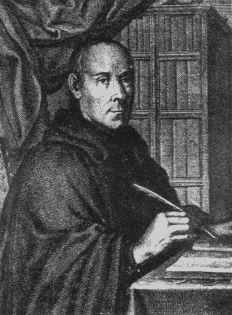
Figure 5.
Benito Jerónimo Feijóo y Montenegro.
From Jean Sarrailh, La España ilustrada
de la segunda mitad del siglo XVIII (Mexico
City and Buenos Aires, Fondo de Cultura
Económica, 1957).
the historical injustice was the Benedictine monk Benito Jerónimo Feijóo y Montenegro, whose Teatro crítico universal, published in Madrid in 1730, contained a spirited defense of his fellow Benedictine, Pedro Ponce de León.13 Writing to "vindicate the credit of Spanish creative geniuses from the limitations Foreigners impose on them," Feijóo disputed the claim that his compatriots lacked "that intellectual faculty called Inventive, which is required for new discoveries," and he set out to prove otherwise. "We will show that Spain has not suffered in this respect the infecundity that is attributed to it," he proclaimed, though he conceded with chagrin that "our carelessness in all that affects our glory is remarkable."14
In defense of his nation's creativity, Feijóo mentioned various Spanish inventions, but he saved his big guns, his discussion of Pedro Ponce, for last: "On purpose I have saved for the end," he wrote, "by way of closing this discussion, and the entire book, with a key of gold, the most remarkable Spanish invention, which with great right can claim prefer-
ence over the most illustrious ones of all the rest of the world. This is the art of making the mute from birth speak. The glory Spain is due from this great discovery, Spain owes to the religion of Saint Benedict, since its author was our monk Fray Pedro Ponce, son of the Royal Monastery of Sahagún."15 Feijóo cited the testimony Antonio Yepes, chronicler of the Benedictine order, Francisco Vallés, Philip II's personal physician, and Ambrosio de Morales, the royal historian, and in so doing he further publicized their accounts of Ponce's teaching. He also included a brief description of how the monk had gone about his work: "This art follows the opposite order, with respect to ordinary teaching; since in the usual case first men learn to speak, and then to write, [while] here first they learn to write, and then to speak ..."16
Yet for all his pride in Spain's discoveries and in the accomplishments of his fellow monk in particular, Feijóo nevertheless deplored his nation's failure to exploit its own inventions. "Here there is motive to lament Spaniards' general misfortune during the last two centuries," he wrote, "that the riches of their country, including those that are the product of the creative faculty, are enjoyed more by foreigners than by Spaniards. The art of teaching the mute to speak was born in Spain and I believe that in Spain there is not, nor has there been for a long time, anyone who wishes to cultivate it and avail himself of it, while foreigners have made and continue to make great use of this invention."17 Adding insult to injury, foreigners were taking credit for its discovery as well, and Feijóo fumed at reference to a "new method" used by Wallis and Amman, "as if one of them, or both, were the inventors, when 150 years earlier our Spanish Benedictine thought about and practiced the same method."18
Feijóo's essay did little to quell the rising chorus of "inventors," but it did serve to inspire another Spaniard to enter the profession—a profession he would practice not in his homeland but in France. Jacobo Rodríguez Pereira had been born in Berlanga, in what is now Badajoz province, in the early years of the eighteenth century, the son of Portuguese Jews.19 Nominal conversion to Christianity did not protect them from the Spanish Inquisition's persecution—New Christians were routinely suspected of being secret Judaizers—so the family relocated to Portugal, where they joined relatives in the northeastern province of Tras-os-Montes. But there too they met with persecution, and Pereira's mother was arraigned for heresy by the Tribunal of the Inquisition of Braganza and condemned to a year's penitence at the door of the cathedral in that city. When her sentence was completed, the family returned
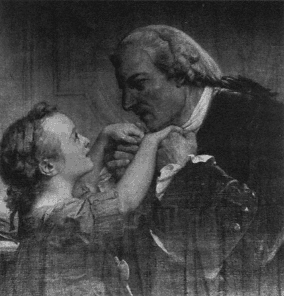
Figure 6.
Jules-Eugène Lenepveu (1819–1896),
"Jacobo Rodríguez Pereira teaching Mlle Marois d'Orléans."
Collection Institut National de Jeunes Sourds
de Paris.
to Spain—by this time the father had died—and while in Cadiz Pereira chanced to read Feijóo's Teatro crítico, with its revindication of Pedro Ponce. By one account, Pereira said that had it not been for Feijóo's essay, it would never have occurred to him to attempt to teach a deaf person.20 Nevertheless, the topic could well have been on his mind long before reading the Teatro crítico, for Pereira himself had a deaf sister, the fruit of his parents' consanguineous marriage.21 His mother and father, Abigail Ribca Rodríguez Pereira and Abraham Rodríguez Pereira, were cousins. While Feijóo's essay may have inspired Pereira to his life's work, other writers also guided the aspiring teacher, and in 1734, when he was nineteen years of age, Pereira received from the president of the Academy of Letters at Bordeaux references to the works of Bonet, Wallis, Holder, Amman, and Sibscota, in response to his request for information on deaf education.
Eventually the Pereira family moved once again, this time to France, where they could live openly as Jews. In 1741 Jacobo Pereira opened a small school for deaf children in Bordeaux. There he set about teaching
speech to his first deaf pupil: his sister. More than one hundred fifty years after Ponce's death and more than a century after Bonet's publication of what was most likely de Carrion's methods, Spain could now, point with pride to another Spaniard who had carried its mantle to France—albeit in flight from the Inquisition.
While on a business trip in La Rochelle, a town just north of Bordcaux, Pereira met his second student, Aaron Beaumarin, a thirteen-year-old apprentice tailor. After one year of instruction, he exhibited his pupil at the Jesuit school in La Rochelle. There he came to the attention of an affluent businessman, M. d'Etavigny, who would eventually contract Pereira to teach his own deaf son, Azy. By the time he met his new tutor, young Azy already had considerable instruction under his belt. During the past two or three years he had lived and studied at a Benedictine abbey in Normandy, and before that he had spent some eight years in the abbey of Saint-Jean at Amiens, under the tutelage of a deaf monk, Etienne Defaye. Upon hearing Aaron Beaumarin speak, the senior d'Etavigny's first response was to arm the prior of the abbey at Normandy with a copy of Amman's book, in the hope that he might attempt to teach his son to speak; only after a year of unsuccessful efforts did the father entrust his boy to Pereira. In 1746, when Azy had completed four months of instruction, Pereira exhibited his latest student before the Academy of Letters at Caen, where he received the members' encouragement and approval.
Three years later Pereira took his pupil to Paris, where he displayed him before the Academy of Science. A commission of three members, among them Buffon, the famous naturalist, was appointed to evaluate the boy and present their conclusions to the entire body. (In his Natural History Buffon would later include a eulogy to Pereira.)22 The commission's report, which was printed in several newspapers, noted that Azy "reads and pronounces distinctly all sorts of phrases; gives sensible replies, both verbally and in writing, to familiar questions made in writing or signs; understands and executes whatever he is required to do by writing or the manual alphabet; recites prayers by heart ... and in all respects shows a competent knowledge of grammar and syntax ... and is fairly correct in his articulation." Members concluded that Pereira was justified "in hoping that, by his method, congenital deaf-mutes can not only learn to read, pronounce, and understand common words, but also acquire abstract notions and become capable of reasoning." Moreover, they also endorsed his conviction that the method would enable deaf people to "act like others."23 Here, then, was one of the goals of oral-
ism clearly stated: deaf people would be made to speak, and having learned to do so, they would forsake their language of signs, dissimulate their handicap, and "act like others," that is, become, at least to all outward appearances, like the hearing majority.
Pereira's fame grew and his name spread throughout Europe until eventually Louis XV himself expressed a desire to meet the celebrated teacher. An audience was duly arranged, and Pereira, accompanied by Azy d'Etavigny, appeared before the king. Among those attending the command performance was the duke of Chaulnes, who promptly hired Pereira to teach his deaf godson, Saboureux de Fontenay. The tutor would refer to Saboureux as "the most splendid gift of my life"24 —an accurate appraisal, so it seems, since it was on account of the boy that Pereira would become known as Europe's greatest "demutizer" and would be granted a royal pension for life.
Saboureux de Fontenay, like Azy d'Etavigny, had had considerable schooling before being placed in Pereira's care, for he had attended diocesan schools at Montpellier and Assis, and he had received some instruction from a M. Lucas.25 In January 1751, after Saboureux had spent about three months with his new teacher, Pereira appeared once again before the Academy of Science, this time with his most recent pupil in tow. The same commission that had examined Azy now evaluated Saboureux and thus confirmed their earlier impression of Pereira's achievements. The new tutee could pronounce all the sounds of French, he could read aloud, prompted by his teacher's manual alphabet, he could recite the Lord's Prayer, and he could comprehend many common phrases in writing—"Sit down," "get up," "embrace me," and so on. Pereira's method, the commission stated, "could not be more ingenious," concluding that "its use is of interest to the whole world."26 Shortly after this performance, the king granted Pereira a pension of 800 livres, to be paid annually for the rest of his life. Bolstered by these triumphs, Pereira opened a deaf school in Paris in 1753. The establishment attracted students from all over Europe, yet none would be as famous as Saboureux.27 The star pupil remained with his tutor for some five years, then continued his studies on his own, eventually becoming the first deaf person to publish—he authored, among other things, an autobiographical letter—and going on to teach at least one deaf student himself.28
It cannot be said with any certainty just how Pereira went about instructing his disciples, for like Ramírez de Carrión before him, he never revealed the particulars of his lucrative profession. And as fate
would have it, Pereira was by far the more successful of the two at concealing his approach. For the "great demutizer" there was no Bonet to record and publish his procedures, and the little we know of them is based mainly on what biographers have been able to reconstruct, together with descriptions left by Saboureux de Fontenay.29 It was Pereira's intention to reveal his method only to his own Family, but by the time he died in 1780, he had not taught it even to them. The efforts of the next two generations of his descendants to reclaim the legacy were in vain, and the secret so jealously guarded was never to be recovered.
Nevertheless, some details of Pereira's methods have remained. For instance, it is clear that finger spelling played a prominent role in his teaching. Beginning with the Spanish manual alphabet, which no doubt he learned from Bonet's book, Pereira invented new hand shapes to represent French sounds that did not exist in Spanish. Unlike the Spanish alphabet, however, in which each hand shape is somewhat evocative of the written letter, in Pereira's version each hand shape served to remind the student of both the spelling and the position of the articulators.30 "Because of the perfection I have achieved I have, in a manner of speaking, given soul to a body without life," Pereira commented, "and without this I would have refrained from using it, especially for a language [like French] in which frequently the same sounds are represented by different letters, or more frequently still, usage demands the union of several letters to represent just one sound; in short, where each letter is open to more than one pronunciation and in some combinations is not pronounced [at all]."31 There were some thirty-odd hand shapes to stand for the sounds of French, plus others for sounds designated by a combination of letters, and still others for numbers and punctuation, for a total of about eighty hand shapes in all.
Once students had learned the hand sign for a given sound, they were taught to pronounce it, and for this training Pereira used touch as the principal means of instruction, modeling articulation by placing his mouth against a sensitive part of the body—the face, the car, or the hand, for example. In this fashion, he explained, "The air produced by pronunciation ... makes them feel impressions that are as distinct from each other as are the syllables that produce them. These vibrations are sufficient to distinguish and recognize, without other means, various articulations."32 In addition to the sense of touch and the manual alphabet, the teacher might also resort to pantomime to establish communication in the initial stages of instruction. Like Bonet, however, Pereira prohibited students' use of sign language.
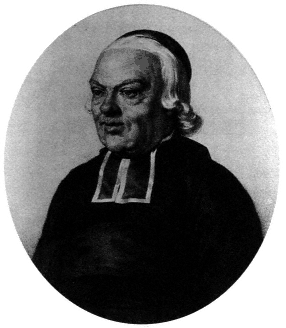
Figure 7.
The abbé Charles Michel de l'Epée. Collection
Institut National de Jeunes Sourds de Paris.
Although the great demutizer gained international acclaim for teaching deaf people to speak, his pupils themselves seemed to have little use for this skill that was so painstakingly acquired. By the age of thirty, Saboureux de Fontenay had apparently lost his speech entirely—for those whose hearing is insufficient to allow them to monitor their own pronunciation, speech training is a lifelong proposition—and in schooling his own students Saboureux eschewed speech in favor of the hand alphabet.33
Paris in the second half of the eighteenth century, the Paris of the Enlightenment, was home to not one but two highly acclaimed deaf educators, for at the same time the Spaniard Jacobo Rodríguez Pereira labored to instruct deaf pupils, a French abbé, Charles-Michel de l'Epée, heeded the same call. But while Pereira ministered to the needs of the privileged few, de l'Epée established public schooling for the many, and in so doing, he became the first to address the needs of deaf people as a
social group. Unlike the oralist Pereira, whose primary aim was to teach deaf pupils to talk so that they might "act like others," de l'Epée was more interested in "the mental part of their education," which he labeled "the principal object of my concern."34 (It goes without saying that another of the abbé's concerns, and second to none, was the salvation of deaf souls.)
De l'Epée did not give high priority to the teaching of articulation, for he held that while such training was not difficult, the length of time involved and the fact that only one or two pupils could be instructed at a time made it simply impractical. Instead, he educated his students without obliging them to adopt his own means of communicating, teaching them through the medium of signs, which he believed to be their natural language. "Every deaf-mute sent to us already has a language," he wrote. "He is thoroughly in the habit of using it, and understands others who do.... We want to instruct him and therefore to teach him French. What is the shortest and easiest method? Isn't it to express ourselves in his language?"35 The abbé knew that speech was not the only avenue to the mind, for manual signs provided an alternate route, and hearing was not the only "learning sense," for sight, too, could play this role. It followed, then, that the deaf minority need not be made to behave like the hearing majority—at least not when the main concern was the "mental part of their education," as opposed to assimilation.
By educating deaf students with signs, de l'Epée provided a viable alternative to the method employed by Ramírez de Carrión and published by Bonet more than a century earlier.The key to the Frenchman's approach—which was in complete accord with Enlightenment interest in language as a system of communication rather than as speech—lay in the recognition that if language can manifest itself as a means of relating meaning and sound, it can also manifest itself as a means of relating meaning and manual signs. This fundamental insight was a watershed in deaf education.
Although the abbé de l'Epée recognized that French deaf people already had a language, he mistakenly took French Sign Language to be lacking in grammatical structure, and he set about to remedy the situation. "By adopting his language and making it conform to clear rules, will we not be able to conduct his instruction as we wish?" he asked.36 De l'Epée was himself a grammarian—the French he taught his disciples was presented according to the principles of Latin grammar—and he considered himself equal to the challenge. His solution was "methodical signs," a manual system he devised to mirror the grammar of French.
Thus, he created signs for articles, prepositions, auxiliary verbs, tense and gender markers, and other parts of speech and grammatical endings that had no counterpart in the manual language used by deaf French men and women. For example, the masculine form of the indefinite article, un, was represented in Methodical French by the same sign that designated a man's hat, while the feminine form, une, was expressed by the sign for a woman's bonnet; the raised hand flung back over the shoulder once indicated the simple past, while the same movement repeated twice stood for the present perfect, and three times, the plu-perfect. Some signs de l'Epée took directly from his students, but others he composed from what he took to be their conceptual components. "Believe," for instance, was analyzed as "know," "feel," "say," and "not see," and it was translated into methodical signs by these four signs—plus those required for the tense and mode of the verb. To say that the system was complicated would be an understatement, and what is more, the meaning it was intended to convey often eluded those it attempted to teach.
This manually encoded version of French amounted to nothing less than an attempt at colonization of the language of deaf Frenchmen. While Ponce and de Carrión had labored to coax a spoken version of the national language from the lips of their deaf students, de l'Epée now toiled to coax a gestural translation of it from their hands. Methodical signs enabled students to transcribe manual signs into written French, and vice versa—albeit without comprehending the meaning of what they wrote or signed—and the abbé considered this sufficient, for he believed it unrealistic to expect his pupils to create original sentences to express their own ideas in French. His method, he affirmed, could produce only copyists, and this, he thought, was enough.37
De l'Epée explained that when he began his teaching, he was unaware of the efforts of others who had gone before him, stating that only later did he come to know the works of his predecessors, including Juan Pablo Bonet and Johann Conrad Amman. Bonet and Amman's works were "two torches, which have lighted me on my way," wrote de l'Epée, "but in the application of their principles I have followed the route which appeared to me the easiest and quickest."38 In 1776 the abbé published an account of his methods, Institution des sourds-muets par la voie des signes méthodiques, which was followed in 1784 by an expanded version, La véritable manière d'instruire les sourds-muets, confirmée par une longue expérience .39 Just as Bonet's work together with Amman's had been de l'Epée's "two torches," so de
l'Epée's writings, together with those of his successor the abbé Roch-Ambroise Sicard, would illuminate the way in Spain, when the time came to reestablish deaf education there.40
Sometime between 1759 and 1771 the abbé de l'Epée had founded the first public school for deaf children in Paris; in so doing, he ushered in a new era of deaf education. For the first time deaf children from the humbler classes were gathered together in a public setting, and recognized and empowered as a social group. Heads of state, royalty, intellectuals, and curious observers from all walks of life flocked to the Paris school to witness public demonstrations at which pupils exhibited their skills. Thus, the abbé and his students won support for the cause of their education, persuading sympathetic audiences that deaf children could grow up to be other than outcasts, a neglected, despised minority. They could, in fact, be redeemed through instruction, and welcomed into society.
To ensure the continuation of the work he had begun, the abbé de l'Epée eagerly welcomed new disciples. Future teachers came from all over Europe to attend his classes, then returned to their homeland to establish new schools, which spawned in turn still others. Thanks to these efforts, numerous schools were created throughout Europe—twenty-one during his lifetime—and ultimately, throughout the world. As for the abbé's own establishment, it eventually won the support of Louis XVI, and in 1791, two years after its founder's death, it became the National Institute for Deaf-Mutes.
The last decades of the eighteenth century witnessed the rise of another prominent deaf educator, the Prussian Samuel Heinicke. Influenced by Amman's mystical view of speech, together with Raphel's account of how he had taught his deaf daughters, Heinicke was convinced that speech was necessary for clear thought, and his instructional efforts thus revolved around oral language. In 1778 he founded a school for deaf pupils at Leipzig, the first in the states that would later become Germany, and in the same year he published Beobachtungen über Stumme (Observations on the deaf and dumb).41 Just as de l'Epée's Paris school institutionalized and propagated the use of signs in deaf education, so the school at Leipzig institutionalized and propagated oralism, as teachers trained there carried the oral method throughout the German speaking states. While manualist schools instructed their students with a gestural system of communication conceived to address their unique needs,
the goal of oralist schools was to suppress students' manual language and instruct them in the spoken tongue of the hearing majority.
In the early 1780s Heinicke and de l'Epée engaged in an epistolary debate concerning their respective methods. Neither man was able to persuade the other of the superiority of his approach, however, and at last de l'Epée, seeking an impartial audience, submitted their correspondence to a prestigious academy in Zurich. Members of this scholarly body found merit in the abbé's method, but they declined to pronounce judgment on Heinicke's, for lack of sufficient information about it. Although they opined that de l'Epée had responded adequately to his adversary and that he need pursue the matter no more, the debate over oralism versus manualism was far from ended. The controversy over teaching methods and ultimately, over the goals of deaf education itself—forced assimilation to hearing society, or acceptance of deaf people on their own terms—would prove to be the most important question affecting this kind of instruction and continues to be so in our day.
Manualism, which educated deaf people through the medium of signs, became known as the French method; oralism, which would deny deaf people access to signs and address them through the medium of speech, became known as the German method. There can be no doubt, however, that oralism actually originated in Spain, for it was there that Pedro Ponce first taught deaf people to talk, it was there that Manuel Ramírez de Carrión first laid the foundation of the oralist approach when he employed hearing pedagogy to teach his deaf pupils, and it was there that Juan Pablo Bonet first published the procedures in his Arte . But by the second half of the eighteenth century, when de l'Epée and Heinicke debated their respective positions, Spain had lost its position of preeminence in the field of deaf education, and the early Spanish masters had been overshadowed by other European teachers. Thus, the oral method came to be associated not with Spain, Ponce, de Carrión, and Bonet, but with Germany and Samuel Heinicke, who many erroneously took to be its inventor.
As more and more "inventors" of the teaching sprang up throughout Europe, Spanish writers bemoaned the historical slight. In 1751 Feijóo, who already some two decades earlier had reminded a forgetful Europe of Pedro Ponce de León's teaching, once again took up his pen in defense of his fellow Benedictine. This time the target of his wrath was Juan Pablo Bonet, and in his Cartas eruditas a testy Feijóo argued
that "it is indisputable that the inventor of the art of teaching mutes to talk was not Juan Pablo Bonet, but rather the monk Fray Pedro Ponce."42 Moreover, he went on to accuse Bonet of plagiarism, maintaining that the author of the Reduction de las letras y arte para enseñar a ablar los mudos "had exact information about the monk's discovery, and did no more than take advantage of it to write his book."43 Feijóo reasoned that since Ponce had taught the mute siblings of the constable of Castile, and since Bonet was subsequently employed in that same household, "it is plain to see that in that house he found all the necessary information about the theory and practice of that art."44 To the accusation of plagiarism Feijóo added yet another: "If I am to say all that I feel, it is for me very probable that Bonet was not only a plagiarist, but also an impostor."45 In all likelihood Bonet was guilty as charged, for as we have seen, the method he published was probably that of Ramírez dc Carrión, and he did indeed endeavor to pass himself off as Luis de Velasco's teacher. But this was not the scenario envisioned by the author of the Cartas eruditas . Feijóo knew that Ponce had taught two brothers of the constable, and he knew that one of them had died young. Based on this information, this writer hypothesized that Bonet had tried to take credit for teaching the surviving brother, who in fact had been educated decades earlier by the monk at Oña. Of course, the truth was that both Francisco and Pedro de Velasco had been long dead when their grandnephew Luis was tutored, not by Bonet but by Ramírez de Carrión. But Feijóo, writing nearly a century and a half years after publication of Bonet's book, was unaware of these facts, and his widely read Cartas added further to the confusion that for more than a century had swirled around Juan Pablo Bonet, while at the same time providing still further publicity for his Arte .46 (Conspicuously absent from this discussion was any reference to Manuel Ramírez de Carrión, about whom Bonet's accuser seemed to know nothing whatsoever.)
In 1752 Feijóo penned an addition to this Carta, in which he railed against the English mathematician John Wallis, the Swiss physician Johann Conrad Amman, and Jacobo Rodríguez Pereira, the Spanish Jew then teaching in France, all of whom Feijóo considered illegitimate pretenders to Ponce's title of inventor of the art. Wallis and Amman, he argued, must have had access to the well publicized accounts of Ponce's teaching, and as for Pereira, the famed demutizer himself had acknowledged his inspiration in the description of Ponce's approach to be found in Feijóo's own Teatro crítico .47 For Feijóo the conclusion was clear: "It
is extremely probable that Pereira walked on the path that I found open, avoiding the arduous task of breaking a new one."48
In short, Feijóo was exasperated because, in his words, "from Paris to Amsterdam and from Amsterdam to Paris, people are cannonading each other over who is the inventor of the art, and no one remembers Fray Pedro Ponce, who was indisputably the inventor." Even so, he was candid enough to recognize the real cause. "Who is responsible for the foreigners' forgetfulness, if not the forgetfulness and inattention of Spaniards themselves, who regard with indifference, some [even] with animosity, much of their nation's literary glory?" he asked bitterly. 49 Spain had long since abdicated its position of leadership in deaf education, it had turned its back on such teaching, and in so doing it had fallen behind other European countries. And now it seemed that in the cradle of oralism, there was nothing going on but grumbling.
As the eighteenth century drew to a close, other Spaniards echoed the cry raised by Feijóo. The next to protest was the learned ex-Jesuit Juan Andrés Morell.50 While in exile in Italy—Charles III had decreed the expulsion of the Society of Jesus from Spain in 1767 and the order was dissolved six years later51 —Andrés Morell composed his Lettera sopra l'origine e la vicenta dell'arte d'insegnar a parlare ai sordomudi .52 The work was published in Italian in 1793, and one year later a Spanish version, translated by the author's brother Carlos, appeared in Madrid. Writing when de l'Epée's fame was at its zenith, Juan Andrés Morell composed an impassioned defense of the kingdom that had expelled him. "The wonders that are now seen in the schools of Vienna, Paris, and other cities were seen more than two centuries ago in Spain," he insisted, "and the art of teaching mutes to speak, of which the French now boast, attributing the glory to their abbé de l'Epée, recognizes Spaniards as its first inventors and teachers."53 Citing a variety of published sources, Andrés established Pedro Ponce as the inventor of the teaching, and he stated that the first published work on the subject was also authored by a Spaniard, Juan Pablo Bonet, and that the next practitioner, Manuel Ramírez de Carrión, was a Spaniard as well. (Here the author was confused, since Ramírez de Carrión's teaching actually antedated publication of Bonet's book.)54 But then, according to Andrés, "in a few years that art was not only abandoned, but entirely lost from memory" (19). He proceeded to discuss other teachers like Wallis,
Holder, Sibscota, van Helmont, and Amman, chastising them for failing to credit their Spanish predecessors. "All who have dealt with this art have held themselves to be inventors, or at least they claim to have come to it without knowing that any other had touched on the matter previously," he complained (18–19 n.). And as for the "restoration" of the teaching he believed to have been abandoned, Andrés sought to claim that for Spain as well, crediting it to Jacobo Rodríguez Pereira:55 "His fame," he wrote, "spread rapidly throughout all Europe, and he was the true restorer of this useful art" (33). For the scholarly ex-patriot, the conclusion was obvious: "The art of teaching the mute to speak, celebrated and believed by many to be a wonderful invention of the French abbé de l'Epée, is an entirely Spanish art because of its invention and its exposition and also because of its re-establishment and propagation" (54).
At the time Andrés Morell was writing his Lettera, France was the acknowledged capital of the European Enlightenment, while the political, cultural, and economic stock of the author's own nation had slipped considerably. The situation differed greatly from Ponce's day and Bonet's, when Spain's power and prestige had been second to none, and as a consequence of this historical reverse, Spanish touchiness was running high. Just as Feijóo had reacted angrily to his nation's tarnished image abroad, complaining that "foreigners" would deny Spaniards the faculty of inventiveness, so too Andrés was convinced that beyond its borders, his homeland was routinely given short shrift. Because published accounts of Ponce's teaching were readily available, Andrés concluded that writers who failed to mention the venerable monk did so out of negligence—or malice. He even faulted the abbé de l'Epée for never putting Bonet's name first when he referred to him along with Wallis and Amman, although he conceded that the practice might be due to "coincidence," and not attributable to "even the least malice or antihispanic jealous rivalry on the part of the abbé de l'Epée." Nevertheless, Andrés considered this "inversion" to be clearly "injurious to Bonet's glory," and taken all together, these facts went to show the "scant consideration ordinarily given to the glories pertaining to Spain, and on account of it the just excuse some have for not knowing about them, and thus for slighting them" (43–44).
In the last years of the eighteenth century another Spanish ex-Jesuit living in exile in Italy would, like Andrés Morell, write about the subject
of deaf education. Lorenzo Hervás y Panduro would not limit himself to touting Spain's past glories but would suggest a method for instructing deaf people, urging the renewal of their teaching in his homeland and the founding of public schools for that purpose. In the introduction to his Escuela española de sordomudos, o arte para enseñarles a escribir y hablar el idioma español, Hervás chided, "Is not the lack of public schools to instruct deaf-mutes ... injurious and an affront to religion and society?"56 The book was written in 1793, the same year as Andrés Morell's Lettera; 57 its publication in Madrid two years later would bring Spain one step closer to the reestablishment of deaf education.
The Escuela española de sordomudos was a remarkably comprehensive study that included a treatise on deaf people, a history of their education, a method for teaching them Spanish by way of writing (which Hervás considered the most useful part of his book), procedures for teaching speech and lipreading that recommended use of diagrams of human heads articulating the various sounds of Spanish, and a catechism.58 Along the way he also proposed a spelling reform intended to facilitate the teaching of written Spanish, he explained how to instruct deaf people in both Portuguese and Italian, and he helped to popularize the word sordomudo (deaf-mute), which would gradually replace the earlier term mudo (mute).59 (Adoption of the newer expression reflected the growing awareness that the cause of muteness lay in deafness.)
Deaf education was not the only topic that interested Hervás. He was indisputably one of the most erudite men of his century, a man of encyclopedic knowledge, philosopher, theologian, mathematician, historian, geographer, ethnographer, physiologist, anthropologist, and polemicist, but he is best remembered as a linguist.60 Born in 1735 in Horcajo de Santiago, in the present-day province of Cuenca, to a family of poor peasants, Hervás was the youngest of three brothers. At the urging of an uncle who was an abbot, he entered the Society of Jesus at the age of fourteen, probably more from a wish to study than from any religious calling.61 Young Lorenzo's father had died when he was one year old, and his ailing mother was in no position to support the academic pursuits her son desired, but the Church held open the door to a life of learning and of comfort. When the would-be Jesuit entered the novitiate, he had only the most rudimentary education, but he would make good use of his opportunity, for his life would be characterized by a tireless devotion to scholarship and study. History has left us the following portrait of this brilliant man of letters. He was "tall [for his era], measuring five feet six inches, with a handsome face, rosy coloring, smooth,
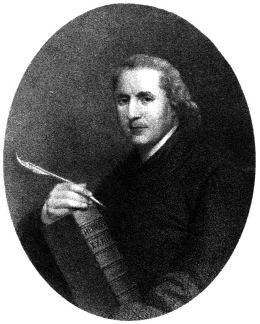
Figure 8.
Lorenzo Hervás y Panduro. From Fermín
Caballero, Conquenses ilustres . Vol. 1. Noticias
biográficas y bibliográficas del abate D. Lorenzo
Hervás y Panduro (Madrid: Colegio de
Sordomudos y de Ciegos, 1868). Biblioteca Nacional,
Madrid.
glowing complexion, thick, silky hair, wide forehead, large, expressive eyes, aquiline nose, and noticeably delicate hands" (170).
Despite his humble origin—or more likely because of it—Hervás would reveal a lifelong penchant for the company of persons of wealth, influence, and ability. "Among the general affection he encountered wherever he went, that which was bestowed on him by women of position and talent was especially noteworthy," remarked one biographer, who counted among Hervás's admirers "the daughters of the duke of Montemar, the countess of Santa Coloma, the wife of the intendente of Barcelona, the painter and musician Angélica [Kauffman], the literary illustrator Knight, the Roman matrons who embroidered laudatory inscriptions for him" (187–188). Hervás, this author explained, "had come into the world with talent, but poor," adding that "he had the latent seed of genius," but because "heat and warmth were necessary for it to develop, he felt the need of protection, help, and support"
(176). He knew just how to go about obtaining it, and his innate abilities, bolstered by the assistance of influential patrons, eventually enabled him to rise to positions of importance and prestige.
In addition to his devotion to learning and his skill at ingratiating himself with the high and the mighty, Hervás is also remembered for his love of the finer things in life, and his knack for making money. Thus, a biographer noted that he was "always dealing with houses of commerce, staying in homes of businessmen and engaged in productive affairs" (180), pointing to "the thousands of duros a poor ex-Jesuit, expelled from his homeland, managed to acquire honorably, spending money on pleasures and whims, trips and gifts, providing himself with a comfortable life, decent treatment and decorous behavior, and saving to enrich his family" (178).62
After completing his studies in theology and philosophy at the University of Alcalá de Henares in 1759, Hervás studied mathematics and astrology in Madrid, and was ordained. Much of his youth was dedicated to teaching, first in Cáceres, then at the Jesuits' prestigious Seminario de Nobles in Madrid, where he was both professor and director. The expulsion of the Society of Jesus from Spain in 1767 found Hervás teaching philosophy at the Colegio de la Anunciata in Murcia. He was thirty-two years old when, along with most of his fellow Jesuits, he relocated to the Papal States in Italy. There he gave himself over wholeheartedly to the study of mathematics, astronomy, and above all linguistics. He lived for a time in Forli with others of his order, then in 1773, when the Society of Jesus was disbanded, he moved to Cesena, where he entered the employ of the marquis of Ghini. Settled in his own quarters at the marquis's palace, with servants and a carriage at his beck and call, Hervás successfully defended his employer's interests in litigation and minded his economic affairs. Eventually he would be named theologian to one cardinal, and canonist to another. In the mid-1780s he moved to Rome, taking up residence at the Jesuits' Collegio Romano.
Exile in Italy afforded Hervás circumstances uniquely favorable to scholarship and research, for many ex-Jesuit missionaries who had been living in far-off lands were now brought into intimate contact in the Papal States.63 These men of his order supplied Hervás with a wealth of materials the likes of which had never before been gathered together in a single place: grammars, vocabularies, dictionaries, catechisms, and religious works translated into the tongues of those the society had labored to Christianize, as well as firsthand accounts of little-known languages. In addition to this treasure-trove of resources, the extensive
library of the Collegio Romano was also at his disposal. In these extraordinary working conditions, which he readily acknowledged offered him "the most advantageous occasion that has existed in the world up until now and which only with great difficulty will be attained again in the centuries to come, Hervás began work on his Idea dell'universo .64 His twenty-one volume magnum opus was published between 1778 and 1787.
Shortly after completion of this work, Hervás gave his prodigious intelligence over to another project, an examination of deaf people and their language. Here was a little-studied linguistic community whose investigation required no journey to distant lands, and the erudite ex-Jesuit determined to write a book advocating their instruction. Their champion was a prolific scholar—albeit more given to accumulation and classification of data than to startling insight or creativity—and between original works and translations, he would author more than ninety volumes, not including pamphlets and unpublished manuscripts. By the time he wrote his Escuela española de sordomudos, he was already a celebrated linguist whose work would earn him the epithet of "father of comparative philology."65 Nevertheless, he learned a great deal from the study of deaf people and their language, as he himself confessed: "Despite having written ten volumes about languages, of which I have published five, with the examination I have made of deaf-mutes' grammatical ideas and pronunciation, I have learned and discovered various truths which upon writing the earlier volumes had been hidden from my mind."66
Hervás first heard about the teaching from his friend Pasquale Di Pietro, a wealthy Roman lawyer known for his charitable works. Desirous of aiding deaf Romans, Di Pietro had sent the abbé Tommaso Silvestri to de l'Epée's school in Paris. Silvestri studied there for six months before returning to Rome and opening its first deaf school in 1784—about the same time Hervás took up residence in the Eternal City.
Like many other establishments inspired by the abbé, de l'Epée, the Roman school would become a training ground for new disciples, who arrived over the years from Naples, Malta, Modena, Poland, and other locations. It would also serve as an inspiration to Hervás y Panduro, whose curiosity had been aroused by Pasquale Di Pietro. Because the lawyer philanthropist had himself on occasion observed the teaching at the Paris institute, he understood certain principles of the art, and it was not difficult for him to awaken Hervás's interest in the topic. As Hervás recounted, all it took to persuade him to write a book on deaf educa-
tion was Di Pietro's explanation of the mechanics of this instruction, proffered during the course of an hour-long carriage ride the two friends took together (1:332–333).
Once the decision had been made, Hervás set about his task with characteristic diligence, observing all that transpired at the Roman school. He was not content merely to record uncritically the procedures in use there, however, for eventually he would propose a method quite different from that employed by de l'Epée and his followers, a method he arrived at by beginning with the study of deaf students themselves. "With particular attention I have examined the most capable deaf-mutes at the Roman school, and I have attended their classes there many times," he explained, "in order to discover their way of thinking about the grammatical rules of the Italian language they learn, and their facility or difficulty in learning some of these rules. ... The same careful observation I have made concerning their varying ease, or difficulty, in pronouncing syllables and words, and the way they communicate among themselves by way of signs" (1:66–67). The author's goal was not merely to gain insight into deaf people but rather to shed light on the entire species, "to better discover the state of languages in the infancy of the human race," as he put it, for he believed the syntax of manual language would mirror that of the first spoken tongues, and he took sign language to be the original vehicle of communication of all humanity (1:67). (When it came to a common tongue for his day, however, the conservative ex-Jesuit advocated a return to Latin, lamenting that it had been replaced by French, which he deemed "the depository of the most wicked books ever written against religion and against the rights of human society, and humanity itself," and thus richly deserving "the same infamy that today justifiably denigrates the French nation" (1:167).
In the course of his lifetime Hervás examined data from more than three hundred languages, and he personally wrote the grammars of more than forty of them. Unfortunately, however, the grammar of the sign language in use at the deaf school in Rome was not among them. Nevertheless, this scholar realized that signs, like speech, were indeed a possible manifestation of human language, which he defined as audible or visible signs capable of making known our "mental acts." In so doing, he gave voice to what had been only implicit in the teaching of Pedro Ponce, namely, that signs, like speech, could convey our thoughts (1:133).67 (Hervás's definition of human language is close, but not identical, to the contemporary view of language as a mental
representation that relates sounds—or signs—and meaning.) Moreover, fellow Jesuits who had formulated grammars of unwritten languages could have left him no doubt about the independence of language from writing. Indeed, Hervás himself judged the spoken form, as opposed to the written, to be the appropriate object of study. He knew, then, that although no writing system had been devised for manual signs, this in no way affected their status as a language, and he acknowledged both the effectiveness of signs for communication and their naturalness as a vehicle for the expression of thought. "Without necessity of writing one can invent a visual language that is depicted by the movement of the hands and the fingers, such as the one used in deaf-mute schools," he wrote, adding, "With this language one speaks perfectly, as with the vocal and ordinary one; and it seems quite natural to man to declare his thoughts with the movement of the hands." Yet to Hervás's mind, spoken language still held the upper hand: "If all the men in the world were mute, could we prudently conjecture that they would come to form a perfect visual language, indicating with the movement of the hands or the fingers all the parts of speech and its qualities?" he asked rhetorically, making clear that he took the answer to be "no." His reservations were based oil the mistaken belief that sign languages do not distinguish parts of speech such as nouns and verbs, coupled with a longing for overt marking of case, number, and gender of nouns, mood, tense, number and person of verbs, and "the rest of the particularities of the other parts of speech." Thus, Hervás concluded—erroneously, as it so happens—that "it does not seem credible that men would invent a visual language with which, as they now do with speech, they would manifest perfectly all their mental acts" (1:134). In the final analysis, he could not get beyond his own speech-centered paradigm.
As Hervás saw it, the principal aim of deaf education was to teach the national language in its written form. "Deaf-mutes are taught in order that they will learn a language by way of writing, to understand it when reading books, and to know how to write it," he stated. (How different from the abbé de l'Epée, who was convinced that deaf people could aspire to be nothing more than copyists.) "It follows that if they achieve this instruction, we should consider them like people who, having learned to write, lose their hearing totally, and make themselves understood in writing with others," Hervás reasoned (2:8). The goal, then, was to give deaf people the same command of language possessed by those who lose their hearing after learning to speak, and the medi-
um of instruction was to be the written word. For Hervás it was written language, then, and not speech, that mattered most for deaf people.
Although he sought to teach the national tongue, Hervás did not attempt to proscribe his students' use of signs, which he considered their natural medium of communication. "They are naturally inclined to the use of sign language," he wrote, "and this language they always use in school to speak among themselves, when the teacher is away. No sooner does the teacher take his eyes off them, than almost all of them begin to speak among themselves with great eagerness, since they cherish those moments together in which they can unbosom themselves with their language of signs, which all of them understand and speak naturally" (2:260). Hervás spent considerable time watching the children converse among themselves, and what he saw filled him with admiration:
Since I began to have contact with deaf-mutes, I realized that they understand each other with remarkable ease.... It is impossible to believe if one does not see the facility with which deaf-mutes speak to each other and understand each other: I have seen it and reflected on it many times, since while in their school, I have feigned to linger with their teacher, entreating him to leave them at liberty so I might observe their continuous talking: and I have always noted that most of the children are engaged in continuous discussion among themselves, just as happens in hearing schools. I have also amused myself perchance in finding out what they were discussing, and not without wonder have I found that in half an hour deaf-mutes say to each other as many things and just as diverse, as those who speak can say in the same time. (1:282)
Not only did Hervás delight in the students' use of manual language, he held that their teachers must learn it as well, for he advocated signs as the medium of communication in the initial stages of instruction. Furthermore, he maintained that the signs the teacher employed should be elicited from the students themselves. "Deaf-mutes possess the pantomimic art to perfection, and their teachers should study it with attention in order to teach them with the most appropriate and natural signs," he wrote (1:282). Living among other ex-Jesuits who had recently returned from far-flung missions, Hervás understood that the way to go about instructing deaf people was to begin by learning their language, just as evangelists who would spread the gospel first learned the language of those they would convert. (Indeed, the Church had consistently maintained the doctrine, ratified at the Council of Trent in the
mid-sixteenth century, that the language of the populace should be employed for preaching and above all, for teaching the catechism.) He saw no need for hearing teachers to "perfect" deaf people's language, for he recognized that their signs were more appropriate than those concocted by hearing instructors: "Deaf-mutes... with the signs their own reason inspires in them naturally make themselves understood easily among themselves, and they do not understand as readily the signs of those who are not deaf-mute," he observed (2:11).
Hervás seemed to realize that while signs invented by native signers conform to the rules of the language, obeying its phonological, morphological, and syntactic constraints, those invented by non-natives may well violate those constraints. For instance, signs created by native signers draw their hand shapes from a limited number of possibilities and follow acceptable patterns of movement, just as English words coined by native speakers employ sounds drawn from a limited inventory of phonemes and arranged in acceptable sequences. Signs made up by nonnative signers may not follow the rules of the language, however, just as new words made up by Spanish speakers, for example, may not adhere to the rules of English. Thus, Hervás recommended that the teacher compile a dictionary of the signs pupils used among themselves. Moreover, he cautioned that some of the signs deaf children learned at their schools were inappropriate and advised that the dictionary should contain only those found in families with several generations of deaf members. Implicit here is the recognition that home sign is perfected over the course of several generations, evolving into a full-blown natural language, while signs used at deaf schools could include ones made up by hearing teachers, which often do not respect the genius of the language.
In order for the teacher to learn the pupils' language, Hervás suggested an elicitation technique: "Thc teacher who does not have experience in teaching deaf-mutes can easily acquire it by observing the signs they use naturally to indicate or describe objects," he wrote. "If the teacher shows them a book and by writing the word book makes them understand that the union of the letters b, o, o, k, signifies by writing the book, they will naturally make the signs with which they depict or indicate it. With this technique ... the teacher will learn the signs with which deaf-mutes talk among themselves." For Hervás there was simply no getting around it: "The teacher of deaf-mutes must be persuaded that in order to instruct them well, he needs to learn the sign language they speak," he concluded (2:34).
Hervás was critical of methodical signs, the manual encoding of the national language that had originated with the abbé de l'Epée, and while acknowledging that some invented signs could be helpful for teaching, he doubted the wisdom of translating an entire language into signs. "I acknowledge and confess that some signs or things that are equivalent to them, such as the letters, or some ciphers, are extremely useful and even necessary to instruct deaf-mutes: but at the same time it seems to me difficult to insist on forming a vocabulary in which a specific sign must correspond to each word," he wrote. Hervás was ahead of his time both in his criticism of methodical signs and in his advocacy of signs invented by deaf people themselves, for during these years de l'Epée's approach was widely employed, and its use was virtually unchallenged in manualist schools throughout Europe. A protégé of the abbé Sicard, Roch-Ambroisé Bébian, is generally credited with being the first to urge abandoning methodical signs and educating deaf students in their own language, but in fact the Escuela española de sordomudos, which antedates Bébian's work by several decades, already anticipated some of Bébian's criticisms.68
In his book Hervás included a dictionary of signs, which he described as a "brief vocabulary of the signs deaf-mutes use naturally to declare outwardly the meaning of the words that are noted in it." He also included various "mental sentences the deaf-mutes explain with signs," paired with their respective translations. For Pedro is more learned than Pablo, for example, he gave the following description: "They point to Pedro: they touch the forehead with the right hand, bowing the head a little; they move both hands slightly upwards to signify more; and then they point to Pablo" (2:181).69 Clearly, this author recognized that sign language had a syntax of its own, and what was more, unlike the abbé de l'Epée, he did not seem to view it as merely a deficient version of the national tongue.
Our learned ex-Jesuit did not come by his ideas about deaf education by theorizing alone, but rather, he benefited from his exchanges with students. And as frequently occurs with teachers of deaf children, there was one in particular who illuminated Hervás:
On various holidays at the Roman deaf-mute school, there comes to visit me a boy named Ignacio Puppi, who is thirteen years old in this year of 1793, and because he began to attend school at the age of eight, he is already so educated that in writing he understands everything one asks him, and he responds very appropriately because he has great mental ability. I frequently make use of this boy to discover and practice the techniques I judge
appropriate and propose as the best in this art, and on the day I am writing this chapter, which is the first day of Pentecost, I asked Ignacio in writing to show me the signs he himself judged most expressive to indicate the meaning of a list of verbs I showed him.
Ignacio began to read the list of verbs and to reflect upon the signs they used in the school and upon the most exact ones that could be made to express them: sometimes he promptly made excellent signs to explain some verbs: other times he corrected the ones he had made and made me see other new ones that were more expressive. I must confess that, although I am accustomed to dealing with deaf-mutes, I was astounded at the quickness and appropriateness with which the child Ignacio made known to me in signs the meaning of the verbs I had presented to him in writing, which signified only mental actions (2:12–13).
Hervás concluded that if in other deaf schools there existed children whose intelligence was as great as Ignacio's, aided by such students the teacher could learn the most suitable signs with which to form a vocabulary.
The Escuela española de sordomudos contained a manual alphabet bearing the handwritten caption, "I, Ignacio Puppi, deaf-mute of thirteen years of age, at the request of my charitable and beloved teacher Don Lorenzo Hervás y Panduro, made this illustration" (page following 2:28, unnumbered). The hand positions, as Hervás explained, had been "drawn by Ignacio Puppi ... who frequently visits me in order to perfect his instruction" (2.:28). It was plain from the teacher's description of their encounters, however, that the perfecting of instruction was a two-way street.
Although Hervás recommended the use of signs in the beginning stages of teaching, once the students knew how to write, signs were no longer to be employed; instead, the written word was to become the medium of communication between teacher and disciples, assuming the role played by speech in the instruction of hearing children. "Writing in the deaf-mute schools makes up for the defect of the voice," he maintained, "and replaces it, as much in the teacher for explaining things as in [the students] for learning them, and for showing that they have understood them and retained them in their memory" (2:19). Indeed, Hervás was unequivocal about the primacy of the written word in this teaching: "With writing we begin, continue and perfect the instruction of deaf-mutes," he stated (2:29). On phasing out signs in favor of written communication, he reasoned as follows: "We should proceed with deaf-mutes as with foreigners who begin to learn Spanish, to whom after
they understand and speak some of this language, we explain in Spanish the meaning of unknown words, making use of the ones they already know" (2:9). The comparison with foreigners is a telling one, because the author seemed to recognize that for speakers of a foreign tongue and for deaf signers, the innate language capacity was the same. Hence, the same teaching procedure was in order: begin with the pupils' native tongue to build competence in the second language.
The Escuela española de sordomudos was an eminently sensible approach to instructing deaf people, based on sound pedagogical principles. The author favored using examples pupils could grasp easily, he advocated teaching language in a meaningful context, and he stated that "deaf-mutes learn only with great difficulty that which they do not understand" (2:128). Realizing that comprehension should precede production, he held that students "should not learn the pronunciation of a language if they have not first learned its written form, since if they do not know the latter, they will not know the meaning of the words they pronounce" (2:185)—a position that represented a significant advance over that of Bonet's Arte . Yet despite its considerable merit, the Escuela española de sordomudos would have surprisingly little influence in Spain.70 In the years to come Spaniards would first experiment with French pedagogy, then retreat to the rigid oralism of Bonet, all the while bypassing Hervás's book, for while they might pay lip service to his work, its pedagogical doctrine would be largely ignored.
Hervás himself, however, was able to contribute personally to the establishment of public education for deaf people in his homeland. In 1798 the former Jesuits were allowed to return to Spain, and in February of the following year Hervás arrived in Barcelona. During his four-month stay there he catalogued the entire archives of the Crown of Aragon and still found time to socialize with the city's elite. His acquaintances were not limited to the rich and powerful, however, for among them was a French presbyter, Juan Albert y Martí, who had read the Escuela española de sordomudos, along with works by the abbé de l'Epée.71 Hervás further refined Albert's knowledge of the art, and together the two men visited the homes of families with deaf children, exhorting parents to send their offspring to school. In 1800 Hervás's protégé opened Barcelona's first establishment for deaf students, under the auspices of the municipality. Thus did Hervás play a very important role in implementing the principal goal of his Escuela española de sordomudos, the opening of schools for deaf Spaniards.
From Barcelona Hervás made his way back to Horcajo de Santiago, arriving there in July 1799. In his sixty-fifth year, the man long accustomed to a life of writing and study amidst the intellectual stimulation and amenable surroundings of the Collegio Romano found himself once again in the rude village he had left some five decades earlier. One biographer summed the situation up as follows: "It was not his desire to settle in his birthplace, where he could neither enjoy the comforts he was used to, nor have at hand enough books to pursue his scholarship. And accustomed as he was to Italian cuisine, how could he enjoy the cooking of La Mancha? How could one who knew and needed other pleasures willingly adapt to rooms without glass windows? And would the company of uneducated peasants be enough for one who longed to converse about literature and learning?"72 In declining health and prohibited by the king from residing in Madrid, a frustrated Hervás complained of "the horror of his seclusion in the village."73 In 1800 a trip to Cuenca, where he devoured the archives of that city's seminary, the cathedral, and the municipality, provided a brief respite, however. In 1801 the former Jesuits were once again expelled from Spain; for Hervás, the prospect of resuming his life of study and writing in Rome was not unwelcome. His departure from the port of Cartagena, on Spain's southeastern seaboard, was delayed for more than a year, however, probably because of the war with England, and although he complained of being "in a penitentiary, without books, and among cannons," during this period he nevertheless managed to produce five tracts, three of which would eventually be published.74 He made his final journey to Rome in 1802, returning to the Collegio Romano, where he would spend his last years. Pope Pius VII named him librarian of the Quirinal, the papal summer residence (the two men met regularly to converse, dine, and stroll together), and the old ex-Jesuit continued his scholarly pursuits until death overtook him in 1809, at the age of seventy-four.
The second half of the century had witnessed various important developments in deaf education, including the opening of public schools, the extension of the teaching to the humbler classes, and the use of signs in instruction as an alternative to the Spanish oral approach. But Spain stayed on the sidelines and was little more than a spectator to these events. Nevertheless, Spaniards could point with pride to one writer of note, Lorenzo Hervás y Panduro, whose emphasis on the written word, rather than speech, represented a significant break with his
nation's oralist past. And as the century drew to a close, Spain prepared to rededicate itself to the teaching of its deaf minority. By the end of the 1700s the lines had been drawn between manualists and oralists, but then as now, there was more at stake than a question of methodology. The larger issue was the ultimate goal of deaf education: acceptance of deaf people as a linguistic minority, or their assimilation into the hearing mainstream.
Chapter 4
The "Entirely Spanish Art" Returns to Its Homeland
1795–1805
Something similar to what occurs in our foreign trade has happened to us Spaniards, when giving the abundant and essential raw materials of our soil, we later receive them manufactured by the greater industry and application of those who purchased them
.—José Miguel Alea
By the late 1700s, the country that had once set the pace in deaf education had considerable catching up to do. 'The end of the eighteenth century and the beginning of the nineteenth saw a renewed interest in what Andrés Morell had termed the "entirely Spanish art." A state-sponsored class for deaf children was soon succeeded by a more ambitious establishment, the Royal School for Deaf-Mutes, which was destined to become the nation's premier institution of its kind. The opening of public schools for deaf students was in keeping with the nation's widespread belief in the redemptive value of education, and the growing realization that deaf people could be educated.
During the latter decades of the 1700s, history recorded occasional instances of deaf Spaniards who were educated privately—indeed, two such individuals would arrive at the Spanish capital in the mid 1790s1 — but it was not until the final years of the 1700s that the first school for deaf students was created. The directive came from Charles IV himself, although the secretary of state and royal favorite Manuel Godoy, called the "Prince of Peace," would later claim that the idea had originated with him, and that it was he who had first broached the subject to the
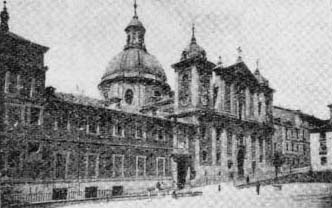
Figure 9.
Piarist School of San Fernando on the Calle del Mesón
de Paredes. From Miguel Granell y Forcadell, Historia de la enseñanza
del Colegio Nacional de Sordomudos desde el año 1794 al
1932 (Madrid: Colegio Nacional de Sordomudos, 1932). Biblioteca
Nacional, Madrid.
monarch.2 But be that as it may, in the fall of 1793 the king, upon learning that the Piarist father José Fernández Navarrete de Santa Bárbara was in the Spanish court, determined that the priest should dedicate himself to deaf education. The following spring Charles IV, "with an eye to facilitating and extending such an important teaching to this unfortunate portion of humanity," decreed the establishment of a class for deaf children, to be housed in a school run by the Piarist fathers, and taught by Fernández Navarrete.3 And in 1795, the same year in which Hervás y Panduro's Escuela española de sordomudos was published in Madrid, Navarrete began his teaching at the Piarist school of San Fernando, located on Mesón de Paredes, in the Lavapiés district.4 Father Navarrete, like Hervás, could ultimately trace his training back to Charles-Michel de l'Epée, for Navarrete too had spent some years in Rome, where he had studied under de l'Epée's Italian disciple, the abbé Silvestri.5 (Indeed, Navarrete and Hervás may well have crossed paths there.)
Shortly after Navarrete welcomed his first pupils, another Spaniard also revealed an interest in the teaching. This was José Miguel Alea Abadía, an abate (unbeneficed clergyman of minor orders) and a man of letters who was destined to become a champion of Spanish deaf people.6 In a 1795 letter to the newspaper Diario de Madrid, Alea attempted to rally public support for deaf education in general and for Navarrete's
school in particular. Instruction there was open to the public, for Charles IV had decreed that "all mutes who wish to learn" could go to the priest's class,7 but at least initially, very few took the king up on his offer. Some months after Navarrete had begun the lessons, Alea wrote that "the deaf-mutes of this court do not attend the ... school." So far, he related, the priest had had but two disciples, both of whom had left after one or two months, "although with a fair amount of progress for such a short time," he hastened to add. The explanation, Alea hypothesized, was to be found in "the poverty of their parents," for most deaf children came from poor families that could ill afford offspring who did not contribute their share of domestic labor. Thus, one of Navarrete's students, the son of an esparto grass weaver residing in Madrid, had been obliged to return to his father's workshop in order to earn a living.8 Alea also pointed to another possible reason for the dearth of students, namely, public concern about the "safety and certainty of the principles of the art."9 Apparently by this time the teaching had fallen into such disuse that Spaniards now viewed with suspicion and mistrust the very training that had first brought fame to their nation some two and a half centuries earlier. Thus it seems that economic necessity, coupled with apprehension about this instruction, kept most potential scholars away from class.
In addition to his account of Navarrete's school, Alea also included in his letter a brief history of deaf education—proclaiming it to be of Spanish origin, of course—and he related the story of Gregorio de Santa Fe, an educated deaf youth of his acquaintance who was twenty-two years old. Young Santa Fe told Alea that he had been born in Huesca, in the present-day province of Aragon, in northeastern Spain, and that his father, Pedro Santa Fe, had been secretary to the Inquisition of Saragossa. Gregorio was deaf from birth. He had been taught, he said, by one Diego Vidal, who had been residing at the convent of the Piarist school of Santo Tomás, in Saragossa. Vidal, according to Gregorio, had been a Jesuit and he had previously lived in Bologna. He had been raised in the same household with the deaf boy's father, and because of the close ties between the two men, Vidal had agreed to teach his friend's son. From the time Gregorio was five until he was ten and a half, the tutor had instructed him clandestinely at his pupil's home, never revealing to anyone at the school of Santo Tomás that he possessed this ability. The secretive ex-Jesuit had died an anonymous death in Andalusia, around 1791.
Gregorio Santa Fe further explained that both his parents were deceased. Poverty, he said, had forced him to abandon Saragossa, and
two months before Alea published his story in the press, he had made his way in desperation to the Spanish court. There he hoped to present himself to the king, win the royal compassion, and thus secure a pension that would allow him to study drawing and painting, for which he had a natural talent. When he arrived in Madrid, he knew Christian doctrine perfectly, he could write fairly well but was none too good at spelling—after all, more than a decade had elapsed since he had last been under Vidal's tutelage—and according to Alea, he had "a gigantic talent for anything and everything one might wish to teach him, and I don't doubt that he would be a good painter, if his situation were less uncomfortable, so he could give himself freely to the exercise of this liberal art."10
Alea and young Gregorio first met, oddly enough, at the theater, one of the few amusements available in an otherwise uninteresting capital—it was reputed to be Europe's dullest—where the court resided but a few weeks out of the year.11 ("Social life here does not offer those interesting resources which we find in France, England, and Germany," lamented one foreign visitor, who encountered in Madrid "nothing but plays, bull-fights, promenades, and tertulias .")12 As Alea explained, "Since the diversion which in the court first attracts any visitor's attention is the theater, Gregorio Santa Fe turned up there, and naturally the spectators began to notice, because of the movements and gestures he made, that he understood everything that was said in the play." One might well ask how a deaf person could possibly comprehend what was uttered on the stage—indeed, one might wonder whether such a person was really deaf at all—and this was precisely Alea's reaction: "I myself have twice witnessed the sensation he experiences, particularly when the actor Querol pronounced some joke or buffoonery corresponding to his role," he wrote, "so that by the gestures of his hands and head, by the signs of approval or disapproval made at the right time, by his laughter or frown, depending of what the passage required, I came to believe that he was not deaf but only mute, due to a defect of the tongue."13
The young man, as it turned out, actually did suffer from a malformation of the tongue, which rendered him unable to speak: "Gregorio is mute," Alea wrote, "because the tip of his tongue is attached to the lower part of his mouth, so that he cannot raise it above his lower teeth." This condition had been with him from birth and was, according to Alea, so "inherent to his organization" that any attempt to sever the lower ligaments could prove fatal, as surgeons consulted during the boy's childhood had informed his father.14 In addition to his muteness, however, Santa Fc was also completely deaf, as Alea soon discovered
himself: "I did not take long to be undeceived," he recounted, "when having found him a few days later in a home, I was convinced by the testimony of others and by my own experiments that he was as deaf as a mud wall."15
The private home in which Alca encountered young Grcgorio was no doubt the scene of a tertulia, or social gathering. Here conversation enlivened the boring social scene of what residents called the villa, or market town, of Madrid. Around this time two rival tertulias convened regularly in the Spanish capital. One was headed by the poet and dramatist Manuel José Quintana, the most enlightened humanist of his day.16 Quintana's study was, in the words of one participant, the spirited political orator and author Antonio Alcalá Galiano, "the principal meeting place for those Spaniards most noted for their talent and knowledge."17 The congregants included the poet, journalist, and future religious polemicist José María Blanco White, and the celebrated dramatist, poet, and editor Nicasio Alvarez de Cienfuegos, the poet Juan Nicasio Gallego, the notorious author, critic, and political figure abate Marchena, the writer Eugenio de Tapia, the historian and literary critic Antonio de Capmany, the poet and naval officer Juan Bautista Arriaza, the writer José Somoza, the Andalusian clergyman Manuel María de Arjona y de Cubas, and José Miguel Alea, our public-spirited abate .18 At Quintana's house Alea was in fast company—indeed, more than one of his companions would eventually run afoul of the Inquisition. According to tertuliano Alcalá Galiano, these men subscribed to "an excess of political and religious liberty"; their ideas, he wrote, were "those of the eighteenth-century French philosophers and of our neighbor nation's revolution, regarding both religion and politics," although he was quick to point out that "not everyone carried things to that extreme."19 Their conduct, this writer maintained, was "Cultured and decorous, well suited to the master of the house, a dignified and stern man," but another participant, Antonio de Capmany, left a rather different impression, referring to "scandalous and contemptible" poems read there—although he too left Quintana's reputation unscathed.20
The rival tertulia was headed by the celebrated poet and playwright Leandro Fernández Moratín, who was a close friend of the Piarist father and deaf educator José Fernández Navarrete.21 At Moratn's tertulia could be found the writer and critic Pedro Estala, the editor abate Juan Antonio Melón, and the poets and literary critics Juan Tineo and José Gómez Hermosilla.22 The liberal, reformist politics espoused here did not differ significantly from those of the opposing band—in fact, in the
years to come, many participants would side with the French invaders during their nation's war of independence, among them Estala, Melón, Hermosilla, and Moratín himself. But while Moratín and his devotees curried favor with Charles IV's secretary of state Manuel Godoy, dedicating many of their works to him—indeed, it was widely believed that only Godoy's patronage had prevented the Inquisition from adding Moratín's play La Mojigata to its list of forbidden books23 —Quintana shunned the royal favorite's patronage and never dedicated a line to him, whence the rivalry between the two groups. Quintana's tacit reproach, according to tertuliano Blanco White, was enough to kindle "a spirit of enmity among the Court literati, which ... breaks out in satire and invective on the appearance of any composition from the pen of Quintana."24 Although hostility between the two tertulias was fairly open, there were nevertheless at least some men of letters who did not adhere strictly to one group or the other, and had friends—or enemies—in both camps.25
The tertulianos ' discussions most often centered on literature, philosophy, politics, and sometimes current events as well, but on the occasion in question it was Gregorio Santa Fe who captured their attention. His deafness notwithstanding, he had appeared to understand the dialogue at the theater, and this fact aroused the abate 's interest, along with that of others present at the tertulia . "This novelty," he wrote, "excited my curiosity, since I could not understand how one deaf from birth could understand what the actors were saying, according to the unequivocal signs he gave during the play. With this doubt, and being unable to explain the cause of this phenomenon by the commonly held belief that those deaf from birth can only understand others by signs, I made up my mind to examine him; but a coincidence saved me the trouble, and [saved] Gregorio Santa Fe the work he would have had in suffering my questions, [which were] too dull-witted and tiresome for his extraordinary comprehension. As it turned out," Alea continued, "one of those in attendance began to ask him questions in a normal conversational tone of voice, and I noted with great wonder that the mute, taking up a pen, answered, as I could do with my five senses. Not only this, but when the same individual wanted to show everyone that Santa Fe was absolutely deaf, he again asked him different questions by only moving his lips, and without any of us hearing what he was saying; Gregorio Santa Fe answered just as appropriately as before" (354).
The experiment did not end here, however, for Alea soon recounted the events of the tertulia to a friend, who naturally wanted to see for
himself, and so the two again sought out Gregorio. The unidentified companion performed several tests before proceeding to administer the last and most difficult one, which was to dictate a letter to the youth, in the presence of Alca and several others. To their great amazement, Gregorio wrote down the words of the dictation, passing the examination with flying colors.
Their taste for experiments still not satisfied, the following day the two friends took Santa Fe to Father Fernández Navarrete, the teacher of the fledgling class for deaf children. After examining the lad, Navarrete was, as Alca put it, "as astonished as we were, and he confessed with the candor typical of his profession and of all men of talent ... that he himself would very gladly become Grcgorio Santa Fe's disciple, if he wanted to teach him the principles of the labial alphabet he used to understand others" (355).
Alea made one more visit with Grcgorio, this time to the home of a man he identified only as the "individual the abbé de l'Epée refers to in his manual as one of the most advanced in the understanding of his methodical signs; although he is neither deaf nor mute, and [he studies] only out of mere interest and curiosity" (360). This unnamed Spaniard must have been Francisco Angulo, from whom Alea confessed he hoped to learn about the French method first hand. (During his stay in Paris, Angulo had enjoyed a close relationship with de l'Epée, so much so that the abbé had allowed him to be present during his audience with Joseph II, the Holy Roman Emperor, who had traveled incognito to visit the Paris school; the Spaniard also sat in on his mentor's meeting with the celebrated philosopher Condillac, who had wished to learn about the abbés teaching.) Together Alea and Angulo put young Gregorio through his paces, and like the others before him, this trusted follower of the French educator was astounded at the youth's lipreading abilities. "After testing him repeatedly," Alea wrote, "he confessed to me at last that neither among the disciples of de l'Epée nor in any other country had he found a deaf person so skilled in the art of understanding by the movement of the lips as our Gregorio Santa Fe," and bearing in mind that Father Vidal had employed only five and a half years in teaching him to read, write, and lip-read, Angulo pronounced the young man's abilities to be "prodigious and unheard of" (360, 361).
Alea realized, of course, that Grcgorio was not the only deaf person capable of lipreading, for he was aware that de l'Epée had on occasion given his students oral dictation unaided by the use of signs, and Alea
himself knew of "many [untaught] deaf-mutes" who could by studying the movement of the lips make out the gist of a conversation (357, 358). But "the ability of Gregorio Santa Fe's teacher is infinitely superior," the abate insisted—mistakenly attributing the achievement not to Gregorio's own talent but to instruction—because the deaf lad could understand anyone who addressed him, even if he had never met him before, or if the speaker made no special effort to articulate clearly, or talked rapidly or indistinctly. Moreover, Gregorio could make out a conversation from a considerable distance and write it all down word for word, "land in this," Alea maintained, "he exceeds those who are endowed with all five senses." Indeed, the youth's ability was truly amazing, for he could lip-read a person who, at a distance and with his back to him, spoke facing a mirror, he could write down from the movement of the lips words dictated in English or Greek, and on and on. Dazzled by Gregorio's proficiency at lipreading, Alea concluded that this skill was "much more useful than all that has been invented up until now" (356).
The author of these lines may have been unaware of the limitations of lipreading, for instance, the impossibility of following a conversation in poor lighting conditions, or if the interlocutor turns his head away, or speaks from a distance, or if two or more people talk at once. And even under the best conditions many aspects of articulation are simply not visible—English pan, bad, and mat, for example, may all look alike on the lips, as may Spanish paja (straw), vaca (cow), and maga (female magician). Much of lipreading is a matter of intelligent guesswork, which in turn must be grounded in a thorough knowledge of the grammar of the language—its phonology, morphology, syntax, and semantics—for unfamiliar words and constructions cannot be meaningfully interpreted, and persons deafened later in life and those with greater degrees of residual hearing are obviously at an advantage over persons deaf from birth or with little residual hearing.
What strategy underlay Gregorio's extraordinary competence? Alea described it as follows: "When I speak to him he makes the same lip movements I do and furthermore he repeats them to himself before replying in writing; and when I told him one day not to move his lips when I spoke to him, he replied that without performing this activity he would understand nothing." The abate, of course, could not resist putting Gregorio to the test: "On another occasion when I was moving my lips as if I were saying something, but in reality without pronouncing any letter or syllable, he recognized the deceit at once and he let me
know, with a kind of resentment because of the trickery, that I should say something if I wanted him to answer me" (357).
When asked how he had been instructed, Gregorio explained that in the beginning, Vidal had taught him using the Englishman Wallis's methods—once again, the influence from abroad—and had also used certain principles that the pupil would not disclose. Alea conjectured that Vidal had "perfected the labial alphabet, which must be a fixed and invariable alphabet as is the manual one for the deaf or the written one ... for us [hearing people]."26 Asked if he himself would teach other deaf students with Vidal's approach, Gregorio said he would, provided they did as he said and applied themselves. But when pressed for details of the method, the youth made clear that he would divulge them to no one, adding cryptically, "Father Vidal taught me with a subtle idea, which is easy" (357).
History does not reveal what became of Gregorio Santa Fe after publication of Alea's account. The abate donated the profits from his letter, which because of its length was published as a special supplement to the Diario de Madrid, to assist the deaf youth, and at the time the letter went to press, Gregorio had been taken in by the curious friend who together with Alea had subjected him to so many experiments, and this unnamed benefactor was making every effort to find employment for his protégé. But in the years to come apparently no one, neither José Miguel Alea nor anyone else, would write another word about Gregorio Santa Fe or his mysterious teacher—perhaps because the deaf orphan's tale was, simply, a tale.
For one thing, Gregorio claimed that Diego Vidal had been a Jesuit, and that he had been living in the Piarist convent of Santo Tomás in Saragossa. But there is no record of any Diego Vidal having entered the Society of Jesus, or of his having resided at the convent of Santo Tomás.27 Perhaps most important, if he had actually been a Jesuit, he could not have been in Spain at all. The society had been expelled in 1767 and disbanded in 1773, and although its members were able to return—albeit briefly—in 1798, none of the Jesuits who went to Italy following the expulsion were permitted in Spain during the years when Vidal supposedly taught Gregorio, not even those who left the order with the hope of being allowed back. It follows, then, that if Vidal was in Saragossa teaching Gregorio Santa Fe during the late 1770s and the early 1780s, or if he died in Andalusia around 1791, as his disciple claimed, he could not have been a Jesuit.28
Young Gregorio also stated that his father, Pedro Santa Fe, had been a secretary to the Inquisition in Saragossa; if so, he would hardly have dared entrust the education of his son to an ex-Jesuit at a time when former affiliates of the disbanded order were banned from Spain. Moreover, the name of Pedro Santa Fe is nowhere to be found among the lists of appointments to the Holy Office of Aragon.29 And small wonder, for it is virtually impossible that anyone by the name of Santa Fc would have been employed by the Inquisition, and especially in Saragossa.30 In 1483, some three hundred years before Gregorio's instruction, King Ferdinand had extended the control of the Castilian Inquisition in Saragossa, despite the opposition of the many wealthy and influential Jewish conversos, or New Christians, living there.31 Prominent conversos of that city, whether secret Judaizers or not, justifiably feared the threat the Inquisition posed to their well-being and to their very existence. Unlike Jews and Muslims, they were subject to the Inquisition and were frequently prosecuted for apostasy; if convicted, their property was routinely confiscated. Thus, they hatched a plot to assassinate Pedro Arbués de Epila, canon of the cathedral of Saragossa, and the head—and heart—of the tribunal in Saragossa.32 y The conspirators included many of Aragon's most important and influential citizens, among them a certain Francisco Santa Fe, counselor to the governor of Aragon and son of the famed converso and anti-Jewish demagogue Jerónimo de Santa Fe.33
On the night of September 15, 1485, Pedro Arbués knelt in prayer before the main altar of Saragossa's La Sco cathedral. Eight paid assassins stole up behind him, hesitating momentarily until one of them, Abadia, shouted, "Get him, traitor, that's him!" The inquisitor had been warned of a possible converso plot against his life—whence the steel cap and coat of mail he wore beneath his robe for protection, and the knife he kept nearby—but these measures proved futile against his attackers. One of the assailants, Vidal Durango, struck him a blow to the back of the neck, cleaving it from nape to chin, and Arbués died two days later.34 In retaliation the Inquisition unleashed a wave of repression against converso families involved in the treachery. The actual assassins were put to death, their accomplices were subject to a succession of autos-da-fé, and for years to come the tribunal did virtually as it pleased with large numbers of New Christians, crushing some of the most powerful families of Aragon.35 As for Francisco Santa Fe, he gained even further notoriety when he hurled himself from a tower of the Aljafería, the ancient
Moorish palace where he was imprisoned, dying in the act, and thus cheating the Inquisition.36
Although these events had occurred some three centuries earlier, in the Saragossa of Gregorio's day anyone by the name of Santa Fe would still be recognized as of converso descent and could not be in the employ of the Inquisition, for that body demanded of its members limpieza de sangre (purity of the bloodline), and New Christians, whether of Jewish or Moorish descent, were forever stained.37 Knowledge that Santa Fe was a converso last name had been kept alive and passed from generation to generation, thanks in no small part to the Libro verde de Aragón, Aragon's "green book," a genealogy compiled in the early sixteenth century by an assessor to the Inquisition of Saragossa.38 The manuscript named the Jewish ancestors of many of Aragon's leading families, documenting their converso "taint" to perpetuate the memory of their Jewish heritage, and to "inform those who do not wish to mingle their purity with them."39 The author recorded, for instance, how a Jew by the name of "Ravi Vsualurguin" (that is, Rabbi Joshua haLorqui) had changed his name to Jerónimo de Santa Fe—Jews who converted to Catholicism often changed their names at baptism, frequently taking for their surname the name of a Christian saint—and how his son Francisco had been condemned by the Inquisition and had committed suicide.40 But even without a libro verde such things were not easily forgotten, as Blanco White, who rubbed shoulders with Alea at Quintana's tertulla, explained: "Knowledge of such a fact [does not] die away in the course of years, or become unnoticed from the obscurity and humbleness of the parties," he wrote, citing by way of illustration a family of Jewish descent in Seville that had long before run afoul of the Holy Office. "Not a child in this populous city is ignorant that a family, who, beyond the memory of man, have kept a confectioner's shop in the central part of the town, had one of their ancestors punished by the Inquisition for a relapse into Judaism," he wrote.41
Thus, Santa Fe was a known converso last name and a notorious one at that, for the Libro verde, aided by a relentless oral tradition, kept alive the memory of Jewish ancestry, and along with it, Francisco Santa Fe's complicity in the Arbués assassination, and his subsequent condemnation and suicide. It follows, then, that Pedro Santa Fe could not have been a secretary to the Inquisition, and it is therefore not surprising that we find no record of his having been employed by the Holy Office. So why would Gregorio have fabricated the story that his father was a sec-
retary to the Inquisition? Quite possibly, to assuage the fears of a superstitious populace; if so, this demonstrates once again the suspicion with which the Spanish public had come to regard educated deaf-mutes and any method capable of achieving their instruction.42 These same attitudes may also serve to explain the extreme secrecy surrounding Gregorio's tutor—recall that the deaf youth stated that not even Vidal's companions at the convent of Santo Tomás knew that he possessed the art, and that he was teaching a deaf child.
There is another reason why Diego Vidal might have been looked upon with suspicion in Saragossa, and thus felt the need to labor clandestinely. The last name Vidal, a calque of the Hebrew word chaim, meaning "life," is probably indicative of Jewish origin. And the assailant who had severed Pedro Arbués's neck three centuries earlier was named Vidal Durango, so in Saragossa the surname Vidal, like Santa Fe, was most likely still linked in the public mind to the inquisitor's assassination, even in Gregorio's day. Moreover, the Libro verde dutifully recorded that the name Vidal was of Jewish origin, and that more than one Vidal had been condemned by the Inquisition. Pedro Santa Fe, Gregorio's father, and Diego Vidal, his tutor, had more in common than merely having grown up together, then, for both men were of converso descent, and both bore notorious surnames. Thus in the second half of the eighteenth century two members of society's outcast groups, the New Christian Diego Vidal and the Jew Jacobo Pereira, both sought to teach those of another marginal group, deaf people.43
So the story Gregorio related to José Miguel Alea was, in all probability, not entirely true. The importance of their fortuitous encounter should not be underestimated, however, for it seems to have sparked Alea's interest in the topic of deaf education. This instruction, he now proclaimed, was a topic "worthy of occupying the pen of an honest man." Throughout his writings Alea would express his concern for the cause of education, for the betterment of the less privileged classes, and for the common good, concerns he shared with other members of Spain's enlightened elite, and thus he admonished readers of his letter to the Diario, "If you, or any other man of letters, finds stronger arguments than mine to persuade the Spanish Public of the importance of this invention, do so without delay, for I shall be the first to celebrate it. The object of an honorable man's ambition must always be the common good, and if it is not, ambition ceases to be noble and degenerates into egoism."44 In the years to come the altruistic abate would play a key role in the education of deaf Spaniards.
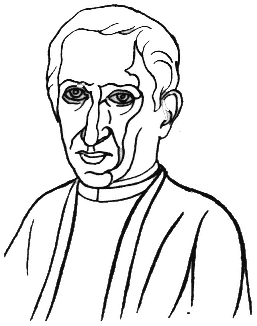
Figure 10.
José Fernández Navarrete. From
Miguel Granell y Forcadell, Historia de la enseñanza
del Colegio Nacional de Sordomudos desde el
año 1794 al 1932 (Madrid: Colegio Nacional de
Sordomudos, 1932). Biblioteca Nacional,
Madrid.
In June 1802 a royal decree sent Father Fernández Navarrete to Almendralejo, in what is now the province of Extremadura, to teach Lorenzo Golfín, the deaf son of the marquis of Encomienda.45 Spain's first state-sponsored public class for deaf students now closed its doors, and in Barcelona, too, the municipal school had folded earlier that same year when the teacher, Juan Albert y Martí, had returned to France.46 The number of trained educators of deaf children in Spain at this time could apparently be counted on the fingers of one hand, and when one departed it was no easy matter to replace him. This paucity of knowledgeable instructors combined with a general lack of funding to guarantee that the existence of these first establishments would be always precarious. With the schools in Madrid and Barcelona shut down, deaf education was once again confined to wealthy families with private tutors.
But not for long. In the fall of 1801, a certain Antoine-Joseph Rouyer had approached Madrid's Royal Economic Society of Friends of the Country with a plan to establish a school for deaf children.47 His proposal would soon return their teaching to the public domain. Rouyer, who years later would characterize himself as a "tolerant Christian, a moderate citizen, and a liberal Frenchman,"48 had been born in Paris, but he had lived most his life in Spain, where his father held the post of royal dentist.49 A graduate of the University of Paris, he had studied with de l'Epée's successor, the abbé Roch-Ambroise Sicard—when it came to deaf education in Spain at this time, all roads led back to the Paris school, so it seemed—and he was, like the French abbés, a grammarian, and he was also interested in the invention of a universal writing system.50 Early in the 1790s he had gone to Spain with the intention of founding a school for deaf students there, supporting himself in the meantime by teaching French and working as a dentist. When his efforts to open a school proved unsuccessful, he sought the support of the Friends of the Country.51
The society received the Frenchman's proposal with interest. This organization, which enjoyed the patronage of the crown, sought to promote the nation's economic and cultural prosperity through the development of science, agriculture, and industry, and in so doing it afforded local notables the opportunity to "contribute to the happiness of the kingdom."52 Members constituted an enlightened, reform-minded elite who busied themselves setting up model farms, introducing new crops, supporting local industries, and above all, promoting education. The society's motto was Socorre enseñando, "Help by teaching." There existed in Spain during this era an abiding faith in education as a panacea for all the nation's ills, although of course instructional goals were conceived differently by different segments of the population. True to their motto, the Friends of the Country had already founded various "patriotic schools," whose purpose was to teach students reading, writing, and arithmetic, along with a trade, for instance, spinning and weaving, stenography, or embroidery.53 Targeted for this occupational training were society's most marginal groups—vagrant children, beggars, delinquents, and the like—who the Friends of the Country aspired to transform into useful citizens. It was only natural, then, that they should look with sympathy upon another outcast group, deaf people, believing that they too could be redeemed through education. While in France and various other European nations teachers of this period were often affiliated with the Church and interested primarily in
saving deaf souls, the principal concern of the Friends of the Country was the formation of productive subjects who would contribute to the economic and social well-being of the realm. Establishment of an institution for deaf children, soon to be known as the Royal School for Deaf—Mutes, was in perfect keeping with the society's other educational activities, then, and indeed with the mood of the entire kingdom.54 The teaching that had begun in monasteries some two and a half centuries earlier and was subsequently entrusted to private tutors was about to come under the direction of a public-spirited society, and to be bankrolled by the Spanish state.
Foundation of schools such as the one the Economic Society now agreed to sponsor was important because it underscored a shift in consciousness regarding deaf people: the acknowledgment that such individuals could indeed benefit from instruction. Deaf people had long been considered ineducable, irrational, little more than animals, and they were frequently regarded with fear and suspicion and passed over for even the most menial types of labor.55 "In their actions they look like men, but in their ideas they differ little from the beasts," the Diario de Madrid had editorialized in 1795, adding that they were "useless and injurious to Society, which cannot employ them in any capacity that requires ideas." But the Diario, in step with the times, left no doubt as to where the solution lay: "Mutes leave this miserable state by way of instruction," the newspaper assured its readers.56
The opening of schools for deaf people was important for another reason as well. With the creation of such establishments, Spain broke with its long tradition of catering exclusively to the needs of deaf sons (and an occasional daughter) of privilege—whether in monasteries or in aristocratic households—and focused instead on deaf children from the lower class.57 Poor deaf people in particular had been subject to the negative stereotyping exemplified by the Diario 's remarks—deaf aristocrats, although surely not viewed as equals by hearing people, were no doubt less stigmatized—for people from the humbler classes were seen as the perpetual inferiors of the wealthy, and this was no less true of lower-class deaf-mutes. Yet now, for the first time, they too would have the chance to obtain an education.
Before the opening of their schools, deaf individuals—even those affluent few whose families could afford a tutor—had often been condemned to lives of isolation. But now the Royal School would gather together deaf subjects from all over the kingdom, creating the necessary conditions for them to coalesce into a social group and to form an
authentic community in which deaf youths would be educated and trained to become contributing members of society, and their language and culture would develop, evolve, and flourish.58 Deaf children, some of whom had never seen another deaf person in their lives, would be brought together there, and when the deaf sons and daughters of hearing parents—some 90 percent of the deaf population—arrived at school, the rude pantomime that had served as a stopgap to communicate with parents, siblings, and neighbors would blossom into a real language, which newcomers would learn from children of deaf families and from older classmates. The fact that deaf offspring of hearing parents often acquire their language and culture primarily from other deaf children sets them apart from their hearing counterparts, in whose families language and traditions are generally passed from parent to child, and it is at their schools that this transmission of their linguistic and cultural heritage can take place. Hence, the centrality of these establishments to the deaf community.
A nineteenth-century American traveler to Madrid left us the following vignette of a deaf Spanish beggar: "The road from the Gate of the Sun to the library was the habitual stand of a young man, a deaf mute who sat cross-legged in a gray capote with his hat before him and a bell in his hand.... He took no notice of those who gave to him, but sat ringing his bell and uttering sounds which, as he knew not how to modulate them so as to strike a tone of supplication, came harshly upon the ear, like nothing so much as the moans sent forth by the wounded victims of the arena." The traveler wrote that the young man's character seemed "tinged ... with a degree of brutal ferocity," and this he attributed to "the sense of his misfortune, of his complete separation from the rest of the human family."59 Now, with the foundation of Madrid's Royal School for Deaf-Mutes, deaf people's "separation from the rest of the human family" would come to an end, and they would be ushered into the human circle.
But several years would pass before the circle accommodated them. The Friends of the Country, upon receiving Antoine Rouyer's proposal, first interviewed the Frenchman and corresponded with his mentor, the abbé Sicard, then broached the subject to Charles IV to obtain the royal assent. Rouyer was named head teacher of the future school, and in the spring of 1802 he was sent back to Paris to perfect his skills under Sicard's tutelage. Father Fernández Navarrete, who was at this time still teaching at the Piarists' school, wanted to accompany Rouyer, but his petition was denied because of the "irreconcilable enmity" the Friends
of the Country had observed between the two men; for whatever reason, they were "implacable enemies" who "hated each other with all their hearts."60 Rouyer wrote from the French capital in the summer of 1802 that he was attending classes daily, as well as going to public demonstrations. Sicard had further refined de l'Epée's system of methodical signs, and his lessons, Rouyer opined, were "lucid and brilliant." The enthusiastic disciple gave thanks to God that he would be able to establish such a school "in a country I love as much as my own"; his dream, however, was not to be realized.61
The Spanish crown had agreed to fund the Royal School with monies from the bishoprics of Cadiz and Sigüenza—an arrangement that would prove problematic—but the original allocation was soon reduced by half, so the Friends of the Country were forced to scale down their earlier plans.62 Determined that the school should open despite financial difficulties, members of the commission charged with its establishment hit upon a way to make do with but 50 percent of the previously anticipated sum: they reduced the number of students proportionately, along with the number of employees and their respective salaries. They reasoned that with half as many pupils, the head teacher and his assistant would have but half the work, so they could be paid accordingly—that is, half the amount originally agreed upon.63 The Friends of the Country were eager to open the new school—by this time more than two years had passed since Rouyer's initial contact—and they now summoned to Madrid their designated head teacher, who returned from Paris over Sicard's objections.64 But when presented with the revised conditions of employment, Rouyer, not surprisingly, rejected them. He interpreted the new terms as an "indirect insinuation that he should resign his position," and in January 1804 he did just that.65
A salary dispute had culminated in Rouyer's departure, but the Friends of the Country would not be long without a teacher, for one Juan de Dios Loftus y Bazán was already waiting in the wings. In the winter of 1803 Loftus, an infantry captain brevetted to lieutenant colonel, had written to the Economic Society from his post in Ceuta, where for the previous six months he had been teaching a deaf child, nine-year-old Juan Machado. In his letter Loftus stated that his pupil, who he would later refer to as a "living document" of his teacher's competence, already knew the meaning of 1,083 nouns, which he could write upon seeing the appropriate sign or the referent itself, and he could count to 100.66 At that point the society already had a teacher, Antoine Rouyer (then still with Sicard in Paris), but the members thanked Lof-
tus and asked him to keep them apprised of his student's progress. When the lieutenant colonel wrote again in the summer of 1803, it was to request that he be named head teacher. He was told that the position was not vacant, but when Rouyer resigned some months later, the Friends of the Country proposed to Charles IV that Loftus be appointed in his stead. Their petition was denied, in a royal order that alluded to "just causes."67 At that point Loftus revealed what he supposed to be the reason for the royal refusal, namely, an embezzlement of which he had been accused in his former regiment. While acknowledging the truth of the charge, the would-be teacher was repentant and averred that he had mended his ways.68 With the society's continuing support, Loftus's appointment finally won the king's approval in the fall of 1804.69
When we consider the nationalistic mood of the times, we begin to understand why the Friends of the Country were eager to hire a confessed embezzler. The art of teaching deaf people to talk had originated in Spain in the mid-1500s, yet two and a half centuries later the Friends of the Country had been obliged to import the teaching expertise from abroad—although in 1802 Rouyer had offered his assurances that he would never allow foreign teachers at the Royal School.70 Members were on record as being loath to "find themselves in the hard necessity of begging among foreigners, when it came time to look for a teacher," and even while Rouyer was still officially in their employ, they had made discreet inquiries as to whether Spain had among its subjects accomplished educators of deaf people.71 So when presented with the opportunity to replace a French disciple of Sicard with a native son, this enlightened body threw caution to the winds and entrusted instruction at the Royal School to Lieutenant Colonel Loftus y Bazán. As if to underscore their questionable judgment, they then promptly hired Angel Machado, the father of Loftus's prize student, as teaching assistant.72 The senior Machado was also a military man, a second lieutenant, and like Loftus, he too had been embroiled in the embezzlement of his regiment, but this fact did not deter the Friends of the Country.73 After all, these two were not just any embezzlers, they were Spanish embezzlers.
On January 9, 1805, Madrid's Royal School for Deaf-Mutes opened at number two on the Calle de las Rejas, under the direction of the Friends of the Country.74 (Around this same time the public instruction of deaf people was resurrected in Barcelona as well.)75 The inauguration was
conducted with fitting pomp and celebration, and among the invitees to the opening ceremonies were Secretary of State Manuel Godoy, who was then director of the Economic Society, the archbishop of Toledo, and the count of Montarco. The duke of Osuna read the inaugural address, after which five of the school's six students were introduced—all boys, for it would be decades before girls would be admitted, although the desire to educate both sexes was present from the beginning.76 Then Lieutenant Colonel Loftus proceeded to examine his star pupil, Juan Machado, before the assembled public. By this time young Machado had progressed considerably. He could write some thousand nouns and five hundred adjectives and form their plurals, he could conjugate some four hundred verbs, he knew the parts of speech, the days of the week, and the months of the year, he had mastered the units of time from a second to a century, he knew Arabic and Roman numerals and some arithmetic.77 Loftus had taught the boy some speech as well, and he could now pronounce the five vowels of the Spanish language plus the consonants p, b, t, and d, and read a list of thirty words.
By the time the school opened, the commission responsible for its establishment had been replaced by a governing board, composed of the director of the Economic Society and eight others. This body, which convened on Sunday mornings, would maintain considerable control over the school and play an active role in day-to-day affairs—an arrangement that would soon lead to friction between its members and head teacher Loftus. Within the board's purview was the hiring and firing of employees and the admission and expulsion of students, as well as oversight of instruction and supervision of all who worked at the school—including the head teacher. Each week a different member was designated as the socio semanero, or "member of the week," responsible for seeing that all was in order at the school and that employees fulfilled their obligations "at all hours."78 It fell to the head teacher to implement the instruction and to discipline unruly scholars as he saw fit, but if the measures he took to curb misconduct proved insufficient, the next step was up to the governing board, for teacher and students alike were expected to submit to its higher authority.79
From its inception, the school provided for various kinds of students. The Reglamento (governing rule) of 1804 stipulated that six disciples between the ages of six and twelve would be maintained at the society's expense, but paying students were also welcome. In its desire to reach as many as possible, the school also accepted day students, who might attend for free or for a fee, as their circumstances warranted. Tuition for
paying residential students was fifteen reales per day—more than at Madrid's prestigious Seminario de Nobles—and for day students whose families could afford it, tuition was 100 reales per month.80 As was customary for the era, well-to-do and poor pupils were treated differently, in accord with the respective positions they were expected to assume in society. Paying and nonpaying boarders were housed in separate quarters, as it was commonly held that upper-class children should not mingle with those of the lower classes, lest they acquire bad habits. Meals for paying students were as in well-to-do families—hot chocolate for breakfast, soup, boiled meat with vegetables, and an entrée at midday, fruit in the afternoon, and stew, salad, and dessert for supper—while nonpaying students' fare was described simply as "more frugal, since it is free."81 Uniforms for the two classes were different, too. Paying students donned three-piece black woolen dress suits, complete with top hats and dark brown overcoats, for streetwear, and three-piece suits of pale gray wool for use within the school, whereas nonpaying students were attired more humbly in three-piece suits and topcoats of coarse wool, which during summer months they exchanged for suits of dark-colored cotton. The curriculum originally prescribed by the Reglamento made no distinction between paying and nonpaying scholars, but at the suggestion of the king himself, here too different treatment of the two classes became the rule. It was anticipated that wealthy students would eventually ascend to a position in keeping with their families' socioeconomic status, but poor students would have to support themselves, hence, it was decided that this latter group should be trained for a suitable trade, such as printer, lathe operator, shoemaker, or tailor.82 If the Friends of the Country were to promote the nation's economic well-being, it was logical that they should start with their own deaf charges, by preparing them to be self-sufficient.
Classes convened for three hours in the morning (two of lessons and one of review), and two additional hours in the afternoon (one of lessons and one of review). The curriculum—reading, writing, arithmetic, and Spanish language—was comparable to that of hearing schools.83 Geometry, geography, and history were also taught to students who were advanced enough to receive such instruction and whose social position required it. When it came to religious education, the Reglamento, as if to emphasize that the authors' foremost concern was the formation of productive citizens, stated only that once a spiritual advisor had been appointed, the specifics of this instruction would be determined in consultation with him.84
In choosing its methodology, the Royal School turned its back on the Spanish tradition and adopted the French approach unapologetically. And although the oralistic pedagogy set forth in Bonet's Arte would be reinstituted a decade after the school's inauguration, the first Reglamento contained no reference to the teaching of articulation, and it stated explicitly that the head teacher should employ the methods of the abbés de l'Epée and Sicard, which he might modify according to the dictates of his own experience and observation.85 Indeed, the Friends of the Country held Sicard in such high esteem that they had made him a socio de mérito (outstanding member) in 1802.86
The French approach found one of its strongest proponents in the abate José Miguel Alea, who had championed the deaf youth Gregorio Santa Fe. By the time the Madrid school opened, Alea had added his name to the list of Friends of the Country and had gained a seat on the governing board. (Members who evaluated his application noted that his character was "gentle and beneficent" and that he was widely reputed to possess the "most excellent moral qualities and the greatest intelligence concerning literature.")87 Appointed socio protector (protective member) of the board of directors and put in charge of theoretical aspects of the teaching, Alea steered the school toward the French methodology, providing copies of de l'Epée and Sicard's instructional manuals and even offering to translate them into Spanish.88 The society also acquired Sicard's Manuel de l'enfance at Alea's request, another member, Josef Martínez Hervás, donated his Elements de grammaire générale .89
Thus when the Madrid institute opened, in keeping with the French method whose use it explicitly required, the school must have employed some sort of methodical signs, that is, some kind of manual translation of Spanish. Whether the actual signs from the Paris school were used in Madrid is an open question, however.90 Francisco Angulo, to whose home Alea took the deaf youth Santa Fe, had studied under the abbé de l'Epée, but he seems not to have been in contact with the Economic Society when the Royal School was founded; Antoine Rouyer was a disciple of the abbé Sicard but, as we have seen, he never put his knowledge to use at the Madrid school. Lieutenant Colonel Loftus, the first practicing head teacher, most certainly employed signs in the classroom, but it is not clear whose. Two years after the school had opened, however, Loftus's favorite pupil, Juan Machado, explained that his teacher was by then instructing him "according to Sicard's method, different from the one he followed at the beginning."91 (As for what approach he had used originally, we know only that he claimed to teach
"without methods given by [any] other.")92 At any rate, whatever French signs might have been introduced in the Madrid establishment would no doubt have mixed rapidly with the children's own native signs.93
The teaching of deaf children with methodical signs was consistent with the state's educational policy, dating from the late 1760s, that instruction throughout the realm should be imparted in Castilian Spanish. Methodical Spanish, the system of communication used at the Royal School, was not a minority language on the par with, say, Galician, Basque, or Catalan, but rather, a manual version of the officially mandated tongue. This practice would persist until the 1830s, when the Madrid school would begin educating deaf people in Spanish Sign Language, a natural language with a grammar of its own—once again, in emulation of policies adopted in deaf schools in France.
Why did the Friends of the Country, on founding a state-sponsored school, spurn the oralism of their forefathers in favor of French manualism? Spain had pioneered the oral instruction of deaf people, yet as we have seen, the school's first Reglamento mandated the pedagogy of the Paris institute and made no mention of the teaching of articulation; moreover, the Friends of the Country initially hired a teacher who had been formed by Sicard, then sent him back to his French mentor to perfect his knowledge. Some writers have speculated that the Spanish tradition, and Bonet's Arte along with it, must have been lost in that era, and at least one went so far as to posit that Hervás's book too must have been either forgotten or unknown, but clearly this was not the case.94 Memory of the Spanish past was alive and well, for Feijóo's writings, with their vindication of Pedro Ponce, were still widely read.95 And in the years immediately before Rouyer contacted the Friends of the Country, Spain had seen publication of Juan Andrés's Lettera (1794), Hervás's Escuela española de sordomudos (179 5), and Alea's letter to the Diario de Madrid (179 5), all of which touted the Spanish origins of the teaching and celebrated the Spanish masters. As for Bonet's book, although it was rare in the day, clearly it was not unknown; Alea had referred to it in his letter. Nor was Bonet's work unobtainable: the director of the Economic Society, Manuel Godoy, had a copy in his personal library, and several years before the school opened he had loaned it to Alea, who tried his hand at teaching with it.96 And Hervás's book? If we are to believe Godoy, it was known to "everyone in Spain."97 It can hardly be maintained, then, that the Friends of the Country's preference for the French manual method stemmed from ignorance of their nation's oralist heritage.
The truth is that the French abbés were widely held to have improved upon the techniques of their Spanish predecessors—it was frequently said that they had "perfected" the teaching—and the French approach was considered, in a word, superior.98 It was one thing to maintain that Spain had been the birthplace of the teaching, but quite another to espouse the methods of the early Spanish teachers, and on this occasion enlightened Spaniards laid nationalism aside in favor of what they took to be the best pedagogy available.
The decision to employ the French methodology must also be viewed within the larger context of the political and economic situation, which had changed greatly since the time of Ponce, Bonet, and Ramírez de Carrión. Politically and militarily, Spain had been the most powerful nation on earth, but this was no longer true. In the cultural and intellectual spheres as well, Spain was now widely perceived as being "behind" the rest of Europe, and at least some Spaniards—depending on their political persuasion and religious convictions—had grown accustomed to looking to their more "advanced" neighbor across the Pyrenees for inspiration in a variety of fields. As Manuel José Quintana, host to Madrid's most famous literary tertulia, put it, "We eat, we dress, we dance, and we think a la francesa [in the French way]."99 Indeed, the practice of following the French intellectual lead was by now well entrenched, for France had been the center of the European Enlightenment during the last half century. Spanish educational reformers, too, turned to France in their pursuit of pedagogical renewal, and when it came to deaf education, French prestige was second to none. Numerous schools modeled after the Paris institute had been founded throughout Europe, the names of de l'Epée and Sicard were on every tongue, and even as the Friends of the Country labored to create the Royal School, theatergoers in Madrid attended a play that paid tribute not to the early Spanish masters but to the abbé de l'Epée.100 For all these reasons, then, oral instruction of deaf children, the approach pioneered by Ponce, practiced by Ramírez dc Carrión, and publicized by Bonet, simply had no proponents among the Friends of the Country at this time.101 Curiously enough, these men seem not to have considered Hervás y Panduro's method, either, although in its rejection of methodical signs and its reliance on the deaf people's own sign language as a vehicle to teach the written form of the national tongue, Hervás's system was arguably superior to de l'Epée and Sicard's. Most Spaniards received at least the rudiments of an education during these years.102 But literacy
was still far from universal, and for this reason a method that depended so heavily on writing may have been deemed less suitable for the lower class.103 Even more important, however, Hervás's fame as an educator of the deaf simply could not compare with that of the French abbés, and it may be primarily for this reason that his work was overlooked.104
Recognition of this state of affairs may also suggest the answer to another oft-raised question, namely, why didn't the Friends of the Country send a disciple to Germany, where oralism was flourishing, rather than to the manualist Paris institute? The answer seems to be that they felt no desire to do so, for they judged the French pedagogy to be superior. (There is no telling what course they would have followed had they been approached by a German rather than a Frenchman.)
In the final years of the eighteenth century the Spanish state had at long-last turned its attention to its deaf citizens, promoting their instruction, albeit on a limited scale. With the opening of public schools, deaf people were in effect recognized as a social group—although not as a linguistic minority. Nevertheless, when the founders of the Royal School opted to educate their charges with the French manual approach, their decision was in keeping with the kingdom's educational policy regarding minority language speakers: all subjects, regardless of their mother tongue, were to be taught in Castilian Spanish, and the Methodical Spanish used at the Royal School was but a manually encoded version of the official language. Thus deaf people, like speakers of Spain's minority languages, came to be instructed in an alien tongue.105
Chapter 5
The War of Independence Disrupts the Teaching
Background and Conflict, 1805–1814
Who can possibly calculate the utility brought to a kingdom by just one man dedicated to public or private teaching?
—José Miguel Alea
During its first few years of existence, the Royal School benefited greatly from the contributions of two men: a deaf art teacher, Roberto Prádez, distinguished himself for his exemplary participation and zealous devotion to his students, while his hearing colleague, José Miguel Alea, undertook the empirical study of deaf people and their language. But an inept head teacher and a chronic lack of funds hampered the establishment's efforts, until Spain's war of independence brought about the closing of the school. The students, abandoned by their "enlightened" sponsors, suffered mightily, and deaf education in Spain all but ceased to exist.
In the spring of 1805, just a few months after the inauguration of the Royal School for Deaf-Mutes, a remarkable young deaf man presented himself to the Friends of the Country. Roberto Francisco Prádez was a prize-winning artist who desired to teach students at the Royal School either reading and writing, or drawing.1 Members of the board of directors were quick to recognize the advantages of a deaf instructor. Prádez, they concurred, would be "much more appropriate than any other, in
view of the conformity of organization that exists between him and those he would teach."2 Angel Machado, the teaching assistant, was already teaching writing, but the Friends of the Country agreed that drawing would be extremely useful for their charges, noting that it was regularly taught in foreign deaf schools. And when the king turned down the Economic Society's request of a stipend for Prádez, citing a scarcity of funds,3 Prádez was undaunted and volunteered to teach for free.4 His offer was gladly accepted, and thus began a distinguished career that would span more than three decades at the Madrid institute.
Roberto Prádez was deaf from birth and his speech was, as he himself described it, "unintelligible."5 Nevertheless, he had no trouble communicating with hearing people, for the Friends of the Country observed that the new art teacher "perceives by the movement of the lips the majority of words addressed to him, he understands perfectly whatever is said to him in writing or in the manual alphabet, and he responds in one way or the other with complete appropriateness."6 Tiburcio Hernández, a member of the school's governing board destined to play an important role in the years to come, elaborated on Prádez's lipreading abilities: "The deaf-mute Don Roberto Prádez answers anyone who speaks to him, and I have taken the trouble to experiment [to see] if while I was seated below [the level of his gaze] and he was standing he could understand me. I have seen that he understands even this way, and the most he does is look more closely so he can see what the mouth reveals naturally upon speaking; but he does not need to inspect the inside [of the mouth]."7
Prádez had been born in Saragossa in the early 1770s to a family he would later describe as "distinguished."8 His father, Pedro Prádez, was the builder of the Imperial Canal of Aragon, the greatest public work of eighteenth-century Spain.9 The family was of French origin, for the senior Prádez had been born in Béziers, in the Languedoc region of France, and his wife's maiden name, Gautier, suggests that she too was French, or of French descent.10 Their son Roberto had been educated at home—on one occasion he attributed his instruction to "his caring mother," and on another, to both his parents.11
History does not record the methods by which Prádez was instructed, but it is possible that the family may have learned something of deaf education in France. The Friends of the Country would state with pride that Prádez had never been outside the kingdom12 —if Spanish teachers of deaf people were rare in the day, it seems that educated deaf Spaniards
were even rarer, and such a man was understandably cause for celebration—but never once would they mention how he had come by his instruction. This is especially odd considering that José Miguel Alea, in his 1795 letter to the Diario de Madrid concerning Gregorio Santa Fe, had gone so far as to proclaim that a statue should be erected in honor of the boy's teacher, Diego Vidal—and along with it, one to Pedro Ponce.13 If the teacher was French, and quite likely a woman at that, apparently the less said, the better.
As a young man, Prádéz himself recorded some details of his early life.14 He had been orphaned "at a tender age ... bereft of means by which to subsist, and with only an elementary education," which he had attained by dint of "extraordinary effort." Convinced that because of his deafness and poor speech, he could not aspire to a position in life that corresponded to his "distinguished birth," and desiring nothing more than an "honest occupation with which to provide for his subsistence," he turned to the study of art, entering the Academy of Fine Arts of San Carlos, in Valencia, in 1789. He was sixteen years old and had no other means of support than what "his poor sisters" could provide. At the Academy of San Carlos he studied drawing and engraving under the direction of Manuel Monfort for some seven years.15 But the young artist knew the best teachers were to be found in Madrid, not in Valencia. So in 1797 he journeyed to the Spanish court, where, at the age of twenty-four, he was accepted to study with a well-known professor of engraving, Don Fernando Selma, of the Royal Academy of Fine Arts of San Fernando.16
As the attentive reader will have noticed, there are a number of remarkable parallels between the lives of Roberto Prádez and Gregorio Santa Fe, the deaf youth whose story José Miguel Alea published in the Diario . Prádez, like Santa Fe, had been born in the early 1770s and had been educated in Saragossa.17 Both men were deaf from birth, and both were orphaned at a young age and thus reduced to poverty. In their early twenties both made their way to Madrid to study art, arriving within two years of each other (Santa Fe in 1795 and Prádez two years later), and while in the Spanish capital both would become acquainted with José Miguel Alea—Santa Fe at the theater, Prádez at the Royal School for Deaf-Mutes. Yet history has left no mention of the two having ever met. And only Roberto Francisco Prádez would go on to a distinguished career as an educator of deaf students.
But we are getting ahead of our story, for before Prádez arrived at the Economic Society offering his services as a teacher, he would first
spend some years at the Royal Academy of San Fernando. In 1798, one year after enrolling there, he solicited a scholarship from Charles IV. Asked to comment on this request, Prádez's teacher, Fernando Selma, commended his pupil's "diligence and good judgment," noting "the interest I have in his further development," and adding, "how gratifying to me are his skills."18 The academy, for its part, also supported Prádez's petition, stating that "because of his diligence, conduct, and natural circumstances, he deserves His Majesty's royal compassion while he masters the art of engraving."19 Charles IV apparently agreed, for he awarded the deaf artist a scholarship of nine reales per day, which would continue throughout his years at art school.20 Informed of the king's decision, the academy directed Fernando Selma to see to his disciple's progress.21
In the summer of 1799 Prádez entered a contest sponsored by the academy. In the category of engraving there were but two contestants, Prádez, and his schoolmate Esteban Boix, whose studies in Madrid were supported by the Academy of Fine Arts of Barcelona.22 The competitors were fairly evenly matched. Prádez was then twenty-seven years old, Boix was two years younger, and both had entered the academy around the same time.23 Both participants had copied in advance a portrait of the Virgin by Anton Raphael Mengs that hung in the king's oratory at the royal palace.24 On the day of the contest, they were given two hours in which to draw a statue of the Greek youth Antinoüs, antiquity's ideal of masculine beauty. At the close of the contest the judges selected the winner by secret ballot: Prádez won handily, with thirteen votes to Boix's seven.25 A few days later Crown Prince Ferdinand awarded the deaf artist his prize, a gold coin of one ounce, which Prádez accepted on bended knee, as he kissed the hand of his future sovereign.26
Not everyone was pleased with the outcome of the contest. There were complaints that Prádez's teacher, Fernando Selma, had assisted his disciple too much. Some even suggested that he had gone so far as to touch up Prádez's engraving of the Virgin.27 To these cries of foul, Selma, who had been specifically entrusted with Prádez's professional growth, responded indignantly:
I understand the academy is displeased because I have taken too much interest in carrying out their commission. The academy saw fit to charge me with the direction and teaching of the disciple Don Roberto Prádez. I have tried to lead him on the path I consider most advantageous for his progress.... I have helped him to the extent I consider normal; just as in all the academy's
contests it has been customary to practice regularly with the disciples who have taken part in them. If the contestant Don Esteban Boix did not know how to take advantage of the help that has been liberally offered him, it is his own fault. Boix may know more than Prádez, but Prádez has shown more intelligence, both in the work prepared in advance and in the extemporaneous work done in the judges' presence.28
The matter was not laid to rest until members of the academy, desirous of rewarding Boix's diligence and talent and encouraging him in his studies, decided unanimously to award him a special prize, equal to his rival's.29
Prádez had convincingly demonstrated his talents in the engraving competition and had earned his teacher's praise, but these successes notwithstanding, his fortunes at the art school soon declined. To the academy's consternation, he sometimes went for months without presenting any work,30 and his instructors' reactions to what he did submit—an engraving of Hernán Cortés, a drawing of Saint John the Evangelist, sketches of hands, eyes, lips, noses, and so on—were lukewarm at best.31 The deaf artist was now working for private commission,32 out of economic necessity, no doubt—a few years after enrolling at the school he found himself "totally destitute of means by which to subsist, and faced with having to beg"33 —and these outside assignments most likely left little time for the academy. He was no longer studying under Fernando Selma's direction,34 and by 1801 the master engraver had revised his appraisal of his former pupil: "What can be determined of his talent is that, if he applies himself a great deal, and if whoever directs him contributes an equal amount of care, it will be possible to obtain an average teacher," he wrote, concluding, in apparent contradiction of his earlier judgment, that "since he is a deaf-mute, he lacks ideas, and it is impossible to make him comprehend various principles of the Art."35 (When mentors sour on their mentees, they easily revert to old stereotypes about deaf people, so it seems.) Three years later Selma's assessment had not improved: "His diligence could be much greater; his subsistence I do not consider possible with only what the works he is capable of executing can produce, and it is even less possible for him to progress in his profession."36
Although Prádez's scholarship was renewed for one last time in August 1804,37 his name does not appear in the records of the academy after that year, and the following spring he introduced himself to the Royal School. There it seems he participated fully in the life of the institution almost from the moment of his arrival. He plunged into teaching
daily art classes, and his appreciative students were reported to be "benefiting from [the lessons] and receiving this instruction with the greatest pleasure."38 Together with head teacher Loftus, Prádez designed a curriculum for the school,39 and in the company of Loftus and the teaching assistant, Angel Machado, he presided over the students' examinations.40 The art teacher's role expanded rapidly, and in 1808 he was put in charge of teaching penmanship, at his own suggestion.41 The following year found him standing in on occasion for the head teacher, and by 1810 he was teaching the children to write, count, and do arithmetic.42
Shortly after the deaf artist joined the Madrid school, the Friends of the Country convened the first public examination of their students.43 Such displays, which were also held for the Economic Society's "patriotic schools," served to call attention to the fledgling establishment, showcasing deaf learners' achievements and proving that they could indeed be educated, and thus furthering the cause of their instruction. Examinations were conducted in the town hall, with the Friends of the Country, including the honorary women's section, or Damas de Honor, and of course the school's governing board, all in attendance. Over the years, the audience also included members of the nobility, the royal family, and the king himself.44 After a speech by the society's director, students were examined first individually, then in pairs, writing on a blackboard their responses to questions posed by fellow students and members of the audience. They did simple arithmetic and wrote the names of objects shown to them; they transcribed words spelled in the manual alphabet or represented by signs, conjugated verbs, declined nouns, and formed sentences; they transformed active sentences into passives and identified the parts of speech. The students had also been taught some speech, and this skill too was proudly exhibited as scholars pronounced a few words "with a fair amount of clarity."45 Little time was dedicated to articulation, however, for the Friends of the Country considered it "more useful" to instruct their charges in "other much more important subjects." Speech, they agreed, was merely "an adornment, more appropriate to surprise and astonish the public, than useful to deaf-mutes themselves."46
The first public examination ended with the presentation of star student Juan Machado, who was, according to one newspaper account, "in an admirable state of instruction." He performed exercises similar to his companions', then went on to display his prowess at geography and arithmetic. Young Machado was endowed with a natural quickness coupled with an innate ability to comprehend, and for two years before the
school opened he had lived at his teacher's side, benefiting from his undivided attention. For these reasons, it was reported, the boy "gave such proof of his progress that he left not the least doubt as to the possibility that these unfortunate beings could come to be eminent men in all branches of the arts and sciences."47 After such a virtuoso performance, who could doubt the educability of deaf-mutes?
But despite the success of the first public examination, despite the society's justifiable pride in its star pupil and in its new art teacher, all was not well at the Royal School, for problems soon arose between the governing board and the head teacher, Lieutenant Colonel Loftus y Bazán. The board objected to Loftus's harsh treatment of the children and accused him of favoring Juan Machado over the others so that none might surpass his first disciple.48 Loftus, for his part, complained that he could not modify his teaching methods without the consent of José Miguel Alea, who was responsible for the theoretical aspects of instruction.49 Things came to a head in 1808 when members of the board, convinced of the lieutenant colonel's "defect of aptitude and docility" and his "ineptitude for the post," determined to solve the problem by doing away with the position of head teacher altogether.50 Because the school was faced with a shortage of funds, the move was billed as an economy measure, but the intent was clearly to get rid of Loftus. To replace him the board named José Miguel Alea, who had volunteered to take over the teaching for free.51 Loftus countered by proposing to stay on without pay, but his offer was turned down, and the job now fell to the altruistic abate .
The man who had publicized Gregorio Santa Fe's story and had advocated public education of deaf Spaniards had been born half a century earlier, in 1758, in the port of Lastres, Oviedo, on Spain's rugged northwestern coast.52 As a youth he served for many years at the side of Pedro de Quevedo y Quintano, the renowned bishop of Orense.53 (Quevedo would eventually be named Inquisitor General and regarded by the Spanish people as successor to the infamous Torquemada.)54 The late 1780s found Alea residing in the Spanish court. He was by now an abate, an unbeneficed clergyman of minor orders, with eleven years of higher education under his belt, having studied literature at the University of Santiago in Galicia and mastered four living languages, along with Latin, the language of the Church.55
The Spanish countryside was at this time suffering from a shortage of parish priests, while the towns contended with a glut of unbeneficed priests, canons, and hangers-on in minor orders. The abate Alea was part
of the problem. Many abates were from families of limited means, or they were segundones, males born after the first son and thus destined not to inherit.56 To such men the Church held out the promise of access to higher learning and a life of study and scholarly pursuits. But the Church gave the abates no real function, and consequently, many were obliged to earn their living as secretaries, librarians, or tutors to wealthy families. They had only probationary orders and could still choose to withdraw from the Church. As long as these men remained abates, however, they were forbidden to marry. Dressed in black clerical garb cut similarly to lay apparel, the abate was a familiar figure on the tertulia scene.
In Madrid Alea supported himself by working as a translator at the official Bureau of Interpretations, a known center of Spaniards sympathetic to the ideas of the Enlightenment where he had presented himself in 1788, and by freelance translating of Latin, French, or Portuguese works of literature, religion, politics, jurisprudence, and history. These translations he published sometimes under his own name and sometimes under the pseudonym Jayme Albosía de la Vega.57 Throughout his work he revealed a concern for the precise use of language—the definitions he proposed for the Spanish terms genio (genius), ingenio (creative or inventive faculty), and talento (talent) have since been adopted by the Royal Spanish Academy, whose self-appointed task it is to "cleanse, define, and give splendor" to the Spanish language58 —and to the art of translation he brought a keen sensitivity and a self-conscious awareness of his craft.59 The translator, Alea maintained, should never change the syntax of a language or introduce foreign words for which there exist equivalents in his own language, but neither should he oppose admission of those words to which usage, necessity, and even fashion have granted acceptance, in the absence of suitable terms in the native tongue. The best course, he concluded, was to be neither despot nor slave to the original. Thus in translation Alea was willing to embrace innovation, albeit of foreign origin, but never uncritically.60 In the future he would chart a similar course in matters of deaf education as well.
In 1789 Alea, while still employed as a translator, sought to be appointed priest of Santa Mara de Cortegada, some seventy kilometers from Lugo, in northwestern Spain; two years later he was selected for the post.61 The benefice he would receive was substantial, and in truth his motives for wanting to be ordained appeared to be more pecuniary than spiritual, for when in 179 he sought either an appointment to one of the libraries of the court or else a pension from the Church that would
allow him to become a priest, he expressed no preference for one calling over the other, commenting only that either way he would be able to pay his creditors.62 So it is perhaps not surprising that once chosen for the position in Santa María de Cortegada, he was in no hurry to leave Madrid and assume his pastoral duties in this remote rural village, and when the appointment was contested by another candidate, the presbyter Vicente Rafael Tavoada, Alea paid the challenger half his benefice for serving in his stead while the appeal was underway. This arrangement seemed to suit both parties, and the matter dragged on for years while Alea remained in the Spanish capital, where he could prepare himself for work more to his liking without fulfilling his pastoral obligations or having to relocate to Santa María de Cortegada. Tavoada, for his part, was content to wait and let Alea support him, for it would be simply a matter of time until the appointee obtained other employment, and then the position would fall to the challenger.63 The bishop of Lugo, Felipe Peláez, wanted the newly designated priest to serve his congregation even though the appointment was under appeal; he complained that the parishioners were suffering without a pastor and he went so far as to accuse the two litigants of collusion, but until the final decision was pronounced, there was no way to oblige the recalcitrant Alea to take up residence in Santa María de Cortegada.64
While the appeal was under consideration, Alea applied for a passport to study classical Arabic in Rome. His eventual goal was to obtain work in the royal libraries translating manuscripts on the arts and sciences that had flourished in Spain during the period of Moorish domination, and he proposed to use his ecclesiastical benefice to support himself for however long it might take to master the language.65 Over his bishop's objections, Alea was granted a passport in 1793, with the understanding that if he won the appeal, he would have to return to Spain and reside in his parish, or else renounce the benefice.66 The would-be traveler never departed for Rome, however, because a declaration of war between Spain and France made the journey too dangerous.67 In 1796 a decision was finally pronounced in favor of the challenger, Vicente Tavoada. Alea promptly appealed the ruling, but eventually he accepted the verdict and withdrew his claim to the benefice—most likely because by this time he had landed a post in Madrid at the newly created Royal Medical School.68 By 1799 he had been made librarian there—a position he would hold through 1807—and around this same time he was employed in the section of English literature in the Royal Library as well.69
During these years Alea continued to translate various works, among them the biography of the celebrated naturalist the count of Buffon,70 and it was because of one of his translations that he became acquainted with Charles IV's influential secretary of state, Manuel Godoy. (According to Blanco White, with whom Alea fraternized at Quintana's tertulia, Godoy "had the whole government and patronage of the country in his hands.")71 Alea had prepared a Spanish edition of Jacques Henri Bernardin de Saint-Pierre's celebrated novel Paul et Virginie, complete with "instructive notes" on physics, geography, mythology, and botany, and with a classification of the novel's exotic flora according to the system devised by the eminent Swedish botanist Linnaeus.72 (After nearly two centuries, this version is still one of the best Spanish translations of Saint-Pierre's work.) He soon learned that his rights had been challenged by another translator. Alea appealed to the crown, Godoy took his part, and as a consequence, the learned abate was granted exclusive rights of publication. Alea claimed to have gone before the throne "with no other recommendation than the truth of the facts," emphasizing that prior to the dispute, he had never met the secretary of state and had done nothing to court his favor.73 From this time on, however, he would be a fervent devotee of the Prince of Peace, and when his version of Paul et Virginie appeared, it was dedicated to his newfound benefactor.74 In the coming years Alea would receive still other favors from Godoy, and in acknowledgment he would dedicate two more works to him.75
By the time he was appointed to replace Lieutenant Colonel Loftus at the Royal School, Alea had already given ample proof of his dedication to the cause of education. His views on the topic had been set forth in an article published in 1804 in Variedades de ciencias, literatura y artes, a scholarly journal founded by Quintana and his literary friends, to which Alea was one of the principal contributors.76 Giving voice to the widespread sentiment of his day, Alea maintained that "nothing is so necessary to a kingdom as the education of its youth."77 He opposed the system of rote learning frequently employed in Spanish schools, holding it to be young scholars' "cruelest tyrant," and arguing that they should be taught to analyze instead.78 Alea had done more than just write about teaching, however; he had also tried his hand at it, for together with his contertulio and fellow cleric Blanco White, he was responsible for religious instruction at the Instituto Militar Pestalozzi, which had been founded in 1806 at the instigation of Manuel Godoy, and modeled on the principles of the Swiss educational reformer Johann Heinrich Pestalozzi.79
In addition to being a passionate promoter of education, Alea was a student of the philosophy of the French Enlightenment.80 Like de l'Epée and Sicard, the scholarly abate was well acquainted with philosophical or general grammar, whose goal it was to enunciate the linguistic principles that govern all languages. Such general principles might be ascertained, philosophers agreed, through the study of language development in children, "savages," and persons deaf from birth. In 1800 Alea published a Spanish version of Des Tropes, by the renowned philosophical grammarian César Chesneau Du Marsais, in which he set out to apply to the Spanish language principles of general grammar formulated by the French author.81 Ever the enlightened citizen, Alea stated that he had undertaken this work for "the common good, which is the object that should be proposed by one who writes for the instruction and felicity of his fellows, and especially those who live with him under the same government."82 In 1803 another grammarian and teacher of deaf people, the abbé Sicard, would prepare a corrected and augmented version of Des Tropes .
Alea published a second volume, a Spanish adaptation of Du Marsais's Logique, in 1801, and a few years later the abate was himself writing a book on general grammar applied to Spanish, although he interrupted this work to translate Sicard's manual for the Royal School and apparently never completed it.83 Striking a healthy balance between patriotic pride in his fellow Spaniards' achievements and admiration for the foreigners who had surpassed them, Alea remarked that as a general grammarian, Du Marsais was "superior in every respect,"84 but nevertheless, he asserted, the study of philosophical grammar had its roots in the sixteenth-century Spaniard Francisco Sánchez de las Brozas, "El Brocense," whose Minerva the abate termed an "aurora of light."85 Although El Brocense had been unappreciated in his day, subsequent authors—Arnauld, Duclos, Harris, Beauzée, Thurot, and Du Marsais himself—were indebted to "the immortal Spanish philosophical grammarian," Alea argued, concluding that in this respect, "something similar to what occurs in our foreign trade has happened to us Spaniards, when giving the abundant and essential raw materials of our soil, we later receive them manufactured by the greater industry and application of those who purchased them."86 Alea, who would soon translate Sicard's manual for the Royal School, could scarcely fail to notice that in the land of Ponce de León, Ramrez de Carrión, and Bonet, something along these same lines was occurring with deaf education as well.87
In the introduction to his translation of Du Marsais, Alea solicited his readers' comments: "Those who, endowed with superior enlightenment, may note in our collection any faults that are of true transcendence in literature, shall have the right to expose them to the public with the zeal required by the good of the national enlightenment, and with the propriety owed to true philosophy," he wrote, adding, "In these terms we will answer so much more gladly the objections of others, as with more moderation and greater force of reasoning they attempt to show us that, through our ignorance or oversight, public instruction is defrauded in some essential point."88 Shortly after the first volume appeared, a resident of Seville took the author up on his invitation. This reader praised the newly published work as "classic and most appropriate for primary instruction," but he also raised several points of criticism, which he phrased most diplomatically, before signing off as "Don P. de C."89 Because his respondent had not revealed his identity, Alea was unable to answer him personally, so he arranged for P. de C.'s letter to appear in the Diario de Madrid, and along with it his pledge to include both the letter and a reply in the second volume of his translation of Du Marsais.90 This he did "for the progress of science itself," he explained, "so that even my oversights or my faults will serve as a lesson to others, just as the history of others' shipwrecks instructs navigators."91 And when the second volume appeared, the abate made good his promise, including in it his critic's letter, responding eloquently to his objections, and above all, praising him for the tact with which they had been proffered, for P. de C., he noted, had employed "that spirit of moderation and of criticism that knows how to note the defects of a work without exasperating the author's pride."92 Examples of such measured criticism—and such gracious reply—were rare, as this frequenter of Quintana's tertulia knew all too well. At a time when hostilities between Madrid's two rival literary circles often erupted in sarcastic diatribes, this genteel epistolary encounter with P. de C. moved the translator of Du Marsais to hope that their behavior would serve as a model for future critics. The abate wished to formulate "general laws of the art of criticism," and until such rules were established, he considered it the obligation of all men of letters to confess the faults they might commit through ignorance or distraction. "I shall not stray one iota from this principle when, in the course of the literary tasks that occupy me, I have need to criticize others," he vowed, "in which case the interests of literature and the public good will be my norm, and the means of which I shall avail myself [will be] reason and decency."93 In the years to come,
the man who would institute rules for the "art of criticism" would be true to the literary guidelines he proposed.
This is not to say that in his personal life the abate was himself a paragon of moderation and restraint, however. A contemporary related that after Quintana's tragedy El duque de Viseo opened at Madrid's Príncipe theater, the slightly built Alea and a fellow clergyman, who because of his bulk more resembled a prize fighter than a man of God, engaged in a discussion of the work's merit that was anything but moderate or restrained. The year was 1801, the same year Alea pledged in print to be guided in his criticism by reason and decency, and the debate occurred at the Café de San Luis, a favorite meeting place of members of the Royal Guard located on a sidestreet off the Calle del Carmen. While Alea lauded Quintana's play, his companion censured it mercilessly. The disagreement grew more and more heated until at last the smaller man lunged impetuously at his powerful interlocutor, landing a punch that bloodied his full, round face. After waiters separated the two combatants, who amused passersby mistook for rascals attempting to leave without paying their bill, the exalted literary critics retreated to their respective dwellings.94
Matters of personal conduct aside, Alea's devotion to the cause of education and his predilection for philosophical grammar dovetailed in his work on behalf of deaf Spaniards, and in the years since he had penned his letter to the Diario de Madrid first advocating their instruction, he had continued to labor on their behalf. Indeed, by the early 1800s he was Spain's most authoritative writer on the subject of deaf people and their education. In 1803 he authored a primer for deaf-mutes, and around this same time he offered to translate for free all foreign works the Royal School's governing board deemed necessary.95 In 1806 he finished a Spanish version of Sicard's manual—he had employed it himself to instruct a deaf child from Asturias, Josef González96 —and his efforts were rewarded when the grateful Friends of the Country made him a socio de mérito, an "outstanding member," in recognition of his many contributions to the Royal School.97
During these same years Alea published an article in Variedades de ciencias, literatura y artes in which his knowledge of what we now call linguistics was brought to bear on deaf education.98 The abate was intrigued by a question that had long preoccupied philosophers, namely, the relation between language and thought, and he shared their belief that unschooled deaf subjects (like children and "savages"), if carefully observed, could shed light on the matter. Two authors in particular had
aroused Alea's curiosity—along with his skepticism: the French ideologue Destutt de Tracy, who held that there could be no abstract thought without "artificial signs" (and perhaps without speech), and the Spaniard Ramón Campos, who had given Alea an unpublished manuscript in which he examined the capacities of persons deaf from birth and argued that without speech, it was impossible to instill ideas into the human understanding.99 Motivated by his reading of these two philosophers and determined to put their claims to the test, Alea set out to ascertain the nature of ideas in those deaf from birth, then published the results of his study, which he hoped would both contribute to the philosophy of language and advance the theory of human understanding.
Convinced that questions such as those raised by Campos and Destutt de Tracy could be settled only by empirical observation—"Philosophy is nothing without facts, and facts are nothing without philosophy," he contended100 —he took in four deaf children: two boys, ages five and twelve, and two girls, both eleven years old.101 The youngsters, all of them deaf from birth and poor, resided continuously with their benefactor, returning to their parents' homes only on holidays. By the time Alea wrote his article documenting the results of his experiment, he had spent fifteen months teaching them through the medium of manual signs and writing. As might be expected, the man who favored analysis over rote learning eschewed Bonet's approach, in which at least in the initial stages, mindless memorization and production of speech sounds took precedence over comprehension. Alea did, however, give his pupils lessons in articulation according to Bonet's Arte, which Godoy had loaned him from his private library. And the results? "My mutes learned to read and write in short time," their teacher reported, although he made no mention of their progress in articulation, leaving us to surmise that their speech training had been less than successful.102 But the most important result was that the tutor-empiricist was now persuaded that deaf children were as capable of generalizing and forming abstract ideas as were their hearing counterparts. "Aristotle reputed them to be incapable of thinking," Alea wrote, repeating the familiar misattribution, "a hasty judgment he no doubt would not have made had he lived but three days with any deaf-mute."103
Around this same time, Alea also translated the first part of the introduction to Sicard's manual for deaf students and published it in 1804, along with critical comments, in Variedades .104 The French teacher had painted an extremely dismal and self-serving portrait of the unschooled deaf child, describing him as "a statue whose senses it is necessary to
open and direct one by one," "a kind of walking machine, whose organization is inferior to that of the beasts," and a "fierce and maleficent animal."105 Indeed, Sicard went so far as to question whether deaf children were capable of feeling affection for anyone, even their own parents. "I am inclined to believe," he wrote, "that no feeling of affection toward another ever enters their soul, not even that one which nature has engraved in the beasts with respect to their progenitors," adding that he wondered whether "the sweet caresses of maternal love, to which other children are so sensitive, penetrate the heart of deaf-mutes" (52–53). It is not surprising, then, that the Frenchman should consider sadness the "habitual state" of the deaf child's spirit (53).
When this pathetic soul first arrived at school, he was, according to Sicard, "like a newborn child; his expression is that of a simpleton, his eyes are dull, and he has an air of stupidity" (112). Moreover, the French abbé would have us believe, the unschooled deaf youngster was entirely bereft of any means of communication, and consequently any impression he received would of necessity be fleeting, since he had no signs with which to retain it, and for that same reason he lacked the ability to combine ideas and to reason. The deaf child, this author maintained, brought to the task of learning only a "blank slate" (116). Of course, this was where the teacher came in, for it was he who held the key to this piteous creature's rehabilitation.
José Miguel Alea had expressed some of these same sentiments years earlier in his 1795 letter to the Diario de Madrid, asserting that "it is impossible for a deaf-mute to have an exact idea of what a father and mother are, since these two ideas of relation can only be communicated to them by the ear," and alleging that "without doubt they are always sad and melancholy in the midst of their fellows."106 By now, experience had shown him otherwise, and he emphatically refuted Sicard's assessment of the uninstructed deaf child. "I have observed attentively and with just this purpose young deaf-mutes," he wrote, "and I have found in them ideas anterior to all artificial instruction, sentiments that presuppose compound ideas, and even certain principles of mental abstraction. The sagacity of a three-year-old deaf-mute girl whose mother left her for some days in my house, in the company of my four mutes, made me think differently than I had thought until then along with Sicard. This girl," Alea continued, "had not been reared in Madrid, like my [pupils], but rather in Foncarral, and this was cause for me to observe her more attentively. I should add that certain actions of the youngest of my mutes, a five-year-old boy, had already made me begin to doubt,"
he confessed.107 When the beliefs he had held up to that point proved irreconcilable with the facts, Alea had no difficulty reassessing his position: "If the facts oblige us to be less dogmatic about a matter that is by the very nature of things obscure, why not do so with frankness and candor? True experimental philosophy consists in accommodating our reasoning to the facts, and not the facts to our reasoning," he wrote.108
Alea believed his experiment revealed certain truths about deaf people, from which there followed inescapable conclusions. The study demonstrated, according to its author, that deaf children were not blank slates before entering school but rather, they were capable of forming and combining ideas before receiving instruction, and this fact, he held, should "encourage the hopes of parents and governments so that, convinced of what mutes themselves contribute to their instruction, they will confirm more each day the possibility of teaching them, and thus restoring them to society." Of course, if deaf children were actually something more than automatons when they arrived at school, then not all their accomplishments could be attributed to instruction; hence, the teacher of deaf students should no longer be regarded as a magician who imbued them with ideas.109 And this was just fine with Alea: "It is true that the teaching will then be less mysterious and consequently more general, but this is what it should be, and nothing else," he explained. If in the cold light of the facts deaf children's instruction was demystified, that was no reason to vacillate. "What is certain is that deaf-mutes become civilized and acquire morality much more by means of this artificial education," he observed, "and no other consideration is necessary for affording them the best."110
Before assuming the position of head teacher, Alea would publish one more article concerning deaf people, namely, a reply to the philosopher Ramón Campos's book El don de la palabra (The gift of the word).111 This was the work Campos had shown to Alea while it was still in manuscript form, and the claims made there, together with those of the French ideologue Destutt de Tracy, had inspired the abate to undertake his study of the four deaf children. Alea assumed he had silenced Campos with his 1803 article in Variedades, in which he cast doubt on the writer's conclusions (along with those of Destutt de Tracy), implying that his theory was falsified by empirical observation. To the considerable surprise of this friend of deaf Spaniards, however, Campos had not been deterred from publishing his work, and when El don de la palabra appeared in 1804, Alea hastened to rebut the author's claims, proceeding according to "the most rigorous logic."112
Campos had written that the formation of general ideas and memory were not operations of thought, but rather, the effect of the "gift of the word." And concerning the ability to abstract, which for Alea meant to conceive of a quality as separate from the individual in which it existed, Campos maintained that this too was "performed by way of words without the intervention of thought."113 Alea's reply to this startling assertion was simple. Did not the inventors of abstract words conceive of the abstraction before coming to think of the words with which to express it?
Since the author of El don de la palabra held that general ideas and abstractions could be acquired only through words, for him it followed that the "language of action," that is, sign language, was not sufficient for the operation of abstraction, nor was it possible to instill any abstract or general idea in deaf people, not even those who had been instructed in spoken languages. In response to these contentions, Alea reproached Campos for not having heeded "the lessons of experience,"114 noting that his claims flew in the face of "the facts which all learned Europe recognizes as evident, and which are as clear and as demonstrated as the light of the sun and the truths of mathematics" (41). Deaf people, Alea wrote, have the ability to think abstractly as soon as they learn a language such as Spanish, which has an abundance of abstract and general terms, and he was convinced that "there is no philosophy capable of proving otherwise, nor any experience that disproves this faculty in deaf-mutes" (292–293). But what was more, he argued, even before they were taught, "deaf-mutes, although they lack the means of communication provided by speech, nevertheless have their signs, and not just natural signs, but also truly artificial ones with which they express grandly a multitude of ideas of various kinds" (37). This claim he supported with empirical evidence: "The deaf-mutes we have observed, even before giving them a single lesson, expressed with their own appropriate gesture the general ideas of roundness, height, etc."—demonstrating that they were indeed capable of abstract thought prior to receiving formal instruction. "And it could not be otherwise," Alea concluded, "given the inherent organization of man, which is as suitable for the language of action in deaf-mutes as it is for speech in those who hear" (44–45).115 Thus, Alea recognized that deaf and hearing people alike are biologically endowed with an innate linguistic capacity, which can manifest itself as well in signs as in speech.
Alea found in uninstructed deaf people's mathematical skills further proof of their ability to formulate abstract ideas. "Is it not evident," he
asked, "that there are deaf-mutes who have learned by themselves to count and manipulate numbers without the aid of their names or the symbols of arithmetic? Then it is clear," he continued, "that deaf-mutes form abstract ideas that have riot been suggested to them by instruction" (47). By way of illustration, he related, "One of my mutes already counted up to a considerable quantity when he came into my care. I have later examined other [deaf] adults in this court who had never been taught by any teacher, and I was surprised to see the long mental calculations they know how to do" (47 n.1). Moreover, he observed that unschooled deaf people had highly developed powers of imagination and of memory—as was widely acknowledged in his day—and this for him disproved Campos's claim that the language of action was not sufficient to prompt the operation of these faculties (104–105).
Alea's description of untaught deaf people is especially instructive, for it provides us with a rare glimpse of what these individuals were really like. In contrast to other authors, the abate based his account on empirical observation, rather than on the unsubstantiated allegations of a detractor like Campos, or the self-serving exaggeration of a teacher-savior like Sicard, and he chided both men for not having done the same. "We are ever more astounded that Sicard in the first part of his introduction considered them less than animals," Alea mused, and as for Campos's claims, the abate dismissed them as simply "contrary to experience" (105, 48).
Deaf children, Alea had by now concluded, learn in the same way as hearing children, and for this reason he advocated teaching them in essentially the same fashion. To impart the meaning of a given sign, he suggested, it was only necessary to demonstrate the sign in a context that would allow the deaf child to deduce its sense. "In no other way do hearing children learn the meanings of the thirty or forty thousand words of which our language is composed," Alea wrote, "that is, by learning the articulated sound (and the mutes seeing the gesture) and by acquiring at the same time understanding of the significance, because of the indicatory symbols and the circumstances in which the sound is proffered, and afterwards in his spirit the same meaning is excited each time the sound is repeated" (102). As the medium of instruction the abate now advocated a combination of signs, writing, and speech, although he also believed in the efficacy of signs alone, or of lipreading in conjunction with writing (231).
Extrapolating from his observations of deaf children and adults, Alea went on to formulate conclusions about the relation between language
and thought, and about the role of speech. He reasoned that if deaf people think, express themselves, and even form abstract ideas without the intervention of speech, it followed that all people think before learning a language, and that even without speech they are capable of forming complete ideas, and they possess the tools for abstraction as well.116 Regarding sign language, Alea recognized that it served the same function as speech: "Language, be it signed or spoken, serves to give form, metaphysically speaking, to our ideas," he wrote (39). Like other philosophers of the day, he considered manual language to be our first means of communication, bestowed on us by nature, and he believed it was capable of the same degree of subtlety and sophistication as oral languages: "This language is meager in the beginning, but it increases gradually with the need to express the ideas born of experience.... Consequently it can reach the state of a real language, like any of those known today," he affirmed (98–99). Given the appropriate conditions, the evolution of such a language would be inevitable: "If there existed in our day a nation of deaf-mutes that, like our own and others, had passed through all the conditions and revolutions the human species has experienced, this nation would possess a sign language that would astound us with its resourcefulness, its analogy, its subtlety, and its subordination above all to the metaphysical generation of ideas," he wrote, adding, "This would necessarily occur given these circumstances. [Deaf-mutes] would have deposited ... in these signs, not just ideas perceptible to the senses but also an infinity of abstract and general ideas that the need to observe would engender in their thought, given the successive situations of the nation, the same as ours" (46). Alea's remarks about the potential of signed languages to reach a degree of complexity and sophistication comparable to that of spoken languages have been borne out repeatedly in deaf communities around the world and confirmed by numerous linguistic studies.
But despite the high esteem in which he held manual language, the abate still considered speech to be superior to signs, in part because of the difficulty of representing signs in writing. While not ruling out the possibility of devising a writing system, he nevertheless maintained that manual signs could not be transcribed "with the facility and precision of meaning with which we write articulated signs [i.e., words] representative of ideas and not objects"—an uncharacteristically hasty judgment from an author normally inclined to approach such questions empirically (46–47).117 Alea also believed that speech afforded greater case of communication, considering the spoken word to be "the instrument
most suitable by its nature to analyze the delicate, swift, and fleeting operations of our spirit."118 When it came to rapidity and the effortless expression of ideas, Alea rightfully awarded the advantage to speech over methodical sign, which was the manual system he had in mind.119 Methodical signing is a slow, cumbersome, inefficient manner of communication at best, and deaf children, even those exposed exclusively to such a system, inevitably modify and streamline it so that it more closely resembles real sign language, dispensing with superfluous articles, prepositions, morphological markers, and so on. But when natural sign languages are compared with their spoken counterparts, the two modes of communication convey propositions at comparable rates.120
In his article Alea took issue with a number of Campos's assertions, but the abate confessed that above all else, it had been that writer's slander of deaf schools that had moved him to write his response. Campos could find nothing good to say about these institutions—which was not surprising, given his low opinion of the students who populated them. "The ostentatious schools for the deaf from birth are institutions more laudable for their intent than for their usefulness," he declared, "since in addition to laboriously teaching them to read badly, speak badly, and write badly, they are given in place of the energetic language nature inspires in them a limp and plodding language, which although it improves them for the commerce of daily life, does not for this reason further exercise their thought, or expand their powers of reasoning."121 What was more, teaching deaf pupils to read, write, and speak actually deprived them of the "natural energy of their thought," Campos contended.122 The author of these lines knew well that reports of the achievements of Europe's numerous deaf schools could give the lie to these assertions, but for this inevitability he had a ready answer: "It is hard for a teacher to give up the desire to have labored fruitfully, or to humiliate himself by confessing to having deceived himself in what he undertook solemnly believing it to be attainable. These circumstances," he suggested, "should perhaps render suspect accounts of the successful teaching of deaf-mutes."123 Alea, however, knew better: "The author's doubts are entirely unfounded," he retorted, for "the good schools for deaf-mutes are as useful for the cultivation of their understanding as those of hearing children."124 Not wishing to countenance such allegations with his silence, lest these erroneous views take hold in the popular mind, the abate had composed his reply "to avoid this harm to deaf-mutes, more than because of the literary aspects the question presents."125
In his refutation of Campos, Alea shunned sarcasm in favor of reason, moderation, and decency, adhering to the guidelines for criticism he himself had proposed several years earlier. He revealed a generosity of spirit toward his opponent when he acknowledged that the errant author had raised objections to deaf people's capacity for abstract thought never before considered, saluting his originality and commenting at one point that this writer's "distraction"—a euphemism at best—when seen in a man of talent, "should make us all tremble upon taking up the pen," since we are all capable of such blunders.126 And even while condemning Campos's faulty reasoning, the tactful abate managed to attribute it to creativity: "It is typical of creative persons with fertile imaginations to deduce consequences elegantly, once they have adopted a speculative principle," he wrote, "but these consequences need to be proven with experience, for which effort they are not wont to have the necessary patience[,] and on the other hand they shrink from doing it[,] so as not to find themselves obliged to dissemble the species of geometric form in which ... they have set forth [these consequences], and of which they are entirely enamored."127
The differences between Alea and Campos went far beyond their respective positions on deaf people's intellectual capacity and the relation between language and thought, however, as was made clear in other writings by the two authors. When he presented Alea with the as yet unpublished manuscript of El don de la palabra, Campos had only recently returned to Madrid after a four-year stint in an Inquisitorial prison in Malaga, where he had drafted a treatise that may further illuminate his view of deaf people. (The Inquisition had pronounced him a "foolhardy blasphemer, a scandalous heretic, and unworthy of inhabiting this world,"128 but his incarceration may have actually been politically motivated.)129 The work Campos composed in the castle of San Lorenzo was De la desigualdad personal en la sociedad civil, "On personal inequality in civil society."130 In it the author examined inequalities among individuals and among societies and concluded that "from the savage to the cultured man, from the beggar to the magnate, there is a progressive gradation of morality and rationality, such that the dignity and intrinsic value of the individual is not the same in these different classes; and the political distinctions corresponding to the natural differences of birth, wealth, sex and occupation are the means nature employs to cultivate and improve the species."131 No doubt for such a philosopher, the "natural difference" between deaf and hearing people might easily be yet another of nature's devices, similarly destined to "cul-
tivate and improve the species." Campos had nothing specific to say about deaf people in this work, however, but for another group viewed as marginal by European society, black Africans, he expressed a special disdain, proclaiming that there could be no comparison between "the barbarian scum of Africa and the flower of the cultured Europeans," nor between "the blacks and slaves in the colonies and the refined people of the mother nations."132
Where Campos saw differences in the inherent worth of individuals, Alea focused instead on the common organization inherent to our species (an attribute that deaf people, he noted, shared with the hearing).133 His views on blacks, in particular, contrasted sharply with Campos's, for far from seeing them as the "scum" of humanity, Alea saw simply "men created by God." He maintained that "only an ignorance of the laws of nature, and the impudent science of the Scholastics, could attempt to exclude black people from the human species," and he expressed satisfaction that "already European sovereigns ... have issued many decrees full of humanity, so they will be treated as useful vassals endowed with reason."134 (It is worth bearing in mind that when Alea penned these thoughts, Spain was deeply involved in the slave trade, through her Cuban colony.) In light of the drastic divergence between the two men's views of humankind—where one saw differences in intrinsic worth, the other saw a common biological endowment—it is surely not surprising that they should hold different views of deaf people as well.
When José Miguel Alea succeeded Juan de Dios Loftus y Bazán as teacher at the Royal School in August 1808, in all of Spain there was no one better prepared for the task. The erudite abate had both theoretical and practical knowledge about deaf education, and he was well-informed about the language of signs.135 He was a member of the governing board at the Royal School, and he had already stood in for the head teacher on more than one occasion. These credentials notwithstanding, his tenure as Loftus's replacement would be short-lived, for the disgruntled lieutenant colonel, less than six months after his suspension, managed to arrange an audience with the Minister of the Interior, and a few days later he was reinstated by royal order.136
Tensions between the governing board and their intractable employee began anew. Board members complained that for some time, Loftus had either attended to his teaching with a complete lack of seriousness or had failed to appear in class at all. The head teacher countered that he could not instruct the students for lack of chalk, and for this reason
he had stopped going to the school.137 "It seems incredible that this teacher is so ignorant of his job that he does not see that students can be taught with pen and paper if there is no chalk," Alea shot back, "and even if there is a total lack of writing material, he should have them review what they already know in the manual alphabet.... It is not possible to explain how Mr. Loftus seeks to deduce from the lack of chalk the absolute independence of his person during class hours, if not by saying that in addition to not knowing how to teach, he professes not even the slightest love for his students."138
The board also found fault with Loftus's methods, charging that he overburdened students' memories with vast quantities of words whose meanings they did not know, that his approach did no more than obfuscate the understanding, and that in fact he taught with no system at all. Moreover, the Friends of the Country now wished to implement speech training, as described by Bonet, but Loftus utterly neglected this area. And any dialogue concerning methodology was out of the question, for according to the board, "Loftus thought that after Ponce, Bonet, de l'Epée, and Sicard, the teaching of deaf-mutes was a talent reserved to him alone," and he seemed to regard any attempt to discuss such matters as "an outrage." This attitude the members attributed to Loftus's "military character," adding that while he had at first feigned submission, in reality he would never accede to any plan other than his own. They were convinced that "although the regulations ... state that he is an employee and under the authority of [the governing board], he could never conceive of the possibility that a military man of rank might be subordinate as head teacher to men of another social class."139 But worst of all was Loftus's mistreatment of the students. José Miguel Alea noted that they complained "all with one voice" that the head teacher and his assistant punished them cruelly, and in reality, the board of directors had known as much since the opening of the establishment.140
Loftus too conceded that there were problems with the students, but according to his account, it was he and his assistant who were being made to suffer at the hands of the children. He claimed that during the five-odd months he was suspended from the school, the pupils had been given free reign, they had grown accustomed to being idle, and now they were resentful. They believed they answered directly to the governing board, and thus the teacher and the assistant were helpless to correct their faults and were subject to their scorn and derision.141 If threatened with punishment—deprivation of food or being made to kneel in the classroom were the only ones Loftus would admit to administer-
ing—they threatened to run away, or they became so arrogant that they were on the verge of striking their instructors. The children declared that they would not obey the teacher and his assistant, proclaiming in their language of signs that they shat on them, and that if punished they would complain to the board. Yet Loftus could impose no penalty, for even if the offenders were ordered to go without part of their food, the cook saw to it that they were fed, and when the punishment was not exacted, the students ridiculed whoever had attempted it. This cook, Loftus charged, was no more than a busybody who supplied the school board with a continuous stream of gossip about the head teacher and his assistant, and this she did, he claimed, because she was "supported, favored, and visited" by some of its members.142
By now, the situation was clearly out of hand. One student had gone so far as to throw a stick at the assistant, striking him in the eyebrow;143 another, José Hernández, when scolded for not doing his work, had raised his hand to the teacher, menacing him with an inkwell. Loftus announced that the offender would be confined to his room and would go without food, but young Hernández retorted that the cook would give it to him anyway, and then he threatened to go to the board, enumerating on his fingers the name signs students used for each member. In the end he was left unpunished, as Loftus put it, "to avoid vexation."144
This state of affairs had come about, according to the lieutenant colonel, because the governing board had abrogated his authority; therefore, he desired to be free of its oversight, and to answer only to the Minister of the Interior and to the king.145 Within the Royal School he would settle for nothing less than absolute power; he insisted that employees should recognize him as head of the institution and obey him, and students should be aware that their reward or punishment depended on him alone.146 To his mind nothing else would do, for as he hastened to point out, he was a decorated military man, hence "distinguished among persons of status," and to be disobeyed and even insulted by those of lower rank caused him to live in a "state of vexation."147
The power struggle between members of the governing board and Lieutenant Colonel Loftus finally came to an end in the winter of 1811, when the head teacher resigned, declaring that after six years of "this job and [this] painful work," he was "tired of contending with children, and more so those of this class."148 José Miguel Alea then volunteered once again to take over the teaching at no charge, as he had done upon Loftus's suspension three years earlier. As before, his offer was gratefully accepted, and he was named acting teacher.149
Thus, Lieutenant Colonel Loftus departed from the Royal School and from the pages of deaf history. His assistant, Angel Machado, also left the establishment, although apparently he continued to teach deaf children. In 1815 in an advertisement in Barcelona's Diario he offered to tutor deaf students.150 As for Angel Machado's deaf son Juan, the "living document" to whom Loftus owed his position at the Madrid institute, his problems at the Royal School had begun early on. In 1809 the board declared that because of his numerous absences, he would be barred from class, "should he present himself." In 1835 he reappeared at the school, only to be denied work as a typesetter in the newly established print shop;151 we do not encounter his name again until nearly two decades later, when at the age of sixty-one, he applied for a teaching position at the municipal deaf school in Barcelona. He explained that he had been a student at the Royal School from 1804 through 1808 and that he had studied at the deaf school in Bordeaux from 1815 until 1820. He stated that he knew Spanish and French, he knew arithmetic and he could reckon, and for many years, he said, he had taught deaf children in cities throughout Spain, including Madrid, Seville, Ronda, and Jerez de la Frontera, among others. The job in Barcelona went to a hearing man, however, Miguel Rispa y Segarra, who had been trained at the Madrid school, and at this point Juan Machado disappears from the historical record.152
When Lieutenant Colonel Loftus left the Royal School in 1811, he did so with the intent of resuming his military career.153 He could not have chosen a better moment, for during the past three years the nation had been at war. Under the Treaty of Fontainebleau, French troops had partially occupied Spain in 1807, supposedly for the purpose of launching a joint war against Portugal, and in the spring of the following year Napoleon had lured Charles IV and Crown Prince Ferdinand to Bayonne, where he forced them both to abdicate in favor of his brother Joseph. Around this same time an uprising against the French presence began in Madrid, then spread quickly to become a popular rebellion. For the next six years, Spanish soldiers and guerrillas, along with English troops under the duke of Wellington, fought throughout the peninsula against the occupying forces of "el rey José." The war of independence—now regarded as history's first example of total war because the rules of conventional warfare were ignored and any means of inflicting harm on the enemy was considered acceptable—affected virtually every
aspect of Spanish life. The nation's administrative structure ceased to exist, the economy was paralyzed, and intellectual activity came to a halt. In Madrid the citizenry suffered great hardships, and in the year 1811 alone, more than twenty thousand madrileños perished from hunger and infectious disease. As the price of a loaf of bread soared to thirteen reales, the populace ate all existing animals, beginning with those that were edible, then turning to those that were not, and many people died in the streets from malnutrition.154
The Royal School for Deaf-Mutes was not spared from the general misery, and before peace could be restored, the establishment would close its doors and deliver its students to institutions of charity. The school had been allocated funds from the bishoprics of Cadiz and Sigüenza, but from the beginning remittances were often late. What sums did arrive were frequently incomplete, and after 1808 payments stopped altogether.155 In an effort to keep the institution alive, members of the governing board resorted to feeding the young scholars in their homes;156 but by 1811 the society's resources were exhausted. For some time there had been no funds with which to pay the staff, and by the winter of 1811 Roberto Prádez, the deaf art teacher, and a hearing servant, Antonio Ugena, were both reported to be "without exaggeration, stark naked."157 Faced with financial crisis, the Friends of the Country proposed to lodge the students in a charitable establishment, and so put an end to their housing expenses.158 Salaried positions at the school were also eliminated, for by this time the one post the society judged indispensable, that of head teacher, was held by José Miguel Alea, who had agreed to teach without compensation. Thus it was arranged that on the night of April 30, 1811, a ragtag band of six deaf students, accompanied by Roberto Prádez, moved to the municipal school of San Ildefonso, known also as the Niños Doctrinos.159
What had at first seemed a solution soon proved to be yet another problem, however, for as the Friends of the Country so delicately put it, the students were "badly received" at San Ildefonso and in truth, conditions there were lamentable. 'The deaf youngsters were denied access to the school's refectory, their meals were prepared in a low-class public inn, and as the Friends of the Country would note, "it says enough about the quality that no member has the right to inspect or correct ... this wretched food."160 Not even water from the school's fountain was available to the children, and they were obliged to fetch their own from a public fountain in the neighborhood. Out of fear that the deaf youths might exert a negative influence on younger hearing students,
the most rigorous segregation was enforced between the two groups, and the door connecting the deaf boys' quarters to the rest of the establishment was nailed shut from the outside.161 In these circumstances, one observer remarked, "it is not strange that they amuse themselves by ruining their quarters, throwing in the privy whatever they have at hand, after having broken it to bits and filled its drain with bones, rocks, and debris."162 The deaf students were barefoot, clad only in dirty rags, and the society warned that "there will come, and soon, the day of their total nudity."163
There were by now two adults from the Royal School housed with the deaf pupils at San Ildefonso: the art teacher Roberto Prádez, and the servant Antonio Ugena. In the summer of 1811 Prádez provided an account of conditions at the municipal school. The children were given no breakfast and very little supper, and each day, he wrote, there was less food. And a complaint to the innkeeper who prepared it brought only excuses:
He responded (with deceit) that it was not his fault, [and] that if the mid-day meal was somewhat scanty, it was also better prepared, and [as for] the meat and salt pork, there seems to be little because it disintegrates in the kettle after the bones have been removed from the meat, when really it is just the opposite, because most days the meat and salt pork are so hard that one's teeth creak upon biting into it, and furthermore, as if that weren't enough, there is no lack of bone: in spite of this and in spite of having told him to put in more salt pork and more meat, of the former he puts in the same as before, but of the latter he has now started (in order to make us see how much meat he puts in) to include so much bone in the stew that an experiment on a scale ... revealed that on one day, of three pounds of meat in the midday meal and supper, there was a good pound and a half of bone.164
The meager rations soon took their toll, as Prádez related: "One begins to see and experience in the deaf-mutes a weakness and stomach pains so excessive that they do not permit them to write, draw, or attend class most days."165
In the face of such miserable conditions, the Friends of the Country complained to the Minister of the Interior. "The society is not accusing anyone," they wrote, "but it feels obligated to denounce this scandal against the beneficence of the government." This protest was accompanied by a thinly veiled ultimatum: "If no remedy is possible, the society will be obliged to request to be exempted from the anguish such mis-
fortune causes it at every turn."166 Either help these children, the document's authors clearly implied, or we too will wash our hands of them.
Around this time, the Friends of the Country began to reexamine their commitment to deaf education. In April 1811 the school board had agreed to cease functioning;167 the following September the question was raised "whether it suits [our] interests that the society continue to be in charge of teaching the deaf-mutes or not."168 In the ensuing debate members concluded,
We have committed the error of directing [the instruction of deaf students] solely toward literary knowledge, neglecting what they will most need, which is to be able to support themselves and learn a trade that could provide for their future subsistence. The few that remain today are no longer children, and they find themselves no less in need of assistance and the charity of others than when they were in their infancy: and so if we continue in this fashion, our efforts will only produce lifelong beggars, who will increase the burden of the state, and perhaps the work of the criminal courts.169
To these men, who were already predisposed to getting out of the business of deaf education, the solution was obvious: "It is necessary," they proclaimed, "to regard as a chimera the desire to make of [the deaf students] sages or sublime artists. In all times and with all possible assistance, it would be a marvel to produce even one of the former, and a few examples of the latter." The answer, as they now saw it, was to abandon these lofty ideals and apprentice the deaf boys out to learn a trade. In this way they would be made self-sufficient, and at the same time the problem of their support would be resolved, for it was expected that during their apprenticeship they would live in the their masters' homes, where they would do double duty as servants.170
This plan was apparently never implemented, however. By November 1811 the Friends of the Country, now totally bereft of funds with which to provide for their pupils' urgent needs or pay the school's employees, wished only to unburden themselves of these obligations, and they urged the government: to persuade the municipality of Madrid, or for that matter any other body, to assume responsibility for their charges.171 By January 1812 talk had turned to lodging the students in the Hospicio, the poorhouse;172 the move was finally effected in May of that year.173 (It had been only "with the greatest difficulty and [after] much effort" that the Friends of the Country had managed to "get rid of the ruinous administration of that establishment," according to Tiburcio Hernández, the society's censor .)174 The founders' official
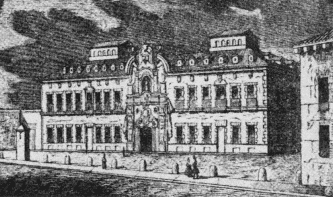
Figure 11.
The Hospicio of San Fernando. From Miguel Granell
y Forcadel, Historia de la enseñanza del Colegio Nacional de Sordomudos
desde el año 1794 al 1932 (Madrid: Colegio Nacional de
Sordomudos, 1932). Biblioteca Nacional, Madrid.
explanation was that the students had been installed in the poorhouse "so that through this establishment they can be destined to the ends to which they may be useful according to the fiscal situation." In practice, this translated as teaching them to weave.175
At the Hospicio the deaf Youths were "reduced to an exceedingly scanty ration, suffering continuous hunger, sicknesses of the stomach, and nudity," according to Antonio Ugena, who along with Roberto Prádez had accompanied them there.176 Eventually they were obliged to beg in the street.177 There they joined countless others in a "spectacle of desperation and anguish," as one eyewitness recounted:
Men, women, and children of all walks of life, abandoning their miserable dwellings, dragging themselves dying to the street to implore public charity, to snatch even a vegetable stem that normally would be thrown in the garbage, a piece of moldy cracker, a potato, a broth some wretched shopkeeper might offer them to forestall for an instant their wasting away and their death ... infinite numbers of people expiring in the middle of the street and in broad daylight, the laments of women and children beside the cadavers of their parents and siblings laid out on the sidewalks, which were hauled away twice a day in carts from the parishes; the prolonged, universal, and piteous groan of supreme agony of so many miserable ones.... The very atmosphere, impregnated with foul-smeling gases, seemed to spread a funereal shroud over the entire population.178
The grisly scenes were immortalized by Francisco Goya, the celebrated artist who by this time had himself become deaf as the result of
Figure 12.
Francisco Goya, "Cartloads for the cemetery." Reproduced in
Philip Hofer, The Disasters of War by Francisco Goya y Lucientes (New York:
Dover Publications, 1967).
Figure 13.
Francisco Goya, "It is no use shouting." Reproduced in Philip
Hofer, The Disasters of War by Francisco Goya y Lucientes (New York: Dover
Publications, 1967).
an illness, in a series of engravings known as the "Disasters of War."179
By the summer of 1812 three deaf students had died: Domingo Pérez, Manuel Muñoz, and José Hernández, who in better times had threatened Lieutenant Colonel Loftus with an inkwell. The others were in imminent danger of suffering the same fate.180 Before the establishment would reopen, the majority would succumb to hunger and exposure.181
At the outbreak of the war of independence, some Spaniards in the occupied territories had aligned themselves with the French. A sizable number of those who sided with the intruder did so out of convenience, motivated, for instance, by the desire to remain with their families or to continue in their jobs under the new government; others, however, did so out of patriotism and idealism, for they were convinced that their country's best hope for salvation lay in the possibilities of reform offered by the French monarch. Indeed, many of Spain's most talented and enlightened citizens, horrified at the excesses of the anti-French riots of 1808, were persuaded that the invader held the key to their nation's regeneration, and thus they chose willingly to collaborate. The afrancesados, or "Frenchified" Spaniards, included writers, journalists, cultured bureaucrats, reformists, radical intellectuals, and members of the liberal clergy; among their ranks was the abate José Miguel Alea. His views on government were clear—" Despotism is, in my view, one of the primary causes (perchance the only one) of all the disturbances experienced and suffered by the nations that destiny subjected to its yoke," he declared182 —and most likely he saw in the French government of occupation Spain's best shot at enlightened rule.
During the reign of Joseph Bonaparte, Alea was appointed Royal Archivist;183 he served as literary collaborator to the official Gaceta de Madrid, 184 and he became an intimate advisor to Spain's French king.185 And during these years Alea was put in charge of instruction at the Royal School. To judge from the record, however, it seems doubtful that he did much actual teaching. The year 1810 found him in Seville, where he headed a special committee sent to survey paintings that had been confiscated from Sevillian convents and churches by representatives of the occupation government. The best of the canvases were to be transported to the Alcázar, Seville's ancient Moorish palace, and the task of selection had been entrusted to none other than José Miguel Alea.186
In the fall of 1811 the abate was reported to be "indisposed" and unable to attend to his teaching, and August 1812. found him again absent from Madrid.187 Deaf education in Spain did not cease entirely during the war years, however, but after the closing of the Royal School in 1811, it appears that what teaching did occur must be credited in great measure not to Alea but to Roberto Prádez, who had remained with the students first at the municipal school of San Ildefonso and then at the Hospicio. Although Alea was nominally in charge of instruction, during this period he seems to have spent more time collaborating than teaching. In truth, his greatest contribution to the advancement of deaf Spaniards was as an enlightened linguist who publicized and promoted their cause, and as an author and translator of texts for their instruction, rather than as a classroom teacher.
The war of independence came to an end when French troops, defeated in March 1813 at the battle of Vitoria, withdrew from Spanish soil. The retreating soldiers were followed across the Pyrenees by twelve thousand Spanish families who had served the French king. The émigrés included prominent writers, distinguished men of science and the professions, the nation's most able bureaucrats, and at least one friend of Spanish deaf people, the abate José Miguel Alea.188
Alea established residence in Marseilles, where he taught Spanish and Portuguese language and literature at the Collège Royal, the Ecole Spéciale de Commerce, and the Institution Méry-Combaz, and continued his lifelong work as a translator.189 He would never again teach deaf students, but he continued to write on the topic of their education. Prompted by a literary contest sponsored by the Royal Academy of Sciences that was announced in Parisian newspapers in September 1817, the former head teacher of the Royal School composed a eulogy to the abbé de I'Epée.190 In his essay Alea defended a thesis he had presented before the Friends of the Country some twenty years earlier, namely, that the system of methodical signs should be considered as the true model for general elementary instruction.191 The point was not that hearing children should learn sign language—although Alea espoused its virtues as a universal means of communication and advocated its use as such by all nations—but rather, that the pedagogical principles of the abbé de l'Epée's method should be observed. Instruction should be characterized by a spirit of analysis, and by a progression from the
simple to the complex and from the known to the unknown, with the reduction of complex ideas to their most basic elements, and without omission of intermediate steps. Eventually Alea decided against entering the contest, however, because, as he later explained, he was convinced someone else would surely write on this same topic. Only when he discovered that no one had done so did he consider publishing his essay. But before taking that step, he first submitted his manuscript to the Academic Circle of Marseilles, of which he was by now an honorary member. The society pronounced his work superior to that of the winner, Sicard's godson and protégé Roch-Ambroise Bébian, and that of the runner-up, a certain M. Bazot.192 In view of this judgment Alea determined to publish his essay. When it appeared in print in 1824, the author was at work on a dictionary of analogical signs, which he said was by then "well advanced."193
Afrancesados who at the conclusion of the war had quit Spain for France were allowed back in 1820, but José Miguel Alea was not among those who returned, and apparently he never again set foot in the country of his birth.194 He was listed among the personnel of the Collège Royal in Marseilles up through 1830, and his life: ended around that time in his adopted homeland.195 There the abate reportedly died in poverty and by his own hand, drowning himself in a river.196 Spanish deaf people would not have another champion of his intellectual stature for the remainder of the nineteenth century.
Alea had been his nation's most eloquent supporter of deaf education and its foremost authority on the subject. He had brought the plight of deaf Spaniards to the attention of the general public, defending their language and their schools and effectively refuting age-old prejudices concerning their capacity for abstract thought. He had set the stage for the scientific investigation of their language acquisition and their instruction. And he had played a leading role in the first decade of life of the institution destined to spread their instruction throughout the kingdom.
But during Spain's war of independence Alea had cast his lot with the supporters of Joseph Bonaparte, and for this, there was a price to pay. For years after that conflict, Spaniards who had sided with the intruder were regarded as traitors. As nationalistic pride reasserted itself, "patriotism" took precedence over pedagogy, and the French approach to deaf instruction, to which Alea had been sympathetic, was rejected out of hand. Thus, the abate's work was swept aside and ignored, as much because of its French methodological orientation as because of the
author's conduct during the war. But in truth, when it came to deaf education, Alea was a balanced, patriotic Spaniard, well aware of his nation's tradition and proud of it, as evidenced by his praise of the early Spanish teachers, and the accolades he bestowed on the deaf youth Gregorio Santa Fe and his enigmatic tutor Diego Vidal. Furthermore, he was not uncritical of the French abbés, and when it was time to teach articulation, he looked to the work of his countryman Juan Pablo Bonet. But balance and discernment counted for naught in the face of his historic imprudence, and during the postwar period, the foundations he had laid for the empirical study of deaf education, sign language, and language acquisition were lost. Indeed, for decades after his departure from his homeland, the name of José Miguel Alea was conspicuously absent from certain Spanish accounts of the history of deaf education.197 And when the Madrid school reopened in 1814, it threw out the French manualist approach and went back to the rigid, oralist pedagogy of Bonet's Arte .
With men like Roberto Prádez and José Miguel Alea on board, the future of the Royal School had seemed bright indeed. But the establishment got off to a slow start and was soon derailed by the war of independence. The conclusion of that conflict found Spain's leading expert on deaf education on the other side of the Pyrenees, leaving us to wonder what might have been, had the work begun by the abate Alea been allowed space and time to develop.
Chapter 6
Return to Oralism and Descent into Chaos
1814–1835
In what constitutes the essence of this science, nothing has surpassed what the Spaniards taught in the Golden Age of our literature.
—Tiburcio Hernández
If they do not leave magnificently educated, at least they will take with them the means to subsist.
—Tiburcio Hernández
When the Royal School was reestablished in 1814, Tiburcio Hernández, the new head master, decreed a return to Spanish oralism, a politically motivated decision that significantly altered the course of deaf education in Spain. The experiment was short-lived, however, for less than a decade later Hernández himself became a victim of Spanish politics when he found himself sentenced to death. The instruction of deaf people was disrupted yet again, and the Madrid institute began a descent into chaos that did not end until 1835, when order was restored, and the preprofessional period of deaf education came to an end.
Following the war of independence, the Royal School reopened in May 1814, once again under the auspices of the Friends of the Country. The few surviving students, along with Prádez, the art teacher, and Ugena, the servant, left the Hospicio for the establishment's new location at number eleven on the Calle del Turco, a building that had formerly served as a glass warehouse.1 The official opening ceremony was held in
Figure 14.
Royal School for Deaf-mutes, on the Calle del
Turco. From Miguel Granell y Forcadell, Historia de la enseñanza
del Colegio Nacional de Sordomudos desde el año 1794 al
1932 (Madrid: Colegio Nacional de Sordomudos, 1932). Biblioteca
Nacional Madrid.
October of that year and featured speeches by the duke of Híjar, then director of the Royal Economic Society of Friends of the Country, and by Tiburcio Hernández, the new head teacher.
Tiburcio Hernández y Hernández had joined the Friends of the Country a decade prior to taking charge of instruction at the Royal School.2 He had served together with José Miguel Alea on the establishment's board of directors, but the two men could hardly have been more different. Alea was a man of the Church and an intellectual who supported himself with his pen, while Hernández held a law degree from the University of Alcalá de Henares, and was a member of the Colegio de Abogados, lawyer to the Royal Council, and relator to the Sala de Alcaldes de Casa y Corte, the body charged with criminal jurisdiction in Madrid and its environs, second in importance only to the powerful Council of Castile.3 As an abate Alea was bound by vows of chastity, but his successor was a married man and the father of two children, María Antonia Jacoba and Antonio Fernando, both of whom would follow in
their father's footsteps to become educators of deaf children.4 By the time the Royal School reopened in 1814, Hernández was in his early forties; Alea, who had fled to France one year earlier, was in his mid-fifties.5 And while the older man had concerned himself with "general laws of the art of criticism," seeking reason, moderation, and decency as his guide, the younger one would prove to be a fiery, flamboyant orator, plain-spoken to the point of bluntness, with little use for tact or diplomacy, boasting that his "never prostituted pen" would "tell the truth in energetic tones."6 Nevertheless, the two men shared an interest in education—Alea had written at length on the topic, and Hernández maintained that the Friends of the Country's first priority should be to establish a normal school to train teachers with the best methods available and produce elementary texts, for he held that teaching was the nation's most important profession.7
In the instruction of deaf people, Alea, as we have seen, had drawn freely from a variety of sources, using Bonet's Arte to loosen deaf tongues but favoring the French method to educate deaf minds. Tiburcio Hernández would scrap this eclectic approach, rejecting the French system altogether and reverting instead to methods advocated by Juan Pablo Bonet two hundred years earlier. The new head teacher's motives for returning to the earlier Spanish tradition were more political than pedagogical: the country that had so recently expelled the French forces of occupation was ill-disposed to employ that nation's pedagogy. During the eighteenth century many Spanish intellectuals had looked to France for guidance, but after the Napoleonic invasion the French model was out of the question, and some Spaniards—patriot Hernández among them—would now seek inspiration in an idealized vision of their nation's glorious past. Indeed, Hernández went so far as to claim that the method used in France to teach deaf people during the 1700s was essentially no different from that employed by Pedro Ponce two centuries earlier, contending that "in what constitutes the essence of this science, nothing has surpassed what the Spaniards taught in the Golden Age of our literature."8 But in the intervening centuries the Spanish doctrine had been corrupted by foreign influence, he believed, and he set out to remedy this situation by studying Bonet's Arte .9
The result was the Plan de enseñar a los sordomudos el idioma español (Plan to teach deaf-mutes the Spanish language), which was now adopted by the Royal School. Hernández had composed the manual during the war of independence, inspired, he explained, by an "interest in the welfare of deaf-mutes, coupled with the necessity to which the terror
condemned us of not attending public gatherings or going out at night except in case of emergency."10 He had submitted his work to the school's governing board in 1809, but apparently that body did not deign to consider it, for a resentful Hernández later complained that his offering had been "elaborated with earnestness and scorned to the extreme of not even being reproved"11 —in all likelihood because of political as well as pedagogical differences between the author and fellow board members. But Hernández eventually found a way to bypass the board and in 1811, even as the Friends of the Country labored to relieve themselves of responsibility for their deaf charges (an effort that, it will be remembered, culminated in the children's move first to the municipal school of San Ildefonso, then to the Hospicio), a special committee, which included no members or former members of the board save the society's director, was named to examine Hernández's Plan . The acting teacher, José Miguel Alea, protested that according to established tradition, anything concerning the school should be evaluated by the board, and he attempted to have two or three of its most senior members appointed to the committee that would pass judgment on Hernández's manuscript, apparently to no avail.12 The Plan was finally approved, but not until 1814,13 by which time Spain's political situation, and along with it circumstances at the Economic Society, had changed dramatically. The reign of Joseph Bonaparte had ended, and the afrancesados no longer held sway among the Friends of the Country. Alea had been forced to emigrate and Hernández had been named to succeed him at the Royal School. The composition of the board of directors, too, had changed almost completely since the new head teacher had first submitted his work in 1809, for when the establishment reopened in 1814, the nine-member board now included only two of the men who had sat on it five years earlier, a certain Manuel de la Viña, and Tiburcio Hernández himself. And the ouster of French sympathizers from the Economic Society was soon followed by the ouster of French methodology from the classroom.
If the choice of the Spanish tradition over the French was understandable, given the political mood of the times, one question still remained. Why should Hernández have preferred Bonet's approach over that of Hervás y Panduro, whose book he had also read?14 Bonet's Arte continued to be rare,15 but his fame as a teacher of deaf people far exceeded Hervás's. (After all, de l'Epée himself had acknowledged his debt to Bonet.) Thus, Hernández may have been influenced by Bonet's greater prestige, which, coupled with his own lack of firsthand
knowledge about the teaching—at the time his Plan was approved, it had yet to be tried with deaf children—may have moved him to opt for the method contained in the Arte .16
Hernández's view of deaf people could have also led him to favor Bonet's approach over Hervás's. It is evident from his writings that the Madrid school's new teacher viewed deaf people primarily as defectives, and like Bonet before him, he defined the lack of audition as "an illness."17 The equation of deafness with illness and pathology often goes hand in hand with an unwillingness to accept deaf people—and their language—on their own terms, and this in turn influences the choice of pedagogy. According to this school of thought, if the illness cannot be cured, that is, if hearing cannot be restored, the solution lies in getting deaf people to lip-read and to talk.18 Moreover, it is often expected that such individuals, once rehabilitated, will abandon their sign language—which Hernández dismissed as a mere "shorthand of gestures," and supplementary to the language of articulated sounds."19 This way, so the reasoning goes, deaf people will at least be less conspicuous, and they will blend in and appear to be as much like "normal" people as possible. Bonet's emphasis on speech and his adamant rejection of signs were compatible with the pathological view of deafness and the concomitant suppression of sign language. In contrast, Hervás's ready acceptance of deaf people's language as the foundation of their instruction—and indeed, the pleasure he took in observing them communicate manually—is compatible with the view of deaf people as members of a linguistic minority, whose language is neither better nor worse than that of the hearing majority. For Hernández, the choice between the two approaches must have been obvious. If the "illness" could not be cured, with Bonet's method it would at least be dissimulated; the "defect," if not totally eliminated, would at least be rendered less obvious.
Finally, Bonet's approach offered what may have been perceived as yet another advantage over Hervás y Panduro's. Its emphasis on speech dovetailed with the official state policy of employing Castilian Spanish as the sole language of instruction, a measure intended to promote national unity. The Methodical Spanish of the Royal School's first decade of existence had been but a manual translation of the national tongue, a pale imitation, but the Arte promised to deliver the genuine article, thus bringing deaf education more closely into line with that of other linguistic minorities. In compliance with the kingdom's longstanding mandate, deaf Spaniards would now be taught in the same fash-
ion as speakers of Spain's "other" languages like the Basques, the Galicians, and the Catalans, for example.
While we may never know for sure why Hernández selected Bonet's method over Hervás's, this much is certain. Upon adopting the new teacher's Plan, the Royal School for the second time missed an opportunity to employ a well thought-out approach that began with the language of deaf people themselves, bypassing both the rigid oralism of Bonet and the complicated methodical signs of the French abbés.
As was entirely befitting one who equated deafness with illness, Hernández, before ever attempting to teach the deaf children of the Madrid institute, had sought to cure them. "If someone were to say it would have been better to think about curing muteness than about teaching mutes, let it be known that my earliest efforts were directed toward this end," he explained.20 Those efforts dated from November 1808, that is, shortly after Hernández joined the school's governing board.21 The lawyer-turned-teacher claimed to have noted that deaf-mutes had very little of "the humor we call wax," and what there was lay deep within the ear, and it was almost liquid. These individuals, he stated, rarely—if ever—cleaned their ears with their little fingers or some other object. His observations led him to suspect an obstruction of the canal through which the humor was intended to flow, and this obstruction, he reasoned, might be the cause of deafness.22
After consulting with a medical doctor, Antonio Torrecilla, Hernández devised an experiment. At bedtime at the Royal School, steam was funneled into students' ears, which were then covered with a cloth. The water temperature and duration of the treatment were gradually increased for twenty days, then decreased for another twenty. "The results," Hernández exulted in February 1809, "have exceeded my expectations."23 Angel Machado, the teaching assistant, reported that after but two sessions Jacobo Moreno felt pain behind the ears when the vapor was administered and a sensation that ran through his chest, and Juan Alvarez trembled at the noise he heard—and the pain. After ten days, Machado informed Hernández that Alvarez could hear shouts at a distance of four to six paces, as could Manuel Muñoz, and Domingo Pérez, who before had heard in only one ear, could now hear in both. By the twenty-third day of the experiment, it was reported that Jacobo Moreno, Manuel Echevarría, and Ramón Vidal had likewise begun to hear. The treatment was interrupted, however, from late November through early December when Joseph Bonaparte, at the head of his
troops, entered the Spanish capital.24 But by mid-December the experiments had resumed, and Hernández was notified that Juan Alvarez, Domingo Pérez and Manuel Muñoz could hear words, many of which Muñoz could also repeat.
The man whose first priority was to find a cure for deafness was initially reluctant to accept these results at face value, surmising that the effects Machado described might be attributable to factors other than the restoration of audition. "I have seen that deaf-mutes, without hearing noises, suddenly turn their heads in the direction of a sound, which may be due to the vibration of the air," he wrote. "Because of a vehement desire to comprehend what is said to them, which for their good fortune they possess, they are not reliable witnesses as to whether they have understood something or not," he continued, "and as for the things they have understood, it is very difficult to ascertain how they did it, because the lack of one sense is, it seems, compensated for by the extraordinary sensitivity of the others."25 In order to probe further the results of his experiment, Hernández shut himself in a room with several deaf students, positioning them so they could not see the door, and when an assistant stationed outside knocked, now softly, now loudly, the youngsters were able to count the knocks on their fingers with no mistakes. And by now several could also repeat some words whose meaning was familiar.
The outcome of this last experiment sufficed to convince Hernández of the effectiveness of his treatment. "I believe I can affirm that in many deaf-mutes, deafness is due to an obstruction of the auditory canal, and based on the result of these first tests, I do not consider their cure to be hopeless," he concluded.26
This writer would later boast—inaccurately, as it turns out—that his experiments had antedated those of the celebrated French doctor Jean-Marc Itard, of the Paris Institute for the Deaf. Itard had initiated his efforts at auditory rehabilitation in 1805, although perhaps unbeknownst to Hernández. It seems unlikely, however, that the Spaniard could have been unaware of a paper by Itard on auricular training that was read at the Economic Society in 1807.27 Nevertheless, Hernández complained that the French physician had appropriated his methods. The Friends of the Country published the results of Hernández's investigation in 1809, and the author later recounted, "I received 1,000 acknowledgments from the most learned persons and a French doctor visited me several times, bombarding me with ponderings and demanding the explanation of my experiments. Three years later Mr.
Itard ... came out with the account of a cure, published on November 11, 1811, whose only note of originality has been to add to my invention the notable peculiarity of perforating the ear; that is, that professor would endeavour to persuade us that he has cured a sense by destroying its mechanism, like one who would cure visual ailments by removing the eyes. And to think the ambition for glory goes so far as to regard with contempt the censure of all nations!" Hernández fumed.28
When the Madrid school reopened in 1814, five years after Henández had first undertaken his experiments, we find him still seeking a cure for deafness and calling for the continuation of the research.29 (By 1816 he would abandon any pretense of curing his pupils by directing steam into their ears, however, having concluded that "the most general causes of deafness ... cannot be ascertained without discovering in practical fashion the anatomical particulars"; to that end, he now advocated the dissection of deaf cadavers.)30 But as head teacher, Hernández's job was to minister to those students whose hearing had not been restored. To instruct his "uncured" disciples he used his Plan de enseñar a los sordomudos el idioma español . The text was divided into ten chapters. Borrowing liberally from Bonet's Arte, it began by teaching the written letters and their corresponding hand shapes in the manual alphabet, together with their pronunciation. Hernández made virtually no use of the finger alphabet, however, relying on it only to "assist the mute's memory" or to reach those in whom "a defect of organization or the disciple's absolute dullness of intellect makes its use necessary."31 The Plan next progressed to the teaching of syllables, then vocabulary and the parts of speech, and it ended with a discussion of how to promote students' command of spoken and written Spanish. Descriptions of articulation were clearly based on Bonet's, but Hernández parted company with the author of the Arte when he shunned the leather tongue, noting that it was not possible to represent its position in relation to the lips, teeth, and so on. He also vetoed the mirror, arguing that it could not reveal the inside of the mouth, unless the teacher resorted to affectation and ridiculous grimaces. He further stipulated that the instructor should never touch the student's mouth, either with his fingers or with any type of instrument. In lieu of these familiar methods he proposed the use of engravings to illustrate articulation of the various sounds. Although Hernández never acknowledged the source of his inspiration, this suggestion had appeared two decades earlier in Hervás y Panduro's Escuela española de sordomudos .32
For teaching speech, Hernández offered the usual advice. The teacher should sit facing the light, the student should sit facing the teacher so as to see the position of his lips, tongue, teeth, and so on. He counseled that in the early stages, it was best to instruct only one pupil at a time, lest the slower ones become resentful of their more advanced companions: "With all children, and especially with mutes, the teacher's main task is to avoid arousing violent passions in them," he cautioned.33 The need to work with deaf students in small groups or even one-on-one when teaching articulation did not constitute a problem for private tutors like Ponce and Ramrez de Carrión, but in public schools with many children, such individual attention would of necessity take up an inordinate amount of time. Indeed, these were precisely the considerations that had led the abbé de l'Epée to judge speech lessons impractical for his deaf pupils.
In matters of articulation, Hernández was a demanding taskmaster. He borrowed Bonet's analogy of the musical instrument, but his criteria for "tuning" were much stricter. While Bonet had depicted both master and disciple as musicians striving to tune their respective instruments to the same pitch when neither one could hear the other, Hernández reserved the role of tuner for the teacher alone and assigned to the mute the passive role of instrument, remarking that "if [the instrument] is not tuned to perfection, it will sound harsh." He insisted that each sound must be produced "without regard for the bother it occasions the disciple and the number of repetitions required, without excusing him in the least until he pronounces the letter in question correctly" (13). (After just two years of experience, however, Hernández had modified his expectations considerably: "[Deaf-mutes'] teachers are, in a manner of speaking ... musicians who wield instruments incapable of being tuned," he wrote. "Experience has taught me that if many efforts are expended to correct [pronunciation] defects, [students] only fall into other greater ones, or lose what progress they have made," he stated, allowing that "the music of a language depends on ... the usual way of pronunciation; and since for the mute the national tongue is a dead language, if he does not hit the right tone by chance, it is impossible to teach it to him.")34 . Yet Hernández never doubted that deaf children, assuming they had no defect of the speech organs, should be taught to speak: "They will talk provided their intelligence is stimulated," he affirmed (4). And to loosen ligaments unaccustomed to speech and thus increase agility in articulation, he advocated that pupils carry a fruit pit or a toothpick in their mouths, "turning it round and round as do those who have this vice" (97).
Concerning the feasibility of teaching deaf people to lip-read, Hernández disagreed with Bonet. While Bonet had maintained that this skill could not be taught, Hernández asserted that "with proper guidance and practice, [deaf people] exercise this faculty with the same facility with which we [hearing people] read." The only difference, he proclaimed, was between reading an "inanimate book" and an "animate" one (4). Nevertheless, he advised the teacher to refrain from speaking during the course of the mute's instruction in articulation and grammar, reasoning that the student would not yet have sufficient command of Spanish to comprehend what was said and would thus lose confidence in his own abilities, and with it his enthusiasm for learning. But once instructed in the language, Hernández hypothesized, the pupil would supplement whatever he missed in lipreading with his own linguistic knowledge, supplying through intelligent guesswork what the lips alone did not reveal.35
Not only was Hernández convinced that lipreading could be taught, he maintained that this skill could be acquired only through instruction, and he discounted the possibility of unschooled deaf persons who could lip-read. The only uninstructed mutes who have understood from the movement of the lips, he argued, were those who "because they were accustomed to dealing with certain persons, or because they had some previous knowledge of the substance of a given discourse, deduced what was said or what was ordered of them. This is the most that can be conceded," he believed (107). To prove his point, he related an anecdote (attributed to "a reliable person") about a mute, the cousin or brother of a presbyter, who lived a short distance from Madrid. This deaf youth, after visiting the home of two individuals from the town, deduced correctly, and even announced to his circle of friends, that there was to be a wedding, and that time was of the essence, due to the bride's physical condition. "And what would he have understood from the action of the lips?" Hernández asked sarcastically. "It is certain that for such comprehension they need not be taught, but to my way of thinking," he declared, "the conclusion that the mute understood from the movement of the lips is false." How, then, to account for the deaf lad's feat? "In the final analysis," Hernández asserted, "[this] is not understanding from the movement of the lips, but rather, it reveals a depth of observation and reasoning, with a streak of great malice, which is common to all mutes" (107–108).36
In its pedagogy the Plan relied heavily on rote learning—small wonder Alea had opposed its adoption when the author first submitted it to the Friends of the Country. Hernández acknowledged that such
memorization was "arid" and "extremely tedious" and that what students learned in this fashion would be easily forgotten, yet he nevertheless insisted, "There is no way to save steps, or to spare them from it" (45). The Plan provided little in the way of grammatical explanations, and the few it contained were always presented by way of demonstration, for the object, Hernández wrote, was not to "tire [the learner] with rules" (43). He held that the pupil would by himself "deduce with time the rules which, if given by the teacher, would have confused him," and for this reason he omitted even the simplest generalizations (62). For instance, students were expected to memorize the grammatical gender of every noun they encountered, unaided by straightforward guidelines such as, words ending in -a are usually feminine, and words ending in -o are usually masculine. Similarly, students were left to ferret out for themselves the rule for forming the plural of nouns: add -s if the word ends in a vowel, otherwise add -es . Bonet's Arte, in contrast, had provided a clear account of grammatical gender and pluralization.37
During the early stages of instruction, pupils must have understood little, if anything at all, but Hernández, like Bonet before him, trusted that comprehension would eventually come by itself. For instance, verbs were assigned to lists entitled "pertaining to men" and "pertaining to women" according to the gender of their presumed subjects, but these lists were presented "without bothering that they understand at first the meaning of said titles," in the belief that "they will take effect someday" (55). And verbs whose meaning could not be acted out were simply not taught at all.
To hasten their learning, students were often made to write words and paradigms, but for the teaching of prepositions and conjunctions, Hernández, while continuing to insist that memorization held the key, suggested a way to "sweeten" the process by exciting learners' interest and amusing them (85). Having noted that the pupils were highly skilled at card games—so much so that the head teacher himself was unable to trick them—he wrote on each card in the deck a maxim containing a preposition or conjunction, granting students access to the cards only after they had memorized all the savings and could pronounce them and act out their meaning. Proficient scholars were rewarded with a permit allowing them to play with the deck in their free time, and made to consider this a great privilege. The teacher cautioned, however, that care must be taken to curb any sign of excess, and to see that pupils never played for money or bet anything more than their desserts.
In addition to teaching prepositions and conjunctions "without fatigue," Hernández assured his readers that the method also provided a useful measure of education, for the maxims were designed to imbue the young card sharks with proper manners as well. The words to live by included the following: five of hearts: "Eat your soup with a spoon, and your stew with a fork"; seven of diamonds: "Upon seeing someone enter the room, stand up, and even if he tells you to be seated, don't cross your legs"; eight of diamonds: "Among your diversions, don't harm anyone, or soil your clothes"; queen of spades: "After blowing your nose, don't look at the snot, since to do so is disgusting" (88, 87, 91).
For Hernández, the ultimate goal of this instruction was to teach students to speak, lip-read, and express themselves in writing. Once acquainted with Spanish grammar, they were to begin writing diaries describing familiar activities. (Here again the author of the Plan took his lead from Bonet.) Their initial attempts, he wrote, would provoke laughter, but he cautioned against making fun of them, observing that "man is hurt when his efforts are belittled" (108). The teacher was to amend each error by patiently repeating the correction until the learner grasped it, or until it was clear that he could not, for as Hernández explained, "it is not desirable to torture the understanding" (109). And when the original composition had been completely revised, the pupil was to recopy it.
Although Hernández's Plan did not make use of Spanish Sign Language, it did allow for natural gestures in the beginning stages. But once the rudiments of grammar had been presented, the author recommended—again following Bonet—that students be obliged to make all requests orally, and he counseled teachers to pretend not to understand their signs and gestures. "[The disciple] will make foolish mistakes, it is true, but it is by making them that we all learn our language," he wrote (109). As soon as the children could write fairly well, they were to be taught to lip-read and to respond orally to common phrases, set forth in the form of a dialogue. Their next hurdle was to communicate via speech and lipreading with the school's employees and outside visitors. The objective was to induce pupils to give up their signing and talk, and staff members were expected to feign incomprehension until the deaf youngsters expressed themselves aloud. "I consider that in this situation the mutes will have a kind of furor to speak, and from this great benefit, with which no one at the school should interfere, will accrue admirable advantage, for the persons with whom they converse will perfect their instruction through the care they take to understand them,"
Hernández wrote (110). In requiring that hearing persons use speech to communicate with deaf students, Hernández showed himself to be even more of an oralist than Bonet, who had advocated that members of a deaf person's household address him by way of finger spelling.
This portion of the instructional program concluded by having students converse with their teacher for half an hour each day on trivial matters that were easy to comprehend; once they could do this satisfactorily, they progressed to taking oral dictation on these same topics.
Just as the title implied, the Plan de enseñar a los sordomudos el idioma español was concerned solely with teaching deaf children the Spanish language, an educational goal entirely in keeping with the author's beliefs. The educator of deaf students should not venture beyond language instruction, Hernández maintained, for to do so constituted nothing less than abuse. Moreover, he favored "reducing" the target language as much as possible, reasoning that "the greater the burden, the greater the impossibility of progress."38 Yet even with these limited objectives, Hernández soon found himself obliged to incorporate manual signs into his teaching, signs that functioned as, in his words, the "interpreter of the communication of knowledge".39 Initially he employed only the students' own gestures: "With regard to signs, I adopt no conventional ones ... [but] I do observe those the disciple uses, and I try to retain them in my memory to make myself understood to him," he explained in 1816.40 But by 1820 he was using methodical signs as well41 —around this same time he requested copies of de l'Epée and Sicard's manuals42 —and the following year he pronounced himself in favor of a combined method, albeit diffidently: "I do not know if I am mistaken," he wrote, "but I believe ... with all due respect to those who think differently, that the least defective way of teaching mutes is to combine manual signs and written signs with sounds."43
When he first began teaching, Hernández apparently assumed that the language of deaf Spaniards was transparent and readily comprehended, a naive view that can be maintained only by those who have had little or no contact with sign language. Deaf students "have the ability to be so picturesque in their gestures that, even though one may not deal with them, they are easily understood," he wrote in 1816, seeming to imply that sign language consisted of little more than pantomime.44 But a few years later he conceded that the "language of action" was far from transparent, adding that hearing observers can comprehend but a "minimal part" of it.45 Even so, he remained convinced that the spoken word was the "Ideal signifier," and based on this chauvinistic view of
speech, he reached the patently absurd conclusion that manual communication was "absolutely useless for anyone who has no natural or artificial idea of sound" (8).
For Hernández, then, there was simply no getting around it: deaf people had to learn to talk. The training was long and arduous, and he did not deceive himself about the results: "Two things can easily happen," he explained. "First, the disciple after much work may not be able to form the sounds. Second, he may form them defectively. From the former it follows that he is absolutely useless for this instruction; and from the latter, that he will pronounce badly, that is, in a fashion that is [only] more or less intelligible," he wrote (8). "Those who learned the sounds defectively will not speak clearly," he continued, "they will be scarcely intelligible to those unaccustomed to their speech, but they will form an idea of manual and written signs, and they will enter at last into our artificial way of thought and communication" (9).
Speech training, as Hernández recognized, was not especially pleasant, nor was it necessary for deaf people to communicate among themselves—for that purpose, their sign language has always served them beautifully—but rather, it was for the benefit of the hearing: "Working a great deal with these unfortunate ones, not so that they might understand each other, but that we [hearing people] may understand them, we make them suffer great pains," he acknowledged (10). And what was in it for deaf people? Once they could talk, Hernández predicted, they would be able to "partake of social pleasures, and sally forth from the colony that limited their communication to that of other participants of their misfortune" (7). In other words, they could assimilate to the society and culture of the hearing majority.
Although convinced of the desirability of speech training, Hernández nevertheless knew there was no correlation between a pupil's ability to pronounce well and his intelligence. "I have disciples who have been taught by the same method, [yet] some speak more clearly than others," he explained, concluding that a student's merit could not be judged by the intelligibility of his speech. By way of illustration, he noted that while Agustán Peláez was the pupil who pronounced most clearly, his intelligence was no match for that of another, Manuel Echevarráa.46
And well might Hernández defend young Echevarría, his less-than-perfect pronunciation notwithstanding, for he was Hernández's most accomplished student. At the school's public examination in 1816, Echevarría performed brilliantly, displaying his knowledge of Spanish grammar, geometry, and religion.47 He was asked difficult questions
concerning abstract ideas and the Trinity, and when he answered well, his examiners reproached him, deliberately trying to rattle him, but still he came through admirably, and was lauded as "his teacher's laurel."48 Little documentation remains in the archives of the Economic Society concerning Echevarría. There is an account of his first confession, a note he penned to Hernández denying that he and his classmates had been spitting out the windows at passers-by in the street, and a few other items.49 Yet despite the paucity of information, this much is clear: Tiburcio Hernández's "laurel" had had other teachers before him, for he had been among the students sent to the Hospicio in 1811.50 There he was no doubt instructed by Roberto Prádez, and prior to that, he had quite likely been taught by José Miguel Alea, and possibly by Lieutenant Colonel Loftus as well. Thus, he had had at least three or four years of schooling under one or more instructors before he came under Hernández's tutelage.
When the emphasis at the Royal School shifted to artificial articulation, this change brought about the predictable result. Because the training is so time-consuming, it is all too often imparted at the expense of intellectual formation, and under Hernández, a major portion of students' academic preparation seems to have been sacrificed on the altar of articulation. True, the Reglamento prescribed instruction in reading, writing, arithmetic, grammar and orthography, elementary geometry, drawing, and religion, in addition to articulation and lipreading,51 but it was plain that for this follower of Bonet, what mattered most was speech. "When the disciple is able to talk, he will become a philosopher, he will become a mathematician, and he will learn whatever we want to teach him, but these disciplines cannot be characterized as essential or as related to the marvelous art of overcoming the obstacles of muteness," he wrote.52 The instructor's task, as he saw it, was to teach deaf people enough Spanish to enable them to receive academic and religious instruction, but it did not entail actually teaching such subjects. If speech was this teacher's first priority, vocational training, not academics, was the second: "Let us not expect to make of them orators, historians, or philosophers," he urged, "but let us turn our attention toward their usefulness in the social order. Once they learn to communicate with us more or less well, depending on their respective dispositions, let us try to teach them to earn a living" (10).
And for what sort of work should they be prepared? "They are very well suited for the imitative arts and for mechanical labor," Hernández opined. While this characterization was no doubt related to the students'
socioeconomic level, their teacher clearly believed they were capable of little else: "Their academic instruction," he claimed, "does not outlast the lesson" (11). Hernández's lackluster results were most likely attributable to his preference for articulation over cultivation of the mind, but apparently he never made the connection. "Their free time," he advised, "they will put to good use learning crafts and trades, [so that] when they depart from the school, if they do not leave magnificently educated, at least they will take with them the means to subsist" (11).53
In an approach that placed such a high premium on speech, what provisions were made for students who, for one reason or another, simply could not learn to talk? Hernández judged them to be of two types: those suffering from organic defects that rendered articulation impossible, and those afflicted with a "kind of fatuity, which is dreadful." The former he deemed capable of limited instruction, but the latter he considered "sick people," mentally defective, and he concluded that "it is necessary, although painful, to abandon them" (8). Thus, if their teacher attributed their inability to speak to "fatuity," these students ran the risk of dismissal.
During these years, the Royal School's economic situation continued to be precarious. Monies from the bishoprics of Cadiz and Sigüenza generally arrived about a year and a half after they were due, and although paying students' fees provided an additional source of revenue, the result, as Hernández noted, was a debt amounting to "a terrible sum," and a predicament "capable of contributing to the absolute decline of the school." Physical conditions too left much to be desired, for the establishment was housed, according to head teacher Hernández, "in a small enclosure with only two wretched patios; in a house whose winter dormitories have extremely low ceilings, and with rooms situated so that they cannot be inspected unannounced" (12). (Nevertheless, Don Tiburcio noted with satisfaction, the boys lodged in this less-than-ideal setting had suffered neither illness nor vices, thanks to the constant vigilance of the school's spiritual advisor, Vicente Villanova y Jordán [12–13].) Moreover, the Reglamento mandated that poor students be taught a trade at the school's expense, but in such cramped quarters there was no room for workshops.54
By 1820 enrollment had risen to some thirty disciples, five times the original number, but Hernández would not accomplish his goal of establishing a separate section for girls.55 At a time when coeducation
was strictly prohibited in Spain, girls would have had to be housed and taught in an entirely separate wing—a wing so isolated, it would allow no communication with the boys' quarters, not even through a window, and food and laundered uniforms would have to be delivered on a dumbwaiter56 —and this was clearly impossible, given the school's physical limitations. Still, the Friends of the Country took seriously the proposal to extend the teaching to females, petitioning Ferdinand VII in 1816 for funds to begin a special class for them, and revising the Reglamento two years later to include numerous articles governing virtually every aspect of their still nonexistent life at the school.57 In a speech delivered in 1821, Hernández spoke of the need to educate them, and by 1824 a few girls were reportedly receiving daily lessons, albeit in a separate classroom and without the possibility of residing on the premises (12).58
As for the role of deaf adults at the Royal School at this time, the 1818 Reglamento specified that the positions of mayordomo, valet, servant, and concierge were to be filled by deaf people whenever possible, and the school did manage to employ a deaf helper, a certain Becerro, for menial chores in the kitchen.59 But the Reglamento made no mention of hiring deaf teachers, or even teaching assistants. The exclusion of deaf educators often goes hand in hand with oralism, because of its emphasis on speech training and its insistence on the spoken word as the sole medium of instruction. Tiburcio Hernández, as we have seen, although initially embracing Bonet's unyielding oralist methodology, soon relented and came to support a combination of manual signs, writing, and spoken language in the classroom. Yet speech training remained the core of the curriculum, and it may well be for this reason that the hiring of deaf professors and assistants was not given serious consideration.
The only deaf instructor at the Royal School during these years continued to be Roberto Prádez, the art teacher, and in the documentation from this period his name appears frequently. He prepared teaching materials, wrote weekly reports on his classes, attended meetings, and served on committees alongside his hearing colleagues. And in addition to instructing students in drawing and penmanship, he took on the duties of teaching assistant as well.60 Nevertheless, the record suggests that his unique status as the establishment's only deaf professor was hardly cause for preferential treatment. In 1816 he was granted a room at the school, but two years later it was given to another employee, Ignacio Gato, and the deaf artist was assigned other quarters. Prádez asked
to have his old room back, complaining that the new one was extremely dark and small, and worse yet, it was in ruinous condition, all of which, as he explained, "impeded his carrying out with exactitude and delicacy the work of drawing and engraving, in which he has always taken such great pains."61 To this petition Tiburcio Hernández replied that according to the Reglamento, the art teacher was not entitled to any room at all, and that furthermore, he was "more than sufficiently rewarded, considering what he does. Tomorrow he will come with another impertinence," he continued, "and if the board is disposed to favor him over Gato, between the two of them they will stir up proceedings whose just resolution would be to leave them both without a room."62
Tiburcio Hernández was a prominent figure at the Economic Society, and in addition to serving as the Royal School's head teacher, over the years he was also elected to a variety of other posts, including secretary of the class of crafts and trades, librarian, and the influential position of censor . Eventually he rose to the rank of vice director.63 His contributions were rewarded in 1818 when the Friends of the Country named him an "outstanding member," or socio de mérito, "in recognition of his services on behalf of deaf-mutes and his knowledge of the art of instructing them."64 But in 1823 his participation in the society, together with his career at the Royal School, came to an abrupt halt when the head teacher was sentenced to death for his crucial role in some of the most important political events of the day. Up to that moment, he had managed to survive the political upheavals of the times. He had stayed on at the Economic Society when Napoleon's troops had occupied the Spanish capital in 1808, continuing to serve as relator to the Sala de Alcaldes, the body charged with criminal jurisdiction in and around Madrid, during the reign of the intruder.65 (This at a time when, in the opinion of one scholar, "the real members [of the Economic Society] were absent from Madrid fighting against the French.")66 But if Hernández cooperated with the government of Joseph Bonaparte, he did so more out of convenience than conviction, as would later become clear. Moreover, during the occupation he was nearly arrested, along with other members of the Royal School's board of directors, when Lieutenant Colonel Loftus, disgruntled at having been suspended from his post, told authorities that these men had given their deaf charges "ideas inconsistent with the circumstances of the day," and his assistant Angel Machado alleged that the board included individuals opposed to the new government.
Complaining that their honor had been offended "in the most delicate part" and "making ostentatious display of being good and honorable vassals," board members—Hernández and Alea among them—responded by contacting the Ministry of Police, the agency responsible for "matters of adhesion, or aversion, to the government," and offered to submit their conduct to official scrutiny.67 The Friends of the Country apparently managed to convince the government of their loyalty, but Hernández later summarized events as follows: "We tried to get rid of [Loftus], his ignorance triumphed over us, and had we been careless, with the help of his assistant Machado, he would have subjected us to a trial by the police."68 Thus, Hernández weathered the French occupation, but not without a close brush with authorities that nearly resulted in his arrest.
In 1814 Ferdinand VII returned to Spain. The monarch had passed the war years as Napoleon's captive at Bayonne, converted by his absence into El Deseado (the desired one). During the conflict, delegates representing the legal government of independent Spain had met in Cadiz in 1812 to draft their nation's first constitution, which embraced the doctrine of the sovereignty of the nation. Upon reentering his kingdom El Deseado immediately abolished the constitution and reinstated absolute rule, repudiating the work of those who had fought to restore him to the throne. Then began the persecution of Spanish liberals. Those who escaped imprisonment were forced to emigrate, with many of them joining their afrancesado compatriots who had fled to France one year earlier. Hernández, however, remained in Madrid when the Spanish king returned, somehow escaping the persecution that befell first afrancesados, then liberals. Around this time the name "Don Tiburcio Hernández" (along with that of "Prádez") appeared on an index of "purification agreements" pardoning certain individuals who had been associated with the government of Joseph Bonaparte.69 Shortly after Ferdinand VII's return, Hernández was granted the honorary title of Auditor de Guerra Honorario de los Ejércitos Nacionales (military judge advocate of the national armies) and allowed to retire from the Sala de Alcaldes at full pension in order to devote himself completely to deaf education.70 During his tenure as head teacher at the Royal School, the establishment was honored by a visit from the king himself, accompanied by his brother Carlos, the monarch looked on with admiration and approval as Hernández explained the details of the teaching and put his pupils through their paces.71
Under the French occupation, Spanish liberals and absolutists had laid aside their differences, making common cause to defeat the intruder, but once Napoleon's soldiers had been expelled, the struggle between the two groups began anew. In 1820 the liberals triumphed over the absolutists, ushering in the Liberal Triennium (1820–1823). A constitutional government was formed and Ferdinand VII was forced to swear allegiance to the constitution of 1812, the same document he had abrogated a few years earlier. Members of the Economic Society, their right hands upon the Bible, likewise swore to uphold the constitution, and Tiburcio Hernández. was most likely among them. A contemporary would later accuse the Royal School's head teacher of having been an afrancesado, shaming him with references to "patriots who because of his counsel were executed during the time of the French domination." This author charged that subsequently Hernández had gotten along all too well with despotism, noting that it was under absolute rule that he had been awarded the title of auditor and had retired from the Sala de Alcaldes, at full pension.72 Yet during the triennium, this same Hernández would passionately defend the cause of Spanish liberalism. At this point the head teacher threw his customary caution to the wind and revealed his true colors, no doubt believing that Spain's form of government had been decided for the foreseeable future. In earlier years he had played along with those in power, most likely to avoid persecution, but only now would he go on record, passionately defending a political system he supported wholeheartedly. Thus, even a speech delivered at the public examination of the Economic Society's stenography students became, for Hernández, occasion to mount a verbal attack on despotism, while in speeches prior to the triennium, he had omitted any reference to politics.73
Although Hernández had retired from his legal career to work full time at the Royal School, in 1821 he was persuaded to reenter the court of law. This time, he had been appointed by the constitutional government to serve as prosecutor in the notorious case of the priest Matías Vinuesa, on trial for conspiring to restore absolute rule.74 The man himself, it is generally agreed, was no more than a pobre diablo, an insignificant fellow, but the Vinuesa affair, because of its repercussions, was destined to become one of the most important events of the triennium, and as prosecutor, Hernández would play a prominent role. Commenting on the twist of fate that had thrust him back into the courtroom, he wrote, "It is hard luck that a man retired from the criminal courts, to
which he had only intended to return in defense of his fellow men, is today obliged in spite of himself to prosecute a culprit whose character and crimes cause the pen to drop from his hands. The nation nevertheless demands this sacrifice of the will, and the job requires that one who yesterday and tomorrow defended and will defend transgressors must today defend the law."75
Matías Vinuesa, the accused, had fought with distinction against Napoleon's troops in the war of independence, and when the French withdrew, he had been quick to support the absolutist regime, both from the pulpit and in print.76 His loyalty was not lost on Ferdinand VII, who rewarded his faithful subject by naming him archdeacon of Tarragona, and honorary chaplain to the palace. When constitutional government was reinstituted under the triennium, Vinuesa responded by plotting, along with Ferdinand VII's brother Don Carlos, to overthrow the liberal regime and return to absolutist rule. The plan called for parading the constitution through the streets of Madrid, then burning it in a bonfire at the hands of an executioner, and sentencing liberal Spaniards to exile or death. But before these activities could be carried out, thousands of printed copies detailing the scheme were confiscated in the priest's home, and he was thrown in jail. As an indignant populace clamored for justice, Hernández vowed to lay aside "all my passion, all my fire, all the affection that because of my principles I have for the present system ... in order to exercise the formidable ministry of prosecutor with the cold impartiality that characterizes me."77 We can only wonder to what extent he managed to do so: when he presented the charges, Hernández himself noted that the amount of material involved was enormous, and he had had only seventy-two hours in which to prepare the case. Furthermore, Vinuesa had refused to testify, maintaining that because he was a priest, the constitutional government had no right to prosecute him on criminal charges. Hernández countered that since the accused would not submit to the law, he should have no defender. This raised the question, the lawyer acknowledged, of whether the priest could be sentenced without having been defended. But this doubt would be valid, he declared, only if there had been no hearing, and in this case, he wrote, "There is no lack of a hearing, but rather, the scornful renunciation of a hearing. It would be just great if when such a thing happened the penalty could not be imposed and executed," he concluded caustically, for then, "criminals would know how to evade it."78 Prosecutor Hernández demanded that the accused be put to death.
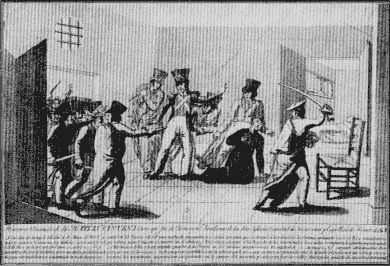
Figure 15.
"Assassination of Matías Vinuesa." Reproduced in Boletín de la
Real Academia de la Historia, 1928.
On the morning of May 4, 1821, the very day on which Ferdinand VII had abolished the constitution seven years earlier, word of the sentence circulated through the streets of the Spanish capital, announced first by blind people who banded together to eke out a living selling newspapers, reciting verses, and singing ballads. ("The crowd listens to them, the crowd heeds them, and the crowd pays them," commented one observer.)79 Vinuesa had been condemned to ten years in the penitentiary—in that era, a mere slap on the wrist. That same afternoon, an angry throng gathered in downtown Madrid at the Puerta del Sol, their fury at the priest's sentence no doubt further fueled by deeply anticlerical sentiments; then they headed for the royal jail amid shouts of "Long live constitutional monarchy" and "Death to Vinuesa." Determined that the conspirator should receive his just desserts, the crowd broke down the door to the jail and seized the key to Vinuesa's cell. They found the prisoner on his knees, clutching a small portrait of the Virgin Mary. The priest begged for mercy, but to no avail. One of the assailants struck him a mortal blow to the head with a hammer, another cleaved his chest with a sword, and a third shot him several times. The cadaver was then dragged through the streets. "Thus died one who had schemed to spill the blood of thousands and thousands of liberal,
virtuous, and innocent patriots, a victim of the people's furor. The populace had a thirst for revenge, and they have satiated it," editorialized a liberal newspaper of the day.80 In the aftermath of the affair, gleeful exaltados, the most radical of the Spanish constitutionalists, adopted the hammer, the implement with which the priest had been bludgeoned to death, as their badge, but in other European courts, the brutal assassination was evoked to denigrate Spain's constitutional regime and thus helped set the stage for the foreign invasion that was soon to overthrow it.
The treacherous plot for which Vinuesa paid with his life had been thwarted, but it paved the way for another attempt at counterrevolution, known as the Seventh of July. This was the most important absolutist conspiracy of the Liberal Triennium, and in the trial that followed Tiburcio Hernández would once again find himself thrust into the limelight. The uprising began in Madrid on May 30, 1822, when, as Ferdinand VII returned from parliament, a crowd stoned the contingent of Royal Guards escorting him.81 The guards broke rank, attacking their tormentors at bayonet point, firing into the crowd, and assassinating one of their own officers, a certain Mamerto Landáburu, who was loyal to the constitution.
The famous Landaburian Society, a liberal debating club of exaltado persuasion, was established shortly thereafter and named in honor of the martyred officer. The society's purpose was to inform the populace and to attack the abuses of those in power, and in truth, it was highly influential. Its public sessions were attended by huge audiences that included the most enlightened supporters of Spanish liberalism, among them representatives to parliament, other high-ranking public officials, military officers, and many women—most of them violent supporters of the constitution. One of the most impassioned Landaburians was Tiburcio Hernández. Speaking from a rostrum inscribed with the words "Constitution or Death," the Royal School's head teacher by day and exaltado by night revealed himself to be an audacious and provocative orator and an ardent supporter of Spain's constitutional government.82
The uprising of the Seventh of July was soon defeated, and in the legal proceedings instituted in its wake, Tiburcio Hernández was appointed auditor, or judge advocate, responsible for interpreting the law and proposing appropriate application. Once again he had been cast in a highly visible public role as defender of his nation's constitutional system. The case of this latest conspiracy was followed widely, and the people demanded that the guilty be brought to justice. Involved in the
treachery were members of the government, the Church, high-ranking military officers, the royal family, and the king himself, but in the end, all escaped punishment, save three insignificant souls who were made to pay the supreme price: two Spanish soldiers and a French national who held the rank of first lieutenant.
At the Landaburian Society, where those in attendance debated all the important topics of the day, according to an English visitor, with "unbounded freedom, not to say licentiousness," and speakers often resorted to "extremes of declamation," one citizen expressed outrage that the culprits were strolling the streets of Madrid, and another demanded to know why only "two wretched soldiers and a foreigner without protection" had been executed.83 In London the Morning Herald reported on the garroting of the convicted Frenchman, Théodore Goiffeux, in the following terms: "The First Lieutenant of the Guard, Don Theodore Goiffeux, has been executed. The sentence is still more unjust, because he has not been judged by a Council of War. As he went to execution he was insulted.... The moment this unfortunate officer was strangled, the descamisados cried out, 'Vive la Constitución.' The Confessor, during these exclamations, could not forbear crying out, "Vive Dieu.' In consequence of this exclamation he was exposed to great danger, and is still under arrest." The reporter confided to his readers, "It is impossible to give an idea of the depravity of this populace."84 Thus, the events of the Seventh of July, like the Vinuesa affair, served to fan the flames of anti-Spanish propaganda abroad and helped seal the fate of the constitutional government.
The failure of the Seventh of July and the liberal victory persuaded the Spanish monarch and his absolutist supporters to seek assistance abroad. Members of the Holy Alliance, a union of European absolutist nations meeting at the Congress of Verona in the fall of 1822, recognized the danger the Spanish revolution posed to their own self-interests and agreed to intervene on Ferdinand VII's behalf. The possibility of foreign invasion was evident to the Landaburians, and in January 1823 Tiburcio Hernández warned, "Let tyrants understand that no one dominates the Spanish nation (if you don't believe it, just ask Napoleon), because there are many unencumbered arms that will know how to kill their oppressors a thousand times over."85 His words turned out to be little more than saber-rattling, however, for when in the spring of that same year France sent the so-called One Hundred Thousand Sons of Saint Louis, the troops encountered little resistance from the nation that had fought bitterly against Napoleon fifteen years earlier. By fall the
constitutionalists had been easily defeated, and the Liberal Triennium came to an end. Ferdinand VII was restored to full power, legislation from the triennium was annulled, and the persecution of liberals began anew.
Tiburcio Hernández, because of his high-profile involvement in the trials of Matías Vinuesa and the Seventh of July (and no doubt because of his unambiguous pronouncements before the Landaburian Society as well), became, in the words of his son, a "victim of his love of liberty." He was condemned to death by the very Sala de Alcaldes that had formerly employed him as relator . Along with others linked to the constitutional government, this teacher of deaf children now fled for his life. Like his rival and predecessor José Miguel Alea, Hernández never returned to his homeland. After escaping to the British colony of Gibraltar, he died there of an aneurysm in 1826, at the age of fifty-three.86
With Hernández's departure, the Royal School for Deaf-Mutes was left without a head teacher, but the worst was yet to come. In 1822 the school had been placed, along with other educational establishments sponsored by the Friends of the Country, under the authority of the Dirección General de Estudios, which was first presided over by the writer, educational reformer, and tertulia host Manuel José Quintana. But with the return of absolutist government the following year, this body was abolished. The Economic Society, too, was dissolved, due to the liberal views of some of its members (Tiburcio Hernández was a prime example). Administration of the deaf school then felt to its spiritual advisor, Vicente Villanova y Jordán. Villanova, a native of Huesca, was an official of the Inquisition in Aragon, presbyter of the archiepiscopal church of Saragossa, and a recipient of the Cross of Honor, awarded for his role in the defense of Saragossa against the French.87 He had first been appointed to the school's board of directors in 1812. Four years later he was made spiritual advisor, then he took on the job of mayordomo as well, seeing to the school's administration and managing its accounts, all without financial compensation. Eventually he was named,rector, or principal. His devotion to the school was genuine, for when resources had been exhausted and the Friends of the Country had been faced with the prospect of dismissing the students and closing the doors, Villanova had come to the rescue, spending his patrimony to ensure the establishment's continued existence.88
Villanova alone steered the Royal School until 1827, when the duke of Híjar asked Ferdinand VII to appoint him director of the establish-
ment.89 The king consented to his courtier's request, vesting in him the authority that had previously pertained to the school's board. The duke continued at the helm until 1835, and under his stewardship the establishment's financial situation took a turn for the better.90 Despite improved economic conditions, however, the meager documentation that remains suggests that the reign of the duke of Híjar left much to be desired.
In 1826, one year prior to the duke's appointment, Antonio Hernández Blancas, Don Tiburcio's son, had approached the king, seeking to be named head teacher at the Royal School. His petition was granted "in consideration of his merit, service, intelligence, and his considerable experience in the good discharge of the profession his father exercised."91 Hernández Blancas was barely seventeen years old at the time. As a child, he had himself been a pupil at the Royal School, studying under his father's tutelage alongside the deaf disciples.92 Like the celebrated Roch-Ambroise Bébian, the abbé Sicard's hearing godchild who as a youth attended classes at the Paris institute, lived among the deaf students and staff, and learned their sign language, Hernández Blancas might well have become a friend and champion of Spanish deaf people.93 Instead, he would leave his post at the Madrid school in disgrace nine years after his appointment.
Following the death of Ferdinand VII in 1833, the Friends of the Country reorganized their society, and in 1835 the Royal School was once again entrusted to their care. One of their first acts was to name a committee to evaluate conditions at the school. Their conclusion: Instruction there was suffering because of Hernández Blancas's "limited aptitude and excessive abandonment."94 To make matters worse, the students were in a state of insubordination. The Friends of the Country held the head teacher responsible for this situation, and seeing that he could not restore order, they fired him.
The only remaining account of events leading to his dismissal was written by Hernández Blancas himself, in his plea for reinstatement.95 From this document emerges the story of the deaf children's abuse at the hands of their hearing "benefactors," and of their determined resistance. Hernández Blancas reported that some time before the society resumed oversight of the school, the principal, Vicente Villanova, who the Reglamento charged with supervising students' conduct and curbing their passions,96 had been "obliged" to administer severe punishments. "It seems ... the floggings had the desired effect, in spite of the resentment they produced at the beginning," the head teacher commented. (While legislation of the day concerning corporal punishment
of students cautioned that "care shall be taken not to inflict any injury," it also stated, "Let the children know they may be punished in this way, and let this serve to restrain their misbehavior and their pertinacious disobedience or lack of studiousness.")97 . While expressing reservations about such measures—"I have never believed that youth should be addressed by any means except persuasion, leaving coercive means for desperate cases," Hernández wrote—he nevertheless seemed to defend Villanova's tactics, and he based his defense on the old lie that deaf people were incapable of abstract thought:
Those of us who have observed the deaf-mutes' character with care will always agree that the means sufficient to direct other youths are ineffective with them; even with the greatest care, the director of a deaf-mute will never manage to imbue in him certain ideas that are difficult to comprehend, because of their abstraction and subtlety, and to harvest their fruit by way of spontaneous submission. The deaf-mute lacks many ideas because it is impossible to communicate them to him, and in all his decisions the heart exercises more influence than the head.98
The problems had begun, Hernández Blancas related, after Ferdinand VII's death, when word had circulated that direction of the school would be returned to the Friends of the Country. The anticipated change, he asserted, "created in the disciples the presentiment of a new order ... and from there was born their insolent sedition and the relaxation of discipline." Shortly before the board of directors took over, he continued, "there occurred the first excess against the person of the principal," when, "at the very door of the room where he had presented himself to prevent them from continuing to create a disturbance," the students wrested from his hand the scourge with which he was wont to flog them. For this act of rebellion the offenders were expelled, but their expulsion, the head teacher maintained, served only to provide "the best incentive for repetition of the excesses: in [such misconduct] the deaf-mutes saw an easy means of shaking off the yoke, and returning to the idleness and liberty so beloved at their age of indiscretion."
Once the governing board began functioning, the next "excess" was likewise sanctioned with expulsion, and according to Hernández Blancas, "the deaf-mutes looked upon that punishment as if it were the reward of a vacation, since the two expelled students were later readmitted." Don Tiburcio's son insisted that it was the "rapid and inopportune transition from severe punishment to absolute impunity" that had caused the students' insubordination, but board members suspected that a "hidden hand" had induced their rebellion—that of Antonio
Hernández Blancas himself. For his part, Hernández Blancas complained that while the board blamed him for the breakdown of discipline, he lacked the necessary "repressive measures" to suppress it. The young teacher protested to the board:
Since ... you want to hold me responsible for the loss of order, subordination, and discipline, I will explain to you the means previously employed to conserve these three things. I never took part, and such severity always pained me, but the inflexible character of the disciples, and the cruelty of the employees, have at times reached painful extremes: Don Pedro Ortega has several times been tied hand and foot to the window grate, because since he is so small he would remove his feet from the pillory, which was useless for him; Don Benito Yagüe has been deprived of half his food for twenty days for having ripped a sheet, solely because of his restless sleep, and I shall not bother to relate other such monstrosities, which were, unfortunately, frequent.
The student rebellion escalated rapidly, and even before events came to a climax, Hernández Blancas himself conceded that there had already been "thousands of other incidents," such as "the insolent petulance with which [the students] obliged the principal to buy them suspenders" and "what transpired during the baths." All their behavior, he maintained, could be attributed to "the deaf-mutes' peculiar and audacious character and the dangerous impunity that produced our disorderly impotence, and the tolerance and levity of the board, which were their cause." Moreover, although the shenanigans Hernández alluded to were most likely minor, the minutes of the Economic Society also recorded an attempt by students to burn down the school.99
The episode that would culminate in the head teacher's dismissal began when another instructor, Agustín Pascual, punished one of the scholars "with considerable rigor," Hernández recounted, at which point the boy's classmates "all rose up against this employee, and I could barely save him from the disciples' fury." The following afternoon two pupils escaped from the school—"they had done so before with impunity," Hernández said—and when they returned, they brought with them gunpowder and a small bronze cannon, which they had stolen from the provincial military barracks. "The next day the disturbances took a serious turn," he explained, "for I found them on the stairs lying in wait for Pascual, resolved to take revenge on him because they believed he was the one who had denounced their desertion of the night before to the board member on duty; and when I had managed to placate them and persuade them to go into the classroom, the disorder erupted again, to
such an extreme that I had to make Pascual leave under frivolous pretexts and then allow them to fire the cannon in the patio."
Having informed the board of what had occurred, Hernández Blancas later lamented, "I was assured that serious steps would be taken to put an end to the troubles, but I never thought that my suspension would be among the first, yet it was announced the next day." He pleaded to be returned to his post, invoking his father's memory and citing his need to support his wife, children, mother, and sister. He argued that he had been made a scapegoat for problems at the school, pointing out that he alone among all the employees had been suspended, but the board was unmoved and declined to reinstate him.100 In the aftermath of the uprising, the Friends of the Country also expelled four pupils they believed to be the ringleaders, returning them to their parents or packing them off to establishments of charity,101 and they quietly abolished the position of spiritual advisor as well. Board members professed that their motives for the latter move were purely economic, reasoning that the local parish priest could see to students' spiritual needs,102 but this was in all probability a face-saving measure to rid the Royal School of the sadistic Vicente Villanova y Jordán.
As for Hernández Blancas, his story did not end with his firing. He reappeared at the Royal School more than twenty years later, after having practiced law in the Spanish capital and in Havana, where he also directed a school for deaf children. He sought to be reinstated as director of the Royal School, or to be appointed supervisor of deaf education for all of Spain. Because he had previously been terminated for "ineptitude and abandonment," however, his request was denied.103
In 1835 Roberto Prádez, then in his early sixties, was still employed at the school where he had taught continuously for the past three decades. It appears that he was somewhat marginalized by this time, however, for the following year a hearing man, Francisco Fernández Villabrille, replaced him as art teacher. (Prádez nevertheless continued to teach writing.)104 Villabrille was destined to have a brilliant career as the school's first professor and as a prolific author of articles and texts for both deaf and blind children, but there is no evidence whatsoever that he had any credentials as an artist. Prádez's presence at the Royal School is documented up through late November 1836, when his long teaching career came to an end.105 Most likely he left the school because of
ill health, for he passed away less than one month later, on December 7, 1836, at his home at number 14 on the Calle de Santiago, where he lived with his wife, Modesta Sierra.106 Of the three major figures at the Royal School during the first third of the nineteenth century—José Miguel Alea, Tiburcio Hernández, and Roberto Prádez—the art teacher alone had managed to end his days in the land of his birth. His death certificate records that he left this world without receiving the Holy Sacraments of the Roman Catholic Church, and that he was afforded free burial "out of pity," outside the walls of the cemetery of the Puerta de Fuencarral.107
It is difficult to interpret the circumstances surrounding Prádez's death. The fact that he died without the last rites may suggest that the priest declined to administer them—or that Prádez himself refused them. Either way, the cause may have been liberal political leanings, which often went hand in hand with anticlerical sentiments, although we cannot know for sure.108 At any rate, this much seems clear Because he did not receive the Sacraments, Prádez was interred beyond the cemetery walls, in unhallowed ground. The life of the Royal School's first deaf teacher had ended without fanfare in a pauper's funeral.
In Spain today, historically prominent hearing teachers of deaf people are appropriately honored. In the nation's capital a school for deaf children bears the name of the Benedictine Pedro Ponce de León, and in the Plaza de Costa Rica in the famed Retiro Park a statue depicts the monk in the act of teaching a young disciple, and a plaque there pays homage to Juan Pablo Bonet, in whose memory a class for deaf adults has been named as well.109 These men, along with figures such as José Miguel Alea and Tiburcio Hernández, occupy an important place in accounts of Spanish deaf history. But tribute has yet to be paid to Roberto Francisco Prádez. No statue has been erected in his honor, no deaf school named for him. Although Prádez was a founding father of deaf education, his many contributions during the Royal School's first three decades of existence have never been properly acknowledged, and he has yet to assume his rightful place in deaf history and culture.
Prádez's death marked the end of an era at the Madrid institute. During the early decades of the nineteenth century, deaf education had been guided not by professional educators but by sympathetic intellectuals.
These were men of talent and achievement such as José Miguel Alea, the cultured abate who grappled with the concerns of the European Enlightenment, and Tiburcio Hernández, the famous lawyer who participated in two of the triennium's major political trials. The progressive Friends of the Country had recognized Prádez's deafness as a distinct advantage. During the second two-thirds of the century, however, deaf education would become the domain of "experts," men who no longer viewed deafness as a desirable quality in an instructor and who banned deaf teachers from the classroom. Thus, the time of meaningful deaf involvement in the educational enterprise came to an end with Roberto Prádez's demise, and no deaf person would ever again attain such a prominent position at the Royal School. Half a century would pass before another deaf artist would be employed there, and even then, the record suggests that at no time did he participate in the life of the institution to anywhere near the extent that Prádez did.110 Small wonder, then, that Roberto Prádez has been conveniently "forgotten," for the memory of his contributions could only prove a source of embarrassment to those who continue to close the door to deaf teachers.
Conclusion
The preprofessional era of deaf education witnessed various shifts in consciousness regarding deaf people, as old stereotypes yielded. The belief that muteness and deafness were inextricably linked had fallen by the wayside, as had the assumption that these conditions were a sign of divine disfavor. It was by now widely acknowledged that persons deaf from birth were mute only because they had never heard the sounds of spoken language—the point had been made already in 1620 by Juan Pablo Bonet—and deafness was now viewed as the result of a physical condition or defect.1 When the Licenciado Lasso, writing in 1550, argued that deafness and muteness were, even in those deaf from birth, the result of "sickness and weakness of the material," rather than a mark imposed by nature on individuals to be shunned, the claim was revolutionary for the day, and Lasso himself observed that it ran contrary to popular opinion.2 But when in 1814 Tiburcio Hernández characterized deafness as "an illness," this conceptualization no longer seemed in dispute.3
The notion that deaf people could not achieve salvation had also been rejected. (Even so, the Church looked upon deaf Spaniards with seeming indifference throughout the preprofessional era.)4 The belief in their inherent ineducability had been replaced by the recognition that deaf children, like their hearing counterparts, could benefit from instruction, and that through education they could become useful citizens. (The realization was underscored by the state's willingness to sponsor the Royal School.) Yet if it was by now generally accepted that the deaf
minority could indeed be taught, the relative pace of their education nevertheless lagged severely behind that of the hearing majority.
During the constitutional periods in the first third of the nineteenth century (1810–1814, 1820–1823), the predominant view was that education—primary education, that is—should be universal, uniform, public, and free. And although during the absolutist periods these ideas, taken as a whole, cannot be said to have predominated, even so, many of them continued to hold sway. The first three decades of the 1800s produced legislation designed to implement these educational goals. For instance, the Constitution of 1812, which was approved by the parliament at Cadiz, stated that primary schools were to be established in every town; this marked the nation's first attempt at eradicating illiteracy.5 In 1814 Fernando VII annulled the legislation passed at Cadiz, but one year later he issued a royal decree exhorting the nation's religious orders to open schools to ensure all children an elementary education, and in 1816 he ordered the creation of free primary schools in all of Madrid's sixty-four barrios; as a consequence, during most of his reign every district of the Spanish capital boasted a primary school for boys and a separate one for girls. With the liberals' return to power in 1820, the Constitution of Cadiz was reinstated, and in 1821 the Reglamento General de Instrucción Pública decreed that education was to be public, free, and uniform throughout the realm. Legislation from the Liberal Triennium (1820–1823) was not put into effect, however, for the constitution was abolished once again in 1823. Nevertheless, two years later the crown approved a plan calling for primary schools in all locations with fifty or more residents, and encouraging instruction in those places with fewer inhabitants as well.6
The educational legislation of these years was directed at the hearing majority, and no comparable provisions were made for deaf citizens. Most deaf girls and boys were to be found among the less well-to-do classes, and for the vast majority, the possibility of an education was virtually nonexistent. By the end of the preprofessional era, there were only two deaf schools in all of Spain: the state-sponsored Royal School ill Madrid, and the municipal school in Barcelona, each teaching but a handful of students.
Looking ahead—beyond the preprofessional era of deaf education, which ended with the Royal School in chaos—observers agreed on the clear need for reform. Members of the Friends of the Country pinned their hopes on Juan Manuel Ballesteros y Santa María.7 Ballesteros, a
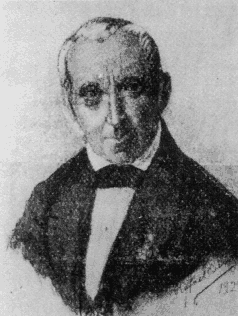
Figure 16.
Juan Manuel Ballesteros y Santa
María. From Miguel Granell y Forcadell, Historia
de la enseñanza del Colegio Nacional de Sordomudos
desde el año 1794 al 1932 (Madrid:
Colegio Nacional de Sordomudos, 1932). Biblioteca
Nacional, Madrid.
surgeon by training, was both instructor and assistant physician at the Royal School—his name in Spanish Sign Language, made by the night hand taking the pulse at the inside of the left wrist, meant "doctor."8 In 1835, about the same time the board fired Hernández Blancas, Ballesteros was named subdirector and charged with overseeing the teaching. He presided over the establishment for a third of a century, until 1868, when he, too, was removed from his post—once again as a result of political events.
Juan Manuel Ballesteros's appointment in 1835 began an era of deaf education characterized by expansion, reform, and much needed stability. (And during this decade the state began a national system of education that marked a turning point in the instruction of hearing children as well.)9 In 1842 the first blind students were admitted to the Royal School, whose name was now changed to the National School for Deaf-Mutes and the Blind. A decade. later the institution was placed under the Ministry of Development—what had begun as an educational estab-
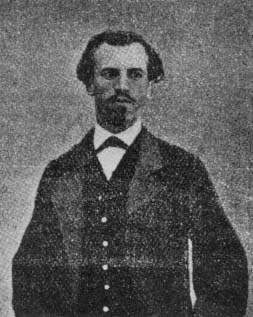
Figure 17.
Francisco Fernández Villabrille. From
Miguel Granell y Forcadell, Historia de la enseñanza
del Colegio Nacional de Sordomudos desde el año
1794 al 1932 (Madrid: Colegio Nacional de Sordomudos,
1932). Biblioteca Nacional, Madrid.
lishment on the par with the Friends of the Country's other "patriotic schools" was now grouped with institutions of charity—and from that time on it would be administered directly by the Spanish state.
A new Reglamento was adopted in 1838. It provided for admission of one or two students from each province, thus guaranteeing extension of the establishment's influence throughout the kingdom.10 In 1857 a teacher training class, taught by Ballesteros's trusted right-hand man, Francisco Fernández Villabrille, was started at the school. In addition to preparing educators of deaf students, the training class also enrolled teachers destined for primary schools for the hearing, providing them with skills to instruct the occasional deaf child obliged to attend a hearing class. The year 1857 also saw passage of the Law of Public Instruction, popularly known as the Moyano Law, which mandated creation of a deaf school in every university district and called for the teaching of deaf children in the public schools "as far as possible."11 (Even with this legislation oil the books, it would be quite some time before education
of deaf Spaniards would be anything like universal.) In the following decades schools for deaf children were founded in Salamanca, Santiago, Burgos, Alicante, Saragossa, and Seville, and often staffed by teachers trained at the Madrid school. Deaf pupils educated in the nation's capital and teachers trained there spread the Madrid school's sign language throughout the peninsula. As a result it is now possible to speak of a single Spanish Sign Language, used and understood by most of the nation's signers, which unifies the Spanish deaf community.12
During Ballesteros's tenure, the number of students and staff at the Royal School increased considerably: In 1836, one year after he had been made subdirector, there were forty-seven deaf disciples and four teachers, and by 1857 the figures stood at ninety-one disciples, eleven teachers, and six teaching assistants.13 Ballesteros welcomed all deaf children in Madrid wishing to attend classes as day students, and he admitted the school's first female boarders. The girls were taught initially by Jacoba Hernández Blancas, Don Antonio's sister, who was hired around the same time her brother was dismissed, and later by María del Carmen Gutiérrez, the wife of professor Francisco Fernández Villabrille.14 The decades following Ballesteros's appointment also saw the establishment of secondary instruction for the most academically gifted pupils, and the creation of workshops that prepared the children to support themselves as tailors, shoemakers, weavers, carpenters, lathe operators, locksmiths, lithographers, printers, and bookbinders, upon completion of their studies.15
Although Ballesteros trained his charges for a variety of jobs, he barred them from that of classroom teacher. "The difficulties and complications of this teaching do not lead us to expect in deaf-mutes the combination of requirements they need to be teachers of [their] companions in misfortune," he wrote. "For this," he continued, "they would need to have received a very special education"—which apparently they were not about to get at the Madrid school. "And even so," Ballesteros concluded, "there would be some subjects, for example articulation, that would not be within their reach."16 Upon closer examination, however, the argument that deaf professors were not suited to teach speech appears to be merely a pretext to ban them from the classroom, for speech training was not emphasized in Spain at that time. Indeed, one of the first things Ballesteros did when he assumed command of the Royal School was to return to the French methodology, relying heavily on the works of the abbé Sicard and his protégé, Roch-Ambroise Bébian.17 After Hernández's brief experiment, oralism
was not reinstated in Spain until the very end of the nineteenth century, the claims of some authors notwithstanding.18
The real motives behind Ballesteros's rejection of deaf teachers are not easily ascertained, but the outcome of his decision was plain: Hearing people, who had always constituted the overwhelming majority of employees at the Royal School, gained even more control over the establishment, and deaf people were further marginalized and disempowered. Under Doctor Ballesteros and his successors, deaf instructors were relegated to the workshops, where they were limited to teaching their pupils a trade.19 By mid-century there were various deaf people imparting vocational training at the Madrid school.20 But even so, at the head of every shop—with the exception of bookbinding and tailoring—was to be found a hearing person.21 During these same years, the number of deaf educators at American deaf schools nearly equaled that of hearing instructors, and by 1878 a majority of the teachers at French deaf schools were deaf themselves.22
The paucity of deaf teachers of deaf Spaniards continues to this day (see epilogue), and in a recent survey, only 40 percent of Spanish educators of deaf children opined that it would be desirable to include some deaf instructors among their ranks.23 The systematic exclusion of deaf people from academic teaching positions at their schools, which was instituted as official policy under Juan Manuel Ballesteros, effectively ensured that power in such establishments remained in the hands of the hearing, and this in turn has continued to shape the history of Spain's deaf community up to the present—but this is the material of another study.
Epilogue
So much is said here in Spain about integrating deaf people into the world of the hearing, and there are so many people interested in this premise, when the deaf world has no reason to integrate into the hearing world, but rather just the opposite. The hearing have no reason to interfere in what it is deaf people's place to determine and resolve.
—Angel Calafell i Pijoan
Deaf Spaniards today are taught orally by teachers who are in the overwhelming majority hearing.1 Only 37.5 percent of deaf citizens have completed the Educación General Básica (elementary level), known as EGB.2 By the conclusion of their primary studies, deaf children have progressed academically an average of only 1.6 years, as compared to hearing children's 8 years.3 Just 1.64 percent have completed the Curso de Orientación Universitaria, or COU, the yearlong course of study required for entrance to the university, and a mere.05 percent have undertaken university studies. The majority of deaf Spaniards are either without formal schooling (41 percent) or completely illiterate (18 percent).4 And in the face of these less than spectacular results, the claim that deaf people have "special needs"—"language, language, language," in the words of their hearing teachers—together with the assertion that deaf students are "deficient," is regularly evoked to exonerate the educational establishment.
Deaf people in Spain have not always been instructed orally, however; during most of the last century they were educated in sign language
(as were the majority of deaf people in other European nations and the United States as well). Although some speech was taught, it was not emphasized; more importance was placed on the development of the intellect. But at the infamous Milan Conference of 1880, which ended with the cry of "Long live speech!," educators—hearing educators, that is—proclaimed that deaf people should be taught by way of the spoken word. (It was around this same time that the term sordomudo [deaf-mute] began to be gradually replaced by the term sordo [deaf], which had been previously reserved for individuals deafened after having learned to talk. The change in terminology served to underscore the new emphasis on the spoken word for persons deaf from birth or from an early age—and to deny the difficulties inherent to learning and retaining artificially acquired speech.) At the turn of the century Spanish teachers jumped on the oralist bandwagon, advocating that signs be banished from the classroom and replaced by spoken Spanish. In so doing, they followed what was by then standard educational policy in the more "advanced" countries of Europe and North America. Thus oralism, the sixteenth-century Spanish invention that had long since fallen into disuse, was now resurrected, and Spanish schools, having effectively excluded deaf teachers from the classroom some fifty years earlier, now sought to exclude the primary language of their students as well. The dearth of deaf educators facilitated the change to oralism, which gained acceptance in Spain virtually without opposition. But a variety of reasons (ranging from overcrowded classrooms to a scarcity of teachers trained in the "new" method) often precluded oral instruction, and the use of signs in teaching survived in Spanish schools well into the twentieth century.5 (One alumnus of a deaf school in Madrid relates that during the 1950s, "Sign language was completely forbidden, in other words ... everyone used it," further observing that when teachers needed to communicate important information, they had to do so in signs.)6 Curiously enough, however, I was frequently assured while conducting this research that deaf education in Spain has always been oral—"España, siempre oralista," I heard on numerous occasions, in a classic example of historical revisionism and institutional forgetting.
Spain may have lagged behind the more "progressive" nations in its adoption of oralism, but eventually teachers there fell into step. With the reintroduction of oralism came the exaltation of speech: "Only the spoken word is the totally complete and evolved form among all other means of communication," gushes one oralist tract, revealing much about the author's own prejudices but nothing at all about sign lan-
guage.7 Deaf children, their manual language devalued, now came to be instructed in spoken Spanish, a medium largely inaccessible to them, and under such conditions they were handicapped indeed. The curriculum, which when the Royal School opened in 1805 had been comparable to that of elementary schools for the hearing, likewise suffered, for as academics took a back seat to speech training, the number of subjects was drastically curtailed. Thus, oralism led to both the marginalization of Spanish Sign Language and the impoverishment of the curriculum.
Since the 1980s the Spanish deaf community has faced an even greater peril, namely, the educational policy of integración, the placement of deaf children in schools for the hearing. Like the change from manualism to oralism, this practice too represents a significant break with the past, for throughout the nineteenth century and the greater part of the twentieth, most deaf Spaniards were taught in special schools. Current legislation views deaf people as "disabled," grouping them with the blind, the psychologically impaired, the autistic, and so on, and their "integration" is mandated by the Spanish constitution. For their instruction, the law decrees that whenever possible, they shall be taught in "ordinary" schools.8 The integration movement entails the dismantling of deaf people's special schools, which have long been the very heart of the deaf community. Because about 90 percent of deaf children have hearing parents and about 90 percent of deaf parents have hearing children, the vast majority of deaf youngsters do not learn sign language in the home. Instead, deaf people have often learned their language, along with other aspects of their history, traditions, and culture, at the deaf school.9 Moreover, it is at their special schools that deaf youths find deaf role models and form lifelong friendships, and it is there that they are socially and linguistically inculturated into the deaf community. This transmission of deaf heritage, it goes without saying, will no longer be possible if these schools are closed and their students sent to hearing establishments. The ultimate "cure" for deaf people, so it seems, is for them to forget about the deaf community and, many would hope, abandon their signing for speech, to become as much as possible like the hearing majority and in effect, to disappear.10
But what of the alleged advantages to be accrued from integración? For instance, will enrolling deaf students in hearing schools really bring about their successful integration in the hearing world? Will deaf pupils be able to communicate freely with their hearing schoolmates? Of course not. Indeed, deaf adults and hearing teachers of deaf children generally agree that these students "will have difficulties in oral communication,
on account of which social integration with their [hearing] schoolmates cannot come about even if they are in the same classroom."11 Deaf children cannot hear and often cannot speak very well; hearing children, for the most part, cannot sign. Furthermore, as one of the framers of Spain's present integrationist policies acknowledges, in addition to problems of "social interaction," integration may also create "difficulties in the [deaf child's] emotional stability."12 Hence, deaf pupils pay a high price for the dubious privilege of an integrated educational experience, obliged as they are to exchange the rich social life of the deaf school for one of social and linguistic isolation, albeit in close proximity to the hearing majority.
While the enrollment of deaf students at hearing schools will not suffice to bring about their integration there, it may jeopardize their membership in the deaf community, for deaf people schooled outside the deaf cultural mainstream may be alienated from the deaf community. Enrolled in a hearing school, deaf students may find themselves cut off from their linguistic heritage as well, for although the proponents of integración do not reject the use of signs in instructing deaf children, pupils not fluent in sign language may have only limited opportunities to acquire it at an integrated school.13 So integración may result in the marginalization of deaf children and their language alike.
If deaf students' social integration at hearing establishments is unlikely, what about their academic achievement? Is deaf youngsters' performance in such a setting likely to be comparable to that of their hearing peers? Evidently not: "The objective of integration is not for the deaf child to achieve the same levels of knowledge at the same age [as hearing classmates]," writes one of the architects of Spain's present policies, pointing to the "limitations [deaf students] will have in learning oral language," and assuming without further comment that such students will encounter difficulties in reading as well.14 Integration is to be judged a success if deaf children develop "according to their possibilities"—possibilities that are apparently assumed not to be on par with those of hearing child.15 It seems, then, that integración may entail the absence of meaningful social integration and of any meaningful education at all. On the face of it, the goal appears to be forced assimilation of the deaf minority to the society of the hearing majority.
The deaf community was not consulted when Spain's Law of Integration was formulated, and to those hearing educators whose avowed purpose is to "rescue [the deaf person] from his world in order to inte-
grate him into ours," one deaf leader, Angel Calafell i Pijoan (1909–1988), retorted, "So much is said here in Spain about integrating deaf people into the world of the hearing, and there are so many people interested in this premise, when the deaf world has no reason to integrate into the hearing world, but rather just the opposite. The hearing have no reason to interfere in what it is deaf people's place to determine and resolve."16 The truth is, deaf people do not want to be "rescued."
When integrationist policies concerning deaf education were still in the planning stage, deaf leaders, faced with what they perceived as an assault on their language and community, directed numerous letters and phone calls to the Minister of Education, all of which went unacknowledged.17 Left with no other alternative than to take their protest to the streets, Spain's National Confederation of the Deaf staged a historic demonstration against integración, the threatened closing of deaf schools, and the indiscriminate classification of deaf people together with those with a broad range of disabilities. On September 29, 1984, deaf Spaniards and their hearing allies gathered in Madrid at the traffic circle of Bilbao, then marched along the Calle de Fuencarral to the Gran Vía. At the same time, similar demonstrations were held in other major provincial capitals throughout the nation. In Madrid alone some five thousand protesters turned out.
This was twice the number that would demonstrate four years later in Washington, D.C., at Gallaudet University, the world's only liberal arts school for deaf students. In March 1988 Gallaudet students and their supporters, incensed at the appointment of yet another hearing person as president of that institution, converged on the United States Capitol to demand a deaf replacement. The protesters gained the attention and sympathy of the news media and the public at large, thus winning acceptance of their cause. Their efforts were successful: Within a few short days Dr. I. King Jordan became that university's first deaf president.
In Spain, despite their greater numbers, the demonstrators were all but ignored by the news media—Televisión Española's regional coverage of Madrid dedicated but thirty-two seconds to the topic, and only two of the capital's newspapers covered the story as it unfolded—and the deaf community's principal demand, that the policy of placing deaf students in hearing establishments be reconsidered, has yet to be addressed.18 In the meanwhile, integración and the closing of deaf schools proceed apace.
And what might the future hold for Spain's deaf minority? As noted in the introduction, the constitutional safeguards that today protect that nation's other linguistic minorities do not apply to deaf Spaniards. The right to know and employ the language of one's community, the right to study that language, as well as Castilian, throughout primary and secondary school, the right to primary instruction in one's mother tongue—these rights belong to speakers of minority languages, but not to deaf signers. Clearly, then, the situation of Spain's deaf community is at odds with official policies toward linguistic minorities—no doubt because deaf people are not classified as a linguistic group but rather as "handicapped," and because Spanish Sign Language is not officially recognized as a language. Yet just as the revindication of Spain's spoken minority tongues came about after forty years of repression under the Franco dictatorship, so this other linguistic minority, the deaf community, after a century of oralism, today defends more strongly than ever the use of its manual language.
And indications of positive change are afoot. There is a new interest in Spanish Sign Language, and a growing body of sign language research, including sign dictionaries by Jorge Perelló and Juan Frígola and by Félix-Jesú Pinedo Peydró, and a landmark book-length study on Spanish Sign Language by María Angeles Rodríguez González, the first such work to be published in Spain.19 In the spring of 1991 Madrid hosted the first Seminar for Sign Language Teachers; one year later Spanish Sign Language investigators and their colleagues from eighteen countries congregated in the old university town of Salamanca for the Fifth Symposium of the International Sign Linguistics Association, convened for the first time on Spanish soil; in March 1994, the National Symposium on Sign Language and the Deaf Community, whose primary objective was to encourage the study of deaf people and their language at the university level, was held in Valencia; and in the fall of 1995 Spain's First National Conference on Deaf History took place in Granada. Moreover, theoretical research into Spanish Sign Language has gone hand in hand with calls for its utilization in teaching deaf children, and an increasing awareness that educators of deaf students should know their pupils' primary language.20 At the same time, many hearing parents have begun to recognize the need for manual communication with their offspring—including parents who had been loath to accept their deaf child's signing, albeit because signing called attention to the child's "handicap," or because of the mistaken belief that knowledge of manual language would impede acquisition of speech. (Numerous studies
have shown that early use of sign language does not adversely affect speech or lipreading—or anything else, for that matter—and that it correlates with other positive effects such as superior ability in reading, written language, and social adjustment.)
Other encouraging developments are the Catalan parliament's creation of a commission (in November 1992) to consider recognition of sign language as an official language of Catalonia, and its passage (in June 1994) of a proposition calling for, among other things, bilingual education in sign and spoken language for deaf children, establishment of courses in sign language, and interpreter training.21 At the Spanish Ministry of Education and Culture, a growing cognizance of the problems of integrating deaf pupils in hearing schools has led to reconsideration of a traditional resource: special schools for deaf students.22 Meanwhile, the number of deaf Spaniards in the teaching field, though still extremely small, continues to increase, fostering the hope that deaf adults will play a meaningful role in educating the youngest members of their community, and a renewed interest in deaf history and the celebration of deaf culture, including theater, poetry, painting, sculpture, and photography, attest to the vitality of Spain's "newest" linguistic minority, and the growing pride in its cultural and linguistic heritage. And while deaf Spaniards still take to the streets to make themselves heard, a massive demonstration of deaf people held in Madrid in September 1994, unlike the protest of a decade earlier, could not be ignored by the press: It was reported in El País, one of the nation's most popular newspapers, as front-page news in the section covering events in the Spanish capital.23 (Demonstrators' demands included official language status for Spanish Sign Language and the use of signs to teach deaf children.) All these developments augur well for a much-needed change in consciousness, namely, the view of deaf people as a linguistic minority, comparable in many respects to speakers of Spain's other minority languages, for this is the heart of deaf Spaniards' demands. The deaf community's agenda is not unlike that of other linguistic groups: Deaf people want official recognition of their language, they want a say in the education of deaf youth, they want deaf teachers employed in their schools, and they want sign language to assume its rightful role in the classroom; they want better access to information, including captioned television, and informational programming in sign language; they want the formation of an official corps of interpreters to assist users of Spanish Sign Language in hospitals, the courts, and so on.24
In Spain today, the cultural and linguistic hegemony of Castile has ended, but it remains to be seen whether the respect for cultural and linguistic pluralism that has characterized the post-Franco era will apply to this other linguistic minority, and whether that nation's newfound appreciation of diversity will take in its deaf citizens as well. If Spain can acknowledge that not all Spaniards need be Castilians, perhaps it can also acknowledge that not all need express themselves in the same mode, and that deaf signers, along with their compatriots who hear and speak, may exist on their own terms.
Notes
Abbreviations
|
Bibliography
Abell, José Luis. 1981. Historia crítica del pensamiento español . Madrid: Espasa Calpe.
Aguilar Piñal, Francisco. 1972. La Real Sociedad Económica Matritense de Amigos del País . Madrid: Consejo Superior de Investigaciones Científicas, Instituto de Estudios Madrileños.
———. 1981. Bibliografía de autores españoles del siglo XVIII . Vol. 1. Madrid: Consejo Superior de Investigaciones Científicas.
Aguirre, Manuel Benito. 1841. Los niños pintados por ellos mismos: Obra arreglada al español por don Manuel Benito Aguirre, Vice-director de la Academia de Instrucción Primaria . Madrid: I. Boix.
Agustín, Antonio. 1734. Diálogos de las armas, i linages de la nobleza de España . Ed. Gregorio Mayáns i Siscar. Madrid: Juan de Zúñiga.
Ainaud, M. 1919. "La primera escola de sords-muts establerta a Barcelona." La paraula 1 (January–March): 1–8.
Alcalá Galiano, Antonio. [1878] 1951. Recuerdos de un anciano . Buenos Aires: Espasa-Calpe.
Alcántara García, P. de. 1878. "La educación de los sordo-mudos y los ciegos." Revista contemporánea . 15: 207–224.
Alea, José Miguel. 1788. Introduction and preface to El amigo del príncipe y de la patria, o el buen ciudadano [anonymous]. Vol. 1, ed. and trans. Jayme Albosía de la Vega (José Miguel Alea). Madrid: Benito Cano.
———. 1795. Carta dirigida al editor del Diario de Madrid . Reprinted in La Academia Calasancia 16 (November 1906–November 1907): 258–263, 286–290, 322–326, 353–361.
———. 1801. "Contestación a la carta de ayer." Diario de Madrid, December 9, no. 343: 1405–1407.
———. 1803a. "De la necesidad de estudiar los principios del lenguage, expuestos en una gramática general, y aplicados a la lengua materna." Variedades de ciencias, literatura y artes . 1: 101–117.
———. 1803b. "Hay en las lenguas verbos realmente impersonales?" Variedades de ciencias, literatura y artes 1: 238–243.
———. 1803c. "Comparación de las voces genio, ingenio, talento." Variedades de ciencias, literatura y artes 1: 298–305. Reprinted in Lecciones analíticas para conducir a los sordomudos al conocimiento de las facultades intelectuales, by Roch-Ambroise Sicard (Madrid: Imprenta Real, 1807).
———. 1804a. "De los sordo-mudos de nacimiento: Estado actual del arte de enseñarlos; y adelantamientos que ha debido a este arte, en el siglo XVIII, la ciencia del lenguage o la gramática general." Variedades de ciencias, literatura y artes 2: 42–53, 109–120.
———. 1804b. Review of Historia comparada de los sistemas de filosfía, relativamente a los conocimientos humanos, by J. M. Degerando. Variedades de ciencias, literatura y artes 3: 46–56.
———. 1804c. "Prospecto del plan de enseñanza y educación que da a sus alumnos o pupilos en su academia privada de latinidad, y demás ramas de humanidades, don Agustín Muñoz Alvarez, presbítero, individuo de varias sociedades literarias, y catedrático primero de latinidad en los estudios públicos del Colegio de S. Miguel de Sevilla." Variedades de ciencias, literatura y artes 2: 217–229.
———. 1804d. Review of El plutarco de la juventud, o compendio de las vidas de los hombres más grandes de todas las naciones, desde los tiempos más remotos hasta el siglo pasado, by Pedro Blanchard. Variedades de ciencias, literatura y artes 2: 342–355.
———. 1804e. Reply to letter from A. M. J. Variedades de ciencias, literatura y artes 2: 373–376.
———. 1804–1805. Review of El don de la palabra en orden a las lenguas y al exercicio del pensamiento, by Ramón Campos. Variedades de ciencias, literatura y artes 3 (1804): 340–355; 4 (1804): 36–49, 95–108, 219–235; (1805): 278–294.
———. 1807. dedication and introduction to Lecciones analíticas para conducir a los sordomudos al conocimiento de las facultades intelectuales, by Roch-Ambroise Sicard. Madrid: Imprenta Real.
———. 1824. Eloge de l'abbé de l'Epée, ou essai sur les avantages du système des signes méthodiques, appliqué à l'instruction générale élémentaire . Trans. M. P. París: Rosa.
——— , ed. 1831. Nouveau cours analytique de langue espagnole: Lettres de Maroc, écrites en espagnol par le colonel don Joseph Cadalso . Marseilles: Feissat aîné et Demonchy.
———. trans. 1786. Exposición compendiosa de los caracteres de la verdadera religión, by R. P. Gerdil. Madrid: Imprenta Real.
———. 1789. Ciencia del foro o reglas para formar un abogado, extractadas de los mejores autores de jurisprudencia, así antiguos como modernos y acomodadas al uso e instrucción de los jóvenes españoles, que se dedican a la abogacía . Alcalá: Joseph Antonio de Ibarrola.
———. 1793. Historia de la última guerra entre la Inglaterra, los Estados Unidos de América la Francia, España, y Holanda . Alcalá: Imprenta de la Universidad.
———. 1797. Vida del conde de Buffón, a que acompañan el discurso pronunciado al tiempo de su recepción en la Academia Francesa, la relación del viage que Herault de Sechelles hizo a Montbard en 1758 y el elogio fúnebre que a la memoria de su maestro compuso el conde de la Cepéde, su discípulo y continuador, with preface and notes by José Miguel Alea. Madrid: Pantaleón Aznar.
———. 1798. Pablo y Virginia, by Jacques Henri Bernardin de Saint-Pierre. Madrid: Pantaleón Aznar.
———. 1800–1801. Colección española de las obras gramaticales de César Du-Marsais, by César Chesneau Du Marsais. 2 vols. Madrid: Aznar.
———. 1817. Celia y Rosa, by Sophie de Senneterre de Renneville. Valencia: Imprenta de Estévan.
———. 1827. La juventud ilustrada, o las virtudes y los vicios, by Adelaïde-Gillette Bylet Dufresnoy. Paris: Cormon y Blanc.
———. N.d. El filósofo solitario, by Teodoro Almeida. New ed. in 2 vols. N.p.
Andrés Morell, Juan. 1794. Carta del abate don Juan Andrés sobre el origen y las vicisitudes del arte de enseñar a hablar a los mudos sordos . Trans. Carlos Andrés. Madrid: Sancha.
Antonio, Nicolás. [1672] 1783–1788. Bibliotheca hispana nova sive hispanorum scriptorum qui ab anno MD ad MDCLXXXIV floruere notitia . Vols. 1–2. Madrid: Joaquín de Ibarra Tipografía Real.
Aroca Rozalén, Manuel. 1984. "Opiniones por las que no creo conveniente la escolarización del niño sordo con el niño oyente." In Sordera: Del diagnóstico al tratamiento. Corrientes actuales, ed. L. A. Cervantes, M. S. Torres Monreal, María J. Ruiz Casas, Corina Ruiz Paredes, and M. Isabel Navarro Olmeda, 165–168. I Congreso Nacional de Asociaciones, Padres y Profesionales Interesados en la Problemática del Deficiente Auditivo. Madrid: Apanda.
Artola, Miguel. 1953. Los afrancesados . Madrid: Sociedad de estudios y publicaciones.
Asensio, Mikel, and Mario Carretero. 1989. "La lectura en los niños sordos." Cuadernos de pedagogía 174: 64–67.
Balbín de Unquera, Antonio. 1862. Reseña histórica y teoría de la beneficencia . Memoria premiada por la Real Academia de Ciencias Morales y Políticas en el concurso de 1860. Madrid: Colegio de Sordomudos y de Ciegos.
Ballesteros, Juan Manuel. 1833–1835. Minerva de la juventud española 1–5.
———. 1836. Manual de sordo-mudos y que puede servir para los que oyen y hablan . Madrid: Colegio de Sordomudos.
———. 1842. Escuela pública de ciegos de España . Discurso pronunciado en la sesión pública que celebró la Sociedad Económica Matritense en 20 de febrero de 1842, con motivo de la inauguración de dicha escuela. Madrid: Colegio Nacional de Sordomudos y Ciegos.
———. 1846. "Educación de una niña sordo-muda ciega y sin olfato." Gaceta médica 38, 20 January, 297–299; 42, 28 February, 329–331.
———. 1850. "Observaciones sobre la sordi-mudez." Gaceta médica 208, 10 October, 303–305; 211, 10 November, 327–329; 212, 20 November,
334–336; 213, 30 November, 343–344; 214, 10 december, 351–352;215, 20 December, 359–360; 216, 30 December, 367–370.
———. 1856. Memoria dirigida al Excmo. Sr. Ministro de Fomento ... relativa al viaje que de real orden acaba de verificar por Europa . Madrid: Colegio Nacional de Sordomudos.
———. 1866. Discurso leído ... en al acto de la inauguración del busto del monge benedictino Pedro Ponce de León, en el Colegio de Sordo-mudos y de Ciegos de Madrid . Madrid: Colegio de Sordomudos v de Ciegos.
Ballesteros, Juan Manuel, and Francisco Fernández Villabrille. 1845. Curso elemental de instrucción de sordo-mudos: Obra destinada a estos desgraciados, a sus padres y maestros, y a todas las personas que se ocupan da educación . Primera parte, Historia, teoría y programa de la enseñanza, by Juan Manuel Ballesteros. Segunda parte, Práctica de la enseñanza, by Francisco Fernández Villabrille. Madrid: Colegio de Sordomudos y Ciegos.
———. 1863. Curso elemental de instrucción de sordo-mudos y de ciegos: Obra útil a estos desgraciados, a sus padres y maestros, y a todas las personas que se ocupan de su educación . Primera parte. Historia, teoría y programa de la enseñanza, by Juan Manuel Ballesteros. Segunda parte. Práctica de la enseñanza, by Francisco Fernández Villabrille. Madrid: Colegio de Sordomudos y Ciegos.
——— , eds. 1851. Revista de la enseñanza de los sordo-mudos y de los ciegos . Madrid: Colegio de Sordomudos y Ciegos.
Barakat, Robert A. 1987. "Cistercian Sign Language." In Monastic sign languages, ed. Jean Umiker-Sebeok and Thomas A. Sebeok, 67–322. New York: Mouton de Gruyter.
Barbastro Gil, Luis. 1993. Los a afrancesados: Primera emigración política del siglo XIX español (1813–1820) . Madrid: Consejo Superior de Investigaciones Científicas, Instituto de Cultura Juan Gil-Albert.
Barberá Martí, Faustino. 1889. De la sordo-mudez y de la influencia de la educación sobre el sordo-mudo . Discurso leído el día 7 de julio de 1889 en la repartición de premios a los alumnos del Colegio de Sordomudos y de Ciegos de Valencia. Valencia: n.p.
———. 1895. La enseñanza del sordomudo según el método oral . Valencia: Manuel Alufre.
———. 1911. "Sobre la historia de la enseñanza de los sordomudos." Revista de educación 6 (July): 345–354.
Batllori, Miquel. 1966. La cultura hispano-italiana de los jesuitas expulsos . Madrid: Gredos.
Baynton, Douglas C. 1992. "'A silent exile on this earth': the metaphorical construction of deafness in the nineteenth century." American Quarterly 44, no. 2 (June): 216–243.
Bébian, Roch-Ambroise. 1819. Eloge de Charles-Michel de l'Epée . París: dentu.
———. 1984. "Essay on the deaf and natural language, or introduction to a natural classification of ideas with their proper signs." In The deaf experience, ed. Harlan Lane, trans. Franklin Philip, 129–160. Cambridge, Mass.: Harvard University Press.
Bejarano y Sánchez, Eloy. 1903. Tratamiento pedagógico de los sordomudos . Memoria presentada en el XIV Congreso Internacional de Medicina. III Publicaciones de propaganda de las enseñanzas del Colegio Nacional de Sordomudos y de Ciegos. Madrid: Colegio Nacional de Sordomudos y Ciegos.
———. 1904. Preface to Historia de mi vida, by Helen Keller. Trans. Carmen de Burgos. Madrid: Viuda de R. Serra.
———. 1905. "L'Espagne et les sourds-muets." Communication présentée dans le Congrès International pour l'Amélioration du Sort des Sourds-muets, Liège, Belgique. Madrid: Colegio Nacional de Sordomudos y de Ciegos.
———. 1905b. El Congreso Internacional de Lieja (Bélgica) para Mejorar la Suerte de los Sordomudos . Memoria elevada al Excmo. Sr. Ministro de Instrucción Pública y Bellas Artes. Madrid: Congreso Nacional de Sordomudos y Ciegos.
———. 1906. "El Congreso de Sordomudos de Lieja." Boletín de la Asociación de Sordomudos I (January–February): 12–13.
Bender, Ruth E. 1970. The conquest of deafness . Cleveland: Case Western Reserve University Press.
Benderly, Beryl Lieff. 1990. Dancing without music: Deafness in America . Washington, D.C.: Gallaudet University Press.
Bernaldo de Quiros, Julio, and Fany S. de Gueler. 1966. La comunicación humana y su patología . Buenos Aires: C.M.I.
Berthier, Ferdinand. [1840] 1984. "The deaf before and since the Abbé de l'Epée." In The deaf experience, ed. Harlan Lane, trans. Franklin Philip, 163–203. Cambridge, Mass.: Harvard University Press.
Blanco Herrero, Miguel. 1869. De la beneficencia pública en España, su estado actual, organización y reformas que reclama . Madrid: José María Pérez.
Blanco White, Joseph. 1822. Letters from Spain . London: Henry Colburn and Co.
———. 1845. The life of the Reverend Joseph Blanco White . Ed. John Hamilton Thom. 3 vols. London: John Chapman.
Blanco y Sánchez, Rufino. 1907. Bibliografía pedagógica de obras escritas en castellano o traducidas a este idioma . Madrid: Revista de Archivos, Bibliotecas y Museos.
Blasco y Urgel, Manuel. 1880. Discurso leído ... en la solemne distribución de premios celebrada el día 27 de junio de 1880 . Madrid: Colegio Nacional de Sordomudos y Ciegos.
———. 1902. Discurso-memoria relativa al Colegio Nacional de Sordomudos y de Ciegos durante el curso de 1901–1902 . Madrid: Colegio Nacional de Sordomudos y Ciegos.
Bonet, Juan Pablo. 1620. Reduction de las letras y arte para enseñar a ablar los mudos . Madrid: Francisco Abarca de Angulo.
———. [1620] 1890. Simplification of the letters of the alphabet and method of teaching deaf-mutes to speak . Trans. H. N. Dixon. London: Hazell, Watson and Viney.
———. [1620] 1930. Reducción de las letras y arte para enseñar a hablar los mudos . Ed. Jacobo Orellana Garrido and Lorenzo Gascón Portero. Madrid: Francisco Beltrán.
Bonilla y San Martín, Adolfo. 1920–1921. "Algunas consideraciones acerca de fray Pedro Ponce de León y Juan Pablo Bonet." La paraula 3: 111–116.
Buyssens, Eric. 1956. "Le langage par gestes chez les moines." Revue de l'Institut de Sociologie 4: 537–545.
C., P. de. 180–1801. "Carta en que se ponen algunos reparos al primer tomo de las obras gramaticales de Du Marsais." In Colección española de las obras gramaticales de César Du-Marsais, trans. José Miguel Alea. Vol. 2, n.p. Madrid: Aznar.
Caballero, Fermín. 1868. Conquenses ilustres . Vol. 1, Noticias biográficas y bibliográficas del abate D. Lorenzo Hervás y Panduro . Madrid: Colegio de Sordomudos y de Ciegos.
Cabello y Madurga, Pedro. 1875a. Discurso leído ... en la solemne distribución de premios ... el día 21 de junio de 1875 . Madrid: Colegio Nacional de Sordomudos y Ciegos.
———. 1875b. España: Instrucción pública. Colegio Nacional de Sordomudos y Ciegos de Madrid. Su historia, su organización, su estado actual y catálogo de los objetos que remite a la Exposición Internacional de Filadelfia en 1876 . Madrid: Colegio Nacional de Sordomudos v Ciegos.
———. 1876. Discurso leído ... en la solemne distribución de premios correspondiente al curso de 1875 a 1876 . Madrid: Colegio Nacional de Sordomudos y Ciegos.
———. 1877a. Discurso leído ... en la solemne distribución de premios celebrada el día 24 de junio de 1877 . Madrid: Colegio Nacional de Sordomudos y Ciegos.
———. 1877b. "La enseñanza de sordo-mudos y ciegos." Revista europea 10 (July): 28–31.
Cagigas, Isidro de las, ed. [1507] 1929. El libro verde de Aragón . Madrid: Talleres Voluntad.
Calendario manual y guía de forasteros en Madrid . 1818–1823, 1825–1837. Madrid: Imprenta Real.
Calvo Pérez, Julio. 1991. Lorenzo Hervás y Panduro: Un científico a caballo entre dos mundos . Cuenca: Gráficas Cuenca.
Campos, Ramón. 1792. Sistema de lógica . Madrid: Viuda de Ibarra.
———. 1797. La economía reducida a principios exactos; claros, y sencillos . Madrid: Benito Cano.
———. [1799] 1989. De la desigualdad personal en la sociedad civil . Ed. Cayetano Mas Galvañ. Alicante: Instituto de Cultura Juan Gil-Albert.
———. 1804. El don de la palabra en orden a las lenguas y al exercicio del pensamiento, o teórica de los principios y efectos de todos los idiomas posibles . Madrid: Gómez Fuentenebro.
Candano, X. 1985. "Integración? ¡Más y más marginación!" Faro del silencio, July–August, 11–12.
Cano y Curriela, Antonio. 1888. Discurso leído ... en el acto solemne de la distribución de premios celebrado el día 24 de junio de 1888 . Madrid: Colegio Nacional de Sordomudos y Ciegos.
Canora, Eugenio. 1906. "Ante el retrato de Ponce de León." Boletín de la Asociación de Sordomudos 1 (January–February): 13–15.
Carderera, Mariano. 1858. Diccionario de educación y métodos de enseñanza . Madrid: Ramón Campuzano.
———. 1859. Apuntes sobre la educación elemental del sordomudo, destinados a los maestros de primera enseñanza, a los párrocos y a los padres de familia . Madrid: Ramón Campuzano.
Caro Baroja, Julio. 1961. Los judíos en la España moderna y contemporánea . Madrid: Arión.
Carr, Raymond. 1982. Spain: 1808–1975 . 2d ed. Oxford: Claredon Press.
Cartagena, Teresa de. 1967. Arboleda de los enfermos y admiraçion operum Dey . Anejos del Boletín de la Real Academia Española, anejo 16. Ed. Lewis Joseph Hutton. Madrid: Aguirre.
Casanovas, Cayetano. N.d. La sordomudez ante la historia y la pedagogía . Barcelona: Casa de Caridad.
Catalina García, Juan P. 1877. Datos bibliográficos sobre la Sociedad Económica Matritense . Madrid: M. Tello.
Catálogo de la exposición aneja a la Primera Asamblea Nacional para el Mejoramiento de la Suerte de los Sordomudos y de los Ciegos Españoles . 1906. Madrid: Colegio Nacional de Sordomudos y de Ciegos.
Catálogo de los señores que componen la Sociedad Económica Matritense hoy 10 de septiembre de 1821. 1821. Madrid: Sancha.
Cecilia Tejedor, Antonio. 1982. "El recurso gestual, una herencia olvidada." Congreso Nacional de Educadores de Sordos (VI), June 30–July 3, 1981, Saragossa, 65–67. Asociación Española de Educadores de Sordos y Trastornos del Lenguaje Hablado y Escrito (AEES). N.p.: La Asociación.
Cervantes Saavedra, Miguel de. 1978. Novelas ejemplares . Ed. Sergio Fernández. México: Editorial Porrúa.
Chaves, Teresa L., and Jorge L. Soler. 1974. "Pedro Ponce de León, first teacher of the deaf." Sign Language Studies 5: 48–63.
———. 1975. "Manuel Ramírez de Carrión (1579–1652?) and his secret method of teaching the deaf." Sign Language Studies 8: 235–248.
Ciges, M. 1982. Preface to Conocer al niño sordo, by Rafael A. Ramírez Camacho. Madrid: Ciencias de la Educación Preescolar Especial.
Colegio Nacional de Sordomudos y Ciegos (enSC). 1804. Reglamento del Real Colegio de Sordomudos, formado por la Real Sociedad Económica Matritense y aprobado por S.M Madrid: Pacheco.
———. 1806. Exámen público que tendrán los alumnos del Real Colegio de Sordo-mudos de esta corte el día 10 de septiembre de 1806 . Madrid: Goméz Fuentenebro.
———. 1842. Programa de los exámenes que se han de celebrar en el Colegio Nacional de Sordomudos y de Ciegos, el día 27 de diciembre de 1842 . Madrid.
———. 1846. Programa de los exámenes generales que se han de celebrar en el Colegio de Sordomudos y Escuela de Ciegos el día 28 de diciembre de 1846 . Madrid.
———. 1848a. Programa de los exámenes públicos que se han de celebrar en el Colegio de Sordomudos, el día 25 de marzo de 1848 . Madrid.
———. 1848b. Programa de los exámenes públicos que se han de celebrar en el Colegio de Sordo-mudos y Escuela de Ciegos, el día 28 de diciembre de 1848 . Madrid.
———. 1849. Reglamento de la imprenta y librería del Colegio de Sordomudos . Madrid.
———. 1850. Dirección del Colegio Nacional de Sordomudos y Ciegos: Informe de la junta de obras extraordinarias ejecutadas en 1849 . Madrid.
———. 1852. Reglamento del Colegio Nacional de Sordo-mudos . Madrid.
———. 1859a. Academia de profesores del Colegio de Sordo-mudos y de Ciegos de Madrid. Resumen de las actas de dicha corporación . Madrid.
———. 1859b. Reglamento interior del Colegio de los Sordo-mudos y de los Ciegos de ambos sexos y su asistencia médica y religiosa . Madrid.
———. 1864. Reglamento para el Colegio de Sordomudos y de Ciegos de Madrid . Madrid.
———. 1873a. Instrucciones reglamentarias relativas al ingreso y permanencia de los alumnos sordo-mudos y ciegos . Madrid.
———. 1873 b. Programa de los ejercicios que han de practicar en la Exposición Nacional de 1873, los alumnos del Colegio Nacional de Sordomudos y de Ciegos . Madrid.
———. 1873 c. Programas de las enseñanzas del Colegio Nacional de Sordomudos y de Ciegos de Madrid . Madrid.
———. 1888. El Colegio Nacional de Sordomudos y de Ciegos de Madrid, en la Exposición Universal de Barcelona de 1888. Idea general del colegio y catálogo de los libros, aparatos, material de enseñanza y trabajos de los alumnos que remite a dicha exposición . Madrid.
———. 1892a. El Colegio Nacional de Sordo-mudos y de Ciegos de Madrid, en la Exposición Universal de Chicago . Madrid.
———. 1892b. Exposición pedagógica teórico-práctica que celebrará dicho establecimiento en los días 14, 15, 16, 17, 19, y 20 de octubre de 1892 con motivo del IV centenario del descubrimiento de América por Cristóbal Colón . Madrid.
———. 1897a. Preceptos reglamentarios relativos al ingreso y permanencia de los alumnos sordomudos y ciegos . Madrid
———. 1897b. Reglamento de las sesiones del claustro de profesores . Madrid.
———. 1897c. Reglamento de exámenes y premios . Madrid.
———. 1902. Reglamento interior del Colegio Nacional de Sordomudos y Ciegos, publicado según dispone el art. 95 del real decreto de 17 de octubre de 1902 . Madrid.
———. 1905. El Colegio Nacional de Sordomudos y Ciegos ante la Exposición Escolar de Bilbao de 1905. Reseña histórica del colegio e índice general de los libros, material de enseñanza y labores escolares que presenta a dicha exposición . Madrid.
———. 1906. Asamblea Nacional para el Mejoramiento de la Suerte de los Sordomudos y de los Ciegos . Madrid.
———. 1908. Asamblea Nacional para el Mejoramiento de la, Suerte de los Sordomudos y de los Ciegos (primera) . Madrid.
"Conclusiones." 1984. In Sordera: Del diagnóstico al tratamiento. Corrientes actuales, ed. L. A. Cervantes, M. S. Torres Monreal, María J. Ruiz Casas,
Corina Ruiz Paredes, and M. Isabel Navarro Olmeda, 231–232. Congreso Nacional de Asociaciones, Padres y Profesionales Interesados en la Problemática del Deficiente Auditivo (I). Madrid: Apanda.
"La Confederación Nacional de Sordos, contra la Ley de Integración." 1984. ABC, October 17.
"Conferencia europea: Formación profesional y empleo de las personas sordas. Lisboa (Portugal), Mayo 23–25, 1990." 1990. Faro del silencio, July–August, 8–15.
Congreso Nacional de Sordos de España (I): Memoria y conclusiones . 1976. Madrid: Federación Nacional de Sociedades de Sordomudos de España.
Corral, José del. 1985. El Madrid de los Borbones . Madrid: Avapiés.
Cortés, Antonio Luis. 1981. "Las reformas interiores." Historia 16, special issue 20, Historia de España 8, "El reformismo borbónico, la España del XVIII"): 51–82.
Corts Giner, María Isabel, and Eduardo García Jiménez. 1985. "La enseñanza de los sordomudos en España en los siglos XVII y XVIII: Análisis comparativo de las obras de J. P. Bonet y L. Hervás y Panduro." Educadores 134 (September–October): 553–571.
"Crónica." 1851. In Revista de la enseñanza de los sordo-mudos y ciegos, ed. Juan Manuel Ballesteros and Francisco Fernández Villabrille, 318–320. Madrid: Colegio de Sordomudos y Ciegos.
"Cuando el silencio habla." 1994. El País (Madrid) 25 September.
"Cuarta mesa: Discusión general de las conclusiones." 1984. In Sordera: Del diagnóstico al tratamiento. Corrientes actuales, ed. L. A. Cervantes, M. S. Torres Monreal, María J. Ruiz Casas, Corina Ruiz Paredes, and M. Isabel Navarro Olmeda, 175–182. Congreso Nacional de Asociaciones, Padres y Profesionales Interesados en la Problemática del Deficiente Auditivo (I). Madrid: Apanda.
Cuervo y Cristóbal, Aurora. 1911. Discurso leído en la solemne distribución de premios correspondientes al curso de 1910 a 1911 . Madrid: Colegio Nacional de Sordomudos y Ciegos.
De Gérando, J. M. 1827. De l'éducation des sourds-muets de naissance . Paris: Mequignon.
"De la memorable audiencia con el Caudillo." 1955. Gaceta del sordomudo 32 (July): 2–3.
Deleito y Piñuela, José. 1942. Sólo Madrid es corte (la capital de dos mundos bajo Felipe IV) . Madrid: Espasa-Calpe.
———. 1944. También se divierte el pueblo . Madrid: Espasa-Calpe.
Delmas, Jacques. 1898. Histoire du lycée de Marseille . Marseilles: Imprimerie Marseillaise.
Dérozier, Albert. 1978. Manual José Quintana y el nacimiento del liberalismo en España . Trans. Manuel Moya. Madrid: Turner.
Desloges, Pierre. [1779] 1984. "A deaf person's observations about 'An elementary course of education for the deaf.'" In The deaf experience, ed. Harlan Lane, trans. Franklin Philip, 28–48. Cambridge, Mass.: Harvard University Press.
Díaz Díaz, Gonzalo. 1980. Hombres y documentos de la filosofía española . Madrid: Consejo Superior de Investigaciones Científicas.
Díaz Plaja, Fernando. 1952. La vida española en el sulo XIX . Madrid: Afrodisio Aguado.
———. 1954. La historia de España en sus documentos: El siglo XIX . Madrid: Instituto de Estudios Políticos.
Digby, Kenelm. 1645. Two treatises: In the one of which the Nature of Bodies, in the other, the Nature of Mans Soule, is looked into: In way of discovery of the immortality of reasonable Soules . London: J. Williams.
Domínguez Alvarado, Narciso. 1890. Discurso leído ... en el acto público de la distribución de premios a los alumnos ... en el día 29 de junio de 1890 . Madrid: Colegio Nacional de Sordomudos y Ciegos.
Domínguez Ortiz, Antonio. 1971. Los judeoconversos en España y América . Madrid: Istmo.
"Don Alvaro Marchesi, Subdirector General de Educación Especial, nos responde." 1984. Faro del silencio, December, 3–4.
Edmondson, W. H., and F. Karlsson, eds. 1990. SLR '87: Papers from the Fourth International Symposium on Sign Language Research . Hamburg: Signum Verlag.
Eguiluz Angoitia, Antonio. 1986. Fray Pedro Ponce de León: La nueva personalidad del sordomudo . Madrid: Instituto Profesional de Sordomudos Ponce de León.
Elorza Domínguez, Antonio. 1970. La ideología liberal en la Ilustración española . Madrid: Tecnos.
Elizalde, Dr. [1822?]. Los sueños . N.p.
"La enseñanza de sordomudos y de ciegos." 1915. La escuela moderna 290 (October): 761–762.
"Entrevista con Gloria Martínez Tellería, Directora General de Acción Social." 1992. Fiapas 24 (January–February): 12–15.
Epée, Charles Michel (abbé de l'). 1776. Institution des sourds-muets par la voie des signes méthodiques . París: Nyon.
———. 1784. La véritable manière d'instruire les sourds et muets, confirmée par une longue expérience . Paris: Nyon.
Erting, Carol J., and James Woodward. 1979. "Sign language and the deaf community." Discourse processes 2: 183–300.
Erting, Carol J., Robert C. Johnson, Dorothy L. Smith, and Bruce D. Snider, eds. 1994. The Deaf Way: Perspectives from the International Conference on Deaf Culture . Washington, D.C.: Gallaudet University Press.
España, X. 1985. "No se puede integrar a los sordos por decreto." Faro del silencio, July–August, 13.
Estéban, L. 1988. "Las obras 'ilustradas' sobre educación y su recepción en España." Revista de educación, special issue, "La educación en la Ilustración española": 135–160.
"Etablissements de bienfaisance de la ville de Madrid." 1838. Revue britannique 6, no. 4: 230–254.
Evans, A. Donald, and William W. Falk. 1986. Learning to be deaf . New York: Mouton de Gruyter.
Farrar, A. 1890. Introduction to Simplification of the letters of the alphabet and method of teaching deaf-mutes to speak, by Juan Pablo Bonet. Trans. H. N. Dixon. London: Hazell, Watson and Viney.
Feijóo y Montenegro, Benito Jerónimo. 1730. Teatro crítico universal, o discursos varios, en todo género de materias, para desengaño de errores comunes . Vol. 4. Madrid: Imprenta de la Viuda de Francisco del Hierro.
———. 1759. Cartas eruditas y curiosas, en que (por la mayor parte) se continúa el designio del Theatro crítico universal, impugnando, o reduciendo a dudosas, varias opiniones comunes . Vol. 4. Madrid: Imprenta del Supremo Consejo de la Inquisición.
Fernández Cuesta, Eusebio. 1878. Solemne distribución de premios a los alumnos del Colegio Nacional de Sordomudos y de Ciegos, celebrada el día 24 de junio de 1878 . Madrid: Colegio Nacional de Sordomudos y Ciegos.
Fernández de Béthencourt, Francisco. 1905. Historia genealógica y her áldica de la monarquía española , casa real y grandes de España . Vol. 6. Madrid: Enrique Teodoro.
Fernández Viader, María Pilar. 1995. "Implicaciones educativas de la sordera: El bilingüísmo una alternativa." Faro del silencio, September–October, 61–66.
Fernández Villabrille, Francisco. 1847. "Memoria sobre el estado que presenta la industria tipográfica." El Amigo del País, periódico de la Sociedad Económica Matritense 5, 4: 22.
———. 1851a. "El bautismo mímico." In Revista de la enseñanza de los sordo-mudos y de los ciegos, ed. Juan Manuel Ballesteros and Francisco Fernández Villabrille, 141–144. Madrid: Colegio de Sordomudos y Ciegos.
——. 1851b. Diccionario usual de mímica y dactilología útil a los maestros de sordomudos, a sus padres y a todas las personas que tengan que estar en comunicación con ellos . Madrid: Colegio de Sordomudos y Ciegos.
———. 1851c. "Fray Pedro Ponce de León, primer maestro de sordomudos." In Revista de la enseñanza de los sordomudos y de los ciegos, ed. Juan Manuel Ballesteros and Francisco Fernández Villabrille, 239–245. Madrid: Colegio de Sordomudos y Ciegos.
———. 1851d. "Origen, progresos y clasificación de los conocimientos humanos." In La enciclopedia moderna: Diccionario universal de literatura, ciencia, artes, agricultura, industria y comercio, ed. Francisco de P. Mellado. Vol. 1. Madrid: Mellado.
———. 1852. "Educación." In La enciclopedia moderna: Diccionario universal de literatura, ciencia, artes, agricultura, industria y comercio, ed. Francisco de P. Mellado. Vol. 15. Madrid: Mellado.
———. 1853. "Instrucción pública." In La enciclopedia moderna: Diccionario universal de literatura, ciencia, artes, agricultura, industria y comercio, ed. Francisco P. Mellado. Vol. 23. Madrid: Mellado.
———. 1854a. "Sordo-mudos." In La enciclopedia moderna: Diccionario universal de literatura, ciencia, artes, agricultura, industria y comercio, ed. Francisco P. Mellado. Vol. 31. Madrid: Mellado.
———. 1854b. El universo o las obras de Dios: Tratados completos de historia natural . Madrid: Mellado.
———. 1857. Inauguración de la Escuela Superior Normal para instrucción de los aspirantes al profesorado en la enseñanza especial de sordomudos y de ciegos y discurso leído en dicho acto solemne . Madrid: Colegio de Sordomudos y de Ciegos.
———. 1858. Instrucción popular para uso de los padres, maestros y amigos de los sordomudos, con el resumen de las lecciones normales que de enseñanza de los mismos se dan en el colegio de Madrid . Madrid: Colegio de Sordomudos y de Ciegos.
———. 1860. Manual de clases para uso de los sordomudos del colegio de Madrid . Madrid: Colegio de Sordomudos y Ciegos.
———. 1861. El Colegio de los Sordomudos y de los Ciegos de Madrid: Su origen, organización y estado actual, 2d ed. Madrid: Colegio Nacional de Sordomudos y Ciegos.
———. 1862. Estado actual y organización de la enseñanza de sordomudos y de ciegos . Memoria dirigida al Excmo. señor Ministro de Fomento. Madrid: Colegio de Sordomudos y de Ciegos.
Fernández Villabrille, Miguel. 1865. "El Colegio de Sordomudos y de Ciegos." La enseñanza, revista general de la instrucción pública y particular de archivos y bibliotecas 4 (November): 51–52.
———. 1867. "La enseñanza de sordomudos y de Ciegos de España en la Exposición Universal de 1867." La enseñanza, revista general de instrucción pública, archivos y bibliotecas 39 (October): 232–234.
———. 1870. "Necrología: D. Juan Manuel Ballesteros." Anales de primera enseñanza: Periódico de las escuelas y de los maestros 12: 220–224.
———. [1870?]. Apuntes biográficos del señor don Juan Manuel Ballesteros, director del Colegio Nacional de Sordo-Mudos y de Ciegos . N.p.
———. 1873. La enseñanza de sordomudos y de ciegos de España en las exposiciones de 1867 y 1868 . Madrid: Gregorio Hernando.
———. 1876. Biblioteca de la enseñanza especial de sordomudos y de ciegos: Diccionario de mímica y dactilología . Madrid: Gregorio Hernando.
———. 1882. El Colegio Nacional de Sordomudos y de Ciegos en la Exposición Pedagógica de 1882 . Madrid: Colegio Nacional de Sordomudos y de Ciegos.
———. 1883. Discurso leído ... en la solemne distribución de premios celebrada el día 1 0 de julio de 1883. Madrid: Colegio Nacional de Sordomudos y Ciegos.
Ferreri, Julio César. 1913. El sordomudo y su educación . Vol. 3. La Plata: n.p.
Fischer, Frederick Augustus. 1802. Travels in Spain in I797 and 1798 . Trans. London: A. Strahan.
Fischer, Renate, and Harlan Lane, eds. 1993. Looking back: A reader on the history of deaf communities and their sign languages . Hamburg: Signum Verlag.
Fontenay, Saboureux de. [1764] 1984. "Extract of a letter from Saboureux de Fontenay, a congenitally deaf person, to Mademoiselle ***." In The deaf experience, ed. Harlan Lane, trans. Franklin Philip, 17–27. Cambridge, Mass.: Harvard University Press.
Fresno Rico, Dídimo. 1971. "Vera imagen del venerable Ponce." Congreso Nacional de Educadores de Sordos (II) y Primeras Jornadas Internacionales de Estudios, July 5–8, Cordoba, 130–148. N.p.
———. 1978. "Historia y metodología de la sordomudez." Proas 43, 44 (March, April).
Frézet, Jean. 1827. Histoire de la maison de Savoie . Vol. 3. Turin: Alliana.
Fuente, Vicente de la. 1874. Historia de las sociedades secretas, antiguas y modernas en España, y especialmente de la francomasonería . Vol. 1. Madrid: R. P. Infante.
———. 1885. Historia de las universidades, colegios y demás establecimientos de enseñanza en España . Vol. 2. Madrid: Viuda e hija de Fuentenebro.
Gannon, Jack R. 1981. Deaf heritage: A narrative history of deaf America . Silver Spring, Md.: NAD Publishers.
———. 1989. The week the world heard Gallaudet . Washington, D.C.: Gallaudet University Press.
García Mercadal, J. 1952. Viajes de extranjeros por España y Portugal . Madrid: Aguilar.
García Pico de Ponce, Obdulia. 1987. Historia de la educación del sordo . Buenos Aires: Publicaciones médicas argentinas.
Garretson, Mery. 1992. Viewpoints on deafness: A deaf American monograph . Silver Spring, Md.: NAD Publishers.
Garrido, Fernando. 1861. La España contemporánea: Sus progresos morales y materiales en el siglo XIX . Barcelona: Salvador Manero.
Gil de Zárate, Antonio. 1855. De la instrucción pública en España . Madrid: Colegio de Sordo-mudos.
Gil Novales, Al berro. 1975. Las Sociedades Patrióticas (1820–1823): Las libertades de expresión y de reunión en el origen de los partidos políticos. 2 vols. Madrid: Tecnos.
———. 1980. El Trienio Liberal . Madrid: Siglo XXI.
Godoy, Manuel. [1836] 1956. "Memorias." In Biblioteca de autores españoles desde la formación del lenguaje hasta nuestros días, ed. Carlos Seco Serrano. Madrid: Ediciones Atlas.
Goldin-Meadow, Susan, and Heidi Feldman. 1977. "The development of language-like communication without a language model." Science 197: 401–403.
Gómez Imaz, Manuel. 1910. Los periódicos durante la Guerra de la Independencia (1808–1814) . Madrid: Revista de Archivos, Bibliotecas y Museos.
Gómez Monterde, Lourdes. 1992. "Qué hace un profesor como tú en un simposio como éste?" Faro del silencio, June–July, 19–20.
———. 1993. "Qué es la lengua de signos española?" Tercer sentido 15 (December): 38–42.
González Moll, Gloria. 1987. "Orígenes de la sordomudística valenciana." Congreso Nacional de Educadores de Sordos (VIII), June 29–July 2, 1985, Valencia, 21–33. Valencia: NAU Llibres.
———. 1992. Historia de la educación del sordo en España . Valencia: NAU Llibres.
Gordo, Ricardo. 1893. "Ventajas de la enseñanza de la lectura labial a los sordomudos." La escuela moderna 27 (June): 415–420.
———. 1894. "De la enseñanza de la pronunciación a los sordomudos." La escuela moderna 36 (March): 188–192.
———. 1896. "Cómo se cumple la ley en materia de sordomudos y de ciegos." La escuela moderna 65 (August): 110–115.
———. 1901. "Francia y los sordomudos." La escuela moderna 121 (April): 362–366.
———. 1904. "Opiniones contrarias." La escuela moderna 156 (March): 180–185.
———. 1906a. "Lo real y lo inverosímil." La escuela moderna 182 (May): 352–355.
———. 1906b. "La intuición en la enseñanza de sordomudos y especialmente en la del idioma." La escuela moderna 187 (October): 676–680.
Granell y Forcadell, Miguel. 1893. Discurso leído ... en el acto público de la distribución de premios a los alumnos del mismo el día 29 de junio de 1893 . Madrid: Colegio Nacional de Sordomudos y Ciegos.
———. 1903. "El discurso del Sr. Molina." Discurso leído el 18 de octubre de 1903 en la solemnidad de premios a los alumnos de aquel establecimiento, 94–97. Publicaciones de propaganda de las enseñanzas del Colegio Nacional de Sordomudos y Ciegos (IV). Madrid: Colegio Nacional de Sordomudos y Ciegos.
———. 1905a. Apuntes biográficos del español Jacobo Rodríguez Pereira, ilustre propagador en Francia de la enseñanza de sordomudos . Madrid: Colegio Nacional de Sordomudos y Ciegos.
———. 1905b. La escritura aplicada a las enseñanzas del sordomudo, del ciego y del sordomudociego: Conferencia dada en el Centro Instructivo del Obrero con motivo del Primer Certamen Nacional Caligráfico-pensolístico y artes similares . Madrid: Colegio Nacional de Sordomudos y Ciegos.
———. 1905c. Thèmes présentés . Communications présentées dans le Congrès International pour l'Amélioration du Sort des Sourds-muets, Liège, Belgique. Madrid: Colegio Nacional de Sordomudos v de Ciegos.
———. 1905d. Enseñanza de los sordomudos en España: Conferencia dada en el fomento de las artes el día 7 de diciembre de 1901 . Publicaciones de propaganda de las enseñanzas del Colegio Nacional de Sordomudos y de Ciegos (V). Madrid: Colegio Nacional de Sordomudos y de Ciegos.
———. 1906a. Discurso leído en la solemne distribución de premios a los alumnos que los obtuvieron en el curso de 1905 a 1906 . Memoria relativa al año escolar formulada por la secretaría de dicho establecimiento. Madrid: Colegio Nacional de Sordomudos y Ciegos.
———. 1906b. "El sordomudo." Boletín de la Asociación de Sordomudos 1 (January–February): 3–5.
———. 1907a. La cuestión de los niños anormales . Memoria presentada al Congreso Nacional de Educación Protectora de la Infancia Abandonada, Viciosa y delincuente. Madrid: Colegio Nacional de Sordomudos y de Ciegos.
———. 1907b. Discurso leído en la solemne distribución de premios a los alumnos que los obtuvieron en el curso de 1906 a 1907 . Madrid: Colegio Nacional de Sordomudos y Ciegos.
———. 1909a. Discurso leído en la solemne distribución de premios a los alumnos que los obtuvieron en el curso de 1908 a 1909 . Madrid: Colegio Nacional de Sordomudos y Ciegos.
———. 1909b. Discurso leído en la solemne distribución de premios correspondientes al curso de 1909 a 1910 . Madrid: Colegio Nacional de Sordomudos y Ciegos.
———. 1910a. Niños anormales y anormalidades principales: Cómo debe atenderse a su educación y elementos que deben intervenir . Memoria presentada en el Congreso de Primera Enseñanza de Santiago, 1909. Madrid: Colegio Nacional de Sordomudos y Ciegos.
———. 1910b. La enseñanza de la palabra a los sordomudos . Madrid: Colegio Nacional de Sordomudos y Ciegos.
——— . 1910c. "Histoire de l'enseignement de la parole aux sourds-muets en Espagne." Bulletin international de l'enseignement des sourds-muets: 331–343.
———. 1911a. Artes, oficios y profesiones que pueden ejercer los sordomudos, según su estado intelectual y su condición social . Memoria presentada al Congreso Internacional de Sordomudos en Roma (Italia) 22, 23, y 24 de agosto de 1911. Madrid: Colegio Nacional de Sordomudos y de Ciegos.
———. 1911b. Memoria elevada al Excmo. Sr. Ministro de Instrucción Pública y Bellas Artes . Congreso Internacional de Sordomudos en Roma (Italia) 22, 23, y 24 de agosto de 1911. Madrid: Colegio Nacional de Sordomudos y Ciegos.
———. 1913. Discurso leído en la solemne distribución de premios correspondientes al curso de 1912 a 1913 . Madrid: Colegio Nacional de Sordomudos y Ciegos.
———. 1914. Discurso leído en la solemne distribución de premios correspondientes al curso de 1913 a 1914 . Madrid: Colegio Nacional de Sordomudos y Ciegos.
———. 1915. La educación física, intelectual y moral como base esencial para la formación del carácter del sordomudo, del ciego y del sordomudociego . Publicaciones de propaganda de las enseñanzas del Colegio Nacional de Sordomudos y Ciegos (XIII). Madrid: Colegio Nacional de Sordomudos y de Ciegos.
——— . 1928a. Método teórico-práctico de fonética para enseñar oralmente la palabra al sordomudo y al sordomudociego . Madrid: Colegio Nacional de Sordomudos y Ciegos.
———. 1928b. Método teórico-práctico de idioma para la enseñanza del mismo al sordomudo, por medio de la palabra hablada . Madrid: Colegio Nacional de Sordomudos y de Ciegos.
———. 1928c. Misión que llenan los colegios nacionales de sordomudos y de ciegos en provecho de los niños privados de los sensoriales vista y oído . Discurso leído en la distribución de premios celebrada el 23 de diciembre de 1928. Publicaciones de propaganda de los colegios nacionales de sordomudos y ciegos. Madrid: Colegio Nacional de Sordomudos.
———. 1929a. Homenaje a Juan Pablo Bonet . Madrid: Imprenta de Sordomudos.
———. 1929b. Los colegios nacionales de sordomudos y de ciegos, como personas jurídicas, han sido siempre un venero de virtudes . Discurso leído en la dis-
tribución de premios celebrada el 21 de diciembre de 1929. Publicaciones de propaganda de los colegios nacionales de sordomudos y ciegos. Madrid: Colegio Nacional de Sordomudos.
———. 1932. Historia de la ensañanza del Colegio Nacional de Sordomudos desde el año 1794 al 1932 . Madrid: Colegio National de Sordomudos.
———. 1935a. "Pedro de Castro de Carballido, eximio sordomudista." Gaceta del sordomudo 5 (January): 3–6.
———. 1935b. "El P. Diego Vidal, sabio y caritativo profesor de sordomudos." Gaceta del sordomudo 7 (July): 3–5.
———. 1936a. "Semblanza de D. Juan de la Vega Campuzano." Gaceta del sordomudo 9 (January): 3–4.
———. 1936b. "El padre José Fernández Navarrete." Gaceta del sordomudo 10 (April): 3–4.
———. 1936c. "D. Antonio Josef Rouyer, maestro director de sordomudos." Gaceta del sordomudo 11 (July): 3–4.
Granell y Forcadell, Miguel, et al. 1927. Tratado para la educación y enseñanza del sordomudo y del sordomudociego . Madrid: Colegio Nacional de Sordomudos y Ciegos.
Groce, Nora. 1985. Everyone here spoke sign language: Hereditary deafness on Martha's Vineyard . Cambridge, Mass.: Harvard University Press.
Guía de forasteros . 1865–1870. Madrid: Imprenta Real.
Guía de forasteros en Madrid . 1838–1864. Madrid: Imprenta Real.
Guía del estado eclesiástico seglar regular de España en particular y de toda la Iglesia Católica en general, para el año de 1795 . 1795. Madrid: Imprenta Real.
Guía oficial de España . 1875–1893. Madrid: Imprenta Nacional.
Guyot, C., and R. T. Guyot. [1842] 1967. Liste littéraire philocophe ou catalogue d'étude de ce qui a été; publié jusqu'à nos jours sur les sourds-muets . Reprint. Amsterdam: B. M. Israel.
Hernández Iglesias, Fermín. 1876. La beneficencia en España . Madrid: Miguel Minuesa.
Hernández, Tiburcio. 1814. Discurso pronunciado en la apertura del Real Colegio de Sordo-Mudos, la tarde del 16 de octubre de 1814 . Madrid: Sancha.
———. 1815. Plan de enseñar a los sordo-mudos el idioma español . Madrid: Imprenta Real.
———. 1816. Discurso pronunciado al principiar los exámenes públicos de los alumnos del Real Colegio de Sordo-mudos, la tarde del 17 de octubre de 1816 . Madrid: Sancha.
———. 1817. Papel sobre mendigos . Madrid: Sancha.
———. 1820. Principios acerca de prisiones, conforme a nuestra constitución y las leyes . Madrid: n.p.
———. 1821a. Acusación fiscal puesta en setenta y dos horas por el promotor nombrado de oficio para la primera instancia en la causa de don Matías Vinuesa . Madrid: Vega.
———. 1821b. "Discurso para abrir los exámenes de taquigrafía el 1 de julio
de 1821 que leyó el señor don Tiburcio Hernández, Vice-director de la Sociedad Económica Matritense, que los presidía." El espectador, July 8.
———. 1821c. Discurso pronunciado en el examen público de los sordo-mudos del colegio de Madrid, la tarde del 14 de noviembre del año de 1820 . Madrid: Imprenta de la Minerva Española.
Herrera Oria, Enrique. 1915. El benedictino fray Iñigo de Berreda y su descripción del Real Monasterio de San Salvador de Oña de un manuscrito inédito del siglo XVIII: Estudio crítico-histórico . Congreso de Valladolid. Asociación Española para el Progreso de las Ciencias. Madrid: Eduardo Arias.
———. 1920–1921. "Pedro Ponce de León en el monasterio de Oña." La paraula 3:310–337.
Hervás y Panduro, Lorenzo. 1795. Escuela española de sordomudos, o arte para enseñarles a escribir y hablar el idioma español . Madrid: Imprenta Real.
Higgins, Paul C. 1980. Outsiders in a hearing world: A society of deafness . Beverly Hills, Calif.: Sage Press.
"Historia del establecimiento de un colegio de sordo-mudos en la corte de España, baxo la inmediata protection de la Real Sociedad Patriótica Matritense de los Amigos del País." 1805. Efemérides de España, 11 January, 54–55; 15 January, 56–64.
Hodgson, Kenneth W. 1953. The deaf and their problems: A study in special education . London: Watts and Co.
Hofer, Philip. 1967. The Disasters of War by Francisco Goya y Lucientes . New York: Dover Publications.
Hertas, Manuel Cristóbal. 1881. Curso de 1880 a 1881 . Discurso leído ... en el acto solemne de la distribución de premios celebrado el día 26 de junio de 1881. Madrid: Colegio Nacional de Sordomudos y Ciegos.
Hutchins, Sandra, Howard Poizner, Marina McIntire, and Don Newkirk. 1990. "Implications for sign research of a computerized written form of ASL." In SLR '87: Papers from the Fourth International Symposium on Sign Language Research, ed. W. H. Edmondson and F. Karlsson, 255–268. Hamburg: Signum Verlag.
Ibarrondo, Juan Bautista de. 1929. In memoriam Fr. Pedro Ponce de León . Vitoria: Fuertes y Marquínez.
———. 1934. "Familia de los Velasco." Gaceta del sordomudo 4 (November): 7–8.
———. 1935. "Breve reseña de la referencia al curioso alfabeto manual." Gaceta del sordomudo 7 (July): 13–14.
———. 1949. "Discurso de don Juan Bautista de Ibarrondo ante el monumento a fray Pedro Ponce de León, en el Retiro, el día 18 de mayo de 1947." Gaceta del sordomudo 12. (January): 10.
———. 1950. "El sordomudo en la literatura antigua anterior a fray Pedro Ponce de León (1520–1584)." Gaceta del sordomudo 15 (May): 7–8.
Instituto Nacional de Servicios Nacionales, 1988. Las personas con minusvalía en España: Necesidades y demandas . Instituto IDES. Madrid: Mateu Cromo.
Ivars, Andrés. 1920. Cuestionario histórico: Tiene el padre Melchor de Yebra,
franciscano, algún título pare poder figurar entre los precursores del arte de enseñar a hablar a los sordomudos ? Extracto del Archivo Ibero-Americano, no. 39. Madrid: San Bernardo.
Jacobs, Leo M. [1974] 1989. A deaf adult speaks out . 3d ed., Washington, D.C.: Gallaudet University Press.
Jarecki, Walker. 1981. Signa loquendi . Baden-Baden: Valentin Koerner Verlag.
Juretschke, Hans. 1962, Los afrancesados en la Guerra de la Independencia . Madrid: Rialp.
Kalendario manual y guía de forasteros en Madrid . 1790–1807, 1815–1817. Madrid: Imprenta Real.
Kamen, Henry. 1965. The Spanish Inquisition . New York: New American Library.
Kany, Charles E. 1932. Life and manners in Madrid, 1750–1800 . Berkeley: University of California Press.
Karacostas, Alexis. 1991. "The birth of the deaf movement in France." Paper read at the First International Conference on Deaf History, Gallaudet University, June.
———. 1993. "Fragments of 'glottophagia.' Ferdinand Berthier and the birth of the deaf movement in France." In Looking back: A reader on the history of deaf communities and their sign languages, ed. Renate Fischer and Harlan Lane, 133–143. Hamburg: Signum Verlag.
La Rochelle, E. 1882. Jacobo-Rodrigues Pereire, premier instituteur des sourdsmuets en France: Sa vie et ses travaux . Paris: P. Dupont.
Lambea y Sanz, José. 1887. Discurso ... en el acto público de la solemne distribución de premios a los alumnos del mismo, correspondiente al curso de 1886 a 1887 . Madrid: Colegio Nacional de Sordomudos y Ciegos.
Lampérez y Romea, Vicente. 1930, Historia de la arquitectura cristiana española en la Edad Media . 2nd ed. Madrid: Espasa Calpe.
Lane Terzi, Francesco. [1670] 1977. Prodromo all'arte maestra . Milan: Longanesi.
Landete, Dr. 1906. "Posibilidad de que hablen los sordomudos." Boletín de la Asociación de Sordomudos 1 (January–February): 5–8.
Lane, Harlan. 1977. "Notes for a psycho-history of American Sign Language." Deaf American 30: 3–7.
———. 1980. "A chronology of the oppression of sign language in France and the United States." In Recent perspectives on American Sign Language, ed. Harlan Lane and François Grosjean, 119–161. Hillsdale, N.J.: Lawrence Erlbaum Associates.
———. 1984. When the mind hears: A history of the deaf . New York: Random Honse.
———. 1987. "Listen to the needs of deaf children." New, York Times, 17 July.
———. 1988a. "Educating the American Sign Language speaking minorityof the United States." Sign Language Studies 59: 221–230.
———. 1988b. "Is there a 'Psychology of the deaf'?" Exceptional Children 55:7–19.
———. 1988c. "Paternalism and deaf people: An open letter to Mme. Umu-
vyeyi." Proceedings of the Tenth World Congress of the World Federation of the Deaf, 94–134. Helsinki: Finnish Association of the Deaf.
———. 1992. The mask of benevolence: Disabling the deaf community . New York: Knopf Publishers.
———, ed. 1984. The deaf experience . Trans. Franklin Philip. Cambridge, Mass.: Harvard University Press.
Lane, Harlan, and François Grosjean, eds. 1980. Recent perspectives on American Sign Language . Hillsdale, N.J.: Lawrence Erlbaum Associates.
"Language is the key: An interview with Harlan Lane." 1985. Gallaudet Today, fall, 2–8.
Lasso, Licenciado. [1550] 1919. Tratado legal sobre los mudos . Ed. Alvaro López Núñez. Madrid: Sobrinos de la Sue. de M. Minuesa de los Ríos.
Lea, Henry Charles. 1922. A history of the Inquisition of Spain . Vol. 1. New York: Macmillan.
Link, Henry Frederick. 1801. Travels in Portugal, and through France and Spain . Trans. John Hinckley. London: Nichols and Sons.
List, Günther. 1989. "Oralistic tradition and written history: Deaf in German speaking countries." Paper presented at the Deaf Way Congress, Washington, D.C., July.
———. 1991. "On the history of the 'German method' in deaf education." Manuscript.
Llorens Castillo, Vicente. 1954. Liberales y románticos: Una emigración española en Inglaterra (1823–1834) . Mexico City: El Colegio de México.
López Aydillo, Eugenio. 1918. El obispo de Orense en la regencia del año 1810 . Madrid: Junta para Ampliación de Estudios, Centro de Estudios Históricos.
López Navalón, Gaspar. 1886. Discurso leído ... en la solemne distribución de premios celebrada el dia 24 de junio de 1886 . Madrid: Colegio Nacional de Sordomudos y Ciegos.
López Núñez, Alvaro. 1906. "Estadística de sordomudos." Boletín de la Asociación de Sordomudos 1 (January–February): 8–10.
———. 1908. La protección a la infancia en España . Madrid: Eduardo Arias.
———. 1911. La enseñanza de sordomudos y el Colegio de la Purísima Concepción . Discurso leído en el acto de distribución de premios alas alumnas el día l0 de marzo de 1911. Barcelona: Acción Social Popular.
———. 1914a. Asamblea Nacional de Protección a la Infancia y Represión de la Mendicidad . Madrid: Imprenta del Asilo de Huérfanos del Sagrado Corazón de Jesús.
———. 1914b. El mundo silencioso . Madrid: Imprenta Hispano-alemana.
———. 1916a. Laboratorio bibliográfico de sordomudística española: Programa de las lecciones dadas en el curso breve sobre estudio y pedagogía de los niños anormales organizado por el Patronato Nacional de Anormales en los días del 10 de mayo al 10 de julio de 1915 . Madrid: Colegio Nacional de Sordomudos.
———. 1916b. Los derechos del sordomudo . Madrid: Jaime Ratés.
"La manifestación que fue silenciada." 1984. Faro del silencio, October, 18–27.
Marchesi, Alvaro. 1987. El desarrollo cognitivo y lingüístico de los niños sordos: Perspectivas educativas . Madrid: Alianza Editorial.
Marichelle, H. 1921. "Juan Pablo Bonet: Su teoría de la palabra y su método de articulación." Trans. Jacobo Orellana Garrido. La escuela moderna 356 (May): 373–384.
Martínez Medrano, Eulalia. 1982. "El aragonés Juan Pablo Bonet, educador de sordomudos." Congreso Nacional de Educadores de Sordos (VI), June 30–July 3, 1981, Saragossa, 183–196. N.p.: La Asociación.
Martínez Olmedilla, Augusto. 1953. El Madrid de José Bonaparte . Madrid: Instituto de Estudios Madrileños.
Mas Galvañ, Cayetano. 1989. Introduction to De la desigualdad personal en la sociedad civil, by Ramón Campos, ed. Cayetano Mas Galvañ, 7–54. Alicante: Instituto de Cultura Juan Gil-Albert,.
Meckenzie, Alexander Slidell. 1831. A year in Spain by a young American . London: John Murry, Albemarle Street.
Meek, Harold Alan. 1988. Guarino Guarini and his architecture . New Haven: Yale University Press.
Meijide Pardo, Antonio. 1982. Escritos e autores na Galicia da Ilustración . La Coruña: Fundación Pedro Barrié de la Maza.
Memmi, Albert. 1971 Dominated Man . Boston: Beacon Press.
Memoria leída el día 7 de febrero de 1897 por el señor vocal secretario de la Junta Protectora del Colegio de Sordo-mudos y de Ciegos de Valencia en la distribución de premios a los alumnos . 1897. Valencia: S. José.
Méndez Bejarano, Mario. 1912. Historia politica de los afrancesados . Madrid: Felipe Peña Cruz.
Menéndez v García de Dios, Consuelo. 1892. Discurso leído ... en el acto público de la distribución de premios ... el día 29 de junio de 1892 . Madrid: Colegio Nacional de Sordomudos y Ciegos.
Menéndez v Pelayo, Marcelino. [1881] 1956. Historia de los heterodoxos españoles . Vol. 2, Protestantismo y sectas místicas. Regalismo y enciclopedia. Heterodoxia en el siglo XIX . Ed. Rafael García y García de Castro. Madrid: Biblioteca de Autores Cristianos.
———. [1883–1891] 1904. Historia de las ideas estéticas en España . Vol. 6, El siglo XVIII . 2d ed, Madrid: Sucesores de Rivadeneyra.
Mesonero y Romanos, Ramón de. 1831. Manual de Madrid: Descripción de la villa y corte . Madrid: D. M. Burgos.
———. 1844. Manual histórico-topográfico administrativo y artístico de Madrid . Madrid: Antonio Yenes.
———. 1881a. El antiguo Madrid . Vol. 1. Madrid: Aribau.
———. 1881b. Memorias de un setentón, natural y vecino de Madrid (1808–1823) . Vol. 1. Madrid: Aribau.
———. 1881c. Tipos y caracteres: Bocetos de cuadros de costumbres por el curioso parlante (1843–1862) . Madrid: Aribau.
———. 1925. Escuelas matritenses, 1836–1842, por el curioso parlante . Vol. 2. Madrid: Renacimiento.
Milano, Martín. 1898. "El Colegio Nacional de Sordomudos y de Ciegos." La escuela moderna 88 (July): 46–52.
———. 1901. "El Colegio Nacional de Sordomudos y de Ciegos." La escuela moderna 124 (July): 47–53.
Ministerio de Educación y Ciencia. 1987. Proyecto para la reforma de la enseñanza: Propuesta para un debate . Madrid.
———. Centro de Publicaciones, Secretaría General Técnica. 1990. Ley orgánica de ordenación general del sistema educativo . Madrid.
———. Dirección General de Coordinación y de la Alta Inspección. 1986–1991. La educación y el proceso autonómico . Vols. 1–6. Madrid.
———. Dirección General de Renovación Pedagógica. 1987. Orientaciones para la educación del niño con deficiencia auditiva: Entrenamiento auditivo y lectura labial . Orientaciones Pedagógicas, no. 1. Madrid.
———. 1988. Guía de la integración . Madrid: Marín Alvarez Hermanos.
———. 1990. Guía de la integración . Madrid.
———. 1991. Las necesidades educativas del niño con deficiencia auditiva . Centro de Desarrollo Curricular. Madrid.
Molina Martín, Pedro. 1900a. Instituciones españolas de sordomudos y de ciegos: Consideraciones sobre lo que son y debieran ser estos centros . Madrid: Hernando.
———. 1900b. "Los institutos españoles de sordomudos y de ciegos." La escuela moderna 111 (June): 438–454.
———. 1901a. "La enseñanza de los ciegos en el siglo XIX." La escuela moderna 118 (January): 151–158.
———. 1901b. "Los niños anormales." La escuela moderna 126 (September): 218–222.
———. 1903. "Por los sordomudos y por los ciegos." In Discurso leído el 18 de octubre de 1903 en la solemnidad de premios a los alumnos de aquel establecimiento ... Juicio crítico emitido por algunos profesores y otros entusiastas de este ramo de la instrucción pública, 39–43. Publicaciones de propaganda de las enseñanzas del Colegio Nacional de Sordomudos y Ciegos (IV). Madrid: Colegio Nacional de Sordomudos y Ciegos.
———. 1904. "De sordomudos y ciegos." La escuela moderna 160 (July): 427–433.
———. 1905. Apunte biográfico del sordomudociego Martín de Martín y Ruiz . Madrid: Antonio Alvarez.
Molina y Martín, Eduardo. 1904. Pedagogía especial de sordomudos y de ciegos: Su necesidad, su desarrollo en España . Conferencia ... dada en la Escuela Normal Central de Maestros el día 19 de julio de 1904. Madrid: Imprenta Municipal.
Montenegro Valenzuela, Jacinto. 1985. "El maestro y la sociedad española ante el problema de la integración del niño minusválido en la escuela ordinaria entre 1857–1936." In La integración del niño disminuido en la escuela ordinaria, 65–75. Jornadas dc Educación Especial de Escuelas Universitarias del Profesorado de Educación General Básica (VI, 1984). Madrid: Ciencias de la Educación Prescolar y Especial.
Moody, Bill. 1983a. Histoire et grammaire de la langue des signes . Paris: Tour de Village.
———. 1983b. La langue des signes . Paris: Ellipses.
Morales, Juan Luis. 1960. El niño an la cultura española (ante la medicine y otras ciencias, la historia, las letras, las artes y las costumbres) . Madrid: Imprenta T.P.A.
Mor de Fuentes, José. [1836] 1951. Bosquejillo de su vida y escritos de D. José Mor de Fuentes delineado por él mismo . Ed. Manuel Alvar. Granada: Universided de Granada, Imprenta El Sdo. Corazón.
Mur i Raurell, Anna. 1988. La encomienda de San Marcos y la orden de Santiago en Teruel (1200–1556) . Teruel: Instituto de Estudios Turolenses de la Excma. Diputación Provincial de Teruel.
Navarro Tomás, Tomás. 1920. "Doctrina fonética de Juan Pablo Bonet (1620)." Revista de filología española 7:150–177.
———. 1920–1921. "Juan Pablo Bonet." La paraula 3: 23–47.
———. 1924. "Manuel Ramírez de Carrión y el arte dc enseñar a hablar a los mudos." Revista de filología española 11: 225–266.
Nebreda y López, Carlos. 1870a. Discursos leídos ... en los actos de distribución de premios ... e inauguración del busto de fray Pedro Ponce de León, inventor de la enseñanza de sordo-mudos . Madrid: Colegio National de Sordomudos y Ciegos.
———. 1870b. Memoria relativa a las enseñanzas especiales de los sordomudos y de los ciegos . Madrid: Colegio Nacional de Sordomudos v Ciegos.
———. 1870c. Tratado teórico-práctico para la enseñanza de la pronunciación de los sordo-mudos . Madrid: Colegio National de Sordomudos y de Ciegos.
———. 1870d. Memoria relative alas enseñanzas especiales de los sordomudos y de los ciegos, premiada con medalla de plata an la Exposición Aragonesa de 1868 . Madrid: Colegio Nacional de Sordomudos y Ciegos.
———. 1871. Memoria correspondiente al curso académico de 1870 a 1871 . Madrid: Colegio Nacional de Sordomudos y Ciegos.
———. 1872a. Discurso leído ... an el acto público de la distribución de premios a los alumnos del mismo, correspondiente al curso de 1871 a 1872 . Madrid: Colegio Nacional de Sordomudos y Ciegos.
———. 1872b. Informe de la Sociedad Económica Matritense sobre los aparatos inventados para la enseñanza de la pronunciación a los sordomudos y la de la escritura usual pare los ciegos . Madrid: Colegio Nacional de Sordomudos y Ciegos.
———. 1873a. El Colegio Nacional de Sordo-mudos y de Ciegos de Madrid, en la Exposición Universal de Viena: Su historia, su estado actual sus trabajos . Madrid: Colegio Nacional de Sordomudos y de Ciegos.
———. 1873b. Discurso leído ... en el acto público de la distribución de premios a los alumnos . Madrid: Colegio Nacional de Sordomudos y de Ciegos.
———. 1873c. Memoria correspondiente al curso académico de 1872 a 1873 . Madrid: Colegio Nacional de Sordomudos y de Ciegos.
———. 1874. Discurso leído ... en el acto público de distribución de premios a los alumnos . Madrid: Colegio National de Sordomudos y Ciegos.
———. 1875. Memoria correspondiente al curso académico de 1873 a 1874 . Madrid: Colegio Nacional de Sordomudos y Ciegos.
Negrín Fajardo, Olegario. 1978. "La Sociedad Económica Matritense de Amigos del País: Su obra pedagógica (1775–1808)." Ph.D. dissertation, Universidad Complutense, Madrid.
———. 1981. "Pedagogía e ilustración españolas: El ideario educativo de los fundadores de la Sociedad Económica Matritense de Amigos del País." Anales del Instituto de Estudios Madrileños 17: 376–383.
———. 1982. "Proceso de creación y organización del Colegio de Sordomudos de Madrid (1802–1808)." Revista de ciencias de la educación (January–March): 7–31.
Neisser, Arden. 1983. The other side of silence . New York: Alfred A. Knopf.
Newmark, Anne E. 1983. A deaf child listened: Thomas Gallaudet, pioneer in American education . Silver Spring, Md.: William Morrow.
"Noticia bibliográfica de la Real Sociedad Económica Matritense de Amigos del País en el siglo XVIII." 1970. Anales del Instituto de Estudios Madrileños 6: 319–340.
Olmedilla y Puig, Joaquín. 1912. Pedro Ponce de León (el primero que enseñó a hablar a los sordo-mudos): Consideraciones generales acerca del mismo . Madrid: Administración de la Revista de Medicina y Cirugía Prácticas.
O'Neill, Ynez Violé 1980. Speech and speech disorders in Western thought before 1600 . Westport, Conn.: Greenwood Press.
Orellana Garrido, Jacobo. 1914. "L'enseignement des sourds-muets en Espagne." Revue générale de l'enseignement des sourds-muets 8 (February): 160–162.
———. 1918a. La enseñanza de la palabra a los sordomudos . Madrid: Sucesores de Hernando.
———. 1918b. "Los sordomudos, llegan a articular con claridad? En caso afirmativo, mantienen siempre correcta la articulación?" La escuela moderna 319 (April): 211–216.
———. 1932a. "La enseñanza de los sordomudos en la Gran Bretaña." La escuela moderna 487 (April): 167–172.
———. 1932b. "Los sordomudos ante el derecho." La escuela moderna 489 (June): 264–272.
———. 1934. "La tumba de Pereira." La escuela moderna 514 (July): 325–332.
———, trans. 1921 "La doctrina pedagógica de Bonet sobre la enseñanza de la lengua a los sordomudos." La escuela moderna 359 (August): 597–608.
Orellana Garrido, Jacobo, and Lorenzo Gascón Portero. 1930. "Juan Pablo Bonet y su obra: Biografía y crítica." In Reducción de las letras y arte para enseñar a hablar los mudos, by Juan Pablo Bonet, ed. Jacobo Orellana Garrido and Lorenzo Gascón Portero, 7–17. Madrid: Francisco Beltrán.
Padden, Carol, and Tom Humphries. 1988. Deaf in America: Voices from a culture . Cambridge, Mass.: Harvard University Press.
Palau y Dulcet, Antonio. 1948–1977. Manual del librero hispanoamericano; bibliografía general española e hispanoamericana . 2d ed. Barcelona: Antonio Palau.
Pastor, Jaime. 1919. "Notas de mímica comparada." La paraula 2: 160–168.
———. 1920–1921. "Inocencio Juncar." La paraula 3: 226–235.
Peet, Harvey. 1851a. "Memoir on the origin and early history of the art of instructing the deaf and dumb." American Annals of the Deaf and Dumb 3, no. 3: 129–160.
———. 1851b. "Analysis of Bonet's treatise on the art of teaching the dumb to speak." American Annals of the Deaf and Dumb 3, no. 4: 200–211.
Pellicer de Ossau y Tovar, José. 1644. Justificación del tratamiento igual de los vireyes de Nápoles y Sicilia que pretende el príncipe duque de Monalto y Bivona y escribe al rey nuestro señor don Joseph Pellicer de Tovar, cronista mayor de Su Magestad . Madrid: n.p.
Perelló, Jorge, and Juan Frígola. 1987. Lenguaje de signos manuales . Barcelona: Editorial Científico-médica.
Perelló, Jorge, and Francisco Tortosa. 1972. Sordomudez . 2d ed. Barcelona: Editorial Científico-médica.
Pérez de Urbel, Justo. [1935?]. Los monjes españoles en la Edad Media . 2d ed. Madrid: Ancla.
———. 1973. Fray Pedro Ponce de León y el origen del arte de enseñar a hablar a los mudos . Madrid: Obras Selectas.
———. 1974. "Cuna y linaje de fray Pedro Ponce de León." Separata de Archivos Leoneses, no. 55–56, 317–322. León: Centro de Estudios e Investigación San Isidoro.
Pérez Irache, José. 1891. Discurso leído ... en el acto público de la distribución de premios ... el día 28 de junio de 1891 . Madrid: Colegio National de Sordomudos y Ciegos.
Pesado Blanco, Sergio. 1912. Educación de los sordomudos en las escuelas municipales de primera enseñanza . Madrid: Colegio Nacional de Sordomudos v Ciegos.
Pichardo y Casado, Antonio. 1875. Discurso leído ... en los exámenes públicos celebrados ... el día 12 de octubre de 1875 . Seville: Colegio Provincial de Sordomudos y de Ciegos.
———. 1878. Discurso leído ... en los exámenes públicos celebrados ... el día 11 de junio de 1877 . Seville: Colegio Provincial de Sordomudos y de Ciegos.
———. 1889. España: El Colegio Provincial de Sordo-mudos y de Ciegos de Sevilla en la Exposición Universal de París de 1889 . Memoria relativa a su historia, organización, régimen y estado actual, y catálogo de los objetos que remite a dicha exposición. Seville: Colegio de Sordomudos y de Ciegos.
Pinagua, Manuel. 1857. Memoria sobre la educación y establecimientos de sordomudos y de ciegos aprobada por la Academia de Profesores del Colegio de Madrid . Madrid: Colegio National de Sordomudos v Ciegos.
Pinedo Peydró, Félix-Jesús. 1976. "La integración del sordo en la sociedad." Congreso Nacional de España (I): Memoria y Conclusiones, 159–164. Madrid: Federación Nacional de España.
———. 1981a. Diccionario mímico español . Valladolid: Federación National de Sordos.
———. 1981b. El sordo y su mundo . Valladolid: Federación Nacional de Sordos.
———, ed. 1989a. Nuevo diccionario gestual español . Madrid: Fomento de Empleo de Minusválidos.
———. 1989b. Una voz para un silencio . Madrid: Fomento de Empleo de Minusválidos.
———. 1990. "La Sordera, una minusvalía sensorial poco entendida." Minusval 67 (March): 18–19.
Pinna, Paola, Laura Rampelli, Paolo Rossini, and Virginia Volterra. 1990. "Written and unwritten records from a residential school for the deaf in Rome." Sign Language Studies 67 (summer): 127–140.
Placer, Rafaela R., and Mariano Nuviala Falcón. 1911. Enseñanza graduada. Informe ... a la Excma. Comisaria Regia . Madrid: Colegio Nacional de Sordomudos y Ciegos.
Plann, Susan. 1991. "Pedro Ponce de León: Mythos und Wirklichkeit." Das Zeichen 18, no. 5: 421–427. English version, "Pedro Ponce de León: Myth and Reality." In Deaf history unveiled: Interpretations from the new scholarship, ed. John Vickrey Van Cleve, 1–12. Washington, D.C.: Gallaudet University Press, 1993.
———. 1992. "Roberto Prádez: Spain's first deaf teacher of the deaf." In Looking back: A reader on the history of deaf communities and their sign languages, ed. Renate Fischer and Harlan Lane, 53–74. Hamburg: Sig Verlag.
———. 1994. "Three early Spanish teachers of the deaf." In The Deaf Way: Perspectives from the International Conference on Deaf Culture, ed. Carol J. Erting, Robert C. Johnson, Dorothy L. Smith, and Bruce D. Snider, 203–207. Washington, D.C.: Gallaudet University Press.
Plata Gutiérrez, José. 1950. "Medio siglo de educación española de ciegos, sordomudos, anormales mentales y otros deficientes (1900–1950)." Bordón, revista de la Sociedad Española de Pedagogía 17–18, no. 3: 61–77.
Poizner, Howard, Edward S. Klima, and Ursula Bellugi. 1987. What the hands reveal about the brain . Cambridge, Mass.: MIT Press.
Portales Barrón, Juan Manuel. 1902. Fonética e idioma: Ensayo sobre su enseñanza a los sordomudos, con aplicación absoluta del método oral . Madrid: Colegio Nacional de Sordomudos y Ciegos.
———. 1904. Discurso leído en la solemne distribución de premios ... en el curso de 1903 a 1904 . Memoria relativa a dicho año escolar formulada por la secretaría de dicho establecimiento. Madrid: Colegio Nacional de Sordomudos y Ciegos.
Predari, Francesco. 1869. Storia politica, civile, militare della dinastia de Savoia . Vol. 1. 2d ed. Florence: G. D. Paravia.
Prillwitz, Siegmund, and Heiko Zienert. 1990. "Hamburg Notation System for sign language development of the sign writing with computer application." In Current trends in European sign language research, ed. Siegmund Prillwitz and Tomes Vollhaber, 354–379. Hamburg: Signum Verlag.
Prillwitz, Siegmund, and Tomas Vollhaber, eds. 1990. Current trends in European sign language research . Hamburg: Signum Verlag.
"Primer Congreso Nacional de Educación del Sordo: La Coruña, 13 al 15 de mayo de 1994." 1994. Faro del silencio, July–August, 17–21.
"Proposició no de llei sobre la promoció i la difusió del coneixement del llenguatge de signes." 1994. Bulletí oficial del Parlement de Catalunya 228, May 16, 14496–14497.
Puigdellivol i Aguade, Ignasi. 1986. "Historia de la educación especial." Enciclopedia temática de educación especial, ed. Santiago Molina García, 1:47–61. Madrid: Ciencias de la Educación Preescolar y Especial.
Quartararo, Anne T. 1991. "Republicanism, deaf identity, and the career of Henri Gaillard in late nineteenth-century France." Paper read at the First International Conference on Deaf History, Gallaudet University, June.
———. 1993. "The perils of assimilation in modern France: The deaf community, social status, and educational opportunity, 1815–1870." Manuscript.
Quijano, Bernardo. 1861. Sordo-mudez. y ceguera: De la preferente atención que merecen estas clases y educación que reciben an varias naciones de Europa y de la necesidad de difundirla an España . Memoria presentada a el Excmo. Sr. Ministro de Fomento. Madrid: Colegio Nacional de Sordomudos y Ciegos.
Quin, Michael J. 1824. A visit to Spain; detailing the transactions which occurred during a residence in that country in the latter part of 1822, and the first four months of 1823, with general notices of the manners, customs, costume, and music of the country . 2d ed. London: Hurst, Robinson, and Co.
Rabaza, M. R. P. Calasanz de la Virgen del Pilar. 1917. Historia de las escuelas pías en España . Valencia: Tipografía Moderna.
Ramírez Camacho, Rafael A. 1982. Conocer al niño sordo . Madrid: Ciencias de la Educación Preescolar y Especial.
Ramírez y delas Casas-Deza, Luis María. [1852] 1911. "El maestro Manuel Ramírez de Carrión." Semanario pintoresco español, February 1, 36–37. Reprinted in La escuela moderna 241: 694–698.
Real Academia de la Historia. 1807. Las Siete Partidas del rey don Alfonso el Sabio, cotejadas con varios códices antiguos . Vol. 3. Madrid: Imprenta Real.
Real cédula de Su Magestad, a consulta del Consejo, aprobando la propuesta hecha por don Pedro Prádez, para hacer a su costa, y la de su compañía, un canal de riego, y navegación, con las aguas de los rios Castril, Guardal, y otros, para que se puedan regar, y hacer fecundos los campos de Lorca, Totana, y demás del reyno de Murcia, en la forma que se expresa . 1775. Madrid: Pedro Marín.
Reinoso, Félix José. 1816. Examen de los delitos de infidelidad a la patria imputados a los españoles sometidos baxo la dominacion francesa . Auch: Viuda de Duprat.
"Reportaje: Día del sordo." 1994. Faro del silencio, September–October, 5–10.
Rispa, Antonio. 1865. Memoria relativa a las enseñanzas de los sordo-mudos y de los ciegos . Barcelona: Narciso Ramírez y Rialp.
Rodríguez de Mora, María del Carmen. 1971. Lorenzo Hervás y Panduro: Su aportación a la filología española . Madrid: Ediciones Partenón.
Rodríguez González, María Angeles. 1985. "Descripción lingüística de la
comunicación en la lengua de signos gestuales." Congreso Nacional de Educadores de Sordos (VII), June 23–27, 1983, Santander, 151–155. Madrid: Instituto Ponce de León.
———. 1993. "Francisco Fernández Villabrille (1811–1864)." In Looking back: A reader on the history of deaf communities and their sign languages, ed. Renate Fischer and Harlan Lane, 249–254. Hamburg: Signum Verlag.
———. 1992. Lenguaje de signos . Barcelona: Gráficas l'Alzina.
Roth, Cecil. 1937. The Spanish Inquisition . London: Robert Hale.
———. 1946. La contribución judía a la civilización . Buenos Aires: Editorial Israel.
———. 1974. A history of the Marranos . 4th ed. New York: Hermon Press.
Rouyer, Antoine-Joseph. 1792. Essai raisonné de monographie universelle, ou recherche analytique d'un chiffre parfait propre à développer, dans toutes les langues, les vrais principes de l'art d'écrire comme l'on parle . Paris: Clousier.
———. 1818. Le paladin de la Meuse, observations impartiales d'un philosophe chrétien, en accord des lumières de la raison et des vérités de la foi . Paris: Choppin fils.
———. N.d. Prospectus d'un alphabet commun à toutes les langues . Paris: Institution des Sourds-muets.
Ruiz-Fischler, Carmen T. 1989. "Juan Fernández Navarrete, El Mudo (1540–1579)." Ph.D. dissertation, Florida State University.
Ruiz Berrio, Julio. 1970. Política escolar de España en el siglo XIX (1808–1833) . Madrid: Consejo Superior de Investigaciones Científicas. Instituto de Pedagogía San José de Calasanz.
Ruiz Ricote y Fernández, Marcelina. 1889. Curso de 1888 a 1889. Discurso leído ... en ... la distribución de premios a los alumnos ... el día 30 de junio de 1889 . Madrid: Colegio Nacional de Sordomudos y Ciegos.
S., F. del. 1992. "Creación de una comisión para el estudio sobre el reconocimiento oficial de la lengua de signos de Catalunya." Faro del silencio, December, 5.
Sacks, Oliver. 1994. Veo una voz: Viaje al mundo de los sordos . Trans. José Manuel Alvarez Flórez. 2d ed. Madrid: Anaya and Mario Muchnik. First published as Seeing voices: A journey into the world of the deaf (Berkeley: University of California Press, 1989).
Sagra, Ramón de la. 1836. Cinco meses en los Estados-Unidos de la América del Norte, desde el 10 de abril al 23 de setiembre de 1835: Diario de viaje . Paris: Pablo Renouard.
———. 1839. Discurso leído ... el día 29 de diciembre de 1839 al terminarse los exámenes del Colegio de Sordo-mudos de Madrid . Madrid: n.p.
Salk Institute for Biological Studies. 1987. Architect: Final version, Signfont handbook . San Diego, Calif.: Salk Institute for Biological Studies, Emerson and Stern Associates.
Salvador Prieto, María del Carmen. 1988. "La escultura monumental en Madrid: Calles, plazas y jardines públicos (1875–1936)." Ph.D. dissertation, Facultad de Geografía e Historia, Departamento de Historia del Arte, Universidad Complutense, Madrid.
Sánchez González, Antonio. 1989. "Linajes y estados de la casa de Medinaceli. Estructura de su memoria archivística." Ph.D. dissertation, Universidad de Sevilla, 1989.
Sánchez Pascual, Felicidad. 1984. Una obra de E. Séguin, en 1847, reivindica la figura de Jacobo Rodríguez Pereira . Badajoz: Diputación Provincial.
Sánchez Pérez, José A. 1936. Estudios sobre Lorenzo Hervás y Panduro: La escuela española de sordomudos . Madrid: Librería Enrique Prieto.
Sánchez y Rubio, Eduardo. 1869. Historia de la beneficencia municipal de Madrid y medios de mejorarla . Madrid: Ramón Berenguillo.
Schein, Jerome D. 1989. At home among strangers: Exploring the deaf community in the United States . Washington, D.C.: Gallaudet University Press.
Schlesinger, Hilde S., and Kathryn P. Meadow. 1972. Sound and sign: Childhood deafness and mental health . Berkeley: University of California Press.
Scouten, Edward L. 1984. Turning points in the education of deaf people . Danville, Ill.: Interstate Printers and Publishers.
Séguin, Edouard. [1847] 1932. Jacobo Rodríguez Pereira, primer maestro de sordomudos en Francia . Trans. Jacobo Orellana Garrido. Madrid: Francisco Beltrán.
Seigel, Jules Paul. 1969. "The Enlightenment and the evolution of a language of signs in France and England." Journal of the History of Ideas (January–March): 96–115.
Seminario para Profesores de Lenguaje de Signos (I). Conferencias presentadas en el seminario . 1992. Madrid: Confederación Nacional de Sordos de España.
Serrano Fatigati, Enrique. 1907. Portadas artísticas de monumentos españoles . Madrid: Hauser y Menet.
———. 1912. Escultura en Madrid desde mediados del siglo XVI hasta nuestros días . Madrid: Hauser y Menet.
Siguan, Miguel. 1992. España plurilingüe . Madrid: Alianza.
Sigüenza, José de. [1600] 1907. Historia de la orden de san Gerónimo . Vol. 1. Nueva Biblioteca de Autores Españoles. 2d ed. Madrid: Bailly/Bailliére e hijos.
Silva, Agustín de (duque de Híjar). 1814. Oración inaugural que en la apertura del Real Colegio de Sordomudos, leyó el Excmo. señor duque de Híjar ... en 16 de octubre de 1814 . Madrid: Sancha.
Simón Palmer, María del Carmen. 1972. La enseñanza privada seglar de grado medio en Madrid (1820–1868) . Madrid: Instituto de Estudios Madrileños.
"Simposio nacional sobre la lengua de signos y la comunidad sorda." 1994. Faro del silencio, September–October, 11–17.
Siple, Patricia, ed. 1978. Understanding language through sign language research . New York: Academic Press.
———. 1990–1991. Theoretical issues in sign language research . New York: Academic Press.
Skutnabb-Kangas, Tove, and Jim Cummins, eds. 1988. Minority education: From shame to struggle . Philadelphia: Multilingual Matters.
Smith, Paul Julian. 1988. Writing in the margin . Oxford: Clarendon Press.
Soto y Lemos, José. 1869. Cartilla para sordomudos . Madrid: Colegio Nacional de Sordomudos y Ciegos.
———. 1872. Manual de sordo-mudos, para el estudio del idioma español . Madrid: Colegio Nacional de Sordomudos y de Ciegos.
Stokoe, William C. [1960] 1978. Sign language structure . Silver Spring, Md.: Linstock Press.
———. 1987. "Sign language and the monastic use of lexical gestures." In Monastic sign languages, ed. Jean Umiker-Sebeok and Thomas A. Sebeok,323–338. New York: Mouton de Gruyter.
Stokoe, William C., Dorothy C. Casterline, and Carl G. Croneberg. 1965. A dictionary of American Sign Language on linguistic principles . Washington, D.C.: Gallaudet Press.
Suárez, Constantino. 1936. Escritores y artistas asturianos: Indice bio-bibliográfico . Vol. 1. Madrid: Sáez Hermanos.
Suriá, María Dolores. 1982. Guía para padres de niños sordos . 2d ed. Barcelona: Herder.
Sutton, Valerie. 1990. Lessons in sign writing . La Jolla, Calif.: Deaf Action Committee for Sign Writing.
Tejera y Moncada, José Pío. 1941. Biblioteca del murciano o ensayo de un diccionario geográfico y bibliográfico de la literatura en Murcia . Madrid: Helénica.
Tomlinson, Sally. 1982. A sociology of special education . Boston: Routledge and Kegan Paul.
Torras, F. 1918. "Escola Municipal de Sords-muts de Barcelona." La paraula 1: 6–7.
Tovar, Antonio. 1986. El lingüísta español Lorenzo Hervás: Estudio y selección de obras básicas . Madrid: Sociedad General Española de Librería.
Townsend, Joseph. 1792. Journey through Spain in the years 1786 and I787 . Vols. 2–3 2d ed. London: C. Dilly.
Tuñón de Lara, Manuel. 1973. La España del siglo XIX . Barcelona: Laia.
Turner, Graham H. 1994. "How is Deaf culture? Toward a revised notion of a fundamental concept." Sign Language Studies 83: 103–126.
Umiker-Sebeok, Jean, and Thomas A. Sebeok, eds. 1987. Monastic sign languages . New York: Mouton de Gruyter.
Vaca, Domingo. 1901. "Ponce de León: Noticias inéditas." Boletín de la institución libre de enseñanza 25, no. 492: 73–75.
Valdemor, Lola, and Lourdes Gómez. 1992. "50 Simposio Internacional sobre Investigación del Lenguaje de Signos." Faro del silencio, June–July, 17–18.
Valls y Huguet, Miguel. 1856. Reseña histórica de la enseñanza de sordomudos, y medios generales de comunicación con los mismos . Barcelona: I. Estivill.
Valls y Ronquillo, Francisco de Asís. 1888. Memoria relativa a la Escuela Municipal de Ciegos y de Sordomudos de Barcelona . Barcelona: Sucesores de N. Ramírez.
Van Cleve, John Vickrey. 1984. "Nebraska's Oral Law of 1911 and the deaf community." Nebraska History 65 (summer): 195–220.
———. 1992. "The academic integration of deaf children: A historical per-
spective." In Looking back: A reader on the history of the deaf communities and their sign languages, ed. Renate Fischer and Harlan Lane, 333–347. Hamburg: Sig Verlag.
———, ed. 1987. Gallaudet encyclopedia of deaf people and deafness . 3 vol. New York: McGraw-Hill Book Company.
———. 1993. Deaf history unveiled: Interpretations from the new scholarship . Washington, D.C.: Gallaudet University Press.
Van Cleve, John Vickrey, and Barry A. Crouch. 1989. A place of their own: Creating the deaf community in America . Washington, D.C.: Gallaudet University Press.
Van Rijnberk, Gíérard. 1954. Le langage par signes chez les moines . Amsterdam: North-Holland Publishing Company.
Vázquez Gómez, José 1986. "Legislación." In Enciclopedia temática de educación especial, ed. Santiago Molina García, 1:115–145. Madrid: Ciencias de la Educación Preescolar y Especial.
Vicente García, Luis Miguel. 1986. "La originalidad de Teresa de Cartagena:El tratado religioso como instrumento de defensa de la mujer." Manuscript.
Vinuesa López de Alfaro, Matías. 1813. Preservativo contra la irreligión . 4th ed. Madrid: Leonardo Núñez de Vergas.
Vives, Juan Luis. 1963 [1538]. De anima vita et vita . Ed. Mario Sancipriano. Turin: Bottega d'Erasmo.
Ward, Philip, ed. 1978. The Oxford companion to Spanish literature . Oxford: Clarendon Press.
Weiner, Dora B. 1976. "Three champions of the handicapped in revolutionary France." In From Parnassus: Essays in honor of Jacques Barzun, ed. Dora B. Weiner and William R. Keylor, 161–176. New York: Harper and Row.
Werner, Hans. 1932. History of the problem of deaf-mutism until the seventeenth century . Trans. C. K. Bonning. Jena: Verlag ron Gustav Fischer.
Wilcox, Sherman, ed. 1989. American deaf culture: An anthology . Silver Spring, Md.: Linstock Press.
Winefield, Richard. 1987. Never the twain shall meet: Bell, Gallaudet, and the communications debate . Washington, D.C.: Gallaudet University Press.
Woodward, James. 1978. "Historical bases of American Sign Language." In Understanding language through sign language research, ed. Patricia Siple, 333–348. New York: Academic Press.
———. 1980. "Some sociolinguistic aspects of French and American sign languages." In Recent perspectives on American Sign Language, ed. Harlan Lane and François Grosjean, 103–118. Hillsdale. N.J.: Lawrence Erlbaum Associates.
Zaragoza, J. 1936. "El arte sordomudo a través del tiempo." Gaceta del sordomudo 10 (April): 5–7.
Zarco Cuevas, Julián. 1931. Pintores españoles en San Lorenzo el Real de El Escorial (1566–1613) . Madrid: Instituto de Valencia de Don Juan.
Zubiaurre, Valentín de. 1949. "Elogio a los artistas sordos." Gaceta del sordomudo 12 (January): 11–12.
Index
A
Abate Marchena . See Marchena Ruiz y Cueto, José
Abates (unbeneficed clergymen of minor orders), 99 , 129 , 252 n56
Abstraction, deaf-mutes' capacity for, 134 -35, 138 -39, 140 , 256 -57n99, 257 n102, 258 nn115,116, 263 n191.
See also Reason
Academic Circle of Marseilles, 154
Academy of Fine Arts of San Carlos (Valencia), 124 , 249 -50n15
Academy of Science (Paris), 74
Afrancesados (French sympathizers), 152 , 153 , 154 , 159 , 174 , 267 n69
Agricola, Rudolph, 18 , 209 n25
Alberti, Salomon, 208 n17
Albert y Martí, Juan, 95 , 110 , 234 n71, 242 n46
Albosía de la Vega, Jayme. See Alea, JoséMiguel
Alcalá Galiano, Antonio, 102 , 238 n17, 239 n19
Alea, José Miguel, 154 , 227 -28n97, 263 -64n196, 265 n21;
on art of criticism, 133 -34, 255 -56n89;
background/education of, 128 , 251 n52, 252 n55;
on Campos's theory, 137 -38, 141 -42, 257 -58n112, 258 n126;
and deaf education, 99 -100, 109 , 134 , 141 , 258 n124;
dedications to Godoy, 131 , 240 n25, 254 nn73, 74 , 255 n81;
and Economic Society, 118 , 134 , 246 n88, 256 n97, 262 n188;
on de l'Epée's methods, 153 -54, 236 -37n6, 263 n190;
as French collaborator, 152 -53, 262 nn184, 186 ;
on French contribution, 132 , 255 n87;
and Tiburcio Hernández, 157 -58, 159 ;
at Instituto Militar Pestalozzi, 131 , 254 -55n79;
languagethought experiments of, 109 , 134 -35, 136 -37, 138 -40, 256 -57n99, 257 nn101, 102 ;
on lipreading, 104 -6, 220 -21n30;
as Loftus's replacement, 11 , 143 , 259 n135;
on Navarrete's school, 99 -100, 237 n8;
pastoral appointment of, 129 -30, 253 nn63, 64 , 66 ;
postwar years of, 154 -55, 263 n195, 264 n197;
as royal librarian, 130 , 253 n69;
and Gregorio de Santa Fe, 101 -2, 103 -6, 109 ;
on speech vs. methodical signs, 140 -41, 258 n119;
translations by, 131 , 132 -33, 134 , 252 -53n62, 254 n72, 256 nn96, 97 , 262 n189;
on translation, 129 , 252 nn58, 59
Alfonso X (king of Spain), 18
Aliaga, duke of, 243 -44n55, 247 -48n96
Alonso de Medina, Juan, 50
Alvarez de Cienfuegos, Nicasio, 102 , 238 -39n18
Alvarez v Grande, Juan Miguel, 161 , 162 , 245 n76
American Sign Language, 247 n93
Amman, Johann Conrad, 70 , 72 , 79 , 82
Andrés Morell, Juan, 232 n50;
on Feijóos, 247 n95;
on oralism, 83 -84, 226 n90, 232 nn53, 54 , 233 n55;
sordomuti term of, 233 n59
Antonio, Nicolás, 69 , 225 -26n83, 228 n3, 231 n43
Arabic language, 258 n126
Aragón, 203 n19
converso documentation in, 108 , 241 -42n37, 242 nn38, 40
Aranese language, 8 , 203 -4n21
Arbués de Epila, Pedro, 107 , 241 nn32-34
Aristotle, 17 , 18 , 208 nn19, 20 , 209 n26, 215 n75
Arjona y de Cubas, Manuel María de, 102 , 238 -39n18
Arriaza y Superviela, Juan Bautista, 102 , 238 -39n18
Art:
in deaf education curriculum, 123 , 186 , 248 n4, 271 n110;
Prádez's study of, 124 , 125 -26, 249 -50n15, 250 nn16, 20, 250 nn23, 31
"Arte de hacer hablar los mudos" (Moyano), 66
Arte para enseñar a ablar los mudos (Bonet). See Reduction de las letras y Arte para enseñar a ablar los mudos
Articulation. See Speech
Assarotti, Otravio, 236 n5
Asturias, 203 n19
Augustine, Saint, 17 -18, 204 -5n2, 209 n23
Autonomous regions:
and linguistic diversity, 6 , 7 -8, 203 nn14, 19
Ayala, Roque de, 66
B
Ballesteros y Santa María, Juan Manuel, 189 , 191 , 192 , 227 -28n97, 272 n8, 273 -74n16
Barakat, Robert A., 211 -12n48
Barat, Gonzalo, 235 n2
Barat, Rafaela, 235 n2
Barberá Martí, Faustino, 213 -14n62, 225 n79, 229 n12, 231 -32n47, 233 n56
Barcelona, 3 , 115 , 245 n75, 273 n12
Basque Country, 5 , 6 , 7 , 203 nn14, 19 , 20
Basque language, 5 , 7 , 203 n19
Batllori, Miquel, 240 n27
Bautista de Morales, Cristóbal, 39
Bautista de Morales, Juan, 39
Bazot, M., 154
Beaumarin, Aaron, 74
Bébian, Roch-Ambroise, 93 , 154 , 181 , 263 n192, 269 n93
Bede, the Venerable, 220 n22
Bejarano y Sánchez, Eloy, 212 -13n51, 214 n65, 220 n22, 227 n94
Bender, Ruth E., 209 n21, 234 n63
Beobachtungen über Stumme (Observations on the deaf and dumb, Heinicke), 80
Bernardin de Saint-Pierre, Jacques Henri, 131 , 254 n72
Bernardo de Quiros, Julio, 228 n99
Berthier, Ferdinand, 212 -13n51
Biblioteca hispana nova (Antonio), 69 , 228 n3
Blanco White, José María, 102 , 238 -39n18;
on conversos' notoriety, 108 , 241 -42n37, 242 n41;
at Instituto Militar Pestalozzi, 131 , 254 -55n79;
on Moratín, 239 -40n23;
on Quintana, 103
Blind students, 189
Bloodline purity, 108 , 241 -42n37
Boix, Estaban, 125 -26, 250 nn22, 23
Bonaparte, Joseph (king of Spain), 146 , 152 , 173 , 174
Bonet, Juan Pablo:
Andrés Morell's defense of, 83 , 84 , 232 -33n54;
on articulation, 45 -46, 54 , 223 n54, 229 n16;
background of, 42 , 220 nn25, 26 ;
on causes of muteness, 44 -45, 187 , 271 n1;
deaf education book of, 9 , 42 -44, 49 ;
Digby's misinformation on, 65 -66, 227 n94;
de l'Epée on, 79 ;
Feijóo's attack on, 81 -82, 231 nn43, 46 ;
Hernández's methods and, 158 , 159 -61, 163 , 164 , 265 n18;
historical tribute to, 185 , 271 n109;
on lipreading, 47 , 165 , 220 -21n30;
phonic method of, 44 ;
political career of, 55 -56,
223 nn56-58;
Ponce's methods and, 52 -53, 222 n44;
Ramírez de Carrión confused with, 62 -63, 65 -66, 225 n79, 226 n90, 227 n94;
on use of signs, 47 -49, 221 n31;
on Luis de Velasco, 219 n10
Borbón Soissons, María de, 58
Bouilly, Jean Nicolas, 248 n100
Braidwood, Thomas, 70
Buffon, Georges-Louis, 74
Bureau of Interpretations (Madrid), 129
C
Cabello y Madurga, Pedro, 274 n18
Calafell i Pijoan, Angel, 197
Calvete Tovar, Basilio, 245 n76
Campos, Ramón, 157 n111;
Alea's rebuttal of 135 , 137 -38, 141 -42, 257 -58n112, 258 nn124, 126 ;
on class, 142 -43;
on deaf schools, 141 ;
Inquisition and, 142 , 259 n130;
Menéndez y Pelayo on, 258 -59n127
Cannocchiale aristotelico (Tesauro), 69
Canon law:
on salvation, 17 -18, 35 , 209 n23;
on transubstantiation, 24 , 27 , 214 n66
Capmany, Antonio de, 102 , 238 -39n18
Caramuel de Lobkowitz, Juan, 62 , 225 n82
Cardano, Girolamo, 19 , 34 , 209 -10n31, 210 n32
Carrión, Manuel de. See Ramírez de Carrión, Manuel
Cartas eruditas (Feijóo), 81 -82
Cartegena, Teresa de, 204 n1
Cartilla menor para enseñar a leer en romance (Robles), 222 -23n51
Castañiza, Juan de, 34
Castilian Spanish, 5 -6, 160 , 203 n19;
Castro, Pedro de, 51 -52, 69 , 221 nn39, 40 , 227 n93
Catalan language, 5 , 6 , 203 n19
Catalogo delle lingue conosciute e notizia della loro affinitá e diversitá (Hervás y Panduro), 233 n60, 234 n65
Catalonia, 5 , 6 , 199 , 203 n19, 277 n24
Catholic church:
canon law restrictions of, 17 -18, 24 , 27 , 35 , 209 n23, 214 n66;
on deaf education, 187 , 271 -72n4
Centro Público de Educación Especial de Sordos, 4 , 202 -3n10, 203 n11
Cervantes Saavedra, Miguel de, 212 -13n51
Charles, prince of Wales, 63
Charles III (king of Spain), 6 , 83 , 232 n51
Charles IV (king of Spain):
deaf education directive of, 98 -100, 235 -36n3;
and Madrid school appointments, 115 , 244 -45n65;
scholarships by, 125 , 250 n20
Charles V, emperor, 32
Chirologia, of the Natural Language of the Hand (Bulwer), 228 n4
Ciges, M., 202 n8
Cistercians, 211 -12n48
Class:
Campos on, 142 -43;
deaf community as, 112 -13, 244 n57;
schools' differentiation of, 117 .
See also Linguistic minorities
Clerc, Laurent, 211 n46, 247 n93, 269 n93
Coeducation prohibitions, 171 -72, 266 -67n58
Collège Royal (Marseilles), 154 , 263 n195
Collegio Romano (Rome), 87 , 88 , 96
Commune sensorium,16 , 208 n17
Concepcionistas de Berlanga convent, 14
Condillac, Etienne de, 104 , 255 n80
Congress of Verona (1822), 179
Consanguineous marriage, 2 , 14 , 37 , 205 n4, 218 n2
Constable of Castile, office of, 205 n3
Constitutional regime:
counterrevolutionary plots in, 175 -79, 267 -68n76, 268 n81;
education goals under, 188 ;
fall of, 179 -80;
Landaburian Society's support of, 178 , 268 n82
Constitution of 18 12, 174 , 188
Constitution of 1978, 7 -8, 198 , 203 n18
Córdoba, Juana de (duchess of Frías), 37 -38, 56 , 223 -24n59
Corporal punishment, 45 , 61 , 181 -82, 269 -70n97
Counterrevolutionary plots, 175 -79, 267 -68n76, 268 n81
Cours d'instruction d'un sourd-muet denaissance (Sicard), 256 n96
Crouch, Barry A., 244 n58
Cueva, Dionisio, 240 n27
Curriculum:
class-based, 117 ;
of hearing students, 117 ,
Curriculum (continued )
oralism and, 194 -95
Curso de Orientación Universitaria (COU), 193
D
Dalgarno, George, 70
Deaf:
meanings of term, 201 -2n1.
See also Deafness
The Deaf and Dumb Man's Discourse (Deusing), 70
Deaf children:
class-based treatment of, 117 ;
of consanguineous marriages, 14 , 37 , 205 n4, 218 n2;
current education level of, 193 , 275 n2;
educational integration of, 195 -97, 276 nn10, 13 , 15 ;
educators on unschooled, 135 -37, 138 -39, 165 , 243 -44n55;
Goya's engravings of, 150 , 151 fig., 152 ;
home sign system of, 21 -22, 91 -92;
occupational training for, 117 , 149 , 170 -71, 191 , 261 n170, 266 n53, 273 n15;
schools' abuse of, 144 -45, 181 -82, 259 -60n140, 261 n161;
stigma of, 13 -14, 204 nn1, 2;
in student rebellion, 182 -84.
See also Deaf community; Deaf education; Deaf-mutes
Deaf community, 204 n22;
anti-integration protest by, 197 , 276 -77n18;
current education level of, 193 , 275 n2;
integration and, 195 -97, 276 nn8, 10 , 13 ;
linguistic discrimination against, 8 , 204 n22;
as linguistic minority, 2 -4, 198 , 199 , 202 nn2, 4 ;
in Paris, 244 n58;
public schools' creation of, 112 -13, 244 nn57, 58 ;
sign language in, 2 -3;
Velasco Family as, 48 .
See also Deaf children; Deaf-mutes
Deaf education:
acknowledged benefits of, 112 , 243 -44n55;
current developments in, 198 -99, 277 nn20, 24;
decline in Spain of, 68 -69, 229 n12;
European expansion of, 10 , 68 -70;
in France, 10 , 74 -80, 120 , 248 n98;
harsh tactics of, 45 , 61 , 181 -82;
integration policy on, 195 -97, 276 nn8, 10 , 13 ;
Jewish conversos and, 109 , 242 n43;
preprofessional era in, 1 -2, 187 -88;
as private instruction, 36 -37, 98 , 235 n1;
by professional educators, 12 ;
publications promoting, 69 -70, 228 n4;
in public schools, 10 -11, 77 -78, 80 , 98 -100, 112 -13, 190 -91, 235 -36n3, 236 n4;
Spanish Church on, 187 , 271 -72n4;
use of deaf students' signs in, 91 -92.
See also Deaf children; Manual alphabet; Methodical signs; Oralism; Sign language; Speech; Writing
Deaf-mutes (sordomudos ):
abstraction skill of, 134 -35, 138 -39, 140 , 256 -57n99, 257 n102, 258 n115, 116 ;
canon law on, 17 -18, 24 , 27 , 35 , 209 n23, 214 n66;
distinguished as mute, 17 , 208 n18;
as ineducable, 16 , 17 , 208 n16, 209 n21;
legal treatise on rights of, 25 -26, 27 -28, 213 -14n62;
medical experimentation on, 51 -52, 161 -63, 265 nn21, 28 ;
popularization of term, 85 , 233 n59;
replaced by sordos term, 194 ;
speech of, 24 -25;
succession rights for, 23 -24, 213 nn56, 57 ;
teaching profession's exclusion of, 186 , 191 , 192 , 271 n110, 273 -74n16, 274 nn19-21;
vs. deaf ex accidente, 18 , 26 .
See also Deaf children; Deaf community
Deafness:
and muteness, 16 , 25 , 44 -45, 50 -51, 187 , 208 n17, 271 n1;
as infirmity, 3 -4, 160 , 202 n7, 204 n23;
medical experiments on, 51 -52, 161 -63, 265 nn21, 28
Deafschools:
of Albert y Martí, 95 , 110 , 242 n46;
Campos's attack on, 141 ;
as deaf community assemblage, 112 -13, 244 n58;
Moyano Law on, 190 ;
Spain's closing of, 195 -97, 276 n8.
See also Royal School for Deaf-Mutes
Deaf students. See Deaf children
Deaf teachers. See Teachers of the deaf
Defaye, Etienne, 74
De la desigualdad personal en la sociedad civil (Campos), 142 , 259 n130
Dell'origine, progressi e stato attuale d'ogni letteratura (Andrés Morell), 232 n50
Demonstrations:
anti-integration, 197 , 276 -77n18;
press coverage of 199 , 277 n23
Dérozier, Albert, 263 -64n196
Descobar, Hernando, 211 n37
Desloges, Pierre, 244 n58
Destutt de Tracy, 135 , 256 -57n99
Deusing, Anthony, 70
Diario de Madrid,99 , 106 , 109 , 112 , 133 , 136 , 243 n50
Díaz, Alonso, 33
Díaz Morante, Pedro, 62 , 225 n82
Dictamen y Proyecto de Decreto sobre el arreglo general de la enseñanza pública (1814), 272 n9
Didascalocophus, or the Deaf and Dumb Man's Tutor (Dalgarno), 70
Digby, Kenelm, 64 -66, 221 n32, 226 n91, 227 n94
Dirección General de Estudios, 180
"Disasters of War" (Goya), 150 , 151 fig., 152 , 262 n179
Docampo y Benavides, Antonio, 50
El don de la palabra (The gift of the word, Campos), 137 , 257 n111
Drawing. See Art
E
El duque de Viseo (Quintana), 134
Echevarría, Manuel, 161 , 169 -70, 269 n92
Economic Society. See Royal Economic Society of Friends of the Country
Educación General Básica (EGB), 193
Education:
and coeducation prohibitions, 171 -72;
Economic Society and, 111 -12, 243 n54;
financial constraints on, 114 , 147 , 171 , 260 nn155, 159 ;
of hearing students, 117 , 246 nn83, 84 , 248 n102;
19th-century law on, 188 , 190 , 272 nn6, 9 , 11 ;
of Spanish teachers, 190 , 252 n55.
See also Deaf education; Deaf schools; Public schools
Eguiluz Angoitia, Antonio:
on lipreading, 227 n96;
on Ponce, 206nn9, 12 , 14 , 207 -8n15, 222 -23n51;
and Ponce's manuscript, 216 n82, 222 n44;
on Velasco family, 205 nn4, 5 , 214 n64
Eléments de grammaire générale (Sicard), 118
Elements of Speech (Holder), 69
Emmanuele Filiberto Amadeus II, 61 -62, 225 n7;
and Ramírez de Carrión, 58 -60, 224 n68
Enríquez de Rivera, Juana, 14 , 205 n4
Enríquez de Rivera y Cortés, Juana, 37 , 218 n3
Enríquez de Rivera y Girón, Juana, 37
Epée, Charles-Michel de l':
Alea on, 153 -54, 236 -37n6, 263 n90;
Andrés Morell on, 83 , 84 , 232 n53;
Angulo's ties to, 104 ;
dramatized tribute to, 120 , 248 n100;
first students of, 230 n34;
Heinicke vs., 81 ;
methodical sign system of, 78 -79, 93 , 153 -54;
as public school founder, 77 -78, 80 ;
Escalona, Romualdo, 16 , 206 nn9, 14 , 231 n43
Escudero y Azara, Francisco, 274 n21
Escuela española de sordomudos, o arte para enseñarles a escribir y hablar el idioma español (Hervás y Panduro), 85 , 233 n57;
Godoy on, 119 , 248 nn97, 104 ;
pedogogy of, 93 , 94 , 95 , 163 , 265 -66n32
Essai raisonné de monographie universelle (Rouyer), 243 n50
Estala, Pedro, 102 , 103 , 239 n22
Este, Maria Caterina d,' 60
Estrada, Juan de, 248 n100
Etavigny, Azy d,' 74 , 75 , 230 n25
Etavigny, M. d,' 74
Evans, A. Donald, 202 n8
F
Falk, William W., 202 n8
El Faro del silencio,277 n23
Farrar, A., 212 -13n51
Feijóo y Montenegro, Benito Jerónimo, 229 n13;
available writings of, 119 , 247 n95;
on Ponce's invention, 71 -72, 81 -83, 229 n16;
and Ponce's manuscript, 213 n61, 216 n82;
on Rodríguez Pereira's claims, 82 -83, 231 -32n47, 232 n48
Fenollet, Antonio, 67 , 229 n12
Ferdinand (king of Aragon), 5 , 107
Ferdinand VII (king of Spain), 174 , 176 , 179 -81, 188 , 272 n6
Fernández de Béthencourt, Francisco, 218 n3
Fernández de Córdoba y Alvarado, Alonso Gaspar (marquis of Celada), 58
Fernández de Córdoba y Figueroa, Alonso (marquis of Priego), 37 , 38 , 57 -58, 213 n57, 218 nn2, 6 , 219 n13, 224 n62
Fernández de Córdoba y Figueroa, Ana, 37 , 218 n4
Fernández de Córdoba y Figueroa, Pedro, 37 , 218 n3
Fernández de Velasco, Bernardino, 38 , 41 , 42 , 50 , 55 , 56 , 58
Fernández de Velasco, Luis, 56 , 219 n10;
and Ramírez de Carrión, 37 -38, 49 , 56 , 63 , 221 n32, 223 -24n59, 226 n87
Fernández de Velasco, Mariana, 219 n12
Fernández de Velasco y Tovar, Francisco, 27 , 214 nn64, 65 ;
at Oña, 13 -15, 22 , 205 nn5, 6 ;
succession rights for, 23 -24, 213 n56
Fernández de Velasco y Tovar, Iñigo, 24 , 27 , 33 , 38 , 222 -23n51, 231 n46
Fernández de Velasco y Tovar, Juan, 13 -14, 23 -24, 26 -27, 205 n4, 213 n56
Fernández de Velasco y Tovar, Pedro de (constable of Castile), 14 , 24 , 205 n3
Fernández de Velasco y Tovar, Pedro: death and bequest of, 28 -29, 215 n70;
disputed teacher of, 82 , 231 n46;
as first deaf priest, 27 , 32 , 214 n66;
on learning process, 30 -31, 54 ;
at Oña, 13 -15, 22 , 205 nn5, 6 ;
speaking ability of, 28 , 215 n69
Fernández Navarrete, Juan (El Mudo), 19 -20, 23 , 210 nn34-36, 211 n37
Fernández Navarrete de Santa Bárbara, José:
and deaf education, 235 -36n3;
and Gregorio Santa Fe, 104 ;
students of, 100 , 110 , 237 n8, 242 n45;
Fernández Viader, María Pilar, 277 n20
Fernández Villabrillee Francisco, 184 , 190 , 270 n104, 272 nn7, 8
Fernández Villabrille, Miguel, 213 -14n62, 227 -28n97
Fifth Symposium of the International Sign Linguistics Association (Salamanca, 1992), 198
Finger alphabet. See Manual alphabet
First National Conference on Deaf History (Granada, 1995), 198
Fontainebleau, Treaty of, 146
Fontenay, Saboureux de, 75 , 77 , 230 nn25, 28 , 33
France:
deaf education in, 10 , 74 -80, 120 , 248 n98;
wartime collaboration with, 152 , 153 , 262 n186
Franco, Francisco, 6 -7
Frenado, Francisco, 29
French language:
finger spelling and, 76 , 230 n30;
methodical signs for, 78 -79
French method:
Alea on use of, 153 -54, 236 -37n6, 263 n190;
as alternative to oralism, 10 , 78 , 81 ;
methodical signs of, 78 -79;
postwar rejection of, 154 -55, 158 ;
at Royal School, 118 -19, 191 -92, 246 n90, 274 n18;
Spain's preference for, 120 -21, 248 n98.
See also Epée, Charles-Michel de l'; Methodical signs
French revolution, 102 -3
French Sign Language, 247 n93, 269 n93;
vs. methodical signs, 78 -79
Fresno Rico, Dídimo, 206 n12
Frézet, Jean, 225 n77
Friends of the Country. See Royal Economic Society of Friends of the Country
Frígola, Juan, 198
Fuente, Vicente de la, 227 -28n97
G
Gaceta de Madrid,152 , 262 n184
Galicia, 3 , 5 , 6 , 7 , 203 nn14, 19
Galician language, 3 , 5 , 7 , 203 n19
Gallardo, Bartolomé José, 216 n82
Gallaudet, Thomas Hopkins, 211 n46, 247 n93, 269 n93, 271 n109
Gallaudet University (Washington, D.C.),197
Gallego, Juan Nicasio, 102 , 238 -39n18, 254 n76
Galvanism, 265 n21
German method. See Oralism
Ghini, marquis of, 87
Godoy, Manuel, 116 ;
Alea's dedications to, 131 , 240 n25, 254 nn73, 74, 255 n81;
on deaf community, 244 n57;
on Hervás's book, 119 , 248 nn97, 104;
Moratín's play and, 103 , 239 -40n23;
public schools idea of, 98 , 235 nn2, 3;
Goiffeux, Théodore, 179
Golfín, Lorenzo, 110 , 242 n45
Gómez Monterde, Lourdes, 203 n11, 275 n1
Gómez y Hermosilla, José Mamerto, 102 , 103 , 239 n22
González Moll, Gloria, 204 n23
Goya, Francisco, 150 , 151 fig., 152 , 262 n179
Grammar:
Alea's study of, 132 , 255 nn81, 83, 85;
Hernández's teaching of, 166 ;
Hervás's study of, 88 , 89 -90;
of home sign, 22 ;
sign language and, 90 , 141 , 258 n120
Grammatica linguae Anglicanae (Wallis), 69
Granell y Forcadell, Miguel, 240 n28, 242 -43n47, 245 n73, 266 -67n58, 270 n102, 274 n18
Guardiola, J. B., 207 -8n15
Gueler, Fany S., 228 n99
Gurrea, Gaspar de, 29
Gutiérrez, María del Carmen, 191 , 273 n14
Guyot, C., 212 -13n51, 233 n56, 234 n70
H
Hearing:
through reading, 19 , 209 -10n31
Hearing students:
curriculum of, 117 , 246 nn83, 84, 248 n102;
deaf students' integration with, 195 -97, 276 nn10, 15;
instructional methods for, 38 -39, 139 , 257 n109;
legislation for, 188 , 272 nn6, 9, 11
Heinicke, Samuel, 10 , 80 , 81
Helmont, Francis Van, 70
Hernández Blancas, Antonio, 157 -58, 181 -84, 269 nn91, 92, 270 n100
Hernández Blancas, Jacoba, 191 , 273 n14
Hernández Rueda, José, 145 , 152 , 245 n76
Hernández y Hernández, Tiburcio:
on articulation, 163 -64, 265 -66n32;
Bonet's methods and, 158 , 159 -61, 163 , 164 , 265 n18;
deaf education plan of, 158 -59, 264 n11;
Echevarría and, 169 -70;
and Economic Society, 149 , 157 , 173 , 264 n2;
during French occupation, 173 -74;
legal background of, 157 , 175 -76, 178 -79, 264 n3, 267 n74;
manual/methodical sign combination of, 168 ;
medical experiments of, 161 -63, 265 n28;
as politically motivated, 11 , 158 , 175 , 267 n72;
"purification agreement" with, 174 , 267 n69;
on rote learning, 165 -66;
speech priority of, 11 , 167 -68, 169 , 170 , 171 ;
on teachers' salaries, 259 -60n159
Hervás y Panduro, Lorenzo, 10 , 85 -88, 96 , 234 nn62, 63;
articulation method of, 163 , 265 -66n32;
on Bonet, 231 n46;
Bonet's methods vs., 159 -61;
limited influence of, 95 , 120 -21, 234 n70;
linguistic studies of, 85 , 88 , 233 nn56, 57 , 233 nn58, 60, 234 n65;
on native vs. methodical signs, 91 -93;
on Ramírez de Carrión, 225 n79, 227 n94;
on signs as language, 89 -90;
sordos term of, 85 , 208 n18, 233 n59;
on writing's importance, 90 -91, 94 -95
Híjar, duke of, 156 -57, 180 -81, 269 n89
Historia de la última guerra entre la Inglaterra, los Estados Unidos de América, la Francia, España y Holanda (Alea, trans.), 252 -53n62
Hodgson, Kenneth W., 209 n21
Holder, William, 69 -70
Holy Alliance, 179
Home signs, 21 -22.
See also Sign language
Hospicio of San Fernando, 149 -50, 152
Humboldt, Wilhelm von, 234 n65
I
Ibarrondo, Juan Bautista de, 205 n4
Idea dell'universo (Hervás y Panduro), 88 , 234 n65
Imola, Alexander de, 208 n16
Imperial Canal of Aragon, 123 , 249 n9
Infirmity model, 3 -4, 28 , 160 , 202 nn7, 8, 204 n23
Informe de la Junta creada por la Regencia para proponer los medios de proceder al arreglo de los diversos ramos de instrucción pública (1813), 272 n9
Inquisition, the:
and assassination conspiracy, 107 -8, 241 nn33-36;
and forbidden books, 103 , 239 -40n23;
and Jewish
Inquisition (continued )
conversos, 72 , 107 , 108 , 240 -41n29, 241 nn32, 37, 242 nn38, 40;
Papal vs. Castilian model of, 241 n31
Institution des sourds-muets par la voie des signes méthodiques (de l' Epée), 79
Instituto de Niños Anormales y Defectuosos del Lenguaje (Institute for abnormal children and those with speech defects, Seville), 228 n99
Instituto Militar Pestalozzi, 131 , 254 -55n79
Integración policy, 195 -97, 276 nn8, 10, 276 nn13, 18
Intermarriage. See Consanguineous marriage
Isabel (queen of Castile), 5
Itard, Jean-Marc, 162 -63
J
Jesuits. See Society of Jesus
Jewish conversos :
Aragon's documentation of, 108 , 242 nn38, 40;
in assassination conspiracy, 107 -8, 241 nn33-36;
Blanco White on, 241 -42n37, 242 n41;
Inquisition threat to, 72 , 107 , 241 n32;
as teachers of the deaf, 109 , 242 n43
Jordan, I. King, 197
Joseph II, emperor, 104
Joseph I (king of Portugal), 259 n134
Juan, Juana, 273 -74n16
L
Landaburian Society, 178 , 179 , 268 n82
Landáburu, Mamerto, 178
Lane, Harlan, 4 ;
on methodical signs, 246 n90;
on Ramírez de Carrión, 222 nn45, 47;
on Rodríguez Pereira, 229 nn21, 23, 230 nn25, 27, 30;
translations of Aristotle, 208 n19
Language:
and grammar, 132 , 255 nn81, 83;
and thought, 134 -35, 136 -37, 138 -40, 256 -57n99;
translation of, 129 , 252 n59;
visual-signing mode of, 21 -22;
and writing, 90 .
See also Home sign; Sign language
Lasso, Licenciado, 213 n58;
legal treatise on deaf-mutes, 25 -27, 213 nn53, 62, 214 n66;
on Ponce, 24 -25, 31 , 213 n60, 215 n69
Latin language, 5
Law of Public Instruction (1857), 190 , 272 n11
Legal rights:
of deaf ex accidente vs. deaf-mutes, 18 ;
Lasso's treatise on, 25 -27, 213 nn53, 62, 214 n66;
to succession, 23 -24, 26 -27, 213 nn56, 57, 218 n1
Legislation:
on corporal punishment, 181 -82, 269 -70n97;
on public education, 188 , 190 , 272 nn6, 9, 11
Leibniz, Gottfried Wilhelm, 243 n50
Lettera sopra l'origine e la vicenta dell'arte d'insegnar a parlare ai sordomudi (Andrés Morell), 83 , 85 , 119 , 232 n52, 233 nn56, 58
Liberals, 102 -3, 174 , 175 , 188 .
See also Constitutional regime
Liberal Triennium (1820-23). See Constitutional regime
Libro verde de Aragón,108 , 109 , 242 n38, 242 n40
"El Licenciado Vidriera" (Cervantes), 212 -13n51
Linguistic minorities:
constitutional safeguards for, 7 -8, 198 , 203 n18;
deaf community as, 2 -4, 198 , 199 , 202 nn2, 4.
See also Deaf community; Minority languages
Lipreading:
Bonet on, 47 , 220 -21n30, 226 n91, 227 n96;
Moyano on, 66 ;
of Prádez, 123 ;
of Gregorio Santa Fe, 104 -6;
of Luis de Velasco, 64 -65
Llaguno Amirola, Eugenio de, 226 n90, 232 -33n54
Locke, John, 255 n80
Loftus y Bazán, Juan de Dios, 11 , 114 -15;
and Economic Society, 128 , 143 -45, 173 -74, 251 n48, 267 n67;
sign system of, 118 -19, 246 n91;
student abuse by, 144 -45, 259 -60n140
Logique, on Réflexions sur les principales opérations de l'esprit (Du Marsais), 132 , 255 n83
López Núñez, Alvaro, 213 -14n62
Lorca, Gustavo Angel, 202 -3n10
Louis de Rouvroy, duke of Saint-Simon, 225 n77
Louis XV (king of France), 75
Louis XVI (king of France), 80
Lucas, M., 75
M
Machado, Angel, 115 , 123 , 146 , 161 , 173 , 245 n73
Machado, Juan, 114 , 116 , 118 -19, 127 -28, 146 , 260 n152, 274 n19
Madrid, 101 , 102 -3, 147 , 237 nn11, 12;
anti-integration protest in, 197 , 276 -77n18
Madrid, José María de la, 245 n76
Madrid school. See Royal School for Deaf-Mutes
Manual alphabet:
Bulwer's reference to, 228 n4;
description/uses of, 40 , 41 , 48 , 220 nnz1, 23, 240 n26;
Hernandez and, 163 ;
of Ponce, 31 , 216 n83, 271 n109;
of Ramírez de Carrión, 39 -40, 53 -54;
Rodríguez Pereira and, 76 , 230 n30;
Sachs on, 52 ;
Yebra's book on, 40 , 216 n83, 219 -20n20
Manualism. See French method
Manual signs. See Sign language
Manuel de l'enfance (Sicard), 118
Maravillas de naturaleza (Ramírez de Carrión), 49 -51, 52 , 211nn33, 34
Marchena Ruiz y Cueto, José, 102 , 238 -39n18, 254 n76
Marchesi, Alvaro, 247 n93, 276 nn11, 13
Marois, Marie, 230 nn25, 33
Martínez Hervás, Josef, 118
Massieu, Jean, 211 n46
Mata Blanco, Juan de, 245 n76
Mathematical ability, 138 -39
Medical experiments:
on deafness, 51 -52, 161 -63, 265 nn21, 28
Medical model. See Infirmity model
Melón, Juan Antonio, 102 , 103 , 239 n22
Menéndez y Pelayo, Marcelino, 238 -39n18, 239 n22, 258 -59n127, 263 -64n196
Mengs, Anton Raphael, 125 , 250 n24
Methodical signs:
Alea on speech vs., 140 -41, 258 n119;
as general instruction model, 153 -54;
grammatical structure of, 78 -79;
Madrid school's use of, 118 -19, 246 n90;
sign language vs., 93 ;
students' signs used with, 119 , 168 , 247 n93.
See also Home sign; Sign language
Methodical Spanish, 119 , 121 , 248 n105
Milan Conference (1880), 194
Minerva seu de causis linguae latinae (Sánchez de las Brozas), 132 , 255 n85
Ministry of Education and Culture, 199
Ministry of Social Affairs, 204 n22
Ministry of the Interior, 148
Minority languages:
identity role of, 2 -3;
Spain's history of, 5 -8, 203 nn14, 18, 203 nn19-21, 204 nn22, 23.
See also Sign language; Spanish Sign Language
La Mojigata (Moratín), 103 , 239 nn22, 23
Molinoeus (French jurist), 208 n16
Monasteries:
deaf education in, 9 ;
"defective" children in, 13 -14, 204 n1;
speech prohibitions in, 21 , 22 , 211 nn41, 42, 48, 212 n50
Monastic signs, 21 , 22 , 211 nn41, 42, 48, 212 n50
Monfort, Manuel, 124
Monterrey, duke of, 218 n1
Morales, Ambrosio de, 34 , 72 , 215 n70
Moratín, Leandro Fernández, 102 -3, 239 nn21, 23
Mor de Fuentes, José, 263 -64n196
Moreno, Jacobo, 161
Morning Herald (London), 179
Moyano Law (1857), 190 , 272 n11
El Mudo. See Fernández Navarrete, Juan
Muñoz López, Manuel, 152 , 161 , 162 , 245 n76
Muteness:
N
National Confederation of the Deaf, 197 , 204 n22
National Institute for Deaf-Mutes (Paris), 80 , 118 , 120 , 246 n90, 251 n44, 256 -57n99
National School for Deaf-Mutes and the Blind (formerly Royal School for Deaf-Mutes), 189 .
See also Royal School for Deaf-Mutes
National Symposium on Sign Language and the Deaf Community (Valencia, 1994), 198
Navarrete, Juan. See Fernández Navarrete, Juan
Navarrete de Santa Bárbara, José. See Fernández Navarrete de Santa Bárbara, José
Navarro Tomás, Tomás, 212 -13n51, 218 n1, 221 n32, 222 nn44, 46, 227 n94
Nebreda y López, Carlos, 216 n82, 235 -36n3
Nebrija, Antonio, 39
Negrín Fajardo, Olegario, 245 n73, 274 n18
New Christians. See Jewish conversos
O
Oña. See San Salvador at Oña
One Hundred Thousand Sons of Saint Louis, 179
Oralism, 10 , 80 -81, 81 -84, 172 ;
claims to invention of, 231 nn43, 46, 232 nn53, 54;
first publication on, 9 , 37 ;
and Madrid school, 119 -20, 156 , 158 -59, 192 , 274 n18;
Ponce's initiation of, 23 , 25 , 213 nn52, 53, 60, 271 n109;
and sign language suppression, 9 , 49 , 160 ;
Spanish origins of, 71 -72;
20th century revival of, 194 -95.
See also Speech
Order of Alcántara, 50 , 56 , 221 n37
Order of Saint Jerome, 23 , 212 n50, 51
Order of Santiago, 55 , 223 n57
Order of the Golden Fleece, 57 , 224 n64
Origine formazione ed armonía degl'idiomi (Hervás y Panduro), 234 n65
P
Pablo Bonet, Juan. See Bonet, Juan Pablo
Pachomius, Saint, 211 n41
El País (Madrid), 199 , 277 n23
Le paladin de la Meuse (Rouyer), 243 n50
Palencia, Alonso de, 214 n63
Paralipomenis (Cardano), 210 n32
Paris:
deaf community in, 244 n58
París institute. See National Institute for Deaf-Mutes
Parreño, Doña Isabel, 232 n52
Pascha, Joachim, 212 -13n51
Pascual, Agustín, 183
Paternoy, Sancho, 241 n33
Paul et Virginie (Bernardin de Saint-Pierre), 131 , 254 n72
Peet, Harvey, 209 n21, 227 n94
Peláez, Agustín, 169
Peláez, Felipe (bishop of Lugo), 130 , 253 nn63, 64, 66
Pellicer y Tovar, José:
on Bonet, 231 n43;
on Ramírez de Carrión, 59 , 62 -63, 226 nn84, 86, 90, 232 -33n54
Perea, Daniel, 271 n110, 273 -74n16
Pereira, Jacobo. See Rodríguez Pereira, Jacobo
Perelló, Jorge, 198
Pérez, Antonio, 52 , 218 n99, 222 n43, 225 n81
Pérez de Montalbán, Juan, 62 , 225 n82
Pérez de Urbel, Justo, 206 nn12, 14, 207 -8n15, 215 n70, 226 n90
Pérez González, Domingo, 152 , 161 , 162 , 235 n1
Pestalozzi, Johann Heinrich, 131 , 254 -55n79
Philip III (king of Spain), 55
Philip IV (king of Spain), 55 , 56 , 57 , 58
Philocophus, or the Deaf and Dumbe Man's Friend (Bulwer), 69
Philosophical grammar. See Grammar
Phonic approach, 38 -39, 44 , 54 , 222 -23n51
Piarist schools:
of Castile, 235 -36n3;
of San Fernando (Madrid), 99 -100, 236 n4, 237 n8;
of Santo Tomás (Saragossa), 100
Pietro, Pasquale Di, 88 -89
Pinedo Peydró, Félix-Jesús, 198 , 233 n59, 273 n12, 276 n6
Pirámide baptismal (Pellicer y Tovar), 59 , 62 , 63 , 226 n90
Pius VII, 96
Plan de enseñar a los sordomudos el idioma español (Plan to teach deaf-mutes the Spanish language, Hernández):
on articulation, 163 -64, 265 -66n32;
on lipreading, 165 ;
Madrid school's acceptance of 158 -59, 160 , 265 n16;
recorded submission of, 264 n11;
on rote learning, 165 -66;
on speech requirement, 167 -68, 169 , 170
Plan y reglamento de escuelas de primeras letras del reino (1825), 272 nn6, 9
Pliny the Elder, 208 n17
Ponce de León, Ana, 37 , 218 n4
Ponce de León, Juan, 206 -7n14
Ponce de León, Pedro, 15 -16, 33 -34, 205 n7, 206 nn10-12, 14, 217 nn91, 92;
Andrés Morell's defense of, 83 , 84 , 232 -33n54;
Bonet's methods and, 52 -53, 82 , 222 n44, 231 n43;
deaf edu-
cation renown of, 9 , 13 , 23 , 34 -35, 185 , 212 -13n51, 222 n43, 271 n109;
deaf students of, 29 , 215 nn72, 74, 76;
Feijóo's vindication of, 71 -72, 81 -83, 229 n16;
influences on, 19 , 21 , 210 nn33, 34;
manual alphabet of, 31 , 53 -54, 216 n83;
Pellicer on, 226 n84;
and phonic method, 54 , 222 -23n51;
posthumous references to, 62 , 225 n81;
Ramírez de Carrión's methods and, 53 -54, 222 nn45-47;
in sign exchange, 22 , 211 n46;
speech instruction by, 23 , 25 , 213 nn52, 53, 60;
unpublished manuscript of, 31 , 216 n82;
Velasco family's ties to, 14 -15, 22 , 28 -29, 205 n6;
writing emphasis of, 29 -30, 31 -32, 34 -35, 54
Ponce de León y Baeza, Lorenzo, 233 n57
Portocarrero, Juan, 213 n57
Prádez, Pedro, 123 , 249 nn9, 10
Prádez, Roberto Francisco, 12 , 123 , 124 , 125 -26, 172 -73, 185 , 249 nn8-10, 15, 250 nn16, 20 , 22 , 23 , 31 , 271 n107, 108 ;
communication abilities of, 123 , 249 n7;
and Goya, 262 n179;
185, as school teacher, 122 -23, 127 , 184 , 248 n4, 260 -61n159, 270 nn104, 105;
marriage of, 185 , 270 -71n106;
"purification agreement" with, 267 n69;
on San Ildefonso, 148 ;
and Gregorio Santa Fe, 124 , 250 n17
Prince of Peace. See Godoy, Manuel
Pronunciaciones generales de lenguas (Bautista de Morales), 39 -40
Public examination:
at Madrid school, 127 -28, 169 -70, 251 nn43, 44
Public schools:
class-based treatment at, 117 ;
for the deaf, 80 , 95 , 110 , 112 -13, 242 n46, 244 n58;
deaf classes in, 10 -11, 80 , 98 -100, 110 , 235 -36n3, 236 n4;
19th century law on, 188 , 190 , 272 nn6, 9, 11.
See also Deaf schools; Royal School for Deaf-Mutes
Puppi, Ignacio, 93 -94
Q
Quevedo y Quintano, Pedro de, 128 , 251 -52n53
Quin, Michael J., 268 n82
Quintana, Manuel José, 102 , 103 , 120 , 131 , 180 , 237 n16, 254 n76
R
Ramírez Camacho, Rafael A., 202 n8
Ramírez de Carrión, Diego, 67 , 227 -28n97
Ramírez de Carrión, Manuel, 41 , 61 ;
Andrés Morell on, 83 , 232 -33n54;
Nicholás Antonio on, 225 -26n83;
Bonet's methods and, 44 , 53 ;
on deafness-muteness relationship, 50 -51;
Digby's misinformation on, 65 -66, 227 n94;
Feijóo's omission of, 82 ;
as Emmanuele Filiberto's tutor, 58 -60;
first student of, 37 , 219 n8;
historical confusion over, 62 , 225 n79;
Maravillas de naturaleza,49 -51, 52 , 221 nn33, 34;
Pellicer's tribute to, 59 , 62 -63, 226 n87, 90 , 226 nn84, 86, 232 -33n54;
phonic approach of, 38 -39, 54 ;
Ponce's methods and, 52 , 53 -54, 222 nn44-47;
as Luis de Velasco's tutor, 37 , 38 , 56 , 82 , 219 n13, 223 -24n59
Ramírez de Carrión, Miguel, 60 , 67 , 227 -28n97
Ramírez y las Casas Deza, Luis María, 227 n94
Raphel, George, 70
Reading:
phonic approach to, 38 -39, 44 , 54 , 222 -23n51
Reason:
expressed via signs, 21 -23, 89 -90, 212 n49;
speech and, 17 , 18 -19, 45 , 209 nn21, 29.
See also Abstraction
Recio, M. Iglesias, 271 n109
Recuerdos de un anciano (Galiano), 238 n17, 239 n19
Reduction de las letras y Arte para enseñar a ablar los mudos (Reduction of the letters and art for teaching mutes to speak, Bonet), 229 n16;
on articulation method, 54 , 223 n54;
availability of, 119 , 247 -48n96;
on cause of muteness, 44 ;
Digby's allusion to, 65 -66;
Ramírez de Carrión's methods in, 9 , 43 -44, 81 ;
reference to Ponce in, 52 , 222 n43
Refugium infirmorum (Yebra), 40 , 219 -20n20
Reglamento general de instrucción pública(1821), 188 , 27zn9
Reglamento (governing rule):
on corporal punishment, 269 -70n97;
on deaf adults' role, 172 ;
on student admissions, 116
Religious education, 117 , 246 n84
Ribca Rodríguez Pereira, Abigail, 73
Rispa y Segarra, Miguel, 146
Robles, Juan de, 222 -23n51
Rodríguez González, María Angeles, 198
Rodríguez Pereira, Abraham, 73
Rodrìguez Pereira, Jacobo, 10 ;
deaf instruction by, 74 -75, 76 , 229 -30n23, 230 nn27, 30 ;
fame of, 75 , 84 , 230 n25, 233 n55;
Feijóo on, 82 -83, 231 -32n47, 232 n48;
religious persecution of, 72 , 229 -30n23
Rome, 88 -89
Rosselio, Cosme, 220 n22
Roth, Cecil, 241 n35
Rouyer, Antoine-Joseph:
on Albert y Martí, 234 n71, 242 n46;
deaf school plan of, 111 , 242 -43n47, 243 n54;
and Economic Society, 114 , 244 -45n65;
and Sicard, 113 , 114 , 118 , 244 n64;
and universal writing system, 111 , 243 n50
Rouyer, Juan Bautista, 243 n49
Royal Academy of Fine Arts of San Fernando, 124 , 125 -26, 250 nn16, 22
Royal Economic Society of Friends of the Country (Madrid), 10 -11;
Alea's membership in, 118 , 134 , 246 n88, 256 n97, 262 n188;
and Barcelona school, 245 n75;
deaf education goals of, 111 -12, 149 , 243 n54, 261 nn169, 170;
dissolution of, 180 ;
under duke of Hijar, 269 n89;
Fernández Navarrete and, 235 -36n3;
firing of Hernández Blancas by, 181 , 184 , 270 n100;
governing board of, 116 , 245 n79;
Hernández's education plan for, 158 -60, 264 nl1, 265 n16;
Hernández and, 157 , 173 , 264 n2;
Loftus and, 128 , 143 -45, 251 n48;
postwar composition of, 159 ;
Prádez's offer to, 122 -23;
precursor to, 243 n52;
Rouyer's proposal to, 111 , 113 , 242 -43n47;
Rouyer's resignation from, 114 , 244 -45n65;
war's financial impact on, 147 , 260 nn155, 159 .
See also Royal School for Deaf-Mutes
Royal Medical School (Madrid), 130 , 253 n68
Royal School for Deaf-Mutes (Madrid):
abuse of students at, 144 -45, 181 -82, 183 , 259 -60n140;
under Ballesteros, 189 -92, 273 nn13, 16;
class based treatment at, 117 ;
crown's funding of, 181 , 267 n71, 269 n90;
curriculum at, 1I7, 12 -37, 248 n4;
deaf artists at, 186 , 271 n110;
as deaf community, 112 -13, 244 n58;
deaf instructors banned at, 191 -92, 273 -74n16, 274 nn19-21;
under duke of Hijar, 180 -81, 269 n89;
enrollment at, 171 -72, 246 n80, 266 n55;
Ferdinand VII's visit to, 174 , 267 n71;
financial difficulties of, 114 , 147 , 171 , 260 nn155, 159;
girls' education at, 171 -72, 191 , 266 -67n58, 273 n14;
medical experiments at, 161 -63, 265 n21;
methodical sign system at, 118 -20, 121 , 191 -92, 246 n90, 274 n18;
occupational training at, 17 , 149 , 170 -71, 191 ,261n70, 266 n53, 273 n15;
opening of, 115 -16, 245 nn74, 76;
oralism at, 11 , 156 , 158 -59;
postwar reopening of, 155 , 156 -57, 264 n1;
public examination at, 127 -28, 169 , 170 , 251 n43, 44 ;
relocation of, 147 -48;
Spanish Sign Language at, 119 , 191 ;
student rebellions at, 182 -84, 270 n101;
tuition at, 116 -17;
under Villanova, 180
Royo Fernández, Atanasio, 235 n1, 245 n72
Rudolph Agricola, 18 , 209 n25
Ruiz Berrio, Julio, 248 n102, 269 -70n97, 271 n108
Ruiz-Fischler, Carmen T., 210 n34
S
Sachs of Lewenheim, 51 -52, 69
Sacks, Oliver, 204 n22
De sacra philosophia (Vallés), 69
Saggio prattico delle lingue (Hervás y Panduro), 234 n65
Sala de Alcaldes, 173 , 174 , 267 n70
Sales Entero, Francisco de, 259 -60n140
Sánchez, Gabriel, 241 n33
Sánchez de las Brozas, Francisco, 132 , 255 n85
San Ildefonso school, 147 -49, 261 n161
San Salvador at Oña, 9 , 14 , 15 fig., 19 , 32 -35, 207 -8n15, 210 n33, 217 n91
Santa Clara de Medina de Pomar convent, 14
Santa Fe, Francisco, 107 -8, 241 n36, 242 n40
Santa Fe, Gregorio de:
comprehension testing of, 101 -2, 103 -4;
lipreading skill of, 104 -6;
and Diego Vidal, 100 , 106 , 240 n28
Santa Fe, Jerónimo de, 107 , 108 , 241 n33, 242 n40
Santa Fe, Pedro, 100 , 107 , 108 -9, 240 -41n29
Santa Fe (surname):
as converso, 108
Santángel, Luis, 241 n33
Santo Domingo, Vicente de, 19 , 23 , 212 -13n51
Séguin, Edouard, 230 n28
Selma, Fernando, 125 -26, 271 n108
Semanario de agricultura y artes, dirigido a los párrocos,239 n22
Seminar for Sign Language Teachers (Madrid, 1991), 198
Seminario de Nobles (Madrid), 87 , 117
Seventh of July, 178 -79
Sicard, Roch-Ambroise:
Alea's translations of, 134 , 256 nn96, 97;
Economic Society and, 118 , 243 n54;
in manual sign exchange, 211 n46;
Rouyer and, 111 , 113 , 114 , 244 n64;
on unschooled deaf children, 135 -36, 139
Signing community. See Deaf community
Sign language:
acquired at school, 195 , 276 n9;
Alea on speech vs., 140 -41;
Bonet's prohibition of, 47 -49, 53 , 221 n31;
as communication system, 4 , 32 , 91 , 93 , 140 ;
and conveyed prepositions, 141 , 158 n120;
to express abstraction, 21 -23, 89 -90, 138 -40, 212 n49, 258 n115, 263 n191;
Hervás on, 88 , 89 -90, 91 -93;
identity role of, 2 -3;
infirmity model's view of, 3 -4, 28 , 202 nn7, 8;
integration's marginalization of, 196 , 276 n13;
methodical signs vs., 93 ;
oralism's suppression of, 9 , 49 , 80 -81, 160 ;
prepositions in, 141 , 249 n7, 258 n120;
20th-century survival of, 194 , 276 nn5, 6;
See also Home sign; Methodical signs; Monastic signs; Spanish Sign Language
Silence:
monastic observation of, 21 , 22 , 211 n41, 212 n50
Silva, Agustín de, 235 n1
Silvestri, Tommaso, 88 , 99 , 236 n5
Society of Jesus:
expulsion of, 83 , 87 , 96 , 100 , 232 n51;
Diego Vidal and, 106 , 240 n27
Solá, Francisco de Paula, 240 n27
Somoza y Muñoz, José, 102
Sordomudos. See Deaf-mutes
Spain:
anti-integration protests in, 197 , 276 -77n18;
Castilian's dominance in, 5 -6;
deaf education's decline in, 68 -69, 229 n12;
deaf population in, 104 n22;
deaf teachers in, 275 n1;
French method in, 118 -21, 248 n98;
French Sign Language in, 247 n93;
minority languages in, 5 -8, 203 nn14, 18, 203 nn19-21, 204 nn22, 23;
Spanish Sign Language in, 191 , 198 -99, 273 n12
Spanish language. See Castilian Spanish
Spanish Sign Language (LSE), 198 -99;
first dictionary of, 247 n93;
signed Spanish vs., 277 nn20, 24;
users of, 8 , 191 , 204 n22, 273 n12
Speech:
academic instruction vs., 170 -71;
Amman on, 70 ;
as basis of legal rights, 26 , 27 ;
Bonet on, 45 -46, 54 , 160 , 223 n54, 229 n16;
deaf students and, 77 , 230 n33;
engravings to illustrate, 163 , 265 -66n32;
de L'Epée's alternative to, 78 -79;
Hernández and, 160 , 163 -64, 167 -68, 169 , 170 , 171 , 265 n18;
Hervás on, 90 ;
as uniquely human capacity, 17 , 25 -26, 70 , 208 nn19, 21, 214 n63;
intelligence vs.,
Speech (continued)
169 -70;
as purveyor of reason, 17 , 18 -19, 45 , 209 1nn21, 29;
Rodríguez Pereira and, 74 -76, 229 -30n23, 230 nn25, 27, 30;
sign language vs., 140 -41, 258 n119;
societal assimilation through, 28 , 74 -75, 169 ;
through writing, 19 , 34 -35, 209 -10n31;
20th-century exaltation of, 194 -95.
See also Oralism
Suárez, Constantino, 263 -64n196
Suárez de Figueroa y Córdoba, Lorenzo Gaspar, 57 -58
Succession rights, 23 -24, 26 -27, 213 nn56, 57, 218 n1
Surdus loquens (Amman), 70
Surdus loquens sive dissertatio de loquela (Amman), 70
T
Tapia, Eugenio de, 102 , 238 -39n18, 254 n76
Tavoada, Vicente Rafael, 130
Teachers of the deaf, 277 n24;
chroniclers' confusion about, 64 -66, 227 n94, 228 n3;
deaf persons as, 275 n1;
deaf persons excluded as, 12 , 172 , 186 , 191 , 192 , 271 n110, 273 -74n16, 274 nn19-21;
historical tributes to, 185 , 271 n109;
invention claims by, 62 , 81 -84, 231 nn46, 46, 232 nn53, 54, 233 n55;
Jewish conversos as, 109 , 242 n43;
and native signs, 91 -92;
as private tutors, 36 -37, 98 , 235 n1;
See also individual teachers
Teatro crítico universal (Feijóo y Montenegro), 71 , 73 , 82
Teatro de la Cruz (Madrid), 237 n13
Tertulias (social gatherings), 102 -3
Tesauro, Emanuele, 69
Thomas, duke of Savoy, 58 , 224 n69
Tizón de España (brand of Spain), 242 n38
Torquemada, Tomás de, 241 n3
Torrecilla, Antonio, 161
Torres, José Ignacio de, 229 n12, 231 -32n47
Tractado de orthographia (Venegas), 222 -23n51
Tratado legal sobre los mudos (Lasso), 25 -26, 213 -14n62
Des Tropes (Du Marsais), 132 , 255 n81
Turibio, Brother, 228 n99, 229 n12
See also Teachers of the deaf
Two Treatises: In the one of which, the Nature of Bodies, in the other, the Nature of Mans Soule, is looked into: In a way of discovery of the Immortality of Reasonable Soules (Digby), 63 -65, 69
U
Ugena, Antonio, 147 , 150 , 260 nn157, 159
Uniforms, 117
Universal writing system, 111 , 243 n50
Urquijo, Mariano, 259 n130
V
Vallés, Francisco, 34 , 35 , 54 , 69 , 72 , 217 -18n96
Valley of Aran, 8 , 203 nn19, 21
Van Cleve, John Vickrey, 244 n58, 276 n5
Vanegas, Alejo de, 21
Variedades de ciencias, literatura y artes,131 , 134 , 137 , 254 n76, 257 n111
Vega Carpio, Lope de, 20 , 43 , 62 , 225 n82
Velasco family names. See Fernández de Velasco family names
Velasco y Ayula, Catalina de, 56
Velázquez, Mateo, 225 n79
Venegas, Antonio, 222 -23n51
La véritable manière d 'instruire les sourdsmuets, confirmée par une longue expérience (de l' Epée), 79
Victorero, Agustín, 252 n57
Vidal, Diego, 100 , 104 , 106 , 109 , 124 , 240 nn27, 28
Vidal, Ramón, 161
Vidal Durango, 107
Vidal (surname):
origin of, 109
Vieta, Salvador, 245 n75
Vilá, Claudio, 240 n27
Villanova y Jordán, Vicente, 180 , 181 -82, 184 , 270 n102
Viña, Manuel de la, 159
Vinuesa, Matías, 175 , 176 -78, 267 -68n76
Visual spatial language. See Sign language
Vives, Juan Luis, 18 , 21 , 209 n29
Vocabulario poligloto con prologomeni sopra piu de 150 lingue (Hervás y Panduro), 234 n65
W
Wallis, John, 69 -70, 72 , 82 , 106
War of Independence, 146 -47, 152 -53, 260 nn155, 159
War of the Oranges, 234 -35n74
Werner, Hans, 210 n34, 213 n52, 218 n2, 220 n23
When the Mind Hears (Lane), 4
William, abbot of St. Thierry, 212 n49
Writing:
Hernández on, 167 ;
as Hervás's goal, 90 -91, 94 -95;
language and, 90 ;
Ponce on, 29 -30, 31 -32, 54 ;