
A LAUNCH WITH GEORGES
In the words of a border patrolman watching on television in California: “I was there, I was part of it, I saw it happen.” In the words of a foreign student vacationing at the Cape: “I am part of history, I have seen the launch.”[1]
Comments on Apollo 11, 1969,quoted inDale Carter, The Final Frontier, 1988
Near the end of 1992 I had the pleasure of receiving a formal invitation to an Ariane launch. Already present in French Guiana (rather than flying in on the charter plane from Paris) and a guest of the European Space Agency (rather than the launch company Arianespace), I was attached to the tour in a more marginal way than the main group of assembled journalists and dignitaries, spending my time in the company of the only other official ESA guest and, periodically, our liaison officer. My companion for the day, whom I shall call Georges, was an affable French businessman. Because of family connections, he had been invited to indulge his passion for space at this center of French technological pride, touring the site and watching the rocket rise. Expansive by nature (addressing me informally almost immediately), he kept up a running commentary throughout the day and evening. I will recount
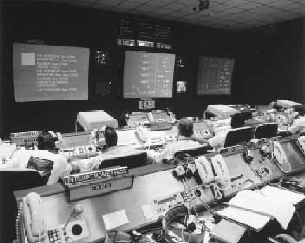
Figure 14. Control room, CSG, 1993
The morning began with a slide show, film, and briefing in three languages: French, English, and Japanese (the respective lingua francas of the space center, international technology, and this particular satellite). For over an hour we learned about the benefits of equatorial launches and how CSG has become “one of the world's most efficient launch pads and thus contributes to the worldwide reputation of Guiana, France and Europe.” Simultaneous translation was available over headphones throughout much of the presentation. The audience, composed largely of middle-aged European men, along with a few women, a contingent of Japanese, and a smattering of Guyanais Creoles, listened politely without apparent passion.
Following the briefing, we were ushered outside into a group of air-conditioned buses marked by language, French or English. Georges and I climbed aboard a French bus, which left for a tour of the new Ariane 5 installations under construction. Along the way we passed rolled barbed wire and military guards. We inspected a test stand where the solid boosters of the future rocket would soon be put through their paces, a large trench gaping beyond it to receive the flames, and the cavernous hanger where the assembled rocket would take shape. To me it resembled nothing so much as a wide silo, or giant barn, lonely against the sky. From its gates, twin pairs of tracks stretched toward the horizon, awaiting the day when they would support the launch table bearing the future rocket to its launchpad. For now they ran empty, seemingly to nowhere, or to infinity. Georges was excited by everything and particularly impressed with the aesthetic combinations of beige, red, and white used in the design. All told, the completed Ariane 5 ground facilities would represent an investment of something over a billion dollars.[2]
Lunch was held at one of Kourou's newly added hotels and consisted of rum aperitifs followed by local fish, wine, and a dessert labeled bavarois exotique. As the dark-skinned staff maneuvered between the tables, the conversation around me turned to international cooperation, racism, and stereotypes. Cooperation, we all agreed, sounded like a fine principle; the question was how to encourage it in practice. Georges was convinced that international space ventures offered the best possibilities for a peaceful future, a position endorsed by the engineer sitting next to him. However, that man noted, much work remained to be done. Even with all the success of Kourou, few French people even knew where it was, assuming on a basis of the name and hazy colonial memory that the launch base was in Africa.
Inspired by another glass of wine, Georges went further. Space, he suggested, constitutes a new religion. Through its exploration, people can come together and find a common future. Soon, however, space-planes will replace rockets, taking off directly from Paris. Then the connection will be cleaner, more direct. When I asked him what he thought would happen at that point to French Guiana, he shrugged. “They're part of France,” he said. “They have their vote, and anyway, we support them. A good part of these tours, you know, are to explain to us where our taxes are going.” He added that he considered Guyane to be a rich but hardly “clean” country. Cayenne was the limit, its filth bordering on the third world; Kourou was better, cleaner, and more modern. But the
Back on the bus, we headed for the ELA 2 launch complex, where the present rocket sat ready for flight. As heavy rain began to drum on the roof of the assembly facility, our young French guide told us how CSG experienced many problems with rust and hence was committed to a continual cycle of painting. The high humidity, he went on, also necessitated constant air-conditioning. As had happened a number of times in the different presentations, here he made reference to the space program in the United States, telling us that the climate at the Kennedy Space Center presented similar problems. At this point I noted that NASA represented the acknowledged industry standard, with Americans and (to a lesser extent) Japanese serving as the guarantors of value. American corporations, it was mentioned several times, believed in Ariane. We moved on to a set of control rooms where technicians monitored machines. Our troop watched them through glass. Amid the sea of light-skinned men in white shirts were a couple of women, and by the door stood two dark-skinned security guards.
Having inquired into my own interests, Georges proceeded to give me suggestions for further research. To understand the history behind CSG, he insisted, I must visit the White Sands missile base in New Mexico and, of course, the Kennedy Space Center in Florida. The Cold War, I must never forget, began with the race for the German V-2. Further, I must not underestimate the importance of the bandes dessinées (cartoon books), including Tintin, which he assured me had influenced an entire generation, particularly the episode where the hero visits the moon. The only problem with satellites and such, Georges went on, was the way they dramatically altered the scale of everyday life. Too much information flows through our brains now, all too quickly. He shook his head. Still, exploration, space, this was the path toward the future.
That evening Georges and I found each other again, in the parking lot where the invited guests waited to be herded onto buses, a much broader crowd this time, including many locals. After a long (and surprisingly cold) air-conditioned ride to the observation site, through guard posts and past long dark stretches of barren landscape, we sipped drinks and chatted until the countdown. As a voice intoned the descending numbers, a hush fell over the crowd, which collectively turned from the television screens and each other to face the horizon. Then the night was shattered as the rocket—at once distant but undeniably real—took to the sky. For a moment it wavered in the fragility of sheer power, and then, as if gaining confidence, gathered momentum. As its
After the launch we returned to the Technical Center of CSG, to enjoy an ample open-air buffet beside fire-fighting equipment: sipping champagne and eating caviar sandwiches, spiced chicken, somosa-style pastries, sweet tartlettes, and eclairs. An official of CSG and a representative of the Japanese communications corporation both made short congratulatory speeches, but few people listened, moving quickly toward the food and talking to their neighbors. Later there would be a poolside party at the Roches hotel, and the guest list would tighten, but for now the crowd was fairly mixed, including a number of local residents not associated with the space business as well as employees and clients of the center. An engineer told me he disliked being in the televised control room during the launch. “It's a sham,” he said, pointing out that the whole affair is automated and that most of the assembled rows of space personnel are there for show, to present a face of authority. Seeing the rocket in open air, even at a distance, he thought felt more real.
I drove back to Cayenne late that night on a largely deserted road. Along the way I picked up a hitchhiker, a security guard originally from Haiti. He spoke French quite well and told me that he had lived in Guyane with his wife for about a dozen years. In a good month his security post might bring in seven thousand francs (some thirteen hundred dollars—far less, needless to say, than the salary of a European space engineer), but the work was irregular and he did not enjoy it. He would prefer to migrate north to the United States or Canada; he would like to see his family in Haiti again; at the very least he would like to find a new job, but for now he was stuck. I dropped him off in a poor section of town and turned on the radio. A man's voice spoke in Creole-accented French about independence. Foreign investment would be allowed in the new Guyane, he proclaimed, as long as the profits poured back into the country to eliminate unemployment. Beneath the ground, he suggested, lies the real wealth of the future, the precious mineral keys to development.
The next day the tour continued, but neither Georges nor I took part in it. As scheduled, the guests spent the day on the Iles du Salut, enjoying the atmosphere of a tropical island while exploring the ruins of the penal colony. This trip constituted a regular feature of the public relations visit; a chance for the invited guests to experience a taste of “authentic” Guyane before boarding the return flight to Paris. In case of
Lest the tone of my narration mislead, I should stress that I liked Georges, however I might disagree with his political and historical assumptions or question his vision of the future. He was friendly to everyone he met and spoke freely. I also believe he was quite sincere in his faith in the Space Age. Thus I think of him while writing, and present him to you now, in order to give a sense of a sympathetic believer behind the rhetoric of the space enterprise. Although his statements about outer space may appear bombastic and empty, they contain a core of belief and affect. And, like the launch at their center, they are not simply false. Watching a rocket leave the ground, feeling its presence, can evoke a powerful sensation of reality. While some in the audience may pray for its safety and others may speculate about the thrill of explosion, a recognition of significant risk remains.[3] Although Ariane's rise is not exciting or magical to everyone—some complain how small, slow, and distant it appears—like the rhetoric around it the event contains a moment of literal power, an instrumental jolt between myth and fact. For humans and their tools have indeed left their planet. And that dream, made real, is not something to take too lightly. As Walter MacDougall reminds us in describing the hyperbole of the moon landing: “President Nixon thought those days in July the greatest week since Creation—ridiculous perhaps, but also the most honest image of the hopes and fears of technocratic man: men as gods, creators in their own right with all the glory and tragedy of divinity.”[4] Georges, I am sure, would more than agree.