
INTRODUCTION BY HERBERT W. LUTHIN
The work of recording this Eastern Pomo creation myth back in 1930 brought together two of the most remarkable figures in the annals of California oral literature: William Ralganal Benson, storyteller and artist extraordinaire, and Jaime de Angulo, a wild and charismatic linguist who became something of a cult figure in his own lifetime. Benson would have been sixty-eight when he told this myth, and de Angulo forty-three. In the latter's books on California Indian life and lore, Benson (or “Uncle William,” as Jaime and his wife, L. S. “Nancy” Freeland, called him) is the model for the character of Turtle Old Man. Because the two men, friends for nearly twenty years, are such important figures in the history of California folklore, I will briefly sketch their biographies before considering the myth itself.[1]
Benson was born in 1862 at Shaxai (now known as Buckingham Point) near the ancient town of Shabegok on the western shore of Clear Lake. It was, in de Angulo's words,
a pleasant region of small fertile valleys where wild roots and seeds once grew in abundance; where acorns, laurel nuts, buckeye chestnuts were once plentiful; where the streams were once well stocked with fish; where the hillsides were once covered with numerous bands of deer. The lake itself, surrounded by mountains, teemed with fish, and flocks of aquatic birds of all kinds were constantly flying by. (de Angulo 1976a:103)
Benson was fortunate enough to have lived his boyhood years during the last decade in which Eastern Pomo speakers enjoyed a more-or-less traditional lifestyle. By the 1870s, the social and environmental disruptions caused by a growing local Anglo-American population would make traditional life impossible, as the lifeways of local Indians became increasingly marginalized.
Benson himself was of mixed-blood descent. His mother, Gepigul (“Sally” to local whites), came from a line of hereditary leaders of the Kuhlanapo (Water Lily People) and Habenapo (Rock People) tribes. His father was Addison Benson, one of the first white settlers in the Kelseyville area—by all local accounts, an intelligent and open-minded man who got along well with his Indian neighbors.[2] Indeed, Addison saw fit to learn the Eastern Pomo language of his wife's people, so despite his mixed heritage, William Benson still grew up in a household where Eastern Pomo was the language of choice. For this reason, Benson didn't really learn to speak English until later in his adult life. Something of a renaissance man, he even taught himself how to read and write.
Benson became not merely a tradition-bearer of his culture's arts and literature, but a master of them. Sally McLendon, who has worked on Eastern Pomo for many years and knew Nancy Freeland in Berkeley, tells me that everything Benson turned his hand to—basketry, regalia, storytelling—came out almost preternaturally ornate or beautiful: not just a mask, but a work of art; not just a basket, but the most beautiful basket you ever saw; not just a myth, but the most detailed and skillful version in the canon.
The Pomo were one of the very few California groups where baskets
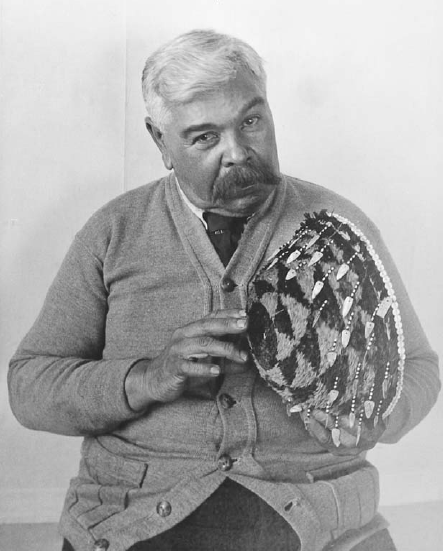
FIGURE 7. William Ralganal Benson, circa 1936. Courtesy Phoebe Apperson Hearst Museum of Anthropology and the Regents of the University of California.
An initiate into Eastern Pomo religion and ceremony, Benson, with his deep cultural knowledge and mixed-blood ancestry, was an ideal consultant for academic researchers—brilliant and informed, yet also familiar with the manners and expectations of the white world. Over the years, he worked and shared this knowledge (not without controversy) with a string of the most important figures in California linguistics and anthropology: Kroeber, de Angulo, Freeland, Loeb. He stands today as one of the most prolific and authoritative sources of information on the Northern California Indian world, particularly that of the Pomo.
William Benson died in 1937, at the age of seventy-five. Among the papers he left behind is a lengthy autobiography, written primarily in English, though with passages in Eastern Pomo. Sally McLendon is working on a scholarly edition and translation of this manuscript.
Jaime de Angulo
Cowboy in Colorado; failed silver miner in Honduras; medical student with a degree from Johns Hopkins; cattle rancher; army psychiatrist during World War I; novelist; gifted and largely self-taught linguistpsychologist-anthropologist-ethnomusicologist with a lifelong interest in the Indians of California—Jaime de Angulo was all these things and more. Born in Paris in 1887 of wealthy Spanish expatriate parents, de Angulo got fed up with his Jesuit schooling and came away to America at the age of eighteen, looking for adventure. He proved to have a talent for landing in the thick of things, like arriving in San Francisco in 1906 on the day of the great quake.
De Angulo had long been interested in anthropology, Jungian psychology, and linguistics, but it was through a mutual friend, Nancy Freeland, that he met Paul Radin and Alfred Kroeber at the University of California. (Freeland was then an anthropology student studying under Kroeber.) Kroeber quickly recognized his brilliance and—though the two men had an uneasy relationship throughout their careers (de Angulo's lifestyle was just too exuberantly bohemian for Kroeber's sense of propriety)—helped to get him established, inviting him to Berkeley to give lectures and, later, courses in anthropological psychology. (It was after his first such lecture, in 1919, that de Angulo met William
During the twenties and thirties, de Angulo, often together with Freeland (whom he married in 1923—his second marriage), did significant fieldwork on a variety of California and Mexican languages, including Achumawi, Atsugewi, Karuk, Shasta, Sierra Miwok, Eastern Pomo, Mixe, Chontal, and Zapotec. But it was Achumawi, the language of the Pit River Indians of Northeastern California, that occupied center place in his life and life's work. From his deep personal and professional involvement with the Achumawi came a grammar, numerous mythological texts, ethnomusicological studies, and what has come to be his bestknown book, Indians in Overalls.
Jaime de Angulo lived a colorful and in many ways tragic life—a life so rich and varied, so full of good times, hard work, and troubles, that I cannot even begin to portray it here. His work in linguistics and music alone (he was one of the pioneers of Native American ethnomusicology) would make him a seminal figure in California folklore and anthropology. But de Angulo was never merely an academic. He had the gift of a poet's ear, and used it to make books of translations and fictionalized retellings that far transcended other treatments of his day for the music, grace, and fidelity of the language, and for their wide-ranging accessibility and popular appeal.
As a writer, de Angulo managed to capture into English not just the contents of the texts he recorded, but something of their rhetorical style and, beyond that, of the worldview that informs them. It is a voice so distinctive as to be unmistakable among translators of Native American oral literature. Nowhere is this voice more evident than in his fictionalized settings of myths and tales jumbled together from his many field trips around California—in books like Indian Tales, How the World Was Made, and Shabegok (many of them ostensibly intended “for children”). It might be argued, perhaps, that de Angulo as much invented this voice in English as discovered it resident in the texts. There is something so easy-going, so engaging and seductive, about this voice that the dreary postmodernist inside us is all but incapacitated by its charm. In any case, he used this voice in his books and stories the way a musician uses his
Benson's Eastern Pomo “Creation”
This myth was first published in the Journal of American Folklore in 1935. De Angulo's commentary prefacing the text, which was presented first in Pomo and then followed by an English translation, was quite minimal. It is reproduced in near-entirety here:
The text of this Pomo tale of the creation is in the Clear Lake dialect [of Eastern Pomo] and was dictated by W. Ralganal Benson. The translation was undertaken primarily as a linguistic study. In the first part of the myth [¶1–17] therefore the original Indian text has been adhered to most closely, and practically a literal rendering is given. This will be of advantage to students of linguistics, but a detriment to the general reader and folklorist. The general reader is likely to be repelled by the awkward English, as a result of the too close following of Pomo idioms and style. On the other hand he may perhaps welcome the guarantee of accuracy. If he is curious to know how the Indian mind [read: Pomo mind] shapes its thoughts in language and style, here he will find it. As the work of translation proceeded, it was deemed unnecessary to render the original so literally. The student of linguistics would by this time be familiar enough with morphology and semantics to supply or delete a few words here and there, by comparing with the original text. In this latter part of the tale the general reader will find a rendering that gives in reality a truer equivalent of the original Indian style with its slightly Homeric flavor.
Though de Angulo much later published a fictionalized setting of this text in a still freer translation that smooths away the “literal rendering” of the opening seventeen paragraphs, I have chosen to present the more scholarly version of the myth here because of its closer adherence to the original text. For contrast, though, here's how de Angulo opens the telling of this myth in How the World Was Made (1976b:41):
After the Kuksu left they were quiet in the Ceremonial-house for a long time. Then Old Man Turtle commenced the long tale of “How the World
― 266 ―Was Made.” He launched into it without any warning, as if he were just making an announcement of what had happened the day before.Then Marumda pulled out four of his hairs. He held out the hairs, he held out the hairs to the east, he held out the hairs to the north, he held out the hairs to the west, he held out the hairs to the south. “Lead me to my brother,” Marumda said to the hairs.
Readers who make the comparison will understand both how the overly literal version submits to change and why the fictionalized version, though more consistent in tone, was not chosen for inclusion in this volume.
Belying its tight cyclical structure, Benson's “Creation” reveals a sweeping, almost panoramic vision. Within its five gyres there is a great wealth of detail, as well as the continuing slight novelty of complex and nonformulaic variation. The particularity lends immense texture to each patch or passage of narrative ground, while the variation imparts a through-momentum to the story that carries it forward rather than backward, so that ultimately it transcends its own circularity. The cumulative e ect of all this variation and detail is less déjà vu than daguerreotype: as in the development of a photographic plate the longer it is bathed in solution, with each pass at creation the image of the world fills in with richer and richer detail.
Though some plot elements exhibit less internal variation than others—for instance, the meetings between Marumda and the Kuksu are highly and ornately formulaic—variation is nevertheless the key to understanding the myth as a whole. Notice how each cycle of creation either involves di erent methods, focuses on di erent facets of culture and existence, or works at refining the establishments of the preceding creation.[3] In some rounds of creation, people are made from sticks or other inanimate objects; in others, like the second, they are simply thought or willed into being. In some creations, such as the first, Marumda's instruction is limited to basic survival skills, like what foods to eat and how to prepare them; in others, such as the third and fourth, in addition to survival instruction, Marumda sets up key social and governmental institutions. In some, he explains to people the fate of the previous creation; in others he does not. In some, he partakes of food with his people; in others he does not. In some, he establishes a dance ceremonial; in some, he decrees the division of labor between the sexes; in some, there is comic relief, like the encounters with Squirrel and Skunk; and so on. Even when
On another level, Benson's “Creation” may be heard as an extended and unabashed love song to Marumda, the Eastern Pomo Creator. One of the most extraordinary features of this myth is the sophisticated way in which the portrait of Marumda is developed across the successive cycles of the world's resurrections. It is not so much Marumda himself but our perception of him as a character or deity that matures so profoundly during the course of the myth. He is lovingly portrayed as a revered and (for a deity) oddly human figure—not through didactic narration, as a lesser storyteller might have done, but obliquely, by showing the increasing respect, a ection, and awe with which he is treated by the succession of peoples he creates and instructs. The belated discovery of generosity in the third creation (¶114–116), which is requited in the fourth (and codified culturally as the ideal of hospitality due a stranger), suggests something of this growth in stature and recognition. By the fourth and fifth creations, children are scolded for making fun of “the Old Man,” as well as for fearing him—the knowledge of who he is and what he has done being passed on as lore from generation to generation.
There is ever an air of mystery surrounding Marumda. He always seems to be wandering o once his work is done, never to be seen again, leaving his people, his creations, behind to express their wonder and gratitude. Marumda reaps this loving adulation despite his role as avenging angel. Nowhere is this essential duality of character more evident than in the aftermath of Marumda's destructions, where we find him going along, inspecting the newly scorched or scoured earth, simultaneously ascertaining that no survivors have escaped his destruction and expressing shock and grief at their extinction. This behavior may seem quixotic to modern readers, given that it is Marumda who calls down their destruction in the first place. It helps, then, to learn that Marumda is historically an anthropomorphic development of a still more ancient mythological figure, Coyote, known across the whole of the California culture area. Once that connection is made, the disparate points of Marumda's personality begin to cohere into a well-known constellation of traits, and we can recognize in Marumda a reflection of Coyote's complex trickster nature in California religious cosmology.[4]
This is a masterful narration, surely with its place in the canon of world literature. The comments I have made here are merely suggestive of a myriad avenues of inquiry into this myth.