
WHOSE WARTIME SACRIFICES
DESERVE COMMEMORATION?
Along with their sweeping challenge to official claims on the memory of fallen soldiers, the revisionist films of the 1980s also focused on the postwar betrayal of the broader scope of the Vietnamese state's commemoration of war. Throughout the wartime period, the state celebrated individual acts of self-sacrifice by patriotic workers and peasants, heroic mothers, children and grandparents, and revolutionary cadres and soldiers. If their contributions fell short of the ultimate sacrifice of
Film was a particularly important means through which the state imparted the commemorative meanings it gave to the sacrifices of these social groups. The first featurelength Vietnamese film, On the Same River (Chung Mot Dong Song), [15] told the story of two young lovers, divided by the river that formed the boundary between northern and southern Vietnam in the Geneva Accords, who put aside the individual sorrows of their frustrated love to fight for the reunification of the country and ideals of socialism. It set the tone for filmmaking during the war and in its aftermath, including such wellknown films as The Fledgling (Chim Vanh Khuyen), in which a little girl is killed in her attempts to warn a revolutionary cadre of an impending enemy ambush; Coal Season (Mua Than), set among coal miners in the North who overcome constant bombardment by American jets to produce the coal needed for the war effort; and When Mother Is Absent (Me Vang Nha), which focused on a mother and her five children who responsibly take care of each other at home while their mother fights the enemy on the battle-field.[16] This commemorative rendering in film emerged most fully in the 1965 documentary Victory at Dien Bien Phu (Chien Thang Dien Bien Phu), [17] released to coincide with the tenth anniversary of the French defeat at the climactic battle of the first Indochina war. Crosscutting between black-and-white footage of the battle itself and vignettes that celebrated individual acts of heroism by soldiers in battle and by peasants and workers on the home front, the film presented what it called the “spirit of Dien Bien Phu” as a didactic lesson of the necessity of collective self-sacrifice to successfully realize “the struggle against American imperialists for independence, for the land of the peasants, for socialism.”
Many of the revisionist films of the 1980s undermined these larger commemorative pretensions of the Vietnamese state. Depicting a postwar world in which the patriotic and revolutionary figures celebrated in official memory occupied a marginal, often forgotten, place in society, they called into question the state's ability to honor the wartime sacrifices of its people and to sustain the foundational myths of the war experience through which it sought to legitimate its power and authority. The betrayal of wartime sacrifices emerges as a particularly important theme in three of these films. Tran Van Thuy's 1987 documentary, How to Behave (Cau Chuyen Tu Te), opens with historical footage of
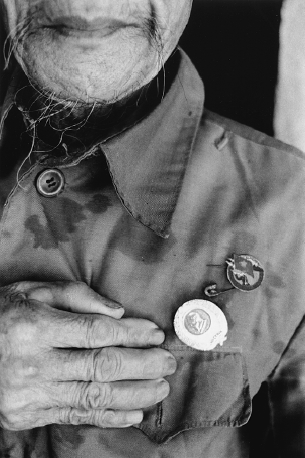
Figure 7.2. Dien Bien Phu veteran, Tam Nong District, Phu Tho. Photograph by Natalia Puchalt.
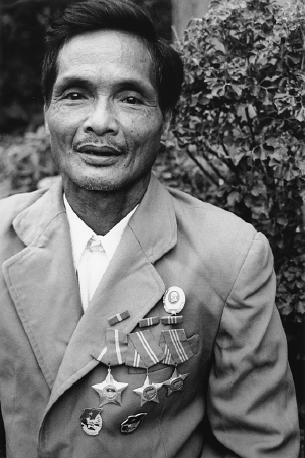
Figure 7.3. American War veteran and Agent Orange victim, Tam Nong District, Phu Tho. Photograph by Natalia Puchalt.
The veteran at the center of Brothers and Relations occupies a similarly peripheral place within his family and in postwar society. From the outset of the film, when the veteran returns to his home in Hanoi, he receives little understanding or appreciation from his family for his experiences in war. Ringing the bell upon his arrival, he is first greeted by a young woman who does not know him but now occupies his former rooms, which his family had rented out believing him to be dead. Confused, he rings again and this time awakens his brother's sleeping wife. Annoyed that someone is at their gate early on a Sunday morning, she asks her husband to receive the caller, but he is preoccupied with collecting the eggs his hens had laid the night before and so refuses. Finally the wife answers the bell. Astonished to see the veteran, she gives him a forced smile that only slightly masks her underlying anxiety that his return will upset the household's economic arrangement with their
The cool reception that the veteran receives from his family is replicated in his encounters with society at large. Potential employers insist they cannot offer him a position because he does not have proper training in a trade; they remain unmoved when he explains he was drafted before he could enter vocational school. Unable to find a job, he passes much of his time with other unemployed veterans in seedy cafe´s frequented by prostitutes. But here, too, the veteran tells his few friends he “just doesn't fit in.”
By focusing on the indifference the veteran encounters from his family and society, Brothers and Relations points to the state's larger failure to honor the wartime contributions of soldiers and its inability to honor its commemorative ideals in the postwar period. In one revealing exchange the veteran's brother says that his failure to find a job “betrays their father's trust,” to which the veteran tells his seemingly uncompre-hending brother: “Betray? You don't think joining the guerrillas for so many years, fighting, not running away, with a bullet in my body is honorable. I come back and look for a job so I won't be a parasite. But if you lack a diploma and have a mind that won't do anything right, you might as well be dead.” In the end, the film suggests, the returning veteran can find a place for himself and his own memories of war only on the margins of society. A chance encounter with his old platoon leader, a kindly and trustworthy figure who has made a quiet life for himself in a small coastal fishing village, convinces the veteran to do the same. Surrounded by the platoon leader's warm and empathetic family, the veteran comes to enjoy an Arcadian existence that the film poses as a virtuous antithesis to the ills of forgetfulness of the rest of contemporary society.
The most probing and critical examination of the state's betrayal of the ideals it had so painstakingly cultivated through official commemorations of war emerges in a second film by Dang Nhat Minh, Girl on the River (Go Gai tren Song), released in 1987. The film opens with a young woman in a hospital who is telling her life story to a woman journalist. The first third of the film flashes back to the period of the American War, when the young woman had been a prostitute in Hue
After the war's end, the young woman realizes the cadre has survived the war and become an important provincial government official. She makes efforts to see him at his office to renew their friendship and seek his assistance. Her papers, however, reveal her to be a former prostitute who had served time in a reeducation camp after the war, and she is refused admittance to him. But while the man's factotums refuse her request because of her “class background,” they remain unaware of her earlier relationship with their boss. The former prostitute leaves, assuming that the cadre himself did not refuse her request. By chance shortly thereafter, the cadre's car is stopped because of road construction. On the construction crew laying piles of asphalt is the prostitute, who immediately recognizes the cadre and approaches his car. In a long, painful scene she circles the car without speaking while the cadre ignores her, gazing straight ahead, almost through her. Devastated by this treatment, she leaves work that day, dazed, and is hit by a truck as she walks down a country road. Recovering from the injuries in a hospital, she encounters the woman journalist to whom she has been telling her story.
Neither the young woman nor the journalist realizes the cadre is the husband of the journalist. Indeed, the journalist is puzzled when her husband responds unsympathetically to her interest in publishing the story (he of course realizes the story is about him and worries that if the connection were revealed it could harm his position). The journalist begins to encounter obstacles to publishing her story, again unaware that her husband is using his connections to make sure it is not printed. Told by her editor that the story will not be published, she threatens to resign her position. When she returns home and tells her husband what she has done, he explodes, not only revealing that the story was about him but also criticizing her for giving up her position and for endangering his career.
If the basic structure of the plot serves to reveal the betrayals and hypocrisies of official commemoration of wartime sacrifice, understanding Dang Nhat Minh's decision to use a prostitute as the heroine is essential to decoding the multiple meanings of the film and how Vietnamese audiences might have apprehended it. The sympathy and quiet heroism he accords to the prostitute and his implicit criticism of the cadre's postwar behavior overturn some of the state's most fundamental political assumptions. During the war, the prostitute often served as a symbol of the corruption and immorality the North Vietnamese state attributed to the South Vietnamese government. In the immediate post-war period, party rhetoric called for the eradication of prostitution in the South because it was inimical to what it termed the “human dignity” of women and the “moral integrity” of the new “socialist man.” Prostitutes, like others associated with the southern regime, were to be made over into socialist men and women, a decision that helps explain why the film's heroine had been sent to a reeducation camp.[18]
Yet Girl on the River offers the prostitute as a symbol of loyalty and principle to reveal the absence of those qualities in the socialist regime. It emphasizes the contrast between the behavior of the prostitute and the cadre in a scene late in the film. After his angry attack on his wife, the cadre goes to the hospital hoping to see the girl (though whether to affect a reconciliation or silence her is not clear). She has already been released, but as the cadre looks around her empty room and at the white sheets of her bed, he suddenly imagines a stain of red blood on the sheets. A new bride traditionally presented blood-stained silk squares after the wedding night to her husband's kin as proof of her virginity; what the cadre has been visualizing, therefore, is nothing less than the prostitute's essential purity.
Dang Nhat Minh's use of the prostitute as a self-sacrificing patriot also has a deeper resonance in traditional Vietnamese literary culture. Most Vietnamese are familiar with the story of Tay Thi (Ch. Hsi shi), a young woman who in popular legend is credited with assuring the victory of the king of Yu¨eh over the king of Wu during the period of the Warring States (403–221 b.c.). After the king of Wu defeated the kingdom of Yu¨eh, believed to be the embryonic precursor of the Vietnamese state, the king of Yu¨eh presented Tay Thi to the Wu court. A woman of transcendent beauty—the T'ang poet Li Po called her “luminous, ravishing, a light on the sea of clouds” —Tay Thi was reportedly educated in the feminine arts at the Yu¨eh court for the purposes of corrupting the king of Wu. Distracted by Tay Thi's beauty and charms, the
The close links between the story of Tay Thi and the behavior of the prostitute in Girl on the River suggest the film offers an even deeper challenge to the larger symbolic meanings the state accorded to prostitution. Its approving depiction of the prostitute's contribution to the war effort joins it to a sustained indigenous debate that began during the period of French colonial rule over the efficacy of collaboration in which the prostitute came to be seen as a metaphor for an acceptance of foreign rule. At the center of these debates were often-conflicting interpretations of Nguyen Du's nineteenth-century epic poem The Tale of Kieu (Truyen Kieu), in which the heroine's willingness to prostitute herself for her family was widely seen as an apologia for the author's decision to abandon the Le cause and serve the new Nguyen dynasty. In what are commonly known as the “writing brush wars” of the 1860s in the wake of the French conquest of the South, one leading collaborator with the French justified his decision by comparing his plight to that of Kieu. Similarly, Pham Quynh, a leading indigenous supporter of French rule in the 1920s, sought to canonize Kieu as a filial, self-sacrificing daughter who prostitutes herself to save her family in an effort to defend his own collaboration with the French. If collaboration for Pham Quynh was like prostitution, then he, like Kieu, was practicing it for the purest and noblest of motives, prostituting himself for the ultimate good of the nation.[20]
These defenses of Kieu and of collaboration met with sharp indigenous attacks. Opponents of collaboration in the writing brush wars did not so much direct their ire at Kieu as argue that collaborators attempted to cloak their disloyalty in the false guise of filial piety. But Pham Quynh's detractors, some of whom came to play leading roles in the North Vietnamese state after 1945, chose to attack him through a critique of Kieu. Their argument that Kieu was little more than an unchaste and lewd woman undeserving of veneration was squarely aimed at undermining Pham Quynh's defense of collaboration. These proponents of “art for humanity's sake” in the 1930s, who set many of the parameters for the state's socialist realist aesthetics in the coming decades, had little use for Kieu and prostitution. Far from a model of revolutionary voluntarism, she appeared as little more than a weak, passive victim of an iniquitous social system that the socialist revolution aimed to transform.[21] For instance, in To Huu's poem “The Song on the Perfume River” (1938), a work later celebrated by the North Vietnamese state,
Dang Nhat Minh's choice of two women to serve not only as the film's central characters but also as its narrative voice joins the film to a traditional literary idiom in which male authors adopted a female narrative voice that could serve counterhegemonic purposes without interference from the state. In part, his choice may have been a device to evade censorship by employing the practices of the northern radical and progressive authors of the 1920s and 1930s who used the coded language of gender to undertake political debate and avoid colonial censorship.[23] The timing of the film's release in 1987, in the very early days of the reform movement, suggests that Minh would have needed to be very cautious in presenting his critiques because the boundaries and implications of the reforms remained uncertain.
Girl on the River employs two gendered literary tropes—women as victims and women as powerless—that give it the freedom to articulate a more sweeping indictment of contemporary society. Drawing on the symbolic resonance of women as victims, an idea that is enshrined in Vietnamese literary classics like the eighteenth-century epic poem Lament of the Soldier's Wife (Chinh Phu ngam), as well as in the literature of the 1920s and 1930s that portrayed a feminized colonial population victimized by Confucian family structures and the colonial state, the film uses the prostitute and female journalist to suggest society at large has been victimized by the state's inability to uphold its commemorative ideals. Similarly, and more bleakly, the film appropriates the common literary and cultural equation that linked women with powerlessness to suggest that just as the women in the film are unable to control their own fates, contemporary Vietnamese society lacks the agency to rescue itself from the state's betrayal of the socialist ideals that underlay its official narrative of war.
The final plot twist in Girl on the River underscores this subtle critique of state practices, starkly revealing the emptiness of the state's commemorative promises. After the argument with her husband, the