
WHO RIGHTFULLY POSSESSES THE MEMORY
OF FALLEN SOLDIERS?
The fallen soldier is perhaps the most potent symbol of official efforts to commemorate and legitimate the national experience of war. As George Mosse argues in his seminal account of state memorializing practices in Europe in the aftermath of World War I, the body of the soldier killed in battle came to transcend death and was increasingly linked to the highest aspirations of patriotic nationalism. Images of the fallen soldier in the arms of Christ, Mosse asserts, “projected the traditional belief in martyrdom and resurrection onto the nation as an all-encompassing civic religion.”[6] Central to the European statesponsored cult of the fallen soldier was the construction of war monuments and military cemeteries that functioned both as shrines of national worship and as physical symbols of the superior claims made by the state on the memories of those who died in battle.
The development of memorial holidays and specially designed cemeteries by the Vietnamese state to render the death of soldiers as symbols of national revolutionary martyrdom mirrors key aspects of these interwar European practices. Like its counterparts in Europe, the Vietnamese state sought to own the memory of its war dead, an effort most starkly revealed in the official memorial services organized by local party cadres. Here a fallen solder's sacrifice for the state and revolution, rather than this relationship to his lineage or village, served to exclusively define the meaning of his life and death.[7]
Fallen soldiers occupy a central place in the symbolic vocabulary of many of the revisionist films of the 1980s, but they are used to subvert rather than affirm the scaffolding of official memories erected by the state and to stake a claim for the primacy of individuals and civil society as the rightful heirs to memories of the war dead.[8] Brothers and Relations places the remains of the fallen soldier at the center of its withering critique of an amnesic postwar Vietnamese society (fig. 7.1). At the end of the film, the veteran encounters his brother and his wife in the parking lot of the airport outside of Hanoi as he returns from his trip to recover
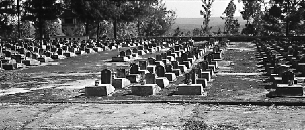
Figure 7.1. The Truong Son Cemetery on the Ho Chi Minh Trail contains the graves of nineteen thousand North Vietnamese soldiers. Photograph by Hue-Tam Ho Tai.
Nguyen Xuan Son's 1987 film, Fairy Tale for Seventeen-Year-Olds (Truyen Co Tich cho Tuoi 17), appropriates official memories of the fallen soldier in gentler but nonetheless subversive ways. The film tells the story of a young student, An, who falls in love with a soldier when she sees his picture and hears his mother read from his letters written from the front. An and the soldier never meet, but their tender relationship emerges through letters they exchange with each other and in a series of dream sequences in which the young girl encounters the spectral figures of the soldier and his regiment, who appear to be taking shelter from the war in a dark cave. An's love for the soldier meets severe official disapproval as a violation of the wartime imperative of collective selfsacrifice. In an early scene, her teacher asks An's class to prepare an
In contrast to these official judgments, Fairy Tale for Seventeen-Year-Olds concentrates on the approving support An receives for her love of the soldier from her father and the soldier's mother. For both of them, the war has taken a deeply personal toll. Her father is a veteran of the French war whose wife died of grief after going years without word of the fate of their son, who apparently died in battle. He tells An her relationship with the soldier is a “fairy tale” but indulgently advises her to continue it as she is too young to know the “realities of war.” The soldier's mother, Mrs. Thu, a political cadre whose own husband was killed in battle during the war against the French, also affirms An's love for her son, sharing his letters with her and urging An to write to him in return.
The film ends on the day of Hanoi's victory in the American War. Just before Mrs. Thu is to give a victory day speech in the courtyard of An's school, she receives a telegram with the news that her son was killed in one of the war's final battles. As she gives her speech celebrating “the heroic sacrifices that won us victory from the American imperialists,” the pain in her face betrays the more personal meaning of her son's death and the memory of her husband. She tells An's father later, “I never thought I would experience such grief on this day of our victory,” to which he replies, “We've won independence at the cost of young lives.” In its focus on the human dimension of a soldier's life and death, Fairy Tale for Seventeen-Year-Olds suggests the necessity of a more intimate interpretation of the memory of fallen soldiers than the one put forward through the state's commemorative practices to provide essential consolations for the private sacrifices of war. As the young girl An says in the final frames of the film after she comes to know of her lover's death, “My love made me happy. I want to retain that happiness … to know nothing but my beautiful fairy tale.”
Perhaps the most complex exploration of the question of who right-fully possesses the memory of fallen soldiers emerged in Dang Nhat Minh's 1984 film, When the Tenth Month Comes (Bao Gio cho den
When the Tenth Month Comes tells the story of the decision of a young woman named Duyen to keep the news that her husband was killed in battle hidden from her husband's family and village. By the end of the film Duyen comes to know that her behavior is improper. Kneeling next to the deathbed of her husband's father, she cries out, “I haven't told the truth. … I'vedone wrong.” From the state's perspective, the nature of Duyen's error would have been obvious: she prevented her husband's memory from fulfilling its officially sanctioned commemorative purposes. At points the film does acknowledge the legitimacy of state claims on the fallen soldier's memory. Early in the film the father of Duyen's husband calls the death of his elder son during the American War a “patriotic sacrifice for the advancement of the national liberation movement and the socialist revolution.” Similarly, the final scene of the film after the dead soldier's family and village have come to know of his wife's deception appears to suggest the official order has been restored. As martial music swells, Duyen's son and his teacher, surrounded by children carrying party banners, gaze admiringly upward at the yellow star and red background of the Vietnamese flag snapping purposefully in the wind. But these rather perfunctory scenes are oddly disconnected from the larger narrative of the film, better reflecting a bow to the very real concerns of continuing state censorship rather than a full embrace of official commemorative practices.
The film concentrates on the impact of the war on the interior lives of Duyen and her husband's family. When the state intrudes on their
By contrast with the film's portrayal of the state, its depiction of Duyen's multiple social roles as wife, opera singer, and widow lends her character a surprisingly sympathetic form despite the evident disapproval of her actions. Duyen's relationship to her husband's family and village is clearly that of an outsider. Within Vietnamese patrilineal familial custom an in-law is “outside” (ngoai), a term used to describe nonpatrilineal kin and suggestive of the secondary role a wife occupies in her husband's family. As an opera singer and a former member of a traveling theatrical troupe, Duyen is also connected to a social group viewed with some ignominy in northern Vietnamese society as an alien presence that should properly remain apart from the closed formal structures of village life.[9]
In part Duyen's marginal and vulnerable position in her husband's family and village provides Dang Nhat Minh with a more impressionable and less dangerous agent for launching his critique of state claims on the memory of fallen soldiers than if he had chosen to center the film
But if the narrative of When the Tenth Month Comes at times accords Duyen an empathetic place, its broader focus remains a critical examination of the transgressions Duyen acknowledges at the end of the film and the path through which she comes to know her behavior is wrong. The film concentrates on Duyen's failure to fulfill her filial duties to her husband's family and his lineage and her moral obligations to his village in a manner that subtly undermines the state's monopolizing claims on the memory of her dead husband. It articulates its disapproval of Duyen's actions in a crucial scene in which the family of her husband observe the death anniversary of her husband's mother. At the culminating feast marking the anniversary, one family member reads a letter full of filial devotion purportedly written by the heroine's husband. The letter, however, is actually a fabricated one, written at Duyen's request by the village schoolteacher as a way of convincing the family that her husband remains alive.
When Duyen uses a death anniversary at which the soul of the departed ancestor is believed to be present to advance her deception, her actions emerge as a particularly egregious violation of traditional Vietnamese practices of remembering and propitiating the memory of the dead. The rites of the death anniversary, one leading scholar of these practices argues, are essential to affirming the primary familial obligations of filial piety (hieu), “symbolically joining the living, dead and yet to be born members of the family … inan intimate relationship of mutual dependency.”[10] The visual dynamics of the scene sharpen the contrast between Duyen's serious breach of familial norms and the proper
The film's particular concentration on the feasting component of the death anniversary also reinforces its focus on the claims of family and village, rather than the state, on the memory of Duyen's husband. The feast marking the death anniversary, in which a family traditionally invited its neighbors in the village to share, was among the central targets of a sustained campaign by the state against superstitious practices in northern Vietnam after its rise to power in 1945. For the state, the elaborate network of social exchange promoted through the feast both incurred wasted expenditure better used for collective economic purposes and represented undesirable feudal customs that promoted social inequality and status competition. In its place, the state promoted a simple didactic ceremony among the immediate family of the deceased that focused on the departed ancestor's contribution to the rise of a new revolutionary society. Dang Nhat Minh's inclusion of the feast in his depiction of the rites of the death anniversary, which reflects the very real return of such traditional ritual practices in northern Vietnamese society in the 1980s, pointedly places the memory of the dead within the world of the village community and suggests that Duyen's deceptions most importantly violate familial and village rather than state norms.[11]
Significantly, When the Tenth Month Comes guides Duyen toward the self-knowledge that her deception injures her husband's family and village through a series of conversations with the spirit world. This marks another conscious break with the state's insistence on empirically verifiable solutions to human problems rather than recourse to the metaphysical realm that was at the core of its campaigns against superstitious practices. In one of several dream sequences, which draw upon a common traditional belief that the spirits of the ancestors can appear in dreams to warn of approaching calamities, Duyen meets the village guardian spirit (thanh hoang), who tells her he is “a husband like yours who followed a famous king to repel the Mongol invaders from the North,” a reference to the thirteenth-century Mongol invasion of Vietnam. While the state consciously sought to appropriate these ubiquitous village cults to legitimize its prosecution of the wars against the French and the Americans within what it termed the “timeless tradition of
Later the films uses an encounter with the spirit of Duyen's husband to provide the vehicle through which she comes to appreciate the significance of his family's claims on his memory and her obligation to them. The meeting takes place at what the film calls the “Day of Buddha's Forgiveness,” an event Duyen's grandmother recalls as a practice from the “olden days” in which “the dead could meet the living in a midsummer market.” Coming upon her husband, she notes his sadness and asks, “Is there something that needs atonement?” Her husband tells her: “I've done my duty. The living should make each other happy.” “Father thinks you will still return,” Duyen tells him. “Let him be peaceful in his own mind,” he replies. “He and I will meet again.” Her husband's gentle rebuke serves as a reminder of the spiritual dilemmas that Duyen's transgression of filial norms poses for his family. Without the knowledge that their son has died, they are of course unable to properly honor his memory. But an unpropitiated death, according to traditional Vietnamese beliefs, can threaten the family in a number of ways, turning the dead family member into a restless and potentially malignant spirit who can bring ill fortune to the family. Duyen's encounter with her husband at the Day of Buddha's Forgiveness, a loosely fictionalized version of the Buddhist Feast of Wandering Souls (Ngay Xa Toi Vong Hon), in which village communities traditionally sought to pacify the souls of those who had no one to remember them, suggests her actions have wrongfully placed her husband's spirit in a potentially dangerous sacred space. In urging Duyen to give his father peace, a request approvingly rendered by the film, Duyen's husband reminds her of the primary ties of kinship and the urgency of restoring the proper order of familial remembrance for the dead.
This narrative unfolding of Duyen's journey toward selfknowledge through the spirit world is punctuated by the frequent appearance of a small paper kite, which in the end serves as the film's most potent symbol of her husband's ties to his family and village community and the transcendent claims they make on his memory. The kite makes its first appearance in an early scene in which Duyen recalls a visit she and her
Shortly before the end of the film, and the approaching harvest, Duyen and her young son appear on a hillside joyfully flying a paper kite like the one her husband had offered to the village guardian spirit. In that single image—the kite sweeping and arching over the landscape but tethered to the earth by the string the boy holds—the film depicts the soaring spirit of Duyen's husband, whose relationship to the world below gains its meaning through the inviolable bonds of family and community. If fears of continuing state censorship may have prompted Dang Nhat Minh to formally close his film with a reprise of socialist realist imagery that supports official claims on Duyen's husband, When the Tenth Month Comes suggests that at the very least the state must share the memory of the fallen soldier with his widow, his family, and his village.[14]