
INTRODUCTION BY HERBERT W. LUTHIN
Ishi, the narrator of this story, is something of a legend in the history of post-Contact Native America and is a touchstone figure in California anthropology. His story is well-known—it's been told in books, articles, and films—so I won't do much more than summarize it here. But it's only fair to say that the “legend” of Ishi is nothing if not a conflicted one.
The subtitle to Theodora Kroeber's celebrated Ishi source book, Ishi in Two Worlds, provides us with a good starting point in this regard: A Biography of the Last Wild Indian in North America. Whatever he may have been to himself, for non-Indians Ishi, quite simply, stood as an icon of the natural man, a latter-day remnant of pre-Contact Native America. The irony, of course, is that Ishi lived anything but a natural human life, was anything but a pre-Contact “natural man.”
Ishi was the last Yahi. His tribe (the southernmost division of the Yana group), after decades of conflict with settlers and prospectors, skirmishes
Ishi survived because his band survived, decimated but intact, only to be surprised a year later by vigilantes in their Mill Creek camp and decimated once more. Only a handful, perhaps as many as a dozen, escaped—among them the little boy Ishi, his mother, and an older sister. This small group then went into deep hiding, vanishing almost without trace for forty years. Except for a few scattered incidents, as far as anyone knew, by 1872 the Yahi were functionally extinct. But life went on for Ishi's people in hiding. With no births, though (there were no marriageable children in the group when it slipped “underground”), the old just grew older, and the group gradually dwindled. By the time Ishi reached the age of forty, after nearly four decades of hiding, the last member of his group, his own aged mother, had died.
That year was 1908. On August 29, 1911, naked and starving, hair still singed o in mourning three years after the death of his last human companion, Ishi gave himself up outside a slaughterhouse in Oroville. Until he walked out of hiding and into the history of twentieth-century California, Ishi's entire life, from infancy to middle age, was spent in hiding—a sort of backcountry version of Anne Frank's concealment. The stress of that existence, a life of constant hardship and fear of discovery, is difficult for us even to imagine. Ishi was Yahi, all right—purely, deeply, fully so. But the Yahi life he knew was not the free, self-possessing, traditional existence of his ancestors; and it is a mistake to think that Ishi can represent for us—for anyone—some animistic “free spirit” or serve as a spokesman of untrammeled Native American life and culture.
Upon his discovery, Ishi became an overnight media sensation: a “wild Indian,” a living Stone Age man—captured in the backcountry of modern California! When the news hit the stands in San Francisco, Alfred Kroeber, head of anthropology at the University of California, dispatched the linguist-anthropologist T. T. Waterman to Oroville to establish communication and bring him to the university. To protect him from exploitation (though let's not forget that Ishi was also the anthropological “find” of a lifetime), Kroeber gave him light employment as a live-in caretaker at the university's new Museum of Art and Anthropology, as a way
Given this extraordinary life, it should come as no surprise to learn that Ishi's stories—which only now, eighty years after their narration, are finally being made available to scholars and the public alike—are strikingly unlike anything else known in California oral literature. In some respects, they are of a piece with known Yana tradition; in others, they are eccentric to an amazing degree. Yet we are extremely fortunate to have them, for they tell us a great deal about Yahi life and custom and even more about Ishi himself.
T he story presented here was taken down by the great linguist Edward Sapir, who came to California in the summer of 1915 to work with Ishi in what was to be his last year. Ishi was probably already ill by the time Sapir arrived, but in August, after many weeks of steady work, his illness grew too pronounced to ignore, and he was placed in the hospital, where he died about six months later. Ishi's untimely death was no doubt the main reason Sapir never returned to his notebooks and worked up these texts for publication. And in truth, it would have been a daunting task, for much of the work of translation and verification was incomplete at the time Ishi was hospitalized. Sapir called his work with Ishi “the most time-consuming and nerve-wracking that I have ever undertaken,” noting that “Ishi's imperturbable good humor alone made the work possible” (Golla 1984b:194).
Sapir recorded Ishi's stories the hard way: by hand, in detailed phonetic transcription. All told, he recorded at least six stories, filling five notebooks—more than two hundred pages of text. Most of the pages are only sparsely glossed at best (indeed, two entire notebooks contain only unglossed Yahi text), and this poses a challenge for linguists of the Yahi Translation

FIGURE 3. Ishi. Courtesy Phoebe Apperson Hearst Museum of Anthropology and the Regents of the University of California.
I shi's narrative style is often demanding, at least for those coming from a Western literary tradition. Readers may well find this to be the most difficult of all the selections in this volume, thanks to Ishi's stripped-down, elliptical approach to telling a story, even a long one, and the short, bulletlike bursts of his delivery. Compositionally, “A Story of Lizard” is more of a suite than a story. Rather than a single overarching plot, it contains a series of episodes and situations, each with its own interior form, all of which combine to form the larger whole. Some of these episodes and situations recur cyclically a number of times. For instance, the Ya'wi, or “Pine-nutting,” episode occurs three times, in parts verbatim; and there are four separate “Arrow-making” episodes, some quite elaborately detailed. The remaining two episodes are unique: one, a “Grizzly Bear” adventure, is essentially a story-within-a-story; the second is a “Night Dance”
Arrow-making
Ishi opens his tale with a glimpse of Lizard making arrows, an activity that provides the background for the entire story. In some sense it is Lizard's unflagging industry that serves as the story's thematic center. Other adventures—the various alarms and excursions that make up the “plot”—may come and go, but the arrow-making is always there.[2] (It is something of a joke among those of us working on these stories, that the real reason Lizard always seems to be making arrows is because he keeps losing them all in his fights with the Ya'wi.) Ishi was himself a master arrow-maker, and reportedly loved to flake arrowheads, experimenting with all sorts of materials. Indeed, the arrowheads he made during his brief tenure at the old Museum of Anthropology in San Francisco are among the finest in the Lowie Museum's collection of artifacts. One can almost learn how to make arrows from Ishi's descriptions of the process in the four Arrow-making episodes.[3]
Pine-nutting
The “Ya'wi” is what the Yahi called the Wintun people to the west—enemies in ancient times. Lizard ventures into hostile territory to collect pine-nuts for his people, and is attacked by a band of Ya'wi warriors. He keeps his cool, pretending their war-whoops are “nothing but the wind,” and shoots his arrows “straight into their faces.” In the end, he makes it back home with a fresh supply of pine-nuts. The oral-formulaic style of patterned repetitions is very prominent within these sections, based primarily on the variation of Yahi directional elements (‘to the west’, ‘to the east’, ‘across a stream’, ‘up a mountain’, and so on) against a common stem, especially mooja- ‘to shoot’ and ni- ~ ne- ‘to go’.
Grizzly Bear and Long-Tailed Lizard
This is the most complex episode of the story—a fully developed narrative in its own right. Lizard runs out of baiwak'i sticks for making the
What happens next is unclear, because there are some thorny problems with the interpretation of Sapir's text and glosses throughout this section. But it appears as if Lizard travels to Grizzly Bear's favorite feeding ground and climbs up into a convenient tree toward evening to have a smoke and wait for her. In the morning she comes, as she seems destined to do, to feed on the k'asna vines (identified only vaguely as a vine growing near water). Lizard has prepared himself by draping one of the vines around his neck and letting it dangle down, the idea being (we think) that when Grizzly arrives and begins to feed, she will tug on the vine and alert him. In the morning she comes and starts to feed. Lizard puts a loop into his bowstring and lets Grizzly pull him down onto her back, whereupon he slips the loop around her neck and lets the strung bow strangle her. After gouging out her eyes (the revenge against a maneating bear is always harsh), he slits her open and recovers Long-Tailed Lizard. (As Leanne Hinton points out, this is a familiar motif in folklore: Europeans know it from “Little Red Riding Hood.”) In the morning it's back to making arrows.
The Night Dance
One day, as Lizard is “busy with his arrow-making,” he breaks a shaft. The break in the shaft foretells a break in the routine: some neighboring people are having a dance. For the next three days, the domestic rhythms of the camp are inverted, as Lizard's people dance all night and—except for one attempt at gathering food, abandoned the next time around as too much hassle—sleep all day. We simply have no idea what all the “excrement” is about: the way the text reads, at the beginning of the Dance episode, Lizard's people are given some excrement (the stem wak'i- ‘shit’ is unambiguous on this point), which they smear all over themselves. After
W hen we put all these episodes together, paying careful attention to their cycles of repetition, an overall pattern reveals itself—the true architecture of this fascinating tale. If we take the four Arrow-making episodes to be the thematic baseline or rhythmic “pulse” of the narrative, view the Pine-nutting episodes with their Ya'wi attacks as intermittent events that punctuate that baseline, and recognize the unique Grizzly Bear and Night Dance episodes as extraordinary happenings that stand far out against that background “hum,” we might represent the narrative structure schematically as in figure 4:
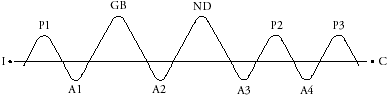
FIGURE 4. Narrative structure of Ishi's “A Story of Lizard.”(I = Introduction; P = Pine-nutting; A = Arrow-making; GB = Grizzly Bear; ND = Night Dance; C = Conclusion.)
What seems at first a hopeless déjà vu of motifs and situations proves now to be quite the opposite: a carefully controlled narration of great balance and dignity.
W hen I first went to work on this story, nearly a decade ago, I felt it to be one of the bleakest accounts of survival I had ever seen—a relentless tale of repetitive drudgery and danger. Now, looking at it anew, I see it in a di erent light. Like a Beowulf or a Roland in European tradition, Lizard represents the essence of a Yahi culture-hero. Lizard provides for his people—unfailingly. Instead of despair, there is reassurance in these unvarying routines and in Lizard's unflappable reliability in a crisis.
And in truth, I think Ishi, as the only able-bodied man among his lost band of survivors for all those long, lean years of hiding, must have been something of a Lizard himself.