
THERAPEUTIC SHOCKS AND PILLS, OR MODERNIST
AND POSTMODERNIST DIVIDES
Postmodernity is modernity without the hopes and dreams that made modernity bearable.
—DICK HEBDIGE
As I argued in the previous chapter, Santner's homeopathic-derived model of dealing with the past offers an alternative to the concepts of Vergangenheitsbewältigung
Like Santner's Stranded Objects, Allen Weiss's study of the Swiss art brut movement, whose tortured, traumatized, disfigured bodies appear to convey the unsettled physicality of modern subjectivity, turns to medical treatment as an exegetic source. Weiss admires Francis Bacon, for instance, for having initiated "a realism of deformation, opposed to the idealism of transformation."[79] Such a materialized realism might be exemplified in Franz Biberkopf. Berlin Alexanderplatz likens Biberkopf to every beast imaginable, and in the last chapter, it actually depicts him strung up in an abattoir, and his subsequent "transformation" emerges only after his rebirth as a petit-bourgeois Nazi supporter at the film's conclusion. Weiss's study pushes another connection between bodies and shock when he mentions, "without further comment," the psychiatric "treatments" purportedly developed during the Nazi era, in Axis countries. Electroshock therapy, which "creat[es] violent convulsions of the body, was developed in Rome in 1938; insulin shock therapy, which puts the body in a comatose state, was developed in Vienna in 1933."[80]
I am less interested in Weiss's historical errors[81] than in his desire to equate abusive physical shocks with abusive political regimes. He infers an unmediated commensurability between bodies, technologies, and political epochs that is problematic on a number of levels. Can the shocks and jolts of modernity be captured or conveyed by contemporary cinematic form, or by later film movements like the New German Cinema? Can social/ representational shocks be directly absorbed by spectators? Such correlations place perception, cinema, and body into impossibly neat, unified equivalences. Even Benjamin succumbs to the temptation when he writes that "the shock experience which the passer-by has in the crowd corresponds to what the worker ‘experiences’ at his machine."
Critics frequently assume that people must be fundamentally passive in order to receive these modernist shocks. In the same essay, Benjamin describes Poe's urban pedestrians: "Their behavior is a reaction to shocks. If jostled, they bow profusely to the jostlers."[82] Thus in spite of its constantly
By stressing the absorption of shock, previous modernist discourse had established imaginary bonds between the human body and external stimuli, be this the cinema or a vaguer notion of "the modern experience," in order to habituate the former to the latter, to train and regulate it at the same time that the body was believed to be inoculated against that very externality. Absorbing the shock meant absorbing the lesson. Althusserian structuralism could do no better. Neither could Eisenstein, whose "Montage of Attractions" essay, over thirty years before William Castle's The Tingler hit U.S. theatres in 1959, advocated rigging electrical currents in the seats of designated theatre chairs. Shock has always been grounded in physicality, from its first usage in agricultural measurement and military operations to its more contemporary usage (as with trauma, discussed in the following chapter). Critics retain the physical side of shock while asserting that it prompts new forms of knowledge or perception. The New German Cinema upheld this belief in knowledge's physicality with surprising insistence. Kluge offers an especially literal exemplification in The Patriot. Among many examples from the film is its narration by a talking knee which, we learn, is all that remains of a German soldier killed at Stalingrad, "remains" that stubbornly insist on their historical significance. But even though the New German Cinema was littered with splintered, seemingly modernist, "shell-shocked" bodies, the matter of absorption and of shock's forced integration into the body was constructed differently than in interwar modernism.
For shock retains the threat of what can't be absorbed, of what can only be repeated, recontextualized, or repulsed. Thus in contrast to the internalized shock treatments espoused by Benjamin, Eisler, and others, Kluge and Fassbinder/Raben stress shocks that the postwar body cannot absorb. This is evident in what the body cannot take, as with the death of Hans in The Merchant of Four Seasons or of Fox in Fox and His Friends, or Fassbinder's countless other depictions of drug or alcohol abuse—bodies that have literally absorbed too much. Mendelssohn's torture scene in Lili Marleen, in which the song plays repeatedly in his tiny cell, reveals a strategy of physical
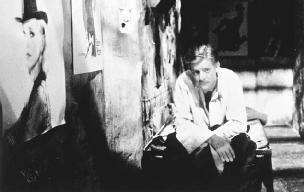
Tiny torture chambers in Fassbinder's Lili Marleen
Without a doubt, shock affects, transforms, and deforms bodies in Fassbinder's films, with the one-armed Franz Biberkopf remaining a particularly striking example. Yet nowhere is there a sense that these bodies are capable of absorbing the shock. No myth of buffering, protection, or internalization is in operation. In a sense, these postwar films suggest that bodies cannot refuse shock any more than they can take it. And if shocks like Raben's still offer enlightenment in unexpected places, it is nonetheless worth recalling the extent to which shock and trauma also create disempowered, victimized subjects.
Another example from Lili Marleen demonstrates that postwar shock, in contrast to modernist shock, depends on the body's alienation from the people and contexts to which it is juxtaposed. During Willie's first performance of the song with which she is associated, a brawl erupts in a small cabaret, whose male patrons make crass remarks about her voice. In her first sponsored performance for the Nazi party, Willie wears a colorful blue dress that exposes her throat and chest, and leaves her arms free to gesticulate and add other emphatic weight to the song. This freedom and energy diminish with each repetition of the endlessly performed song, and by the
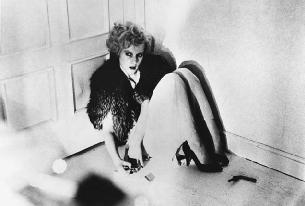
… and in Veronika Voss before her overdose
Just as these recent shocks deaden bodies, nothing guarantees that they will generate productive or desirable results. Given the fundamental alienation of the body from any unifying contexts, shock can be said to affect it but does not buffer or inoculate it from externality. Recent film-shocks thus work to operate on the principle of isolation and emptiness, not protection or assimilation. Such a conception contrasts dramatically with the synergistic assumptions of modernist textuality, where dialectical montage added up to more than the sum of its parts, yielding ideological, epistemological, and political gain. Such gains were crucial to many branches of
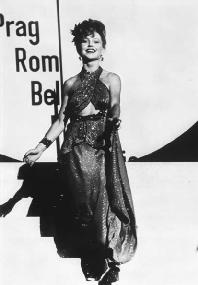
From giddy chanteuse to glitzy mummy: Hannah Schygulla's performances at the beginning of Lili Marleen. Courtesy of the Kobal Collection.
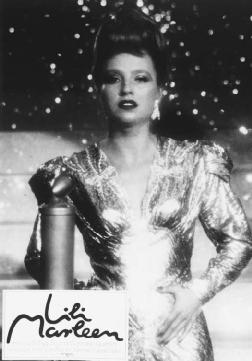
… and at the end. Courtesy of Bayerischer Rundfunk/RGA.
In postwar "modernism," the formal mechanisms that once seemed to be the very guarantors of political effects become emptied debris. Compare the following passages from Adorno. The first is a 1928 review of
How distant I at first feel from music that does not draw any consequences from the current state of musical material, but rather seeks its effects by transforming old, atrophied material: Weill achieves this effect with such force and originality that, faced with the fact, the objection pales. In Weill there is a regression, one which exposes the demonic traits of dead music and uses them.(1928)[86]
The idea of montage and that of technological construction are intimately bound up with each other. Together they are becoming increasingly incompatible with the notion of radically elaborated art with which they used to be identical. The principle of montage was supposed to shock people into realizing just how dubious any organic unity was. Now that the shock has lost its punch … the interest in montage has therefore been neutralized; more and more, it becomes a historical and cultural concern.(1970)[87]
Modernism's novelty and oppositional edge, along with strategies like montage, diminished as they were brought into art history books, museums, and a variety of aesthetic canons. As Fredric Jameson argued in the influential anthology Aesthetics and Politics, the practices and analyses of political modernists no longer held sway. The "culture industry," he argued, had become so massified that it made "an unpropitious climate for any of the older, simpler forms of oppositional art [proposed by Lukács, Brecht, Benjamin, or Bloch]. The system has a power to co-opt and to defuse even the most potentially dangerous forms of political art by transforming them into cultural commodities (witness, if further proof be needed, the grisly example of the burgeoning Brecht-Industry itself!)."[88] Against this seemingly totalizing, self-reproducing machine, Jameson called for a "new realism" built out of the awareness that modernism's emphasis on fragmentation/opposition/estrangement itself needed to be estranged, and "corrected by a more totalizing way of viewing phenomena."[89] Although Kluge had also called for a new form of realism to counter the totalizing effects of aesthetics under capitalism, it was his, Fassbinder's, and Raben's refusal of totalities that enabled them to find goal-less, productive play in the debris of modernism—as well as in the weightier ruins of National Socialism and the Shoah.
In a recent essay, Patrice Petro argues that the banality and boredom evident in the photographer Brassai's images of Paris in the late 1920s and early 1930s are a fundamental feature of the "provocative," sexualized images of modernity in his work. Petro compares Brassai's work with a 1980s
Superficially, the negativity of Fassbinder's films seems linked to their overriding pessimism. But as I noted in the preceding chapter, scholars have aligned this negativity with a utopian impulse. Kaja Silverman's thesis on the masochistic ecstasy that emerges from repudiating phallic identity remains one of the most daring articulations of this utopia, but she is by no means alone in its assertion. Elsaesser's recent work on sexuality in Fassbinder makes similar gestures, and before them, Peter Ruppert had examined Fassbinder's negatively constructed utopias. Fassbinder himself helped set these kinds of claims into motion, remarking—not unlike Brecht and Sirk had—that the unhappiest film endings are the most utopian in drawing our attention to how they could and need to be changed. Peer Raben likewise has drawn focused, explicit links between utopia and shock via music, and even Eisler's cynicism about music, banality, and duping reveals a prescience regarding its utopian potential: "Of all the arts," Eisler writes, "music is the most distant from the world of practical
Postwar critical theorists frequently seem nostalgic for unrealized promises of prewar, political modernism and its supporting technologies. This can be seen with Adorno and Eisler. Eisler: "How poor we musicians have become, if we look back at [the] prehistory of music. … What power music had. Just think of the trumpets of Jericho, of Orpheus, of Odysseus and the Sirens."[92] Now, while Kluge and several other members of the New German Cinema have been accused of the "leftwing melancholy" Benjamin once described, one would be hard-pressed to identify this as nostalgic melancholy. Films like Der Angriff der Gegenwart auf die übrige Zeit / The Blind Director (1985), Kluge's last major film before moving into television and new media on what appears to be a permanent basis, are best described as heavily ironic, bittersweet adieux.
In an influential essay, Thomas Elsaesser once argued that with Fassbinder, "Identity … appears negatively, as nostalgia, deprivation, lack of motivation, loss,"[93] an idea fully worked out in Mother Küster's Trip to Heaven, Fassbinder's 1975 remake of Jutzi's 1929 film. Characters include Father Küster, the suicided husband/father who is never depicted and is constructed solely through the responses of the other role-playing characters. Mother Küster is the suffering wife who desperately tries to clear her husband's name, clinging to what's left of her family, and whose position within that family diminishes as each of her children leaves. Corinne, the daughter, uses the scandal to advance her stage career. Helena, the daughter-in-law—for whom her unborn baby "is everything"—is humiliated by it. The event gives fodder to a sensationalizing press, a martyr to the Communists, and an excuse for terrorism to the Anarchists. Only Ernst, the son, has no reaction and seems bereft of any commitment, ambition, or identity. His figure barely moves and is shown outside of his mother's house only once. But his non-acts are acts, and he seems to embody Elsaesser's observation that in Fassbinder, "victimhood" is presented as "a solution" in which exploitation exists without the support of the standard cultural fictions. Portrayed by the director's lover, Armin Meier, Ernst Küster is likely a stand-in for Fassbinder.[94]
By contrast, the son in Jutzi's original film performs a more active function. Guilt-ridden and remorseful for having taken money from his impoverished mother, he is depicted outdoors, lurking in dark alleyways, carrying out bungled robberies, and so on—an active outcast from the home
These differentiated shocks can partially—and I stress partially—be explained by the divide between modernism and postmodernism as aesthetic "dominants" (Jameson) connected to different socio-historic, economic, and psychological contexts. Fassbinder pushes the idea of modernist shocks as a defense against productivity to its limits, and questions their goaloriented nature. Intellectuals of all stripes have argued that the Nazi deployment of modernism's rationalism, technology, and mass media helped "produce" the murder of people by the millions, bringing modernity's faith in the progressive capacity of new technologies to a definitive end. This is to suggest not that people no longer view new technologies as liberatory or potentially democratizing (one need only consider the high hopes for cyberspace), but rather that novelty and shock, whether tied to technology or to technique, are harder to connect to epistemological, social, moral, or political benefits. The myth of that guarantee is gone, and art's relationship to political agendas has changed. In addition to his oft-cited remark on the impossibility of poetry after Auschwitz, Adorno also maintained that after the war, "committed" political art was impossible, particularly in West Germany. Ironically, that critical function, Adorno argued, had been relocated to fundamentally "autonomous" art, a historical development he argued began with Beethoven's later work.[96]
Although Adorno was keenly aware that aesthetic autonomy was as contingent on capitalism as it was potentially critical of it, it is significant that he, like Fassbinder, evacuated the category of "the" political (whereas he goes on to relocate it, Fassbinder more or less sends it packing). Fassbinder's retreat from political categories is quite explicit in his writings. We also detect it in his harsh portrayal of the Communist couple in Mother Kusters and the strikingly unsympathetic depiction of leftwing terrorists in the same film. For a long time, academic commentators have endorsed Fassbinder's critical yet politically unfixed position(s) and his refusal to affiliate himself with organized groups and parties—his depiction of gay culture in Fox and His Friends is a good example—but that does not discount the outrage his work provoked among some of these very groups in Germany.
Problems of political categories aside, the discourse of refusal and negation goes at least as far back as nineteenth-century modernity and Nietzsche. They remain important tropes for postmodernism, although the terms are less aligned with fully oppositional stances or pure resistance so much as they are colored by a sense of dispersal or emptying out. That shocks still remain—especially in historically sensitive films like Maria Braun and The Patriot—indicates the considerable power of even their modified function for cinema viewers/listeners. On the one hand, shocks still testify to Benjamin's claim that a traditional "linear, progress-and victor-based continuous course of history" can be "blasted open," suggesting some continuity with the functions assigned to "shock" under modernism. On the other hand, aspects of contemporary shock move pointedly away from these earlier models and metaphors of violence.
If the negation and unpredictability associated with postwar shock no longer work toward antagonistic opposition or a full 180-degree "counterpoint" (as Eisler's mantra for film music puts it), it might be said that instead it yields contradictions and dislocations, which auditors may or may not take up. One dimension of these dislocations is elaborated by Chion's term "anempathetic" in his energetic rejection of terms like "counterpoint," "overturn," and "opposition" in film music studies. Chion is responding to the fact that when music doesn't replicate visual or narrative information, people tend to follow Eisler's lead and perfunctorily link it to ironic antiemotionalism or critique. Instead, Chion stresses that music provides a "backdrop of ‘indifference’ … [that] has the effect not of freezing emotion but rather of intensifying it." (That acoustic apathy is precisely what empowers Raben's near-absent score for Merchant of Four Seasons.) He goes on to describe the "cosmic indifference" that film music inherits from opera, "when emotional pitch was so high that it froze characters into inaction, provoking a sort of psychotic regression." Film music's deliberately banalizing indifference is, for Chion, "intimately related to cinema's
Chion's remark may seem more at home within Weimar debates on forms of Gebrauchsmusik and technologies of mass production than in early 1990s film theory, when it was written. Yet if we push what Chion calls cinema's "unveiling" beyond its mechanical "essence," we see how the New German Cinema provided an alternative space for auditors. Claudia Gorbman perfectly translates Chion's provocative reference to music en creux ("in the gap," in between spaces) as false or "phantom" sound—a sound that has no textual existence but is perceptually believed to exist. In other words, it is an absence, an alterity, that is wished present.[102](Eisler once wrote à propos of his score for Lang's Hangmen Also Die that the music "acts as the representative of the collectivity [of the Czech underground]: not the repressive collectivity drunk with its own power, but the oppressed invisible one, which does not figure in the scene.")[103] Surely that psychological presence in the face of physical absence and the desire to hear what Raben calls the "not yet true" are part of a utopian hope for change.
Negativity offers one space in which such change can occur. Though a descendent of modernist shock that acknowledges the violence of (post-) mechanization and its socio-political institutions, it does not attempt to reproduce, internalize, or fuse with social conditions around it. Contemporary negation will not generate remarks like the best film music "runs like a sewing machine" or is commensurate to a gunning machine, or that it functions in pure opposition to either of them. Something else shapes this new, less violent form of shock. Beauty, as I mentioned in reference to Kurt Weill, joins the acoustic landscape. For Raben, "I frequently made use of these [particular kinds of] shocks; it's no contradiction to say that my music doesn't sound ‘shocking’ but indeed sounds ‘pretty.’"[104] Raben's focus on beauty and pleasantness would certainly frustrate strict modernist proponents of shock, who would have it achieved solely through dissonance, aesthetic "difficulty," and aloofness—assumptions that nourished a discourse of antipleasure for decades.
Raben and Weill's interest in beauty is not as a fixed aesthetic property or function. Rather, it openly admits the political and personal power of style, especially when conspicuous enough to be described in terms of materiality, theatricality, posture, or pleasure—terms often discredited by being associated with triviality or kitsch (recall Broch's remark that kitsch strives to "do something beautifully, not well"). Unpredictable moments of
Thus beauty is a component of Raben's Musik-Shock. Music need not be unsettling to jolt or to convey social critique. Interestingly, the illustration he used for me in our discussions was from Weill. Spontaneously, Raben sang the refrain of "Matrosen Song / The Sailors' Tango" from Happy End:
| Ah, the sea is blue, so blue | |
| And all the world goes on its way | |
| And when the day is over | |
| We start another day | |
| Ah the sea is blue, so blue.[108] |
In Weill, Raben finds music strikingly "close to beauty," and about this example said, "Why should it sound dissonant, when one knows that the sea is blue? When something is as beautiful as that, why can't one just leave it and let the irony emerge automatically?" In the song's text, a storm washes over, sinking the ship on its way to the idealized Rangoon ("But of course / One can't let it upset one!").
Thus, under the surface of Raben's seemingly violent advocacy of shock in film music ("riots in your head"), there is a gentle, impassioned hope for change. Unlike his modernist predecessors, he seems less certain of film music's ability to actualize this change (for instance, by retraining the perceptual habits of filmgoers), relying instead on aleatory, random gaps, negation, or ephemeral moments of beauty. We can assess his work by way of a comment James Young made in the late 1990s regarding postwar memorials and "anti-monuments": "Unlike the utopian, revolutionary forms with which the modernists hoped to redeem art and literature after World War I, much post-Holocaust literature and art is pointedly anti-redemptory. The post-Holocaust memory artist, in particular, would say that not only is art not the answer, but after the Holocaust there can be no more
By critically reenergizing ideas and practices of prewar modernism, Raben and Fassbinder's soundtracks rework Germany's cultural and historical movements. Although Raben goes back to modernist musical traditions for important theoretical and compositional ideas, it is important to remember that he did not skip over the Nazi era, but instead used popular songs of the period, orchestrating music "à la Bruckner" in Lili Marleen. His practice may prove a key exception to LaCapra's assertion that the Shoah is a "repressed" of critical thought that formulates a "divider or traumatic point of rupture between modernism and postmodernism."[110] Clearly the brutalizing shocks from the Shoah and its aftermath have shaped the "post"-modernist deployment of Musik-Shock in the New German Cinema. But they may also explain why these filmmakers and composers still articulate, in their varied and displaced ways, what seems like an old-fashioned call for change.