
JÜNGER'S FALL INTO THE CRYSTAL
Silhouettes The habitus of the cool persona is determined by the claim it stakes on perceptual acuity. Ernst Jünger, in the foreword to Der Arbeiter, maintains that an understanding of the new reality depends entirely upon “the precision of the description, which presupposes eyes with complete and unbiased powers of vision.”[115] Desires for perceptual acuity become powerful whenever a traditional interpretive frame is in collapse. Such situations generate calls for a retrieval of “pure” perception of “sheer facts.” Perception, exhausted by the drone of prescribed discourse, regenerates itself by focusing on meaningless things.
Programs aimed at the restoration of perception, however, do more than prompt a passive registration of objects and events. Aggression sets the effort's fundamental tenor; its tone is not without a hint of sadism. The sharp-eyed persona is fond of comparing itself with the surgeon, while the habitus of perceptual acuity requires that the subject transgress moral boundaries. The precision of a moral norm's negation not only lends expression to a new objectivity habitus but also reinforces its claims to the empirical sciences' exactness. Stripping perception of moral judgment necessarily Jepsychologizes the observed object, reducing it to its basis in physiological or economic data and assimilating it to the rules of natural scientific discourse. The intrusive gaze thus becomes an instrument of pure perception.
It is a commonplace among avant-garde artists that the precondition for seeing an object “sharply” is removing it from all moral entanglement in its environment.[116] By excising the object from its moral, pragmatic, and atmospheric integuments, the artistic gaze isolates it in its razor-sharp contours. If people are its object of observation, the sharp gaze works by changing them into physical objects in the sway of mechanical laws. The emotional effect of coolness stems from this act of transformation. “Coolness as a tendency,” remarked Osip Mandelstam in 1930, “stems from the incursion of physics into the moral idea.”[117] We read in Benjamin, writing at the same time, that precise observation becomes possible only when “the moral personality has been put on ice.”[118]
In the early 19305 essay “Uber den Schmerz,” Jünger suggests a view of human beings as alien objects, without regard for their pain, their passion, or complaints.[119] The discourses of the sciences facilitate this cooling off of perception, according to Jünger, and, carried over into literature, are capable of producing “subzero temperatures.”
“At such temperatures,” Jünger repeats later in Strahlungen (1949), “flesh and erotic contact also lose their luster; their physical condition comes to the fore.”[120] Perceptual acuity calls for an anthropology that understands people as physical objects, making a retrieval of seventeenth-century modes of anthropological understanding the next obvious step. Likewise attractive is the incorporation into literary writing of the new scientific discourses of animal behavior research, psycho-technics, and sociometry.
Having identified these areas of overlap with scientific styles of thought, however, we need to stress the value placed by advocates of the cool gaze on the “cult of evil” taken over from the nineteenth-century dandy. The dandy juxtaposes his perceptual acuity, as an “apparatus of disinfection and isolation,” to bourgeois moral conventions.[121] The dandy's descendant finds himself in a world transformed by the technical media's progress. As technological devices, still and moving picture cameras appear to possess the prized characteristic of perceptual sharpness. Jünger attributes to the camera the same quality of impassiveness he expects of the cool persona:
The photograph exists outside the sphere of the emotional [see Figure 10], which lends it a telescopic character; one notes that what happened has been seen by an unemotional and invulnerable eye. It can just as easily capture a ball in midflight as a human being in the moment he is being ripped apart by an explosion.[122]
The transposition of “horrific vision” to the world of the apparatus lends it the value-neutrality of a technical norm; the transfer of this mechanical competence back to human perception frees it from the demands of morality.
By the end of the 19205 the trenchant critique of the conceptual realists counters the ideology of the camera's eye, disdaining the “romanticizing” attitude of “pure” perception. Brecht's famous line from the Drei-groschenprozeß documents the change: “A photograph of the Krupp Works or A.E.G. yields next to no information about these institutions. The real reality has moved into the functional.”[123] Kracauer's polemical remark in the first chapter of his study of white-collar workers argues similarly: “A hundred reports from a factory do not add up to the reality of the factory but remain for all eternity a hundred views of the factory. The reality is a construction.”[124] Both authors emphatically distance themselves at the beginning of the 19305 from the pathos of perceptual acuity, to which both had earlier appealed.
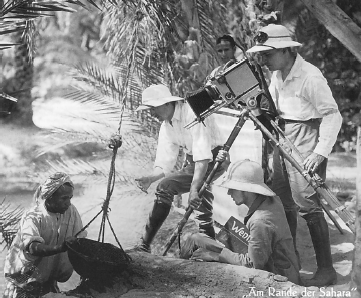
The photograph exists outside the sphere of the emotional (Publicity still for At the Rim of the Sahara Desert. With the permission of VG Bild-Kunst, Bonn.)
Musil calls on the results of cognitive psychology and phenomenology in his formulation a few years earlier:
It is known that we see what we know: ciphers, signs, abbreviations, attributes of the concept; permeated and carried merely by isolated dominant sensuous impressions in a vague plenitude of the rest.[125]
Musil is convinced that seeing in ciphers corresponds to the “necessity of the practical orientation.” Formulaic stereotyping is not only a characteristic of concepts but equally typical of “our gestures and sensual impressions, which after a couple of repetitions become just as habitual as imaginary processes tied to words.”
The conceptual realism of the 19205 that we just observed in Brecht, and in Jünger and Schmitt as well, transfers the claim of perceptual acuity onto the alleged precision of the concept. Acuity works its effect in their thinking by way of a maneuver identical to that by which the bracketing of moral judgment aims to make human beings visible as physical objects. The position of the conceptual realists on perception—which we continue to find today in rationalistic theories of perception[126]-runs as follows: the eye, because of its biological structure, cannot be unbiased. “Pure” vision is a fiction. Every visual perception is a goaloriented
The phenomenologist Alfred Schiitz assumes that an “intentional ray of reflection” interrupts the stream of formulaic repetitions that suffuse daily life: a concentrated packet of light illuminates a circle in the environment, which is filled with the darkness of unconsciously experienced schemata. But for phenomenologists, the overall perceptual space outside what is intended remains filled by a fog of reflexes, anonymous noises, tactile impressions, and smells. The horizon surrounding the core area under visual inspection is permeable and “soft.”[128]
The boundary line for conceptual realists, however, is “hard” and impermeable. The conceptual realists among the artists of the 19205 intervene into the perceptual space, in order to cut away the soft edges of phenomena, arrest fluid movement in freeze frames, and do away with ambivalences. They scan the visual field, concentrating on the isolated parcels in which their “specimen” is captured for examination.[129] Figures are separated out from one another until there finally appear “pure” phenomena. While it is indeed no longer possible to have any palpable experience of these phenomena, conceptual realism maintains the claim, as in Jünger's construction of the worker, that they are the result of perceptual acuity carried to an extreme.
The contemporary aesthetic appeal of the focus on sharp contours is not to be underestimated. In opposition to the impressionist blurring of boundaries and loosening up of subjective unity, the “calendrical objectivity” of conceptual silhouettes resulting from these surgical interventions into perception appeals to advocates of the cool gaze because it aims at the effect of the uncanny but uses a quasi-scientific manner: “So also in the bright transparency of loneliness does everything become clearer and larger, but above all it becomes more primal and demonic.”[130]
Carl Schmitt's friend-enemy theory imposes a perceptual grid on the amorphous bodies of liberal society. It lights up areas of semi-darkness and assigns all vacillation and wavering to the category of betrayal. The metier of the cool persona is to isolate elements in the mix, distinguo ergo sum its slogan (see Figure 11).[131]
Since this attitude implies a claim to perceptual acuity, it is not surprising that conceptual realists go around with cameras around their
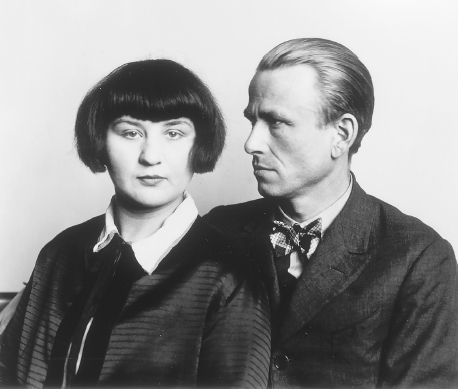
Distinguo ergo sum (August Sander, Kiinstlerehepaar [Artistic couple], Cologne, 192.5. With the permission of Pho-tographische Sammlung/SK Stiftung Kultur, August Sander Archiv, Cologne; VG Bild-Kunst, Bonn.)
We encounter here the individual, whether alone or in a group, in a strangely slack and nonreferential bearing, needing twilight all the more as a way to make excuses. Thus the love for such motifs as gardens in the glow of Chinese lanterns, boulevards in the artificial light of the first gas candelabra, landscapes in the fog at dusk or in the shimmer of sunlight. (122)
Impressionism had gone beyond the clear distinction of significant objects from the environment and atmosphere. Its observation put the
Jünger's attitude toward photography draws on motifs that Vilem Flusser describes a half century later.[132] Jünger's use of hunting metaphors draws our attention to the importance he accords to the distinction between mere visual perception and “scouting.” Arthur Schopenhauer referred to the difference between the two, explaining that scouting, as opposed to looking, is an act of seeing that is subordinated to the will.[133] Flusser associates photography with “being on the lookout”:
It is the prehistorical stalking pose of the Paleolithic hunter in the tundra. Only the photographer pursues his game not in the open grassland, but in the thicket of cultural objects, and his secret paths are determined by this artificial taiga.[134]
The photographer's thicket is made up of cultural objects, “which have been ‘purposefully placed’”:
Each of these objects obstructs the photographer's view of his game. He sneaks through them in order to stymie the intention hidden within them. He strives to emancipate himself from his cultural condition, strives at all costs to capture his game.[135]
Since for Jünger the “purposefully placed” cultural objects that threaten to obstruct the photographic gaze consist primarily of the nebulous things of “modern humanity,” the initial task, if the aim is to get a snapshot of reality, is to get them out of the way. Flusser, however, refers in this connection to the way the photographer by and large surrenders himself to the categories of the apparatus. He also comes to the conclusion that photography delivers “an image of what has been conceived,” but the concepts in Flusser's case are those for which the photographer has been programmed by his apparatus. While Jünger ties the photographer's habitus to the bearing of the cool persona, which uses
In his reasoning about photography, Jünger races through several fields of thought, here pointing out the “predatory nature” of the apparatus,[137] there emphasizing the photographer's philosophical capacity to observe the world through a categorical apparatus, to demarcate visual fields, and record a series of distinct pictures;[138] then again he makes the photographer into a “functionary of the apparatus.”[139] In any case, the technological instrument delivers pictures with sharply defined contours (12,2,).With this conception Jünger puts himself provocatively at odds with Kracauer's theory of photography.
In 1927, Siegfried Kracauer complained that the story of an individual lies “buried under a photograph as if under a blanket of snow.”[140] Now Jünger praises the capacity of the camera to freeze the visible in the unequivocality of the sign. Jünger seems to have read Kracauer's essay; it is not without a provocative gesture that he praises the aspects of a camera that Kracauer criticized, while devaluing the specific accomplishment of photography that Kracauer praised as characteristic of the nineteenth century. Thus Kracauer discovered the camera's ability to record meaningful debris-refuse material that no theory or pictorial tradition had yet captured. The new technological medium encompassed society's “previously unseen natural fundament” unregistered in existing sign systems, the detritus of visibility not yet permeated by concepts, the space of the visually unconscious, optical noise: “The photographic archive gathers together in illustrative form the last elements of nature estranged from meaning.”[141] For Jünger, the conceptual realist for whom the notion of types has put its stamp on every item in his visual inventory, this salvage operation does not occur.
The 19205 offer a favorable climate for conceptual realism. Its practitioners offer countless theories as devices for “sharpening” perception: theories of physiognomy and mimicry; typographies of functionalist psychology distinguishing the “introvert” from the “extrovert” sociological theories categorizing people according to social roles (secretary, tax accountant, pastry cook, and so on). Probably the most popular and the catchiest of them all is Ernst Kretschmer's constitutional psychology, which correlates character variations with measurable physical
Typologies turn the body into something that can be read. Their attractions are endless: typologies bypass the stress of prepredicative experience, stripping the other's orientation of ambivalence; they make judgments easier to form, clarify lines of opposition, and accelerate the decision-making process. Typologies thus provide the ideal framing conditions for decisionism. They take over the fatal tendency of the “physiognomic gaze,” for which Ursula Geitner offers the formula: “Exclusive intimacy, with anxious pigeon-holing as the outward orientation.”[142]
Typological thinking dominates the human sciences of this period, which would be little cause for concern if, as in Max Weber, types remained the products of a critical epistemology distinct from an unfathomable substratum of life. Martin Lindner draws attention to the way these years give rise to a “conversion of heuristic typology into ontology.”[143] Now each individual type becomes a variation on the general structure of life. Only such an ontological perspective explains the “mythical” image of human being—such as Jünger's worker-that does away with individualistic psychological explanations of individual beings. Kretschmer's Korperbau und Charakter (192,1) is an indicator of this ontological conversion of typological thinking. It becomes deadly when combined with a new historical metaphysic, which is what occurs at the beginning of the 19305.
“Type,” according to the Philosophisches Worterbuch of 1934, also means “primal form.”
If the type itself represents an objective structure of life, it takes on a particular meaning in a historical situation in which one human type (in the descriptive sense) seems to be crystallizing and superseding another type. It is precisely this of which many observers in the 19205 felt themselves capable: The collective type was superseding the bourgeois type. This process alone was enough, according to the conception of history by vitalist ideology, to show that “life” was behind the new “type.”[144]
Aside from Jünger's Arbeiter, one of the most extreme literary examples of this ontological conversion that blends typological thinking, historical metaphysics, and aesthetics is Gottfried Benn's essay “Dorische
The state, power, purifies the individual, filters out his irritability, makes him cubist, outfits him with surfaces, makes him capable of art. Yes, that is perhaps the way to put it: the state makes the individual capable of art.[145]
What the ontological typologies have in common is an emphasis on visible phenomena, on processes and behavioral patterns, and a resistance to introspective psychology. Jünger adopts Malinowski's ethnological slogan “Study ritual, not belief” when he remarks in Der Arbeiter:
The gesture with which someone opens up a newspaper is more informative than all the lead articles in the world, and nothing is more instructional than standing for a quarter hour on a street corner. (132)
The automaticism of traffic, which he is observing here, is for him a sign that people are in motion about some secret center in accord with “silent and invisible commands.” Jünger's ethnological gaze seems to bind signs to the body but counteracts the effect by a simultaneous dissolution of the physical; it stamps meaning so blankly on the brow that the body disappears behind the sign. Jünger, when he wants to, sees nothing all about him but allegories of his theory of mobilization.
It is the deadly tendency of typologies to have anchored the ordering model of the system of writing in the obscurity of the bodily world, and this in a historical situation in which the monopoly of writing is being called into question by the magic of technologically produced images. For a time, typologies can also seduce a writer like Robert Musil: “More is said to me today by the three words, ‘asthenic, schizothymic type,’ than by a long individual description.”[146]
The omnipresence of typologies in the 19205 forms the background and medium for the elaboration of conceptual realism. Political camps tend to their respective typologies, giving form to frightening schools of perception in which people learn how to order racial and class physiognomies. The capacity for drawing distinctions takes on a dreadful “sharpness”: people learn how to distinguish, on the basis of physiognomy and behavior, labor aristocrats from proletarians, lumpen proletarians from Social Democrats, Trotskyites from social fascists, white-collar employees from bourgeois, Jews from Aryans, friend from enemy.
A body's role is so distinct that a photographer like August Sander can snap its photograph. This “bourgeois” artisan, to be sure, does not come quite up to the standards of the conceptual realists; critics reprove
If our position on Sander's work in itself is thus completely positive, still we might wish for a sharper and clearer sociological formulation in regard to classification. Here the goal must be a herbarium, so to speak, of human existence: standpoint, year, activity, class affiliation, as we understand it in Marx's definition: “but we have here to do with persons only insofar as they are the personification of economic categories, the bearers of specific class relations and interests.”[147]
What we see here is the reconnection of a new medium, which delivers “meaningless” visual impressions, to language, as described by Jünger in Der Arbeiter, in its ability to draw distinctions. Jünger later acknowledges that his tendency at the time was to use the “scissors of the concept,” to cut life to a predetermined pattern.[148] The silhouettes offered by the type are practical: they unburden; they orient; they facilitate decisions. In the hand of the dandy-soldier, they are part of the “cult of evil.”
In Jünger's essays toward the end of the republic, the striving for perceptual sharpness combines with conceptual realism in spectacular fashion. His writings also demonstrate, however, that his belief in the actual existence of concepts unwittingly conditions the fixed boundaries of things. Benjamin shows in reference to the French surrealists how easy it is to slip “from the logical realm of the concept into a magical realm of words.”[149] He refers to the dadaists' “impassioned phonetic and graphic games of transformation.” And in Das abenteuerliche Herz, Jünger steps into the magical. But is this kind of magic not simply the dark other side of his classification frenzy?
What we find in Jünger's magic is much more what Arnold Gehlen designates as a sign of magical thinking: the overestimation of order in nature, so that a secret center guides and interprets any nocturnal flapping of wings, flash of steel, dream, or gesture. This magical order also explains the formal intactness of Jünger's verbal construct. His work is not subject to the distorting aim of mediating the experience of complete alien determinacy with the assumption of the autonomous subject, which was responsible for the deterioration of the grammatical structures of other writers in Jünger's generation.[150]
The Cool Persona and the Sensation of Pain
Jünger's problem is the century's problem: Before women could become an experience for him, there came the experience of war.
Heiner Müller, Krieg ohne Schlacht
The juxtaposition of Jünger's essay “Uber den Schmerz” with Der Ar-beiter demonstrates the way that the call for perceptual sharpness, on the one hand, and the construction of the object of observation from within the cool persona's code of conduct, on the other, condition each other reciprocally. In both texts we encounter the same parallel process: the demoralization of perception goes hand in hand with the Jepsychol-ogization of the observed object, which then behaves in the manner of a physical body. The latter not only slips out of sight from an ethical perspective but in doing so loses its organic quality. All the while, thus disembodied, the object under observation is supposed to gain in substance.
In “Uüber den Schmerz” the mutual conditioning of perception and the construction of the object is especially palpable. “At all times,” Jünger maintains here,
the uniform encompasses an act of armoring, a claim to be protected in a particular fashion from the onslaught of pain. This is already obvious in the way it is possible to observe a corpse in uniform with greater coolness than, for example, a civilian who has fallen in a street battle.[151]
The armoring of the gaze also allows the object of the gaze to claim the uniform as a shield.
It is no surprise that Jünger's diagnosis of the era agrees with the cool persona's code of conduct, which requires any person who would exercise power to transform his counterpart from an organic and moral entity into a physical object. The cool persona must learn “to treat the body as an object”:
This procedure admittedly presupposes an elevated site of command from the perspective of which the body is regarded as an advance outpost, which the individual, from a great distance, is capable of sending into battle and sacrificing.[152]
In contrast to Brecht and Serner, Jünger “covers the tracks” of the classic Art of Worldly Wisdom. Nevertheless, it is not difficult to distill from his essay the following precepts:
Adopt an appropriately cool gaze, which can penetrate the fog banks of morality, gain distance from the hazy influence of compassion, so that things can once again be seen as horrific and demonic, and therefore made subject to command.
Prepare yourself for a life of pain, but don't let it come to expression.
Avoid resorting to the narcotic of humanism, which represses the knowledge of pain from your consciousness.
Learn to accept discipline as a form capable of eliminating the presence of pain from your consciousness. Then you will be able to develop the “cooler consciousness” that allows you to perceive yourself as an object.
The burden of the essay “Uber den Schmerz” is not to set the conditions of perception. Jünger is primarily interested in articulating a typology of pain-resistant persons, as he observes them in the republic's civil wars: the lumpen proletarian, the partisan, and the worker-soldier. If these identifications are surprising, it is because Jünger overlooks the social space where more obviously cool candidates gather. Renaissance princes, field commanders or generals, martyrs or hermits lack the requisite ideal traits. Jünger is not searching for exceptions. For the pheno-type of transgression in the bourgeois world, he looks in the sphere of labor. The criterion according to which Jünger measures the otherness of this type is its relation to pain.
The critique of the expressive cult of pain, which we already encountered in Plessner's early anthropological text, takes its most radical form in Jünger's essay. It not only confirms the prohibition to which Plessner's conduct code subjects “eruptive expression,” as a relapse into the animal realm, but uses the prohibition to draw a sharp boundary separating the world of the worker from bourgeois society. The bourgeoisie's “world of sentimentality” takes the body as a value in itself and derives principles of “humane” treatment from the core idea of the inviolability of the body. But Jünger points out that the bourgeoisie has an ambivalent attitude toward pain.
The bourgeoisie's strategies for avoiding pain set up a disguised form of the division of labor. Confined on the margins of sentimental societies, in barracks, clinics, and cloisters, is a type that specializes in pain, that constantly awaits its application. In the nonviolent intermediate zones, the individual can repress the surrounding world of pain or-occasionally exposed to it—complain loudly and expressively. He devotes
Jünger searches instead for a type that has set up a “life with pain” at the center of society, without allowing it the ritual vent of plaintive expression. In the civil war landscape, he finds two uncanny embodiments of the desired type—the lumpen proletarian and the partisan. Both violent types stand out against the diffuse, easily outraged masses, since they appear to be immune to pain; they remain uncanny, because their actual strength consists in their ability to disappear at critical moments back into the “amorphous body of the masses.” They lack the clearly defined contours of the external enemy, in Schmitt's silhouettelike portrayal. They infiltrate the body of the state, make their armored appearances when their moment comes but then vanish from sight whenever they run the risk of being overpowered. Whereas an armored vehicle can easily disperse protest demonstrations, it must search out the rioting lumpen proletarians in their hideouts. In all cases of modernizing transformation, the lumpen proletariat takes an important role, forming, as Jünger observes, a “subterranean reserve” at the end of the Weimar Republic. With a side glance at the National Socialist movement, Jünger notes that the measure of a modern political movement's elemental force is the extent to which it includes such people as these, who are “familiar with the pleasures of torture.”
The defining activity of the partisan as a type also takes place outside the ordered zone of legality. Nor does it adhere to the rules laid down by the friend-enemy definition, so that its contours are lost in the sea of the urban population. The figure of the Communist cadre operating illegally appears in Jünger's work in the mask of the partisan, displaying a bedeviling similarity to Brecht's character from the Reader for Those Who Live in Cities. “Cover your tracks!” is a slogan that can drive the distinction artist to distraction. In Jünger, the partisan must extinguish his bourgeois identity, simultaneously falling outside the honor code of the uniformed soldier:
The partisan has no cover; short shrift is made of him whenever he is caught. As he is deployed in war without a uniform, in civil war he turns in his party card before taking action. The affiliation of the partisan, accordingly, always remains uncertain. It can never be determined whether he is spy or counterspy, belongs to this party or the opposing one, to the police or the vigilantes, or to all at once—indeed, whether he acts on behalf of anyone at all or is simply engaged in his own personal criminal deeds. This twilight is part of the nature of his task.[153]
This blurring of contours strikes the cool persona as a provocation—and truly so when it turns up inside the state apparatus and in the “amorphous body of the masses,” becoming conspicuous in the commotion of Sundays and holidays, in the tumult of the streets, or in the “gray hordes of demobilization” as the “ferment of decomposition” (no).
The outlines of the worker-soldier type, which Jünger juxtaposes to partisans and lumpen proletarians, never blur. They have been tempered in war's “death zone.” Wherever this type appears, all the usual distinctions of race, class, estate disappear. A modern human being, the type realizes the dream of synchronization between organism and technical apparatus. Its being is integrated into technology. Enclosed within an “armored cell,” it is the intelligence of a bullet; an electric machine replaces the functions of a central nervous system. Jünger presents the type in centaurlike images, in the concentric encasement of body and machine, as an “organic” construction. The images Jünger paints of this electric human crustacean correspond to his ideal of heroic realism: we encounter this figure in the troops encased in an armored police van on Alexanderplatz, cutting through the protesting crowds—like a “human sea”—we see how “inconspicuously” it operates the controls of its fighting machines or, “masked and enclosed in defensive shells, it marches through clouds of tear gas” (98); it pilots a Japanese torpedo;[154] or it crouches “in the fiery vortex of a falling fighter plane, in the air pocket of a sunken submarine on the bottom of the sea” (107). Radio signals inform us that a being yet lurks inside the metal shell. Or is it just the radio simulating its presence?
Perception has created the fitting object for the cool persona. It gazes indifferently back.
Armor from a Different Perspective To replace this military vision of the persona trapped in the metal shell of organic construction for new objectivity images of civilian life offers a certain relief. But the habitus we
New objectivity painters prefer representing the individual fully clothed, packed in as many casings as possible. They paint people defended by suits, vests, ties, leather jackets, coats, by gloves, hats, and caps. Raderscheidt shows us a young man standing in a black suit, with yellow gloves and a bowler, alone on a vast square before a geometrically standardized architecture taken directly from the pittura metafisica of Giorgio de Chirico, apparently transposed into the modern world. He wears his closely fitting clothes like armor, protected from fear and cold, but for that the more isolated from his surroundings, and the lonelier.[155]
In Plessner, the social role forms a protective shield, maintaining distance, filtering expression, reducing friction. In Jünger, masks protect people in daily life, evoking “for men, a metallic, and for women, a cosmetic impression” (171). Everywhere we find the desire for an impenetrable shielding-against external danger or against internal decomposition and daily shaming.
Panzer, which in English means armor, shield, and tank, is one of the magical words in the republic's masculinity cult. On the one hand, it recalls legends of the fallen warrior, overcome only by dint of material superiority; on the other, it accepts the necessity of a form of resistance that assimilates the tools of the aggressor. Mythologized in this way, armor also takes center stage for the enlightenment discourse of the republic, which sought to demystify it.
For psychoanalysts, the formation of a “cool armoring” begins early, as a reaction to birth trauma (Otto Rank) or occurs as an element of the “collective neurosis” of a society become fatherless following the collapse of Wilhelmian authority.[156] Toward the end of the republic, Wilhelm Reich, discussing his theory of character analysis, speaks of “ego armoring” as a defensive apparatus intended to mount an offense against the stimuli of the external world and intercept the libidinal transgressions of the id.[157] He sees a neurotic element in the armor, because fear is continually involved in maintaining it. Its sole function of averting “disgrace” draws ego armor into the “catastrophe of ridiculousness” that the cool persona tries at any cost to avoid and can lead to severe neurotic idiosyncrasies.
More popular than Reich's explanations of neurosis, however, was a finding of individual psychology according to which the superiority habitus of the armored ego implies the compensation of an organic
Others have put psychoanalytic insights to persuasive use, explaining certain of the types in our portrait gallery of the cool persona.[159] I summarize this approach here primarily to introduce a story that develops an explanation of the superiority complex into a satirical text about organic construction. Jünger, in “Uber den Schmerz,” remarks:
Just the fact that the individual is closed up inside rolling vehicles lends him the appearance of greater inviolability and does not fail to work its effect on those being attacked.[160]
In his story of “Der Riese Agoag” (1936), Musil transfers Jünger's heroic notion of a “living torpedo” to the banal psychology of everyday life.[161] The hero of the story, attributing his scant attractiveness to women to his skinny body, compensates first by reading the boxing news and later by devoting himself from morning to night to body building. Always, after using his day to the fullest in just this way, he goes to sleep, first
spreading out all the muscles he can muster all at the same time, then lying there in his own muscles like an alien piece of meat in the claws of an eagle, until, overcome by fatigue, the grip loosens and he falls straight down into sleep.
The image of Ganymede in the grip of the eagle (Adler) suggests that our hero leaves something to be desired on the aggression scale and that he might more securely fantasize being wrapped in the wings of homophilia than confronting the woman (if the mention of bird of prey does not refer only to Adler's compensation theory). In any case, it is no surprise that our bodybuilder gets beaten up shortly after by a “fat blob of a person,” an incident which causes him to lose favor with the woman once again. Only now is he in a position to appreciate the advantages of an “organic construction.” When he chances one day to witness an accident in which a city bus runs over an athlete, our hero seizes the opportunity
Electric Fins for Leviathan What separates Helmuth Plessner's construction of the duelist from Ernst Jünger's construction of the worker? And is the distance between the landscape of Jünger's “electromagnetic force fields” and Walter Benjamin's sketch “Zum Planetarium,” the concluding piece of his 1928 book Einbahnstrafie, one between disaster and welfare?[162]
In Jünger's book Der Arbeiter: Herrschaft und Gestalt, the icon of the warrior fascinates the gestalt of the cool persona. The warrior's physiognomy—beneath a steel helmet or a crash helmet—is metallic, “galvanized, as it were.” “The gaze is steady and focused, schooled in the observation of things that can be captured in high velocity conditions” (107). This icon appealed to readers on the right, while the modernism of the diagnosis put them off. Readers on the left, who registered Jünger's sympathy for planning and his quasi-Marxist theory of simultaneity, did not know what to do with it. Theorists, finally, who admire the way Jünger's book reveals the relationship between war as an instrument of modernization and the domination of the technical media, tend to distance themselves from his horrific images of “heroic realism” by relegating them to the status of contemporary coloration.[163] Ideology critique, for which the book has become easy prey, deprives it of any diagnostic value, although its findings are as proximate to Giinther Anders's An-tiquiertheit des Menschen as to the chapter on the “culture industry” in Horkheimer and Adorno's Dialectik der Aufklärung.
The book's foreword of July 1932, names all the elements we have come to expect from a new objectivity code of conduct. Jünger connects the demand for perceptual sharpness, which is supposed to render visible
Jünger's book aims, like the other conduct codes, at a lifestyle. Once again we encounter the fundamental motif of the codes, which is to cultivate a distance from the body. Jünger's spiritual exercise aims at a “metallic coolness” of consciousness that enables the individual, in the extreme situations of the death zone, “to treat the body as a pure instrument, forcing from it a range of complicated accomplishments beyond the bounds of self-preservation” (107). The book offers instruction in the habitus of the sharp gaze, counting “high treason against the mind” as one of the “horrible pleasures of our time” (39). Like all codes of conduct, Jünger's works with a theory of masks, so that a series of precepts can be distilled from the book:
The hardness of society can be mastered only by hardness, and not by any form of trickery (28).
The more cynical or spartan, Prussian or Bolshevik … a life can be, the better it will be (2,01).
Reality is determined, not by moral precepts, but by laws. Therefore the decisive question to be posed is this: is there a point from which it can be authoritatively decided whether a particular means should be employed or not? (191).
There is no escape, no move sideways, no move backward; the point is much more to increase the fury and the speed of the processes in which we are caught (194).
Nothing is as constant as change…. When unrest comes to a stop, every moment becomes a starting point of an Asiatic constancy (172 £.).
By listing Der Arbeiter among the conduct codes examined here, we risk obscuring its novelty. Jünger's compendium, like the others, serves the education of an “aristocracy” and an “order.” But his nervous gaze discovers it in incipient form in tank and submarine crews, in the ranks of the security troops of a political movement or cadre-in a type that can be reproduced in masses, not in the individually prominent dueling subject. The habitus of this type corresponds to its metaphysical “stamp” (Gestalt). If the cool persona of the art scene comes into view, Jünger delivers it up to the derision of his type, which finds amusement
A special ceremony has been developed in which the modern individual, in the disguise of a quasi-aristocrat or quasi-abbe, to the sound of what has become very general applause, executes the practiced mortal thrust according to all the rules of the art. This is a game for which existential quantities have become two-edged concepts. More important for us is the hand movement with which the streetcar conductor rings his bell. (229)
In the world opened up by this book there are no reserves left over, no “last bits” of “something dangerous” preserved “as a curiosity” (52). The activities of the artist shift from the periphery of the romantic space into the sphere of power. Only here, according to Jünger, is it possible to experience the “elemental.”
The individual as the “intersection” in a “network” of “cross-cutting currents”—this viewpoint is registered, without the reservation of cultural pessimism, for the first time by Jünger. The individual is hooked into the system by a cipher code:
The power, traffic, and news services appear as a field in the coordinate system of which the individual is to be understood as a specific point. One “gets a bearing on him,” for example, by turning the dial on an automatic telephone. The functional value of such a tool rises with the number of people connected—but this number never appears as a mass in the old sense but is always a quantity that can be expressed in precise numbers at any moment. (139)
A person in the modern media landscape who remains “immersed” in printed material, Jünger could only say ironically, will be made aware of the connections that nevertheless persist to general power circuits. The newspaper reader Jünger observes pursues a “different kind of reading,” that is not to be understood in the sense of immersion:
This becomes clear where one has the opportunity to observe the reader in situations, especially situations of public transit, in which merely making use of it already means going to work. An observer here will register a simultaneously alert and instinctive atmosphere, in which a news service of the greatest precision and speed is appropriate. One seeks the impression here that the world has changed during the reading, but this change is at once constant, in the sense of a monotonous change of colored signals flying by outside the windows. This is news inside a space where everything that happens involves the presence of atoms bombarded at the speed of an electric current. (264)
Jünger's praise of precision is for the technical medium. The news itself (for instance, a launching, a mining accident, or a motorcycle race) and
There is something anxiety inducing, recalling the mute glow of a traffic signal, when suddenly one or another excerpt of this space—whether a threatened province, a big trial, a sporting event, a natural disaster, or the cabin of a transoceanic airplane, becomes the center of attention and thus the effective moment as well, and when a dense ring of artificial eyes and ears closes around it. (256)
If we look for the stylistic move that allows Jünger to produce the images of networking circuitry, we come on a maneuver that is as simple as it is astonishing: he changes the central technical metaphor. Jünger is one of the first writers to place the model of the electric circuit at the center of social analysis. Electricity, with its force field, network, connection, replaces the steam engine, the model of a psychologically oriented literature. Whenever he singles out a phenomenon's systematic quality, electricity is the dominant image; the combustion engine serves better to emphasize the dynamic quality. The electric topos recommends itself when one element in the total space requires an explanation: “The arrangement of atoms thus takes on the sort of nonambiguity that prevails in the electromagnetic force field” (266). Jünger attributes a special status to the electric media; they possess the quality of machines that replace, not only muscle power, as in the case of the older generation of technical apparatuses, but the functions of the central nervous system. Alongside these characteristics derived from electricity, Jünger finds an additional reason to elevate them to the central metaphor of his systematic thinking: the electric network comes under the administrative authority of the state, which controls all the connections and integrates every user of current into an “energy association” (215). The individual automatically has the status of an “organic construction” (275).
The metaphor of the electromagnetic force field, incidentally, enters the work of Walter Benjamin, Bertolt Brecht, and Joseph Roth. Research
In terms of content, the invisible electromagnetic force field, which, for example, arranges a previously chaotic pile of iron filings all in the same direction, opened up the possibility of an analogous assumption of energies operating supraindividually, as in the formation of structured communities out of masses.[164]
The penetration of electric metaphors into philosophy and literature stems from the way in which they lend expression to the otherwise ineffable quality of the elan vital. At the core of the force field metaphor is an image:
the existence of energetic tension between two opposed poles. This datum could be used to connect the polarized thought of classical Rome with the specifically vitalist idea that a life of intensity can only take place between two extremes.[165]
Jünger relocates this vitalist idea, using the electric metaphor only to characterize the monodimensional, systemic quality of the society of the worker.
Electricity, for Jünger, is an index of simultaneity: Those who sit under an electric light discussing the return to nature (223) or put the body of Christ next to a microphone or broadcast an encyclical over the radio (73) are hooked into the network of modernization. The synchronization of divergent mentalities with the highest technological level is already a fait accompli, even while it is still being vigorously called into question. Like his Marxist contemporaries, Jünger has in mind the lightbulb-hanging on a public utility wire—when he recalls a famous sentence from Marx's work Zur Kritik der politischen Okonomie as he interprets society: “It is a general light into which all other colors are dipped, which alters them in their specificity” (98).
The new media are the leviathan state's electric fins. Even in extreme situations-in the air bubble of a submarine on the ocean floor, in the cockpit of a crashing fighter plane—the electric media remain connected to the all-encompassing network, with which the individual can break contact only at the threat of being extinguished.
What drives the cool persona in the “electromagnetic force field” of such a space? Networked and run through with circuits, it might well fizzle
In the landscape of the electric media, we see the cool persona in a man “bent over his cards to the hum of the telephone and the clatter of the news agency teletype.”[166] He resists distractions but cultivates the awareness of the chess master; in fact, the cool persona ignores any sound that cannot be clearly deciphered, any amorphous acoustical signal. But the technical channels' white noise triggers a state of permanent unrest. On the battlefield, the persona is forced to probe even the most insignificant sounds for their meaning. There are reports from the First World War of the use of aural locator devices, equipped with giant reception horns and superhuman frequency ranges, which allowed soldiers to identify enemy artillery installations from twenty miles away.[167]
The new media open up new possibilities. They do not, as writing does, filter whatever the screen of the symbolic order allows to enter but are automatically part of “the roar of the real.”[168] Their deployment in war only reinforces the ordering function of writing. No detritus of meaning remains, as meaningless undergrowth, optical garbage, or acoustical nonsense: the media register everything. A final corner of the perceptual field not yet occupied by meaning—a deserted bit of woods, the rustling of a newspaper page, an unknown tonal frequency, the irregularities of a crater landscape—comes clear. “Meaningless” disturbances of regularity are especially in need of decoding, because they might well be points of enemy incursion.
With the help of the electric media, the mesh of the symbolic becomes finer, the environment of understanding perception more hermetic. In Jünger's system, every sound is under the high voltage of meaning. An American study claims that Jünger's “fascist modernism” promised “to liberate the imagery from the Jacobin tyranny of the symbolic order”;[169] nevertheless, in 1932 Jünger did more to reinforce the omnipresence of the symbolic order, by binding the electric media to writing.
When Jünger's cool persona steps into the field of reality where Schmitt's distinguo ergo sum resounds, fuzzy contours suddenly clear. Everything becomes a clue pointing to a secret center. The new media amplify the power of distinction. Probably a statement like Musil's at the end of a puzzling story—“But it is like whispering you've heard or merely a rustling, without being able to distinguish it”[170]—is irritating to the cool persona. The latter demands clear, if possible, sharp articulation. If sounds are to reveal enemy conditions, they must be audible
Jünger cannot do without verbalization in the imperium of the worker. Nevertheless, it is possible to identify in his work a double movement in regard to language: he ascribes to the new media all the restrictive characteristics that present-day media theory attributes to writing, in order, at the same time, to present as the music of the future a form of archaic communication in which the auditory is primary: the anxious attending to the voice coming from the secret center. Jünger's desire for a “competent reserve of illiterates” (2,03), necessary for the empire of the worker to function, is understandable. Only illiterates, he hopes, will submit absolutely to the commands of the literate stratum of rulers.
The language that Jünger admits into his system does away with the openness of verbal references, the instability of meaning and meanings, the ambivalences of expression, the labyrinth of correspondences, in short, the entire potential range of speech and thus all that is emblematic of linguistic life. Language keeps only its function to signal and warn, to instruct and command; it is always referential language, an element of a “secure and closed world of forms.” Fearing “endless dialectical talk” (227), Jünger seeks to disempower speech. He mistrusts all texts that admit ambiguity: “There is absolutely no doubt that a textbook today has more meaning than the latest spinning out of unique experience by the bourgeois novel”(141), he comments.
Since Jünger regards books that make up an individual's memory system as so much ballast, he gives his own book an appropriate form. Although prompted by countless findings in books in libraries, he eschews references of any sort, names no names that might remind the reader of alien, strange, or canonical influences.[172] Thus the book suggests that it is itself “marked” as “metaphysics,” which is also supposed to be registered in the form. That accounts for the book's curious individual qualities that amount to the author's handwriting.
We saw one theoretical component of Jünger's “total artwork” in the avant-garde movement. The world disintegrates into meaninglessly disparate component parts, glaring nonsimultaneities, dingy twilight spaces, craters, trash, and magic only-in an audacious move on the part of avant-garde thinkers, joining this perception to the circuit of modernization—to sparkle like a crystal in the “icy geometry of light”
Jünger's topos of modernity as an earthquake landscape-in which “ruins appear to be more significant than the fleeting quarters that get abandoned every morning” (83)[173]—displays certain similarities with the landscape of baroque tragedy, as conceived by another avant-garde thinker, Walter Benjamin, at the same time: decaying landscapes, squares both abandoned and overpopulated, the whole overcast by the cold heavens; rebellion offering no escape from this disconsolate earthly state. “The earth,” as Jünger puts it, “is covered by the rubbish of crumbled images. We are taking part in a spectacle of decline comparable only to geological catastrophes” (74). A desolate space through which generations have passed, leaving behind “neither savings nor monuments, but solely a certain stage, the flood marks of mobilization” (165). As soon, however, as Jünger illuminates these images in his laterna ma-gica from the “constant light source” (99) of a center, everything makes sense. Everything takes on the coloration of the “crystal,” the total work space. Every bit of grenade shrapnel becomes an allegory of strategic meaning; every bodily movement occurs in the service of mobilization; to the keen observer, the broadcast signal, however distorted it may be, holds an encoded reference.
“There is nothing more regular than the axial orientation of the crystal” (2,2,0), we read in Der Arbeiter. Carl Schmitt terms the hermetic system constructed in his 192,7 philosophy of the state a “Hobbes crystal.” Jakob von Uexkiill presupposes in 1930 that life develops like a “crystalline formation.”[174] For Arnold Gehlen, a “crystalline structure” is the defining aspect of the standstill of history.[175] From modern biology we learn that total symmetry of this sort—however fascinating aesthetically—means death in the world of living organisms. Ernst Jünger was never one to promote the “myth of the avant-garde's innocence.”[176]