
ARTICULATING THE NEW VIRTUE
The legitimation of Vietnam's military effort extended far beyond the appropriation of the legacy of resisting foreign occupation. One of the most explicit moves in the ideological realm was the creation and elaboration of a new set of definitions for noble and virtuous actions. Prior to the Revolution, official ideology had emphasized the Confucian virtues of devotion to the emperor and the mandarinate. In the Communist state, the act of devotion remained salient; only the objects changed. According to the new definition, the objects of virtuous action became the fatherland (to quoc), the people (nhan dan), the party (dang), and particularly the Revolution (cach mang). Actions carried out in the interest of these four collective entities were virtuous (conversely, actions carried out for the emperor, the mandarinate, or the old order were all stigmatized). The critical element in the construction of the new virtue was the transcendence of selfinterest and the selfless devotion to the collectivity. As Le Duan declared, “The revolutionary differs from the nonrevolutionary in that he knows to forget himself for the service of the collectivity, for the common interest. Before all else he always thinks of the Revolution and the collectivity. He always knows to place the interests of the fatherland, the interests of the collectivity, above the interests of the individual.”[11] “To relentlessly think of one's self, of one's family,” the general secretary commented on another occasion, “is inadequate, selfish.”[12]
The revolutionary formulation of selfless virtue was conjoined with the public glorification of death and personal sacrifice to advance the revolutionary cause. The greatest virtue was achieved with death, a transformation that reached its apotheosis in the concept of “sacrifice” (hi sinh). The word hi sinh predates the Vietnamese Revolution. Semantically, it matched the English-language meaning of sacrifice, that being simply to give up something, usually to gain something else. With the Vietnamese Communists, the semantic domain of hi sinh was recast, and sacrifice was associated with, and virtually restricted to, those who died doing the Revolution's bidding. Sacrifice came to connote giving up one's life in a just cause to protect and improve the collectivity. Party officials provided precise definitions of what constituted sacrifice. “Thus
The willingness to sacrifice was publicly rewarded because a sacrificial death was portrayed as a glorious and noble death, one that further grew in nobility from the willingness and enthusiasm with which it had occurred. It was also a death that was to be eternally remembered and remain an example for those who survived. The glorification of sacrifice was elaborated at the very highest reaches of the party. Discussing the deaths of a number of Party members who were killed or executed by the French, Ho Chi Minh declared, “The blood of the martyrs has made the revolutionary flag dazzlingly red. Their courageous sacrifice has prepared the earth of our nation to bloom into a flower of independence and result in our freedom. Our people must eternally record and remember the meritorious efforts of the martyrs. We must constantly study their courageous spirit to transcend all difficulties and tribulations, and realize the revolutionary work that they have passed on to us.”[15] Death by “sacrifice” placed one into a venerable and heroic category, one that transcended the individual's physical annihilation.
The revolutionary elaboration of “sacrifice” has had important linguistic consequences in everyday conversation as well. The verb “to die” in Vietnamese takes multiple forms, with each particular form providing important social information about the deceased. Common people, for example, are generally said to mat, “to be lost,” or bi chet, to “suffer death.” Elderly people qua doi, or “pass from life.” The emperor in prerevolutionary times would bang ha, or “pass far below.” The deaths of Ho Chi Minh and other high officials are often described with the poetic and respectful expression tu tran, “to leave this world.” Communist revolutionaries and soldiers killed during the struggle against the enemy can indeed “suffer death,” but officially and in everyday parlance, people say that they have been “sacrificed” (hi sinh). The death of Hoang Van Thu, a member of the Central Committee of the Indochinese Communist Party who was captured by the French and later executed, provides a fitting example. Thu's death is thus recounted in an official biography: “On May 24, 1944, he was sacrificed at the Tuong Mai Rifle
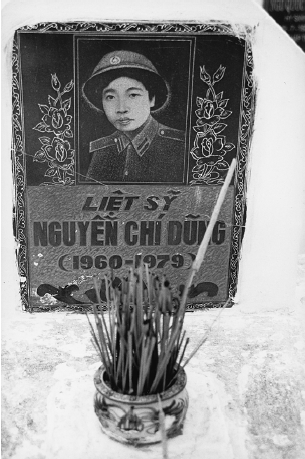
Figure 2.1. Grave of soldier killed during border war with China, 1979, Tam Nong District Revolutionary Martyrs Cemetery, Phu Tho. Photograph by Natalia Puchalt.
The ennoblement of death and sacrifice for the Revolution continued after the death of the individual. Instead of merging them into an anonymous mass of war dead, all those who died carrying out the work of the Revolution were officially grouped into the social category of “martyr” or “revolutionary martyr” (liet si) (fig. 2.1). The construction of this category represented an innovation by the state. Like hi sinh, the word liet si predated the revolutionary era. Party officials, however, recast it semantically to indicate those who had died for the Revolution