
THE CAMP ENCOUNTER
It should probably come as no surprise that the Fassbinder film that gets the most opprobrium is Lili Marleen, whose focus on "things, not people," is announced by its subtitle, "the story of a song." Loosely based on the memoirs of Lale Anderson, whom Fassbinder's friend and critic Christian Braad Thomsen calls simply a "cheap variety singer,"[37] it concentrates on the singer's wartime affair with Rolf Liebermann, the Jewish administrator, conductor, and occasional composer who would eventually direct the Paris Opera. With Lili Marleen's record-breaking budget, German critics were complaining that Fassbinder had sold out before the film was even released. Thomsen, for his part, opines that the film is recklessly paced and performed and is inattentive to detail, even geographical locale, flaws that he attributes to Fassbinder's purported disinterest in the project.[38] That same spatial and temporal indeterminacy leads Saul Friedlander to compare the film to Nazism's own poisonous mix of transcendence, myth, and death in his study on kitsch and fascism.[39] Along the same lines, Paul Coates argues that Lili Marleen turns German history into "candy floss," a bloated, overproduced spectacle that encourages passive fascination. Like Friedlander, he maintains that it deploys fascism's shimmering tropes of mass spectacle only to repeat them uncritically. To be sure, not all critics find the film offensive or thoughtless—although most of its enthusiastic reception came from abroad and was after its initial release. For Elsaesser, Lili Marleen exposes global capitalism's "commodifying but also charging with desire the material and immaterial fetish objects of the past," thereby making it impossible to whisk Nazism away into a hermetically sealed twelve-year period.[40] In an analysis that is especially sensitive to the soundtrack, David Bathrick argues that Fassbinder's film indicts Nazism's own mass entertainment machinery.[41]
Like most pop tunes, "Lili Marleen" is musically uncomplicated. Originally written as "Der Wachposten," its sentimental lyrics tell of a soldier's longing for women left behind. A popular tune, it was nonetheless pivotal to the largely unsympathetic reception of the Fassbinder film. It simply had too many associations. Anderson had sung it to Wehrmacht troops, Dietrich to Allied ones. Goebbels despised it ("crap with the stench of death,"
For many, however, the glitzy "story about a song" merely traded in degraded registers of camp and kitsch. In what seems a transferal of his own possible contempt for camp onto the film's director, Paul Coates writes:
For all its apparent delectation of Nazism as camp spectacle, Fassbinder is disdainful of camp's empty-headedness. Sadistically cramming an excess of candy-floss into a digestive system addicted to junk food, he is kind to be cruel. His contempt for camp, however, is not dictated by his occupation of the higher ground of analysis. … By trading in melodramatic clichés, the later films flatter the audience into the delusion that [noticing generic conventions engenders insight into historical contexts]. Peer Raben's music—melted-down Weill—performs a similar function, which is less one of camp than of kitsch: As Eco puts it, a quotation unable to generate a new context. … [We conceptualize] kitsch as the product of a desire to work "beautifully" rather than well.[44]
Coates makes a convincing point that Fassbinder's earlier, pared-down melodramas, like Merchant and Fear, provide more sophisticated analyses of fascism's psychological, social, and economic mechanisms than the later films, even though the latter situated their stories in Nazi and post-Nazi eras. He argues that the early films tackle the ostensibly apolitical psychic and social mechanisms that enabled fascist structuration to endure decades after the end of the war. By using contemporary, peacetime diegetic settings, that critique was made all the more trenchant. It is nonetheless strange that given Coates's preference for Fassbinder's early, male-centered melodramas, he selects the term "melodramatic clichés" to attack Lili Marleen. It would seem that, in the final analysis, style is the culprit: "The later films, however, are fatally compromised by pretension: Their empty,
Elsaesser's work contains some of the same kinds of contradictions. While his sensitivity to melodrama and camp influences on the New German Cinema and on Fassbinder in particular is beyond doubt, he has a disturbing take on Fassbinder's 1973 television film, Martha. Based on Cornel Woolrich's "For the Rest of their Lives," Martha tells the tale of an emotionally and sexually underdeveloped woman (Margit Carenson) living at home with overbearing parents. Helmut (Karlheinz Böhm, of Powell's 1960 Peeping Tom fame) first espies Martha on vacation as her father suffers a sudden, fatal heart attack. Aroused, Helmut courts her, and the two soon marry. What follows is gothic overload. Refusing to move into her family home, Helmut forces Martha to live in a dark, overbearing house. He increasingly restricts her movement, removing her from her job, forcing her to stay home, even cutting off telephone service. Their sexual life is a series of painful encounters, most gruesomely dramatized when he lets her fall asleep in the sun and afterwards forces himself on her scorched body. Martha grows aware of the anomalous nature of her relationship (a slow recognition since, in classical Fassbinder style, a female friend advises that "a little roughness is a sign of passion") and tries to escape with a male friend, her only outside connection. Their suspicious car accident kills her companion and leaves Martha permanently confined to a wheelchair. Despite her terrorized protests, hospital officials release her into the care of her husband, and the film concludes showing Helmut wheeling her ominously out of the corridor. Elsaesser describes Martha as one of "Fassbinder's most accomplished comedies."[46]
He is probably not alone in this view. When I show the film to students, their responses are mixed, as they are to most melodramas. Some respond to its pathos; others to its possible social critique; some find it hopelessly misogynistic; for others, it is nothing but ludicrous camp. Given the extent to which Martha hyperbolizes male sadism and female masochism and stages them within a hyperconventional bourgeois marriage, it would be ludicrous to deny its potential camp effects. Yet camp is not coterminous with comedy, and Elsaesser's terminological slippage fits with disquieting ease into Leo Bersani's troubling assertion that gay male camp "lovingly assassinates [a certain type of femininity],"[47] a point I discuss in Chapters Five and Six.
Christian Thomsen, the critic who wants nothing to do with anything remotely camp or kitsch, takes on Fassbinder's Satansbraten / Satan's
Thomsen's fierce objections to the film's camp aesthetic demonstrate that more is at stake than meets the eye. These intimations are fleshed out later in an astonishing claim about Berlin Alexanderplatz (1980): "There are no sexual undertones," writes Thomsen, "to the relationship [between Franz and Reinhold]."[49] What is it that motivates this kind of denial? While arguing on the one hand that Lili Marleen bore the signs of Fassbinder's indifference, Thomsen also maintains that the director sadomasochistically identified with Satan's Brew while knowing it was aesthetically, maybe morally, "repellent" to do so. But does this explain Thomsen's desire to toss Fassbinder's attachment on the garbage heap along with the film? Might not identifying with "repellent" aspects of figures, texts, and stories open one up to difference? It is, after all, a form of listening to perceived unpleasantness, to alterity, and a potential way of avoiding projecting abjection onto images that do not reflect back to us idealized, recognizable selves. Camp is often construed this way.
Kurt Raab's over-the-top performance as Walter Kranz is in keeping with the film's interest in role-playing and socio-sexual place-holding. Dressing up as Stefan George, Kranz "loses" his own identity as he accumulates more signs of the writer's, conspicuously revealed through increased make-up, garb, and accessories. Kranz even hires a group of young men to listen to his readings and adulate him, as if paying performance rights will purchase the sexual cachet and cult value of Stefan George. Characters are mere participants in a fantasy that theatrically attempts to remake a life in the present out of an idealized one from the past. As Fassbinder remarked, "The way I thought of it, Kranz was the central figure, and everyone around him is kind of invented. He treats the people around him as if they were characters in stories he is just telling. Because he lives this life as an artist, all situations are for him moments of play. Even the death of his wife is such a moment of play—for him, this is a character he's dropped, because it's a character he had invented."[50]
Although I return to the degraded status of camp and kitsch in Chapters Five and Six, it is worth noting here that critics often use the terms pejoratively
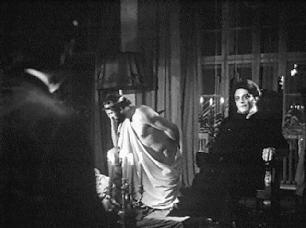
Invented characters: Kurt Raab as Walter Kranz as Stefan George in Fassbinder's Satan's Brew
It is also easy to see how stylistic and affective excesses like campiness have been used to denigrate melodrama or to pathologize hysteria, whether as representational or psychological phenomena. Formally, melodrama and hysteria violate verisimilitudinous norms, but not towards overtly political ends; in other words, not for reasons that conform to the radical aesthetic agenda, say, of materialist filmmakers. The bias of the latter emerges from their modernist separation of high and low aesthetic forms and the tendency to disassociate "low forms" from political critique. Without wanting to reify those very divisions, I find it nevertheless significant that politically motivated minoritarian groups often deploy the so-called low representational strategies like melodrama, kitsch, and camp. For Sanders-Brahms and von Trotta, melodrama offered a way to explore women's social and representational relationships to history; Schroeter embraced kitsch; Treut and von Praunheim have been immersed in camp. The willingness to incorporate such styles without demurring from their sensational or denigrated