
THE STUDY ANIMALS
Large islands have dual roles for biodiversity: first, they can provide empty fields for whole new radiations of species, such as Madagascar has for lemurs, Australia for kangaroos, or Hawaii for honeycreepers; and second, the isolation of islands can protect relict forms from extinction by competition or predation from newer species, as Australia has protected the monotremes, or Madagascar the lemurs. Because Borneo only recently became an island again (periodically, when sea levels are low, it is joined by dry land to other parts of the Sunda Shelf), its high diversity of treeshrews, including ten of the nineteen extant species, is more likely attributable to the latter effect than to the former (in situ diversification).
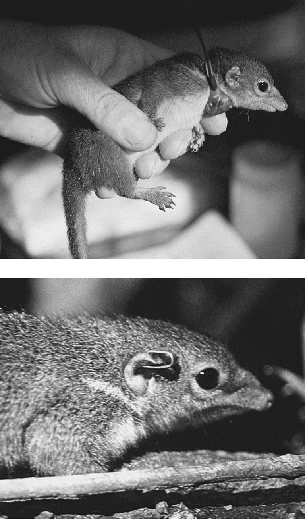
The six treeshrew species that I studied in Sabah (fig. 2.3) cover almost the entire body weight range of the order Scandentia (table 2.2, fig. 2.4), and because they include members of both subfamilies, and both montane and lowland species, they embrace much of the ecological diversity of the order. A thumbnail sketch below introduces each species. The body measurements of these treeshrews show a striking absence of sexual dimorphism (table 2.2). Males and females are virtually identical in size, which is unusual in small mammals or mammals in general.
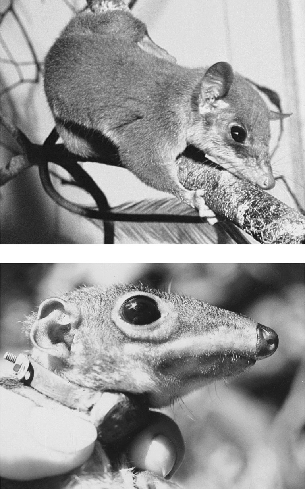
Fig. 2.3. Portraits of treeshrews: Ptilocercus lowii (above), Tupaia longipes with radio-collar (below), Tupaia minor with radio-collar (above opposite), Tupaia gracilis (below opposite).
| Head and body | Tail | Hind Foot | Ear | Mass(g) | |||||||||||
|---|---|---|---|---|---|---|---|---|---|---|---|---|---|---|---|
| Species | X | SD | N | X | SD | N | X | SD | N | X | SD | N | X | SD | N |
| NOTE: Data are from specimens in the museum of universiti Kebangsaan Malaysia, Kampus Sabah , Kota Kinabalu, and the United States National Museum, Washington, D.C For P. lowii and T. gracilis, field measurements of individuals captured during the study are also included. All data on Tupaia are from Sabah; 10 of 11 Ptilocercus spacimens are from West Malaysia(Selangor)as no Bornean material was available. Measurements are rounded to the nearest integer. | |||||||||||||||
| Ptilocercus lowii | |||||||||||||||
| Male | 132 | 5.4 | 5 | 180 | 9.5 | 5 | 28 | 0 | 5 | 21 | 1.1 | 5 | 46 | 5.6 | 5 |
| Female | 134 | 3.7 | 6 | 179 | 5.7 | 6 | 28 | 0.8 | 6 | 21 | 0.8 | 6 | 50 | 8.7 | 6 |
| Tupaia montana | |||||||||||||||
| Male | 129 | 6.4 | 16 | 159 | 7.8 | 15 | 32 | 1.5 | 15 | 14 | 1.6 | 16 | 52 | 8.1 | 16 |
| Female | 127 | 6.3 | 13 | 161 | 9.7 | 12 | 32 | 3.4 | 12 | 12 | 1.1 | 11 | 50 | 9.2 | 11 |
| Tupaia gracilis | |||||||||||||||
| Male | 141 | 8.9 | 7 | 178 | 4.6 | 6 | 39 | 1.6 | 7 | 13 | 2.9 | 4 | 70 | 12.9 | 7 |
| Female | 142 | 9.9 | 5 | 175 | 10.7 | 4 | 40 | 1.6 | 5 | 12 | 1.0 | 3 | 73 | 10.0 | 4 |
| Tupaia montana | |||||||||||||||
| Male | 178 | 16.3 | 27 | 152 | 14.3 | 26 | 39 | 2.2 | 27 | 16 | 2.1 | 28 | 127 | 10.2 | 17 |
| Female | 176 | 9.8 | 20 | 145 | 9.3 | 19 | 39 | 1.9 | 20 | 15 | 1.6 | 22 | 125 | 10.1 | 17 |
| Tupaialongipes | |||||||||||||||
| Male | 200 | 16.7 | 22 | 194 | 11 | 23 | 50 | 1.4 | 23 | 16 | 1.9 | 23 | 166 | 21.7 | 24 |
| Female | 199 | 17.4 | 31 | 193 | 13.9 | 27 | 49 | 1.8 | 31 | 16 | 2.7 | 30 | 165 | 28 | 26 |
| Tupaia tana | |||||||||||||||
| Male | 208 | 20.5 | 33 | 178 | 10.3 | 30 | 46 | 3.1 | 33 | 17 | 2.2 | 32 | 197 | 22 | 30 |
| Female | 207 | 10.9 | 17 | 176 | 9.5 | 17 | 46 | 1.9 | 17 | 16 | 2.7 | 17 | 210 | 27 | 15 |
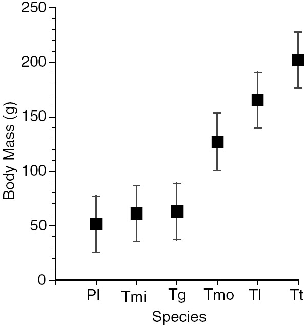
Fig. 2.4. Mean body mass and standard deviations of the treeshrew study species. Pl = Ptilocercus lowii; Tmi = T. minor; Tg = T. gracilis; Tmo = T. montana; Tl = T. longipes; Tt = T. tana.
This implies that body size in treeshrews may have tight ecological constraints and also reflects on social behavior. Among other things, it suggests that wild females finish growth before bearing young, as pregnancy can arrest growth by diverting resources to the young, and that males do not compete physically for females. These ideas are revisited in later chapters.
SUBFAMILY PTILOCERCINAE, PENTAIL TREESHREW, PTILOCERCUS LOWII GRAY, 1848
Pentails range across Sumatra, West Malaysia, Thailand, and the lowlands of northern Borneo. This sole member of its subfamily is the only nocturnal treeshrew. It is strikingly unlike other treeshrews in many traits: it has large delicate ear pinnae that can fold back; a prominent, quivering fan of whiskers on the muzzle; soft, gray, woolly fur; and strong grasping fingers and toes. Its most conspicuous feature is a proximally naked tail that is tipped with a large, flat, white flag of distichous hairs. Such a structure is elsewhere found only among gliding mammals.
The stunningly brilliant white eyeshine of P. lowii is the brightest I have ever observed in a mammal. Once recognized, this unique eyeshine can readily be identified from a distance of tens of meters, so that these “rare” animals were instead found to be common. Because pentails seldom enter traps, most local naturalists have never seen one.
SUBFAMILY TUPAIINAE, LESSER TREESHREW, TUPAIA MINOR GÜNTHER, 1876
The geographic range of lesser treeshrews is similar to that of pentails. This smallest of treeshrews is a uniform olive drab, with a pale shoulder stripe and a relatively slender tail. With its short muzzle and pink nose, it is a cute, Disneyesque version of the more severe-faced larger species. Lesser treeshrews often make a soft peeping sound like little birds, which betrays their location among the foliage. They were very common on both of the study areas and are the easiest species to observe.
SLENDER TREESHREW, TUPAIA GRACILIS THOMAS, 1893
Slender treeshrews are endemic to the northern two-thirds of Borneo. They are small, slender, olive drab animals with a pale gray shoulder stripe, a long slender tail, and relatively long legs. This species is almost identical to lesser treeshrews in size and color, and they are often confused both in the wild and in museum collections. Despite their similarity, one can learn to recognize the more drawn out, wraithlike quality of slender treeshrews, even from a distance in the forest. The distinctions between the two species will be emphasized below, because they would seem likely to be in greatest ecological competition. This was the rarest of the Tupaia species studied, although it was ubiquitous on my study areas.
PLAIN TREESHREW, TUPAIA LONGIPES THOMAS, 1893
Plain treeshrews are endemic to Borneo and found throughout the island. Until recently they were treated as a subspecies of T. glis, which is widespread in the Indomalaysian region. This is a medium-sized, dull brown treeshrew with a faint yellow shoulder stripe and a rather slender tail. It was quite common in all areas where we worked, but it is one of the most nervous and wary species, and it is difficult to see for more than fleeting moments.
MOUNTAIN TREESHREW, TUPAIA MONTANA THOMAS, 1892
The mountain treeshrew is endemic to the mountains of northern Borneo, where it occurs in mossy montane and cloud forest at elevations above about 900 m. It is medium sized and glossy brown, with a relatively short tail and an almost obsolete shoulder stripe, quite similar in size and color to the plain treeshrew. Its dense, thick coat, protection against cold, wet mountain mists, gives it a rotund shape. It is extremely common where it occurs. We studied it on the slopes of Mount Kinabalu.
LARGE TREESHREW, TUPAIA TANA RAFFLES, 1821
The largest of the treeshrews has a geographic range that includes Borneo, Sumatra, and a few small associated islands. It is a handsome animal with a coat of glossy, mahogany red and black, with a yellow shoulder stripe, a black midback stripe on the shoulders, and a tail that varies geographically in color from brown to orange, yellow, or red. It has a long, slender, probing muzzle, elongated foreclaws, and a relatively short, densely haired, bushy tail. Large treeshrews are the most commonly seen and captured species in the lowlands of Borneo.
Recent molecular studies with DNA hybridization and morphometrics indicate that T. tana and T. montana are sister taxa included within a clade with T. minor. Tupaia gracilis is a sister group to the latter clade, while T. longipes lies outside this combined group on a longer branch (Han, Sheldon, and Stuebing, n.d.).
Although my research was not directed toward discovering the systematic relationships of treeshrews, one of the most intriguing features of this order is its possible value as a model of a primitive mammal, even as a model of what early primates may have been like. As I describe the behavior of treeshrews below, a recurring theme is whether what we see in treeshrews is “primitive,” whether their behavior is like or unlike that of other primitive mammals, and whether we can come to any conclusion about what primitiveness is and what its consequences might be.