
Changes to Sakalava Social Structure
To understand how Sakalava identity is defined and how their authority is asserted, it is important to outline briefly recent structural shifts that have occurred. The most important distinction that must be made is that between commoner and royalty. Sakalava royal descent is based on truncated patrilineages that are traced primarily through past rulers. These lineages are still preserved and recorded with care by living royalty. Nevertheless, the undermining of royal authority by the French has led to a shift in focus among commoners from living to dead rulers.[6] Today the names and deeds of dead rulers are preserved and celebrated primarily within the context of tromba lineages (see Part 2).
Prior to French conquest, Sakalava commoners defined and organized themselves in reference to their royalty. Commoners were grouped into small village-based clans (firazan̂a).[7] These political entities were organized hierarchically in reference to specific duties or work that each was expected to perform periodically for royalty (fanompoan̂a; asam-panjakan̂a) (see the discussion on work in chapter 2). Clan membership was defined in reference to shared territory, ancestors, and tombs. In addition, there were the Sambarivo, royal slaves of diverse (often non-Malagasy) origins. Although they occupied the lowest rank, the Sambarivo were considered to be closest to royalty, since they were (and still are) responsible for tending to living royalty and the royal tombs. Sambarivo, however, as slaves, had no ancestors (see Feeley-Harnik 1991b). To quote Feeley-Harnik, “ ‘clans’ seem to be seen as having a lineage-like cohesiveness that is not born[e] out by actual relations on the ground…firazan̂a [are] very much a product of local political relations” (Feeley-Harnik, written personal communication). In addition, Baré, in his study of the Bemihisatra-Sakalava of Nosy Be, also stresses that clan membership was sentimentally determined by the “cycle de développement” (1980: 193):[8] clan identity often hinged on where one had spent much of his or her life. In general these clans appear to have been bilaterally conceived and exogamous (although endogamous unions did occur following the performance of specific rituals that lifted marriage bans or fady). Since clans were ranked, marriages between particular clans were deemed to be the most appropriate unions.
In addition to clans, a second form of affiliation was the kindred (tariky), which was composed of matrikin and patrikin. Residence usually determined how one conceived of one’s tariky. Different clans showed different biases toward patrikin vs. matrikin, with sentimental ties affected by residence patterns determined by the political order. Virilocality was the norm, but Sambarivo women, for example, could not leave their native villages. Similarly, members of high status groups tended to be uxorilocal. Often choice of residence after marriage was determined by the advantages and disadvantages perceived by cognates and their offspring. Baré cites an example of a man whose father settled uxorilocally, and so Baré’s informant was therefore raised among his mother’s kin. As an adult he had rights in his father’s village, but he preferred to remain where he had been raised. In order to be accepted as a full member of his mother’s kin group, he had undergone a series of ceremonies. As he told Baré: “je ne suis pas en bonne position ici (tsy tamana)” (Baré 1980: 92; note that this is the same expression used by migrants in Ambanja to mean they are “not content”).
The third organizing principle was the distinction made between the “children of men” (zanakan’lahy) and the “children of women” (zanakan’vavy), which distinguished paternal and maternal kin. In conjunction with this was the concept of uterine kin, or “children of the same belly” (kibo araiky) who shared their mother’s ancestors. These principles set restrictions on marriages between the children of sisters and excluded foster or adopted children from full participation in their adopting clan’s royal work.
In the Sambirano, clan membership is no longer a significant organizing principle. Clans have virtually vanished, save for the Sambarivo, who still live separately in special villages in the Sambirano Valley and on Nosy Faly, where they guard the royal tombs. Today few Sakalava are aware of these categories and, if they are, rarely do they know from what group their own ancestors came. Although two young adult informants stated with pride that their grandmothers had been “servants to the royalty” (mpiasam-panjakan̂a), they did not know what their duties had been. A major change that has occurred is the use of broader terms to define identity. Whereas two or three generations ago clan names served as markers for personal identity, today people of the Sambirano resort to using broader categories to define themselves as tera-tany, stating that they are Bemazava or, more generally, Sakalava. This practice stands out in contrast to the Sakalava of the Analalava region, for example, where so broad a term as “Sakalava” is rarely used by the indigenous people to label themselves (Feeley-Harnik, personal communication). Today it is the category of kindred or tariky that is important. As mentioned above, the kinship system of commoners is bilateral.
Sakalava kinship terminology is fairly complex (figure 4.4). Kin terms vary according to the sex and sometimes with the relative age of the speaker. Labels for siblings are as follows: for a male ego, brother is rahalahy, sister is anabavy; for female ego, brother is anadahy, and sister is rahavavy. The term used to address older siblings (male or female ego) is zoky and for younger siblings it is zandry. Structurally, parallel and cross-cousins are regarded as being the equivalent of siblings. The siblings of ego’s parents are differentiated from one another, again according to the sex of ego. Thus, for either a male or female ego, on the father’s side: baba (father), bababe (“big father,” or father’s older brother), babakely (“little father,” or father’s younger brother), and angovavy (FaSi). On the mother’s side: nindry/Mama (mother), nindrihely/mamahely (“little mother,” mother’s younger sister), nindrihely/mamabe (“big mother,” mother’s older sister), and zama (MoBr). Spouse’s siblings are ran̂ao, and in turn their spouses are structurally regarded as siblings. In the past, there was a joking relationship between agnates of opposite sex (for female ego: rokilahy, for male ego: rokivavy). A special term, asidy, is used instead of zanaka for the children of ego’s opposite sex sibling.
As figures 4.4 and 4.5 show, changes have occurred in kinship terminology and they are significant for several reasons. First, they reflect the effects of Sakalava contact with French and other peoples. Various indigenous terms (and, thus, structural concepts) have been replaced with French ones. Sakalava now use the terms mama(n),papa, and tonton. Sakalava younger than thirty or so are unfamiliar with the terms that designate joking relationships with agnates (rokilahy and rokivavy). Also the term asidy, for sibling’s children, is used less frequently. Finally, Sakalava kin terms (and the shifts that have occurred in the movement from village to town) are important in the context of tromba possession (this will be discussed in chapter 7). To illustrate these changes, figure 4.4 provides the older (“village”) kinship terms, while the second set in figure 4.5 corresponds to those used in town.
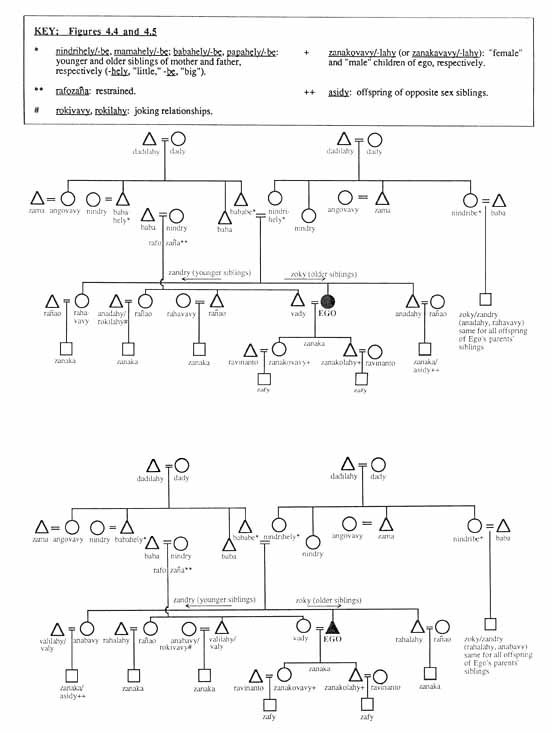
4.4. Village Kinship Terms: Female and Male Egos.
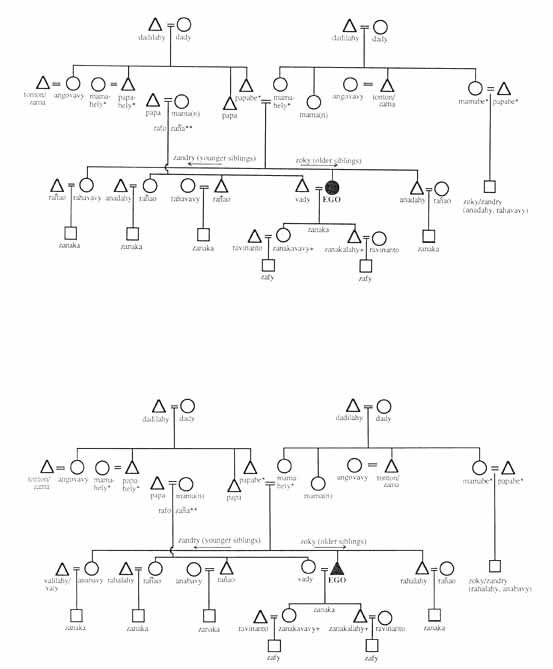
4.5. Town Kinship Terms: Female and Male Egos.
These structural changes—where clan membership and older (village) kinship terms have been forgotten—illustrate an important shift in how Sakalava conceive of their collective identity. Whereas in the past clan membership served to distinguish different groups of Sakalava from each other, today other categories operate to distinguish Sakalava from non-Sakalava. The broadest of these are tera-tany and vahiny. The use of Sakalava kin terms also serves as a marker for Sakalava identity or affiliation: terms such as angovavy and zama are distinctly Sakalava. Ironically, so are maman, papa, and tonton, since Sakalava are unusual among Malagasy speakers in reference to the number of French terms they have incorporated into their vocabularies (Dalmond, n.d.).[9] When vahiny use French-derived Sakalava kinship terms they do so to signal their affiliation with the tera-tany, since kinship terms vary somewhat as one moves from one region of Madagascar to another. Sakalava kinship terms are also very important in the context of tromba, where they are operational in establishing links of fictive kinship among the living and between the living and the dead (chapter 7).