
| • | • | • |
The Place of Bengal in Mughal Culture
Despite the extraordinary ways in which imperial culture had accommodated itself to North India, with respect to distant Bengal, isolated for centuries from the north, the Mughals saw themselves as distinctly alien. In part, this was because of the delta’s wet monsoon climate, of which North Indian officers posted in Bengal frequently complained.[24] Too, the Mughal policy of frequently transferring officials around the empire inclined imperial servants to regard the delta more as a temporary assignment to be endured than as a permanent, adopted home. Most important, perhaps, were the sheer numbers of new immigrants who inundated the delta as a result of Bengal’s political reintegration with North India. These included soldiers recruited from the north, Marwari merchants who accompanied and helped finance their Mughal patrons, swarms of petty clerks attached to Mughal officers, and the many artisans who supplied and equipped the Mughal military establishment. In effect, Bengal had become a colony for outsiders, effectively reversing the long-term pre-Mughal trend whereby a Muslim ruling class had progressively accommodated itself to the Bengali environment owing to generations of intermarriage with Bengali women and centuries of isolation from the north.
Both the literature and the architecture of the period reveal the new ruling class’s profoundly foreign—that is, non-Bengali—character. In 1626 an Afghan, Mahmud Balkhi, journeyed to Rajmahal and wrote of encountering people whose family origins lay in Balkh, Bukhara, Khurasan, Iraq, Baghdad, Anatolia, Syria, and North India.[25] These would have been remnants of the predominantly Sunni ashrāf of Akbar’s day, when Rajmahal was the provincial capital. Some years later the poet-official Muhammad Sadiq Isfahani, who lived in Dhaka from 1629 to his death in 1650, kept a diary, the ṣubḥ-i ṣādiq, in which he mentions the dozens of artists, poets, generals, and administrators he had come to know in that city. Most of these men were Shi‘as whose ancestors had migrated from distant centers of Persian culture—for example, Mashhad, Teheran, Ardistan, Isfahan, Mazandaran, Qazvin, Taliqan, Shiraz, Tabriz, Herat, Bukhara, or Gilan.[26] This suggests that between the reign of Akbar (1556–1605), when Rajmahal was capital, and that of Shah Jahan (1628–58), when Dhaka was capital, an increasing proportion of Bengal’s urban ashrāf, although born in North India, claimed Iranian ancestry.[27]
The most striking statement of the imperial attitude toward Bengal was made by Akbar’s chief advisor, Abu’l-fazl. “The country of Bengal,” he wrote in 1579, shortly after imperial armies had routed the capital’s Afghan occupants, “is a land where, owing to the climate’s favouring the base, the dust of dissension is always rising. From the wickedness of men families have decayed, and dominions [have been] ruined. Hence in old writings it was called Bulghākkhāna (house of turbulence).”[28] Here, in this “Mughal colonial discourse,” we find a remarkable theory of political devolution: an enervating climate corrupts men, and corrupted men ruin sovereign domains, thereby implicitly preparing the way for conquest by stronger, uncorrupted outsiders. In linking Bengal’s climate with the debased behavior of people exposed to it, Abu’l-fazl’s theory of sociopolitical decay anticipated by several centuries the similar views adopted by British colonial officials.[29]
Even immigrant holy men harbored negative attitudes about the delta. Shah Ni‘mat Allah Firuzpuri (d. 1669), an ashrāf shaikh from the Punjab who settled down in Malatipur near Malda early in the reign of Shah Jahan, quickly grew tired (malūl) of the region. Mincing no words, he revealed his thoughts in the following clumsy but blunt quatrain:
While harboring such attitudes toward his adopted home, the shaikh nonetheless curried favor with the province’s ruling class, whose life-style he and his descendants adopted, and from whom he accepted substantial lands in personal endowments (madad-i ma‘āsh).[31]
Bengal is a ruined and doleful land; Go offer the prayers to the dead, do not delay. Neither on land nor water is there rest; It is either the tiger’s jaws, or the crocodile’s gullet.[30]
The Mughals’ feeling of alienation from the land was accompanied by a sense of superiority to or condescension toward its people. In matters of language, dress, and diet, newly arrived officials experienced great differences between Bengal and the culture of North India. The delta’s diet of fish and rice, for example, disagreed with many immigrants brought up on wheat and meat, basic to the diet in Punjab. Written in 1786, the Riyāẓal-Salāṭīn faithfully reflects the ashrāf perspective regarding Bengali culture, and reads almost like a colonial British manual on how to survive “amongst the natives”:
Mughal officers also associated Bengalis with fishermen, whom they openly despised. Around 1620 two imperial commanders, aiming to belittle the martial accomplishments of one of their colleagues, taunted the latter with the words: “Which of the rebels have you defeated except a band of fishermen who raised a stockade at Ghalwapara?” In reply, the other observed that even the Mughals’ most formidable adversaries in Bengal, ‘Isa Khan and Musa Khan, had been fishermen. “Where shall I find a Dawud son of Sulayman Karrani to fight with, in order to please you?” he asked rhetorically, and with some annoyance, adding that it was his duty as a Mughal officer to subdue all imperial enemies in Bengal, “whether they are Machwas [fishermen] or Mughals or Afghans.”[33] In this view the only truly worthy opponents of the Mughal army were state rebels or Afghans like the Karranis; Bengalis, stereotyped as fishermen, were categorized as less worthy adversaries.And the food of the natives of that kingdom, from the high to the low, are fish, rice, mustard oil and curd and fruits and sweetmeats. They also eat plenty of red chilly and salt. In some parts of this country, salt is scarce. The natives of this country are of shabby tastes, shabby habits and shabby modes of dress. They do not eat breads of wheat and barley at all. Meat of goats and fowls and clarified butter do not agree with their system[s].[32]
Mughal officials thus distinguished themselves from Bengalis not only as tax-receivers as opposed to taxpayers but as North Indian fighting men as opposed to docile fishermen. On one occasion Islam Khan’s chief naval officer, Ihtimam Khan, expressed resentment that the governor had once treated him and his son like “natives.”[34] Since the Persian term used here, ahl-i Hind, means simply “Indian,” one might expect to find it used only by nobles who had immigrated from beyond India. But Ihtimam Khan was himself an India-born Muslim from the Punjab;[35] hence his use of the term in a pejorative sense suggests he had acquired ashrāf attitudes through his service with the Mughals. That ashrāf Muslims occupied a social category distinct from the “natives” was also noted by the Portuguese friar Sebastião Manrique, who in 1629 described Bengal’s population as composed of three groups—“the Portuguese, the Moors, and the natives of the country.”[36] In this social classification Muslims were, by definition, foreigners to the land. From the perspective of the ashrāf Muslims whom Manrique met, it was conceptually impossible for “natives” also to be “Moors”—that is, that there could be Bengali Muslims.
The Mughals’ foreign character is also seen in their monuments. The earliest surviving architectural record of the new order is the Kherua mosque, built in 1582 by members of the Qaqshal clan in Sherpur, southern Bogra. Although the Qaqshals had participated in the Mughal conquest of 1574, six years later they spearheaded the manṣabdārs’ revolt against Akbar’s authority, in the midst of which they patronized the construction of this monument. But the Qaqshals’ alienation from North India was political, not cultural. Unlike the Afghans before them, they had not been in the province long enough to absorb the local culture fully, which perhaps explains the mosque’s somewhat hybrid nature. Its brick exterior, engaged corner turrets, and curved cornice were all staple indices of the native Bengali mosque as it had evolved for over a century under the patronage of Bengal sultans. On the other hand its ground plan—a single-aisled rectangle divided into three bays—had been popular in the Delhi region since the fifteenth century; beginning with this mosque, it would become a characteristic feature of the Mughal style in Bengal. The building’s inscription, moreover, was in Persian, the official language of the Mughals, whereas most pre-Mughal Muslim inscriptions in Bengal had been in Arabic. Thus the mosque aptly reflects the culturally ambiguous position of its patrons, with one foot in Bengal, the other still in Delhi.
More emphatically North Indian, and hence from a Bengali perspective more foreign, is the congregational mosque of Rajmahal. Built during the governorship of Raja Man Singh (1594–1605) as the principal mosque of Akbar’s provincial capital, this imposing structure (252 × 212 feet) was an architectural assertion of the Mughals’ claim to the province. In no other provincial capital during this period was such a large mosque built.[37] In it we find Akbar’s characteristic architectural signatures as already articulated in the imperial capital at Fatehpur Sikri (c. 1570): a high monumental gateway, a single-aisle plan, ornamentation on the façade, battlements around the exterior, and a division of the bays into two stories, each containing chambers.[38]
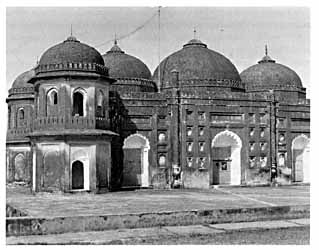
Fig. 19. Satgumbad Mosque, Dhaka (ca. 1664–76)
It was in Dhaka, however, that the imperial style was most lavishly indulged in. Overturning a Bengali architectural tradition patronized by centuries of Muslim rulers, Mughal rulers raised buildings here that were virtual transplants from the North Indian heartland. Typical was the Bara Katra (1644), a huge hostelry that once contained chambers, shops, and an imposing multistoried southern gate with an octagonal central chamber.[39] Although the Bara Katra is now ruined, a number of splendid mosques from the period have survived, in particular the Satgumbad mosque (ca. 1664–76) and the mosques of Haji Khwaja Shahbaz (1679) and Khan Muhammad Mirza (1704). With their battlements, cusped entrance arches, increased articulation of exterior and interior surfaces, and, especially in the Satgumbad mosque, projecting corner turrets with pavilions, these monuments firmly established in Bengal the aesthetic vision of Mughal imperialism (see fig. 19).[40] That vision reached its acme in the handsome ensemble of garden and monuments in Dhaka’s Lalbagh Fort (fig. 20). Included in this complex are a mosque, a tomb, an audience hall (Diwan-i Khas), a bath, a tank, and a walled enclosure with gates.[41] Standing within Lalbagh one readily recalls the great palace-garden complexes of the imperial heartland—at Lahore, Delhi, and Agra—and realizes that this, too, could only have been conceived and built by outsiders to Bengal. No element of the complex is indigenous to the delta.
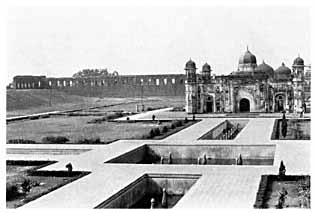
Fig. 20. Lalbagh Fort, Dhaka. Foreground: Fountains and tomb of Bibi Pari (late seventeenth century). Background: Two domes of the Lalbagh Fort Mosque (1649)
The concentration of Mughal power in Dhaka also had the effect of driving remnants of Bengal’s pre-Mughal Muslim political tradition into the hinterland. One sees this most clearly in the Atiya mosque in Mymensingh District (fig. 21). Built in 1609 by Afghan patrons, this mosque, with its complex terra-cotta façade, its ringed corner towers, and its curved cornice, is a highly evolved elaboration of the sultanate style, now rusticated to the interior. Architecturally, it would appear to have been the last gasp of the old order, soon to be submerged under the Mughal tide. Yet one should not exaggerate the notion of a monolithic Mughal architectural style expanding inexorably from its North Indian heartland as new provinces were annexed. Even as the old, Bengali style of mosque was rusticated into the hinterland after the Mughal intrusion into the delta, certain elements of the indigenous style—especially the sharply curved cornice—were absorbed into the Mughal tradition and subsequently surfaced in the imperial capitals of Delhi and Lahore. Thus the evolution of the Mughal architectural tradition shows a certain double movement. Reflecting the imposition of central authority on the periphery, a new style moved outward from the center to the provinces; yet features associated with the provinces were simultaneously appropriated by the imperial center and absorbed into a new, composite style, reflecting the assimilation of theperiphery into the center.[42] This model of cultural expansion, assimilation, and feedback—here reflected in architecture—closely paralleled the growth of Islam as a religious system in Bengal, a theme to which we shall return in later chapters.
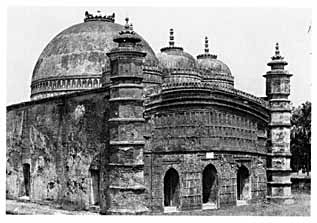
Fig. 21. Atiya Mosque, Mymensingh District (1609).