
| • | • | • |
Other Members of the Spirit World
The spirit world of Ambanja is complex and varied. Tromba are by far the most important spirits. It is they who appear most frequently in mediums and who are most significant in terms of daily interactions between the living and the dead. As the spirits of Sakalava royalty, structurally they are also of prime importance. Although tromba dominate the spirit world, they can not be understood fully unless explored in relation to other spirits.
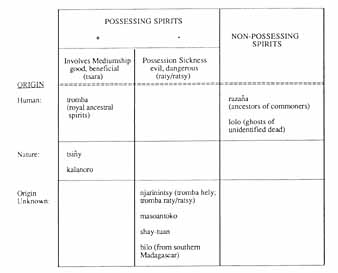
5.2. Spirits of Ambanja.
In Ambanja, spirits are categorized in a number of different ways (see figure 5.2). They may be grouped according to their origins and by human or nonhuman qualities. In addition to the tromba, who are royal, historical figures, there are also the ancestors of commoners (razan̂a), ghosts of the lost dead (lolo), nature spirits (tsin̂y and kalanoro), and a variety of lesser, amorphous, evil spirits (njarinintsy, masoantoko, shay-tuan, bilo). Although all spirits are potentially dangerous, spirits generally are grouped by Sakalava as being either good (tsara) or bad (raty, ratsy).
Mediumship also provides a means by which to group spirits. Just as tromba spirits require mediums, so do the nature spirits tsin̂y and kalanoro. All spirits are potentially dangerous, especially when angered, but spirits that work through professional mediums are regarded as being, in general, benevolent. In Sakalava cosmology, the Zanahary, or Gods on High, are distant and vaguely conceived creator spirits or dieties to whom the living do not give much thought. Ancestral spirits especially serve as intermediaries between the living and the Zanahary. (In Malagasy Christian theology, the Zanahary have been replaced by the Christian God, Andriamanitra, or “the King of Heaven”; sometimes Catholic mediums will address this God instead when they invoke tromba spirits.) Although nature spirits that require mediums are feared, they, like tromba, are respected as authority figures and as specialists in times of crisis. They are also revered as knowledgeable healers.
Finally, positions and meanings assigned to spirits within the Malagasy cosmos are further manipulated, restructured, and redefined through the doctrines of Christianity and Islam. In these contexts, all spirits are considered to be evil and are referred to as devils or jinn (devoly, jiny). Values collide in the realm defined by the spirit world, as devotees of Christianity and Islam (as well as urban intellegentsia and foreigners) struggle to make sense of the pervasiveness of Malagasy customs (fomba-gasy) in light of their own beliefs based on alternative moral and ideological systems (this will be elaborated in chapter 10).
Other Spirits of Human Origin: Razan̂a and Lolo
Like royalty, Sakalava commoners have their own personal ancestors (SAK: razan̂a; HP: razana; the latter term is used throughout Madagascar for ancestors), but, in contrast to tromba spirits, razan̂a do not possess mediums (cf. Rason 1968).[11] Instead, they communicate with the living either through dreams or through a third party, such as a tromba medium, whose spirit, in turn, serves as an intermediary and interpreter.[12] These spirits interact with the living when they are angry or troubled and must be appeased when necessary. An angry razan̂a may also be identified by a healer as the cause for an individual’s sickness or misfortune. They sometimes disturb the living because their bodies have been lost or forgotten. For example, an ancestral spirit may be angry because it has long been dead and its burying place forgotten, or because it was never placed in the family tomb. Reasons for this may vary. Perhaps the person died while traveling, or the body was never recovered, or the body was intentionally neglected, left to rot somewhere in the woods because of a major trespass committed in life.[13] The healer, most often a tromba medium, will then instruct living kin how to placate the troubled spirit, explaining where to find the remains, or what other actions the ancestor wishes its kin to take. Personal ancestors are also honored annually on the Day of the Dead (Fety ny Maty), since many Sakalava in Ambanja are Catholic.[14]
Lolo (pronounced “lu-lu”) is a term used throughout Madagascar for ghosts. These are, in essence, orphaned spirits with no structural ties to anyone. They are similar to razan̂afa, the difference being one of perspective. Razan̂afa are one’s own lost ancestors; lolo, on the other hand, may be seen as the lost ancestors of strangers: they bear no structural affinity to those whom they disturb.[15] Lolo are the ghosts of people who have died in tragic or violent ways, whose bodies were never recovered and placed in a tomb. Lolo haunt the scenes of past accidents, such as regions of the sea where people have drowned or under bridges where there have been automobile accidents. These are jealous and vicious spirits that cause their victims to die in ways similar to their own deaths. For example, the sea near the east coast town of Toamasina is very rough, and it is said that many lolo dwell there. Similarly, people crossing the channel between Nosy Be and the main island often fear that the ghosts of those who drowned in boating accidents will cause them to meet similar fate.
The theme of lost bodies is a common one in Madagascar. As Bloch (1971) has shown, it is in the tomb that Malagasy invest the greatest amount of money and sentiment, for it is the tomb that defines where home is, tying the individual to past, present, and future kin. A lost body is very frightening, and Malagasy tell elaborate tales of trying to recover and transport the body of a loved one who has died far from home, either in a remote part of Madagascar or abroad. During the course of my interviews with an old Sakalava man he told me I should move out of my house because there were lolo living there, since it was built, along with the neighboring Lutheran church, on top of an old Sakalava cemetery. One of my assistants and I later challenged him on the truth of this story (topographical records revealed that a cemetery had in fact existed near the church, but not on its grounds). He later retracted his statement and agreed that it was unnecessary for me to move. I believe that his statement had much to do with my needing to clarify for him my relationship with the Lutheran church, which was not particularly popular with the Sakalava.
Nature Spirits that Require Mediums: Tsin̂y and Kalanoro
In addition to tromba, there are two categories of nature spirits that also possess mediums. These are the tsin̂y and kalanoro. A tsin̂y is a nature spirit associated with a specific location where it is said to live, such as a sacred tamarind tree (madiro) or a rock. Tsin̂y, when they possess their mediums, wear clothes that are similar in appearance to Zafin’i’fotsy tromba. In addition to being periodically possessed by their spirits, tsin̂y mediums also serve as the exclusive guardians or caretakers of the spirits and their habitats, so that a tsin̂y medium is said “to have a tsin̂y” (misy tsin̂y, lit., “there is a tsin̂y”). This issue of guardianship is important. Since a tsin̂y’s dwelling is sacred, people may wish to leave offerings for the spirit without actually consulting with it directly. In order to do this, however, one must acquire permission from the spirit’s guardian. The location of a tsin̂y is easy to recognize, since it generally has a fence built around it for protection, and pieces of white cloth, left as offerings, will be draped on a pole or, if it is a tree, a branch. Unlike tromba, tsin̂y possession is not widespread in Ambanja. Tsin̂y locales and mediums are few and are located in small villages throughout the countryside.
Kalanoro are by far the most mysterious, frightening, and bizarre (hafahafa) of the Malagasy spirits, having a quality that Kane (1988) aptly describes as “surreal” in speaking of the duende spirits of Panama. Kalanoro are found throughout Madagascar, and in other regions of the island they go by such names as kotoky and vazimba.[16] Kalanoro are rarely seen, because they live deep in the forest. They are short and some informants say they have long fingernails and red eyes. Their hair is long and possesses magical qualities. I know of one moasy (herbalist), for example, who derived his power from a small packet of magical substances which included kalanoro hair. The most striking aspect of kalanoro is that their feet point backward, so that if one wishes to track a kalanoro, it is important to remember to follow the footprints in the direction they appear to be coming from, rather than where they seem to be going. Kalanoro eat raw food and may leave evidence of a meal—such as the cracked shells of a crayfish on a rock in the middle of a river.
As is true of tsin̂y, kalanoro mediums are said to have or keep these spirits and act as their guardians. Unlike tromba and tsin̂y possession ceremonies, however, the client is not permitted to view a kalanoro when it possesses a medium. Instead, during the consultation, the medium sits behind a white curtain in a darkened room. There are only a few kalanoro mediums working in the Sambirano Valley, and they, like those with tsin̂y, live out in the bush. Although I was never able to consult a kalanoro, I was told by informants who had done so that when the kalanoro arrives it can be heard walking and banging on the ceiling and walls of the house and that its speech is quick, choppy, and high pitched, so that it is difficult to understand. It is taboo to have a dog present during a kalanoro seance, because dogs can see them. Malagasy are generally wary of kalanoro because of their strange qualities. The few informants I knew who had consulted kalanoro did so either out of curiosity or as a last resort after the efforts of numerous tromba mediums and other healers had failed.
Although tsin̂y and kalanoro are similar to tromba spirits in that they operate through mediums and work as healers, they differ in a number of ways. First, kalanoro and tsin̂y are associated with nature, and so many of their clients seek their assistance because of a trespass they have committed against such a spirit by violating a sacred locale. Second, the mediums for these nature spirits serve as their guardians and, thus, each spirit is only associated with one person, whereas a tromba spirit may possess many mediums. Third, they are much rarer. Over the course of a year, I met only three tsin̂y mediums, and I was never able to locate a kalanoro. Because of this, their services are usually more expensive than those of tromba mediums, which accounts in part for why they are a last resort for clients. Fourth, although the majority of tromba spirits possess women, kalanoro guardians are men and women. Tsin̂y possession, on the other hand, appears to be more common among men: of the three tsin̂y mediums I encountered during one year, only two of these were male. Finally, whereas tromba possession occurs in the context of large-scale ceremonies, tsin̂y and kalanoro work in the privacy of the guardian’s home.
Evil Spirits
Njarinintsy, Masoantoko, Shay-tuan
All spirits that operate through mediums—tromba, tsin̂y, and kalanoro—become permanent fixtures in their mediums’ lives. There are also evil (raty, ratsy) possessing spirits—njarinintsy, masoantoko, and shay-tuan—which are harmful and are often regarded as a special form of possession sickness. These spirits are said to be recent arrivals to the Sambirano region.
Of these malevolent spirits, njarinintsy are the best known and claim the greatest number of victims. For this reason njarinintsy will be the focus of subsequent discussions of possession by evil spirits (see especially chapter 9). Njarinintsy possession is a relatively new phenomenon in Ambanja, occuring only within the last fifteen years. Most informants say that they first heard of njarinintsy in the 1970s, and Sakalava argue that it was brought by Tsimihety migrants. Cases of njarinintsy are reported from other areas of the north as early as the 1960s and informants describe these as clowning spirits. In more recent years, however, njarinintsy have become increasingly violent. Njarinintsy possession is viewed as a grave illness with symptoms that include shaking and chills (this is reflected in the spirit’s name, which is derived from manintsy, which means “coldness”);[17] uncontrollable screaming and crying; loss of memory; and mental confusion. As with tromba possession, the majority of njarinintsy victims are female. They experience temporary fits of possession or madness when they wander the streets aimlessly and may even, in extreme cases, attack people. If an individual is in a possessed state she does not recognize anyone, nor will she remember what happened once the fit has ended.
Sakalava often speak of njarinintsy in reference to tromba. Njarinintsy may be viewed as structurally akin to tromba, for it is sometimes said that they are the “children of tromba” (tsaiky ny tromba, zanaka ny tromba). They are also referred to as tromba hely (“little tromba”) or tromba raty/ratsy (“bad tromba”). Informants insist, however, that njarinitsy are not a type of tromba for, unlike tromba, njarinintsy are malicious and extremely dangerous, and must not be allowed to inhabit the living. In many ways these spirits are defined in opposition to tromba—they are everything that tromba are not.[18]
Masoantoko and shay-tuan are very similar to njarinintsy, and so I will describe them only briefly. A masoantoko (lit. “group of eyes” [?] from maso, “eye,” and antoko, “group”[?]) disturbs its victim while she sleeps, giving her terrible nightmares. Informants opinions on shay-tuan differ, particularly in reference to their origin. Some informants say they are Chinese spirits, referring to the local spelling of the name, but others say they are Muslim. More likely they were brought to Madagascar by slaves or Swahili traders from East Africa (compare with the Arabic term shetwan, for “devil”; setoan in Feeley-Harnik, 1991b: 95; also sheitani spirits of East Africa, see Giles 1987; Gray 1969; Koritschoner 1936). According to one informant, shay-tuan smell bad (maimbo). Odors can be important in distinguishing different categories of spirits from one another. Tromba, for example, can be enticed into arriving in a medium by burning sweet smelling resin or other types of incense. Shay-tuan (and lolo, see above), however, can be driven from a room by burning the same type of incense or a piece of cloth. For this reason adults often burn one of these substances in a room before children enter it to sleep at night.
Bilo
A final form of possession sickness found in Ambanja is bilo. Bilo does not occur with great frequency in Ambanja, being an affliction primarily of peoples who have come from the south, such as the Betsileo and Antandroy. The symptoms associated with bilo are much like njarinintsy in that its victims may become violent and temporarily crazed. Some bilo spirits are animals, such as snakes, and they cause their victims to crawl on their bellies while they are possessed.[19]
Responses to Possession Sickness
The responses to possession involving evil spirits—njarinintsy, masoantoko, shay-tuan, and bilo—reflect the gravity of the situation and the necessity for collective action. In Malagasy communities, individual illness is a time when kin and close friends congregate to care for, watch over, and socialize with the afflicted. This is especially evident in cases involving spirit possession. Tromba, tsin̂y, and kalanoro require that the individual go through a series of ceremonies to instate the spirit permanently within her; in contrast, an evil spirit must be driven from its victim. If it is not, she may become increasingly ill and may even go mad or die. When an evil spirit strikes, the assembled group provides not only a united front against the spirit, but also helps to give the victim strength to resist possession. The presence of kin ensures that the afflicted will be taken to a healer. Furthermore, she has witnesses to the entire process. This is, I believe, essential: regardless of the type of possession, the possessed is never aware of what happens when she is in trance, and so part of the healing process involves the recounting of events to the victim (see Lambek 1980 for a similar discussion from Mayotte).
Possession sickness involving evil spirits most often affects adolescent girls between the ages of thirteen and seventeen, and many tromba mediums and other healers specialize in exorcising these spirits. Malicious spirits generally do not possess their victims through a will of their own but have been sent by an adversary, who has used magical substances or bad medicine (fanafody raty/ratsy) to harm someone. The victims of evil spirits are those who have come into contact with fanafody that was meant for them or, in some cases, through accidental contact with fanafody that was meant for someone else. As the case of Angeline shows, they may precede tromba possession, the evil spirit having been sent by a tromba to harm a woman who is resisting mediumship. In these cases, once the evil spirit is exorcised, the tromba then makes its debut.
Although njarinintsy possession is a grave illness, if a cure has been successful, long afterward kin and friends will tell lively, comical stories of the problems encountered in trying to restrain the possessed and keep her calm during transportation in an oxcart or taxi and, finally, what came to pass with the healer. Njarinintsy are, in general, uncooperative and demanding spirits. The role of the healer is to strike a bargain with the spirit, making arrangements to give gifts to it or later to leave certain goods in strategic locations—by a sacred tree, for example—so that the spirit will be content and will leave the victim. This process is not always successful. It may take several visits to a number of different healers before the spirit agrees to leave. The process is further complicated by the fact that njarinintsy do not always appear alone, for they are said to prefer working in groups of seven. Thus, even if one spirit is driven away, there may be others that remain inside the victim. Once the spirit or spirits have departed, the individual is cured. A failure to cure is a grave matter, for the person will continue to have fits, and it is said that she may be driven mad or even die from the harm caused by the presence of the spirit. If indigenous healers fail to coax an evil spirit from its victim, her kin might then go to a Protestant or Muslim exorcist.
Most Christians and Muslims in Ambanja state that they are opposed to possession. According to Christian doctrine, all spirits are considered to be devils (devoly). Although the Catholic church in Ambanja is fairly tolerant of possession activities, Protestant churches in Ambanja (and in other regions of Madagascar as well) are actively involved in exorcism activities. The FJKM, Lutheran, and a number of other churches have a long tradition of specialists called fifohazana (HP, from the verb mifoha, meaning “to wake” or “to arise”) or mpiandry (“shepherds”) who exorcise tromba and other spirits through the power they derive from the Holy Spirit. Under Islam, all spirits are similarly regarded as being jinn (SAK: jiny), and, like the Protestant churches, a number of Muslim sects in Ambanja also have specialists who are able to exorcise them. Tolerance of possession varies from one Muslim sect to another, and attitudes toward possession often depend on how troubled the victim is. Rarely do kin seek help from Protestant exorcists and only in extreme cases. (This alternative form of therapy will be explored in chapter 10.)
Thus, tromba and other forms of possession now form a vital part of daily life in Ambanja. The social, demographic, economic, and political forces outlined in Part 1 have led to the popularization of tromba. As the chapters that follow will show, tromba provides Sakalava with a means to reflect upon their shared experiences and to document, reshape, and constantly redefine relationships with peoples of diverse origins. In turn, since tromba possession continues to be viewed as a Sakalava institution, it enables tera-tany to regulate the participation (and thus incorporation) of outsiders. For vahiny, it provides them, too, with a powerful vehicle to express their own experiences within the context of migration, and with a means of integration into the local community. In these ways, possession in Ambanja is an important aspect of both collective and individual identity.