
| • | • | • |
Hooliganism: “The Beastly Deed”
Hooligan offenses declined briefly after 1907 only to return, with a vengeance, around 1910. Late in 1906 the police briefly regained control of the streets by expelling hooligans, prostitutes, and other “shady characters” from the city center. Newspaper reports of hooliganism diminished, and according to the chief of the mirovoi sud prison, the “energetic police campaign” was responsible for the decrease in the number of hooligans who ended up in the House of Detention in 1906 and 1907.[4]
The decline of hooliganism as news and in crime rates, however, did not indicate the disappearance of hooligans altogether. Court statistics exaggerated the decline of hooliganism because, as discussed previously, most of those apprehended by the police for hooligan offenses between 1907 and 1910 were processed by the gradonachal’nik under the authority of binding decrees rather than through the judicial system.[5] If we take such cases into account, hooligan crimes may have reached pre-1905 levels on the streets several years before the Justice of the Peace statistics caught up with them. Already by 1909 the prison administration reported that among increases in those sentenced to mirovoi prison terms, the greatest increases were for offenses against public peace and order—typical hooligan crimes.[6]
In addition to the statistical misrepresentations, the exile of hooligans and other “shady characters” from the capital was accompanied by the first widespread appearances of hooliganism in the countryside, suggesting merely a temporary shift of venue. And judging from the immediate attention hooliganism received in Gazeta-kopeika when it began publication in 1908, it is likely that hooligans continued to operate in the neighborhoods of the city’s periphery as well. In central St. Petersburg, the sweeps of 1906–7 succeeded in eradicating the sharp increase in hooliganism that coincided with political unrest when hooligans took advantage of the breakdown of authority. But starting in 1908, and especially after 1910, hooligan crime rates reestablished the steady climb that had been interrupted—and transformed—by the revolution. By 1912 Peterburgskii listok was portraying St. Petersburg as a city teeming with crime and disorder, against which the police struggled in vain (see figs. 10 and 11).
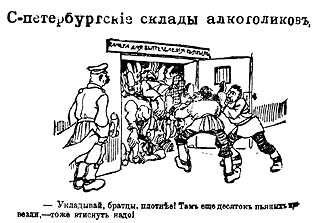
Figure 10. The St. Petersburg Warehouses for Alcoholics (September 5, 1913). (The inscription over the door says “Sobering-up Station.”) “Shove ’em in, brothers—tighter! We’ve got dozens more drunks on the way.”
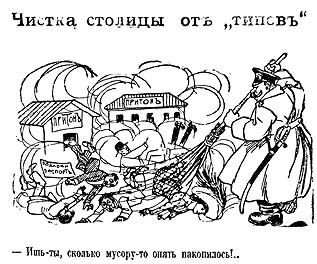
Figure 11. Cleansing the Capital of “Shady Types” (October 28, 1912). “Look at that, will you! See how much trash has piled up again.”
Renewed coverage of hooliganism in the commercial press briefly preceded the upsurge in working-class unrest sparked by the Lena Gold Fields massacre of 1912, when government troops fired upon striking workers. The differences we see in the representation of hooliganism in this period are a reminder of this crime’s elasticity and that newspaper descriptions of hooligan offenses were always at least partly shaped by prevailing social and cultural concerns. Curiosity about the city’s poor population was on the rise, but the wariness and hostility toward the lower classes that had been exhibited before 1905 were tinged with fears of mass power and mass violence and a lack of faith in the government’s ability to avert lower-class disorder. The boulevard press reflected and contributed to the new cultural context of the 1910s.[7] The lifting of most forms of preliminary censorship in 1906 created new possibilities for expression in the press. The relaxation of censorship and the competition among the burgeoning number of newspapers that appeared after the revolution allowed increasing commercialization and an emphasis on news that sells. Crime news had always been popular, but it was given far greater prominence than ever before. More space was allotted to crime stories, and more melodrama evoked by the language used to report crime. In 1910 Peterburgskii listok introduced a second crime column. While the old one continued to list criminal offenses, accidents, fires, and so forth, other incidents of the same sort now appeared under the heading “Events of the Petersburg Day” (Sobytiia Peterburgskogo dnia), giving crime news in particular added visibility. At least two columns wide and several inches long, “Events” drew attention to crime news with bold headlines and graphic language.
The new visibility and violence of street crime was reflected in (and explained by) the language of crime reporting. Gruesome murders, vicious brawls and attacks, pitiful suicides, and tragic accidents were all treated in more explicit and more dramatic prose than before. Reports in the crime columns emphasized heart-stopping details with vivid, gory language. Blood flowed “in pools”; victims were “beaten to a pulp.” Succinct allusions to stab wounds were replaced with grisly specifics. A knifing was now “a multitude of wounds that ripped and bruised the flesh.”[8] Victims were no longer simply beaten or stabbed in the side. One man was dragged into a courtyard and then cruelly and horribly beaten until his head was shattered, his nose broken, and his body punctured with stab wounds.[9] The son of an army ensign was attacked by hooligans who “literally riddled [him] with holes.”[10] A construction worker, returning home from work late at night on payday, was attacked by hooligans who “knocked him off his feet, stabbed him, tied his mouth, and stripped him. Then they tossed him—bloody, unconscious, and naked—into the canal.”[11] Titles of the reports also highlighted violence. “Blood for Blood,” “A Nightmarish Crime,” and “A Bloody Attack” emphasized the gory consequences of the hooligan threat.[12] The epithet “beast” figured often in various forms in the titles: “A Beastly Murder,” “A Beastly Attack,” “Hooligan Beastliness,” and “A Beastly Hooligan Deed” were all popular, along with the familiar “Rule of the Knife.”[13] This is not to say that the boulevard press never used such language before 1905 or that violence did not appear earlier in other popular genres. Isolated examples of blood and gore can be found in Peterburgskii listok in the nineteenth century and more often in the serial fiction that appeared in the boulevard press, but, comparing the two periods, one cannot help but be struck by the radical shift in tone conveyed by the verbal and graphic portrayal of crime that occurred after 1907.[14]
The lurid language of crime reporting was indicative of a change in the tone of the boulevard press as a whole. Peterburgskii listok became more explicitly commercial, with larger, more elaborate advertisements.[15] It began to employ bigger, eye-catching headlines with a fashionable art nouveau touch. More drawings accompanied news stories, and cartoons lampooned political and cultural figures more frequently. Indeed much of the reporting in interrevolutionary Peterburgskii listok was now genuinely sensationalistic, if that is taken to mean that it was written in such a way as to arouse an emotional and superficial response rather than a thoughtful and reasoned one. The visual presentation of news and information was designed to grab attention, evocative language was used to elicit emotions, and drawings brought points home in an immediate way. In addition, the quantity of light news, human-interest stories, and humor had increased since pre-1905 days.
On the other hand, it is important to remember that Peterburgskii listok continued to provide wide coverage of news on national and international issues. It published detailed bulletins on Russia’s relations with other nations, daily reports of State Duma meetings when the Duma was in session, news of the Orthodox church and clergy, and elaborate dispatches on important news stories. The Lena Gold Fields massacre was covered and harshly condemned, as was the notorious Beilis case, when the tsarist government knowingly and blatantly supported the false accusation of ritual murder against the Jew Mendel Beilis.[16] The cholera epidemic and other public health hazards, the reform of the local judicial system, national conventions on alcohol abuse and the status of women, to name only a few examples, were reported in detail. And, as before, Peterburgskii listok remained an exhaustive source for information about local entertainment and events: society meetings, theatrical productions, art exhibits, sports (bicycle racing was popular in this period), and local government news and scandal. Thus Peterburgskii listok was still a valuable source of both news and information for Petersburg readers and a font of scandal, gossip, and sensation. As in the earlier period, the newspaper’s sensationalism remains a useful indicator of the rise in concern about crime and poverty, and the heightened, ritualized language of crime reporting allows us to see which details caught the popular imagination and shaped its perception of the urban milieu.
Representations of hooliganism in the 1910s marked different features of the phenomenon than those emphasized during the first wave. In the early years of the century the reporting accentuated the hooligans’ ubiquity, moral outrageousness, unabashed insolence, and the threat they posed to public order. After the 1905–1907 Revolution the feature of hooliganism that the new language most consistently stressed was its fearsome physical violence. Serious, even fatal, knife attacks had always been a component of hooliganism in St. Petersburg, but especially after 1912 these brutal attacks came to dominate urban hooliganism. Reports of violent hooligan crimes multiplied, and fewer incidents of hooliganism displayed the outraged propriety of previous years. Only rarely does one find the indignant outcry against hooligan nakhal’ that so often accompanied hooligan reports before 1905. Irritating people on the streets with rowdy, uncouth behavior, harassing people by bumping into them or whistling at them, and destroying property by throwing rocks through windows were rarely noted in the popular press in the capital after 1910. Nor were there frequent reports of hooligans taking control of whole neighborhoods or ruling over certain streets and squares, not because hooligans were less irritating or less visible than in the past, but because their presence had become so commonplace.
Hooligan nakhal’ was not altogether missing from popular portraits of hooliganism in this period but tended to surface in publications other than the boulevard press. Svirskii’s sketch on hooliganism included several such examples. One young hooligan interviewed in a flophouse tells the author how delighted he would be to find the whole city on strike in the morning, so that he could walk in the middle of the road: “Any fool can walk on the sidewalk. So to walk in the road is like complete freedom! No trams. No carriages. It’s great! You walk along, swinging your arms, exactly as you please.”[17] Other sources, as we have seen, including judicial and police reports, and especially reports of hooliganism in the countryside, continued to mix insolent and violent offenses.
The boulevard press, however, concentrated on hooligan violence and by publicizing violent crime contributed to making the city seem a threatening and frightening place. Not only did the crime chronicles report a higher number of more dangerous crimes, described in more graphic language, but many other writers and columnists were at pains to underline the contrast between the danger of hooligan violence after 1910 and that of the years before 1905. In 1912, Peterburgskii listok reported that one Petersburg neighborhood “declared war” on hooligans and found it necessary to ask for armed guards to protect residents against hooligan attacks. At a construction site, where hooligan rowdiness and attacks on guards had gotten out of hand, a city official called for “armed battle” against hooligans.[18]Gazeta-kopeika, the working-class daily, whose readership was likely to have different social fears but similar concerns for physical safety, also reported an increase in hooligan violence after 1912.[19] The columnist O. I. Blotermants, writing under the pseudonym “Skitalets,” wrote in 1913 that “newspapers may be printed on white paper, but in our time their pages seem to be covered with blood.”[20] In another article, he noted the unprecedented danger of street violence now that hooligans were armed with revolvers as well as with knives: “They are all armed, as if at war.”[21] These are all, to be sure, representations of crime as increasingly violent rather than proof of an increase in the actual number of violent crimes committed. But these representations demonstrate, at the very least, that a variety of sources, and not only Peterburgskii listok with its long-standing fears of hooliganism, portrayed crime as increasingly violent and threatening.
The representations, moreover, are supported by the sharp rise in indictments for all forms of violent crime during this period in St. Petersburg and in the empire as a whole (see table 5 in the Appendix). Murder rates, which more than other crimes tend to be divorced from the kinds of political and cultural considerations discussed here, rose steadily after the turn of the century. Indictments in St. Petersburg were astoundingly high (though prosecution rates were much lower), with 501 indictments for murder in 1908, and 794 in 1913. All kinds of public attacks on women— from aggravating verbal assaults to rape—increased steadily throughout the period. Armed robbery increased by 62 percent between 1901 and 1912, an increase greater than all other forms of theft excluding horse theft.[22]
Violent hooliganism in this period bore some similarity to the back-street muggings of the pre-1905 period, but it also appeared in suggestive new forms and was portrayed in revealing new ways. To begin with, it became common for Peterburgskii listok writers to pinpoint a new kind of danger by labeling some violent hooligans “apaches” (apashi).[23] By identifying hooligan muggers with Native Americans of fabled savagery, they shifted emphasis away from the overtones of class conflict inherent in pre-1905 depictions of hooligan defiance. The label “apache” distanced the hooligans from the boulevard-press readership—moving them figuratively across the ocean to an alien continent still “wild” by European standards—and it colored hooliganism with the cultural stereotypes of the barbarism and primitivism associated with native peoples who in the eyes of many, represented the polar opposite of civilization. Of course, the word hooligan was also foreign, and thus dissonant in Russian, but it was clearly European, and thus closer to home, and it summoned images of buffoonery as well as of danger.
Bloody back-street stabbings, in particular, dominated the crimecolumn reports of hooliganism in the 1910s. Two Peterburgskii listok articles from the spring of 1912 that claimed to describe “the most interesting” and “the most characteristic” cases of the recent rash of hooliganism listed the kind of bloody attack that had become typical, and both articles made it clear that these examples were only a small sample of similar crimes.[24] Reports now usually indicated when attacks ended in fatalities.[25] In late April 1912 the report of a typical hooligan attack was accompanied by a large drawing of the incident: a fairly well-dressed man, hat still on, lying in a pool of blood, with a street policeman kneeling beside him, and a detective looking on sorrowfully but helplessly (fig. 12). Knife-wielding hooligans attacked members of the middle and upper classes somewhat more often in this period, though such attacks were still unusual.[26] The number of violent attacks on women also rose. Peterburgskii listok reported cases in which women were stabbed for refusing to give hooligans money, in which attacks were preceded by a volley of “nasty words,” and in which the victims were identified as prostitutes brutalized by men known to them, often their pimps.[27]
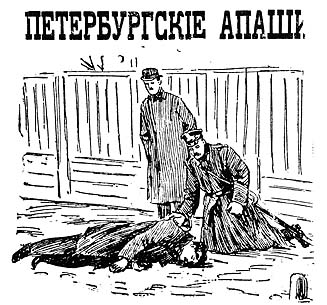
Figure 12. Petersburg Apaches (April 25, 1912).
Just as in the earlier wave of hooliganism, many of these attacks were committed against strangers “for no reason at all.” When causes or motives were given they tended to be presented as extremely petty or incomprehensible, but, unlike in the earlier cases, these conclusions were derived from the hooligans themselves. One hooligan, caught throwing cobblestones at a woman buying oranges from a street peddler, explained himself with a sullen “Just ’cause” (prosto tak). In another case four hooligans stabbed a man because he accidentally bumped into one of them on the street.[28] In numerous cases the victims were stabbed or knocked off their feet or beaten “to a pulp” for refusing to hand over whatever money the hooligans demanded, usually just a few kopecks, often for vodka.[29] More often now, weapons of various kinds were mentioned in the reports. The hooligans’ weapon of choice was a dagger, but they also used sticks, stones, brass knuckles, giri, hammers, and other heavy or pointed objects. Revolvers appeared sometimes and even, in one case, forks and knives stolen from a tea shop.[30]
Mass violence in the form of hooligan brawls also reappeared in the pages of the boulevard press after 1910. One crime specialist writing in this period described fighting as “the hooligans’ favorite activity, where they eagerly test their powers.”[31] In contrast to 1905–6, when some of the biggest brawls occurred in the city center, most of these took place in outlying, lower-class districts or in the areas of Vasilevskii Island with mixed populations. On numerous occasions the policemen and dvorniki arriving on the scene were unable to check the fighting.[32] Many, but not all, of these brawls were identified as episodes of gang warfare.
Gang violence played a larger role in this wave of hooliganism than in the earlier wave. Peterburgskii listok informed its readers about warfare among organized youth gangs with established identities, names, leaders, and specified turf. The gang encounters, identified as hooliganism, were nastier and bloodier than either the fighting between the Gaida and the Roshcha gangs immediately after the turn of the century or traditional, recreational brawling, and, as reports often comment, gang fighting usually flared up over petty disputes. But while the immediate pretext for a brawl seemed trivial to Peterburgskii listok reporters, they fed long-smoldering animosities and provoked cycles of violent retribution. In 1911 the report of one such reckoning began by noting the “hooligans who love ‘loafing’ and ‘stirring up trouble’ (’nichegonedelanie i vol’nitsa’) have begun assembling in the taverns on Vasilevskii Island’s 7th Line.” In one of these taverns a fight broke out “over something trivial” between “Kolka the Tailor” and “Serezha the Coachman,” leaders of rival neighborhood gangs. The proprietor called the dvornik and the police, who threw the boys out of the tavern and left. A little while later the police returned to find Kolka the Tailor in a pool of blood.[33] Another gang war resulted in the death of a major gang leader, “Black Vaska,” and the arrest of ten of the gang members involved in the fatal stabbing.[34] When their case came to court, it acquired considerable public notoriety. A standing-room-only crowd attended the trial, including many of the gang members still at large. The main defendant, Vasily Andreev, maintained that he attacked Black Vaska in self-defense, but neither the prosecutor nor the trial reporter gave him much credence. The prosecutor encouraged the jury to consider the social significance of the case in deciding Andreev’s fate, “inasmuch as society is being tormented under the weight of hooliganism.” To no one’s surprise, the jury found Andreev guilty.[35] The violent repercussions from this incident continued to find their way into the crime chronicles throughout the summer and into the fall of 1912, which led one reporter to conclude that “despite all efforts on the part of the police, warring hooligan factions were stirring panic within the local population.”[36]
This coverage of gang warfare in the boulevard press suggests a new dimension in public fears of violence between 1912 and 1914 and a sense of revulsion at the squandering of life over trivial or incomprehensible rivalries. The depth of amorality and uncivilized behavior that gang members displayed was underscored by the routine references to the hooligan’s weapons—knives, clubs, rocks, and metal shards—and the formulaic “pools of blood.” Three-quarters of a century of sociology and efforts at prevention have done nothing to stop gang warfare, but in early twentieth-century Petersburg little effort was made even to probe the causes of youth gang violence. In the interrevolutionary period police and press alike presented gang violence as one more manifestation of the lower-class barbarism hooliganism had come to represent.
The contrast with earlier references to gangs in the boulevard press is striking. In their 1901 letter to Peterburgskii listok the “Landlords of the Petersburg Side” mentioned two gangs by name, the Gaida and the Roshcha, but their letter conveyed little sense of the hooligans as organized fraternities. They were more concerned with the gang members’ petty offenses, their insolence, and their ability to control the streets than with the physical danger they may have posed. Social, more than physical, peril worried the Petersburg Side landowners in 1901. The interrevolutionary portrait of gangs also contrasts sharply with the depiction of the Gaida and Roshcha that appeared in Peterburgskaia gazeta in 1905 (which stressed the gangs’ honor code). The same contrast, between an earlier, more positive, romanticized tone and the more violent, hostile one in the 1912–14 period, applied to Peterburgskii listok depictions of lower-class life as a whole, as will be discussed below. After 1911, public hooligan fighting (both brawling and gang warfare) seemed less theatrical, less a spectacle than a recognized form of lower-class male behavior. It was no longer a surprise to boulevard-press readers that young, lower-class men beat one another up, whether for recreation, vengeance, or for “no reason at all.” In general, there was less emphasis on finding motives for mass fights, other than as incidents of gang warfare, in which case they occurred for “trivial” reasons or for revenge. Brawling had once again become a major disruptive force in the city’s social life, but now it was treated more like an ordinary crime, one form of “disturbing the peace.”
The elements of social and cultural rebellion had not been entirely eliminated from brawling or other forms of violent hooliganism, but in the boulevard press they had become implicit rather than explicit. The cultural issue that continued to mark these incidents as hooliganism was no longer one of open conflict but rather of yawning cultural difference. The combatants in this cultural conflict had retreated from face-to-face combat to view one another from a greater distance. Hooligans were coming to seem alien in new ways: a breed apart. Hooligan violence became more of an anthropological curiosity that the boulevard press could treat with some detachment. But the absence of direct challenge in this period did not mean that hooliganism lost its social and cultural potency in Peterburgskii listok. Hooligan violence was still a sign of the low level of civilization among the lower classes, but now not because it was novel and shocking, rather because it had become common and expected. When, in the past, hooligans chose to offend and assault they seemed to be making conscious choices to defy respectable society. Thus, in theory, they were still susceptible to cultural improvement designed to teach them to refrain from making such choices. But the depiction of hooligans as recklessly and thoughtlessly violent in the 1910s emphasized their disregard for the value of human life, which placed them beyond the cultural influence of respectable society. Hooliganism came to represent an inherent and enduring lack of civilization among certain segments of the poor population. If, as a result, the hooligans did not pose an immediate threat to respectable pedestrians, they posed an even more depressing long-term threat because they now seemed to be impervious to the influence of the uplifting values of cultured society. They seemed altogether beyond redemption. Violent hooligans, brawlers, and muggers were now situated at a greater distance from respectable society, geographically and sociologically, as well as culturally. In this way the boulevard press was able to convey a world in which official authority was weakened, and the social fabric was fraying, but while the future of the country as a whole might be in doubt, the readers of the boulevard press could feel personally secure, at least compared with the period before 1905. Violence was everywhere, but the uncontrolled violence that erupted on the streets of central St. Petersburg in 1905–6 was not being repeated.
The treatment of hooliganism in Gazeta-kopeika again provides an illuminating contrast to the portrait painted in Peterburgskii listok and Peterburgskaia gazeta. While Gazeta-kopeika depicted hooliganism as a serious crime problem, it was purely a crime problem. Hooliganism was not seen as a threat to civilized social order but rather as an everyday danger for the inhabitants of the city’s lower-class neighborhoods.[37]Gazeta-kopeika reported none of the kind of nakhal’ or rowdiness portrayed in the other boulevard papers. It primarily reported cases of violent physical assault. These it reported with about the same regularity as the other newspapers. Hooliganism was also the subject of a number of articles by Gazeta-kopeika’s regular columnist Skitalets. In January 1913 Skitalets received a barrage of letters from workers and other residents of the far western end of Vasilevskii Island in response to a column he had written on the “horrors of hooliganism” in Russian villages. The readers wrote to inform him that the “horrors of hooliganism” were every bit as dangerous in their Petersburg neighborhood as in the countryside. One of the landlords in that neighborhood also wrote, confirming the workers’ stories about the hooligans terrorizing his building. They not only “control the streets,” he declared, but the hooligans repeatedly entered the building and demanded money from the workers living there. Their boldness was not, it should be emphasized, portrayed as brazen nakhal’ in the Gazeta-kopeika correspondence. When the landlord became enraged and offered to “take up his pen,” the workers, fearing retribution, begged him not to publicize their complaints. So he signed his letter “X.”[38] The story not only reveals workers’ fears of hooliganism but provides a working-class echo of the fears of the “Landlords of the Petersburg Side.” Significantly, the working-class version is conspicuously lacking in features of social and cultural conflict.
Cases of abduction and rape were reported relatively infrequently in Gazeta-kopeika, but a dozen or so did appear over the course of the years 1912–14. In one case described as hooliganism a group of sixteen- to eighteen-year-olds abducted two teenage girls, the children of well-to-do families, who had lost their way in the dangerous streets at the western end of Vasilevskii Island. The hooligans robbed the girls, undressed them, and then led one off to a shed. She was never seen again. The other girls was beaten and, the article inferred, sexually assaulted. When she awakened the following morning, bruised and alone, she found her way to the local police station.[39] In contrast I was unable to find a single case of rape or abduction reported in Peterburgskii listok between 1900 and 1914, and only one case of sexual assault appeared in Peterburgskaia gazeta during these years (an unusual one in which a young girl was raped by a policeman), suggesting, perhaps, a respectable ban on some sensitive topics in these newspapers.[40]
Gazeta-kopeika consistently made an unambiguous distinction between respectable workers and the criminal element. That distinction, still clear in Peterburgskii listok during the revolutionary disorders in 1905–7, was increasingly blurred later on. In Peterburgskii listok and Peterburgskaia gazeta, descriptions of the hooligans’ social identities reinforced the sense conveyed by reports of their offenses that while hooligan violence was a sign of lower-class degeneracy, it was now located at some clearly defined remove from respectable society. In contrast to the revolutionary period, participants in hooligan offenses were identified more often as workers (or worker-hooligans or workers and hooligans). When their occupations were also listed, however, it is clear that the hooligans’ actual occupations had not changed. Even though people engaging in hooligan behavior were now identified either as workers or hooligans, they were still primarily unskilled and casual laborers who worked in factories by day and made trouble after work and on weekends, apprentices and runaway apprentices, and people “with no specified occupation” (bez opredelennogo zaniatiia)—a category reserved for those who were considered to be unemployed by choice. People who committed hooligan crimes were referred to as workers and former workers, homeless vagabonds, workers at rival factories, men who went to work in factories but consorted with hooligans and the unemployed after work, unskilled workers, chernorabochie, and apprentices. In one case an “unemployed peasant attacked a worker-peasant.”[41]
The closer association of hooliganism with the working class might, in another context, be expected to confer a greater legitimacy on hooligans, given the sympathetic treatment the labor movement received in the boulevard press in 1905–7. But times had changed. The violence, irrationality, and pettiness perceived in hooligan behavior and the hooligans’ insolent rejection of respectable culture, in other words the features that made hooligans seem impervious to efforts to “raise their intellectual and moral level,” to civilize them, now tinted the boulevard-press portrait of workers and other members of the lower classes. This is not to say that the poor population was portrayed as a “dangerous class” in the pathological sense Chevalier intended in his classic study of the connection between the criminal and the non-criminal poor in early nineteenth-century Paris. In contrast to the situation in Russia, in France “it was an unquestioned assumption of middle-class opinion throughout the [nineteenth century] that those most likely to participate in revolution were also those most likely to indulge in crime.”[42] In Peterburgskii listok and similar publications, the lower-class population was not portrayed as an undifferentiated and actively disruptive or revolutionary force in society. Distinctions were still made between the working poor, the destitute, and the criminal poor. But images of the lower classes (workers included) in a variety of sources increasingly endowed the poor as a whole with the primitivism, lack of culture, and hostility to respectable and civilized values associated with hooliganism. The blurring of distinctions between hooligans and the respectable poor in the 1912–14 period can be found in discussions of two separate issues: living conditions in the city’s slum neighborhoods and the upsurge in labor activism. Peterburgskii listok and other commercial literature written primarily for middle-class consumption portrayed conditions in the slums and the people who lived there in far more negative terms than they had prior to the great waves of migration in the 1890s and 1910s. Second, in the absence of a general revolutionary movement, the concurrent revival of labor unrest and hooligan activity made them seem closely connected. As we will see, the character of labor unrest in 1914 proved such a perception to be true.