The war in Lebanon is now over. Sectarianism is not.
This book is a history of sectarianism. And as such it is a history of the modern world, for, as I hope to show, sectarianism is an expression of modernity. Its origins lay at the intersection of nineteenth-century European colonialism and Ottoman modernization. These two forces were locked in a struggle to define the face of the modern Middle East; the ultimate outcome of this struggle was the redrawing of the cultural and political map of the region. One consequence of this recasting was Lebanon as a country. The other was sectarianism as a practice and, just as important, sectarianism as a discourse.
Part of this work stems from personal experience of civil war in Lebanon, a conflict that taught me a singular lesson about the complexity of politics and history. This book is therefore a document of recent history, although its subject matter takes us back well over a century.
Part of this work, however, stems from my training as a scholar in the United States. I am fortunate to have been part of the history department of Princeton University, where this project began as a doctoral dissertation. I am just as fortunate now to be a member of the department of history at Rice University. At Princeton and at Rice, surrounded by historians of all (and from all) parts of the world, I have had the opportunity to understand a local problem in a comparative perspective as well as global issues in a local context. This book draws its meaning from a number of historical narratives about, among other places, medieval Spain, early modern France, and colonial India, although it unfolds primarily in one place, Mount Lebanon.
This book would not have been possible without the generous support of the Center for International Studies, the Council on Regional Studies, the Program of Near Eastern Studies, the MacArthur Foundation, and the History Department of Princeton University. I would also like to acknowledge the support I received from the Andrew W. Mellon Foundation, the Institute of Turkish Studies, the American Research Institute in Turkey, the Office of the Dean of the Humanities at Rice University, and the Center for Behavioral Research at the American University of Beirut.
On a more personal level, I would like to thank Abd al-Rahim Abu Husayn, Nadia el-Cheikh, Yusuf Khoury, Ziad Abu-Shaqra, Sami Ofeish, Sabah Ghandour, Kirsten Scheid, Samah Idriss, Michael Gilsenan, Joseph Mouawed, Akram Khater, Ilham Makdisi, Hady Amr, David Cunningham, Mark Pegg, Basim Musallam, Samir Seikaly, Tarif Khalidi, Kamal Salibi, Rifa‘at Abou-El-Haj, Samir Khalaf, Heath Lowry, Michael Willrich, and Anthony Greenwood. I would like to thank all my colleagues and friends at Rice University, who have provided a congenial working environment. I am especially grateful to those who have helped with different parts of this work, including David Nirenberg, Paula Sanders, Allen Matusow, Dan Sherman, Fares el-Dahdah, Gale Stokes, and Mike Maas.
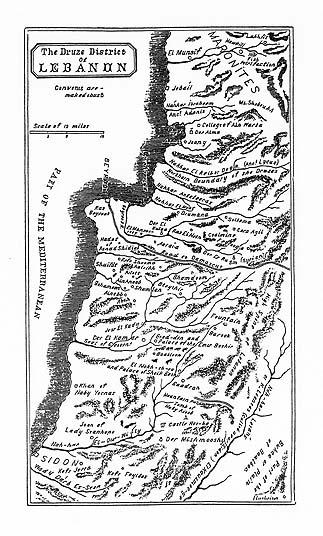
I would also like to thank the head of the Jesuit Archives in Beirut, Père Sami Khuri, and Farid el-Khazen, who allowed me access to his family archives and arranged a meeting with the Maronite Patriarch, Cardinal Mar Nasrallah Butrus Sfeir. He, in turn, kindly opened the archives of Bkirke to me. I would also like to thank those at the Monastery of Qiddis Yuhanna al-Sabigh in Khinshara for their hospitality and for providing me access to their manuscript collection. I would like to acknowledge the staffs of the Jafet Library at the American University of Beirut, the Başbakanlık archives in Istanbul, the American Institute of Research in Turkey, the Public Record Office in London, and the British Museum. My aunt, historian Rosemarie Said Zahlan, welcomed me and facilitated my stay in London. I am very grateful to Nadim Shehadi of the Centre for Lebanese Studies, who made my visit to Oxford a successful one and who provided several of the maps used in this book. The staff of the Public Record Office in Northern Ireland in Belfast easily provided me with the most congenial archival atmosphere. Across the channel, in France, my father-in-law, K. M. Shehabuddin, then the ambassador of Bangladesh to France, facilitated my research at the Quai d’Orsay, and my mother-in-law, Khaleda, provided me with a true home away from home. I would also like to acknowledge Lynne Withey, Rose Anne White, Pamela Fischer, and the readers of the University of California Press.
Robert Tignor, Gyan Prakash, L. Carl Brown, Carl Caldwell, Carol Quillen, Malik Sharif, Leila Fawaz, Şükrü Hanioğlu, and Bruce Masters all graciously gave their time to read and comment on different versions of the manuscript (from its origins as a Ph.D. dissertation to its final incarnation) in their entirety. Despite this imposition on my part, they have each been instrumental in pushing for greater clarity and coherence. Needless to say, I alone am responsible for any remaining mistakes. I am particularly grateful to Bruce Masters, who over the past several years has been a teacher and a friend; Leila Fawaz for always encouraging me; and Şükrü Hanioğlu, who has sat with me, often for hours on end, opening windows onto a past Ottoman world.
My family in New York, Washington, D.C., London, and Beirut has been a constant source of support. Edward Said has long been a source of inspiration—as writer, professor, and uncle. My brother Karim wholeheartedly and enthusiastically engaged this work from its inception. My brother Saree, whose influence is spread throughout these pages, has been a guide from the outset. I can’t begin to express my admiration for my wife, Elora Shehabuddin, who not only shared in the elaboration of many of the ideas in this book but also made it possible for me to write it.
Finally, I dedicate this work to my parents, Jean and Samir Makdisi. To them goes my most sincere gratitude, not only as parents, but also as exemplary teachers and scholars. They sacrificed during the war; this book, I hope, represents a gain.
Arabic words and names have been transliterated according to a simplified system based on that used in the International Journal of Middle East Studies. All diacritical marks have been omitted. The prefix “al-” is used the first time a transliterated name appears, but it is omitted later (e.g., al-Hattuni, Hattuni). I have not changed the transliterations of names adopted by authors who write in either English or French (e.g., el-Khazen, not al-Khazin). I have transliterated place names to conform as closely as possible to common usage, and I have cross-referenced variants in the index. Arabic and Ottoman words widely used in English, such as Pasha, Quran, Bekaa, and Beirut, are left in the familiar form. With the exception of the word muqata‘ji, which was traditionally used in Mount Lebanon by its Arabic-speaking inhabitants, words that denote official Ottoman positions and persons have been rendered in simplified Ottoman Turkish transliteration (e.g., kaymakam not qa’imaqam, Hurşid not Khurshid, Mehmed Ali not Muhammad ‘Ali).
Sitt Naaify came down and entered the serail about an hour after sunset. It was dark. She called for a lamp. It was brought her. Ordering it to be held up before her, she for a long time feasted her eyes on the ghastly sight. Several hundred mangled corpses lay heaped up over each other before her. “Well done my good and faithful Druzes,” she exclaimed; “this is just what I expected from you.” The women and some of the Shehab emirs who had hidden in their own harem, now thronged around her. The latter kissed her feet and implored her for pardon and forgiveness. She told them all to follow her. The Turks were all this time seen flitting about like spectres through the court, under the cover of darkness, turning over the dead bodies, if perchance they might grope up some plunder; and wherever life yet lingered, giving the coup de grâce.
In the hills of Mount Lebanon, a few miles from the scene of this massacre, a Christian man, Salim Shawish, wondered if a similar fate awaited him and his family. For in his own home sat a Druze notable who, sword and musket within easy reach, announced that he had come to “save some persons and kill others.” It was nearing the end of the Islamic calendar year 1276, the early summer of 1860 by Christian reckoning. The setting was the prosperous but ill-fated town of Dayr al-Qamar—the “city of the mountain” in local parlance—which lay at the heart of a murderous struggle between the Druzes and Maronites of Mount Lebanon. The war pitted neighbor against neighbor, forcing a sense of communal segregation on a society that had hitherto thrived on everyday contact and mixture. With this multicommunal heritage in mind and with the knowledge of how things were ordinarily meant to be, Salim begged the Druze lord, whose family, the Abu Nakads, had once made (and were now reasserting) undisputed claim to the town under siege, to protect him; he brought the notable coffee, prepared him a meal, and smoked with him, and then offered him silver inkstands, watches, jewels, and whatever else of value he had, in an effort to keep him in his home. The symbols of prestige and social order in Mount Lebanon, hospitality and the serving of coffee, continued in the house of a wealthy Christian, while outside, Druzes battled Christians and turned their world upside down.1
When the war ended toward the end of June, some two hundred of an estimated seven hundred villages were left pillaged, churches and convents had been razed, and Druze religious sanctuaries were desecrated. The Druzes had carried the day, cleansing whole towns of their Christian inhabitants. When Muslims in Damascus rioted soon after to protest increasing European influence in their city, thousands more Christians were slaughtered in the ugliest urban violence of nineteenth-century Syria. The Sultan of the Ottoman Empire was made to hear what one chronicler described as the “sighs of Syria.”2 For unlike natural contagions, unlike the plagues and the locusts, unlike the feuds of old and the palace coups that somehow always fit into the order of things, the events of 1860 entered bloodstained into the history of the Ottoman East, altering it forever.
In the pages that follow, I reconstruct the history of modern sectarian identity in Ottoman Mount Lebanon, which provided the stage on which the cataclysmic violence in 1860 was enacted. The story begins many years earlier, when local Lebanese society was opened, and indeed opened itself, to Ottoman and European discourses of reform that made religion the site of a colonial encounter between a self-styled “Christian” West and what it saw as its perennial adversary, an “Islamic” Ottoman Empire. This encounter profoundly altered the meaning of religion in the multiconfessional society of Mount Lebanon because it emphasized sectarian identity as the only viable marker of political reform and the only authentic basis for political claims. The story is of the symbiosis between indigenous traditions and practices—in which religion was enmeshed in complex social and political relations—and Ottoman modernization, which became paramount in reshaping the political self-definition of each community along religious lines. From the outset, therefore, it is imperative to dispel any illusion that sectarianism is simply or exclusively a native malignancy or a foreign conspiracy. Sectarianism can be narrated only by continually acknowledging and referring to both indigenous and imperial histories, which interacted— both collided and collaborated—to produce a new historical imagination.
Sectarianism is a modern story, and, for those intimately involved in its unfolding, it is the modern story—a story that has and that continues to define and dominate their lives. Although this book records a history that transpires in rural Mount Lebanon, it has many parallels in Ayodhya, Kosovo, and Belfast. It is all about location in a modern world, where the margins can become centers. The violence of 1860, as I hope will become clear, took place not only between Maronite and Druze communities but also within these communities in an attempt to define their own respective boundaries in an era of upheaval. I am most interested in this story within the story: namely the struggle over communal representation that was reflected in episodes of intracommunal social violence that constituted a fundamental part of broader religious violence across sectarian communities. In short, I illustrate the contests over the meaning of religion as it entered the political sphere between 1840 and 1860. I elaborate on the contradictions in, and the failure of, the attempt to create uncomplicated and pure sectarian identities that were at once private and public, communal and national, elite and subaltern, modern and traditional.
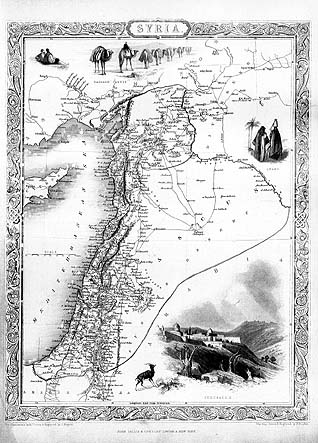
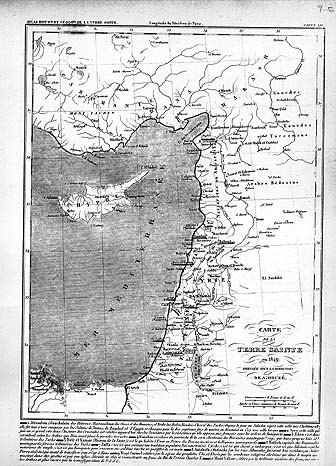
Map 1. Syria (From The Illustrated Atlas, and Modern History of the World, Geographical, Political, Commercial, and Statistical: Index Gazeteer of the World. London: John Tallis and Co., 1851)
This task, however, is not easily undertaken precisely because the warfare of 1860 and, of course, the destruction of Lebanon in our own times have given scholars and laypersons alike the distinct impression that the Lebanese problem is fundamentally tribal, that sectarianism is a disease that prevents modernization, that Lebanon is, in the final analysis, a metaphor for a failed nationalism in the non-Western world. What has been studied (with good reason) has been the geopolitics of conflict, which has always assumed inert, unchanging sectarian identities. In the aftermath of the strife of 1860, for example, as news of the events trickled into Istanbul and from there was forwarded to the European capitals, there emerged a general revulsion at the wholesale massacre of Christian inhabitants of the Empire. To a large degree, the reaction of Ottoman statesmen stemmed from the fact that the two decades before the massacres of 1860 had been a period of Ottoman modernization. Aware of the Ottoman Empire’s image as the “sick man of Europe,” the Sultan and his ministers had decreed in 1839 that all subjects were equal before the law regardless of their religion. This move and other reforms in the administration known collectively as the Tanzimat were calculated to satisfy European demands for the protection of the Christian communities and to inculcate a notion of a national and secular subjecthood. The local Christian subjects, in other words, had become yardsticks of the modernization of the Ottoman Empire: their slaughter dealt the imperial reform process a cruel blow. An exasperated Fuad Pasha, the Ottoman minister for foreign affairs sent to investigate the massacres, insisted that the conflict in Mount Lebanon was an “age-old” struggle between tribal communities whose “ignorance” had interrupted the reform movement.3 For their part, Europeans who took any interest in the affairs of the Ottomans fused the Damascus outbreak in July and the Lebanese massacres which preceded it in June into a single indication of the primordial passions of the local inhabitants. Karl Marx mused that the Lebanon events were little more than “atrocious outrages of wild tribes,” while a French Jesuit publication declared that the events of 1860 were clearly propelled by the Druze “hatred of the Catholic religion and the fanaticism of the Muslims.”4 For both Europeans and Ottomans locked in a struggle over the meaning and direction of the reform and progress of the Ottoman Empire, the events in Syria were in and of themselves outside the realm of rationality and history. Rather, as Lord Dufferin, the British aristocrat charged by his government to investigate the massacres, put it, “Think of what a thousand years have done for England, France, Germany and the rest of Europe.…Then turn to the changeless East, and behold the contrast. Time there seems almost to be shorn of his wings, and all things remain as they have ever been.”5
Since the nineteenth century, historians of many different persuasions have scrutinized these events and have continued to link a rural conflict in Mount Lebanon to the urban riot in Damascus. In varying degrees, and with a difference in emphasis, the root causes of the violence have been delineated by scholars consumed with one overriding question: why has the Middle East failed to modernize, to develop, and most important, to secularize? The foregone conclusion has been that the violence represents the triumph of tradition, manifested as sectarianism, over the modern ideals of coexistence and tolerance; and all efforts have gone toward explaining the conditions under which this so-called tradition could reemerge with such devastating consequences. Even the most nuanced of analyses assumes that sectarian identities and mobilizations operate outside of history, that local inhabitants are either tolerant or intolerant, that there are many social, economic, or political “root causes” which are historical, but that the violence which devastated mid-nineteenth-century Mount Lebanon was only a reaction to these modern historical events, an explosion, a calamity, above all, an anarchical upsurge of ancient loyalties among unthinking subjects.6
This scholarly presumption of a religious violence devoid of social and cultural meaning is reflected (often urgently in countries on the brink of destruction because of sectarian hostilities) in secular nationalist writing that seeks to distance itself from moments of extreme religious expression.7 Turkish historiography, for example, has depicted the troubles in Mount Lebanon strictly as a consequence of European political intrigue against an emerging Turkish (Ottoman) nation.8 For its part, Lebanese and Arab historiography has blamed Ottoman policies of divide and rule for the consequent religious divisions that continue to haunt the quest for Lebanese and Arab unity.9 Both historiographies, in fact, view sectarian violence as an unwelcome blemish (even a stain) on the nation’s “past” and a temporary setback on the road to national liberation and modernization. Moreover, both historiographies consider intercommunal religious strife to be the ultimate negation of the transhistorical virtues of tolerance, diversity, and coexistence, which are supposedly embodied in Turkish and Arab nationalism. This nationalist approach to sectarianism, which poses a tolerant and secular modernity against a resurgent religious fundamentalism, has itself to be historicized. I do not see the episodes of religious violence between 1840 and 1860 as symptomatic of the failure of a nation or nationalism but as an expression of a new form of local politics and knowledge that arose in a climate of transition and reform in the mid-nineteenth-century Ottoman Empire and that laid the foundations for a (later) discourse of nationalist secularism.
While my work necessarily builds on the abundant scholarship on religious violence and depends on a historical narrative of Ottoman modernization long charted by historians, my goal here is to shift the emphasis away from narratives which transform victimized communities into Girardesque scapegoats, available targets of a Muslim backlash motivated primarily by broad economic and political trends, toward a narrative which returns contingency to a historical process that produced what I call a culture of sectarianism.
In other words, I understand sectarianism to mean two fundamentally related things. First, it is a practice that developed out of, and must be understood in the context of, nineteenth-century Ottoman reform. Second, it is a discourse that is scripted as the Other to various competing Ottoman, European, and Lebanese narratives of modernization. Sectarianism emerged as a practice when Maronite and Druze elites, Europeans and Ottomans struggled to define an equitable relationship of the Druze and Maronite “tribes” and “nations” to a modernizing Ottoman state. It emerged when the old regime of Mount Lebanon, which was dominated by an elite hierarchy in which secular rank rather than religious affiliation defined politics, was discredited in the mid-nineteenth century. The collapse of the old regime opened up the space for a new form of politics and representation based on a language of religious equality. This transformation privileged the religious community rather than elite status as the basis for any project of modernization, citizenship, and civilization. Concomitantly, sectarianism also developed as a discourse—as the set of assumptions and writings that described this changing subjectivity within a narrative of Ottoman, European, and Lebanese modernization.10
Because sectarianism refers to the deployment of religious heritage as a primary marker of modern political identity, it is important to distinguish it from religious confrontations that occurred in the medieval and early modern world (for instance, between Huguenots and Catholics in France).11 Understood this way, in its modern context, sectarianism can no longer be taken for granted as a self-evident phenomenon, as it has been for too long. It cannot be caused by a single event or person, for it is ultimately an act of interpretation that shapes as well as is shaped by religious mobilizations and violence in the modern world. To appreciate the contingency and complexity of sectarianism as it emerged as both a practice and a discourse we must investigate the connections between, and the contradictions in, sectarian actions and metaphors deployed by Maronites and Druzes, elites and nonelites, Ottomans and Westerners.
Since the publication of Ranajit Guha’s seminal essay, “The Prose of Counter-Insurgency,” and more recently Partha Chatterjee’s study of Indian nationalism, scholars have developed a powerful critique of nationalist assumptions by demonstrating how elitist nationalist knowledge, including the depictions of sectarian mobilizations, derive from colonial logic.12 Yet despite all the focus on the subaltern as a vehicle to criticize the elitism embedded in nationalist discourse, there has been a tendency to discuss colonialism and nationalism as fully formed projects that seem to automatically produce all sorts of resistance.13 Sectarianism as I see it is not simply a “form of colonialist knowledge” (as Gyanendra Pandey has asserted in the context of the historiography of communalism in India) nor a reality which can be traced to some precolonial past.14 It is, rather, an intermingling of both precolonial (before the age of Ottoman reform) and postcolonial (during and after the age of reform) understandings, metaphors, and realities that has to be dissected at at least two overlapping and mutually reinforcing levels, of the elite and nonelite. In other words, sectarianism is a modernist knowledge in the sense that it was produced in the context of European hegemony and Ottoman reforms and because its articulators at a colonial (European), imperial (Ottoman), and local (Lebanese) level regarded themselves as moderns who used the historical past to justify present claims and future development. Insofar as sectarianism is indeed a colonialist knowledge, it is also and fundamentally both an imperial Ottoman knowledge and a local nationalist knowledge that are not produced following or in reaction to colonialism but at the same time as colonialist knowledge.
It follows that the colonial encounter being described here is less a relation of power mediated by various degrees of resistance than a location of cultural interaction—a “contact zone”—consciously exploited by the natives for their own material benefit.15 Rather than positing a dichotomy between colonizer and colonized, where some of the colonized become labeled collaborators, it is more fruitful to study colonialism in the case of the late Ottoman Empire as an arena of exchange, where collaboration is not simply an act of individual betrayal of the “nation” to a colonial power but a much more open-ended affair, the norm at a general level rather than the exception at an individual one. France and Britain did not arrive (in this case at least) in the Ottoman Empire unannounced, gunboats in harbor, to “open” the Levant. Instead, Britain, France, and the Ottomans regulated different aspects of the colonial encounter; this regulation presented the indigenous inhabitants of Mount Lebanon with avenues for reinterpreting their own history, their own communal self-definition, and ultimately their own rigid social order. Power, of course, was crucial because the encounter was never equal; the flow of transformative ideologies and practices headed mostly from Istanbul, Paris, and London to Mount Lebanon, where the consequence of this exchange, sectarianism as both a knowledge and a practice, was produced.
The imperial discourses of reform that encroached on Mount Lebanon sprang from two distinct sources. Generally speaking, the first was European and the second Ottoman; their simultaneous arrival in Mount Lebanon in the mid-nineteenth century heralded the beginnings of its sectarian question. For the European statesmen who pored over maps of the unreformed and unconquered Ottoman Empire, the idea of intervention in the affairs of the Ottomans was integrally linked to the notions of philanthropy, despotism, and freedom that were most forcefully and eloquently formulated in the nineteenth century.16 In an age when classical Orientalism was giving way to Thomas Macaulay’s polemics on India, when Europe’s military, economic, and industrial developments were thought to stem from a civilizational and cultural (as well as racial) superiority, it was perhaps inevitable that the Ottoman Empire’s vast territories were confronted with what John Stuart Mill characterized as the sacred duty of intervention in “nations which are still barbarous” where it was “likely to be for their own benefit that they should be conquered and held in subjection by foreigners.”17
To Mill and to other European thinkers of his time, colonial rule offered the most effective method of ensuring the spread of civilization. In their minds, Christian European despotism was strategic and measured, an extension of European civilization, whereas Oriental despotism was understood as fanatical and all-encompassing, not an extension but the essence of Asian civilization. In the enactment of colonial rule in India, as in Egypt, therefore, a “positive” European despotism was summoned to crush the older and more entrenched “Asiatic” despotism. European intervention was progressive in the sense that, as Marx phrased it, England forcibly brought about the “regeneration” of India by destroying its prehistory—that is, the history of endlessly recurring dynastic despotism.18 The language of reform informed a whole spectrum of European involvement with the non-European world as Europeans attempted to right what they perceived to be wrong, immoral, and injurious to the natural flow of human history.19
In the Ottoman Empire, however, the debate over intervention and nonintervention took a most interesting turn. Although the empire was not formally colonized by European powers, colonial ideologies were very much in place, legitimizing the use of overwhelming force (at Navarino in 1827, for instance) to force the Ottomans to comply with European pressure.20 Not surprisingly, an ample stock of racial and cultural stereotypes clearly demarcated the Ottoman as inferior, premodern, and corrupt, at best a “wily barbarian.”21 But there was also a realization, following what Metternich termed the “frightful catastrophe” at Navarino, that the Ottomans could be pushed only so far, that their sovereignty could be compromised only so much before they were left too weak to defend themselves from foreign invasion.22 The problem that presented itself, therefore, was how to bring “advancement” to the Empire without disrupting the European balance of power.
For European statesmen and historians, the reformation of the Ottoman Empire stemmed almost entirely from Europe’s sense of civilizing mission.23 “Europe is at hand,” declared Stratford Canning, one of the self-proclaimed architects of Ottoman reforms, “with its science, its labour, and its capital. The Koran, the harem, and a Babel of languages, are no doubt so many obstacles to advancement in a Western sense.”24 Religion, as I have already mentioned, became the site of the colonial encounter in the Ottoman Empire in that European officials defined the parameters of reform through a modernization discourse couched in terms of a religious civilizational clash. Both the problem (Islam) and the solution (European Christian rationality) were defined in monolithic religious terms. Furthermore, diplomats like Canning imagined the Empire not so much as a multiethnic and multireligious territory but as a Muslim state with large “minorities” of Christians scattered in various cities and provinces. This understanding of the Empire as a “mosaic” where ethnic and religious groups existed as separate and autonomous cultural and physical units was embedded in Canning’s description of the local Christians as the “subjugated classes.”25 To “free” the native Christians, the ambassadors and consuls of the Great Powers spoke on their behalf, plucked them from the obscurity (and complexity) of their everyday existence, and depicted them simply as the victims of unbending Muslim dominion. As a result, and in spite of the fact that European consuls and missionaries bewailed the “degenerate” nature of Oriental Christianity and its bigoted and uneducated priesthood, they nevertheless considered the local Christian populations as barometers by which to measure the success or failure of reform.26
Ottoman statesmen broached the problem of reform from an altogether different trajectory. As they were elaborated in 1839 and 1856, the reforms pursued by the Sublime Porte represented a fundamentally imperial project of centralization and an effort to build an avowedly modern state. After the eighteenth century, which had witnessed fragmentation of imperial control, new laws were called for to improve security, end corruption, rationalize taxation, and regularize army service. Following the rise of Mehmed Ali, in fact in direct response to the threat posed to the empire by its rebellious vassal in the 1830s, Sultan Abdülmecid proclaimed the Gülhane edict in 1839.27 The basic aim of the Gülhane decree and others which followed, known collectively as the Tanzimat, was to reform the administration and reorganize the Empire in an effort to maintain its territorial integrity. It stipulated an equitable taxation of subjects according to their means and pledged to ensure their security and property. It also specifically declared the juridical equality of all subjects—hence the equality of Muslims with Christians— but framed this bold declaration within a discourse of a revitalization of Islamic tradition. The underlying assumption of the Tanzimat was that reforms could be enacted without any mediation from the outside world, that the Sultan’s will was absolute, and that all his subjects did not participate in any decision making but partook of his imperial benevolence. The Gülhane decree of 1839 reinforced the notion of the Sultan as a fair arbitrator for all his subjects. From an Ottoman standpoint the Gülhane proclamation did not herald a negation of the past as much as it sought to set a new direction by advocating a secular Ottoman subjecthood within a modernized yet extremely hierarchical Islamic state. The Tanzimat looked both forward and backward and encompassed both old and new. Thus, even as European statesmen insisted that the Tanzimat ushered in a new era of rational government that necessarily abandoned an allegedly archaic, immoral, and stagnant Oriental culture, the Ottomans understood the Tanzimat as a vehicle to enter the modern world with a conserved and modernized tradition.28
Although reforming Ottoman statesmen tried to redefine their empire as an Islamic state within an orbit of friendly foreign powers (düvel-i fahime ve mülakat-ı dostane), they were still confronted with the problem of elaborating a notion of modern Ottoman sovereignty in an age of European hegemony. At no point in its history was the Empire more vulnerable than at this critical moment of transition, when Mehmed Ali’s armies threatened the Empire with dismemberment and the Russian armies had marched to the outskirts of Istanbul. And at no point had the European powers ever assembled as much data or as many facts and anecdotes regarding the perceived oppression of the native Christians. The upshot was that just as the Ottomans were moving away from a vaguely defined millet system, in which the Sunni Muslims were treated as socially and culturally superior to the other communities of the Empire, and were moving toward a more integrative form of government, the Europeans favored and intervened on behalf of the Christians.29
Such contradictions were most apparent in regions like Mount Lebanon, which was home to a large Christian population. Long neglected by Ottoman officials as a backwater of the imperial domains, Mount Lebanon’s biblical landscape appealed to foreign missionaries while its similarity to the Highlands moved British (especially Scottish) travelers, and its allegedly counterrevolutionary spirituality attracted those refugees fleeing from the secularization of France.30 Perceived by European powers as a mountain refuge in which they had a historical, religious, and increasingly strategic stake, nineteenth-century Mount Lebanon became the location for a host of competing armies and ideologies and for totally contradictory interpretations of the meaning of reform. This context of flux created the conditions for sectarianism to arise not as a coherent force but as a reflection of fractured identities, pulled hither and thither by the enticements and coercions of Ottoman and European power. Mount Lebanon at mid-century was a peripheral region drawn toward multiple metropoles. The European powers promoted their Christianity as a method of access to the indigenous people, while the Ottoman state relied on the tenuous bonds of loyalty (or such that theoretically existed) of a marginal population that inhabited the fringes of the imperial imagination. In recognition of their sudden elevation to a matter of international concern, the people of Mount Lebanon actively participated in the struggle over modernity. They were as transformed as their surroundings. They took advantage of the presence of the various imperial powers by declaring themselves to be both European protégés and loyal Ottoman subjects. But they were themselves confronted by a latent contradiction in the Gülhane decree that became more apparent as it was translated across the social spectrum and as it traveled from center to periphery: the contradiction between a notion of equality before the law regardless of rank and station that was guaranteed by the state and a rigid adherence to a hierarchical and inviolable social order, without which there could be no state. Because the Tanzimat was generated in the nebulous space between an imperial will and the colonial interventions of several European powers, there were several understandings, translations, and fragmentations of imperial discourses of reform as they traveled from center to periphery and back again.31 The story of sectarianism that I have chosen to tell, therefore, is one of divergent local understandings of the imperial reform process that both reaffirmed local order and subverted it in the years leading up to, and including, 1860.
Like most historians of the nineteenth century, I am faced with a prolific colonial archive which has quite literally dominated the writing of Middle Eastern history. The plethora of missionary accounts, consular reports, travelogues, accounts of scientific expeditions, and personal memoirs constitute an undeniably rich historical record. The question of how to read such sources productively (a task made immeasurably easier following the publication of Edward Said’s Orientalism) in order to script a story of sectarianism that their authors would never have countenanced is certainly one goal of this book. But to read Charles Churchill’s The Druze and Maronites under the Turkish Rule against the grain—to contextualize (and at the same time dispute) the power of his claim “to fathom the pervading mind, as it were, of the two great sects” of Mount Lebanon—recourse must be made to the available indigenous archive.32 Unlike many historians who study what Hugh Trevor-Roper once mocked as “the unrewarding gyrations of barbarous tribes in picturesque but irrelevant corners of the globe,” I am fortunate to have before me a wealth of largely untapped Ottoman and Lebanese materials.33 I say untapped because although most of these sources are known to historians and many of them have been used to great effect, they have been utilized in one of two restricted fashions. Either they are read to produce a “native” account to be examined alongside Churchill’s, or they are deployed to counter Churchill’s narrative with the aim of replacing it with a more authentic (and often nationalist) rendition of events. Neither of these approaches is satisfactory, for they do not exploit the richness embedded within Churchill’s narrative, nor do they even begin to explore the complexity of the local sources. To do both, to read colonial history juxtaposed with its imperial Ottoman and local Lebanese counterparts and to make them together divulge the layers, the contingency, and the contradictions of the modernity of sectarianism is to do them at the same time. Therefore, this book constantly weaves back and forth between a variety of sources, constructing a narrative out of the interplay of their differences.
The next two chapters contrast European perceptions of Mount Lebanon as a mountainous refuge indomitably holding out against an Islamic despotism (Chapter 2) with local understandings of Mount Lebanon’s rural world, in which a hierarchy of notables dominated a social order at the periphery of the Ottoman Empire (Chapter 3). Chapter 4 illustrates how conflicting notions of reform, in an era of Eastern Question politics, undermined the traditional order. Then I investigate how Mount Lebanon was reinvented in sectarian terms by rival elites after the Europeans and Ottomans decided to partition it along religious lines in 1842 (Chapter 5), only to suggest an alternative reading of the emerging sectarian landscape (Chapter 6); this chapter examines the role and proclamations of Tanyus Shahin, the leader of a Maronite peasant uprising in 1859, to demonstrate the limits and possibilities of popular interpretations of Ottoman reform. The point is to interpret the sectarian violence in 1860 not as a tribal eruption (as Ottoman and European observers would have it) but as an integral part of the redefinition of new communal and social boundaries (Chapter 7). Chapter 8 analyzes the state-sponsored violence unleashed by Ottoman officials following 1860 with the full support of the European powers as a final (and successful) attempt to reestablish social order and to suppress the popular interpretations of reform, thereby leaving the local elites (and their Ottoman and European guardians) as the only “legitimate” players in formal politics. In the Epilogue, I discuss the relationship between sectarianism and nationalism, underscoring my contention that sectarianism as an idea draws meaning only within a nationalist paradigm and hence that it belongs to our modern world.
Although I use a rough chronological narrative that makes obligatory stops at the major turning points of the era, including the Egyptian invasion of Syria in 1831, the uprising against the Egyptians in 1839 and the Ottoman restoration of 1840, the partition of Mount Lebanon in 1842, the Kisrawan rebellion of 1858–1859, and the war of 1860, the point here is not to retell what is already a well-known narrative of local history. I do not delve into many episodes of violence (for example, those of 1845), just as I do not fully explore many angles (such as the economic). Instead, I have deliberately chosen to focus on one theme of a complex history, the construction of sectarianism as an idea and its beginnings as a practice in Mount Lebanon. For this reason, the argument developed here deliberately eschews any comparison between the violence in 1860 Mount Lebanon with other intercommunal hostilities, such as those of Aleppo in 1850 or even those of Damascus in 1860, primarily because the cases of Aleppo and Damascus had little relevance to the events in Mount Lebanon, which as an autonomous rural region enjoyed its own specificities and its own cultural and historical trajectory.34 My cutoff date of 1860 is not at all meant to indicate a closure to the question of sectarian identity. Instead, I consider it the end of the foundational period of a sectarian culture that continued through the late Ottoman period and into the nationalist era.
My emphasis on Druzes and Maronites, as opposed to Orthodox Christians or Shi‘a, is done with some trepidation, although it is justified by the fact that they were the two principal communities of Mount Lebanon involved in sectarian violence. Whenever possible, I have tried to utilize documents from the period itself. The extremely rich archives of the Maronite patriarchate proved invaluable, and recourse to the Başbakanlık (Ottoman) archives, where thousands of Ottoman and Arabic documents on Mount Lebanon are preserved, as well as to the British and French consular correspondence and a variety of missionary sources helped illuminate the layers of sectarian identity with which I am centrally concerned.
My greatest disappointment, however, is that I have not been able to write about the sectarian aspirations of the Druze community. This left-out account, I must also acknowledge from the beginning, is the crucial aspect of the history that must one day be unearthed before the tale of sectarianism can be told in its fullest sense. A relatively poor Druze historiography has forced me to rely on the Abu Shaqra chronicle Al-Harakat fi Lubnan ila ‘ahd al-Mutasarrifiyya, which was narrated, transcribed, and edited several decades after 1860.35 I have had to choose between telling an incomplete history and not telling it at all. I have chosen to tell what I can.
The sailors, smiling, point out to me Mount Lebanon;…I looked up to the skies, and beheld the white and gilded crest of the Sannin floating in the firmament over out heads. The fog prevented my observing its base and sides. Its head alone appeared, bright and serene in the blue sky. It occasioned one of the most sublime and sweetest impressions I ever felt in my travels. It was the land to which were directed all my present thoughts as a man and a traveller; the sacred land, the land where I sought, from so great a distance, the recollections of our primitive human nature.
Their spirit instinctively warns the passerby that he is amongst a race of freemen.
“Who dares be skeptical at the foot of Lebanon?” asked Gérard de Nerval, French traveler and author of Voyage en Orient. “Is this shore not the cradle of all the beliefs in the world? Ask the first Mountaineer that you come across: he will tell you that it was on this land that the first scenes of the Bible took place; he will guide you to the place where the first sacrifices were offered; he will show you the rock stained by the blood of Abel.”1 For the very reasons that Nerval identified—the biblical landscape, the stunning beauty of the mountain chain overlooking Beirut, which appeared to be an inviolate sanctuary—Europeans viewed Mount Lebanon as an ideal site for the reformation of the Ottoman Empire. What their eyes took in as they contemplated the panorama of mountain and sea was not “a terra incognita.”2 Modern technology, through the production of texts and their distribution to a wide audience; improved communications; and fast ships, which transported painters and poets in record numbers, brought the Orient into the homes of “Christian readers” on an unprecedented scale in the nineteenth century. Writings and paintings evoked a timeless biblical land, a mountain refuge, that pleaded to be saved from Islamic Ottoman domination.3 The parallel lack of interest in Mount Lebanon on the part of Ottomans gave European travelers room to explore without hindrance from imperial officials. More important, it left them as the unchallenged prophets of the cultural redemption and salvation of Mount Lebanon.
Between poets and writers such as Nerval, who exuded a supreme confidence in European hegemony, and missionaries such as Paul Riccadonna and Benoît Planchet, who strove to be the benevolent face of that hegemony, Mount Lebanon found itself the object of intense, sustained attention by a host of diverse suitors. Some were content to describe and celebrate the land as they saw it; others wanted to save and reform its inhabitants; most tried their hand at both. In any case, the cumulative presence on the land of so many Western writers, travelers, missionaries, painters, and poets heralded the dawn of a gentle crusade in Mount Lebanon. It was gentle in the sense that it was not a military expedition: it sought no territorial gain; it was actively courted by native elites, and it advanced itself primarily through the pen and paintbrush rather than the sword and musket. It was a crusade in the sense that the sum of the travelers’ experiences allegedly reclaimed the history of this region from the morass of decline and the stagnation of time. It was a crusade also in the sense that most travelers imagined themselves to be involved in a historic clash between Christian progress and Islamic despotism, a clash in which they alone held the keys to knowledge and interpretation. They insisted that they narrated and judged with the experience of natives but that such authenticity was tempered by the “superiority of a European who looks down from the height of Christian civilization.”4 Finally, it was a crusade because travelers and missionaries were the vanguard of an age of reform that in the name of modernity quite simply overwhelmed Mount Lebanon.
The gentle crusade was premised on the notion that the Ottoman Empire delenda est (as Richard Burton put it).5 But it was also rooted in the conviction that certain communities in it could be redeemed through the active intercession of the “civilized” world. One result, therefore, of individual voyages undertaken by men like Constantin de Volney, Charles Henry Churchill, and Alphonse de Lamartine as well as of the collective efforts of Jesuit and Protestant missionaries was a crystallization of the idea that the natives of Mount Lebanon were waiting to be reformed and reconnected with what Johannes Fabian has described as the evolutionary “stream of Time.”6 Another result (whose consequences will be taken up in later chapters) was that it laid the foundations of a Maronite and (to a lesser extent) Druze perception that France and England were the loci of a benevolent modernity and that they, as Maronites or Druzes, were entitled to it. How this gentle crusade was articulated by its participants and why it should have—as David Urquhart put it—“withdrawn [Mount Lebanon] from an existence of insignificance” are questions that this chapter explores.7
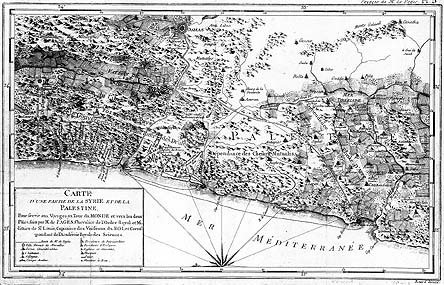
Map 2. Carte d'une partie de la Syrie et de la Palestine (From Pierre Marie François Pagèes, Voyages autour du monde et vers les deux poles, par terre et par mer, pendant les années 1767, 1768, 1769, 1770, 1771, 1773, 1774, & 1776. Paris: Moutard, 1782.)
Travelers had long come to the biblical lands, but in the late eighteenth and nineteenth centuries their arrival coincided with, even reflected, broader developments both in Europe and the Ottoman Empire that created a solid basis for the travelers’ claims to be heralds of modernity to the “tribes” of Mount Lebanon.8 Drawing on an established motif of Mount Lebanon as a pristine refuge, these visitors exhibited a heightened cultural interest in the region that was set against the backdrop of Syria’s incorporation into a European-dominated world economy and the momentous changes ushered in by the French and Industrial Revolutions.9 In Mount Lebanon’s rural inhabitants, the travelers saw revolutionaries and counterrevolutionaries, papists and highlanders—in short, all that related them to the dynamism of European history. At the same time, however, the travelers paradoxically insisted that Maronites and Druzes belonged to an inert world that was surrounded, and to some extent contaminated, by an Oriental decadence.
Among the most famous of the travelers was Volney, whose influential portrait of Mount Lebanon shaped much of the romantic discourse of nineteenth-century travel writing. Left with an unexpected bequest of money, Volney chose to visit the Orient, beginning in Egypt and moving on to Syria and Mount Lebanon. During his two-year voyage between 1783 to 1785, Volney spent eight months in Mount Lebanon.
On the face of it, Volney’s work, Voyage en Égypte et en Syrie, was simply the first of the great works of modern travel writing and description.10 Certainly, as Edward Said has argued, Volney’s portraits were to have a tremendous impact on later voyagers and travelers who, almost to a person, cite him, applaud him, and occasionally correct him.11 Volney was a man of the Enlightenment. His work was suffused with its vocabulary, and his humanism motivated him to travel to Asia to better understand the nature of “despotism,” under which his native France labored. His arguments about the nature of the Orient and the Orientals provided a ready stage from which to criticize France’s absolute monarchy. His vehement denunciations of the upper Maronite clergy were in obvious but unstated comparison to the corrupt First Estate. Taking his brief stay as a sufficient length of time to judge the character and nature of the Orient, Volney wove an epic narrative—never for a moment questioning his own transience and, in fact, criticizing those travelers who were more concerned with the antiquities than with the people.12 His central question was how such splendid power in Asia could deteriorate so fast and under what conditions its decline could be arrested.
He found his answer in the nature of government and religion. To Volney, the results of political despotism were obvious. In the Orient, there was a total absence of the notion of public good among the “Turks,” for in Volney’s eyes the pashas were rapacious, and everybody was the Sultan’s slave. The reason for the “indolence” of the Oriental, despite his “lethargy,” his “silence,” and his “inscrutability,” was the despotism of the Sultan. In addition, however, there was the question of “Islam.” Volney claimed the Oriental’s “fanatic superstition” was the cause for a “thousand disorders.” Moreover, unlike “us” in Europe, where Volney assumed there was free communication between the sexes, he insisted that in the Orient women were shut off from society. The harem, stated Volney, was as fatal to the moral conduct of the men in whose hand political power rested, as it was injurious to the women.13
Only in Mount Lebanon did he see the “ray of liberty” breaking through the cloud of Turkish and Oriental despotism. Put up in various monasteries by Maronites who welcomed the Frenchman in their midst, Volney described the reasons for the persistence in the East of the Christian Maronites. He saw first the “insurmountable barrier” between Maronites and Muslims, which prevented the ambitious Maronites from uniting with “the stranger” to betray their nation. He also argued that the difficulty of the terrain and the imperative to unite in the face of enemies pushed the Maronites into a rocky outpost. To Volney, Mount Lebanon was a haven from Islam, in which the Druzes too enjoyed the benefits of their relatively isolated existence. Volney remarked that the Druzes nurtured a “republican spirit” but that both they and the Maronites were constantly under threat from the corrupting influence of absolute Ottoman power.14
Amidst the supposed stagnation of Syria, Volney thought he discerned timeless communities who yearned to be free and to be set on the path of progress. Volney thought Mount Lebanon unique because of its non-Muslim population, its relation to the Holy Land, and its mountainous and rugged terrain, which provided a welcome contrast, in his eyes, to the coastal cities and their Muslim populations. He was not alone in making this observation. The flamboyant Churchill reiterated exactly this point when he noted that the mountaineers had “a determination and a spirit of independence, which unequivocally indicate that the metal of freemen is lurking within their breasts.”15 Yet Volney was careful to point out that Mount Lebanon’s uniqueness had been contaminated by its proximity to Islam. According to the French writer, to free and to reform Mount Lebanon was to reincarnate a distant past which he claimed to represent on the basis of a shared Christian heritage and which he desired to reinvigorate at the expense of a more recent, darker, and more unfamiliar history. Volney, therefore, was at once drawn to and repulsed by Mount Lebanon—both at home in and alienated from it.
Other travelers elaborated on this theme of stagnation and redemption. Churchill, for example, framed the task as leading the Orient from the stagnant present, literally from the dearth of hope and the death of time, to a future filled with promise and progress:
This East, which may yet become seat and centre of the Universal Reign!, it also has claims on England’s watchful vigilance and sympathising care, and already invokes her guardian Æegis.
A general, and possibly not incorrect belief is now prevalent, that a revolution of hitherto unprecedented magnitude is closely impending over these interesting regions; one by which they will at length be made amenable to the vivifying impulses of social and political amelioration—one in fact, which will deliver them from the bonds of death unto life.16
Concern for the fate of the region’s Christian (and to a lesser extent Druze) inhabitants propelled men like Volney and Churchill to study and decipher the customs and manners of the natives. As in other travel accounts of Europeans in the New World, in Asia, and in Africa, the manners and customs were described as unchanging and hence easily recordable. Churchill apologized in advance to his readers, explaining that the “constant repetition of events so nearly similar in their form and complexion, the perpetual recurrence of actuating motives, so invariably the same in all parties concerned, made it difficult for me to be correct and full, without being monotonous.”17 Even critics of European imperialism, such as Urquhart, felt compelled to describe Mount Lebanon’s inhabitants as “a primordial society.” “Its children,” he noted, “looked down on events in their course, races in their toil, and ignored history by defying fortune.”18
Neither Volney nor Churchill conceived of themselves as strangers among the Maronites. Certainly Volney cast himself as the omniscient objective narrator on one level, but on another he felt some connection with the people of Mount Lebanon; he could extend to them a sympathy that he felt he could not extend to the Muslims of the Orient. In fact, he felt that the Muslims who lived in the Orient were “strangers” to the Maronites, while he as a Frenchman was not. Here lay the central paradox of all Volney’s writings on the Orient. Although he was aligned against political despotism and was opposed to the tyranny of entrenched Catholicism, Volney’s preoccupation with Islam’s difference from Christianity pushed him in the direction of those religious communities which he perceived to be the farthest from Islam. In his opinion, which he elaborated on in his later work, Les Ruines, ou méditation sur les révolutions des empires, suivies de la loi naturelle, salvation could come only from a rational, republican, even revolutionary France and could take root in Mount Lebanon.
The French Revolution, however, never arrived in the Orient. Instead, on the one hand, Napoleon invaded Egypt masquerading as a Muslim—much to the disdain of the Egyptian chronicler Jabarti—and, on the other hand, Lazarist priests and other refugees came seeking the “sanctuary” of Mount Lebanon, where they waited out the “evil days” of the French Revolution.19 Contrary to Volney’s hopes, France did not provide a revolutionary death blow to “Oriental despotism.” Drawing on France’s historic ties with the Maronites, priests and émigré princes came to take shelter among the people they had vowed to protect.20 As they wandered through Mount Lebanon, climbed the slopes, and descended into the valleys, they lived the counterrevolution. They too wanted to save Mount Lebanon, but unlike Volney they desired to save it both from itself and from the scourge of the Revolution. They brought with them their fears of Freemasons and of Jews and added to those the greatest of all fears, that of Islam. In the “refuge” of Lebanon, the ancien régime survived and even flourished. The local Christian chroniclers had heard with great dismay that the “gates of hell have opened and the Lord of Darkness has emerged.”21 They welcomed to their land the victims of the great calamity, encouraged by the fact that post-revolutionary French governments generally instructed their ambassadors in Istanbul to protect the missions and the missionaries.22
Into this environment, where Europeans lived “like a colony totally removed from the laws of the land,”23 the poet Alphonse de Lamartine arrived in 1832. For him the “refuge” of Lebanon provided a secure base from which to conduct his “pilgrimage” to the Holy Land.24 Lamartine related to the East through his familiarity with New and Old Testament narratives, and his experience in the East became a journey of recovery and immersion in specific Christian icons, symbols, and terrain. Lamartine was no ordinary traveler, for he recognized that his observations were “neither science, nor history, nor geography nor customs” but “fragments” written in the shadow of a palm tree in the midday sun or in the cell of a Maronite convent. Lamartine left the turmoil of politics and the corruption of ideals behind him in France. He escaped, as he put it, from an unspiritual and “crumbling Europe.”25
Lamartine believed that in Mount Lebanon the battle for Christianity and for spirituality could be fought and won. He thought that a new Christian could be born and a new spirituality could be fostered which would ultimately save Europe from its own destructive “passions.” The passive Orient, “a sterile and dead branch of humanity,” could be used; its vast space could be harnessed; and its distinctively Christian Maronite population could be the vanguard of a spiritual renaissance. “The Maronite people, be they descended from Arabs or Syrians, share all the virtues of their clergy, and constitute a people distinct from all others in the Orient, one might say a European colony haphazardly cast into the midst of desert tribes. Their personal appearance, however, is Arab.”26
Lamartine’s first glimpses of the Holy Land on the afternoon of 5 September 1832 left him overwhelmed with the emotions of a homecoming. “It was the Holy Land,” he scribbled in his diary, and that said it all. When the “Arabs” carried him to shore at Beirut, Lamartine was met by a consular agent sent by Henri Guys, to whom Lamartine carried a letter of introduction. During his visit, Lamartine was given the title of “the foreign prince” by local inhabitants. While he gloried in “the titles, riches, and the virtues which the Arab imagination has given me,” the French poet confessed that the European consuls “are good enough not to disabuse them, and to let a humble poet pass for a powerful man of Europe.”27
Perhaps even more than Lamartine, Lady Hester Stanhope, William Pitt’s troubled niece—who was described in a local chronicle as “the daughter of the sister of the English sultan’s vizier”28—represented the attempt of European writers and travelers to escape from Europe and to take refuge in the supposedly timeless fastness of Mount Lebanon. Lamartine himself had heard much about this enigmatic lady, who came from a broken household, whose father was a pronounced Jacobin sympathizer, and who allegedly found herself suffocating in the restrictions of Victorian society.29 She liberally bestowed money on a large number of functionaries, and she was consequently well received. It was even said that she was under the protection of the Sultan himself.30 She was, with her shaven head, her habit of smoking pipes, and her cross-dressing, a parody of the wandering European. She insisted on proclaiming herself “Queen of the Arabs,” and Lamartine himself said that “she has a great name in the Orient.” He added “I considered that among the most interesting days of my voyage were those in which I got to know a woman who is herself one of the marvels of the Orient that I had come to visit.”31 She styled herself Zenobia’s successor and surrounded herself with servants and slaves whom she called a “pack of thieves.”32 That William Pitt’s estranged niece had come to represent the Orient which Lamartine sought out was symptomatic of the self-contained European fantasy which no local could penetrate. Lady Hester, when she finally met Lamartine, was dressed in “Oriental” costume and insisted that her own female housekeeper be veiled. She told the poet what he already knew. “Europe is finished.… You will,” she continued between deep drags of her favorite amber pipe, “go back to the Occident, but it will not be long before you return to the Orient—for it is your patrie.” To this Lamartine philosophically repled, “It is at least, the patrie of my imagination.”33
European imagination invented the tribes of Lebanon. While most accounts reminisced about a biblical topography, they invariably enumerated and described the different communities that lived in Mount Lebanon. The success of Volney, Lamartine, Churchill, and Jesuit and American missionaries depended on creating a coherent typology of Maronites, Druzes, Greek Orthodox, Shi‘a, Sunni, and Greek Catholics. Naturally, they borrowed freely from one another, and they filtered their own varied experiences through a common conceptual language of native difference and separateness—so that although Druzes and Maronites often lived in the same village, shared the same customs, and owed allegiance to the same notables, they were nevertheless described separately in Western literature and therefore were imagined and experienced separately in Mount Lebanon. The various explorers and missionaries constructed, in other words, a discourse of Mount Lebanon’s tribal characteristics, say of Druze bellicosity, which was largely self-referential (Churchill borrows from Volney, Jessup from Churchill). This discourse existed and was distributed textually and reinforced anecdotally, and from the outset it framed and enmeshed every traveler’s experience.34 I am not suggesting that these religious communities did not exist or that travelers’ accounts were false or fabricated, but instead that they were conceptualized in certain terms (tribal, free, stagnant, separate) that did not correspond to the way the inhabitants of Mount Lebanon perceived themselves. Such a discourse, which traditional native knowledge could scarcely penetrate, had a tremendous impact on local society as nineteenth-century Mount Lebanon became the venue for competing Ottoman and European notions of reform and progress.
The British and American characterization of the Druzes illustrated one facet of the incommensurability of Western and local understandings of Mount Lebanon. The British authors thought themselves particularly well suited, because of their intimate connections and conversations with the Druze elites, to represent them to Western audiences. Certainly French travelers, especially in the beginning of the century, took an active interest in the Druzes, who were in some accounts considered to be the descendants of a Latin colony led by the Comte de Dreux, just as British and other travelers did not shy away from Maronite regions. As the century advanced and as the region was further drawn into the vicissitudes of rival missionary movements and the politics of the so-called Eastern Question, the French increasingly traveled, resided, and felt most comfortable in the Maronite parts of Lebanon, whereas the Protestant travelers explored and recommended the hospitality of the Druzes with increasing vigor.
The Druzes were objects of a curious sympathy which, on the one hand, elevated them to the ranks of freemen and, on the other hand, regarded them as the most romantic of the Lebanese tribes. “The physiognomy of the Druse,” wrote one author, “is noble, grave, and sometimes even characterised by an expression of high spirit not untinctured with ferocity.”35 American missionaries, who were themselves continually haunted by their failure to produce enough converts among the “nominal” Christians of Mount Lebanon, sent home ever rosier reports of the potential for a mass conversion among the Druzes. Accordingly, the Druzes were described in the following manner in the Missionary Herald in 1838: “The Druses, although inconsiderable as to number, are a remarkable sect, (1). As an excrescence of Mohammedanism, having somewhat the same relation to Mohammedans that the Mohammedans have to Christians; (2). As holding very peculiar doctrines, which have not yet been revealed, except partially; and (3). As maintaining a free and independent spirit in the midst of despotism, owing perhaps to the mountainous nature of their country.”36
The force of such a description, which was culled from a variety of sources including Volney, lay not only in the effort to make the Druzes comprehensible to the Missionary Herald readers in terms that quite clearly would have made no sense to a Druze but also in the implicit assumption that this was the only way to understand the Druzes. Whereas a Druze might have thought that his religion was coherent, the missionaries noted that it was little more than an “excrescence” or, as they put it in 1836, “a compound of paganism, Mohammedanism, and Christianity.” Whereas he might have considered himself part of a complex, living, evolving multicommunal culture, the missionaries viewed him as a member of a “singular race” in a divided sectarian and tribal society.37 For their part, British writers often sought to identify the Druzes with the Scottish highlanders.38 “The gathering of the clans, as described by Volney, an eye-witness,” suggested one author, “forcibly reminds us of the speeding of the fiery cross in former days along the braes and glens of Scotland.”39 Even beyond resembling the highlanders, the Druzes themselves, the travelers alleged, boasted that a branch of the Druze people lived in “Jebel-el-Scouzia,” or the Scottish Highlands.40 Urquhart claimed to have found amongst the Lebanese (even though it was in a Christian village) a “perfect” tartan of ancient usage which resembled that of the Stuarts.41 The weapons that the villagers of Mount Lebanon carried also reminded some British travelers of the highlanders.42 Churchill regarded both the Maronites and the Druzes as “sturdy Highlanders.43
English and Scottish accounts of Mount Lebanon constructed a mythic image of the Druze chieftain, who was the authors’ only contact with the local population, as a highland clan leader. This image provided the writers with an “authentic” source who could stand for the whole of this “warlike” people. The Druze leaders were authentic not just because they appealed to a romantic British notion of highland chiefs—a notion which, according to Hugh Trevor-Roper, was invoked at roughly the same period44—but because they served as interlocutors with the East. In their fine homes and as guests of their gracious hospitality, British writers could confidently expound on the “realities” of the Druze experience; they could relate the customs and manners of the Druze race, tribe, or nation and contrast them with the general state of the Ottoman Empire, which was uncharitably deemed to be in irrevocable decline. Above all, such descriptions of Mount Lebanon’s Druze elites typified a strong yearning to remake the local elites into what they were not: “authentic” sources for a tribal society, highland chieftains, or, in the words of an American missionary, “patterns of ‘gentlemen’ in manners and courtesy.”45 It was of little consequence to travelers and missionaries that the local elites did not identify themselves as such and in fact saw themselves as far grander and more illustrious personages than mere leaders of premodern clans.
Perhaps the foreign missionaries best exemplify the spirit of the gentle crusade and reflect the intrusive power of nineteenth-century Western imagination. They provide the clearest example of the will of Europeans and Americans to shape the land according to their expectations, regardless of and indeed despite the realities they found on the ground. Jesuit missionaries in particular had reason for confidence. Theirs was among the oldest missions to the Orient.46 In 1831, they were invited back by the Greek Catholic and Maronite Churches, who had heard “with joy” of the resurrection of the Company of Jesus.47 And like their predecessors before the suppression of their order in 1773, they were driven by the exhortation to join their fellow Christians, who were thought to be suffering grievously in “cruel servitude” to an Islamic despotism.48 Three Jesuits—one Italian, Paul Riccadonna, one Frenchman, Benoît Planchet, and one German doctor, Henri Henze—sallied forth. They were armed with instructions from their superior general, Jean Roothaan in Rome, to maintain at all costs their humility and chastity “among a people whose morals may be licentious.” They were also warned that they must above all maintain their union: “for those of you who are to be found in a country so distant, separated from your brothers, this must be your principal consolation.” What is more, added Roothaan, they “must be alert so that nobody should be given the impression that his ignorance, his lack of culture, the harshness of his manners causes you repugnance.”49
Prepared to encounter the “Orient which was always sympathetic to France,” the Jesuits embarked on the Will of God. After a rough crossing, described by Riccadonna as one tormented by the “demons” who had tried to finish the company at sea by inducing tempests and contrary winds, they arrived in the harbor of Beirut. From their vessel they could appreciate the splendid beauty of the land, the orchards and groves and palm trees, and behind the city the dramatic, snow-capped Mt. Sanin. Dressed in Arab costume, they disembarked. Riccadonna confessed that at once “we were surrounded by a mass of turbans, by staffs and pistols.…I can assure you,” he added, “that at first we were overcome by a secret shudder [frisson].” They walked, eyes to the ground, refusing to notice either the camels or “all the other new things” that they passed. In their pockets they had letters of introduction for the European consuls to whom the Jesuits had been recommended. Suddenly and much to their relief, a native Catholic identified himself from within the indistinct “crowd of Muslims” and led them by hand to his house.50
But this encounter provided the Jesuits with little relief, for instead of finding the Catholics they had expected to find, they were confronted with a reality for which they were not prepared: the confusing similarity of Christian to Muslim in manners, dress, and habits. Riccadonna was hard pressed to recall Roothaan’s instructions not to show disgust, as he restrained his instinct to judge and condemn the “Orient.” In the house of their Christian host, the discomfort of sitting cross-legged on the Damascene carpets and the strength of the pipe tobacco forced the Jesuits to abandon their efforts at graciousness. The hard floors, their aching legs, and the insects that plagued them at night only added to their initial misery in the land of Christ. The call to prayer—from the mosques of the city—reminded the Jesuits that they were in “ enemy” territory, and the dogs barking in the narrow city streets only added to their sense of alienation from the “Orient” they had thought was their own. Riccadonna could not but exclaim in exasperation that the people were “twenty centuries behind European culture.”51
The disjuncture between expectation and experience felt by Riccadonna went deeper. Not only were the Orientals, including the Christians, different, they were physically revolting. Riccadonna complained that their “guttural language, which one might say befits camels” (and which the Jesuits still had not learned), grated on their European ears. He noted the “savage customs and rough and rude manners of the people with whom one must live.” And he loathed the “perpetual company of an ignorant, uneducated, heretical people, Muslims, Druzes and infidels” who practiced no discernible “religion.”52 Riccadonna’s commentary indicated his alienation from a Christian society which he refused to recognize, and, more important, which he openly wanted to dismantle and destroy. “The Christians here are so only in name. And now to this are added the Egyptians, the emissaries of Satan, the liberals, the carbonari, the biblists, the methodists, the saint-simoniens, sodomites and others, and all have the liberty to proselytize. Oh Lord! What woe! What horror!”53 Riccadonna’s dismay, finally, was not caused by the lack of Christianity in local society. Precisely the opposite: his horror lay in his realization that it was indeed there but in a form comprehensible to him only as repellent and corrupt and in a world allegedly centuries behind that of European culture. It is to this premodern place, that is to say a society that did not (yet) define itself on a temporal scale of modernization, that we must now turn.
When an Ottoman admiral, Halil Pasha, was ordered to inspect the condition of Mount Lebanon in the turbulent years of the mid-nineteenth century, he immediately paid a visit to the exiled emir of Mount Lebanon, Bashir Shihab. According to the memoirs of Bashir’s principal advisor, after the usual compliments and after the dispensation of coffee, sherbet, and sweets—signs of prestige that Bashir was loathe to forgo even in the ignominy of exile—the Pasha turned to his host and asked how he had managed to rule Mount Lebanon for so long and what could he tell him about the nature of the region’s inhabitants. Bashir, after all, had ruled Mount Lebanon (with a few brief interludes) from 1788 until his fall in 1840. “Efendim,” replied Bashir, “it is true that I ruled for that long, but every three or four years [the inhabitants] would rebel, although they never succeeded. I would kill, hang, imprison and beat without opposition to make them submit.” As for their nature, Bashir contented himself by relating the following proverb. “Efendim,” he said at length, “there is a bird in Mount Lebanon called Abu Far, which hunts mice. He is bigger than a falcon and perches on a high tree. When the sun rises, he looks to his shadow and sees it larger than it actually is and so he tells himself ‘Today, I must hunt a camel.’ But as the sun rises higher, his shadow grows proportionally smaller until the sun looms over his head; then Abu Far looks to his shadow and sees it smaller than it actually is, and so he settles on hunting mice.”1
At first glance, such wistful admissions by Bashir, who described himself as “an old man, melancholy and aged, powerless and stooping to the level of poverty,” seem incongruous with his standing as the founding father of modern Lebanese history.2 The metaphorical and physical worlds that Bashir inhabited have little in common with twentieth-century Lebanese descriptions of their country’s history and with earlier European perceptions of a romantic refuge. Contrary to Lamartine’s depiction of a spiritual haven and contrary to a Lebanese historiography that has constructed (indeed is dependent on) a narrative of national tolerance corrupted by sectarianism, violence existed in pre-1860 Ottoman Lebanese society, but it consisted primarily of elite violence deployed to reaffirm a rigid, status-based social order defined as the rule of knowledge over ignorance. Local communities did not identify themselves tribally or nationally, and they subsumed their religious identities within a political and public space that accommodated differences of faith.3 Ottoman Lebanese society was shaped less by centuries of sectarian tolerance (or strife) than by a social order that, heuristically speaking, cut Mount Lebanon in two. At the top, an elite community regarded its control over religious and secular knowledge as essential to a hierarchical ordering of society. This community included Lebanese notables and those who chronicled their histories as well as Ottoman government officials and religious leaders. It existed above, exploited, and defined itself against the second community, the ahali, or the common Druze and Maronite villagers constituting the bulk of indigenous society. The aim of this chapter is to sketch the outlines of social order in this multireligious society and to explore the nature of violence that regulated this order.
Long before the first missionaries arrived to reform them, Christians had been living in Mount Lebanon. Maronites settled in Mount Lebanon during the tenth and eleventh centuries following persecution by the Byzantines. During the Crusades, the Maronite Church entered into a formal union with Rome but maintained its autonomy and its Syriac liturgy. Initially the Maronites settled in the northern reaches of Mount Lebanon, in Qannubin, which served as the seat of the Maronite patriarchate. Over time, their monasteries developed from remote refuges, inconspicuously nestled along the sheer sides of the Lebanese mountains, to splendid structures.4 By the nineteenth century a considerable Christian population was spread across Mount Lebanon, including the southern Druze-dominated regions.5 The Druzes first appeared in the eleventh century and established themselves in the southern part of Mount Lebanon and various regions of southwestern Syria.6 In addition to Druzes and Maronites, there were also significant Greek Orthodox and Catholic as well as Shi‘a communities that dwelled in and around Mount Lebanon.7 Several parts of Mount Lebanon were home to a religiously mixed population. Regional accents aside, both Christian and Druze shared a common culture and a common respect of agricultural cycles, were bound by the same customs and hierarchies, and submitted to the same lords. Like all other peoples of the area, the local inhabitants placed tremendous stock in their religious identities. For the vast majority of the religiously mixed population, life in Mount Lebanon was a struggle to reconcile conflicting pulls. Leaders and villagers, priests and townspeople eked out a precarious existence within a coherent world that had two cardinal limits: those set by God and those set by the temporal elites who claimed to rule with God’s mandate.
Mount Lebanon was a region that straddled three Ottoman vilayets (eyalets), or provinces. To the north of Mount Lebanon was the vilayet of Tripoli; to its east was the important vilayet of Damascus; to the south was that of Sayda (Sidon), which was specifically established in 1660 to keep a firm grip on Mount Lebanon and the surrounding hinterlands. Although the idea of Lebanon as an independent nation did not exist, the Ottoman government accepted a certain degree of autonomy for Mount Lebanon.8 Ultimate authority after 1660, however, always rested with the Ottoman governor of the vilayet of Sayda. Historically, the term Mount Lebanon (Jabal Lubnan) referred to the mountain range on the western fringes of the area the Mamelukes had called Bilad al-Sham and that the Ottomans simply called Suriye, or Syria, in the nineteenth century.9 The southern part of Mount Lebanon was often referred to in local chronicles as Jabal al-Duruz (Ott. Cebel-i Düruz or Dürzi Dağı), or the Mountain of the Druze, or simply as Jabal al-Shuf. The northern part was sometimes described as Jabal Kisrawan, or the Mountain of Kisrawan. Indeed, only in the beginning of the nineteenth century, under the rule of Bashir Shihab, did the term Mount Lebanon become widespread (especially among European travelers), and it was only in the mid-nineteenth century that it was finally adopted by the Ottoman authorities (as Cebel-i Lübnan) to signify a coherent and separate entity.
There was nothing impermeable about Mount Lebanon, although the physical landscape was crisscrossed by several rivers which formed its natural boundaries. Trade and economy organically linked Mount Lebanon to the rest of Syria. Wheat was not produced in Mount Lebanon, and, therefore, the major staple had to be imported from other Syrian regions, such as the Bekaa and the Hawran. Commodities produced in Mount Lebanon, like silk, were exported primarily to local and regional markets, such as Damascus.10 Travel was not often undertaken, and those who did travel, the makaris (or muleteers), were the men who brought a village into contact with other villages and towns on a regular basis. Caravansaries, or rest stations, were built along the Beirut-Damascus road, which cut across Mount Lebanon. There were several on the coastal road in Jbayl and in Juniya; there were also some higher up like the one in Mdayrij.11 The cities that surrounded Mount Lebanon—Tripoli, Beirut, Sayda, Damascus, and Acre—were walled citadels where the urban confronted the rural.12
Map 3. Old-regime Mount Lebanon
The largest towns in Mount Lebanon, such as Dayr al-Qamar, were small in comparison with the major cities of Syria. Six hours by horseback from Beirut, Dayr al-Qamar served as an entrepôt for the villages of the Shuf. It was one of the major artisanal centers of the Mountain. Dayr al-Qamar clothed the shaykhs of Mount Lebanon. Makers of wool shawls and silk and cotton textiles, blacksmiths, tailors, soap manufacturers, tanners, and bakers as well as a silk weighing machine could all be found in Dayr al-Qamar. Before 1860, according to one of its inhabitants, it boasted of having three hundred looms.13 Predominantly Maronite, it also had a sizable Druze population. Its markets were stocked with goods from Aleppo, Sidon, and Damascus. Its merchants loaned money to the great landowning families and built large houses, and from its population the emirs of Mount Lebanon often chose scribes and secretaries, such as Mikhayil Mishaqa and Rustum Baz.14 Not surprisingly Bashir Shihab built his palace across the valley from Dayr al-Qamar, in Bayt al-Din. Although Dayr al-Qamar was called the “city of Lebanon,” its inhabitants were known to each other. And like other villages in Mount Lebanon, Dayr al-Qamar was under the control of a notable family, in this case the Druze Abu Nakad shaykhs. In addition to rivers and ravines, the various elite families gave each region its overarching identity; they carved out spheres of influence and autonomously administered districts as muqata‘jis. They collected taxes, maintained tranquillity, and assured good government over the ahali. They defined and gave expression to a genealogical geography, for Mount Lebanon was divided not religiously but according to various districts inherited by important families.15
Of these, the Shihabs ranked first. Like many of the important families, the Shihabs were divided into rival households which competed for the privilege to rule Mount Lebanon. They and two other families, the Christian Abilam‘s and the Druze Arslans, were the only princely families of Mount Lebanon.16 The Abilam‘s’ stronghold was the Matn district; the Arslans dominated the Gharb district. Next in line came those who were ranked as muqaddams, such as the Shi‘a Hamada family who came from the Hirmil region and originally ruled large areas of the Kisrawan district—although by the nineteenth century they had long since lost their grip on the Kisrawan, which passed quite firmly into the hands of the Maronite families.17 Following the muqaddams in prestige were the shaykhly Druze families; of these, the most powerful was the Janbulat family, which dominated the Shuf, Iqlim al-Tuffah, Iqlim al-Kharrub, Iqlim Jazzin, and Jabal Rayhan districts. There were also the ‘Imads in the ‘Urqub district, the Abu Nakads in Manasif and part of the Gharb, the Talhuqs in the upper Gharb, and the ‘Abd al-Maliks in the Jurd district. The Maronites also had important families such as the Khazins, who were lords of Kisrawan with the exception of the village of Ghazir, which was associated with the Hubayshes. The rise of the Maronite families was intimately connected to their allegiance to the Shihabs and to their ties with the Druze families.18
These great families and the host of smaller, less significant, but nonetheless important families were interdependent; they shared a code of conduct, distinctive dress, and similar responsibilities and privileges. Many notables lived in palaces, entertained lavishly, and even traveled. Myriad differences nuanced their relationships, but between them and the ahali of Mount Lebanon was a vast chasm, one defined not only by material wealth but by social custom. Never was the title that separated the shaykh from the ahali forgotten, for according to a contemporary chronicler “in this country there is tremendous preservation of the rank of people according to custom, which does not disappear in poverty and cannot be obtained through wealth.”19 Depending on the rank of his visitor, the Shihab emir would stand up immediately, or he would stand up only after his guest crossed halfway into the room, or he would stand up only after his guest bowed to salute him, or he would not stand up at all. He would embrace only some families, allow his shoulder to be kissed by others, extend his hand to be kissed by still others, and he would not even allow some, mostly the commoners, the privilege of seeing, let alone kissing, his hand.20
The great divide within Lebanese society was further extended by forms of letter writing. How much of the paper was written on and where the fold was made reflected the social standing of the writer and the recipient.21 Certain salutations were used with the shaykhly class, others with the Ottoman governors, and still others with the Sultan or the Grand Vizier. The notables were often referred to in Ottoman as söz sahibleri, those who have a say and the “masters of words” in an overwhelmingly illiterate society.22 Family rank, to be sure, was not to be taken for granted. Even a cursory reading of the local chronicles reveals the tragedies and triumphs that beset every notable family. The power of the Shihabs, who came to power with the blessing of the Ottomans in 1697, was consolidated only after they defeated their ‘Alam al-Din rivals at the battle of ‘Ayn Dara in 1711—after which it became, according to Mishaqa, “an established custom in the land of the Druze that no one would raise a weapon against a Shihabi emir unless he had another emir with him.”23 Even then, the power of the Shihabs was always heavily dependent on local alliances and imperial patronage networks. When in 1797 the Nakad shaykhs were decimated, their lands expropriated, and their families scattered, a contemporary chronicler concluded that the “Nakad name was obliterated.”24 The historical event, the extirpation of the five Nakad shaykhs, was commemorated with a cruel play on words: “Vanquished are the Oppressors who are called the People of Calamities and Misfortune [ahl al-balaya wa al-nakad].”25 Just as a name could be “[literated,” a name could, on rare occasion, also be elevated by the Shihab emir after a particular instance of loyalty. For example, if a Shihab emir addressed a letter “al akh al-‘aziz,” that automatically entitled the recipient to the rank of shaykh.26 In either case, for better or worse, title and rank depended ultimately on loyalty to the hierarchy, and they were bestowed rather than acquired.
Rank rather than religion was the all-important marker of elite status in rural Mount Lebanon. Family alliances occurred across religious lines, creating alternate kinships that transcended differences of faith.27 Bashir Shihab addressed his namesake, the Druze Bashir Janbulat, as his “brother.” Marriage alliances were stricter. Members of the Shihab family, which itself was divided into Christian and Sunni branches, could marry only within their family or from among the Abilam‘ family.28 Mishaqa, writing long after the collapse of the old regime, noted that “at that time the members of the [Shihab] family married amongst themselves and were unconcerned with a difference in religion.”29 It is not surprising, then, that Christian and Druze notables took an oath of allegiance at the shrine of the Virgin Mary, that one loyal Shi‘a emir was buried in the Sunni Shihab family cemetery and that a Christian merchant funded the construction of a mosque.30 Even the French poet Lamartine acknowledged that Emir Bashir appeared to be a Druze to the Druzes, a Christian to the Christians, and a Muslim to the Muslims. At his palace in Bayt al-Din Bashir built both a mosque and a church.31 The Arabic word used today to denote a religious sect, ta’ifa, was in the eighteenth and nineteenth centuries often used to denote a family of rank regardless of its religious persuasion.32 The great families of Mount Lebanon presented themselves as the intermediaries between religious communities.33 They drew their pride and their social position from a combination of their religious standing and the respect, tradition, and reciprocity that they enjoyed with other elite families.
Although belonging to a religious community was intertwined with a number of secular identities (such as family, village, and rank), there was an undeniable respect for the sacred boundaries of faith. The public, political culture of Mount Lebanon functioned through an unspoken recognition of the temporality of loyalty: no Ottoman governor lived forever and no ruler could rely on the automatic allegiance of his subordinates but instead had to be constantly alert to shifting alliances. The private cultures of faith, however, depended on the strict and absolute loyalty of their respective believers. As members of religious communities, Druzes and Maronites fully accepted each other with the understanding that neither side would encroach on the other’s sacred territory; they respected, acknowledged, and often participated in the various Christian and Muslim religious feasts, ceremonies, and customs that marked a living multicommunal society. Even in times of conflict, “it was the custom in the mountain in times of unrest to place valuables inside houses of worship, where they would be respected by the victor.”34 I do not meant to paint a picture of “tolerance” (for that is to emphasize a discourse on sectarianism that was not yet present) nor to deny the availability of a language of religious discrimination and differentiation. From shari‘a courts, Ottoman decrees, village proverbs, and zajaliyyat (poems in the Arabic vernacular) of the Maronite historian and bishop Ibn al-Qila‘i (d. 1516), it is clear that such a language existed, but it was subordinate to and enmeshed in a range of competing discourses of obedience, allegiance, and loyalty inherent in local society. It presented, in other words, no significant barrier to a social order founded on the shared values and interests of a nonsectarian political elite.
Conversion was a sin, a treachery that far surpassed that of secular betrayal, for secular betrayal could be justified and rationalized, even forgiven and forgotten. Conversion marked an absolute break with the past, a rejection of heritage and history, and a new beginning. Moreover, it indicated an intrusion by others into a private, sacred sphere of life—a theft that undermined the very basis of social order, which depended on a quiescent and theoretically unchanging religiosity. The zeal for conversion to the “true” faith expressed by foreign missionaries elicited a generally negative response from local secular and religious authorities as well as from the Ottoman government. It provoked a singularly hostile reaction from the Maronite and Greek Orthodox Churches, especially after Catholic missionaries succeeded in attracting numerous Orthodox converts in eighteenth-century Aleppo, Damascus, and Mount Lebanon and after American missionaries openly proclaimed the “error” of indigenous Christian belief. Notables, however, by virtue of their power and influence, were able to defy such strictures. By the nineteenth century, several branches of the Shihab family had already converted to Christianity. Because of the status of their family, those branches of the Shihabs which did convert were not exposed to charges of apostasy; in fact, they continued to intermarry with other branches of the family.35 Nevertheless, Bashir Shihab, who was born a Christian, practiced a studied ambivalence, and maintained a public fiction that he was Muslim, swore on the Quran (as well as the Gospel), for example, and he distributed alms to the Druze poor. Neither he nor his Ottoman masters saw a need to emphasize what would, for an ordinary person, have been a flagrant violation of social norms.36
In 1516 the Ottoman armies invaded Syria, and until the First World War they ruled the province continuously (with a brief exception between 1831 and 1840). Ottoman control of Mount Lebanon persisted for four centuries, so by the eighteenth century, if not much earlier, Ottoman rule was a normal and accepted fact of life.
Mount Lebanon’s proximity to Damascus made its stability and pacification a perennial Ottoman concern. When a local ruler became too ambitious, as did Fakhr al-Din, or when its elites became too troublesome, the Ottomans intervened with brutal force to crush what one Ottoman chronicler described as the “jerboas and mice.”37 In general, the rural character of Mount Lebanon, which so appealed to European travelers in the nineteenth century, held little fascination for Ottoman officials, who were occasionally called on to pacify the region, and to the Ottoman governors, who were meant to rule it. The word Druze, or dürzü in Turkish, was derogatory and meant scoundrel. To those accustomed to urban Ottoman culture, Mount Lebanon represented an insignificant backwater inhabited by those whose rough manners merited not the gentle treatment handed down to civilized peoples but a summary denouncement; one nineteenth-century Ottoman military commander referred to an “ entirely seditious people, inherently endowed with the most abominable nature and deserving of reproach.”38
Nevertheless, protected under the rubric of the Ottoman state’s millet system, whereby the major non-Muslim communities were granted civil and religious self-government, the inhabitants of Mount Lebanon were consigned to benign neglect on the fringes of an imperial Ottoman imagination.39 The autonomy which was granted to them was not absolute; rather, as the chronicles bear out year after year, the shaykhs and emirs ingratiated themselves with the Ottoman governors—through oral or written supplications or gifts and rituals of humility such as kissing a governor’s hands or the hem of his robe. In return, the ruler of Mount Lebanon annually received the hil‘at, or ceremonial robe of honor, which confirmed him in his official position as an Ottoman functionary. By and large, however, Mount Lebanon was left to its own devices; its notables could and did preserve their pre-Ottoman traditions as long as they were totally obedient to their Ottoman masters. Abdullah Pasha’s proclamation to Bashir Shihab in 1829 summed up the essential nature of the relationship. He conferred legitimacy on Bashir, and, in exchange, he expected discipline, prosperity, tranquillity, and security of the imperial subjects, as well as the prompt deliverance of required taxes and all other obligations, the safeguarding of roads, and the eradication without forgiveness of all those who would sow corruption and transcend their hudud, or limits.40 When Bashir, following a brief spell of disgrace, again won the favor of Abdullah, the Ottoman governor reminded Bashir that “we never for a moment removed you from our good graces; it was you who allowed doubts and anxieties to enter your mind which distanced you from our service. It is evident that if a servant won’t serve his master, the master will find another who will.”41
Metaphors of subordination were an integral part of Ottoman political discourse. The Sultan was the “shadow of God on earth,” and all his subjects were, metaphorically, his slaves (kullar or ‘abid). Like a Spanish king who ruled over an empire in the Americas, the Sultan in the Levant was a paradoxically absent presence.42 Justice was administered with his “compassion,” and in the mosques of the land Friday prayers were said in his name. He granted equity without equality. The notables and the villagers constantly sparred over the significance of the Sultan’s name: taxes were levied in his name, and petitions were addressed to his exalted throne. The Sultan’s name was an icon that all subjects believed in, a symbol they could all share, and a recourse beyond local authority. It was also the apex of a secular loyalty that bound all his subjects.
All subjects knew they must be loyal to the Sultan. Whereas both commoners and notables accepted inherited norms that organized political space and determined the composition of hierarchy—such as the fundamental separation between high and low, rich and poor, elite and nonelite—only members of the community of knowledge, which included secular notables, their advisors (the mudabbirs), the upper Christian clergy, and the Druze mashayikh ‘aql, had the power to explain, legitimate, alter, or otherwise mediate such boundaries. Religious and secular knowledge were deployed in the service of stability and hierarchy. Although personal law and education lay within the purview of each religious community, the realms of education, law, and politics reinforced one another; each was an element in maintaining the domain of secular obedience to the Sultan.43
A symbiotic relationship existed between secular and ecclesiastical authorities of Mount Lebanon. The Druze qadis of the shari‘a court in Dayr al-Qamar, who judged matters as diverse as inheritance, land and property ownership, and debt, and whose competence was acknowledged by both Christian and Druze inhabitants of the Shuf, owed their position to the Shihab ruler.44 The Maronite Khazin shaykhs (one of whom became patriarch in 1845) had a complex and long-standing relationship with the Maronite Church. They were intimately involved in the consolidation of Maronite hegemony in Kisrawan; they involved themselves in Church politics, but they also donated land to the Church and to the monastic orders in Mount Lebanon, partially to limit the fragmentation of their estates, partially to relieve themselves of financial responsibilities for unprofitable monasteries traditionally under their patronage, and partially to receive spiritual blessing.45 For their part, the Druze elites did not view the Maronite Church as a hostile institution, even with the increasing Latinization and reform of the Church.46 In several cases, Druze notables funded the development of monasteries and were themselves called on to mediate in disputes among Christians.47
In turn, the clergy were exempt from military service, were spared the trauma of having troops quartered in their homes, and were not subject to corvée labor.48 They were expected, however, to support the secular powers, to educate the children of the shaykhs, and to rally the villagers when and if needed behind causes which may not necessarily have concerned the villagers themselves. The Maronite patriarch often acted to ensure that the villages under his spiritual authority abided in “peace, tranquility, and repose” and that villagers remained in “the good graces of the emirs.”49 And if they did not, the patriarch was quick to invoke divine intervention. In the eighteenth as in the nineteenth century, excommunication was the patriarch’s ultimate recourse with recalcitrant villagers.50 Although the eighteenth century had witnessed a revival of Maronite monasticism, secular clergy could not afford to be aloof from the rigors of daily life.51 The few boys destined to become village priests were given a parochial education comprising basic reading and writing skills.52 This was all they needed to keep simple accounts and to write simple formulaic petitions in a largely illiterate society. Village priests, who often inherited their position, oversaw contracts for buying and selling, wills, sharecropping agreements, and documents outlining the obligations of peasant families to notables.
Just as the clergy played an essential role in legitimating the social order, the chroniclers (many of whom were priests or monks) recorded its history. They told the story of an interdependent elite culture that traversed and intersected narrower communities of faith. Although these historians were dismissed by the likes of Churchill, who said of them “to dignify this performance with the title of History, would be absurd,”53 it is in large part due to them that some semblance of the prereform world still remains today. Compared to Churchill’s closed narrative, where development and forward movement could come only from without, the local narratives do not conclude, they end. In other words, chronicles such as Emir Haydar Ahmad al-Shihabi’s Al-Ghurar al-hisan fi akhbar abna’ al-zaman drew on several different sources and were not constrained within a teleological narrative of progress.54
The local histories were meant to be added to by later generations. Perhaps most illustrative in this respect is the manuscript left behind by Hananiyya al-Munayyar, a Greek Catholic monk of the monastery of Mar Yuhanna in Khinshara. His early nineteenth-century chronicle was urgently set to paper to capture the oral histories he had inherited because “it has been proved that what is not recorded does not endure in the memory.” He wrote that he had tried to be faithful to the truth but did not know when his “appointment with death” would arrive, so “I desire that whoever reads my book to correct its mistakes, and to he who completes it after me, full recompense and credit [from God].”55 Some of the chronicles such as Istifan Duwayhi’s Tarikh al-azmina, span centuries and some, such as Munayyar’s, span little over a century, from 1697 to 1807. The chronicler never entirely succeeded in removing himself from the history he reflected. Unlike Henri Guys, the former French consul whose history of Mount Lebanon flows from the “superiority of a European who observes from the heights of Christian civilization,” the local chroniclers were more attuned to the rhythms of a dynamic society.56
Above all, the scope of the chronicles is impressive. Although they were concerned principally with Mount Lebanon, the chroniclers understood that its history was incomprehensible, literally unrecordable, without constant reference to the other provinces of Ottoman Syria. The history of Mount Lebanon as a separate “refuge” from the world of Islam was not recorded because it was not conceived of as such. Although all the chroniclers mentioned were Christians, they registered no concern over the imminent threat to their religion supposedly posed by Muslims—a threat that consumed the missionaries.57 If anything, it was the arrival of missionaries that sparked an indigenous concern for the preservation of Christian faith, for it was the missionaries, and not the Ottomans, who refused to accept the legitimacy of traditional Christian practice. To writers like Haydar Ahmad, such terms as decline were as foreign as “the English princes [who] would travel in Arabistan and observe these countries and record what they saw.”58 And while these writers certainly made note of different villages, regions, religions, and cities, the cultural and geographic integrity and the interconnectedness of the Ottoman world was never for a moment denied.
The chroniclers reflected the imperial Ottoman discourse that equated good government with stability and loyalty with order. Far from lacking interpretation, as has commonly been asserted, their pages were animated by the divisions of local society—if one can imagine the different groups of people who carried out the orders of the governors, collected the taxes, created bonfires to ward off locusts, and hailed returning shaykhs from long or short exiles, all literally allowing the passage of society from year to year. The chroniclers described a world in which social rank was not only a natural fact but an inviolate reflection of the will of God. They took a dim view of popular mobilizations, including the French Revolution, which Haydar Ahmad described as having thrown open the “doors of hell” and allowed the “Lord of Darkness” to emerge.59 They feared the breakdown of social order and submerged the history of the commoners in a narrative of the elites.60
Recorded history was confined to the elites. When they were mentioned in the chronicles, commoners were represented collectively. I do not mean simply that their individual, everyday lives were largely outside of recorded history but that their episodic entry into politics (always framed as an instigation of feuding elites) was a trope deployed by chroniclers to embellish a particular plot or narrative. They were inserted and removed from history at certain predictable moments; they rebelled and they submitted, but they were not the subject of history. What brought history alive to the chroniclers were the elements of duplicity and surprise that dotted the narrative of elite politics, what Pierre Bourdieu refers to as “the room for strategies” that made known rituals unpredictable.61 When a ritual (of hospitality, for example) had the possibility of going awry, when an Ottoman governor whose displeasure had been incurred invited a notable to share with him the boat ride to Acre, when a Shihab emir invited a disaffected rival to his home—these were the moments when the unpredictable unfolded and when terror occurred.62
The “domain of obedience” invoked by the Ottoman government encompassed politics and religion, public and private—all that contributed to a stable and tranquil social order. This metaphorical domain was grounded in the material world of Mount Lebanon and structured around the local inhabitants’ attachment to the land, an attachment nourished by a high population density and a scarcity of arable land. “Elsewhere man has cultivated the land,” wrote David Urquhart, “in Lebanon he has made it.”63
Contrary to the letter of Ottoman law, which stipulated that all land was the property of the Sultan, parcels of land were openly bought and sold in Mount Lebanon.64 The established families and the Maronite Church owned the largest tracts of land. Taking advantage of the growth of the Christian population in the eighteenth and nineteenth centuries, the Janbulats along with several other Druze families encouraged Christian families to migrate south to work their lands, usually on a sharecropping basis.65 They also donated land to Christians to erect churches, and by the nineteenth century the Christian population in the southern districts of Mount Lebanon was considerable. Although most of the land remained in the hands of a few Druze families, in several villages and a few towns such as Dayr al-Qamar the Christians predominated, and in them Christians owned houses, livestock, flour mills, soap factories, silk looms, and, of course, whatever agricultural produce they managed to grow.66 In Kisrawan, the Maronite Khazins had established pious endowments in the eighteenth century to consolidate their power and to protect their property from confiscation (particularly in the absence of male heirs), a development which had both expanded lands under cultivation and promoted permanent Maronite settlement. By the nineteenth century, therefore, land in Kisrawan was controlled largely by various households of the Khazin family—each of which further subdivided its inheritance—as well as by the Maronite monasteries.67 For many villagers, however, the only long-term security lay in the service of one or another of the notable families.
Caught between Ottoman imperial will, irade-i senniye, and their local elites, the villagers of Mount Lebanon grappled with complex and competing forces and pulls that severely tested the dynamic and interlocking affiliations and loyalties that were grounded in material concerns—in the mulberry tree, the olive orchard, and the silkworm. The men and women who were born into this society—the ahali of a village—opened their eyes to their village and for the most part lived their lives in close proximity to it. The lot of the “labouring classes,” as one consul described the majority of Mount Lebanon’s population, was to produce and to do so with diligence.68 The villagers centered their lives around various crops and trees. Seasons were described by the produce they brought in their wake, and the all-important mulberry tree’s yield made the difference between prosperity and penury. Women unwound and reeled raw silk and participated in battles. Together with the men of the village they struggled to pay a number of taxes, the largest of which was the basic Ottoman land tax known as the miri, which amounted to 10 percent of the produce of the cultivated land.69 Depending on the region, villagers had numerous other obligations: in Kisrawan, they presented their shaykhs with a quantity of soap, coffee, honey, or tobacco at Easter or on the occasion of the marriages of the shaykhs’ daughters, sons, or sisters. Villagers could not marry without the permission of their lord, and it would have been unheard of to have a celebration or feast without inviting the clergy.70 Certain plots of land that the shaykh owned were set aside and not taxed. The produce of this land defrayed the costs of hospitality, but it was the peasants who had to work the land collectively, usually on a Sunday after the local clergymen had exhorted them to do God’s bidding.71
Nonpayment of taxes, default on repayments of loans, or any other serious infraction brought a particularly onerous punishment. Men-at-arms were billeted in the homes of the ahali, reminding them of the power of Bashir Shihab and depleting them of scant resources. For a peasant to think of taking refuge in a church or monastery was improbable; in fact, monasteries in many cases acted as intermediaries between creditor and debtor, often collecting the debt itself. While the Maronite clergy could and did offer sanctuary to many a refugee, those who were escaping creditors were expressly forbidden by the Lebanese Council in 1736 to be offered refuge under pain of excommunication.72 Even when the Maronite Church sanctioned days off to celebrate a local patron saint, it issued strict warnings that a village could take only one day off for a saint’s holiday a year, and the rest of the saints’ holidays were to be observed with simple tokens of respect. It was up to the bishops (and their subordinates) to make sure that residents of one village did not join the celebrations of another village in order to avoid work.73
Hospitality reproduced and reflected the social divisions of Mount Lebanon. From the bounty of his inherited land the shaykh could afford to entertain the guests who passed through his domain. Rituals of hospitality were crucial to the conduct of politics, to the reputation of notables, and hence to the maintenance of public order and obedience.74 Hospitality was an expression of power and affluence and covered, as Urquhart astutely noted, “a multitude of sins.”75 Foreigners, including missionaries, were quick to appreciate this aspect of sociability in a land where beds and silverware were unknown. Guests of the notables were presented with hot embroidered silk and gold towelettes perfumed with rose water to wash their hands and face, after which they were offered pipes, sherbet, and coffee.76 Ordinary villagers, whose own simple diet consisted of bread, olives, lentils, bulgur, and kishk (a fermented mixture of bulgur and yogurt), were not allowed to offer coffee to their guests but had to be content with giving it to the shaykh, who monopolized its dispensation.77
Village solidarity mediated the division between elites and nonelites. The village square was an arena of sociability. If the village were Christian, or even mixed, a church would often be located near or on the square; the tolling of its bells was a collective summoning, a warning, a notice of sadness or happiness. In the church also would be kept the standard of the village, to be unfurled as was Dayr al-Qamar’s in times of war.78 And, of course, in the square the different village hierarchies—the priest, the lord, the cultivator, and the artisan—interacted on an everyday basis. It was a small world, in which the surrounding villages were the outer edges of the familiar. War and peace and life and death were village concerns. A villager signed petitions and fought battles on behalf of the village. When called on to furnish a contingent of men for war, the village elders decided who would go as part of the village unit.79 Villagers also shared the “dead” (mawat) land in the areas surrounding the village, which was uncultivated and left for the common good.80 The poor could forage in this area, which served as a common pasture. The springs and other natural resources were left for all to use.
A discourse of loyalty also mediated the social order. As one chronicler put it, “It is the custom among clansmen to distinguish followers not with regard to sect, but with regard to allegiance and loyalty.”81 The ahali carried on their humble existence expecting that their shaykh would protect and defend them.82 The shaykh was a man who in theory put the village first and in return he was put at the head of the village. He was a secular patriarch; ideally, he thought and acted for the village, and he controlled, inspired, and disciplined its young men, or shabab. In the hard times of the locust plagues, he was expected to gather the village men and lead the expedition to repulse the invasions.83 And in good times he was expected to preside over the community, to lead village processions, and to bear on his shoulders the mantle of village honor. Sa‘id Janbulat, the paramount Druze shaykh of the mid-nineteenth century, presided over daily gatherings of men who came to his home to eat meat, rice, stuffed vegetables, sweets, and seasonal fruits and to pay homage. The shaykh’s power derived from the hospitality and generosity given to his retinue, and in return he expected service.84
Nowhere did the hierarchy of traditional social order express itself more graphically than in punishment. The notion of political betrayal and treachery was contingent on a notion of secular loyalty. According to the chronicler Haydar Ahmad, commoners “betrayed” a Shihab emir when his extraordinary levies compelled them to revolt in 1790.85 Christians and Druzes were punished in the same manner; commoners and notables were not. Only Bashir Shihab authorized capital punishment for the commoners; only Ottoman governors authorized the outright murder of elites. Notables were executed by strangulation, while commoners were hanged.86 Because local custom frowned on the killing of notables by other notables, Bashir Shihab often disposed of rivals by cutting out their tongues or, if they were from his own family, by gouging out their eyes. Since a notable was the face and voice of respectable society (awjuh al-bilad in Arabic; söz sahibleri in Ottoman), mutilation, especially blinding and muting, rendered a notable unfit to govern.87
One of the great sins that a notable could commit was “corrupting” (ifsad) the social order by instigating the common folk to abandon the “domain of obedience”—either by inciting commoners to enter into the elite space of politics or, conversely, by denying them their tranquillity, which might force them into rebellion. An accusation often made by notables against one another, in letters to Ottoman governors or to prospective allies, was that their rivals were “stoking the passion” of the commoners and “seducing” them into rebellion.88 According to the chroniclers, the willful act was not the commoners’ disobedience, which was emotive rather than rational, but the deliberate upsetting of the natural order by otherwise sensible elites for their own political advantage.89 Hence the measures elites took to placate the commoners were often described as being taken “to extinguish the fire of their fury.” This form of elite prose—what Ranajit Guha famously described as the “prose of counter-insurgency”—was haunted by the potential violation of the boundary that separated the communities of knowledge and ignorance.
The violence of the Ottoman state in the Lebanese periphery may be understood as ritualized, episodic purifications of a corrupted public order that normally depended on an accommodation of religious difference. When the Druze leader Bashir Janbulat rebelled against the authority of Abdullah Pasha in 1824, he was executed on the grounds that he was a “heretic.” His allegedly “abominable crimes” had “polluted the earth,” for he had forsaken a compact of notability through “sedition” and had instigated “disorder” and popular unrest. Thus a man who was normally upheld as one of the söz sahibleri, or “masters of words,” was expelled from the society of Ottoman civility, branded a “heretic rebel,” and strangled, and his body was exhibited as an example of the absolute power of the Sultan.90
Such punishment was not only a warning to other notables who strayed from the domain of obedience but also an indication of the contingent nature of public religious identity. Designations of heresy or infidelity were assigned and revoked rather than permanently affixed. They were tactical devices and not absolute expressions of religious hostility. For example, it was only when Bashir Shihab sided with Mehmed Ali during Mehmed Ali’s invasion of Syria in 1831 that Bashir was accused by Abdullah of being a “hain gavur”—a treacherous and ungrateful infidel—who was “performing his gavurlikeness [gavurluğunu icra etmekte olduğuna].”91 Just a few decades earlier, when Bashir was threatened by his rivals, Abdullah’s predecessor, the legendary Cezzar Pasha, had warned Bashir’s rivals (and their followers) in Mount Lebanon to be “informed” that those who persisted in forsaking “truth” in their opposition to Bashir risked annihilation. “O ye who believe!” he wrote, quoting a verse from the Quran, “Obey Allah, and obey the messenger and those who are in authority.”92 The buyrultu (an official Ottoman decree or mandate) continued, “Submit and you will be saved; and if you are obstinate you will regret.…If you are ahl al sunna and the community, then enter into the domain of obedience, for the hand of Allah is with the community, and if you refuse, you will face the most malicious of conditions and misfortune.”93
Islamic metaphors were deployed in Ottoman political practice not to impose an Islamic despotism over persecuted minorities (as Lamartine and Orientalist historiography have insisted) but rather to reinforce an allegedly inviolable social hierarchy. In other words, it was mostly when the social hierarchy was “corrupted” that markers of difference, especially religious difference, were highlighted. It was only at particular historical moments that the realities of Ottoman power—the accommodation of theory to practice, of Islamic Ottoman discourse to a diverse and multireligious empire—were elided momentarily to produce a necessary (at least in the eyes of officials like Abdullah Pasha) Islamic despotism to save the empire from the corruption of insidious heretics and infidels. But this despotism, assumed by Lamartine to be unchanging, did not persist. Rather, it was always reconfigured as the theoretical “anomaly” that was everyday Ottoman politics—the perfectly routine and reciprocal, if hierarchical, intercourse between urban Ottoman governors on the one hand and rural Druze chieftains and Maronite emirs on the other.
Ordinary villagers who rebelled were condemned in an altogether different manner. Their sin, according to the community of knowledge, originated in ignorance rather than in conscious heresy. The chronicles, which were expressions of the social order, consistently used the terms ‘umum, ‘amma, a‘wam (Ott. halk) to distinguish the “commoner” ahali from the notable awjuh and a‘yan (Ott. söz sahibleri). Because order and Ottoman government were necessarily “just,” anything that tended to disrupt public order, with its built-in restrictions and hierarchies, was immediately interpreted as the work of mischief-makers who had stoked the passions of the ignorant and unwise common folk. For instance, when both Muslim and Christian villagers rebelled against Bashir Shihab’s onerous levies in 1821, Bashir and the Druze notables hunted down the “rebels.” The chronicler Haydar Ahmad (who was a cousin of Bashir’s) describes how the exhausted commoners threw themselves at the feet of their master and begged for forgiveness, “acknowledging their errors, admitting their guilt and their juhl [ignorance] and the baseness and inferiority of their minds.”94
For his part, the Ottoman governor Abdullah Pasha was no less explicit in framing the rebellion as a lack of perceptivity on the part of the commoners. His decree of 15 September 1821 was addressed to the ahali of Kisrawan and Bilad Jbayl, to both dhimmis (Christians) and to the Hamadiyya (the Shi‘a), who were commanded to listen:
We announce to you that we have heard that a few seditious and evil people have removed from their heads the necklaces of obedience and have tried to instigate the imperial subjects and to disturb their peace and discomfort them through their intrigues, cunning and deception which has only resulted in triviality and the stoking of our anger. And of the things that happened is that some of you rebelled and put yourselves at odds with the pride of the emirs, the authority of great men, our child the venerable Bashir Shihab, may his glory increase. You claimed that you would not pay more than one miri, and you united and [appeared to be] turned away from evil; so our child was coming to you, bringing you order and security and tending to your affairs, and yet you twice met him with evil in Lahfad and on the coast of Jbayl. And despite the fact that your rebellious and deviant actions gave you no satisfaction for you failed, you till now remain stubborn, and till now wield the rod of rebellion, a state of affairs which perplexes us. Such boldness has never before occurred from any of the imperial subjects, for you well know that you are weak people, unable to withstand power and battle. You also know that there is no way for you except through mercy and compassion. With God’s help, we are always capable of suppressing you, of driving you away, and forcing you back into the domain of obedience after we have disciplined those who have to be punished, for this situation cannot be forgiven or passed over in silence by us because it is well-known that we hold [Bashir] in our good graces, and that we have put the Mountain and Bilad Jbayl and its districts under his control . . . and that he is authorized by us to collect the miri without delay and without a piaster less than is customarily levied.…How, then, did it enter your base minds to suggest such a null and void claim? How, then, did you try to rebel? How, then, did you assemble as if you were an army ready fo battle? You who are easier [to crush] than the spider’s web.
We should have met your actions by giving the orders to crush you, to suppress you, to discipline and punish you so that you would become a lesson to those who need a lesson. But because you are our subjects, we decided to show mercy and compassion towards you to advise you to abandon these seditions. You should all appreciate the drastic consequences of your actions which you are going to regret. All of you know that you are the subjects held in compassion and protection, and thus you should return to your villages and preoccupy yourselves with your own affairs and render what is required of you. Your notables should all go to [Bashir] and proclaim their obedience to him so that they can jointly endeavor to render the miri that is required of you.95
Abdullah’s incredulousness was rooted in his conviction that, ordinarily, imperial subjects were apolitical, passive, and quiescent. The buyrultu itself was a prescription for normalcy. To the extent that commoners were meant to “know” anything, they were expected to recognize that their weakness was easier to crush than “the spider’s web” and that their salvation would come only through the “mercy and compassion” of the elites. Their insubordination was therefore a consequence of their seditious actions rather than their seditious minds. What the ahali did not know, however, was how to actively conspire, and that was why the buyrultu made a very clear distinction between the conspiratorial and corrupting arbab al-fasad and the ultimately pure yet gullible reaya (imperial subjects).
By this distancing process, the rebels, who clearly rose up because of excessive taxation, were rendered childlike, incapable of distinguishing good from evil and powerless to resist temptations that the devil and the arbab al-fasad—the instigators of corruption and sedition—placed before them. The rebels had strayed from the patriarchal system or the domain of obedience that extended from the Sultan downward to all his subjects—hence the reference to Bashir Shihab as “our child,” who in turn was a lord over the commoners. By rebelling, the commoners had placed themselves in the domain of insubordination; they had exceeded their boundaries. Being Christians and Shi‘a, they were doubly audacious (hence the double meaning of the Islamic discourse regarding dhimmis as weak men who do not fight but also as weak commoners vanquished in the field of battle) for not only had they exceeded the temporal limits set by the Sultan, their master, they had also violated the commandments of God. A classical Sunni Islamic discourse was entirely sublimated within a nonsectarian hierarchical discourse. The point here was not to castigate Christians or Shi‘a generally but to denounce the boldness of the commoners whose popular movement had threatened to break the social order and to corrupt the ordered civility of public space.
The need for a show of force to purify the notability from the incursion of commoners and to reaffirm the public order was a hallmark of the social hierarchy that dominated Mount Lebanon throughout Bashir’s reign. The reaction against popular mobilization also underscored the relations of violence that underlay a system in which the various inbuilt restraints, the compassion of rulers, the discourse of Islamic toleration of dhimmis, the paternalism of the shaykhs, and of course the absent presence of the Sultan himself ultimately shored up a social order that separated knowledge from ignorance.
Crucial to the operation of Ottoman political culture was the notion of nonlinear time. Every punishment implicitly carried within in it a provision for pardon; every exile was mitigated by the knowledge that return and clemency were imminent. The Nakad name was obliterated only to be eventually rehabilitated. The “heretic” Bashir Janbulat was executed, but his son took his place as an “esteemed” face of society. It was recognized by notable and commoner alike that every present situation might eventually give way to a reclaimable past. The exact nature of this reversion depended on circumstances, especially on the strategies deployed by those seeking pardon and by those who had the power to grant it.96 In tandem with agricultural seasons and annual pilgrimages, politics had a cyclical element. The granting of clemency (aman) immediately returned things to what they had been; the phrase sometimes used to describe the forgiveness of a ruler was that he had “cleared and purified his mind.” Outcasts prostrated themselves before authority, revitalizing hierarchy, which reciprocally erased the memory of transgression and pollution. Time paradoxically flowed in two directions. Sultans died, years passed, subjects rebelled but could always return to the domain of obedience. The past was not irrevocable. Like the House of Osman, which protected it, social order was assumed to be eternal and unchanging in a world that recognizably changed.97
As long as European power remained marginal, such paradoxes of Ottoman rule persisted. Until the age of reform, the provincial capitals continued to issue decrees that gave standard formulas for praying for the Sultan’s health and were suffused with the knowledge that the House of Osman would continue to rule “’til the end of time.”98 Sooner than anyone could have expected, that “end of time” drew near. Seemingly invincible and immortal, the Ottoman Empire plunged itself into an era of rapid transition and, more to the point, an era of European time and European discourses of progress and modernization. Bashir Shihab’s metaphor about Abu Far—the bird of prey which could not comprehend its own limits—represented, as we shall see, local society and the Ottoman Empire as they together confronted the possibilities of nineteenth-century change. Sectarianism marked a turning point in local history. It signified a culmination of sovereign Ottoman time and marked the construction of a new metaphorical universe, a new political stage, that transformed the old regime.
The old regime collapsed with the dawn of the modern age. The rebellious Ottoman vassal and so-called founder of modern Egypt, Mehmed Ali, launched an invasion of Syria and Mount Lebanon in 1831 led by his son Ibrahim Pasha. His rule, which lasted until 1840, precipitated a series of upheavals that culminated in a Druze and Maronite revolt against the Egyptian occupation in 1840. It also led directly to the Tanzimat, the wholesale modernization of the Ottoman army, administration, and society along European lines, as well as to the establishment of the European powers as permanent fixtures in the internal Ottoman political landscape. Taking advantage of the Lebanese revolt against the Egyptians, Britain and the Ottomans issued an ultimatum to Mehmed Ali to withdraw from Syria in 1840. He refused, and by mid-October a joint British-Ottoman-Austrian force had soundly defeated his army and restored Syria to Ottoman sovereignty. In the wake of the restoration, the Shihab dynasty collapsed, and sectarian clashes broke out in 1841 in Mount Lebanon between Druze notables, who were returning from an exile imposed by the Egyptians, and Maronite villagers of Dayr al-Qamar. The conflict was, at heart, one of opposing interpretations of the restoration and contradictory invocations of rights and responsibilities in the post-Tanzimat era. This violence of 1841 ushered in the age of sectarianism.
Historians have long stressed the break with the past represented by the Egyptian occupation and the Tanzimat. They have correctly understood the period between 1831 and 1840 as the advent of modernization in the Middle East in the sense that all the major participants in the Eastern Question—Mehmed Ali, the reforming Ottomans, and the Europeans—conceived of themselves as the embodiments of a new age. More often than not, however, historians have glossed over the implications of this modernization by depicting the changes during this era as the imposition (by the Egyptians, the reforming Ottomans, and the Europeans) of a fully formed and independently standing modernity on a passive and traditional local society. They have understood sectarianism as an upswelling of primordial religious solidarities provoked by the modernizing policies of the Egyptian occupation and by the Tanzimat.1 This perspective of reform and reaction fails to recognize that sectarianism was a new development that arose from the political and cultural turmoil of the period 1839–1840 and was not a traditional reaction to efforts at reform.2 Sectarianism was no conflagration waiting to happen; rather it was actively produced. The cumulative impact of the Egyptian invasion, the fall of the Shihabs, the introduction of the Tanzimat, and the interventions of European powers contributed to an environment that metaphorically and physically opened Mount Lebanon to the possibilities of a new political order based on religious differentiation.
This chapter explores the erosion of the prereform, nonsectarian politics of notability and the development of what I call restoration politics, in which rival local elites deployed the language of legitimacy and tradition in an effort to outmaneuver one another following the fall of Bashir Shihab and the reimposition of Ottoman rule in 1840. In the process and in the context of competing interpretations of the Tanzimat, the presence of European agents, and the political involvement of the Maronite Church, the open-ended struggle unleashed over the relationship between religion and politics inadvertently opened the domain of politics to nonelites.3
Mehmed Ali’s conquest of Syria in 1831 and destruction of several Ottoman armies was undoubtedly an exhibition of the modern power that had “colonized” Egypt.4 In Syria as in the Sudan, the Egyptian efforts to conscript the population and to extract raw materials proceeded apace.5 At the outset of his occupation, Ibrahim Pasha made gestures toward the urban Christian population. He abolished certain distinctions that had vexed Christian pilgrims and also paid European consuls far more attention than they ever had received under Ottoman rule. He attempted to reduce financial corruption, pacified urban Syria, and, despite his own reservations, reaffirmed Bashir Shihab in his rule over Mount Lebanon.6 Indirect Ottoman rule was replaced by a far more coercive and centralized Egyptian regime. Some of the Lebanese elites, such as the Druze Janbulats and the Nakads, choose to remain loyal to the Ottomans and, in consequence, were banished following the Egyptian victories at Acre and Konya.7 Several of the Nakad shaykhs eventually returned and submitted to Bashir; however, Shaykh Hammud and Shaykh Nasif preferred exile.8 Bashir, for his part, quickly bowed down before the Egyptians and assured them that Mount Lebanon was loyal to the cause of Egypt. He urgently wrote to the notables of the region telling them to quickly fall in line lest Ibrahim Pasha carry out his threat to come in person to “extirpate you so that none of you shall remain after he destroys the circle of sedition.”9 By 1833, Mount Lebanon was pacified, and Bashir was a contented master of a gilded cage.
Ibrahim Pasha ruled Syria with a standing army and was committed to maintaining a strict social hierarchy that owed more to Ottoman order than has been admitted. As in the period of Ottoman rule, the absolute submission of Syria’s inhabitants was rewarded with paternalistic concern. But now, submission was not to a distant sultan but to a general in their midst.10 Commands were to be obeyed without question, without consultation, and without regard for the local population. “Woe to you,” warned Ibrahim, “who disobeys me or who delays in doing my bidding.”11 The reforms of Ibrahim in Syria were all ultimately aimed at redirecting the tribute of Syria from Istanbul to Cairo, albeit in a more ruthless and efficient manner. Ibrahim’s regime mercilessly conscripted Druzes, Muslims, and ultimately Christians; it despised the “children of Arabs” [evlad-ı Arab] and treated the Syrians as if they were “the fellahin of Egypt.”12 Often, the local notables actively cooperated with the military authorities in the selection and rounding up of the ahali; the result, in the words of one report by the authorities, was that the population was made to submit “sometimes through deception and sometimes though outright threats and intimidation.”13 While sanitation was improved, roads were secured, and various factions were disciplined by the presence of a standing army, the policies of taxation, conscription, disarmament, deforestation, and corvée labor in mines exposed Ibrahim Pasha to revolts in Palestine, Syria, and Mount Lebanon that began in 1834 and continued until the collapse of the Egyptian regime in 1840.
The business of suppressing conscription revolts was nothing new to Ibrahim’s veteran army. One of the most pervasive fears of the Egyptian authorities was not of the Ottoman armies, which Ibrahim was convinced he could crush, but of popular discontent and the possible unity of various groups who could make common cause against Egyptian occupation.14 To avoid this possibility, the occupation authorities carefully and deliberately weighed the consequences of arming and disarming certain groups—for example, using the Lebanese mountaineers to quell rebellions in Palestine and drafting Christians to fight Druzes. Ibrahim refused to interpret the rebellions against conscription as anything but rebellions against the state itself. One was either loyal and submitted unconditionally, or one was a rebel; there was no middle ground. The Druze of the Hawran balked at conscription and rebelled in the name of the Sultan in 1837 and 1838. Some Druze shaykhs were humiliated and others captured and tortured by the Egyptian authorities until they “confessed” to their part in promoting “sedition.”15 An overconfident Egyptian officer corps ordered troops to march on the insurgents. They miscalculated, however; an ill-fated encounter with the Druze rebels in the rocky Laja region in 1838 ended in the rout of several Egyptian divisions.
Ibrahim Pasha was furious at the losses incurred by his army. His reaction to the news of defeat and his grim determination to eradicate the rebels were no different from the reactions of any Ottoman governor who had ever faced a rural rebellion. Beneath all the pomp and circumstance of his modern army, his language, descriptions, and outlook were those of a military commander frustrated by his inability to use his superior technology to subdue what he took to be an uncivilized people. The Druzes had dared challenge the might of the region’s most powerful regime. Alone they were to face the consequences as Ibrahim devoted himself to planning the extirpation of what one of his subordinates described as “a race that cannot be trusted and have no [moral] foundations whatsoever.”16 To his father Ibrahim admitted that the army had underestimated its task. The officers had assumed they were dealing with the “commotion of fellahin.” Yet, “just as I ask God to [bless you], I pray that he may extend my life a little longer because I consider myself necessary to uplift the name of Egypt and to elevate its standing and to eradicate the example of these rebels, which ranks as one of the most difficult problems.”17 Mehmed Ali, however, was worried that if the Druzes were not quickly suppressed, the Ottomans might contemplate actively intervening in Syria. He urged Ibrahim to consider the possibility of using Maronite mountaineers against the Druzes.18
After reinforcements arrived and with the collaboration of the Shihab emirs and Christian villagers, Ibrahim hunted down the Druze rebels, first in the Hasbayya region and then in the Laja. Ibrahim sent the following orders to his officers:
You must do all that is necessary, trust in God, and march on the rebels to make an example of them and to exterminate them. If the rebels take refuge in the villages, you must open fire with the artillery until you have no [ammunition] left; if you [see that] the task has not been accomplished, then march on them with the soldiers; do not slacken in your efforts to put down the rebellion and to punish the rebels; kill men and women; overlook whatever the soldiers do in this cause, and destroy [the rebels] as thoroughly as possible. In short, do what must be done.19
A few days later word was received from the “victorious” army that the “orders to execute the traitorous rebels” had been carried out. Faceless and nameless, the “heretics” had been subdued in Hasbayya. Only the Laja problem remained, and that too was soon resolved. Ibrahim Pasha informed Bashir that “the sword is more trustworthy and prophetic than books.”20 The rebellion had finally been put down. The leaders of the rebels threw themselves before the mercy Ibrahim Pasha, begging for aman. With the “heretics” at his feet, Ibrahim decided to accept the total submission of the Druzes, while his loyal Shihab allies resolutely looked on.21
The Egyptian policy of arming Christian villagers and sending them to suppress the Druzes has been interpreted by most historians as a turning point in Druze-Maronite relationships.22 Certainly the policies of divide and rule determinedly pursued by Ibrahim Pasha were a factor in the later development of Druze-Maronite antagonism. But several qualifications are in order. Ibrahim Pasha did not seek to disrupt the social order, nor did the Christians fight the Druzes out of religious zeal. The significance of distributing weapons to the Christians lies elsewhere, for in their arming and disarming Ibrahim Pasha revealed his fundamental commitment to a traditional Ottoman social order.
The Druze insurrection against Ibrahim was justified primarily in terms of loyalty to the Sultan. According to French consular reports, the Druze rebels did not harm Christian villagers in any way, leaving them free to either join the rebellion or remain neutral.23 Nevertheless, because of the Hawran rebellion, Bashir Shihab fired the Druzes working as his servants and guards at Bayt al-Din.24 Bashir also threatened to destroy any Druze village in Mount Lebanon which joined or supported the rebellion.25 The dominant concern on both sides of the rebellion was loyalty and a safeguarding of the social order. Christian villagers sent to fight the Druze rebels were selected on the basis of their loyalty and reputation for bravery. In a letter to the Maronite Patriarch, Bashir Shihab’s son, Amin, underscored the necessity of “[edience” to Ibrahim Pasha and asked the Patriarch to help select three hundred young men from the Jubbat Bsharri, whose ahali “were famed for their bravery” and were “reputed” to be more “capable” than the other ahali of Jbayl.26
The religious affiliation of the inhabitants was inscribed within a discourse of loyalty. Christians of certain districts were mobilized because they were not rebellious like the Druzes. Although Ibrahim used a Sunni discourse to classify the Druze as heretics, he did not describe the Christians as infidels. It was their loyalty that informed their Christianity just as it was the Druzes’ rebellion that brought about their heresy. Ibrahim used Christians as translators in his interrogations of Druze prisoners, and he supplied the Christians with weapons. They were given sixteen thousand rifles to fight “the traitorous infidel Druze sect which denies the existence of God and his prophets. God willing, they and their property will become plunder for you, and you are to keep the weapons for eternity.”27 More than at any previous time, the Druze elites found themselves isolated. Already weakened by a sustained policy of Bashir (that predated the Egyptian invasion) to consolidate power at the expense of traditionally strong notable families, the Janbulats were further diminished and one of the ‘Imad shaykhs was killed in the course of the uprising. Nevertheless, the surviving rebels were granted aman. Ibrahim Pasha wrote to Bashir Shihab, “Emir. As regards the Druzes of Jabal al-Shuf, let bygones be bygones. Do not harm them when they return to their homes. Allay their fears and set their minds at rest.”28 Past crimes, for which more than a thousand rebels had been cast into the “fires of hell,” were forgotten according to the principle of letting bygones be bygones.
Discursively, history was turned back. The rehabilitated Druze shaykhs returned to reclaim their land and titles. Their heresy had been in their rebellion. In other words, as far as Ibrahim was concerned, the Druzes were “heretics” only when in the act of transgression. To submit was to lift the stigma and become loyal subjects like any other. In short, the Christians were mobilized by the authorities to divide and rule within the normal elite Ottoman channels of careful control and dispensation. For Ibrahim Pasha, the mobilization was a ruthless and utterly calculated move, but it was also a temporary measure. In other words, the Christian identity of the Lebanese came to the fore only as a method for the authorities to separate them from the Druzes, to arm them, and to send them against the Druzes. Once the rebellion was over and the threat of disorder contained, the Christian-Druze dichotomy was meant to be erased; all subjects were to resume their former social standing. Hence the decision to abolish the memory of past deeds and transgressions. The Druze rebels and Christian loyalists were commanded to return to being equally tranquil and obedient villagers and subjects. To fulfill this reinscription of the Ottoman social order, Ibrahim quickly ordered the disarming of the Christians. Nothing less than total reassertion of the social status quo ante was acceptable.
In 1839, however, Sultan Abdülmecid, who found himself under tremendous military pressure from Ibrahim Pasha and who was quite literally at the mercy of European diplomacy, promulgated the Gülhane decree. The Tanzimat was officially inaugurated. The 1839 decree stipulated the equality of Muslim and non-Muslim subjects before the law and insisted that this equality was fully compatible with the empire’s glorious Islamic past. However, even as Ottoman officials described obviously new laws and rights as arising out of (as opposed to contradicting) an Islamic Ottoman tradition, European powers viewed the Tanzimat as a mandate for intervention on behalf of the empire’s non-Muslim subjects—and what better place to begin than in what they perceived to be the beleaguered tribal refuge of Mount Lebanon. As a result, Mount Lebanon became a battlefield to determine the future of the Ottoman Empire. On its terrain, Europeans, Ottomans, and locals were locked in a war over the meaning and direction of the Tanzimat, which itself contained several overlapping discourses of religious equality, Islamic tradition, political legitimacy, past glory, and present sovereignty, all framed implicitly by a Europe-dominated modernity. The upshot was that Britain decided, based on various interests of its own, to put an end to Mehmed Ali’s imperial ambitions. In 1840 it led a campaign which ousted the Egyptians from Syria and Mount Lebanon, restoring those areas to Ottoman rule. The rest of this chapter examines the emergence of a local politics of restoration in the shadow of the Tanzimat.
In 1840, Ibrahim Pasha faced yet another revolt against his onerous conscription policy. This time the revolt united Druzes and Christians and succeeded because of timely Ottoman and European intervention. The revolt against Bashir Shihab and his Egyptian master, as well as their own attempts to suppress it, were formulated as a return to legitimacy. Initially, it seemed that the rebellion would be quickly snuffed out by Ibrahim Pasha’s army. The Egyptian authorities were confident that they would easily erase all traces of the rebellion “as if it never was.”29 Order was once more equated with knowledge, rebellion with ignorance. Bashir accused the rebels of having succumbed to the devilish “temptation” (waswasa) that filled their “ignorant” minds. Ibrahim was convinced that the revolt was caused by fears planted by “some contemptible [men] lacking their wits,” which had played havoc with the “deficient understanding” of the local population. Like Abdullah Pasha, Ibrahim promised the insurgents amnesty if they immediately reentered the domain of obedience. However, also like Abdullah, he warned them that if their actions stemmed from their “own volition”—in other words, if they chose to persist in their rebellion and ignore the window of opportunity that the discourse of ignorance opened for a peaceful surrender—then he would move to “annihilate” their “betrayal.”30
Although the rebellion was spontaneous and fragmented, lacking a single leader and center, Druze and Christian rebels were united by their common fear and hatred of foreign troops and oppressive duties, and, more specifically, by their fear of conscription and disarmament. The commoners’ mobilization was characterized by a unity of purpose that was reflected in a proclamation issued on 8 June 1840 at a church in Antilyas by Christian, Druze, Sunni, and Shi‘a villagers from Mount Lebanon; there, the rebels declared themselves of “one mind and one voice.”31 Druze rebels swore at the altar of a Christian saint and invoked his wrath on them if they failed in their loyalty toward the other rebels. Religion was important as a source of encouragement in these difficult times despite Bashir Shihab’s promises to his Egyptian masters that his efforts “to divide Druze and Christian will soon bear fruit.”32 After some hesitation and despite fear of the apparently leaderless nature of the uprising, the Maronite Patriarch finally urged the priests and monks in Mount Lebanon to aid in al-qiyam al-jumhuri, or the popular uprising of all sects. He insisted that al-salih al-jumhuri, or the popular welfare, could be served only if Egypt’s oppressive reign ended.33
The Maronite Patriarch’s intervention in the realm of politics was as unusual as that of commoners such as Abu-Samra Ghanim and Ahmad Daghir, who took the lead in skirmishes with Ibrahim’s troops.34 Both the Church and the ahali justified their invasion of political space as a temporary incursion caused by the unbearable “tyranny” that had befallen “the people of this country.”35 Soon enough, however, several disaffected shaykhs swelled the ranks of the rebels, including a Khazin shaykh from Ghusta who proclaimed himself to be the military commander of the rebellion. These elites sought to provide the commoners’ rebellion with a “respectable” face. They regarded the uprising as a means to restore the Ottoman regime and maintain the privileges that they claimed had been usurped by Bashir Shihab and the Egyptians. They assumed, for example, that the Sultan’s decrees promoting good administration in no way superseded their privileges of old. Like the commoners and the Maronite Church, they fought against “tyranny” and in the hope “that things should revert to the way they had been.”36 For the rebel elites liberty, Gülhane, and tradition amounted to one and the same thing: a full restoration of their traditional social position and a revived notable politics. Accordingly, and on behalf of the Shi‘a, Druze, and Christian communities, Yusuf Shihab, Faris Hubaysh, Haydar Qa’idbey, and Francis Khazin jointly appealed to France in the name of liberty, Britain in the name of humanity, and the Ottoman Empire in the name of legitimacy. They begged the Sultan to once again grace them with his benevolent justice; they urged the French to involve themselves in the quest for “liberty” (but not, significantly, equality) and the restoration of their “original and legitimate ruler”; and they pleaded with the British to intercede on their behalf so that they could soon enjoy the benefaction of the Gülhane decree.37
None of the rebels gave much thought to the contradictory memories of the past that were bound to come into play if and when the Egyptian occupation ended. Nor did they ponder the incongruity of a discourse of restoration in an Ottoman Empire that was itself undergoing profound change in the age of the Tanzimat. The British and Ottoman governments contributed to this ambiguity, for the British proposed and the Ottoman government approved of sending secret agents such as Richard Wood to encourage the notables in their revolt. Wood promised a full restoration of past “privileges” to several key families. He declared that he worked for a return of the “legitimate” Ottoman sovereign and guaranteed “the inhabitants of Lebanon the enjoyment of their ancient franchises.”38 Jesuit priests such as Père Ryllo and French aristocratic figures seeking to experience some Eastern romance joined the effort, each promising and believing that they held the destiny of Mount Lebanon in their hands. At this critical stage, therefore, it was not Ottomans who arrived at the shores of Mount Lebanon to rally the rebels but Europeans who acted on behalf of the Ottomans and who supplied the ships and material for a restoration of Syria to its “lawful” sovereign.39 Europe, particularly Great Britain, represented the reforming Ottoman Empire in its own periphery.40
In the aftermath of the restoration of the Sultan’s rule to Syria, Ottoman officials were stymied by the ambiguity inherent in the Ottoman project of reform. Precisely because the Tanzimat was not a coherent package of reforms, it was elaborated as much in its application as in its textual formulation. Precisely (and perhaps most crucially) because British power read Mount Lebanon in religious tribal terms, what to the Ottomans was a secular project of imperial renewal was expressed in Mount Lebanon from the outset as a sectarian project of local restoration. Restoration politics and the vacuum created by Bashir’s downfall created the space for reworked communal identities to emerge in the public sphere. Druze and Maronite leaders were responsive to the presence of many powers, each of which sought out leaders to act as interlocutors for the religious communities of Mount Lebanon. Therefore, although the Druze Nakad shaykhs had historically controlled only a few particular districts in the Shuf region, they appealed to the British—themselves already predisposed to divide the natives into religious “tribes” or “races”—on behalf of all the Druzes. Similarly, the Maronite Church spoke on behalf of the entire Maronite ta’ifa.41
In the face of these claims, Ottoman reformers were at a loss to distinguish between “legitimacy” as understood by Druze Nakad notables and “liberty” as embraced by their Christian tenants.42 The Tanzimat embodied both principles in the person of the Sultan, who as a legitimate ruler decreed the religious equality of all his subjects. But what about regions like Mount Lebanon where the Sultan was absent and where liberty and legitimacy were open to fundamentally incompatible interpretations? Ottoman reformers obviously did not take into account the demographic character of Mount Lebanon. How was equality of treatment of religious communities going to be reconciled with demographic majorities and minorities, especially after the Maronite Patriarch declared the Maronites to be the “majority” of the population?43 How were “local customs” (which the Ottoman government pledged to uphold in Mount Lebanon) to be accommodated within the “new laws” of the Tanzimat?44 How exactly was Selim Pasha, thrust into Mount Lebanon to restore Ottoman sovereignty, to accomplish his task when it was European ships that had allowed him to invade, European weapons that had enabled him to fight, and European munitions that had permitted him to reaffirm (if not buy) the loyalty of the rebels in the first place?
These unanswered questions gnawed at the coherence of Ottoman restoration. The transfer of the Ottoman governor’s seat from Acre to Beirut and the investiture of Bashir Shihab’s second cousin with power in place of the old emir in 1840 did little to resolve the confusion of restoration politics. The decree confirming Bashir Qasim as emir of Mount Lebanon was addressed to the “Pride, the Glory and the Notability, the Shaykhs of the Druze tribes.” Bashir Qasim was appointed as the lawful ruler of the “Mountain of the Druzes,” a term that reflected the power and demographic balance of the old regime, when Druze families dominated the social order.45 The realities of the European-aided restoration of Ottoman rule as well as the interregnum of Egyptian occupation for nearly ten years, however, rendered even the term “Mountain of the Druzes,” or Cebel-i Düruz, an anachronism that would be replaced by 1845, in Ottoman usage at least, by the term “Mount Lebanon,” or Cebel-i Lübnan.46 Bashir Qasim ruled more than just “Druze tribes,” and Cebel-i Düruz encompassed regions which fell under the influence of an increasingly active Maronite Church.
Ottoman sovereignty of the kind stressed in the Gülhane decree remained a fiction, and the local elites knew it. To that end, they sought to realign themselves, however ambivalently, behind one or another of the Great Powers while they reaffirmed their “unwavering” loyalty to the Sublime Porte. European states needed local communities to justify their involvement in the Ottoman Empire. France under François Guizot worked hard to reestablish communications with the Maronite Church, while Britain sought to “[tain for [the Druzes] the best security that hereafter they shall not be disturbed in the free enjoyment of their own institutions & liberty, & security for their persons and property.”47 In an effort to regain their sequestered proprieties, Druze notables at once invoked the rights of restoration before Ottoman officials and promised British representatives that they were capable of “delivering up their Country to the protection of Great Britain.”48 In turn, the Maronite Church cultivated its relationship with both Catholic nations and the Sublime Porte.49
The point of contact and collaboration between the Great Powers and the local elites was communal; the problem lay in the definition of the community—its boundaries, its structure, and its history. In a bid to reduce tensions that his own reckless promises helped create, Wood suggested a sectarian administration for Mount Lebanon in the early months of 1841. He proposed that a religiously mixed council be created under Bashir Qasim that would include three members “elected” by the Maronite, Orthodox, and Greek Catholic patriarchs respectively. To these would be added, among others, one Druze, one Sunni, and one Shi‘a to strike a communal balance.50 Wood’s proposal satisfied neither the Druzes nor the Maronite Church, which had stepped forward during the restoration to represent the Maronite “clergy and people.”51 As outlined in a list of demands submitted to the Austrians in 1840, the Maronite Church explicitly stated that it was distinct from all other sects and desired to be treated “without being mixed with any other sect.” Its sense of community was not territorially bounded, for it demanded protection for all Maronites “wherever they may be found.”52 In addition, its request for “favors” from the Sultan for the “Maronite Patriarch, his Bishops, his Maronite clergy and people” indicated not only a hierarchical sense of who constituted the Maronite sect but a fairly clear demarcation between the people (al-sha‘b) and the clergy.53 Most of the appeal focused on the ecclesiastical world, but the twelfth demand explicitly broached the topic of secular politics. It stated that the “ruler of Mount Lebanon and the Anti-Lebanon according to old convention (al-mu‘tad al-qadim) will only be a Maronite from the noble Shihab family, as the majority of the population of the aforementioned Mountains are Maronites, and that the Ruler be appointed without the involvement of the Sublime Porte.” In te thirteenth point the Patriarch asked that there be only one taxation annually—one miri and one jizya (a poll tax collected from non-Muslims)— and that all other taxes not “sanctioned of old” be abolished.
The Maronite Church’s explicit involvement in politics was the clearest indication of a break with traditional order. Its claim that tradition legitimized the appointment of a Maronite ruler over Mount Lebanon was immediately rejected by Druze notables. The fluid political situation of 1840 allowed the indigenous elites to make new political claims that invoked mythologized sectarian pasts.54 Their petitions and letters that spoke of an historically Christian or Druze Mount Lebanon revealed an incipient culture of sectarianism in its moment of production. The conflicting appeals of the elites reflected a developing sectarian consciousness that was torn between old and new and oriented both to Europe and to the Ottoman Empire. The demands submitted by the Patriarch were indicative of these currents. The Maronites, according to the Patriarch, were indeed a ta’ifa, or sect, seeking Austrian protection, but the meaning of that ta’ifa was still predominantly ecclesiastical. Although the Church claimed to speak on behalf of all Maronites, its notion of the community remained firmly within old regime understandings and social boundaries. At the top of the hierarchy sat the Patriarch, himself from one of the great families of Mount Lebanon, and then came the bishops, among whom were members of the Karam and Khazin families. Following the bishops came the clergy and finally the people. All that was new in the petition was the claim of a tradition that sanctioned a Maronite ruler over Mount Lebanon.55
The most obvious sign, indeed the culmination, of the transition from traditional notable politics to restoration politics was the revolt by Druze notables against Bashir Qasim and the Christian ahali of Dayr al-Qamar in 1841.56 A struggle over land and control of taxation underpinned and gave the impetus for intercommunal tensions, which led to the first major sectarian clashes between Maronite and Druze in Mount Lebanon.57 As it happened, the Druze Nakads and the Janbulats returned from exile in Egypt to reclaim their former properties. Although Bashir Qasim restored all the former properties to their “legitimate” owners, he did not restore Dayr al-Qamar to its Nakad shaykhs, and he handed over control of several other villages to his relatives. The Druze notables, taking up the slogan of restoration and believing what had been promised them by both the Ottomans and the British, demanded a full restitution of their rights.58 The Maronite villagers of Dayr al-Qamar disputed the right of certain shaykhs to their properties.59 They demanded rights of protection and equality that they thought were guaranteed to them by the Gülhane proclamation and the promises of Wood. Although they were suspicious of Bashir Qasim, whom they accused of having led the Druze shaykhs against them, “plundering our properties, money and animals,” they were unwilling to return to vassalage under their former Druze lords.60 The Druze Nakads, therefore, understood the Tanzimat as restoration. The Maronite villagers saw it as a rupture with Druze control, and they were backed in their interpretation by the Maronite Church, which, in turn, called for the reestablishment of a “traditional” Maronite emirate. It took only a spark to set off war.
The violence that occurred in Dayr al-Qamar in 1841 is worth recounting because it sheds light on some of the new features that characterized restoration politics. The chronicler Mishaqa wrote:
A Christian from Dayr al-Qamar was hunting with his gun on B‘aqlin land, and a Druze from there objected. Bad blood surfaced between them, and helpers came to both sides, the fray ending with the discharge of weapons. The cry reached Dayr al-Qamar that the people of B‘aqlin had killed their men, so the Nakad shaykhs got on their horses and rode to the place to quell the disturbance, and the men of Dayr al-Qamar too came armed and running. When they arrived they found the men of B‘aqlin gathered together and some men were slain. Shots were fired and a fierce battle was fought until the B‘aqlin men were driven back with all those who had come to help them.61
From Mishaqa’s own testimony, the incident began in “B‘aqlin land” over a seemingly trivial issue and then escalated to the point of pitched battles that raged between the two villages. over two dozen Druzes were slain. The shaykhs and the Maronite Patriarch tried to stop the fighting and indeed, for a short while, a truce was called.62 However, on learning that Bashir Qasim was on his way to the Shuf to organize the tax collection, several Nakad shaykhs and other Druzes from the Shuf laid siege to Dayr al-Qamar, trapping Bashir Qasim inside. After a three-week siege, the Druzes finally succeeded in ambushing the emir. They beat him senseless and stripped him of his clothing. Moreover, the Nakads slew Christians who had served them for years and had even traveled with them in their exile. The fact that the Druze shaykhs had killed those who had served them violated the traditions of both hospitality and loyalty that had underpinned the old regime. That the Druze had brought in outsiders from neighboring villages increased the sense of unease. Quite simply, in the eyes of the Dayr al-Qamar ahali, the shaykhs had betrayed tradition; they had killed after giving aman. The shaykhs for their part were incensed at the alleged disloyalty and haughtiness exhibited by the ahali, which had resulted in conflict and the death of several Druze shaykhs.63
Several layers of conflict were involved in the sectarian clashes at Dayr al-Qamar. On one level, an elite struggle between the Druze notables and Bashir Qasim for control of land and taxation was expressed as a Druze-Maronite confrontation. On another level, a social crisis was represented by the refusal of Maronite commoners of Dayr al-Qamar to accept Druze notable hegemony as well as by the insistence of Druze notables on imposing their “legitimate” rights on Christian subjects amid a breakdown of the old regime symbiosis that had bound Druze elites to the Maronite Church. On a third level, a marked redefinition of the relationship between religion and politics had profound implications for a multireligious society. The old regime had been dependent on a notion of a quietist religion and passive subjecthood that had underpinned and yet was separate from a nonsectarian notable politics. Restoration politics, however, had singled out the religious identity of the local inhabitants as the point of departure for a modern reformed and ambivalent Ottoman sovereignty in Mount Lebanon. Although material factors related to taxation and control of land underlay the violence of 1841, the Christian villagers of Dayr al-Qamar rejected the control of the Nakads because they were Druze notables. In this new development the social, the political, and the religious were explicitly and, following the bloodshed at Dayr al-Qamar, antagonistically fused together. A far-reaching crisis of coexistence emerged. Immediately, the fighting spread to other regions of the Shuf. Hundreds of villagers, both Druze and Christian, were slain. A feeling of uncertainty prevailed. What had begun as a local conflict in B‘aqlin degenerated into open conflict across the Shuf. The smallest of incidents threatened to explode into open warfare. The triviality of the hunting incident captured the terrifying reality embodied in communal politics. Conflict could happen anywhere and anytime. The uneasiness was further exacebated because communal boundaries were shifting; religion was detached from its social environment and treated it as a cohesive, exclusivist, and organic force; neighbors suddenly became potential enemies. Yet just as unsettling was the fact that coreligionists often refused to aid one another during sectarian clashes. Few Christians from outside the Shuf bothered with the Christians of the Shuf, just as the Druzes of the Matn refrained from siding with the Druzes of the Shuf. Following the logic of sectarian discourse, those who did not help their coreligionists were labeled “traitors.”64
It is important, however, to place these developments in perspective. Precisely because sectarianism was not an explosion of latent or endemic religious animosities, because it was not a primordial resurgence, there was still room for the elites to maneuver, and there was time to define the contours of an emerging sectarian landscape. The Maronite Church did not sever contact with the Druze elites. Following the outbreak of hostilities, it called for tranquillity and order across Mount Lebanon. Maronite villagers continued to live under Druze shaykhs, and families such as the Janbulats still employed Christian teachers and advisors.65 Even before the Dayr al-Qamar incident, the Druze notables had tried to put an end to this development of sectarianism by evoking memories of old-regime elite solidarity. They had urged the Christian shaykhs to unite with them in obedience to the Sultan and in their love for and sincere relationships with each other. They had even pleaded that the notables of each ta’ifa should work for their common interest, noting that the rank and station of each should be preserved according to tradition and right and that disputes should be settled peacefully in accordance with customary law.66 To the extent that the Maronite Church and the secular Christian notables never for a moment contemplated opening the realm of politics to the ahali, they were in sympathy with the Druze proposal. Yet while old-regime traditions of elite compromise were based on common values and a stable social order that regulated the distribution of wealth among notable families, restoration politics altered the ground rules and marked the beginning of an open-ended struggle for a definition of the community and control of land in which the söz sahibleri were no longer the masters of words.
Reform arrived in Mount Lebanon in a complex of guises. There was the specific text of the Gülhane decree—and many interpretations of it. There were the many solemn promises made by Ottoman and British officials to local notables. And there were overlapping discourses of reform, legitimacy, liberty, and security. In contrast to the old regime, where the transgression of social order invited a defined, ritualized retribution, the restoration marked the autonomous entrance of the ahali into, and hence the unsettling of, politics. Simultaneously, however, the elites embarked on a frantic search for a political solution to close the door on such subaltern mobilization. They drew heavily on old-regime metaphors and understandings even as their competing claims steadily narrowed the areas for compromise. The rest of this study will therefore dwell on key moments of the collapse and reconstitution of the social order, up to and including 1860. Following 1841, restoration politics gave way to a new form of sectarian politics that was focused on redefining Mount Lebanon geographically, politically, and culturally.
The violence of 1841, which initially pitted the Christian villagers of Dayr al-Qamar against their returning Druze shaykhs, unleashed an open-ended struggle among elites over the meaning of tradition. Chroniclers and clergymen, notables and Ottoman officials, and, with overbearing confidence, foreign missionaries and European consuls—all those who intervened in and shaped recorded history—debated how best to bring tranquillity to Mount Lebanon. In the spirit of the Tanzimat and in accordance with the principles of restoration, they agreed on one thing: that order in Mount Lebanon would not infringe on its “ancient custom.” The problem lay in defining this custom and agreeing on what constituted tradition. Even before Bashir Shihab’s death in exile in 1850, the meaning and memory of his long and complex reign had become completely ensnared in a struggle for succession that owed more to an invention of tradition than to tradition itself.1 As strongly as the Maronite Church favored the restoration of a putatively Christian emirate, the Druze notables who had borne the brunt of Bashir’s ambition vehemently opposed it. The hapless Bashir Qasim pleaded his own cause. At its simplest, the issue that divided the elites was land. Who was to control it? to rule it? to administer it? At its most complex, the issue was reconceptualizing this land and the communities that inhabited it. In the process, and in the shadow of a European-Ottoman concern for progress, Mount Lebanon was geographically reconfigured and communally reinvented.
Various elite efforts following the violence of 1841 to reinscribe strict political and social boundaries reached their climax in December 1842 with a joint European-Ottoman decision to partition Mount Lebanon along religious lines. In 1845, the Ottoman foreign minister, Şekib Efendi, further reorganized Mount Lebanon’s administration along communal lines. This chapter explores how the elites began to politically reconstitute themselves in allegedly traditional sectarian terms while the very basis of tradition—absolute Ottoman sovereignty which existed “for all time”—was being undermined at every turn. I contend that an informal subjecthood to European powers developed alongside formal subjecthood to a changing Ottoman state. Although the Sultan remained sovereign over Mount Lebanon, the presence of Jesuit and American Protestant missionaries and of agents such as Richard Wood tacitly widened the domain of obedience to include France and Great Britain. Unlike their relationship with their Sultan, which was marked by an allegiance supposedly impervious to the passage of historical time, local elites nurtured an informal alliance with foreign powers very much defined by historical evolutionary time. Not only was the interaction between the Maronite elites and France, to give an example, validated by specific historical documents or treaties, such as Louis XIV’s letter of protection to the Maronites in 1649 and the Treaty of Paris of 1856, but it was increasingly articulated through a discourse of progress and civilization. Neither Maronite nor Druze leaders sought to break with the Ottoman Empire, but each recognized individual European powers as the protectors of their community and as arbitrators of their political destiny, as players who could influence the course of politics as much as and, in some cases, more than the Sultan himself.
Mount Lebanon was communally reinvented in the sense that a public and political sectarian identity replaced a nonsectarian politics of notability that had been the hallmark of prereform society. This shift was not nearly as simple or as complete as many observers have assumed. Historians have elucidated many factors that aggravated the situation, including the Egyptian invasion, the Eastern Question politics, and the rise of the Maronite Church, but they have all assumed that these historical causes cleared the way for the reemergence of a coherent, primordial religious identity. They have not examined the anxiety inherent in this new elite sectarian project; nor have they sufficiently noted its obvious contradictions, its tentativeness, and its underlying fragility.
In large part, historians have missed these factors because the sources they have relied on have taken communal identity for granted. The voluminous European consular correspondence on the sectarian strife, which forms the backbone of most modern historical narratives of this period, is a plethora of invaluable reports, dispatches, letters, and memoranda. Historians have sifted through these and have disinterred the complex politics behind the correspondence, and they have elucidated why and how the powers acted in the way they did; they have cross-checked sources to produce consistent and balanced narratives, stripping away the conceit of each European power to represent all local history. But they have left undisturbed, indeed they have reproduced, the single greatest fallacy of such historiography: the notion of the pure communal actor.
The most preponderant treatises on sectarian violence were those produced by the European powers. In 1842, Lord Howden of the House of Lords, demanded to know what the British government planned to do about the situation of “anarchy” that had rendered movement in Syria as difficult as traveling “in the interior of Africa.”2 The only answer Lord Aberdeen could provide with any assuredness was that Britain would redouble its urgent remonstrations about the pace of Ottoman reform.3 From the outset, British observers resorted to an Orientalist knowledge to comprehend the events that unfolded in Mount Lebanon. “Disputes about the possession of land and trivial matters,” wrote consul Hugh Rose, “were the causes of quarrel between the two sects, whose mutual animosity is proverbial.”4 Lord Aberdeen elaborated on these sentiments in a dispatch to Stratford Canning, the British ambassador in Istanbul:
The enmity between the Druses and the Maronites of Mount Lebanon is of ancient date. A difference of religious belief, added to a struggle for political supremacy between two parties, the numerical superiority of one being more than counterbalanced by the warlike qualities of the other, has continually produced contests between them. Of late years the oppressive rule of Mehemet [Mehmed] Ali, acting nearly equally upon both, maintained peace between the rival parties; but their jealousies and animosities revived on the departure of the Egyptians, and have brought about the warfare which has desolated the Lebanon.5
Although they cast the fanatical antimodern “Turk” as a figure who in his shadowy manifestations cunningly and secretly desired to upset the path of reform and to harm Christians, British diplomats conceived of the sectarian “tribes” of Mount Lebanon as unmodern. In their eyes, Druzes and Maronites did not fight a rational war; they reenacted an ancestral conflict.
Map 4. The Druze District of Lebanon. (Reproduced with permission from The Missionary Herald: Reports from Ottoman Syria, 1819-1870, ed. Kamal Salibi and Yusuf K. Khoury: Amman, Jordan: Royal Institute of Interfaith Studies, 1995; originally appeared in The Annual Reports of the ABCFM, vol. 35, 1844).
By underscoring the “proverbial” mutual animosity of Muslim and Christian, consul Rose, who had arrived in Syria as part of the Allied forces in 1840 and whose knowledge of local history was sketchy to say the least, instinctively drew on another of the basic European assumptions concerning the Ottoman Empire: the inherent Islamic hostility toward Christianity. Rose insisted that the Druzes were pawns of a lurking Ottoman Muslim fanaticism that desired to destroy Christianity in the East. As Canning told Aberdeen, “Mr. Moore and Mr. Wood agree with Colonel Rose and the other Consuls at Beyrout in describing the revived fanaticism of the Turks, their mistrust and increasing hatred of everything Christian and their secret preparations for defence against Foreign aggression.”6 British and French attitudes toward the local violence marginalized the spontaneity of the violence and minimized the agency of its perpetrators. European consuls invariably blamed the violence on alleged Ottoman negligence, or, more frequently, they referred to an insidious Ottoman plot to provoke Druzes and Maronites into a war in a bid to reassert direct rule in Mount Lebanon.7 Their emphasis on supposed Turkish machinations gave structure to the chaotic events that transpired on the ground.8
France had a far less ambivalent attitude than Britain, which was torn between sympathy for the Druzes as a counterweight to French influence on the Maronites and concern for the rights of Christians. The French government was busy trying to mend bridges with the Maronites following the debacle of French support for Mehmed Ali in 1840.9 For their part, the Jesuits, who had enjoyed amicable relations with the Egyptian authorities, shuddered at the prospect of restored Ottoman rule. Following Druze attacks on Jesuit outposts in the Bekaa in 1841, Benoît Planchet, the Jesuit missionary who had arrived in the early 1830s, wrote that the true “goal” of the Druzes was to drive the Christians out of Mount Lebanon entirely.10 For Planchet, the dimensions of the catastrophe were all too clear: the Ottomans secretly supported the Druzes in their efforts to reduce Mount Lebanon’s freedom and to reinstate the “despotism of past times.” The Ottoman appointment in early 1842 of Ömer Pasha to directly rule Mount Lebanon in place of Bashir Qasim confirmed Planchet’s worst fear: “Little by little the habits, manners and law of the Muslims will be introduced into the Mountain. It will no longer be what it was: a place of liberty for the Catholic religion, a refuge for persecuted Christians and converts from Islam.”11
To Planchet and the rest of the Jesuits, to Rose, to Canning, to the French consul Prosper Bourée and to France’s ambassador in Istanbul, the Baron de Bourqueney, the intervention of Europe was imperative. What was at stake in Mount Lebanon was not simply the resolution of an age-old tribal conflict but the course of modernity, which now stood at a cross-roads. The Ottoman decision to appoint Ömer Pasha forced the European powers to temper their own rivalries and to underscore their commitment to the “just claims of the Christian Powers.”12 In a series of “joint notes,” the European powers demanded a non-Ottoman government in Mount Lebanon despite the fact that several European observers recognized that direct Ottoman rule might indeed have been best for security and order.13 Canning again invoked the native state of mind. He claimed that such Ottoman rule not only was in “direct contradiction with the spirit and principles of the later intervention” but “could only be acceptable to the inhabitants while their natural feelings are perverted by local and temporary passions.”14
Yet since these local “passions” threatened to lead to further violence, some solution had to be found immediately. With this in mind, the European ambassadors converged in the spring and summer of 1842 in Istanbul to finally settle the problem of sectarian violence. Despite their own quarrels, the ambassadors agreed that they had nothing but “benevolent views” to offer the Sultan on his tentative course toward “modern civilization.”15 Not for a moment did they pause to reflect on their understanding of the task at hand. They insisted that the origin of the recent violence lay in the murky primordial past—a past, they hastened to add, which the tribes of Mount Lebanon in some senses still inhabited and one for which many fanatical “Turks” still yearned.
Joining them in Istanbul were numerous Ottoman representatives led by the foreign minister, Sarim Efendi. Ottoman officials reacted to the sectarian violence by referring to the Lebanese communities as if they were on a progressive spectrum. At one end was the Sultan, enshrined in Ottoman discourse as the all-powerful patriarch of the Ottoman nation, who had benevolently reached out to all his subjects through the Tanzimat. At the other end were the Druzes and Maronites, “two sects [that] are full of sedition and abominable wickedness,” stressed one Ottoman report, “deserving all reproach.”16
Such excoriations of the Lebanese communities masked the unease and frustration evident in the dispatches sent from the restored province by its governors and military commanders. The acute awareness of Ottoman officials that European powers intervened through sectarian lines [mezhebdaşlık vesile] reinforced their belief in the crucial importance of centralization.17 To them, the violence in Mount Lebanon served as a poignant example of the backwardness of the periphery of their empire. Instead of the fanatical “Turk” being the antimodern, as in European concepts of modernity, now it was the Lebanese sects who served as a foil for a modernizing Ottoman identity. “Because blood feuds are so important to the inhabitants of rural Syria, as they are for the Albanians,” read one dispatch concerning the activities of a Druze notable, “[he] acted in accordance with the proclivity of his race.”18 Like the Europeans, Ottoman functionaries classified the Lebanese struggles as age-old; like the Europeans, the Ottomans insisted that they sought only to restore order and tranquillity.19 But unlike the Europeans they had neither a clear sense of mission nor an overwhelming confidence in their ability to have their commands obeyed.
To be sure, the Ottoman authorities differentiated metropole from periphery and indiscriminately lumped together Yezidis, Druzes, and Albanians; they nevertheless framed their discussion of Mount Lebanon as a tale of imperial survival. It was not simply that the Druzes and Maronites were involved in an ancient conflict that would continue “until the Day of Judgement” but that their disputes threatened the foundations of empire by inviting European interference.20 On one level, therefore, the Ottoman reaction to the violence may be read as evidence of a state in transition and an empire caught between two worlds and two times. As the imperial honorifics that gilded the Sultan’s name suggested, one world evoked a former grandeur embedded in the idea of absolute Ottoman sovereignty that endured across, and hence defied, the passage of historical time. The other world was one in which time had passed the empire by or at least threatened to pass it by; it was a world of European domination and intervention, of Mehmed Ali’s modernization schemes, and of a growing sense of the backwardness of the empire—the sum of which produced the Gülhane decree. This sense of transition was inscribed in the dispatches themselves.
Map 5. Carte de La Terre Sainte en 1849. (From Antoine Philippe Houzé, Atlas universel historique et géographique. Paris: Librairie Universelle, 1850)
Men like Mustafa Pasha, commander of the Ottoman army, who was sent in late 1841 to settle the affairs of Mount Lebanon following the sectarian clashes, epitomized the Ottoman predicament. He began his mission with a reassertion of social order.21 He summoned the söz sahibleri to Beirut and relieved Bashir Qasim of his powers; he informed the notables that the return of the Shihabs was out of the question and announced the appointment of Ömer Pasha—a high-ranking Ottoman officer of Croatian origin and a member of Mustafa Pasha’s staff—as governor of Mount Lebanon.22 Beyond reasserting Ottoman authority in the name of the reforming Sultan, Mustafa Pasha symbolically and physically broke with the old regime by finally abolishing the Shihab dynasty, which had ruled since 1697. Yet this rupture was not complete, for although the Tanzimat was concerned with building a modern nation, little in the dispatches indicated how this modernization was to be accomplished.23 Precisely because the Tanzimat lent itself to a variety of interpretations, including a European one that mandated interference, the Ottomans considered the reorganization of local administration imperative for stifling European involvement.24 The Tanzimat placed the Ottomans in a quandary, for while they repeatedly pledged to obey the Sultan’s will to reform, they viewed the natives as essentially unreformable subjects. Ottoman officials were certain, however, that reform and state violence went hand in hand; public order and security could be guaranteed only by bringing local notables to heel and by removing their “stupid, silly and fickle” followers from the realm of politics.25
Far from being passive objects of the search for a political solution, the local elites deftly took advantage of imperial concern to cling to what they considered their birthright: property, prestige, and a monopoly on politics. As they outmaneuvered one another, they gave credence to the narratives reverberating in London, Paris, and Istanbul. Both Druze and Maronite elites found that their desire for power, and their equally tenacious conviction that only one of them deserved to wield it, could best be served by representing themselves as the guardians of tradition and social order and their rivals as the instigators of perennial perfidy. Druze notables declared themselves at once to be ardent Muslims loyal to the Sultan and faithful allies of Great Britain.26 Maronite leaders proclaimed that they were, in fact, the dutiful supporters of the House of Osman at the same time as they appealed to France in the name of Christian solidarity.27 Both laid claim to the mantle of loyalty, and both deployed any number of languages of legitimacy, particularly those of faith and loyalty, to bolster their respective causes.
Following the fighting at Dayr al-Qamar in 1841, the Maronite Patriarch “reminded” the Sublime Porte that Bashir Shihab and the Christians of Mount Lebanon had always been loyal to the Ottoman state and that it was the Druzes who had betrayed the Sultan and sided with the Egyptians; it was only when the Druzes realized that Ibrahim Pasha’s army was doomed that they switched sides, but in Dayr al-Qamar their true colors were revealed.28 For his part, the Druze shaykh Khattar al-‘Imad submitted a petition to the Ottoman government in which he outlined his understanding of the same events. The Druze leader framed his discussion as an epic battle between “the sword of Islam,” which he claimed the Druzes wielded with great pride on behalf of the Sublime Sultanate, and the enemies of Islam, represented by the European-supported Maronites. He stated that “abandoning the law of Islam, the heretics intended to weaken Islam and [replace it] with the ways of the infidels, and to hand over the country to the brigands.” The prospect of such corruption, of heresy replacing faith, “depressed our souls and filled our hearts with disgust,” and so the battle commenced between the Druzes and the ahali of Dayr al-Qamar.29
What matters here is not the truth of these claims but their underlying similarity and their mutual commitment to and dependence on a hierarchical social order to explain events. ‘Imad’s citing of categorical religious difference should not obscure his awareness of an essentially social struggle. He freely admitted that the conflict began when the Druze muqata‘jis attempted to collect the miri tax from the recalcitrant villagers, whom he contemptuously described as “all along being our lowly and abject [Christian] subjects.” And he wondered, given this history, “in what conceivable manner could such behaviour from wretched villagers be endured.”30 It was not the Christianity of the villagers that worried him; it was their inversion of social order at the behest of the Shihab emirs and foreign agents.
‘Imad’s concern and his repeated references to foreign agents indicated that the rituals of old-regime politics were now being played on a new stage—“a theatre of intrigue,” as an American missionary put it—erected after 1840.31 The flurry of appeals to different powers marked the attempt by the local elites to appreciate and adjust to its contours. The tempo of politics had changed; so too had its stakes. In an era of progressive time, the elites were terrified of being outmaneuvered and left behind in an avowedly modern world. Hospitality was extended to foreigners—to consuls, to merchants, and to missionaries—not simply as a courtesy to strangers from distant lands but as an imperative for survival. Both Druze and Maronite leaders realized that European power could be profitably and decisively turned to their own advantage. They had seen Ibrahim Pasha’s modern army destroy several Ottoman armies, only to be crushed by still greater and more modern European forces.32 They were well aware that European ships had liberated Syria; European agents had supplied an estimated forty thousand muskets to the region; and European (and American) missionaries provided much-sought-after modern medicine.33 Trade opportunities also increased, and notables provided land and labor for newly established silk factories. In return, Europeans and Americans showered both groups with such attention that it deluded them into “thinking that they were something important in this world,” in the words of the French consul Bourée.34 They were given vistas into a much wider world and the illusion that they were major players in it.
Above all, however, the local elites knew that in the post-Tanzimat world this power was to be had only along sectarian lines. The objective of Druze and Maronite elites was not to confirm European or Ottoman attitudes toward them but to manipulate the concern for a reestablishment of order by presenting themselves as the only genuine interlocutors of the so-called primordial sectarian communities that inhabited Mount Lebanon. They sought to transform their religious communities into political communities and to harness invented traditions to their respective causes. The construction of a political sectarian identity did not come naturally; it entailed petitions, meetings, and the incessant application of moral as well as physical pressure by the leaders in each community to overcome local rivalries, regional differences, and family loyalties.35 Maronite and Druze elites each strove to present a unified front to the Ottoman state and the European powers, effectively ignoring a long history of nonsectarian leadership.36 The Maronite Patriarch was well aware of the difficulty of marshaling the Maronites into an organized political community, especially when an Ottoman commissioner, Selim Bey, was sent to Mount Lebanon in 1842 to determine whether the local population was in favor of direct Ottoman administration. The Patriarch made it clear that “we will not accept, do not desire and will not be content” with any ruler except a Christian Shihab. Although he insisted that such rule over Lebanon followed “our custom and ancient regulations,” the Patriarch also requested a delay in the fact-finding mission. He admitted that he needed time to gather the respectable faces (awjuh) of the people before the opinions of the ahali were ascertained. The Patriarch conceded that several Christian notables had already submitted or were about to submit petitions that opposed the return of a Shihab ruler. These, he told Selim Bey, must be ignored; only a Shihab emir must be in overall command. The other shaykhs should be confirmed in their traditional prerogatives but not as rulers over Mount Lebanon.37
The process of sectarianizing identity was immensely complex. New sectarian fears and possibilities still had to contend with old-regime solidarities and geographies. Knowledge in prereform society had always been deployed in the service of power, but it had been hegemonic knowledge. The secular division between the söz sahibleri and the ahali, the rule of a Shihab emir, the respect for social rank, and the total obedience to the Sultan were the accepted bases of nonsectarian politics. They accommodated religious and regional differences and gave expression to, as well as found expression in, a genealogical geography of Mount Lebanon. For a sectarian politics to cohere, for it to become hegemonic in a Gramscian sense, it would have to become an expression of everyday life; it would have to stamp itself indelibly on geography and history. In this task, as with so much else in this era of reform, the interplay between local and foreign played an immeasurable role.
The European and Ottoman characterization of “age-old” religious turmoil not only absolved the European powers and the Ottoman Empire of any responsibility for the violence but reflected their ardent conviction that they alone knew this region and that they alone could properly reform it. The repeated Ottoman references to the zabt ü rabt, discipline which orders and restrains, necessary for the good government of unruly Mount Lebanon, were echoed in Lord Palmerston’s declaration before the House of Commons in 1845 that “when such men are intermixed, as they are in Lebanon, occupying the same village, dwelling on the same land, constantly meeting in the same town, it evidently requires a vigorous hand, a powerful head, a strong, determined will, together with sound judgement, to repress the tendency to disorder which must exist in such a state of society.”38 European and Ottoman concern for an allegedly native disorder mandated a decisive effort to rebuild a sectarian orthodoxy where none had previously existed.
Throughout 1842 the European ambassadors and Ottoman foreign ministry officials and military commanders met and debated the issue of communal violence. Throughout that year the fate of Mount Lebanon hung in the balance. The Lebanese notables waited for word of the decisions of the Great Powers and the Sublime Porte. In May and June, conferences convened and adjourned, with the European powers and the Ottoman government unable to agree on the exact formulation of the new sectarian order. The Europeans, led by Canning, urged the partition of Mount Lebanon along religious lines. The Ottomans were opposed; they insisted that the population was far too mixed for an effective partition.39 Canning, who had never visited Mount Lebanon, dismissed Ottoman concerns for the “extraneous population”—that is to say the population who marred the logic of partition by living in religiously mixed villages. When the Ottomans again tabled proposals for direct Ottoman rule and rejected partition on the basis that it would “prove to be a fresh element of disorder,” the exasperated European ambassadors implored them “to take a more statesmanlike view of the question.”40 Meanwhile, Lord Aberdeen urged Canning not to relent. “I have been informed that difficulties would attend the execution of this plan, in consequence of the great intermixture of the Druses and Maronites which might under their separate government [be] scarcely practicable. This may certainly be the case in particular districts, and some means must be devised to remedy the inconvenience.”41
Faced with an intransigent European position, Sarim Efendi, in a September meeting at his summer house which lasted more than six hours, asked the assembled ambassadors if the “Powers have the intention of imposing their will on the Porte.” The French ambassador said no. Speaking for all the ambassadors, he stated that they were only offering “advice” and, in turn, wanted to know whether the Porte wanted to establish regular relations with “Europe.”42 Finally, on December 7, a beleaguered Sarim Efendi conceded the point. The Sublime Porte accepted the idea that Mount Lebanon would be formally divided; however, it added ominously that it thought the plan was a recipe for disaster.43 So the ambassadors and a reluctant Ottoman government together made a fateful decision that created a sectarian geography in Mount Lebanon. Like Salman Rushdie’s “midnight’s children,” Cebel-i Lübnan—a term that came into Ottoman usage at precisely this time—was born to signify a new beginning for the region, but also a tragic inheritance.
Ömer Pasha’s short tenure as governor came to an abrupt end. Mount Lebanon was cut in half. The Northern district (nasara kaymakamlığı) was meant to be a homogenous “Christian” area ruled by a Christian district governor (kaymakam), and the southern district (dürzi kaymakamlığı) was to be a distinctly “Druze” region ruled by a Druze district governor. Ottoman officials estimated that the population of Mount Lebanon was roughly two hundred thousand, of which the Druzes constituted forty thousand. With the exception of the Matn district, where many Druzes resided, the vast majority of the inhabitants of the northern Christian district were Christian. The problem lay in the southern Druze district, where the Christians also formed a majority, with the exception of the Shuf, in which Dayr al-Qamar was located.44 The Maronite Church continued to press for Maronite Christian rule over all of Mount Lebanon, whereas Druze elites staunchly opposed handing over any power to Christian villagers. While they acknowledged that the Christian population had increased over the years, Druze notables insisted that the villages were built by their own ancestors and, hence, belonged to them. Two myths, each distilled from a grain of truth, confronted each other: the first was the Maronite Patriarch’s claim that tradition sanctioned “Christian” rule over all of Mount Lebanon; the second was the Druze kaymakam’s claim that tradition consisted of a benevolent patriarchy “because the notable considers the inhabitants of his district as if they were his children, and [they, in turn] consider the notable a father.”45
Such are the irrefutable facts that boldly present themselves: partition was not a local decision, and the natives were not consulted but were depicted as savage mountaineers incapable of solving their own problems. To this extent at least, what followed in Mount Lebanon over the next two decades should be interpreted in light of the arrogance of imperial powers who dismissed as an “inconvenience” centuries of native coexistence.46 It is also clear that with partition the very notion of coexistence became a vexing issue in a society increasingly defined along religious lines. The logic of partition demanded the unambiguous classification of the local inhabitants into one or another camp, either Christian or non-Christian. The European-designed partition plan assumed that there were in fact two distinct and separate primordial tribes of Druzes and Maronites to which all Druzes and all Maronites instinctively adhered. Leaving aside the fact that Greek Orthodox and Greek Catholic communities resented being under Maronite tutelage, the partition legitimated sectarian politics by organizing the administration and geography of Mount Lebanon along religious lines.47
Although both Maronite and Druze elites were unhappy with the partition decision (for it satisfied neither the Maronite demand for a return of the Christian Shihab emirate nor the Druze claim that they were the original proprietors of Mount Lebanon), the rival elites quickly adapted to the fait accompli of partition. They still maintained their old-regime rank and titles, and yet they were fully aware of the high stakes involved in acting as leaders of separate nations. Whichever side could convince the European powers and the Sublime Porte of the justice of its cause as a coherent community would win the bounty of land and control of the mixed villages. Partition provided a new setting for a familiar story of elite rivalries, but it changed the nature of the rivalry, the representation of the rivals, and the definition of local communities. New categories of “Christian” or “Druze” rule were created alongside the idea of “mixed” villages and “minorities.” European consuls and missionaries involved themselves more than ever before in the minutest details of everyday politics; at the same time, they were actively sought out by local elites to mediate among them.
Violence and partition cleared the way for sectarian paths of development. Now that Mount Lebanon was geographically reformed, the fractious elites, the Ottoman government, and the foreign missionaries began to think of how to construct a modern society. The discourse of restoration flowed into a discourse of progress. The question was no longer simply how best to return to tradition but how to use knowledge of the past to build a stable future. A number of quite different schemes were proposed, all guided by the assumption of an untraversable difference that separated Druze from Maronite and all consumed with the idea that religion was the single most important political identification of each villager. Some schemes, such as the Maronite Bishop Nicolas Murad’s 1844 tour of Europe as well as his polemical writing, represented a vision of a Christian-dominated Mount Lebanon in which Druzes were included in a subordinated position. Other schemes involved diplomatic efforts to build a sectarian administration in an attempt to reconcile allegedly ancient differences by creating a religiously balanced public sphere. Still others, such as the Jesuit efforts to reform local Christianity, worked in precisely the opposite direction, for they promoted segregated Christian spaces. The upshot was that history, politics, and education—which in the old regime had reinforced a nonsectarian hierarchical social order—were all put to work to create a sectarian hierarchical social order. I want to draw attention here to the ambivalence of this process—to the novelty of these projects of reform, which tried to reorganize physical and cultural space in accordance with a sectarian vision of the past, and to the underlying tension between the legacy of imperial sovereign time and the arrival of progressive time. This ambivalence becomes particularly clear if the disparate sectarian projects are analyzed side by side, that is to say, in and as moments of production rather than as coherent reflections of objective conditions.48
Nowhere was this tension more manifest than in new local histories. Unlike the old-regime chronicles, historical writings in the postreform era displayed a variety of narrative forms and addressed foreign and domestic audiences. They reflected both formal and informal subjecthood. Perhaps not surprisingly, the period between 1840 and 1860 produced one of the first teleological histories, Nicholas Murad’s Notice historique sur l’origine de la nation Maronite et sur ses rapports avec la France, sur la nation Druze et sur les diverses populations du Mont Liban, and the last of the sweeping historical chronicles, Tannus al-Shidyaq’s Kitab akhbar al-a‘yan fi Jabal Lubnan.49
While Shidyaq’s history, which was first published in 1859, presented a definitive history of the old regime—it was almost exclusively preoccupied with the genealogy and history of the notable families of Mount Lebanon—the work of Maronite Bishop Murad represented a vision of a new Christian regime.50 Murad himself in many ways embodied the transition from the old-regime politics of notability, in which he began his career teaching the children of local notables, to an emerging sectarian order, in which he became the most eloquent spokesman for a communal vision of Mount Lebanon. Murad was a man comfortable both in an Ottoman and in a European context. In a meeting with the Ottoman foreign minister, he stressed Maronite obedience and loyalty to the Sublime Porte. To “Europe,” however, he appealed in the name of Christendom in his 1844 Notice historique. Murad’s Notice also heralded a significant rupture in both its narrative form and its content. The Notice was a polemic that presented a coherent sectarian vision of the history and future of Mount Lebanon; written in French and addressed to Louis-Philippe, it interpreted the sectarian violence as a Christian struggle for survival—a saga of the Maronite ta’ifa as a nation that was attempting to take its rightful place alongside the European Christian states. The Notice fused a European nationalist idea with a tradition of Maronite ecclesiastical autonomy to present the case for a Maronite-dominated Christian Lebanon.
Murad’s Lebanon, like that of the European travelers before him, was a mountain refuge that had long held out against the Saracens and other infidels as an “independent” Christian principality. After making the claim of Maronite orthodoxy and unwavering devotion to Catholicism and emphasizing the Maronites’ anti-Jacobin counterrevolutionary credentials, Murad recorded a history of Lebanon in which the Shihabs ranked first, followed by other Christian notable families. The Druzes were left on the margins of the narrative: Murad argued they were outsiders who had been attracted to Christian Mount Lebanon and were given the title of shaykhs because of services they had rendered to the Shihabs. Moreover, the Druzes professed “idolatry,” and, even more, they signified the unmodern, the “fanatical,” and the lazy: “The Druze is generally lazy and idle; the only work that he engages in is plowing; all crafts [métiers] are unknown to him. With the exception of very few individuals who have frequent or intimate relations with Christians, the Druzes know neither reading nor writing; they could not live without Christians, who to the contrary, are familiar with all the professions exercised in Europe.”51
By creating this absolute distinction between Maronite and Druze and by conveniently presenting the Maronites as the original possessors of the land to which the Druzes were latecomers, Murad was not only legitimating the Maronite Church’s position on restoration but was also reworking Maronite identity, casting it in imaginary national sectarian terms that totally excluded the Druzes. Loyal to France and to the Crusaders, loyal to the idea and existence of Christianity in the Orient, and on the front line between Christendom and barbarism, Murad’s Maronites urgently needed French assistance in the troubled postrestoration times. “Lebanon,” he wrote, is “like another French land,” and France was the “seconde patrie des Maronites.”52 To add scientific evidence to his various arguments, Murad concluded his narrative with appendices that explain the “genealogy of the [Christian] Princes of Lebanon” and that enumerated the different populations of Mount Lebanon in which the Maronites, of course, constituted the overwhelming majority.
Murad’s fabrications per se are not important; the implications surrounding them are. The text was modern in that it framed Murad’s appeal as part of a wider struggle of a modern, progressive, and united Christianity against a barbarous Islam. But more than that, the narrative form of the document, with its appendices and genealogies, ruled out any margin of error. The truths Murad presented were as stark and evident to his mind as the existence of a pure and Catholic Maronite tradition. Moreover, he interpreted the sectarian violence of the 1840s as part of a wider Muslim plot to destroy Christianity in the Holy Land, and he perceived the Druzes as the agents of this diabolical scheme. While he stressed the unbridgeable temporal and sacred distance between the Maronites as modern Catholics and the Druze as uncivilized “infidels,” Murad was at pains to portray the Maronites as not just pro-French but actually French people living in a specific territory known as the Mountain Refuge.53
Murad’s use of the term ahali signified the ambiguity in the partitioned landscape. On the one hand, the term ahali retained its old-regime connotation of belonging to the nonelite, and with its continued use in this sense—for example, in Ottoman reports—the old-regime social order was constantly reaffirmed. On the other hand, another, more equivocal connotation of the term arose in which the ahali became synonymous with the “people” of a nation. Thus, when Murad referred to himself as the “general representative of the Christian people” or when the Maronite Patriarch referred to the ahali, they were marking a political boundary between Maronites and non-Maronites in addition to a social boundary between notables and commoners. Yet for all its evocation of a Maronite nation, Murad’s vision was not a populist one. It was an elitist narration that claimed to speak for all Maronites. The idea of community was no longer an elite one that crossed religious boundaries but one that was entirely subsumed within the religious community. Yet like the söz sahibleri of the old regime, the representatives of the new sectarian vision were still elites. Murad’s goal was not to reform the social order of Mount Lebanon but to stamp a Christian identity on that order. Herein lies the central problem of his vision: how to reconcile a communal vision of Mount Lebanon and maintain the old-regime social order.
This was precisely the task that the new Ottoman foreign minister, Şekib Efendi, gave himself when he was ordered to Mount Lebanon in 1845 to pacify the province following another bout of intercommunal violence. To a large extent, Şekib Efendi personified the contradictions of the Tanzimat, for he tried to reimpose absolute Ottoman sovereignty while recognizing the limits of Ottoman power. He promoted an official Ottoman nationalism in an effort to contain sectarian mobilizations, but he was unwilling to countenance any interpretation of the Tanzimat that gave the local subjects an autonomous voice. In short, he was aware of the pressure from Europe that motivated Ottoman reform, but he categorically refused to accept that this pressure forced the Ottoman authorities to alter their relationship to imperial subjects. Ottoman officials were willing to concede that they should treat Maronites and Druzes equally (which, effectively, had been the case during the old regime), but they did not take this to mean that they should relate to them differently: as center to periphery and as Ottoman to rural.
Şekib Efendi’s vision of a new sectarian order, known as the Règlement of Şekib Efendi, was based on the notion of an “ancient” rivalry between two distinct sides.54 Because he was convinced that the Druzes had been oppressive “for a long time [kadimdenberu],” Şekib Efendi felt that the Christians of the mixed districts would never willingly accept the reimposition of Druze rule. In his judgment, the only solution short of a population transfer, which he rejected, lay in the creation of an intricate system of sectarian checks and balances. He reconfirmed the kaymakams in their respective positions, but he created for each district an administrative council which included a judge and an advisor for each of the Maronite, Druze, Sunni, Greek Orthodox, and Greek Catholic sects.55 Although these councils encroached on the traditional autonomy of the muqata‘jis, Şekib Efendi nevertheless reconfirmed the notables in their responsibility to maintain law and order.56 The Ottoman foreign minister stipulated that wherever the notables and the population were of different “race” and “sect,” a wakil, or representative of the same “race” of the population, would be appointed to oversee the administration of the notable.57 When two people of the same “race” and “sect” (hemcins ve hemmezheb) were involved in a petty dispute and they were of the same sect as the notable, then that notable would adjudicate; if they were of the wakil’s sect, then the wakil would settle the dispute; however, if it was a mixed dispute, then the wakil and the notable would work together, and if they couldn’t agree, then they would submit it to their respective kaymakams of the same sect (hemmillet). If they still couldn’t agree, then the Ottoman governor of the Sayda would have the final word.58
Among Şekib’s first acts was to summon both Druze and Maronite notables to underscore the importance of the immediate restoration of tranquillity. Despite admonishing them for following the “path of vagabondage,” Şekib reminded the local notables that they were “men of intelligence [eshab-ı ukul]” and hence obligated to join together to restore peace and security.59 Şekib Efendi deployed the language of the Tanzimat—compatriotism and equality—to evoke the idea of belonging to a single nation, but he also reminded the local notables that they had little choice but to obey his commands. They must submit or be subjected “to all kinds of affliction and harm and all kinds of punishment and retribution.”60
Such threats notwithstanding, a basic tension plagued Şekib Efendi’s proposal. Although he described the notables as compatriots in a common land (vatandaşlar), his regulations reinforced the idea of sectarian division by creating parallel governments. The French consul Bourée noted this contradiction when he confessed that the solutions proffered by the Sublime Porte amounted to the “organization of civil war.”61 Şekib Efendi urged the notables to display their zeal for the nation, but he clipped their wings by creating a massively complicated sectarian wakil system. He gave the ahali hope of representation, but he insisted that wakils come “from respectable households” and work toward preserving a social order in which commoners again submitted to their traditional notables.62 Şekib Efendi hinted at the possibility of a free, equal, and modern Ottoman subject who was meant to have faith in, and owe loyalty to, an abstract Ottoman nation. Yet his belief in the primordial religious passions of the local inhabitants and his own commitment to social hierarchy, in which all members of the nation knew their proper place, ensured that they could express their belonging to the Ottoman nation only as members of segregated sectarian and social communities. As sincerely as he desired to “see that Druzes and Maronites are treated equally,” he succeeded only in legitimating two separate sectarian political communities.63 Because Şekib Efendi conflated hemcins, hemmillet, and hemmezheb, he bolstered the idea that religion and ethnicity were one and the same in Mount Lebanon—unchangeable, irreducible, and therefore inevitably at the heart of any project of reform. And although Şekib Efendi recognized the newness of his own legislation, he developed it in accordance with his perception of a primitive sectarian landscape.
Emblematic of the tension between old and new that gnawed at the coherence of Şekib Efendi’s vision was his decision to force the notables to sign and accept a peace treaty based on the principle of mada ma mada, “to let bygones be bygones.”64 This familiar rhetorical device discursively abolished the memory of transgression and underscored the Ottoman desire to restore an allegedly traditional status quo ante of political sectarian harmony under benevolent Ottoman rule. It recalled the infallible imperial domain of obedience outside the strictures of historical time, and yet it was linked to a project steeped in the new language of the Tanzimat, of equality, progress, and reform. The elites were rehabilitated in the eyes of the state, and the ahali were urged to tend to their traditional affairs of providing taxes and working the land under the uneasy control of their notables. With his work done, an exhausted but contented Şekib Efendi returned to Istanbul, leaving Mount Lebanon to sort out the contradictions of his new sectarian order.
The truth of the matter was that the simple explanations offered by Ottoman statesmen for the communal troubles—their references to European plotting that encouraged a primitive conflict—masked complex realities that undercut even their most sincere efforts at reform. Even as Şekib Efendi worked to enmesh sectarian identity within a series of overlapping and mutually reinforcing administrative arrangements, the theoretical framework of absolute Ottoman sovereignty and the concomitant notion of total Ottoman power on which his entire system depended were being steadily eroded. Not only were Ottoman officials plagued by a chronic financial crisis that left soldiers’ payments in arrears for months on end, but they were frustrated by the ability of the local inhabitants to circumvent their authority.
An incident in October 1845 indicated the gray area of an emerging sectarian politics that tested the boundaries of legitimacy and sovereignty in Mount Lebanon. Ottoman soldiers arrived in the coastal town of Juniya in the district of Kisrawan to disarm what they considered to be its violence-prone ahali. At daybreak a few days later, they entered and cordoned off the nearby towns of Zuq Mikayil and Zuq Musbah. The commanding officer, mirliva (major-general) Ibrahim, ordered all the villagers to assemble and had the disarmament orders read out to the population. The troops began to search the village and to round up those who had not heard the reading of the orders. By chance a major by the name of Haşim Ağa came across “a zimmi (dhimmi, non-Muslim) on horseback dressed in civilian clothes.” When Haşim Ağa ordered the Christian—who remains without name in the document—to appear before mirliva Ibrahim, the Christian “with violence and rudeness” refused and promptly escaped.65 Immediately thereafter, on another street an officer named Salih Ağa happened on the same Christian and tried once more to “politely” summon the Christian to mirliva Ibrahim by calling out to him, “You there! Go listen to the decree.” This time the Christian allegedly began to incite the people with gestures of his hand, at which Salih Ağa ordered the Christian forcibly dismounted and escorted him to the mirliva.66
When the Christian was brought before mirliva Ibrahim, he was asked why he had not come to listen to the decree. “I am from Beirut,” he answered with “rudeness and harshness [şiddet ve huşunet],” and again he had the “fanciful” idea of escaping and began pushing his guards; the report states that “to make an example of him for the others, a few lashes of the whip were administered to him and he was thrown in prison.”67 Until this point, the story recounts an encounter between representatives of the Ottoman state and a local inhabitant who had violated the limits of old-regime subjecthood. Not only did the term zimmi belong to a classification of Ottoman subjects supposedly superseded by the Tanzimat, but the forcible removal of the recalcitrant zimmi from his horse restored a sense of Ottoman propriety and order.
However, much to the chagrin of the officer writing the report, this wretched zimmi resisted the authority of the Ottoman state. When the Christian was imprisoned by the Ottoman soldiers, he informed his sentries that “I am the brother of the dragoman of the French consul” and claimed to be a subject of the French state. The sentries reported this to the mirliva, who summoned the prisoner and, with slightly more trepidation than before, asked him why he was traveling in these parts. The Christian “made it seem as if” he had come to buy some silk. The mirliva then asked him “if it were not more appropriate for you to buy silk in Beirut, especially since everybody else knows that it was not permitted to come here at this time, and thus your being here is very inappropriate.” The Christian responded by saying only that “I am the brother of the French [consul’s] dragoman and I can come and go here as I please and nobody can stand in my way.”68
When the French consul was informed of this incident, he demanded that the Christian be released at once; the Ottomans hesitated to comply, and so the consul wasted little time in ordering one of the French frigates off Beirut to proceed immediately to Juniya.69 The prisoner was duly released to the “rude and shameless [edepsizlik eylemekleri]” French.70 The tables were turned; the humiliated Ottoman officers were forced to acknowledge that in sectarian Mount Lebanon, the old forms of coercion and obedience could no longer be deployed without resistance—that they now coexisted with new forms of authority and identity that emerged from the interstices of local identity and international diplomacy. In an era dominated by the European powers on cultural, economic, and military levels, the channels of power flowed not just unilaterally from Istanbul but to and from European capitals.
Perhaps the greatest symbol of the new sectarian climate was the consolidation of the missionary movement in its “mountain refuge.” By their own admission, foreign missionaries were well positioned to take advantage of the political and military upheavals of the Egyptian occupation and the subsequent era of reform.71 They presented their own sectarian vision of Mount Lebanon, which entirely bypassed the political exigencies and compromises that consumed Şekib Efendi. Unarmed Jesuit and Protestant missionaries possessed an enormous advantage over Ottoman officials, for they were at the vanguard of a cultural movement that allowed for a two-way exchange. They provided the elites with seemingly viable and modern sectarian paths of development. They cultivated them as modern leaders of their sectarian communities and offered them the support and protection of Europe.72 In return, the local elites protected and gave land to the missionaries. The söz sahibleri encouraged the secular aspects of missionary work, which in turn prompted the missionaries to persist in their ultimate goal of reconstituting a Christian hierarchy amenable to spiritual reform.
Despite the fact that the missionaries incessantly complained of the degradation and corruption of local Christianity and despite their constant references to the imminent peril posed by Islam, Jesuit and American missionaries found themselves completely free to begin their task of “civilization.” The Jesuits, for example, astutely took advantage of their friendly relations with several Egyptian generals, and after the generals were expelled in 1840, the Jesuits capitalized on the prevailing Ottoman disinterest in rural Syria. As long as they did not proselytize among the Muslims of Syria, they found their work unhampered.73 In Zahla, for example, Planchet confessed from the outset of the mission that “for us, Europeans, we live here in total independence of local government, and have complete liberty to carry on with our sacred ministry, particularly in Mount Lebanon, whose population is, in large part, Catholic.”74
The ability of the Jesuits and, indeed, all other missionaries to function with such freedom was facilitated by their self-cultivated image as shepherds of secular modernity. As much as the Jesuits and the Protestants denounced and competed with each other, they understood full well that they shared common technologies over which they both claimed to be masters. A Jesuit missionary, Edouard Billotet, complained in 1857 that the Jesuits were losing ground to the Protestants in Sayda because “their science, their polite manners and above all their charitable use of medicine are popular with the Christians of this town.…We can force them out entirely if we could present to the people a devoted and charitable doctor.”75 From the outset of their mission, the Jesuits confessed that “we find in [medicine] an easy, perhaps even unique, method to introduce ourselves to the Muslims and the Druze.” Accordingly they spent several hours each day studying basic medicine.76 The physician Henze was particularly valuable, and many of the important Druze and Christian notables in the land called on his services.77 Even the Maronite Patriarch asked the Jesuit missionary Paul Riccadonna to intercede with Rome to send more men like Henze, whose knowledge and power of healing were well appreciated.78
Certainly, the missionaries’ deployment of modern medicine was intended to aid in the overall spiritual salvation of the local population. But it was also undeniably an integral part of what James Axtell has likened to an “invasion within.”79 The focus of the Jesuits, for example, was no longer educating a few Lebanese in the Maronite College in Rome. The purpose of the College had been largely achieved: it had successfully “reformed” the Maronite Church and had Latinized it to a large degree. In the nineteenth century, the Jesuits’ goal was far more ambitious and far more complex, for they aimed to “regenerate” an entire population primarily through the medium of local education. At the same time as they fended off Protestant encroachment on their terre sainte, the Jesuits did not want to “denature” the native, to make him desire Europe so much that it would alienate him linguistically and culturally. Instead they sought to reform him sufficiently so that he would be content with life in the Orient. To that end, schools and colleges had to be formed and maintained in the Orient.80 To both Protestant and Catholic missionaries, spiritual and temporal modernization were one and the same thing. In the eyes of priests like Riccadonna and pastors like Henry Harris Jessup, the native lack of moral and religious constitution was reflected in the status of local women and in the absence of modern (Western) furniture, education, medicine, and knowledge.81 To remedy this deficiency, the missionaries unleashed, in their own words, a cultural assault on the corrupt traditions of Mount Lebanon.
Although it is difficult to gauge the immediate results of the Jesuits and the American missionaries in this regard, for the work was perforce generational, over the thirty-year period between 1830 and 1860, substantial changes were effected. Forks and knives were introduced, print technology increased, and the use of European and American furniture became more widespread. William Benton, an American stationed in Bhamdun, reported that “civilization enters [Lebanese] habitations in the form of chairs, tables, etc.”82 The most obvious sign of change, however, was the spread of mission schools across Syria.83 As early as 1834, the Americans opened a girls’ school; the Lazarists reopened ‘Ayntura in the same year and took over several monasteries across Mount Lebanon, including one in Rayfun. The Americans then set up a secondary school in ‘Abay in 1843, and three years later the Jesuits established their famous seminary in Ghazir, on land purchased from a Shihab emir.
Missionary schools were the most active sites of reform. Initially, the education the Jesuit missionaries provided was ecclesiastical in nature or at least heavily ecclesiastical in form, with religious services and sermons, retreats, and catechisms taking up large parts of the school day. The Americans, too, at first directed an ecclesiastical assault on the local Christian communities. They distributed tracts and polemics in a vain attempt to convince the “nominal” Christians of Syria of their intellectual and spiritual degradation. But the emirs and the elites sought a secular rather than an ecclesiastical education, and neither Jesuits nor Protestants could ignore this demand if they indeed desired to maintain a credible presence on the land. The missionaries of the American Board of Commissioners for Foreign Missions, therefore, abandoned their futile effort at open assault and instead concentrated on opening schools that catered to native demand.84 Not to be outdone, the Jesuits reacted by admitting into their seminary in Ghazir students whose parents wanted only an “education for the world.” One Jesuit priest lamented that “we are faced with a fait accompli.”85
There is great irony, of course, in the fact that local desire for secular modern knowledge (as opposed to ecclesiastical or evangelical knowledge) was controlled largely by missionaries, and hence that knowledge was disseminated along sectarian lines. In this respect, missionaries played as crucial a part in sectarianizing the landscape of Mount Lebanon as did European and Ottoman diplomats and local elites. The bitter rivalry between Protestant and Catholic missionaries played itself out across a shadow partition of Mount Lebanon that presaged and then blossomed alongside the formal partition of 1842. Early American polemics against the “papism” and “ignorance” of the Maronite clergy heightened the clergy’s ecclesiastical consciousness, and the celebrated conversion of the Maronite As‘ad al-Shidyaq (Tannus al-Shidyaq’s brother) to Protestantism in the late 1820s prompted the Maronite Church to prohibit all contact with the Protestants.86 Moreover, Jesuits aggressively staked their claims to the Catholic inhabitants of the region, especially in and around Kisrawan, while Protestant missionaries focused on the more heterogeneous Druze-dominated Shuf.
Neither side explicitly acknowledged the hegemony of the other, and yet a modus vivendi was established. The American missionaries came to rely on the local protection of the Druze notables and the formal protection of the British consul, while Druze notables understood that the American missionaries were a conduit to British power. Indeed, the missionaries of the American Board made little effort to dispel the notion among the Druze notables that they were connected to imperial power. “[The Druzes] appear to have the most entire confidence in our missionaries,” confided Benton while stationed in the village of Bhamdun, “and say if they were not Druzes they would be English Protestants. We are often confounded with the English, and known as Americans, often do not attempt to disabuse the minds of these mountaineers of this mistake. Many of them have no conception of geography.”87 The Jesuits, however, looked to the Maronite authorities and French consulate for backing, and the Maronite Patriarch readily grasped the importance of the Jesuits as a connection to Catholic Europe. Finally, in the absence of any Ottoman interest in the general education of its rural subjects, Druze and Maronite elites turned to the missionaries to provide a modern education for their children. Druzes, by and large, sent their children to Protestant schools and accepted an implicit orientation toward Britain, whereas Maronites embraced the Jesuit schools and thereby committed themselves to an explicit orientation toward France. Modern education did not stem from, and hence reinforce, a religiously integrative social order but reflected, and gave credence to, a religiously segregated landscape.
Nowhere was the attempt to disengage from traditional society more evident than in the Jesuit schools. Because missionaries like Riccadonna and Louis Abougit believed that native Christians were corrupted by their neighborliness with Muslim and Druze villagers, they envisioned pure Christian spaces to be indispensable for reform. Riccadonna expressed his revulsion at the intermingling of Muslim and Christian, at the Christians’ practice of adopting Muslim names, and at their habitual invocation of the prophet Muhammad, while Abougit was scandalized by what passed for normal behavior in Sayda:
We are sorry to say that there was a sort of coexistence [fusion] between the Christians and Muslims of Sayda. They visited each other frequently, which resulted in intimate relations between them and which introduced, bit by bit, a community of ideas and habits all of which was at the expense of the Christians. These latter joined in the important Muslim feasts, and the Muslims [in turn] joined in the Christian feasts; this kind of activity passed for good manners, sociability, while in truth it resulted in nothing more than the weakening of religious sentiments.88
In seminaries like Ghazir the most invidious work of a new sectarian outlook took its slow course. There native students became deeply involved with the passions and experiences of Occidental Christianity and European history. Jesuit priests sheltered them from their indigenous surroundings and inculcated in them the order of counterrevolutionary modernity. The students were taught to respect Catholic France and, implicitly, to disdain their immediate surroundings. They were made to submit to a new hierarchy that began not in the rural village but in the Jesuit school and that ended not with the Sultan in Istanbul but with the Pope in Rome.
From their enclaves of “pure” Occidental Christianity, the Jesuits penetrated the home and the family. In 1859, a Jesuit priest who accompanied several French noblemen to Ghazir reported, much to his satisfaction, that the students were well advanced in the gentle crusade. At the entrance to the village, the students of the college received him and his traveling companions with cries “a thousand times repeated” of “Long live the French pilgrims!” Astonished by this reception, the visitors were moved by the melange of students, of Greeks, Maronites, Arabs, and Armenians, united “in a single thought of love for those whom they hailed as the representatives of France.”89
Later at dinner, the students several times toasted the honor of France, and afterward the visitors were regaled by the sounds of civilized native tongues that expounded on a “new order of things.” Several of the brightest students took turns explaining to the visitors the history of the school, the curriculum, and the goals of a “modern” education. They began by explaining the importance of situating a school in the Orient and not in Europe, for, as one of the students explained with pride, “With God’s help, you will give us the science and the piety of the clergy of Europe. You will initiate us into civilization, enough to enhance the influence of our ministry before our compatriots, but not enough to make us abandon the simple patriarchal life of our country. Salut, Ghazir, haven of our youth! . . . Salut, brilliant aurora, precursor of more beautiful days. Salut!” Then another student rose and described how the notion of progress had been inculcated into the student body, how Europe had been represented, and how “debased” the stagnant Orient would remain without European aid and civilization. Even the Muslims would have to bow before the imperatives of time and modernity, as “their contact with the civilized peoples inspires amongst many of them a desire for progress which raises them to the level of European nations.” New linear notions of time had not only been taught to the students but had been imbibed by them. After a break for refreshments, served by the “Arab” students, the visitors were once more entertained. With the “terror” of 1848 behind them, explained a third student, the Jesuits courted the elites of the country, whose sons would one day be called to rule, and provided them with what they desired, an education for a changing world. Finally, a student from the notable Maronite Hubaysh family summed up the moral of the story, extolling the virtues of France: “Thanks to your influence, thanks to the noble zeal of French hearts, the seminary at Ghazir will live. The tree of faith, that of civilization, will grow in our land scorched by the sun of Asia; the Greek, Armenian, Maronite and Syrian nations will rest in the shade of its branches, and the leaders and old men of the country, the object of your solicitude, will recount to the new generations the kindness of France.”90
These products of a Jesuit education reflected with pride on their sense of accomplishment. While they had once been merely the sons of powerful families, they were now “civilized” sons of powerful families. From now on, the reality of the “new order of things” was stamped on their young minds. Without France, there was aridity. Without some level of (but not too much) “civilization,” there was sterility. Without the Jesuit fathers, there was an emptiness, a void that could no longer be filled by the suddenly small, suddenly uncivilized traditions and customs of their culture. Best of all, the students informed their illustrious visitors that although Ghazir had once boasted a mosque, now it had vanished—“stones and Muslims, have altogether disappeared.”91 Jesuit Ghazir exemplified how a notion of historical progress embedded itself within a reworked sense of a sectarian community. In Ghazir an understanding of an organic past that nurtured the present was abandoned wholesale; the barrenness of local traditions was accepted as fact by the students. By severing themselves completely from their indigenous past, by making it foreign, and by embracing the Jesuits as community, Riccadonna’s Maronite disciples willingly subordinated themselves to a sectarian modernity. They adopted Jesuit manners and language, most often French but also Italian; they believed that their tie to Catholic Europe was umbilical; and they exhibited a newly instilled fear of and a willingness to be segregated from their Islamic surroundings.
No single elite group sectarianized Mount Lebanon, but each contributed to the dismantling of the moral and material foundations of the old regime. Under the historical, geographical, and cultural recasting of Mount Lebanon as a quintessentially sectarian land lay an unresolved crisis. The traditional elite community of knowledge that had bound chroniclers, clergy, and notables of different faiths together in a nonsectarian politics during the old regime had disintegrated under the pressures of reform and was in the process of being reconstituted as separate sectarian communities of knowledge. The entrance of Europeans as players in elite politics; rival Druze and Maronite interpretations of the meaning of legitimacy, tradition, and reform; and missionary encroachment dramatically altered the relationship among religion, knowledge, and power. Whereas religion had once been an integral part of an elaborate nonsectarian social order dependent on a notion of absolute and everlasting Ottoman sovereignty, it now constituted the basis and raison d’être for communal segregation in an era of profound change. Paralleling the two geographical districts that divided Mount Lebanon were opposing Druze and Maronite reflections of a putative past—and what morals and lessons should be drawn from it—and mutually exclusive visions of a sectarian future. Reform had come to Mount Lebanon Janus-faced. One side looked backward to survey the allegedly primordial scene, while the other side looked forward to shape a diverse land into a tragic place of atavistic hatreds and primordial religious solidarities.
There were some notable victories for sectarian modernity. By 1860, for example, Riccadonna believed he had made local Christians worthy again of that name, for he had stopped (some) Christians from singing “Muslim” songs.92 By 1860, missionaries had done much to transform previously “unrecognizable” Christian women into discernibly “modest” Christians.93 Father François Badour had even noted in 1855 that new Catholics were being born in the Levant, at once loyal to France and able to withstand the “pernicious influences of the community of infidels with whom they are mixed.”94 But from other vantage points anxieties snapped at the heels of these victories. The breakdown of the old regime had opened a Pandora’s box of possibilities regarding the political and social makeup of each community. Rival elites—the Maronite Church, secular Christian and Druze notables, Jesuits, European and Ottoman officials—struggled to impose their respective visions of a sectarian Mount Lebanon. They tried to preserve the social hierarchy of the old regime while they undermined its material and metaphorical foundations. They insisted that their religious communities were autonomous political and cultural nations and not simply communities of faith integrated into a complex intrareligious polity.
Never for a moment did the disparate elites contemplate the full ramifications of reconfiguring each ta’ifa as a nation. Their grim determination not to relinquish any power and their successful efforts to block cadastral reform in the late 1840s notwithstanding, at times it seemed that notables like Khattar al-‘Imad, whom we came across earlier in this chapter, were beginning to make out a terrible apparition largely of their own making.95 As we shall see in the next chapter, one unintended result of the elite debate over reform was the theoretical possibility of a subaltern ahali who would forcibly stake out a role in politics and claim a place in a sectarian landscape. Fear and rejection of this possibility increasingly burdened and complicated elite narratives and rivalries up to and including 1860. The rupture in the cohesiveness of the traditional politics of notability and the introduction of communally articulated reform muddled the status of the ahali. ‘Imad’s supplication to the Ottoman government summed up the conundrum. He claimed the Christian villagers in his district “were once our miserable and wretched subjects.” Left hanging, however, was a palpable concern. What were they to become now? In other words, what was the place of the ahali in an emerging sectarian world? How was the Ottoman government to reconcile its secular intent with the renewed emphasis in Mount Lebanon on sectarian affiliations? And did the Tanzimat imply social as well as religious equality? Precisely because no single party had a monopoly on interpretation in the era of reform, there was no way of answering these questions categorically or uniformly.
In a period of dominance without hegemony, to borrow Ranajit Guha’s formulation, the door was unwittingly left open for the uncontrolled entrance of the ahali onto the sectarian political stage.96 And as we shall presently see, there was a commoner daring enough to walk through it. The rise of Tanyus Shahin embodied a popular sectarian invasion of what had once been the strictly elite realm of politics. This muleteer from Rayfun represented the most radical attempt to redefine the relationship between power and knowledge in the history of Mount Lebanon. In so doing, he unleashed a sustained terror among the elites.
We beg to remind you that to support or abandon us is supporting or abandoning all the Christians in the Lebanon, not because we are of so much importance in the world but because when the disorderly in the mountain [see] that crimes such as those committed by the people of our district pass unpunished the disorders [extend] to most of the mountains.
A crisis of communal representation unfolded in Mount Lebanon. This crisis originated in the tumult of the restoration period but came to the fore most dramatically during a popular revolt in the predominantly Maronite district of Kisrawan in 1858 and in the Druze-Maronite war of 1860. At stake, as the above plea of the Maronite Khazin shaykhs to the British consul-general illustrates, was a struggle over the meaning of community and geography in the postpartition world. It was a struggle epitomized by the social unrest that invaded and undermined elite politics. For while Ottomans, Europeans, and local Druze and Maronite leaders engaged in negotiations premised on the idea of an age-old sectarian reality and on immutable sectarian identities, while Jesuit missionaries persisted in their gentle crusade and Şekib Efendi’s unwieldy regulations sought to reconstitute an elite sectarian social order, a movement was afoot in the villages of Kisrawan that forced open the closed circle of Ottoman politics.
In 1858 common Maronite villagers took advantage of a debilitating feud between Maronite notables to press for a reform of the social order. The insurgents were galvanized by the Tanzimat, the ample amounts of weaponry available since the 1840s, a climate of economic hardship, and scarcity of land.1 Their initial grievances were formulated against what they claimed were the excessive and unjust taxes and humiliating gifts they were traditionally compelled to present to the Khazin shaykhs. In December of 1858, a muleteer from Rayfun by the name of Tanyus Shahin took over the leadership of the rebellion. Under his direction, the revolt escalated despite Maronite Church efforts to mediate between shaykhs and commoners. Villagers demanded equality with the shaykhs and formal representation. They took the unprecedented action of evicting the Khazin notables from their homes and from the district that had in bygone years “belonged” to them.2 Shahin’s popularity spread to neighboring districts as he presented himself and was perceived as a savior of the common Christian inhabitants of Mount Lebanon, especially after a Druze-Maronite clash in August 1859 in the village of Bayt Miri. By 1860, Shahin was in de facto control of most of Kisrawan, defying Ottoman efforts to silence him.
Rebellions, of course, had occurred in the past and were a feature of the political landscape of nineteenth-century Mount Lebanon. But these events were different, not so much because of their scope but because of their location and timing. Not only was the Kisrawan uprising played out in an almost exclusively Maronite district—and hence contrary to the logic of partition—but it occurred after the promulgation of the second major reform decree of the Tanzimat, the 1856 Hatt-i Hümayun.3 The rebel villagers consistently justified their actions by referring to the Tanzimat; they drew in equal measure on notions of imperial reform as well as on a discourse of just and unjust traditions. As a result, the Kisrawan uprising represented a fundamental crisis in local and Ottoman identity. It explicitly challenged elite conceptions of a quietist Maronite identity in postrestoration Mount Lebanon, and, implicitly, it raised vital questions about the meaning of modern post-Tanzimat Ottoman subjecthood. The movement in Kisrawan exploited the open-ended nature of sectarian politics, which could not be contained within the closed narratives produced about it—either textually as in the case of Bishop Nicolas Murad’s Notice historique or legally through Şekib Efendi’s double kaymakamate system. Shahin and his followers imposed a popular Christian reading on what was traditionally a genealogical geography; they asserted new rights of freedom and equality, and, above all, they represented themselves rather than allowed themselves to be represented.4 This will to knowledge on the part of the Christian juhhal—the “ignorants,” which is the epithet the elites bestowed on them for their insubordination—indicated a world enveloped in momentous change, when order was no longer defined in terms of master and slave, when hierarchy was violated, and when the members of the ahali deliberately and autonomously sought to carve out their own place in the modern world and to enter the realm of traditionally elite politics.5
This chapter tells the story of the most sustained popular mobilization in nineteenth-century Mount Lebanon, recognizing from the outset that it is implicated in another tale of the unfolding of the Tanzimat. I begin with a discussion of a crisis in local representation that was sparked by the revolt by examining rebel demands and the Khazin reaction to the rebellion. Then I elaborate on the implications of Shahin’s movement for modern Ottoman subjecthood (and citizenship) by analyzing Ottoman responses to the rebellion. My main purpose is to depict what I see as the overlapping social and religious layers and the limits inherent in modern sectarian identity.
While Murad was musing over the essential characteristics of the Maronite “nation,” in Kisrawan—heartland of the Maronites of Mount Lebanon—the very notion of who could speak for the Maronites was subject to an intense struggle between the Khazins, who insisted that they ruled and thus represented Kisrawan, and Shahin and his followers, who presented the justness of their cause in terms of popular and general interests and rights in Kisrawan. The sheer audacity of the rebellious ahali of Kisrawan both in their rebellion against their notables in 1858 and in the expulsion of the majority of the Khazin family in January of 1859, estimated by several sources to number several hundred individuals, reverberated across the elite community of Mount Lebanon.6 Never before had the commoners acted with such decided “ignorance”; never before had a notable family been uprooted by the ahali. The uprising came on the heels of a simmering dispute between the Christian kaymakam Bashir Ahmad (from the Abilam‘ family) and several of the Khazin notables because they refused to recognize his authority over them in the Kisrawan. In addition, the situation was complicated by intense rivalries between various branches of the Khazin family, rivalries that were finally resolved in December of 1858, when the family “united” in the face of the threat from the juhhal.7 At first, each notable faction assumed that the other was inciting the ahali to harass it; indeed, it seemed to be yet another episode of the familiar tale of elite rivalries, in which each side mobilized its men and reined them in or let them loose depending on the circumstances.
Far from being an organized and centrally directed rebellion run by the bishops to weaken the power of the secular notability, the resistance to Khazin domination took a more local and sporadic form. The epicenter of the revolt was five villages in southern Kisrawan: Rayfun (Shahin’s own village), ‘Ajaltun, ‘Ashqut, al-Qlay‘at, and Mazra‘at Kfar Dabyan. The representatives of these villages tried to rally, through civil and coercive means alike, recalcitrant villages to an imagined community of villagers united in voice and deed. Other villages, however, such as ‘Aramun, hesitated or simply refused to join the Kisrawan uprising. Ghazir, stronghold of the Hubaysh notable family, condemned the attacks on one of their shaykhs by insisting that “crimes against the shaykh is not only directed against him but against all of Ghazir.”8 The village notables in Ftuh assured their Dahdah shaykhs that they were completely against Tanyus Shahin’s call for a general uprising.9 Places like Ghusta remained staunchly pro-Khazin, a state of affairs denounced by Shahin, who remarked in a letter to the ahali of Zuq Mikayil that “from the beginning of the haraka [movement] no result has come from Ghusta.”10 Unquestionably some regions participated more actively in the rebellion than others. By the middle of 1859, Tanyus Shahin enjoyed de facto control over most of Kisrawan and was addressed by rebel partisans as the “general representative of all Kisrawan.”11
In most cases reported by the Khazins, either their trees were cut down or their harvests were appropriated or their homes were looted. Apart from the mass expulsion in January 1859, beatings of Khazin and other notables seemed to occur at random intervals. A Hubaysh shaykh was in his house in a village near Ghazir in May of 1860 when several men attacked him; he fled, but the rebels stole his gun and went about “from place to place” cursing and threatening the notable’s sharecroppers. A Dahdah shaykh was beaten and cursed on his way to Ghazir in the same month, and he was lucky to escape with some of his clothing intact.12 The wife of Khalil Khazin was often prevented from moving about freely and was insulted when she did, according to a report from January of 1860.13 The only confirmed deaths that occurred in the revolt took place at ‘Ajaltun on the evening of 13 July 1859 in murky circumstances. There, the wife and daughter of a Khazin shaykh were killed in their house. Their murderers were never found, but the Patriarch was appalled by the “horrific crime.”14
These and other assaults occurred throughout 1859 and 1860. The only common strand was that attacks were generally quick affairs, in which villagers took advantage of the relative weakness or absence of the notables; the point was to act under cover of night or through the collective anger of an “ignorant” mob, and then to deny any involvement.15 Because the insurgent villagers could never be certain when the shaykhs would return, houses were not occupied but were looted. The booty was, in some cases at least, taken to Shahin’s own house “by virtue of the authority of the populace” and from there distributed to his followers.16 Fields were used by shepherds to graze their flocks, and orchards stood unattended. One Khazin shaykh bitterly complained to the Patriarch that anybody could “come and pick the berries and leaves as he pleased” and that his silk factory had been stripped to its very boards.17 Another Khazin shaykh, surveying his ruined domain following the uprising, penned a long list of the items stolen: silver objects and valuables such as crystal and porcelain as well as hunting paraphernalia, local and European gunpowder, pistols, and a game bag. Also carried off were his pipe, harnesses, a coffee grinder and roaster, various silks and grains, and his great bed. His house was even stripped of its doors; all that could not be carried away was broken.18
When the Patriarch insisted that the ahali return the bounties of stolen harvests, the ahali simply denied taking anything and stated repeatedly that the shaykhs were welcome to return to their homes.19 Similarly, villagers denied to an Ottoman commission of inquiry sent to investigate the disturbances in Kisrawan all knowledge of the murderers and any involvement in the plunder of the shaykhs’ houses. They claimed that neither the shaykhs nor the government had appointed the ahali to watch over the houses. Besides, they asserted that to the best of their knowledge the shaykhs had cleaned out their homes before they left. As for stolen harvests, the ahali insisted that the Khazins had taken a share of them. and the rest was with the sharecroppers who had outstanding accounts with their notables. So the government officials went from village to village across the Kisrawan. In all they received the same answers—no knowledge of the murderers, plundered goods, or stolen harvests.20 In another letter to the Patriarch in January of 1860, the insurgents again denied that they were rebels, adding only that they demanded the rule of law as stipulated by the Tanzimat but that, given the circumstances of their dispute with the Khazins, it was to be expected that “some indecencies” might occur at the behest of the “jahala.” Ignorance, both in the sense of submitting to the wisdom of government (as well as the Maronite Patriarch and the French consul) and in the sense of manipulating a well-established trope of the “ignorant” commoner, provided a convenient cover for insubordinate villagers to ignore the government’s intrusive questioning. The Khazins remained frustrated in their attempts to restore the old regime.21
If the actions of some of the ahali were thus more sporadic than planned, the demands they put forward on several occasions indicated that they had in mind more than just looting.22 In one petition submitted to the Maronite Church, rebel villagers insisted that the Khazins indemnify them for all the costs incurred during the rebellion. They called for an abolition of all “gifts” required of the ahali.23 In another list of demands, villagers pressed for an end to the marriage taxes levied by the Khazins, the beating of the ahali, and the practice of passing the taxes due from the shaykhs on to the ahali. They also called for compensation for all taxes that had been thus extorted from the ahali as well as for an end to the encroachment on the “common grazing lands” in the Jurud of Kisrawan. They also asked for compensation for money taken for a cadastral survey that was never carried out and for the disbursement of money promised but never delivered to the “army of ahali Kisrawan” during the 1840 war against the Egyptians.24
The villagers made repeated references to the idea of representation, social equality, and the Tanzimat. Representation was, of course, central to Şekib Efendi’s regulations, but it had not been introduced in Kisrawan because it was not a “mixed” district. According to one petition submitted for the Church’s arbitration, the ahali of some rebel villages asked that disputes between the ahali and the Khazins henceforth be settled by two wakils, one elected by the Khazins and the other by the ahali. They subsequently demanded, however, that “the station [manzalat] of the shaykhs be [equal] to ours without exception” and added that “nobody from the shaykhs will be an official over us.”25 Rebels from other villages asked for wakils “to defend the rights of the poor ahali who were not capable of defending themselves.”26
Such evidence suggests that rebel villagers not only were willing to invoke tradition and the Tanzimat interchangeably but were quite able to interpret them in accordance with their own goals. Şekib Efendi had never countenanced a wakil system that was an integral part of an essentially popular rule, and he certainly would never have accepted Tanyus Shahin’s election as general representative of Kisrawan or the appointment of wakils by each of the rebel villages. Nor had the Tanzimat statesmen ever intended to make all subjects of the empire socially equal. But that is precisely what the rebels demanded; in one petition they reminded the Patriarch that the Tanzimat had stipulated “general equality and total freedom” and had abolished “distinctions and disdain in the forms of address.”27 Not only had the material foundations of the old regime been disrupted by the rebels’ refusal to tolerate what they considered to be unjust taxes and customs, but the ideological and symbolic bases of traditional society had also been undermined by the rebels’ eviction of the Khazins from their properties. The French consul, to give another example, was aghast at the reports he received that at some of their “riots” the rebels had hoisted French flags to indicate the support they believed they enjoyed from the French consul.28 As far back as 1657, the name of France had been symbolically associated with the Khazin family, who had served France as consuls until just before the French Revolution. Shahin—or some of his followers who hoisted French flags—apparently understood this and in unfurling the French flag not only invoked a spurious French support but implicitly challenged the Khazins’ historical connection to France.
Implacably opposed to such ideas, of course, stood the Khazins, who consistently referred to the rebellion as an “excitement” rather than as a rational movement. To them rights meant “keeping property in the hands of its owner.”29 Although at the outset of the rebellion in 1858 the Khazins reacted slowly and were divided among themselves, they quickly formulated as their basic demand the return of their “usurped” property.30 Their increasingly wretched condition, their mounting debts while exiled from their lands, and their inability to force the ahali into submission did not shake their belief that they had been cheated and robbed of their birthright. The property was theirs after all; their function as tax collectors had been reaffirmed by Şekib’s regulations. The right to property—and with it the confirmation of social hierarchy—was far more important to them than the nebulous Tanzimat right to equity of treatment; to be fair, nothing in the history of the past few decades had indicated to them that their stand against the juhhal was not the one sanctioned by the Great Powers or the Ottoman government. For the Khazins as well as the Maronite Church, the defiance of the ahali had to be the result of an ignorance manipulated by a few conspirators. Such places as Rayfun and ‘Ajaltun, villages which had “belonged” to them as far back as any could remember, seemed to the Khazins to be the center of the “excitement” of the ignorant ahali, who refused to recognize the limits sanctioned by tradition, history, and law.
The Khazins reasoned that the ahali acted out of their juhl, or ignorance. This ignorance was, in their opinion, being manipulated by some more important force, something or someone who was perched higher on the social hierarchy. Some of the Khazins blamed the Maronite bishops, for it was reported to the Maronite Patriarch that the Khazins believed that “the ahali don’t do anything without your order.”31 The Patriarch received a report that Qa‘dan Bek Khazin had told an assembly of Druze and Christian notables in the fall of 1859 that the revolt came not from the ahali but at the instigation of the Patriarch and the Maronite bishop of Beirut, Tubiyya ‘Awn. The report added that Qa‘dan Bek insisted that, had he not been restrained by his relatives, he would have “split open the brains of the Patriarch.” Had he been allowed to do so, he continued, “we would have all been spared these actions [by the ahali].”32 Although several of the Khazin shaykhs swore that they had never blamed the Patriarch and that any declarations to that effect with their seals on them were forgeries, the inability of the Khazins to accept the autonomy of popular mobilization was indicated by their search for conspirators of “[evil] intentions.”33 The confusion was compounded because the rebels often invoked the name of the Patriarch to justify their actions.
For the Maronite Church, the Kisrawan revolt could not have come at a more awkward moment. In 1858, Patriarch Bulus Mas‘ad had convened a Maronite council at Bkirke in an effort to lay the moral, spiritual, and educational basis for a modern Maronite clergy and community.34 Therefore, as the Church was positioning itself as the sole representative of the Maronite “nation”—as it was deliberately cultivating a self-consciously modern image—it was paralyzed by a popular movement that, according to an advisor to the Patriarch, threatened the ta’c
ifa with “destruction.”35 The Patriarch’s role as a spiritual guide and as a moral arbitrator in the troubled times of the mid-nineteenth century was inherently compromised by the fact that the Maronite Church was among the largest landowners in Mount Lebanon and was therefore committed to the inviolability of property. As an institution, it was also a staunch supporter of social hierarchy, and in no manner did it condone the individual activities of some village clergy who actively participated in the uprising.36 Not only were several Khazins members of the Church establishment, but the movement of the juhhal threatened to weaken the “common cause” of the Christians. The Patriarch repeatedly exhorted the ahali, as he did in a letter to the (Maronite) ahali of Baskinta in May of 1860, “to adhere to the spirit of peace and tranquility, to avoid all contrary causes, and to remain in the good graces of the emirs [fi khatir al-umara’].”37 At the same time, the Maronite Patriarch worked to end the rebellion by addressing at least some of the principal rebel demands. For instance, an undated draft reconciliation found in the Patriarchal papers proposed that each village was to have its own wakils elected by the ahali. It stated that the shaykhs were not to have the right to “compel, insult or beat” any of the ahali; if they did, the incident would have to be investigated in accordance with the imperial reform edicts. Moreover, “just as the ahali were asked to respect the dignity of the shaykhs and to show them the respect emanating from their standing,” it was also asked of the shaykhs to respect the rights of the ahali, to abolish the old humiliations, both those in writing and in greeting, and to stop addressing any of the respectable ahali as a fellah, or peasant.38
While all sides referred to the Patriarch as the ultimate recourse for settling disputes, several competing visions of the rights he was meant to protect emerged. Shahin and the ahali urged him to remain faithful to the majority of his flock—at one point even firing shots toward Bkirke, where some Khazin notables took refuge. The Khazins urged the Patriarch to remain constant to his duties toward a family that had long supported the Maronite Church. His bishops pleaded with him to take a firm stand to unite the Maronites. But the Patriarch hesitated, unable to control the situation on the ground and the pace of events. He always urged “calm” but was unable to bridge the contradiction between the old-regime social order, on the one hand, and the Tanzimat discourse of rights and a communal identity on the other.
At stake in Kisrawan was more than a simple physical struggle over control of land. There was a contest to redefine the term ahali, a well-embedded trope in old-regime chronicles. A single, undifferentiated category of the ahali was, after all, a construction of old-regime chronicles; it was a source of legitimacy for those rulers who guaranteed the tranquillity of the common people and who maintained a stable social order. For the Khazins, the Maronite Church, and the Ottoman state, therefore, the term ahali implied the ideal of a politically quiescent population; it intimated a passive community whose legitimate and lawful needs (about which there was no consensus) were represented by others. They deployed the trope of the passive and obedient ahali primarily to isolate and delegitimize the rebels, whom they accused of being at the forefront of a conspiracy whose goal was to overturn the order of things and to instigate the innate “ignorance” of the commoner class. At the most basic level, this accusation reflected elite unease in the face of a genuinely popular movement, an inability to comprehend that the meaning of ahali was itself bound to change following the Tanzimat, and a refusal to accept the idea that commoners had a stake in the making and interpretation of history or that they could participate in rational rule or government. The Khazin shaykhs explained to the sympathetic British consul-general that, as a rule, “when a people, who are by nature inclined toward sedition, desire to be given free rein in every village or place [and] are permitted [such freedom], they are [inevitably going to] commit terrible crimes.”39 Shahin, appropriating the mantle of reform, pushed for an alternative understanding of the ahali. For Shahin and the rebels under his command, the term ahali signified an active, unified, discerning, and mobilized population willing and able to legitimately represent itself. Shahin often signed documents as a “general representative” (wakil ‘am) of the ahali of Kisrawan. Many petitions forwarded by the rebels to the Patriarch were often simply signed by “ahali Kisrawan.” When Shahin was called on by the Patriarch to settle the dispute with the Khazins in March of 1859, he replied that “we cannot accept anything until we consult with all the ahali and all the villages.”40 In another letter to a priest, Shahin replied that he was bound to “the interest of the masses [maslahat al-jumhur].”41 That many villages refused to join the rebellion—that Ghazir, Ghusta and the villages of Ftuh remained staunchly loyal to their shaykhs—did not deflect from the fact that a subaltern movement now claimed to speak for all and, in so doing, impinged on the coherence of an elite Maronite identity peddled by Bishop Murad in front of the European powers. That there was a movement at all, that Maronite villages organized, delegated representatives, set up tribunals, evicted landlords, distributed harvests and provisions all in the name of the common people and without direction from the Maronite Church, was crisis enough.
The inter-Maronite battle in Kisrawan not only eroded the coherence of sectarian narratives proposed by the various elites but also reflected a struggle to define the contours of the Tanzimat in Mount Lebanon. The revolt had important implications for the definition of modern Ottoman subjecthood because both the Khazins and Shahin insisted that they were loyal Ottoman servants interested in promoting rights guaranteed them by the Tanzimat. Shahin underscored a crisis in Ottoman representation because he linked religion and reform in a manner that turned an imperial project of reform on its head. The Sultan and his reforming ministers assumed that the traditional social order—the separation of high and low, elite and nonelite—would remain unchanged by reform. Indeed Ottoman officials saw that the right to religious equality in a modernizing empire was possible and desirable only if all subjects maintained their hudud, or station in life. It never occurred to the reformers that the upheavals of reform would provide for a subaltern understanding of the Tanzimat. Shahin’s insistence that the Tanzimat mandated equality within as well as between religious communities contradicted an imperial Ottoman understanding of the Tanzimat as a socially conservative project of secular modernization. The anxiety of the Ottomans in the face of Shahin’s rebellion was magnified by the fact that Kisrawan was a rural region of a hitherto insignificant hinterland which had occupied, at best, a marginal place in Ottoman imperial imagination. How could a villager from Kisrawan—and an allegedly illiterate Arabic-speaking muleteer to boot—represent the Tanzimat? And by whose authority did he rebel? Was he an Ottoman? Imperial officials answered these questions in the language of the old regime. Their categorically negative answers reflected their inability, indeed their refusal, to comprehend the manifold consequences of the Tanzimat, one of which was the rise of Tanyus Shahin.
The Ottoman government was neither directly nor indirectly supportive of the Kisrawan revolt.42 The governor of Sayda, Hurşid Pasha, never for a moment doubted that a restoration of order was the highest priority. His sympathies were inclined toward the Khazins, but his powerlessness and lack of money, far more than his duty to ensure justice for all subjects, steered him in a more equitable direction. Despite the historiographical myth put forward by many historians of Lebanon and by European chroniclers that Hurşid was “behind” (or at least tacitly supported) the uprising to weaken a putative Lebanese solidarity, all evidence points to the fact that he was a man constrained from pacifying the region by the European insistence that he not send Ottoman troops into Kisrawan.43
The Ottoman attitude toward the Kisrawan uprising was dominated by a desire to contain the unrest and restore the social order while maintaining the myth of sultanic benevolence for all subjects. Hurşid wrote to the Patriarch complaining of the “leaders of sedition ” who were behind the uprising; he accused them of manipulating the “minds of the simple ones [‘uqul al-sadhijin]”—that is to say, the minds of the ahali who were in rebellion against Khazin domination. Hurşid’s polemic against Tanyus Shahin centered around his accusation that Shahin used “deceit to lead astray the minds of the people and to seduce them into following his evil ways” by playing on their religious sentiments and claiming the Patriarch’s support. Hurşid urged the Patriarch to use his considerable spiritual authority to reclaim the minds of the ignorant ahali.44 The insistence of the Ottoman governor on the simple folk–evil conspirator theme was not fortuitous. Like the discourse of juhhal employed by the Khazins, the idea was to invoke a basic and constant loyalty of the ahali to the Ottoman government’s rigid social order, which was manipulated by Shahin’s clever ploys.
Silencing Shahin, the logic of government went, would restore the ahali to their senses—a sentiment echoed by the Khazins and the Maronite Church; the implication, of course, was that, at bottom, the social order was not in crisis.45 The Ottoman government rarely uttered Shahin’s name, preferring to label him the “leader of corruption and sedition.” When Hurşid Pasha sent Emir Yusuf ‘Ali Murad, a Maronite notable from the Abilam‘ family, to discipline the rebels, Shahin informed the emir that “the Christians of Bilad Jbayl have united with the ahali of Kisrawan” and warned him not to intervene in the affairs of the Christians of Jbayl, “as you may be aware that all the Christians of Syria have made common cause just as you have united with the Druzes, the shaykhs, the muqata‘jis in all areas as is evident by the compacts you have stamped with your seals, your objective being to subjugate [qahr] the Christians after we achieved our [freedom?].” Shahin continued his accusations, saying that “all your actions have become common knowledge,” including an attack by “your relatives the Druzes” on a monastery. “Return without delay, for if you do not, we will not be held responsible.…Do not remain even an hour longer.” In a postscript to this same letter, which he signed as “the general representative of the Christians,” Shahin declared:
Because you are Christian, and because your intentions [are in alliance with] the Druzes, we are warning you without haughtiness: if you desire [to fight], we are more eager than you, and we are not afraid, because the death of a youth in his prime is like his wedding.…Return without [causing] treachery like the ahali of Baskinta, and stay dignified without becoming a laughingstock, because nobody will respect the stature of he who does not maintain his station. Because you are a man of knowledge, there is no need to be any clearer, because our warning deserves some attention, for he who makes you laugh, makes you cry and he who makes you cry, makes you laugh. If you say that emirs are not written to in this manner, it still serves you better than other [means] because writing can be concealed, but what do you do to someone who curses you openly?46
Such an astounding warning only added to the general anxiety among the elites, especially among the Maronite Patriarch, the Christian kaymakam, and the Ottoman government. It represented a reversal of established hierarchy and discourse, as a muleteer was now addressing an emir with impudence, respecting the forms of neither letter writing nor language. The letter began with the ritual honorific “after kissing your noble hands,” which implied respect for tradition and hierarchy. However, as is obvious from the rest of the letter, which is written in common dialect, Shahin neither would kiss the hands of a “traitor” who had sided with the Druzes nor would allow Emir Yusuf ‘Ali’s “plans” to bear fruit. Beyond the mere insults and threats, it was Shahin’s claim to knowledge that infuriated the elites—and removed him, in their eyes, from the level of the “ignorant” ahali into the realm of shadowy cunning conspirators.
Shahin spoke with the authority of a man who knew he had the support, or at least the intimidated consent, of most of the ahali of Kisrawan. He spoke of love of religion, which no Christian emir and certainly not the Patriarch could dismiss out of hand. Shahin deployed a religious discourse to galvanize support for the uprising and defend its achievements in the face of the elitist counterreaction. By presenting the betrayal of the Christian elites in religious terms and equating it with sin, Shahin justified his own course of sedition. In another letter to Emir Yusuf ‘Ali Murad’s adjunct, one Yazbak Lahud, Shahin repeated his threats against the elites “who desired to make war on those who have joined with the ahali of Kisrawan, because all the Christians are joined in common cause.” Shahin could not resist adding that “you deserve to be humiliated in writing and otherwise for your actions. Return to your religion and stand united. Where do you get the right to abandon your religion of Christianity without opprobrium? Religion can not be sold for money; [besides] you are not needy [and thus do not need] to pursue this course that satisfies nobody.”47 Here, then, was a popular voice, disquieting both in its lack of refinement and in its recourse to a populist, religious-based knowledge. Shahin posed an obvious challenge to the Ottoman state by claiming to know, to interpret, and, above all, to act in defense of certain rights to which he felt entitled because he was Christian. For Shahin to be a modern Ottoman subject was to be a sectarian subject. And, yet, Shahin posed an enormous challenge for the entire elite sectarian system because he equated a religious Christian discourse of freedom with a social discourse of equality.
Shahin’s reliance on sectarian language has been variously interpreted in the historiography of Kisrawan as a diversion or corruption of a class struggle into a religious struggle—the idea being, of course, that sectarian struggle is necessarily less legitimate than class struggle and indeed is contradictory to it.48 Such history, however, overlooks the fact that the popular movement and the opposition to it were from the outset informed by a religious discourse. The battle between the Khazins and Shahin to appropriate the name of the Patriarch—through the various appeals to the Patriarch as well as through actions said to have the Patriarch’s blessing—was symptomatic of this struggle to define a quiescent or mobilized sectarian identity. But it went far beyond this struggle, for the issue was one of survival in a postpartition world. Both sides insisted that their respective position guaranteed a viable Christian community; both sides invariably conflated Maronite with Christian; and both insisted that their opponents doomed it to destruction. From the beginning of the rebellion, the relationship between communal identity and a stable social order defined the problem at hand. For the Khazins, the survival of Christianity in Mount Lebanon was tied to a suppression of what they considered the orchestrated events of Kisrawan. Their wretched fate, they warned the British consul, foreshadowed the fate of the region’s Christian inhabitants, for it was clear to them, as they explained separately to the Patriarch, that a “foreign,” satanically inspired, non-Maronite conspiracy motivated the “ignorant” villagers of Kisrawan.49 For Shahin and the rebels, however, exactly the opposite was true. In repeated petitions to the Patriarch, the villagers claimed that they desired only to live in dignity with the Patriarch’s blessing, free from corruption and intimidation, and in accordance with the freedom guaranteed to them by the Tanzimat. Shahin went even further. He asserted that “I have a boyoroldi [buyrultu, official Ottoman decree or mandate] from the Seven Sovereigns . . . giving liberty to all Christians [stating] that they are not to be in bondage to anyone; if you desire emancipation from slavery, no one can prevent you, neither the mushir [a reference to Hurşid Pasha] nor the kaimakam.”50
To a certain degree, Shahin’s own background and religiosity facilitated the task of the ahali to present a subversive “Christian” alternative to the status quo. Born into poverty, Shahin nevertheless associated himself with the Lazarist school in Rayfun and became a muleteer. He made use of his contact with the Lazarists; they obtained for him credentials from the French consulate in Beirut that allowed him to travel into cities, and he kept close company with village priests.51 The documents that bear his seal (and sometimes his signature) were probably written by clergymen sympathetic to his cause.52 He was allegedly so devout that he prayed twice a day and refused to eat meat except on Sundays and religious holidays.53 One of the surviving documents containing his seal is a letter to the clergy of the village of ‘Aramun, in which he writes:
Then we inform Your Reverences what must already be known to you, concerning the incidents that occur on festival days as a result of drinking ‘araq and wine. The Council agreed that it was necessary to announce in all places that whoever drinks ‘araq or wine outside his house and there results from it any mischief, unseemly talk, cursing or quarreling, etc. this is in itself a very vile thing. Then may God—be He exalted!—the faithful of the Church, and the leaders all proclaim this. We hope that Your Reverences will announce this in church to all the populace. Whoever transgresses after the announcement is made, and does the slightest mischief, will be punished by one month’s [imprisonment] or several times that much. We are sure that such things will not occur from among your congregation, but since the announcement was to be made in all places, it was necessary to inform Your Reverences and the populace of it.54
Shahin derived his authority from a genuinely popular base, but he spread it, at least in part, through the pulpits of Mount Lebanon. Even as he enacted new laws and drew up punishments—in the case of insalubrious behavior and disorderly conduct the rather arbitrary “one month’s imprisonment or several times that much”—by referring back to his subversive authority, he nevertheless used established channels of communication, such as Sunday sermons, to diffuse his message of a sober, Christian way of life. In his mind at least, the survival of Christians was organically connected to liberation from Khazin domination and, soon enough, from the grip that the Druze landowners maintained over the Christians in the mixed districts.
Shahin also tapped a wider Christian discourse when he went from calling himself the “general representative of Kisrawan” to the “general representative of the Christians.” The religiosity of the uprising present from the beginning intensified when the popular rebellion reached beyond the boundaries of Kisrawan into regions inhabited by Druzes, by Shi‘a, and by other Christian sects. In May of 1859, for example, the Christian villagers of Hammana (in the Matn district) refused to accept the authority of the kaymakam, justifying their insubordination by pointing to the example of Kisrawan. Bashir Ahmad had made the unpopular decision of “returning” the village to a Druze notable family that had “traditional” claims to the land. The Christian ahali immediately sent off appeals to the Patriarch and to Hurşid pleading their case. It was, they said to the Ottoman governor, “contrary to the Lebanese order and privileges that were granted to us by the mercies of the Sublime Porte, as we are entirely Christian and the aforementioned muqaddam is a Druze.”55 In an appeal to the Patriarch they not only stated that the decision by Bashir Ahmad was against “the regulations and privileges of Mount Lebanon granted to it [by the Sublime Porte]” but wondered, “If the ahali of Ghazir who are of the same sect as their shaykhs, and who have been ruled by them from time immemorial . . . at present refuse to acknowledge or submit to the authority of any of [their] shaykhs, how is it possible that a Druze ruler be imposed on us, who are all Christian?”56
Soon, in other areas of Mount Lebanon, the religiosity of the Kisrawan uprising began to become its most defining characteristic; it gave the movement strength. Far from reducing Shahin’s status, it increased his prestige as he began to wage campaigns against neighboring Shi‘a notables and ordinary Shi‘a villagers, who suffered the brunt of these expeditions. An undated letter written by a priest addressed Shahin as a bek [bey, an Ottoman title for a notable] and informed him that a Christian from his village went to a Shi‘a village to “try and collect some money owed to him by one Husayn Haydar and by ‘Ali Hasan ‘Abbas. They maltreated him and beat him painfully.” The priest continued, “Since Your Excellency asked after us when we had no complaints, now that we do have complaints you must ask after us [again] and restrain the Mutawalis (Shi‘a) from us. For the Creator gave you a strong voice with which to defend the rights of all Christians and set our minds at rest. As for the Mutawalis, they are disrespectful of you. We hope to recover our rights [and indemnity for] the beating.”57 In June of 1859, Shi‘a villagers in Jbayl protested the attacks they were suffering at the hands of the “Maronite ahali of Kisrawan, Ftuh and Bilad Jbayl,” which were led, they claimed, by Tanyus Shahin, who plundered their property and waylaid hapless villagers on the main roads. Some of the Shi‘a villagers were made to change “their religion” if they wished to be spared. Such gross violations of social order, of course, increased the contempt that elites reserved for Shahin and the “men of the jumhuriyya [literally, republic],” but they bolstered Shahin’s reputation as a defender of Christian rights.58 Many Maronite villagers claimed that Shahin had, in fact, saved them “from the attacks of the Shi‘a on us.” They interpreted any Ottoman attempt to arrest Shahin and, therefore, to “break the cause of the Chrstians” to be the result of bribery on the part of the Khazins.59
Sectarian imagery was very much tied to popular mobilization, in which Shahin’s followers began to take on the task of “protecting” Christianity, even representing it, in light of the elite feuds that tore apart the notion of the communal solidarity of Christians. In other words, the growing frustration of the elites with their combined inability to suppress Shahin was contrasted with the increasing boldness of the ahali. These rebels, the majority of whom remain anonymous, articulated—in sectarian attacks against the Shi‘a villagers, in raids across the borders of Kisrawan, in threats against quietist villages like Ghusta, in beatings of Christian notables, in the expulsion of the Khazins, and in indirect defiance of both Ottoman and Patriarchal orders of calm by turning the discourse of “ignorance” on its head—a populist communal vision of the role of the Christian in postpartition Mount Lebanon. To them, Shahin was defending the “rights” granted by the Tanzimat, in terms of both equity with the notables and equality with the non-Muslims; he was to defend Christian villagers from the alleged depredations of non-Christians as much as he was to ward off elitist attempts to pacify Kisrawan, especially after the notables had “betrayed” the religion of the Christians as well as the spirit of the Tanzimat.
This “betrayal” became clearer in the eyes of the rebellious ahali following the Druze-Christian battle of Bayt Miri in August of 1859. This intercommunal fracas, according to a report compiled by Bishop ‘Awn, began with a “trivial” incident. A Druze, ‘Awn claimed, fought with a Christian boy “on the road” and hit him. The Christian went home and told his father what had happened. The father, rather impulsively, implies ‘Awn, took two men with him and “took revenge” on the first Druze whom he came across, who was not the man who had hit his son nor even from the same family. When reports of this arbitrary beating were heard, a great “commotion” occurred, as “both sides” prepared for hostilities; then “Iblis [the Devil] played with the minds of the juhhal of both sides, and suddenly the sedition began, with both sides firing shots on the other.”60 Nine Christian men and one Christian woman were killed, and “it was said” that thirty Druzes were slain. Fighting spread across the “mixed” villages of the Matn district. The Maronite bishops and Druze religious leaders (by ‘Awn’s own admission) struggled to retain order there and castigated the “ignorant” for their actions. ‘Awn even appealed to the Ottoman authorities for help and promptly received it when they sent an expeditionary force to separate the warring factions. The elites of both sides tried to “calm” the situation by ordering the armed men to disband; in Hammana—the same village that had seen the ahali reject the imposition of a Druze notable over them just months before—“the respectable faces of the Christians and Druzes of the Matn” jointly vowed to “prevent the extension of the movement.” ‘Awn concluded his report with the observation that “although precaution and alertness against being double-crossed [by the Druze notables] are necessary, it is our opinion . . . that those who are wise from both sides [realize that fighting] will end in loss, destruction and obliteration.”61
The atmosphere was so tense an American missionary residing in Mount Lebanon remarked that “great excitement prevails yet throughout the entire mountains. It is my expectation however, that there will be no general war. There is no political motive, and all Emers [sic], Sheiks, and influential men of both parties, are anxious to preserve peace. They have everything to lose and nothing to gain by a war, and if there is a civil war, it will be waged by the people without the concurrence of their leaders.”62 This is exactly what worried ‘Awn even more than his fear of the Druzes. The longer tension remained in the air, the less he was able to control the ta’ifa. He warned ominously and rather cryptically, “Foreign hands are at play, and our people are [endowed with] little perception and knowledge and thus tend to the voice of the foreigner, doing away with that of their shepherd and guardian [ra‘ihi].” Moreover, he warned the Patriarch that the government took a dim view of “our ta’ifa” because of the events of Kisrawan.
Instead of the ordered and unified Maronite nation extolled by Bishop Murad, ‘Awn sensed, much to his horror, a popular fury that was supposedly being controlled by conspiratorial hands. His worries were compounded because in their moment of fear and crisis, the ahali of Bayt Miri turned to the hero of the Christian popular imagination, the bek Tanyus Shahin. To him and to the other leaders of the shabab (young men) of Kisrawan they appealed as “brothers” in distress surrounded by Druzes who, in their view, had commenced hostilities. They asked Shahin to “come quickly with a large jumhur so that if they desire evil we will be ready with our own masses.”63 They appealed to Shahin in part because his reputation had spread far beyond the borders of Kisrawan, in part because he embodied the only hope of the Christian ahali overwhelmed by a fear of their Druze neighbors.64
The appeal to Shahin was, if nothing else, a reflection of the growing disillusionment with the efficacy of the local elites. While Shahin was presenting himself in increasingly strident tones and with “Christian zeal,” the notables tried, once more, to maintain their tenuous hold on the ahali and on social order. In the aftermath of the Bayt Miri incident and the fighting that engulfed the Matn district, Druze and Christian notables met first in Hammana and then at Mdayrij (where Hurşid set up camp to oversee the restoration of order) toward the end of August. Their meeting had all the hallmarks of a declaration of a counterrevolution against the mobilization of the ahali—both in Kisrawan and in the Matn. It represented their attempt to contain once more the subaltern mobilization and to stifle the ahali by reclaiming the representation of their respective ta’ifas. The meeting was meant to end the years of bickering, infighting, and competing claims of compensation from the Ottoman authorities in Beirut. There in Mdayrij in the Shuf, a stone’s throw from the Dahr al-Baydar mountain pass, from whose vantage point the notables could survey their domains, which were inhabited by the unruly ahali, a Druze landowner, shaykh Husayn Talhuq, addressed the Christian notables with not a little impatience, according to a report of the meeting sent to the Patriarch.65 The most important reason for all the disturbances, he stressed to the gathering of Mount Lebanon’s elites, was the fact that the Druze and Christian notables and kaymakams had been unable to agree in the recent past; this lack of agreement had “diminished from their station and caused the lack of deference for them on the part of the ahali.” It had also, he continued, turning toward the notables from Kisrawan, brought about the demise of the Khazins. Then shaykh Husayn stoped and asked each notable present, one by one, Druze and Christian, whether their ahali respected their positions and rank. Each notable solemnly said no; shaykh Husayn proposed that all the notables sign a compact to be “one hand.” They did. And they agreed to march on Kisrawan to “discipline” the ahali.
Satisfied, the notables returned to their districts and, according to the report, “exhibited an unusual determination to subdue the ahali” and began to prepare for the joint onslaught on Kisrawan to “return the Khazin shaykhs by any means necessary” with the support of the Ottoman government. But before the march could begin, the insurgent ahali of Kisrawan got word of the impending expedition; they too issued calls for unity, and rumors spread about a compact of the Christian ahali to be “one hand” and to defend their “common interest against any, grand or small, who might infringe upon their rights.” The shaykhs of the Matn were suddenly seized with a fear that what had happened to the Khazins in Kisrawan might happen to them. The expedition was aborted when it became clear that the Christians of the Matn would not march on Kisrawan under the notables.
On August 29 the ahali of Jbayl and Batrun agreed to be “one hand and one mind” in opposition to any who might attack their jumhur.66 The agreement stated that “this our compact is also to help our brothers the Christians living in the other neighboring districts to the best of our abilities.” It was also decided that in each village a wakil, or representative, would be chosen by the ahali to tend to their “interests.” The wakil had to be someone who worked not for his own private interests but for the interests of the masses; he had to be “conscious” (mudrikan) of the “common welfare” (al-khayr al-‘am). In return the people had to listen to him and to follow the common good just as the wakil was not to take any decision without first consulting with the ahali. Before making any decision affecting the “common interests” of all, the wakils had to discuss the decision with each other. If ever a wakil was found to be “untrustworthy to represent the interests of his village or the interests of the jumhur,” he would be dismissed. “We ask God,” concluded the ahali signing the agreement, “that this unity meets with His glory and [results in] the repose of our jumhur.”67
The elitist countermovement of Mdayrij and the intercommunal Matn clashes of the summer of 1859 did not weaken the resolve of the popular mobilizations in Kisrawan; in fact, it gave them a general orientation that extended beyond the immediate problems of particular villages with their traditional notables. The jumhur—in this context, the gathering of the commoners—was aimed at defending their rights against both the Druzes and the Christian notables, whom Shahin had disparagingly described as the “relatives” of the Druzes. In the prereform society, this association between the elites of different sects had a positive connotation that reflected the brotherhood of the notables in a hierarchical society in which power was shared among the major families. But in the postrestoration society it was increasingly becoming synonymous with betrayal. In part this change in meaning stemmed from the memory of sectarian conflict in 1841; in part, it reflected the overlap of social and sectarian interests in a partitioned society that thrust Christian ahali under the rule of Druze notables in the “mixed” districts of Mount Lebanon. In the main, however, it illustrated a popular participation in politics that conflated the defense of reform with the salvation of “the” Christian community. It shifted, in other words, the basis of loyalty away from a notable family toward an imagined political sectarian community.
Shahin’s uprising contested the notion of community and its leadership in the post-Tanzimat era. The notion of a singular ahali, quiescent or mobilized, was a figment of imagination, a rhetorical, political, and moral construction that was deployed by both Shahin and the Khazins to legitimize or delegitimize the Kisrawan rebellion. However, Shahin’s fiery Christian rhetoric, his attacks on Shi‘a communities in and around Kisrawan, and his call for the liberation of all Christians announced a popular sectarian vision that, in essence, overturned the hierarchical social order. His popularity, attested to by the panicked letters sent by Maronite bishops to their Patriarch warning him that they were losing control of their flock to Shahin’s populism and by the letters sent to Shahin by Christian villagers in the Druze districts asking for his help in liberating them, indicated a profound crisis in traditional order. The crisis became a catastrophe in the spring of 1860, when the social unrest spread to the so-called mixed districts. “Christian zeal [al-ghira al-masihiyya]” was not simply a religious slogan bandied about by the ahali as they prepared to defend themselves from (or to attack, depending on one’s perspective) non-Christians. It marked for them a coming of age—not a return to a primordial kinship with other Christians but a new geography that enabled them to come to the aid of “brothers” in distress in Shi‘a and Druze regions of Mount Lebanon. It was intertwined with a vocabulary of rights and an understanding of the Tanzimat that legitimated the entrance of the mobilized general population (jumhur) into formal politics. In the final analysis, it was the proclamation—if not fulfillment—of a subversive sectarian history and geography.
Shahin’s populism was not more authentic or somehow historically more progressive than the Khazins’ conservative vision of the Tanzimat; nor was his discourse of the mobilized jumhur any more accurate a reflection of social reality than the Khazins’ descriptions of a quiescent ahali. Shahin was not a pure class warrior, nor was the struggle in Kisrawan a purely social struggle. As is so often the case with popular insurgencies, Shahin began to conflate his own personal vision and interests with that of the jumhur. His rise was meteoric, from an impoverished muleteer who had traveled the width and breadth of Kisrawan to a legend whose fame brought him accolades and appeals from across Mount Lebanon. He was described as the “father of the sharpened sword” in a popular ballad, the man who had provided the “peasant” with food and shelter while the Khazin shaykhs “in Bikfayya of hunger died.”68 He was addressed as a bek, which he quickly adopted as a title, and he provided himself with a seal that rivaled those of the shaykhs. And as their efforts to vanquish him and the juhhal by force failed, the elites began to address him as a shaykh. With his unheard-of leap up the social ladder came the expected responsibilities of the traditional notables against whom he was in rebellion: to control the juhhal, to offer protection, to dictate morals, to reclaim debts, to disperse crowds, and to be a za‘im [to be and, more important, to pose as a leader], all of which he did with “Christian” faithfulness once his position in Kisrawan was secure.69
The evident disjuncture between a homogenizing discourse and a heterogeneous reality—be it at the level of Bishop Murad’s Notice historique or Tanyus Shahin’s jumhur—constituted the fundamental crisis in communal identity and representation. This contradiction did not prevent men like Shahin and, as we shall soon see, members of the Druze community from acting to reconcile the contradictions of reform in Mount Lebanon, from forcing reality, as it were, to conform to narrative. Just as the Khazins had tried to physically end the rebellion and redefine the geography of Kisrawan on the basis of loyalty to their family—for example when they kidnapped and severely humiliated and beat two muleteers in a monastery until blood “ran down their bodies as if it were water” and warned them to “take heed that we do not want, and will not accept anyone who crosses from Bilad Kisrawan to our bilad, Bilad Jbayl, or else we will do [as we have done here]”70—some among the commoners of Kisrawan, flush with an inflated sense of their own power, were not averse to redefining the boundaries of loyalty and treachery and to imposing new geographies of liberation and fear. In December of 1859, they marched on Baskinta to settle some local affair; in April of 1860, the Patriarch received reports that Shahin was spreading “rumors” to the ahali of Bilad Jbayl that Zahla, Dayr al-Qamar, and the Matn were “united with him” and were “waiting for his orders”;71 and in May of 1860 villagers from Kisrawan marched further south still. “We have no idea” of what tomorrow will bring, read one report to the authorities. They were soon to find out.
It was the devil’s work. Such, at least, was the conviction of the anonymous author of a manuscript that described the devastation of Mount Lebanon in 1860.1 Between May and the end of June, when the unrest of Kisrawan spread to the mixed districts and when Christian ahali openly repudiated Druze hegemony, crisis became catastrophe. In the months preceding the outbreak of war in late May, sectarian tensions ran high. Seemingly random murders of Druzes and Maronites occurred in the first half of 1860, which invariably drew retaliation. The intercommunal strife escalated when villagers from Kisrawan mobilized in May and marched south toward the Shuf—whether in response to Druze provocations or the cause of Druze aggression is not, and probably will never be, known. What is certain, however, is that these mobilizations led to full-scale hostilities between Druzes and Maronites. At least two hundred villages were destroyed in the resulting sectarian conflict. Thousands of villagers were maimed and killed in what amounted to a savage campaign by both Christians and Druzes to purify the land and to militarily resolve the contradictions of reform. The Druzes ultimately emerged victorious after their assaults against Dayr al-Qamar, Zahla, Hasbayya, and Rashayya culminated in an unprecedented rout and massacre of the Christian inhabitants.2 On one level, therefore, the anonymous author who invoked the Devil’s name was reacting to the horror of total Christian defeat; he was trying to come to terms with a cataclysm whose magnitude, whose scale, and whose meaning could not be conveyed through the historiographical tropes of everyday politics in the old regime.
Many reasons, to be sure, have been advanced for the intensity of the violence that occurred in June. Several accounts have emphasized the role played by the rebels in Kisrawan in precipitating the war of 1860, especially Tanyus Shahin’s proclamations, which provoked a great anxiety among the Druzes, who had no place in his sectarian vision of liberation.3 Others, like the author of the manuscript Kitab nawadir al-zaman fi tarikh Jabal Lubnan, claim that 1860 was “revenge” for the fighting of the 1840s, when the Christians burned many of the villages in the Shuf.4 The most common and persuasive interpretation put forward by historians rests on a combination of causal factors, including alleged Ottoman policies of “divide and rule,” Great Power machinations, material factors such as the decline of textile production in Syria, and sectarian tensions left over from the days of the Egyptian occupation.5 While the search for “root causes” of the violence has illuminated many different aspects of the struggle in 1860, the historiography of the period has not yet delved into the nature of the violence itself.6 Despite their many differences, historians have approached the question of 1860 with one overriding concern: how to explain the “degeneration” of Mount Lebanon. The violence therefore is treated as symptomatic rather than as instructive in its own right.7 Rarely discussed—although it seems to be one of the fundamental facets of the war of 1860—is its transgressive nature, which violated social as well as geographic and religious boundaries. Although many times during the strife common villagers stood behind their notables, especially when a village or community was threatened with total extirpation, the isolated killings, the battles for control of particular villages, and the general massacres were elements of a wider struggle under way since the advent of the Tanzimat and restoration in 1840, but particularly since the Kisrawan revolt in 1858, to demarcate new social and physical boundaries.8
This chapter narrates how the elites of Mount Lebanon repeatedly and desperately tried to regain the initiative from the mobilized populace as the war proceeded and how they finally succeeded in reconstituting the social order after the fighting ended in Mount Lebanon. In doing so, it concentrates on certain moments of violence that cast light on the nature and contradictions of sectarianism.9 The goal is to highlight the social tension inherent in the religious strife—not simply across communal boundaries but within them as well.10 The goal is also to unsettle the pretension of homogeneity and solidity of communal identity that the term sectarianism implies. The war of 1860 was an attempt to resolve the contradictions of and the fears engendered by the conflicting sectarian imaginations let loose on the land since the restoration of Ottoman rule in 1840. The violence indicated not a resurfacing of old hatreds but a historical development of new ones. It must be understood, in its most immediate and dramatic context, as a single challenge to the social order that began in Kisrawan in 1858 and culminated in the mixed districts in the summer of 1860.
The panic that Shahin induced among the notables in Baskinta, the sheer apoplexy he generated in the British consul in Beirut and the French consul, as well as the consternation he elicited from the Christian kaymakam, Maronite bishops, and the Patriarch point toward a profound instability in the representation of a single Christian community. In the space of a year and a half, from Christmas 1858, when Shahin first rose to prominence, until the intercommunal clashes of the summer of 1860, the notion of who represented the Maronite sect and, indeed, what the parameters of acceptable behavior were for anybody belonging to that sect remained ambiguous. Throughout 1860, Shahin and ahali like him saw little difference between social liberation in Kisrawan and freedom from Druze “tyranny” for the Christians of the mixed regions. Persistent rumors that the Patriarch blessed Shahin thrived despite repeated denials by the Patriarch. When two villagers from Ghusta appeared suddenly in May of 1860 at the entrance of a Maronite Church headed by a Khazin and demanded 2,000 piasters to fight the Druzes, the lines between extortion, anti-Khazin sentiment, and genuine concern for the fate of Christians in the mixed districts became increasingly difficult to demarcate.11
When Shahin’s men crossed Nahr al-Kalb in May of 1860 on their way to defend the Christians of the mixed districts, their challenge to the elitist social order was threefold. First, they staked their claim as defenders of the faith when it became clear in their eyes that the notables and the consuls were not moving quickly enough to protect the Christian community.12 Second, they imagined a Christian geography that bound villagers from Kisrawan to those of the Matn and the Shuf; in so doing they defied the traditional demarcations of the notable families that had hitherto defined Lebanese geography, and they ignored the new geography of the European-Ottoman partition that delegated authority to kaymakams chosen from among the elites. Third, and perhaps most important, the rebels preserved their autonomy by taking matters into their own hands. They did not wait to be ordered into action; they provoked action.13 The rebels did not heed the threats of Hurşid Pasha, the governor of Sayda, to disband and disperse from an imperial road (from Juniya to Beirut). On the contrary, they continued their display of armed insurrection, which, while not specifically directed against the Ottoman state, was nevertheless a poignant reminder of their subversive understanding of Ottoman reform.14
Around these mobilizations, the elitist reaction to contain the “disorder” attained a nearly frantic pace. Meetings were held around the clock in Beirut; secret envoys were sent from the French consulate to the Patriarchate to settle on a common position which could be presented to the Ottoman government. The French consul, the Comte de Bentivoglio, stalled for time when the Ottoman government gave orders in April of 1860 to send troops to Kisrawan to “restore the ahali to the yoke of obedience.” For Bentivoglio, Kisrawan had to remain an inviolable Christian sanctuary. The presence of Ottoman soldiers there, he warned the Patriarch, would certainly bring “ruin to the country.”15 Earlier, in a long dispatch to the foreign ministry in the beginning of 1860, Bentivoglio had candidly expressed his fears of the intensification of the “revolution” in which the clergy themselves seemed “not to be respected.” More worrisome were the reports he received that the rebels had been hoisting the French flag at their meetings and during their “riots.” For that reason he sent a deputy to restrain the “esprits ignorants et enthousiastes” to try to “to stop the course of revolution.”16 In a letter to the Patriarch a few days later, Bentivoglio underscored his dismay at the situation: he accused Shahin of deliberately manipulating the “anarchy” in Kisrawan to promote a state of affairs that bore a striking resemblance to the dreaded French Revolution instead of to an ordered, Catholic, conservative France.17 The English, Russian, Austrian, and Prussian consuls similarly tried to restore calm. Druze notables again raised the specter of common ruin if the notables did not act with unity, while the Khazin shaykhs persisted in their supplications for help against Shahin from any of the Great Powers who would grant them an audience.18
The Ottoman authorities summoned Bishop ‘Awn to explain matters, especially now that the Kisrawanites had “unfurled the flag”—a clear sign of their willingness to engage in combat—near Nahr al-Kalb. ‘Awn reported Hurşid’s impatience with the rebels, saying that the governor “asked me to transmit to Your Beatitude that we do all we can do to disband these inappropriate and unruly gatherings, and that Your Beatitude warns them of the consequences since both Juniya and Nahr al-Kalb are on an imperial road which is traversed by many men of honor and religion, lest the slightest attack against them take place.”19
While the commoners from Kisrawan were camped somewhere near Nahr al-Kalb listening to no orders but their own, in Beirut Bishop ‘Awn, in his capacity as a representative of the Maronite community, was conducting negotiations with Hurşid. The two situations could not have been more at odds. Around Nahr al-Kalb, billeted on the road, was a ramshackle assembly of commoners, most of whom would have been illiterate, armed probably with aging muskets left over from the 1840 allied invasion but also with daggers and an assortment of weaponry and farm equipment. They were united by a common fear of the Druzes and a loathing of Khazin tyranny, convinced of their Christian duty to defend their brethren in the south and of their rights as guaranteed by the Tanzimat. In Beirut sat ‘Awn, decked out in the finery of a Maronite bishop, negotiating with an Ottoman governor who held ‘Awn accountable for the “unruly gatherings” of the Kisrawanites. The truth of the matter was that ‘Awn had no control over Shahin or the commoners; he pretended to Hurşid that he had control over the Maronites, just as Bishop Nicolas Murad had earlier presented himself as the “spokesman” of the Christians in his Notice historique. Consequently, ‘Awn was deemed by Hurşid to be the man who held the popular card in his hand. “Khurshid [Hurşid] promised,” wrote ‘Awn to Patriarch Mas‘ad, “to take all necessary steps and I promised him that we would refrain from all provocation. Accordingly, we implore Your Beatitude to do what is necessary in regards to Kisrawan, fulfilling the Governor’s orders.”20 The plea from ‘Awn to Mas‘ad reflected an anxiety among the elites in Mount Lebanon, who were simply not capable of coming to terms with a genuinely popular dimension to communal discourse and yet, at the same time, were increasingly aware that they could no longer ignore it.21
‘Awn urged Tanyus Shahin to end his lack of discipline and to disperse the crowds gathered in Antilyas. Shahin responded by indirectly highlighting the failure of the established hierarchies to protect the rights of the Christians and added:
We state that the crowd in Antilyas is gathered because of the oppression that has befallen their Christian brothers by the Druzes who have stolen their money, killed their priests, plundered their churches and monasteries and destroyed their peace—a state of affairs well-known to the world.…And just as we see that what is happening to the Christians [at the hands of] the Druze sect is happening without protest, we know very well that we are all slaves of the State and that it is our duty to wish it happiness and to pray for its continuation just as we earnestly desire that imperial justice is executed without differentiation; how then can the Antilyas crowd be dispersed, a crowd which is entirely peaceful and obedient to the State but which waits for the authority of the government and the fulfillment of its orders which were issued days ago to the Druze bands who are daily spilling the blood of Christians; so how is it possible under these conditions to convince the crowd before a single Druze band has been dispersed?22
Shahin, in effect, openly proposed to lead the deliverance of the Christians of the mixed districts in accordance with the precepts of post-Tanzimat Ottoman justice. He knew that the Maronite Patriarch could not openly condemn a popular initiative to liberate the Christians in the Shuf; besides, some among the clergy were relieved that Shahin had directed his attention outside of Kisrawan. One priest writing to the Patriarch confessed that “everyone” appreciated the rebels’ actions because if they had remained “white-eyed” (i.e., obstinate in rebellion), they would have been subjected to the curses of friend and foe alike. The campaign to “save” the Christians of the mixed districts, he added, was a great opportunity for them and their leaders to “turn a new page.” Maybe “what Tanyus is doing will force all the enemy and their leaders to sue for peace with the Christians.”23 Later this same priest urged the Patriarch to act quickly to save Kisrawan. “Neither we nor the shaykhs have any doubt,” he said, “you will not let this opportunity slip to resolve the [Kisrawan] question through peaceful means. The fruit we shall reap accordingly shall be to let the government and our opponents believe that unity has been reached between the Maronites.”24
In May of 1860, however, when the Maronites were called on to produce their unified sect, villagers in Kisrawan succeeded only in mustering themselves into a loose fighting force—army would be far too formal a name for the few hundred villagers camped near Nahr al-Kalb. And even this band of villagers, according to ‘Awn’s own confession in a confidential dispatch to his Patriarch, could not be kept in check, “for they are totally reckless (al-jama‘a fi batr kulli).”25 On the cusp of a dramatic showdown with the Druzes, the Maronites were in disarray. ‘Awn admitted as much when he informed Mas‘ad, “We now expect by the minute the beginning of war, which necessitates alertness from all your children; in case word reaches them to begin the fighting they will do so as one raging force to save their brothers, for if they are let down this time we will taste a humiliation more bitter than death itself; . . . we pray to God to grant us a happy outcome.”26
Shahin himself was under tremendous pressure to live up to his reputation. On 24 May, for example, villagers from Kisrawan assembled at Antilyas wrote to him that they had already burned several Druze houses and urged him not to delay in joining the battle. “Your mobilization is absolutely necessary,” they wrote, “for if you do not rise as a jumhur immediately the people of Kisrawan [will be thought of as] a laughingstock and cowards.” The letter went on to inform Shahin that ammunition was readily available and that he should not waste his time seeking the Patriarch’s blessing “because there is no longer need of it” given that “we are in” the presence of Mar Ilyas (St. Elie). The plea concluded, “O Bek, O Bek, don’t throw away the blessing” of Mar Ilyas, and drew attention to the “news” that Baskinta, Shwayr, and all other districts had risen, except for Kisrawan.27 As a “bek” Shahin found himself in an ironic position, for he was confronted with a notion of collective action and will that bypassed traditional authority, which he had himself repeatedly deployed in Kisrawan. As rumors swirled around and as the situation in the mixed districts deteriorated, the blunt but common-dialect religious discourse of the letter raised a central question about the 1860 violence: where in Mount Lebanon were the boundaries of morality, fraternity, civility, and community to be drawn, and who was to draw them? Shahin wasted little time in attempting to answer this question, for he quickly sent off letters to villages in Kisrawan asking them to contribute to the common cause. He wrote to the villages of Kfur and Ftuh urging them to send their women to deliver water to the warriors, telling them that he had plenty of ammunition, and reminding them to mobilize the clergy for this “Christian” concern.28
In Kisrawan itself, the heartland of the Maronites, the sense of frustration and failure was even more palpable. Just as Bishop ‘Awn, Hurşid Pasha, and Bentivoglio had each in his own way expressed his anxiety at the unfolding events, the Jesuits who had ensconced themselves in Ghazir left a diary that captured the fear of 1860 and the general Jesuit disappointment with the nonemergence of the Maronite nation in its most desperate hour. At first, rumors arrived that sectarian tensions had boiled over into skirmishes. The entry for 16 May, for example, notes that two Muslims were assassinated near Ghazir and that the inhabitants pursued the assailants, six Orthodox men, and caught and imprisoned them only to release them when it was feared that their incarceration would provoke “sedition” in the country.29 On the 19th, there was “talk” of the killings of fourteen Christians by the Druzes and also of the murder of three Druzes. Letters arrived from Beirut that day urging the inhabitants of Ghazir to take up arms against the Druzes; the next day another letter arrived once more exhorting the people of Ghazir to march on the Druzes. On the 22nd a third letter came, saying that if the people of Ghazir ignored the call for help, the summons would not be repeated.30
The Jesuits, meanwhile, were actively encouraging the inhabitants to maintain hope for a Christian victory, while they themselves anxiously waited for news from the front. They learned that the Maronite Patriarch had offered to defray the costs of volunteers who were willing to head south, but as the entry for 23 May stated, “For a long time the church bell of Ghazir has been tolling to gather the villagers together and to decide who must march against the Druzes. But it seems that nobody wants to leave his home.”31 From Bikfayya came two Jesuit priests who had fled for their lives. Father Abougit gave sermons exhorting the notables and commoners to take courage: all of the small number of notables departing southward came to the Jesuits, made their confessions, and then stitched a cross on their garments. They tried to muster men to fight the Druzes. Almost immediately, however, the notables were warned by the Ottoman authorities that no armed bands were to be tolerated, so they abandoned their efforts without even leaving the confines of Ghazir.32
Frustration with local unwillingness to save the Christians in the mixed districts was compounded by increasing panic. On 30 May, a Capuchin monk brought definite news that war had commenced between Christians and Druzes. “Indeed,” he confessed, “from our own roof we can see in the distance the tremendous plumes of smoke.”33 There was talk of raising a force to join the “army of Kisrawan” led by Tanyus Shahin, but neither the notables nor the Jesuits were happy with the idea. The Jesuits, in fact, sent an envoy to the Patriarch to explain that all the misfortunes that had befallen the Maronites in recent times were caused by Shahin.34 Although the envoy succeeded “in exciting the indignation of these men against this wicked man,” the entry for 6 June reads, “[the] Patriarch and his Bishops thought that the time was not ripe to get rid of this man [de le mettre de côté]. They fear that the army will be divided if such an operation is mounted.”35
The Maronite establishment was paralyzed with indecision. On the one hand, sectarian warfare legitimated Tanyus Shahin, but, on the other hand, his presence symbolized division and disorder in the eyes of the elites. Once full-scale violence became imminent, by May of 1860, the Christian bishops and Druze notables could not turn their backs on their own communities. They could not seem to take the side of the “enemy,” and so they reluctantly joined the fray, one hand trying to seize the initiative back from the ahali by organizing the defense of the Christians as Bishops ‘Awn and Butrus al-Bustani did, and the other reaching out to other notables, foreign consuls, and the Ottoman government to contain the unrest.36 In Ghazir, meanwhile, the Jesuits who had patiently labored for three decades to produce reformed and purely Christian spaces sank back in horror at the unfolding catastrophe. Students in the seminary were sent home; the library was moved to the vaults. In Bkirke, the Patriarch also met with Yusuf Karam, a notable from the north, who brought with him an estimated four hundred Maronite soldiers to repulse the Druzes. Karam’s men, it seemed, were no more up to the task of saving their brethren than the Kisrawanites. “Yusuf Karam,” read one of the final entries in the diary, “in an attempt to boost the courage of his men, told them that he learned that the Druzes had arrived in Shwayr (in the Matn, near Bikfayya) and that they were threatening to burn it, and that each man must enter the field of battle and take his weapon and follow him to repulse the Druzes. But of the nearly 3,000 who daily turn up at the distribution of rations, barely 400 obeyed the orders of their chief. Yusuf Karam, in despair, disbanded his army, and each man returned to his own village.”37 Day after day, news reached Ghazir of more burnings, more pillaged monasteries, more Christian “martyrs,” including several Jesuits killed in Zahla. Day after day, despair sapped te seemingly limitless optimism of the gentle crusade until, finally, the Jesuits abandoned Ghazir toward the end of June to board a French frigate.
The frantic withdrawal of the Jesuits to the safety of the French warships was an option not open to the bulk of the Christian inhabitants of Mount Lebanon. Their lot was to face the wrath of the Druzes in a contested sectarian landscape which the Jesuits, in disgust as much as in dismay, had been forced to quit. The killing near Zahla of Father Edouard Billotet, one of the longest-serving Jesuits, had driven home the point to the foreign elites: the sectarian mobilizations were difficult, if not impossible, to control, and the protection long afforded them by Druze and Christian notables alike had ended in the tumult of war. Shahin and his followers fared no better under the circumstances. As it turned out, the men from Kisrawan, who numbered five hundred, failed in their efforts to help their coreligionists in the Shuf.38 Tanyus Shahin fell sick—a sympathetic source claimed that he was poisoned—during the march from Kisrawan to the Matn.39 And his efforts to goad other Kisrawanites into action fell on deaf ears, especially after it became clear that the battle against the Druzes was no simple affair.40 Some of those who did march southward settled on pillaging a caravan of goods belonging to the Christian kaymakam, including his prized horses, which he was trying to protect from the Druzes.41 The French consul wrote to the Patriarch denouncing Kisrawanites who had plundered a wheat caravan belonging to Muslim traders near Antilyas and had forced the mules to Rayfun, Tanyus Shahin’s own village.42 The ever-dwindling number that finally reached the Matn and Shuf districts found themselves at odds with the local Christians from Bayt Miri and other villages. Far from welcoming the Kisrawanites as saviors, the Christian villagers of the mixed districts pleaded with them to return from where they had come, lest the Druzes use their arrival as a pretext to expel all Christians from the Shuf.43
The Patriarch received reports that in Bikfayya, in the heart of the Matn, an assembly of Maronite villagers was determined to open battle with the Druzes by first burning the home of the Christian kaymakam. Such was the news that the Patriarch continued to receive throughout June, when the Druzes were gaining the upper hand in the war. Still the situation got worse: refugees streamed in from the Shuf villages occupied by the Druzes; Mas‘ad appealed to the foreign consuls for immediate food relief because there was “fear” of “sedition” between the starving Christian refugees and the Kisrawanites.44
The fear that enveloped the Maronite hierarchy as it helplessly watched the destruction of one Christian village after another gave rise to myriad rumors. As the violence escalated and the condition of the Christians in the mixed districts worsened in June, the explanations given for the disorder, both by word of mouth and through letters to and from the Patriarch, became increasingly detached from the material world inhabited by the local population. What began, in other words, as a problem of disorder in Kisrawan and the rule of “ignorance” in 1859 became by July 1860 an increasingly “clear” conspiracy led by the enemies of the Maronite ta’ifa. The violence was framed in apocalyptic as well as conspiratorial terms that had lost all sense of contingency and indeed of ordinary human agency. Every action, it seemed, was calculated by secret conspirators to divide the Christians (whether it be an Ottoman effort to disperse the Druzes by firing cannons at them, which was retrospectively seen as the “signal” for a general massacre of Christians, or Hurşid’s unsuccessful efforts to prevent bloodshed, which were later interpreted as deliberate foot dragging).45
The belief in plots and mysterious signals, however, obfuscated an important dimension to the violence of 1860: the involvement of the ahali in politics not in response to external agitation but as a result of the contradictions of reform. In both Kisrawan (1859) and in the mixed districts (1860), the main tension lay between a restoration and reinstatement of privilege (which the notables embraced wholeheartedly) and the liberation of the ahali from oppression.46 If in Kisrawan the tension manifested itself primarily as a social struggle because of the demographic reality of a homogenous Maronite population, it nevertheless relied on religious imagery and a sectarian vocabulary. However, in the districts “inconveniently” inhabited by a religiously mixed population (to recall the British characterization of the situation), the tension displayed itself more as a religious contest, yet one that was heavily informed by a social discourse. In this sense, the circumstances surrounding the violence of 1860 must be understood not as conspiratorial but as contingent, not as tribal but as modern, not as unexplainable but as a comprehensible attempt to purify a reformed landscape created by the combined efforts of locals, Europeans, and Ottomans.
What was occurring in the latter part of 1859 and particularly in the winter and spring of 1860 was a dismantling of the increasingly tenuous bonds of civility that had in the past bound Druzes and Maronites together. The random acts of violence that preceded the war in the summer of 1860 were not simply indications of “anarchy”: they amounted to cumulative blows against any notion of a nonsectarian geography or civility. The intercommunal violence that followed reflected the desperate struggle to reconstitute society along pure and segregated sectarian lines. Attacks took place at night, in secret, and through ambushes. More often than not, assailants were never apprehended. The killing of a Druze muleteer on a specific back road was not just a random act of murder—it was a warning sent to all Druzes of a particular locale that they were at risk. The mutilation of Christians who were deliberately left alive after having their ears cut off was also a mockery of traditional society and its rituals of justice. Unlike traditional juridical mutilations—the branding of a face, the cutting out of a tongue, the gouging out of eyes, or the cutting off of an ear—which reflected the outcomes of a Bourdieuesque distortion of elite rituals of power and physically marked the end of elite rivalries in which both parties were known, the goal of the mutilations in 1860—the cutting off of both ears—was to inspire fear of the unknown assailants who might strike at any moment without warning. The mutilations reinforced new sectarian geographies into which Druzes or Christians (depending on the area) feared to venture. Equally significant, they revealed new geographies that were defined communally rather than genealogically. The terror induced by such murders allowed Shahin to position himself as the protector of all the Christians of Mount Lebanon, regardless of traditional notable prerogatives.
The killings illustrated—deliberately or not we will never know—the elites’ loss of control over the situation and their inability to prevent further murders. Each seemingly random murder constituted a challenge to the social order and a declaration that politics was being played according to new rules. Maronite Bishop Bustani elaborated on this sense of helplessness when, in a letter to the Patriarch written in early May, he reported skirmishes around Shqif, near Hasbayya, that resulted in the death of a Christian at the hands of a Druze man. Bustani wrote confidentially:
There was tumult [hayajan] among the juhla who were determined to cause sedition but we prevented them. Emir Sa‘d al-Din Shihab arrested the known culprit and made him give evidence against his comrades, but you know how difficult it is to achieve justice in such times for crimes of murder and, thus, the case has not been resolved; we remain with the ‘uqula [wise ones] of the district [vigilant] in warning the ignorants to make sure that they give no cause to spark the sedition, either in the inside or the outside. During this time, a Druze man was found murdered near the Hasbayya river, and another Druze man was found wounded there from the village of Mhaydthat Rashayya. When the search began for the culprits, the Druze man said that his assailants were [Shi‘a]; nevertheless, the Druzes said the attackers were Christian from the Iqlim, but disagreed on who exactly to blame. Some said fulan [so and so] did it, and others said the opposite. We once again warned everyone to avoid all provocations and instigations of unrest both here and abroad. God . . . will bring matters to a felicitous end and [prevent] the spilling of much blood that circumstances threaten to provoke. The signs of destruction and war are many. Hope that these instigations will subside and hope for …putting out the smoldering embers of the tumult is not high, because the nature of these misguided people is not to remain still but to spread the flames of the fire-log. We notice that the Druzes are preparing to light the fuse of war, at least their juhhal.47
It was precisely the sheer randomness of the violence that kept the elites off balance. They never knew where to turn. Sa‘id Janbulat, for example, wrote letters to the Ottoman authorities and to the Christian elites assuring them that he had managed to restore order in the Shuf, but no sooner had he done so than a Christian was slain on 26 May by unidentified assailants near ‘Aynab after two Druzes had been murdered near the Beirut River. According to another priest’s report, news trickled back to the ahali of Dayr al-Qamar that the Christian was one of their men, so they “turned on the Druzes [living] amongst them and there was a lot of shooting.”48 When Druze muleteers were found dead at Khan al-Warwar, their families went to Sa‘id Janbulat, asking him to give permission to kill the murderers or at least one of the respectable Christian “faces” of Shwayfat. When Janbulat refused to give his permission, they demanded that they at least be allowed to go beyond the borders of Mount Lebanon to kill any two Christians. Still Janbulat refused, but the family took matters into its own hands; waiting in ambush just over Mount Lebanon in the Khan of Muhammad ‘Ali near Nabatiyya, they saw three Christians and killed two of them, leaving the third for dead after they cut off his ears.49
The Ottoman governor, Hurşid, wrote to the Grand Vizier’s office on 20 May informing him that because of the intrigues of foreign agents “the age-old enmity [min el-kadim derkar olan . . . adaveti] between Druzes and Christians in Mount Lebanon” had commenced “with both sides committing abominable acts like murder.” He described the situation:
The past day between the Sayda and Jba‘ districts there is a place called Khan Muhammad ‘Ali where three Christians were found murdered; and although their murderers were not found, the Christians decided that it must have been the Druzes and so killed two Druzes in the region of Sayda at a place called Ramlat al-Hajr; a third they left wounded after they cut off his ears. Despite the fact that we took the necessary precautions as soon as the news was received, when the Druze side heard this, and when the Druze villagers of Kajluniyya [Kahluniyya] heard of a Christian priest and two other Christians from Jazzin on their way from Dayr al-Qamar to Marj Bisri who were said to have molested several Druze children, they killed the lot of them. Word of this spread here and there and this created a large sedition between Druzes and Christians. And although the muqata‘jis took measures to prevent the disorder from escalating, there is a fear that a further deterioration may take place. During these times, the transfer of troops of the Arabistan Army from their posts to Istanbul has given rise to rumors and lies, notably among the seditious and rebellious Kisrawanites whose hearts have been boldened by the fact that they have till now remained unpunished. In Hasbayya and Rashayya, which are in the province of Damascus, this enmity [between Druze and Christian] has pushed the Druzes to carry out their seditious acts however they can, but the energetic actions taken by [our] officials in accordance with [imperial] duties have contained the sedition by immediately issuing the necessary warnings and threats in accordance with the nature of the Mountain people to all sides; in addition, the sending again of regular cavalry and investigating officers makes it possible to prevent a further outburst. In accordance to the [imperial] wishes, steps have been taken to arrest and punish those who have been involved in killing and other unsuitable acts, and if you receive reports from other partes that suggest otherwise, I have taken the liberty to present you with the truth of the matter.50
The tone of Hurşid’s letter was that of a governor who, having lost control of the situation, took refuge in a myth of primordial communalism to explain the violence. He boasted that he knew “the character” of these “Mountain people.” That it was a new conflict over a sectarian landscape that had since 1842 imperfectly defined the social and cultural boundaries of Mount Lebanon was the last thing on his mind. Hurşid’s world, like that of the notables who obeyed him, was one of strict hudud, or limits. The problem, as far as he could tell, was that Christians and Druzes had “exceeded their limits,” and the solution, for him, was that each person return “to his place,” which to Hurşid meant both the actual villages of the combatants as well as to their supposed standing in society.51 In the midst of the crisis, he still referred to the Maronite Patriarch as “our friend, the Esteemed Patriarch of the Maronite ta’ifa, chief of the Christian ta’ifa and pride of the Christian millet” as if the Patriarch could control all those who fought in the name of Christianity.52 The entire authority structure was hierarchical, and since those immediately responsible to him, the kaymakams and the muqata‘jis, were not involved with the violence but were trying to contain it, his own ability to interfere was severely constrained.
The social order that had been disturbed in Kisrawan and that had been teetering in the Matn since the Bayt Miri incident of 1859 was now in the process of collapse in the Shuf and beyond, in Hasbayya and Rashayya. But it would be wrong to suggest that these initial stages of violence were in any way planned or part of a grand scheme of social liberation. Rather, in the contested sectarian climate—unstable since the restoration of 1840 and rapidly deteriorating since Kisrawan—the killing of a Druze or a Christian had far greater ramifications than it would have had otherwise.53 In some cases, as Hurşid’s dispatch indicated, the villagers mobilized after a rumor arrived of the molestation of Druze children; in other villages, a death had to be avenged. In and of themselves, such incidents were not new, but in the sectarian climate of partition, where religious identity became paramount in defining not just politics and culture but also geography, the killing of a Christian or Druze had implications that rapidly spread beyond the immediate context of a particular feud or village dispute. A killing was no longer simply a family affair, it was a communal affair; and revenge could be taken not simply on a member of the murderer’s family or village but on a member of his religious community at large. In the absence of the old-regime mechanisms of notable politics and social control, the rumor of the molestation of Druze children by a Christian priest, who in many ways personified the Christian community, suddenly became credible. Consequently, even a minor incident could lead to general violence between Druzes and Christians.
I should make clear here that the cycle of violence, the tit-for-tat killings, also produced moments when Druzes protected Christians and Christians protected Druzes. For example, Sa‘id Janbulat appealed to the Christian notables to hold back their villagers, while he vowed to restrain his own men.54 When a priest accused of molesting Druze children was killed by Druze villagers, a Druze man, ‘Ali Ahmad Hasan ‘Abd al-Samad from ‘Amatur, happened to be in the Christian village of Rum. Understandably fearing for his life, ‘Ali Ahmad sought refuge with Hanna Tannus, a blacksmith who was also an agent for the properties of the sons of shaykh Hammud Janbulat. In the Christian man’s home, ‘Ali Ahmad hid until he could be spirited away to safety by Orthodox Christians. Similarly, one of the hapless Christian priest’s companions managed to outwit his Druze pursuers by hiding in the flour mill of the Druze Abu ‘Ali Matar Abu Shaqra before moving to Fahd Kan‘an Abu-Shaqra’s house. Abu-Shaqra, in turn, provided him with two Druze escorts to guide him along back roads to his village.55
Yet for all these acts of compassion, for all these genuine and monumental acts of kindness, the prevailing atmosphere tended toward greater communal separation and segregation with each additional killing. Whether in response to this hostile environment or because of it (or both), young male Christian villagers of the Shuf and neighboring districts followed the example set by the villagers of Kisrawan. They began to organize themselves into militias, each of which was headed by a self-proclaimed shaykh al-shabab (leader of the young men) and whose followers called themselves the jahala—which has the same root as juhhal (j-h-l, or “ignorance”) but which also evokes a sense of folie de jeunesse, youthful strength and bravery without heed of the consequences.56 They dressed in a distinctive fashion, wearing a white shirwal (baggy pants) over which they wore a loose white shirt, which resembled, according to Abu-Shaqra, the skirts worn by the Albanian soldiers. And over these, the self-styled Christian youth brigades covered their legs with red leather and wore caps on their heads and mandils (head scarves) like those of the Bedouins.57 Their task, quite simply, was to “defend” themselves and “their” land against feared Druze attacks.
Beyond this task, however, lay a moral aspect to the mobilization of the young men—or those who aspired to be counted as young men—that challenged traditional social order. Michael Gilsenan has shown in his work on the region of ‘Akkar that the shabab in any particular region represented a gradation in a male hierarchy that separated boys from senior men, and they were continually tested and judged in their rhetorical and performative abilities to be young men. Therefore times of conflict, such as 1860, afforded the shabab of the Shuf an opportunity to become the effective leaders of their community; defenders of village honor, pride, and security; and the heroes of village legends in the aftermath.58 The organization of a distinctly Christian shabab not only repudiated the patriarchy of Druze notables, and hence the political and moral basis of the old regime, but it also, in a sense, circumvented and replaced established Christian leaderships, which were unable or unwilling to fight like “real” men. It was not for nothing that Tanyus Shahin’s followers told him to either mobilize or become an object of ridicule, that Maronite priests constantly reminded their Patriarch of the humiliation the Maronite Church would experience if the Patriarch did not act decisively, or that individuals risked their lives in feats of bravado during combat to prove that they were indeed brave men—such as when Maronites from Kisrawan defied the gauntlet of Druze musketry to grab sacks of silk that the Druzes had deliberately placed in open stretches of the road.59
This defiance of the notable social order did not, of course, imply a complete break with all traditional notions of community and subjecthood. The Christian villagers who rebelled against Druze control underscored their belief that their actions were legitimated by their status as obedient subjects who were merely recovering rights guaranteed them by the Tanzimat. Under the circumstances, the most important of these rights was that of protection and security, which allowed them to mobilize against the alleged oppressions of their notables. The demographic composition of the Shuf—where the Druzes outnumbered the Christians—made the Christians all the more eager to invoke their status as “slaves of the Sultan” in order basically to cast themselves in the roles of victims in need of imperial protection from “the Druze Mokattajis [muqata‘jis], [who] during past times have never been punished or checked by the [government] for any of their misdeeds and outrages upon us, the slaves of your [government].”60 This was not a tax revolt. It was a repudiation of the Druze-dominated social order that held sway in the Shuf and the other mixed districts and was an attempt to establish a more equitable rule under Ottoman sovereignty. It was one more call in the cacophony of competing Christian claims of liberation that were heard in the years 1859 and 1860. By their very existence, the shaykh al-shababs declared to the Druze and Christian elites, to the Maronite Church as much as to the Druze landowners, to the Khazins as much as to the Janbulats that the ordinary sectarian actor had emerged in his own right and had bypassed traditional channels of authority to wage war against the Druzes.
Taken together, these initial episodes of violence, counterviolence, and resistance to violence underscored that the untenable compromises by the elites were based on illusions of control over their respective communities. Neither Bishop ‘Awn nor Sa‘id Janbulat controlled the situation on the ground. Indeed, the sects they imagined themselves to be leading were often to be found compromising the integrity of their leaders, defying orders, and generally exhibiting what the elites described as “ignorance.” The disturbances also revealed the futility of Ottoman efforts to restore order by directing their attention to the notables, for in fact the commoners were often in the vanguard of the violence. Tahir Pasha, for example, was sent with an expeditionary force to separate the Druzes from the Maronites in early June. He was confronted by a band of Kisrawanites with no discernible leader. Confused, he ordered Druze notables to keep the peace; he cajoled and warned them, only to see sectarian clashes erupt soon thereafter.61
More important, the individual murders reinforced a current of fear that ran though sectarian society. As in the early 1840s, nobody could be sure who would be the next victim. Despite traditional ties that bound Druze and Christian families together and despite elite compacts and attempts to restrain the “ignorants,” the initial phase of the violence marked a demarcation of new sectarian geographies. Areas emerged in which Christians dared not travel and into which Druzes and other Muslims feared to venture. Christians and Druzes turned inward, shunning each other out of an imagined fear that the “other” side was plotting against them. In the volatile sectarian climate, security was increasingly guaranteed by the absence of rival communities. For example, in one village a small argument between a Muslim and a Christian villager in May immediately produced a rumor among the Christians that the “Muslims were coming.” Even the efforts of the village priest to dissuade them failed to prevent the Christians from demanding the expulsion of the Muslim from their village. Finally, an emir intervened and scolded a deputation of Christian villagers by telling them that such an action “could not be tolerated.”62 Although this incident was contained, with each beating or murder in Mount Lebanon, the complete unraveling of society came one step closer.
In and of themselves such incidents did not produce communal violence. Rather they created the conditions within which communal violence could take place by demarcating the geographies of communal safety and danger. When full-scale communal war occurred in late May of 1860, however, it was no longer a “civil” conflict but an attempt to physically redefine the limits of civility and the boundaries of purity. Shahin and the Maronite Church, Druze warriors and their notables vied with each other to see who now represented the “true” Christian or Druze nation. The Druze notables wrote to the European consuls with precisely this message: “each individual of the Druzes and Christians is not under the eye of surveillance.”63 Here and there, some notables did what they could to prevent the catastrophe. Sa‘id Janbulat, for example, protected the Christian Khalil al-Basha, who was in Dayr al-Qamar on business from Damascus when the troubles began; he had written to Janbulat requesting help, and Janbulat “at once sent us five Druze horsemen and five soldiers and we proceeded by night to Mokhtara [Mukhtara].”64 Janbulat sent his Christian secretary, Yusuf al-Khuri, to reassure other Christian villages in and around the Shuf district. And when the fighting began, several Christian families took refuge with Shi‘a notables in Jba‘, although Druze fighters (in one case at least) stormed such havens, defied the would-be protector, “who was unable to protect them and was even covered with blood himself,” and killed those inside.65 Arslan emirs also moved to save Christians, and in Hasbayya, Sitt Nayfa—sister of Sa‘id Janbulat—was praised by the French consul for her efforts to protect the wives of Christian emirs.66
Such efforts, however, could not disguise the evident breakdown of mechanisms of social control during the conflict of 1860. The American missionary William Thomson described the war as “simply a rising of the people against the wishes of the ruling classes, on all sides.”67 He was right to the extent that what transpired on the ground was not a skirmish between the elites. The great social distinction between high and low that had been the hallmark of the prereform society was temporarily abolished in the fighting. To Shahin, to the ahali of Zahla, and to the Christians resident in the mixed districts, not only were the Druzes obviously beyond the pale, outside the community of Christians, so too were Christians who associated with Druzes and the elites who had signed alliances with the Druzes. The flurry of appeals and calls of distress from one region to another in the days and months leading up to and including the summer of 1860 drew meaning from the context of a struggle over rights and property in which one’s Christianity was meant to take precedence over one’s social standing and family loyalties. The ahali of Zahla, for example, issued repeated appeals for Christian unity to face the “treachery of the [Druze] wolves” and despaired at the lack of Christian unity and the Patriarch’s inability to assume leadership in a moment of crisis.68 Communal mobilization was an attempt to set up a stable community in which Christian rights would no longer be guaranteed by the elites, many of whom were perceived to have betrayed the cause of Christianity, but by the actions of the ahali themselves.
To this end, Tanyus Shahin wrote letters urging the Christians of Mount Lebanon to support the efforts at liberation of their coreligionists in the Shuf:
You have doubtless heard of the extreme pressure exercised against our Christian co-religionists living in the Mountain of the Druzes by the unbelieving community; I have received repeated and urgent applications for assistance in order to release them from their bondage for they are besieged; prompted by that religious zeal which is a sacred duty, I have hastened to move forward with soldiers, and am now encamped on the plain of Antilyas, purposing to march at once to the defence of our co-religionists. You must come in a body immediately and instantaneously, which knowing your zeal, I am confident you will do.
Your brother,
Tanious Shaheen [Tanyus Shahin]69
In the process, however, Shahin and his men also looted silkworms belonging to Christian merchants in Antilyas, and other Christian bands threatened to loot silk belonging to Bishop Nicolas Murad. How could it be, despaired one priest writing to the Maronite Patriarch, “that yesterday we and the wakils asked them to come to fight with the Christians [while now] they are confiscating their silk? . . . Our fear is not of the loss of an uqqa (oke) of silk but of the rising of the Christians against one another at such a time.”70 The justification that Shahin’s men gave for expropriating the silkworms of a Christian merchant is that he had allegedly bought the silkworms from the Druzes. Whether this was true was irrelevant: to Shahin and his followers it was a legitimate to dispossess the merchant for he was trading in corrupted—i.e., Druze-produced—goods. While Shahin was proceeding with his ambivalent war of liberation, in which a strike against the social order was also a sanctioned blow against the enemies of the faith and those who collaborated with them, the Christians who lived among the Druzes opted to liberate themselves from their Druze landowners. Nearly two thousand Christian ahali assembled near Jazzin, marched on two farms owned by the ‘Assaf shaykhs of Niha, and burned them to the ground.71 If Shahin and other Christians trespassed social boundaries in their crusade against the Druzes, then Druze villagers also took advantage of the fluid situation to do what was previously unthinkable: they killed emirs on a scale never before seen in the history of Mount Lebanon.72
The murder of seventeen Muslim Shihab emirs in Hasbayya by the Druzes pointed to the social nature of the violence; while Christians were being slaughtered after a prolonged siege, the Druzes systematically cut down every Muslim Shihab emir in the town. Within what was the most cataclysmic moment of religious violence between Druze and Christian lay the apparent paradox of Druze turning on Muslim notables; chroniclers have rightly insisted it was because the Shihab emirs defended the Christians.73 Yet the massacre of the Muslim emirs emphasized the link between religious violence and the violation of social order that was the hallmark of 1860. The murder of Emir Sa‘d al-Din, for example, was a brief moment when the bonds of the old-regime social order, of the prohibition against killing notables, of subservience, of bowing before the ruling classes were utterly destroyed. It was a moment when the Druze villager, beyond the “eye of surveillance” of his Druze lords, legitimated with communal logic what had been the most heinous of crimes in traditional society: the emirs were killed not because the Ottoman state had decreed their death, not because of a rivalry between elites, and not because of a tax revolt or some other violation of duty or obligation. Rather, they were killed because they had associated themselves with the Christian enemy. The Druze warrior’s decapitation of Emir Sa‘d al-Din was a blow to the foundation of the old-regime social order, which had hitherto linked Shihab and Janbulat. Sectarian violence was freed from the accountability of the old regime, and thus to call it primordial is to miss one of the fundamental breaks that it represented. In effect, it was the one instant when the pure communal actor emerged unfettered and unrestrained by any hierarchy before he sank back into the web of conflicting and contradictory relationships that defined his daily existence.
The case of the Shihab emirs was one such episode when the “enemy” was unmasked and physically accessible.74 Perhaps, as historians have often assumed, the Shihabs were slaughtered because they were responsible for the exile of many Druze notables (although this theory assumes that the killer of Sa‘d al-Din and his relatives was motivated by feelings of revenge); maybe it was because Hasbayya itself was a traditional seat of Shihabite power that had actively resisted the Druze advance. Most likely, however, it was because the name of the Shihabs had become associated with the Maronite Church’s attempt to create a Christian Mount Lebanon which excluded the Druzes. Shahin and others legitimated themselves through a discourse of Christian rights. It is not surprising, then, that the Druzes responded by making it a point to destroy sacred sites and figures associated with the enemy. In addition to murdering the Shihabs, the Druzes killed priests and burned monasteries wherever the Druzes emerged victorious. In some cases, if the stories in Christian chronicles are to be believed, the Druzes made the Maronite priests kneel in churches before they were hacked to death.75 Near Zahla, the Jesuit residence was singled out and destroyed; five Jesuits were martyred.
The murder of the Jesuits was particularly significant. Beyond the fact that Jesuits were actively involved in the war effort and beyond the fact that churches served as gathering points, as centers of the village as well as the last line of defense in many battles, certain Christian centers were attacked with such ferocity for another reason—one only hinted at in the chronicles and reports on 1860.76 Among the torrent of rumors was one that was heard, and denied, by the French consul in Beirut. There was “a false rumor” circulating among the Druzes, he claimed, that the consulate of France has authorized and encouraged the mobilization of Christians. “Through letters, through speech, and through every means available to me, I have categorically denied this absurd assertion by the Druzes, and I hope to restore amongst them respect for our flag and the certainty of our complete neutrality.”77 This rumor of French and, by extension, Jesuit involvement with the Maronites was an important one in outlining for the Druzes the boundaries of betrayal. To them, France was an outside power whose support for the Maronites was interpreted as betrayal. France had sided with Mehmed Ali against the Syrian insurgents of 1840, and, more recently, Tanyus Shahin was said to have wrapped himself in a French flag. Notwithstanding the French consul’s remonstrations, the name of France was linked to incipient Maronite nationalism. This link was expressed through the Christians hired in the French consulate, the Christians “protected” by France, and, above all, the flag of France that fluttered above bastions of purely Christian spaces in Ghazir, Bikfayya, and Ma‘laqa. Not surprisingly, the Druzes regarded both native and missionary Catholic institutions as active promoters of the annihilation of the Druze community and were, therefore, determined to destroy them.78
At the very moment that the united Maronite ta’ifa failed to emerge, the Druzes eliminated symbols of Christian power whenever and wherever they came across them. Not content with the destruction of churches and murder of priests, the Druzes wielded the “sword of revenge” (the phrase used by Christians giving testimony after the war) to erase all traces of the Maronites in the mixed districts. A Druze account recorded many years after the war confessed the following:
And the next day, the two Druze armies—those from Niha and those from ‘Amatur—carried out an attack against the Christian soldiers but found not a trace of them anywhere since the entire district of Jazzin was abandoned. The Druzes then turned their attention to the hideouts of the Christians and their buried treasures in their homes, and there they found not a little and they extracted what they could; they set fire to all the villages and farms in the district, and left them like smoldering lava whose ashes the wind carried into the air, and thus the vast district became a desolate wasteland where only the crows croak and the owls hoot.79
To the Druzes, the total cleansing of conquered areas was not a shameful act to be covered up but a moment of exultation because in an era of rights based on property, on population, and on representation, the elimination of the Catholic other was the only guarantee of security. For this reason, perhaps, the massacre of Christians was so intense and was perpetrated with such a cavalier attitude. In the massacre of Dayr al-Qamar, for example, a Druze shaykh was reported (by a Christian chronicler) to have sat on a chair in the middle of the street, drinking his coffee, chanting joyously, and smoking from a narghile, while Christian victims were brought to him one by one and slaughtered in front of him. There was quite clearly no fear of accountability after the war because what was being fought for by these Druze warriors was not a modification of the old order of things but a society without Christians.80 As the Druze chronicler wrote, “The Druzes returned with their emotions overwhelmed by the intoxication of victory.…In the past, the district was filled with its inhabitants; [1860] was a time that transformed the inhabited to the desolate and turned what was into what is not in less than a day.”81 The methodical destruction of Christian villages had another function, however: laying undisputed claim to land and property that had been a source of tension since 1840. The attacks against refugees on the open roads and the massacres of unprotected Christians wherever they could be found signified a desire and a need to eliminate a fear of the unknown, of a possible reprisal, and of a Christian alliance (which never materialized).82 But this fear should not be discounted or dismissed as part of an age-old hostility; the fear was not of Christianity per se but of an exclusivist Maronite sectarian consciousness in its various (and often contradictory) manifestations—a consciousness that singularly represented to the Druzes a threat to their way of life and that contested their control of land. Thus, even as they massacred hundreds of Maronites, the Druzes did not pillage the Protestant church in Hasbayya; they did not attack American missionaries who were not associated with the hostile and aggressive Maronite sectarianism.83 Despite the fact that it lay within their easy grasp, the Druzes did not sack the village of Bhamdun but heeded the pleas of the resident American missionary to avoid bloodshed.84
The intensity of the violence diminished drastically after the sack of Zahla and Dayr al-Qamar, the last major Christian centers in the contested sectarian landscape. The Druzes appeared victorious. The mixed districts “belonged” to them; the Christians were paralyzed by their defeat, unable to find an explanation for their repeated failures on the battlefield and, far more hauntingly, for their failure to rise as a united ta’ifa against the “unbelieving” Druzes. The Druzes effectively destroyed the legend of Tanyus Shahin, for he was quite unable to protect his brethren in the mixed districts from the nakba, or calamity, that befell them. The Maronite envoy in Rome, Matta Shahwan, wrote to the Patriarch on 23 June in an attempt to come to terms with the catastrophe. “The Maronite of the Shuf,” he asserted, “is considered to be of a different race by the Maronite of Kisrawan, and the Maronite of the Jubba is like an apostate in the eyes of a Maronite from the Matn; . . . [thus] there cannot be hope in the success or reform of this ta’ifa. Does Your Beatitude think that the foreigner will take pity on the Maronites after he is apprised of their great numbers compared to the few of their enemy?” Shahwan reflected bitterly on the Maronite defeat:
Till when will the [Maronites] not wake up from their foolishness; . . . [till when will they not] realize that they are all one tribe, one religion and that the honor of one of them is the same as that of another. If faith unites the Christians as one family, should not the belief in Saint Marun not force them to be in agreement in thought and action for the common good. Truthfully, it is a bewildering question, how it is that each of the ta’ifas appreciated the honor of their ta’ifa in our Mountain except our ta’ifa, which till today has not yet understood this truth.85
Following the nakba of the Christians in the mixed districts, the unprotected remaining Christians, terrorized by the Druze atrocities all around them, had little choice but to give up their dreams of liberation and their faith in the “truth” of the tribalism of the Maronites. After each episode of violence in 1860, the same scenes repeated themselves: refugees streamed toward safe havens, and for those remaining behind appeals were made to traditional Druze notables, who emerged as the only counterweights to total communal warfare that in its quest for purity seemed to respect no bounds and no decency. As a result, Christians took refuge in the values of the old order, but they never knew if indeed they were going to live or die. In proceedings before an international tribunal set up after the war to investigate the massacres, the Christian Salim Shawish from Dayr al-Qamar testified:
[The Druze] Beshir Bey Meraii Abu Neked was in our house. He came on Wednesday evening, drank coffee and smoked, and afterwards supped. After supper he said he must leave. We endeavoured to keep him for our protection, but he said he wished to go as he wished to save some persons, and to kill others, namely amongst those whom he wished to kill Nedder Abu Akker. We bribed him with jewels, watches, silver inkstands and other things of value to stay, and thus prevailed upon him to remain till Mohammed Bey Resslan came and saved us; but he, Beshir Bey, made us give him everything we had of value.86
As a result of the violence in Hasbayya, for example, Sitt Nayfa became, in the words of an embittered Christian chronicler, “the absolute despot over peoples’ property and lives.”87 Sa‘id Janbulat and Sitt Nayfa, both of whom personified the old regime, became the only hope for the Christians. It was an ironic end to a Christian quest that had begun in Kisrawan promising so much liberation.
When the battles between Christians and Druzes raged in the mixed districts, the local Ottoman government reacted with the predictability of an imperial authority utterly unable to come to terms with the subaltern movements under way. Torn between his superiors in Istanbul and the consuls of the Great Powers, Hurşid Pasha’s immediate concern was to reassure both of them that the situation was under control and amenable to a quick solution. Although he had presented his resignation before the catastrophe of 1860 because of the lack of effective force at his disposal, Hurşid remained in office. During the fighting, however, Hurşid was paralyzed by the total breakdown of Ottoman authority. He was aware, moreover, that rumors were being spread, designed to “cause panic among imperial subjects, . . . about our ill-will towards the Christians and of alleged Ottoman collaboration with the Druzes.”88 The few unpaid Ottoman troops stationed in Hasbayya and Dayr al-Qamar were simply in no position to prevent the fighting, and when faced with a choice between preventing a massacre and saving their lives, they not surprisingly chose to save their lives; some even joined in the looting, throwing standing orders to the wind.89
It was only after the fall of Zahla and Dayr al-Qamar that Hurşid felt confident enough to cobble together a “peace” treaty in July between Druzes and Christians. The treaty is important not because it restored order—the sectarian conflict had already devastated all available targets—but because it signaled the first concerted effort by the local government and the local elites to regain the initiative from the local populace and to restore a semblance of social order. As such, it served two distinct functions. The first was to reinstate an imperial Ottoman authority over the natives—to once more draw a clear line between the Sultan’s representatives and the Sultan’s subjects and to reinforce a Tanzimat-era notion of equal imperial distance from all subjects regardless of religious affiliation. The second was to underscore the illegitimacy of the popular mobilizations and to reconsecrate a strict sectarian hierarchy. Together, these functions conspired to “abolish” the memory of the conflict and, with it, the reality of transgression of social order and the possibility of liberation.
The first function was premised on the notion forwarded by Hurşid to his superiors in Istanbul that what had occurred was entirely consistent with the “savage nature” of Mount Lebanon’s inhabitants. By situating the conflict in a primordial landscape, Hurşid exonerated himself and his subordinates from any wrongdoing. “There is nothing new in the events of the Mountain,” he informed Istanbul. From the beginning of civilization until now, he stressed, the natives had been divided into one or another set of factions and had often been a victim of their own “violent customs (usul-ı anife).”90 Thus, to Hurşid, the violence was an age-old problem to which the natives were perfectly accustomed. Mayhem and massacre, he intimated, ran in their veins, which as a knowledgeable official he had realized long ago. Yet his requests for additional troops and freedom of maneuver had fallen on deaf ears, both in Istanbul and among the European consuls in Beirut, who, he hastened to add, were “totally ignorant of the ways and manners of the Arabs.”91 The specific context for this latest outbreak of hostility, rather than the violence itself, was what perturbed Hurşid: it was his mission, he wrote to the Grand Vizier’s office, to frustrate the designs and influence of “foreign agents.” That was the critical problem he faced, and bringing about peace was the most effective method for neutralizing their sinister influence on Ottoman affairs.92
While he tried to calm the fears in Istanbul, where European ambassadors were pounding on the Sublime Porte and demanding an immediate end to the fighting in Mount Lebanon, Hurşid also wrote to the Druze and Christian kaymakams. He reprimanded the notables of both sides. He informed them that “despite our best efforts and expenses over the past year and a half, our warnings have gone unheeded and those who love peace and have reason were not listened to.” He added that “the malicious people who show no compassion towards women and children together with their accomplices spread the sedition and thus the Druzes and the Christians have clashed.” The imperative was to show the natives that he was still in charge and to make sure they understood that it was out of magnanimity rather than out of any weakness on his own part that he allowed them to draw up peace accords “in accordance with the traditions and order of the Mountain.” Nevertheless, he reminded them that from now on “not the slightest attack on each other is to be tolerated and that each person is to return home to his property and land, and involve himself in his own affairs.” From now on, he insisted, any failure on the part of the notables would lead to severe punishment.93
The buyrultu reinforced the illegitimacy of popular participation in politics. Its aim was to reinscribe social boundaries, to return, as Hurşid was wont to say, each person to “his place” in society. The first and most striking aspect of the buyrultu issued by Hurşid to the Christian side was its salutation. In contrast to the fluidity of communal violence, where in many instances the last became the first, Hurşid pointedly prefaced his injunction for social order by reinstating the “proper” chain of command. Thus, the decree was issued first and foremost to the “Pride of the Notables and those Most Honorable, the Kaymakam of the Christians of Mount Lebanon . . . Emir Bashir [Ahmad].” Next were the “Proud People of Rank, the Notables and Muqata‘jis of the Christian administration.” Then came the “Exemplars of Ideal [subjects], the members of the council of the Kaymakamate,” followed by the respectable among the people and finally the general population as a whole. After the preamble, Hurşid listed the numerous “bounties” that the Sultan had issued the ahali of Mount Lebanon, which allowed them to “maintain their privileges of old.” But instead of appreciating them and praying for the continuity of the Sultanate, “seducers and obstinate ones” (ashab al-ghayat wa al-‘inad) had put in place the “foundations of sedition,” which led to the destruction of the country.
Hurşid reminded the assembly that because the ahali listened to the “ones with the [evil] intentions” (dhawi al-ma’arib) discord was spread in the “years 57 and 61 [1841 and 1845].” Still, the ahali did not “awaken from their stupidity and ignorance,” and in these times the “corrupt ones” desired to stir sedition once more in Kisrawan. They were so bold as to organize wakils inside and outside of Mount Lebanon, and to promote shaykh shababs in their activities: these, noted Hurşid, were the “principal reasons for the destruction” that ensued. The ahali were seduced by corruption and did not listen to the “advice of the wise ones [al-‘uqula’].” Now that peace had been restored, Hurşid added, it was up to “you, the kaymakam, and you, the notables” to take the initiative to disband all gatherings of the commoners just as it was incumbent on the “ahali to submit to their notables and to carry on their own affairs, leaving aside what does not concern them, and especially, taking heed not to listen to the seduction of the corrupt ones.”94 Hurşid’s vitriol against Tanyus Shahin was barely concealed. That he did not mention him by name was, in all probability, because he did not want to sully an imperial decree with the name of the “rebel” he had repeatedly condemned. But Hurşid did not have to name Shahin. He had made his point, just as Abdullah Pasha had made it years before: politics and public space belonged to the realm of the elites, who in turn owed absolute obedience to the Sultan. Those of the ahali who infringed on it were pawns of shadowy conspirators who threatened good government and public order.
The wording of the peace treaty did not differ significantly. By 12 July 1860, Druze and Christian notables, those who valued and cherished their “nation,” agreed to peace on the principle of mada ma mada, or to let bygones be bygones. The purpose was to ensure “that all that has occurred from the beginning of the events leading up to the general war until now shall never become a source of litigation or allegation from either side, not in the present nor in the future.”95 The peace treaty was, to say the least, a document of remarkable interest: in the space of a few sentences, interspersed between professions of absolute obedience to the Ottoman state and prayers for the preservation of Ottoman rule, the elites of Mount Lebanon conspired to write the ahali out of history. As the elites pressed their seals to the document, some grumbling, others with relief, they vowed eternal peace with one another. Of course, they did not believe it. The Christians, and the Maronite Church in particular, resented having to sign a peace treaty when the battlefield results placed them in so precarious a position.96 But with the large number of Christian refugees in Kisrawan and under enormous pressure from the European consuls, who thought that anything was better than continued bloodshed, the Maronite notables and clergy reluctantly sealed the treaty.
What they did believe in totally was social order. Thus while they may have halfheartedly agreed to peace with the Druzes and in private letters sent to one another may have gnashed their teeth at having to submit to such a humiliation, they were quite happy to forget the events of Kisrawan, to forget Tanyus Shahin, and to forget the subaltern movement they had been grappling with in vain for over a year. Indeed all the notables, Druzes and Maronites, could at least agree on one thing, that the ignorant “mobs” who had dominated politics of late could at last be silenced, that a civility and “nationalist zeal” among the elites could be restored, that the “nation” should be taken back from those who showed no pity toward children and from the coarseness of the minds of the “juhhal.” Secular notables, the Church hierarchy, and especially the Khazin lords who had been unceremoniously evicted from “their” Kisrawan by the ahali were only too happy to accept the clause in the treaty which stipulated that “each person was to return to his place . . . and to take back all his property and lands as it was in the past.”97 So the clock was turned back, and after nearly two years of sustained “ignorance” the ahali were instructed to open their eyes again to a Mount Lebanon in which they were slaves to the Sultan’s will. In one day they went from being masters—perhaps vile, bloodstained, ambitious, and unrealistic, but still masters—of their own destiny to having not the slightest say in shaping the world in which they lived.
To make sure this was exactly what happened, the Sultan himself took an interest in his far-off province, whose turmoil had disturbed the equanimity of his being. He ordered his minister of foreign affairs, Fuad Pasha, to hasten to Syria. Not to be outdone, the European powers decided to supervise the restoration of order by sending their own commissioners to aid in the investigation of the massacres in Syria. The French even sent an army after news arrived in Europe that riots had occurred in Damascus soon after the Lebanese notables had sealed their compact. But that is a story for the next and final chapter, where the terror of the social order, the fate of Tanyus Shahin, and the production of knowledge about sectarianism as primordial and antimodern are brought together to conclude this history.
Few words can express the profound shock that the massacre in Damascus and the violence in Mount Lebanon produced in Istanbul and in the capitals of the Great Powers of Europe. Stories of rape, the murder of foreign consuls, and the massacre of missionaries pricked the conscience of European rulers and the reforming Sultan Abdülmecid. In the space of a few days in July, as rumors of war in Mount Lebanon spread to every corner of Syria, and amid an economic recession that severely curtailed the region’s silk and cloth industry, Damascene Muslims, primarily craftsmen and shopkeepers, rioted and pillaged the Christian quarter of Bab Tuma.1 Although Jews and poorer Christians living in other parts of Damascus were spared, thousands of Christians were slaughtered in Bab Tuma and hundreds of their houses were plundered. Ottomans and Europeans condemned the savage violence of the summer of 1860, but they also applauded the brutality of Fuad Pasha, who, after agreeing with the European commissioners on just how many “heads” should roll, inflicted severe punishment on the Damascenes and on the Druzes of Mount Lebanon in the autumn of that year.2 They supported Fuad because, quite simply, sectarian violence was deemed primordial behavior that emanated from what Napoleon III described to his troops (about to embark for Syria) as “the fanaticism of a previous century”; the punishment ordered by Fuad was implicitly praised as modern, necessary, and legal and therefore legitimate.3 One, in other words, was seen as an expression of unchanging native mores, and the other was an example of civility, modernity, and the rule of law jointly presided over by reforming Ottoman statesmen and European representatives.4
It is not the purpose of this chapter to dwell on the details of the massacres and the subsequent tribunal proceedings or to focus on the often acrimonious imperial rivalries that played themselves out week after week; nor is it to describe the 357 executions of alleged rioters that took place before a numbed Damascene public; nor is it to catalogue the hundreds of exiles, the fines, and the conscription that befell the city’s inhabitants.5 Rather, while acknowledging the many differences between the rival commissioners and the complexity of the diplomacy that undergirded the restoration of order in Syria, I focus here on how a knowledge of sectarianism as antimodern was produced—how and why the violence of modern sectarianism in Mount Lebanon was relegated to the domain of tribal fanaticism by Fuad Pasha and his European colleagues. Without question, the horror of the Damascus riots influenced and framed European and Ottoman narratives of the rural violence in Mount Lebanon—to the Ottomans, in fact, the Damascus events were far more troubling because of the city’s symbolic, historical, and religious importance and because the perpetrators of the massacres were Sunni Muslims. Without question, as well, both Europeans and Ottomans drew on existing understandings of Mount Lebanon. The goal of this chapter, therefore, is to illustrate how Ottoman and European concerns and perceptions coalesced into a discourse of an avowedly antimodern sectarianism. And, most important, it is to show how this discourse, which grew out of and justified the terror of punishment imposed by the Ottoman state in Damascus, masked a final restoration of an elitist social order in Mount Lebanon and marked the end of a genuinely popular, if always ambivalent, participation in politics.
The most important and difficult task Fuad Pasha gave himself was to reaffirm the absolute sovereignty of Sultan Abdülmecid in an Ottoman periphery already incorporated economically, culturally, and even militarily into European hegemony. Beyond restoring order and minimizing the encroachment of the European powers—a task immensely complicated by the presence of the vainglorious General de Beaufort d’Hautpoul of France—Fuad attempted to reclaim a monopoly on formal and legitimate violence from the “ignorant” subjects.6 Among his first acts, in fact, was warning the Christians of Mount Lebanon in the beginning of October “that it is not permissible for the subjects to take upon themselves the right of vengeance, as vengeance and punishment are the prerogatives of the government.”7
Vengeance and the violence that stemmed from it were within the purview of the modern state; in place of and above the allegedly “age-old” (kadim ül-cereyan) passions and feuds of its subjects, it was the state, and more specifically the modern state, that was legitimate in its use of violence.8 Fuad impressed this simple message on the recalcitrant subjects of Mount Lebanon. Never for a moment was there any doubt in Fuad’s mind, nor for that matter in the mind of Halim Pasha, the military commander in charge of suppressing and “disciplining” the population, that what had occurred in 1860 did not belong in any way, shape, or form to the modern world. As one of the great Tanzimat statesmen, Fuad directed his energies from the outset at trying to reclaim the sullied image of the Empire both at home and abroad.9 He considered it his duty to represent the “true” Empire—i.e., its center, its reformers, and its Sultan—by excoriating the “cowardly” local governors who “stained the honor of the Ottoman army” and by denouncing the “negligent” commanders who “like spectators” watched the massacre of the Christian subjects in Mount Lebanon take place before their very eyes.10 This was not simply public posturing to calm European fears: in confidential dispatches to Istanbul Fuad made the same point over and over again.11 The modernization of the Ottoman Empire, indeed the viability of the empire itself, was at stake. Fuad insisted that if nothing were done in the face of the “sedition” in Syria, the European powers would increase their encroachment on Ottoman sovereignty and the Ottoman state would lose all rights and claims to being a modern power.
Indeed, although they realized that the French presence in Syria threatened “to bring …numerous problems and dangers” to the Ottoman state, Ottoman officials were aware that the Syrian drama was being played out on a far larger stage than a provincial one.12 “The world,” confessed Fuad, “awaits the implementation of imperial justice.”13 Fuad saw the prosecution of the “brigands” (eşkıyalar) of 1860 as an opportunity to realign the Ottoman Empire with the concert of Europe; he aimed to steal the thunder of European criticism of Ottoman “barbarism” by meting out exemplary modern punishments, for which the European powers and the sublime will of the Sultan were clamoring.14
In the periphery of the Empire, Fuad made it abundantly clear that the justification for punishment drew on two separate, yet interlinked, sources. The first, traditional, was the Sultan’s role as the arbitrator of justice and as the compassionate ruler. “With great sorrow, disgust, anger and bitterness,” said Fuad to the inhabitants of Damascus, “the Padişah, Hearer of Justice, has learned of the horrific and abominable acts of murder, plunder and looting of houses and general assault.”15 The second, however, reworked the Sultan’s traditional prerogatives through a discourse of modernity. Fuad recast the Sultan’s absolute powers to show how the Tanzimat-era Sultan, in accordance with the precepts of modern civilization, was equidistant from all his subjects regardless of their religious persuasion. He underscored this change in a proclamation issued on 21 September 1860 by claiming that “the cruel treatment that the sedition brought in its wake in Mount Lebanon on the Christian subjects who are equal in rights according to the shari‘a [şeriat] and the qanun [kanun, secular imperial law issued by the Sultan] has produced a hurt that aroused the pity of the Imperial Majesty, something that is known to all people.”16 Fuad insisted that punishments drew their legitimacy not simply from the Sultan but from a modernity to which the Ottoman Empire now laid claim. “Because the Sublime State never accepts that the slightest harm or aggression should befall any of the classes of imperial subjects who take shelter under its protection,” decreed Fuad, “and because the events [that transpired] were contrary to the principle of civilization current in the world and beyond the pale in every manner, the Sublime State, in accordance with its duty to ensure justice, has decided to punish those involved in the events.”17
Punishment, therefore, had a moral basis that went beyond tradition. The instrument of this modern terror was, not surprisingly, the reformed Ottoman army.18 Historians have often focused on how the Ottoman army competed with the French army in a race to restore order but have not seen that an equally important aspect of the deployment of regular troops was to highlight their modernity and their discipline in contrast with the alleged anarchy of the natives of Syria. As representatives of modernity and as equals to the French, the regular Nizam troops deployed in Syria were exemplars of the modern nation. Fuad reminded the troops:
The ahali of these regions have contradicted the Padişah’s will by causing sedition and massacres. I have been appointed by our Padişah to be a commander with you to bring peace and security to this area and to punish the sins of the group because of their cruel acts.…A soldier is the hand of the Padişah. The Padişah’s hand is justice. He strikes at the oppressor. He cares for the oppressed. Let us show everybody what the worth and value of a soldier is and let all our compatriots [vatandaşlarımız] know our Padişah’s justice.19
Without even a hint of irony, Fuad presented an imperial vision of the Tanzimat to Syria at the point of a bayonet. “Without exception,” he told the soldiers, “all the imperial subjects are your compatriots [hepsi vatandaşınızdır].”20 From Fuad’s perspective, the terror about to be unleashed was professional, orderly, and, above all, redemptive violence sanctioned by state and religion. “In accordance with the law of the şeriat [shari‘a], each of you is required to protect the lives, property, and honor of each of the imperial subjects without showing any distinction.”21
With Fuad having thus set the stage, reclaimed the image of the Empire and the mantle of true religion, joined them in a conception of modernity behind which were, side by side, the Sultan’s soldiers and those of France, the terror commenced. “Although it seems severe to kill so many men in a single day, the immensity of the crime and the impact on the world are such that this kind of great satisfaction and moral punishment are needed,” wrote Fuad, informing Istanbul of the mass executions of suspected rioters in Damascus. “It appears inevitable and necessary that for some time [the city] should be under subjugation.”22 The French concurred, for a Colonel Osmant admitted by August “that the city is terrified of the Sublime Porte’s Commissioner.”23 From the standpoint of the inhabitants of Damascus, at least the few notables who left behind a record of the terror as they saw it, the massacres and the punishments signified a world turned upside down and a fury that could not be justified by traditional understanding. In Damascus, first commoners and then notables were rounded up, exiled, hanged, and shot. Nobody knew whether their turn was next, when they would be denounced and hauled off to an uncertain fate. A Damascene judge’s diary tells of how the exiles were forced to march manacled from the early morning till they reached Beirut, where the Christians taunted them by calling out, “Where are your swords now? They’re taking you to the hangman’s rope, and tomorrow we are going to Damascus; we have kicked you out and are taking your homes.”24 True or not, such stories indicated the alienation felt by the Muslims of the city at a time when the “fear and tribulation increased upon all the Muslims.”25 The Druze shaykhs in Mount Lebanon were forced to flee for their lives after several among them, including Sa‘id Janbulat, had obeyed Fuad Pasha’s summons only to find themselves in jail. Those who escaped were hunted down as “rebels.” Their propery was confiscated, their livestock and wood commandeered. The Druze district of partitioned Mount Lebanon was abolished, and the area was put under martial law.26 Torture was reportedly used to extract confessions.27 Meanwhile, Fuad boasted that hundreds were arrested in Ottoman raids so efficient that “not even a blade of grass was disturbed” and “not a pip was heard.”28 The Christians, under the protection of France, were left untouched.
Nevertheless, in the application of terror the vaunted modernity of Fuad’s campaign revealed itself to be not nearly as seamless and as orderly as it might have appeared in metropolitan circles: behind the much applauded punishment of the “savages” of Syria stood the ugly truth of a systemic violence that the rioters never possessed. It was, at heart, a rather crude terror intended to silence the population, born not out of a sense of frustration or alienation but out of a deliberate, imperial policy that set out to “discipline” the masses of Syria. The terror masked an essentially reactionary goal: to banish the subaltern from politics once and for all and to reconstitute the broken lines of hierarchy by recovering the meaning of Europe and the Tanzimat from popular understanding. Given the overwhelming military might at his disposal and the exhaustion and despair of the local population following war’s end, Fuad marched into Mount Lebanon unopposed, indeed openly welcomed by the Christian elites, to administer justice indeed but also to deliver the deathblow to popular interpretations of Ottoman reform.
The most sustained effort to depict sectarian mobilization as part of the premodern occurred within this context of terror. Discipline and punishment went hand in hand with a production of knowledge about sectarianism that simultaneously absolved the Ottoman state and the European powers of any responsibility for the troubles and limited the conflict to an allegedly tribal sectarian landscape removed both physically and temporally from metropolitan centers. Unlike Şekib Efendi’s and Hurşid Pasha’s solutions to a conflict, which were based on the mada ma mada principle, Fuad’s goal was not to abolish the past but to make a clean break with it. The ostensible aim was not to forget the recent violence or to pretend that nothing had occurred but to punish and to bring some closure to the events and create a lasting memory of a modern empire in its periphery. Yet the underlying principle in 1860 was much the same as it had been in 1845: to restore social order. The goal was to reinscribe the meaning of reform within a hierarchical conception of a society that flowed, much as the punishments did, from an imperial center to the periphery in an arbitrary and absolute manner.29
The course of justice followed a simple formula in Mount Lebanon. According to Fuad Pasha and his European colleagues, the average sectarian combatant could not have been acting of his or her own volition. Someone, they felt, must have been behind the violence, for as the British consul remarked at the outset of the conflict, “It cannot for a moment be supposed that a handful of unsupported peasants would venture to defy the authority of the Porte.”30 The ahali acted not out of any awareness or political consciousness but out of a supposedly primordial instinct. The commonly accepted view among those investigating the unrest was that popular sectarian violence was irrational and instinctive; at best, it was brigandage. For the urbane and educated Fuad, this belief made sense because it tapped into—but also went beyond—a classical Ottoman ruling ideology that equated the good subject with the obedient and quietist subject. For the ahali to move into the domain of disobedience someone must have appealed to their simple and savage passions. Fuad’s reports repeatedly accused the ahali of acting out a “very old thing” (pek eski bir şey) and “an ancient struggle” (münafese-i kadime).31
Despite the vehement disagreements among themselves over the scale of punishment and over which side started the war, the European commissioners had to concur with Fuad. The tribunal representatives agreed that what had occurred in Mount Lebanon “was an inevitable consequence of the customs of their lands.” Moreover, the British commissioner was utterly adamant about not using a “standard of justice” appropriate to Europe to evaluate the crimes of “ignorant peasants” who “blindly” followed the corrupting visions of their leaders.32 Lord Dufferin, the British commissioner on the tribunal, confessed that “Syria is inhabited by ten distinct and uncivilized races, and that these races are split up into seventeen fanatical sects.” The “lawless and unruly” Druzes and Maronites, he argued, were “tribes” whose recent behavior was compatible with their nature.33 The British ambassador to Istanbul agreed. “I think,” he said, “it is not to be wholly put of sight that if one barbarous people attack another, that other is likely to repel such attack in a barbarous manner: and that what passes amidst such people cannot be judged entirely in reference to the customs, manners, opinions, and civilization of the refined States of the West of Europe.”34 The Austrian envoy emphatically denied that the Druzes even had the right to “carry the title of ‘nation.’”35
The commissioners and Fuad Pasha insisted on evoking a tribal landscape over which the rationality of modern civilization could not be brought to bear to justify or explain the violence. This formulation begged the question of who then was culpable, if not the savage mountaineers. They agreed on one point, that blame should fall on the elites, although they disagreed on the differing degrees of guilt that separated the local Ottoman government from the local notables and clergy. From the outset, the Ottoman government maintained that there was simply no evidence to try the local governor and his administration on any grounds except, possibly, negligence. Hurşid, for example, was accused of having let himself “fall under the [pernicious] influence” of the locals and was subsequently banished.36 The Turkish governor of Dayr al-Qamar was executed on the grounds that “he had failed in his duty to repulse by force the plundering, pillaging and murdering brigands who had attacked the Christians in the presence of [Ottoman] soldiers.”37 Tahir Pasha, who was sent by Hurşid during the war to separate the two sides, was also interrogated and sentenced to life imprisonment because he was lulled by the “false promises” of the Druze notables and thus did not immediately disperse the Druze fighters or the Christians from Kisrawan whom he had encountered.38
Fuad Pasha’s efforts to shift blame (if not ultimate responsibility) for the events away from the local government left the local elites as the only possible culprits. They, in effect, became the scapegoats of an imperial wisdom that could not fathom the idea of rational, autonomous popular activity that contradicted the entire structure of (theoretically) benevolent and patriarchal Ottoman rule. They also became scapegoats of a colonial European wisdom that refused to accept the popular and reformist character of sectarian mobilizations and that preferred arguments that were firmly rooted in a premodern tribal landscape. The local elites and the provincial Ottoman government were made to pay the entire price for the catastrophic consequences that stemmed, in large part, from the European-Ottoman decision to partition Mount Lebanon. To a certain extent, this outcome was to be expected given the presumptions and claims that had been made over the past two decades by Christian and Druze elites representing their respective ta’ifas. The outcome was, if nothing else, an ironic process of accountability in which Druze and Maronite squabbles over the division of postrestoration spoils came back to haunt them. They were held to their word and to their self-styled proclamations of being leaders of nations. But in 1860 their nations had betrayed them in myriad ways: in disobedience, in their failure to materialize at the right time and at the right place, in the excesses they committed, and in their general uncontrollability. Fuad claimed that the Maronites “under the influence of their spoiled [by kind treatment] and notoriously self-serving spiritual leaders” began the conflict by attacking the Druzes and the local government.39 The British, for their part, denounced what they saw as the intrigues of Bishop ‘Awn, whom they accused of being an “unscrupulous Prelate, whose ambition and passion for intrigue verify one’s conception of the worst specimen of a medieval eclesiastic.”40 And yet it was not the Maronite priests who were brought to trial but the Druze notables; they were left without any effective patron to shield them from the terror of imperial justice.
Their punishment, in fact, was based on an 1858 Ottoman penal code that had been copied from a French code.41 The logic of the Ottoman code itself made it necessary to pinpoint the “ringleaders” of the seditious movement. Sa‘id Janbulat, for example, was condemned to death on exactly these grounds: “Because of the events that transpired in the Mountain [Lebanon], Sa‘id Janbulat, the Druze emir on trial . . . despite his denial of the crimes attributed to him has been found [guilty] of attacking subjects of the Ottoman State and of putting himself in a state of rebellion having led the rebels, and thus according to articles 55, 56 and 57 of the Imperial Penal Code he has been sentenced to death.”42
Without question, the Ottoman prosecution of what Fuad called the “véritables diables” elaborated on a venerable discourse of the Druze as brigand.43 But it reworked this discourse by emphasizing the legal basis for their prosecution, which lay in a regularized body of laws that were appropriated from one of the great modern nations of the day. The articles specifically mention the “causing of sedition” or “instigation” and “incitement” as reasons for punishment. Because of these crimes, Sa‘id Janbulat had placed “himself in a state of rebellion” against the Ottoman state. Nothing could have been farther from the truth as far as Janbulat was concerned. But the importance lies not in the truth of these accusations but in their emergence at all. Fuad reminded the Ottoman commissioner at the tribunal that “the heads which must fall . . . are those of men, who because of their social standing, exercised a grievous influence on the masses, or who, because of the sheer number and atrocity of their crimes, caused the most harm to humanity.”44
The trial and punishment of the Druze notables, furthermore, went a long way toward satisfying what Fuad described as the “public conscience of the civilized world.”45 It restored the metaphor of sultanic benevolence so rudely violated in the tumult of 1860. It reassembled a broken social order. Most important, it affirmed Fuad Pasha’s unshakable view that belonging to and being part of a modern Ottoman society, or hemşehrilik (literally, compatriotship), meant embracing social order, accepting one’s station in life, and bowing without question before the will of the Sultan. What put Sa‘id Janbulat “in rebellion” was his dereliction of duty and of his responsibility to restrain and control his followers. The other Druze notables were accused of the same crimes and indicted under the same articles. Husayn Talhuq was condemned to death because although he was a muqata‘ji and was “therefore required to protect the Christians of his district and to prevent the Druzes of his district from engaging in aggression, he, on the contrary, was found to be a leader of the seditious and rebellious groups who attacked the subjects of the Sublime State.”46 Implicit in all these accusations, but spelled out clearly in the reports and memoranda that led up to the punishments, was a conviction that the ahali’s entrance into politics was necessarily primordial rather than conscious, manipulated rather than autonomous, and conspiratorial rather than spontaneous.
It was one thing to believe in an elite-led movement, to blame the spiritual leaders of the Maronites and to prosecute the Druze notables, but it was another thing to prove these charges, especially given the flat refusal of the Druze leaders to acknowledge any responsibility for what had occurred.47 The gathering of evidence, therefore, was a crucial step in the production of knowledge about sectarianism as a primordial current manipulated by Druze notables to terrible effect. This insistence on evidence again seemed to highlight the distinction that Fuad was desperate to underline between modern, legal, and methodical punishment and tribal “sedition.” Yet the procurement of evidence also demonstrated the reactionary nature of modern punishment. The interrogation of Druze notables and local officials exemplified the logic of a few men, who were convinced of the existence of an elite conspiracy that would explain the resurgence of tribal passions. These men framed the entire proceedings around a single question: who was the ringleader of the conspiracy? As stated by the tribunal itself, their aim was “to investigate the origin and causes of the events of which Syria was a theatre; to determine the responsibility of the chiefs of the insurrection, as well as the agents of the [local] administration, and to proceed with the punishment of the guilty.”48
To this end, man after man was arrested and hauled before two separate tribunals, an Ottoman military court martial that dispensed justice in the name of the Sultan and the international tribunal that was meant to oversee and help in the investigations. Summoned before Turkish officers who hailed from the highest echelons, before a foreign minister whom they knew of by name but had never seen, and before European commissioners including Lord Dufferin, who at the age of twenty-one assumed himself to be an expert on the affairs of “tribal” Syria because he had spent some time shooting crocodiles on the Nile, the Druze notables and local officials came face to face with an uncertain fate.49 When the local officials and Druze notables were interrogated before these men, the questions were none too subtle. For example, Ahmed Efendi, the emlak müdürü (director or properties and real estate, bailiff) of Beirut, was asked bluntly why he held “secret meetings” with Vasfi Efendi, who was the kethüda, or secretary, of Hurşid Pasha.50 He was also asked why he had misled “the Pasha by suggesting to him to go to Hazmiyya and not to fire on the Druzes.” To such a line of questioning, Ahmed Efendi could only exclaim: “A person like Hurşid Pasha cannot be deceived. Who am I to lead him into error? The Pasha was not a newcomer to government. He had been here for three years. He had absolutely no need for my advice. I neither advised him to go to Hazmiyya nor did I tell him not to fire on the Druzes.” His denial notwithstanding, Ahmed was stripped of his rank and imprisoned, having been found guilty by the Ottoman tribunal of giving “moral support” to the Druzes based on the testimony of Christians and of the European consuls.51
The Druze notable Husayn Talhuq’s interrogation sheds even more light on the desire of the commissioners to uncover the alleged conspiracy. Talhuq was asked, “Why did you not prevent the Druses of your Mookataah [muqata‘a] from taking part in the civil war of the Lebanon?” The Druze notable denied involvement. “We never left our Mookataah,” he replied. The commissioners said, “You must have known, as a Mooktagee what the feeling of the people was before the civil war broke out.” Talhuq, drawing on a wellspring of old-regime language, answered that “all the people of our Mookataah being farmers, they entertain no opinions.” In reference to a separate incident, the court demanded to know why Talhuq carried arms during the war. “How could I go about without my arms, especially when the Christians had two days before killed two respectable Druses?” Frustrated, the court asked, “Have you never been present at any battle?” Talhuq said he hadn’t. “Who were the chiefs [ringleaders] of the Druses on the occasion?” asked the interrogators. “They had no chiefs,” was all Talhuq would say. He was condemned to death.52
When it came to Sa‘id Janbulat, the Ottoman investigators left no stone unturned. Yet all they came up with was a letter written by Janbulat urging the Christians of Jazzin to stay calm because he would protect them, as well as promises—retrospectively seen as deception—he had made to Tahir Pasha and other officers to maintain order.53 The most damning piece of “evidence” they found against him was his association with the leader of the Hawran Druzes, Sa‘id Atrash, who had been received by Janbulat during the fighting.54 Failing, however, to find any direct evidence that implicated him in the massacres and confronted by the fact that Janbulat had procured for himself testimony of good conduct from both Christian villagers and Ottoman officers during the war of 1860, the Ottomans turned to the naturally embittered Christian refugees. Homeless and destitute, women and old men accused Janbulat of having organized their expulsion from Mount Lebanon. They swore that whatever testimony Janbulat possessed had been gained from them under duress.55 While the Christian testimony against Janbulat was entirely understandable and may even have been credible, the testimony of two Ottoman officers after the war was not credible. Although these officers had given previous testimony in favor of Janbulat, and although Hurşid Pasha had earlier acknowledged Janbulat’s efforts in trying to reestablish order, the officers suddenly decided, doubtlessly under pressure from Fuad Pasha, that they had been coerced and deceived by Janbulat.56 Both men turned in identically worded retractions of their previous testimony.
Regardless of the source of the evidence brought to bear against him, Sa‘id Janbulat was found guilty in large part because of his rank as the “foremost and most esteemed” (en büyük ve mu‘teber) Druze notable.57 His death sentence, more than any other, was symbolic of the Ottoman approach to the conflict of 1860: social standing was equated with knowledge and therefore with culpability. The approach of Fuad and the international commissioners had been from the outset to find the “guilty” persons who had allegedly caused the fitna, or sedition. In the Druze notables, especially in Sa‘id Janbulat, who was to die in jail, they found their scapegoats. Because of their social position rather than any actual crimes they had committed, these men were made to expiate the sins of others and absolve the Ottoman state and the European powers of any responsibility.
Ottoman justice was expressed through the metaphor of the Sultan’s pain and sadness. Punishment of guilty notables and local officials, including Hurşid, who was banished, was meant to cure society of an inner illness, of the lapse of the higher, thinking, and rational classes in controlling the supposedly unruly, ignorant, and irrational lower ones. Punishment was aimed at redrawing the social boundaries that divided notables from the ahali. It was meant to emphasize that a healthy, modern nation could and would compete with Europe not simply in the military and bureaucratic spheres (the Tanzimat army and Fuad Pasha being embodiments of these) but also in a moral sphere, for the pain “felt” by the Sultan affected more than his traditional Muslim identity—it accentuated his newer Tanzimat identity as a monarch among monarchs in a civilized family of nations. In the final analysis, punishment was supposed to restore societal balance in much the same way as Hurşid Pasha’s mada ma mada treaty was—with one crucial difference, namely that the violence was to be put in the past, while society moved forward. To accomplish this process, each person was to return to his occupation, to resist the temptation of evildoers to join in future sedition, and to wait for and obey imperial proclamations when they were issued.58
Nowhere was this more evident than in Kisrawan. Together despite the mistrust that would normally have pushed them far apart, the Ottoman state, the European consuls, and the local elites jointly turned their attention to dealing with the final impediment to a full restoration of social order. Tanyus Shahin himself was never mentioned by name by Fuad. Instead the movement in Kisrawan which Shahin led, like the sectarian violence that followed it, was removed from the world of modern consciousness and banished to the realm of the irrational. Described, instead, as fevza (anarchy) and heyecan (excitement) by the Ottoman government, the Kisrawan rebellion was first stripped of its social meaning and then crushed militarily.59 Moreover, the Maronite Patriarch, backed by the might of two armies and the ambition of Yusuf Karam, a Christian notable appointed as a temporary kaymakam by Fuad Pasha, suddenly found the courage to threaten excommunication of the impoverished Maronites who still refused to give the Khazins back their property.60
In truth, however, Shahin’s position was already precarious. He was surrounded by a destitute population of refugees for whom he could do nothing, a clergy that had long since lost patience with him, notables who detested his very name, and an Ottoman state that refused even to utter it. Shahin personified the wilting of a popular movement. A victim of his own pretensions, a leader of a phantom Christian army and an even more elusive Christian ahali, Shahin accepted Bishop ‘Awn’s urging to end the Kisrawan rebellion. Accordingly, the bek and the representatives of the major villages in Kisrawan together solemnly declared on 29 July 1860 their absolute submission and obedience to the Sultan’s will. In and of itself this declaration was not new—for they had never considered themselves rebels against the state—nor was their insistence that the Khazins were free to return to their properties. What was new was their total repudiation of the legitimacy of their popular movement, which they now referred to as a course of sedition foisted on them by insidious “men of corruption.”61 Yusuf Karam’s move in March of 1861 to oust Shahin from Kisrawan was, therefore, a fitting end to a drama that had seen, over the past two years, common people appropriate the meaning of reform in the cause of social liberation.62 Karam marched on Rayfun, and, after a skirmish with Shahin’s partisans, he occupied the village and looted Shahin’s home. The erstwhile leader of the Kisrawan revolt fled.63 Three weeks later, during General de Beaufort d’Hautpoul’s tour of Kisrawan, Shahin resurfaced to beg the French commander to intercede on his behalf with Karam. He was willing to submit unconditionally. He was tired, a pathetic shadow of his former self and stripped of what once appeared to be limitless bravado. The general obliged, and under the auspices of the French Lazarists a reconciliation was held between Shahin, the muleteer wh had help turn a world upside down, and Karam, who sought to restore things right side up. Under the watchful eye of France, the two men agreed to forget the past.64 One might say two visions were represented that day, one of reinvigorated elites keen to put the memories of the Kisrawan rebellion and 1860 behind them and eager to regain their “rightful” share in local politics, and the other of a spent populace that was unsure of its place in postwar society and unable to remove itself from the shadow of 1859 and 1860, where it had enjoyed its finest, yet saddest, hour.
The story of sectarian violence in Mount Lebanon came to a close with the reestablishment of social order. After considering a number of proposals, including the mass transfer of Druzes out of Mount Lebanon, the European commissioners and the Ottoman government finally agreed on the creation of the Mutasarrifiyya of Mount Lebanon on 9 June 1861. The partition decision of 1842 was rescinded and replaced by a proclamation of an autonomous government that would be ruled by a non-Lebanese Christian governor answerable directly to the Sublime Porte.65 On the face of it, the rank of muqata‘ji was abolished. What the Ottoman authorities considered to be the most corrupt facet of notable society was finally, on paper at least, destroyed. “All are equal before the law” read the sixth article of the protocol. Measures were taken to combat administrative corruption, create an efficient and professional police force, and rationalize taxation.66
In more than one sense, the solution defined the problem at hand. Given to bouts of supposedly primordial intercommunal violence, outside the mainstream of Sunni Ottoman society, the ahali of Mount Lebanon were nevertheless protected by Europeans and, as a result, were different and more privileged than subjects in other Ottoman provinces. Unable to ignore European interest in this “special” province, the Ottomans hoped to show that their role in Mount Lebanon would henceforth be that of an active modernizer; they would rule the province directly rather than leaving it to the mercies of corrupt local elites. The creation of the Mutasarrifiyya was a declaration of Ottoman intent to seal off the wellsprings of alleged tribal discontent. Fuad Pasha intimated as much when he tied the promulgation of new rules in Mount Lebanon to security, public order, and the government’s devotion to “stability and progress” (sebat ve terrakisine dahi hasr-ı ikdam-ı tamm olunmakda).67 That the governor had to be Christian and that the European powers had to agree to his appointment did not contradict the thrust of Ottoman administration. Rather, it reaffirmed what was evident from the outset of Fuad Pasha’s mission, namely the desire to work in tandem with the Europeans to bring civility and modernity to an allegedly unmodern province. This task was embodied in Tanzimat laws and was representative of an Ottoman sovereignty playing on a world stage. The presentation of the proclamation of the Mutasarrifiyya symbolized this task perfectly. There, on the tenth day of Muharram, Thursday, 18 July 1861, having summoned the local elites and notables and invited the European consuls—albeit only with the rank of “mere spectators” (cümlesine bir seyirci rengi verilmek)—Fuad Pasha “made understood” (tefhim ve işaat olunarak) the meaning of the new order of things.68At the ceremony, Turkish-speaking Ottoman officials, flanked by French, British, Austrian, Prussian, and Russian representatives, had the proclamation read in Arabic to the assembled crowd of notables and esteemed “faces” of local society. All was ordered. All was deliberated beforehand, methodical, absolute, and without any doubt or contradiction. All was, needless to say, in stark contrast to the perceived anarchy on the ground that led to the creation of the Mutasarrifiyya.
It was a spectacle that launched a new culture of sectarianism, marred only by the wailing of Christian widows, who reminded those gathered of the urgency of their self-appointed task to steer Mount Lebanon toward modernity.69 Notables, European consuls, and Ottoman dignitaries joined together in an impressive display of pomp and circumstance that quite literally reconstituted the lines of social order. Once more, the Ottoman state positioned itself as the only legitimate mediator between different social and sectarian communities and, more crucially, as the only legitimate interpreter of the meaning of reform. The occasion coincided with the ascendance of a new Sultan to the throne, which helped underscore the rebirth and renewal of Ottoman power.70 More than ever before, Ottoman authority—personified in the persons of Fuad Pasha and Davud Pasha, the first governor of the reorganized province—distanced itself from the ordinary inhabitants who had been so bold as to conflate the reformation of the Ottoman Empire with social and communal liberation. Their duty, stated the new governor, was to return to their station in society. Otherwise, they would be faced with the terrible power of the Ottoman state.71
Outside Beirut, Fuad Pasha turned over the reins of absolute power to Davud. An Armenian Catholic who had been educated in a French school, had studied jurisprudence, and had joined the foreign ministry, Davud was, like his superior, Fuad Pasha, an Ottoman personification of the Tanzimat. Fluent in French, German, and, of course, Turkish, Davud Pasha spoke little Arabic.72 Furthermore, his mandate was given without the slightest input from or regard for the wishes of the imperial subjects, who were quite simply presented with the fait accompli of the new Mount Lebanon. Davud was a Christian indeed, but one who embodied official Ottoman thinking, which refused to acknowledge a popular basis or dimension to reforms.
If nothing else, the Mutasarrifiyya was exact. The Règlement Organique gave precise borders to the new province, which was to include six separate districts. The first was the Kura district, whose inhabitants were mostly Orthodox Christians. The second was the northern part of Mount Lebanon that lay between Kura and Nahr al-Kalb (i.e., Kisrawan). The third was Zahla and its environs. The fourth was the Matn and the Sahil, inhabited mostly by Christians. The fifth was the area south of the Beirut-Damascus carriageway up until Jazzin, and the sixth was Jazzin and Iqlim al-Tuffah.73 In short, a new map was created that finally erased the genealogical geography of the old regime. In addition, the fourteenth article of the proclamation stipulated that any person convicted of committing a crime outside Mount Lebanon who sought refuge within Mount Lebanon would have to be turned over to the appropriate authorities. The implication was clear enough: the article undermined one facet of the notable privilege of hospitality, which had long irritated Ottoman governors chafing at their inability to apprehend those whom they saw as “brigands.”74
Scholars have rightly emphasized the centralizing aspect of these measures and the significant ruptures with the past that they heralded. They see 1860 as a break, a natural demarcation of historiography that signified Mount Lebanon’s full incorporation into imperial politics and a world economy.75 However, by focusing entirely on the new administrative or economic aspects of the Règlement Organique, historians have overlooked the continuity inherent in the document and in the intent behind its production. By the admission of its own crafters, the Règlement was meant to be the climax of a period of flux and a reconsecration of the sectarian order set in place in 1845. Faced with the contradictions and ambiguities of Şekib Efendi’s regulations, the Règlement tried to create a rational, workable, and, above all, elitist sectarian system.
Every article in the Règlement indicated that this new order was to be sectarian. European and Ottoman diplomats responsible for drawing up the Règlement attempted to separate the population as much as possible and, as is evident in the fifth article of the Règlement, to create religiously homogenous administrative units. In the wake of the 1860 war, the combined wisdom of the European and Ottoman negotiators, who spent long hours in Istanbul belaboring each and every point of the Règlement, forced on the inhabitants a single public identity, where one’s sect defined one’s involvement in the public sphere and one’s ability to be appointed to office, to govern, to collect taxes, to punish, even to live and exist as a loyal subject. A census was ordered, in accordance with the seventeenth article of the Règlement, to be carried out “place by place, and sect by sect.”76 Thus the significance of the often-cited sixth article, which stated that “all are equal before the law, and all privileges, including those of the muqata‘jis, are abolished,” is not, as is often assumed, that it abolished so-called feudalism. Rather, it attempted to juridically replace a nonsectarian elite culture with a sectarian one that emphasized the important role that disciplined, reformed, and coopted elites could and indeed had to play in the process of restoring an Ottoman social order.
Notable society survived its own formal abolition; it persisted and even developed a new and modernized form which still dominates Lebanon today.77 The Règlement explicitly excluded popular elements from government by stating, in the eleventh article, that “all members of the courts and administrative assemblies will be chosen and appointed by the leaders of their sect in agreement with the notables of the sect.”78 By a sleight of imperial and colonial hand, with the full approval of the notables, and dampened only by the reluctance of the Maronite Church to abandon its invented “tradition” of a Maronite Shihabite dynasty, an elite political culture was reconsecrated.79 Indeed, the only legitimate form of public existence for the majority of Mount Lebanon’s inhabitants was as deferential, obedient, passive, tax-paying imperial subjects.
The irony, of course, is that the Ottomans never intended for this sectarian order to become a nationalist blueprint. When Fuad Pasha remarked that “all must, as an individual or a sect, carry out the duties of fraternity and those of the nation,” he was referring to the Ottoman state.80 The Règlement was a weapon against the disease of separatist nationalism—or, in the case of Mount Lebanon, what was perceived to be the destructive will to tribalism—that was steadily eating away at the periphery of the empire before Fuad’s eyes.81 Time and again he reminded the local inhabitants that the new order was unveiled “to encourage unity and love of the nation.”82 Time and again, he insisted that the notables must “go to [Davud Pasha] and must strive to fulfill their duties of loyalty and obedience in carrying out the orders of the Sublime Sultanate.”83 Fuad Pasha assumed that the sectarian arrangements could, if needed, be fine-tuned in Istanbul; he hoped that a link between center and periphery would ensure that the imperial subjects always had a recourse beyond local power brokers and would check elite ambitions. The new order of Mount Lebanon was a showcase of the Tanzimat, insofar as it presented only one centralized understanding of reform. Not surprisingly, local interpretations of the Tanzimat, as well as popular participation in politics, which were at the heart of the recent events, found their diametric opposite in the absoluteness, the distance, the authority, and the order personified by Fuad Pasha in the aftermath of 1860.
Underlying the Ottoman restoration of order was a refusal to acknowledge any implications that may have been lurking within the tangle of sectarian mobilizations for the course of imperial reform and, ultimately, for citizenship in the Empire. The edict that announced the new order in Mount Lebanon boldly asserted that Fuad Pasha had succeeded in “erasing the traces of the painful event” of 1860.84 This Ottoman exercise in deliberate amnesia—which presumed to represent and silence thousands of imperial subjects whose lives and memories were obviously and indelibly attached to the events of 1860—was motivated, no doubt, by a genuine attempt to rebuild trust and to lay the foundations for a cohesive society. But it also reflected an untidy effort to sweep under the rug all the contradictions of modernity in an age of European hegemony. Fuad Pasha returned to Istanbul and left the inhabitants of Mount Lebanon (and the Ottoman governors sent to rule them) to sort out the complexities of reform and to reconcile the tensions between communal and individual representation, religious and social equality, and European power and Ottoman sovereignty. Mount Lebanon enjoyed a “long peace” (as Engin Akarlı puts it) under Ottoman stewardship that lasted until the First World War. But it was a peace constrained within an inherently unstable and highly ambivalent sectarian culture.
In the aftermath of 1860, a culture of sectarianism developed in the sense that all sectors of society, public and private, recognized that the war and the massacres marked the beginning of a new age—an age defined by the raw intrusion of sectarian consciousness into modern life. At a public level, the discourse of sectarianism permeated all facets of administration, law, education, and, finally, with the establishment of the Lebanese republic, the state. Mount Lebanon continued to be haunted by the possibility of renewed religious violence, and consequently there emerged a political culture determined to “forget” the trauma of 1860. This culture depended, and still depends, on a myth of communal homogeneity—that there is such a thing as a Maronite or a Druze nation that can or should be represented—and on a myth of traditional religious tolerance and harmony, all the while minimizing or ignoring the fact that such harmony undergirded an utterly rigid and often violent notable hierarchy. Paradoxically, this culture reproduces and justifies itself as a “balance of communities,” but it also witnesses repeated contestations (at both elite and popular levels) over the control, and hence meaning, of each sectarian community.85 The culture of sectarianism dominates, as well, the private world of citizens. It encompasses, beyond the eye of state surveillance, a range of aspirations, fears, and beliefs that as often contradict as reinforce the public culture of sectarianism. It forces all citizens to make a basic choice, either to resist or to support sectarianism—either to believe in a past that allows for the possibility of coexistence or to believe in a past that forever denies it. The well-known Syrian intellectual, writer, and educator Butrus al-Bustani composed a series of anonymous pamphlets which appeared in Beirut signed by “one who loves the nation.” In these pamphlets, entitled Nafir Suriyya (The Clarion of Syria), Bustani repeatedly stresses the need to come to terms with the catastrophe of 1860, to punish perpetrators and thereby bring a sense of closure and healing for the victims, but at the same time to recognize the underlying causes for conflict and remedy them. He repeatedly calls for a secular education and civilization to confront the sectarian legacy and memories of 1860. He makes the point that man is not sectarian by nature or impulse but by education and socialization.86 In his memoirs, Mikhayil Mishaqa is at pains to depict what pious Muslims did in Damascus to protect and save Christians; he celebrates and reflects the richness of a multicommunal society.87 For every Bustani and Mishaqa, however, there are others who refuse or are unable to accept that there is such a thing as a good Muslim or Druze or Christian. These are men and women who “remember” (or are made to remember) the harrowing stories of their grandparents and great-grandparents draw little comfort in their proximity to the “enemy” community. Precisely such anxieties and memories, whose veracity is completely beside the point, thrive in a culture of sectarianism.
If the story of sectarianism has been told here with any depth, it has been with the modest hope of showing that it is anything but a primordial identity, that sectarianism has not somehow cheated the course of history. A little more ambitiously, the point has been to illustrate how and why sectarian identities were constructed and how they were understood at a particular historical juncture. The goal has been to delve into this juncture to illuminate the contradictions and layers of these identities. Without European colonial imagination, missionary activity, and Eastern Question diplomacy, there never would have been sectarianism. Indeed, without Ottoman reform, there never would have been sectarianism. But, most important, without local participation, beliefs, hopes, desires, and fantasies of the possible, there would never have been sectarianism. There has never been a pure sectarianism, only narratives about its purity.
The first time as tragedy, the second time as farce.
Sectarianism as an idea and as a practice belongs to the realm of the modern. If Ottoman modernization and European colonial influence set the stage for the beginnings of what I have called the culture of sectarianism in the nineteenth century, it was in the twentieth century, specifically with the creation of nation-states, that the term sectarianism—ta’ifiyya—was coined to suggest a state of being antithetical to modern national development. It signified (and indeed only makes sense as) the opposite of a national mythology of coexistence—ta‘ayush—which could unite all citizens regardless of their religious backgrounds.1 The result has been a nationalist understanding of sectarianism—especially at an official level—as an illegitimate and divisive force, more a deviancy than an authentic expression of a specific historical experience. Sectarianism, moreover, has been depicted as a monolithic force, unchanging in the face of history, while the nation-state has been viewed as the culmination of history.2
The truth of the matter, however, is quite the reverse: sectarianism was produced. Therefore it can be changed. Nineteenth-century sectarianism was a multilayered process that presaged the nationalist era. Sectarianism was not the failure or corruption of nationalism or the nation-state in the Third World; rather, if one were to look at it with hindsight, it was Lebanese nationalism’s specific precursor, a formulation of new public political identities which eventually came to find their fullest expression, as well as their deepest contradiction, in the Lebanese state—a republic born through and renewed by latter-day Règlement Organiques known as the National Pacts of 1943 and 1989.3
If nothing else, I have tried to suggest that sectarianism occurred not in the distant past but in an era of the in-between, when old-regime society had collapsed but an independent nationalist society had not yet formed—a period of indigenous, European, and Ottoman interaction and collaboration that spawned the contested culture of sectarianism. On the one hand, it was a culture of the elites, who fought to keep their privileges intact and to maintain a hierarchical social order; on the other hand, sectarianism also reflected popular visions of the future, of liberation in a new landscape—visions which pushed the ahali to violate social boundaries and to demand rights that they thought were guaranteed to them by the Tanzimat. Yet what has been deemed by historians to be the great success of a monolithic sectarianism, the war of 1860, was in fact the great failure of a single sectarian identity to impose itself in a world in transition.
To a certain extent, nationalist concern with sectarianism as an allegedly primordial religious identity that threatened (and still threatens) the nation reflects its own nineteenth-century heritage. A colonial discourse of progress and reform generated its atavistic antithesis, an immutable and ahistorical religious fanaticism. Despite their many differences, contemporary European writers wrote about sectarian violence with detachment, quite literally gazing down at what they took to be a premodern spectacle, just as Ottoman officials banished the events of 1860 to the realm of the irrational. The creation of the Mutasarrifiyya was from the outset an imperial process, decided first in Istanbul by the Sultan’s servants in conjunction with the European commissioners and then forced on the local elites and the general population. This fait accompli renewed a pattern of modernized elitist sectarian politics within a single administrative framework. Accompanying the imperial diplomacy and rival colonial interventions that brought about the Mutasarrifiyya was a plethora of European accounts explaining the nature of the violence. Jesuits, Protestants, French officials, and British writers tried their hand at revealing the “truth” of 1860 from their allegedly detached and theoretically objective standpoints. They lamented their own blindness at ignoring, while their rivals encouraged, the supposedly age-old religious passions of the mountaineers, which had resulted (in their own eyes at least) in the inevitable calamity of 1860.4 With few exceptions, they wrote as if France and Britain had played no part in the tumultuous history of the mid-nineteenth-century Levant. They spoke as if the disastrous partition of Mount Lebanon had not been a European diktat imposed by the combined wisdom of colonial powers, and they assumed that the violence of 1860 belonged to a premodern world.
I will not dwell here on such accounts as Charles Churchill’s The Druzes and the Maronites under the Turkish Rule and Baptistin Poujoulat’s La Vérité sur la Syrie, both of which served as polemics against the so-called barbaric Turkish rule. Beyond their invocation of native tribalism, these European histories were written in a manner which effectively denied any agency to the local actors. They believed in a grand Muslim plot, in which Hurşid was a key figure. Ascribed with a mischievous, cunning, secretive, and above all “rampant fanaticism” against Christendom and modernity, Hurşid was blamed for setting Druze against Maronite. Churchill could not hold back his anger at Europe for trusting the villainous “Turk.” He wrote that far from being an accident, 1860 was the product of a “spirit of calculating and deliberate malice and hatred, spreading its meshes through a long series of years, to circumvent and then trample upon its unfortunate victims.”5
Such European histories, which have been lauded by Arab newspapers and consistently and (often) uncritically used as major sources by those writing the history of the region, have been at the forefront of obfuscating the complex realities of 1860.6 They have been singularly unhelpful in explaining sectarian identity as anything but an essential, unchanging, premodern condition—the genuine sympathy and concern most of these writers felt for the Christians of Mount Lebanon notwithstanding. Much the same could be said about French descriptions that anticipated or justified the imposition of French mandatory rule in Lebanon following the collapse of the Ottoman Empire. Jesuit authors such as Henri Lammens wrote his La Syrie: Précis historique with an eye fixedly set on 1860 as the great example of the backward-looking Ottoman Empire’s failure to realize the difference between Christian Lebanon and its Muslim environment and, of course, its failure to negotiate a transition to the modern world; with another eye, however, Lammens determinedly looked forward to the great task that lay before France to overcome this historical legacy with her rational, Christian, and modern administration.7
Ottoman historians such as Cevdet Pasha—to say nothing of other court chroniclers such as Lütfi Efendi and later republican historians such as Reşat Kaynar, M. Tayyib Gökbilgin, and A. Haluk Ülman—glossed over the problematic nature of Ottoman rule in the periphery of the Empire. Needless to say, Ottoman historians justified Fuad Pasha’s brutal restoration of order in Syria. In fact, Ottoman and republican historians, with the possible exception of Cevdet Pasha, exhibited an astounding ignorance of the province (far more egregious than Churchill’s) and an unshakable belief in the kadim ül-cereyan (long-running) religious hostility between Druzes and Maronites. Like the Europeans, whom they always accused of being behind the war of 1860, the Ottoman and Turkish historians perpetuated rather than contradicted colonial knowledge, albeit from an imperial trajectory concerned with protecting and promoting the Ottoman state.8 In the Ottoman and Turkish historiography, the indigenous people were reduced to instruments of someone else’s history, with no conscious awareness of the stakes involved during the course of events. To these historians, the struggle for modernity was a contest between the reforming Ottomans on the one hand and intriguing Europeans and reactionary elements within the Sublime State on the other. Mount Lebanon was merely a venue for this struggle, and its inhabitants merely its pawns and victims.
Despite the deluge of European accounts of the war of 1860 and the trickle of Ottoman and later Turkish descriptions of the same event, local, Arabic-speaking nineteenth-century chroniclers managed to present their own understandings of the sectarian violence. The first and most striking difference between local narratives and those of the Europeans and Ottomans is one of perspective: whereas the European and Ottoman observers commented from the luxury of distance and from the vantage point of moderns looking down with unconcealed horror at the savagery below, indigenous writers were overwhelmed by the urgency of proximity. To them, the war of 1860 was not simply a tribal problem that haunted the periphery of imperial or colonial concern, as it appeared to European and Ottoman officials, but rather a calamity that devastated local society, uprooted thousands, and left a legacy of mutual acrimony and fear both within and, especially, between communities. As was the case in the era before the age of reform, the local chroniclers were drawn primarily from mostly Christian elite circles, but unlike their prereform counterparts they were consumed by the need to provide some explanation for and a sense of closure to the recent events.
To these authors, one form of history ended in 1860. The violence they had witnessed had broken with the normal cycle and rhythm of local society, for it was not that of elite feuds, which had been the staple of old-regime chronicles. Instead it involved entire communities in which all rules and customs were violated; social order as it had been known simply dissolved into the fluidity and possibility of sectarian violence, the ultimate goal of which, wrote one priest following the war’s end, “only [God] knows.”9 The violence, in short, brought the local communities to the brink of extermination both physically and metaphorically in an era of massive transformation—an era in which European and Ottoman power were more intrusive than ever before. The violence of 1860 was viewed as a divinely sanctioned aberration of the normal.10
The first order of the day, therefore, was to reconstruct a sense of stability, to make the recent past make sense by drawing on one of the principal tenants of presectarian knowledge, namely the distance that separated the juhhal from those who knew better, those who were in a position to understand the consequences, and those who were empowered by tradition to speak for society. Bishops and priests, educated men such as Mikhayil Mishaqa, and notables such as Yusuf Karam interpreted the events of 1860 not as a social struggle but as a “plot” against Christians that fed on the ignorance of both Druze and Maronite ahali.11 Those who recorded the “truth” of 1860 were surrounded by archives from the Kisrawan rebellion, with letters signed and sealed by Tanyus Shahin infused with a language of rights and equality. Yet all the elitist histories were recorded in the disempowering, passive, and flowery language of plots, as if events were beyond the people’s control. These historians discerned a higher purpose that no ordinary, ignorant person could possibly comprehend. If nothing else, the existence of such indigenous literature, written before the development of a formal nationalist discourse, brings into question the often simplistic transitive relationship between colonialist and nationalist knowledge.
Here then were manuscripts, books, and letters penned by the local elites, which were produced alongside colonial discourse; in some cases, it is true, they were inspired by colonialist knowledge. For example, Churchill’s vivid descriptions of the massacres sometimes filtered back into local accounts with suspicious similarity.12 On the whole, the local histories were an autonomous voice that persisted alongside colonial language and did not simply replicate it.13
The first local narratives were produced immediately following 1860, and they aimed to influence the decision-making process that led to the creation of the Mutasarrifiyya. They attempted to exonerate a particular community and to make sectarian claims on Europe as well as on the Ottoman Empire. Maronite bishops lost no time in putting forward their own fantasy of possible development: that the Maronites alone be allowed to govern Mount Lebanon since “history” proved that they had always been the rulers and that only with them at the helm could Mount Lebanon (to which Beirut, the Bekaa, Tripoli, Sayda, and Tyre would have to be added to make it viable) prosper and be made more amenable to the cause of “civilization.”14 For their part, the Druze notables presented the British ambassador in Istanbul with a lengthy rebuttal to Christian claims that the Druzes were the instigators of the conflict. “As it appeared, and is known [throughout] all the land and filled all ears, . . . the Maronite Nation have premeditated since 1840, about 20 years ago, the total extirpation of the Druses from their Mountains.”15 Central to their contention were their repeated allegations about the existence of a Maronite “plot” to destroy them. The Maronite bishops, in turn, proposed a similar story with the roles reversed. In their version, it was the Druzes, indeed the Muslims generally, who sought to destroy Christianity in the Levant. The Patriarch was warned by his representative in Rome that the origins of events were not to be found “in your neighbors but from those who are higher than them.”16
Belief in conspiracy, no matter how understandable under the circumstances, lessened the need to face the contradictions that lay at the heart of changing communal identities. Maronite and Druze notables could and did (and still do) sling accusations at each other, but beneath those accusations was (and remains) an acceptance of the other side’s claims to represent its own ta’ifa. The need to present themselves as a coherent, unified, and ordered community that “traditionally” had and still deserved to rule Mount Lebanon alone necessitated the existence of their rival sect as an ordered and unified body whose mischievous, nay abominable, actions had invalidated their particular claims to rule Mount Lebanon.17 It is ironic indeed that just as the people of Mount Lebanon were involved in the making of their history, their historians were actively contributing to writing them out of history.
After the catastrophe of 1860, local historians retreated to ponder the meaning of the violence and to restore a vision of a unified community. Their task was, in many ways, to go against the reality of the Mutasarrifiyya, which determinedly pretended that 1860 was a thing of the past, a forgotten event, struck from official memory following Fuad Pasha’s mission.18 Yet in popular memory (which I have not touched on here) as well as in the monasteries and in private family archives, a few manuscripts survive to attest to the current of fear that persisted in Mount Lebanon. The fact that the local authors broached the subject of 1860 was in itself a subversive act because they threatened to evoke a history which was at odds with an official memory that claimed to have uprooted all traces of the events. Yet if these histories, which are today still scattered and fragmented, were to be placed side by side, they would narrate a simple story of 1860 not as a fluid set of events in which the meaning of community was contested at several levels but as a dramatic struggle—overseen, even instigated, by unknown conspirators—between two communities for control of Mount Lebanon.
Christian writers in particular were torn between the need to recount and to remember the violence of the other sect, the need to maintain vigilance against any future treachery, and the desire to get on with the business of the day, administering Mount Lebanon on the basis of intercommunal cooperation under Ottoman auspices.19 Although accounts that fueled the memories of intercommunal slaughter left little room for compromise, they framed the events within the context of divine wrath: a cataclysm, a plot, but above all else an unusual event that implicitly suggested that the usual history was that of intercommunal coexistence.20 In the existing literature, therefore, the Druzes were caught between their role as compatriots of the Christians in Mount Lebanon and their recent history as instruments of Christian agony. They were portrayed in two overlapping, yet contradictory, manners—at once the perpetrators of a terrible slaughter of Christians and the unsuspecting tools of the monstrous Turkish plot of which they, too, were victims.
This contradiction is evident even in the most tendentious of manuscripts, such as Bishop Bustani’s recollections of 1860, which are preserved today in Rome. In them, the Druzes were no longer willing instruments of Turkish perfidy but rather unwitting accomplices. Bustani alleges that Hurşid “seduced” the Druzes, that Kisrawan was a “trivial” matter that was fanned into “sedition” by the enemies of the Christians while the French consul stood aside. Yusuf Karam’s failure to aid the Christians—an embarrassment that has not diminished Karam’s mythologized status as a national hero of sorts—was put down to the combined pressure of the allegedly corrupt consul and the plotting Hurşid.21 In his own memoirs, Karam recounts the same story of Turkish duplicity; he asserts that the Druzes were led into civil strife.22 As if to confirm that 1860 was a tragedy arising from a lack of foresight on the part of Mount Lebanon’s inhabitants, the chronicler Iskandar Abkarius apocryphally relates how during one of the battles between Druzes and Christians two men grappled and wrestled on a beach just before dawn. In the heat of battle, they both fell into the water and continued their struggle. A huge wave fell on them, and in the ensuing confusion they were swept off to the deep, where they both drowned. The moral of the story is not left to the reader’s imagination: in the morning, their bodies were found on the beach, lifeless but still locked in deadly embrace.23
The meaning of the events of 1860 altered after the decolonization of the Arab world, when nationalist discourse emerged as the dominant political and cultural expression of the region. Nationalist historiography in all its shades has inherited both the distant European and Ottoman perspectives of sectarian violence and the immediacy and tragedy evident in local descriptions. Determined to justify the existence of Lebanon as an independent state and with a vision of Lebanon “in” history, as the title of Philip Hitti’s book put it, early nationalist scholars, like their peers in South Asia and Africa, were unable to contemplate nationalism as anything but the natural evolution of a people long under the domination of others. These early scholars—from George Antonious to Philip Hitti to Asad Rustum to Kamal Salibi— were convinced that modernity came only in the image of a secular West, that 1860 was most clearly scripted as the dark point in the nationalist narrative before an “Arab” or “Lebanese” awakening.24 Despite the abundance of documentation available to them, few scholars comprehended the violence as anything more than a byproduct of elitist rivalries in which, at set points, the dutiful ahali were marshaled in and out of the nation’s history, maiming and plundering as they went.
I do not want to suggest that nationalist historians such as Hitti merely replicated what came before them, because they did not. They exhibited a fundamental belief in the naturalness of nationhood and in the inevitability of the end of Ottoman rule. But when Lebanese and Arab nationalism entered a period of sustained crisis in the 1970s, first with the failure to liberate Palestine and then with the collapse of the Lebanese state, they and their readers were suddenly left, in Albert Hourani’s words, with the feeling “that something had been left out.”25 The outbreak of civil war in 1975 came as a rude shock given the optimism and confidence of the earlier nationalist histories. Salibi, for example, undertook a revisionist history of Lebanon by criticizing various nationalist and sectarian mythologies in his A House of Many Mansions: The History of Lebanon Reconsidered, in which he urged the Lebanese and Arabs to unthink many misconceptions and to “start from a clean slate.”26 Adding to the disenchantment with nationalist discourse, many authors watching the Lebanese predicament unfold singled out sectarianism and religious fanaticism as “premodern” vestiges that have precluded the development of a modern, democratic, and liberal state in the Middle East.27 Others, such as Georges Corm, however, understood the civil war as the revenge of an Ottoman past and the consequence of geopolitical rivalries over which the Lebanese people had no control.28 Perhaps most symptomatic of this reappraisal, which aims at drawing a national lesson, is Leila Fawaz’s An Occasion for War, which concludes with a comparison of the two civil wars. The recent Lebanese conflict also gave rise to a flood of partisan histories, to resurrected “memories” of 1860 that warned of the allegedly treacherous nature of the “Druze,” the “Maronite,” or the “Muslim.” And, in the aftermath of conflict, the Lebanese government has turned its back on the past, just as the Ottomans did. Curiously, however, it has paradoxically abolished and criminalized the memory of conflict, at once taking refuge in the myths of historical tolerance and coexistence while signifying its own profound skepticism of these myths.29
The story of 1860 should not be understood simply as a national allegory but on its own terms and in its own nineteenth-century context. In the preceding pages, I have sought to explain a contemporary problem that can neither be banished to some distant past nor be seen as a mere consequence of colonialism, imperialism, or capitalism. Among the greatest red herrings of the history of the Middle East has been the characterization of sectarianism as an obstacle to modernity and as a symptom of a so-called arc of crisis. This interpretation has led to an increasingly frustrated path of historical inquiry, with some scholars earnestly searching backward in time for answers while the problem of sectarianism marches forward, growing ever more entrenched and ever more complex. The beginning of sectarianism did not imply a reversion. It marked a rupture, a birth of a new culture that singled out religious affiliation as the defining public and political characteristic of a modern subject and citizen. To overcome it, if it is at all possible, requires yet another rupture, a break as radical for the body politic as the advent of sectarianism was for the old regime. It requires another vision of modernity.
Finally, by suggesting that the ethnic and religious conflicts in such evidence today are not revivals of primordial passions, we will begin to appreciate that the processes at work in nineteenth-century Mount Lebanon are also at work in other modern societies, albeit in different forms and with different discourses. Therefore, the question that I ask is not why the Middle East has failed to modernize or secularize—which assumes that the Western model of separation of church and state is the only path toward modernity—but how religion became the site of a multifaceted colonial encounter and why religious violence became a crucial component of national expression. What happened in Mount Lebanon could occur, and in fact has occurred, elsewhere in the modern world.
Abi-Sa‘b, Yusuf. Tarikh al-Kfur Kisrawan. Beirut: 1985.Abkarius, Iskandar ibn Ya‘qub. Kitab nawadir fi malahim Jabal Lubnan. Ed. and tr. J. F. Scheltema as The Lebanon in Turmoil: Syria and the Great Powers in 1860. New Haven, Conn.: Yale University Press, 1920.Abkarius, Iskandar ibn Ya‘qub———. Nawadir al-zaman fi waqa’i‘ Jabal Lubnan. Ed. ‘Abd al-Karim Ibrahim al-Samak. London: Riyad el-Rayyes Books, 1987.Abou-El-Haj, Rifa‘ at ‘Ali. Formation of the Modern State: The Ottoman Empire Sixteenth to Eighteenth Centuries. Albany: State University of New York Press, 1991.Abou el-Rousse Slim, Souad. Le Métayage et l’impôt au Mont-Liban XVIIIe et XIXe siècles. Beirut: El-Machreq, 1993.Abu-Husayn, Abdul-Rahim. Provincial Leaderships in Syria, 1575–1650. Beirut: American University of Beirut, 1985.Abu-‘Izz al-Din, Sulayman. Masadir al-tarikh al-lubnani. 2 vols. Ed. Najla Abu-‘Izz al-Din. Beirut: Al-markaz al-watani lil-ma‘lumat wa al-dirasat, 1995.Abu-Salih, ‘Abbas. Al-tarikh al-siyasi lil-imara al-shihabiyya fi Jabal Lubnan, 1697–1842. Beirut, 1984.Abu-Shaqra, Husayn Ghadban (narrator), and Yusuf Khattar Abu-Shaqra(writer). Al-Harakat fi Lubnan ila ‘ahd al-Mutasarrifiyya. Ed. ‘Arif Abu-Shaqra. Beirut: Matba‘at al-ittihad, 1952.Akarlı, Engin. The Long Peace. Berkeley: University of California Press, 1993.Amin, Shahid. Event, Metaphor, Memory: Chauri Chaura, 1922–1992. Berkeley: University of California Press, 1995.Anderson, Benedict. Imagined Communities: Reflections on the Origin and Spread of Nationalism. London: Verso, 1991 [1983].Anderson, Rufus. History of the Missions of the American Board of Commissioners for Foreign Missions to the Oriental Churches. 2 vols. Boston: Congregational Publishing Society, 1872.Antonius, George. The Arab Awakening. Beirut: Librairie du Liban, 1969 [1946].Aouad, Ibrahim. Le Droit privé des Maronites. Paris: Librairie Orientaliste Paul Geuthner, 1933.al-‘Aqiqi, Antun Dahir. Thawra wa fitna fi Lubnan: Safha majhula min tarikh al-jabal min 1841 ila 1873. Ed. Yusuf Ibrahim Yazbak. Beirut: Matba‘at al-Ittihad, 1938.Arnold, David, and David Hardiman, eds. Subaltern Studies VIII. Delhi: Oxford University Press, 1994.al-Astawani, Muhammad Sa‘id. Mashahid wa-ahdath dimashqiyya fi muntasaf al-qarn al-tasi ‘ashar. Damascus, 1994.Aswad, Ibrahim. Dalil Lubnan. Ba‘abda: Al-Matba‘a al-‘Uthmaniyya, 1906.Avineri, Shlomo, ed. Karl Marx on Colonialism and Modernization. New York: Anchor Books, 1969.Axtell, James. The Invasion Within: The Contest of Cultures in Colonial North America. New York: Oxford University Press, 1985.al-‘Aynturini, Antonius Abi-Khattar. Mukhtasar tarikh Jabal Lubnan. Beirut: Lahd Khater, 1983 [1821].al-‘Ayyash, Ghassan. Majma‘ Luwayze. Beirut: Al-Taqadumiyya, 1991.Barakat, Halim. Lebanon’s Strife. Austin: University of Texas Press, 1977.Barakat, Halim———. Towards a Viable Lebanon. London: Croom Helm, 1988.Barbir, Karl. Ottoman Rule in Damascus, 1708–1758. Princeton, N.J.: Princeton University Press, 1980.Barbir, Karl———. Memory, Heritage, History: Ottomans and Arabs. In L. Carl Brown, ed., The Imperial Legacy: The Ottoman Imprint on the Balkans and the Middle East. New York: Columbia University Press, 1996.Barker, Edward B., ed. Syria and Egypt under the Last Five Sultans of Turkey, Being the Experiences, during Fifty Years, of Mr. Consul-General Barker. 2 vols. New York: Arno Press, 1973 [1876].Barkey, Karen. Bandits and Bureaucrats: The Ottoman Route to State Centralization. Ithaca, N.Y.: Cornell University Press, 1994.Bartlett, William. Footsteps of Our Lord and His Apostles in Syria, Greece, and Italy: A Succession of Visits to the Scenes of New Testament Narrative London: Henry G. Bohn, 1862.Bayly, C. A. The Pre-History of ‘Communalism’? Religious Conflict in India, 1700–1860.Modern Asian Studies 19 (1985): 177–203.Bayly, C. A———. Imperial Meridian: The British Empire and the World 1780–1830. London: Longman, 1989.Baz, Rustum. Mudhakkarat Rustum Baz. Beirut: Publications de l’Université Libanaise, 1968.Bazily, Constantine. Suriyya wa Filastin taht al-hukm al-‘uthmani. Tr. Tariq Ma‘sarani. Moscow: Al-taqaddum, 1989.Berkes, Niyazi. The Development of Secularism in Turkey. Montreal: McGill University Press, 1964.Bernal, Martin. Black Athena: The Afroasiatic Roots of Classical Civilization, Vol. 1, The Fabrication of Ancient Greece, 1785–1985. New Brunswick, N.J.: Rutgers University Press, 1987.Besson, Joseph. La Syrie et la Terre Sainte au XVIIe siècle. Paris: Victor Palmé, 1862 [1659].Beydoun, Ahmad. Al-sira‘ ‘ala tarikh Lubnan [Le Liban une histoire disputée: Identité et temps dans l’historiographie libanaise contemporaine]. Beirut: Publications de l’Université Libanaise, 1989.Beydoun, Ahmad———. Le Liban: Itinéraires dans une guerre incivile. Paris: Karthala, 1993.Bhabha, Homi K. Narrating the Nation. In Nation and Narration , ed. Homi K. Bhaba. London: Routledge, 1990.Bhabha, Homi K———. The Location of Culture. London: Routledge, 1994.Binder, Leonard, ed. Politics in Lebanon. New York: Wiley, 1966.al-Bish‘alani, Istifan Farayha. Lubnan wa Yusuf Bek Karam. Beirut: Maktabat Sadir, 1978 [1925].Bliss, Fredrick, ed. Reminiscences of Daniel Bliss. New York: Fleming H. Revell Company, 1920.Bourdieu, Pierre. Outline of a Theory of Practice. Cambridge: Cambridge University Press, 1977.Bowring, John. Report on the Commercial Statistics of Syria. Presented to Both Houses of Parliament by Command of Her Majesty. Sessional Papers XXI. London: William Clowes and Sons, for Her Majesty’s Stationery Office, 1840.Braude, Benjamin, and Bernard Lewis, eds. Christians and Jews in the Ottoman Empire: The Functioning of a Plural Society. Vol. 1, The Central Lands; vol. 2, The Arabic-Speaking Lands. New York: Holmes & Meier, 1982.Brown, L. Carl. International Politics and the Middle East. Princeton, N.J.: Princeton University Press, 1984.———, ed. The Imperial Legacy: The Ottoman Imprint on the Balkans and the Middle East. New York: Columbia University Press, 1996.Buheiry, Marwan R. The Peasant Revolt of 1858 in Mount Lebanon: Rising Expectations, Economic Malaise, and the Incentive to Arm. In The Formation and Perception of the Modern Arab World: Studies by Marwan R. Buheiry , ed. Lawrence I. Conrad. Princeton, N.J.: Darwin Press, 1989.Bulaybil, Louis, ed. Tabrir al-Nasara mimma nusiba ilayhim fi hawadith sanat 1860.Al-Machriq 26 (1928): 631–644.Burton, Richard F. Personal Narrative of a Pilgrimage to al-Madirah & Meccah. 2 vols. New York: Dover, 1964 [1893].[al-Bustani, Butrus?]. Al-Sirr al-dafin fi fitnat Kisrawan wa hawadith sanat al-sittin. In Al-Usul al-tarikhiyya , ed. Bulus Mas‘ad and Nasib Khazin, vol. 2. ‘Ashqut, 1956–1958.al-Bustani, Butrus. Muhit al-muhit. Beirut: Librairie du Liban, 1987.al-Bustani, Butrus———. Nafir Suriyya. Beirut: Fikr lil-abhath wa al-nashr, 1990 [1860].Carne, John. Syria and the Holy Land, Illustrated by W. H. Bartlett. London: London Printing and Publishing, 1862.Cebel-i Lübnan Salnamesi. Beytüddin Bayt al-Din: Mutasarrıfiyet Matbaası,1886–1887 [1304].Çelik, Zeynep. The Remaking of Istanbul: Portrait of an Ottoman City in the Nineteenth Century. Berkeley: University of California Press, 1986.Cevdet Pasha, Ahmed. Tarih-i Cevdet 12 vols. Istanbul: Matbaa-ı Osmaniye, 1871–1886.Cevdet Pasha, Ahmed———. Cevdet Pasha: Tezakir. 3 vols. Ed. Cavid Baysun. Ankara: Türk Tarih Kurumu Basımevi, 1991.Chasseaud, George Washington. The Druses of the Lebanon: Their Manners, Customs, and History with a Translation of Their Religious Code. London: Richard Bentley, 1855.Chatterjee, Partha. Nationalist Thought and the Colonial World: A Derivative Discourse. Minneapolis: University of Minnesota Press, 1993 [1986].Chatterjee, Partha———. The Nation and Its Fragments: Colonial and Postcolonial Histories. Princeton, N.J.: Princeton University Press, 1993.Chevallier, Dominique. Aspects sociaux de la question d’Orient aux origines des troubles agraires libanais en 1858.Annales: Économies, sociétés, civilisations 14 (1959): 35–64.Chevallier, Dominique———. Que possédait un cheikh Maronite en 1859? Un document de la famille al-Khazen,
Arabica 7 (1960): 70–84.Chevallier, Dominique———. La Société du Mont Liban à l’époque de la révolution industrielle en Europe. Paris: Librairie Orientaliste Paul Geuthner, 1971.Churchill, Charles H. Mount Lebanon: A Ten Years’ Residence from 1842 to 1852; Describing the Manners, Customs, and Religion of Its Inhabitants, with a Full and Correct Account of the Druze Religion, and Containing Historical Records of the Mountain Tribes, from Personal Intercourse with Their Chiefs and Other Authentic Sources. 3 vols. London: Garnet Publishing, 1994 [1853].Churchill, Charles H———. The Druzes and the Maronites under the Turkish Rule from 1840 to 1860. London: Garnet, 1994 [1862].Comaroff, Jean, and John Comaroff. Of Revelation and Revolution: Christianity, Colonialism and Consciousness in South Africa. Chicago: University of Chicago Press, 1991.Conrad, Lawrence I., ed. The Formation and Perception of the Modern Arab World: Studies by Marwan R. Buheiry. Princeton, N.J.: Darwin Press, 1989.Corcket, Pierre. Les Lazaristes et les Filles de la Charité au Proche-Orient. Beirut: L’Imprimerie Catholique, 1983.Corm, Georges. Liban: Les Guerres de l’Europe et de l’Orient 1840–1992. Paris: Gallimard, 1992 [1986].Crabbs, Jack A., Jr. The Writing of History in Nineteenth-Century Egypt: A Study in National Transformation. Detroit: Wayne State University Press, 1984.Cunningham, A. B., ed. The Early Correspondence of Richard Wood 1831–1841. London: Offices of the Royal Historical Society, 1966.Dahir, Mas‘ud. Al-Intifadat al-lubnaniyya dud al-nizam al-muqata‘ji. Beirut: Al-Farabi, 1988.Daniel, Norman. Islam and the West: The Making of an Image. Edinburgh: University Press, 1960.d’Armagnac, Baron. Nézib et Beyrout: Souvenirs d’Orient, 1833–1841. Beirut: Lahd Khater, 1985 [1844].d’Arvieux, Laurent. Mémoires. Beirut: Lahd Khater, 1982.Das, Veena, ed. Mirrors of Violence: Communities, Riots and Survivors in South Asia. Delhi: Oxford University Press, 1990.Davis, Natalie Zemon. Society and Culture in Early Modern France. Stanford, Calif.: Stanford University Press, 1975.Davison, Roderic H. The Question of Fuad Pasha’s ‘Political Testament.’Belleten 23 (1959): 119–136.Davison, Roderic H———. Reform in the Ottoman Empire: 1856–1876. Princeton, N.J.: Princeton University Press, 1963.Daw, Antoine, ed. Hawadith 1860 fi Lubnan wa Dimashq: Lajnat Beirut al-dawaliyya, al-mahadir al-kamila 1860–1862. 2 vols. Beirut: Mukhtarat, 1996.Deringil, Selim. The Well-Protected Domains: Ideology and Legitimation of Power in the Ottoman Empire 1876–1909. London: I. B. Tauris, 1998.Dib, Pierre. L’Eglise Maronite. 2 vols. Beirut: L’Imprimerie Catholique, 1962.Dodwell, Henry. The Founder of Modern Egypt: A Study of Muhammad ‘Ali. New York: AMS Press, 1977 [1931].Douin, Georges. La Mission de Baron de Boislecomte: L’Égypte et la Syrie en 1833. Cairo: Imprimerie de l’Institut Français d’Archéologie Orientale du Caire, 1927.Doumani, Beshara. Rediscovering Palestine: Merchants and Peasants in Jabal Nablus, 1700–1900. Berkeley: University of California Press, 1995.Dozy, R. Supplément aux dictionnaires arabes. 2 vols. Beirut: Librairie du Liban, 1991 [1881].Ducrot, Auguste Alexandre. La Vie militaire du général Ducrot d’après sa correspondance, 1839–1871. 2 vols. Paris: E. Plon, Nourrit et Cie, 1895.Dumont, Louis. Religion/Politics and History in India: Collected Papers in Indian Sociology. Paris: Mouton, 1970.Düstur. 1st series, 4 vols. Istanbul,1289 [1872–1873].Duwayhi, Istifan. Tarikh al-azmina. Ed. Butrus Fahd. Beirut: Lahd Khater, n.d.Eastern Papers, Correspondence Respecting Christian Privileges in Turkey, Presented to Both Houses of Parliament by Command of Her Majesty, 1856. London: Harrison & Sons, 1856.Edwards, Richard. La Syrie 1840–1862. Paris: Amyot, 1862.Efendi, Ahmed Vasıf [Vasıf Tarihi]. Mehasinül-Asar ve Hakaikül-Ahbar. Ed. Mücteba İgürel. Istanbul: Edebiyat Fakültesi Basımevi,1978 [1804].el-Khazen, Farid. The Communal Pact of National Identities: The Making and Politics of the 1943 National Pact. Papers on Lebanon, 12 vols. Oxford: Centre for Lebanese Studies, 1991.Elliot, J. H. Spain and Its World 1500–1700. New Haven, Conn.: Yale University Press, 1989.Fabian, Johannes. Time and the Other: How Anthropology Makes Its Object. New York: Columbia University Press, 1983.Fahd, Butrus. Batarikat al-mawarina. 2 vols. Beirut: Lahd Khater, 1986.Fahmy, Khalid. All the Pasha’s Men: Mehmed Ali, His Army and the Making of Modern Egypt. Cambridge: Cambridge University Press, 1997.Farah, Caesar E. The Problem of the Ottoman Administration in the Lebanon 1840–1861. Ph.D. diss., Princeton University, 1957.Farah, Caesar E———. Emir Bashir II’s Fiscal Policies for Mt. Lebanon in 1837: A Socio-Economic Investigation. In Actes du VIe Congrès du C.I.E.P.O. Tenu à Cambridge sur les Provinces Arabes à l’Epoque Ottomane , ed. Abdeljelil Temimi. Zaghouan, Tunisia: Centre d’Etudes et de Recherches Ottomanes et Morisco-Andalouses, 1987.Farah, Caesar E———. The Road to Intervention: Fiscal Politics in Ottoman Lebanon. Oxford: Centre for Lebanese Studies, 1992.[Farahyan, Father Yusuf?]. Nubdha mukhtasara fi hawadith Lubnan wa al-Sham, 1840–1862. Ed. Louis Cheikho. Al-Machriq 24 (1926): 801–824, 915–938.Farley, J. Lewis. Two Years in Syria. London: Saunders and Otley, 1858.Farley, J———. Egypt, Cyprus and Asiatic Turkey. Beirut: Sader, 1972 [1878].Faroqui, Suraiya. Pilgrims and Sultans: The Hajj under the Ottomans 1517–1683. London: I. B. Tauris, 1994.Fawaz, Leila. Merchants and Migrants in Nineteenth Century Beirut. Cambridge, Mass.: Harvard University Press, 1983.Fawaz, Leila———. The City and the Mountain: Beirut’s Political Radius in the Nineteenth Century as Revealed in the Crisis of 1860.
International Journal of Middle East Studies 16 (1984): 489–495.Fawaz, Leila———. Zahle and Dayr al-Qamar. In Lebanon: A History of Conflict and Consensus , ed. Nadim Shehadi and Dana Haffar Mills. London: I. B. Tauris, 1988.Fawaz, Leila———. An Occasion for War: Civil Conflict in Lebanon and Damascus in 1860. London: Centre for Lebanese Studies and I. B. Tauris, 1994.Feierman, Steve. Peasant Intellectuals: Anthropology and History in Tanzania. Madison: University of Wisconsin Press, 1990.Field, James A. America and the Mediterranean World 1776–1882. Princeton, N.J.: Princeton University Press, 1969.Findley, Carter V. Bureaucratic Reform in the Ottoman Empire: The Sublime Porte, 1789–1922. Princeton, N.J.: Princeton University Press, 1980.Firro, Kais M. A History of the Druzes. Leiden: E. J. Brill, 1992.Freitag, Sandria B. Collective Action and Community: Public Arenas and the Emergence of Communalism in North India. Berkeley: University of California Press, 1989.Freyha, Anis. Hadara fi tariq al-zawal: Al-qarya al-lubnaniyya. Beirut: American University of Beirut Press, 1957.Freyha, Anis———. A Dictionary of Modern Lebanese Proverbs. Beirut: Librairie du Liban, 1995 [1974].Gelvin, James L. Divided Loyalties: Nationalism and Mass Politics in Syria at the Close of Empire. Berkeley: University of California Press, 1998.Ghanim, Riyad. Al-Muqata‘at al-lubnaniyya fi zill al-hukm al-masri. Mukhtara, Lebanon: al-Taqaddumiyya, 1988.Gillard, David, ed. The Ottoman Empire in the Balkans, 1856–1875. Part 1, Series B, Vol. 1 of British Documents on Foreign Affairs: Reports and Papers from the Foreign Office Confidential Print. Kenneth Bourne and D. Cameron Watts, general eds. Frederick, Md.: University Press of America, 1984.Gilsenan, Michael. Lords of the Lebanese Marches: Violence and Narrative in an Arab Society. Berkeley: University of California Press, 1996.Girard, René. Violence and the Sacred. Baltimore: Johns Hopkins University Press, 1979.Girard, René———. The Scapegoat. Baltimore: Johns Hopkins University, Press, 1986.Girardin, M. Saint-Marc. La Syrie en 1861. Conditions des chrétiens en Orient. Paris: Didier, 1862.Gökbilgin, M. Tayyib. Dürziler. In İslam Ansiklopedisi: İslam Alemi Tarih, Coğrafya, Etnografya ve Biyografya Lugati,. vol. 3. Istanbul: Milli Eğitim Basımevi, 1945.Gökbilgin, M———. 1840’tan 1861’e kadar Cebel-i Lübnan Meselesi ve Dürziler.
Belleten 10 (1946): 641–703.Groiss, Arnon. Minorities in a Modernizing Society: Secular vs. Religious Identities in Ottoman Syria, 1840–1914.Princeton Papers in Near Eastern Studies 3 (1994): 39–71.Guha, Ranajit. Elementary Aspects of Peasant Insurgency in Colonial India. Delhi: Oxford University Press, 1983.Guha, Ranajit———. Dominance without Hegemony. Cambridge, Mass.: Harvard University Press, 1997.———, ed. Subaltern Studies. 6 vols. Delhi: Oxford University Press, 1982–1989.Guha, Ranajit and Gayatri Chakravorty Spivak, eds. Selected Subaltern Studies. New York: Oxford University Press, 1988.Guys, Henri. Beyrouth et le Liban: Relation d’un séjour de plusieurs années dans ce pays. 2 vols. Beirut: Lahd Khater, 1985 [1850].Guys, Henri———. Esquisse de l’état politique et commercial de la Syrie. Paris: Chez France, 1862.Guys, Henri———. La Nation Druse: Son histoire, sa religion, ses moeurs et son état politique. Paris, 1863.Hajjar, Joseph. L’Europe et les destinées du Proche-Orient. 2 vols. Damascus: Tlass, 1988 [1970].Hakim-Dowek, Carol. The Origins of the Lebanese National Idea, 1840-1914. Ph.D. diss., Oxford University, 1997.Hakkı Bey, İsmail. Lubnan: Mabahith ‘ilmiyya wa ijtima‘iyya. 2 vols. Beirut: Lahd Khater, 1993 [1918].Hanf, Theodor. Coexistence in Wartime Lebanon: Decline of a State and Rise of a Nation. London: Centre for Lebanese Studies, in association with I. B. Tauris, 1993.Hanioğlu, M. Şükrü. The Young Turks in Opposition. New York: Oxford University Press, 1995.Hanna, ‘Abdallah. Al-Qadiyya al-zira‘iyya wa al-harakat al-fallahiyya fi Suriyya wa Lubnan, 1820–1920. 2 vols. Beirut: Al-Farabi, 1975–1978.Hansard’s Parliamentary Debates. 3rd series. London: Hansard, 1830–1891.Harel, Yaron. Jewish-Christian Relations in Aleppo.International Journal of Middle East Studies. 30 (February 1998): 77–96.Harik, Iliya F. Politics and Change in a Traditional Society: Lebanon, 1711–1845. Princeton, N.J.: Princeton University Press, 1968.al-Hasibi, Muhammad Abul al-Su‘ud. Lamahat min tarkih Dimashq fi ‘ahd al-tanzimat. Ed. Kamal Salibi and ‘Abdallah Abu Habib. Al-Abhath 21 (1968): 57–78, 227–253, and 22 (1969): 51–69.Haslip, Joan. Lady Hester Stanhope: A Biography. London: Cobden-Sanderson, 1934.al-Hattuni, Mansur Tannus. Nubdha tarikhiyya fi al-muqata‘a al-Kisrawaniyya. Ed. Nazir ‘Abbud. Beirut: Marun ‘Abbud, 1987.Havemann, Axel. Rurale Bewegungen im Libanongebirge des 19. Jahrhunderts: Ein Beitrag zur Problematik sozialer Veränderungen. Berlin: Klaus Schwarz, 1983.Hichi, Salim Hasan. Sijil muharrarat al-qa’imaqamiyya al-nasraniyya fi Jabal Lubnan. 4 vols. Beirut, 1976.———, ed. Al-Murasalat al-ijtima‘iyya wa al-iqtisadiyya. 4 vols. Beirut, 1979–1980.Hitti, Philip. The Origins of the Druze People and Religion with Extracts from Their Sacred Writings. New York: Columbia University Press, 1928.Hitti, Philip———. Lebanon in History. London: Macmillan, 1957.Hobsbawm, E. J. Nations and Nationalism since 1780: Programme, Myth, Reality. Cambridge: Canto, 1991 [1990].Hobsbawm, E. J., and Terence Ranger, eds. The Invention of Tradition. Cambridge: Cambridge University Press, 1983.Hobsbawm, E. J., and George Rudé. Captain Swing. London: Pimlico, 1969.Hofman, Yitzhak. The Administration of Syria and Palestine under Egyptian Rule (1831–1840). In Studies on Palestine during the Ottoman Period , ed. M. Maoz. Jerusalem: Hebrew University, 1975.Hourani, Albert. Syria and Lebanon. London: Oxford University Press, 1946.Hourani, Albert———. Minorities in the Arab World. London: Oxford University Press, 1947.Hourani, Albert———. Arabic Thought in the Liberal Age. Cambridge: Cambridge University Press, 1983 [1962].Hourani, Albert———. A History of the Arab Peoples. Cambridge, Mass.: Harvard University Press, 1991.Hourani, Albert———. Islam in European Thought. Cambridge: Cambridge University Press, 1991.Hourani, Albert, Philip S. Khoury, and Mary C. Wilson, eds. The Modern Middle East. London: I. B. Tauris, 1993.Hudson, Michael C. The Precarious Republic: Political Modernization in Lebanon. New York: Random House, 1968.Hurewitz, J. C., ed. The Middle East and North Africa in World Politics. 2 vols. New Haven, Conn.: Yale University Press, 1975.Inal, Mahmud Kemal. Osmanlı Devrinde Son Sadrıazamlar. 5 vols. Istanbul: Milli Eğitim Basımevi, 1964.Inalcik, Halil. The Ottoman Empire: The Classical Age 1300–1600. London: Weidenfeld & Nicolson, 1973.Inalcik, Halil, and Donald Quataert, eds. An Economic and Social History of the Ottoman Empire, 1300–1914. Cambridge: Cambridge University Press, 1994.İslam Ansiklopedisi: İslam Alemi Tarih, Coğrafya, Etnografya ve Biyografya Lugati. 13 vols. Istanbul: Milli Eğitim Basımevi, 1940–1998.Islamoglu-Inan, Huri, ed. The Ottoman Empire and the World-Economy. Cambridge: Cambridge University Press, 1987.Ismail, Adel. Histoire du Liban du XVIIe siècle à nos jours: Redressement et déclin du féodalisme Libanais. Vol. 4. Beirut: Harb Bijjani, 1958.Ismail, Adel———, ed. Documents diplomatiques et consulaires relatifs à l’histoire du Liban et des Pays du Proche-Orient du XVIIe siècle à nos jours. Part 1, Sources françaises, vols. 5–10. Beirut: Editions des oeuvres politiques et historiques, 1978.Ismail, Adel———, ed. Lubnan fi tarikhihi wa turathihi. Beirut, 1993.Issawi, Charles. An Economic History of the Middle East and North Africa. New York: Columbia University Press, 1982.Issawi, Charles———. The Fertile Crescent 1800–1914: A Documentary Economic History. New York: Oxford University Press, 1988.Jabarti, ‘Abd al-Rahman. Al-Jabarti’s Chronicle of the First Seven Months of the French Occupation of Egypt, June-December 1798. Ed. and tr. Shmuel Moreh. Leiden: E. J. Brill, 1975.Jalabert, Henri. Un Montagnard contre le pouvoir: Liban 1866. Beirut: El-Machreq, 1975.James, C.L.R. The Black Jacobins. New York: Vintage Books, 1989 [1963].Jessup, Henry Harris. Fifty-Three Years in Syria. 2 vols. New York: Fleming H. Revell, 1910.Joumblatt, Kamal. I Speak for Lebanon. London: Zed, 1982.Jullien, Michel. La Nouvelle mission de la Compagnie de Jésus en Syrie, 1831–1895. 2 vols. Tours: Imprimerie A. Mame et Fils, 1898.Karam, Joseph. Mémoire que Joseph Karam a l’honneur de présenter à la Saint Église et à la France. Rome: Imprimerie Editrice Romana, 1876.Karam, Yusuf. Joseph Karam aux gouvernements et nations de l’Europe. Rome, n.d.Kasaba, Reşat. The Ottoman Empire and the World Economy. Albany: State University of New York Press, 1988.Kawtharani, Wajih. Al-Ittijihat al-ijtima‘iyya al-siyasiyya fi Jabal Lubnan wa al-mashriq al-‘arabi, 1860–1920. Beirut: Ma‘had al-inma’ al-‘arabi, 1976.Kayalı, Hasan. Arabs and Young Turks. Berkeley: University of California Press, 1997.Kaynar, Reşat. Mustafa Reşit Paşa ve Tanzimat. Ankara: Türk Tarih Kurumu Basımevi, 1954.Kazemi, Farhad, and John Waterbury, eds. Peasants and Politics in the Modern Middle East. Miami: Florida International University Press, 1991.Kedar, Benjamin Z. Crusade and Mission: European Approaches toward the Muslims. Princeton, N.J.: Princeton University Press, 1984.Kelly, Walter Keating. Syria and the Holy Land, Their Scenery and Their People. London: Chapman and Hall, 1844.Kerr, Malcolm H. Lebanon in the Last Years of Feudalism,1840–1860: A Contemporary Account by Antun Dahir al-‘Aqiqi and Other Documents. Edited and translated version of Antun Dahir al-‘Aqiqi, Thawra wa fitna fi Lubnan: Safha majhula min tarikh al-jabal min 1841 ila 1873. Beirut: American University of Beirut, 1959.Keyder, Çağlar, and Faruk Tabak, eds. Landholding and Commercial Agriculture in the Middle East. Albany: State University of New York Press, 1991.Khalaf, Samir. Lebanon’s Predicament. New York: Columbia University Press, 1987.Khalaf, Samir, and Philip S. Khoury. Recovering Beirut: Urban Design and Post-War Reconstruction. Leiden: E. J. Brill, 1993.Khalidi, Tarif. Arabic Historical Thought in the Classical Period. Cambridge: Cambridge University Press, 1994.Khalifa, ‘Issam. Abhath fi tarikh Lubnan al-mu‘asir. Beirut: Al-jil, 1985.Khater, Akram Fouad. She Married Silk: A Rewriting of Peasant History in 19th Century Mount Lebanon. Ph.D.diss., University of California, Berkeley, 1993.al-Khazin, Philippe, and Farid al-Khazin, eds. Majmu‘at al-Muharrarat al-siyasiyya wa al-mufawadat al-dawaliyya ‘an Suriyya wa Lubnan. 3 vols. Beirut: Al-ra’id al-lubnani, 1983 [1910].Khazin, Sim‘an. Yusuf Bek Karam: Qa’imaqam [Kaymakam] nasara Jabal Lubnan. Juniya: Matba‘at al-Mursilin, 1954.Khoury, Dina Rizk. State and Provincial Society in the Ottoman Empire: Mosul, 1540–1834. Cambridge: Cambridge University Press, 1997.Khoury, Philip S. Urban Notables and Arab Nationalism: The Politics of Damascus 1860–1920. Cambridge: Cambridge University Press, 1983.Khuri, Fuad. Imams and Emirs: State, Religion and Sects in Islam. London: Saqi Books, 1990.Khuri, Sami. Une histoire du Liban à travers les archives des jésuites, 1816–1845. Beirut: El-Machreq, 1985.Khuri, Sami———. Une histoire du Liban à travers les archives des jésuites, 1846–1862. Beirut: El-Machreq, 1991.Khuri, Shakir. Majma‘ al-masarrat. Beirut: Lahd Khater, 1985.Kinglake, Alexander William. Eothen. London,1844.Kushner, David, ed. Palestine in the Late Ottoman Period. Leiden: E. J. Brill, 1986.Labaki, Boutros. Introduction à l’histoire economique du Liban: Soie et commerce extérieur en fin de période Ottomane, 1840–1914. Beirut: Publications de l’Université Libanaise, 1984.Lamartine, Alphonse de. A Pilgrimage to the Holy Land. Delmar, N.Y.: Scholars’ Facsimiles & Reprints, 1978 [1838].Lamartine, Alphonse de———. Voyage en Orient. 2 vols. Paris: Hachette, 1875.Lammens, Henri. La Syrie. Précis historique,. 2 vols. Beirut: Lahd Khater, 1994 [1921].Lane, Edward William. An Arabic-English Lexicon. 8 vols. Beirut: Librairie du Liban, 1980 [1863].Lenormant, François. Une persécution des Christianisme en 1860. Les derniers événements de Syrie. Paris: Ch. Douniol, 1860.Lenormant, François———. Histoire des massacres de Syrie en 1860. Paris: Librairie de L. Hachette, 1861.Lewis, Bernard. The Emergence of Modern Turkey. Oxford: Oxford University Press, 1968 [1961].Lewis, Bernard———. The Muslim Discovery of Europe. New York: Norton, 1982.Lewis, Bernard, and P. M. Holt, eds. Historians of the Middle East. London: Oxford University Press, 1962.Lohéac-Ammoun, Blanche. Histoire du Liban. Beirut: Editions le Jour, 1948 [1937].Louet, Ernest. L’Expédition de Syrie, 1860–1861. Paris: Amyot, 1862.Lubbus, Antoine. Tawajjuhat al-ikliros al-maruni al-siyasiyya fi Jabal Lubnan 1842–1867. Beirut, 1991.Lütfi, Ahmed. Tarih-i Lütfi. 8 vols. Vol. 8, ed. Abdurrahman Şeref. Istanbul: Sabah Matbaası, 1873–1910.Lyall, Alfred. The Life of the Marquis of Dufferin and Ava. 2 vols. London: John Murray, 1905.Makarem, Sami. The Druze Faith. Delmar, N.Y.: Caravan Books, 1974.Makarius, Shahin. Hasr al-litham ‘an nakabat al-Sham. Beirut: Li ajl al-ma‘rifa, 1983 [1895].Makdisi, Saree. Romantic Imperialism: Universal Empire and the Culture of Modernity. Cambridge: Cambridge University Press, 1998.Makdisi, Ussama. The Modernity of Sectarianism.Middle East Report, 200/26 (1996): 23–27.Makdisi, Ussama———. Reclaiming Biblical Lands: Evangelical Modernity, Colonialism & Culture.
American Historical Review 102/3 (1997): 680–713.Maoz, Moshe. Ottoman Reform in Syria and Palestine 1840–1861: The Impact of the Tanzimat on Politics and Society. Oxford: Oxford University Press, Clarendon Press, 1968.Marcus, Abraham. The Middle East on the Eve of Modernity: Aleppo in the Eighteenth Century. New York: Columbia University Press, 1989.Marsot, Afaf Lutfi al-Sayyid. Egypt in the Reign of Muhammad ‘Ali. Cambridge: Cambridge University Press, 1984.Mas‘ad, Bulus, ed. Al-Majma‘ al-baladi. Beirut: Imprimerie Catholique, 1959.Mas‘ad, Bulus, and Nasib al-Khazin, eds. Al-Usul al-tarikhiyya. 3 vols. ‘Ashqut, 1956–1958.Masters, Bruce. The Origins of Western Economic Dominance in the Middle East: Mercantilism and the Islamic Economy in Aleppo, 1600–1750. New York: New York University Press, 1988.Masters, Bruce———. The 1850 Events in Aleppo: An Aftershock of Syria’s Incorporation into the Capitalist World System.
International Journal of Middle East Studies 22 (1990): 3–20.Masters, Bruce———. Ottoman Policies Toward Syria in the 17th and 18th Centuries. In The Syrian Land in the 18th and 19th Century , ed. Thomas Philipp. Stuttgart: Franz Steiner, 1992.Masters, Bruce———. The View from the Province: Syrian Chronicles of the Eighteenth Century.
Journal of the American Oriental Society 114 (1994): 353–362.Mayer, Arno. The Persistence of the Old Regime. New York: Pantheon Books, 1981.McCarthy, Justin. Muslims and Minorities: The Population of Ottoman Anatolia and the End of Empire. New York: New York University Press, 1983.Messick, Brinkley. The Calligraphic State: Textual Domination and History in a Muslim Society. Berkeley: University of California Press, 1993.Mill, John Stuart. Dissertations and Discussions, Political, Philosophical, and Historical. London: Longmans, Green, Reader and Dyer, 1867.Mishaqa, Mikhayil. Al-Jawab ‘ala iqtirah al-ahbab. Ed. and tr. Wheeler M. Thackston Jr. as Murder, Mayhem, Pillage and Plunder: The History of the Lebanon in the 18th and 19th Centuries. Albany: State University of New York Press, 1988.Mitchell, Timothy. Colonising Egypt. Berkeley: University of California Press, 1991 [1988].Moosa, Matti. The Maronites in History. Syracuse, N.Y.: Syracuse University Press, 1986.Murad, Nicholas. Notice historique sur l’origine de la nation Maronite et sur ses rapports avec la France, sur la nation Druze et sur les diverses populations du Mont Liban. Paris: Cariscript, 1988 [1844].Naff, Alixa. A Social History of Zahle, the Principal Market Town in Nineteenth-Century Lebanon. Ph.D. diss., University of California, Los Angeles, 1972.Naima, Mustafa. Naima Tarihi. 5 vols. Ed. Zuhuri Danışman. Istanbul: Bahar Matbaası, 1968.Nawfal, N. Kashf al-litham ‘an muhayya al-hukuma’ wa al-ahkam fi iqlimay Misr wa Barr al-Sham. Ed. Michel Abi Fadil and Jan Nakkhul. Tripoli: Jarus Press, 1990.Nerval, Gérard de. Voyage en Orient. 2 vols. Paris: Michel Lévy Frères, 1884.Nirenberg, David. Communities of Violence: Persecution of Minorities in the Middle Ages. Princeton, N.J.: Princeton University Press, 1996.Nujaym, Bulus [M. Jouplain]. Al-Qadiyya al-lubnaniyya. Beirut: Al-ahliyya lil-nashr wa al-tawzi‘, 1995.Owen, Roger. The Middle East in the World Economy 1800–1914. London: I. B. Tauris, 1993 [1981].———, ed. Essays on the Crisis in Lebanon. London: Ithaca Press, 1976.Özveren, Yaşar Eyüp. The Making and Unmaking of an Ottoman Port-City: Nineteenth Century Beirut, Its Hinterland, and the World-Economy. Ph.D. diss., State University of New York, Binghamton, 1990.Pamuk, Şevket. The Ottoman Empire and European Capitalism, 1820–1913. Cambridge: Cambridge University Press, 1987.Pandey, Gyanendra. The Construction of Communalism in Colonial North India. Delhi: Oxford University Press, 1992.Philipp, Thomas. Class, Community, and Arab Historiography.International Journal of Middle East Studies. 16 (1984): 161–175.Philippe, Comte de Paris. Damas et le Liban: Extraits du journal d’un voyage en Syrie au printemps de 1860. London: W. Jeffs, 1860.Pococke, Richard. A Description of the East and Some Other Countries. Vol. 2, Observations on Palestine or the Holy Land, Syria, Mesopotamia, Cyprus and Candia. London: W. Bowyer, 1745.Polk, William R., and Richard L. Chambers, eds. Beginnings of Modernization in the Middle East. Chicago: University of Chicago Press, 1968.Porath, Yehoshua. The Peasant Revolt of 1858–1861 in Kisrawan.Asian and African Studies 2 (1966): 77–157.Poujoulat, Baptisin. La Vérité sur la Syrie. 2 vols. Beirut: Lahd Khater, 1986 [1861].Prakash, Gyan. Bonded Histories: Genealogies of Labor Servitude in Colonial India. Cambridge: Cambridge University Press, 1990.Pratt, Mary Louise. Imperial Eyes: Travel Writing and Transculturation. London: Routledge, 1992.Prebble, John. The Highland Clearances. London: Penguin Books, 1963.Quataert, Donald. Social Disintegration and Popular Resistance in the Ottoman Empire, 1881–1908. New York: New York University Press, 1983.Quataert, Donald———. Ottoman Manufacturing in the Age of the Industrial Revolution. Cambridge Middle East Library and Cambridge University Press, 1993.Rafeq, Abdul-Karim. New Light on the 1860 Riots in Ottoman Damascus.Die Welt des Islams 28 (1988): 412–430.Redhouse, James W. A Turkish and English Lexicon. Beirut: Librairie du Liban, 1987 [1890].Redhouse, James W———. New Redhouse Turkish-English Dictionary. Istanbul: Redhouse Press, 1991 [1968].Reilly, James A. Inter-Confessional Relations in Nineteenth-Century Syria: Damascus, Homs, and Hama Compared.Islam and Christian-Muslim Relations 7 (1996): 213–224.Rifat, Ahmed. Lugat-ı Tarihiye ve Coğrafiye. 7 vols. Istanbul: Mahmud Bey Matbaası, 1881–1883.Rizk, Karam. Le Mont-Liban au XIXe siècle: De l’Emirat au Mutasarrifiyya. Kaslik, Lebanon: Bibliothèque de l’Université Saint-Esprit, 1994.Robinson, Ronald. Non-European Foundations of European Imperialism: Sketch for a Theory of Collaboration. In Studies in the Theory of Imperialism , ed. Roger Owen and Bob Sutcliffe. London: Longman, 1972.Rodinson, Maxime. Europe and the Mystique of Islam. Seattle: University of Washington Press, 1991.Rule, James B. Theories of Civil Violence. Berkeley: University of California Press, 1988.Rustum, Asad. Syria under Mehemet ‘Ali.American Journal of Semitic Languages and Literature 41 (1924–1925): 34–191.Rustum, Asad———. Bashir bayn al-sultan wa al-‘aziz. 2 vols. Beirut: Publications de l’Université Libanaise, 1966.Rustum, Asad———. Lubnan fi ‘ahd al-Mutasarrifiyya. Beirut: Editions St. Paul, 1988 [1973].———, ed. Al-Usul al-‘arabiyya li-tarikh Suriyya. 5 vols. Beirut: American University of Beirut, 1930–1934.———, ed. Al-Mahfuzat al-malakiyya al-misriyya. 4 vols. Beirut: Editions St. Paul, 1986.Sa‘id, ‘Abdallah. Tatawwur al-mulkiyya al-‘iqariyya fi Jabal Lubnan. Beirut: Al-Madah, 1986.Said, Edward. Orientalism. New York: Vintage Books, 1978.Said, Edward———. The World, the Text and the Critic. Cambridge, Mass.: Harvard University Press, 1983.Said, Edward———. Culture and Imperialism. New York: Knopf, 1993.Salibi, Kamal. The Maronites of Lebanon under Frankish Rule.Arabica 4 (1957): 290–296.Salibi, Kamal———. Maronite Historians of Medieval Lebanon. Beirut: Nawfal, 1991 [1959].Salibi, Kamal———. The Modern History of Lebanon. Delmar, N.Y.: Caravan Books, 1977 [1965].Salibi, Kamal———. The Secret of the House of Ma‘n.
International Journal of Middle East Studies 4 (1973): 272–287.Salibi, Kamal———. A House of Many Mansions: The History of Lebanon Reconsidered. London: I. B. Tauris, 1988.Salibi, Kamal, and Yusuf K. Khoury, eds. The Missionary Herald: Reports from Ottoman Syria, 1819–1870. 5 vols. Amman: Royal Institute for Interfaith Studies, 1995.Salim, Latifa Muhammad. Al-hukm al-masri fi al-Sham 1831–1841. Cairo: Madbuli, 1983.Salzmann, Ariel. An Ancien Régime Revisited: ‘Privatization’ and Political Economy in the Eighteenth-Century Ottoman Empire.Politics and Society 4 (1993): 393–423.Sanders, Paula. Ritual, Politics and the City in Fatimid Cairo. Albany: State University of New York Press, 1994.Sayigh, Anis. Lubnan al-ta’ifi. Beirut: Al-sira‘ al-fikri, 1955.Schilcher, Linda Schatkowski. The Hauran Conflicts of the 1860s: A Chapter in the Rural History of Modern Syria.International Journal of Middle East Studies 13 (1981): 159–179.Scott, James C. Weapons of the Weak: Everyday Forms of Peasant Resistance. New Haven, Conn.: Yale University Press, 1985.Shahin, Fuad. Al-Ta’ifiyya fi Lubnan. Beirut: Al-hadatha, 1986.Shaw, Stanford J., and Ezel Kural Shaw. History of the Ottoman Empire and Modern Turkey. Vol. 2, Reform, Revolution, and Republic: The Rise of Modern Turkey, 1808–1975. Cambridge: Cambridge University Press, 1977.Shehadi, Nadim, and Dana Haffar Mills, eds. Lebanon: A History of Conflict and Consensus. London: I. B. Tauris, 1988.Shidyaq, Tannus. Kitab akhbar al-a‘yan fi Jabal Lubnan. 2 vols. Ed. Fouad E. Boustany. Beirut: Publications de l’Université Libanaise, 1970 [1859].al-Shihabi, Haydar Ahmad. Lubnan fi ‘ahd al-umara’ al-shiyabiyyin. 3 vols. Ed. Asad Rustum and Fouad E. Boustany. Beirut: Editions St. Paul, 1984 [1900].Singer, Amy. Palestinian Peasants and Ottoman Officials: Rural Administration around Sixteenth-Century Jerusalem. Cambridge: Cambridge University Press, 1994.Smilianskaya, Irena. The Disintegration of Feudal Relations in Syria and Lebanon in the Middle of the Nineteenth Century. In The Economic History of the Middle East, 1800–1914 , ed. Charles Issawi. Chicago: Chicago University Press, 1966.Smilianskaya, Irena———. Al-Harakat al-fallahiyya fi Lubnan. Beirut: Al-Farabi, 1972.Smilianskaya, Irena———. Peasant Uprisings in Lebanon, 1840s–1850s. In The Fertile Crescent 1800–1914,. ed. Charles Issawi. New York: Oxford University Press, 1988.Smilianskaya, Irena———. Suriyya wa Luban wa Filastin fi a-nisf al-awwal min al-qarn al-tasi‘ ‘ashar. Beirut: Nahar lil-Nashr, 1993 [1991].Smith, Eli. Trials of Missionaries. Boston: Crocker and Brewster, 1832.Souvenirs de Syrie (Expédition Française de 1860) par un témoin oculaire. Paris: Plon-Nourrit, 1903.Spagnolo, John. France and Ottoman Lebanon, 1861–1914. London: Ithaca Press for the Middle East Centre, 1977.Stanhope, Hester. Memoirs of the Lady Hester Stanhope. London: Henry Colburn, 1845.Steppat, Fritz. Some Arabic Manuscript Sources on the Syrian Crisis of 1860. In Les Arabes par leurs archives , ed. Jacques Berque and Dominique Chevallier. Paris: Centre National de la Recherche Scientifique, 1976.Suwayd, Yasin. Al-Tarikh al-‘askari lil-muqata‘at al-lubnaniyya fi ‘ahd al-imaratayn. 2 vols. Beirut: Al-Mu’assasa al-‘Arabiyya lil-dirasat wa al-nashr, 1985.Suwayd, Yasin———. Faransa wa al-Mawarina wa Lubnan: Taqarir wa-murasalat al-hamla al-‘askariyya al-faransiyya ‘ala Suriyya, 1860–1861 [Corps expéditionnaire de Syrie: Rapports et correspondance, 1860–1861]. Beirut, 1992.Testa, Baron I. de, ed. Recueil des traités de la Porte ottomane avec les puissances étrangères. Vols. 3–6. Paris: Muzard, 1884–1892.Thompson, E. P. The Making of the English Working Class. New York: Vintage Books, 1966.Thompson, E. P———. Customs in Common. London: Penguin Books, 1993 [1991].Thomson, W. M. The Land and the Book; or, Biblical Illustrations Drawn from the Manners and Customs, the Scenes and the Scenery of the Holy Land. London: Nelson, 1863.Thomson, W. M———. The Land and the Book. Vol. 3. Hartford, Conn.: S. S. Scranton Company, 1910.Tibawi, A. L. American Interests in Syria, 1800–1901. Oxford: Clarendon Press, 1966.Tibawi, A. L———. A Modern History of Syria Including Lebanon and Palestine. London: Macmillan, 1969.Toledano, Ehud R. State and Society in Mid-Nineteenth-Century Egypt. Cambridge: Cambridge University Press, 1990.Touma, Toufic. Paysans et institutions féodales chez les Druses et les Maronites du Liban du XVIIe siècle à 1914. 2 vols. Beirut: Publications de l’Université Libanaise, 1971.Trevor-Roper, Hugh. The Rise of Christian Europe. New York: Norton, 1989 [1966].Trevor-Roper, Hugh———. The Invention of Tradition: The Highland Tradition of Scotland. In The Invention of Tradition , ed. E. J. Hobsbawm and Terence Ranger. Cambridge: Cambridge University Press, 1983.Tucker, Robert C., ed. The Marx-Engels Reader. New York: Norton, 1978 [1972].Türk Ceza Kanunu. Ed. Tevfik Tarık. Istanbul: Marifet Matbaası, 1926.Ülman, A. Haluk. 1860–1861 Suriye Buhranı: Osmanlı Diplomasisinden Bir Örnek Olay. Ankara: Ankara Üniversitesi, 1966.United Kingdom. Foreign Office.. “Correspondence between Great Britain and Turkey Respecting the Affairs of Syria 1843–1845.British and Foreign State Papers,. 1847–1848. Vol. 36. London, 1861.United Kingdom. House of Commons.Affairs: Correspondence Relating to the Affairs of Syria.Parliamentary Papers. 1843, LX, 1; 1843–1845, LI, 545, 665; 1860–1861, LXVIII, 17.Urquhart, David. The Lebanon: (Mount Souria). A History and a Diary. 2 vols. London: Thomas Cautley Newby, 1860.Van Leeuwen, Richard. Monastic Estates and Agricultural Transformation in Mount Lebanon in the 18th Century.International Journal of Middle East Studies 23 (1991): 601–617.Van Leeuwen, Richard———. Notables and Clergy in Mount Lebanon: The Khazin Sheiks and the Maronite Church (1736–1840). Leiden: E. J. Brill, 1994.Viswanathan, Gauri. Masks of Conquest: Literary Study and British Rule in India. New York: Columbia University Press, 1989.Volney, Constantin-Francois Chassebouef. Voyage en Égypte et en Syrie. Paris: Mouton, 1959 [1787].Volney, Constantin-Francois Chassebouef———. A New Translation of Volney’s Ruins. 2 vols. New York: Garland, 1979 [1802].Weber, Eugen. Peasants into Frenchmen: The Modernization of Rural France, 1870–1914. Stanford, Calif.: Stanford University Press, 1976.Yazbak, Yusuf Ibrahim. Al-Judhur al-tarikhiyya lil-harb al-lubnaniyya. Beirut: Nawfal, 1993.———, ed. Awraq lubnaniyya. 3 vols. Beirut: Al-ra’id al-lubnani, 1983.Yaziji, Nasif. Risala tarikhiyya fi ahwal Lubnan fi ‘ahdihi al-iqta‘i. Ed. Qustantin al-Basha. Harisa: Matba‘at al-Qiddis Bulus, 1936.Zürcher, Erik J. Turkey: A Modern History. London: I. B. Tauris, 1993.