
| • | • | • |
Cairo-Miṣr and Wazīr Badr al-Jamālī
New writing signs began to be displayed in Cairo-Miṣr in a physical and social environment which had changed significantly from the time, a mere two decades before, when Nāṣir-i Khusraw described the Imām-Caliph al-Mustanṣir’s procession. This change in the former urban structure was accelerated in the mid-eleventh century by major socio-economic crises:[2] riots; administrative chaos between Turkish and Black army regiments; attacks by Berbers in the Delta; relentless famine caused by successive years of low Nile; epidemics and inflation; and Seljuk invasions in Syria and Palestine. These crises led Imām-Caliph al-Mustanṣir to summon Badr al-Jamālī, his commander of the army (Amīr al-Jūyush), from Syria in 1073/465 to be wazīr and to restore social order.[3]
Badr al-Jamālī’s measures to restore order in the capital area altered the composition and distribution of the urban population, particularly in Cairo. In the new urban social order his measures shaped, Badr al-Jamālī used officially sponsored writing actively to address new audiences with new messages.
The clashes between contingents of the Fatimid army and the actions Badr al-Jamālī undertook to curb the effects of the famine and plague all effectively blurred the distinctions between the northern and southern zones in Cairo-Miṣr.[4] Badr al-Jamālī allowed the Armenian Christian troops who came with him from Syria to establish themselves in a quarter within Cairo.[5] Because the plague had substantially reduced the entire population, Fusṭāṭ and al-Qaṭā’i‘, being particularly devastated, Badr al-Jamālī permitted those living in these areas to take building materials from those southern zones to build in Cairo proper.[6] By these acts he opened Cairo to the whole society, even as he expanded and fortified its walls and gates to keep the common enemy out (map 3).[7] In time, notables from the Christian and Jewish populations also moved into Cairo. Other wazīrs followed and augmented this course, especially his son al-Afḍal, and the wazīr al-Ma’mūn. When conditions permitted, wazīrs also moved south to Miṣr, further blending the populations in the whole urban area.[8] As a result of these actions, Cairo no longer was simply an Ismā‘īlī royal enclosure.
While most areas of Cairo became mixed in population, and ordinary traffic on the Great Street increased, two areas were vested with special character. The northern half of Cairo retained its Fatimid Ismā‘īlī functions. The ruler still appeared in the bayn al-qaṣrayn, the area between the two palaces, before processions.[9] The mosque of al-Ḥākim was still visited on occasions that were part of the Ismā‘īlī and Muslim calendars, and the muṣalla outside the Bāb al-Naṣr still remained a destination for the Imām-Caliph, even to the last days of the dynasty. The Great Street, the common central north-south axis, was extended and given prominence, opening the urban zones into each other (map 4). In this changed urban context, it became the main thoroughfare along which merchants, as well as civilians, dignitaries, members of the ruling group, and official processions travelled.[10]
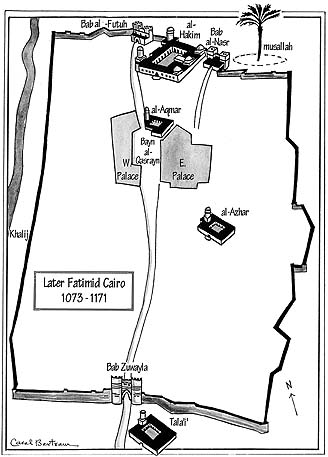
Map 3. Cairo, later Fatimid period 1073–1171 (drawn by Carel Bertram)
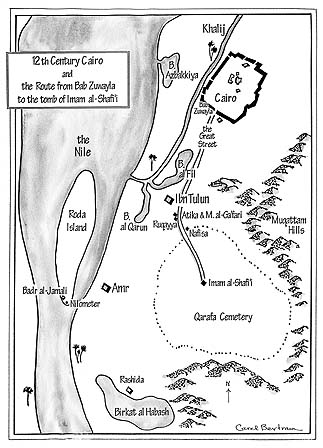
Map 4. Later Cairo and the route from Bāb Zuwayla to the tomb of Imām al-Shāfi‘i (drawn by Carel Bertram)
Later constructions on this street emphasized further its growing prominence as a thoroughfare linking both the northern and southern sections of the urban area, Cairo and Miṣr. It served as the spine along which important Muslim communal structures were built or restored (map 4).[11] In Cairo, facing the Great Street, just north of the Eastern Palace, the mosque known as al-Aqmar (moonlit), was built in 1125/519 by the wazīr al-Ma’mūn.[12] Outside the southern gate, the Bāb Zuwayla, a mosque was built in 1160/555 that was known after its patron al-Mālik al-Ṣāliḥ Ṭalā’i‘.[13] Further south, still, on this road, in the area of the mosque of Aḥmad ibn Ṭūlūn, tombs such as those of Sayyida Ruqayya and Sayyida Nafīsa were restored and enlarged by Badr al-Jamālī[14] and subsequent members of the ruling group (map 4).
These physical and social changes begun by Badr al-Jamālī were not the only changes effected by him. Within the ruling group itself, he drastically altered the site of power, appropriating it to himself, while maintaining the formal order of the ruling system and thus al-Mustanṣir as Imām-Caliph.[15] He acted, especially outside of Cairo, to maintain the officially sponsored writing signs that would signal a strong Fatimid ruler. For example, two years after becoming wazīr (1075/467), he exerted strong pressure, in the form of written messages and lavish presents, on the sherīf of Mecca to persuade him to display writing signs with the name of al-Mustanṣir on the Holy Sites in Mecca. The sherīf complied, erasing the titles of the Abbasid Caliph al-Qā’im and the Seljuk Sultan at the Zemzem, and removing the covering for the Ka‘ba sent by the Abbasid Caliph, replacing it with the white dābiqī (linen) kiswa (covering) which displayed the names and titles of Imām-Caliph al-Mustanṣir.[16]
In Egypt, in the greater urban area of Cairo, however, Badr al-Jamālī used officially sponsored writing to proclaim the new power structure, with himself, the wazīr, as the possessor of power and authority within the social order. He did this by displaying his name and titles to the newly integrated urban audiences on the buildings he commissioned and reconstructed, a course of action paralleled by the change in formula in official petitions emphasizing his role.[17] Since he undertook a large program to restore the urban-infrastructure as a whole, as well as Muslim sectarian life, in specific, his name and titles appeared in many places; twenty-one have been identified to date.[18]
Those who passed saw his name and titles displayed on a plaque on the ziyāda (surrounding wall) of the mosque of Aḥmad ibn Ṭūlūn which he restored in 1077/470.[19] In addition to displaying his own name, he used this public text to comment on preceding events at the site, and, in only a lightly veiled manner, on the turbulence within the ruling group which caused his own rise to power. After his name and titles is the phrase, “He caused the restoration of this portal and what surrounds it [to take place] after the fire which destroyed it that the heretics let happen.” [20] Wiet has plausibly suggested that the heretics (māriq) referred to were the Sunni Turkish troops who attacked the Black troops in 1062/454 and pillaged the treasures and the library, with the result that the area around the mosque of Aḥmad ibn Ṭūlūn fell into ruin until Badr began to revive it with his restoration of the mosque.[21]
A decade later, those passing into Cairo saw his name and titles displayed prominently in the writings on the new gateways he constructed as part of his effort to fortify the city of Cairo against its enemies (1087/440).[22] At the Bāb al-Futūḥ, if Creswell is correct, he used the marble slabs from the northern bastion of the mosque of al-Ḥākim to complete his inscription, thereby replacing what is presumed to have been a Qur’ānic inscription with one displaying names and titles and ranks of the wazīr. Shortly after, in 1089/482, he restored the mausoleum of Sayyida Nafīsa on the Great Street on which he also displayed his name and titles.[23]
With the completion of the fortification of Cairo, Badr al-Jamālī turned his attention to Roda Island. There he constructed a new mosque, on the exterior of which he prominently displayed his name. On this mosque, a large plaque on the western facade which faced directly onto the main boat channel of the Nile displayed Badr’s name and titles in letters over two feet tall.[24] Aimed at the commercial boat traffic, it reminded viewers of his attention to the economic life of the area, and to his concern for the inundation of the Nile that supported it. An inscription with a similar message was placed over the entrance doorway, so that those on foot visiting the island and the mosque also viewed his name.[25] He also restored the adjacent Nilometer (miqyās al-nīl) and placed his name and titles inside it.
What predominates in all these inscriptions is the rank and titles of Badr al-Jamālī, although the Imām-Caliph’s name is mentioned also. It is useful to explore these inscriptions in detail because they functioned as an Ur, or originary, text for subsequent powerful military leaders in Cairo—even those ruling after the Fatimid period. J. J. Marcel, in recording these structures on Roda Island for inclusion in the Description de l’Egypte, has left the only visual record of them.[26] He was primarily interested in the semantic content of the inscriptions for their value in dating the buildings. Consequently he simply recorded the content of the large inscription on the west wall of the mosque, and that over its portal, merely as variants of the inscription on the interior of the Nilometer (miqyās al-nīl).[27] Choosing to draw only the smallest and most compact of the inscriptions, that on the interior of the Nilometer (fig. 34), he merely gave a few details about the aesthetic aspects of the other inscriptions, especially that on the exterior of the mosque.
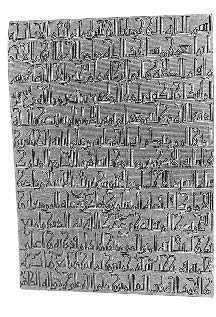
Fig. 34. Inscription from Nilometer of Badr al-Jamālī, after Marcel, Decription de l’Egypte
He noted that all these inscriptions were carved in white marble, a medium that seems to bind together all Badr al-Jamālī’s extant public texts. He noted also that the form of the letters in the writing on the outside, western wall of the mosque were especially remarkable for their elegance, far greater than that of the other two inscriptions, especially that on the Nilometer, the only inscription he drew.[28] Marcel’s comments leave us with some evidence to conclude that Badr al-Jamālī paid particular attention to public texts. Most attention was paid to the aesthetic qualities of the writing facing the traffic on the Nile, while less attention was paid to inscriptions on the interior of the Nilometer, or over the doorway into the mosque. But while Badr apparently made audience considerations the basis for aesthetic choices in the display of writing, the referential content remained basically the same.
It is well worth examining the inscription on the Nilometer in detail for its referential dimensions. The amount of space allocated to the component sections of the inscription remained stable in all his officially sponsored writing, even though they were not displayed in this manner—a plaque of thirteen lines. The inscription begins in standard fashion with the formula, “In the Name of God, The Merciful, The Compassionate ”(basmala),[29] followed by verses from the Qur’ān which fill the first four of the thirteen lines.[30] The nine remaining lines give first the name of the Imām al-Mustanṣir, and then list in detail the names and titles of the Badr al-Jamālī, the person with the real power, along with the date of construction. Badr al-Jamālī is “the Prince Most Illustrious, the Commander of the Armies, Sword of Islam, Surety of the Judges of the Muslims, Guide of the Missionaries of the Believers.” Further along, the inscription mentions his successes in the cause of religion, and wishes him a long life in the service of the Commander of the Faithful (Amīr al-Mu’minīn), that is, the Imām-al-Mustanṣir, whose power, according to the writing, Badr al-Jamālī affirms.
This visual display, and the others like it, of Badr al-Jamālī’s name and titles in Cairo-Miṣr needs to be evaluated against the backdrop of the reduced visibility of the name of the Imām-Caliph and also of his person. While mentioned in all of Badr al-Jamālī’s inscriptions, the names and titles of the Imām-Caliph are so abbreviated that they became almost a secondary dating device in addition to that given in the hegira calendar. Unlike in Mecca, where Badr al-Jamālī worked behind the scenes to support the display of the names and titles of only the Imām-Caliph, in Cairo not only did Badr minimize the display of the Imām’s name but he stopped the processions. He stopped those like Nāṣir-i Khusraw described during which the ruler made himself visible to the whole population.[31] He also ended those in which the Imām led the Ismā‘īlī community in prayer at the muṣalla.[32] The succeeding wazīr, al-Afḍal, Badr’s son, continued these policies. With the reduced visibility of the person and the names of the Imām, the public text became an especially effective visual instrument for the wazīr, and by extension the troops that maintained him in office, to display his power.