Myth, Meaning, and Memory on Roman Sarcophagi
Michael Koortbojian
D·MSTEINAE·BUJANEREPTAEMORTE IMMATURAMCMXCIVS·T·T·L
Table of Contents
Preface
This study was first written in 1988, and an earlier version was submitted in 1991 as a dissertation to the Department of Art History and Archaeology of Columbia University. Much of it has been rewritten since that time. One fortunate consequence of this period of gestation has been my ability to utilize H. Sichtermann’s long-awaited study of the Endymion sarcophagi in the revised series of the Corpus der antiken Sarkophagreliefs; however, D. Grassinger’s corresponding volume, which will include the Adonis reliefs, has not yet appeared. In general, I have endeavored to keep up with recent publications in the field, amending my text where it seemed salutary. The Bibliography, however, makes no claims to comprehensivity, nor does it reflect all the materials consulted; it merely collects the full citations of those works actually referred to in the notes.
It has been my good fortune to have been able to work in many excellent libraries, and I gratefully acknowledge the assistance I have received from their staffs: the Avery Art Reference Library, Columbia University; the British Library; the Biblioteca Apostolica Vaticana; the Biblioteca Hertziana; the Cambridge University Library; the Deutsches Archäologisches Institut in Rome; the Institute of Classical Studies, London; the Library of the American Academy in Rome; the Library of the Faculty of Classics, Cambridge University; and, above all, the Warburg Institute.
For financial support of my research I thank Columbia University’s Department of Art History and Archaeology, the Samuel H. Kress Foundation, and King’s College, Cambridge.
At the University of California Press I would like to thank Deborah Kirshman, Nola Burger, and especially my editor, Stephanie Fay, for all their efforts.
To many friends and colleagues I owe much, and it is with the greatest pleasure that I thank them here: Leonard Barkan, Andrea Carlino, Giuseppe d’Arcangelo, Godelieve Denhaene, Melissa Dowling, Lisa Florman, Alfred Frazer, Sigrid Goldiner, Sheree Jaros, Nicholas Mann, Constantine Marinescu, Jane Necol, Mark Petrini, Elizabeth McGrath, Sarah McPhee, Jordana Pomeroy, David Rosand, Ruth Rubinstein, Ursula Sdunnus, Kerry Shear, Laura Slatkin, Jeremy Tanner, Elizabeth Teviotdale, J. B. Trapp, Mary Vaccaro, Ruth Webb, Philip Weller, and Hanneke Wirtjes.
To Marie Tanner, my thanks are small recompense for the true friendship and wise counsel she has shown me for so many years.
To Richard Brilliant—magister et amicus—my debt is even greater: for the constancy of his encouragement and support, and no less for the challenge of his demanding criticism.
To Christina Corsiglia, what I owe knows no words.
Abbreviations
- Archäologischer Anzeiger
- Aachener Kunstblätter
- Archeologia Cantiana
- Acme. Annali della Facoltà di Lettere e Filosofia dell’Università degli Studi di Milano
- Acta ad archaeologiam et artium historiam pertinenta [Institutum Romanum Norvegiae]
- Acta archaeologica. Copenhagen.
- Acta archaeologica academiae scientiarum hungaricae
- Annali dell’Istituto di Corrispondenza Archeologica
- A.I.O.N.—Annali dell’istituto universitario orientale di Napoli, sezione di archeologia e storia antica
- American Journal of Archaeology
- Mitteilungen des Deutschen Archäologischen Instituts, Athenische Abteilung
- American Numismatic Society Museum Notes
- Annali della Scuola Normale Superiore di Pisa
- H. Temporini, ed., Aufstieg und Niedergang der römischen Welt (Berlin and New York, 1972–).
- L’Antiquité Classique
- Antike Kunst
- Antike Plastik
- Archeologia Classica
- Archivio Glottologico Italiano
- The Art Bulletin
- Art History
- C. Robert et al., Die antiken Sarkophagreliefs (Berlin, 1890–).
- C. Robert, Die mythologischen Sarkophagen, Vol. III, pts. 1–3 (Berlin, 1897, 1904, 1909).
- H. Sichtermann, Die mythologischen Sarkophagen, Vol. XII, pt. 2 (Berlin, 1992).
- Atti dell’Accademia Nazionale di Lincei. Classe di scienze morali, storiche e filologiche
- Bulletin de Correspondance Hellénique
- Bullettino dell’Istituto di Corrispondenza Archeologica
- Bulletin of the Institute of Classical Studies of the University of London
- Bonner Jahrbücher des Rheinischen Landesmuseums in Bonn und des Vereins von Altertumsfreunden im Rheinlande
- Bullettino della Commissione Archeologica Communale di Roma
- Byzantinische Zeitschrift
- Corpus Inscriptionum Latinarum
- Classical Quarterly
- Deutsches Archäologisches Institut, Rome
- Dialoghi di Archeologia
- Greece and Rome
- J. Paul Getty Museum Journal
- Göttingische Gelehrte Anzeigen
- Greek, Roman, and Byzantine Studies
- Greek Lyric, trans. D. A. Campbell, LCL ed., 4 vols. (Cambridge and London, 1982ff.).
- W. Helbig, Führer durch die öffentlichen Sammlungen klassischer Altertümer in Rom, 4 vols. [4th ed., 1963, 1966, 1969, 1972].
- Harvard Studies in Classical Philology
- Harvard Theological Review
- Illinois Classical Studies
- Jahrbuch für Antike und Christentum
- Jahrbuch der Berliner Museen
- Jahrbuch Preussischer Kulturbesitz
- Jahrbuch des Deutschen Archäologischen Instituts
- Journal of Hellenic Studies
- Journal of Roman Archaeology
- Journal of Roman Studies
- Kölner Jahrbuch für Vor- und Frühgeschichte
- Ktèma: Civilisations de l’Orient, de la Grèce et de Rome Antiques
- Loeb Classical Library
- Lexikon Iconographicum Mythologiae Classicae
- Memoirs of the American Academy in Rome
- Maia. Rivista di letterature classiche
- Marburger Winckelmann-Programm
- Mélanges de l’École Française de Rome. Antiquité
- Mélanges d’Archéologie et d’Histoire de l’École Française de Rome
- Memorie dell’Accademia di Archeologia, Lettere, e Belle Arti di Napoli
- Monuments et Mémoires. Fondation E. Piot
- Münchener Jahrbuch der bildenden Kunst
- Museum Helveticum
- Notizie degli Scavi di Antichità
- Jahreshefte des Österreichischen archäologischen Instituts in Wien
- Papers of the Liverpool Latin Seminar
- Revue Archéologique
- Pauly-Wissowa, Real-Encyclopädie der klassischen Altertumswissenschaft
- Revue des Études Anciennes
- Revue des Études Latines
- Rendiconti della Pontificia Accademia Romana di Archeologia
- Rheinisches Museum für Philologie
- Reallexikon für Antike und Christentum
- Mitteilungen des Deutschen Archäologischen Instituts, Römische Abteilung
- Römische Quartalschrift für christliche Altertumskunde und Kirchengeschichte
- Rivista di Studi Pompeiani
- Speech Monographs
- Studi Italiani di Filologia Classica
- Studi Miscellanei. Seminario di archeologia di storia dell’arte greca e romana dell’Università di Roma
- Transactions of the American Philological Association
- Wissenschaftliche Zeitschrift der Universität Rostock
- Yale Classical Studies
- Zeitschrift für Papyrologie und Epigraphik
Introduction
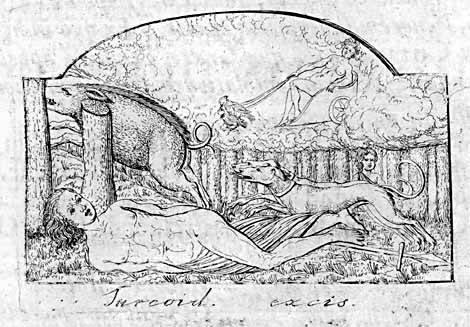
In his description of a recently unearthed sarcophagus, the great sixteenth-century antiquarian Pirro Ligorio speculated about the significance of its imagery. The sculpted relief represented the death of Adonis, and Ligorio reasoned that it commemorated one who not only had shown undaunted courage in the face of dangers but had indeed done so in the prime of youth, only to be struck down by a sudden, violent death:
The examples for our life are found in contemplation of the dangers that befall others. Whoever it was who exhibited the death of Adonis on his sarcophagus—which was found in the Via Latina, and on which was depicted that young man who, having thrown aside his quiver and bow, was killed by the boar—clearly advises us that a man who would be young and bold in the face of dangers could die as Adonis, the son of King Cinyras, died. Perhaps whoever was buried here died in this fashion. Whatever befell him on account of his great spirit is thus excused, as is his unexpected death, by the example of the loss of that hero who did not know how to take advice from Venus, who loved him so much and who desired that he not set himself to so dangerous a deed for the sake of so brief a pleasure.1
Ligorio’s brief account touches on the narrative power such images hold, the very human desire for exempla, and the ancient penchant for evoking them by way of mythological analogy. Yet Ligorio wavered between a realistic and an allegorical reading of the sarcophagus’s imagery, and when confronted by that of other monuments, he was no less equivocal:Whether he read the imagery of the sculpted reliefs realistically or allegorically, for Ligorio it was the narrative force of the imagery that drove their implicit analogies.Several others have put chariots on their monuments with undoubted significance, to demonstrate that they died unfortunately, having been thrown headlong when driving: having trusted they would win the palm, they had instead broken their necks. Whence they compared their death with that of the ancient heroes…who, although they were considered like gods because of their virtue, nevertheless had inadvertently lost their lives. Those to whom such events occurred distinguish their tombs by similar examples, thus demonstrating the certainty of death and the variety of its occurrence, as well as both the vices and the virtues of those of long ago, by a certain kind of parallel.2
The correspondence between the dead and the imagery with which they were celebrated was seldom neat, and the analogy between the two rarely simple. In the absence of an explanatory inscription or portrait, there is nothing to inform the beholder that the deceased, identified with the heroic Adonis by Pirro Ligorio, had died young. And indeed, Ligorio’s analogy, which assumes that within the casket lay another impetuous youth struck down by an early death, is unwarranted—as an examination of the full corpus of surviving sarcophagi reveals.
These brief passages from Ligorio’s antiquarian treatise suggest the scope of this study, which addresses the character and structure of mythological narratives as they appear on Roman sarcophagi. This book is about the meaning of these monuments and, in particular, about the significance of their visualization of narrative. The chapters that follow, which attempt to reconstruct the meaning of the mythological sarcophagi—for, as we shall see, this is a historical problem requiring reconstruction—measure the strengths and weaknesses of such an exemplary response as Pirro Ligorio’s.3
A series of themes will be developed throughout. First, that mythology is to be regarded, not merely as a repertory of stories, but as an evocative force in ancient life and ancient imagery. The appeal to myth was fundamental to an ongoing process of cultural self-identity, a process in which the myths evolved along with the people who had recourse to them. As ancient heroes were regarded as exempla for the present, their exemplary character was subject to continuing elaboration in light of present needs. The mythological tradition was, in fact, a powerful means by which the complicity between the past and the present was manifest—a complicity fundamental to the very notion of tradition.4
Second, essential to the mythological imagination was an ancient penchant to see things in relationship on the basis of distinctive, specific affinities; the technical term elaborated by the Greeks for the apprehension of such resemblances, and for arguments made on the basis of such inferences, was analogy.5 As it likened one thing to another, analogy was a fundamental trope for the ancient discovery of order, and one of its primary characteristics was that it signaled the ascendance of similarity over difference.6
In the visualization of the ancient mythological narratives, artists, no doubt together with their patrons, evolved a powerful phenomenon of abstraction, which allowed for a looser association of ideas and images on the basis of resemblances. The third of this book’s themes concerns this concomitant to analogy, one more supple and subtle, here termed typology. This representational mode was rooted in the use of conventionalized visual forms, or motifs, for the depiction of particular stories. For example, a reclining man is a motif, whereas a man who reclines in the pose devised specifically for Endymion is a type.7 Yet as we shall see, the characteristics of a type might be employed, with minor variations, in the representation of a series of related tales.8 Thus the recognizability of the basic type might serve to suggest further relationships between these stories on the basis of their visual similarities. In this manner, typology provided ancient artists with the visual correlative to verbal analogy and thus greatly expanded their powers of allusion.9
Finally, a full understanding of the mythological sarcophagi and their imagery requires attention to the role of memory and its part in the larger cultural framework in which these objects found their place. Remembrance was an important factor in ancient social life and fueled the need for such monuments and memorials. It was central as well to the visual structures employed in the creation of these monuments; the representational modes of analogy and typology depended on it. Since, as we shall see, Roman religious practices did not demand such caskets for the inhumation of the dead, the perpetuation of memory not only played a role in the creation of the mythological sarcophagi but was ultimately the most significant of their functions. And when the ideas that gave rise to the imagery of such memorials eventually faded, the most crucial and compelling aspect of that imagery vanished as well.
The first two of these themes, those concerning mythology and analogy, have had a long life and still play a fundamental role in the visual arts. The position of typology in the history of visual narration has been less secure. A more complex mode of allusion, typology made larger demands of its audience, as shall become clear, and it would seem that the greater requirements for its success diminished the possibilities of its employment.
These are the topics, then, that are examined in the pages that follow. This study concludes with some brief observations on the disappearance of the typological mode so central to the visualization of the myths on Roman sarcophagi and, by so doing, suggests the historical boundaries of this particular aspect of ancient aesthetics.
The problem of analogy
The penchant for comparison, whether to stress similarity or difference, found no greater advocate in the ancient world than Plutarch. His Parallel Lives provides not only abundant evidence of this propensity, but a vivid account of the purpose of such a comparative mode of thought. In the proem to his Pericles, he sets out the function of his undertaking—as was only fitting—by a broad comparison:
Our outward sense cannot avoid apprehending the various objects it encounters, merely by virtue of their impact and regardless of whether they are useful or not: but a man’s conscious intellect is something which he may bring to bear or avert as he chooses, and he can very easily transfer it to another object if he sees fit. For this reason we ought to seek out virtue not merely to contemplate it, but to derive benefit from doing so. A colour, for example, is well suited to the eye if its bright and agreeable tones stimulate and refresh the vision, and in the same way we ought to apply our intellectual vision to those models which can inspire it to attain its own proper virtue through the sense of delight they arouse. We find these examples in the actions of good men, which implant an eager rivalry and a keen desire to imitate them in the minds of those who have sought them out.10
For Plutarch, the representation of virtus could itself engender virtue, and comparison could breed comparison. The mind was by nature an organ of discrimination predisposed to imitation. Plutarch continued: “Virtue in action immediately takes such hold of a man that he no sooner admires a deed than he sets out to follow in the steps of the doer.”11The presentation of exempla thus appealed to men and women at the most fundamental level. On the mythological sarcophagi, such exempla were intended to evoke, by “the sense of delight they arouse,” comparisons between the dead and the ancient heroes.
They were heroes of many different kinds. For example, many died young in the Roman world, and interpretations—such as Pirro Ligorio’s—that identify the deceased with the mythical protagonist that graces his or her tomb certainly correspond with Roman ideas concerning a mors immatura.12 A wide variety of sarcophagus representations demonstrates the readiness with which these ideas were given visual form. These conceptions appear perhaps most clearly on sarcophagi of the vita humana type that were adapted to the life of those who died young. On these reliefs, scenes of childbirth and education necessarily replaced those symbols of adult accomplishment that death had denied, such as marriage, the cultivation of the Muses, or the performance of religious rites and sacrifices.13
The mythological repertory was also adapted specifically for the sarcophagi of the young dead. This is apparent in the case of a child's sarcophagus in Rome that represents the myth of Prometheus, where the dead child is celebrated by analogy to the miniature “first man” molded by the hero and endowed with the stolen fire of life.14 In this instance as in others, the analogy between the individual buried within the sarcophagus and the mythological protagonist depicted on its front is underscored by the small scale of the casket, large enough solely for the body of a child. Similarly clear visual references are made to a mors immatura on other reliefs, where putti enact the roles of mythological heroes—Meleager or Cupid and Psyche, for example. In such instances the young dead are endowed, as if by proxy, with the virtus that death has refused them the opportunity to acquire in life.15
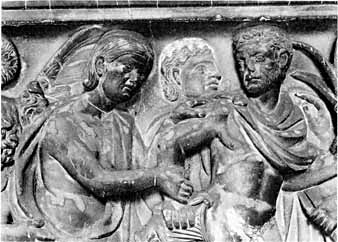
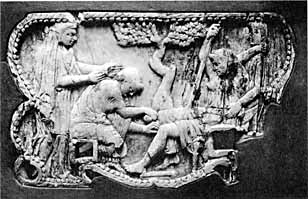
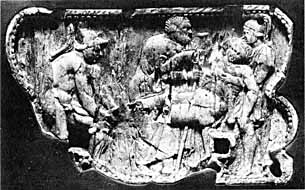
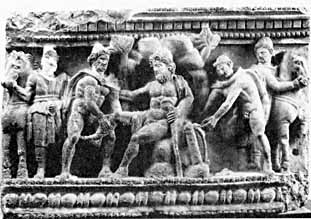
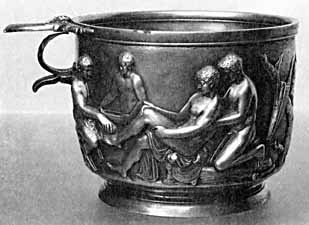
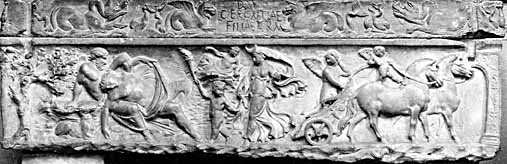
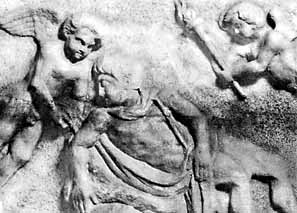
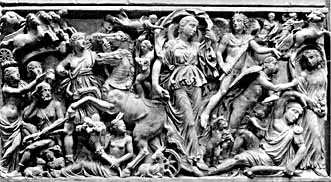
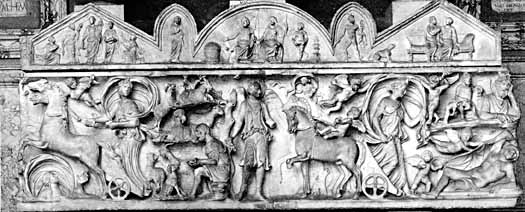
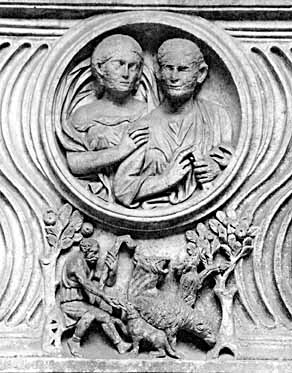
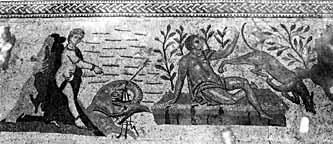
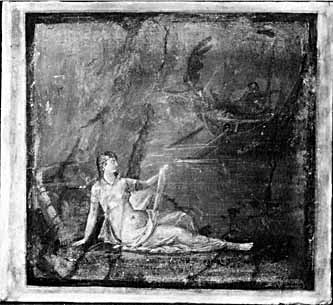
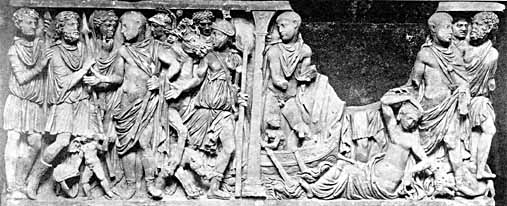
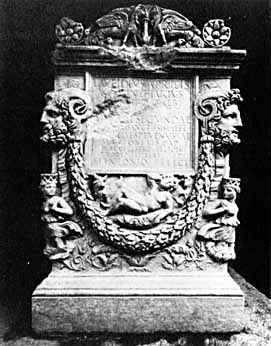
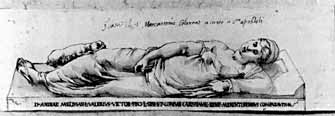
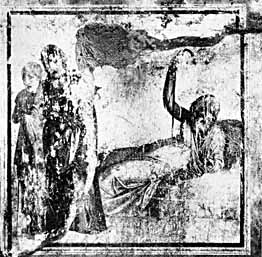
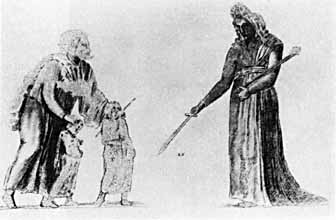
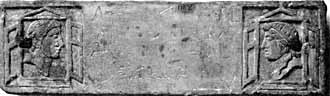
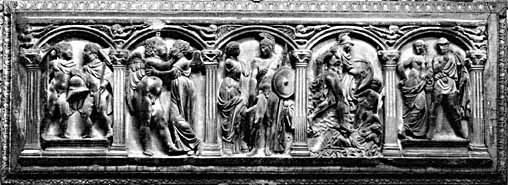
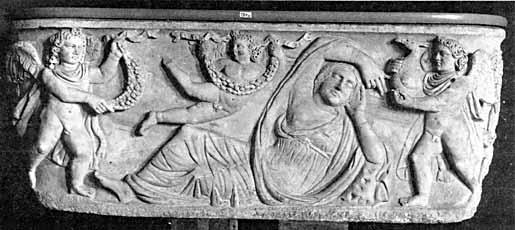
Just as the virtus of the ancient heroes could be appropriated for the young, so too could they be for the old. While old age, with the infelicities of physical appearance it brings, might seem to render identification with a youthful hero less apt, a youthful theme might nevertheless be chosen even in later years, as can be seen on certain sarcophagi whose mythological protagonists bear portraits (Figs. 1 and 2). Indeed, one might complain that death at any age is immatura.16
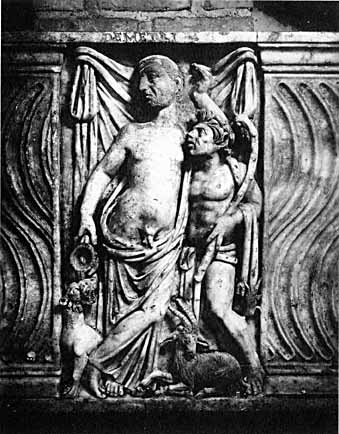
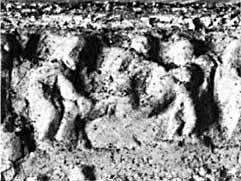
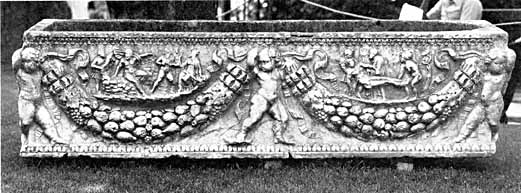
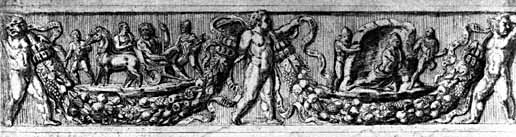
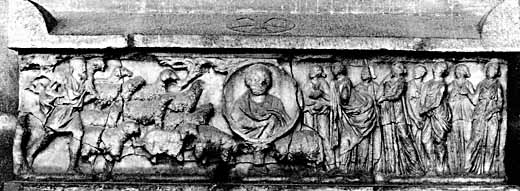
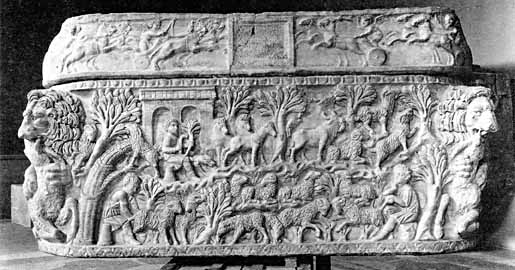
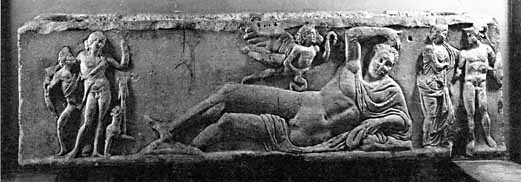
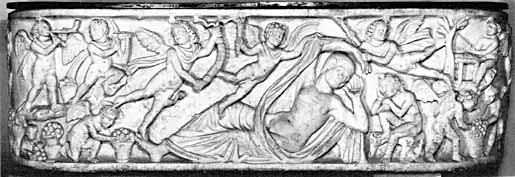
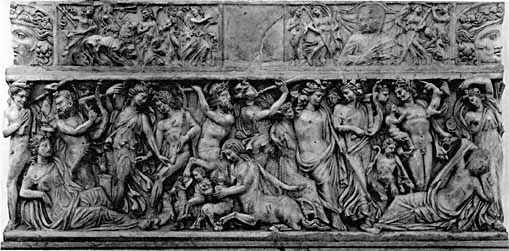
The monuments themselves demonstrate that facile comparisons between the real life of the deceased and the mythic life of the heroes represented on the sculpted caskets have little to recommend them. For as Ligorio himself realized, the myths functioned on the sarcophagi as conventional symbols of virtus—and as conventional symbols they were available to be appropriated by one and all. An old man might portray himself as the young Dionysos (Fig. 3), or a woman could be buried in a sarcophagus that prominently displayed the sleeping figure of Endymion (see Fig. 29).
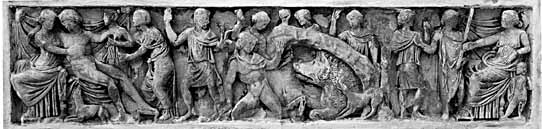
The problem of interpretation becomes more complex in the case of myths that present no obvious basis for analogy. The tragic figures of Medea and Phaedra (at times bearing the portrait features of the deceased or a spouse) scarcely suggest a sympathetic parallel between the plots of their stories and the lives of those Romans who appropriated these myths to commemorate themselves.17 The use of these stories was more than an appeal to the classical;18 nor is it likely that the patrons of these intensely personal works of art failed to comprehend the stories depicted.19 The appearance of such stories demands a more nuanced account of all the myths employed on the sarcophagi and a more perceptive response to the complex nature of this funerary imagery.
For the sarcophagi present analogies, not identifications: they do not merely equate the lives of those commemorated with the ancient stories but compel us to contemplate those lives in terms of the fundamental truths the myths reveal. Following Euripides, one sees in Medea a woman torn by conflicting claims—of jealousy, desire for revenge, and love of her children—who acts, despite her judgment, compelled by passion (thumos).20 This myth demonstrated, in extreme form, what the ancients held to be the essential aspect of women’s nature; so too, the tale of Phaedra and Hippolytus.21 In the dramatic clash of its protagonists, this myth displayed the basic dichotomy between men and women so central to the ancient view of the human condition: that between amor and virtus. For the heroines of both myths, the realization of their nature and the fulfillment of its claims on their character is inextricably bound to the omnipotence of Fate.22
Text and image
The interpretation and historical study of the sarcophagus reliefs and their imagery are guided by established criteria—concerning the nature of these objects, their function, and their context—seldom so focused in the case of other works of art. Neither our knowledge about these objects nor the establishment of these criteria is derived, however, from ancient commentaries devoted to these monuments. There is no surviving ancient text that provides a “key” to the visual language with which the myths are related on the sarcophagi. The study of the sarcophagi has been forced to proceed in a different fashion.23
To begin with, the subject matter of the sarcophagus reliefs was well known to their audience. The myths were once basic to the fabric of life itself, linked to ancient religion and its vision of the cosmos. For Romans of the Imperial era, these myths were given a highly accessible form by Ovid in his Metamorphoses, whose wide dissemination, at least among the upper classes, may be assumed.24 The continuity of mythological knowledge among the literate is also attested by the evidence of the role that knowledge played in grammatical education, whose fundamental texts appear to have changed little over the centuries from the Hellenistic age until as late as the sixth century.25 The role of mythological allusion in the poetry of the first and second centuries, and the continuing importance of this literature, provide both a parallel and a proof of the receptivity to myth in the age when the sarcophagus reliefs were produced.26
Second, the consistent formalization of the mythological images cemented the bond between the verbal and the visual: readily recognizable forms facilitated the myths' identification. In the visual arts the myths were codified in standardized designs, and repertories for each myth were established. The practice could function at the level of details, such as attributes, as a passage from Cicero makes clear: “From youth we have known the remaining gods—Jove, Juno, Minerva, Neptune, Vulcan, Apollo—by the features that the painters and sculptors have wished to employ; not only for their faces, but also their attributes, their age, and their garments.” 27 The same practice also functioned, as shall become clear, at the level of plot. The similarity of the surviving representations of the myths in a wide variety of media demonstrates a consistent selection and depiction of story elements, and the repetition of these images led to their familiarity throughout the ancient world. This long-standing practice, along with the striking quality of immediacy it conveyed, was acknowledged in late antiquity by St. Augustine. He recalled the story of the sacrifice of Abraham and acknowledged the powerful effect of its representation's formalization and ubiquitous repetition: “such a famous deed comes strongly to mind, and it comes to mind as something neither studied nor sought, since it is everywhere recounted by so many tongues and depicted in so many places.” 28 Continual exposure to such standardized representations fused image and story firmly together in the mind.29 Classical literature, the Poetics of Aristotle in particular, suggests the essential role played in the storytelling of the ancient world by such acts of recognition (anagnorisis). As a plot device, anagnorisis served not only as a fundamental structure for narration but as a reminder of the power inherent in the dramatic apprehension of identity and ethos. To aid in the beholders' recognitions, each myth's salient episodes, as well as the identifying attributes of its main characters, were treated with remarkable consistency.30
There is considerable debate about the origin of these standardized images. They may have derived from monumental works of painting or sculpture whose fame led to their replication, or from early illustrated codices and papyri that presented the great narrative cycles and the most prominent myths in epitomizing form.31 The employment of models is recorded, however, by Pliny. In his Historia Naturalis, he writes about Parrhasius, most gifted among the ancients in the drawing of outlines, and speaks of the many graphidis vestigia among the artist’s panels and parchments, from whose use other artists had profited.32
While the regularized visual repertories established for the myths were often modified by different workshops, sculptors generally remained true to the fundamental formulae.33 At times more profound changes were made in addition to these minor variations. Yet in every instance, artists and patrons made choices, whether they employed standard designs or completely reworked them. Discrimination and judgment were always involved, whether the goal was conformity with established traditions or their rejection for the sake of innovation.
Some decisions led to more striking visible results than others. For as artists and patrons exploited certain visual characteristics that resulted from the standardization of mythological imagery, they transfigured the manner in which the fables were told with images. The significance of such variants—as those among both the Adonis and Endymion sarcophagi reveal—is not only that they altered the appearance of a myth’s imagery, but that they particularized and personalized its sepulchral message.34
In these innovative representations of the myths, text and image complemented one another in a profoundly new fashion. The standardized iconographies encouraged viewers to regard the sculpted images as illustrations to be recognized and thus accorded an implicit primacy to those specific redactions of the myths from which the images were generated. By contrast, those sarcophagus reliefs that deviated from both the established models and the canonical texts asserted the primacy of their images, as they impelled their beholders to decipher the language and meaning of their sculptural forms.
Audience, context, interpretation
Another factor guiding the interpretation of these monuments is that the sarcophagus reliefs, by definition, were intended for a specific context. These were works of art to be viewed under circumstances always the same: first at the funeral and later on visits to the tomb. Their imagery was to be understood in connection with two distinct sets of practices whose relationship remains something of a mystery: religious ritual devoted to the dead and their afterlife, and social practices dedicated to their commemoration. The precise religious significance of the sarcophagi and their imagery has remained elusive on account of the tremendous variation in beliefs held by the Romans, variation that increased during the Imperial period.35 In the absence of definitive evidence linking the “survival of death” theme to known religious beliefs, the role of the sarcophagi as commemorative monuments accrues added significance.36
Awareness of the social classes that could afford to commission these monuments, and to display them in suitably sumptuous tombs, allows a degree of certainty about the primary audience for their imagery. It has long been held that sarcophagi, which were transported to Italy quite possibly from workshops in Asia Minor, were purchases of considerable expense in the Roman world.37 Recent research has shown the situation to have been somewhat more complex. The purchase of elaborate sarcophagi was also a conspicuous expression of middle-class striving to emulate the cultivated taste and material signs of affluence associated with the Roman aristocracy.38 Yet monuments of high-quality sculpture and sophisticated iconography, which only the well-to-do could afford and only the cultivated would appreciate, were not the only ones produced by the Roman workshops. Less expensive forms, with decidedly inferior carving that featured less elevated and complex iconography, were manufactured for the popular tastes of the middle class. At times, expense was limited and high quality maintained by the employment of an overall pattern, as in the “strigilated” type, where a repetitive design—whose carving could be relegated to the less-skilled hands of workshop apprentices—might fill the majority of the relief.39
They were at least moderately well-to-do people, therefore, who came to honor the dead and to remember their ancestors buried in the elaborate mythological sarcophagi. The power of tradition and the strictures of religious practice required their presence on days prescribed for feasts in celebration of the deceased. Funds for such ceremonies had often been provided in bequests by the dead themselves. The family and close friends came on the ninth day after burial for the cena novendialis, and every year for the dies natalis as well as for the Parentalia, celebrated during the latter part of February.40 Their attendance on the dead not only provided these works of art with an audience but fulfilled their purpose. For as these visitors came and contemplated the imagery of the sarcophagus reliefs, the legacy that the dead wished for—to be remembered in the guise of the protagonists of myth—was brought finally to fruition.
From MUTHOS HELLENIKOS to mythologia romana
Classicizing taste for Greek imagery flourished under Hadrian and became widespread during the second and third centuries.41 This provided the overall context for the adaptation of Greek mythology to meet the new Roman need for imagery suited to the form of sarcophagi. But it was a change in social practice, from a preference for cremation to one for inhumation, that gave rise to the production of these monuments on a large scale. Inhumation was not a new phenomenon but the re-emergence of a long standing practice among both the Etruscans and the peoples of Asia Minor.42
The Greek myths depicted on these sarcophagus reliefs underwent a process of Romanization, which resulted in the refashioning of artistic models, and at times of the stories themselves.43 The chapters that follow demonstrate that as the myths were visualized in the formal language of Roman art, and as they were inserted into their new sepulchral context, they assumed specific significance. In this way they were transformed to express new Roman ideas in the fulfillment of new Roman needs.
An understanding of the characteristic process by which the Greek myths were adapted for representation on the funerary reliefs is crucial to a full comprehension of these monuments. The choice of myths, the selection and combination of scenes, their composition, alteration, deliberate omission, and even replacement are among the decisive artistic considerations that distinguished these reliefs as mythological representations of a most singular kind. All of these aspects have been the subject of scholarly research.44 The purpose of the present study is to broaden the scope of such investigations and to elucidate certain other characteristics of the Romanization of Greek mythology on the sarcophagi.
The pairing of the Adonis and Endymion sarcophagi that is the focus of these chapters presents many, if not all, of the interpretive issues raised by study of the entire range of mythological sarcophagi. The analysis of these two myths and their visual representations should be considered an attempt to provide a foundation for further study, and the method of investigation proposed here regarded as germane to the examination of other monuments as well. This investigation, based on principles that can profitably be applied in the analysis of other myths and their imagery, is thus offered as a model for the study of mythological sarcophagi in general. The following paragraphs suggest this broader scope of inquiry and establish the interpretive parameters of the chapters that ensue.
The appearance of “stock” types that resulted from the standardization of the myths’ imagery must be investigated, together with the visual conventions they established. It is only by contrast with such conventions that the full force of the variant compositions emerges. The employment on the sarcophagi of stock types and the invention of variants, must be recognized, and analyzed, as complementary forms of decision making that reflect a relationship between visual and verbal thinking. On the sarcophagi, the myths have been refashioned as visual images, and the interpretation of their force and clarity depends on the pictorial and sculptural qualities of their medium as well as on the texts from which their stories derive.
Analysis of the individual motifs with which these stories are visualized may be pursued in new directions. The study of these motifs, so elaborately charted in many publications of sarcophagi of diverse iconographies, may be augmented and amplified by an examination of the typological relationships established in the representation of different myths. The use of visually related motifs, whose significances complement and fulfill one another, provided the artists with one means to expand the connotations of their images.45
The significance of individual motifs in the private context of funerary mythology may be informed by their function in other modes of presentation. Thus a motif’s function within the narrative framework of the sarcophagi may be compared and contrasted with its role in the hieratic forms of the public art of the Empire.
The use of motifs in the frozen tableaux of the sarcophagus reliefs may also be compared with their role in other genres, such as contemporary theatrical productions.
The exemplary nature of the visual imagery for the myths may be linked to corresponding literary traditions, and the appearance and function of common topoi elucidated. The role of the mythological themes appropriated and personalized on the sarcophagi should be compared to the part played by these same themes in the purportedly autobiographical poetry of such first-century authors as Propertius or Tibullus.
Finally, it is necessary to inquire further into the purpose of portraiture on the mythological sarcophagi. Investigation must not only elaborate this phenomenon from a conventional archaeological perspective, collecting and cataloguing examples, but attempt to reconstruct that cultural imagination of which the reliefs form a most poignant expression. The initial stage of such a project has been accomplished admirably by Wrede.46 Yet the importance of portraits in Wrede’s work lends his study of the mythological sarcophagi an unwarranted emphasis on the relationship of their imagery to real, historical, life. Nevertheless, as the following chapters demonstrate, all mythological sarcophagi assert analogies; the presence of the portrait features of the deceased merely intensifies and particularizes the monument’s message. For as the myths depicted on the sarcophagus reliefs are conflated with the lives they are meant to recall, we are confronted by more than the “private deification” of those individuals who present themselves in the guise of the gods. We witness not only the power of images to preserve something essential of the dead, but the role of myth in both the formulation of those memories and the creation of a significant and enduring monument.
The Myths
Hermogenes.But what is the word “hero”?
Socrates.That is easy to understand; for the name has been but slightly changed, and indicates their origin from love.
Hermogenes.What do you mean?
Socrates.Why, they were all born because a god fell in love with a mortal woman, or a mortal man with a goddess.…
Love affairs between goddesses and mortals were fraught with difficulties. Calypso protests the misfortunes of those goddesses who fell in love with men with the following words:
Cruel are you, O gods, and quick to envy above all others, seeing that you begrudge goddesses that they could mate with men openly, if any takes a mortal as her dear bed-fellow. Thus, when rosy-fingered Dawn took to herself Orion, you gods that live at ease begrudged her, till in Ortygia chaste Artemis of the golden throne assailed him with her gentle shafts and slew him. Thus too, when fair-tressed Demeter, yielding to her passion, lay in love with Iasion in the thrice-ploughed fallow land, Zeus was not long without knowledge of it, but smote him with his bright thunder-bolt and slew him. And even so again do you now begrudge me, you gods, that a mortal man should abide with me.1
Zeus’s messenger has just arrived bearing the command that Odysseus be allowed to continue his journey. Calypso bewails the unjustness of his decree, for the desire of goddesses was continually inflamed by mortal men—especially those in the prime of youth.To the list of love affairs proclaimed by Calypso, other ancient authors added those of Aphrodite and Adonis as well as Selene and Endymion:
As for the goddesses, whom do they carry off? Is it not the most beautiful men? Certainly they live together with them: Dawn with Cephalus, Cleitus, and Tithonus, Demeter with Iasion, Aphrodite with Anchises and Adonis.2
Never were goddesses more stricken than Aphrodite and Selene. Yet unlike the many loves of Jupiter, neither affair was a violent seduction. Both these divinities were charmed by the beauty of a young shepherd:And did not Adonis, as he fed his sheep upon the hills, drive the fair Cytherea to such frenzy that even in death she puts him not from her breast? Fortunate in my eyes Endymion, who sleeps the sleep unturning.3
Correspondences are also found between the two beautiful divinities who descended to earth to take their pleasure with these mortal youths. While Plutarch speaks elliptically of the “resemblance” of Selene and Aphrodite,5 in Macrobius one finds an explicit identification of one with the other.6 And Lucian makes plain the similarity of the two goddesses, their desires, and their predicaments: “So how can one find fault with Aphrodite for being unfaithful to her husband, or with Selene for going down to visit Endymion time and again in the middle of her journey?”7Cypris lost her wits for a neatherd and tended herds upon the hills of Phrygia, and loved Adonis in the thickets, and in the thickets mourned him. Who was Endymion? was not he a neatherd—whom Selene loved as he tended his kine, and came from Olympus through the glades of Latmus to lie with her darling?4
Both these “love-struck” deities (pothobletos) are “dying of love” (apollumai hupo tou erotos),8 Selene having taken her cue from Aphrodite—indeed she has modeled herself on Love’s goddess. As she is led by erotes to Endymion’s side, she takes on the role of the seductress commonly associated with Aphrodite. Selene is also often represented with one of her breasts bared, a motif derived from the type of the “Venus Genetrix” that signals her assimilation among the followers of Aphrodite.9 Yet Aphrodite was described as being adorned in garments that shone “like Selene,”10 and the Adonis tale might similarly owe a debt to that of Endymion, for the two heroes’ fates have affinities as well. Indeed, held fast by Aphrodite’s embrace, the wounded Adonis “knows not that she has kissed him” and appears “lovely in death as if he were asleep.”11
The pastoral setting of each of these loves is suffused with the quiet languor consonant with such liaisons. Yet this tranquillity will be shattered by the sudden and violent death of Adonis, and transformed as Endymion is consumed by that endless slumber the ancients regarded as the twin brother of death. By a sleeplike death was Aphrodite’s love for Adonis thwarted; by deathlike sleep was Selene’s allowed.
Of the numerous Greek myths that recount the loves of female divinities for mortal men, only these two were adapted by the Romans as subjects amid that great repository of mythological imagery—the sculpted reliefs on marble sarcophagi. Greek mythology became a subject for the sculpted fronts of Roman sarcophagi when, because of a change in burial practice, Roman artists began to devise coffins with symbolic decoration suitable for the inhumation of the dead. The sarcophagi presented a profound interpretation of the myths within a complex mode of narration, and the employment of the tales in a sepulchral context emphasized their symbolic significance. On these monuments, images of sudden violent death and endless tranquil sleep assumed new grandeur when they served as vehicles to express both a conception of death and the memorialization of life.
In this funerary context the two young heroes—Adonis and Endymion—played the primary roles in these mythological narratives, since they offered conspicuous analogies for the commemoration of the dead. Adonis provided a literal heroic image of death, while Endymion offered an evocative metaphor of the afterlife. The contrast of these two distinctive modes of allusion furnishes an epitome for the mythological sarcophagi as a whole.
The stories of Adonis and Endymion also provide the foundations for a study of the typological relationships between myths—since, as surviving classical texts suggest, the ancients regarded the two heroes, and their goddesses as well, as complementary. Yet these relationships were given fuller elaboration on the sarcophagi, where the visualization of the myths lent that complementarity palpable form. As the following chapters demonstrate, the formal and iconographic similarities between the representations of the myths on the sarcophagi extended even to the more idiosyncratic examples of each type, those presumably adapted to the specific demands of individual clients. Indeed, these unique representations not only reveal unexpected affinities between the myths and their protagonists but introduce typological relationships with other myths that expand and extend the significance of the dramas they enact.
Adonis’s Tale
Adonis’s tale was an old one. The myth, evidently of oriental origin, had been told and retold by the Greeks in a variety of forms. The Romans adopted and adapted the tale, and by the mid second century—when the sarcophagi that are the focus of this study began to be produced—the story appears to have been among the most vital examples of mythology, one that found artistic expression in a wide range of Roman representations, both literary and visual.1
The abundant literary sources that survive testify to the tale’s wide dissemination and its appearance in diverse genres. The myth comprised an elaborate narrative sequence, whose elements were extracted, and at times amplified, for presentation in new contexts. Some of the literary sources offer mere allusions to the myth in the proverbial form associated with commonplaces about the affairs of the gods.2 Among the sources are also found ancient commentaries on these allusions, such as the explications provided in the scholia to Theocritus.3 Still others present attempts at realistic, or “historical,” accounts of the myth: some ancient authors recounted the genealogy of the ancient hero,4 while others attempted to fix geographically the site of the river into which he was metamorphosed.5 The myth also appears in ancient texts as a symbol or metaphor, thus suggesting a basic knowledge of the tale on the part of the authors’ audience as well as a consensus about its broad significance and applicability in such a form.6 And, finally, in some instances the tale of Aphrodite and Adonis forms a topos that served as the inspiration for literary composition.7
The most extensive account of the Adonis myth is that given by Ovid in his Metamorphoses. But even this must be combined with elements found in various other sources to provide a complete, if synthetic, narrative of the life and death of the hero.
The narrative begins with a tale of illicit passion, deception and their unfortunate consequences.8 Myrrha, daughter of King Cinyras, was overwhelmed with desire for her father. With the aid of her nurse, she contrived to deceive him, and, taking advantage of his drunkenness, fulfilled her extravagant passion under the cover of darkness. The passions of the father once incited, the act was repeated again and again. Finally, just as Psyche’s discovery of Cupid had led to disaster, so the unwitting king, eager to know his consort, brought light to his bed and discovered his daughter. Chased from the palace by her outraged father, Myrrha pleaded with the gods to take her from both life and death, and they heard her petition. She underwent a metamorphosis, and Adonis, the offspring of this incestuous union of father and daughter, was born from the myrrh tree into which his mother had been transformed.
This first section of the full vita has the formal character of an independent tale, whose central figure is the hero’s mother, and whose real focus is her passion, and her fate. Adonis’s passion and fate—along with the divine ardor he inspired—emerge amid the story of this mortal youth beloved by a goddess:
Excited by the beauty of a mortal, no more does she [Aphrodite] care for the shores of Cythera, nor does she seek again Paphos surrounded by the ocean deep, nor Cnidos with its abundance of fishes, nor Amathus laden with precious metals. She avoids even the sky: Adonis is preferred to heaven. She binds him to her, she is his companion.9
But the passion of more than one divinity was inflamed by the young Adonis. Not only Aphrodite was overcome by his beauty, but Persephone as well. Other ancient sources describe how the two goddesses disputed for his companionship and how Jupiter intervened to resolve their dispute by the decree of an annual cycle in which Adonis passed from the upper to the lower realm, his life parceled out between his two paramours.10
Aphrodite warned Adonis of the dangers of hunting wild beasts, but the youth failed to heed her counsel. Ignoring her warning, Adonis was drawn to the hunt, killed by a wild boar, and at his death transformed into a flower. According to other versions of the myth, Adonis’s death resulted from his having incurred the wrath of other gods, and both Artemis and Ares were at times held responsible for his demise.11
The full mythological sequence is closed by the elaborate annual ritual of mourning instituted by Aphrodite in remembrance of Adonis’s death, the Adonaia.12 In this celebration of Aphrodite’s love for the mortal youth, women reveled—even if, like the goddess, only briefly—in the re-creation of that love’s erotic, sensual, indeed licentious aspects. There were rites of purification, and there was feasting, followed by lamentations, for which the women climbed to the rooftops, where they sang dirges over their small “gardens of Adonis,” the young plantings whose brief life would be symbolically extinguished in the heat of the sun. Thus, as this botanical symbolism re-enacted Adonis’s brief life, it echoed the metamorphic cycle from tree to flower within which the mythic action is set. According to legend, these rites culminated, albeit symbolically, in Adonis’s resurrection.
The repertory of images
Just as in the majority of ancient texts, where elements from the overall vita were extracted and represented on their own, so too in the case of the monuments. Most instances of the myth in the visual arts represent single episodes.13 Sometimes these are characterized by an epigrammatic concision similar to that which marks many literary allusions to the myth.14 Other images, isolated from their narrative context, seem to have been intended to prompt one’s recollection of the myth as a whole.15
Sculpted Roman sarcophagi focus, as is only appropriate, on Adonis’s death, as the corpus of surviving examples that represent the myth reveals.16 Yet other aspects of the tale, also pertinent in a funerary context, found no place in the story told by these monuments. The romance of the youth and the goddess, the goddess’s urgent desire, and the implicit eroticism of the couple’s love—each so eloquently expressed by Ovid—play a minor role on the sarcophagus reliefs. Nor does any reference to Adonis’s incestuous origins have a part. And the theme of metamorphosis, so fundamental to the Ovidian account, makes no appearance either. On the single extant example that includes the Persephone episode, one of the major variants recounted by the Greek sources, this element of the fable is relegated to the ends of the casket where the scene augments but does not alter the significance of the myth as it was employed in the sepulchral context.17 Finally, representations of the Adonaia, described in great detail by Bion and other Greek sources surely known in the Roman world—and with their imagery of rebirth, seemingly so well suited to a funerary setting—these too never appear on the sarcophagi.18
Thus the sarcophagus reliefs’ representation of the myth had a unique character. For this selective rendition the artists excerpted the three scenes that pertained to the death of Adonis—his departure for the hunt despite Aphrodite’s warning; the wounding by the boar; and his death in the goddess’s arms—and presented this portion of the myth in the condensed form of an epitome. The tale’s full complexity, transmitted by the numerous sources, remained part of the literary background and played scarcely any direct role in the form the tale assumed as it was adapted on the sarcophagi. For it was the death of the hero that provided the type: the close of Adonis’s life—not the close of the complete mythological narrative in which that life was embedded—was linked to the death Adonis was enlisted to commemorate.
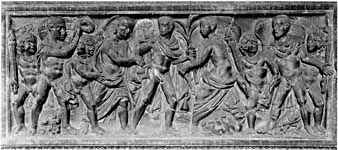
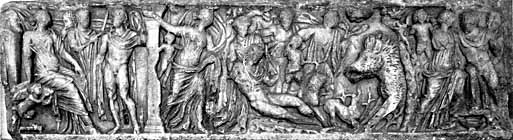
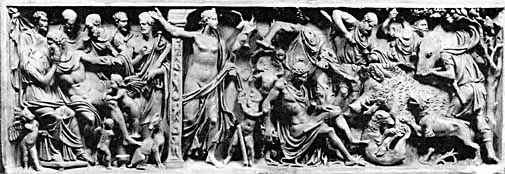
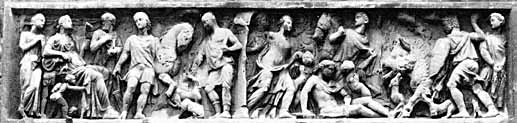
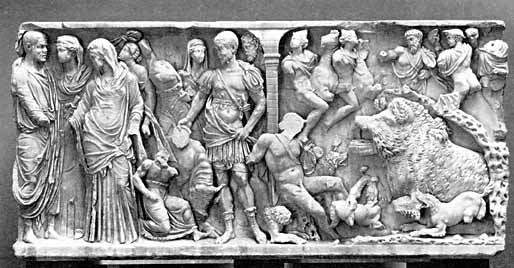
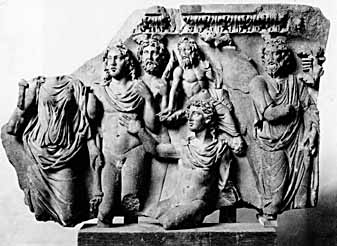
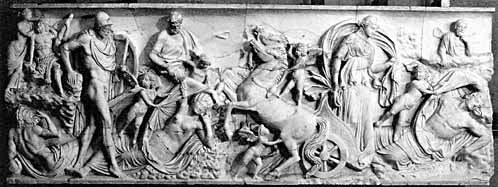
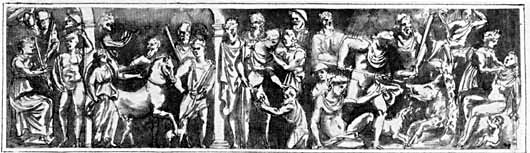
One of the oldest of the Adonis sarcophagi, a relief that may be dated circa 150–160, is now found at the Casino Rospigliosi in Rome (Fig. 4).19 On its front panel the story is told in the three scenes that comprised the standard repertory, and which follow each other across the sarcophagus’s front from right to left. In the first of these, at the far right, we see Adonis about to depart for the hunt despite Aphrodite’s warning. At the center, conspicuously larger, is the depiction of the boar hunt and the wounding of Adonis. At the left, finally, Adonis languishes at the point of death in the arms of his goddess, in the company of her attendants, who stand by helplessly.
The representation of each of these three events is designed so as to appear separated from the next. The two scenes at either end are designated as interiors by a parapetasma stretched behind the figures that distinguishes them from the landscape setting of the hunt scene between them.20 All three are framed as well by the poses of the figures, who focus their attention, and the beholder’s too, on the individuated incidents of the tale depicted side by side. This effectively provides a transition between scenes, as the shift from one to another is marked by a sudden reversal of the figures’ orientation.
Each of the scenes employed for the visualization of this tale was composed on the basis of established figural motifs.21 This origin of the imagery accounts for both the visual and iconographic differences that separate the three scenes. Thus, in the continuity of the frieze as a whole, each depicted moment of the tale exudes the formal character of an independent tableau. Each of the scenes is treated as if it were a unit self-contained, without a necessary relationship to the others, and this serves to explain the subtle changes in scale between them. And in this fashion each of the three scenes is imbued with a formal clarity that is essential for the evocation of the narrative’s symbolism and the establishment of its funerary significance.
The departure
In the first of the three scenes, the departure, the lovers confront one another face-to-face (Fig. 4). The distinction between the goddess and her mortal lover is inscribed, in both their poses and their statures. Aphrodite appears the taller of the two, and thus able to confront Adonis face-to-face, even though she sits while he stands. This subtle distinction in physical scale suggests the unequal relationship between goddess and man.
With similar gestures they debate the youth’s intentions. Yet the differences to be read in these gestures are additional signs of their impending separation, of the divergent nature of their passions. As Adonis turns back toward Aphrodite, he signals his departure with his outstretched hand; with hers, the goddess reaches out and enjoins him to stay.22
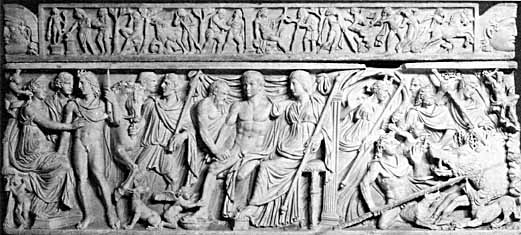
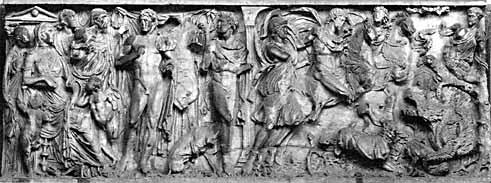
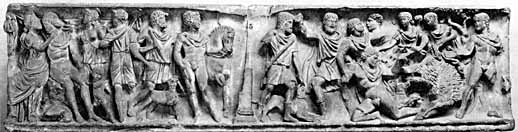
On several of the reliefs (Figs. 5–7) Adonis appears nude before the draped goddess23—a characteristic reserved on the Casino Rospigliosi sarcophagus (Fig. 4) for the two other scenes. For although it is Aphrodite who is so often found nude in ancient works of art, where her physical beauty serves as a fitting attribute for the goddess of love, here nudity characterizes her mortal lover. Here he is the object of desire and the figure of sexual allure, with whom Aphrodite has so hopelessly fallen in love.
Adonis’s nudity is another sign, perhaps the clearest, of the artificial, symbolic character of the scene. In the context of the myth, nudity is his proper costume, and in and around its conspicuous display are condensed the two conflicting aspects of the tale.24 On the one hand, this nudity stands for the erotic nature of their divinely gifted union. It symbolizes—indeed literalizes—the appeal of kalos Adonis, to whom the goddess is so passionately drawn. On the other hand, Adonis’s nudity is a sign of the innately heroic character of the mortal youth. As his nakedness distinguishes him from the other figures more properly attired for the hunt, it recalls Greek heroic forms and the ideals they represent and thus serves as a visual metaphor for his heroization.25
These relations of scale, of pose, and of nudity and dress are all forms of abstraction. They subtly divorce the actions and the motifs with which they are depicted from the specific narrative content of the myth. They are the stuff of art, not life; their usage undermines a response to the image that is confined to the categories of naturalistic representation, which such forms of abstraction so clearly contradict. These abstractions enlarge the image’s frame of reference, for they render the essence of the characters’ natures and interrelationships as general qualities. Such abstractions constitute a distinctive mode of visual representation, one that diminishes the roles of the protagonists as specific individuals and instead emphasizes their roles as types.26 And as the types emerge with greater clarity, the themes they are meant to evoke—heroism, eroticism, and above all, virtus—are manifest with corresponding force.
Thus these abstractions introduce to the images another modality, which itself conveys additional significance. These abstractions are not derived from the myth, in the sense that they serve as aspects of its representation. Rather, they are intended to suggest those fundamental traits and ideas that the tale and its protagonists are held to exemplify. These abstractions evoke—by association and by analogy—the grander scheme of significance in which the representation of the myth is meant to operate. By these means the designers of the reliefs have contrived to establish the visual composition according to the general structure of the plot, as opposed to the details of the story. “What happened” takes precedence over the specificity of “who did what, and to whom”; the general nature of events predominates over the specific actions of individual characters in particular tales.27
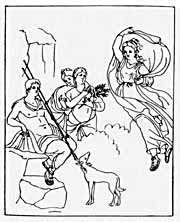
The emphasis on plot is confirmed by this formula of contrasting figures—female and male, seated and standing, dressed and nude—which duplicated the one established for the repertory of sarcophagus reliefs representing Hippolytus’s refusal of Phaedra, a scene that focuses on a similar clash of divergent passions. The appearance of Aphrodite, regally enthroned, depended on the role the same motif played in the representation of Phaedra, who sits, with an eros in the pose of Skopas’s famous Pothos at her knee, and declares her love for Hippolytus, who stands before her (Fig. 8).28 Both myths tell of “love-struck” heroines—helpless in the throes of a passion whose fulfillment is denied them—whose pleas to their lovers are ignored. This same theme underlies the use of identical imagery in representations of the two tales.29
Roman aesthetics was marked by an appreciation of such borrowings, and Roman art often exploited such duplications of form for the purpose of display. Characteristic is a conspicuous taste for paired statuary, for example, the paired statues of Mercury and Mars from the canopus of Hadrian’s Villa at Tivoli.30 There the same constitutive elements of a common pose, derived from a fifth-century prototype—torso, legs, and extended right arm—were exploited equally for images of the two deities.31 The intentio, given the context of their discovery, was clearly to establish a visible correspondence between the two, who are then distinguished by the prominent role given to their individual attributes. But in the case of the Aphrodite and Phaedra sarcophagus reliefs, the independence of the images from a joint context and the absence of individuating attributes suggest that the intentio of their visual similarity was to establish an intellectual correspondence—one of analogy. The basic elements of the two images—that complement of forms that constitute the motifs they share—thus were held to signal, not merely one story or the other, but the fundamental human relations exemplified in each scene and evoked by the figural types.32 This interchangeability intimates the designers’ cognizance of a parallel between both the protagonists and the plots of the two myths. Moreover, the implied analogy suggests that the crucial sense of the scenes transcended the details that distinguished the particular stories.
The boar hunt
The gestures of Aphrodite and Adonis in the first scene on the Casino Rospigliosi sarcophagus (Fig. 4) also suggest the temporal dimensions of the frieze as they quite literally point the way toward the adjacent depiction of Adonis’s subsequent fate. This is the boar hunt, which claims priority amid this representation of the cycle not only for its centrality but for the considerably larger portion of the relief it fills. The image conflates a sequence of moments and actions: the boar is shown attacking suddenly from its lair; Adonis has already fallen wounded, gored in the thigh; and his companions and their dogs attempt—too late—to fight off the beast. The damage has been done, but Adonis has not yet been vanquished. Although mortally wounded, the young hero is depicted rising up on his knees and raising an outstretched arm, as if to ward off the final assault of his foe, like many another ancient warrior summoning his remaining strength to make a “last-ditch stand.”33 Despite his imminent death, to which his passion for the hunt has led him, his virtus shines forth in his refusal to succumb willingly to his fate.34
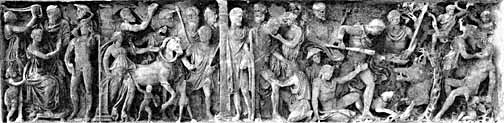
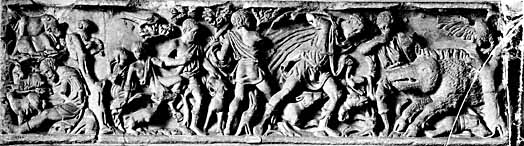
A group of six sarcophagi presents a variation of the hunt scene. On these reliefs Adonis lies slumped at the center, his apparently lifeless body supported by the arms of his companions, and Aphrodite makes a frantic appearance at the scene (Fig. 5; cf. Fig. 9).35 Her entrance offers the counterpart to the charge of the boar, and together goddess and beast frame the fallen figure of Adonis.
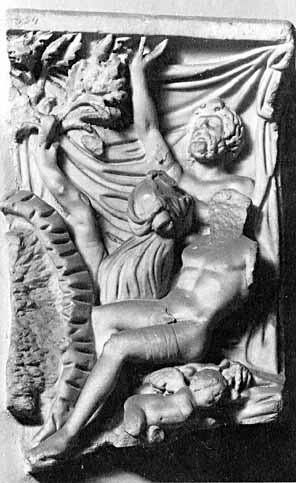
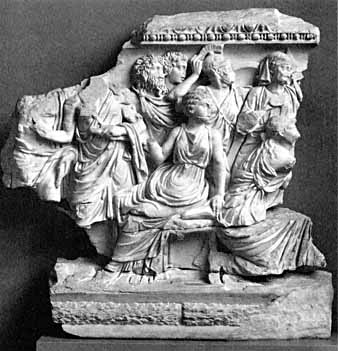
The arrival of Aphrodite at the side of her dying lover expands still further the temporal dimensions of this central scene. For Ovid tells how, having learned of Adonis’s tragedy, she hurried to his side and sprang from her swan-drawn car, in visible agony at the sight of the youth, “his lifeless body lying amid his own blood.”36 Her intrusion on these reliefs reclaims for their visual narratives an aspect of the tale that had been ignored. As the textual sources clearly indicate, Aphrodite’s arrival constitutes the first moment of a subsequent scene whose later moments may be represented on those sarcophagi where Aphrodite leans over the body of Adonis, taking him in her arms for the last time (Fig. 6).
Aphrodite makes no such appearance on sarcophagi of earlier date.37 Rather than allow her inclusion to alter the established scene, the artists have performed an ingenious substitution, one that may have been inspired by the similar appearance of the personified figure of Virtus on the Hippolytus sarcophagi.38 The onrushing figure of Aphrodite has seemingly inherited the position, the pose, and the gestures of one of the hunters who conventionally appear on the reliefs (cf. Fig. 4 with Figs. 5 and 9). The significance of his raised arm, poised to hurl his weapon, undergoes a form of inversion, and the gesture becomes a sign of her horror and an expression of her grief.39 The gesture—the raised arm with open palm—provided a pathosformula that served as the physiognomic signal of her anguished mental state.40
The dramatic figure of Aphrodite increases the pathos of the scene and reinforces the contrast between this immortal and her now-fallen lover. Her presence imbues the scene with the vivid contrast, central to the entire cycle of imagery, between her fate and that of Adonis. The anguish of the goddess at the death of the hero discloses that, despite her passion, her divine powers have failed to save him from the perils of his mortality.
Exemplum virtutis
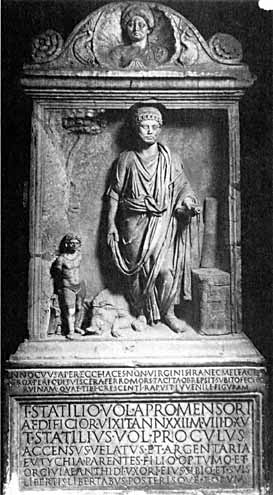
The focus of the hunt scene is the confrontation between man and beast. The idea of the hunt as a metaphor of battle had a long and venerable history.41 It was thought to provide “an excellent training in the art of war,” as Xenophon had claimed in the fourth century B.C. 42 In the same period that saw the rise of sculpted sarcophagi, the boar hunt became a staple of Imperial iconography, as it entered the Hadrianic triumphal repertory in the early second century.43 Not only did the boar hunt appear in the monumental roundels that now embellish the Arch of Constantine, but Hadrian also issued bronze medallions with very similar iconography.44 That the hunt continued to play this role in sepulchral symbolism is attested by the numerous sarcophagi which give prominence to similar images of the pursuit of other wild beasts, particularly the lion, as well as those representing the tales of boar hunters such as Adonis or Meleager.45 The hunt was not only the focus of the mythological repertories, for its familiar motifs were detached from their narrative contexts and allowed to stand in isolation. In this sense the dead boar could even serve as a punning metaphor of virtus on a private gravestone, to allude to the deceased as alter Meleager (Fig. 10).46
In all these instances the hunt served as an exemplum—as both a sign of virtus and a model for conduct.47 The consistent and conspicuous public display of these images suggests their function as paradeigmata.48 The power of such exempla lay in the ability of individual instances to demonstrate a general rule, and to accomplish this sufficiently well so that their intended public might be capable of recognizing the similarity.49 The mythological exempla illustrate ancient events, which, as they were continually held up for emulation, were continually appropriated to serve new purposes in ever new contexts. And whatever the context into which they were inserted, they imposed a new, specific, frame of reference=mas it were, from within. Thus these mythological exempla served as paradigms for the essentially mimetic character of human action. Only when envisioned in the light of the legendary exploits of heroes and gods can such human actions disclose their full significance and take their rightful place in the scale of human values vouchsafed by hallowed traditions.50
The use of exempla played a fundamental role in the rhetorical training of antiquity, especially in the “preliminary exercises,” or progymnasmata, which were the standard course studied by Roman youths beginning as early as the second century B.C. and continuing without interruption into late Roman times.51 Among these exercises the exemplary character of myth—and the persuasive power of exempla in general—held an important place, notably in the exercises known as fabella, narratio, chria, and sententia.52 Training in such a curriculum no doubt produced, in addition to a ready familiarity with the standard rhetorical formulae, a predisposition to think in terms of these formulae. One was trained not only to use exempla effectively but to recognize and respond to them when they were employed.53
The transfer of exemplary rhetoric from the verbal to the visual realm played an actual part in the curriculum. Ekphrasis—the rhetorical technique of description that purported to present visual images through the medium of words—appears among the progymnasmata by the first century a.d. 54 But descriptions of images, paintings in particular, had played a crucial role in earlier literary forms. The most notable is perhaps the Hellenistic romance, where the encounter with a painted image establishes the theme, if not the plot, that is about to unfold.55
The visual exempla on the mythological sarcophagi could equally lay claim to the persuasive power that proficiency in these exercises might eventually provide the would-be orators. For beyond a specific skill in ekphrasis and the techniques related to it, the orator’s transformation of the verbal to the visual lay at the heart of his enterprise. Among the greatest of the rhetorician’s skills was his ability to bring the things of which he was speaking seemingly before the eyes of his listeners, so that these images might be imprinted firmly on their memories.56 This was no less the concern of the designers of the sarcophagus images—and will be the subject of a later chapter.
Death in the arms of Aphrodite
The third scene on the Casino Rospigliosi sarcophagus represents Adonis’s death in the arms of Aphrodite (Fig. 4). Here the two protagonists are depicted on the same scale, and signs of affection replace those of separation. The couple sit, embracing, their bodies mirroring one another as they are joined to share a single contour. Here the goddess lovingly lays her hand upon the dying youth’s breast; on other reliefs she cradles his chin and caresses his cheek.57 There are a number of variants of this scene. Three of the reliefs lack the calculated symmetry of the end scenes displayed on the Casino Rospigliosi relief. On these sarcophagi the final moments of the drama appear to take place=mas well they should, according to the sources=moutdoors (cf. Figs. 6 and 11). These scenes, as was pointed out above, conform more closely to the narrative, particularly as it is recounted in Ovid's Metamorphoses.58 On several of the sarcophagi there are also indications of an attempt to tend Adonis's wounds, as on the example in Blera (Fig. 5), where a washbasin lies at the couple's feet. On some examples erotes take up the task (Fig. 9).60
All these images recall the plaintive spirit of Bion’s Lament for Adonis, in which the goddess pleads for a final kiss from the expiring youth. In each of these variants of the scene he dies in the arms of his divine paramour, who is helpless to wrest him from his fate.61 Thus the sarcophagus imagery for the myth dramatizes a series of apparent failures: Adonis’s refusal to heed counsel, his failure to kill the boar, and Aphrodite’s inability to save him from death. Yet Adonis remains an exemplum virtutis because he represents a challenge to the awesome powers of ineluctable Fate.62 Even the desires of the gods are subject to it, as the myth so plainly reveals. The valiant deed of the hero—his bold acceptance of the deadly challenge of the hunt—is sundered from its specific role in the mythological narrative, and stands as a sign of character.63 The exemplary nature of the imagery in its sepulchral context transforms this series of apparent failures into a vehicle of heroic symbolism. In offering a heroic image of death, the sarcophagi thus recast the vision of an individual’s life. For even Herakles died; everyone dies. These images acknowledge that in memory it is the quality of life—and death—that survives and is worthy of commemoration and remembrance.64
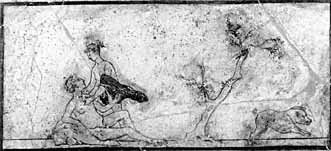
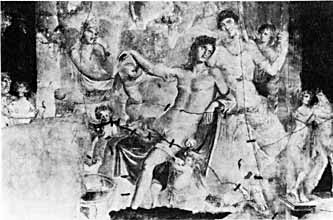
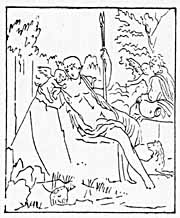
The appearance of the embracing couple constitutes the only reference on the sarcophagi to that great eros that bound together goddess and mortal. The image of the intertwined pair—despite differences in its setting, in its pose, and above all in its obvious role in the narrative—endows this particular scene with an emotional tenor not unlike that of Ovid’s description. The poet tells how Aphrodite entreated Adonis to lie with her, and how, “pillowing her head against his breast and mingling kisses with her words,” she tells him the tale of Hippomenes that concludes with her warning about the dangers of the hunt.65 The motif regularly employed by the sarcophagus designers for the final scene of his death in the goddess’s arms is strikingly reminiscent of scenes depicting the love of Aphrodite and Adonis in other works of ancient art. In the images displayed on vases, in frescoes, and in sculpture, the two lovers are often found wrapped in similar embraces, known as symplegmata.66 It was the formulaic quality of the motif that allowed Theocritus to assume his readers would recognize the scene, in Idyll XV, where he speaks of a tapestry depicting Aphrodite and Adonis as they recline together in luxuriant repose.67 A very similar scene could be employed for the depiction of Adonis’s final moments, as in a fresco from Pompeii (Fig. 13). Not only is Aphrodite discovered coupled with Adonis in such a pose, but this same generic type of intertwined figures was also the standard formula for the representation of all of her love affairs, and those of other goddesses as well.68 Thus as the final embrace of the two lovers depicts Adonis’s death and Aphrodite’s grief, it recalls—if only subtly—the imagery of the great love they once shared and have lost.
The sarcophagus designers clearly related this third and final scene of the cycle to the first of the sequence. On a number of the surviving Adonis sarcophagi, the first and third scenes are presented as pendants that frame the scene of the young hero’s demise.69 Both represent interior actions, indicated by the parapetasma stretched across the back of the relief ground (Fig. 4); each depicts one or both of the protagonists seated and on a larger scale than in the scene of the boar hunt. This “invention” of a new setting for the final scene may be regarded as one more example of the Roman taste for the display of pendants since, as has already been observed, the literary sources for the final scene of Adonis’s death call for it to occur in the grove where he was wounded by the boar. The formal role of the parapetasma is revealed most clearly on a fragment, now in the Vatican, where it appears stretched behind not only the figures but the tree that specifies their outdoor setting (Fig. 11).70
This visual complementarity of first and final scenes evoked a corresponding complementarity of sense and served to reiterate the significance of the departure scene. Each of these scenes suggests the inescapability of Adonis’s fate. Just as Aphrodite was unable to prevent Adonis’s departure for the hunt, so too she was helpless to prevent his “departure” from life. Only with the second of these scenes is the significance of the first fulfilled, as the expectations evoked by its imagery are realized. The artists’ “invented” composition for the final scene imposed certain details on the story and sacrificed others to signal the analogy, which reveals the correspondence of both scenes as types of departure.71 As in the case of the departure scene, here too the imagery evokes the tragic reality that even heroes die: to be loved by the gods is not enough to save them.
Beginning at the end
The recognized correspondence between the two scenes that open and close the tale—correspondence in sense as well as in form—explains the use of one or the other on the three surviving reliefs that depict only two of the three scenes of the cycle.72 The visual repertory for the myth could be reduced yet remain effective because, despite depicting different narrative moments, these two scenes display the same typological character, share the same symbolic function, and represent the same idea—and therefore proved interchangeable.
Yet the elimination from the cycle of one scene or the other had a marked effect on the myth’s representation and on that representation’s significance. The final scene might be omitted, as on the sarcophagus at the Villa Giustiniani, for example (Fig. 14), with a resulting emphasis on the two remaining images of Adonis’s failures: to heed the goddess’s warning and to kill the wild boar.73 The departure scene is given new prominence by the intrusion of foreign elements: Adonis is shown dressed and about to leave, leading a horse. The scene is nearly identical to those representing Hippolytus’s departure from Phaedra (Fig. 8), which the Aphrodite and Adonis designers borrowed from the Phaedra repertory—just as they borrowed the enthronement motif with which this one was originally conjoined. Yet while Hippolytus hunted on horseback, Adonis—like Meleager—hunted the boar on foot and thus exemplified the brave hunter who stands alone in the face of danger.
Unlike the reuse of the enthronement motif, in which the specifics of the mythological narrative were abandoned in favor of the larger general significance of the image, in this instance the exchange of motifs gave prominence to details that undermined the grander sense of the scene. Once clothed (Fig. 14), the figure of Adonis forfeits the heroic connotations of nudity, as well as its erotic appeal. Deprived of this form of idealization and the schematic series of contrasts it established on other reliefs (cf. Figs. 5–7), this representation of the Adonis myth verges on the anecdotal. This “borrowing” should be regarded, not as another exercise in typology, marked by its characteristic quality of synthesis, but as an instance of contamination—one bred by a failure to comprehend the more profound connections between the two myths that had been established on other sarcophagi.74
The omission of the departure scene had a rather different effect, as can be seen on the sarcophagus in Mantua (Fig. 9). The two remaining scenes are divided by a pilaster, which marks the temporal shift and the change in setting from one to the next. The boar hunt here takes precedence, as it is expanded to fill almost two-thirds of the frieze.
The nearly centralized figure of Aphrodite, who rushes frantically to the side of her fallen lover, is the most prominent of many that crowd the relief. Amid the welter of forms she is distinguished by her naked torso and by her expansive gesture, which, as it crosses in front of the pilaster, seems to thrust itself beyond the boundaries of relief and enter real space. She is set apart by the reflective quality of her torso’s smooth, polished surface, which contrasts decidedly with the busy interplay of light and shadow that characterizes the relief as a whole. The monumental quality of her upright form, which fills the relief from top to bottom, is further emphasized by its contrast with the pilaster, dwarfed alongside her. She visually dominates the frieze, and it is to her form that the viewer’s eye is immediately drawn and his attention directed.
Thus the figure of Aphrodite, as it engages the beholder, effects an “entrance” to the story at its very center—with respect to the temporality of the narrative as well as the composition of the frieze. The goddess arrives dramatically, but too late to save Adonis—as the earlier moment of the disastrous hunt, with which her approach is coupled, makes clear. As the viewer scans across the frieze toward the right end, his eye led by the depicted movement of the central group of figures, he follows the story’s unfolding, yet he seems to move backward in narrative time.
The retrospective character of the right-hand portion of the relief is recapitulated by the frieze as a whole. With this sarcophagus as with others the viewer’s initial grasp of the relief as an integral form is supplanted by the perception of the multi-scened frieze’s distinct elements. Perception oscillates between the poles of whole and part: the synoptic view of the whole, dominated by its compositional pattern of forms, dissipates with the recognition of the subjects represented and the individuation of distinct scenes. As the narrative movement of each scene’s figures merges into the overall compositional pattern, focus on the segments gives way to the perception of a single totality.75
Cognizance of this phenomenon of perception in antiquity is implicit in a celebrated passage of Flavius Josephus. In his account of the triumphal procession upon the return to Rome, Josephus describes the huge painted banners, called pegmata, that depicted scenes of the war and “portrayed the incidents to those who had not witnessed them as though they were happening before their eyes.”76 Yet the description of the depicted subjects that follows offers merely a sequence of topoi, recounted without any sense of chronology. The integrity of the individual pegmata vanishes as Josephus recites their contents, displayed in a series of thematically related fragments, which the reader—like the beholder of the triumph—must reassemble into a coherent vision of the war.77
The artists responsible for the Mantua sarcophagus clearly exploited this interplay between synoptic vision and discriminating focus. The initial view of the whole is disrupted by the prominence of Aphrodite, whose figure commands attention. Nevertheless, the general movement of the figures in the frieze draws one’s vision away toward the right end. This movement underscores the natural impulse to read the linear progression of the entire narrative, following the model of writing, from left to right. As the beholder begins to scrutinize the imagery and ponder its significance, his scansion of the entire panel begins invariably at the left end, and therefore the first scene confronted as he surveys the frieze represents the end of the story. The contemplation of the imagery thus expands, with respect to form and to content, simultaneously forward and backward, as well as spatially and temporally. For on the Mantua sarcophagus—just as on the majority of the early Adonis reliefs—while the experience of the imagery moves from left to right, the temporal sequence of the mythological narration is displayed in the opposite direction, from right to left.78
In their narrative solutions, the sarcophagus designers demonstrated great ability and willingness to take advantage of this phenomenon of scansion, so fundamental to visual narration, which was inherent in the pictorial organization of the sculptures’ form. One of the most complex of these solutions may be discerned on a relief now in the Vatican (Fig. 15).79 This sarcophagus displays in a different form the contamination of the Aphrodite and Adonis repertory by that of the Phaedra and Hippolytus sarcophagi.80 On the right is the familiar boar hunt; on the left, however, the imagery seems to have become confused. Once again the borrowed horseman motif appears; but instead of extending the departure scene as it had on the Giustiniani sarcophagus (Fig. 14), here it is appended to the motif of embracing lovers—customarily the final scene of the cycle.
While the integrity of the hunt scene is rendered with great clarity, there are no formal divisions between the two elements that make up the left-hand side of the frieze. The figure who stands at their juncture actually seems designed to link them. He turns with his head toward one, and with his outstretched arm he gestures toward the other, instigating a sequence of implied movements that intimate a continuity of these elements with the scene of the hunt at the right side of the frieze. In this conflation of scenes, Adonis, identifiable by his nudity, appears twice. This double presence, as it indicates the continuity of the narrative, represents the first two of three distinct moments depicted on the relief: Adonis, first in the arms of Aphrodite, then leading his horse toward the hunt, and finally (at the other side of the frieze) wounded by the boar. Thus the Vatican sarcophagus, despite its formal similarity to the Giustiniani example, is actually another variant of the more customary three-scene reliefs.
The very placement on the Vatican sarcophagus of the couple’s final embrace imbued it with a certain ambiguity. The motif that had conventionally served to depict the wound tending is thus stripped of both its poignancy and intimacy as its sense is undermined.81 Its visual conjunction with the departure motif, and the repeated appearance of Adonis that results, produce a false sense of the temporal relation between the two conflated scenes. The scene that is chronologically first seems to follow visually from that which is chronologically third. Installed as on the Mantua sarcophagus (Fig. 9) at the left end of the frieze, where scansion of the visual narrative begins, the Vatican sarcophagus’s scene of final embrace thus constituted both the beginning and the end of the tale: the beginning, as one confronts the narration on this monument; the end, as one recognizes the subject that is narrated (Fig. 15).
This conception of the myth’s narration on these sarcophagus reliefs—since it appears on more than one example—is unlikely to have been the result of a mistake on the part of the workshops that produced them. In the conflation of different scenes, just as in the transfer of motifs from other mythological subjects, one should recognize the artists’ awareness that both the departure and the final embrace had ultimately the same significance for the sepulchral interpretation of the myth. In both scenes, Adonis is about to depart from the goddess who loves him, despite her desire to prevent their separation, a desire made palpable on the reliefs by the erotic overtones of the symplegma motif. Such are the limits of even divine love; such is the extent and the power of Fate.82
That the visualization of the story on the sarcophagi might begin at the end is not in itself surprising. The rhetorical device may be as old as storytelling itself.83 More specifically, the artists were free to reorder the progression of scenes on the reliefs because the Adonis myth, like most moralizing tales, was understood retrospectively, with its conclusion already established. Indeed, the images’ moral significance and exemplary value depend on this, and it is the reason that such familiar myths—and moral tales in general—are invoked again and again.84 This conception of the myth’s character helps to explain the right-to-left order of the scenes on those sarcophagi where the narrative cycle begins at the point of the frieze that for the viewer is ordinarily the end. The awkwardness of this entirely conceptual order, at odds with the demands of the conventional sequence of the visual narrative, was understandably jettisoned and the scenes on the sarcophagus reliefs displayed in chronological order from left to right. Yet its reappearance on the Vatican sarcophagus suggests the value of such a disruption of custom as a device to prompt renewed attention to the myth’s significance. As the rearranged scenes are read from left to right, their distinctive temporal disjunction compels a new consideration of the narrative—and of the way that narrative has been represented. The final scene becomes not merely the starting point for the tale that is recalled by these images, but the vantage point from which the myth they relate is to be understood.85
The force of analogy
The visual composition for the three scenes of the cycle established an analogy between its beginning and end. This thematic reiteration, in even this abbreviated redaction of the myth, recalls the use of repetition to bracket episodes in epic compositions.86 The epitomization of the tale is fulfilled by this implication of closure, which endows these extracts from the myth with a sense of unity and completeness.
Yet the same visual means that allowed the artists to effect this sense of closure also served to expand the connotations of the myth’s imagery. With the transposition of compositional motifs from the depiction of one myth to that of another, the artists gave greater emphasis to those elemental plots that were shared by more than one tale. In this fashion the artists established visual analogies among different myths based on their narratives’ related plot structures, rather than on their individual stories’ details. Generalized motifs such as the symplegma, familiar from a host of representations of related themes, provided the sarcophagus designers with visual forms that had both their own established significance and connotations extending beyond the story lines of the tale they were enlisted to depict.
These are the basic strategies by which the sarcophagus designers effected the grand analogies that formed the raison d’être of so much funerary symbolism. And it was by these means that the artists freed themselves from the bondage of the codified visual programs for their myths and allowed their powers of invention free rein. These strategies permitted the artists not only to alter the way a myth was depicted, but to recompose the tale to reflect its insertion in a sepulchral context. As the images themselves suggested associations between tales, they provided the structural guidelines for their interpretation. In these pictorial renditions of myth one must recognize works of art unburdened of a subservience to texts so that they might produce original and profound effects of their own. Those who viewed these images were intended not merely to recognize the myth but to grasp that the sculpted figures and their actions exemplified certain ideas and values that are the true subjects of the sepulchral symbolism: these are tales told with concepts as well as with characters. The three scenes of the Aphrodite and Adonis repertory collectively render a story of heroic virtus, the amor of the gods, and the conquest of both by the power of Fate. The reliefs must be conceived as the manifestation of these themes. The real significance of their epitomizing form of narration is revealed only if their stories are considered as the vehicles, rather than as the content, of the sepulchral message.
Adonis Redivivus
The Adonis myth, as it is represented on the sarcophagi, is marked by the deliberate omission of certain elements of the familiar narrative. These omissions must be regarded as a consequence of the myth’s visualization, its insertion within the sepulchral context, and the subsequent emphasis of the visual imagery on the concept of heroic death. In particular, Adonis’s botanical metamorphosis, and the symbolic rebirth in the Adonaia that was to complement it, are nowhere represented on the marble reliefs. Yet resonances of these elements of the myth, undeniably pertinent to a sepulchral context, at times emerged amid the imagery displayed on the sarcophagi.
There are two variants amid this group of surviving sarcophagus reliefs that reflect, albeit dimly, the ritual function and purpose of the Adonaia. This ceremony was enacted in the belief that it would bring about Adonis’s resurrection, if only momentarily and only in the fervent imaginations of those participating in the cult ritual. Both variant images dramatically alter the standardized representation of the mythological narrative. They change the order of the depicted scenes, and they deprive the representation of the boar hunt of its customary priority in scale and position at the center of the tripartite reliefs. Most significantly, they introduce foreign elements to effect startling analogies that wholly transform the sense of the tale and predict a very different culmination of the mythological drama. These variations on the conventional imagery of the Aphrodite and Adonis myth no longer merely celebrate the life of the deceased retrospectively, by means of mythic analogy. Rather, the unique versions of the story they present offer, in addition, a prospective vision that augments the mythological analogy and evokes, along with a further episode of the tale, a new fate for its protagonist.1
Apotheosis
On a large early-third-century sarcophagus now in the Vatican (Fig. 7), are found all three of the usual scenes of the Adonis repertory: the departure, the boar hunt, and the final embrace.2 The three do not appear in chronological order. The first and second scenes of the cycle, which resemble those on the Blera sarcophagus (Fig. 5), are placed at either end of the panel. The scenes have been compressed into smaller, tightly compacted versions of the familiar compositions. On the left, amid the calm and stable forms of the departure scene, the gestures of the two protagonists now fuse them together. The poignancy of the lovers’ farewell is evoked as Aphrodite presses her hand to Adonis’s chest and he rests his hand upon her knee. At the right, in contrast, their tragic passion is figured in the composition’s swirling of forms and its clash of diagonals. Adonis is shown falling before the charge of the wild boar, and Aphrodite rushes, horror-stricken, onto the scene, led by an eros, her mantle billowing, her scepter in hand.
Instead of the customary failing Adonis, slumped and supported by Aphrodite, the Vatican sarcophagus substitutes the pair of lovers enthroned, their arms draped about one another. Yet the erotic overtones of the symplegma motif evoked by other versions of the cycle’s final scene have vanished. Here the injured Adonis is being “tended” by an older, bearded physician, clearly smaller in scale. While he dresses the youth’s wound, an eros washes his feet, which are raised from the ground. But there is no sign of Adonis’s languishing at the threshold of death: he sits erect, awake, the equal partner of Aphrodite.3
The standard formula for the scene of the final embrace has been strikingly transformed. This is unmistakably a wound tending, and it has been given new priority among the three moments of the drama by its central placement. More importantly, its composition has been thoroughly reconceived. The seated couple are framed architecturally and distinguished by a parapetasma that delineates the scene at the rear; they are larger in scale than in the adjacent scenes; and unlike the images of the mythological protagonists in the scenes to each side, they bear portraits, without doubt those of the couple interred within the casket’s marble walls. These portraits introduce to this scene a new level of reality, one that distinguishes it from the two scenes that frame it.4 The image of the hunt, with its evocation of heroic virtus, no longer dominates the relief; here, the healing of the young suffering hero, and the relationship of the couple portrayed at the center of the panel, have become the focus of attention and thus the key to the meaning of the new composition.
The visual type is known from other monuments, and its basic elements are recognizable. The figures are enthroned, their feet elevated from the ground, mortal and divinity thereby represented as equals.5 The sarcophagus designers have effected the novel composition on the Vatican relief by the appropriation of this recognizable model, and with it they have recast the image—and the sense—of Adonis dying in the arms of Aphrodite. The enthroned couple conform to that special imagery invented by Roman art that demonstrated visually the ruler’s all-encompassing power as equal to that of the gods. For this same motif provided the foundation for the symbolic depiction of the emperor’s divinization. More importantly, this imagery was intended to be seen as the harbinger of that triumphant apotheosis by means of which the emperor, like so many of the characters of myth, would become one of the gods—and thus triumph over death. To be enthroned not only served to indicate superior status and authority (since one was seated while others stood); it also provided an analogy to the customary representations of the gods, notably the image of Jupiter enthroned as world ruler.6 To grasp the allusion, one need only compare this image with that miniature masterpiece of Roman artistic propaganda which manifested the connection between triumph in life and in the hereafter, the Gemma Augustea (Fig. 16).7 There too, at the center of its complex scene, a goddess and mortal sit side by side, sharing a throne, while Augustus receives the corona civica, the emblem of military valor that doubles in this instance as the garland signifying his apotheosis.8 This visual formula of the enthroned couple as an image of divinization and apotheosis was often repeated—indeed, it became a visual topos. The motif outlived its pagan context and was adapted in Christian art for representations of the crowned Virgin enthroned at the side of Christ in Heaven.9
The congruity between these two images (Figs. 7 and 16), one public and one private, testifies to the ability of Roman artists to translate established compositions and their significance to new formats and contexts. By these means they conceived new images familiar in form and resonant with the content of the most highly trenchant works of official iconography. In this instance, the representational formula for the mythologization of the emperor is “borrowed,” not only to provoke the conscious equation of this hero of myth and the hero of state, but to serve as a visual metaphor that functions here as the signal of Adonis’s new fate.10 The visual implication of the hero’s apotheosis is testimony to the power of the gods to revive the dead and to render them immortal.11 In the presence of the bearded “physician,” the eros who on other reliefs bandaged Adonis’s wounded thigh here washes his feet. This is not the ritual washing of the corpse in preparation for its interment, but, as the reformulation of the scene suggests, the cleansing of his revivified body for its presence among the gods.12
Although the official ideology of the divine princeps may have motivated the visual form adopted on the Vatican sarcophagus, in the mythological context the form had additional connotations, hallowed by much older traditions. While Adonis’s revival was not part of the main Roman version of the myth—Ovid’s—it had a definite place in the fable’s Greek heritage, and nothing could be better suited to the telling of the tale in this sepulchral setting.13 Thus this particular sarcophagus image tells the tale of Aphrodite’s powers, if not to forestall Fate, at least to have the final say in the drama.
Heroic suffering
In the poignancy of his suffering, the nature of his wound, and—in this particular version—the image of his succor with its implications of revival, Adonis’s plight is paralleled by that of other ancient heroes.
On an ivory plaquette found at Pompeii (Fig. 17), there is an image strikingly similar to the scene on the Vatican sarcophagus (Fig. 7).14 This work also depicts a physician who tends a figure wounded in the thigh; yet here Aphrodite stands at the left and gestures imploringly, while an attendant behind the hero steadies him. It has long been thought that this plaquette was a representation of the wounded Adonis,15 yet Adonis was not the only ancient hero thus wounded. Aeneas, the beloved son of Aphrodite, was also wounded in the thigh, but it was his great fortune to then be saved from death by the goddess. The correspondence between these tales and their depictions was not lost on the ancient artists, as we shall see.
In Book V of the Iliad, Homer tells how, when Aeneas’s thigh had been crushed by the mighty Diomedes, Aphrodite, his mother, swooped down into the fray to rescue him.16 Vergil was to reuse the theme and recall the scene in Book XII of the Aeneid. When an arrow launched “by an unknown hand” wounds Aeneas in the thigh, the old physician Japis labors, unsuccessfully, to revive him:
Aeneas stood propped on his huge spear, raging bitterly, amid a great throng of warriors and grieving Iulus, unmoved by their tears. The old physician, his cloak pulled back, and girt in the Paeonian manner, with healing hand and the potent herbs of Apollo, acts hurriedly, with great agitation, to no avail.…No Fortune guides his way, nor does his mentor Apollo offer aid…Now Venus, his mother, struck by her son’s undeserved pain, seizes from Cretan Ida some dittany, a stalk luxuriant with downy leaves and purple flower.…This Venus brought down, her face enveloped in shadowy cloud; this, with secret science, she dips in water poured into a shining vessel, and sprinkles with beneficial juices and fragrant panacea. With that liquid, ancient Japis caressed the wound, unknowingly, and suddenly, all pain fled from the body, all blood ceased to flow from the wound. And now the arrow, following his hand, unforced, fell out, and new strength returned, as before. “Quick, summon arms for the man! Why stand still?” cries Japis…“This arises not from mortal means, not by the master’s art, nor are you, Aeneas, saved by my hand; a greater one—a god—acts, and sends you back to greater deeds.”17
Save that the hero does not stand but sits, the ivory plaquette’s composition echoes the scene described by Vergil; it was not the only work of art to do so (cf. Fig. 27).The image on the plaquette’s reverse strongly suggests this identification of the scene, for other ivory plaquettes of this kind are known, and in all cases the mythological imagery on their two sides appears to be related.18 On the reverse is a scene (Fig. 18) derived from the Romans’ visual repertory for Homeric epic, where it represented Priam’s return with the body of Hector after its ransom from Achilles (Fig. 19).19
The basic type of the dead hero’s body borne by his comrades was well known and widely employed, not only for the representation of this Homeric scene but for the representation of a whole series of dead heroes, and thus has a long history.20 It has been pointed out that this scene, with the two warriors who carry Hector’s body, does not actually correspond to Homer’s narrative, for Priam conveyed the body back to Troy on a mule-drawn cart.21 It would seem that an older type was adapted for the representation of the Hector scene, and the figure of Priam was appended to it, an interpretation substantiated by the early uses of the visual formula in Greek art and the lack of known early depictions of the Hector tale that include the figure of Priam.22
The association on the ivory plaquette of Aeneas with Hector—another ancient hero renowned for his suffering, although in this case it was suffering endured after death—provided a double image of the hero as both exemplum virtutis and exemplum doloris: one rescued from death, the other from desecration. This kind of pairing is not unknown in the art of antiquity.23 In fact this same scene of the ransom of Hector is found yoked with a scene from the life of another famous hero eventually delivered from his suffering: Philoctetes (Fig. 20).24 This Greek hero, who had numbered among the Argonauts, had set sail with seven ships for Troy. On route he had been bitten about the foot by a snake, and both his cries amid the agony of his suffering and the stench of his suppurating wound led his companions to abandon him on the island of Lemnos. Yet because the oracles had foreseen that victory could not be achieved without the bow of Herakles—which Philoctetes had inherited—destiny forced them to return to acquire it.25
The tending of Philoctetes’ wounds was a standard scene of that myth’s visual repertory and appears on a variety of ancient works of art: Etruscan cinerary urns (Fig. 21) and mirrors, an ornate silver cup of the Augustan period (Fig. 22) as well as its reproductions in Arretine ware, and two surviving Roman sarcophagi (Figs. 20, 23).26 The tragic image of the hero, suffering in isolation yet destined to recover, served as a potent symbol of hope in the face of an unfathomable existence after death. The myth no doubt served as well as an elegant reminder of the merit of stoic ideals and the virtue inherent in the ability to rise above the sufferings of this life for the sake of higher values.27 While the allusion to stoic ideals had special significance in a sepulchral context, the intimation of suffering transcended had the merit of presenting the deceased to his heirs and descendants as an exemplum for the endurance of their sorrows.
That a special relationship bound together the tales of these two heroes—Philoctetes and Hector—is demonstrably acknowledged again on the two famous silver cups from Hoby, one of which displays the ransom of Hector (Fig. 24) as a pendant to the wound tending of Philoctetes (Fig. 22). The typological affinity between the sufferings of Aeneas and Hector suggested by the Naples ivory plaquette corresponds exactly with the analogy between Hector and Philoctetes established on these miniature silver masterworks, as well as on the Basel sarcophagus (Fig. 20).
The intermingling of iconographic traditions
All three of these ancient heroes—Aeneas, Hector, and Philoctetes—were related as exempla. Their parallel stories offered models for the revision of the Adonis tale told by the Vatican sarcophagus. If the emperor could provide the analogy of apotheosis, these other myths could provide analogies of suffering overcome and death conquered. The reversal of Adonis’s fate, as he is healed under the auspices of Aphrodite, corresponds to, and appears to derive from, the type established by the other three mythological figures, all rescued from their agony, their wounds healed.
The correspondence between these stories runs deeper still. In Aphrodite’s rescue of Adonis there may be seen, if only metaphorically, a parallel to the element of deception that marks the other two tales. For just as Odysseus’s ruse and theft of Philoctetes’ bow are essential to the suffering hero’s return to health, and just as Priam’s stealth allows him to convey Hector’s body safely from the Greek camp under the cover of darkness—so Aphrodite here intervenes so that Adonis’s life might be “stolen back” from Fate.
What is evident at the level of plot is also signaled visually at the level of form in the motif—the seated hero whose wounds are tended—that two of these other myths share with the rendition of Adonis’s tale on the Vatican sarcophagus (Fig. 7). There can be little doubt that the Philoctetes myth takes precedence in the visual tradition: not only does a larger repertory of imagery survive, but it was Philoctetes—and Philoctetes alone—who was explicitly described in the ancient sources as a seated figure.28 Thus the visual form of the seated figure of Adonis on the Vatican sarcophagus, like the seated figure of Aeneas on the Naples plaquette, would seem to have evolved from a compositional type devised originally for the Philoctetes repertory. And in the visual resemblances that associate these various myths is to be seen evidence of that subtle form of typological allusion that broadened the significance of images.
The intermingling of the iconographic tradition of the Adonis tale with that of Aeneas, Hector, and Philoctetes is one more facet of the evolution of the Adonis imagery and the enrichment of the myth as it was adapted to the sepulchral context. For in the realm of mythological allusion, the details that distinguished the exemplary suffering of one hero from that of another might matter little; that Adonis might be conceived as yet another of these heroes suggests the full dimensions of his tragic story. Like the suffering of Aeneas, Philoctetes, and Hector, Adonis’s would be overcome. The Vatican sarcophagus, with its focus on the wounded youth’s suffering and cure, thus elaborates further the list of heroic qualities its imagery bequeathed to the deceased interred within it. Adonis’s pain has passed, but in his upright posture and calm demeanor can be seen the nobility with which that suffering was borne—and thus it served here as yet another sign of distinguished character. This sarcophagus relief declares that in the end, with the revival of the wounded Adonis, Aphrodite’s desire would prevail and, by implication, the unbroken continuity of their mutual love.29
Revived by Aphrodite
Like the pairing of Aeneas with Hector and Hector with Philoctetes, the implicit typological relationship between the wounded Adonis and the wounded Aeneas did not escape the artists of the ancient world. The interpretation of the Vatican sarcophagus and the implications of its imagery are confirmed by another ancient relief now immured high on the facade of the Casino Rospigliosi in Rome (Fig. 6).30 Here the goddess Aphrodite’s heroic powers to heal her beloved emerge even more clearly because of the explicit evocation of a mythological parallel to Adonis’s fate.
This sarcophagus is the most unusual of the entire corpus. Its main relief relates the tale with five distinct scenes rather than the customary three. At the far left is the same leave taking seen on other reliefs, shown here with slight changes in the arrangement of the figures and a reduction in the scale of the goddess. A pilaster separates this scene from the next, the departure for the hunt. This hunt scene is the most elaborate of all those on the Adonis sarcophagi. Once again the horsemen borrowed from the Hippolytus imagery make an appearance, but here for the first time the figures of both Adonis and Aphrodite are repeated as the episode is given the status of an independent scene. The unusual incident at the center depicts a group gathered about what appears to be the standing figure of Adonis, while an old man kneels and tends his wounded leg and a female supports his head and seems to caress his cheek or chin. Next follows the familiar boar hunt, and finally a version of the customary wound-tending scene.
The curious episode at the center (Fig. 25) not only violates the temporal progression of scenes from left to right but has no place in the story, and nothing resembling it is to be found in the mythological sources of the Adonis tale. The scene was recognized and identified by Robert, who, in his discussion of the sarcophagus, noted its similarity to a fresco fragment from Pompeii, now in the Museo Nazionale in Naples (Fig. 26).31 Yet Robert did not pursue the question of its role here as the central image amid the visual narrative of the Adonis tale—the question to which we now turn.
Like the Naples ivory plaquette (Fig. 17), the Pompeian fresco fragment represents the tending of Aeneas’s wound, yet this work is a near-exact illustration of the scene from Aeneid XII.32 On the sarcophagus, the composition is reversed, some of the figures are eliminated, and those remaining are altered slightly as they are adapted to suit the new story they are enlisted to tell. The young Iulus has disappeared, his place taken by Venus, who is shown arriving at the scene in the fresco.
Despite the similarities between the two myths—both heroes wounded in the thigh, both loved by Venus—the scene has no place in the Adonis tale. It has been borrowed from the imagery of the Aeneas narrative and inserted into that of Adonis, at its very center, with almost total disregard for the story’s integrity and comprehensibility, in order to effect an analogy. Just as Aeneas was revived by the healing art of Venus, so too will Adonis survive the wound inflicted upon him.33 And given the context in which this analogy is brought about, the reason and motivation for this mythological invention are readily apparent: the sarcophagus image declares that the deceased who lies buried within shall be revived.
The success of this analogy is conditional upon the spectator’s recognizing this episode of the Aeneas legend and grasping its significance in this context. A well-established literary use of mythological exempla, particularly in the works of the great first-century poets, provided a solid foundation for the employment of such an analogical strategy in the visual arts.34 The tradition of programmatic display of mythological ensembles in ancient wall painting demonstrates the familiarity of Roman beholders with such a meaningful juxtaposition of different mythological images.35
Because the interpolated scene had to be comprehensible, it could only be one taken from a tale that would be known to all who would see it. More importantly, it had to be visually familiar, either a scene whose representation had been codified in pictorial form and consistently depicted or one that corresponded precisely to a well-known literary source. The scene from the fresco reused on the sarcophagus, as the comparison with Vergil’s text has shown, is one of the few examples of Roman wall painting that fulfills these criteria and truly functions as an “illustration.”36 Taken from the great epic of Roman literature, its subject was surely far from recondite.
The episode from Aeneid XII, however, does not appear among the scenes on the small group of surviving Aeneas sarcophagi, nor is it among those late-antique manuscript illustrations of Vergil’s poem that have come down to us.37 In addition to the Naples plaquette, the scene of the healing of Aeneas survives only on gems or their glass-paste imitations (Fig. 27).38 That this particular scene was singled out for representation on such small portable works suggests that these gems, like other talismans, were thought to possess apotropaic power.39 Thus the function of the gem’s image in its context may be considered similar to that of the image on the Adonis sarcophagus. In both instances the episode is extracted from Aeneas’s tale, appropriated as a symbolic denial of the omnipotence of Fate, and personalized by the bearer of the image—he who wore the carved gem, or he who was buried within the sarcophagus—in an implicit analogy between the ancient hero’s fate and his own.
Thus this sarcophagus (Fig. 6), like the Vatican relief (Fig. 7), provides a contrast to the examples cited in Chapter 2, where the imagery of the Adonis sarcophagi focused on the virtus of the hunter and the inescapability of Fate. In this instance the imagery was intended to compel a reappraisal of Adonis’s fate in light of Aeneas’s and, by analogy, a reappraisal of the fate of the deceased. The imagery asserts that all three—Aeneas, Adonis, and the deceased—are to be spared from the finality of death by Aphrodite’s love. Thus the myth was reinterpreted, and its precise significance in the sepulchral context inverted, in order to convey the idea that for this man—this Adonis—as for Aeneas, being loved by the gods was enough.
Endymion’s Tale
The elaborate tale of Aphrodite and Adonis was recounted by a great wealth of textual sources upon which the sarcophagus designers could draw as they forged their visual renditions. Yet for Endymion’s tale they could find scarcely more than the bare remnants of a myth with which to work. For the myth appears to have survived through the centuries in only fragmentary form, and the scanty evidence that remains suggests that even in antiquity the tale of Selene and Endymion may have been the sparest of narratives. What has survived is a series of literary fragments, the oldest dating from the eighth century B.C., that indicate the early existence of at least two stories, subsequently conflated.1
First-century scholia suggest two Greek traditions of the myth.2 The older, Western, tradition, which has its origins in Hesiod, makes no mention of the love of the goddess and the shepherd. Hesiod tells of Endymion’s receiving as a gift from Zeus the ability to choose the form of his own death. A reference to the youth as the son of Aethlius sets the tale in Elis.3 In another fragment Hesiod relates a strange tale of Endymion’s transport to the heavens, his attempted seduction of Hera, and his subsequent banishment to Hades. Neither of these disiecta membra—the second of which disappears from the textual tradition altogether4—is reflected in the representations of the myth found on sarcophagi.
An Eastern tradition, whose early appearance is represented by the work of Sappho, recounts the tale of Selene and Endymion’s love that eventually found visual expression on the funerary reliefs.5 This tradition provided a story of the love of a goddess for a mortal youth that, like Adonis’s tale, had its origins in Asia Minor.
These two traditions generally correspond to a distinction found amid the extant literary material. The Eastern, Sapphic, tradition retained a fragmentary character, which was transmitted by a series of brief texts concerning the beloved of the goddess and his fate.6 The myth’s equation of sleep and death offered an aphorism—“Indeed, you really see nothing so similar to death as sleep”;7 “Endymion’s sleep, should such a thing occur, we should regard the equivalent of death”8—which, with its evocative theme and concise yet elegant formulation of a fundamental similitude, not only proved a persistent topos of the philosophical tradition,9 and a fitting subject for the epigram,10 but rendered the myth a familiar analogue for many poets’ thoughts concerning love and death.
The myth’s Western strain, by contrast, attempted to fuse the disparate elements of the tale. By the sixth century B.C., in the surviving fragments of the works of Ibykos, the Eastern romance of Sapphic origin has been transported from its setting in a grotto on Mount Latmos to the historical sphere in the Hesiodic kingdom of Elis.11 In the accounts given by Apollodorus in the second century B.C. and by Pausanias in the second century a.d.—the most substantial of the existing sources—can be seen the continuation of this hybrid type, which emphasized the tale’s historical character and setting and, by implication, its realistic origins.12
Ab fragmento ad historiam
The designers of the Adonis sarcophagus reliefs, in order to tell their story, reduced the extended narrative of their myth by epitomization; the designers of the Endymion sarcophagi reliefs faced a rather different, complex, problem. As they adapted the surviving fragments of the Sapphic tradition to a narrative mode of visual representation, they were compelled to expand them by the imperatives of the sculptural form and its context.
The myth’s visual adaptation reveals the continuing influence of the two textual traditions. The tale’s fragmentary form had to be visualized in a manner that not only summoned to mind a narrative concerning the love of the gods but evoked fully its allegorical implications.13 To this end the Sapphic tradition’s account of Selene and Endymion’s love played the crucial role and provided the sculptors with their basic motif. The lasting success of the artists’ fundamental invention can be inferred from the large number of surviving examples.14
The visual and narrative focus of the sarcophagus representations is the scene of Selene’s nocturnal arrival before the sleeping shepherd.15 The uncluttered simplicity of two of the earliest examples, a sarcophagus in the Louvre of circa 140–150 (Fig. 28) and one in the Capitoline Museum of circa 130–140 (Fig. 29), has been thought by scholars to reflect the Greek character of the original pictorial invention. The Louvre example was in fact discovered near Smyrna in Asia Minor, where Greek traditions continued to flourish.16
The pithy depiction of the tale on these two reliefs reflects, not a single source, but a synthesis of numerous aspects conveyed by both the aphoristic and epigrammatic texts of the literary tradition: the beauty of the youth,17 the desire of the goddess,18 the eroticism of the encounter,19 the similarity of sleep and death,20 and the sacred nature of the union.21 All these elements were fused here in a single, succinct, and trenchant image. This composite scene functions effectively as the representation of a continuous cycle of nights and visitations, endlessly the same. Among the implications of the monuments’ imagery is the idea that Endymion, amid his “deathlike sleep,” remains eternally young and beautiful—just as the sarcophagi always depict him (cf. Fig. 30).22
Selene’s veil billows as a sign of divine epiphany as she steps from her chariot, drawn by the figure of Aura, the personification of the breeze. Erotes light her way with torches and lead her to the prostrate form of her beautiful paramour. The presence of these divinities conveys the magical nature of the youth’s slumber. On the majority of the reliefs, this suggestion is enhanced as the youth reposes in the lap of Hypnos, the god of Sleep (Fig. 29). Both the appearance of genii loci and the tree in whose shade the meeting takes place signal the sacred character of the setting itself. The Latmian grotto in which Sappho had set the tale appears here as the sacred grove, the haunt of divinities who take their pleasure sub caelo, and the spare landscape is suffused with a quiet timeless languor.23
On the Capitoline sarcophagus (Fig. 29) no other mortals appear, only those attendant deities and personifications who aid and abet the goddess’s desire.24 Hypnos is here endowed with the beard and age of his common companion, Thanatos, and thus reiterates in visual form the proverbial likeness between the two.25 His actions nevertheless belie this allusion, as he raises the folds of Endymion’s garments, unveiling him before the eyes of Selene. The billowing drapery subtly echoes that of her own mantle, but its function and significance are exactly the reverse. While her appearance, framed by her veil, is a traditional sign for the magical revelation of divinity, the action of Hypnos is intended to convey not merely the beauty, but the physicality—and, implicitly, the sexuality—of the mortal youth who is the object of her passion. Endymion’s large figure—out of scale with that of Selene—together with the ithyphallic herm just behind Hypnos, confirm this emphasis on the youth’s sexuality, further corroborated by the display of Endymion’s genitalia on the majority of these monuments.26
These sarcophagi present merely the first phase of an erotic scenario, the sequels to which are easily imagined. The proleptic power of such a presentation derives, in large part, from its evocation of a primordial human experience.27 Imagination comprehends the force and the exalted, divine character of this union, and this love, all the more effectively because they are depicted in the recognizable and affective form of imminent sexual congress. Thus, one is able not only to perceive Selene’s desire, but to imagine its consummation.28
The repetition, throughout the corpus of the Endymion sarcophagi, of the basic motif—Selene advancing, Endymion reclining—testifies, despite compositional changes, to the success of the fundamental invention. Among the more significant changes is the reversal in direction of the principal figures’ orientation. On the early sarcophagi, Selene advances from right to left (Figs. 28 and 29). Once reversed (Fig. 31), the temporal sequence of events reflects that of the phenomenological experience of the visual narration as its elements are read quite literally from left to right: the halted chariot, the emerging goddess, and the slumbering youth who awaits her. That this transformation of the composition was regarded as an improvement may be inferred from its gradual replacement of the earlier type, very few examples of which survive that can be dated later than circa 180.29
There are, however, other changes. While the arrival motif continued to provide the basic organization of the scene, additional imagery often supplemented the existing repertory. The number of erotes who accompany the goddess might be increased and new personifications appended to specify the myth’s topographical setting. These accoutrements of the tale are, for the most part, inessential to its recognition or its significance. They do, however, underscore the symbolism or establish in greater detail the context of the mythological narrative. Such additions are a form of staffage—stage dressing and decorative work that accompany the essential visualization of the myth.30
The amplification of the basic visual motif by the addition of staffage and the elaboration of the fragmentary narrative by the introduction of such embellishments had a literary counterpart. There was an established tradition in which the form and content of the epigram had been similarly amplified. By a series of rhetorical strategies, the literary potential of this most pithy and compressed form was enlarged.31 Prosopopoeia, in which imaginary figures or personifications address the reader in direct speech, breathed life into conventional poetic compositions; apodeixis, the feigned exhibition of the described object to the reader, seemingly transformed literary description into immediate experience; and with apostrophe the author interrupted his narration to address the object of his description directly and pointedly.
While such devices might expand the sense of a poem’s context, specify its content, or transform its connotations, the resulting literary work nevertheless remained firmly rooted in its genre and its topoi. The character and the traditional subject matter of the epigram were at times further elaborated in more substantial endeavors commonly associated with the major poetical forms.32 For instance, the aphoristic fragments of the Endymion myth could be inserted within a lyric or elegiac context, as one exemplum among many. The Endymion myth was employed in this fashion by Propertius and Catullus, who enlarged it by association and analogy with other, more complex, myths.33 The brief narrative could also be expanded, its concision cast aside and its matter elaborated, as in the case of Lucian’s dialogues, where the characters seemingly come to life and enact the drama implicit in the early accounts of the myth.34
The visual staffage on the sarcophagi may be regarded as a correlative to these rhetorical elaborations of the epigrammatic form. On these funerary monuments the mythological imagery was subject to similar modes of revision in an attempt to expand the Endymion narrative. Certain reliefs display more extensive compositional changes, and the proliferation of imagery suggests that, just as in the textual elaborations of Apollodorus and Pausanias, more of a narrative—more of a story—was desired. For the Endymion sarcophagi constitute an exception among the mythological sarcophagi, which, as a whole, are characterized by the depiction of multiple scenes arranged across the expanse of the long rectangular form of the casket.
Two distinct solutions appear, often simultaneously. These depend upon very different representational conventions. One seizes upon the temporality inherent in the goddess’s appearance before the sleeping shepherd and, by expanding on the scene’s implications, extends it narratively. Thus the arrival motif produces its sequel, the departure, merely by doubling the chariots along with the figures of Selene and Aura (Fig. 32).35 The other solution retains the single event as its focus and elaborates this basic scene allegorically. While the arrival motif remains the core of these representations, it is augmented by others, and this addition of complementary imagery signals the transformation of the myth to suit the sepulchral context.
Narrative extension
On the basis of a now-destroyed painting from Pompeii, Karl Schefold proposed the original existence of a specific additional scene in the Endymion myth's representational tradition. This wall painting (Fig. 33) represented Endymion asleep in the arms of Hypnos at the center of a landscape whose topography is distinguished by the column and sacred tree characteristic of the “sacral-idyllic” type.37 From above Selene descends in her car, while another rustic figure shields his eyes as he beholds the divine epiphany.38 Schefold assumed that this figure also represented Endymion=malthough no such detail is to be found in the textual sources=mand that the painting recorded an original element of the lost Endymion narrative.39 He concluded, from the evidence of this painting and those sarcophagi depicting both an arrival and a departure scene, that the Greek visual prototypes for these images must have been found in two consecutive scenes of an illustrated text, or “Bilderbuch.” Schefold even came to regard sarcophagus reliefs with relatively uncomplicated compositions as excerpts of what had originally been independent scenes in a larger narrative (Fig. 34).40
In the absence of either an extended narrative in the textual sources or a surviving ancient cycle of scenes depicting the myth in any medium, Schefold’s conjectural “Bilderbuch” for the Endymion myth is scarcely compelling. Moreover, the existence of such “Bilderbücher” can be convincingly deduced on iconographic grounds only in those instances where the imagery cannot be derived implicitly from the standard scene shared by nearly all the sarcophagi. This is a criterion Schefold’s sarcophagus examples frankly cannot be said to meet.
The extension of the Endymion imagery by the doubling of the chariots depicted in the basic scene more plausibly derives from the essentially decorative conventions that so often governed the display of sculpture. Such extensions of the existing imagery fail to add anything substantial to either the story or its exegesis. The same quantity of narrative material is stretched to provide more visual imagery; a reduplication of the basic forms serves as a substitute for additional content.41
This assimilation of narrative material to the formal character and conventions of a prevalent stylistic idiom can also be seen in the case of the Pompeian wall painting invoked by Schefold. The composition reflects the transference of the myth’s brief narrative to a complex pictorial format to which its concision was clearly unsuited. But not all the surviving mythological landscape paintings depict their stories as continuous narratives within the framework of their integrally conceived compositions.42 As von Blanckenhagen suggested, the multiplication of scenes in continuous narrative style in the independent panels of the mythological landscapes—in particular those characterized by a bird’s-eye perspective—may indeed represent a “genuinely Roman alteration” of the Hellenistic originals on which they were based.43 Whether or not its purported “second scene” constitutes evidence of a continuous narrative prototype, the addition of that scene to the tale played a role in the transformation of the Endymion myth’s imagery as the painters abandoned the compositional form and style of large panels organized around monumentalized figures in favor of the conventions associated with another type of mythological landscape.44
Allegorical elaboration
The other “solution” to the problem of forging a more complex narrative for the fragmentary tale was literally to add more—new—imagery. Here the sarcophagus designers employed pictorial density as an alternative to lateral, narrative, extension. Rather than try to make the story appear longer, indeed more of a story, they condensed more imagery within the original framework to make the little they had more complex visually. This solution produced reliefs whose sculpted surfaces were crowded with figures and thus wholly of a piece with the rise of a new stylistic idiom in third-century sculpture.45
These reliefs are marked, beyond the addition of more staffage, by new characters who take part in the action and by added elements that play a purely symbolic role—none of which are derived explicitly from the myth’s textual sources.46 The resulting compositions are distinguished by their density, which is not merely sculptural but intellectual. These reliefs must be conceived as assemblages whose elements stand in paradigmatic and vertical relationship to one another. The connotations of these supplementary elements serve to elevate the story to a new level of significance; indeed, reliefs such as these epitomize the very process by which such stories become myths at all.
The huge Endymion sarcophagus now in the Palazzo Doria-Pamphili (Fig. 31) demonstrates this new elaboration of the mythological fragment. This was a large panel with significantly more space to be filled, and it displays the arrival motif’s amplification in the new style.47 A great number of characters are added to the scene: the chariots of Apollo and Selene appear at the upper corners; the the personification of Mount Latmos establishes the setting; Hypnos, leaning over Endymion, is shown in his customary youthful form;48 here Hesperos, the evening star, leads the way for Selene with a lighted torch, taking the place of the eros who performed the same task on the Capitoline sarcophagus (Fig. 29);49 three of the Horae, or seasons, appear at the event; the personification of earth, or Gaia, reclines under the horses of Selene's chariot; and a sedentary old shepherd who tends his flock turns his head to witness the action. A great wealth of imagery is jumbled together here, piled up and tightly packed within the cramped space of the relief. The formerly simple scene of seduction has been transformed into the complex representation of a cosmic event.50 Its temporal setting is established by the chariots at the upper corners, which represent Apollo’s course across the heavens by day and Selene’s by night; together they situate the scene at the moment of transition between the two. The perennial cycle is alluded to by the presence of the Horae. The primary effect of this condensation of imagery around the moment of the goddess’s arrival is to demonstrate the concatenation of forces that conspire in the mythic event’s realization. As they are gathered about it, all these figures and symbols serve to unfold its implications and to elaborate its significance.
In both the allegorical and narrative “solutions,” these transformations of the imagery added nothing material to the myth per se. The lateral, narrative, extension of the existing imagery should be regarded as the equivalent of a rhetorical strategy intended to produce the impression and aesthetic effect of an expanded narration. In this sense it constitutes an example of the transposition to the visual arts of the literary device of amplificatio. An oratorical device of persuasion, amplificatio was a technique for making more of one’s material by means of argument, repetition, comparison, and accumulation.51 Its goal was the “more impressive affirmation” of the topic in question so as to produce greater effect.52 And it is in precisely this sense that the additional imagery and the subsequent changes in the double-chariot compositions of the sarcophagi reliefs should be understood.
The evidence of the surviving sarcophagi suggests that this approach to the mythological fragment was not employed very often. Certain peculiarities of the resulting compositions suggest one of the reasons: once the chariots and horses were doubled, they demanded a very large portion of the available space, and they impeded the designers’ ability to give priority to the fundamental scene of the encounter. On most of these examples the essential arrival motif was pushed toward one of the panel’s ends, and its central position was usurped by either Aura or one of the teams of horses. The presence of incidental figures such as these in the primary position on the central axis can only be regarded as a compositional shortcoming, and additional motifs seem to have been introduced to balance it. This appears to have been the case where Aura, standing at the center of the relief, holds garlands signifying apotheosis, as on another sarcophagus now in the Capitoline Museum (Fig. 32).53
The allegorical solution avoided this dilemma. The additional elements of such a solution could be added around the central scene without altering the relief’s basic composition or its focus. This allegorical mode allowed the artists to introduce, by means of pictorial elements that functioned symbolically as metaphors and analogies, new ideas that informed and structured the beholder’s response to the scene. The paradigmatic quality of the myth is signaled by these associations and parallels, whose relationship to the myth should be understood as if they were the visual equivalents of an interlinear gloss to a text. The allegorical elaboration thus not only amplified the fragmentary tale but, more importantly, offered a commentary on its appropriateness and significance in the context of sepulchral art.
Perpetuae nuptiae
The large wine-vat-shaped sarcophagus, or lenos, now in New York (Fig. 35), presents one of the most elaborate examples of the Endymion tale’s allegorical amplification.54 The entire surface of the marble vat—front, ends, and back—is covered with figured imagery, which extends onto the front edge of the lid. Below the lion protome at the left, behind the seated form of the old shepherd, appear the figures of Cupid and Psyche.55 Smaller in scale than even the numerous erotes that accompany the scene, they are not incorporated into the narrative but are present on the relief as symbols.56 They represent another couple—one of them mortal, the other divine—whose love was also consummated nightly under the veil of darkness. Their presence evokes the similarity of their story to the tale told on the sarcophagus relief and implies an analogy between the cycle of endless nights Selene shared with Endymion and the nightly rendezvous between Cupid and Psyche. The analogy provides a key to understanding Selene’s continual return despite Endymion’s endless slumber. For Cupid and Psyche’s eventual betrothal, and her subsequent deification, represent the ultimate reward of such constancy in love—an endless marriage. Just as the marriage of the mythological protagonists was to be eternal, so too that of the couple who are here commemorated in their guise. The imagery proclaims that this marriage, despite death, is everlasting, and this couple’s endless love, the equal of one divine.57
The same theme could be signaled in another fashion. On the relief now at San Paolo fuori le mura in Rome (Fig. 36), the conventional imagery has been strikingly revised.58 Here it is Aphrodite who appears at the center of the scene, seated on a chariot drawn by oxen. It is she whose naked figure is framed by a billowing veil that marks her epiphany. Thus Aphrodite signals her role as the divinity who presides over the scene of the moon goddess’s encounter with the sleeping shepherd.59
Selene, wearing the long veil of a bride, is led to Endymion’s side, not by erotes, but by Nyx, the personification of the night, under whose starry sky the event transpires.60 The incipient eroticism that played a regular part in the usual arrival scene is reflected in the youth’s nudity, yet it is subordinated here to the implications of Selene’s new comportment and costume. The pastoral elements have been relegated to minor roles, and the old shepherd who often accompanies the scene has been eliminated. The marriage analogy signaled on other reliefs by the presence of Cupid and Psyche has been assimilated to the Endymion myth itself.61
This interpretation of the Endymion myth as a “celestial marriage” is corroborated by another series of funerary images that represent the love of Selene and her shepherd. While these do not appear on the surviving sarcophagi, they are found on a group of grave stelai from provincial areas of the Roman Empire. These monuments represent a further scene in the Endymion narrative: a naked Selene rises from the bed of her sleeping lover, Endymion (Fig. 38).62
All the known examples are depicted in the tympana, or pediments, at the top of stelai designed in the form of temples to honor the dead. Thus the Selene and Endymion narrative appears in an architectural context that was traditionally conceived as the province of the gods and as a symbol of the celestial realm.63 The imagery of Selene’s love for Endymion suggested, on these gravestones as on the sarcophagi, a metaphor for the blessed life to come.64
The theme of the imagery and the significance of the architecture on these provincial reliefs are complemented on a very similar stele from Savaria by an accompanying inscription: Optamus cuncti, sit tibi terra levis. 65 The hope that the earth would not lie heavily on one’s grave found a counterpart in the accompanying image of Selene and Endymion, with its suggestion of an afterlife in the heavens. The myth on these stelai represents the fate of the dead among those lofty beings above who have found their way to the “prairies of the Moon and Venus.”66
Exemplum bucolicum
On the sarcophagi, where sleep functions so clearly as a symbol of the afterlife, the designers have taken pains to give a sense of what Endymion’s “deathlike sleep” would be like. The various qualities of this tale of mythical sleep have been translated into visual forms: its eroticism appears in the seduction scene and the characters’ nudity; its endlessness is figured by the symbols of the nightly and annual cycles; its role as a precondition for the youth’s divine “marriage” is signaled by the attendance of Hypnos; and the characterization of the entire episode as a form of deification is heralded by the presence at the scene of Cupid and Psyche.
Another element was appended to the myth’s visual repertory that continued to refine and develop these ideas about the afterlife, although in a different pictorial guise and along different metaphorical lines. This is the pastoral vignette that appears on many of the sarcophagi. Its central motif is a seated shepherd, often sleeping and accompanied by his dog and his flock, all set within a summary landscape (Fig. 39). The traditional identification of Endymion as a shepherd provided the rationale for including this image.67 The figure of the shepherd, who appears sometimes young, sometimes old, cannot have been intended to represent an additional episode in the narrative.68 In almost every instance, the shepherd is not part of the central scene but appears adjacent to the main action, either asleep or lost in thought.69 Yet shepherd and flock are not merely part of the setting and its staffage. They endow the sarcophagus imagery with another topos, the bucolic idyll, which serves to connect this myth to others that similarly invoke a beneficent image of the afterlife.70
This vignette exudes the quiet charm of the Theocritan pastoral. It is the descendant of those Hellenistic images that served as the visual counterparts to Theocritus’s Idylls, which praised the good life amid pastoral quiet as an antidote to civic turmoil.71 In early imperial times the Romans had adopted similar images that evoked the serenity of pastoral life. Such bucolic imagery, one aspect of the revival of rural values, was celebrated not only in the verse of the great Augustan poets but in the appearance of sacral-idyllic landscape painting as well.72 Moreover, this bucolic imagery held a privileged place in Roman tradition, as Varro had pointed out: “Is there anyone who doesn’t know that the Roman people issued from shepherds? who does not know that Faustulus, the guardian who raised Romulus and Remus, was a shepherd?”73
This visual topos took its rightful place amid the repertory of bucolic imagery. As Vergil tells of “joyous places, the green pleasances, and the blessed abode of the fortunate groves,”74 thus the image of the shepherd in reverie could serve as a dreamlike metaphor of the tranquillity waiting after death.75 In the visual arts, particularly in sepulchral contexts, it flourished far longer than the literary genre whence it came. On these monuments bucolic scenes remained a classicizing allusion to the past in a mode that was no longer vital to the poetic repertory. Indeed, literary taste for the pastoral appears to have waned, if not almost to have disappeared, by the late second century.76
Resonant with the values and virtues of the pastoral life, this bucolic image could function separately as a symbol. The shepherd’s independent appearance on other sarcophagi testifies to the vignette’s role as a discrete and significant element in the repertory of funerary images (Fig. 41).77 The vignette and its constituent motifs could also be reused in new contexts.78 This appears to have been the genesis of a unique sarcophagus, now in Naples (Fig. 42).79 On this relief the pastoral topos is juxtaposed with an image of the hunt, which was appropriated from the Meleager repertory. As the two images carried to their new context their customary significance, they thus served as symbolic expressions of the active and contemplative life.80 On another sarcophagus, now in Pisa (Fig. 43), the bucolic idyll was similarly represented side by side with an image of the Muses, and thus, following Vergil, these images served to symbolize two possibilities for happiness in human life.81 A related mode of invention seems to have been responsible for the so-called Rinuccini sarcophagus, where again a recognizable motif from another mythological repertory—the “death of Adonis”—was extracted from its narrative context and re-employed (Fig. 44) in conjunction with elements of the vita humana type. Set alongside the biographical scenes alluding to concordia and pietas, the mythological image of virtus completes the conventional sequence of virtues as it manifestly fulfills the allegorical implications of the series as a whole.82
In each of the preceding examples, motifs were reused independent of the narrative context in which their visual forms were customarily employed. In their new settings these motifs (the shepherd or the entire bucolic vignette, the hunt, or the dying hero) function in the generic sense fundamental to the very idea of topoi. A greater generality is reflected by the Naples and Pisa sarcophagi, where their conventional symbolism does not demand the recognition of their visual affinities with, or sources in, the standardized mythological repertories. Yet in the case of the Rinuccini sarcophagus, something of both the literal and metaphorical significance of the motif’s origin would have been evoked by the sculptural forms. For the “death of Adonis” would need to be recognized, and its significance as an exemplum virtutis recalled, if it were to play a meaningful role amid this complex composition dedicated to scenes of the vita humana. 83
The compositional principle that determines the overall mode of presentation on these sarcophagi is parataxis, the deliberate abandonment of the formal conventions of syntax and the organizing structures of subordination that syntax entails. Paratactic compositions involve the stringing together of discrete elements without connectives. In the absence of integrated structures of subordination, the independence of these elements is emphasized by the form itself, and their precise relationship to one another must be forged by the viewer from the interpretation of each in the context of the whole.84
Divorced from the central event, spatially, thematically, and narratively, the bucolic vignette was placed beside the image of Selene and Endymion as both a counterpart and a complement. As a peaceful addition to the tumult of Selene’s arrival and Endymion’s seduction, the pastoral scene has its parallel on the famous sarcophagus of Iulius Achilleus now in the Museo Nazionale Romano (Fig. 45), where similar imagery serves as an emblem of Elysium and symbolizes “the unavoidability as well as the consoling repose of death.”85
The bucolic idyll, as a topos, augmented the repertory for the representation of the afterlife found on the Endymion sarcophagi and offered another symbol for the favor of the gods. To the image of erotic encounter with the divinity amid the quiet of slumber, the bucolic scene adds that of a pastoral oasis of peaceful meditation. In the absence of a narrative relationship, the paratactic presentation of the motifs—and the scrutiny that presentation provokes—prompts the recognition of a special mode of correspondence.86 Juxtaposed, the motifs present a form of iconographic symmetry. The erotic motif literalizes the gaining of the gods’ favor, while the bucolic topos metaphorizes the paradise of the afterlife by likening it to a recognizable scene of pastoral simplicity and charm.
Both of these images provide answers to the question of what it is like to be loved by the gods. They were in turn augmented by the evocation of Selene and Endymion’s celestial marriage—literally on the San Paolo and Sassari sarcophagi (Figs. 36 and 37), and metaphorically in the figures of Cupid and Psyche on other reliefs (Fig. 35). The conjunction of these ideas on the sarcophagi would have been familiar, for in antiquity all three conceptions were connected, as Plutarch’s Life of Numa suggests:
Numa, forsaking the ways of city folk, determined to live for the most part in country places, and to wander there alone, passing his days in groves of the gods, sacred meadows, and solitudes. This, more than anything else, gave rise to the story about his goddess. It was not, so the story ran, from any distress or aberration of spirit that he forsook the ways of men, but he had tasted the joy of more august companionship and had been honored with a celestial marriage; the goddess Egeria loved him and bestowed herself upon him, and it was his communion with her that gave him a life of blessedness and a wisdom more than human. However, that this story resembles many of the very ancient tales which the Phrygians have received and cherished concerning Attis, the Bithynians concerning Herodotus, the Arcadians concerning Endymion, and other peoples concerning other mortals who were thought to have achieved a life of blessedness in the love of the gods, is quite evident.87
Endymion’s Fate
Homilia, that special form of companionship that bound together Numa and his goddess, constituted an enhanced relation with the divine, and provided a significant parallel to that between Endymion and Selene. In the explicitly sexual nature of the couple’s intimacy, and in the famous king’s implicit elevation beyond the merely human, the old Roman legend and the ancient Greek myth suggest similar beliefs about the consequences of the love of the gods. These fortunate figures of myth partake of a unique fellowship with divinities and, consequently, live under their protection. As both tales imply, that fellowship was clearly believed to extend beyond the grave.
To designate such a relationship with the gods, the Romans often employed their common term for companion, comes, which the new context imbued with special significance. As Cicero pointed out, history told of
many remarkable men…not one of whom is believed to have been so without a god’s aid. This was the reason that drove the poets, and above all Homer, to attach to their main heroes, Odysseus, Diomedes, Agamemnon or Achilles, certain gods as the companions [comites] of their trials and tribulations.1
Such companionship was held to be bestowed, above all, on the emperor and became a central element in imperial iconography.2 Custom extended the concept of this special form of sodalitas beyond the sphere of peril and adventure, as well as beyond the imperial realm. Thus a musician or poet could be held comes Musis, just as the followers of the wine god might be considered Bacchi comites. 3While neither homilia nor comes has a precise equivalent in the other language, the two are similar in sense and usage.4 Both communicate something of the exalted state of favor that might be granted to men by the gods. Yet the thrall of the divine was a privilege. Such companionship might not always last forever—not even the companionship signified by the sleep of Endymion.
A Myth transfigured
A single fragment provides a significant variant amid the repertory of Endymion sarcophagus reliefs. This work, now in Berlin (Fig. 46), is different in both style and conception from other examples examined thus far.5 The relief is marked by the statuesque verticality of its major figures. The calm and stability they exude are underscored by their draperies, which fall heavily and cling to the motionless forms underneath. Their poses are silhouetted against the background plane, and there is no illusion of depth behind the composition’s foreground frieze. This relief displays little, if any, of the compositional style found on the other Endymion sarcophagi and differs markedly from those busy, complex renditions of the scene that appear on other early-third-century reliefs that have been considered examples of “allegorical elaboration.” These characteristics suggest that this relief was imported from the Eastern provinces of the empire or, more likely, had been sculpted by an Eastern workshop transplanted to Rome. Its similarities with other reliefs clearly of Attic style, such as the fragment of an Achilles sarcophagus now in Copenhagen (Fig. 47), would seem to confirm this.6
If the Berlin fragment is Greek in style, it nevertheless adapts conventional elements and characters basic to the Roman iconography and forges a new conception of the myth. This new conception is, moreover, far more complex a revision of the standardized metropolitan type than the adaptation figured on the sarcophagus from Smyrna (Fig. 28). Most importantly, the figure of Mount Latmos personifies the setting of the event just as it does in the Sapphic version of the myth and on the vast majority of sarcophagi that represent the tale.
At the fragment’s center, seated below the personification of Latmos, is the figure of Endymion, who appears with his eyes open, awake.7 He raises his arm as he gestures, seemingly toward the moon goddess. At the right stands the draped, bearded figure of Hypnos, with his winged head, while to the left of Endymion is a youth, naked save for the chlamys, who holds a lowered torch; behind him can be seen the bearded and winged head of a wind god who carries his shell-shaped horn.8 All eyes turn left, presumably toward the figure of Selene, and Endymion seems to call out to her with his gesture. At the left edge of the fragment stands a female, wearing both chiton and himation, whose head has been broken from the relief. The full sense of the scene is unclear and must be reconstructed, together with the balance of the relief, now lost.
The only explicit indication of the relief’s missing elements is the hand in the upper right corner that intrudes and firmly grasps a leafy stalk. It has been assumed that the leaves were part of the poppy stalk conventionally borne by Hypnos, who clutches with his left arm what remains of the badly damaged lower part of the branch. But the leaves cannot be securely identified, nor can the hand that grasps them, although it may be all that remains of one of the Horae, who make a similar appearance on other reliefs.9
Thus at least one additional figure once stood beyond the fragment’s broken right edge;10 surely other figures were represented on the relief as well. While the Endymion reliefs, on average, have a ratio of length to height of 3:1, or perhaps 3.5:1, those of the Attic style sarcophagi are somewhat less, roughly between 2.5:1 and 3:1. With even the lesser ratio a considerable portion of the relief would have been lost; at best what is preserved is just over half the original scene (Fig. 48).
The orientation of the figures toward the left—Endymion in particular—suggests that the bulk of the missing relief belonged at that end. If a ratio between the length and height of the original panel is assumed to have been approximately 2.9:1, it is likely that the headless figure at the left edge of the fragment would have stood near the relief’s center. This headless female has often been identified as Selene herself, because all eyes seem to turn toward her.11 Yet the torch she holds aloft, whose remains can be seen at the fragment’s left edge, is not one of the goddess’s attributes found on other sarcophagi, nor does she bear a typological relation to Selene as she appears on the other reliefs.
Several other aspects of the scene reveal the nature of the event depicted, signal the precise moment represented, and suggest another identification for the female figure at the panel’s left edge. It has always been assumed that the scene presented on the Berlin fragment focused on the arrival of Selene, just as on all the other sarcophagi. Consequently Endymion’s gesture, as he raises his arm and stretches out his opened palm, has been considered one of surprise at his goddess’s epiphany.12 While the interpretation of the gesture as one of surprise is corroborated by its employment in other works of ancient art, the assumption that Endymion is surprised by Selene’s arrival appears, as we shall see, far less secure.
Each of the attendant divinities who on the metropolitan style sarcophagi actively participated in Selene’s liaison with her sleeping consort appears on the Berlin fragment in a passive role. Hypnos stands aside, his sleep-inducing poppy stalk idle, as the symbolic correlative to Endymion’s wakened state.13 Similarly passive are the youth alongside Endymion, who stands with lowered torch, and the old wind god behind him, whose shell-shaped horn rests upon his shoulder. The youth has been identified as either Hesperos, the evening star, or Hymenaios, the patron deity of marriage.14 The latter would appear more likely on typological grounds, since Hesperos is usually identified with a small flying eros, while this figure corresponds to the type often employed for Hymenaios on the sarcophagi, where he is similarly depicted as a young, long-haired man, naked except for his chlamys.15
The scene is transformed as all these figures cease to play an active part in the depicted event; they no longer perform their usual roles because night has ended, and in contrast to his customary pose on the other sarcophagi, where he lies amid his slumber, here Endymion sits upright and awake. The figure at the center of this scene must be Aurora herself, who has just informed the lovers that morning approaches, and it is time for Selene to depart. Originally she must have dominated the scene with her flaming torch, symbol of the dawn’s arrival. The scene has its parallel in the iconography of Phaeton, where Aurora bursts upon the scene to identical purpose.16
Thus the inversion of the basic and familiar motif customarily employed for the figure of Endymion—from a passive sleeping form to an active awake one—is echoed by a shift not only in the roles of the attendant figures but in the temporal focus, from before to after. To complete this series of inversions, the missing portion of the relief may thus be construed as having represented Selene ascending her chariot, which stood ready to carry her off.17
Despite obvious differences in appearance and the different moment of the encounter on which it focuses, the Berlin fragment nevertheless survives from a relief that elaborated elements belonging to the standardized imagery of the metropolitan repertory that had evolved for the myth’s representation. For by the last quarter of the second century, the scene of Selene’s departure played a significant role in the visual tradition. The setting of the scene on Mount Latmos remains unchanged, and the sarcophagus designers have formulated the sequel to accompany the often-depicted image of the departing goddess. They have merely moved the focus forward in time and have replaced the arrival and seduction by a farewell and withdrawal.
The Berlin relief suggests that in this one instance, at least, the artists who designed representations of the tale might have reinterpreted the myth by refocusing on what was usually a secondary theme, Selene’s departure.18 The change of focus transformed both the narrative and its implications. For the proleptic nature of the scene no longer directs the beholder’s thoughts toward the couple’s night of conjugal bliss but now proclaims the visible anguish of the youth at their impending separation.
Endymion awake
The Berlin fragment is not the only ancient work of art to depict the young shepherd with his eyes wide open. This variant of the tale, despite its obvious difference from the conventional rendition, is not without its relation to tradition. In a passage roughly contemporary with this relief, Athenaeus relates how Licymnius of Chios wrote that it was Sleep who was in love with Endymion, and that “Sleep does not cover the eyes of Endymion when he slumbers but lays his beloved to rest with eyelids wide opened, that he may enjoy the delight of gazing upon them continually.”19 While such a passage may have provided, in some indirect way, the authority for representing Endymion with open eyes, this is not the scene the Berlin fragment depicts; for there is no doubt that Endymion is awake and plays an active role in the scene that unfolds.
Yet on the two other sarcophagi where Endymion appears with eyes open—one at the Palazzo Braschi (Fig. 49) and another in the British Museum (Fig. 50)—Endymion appears passive in his familiar recumbent pose. Thus these monuments cannot be considered analogous to the depiction of Endymion on the Berlin fragment.
Endymion also appears awake in a group of Pompeian wall paintings. All these images form part of decorative programs, upon which their precise significance depends.20 In one Pompeian ensemble, where Endymion appears along with Narcissus (Figs. 51 and 52), the young shepherd is seated upright and awake, therefore providing a more telling comparison with the relief in Berlin.21 In this painted room Endymion and Narcissus no doubt served as variant metaphors of death, but the relationship between the visualizations of these tales was clearly more complex. These images seem to have been devised as visual pendants, with each figure seated on a rock, at rest.22 Yet there remains a fundamental difference between the two protagonists that Endymion’s open eyes articulated. For Narcissus fades away to his death yearning after “a formless hope [which] he thinks to be a body,”23 while Endymion greets his goddess as she arrives to bestow upon him her embraces and her love—an event that will shortly send him to his “deathlike sleep.” The two images contrasted the sad end of the overproud Narcissus with the humble Endymion’s happier fate as the goddess’s eternal lover. It was the cruelty of Nemesis herself that doomed Narcissus, while Selene provided a kinder destiny for Endymion. Despite the vast difference in circumstances, both youths died of love: Narcissus from an obsessive attraction to his own fleeting image, Endymion from the divine favor bestowed upon him: two unconventional proofs of the adage Amor vincit omnia. 24
Endymion abandoned
None of these comparisons, in the context of their decorative programs, provides a pertinent analogy for the Berlin relief.25 In all the Pompeian fresco ensembles the focus of the Endymion representation remains Selene’s arrival—and it is precisely this that distinguishes them, as well as all the other Endymion sarcophagi, from this singular variant among the sarcophagus reliefs.
The sole monument that does depict Endymion active as well as awake is a mosaic at Piazza Armerina (Fig. 53).26 There Endymion’s tale appears conjoined with the myth of Andromeda in the predella-like panel below a scene of the Gigantomachia. The two scenes below provide examples of mortals who undergo metamorphosis and are translated to the heavens in a form of astral immortality, thus in contrast to the giants above who were defeated in their attempt to supplant the gods in the heavens.27
Endymion gestures with his raised arm, much as he does on the Berlin fragment, but Selene is nowhere to be seen; Andromeda appears freed from the rock, the monster slain alongside her, yet Perseus is missing. This “predella” is marked by the absence of the divine figures from each of the depicted tales.28 Moreover, that Perseus has already vanquished his foe and released Andromeda suggests that the artist decided to depict the aftermath of the famous mythic event rather than to follow conventional representations of the tale, which show Perseus’s arrival to do battle with the monster while Andromeda remains in chains. Only one of the two other adjacent “predelle” survives in sufficiently good condition to allow an interpretation of its imagery. Daphne appears amid her metamorphosis into the laurel, and there too, the moment depicted follows her encounter with the divine Apollo; so too Cyparissus, who sits beside the dead stag, his arms already transformed into the leaves and branches of the cypress by the same god.29 Perhaps this pattern of representing the final moments of the myths may be said to hold true for the image of Endymion as well: the customary depiction of the myth was reformulated, with Endymion awake, Selene having departed, so that it harmonize with the other images to which it is here conjoined.
If, however, a fully confident assessment of the moment depicted on the Piazza Armerina mosaic remains elusive, more may be said concerning its form. For the mosaic and the Berlin fragment are fundamentally different. Their representations diverge, not only in Endymion’s pose, but in the presence or absence of those attendant deities who, as we have seen, have specified the Berlin scene as a departure. What connects the two works is merely the similarity of Endymion’s gesture, and the burden of employing the mosaic as a fitting parallel rests on that gesture’s interpretation.
The arm raised, with open palm, functioned as a pathosformula and, as such, served to express a series of meanings in a variety of contexts; to associate it with a specific single sense is therefore tendentious.30 The gesture does indeed serve as a sign of surprise and as an entreaty to stay an imminent departure, as we have seen in the repertory of Aphrodite and Adonis (cf. Fig. 4), where the goddess gestures in similar fashion to the youth at their parting.31 Yet an identical gesture and its implications of surprise might extend, in other contexts—in the repertory of one and the same myth!—to an expression of outright horror (cf. Figs. 5 and 9 [Aphrodite at center]; cf. Figs. 4 [Adonis at center]; and 6) when the departure envisaged is that of death itself. This “gestural situation”32 is mirrored in other repertories, as when on the Vatican sarcophagus of Euhodus, for example, Hades acquiesces to the departure of Alkestis.33 In fact, beyond the realm of mythological imagery, this very gesture was enshrined in Roman imperial iconography as the sign of “clement response.”34 The eloquence of this open, gesturing hand served even more broadly to evoke a generalized sense of discourse, as can be seen in surviving late-antique illustrated books such as the Vatican Vergil or the Paris Terence.35
Thus this gesture, as it appears on the Berlin fragment in the context of Selene’s leave-taking, conforms to an established type and has its counterpart in a number of other myths where such a departure belongs, as a conventional plot element, to the repertory of other heroic tales. On other sarcophagi one witnesses, as we have seen, Adonis’s departure from Venus (Figs. 4, 6, and 7), or Hippolytus’s from Phaedra (Fig. 8). These were familiar scenes in which a hero abandoned the companionship of the woman who loved him. They were, however, subsidiary elements of the plots that set the stage for the main acts of both mythical dramas. In each case the central theme of the myth had yet to emerge, and thus these scenes of departure were subordinated in the visual narration.
The abandonment on which the Berlin fragment’s rendition of the Endymion tale focuses does have a fitting parallel, which appears as the central theme in the representations of a myth that provided a subject for both sarcophagi and wall painting—Theseus’s abandonment of Ariadne. Having killed the minotaur, Theseus had escaped the labyrinth thanks to the cunning of Ariadne, and together they fled. Yet on Naxos, Ariadne woke to find herself “wretched and deserted on the lonely shore,” for “on that shore [Theseus] cruelly abandoned his companion”:36 “Not quite waking, and languid from sleep, I turned onto my side, about to grasp Theseus with my hands—no one was there!”37 This image—found in wall painting (Fig. 54), but not on the sarcophagi—offers a convincing typological parallel for the Berlin fragment. Ariadne’s awakened state and the significant role of her gesture in the paintings of this scene, as well as in the textual accounts, underscore the connection.38
Sarcophagi also represent Theseus’s departure—but in these sculpted images he abandons Ariadne while she sleeps (Fig. 55). Theseus is revealed as the primary focus by the priority of the central lunette on the New York garland sarcophagus, which depicts the killing of the minotaur,39 and by his multiple presence on a sarcophagus at Cliveden.40 This characteristic emphasis, along with the archaeological discovery of male remains in the New York casket and the inscribed lid that formerly covered the one at Cliveden, suggests that the Theseus legend may have been employed particularly in the commemoration of men.41 Thus in this context, the abandonment of Ariadne appears merely as one event in the hero’s continuing saga. Yet Ariadne’s pose may have brought to mind her arousal by, and eventual divine marriage with, her new lover, Dionysus (cf. Figs. 55 and 56).42 Thus, just as the arrival of Selene before Endymion corresponded to that of Dionysus before Ariadne, so too the respective abandonments: on the Berlin relief the Endymion tale has been transformed according to this model.43
Much of what is peculiar to the Berlin relief depends on this adaptation of the tale of Endymion’s fate to the model provided by Ariadne’s. Along with the reversal of the temporal focus from arrival to departure, of Endymion’s state from sleeping to waking, and of the attendant divinities’ role from that of active participants to passive spectators, the inversion of the standard imagery for the Endymion tale extended to the significance of the myth as well. Similarly transformed were both the analogy established between the mythological hero and the deceased and the fundamental metaphors employed to give that analogy visual form. The conventional metaphors of immortality—Endymion’s “eternal sleep” and the goddess’s nightly love—are supplanted by another, less exalted, metaphor as Endymion is depicted abandoned. The continuity of association—of abandonment with eternal sleep and thus with death—is made clear by Ariadne herself, who protests her fate, crying: “Cruel slumbers, why did you hold me powerless? Better that I had been buried once and for all in everlasting night.”44
As Theseus abandoned Ariadne, so Hippolytus abandoned Phaedra. These famous companions of myth—all of them mortal—provided, by their virtus, their passions, and their fates, exempla of both noble and ignoble character. The pathos of the type is enhanced, and the exemplum exalted, when the mortal Adonis abandons the goddess who loves him.45 But in the Endymion myth the type undergoes inversion, as the hero is abandoned by his divine comes.
The Romans knew celebrated examples of such a fate. Plutarch told of how they recognized Antony’s abandonment by Dionysus in the midnight tumult and revelry of a bacchic procession that traversed the city and passed forth from its gate. Suetonius recorded Domitian’s own dream of his abandonment by Minerva.46 Timotheus, who had discredited the role of the goddess Fortuna in his successful campaigns, was punished by the deity, “so that from that time on he did nothing brilliant but miscarried in all his undertakings, gave offense to the people, and was finally banished from the city.”47 Denied the fellowship of their supernatural allies, these viri illustres were reduced to the mortality whose boundaries they strove to surpass—and in each instance, death followed swiftly. In these “modern” Roman myths, as in those of the ancient Greeks, to be forsaken by one’s protective divinity was a distinctive metaphor for death.
Visions of life, death, and the beyond
The Selene and Endymion image repertory thus comprises four distinctly different visions of life, death, and the beyond. Three of these suggest, each in its own way, the eternal love between goddess and mortal that survives his endless sleep. One offers a sexual metaphor for the joys of the blessed life to come (Figs. 28, 29), another reinterprets the liaison of goddess and mortal as a celestial marriage (Figs. 36, 37), and a third reflects Roman ideas of the bucolic Elysium (Figs. 32, 39). Their anecdotal natures complement one another as these images attempt to awaken in the beholder—by means of analogy—a sense of the glorious existence that awaits after the close of this life. All three visions, despite their differences, symbolize the conquest of death and the triumph of love over Fate.
The fourth of these visions of death, that represented on the Berlin relief (Fig. 46), calls for rather different conclusions. In replacing the standardized scenes of arrival and seduction with those of departure and farewell, this relief transformed the proleptic connotations of the Selene and Endymion imagery from joy to sadness. No longer destined to enjoy the goddess’s favor, the young shepherd fears her departure. In its focus on Endymion’s abandonment by the goddess the imagery evokes not only the cruelty of Fate but the great gulf that separates the dead from the living. In contrast to the prospective visions of the three other renditions of the myth, with their implicit eschatological claims for immortality or apotheosis, the Berlin fragment offers a retrospective refashioning of the myth. Rather than dreams of future gains in death’s beyond, this image emphasized the sense of loss that death invariably leaves in its wake.
This single significant variant, by the retrospective reflection it evokes, effects the closure of the cyclical pattern so fundamental to the mythological narrative. The scope of the analogy here appears far less exalted than the cosmic dimensions typically associated with the myth and conventionally depicted on the other sarcophagus reliefs. Thus, given the unusually large number of Endymion sarcophagi that have survived, this sole example of a markedly different composition and conception suggests more than the likelihood that it was a special commission—its imagery bespeaks a skepticism antithetical to the conventional renditions. The representation of the narrative by this scene of abandonment not only makes more vivid the sense of the tale’s end but renders more palpable its analogy with the end of life.
To Sleep, Perchance to Dream
Just as the Cnossian maid lay languid on the barren shore when Theseus’s ship departed, or as Cepheus’s Andromeda reclined in her first slumber now freed from the harsh rocks, no less so the bacchante weary from endless dances collapses on the grass beside the Apidanus, just so, it seemed to me, did Cynthia breathe a gentle rest, her head resting on unsettled hands, when.…I ventured to approach her, lightly pressing against her bed.
Propertius here evokes a well-established and recognizable formula—the very same employed for the depiction of Selene’s arrival for her nightly rendezvous with the sleeping Endymion.1 This motif was used in ancient art and literature for many such erotic scenes, which range from mere voyeurism to the violence of rape.2 Propertius’s exempla represent mortals desired by deities or heroes who pursue them undisguised, thanks to the protection offered by the defenseless slumber of their prey. In its visual form, the Ariadne exemplum is known from the many images that depict her approached by Dionysus (Fig. 56), and on numerous other works of art a maenad is accosted by a satyr.3 Only Andromeda, slumbering after her rescue, is unfamiliar amid the visual repertory the ancients devised for the representation of these myths. Indeed, the often-remarked allusion of these lines to works of visual art disguises the crucial aspect of the poetic style at work here. For Propertius’s account of Andromeda can only be his own felicitous invention, by which he has transformed the conventional imagery associated with the myth so that it not only conforms to the recognizable formula but evokes the basic motif that unites these images by its triple repetition.4 In each instance the essential character of the scene may be deduced from this motif that pairs an active, upright figure, the seducer, with the passively recumbent object of his or her desire.5 This schematic pairing, common to these various tales, constitutes another example of the artists’ ability to devise a composition based on the general outlines of the plot rather than the specific details of a single story. Like Propertius—but to an even greater degree—the sarcophagus designers were able to communicate, by the signal force of the composition alone, the dynamic interrelations that structured their narratives.
A motif such as this one was subject not only to adaptation to different mythological scenes of discovery and seduction, and parodies of them, but also to translation into scenes in which its typical sense undergoes inversion. One of the effects of the standardization brought about by the use of types is the possibility of their displacement from their proper, typical context. In such cases, despite the exigencies of the particular narrative role the motif plays in its new context, the type retains the traces of its original sense. The recognition of such allusions has a profound effect on our understanding of images, and allows us to gauge, in a more penetrating fashion, the full force of their compositions and conceptions. It is precisely such an allusion that joins together the representations of these two groups of sarcophagi with their scenes of Selene’s arrival before the sleeping Endymion and Aphrodite’s arrival before the dying Adonis. The Aphrodite and Adonis sarcophagus imagery reforges the formula of an erotic scene into one of tragic pathos; the original significance of the motif, while not out of place in a myth that tells the tale of two lovers, is merely out of context in this episode. Latent in the adapted visual formula is a reassertion of that eroticism, so essential to the Adonis tale and yet, as discussion of the monuments has shown, subordinated on the sarcophagus reliefs to the themes of heroic virtus and the omnipotence of Fate.
“In a vision of sleep…”
The Mars and Rhea Silvia story illustrates another form of inversion, one directly pertinent to the tale of Selene and Endymion because the two myths were represented side by side on the same sarcophagus (Fig. 57).6 Here a Roman myth was adapted to the Greek formula. In the Fasti, Ovid tells how the rape of Rhea Silvia by the god of war engendered the twin births of Romulus and Remus. Ovid dispatches the violation itself in elliptical fashion, noting that the god “by his divine power…hid his stolen pleasures.” The focus of the tale is the dream the rape incites and how this dream envisions and interprets the consequences of the seduction:
May it be beneficial and fortunate, I pray, that vision I saw amid slumber. Or was it too clear for sleep? I was approaching the Ilian fires when the woolen fillet, having slid from my hair, fell before the sacred pyre. Whence sprang together—a marvelous sight—two palm trees. Of these one was greater, and by its weighty branches spread to cover all the world, and with its foliage touched the highest stars. Behold, my uncle raised an axe to them; I was alarmed by the warning, and my heart trembled with fear. Mars’s bird—the woodpecker—and a she-wolf battled on behalf of the twin trunks: thanks to them, both palms were saved.7
The representation of the Mars and Rhea Silvia tale demonstrates that some of these sleeping figures may also be perceived as “dreamers.” But no dream is depicted on the Mars and Rhea Silvia sarcophagus, merely another version of the same arrival scene. The exigencies of the story, however, force one to reconsider the active and passive roles of the motif’s protagonists, and to invert them. Thus the object of the depicted event becomes the active agent of the essential, albeit implied, one.8 The significance becomes clear with the isolation of the sleeper type from the pair that make up the motif (Fig. 58).9 It is, therefore, not the image that we see but the one she sees that constitutes the truly significant image of the story and bears the fundamental content of the myth. For it is the dream, with its images, that announces in the form of a riddle nothing less than the glorious future of Rome.10In the Fasti, Ovid has Rhea Silvia herself, when she awakens, describe the dream she has had, and thus the poet allows his audience to share the substance of her interior vision. In the rhetoric of the description, particularly in the schematic description of the trees, Ovid engages in a form of enargeia, as he attempts with his language to suggest the quality of visual experience, to render the scene as if it were a picture.11 For dreams are, essentially, things seen, as Aristotle had shown; they are experienced as a form of mental imagery.12 With the adoption of this rhetorical mode, Ovid attempts both to provoke a response in his reader commensurate with the profundity of a dream-vision, and to evoke a palpable image whose powerful immediacy resembles that of the dream itself.13
The visual representation of dreams posed problems, and to solve them artists employed a series of pictorial devices.14 In narrative cycles, dreamer and dream content could be depicted by the contiguity of scenes;15 in a single scene, dreamer and dream could be juxtaposed, and the dream content understood as such from the context;16 this juxtaposition could be elucidated by the differentiation of levels of reality within the image,17 or the visual subordination of the dream content as an appended motif, spatially sequestered from the dreamer’s space. Yet the Mars and Rhea Silvia sarcophagus adopts none of these techniques, for in it the dream is represented by implication alone. The single scene of Mars’s approach to the sleeping Vestal Virgin stands for the story as a whole, and serves as a catalyst to call forth the remainder of the tale from the beholder’s memory.
Such a strategy depends, of course, on knowledge of the myth and the viewer’s ability to recognize the story from the depiction of a single salient episode. The familiarity of the tale is due to a series of factors: the myth’s fundamental role in the mythology of Rome itself; the wide dissemination of the Ovidian version; the standardized significance of the motif that is the vehicle for the story’s depiction; and, the unmistakable iconography of the god of war. All of these facilitate the success of the pictorial invention. The proleptic nature of the image itself leaves little doubt as to the sequel and plays upon the beholder’s willingness to continue the narration. By recalling the myth, by rehearsing the actions, not merely of the depicted scene but of the tale as a whole, the viewer forms a series of mental images that continue the representation of the subsequent scene of the action and, most importantly, of the crucial dream. The truly profound aspect of the sculpted invention is its ability to allow beholders to experience that dream, just as Rhea Silvia does, in the manner appropriate to dreams—as a mental image. 18
The juxtaposition of these two tales—Mars and Rhea Silvia, Selene and Endymion—establishes an analogy, something similar to the conflation of the stories of Adonis and Aeneas on the Casino Rospigliosi sarcophagus (Fig. 6). Here too the analogy seizes on the similarity of the two stories, their plots, and their shared visual motif;19 more importantly, it calls for the Endymion image to be considered in a new way. The contrast guides interpretation and effectively transforms the Endymion myth, for the emphasis on the Roman tale may be construed from the comparison. That Rhea Silvia’s sleep is equated with death was already clear from the image's funerary context; Endymion's endless slumber, however, is now reconceived according to the implications of a sleep filled with dreams. Thus the visual pairing of the two myths suggests that just as Rhea Silvia dreams in the course of her slumber, so too Endymion. Since awareness of her dreaming generates those mental images essential to the significance of the story—images fundamental to the comprehension of that myth within the sarcophagus repertory—does not the pairing of the two scenes suggest Endymion's dreaming, as well?20
Somniorum coniectio
On the sarcophagi, particularly where Endymion and Selene bear the features of both the casket’s patron and his wife, the personalization of the myth intimates precisely such an active role for the slumbering youth. For choosing to represent this myth constitutes, in itself, a form of dream or wish on the part of the patrons: a dream to be identified with the protagonists into whose mythic drama they are inserted by means of portraiture. On the sarcophagus reliefs these patrons appropriate the myths and thus act out symbolically a dream of how the future will remember them. The very permanence of the sculpted identification, of the image that marks the tomb by which these patrons are to be remembered, guarantees that this wish will be fulfilled, that this dream will come true.
To understand these funerary “dreams” requires that we determine who lay entombed in the marble coffins on which such hopes are given visible form. The most obvious interpretation of the reliefs identifies Endymion with the deceased, whose portrait features he wears on several extant examples, and who therefore must have lain buried in the casket.21 In lieu of a portrait, an inscription may reveal for whom a sarcophagus proved the final resting place, as on the casket of Aurelius Licanus now in Copenhagen.22 The choice of the Endymion myth for such sarcophagi seizes upon the seduction that takes place during the young shepherd’s “deathlike sleep” as a positive image of the afterlife.
From the dream literature of antiquity one learns, according to Artemidorus, that in a dream, “to have sexual intercourse with a god or goddess or to be possessed by a god signifies death for a sick man. For the soul predicts meetings and intercourse with the gods when it is about to abandon the body in which it dwells.”23 But the dreams Artemidorus speaks of are open to other interpretations, as he readily admits:
Some are called theorematic, others allegorical. Theorematic dreams are those which come true just as they are seen. Allegorical dreams are those which disclose their meaning through riddles. But since there is, in this group, some margin for error in a person’s deciding whether he should accept the dreams exactly as they have been seen or if they will come true in some other way, the possibility of interpretation is still open.24
According to Xenophon,Plutarch makes an even more explicit claim for the value of dreams: “Since [the soul’s] arrival in the world, it is by means of dreams that it joyfully greets and gazes upon that which is most beautiful and most divine.”26There is nothing in the world more nearly akin to death than sleep; and the soul of man at just such times is revealed in its most divine aspect and at such times, too, it looks forward to the future; for then, it seems, it is most untrammeled by the bonds of the flesh.25
Cicero held the view that the gods converse with men, by means of visions, in their sleep; the same could be said for converse with the dead.27 The literary evocation of this belief was nothing new. Euripides provided the classic example: “visiting me in dreams, you might still bring me some cheer: for sweet it is, by night, to look on loved ones, for as long as they may stay.”28 And Vergil echoed the theme when relating Dido’s dream: “She seemed to hear sounds and speech, of her husband calling, whenever the night held the earth in darkness.”29 Thus, when a young Roman woman buried her husband—stolen from her by “an evil hand”—she might declare to the manes her desire for such a reunion as she speaks to him beyond the grave. His epitaph reads:
Husband most dear to me: I knew that as boy and girl we were bound together by love. I lived with you for so short a time, and during that time we were destined to live, we were separated by an evil hand. Thus I entreat you, most sacred souls of the dead, that you might consider my dear man acceptable, and that you might wish to be most indulgent to this woman, so that I might see him during the nocturnal hours; and he also wishes that I compel Fate, so that I am able, sweetly and quickly, to come to him.30
Or, in Statius’s birthday poem composed for Polla Argentaria in remembrance of her dead husband, Lucan, the deceased is implored to reappear from beyond the grave: “obtain one day, I beseech you, from the gods of silence: the door is open to husbands returning to their brides.”31 Yet wives might also be granted such a reprieve, if only in the guise of myth. Indeed, some surviving Endymion and Selene sarcophagi bear antique, if not original, inscriptions that record their use as the caskets of women. Their employment for the bodies of women gives special significance to one of the formal features of the reliefs that is seldom remarked upon: the prominence of the upright, striding figure of Selene at the center of the panel. The inscription on the Capitoline sarcophagus (Fig. 29) demonstrates that it was used—in antiquity—as the coffin of a young woman named Gerontia.32 Thus this monument’s imagery exploits the motif of Endymion’s sleep, and a wife seemingly claims a chance to be reunited with the husband who survives her by a visit “in horis nocturnis”—as it were, in his dreams.33Such an interpretation of these sarcophagi and this funerary inscription is found in a parallel allusion, again in the poems of Propertius. For there the same imagery is evoked when yet another female figure—the image of the deceased—arrives at the side of her sleeping paramour as the poet dreams of his lover’s return from the realm of the dead:
The shades are no fable: death is not the end of all, and the pale ghost escapes the vanquished pyre. For Cynthia seemed to bend over my couch, Cynthia so lately buried beside the roaring road, as fresh from love’s entombment I slept a broken sleep.…34
These testimonials pertain to the funerary use of the Endymion myth because they offer a context for the myth’s interpretation. They express very human fears of death and an equally human desire to transcend it. The myth provides tangible, recognizable—and above all, evocative—imagery in which these fundamental emotions are condensed and focused; and what is more, the myth testifies to a belief that in death one will enjoy—quite literally—the love of the gods.Some of these sarcophagi must also have been intended, regardless of whether husband or wife died first, to hold the remains of both. This intention, suggested by the presence of double portraits on the reliefs and the large scale of some of the monuments,35 is confirmed by an inscription along the lid of one of the known examples. Renaissance drawings record the kline-type lid of a Selene and Endymion sarcophagus (Fig. 59) that carried, along with a portrait of the reclining wife, the following inscription:
Constancy in love, as in all other aspects of life, could be for the Romans, like heroism, a challenge and a virtue. Roman funerary monuments and their inscriptions declare their praise for such constancy in love.38 Valerius Maximus tells how Antonia, the wife of Drusus Germanicus, after the death of her husband moved to the home of her mother-in-law so that she would pass her aged widowhood in the same bed in which he had spent his vigorous youth.39 And Statius, in his poem of consolation to Abascantus on the death of his wife, Priscilla, speaks of his castissimus ardor, and how concordia had bound the one to the other by an unbroken chain, collato pectore. But the poet's highest praise of his friend is reserved for his constancy: “Your greatest honor was that you knew but one marriage bed, that but one fire smoldered within the secrets of your bones.” 40
Identifications with the Endymion myth, with its endless nights of passion, imply that to be so chosen by the gods is to be granted the gift of a love equally everlasting, a love that survives death. The monument depicting a couple as goddess and youth elevates their love to the plane of myth and realizes the dream of such an eternal union. Indeed, this is an image of heroic love. The sepulchral image declares theirs to be that “great love that passes beyond the shores of Fate.”41
Dreams of Adonis
These variations worked upon the Endymion myth provide a parallel to the transformations found among the Adonis sarcophagi. On the two unique Adonis reliefs identified in preceding chapters (Figs. 6 and 7), the standard images used to represent the myth were altered, its story reformulated, and its protagonists similarly reidentified by the imposition of portraits. It was recognized that the myth no longer focused on the virtus of Adonis but had been effectively remade to tell another tale, one of hope for revival rather than acceptance of the inevitable finality of death. There, as with the Endymion myth, the resulting images may be accounted the expression of dreams.
These myths recounted on the Aphrodite and Adonis as well as the Selene and Endymion sarcophagi are like many others in which the gods intervene in mortal life, not merely to take their transient pleasure but to challenge the power and ubiquity of Fate to rule over the lives of their mortal loves. Herakles’ retrieval of Alkestis from Hades, among the most renowned of the myths that tell of such a challenge, also found expression on sarcophagi.42 The voluminous writings of Aelius Aristides offer further examples of what must have been a widespread belief in the ability and willingness of the gods to intervene in the lives of mortals. These writings describe the near-fanatical belief in the powers of Aesculapius to protect and intercede on behalf of his disciples—a belief vouchsafed by personal assurances from the divinity himself that were communicated in dreams.43 As the Adonis sarcophagi have demonstrated, the exemplary virtus of the youth could be supplanted by a faith in the power of Aphrodite to heal, to triumph over the “will of Fate,” and to rescue her beloved Adonis—just as she had rescued Aeneas—from the clutches of mortality.44
The same conception of the goddess and her healing powers appears in a grave
inscription from the Flavian period. A certain “Nepos,” having died young,
speaks in the inscription of how Venus herself has delivered him from
oblivion: “For Divine Venus decreed that I not know the abode of silence and
led me to her shining temple of the heavens.”45 Some verses of
Tibullus tell of his dream to be similarly delivered by the goddess from the
pain of death to the Elysian fields: But since I have always been amenable to tender Love,Venus herself will lead me to the Elysian fields.46
In both instances, Venus plays the psychopomp,
the conductor of souls, a role usually reserved for Hermes. Here she assumes
responsibility for delivering each of these men to the Elysian paradise. In
these imaginings, her actions assert a belief in the permanence of her
devotion to her disciples; for them she truly serves as comes. And in the case of Aphrodite and Adonis—and, by
extension, of the couple whose portraits grace their figures on the
sarcophagi—her role as psychopomp makes the claim that this union is
unsunderable, even by death: Amor vincit omnia.
Myth, Image, and Memory
Something pensive, spellbound, and but half real, something cloistral or monastic, as we should say, united to this exquisite order, made the whole place seem to Marius, as it were, sacellum, the peculiar sanctuary, of his mother, who, still in real widowhood, provided the deceased Marius the elder with that secondary sort of life which we can give to the dead, in our intensely realized memory of them—the “subjective immortality,” to use a modern phrase, for which many a Roman epitaph cries out plaintively to widow or sister or daughter, still in the land of the living.
The sarcophagus sculptures are vehicles for remembrance. These images, the correlatives of dreams of a hoped-for future, reclaim the past and keep it alive. In them, by means of myth, the virtues and values by which the deceased wish to be recalled are played out on a heroic scale; by means of portraiture, the dead themselves emerge from the shades to serve as the catalyst for the act of reminiscence. The powers of nostalgia depend on this complicity between past and present, between myth and reality. These powers derive from the most general aspects of religious practice and are rooted in the belief that the “dead and the living can affect one another mutually.”1 Thus the mythological images carved on the sarcophagi are not merely allegories—they enact with a trenchant realism a belief about the relation between death and life that lies at the heart of human affairs.
Just as dreams are known in the form of images, so too memories. Reminiscence provides us—quite literally—with mental images of the past. The ancients, astutely aware of the apparent presence of things recalled, did not hesitate to recognize that memory functioned by virtue of “something like a picture.”2 The preeminence of sight among the senses emphasized this visual quality of memory as its primary characteristic.3 The use of images on the sarcophagi must be regarded as an appeal to this quality, and as an exemplification of the ancient practice of prompting and dramatizing the recollection of the past.
The ancient world had systematized memory and its modus operandi as an art in itself—the ars memorativa. 4 Thus memory played a fundamental role in oratorical rhetoric, as the orator demonstrated astounding skill without the aid of a text. The rhetorical treatise known as the Ad Herennium provides the most complete explication of this art and its application. According to the ancient theories it recounts, memory was divided into two parts, natural and artificial, with the latter structured as a complement and aid to the former. What was to be remembered was divided into two classes, res (things) and verba (words), that is, the orator’s topics and the precise words of his speech. New mental images had to be formed of those things to be remembered. Images were conceived and arranged according to loci (places), often defined as the topography of a familiar architectural form such as a typical Roman house, in order that a programmatic rehearsal of an entire body of material could be readily recalled.5
While the elaborate structure of this rhetorical system may have had little to do directly with the creation of the sarcophagus reliefs, certain details of the system of the ars memorativa help to explain the formation of their imagery, the consistency of the established repertories for the myths, and their unique presentation of lives of the deceased whom they celebrate.6
The mythological sarcophagus reliefs clearly were intended to complement “natural” memories of the dead, and in this sense they function as an example of memoria artificialis. More importantly, these highly dramatic portrayals of the dead correspond precisely to the prescriptions of the memory treatises that detailed the kind of imagery desired for the fruitful application of their theoretical precepts. Above all, the memoria artificialis required a dramatization and intensification of the materials to be remembered and to this end utilized exceptionally striking images that would easily be called to mind. The author of the Ad Herennium makes this particularly clear:
Now nature herself teaches us what we should do. When we see in every day life things that are pretty, ordinary, and banal, we generally fail to remember them, because the mind is not being stirred by anything novel or marvelous. But if we see or hear something exceptionally base, dishonorable, unusual, great, unbelievable, or ridiculous, that we are likely to remember for a long time…Nor could this be so for any other reason than that ordinary things easily slip from the memory while the striking and the novel stay longer in the mind.…
We ought, then, to set up images of a kind that can adhere longest in memory. And we shall do so if we establish similitudes as striking as possible; if we set up images that are not many or vague but active (imagines agentes)…[it] will ensure our remembering them more readily.7
The rhetorician calls for “active images,” those that work upon the mind, excite thought with their inherent drama, and thus implant themselves in that repository called memory. Cicero repeats the prescription, and emphasizes the implicit notion of psychological effect, when he calls for “images that are active, trenchant, and unusual and capable of swiftly striking and penetrating the mind.”8 These are the characteristics of the sarcophagus reliefs as they have been defined here: novel conceptions of the ancient myths dramatically presented, their various elements and episodes framed so as to evoke interpretation of their significance in relation to their sepulchral function and context. The tragedy of Adonis’s early death despite Aphrodite’s love for him, the bittersweet fate of Endymion, seduced by Selene amid his endless slumber—the mythic dramas captured in these images are offered as memorabilia, aids to recall the memories that, buried like the dead whose coffins these images ornament, lie awaiting revival.9Tableaux and gesture
The relationship between the sarcophagus images and memory had its parallels in the other arts.10 Just as their carved reliefs evoked recognizable stories, so too in the literature of antiquity did the recitation of stories evoke recognizable images. These practices were related as if they were two aspects of the same phenomenon. Memory lay at the heart of the signifying process of both the visual and verbal forms.
The historiated compositions displayed on the sarcophagi were familiar to those who beheld them. That familiarity can be gauged by the frequency with which similar tableaux appear, not only in other visual representations of the myths, but also in literary descriptions. The account in Theocritus’s Idyll XV of a tapestry representing Aphrodite and Adonis derived much of its rhetorical force from its readers’ visual familiarity with the subject from a wide variety of monuments.11 The poet’s description, or ekphrasis, directs readers’ thoughts from the realm of words to the realm of things, in which his literary images find their correlative in the reality of visual works of art.12 While the Imagines of Philostratus provide the most extensive example of the genre, the same may be said of Achilles Tatius’s account of a painting of the Rape of Europa, Apuleius’s description of Lucius’s encounter with a statuary tableau representing the Death of Acteon, or Xenophon’s mention of a bed canopy painted with a scene of Ares disarmed by Aphrodite.13 The power of all of these passages resides in the recognizability of the standardized scenes their descriptions evoke, the reader’s ability to visualize the reality of the depictions they describe, and the intensity of a response that welds together these two realms of experience.
In much the same fashion that the mythological scenes on the sarcophagi provided an analogy for memory of the deceased, in these ekphrases mythology offered an analogy that characterized the tale about to unfold. The mythological protagonists of the images described in these texts served as exempla, and they figured typologically as the “heroic analogue” for the author’s characters. Knowledge of the “depicted” myth thus raised the readers’ expectations, as it provided, proleptically, a foreshadowing of the events of the narrative.14
The mythological scenes from the literature written for drama and pantomime provide a distinctive variation to the customary relation between text and image—for drama and pantomime were performed, and their scenes were known in visual as well as literary form.15 The desire for visual clarity in the performance of pantomime is specified by Lucian, who claims that it is essential for the mimetic art of the dancer—as for the orator—that everything be intelligible without an interpreter.16 As an example, Lucian tells of Demetrius the Cynic, from the time of Nero, who disparaged the dancer’s pantomime as meaningless movement. Demetrius was challenged by the leading dancer of the age to witness a performance without the usual accompaniment of musicians before passing such a judgment. According to Lucian,
He danced the amours of Aphrodite and Ares, Helius tattling, Hephaestus laying his plot and trapping both of them with his entangling bonds, the gods who came in on them, portrayed individually, Aphrodite ashamed, Ares seeking cover and begging for mercy, and everything that belongs to this story, in such wise that Demetrius was delighted beyond measure with what was taking place and paid the highest possible tribute to the dancer; he raised his voice and shouted at the top of his lungs, “I hear the story that you are acting, man, I do not just see it; you seem to me to be talking with your very hands!”17
In all ancient dramatic performance, physical, bodily gesture carried the mimetic burden, since facial expressions were eliminated by the masks worn by the actors.18 While the grouping of figures on the stage in tableaux could reproduce narrative scenes recognizable from works of visual art, gesture was the chief means by which the actions of the plot were represented.19 Gesture, its importance accentuated in pantomime by the absence of speech, played a far more significant role in a solo performance, such as the one described by Lucian, than when a group of actors staged a scene.The fixing of gestures in visual form emphasized the representation’s memorable character and resulted in a more highly codified repertory of images. As familiar gestures were transferred from the realm of everyday life to the stage, and then to the visual arts, there was a progressive “petrification” of their form, and concomitant “crystallization” of their content, necessary for their continuing intelligibility.20
Thus the relationship between the dynamic gesticulations of individuals and the static tableaux effected by the group was altered when dramatic scenes were reproduced in contemporary paintings—just as the mythologies were altered when reproduced on the sarcophagi. Crucial scenes were extracted and codified in images whose repetition ensured their comprehensibility. The affinity between these frescoes and the sarcophagus reliefs may be seen in the painted scenes derived from Euripides’ Madness of Herakles from the walls of both the Casa del Centenario and the Casa dei Quadretti Teatrali in Pompeii (Figs. 60 and 61), as well as in the related mythological scenes found at the former site (Fig. 62).21
These “illustrations” of Greek drama suggest that familiarity with the imagery of the staged tableaux increased because it was adapted for painted wall decoration. Conversely, the scene of the Punishment of Dirce in the Casa di Giulio Pubilio, which illustrates Euripides’ Antiope, indicates one of the ways dramatic imagery might rely on the visual arts.22 This painting demonstrates as well how the creation of visual works of art could be conditioned by one’s ability to visualize a literary text, to call forth from the imagination the vision of a scene reported by words. For Dirce’s death would have taken place offstage and would have been narrated, not enacted. This particular scene of the painting’s continuous narrative—the crucial scene—thus corresponds to the mental image an audience was required to form in response to, and as a result of, the poet’s ekphrasis and the actor’s rhetoric.23
Vita simia artis
The figures on the painted and sculpted monuments, statuesque in their poses and frozen in their gestures, conveyed the antithesis of natural action. Yet the clarity and the gravity of these images—in fact, their very theatricality—explain not only their comprehensibility but their desirability as vehicles of symbolic expression. The fleeting impression of things amid the flux of life—above all, the impression of significant acts—could be fixed in an image that would sustain the extended engagement of the beholder. Consequently, the very permanence of this image would stand as a symbol for the eternal character of its significance.
The most profound acknowledgment of such imagery’s effectiveness was its adoption as a model for real life. Thus Ammianus Marcellinus reports the adventus of Constantius II at Rome:
He himself sat alone in a golden chariot, shining with the splendor of a variety of gems, amid whose brilliance another sort of light seemed to mingle.…And there marched on both sides twin ranks of soldiers, arrayed in shining breastplates, with shields and crests radiant with gleaming light.…Such was his stillness, that he showed himself as he was seen in his provinces.24
The theatricality of the event was intended to convey its sacral character.25 The emperor’s numinous presence was produced, as Ammianus explains, by the glistening of the regalia—the fourth-century equivalent of “special effects.” His gravitas was projected by the rigidity of his pose: his head never moved, his eyes stared straight ahead, “nor was he ever seen to spit, or to wipe or rub either his face or his nose, or even to move his hands”; thus the entirety of his figure presented an icon of dramatic immobility.26 Constantius appeared to the Romans “as he was seen in his provinces”—as a statue. For the adventus numbered among the standard repertory of scenes common to innumerable imperial monuments. It was a visual topos familiar to Romans at the center and at the periphery of the empire: in one instance a celebration of the emperor’s triumphant return to the seat of power, in the other a demonstration and acclamation of his presence and authority at the farthest reaches of the state.27Ammianus’s description captures the reciprocity between the promulgation of an emperor’s image in statuary and his imitation of that imagery in real life. The emperor needed not only to conform to his imagery, and the conception of his person it had disseminated, but to confirm the sense of gravitas and maiestas it imputed to him.28
To keep the dead before the eyes of the living
This reciprocity between life and art lay at the heart of the employment of mythological imagery on sarcophagi. Yet in contrast to the emperor’s effort to project stabilitas by assuming a statue’s lifeless pose, funerary imagery was charged with keeping the dead alive, if only in memory. The mythological sarcophagus was heir to a long Roman tradition that celebrated the past by preserving images of the dead.
Herodian describes the ceremonies that attended the deification of the emperor and the ritual that presaged his apotheosis.29 A wax effigy was fashioned showing the deceased lying upon an ivory couch and was displayed before the imperial palace. For seven days his death was re-enacted in a public spectacle as the mourners surrounded the image, and then the effigy was carried to the funeral pyre. To this public testimony of the living was added that of the dead. The charioteers who accompanied the body to the pyre wore masks, by means of which they portrayed all the famous Roman generals and emperors. Thus these heroes of state seemed to emerge from the past, to gather as witnesses to the newly deceased emperor’s virtus, and to symbolize his proper role in Roman history and tradition.
The parade of images from the past, as if come to life, played a part in the funerary rites for the viri illustres as well as for the emperor. Polybius reports how the body of the deceased was carried to the rostra in the forum. Often the body was displayed seated upright, as if symbolically to deny the reality of his death. The members of his family removed the wax ancestor masks from their household shrines,
putting them on men who seem to them to bear the closest resemblance to the original in stature and carriage…They all ride in chariots preceded by the fasces, axes, and other insignia…according to the respective dignity of the offices of state held by each during his life; and when they arrive at the rostra they all seat themselves in a row on ivory chairs. There could not easily be a more ennobling spectacle for a young man who aspires to fame and virtue. For who would not be inspired by the sight of the images of men renowned for their excellence, all together and as if alive and breathing? What spectacle could be more glorious than this?30
The virtues and achievements of the deceased were recounted for those gathered so that the facts of his life could be “recalled to their minds and brought before their eyes.”31
The power of rhetoric was aided by the image of the deceased himself, seated before the crowd, as if present at the event. The oration specifically linked him to the illustrious forebears conjured by the actors with their wax masks who surrounded him. Following the funeral he would take his rightful place alongside them: both symbolically, in the atrium filled with these waxen images of the ancients, and experientially, in the memories these images would keep alive for those who survived him.This was a fundamental purpose of these ancestor portraits: to keep the dead before the eyes of the living. Ovid declares that the waxen images were kept “to give back your features to my sight.”32 Statius attests the mimetic power of these “deceiving forms of wax, about to speak.”33 And Sallust proclaims their exemplary value: “eminent men of our country had the habit of saying that whenever they contemplated the imagines of their ancestors, their souls burned with the most vehement desire for virtue.”34 The imagines not only took the form of masks but appeared as portrait busts as well.35 These representations of the ancestral viri illustres were often accompanied by their honorific tituli.36 Together text and image declared the glorious history of the family and announced the standards of accomplishment against which future generations might measure themselves.
Echoes of this great tradition can be found on even modest funerary monuments:
Here lies Varius Frontonianus whom his charming wife, Cornelia Galla, has placed here. To revive the sweet solaces of their old life she added his marble image, so that for a long time she would be able to satisfy her eyes and her mind with his dear form. This sight will be her comfort. For a pledge of love is preserved in the breast by the sweetness of mind; nor will his lips be lost in easy oblivion; but while life remains, her husband is totally within her heart.37
The appearance of the ancient myths on the sarcophagi, particularly in those instances where they feature the portrait of the deceased, served a similar purpose. They provided a text to accompany the image of the deceased—one that proclaimed his accomplishments and his virtues. Locked away in the tomb, just as the cerae imagines were usually shuttered within cabinets, the mythological sarcophagi continued the tradition of ancestral portraiture. Thus the audacity of the sarcophagus imagery—the consecratio in formam deorum—was justified as an innovative continuation of a revered ancient custom.The appropriation of the myths, as it forged an identification of contemporary individuals with the ancient heroes, elevated the lives of those who were recalled to the status of myth. The insertion of such individuals into the mythological fabric transferred to the deceased those ideas and values the tales exemplified. But in the context of the ancient traditions and customs the sarcophagi reprised, the reciprocity between art and life, between myth and reality, suggests a grander significance. For just as the mythologies elevated those who were recalled by them to the status of myth, so the imposition of portraits rationalized the mythological heroes and their exploits. The exemplary character of real persons celebrated by comparison with the ancient heroes reinvested the myths with a new validity and a new immediacy. In the ritual processions of the ancestor masks, the actors had assumed the roles of those whose facial features they bore; on the sarcophagus reliefs mortals seem to imitate heroes; a certain ambiguity and reciprocity bound together heroes and mortals at the heart of this tradition. The force of that ambiguity and reciprocity may be seen in parody, where the heroes who have taken on these portrait features may be seen to impersonate the dead. Thus in the Amphitryon of Plautus, Mercury assumes the form of the slave Sosia, and after she has examined him thoroughly, she exclaims: “for this one possesses my complete likeness, which was mine till now. He does for me while I’m living what no one will do for me once I’ve died.”38
The sarcophagus images subjected life to a form of mythopoesis. Recognition of this transformation was an act of imagination and belief; it was fueled by memory and confirmed the value of remembering itself. Not only did it give continued meaning to those extinguished lives, but it granted to the act of remembrance the power to transform the lives of one’s ancestors—it endowed them with the unmistakable yet intangible aura of a living tradition. And in the celebration of ancestors by such mythological analogies, memory provided a form of apotheosis.
But it was the myths chosen to represent the deceased to their descendants that announced this fate. It was the myths that told the present and the future how the past was to be remembered. The dead, as they selected their own “vision” of their future and composed it in a mythological key, left behind this prospective vision as a monumental memory image of the past. If the posterity toward which this vision was directed continued to hold to the same beliefs, the dreams expressed by the sarcophagus imagery would appear as wishes fulfilled. Posterity’s retrospective regard for these images would then confirm this faith as it carried on the tradition.
If there is any place for the spirits of the devout, if, as the wise believe, the great soul is not consumed with the body, you should rest peacefully, and call us, the members of your household, away from weak grieving and womanly weeping, to the contemplation of your virtues, which by rights should be neither mourned nor bewailed. Let us revere you, by admiration, with never-ending praises, and, if our nature enables us, even by imitation: this is true honor; this, the duty of one’s kin.39
The Recognition of Correspondences
The myths, when they have taught us as well as they can, allow the man who has understood them to put together again that which they have separated.
The goddess who revives Adonis on the Casino Rospigliosi relief (Fig. 6) and elevates her mortal lover in apotheosis on the Vatican version (Fig. 7) provided a striking contrast with Aphrodite as she appears on the remaining sarcophagi. The majority of the monuments recall how her earthly encounter and erotic liaison with the beautiful youth was interrupted by his desire to hunt, and how their separation was sealed by his tragic death. Yet on the two variant examples, Adonis and Aphrodite’s union is ensured and celebrated, as the youth is now healed, then divinized.
Res caelestes terrestresque
The goddess’s contrasting actions and the different resolutions of the tale they suggest reflect a profound division between the celestial and terrestrial realms. This division figured prominently in the Roman world’s reception of the Greek heroes and the problems they posed.1 Heroes no longer existed for the Romans in their original sense as the semidivine offspring of the gods’ intercourse with mortals. The Romans’ language lacked an equivalent for the Greek term, and their culture lacked the conception of semidivinity.2 Even in the Greek world the term “hero” had become devalued and often served as the general designation for all valiant protagonists of myth, as well as all those whose exploits were recorded in the epics of Homer and the other ancient poets.3 And as the breadth of subjects on the mythological sarcophagi reveals, in the age of the Romans all mythic allusion had come to serve as a form of heroization.4
By the end of the Republic, amid the rise of a self-conscious classicism,5 the precise nature of the Greek heroes—and of the Roman counterparts who were heirs to the tradition—presented a dilemma. Cicero put the problem succinctly: there were two kinds of gods, “those who have always been considered to dwell in the heavens, and those who have been installed there on account of merit.”6 The distinction accounts for the traditional view of the divinity of Hercules, Liber, Aesculapius, Castor and Pollux, as well as Romulus.7 Yet Cicero was less than certain how such merited elevation was effected: “As for those men whom you declare to have attained the state of divinity, you should explain—and I would be glad to learn—how this [apotheosis] could be done, or why it has ceased to be so…”8 For Cicero, to resolve the problem was to reconceive it in more comprehensible terms. One aspect of his explanation had recourse to the tradition of the exemplum: “Is it not that these [divine] honors are granted on account of men’s virtues, not their immortality?”9 Another aspect, which reinforced the fundamental belief in the important distinction between things terrestrial and celestial, was to deny divinization to mortals who were known to have been laid to rest in tombs and who remained the subjects of funerary rites. Thus the category of the divinized could be logically restricted: “I could not be persuaded to unite any mortal with the religion of the immortal gods, so that there might exist a tomb for one to whom prayers and sacrifices are publicly performed.”10
The divergent actions of Aphrodite on the sarcophagi, and the variant conclusions of the tale they advance, were easily accommodated to this terrestrial-celestial dichotomy. For these actions often mirror the long-standing distinction of the goddess of love’s complex nature.11 The great authority on Aphrodite’s manifold nature was Plato. In his Symposium he declared that she was indeed not one, but two goddesses: “there is the elder, of no mother born, but daughter of Heaven, whence we name her Ourania; while the younger was the child of Zeus and Dione, and her we call Pandemos.”12 Aphrodite Ourania was the celestial goddess “untinged by wantonness,” who “compels lover and beloved alike to feel a zealous concern for their own virtue.”13 Aphrodite Pandemos, conversely, was the terrestrial deity of the random and wanton love that causes those under her spell to regard their desires of the body more than those of the soul.14 By means of this mythological allegory Plato was to cleave in two a basic human emotion—love—and to elevate one of its aspects as a fundamental tenet of philosophy and ethical behavior.
The basic dichotomy proved decisive. The doctrine was echoed by other ancient authors, and the number of Aphrodite’s aspects was at times expanded.15 Plato’s original dichotomy was given its fullest elaboration in the early third century, in a lengthy commentary written by Plotinus, the most important of the Neoplatonists. According to Plotinus, the pure soul represented by Aphrodite Ourania had its rightful place in the heavens above. The love she fostered taught man to aspire to such heights and to find fulfillment in his contemplation of the gods. Aphrodite Pandemos, by contrast, was a universal deity, whose manifestation of an earthly love was among her responsibilities as patroness of marriages.16
Pausanias attests a similar division in the mythology of Aphrodite, who was worshiped in Attica as Aphrodite Epistrophia (“she who turns men to love”) and was venerated at Thebes as Apostrophia (“she who turns one away from love”).17 These contrasting aspects of the Greek goddess were echoed by specifically Roman traditions, most strikingly in the celebrations marking the first of April in the Roman calendar that were dedicated to both the cult of Venus Verticordia and that of Fortuna Virilis.18 The former cult, instituted to revive the mores of Rome when they had fallen from their former chastity,19 venerated that aspect of Venus who “turns the hearts” of the mulieres honestiores toward virtue.20 The contrasting celebrations of the cult of Fortuna Virilis, in which the mulieres humiliores—common prostitutes—shared a common bath with the men, displayed themselves naked, and drank aphrodisiacs, were the expression of rather different values.21
Duplex Aphrodite, duplex Selene
This pair of opposing allegories provided the structure reflected in the contrasted Aphrodites of the sarcophagi.22 This tradition allowed the goddess to be easily accommodated to the Romans’ distinction between the heavenly and earthly realms. The eroticism customarily associated with the Adonis myth—the eroticism of Aphrodite Pandemos—played little role on the sarcophagi. Yet by the goddess’s actions as Aphrodite Ourania, Adonis—the mortal hero—was revived and elevated as her equal.
Selene and Endymion posed a somewhat different problem. On the majority of reliefs Selene appeared as an acolyte of Aphrodite, thus conforming to the heightened eroticism of the mythological narrative. Surrounded by erotes, her breast bared, she was cast in the role of the seducer, and thus iconographically associated with Aphrodite Pandemos.
Yet the myth’s visual tradition was characterized by a seeming contradiction. Selene could also be regarded as a reflection of Aphrodite Ourania.23 This was no doubt exaggerated in later periods by the assimilation of the Greek moon goddess to the famously chaste figure of Roman Diana.24 As the essential motif of the sleeping Endymion had come to be associated with that of the sleeping Ariadne and Rhea Silvia, all three myths came to serve for the representation of a peaceful rest in death. Because their divine encounters, particularly those of Endymion and Ariadne, were also construed as celestial “marriages,” these mythological narratives were regarded as the equivalent of apotheosis.25
The celestial-terrestrial dichotomy lived on in the Graeco-Roman world’s reception and transformation of the ancient Greek myths and is found in the treatment of other tales as well. The same Platonic myth underlies Achilles Tatius’s discussion of the two kinds of love and distinguishes the special fate of Ganymede from that of Zeus’s other conquests.26 Its role in other myths testifies to its importance and fundamental significance. For it was undoubtedly as a descendant of Aphrodite Pandemos that Venus rewarded the prayers of Pygmalion by transforming Galatea and watching over “the marriage she had made.”27 This same conception of the goddess of love—gleefully rewarding the baser instincts—appears in Apuleius’s account of the Judgment of Paris.28 And it is surely as Pandemos that Aphrodite was the lover of Adonis, an interpretation the eroticism of the poets’ treatment of the myth frankly declares, and which is borne out, if only subtly, on the majority of sarcophagi. The contrasting conception of Aphrodite Ourania continued to play a role as well, and thus she appears as an aspect of Isis in Apuleius.29
Mythography and typology
The appearance of analogous myths played a significant role in the continuity of Greek mythological traditions as they were received and transformed at Rome. The columnar type of sarcophagus in particular lent itself to the demonstration of these analogies, as on the relief at the Palazzo Mattei (Fig. 64).30 There, isolated in their separate niches, related tales appear in abbreviated form as symbols. The myths, juxtaposed here, reduced to the presentation of their paired protagonists, suggest that the Romans regarded them as equivalent “symbols of love.”31
Similarly, on the lid of the New York Endymion and Selene lenos (Fig. 35), a group of independent scenes in small panels display a series of variations on the theme of “unrequited love.”32 In this instance Endymion’s passivity provides the interpretive key. The sleeping shepherd’s lack of response to Selene’s seduction is likened to the unusual scene of Eros turning away from Psyche or, by a subtle allusion, to the spurning of Aphrodite in the Judgment of Paris.33 By yet another form of allusion, to emphasize the idea of separation implicit in the theme of “unrequited love,” Selene and Endymion are represented by a visual formula borrowed from the repertory of Aphrodite and Adonis.34
This was apparently not the only ancient work to conflate the visual typologies of the Aphrodite/Adonis and Selene/Endymion tales, for a gem recorded in the seventeenth century shows Aphrodite arriving in her chariot before a recumbent wounded Adonis (Fig. 65).35 That the same type might be employed for different stories is demonstrated as well by the parallel representations of Endymion and Ganymede. In the Casa di Ganimede at Pompeii the two myths were paired (Figs. 66 and 67), with Ganymede adapted to a standard type from the Endymion repertory to effect, once again, a striking pendant relationship.36
This phenomenon—the evocation of analogies—was marked by an obvious loss of mythographic specificity, as the tales were adapted to new contexts and purposes. Yet this loss was balanced by a broadening of significances as fundamental aspects of one myth were seen to play a structural role in the conception of others. If from a mythographic perspective the original significances of the ancient tales waned as the tradition evolved, when regarded typologically, transformations in the mythological tradition, such as those undergone by the myths of Aphrodite and Selene, appear to reaffirm the tales’ continuing validity: what might have been conceived as a sign of mythographic decline is rather to be construed as evidence of typological efficacy. These characteristics are evident in the metamorphosis of Aphrodite’s essential celestial-terrestrial dichotomy: as the myth evolved from the cult worship of the Greeks to that of the Romans, the Selene tale came to be assimilated to it.
In the preceding chapters, typology has been seen to play a variety of roles in the representation of the myths that have been discussed. It has been shown to operate in the assimilation of one myth to another, a process that depended upon a recognition and acknowledgment of perceived sympathies between different subjects. A motif that rendered one element of a narrative might become the central focus of a representation, so that its affinities with similar motifs associated with other myths might be underscored. This was seen to have occurred with the early Adonis sarcophagi, where the prominence of the hunt scene likened the depictions of the myth to others associated with the representation of virtus.
At times this assimilation was accomplished and emphasized by significant omissions: in the subordination of the Adonis tale’s eroticism on the sarcophagus reliefs and, more importantly, in the absence of scenes referring to the Adonaia. Further examples are found in other mythological repertories, where elements of the myth seemingly of special pertinence to the funerary context are similarly omitted. On the sarcophagi representing Hippolytus, the portrayal of the hero as an exemplum virtutis was given prominence, but the legend of his metamorphosis into Virbius—a legend well known in the Roman world—was always excluded.37 On the monuments representing Pelops, the episode of the chariot race provided the focus while his literal reassembly and revival by Jupiter was forgotten.38
In some instances the myths were invested with new meanings, as typological allusions transformed them to suit new needs. Such was the case on the Rospigliosi sarcophagus (Fig. 6), where the likening of Adonis to Aeneas was tantamount to a remythologization. So too on the unusual Berlin fragment representing Endymion abandoned, where the correspondence with Ariadne’s fate furthered a fundamental likeness between the two stories and exploited the relationship that connected them, if only on the basis of their similar visual forms.
Finally, it has been shown how regularized and recognizable mythological motifs were at times extracted from their narrative settings. Divorced from specific contexts, they exhibited a generic significance and were effectively employed as abstractions. Such a reuse of motifs was governed, however, by their function in their original context; even when re-employed, the visual forms might retain the charge of their original meaning. This could occur in two ways. The myth itself might be recalled, as is the Adonis myth on the “Rinuccini sarcophagus” (Fig. 44). Or, conversely, what remained significant might be the metaphor for which the myth had served as the vehicle, as in the case of the Naples sarcophagus (Fig. 42), where elements familiar from both the Endymion and Meleager repertories contrasted the vita activa with the vita contemplativa.
From narrative to symbol
Two other reliefs from the Endymion corpus present yet another stage in this fundamentally typological process of abstraction that the myths underwent on the sarcophagi. One example is now at the Palazzo Braschi in Rome (Fig. 49),39 the other in the British Museum (Fig. 50).40 Both works date from the mid to late third century and are characterized by the marked isolation of the central motif—the recumbent figure of Endymion—from its narrative context.
The Endymion on the Palazzo Braschi sarcophagus is set against a starkly barren panel, without a trace of setting. An eros hovers above, and the youth is flanked by two pairs of smaller figures. To the left are the young Dionysus and a satyr, to the right Mars and Venus. Thus despite the figure’s dissociation from its customary setting and its detachment from its renowned narrative, the context remains explicitly mythological. The central figure bears the portrait features of a young man, whose eyes are wide open.
The Endymion of the British Museum sarcophagus is also distinguished by its portrait head of a young man. He lies in the familiar pose, again with open eyes, and surrounded by erotes, who clutter the surface of the small lenos-shaped casket. As Sichtermann pointed out long ago, the familiar recumbent figure of Ariadne has been recut to play a new role.41 The inelegance of this transformation from female to male and the severe mid third-century military hairstyle of the superimposed portrait clash with the idealized depiction of the many erotes, the languorous pose, and the overall style of the image.
On these reliefs no goddess arrives to bestow herself upon the sleeping youth, and he lacks as well those attributes of the shepherd that would identify him as Endymion; yet the figural form itself provides a powerful allusion. The selection of this visual type was not only suited to the form and shape of the relief but had itself accrued specific connotations in funerary contexts as a reference to the peace of “eternal sleep.”42
On the Palazzo Braschi sarcophagus, the framing pairs at either side of the central motif—a lascivious satyr with the androgynous god of intoxication, and Venus with the god of war—belonged as well to the established repertory of funerary images.43 Both groups are linked thematically to the Endymion myth since they allude to the sexual pleasures of the gods. The formal role played by these images on the Palazzo Braschi sarcophagus corresponds to that of similar small-scale figure groups, such as Cupid and Psyche, which accompany other narratives and serve as analogies.44 In the case of the Venus and Mars group the allusion is all the more poignant in that the composition recalls a famous sculptural type often appropriated as a vehicle for portraits.45
All three visual elements on this sarcophagus lack not only an explicit representation of the narrative to which they allude but the conventional setting and staffage associated with those tales. Yet these three vignettes function together, the part for the whole, as metonymic symbols: the Mars and Venus group refers to the tale of their famous passions; Dionysus and the satyr belong to a more general set of images that represent the drunkenness and sexuality of bacchic revelry; so too the recumbent figure whose form they frame. Despite the portrait features he bears, as well as his open eyes, in this explicitly mythological context—confirmed by his otherwise indecorous and inexplicable nudity—his form alone provides a sufficient allusion to the sleeping figure of Endymion.
From the apparent age of the central figure on the British Museum sarcophagus and the curious character of its relief, it may be presumed that this young man’s death was most unexpected—and with respect to burial, certainly unprepared for. An available sarcophagus was resculpted, so as to include his portrait, on what must have been relatively short notice.46 The immediate need for the casket might seem to have precluded the acquisition of one in need of such adaptation, yet the choice was fortuitous. For the recumbent figure of Ariadne offered a motif that, once reworked, effected an identification of the deceased with Endymion. Thus this man’s early and unfortunate death was transformed into a vision of his blissful, endless sleep.
While there seem to have been very few of these “abbreviated” images of the myth, the radical nature of these sarcophagi can be gauged by comparing them with other works that similarly isolated Endymion. The Endymion panel of the so-called Spada reliefs (Fig. 69)47 similarly lacks the image of Selene, but the panel retains the familiar landscape setting and—more importantly—its narrative mode, as the youth’s dog looks to the sky and barks to signal the goddess’s arrival.48 The Piazza Armerina mosaic (Fig. 53) offers another variation in which the sole figure of Endymion retains its narrative character. In each of these images something happens; by contrast, in the Palazzo Braschi or the British Museum sarcophagi, the mythological narrative was held in abeyance. Similarly, other representations of Endymion alone abandoned the mythic event, focusing instead on the familiar motif of the sleeping shepherd’s outstretched form (Fig. 70; cf. Fig. 71).49 As on the Palazzo Braschi and British Museum reliefs, in all such cases the imagery has relinquished narrative and adopted the mode of the symbol, as the “abbreviation” of mythological content transformed that imagery from literal illustration to a visual form of allusion.
These “abbreviated” reliefs have been the focus of a long-running discussion in the scholarly literature, one that can be briefly summarized here. They have been regarded as examples of Entmythologisierung, the “demythologization” of well-known subjects by the rejection or suppression of their standardized depictions, the simplification of their form, and the omission of significant details. The argument about Entmythologisierung has its origins in Gerke’s Christlichen Sarkophage der vorkonstantinischen Zeit, which focused on the bucolic motif found on the Endymion sarcophagi, and the British Museum sarcophagus's isolated Endymion.50 Weigand extended the consideration of the British Museum's Endymion sarcophagus, noting how the myth had been “suppressed” (vergrängt), “repressed” (zurückgedrängt), or “neutralized” (neutralisiert) by the isolation of the protagonist.51 The discussion was elaborated in more general fashion by Matz, who argued that the distortion of the mythological types presupposed the loss of both their significance and their affect,52 an argument that is contradicted by the preceding chapters of the present study. Sichtermann applied the argument to these “abbreviated” Endymion sarcophagi, which he understood to demonstrate a “loss of feeling” for the myths and their traditional significance, declaring implausible all attempts to see in the abbreviated compositions the meaningful equivalents of the complete renditions of the myth.53 Engemann objected to this characterization of the isolated figures on these reliefs, claiming that while they indeed suggested a renunciation of the mythic event, this did not extend to a renunciation of the mythological hero, who not only remained recognizable, but in this presentational mode offered a more direct and forceful means of analogy: the isolated figures on these reliefs represented an extreme form of the attempt to identify with those ancient heroes “spared from death.” 54 Fittschen has ignored neither the obvious mythological context in which these “Endymions” are set nor the continuing production of conventional representations of the tale throughout the third century.55 He has sensibly pointed out that it was not just the attributes that identified the figure, but the pose as well. This abbreviation of the myth, with its focus on the figure with whom the deceased was to be identified, was thus a “logical conclusion” that followed from the appropriation of the myth.56 Finally, Wrede, who follows in large measure the lead of Sichtermann, employs the concept of Entmythologisierung in his study’s emphasis on the fundamental realism imbued by the presence of portraits on the monuments; the presence and implications of the myth diminish, he concludes, since self-presentation in formam deorum was nonetheless a mode of commemorative portraiture, and thus demanded realistic images.57
Yet much of this commentary obscures the essential point: these idiosyncratic representations were entirely dependent on both the recognizability of their central motif outside its usual narrative context and the independent significance the myth had acquired as a funerary symbol. This was a fitting mode for the portrayal of the dead precisely because it was associated with Endymion’s deathlike slumber; the same may be said, mutatis mutandis, for the two Ariadne reliefs mentioned above.58 Moreover, they were a fitting form for memorial of the dead because they were indeed so memorable, not only as visual images but, as we have seen, from their vivid presence in the literary tradition. While these works are indeed marked by a diminution in the illustration of mythological content, they suggest less a “demythologization” than a highly sophisticated mode of mythological allusion; these images are the true parallel to the strikingly allusive poetry of Propertius, Tibullus, or Catullus. Indeed, the survival of more conventional depictions throughout the third century testifies to the continuing power of the visual tradition and its significance.59
In the absence of the youth’s divine paramour, to whom the allure of his pose was originally directed, Endymion here appeals to the beholder of the image. As the arrival of the spectator before the sarcophagus relief re-enacts the famous and more propitious arrival of the myth’s divine heroine,60 it suggests an additional aspect of this abbreviated form, one that may help to define its sophistication. For the absence of setting, and the focus on the single figure, suggest the encroachment on the relief medium of a representational mode fundamental to freestanding sculpture (cf. Figs. 70 and 71). This was indeed signaled by the Mars and Venus pair on the Palazzo Braschi relief, with their allusion to a famous statuary type.61 On these sarcophagi, the reclining youths, while deprived of so much of the imagery by which they were customarily accompanied, nonetheless evoke their implicit narrative—as did so many famous works of freestanding ancient sculpture: Alkamenes’ Prokne with her son, Itys, in which Prokne’s son unknowingly awaits his fate; Praxiteles’ Aphrodite, in which the goddess is shown emerging from her bath; Lysippos’s “Weary Herakles,” in which the hero rests from his labors; or, most tellingly, the Vatican Ariadne (Fig. 72).62
Epilogue
Among the many records of the art of antiquity made by Peter Paul Rubens during his Italian journey in the early seventeenth century is a description of the unusual Aphrodite and Adonis sarcophagus with the inset scene of the healing of Aeneas’s wounds, now at the Casino Rospigliosi (cf. Figs. 6 and 73). Rubens recorded the work in his “itinerary”:
The intact relief of Adonis: first dissuaded by Venus from going on the hunt, to which he goes afterward, assisted by hunters (petasati), himself armed with the hunter’s spear (iaculum venatorium). The combat against the boar, his wounding in the thigh, which someone tends with a sponge, Venus holding his head. His death while Cupid again tends his wound with the sponge. He expires and gives up his soul as if into the mouth of Venus, who comes to his side to receive it.1
Rubens’s description begins with the scene at the far left of the relief, follows with the next to its right, then skips the central image only to return to it out of sequence, as the logical sequel to the episode of the boar hunt. His great stature in the history of art, together with his renowned training in philology and his knowledge of the classics, made Rubens among the greatest “image readers” of his age; nevertheless, he failed to recognize that the central scene of this relief did not belong to the myth. His brief account not only attempted to incorporate the scene into the fabric of the tale, despite its obvious contradiction of the literary versions of the myth, but sought as well to preserve in its conventional manner the temporal sequence of a visual narrative that had been so evidently disrupted.2That Rubens failed to recognize the Aeneas scene on this sarcophagus relief is of merely antiquarian interest; within the scope of the present work, what is significant is that he was unable to take his interpretive cue from the obvious distortion of the mythological tale. The full and significant structure of this ancient visual narrative remained opaque to him—Rubens saw only the conventional form of a continuous narrative series and assumed that one scene was intended to be followed by the next in the sequence. The flexibility of the paratactic form in which the various scenes were related, allowing not only the juxtaposition of the two different stories but the evocation of an analogy between their typologically related heroes—all of this seems to have escaped Rubens’s scrutiny. What remains the most complex and idiosyncratic treatment of the Adonis myth on all the surviving sarcophagi was for him merely one more conventional presentation of a familiar story.
Such an anecdote demonstrates subtly yet forcefully how some characteristics of the art of the distant past may remain rooted in the cultures and times from which they sprang. Thus it confirms the necessity of a historical reconstruction such as the present one. Our hope of comprehending the objects of cultures long past in the fullest sense possible is not, and has never been, open to any other form of detailed scrutiny.
While the study of the sarcophagus reliefs provides only one among many possible examples that could be drawn from the history of visual narration, nevertheless it offers rich material for the examination of—and evidence for the importance of—the fundamental visual and intellectual structures that provide the foundations upon which artists have always built their various inventions. For the formative role played by the main foci of this study—analogy, typology, and memory—did live on in the tradition of visual narrative. These characteristics survived the great change from classical to Christian imagery: at times the old pagan forms were borrowed and adapted to provide the basis of the new Christian imagery; in some instances pre-Christian metaphors served as vehicles for Christian truths, as old ideas were reused to new purpose. Yet beyond the obvious affinities at the level of either form or content, the basic structures that have been studied here proved indispensable, not only for Christianity’s new narratives but for its new conception of the world. Typology was transformed as it became an all-encompassing biblical typology. Memory found new purpose in charting the history of the Faith. Above all, however, the fundamental importance of analogy knew no bounds, as was pointed out long ago by Meyer Schapiro:
In the Christian’s effort to comprehend the whole of his world within a single system of thought, every new object and situation was submitted to a process of analogical interpretation. For late Antiquity and the Middle Ages, and particularly for religious thought, analogy was perhaps the most significant relationship between things.…analogy and purpose became the key concepts in explaining the world. A similarity of form, even a purely verbal one in the names of things, was already a bond between things.…The discovered analogies in turn serve a hidden purpose of the divine being. Every event or stage is an announcement and a preparation of a subsequent stage.…the universe—nature and history—is saturated with Christian finality, everything points beyond itself to a formal system evident in the analogical structure of things, due to a divine intention working itself out in time.3
The history of these narrative structures and their development is, however, another story, one outside the scope of the present study. Yet it must be remembered that Christian theology is profoundly unlike classical mythology—indeed they are in many respects opposites. Christian theology could not tolerate the consistent reshaping and re-elaboration that lay at the heart of the mythological tradition, as myth underwent metamorphosis amid the development of culture. Nor could it be served by typological ambiguity in the visualization of those narratives fundamental to its doctrines. For these two factors of the narratives found on some of the Roman sarcophagi—the transformation of the myths and their representation with forms that alluded to other, related, stories—characterize most vividly the flexibility and potency of the classical conceptions and distinguish them from the Christian.
All the variations in the way the ancient tales were represented on the mythological sarcophagi demonstrate the sophistication that lent continual life to the mythological tradition. Its stories were given new vitality as they were reconceived by a creative imagination that gleaned the essence of individual myths as well as recognized the parallels between different tales. The variants reveal the extent to which artists and patrons of the sarcophagi might refashion these famous tales according to their own desires. On monuments marked by such transformations of the myths, patrons were not limited to likening themselves to the gods and heroes of myth, consecrating themselves in their images: the myths and images had become, more than ever before, the vehicles that announced a hope for the future that lies “beyond the shores of fate.” Those funeral monuments that distinguish themselves among the corpus and repertory of each myth by the unique visualizations of the tales they recount illuminate for us the real function of sarcophagus imagery: to allow the beholder to draw from these depictions the meanings not only of the myths but of the lives they were meant to represent.
Selected Bibliography
- Adriani, A. Divigazioni intorno ad una
coppa paesistica del Museo di Allesandria (Rome, 1959).Aelius Aristides. The Complete Work. Vol.
II, Orations XVII–LIII, trans. C. A. Behr (Leiden, 1981).Age of Spirituality: Late Antique and Early Christian Art,
Third to Seventh Century [ex. cat.]. Edited by K. Weitzmann (New
York, 1979).Alföldi, A. Die Ausgestaltung des
monarchischen Zeremoniells am römischen Kaiserhofe,RM 49 (1934): 1–118. Alföldi, A———. Die Geburt der
kaiserlichen Bildsymbolik,
MusHelv 7 (1950): 7–13. Altmann, W. Die römischen Grabaltäre der
Kaiserzeit (Berlin, 1905). Amadio, A.A. I codici di antichità di
Giovanni Antonio Dosio in relazione ad un gruppo di disegni della
Biblioteca Communale di Fermo,XENIA 15 (1988): 33–64. Amedick, R. Die Sarkophage mit
Darstellungen aus dem Menschleben: Vita Privata [= ASR I.4] (Berlin, 1991).Analogie et connaissance. Edited by A.
Lichnerowicz, F. Perroux, and B. Gadoffre. 2 vols. (Paris, 1980).Anderson, J. K. Hunting in the Ancient
World (Berkeley and Los Angeles, 1985).Andersen, O. Myth, Paradigm, and Spatial
Form in the Iliad. In Homer: Beyond Oral
Poetry, edited by J. M. Bremmer, I. J. F. DeJong, and J. Kazloff
(Amsterdam, 1987), 1–13.Andreae, B. Studien zur römischen
Grabkunst (Heidelberg, 1963).Andreae, B———. Imitazione ed
originalità nei sarcofagi romani,
RendPontAcc 41 (1968–69): 145–166. Andreae, B———. Die Sarkophage
mit Darstellungen aus dem Menschleben, II: Die römischen
Jagdsarkophage [= ASR I.2] (Berlin, 1980).Andreae, B———. Die Symbolik
der Löwenjagd (Opladen, 1985).Anthologia Latina. Edited by F. Buecheler and A.
Riese. 2 vols. (Leipzig, 1894).Antiken Kunstwerke aus der Sammlung Ludwig, III.
Edited by E. Berger (Mainz, 1990).Archeologia a Roma: La materia e la tecnica nell’arte
antica (Rome, 1990).Arias, P. E., E. Cristiani, and E. Gabba. Camposanto Monumentale di Pisa: Le Antichità, I (Pisa, 1977).Artemidorus. Oneirocritica, trans.
R. White (Park Ridge, NJ, 1975).Attalah, W. Adonis dans la littérature et
l’art grecs (Paris, 1966).Auerbach, E. Mimesis: The Representation
of Reality in Western Art, trans. W. R. Trask (1953; Princeton,
NJ, 1974).Augustine, Contra Faustum. In Corpus Scriptorum Ecclesiasticorum Latinorum: Sancti
Aureli Augustini, edited by J. Zycha (Prague, Vienna, Leipzig, 1891).Aymard, J. La legende de Bellérophon sur
un sarcophage du Musée d’Alger,MélRome 52 (1935): 143–184. Aymard, J———. Essai sur les
chasses romaines, dès origines à la fin du siècle des Antonins
(Paris, 1951).Baldwin, C. S. Medieval Rhetoric and
Poetic (New York, 1928).Baratte, F., and C. Metzger, Musée du
Louvre: Catalogue des sarcophages en pierre d’époques romaine et
paléochrétienne (Paris, 1985).Barkan, L. Transuming Passion: Ganymede
and the Erotics of Humanism (Stanford, 1991).Bartman, E. Decor et Duplicatio: Pendants
in Roman Sculptural Display,AJA 92 (1988): 211–225. Baxandall, M. Giotto and the
Orators (1971; Oxford, 1986)Bayet, J. Idéologie et Plastique, III: Les
sarcophages chrétiens à ‘grandes pastorales,’. MélRome 74 (1962): 171–213. Beckel, G., H. Froning, and E.Simon. Werke
der Antike in Martin-von-Wagner Museen der Universität Würzburg
(Mainz, 1983). Begero, L. Thesaurus Brandenbergicus
selectus: gemmarum et numismatum…[etc.] commentario illustratae a L.
Begero, 3 vols. (Coloniae-Marchicae, 1696).Beginnings in Classical Literature. Edited by F. M.
Dunn and T. Cole (Cambridge, 1992) [= YCS 29].Berczelly, L. The Soul after Death: A New
Interpretation of the Fortunati-Sarcophagus,ActaAArtHist 6 (1987): 59–90. Bethe, E. Endymion. In Paulys Real-Encyclopädie der klassischen
Altertumswissenschaft, edited by G. Wissowa (Stuttgart, 1905), Bd.
V.2, cols. 2557–2560.Bidez, J. Vie de Porphyre: Le philosophe
néoplatonicien, 2 pts.(Leipzig, 1913).Bieber, M. Wurden die Tragödien des Seneca
in Rom aufgeführt?RM 60/61 (1953–54): 100–106. Bieber, M———. The Sculpture of
the Hellenistic Age (New York, 1955). Bieber, M———. The History of
the Greek and Roman Theatre, 2nd ed. (Princeton, NJ, 1961).Blanckenhagen, P. H. von. Narration in
Hellenistic and Roman Art,AJA 61 (1957): 78–83. Blanckenhagen, P. H———. The
Odyssey Frieze,
RM 70 (1963): 100–146. Blanckenhagen, P. H. von, and C. Alexander. The Paintings from Boscotrecase (Heidelberg, 1962). Blome, P. Zur Umgestaltung griechischer
Mythen in der römischen Sepulkralkunst. Alkestis-, Protesilaos-, und Proserpinasarkophage,RM 85 (1978): 435–457. Blome, P———. Die Sarkophag
Rinuccini: Eine unverhafte Wiederentdeckung,
JbBerlMus 32 (1990): 35–68. Blome, P———. Funerärsymbolische Collagen auf mythologischen Sarkophagreliefs,
StItFilCl, ser. III, 85 (1992): 1061–1072.Blum, H. Die antike Mnemotechnik
(Hildesheim, 1969). Boardman, J. Herakles in Extremis.
In Studien zur Mythologie und Vasenmalerei
[Festschrift K. Schauenburg], edited by E. Böhr and W. Martini (Mainz,
1986), 127–132.Boedeker, D. D. Aphrodite’s Entry into
Greek Epic (Leiden, 1974). Bonfante, L. Nudity as Costume in
Classical Art,AJA 93 (1989): 543–570. Bonner, C. Studies in Magical Amulets,
Chiefly Graeco-Egyptian (Ann Arbor and London, 1950). Bonner, S. F. Education in Ancient
Rome (Berkeley and Los Angeles, 1977). Borghini, A. Elogia puerorum: Testi,
immagini e modelli antropologici,Prospettiva 22 (1980): 2–11. Boschung, D. Nobilia Opera: Zur
Wirkungsgeschichte griechischer Meisterwerke im kaiserzeitlichen Rom,AntK 32¹ (1989): 8–16.Boyancé, J. Le sommeil et l’immortalité,MélRome 45 (1928): 97–105. Bragantini, I. Cena Novendialis?A.I.O.N. 13 (1991): 219–221. Brandenburg, H. Bellerophon christianus?RömQSchr 63 (1968): 49–86. Brelich, A. Gli eroi greci (Rome,
1958). Brilliant, R. Gesture and Rank in Roman
Art: The Use of Gestures to Denote Status in Roman Sculpture and
Coinage (New Haven, CT, 1963). Brilliant, R———. Visual
Narratives: Storytelling in Etruscan and Roman Art (Ithaca, NY,
1984). Brilliant, R———. Marmi
classici, storie tragiche,
Prospettiva 46 (1986): 2–12. Brilliant, R———. Roman
Myth/Greek Myth: Reciprocity and Appropriation on a Roman Sarcophagus in Berlin,
StItFilCl, ser. III, 85 (1992): 1030–1040.Brommer, F. Denkmälerlisten zur
griechischen Heldensage, 3 vols. (Marburg, 1971; 1974; 1976).Buecheler, F. Carmina Latina
Epigraphia (Leipzig, 1895ff.). Burkert, W. Greek Religion: Archaic and
Classical, trans. J. Raffan (Oxford, 1985).Cairns, F. Generic Composition in Greek
and Roman Poetry (Edinburgh, 1972). Cameron, A. Claudian: Poetry and
Propaganda at the Court of Honorius (Oxford, 1970). Canciani, F. Aineias. In LIMC, I (1981), 381–396.Carruthers, M. J. The Book of Memory: A
Study of Memory in Medieval Culture (Cambridge, 1990). Castagnoli, F. Il capitello della pigna vaticana,BullComm 71 (1943–45): 3–30. Champlin, E. The Life and Times of
Calpurnius Siculus,JRS 68 (1978): 95–110. Clark, D. Rhetoric in Graeco-Roman
Education (New York, 1957). Clarke, J. R. The Houses of Roman Italy,
100 B.C.–A.D. 250: Ritual, Space, and Decoration (Berkeley and
Los Angeles, 1991).Coleman, J. Ancient and Medieval Memories:
Studies in the Reconstruction of the Past (Cambridge, 1993). Comstock, M. B., and C. C. Vermeule. Sculptures in Stone: The Greek, Roman, and Etruscan
Collections of the Museum of Fine Arts, Boston (Boston, 1976). Connor, P. J. The Dead Hero and the
Sleeping Giant by the Nikosthenes Painter at the Beginnings of a Motif,AA (1984): 387–394.Cumont, F. After Life in Roman
Paganism (New Haven, CT, 1922). Cumont, F———. Une pierre
tombale érotique de Rome,
AntCl 9 (1940): 5–11. Cumont, F———. Recherches sur
le symbolisme funéraire des Romains (1942; Paris, 1966). D’Andria, F. Problemi iconografici nel
ciclo di Apollo a Hieropolis di Frigia, In EIDOLOPOIIA [= Actes du Colloque sur les problèmes de
l’image dans le monde méditerranéen classique, 1982] (Rome, 1985), 51–60.Davies, G. Burial in Italy up to
Augustus. In Burial in the Roman World,
edited by R. Reece (London, 1977), 13–19.Davies, M. Anticipation and Foreshadowing:
A Use of Myth,StItFilCl, ser. III, 82 (1989): 7–11.Dawson, C. M. Romano-Campanian
Mythological Landscape Painting (New Haven, CT, 1944) [= YCS 9].Del Corno, D. I sogni e la loro
interpretazione nell’eta dell’impero,ANRW II.16.2 (1978), 1605–1618.Del Corno, D———. Dreams and
Their Interpretation in Ancient Greece,
BICS 29 (1982): 55–62. Delivorrias, A. (with G. Berger-Doer and A.
Kossatz-Deissmann). Aphrodite. In LIMC, II (1984), 2–151.Delplace, C. Le Griffon de l’archaïsme à
l’époque impériale: Étude iconographique et essai d’interpretation
symbolique (Brussels and Rome, 1980). Detienne, M. The Gardens of Adonis: Spices
in Greek Mythology, trans. J. Lloyd (Atlantic Highlands, NJ, 1977).Devambez, P. Un fragment de fresque
antique au Louvre,MonPiot 65 (1951): 67–76. Diez, E. Selene-Endymion auf pannonischen
und norischen Grabdenkmälern,ÖJh 46 (1961–63): 50–59. Diez, E———. Luna und der ewige
Schläfer: Das Giebelbild oberpannonischer Grabstelen,
ActArchHung 41 (1989): 337–347.Dilthey, C. [Notice]. BdI 41
(1869): 65.Drerup, H. Totenmaske und Ahnenbild bei
den Römern,RM 87 (1980): 81–129. Dümmler, F. Adonis. In Paulys Real-Encyclopädie der klassischen
Altertumswissenschaft, edited by G. Wissowa (Stuttgart, 1894), Bd.
I, cols. 384–395.Dupont, F. Les morts et la mémoire: Le
masque funèbre. In La mort, les morts, et
l’au-delà dans le monde romain [Actes du colloque de Caen, 20–22
Nov. 1985], edited by F. Hinard (Caen, 1987), 167–172.Edelstein, E. J., and L. Edelstein. Asclepius (London, 1945). Eger, J.-C. Le sommeil et la mort dans la
Grèce antique (Paris, 1966). Else, G. Aristotle’s Poetics: The
Argument (Cambridge, MA, 1957). Engemann, J. Untersuchungen zur
Sepulkralsymbolik der späteren römischen Kaiserzeit [= JbAChr, Erg., Bd. 2] (Munich, 1973).Ettlinger, E. Arretina und augusteisches
Silber. In Gestalt und Geschichte: Festschrift K.
Schefold (Bern, 1967), 115–120.Fears, J. R. Sulla or Endymion: A
Reconsideration of a Denarius of L. Aemilius Sulla,AmNumSocMusN 20 (1975): 29–37. Feeney, D. C. ‘Shall I Compare Thee…?’:
Catullus 68B and the Limits of Analogy. In Author and Audience in Latin Literature, edited by T.
Woodman and J. Powell (Cambridge, 1992), 33–44.Ferguson, J. The Religions of the Roman
Empire (London, 1970). Ferri, S. Fenomeni di prolepsis,AttiLinc (Rendiconti), ser. 8, 3 (1948): 61–80.Fiehn, K. Philoktetes. In Paulys Real-Encyclopädie der klassischen
Altertumswissenschaft, edited by G. Wissowa (Stuttgart, 1938), Bd.
XIX, cols. 2500–2509.Fittschen, K. [Review of Sichtermann, 1966], GGA 221 (1969): 41–49.Fittschen, K———. Der Meleager
Sarkophag [Liebieghaus Monographien, I] (Frankfurt am Main, 1975).Fontenrose, J. Orion: The Myth of the
Hunter and the Hunters (Berkeley and Los Angeles, 1981) [= Univ.
of California Publications in Classical Studies, 23].Fowler, A. Kinds of Literature: An
Introduction to the Theory of Genres and Modes (Oxford, 1982). Friedländer, L. Darstellungen aus der
Sittengeschichte Roms in der Zeit von Augustus bis zum Ausgang der
Antonine (1862–71; reprint, Leipzig, 1919–21). Froning, H. Die ikonographische Tradition
der kaiserzeitlichen mythologischen Sarkophagreliefs,JdI 95 (1980): 322–341. Gabelmann, H. Endymion. In LIMC, III (1984), 726–743.Gabelmann, H———. Vita activa
und contemplativa auf einem Mailänder Sarkophag,
MarbWPr (1984) [“Symposium über die antiken
Sarkophage”]: 173–183.Galinsky, G. K. Vergil’s Romanitas and His
Adaptation of Greek Heroes. In ANRW
II.31.2 (1981), 985–1010.Gallo, A. Le pitture rappresentanti
Arianna abbandonata in ambiente pompeiano,RStPomp 2 (1988): 57–80. Garland, R. The Greek Way of Death
(Ithaca, NY, 1985). Gentili, G. V. Piazza Armerina,NSc, ser. VIII, 4 (1950): 291–335.Gentili, G. V———. La villa
erculia di Piazza Armerina: I mosaici figurati (Rome, 1959). Gerke, F. Die christlichen Sarkophage der
vorkonstantinischen Zeit (Berlin, 1940). Ghiron-Bistagne, P. Phèdre ou l’amour
interdit: Essai sur la signification du ‘motif du Phèdre’ et son
évolution dans l’antiquité classique,Klio 64 (1982): 29–49. Ghiron-Bistagne, P———. Le
motif de Phèdre: Deux exemples d’un schéma iconographique classique
utilisé dans l’art hellénistique et romain, inPRAKTIKA [Twelfth International Congress of Classical
Archaeology, Athens, 1983] (Athens, 1988), 82–87.Gillis, D. Eros and Death in the Aeneid
Rome, 1983). Giordani, R. Fenomeni di prolepsis
disegnativa nei mosaici dell’arco di Santa Maria Maggiore,RendPontAcc 46 (1973–74): 225–249. Giuliano, A., ed. Museo Nazionale Romano:
Le Sculture, 10 vols. (Rome, 1979–88).Giuliano, A., and B. Palma. La maniera
ateniense di età romana: I maestri dei sarcofagi attici [= StMisc, 24] (Rome, 1978).Gnecchi, F. I medaglioni romani, 3
vols. (Milan, 1912).Goette, H. R. Beobachtungen zu römischen Kinderportraits,AA (1989): 453–471.Gombrich, E. H. Aby Warburg: An
Intellectual Biography Oxford, 1970). Gori, A. F. Inscriptiones antiquae Graecae
et Romanae,III (1743).Graham, J. W. The Ransom of Hector on a
New Melian Relief,AJA 62 (1958): 313–319.Greifenhagen, A. Zum Saturnglauben der Renaissance,Die Antike 11 (1935): 67–84. Griessmair, E. Das Motiv der Mors Immatura
in den griechischen metrischen Grabinschriften (Innsbruck,
1966). Griffin, J. The Creation of Characters in
the Aeneid. In Literary and Artistic Patronage in Ancient
Rome, edited by B. K. Gold (Austin, TX, 1982), 118–134.Griffin, J———. Latin Poets and
Roman Life (London, 1985). Griffin, J———. The Mirror of
Myth (London, 1986). Grimal, P. Vénus et l’immortalité,
inHommages à W. Deonna (Brussels, 1957 = Coll.
Latomus, XXVIII), 258ff.Groningen, B. A. van. La composition
littéraire grecque (Amsterdam, 1958). Gütschow, M. Sarkophag-Studien I,RM 46 (1931): 90–118. Guidorizzi, G., ed. Il sogno in Grecia
(Bari, 1988). Gutzwiller, K. J. Theocritus’ Pastoral
Analogies: The Formation of a Genre (Madison, WI, 1991). Haag, T. Narrative Technique in Ancient
Greek Romances (Uppsala, 1971). Hamberg, P. G. Studies in Roman Imperial
Art, with Special Reference to the State Reliefs of the Second Century
(Copenhagen, 1945). Hannestad, N. Roman Art and Imperial
Policy (Arhus, 1986). Hanson, J. W. Dreams and Visions in the
Graeco-Roman World and Early Christianity. In ANRW II.23.2 (1980), 1395–1427.Hardie, A. Statius and the “Silvae”:
Poets, Patrons, and Epideixis in the Graeco-Roman World
(Liverpool, 1983).Harris, W. V. Ancient Literacy
(Cambridge and London, 1989). Häusle, H. Das Denkmal als Garant des
Nachruhms (Munich, 1980). Haym, N. F. Del Tesoro Britannico…overo il
museo nummario… 2 vols. (London, 1719).Heath, J. Actaeon, the Unmannerly Intruder
(New York, San Francisco, Berlin, 1992). Heckscher, W. S. Imago: Ancient Art and
Its Echoes in Post-Classical Times. A Pictorial Calendar for
1963 (Utrecht, 1963). Heilmeyer, W. D. Der Sarkophag Rinuccini:
Neuerwerbung für des Antikenmuseum,JbPreussKul 24 (1987): 215–228. Held, J. Rubens: Selected Drawings. 2
vols.x (London, 1969).Herdejürgen, H. Beobachtungen an den
Lünettenreliefs Hadrianischer Girlandensarkophage,AntK 32¹ (1989): 17–26.Herrmann, P. Denkmäler des Malerei des
Altertums (Munich, 1904ff.). Hesberg, H. von. Das Münchner Bauernrelief,MüJb 37 (1986): 7–32. Himmelmann, N. Sarcofagi romani a rilievo:
Problemi di cronologia e iconografia,AnnPisa, Ser. III, 4¹ (1974): 139–178.Hispania Antiqua: Denkmäler der Römerzeit. Edited
by A. Nünnerich-Asmus(Mainz, 1993).Hoffmann, H. Bellerophon and the Chimaira
in Malibu: A Greek Myth and an Archaeological Context,Studia Varia from the J. Paul Getty Museum, vol. I
[= Occasional Papers on Antiquities, 8] (Malibu, Calif., 1993), 63–70.Hölscher, T. Römische Bildsprache als
semantisches System (Heidelberg, 1987 [= Abhandlungen der
Heidelberger Akademis der Wissenschaften]). Hollander, E. Askülap und Venus: Eine
Kultur- und Sittengeschichte im Spiegel des Artzes (Berlin,
1928). Hollander, R. Typology and Secular
Literature: Some Medieval Problems and Examples. In Literary Uses of Typology from the Late Middle Ages to the
Present, edited by E. Miner (Princeton, NJ, 1977), 3–19.Holtzmann, B. Asklepios. In LIMC, II (1984), 863–896.Hommel, P. Studien zu den römischen
Figurengiebeln der Kaiserzeit (Berlin, 1954). Hopkins, K. Death and Renewal
Cambridge, 1983). Horsfall, N. Stesichorus at Bovillae?JHS 99 (1979): 26–48. Horsfall, N———. Myth and
Mythography at Rome. In Roman Myth and
Mythography, edited by J. N. Bremmer and N. M. Horsfall (London,
1987) [= University of London, Bulletin of the Institute
of Classical Studies, Supplement 52], 1–11.Horsfall, N———. The Uses of
Literacy and the Cena Trimalchionis,. GaR, ser. II, 35 (1989): 74–89; 194–209.Hubaux, J. Les thèmes bucoliques dans la
poésie latine (Brussels, 1930). Imhoof-Blumer, F. W. and P. Gardner. Ancient Coins Illustrating Lost Masterpieces of Greek Art: A
Numismatic Commentary on Pausanias. Rev. ed., with commentary by
A. N. Oikonomides (Chicago, 1964).Johansen, K. Friis. New Evidence about the
Hoby Silver Cups,ActaArch 31 (1960): 185–190. Jones, C. P. Plutarch and Rome
(Oxford, 1971). Jucker, I. Der Gestus des Aposkopein
(Zurich, 1956). Jung, H. Zur Vorgeschichte des
spätantoninischen Stilwandels,MarbWPr (1984): 59–103.Kaiser Augustus und die verlorene Republik ex.
cat.: Berlin, 1988). Kampen, N. Observations on the Ancient
Uses of the Spada Reliefs,AntCl 48 (1979): 583–600. Kegel-Brinkgreve, E. The Echoing Woods:
Bucolic and Pastoral from Theocritus to Wordsworth (Leiden,
1990). Kennedy, G. A. Greek Rhetoric under
Christian Emperors (Princeton, NJ, 1983). Keuls, E. Aeschylus’ Niobe and Apulian
Funerary Symbolism,ZPE 30 (1978): 41–68. Keuls, E———. Rhetoric and
Visual Aids in Greece and Rome. In Communication Arts in the Ancient World, edited by E.
A. Havelock and J. P. Hershbell (New York, 1978), 121–134.Kirk, G. S. The Iliad: A
Commentary. Vol. II, Books 5–8 (Cambridge, 1990). Klauser, Th. Studien zur
Entstehungsgeschichte der christlichen Kunst, I,JbAChr 1 (1958): 20–51; and “II,” JbAChr 3 (1960): 112–133.Kleiner, D. E. E. Second-Century
Mythological Portraiture: Mars and Venus,Latomus 40 (1981): 512–544. Kleiner, D. E. E———. Roman
Funerary Art and Architecture: Observations on the Significance of
Recent Studies,
JRA 1 (1988): 115–119. Koch, G. Zum Eberjagdsarkophag der
Sammlung Ludwig,AA (1974): 614–630.Koch, G———. Die mythologischen
Sarkophage: Meleager[= ASR XII.6]
(Berlin, 1975).Koch, G———. Ein
Endymionsarkophag in Arles,
BJb 177 (1977): 245–270. Koch, G———. Sarkophage im
römischen Syrien,
AA (1977): 388–395.Koch, G———. Ein
Endymionsarkophag in Malibu,
GettyMusJ 8 (1980): 129–140. Koch, G———. Stadtrömisch oder
östlich? Probleme einiger kaiserzeitlicher Sarkophage in Rom,
BJb 180 (1980): 51–104. Koch, G———. Zur Neubearbeitung
der mythologischen Sarkophage,
MarbWPr (1984) [“Symposium über die antiken
Sarkophage”]: 27–42.Koch, G., and H. Sichtermann. Römische
Sarkophage [= Handbuch der Archäologie]
(Munich, 1982).Kossatz-Deismann, A. Achilleus. In
LIMC, I (1981): 37–200.Kotting, B. Fusswaschung. In
RLAC (1962), VIII, 743–777.Kunz, G. F. Rings for the Finger
(London, 1917). Künzl, E. Der augusteische Silbercalathus
im Rheinischen Landesmuseum Bonn,BJb 169 (1969): 321–392. Lambrechts, P. La résurrection
d’Adonis. In Mélanges Isidore Levy [= Annuaire de l’Institut de philologie et d’histoire
orientales et slaves, XIII] (Brussels, 1955), 207–240.Lameere, W. Un symbole Pythagoricien dans
l’art funéraire de Rome,BCH 63 (1939): 43–85. La Penna, A. Breve considerazioni sulla
divinizzazione degli eroi e sul canone degli eroi divinazzati.
In Hommages à Henri Le Bonniec: Res Sacrae
(Brussels, 1988), 275–287.Lattimore, R. Themes in Greek and Latin
Epitaphs (Urbana, IL, 1942). Laurens, P. L’abeille dans l’ambre:
Célébration de l’épigramme de l’époque alexandrine à la fin de la
Renaissance (Paris, 1989). Lausberg, H. Handbuch der literarischen
Rhetorik. 2 vols. (Munich, 1960).Leach, E. W. The Rhetoric of Space:
Literary and Artistic Representations of Landscape in Republican and
Augustan Rome (Princeton, NJ, 1988). Le Boeuffle, A. Vénus, ‘étoile du soir,’
et les écrivains latins,REL 40 (1962): 120–125. Lehmann, P. W. . Roman Wall Paintings from
Boscoreale in the Metropolitan Museum of Art (Cambridge, MA,
1953). Lehmann-Hartleben, K., and E. C. Olsen. Dionysiac Sarcophagi in Baltimore (Baltimore, MD, 1942).Liebeschuetz, J. H. W. G. Continuity and
Change in Roman Religion (Oxford, 1979). Ligorio, P. Delle antichità di
Roma. Naples, Biblioteca Nazionale, Cod. XIII.B.10.Linant de Bellefonds, P. Sarcophages
attiques de la Nécropole de Tyr: Une étude iconographique
(Paris, 1985). Linant de Bellefonds, P———. Hyménaios: Une iconographie contestée,
MEFRA 103 (1991): 197–212. Liou-Gille, B. Cultes héroïques romains:
Les fondateurs (Paris, 1980). Lippold, G. Die Skulpturen des
Vaticanischen Museums, vol. 3 (Berlin, 1936).Lissi Caronna, E. L’ara funeraria di marmo
sul basamento di travertino,NSc, ser. VIII, 29 (1975): 205–214.Litchfield, H. W. National Exempla
Virtutis in Roman Literature,HSCP 25 (1914): 1–71. Lloyd, G. E. R. Polarity and Analogy: Two
Types of Argumentation in Early Greek Thought (Cambridge, 1966). Lopreato, P. Fenomeni prolettici in
dittici tardo-antichi,ArchCl 16 (1964): 312–314. Loraux, N. La belle mort spartiate,Ktèma 2 (1977): 105–120. Lowenstam, S. The Death of Patroklos: A
Study in Typology (Königstein, 1981). Lyons, J. D. The Rhetoric of Example in
Early Modern France and Italy (Princeton, NJ, 1989). Macchioro, V. Il simbolismo nelle
figurazioni sepolcrali romane: Studi di ermeneutica,MemNap 1 (1911): 9–143. Macleod, C. W. A Use of Myth in Ancient Poetry,CQ 24 (1974): 82–93. MacMullen, R. Some Pictures in Ammianus Marcellinus,ArtB 46 (1964): 435–445. Maderna, C. Iuppiter, Diomedes und Merkur
als Vorbilder für römische Bildnisstatuen (Heidelberg, 1988). Manacorda, D. Archeologia Urbana a Roma:
Il progetto della Crypta Balbi (Florence, 1982). Marcadé, J. La polyvalence de l’image dans
la sculpture grecque. In EIDOLOPOIIA
[Actes du Colloque sur les problèmes de l’image dans le monde méditerranéen
classique, 1982] (Rome, 1985), 27–39.Marrou, H. Histoire de l’éducation dans
l’antiquité, 6th ed. (Paris, 1965).Marvin, M. Freestanding Sculptures from
the Baths of Caracalla,AJA 87 (1983): 347–384. Matz, F. Ein römisches Meisterwerk: Der
Jahreszeiten-sarkophag Badminton–New York (Berlin, 1958) [= JdI, Ergänzungheft, 19].Matz, F———. Die dionysischen
Sarkophage [= ASR IV], 4 vols. (Berlin,
1968; 1969; 1975).McCann, A. Roman Sarcophagi in the
Metropolitan Museum of Art (New York, 1978). Meulen-Schregardus, M. van der. Peter
Paulus Rubens Antiquarius, Collector and Copyist of Antique Gems
(Alphen-on-the-Rhine, 1975). Mielsch, H. Zur stadtrömischen Malerei des
4. Jahrhunderts n. Chr.,RM 85 (1978): 151–207. Mikocki, T. Faustine la Jeune en
Vénus—mythes et faits. In Ritratto ufficiale e
ritratto privato [Atti della II conferenza internazionale sul
ritratto romano, 1984] (Rome, 1988), 383–389.Milani, L. A. Il mito di Filottete
(Florence, 1879). Minois, G. History of Old Age from
Antiquity to the Renaissance, trans. S. H. Tenison Cambridge, 1989).Mittelstadt, M. C. Longus: Daphnis and
Chloe and Roman Narrative Painting,Latomus 26 (1967): 752–761. Montfaucon, B. L’Antiquité
Expliquée, 5 vols. (Paris, 1719–1724).Morey, C. R., and L. W. Jones. Miniatures
of the Manuscripts of Terence (Princeton, NJ, 1931). Musso, L. Il trasporto funebre di Achille
sul rilievo Colonna-Grottaferrata: Una nota di iconografia,BullComm 93 (1989–90): 9–22. Nadeau, R. The Progymnasmata of Apthonius,
in Translation,SpMon 19 (Ann Arbor, 1952): 264–285. Nagy, G. Greek Myth and Poetics
(Ithaca, NY, 1990). Neumann, G. Probleme des griechischen
Weihreliefs (Tübingen, 1979). Nielsen, T. H., et al. Athenian Grave
Monuments and Social Class,GRBS 30 (1989): 411–420. Nisbet, R., L. Bjertrup, M. H. Hansen, L. Rubinstein, and T.
Vestergaard. The Oak and the Axe: Symbolism in
Seneca, Hercules Oetaeus.. In Homo Viator: Classical Essays for John
Bramble, edited by M. Whitby and P. Hardie (Bristol, 1987), 243–252.Nock, A. D. Cremation and Burial in the
Roman Empire,HThR 25 (1932): 321–359. Nock, A. D———. Sarcophagi and
Symbolism. [review of Cumont, 1942], AJA 50
(1946): 140–170. Nock, A. D———. The Emperor’s
Divine Comes,
JRS 37 (1947): 102–116. Noelke, P. Aeneasdarstellungen in der
römischen Plastik der Rheinzone,Germania 54 (1976): 409–439. North, J. A. These He Cannot Take.
[review article], JRS 73 (1983): 169–174. Notopoulos, J. Parataxis in Homer: A New
Approach to Homeric Literary Criticism,TAPA 80 (1949): 1–23. Oehler, H. G. Foto und Skulptur: Römische
Antiken in englischen Schlöbern (Cologne, 1980). Ogle, M. The Sleep of Death,MAAR 2 (1933): 81–117. Paardt, R. Th. van der. Various Aspects of
Narrative Technique in Apuleius’ Metamorphoses. In Aspects of Apuleius’ Golden Ass, edited
by B. L. Hijmans, Jr., and R. Th. van der Paardt (Groningen, 1978), 75–94.Page, D. Sappho and Alcaeus
(Oxford, 1955). Pairault, F.-H. Recherches sur quelques
séries d’urnes de Volterra à représentations mythologiques
(Rome, 1972). Panofsky, E. Die Perspektive als symbolische Form,. Vorträge der Bibliothek Warburg 1924–1925
(Leipzig and Berlin, 1927), pp. 258–330.Panofsky, E———. Tomb
Sculpture: Its Changing Aspects from Ancient Egypt to Bernini
(London, 1964). Parise Badoni, F. Arianna a Nasso: La
rielaborazione di un mito greco in ambiente romano,DialArch, ser. 3, 8 (1990): 73–89.Pease, A. S., ed. Cicero, De Natura
Deorum. 2 vols. (Cambridge, MA, 1955).Pecere, O. Selene e Endimione (Anth. Lat.
33 R.),MAIA 24 (1972): 306–316. Pelikan, O. Vom antiken Realismus zur
spätantiken Expressivität (Prague, 1965). Perry, B. E. The Early Greek Capacity for
Viewing Things Separately,TAPA 68 (1937): 403–427. Pestalozza, V. Selene e la mitologia
lunare nel mondo religioso preellenico,Acme 6 (1953): 349–374. Pestalozza, V———. Aioleis e
Kares nel mito di Endimione,
ArchGlottItal 39 (1954): 27–42. Peters, W. J. T. Landscape in
Romano-Campanian Mural Painting (Groningen, 1963). Peterson, E. Sepolcro scoperto sulla Via Latina,AdI 32 (1860): 348–415. Poulsen, V. Die Silberbecher von Hoby,AntP 8 (1968): 69–74. Prieur, J. La mort dans l’antiquité
romaine (Rennes, 1986). Purdie, A. B. Latin Verse Inscriptions
(London, 1935). Raeder, J. Die statuarische Ausstattung
der Villa Hadriana bei Tivoli (Frankfurt am Main, 1983). Raff, T. Die Ikonographie des
mittelalterlichen Windpersonifikationen,AachKbl 48 (1978–79): 71–218. Reardon, B. P. Courants littéraires grecs
des IIe et IIIe siècles après
J.-C. (Paris, 1971).Reinach, S. Répertoire des peintures
grecques et romaines (Paris, 1922). Richardson, N. J. Recognition Scenes in
the Odyssey and Ancient Literary Criticism,PapLivLatSem 4 (1983): 219–235.Richmond, I. A. Archaeology, and the
After-Life in Pagan and Christian Imagery (Oxford, 1950). Richter, G. M. A. Three Critical Periods
in Greek Sculpture (Oxford, 1951). Richter, W. Der Rostocker Adonissarkophag,Festschrift Gottfried von Lücken [= WissZRostock 17 (1968): 747–757].Ringbom, S. Some Pictorial Conventions for
the Recounting of Thoughts and Experiences in Late Medieval Art.
In Medieval Iconography and Narrative (Odense,
Denmark, 1980): 38–69.Riti, T. L’uso di immagini onomastichi nei monumenti sepolcrali di
età greca,ArchCl 25–26 (1973–74): 639–660.Riti, T———. Immagini
onomastiche sui monumenti sepolcrali di età imperiale,
AttiLinc (Memorie), ser. VIII, vol. 214 (Rome, 1977): 257–396.Robert, C. Die antiken
Sarkophagreliefs. Bd. II: Mythologische Cycklen
1890). Robert, C———. Die antiken
Sarkophagreliefs. Bd. III: Einzelmythen, 1
Abt. (Berlin, 1897); 2 Abt. (Berlin, 1904); 3 Abt. (Berlin, 1909).Robert, C———. A Collection of
Roman Sarcophagi at Cliveden,
JHS 20 (1900): 81–98. Robert, C———. Archaeologische
Hermeneutik (Berlin, 1919). Rodenwalt, G. The Three Graces on a Fluted Sarcophagus,JRS 28 (1938): 60–64. Rodenwalt, G———. Römische
Reliefs: Vorstufen zur Spätantike,
JdI 55 (1940): 12–43. Rodenwalt, G———. Ein Typus
römischer Sarkophage,
BJb 147 (1942): 217–227. Romano, D. Letteratura e storia nell’età
tardoromana (Palermo, 1979). Rosenmeyer, T. G. The Green Cabinet:
Theocritus and the European Pastoral Lyric (Berkeley and Los
Angeles, 1969). Rouveret, A. Histoire et imaginaire de la
peinture ancienne Ve siècle av. J.–-C.–Ir siècle ap. J.-C. ) (Rome, 1989).Rudolf, R. Attische Sarkophage aus Ephesos
(Vienna, 1989). Russell, D. A. Plutarch (London,
1973). Russell, D. A———. Antonine
Literature (Cambridge, 1990). Sadurska, A. Les Tables Iliaques
(Warsaw, 1964). Said, E. W. Beginnings: Intentions and
Methods (Baltimore, MD, 1975). Saxl, F. Die Ausdruckgebärden der
bildenden Kunst. [1932]. In A. W. Warburg, Ausgewählte Schriften und Würdigungen,edited by D.
Wuttke (Baden-Baden, 1992), 419–431.Schapiro, M. The Joseph Scenes on the
Maximianus Throne in Ravenna. [1952]. Reprinted in Schapiro,
Late Antique, Early Christian, and Medieval Art:
Selected Papers (London, 1980), 34–47.Schauenburg, K. Porträts auf römischen
Sarkophagen. In EIKONES: Festschrift für Hans
Jucker (Basle, 1980), 153–159.Schefold, K. Vorbilder römischer Landschaftsmalerei,AM 71 (1956): 211–231. Schefold, K———. Die Wände
Pompejis: Topographisches Verzeichnis der Bildmotive (Berlin,
1957). Schefold, K———. Origins of
Roman Landscape Painting,
ArtB 42 (1960): 87–96. Schefold, K———. La force
créatrice du symbolisme funéraire des Romains,
RA 2 (1961): 177–209. Schefold, K———. Vergessenes
Pompeji: Unveröffentlichte Bilder römischer Wanddekorationen in
geschichtlicher Folge herausgegeben (Berlin and Munich, 1962)Schefold, K———. La peinture
pompéienne: Essai sur l’évolution de sa signification, trans.
J.-M. Croisille, Brussels, 1972).Schefold, K———. Die römische
Wolfin und der Ursprung der Romsagen. [1968]. Reprinted in K.
Schefold,Wort und Bild: Studien zur Gegenwart der
Antike (Basel, 1975), 121–124.Schefold, K———. Bilderbücher
als Vorlagen römischer Sarkophage,
MEFRA 88 (1976): 759–798. Schefold, K., and F. Jung. Die Sagen von
den Argonauten, von Theben und Troia in der klassischen und
hellenistischen Kunst (Munich, 1989). Schiesaro, A. Simulacrum et Imago: Gli
argomenti analogici nel De Rerum Natura.
(Pisa, 1990).Schilling, R. La religion romaine de Vénus
depuis les origines jusqu’au temps d’Auguste (Paris, 1954). Schilling, R———. La
déification à Rome: Tradition latine et interférence grecque,
REL 58 (1980): 137–152. Schlam, C. Platonica in the Metamorphoses of Apuleius,TAPA 101 (1970): 477–487.Schlam, C———. Cupid and
Psyche: Apuleius and the Monuments (University Park, PA, 1976). Schmidt, M. Makaria I. In LIMC VI (1992): 386–398.Schneider, B. Zwei römische
Elfenbeinplatten mit mythologischen Szenen,KölnJbVFrühGesch 23 (1990): 255–272. Schrader, H. Hypnos [=
Winckelmannsprogramm, 58] (Berlin, 1926).Schumacher, W. Hirt und Guter
Hirt. [= RömQSchr, Supplement 34] (Rome,
Freiburg, Vienna, 1977).Servais-Soyez, B. Adonis. In
LIMC, I (1981), 222–229.Settis, S. CHELONE: Saggio sull’Aphrodite
Urania di Fidia (Pisa, 1966). Settis, S———. Immagini della
meditazione, dell’incertezza e del pentimento nell’arte antica,
Prospettiva 2 (1975): 4–18. Settis, S———. Per
l’interpretazione di Piazza Armerina,
MEFRA 87 (1975): 873–994. Settis, S———. La Colonna
Traiana (Turin, 1988). Sichtermann, H. Das Motiv des Meleager,RM 69 (1962): 43–51. Sichtermann, H———. Späte
Endymion-Sarkophage: Methodisches zur Interpretation
(Baden-Baden, 1966). Sichtermann, H———. Sarkophag-Miszellen,
AA (1974): 308–323.Sichtermann, H———. Der
schlafende Ganymed,
Gymnasium 83 (1976): 534–550. Sichtermann, H———. Mythologie
und Landschaft,
Gymnasium 91 (1984): 289–305. Sichtermann, H., and G. Koch. Griechische
Mythen auf römischen Sarkophagen (Tübingen, 1975). Silberberg-Pierce, S. Politics and Private
Imagery: The Sacral-Idyllic Landscapes,ArtH 3 (1980): 241–251. Simon, E. Die Portland-vase
(Mainz, 1957). Simon, E———. Umgedeutete
Wandbilder des Casa del Citarista zu Pompeji. In Mélanges Mansel (Ankara, 1974), I, 31–43.Simon, E———. Römische
Sarkophage in Japan,
AA (1982): 575–594.Simon, E———. Augustus: Kunst
und Leben in Rom um die Zeitenwende (Munich, 1986). Sinn, F. Stadtrömische Marmorurnen
(Mainz, 1987). Skutsch, O., ed. The Annals of Q. Ennius
(Oxford, 1985). Slatkin, L. The Power of Thetis: Allusion
and Interpretation in the Iliad.
(Berkeley and Los Angeles, 1992).Stadter, P. The Proems to Plutarch’s Lives,. ICS 13 (1988): 275–295.Steiner, G. The Graphic Analogue from Myth
in Greek Romance. In Classical Studies
Presented to Ben Edwin Perry [= Illinois Studies in Language and
Literature, 58] (Urbana, 1969), 123–137.Stevenson, T. B. Miniature Decoration in
the Vatican Virgil: A Study in Late Antique Iconography
(Tübingen, 1983). Strocka, V. M. Götterliebschaften und
Gattenliebe: Ein verkanntes Bildprogramm in Pompeji VI, 16, 15,RStPomp 3 (1989): 29–40. Strong, D. Some Unknown Classical
Sculpture. The First Published Account of the Sculpture in William
Waldorf Astor’s Italian Gardens at Hever Castle,The Connoisseur 158 (1965): 215–225. Stuart-Jones, H. A Catalogue of the
Ancient Sculptures in the Municipal Collections of Rome, I: The
Sculptures of the Museo Capitolino (Oxford, 1912). Ter Vrugt-Lentz, J. Mors Immatura
(Groningen, 1960). Thill, A. Alter ab illo: Recherches sur
l’imitation dans la poésie personnelle à l’époque augustéenne
(Paris, 1979). Thompson, M. L. The Monumental and
Literary Evidence for Programmatic Painting in Antiquity,Marsyas 9 (1960–61): 36–77. Thulin, O. Die Christus-statuette im Museo
Nazionale Romano,RM 44 (1929): 201–259. Touchefeu, O. Hektor. In LIMC, IV (1988), 482–489.Toynbee, J. M. C. The Hadrianic School
(Cambridge, 1934). Toynbee, J. M. C———. Roman
Medallions (New York, 1944). Toynbee, J. M. C———. Death and
Burial in the Roman World (London, 1971). Toynbee, J. M. C———. Greek
Myth in Roman Stone,
Latomus 36 (1977): 343–412. Toynbee, J. M. C———. Life,
Death, and Afterlife in Roman-Age Mosaics. In Jenseitsvorstellungen in Antike und Christentum: Gedenkschrift
für Alfred Stuiber [= JbAChr, Erg., Bd.
9] (Munich, 1982), 210–214.Toynbee, J. M. C., and I. N.Hume. An
Unusual Roman Sherd from the Upchurch Marshes,ACant 69 (1956): 69–74. Tran Tam Tinh, V. Catalogue des peintures
romaines (Latium et Campanie) du musée du Louvre (Paris, 1974). Treggiari, S. Roman Marriage: Iusti
Coniuges from the Time of Cicero to the Time of Ulpian (Oxford,
1991). Turcan, R. Origines et sens de
l’inhumation à l’époque impériale,REA 60 (1958): 323–347. Turcan, R———. Les sarcophages
romains à representations dionysiaques (Paris, 1966). Turcan, R———. Les sarcophages
romains et le problème du symbolisme funéraire. In ANRW II.16.2 (1978), 1700–1735.Turcan, R———. [review of Wrede, 1981]. Gnomon 54 (1982): 676–683.Turcan, R———. Les exégèses
allégoriques des sarcophages au Phaéton. In Jenseitsvorstellungen in Antike und Christentum:
Gedenkschrift für Alfred Stuiber [= JbAChr,
Erg., Bd. 9] (Munich, 1982), 198–209.Turcan, R———. Représentations
des Vents dans l’art funéraire et mithriaque. In Iconographie classique et identités régionales [= BCH, Supplement XIV] (Paris, 1986), 119–128.Turcan, R———. Déformation des
modèles et confusions typologiques dans l’iconographie des sarcophages romains,
AnnPisa, ser. III, 17² (1987): 429–446.Vaccaro Melucco, A. Sarcofagi di caccia al leone,StMisc 11 (Rome, 1966): 13–60.Vaglieri, D. Ostia,NSc, ser. IV, 38 (1913): 71–81.Van Dam, H. J. Silvae Book II: A
Commentary (Leiden, 1984). Vergilius Vaticanus, facsimile ed., with commentary
by D. H. Wright, 2 vols. (Graz, 1984).Vermeule, C. C. Greek Sculpture and Roman
Taste: The Purpose and Setting of Graeco-Roman Art in Italy and the
Greek Imperial East (Ann Arbor, MI, 1977). Vermeule, C. C———. Greek and
Roman Sculpture in America (Berkeley and Los Angeles, 1981). Vermeule, E. Aspects of Death in Early
Greek Art and Poetry (Berkeley and Los Angeles, 1979). Vernant, J.-P. Myth and Society in Ancient
Greece, trans. J. LloydLondon, 1980).Vernant, J.-P———. Death with
Two Faces.. In Mortality and Immortality: The
Anthropology and Archaeology of Death, edited by S. C. Humphreys
and H. King (London, 1981), 285–291.Vernant, J.-P———. La belle
mort et le cadavre outragé.. In La mort, les
morts dans les sociétés anciennes, edited by G. Gnoli and J.-P.
Vernant (Cambridge, 1982), 45–76.Veyne, P. Roman Erotic Elegy: Love,
Poetry, and the West, trans. D. PellauerChicago and London, 1988).Volbach, W. F. Elfenbeinarbeiten,
3rd ed. (Mainz, 1971).Vollenweider, M.-L. Musée d’art et
d’historie de Genève: Catalogue raisonné des sceaux, cylindres,
intailles et camées. 2 vols. (Mainz, 1974).Wagenvoort, H. Roman Dynamism: Studies in
Ancient Roman Thought, Language, and Custom (Oxford, 1947). Walker, S. Memorials to the Roman
Dead (London, 1985). Walker, S———. Untimely
Memorials: Some Roman Portraits of the Prematurely Dead in the British
Museum Collections. In Ritratto ufficiale e
ritratto privato [Atti del II Conferenza Internazionale sul
Ritratto Romano, Rome 1984] (Rome, 1988), 547–554.Walker, S———. Catalogue of the
Roman Sarcophagi in the British Museum [= Corpus Signorum Imperii Romani, Great Britain, II,
fasc. 2] (London, 1990).Walker, S———. The Sarcophagus
of Maconiana Severiana,
Roman Funerary Monuments in the J. Paul Getty
Museum [= Occasional Papers on Antiquities,
6] (Malibu, CA, 1990), 83–94.Warburg, A. M. Gesammelte
Schriften. 2 vols. (Berlin, 1932).Ward-Perkins, J. B. Workshops and Clients:
The Dionysiac Sarcophagi in Baltimore,RendPontAcc 48 (1975–76): 191–238. Waywell, G. B. A Roman Grave Altar Rediscovered,AJA 86 (1982): 238–242. Webb, R. Imagination and the Arousal of
the Emotions in Greco-Roman Rhetoric. In The
Passions in Roman Thought and Literature, edited by S. Braund
and C. Gill (Cambridge, forthcoming).Weigand, E. Die spätantike
Sarkophagskulptur im Lichte neuerer Forschungen,BZ 41 (1941): 104–164, 406–446. Weill, N. Ad;afoniazousai ou les femmes
sur le toit,BCH 90 (1966): 664–698. Weill, N———. La fête d’Adonis
dans la Samienne de Ménandre,
BCH 94 (1970): 591–593.Weitzmann, K. Illustrations in Roll and
Codex: A Study of the Origin and Method of Text Illustration
(Princeton, NJ, 1947). Whitaker, R. Myth and Personal Experience
in Roman Love-Elegy (Göttingen, 1983). Willcock, M. M. Mythological Paradeigma in
the Iliad,CQ 14 (1964): 141–154. Willers, D. Vom Etruskischen zum
Römischen: Noch einmal zu einem Spiegelrelief in Malibu,GettyMusJ 14 (1986): 21–36. Williams, G. Tradition and Originality in
Roman Poetry (Oxford, 1968). Winckelmann, J. J. Monumenti Antichi
Inediti. 2 vols. (Rome, 1821).Winkes, R. Pliny’s Chapters on Roman
Funeral Customs in the Light of Clipeatae Imagines,. AJA 83 (1979): 481–484.Wirth, T. Zum Bildprogramm der Räume N und
P in der Casa dei Vettii,RM 90 (1983): 449–455. Wiseman, T. P. [review of Horsfall,
1987], JRS 79 (1989): 129–137.Wood, S. Alkestis on Roman Sarcophagi,AJA 82 (1978): 499–510. Woodford, S. Meleagros.. In LIMC, VI (1992): 414–431.Wrede, H. Die Ausstattung stadrömischer
Grabtempel und der Übergang zur Körperbestattung,RM 85 (1978): 411–433. Wrede, H———. Consecratio in
Formam Deorum: Vergöttlichte Privatpersonen in der römischen
Kaiserzeit (Mainz, 1981). Yates, F. A. The Art of Memory
(Chicago, 1966). Zadoks-Jitta, A. N. Ancestral Portraiture
in Rome and the Art of the Last Century of the Republic
(Amsterdam, 1932). Zanker, G. Enargeia in the Ancient
Criticism of Poetry,RhMus 124 (1981): 297–311. Zanker, P. The Power of Images in the Age
of Augustus, trans. A. Shapiro (Ann Arbor, MI, 1988).Zazoff, P., Die antiken Gemmen
(Munich, 1983). Zwierlein-Diehl, E. Antiken Gemmen in
deutschen Sammlungen. Bd. II: Berlin (Munich, 1969).
Figures