
| • | • | • |
Party Structure
The hierarchy of members constituted only one aspect of the Jama‘at’s reorganization. Of greater importance were the offices which managed the party. After its move to Pakistan the Jama‘at began to deepen its organizational structure by reproducing the offices of amir, deputy amir, secretary-general, and the shura’, with some variations, at provincial, division, district, city, town/zone, and village/circle levels. Its structure was thus based on a series of concentric circles, relating the Jama‘at’s smallest unit (maqam), consisting of two or more members, to the organization’s national command structure (see figure 1).
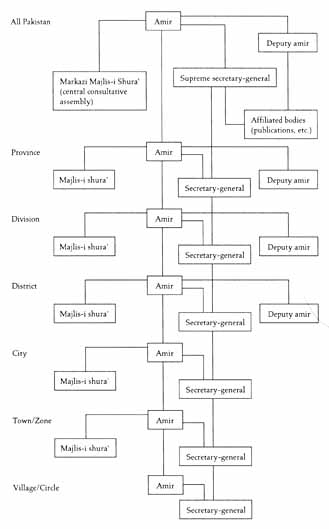
Figure 1. Organizational structure of the Jama‘at-i Islami
Beginning in 1947 the Jama‘at began to organize its members at different levels. Over the years a hierarchy was formalized through which the party’s officials controlled the members at various levels. It remains in force today. Each level and unit are defined by the number of members in it and also try to accommodate the administrative topography of Pakistan. In places where there are few members, a unit may not be warranted on a village or town level. In such cases two or more villages form one circle, and two or more towns one zone. In administrative terms, a circle stands at the same level in the party’s hierarchy as a village unit, and a zone at the same level as a town. Each level has an administrative unit based on the authority structure of amir, deputy amir, shura’, and secretary-general, which is maintained through elections. To gain a sense of the depth of the structure, in Punjab alone there are thirty district-level units, each with an amir, shura’, and secretary-general. These circles envelope one another, producing an all-encompassing administrative and command structure, decentralized and yet closely knit to form the organizational edifice of the Jama‘at.
The Office of the Amir
The office of the amir was the first administrative unit created in the Jama‘at, and it has remained the most important. Originally the amir was elected by the central shura’ through a simple majority vote, but since the 1956 reforms he has been elected by Jama‘at members, and his term of office is fixed at five years; there is no term limit. A committee of the central shura’ members chooses three candidates, whose names are then put before the members at large. They send in their secret ballots to the Jama‘at’s secretariat, whose controller of elections (nazim-i intikhabat) has been appointed by the shura’ to oversee the process. A list of candidates must be put forth by the shura’ sixty days before the elections, and members must register to vote ninety days before the date of the election.[6] This system tends to favor the incumbent, as the members are not likely to unseat someone who is both administrative head of the party and its spiritual guide. No amir to date has been voted out of office.
The amir is the supreme source of authority in the Jama‘at and can demand the unwavering obedience of all members (ita‘at-i nazm). He is, however, constitutionally bound by the set of checks and balances that were passed following the Machchi Goth affair. All doctrinal issues must be determined by the shura’. Should the amir disagree with the shura’ on any issue, he has a right of veto which throws the matter back to the shura’. Should the shura’ override the veto, the amir must either accept the decision of the shura’ or resign from his post. The amir can be impeached by a two-thirds majority of the shura’. In budgetary and administrative matters the amir is bound by the decisions of the majlis-i ‘amilah, whose members he appoints from among shura’ members. The amir oversees the operation of the Jama‘at’s secretariat.
Insofar as possible this organization is replicated at each level of the party. Each lower-level amir is elected by the members of his constituency to terms varying from one to three years depending on the level in question. These amirs are similarly bound by the decisions of their shura’s. The lower-level amirs also oversee the office of their secretaries-general. However, lower-level secretaries-general are also accountable to the Jama‘at’s national secretary-general, which curtails the autonomy of the lower-level amirs and reduces their control over administrative affairs.
The Machchi Goth affair proved to be an aberration in an otherwise uneventful history of the amir’s office. Since then the constitutional mechanisms governing it have steered the Jama‘at through two succession periods—from Mawdudi to Mian Tufayl Muhammad in 1972, and from Mian Tufayl to Qazi Husain Ahmad in 1987. Each transition followed upon the retirement of the amir.[7] This pattern is in sharp contrast to transitions in other Pakistani parties, and accounts for the fact that the Jama‘at, unlike most other Islamic movements of South Asia, continued strong after the passing of its founder from the scene.
At a meeting in Lahore on January 10, 1971,[8] following the Jama‘at’s defeat at the polls in December 1970, a group led by Sayyid Munawwar Hasan (now the secretary-general) launched a tirade against Mawdudi. They argued that the Jama‘at had been routed at the polls because of him. Old and reserved, Mawdudi had relinquished national politics to the more energetic and charismatic leaders of the Pakistan People’s Party and the Awami League (People’s League), Zulfiqar ‘Ali Bhutto and Mujibu’l-Rahman, who won the elections. Similar views were related to the editors of Tarjumanu’l-Qur’an by other members and supporters during the following months.[9] Implicit in these ventings of frustration was a demand for a new leader. On February 19, 1972, Mawdudi suffered a mild heart attack and decided to step down as the amir. The shura’ nominated Mian Tufayl Muhammad (then secretary-general), Ghulam A‘zam (later the amir of Jama‘at-i Islami of Bangladesh), and Khurshid Ahmad (a longtime disciple of Mawdudi, and currently deputy amir of the Jama‘at). On November 2, 1972, Mian Tufayl Muhammad (b. 1914) was elected amir.[10]
None of those nominated by the shura’ qualified as charismatic leaders, least of all Mian Tufayl. The electorate appeared to have been governed by more pressing concerns than those posed by the party’s Young Turks. They had been disappointed by their performance in the elections and now faced a belligerent opponent in the Bhutto government. By choosing a loyal lieutenant of Mawdudi, an administrator rather than a political maverick, the party opted for continuity and stability. Its search for a more charismatic amir, although not abandoned, was postponed to a later time.
Mian Tufayl was not an effective politician, nor was he able convincingly to assert the powers vested in the office of the amir. Following his election, a good deal of the amir’s powers, accumulated and jealously guarded by Mawdudi over the years, were ceded to others in the party, and authority became more decentralized. That encouraged the formation of independent loci of power, which in turn further divested the amir of authority. Constitutional procedures became even more visibly entrenched, and the shura’, as the original source of authority in the Jama‘at, once again asserted its power and primacy. Mian Tufayl’s fifteen years at the helm of the Jama‘at, to the chagrin of those who had wished to reinvigorate the party’s ideological and chiliastic zeal, led the party farther down the road of legal-rational authority.
A different set of concerns led to the election of Qazi Husain Ahmad to the office of amir on October 15, 1987. After a brief surge in popularity in the 1970s, the Zia ul-Haq years had eclipsed the political fortunes of the party, which became increasing marginalized in national politics. The results were dissension within the party over its policies and performance and the retirement of Mian Tufayl. Aging, and increasingly under criticism, he stepped down as amir, paving the way for a new generation to lead the Jama‘at. The shura’ nominated Khurshid Ahmad, Jan Muhammad ‘Abbasi (the amir of Sind), and Qazi Husain Ahmad (the secretary-general) to succeed Mian Tufayl. The first two were conservative in the tradition of Mawdudi and Mian Tufayl, while Qazi Husain had a populist style and a good rapport with the younger and politically more active members. The party elected Qazi Husain (b. 1938). He came from a family with a strong Deobandi heritage. His two older brothers were Deobandi ulama, and his father was a devotee of Mawlana Husain Ahmad Madani of Jami‘at-i Ulama-i Hind, after whom Qazi Husain Ahmad was named. His Deobandi ties helped the Jama‘at in the predominantly Deobandi North-West Frontier Province. He became acquainted with the Jama‘at through its student organization and joined the Jama‘at itself in 1970. Many, among both the younger members and the conservative old guard, felt that it was time to go in a new direction. Qazi Husain had been responsible for creating an important constituency for the Jama‘at in North-West Frontier Province, which today elects a notable share of the Jama‘at’s national and provincial assembly members. Many hoped he would do the same for the Jama‘at at the national level.
Qazi Husain appealed to both conservatives and the more liberal elements. As the party’s liaison with the Zia regime during the Afghan war, he was favored by the pro-Zia conservative faction, while his populist style and call for the restoration of democracy endeared him to the younger generation who wanted the Jama‘at to distance itself from Zia. The Jama‘at had made a politically sagacious choice by electing an assertive and populist amir. His appeal has to date been more clearly directed toward the Pakistani electorate than toward the rank and file of the Jama‘at. He is the first amir to hold a national office: he has been a senator in the Pakistani parliament since 1985. In November 1992 he was elected to a second term as amir.
The Deputy Amir
Twice in its history the Jama‘at appointed a vice-amir (qa’im maqam amir), an interim measure to fill the vacancy left by an absent amir. More important has been the office of deputy amir (na’ib amir). Three deputy amirs were selected by the founding members of the Jama‘at in 1941, mainly to ensure that Mawdudi remained primus inter pares.[11] After two of them left the party in 1942, the office fell vacant, though the title was occasionally conferred on Islahi and Mian Tufayl to give them executive powers when Mawdudi was absent.
In 1976 the office was reintroduced with a new objective in mind. Three deputy amirs were appointed by the amir, and each was given a specific area of Jama‘at activities to oversee. The reintroduction of this office was part of the decentralization of power during Mian Tufayl’s tenure. It rationalized the Jama‘at’s organizational structure by dividing activities into separate units and delegating authority to the deputy amirs who oversaw those units. The office of deputy amir also gave the rising generation an important office to fill and brought the increasing number of peripheral activities and affiliated bodies under the party’s central command, both of which helped ease tensions within the party. The office exists only on a national level.
In 1987 the duties of the deputy amirs were formalized and their activities more clearly defined and given constitutional sanction by the shura’. Their number was increased to five. One is in charge of relations with other political parties; one is responsible for the Teachers Union and parliamentary affairs; one handles the operations of the Jama‘at’s central administration; one acts as a liaison with the Jama‘at’s student organization; and one is in charge of relations with ulama and other Islamic organizations. The office is by now an established part of the command structure.
The Shura’s
After the office of amir, the majlis-i shura’ is the most important pillar of the Jama‘at’s organizational structure. It has overseen the evolution and implementation of the party’s ideology and has controlled the working of its constitution. The lower-level shura’s replicate the functions of the central shura’, but they do not have the same importance as the central shura’. Members of shura’s at all levels are elected. Each represents a Jama‘at constituency geographically defined by the secretariat. These constituencies, drawn up by the Jama‘at’s election commissioner, coincide with national electoral districts whenever the numbers permit. A shura’ member must be a resident of his constituency.
In its early years the central shura’ had twelve members, but in anticipation of the Punjab elections of 1951 membership was increased to sixteen and as part of the constitutional reforms which followed Machchi Goth, to fifty.[12] That number was again increased to sixty in 1972, giving greater representation to members. In 1989 every central shura’ member represented approximately one hundred Jama‘at members. The increase in size has vested greater powers in the central shura’, while reducing the powers of each individual member, which was one reason why Mawdudi took the step in the first place following the Machchi Goth affair. With the same objective in mind, the Jama‘at’s constitution has kept the legislative power of the shura’ in check by giving the amir, deputy amirs, secretary-general, and provincial amirs, who attend shura’ sessions, voting rights. The number of these extra-shura’ votes is twelve, a fifth of the shura’ votes and a sixth of the total votes cast. In case of a tie the vote of the amir counts as two. Regular members of the Jama‘at may attend sessions of the shura’ with the permission of the amir, but have no speaking or voting rights.
The central shura’ meets once or twice a year and may in addition be called by the amir or a majority of its members whenever necessary. It reviews party activities and decides on future policies. It has ten subcommittees which specialize in various areas of the Jama‘at’s concern and provide the shura’ with policy positions. The central shura’ can probe the legal sources and determine the intent of Islamic law (ijtihad) when and if there exists no precedent for the ruling under consideration in religious sources. This enables it to decide on, as well as to clarify, doctrinal matters. While issues are openly debated in the shura’, verdicts are not handed down by majority vote alone. The shura’, especially when doctrinal matters are involved, works through a practice that reflects the Muslim ideal of consensus (ijma’). The majority must convince the minority of its wisdom, leaving no doubt regarding the course on which the Jama‘at will embark. In 1970 Mawdudi reported that in its twenty-nine years of activity, the central shura’ had given a majority opinion on only four occasions, the most notable of which was the prelude to Machchi Goth. Otherwise the central shura’ has, time after time, given unanimous verdicts.[13] Since Machchi Goth, many executive decisions have been put before the twenty-two-member majlis-i ‘amilah. This smaller council steers the Jama‘at through most of its activities when the central shura’ is not in session.
The Secretary-General and Secretariat
The day-to-day activities of the Jama‘at are overseen by the bureaucracy centered in the party’s secretariat. The office of the secretary-general (qayyim) was created in 1941. Since then, it has grown in power to become something akin to that of a party boss. The concept of a party worker was introduced to the Jama‘at in 1944 when the party set up special training camps in Pathankot for its personnel.[14] With the growth of the Jama‘at in size and the expansion of its activities, the workers have become an increasingly important element in the party. Between 1951, when the Jama‘at turned to politics, and 1989 the number of full-time workers rose from 125 to 7,583.[15] Since 1947 they have been controlled from Lahore by the secretary-general, who is appointed by the amir in consultation with the central shura’. Over the years, not only has the central secretariat increased in size but it has also reproduced itself at lower levels in the party, creating an administrative command structure which extends from the center to the smallest unit, paralleling the command structure controlled by the amirs.
The Jama‘at’s numerous publications are also controlled by the bureaucracy, the scope of the activities of which not only increases their hold on the Jama‘at but also gives them a say in the party’s political agenda. The importance of this bureaucracy was already evident early on, but it rose even farther as witnessed by the fact that both Mian Tufayl and Qazi Husain came to the office of amir directly from that of secretary-general. Members of the bureaucracy often are also members of shura’s of various units, augmenting the power of the central bureaucratic machine in the decision-making bodies of the party, precluding the kind of autonomy of the shura’ which led to the Machchi Goth affair.
In the 1970s, following its decisive defeat at the polls and with an amir at the helm who institutionalized the Jama‘at’s ideological zeal into distinct norms and procedures, the secretariat grew further in size, power, and number of workers. In 1979 a permanent training camp for workers was established at the Jama‘at’s headquarters in Lahore, and in 1980 alone 2,800 new workers went through that facility.[16] The Jama‘at’s considerable financial resources since the 1970s has permitted it to hire these workers and expand the activities of the bureaucratic force. All ordinary Jama‘at workers are paid for their services, but officers such as the amir, deputy amirs, or shura’ members are not paid, though they may serve in other salaried capacities in the party. Qazi Husain’s thriving family business in Peshawar has helped resolve the question of monetary compensation for his services. An increasing share of those joining the growing bureaucracy are alumni of Islami Jami‘at-i Tulabah (Islamic Society of Students), who are educated in modern subjects and have known each other since their university days. This further strengthens the position of the bureaucracy.
The bureaucratic structure of the Jama‘at is duplicated in the party’s burgeoning women’s wing (halqah-i khawatin), established in the 1950s. Some 70 percent of these women come from families where the men belong to the Jama‘at. They have no amir of their own, but have a central shura’ and an office of secretary-general (qayyimah). Their headquarters are situated in the central compound, from where the working of nazimahs (organizers) of lower-level units are supervised. The Jama‘at-i Islami women also have their own seminary, the Jami‘atu’l-Muhsinat (Society of the Virtuous), which trains women as preachers and religious teachers.
The women’s wing is primarily involved with propagating the Jama‘at’s literature and ideas among Pakistani women through its periodicals, the most important of which is Batul, and to incorporate Jama‘at families into the holy community by recruiting from among the wives and daughters of the Jama‘at’s members and by encouraging women to bring up their children true to the teachings of the Jama‘at.
The Jama‘at’s secretariat also oversees the working of special departments, the number and duties of which change depending on the needs of the party. In 1989–1990 they were the departments of finance, worker training, social services and welfare, theological institutions, press relations, elections, public affairs, parliamentary affairs, and Jama‘at organizational affairs. Each department is headed by a nazim (head or organizer), appointed by the amir. The departments are responsible to the secretary-general and at times to a deputy amir.
The increasing bureaucratization of the Jama‘at is clearly manifested in the central role of the party’s secretariat and workers in its headquarters compound, called Mansurah, on the outskirts of Lahore. To collect all members and votaries of the Jama‘at into a model holy community had been a central aim of the party since its creation. However, after its relatively short stay (1942–1947) in Pathankot, Jama‘at members had never again been able to gather in one location, though establishing a community/headquarters complex remained a goal. With funding through private donations, the land for the Mansurah compound was purchased in 1968, and construction on it began in 1972; the Jama‘at began to move its offices there in 1974. The complex has since grown to include a small residential community, where many Jama‘at leaders reside, and the central offices of the Jama‘at’s secretariat and some of its numerous affiliated bodies: the Islamic Studies Academy (Idarah-i Ma‘arif-i Islami), the Sayyid Mawdudi International Education Institute, Office of Adult Education, Bureau of the Voice of Islam (Idarah-i Sada-i Islam), the Arabic Translation Bureau, the Peasants’ Board (Kisan Board), the Ulama Academy, the Jami‘atu’l-Muhsinat, the offices of Jama‘at-i Islami of Punjab, schools, libraries, a mosque, and a hospital. In 1990, according to the election commission of Pakistan in Islamabad, Mansurah had some four thousand eligible voters.[17]
The Jama‘at’s organizational model—the amir, shura’, secretary-general, administrative, and command networks stretching from the top of the party to its smallest units—has proved so efficacious that it has become an example for others to emulate. The Jama‘at’s rivals, from ulama parties to Israr Ahmad’s Tanzim-i Islami and Tahiru’l-Qadri’s Minhaju’l-Qur’an, with some changes in titles and functions, have reproduced it in their own organizations as has the secular and ethnically based Muhajir Qaumi Mahaz (Muhajir National Front).
The size of the bureaucracy and the scope of its activities lead naturally to the question of the party’s finances. The Jama‘at’s total capital at its foundation was Rs. 74.[18] Its income at the end of 1942, mainly from the sale of books and literature, was Rs. 17,005.[19] This figure rose to Rs. 78,700 in 1947, and Rs. 198,714 in 1951, a tenfold increase in ten years.[20] By 1956 the annual budget for the Jama‘at-i Islami of Karachi alone stood at Rs. 200,000.[21] The Jama‘at’s income, from sale of books and hides (from animal sacrifices on ‘Idu’l-azha’), and increasingly from voluntary contributions and religious tax (zakat) payments by supporters and members, continued to grow at a steady pace throughout the 1950s and the 1960s (leaving aside confiscation of its funds on several occasions).[22] The purview of the Jama‘at’s activities, however, has grown at an equal, if not faster, rate than its income during the same period, ensuring a subsistence-level existence for the party. It was not until the 1970s that the fortunes of the Jama‘at took a turn for the better.
The rise to power of the left-leaning Bhutto in 1971, and the Jama‘at’s open opposition to him, brought new sources of financial support to its assistance. The Pakistani propertied elite, threatened by the nationalization policy of the People’s Party, the lower-middle class, whom Bhutto alienated with his socialist rhetoric and open display of moral laxity, and the Muhajir community, which began to feel the threat of Sindhi nationalism, all began to invest money in anti–People’s Party forces, one of the most prominent of which was the Jama‘at. The foreign governments—especially the monarchies of the Persian Gulf Trucial States, Kuwait, and Saudi Arabia—wary of Pakistan’s turn to the left, also began supplying funds to forces which could provide an ideological brake on the spread of socialism and bog Bhutto down in domestic crises; again the Jama‘at became a major recipient of these contributions. The Soviet invasion of Afghanistan a decade later merely increased the flow of funds from the Persian Gulf sources.
Jama‘at’s own connections with the Saudi ulama went a long way toward convincing the Persian Gulf donors of the wisdom of their policy and established the party as the main beneficiary of funds that Persian Gulf states earmarked for Islamic activities across the Muslim world. In fact, the Jama‘at’s ideological affinity with the Wahhabi Sunnis of the Persian Gulf states, Jama‘at’s earlier ties with Saudi authorities, and the party’s considerable reach across the Muslim world made it a convenient agent for the management of these funds and their distribution.[23] The Jama‘at’s international activities became increasingly intertwined with those of the Rabitah ‘Alam-i Islami (Muslim World Network), based in Riyadh, which oversees Saudi Arabia’s relations with various Islamic organizations from Mindanao to Morocco. The Jama‘at’s international influence grew in good measure through the aegis of the Rabitah. Saudi Arabia financed the establishment of a Jama‘at research institute in England, the Islamic Foundation, where the Jama‘at’s literature is published and disseminated in large quantities across the Muslim world. More recently, it has also projected the Jama‘at’s power internationally, most notably during the Rushdie affair.[24] Under the aegis of the Rabitah, ties with Jama‘at-i Islamis elsewhere in South Asia were strengthened, as were relations with other Islamic movements. The Rabitah also helped increase the Jama‘at’s leverage in its dealings with Pakistani governments, as numerous projects funded by Persian Gulf states in Pakistan, such as the International Islamic University in Islamabad, and the lucrative management of the flow of funds and arms to the Afghan Mujahidin, were opened to the Jama‘at. Financial patronage, however, has not been enough to control the Jama‘at: the party’s decision to support Iraq and its open derision of Saudi Arabia as a decadent lackey of American imperialism in the Persian Gulf war in 1990–1991 have greatly marred its relations with the Persian Gulf states and seriously affected their rapport.
The considerable rise in the number of Pakistani migrant workers in the Persian Gulf states since the 1970s also translated into larger voluntary contributions and zakat payments to the Jama‘at, as well as even closer ties between the party and the migrant workers’ hosts and employers in the Persian Gulf. Funds flowing into the Jama‘at’s coffers have also followed a recent increase in the number of Pakistani migrants to the West, many of whom are alumni of the student wing, the Islami Jami‘at-i Tulabah. These financial links and especially the rewards for stemming the tide of “Bhuttoism” in turn influenced the Jama‘at’s outlook on a number of issues. They made the party more staunchly anti-Bhutto and opposed to socialism in the 1970s than otherwise might have been the case, blinding it to the importance of populist politics in Pakistan. Antisocialist activism provided the Jama‘at with greater international renown and financial rewards, diverting the party’s attention from the realities of its political choices in Pakistan, especially after the fall of Bhutto. The free flow of funds also dampened the Jama‘at’s resolve, damaged its hard-earned discipline and morale, and gave the members a false, and ultimately ephemeral, sense of achievement and confidence. In a similar vein, these financial ties determined the Jama‘at’s stand on a host of religiopolitical issues, compromising the party’s autonomy of thought and action. The Persian Gulf connection, for instance, determined the party’s ideological and political response to other Islamic revival movements. A case in point was the strained relations between the Jama‘at and the Islamic Republic of Iran in the 1980s, which can, at least in part, be attributed to the Iran-Iraq war and the hardening of the policy toward Iran by the Persian Gulf states.