
| • | • | • |
Imām-Caliph al-Mu‘izz and the City of Cairo
Imām-Caliph al-Mu‘izz’s armies led by the general Jawhar conquered Egypt in 969/358. That conquest ended Ikhshidid rule in Egypt that had lasted only three decades (935–69/323–58). Jawhar began at once to make overtures to the conquered populations in the existing urban areas, and at the same time he undertook construction of a walled, royal urban center, ultimately known as al-Qāhira (Cairo), “the Victorious” (map 2).
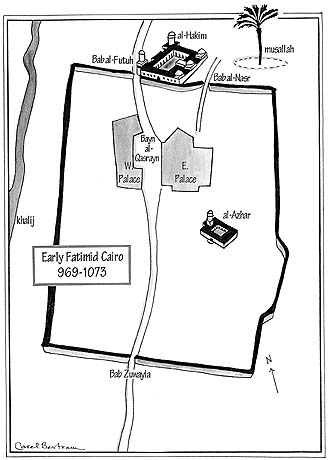
Map 2. Cairo, early Fatimid period 969–1073
The existing populations lived in a series of urban centers built on the east side of the Nile.[39] Fusṭāṭ, the southernmost section, had originally been built as a garrison town for the conquering Muslim armies in the mid-seventh century, and expanded from that time forward. The population, initially comprising soldiers, their retainers and families, soon began to include Christians (mainly Copts) and Jews who had lived in the areas in the pre-Muslim times. By the tenth century, this area housed a large Jewish and Christian population, as well as Muslims, mainly Sunni.[40] The central focus for the Muslims of this area was the mosque of ‘Amr ibn al-‘As, named after the conquering general. The mosque was located close to the channel (khalīj) of the Nile which served as the western boundary of this city (map 1).
North of Fusṭāṭ another urban center, known as al-Qaṭā’i‘,, was built during the rule of the Ṭūlūnid governors (868–905/254–92). It was the site of the largest mosque in the area named after its patron, the governor Aḥmad ibn Ṭūlūn (r. 868–84/254–70). The administrative seat (dār al-imāra, literally “house of the princes”) was attached to the mosque, forming the locale for much of the administrative business during the ninth century. The public treasury for the Muslims (bayt al-māl), nevertheless, remained to the south, in Fusṭāṭ, in the mosque of ‘Amr ibn al-‘Aṣ.
No walls separated these parts of the urban area from each other, although in the inundation season some depressions throughout the area gathered water, while still others held water almost year round. Rather than creating boundaries, these areas, known as birak, became recreational magnets bringing populations from all areas for boating, bathing, and parties on the water’s edge.
Mixed populations, members of the provincial ruling groups, as well as merchants and traders, glassmakers, tanners, potters, and the like lived in both these areas. It also appears that neighborhoods were mixed; Muslims, Jews, and Christians lived in the same areas and even in the same apartment complexes.[41] Social considerations did shape this pattern, however. Jews lived close to their synagogues. But the main mosque complexes, serving the major portion of the population, dominated the areas spatially and socially, reflecting the administrative activity. The practices of Islam shaped the pace of the days and the year. The adhan or call to prayer, formulated according to Sunni practice, was heard five times a day throughout both areas.
These two areas—Fusṭāṭ and al-Qaṭā’i‘,—were known collectively as Miṣr, although some later writers called it Miṣr-Fusṭāṭ. The inhabitants expressed preferences for prime locations within these linked areas.[42] North of these areas stretched plains dotted with monasteries and retreats where the more leisured groups often hunted. North was also the area of agriculture and gardens, and fresh air, as the prevailing winds come from that direction.
When Jawhar conquered Egypt he dealt with the existing populations reasonably and with great care. He allowed them to continue the call to prayer in their own fashion, and allowed them privileges that eased the transition to the new rulers of the area.[43] That this predominantly reasonable relationship on several social levels was sustained throughout the rule of Imām-Caliph al-Mu‘izz is attested to by the pages of the History of the [Coptic] Patriarchs.[44] At the same time, Jawhar was preparing a walled royal enclosure north of these population centers for the Imām-Caliph, his family, retainers, and army. It was an urban area for Believers (Ismā‘īlīs).
Although a segregated city,[45] this new area of Cairo had walls that were permeable like those of the central core in Abū Ja‘far’s diagram as shown in Qāḍī al-Nu‘mān’s text. Cairo’s walls were symbolic, indicating a boundary; they were not defensive. It is almost possible to suggest that at this moment the urban geography of the area resembled a wedge taken from that concentric circle diagram and laid alongside the Nile, narrow end or core pointing to the north. In the north was the core, the royal city where the Imām-Caliph and the Believers lived. To the south, and larger in size, was the rest of the population, primarily Muslim. Echoing the phrase, “Belief embodies Islam while Islam does not embody Belief,” those in the north were Ismā‘īlī Muslim; in the south, Muslims were not Ismā‘īlīs.
The royal city of Cairo was a rectangle oriented to the northeast, and divided almost in the center lengthwise by a street known as the Great Street (shāri‘a al-a‘ẓam).[46] In the south the street met the double-arched gateway, the Bāb Zuwayla; in the north the street branched (map 2). The main path continued to the gate popularly known as the Bāb al-Futūḥ, and a branch went northeast to a second gate, the Bāb al-Naṣr. Within this large enclosure, somewhat north of center, on the east side of the Great Street, a palace was built for the Imām. Some years later, across this street, on the west side, a second palace was built. Together these two palaces framed the Great Street, making an area between them known as “between the two palaces” (bayn al-qaṣrayn). South of the Eastern Palace, across an open area (rahba), and off to the east of the Great Street, the mosque known as al-Azhar (the shining) was built.
This mosque, also called the mosque of Cairo, was relatively small in size and primarily served the Ismā‘īlī population of the royal city, although as mentioned above, lectures and readings of Ismā‘īlī writings drew interested members of the population from outside the royal city.[47] The call to prayer from this mosque included the formula “come to the best of works” (hayy ‘ala khayr al-‘amal), a Shī‘ī formula. North, outside Cairo at the Bāb al-Naṣr was a muṣalla (a defined open space) used for prayer during Islamic holidays. The major part of the Fatimid troops were also stationed outside, and north of Cairo. Imām-Caliph al-Mu‘izz came to this city in 971/362 from his capital in Ifriqiya, Sabr al-Manṣūrīyya, in procession and bearing the bodies of his ancestors, the first three Fatimid Imāms. They were interred in the southern section of the Eastern Palace which became the mausoleum for subsequent Fatimid Imāms.
Beyond his coinage and its newly devised sign of Isma‘ilism, Imām-Caliph al-Mu‘izz appears to have used writing both territorially and referentially in more conventional ways. An anecdote discussed below reveals contemporary recognition of the range of his practice in regard to the public text.
In conformity with the practice continuing over many centuries in the eastern Mediterranean, he put inscriptions over the main thresholds or gates into Cairo. He used writing to frame depictions inside the mosque of al-Azhar.[48] As in earlier practice, that writing was smaller in scale and less visually prominent than the depictions it framed. Its referential base was the Qur’ān. The medium of both the writing and the depictions was stucco, continuing the aesthetic practice of the capital area. Judging from some aspects of the archaeological remains, it is possible that he put the sign of Isma‘ilism in this mosque.[49] What is reported clearly, however, is that the year after he came to Cairo, 973/362, Imām-Caliph al-Mu‘izz displayed a gift for the Ka‘ba prominently in his palace.[50] This gift did display the sign of Isma‘ilism.
Al-Maqrīzī describes this gift, a shamsa (sun, ornament, or collar), which Imām-Caliph al-Mu‘izz raised on high so that it could be seen both from inside the palace and from the street. Close attention to the description indicates that the design of this ornament and the sequences of references on it—from the inner to the outer rings—both have equivalences with those on the coinage, and the diagram of Abū Ja‘far.
Further, in describing the shamsa, al-Maqrīzī recounts that on a background of red brocade, twelve spans in each direction, an open-work golden ball was displayed inside a circle of writing in Arabic. Inside the central golden circular ball were pearls the size of dove’s eggs and red, yellow, and blue precious stones. The writing around this center displayed the sūrat al-ḥajj written in emeralds. Stuffed with musk granules, the whole gave off a costly perfume. Ismā‘īlīs who saw this precious object undoubtedly would relate its concentric circle format to that of the coins and the diagram. Others saw it simply as a precious gift, a fact that al-Maqrīzī records.[51]
On this shamsa, the golden orb stuffed with pearls and gems can be understood to function as an aesthetic metaphor for the Imām, resonating with the center raised dot-circle on Imām-Caliph al-Mu‘izz’s coins. This reading of the metaphoric center is plausible in the context of Imām-Caliph al-Mu‘izz’s experience with his early issue of coinage in Ifriqiya and with the intended destination of this gift. The coinage on which Imām-Caliph al-Mu‘izz first placed names and titles directly and exclusively relating to Isma‘ilism might have drawn great protests from the Sunni population in Qairowan, the population center near his capital in Ifriqiya, or, for other reasons, negative reaction from the Ismā‘īlī population in al-Manṣūriya. For whatever reason, he chose to alter the references of the inscriptions to ones which would be acceptable to all Muslims, although he chose ones which would carry meanings in the dimension of the bātin for Ismā‘īlīs.[52] It was clearly appropriate for al-Mu‘izz as Caliph to give a costly gift to the Ka‘ba. But, on a gift intended for the Ka‘ba at Mecca for the pilgrimage month when all Muslims would gather, reference to his role as Imām would most effectively be metaphoric.
Some sense of Imām-Caliph al-Mu‘izz’s attitude toward public texts can be gathered from an anecdote in Ibn al-Muqaffa‘’s History of the Patriarchs. The anecdote suggests how the contemporary population understood the ruler’s power to play with the public text. Written from the point of view of the Christian inhabitants of Miṣr, it also gives us insights into the role of public texts on impermanent materials, here a sijill, or decree, written on paper.
The story is as follows.[53] Caliph al-Mu‘izz is reported as having occasion to give the population of Miṣr a test. He commanded that a large roll of paper (like that upon which a sijill was written) be rolled up without being written on and sealed. He then sent the bearer of this roll, along with the town crier and a trumpeter, to Miṣr to present the “decree,” and sent trustworthy spies to report back. The trumpeter played and the crier called the local inhabitants to gather around because the sijill of the Caliph was to be read. Some inhabitants wanted to hear the sijill, but others said not to bother because the decree was blank. The news that the inhabitants knew the sijill had no writing on it was brought back to the Caliph who marveled exceedingly.
The story presents the Caliph as playing a trick with the text-ness of the sijill. The aesthetic dimensions of a sijill were present: the roll of paper, the trumpeter, the crier. But the local residents were not persuaded by the aesthetics of this public text without its writing. The story suggests public texts such as sijills convey their meaning primarily through their writing, the close link of writing and authority, the referential dimension.
This story provides a contrast to the argument made in chapter 2. There, the referential bases of the writing on the interior of the imperial sectarian spaces in the eastern Mediterranean of all groups was equivalent. I argued then that the aesthetic dimensions of the writing—gold and glass mosaics the most costly—were the primary conveyors of meaning by such “expected” sectarian texts.
This story recorded by a member of the local population portrays that society as smart—because it is a text-based and literate society. In such a society even if many cannot read, the actions of the educated elite by their writing, by their knowledge of what is written and what that writing can effect in society, serve as a guarantee or proof that authority is vested in writing. The local population demonstrated that they knew that where there was no writing there was no power and authority.