
| • | • | • |
Sufis of the Capital
The principal carriers of the Islamic literary and intellectual tradition in the Bengal sultanate were groups of distinguished and influential Sufis who resided in the successive capital cities of Lakhnauti (from 1204), Pandua (from ca. 1342), and Gaur (from ca. 1432). Most of these men belonged to organized Sufi brotherhoods—especially the Suhrawardi, the Firdausi, and the Chishti orders—and what we know of them can be ascertained mainly from their extant letters and biographical accounts. The urban Sufis about whom we have the most information are clustered in the early sultanate period, from the founding of the independent Ilyas Shahi dynasty at Pandua in 1342 to the end of the Raja Ganesh revolution in 1415.[34]
The political roles played by Sufis in Bengal’s capital were shaped by ideas of Sufi authority that had already evolved in the contemporary Persian-speaking world. We have already referred to the central place that Sufi traditions assigned to powerful saints, a sentiment captured in ‘Ali Hujwiri’s statement that God had “made the Saints the governors of the universe.” Being in theory closer to God than warring princes could ever hope to be, Muslim saints staked a moral claim as God’s representatives on earth. In this view, princely rulers possessed no natural right to earthly power, but had only been entrusted with a temporary lease on such power through the grace of some Muslim saint. This perspective perhaps explains why in Indo-Muslim history we so often find Sufis predicting who would attain political office, and for how long they would hold it. For behind the explicit act of “prediction” lay the implicit act of appointment—that is, of a Sufi’s entrusting his wilāyat, or earthly domain, to a prince. For example, the fourteenth-century historian Shams-i Siraj ‘Afif recorded that before his rise to royal stature, the future Sultan Ghiyath al-Din Tughluq, founder of the Tughluq dynasty of Delhi (1321–1398), had been one of many local notables attracted to the spiritual power of the grandson of the famous Chishti Sufi Shaikh Farid al-Din Ganj-i Shakar (d. 1265). The governor made frequent visits to the holy man’s lodge in the Punjab, and on one occasion brought along his son and nephew, the future sultans Muhammad bin Tughluq and Firuz Tughluq. All three were given turbans by the saint and told that each was destined to rule India. The length of each turban, moreover, exactly corresponded to the number of years each would reign.[35] In this anecdote one may discern the seeds of the complex pattern of mutual patronage between shaikhs of the Chishti order and one of the mightiest empires in India’s history.
Similar traditions circulated in Bengal concerning the foundation of independent Muslim rule there. In 1243–44 the historian Minhaj al-Siraj visited Lakhnauti, where he recorded the following anecdote.[36] Before embarking for India, the future sultan of Bengal Ghiyath al-Din ‘Iwaz (1213–27) was once traveling with his laden donkey along a dusty road in Afghanistan. There he came upon two dervishes clothed in ragged cloaks. When the two asked the future ruler whether he had any food, the latter replied that he did and took the load down from the donkey’s back. Spreading his garments on the ground, he offered the dervishes whatever victuals he had. After they had eaten, the grateful dervishes remarked to each other that such kindness should not go unrewarded. Turning to their benefactor, they said, “Go thou to Hindustan, for that place, which is the extreme (point) of Muhammadanism, we have given unto thee.” At once the future sultan gathered together his family and set out for India “in accord with the intimation of those two Darweshes.”[37] In the Perso-Islamic cultural universe of the thirteenth and fourteenth centuries, Bengal really did in some sense “belong” to those two dervishes, that they might “entrust” it to a kind stranger.
In Bengal as in North India, the connection between political fortune and spiritual blessing is most evident in the early history of the Chishti order, the order to which the most ascendant shaikhs of early-fourteenth-century Delhi belonged. “Anybody who was anyone,” as Simon Digby puts it, visited the lodge of Delhi’s most eminent shaikh of the time, Nizam al-Din Auliya (d. 1325). Indeed, the two principal Persian poets of the early fourteenth century, Amir Khusrau and Amir Hasan, together with the sultanate’s leading contemporary historian, Zia al-Din Barani, were all spiritual disciples of this shaikh. Since Delhi at this time happened to be the capital of a vital and expanding empire, it is not surprising that the literary, cultural, and institutional traditions of that city—together with the shaikhs and institutions of its dominant Sufi order—expanded along with Khalaji and Tughluq arms to the far corners of India, including Bengal.[38]
But there was a deeper reason why Indo-Muslim courts patronized Chishti shaikhs. By the fourteenth century, when other Sufi orders in India still looked to Central Asia or the Middle East as their spiritual home, the Chishtis, with their major shrines located within the Indian subcontinent, had become thoroughly indigenized. Seeking to establish their legitimacy both as Muslims and as Indians, Indo-Muslim rulers therefore turned to prominent shaikhs of this order for blessings and support. For the same reason, leading Chishti shaikhs dispersed from Shaikh Nizam al-Din’s lodge to all parts of the empire and often enjoyed the patronage of provincial rulers. Conversely, many young Indian-born Muslims journeyed from all over India to live in or near that shaikh’s lodge, later to return to their native lands, where they would establish daughter Chishti lodges and enjoy the patronage of local rulers (see table 2).
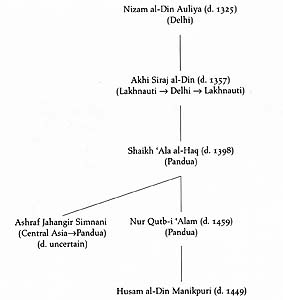
Table 2. Leading Chishti Sufis of Bengal
The first Bengal-born Muslim known to have studied with Shaikh Nizam al-Din was Akhi Siraj al-Din (d. 1357), who journeyed to Delhi as a young man. Having distinguished himself at the Sufi lodge of the renowned shaikh, Siraj al-Din received a certificate of succession and so thoroughly associated himself with the North Indian Chishti tradition that he was given the epithet “āyina-yi Hindūstān,” or “Mirror of Hindustan.” Returning to Bengal some time before 1325, when his master died, he inducted others into the Chishti discipline, his foremost pupil being another Bengal-born Muslim, Shaikh ‘Ala al-Haq (d. 1398).[39] But unlike his own teacher, who had no known dealings with royalty,[40] Shaikh ‘Ala al-Haq was destined to play a special role in the political history of Muslim Bengal. In fact, the earliest-known monument built by the founder of Bengal’s longest-lived dynasty, the Ilyas Shahi line of kings (1342–1486), was dedicated to this shaikh. On a mosque built in 1342 in what is now part of Calcutta, Shams al-Din Ilyas Shah praised the Sufi as “the benevolent and revered saint (Shaikh) whose acts of virtue are attractive and sublime, inspired by Allah, may He illuminate his heart with the light of divine perception and faith, and he is the guide to the religion of the Glorious, ‘Alaul-Haqqmay…his piety last long.”[41]
The importance of this inscription derives from its political context. Shams al-Din Ilyas Shah, an ambitious and politically astute newcomer to the delta, was just then launching a bid for independence from Delhi, evidently using southwestern Bengal as his power base. The imperial governor of nearby Satgaon having recently died, Shams al-Din, aware that Delhi was convulsed by the various crises provoked by the eccentric Sultan Muhammad bin Tughluq, seized the moment to attain provincewide power.[42] As his earliest-known coin was minted at Pandua in A.D. 1342–43 (A.H. 743),[43] Shams al-Din’s ascendancy exactly synchronizes with the dedication of this mosque and his patronage of Shaikh ‘Ala al-Haq. Moreover, the patronage of the two men was mutual, since Shaikh ‘Ala al-Haq, attaching himself to this rising political star, adopted Shams al-Din as a recipient of his teachings and blessings. This early connection cemented an alliance between government and prominent Chishti shaikhs that would last for the duration of Muslim rule in Bengal.
Not all alliances between Sufis and sultans were initiated by would-be rulers seeking to broaden their political bases. Some Sufis were drawn to the court out of a fervent desire to advance the cause of Islam as they understood it, and to augment the welfare of Muslims in the realm. We see this in the correspondence between Muzaffar Shams Balkhi (d. 1400) and Sultan Ghiyath al-Din A‘zam Shah (r. 1389–1410). An immigrant from Central Asia, Muzaffar had left his native Balkh for Delhi, where he taught at the college of Firuz Shah Tughluq. But the man’s restless spirit led him to Bihar city, where, after meeting and becoming the disciple of the great Firdausi shaikh Sharaf al-Din Maneri (d. 1381), he experienced a major change in life-orientation. Abandoning his pride in scholarship, Muzaffar subjected himself to various austerities and distributed all his worldly possessions in charity. He also made several pilgrimages to Mecca, where he once stayed for four years, teaching lessons in ḥadīth scholarship.[44] His extant letters reveal him not as an ecstatic, quiescent, or contemplative sort, but as committed to imposing his understanding of the Prophet’s religious vision on the here-and-now world, a man inclined to scrutinize human society by scriptural standards and, finding it wanting, to transform it so as to meet those standards. In the sultan of Bengal, the Sufi found an outlet for these impulses.
Muzaffar Shams first seems to have become concerned about tutoring Sultan Ghiyath al-Din while waiting in Pandua for official permission to embark on a trip from Chittagong to Mecca. “The four months of the ship season are ahead of us,” he wrote; “there are eight months still left; during all this while I have spent my life as a guest in the auspicious threshold of your majesty, may not your exaltation lessen.”[45] Although the Sufi politely described himself as a mere “guest” of the sultan, it is evident that he felt himself entrusted with a higher calling. “In my opinion,” he wrote the king,
Who, here, is patronizing whom? The Sufi’s reference to the sultan as his “son” signals a clear inversion of the usual relationship between a patrimonial king and his subjects. Nor would the Sufi give the king privileged access to his personal correspondence; to see it the monarch had first to secure permission from a third party. Muzaffar Balkhi also reminded the king that although Sultan Firuz Tughluq of Delhi had repeatedly requested letters and spiritual guidance from Muzaffar’s own master, Shaikh Sharaf al-Din Maneri, the latter had refused to oblige him, choosing instead to correspond with Sultan Sikandar of Bengal, Ghiyath al-Din’s father. “You,” he noted pointedly, “have had the effects and legacy of those blessings on yourself.”[47] In short, Muzaffar felt that he and his own master had been doing the Bengal sultans a favor by bestowing their blessings and advice on them instead of on the sultans of Delhi.[48]by the gifts of God, the cherisher of mankind, you have developed a capacity of looking at the inside of things of the pure faith and the understanding of things of manifold signification. It appears that my heart would be opened out to you. A pious inspired man, Abdul Malik, has been a recipient of my letters[,] which might form a volume. It may be at Pandua or at Muazzamabad, but I don’t remember where it exactly is. Oh, my son, get the permission and go through its contents. Something of my inward part may be opened out to you. You are the second person on whom I have poured out my secret (mystic) thoughts. It behooves you not to disclose these to anyone else.[46]
In addition to his recommendations concerning Islamic piety—for example, on the need to suppress innovation not prescribed by the Shari‘a, or to enforce the payment of alms by Muslims[49]—Muzaffar cautioned the king against placing non-Muslims in positions of authority. “The substance of what has come in the tradition and commentaries,” wrote the shaikh, “is this”:
The Sufi thus saw in Islamic Law a clear course of action the sultan should take in order to avert certain disaster. For in Bengal’s affairs Muzaffar Shams discerned more than just a political crisis. Referring to Timur’s recent sacking of Delhi (A.D. 1398, or A.H. 801), which marked the eclipse of the once-mighty Tughluq empire, he wrote: “The eighth century has passed out, and the signs of the coming Resurrection are increasingly visible. An Empire like that of Delhi with all its expanse and abundance, spiritual and physical comfort, peace and tranquility, has turned upside down (is in a topsy-turvy condition). Infidelity has now come to hold the field; the condition of other countries is no better. Now is the time, and this is the opportunity.”[51] His gaze riveted on scripture, Muzaffar saw a palpable link between worldly decay and the Day of Judgment, heralded by that decay. Only by removing infidelity could Muslims forestall an otherwise inevitable cosmic process. And since the sultan had the power to stamp out infidelity by suppressing non-Muslims in a kingdom originally established by Muslims, the Sufi saw the sultan as capable of playing a pivotal role in implementing what he understood as God’s will in that process.“Oh believers, don’t make strangers, that is infidels, your confidential favourites and ministers of state.” They say that they don’t allow any to approach or come near to them and become favourite courtiers; but it was done evidently and for expedience and worldly exigency of the Sultanate that they are entrusted with some affairs. To this the reply is that according to God it is neither expediency nor exigency but the reverse of it, that is an evil and pernicious thing.…Don’t entrust a work into the hands of infidels by reason of which they would become a walī (Governor-ruler or superior) over the Musalmans, exercise their authority in their affairs, and impose their command over them. As God says in the Quran, “It is not proper for a believer to trust an infidel as his friend and walī, and those who do so have no place in the estimation of God.” Hear God and be devout and pious; very severe warnings have come in the Kitab (holy book) and traditions against the appointment of infidels as a ruler over the believers.[50]
It was shaikhs of the Chishti order, however, who by the early fifteenth century had emerged as the principal spokesmen for a Muslim communal perspective in Bengal. If Shaikh ‘Ala al-Haq had risen to prominence with the ascending fortunes of the founder of the Ilyas Shahi dynasty, his son and successor, Nur Qutb-i ‘Alam (d. 1459), presided over Bengal’s Chishti tradition when Ilyas Shahi fortunes had sunk to their lowest point—the period of Raja Ganesh’s domination over the Ilyas Shahi throne.[52] According to Sufi sources, Raja Ganesh even persecuted Chishti shaikhs, banishing Nur Qutb-i ‘Alam’s own son, Shaikh Anwar, to Sonargaon, and plotting the death of the son of another Chishti shaikh, Husain Dhukkarposh.[53] In these circumstances, as noted in Chapter 2, the shaikh implored Sultan Ibrahim Sharqi of Jaunpur to invade Bengal and remove the “menace” of Raja Ganesh. The following passage shows the extent to which the Chishtis of Bengal had come to identify the fortunes of Islam with the political fortunes of the Ilyas Shahi dynasty. “After a period of three hundred years,” wrote the Sufi, “the Islamic land of Bengal—the place of mortals, the kingdom of the end of the seven heavens—has been overwhelmed and put to the run by the darkness of infidels and the power of unbelievers.” The shaikh elaborated this point using the Sufi and Qur’anic metaphor of light:
The lamp of the Islamic religion and of true guidance Which had [formerly] brightened every corner with its light, Has been extinguished by the wind of unbelief blown by Raja Ganesh. Splendor from envy of the victorious news, The lamp of [the celebrated preacher, Abu’l-Husain] Nuri, and the candle of [the Shi‘a martyr] Husain Have all been extinguished by the might of swords and the power of this thing in view. What does one call the lamp and candle of men Whose nature is devoid of virility [lit., has eaten camphor]? When the abode of faith and Islam has fallen into such a fate, Why are you sitting happily on your throne? Arise, come and defend the religion, For it is incumbent upon you, O king, possessed of power and capacity.[54]
While publicly clamoring for military intervention, privately, in a letter to his exiled son, Nur Qutb-i ‘Alam brooded over the theological implications of Raja Ganesh’s appearance in Bengali history. To the anguished Sufi, it seemed that God had not been heeding the supplication of the very people to whom the Qur’an had promised divine favor and protection. “Infidelity,” he wrote,
But the fortunes of Bengali Muslims did not ebb as the shaikh had feared. Once the stormy period of Raja Ganesh had subsided, his converted son resumed the patronage of the Chishti establishment, reconfirming the Chishti-court alliance that had been established between Nur Qutb-i ‘Alam’s father and the dynasty’s founder. Both Sultan Jalal al-Din and his son and successor Ahmad (r. 1432–33) became disciples of Nur Qutb-i ‘Alam himself, and twelve succeeding sultans down to the year 1532 enlisted themselves as disciples of the descendants of Shaikh ‘Ala al-Haq.[56] By the end of the fifteenth century, the tomb of Shaikh Nur Qutb-i ‘Alam in Pandua had become in effect a state shrine to which Sultan ‘Ala al-Din Husain Shah (r. 1493–1519) made annual pilgrimages.[57]has gained predominance and the kingdom of Islam has been spoiled.…Neither the devotion and the worship of the votaries of God proved helpful to them nor the unbelief of the infidels fettered their steps. Neither worship and devotion does any good to His Holy Divine Majesty, nor does infidelity do any harm to Him. Alas! Alas! O, how painful! With one gesture and freak of independence he caused the consumption of so many souls, the destruction of so many lives, and shedding of so much of bitter tears. Alas, woe to me, the sun of Islam has become obscured and the moon of religion has become eclipsed.[55]
Despite the mutual patronage and even dependency between Bengal’s Sufis and its rulers, one also detects an undercurrent of friction between the two. Occasionally erupting into open hostility, this friction derived from the radical distinction made in Islam between dīn and dunyā, “religion” and “the world.” Withdrawn from worldly affairs and living in a state of poverty, self-denial, and remembrance of God, the Sufi recluse was in theory dramatically opposed by the ruler-administrator, glittering in his wealth and utterly immersed in worldly affairs. Sufis who rejected the world made much of their refusal to consort with “worldly” people—including above all royalty. Conversely, rulers sometimes suspected their Sufi allies, or even feared having around them such popular, charismatic leaders who might conceivably stir up the mob to riot or rebellion.[58]
Here we may consider an inscription of Sultan Sikandar Ilyas Shah, dated 1363, in which the king dedicated a dome he had built for the shrine of a saint named Maulana ‘Ata. Although the shaikh may have been the king’s contemporary, Maulana ‘Ata was more likely an earlier holy man whose shrine had become the focus of an important cult by the time the inscription was recorded.[59] “In this dome,” the inscription reads,
While outwardly acclaiming the greatness of Maulana ‘Ata, Sultan Sikandar was also asserting his own claims to closeness to God, styling himself the one in whose name “the pearls of prayer have been strung,” and “the Shadow of God on Earth.” And by referring to this shrine as a copy (nuskha) of the heavens, the sultan drew attention to parallels between God’s creative activity and his own. For if it had been God’s creative act to adorn the seven heavens with lamps (maṣābīḥ), that is, stars, it was Sultan Sikandar’s creative act to adorn the earth with a tomb for the lamp (sirāj) of Truth, Law, and Faith, that is, Maulana ‘Ata. Implicitly, then, had it not been for the munificence of Sultan Sikandar, Maulana ‘Ata would have remained shrouded in obscurity.which has been founded by ‘Ata, may the sanctuary of both worlds remain. May the angels recite for its durability, till the day of resurrection: “We have built over you seven solid heavens” [Qur’an 78:12].
By the grace of (the builder of) the seven wonderful porticos “who hath created seven heavens, one above another” [Qur’an 67:3], may His names be glorified; the building of this lofty dome was completed. (Verily it) is the copy of a vault (lit., shell) of the roof of Glory, (referred in this verse) “And we have adorned the heaven of the world” (lit., lamps) [Qur’an 67:5]. (This lofty dome) in the sacred shrine of the chief of the saints, the unequaled among enquirers, the lamp of Truth, Law and Faith, Maulana ‘Ata, may the High Allah bless him with His favours in both worlds; (was built) by order of the lord of the age and the time, the causer of justice and benevolence, the defender of towns, the pastor of people, the just, learned and great monarch, the shadow of Allah on the world, distinguished by the grace of the Merciful, Abu’l Mujahid Sikandar Shah, son of Ilyas Shah, the Sultan, may Allah perpetuate his kingdom.
The king of the world Sikandar Shah, in whose name the pearls of prayer have been strung; regarding him they have said, “May Allah illuminate his rank,” and regarding him they have prayed “May Allah perpetuate his kingdom.”[60]
Royal distrust of or aversion to Sufis, even those of the Chishti order, is seen in other ways. Although Shams al-Din Ilyas Shah had patronized a prominent Chishti shaikh while establishing a new dynasty, the king’s son and successor, Sultan Sikandar, was suspicious of the disciples of his father’s saintly patron. He was especially suspicious of the most eminent of these, Shaikh ‘Ala al-Haq, whose shrine complex had become in Sikandar’s day a major nexus for economic transactions, redistributing amongst the city’s poor large sums of money received in the form of pious donations.[61] Alarmed at the Sufi’s substantial expenditure on the urban populace, Sikandar declared: “My treasure is in the hands of your father [the kingdom’s Treasurer]; [yet] you are giving away as much as he spends.” Evidently jealous of the shaikh’s wealth and influence, the king banished the Sufi to Sonargaon.[62]
Bengal’s Sufis and sultans, then, were fatefully connected by ties of mutual attraction and repulsion. Generally, when they were first establishing themselves politically, and especially when launching new dynasties, rulers actively sought the legitimacy powerful saints might lend them. Sultan Ghiyath al-Din ‘Iwaz’s earliest chronicler situated the launching of Bengal’s first independent dynasty (1213) in the context of the grace, or baraka, of two simple dervishes in Afghanistan. And in 1342, when Sultan Shams al-Din Ilyas Shah launched the longest-lived dynasty in Muslim Bengal, he did so with the blessings of a renowned scion of the prestigious Chishti line. Struck by the awesome spiritual powers people attributed to charismatic shaikhs, or believing that their own lease on power was somehow extended by such forceful men, new Muslim kings sought their favor, built lodges or mausolea for them, or made public pilgrimages to their tombs. Conversely, some Sufis sought royal patronage out of their own reformist impulses to bring “the world” (dunyā) into proper alignment with their understanding of the dictates of normative “religion” (dīn).
On the other hand, once dynasties were securely entrenched in power, some kings no longer considered it necessary to call upon the charismatic authority of holy men to legitimate their rule. In fact, the wealth and influence of charismatic shaikhs were sometimes seen as potential threats to royal authority. Sikandar Ilyas Shah only begrudgingly patronized a saint on whose mausoleum he heaped more praise on himself than on the saint. And he actually banished the most eminent shaikh of the day from his capital when he felt his authority rivaled. Only after the death of Nur Qutb-i ‘Alam in the mid fifteenth century, when Sufism’s intellectually vibrant tradition was replaced by a politically innocuous tomb-cult, did the state once again wholeheartedly ally itself with the Chishti tradition.