
| • | • | • |
National Factions: Regionalism and Cultural Stereotypes
Ethnic Categories
The Malagasy
Today in Madagascar there are eighteen[1] (Covell 1987: 12) officially recognized ethnic groups (FR: ethnie,tribu; HP: foko,karazana; SAK: karazan̂a) which are relevant for census purposes (figure 3.1).
| Group Name | Population % | Group Name | Population % |
|---|---|---|---|
| 3.1. Malagasy Ethnic Groups. Sources: Covell (1987: 12), after Nelson et al. (1973), figures from the Institut National de la Statistique in Madagascar, and Thompson (1987). Reproduced by permission of Pinter Publishers, Ltd., London. All rights reserved. | |||
| Merina | 26.1 | Sihanaka | 2.4 |
| Betsimisaraka | 14.9 | Antanosy | 2.3 |
| Betsilio | 12.0 | Mahafaly | 1.6 |
| Tsimihety | 7.2 | Antaifasy | 1.2 |
| Sakalava | 5.8 | Makoa | 1.1 |
| Antandroy | 5.3 | Benzanozano | 0.8 |
| Antaisaka | 5.0 | Antakarana | 0.6 |
| Tanala | 3.8 | Antambahoaka | 0.4 |
| Antaimoro | 3.4 | Others | 1.1 |
| Bara | 3.3 | ||
The use of the term ethnic group is problematic from an anthropological point of view, since all of these groups are actually subgroups of the general category Malagasy, whose members share common cultural elements such as language and religious beliefs. In other words, the concept of ethnicity is one of perspective and scale. Outside Madagascar, Malagasy are viewed as the dominant ethnic group of the country, and Sakalava, Merina, and other peoples are considered subgroups of this larger category. From a Malagasy point of view, however, Merina, for example, are viewed as the dominant ethnic group, and other non-Malagasy peoples (Arabs, Indo-Pakistanis, Chinese, Comoreans, and Europeans) are grouped separately as “strangers” or “foreigners” (étrangers). Since this study is concerned primarily with Malagasy peoples, I will use ethnic group as the Malagasy themselves do. These ethnic divisions are significant in everyday discourse, as Malagasy use them to define themselves in relation to each other. Ethnic groups also overlap with other categories based on geographical, economic, and religious differences.
Ethnic categories have changed over time. As Covell points out, they are flexible constructs, and although they are in part a reflection of changes in the political climate of Madagascar, it would be false to conceive of them solely in these terms:
This form of identification hardly constitutes a key to Malagasy politics. The groups themselves are riddled with internal subdivisions and several are, in fact, political constructions created from small groups in the eighteenth and nineteenth centuries: the Merina, Sakalava, and Betsimisaraka are the most important of these. Others, such as the Betsileo and Bara were first grouped together as administrative subdivisions of the nineteenth-century Merina empire. (1987: 12)
The French also made use of these categories. They did not begin systematically to take official censuses, with Malagasy broken down into different ethnic groups, until 1949, following the 1947 revolt. This practice was continued by the government of the Malagasy Republic after Independence (1960) up until the time of the Socialist Revolution in 1972. For approximately a decade afterward, no census information was collected (publications in general came to a halt in Madagascar at this time). In the Sambirano Valley it is only in 1985 that new efforts were made to gather census data in preparation for national elections that occurred in early 1989. On these recent censuses, the ethnic categories no longer appear, although logbooks kept of Ambanja’s neighborhood residents, for example, still make note of ethnic affiliation. In everyday discourse these categories are used by Malagasy to label one another.[2]
Today certain factors unite members of each ethnic group: a shared dialect of Malagasy; similar religious customs, most notably in regard to mortuary rituals and a strong regard for local ancestors; observation of fady or taboos; characteristic regional dress; economic activities; and affiliation with a specific geographical territory (figure 3.2). These categories and their associated characteristics are used by Sakalava as they define themselves in opposition to others. Ultimately, these differences define boundaries between insider and outsider. Among some peoples the boundaries are fluid, while among others they are very rigid.
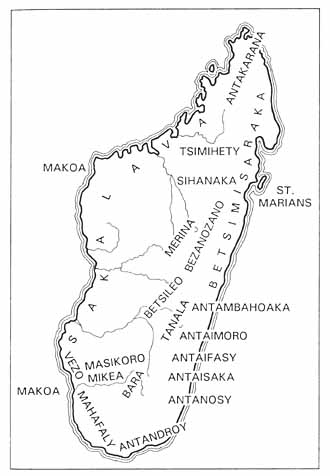
3.2. Present Distribution of Malagasy Ethnic Groups. Sources: After Brown (1978: 16); Kottak (1986, frontispiece); and Société Malgache (1973).
Non-Malagasy Strangers (Etrangers)
In addition to Malagasy speakers, there are also a number of minority groups (see Vincent 1974: 377) that consist of non-Malagasy peoples who have settled on the island. The largest of these groups are Arabs, Chinese, Comoreans, Europeans (especially French and some Greek), Indo-Pakistanis, and peoples of mixed heritage from the neighboring islands of Réunion and Mauritius. No recent statistics are available for the size of these populations, and so it is very difficult to estimate their numbers. This is in part due to recent political events. The majority of Europeans fled the island following the Socialist Revolution in 1972. Comoreans and Indo-Pakistanis have also fled periodically, since they have been the targets of violence in the last decade or so. Out of a total estimated population of 9.9 million for the entire island (figure for 1984; Covell 1987: xiii), population estimates for each group of étrangers are: 10,000 each of the Indo-Pakistanis and Chinese; 15,000 to 20,000 Comoreans (Covell 1987; 84–85); and 12,000 French (Bunge 1983: 49; for more details see Covell 1987: 84–85; on the Chinese see also Slawecki 1971 and Tche-Hao 1967).
Malagasy Ethnic Groups: How Difference Is Perceived
A variety of factors delineates boundaries between ethnic groups. To illustrate how these operate, I will briefly discuss two such factors: physical differences and the fady or taboos. Sections that follow provide discussions on other distinguishing characteristics, such as territorial affiliation, economic specialization, and religion.
Highland and coastal peoples (and, in turn, specific ethnic groups) are distinguished from one another by dialect and phenotype, reflecting the diverse historical and cultural origins of the Malagasy. As Bloch explains:
In addition, style of dress and specific customs serve as markers of difference. Clothing styles vary as one moves from one area of the island to another. In the central and southern highlands, which have a cool, temperate climate, most Merina and Betsileo wear western-style clothes. A style that is considered to be more traditional among these people is the akanjo, a knee-length shirt made of plaid flannel which is worn by peasant men throughout the highlands. Merina women (regardless of class) are also easily recognized since they often wear a white shawl (lamba) draped over their shoulders for formal occasions. The coastal areas are humid and tropical, and all around the rim of the island men and women wear body wraps made of brightly printed cloth (called a lambahoany). Among the Sakalava this consists of the kitamby for men, which is a waist wrap worn like a sarong, and for women, a salova (salovan̂a), which is wrapped around the waist or chest, and kisaly, draped over the shoulders or head. This style of dress is very similar to that worn by Swahili of the East African coast. The far south, which is occupied by such people as the Bara, Mahafaly, and Antandroy, is an arid region. Here men often dress in shorts, a short-sleeved shirt, plastic sandals, and a straw hat, while women wear western-style dresses or lambahoany. Throughout the island different hats as well as hairstyles also serve as markers for ethnicity. For example, the name Sakalava means “[People of] the long valleys,”[3] while the Tsimihety (“Those who do not cut their hair”) were so named by the Sakalava after they refused to cut their hair in mourning as an assertion of their independence following the death of a Sakalava ruler (Société Malgache 1973: 46, 47).Madagascar has always been considered an anthropological oddity, due to the fact that although geographically it is close to Africa the language spoken throughout the island clearly belongs to the Austronesian group spoken in Southest Asia; more particularly Malagasy is linked to the languages spoken in western Indonesia. These surprising facts are also reflected in the biological and cultural affinity of the people. Although there is much controversy over the relative importance of the African and Indonesian element in the population, there is general agreement that we find the two merged together throughout the island. In some parts one side of this dual inheritance is more important; in other regions it is the other side that seems to dominate. For example, all commentators agree that among the Merina…the Southeast Asian element is particularly strongly marked. (1986: 12)
Fady (taboos) are another important aspect of Malagasy identity. They are widespread yet specific to particular peoples and regions and have been carefully catalogued in books on Malagasy folklore (see Ruud 1960 and Van Gennep 1904; see also Lambek 1992). Fady work at many different levels: all ethnic groups have their own particular ones and smaller groups, such as villages or kin groups, may observe specific fady. Individuals may have personal fady that are determined at birth by the vintana or the Malagasy cosmological zodiac system (see Huntington 1981), or which they have collected over time as a result of sickness or other experiences. Fady may consist of dietary restrictions or clothing requirements, and locations or particular days of the week may have fady associated with them. Complex constellations of fady may surround particular ritual settings or events, such as burials for commoners or royalty. They are also a key aspect of tromba possession.
Among the Sakalava, the following are important examples. Pork is fady for many, requiring that they avoid contact with pigs and their products. Nosy Faly (“Taboo Island,” faly being an older form of the word fady), is Sakalava sacred space that requires respectful behavior from all visitors. One can not enter the village of the royal tombs (mahabo/zomba) on a Tuesday, Thursday, or Saturday, and so visitors who arrive on these days camp out on the beach, waiting for a more auspicious time. In the tomb village (Mahabo) one must go barefoot, and women are prohibited from wearing a kisaly on their heads. Dogs are prohibited and must be killed if they enter. Tortoises, on the other hand, are sacred, and it is fady to harm them. Because of these and other fady associated with the village, visitors must carefully monitor their actions so as not to incur the wrath of the local royal ancestors. Non-Sakalava visitors to Nosy Faly must also conform to local, Sakalava fady. Thus, on this sacred island and elsewhere, when one is among strangers, fady serve as markers of difference. They also operate to control the actions of outsiders. Visitors are expected to respect local fady or risk harming themselves or others. For this reason, Malagasy, when they travel, generally inquire about local fady, and they are usually listed in tourist guidebooks (see, for example, Société Malgache 1973).
Geographical Territory and Ethnicity
The Highlands versus the Coast
Among Malagasy, distinctions are made in reference to geographical areas and their corresponding ethnic groups, which in turn are relevant to the development of political power in Madagascar. There are, first, the peoples of the high plateaux. The most important group here is the Merina. The Betsileo, who live to the south of the Merina, occupy an ambiguous position in the minds of other Malagasy, since they are of the plateaux but are non-Merina people. I know of no general term in common usage that is applied collectively to Merina and Betsileo. Instead, more specific ethnic labels are used. Contrasted to these two highland groups are the côtiers (“peoples of the coast”), a term coined during the colonial era by the French to label all other Malagasy groups, many of whom Covell (1987: 13) points out live nowhere near the coast. The term côtiers is used most frequently by highland peoples and carries somewhat derogatory connotations.
These two general geographical categories have evolved out of politically defined divisions as a result of Merina expansion and subsequent French occupation of the island. During the eighteenth and nineteenth centuries, the Merina conquered much of the island and established a powerful kingdom. By the early 1900s Merina royalty in Antananarivo established an alliance with the British against the French, but this alliance ended when the French conquered the island. Throughout the twentieth century the distinction between Merina and all other peoples has remained significant. With Independence, President Tsiranana (who himself was from the coast) and his party members “tried to mobilize support by portraying themselves as defenders against ‘Merina domination’ ” (Covell 1987: 13). Today, this tension persists. As Covell states, “The conflict cannot be reduced either to ethnic or class competition, but has elements of both” (1987: 13; she in turn cites Tronchon 1975).
Relations between members of these two major geographical groups are characterized by mistrust and racist attitudes. African versus Austronesian origins are a subject of important debate in Madagascar. Merina and Betsileo claim to be the most “Polynesian” of the Malagasy (see Bloch 1971: 1–5) and look disdainfully on coastal peoples, whom they often refer to as being “more African.” These comments are made most often in reference to skin color and hair texture. For example, the term Makoa (which often appears on censuses as an ethnic category, see figures 3.1, 3.2, 3.3) is used as a descriptive (and somewhat derogatory) term for people who have dark skin and kinky hair. Makoa were originally brought to Madagascar as slaves from an area in the interior of Africa that is now part of Mozambique (see Lombard 1988: 88 and Smith 1963 on the “Makua,” especially pp. 257 and 273). Highlanders in general view côtiers as backward and uneducated. Coastal peoples, in turn, express resentment of Merina who were once favored by the French and who form the majority of the population in the capital city. Merina continue to dominate the national political arena and maintain access to the best education, health care, and other services and facilities, and they fill many of the country’s civil service jobs. (For a discussion of these trends after Independence, especially in reference to education, see LaPierre 1966.) Ideas shared by members of each of these groups toward one another also include notions of uncleanliness; concepts of physical beauty, especially in regard to skin color (“white/black”: HP: fotsy/mainty; SAK: fotsy/joby); and a reluctance to intermarry (cf. Bloch 1971: 1–5, 198–201; J. Ramamonjisoa 1984).
The Tanindrazana or Ancestral Land
The most important concept used to define personal and group identity is that of the ancestral land (HP: tanindrazana; SAK: tanindrazan̂a). This may not necessarily be the locality where one lives or even grew up; it is where one’s ancestors are located and, ultimately, where one will be entombed. For all Malagasy, identity is intrinsically linked to the ancestral land. Although it is considered rude to ask what one’s ethnicity is, asking the question “where is your ancestral land” (HP: “aiza ny tanindrazanao?”) will generally provide the same information (see Bloch 1968 and 1971, especially chapter 4).
Even when Malagasy migrate to other parts of Madagascar, the notion of the ancestral land continues to tie them to a particular locale. It is not simply the geographical space, but the ancestors themselves that serve as the locus of identity and that define an individual’s point of origin. As a result, as one moves about the island, one continues to have a strong sense of ethnic identity that is geographically defined. As Keenan states of the Vakinankaratra (a group that is culturally considered to be Merina), “The worst fear of a villager is to travel far from the tanindrazana and fall sick and, perhaps, die alone” (Keenan 1974). The same may be said for the majority of Malagasy, regardless of origin.[4] Migrants and their children, who are born far from their ancestral land, may continue to invest money in a family tomb that is hundreds of miles away, so that they can be placed there when they are dead.
Economic Specialization
Another system of ranking and categorization is based on forms of economic specialization that, in turn, correspond to ethnic and geographical categories. In a country where, for the majority of peoples, the staple is rice (see Linton 1927), highland peoples pride themselves on their talents as paddy rice farmers. The abilities of Betsileo farmers are a source of great national pride: their paddies are located in the valleys and tiered on the steep hillsides of the temperate regions of the southern plateaux. Coastal peoples of the east, west, and north practice swidden agriculture, where rice is, once again, a major crop (see Le Bourdiec et al. 1969: map no. 51).
The peoples of the arid south (for example the Antandroy, Bara, and Mahafaly) are pastoralists who raise cattle and goats. Although some grow rice, manioc is an important staple. Among many Malagasy—coastal and highland alike—pastoralists are regarded as being “simple,” “primitive,” and “African,” and are said to speak dialects that are unintelligible by the vast majority of Malagasy. Pastoralists are feared by others who say that they are thieves (mpangalatra). This comment is made in reference to (and is a result of a misunderstanding of) the dahalo, or cattle raiders, since among these groups cattle raiding is an important social institution for young men. Antandroy and other pastoralists are taller than many Malagasy and the men often carry long staffs with large blades mounted on one end. As a result, other Malagasy are wary of them.
Conditions are severe in the south, made worse by a drought that has extended throughout the past decade. This has forced a large proportion of men to spend their lives as migrants, working in different parts of the island and sending remittances home (usually by registered mail) to their spouses and other kin, where much of the cash is invested in animals.[5] These migrants are drawn to the major urban centers of other regions where they are hired as night watchmen and as cowherds. They are preferred by employers because they are willing to brave the elements and sleep outdoors, even during the cold, wet winters so characteristic of the highlands (for detailed discussions of southern pastoralists see Decary 1933; Faublée 1954; Frère 1958; Huntington 1973).
Religious Affiliation
Religions of foreign origin—Islam, Catholicism, and Protestantism—provide another means for distinguishing Malagasy from one another. They define divisions that are both ethnic and geographical. Estimates for religious affliation for the entire island in 1982 are as follows: 57 percent adhere to traditional (or what I will refer to as “indigenous”) beliefs (fomba-gasy) and 40 percent are Christian, with equal representation of Roman Catholics and Protestants (Bunge 1983: 62). I assume that the remaining 3 percent is mostly Muslim, but also includes Indian Hindus.
Islam is strongest in the north and west. In contrast to other Malagasy, many Sakalava and Antakarana are faithful to Islam, their conversion having occurred in response to their efforts to find allies against Europeans in the eighteenth and nineteenth centuries. In addition, Arabs, the majority of Comoreans, and many Indo-Pakistanis are Muslim (see Delval 1967, 1987; Dez 1967; Gueunier and Fanony 1980; Vérin 1967).
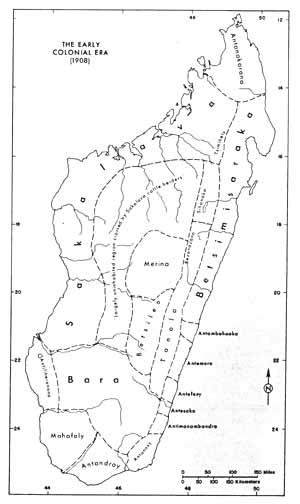
3.3 A and B. Distribution (and Migration) of Malagasy during the Twentieth Century. Source: Originally published in the Department of the Army Publication DA Pam 550-154, Area Handbook for Indian Ocean: Five Island Countries. Frederica M. Bunge, ed., 1983.

3.3 A and B. (continued)
Christianity has played an important role in shaping factions in modern Madagascar (Gow 1979; Mutibwa 1974; Southall 1979). Attempts were made by Portuguese and French Catholics to Christianize coastal peoples in the fifteenth and sixteenth centuries (Brown 1978: 30ff; Bunge 1983: 14), but these missionaries were killed by indigenous peoples shortly after they arrived. The first successful missionaries were Protestants from the London Missionary Society (LMS), who were welcomed into the Merina kingdom in 1818 by royalty who sought to have the British join them as allies against the French. Other sects soon followed and rivalries developed as they sought to stake out territory and win converts. While Protestants won the favor of Merina royalty (andriana) and elites (hova), Catholics worked outside the capital. Among the highland Merina they were most successful with the slave population (andevo). They also worked among the Betsileo and throughout the coastal areas of the island. In 1863, Protestants were expelled from the island by the Merina Queen Ranavalona I, but they were eventually allowed to return in the 1880s following her death (Brown 1978: 152ff; Gow 1979; Mutibwa 1974).
Rivalries between different sects have been fierce up to the present. According to Covell, the number of Christians has declined since Independence (1987: 95; she in turn quotes Raison 1970). As she states, “The Christian Churches of Madagascar claim an estimated four million ‘adherents’; a term that obviously covers a wide range of commitment. Both Catholic and Protestant churches have their largest number of adherents in central Madagascar, and one of the common physical features of the plateaux villages is the presence of two spired churches, usually confronting each other from the opposite ends of the village” (1987: 95).
Today, certain faiths are associated with specific ethnic groups. The Catholic Church is strongest in the southern plateaux among the Betsileo and in coastal areas. Protestantism is split between those churches that have a tradition of strong political ties with the Merina in Antananarivo and others in the south; the latter rely on regional missionary activities (for example, American and Scandinavian Lutherans have been active in southern Madagascar since 1866). In recent years, attempts have been made to forge new unions, alleviating the competition between Protestants. The FJKM church (Fiongonana Jesosy Kristiany Malagasy or the Malagasy Church of Jesus Christ) was formed in 1970 and draws adherents from such Protestant groups as the original LMS, Quaker, and French Protestant Mission churches (Covell 1987: 95). Subsequent ecumenical agreements among Protestant sects have led to their working in what was predominantly viewed as each other’s territories. (For more detailed discussions on the Catholics see Chandon-Moët 1957; Decary 1966; Hübsch 1987; Judic 1987; L’Hermite 1968. On Protestants see Belrose-Huyghues 1979; Birkeli 1957; Gontard 1971; Gow 1979; London Missionary Society 1881–1900; Vérin et al. 1970.)
The majority of Malagasy remain faithful to indigenous religion or fomba-gasy, in which ancestors are central. In a sense, fomba-gasy touches the lives of all Malagasy, regardless of faith, since all Malagasy express an interest in their origins and a concern for their respective ancestors. The contrasts and contradictions between fomba-gasy and other religions have served as a means to divide peoples throughout the recent history of the island. This is certainly true for the inhabitants of Ambanja.