
| • | • | • |
Local Power and Reactions to Colonialism
Local Authority and Power
Today the power structure of the town of Ambanja is multifaceted and complex, the town serving as a center for both secular and sacred power. There are a number of institutions that operate here. First, officially recognized power lies with the state, a structure that originated during the colonial era and which continues today under the independent government of Madagascar. It is composed of a hierarchy of national, provincial, county, town, and neighborhood authorities. There are also other, more informal, power structures at work in Ambanja. The state-owned enterprises wield much control in the Sambirano, since they play an extremely important role economically, one that affects the everyday lives of local people in many ways. Even though directors are state employees, they exercise great freedom in making decisions that affect the local economic and social order of the Sambirano. For example, much of the town’s funding for celebrations, transportation, roadwork, and so forth comes from the enterprises, with donations made by the directors themselves. The patron-client relationship between the enterprises and the townspeople is so strong that a common response to an important family or personal problem is to turn to one of the directors for assistance, whose responses can be either rewarding or devastating. Likewise, religious groups—be they Islamic, Protestant, or Catholic—provide support through divine injunction and financial assistance. The Catholic church is by far the wealthiest (as is reflected by the extent of its landholdings in town), and it is also the most influential. The Catholic church also provides access to rare opportunities beyond Ambanja and outside of Madagascar, particularly through education.
Prior to French occupation of Bemazava territory, political power and authority lay almost exclusively with the local royalty, that is, with the ruler and his or her advisers—be they living or dead. As will become clear in Part 2, by far the most important role was played by the tromba spirits and their mediums on Nosy Faly. With the arrival of the French, however, control shifted to colonial administrators and planters. This shift in the power base led to the relocation of the Bemazava ruler from the ancestral village of Ankify to the commercial center, Ambanja. This occurred during the reign of Tsiaraso II (Andriamandefitriarivo), who was the father of the present ruler, Tsiaraso III. Tsiaraso II reigned from 1945 to 1966, and from conversations with informants I assume that the move occurred early in his career (figure 2.4). Furthermore, French policies were designed deliberately to undermine the royal family’s power. The most effective effort involved recruiting royal children to be schooled at the local Catholic Mission. These children were trained to be civil servants for the colonial administration, whose loyalties and interests lay with the French and not their own people (cf. Feeley-Harnik 1991b: 137).
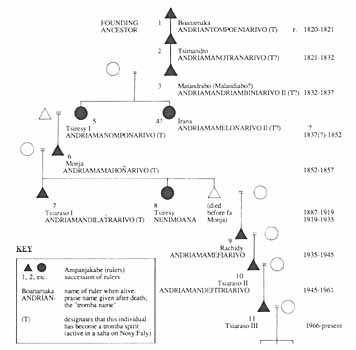
2.4. Rulers (Ampanjakabe) of the Bemazava-Sakalava Dynasty. Sources: Informants accounts; written Bemazava historical records; and De Foort (1907: 130).
Although royal power has diminished considerably (again, cf. Feeley-Harnik, 1991b), the present ruler (ampanjakabe) remains an important figure in the lives of the Bemazava. He is often preferred over the local court as a mediator in private disputes, and as the official living guardian of the local tanindrazan̂afa, he is the first authority one must consult prior to any further development of local land (see chapter 6). Spirit mediums also seek his blessing as well as his guidance in matters involving royal ancestors. The extent to which royalty more generally may become involved in the reassertion of royal power is exemplified in the actions of an Antakarana ruler to the north, who has become heavily involved in the revival and reinvention (Hobsbaum 1983) of royal rituals, which may draw a crowd of thousands of participants.
Local government officials honor the importance of royalty at public (state) occasions. A respect for Malagasy customs (HP/SAK: fomba-gasy; also referred to as fombandrazana/fombandrazan̂a or “customs of the ancestors”) remains strong in Madagascar. As part of malagasization, the national government has encouraged and institutionalized the observance of fomba-gasy at public events. Tromba mediums in particular have become very active, since the permission of the spirits must be sought through them, for example, prior to the naming of a local school after a past ruler or at the beginning of each season before boats of a state-owned fishery enter the waters near Nosy Faly (see chapter 6). Nevertheless, one has a sense of cooptation of living royal authority by the state, ironically illustrated by the fact that the present Bemazava ruler is Catholic and works at the county office as a tax collector.
Resistance and Revolt in the Sambirano
Bemazava reaction to the French occupation and the eventual transformation of the landscape was neither accepting nor passive. As Stoler’s work in Sumatra’s plantation belt illustrates, what may be presumed to be a peaceful occupation, settlement, and development by colonial forces may in fact be marked by acts of violence by the seemingly powerless against the powerful (Stoler 1985). At first glance, for a number of reasons it does not appear that French activities in the Sambirano were greatly hampered. First, it would have been difficult to present a united front against the French, the Bemazava being relatively few in number and scattered throughout the valley. Second, although Bemazava warriors were known to be fierce, their access to firearms was limited. Third, they regarded the French as their allies, since they had conquered an old enemy, the Merina.
Nevertheless, acts of violence against the French did occur. An incident cited frequently by the Bemazava involved a private dispute that quickly became a public—and political—one. Shortly after the French military post in Ambato was established, a group of Bemazava men were captured and imprisoned for having killed a Frenchman. The Frenchman had been living in the royal village of Ankify and was married to a Bemazava woman of royal descent. Jealous of his wife’s interactions with other men, he had confined her to the house. Since she was royalty (ampanjaka), other Bemazava regarded this as offensive and killed the husband. Captain Verdure had the prisoners beheaded in order to discourage future violence against French citizens. This episode is still remembered with great bitterness by the Bemazava. Much of their anger focuses not only on the French but also on Senegalese soldiers who were brought there by the colonial government to help maintain order. These soldiers are said to have tried to eat the prisoners’ bodies until Verdure stepped in to prevent such an outrageous act.[15]
The Sambirano became a politically charged area in 1947, a year that today is commemorated in Madagascar as a time of revolution and early nationalism. The front of resistance was located on the east coast of the island and began in March 1947. Malagasy in other areas of the island subsequently staged their own revolts against the French (see Covell 1987: 26; Rajoelina 1988; Tronchon 1974). Following the lead of revolutionaries elsewhere, inhabitants of the Sambirano behaved disrespectfully to French as they passed in the streets and the workers of some plantations went on strike. By November 1947, a small rebel group had formed in the Sambirano with a camp established in a village southwest of town, where they secretly manufactured knives and guns. Within a few months, however, the leaders were captured and imprisoned, putting an end to a potential uprising.
Resistance may also take more insidious forms, which are culturally more appropriate yet perhaps less effective against foreign invaders (Scott 1985). The Ramanenjana or “dancing mania,” which occurred in the Merina capital of Antananarivo in 1863, is perhaps the most large-scale resistance movement against foreigners involving religious forces. At this time the streets were crowded with hundreds of people possessed by the dead Queen Ranavalona. The possessed often disturbed and even attacked Europeans, many of whom were Protestant missionaries (see Davidson 1889; Sharp 1985).
Without doubt, during the colonial period Malagasy throughout the island appealed to the ancestors and other spiritual forces for assistance. In the Sambirano, it is certain that Sakalava sought to cause harm to or drive these foreigners from their homeland. They appealed to specialists such as herbalists (moasy), diviners (mpisikidy ), and tromba spirit mediums, making use of Malagasy medicine, or what Europeans referred to as magic (fanafody, fanafody-gasy). According to one informant, at the time of the 1947 revolt in the Sambirano, dead and living forces united against the colonial government; Malagasy who sympathized with the French were victims of “occult forces” (forces occultes) including tromba and other spirits, and fanafody. As will become clear in subsequent chapters, the use of fanafody continues to be a powerful way to control events in everyday life. Tromba mediums in particular play a special role in this manipulation of the spiritual realm. In addition, tromba as an institution has been a source of Sakalava pride and identity, as well as a means of Sakalava resistance to foreigners. During this century it has operated as a reminder of things past. It has also provided an idiom through which to critique contemporary experiences.
The Social Construction of Work
Throughout the twentieth century, by far the most significant form of resistance, in terms of its impact on European attitudes and policies, has been the Sakalava’s refusal to work as wage laborers. Although a requirement under the colonial regime was ten days per year of enforced (corvée) labor, ownership of land enabled many local Sakalava to avoid having to work full-time for the plantations (for a discussion of similar policies throughout the island see Thompson and Adloff 1965, chap. 23). Furthermore, many Bemazava were able to pay the mandatory head tax through cash-cropping or by selling their cattle. As a result, early in the century the plantations began to hire laborers who came from other areas of the island. To understand the logic behind Sakalava actions, it is necessary to analyze the meaning of work in their society.
Feeley-Harnik, in her discussion of slavery and royal work among the Sakalava in Analalava, states that Sakalava distinguish between two types of work: asa, or work owed to kin, and fanompoan̂a or “royal work or service that is part of their politico-religious and economic obligation to the monarchy” (Feeley-Harnik 1984: 3). In Ambanja (and elsewhere in Madagascar), asa also has other meanings: as a noun, it can mean “task” or “project,” and the verb miasa, which is often translated “to work,” is used more generally to mean “to be occupied” or “active” or “to be working on a task, a project.” For example, if a woman is doing the laundry, one says “miasaizy” (“she is working”). Beginning in the colonial era, asa took on additional meanings, as a result of the penetration of a capitalist economy and its associated labor relations. The French used asa to mean wage labor, as well as enforced, mandatory work that involved clearing roads, for example (cf. Feeley-Harnik 1991b, especially p. 349).
French concepts of work ran contrary to Sakalava ones. Since, for Sakalava, work was something that one did out of loyalty to kin and local rulers (Feeley-Harnik 1986, 1991b), requirements imposed by the French government and plantations negated local custom. From a Sakalava point of view (and certainly from a French one as well) fulfilling these work requirements was a sign of loyalty to the colonial administration. Feeley-Harnik (1984), in her discussion of slavery and royal work, argues that this action by the French was deliberately designed to undermine local royal authority and to disrupt the local sociocultural order. (For other discussions of Malagasy conceptions of work see Decary 1956; on the implementation of French colonial policy elsewhere in Africa see Crowder 1964 and Gifford and Weiskel 1974.)
In the Sambirano these efforts were only partially successful. Although royal authority has certainly diminished, many people still look to the local Bemazava king as an adviser and mediator in local disputes. It is also acknowledged that his authority is legitimated by the tromba spirits. Those who today turn to royalty (living or dead) for guidance are not only local Bemazava-Sakalava, but also many others who have become involved in tromba possession and serve as mediums for these spirits. The local government often must rely on the support of the king if it wishes to encourage participation by community members in local activities. On International Workers’ Day (May 1), for example, only the blessing of the king ensures that townspeople will help to repair the roads in town—this time as a sign of support for the present socialist state.
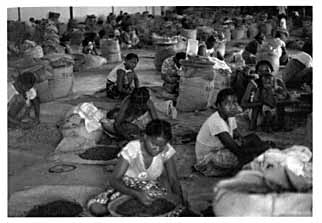
Plate 3. Women at work at a local enterprise. Women are hired to sort cocoa, coffee, and cashews. They are paid by the number of bags they fill in a day.
Sakalava resistance to work—in the form of wage labor—is often cited today by employers, who speak of them as “lazy” (kamo) or as too independent and proud to be willing to work for others. Sakalava youth express a preference for working in fields owned by kin to wage labor, be it manual or more highly trained supervisory positions. As the chapters in Part 2 will show, tromba possession also provides mediums with a means through which they may resist wage labor, particularly at the enterprises. A sentiment that many Sakalava express is that in such work there is no freedom: the hours are long, the pay is too low, and the fruits of their labor belong to someone else (see plate 3). The refusal to work was and still is a strong form of resistance to capitalist discipline. Such relations involve, first, a readjustment to clock time (Thompson 1967),[16] and, second, the displacement of reciprocal relationships by having services paid for with cash, both of which Sakalava despise. Throughout this century Sakalava have resisted engaging in such relations with non-Sakalava. In the past, these were foreigners. More recently they are Merina, who now form the majority of managers at the enterprises. This action, however, has its price: after Sakalava refused to work for foreign planters they witnessed the inundation of their territory by a variety of non-Sakalava migrants.