
| • | • | • |
The Process of Disengagement
Pragmatic security concerns are the dominant variable in Israeli opinion. This opinion is remarkably sensitive to Arab words and actions; events and changes in the Arab world seem to provide the best explanation for the long-term moderation of Israeli thinking since 1967. Positions supposedly based on deeply held beliefs and convictions have shifted with startling rapidity in response to dramatic developments. Furthermore, the experience of the intifada demonstrates that changes can take place in contradictory directions simultaneously and that the impact of violent or negative events in the short term does not necessarily undercut or reverse positive trends in basic attitudes.
By the early 1990s there was a mobilizable majority of the Jewish Israeli public behind practical measures to moderate the conflict by disengaging from the occupied territories. The status quo enjoyed next to no support in principle from any segment of Israeli opinion; ideological doves and pragmatic doves, working together, could potentially dominate. The decisive consideration was security, not ideology. What once sounded radical had become less so; negotiation with the PLO and the idea of a Palestinian state, once outside the mainstream of political debate, became part of it.
How did the political system process the anomaly of increased dovishness on territorial issues—the dominant issues of Israeli politics—with little or no change in party loyalties? Clearly the electorate was voting somewhat to the right of its opinions on security issues.[88] A number of reasons for this anomaly can be suggested: the influence of other issues that favored Likud, continuing Sephardi alienation from the Labor Establishment, and—not least—the appeal of Likud as tougher bargainers who would better defend Israeli interests in any negotiations that took place (Likud electoral slogans and other moves to establish its credentials as a serious peace negotiator lent additional credence to this interpretation). Whatever the causes of this inconsistency, the phenomenon of an electorate voting to the right of its opinions on substantive issues provided an ironic contrast to the earlier pattern, in the 1960s and 1970s, of an electorate that voted to the left of its fundamental beliefs in a number of respects (see chapter 6).[89]
Elections in 1992 and 1996 confirmed a continuing split right down the middle of Israeli politics. In 1992 Labor and other parties of the left secured a bare majority of sixty-one in the Knesset, and in the first direct vote for prime minister (in 1996), Benjamin Netanyahu defeated Shimon Peres by less than 1 percent of votes cast. Netanyahu’s victory also illustrated the continuing success of the right in attracting pragmatic hawks from the middle of the spectrum; his platform called for “making secure peace” and promised a continuation of the peace process.
In 1992 Yitzhak Rabin, returning to the prime ministership after a hiatus of fifteen years, had a narrow but workable advantage in the Knesset. Even without including the two far-left parties (Democratic Front for Peace and Equality and the Arab Democratic Party) in the governing coalition, he could count on their five Knesset votes as part of a “blocking majority” of sixty-one to bar any alternative government of right-wing and religious parties, who together could muster only fifty-nine votes. In addition, an even balance does not necessarily prevent decisive government action in Israel, given the amorphous state of opinion and the tendency to defer to strong leadership. Israel leaders have considerable latitude as long as party discipline holds; public opinion is responsive to strong direction on security issues, and especially to peaceful initiatives (such as the 1977 Sadat visit and the 1993 breakthrough with the PLO).[90]
In negotiating withdrawal from the territories, however, Israel faced two structural problems. The first was that, even in the framework of separation, there was initially no agreed-upon endpoint acceptable to a majority of both Israelis and Palestinians. Israelis who were ready to part with the territories tended to prefer a Jordan-based solution or some form of self-rule short of a Palestinian state; Palestinians who now accepted a state alongside (rather than in place of) Israel would not accept anything less than total sovereignty and independence from all Israeli control. Thus the interim solutions had to be open ended, leaving a number of possible outcomes on the table; it was indeed a peace process, as it was labeled, since it was only with the completion of each phase that sufficient agreement was built for the next.
The second problem is that, from Israel’s perspective, the “Land-for-Peace” formula involves the surrender of tangible assets (territory, strategic advantages) for intangible commitments that can be quickly and easily renounced. For this reason, Israeli negotiators try to structure any agreement so that territorial withdrawal will be balanced by compensating security arrangements making renewed belligerency unappealing to the other side. It might be more accurate to term this approach “land for security” rather than “land for peace.” In the peace treaty with Egypt, the return of the Sinai was combined with its demilitarization under international verification; in essence, given the superior mobility of Israeli forces, the Sinai serves as hostage for Egyptian adherence to its commitment of nonbelligerence.
Following the 1991 Persian Gulf War the United States had brokered a diplomatic effort that produced a formal framework for negotiations. At the Madrid Conference in October 1991—the first direct Arab-Israeli peace talks with representation of all major parties—separate but parallel multilateral and bilateral tracks were set in motion. The multilateral forums, which included the nations of the Middle East and some outside powers, met periodically in the following years to discuss the issues of water, environment, arms control, refugees, and economic development. The real action, however, was focused in four sets of bilateral talks between Israel and Jordan, Israel and Palestinians, Israel and Syria, and Israel and Lebanon. (Initially the Palestinians appeared as part of a joint Jordanian-Palestinian delegation, but this quickly became a polite fiction.)
With the Likud government unwilling to move beyond autonomy for West Bank and Gazan Arabs, early negotiations between Israel and the Palestinians made little progress. But continuing pressures on the PLO, together with the change of government in Israel, led to a breakthrough following months of secret contacts between the two parties. In September 1993, Israel and the PLO extended mutual recognition to each other and, in a dramatic ceremony on the White House lawn, signed a Declaration of Principles on Interim Self-Government Arrangements (DOP) to serve as an open-ended framework for a settlement.
The DOP was strikingly similar to the Camp David “Framework for Peace in the Middle East” negotiated between Israel and Egypt fifteen years earlier and rejected by the PLO at the time. Both agreements called for a five-year transition period in the West Bank and Gaza, during which Arabs in these areas would enjoy full autonomy under an elected Self-Governing Authority (which emerged as the “Palestinian Authority”), Israeli military and civil government would be ended, and Israeli troops would be redeployed out of Arab population centers and into specified security locations. Both agreements called for final status talks, covering borders, security measures, refugees, and other unsettled issues, to begin no later than the third year of the transition. The major difference was that Camp David had reserved a major role for Jordan and a lesser role for Egypt, while the DOP treated the West Bank and Gaza as a bilateral Israeli-Palestinian concern. The DOP also specified an early Israeli withdrawal from Gaza and from the Jericho area as a first step.
In a sense the DOP marked the “re-Palestinization” of the conflict, as Israel reestablished the border that had been blurred since 1967, recognized the Arabs within historic Palestine as its major negotiating partner, and reduced the role of external Arab states in the conflict.[91] This strategy gained strong public support, even though the Likud—sponsors of the Camp David accords—found grounds as an opposition party to reject the DOP and the subsequent agreements negotiated within its framework.
The timetable for implementation of various stages of the agreement was very ambitious, due to Palestinian pressure for quick Israeli withdrawal. Agreement on the details for the first-stage withdrawal, from Gaza and Jericho, was reached only in May 1994, rather than as scheduled in December 1993. Agreement on “Early Empowerment” of the Palestinian Authority throughout the territories was reached in August 1994, and finally in October 1995, the full Interim Agreement of some 400 pages, known as Oslo II, was finalized. Under this intricate arrangement, Israeli forces redeployed out of Arab cities and towns, the Palestinian Authority assumed control of the Arab population (total control in the cities, civil control in rural areas), and elections were held for a Palestinian council with legislative and executive powers, headed by an elected president (Yasir Arafat). Israeli forces still controlled 70 percent of the West Bank, however, including for the time being all of the Jewish settlements, a fact that gave the Palestine leadership a strong interest in not allowing the process to stall at this stage (see Map 4).
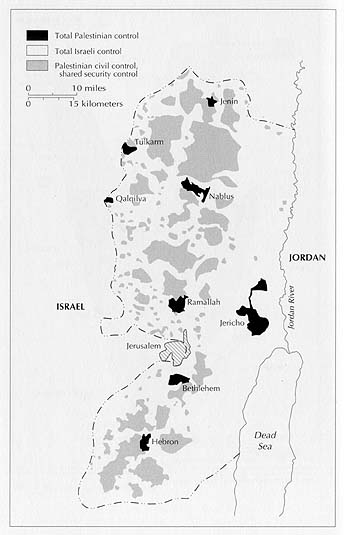
Map 4. West Bank under the Interim Agreement, 1995
Support for the peace process within Israel fluctuated significantly in response to events, including the ups and downs of the process itself but, even more, a wave of suicide bombings perpetrated by Islamic extremists, who sought to derail the process. Nevertheless a strong, and even growing, majority of 60 to 65 percent continued in principle to support talks with the PLO, the return of territories, and the peace process in general. Support for the DOP in particular was eroded by the perception that the PLO was not acting in good faith to prevent terrorism, and support fluctuated in early 1995 between 30 and 35 percent (with a similar proportion opposed explicitly and up to a quarter of the respondents on the fence).[92] This support rose when Oslo II was signed, and the assassination of Prime Minister Yitzhak Rabin, on November 4, 1995, caused a strong backlash of support both for the peace process (to over 73 percent) and for the Oslo agreement in particular (to 58 percent).[93]
By this time the Israeli government could also enumerate concrete benefits of the peace process. Normalization of Arab relations was progressing: the Arab boycott was withering, and Israel was developing economic ties with a number of Arab states. The “cold” peace with Egypt seemed to be warming, and the 1994 treaty with Jordan promised full normalization, the repeal of anti-Israel laws, and a number of joint development projects along the Israel-Jordan border. The “Eastern front” threat diminished considerably with Jordanian guarantees against the stationing of hostile forces on its territory, while the detachment of Jordan from West Bank issues also lessened the risk of eventual Palestinian dominance on the East Bank. Lower-level relations were established with Morocco, Tunisia, Mauritania, and Oman; by late 1995 Israel had diplomatic relations with nearly all non-Arab Muslim states, and with 155 nations altogether (against only 68 a decade earlier). The changed political climate also helped the economy, with big jumps in tourism and foreign investment (following upgraded credit ratings in international markets).
Rather strikingly, the vast majority of Israelis—74 percent by 1994—had come to believe that a Palestinian state would in fact be established, whether it was their preference or not.[94] As the Israeli army moved out of Arab population centers, it seemed very unlikely that it would move back in, barring a total breakdown of law and order that spilled across Israel’s frontiers. Public figures spoke with increasing candor about the likelihood that self-rule for the West Bank and Gaza was, as the opponents of the peace process charged, leading to eventual Palestinian statehood. It might appear under a different label and be constrained by demilitarization and other security arrangements, as Sinai had been and the Golan Heights would be in any settlement with Syria, but a Palestinian state in one form or another appeared as the logical outcome of the process that had been set in motion.
As for borders, the intentions of the Rabin and Peres governments could best be gauged by policies toward Jewish settlements across the Green Line: where was continued building encouraged, where was it frozen, and in what other ways was the government redrawing the boundaries? Initially the Rabin government had differentiated “security settlements” from “political settlements” and had retained generous government benefits only for the former while freezing public expenditure and new housing starts elsewhere in the territories. Consequently it seemed likely the government would try to include the bedroom communities of western Samaria and greater Jerusalem, the Etzion bloc south of Jerusalem, and the Jordan Valley settlements on the Israeli side of the final border. According to a study by the Jaffee Center for Strategic Studies, a redrawing of the Green Line to incorporate 11 percent of the West Bank in Israel could bring in 60 to 70 percent of the Jewish settlers (and very few Arabs), thus making this thorny issue less contentious.[95]
Netanyahu’s razor-thin victory in 1996 put the process back on the slow track, however. The new government’s opposition in principle to further Israeli withdrawal from the occupied territories, to Palestinian statehood in any form, or to any compromise on Jerusalem, made further agreements with the PLO, or any agreement with Syria, much more difficult. But while the process could be stalled, or even disrupted, it did not seem to be reversible. Despite detours and heartaches, it would inch forward.
It is possible that we are in the last phase of the Arab-Israel conflict. Its re-Palestinization encourages the gradual, grudging acceptance of Israel as a fact by Arab states, based on their recognition that it cannot be defeated militarily and by their own shift of focus to domestic problems and priorities. This acceptance is not based on conviction but on necessity; it will not be a “warm” peace in the near future (with the possible exception of Jordan), but it can be a workable and stable long-term settlement.
The detachment of external enemies requires settlement of Israeli-Palestinian differences in a way acceptable to most Palestinians; this in turn requires, realistically, a disentanglement of the two peoples. After flirting with other conceptions, the Israeli public has returned to the conventional wisdom that good fences make good neighbors; roughly 75 percent agreed in 1995 with the statement that “from Israel’s point of view, also in a state of peace, it is preferable to have a clear and closed border between it and the Palestinian entity, in order to create maximum separation between Israelis and Palestinians.” [96] Even more striking, perhaps, is the public response to the closures between the territories and Israel periodically implemented since March 1993, in response to terrorist incidents. Despite the fact that these closures contributed substantially to the process of disengagement, they were supported wholeheartedly by all segments of the population except the ideological hawks.
Separation is seen by some as the defeat of Jewish values, as failure to fulfill a historic mission. But disengagement may be the key to the preservation of a newly created Israeli culture within a re-created Jewish state. There is, as most observers on both sides note, a struggle between the universalistic values of the peace process and particularistic claims of those aspiring to an undivided Land of Israel, paralleling a presumed choice between democracy with limited Jewish character or an ethnic state with limited democracy. History rarely proceeds by such clear choices, however; Jewish history in particular is a continuing synthesis of the universal and the particular. Disengagement clearly preserves democracy, but it may also be the strongest bulwark of Jewishness.[97]