
| • | • | • |
Ordinary People in European Politics (ca. 1500)
To understand more clearly the history and significance of popular political practice, we must come to a fuller appreciation of both the variety of political opportunities that political subjects enjoyed and the larger consequences of the choices that popular political actors made. The analysts of modern social movements often speak of political opportunity structures outside the “normal” channels of electoral politics; stripped of its present-minded assumptions about electoral politics, this idea of geographically and temporally variable structures of political opportunity can be especially useful in the study of “informal politics” in other times and places, especially in those circumstances in which most people are excluded from formal political participation altogether.[9] In the first instance, of course, political opportunities are framed by the specific institutional structures through which rulers exercise their authority, and in this regard the relative openness of formal political structures to popular political bargaining is conditioned by the historically specific limits of governmental coercion or repression. But beyond that we can identify a number of significant variables: the relative stability of political alignments within the polity; the availability to popular political movements of influential allies; and the degree of political division among established political elites. But what is especially important (if also complicated and confusing) for understanding popular politics in the early modern period is to disentangle the multiple and overlapping structures of political opportunity that were obviously inherent within composite states.
At the beginning of the early modern period, around 1500, most Europeans lived within composite states that had been variously cobbled together from preexisting political units by a variety of aggressive “princes” employing a standard repertoire of techniques including marriage alliances, dynastic inheritance, and direct conquest. Some composites, like the Kingdom of England and Wales or the complex mosaic of pays d’élections and pays d’états in France, were composed of largely contiguous territories; others, like the Spanish Habsburg monarchy (created by the dynastic union of Castile and Aragon, each in itself a composite) or the Habsburg imperium more generally under Charles V, were separated by other states or by stretches of sea (Koenigsberger 1986; Greengrass 1991; Elliott 1992). Since the dynastic “prince” promised to respect the political customs and guaranteed the chartered privileges of these constituent political units, ordinary political subjects within composite states acted in the context of overlapping, intersecting, and changing political spaces defined by often competitive claimants to sovereign authority over them.[10] To the extent that they were oriented to a variety of political spaces defined by a variety of rulers, ordinary people could choose not only when and how to challenge the authority of their rulers but also where. As we shall see below, it was often in the interstices and on the margins of these composite early modern state formations that ordinary people enjoyed their greatest political opportunities.[11] By choosing to oppose the claims of some putative sovereigns, ordinary Europeans were often deliberately reinforcing the claims of constitutionally alternative or competitive rulers who were willing, at least temporarily, to meet their demands or to discuss their grievances and thereby to legitimate their political actions. In composite states especially, political opposition usually entails political alignment as well.
But what practical difference might the choices of popular political actors make? At the very least, a composite state involves three sets of actors: local rulers, national claimants to power, and ordinary political subjects. Figure 2 not only illustrates the obvious political alignments possible within such a state, it specifies the consequences that these different choices/alignments imply. In the first of these alternatives, ordinary political subjects align themselves with local rulers who are willing to champion their perceived interests vis-à-vis a more distant overlord and thereby help to consolidate local self-regulation and decision-making authority. In the second, local rulers align themselves with national claimants vis-à-vis their mutual subjects, thereby reinforcing their political interdependence in what I have called elite consolidation. In the third case, ordinary people align themselves with a more distant overlord who is willing to champion their interests vis-à-vis less responsive or more demanding rulers at home, thereby underwriting the consolidation of a broader territorial sovereignty at the expense of local self-determination.
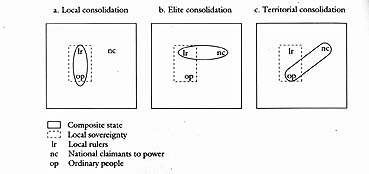
Fig. 2. Alignment of political actors within composite states
By its very nature, this kind of complex political arrangement may be said to be particularly volatile because an alignment between any two of the actors promises to exclude the third; at the same time, the continued existence of the third represents the potential for two alternative alignments that implicitly threaten the status quo. Figure 2 nevertheless underestimates the complexity of politics within composite states in at least two important ways. As we shall see below, the constitutional layering of authority can entail more levels than “local” and “national,” with district and regional or territorial rulers frequently claiming a piece of the existing “sovereignty.” [12] At the same time, each of the principal actors is as often as not subdivided by internal rivalries and competing interests/objectives, producing situations in which all of these competing alignments appear at once; such situations might then be considered “revolutionary” if and when the alternative alignments make and attempt to enforce exclusive political claims that, if accepted, would eliminate their rivals.[13] For our purposes, what is especially instructive about even the stylized alternatives represented in figure 2 is the way in which ordinary people remain salient and potentially decisive actors even under political conditions that appear to guarantee the long-term survival of elite consolidation.[14]
Emphasizing the spatial and cultural perspectives on popular political practice within late medieval composite states, then, the chapters that follow explore the variety of ways in which ordinary people actively lived the “big changes” in European political history during the early modern period. Chapter 2 begins the story in the first half of the sixteenth century and focuses on the political process of religious reformation in the fragmented political context of the German-Roman Empire; it nevertheless locates the popular reformations of Germany and Switzerland within a larger comparative analysis of the role of popular political action in the Comunero Revolt in Castile and the “princely” reformations of Scandinavia and England. Chapter 3 examines the political dimensions of the “Second Reformation” in France and the Low Countries where the initial repression of religious dissent yielded to decades of civil war and revolution in the second half of the sixteenth century; again the emphasis is on the character and significance of popular engagement within these complex struggles over political and religious sovereignty that by the end of the sixteenth century produced three very different paths of political development. Chapter 4 analyzes the political dimensions of the Crisis of the Seventeenth Century, focusing in turn on distinct clusters of revolutionary struggles in Iberia and southern Italy, the British Isles, and France; against the backdrop of the sixteenth-century reformations, this chapter explores the significance of popular political action in accounting for the varied outcomes of large-scale revolutionary challenges to the rulers of composite states.
Each of these chapters—which together constitute a sort of dramatic development in three chronologically sequential acts—takes us from one region to another investigating the variant patterns of interaction among national powerholders, local rulers, and ordinary people; each chapter also develops a framework for understanding the particular interactions and historically specific range of variation evident in the cluster of conflicts in question.
Chapter 5 takes stock of the larger historical patterns brought out in the previous chapters; it assesses the cumulative outcome of some one hundred fifty years of political and religious conflict in specific polities, not in terms of an essentially static ancien régime, but as a set of variant trajectories of political development in which the interactions of subjects and rulers, in one time and place, limit and channel the next round of interaction but do not strictly determine the outcome. In conclusion, then, this book argues that the political engagement of ordinary political subjects needs to be taken systematically into account in any explanation of the political features of the “new regime” that gradually came into focus across the European continent in the second half of the seventeenth century.[15]
This, I hasten to add, is not an exclusive argument. It does not suggest, for example, that ordinary people were either the principal architects or the primary beneficiaries of the new structures of European politics or the new system of European states that rose from the ashes of “religious war.” On the contrary, this work seeks to improve on previous accounts of the varieties of European state formation by tempering essentially ruler-centered or structurally determined models with the perspective of popular political practice and to augment the generally teleological research on the unitary sovereignties of territorial states with a specific concern for the consolidation of fragmented and layered sovereignties. Nor does this argument eclipse or undermine the value of more focused analyses of the modes of political action within specific polities or of detailed local research on particular events. Rather, it seeks to develop an analytic vocabulary and articulate a comparative framework through which it will be possible to ask sharper and more discriminating questions about the efficacy of popular politics in specific instances.
To accomplish all this in the course of a small book, my aim has been illustrative rather than comprehensive, and treatment of any given polity or region within the European political landscape is episodic at best. To some extent, this is simply reflective of the existing literature, which tends to be localized, discontinuous, and geographically uneven. To the extent that my choices of illustrative material were not merely dictated by the literature (or my limited access to it), however, I have generally placed more emphasis on exploring the broadest range of variation in each of these eras than on providing uniform or continuous coverage of any or all polities. Thus, while I have drawn a disproportional share of my examples from those parts of Europe north of the Pyrenees and Alps and west of the Oder, I am reasonably certain that I have encompassed the broad range of political variations evident within all of Europe’s composite states. In any case, it was by no means my intention, in my choice of examples, to marginalize southern or eastern Europe or to privilege the politics of Latin Christendom.
Before setting out on this broadly comparative and essentially episodic exploration, however, it is important to ask how we might conceive of the more continuous dynamics of political development in any specific polity in the longue durée. Since our basic problem is to describe and account for the specific histories of state and political-cultural change that were embedded in the European system of states as it emerged in this period, figure 3 represents an axial model of the general argument that popular political actors were an integral part of these large-scale historical processes of political development in European history. As the diagram suggests, the heart of the story is the interaction or bargaining between governmental authorities (rulers) and popular political actors (subjects) which can be said to account for the path of state and political-cultural formation within specific political domains. Yet, as the figure also suggests, the interactions of rulers and subjects are channeled and limited in a variety of ways. In the early modern period especially, it is important to recognize two analytically distinct sorts of secondary actors who were implicated in politics at all levels. On the one hand, those who claimed cultural authority—often by virtue of their positions within more or less formal institutions like churches, schools, learned academies, religious communities, and voluntary associations—were deeply implicated in the competitions and conflicts between rulers and subjects, variously reinforcing or undercutting the claims of the principal political actors, not just in the explicitly religious conflicts of the Protestant Reformation but across the Continent and throughout the entire period. On the other hand, external allies often intervened directly in “domestic” conflicts, not only in revolutionary situations, but more routinely in constitutionally layered articulations of fragmented sovereignty within composite states.
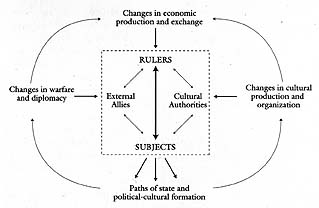
Fig. 3. Historical dynamics of political interaction
As the newer accounts of path-specific state formation have shown, both the fortunes of war and diplomacy within the state system and the cyclical development and geographic differentiation of emergent capitalism have important implications for the organization and exercise of power. My account insists, however, on their variable impact on subjects and rulers alike, especially in the way that wars and economic change altered the distribution of politically important resources to all political actors. To this standard list of environmental conditions—that is, large-scale changes that transcended the boundaries of particular polities—I have added changes in the organization and production of culture. Especially during this period the spread of new printing techniques, the disintegration of the Roman Catholic church, and the rise of mass literacy helped to reconfigure the choices and channel the cultural resources available to all political actors within any given space. Altogether, then, the environmental conditions and the specific dimensions of the political domain can be said to structure the political opportunities but not to determine the choices of rulers as well as subjects. On the outcome side of the diagram, the closely linked trajectories of state and political-cultural formation can be seen as the institutional and cultural residue of historically specific interactions between rulers and subjects, which, in turn, influenced the environmental conditions and channeled the next round of political interaction.
A comprehensive or authoritative account of the big changes in European politics during this tumultuous period might well treat the environmental conditions and the political interactions in equal measure. This work focuses, however, on political interaction within historically specific political spaces and, by comparison, generally takes the changing environmental conditions for granted. While I want clearly to acknowledge the importance of these changing conditions, I want equally clearly to undermine the assumption that one can reason directly from structural conditions to political outcomes. On the contrary, what this work aims to demonstrate is that by starting in the middle—by focusing on political interaction as the heart of the story—we will finally be able to move beyond both elite-centered and structurally determined accounts of European state formation to describe and account for the various ways in which ordinary people were active and creative participants in the formation of the modern political landscape.