
| • | • | • |
Laënnec and Essentialist Medicine
One cannot help but think of the label “romantic medicine” when contemplating Laënnec’s remarks concerning les passions tristes and seeing their echo in subsequent decades. Such comments seem to replicate in medicine a common theme in romantic literature and art: the tragic, fatalistic determination of illness and death by “psychogenic” factors. Some have called the early nineteenth century the heyday of romantic medicine for other reasons, referring to the search for transcendent explanations and the tendency to speculative, idealistic, universal system building (in opposition to rationalist empiricism).[11]
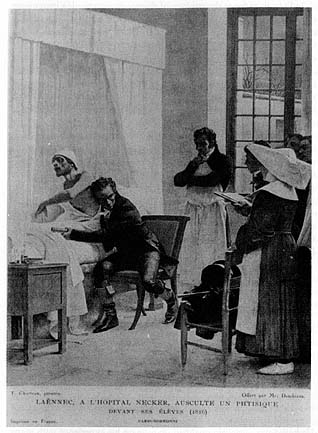
5. Théobald Chartran’s painting of Laënnec auscultating a consumptive patient, 1816. Photo courtesy of the National Library of Medicine.
In France, as far as the etiology of disease is concerned, a better term might be “essentialist medicine”: the belief that disease in general (and tuberculosis in particular) was part of a person’s essence. Illness, in this view, arose spontaneously from internal causes and constitutional predisposition rather than from external causes, although external factors could influence the outcome of internal tendencies and predispositions. (This last corollary would become quite significant when essentialist medicine confronted the unequal incidence of tuberculosis in French society.) Some doctors even attributed epidemic disease to an “epidemic constitution.” According to Ackerknecht, a strong political and philosophical aversion to contagion brought about this “regression to older, classic causal explanations.” After all, in his words, “things had to be explained somehow.” Heredity served as an especially popular explanation of many diseases, including tuberculosis. Through heredity, it was assumed, a constitutional predisposition to the disease—or “diathesis”—transmitted itself from generation to generation.[12]
Laënnec, whose opinions on tuberculosis influenced medical teaching and practice throughout the first two-thirds of the nineteenth century, rejected contagion in favor of heredity in his landmark Traité de l’auscultation médiate.
In Laënnec’s treatise, however, the entire question of etiology was tinged with uncertainty and equivocation. Even his denial of contagion was less than rock solid.If the question of contagion may be regarded as highly dubious relative to tubercles, the same cannot be said of hereditary predisposition. Experience proves to all physicians that the children of consumptives are more frequently attacked by this disease than are other subjects.[13]
He based this curiously qualified opinion on his experience with many patients whose spouses remained healthy despite sharing a bed even in the late stages of the illness and with poor families who slept crowded together in a small room, where the tuberculosis of one family member did not endanger the health of the others. Yet Laënnec admitted that, “fortunately,” many countervailing examples existed for heredity as well, cases in which only one of several children in a family contracted the disease; conversely, he added, tuberculosis occasionally wiped out entire families who showed no signs of it in previous generations.[15]Tuberculous phthisis has long been thought contagious, and it is still thought to be so by the common people, by magistrates, and by some doctors in certain countries, especially in the southern parts of Europe. In France, at least, it does not seem to be [contagious].[14]
It is possible that this uncertainty, which was by no means unique to Laënnec, can be traced to the relative neglect of etiology itself in early-nineteenth-century medicine. The star of pathological anatomy was ascendant in French medicine, and most of its innovations concerned semiology and nosology: the symptoms and diagnosis of various disorders. The history of Laënnec’s landmark book on diseases of the chest is itself instructive on this point. The first edition, published in 1819, contained none of this material on the causes of tuberculosis in its thousand-plus pages. He added the section “Intervening Causes of Pulmonary Consumption” to the book’s second edition, which came out in 1826, just before his own death from tuberculosis. In the ensuing years (as will be seen below), epidemiological investigations associated with the early public health movement brought etiology and the social determinants of health under closer scrutiny. Still, forty years later, Michel Peter stated confidently, “If there is a universally accepted proposition, it is that of the heredity of [tuberculosis].” He called it “the most considerable cause” of the disease’s development.[16] Heredity reigned supreme among causal explanations until it was displaced by contagion through the work of Villemin in the 1860s and, finally, Koch in 1882.
Meanwhile, equivocation, uncertainty, and emphasis on heredity did not prevent Laënnec and others from pointing out the contribution of various causes occasionnelles to the onset of tuberculosis. Significantly, the two chief factors invoked by the hereditarians were sorrowful passions and unhealthy sexual activity (including masturbation and “venereal excesses”). Both of these factors reinforced the impression that disorders such as tuberculosis were part of an individual’s essence. Neither factor was innate, certainly, but both were widely portrayed (in romantic and postromantic literature, among other genres) as aspects of fate, intimately related to identity and individuality.
As noted above, Laënnec found sorrowful passions to be one of the few certain causes of tuberculosis. Among other things, it explained why the disease was so common in cities and so rare in the countryside.
Here the connection between sorrow and “bad morals” was made explicit. Implicit was the conclusion that medicine was therapeutically impotent in the matter (no consolation, not even time itself, could heal these emotional wounds). The passage also came closer than most such texts to explaining the epidemiology of tuberculosis, or at least its concentration in large cities.It is perhaps to this reason alone that the frequency of pulmonary consumption in large cities must be attributed: there, men have more relations with each other, and so have cause for more frequent and profound sorrows; bad morals and poor conduct of all sorts are more common there and are often the cause of bitter regrets that cannot be consoled and that even time cannot soften.[17]
“Chagrin,” “regrets,” and “poor conduct” were exceedingly vague, but there was a consensus that more specific moral weaknesses also contributed to tuberculosis; namely, masturbation and venereal excesses. Laënnec glossed over the matter, calling “very probable” the chance that “excesses [and]…syphilitic conditions” were “sometimes the intervening cause” in the onset of tuberculosis, although he cautioned that these factors would be unlikely in and of themselves to cause the disease “in subjects who were not naturally predisposed to it.” However, many others, writing both before and after Laënnec, stressed the twin dangers in both “onanism” and “the abuse of coitus.” Both involved what Peter called “a double loss”: the loss of vital bodily fluids, which was “costly to the organism,” and the loss of “nerve impulses” through the convulsions of the spasme cynique at climax. It was also suggested that the “shock” of orgasm could cause harmful congestion in the heart and lungs.[18]
It would be a mistake to confuse references in medical texts, however frequent, with a concerted social and political campaign aimed at stigmatizing certain groups and practices (such as the one that arose later in the century through the association of alcoholism and syphilis with tuberculosis). Nevertheless, these references show that there was in the early nineteenth century a significant and established current of thought connecting perceived moral failings with physical illness. They also prefigure later etiological debates in another respect. Essentialist medicine implicated venereal excesses as a cause of tuberculosis because they represented uncompensated “organic losses.” Peter especially decried such losses; they were part of “physiological poverty” (la misère physiologique), a combination of “excessive [bodily] expenditure and insufficient restoration.” Rest and nourishment did not match physical exertion. The same phrases recurred in the later leftist critique of capitalism and official medicine, in which overwork and low wages were seen as the principal causes of tuberculosis. Peter cited such factors explicitly, though few of his contemporaries followed suit.[19] For the most part, medicine left social investigation to the emerging science of public health.