
II. Legal Rights and Litigation
7. Employee Termination Practices in the United States and Canada
Laura Beth Nielsen
I. INTRODUCTION AND OVERVIEW
In all economically developed democracies, the trend this century has been to temper the traditional liberal theory of employment-at-will. The employment-at-will doctrine holds that absent a written contract or collective bargaining agreement, an employer may terminate an employee at any time for any legal reason or for no reason, just as an employee may choose to quit.[1] Employment-at-will eroded as countries began to provide legal protections against arbitrary dismissal and discriminatory firing, and, in some cases, imposed requirements of due process, reasonable notice, and severance pay. Significant cross-cultural legal differences persist, however. Whereas most European states and Canada emphasize guarantees of continued employment, the United States emphasizes the employer's interest in efficiency—while providing strong legal protections against termination based on race, gender, age, or disability. Moreover, national legal systems vary in whether employee rights are protected by courts or administrative bodies.
Some large domestic corporations offer stronger guarantees against arbitrary dismissal than are required by law, and some multinational companies pride themselves on implementing similar personnel practices regardless of the law of the host countries. This is the corporate philosophy of PCO, a pharmaceutical company with operations in more than twenty countries. This case study examines whether and how differences in national legal regimes affect actual corporate personnel practices, by comparing PCO's U.S. and Canadian operations.
PCO Canada employs 525 people, and PCO U.S. employs approximately
In the course of the research, we conducted thirty-two interviews with PCO's human resources staff in both the United States and Canada as well as the corporate officials involved with termination, including the affirmative action officers, the legal departments, and human resources managers in most of the regional offices. In Canada we were able to read the personnel files of all the employees who left PCO over a two-year period. In PCO U.S. we did not have access to such files, but we were provided summary figures and quantitative estimates that correspond to the results generated by the analysis of the Canadian employment files.
Some scholars have argued that the liberal theory of employment-at-will has been slowly eroded by common law and statutory developments, but the United States retains the employment-at-will presumption for private sector, nonunionized employees working without a contract.[2] Canada, in the European tradition that emphasizes continuity of employment, provides greater common law protection to employees in that country, requiring that an employee receive reasonable notice prior to termination unless “just cause” for immediate dismissal is shown.[3] There are various exceptions to the common law standards in both countries. For example, in Toussaint v. Blue Cross & Blue Shield (1980), the Supreme Court declared that provisions in employee manuals and oral statements made by employers can be considered contractually binding exceptions to the common law presumption of employment-at-will.
Additionally, in both countries, statutes protect employees from dismissal as a result of discrimination on the basis of race, gender, age, and disability.[4] A number of Canadian provinces, including Ontario, provide statutory protection from discrimination on grounds of sexual orientation as well.[5]
When forced to separate or terminated from PCO, an employee can leave without contesting the termination, can contest the termination in some way other than filing a lawsuit, or can file a lawsuit. PCO corporate data show much less posttermination disputing, including lawsuits, in Canada. As Figure 7.1 shows, of employees who were terminated in Canada in the 1995 fiscal year, 71 percent raised no dispute. In the United States, only 39 percent of those terminated left without dispute. On the other end
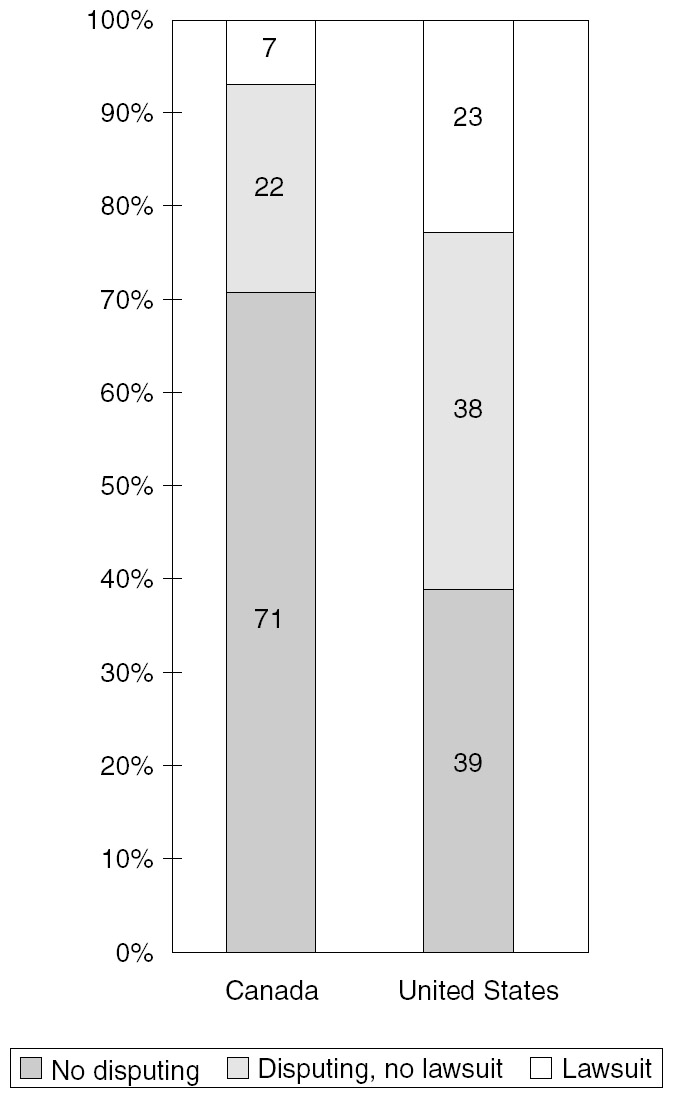
Figure 7.1. Results of forced separations, PCO, 1995 (PCO company data).
In one respect, PCO's posttermination litigation experience was the
Despite PCO's uniform corporate personnel policy, PCO U.S. and PCO Canada termination procedures vary noticeably, both in terms of the organization of the Human Resources Department and in terms of day-to-day decision making. PCO U.S. has more deeply entrenched bureaucratic structures to process legal claims. These differences reflect the fact that PCO U.S. employees have access to both a greater variety of legal claims and more potent legal remedies. Thus PCO U.S. officials face greater legal uncertainty than their Canadian counterparts regarding the source and effects of a posttermination legal claim.
Although it is difficult to estimate precisely how much PCO spends on the termination process in each country, it seems clear that U.S. prelitigation and litigation processes are generally more expensive. Not only does PCO U.S. spend more money on the termination process, but the money spent is channeled largely to legal and quasi-legal professionals, whereas the expenditures made by PCO Canada go toward providing severance packages and services to the terminated Canadian employee.
II. NATIONAL DIFFERENCES IN LAW
cross-national legal differences relating to employee termination law may be roughly divided into three categories. First, there are differences in substantive law of all sorts—common law, statutory law, and regulatory requirements. Second are differences relating to the institutional and procedural features of the different national legal systems. Third, there are economic differences associated with lawsuits, including attorneys' fees and typical awards for successful wrongful termination cases.
A. Substantive Law
The most striking difference in substantive law between the two countries is that unqualified employment-at-will has never been the law in Canada. At the most general level, Canada follows the European model of providing a somewhat higher threshold of protection from termination for all workers. In Canada the employment-at-will doctrine does not prevail; the common law presumption in that country is “reasonable notice” prior to termination, unless the employer has “just cause” to terminate an employee.[8] This suggests that Canadian employers might be more vulnerable to unjust dismissal lawsuits than their American counterparts—at least in legal theory.
Because of the increase in statutory and regulatory rules regarding termination, the common law difference between the United States and Canada hardly reflects the entire law. However, the basic common law difference reflects the countries' variant traditions regarding employment. In Canada the just cause presumption was and is designed to protect all employees, reflecting a commitment to protecting continued employment.[9] In the United States the employment-at-will tradition demonstrates a commitment to the fluidity of markets and employer flexibility.
In Canada, employees terminated without just cause are entitled to receive “reasonable notice,” which can take the form of either actual notice or monetary compensation in lieu thereof.[10] Reasonable notice is a secure legal principle, now embodied in statute, and is applied to quasi-employees, part-time employees, temporary workers, and even non employee workers.[11] The reasonable notice requirement can be overridden for a number of reasons such as a valid contractual term of employment, or if the employee's performance or conduct constitutes “just cause” for dismissal. Exactly how much notice is “reasonable” remains somewhat vague despite explicit statutory guidelines, because of an evolving common law doctrine that typically provides protections above the statutory minimum.[12] Nevertheless, as a practical matter, legal publications provide guidelines for notice, based on factors such as type of job, years of service, and future employability of the terminated worker. In addition to the common law protections, as mentioned earlier, Canadian provinces have a comprehensive statutory regime that protects workers from arbitrary treatment.
In contrast, in the United States the trend has been to allow companies to define workers out of employee status by labeling them “independent contractors,” thus circumventing legal requirements for employment relationships. U.S. law, then, is less comprehensive and less protective of workers, and more protective of employer autonomy. On the other hand, piecemeal statutory, common law, and regulatory protections have increased protection for many American employees. Some legal scholars argue that the employment-at-will standard no longer exists in the United States,[13] since it has been eroded both by common law developments and by statutory employee protections. Common law courts in many states have found employers liable for discharging an employee for reasons that violate public policy;[14] for violating the implied covenant of good faith and fair dealing;[15] and for violating an implied contract.[16] Moreover, statutory protections against discrimination against particular groups have eroded the employment-at-will presumption. These include the Civil Rights Act of 1964, the Americans with Disabilities Act, and the Pregnancy Discrimination Act. Over 70 percent of the total U.S. workforce—including minorities, women, and older and disabled workers—is now “protected” as defined by the Equal Employment Opportunity Commission (EEOC).[17]
B. Legal Institutions and Mobilization of Law
Numerous factors affect a disgruntled employee's decision to pursue a legal claim regarding a termination. The employee's age, education, and prior encounters with legal disputes may influence her decision to invoke or “mobilize the law.”[18] The availability of broader social insurance benefits may help explain lower levels of legal mobilization in Canada.[19] Thomas argues that widely available health insurance and disability compensation in Canada dampens litigation (compared with the United States) concerning product liability. Similarly, in Canada a secure social safety net provides stability for terminated employees, thus making litigation more a choice than an economic necessity.
In addition to these factors, institutional arrangements make it easier for U.S. employees to take legal action to vindicate their claims under the law, and encourage them to take legal action even if it is unclear whether their rights have been violated. American rules concerning lawyer compensation arrangements, rules concerning the role of government agencies, and damage awards all provide greater incentives for terminated PCO employees to pursue legal action in the United States.
1. COUNSEL FEES
In the United States, lawyers can and do take cases on a contingency fee basis whereby an attorney charges a client nothing at the outset but agrees to take a percentage of an award if, and only if, one is granted or a settlement negotiated. A typical U.S. attorney's contingency fee is 33 to 40 percent, large enough to encourage many U.S. attorneys to take chances on weak cases with potentially high damages. Although most Canadian provinces allow some form of the contingency fee system, Ontario does not.[20] The majority of PCO Canada employees work and live in Ontario, and PCO Canada's corporate headquarters are located there. Thus, terminated PCO U.S. employees can pursue legal action with no “up-front” costs in a way that is not available to most PCO Canada employees.
Canada's “loser pays” system of assigning trial costs and attorney's fees makes it less likely that Canadians will pursue legal claims to trial and encourages them to make earlier, more realistic assessments of their likelihood
2. ADMINISTRATIVE AGENCIES
In the United States, lawsuits claiming discrimination based on race, sex, age, and disability must initially be channeled through the federal EEOC or one of its state-level equivalents. Once an employee with an antidiscrimination claim (in this case, regarding termination) files a complaint with the EEOC, the agency then has a statutorily prescribed time of 180 days to investigate the claim. If the agency investigates and determines that the claim is meritorious, it issues the employee a “right-to-sue” letter (which allows her to file a lawsuit in federal court) or else the EEOC itself may sue the employer.[24] If the agency is unable to investigate and dismiss or affirm a complaint within 180 days, the EEOC is required to issue a “default” right-to-sue letter, which gives the employee/claimant the right to file a suit in federal court.
Unfortunately for all parties involved, the EEOC currently faces a backlog of over 100,000 charges. One study of 782,000 discrimination complaints filed with the EEOC and various state equivalents found that the average complaint languishes more than one year before any action is taken. The average time for a meritless complaint to be dismissed is thirteen months. Of complaints filed, about 66 percent are ultimately dismissed as meritless. Although terminated employees whose complaints are not being acted on can pursue the action in court, this option is realistic only for employees who can find the attorneys willing to take the case on contingency.
PCO officials report that very few EEOC complaints against it are resolved through the time-consuming agency process. The wait alone provides some incentive for disgruntled employees to attempt a compromise with PCO. Typically the employee moves on to another job and simply waits out the administrative process, hoping that her complaint is eventually ruled meritorious.
Nevertheless, the availability of the EEOC process, which is free to complainants, makes it easier and cheaper for terminated PCO U.S. employees than PCO Canada employees to take legal action.[25] Additionally, the fruits of the EEOC investigation and PCO's documents regarding that investigation are “discoverable”; the terminated employee has the right to gain access to these documents as her case progresses. Thus, by filing an EEOC claim, an employee who has only suspicions of discrimination in her termination may have a significant investigation conducted for her at no cost.
When a violation of the Human Rights Code is lodged in Canada, the commission established by the statue typically provides an investigating officer. As is the case in the United States, an investigation is conducted, a report is filed, and a tribunal may be established if evidence of a violation is shown. The difference is that the employee is locked into this process and cannot take her case outside the commission. Thus, despite similar remedies and similar difficulties obtaining a remedy, the PCO U.S. employee has greater legal leverage in discrimination claims because she can use the EEOC to gather evidence and then opt out of the administrative process to pursue the claim for damages in federal court.
3. THE LURE AND RISK OF HIGHER DAMAGES
In both countries the terminated employee's calculus about whether to enter the complicated, often-costly legal system includes a prediction about the likelihood of prevailing coupled with the size of the damage award that might be granted. In Canada, civil litigants are not constitutionally guaranteed the right to a jury trial.[26] Ontario alone, by statute, gives a party the prima facie right to request a jury.[27] But Ontario also has instituted a policy whereby eight of ten civil cases filed are diverted to a mediator.[28] In the United States, jury trials are widely available, and American law gives juries considerable discretion in determining damages, including (in appropriate cases) punitive damages. A study of wrongful discharge lawsuits in California that went to trial, 1980–86, found that the median jury award was $177,000, the average award $650,000, and the largest award $8 million.[29] We do not have a comparable study of Canadian damage awards, but it appears from studies in other legal contexts, such as medical malpractice suits, that Canadian civil damage awards tend to be much smaller than their American counterparts.[30]
C. Perceived Legal Risks to the Employer
The differences in law and legal institutions discussed earlier make the U.S. legal system a more threatening environment for employers, creating greater legal uncertainty, higher risks of incurring high defense costs, and
Because the implied contract theory of wrongful discharge is a common law creation—developed by the courts rather than by legislatures—the law varies from state to state, and the substance of the law can also be fairly ambiguous. The ambiguity is multiplied because crucial decisions often are made by a diverse array of juries, whose decisions are not explained and are largely unreviewable. This leaves employers unclear about the best way to protect themselves from liability. Certainly, many employers guess incorrectly. The study of 120 California jury verdicts between 1980 and 1986 found that 68 percent of plaintiffs won their wrongful discharge lawsuits, and that awards averaged $650,000.[34]
It is the highly publicized large losses that command employers' attention. In a study of nine professional personnel journals, Edelman, Abraham, and Erlanger found inflated reporting of both the rate at which employees win their wrongful discharge cases and the commensurate jury awards.[35] In our interviews, PCO U.S. officials often discussed very large wrongful termination awards,[36] as well as the damages claimed in lawsuits filed against PCO itself. PCO therefore tailors its termination policy to prevent any (even a small) chance of losing a lawsuit with a large award.
The majority of the cases that PCO faces, as noted earlier, originate in EEOC claims.[37] Here, too, the threat lies in those antidiscrimination claims that eventuate in lawsuits for damages. Statistically, the rate of large damage awards in these cases is small. In a study of Title VII race-based lawsuits, Shea and Gardner, a large Washington, D.C., law firm, found that plaintiffs were awarded compensatory and punitive damages in only 68 of 576 reported cases between 1980 and 1989.[38] Of those 68 cases, in only 3 did compensatory and punitive damages combined amount to more than $200,000.[39] Nevertheless, as with the common law claims, PCO U.S. officials focus on the highly publicized large antidiscrimination awards. It makes economic sense in their minds for the company to allocate greater resources to prevent the worst possible outcome—no matter how remote the chances of that outcome—because the American legal system makes that outcome hard to predict.
III. CORPOR ATE CULTURE
Notwithstanding cross-national differences in law and legal institutions, PCO has a strong commitment to uniform corporation-wide practices and policies. The PCO “Guidelines of Company Policy” declare that “[a] dherence to a uniform worldwide standard of conduct to guide our behavior is essential and must be maintained in each country where we do business.”[40] Every PCO executive we spoke to claimed that there are no official differences in the termination process between the United States and Canada.[41] PCO sponsors annual training, which all human resources representatives from both the United States and Canada are required to attend. Because the corporate philosophy is claimed to derive from principles of equity for employees rather than from legal requirements, PCO asserts that the company does not tailor the termination process to the legal requirements of the particular countries in which it operates.
Uniform cross-national policies, regardless of differences in law, allow PCO to train U.S. and Canadian human resources personnel together.[42] After the training, PCO can transfer human resources personnel from country to country without retraining those employees in local law. Additionally, PCO officials claim that the practice of implementing a generous and consistent human resources policy makes it easier to attract and retain quality employees.[43]
Except in unusual circumstances, PCO is confident that its standard practices in termination go above and beyond the legal requirements of the United States and Canada. The company's executives do believe, however, that following the PCO policy insulates termination decisions from serious legal challenge.[44] This emphasis on consistency and the very real attempt made by PCO officials to meet the corporate goal of uniformity allows us to rule out cross-national differences in corporate culture as an explanation for the cross-national differences in termination practices.[45]
A. PCO's Rapid Termination Procedure
In both the United States and Canada, PCO has a two-tiered termination policy. A “rapid termination” occurs when an employee commits one of PCO's “five deadly sins”—absence of three days without notice, dishonesty, insubordination, possession of firearms or violation of the substance abuse policy, and misconduct.[46] In those cases, the termination process is not drawn out over many months but occurs virtually “on the spot.” The Human Resources Department is consulted to provide verification that the incident was sufficient to merit termination and to ensure that PCO has the evidence to prove the violation, but beyond that the department's involvement is minimal. PCO greatly values ensuring rapid, decisive resolution
B. PCO's Incremental Discipline Process
When an employee's performance declines, PCO policy calls for implementation of the “Incremental Discipline Process, designed to provide the problem employee with notice about specific inadequacies in her performance, to ensure that the company's expectations are clear and realizable, and to provide a fair chance for the employee to rehabilitate her performance. PCO officials, both in law and in human resources, insist that the rationale for the required procedures and documentation is not a legal defense but fair treatment as an aid to rehabilitation of the employee. The process, however, does generate a thorough paper trail about the employee's poor performance, which provides both legal justification for any eventual termination and better evidence supporting PCO's decision. In addition, the Incremental Discipline Process is designed to prevent two costly outcomes. First, it seeks to prevent termination of an employee who, all things considered, should not be fired; thus the process is designed to deter or expose a manager who has an unjustified desire to terminate an acceptable employee. Terminating an employee for a bad reason could expose PCO to legal liability,[48] but it is also bad business: PCO would bear the costs of training the employee's replacement and retaining an arbitrary or biased supervisor. Second, PCO policy strives to reduce the risk of retaining an employee who should be terminated. The Incremental Discipline Process provides the vehicle by which a manager who regrets terminating a “friend” can invoke an impartial, routinized assessment of the employee's performance. On the other hand, the Incremental Discipline Process—with its carefully scheduled phases of documentation, probation, and termination, is costly in itself, in terms of delay and personal time.
1. DOCUMENTATION
As an employee's performance begins to wane, the line manager—the employee's direct supervisor—is expected to step up consultations with the problem employee to clarify which expectations are not being met. When the line manager determines it is appropriate, she begins to document
2. PROBATION
If the employee fails to improve, the next step is probation. All employees who have been with PCO for one year or longer are entitled to a six-month probation before termination.[49] Prior to placing the problem employee on probation, the line manager must consult with the Human Resources Department concerning the nature of the problem, the amount of discussion and documentation that has already occurred, and other pertinent factors. If it is agreed that the employee should be placed on probation, a probation letter is drafted by the line manager and the human resources manager. An attorney typically reviews both the letter and the case history, including documentation about the performance problems. Lawyers in the United States, it was told, undertake a more thorough review than their Canadian counterparts, but in both countries the attorney is expected to make sure that the employee's behavior provides the basis for a legally justifiable termination and that there is adequate “proof” in the form of documentation to back up PCO's side of the story.
The next step is a “probation meeting” among the employee, the line manager, and the human resources manager[50] to discuss the company's expectations. The problem employee is asked whether the expectations are unrealistic.
Sometimes the probation period or the probation meeting is used to suggest that there is simply a “bad fit” between PCO and the employee and that it is in the employee's interest to leave the company. One human resources manager told us, “I ask myself, ‘Is this a will problem or a skill problem?’”[51] If it is a “skill problem,” the probation meeting is used to explore what PCO can do to bring the employee's skills up to the required level. Typically, however, a “skill problem” will not reach the probation phase but will have been identified and rectified earlier. Sometimes the skill problem is simply too large. Then, “we try to convince the employee that the opportunities at PCO are not going to meet their expectations. We try to help them get on with other life opportunities.”[52]
Most probation meetings, however, address “will problems,” encouraging the employee to recognize that she is not putting all she can into the job and that she has to make her own turnaround. Probation for “will problems” often is short, PCO officials say, because an employee either shapes up or does not.
Throughout the probation, typically a period of six months, the line
3. TERMINATION
At the end of the six-month probation period, assuming the employee has not left, a decision to retain or terminate the employee is made. PCO officials in both the United States and Canada indicate that by the time a problem gets to this stage, the decision is not difficult. The actual decision is made jointly by the line manager, the human resources manger, and, in some cases, the attorney and/or the affirmative action officer.
The “hard part” of termination is setting the terms, especially the amount of the severance pay. In both countries the officials say that PCO tries to make the first severance offer a fair one, in the belief that fairness prevents time-consuming negotiations, inconsistent results, and escalating posttermination disputes. PCO usually does not budge much from the initial offering in either country.
In both the United States and Canada, human resources executives described particular terminations that eliminated or accelerated steps of the Incremental Discipline Process when weak performance by the employee in question was deemed particularly harmful to PCO.[54] PCO's willingness to deviate from the stated policy under particular circumstances not only reflects the company's conviction that the Incremental Discipline Process goes beyond the legal requirements in both countries but also shows that when business risks are obvious and severe, even a legally risk-averse company like PCO is willing to move closer to legal liability to prevent other costs to PCO that would result from retaining the employee. A number of PCO officials who described deviations from the stated policy indicated that in their view the deviation made it no more likely that the termination would lead to legal wrangling.
IV. LEGAL, ORGANIZATIONAL, AND PROCEDURAL OUTCOMES
Despite PCO's emphasis on uniform corporate policy, and its belief that its termination policy clearly meets legal standards in both countries, in the United States, PCO's terminated employees challenge their termination decisions more than their Canadian counterparts. Moreover, in the United States there are many causes of action with which PCO must be concerned, while in Canada there is only one cause of action that poses an actual
A. Dispute Pattern Differences
In 1995, as Table 7.1 shows, PCO Canada had a higher overall termination rate than PCO U.S., but much of the disparity may reflect idiosyncratic reasons, due to particular business-related changes in the Canadian operation.[55] For the purposes of this study of regulatory and legal system differences, the crucial finding is that at each phase of the termination process, PCO Canada and PCO U.S. incur different levels of disputing. According to PCO's detailed records, and our analysis of personnel files, as a percentage of all employees, there was a higher rate of “separations” (termination, resignation, or retirement) in PCO Canada than in PCO U.S. in the years studied. But the ratio of “forced separations” (meaning the employee was fired) to all separations was similar in the two countries. As Table 7.1 shows, in the fiscal year studied, 24 percent of total separations in Canada were forced; in United States, 23 percent of total separations were forced.
In Canada, 36 percent of those who were fired were first placed on formal probation. In the United States, on the other hand, only 9 percent of those who were fired were first placed on probation, suggesting a higher incidence of managerial recourse to “rapid termination” or to special case deviations from the formal termination process.
As noted at the outset of this chapter, former PCO U.S. employees were twice as likely to engage in posttermination disputes with PCO; 60 percent of them did so, compared with 29 percent of former PCO Canada employees. And former PCO U.S. employees were three times as likely to file a lawsuit—23 percent (more than one in five), as compared with 7 percent in Canada.
B. Organizational Differences
Although the termination philosophy of PCO does not vary cross nationally, the organization of the Human Resources Department does vary. PCO U.S. employs in-house attorneys; PCO Canada does not. PCO U.S. uses its attorneys differently than PCO Canada. PCO U.S. has an Affirmative Action Office (AAO) that is active in the termination process; PCO Canada has no counterpart. These structural differences represent costs to PCO U.S. that are not incurred by PCO Canada. More in-house offices and officials to handle legal and quasi-legal questions reflect the higher rate and risk of serious legal disputing in the United States.
| United States | Canada | |
|---|---|---|
| SOURCE: PCO company data. | ||
| Total employees | 9,603 | 525 |
| Total separations | 282 | 58 |
| 3% total employee | 11% total employee | |
| Forced separations | 66 | 14 |
| 23% total separations | 24% total separations | |
| Formal probations | 6 | 5 |
| 9% forced separations | 36% forced separations | |
| Forced separations without postseparation disputing | 26 | 10 |
| 39% forced separations | 71% forced separations | |
| Forced separations with postseparation disputing but no lawsuit | 25 | 4 |
| 38% forced separations | 22% forced separations | |
| Lawsuits filed | 15 | 1 |
| 23% forced separations | 7% forced separations | |
1. LAWYERS
In Canada, when either the human resources representative or the line manager believes that legal advice is required, termination issues are brought to an outside attorney. This occurs routinely at the probation and termination phases of the Incremental Discipline Process but infrequently at other times.[56] More typically, however, attorney contact in Canada is brief and is done by telephone.[57] One senior official in the Canadian human resources office told us that she had never been to PCO Canada's attorney's office.
In the United States, in contrast, attorney contact is more frequent, more substantive, and occurs earlier in the termination process. In the United States, PCO been willing to pay to have in-house corporate counsel present every day in the corporate headquarters to deal with personnel matters.
2. THE AFFIRMATIVE ACTION OFFICE
Unlike PCO Canada, PCO U.S. has a specialized AAO that employs 2.5 fulltime executives who perform regulatory tasks required by the EEOC and the Office of Federal Contract Compliance Program (OFCCP). PCO's AAO
Although PCO officials insist that employees who fall into protected categories receive no different treatment in the termination process, a “protected” employee is always routed through the AAO prior to termination. According to the director of the AAO, this practice ensures that similar employee malfeasance is treated similarly and that all legal requirements are met. However, this practice also appears to reflect the greater perceived legal risk under civil rights laws. For example, the affirmative action officer and corporate human resources personnel all expressed concern about compliance with the Americans with Disabilities Act (ADA). Because some disabilities may be hidden, there is a concern that an employee may be misidentified as not belonging to a protected class when he does, in fact, merit special legal protection. Furthermore, the ADA is troubling to PCO U.S. officials because its legal requirements are ambiguous. PCO Canada, on the other hand, does not feel compelled to undertake special administrative reviews to deal with the risk of posttermination lawsuits by employees who allege that PCO failed to accommodate their disability.
In addition to consultation during the Incremental Discipline Process, the AAO is PCO U.S.'s interface with the EEOC and state equivalents. If an EEOC complaint is filed by an employee who believes that she has been terminated because of race, gender, or age, then PCO has thirty days to file a response.[58] At this point PCO must be very careful, say the AAO officials, because the complaint signals that the termination might result in a lawsuit. For reputational reasons, too, PCO wants to end the dispute quickly. Any complaint to the EEOC, therefore, is investigated by the AAO. The director of the office claims that responding to each complaint requires approximately two full workweeks for one person—at least eighty hours.
Although PCO Canada employees enjoy legal rights against discrimination, there is no separate corporate bureaucracy in PCO Canada to field these legal claims. The AAO in PCO U.S. presumably reflects the cross national differences discussed earlier concerning the methods, incentives, and likelihood of legal mobilization. The PCO U.S. Affirmative Action Office
C. Procedural Differences
In the United States, PCO's termination process involves more work, more time, and higher costs. The reason, it appears, is that in the United States there is a more complex and detailed body of legal rules surrounding termination, more legal uncertainty, and a more threatening and more frequently activated litigation system. In Canada, PCO seeks waivers from dismissed employees without concern for increasing the risk of future litigation. PCO U.S. takes the opposite position. In termination cases in the United States, formal consultations with legal or quasi-legal professionals are more frequent, involve more people, are more open-ended and deliberative.
1. USE OF WAIVERS AND SEVERANCE PACKAGES
There is cross-national variation in the frequency with which PCO asks a terminated employee to sign a waiver indicating acceptance of the terms of the severance and agreeing to forgo legal action. For PCO Canada, disputes over the severance package (or “reasonable notice” payment) is the source of virtually all litigation. Thus, when a severance package is agreed upon, officials ask the employee to sign a waiver confirming her agreement.
In PCO U.S. the terminated employee only rarely is asked to sign a waiver, and the negotiation process is more constrained by law. For PCO U.S. the terms of the severance package are determined in accordance with the Employment Retirement Income Security Act (ERISA), which requires employers to adhere strictly to the terms of the formal employee benefit plans.[59] There is little room for negotiation; PCO does not have the discretion to “sweeten the deal” by supplementing one person's benefits. Thus, in PCO U.S., the termination meeting is simply a notification rather than a dialogue. The severance package in the United States, therefore, is more limited. It includes the payment of any pension or investment plan to which the employee has contributed through his tenure. In contrast to the Canadian practice, lump sums equivalent to an employee's salary for a particular period of time are not made at the time of termination.
Since liability for PCO U.S. centers not on the severance package but rather on the termination itself, an employee waiver, although rarely obtained, is intended to shield PCO from various forms of legal liability. But U.S. managers are reluctant to request a waiver for fear that if the idea of legal liability is mentioned, the employee is more likely to retain an attorney or pursue legal action.[60] In Canada, on the other hand, requests for waivers
In Canada, when an employee is terminated without just cause, she is entitled, pursuant to statutory law, to reasonable notice or compensation in lieu thereof. Just cause exists when the employee engages in serious misconduct, insubordination, theft, dishonesty, incompetence, competing with the employer, conflict of interest, absenteeism, or chronic illness. Adverse economic conditions, redundancy, and reorganization of the company do not constitute just cause for termination. Some commentators suggest, and PCO Canada's experience confirms, that employers face a difficult challenge if they attempt to prove in court that a termination meets the just cause requirement. Thus PCO Canada routinely offers “reasonable notice compensation” in lieu of actual notice. The amount of compensation provided is not specifically dictated by the law; court decisions refer to a variety of factors, including length of service, salary, job status, labor market conditions, and the year of the decision.[61] Studies indicate that severance awards in Canada as a whole average almost nine months of pay, and more for larger employers.[62]
Given the legal ambiguity concerning what must be paid in lieu of actual notice, PCO Canada tends to err on the side of safety and fairness, offering the employee outplacement assistance, severance pay, and short-term (usually six weeks) extension of medical benefits. Unlike in the United States, PCO Canada officials and employees have some room to negotiate. This negotiation occurs informally in many of the termination meetings or semiformally after the termination meeting, by way of letter or phone call from an attorney-friend of the terminated employee. PCO Canada invests heavily in pretermination resolution and thus sees fewer posttermination disputes and lower costs.
Severance packages in the United States are much lower, and rarely is time spent negotiating a waiver of legal liability. It is possible, too, that PCO Canada, with its greater use of probation, spends more management time on pretermination dispute resolution. But PCO Canada spends less than PCO U.S. in posttermination disputes and lawsuits and on definitively expensive, pretermination consultations with legal and quasi-legal personnel. It is difficult to compare the larger PCO Canada expenditures on severance pay and pre-termination negotiations with the higher legal and administrative costs in the United States. But overall, the more complex, detailed, and potentially punitive legal rules faced by PCO U.S. officials seem to lead to higher expenditures on both pre-termination and posttermination mechanisms.
2. USE OF ATTORNEYS
Not only do PCO U.S. officials consult attorneys more often, but they also use them somewhat differently. In the United States, according to officials, they typically present to the corporation's attorney a more open-ended question, along the lines of “What should we do in this situation?” In Canada, according to PCO Canada's outside counsel and officials, the usual question typically asked is narrower, along the lines of “Is the following step we are about to take legally defensible?” In both countries the attorneys also function as troubleshooters. But unlike the Canadian attorney, PCO U.S.'s in-house lawyers provide ongoing training to department personnel. The PCO U.S. in-house attorney tries to speak with every human resources worker and as many line managers as possible at the outset of their employment, encouraging them to consult her too early and too often rather than too late.
In PCO Canada, there are more rules about when the attorney should be consulted. Generally, the attorney is consulted later in the process as a routine “last check.” The attorney reviews the probation letter and analyzes or discusses the file to determine whether PCO Canada has solid justification for placing an employee on probation. In the United States, in contrast, a line manager or human resources representative often consults an attorney not to seek approval for a decision but to participate in formulating a plan. The attorney consultation is intended not only to ensure that PCO is on sound legal footing for posttermination disputing that may eventually arise but also to help apply PCO's policy of attempting to rehabilitate problem employees.
The U.S. attorney, then, is more of a “partner” in the decision-making process, and indeed often seeks a larger role. PCO's Canadian attorney had nothing but praise for PCO Canada's Human Resources Department. The PCO U.S. attorney, on the other hand, asserted she often wishes that the representative or the line manager would consult her earlier in the process.[63] The American lawyers sometimes want additional steps to be taken regarding a problem employee, even if doing so will lengthen the documentation phase and extend the tenure of an unwanted employee.
The PCO U.S. attorney also seems to work much harder at ensuring consistency—ensuring that employees who have committed similar blunders are treated alike. This may partly reflect differences in scale and organizational structure. In Canada the department is smaller, and all human resources representatives are in the same location, which allows consultation to ensure consistency. In the larger, more decentralized PCO U.S. operation, both the attorney and the AAO take affirmative responsibility for ensuring consistent treatment. Differences in law, however, also stimulate the U.S. attorney's extra efforts. Since PCO Canada need only be
3. USE OF PROBATION
Probation is one of the most important and potentially costly elements of the Incremental Discipline Process. Although PCO officials claim otherwise, the probation process almost surely helps insulate the company from legal liability. Probation demonstrates the employer's attempt to rectify a problem fairly and provides a written record of employee nonperformance, which could be used at trial to bolster PCO's legal argument that the termination was the result of employee nonperformance rather than some other, illegal reason. As Table 7.1 shows, probation is used much more frequently by PCO Canada (36 percent of employees) than by PCO U.S. (9 percent).
Probation, however, is drawn-out, costly, and usually unsuccessful. One executive estimated that only one or two out of five employees who begin the Incremental Discipline Process reachieve good standing with PCO.[64] The higher probation rate in Canada thus seems to contradict the theory that PCO U.S. is more risk-averse and incurs more costs in the termination process. After all, wouldn't the division of the company that is more risk averse employ this defensive strategy more frequently? Secondly, does PCO U.S.'s less frequent use of probation help explain its higher rate of posttermination legal disputing and litigation? The answer to both questions is no. In fact, PCO U.S.'s less frequent use of probation is misleading and actually reflects its greater sensitivity to legal risk.
Probation procedures in PCO U.S. historically have been more complex and expensive than in PCO Canada. Until very recently, PCO U.S. offered a step prior to formal probation known as a “performance plan.” This plan was essentially a probation period that did not start the six-month probation clock and could be entered into informally, without consulting the attorney or the AAO. Like probation, during a performance plan a problem employee was under close supervision and received a clear statement of performance expectations.
The performance plan was required neither by the law nor by PCO corporate policy. It was instituted, PCO U.S. officials say, to guard against legal liability. It gave problem employees additional opportunities to reform and gave the line manager more evidence to justify further discipline, if necessary. Moreover, the performance plan allowed line managers to attempt the same rehabilitative process attempted by probation without all the formal requirements.
More recently, PCO U.S. officials have been moving away from the performance plan because it simply delays the point at which inefficient employees can be terminated.[65] PCO U.S. officials currently are reanalyzing each of the complex termination procedures to evaluate their legal necessity.[66] Although the increased use of probation might suggest that PCO Canada is more risk-averse, this actually demonstrates PCO Canada's willingness to move forward with the termination process and PCO U.S.'s aversion to doing so.
V. PERCEPTIONS OF LEGAL RISK
Despite PCO's desire for a uniform corporation-wide personnel policy, a detailed analysis of its termination processes, as we have seen, highlights significant cross-national differences in structure, procedures, dispute patterns, and process costs. The Canadian law on the books, with its broader protections against arbitrary dismissal, might lead one to expect that PCO Canada would be more legally risk-averse and would incur greater costs in the termination process. In fact, we have seen that PCO U.S. is more risk averse, as evidenced by its establishment of more elaborate defensive structures and procedures, and by its employment of more legal and quasi-legal personnel. These measure entail substantial costs not incurred by PCO Canada.
PCO Canada, too, makes expenditures to avoid legal risk. It pays terminated employees larger severance packages that tend to be more generous than the law requires and more generous than those paid by PCO U.S. It uses the formal probation process more often, and it perhaps retains nonproductive employees longer—although that is not clear because of PCO U.S.'s use, until recently, of an informal preprobation performance plan for questionable employees.
PCO U.S. officials perceive their legal environment as more threatening than do their counterparts in Canada. The threat arises from the higher level of legal uncertainty generated by the American legal system and the risk of extremely costly and embarrassing jury awards in statutory antidiscrimination or wrongful discharge lawsuits. This threat leads PCO U.S. to employ a strategy of minimizing exposure of the worst-case scenario of maximum liability.
The greater legal uncertainty in the United States arises in part, as mentioned earlier, from the fact that PCO U.S. faces the possibility of claims arising from a multitude of statutory and common law theories, whereas PCO Canada faces a threat from only one cause of action. PCO Canada's legal risk focuses almost solely on the “reasonable notice” requirement.[67] In the two years of employment records we examined, there were only two posttermination lawsuits, both based on that claim. Also, all of PCO
In contrast, according to its attorney, 25 percent of lawsuits against PCO U.S. in 1995 (the year studied) claimed race discrimination under Title VII of the U.S. Civil Rights Act, 17 percent claimed gender discrimination, 33 percent age discrimination (pursuant to the Age Discrimination in Employment Act [ADEA]), 8 percent were based on the Americans with Disabilities Act, and 17 percent “other,” primarily ERISA, the law governing employee benefit programs. This distribution is displayed in Figure 7.2. It is notable that none involved common law wrongful discharge claims, and PCO attorneys say they worry less about that kind of suit.[69] Under all the relevant statutes, as well as the common law area, the large number of lawsuits in the United States as a whole constantly generates new law and ambiguous, difficult-to-summarize requirements.
Even more important to PCO U.S.'s sense of unpredictable legal risk is the greater propensity of Americans to bring lawsuits; the higher incidence of trial by jury; and the potential, under the expansive American law of damages, for very large damage awards and the adverse publicity they generate. As noted earlier, American rules on counsel fees (availability of contingency fee arrangements; absence of a “loser pays” rule) make it easier and less risky for former PCO U.S. employees to retain an attorney and bring a lawsuit. Not surprisingly, research in other areas of law suggests that when confronted with similar problems, Americans are considerably more likely than Canadians to assert legal claims for compensation.[70] PCO U.S. officials also view jury decisions on liability and damages as difficult to predict and are deeply concerned about the risk, however small the statistical odds, of a very large verdict against the company. In addition to the direct costs, PCO executives repeatedly said they feared that a highly publicized large award in a civil rights case would have an adverse effect on employee morale, as workers “take sides” in discussing the case. To cope with such unpredictable maximum legal risks, PCO U.S. attempts to reduce uncertainty by employing more legal and quasi-legal professionals than does PCO Canada, by involving them earlier and more intensively in personnel management, and by routinely involving a special Affirmative Action Office in
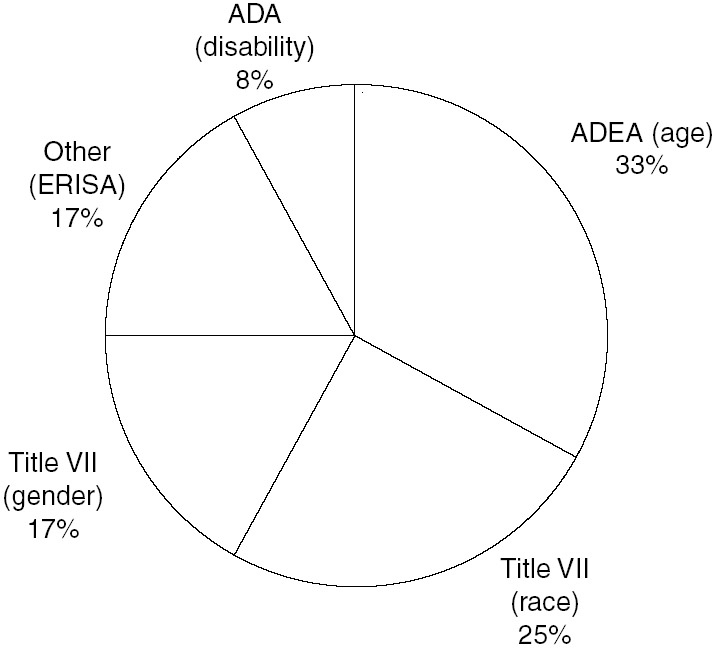
Figure 7.2. Lawsuits, PCO U.S., by claim, 1995 (PCO company data).
VI. CONCLUSION
In Canada, substantive legal protections against arbitrary discharge arguably are broader than in the United States, for they require just cause or reasonable notice for all employees, regardless of race, gender, or other characteristics. Nevertheless, the discharge process in PCO Canada engenders less legal disputing and less corporate bureaucracy, both formal and informal, than in PCO U.S. This can be linked to the larger variety of legal causes of action available to the American employees, the higher money damages awarded by American courts, and the greater ease of legal mobilization in the United States. These factors generate more perceived legal uncertainty and legal risk for the company than does Canadian law, leading it to expend more on lawyers and regulatory affairs personnel. These factors also lead to a higher incidence of posttermination lawsuits in PCO U.S.
Confronted with a more adversarial legal environment, PCO U.S. employs a more adversarial model of employment relations when considering termination. PCO U.S. is less likely to pursue probation and less likely to
PCO Canada may incur greater costs by employing probation more often (which can lead to longer retention of poor employees ultimately dismissed), and by offering more generous severance packages. These policies, however, may help produce PCO Canada's less adversarial posttermination process, lower ex ante legal costs, and lower legal costs arising from posttermination legal claims. When posttermination disputes do occur, they can often be resolved by enhancing the severance package, which does not require extensive aid from legal professionals. In PCO U.S., the threat of postdismissal disputing requires more investment in legal and quasi-legal professionals.
To determine more definitely which approach is more efficient, we would need precise data concerning the costs incurred by PCO Canada in providing more generous severance packages and the actual costs incurred by PCO U.S. in making its expensive structural and procedural alterations to the Incremental Discipline Process. PCO's accounting systems do not readily generate that data. Given the nature of the organizational and procedural “extras” observed at PCO U.S., it seems safe to say that PCO U.S. probably spends more money per terminated employee. Regardless of which division of PCO spends more on termination, it is clear that in Canada, the “extra” money is largely going to “paying workers” in the form of more generous severance packages and the increased use of probation, whereas in PCO U.S., the money is going to “paying lawyers” because it is largely channeled to legal and quasi-legal professionals.
NOTES
1. Adair v. United States, 208 U.S. 161 (1908).
2. Some U.S. state courts have held that employer-issued employee manuals (or other oral or written statements by the employer) may be considered implied contracts, and that those terms may limit the employment-at-will doctrine and create liability for termination without just cause.
3. H. W. Arthurs, D. D. Carter, J. Fudge, H. J. Glasbeek, and G. Trudeau, “Canada,” in International Encyclopaedia For Labour Law and Industrial Relations, edited by R. Blanplain (Kluwer Law and Taxation Publishers, 1993); Ellen E. Mole, The Wrongful Dismissal Handbook (Toronto: Butterworths, 1990). Toussaint v. Blue Cross & Blue Shield, 292 N.W.2d 880 (Mich. 1980)
4. In the United States, protection from race and gender discrimination is found in Title VII of the Civil Rights Act of 1964, 42 U.S.C. §§ 2000e et seq., and enforcement is delegated to the Equal Employment Opportunity Commission (EEOC) and the federal courts. In addition, each state in which PCO operates has similar laws that prohibit employment discrimination.
In Canada, race and gender discrimination are prohibited at both the federal and the provincial level. For federal employees (not most PCO employees), private sector labor relations are governed by the Canada Labour Code, R.S.C. 1990, c.E14, but race, sex, national origin, and ethnic origin discrimination are prohibited by the Canadian Human Rights Act, R.S.C. 1985, c.H-6.
Almost all of PCO's Canadian employees work in Ontario and are protected by the Ontario Employment Standards Act, R.S.O. 1990, c.E-14. Like the federal law, protection against discrimination in Ontario is embodied in a human rights code: the Ontario Human Rights Code, R.S.O. 1990, c.H-19. It should be noted, however, that each province in Canada has its own statute that may vary somewhat.
In the United States, protection from age discrimination is found in the Age Discrimination in Employment Act (ADEA). 29 U.S.C. §§ 621–34 (1988). In Ontario, age discrimination is prohibited by the Employment Standards Act, R.S.O. c.E-14.
In the United States, the law governing employment abuses on the basis of disability is the Americans with Disabilities Act, 29 U.S.C. §§ 621–34 (1988). Discrimination based on disability is prohibited in Ontario by the Ontario Human Rights Code, R.S.O. 1990, c.H-19.
5. Protection from discrimination on the grounds of sexual orientation is also found in the Ontario Human Rights Code, R.S.O. 1990, c.H.
6. Although it is difficult to find data of this nature specific to certain corporations, some empirical studies about the rate of disputing in the corporate United States indicate that PCO may have a higher level of disputing than other companies do. In fact, many authors of empirical studies about dispute patterns conclude that a large percentage of aggrieved employees do not pursue their claims of employer mistreatment. Moreover, when the source of the claim is discrimination, as is frequently the case in PCO U.S. (see Figure 7.2), scholars suggest that the number of people who will pursue a claim falls even further. See, e.g., Kristen Bumiller, The Civil Rights Society: The Social Construction of Victims (Baltimore: Johns Hopkins University Press, 1989).
There are any number of reasons that the experience of PCO may be different than the ones mentioned here. First, PCO is a very large corporation, which may lead to higher disputing rates because of a lack of community. Second, the employees at PCO are largely upper-middle-class, well-educated employees. This population is more likely to know their legal rights, have access to the legal system, and either have an attorney or know how to go about getting one. Thus, many of the barriers to the legal system that may be present for the subjects of the other studies are not faced by PCO employees. Of course, since this case study focuses only on the experience of PCO, there is no way of knowing exactly why these numbers are higher; these are simply some hypotheses.
7. In both countries, the data are from the calendar year 1995. In Canada, we also collected comparable data for the calendar year 1994—there were no significant differences between the 1994 and 1995 data.
8. For more on how the just cause presumption is translated to PCO procedures, see section IV.
9. For more on the common law principle regarding employment, see Mole, The Wrongful Dismissal Handbook.
10. Employment Standards Act, R.S.O. 1990, c.E-14, pt. 57.
11. Id. at 5.
12. Arthurs et al., “Canada.”
13. See, e.g., Mary Ann Glendon and Edward R. Lev, “Changes in the Bonding of the Employment Relationship: An Essay on the New Property,” Boston College Law Review 20 (1979): 457.
14. Petermann v. International Brotherhood of Teamsters, 174 Cal.App. 2d 184, 344 P.2d 25 (1959) (holding that an employer cannot terminate an employee for failing to commit perjury at his employer's direction).
15. Monge v. Beebe Rubber Co., 114 N.H. 130, 316 A.2d 549 (1974) (holding that an employer may not discharge an employee for failing to go on a date with her employer).
16. Toussaint v. Blue Cross & Blue Shield, 292 N.W.2d 880 (Mich. 1980) (holding that an employee can sue an employer for wrongful termination where a contract requiring good cause for termination can be inferred from oral or written statements made by the employer).
17. John J. Donohue III and Peter Siegelman, “The Changing Nature of Employment Discrimination Litigation,” Stanford Law Review 43 (1991): 992 n. 18
18. Bumiller, The Civil Rights Society.
19. Bruce A. Thomas, “The Canadian Experience with Alternative Dispute Resolution in Products Liability Cases,” Canada–United States Law Journal 17 (1991): 363.
20. Ont.Rev.Stat. ch. 478 (1980).
21. See Thomas, “The Canadian Experience with Alternative Dispute Resolution,” 368 (discussing civil trials more generally).
22. A study conducted by the Civil Justice Review found that the typical cost to a plaintiff to pursue a civil claim in Canada is $38,000 Canadian. Reported by Charles Harnick in a speech to the Annual Institute on Continuing Legal Education, Canadian Bar Association of Ontario, Toronto, January 26, 1996 [available Westlaw, Database BCA].
23. In a study of 120 wrongful dismissal jury trials in California, the average legal cost to a company defending a dismissal case that goes to trial was over $80,000 U.S. James Dertouzos, Elaine Holland, and Patricia Ebmer, “The Legal and Economic Consequences of Wrongful Termination, RAND: The Institute for Civil Justice” (Santa Monica, Calif.: RAND, 1988).
24. Testimony of Gilbert F. Casellas, Chairman, U.S. Equal Employment Opportunity Commission before the House Committee on Economic and Educational Opportunities, July 25, 1995,
25. The costs to the employer are, however, great and occur whether or not the EEOC investigates. Simply filing the complaint triggers expensive responsive action on the part of PCO, so that even claims later dropped or deemed meritless are expensive for the company.
26. Crupi v. Royal Ottawa, 12 C.P.C.2d 207 (Ont.Dist.Ct.1986).
27. Courts of Justice Act, Ont.Stat. ch. 11, § 121 (1984).
28. “Ottawa's Lawyers Told to Settle Out of Court More Often,” Financial Post Daily, September 26, 1995, 133.
29. Dertouzos, Holland, and Ebmer, The Legal and Economic Consequences of Wrongful Termination.
30. Peggy Berkowitz, “In Canada, Different Legal and Popular Views Prevail,” Wall Street Journal, April 4, 1986, 21. Medical malpractice fees paid by Canadian physicians are approximately one-twelfth the average U.S. premium. Patricia Danzon, “The ‘Crisis’ in Medical Malpractice: A Comparison of the Trend in the United States, Canada, the United Kingdom and Australia,” Law, Medicine and Health Care 18 (spring–summer 1990): 50–51; Donald N. Dewees, Michael J. Treblicock, and Peter C. Coyte, “The Medical Malpractice Crisis: A Comparative Empirical Perspective,” Law and Contemporary Problems 54 (1991): 217.
31. Lauren B. Edelman, Steven E. Abraham, and Howard S. Erlanger, “Professional Construction of Law: The Inflated Threat of Wrongful Discharge,” Law and Society Review 26 (1992): 47.
32. Dertouzos, Holland, and Ebmer, The Legal and Economic Consequences of Wrongful Termination.
33. Interview, Susan Tuern, PCO U.S. attorney, March 6, 1996.
34. Dertouzos, Holland, and Ebmer, The Legal and Economic Consequences of Wrongful Termination.
35. Id. at 65
36. The awareness about very large wrongful termination awards was discussed in interviews of all PCO human resources managers throughout the United States. Interviews with Bill Richmond (a pseudonym), PCO U.S. Human Resources Manager of Marketing and Sales, January 30, 1996; Robert Burns (a pseudonym), PCO U.S. Human Resources Manager of Marketing and Sales, January 23, 1996; and Ryan Jackson (a pseudonym), PCO U.S. Human Resources Manager of Marketing and Sales, January 15, 1996.
37. Interviews, Hank Brown, PCO U.S. Affirmative Action Officer, March 6, 1996; Interview, Susan Turner, PCO U.S. attorney, March 6, 1996.
38. Reported in 136 Cong. Rec. E 2478.
39. Id.
40. PCO Guidelines of Corporate Policy, p. 5.
41. Interviews, Bill Richmond (a pseudonym), PCO U.S. Human Resources Manager of Marketing and Sales, January 30, 1996. Similar statements were also made by Robert Burns (a pseudonym), PCO U.S. Human Resources Manager of Marketing and Sales, January 23, 1996, and Ryan Jackson (a pseudonym), PCO U.S. Human Resources Manager of Marketing and Sales, January 15, 1996.
42. Interviews, Norma Lanning (a pseudonym), PCO Canada Human Resources Representative, October 18, 1995; Eric Samson (a pseudonym), PCO Canada Human Resources Representative, October 18, 1995.
43. Interviews, Bill Richmond (a pseudonym), PCO U.S. Human Resources Manager of Marketing and Sales, January 30, 1996, Norma Lanning (a pseudonym), PCO Canada Human Resources Representative, October 18, 1995; Eric Samson (a pseudonym), PCO Canada Human Resources Representative, October 18, 1995.
44. There is more confidence in this philosophy in Canada than in the United States. Interviews, Norma Lanning (a pseudonym), PCO Canada Human Resources Representative, October 18, 1995; Eric Samson (a pseudonym), PCO Canada
45. Of course, there is a distinction between formal and informal differences in corporate culture. While the corporate standard emphasizes cross-national continuity, the corporate philosophy cannot eliminate all cultural differences.
46. Obviously, “misconduct” is a broad category designed to give PCO officials some flexibility. Some of the executives with whom we spoke even laughed about the ambiguity of the category. Erica James, PCO Canada Senior Human Resources Representative, October 18 and 19, 1996. However, consistent with PCO general philosophy to err on the side of caution, misconduct would have to be quite severe to circumvent the implementation of the progressive discipline process.
47. PCO officials terminate about five each year with rapid termination in Canada and about one hundred in the United States, according to corporate officials.
48. For more on the actual liability, see sections II.A.2.c. and II.A.3.
49. PCO Human Resources Policy Manual, p. 12.
50. There is a strong commitment to conducting the probation meeting in person regardless of how far the human resources personnel and the line manager may have to travel to attend the meeting. In fact, the vice president for human resources in Canada told us that one of her “worst” terminations—meaning that the posttermination disputing was quite protracted—was one in which she did not attend the probation meeting. She attributes at least some of the problems in that case to her absence.
51. Interview, Bill Richmond (a pseudonym), PCO U.S. Human Resources Manager of Marketing and Sales, March 7, 1996.
52. Interview, Bill Richmond (a pseudonym), PCO U.S. Human Resources Manager of Marketing and Sales, March 7, 1996.
53. For more on the role of the Affirmative Action Officer, see section III.B.2.
54. For example, “Steve Smith” was brought in at a fairly high level as the product manager of one of PCO's largest-selling drugs in Canada. At the time Smith's performance began to decline, the drug was only months away from being made available by competitors under a generic label—a period during which PCO had a large business interest in ensuring brand loyalty and market share. When Smith missed deadlines, failed to create and implement development plans, and failed to manage the budget properly, his direct supervisor implemented a “development plan” to help Smith rehabilitate his performance. Smith was quickly terminated before the designated probation period, however, when it became obvious that he had no intention of implementing the development plan. In Smith's case, none of the formal steps of the Incremental Discipline Process had been taken. The development plan was not a formal probation, and yet Smith was terminated without fear of legal ramifications.
55. A group of six PCO Canada employees were dismissed, according to company officials, because their jobs became obsolete and they were either unreceptive to or unsuccessful in retraining efforts. In addition, an entire sales office was closed due to nonprofitability. Also in the year in question, PCO Canada had a higher rate of retirements.
56. For example, a PCO Canada human resources representative was approached by a PCO Canada line manager who claimed to be having trouble with a
57. For more on the substance of the interaction, see section II.C.2.
58. At the time of our interview, the EEOC had been recently giving PCO sixty days to file the response. PCO's AAO did not know why this change in policy had taken place and, grateful for the extra time, had not sought out an explanation from the regulatory agency.
59. 29 U.S.C. §§ 1001–1461.
60. None of the U.S. regional human resources managers interviewed had used the waiver more than five times, although all of them were thinking about using it more and wanted to use it more.
61. Steven L. McShane and David C. McPhillips, “Predicting Reasonable Notice in Canadian Wrongful Dismissal Cases,” Industrial and Labor Relations Review 41 (1997): 108.
62. Steven L. McShane, “Reasonable Notice Criteria in Common Law Wrongful Dismissal Cases,” Relations Industrielles 38 (1983): 618; cited in Terry H. Wagar and Kathy A. Jourdain, “The Determination of Reasonable Notice in Canadian Wrongful Dismissal Cases,” Labor Law Journal 43 (1992): 58.
63. There is an interesting parallel between this suggestion by the PCO U.S. attorney and the human resources personnel in PCO Canada. Although the PCO Canada attorney had no complaints once a termination reached his desk, the human resources personnel expressed some dissatisfaction with the speed at which problems were brought to their attention by line managers—it was too late. This supports the argument that the human resources personnel in PCO Canada are performing some of the quasi-legal tasks.
64. Interview, Bill Richmond (a pseudonym), PCO U.S. Human Resources Manager of Marketing and Sales, March 7, 1996.
65. Interviews, Bill Richmond (a pseudonym), PCO U.S. Human Resources Manager of Marketing and Sales, January 30, 1996. Similar statements were also made by Robert Burns (a pseudonym), PCO U.S. Human Resources Manager of Marketing and Sales, January 23, 1996, and Ryan Jackson (a pseudonym), PCO U.S. Human Resources Manager of Marketing and Sales, January 15, 1996.
66. Because the Incremental Discipline Process and specifically probation are expensive and time-consuming, PCO U.S. executives are currently making efforts to reduce the costs PCO incurs from problem employees, including limiting the time of poor performance that precedes probation, reducing the number of probations by helping employees understand that PCO is not the right place for them, and reducing the need for legal and affirmative action consultations by training the line managers and the human resources managers to handle these situations properly.
67. Obviously, employers in general and PCO Canada in particular could be vulnerable to lawsuits based on any number of causes of action under Canadian law. However, PCO Canada has never been the subject of a lawsuit on any grounds other than reasonable notice. PCO Canada officials were, of course, aware of the various causes of action but reported little concern about them because of what they
68. See, e.g., Mole, The Wrongful Dismissal Handbook. This book has pages and pages of charts describing type of employment, years of service, and so on, and it prescribes the amount of reasonable notice compensation sufficient to avoid possible litigation.
69. Interview, Susan Tuern, PCO U.S. attorney, March 6, 1996.
70. Herbert Kritzer, W. A. Bogart, and Neil Vidmar, “The Aftermath of Injury: Cultural Factors in Compensation Seeking in Canada and the United States,” Law and Society Review 25 (1991): 515. Another survey found that American employees are substantially more likely than Canadians to assert claims regarding workplace discrimination. Herbert Kritzer, W. A. Bogart, and Neil Vidmar, “To Confront or Not to Confront: Measuring Claiming Rates in Discrimination Grievances,” Law and Society Review 25 (1991): 882.
8. Credit Card Debt Collection and the Law
Germany and the United States
Charles Ruhlin
If the extension of credit is the lifeblood of a dynamic commercial society, the forcible collection of unpaid debts is its backbone. Debt cases account for a substantial part of the business of virtually every country's court system.[1] At the same time, democratic governments face political pressures to protect debtors from unfair debt collection practices and sometimes, in the case of hardship, from having to pay their debts on time. Just as the political balance of forces between creditors and debtors varies from country to country, and from era to era, so do the laws and institutional arrangements that constrain the collection process. This chapter represents an exploratory effort to assess the extent and consequences of cross-national differences in debt collection laws and practices. It does so by examining the experience of a multinational bank that conducts consumer credit card operations in the United States and Germany. It finds, in brief, that the high cost and uncertainty of the U.S. legal system, in which debtors also have greater access to bankruptcy protection, encourage U.S. operations of multinational banks to delay formal legal collection action longer than in Germany. In Germany, the weakness of formal legal protections for debtors, coupled with the presence of uniform and simple court procedures facilitating debt collection, make it relatively easy for banks to press their claims at an early date without the risk of pushing debtors to file for bankruptcy.
I. INTRODUCTION
Multinational banks, increasingly challenged by global competition and the loss of corporate borrowers to bond markets, have sought to recover profits from consumer banking. In the United States, credit card returns far surpassing
Notwithstanding excellent revenue potential and generally unproblematic repayments of credit card obligations, banks still must contend with serious delinquencies in repayment—whether as a result of illness, marital problems, unemployment, or overextension. In the United States, one study indicated, credit card debts in 1997 accounted for 53 percent of bank loan losses, although they represented less than 11 percent of all debt held by banks.[5] In 1996 the Bank of New York, reflecting generally growing losses in the credit card business, set aside $360 million to cover bad debts.[6] According to one news article, in 1997 Visa and Master Card International were losing more than $8.5 billion in unpaid credit card debts.[7]
To a large extent, banks have routinized their handling of credit card delinquencies in their operations at home and abroad. Hence any crossnational distinctions in governance mechanisms are likely to reflect differences in the institutional environment, which includes (1) formal legal rules delineating the rights and responsibilities of creditors and debtors; (2) legal institutions and practices governing the enforcement of these rights and responsibilities; and (3) national or regional norms and attitudes surrounding indebtedness, bankruptcy, and litigation.
The extent to which national legal rules and institutions influence the relationship between consumers and banks can be examined by comparing similar bank operations in different national systems. Two major economic powers—the United States and Germany—have strikingly different institutional environments with which multinational banks must contend in debt collection. These environments generate different levels of uncertainty in the debtor-creditor relationship, and these in turn prompt different organizational responses to breakdowns in the relationship.
A complete analysis of consumer debt collection in the United States and Germany would consider the degree to which institutions constituting respective national social safety nets help alleviate the problems that cause personal delinquencies and default in the first place. Differences in the comprehensiveness of health insurance, unemployment insurance, and
II. METHODS
This research began with interviews of in-house counsel and collections managers in several U.S.-based multinational banks with operations in the United States and Germany. Additional interviews with representatives of government agencies, law firms, industry associations, academic institutions, and independent research institutes helped build descriptions of the institutional frameworks in these two countries. In Germany, I interviewed several research scholars and attorneys who have participated in the process of creating a new consumer bankruptcy law there, and representatives from consumer debt-counseling agencies. In the United States. I interviewed twelve in-house counsel and collections managers from five multinational banks, an official at the Federal Trade Commission (FTC), which is formally charged with enforcing the federal Fair Debt Collection Practices Act, and three academic researchers. I conducted some of these interviews by telephone and others in person. These initial interviews were largely information-gathering exercises, intended to open discussion of the legal frameworks in both countries.
Based on these initial discussions, we reached agreement with one bank, called Credit Co. here, to conduct more in-depth interviews of its staff and gain access to internal documents. I interviewed in-house counsel and collections managers from Credit Co.'s national and regional offices in the United States, and their counterparts in the bank's German headquarters. I used a common questionnaire with both open-ended questions, to elicit qualitative information on their bank's experiences with the two legal cultures, and specific questions pertaining to quantitative data regarding their collections experience. The percentages shown in Tables 8.1 and 8.2 were calculated from Credit Co.'s 1995–96 collections records. They indicate percentages of total accounts in each of Credit Co.'s two operations.
| A. As Percentage Share of Account Status | |||||
|---|---|---|---|---|---|
| Days Overdue | |||||
| 5–64 % | 65–134 % | 135–185 % | Post Write-Off % | Percentage of Total | |
| Original contract | 86.23 | 9.29 | 4.47 | 0.00 | 52.03 |
| Partial payment arrangement | 10.42 | 12.50 | 16.67 | 60.42 | 0.67 |
| Bankruptcy | 23.08 | 23.08 | 19.23 | 34.62 | 0.36 |
| Collection agency | 0.21 | 0.33 | 1.02 | 98.43 | 46.55 |
| Creditor-initiated litigation | 0.00 | 0.00 | 0.00 | 100.00 | 0.38 |
| B. As Percentage Share of Each Stage of Delinquency | ||||
|---|---|---|---|---|
| Days Overdue | ||||
| Treatment Level | 5–64 % | 65–134 % | 135–185 % | Post Write-Off |
| Original contract | 99.44 | 93.75 | 77.93 | 0.00 |
| Partial payment arrangement | 0.16 | 1.63 | 3.76 | 0.87 |
| Bankruptcy | 0.19 | 1.63 | 2.35 | 0.27 |
| Collection agency | 0.22 | 2.99 | 15.96 | 98.05 |
| Creditor-initiated litigation | 0.00 | 0.00 | 0.00 | 0.81 |
| Percentage of total | 45.12 | 5.16 | 2.99 | 46.73 |
Statistics referred to represent averages or approximations compiled from Credit Co.'s records during this time period, and so try to depict its parallel practices in the two countries.
III. UNITED STATES
A. Institutional Framework
The formal legal portion of the U.S. debt collection system consists of both collection and bankruptcy law. The former is primarily state-based law codifying early English common law doctrine. This body of law permits individual creditor collection action on a first-come, first-served basis, subject only to state and federal statutes that (1) restrict the character and intrusiveness of collection efforts; (2) exempt certain assets from seizure; (3) limit wage garnishment; and (4) provide debtors with defenses based on the Truth-in-Lending Act, and so on. The federal Bankruptcy Code enables debtors to obtain an automatic stay that halts state-remedy procedures and prevents creditors from individually liquidating the debtor's assets. Instead,
| A. As Percentage Share of Account Status | |||||
|---|---|---|---|---|---|
| Days Past Due | |||||
| 1–59 % | 60–119 % | 120–179 % | Post Write-Off % | Percentage of Total | |
| Original contract | 98.34 | 1.66 | 0.00 | 0.00 | 43.79 |
| Partial payment arrangement | 30.46 | 45.30 | 23.44 | 1.12 | 6.16 |
| Mahnverfahren | 0.00 | 0.00 | 100.00 | ?? | 39.63 |
| Collection agency | 10.84 | 10.84 | 47.88 | 30.44 | 10.42 |
| B. As Percentage Share of Each Stage of Delinquency | ||||
|---|---|---|---|---|
| Days Overdue | ||||
| 1–59 % | 60–119 % | 120–179 % | Post Write-Off | |
| Original contract | 93.48 | 15.64 | 0.00 | 0.00 |
| Partial payment arrangement | 4.07 | 60.04 | 3.12 | 2.12 |
| Mahnverfahren | 0.00 | 0.00 | 85.75 | ??? |
| Collection agency | 2.45 | 24.31 | 10.79 | 97.88 |
| Percentage of total | 45.99 | 4.64 | 46.14 | 3.23 |
| Original contract | 93.48 | 15.64 | 0.00 | 0.00 |
the bankruptcy court coordinates liquidation proceedings under Chapter 7 of the code or a type of reorganization proceedings for wage earners under Chapter 13.
This legal framework seeks, on one hand, to prevent debtors from reneging on their obligations by granting creditors the right to collect debts by reasonable extrajudicial methods and, if these fail, to obtain from courts remedies such as attachment, garnishment, and execution liens against debtors' assets. On the other hand, collecting consumer debts via formal legal channels is costly and yields uncertain benefits. To varying degrees across states, creditors are constrained both substantively and procedurally in their collection efforts. Due process rules entitle debtors to adequate notice and an opportunity for an adversary proceeding. In some states, prejudgment wage garnishment is prohibited and other prejudgment remedies are restricted. Title III of the Consumer Credit Protection Act provides federal protection against garnishment as well; it exempts a minimum of 75 percent of debtors' wages and preempts those state laws that are less protective of debtors.
Other legal rules aim to protect debtors and scrupulous creditors alike from unethical actions by debt collectors. The federal Fair Debt Collection
Fair debt collection laws rely to a great extent on private enforcement (i.e., debtors must raise claims or defenses based on these laws in court), although the FTC is formally charged with enforcing the FDCPA. Debtors who are successful in their claims against debt collectors under the FDCPA, as well as under many state statutes, are entitled to actual damages, statutory damages, the costs of litigation, and reasonable attorney's fees. Many courts have ruled that even where there are no actual damages, but only technical violations of the law (such as failure to provide all relevant notice provisions in every communication), successful debtor-plaintiffs can recover statutory damages, costs, and attorney's fees. These rulings have emboldened consumer attorneys to bring cases based on technical violations committed by creditors, to make settlement demands unrelated to any damages, and to earn more in attorney's fees than clients are entitled to collect. Creditors typically settle these cases before the complaint is even answered for around $7,500.[8]
Large banks claim that they are careful to follow the strict letter of the law in their collection activities, and even to go beyond what is required because they are eager to avoid legal action. This task is difficult and costly, however, because the laws are very detailed and, in the case of state laws, vary across jurisdictions. It is becoming more common with respect to consumer credit practices that banks are signing negotiated assurances with state attorneys general, committing themselves to the discontinuation of certain collection practices such as number of communications per week with debtors and permitted communications with persons other than a debtor or persons residing in the household of a debtor. If they fail to live up to these agreements, they can be (and increasingly are) sued.
Even where written law is uniform, as is the case with the FDCPA, federal courts vary in interpreting legal provisions. For example, in theory, debt collectors who are charged with violations of the FDCPA may rely in good
Creditors' collection efforts in the United States are also constrained by the threat that a debtor will file for bankruptcy. Personal bankruptcies have risen to record levels in recent years as consumers' debt burdens have increased. Since 1981, filing rates have tripled, reaching a projected one million cases projected in 1996.[10] Filing for bankruptcy triggers an automatic stay that cuts off all debt collection efforts. This blunts the instruments that creditors use to put pressure on debtors—informal methods such as telephone calls, letters, and visits; or formal lawsuits, with their threat of property seizure or garnishment. Only for a very small subset of consumers is credit card debt the main cause of bankruptcy, but it still represents on average about one-sixth of debt in bankruptcy filings.[11] Just as the debtors' bar has facilitated fair debt collection actions by debtors even where there are no actual damages, so, too, a bankruptcy bar has emerged that advertises its services aggressively and encourages and enables debtors to pay rather nominal fees to discharge tens of thousands of dollars in debt.
Consumers who file bankruptcy petitions come from all sections of society. They have the choice of filing either a Chapter 7 bankruptcy, which discharges their preexisting debts but liquidates their nonexempt assets, or a Chapter 13 bankruptcy, which permits them to keep all their assets but requires repayment of some portion of their debts over three to five years, as specified by a court-supervised plan. In addition, state laws exempt a variety of debtors' assets—sometimes rather substantial assets—from liquidation under Chapter 7.[12] To various degrees, state laws also constrain promised plan repayments under Chapter 13 (or under a Chapter 7 reaffirmation agreement).[13] Lenders are subject to legal liability for violating state laws protecting debtors from creditors who press for reaffirmation agreements. In 1997, Sears, Roebuck & Co. took a $475 million write-off in connection with a settlement with tens of thousands of consumer-debtors who had filed for bankruptcy, following revelations that Sears had used threatening wording in seeking reaffirmation agreements and had failed to comply with a Massachusetts law requiring the creditor to file such agreements with the bankruptcy court judge for review.[14] Further legal uncertainty in bankruptcy procedures stems from the great diversity of legal cultures across districts, in which repeat players—judges, attorneys,
B. Bank Collection Operations
Banks generally receive full repayment of credit card debt, subject to normal trends in the business cycle. It is not clear how important collection efforts are in maintaining this record, but banks feel that it is necessary to establish extensive operations to deal with delinquent credit card accounts, and they regularly rely on third parties to assist them in their collection efforts. A guiding principle in these operations, according to bank collection officials, is to avoid the great uncertainty and high costs inherent in the U.S. legal system by taking measures that will prevent any formal legal action, or, if that is not possible, to delay litigation for as long as possible. Preventive measures involve reliance on the negotiating skills of in-house collection personnel and third-party collectors. Constrained both by fair debt collection laws and by the availability of bankruptcy, collection personnel must be skillful enough to negotiate with debtors sufficiently to extract payments, while guarding against either pushing debtors into taking formal legal action (because collection methods are too extreme) or filing for bankruptcy (because debt burdens are too onerous).
Credit Co. typically categorizes accounts according to the period they are overdue. Accounts that are 5 to 64 days overdue are placed in “buckets” 1 or 2. They are shifted to buckets 3 through 6 for every subsequent 30 to 35 days that they remain unpaid. When an account is 180 days overdue, it leaves bucket 6 and enters the post-write-off stage. The actual governance of these accounts as they “pass” through these stages depends largely on the legal and institutional framework in place in a given state or nation.
At a single point in time, Credit Co. may manage up to 25 to 30 million credit card accounts. Table 8.1 and Figure 8.1 show that 52 percent of delinquent accounts represent original contracts and do not involve either bank partial payment arrangements or third-party action (i.e., collection agency, bankruptcy court).
The vast majority of delinquent accounts in any one of the pre-write-off stages have not been renegotiated or sent to third parties. However, once accounts are written off, the bank becomes much more aggressive in negotiating partial payment arrangements or sending them to collection agencies: 60 percent of all partial payment arrangements are negotiated
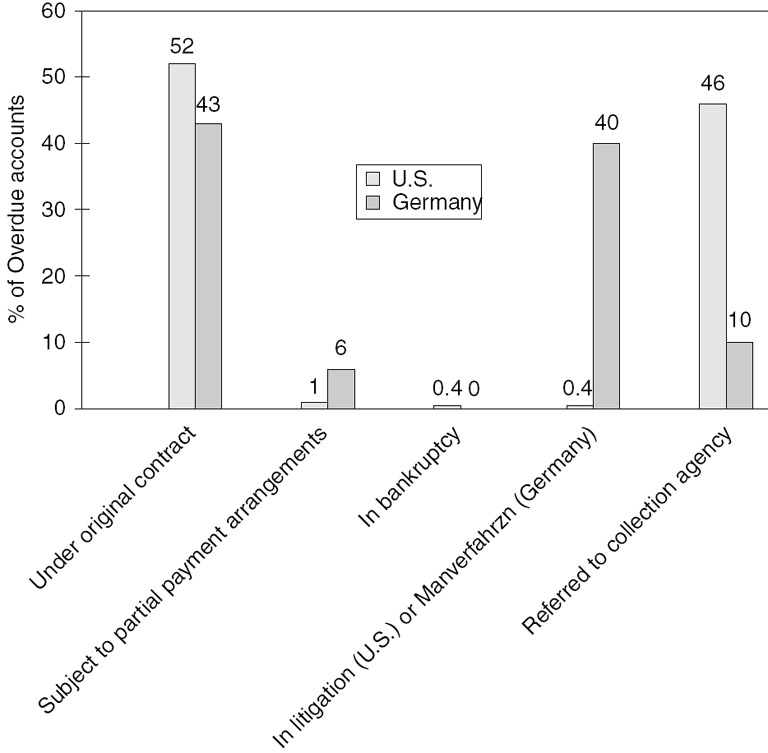
Figure 8.1. Legal Status of Overdue Accounts in U.S. and German Operations of “Credit CO”
Because legal action is so costly and outcomes so uncertain, the bank sues delinquent debtors in less than 1 percent of these cases. Practically all of this litigation occurs only after accounts are written off and sent to collection agencies. Pre-write-off litigation occurred in only 15, 10, and 25 cases, respectively, in three recent months at Credit Co's U.S. operations— making these numbers virtually negligible when compared with the total number of accounts. According to bank officials, this delay is due mainly to the perceived costliness and uncertainty of legal action. Any threat of bankruptcy—real or perceived—doesn't necessarily force banks to postpone sending accounts to collection agencies. In fact, even as consumer
Despite the reticence Credit Co.'s U.S. operations typically display in initiating legal action in debt disputes, they still set up substantial legal collections departments to manage problem cases. A representative legal collections department involves several units housed within a large, centralized section. One in-house counsel and a paralegal assist these units with bank-initiated collection activities, supervision of outside litigators, and managing litigation or counterclaims filed against the bank by debtors. Each unit generally consists of twenty to forty staff members and a unit manager, none of whom are attorneys or paralegals. A Litigation Management Unit is encharged with filing lawsuits against debtors and providing support for outside collection attorneys under contract with the bank from different states. The functions of the “Deceased Unit staff” are similar to those of the Litigation Management staff, except that it handles suits against debtors' estates. A Bankruptcy staff is split into three subunits, a Pending subunit that handles accounts once there is a threat of bankruptcy; a Recovery staff that handles accounts after a debtor has filed for bankruptcy; and an Operations staff that processes petitions and dismissals.
At a given point in time, the bank may deal with fewer than sixty counterclaims out of the 25,000 to 30,000 cases in which it has initiated legal action. In most of these cases, debtors allege violations of the FDCPA, the Truth-in-Lending Act, or state collection laws. In the slightly larger number of cases in which debtors initiate litigation (about 70 at a given point in time), just more than one-half allege violation of these laws. Two factors seem to hold down the rate of legal claims by debtors. First, large banks apparently do take extra precautions to comply with debt collection laws to avoid exposing themselves to any legal action by debtors. Second, debtors in trouble tend to seek out relatively convenient and efficient forms of protection offered by bankruptcy, rather than filing claims against creditors in regular court procedures. Debt collection by banks in the United States typically begins when their collection personnel contact delinquent debtors via telephone calls and dunning letters (letters requesting payment). In contrast to its minimal legal collections staff, a large bank with national credit card operations employs approximately 2,500 full-time equivalent collection personnel (management and support staff) working in regional centers.
Entry-level collectors deal almost exclusively with accounts that are in the first two months of delinquency. They simply remind customers of their payment obligations. Traditionally, collectors employed by Credit Co. have
Once accounts are between two to four months overdue, more experienced collectors take over, informing debtors that their delinquencies have become more severe and that a decision is being made whether to keep their accounts open. If an agent does not negotiate a satisfactory arrangement by the fourth month of delinquency, the account is automatically closed. During the fifth and sixth months of delinquency, before accounts are written off, the bank makes intensive efforts to close out balances owed it. The most experienced collections agents with the sharpest negotiating skills attempt in repeated contacts with debtors to extract payments. If, after these communications, a debtor cannot make even current payments, the bank attempts to enter into a partial payment arrangement, negotiating an immediate payment based on ability to pay, and subsequent payments to make the account current. These efforts extend through the sixth month of delinquency into the post-write-off stage, where, as Table 8.1 indicates, most partial payment arrangements are finalized (though they are also worked out as early as the second or third months of delinquency).
If it becomes clear at any point in the delinquency that a debtor will never make any payment large enough to roll an account back toward current status, the bank will attempt right then to negotiate a partial payment arrangement. Recently, partial payment arrangements have been conducted somewhat more frequently during each of the two-month periods leading up that stage (see Table 8.1). If, even after these renegotiations, serious delinquencies continue and the debtor shows a lack of discipline in paying, the bank offers to close out the account for good, settling for a specified amount; 60 percent of these settlements occur in the post-write-off stage, but if early on it is clear that the risk of bankruptcy is high, the bank will settle then. Banks estimate that up to half of their write-offs are the result of bankruptcy or bankruptcy risk. Typically, this risk is determined by collection agents listening for signs that the customer blames his delinquency on persistent unemployment, on levels of debt greater than income, or on pressure from other creditors. Under such circumstances, Credit Co. officials assume, debtors face strong temptations to pay $300 to file a bankruptcy petition that will discharge, say, $25,000 worth of debt.
If in-house efforts are unsuccessful and the debt is still deemed collectible, Credit Co. typically contracts out its collection work to outside counsel or collection agencies. Collection agencies are often employed if the debtor appears to be judgment-proof. The amount of the debt may be small or large. The bank pays the collection agency a commission rate that ranges from 20 to 50 percent of the amount collected, depending on their prior handling of accounts and on the number of months that an account has been in the post-write-off stage.
Just as the bank is striving to spot trouble cases early and renegotiate or settle more quickly to avoid legal action, so, too, is it beginning to ship out a small percentage of cases to collection agencies in pre-write-off stages. However, as mentioned previously, the vast majority of accounts contracted out occur at the post-write-off stage. This enables banks to deploy their own large collection staffs in the most effective manner—gradually turning up the heat over several months with increasingly skilled negotiators.
IV. GERMANY
A. Institutional Framework
Compared with those in the United States, German laws and institutional arrangements place more emphasis on the integrity and binding quality of the original debt obligations. German debtors can count on far less legal and institutional support than do their American counterparts. There are no fair debt collection laws shielding borrowers from creditors' collection efforts. Even if debts become too onerous, German debtors cannot seek refuge in consumer bankruptcy procedures.
The importance of the original debt obligation—whether due to the long-held norm of contract-as-promise in civil law or to the notion of creditor-debtor equality—is evident in the Mahnverfahren procedure found in Chapter 7 of the Civil Procedure Code. Mahnverfahren is a summary procedure that greatly expedites the collection of debts.[16] The creditor files an allegation in court without presenting evidence other than a contract and a statement that payment is overdue. Paralegals and other law office assistants rather than attorneys handle the filing of these claims. Court clerks, working under formal supervision of a judge, screen the forms for correctness and issue an injunction. If the debtor, who may consult a debtcounseling agency or a private attorney, wishes to contest the claim, he or she may file a petition; this must be done within four weeks of the creditors' filing. Typically, a debtor's petition argues that the creditor failed to meet good faith requirements under contract law or that the contract is void because the creditor failed to meet disclosure and interest rate requirements under the Consumer Credit Act (Verbraucherkreditgesetz). At this point, formal litigation procedures may begin.
Between 1982 and 1984, 9,118 cases for every 100,000 in total population went to Mahnverfahren procedures, but only 17 percent of these cases were challenged by debtors and ended up in litigation.[17] But, as noted in the following, the rate at which debtors challenge Mahnverfahren actions for credit card debt appears to be much lower. By 1991 these numbers had changed very little: only 10 to 15 percent of debtors contested creditors' claims in Mahnverfahren. When a debtor does not contest a creditor's claim in Mahnverfahren, the court simply enters a judgment in the creditor's favor. Enforcement of this judgment resembles the U.S. procedure. A civil servant (Gerichtsvollzieher) is sent to the debtor to collect, much like a sheriff in the American context. In Germany, too, creditors face difficulty in collecting on judgments or in obtaining assignment of the debtor's assets to cover repayment; as in the United States, the consumer debtor typically has few, if any, assignable assets. Compounding the difficulty in Germany is the fact that wage garnishment is prohibited. This is perhaps the only significant way in which German law and institutions are more debtor-friendly, although in 1999 some garnishment remedies will be authorized by law.
A major difference is that in Germany, the right to execute on a judgment lasts for thirty years, compared with the ten-year statutory limits in most U.S. jurisdictions. This makes it more feasible for German creditors to wait until the debtor has regained control over his personal finances, and then seek to collect on the judgment. On the other hand, bank credit card operations sometimes offer a prompt final settlement for 50 percent of the amount owed, or even less in some cases. Overall, Mahnverfahren has proved so successful in Germany (especially from the creditors' perspective) that harmonization of civil procedure codes throughout the European Union is forcing the introduction of similar procedures throughout member states.[18]
Beginning in 1999, Chapter 13–like protection will become available for German consumers. Germany's generous social safety net has shielded debtors somewhat from this necessity, but as economic globalization and East-West reunification, among other factors, have forced cutbacks in social spending, bankruptcy and other forms of legal protection for debtors are likely to become more important.
Consumer organizations in Germany, which played important roles in drafting the new consumer bankruptcy law (Insolvenzordnung), claim that the law will encourage debtors and creditors to reach out-of-court settlements through the mediation of debt-counseling agencies. Historically, German creditors, vested with strong legal rights, have had no need to resolve consumer debt disputes outside of courts. It is uncertain whether their incentives will shift sufficiently under the new bankruptcy law so that they will need to rely on debt-counseling agencies' assistance. Staffed
One formal legal protection currently available to consumers is called “oath of disclosure” (Eidesstattliche Versicherung). This procedure resembles bankruptcy in that debtors, under oath, disclose that they are unable to repay their debts and petition the courts for relief from collectors' actions. But the relief is limited; if granted, it lasts for three years, during which time the debtor is cut off from all normal forms of credit and may not open a business. And, unlike bankruptcy, after three years, the debtor must reassume the original obligation.
B. Bank Collection Operations
Credit Co.'s operations in Germany enjoy the procedural and institutional advantages all creditors enjoy there—that is, the convenient, low-cost Mahnverfahren system, the relative absence of bankruptcy, and the minimal legal protections for consumer debtors against aggressive creditor collection efforts. Instead of avoiding formal legal action as in the United States, managers in the bank's German operations move more quickly to file claims in Mahnverfahren. As shown in Figure 8.1, whereas Credit Co. resorts to litigation in less than 1 percent of delinquent accounts in the United States, its German operations employ the Mahnverfahren legal collection method in 40 percent of delinquent accounts. Banks in Germany do not have to worry about debtors filing for bankruptcy as in the United States, while their own legal action against debtors is encouraged by the convenience and inexpensiveness of procedures such as Mahnverfahren.
This dynamic is reflected in the account statistics compiled by Credit Co.'s German operations. This operation employs a system categorizing accounts much like its U.S. counterpart. Accounts that are 1 to 59 days overdue are placed in “buckets” 1 or 2, moving to buckets 3 through 6 for every subsequent 30 days that they remain unpaid. Accounts that are 180 days overdue are written off, as in the United States. The scale of the German subsidiary's operations is far smaller than in the United States,
Typically, as shown in Figure 8.2, a far lower percentage of delinquent accounts enter the post-write-off stage in Germany (3 percent) than in the United States (46 percent). Only 1 percent of partial payment arrangements, 5 percent of Mahnverfahren actions, and 30 percent of collection agency action occur in the post-write-off stage. In the United States, as described earlier and presented in Table 8.1, 60 percent of partial payment arrangements, just less than 100 percent of creditor-initiated litigation, and 98 percent of collection agency action occur in the post-write-off stage.
Thus, despite recent increases in consumers' debt burdens in Germany, an even higher percentage of credit card debtors keep their accounts current than in the United States, and the bank is compelled to write off a much lower percentage. Moreover, these patterns prevail despite the high German rates of long-term indebtedness (rather than higher credit turnover) that seemingly lie behind the rise in debt burdens. This is all the more noteworthy because German bankers say they have less access to consumers' credit records than do their American counterparts, and thus are less able to prescreen customers for credit risk, which in theory would diminish the credit quality of German relative to U.S. card portfolios. On the other hand, American operations may be more aggressive in selling credit card services to lower-income and other higher-risk consumers.
Regardless of why German accounts are kept current, bank operations there spend much less effort than their U.S. counterparts in managing trouble accounts. About 10 percent of all credit card accounts are closed at a given point in time, but almost three-fourths of these are closed by customers. In the cases where Credit Co. itself closes accounts, it frequently does so automatically because the accounts are 60 days past due. Once accounts are closed, they are sent to in-house collections for an additional 60 days, where collections staff attempt to collect in full or negotiate partial payment arrangements. German operations staff the equivalent of thirty full-time agents to handle approximately ten thousand delinquent accounts. Since all law governing credit transactions is federal, there are no differences between legal rules across Länder, and hence no need for regional centers and extra training for collection agents. Before initiating Mahnverfahren, creditors must remind debtors of their obligations at least three times. German operations do not send dunning letters; reminders sufficient for Mahnverfahren purposes are attached to account statements regularly sent to each customer. Between days 60 and 119 of delinquency, agents telephone customers to remind them of their obligations. At day
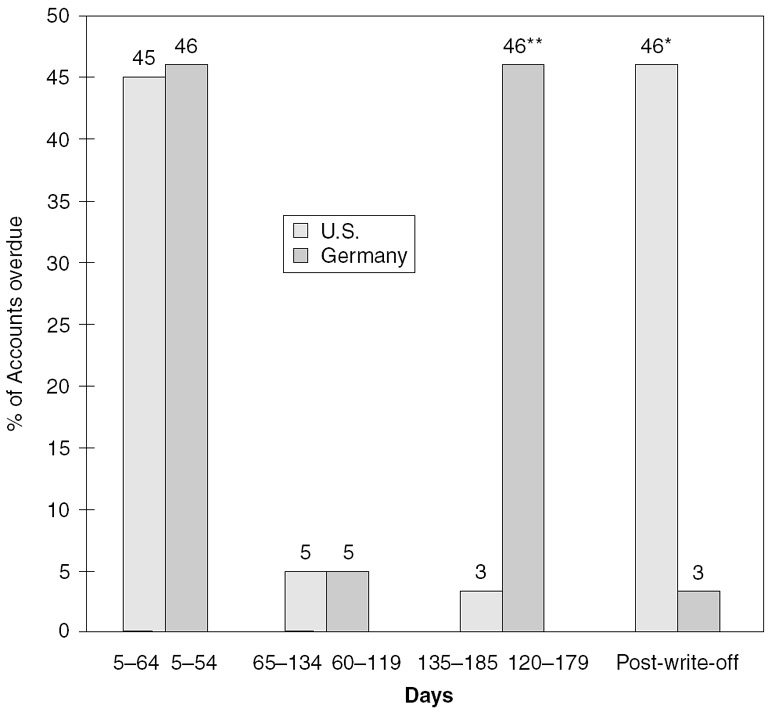
Figure 8.2. Length of Debt Delinquency in U.S. and German Operations of “Credit CO”
120, the bank proceeds directly to Mahnverfahren, as contrasted with the stepped-up negotiating efforts that U.S. operations begin around that time. Of the approximately five thousand accounts (on average) closed by the bank in Germany at a given point in time, about 75 percent have been sent to Mahnverfahren and are working their way through the legal system. The bank sends the remaining 25 percent of accounts to collection agencies, where they are worked for up to ten weeks. Collection agencies manage most of the bank's card accounts that are 150 or more days delinquent (including those that the bank has written off). Payment arrangements are similar to those used in the United States, where the collection agency's commission depends on the account's vintage.
Like the banks themselves, collection agencies in Germany waste little time in trying to extract payments from debtors through letters or telephone contacts. The incentives to use Mahnverfahren quickly are just as strong as for banks, and collection agencies acting for creditors will file the necessary court petitions. Thus, as shown in Figure 8.2, whereas 46 percent of Credit Co.'s delinquent accounts in the United States are classified as “referred to collection agency,” that status applies to only 10 percent of the company's delinquent accounts in Germany.
Once a suit is filed in Mahnverfahren, banks expect to receive a summary judgment in their favor, in large part because the consumer debtor rarely files a defense or counterclaim. According to bank officials in Germany, operations on the scale examined here typically might face only five to fifteen such counterclaims to the approximately four thousand claims they file in court. This rate is far lower than the 10 to 15 percent rate for overall consumer credit filings in Germany, though higher than the U.S. rate. Debtors file oath of disclosure petitions at a very low rate as well.
As in the United States, the legal staff involved in legal collections activity in Credit Co.'s German credit card unit is minimal, with one counsel for collections and three paralegals responsible for all litigation initiated by the bank. The paralegals' main task is to file Mahnverfahren claims. No separate in-house counsel is responsible for managing claims filed against the bank by debtors, as is the case in U.S. operations. This suggests that although the ratio of debtors' claims to total cases may be similar in the two countries, the legal complexity of these claims might be sufficiently greater in the United States to warrant the presence of a separate legal division. The possibility of class action damages in the United States, unlike in Germany, may be part of this explanation.
Like their U.S. counterparts, German operations are learning to spot potential problem cases early and act even before accounts are 60 days overdue. Examining Tables 8.1 and 8.2 shows that the bank in Germany is more aggressive in pursuing partial payment arrangements or contracting out to collection agencies than it is in the United States. Overall, the bank has little incentive to negotiate partial payment arrangements with German debtors, doing so in less than 0.5 percent of all cases (although this rate is higher than in the United States). But in Germany, only one-quarter of these renegotiations occur after accounts are more than 120 days overdue, and only 1 percent occur in the post-write-off stage, whereas in the United States the majority of renegotiations occur in the post-write-off stage. The bank in Germany contracts out a lower percentage of delinquent accounts to collection agencies, and employs this method at an earlier stage of delinquency, than in the United States; the largest number of such cases fall between four and six months of delinquency (as opposed to the post-write-off stage in the United States).
V. CONCLUSION
The behavior of multinational banks and their credit card operations is influenced, of course, by a variety of cultural factors and market incentives in addition to legal and institutional frameworks. Nevertheless, it appears that the high cost and uncertainty of the U.S. legal system, with its high bankruptcy risk and the presence of many local legal cultures, encourages American operations to delay formal legal action much longer than in Germany, where uniform and simple legal procedures make it relatively easy for banks to press their claims at an early date without the risk of pushing debtors to file for bankruptcy. Second, the legal costs and bankruptcy risk posed by the U.S. legal system seem to encourage American bankers to engage in much more extended and aggressive informal collection efforts, which in turn has prompted the enactment of detailed regulation of collection efforts. Third, U.S. banks write off a larger proportion of debts and must cope with delinquencies in a much larger proportion of cases, although it is not clear how much these differences stem from the varied influences of the two legal systems.
There is some evidence from general sources (rather than from the banks we studied) that because of the more complex set of debtors' rights and litigation methods that prevail in the United States, both debtors and creditors face greater incentives to engage in opportunistic behavior. Visa USA has estimated that over 25 percent of its credit card losses arise from situations in which the debtor could pay, but does not, due to use of bankruptcy, other legal claims, or fraud.[19] At the same time, frustrated by debtors' expansive use of bankruptcy rights, creditors are tempted to use unethical methods to convince debtors who file for bankruptcy to reaffirm their debts, or aggressively oppose bankruptcy filings in courts, thereby pressing debtors who can ill afford the resulting legal fees to enter into reaffirmation agreements.[20] In Germany, where the law is more straightforward and court procedures are less expensive, such temptations to opportunism presumably are far lower.
A more complete analysis would examine whether greater consumer protections in the United States actually promote credit use. If so, the welfare (and policy) implications of greater adversarial legalism in the United States are unclear. If the risk creditors face, and the costs of the system as a whole, are greater in the United States than in Germany, those risks and costs still must be weighed against the benefits to consumers and the economy as a whole of greater access to credit. Although this study indicated that the American debt collection system is more legally uncertain, costly, and inefficient, it cannot tell us which system produces a more efficient consumer credit market.
NOTES
1. Robert A. Kagan, “The Routinization of Debt Collection,” Law and Society Review 18 (1984): 323.
2. “The Cutting Edge,” The Economist, July 27, 1996, 63–64.
3. “Cracking Open the Nest Egg,” The Economist, July 27, 1996, 64.
4. The German market has only recently taken off, with three million cards in circulation in 1994. Still, German consumers have had extensive experience with bank credit since at least the 1960s, the fastest-growing form involving the use of EC cheque cards. As of 1994, there were about twenty-one million cheque cards in circulation, which consumers can use to overdraw their personal bank accounts by up to three times their monthly income. They are charged overdraft interest by their bank on any withdrawal and are penalized with higher interest rates if they fail to comply with payment agreements negotiated ex ante with their bank. Udo Reifner, “Consumer Credit Regulation in Germany,” mimeo, School of Economics and Politics, Hamburg University, September 1994.
5. “Consumer Loans: Good Debts,” The Economist, July 15, 1997, 72–73.
6. Ibid.
7. Albert Crenshaw, “Creditors Go for Broke to Collect,” San Francisco Chronicle, February 17, 1997, B3.
8. Mark Hansen, “When Rubin Sues, Defendants Settle; Unscrupulous Debt Collectors Pay the Bills for New Mexico Consumer Lawyer,” American Bar Association Journal 79 (1993): 29; Anthony P. Pecora, “The Unyielding Miranda Requirement of the Fair Debt Collection Practices Act: Strict Textualism or Statutory Myopia,” Commercial Law Journal 99 (1994): 231.
9. Pecora, “The Unyielding Miranda Requirement,” 249.
10. Fred R. Bleakley, “Personal Bankruptcy Filings Are Soaring,” Wall Street Journal, May 8, 1996, A2; see also “Consumer Loans: Good Debts,” The Economist, July 15, 1997, 72–73 (more than 121,000 personal bankruptcies filed in one month, May 1997).
11. Bankruptcy Petition Study, May 1997, Visa U.S.A.
12. Often, for example, the debtor's home is exempt from liquidation, enabling unscrupulous debtors to shield assets by making large investments in home improvements before filing for bankruptcy. Although such behavior surely is not the norm, it has been estimated that close to 90 percent of debtors who file for Chapter 7 do not liquidate any assets to pay debts. Dian Culp Bork, “Why Personal Bankruptcies Are Surging,” Wall Street Journal, January 29, 1997, A11.
13. A reaffirmation agreement is a formal, legally enforceable agreement signed with a creditor to repay a debt notwithstanding a bankruptcy discharge.
14. Barnaby Feder, “The Harder Side of Sears,” New York Times, July 20, 1997, sec. 3, p. 1.
15. Teresa Sullivan, Elizabeth Warren, and Jay Lawrence Westbrook, As We Forgive Our Debtors: Bankruptcy and Consumer Credit in America (New York: Oxford University Press, 1984).
16. Erhard Blankenburg, “The Infrastructure for Avoiding Civil Litigation: Comparing Cultures of Legal Behavior in the Netherlands and West Germany,” Law and Society Review 28 (1994): 789.
17. Id. at 797.
18. Id. at 800.
19. Crenshaw, “Creditors Go for Broke to Collect,” B3.
20. Ibid. See also Feder, “The Harder Side of Sears.”
9. Obtaining and Protecting Patents in the United States, Europe, and Japan
Deepak Somaya
In the 1970s, ACME, a highly innovative U.S. chemical firm, pioneered a technology involving an inert polymeric substance that subsequently found wide application in products around the world. ACME sought to obtain patent protection for this pioneering innovation, as well as for related follow-on innovations, in the United States and elsewhere, sometimes with very different results. This chapter describes ACME's experiences obtaining and enforcing patents in the United States, Europe, and Japan, analyzes the cross-national differences in legal regimes for granting and protecting intellectual property rights, and provides some insight into the resulting economic consequences.
I. INTRODUCTION
In an era of increasing global trade and information flows, innovative companies are increasingly sensitive to cross-national differences in patent protection. This is because an invention, once disclosed, ostensibly becomes freely available to everyone, including firms in a country that does not protect the invention adequately. A CEO of a U.S. company that invents and manufactures products for the semiconductor industry wrote: “To be valid, a patent must describe how to make the invention, complete with recipes. A U.S. patent is therefore a free ‘how to’ book for every potential offshore competitor. For a modern software or manufacturing enterprise, a U.S.-only patent can be worse than no patent.”[1] Multinational companies, therefore, are acutely sensitive to the differences in international patent systems that determine the extent of protection accorded to their innovations in each market.
This chapter has three primary objectives. First, it documents significant
The research shows that in Europe and Japan, as well as in the United States, ACME encountered adversarial legal opposition to its patent claims, resulting in costly delays and uncertainties. In both Europe and Japan, legal conflict occurred primarily in administrative forums and was related to the initial governmental decision to grant a patent. In the United States, the most serious legal challenges occurred later, through litigation in the federal courts. Overall, the U.S. system granted ACME broader protection for its innovation. The lesser (or less consistent) patent protection in Europe and Japan set back ACME's marketing efforts to some extent; nevertheless, its innovative products eventually achieved considerable commercial success in all its markets.
As a consequence of lobbying by multinational companies, crossnational differences in patent regimes have been subject to strong pressures toward convergence, particularly through international forums such as the General Agreement on Tariffs and Trade (GATT) and the World Intellectual Property Organization (WIPO). Bilateral trade negotiations, especially those between the United States and its trade partners, have been another important force for convergence. In Japan and the United States, and to a lesser extent in Europe, important changes are being implemented in the patent systems as a result of the GATT Trade Related Intellectual Property Rights (TRIPS) agreement, and Intellectual Property Rights (IPR) agreements under the U.S.-Japan Framework talks. It will be some time before the full impact of these changes can be objectively assessed. However, this case study (together with other research) suggests that nonstatutory cross-jurisdictional differences persist at the national patent office level and, more important, that patent enforcement processes, which are vested with the courts, are likely to remain an enduring source of differences between national patent regimes for some time.
II. RESEARCH METHOD
After collecting detailed information about the differences among national patent regimes from secondary sources, I sought a more nuanced understanding of them through interviews with experts and patent law professors
III. GENERAL DIFFERENCES AMONG PATENT REGIMES
The patent law regimes of the United States, Japan, and Europe all reflect a basic consensus concerning the importance of intellectual property rights in developed economies. Patent grants have two purposes. On the one hand, patents provide economic incentives for the creation of valuable innovations by conferring upon the inventor a limited monopoly in the new technology. On the other hand, the patent system facilitates the diffusion of these inventions in industry by mandating public disclosure of innovations. In interpreting and applying patent law, national patent offices and judges who hear patent cases strike a somewhat different balance between the competing goals of providing incentives and diffusing technology.
Among practitioners, the United States is generally regarded as being particularly supportive of patentees and their exclusive property rights over inventions. The Japanese patent system, in contrast, emphasizes the rapid dissemination of innovations in industry and encourages the sharing of technology, rather than providing broad exclusive rights to patentees.[2] In the words of one scholar, “[T] he Japanese view inventions more as a public, and less as a private, good,” and they thus view patents “more as a means to reward inventions and less a right to exclude others from use than in the United States.”[3]
European national systems are often described as somewhere between the United States and Japan, with the United Kingdom leaning more toward the U.S. pole and Germany somewhat more toward the Japanese. The
Apart from core ideological differences, there are institutional and procedural differences between the jurisdictions as well, often reflecting the historical development of their national patent systems and the character of their political and legal institutions. Unlike the United States, patent offices in Japan and Europe provide administrative “opposition” systems for adversarial contestation of a patent at the time it is issued. In Japan, prospective foreign patent holders, and U.S. firms in particular, have long complained that they are disadvantaged by the costs and delays of the patent system (including the “pre-grant” opposition process), which favor the strategic patenting practices of their rival Japanese firms. In the United States, courts are less deferential to administrative authority than Japanese or European courts, and they often second-guess the patent office's assessment of the validity of patents. At the same time, U.S. courts provide the most powerful legal weapons against infringers, including preliminary injunctions, far-reaching pretrial discovery, and large pecuniary damages. But these adversarial measures are very costly for litigants and, combined with the high level of uncertainty in the U.S. courts, can be used strategically to hold competitors at bay. In Europe a different type of uncertainty and variation results from the autonomy retained by national patent systems and courts, despite efforts to provide a “common European patent” through the EPO.
The following description lays out some of the main differences between patent regimes as they existed in 1993, before the latest burst of harmonization.[5] For the purposes of understanding ACME's experiences in patenting, this 1993 “snapshot in time” is probably more relevant than the current, evolving scenario, which I shall discuss in a later section in this chapter.
A. Differences in Patent Prosecution
In all economically developed countries, obtaining a patent, or patent “prosecution,” as it is called, begins with filing an application at a national patent office or, for Europe-wide coverage, in the EPO.[6] In the patent office, a patent examiner, who is an expert in the relevant technology, evaluates the claimed innovation using such criteria as “novelty,” “nonobviousness,”
1. PRIORITY
The United States is the only country except the Philippines to grant patents on a first-to-invent, rather than first-to-file, basis. Consequently, the U.S. Patent and Trademark Office (USPTO) provides for an adversarial proceeding, called an “interference,” to resolve disputes over inventive priority. The first-to-invent provision presumably benefits small inventors, who may have more difficulty in writing up the invention, comparing it with prior art, and rushing the application to the patent office. However, interference proceedings are costly.[8] Only about two hundred interferences are filed each year (out of roughly two hundred thousand applications), and only a fraction of these have resulted in a patent award to the second (or later) firm to file.[9] The costs involved, some observers contend, raise “doubts as to whether independent or small inventors … really fare better under the first-to-invent system.”[10] Irrespective of its actual impact on the ground, the logic of a first-to-invent system pervades the USPTO and is a unique feature that sets it apart from its foreign counterparts.
2. LANGUAGE
The USPTO allows patent applications to be written in any language. English translations are required within two months, but the original language remains the source document in the event of future litigation. In contrast, the JPO permits filing only in Japanese and, much to the distress of U.S. firms surveyed in an earlier study, does not permit corrections if they would change the gist of the claims (even for errors in translation).[11] In the EPO, applications can be filed in any member-state language, followed by a translation in English, French, or German, the official languages of the proceedings. Subsequent translations are required when registering the patent in any of the member states. Although language alone might not be a major
3. PATENT TERM, PUBLICATION, AND EXAMINATION
In the United States, patents are awarded for seventeen years from the date of grant. Patent applications are not published unless and until the patent is granted, enabling applicants to continue to use the invention as a trade secret if they are not successful in obtaining a patent. Patent applications, once filed, are automatically examined in the USPTO. However, some applicants find ways to delay examination of their patents through manipulative tactics, giving rise to “submarine patents.” These patents, still unpublished, lurk in the system while unsuspecting firms “reinvent” the same technologies and build substantial market stakes in them. When the submarine patent eventually issues, the patentee can sue and collect large royalties from the surprised “second” inventors. Since the patent term is from the date of grant, patentees could still enjoy the entire seventeen-year life of the patent, no matter how long the application is delayed in the system.
In Japan and the EPO, applications are published eighteen months after filing. Submarine patents are nearly impossible in systems that require timebound publication, irrespective of the patent term, because the publication puts potential infringers “on notice” and enables them to avoid making sunk investments in a technology that will be covered by another's patents in the future. Mandatory publication also means that every patent application is freely available to one's competitors within a fixed time from the application date. This not only leaves the applicant without recourse if the patent is refused but also facilitates strategic practices on the part of competitors such as “patent flooding.” In the EPO, patents are granted for twenty years from the date of application, but patent applicants can choose to delay examination for up to six months after the eighteen-month publication. In Japan, patents were awarded for fifteen years from the date of provisional grant (i.e., before opposition) or twenty years from application, whichever is less. Applicants are required to request examination within seven years of their application date, or their application lapses. Thus, both the EPO and the JPO allow the applicant to defer examination of the patent application for some length of time. Besides lowering the overall workload of the patent office, deferral is also useful for applicants because it enables them to delay legal costs while assessing the commercial value of their innovation.
4. ADVERSARIAL PROCEEDINGS
In the past, the USPTO permitted competing inventors or firms to challenge a patent and request a “reexamination” by submission of “prior art which raises a substantial new question of patentability,” a standard that was considered too demanding.[12] The EPO and the JPO, on the other hand, invite intervention from third parties more directly by early publication of the application and by providing formal “opposition” procedures. This sometimes leads to contentious and lengthy skirmishes between prospective patentees and their competitors. But opposition proceedings probably also discourage later litigation, resolving in a quasi-administrative forum certain issues that would otherwise be raised by nonpatentees in postgrant lawsuits. In jurisdictions such as Japan and Germany, courts do not delve into issues of “validity” in patent suits (i.e., whether the patent should have been granted) but instead defer to the Patent Office. By contrast, in the United States, with its initial secrecy, limited ability to challenge a patent at the Patent Office level, and substantial court powers, challenges to validity are more likely to arise later and be decided by the courts.
In Japan, opposition proceedings are notorious for lasting very long— from three to five years. Unlike the EPO, the JPO's opposition is a pregrant process, with the applicant enjoying only a provisional, legally unenforceable patent grant during the opposition. Further, each opposing party's claim is contested in a separate proceeding. Thus, the opposition process can impose significant costs and delays on the applicant, thereby encouraging technology-sharing settlements with its competitors.
5. PATENT STANDARDS AND SCOPE
Patent practitioners generally agree that the USPTO, in judging the patentability and scope of inventions, is inclined to favor inventors. At the other extreme, the JPO has interpreted similar principles rather strictly, against the applicant.[13] For example, the JPO requires that claims be narrowly specified and supported by working examples. Further, its examination policies also narrow the breadth of a patent by lenient interpretation of the novelty criterion as applied to subsequent improvement innovations made by other firms.[14] ACME's patent attorneys felt that, in the past, Japanese patent policy has been geared more toward incremental “engineering” innovations and technology sharing than toward encouraging and protecting sweeping “pioneer” inventions. The literature supports this view.[15] ACME lawyers said that in Japan, it is “assumed that patents are to be shared and cross-licensed,” but they also acknowledged that the Japanese “do not have a pirating mentality.”
Despite some harmonization through the EPO, the standards applied to patent applications in Europe are quite varied. At the national level, some countries (e.g., France, Italy) grant patents readily, based on a
6. STRATEGIC PATENTING PRACTICES
Japan's patent procedures and standards, it is argued, are particularly conducive to strategic use of the system by Japanese firms, particularly against foreign patent applicants. One common strategy is known as “patent flooding.”[17] When a company files an application for a significant patent, its potential competitors file numerous related patent applications claiming “improvement” patents for new uses or slight variants of the technology. These patents, if granted, “surround” the original patent, thus preventing the patentee from using the technology freely in the market and forcing the patentee to license its technology. In addition, Japanese firms have often vigorously contested important patents in the JPO, keeping applications tied up in lengthy opposition proceedings.[18] Foreign firms, less capable of dealing with these tactics in Japan, have frequently succumbed to the pressure to license their technology.
In one infamous case, a start-up U.S. firm (Fusion Systems) that manufactured (and patented) innovative ultraviolet lamps encountered difficulties when Mitsubishi Electric apparently reverse-engineered the product, flooded the JPO with improvement patents, and used them to badger Fusion Systems into licensing its patents at near-giveaway rates. Eventually, the intervention of the United States trade representative relieved the pressure on Fusion Systems.[19] Allegations of unfairness toward foreign applicants in Japan have gained credibility because the JPO is under the direct administrative control of the Ministry of International Trade and Industry (MITI), Japan's chief trade policy agency, and the JPO's director general is appointed by MITI and returns to it after his two-year tenure.[20] MITI has a reputation, particularly in the United States, for orchestrating Japanese trade policy in a strategic and nationalistic manner.
Other patent regimes are also subject to strategic patenting practices, as illustrated by the use of “submarine patents” in the United States. A great deal of strategic gaming also occurs in U.S. patent litigation, which is generally considered very costly and uncertain. European jurisdictions appear to be comparatively less amenable to strategic gaming because of their less adversarial civil law tradition.[21]
7. DELAYS AND COSTS
The JPO is notorious for delays in the patent examination process. These delays (and the accompanying costs) greatly exacerbate the problems faced by foreign firms in protecting their innovations in Japan. In part, these delays are engendered by the large numbers of patent applications filed in the JPO. In the late 1980s and early 1990s, the JPO averaged more than five hundred thousand patent and utility model applications per year, compared with roughly two hundred thousand in the United States. Even though only about two-thirds of Japanese patent applications are actually examined,[22] the number is still about 1.5 times that in the United States. Among the causes commonly cited for this flood of applications are the patenting practices of Japanese firms,[23] the focused single-claim nature of Japanese patent applications,[24] and the large number of utility model applications (over two hundred thousand applications per year in the early 1990s).[25] Yet, in 1991 the JPO had only 955 examiners, as compared with 1,890 in the USPTO. In the late 1980s and early 1990s, the JPO's average time for processing examination requests was around thirty months from the date of request for examination, compared with eighteen to nineteen months[26] in the USPTO (from the date of application) and twenty-four months in the EPO (from the date of application).[27]
Obtaining a patent in Japan is not only time-consuming but also quite expensive (approximately $30,000 in 1993 for a typical twenty-page, tenclaim, two-drawing application), primarily because of high JPO examination fees and costly patent agent services.[28] But comparable costs for Europe-wide patent coverage are even higher (approximately $120,000 for registration and maintenance in 8.3 countries)[29] because in addition to the costs incurred in the EPO, additional fees and translation costs are incurred for each member state in which the patent is registered.[30] In the United States, a foreign filer would have had to spend only about $13,000 for a similar patent.[31]
B. Differences in Enforcing Patent Rights
The worth of a patent, once granted, depends in significant measure on the powers, attitudes, and efficiency with which national court systems enforce patent rights against these alleged infringers. The three major aspects of court-based enforcement are reassessment of validity, determination of infringement, and the strength of legal enforcement. The strength of legal enforcement depends primarily on the powers to collect evidence, the availability of injunctions against alleged infringers, and the availability of punitive damages. According to the chief patent counsel of a large U.S.-based multinational chemical company whom we interviewed, “Enforcement in
1. THE UNITED STATES (AND THE UNITED KINGDOM)
Litigation costs are very high in the United States and the United Kingdom, with their lawyer-dominated (rather than judge-dominated) modes of litigation, but the courts also offer the strongest enforcement mechanisms. Both jurisdictions allow parties to demand pretrial discovery; although, as one lawyer has put it, the U.K. version is a “gentle domesticated animal” compared with the “ravenous beast of the jungle” that one sees in the aggressively adversarial U.S. litigation system.[32] In addition, injunctions (including preliminary injunctions pending trial) are widely used in both the United States and the United Kingdom. In cases of willful malfeasance, treble damages may be awarded in the United States, and in recent years the use of this punitive remedy has sharply accelerated. Treble damages are not available in Japan or in Europe, although broader damages (beyond lost profits or reasonable royalties) are available in the United Kingdom.
In patent cases, as elsewhere, U.S.-style litigation is extremely expensive. Each party typically hires its own expert witnesses.[33] Discovery is timeconsuming and costly. The American Intellectual Property Law Association (AIPLA) estimated that, in 1995, the median litigation cost through pretrial discovery alone ranged from $190,000 (in cases in which the amount at risk was under $1 million) to $1,983,000 (in cases greater than $100 million), and from $301,000 to $2,975,000 through trial.[34]
In addition to costs, U.S. patent litigation is also subject to a disturbing level of legal uncertainty, at least at the district court level. Probably because patents cannot be adequately challenged by competitors during prosecution, infringement suits often become a forum for contesting validity issues as well. Unlike in Europe and Japan, the courts determine both infringement and the patent's validity in the United States and the United Kingdom. To the dismay of Japanese and European patentees who are used to having specialized benches hear patent cases, in the United States, such cases are decided not by experts but by lay jurors or technically untrained district court judges, who may be influenced by the adversarial manipulations of competing lawyers and partisan expert witnesses.[35] To address the problem of legal uncertainty, the United States in 1982 established the Court of Appeals of the Federal Circuit (CAFC), which handles all patent appeals nationwide, and this has increased uniformity in the lower courts.[36]
In most respects, enforcement in the United Kingdom is a paler image of the American system. There, too, courts wield substantial powers. The
2. JAPAN
In patent enforcement, as in many other areas of civil litigation,[40] courts in Japan are expensive, understaffed, and slow, which is often interpreted as part of a deliberate policy of discouraging litigation and encouraging compromise.[41] When a patentee sues an alleged infringer in a Japanese district court, judicial proceedings—an experienced patent lawyer writes—are intermittent, slow, and costly.[42] The small, guildlike patent bar charges high counsel fees,[43] which the winning party cannot recoup from the loser. Defendants may impose additional delays on a patentee in an infringement case by requesting a redetermination of the patent's validity by the Trial Board of the JPO. Pending redetermination of validity by the Trial Board, the court suspends its hearings on infringement, further delaying any relief to the patentee. Japanese courts rarely issue preliminary injunctions pending determination of infringement charges.[44] Nor do the courts offer pretrial discovery, which makes it very difficult to prove violations of process patents. They also interpret patent claims narrowly and literally, and eschew such principles of equity as the doctrine of equivalents,[45] construing even minor improvements on the technology by the defendant to be grounds for noninfringement. Thus, the predominant effect of the Japanese court system in patent enforcement, as in other areas of commercial dispute, appears to be to mediate a settlement between the parties rather than to determine the just allocation of property rights.[46]
3. CONTINENTAL EUROPE
In Europe, litigation costs in patent enforcement are lower than in the United States, the United Kingdom, and Japan. Fact-finding and legal argumentation are controlled by judges rather than by the parties' lawyers. In France and Italy, proceedings are based almost entirely on written documentation and testimony. In Germany there are two oral hearings, but they are far shorter and less elaborate than U.S. (or even British) trials,
| Prosecution Features | United States | Japan | Europe (EPO) |
|---|---|---|---|
| Basis of deciding patent priority | First to Invent∗ | First to File | First to File |
| Native language filing permitted? | Any language (English translation for record) | Japanese (but canfile in English, with translation to follow)∗ | Any EPC member language, with English, French or German translation; translations required for each country designated |
| Patent term | 17 years from grant∗ | Lesser of 15 years from grant and 20 years from filing∗ | 20 years fromfiling |
| Publication of patent | No∗ | Yes, 18 months fromfiling | Yes, 18 months fromfiling |
| Examination deferral | No | Yes, 7 years fromfiling | Yes, 6 months from publication |
| Third-party contestation of patent | Limited reexamination∗ and interferences∗ | Pre-grant oppositions∗ | Post-grant oppositions |
| Patentability standards | Least unfavorable to applicants (1 year grace period for prior publication) | Strict standards—claims need working examples, very limited grace period∗ | Moderate standards; some variation by nationality, limited grace period |
| Breadth of claims awarded | Very broad | Narrow | Broad |
― 287 ― | |||
| Time taken | 18–24 months | −36 months + oppositions (3–5 years)∗ | −30 months + opposition (expeditious) |
| Overall comparable costs | $13,000 | $30,000 | $120,000 |
| Enforcement Features | United States and United Kingdom | Japan | Continental Europe |
| Jurisdiction over validity of patent | With Courts, and often exercised | With Patent Office Appeals Board | Varies by national court system |
| Strength of Enforcement: | Very strong | Weak | Medium (varies) |
| Discovery and depositions | Widely used (“rampant” in U.S.) | Not available | No, but alternatives exist in some countries |
| Preliminary injunctions | Yes | Not available in practice | Yes, but sometimes difficult (e.g. Germany) |
| Interpretation of claims | Literal interpretation, propatentee court systems, equivalents applied | Narrow interpretation linking back to specifications, equivalents not applied | Interpreted less literally; equivalents applied, but under different principles |
| Prior user rights available? | No | Yes | Yes |
| Judicial style | Adversarial court trials, jury trials often seen | Brief intermittent hearings with judge, written testimony is widely used | Largely by written testimony, some oral hearings, court experts used |
| Uncertainty in outcomes | High, due to lay judges (in District Courts) and juries. Not in U.K. | High, especially due to delays, and pressure to settle out of court | Relatively low in all jurisdictions |
and in the words of one ACME attorney, they tend to offer “rough and ready justice.” European courts are much less open to hired expert testimony; the judges consult their own experts or technical publications when necessary. In Germany (as in Japan, but unlike the United States), invalidity proceedings must be brought separately in the patent court, but unlike Japan, infringement actions usually will not be stayed while a validity suit is pending. For all these reasons, European court proceedings, in a crossnational perspective, are expeditious and not costly for the parties. One author describes European patent litigation costs as less than those in the United States even if enforcement actions are pursued in several nations simultaneously.[47] In Europe, however, aggrieved patent holders do not have access to the potent and extremely effective legal weapons afforded by U.S. and U.K. law. Party-directed pretrial discovery is limited, although French and Italian courts provide some investigative assistance.[48] In terms of remedies, treble damages are not assessed. Injunctions are available, but preliminary injunctions are employed infrequently, and not at all in Germany.[49]
In most spheres of law, European courts, with their judge-dominated procedures, emphasis on legal uniformity, and highly professional bureaucratically supervised judiciaries, are regarded as more predictable than U.S. courts. But for a company seeking cross-national protection of patent rights, European courts entail a different kind of uncertainty, stemming from the different interpretive standards applied by different national judiciaries to the centrally granted EPO patent.[50] In the absence of a common European Appeals Court, firms have no recourse against the ruling of a national court on a patent obtained even through the EPO. Nonetheless, many lawyers we spoke to were positively disposed toward European enforcement because it afforded effective justice at reasonable costs and risks.
The overall differences between the patent systems of the United States, Japan, and Europe, circa 1993, are summarized in Table 9.1. Laws or practices that have changed, or are in the process of being changed, are marked with asterisks.[51]
IV. ACME'S PATENT EXPERIENCES
Although ACME has ultimately been very successful in commercializing its innovative polymeric products, it has not had an easy time with patent regimes in the United States, Europe, or Japan. Everywhere, its efforts to obtain and protect patents have encountered some delays, legal uncertainty, and inconsistency. In general, Japan and Germany were somewhat less favorable to ACME than the United States. This section provides a narrative of ACME's experience in each regime, first for its basic invention, and then for several follow-on innovations.
A. ACME's Basic Invention
In the late 1960s, ACME's scientists discovered a process to modify a polymeric substance, making it tremendously useful in an array of new areas. In 1970, ACME applied to the USPTO for a patent on this innovation, with claims that covered both the process and the product(s) made by it. One year later, it filed similar applications in Japan (only for the process)[52] and in several Western European countries.
1. UNITED STATES
The USPTO examiner issued office actions challenging ACME's application and rejecting some of the claims therein. ACME's counsel felt that the examiner had misunderstood the character of the innovation, noting that compared with the best patent offices abroad, the USPTO is characterized by a high level of personnel turnover, and hence significant variation in the quality of examiners.[53] ACME responded to the office action, making additional arguments and recharacterizing its claims, but again met with objections and eventual rejection. ACME appealed to the USPTO's Board of Appeals but then learned of a patent on a similar process held by ZCO, a Japanese company. Although ZCO's patent had not played a role in the USPTO's rejections of ACME's application, ACME was compelled by U.S. law to disclose such prior art. ACME therefore amended its application in mid-1973 and refiled,[54] carefully distinguishing its process from ZCO's patent. A new examiner, however, apparently failed to see the difference between the two patents. The examiner also asked ACME to elect to prosecute either its process or its product claims first.[55] ACME decided to begin with the process claims. But as ACME was waiting for an interview it had requested with the examiner, it discovered another patent on a similar process from the USSR, and refiled once again. On this third application, the assigned USPTO examiner recognized the distinctiveness of ACME's process, and in 1976, six years after the initial application, the patent was granted. ACME reactivated its application for the product patent in 1977. At first it was rejected by the examiner in an office action, but eventually it was allowed in mid-1979.
ACME also had to resort to the U.S. courts to enforce its rights under the patent, and its experience in that arena conforms to the general description of U.S. litigation as cumbersome, costly, and unpredictable. In 1979, after the product patent was allowed, ACME sued a large U.S. corporation for infringement of both its product and process patents. After a costly pretrial litigation phase, a five-week trial ensued. The bitterly contested case involved more than two years of pretrial discovery, the testimony of thirty-five witnesses, and over three hundred exhibits.[56] The defendant challenged the validity of ACME's patents as a defense against the infringement
In 1984 ACME filed suit in a U.S. District Court in another state against a different company that was allegedly infringing its patents. Again, true to U.S.-style litigation, the ten-week trial in 1986 involved fifty-four witnesses, the evidence from twenty-five depositions, and nearly four hundred exhibits. The trial judge held that ACME had failed to prove infringement and, despite the earlier CAFC ruling, that a number of claims in the patents were invalid. ACME appealed, but it experienced long delays at the CAFC, and with less than two years to go on the seventeen-year patent term (in 1991), ACME decided to settle the case with the defendant.
In sum, in the U.S., legal uncertainty plagued ACME from the very start. Yet, the potent legal remedies, high litigation costs, and large monetary penalties associated with U.S. patent litigation also may have worked in the company's favor by deterring potential infringers. ACME successfully served notice to two firms to stop infringing its patent.[57] So while ACME's U.S. patent faced difficulties in prosecution and uncertainties in enforcement, ACME appears to have used it to effectively protect its technological turf from infringers.
2. JAPAN
Even before making its basic pioneering invention, ACME had formed a joint venture with a Japanese company to manufacture a different range of products. Recognizing its partner's complementary technological skills in process engineering, the company decided to form another joint venture with it for the new technology in 1974. ACME licensed its basic process to the venture royalty-free in return for future licenses to technological improvements that its Japanese partner might develop.
ACME's Japanese partnership did not, however, smooth the way for JPO approval of its basic patent. After filing in May 1971, ACME requested immediate examination from the JPO. Following several office actions requesting clarifications, the application was rejected. One of ACME's lawyers complained about dealing with JPO examiners because it was “difficult to understand what their concerns really are.” ACME appealed this original rejection to the JPO appeals board, which in late 1975 agreed with ACME's position. The patent was published for opposition, and challenges were subsequently filed by the aforementioned ZCO, a member of a major Japanese kieretsu (interlocked business group), and three other Japanese companies. The JPO upheld the opposition and invalidated ACME's patent.
Predictably, the Japanese courts were slow and costly; ACME's legal fees amounted to several hundred thousand dollars. Meanwhile, after ACME's patent application was published, ZCO filed for and obtained some related patents, which enabled it to get a toehold in the technology. As soon as ACME obtained the favorable decision from the JPO Appeals Board, it brought an infringement action against ZCO, but the court suspended proceedings until the validity of the patent had been determined in ZCO's appeal to the Tokyo High Court.
Throughout the prosecution phase, ACME and its Japanese partner used the technology to make and market products that had considerable commercial success in Japan. As soon as there was uncertainty about the status of ACME's patent, however, competitors moved vigorously into the market the joint venture had developed. Just as the joint venture was beginning to reap the rewards of its market development efforts, it suffered huge losses of revenue, and its market share declined to about a tenth of its original level.
ACME's frustrating experience with the Japanese patent system is not unique, especially for pioneer inventions. Texas Instruments' patent on the integrated circuit (the “Kilby” patent) was holed up in the Japanese system from 1960 to 1989.[58] Corning Inc.'s pioneering optical fiber innovations, which were promptly awarded patent protection in the United States, were stuck in the JPO for ten years, and when issued were practically worthless.[59] Allied-Signal officials suspect that the JPO colluded with its Japanese rivals in delaying the patent for Allied's breakthrough amorphous metal technology “Metglas.”[60]
3. EUROPE
When ACME sought to protect its basic innovation in Western Europe, the EPO had not yet been established, and ACME applied for patents in various national patent offices. In France, Belgium, and Italy, the patents issued automatically upon registration, without administrative examination. In the United Kingdom, the examiner initially objected to the application but, upon clarification and resubmission, approved it in 1973.[61] In West Germany, a jurisdiction regarded as applying stringent standards for patentability, the examiner strongly objected to ACME's application, citing lack of novelty. ACME's attorneys generally respect the expertise of German
As in Japan, the German system encourages opposition at the administrative stage, rather than leaving validity issues for the courts to decide in later enforcement actions. Oppositions to ACME's German patent were filed by ZCO, a second Japanese firm, and a Dutch company.[62] The requisite hearing before the German Patent Court was not held until 1981. After a daylong hearing, ACME's German patent was invalidated by the court, which, with characteristic European emphasis on documentary evidence, allowed ACME only a truncated physical demonstration of why its process was not obvious. ACME's appeal to a higher court, which employs a limited standard of review, was unsuccessful. In the Netherlands, oppositions were filed by the same parties making the same arguments, but there the tribunal upheld ACME's patent claims.
B. ACME's Subsequent Patents
ACME continued to develop new products and processes related to its basic polymeric patent. In the different jurisdictions, ACME's subsequent patent applications have often met with disparate treatment, as described below.
1. MEDICAL DEVICES
Using the basic polymeric form that it invented, ACME developed a new type of material that proved to be extremely useful in a number of medical devices. In late 1982 it filed for a patent in the USPTO. An office action initially rejected a number of claims in the application, but following ACME's response the U.S. patent was granted in 1984. ACME filed in Japan in 1983 but deferred examination for the full seven years, until 1990. The JPO examiner then granted the patent (provisionally). An opposition was filed by ZCO, which had a commercial interest in the market for these products, too, but ACME's patent was upheld in 1992.
In 1983, ACME filed for a patent from the EPO. There, too, after the examiner granted the patent, ZCO filed an opposition. The EPO Opposition Board held against ACME in 1990, in what ACME's attorneys felt was a “bizarre” decision. The opposition panel, relying only on the court's own experts, rejected affidavits from ACME's engineers as “not trustworthy,” although such evidence would have been usually permitted in the United States. ACME persisted, however, in appealing the patent rejection, and four years later the EPO Appeals Board reversed the decision and upheld ACME's patent.
2. COATING POLYMER
This innovation had particular promise as a weatherproof coating for ACME's polymer-fabric products, but it had other applications as well. ACME's primary innovation involved a completely solid monomer from which to manufacture the coating, which reduced the pollution hazard associated with the coating process considerably. ACME filed its patent application in the USPTO in 1984. The examiner's office action stated that the innovation failed the nonobviousness criterion. The examiner accepted ACME's request for an interview to argue its case, and was persuaded about the merit of the patent. The patent issued in 1985, twelve months after filing.
The EPO process, initiated in 1985, was more difficult. The examiner, a German and a former employee of a major chemical firm, was very knowledgeable about prior art but was also skeptical about whether the product truly had an “inventive step” (the European version of nonobviousness). His office action, issued in 1987, criticized the vagueness of language in the application and cited the existence of similar prior art. When three written responses (in 1988, 1989, and 1990) failed to convince the examiner, ACME arranged an interview between the inventor and the examiner. After the interview, the examiner again criticized the application, this time on new grounds. After yet another negative office action and an ACME response, a second interview was arranged in October 1992, this time between the examiner and ACME's attorney. In 1993 the EPO patent finally issued. ACME lawyers said they would have appealed a rejection. This time, competitors did not file oppositions.
In Japan, ACME filed in 1984 but deferred examination until 1991. The examination went smoothly, and a provisional patent was granted within fifteen months. A Japanese firm filed an opposition, citing seven Japanese articles as proof that the innovation was not novel. ACME officials estimated that the patent, once issued, would be good for only ten more years, three or four of which would be spent fighting the opposition. This battle would entail considerable legal costs and would take up the time of ACME's lawyers and the inventor. Moreover, ACME's experience in other countries suggested that imitation of this invention was not a great threat commercially. Hence, ACME abandoned its Japanese patent application. In this case the deferral process appears to have delivered the desired result— ACME was able to avoid some of the costs associated with obtaining the patent because it was able to evaluate its commercial position better during the time afforded by deferral.
3. LAMINATION TECHNOLOGY
This ACME innovation helped produce a more uniform laminate (primarily on fabrics) using a polymeric support. ACME sought to patent both the
ACME filed in the EPO in 1988. The examiner's office action raised objections similar to those of the USPTO, and ACME responded with the same arguments that had prevailed in the United States. The EPO responded quickly and favorably, awarding the patent in mid-1992. The process had taken a mere six months from the time the first office action was issued, which was unusually fast, according to ACME's lawyers. A major European chemical company then filed an opposition. In March 1995 an EPO panel upheld ACME's patent, after a hearing that was unusually informal, and allowed ACME's inventor considerable opportunity to present his case orally. The European objector decided not to appeal, partly on the basis of ACME's reassurances that the patent would not threaten certain processes already in use by that company's customers.
In Japan, ACME filed in 1988, requested examination in 1991, and was granted the patent in 1993. Office actions were dealt with quickly, and no opposition was filed. The final patent issued in 1994, with less trouble than in either the United States or Europe.
4. LAMINATED INDUSTRIAL FILTER
ACME has been active in the industrial filter business since the 1970s. The laminated filter was a new, more resilient product, constituting another application of ACME's basic technology. The U.S. application, filed in 1989, was granted in twenty-one months after one office action. In the EPO, virtually the same scenario occurred; the European patent, filed in 1990, was issued in two and a half years, and no opposition was filed.
In Japan, however, ACME requested examination in September 1993 and received a very negative office action eighteen months later. The examiner cited three earlier patents, which ACME's lawyers did not initially recognize as being technologically similar to its submission. Unsure about how to proceed, ACME asked its Japanese affiliate to discuss the case with its Japanese attorneys. On learning that the objections might have some merit, ACME narrowed its claims, and the patent issued in 1996.
C. Conclusions from ACME's Patent Experience
As noted earlier, patent systems in the United States, Europe, and Japan are marked by significant ideological differences concerning the relative
In every jurisdiction ACME encountered frustrating delays, costs, and uncertainties, albeit in different stages of the process, and stemming from different sources. In Japan, ACME experienced extremely costly delays, and eventually its patent was struck down in the Japanese Supreme Court. In the United States, the company managed to obtain patents for its pioneering invention after a six-year-long process. Subsequently, when ACME sought to enforce its patent against infringers, two different U.S. District Courts sought to nullify the patent, only to be reversed by the CAFC in one instance. In Europe, ACME met with inconsistent treatment among nations, and among panels in the EPO. ACME's pioneering patent, approved in other countries in Europe, faced opposition and eventual invalidation in the German Patent Office.
ACME's recent patenting experience with its four follow-on innovations suggests that such variation persists. ACME's follow-on patents were obtained relatively quickly in the United States. But in the EPO and Japan, the same patents on some occasions encountered delays and opposition proceedings. In the EPO, two patents faced major delays, as the result of a “surprising” opposition verdict in one case and a long-drawn-out process of convincing the examiner in the other. But the opposition proceeding for another patent was dealt with very expeditiously by the EPO panel. In one instance, ACME abandoned its patent application in Japan, rather than pursue costly opposition proceedings and get a patent that was soon to expire. Yet, in another case, the JPO granted ACME's application more smoothly than either the USPTO or the EPO.
Table 9.2 attempts to summarize ACME's legal experience in the United States, Japan, and Europe. For each patent application in each jurisdiction, the table includes a somewhat subjective score for ACME's “degree of procedural difficulty,” based on the number and expense of the procedural hurdles encountered. Although the pattern may reflect the different types of inventions being patented (pioneering versus follow-on), and the number of cases is very small, the procedural difficulty score has tended to be lower and more similar across jurisdictions in the later patent applications,
| U.S. | Japan | Europe | |
|---|---|---|---|
| Coding scheme for degree of procedural difficulty (maximum possible score = 8; but realistic range = 0 to 6). The sum of Office actions (one or less = 0 to 1; two or more leq 1 to 2); opposition/reexamination procedure encountered = 1 to 2; patent revoked in opposition, and appealed = 1 to 2; uncertainty in court outcomes = 1to3. | |||
| Basic process | Granted in 1976 (6-year delay); district court(s) invalidate patent during enforcement | Denied after opposition and all levels of appeal | Granted in some countries; denied in Germany after opposition and appeal; Limited enforcement obtained in the U.K. |
| (5) | (6) | (2) to (6) | |
| Medical devices | Granted in 1984 | Deferred examination; granted after opposition in 1992 | Granted 1987; “surprising” reversal in opposition; granted on appeal: 1994 (11-year delay) |
| (0) | (1) | (3) | |
| Coating product | Granted in 1985 | Deferred examination; abandoned when opposed | Granted after many office actions in 1993 |
| (1) | (1) | (2) | |
| Lamination product | Granted in 1991 | Granted in 1994; very quick | Granted in 1992; upheld after opposition in 1995 |
| (1) | (0) | (1) | |
| Industrial filter | Granted in 1991 | Granted in 1993 | Granted in 1993 after a strong office action |
| (0) | (0) | (1) | |
suggesting perhaps that pressures for harmonization may be having some effect. But this may also reflect the fact that these later patents were for less important follow-on inventions and did not require enforcement actions anywhere.
ACME's officials have difficulty estimating the financial impact on the firm of the different procedural obstacles and delays in each jurisdiction. But it is clear, at least in some cases, that they are quite significant. For example, after its basic patent was struck down in Japan, ACME's market share fell by a factor of ten, after it had spent several years developing a market for its product. However, in other cases the impact has been marginal at best. In Germany, even though its patent was overturned in opposition, ACME faced no competition from imitation products in the market. Moreover, it appears that the patent on the company's pioneering innovation offered broad protection for subsequent related innovations, most notably in the United States and the United Kingdom. In the United States, the pro-patentee bias of the system and the power of the courts have enabled ACME to obtain satisfactory protection of its technological turf. In Japan and in some parts of Europe, ACME appears to stand on weaker legal ground but has nevertheless been economically successful, apparently as a result of its innovative products and the strength of its brand name.
D. Evaluating the Different Patent Regimes
Do ACME's experiences suggest any normative conclusions for patent policy? Clearly, the costs and hassles of obtaining and enforcing patents vary substantially across jurisdictions. The different patent jurisdictions, because of their ideological biases, also elicit different strategic responses from firms trying to get inventions patented. In the United States, overall, ACME received strong protection for its innovations and was eventually successful in preventing competitors from copying it. This strong exclusive protection, it can be argued, encourages important pioneering innovations in the United States. ACME, as we have seen, was responsible for making and commercializing important innovations relating to fabrics, medical products, and industrial filters, which were of considerable social value and generated revenues for the company. In Japan, however, as a result of weak patent protection for its basic innovation, ACME's competitors were able to benefit from knowledge spillovers, arising (presumably) from ACME's innovations, without paying royalties. As a consequence, ACME's ability to appropriate returns for its innovation in Japan was severely hampered.
However, ACME's experiences reflect the trials and tribulations of an innovator trying to obtain patent protection in various patent systems, not the experience of innovative firms that are compelled to defend themselves against patent claims. A system that arguably “overprotects” patentees may
Furthermore, the U.S. system encourages strategic gaming between patent adversaries mainly in the courts, rather than in the administrative forum of the Patent Office. This “late stage” adversarial contestation is very costly and involves high stakes. This feature is also present to a lesser degree in the United Kingdom, the other common law country in this study. By contrast, the civil law traditions of Japan and continental Europe provide incentives for earlier interfirm competition in the less expensive administrative forum of the Patent Office. This makes patent prosecution more cumbersome but reduces post-grant uncertainty and risk. In the civil law systems, courts generally defer to the Patent Office for determination of validity, and thus play a more limited role. Despite the lengthy prosecution for its basic patent, ACME's real challenge in the United States was enforcement through the courts, a process so costly and cumbersome that the company's lawyers could only pursue one such action at a time. In contrast, almost all of ACME's expenditures of time and resources in Japan, Germany, and the EPO stemmed from opposition proceedings in the respective patent offices, where competitors vigorously contested its patents.
Despite the cost and delays of litigation in the United States, American courts also make a very strong enforcement apparatus available to patentees. Admittedly, this apparatus is extremely costly and unpredictable, but for a firm such as ACME, seeking to commercialize an important innovation, it can provide an important means of survival and growth. Yet this powerful and uncertain apparatus can also stymie innovation. One patent lawyer I spoke to offered examples of software start-ups threatened with lawsuits by large, resource-rich, patent-wielding firms—threats made possible by the very broad claims allowed for recent software patents in the USPTO. Another lawyer, practicing in the biotech field, voiced similar concerns about biotech patent decisions by the U.S. Patent Office. Without the resources to survive protracted legal battles, small but innovative firms often give in, at the social cost of reduced competition in the creation of
What does all this tell us about which type of patent system is better, or offers superior overall social benefits? Answering this question is problematic. If one believes that broad pioneering innovations (as compared with follow-on innovations) are made “available” by the progress of the general “science,” innovative firms require fewer legal protections. If, however, one believes that these innovations will be produced and successfully commercialized only if the inventors are well rewarded, then those legal incentives are critically important. Which belief is more “true” is a difficult conundrum, inextricably related to the stage and pattern of development of a country; to the structure of its economy, markets, and industries; to its institutions of scientific pursuit and education; and to the extent it benefits from external worldwide advances in technology. Moreover, multinational firms increasingly plan their research efforts with a global market in mind and may not be as sensitive to the individual national levels of protection they receive as compared with the cumulative global level (as appears to be the case with ACME). In sum, ACME's experiences enable us to frame and address important questions about the social welfare consequences of the differences in patent systems, but our answers to these questions must remain somewhat inconclusive.
V. HARMONIZATION
ACME's struggles, as recounted earlier, took place over nearly two decades ending in the early 1990s. But the world's patent regimes are changing. Waves of harmonization have been sweeping international patent regulation in recent years, changing opportunities for firms trying to obtain patents in major developed countries. A country's patent system can be used to advantage domestic industry by providing weaker protection to the kinds of innovations that foreign firms are good at, thus compelling them to license their technologies to local firms under favorable conditions. It is no surprise, therefore, that international firms have demanded greater cross-national uniformity in patent regimes, and regimes of protection for all intellectual property rights. At a global level, harmonization has been pursued in two forums—the Uruguay round of GATT negotiations (resulting in the TRIPS agreement) and the less successful initiatives (primarily the Patent Harmonization Treaty—PHT) being undertaken by the WIPO.[64] Within Europe, multilateral efforts are under way through the EPO and the European Commission. Changes in the Japanese and U.S. systems have been engendered through bilateral trade negotiations, especially the Structural Impediments Initiative (SII).[65] Many of the differences
All the jurisdictions discussed in this chapter, including the United States, now have a uniform twenty-year patent term from the date of application.[66] Further, under the TRIPS agreement, signatory nations have accepted common “minimum” guidelines on such broad issues as the types of innovation that can be patented, uniformity of treatment irrespective of nationality,[67] and the granting of compulsory licenses. In the recent past, only minor changes have been made in the European patent system. The establishment of a “community patent” still appears a distant goal.[68] Through its bilateral and TRIPS commitments, the United States has undertaken to provide for mandatory eighteen-month publication, removal of compulsory licensing provisions, and a fixed patent term of twenty years from grant. The scope of reexamination in the USPTO has also been broadened to allow for more third-party participation—although how it will be applied in practice remains to be seen. Further, in a recent ruling, the U.S. Supreme Court empowered lower federal court judges to play an important role in determining the construction of patent claims, thus decreasing the role of juries in jury trials.[69]
The biggest changes have occurred in Japan. Responding to the strong international criticism about delays, the JPO has taken several steps to remedy its application process. These include phasing out the examination of utility models, hiring additional staff, computerization, issuing “administrative guidance” to major Japanese firms to control their patent applications in the JPO, and instituting special fast-track examination procedures for key patents. The JPO has also issued guidelines to its examiners to permit much broader claims,[70] apply stricter novelty criteria for improvement patents, be more clear in their office actions, and be more generous in awarding interviews. In its bilateral agreements with the United States, Japan has undertaken to end its pre-grant opposition system, further accelerate examination, permit initial filing in English, allow for the correction of translation errors, and restrict the power to grant compulsory licenses. The Japanese courts appear to have been undergoing changes as well, with some recent verdicts awarding fairly large damages to foreign litigants against Japanese firms.[71]
The main shifts (completed and prospective) toward patent harmonization among these jurisdictions are listed in Table 9.3. Many features of the patent systems of the major developed countries appear to be converging. Some differences made obvious by their impact on ACME appear to be disappearing. However, this may be deceptive. The forces of convergence operate predominantly at the level of the laws and standards embodied in the patent statutes. Even at this level, certain national features, such as the American “first-to-invent” system, live on. Convergence in
| Major Shift in (Country) | Nature of Change | Source of Change | Remarks |
|---|---|---|---|
| COMPLETED CHANGES: | |||
| United States | Patent term changed to 20 years from the date of filling | TRIPS (minimum 20 years) and U.S.-Japan Agreement (abolition of the 17-years-from-issue option) | Lobbying efforts are under way to restore the 17-year (from issue) option |
| United States | Ability to introduce inventive acts in foreign countries as evidence for claiming patent priority under first-to-invent | National treatment provision under TRIPS | The U.S. is not fully in compliance with the national treatment provisions in TRIPS |
| United States | Broader reexamination provision | USPTO reform | Impact of the porvision is still unclear |
| United States | Judges given more power (versus juries) in patent cases | Supreme Court decision | Court opinion states that judges are better suited to interpret some technical patent issues |
| Japan | Changed patent term to 20 years from date of filing | TRIPS accord | |
| Japan | Filing in English, and permit corrections in translation | U.S.-Japan Agreement | |
― 302 ― | |||
| Japan | Move to postgrant opposition system | U.S.-Japan Agreement | |
| Japan | Restrict powers to grant compulsory | U.S.-Japan Agreement | |
| Japan | Patent Office procedures to grant broader claims | U.S.-Japan Agreement | A U.S. patent counsel felt that these had yet to have an effect |
| Japan | Accelerated examiniation procedures | U.S.-Japan Agreement | It remains to be seen how effective the JPO is in achieving faster rates of examination |
| PROSPECTIVE CHANGES: | |||
| United States | 18-month publication | U.S.-Japan Agreement | Bill stalled in Congress |
| United States | Restriction of compulsory licensing provisions | U.S.-Japan Agreement | Bill stalled in Congress |
| Japan/ EPO | Grace period | WIPO-PHT | Still being negotiated |
| United States | Prior user rights | WIPO-PHT | Still being negotiated |
patent prosecution, which is amenable to change through changes in laws, appears to be proceeding at a reasonable pace. However, here, too, substantial national differences persist in the attitudes and values of each nation's patent examiners and in office-level procedural biases.[72]
The process of enforcing patents through the courts, which are subject to unique national legal traditions, appears much more resistant to the forces of convergence. The adversarial, expensive, and powerful nature of the U.S. litigation system, the diversity of European national judicial systems, and the slow, consensus-driven approach of the Japanese trial system will be persisting features of these nations' patent regimes. As one expert remarked, “[I] n ten years, there will be no arguments about standards; the arguments will be exclusively over enforcement, because that is such a nebulous process.”[73] Forcing countries to adopt similarly worded patent laws is one thing; obtaining similarly enforceable patent rights is quite another.
That said, there is pressure to harmonize enforcement systems as well. The GATT TRIPS accord contains sections that appear to address several areas in “enforcement.”[74] However, the language of these provisions is loose, and developed countries may not need to make any changes to conform to them. In Japan the Osaka High Court has recently made a decision that appears to apply the doctrine of equivalents,[75] suggesting that political pressure applied by Japan's major trading partners may affect the courts, too. Overall, however, full-scale cross-national convergence is likely to remain elusive in the medium term—partly because of differences in applying similarly worded standards, but primarily because of the entrenched legal traditions of court-based patent enforcement systems.
VI. CONCLUSION
ACME's experiences of divergent treatment in the United States, Japan, and Europe are generally consistent with the literature on cross-national differences in patent regimes. Of course, ACME's experiences may be distinctive in some respects. They are concentrated in a specific area of technology (polymer chemistry), in which ACME has had particular success innovating and marketing new products. While we did speak to legal practitioners about different areas of technology, and relied on their input in interpreting our findings, other research suggests that in many areas of technology patents are not very important in appropriating returns to innovations.[76]
ACME's experience does highlight the particular strengths and weaknesses of the U.S. system of patent protection. Although the USPTO does not always appear to provide the highest level of technical proficiency compared with some foreign offices, it continues to be comparatively friendly to inventors. And because the U.S. system does not encourage adversarial
At the same time, U.S. courts, with their reliance on juries, unspecialized trial court judges, sweeping powers to reassess validity, and very high costs, appear to be a more risky proposition than their civil law–based counterparts in Japan and continental Europe. The combination of high litigation costs, high penalties, and legal uncertainty means that the parties' relative financial capacity to endure the expense, delay, and risk of litigation, rather than the technical merits, may often have a significant effect on outcomes. ACME appears to have both suffered and gained from these characteristics of U.S. adversarial legalism.
These conclusions do not resolve the debate about which methods of patent protection best serve the public good or best balance the goals of stimulating and diffusing innovation. But they do indicate that the impact of different patent regimes cannot be deduced merely from the law on the books, which has been the focus of most recent attempts at patent harmonization, but only by reference to the character of national legal regimes and to informal differences in interpretation and procedures. Further, they temper our expectations about the impact of patent harmonization in the short term.
NOTES
The author gratefully acknowledges help, advice, and feedback from Rosemarie Ham, Robert Merges, David Mowery, Pamela Samuelson, David Teece, and participants in a seminar at Berkeley, as well as the invaluable counsel and support of the editors of this volume. Thanks are also due to ACME's lawyers and many attorneys and patent professionals, too numerous to list here, but without whose help this chapter would not have been possible. Responsibility for all errors however, are strictly the author's.
1. Bill Budinger, “Modernizing Patent Law,” Inventor's Digest, September/October 1995, 35.
2. Samson Helfgott characterizes the U.S. system as one whose emphasis is “to protect the patentee,” whereas the Japanese system seeks “to teach industry new innovations.” Samson Helfgott, “Cultural Differences between the U.S. and Japanese Patent Systems,” Journal of the Patent and Trademark Office Society 72 (1990): 231–38.
3. Arthur Wineberg, “The Japanese Patent System: A Non-tariff Barrier to Foreign Businesses?” Journal of World Trade 22 (1988): 12.
4. This also means that there is no unified body of case law that feeds back into the prosecution of patents at the EPO.
5. See, in particular, the “U.S. General Accounting Office Study on Intellectual Property Rights: U.S. Companies' Patent Experiences in Japan” (Washington, D.C.: GAO, 1993) (henceforth GAO Study); and Michael Helfand, “How Valid Are U.S. Criticisms of the Japanese Patent System?” Stanford Law School (unpublished ms., on file with author, 1991).
6. Except in some European countries, which have a simple registration system.
7. For example, in the United States, an administrative reexamination process is available, whereas in other jurisdictions adversarial “opposition” proceedings can be initiated.
8. In 1990 it was estimated that the average interference lasted a year at a cost of about $7,000 per month for each side in attorneys' fees. Further, they often spilled over into lawsuits on appeal, which sharply raised the costs. Andrew H. Thorson and John A. Fortkort, “An Analysis of Patent Protection in Japan and the U.S.,” Journal of the Patent and Trademark Office Society 77 (1995): 310–12.
9. Some observers aver that this is mainly because the firms usually agree on a settlement involving a royalty-free license to the second firm. To the extent that this is true, it alleviates some of the problems associated with the absence of prior user rights in the United States.
10. Thorson and Fortkort, “An Analysis of Patent Protection in Japan and the U.S.,” 311.
11. GAO Study, 54. Language, according to the report, was one of the biggest hurdles faced by U.S. industry in effectively using the Japanese patent system, which (according to many Japanese lawyers) was often compounded by hasty translation of the application under time pressures.
12. N. Thane Bauz, “Reanimating U.S. Patent Reexamination: Recommendations for Change Based upon a Comparative Study of German Law,” Creighton Law Review 27 (1994): 951.
13. For example, in Japan, prior publication of an innovation anywhere in the world leads to rejection of an application's claim to novelty, whereas in the United States applicants have a grace period of one year after publication within which to file an application.
14. For example, a version of a patented component with slightly improved features may be deemed patentable in the JPO but not in the USPTO. Further, broad “means plus function” type claims, which may be used in the United States, are rarely allowed in Japan. See Helfand, “How Valid Are U.S. Criticisms of the Japanese Patent System?” 9.
15. Helfgott, “Cultural Differences between the U.S. and Japanese Patent Systems,” 234.
16. Simply put, a standard of “patentability” implies a bar that the innovation must clear to be actually considered one by the patent office (e.g., it should be sufficiently novel, or sufficiently nonobvious to persons who are skilled in the relevant art).
17. Jinzo Fujino, “Understanding the Flood of Japanese Patent Applications,” Patent World, July–August 1990, 30–31.
18. The GAO Study indicates that, in 1991, 6.5 percent of all applications were opposed, and each opposed application had an average of 1.8 opponents.
19. Donald M. Spero, “Patent Protection or Piracy—A CEO Views Japan,” Harvard Business Review 68, no. 5 (September–October 1990): 60–67.
20. Robert Girouard, “The Japanese Patent System: Trade and Industrial Policy Implications” (master's thesis, University of California at Berkeley, 1995).
21. Nonetheless, one lawyer we spoke to cautioned us that in biotech patents, some stalling practices are used in Europe, especially by appealing to “Green” political interests.
22. As we have seen, JPO procedures require an applicant to specifically request examination (in seven years), and some applicants choose not to do so based on their commercial assessment of the patent.
23. Employee incentives within Japanese firms, and organization-level incentives to obtain cross-licenses encourage rampant patenting in Japan.
24. Despite changes in the rules of the JPO in 1988 permitting inclusion of multiple claims in a single application, Japanese firms predominantly continue to use their earlier practice of including only a single claim per application. What this means is that to cover the same innovations or set of innovations, more patents are filed in Japan as compared with the United States.
25. Utility models are lesser patents awarded by the patent office; they are subject to a lower standard of patentability and have a shorter duration. Procedurally, however, the utility models were subject to the same type of examination. Recently, the JPO has discontinued examination of utility models and supplanted it with a registration process, with examination being invoked in the event of litigation over infringement.
26. This figure excludes the time taken on parent applications that were “continued” in the successful application. A patent lawyer we spoke to believed that this mismeasurement could be fairly significant in some areas, such as biotechnology.
27. GAO Study. The figure for the JPO was estimated by dividing the number of patents that were pending to be examined in 1991 by the number of patents that were examined in that year. The time taken was less when no oppositions were filed twenty-one to twenty-four months), but commercially important innovations are usually opposed.
28. Samson Helfgott, “Why Must Filing in Europe Be So Costly?” Journal of the Patent and Trademark Office Society 76 (October 1994): 787–92. Helfgott cites results of a recent study conducted by the FICPI (International Federation of Intellectual Property Attorneys) at 788. A large fraction of the costs in Japan can be delayed by deferring examination, since the costs of merely filing an application are quite low.
29. Ibid., 789; 8.3 countries represents the approximate equivalent U.S. market size in Europe.
30. A survey of European patenting costs by the American Intellectual Property Law Association in 1995 (“Position Paper on the Costs of European Patent Prosecution,” October) found that costs in Europe split roughly evenly between official fees, translation costs, and attorney fees.
31. Helfgott, “Why Must Filing in Europe Be So Costly?” 789. Such estimates provided by other authors vary somewhat but are in roughly the same range. For example, see Budinger, “Modernizing Patent Law,” 35: “[I] t costs about $10K to
32. Michael J. Pantuliano, “The U.S. View of European Patent Litigation,” European Intellectual Property Review, no. 9 (1993): 307. For a more detailed analysis of the same topic by the author, see “A U.S. House Counsel's Comparative View of European and Japanese Patent Litigation,” International Patent Litigation (1994 supplement), edited by Michael N. Meller (Washington D.C.: BNA Books, 1994), 1–21.
33. James Maxeiner, “The Expert in U.S. and German Patent Litigation,” IIC: International Review of Industrial Property and Copyright Laws 22 (1991): 595–605.
34. Report of Economic Survey 1995, by the American Intellectual Property Law Association, Fretzer-Kraus Inc.: Washington D.C. (henceforth AIPLA Report), 69–70. One patent attorney warned patent owners that U.S. litigation could take from six months to ten years (with two to five years being common), and out-of-pocket costs could range from $100,000 to $1 million (with an average of about $350,000). John D. Vandenburg, “The Truth about Patent Litigation for Patent Owners Contemplating Suit,” Journal of Patent and Trademark Office Society 73 (1991): 301–8.
35. For example, the Tokyo and Osaka courts in Japan, and the Düsseldorf court in Germany, all have specialized patent divisions and judges with considerable experience in patent cases. In the United Kingdom, the Patents Court (which is the court of the first instance) has had specialized judges for a long time. But only recently was a former patent barrister appointed to the High Court. In the United States, only the Court of Appeals of the Federal Circuit is specialized in patent cases.
36. The CAFC, it is widely believed, has also engendered a stronger pro-patent bias in the U.S. legal system. A 1986 Fortune magazine article declared, “Thanks mostly to a new appeals court, patent holders are winning many more suits against infringers. Damage awards have driven some defendants close to bankruptcy”; quoted in Ronald D. Hantman, “Patent Infringement,” Journal of the Patent and Trademark Office Society 72 (1990): 454–518.
37. In part, legal uncertainty in the United Kingdom is lower because the Patents Court in the Chancellery Division, which is the court of first instance, has traditionally had specialist judges who deal with patent cases.
38. A patent lawyer we spoke to felt that this “English Rule” curbed the incidence of rogue lawsuits filed by lawyers working for clients on a contingency fee basis. However, another lawyer felt that the rule also undermined the fairness of the system by raising the stakes in litigation, and thus making it more risky in marginal cases, especially for small, resource-strapped firms. For a discussion, see Curtis E. A. Karnow, Daily Journal, July 27, 1997, 4.
39. For example, Joshua Lerner, “Patenting in the Shadow of Competitors,” Journal of Law and Economics 38 (1995): 463–95; Edmund Kitch (“The Nature and Function of the Patent System,” Journal of Law and Economics 20 [1977]: 265–90), however, has argued that such protection of technological “prospects” may be the main explanation of how the patent system operates.
40. John Haley, “The Myth of the Reluctant Litigant,” Journal of Japanese Studies 9 (1978): 359; Takao Tanase, “The Management of Disputes: Automobile Accident
41. Wineberg, “The Japanese Patent System,” 18.
42. Mark F. Wachter, “Patent Enforcement in Japan—An American Perspective for Success,” AIPLA Quarterly Journal 19, no. 24 (1991): 59–85.
43. In particular, fees are high because Japanese patent lawyers charge a fraction of the amount at stake in the case, which they keep even if the case is settled favorably very early.
44. Helfand, “How Valid Are U.S. Criticisms of the Japanese Patent System?” 39. See also Osamu Takura, “Practical Aspects of Patent Litigation in Japan” (mimeo, on file with author, 1993), 478. However, in 1992 the Tokyo District Court granted a petition for preliminary injunction against seven Japanese manufacturers of the drug Tagamet.
45. Thorson and Fortkort, “An Analysis of Patent Protection in Japan and the U.S.,” 306–9. In patent law, courts apply the doctrine of equivalents to enlarge the scope of the claims if the allegedly infringing device works on essentially the same principles. In the past, Japanese district courts have applied the doctrine, but were struck down by the appeals courts.
46. Wineberg, “The Japanese Patent System,” 18. Asamura Guidelines: Patent and Utility Models in Japan (Tokyo: Asamura Patent Office, 1991), 22–23. One lawyer we interviewed told us that around 80 percent of patent suits in the United States did not go to trial either, reflecting the high costs of U.S. litigation. However, it is very likely that these suits are settled on much more favorable terms to patent holders than in Japan.
47. Pantuliano, “The U.S. View of European Patent Litigation,” 308.
48. Pantuliano, “A U.S. House Counsel's Comparative View of European and Japanese Patent Litigation,” 11–12.
49. Ibid., 9.
50. Stephen M. Bodenheimer Jr. and John Beton, “Infringement by Equivalents in the United States and Europe: A Comparative Analysis,” European Intellectual Property Review, no. 3 (1993): 83–90. See also Pantuliano, “A U.S. House Counsel's Comparative View of European and Japanese Patent Litigation,” 13.
51. See Table 9.3 and the associated section on patent harmonization for an explication of these changes. Nor are these the only differences between the patent regimes in these countries. Numerous other differences of varying importance abound, but we have covered adequate ground to understand and appreciate ACME's experiences.
52. At the time, product patents (which protect the product from imitation, irrespective of small differences in the method used to manufacture it) were not available in Japan, but this changed in the late 1970s.
53. It is not unusual, however, to receive an office action on an application. One ACME attorney believed that if an application was accepted without any office actions, the “quality” of the application was probably poor, because it did not stretch the limits of the claims that could have been allowed.
54. Since the refiling was done as a “continuation,” ACME did not lose its priority on the invention.
55. This apparently is a normal action when process and product patents covering the same invention are filed simultaneously.
56. Court opinion. (Full citation withheld to protect confidentiality of the company.)
57. Court opinion.
58. “Dimmer of Great Ideas,” Business Tokyo, May 1990, 30–35.
59. Statement of Dr. David A. Duke, Corning Incorporated, before the Senate Subcommittee on Trade of the Committee on Finance, July 1993 (copy available from the Director of Public Policy, Corning Inc., Washington, D.C.). Corning's pioneering innovations in the area of optical fiber received prompt patent protection in the United States in 1971 and 1972. In Japan, however, the patent took five years to issue and five more years to address all the oppositions. In the meantime, a number of licenses were also being negotiated, and exclusion of nonlicensees was a pressing problem. By the time the oppositions were completed, a number of firms had invented around the Corning process, and since only the process patent had been granted, the company had no recourse against them.
60. GAO Study, 30–31. The composition patent issued after seven years of examination and opposition, whereas the process patent took almost ten years.
61. ACME's British patent, enforceable in the effective British courts, proved somewhat useful, for in 1981 the company brought a suit against a British importer of infringing products. Even though some of the claims in the patent were held invalid on a technicality (and had to be modified), ACME negotiated a reasonable settlement with the U.K. firm.
62. Interestingly, ACME faced no direct competition for its products in Germany through “infringement” of its rejected patent. In light of the strong opposition from its competitors, this is an unsolved puzzle for ACME's attorneys.
63. A particularly surprising case was Germany, where ACME had no patent protection for its basic innovation.
64. The Patent Harmonization Treaty (PHT) is focused on the more limited set of countries in the developed world and is more ambitious than TRIPS. But these negotiations have been plagued with problems and were set back severely in January 1994, when the United States announced that it would not seek to resume WIPO negotiations.
65. Two agreements were concluded relating to intellectual property, on January 20 and August 16, 1994.
66. However, there are concerted efforts being made in the United States to reinstate the option of the old “seventeen years from grant” patent term, which would constitute a reversal of U.S. commitments under the U.S.-Japan Framework Agreement(s).
67. This has substantially affected the USPTO, forcing it to accept evidence of inventive acts outside the United States in order to establish priority in its first-to-invent system. Some scholars, however, have argued that the changes in the United States have not gone far enough to honor its “national treatment” treaty commitments under the TRIPS accord. Harold C. Wegner, “TRIPS Boomerang—Obligations for Domestic Reform,” Vanderbilt Journal of Transnational Law 29 (1996): 535–58.
68. As one commentator put it, “[T] he EC's explicit policy objective of achieving
69. Markman v. Westview Instruments, Inc., 116 S.Ct. 1384 38 USPQ2d 1461 1463 (1996), stating that “judges, not juries, are the better suited to find the acquired meaning of patent terms” (at 1470).
70. Specifically, they have been instructed to allow claims unless they are circumscribed by the prior art.
71. Relentless trade pressure—primarily from the United States—appears to be affecting court decisions. And the issuance of some important patents to foreign firms has put pressure on Japanese firms to protect themselves from lawsuits by agreeing to substantial settlements. “When Copying Gets Costly,” The Economist, May 9, 1992, 91.
72. These relate to how examiners approach patent applications and what ideological and procedural biases they continue to hold. Often, supporting institutions and the government machinery are also reluctant to change. One U.S. patent counsel, with recent experience in Japan, was unhappy with the compliance by patent examiners there with the new guidelines and laws.
73. Michael Kirk, former deputy director of the USPTO and former U.S. trade negotiator, at a seminar on “Globalization and the Political Economy,” at the University of California at Berkeley, in spring 1996. Firms are also recognizing this, leading some authors to comment that “meaningful enforcement, in contrast with statutory protection, is emerging as a major issue for the rest of this decade.” Herbert F. Schwartz and Vincent N. Paladino, “Key Shifts in Patent Protection,” Man<aging Intellectual Property, Patent and Design Yearbook (1994), at 8.
74. For example in “discovery” (Article 43), injunctions (Article 44), and damages (Article 45).
75. Shusaku Yamamoto and John Tessensohn, “Doctrine of Equivalents Breakthrough in Japan,” Managing Intellectual Property, July/August 1996, 12–15. The decision (Genentech Inc. v. Sumitomo Pharmaceutical Co. Ltd., H-6 [ne] No. 3292), was dated March 29, 1996, and overturns a first instance ruling in Sumitomo's favor. This is the first time a Japanese appeals court has handed down a decision applying the doctrine of equivalents, although courts of first instance have occasionally done it in the past.
76. In particular the “Yale Study,” which found that patents were important only in the ethical drug industry, and (to a lesser extent in) the chemical industry. See Richard Levin, Alvin Klevorick, Richard Nelson, and Sidney Winker, “Appropriating the Returns from Industrial Research and Development,” Brookings Papers on Economic Activity, no. 3 (1987): 783–831.