
2. REPACKAGING THE PAST
4. Framing the National Spirit
Viewing and Reviewing Painting
under the Revolution
Nora A. Taylor
Paintings, like monuments and memorials, serve as sites of commemoration in the form of portrayals of historic events or illustrious war heroes. In Vietnam, the National Museum of Fine Arts abounds with paintings depicting legendary battles against Chinese invaders and portraits of soldiers preparing to fight the enemy. Until recently, these paintings, and the artists who painted them, were given more prominence in exhibition spaces, galleries, and museums than paintings whose subject matter bore no visible relation to the revolutionary cause. These paintings and their artists were the Vietnamese art world's counterpart to war memorials and revolutionary heroes described in Shaun Malarney's chapter in this volume.
This chapter will not dwell on the obvious relationship between these paintings and commemorative monuments. Rather, it will focus on the shift that has occurred in art historical memory since the launching of the Doi Moi reforms in the late 1980s from the artgoing public's emphasis on revolutionary period paintings and artists who served the nation in war to artists who did not participate in state politics. In illustrating how the politics of memory have penetrated the art world and how the recent trend toward the marketing of art has informed the way people think about art in Vietnam, this chapter will join issues raised in Christoph Giebel's analysis of Ton Duc Thang's commemorative shrine and Laurel Kennedy and Mary Rose Williams's discussions of the revised view of Vietnam's past to suit the needs of international tourism.
As in other socialist countries, the government of Vietnam spent much of the second half of the twentieth century promoting artworks that reflected communist ideology. Founded in 1957, the Vietnamese Artists'Association (Hoi Nghe Si Tao Hinh) was aimed at creating a national artistic workforce that would produce art to serve the propaganda needs of the government. Although hardly as large in number of artists or in the creative output as in China and the Soviet Union, the Vietnamese art community grew substantially during the years of hardline Marxist-Leninist policies, between 1954 and 1986. As in the Soviet Union and China, the artists who complied with the criteria set out by the government-sponsored artists'unions were favored in the eyes of the state. In addition to the preferential treatment they received, their works were also made more visible to the public in the form of posters, stamps, calendars, and newspaper illustrations. Likewise, those artists who chose to stay out of the unions or were rejected by the authorities received little attention. And similarly, more recently, as in Russia and China, the Vietnamese artists who have been receiving the greatest amount of attention since the government loosened its control on artistic production and allowed artists to sell their works in the open market are those who never participated in state propaganda campaigns.
Although comparisons with China and Soviet Russia are tempting, it is not the point of this chapter to discuss changes that occur when socialist institutions collapse in favor of the international art market. In Vietnam, the transition from a socialist to a market economy is neither as clear nor as straightforward as in Russia or China. Unlike in Russia, for instance, the socialist institutions set up in the 1950s are still in place; the shift in attitudes toward art and the selection of artists displayed in public exhibitions is not due simply to the transfer from official to non-official artists. Unlike in China, the artists now favored in art galleries are not necessarily reacting against their socialist realist predecessors. While China's new artistic stars are denouncing Mao through their paintings, no artist in Vietnam has so far cared to challenge Ho Chi Minh's supremacy in the public eye. In focusing solely on Vietnamese art, this chapter will suggest that this particular situation—although related to what is happening in Russia and China—has more to do with what is going on inside the Vietnamese politics of art historiography and memory than with a transition from socialism to democracy.
The case of a group of painters who have been selected by the new generation of art critics, collectors, and art aficionados as the forerunners of contemporary Vietnamese painting illustrates how memory in
THE CREATION OF A “NATIONAL
REVOLUTIONARY PAINTING” TRADITION
Westernstyle painting, or oil painting on canvas as it is known in the West, first appeared in Vietnam at the turn of the twentieth century, during the French colonial period, when artists came to Indochina from the me´tropole with their easels and palettes to paint the “exotic” Asian landscape. Victor Tardieu (1867–1937), an artist who had won a competition for painting a mural at the Universite´ Indochinoise in Hanoi, decided to establish an art academy in the colony to train local artists and artisans to become professional painters. In 1925, the Ecole des Beaux Arts d'Indochine (EBAI) was founded, and some twenty students enrolled. Most of the students were from local upperclass educated Hanoi families. A couple of students came from Cambodia and Laos, along with a few colonial residents. Classes in composition, anatomy, perspective, painting, and drawing were held in conjunction with a few classes in “indigenous” arts, painting on lacquer and silk.
The EBAI remained open until the 1945 Japanese coup against the French colonial government forced it to close down. Over the course of
The painters who followed To Ngoc Van to Viet Bac fell into two groups. In one were those who had already graduated from the EBAI prior to its closing and enlisted in the army out of patriotic duty serving as illustrators and/or revolutionary fighters. The second group consisted of painters who had not yet begun to study painting and, having joined the revolution, decided to study art simultaneously. The students who studied art in Viet Bac for the first time were given a diploma with the emblem of the Khoa Khang Chien.
The new school remained in operation for nine years. In 1954, after the victory over the French at Dien Bien Phu and the establishment of the Democratic Republic of Vietnam, it reopened in Hanoi. From 1954to 1986, the thirtysome artists who graduated from this class were seen as having contributed some of the most important works of art in the history of Vietnamese modern painting. They were accorded recognition on a par with the soldiers who fought in battle, given certificates of praise, and, in the case of To Ngoc Van himself, awarded the title of “revolutionary hero” (anh hung). To Ngoc Van died of injuries he suffered at the battle of Dien Bien Phu and was subsequently honored as a “revolutionary martyr” who sacrificed his life (hi sinh) for the revolutionary cause. Concurrently, his contemporaries named him Vietnam's greatest artist. However, the current generation of artists and art critics claim he was given the title not so much for his artistic talent but, rather, for having died fighting for his country.
For nearly four decades, the Resistance Class painters produced paintings of soldiers, combat heroes, women warriors, and the good deeds of the army along with more conventionally patriotic landscapes and rural scenes. These works, intended to be accessible to the masses,
The changes advocated by the current generation of artists in Vietnam are more easily understood if we examine the origins of the criteria created by the National Arts Association for selecting works of art worthy of the label “heroic,” “revolutionary,” or “national.” The selection the artists who were to receive the greatest exposure in the public eye was based primarily on political affiliation or personal participation in the nation's struggles against foreign imperialism. But several thematic and stylistic criteria were also established to determine the acceptability of the works of art to be displayed in public exhibitions. One of these revolved around the question of “national character” (tinh dan toc). The term was first used by Ho Chi Minh around the time of the August Revolution in 1945 to define the goals of the cultural policies established by the Democratic Republic of Vietnam. Ho Chi Minh had wanted art and literature to express the spirit of the Vietnamese people. He used the expression dan toc, meaning “nationality,” “nation,” or “national,” to describe the people of Vietnam, and the phrases tinh dan toc and van hoa dan toc to describe the “national character” and the “national culture” of the Vietnamese people.[2] The term was again used in the context of literature to define that which best expressed the qualities that the prevalent political discourse desired to associate with the nation or “Vietnameseness.” In the visual arts, it was coined by the Communist
Artists did not always grasp the concept of “national character.” Nor did cultural politicians define it in clear terms. Consequently, many artists chose to ignore this issue, leaving it to the viewer or the judges at the national art exhibitions to decide whether their work contained national character. Still, they were obligated to include aspects of what they perceived to be an acceptable theme or style in their work in order to receive recognition from the Arts Association.
In 1962, at the second congress of the Arts Association, an attempt was made to define the components of national character to provide specific guidelines for artists to follow in the making of their artworks. No concise definition was drawn, but the general parameters of the issue were made clear. According to one definition, “national character is the way of life and expression of a community of people who live together over long periods of time.”[4] Elsewhere, it was described as the “most natural element that constitutes humankind. So natural, in fact, that it defies all definition.”[5] The general understanding of national character was that it exemplified the spirit of the Vietnamese people in their struggle for independence, their daily work, and their ancient historical culture. Daily life, history, and “traditional” culture were the themes that were considered “beautiful” and “true” by the Arts Association and therefore deemed to be most representative of Vietnamese character.[6] The Communist Party's definition of daily life, history, and tradition did not always coincide with artists'understanding of those terms. Often, artists who thought they had displayed national character in their work were surprised to find out that their painting was not accepted by the Arts Association. Le Thi Kim Bach (born in 1938; student at the Hanoi College of Art from 1957 to 1960 and at the Soviet National University of Fine Arts in Kiev from 1961 to 1967) had one of her paintings rejected from a national art exhibition because, she said, the subject of her work, an old peasant woman, seemed overly sad.[7]
Paintings that represented farmers toiling in the fields, soldiers going to the front, or factory workers handling machinery were considered to contain national character, as were paintings that depicted historical figures, war heroes, and legendary independence fighters. But, if there was any suggestion of misery or violence in association with these images, the painting would be dismissed as unpatriotic. In his essay on Marxism and Vietnamese culture, Truong Chinh, secretary-general of
In the early 1960s, the regulations governing Arts Association artists were particularly strict and rigidly enforced. Several incidents involving artists and writers in the late 1950s had caused the Communist Party to pay close attention to the production of paintings and sculpture to ensure that artists were not going against the rules set by the Arts Association for the public display of artworks. The incidents in question involved a group of writers and artists who, at the first meetings of the Writers Association in 1956, had demanded greater freedom of expression and creative rights. These writers and artists were in fact asking to be allowed to produce “art for art's sake,” a notion that went against Ho Chi Minh's requirement for artists to follow the Maoist notion of “art for the service of the people.”[11] After publishing four issues of two art and literature journals entitled Humanism (Nhan Van) and Masterpieces (Giai Pham), several of the contributors were severely punished and sent to prison for “betraying the interests of the Communist Party, the Nation and the people of Vietnam.” The painters Nguyen Sy Ngoc (1919–90; student of the EBAI from 1939 to 1944) and Nguyen Sang (1923–88; student of the EBAI from 1940 to 1945) were directly affected by their involvement in this affair. Nguyen Sy Ngoc was sent to a labor camp for two years, and Nguyen Sang was barred from employment with the Arts Association.[12]
The other artists and writers involved were also banned from their previous positions and only gradually reintegrated into the artistic mainstream. The artists and writers involved in the criticism of the
In order to understand the role of “marginality” or “dissent” in the 1960s and 1970s, it is helpful to examine in further detail the differences between works of art that were considered “acceptable” and those that were not. One example of “acceptable” illustrations of “national character” is a painting by Mai Van Hien (born in 1923, student at the EBAI from 1943 to 1945) entitled Meeting (Gap Nhau, 1954; fig. 4.1). The painting was praised when it was exhibited at the first National Art Exhibition in 1955 because the subject of a soldier meeting a peasant woman illustrates the idea of community and solidarity between the army and the common people. In the painting, a soldier converses with a woman on the Dien Bien Phu Trail who has visibly helped to carry provisions for the soldiers. On her yoke are two camouflaged baskets that she apparently has been carrying for some time, as her bare feet and rolledup trousers indicate. The mood of the painting is reflected in the artist's simple descriptive style, which lends itself well to its content. The soldier and the woman appear friendly toward each other: the soldier is relaxed, his rifle is casually thrown over his shoulder, far from posing any threat to the woman, and the woman is smiling and concealing
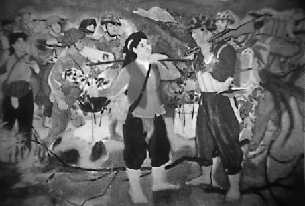
Figure 4.1. Mai Van Hien, Meeting (Gap Nhau), gouache on paper, 1954. Photograph by Nora A. Taylor, courtesy of the artist.
In devising the scene of a meeting between a soldier and a peasant woman, Mai Van Hien was in effect describing the policy of integration of ethnic minorities and people from the countryside into the Vietnamese “nation” after independence from French colonialism. The feeling of camaraderie and equality between soldiers and peasants and between men and women as suggested in his painting also coincided with the goals of socialism outlined by the Communist Party to assimilate people from all classes and create a homogeneous society. Meeting was considered to contain “national character” because it illustrated one of the ideals of socialization and nationbuilding, which was to create a harmonious community. It also followed what Truong Chinh considered was “correctly expressing the feelings of the masses that are pure, sincere and exceedingly warm.”[15]
In contrast to Mai Van Hien's painting is a work that was initially rejected by the Arts Association: The Enemy Burned My Village (Giac Dot Lang Toi, 1954; fig. 4.2) by Nguyen Sang. In this painting, a
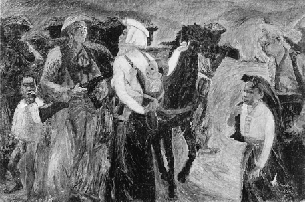
Figure 4.2. Nguyen Sang, The Enemy Burned My Village (Giac Dot Lang Toi), oil on canvas, 1954. Photograph by Nora A. Taylor, courtesy of National Museum of Fine Arts, Hanoi.
In another work, Joining the Communist Partyat Dien Bien Phu (Ket Nap Dang trong Tran Dien Bien Phu, 1963; fig. 4.3), the same artist sets up a conflict between patriotic theme and means of execution. He has used a particularly severe way of representing his figures, drawing them with angular lines, enlarged limbs, and blank features. The composition is centered on the hand of the party officer who reaches out to the soldier seeking admission. Although the gesture seems welcoming, the look on the soldier's face is cold and dispassionate. The wounded soldier appears anxious and lacking in enthusiasm. His expression may betray his doubt or apprehension at joining the party. The soldier behind
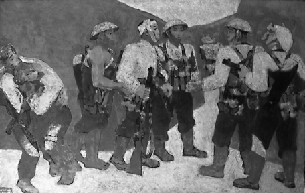
Figure 4.3. Nguyen Sang, Joining the Communist Partyat Dien Bien Phu (Ket Nap Dang trong Tran Dien Bien Phu), lacquer on wood, 1963. Photograph by Nora A. Taylor, courtesy of National Museum of Fine Arts, Hanoi.
While these two paintings by Nguyen Sang were never criticized directly, they were rejected from national art competitions. Criticism or rejection from national art competitions often meant that the work had been placed before an audience of workers and soldiers who, in the absence of any other formal criterion, were simply asked to decide how closely the subjects of the paintings resembled their habitat, moods, or customs. Sometimes, in lieu of a direct criticism, a humiliation campaign was initiated. Letters from workers and soldiers who found the work in question to be “untruthful” or “inaccurate” were published in newspapers. These letters were aimed at discrediting the author of the work in question, for if the masses did not understand it, then it was considered too “obscure” and therefore unacceptable.[16] Nguyen Sang had painted both of these paintings hoping for a subsidy from the Arts Association, and although the National Museum of Fine Arts eventually purchased the two works, they were not displayed until shortly before his death in 1984. When Nguyen Sang contributed drawings and poems to the Humanism and Masterpieces journals, his name was put on a
The rejection and subsequent acceptance of Nguyen Sang's views of history illustrate not only the fluctuations in the definition of “national character” but also the changing attitudes toward war and revolution in recent times. Nguyen Sang's vision is no longer threatening to authorities as they have gradually come to terms with the harsher realities of those years. Whereas in the past, as Mai Van Hien's painting illustrates, virtues of heroism and solidarity were considered the only legitimate representations of the struggle for independence, feelings of pain and apprehension have recently become equally acceptable.
REDEFINING “NATIONAL CHARACTER”
IN THE 1990s
In spite of reforms that had begun to be instituted in other sectors of society at the onset of Doi Moi, the Arts Association was slow in recognizing the need for liberalization in the arts. Nudes and abstraction were forbidden from public view until 1990. And it was not until the 1994 congress that a serious attempt was made to recognize those artists who had been marginalized for not participating in the revolutionary movements of the 1950s through 1970s. At the congress of the Arts Association in December 1994, the fourth since the organization's founding, young art critics advocated replacing the revolutionary guard of painters with the “nonrevolutionary” group of artists who either had been marginalized or had marginalized themselves from art circles for over thirty years. Objections arose over the dismissal of the older generation of painters. For example, the painter To Ngoc Thanh (b. 1940), whose father, To Ngoc Van, mentioned earlier, was considered the greatest of all revolutionary artists, exclaimed: “How can you forget these heroic painters when they sacrificed their lives for their country?” A young critic responded: “But they were such mediocre painters.”[18] The debate continued, with one side arguing for revolutionary contributions and the other promoting talent and innovation. Until the congress, one rarely heard such outspoken commentary on artists'positions vis-à-vis the Arts Association. Although none of it was truly scathing— critics called the revolutionary period artists at times “boring,” “old-fashioned,”
At the 1994 congress, four artists in particular (Bui Xuan Phai, 1921–88, a student at the EBAI from 1941 to 1945; Nguyen Sang, 1923–88, a student at the EBAI from 1940 to 1945; Duong Bich Lien, 1924–88, a student at the EBAI from 1944 to 1945; and Nguyen Tu Nghiem, born in 1922, a student at the EBAI from 1941 to 1945) were hailed by young art critics and artists active since the mid-1980s as the “masters of Vietnamese modern painting.” Clandestine exhibitions and independent publications had been put out in their honor, but it took some time before the Arts Association recognized their contribution to modern Vietnamese art history. Today, works by these artists cover the walls of private galleries that have multiplied in recent years in Hanoi and Ho Chi Minh City and are highly sought after by a new generation of Vietnamese art collectors.
One question that arises from the debate at the congress is why these four particular artists were selected by critics as better representatives of contemporary Vietnamese painting rather than their more conventional colleagues. Where and when did the shift take place? And what kind of criteria was the new generation using to determine what constituted a “great” artist? A closer examination of the four artists'lives and works will reveal that the artviewing public of the late 1980s identified first and foremost with their personae, their antiestablishment ideas, and their bohemian lifestyles. Second, their works provided them with an interpretation of their own cultural identity that had previously been neglected but that rang truer to their experience than the revolutionary vision supplied by the earlier artists. In sum, what made the four painters the new “modern masters” was not only that time had changed people's perceptions of history and nationalism but also that these artists offered the public a different picture of Vietnamese reality.
Of the four painters, Bui Xuan Phai was best known for his poverty. He has been described as having a “face that reflects the grief of a lifetime”[19] (fig. 4.4). People who remember him recall his gaunt features and how he had to exchange paintings for food.[20] Yet he was also admired for his intellect. Those who knew him recall vividly the hours of stimulating conversation spent in his company. He was well versed in world art history, something of a rarity in a society that had been cut off from the international community since the end of colonialism in 1945. He had studied the works of French painters, often citing Albert Marquet and Georges Rouault among his favorites. He had friends
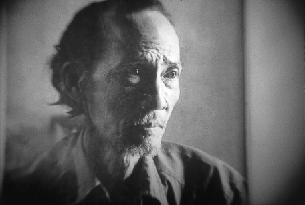
Figure 4.4. Portrait of Bui Xuan Phai. Photograph courtesy of Plum Blossoms Gallery, Hong Kong.
Cafe´ Lam had the makings of a Paris cafe´ litte´raire of the sort frequented by Pablo Picasso, Henry Miller, and the surrealists in the 1920s. In Europe, this kind of establishment was attractive to people who saw themselves as marginal to the social mainstream. But, while bohemian culture may have a certain romantic appeal in the West, to the officials of a nation that had fought bitterly to rid itself of French occupation
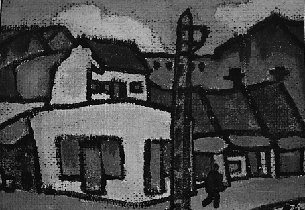
Figure 4.5. Bui Xuan Phai, Old Hanoi Street (Pho co Ha Noi), oil on cardboard, 1967. Photograph courtesy of Plum Blossoms Gallery, Hong Kong.
Bui Xuan Phai's “sadness, reflecting a life of misery,”[23] and his passion for painting produced his signature subject matter: scenes of old Hanoi streets (fig. 4.5). While his colleagues, members of the Arts Association, were painting workers, soldiers, and peasants for state art exhibits, Bui Xuan Phai painted the desolate streets of his city, in shades of gray and brown, over and over again, almost obsessively. Although his paintings clearly indicated an attachment to his homeland, it was not the sort of vision that the authorities accepted. His streets were void of life, as if he were mourning the loss of the activities that had filled them in a bygone era.
To art viewers, those who knew him and the many visitors to both his house—for he was a hospitable and generous man—and Cafe´ Lam, his street paintings became synonymous with Hanoi during the economic hardships of the 1960s and 1970s. They captured the bleak, desolate, gray atmosphere of the city during that time. When Hanoians
Bui Xuan Phai's paintings were rarely included in national art exhibitions and were seldom exhibited abroad in traveling exhibitions organized by the Arts Association. In the art history books and brochures about Vietnamese contemporary painting published before 1986, his name is never mentioned as an important figure in the Hanoi art scene. Although he was not accused of undermining Communist Party policy like Nguyen Sy Ngoc and Nguyen Sang, his family has described how closely the government watched him and the restrictions that were placed on him as an artist.[25] The original objection to Bui Xuan Phai by officials was most likely a response to his eye for the negative realities of Hanoi life. His view of daily life was contrary to the utopian socialist vision of community living promoted by the state. His subsequent popularity may have been due to the fact that he dared to show what the government refused to see, and his popularity among painters today stems from the fact that he was determined to pursue his own path in spite of government regulations. Young artists today, trying to break free from past conventions, are in awe of the fact that Bui Xuan Phai refused to compromise his artistic ideals for political ones. They, and the artviewing public at large, see him and his paintings as encapsulating the spirit of the nation after the war. Today the war is no longer remembered for its glory but rather as a negative experience, which is why Bui Xuan Phai's paintings resonate more strongly with the public.
Bui Xuan Phai's persona is well captured in a 1964 portrait by his friend Nguyen Sang. In the painting, he is sitting at a table with the cafe´ owner Nguyen Van Lam, facing the viewer and with his chin resting on the palm of his hand. Mr. Lam, also facing the viewer, sits beside him with his hands clasped over his knees. Behind them is a sign indicating the price of a cup of black coffee: thirty cents (dong). Both the artist and
Art historians in the West have often attributed the affinity of painters at the turn of the century for life in the cafe´s and the decadence of society at the time to increased interest in “modern life.” Modern life in Europe referred to urban development, the increase of traffic in the streets, and consequently the surge in the pace of life. According to Marshall Berman, the swelling speed of daily life generated excitement for everything urban, along with an attraction for the dirt and smoke that it provoked.[26] Artists and writers in Paris became fascinated with the decadence of society in art. The art historian T. J. Clark writes that “modernism can be described as a kind of skepticism, or at least uncertainty, as to the nature of representation in art.”[27]
Nguyen Sang's characters seem at home amid the deterioration of Hanoi streets and the degeneration of Vietnamese society as he perceived it. The Communist Party had demanded participation in the revolutionary struggle, but writers and artists such as Bui Xuan Phai and Nguyen Sang were idling away their time in cafe´s. They were not employed by the state as other artists were, partly out of choice for not wanting to participate in the propaganda campaigns and partly by force for having contradicted the official cultural institutions. Instead of supporting the optimism for the future of the nation as declared in the governmentsponsored art campaigns, they represented the cynicism of the people who did not wish to follow the Party. None was more representative of this cynicism than Duong Bich Lien who shunned any exposure to the public and any affiliation with the Arts Association. Although he had taken part in the Revolution, after the restrictions imposed on artists in the 1950s, he deliberately withdrew from the political mainstream. His paintings became legendary for their grace and beauty (fig. 4.6), but he refused to show them to anyone but his friends.[28] Unable to afford new canvas, he often painted over his paintings. His peers admired him for his talent, but he was described as “aloof” and “stubborn” when it came to exposing his work to the public. Today the younger generation considers him one of the “masters of modern art,” along with Bui Xuan Phai, Nguyen Sang, and Nguyen Tu Nghiem.
In 1993, the Portrait of Bui Xuan Phai with Mr. Lam was sold to a
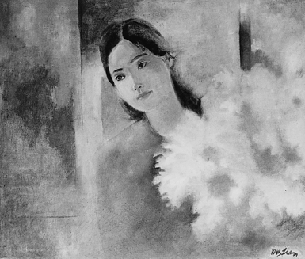
Figure 4.6. Duong Bich Lien, Woman with Flower (Tien nu ben Hoa), oil on canvas, 1980. Photograph by Nora A. Taylor, courtesy of Nguyen Hao Hai.
Ironically, for the post-1986 generation of painters, Bui Xuan Phai and his friends became icons of the rejection of “nationalist” oriented art. In choosing them as their artistic “heroes,” the younger artists and critics were in effect rejecting the concept of national character advocated by the Arts Association. They had realized the limitation of the concept, but at the same time their designation of the three outside un-official painters as the legitimate rulers of the art world was based on criteria that were not too different from the previous generation's, that is, the need for art to depict the “national soul.” This fact only reinforces the plasticity of these conventions. The policy toward the arts after 1945was one of appropriation or elimination rather than construction. Political
TRADITION AND MODERNISM
Art historical revisions after 1986 have not been limited to the fluctuations of reputation among artists but are also reflected in the choice of topics. Village and folk art, which had been the main source of artistic production before the colonial era, had been transformed after independence in 1945 to serve the ideals of socialism. Many artisans were forced to join collective labor forces and abandon their family trade. They were brought into the agricultural and industrial sectors, and household workshops that had operated for centuries were turned into cooperatives. As a result, village art virtually died, only to be resurrected at the initiative of descendants of village craftsmen in the late 1980s.[31]
In the early 1990s, two art historians, intent on reviving the “village” aspect of Vietnamese art history, began researching the history of village art from the ninth century, at the end of the Chinese occupation, to the present. They published My Thuat o Lang (Art in the Village), which became one of the most influential art history books of the early 1990s.[32] The book argued that the origins of Vietnamese art were, in fact, in the village as opposed to the view promoted during colonial times, which held that art originated in royal palaces or was stimulated by religious objects traded from abroad. The idea appealed to the younger generation of artists because it proved that art had a “national” origin yet was not a “state”-oriented production. In other words, village art was given a new interpretation. Instead of serving the state, imperial households, religious, foreign or government decrees, art could be more independent of politics. This gave artists the freedom to express patriotism without
When the movement to reincorporate village art into the art historical canon began, artists started to use village motifs such as temple banners, buffalo herders, fish ponds, and folk heroes in their paintings. Some of these motifs, which were potentially sensitive in the 1960s and 1970s, became dominant in paintings since 1986. At first sight, the use of folklore seemed to indicate a break from the worker, peasant, and soldier themes of the previous decades. But, on closer examination, paintings of village festivals and popular legends have become, in effect, redefinitions of national character. By still maintaining elements that are identifiably “Vietnamese,” painters seem reluctant to abandon the patriotic ideal in art, even though they claim separation from a particular set of nationalist concerns.
The first artist to experiment with village motifs while maintaining links to “modernism” was the fourth of the “masters” of Vietnamese modern art mentioned earlier, Nguyen Tu Nghiem, born in 1922 and still actively painting. The label “hero” is reserved for the deceased, but Nguyen Tu Nghiem's preoccupation with village art mirrors Bui Xuan Phai's obsession with Hanoi streets. He has spent most of his career painting village folk motifs, making multiple sketches of the carvings that adorn the communal houses (dinh) in the villages surrounding Hanoi and transferring them to his canvases (fig. 4.7). He is not interested so much in the content of the sculptures as in their formal aspects. In explaining his work, he likens himself to Picasso, who saw African art as a form of “modernism.”[33] Picasso emulated the simple shapes and geometric forms of African art and incorporated them into his experiments with cubism. The “primitive” look of Picasso's work became equated with “modernism.”[34] Likewise, Nguyen Tu Nghiem incorporated village folk art into his paintings, giving them a “primitive” look that became equated with “modernism.”
In recent art criticism, Nguyen Tu Nghiem has often been described as both “traditional” and “modern.”[35] To use village sculpture as a motif in a painting was a very daring act in the early 1980s, when Nguyen Tu Nghiem first revealed his paintings to the public. At first dismissed for lacking national character, he later won a prize at the National Exhibition in 1990 for his representation of the village folk hero Giong.[36] Since abstraction and surrealism were forbidden, artists had not used motifs found in their native culture to express “modern” artistic concepts. Nguyen Tu Nghiem changed that. Furthermore, the
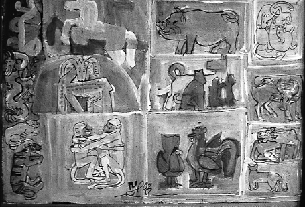
Figure 4.7. Nguyen Tu Nghiem, Zodiac, gouache on paper, 1993. Photograph by Nora A. Taylor, courtesy of the artist.
The art critics of the 1980s hailed Nguyen Tu Nghiem's use of village folk art as “Vietnamese modernism.” His painting style resembled the European postimpressionist concern for form over content, and yet, iconographically, he was able to retain a semblance of “local tradition.” Nguyen Tu Nghiem's and Bui Xuan Phai's work was said to reflect the spirit of the people, but not in the sense that it had been known previously. Far from the heroism of To Ngoc Van's participation in the battle
Naturally, as in post-Communist Russia and to a lesser extent in Deng Xiaoping's China, the market for art has also influenced what artists have chosen to paint. The state no longer being the exclusive patron of the arts, artists have had to cater to a new clientele of international art buyers. Many of the works on display in galleries in Hanoi and Ho Chi Minh City depict scenes of the Vietnamese countryside and village life, not as a political statement against the state nor as a patriotic message, but rather because those images seem to attract foreign buyers. Still, the shift in subject matter is similar to revisions occurring elsewhere as Vietnamese art in general, like the society at large, tries to derevolutionize itself and move on to a more global perspective.
CONCLUSION
For decades, Vietnamese officials defined national character as expressing the Vietnamese spirit in art and literature, but the basis for its definition was utopian and forced. Politics and aesthetics merged to dictate the criteria for acceptable works of art. Artists who did not display “national character” in their works were discouraged from producing art at all. But, by a turn in historical fortune, those who resisted the pressure were designated heroes in their own right by the generation of artists and art critics who came onto the scene in the late 1980s. They became known for their resistance to these restrictions and for their persistence in the face of strongly discouraging signals to abandon their way of painting.
In spite of revisions in the way artists have been given recognition for their work, political concerns are still at the heart of the selection of Vietnam's socalled master painters. Certainly nationalistic or patriotic concerns are still part of the process of naming which artists best represent the country's “soul.” In this way the choices of the late 1980s art critics are similar to those of their mid-1950s counterparts. At least in principle, that is, art is a potential force that could be used to shape consciousness about oneself, one's memory, or collective identity. But it
Bui Xuan Phai, neglected by the official art establishment for wanting to tell the truth, suddenly became Vietnam's greatest painter regardless of whether his paintings showed true mastery of the medium. To Ngoc Van and others of his generation were reduced to mediocrity in popular opinion after having received some of the nation's highest awards in painting simply because the revolution no longer held any significance to the younger generation of artists.
If one looks at “national character” merely as a tool to create propaganda out of art, it is easy to understand why the present post-1986generation of artists would be so opposed to the concept, considering their desire to distance themselves from revolutionary period policies. Many of them were born too recently to remember their country's struggle for independence. As Vietnam opens its doors to global markets, they are eager to join the international art community. Yet they have not rejected nationalist concerns entirely. In an attempt to forget the past and begin paving the way toward the future, they have instead chosen to remember the past in a new way. In commemorating the three painters who were not part of To Ngoc Van's campaign to revolutionize art, the artists and critics of today are making their own political statement about the role of artists in society.
By embracing artists who had previously been neglected by the Arts Association and spent much of their time in Hanoi cafe´s, the younger generation is calling for an artistic standard that is not based on socialist ideals. Bui Xuan Phai, Nguyen Sang, Nguyen Tu Nghiem, and Duong Bich Lien were not the most subversive of painters; others, such as Nguyen Sy Ngoc, mentioned earlier, were put into much more strenuous positions vis-à-vis the political mainstream. But, as Bui Xuan Phai's paintings of Hanoi and Nguyen Tu Nghiem's interest in village art reveal, they were nonconformist and unwilling to partake in the “revolutionary” view of art. Perhaps that was precisely why they were chosen. These artists were not politicized and yet were every bit as political. The younger generation has chosen to emulate them in order to be not
NOTES
Parts of this chapter were presented at the annual meeting of the Association for Asian Studies in Hawaii, April 1996, as part of a panel entitled “Past Forgetting: War and Revolution in Vietnamese Memory.” Some of the ideas formulated here are included in my dissertation, “The Artist and the State: The Politics of Painting and National Identity in Hanoi, Vietnam, 1925–1995” (Ph.D. diss., Cornell University, 1997). Research was conducted between January 1993 and August 1994 and was supported by the Social Science Research Council Southeast Asia Program, through grants from the Andrew W. Mellon Foundation, The Ford Foundation, and Fulbright-Hays. I wish to thank these institutions and the artists, art historians, and friends in Hanoi, too numerous to list, who made my research possible. I also thank Hjorleifur Jonsson, Neil Jamieson, and Hue-Tam Ho Tai for comments on earlier drafts of this chapter.
1. Nguyen Quan, Vietnamese Plastic Arts (Hanoi: NXB My Thuat, 1987); and Nguyen Quang Phong, Cac Hoa Si Truong Cao Dang My Thuat Dong Duong [Painters of the Indochina Art School] (Hanoi: NXB My Thuat, 1991).
2. Tran Dinh Tho, “De Co nhung Tac Pham Nghe Thuat Tao Hinh Dam Da Tinh Chat Dan Toc” [“In Order for Works of Art to Have a Warm National Essence”], in Ve Tinh Dan Toc cua Nghe Thuat Tao Hinh [Concerning National Sentiment in Visual Arts], ed. Tran van Can (Hanoi: Culture Publishing House, 1973); see also Patricia Pelley's discussion of the origins of the “national essence” in Vietnamese history in her “Writing Revolution: The New History in Post-colonial Vietnam” (Ph.D. diss., Cornell University, 1993).
3. Tran Dinh Tho, “De Co nhung Tac Pham,” 6.
4. Ha Xuan Truong as quoted by Tran Van Can in Ve Tinh Dan Toc, 9.
5. Tran Van Can, Ve Tinh Than Dan Toc, 11.
6. See, for example, Nguyen Do Cung's essay in the same volume cited in note 2.
7. Personal communication, conversation with Le Thi Kim Bach, December 1993.
8. Truong Chinh, “Marxism and Vietnamese Culture,” in Selected Writings (Hanoi: Foreign Language Publishing House, 1977).
9. Cited in Cu Huy Can, Culture et politique culturelle en Re´publique socialiste du Viet Nam [Culture and Political Culture in the Socialist Republic of Vietnam] (Paris: UNESCO, 1985); and personal communication, Thai Ba Van, art historian in Hanoi, November 1993.
10. Truong Chinh, “Marxism and Vietnamese Culture.”
11. For more indepth discussions on the intellectual debate over “art for art's sake,” see Georges Boudarel, Cent fleurs e´closes dans la nuit du Vietnam: Communisme et dissidence, 1954–1956 (Paris: Jacques Bertoin, 1991); and Hirohide Kurihara, “Changes in the Literary Policy of the Vietnamese Workers'
12. Information on Nguyen Sy Ngoc was given to me by his daughter Nguyen Minh Huong, April 1994.
13. The Chinese “Hundred Flowers” movement was eventually repressed as well. For further discussion on the cultural situation in China during this time, see Julia Andrews, Painters and Politics in the People's Republic of China, 1949–1979 (Berkeley and Los Angeles: University of California Press, 1994).
14. Personal communication, conversation with Nguyen Minh Huong, April 1994.
15. Truong Chinh, “Marxism and Vietnamese Culture.”
16. I am grateful to Duong Tuong for his stories about the process of criticism of artists'works. Truong Chinh, in his “conditions” for the realization of a work of art, mentions that all artists must determine the audience for its creation and test the works by the reaction of the masses. Truong Chinh, “Marxism and Vietnamese Culture.”
17. Information on Nguyen Sang was given to me by Phan Cam Thuong, art historian and professor of art history and theory at the Hanoi University of Fine Arts, April 1994.
18. My information on the discussions that took place at the fourth Arts Association congress stem from secondhand sources. As a foreigner, I was not admitted to the meetings. Participants, however, periodically convened outside the assembly hall and reported to me and other uninvited enthusiasts on the debates taking place inside.
19. Jeffrey Hantover, “Bui Xuan Phai,” in Bui Xuan Phai, ed. Nguyen Quan (Ho Chi Minh City: HCMC Arts Association [Hoi My Thuat T. P. Ho Chi Minh], 1992).
20. I am most grateful to Viet Hai, director of the 7 Hang Khay Street Gallery, for his numerous anecdotes about Bui Xuan Phai during the fall of 1993.
21. There is some discrepancy in the exact dates of the banning of coffee-houses among the people I spoke to during my field research. Nguyen Van Lam himself cites a ten-year period, but others have said that was an exaggeration on his part; the coffeehouses, according to them, were closed for only a few years in the early 1960s. Conversations with Nguyen Van Lam during the summer of 1993 and subsequent conversations with Duong Tuong during the fall of 1993.
22. Nora Taylor, “Masterpieces by the Cup: Top Art Collection Hangs in Streetside Cafe,” Vietnam Investment Review, no. 129 (March 21–27, 1994):27.
23. Jeffrey Hantover, Uncorked Soul: Contemporary Art from Vietnam (Hong Kong: Plum Blossoms, 1991), 41; and Thai Ba Van in Bui Xuan Phai in the Collection of Tran Hau Tuan, ed. Nguyen Quan (Hanoi: Red River Publishing House), 1991.
24. I am particularly grateful to Mai Thuy Ngoc for all her stories about Hanoi during the war and in the years following it.
25. His wife has used the word criticized when she mentioned the Arts Association's
26. Marshall Berman, All That Is Solid Melts into Air (New York: Penguin, 1982).
27. T. J. Clark, The Painting of Modern Life (Princeton N.J.: Princeton University Press, 1984), 10.
28. Information on Duong Bich Lien was given to me by his nextdoor neighbor and close friend, Nguyen Hao Hai, author of several articles on the painter.
29. Information on the price of the painting was given to me by Nguyen Van Lam and confirmed by Viet Hai, director of the 7 Hang Khay Street Gallery in Hanoi, December 1993.
30. For the past several years, Chinese artists have formed a movement in reaction to official art commonly called “cynical realism,” or “Maopop.” The movement is aimed at poking fun at utopian images of Communist Party leaders and commenting on the working class's lack of education. See, for example, Andrew Solomon, “Their Irony, Humor (and Art) Can Save China,” New York Times Magazine, December 19, 1993.
31. I am grateful to Nguyen Dang Che and Nguyen Dang Dung of Dong Ho village for information on the situation with folk arts.
32. Nguyen Quan and Phan Cam Thuong, My Thuat o Lang [Art in the Village] (Hanoi: NXB My Thuat, 1991).
33. Personal communication, interview with Nguyen Tu Nghiem, April 1994.
34. See William Rubin, Primitivism in XXth Century Art: Affinity of the Tribal and the Modern (New York: Museum of Modern Art, 1984).
35. Hantover, Uncorked Soul.
36. Vu Huyen, “Notes on the 1990 National Arts Exhibition,” Vietnamese Studies 3 (1990): 100–102.
37. Thomas McEvilley's comments on the Museum of Modern Art's Primitivism in XXth Century Art: “Doctor, Lawyer, Indian Chief,” in his Art and Otherness: Crisis in Cultural Identity (New York: Documentext, 1992), 27–56.
5. The Past without the Pain
The Manufacture of Nostalgia
in Vietnam's Tourism Industry
Laurel B. Kennedy and Mary Rose Williams
A remarkable journey occurred in 1996 when a group of ten American veterans of the war in Vietnam returned to the country they had first known as soldiers. Riding Harley-Davidson motorcycles, whose distinctive bass rumble is so loud and overwhelming it is sometimes referred to as “Rolling Thunder,” the vets spent eighteen days traveling from Ho Chi Minh City to Hanoi. It is not difficult to imagine that these riders took Vietnam by storm. Even the busiest and noisiest roadways of Vietnam, a quiet country, would have come to a halt as bicyclists, bus drivers, and pedestrians watched the spectacle of American steel, chrome, and leather roaring past. One can wonder why those veterans chose to tour Vietnam on these loudest and most American of motorcycles, and one can wonder what Vietnamese onlookers thought about as the commonplace was disrupted for a few minutes by the American cavalcade. It is not difficult to discern, however, that for the riding veterans, as tourists if not as soldiers twentyfive years earlier, Vietnam was theirs, reclaimed from history and transformed in memory.
Central to this volume is the question of how the past is remembered in Vietnam, and how disparate memories of that past are reconciled, if indeed they can be. While other chapters consider the work of the state in creating an official history, and of oppositional voices in contesting that sanctioned memory, we consider here the operations of the tourist industry, which offers its own narratives of Vietnam. These are often starkly different from those evident in the funerary rituals, the films and
At first glance, it would appear that the state has just as much control over tourism's imagemaking as it has over other elements of public memory. After all, tourist development must be approved by the state, and international interests involved in that development are required to work with Vietnamese partners. Yet the narratives used in “selling” Vietnam to potential tourists suggest that the state largely delegated authority for its self-representation to commercial, and usually international, image-makers.
At least in part, the strategy of inviting foreign development of the tourist industry reflected the perception that Vietnam might be a “hard sell” among Western travelers. The belief that the country must be rescripted in the popular consciousness was reinforced in a market analysis of Vietnam's nascent tourism industry, published in 1990 for use by travel industry professionals:
Vietnam's current travel status (low visitor arrival count and a poor to nonexistent image with potential travelers) is such that even small improvements canrepresentsubstantialgrowth. … Vietnamisacountry that conjures up many—often contradictory—images. Perhaps the most vivid of these is the overwhelmingly negative picture of the Vietnam War … notsomuchasa result of the communist victory, but rather because the United States was so torn by its defeat. … However, the memories and mood of the international community have since softened.[1]
Thus the tourist industry needed to tell a new story of Vietnam to potential travelers. A number of narratives could have been written: Vietnam as a nation of quaint and quiet rural villages; as a nation growing beyond the wounds of conflict; as a nation moving rapidly toward modernity and industrialization.
The construction of Vietnam chosen by the international tourist industry has been of a nation of colonial pleasures, of elephant rides, 1930s Citroens, and afternoon drinks in the shade of the veranda. Evoking the days before the troubles began, the narrative creates a memory in the imagination of a Vietnam wherein there was not hostile resistance to external control, and where today there is neither conflict nor animosity toward former enemies. This Vietnam offers to travelers its Asian exoticism and its mystique, as well as a muted and angerless history.
Package tour providers rely on a linkage between tourism and nostalgic longing for the feelings—often the greater simplicity—of a past that exists in one's imagination. This brand of nostalgia has produced Williamsburg in the United States, the Raffles Hotel in Singapore, and the son et lumière displays on the twilit walls of French chaˆteaux. Yet in each of these cases, nostalgia can be seen to be a commodity manufactured for sale to tourists. Indeed, a tourist's impressions of the experiences travel will provide are primarily mediated by the tourism industry. The manufacture of nostalgia, then, is a process in which the tourist's memory itself is mediated. As Lowenthal writes, such nostalgia offers “memory with the pain removed.”
But the nostalgic memories inscribed in tourist sites are not merely commodities that await purchase by targeted consumers. These narratives interact with and alter the composition of personal memory, of the larger public memory, and of official history. Martha Norkunas describes the development of tourist “attractions” as a process in which social value is conferred to particular reconstructions of both the past and the present, which may or may not correspond to those sanctioned by the state.[3] The process of value conferral—Dean MacCannell calls this “sight sacralization”[4]—occurs through tour organizers'selection of sites, the construction and reconstruction of those sites to meet tourists'(preformed) expectations, through the markers that designate the sites, by the locals who contribute their apparent authenticity, and by the tourists who, by their very attention, confer importance on certain articulations of history. These sites also legitimize the relations of power implicit within them. Other constructions are rendered questionable or in need of correction. This process flattens and suppresses—of necessity, in the eyes of tour organizers—the complexity of history into a “simplified … [and] digestible” reconstruction: “Opposed events and ideologies are collapsed into strong statements about the forward movement and rightness of history.”[5]
Tourism's narratives interact not only with official history but also with personal memory. Maurice Halbwachs's On Collective Memory asserted that individual memory is not permanent and complete, but socially produced, formed and reformed in interaction with others'conceptions of the past.[6] Thus, as John Urry writes, “Identity almost
The strands of official history, of public memory, and of personal memory thus tangle, making true and longlasting distinctions between them difficult at best.[8] What is perhaps most problematic—and interesting—when considering tourism's narratives among those offered by the state is that while the state is a visible authority whose political objectives are at least usually apparent, the tourist industry's hand is often invisible in the creation of its narratives. Norkunas writes that “the public would accept as ‘true'history that is written, exhibited, or otherwise publicly sanctioned.”[9] Yet observers may bring at least a little skepticism to reconstructions of the past offered by the (identifiable) state, while accepting more readily narratives whose anonymous authorship does not alert their critical faculties. This makes consideration of tourism's narratives all the more important.
The analysis that follows considers some of the primary narratives offered by the tourist industry in Vietnam, examining both their origins and their thematic nature. The first part of the analysis describes the political economic catalysts to the formation of the Vietnam tourism industry. Because the shape of the industry is determined at least in part by the motives of those involved in the development of tourism, this discussion is concluded with a review of the three participants in the tourist enterprise: the Vietnamese “hosts” who service both tourists and tour operators, the travel industry professionals whose expertise informs the construction of the narratives we are studying, and the tourists most targeted by the industry. It is out of the needs of these three groups that a particular “story” of Vietnam arises. That story is told through two types of tourist “texts,” which are analyzed in the following sections of the chapter: the sites being developed for use by tourists, and the travel literature that informs tourists' expectations and, hence, their experience of visiting Vietnam. These texts represent Vietnam in ways that affect contemporary understanding of the nation, its history, and its political relations to the West not just for Western visitors but potentially for the Vietnamese themselves.
The rapid development of a tourist industry in Vietnam has occurred through a concerted official effort since the late 1980s. Until 1986, visitors
Few forms of international trade produce such classic economic dependency as tourism. As has been discovered by Cuba, Haiti, and others, natural disasters, political change (or even its threat), or a single season of inclement weather can cause tourist interest to vanish and the economic activity surrounding it to collapse. In assessing the impact of tourism in Vietnam, then, it is useful to consider the motivations that could lead a determinedly socialist nation to recreate itself, within a decade, as an international tourist destination, complete with five-star hotels and golf resorts. The timing of the move suggests that development of a tourist industry was a response to Vietnam's failed economic policies and its increasing economic isolation in the 1980s.
Efforts by the United States to constrict Vietnam's international trade linkages had been initiated in the 1950s, through a trade embargo against North Vietnam under the Trading with the Enemies Act. In 1978, the United States extended the embargo to the whole country following Vietnam's invasion of Cambodia. Until this point, Vietnam had stressed the role of multinational corporations in developing exportoriented industry and had established an attractive international investment climate amid promises of multilateral loans and bilateral aid from
By the late 1980s, Vietnam found itself with few foreign markets open for the sale of its products, and thus a dire need to generate foreign exchange within its own national borders. These conditions emerged at the same time the number of Asiabound travelers was beginning to rise, and when Thailand, despite rapid industrialization, was earning the largest share of its foreign exchange through tourism. Further, Southeast Asian entrepreneurs, unbound by the embargo, were interested in and willing to finance the refurbishing of hotels and urban transportation to jumpstart the industry. A lowtechnology industry with comparatively little market research needed to inform planning, tourism offered Vietnam a relatively cheap and easy industry to enter, with the promise of quick foreign exchange earnings.
Given the immediate and financially tangible response to the opening of its borders to tourists, Vietnamese officials moved quickly in the early 1990s to establish the domestic bureaucratic structures and the international liaisons that would encourage rapid development in the industry. With its experience in this industry limited to serving a few thousand Soviet-bloctravelers per year, it is not surprising that Vietnam's emergent tourism administration was characterized by complexity and inefficiency, with three different groups working sometimes in cooperation and sometimes in competition with one another.
In official terms, control over development of the tourist industry lies with the first of these groups, the Vietnam National Administration of Tourism (VNAT). Reporting to the Council of Ministers, this body is charged with coordinating the development of the nation's tourist industry, including research and planning activities, training of personnel to work in the industry, and approval of contracts involving foreign investors (in coordination with the State Committee for Cooperation and Investment). A special unit of VNAT, Vietnamtourism, is responsible for promoting travel to the country and offering actual tours.
VNAT's policies and plans are implemented by some thirty local
The third group of important players in Vietnam are the People's Committees and the various ministries, which own hotels, control vast amounts of property, and have their own access to official power structures.[15] Acting, like the others, as tour operators, the People's Committees and ministries are also centrally important as potential joint-venture partners for the international tourist industry, or as liaisons between international partners and entrepreneurs in Vietnam's private sector.
While certain aspects of servicing the tourist trade could be handled by Vietnamese “ground operators,” the government understood early on that it had neither the investment funds nor the knowhow to develop the amenities sought by well-heeled Western tourists. A 1991 government publication, Vietnam: Investment and Tourism in Prospect, invited the expertise of international travel agencies. The document noted that the government-operated Saigon Tour had “such relations [with international tourism professionals], but more attention should be paid to attract investment and to attain managerial and professional expertise.”[16] Inexperienced but hoping not to be naive, the government required that all tourist developments be approved by the state, and that virtually all major foreign financial investments in the industry be undertaken through domestic-international partnerships. Local partners thus become essential to the international agencies, handling the bureaucratic aspects of operating in the market, arranging local contracts, and facilitating incountry negotiations, albeit generally on the terms set by the tour operators. They also provide other essential components, such as property, local knowledge of exploitable resources, Vietnamese currency, and materials or services needed for the venture. While local, usually quasi-governmental, firms may also play a role in serving tourists, they generally do not compete with their international partners, better endowed as those firms are with both knowledge and financial resources.[17]
For their part, international investors provide foreign currency, certain forms of technical know-how, expertise on the interests and expectations of the tourists being courted, and, perhaps most essential to success, inclusion in the expensive package tours that bring travelers to
Development of the tourist industry necessitates more than just providing services, however. The business of attracting and actually delivering tourists—and the right tourists—is difficult. Passengers on cruises, for example, are usually wealthy, but they stay only a short time, and most of their food and lodging is provided on the cruise ship. The wealthy tourists who arrive on elite package tours, or expensive, individualized tours arranged by upscale travel agents, stay longer, spend more, and patronize hotels and local establishments. But attracting these most desirable tourists involves both knowledge of their expectations and of their motives for travel, and the ability to design the right packages—the right narratives—to assure the fulfillment of those expectations.
APPEALING TO TOURISTS
While each traveler's journey is designed with unique motivations in mind, common reasons for travel and types of travelers are known; these inform package tour providers'efforts to attract clients to the destinations they package into tours.[18] Not all types of travelers are likely to voyage to Vietnam: tourists who seek merely a change of venue or a quick getaway would find the very expense and distance of traveling to Vietnam preemptive. And not all types of travelers are desirable clients for the package tours offered by the international tourism agencies discussed here; young Australian backpackers and European “hippie travelers” on shoestring budgets—what Erik Cohen calls “noninstitutionalized” tourists[19]—are significant in Vietnam's visitor population but contribute minimally to the tourist economy.
For others, however, it is precisely because Vietnam is costly to visit and relatively unknown as an elite tourist destination that they are attracted. For such travelers, tourism enhances social status by displaying the availability of leisure time and expendable income. For these travelers, the more exoticthe destination, the greater the effect—although exoticism need not imply uncomfortable travel conditions. Lenz included Vietnam among the remote and putatively unknown locations
Still others travel to find an “authentic” experience that stands in contradistinction to the modern.[21] Such travelers undertake “pilgrimages” that are not explicitly religious but that nonetheless involve a conversion of the self, or at least the hope that such a transformation will occur. These tourists “seek to see life as it really is, to get in touch with the natives, to enter the intimate space of the other in order to have an experience of real life, an authentic experience.”[22] They wish to leave behind the superficiality of modern life as they know it at home; one travel writer who toured Vietnam by train (because “flying seemed entirely too abrupt and antiseptic”) described Vietnam as “a place beyond the reach of dollars and the American Express Card”[23]—although both are, of course, very much in circulation. For many in this group, Vietnam's ancient pagodas and temples and the ethnic minorities of the northern highlands provide the requisite mystic exoticism.
For those who once served in Vietnam or for their families, travel to Vietnam also may be about a pilgrimage, but into the past. Not unlike the pilgrimages undertaken after World War I to the battlefields at Flanders and the Menin Gate of Ypres described by George Mosse, such journeys are centered on healing and renewal.[24] Reporter Neil Sheehan worked in Vietnam during the war years and vowed to return to witness it under conditions of peace.[25] Others return to relive that period of their own lives, or the lives of a relative who served in the war.[26] Another group of “pilgrims,” albeit with a rather different relationship to Vietnam and its recent history, are the Viet Kieu, or overseas Vietnamese, who represented about onefifth of Vietnam's travelers between 1993and 1995.[27] Pilgrimage into Vietnam's most recent war history is also undertaken by those without a personal connection to the period, but with a curiosity about what happened and an expectation that travel in Vietnam will tell them. A large number of study tours of Vietnam have been organized by universities, for example, either for current students or for alumni who seek a combination of leisure and education.
Still other travelers are less interested in the search for “authenticity” or what MacCannell calls the “nonmodern,”[28] instead seeking culturally anonymous destinations: beaches and golf resorts and dutyfree shopping. Japanese tourists to the beaches of Thailand and Hawaii are often included among this group, and they represent an important
Obtaining these upscale tourists requires the enthusiasm of international travel agents and charter airlines. Travel organizations must invest a great deal of time and money to add new destinations to their existing tour programs, and so must be convinced of the potential of new sites to be both appealing for the clients and profitable for the agencies. Further, there is a great deal of competition for these tourists, particularly in the fastgrowing tourist market in Asia. Thus a new destination like Vietnam, attempting to develop a market out of thin air in the early 1990s, had a formidable task before it, and one in which success depended principally upon the international agencies. It is hardly surprising, then, that Vietnam was willing to delegate to these agencies so much authority over the imagery and narratives to be used in luring tourists.
THE FACE OF THE “NEW VIETNAM”:
AMENITIES AND ATTRACTIONS
The expertise of the tourism firms lies in their ability to coordinate the logistical aspects of their clients'international journeys, but that can only occur after those travelers have been enticed to the destination by the promise of some desirable experience. As Mowlana notes, it is the task of the tour organizers to “create the experience and image that sells and then proceed to make that the reality for the tourist.”[29] Thus tour operators pay close attention both to the sites that potential travelers might visit and to the literature that will familiarize them with those sites in advance. These can be understood, then, as the negotiated product of the needs and interests of the tourism industry, its clients, and the government that signs contracts to facilitate the industry's success. Because the establishment of Vietnam as a tourist destination for Westerners has occurred within a short period of time and through a rather concerted effort, there is some transparency to tourism's development efforts: they can be viewed as explicitly intended to recreate Vietnam to meet the needs and expectations of potential travelers. It is clear that industry planners seek the attention of business travelers and upscale tourists, particularly those on charter packages from Europe, the United States, or Japan. Development has emphasized historical sites that might appeal to these tourists, the refurbishing or new construction of luxury
The industry anticipated that many of the tourists traveling to the country would be French or American veterans of the war that ended in 1975, returning perhaps to experience Vietnam's beauty in peacetime, to heal the hidden wounds of the war, or to relive certain aspects of that encounter. As one journalist remarked, “Since the end of the Vietnam war, many American films and books have agonized over the meaning of it all. The Vietnamese, who suffered much heavier casualties, … take a more practical approach. They are intent on turning the war into a tourist attraction.”[30]
Indeed, a considerable amount of energy has been invested in constructing monuments around sites that foreign war veterans might want to revisit, and much of that energy has come from domestic sources. These can be differentiated from sites created for ideological purposes by the Vietnamese Communist Party or local cadres for Vietnamese observers, such as the museum-shrine for Ton Duc Thang described in this volume by Christoph Giebel. Sites prepared for foreign tourists were constructed (or reconstructed) later, usually after the official efforts to develop tourism began, suggesting their rather explicit goal of attracting foreign tourists. Further, they are highly commercialized, with souvenir stands and food stalls. And, unlike monuments and shrines used for political and/or ritual purposes of war commemoration by the families of Vietnamese veterans or organized school groups, these sites do not so much bear witness to the war as “trivialize” it, in the sense that George Mosse used that term, “cutting war down to size so that it would become commonplace instead of awesome and frightening … [and] by making it familiar, that which was in one's power to choose and to dominate.”[31]
Turning the war into a tourist attraction means retelling, for profit, the story of Vietnam's victory. Since the profit must come from those who lost the war, aspects of the story must be muted and key roles recast to make the story more palatable. In some instances, the actions taken to mediate and moderate history have been unmistakable. There were, for example, attempts to close the American Rooms of the War Crimes
In other cases, historical reconstruction has been more subtle. Perhaps the best-known of the war sites now opened to tourists are the tunnels at Cu Chi, a network of about 125 miles of underground passageways, built as hideouts, meeting places, bomb shelters, and secret travel routes in southern Vietnam. These tunnels were well-known to U.S. soldiers during the war because of the many dangers associated with them: devoid of light, nearly airless with only the occasional tiny ventilation hole, and built narrow and low to make passage difficult for those with large frames, the tunnels were dreaded by many of those ordered to infiltrate them in search of Viet Cong guerrillas. Today the passages have been enlarged to accommodate Western tourists, and at their entrance a lecture hall, video displays, publicrest rooms, and a souvenir stand have been built (figs. 5.1 and 5.2). In exchange for a few greenbacks, visitors can purchase miniature Huey gunships fashioned out of American soda cans or engraved Zippo lighters like those used to torch entire villages, or they can pick up an M-16 (or an AK-47) and shoot off a round or two of ammunition without fear of return fire. Operated by the Vietnamese army, the tunnels in 1995 attracted up to five hundred visitors a day, served by female guides in black pajamas and rubber sandals— costumes evocative of the Viet Cong.[35] The peculiar reversal of roles between defeater and defeated is unmistakable.
Tan Bien is another reconstructed war site, but it is its former elusiveness rather than familiarity upon which its developers hoped to capitalize. Known by the U.S. Pentagon as COSVN, this secret headquarters of the Viet Cong persistently defied American efforts at destruction. Now, as tourists, Americans are invited back, their hard currency a compelling incentive to disclosure of the secret site. In 1992, work began on
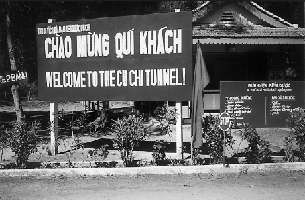
Figure 5.1. Sign at the entrance to the Cu Chi Tunnel complex, Ho Chi Minh City. Photograph by Hue-Tam Ho Tai.
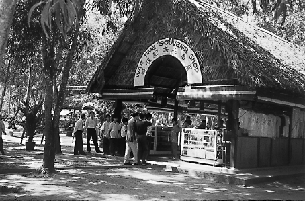
Figure 5.2. War Time Souvenir Shop, Cu Chi Tunnel, Ho Chi Minh City. Photograph by Hue-Tam Ho Tai.
Similar efforts were undertaken to restore the remains of the “MacNamara Line,” an electronic wall of mines once used to keep Communists from entering South Vietnam. The U.S.$2 million project included reconstruction of the blockhouses and bunkers, the observation towers, and the barbed wire, electronic alarms, and odor detectors used to guard the installation. Undertaken by the Vietnamese Ministry of Defense, the site is actually a monument to American technology, complete with literature describing the history and equipment used at the installation, provided at the courtesy of the U.S. government.[37]
Part of the work of the tourism industry is also, however, to encapsulate the wars of 1945–75 as a single historical moment in the nation's long history and to move tourists'attention along to other images and narratives; hence the slogan “Vietnam: A Country, Not a War.” Another significant period in the development of tourism is the French imperialist era, beginning in the middle 1800s. The legacy of French colonial domination is evident in the Impressionist artwork found in Vietnamese museums, in the highland villas built as retreats for colonial officers, and in the architecture of churches, government buildings, and—where tourists would most likely encounter it—in hotels.
In 1990, which was dubbed “Visit Vietnam Year,” one of the notable shortcomings of the industry was the lack of hotel accommodations. Ho Chi Minh City had only thirteen hundred international standard beds, and Hanoi had only eight hundred, about half the number needed to meet the national goal for visitors that year.[38] In both cities, however, work had already begun on noteworthy ventures by hoteliers. In Hanoi, a French hotelier began the restoration and renovation of the Reunification (Thong Nhat) Hotel, which during the French colonial era had been the Hotel Me´tropole. Restoration included not only the classical French colonial architectural motifs of the building and its guest rooms but also the reinstatement of the French name, Hotel Sofitel Me´tropole, in lieu of the Vietnamese. Once work was completed, an advertisement placed in an English-language publication showed a 1930s-era postcard of the hotel and promised “Charme du Passe´ … Aujourd'hui.”
The story of the Reunification Hotel was soon repeated throughout Vietnam. In Ho Chi Minh City, for example, foreign investors renovated
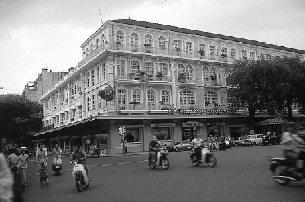
Figure 5.3. The restoration of the Hotel Continental in the heart of Ho Chi Minh City celebrates Vietnam's colonial legacy. Photograph by Laurel Kennedy.
For many wealthy travelers to Vietnam, from both the East and the West, the delight of colonial decadence may itself be a somewhat foreign experience. Many travelers seek more explicitly modern, although culturally anonymous, comforts for their travel experiences: airconditioned suites overlooking expanses of beach, state-of-the-art golf courses and marinas, and the opportunity to shop for souvenirs or duty-free goods. In Ho Chi Minh City, what had formerly been the Four Seasons Hotel on the Australian Great Barrier Reef was relocated by a
The most significant financial investments, however, were in the resort hotels—no more organicto Vietnam than the new discotheques. Outside of Da Nang, in what is once again being called “China Beach,” 536 acres of beachfront and a Soviet-built hotel were purchased by an American firm for U.S.$280 million, for development into a tourist complex of hotels, residential housing for expatriates, a shopping “village,” and a golf course—one of the scores of anonymous resort hotels that continue to be built. In Hue, a Vietnamese-Malaysian joint venture invested U.S.$408 million in new resorts, the renovation of an older hotel, and a tourist center in the middle of the city. By the mid-1990s, a South Korean company was planning a U.S.$290 million resort complex on the Con Dao Islands, once the site of a French colonial prison; five Singaporean partners were considering a U.S.$300 million tourist complex in Da Lat; and Club Med was negotiating to build a resort near Cam Ranh Bay. These developments and others by the Radisson, Marriott, and Choice hotel chains begged the question of whether Vietnam would soon be actually oversupplied with hotel accommodations, particularly the fourand five-star luxury units intended for the wealthiest tourists.
PACKAGING VIETNAM: THE NARRATIVE
OF VIETNAM TRAVEL LITERATURE
With these tourist amenities in place, tourism agencies must still lure visitors to Vietnam, a task complicated by the necessity of creating a new image of the country in the minds of Western travelers. The tourism literature describing travel packages to Indochina is one of the most significant venues in which a representation of Vietnam is offered. While potential travelers to Vietnam can obtain information about the
It is the task of these tourist organizations to create, through travel guides and brochures, a narrative encouraging a potential tourist public to visit Vietnam. Travel brochures, by their very nature, tell the stories of the places tourists will enter into and experience through their various expeditions. These brochures, as narratives, are configurations of “symbolic actions—words and/or deeds—that have consequence and meaning for those who live, create, or interpret them.”[39] Thus, the essential human behavior of storytelling serves the rhetorical function of “adjusting ideas to people and people to ideas.”[40] The stories in brochures, then, mediate tourists'travel experience even before it has begun.
The narrative analysis of tourism literature for Vietnam that follows is based on catalogs, most of them from 1996, supplied by upscale packagetour providers.[41] The catalogs were richly designed guides with heavy, embossed, fullcolor covers, artful photographs, and painstakingly worded text. We also examined a guidebook prepared by the travel industry for its own members: Vietnam: A Travel Agent's Guide, published in 1994 by the Pacific Asia Travel News. These catalogs and guide use words and images to introduce the “new” Vietnam through a narrative replete with ancient mystery and colonial charm.
The travel brochures employ five tactics to frame Vietnam for the targeted publicof wealthy “pioneer” tourists: the establishment of a Europeanized identity; ambiguity in describing the events of the 1945–75 conflicts; depiction of those wars as provincial events; portrayal of U.S. involvement as a social activity; and historical minimization. Through these tactics, wouldbe tourists who remember the Vietnamese as enemies are provided with representations of Vietnam, which suggest new constructs for remembering the country without its nemesis status. The represented landscapes offer Western tourists memories of a past that stabilize and authenticate not the past so much as the tourist's position within it. As Dickinson suggests, memories are “utilized in these sites to create intriguing spaces for [tourists'] consumption.”[42]
The tactic of establishing a Europeanized identity permeates the
The French character of Ho Chi Minh City is highlighted as well. Indeed, the same publication that described Hanoi as the “Paris of the North” notes that “during the French occupation, Ho Chi Minh City was known as the ‘Paris of the East.’”[44] In the course of its nineteen-day tour of Vietnam, Geographic Expeditions promises “a beautiful overnight at the hill resort of Dalat, redolent with touches of the French colonial past.” So as not to completely exclude American travelers from this colonialist experience, InnerAsia Expeditions'brochure describes Dalat's charms as an “old artdecoey French resort favored by Teddy Roosevelt in his post-Presidential hunting days.” By establishing identification with France through their tourism literature, the agencies present Vietnam as an ally rather than a former enemy.
A second persuasive tactic employed in the tourist literature to facilitate a different view of Vietnam by Westerners is the ambiguity of references to the wars of the twentieth century. The brochures give little information, for instance, to identify the opponents in the conflict, the length of military engagement, or its final consequences. In the sixty-five-page Travel Agent's Guide, for example, the war is not mentioned until nearly halfway through the brochure, and then only briefly, in a description of the Marble Mountains of Danang. The first visual image of the U.S. military presence in the country is presented on page 40 of this brochure. A photograph of an American helicopter is placed next to a paragraph listing the “Old Battlefields” in Ho Chi Minh City that tourists can visit. Weeds and deep grass have grown around the helicopter, suggesting that the Vietnamese give little attention to the remnants
Many well-known battlefields and locations of the US army are found here, including Da Spring; Tay Ninh, Chon Thanh, Iron Triangle; D Marquis; Hamburger Hill; Khe Sanh Base; Carol; Rockpile Caps; Con Tien; Doc Mieu; Que Son; An Hoa; Bo Bop; Nui Thanh; and Chu Lai.
Unlike the other descriptions on this page, the list of old battlefields contains no discourse that would associate the Vietnamese people and culture with the sites of war. Like the lone helicopter, American military battlefields appear to be dismissed by today's Vietnamese. Abercrombie and Kent offers similar reassurance, opening the description of its “Images of Indochina” tour by noting, “The turbulence of the recent past has faded.”
Conspicuously absent from the tourist literature are photographs of males who would have been of military age to fight either with or against Westerners. The majority of the pictures included in the brochures are scenic views of landscapes, shrines and other architectural points of interest, and food. Photos with discernible individuals are unusual and exclusively portray young women and children. With fair, flawless skin, the women are models of loveliness who characterize the Western concept of Asian beauty and pose no threat to Westerners. The children who appear in the photographs seem to be calm and well behaved, and surely too young to remember the hostilities; the TBI Tours brochure includes only one photograph, of a gaggle of schoolchildren giggling and waving to the camera, captioned “A Warm Welcome in Vietnam.”
Through an apparent inattention to warrelated incidents, areas, and people, this second tactic creates a present-day Vietnam that is distanced from the past both chronologically and conceptually. The recent war history that most Americans would associate with Vietnam is shown to
Unable to ignore completely the conflict between the United States and Vietnam, the tourism literature employs a third persuasive tactic: depiction of the war as a localized and isolated provincial event. References made to Vietnamese soldiers imply that the fighting involved neither cohesive, organized battalions nor, apparently, any identifiable foreign aggressors. In the Marble Mountains of Danang, for instance, “during the Vietnam War, [the] caves were used by local guerrillas as field hospitals and shelters.” Similarly,
The Cu Chi District, a well-known part of “The Iron Triangle,” features the famous Cu Chi Tunnels, an underground network of tunnels constructed by the local guerrillas and militia in 1945 and then expanded during the Vietnam War. Cu Chi is often called an “underground village” because of its labyrinth of interlaced tunnels used by the guerrillas during the Vietnam War. At certain locations, the tunnels'three floors contained rooms large enough for a commando training center, surgical operation, and army supply stations. It was also the birth place of the historic Ho Chi Minh campaign.[45]
In Abercrombie and Kent's description of events occurring on day 10of an Indochina tour, Cu Chi is offered as “one of the most intriguing battlefields of the Vietnamese War.” The copy goes on to explain that “during the height of the conflict, Viet Cong and North Vietnamese forces dug an extensive network of tunnels which served as hiding places, storage halls, medical center and dormitory.” In these examples, there is no mention of the enemy against whom the local guerrillas fought. Shaun Malarney notes elsewhere in this volume that Vietnamese historians have generally presented war as sacrificial defense of the motherland against foreign aggressors. In these brochures, those aggressors are rendered not merely anonymous but invisible and unknowable.
Further displacing foreigners from the site of wars in Vietnam is the photograph of the Cu Chi Tunnels that accompanies the copy in the Travel Agent's Guide. In this picture, two men squat in front of a shelter that covers the opening to one of the tunnels. One man appears to be a Westerner, perhaps fifty years old. He is dressed in casual clothes and is
A final depiction of the war as being “localized” to factions within Vietnam occurs in the description of Vung Tau. In addition to beaches, colonial villas, cafe´s, religious sites, and other outstanding views, “one can also see some of the spectacular antinaval guns, a reminder of Vietnam's lengthy territorial struggles.”[46] To whom these guns belonged, or the targets at which they were aimed, remains ambiguous, as is the reference to the unspecified “territorial struggles” in which Vietnam has been involved. Foreign tourists may thus exclude themselves from specific military actions that occurred in the region.
On rare occasions when the U.S. military presence is mentioned in these brochures, it is portrayed as part of a fun, social activity—the fourth tactic. In descriptions of Ho Chi Minh City, the Rex Hotel is often said to have served as the U.S. Army's “bachelor officers'quarters.” To those without a military background, this allusion conjures images of swinging singles and a life of parties rather than living within a state of war. Further emphasizing the social aspects of the country is a featured attraction, China Beach, “the site where American soldiers used to relax.”
The final persuasive tactic that appears in the tourist literature on Vietnam is historical minimization. Interactions between Vietnam, France, and the United States during the nineteenth and twentieth centuries are all but lost in the grand expanse of Vietnam's history, from the ancient to the modern. In this way, even if the contemporary travelers recognize the previous antagonism of the countries, it is presented as a historical moment of comparatively little significance in the context of Vietnam's long and culturally rich past.
Historical minimization is achieved in the tourism literature in two ways: by skipping over details of events during the years the U.S. military was active in Vietnam, and by focusing on the distant past of the culture and country. Few references are made to events in Vietnam between 1945 and 1975. In an article documenting the fortyyear history of Vietnam Airlines in the Travel Agent's Guide, for instance, there is commentary about its beginnings in 1956; then the chronology of the airline skips to 1975, when unification “brought a boom in air services due to the dramatic increase in economic, political, cultural and social activities.” The intervening years simply are not mentioned.
Steeped in romance and history, the ruins of the city of Hue (“City of Romance”) receive a two-page color spread in one travel brochure, followed by a third page of photographs and copy. Only time seems to have affected this city that, according to the Travel Agent's Guide, was “considered the most splendid royal capital in Vietnam from the 1700s to the 1940s.” King Khai Dinh's Tomb, built between 1920 and 1930, and the Thien Mu Pagoda, which dates back to 1601, are located near Hue, off the Perfume River. In Danang, My Son Sanctuary, “once the capital of the Kingdom of Champa (from the 5th to the 12th century), was graced with 68 magnificent palaces and temples.” Remnants of the temples were excavated earlier this century. With visible ruins a thousand years old or more, Vietnam is promoted as a country whose importance to the world extends far beyond a comparatively insignificant war of the twentieth century.
Through the strategies of establishment of a Europeanized identity, ambiguity in references to the 1945–75 conflict, depiction of that war as a provincial event, portrayal of U.S. involvement as a social activity, and historical minimization, the tourist industry writes a narrative of Vietnam as welcoming, nonthreatening, and steeped in a history that transcends recent animosities.
CONCLUSION: RECOLONIZING THE PAST
Any explanation made by an individual or a group about events of the past or the future is constructed as a story that, as noted earlier, “adjusts”
The meaning of a narrative comes in part from its form. Dichotomies of fact/value, intellect/imagination, and reason/emotion merge in a narrative: “Stories are the enactment of the whole mind in concert with itself.”[47] But a narrative also includes, in addition to essential facts, the value system according to which the facts may be evaluated; a narrative tells a story within an ideological and moral construct. Both intellectual and imaginative processes are engaged because the facts are presented in a framework that seems plausible, possible, and imaginable to the participants in the storytelling activity.[48] Providing us with “a way of ordering and presenting a view of the world through a description of a situation involving characters, actions, and settings that changes over time,”[49] narratives become crucially important to how we understand our present—and how we remember our past.
Our analysis of the narratives provided in both tourist sites and certain types of tour brochures suggests that Vietnam's tourist industry sees its commercial success as resting on its ability to transform Vietnam in the minds of the travelers who will visit the country. Over a billion dollars has already been invested in the representation of Vietnam. This process, which it is hoped will be rewarded handsomely by the tourists themselves, provides those tourists with an experience of the country very distant from the experience of the people of Vietnam. It is instead a construction of Vietnam—its history, its culture, its people—designed for Westerners, through their own eyes.
The ideological work done by the tourist sites, the local “hosts” who staff them, the literature that sells them, and the travelers who seek them out is an act of complicity. In a sense, there is a clash of the motives brought by each of these participants, which is resolved through the formulation of a historical narrative that appeases those who hold power. In the case of Vietnam, the objectives of many local people to honor their countrymen in victory and in death and to enlighten foreigners about the Vietnamese experience clash with their even greater need to extract from those foreigners the cash that the travelers will turn over only if the experience makes them feel better. So, rather than an
This reordering is evident in the contradictions that exist between the tourist narratives and those offered in Vietnam's official history. A common theme of the tourist industry is its invitation to travelers to view Vietnam through colonial eyes. The refurbishing and renaming of colonialera hotels, the revival of the excesses of imperialism, and the formulation of Vietnam's identity around the French referent all work to reposition Vietnam in relationship to its own past. Wealthy travelers are invited to assume the position of colonial conqueror, enjoying the fruits offered by the lesser, the conquered. In doing so, the power of Vietnamese resistance to colonialism and its oppression is erased from publicmemory and substituted with docile submission.
The tourist industry is, in fact, organized around Vietnamese supplication. Offering up their history, their culture, their art to the gaze of the Westerner, the people of Vietnam can be witnessed by tourists as living in the service of foreign visitors. There is no attention, either in the tourist literature or among the sites developed for tourist visits, to the success of Vietnam's industrialization efforts. The very concept of the modern, of a nation building an independent future, is overlooked by the tourist industry—aside from the foreign-built hotels that serve the tourist trade. On the contrary, the tremendous strength and forbearance which permitted the Vietnamese to overcome efforts at foreign domination and to set their own course are largely hidden from view.
While Vietnam's long history is recognized, it is not its history as defender of independence. Rather, it is Vietnam's ancient religious traditions—inaccurately separated from the country's political history— that are celebrated at the temples and pagodas to which tour buses swarm. Treks to the environs of the ethnic minority hill tribes render the traditions of a lost era another type of tourist attraction. With a population that is more young than old, it is venerability and the constancy of enduring religious convictions that are emphasized. There is a double irony in this, for religious freedom and tolerance for ethnic diversity would not be considered hallmarks of the Vietnamese experience, with tens of thousands of Buddhist monks only recently released from reeducation camps to return to those admired pagodas, [50] and a history of charges against the Vietnamese government of human rights abuses against ethnic minorities.
If there is a group whose imagery in the travel literature is particularly
By foregrounding the delights of colonial decadence and backgrounding both the war years and any evidence of modernity; by foregrounding antiquity and backgrounding the vitality of youth; and by foregrounding women and backgrounding men, there is a constancy of effort to minimize the war's significance and to present it as finished business, now available for amusement. Tourists may witness the war in Vietnam with the same detached curiosity as the picnickers who attend reenactments of Civil War battles in the United States. By recreating as amusement the experiences of the war—the bars, the M-16s, the “R&R” retreats— by showing American military equipment resting in peace, forgotten among the weeds, by offering tranquil French colonial retreats as refuge from the rigors of tourism, the wars with the French and the Americans are shown as resolved, no longer a matter of concern or anxiety. Yet this again belies the experience of some Vietnamese, for whom the divisions between North and South persist.
Far from promoting understanding of the Vietnamese people, their valorous history, their culture and way of life, the tourist industry invites foreigners to experience Vietnam from the position of dominance and control that Westerners appeared to lose forever at Dien Bien Phu in 1954 and in Saigon in 1975. The implications of the tourist industry's representation may extend as well, however, to Vietnam's own political memory and the formulation of its political agenda in the post-Soviet period.
Finally, tourism must be understood as a means of integrating a country into new global systems of power and politics, which must in turn influence the balance of power in a nation's domestic, as well as international, political affairs. Few planned economies have emphasized tourism as a means of generating revenue. As Vietnam continues its novel efforts to develop as a socialist polity with a market-oriented economy, fragile political relations are likely to be strained, and the relative power of private entrepreneurs and the state will surely undergo renegotiation. In international relations, Vietnam's representation offers to the world a warmer and friendlier Vietnam, which may have benefits in a range of political-economic venues. The inherent danger, however, is that the price paid for this nostalgic retelling of quaint colonialism may be a return to it.
NOTES
The authors gratefully acknowledge the comments of John Kirby, Tammy Lewis, and Hue-Tam Ho Tai on early drafts of this chapter.
1. Murray Bailey, Travel and Tourism Opportunities in Vietnam: A Blue-print for Development (Hong Kong: Business International Asia-Pacific, 1990).
2. David Lowenthal, The Past Is a Foreign Country (Cambridge: Cambridge University Press, 1985), 8.
3. Martha K. Norkunas, The Politics of Public Memory: Tourism, History, and Ethnicity in Monterey, California (Albany: State University of New York Press, 1993).
4. Dean MacCannell, The Tourist: A New Theory of the Leisure Class (New York: Schocken Books, 1989), 44–45.
5. Norkunas, The Politics of Public Memory, 36.
6. Maurice Halbwachs, On Collective Memory, ed. and trans. Lewis A. Coser (Chicago: University of Chicago Press, 1992).
7. John Urry, Consuming Places (New York: Routledge, 1995), 165; see also Marie-Franc¸oise Lanfant, John B. Allcock, and Edward M. Bruner, eds., International Tourism: Identity and Change (Thousand Oaks, Calif.: Sage, 1995).
8. This point is the subject of debate between those who see history as continuously reconstructed in the present to serve current needs and those who see history as often resistant to such reconstruction. Marita Sturken, Tangled Memories: The Vietnam War, the AIDS Epidemic, and the Politics of Remembering (Berkeley and Los Angeles: University of California Press, 1997).
9. Norkunas, The Politics of Public Memory, 5.
10. Bailey, Travel and Tourism Opportunities in Vietnam.
11. Estimates of tourists entering Vietnam should be understood as approx-imations rather than precise figures. These statistics sometimes represent travelers entering the country on organized tours, visitors entering through the international airports, or categories including tourists, business travelers, and those visiting friends and relatives. Figures shown here, for example, are the official statistics published by the Vietnam National Administration of Tourism, but they differ from those provided by VNAT to the World Tourism Organization.
12. Among other provisions, the 1988 Foreign Investment Law imposed few requirements on foreign investors, permitted up to 100 percent foreign ownership, permitted imports under joint venture enterprises to be free of duties, and eased repatriation of profits.
13. Murray Hiebert, “Wish You Were Here,” Far Eastern Economic Review, January 18, 1990, 44–45.
14. Carlyle Thayer, “Dilemmas of Development in Vietnam,” Current History, December 1978, 221–25.
15. Bailey, Travel and Tourism Opportunities in Vietnam.
16. Tre, Vietnam: Investment and Tourism in Prospect (Hanoi: Nguyen Minh Hoang Printing House, 1991), 63.
17. For example, Vietnamtourism, the governmentrun tour agency, provides tours, such as a sixteen-day “Veteran's Tour,” as well as side trips that can be used to supplement packaged tours, like the “Humanitarian Side-Trips,” which take visitors to a drug rehabilitation center, an orphanage, and a maternity hospital.
18. See, for example, Erik Cohen, “Toward a Sociology of International Tourism,” Social Research 39 (1972): 164–82; Nelson H. H. Graburn,
19. Cohen, “Toward a Sociology of International Tourism.”
20. Ralph Lenz, “On Resurrecting Tourism in Vietnam,” Focus, 43 no.3(fall 1993): 1–6.
21. Dean MacCannell, “Staged Authenticity: Arrangements of Social Space in Tourist Settings,” American Journal of Sociology 79 (1973): 589–603.
22. Norkunas, The Politics of Public Memory, 2.
23. David Margolick, “To Hanoi by Train, a Journey of 1, 000 Miles,” New York Times Magazine, November 9, 1997, 18, 32.
24. George Mosse, Fallen Soldiers: Reshaping the Memory of the World Wars (New York: Oxford University Press, 1990). See also Victor Turner, Dramas, Fields, and Metaphors: Symbolic Action in Human Society (Ithaca, N.Y.: Cornell University Press, 1974).
25. Neil Sheehan, After the War Was Over (New York: Random House, 1991).
26. Many American veterans of the war in Vietnam have described their travels back to the country either in the mainstream media or, less professionally presented, as postings to the World Wide Web. These travelogues, which often grapple in highly personal terms with the experience of revisiting sites replete with memory and emotion, could be considered a new genre within the literature of the Vietnam-American war. See, for example, Sheehan, After the War Was Over; Paul Martin, “Land of the Descending Dragon,” National Geographic Traveler, May/June 1996, 60–75; Philip Milio, “My Return to Vietnam” (http://grunt.space.swri.edu/pmilio.html, 1996); and Robert Bowley, “Vietnam Visited and Revisited” (http://www.goodnet.com/~rbowley/vietnamstory.html, 1995).
27. Between 150, 000 and 260, 000 overseas Vietnamese traveled to Vietnam in each of these years. Vietnamtourism, Tourism (http://www.vietnamtourism.com/tourist/index.htm, 1998).
28. MacCannell, “Staged Authenticity,” 2.
29. Hamid Mowlana, Global Information and World Communication (New York: Longman, 1986), 126.
30. “The Profit Hunters,” The Economist, June 11, 1994, 31.
31. Mosse, Fallen Soldiers, 126–27.
32. The Chinese Rooms of the War Crimes Museum were closed after China and Vietnam renewed diplomatic relations. See Steven Erlanger, “Saigon in Transition and in a Hurry,” New York Times Magazine Sophisticated Traveler, May 17, 1992, 18–19.
33. Completion of the new construction was delayed following efforts by historical preservationists to include a small commemorative museum in the design of the new Hanoi Towers. I thank Hue-Tam Ho Tai for information on the Towers'marketing slogan.
34. Robert S. Greenberger, “Buy Those Zippos, Catch Some Waves, Visit a War Museum,” Wall Street Journal, January 25, 1993, A8.
35. “War Sites to Bring in Tourist Bucks” Vietnews 3, no. 6 (1995): 35–36.
36. Philip Shenon, “Hanoi to Show Tourists Hideout That Eluded US,” New York Times, December 11, 1992, A4.
37. “War Sites to Bring in Tourist Bucks,” 35–36.
38. Murray Hiebert, “Wish You Were Here,” Far Eastern Economic Review, January 18, 1990, 44–45.
39. Walter Fisher, “Narration as a Human Communication Paradigm: The Case of Public Moral Argument,” Communication Monographs 51 (March 1984): 2.
40. Donald C. Bryant, “Rhetoric: Its Function and Its Scope,” Quarterly Journal of Speech 39 (December 1953): 413.
41. We examined the following brochures: Abercrombie and Kent, “The Orient, China and India” (Oak Brook, Ill., 1996); Geographic Expeditions, “Geographic Expeditions” (San Francisco, 1996); InnerAsia Expeditions, “Expeditions” (San Francisco, 1996); TBI Tours, “Orient Spectacular” (New York, 1994–95).
42. Greg Dickinson, “Memories for Sale: Nostalgia and the Construction of Identity in Old Pasadena,” Quarterly Journal of Speech 83 (1977): 1–27.
43. Pacific-Asia Travel News, Vietnam: A Travel Agent's Guide (Phoenix, Ariz.: Americas Publishing, 1994), 14–17.
44. Ibid., 38.
45. Ibid., 30, 42.
46. Ibid., 47.
47. Fisher, “Narration as a Human Communication Paradigm,” 10.
48. Gloria E. Blumanhourst, “Coherence: A Narrative Criticism of Two Accounts of Herstory” (master's thesis, Colorado State University, 1986).
49. Sonja K. Foss, Rhetorical Criticism: Exploration and Practice (Prospect Heights, Ill.: Waveland Press, 1989), 229.
50. “Faith in Hanoi” Wall Street Journal, January 20, 1995, A12.
51. Marie-Franc¸oise Lanfant, “International Tourism, Internationalization and the Challenge to Identity,” in International Tourism: Identity and Change, 33.