
2. Foreign Bodies and
International Race Romance
in the Story Papers
3. The Story-Paper Empire
The subject of war, diplomacy, and high politics frequently comes up when traditional political historians question the utility of gender in their work. But here, too, we need to look beyond the actors and the literal import of their words. Power relations among nations and the status of colonial subjects have been made comprehensible (and thus legitimate) in terms of relations between male and female. The legitimizing of war—of expending young lives to protect the state—has variously taken the forms of explicit appeals to manhood (to the need to defend otherwise vulnerable women and children), of implicit reliance on belief in the duty of sons to serve their leaders or their (father the) king, and of associations between masculinity and national strength. High politics itself is a gendered concept, for it establishes its crucial importance and public power, the reasons for and the fact of its highest authority, precisely in its exclusion of women from its work. Gender is one of the recurrent references by which political power has been conceived, legitimated, and criticized. It refers to but also establishes the meaning of the male/female opposition.
—Joan Scott, “Gender: A Useful Category of Historical Analysis”
[My concern here is to] locate an erotics of politics, to show how a variety of novel national ideas are all ostensibly grounded in “natural” heterosexual love and in the marriages that provided a figure for apparently nonviolent consolidation during internecine conflicts at midcentury. Romantic passion, on my reading, gave a rhetoric for the hegemonic projects in Gramsci's sense of conquering the antagonist through mutual interest, or ‘love,’ rather than through coercion. … It will be evident that many romances strive toward socially convenient marriages and that, despite their variety, the ideal states they project are rather hierarchical.
—Doris Sommer, Foundational Fictions
One of the major contradictions of imperialist expansion was that while it strove to nationalize and domesticate foreign territories and peoples, annexation incorporated nonwhite foreign subjects in a way perceived to undermine the nation as a domestic space.
—Amy Kaplan, “Manifest Domesticity”
Issues of gender, sexuality, and race were clearly at stake in political debates about imperial expansion and in popular sensational adventure literature published during the 1840s and 1850s. This was so, first of all, because both champions and critics of imperial expansion appealed to ideologies of manhood. In the 1840s, the “volunteer”—the virtuous citizen-soldier who defended the nation out of a love for his native land—was often championed as a manly ideal and as a symbol of the United States in the popular press. But other men, including the large numbers of immigrants and propertyless men in the U.S. military forces and in the nation, as well as Mexican men of all types, were frequently viewed as threats to such conceptions of manhood and national identity. The war literature displays intense anxieties, moreover, about whether Irish and other immigrant men can be subordinated within U.S. military hierarchies or whether they will instead turn out to be weak links in the chain of imperial manhood.[1] On the other hand, although a few U.S. writers idealized international bonds between elite U.S. and Mexican men, Mexico was generally subordinated to the United States within such visions of inter-American reconciliation.
Eligibility for such subordination crucially depended on how the boundaries of whiteness were constructed; in other words, on whether various types of working-class, immigrant, and Mexican men were thought to be white. These were often real questions during the 1840s, for during those years the place of the Irish and especially of Mexicans within emerging racial (re)classifications was by no means clear. Although writers of popular adventure fiction occasionally imagined elite Mexican men who might enter into political or business relationships with U.S. men or, more rarely, who might marry white U.S. women, Mexican men were more often viewed as racially other and as either excessively
Mid-nineteenth-century imperialism also crucially affected women and engaged ideologies of womanhood. The U.S.-Mexican War dramatically and violently transformed the lives of the women who lived where battles were fought and where military forces were present. Many women followed men to the battlefields, and some, according to popular legend, even fought in the war. Women also labored in the camps, foraging, cooking, doing laundry, and nursing the wounded. Although some U.S. women, notably Irish immigrant women, followed the army to Mexico, for many U.S. observers the visible presence of women in Mexican military camps was apparently a remarkable sight.[3] When in the early 1840s the relatively privileged and comfortable Frances Calderón de la Barca, a Scottish-born Chilean diplomat's wife who migrated to the United States in the 1830s, encountered women in a Mexican army unit during the early 1840s, she scathingly described them as “masculine women” and as “mounted Amazons, who looked like very ugly men in a semi-female disguise.”[4] From Calderón de la Barca's elite perspective, these soldaderas unsettled the boundaries of gender, so much so that they “looked like” men.
On the other hand, during the war some U.S. writers depicted Mexican women as models of womanhood who selflessly nurtured men on both the U.S. and Mexican sides. In John Greenleaf Whittier's popular poem “The Angels of Buena Vista,” for instance, “holy” Mexican women minister with “tender care” to wounded soldiers left on the battlefield after the fight has ended.[5] But if this image of Mexican women as ministering angels mirrored influential U.S. domestic ideals of womanhood, many popular authors of story-paper literature depicted Mexican women, as Calderón de la Barca did, as blurring the boundaries of gender. Indeed, many of their novels feature Mexican women who disguise themselves as men in order to participate in the war. And yet, although
As these examples suggest, besides directly involving women, the war also significantly involved ideas about women. Indeed, relations between the United States and Mexico were often imagined as relations between male and female. In a wide range of discourses, U.S. national strength was metaphorically aligned with manhood, and Mexico was figured as a woman.[6] In this case, too, ideologies of womanhood were inseparable from those of race and empire. That is, questions about the boundaries of gender, about what type of “woman” Mexico was, and about whether “she” was an appropriate romantic partner for the United States were inseparable from debates about the boundaries of race and the significance of empire for the white republic.
These debates focused on sexuality as well as gender. When relations between the United States and Mexico were recast as erotic relations, narratives of sexuality were also involved, for the key question in many wartime discourses was whether a “feminine” Mexico could be “married” to the implicitly male United States.[7] Although advocates of empire struggled to ground imperial relations in male/female desire, anti-imperialists were more interested in showing why a marriage between nations was impossible, ill advised, or unnatural. Both sides, however, appealed to a complex of ideas that we might associate with emergent conceptions of heterosexuality in order to legitimate their positions on international relations.[8] But in this period, which directly preceded the late-nineteenth-century codification of a “homosexual” identity in medical and legal discourses, ideas about the boundaries of sexuality were in flux. And yet, even though what Eve Kosofsky Sedgwick has called “the crisis of homo/heterosexual definition” did not at this moment, as it would soon, structure “the major nodes of thought and knowledge” of Western culture, U.S.–Mexican War literature certainly marked an “impending crisis” in discourses of sexuality as well as in sectional relations between North and South.[9]
Although war literature often reasserted the legitimacy and naturalness of male/female desire, however, it also registered nonnormative forms of desire and intense affective bonds between men. In a similar context, Ann Laura Stoler has argued that if “the colonies were construed as sites where European virility could be boldly demonstrated it
During the late 1840s and 1850s, producers of story papers and cheap pamphlet literature helped to organize a new sphere of sensational mass culture by publishing adventure fiction written mostly by “native” authors. Even as literary entrepreneurs and Young Americans such as John O'Sullivan promoted a cultural nationalism that was conjoined to ideologies of Manifest Destiny, so too did these early purveyors of popular literature.[13] In the second half of the 1840s, the Boston-based weekly story paper the Flag of Our Union dominated the field of cheap literature; the publishers, Frederick Gleason and Maturin Murray Ballou, offered prizes to prospective authors, and, according to Henry Nash Smith, “pioneered the development of a national system of distribution” and “developed the standard procedures of the popular adventure story.”[14] As one of the most important early forms of mass culture, these story-paper adventure novels reveal the intimate relationships between U.S. empire-building in the American 1848 and (re)constructions of class, race, gender, and sexuality in the mid–nineteenth century and beyond.
Alexander Saxton has suggested that the extension of white male suffrage in the early part of the century, along with improvements in print technology and literacy rates, inaugurated a new era of mass political culture in which the Democrats and the Whigs competed for the allegiance of potential voters with smaller parties such as the many nativist
Story papers such as Gleason's and Ballou's Flag, Justin Jones's Star Spangled Banner, and the Williams Brothers' Uncle Sam and the Flag of the Free, which claimed circulations of up to forty thousand during the years of the U.S.-Mexican War, carried fewer news items than did the labor newspapers or the mass dailies, devoting most of their space instead to serialized sensational stories such as The Secret Service Ship, The Volunteer: or, The Maid of Monterey, and The Black Avenger of the Spanish Main.[17] These papers were very different from Lippard's Quaker City weekly, which I discussed in the previous chapter, or Ned Buntline's Own, another story paper that, as we shall see, juxtaposed serialized novels with articles and editorials that articulated working-class struggles to the nativist cause. Although the Flag of Our Union, for instance, declared itself the friend of the laboring classes, it rarely reported specifically on workers' issues, organizations, and conflicts.[18] Instead, it praised the dignity of labor as well as the importance of Yankee trade and manufactures, and generally aimed to accommodate a mass audience composed of multiple classes. It was advertised, after all, as a paper “published for the million, and at a cost, and in a shape that places them within the reach of all” (7 October 1847). The Williams Brothers' Flag of the Free, which was more Whiggish in tone than Gleason's and Ballou's Flag and even ran ads for a Whig paper in its columns, also claimed to be “Uncontaminated by party politics” and to exclude “all offensive subjects.”[19] Although the set of beliefs circulating in story-paper literature cannot be reduced to the platform of one or the other of the political parties, the papers discuss many of the important political issues of the day even as they strive to convert the latter into the terms of romantic
But if a new mass political culture sought to win the allegiance of a heterogeneous group of white men, the audience for story-paper literature extended beyond the boundaries of that internally divided group, for the “million” clearly included women as well as men. The Flag of Our Union assured its female readers that it had “too many friends among the fair sex, not to heed well their interest, and to chronicle all valuable matters for their notice” (2 October 1847). “Unless we please the ladies,” another editorial reported, “we shall feel that we are working in vain” (23 October 1847). The papers were widely distributed in Northeastern cities, where they were often issued under the imprint of local news agents, as well as in New Orleans, St. Louis, Cincinnati, and Detroit.[20] Apparently they followed in the tracks of empire: a soldier who corresponded with the Flag during the war assured the editors that “even into the heathen darkness of Mexico does the ‘Flag of Our Union,’ both literal and typical, penetrate” (18 September 1847). At a price of three or four cents an issue, the relative affordability of these papers would have made them accessible to many working-class readers.[21]
Many patriotic serialized thrillers (along with other similarly sensational stories that did not first appear in the story papers) were also published by these firms as pamphlet novelettes selling for twelve and a half or twenty-five cents. The novelettes circulated in even greater numbers than did the story papers. In October of 1847, Gleason claimed to have supplied “enormous editions” of up to fifty thousand for the public, and he also noted that the stories were being republished in England “by responsible houses and in large editions” (2 October 1847). For Gleason, one of the selling points of this literature was its cheapness and disposability: “Especially to those travelling on railroads or in steamboats they are capitally adapted, being so cheap that one can afford to leave them by the way after reading,” read an advertisement featured in an 1847 issue of the Flag (27 November 1847). But according to one literary historian, “Gleason's most important boast about the Flag was its Red-Blooded Americanism.” He claimed to print only the work of “Ameri-can” authors rather than reprinting contributions to British publications, and he preferred “American heroes and heroines or, failing that, working-class protagonists in foreign countries who overcame aristocratic villains.”
After he joined forces with Gleason in 1845, Maturin Murray Ballou, a Harvard dropout and the son of the famous New England minister Hosea Ballou, became one of the most important innovators in the field of mass-produced adventure literature. Ballou, who with Frank Leslie would go on to produce the first illustrated weekly (Gleason's Pictorial Drawing Room Companion) as well as several other cheap magazines, became the “guiding hand” at the Flag and eventually took over from Gleason in 1854.[25] He was also one of the firm's most popular authors. His Fanny Campbell, the Female Pirate Captain (1845) sold eighty thousand copies in a few weeks, and he wrote many other adventure stories for the paper, including The Adventurer, or, The Wreck on the Indian Ocean (1848); Red Rupert, The American Bucanier (1845); and The Spanish Musketeer (1847).[26] During the late 1840s, Gleason's Publishing Hall issued the work of more established authors, such as Ann Stephens, whose Malaeska would be revised and reprinted as the first dime novel in 1860; it also promoted new writers who soon became famous, such as Ned Buntline and Charles Averill, author of Kit Carson, the Prince of the Gold Hunters (1849) and many other hugely successful novels.[27] The novels promoted by the Flag often focused on foreign spaces, sometimes in Europe but more often in the Americas, and frequently with an emphasis on “Spanish fantasy”: there were stories about the Spanish Inquisition; the era of Ferdinand and Isabella; Caribbean pirates; Cuba; Panama; and many, as we shall see, about Mexico. The Flag also exploited what we might call the foreign-within-the-domestic, which
Why does Gleason distinguish this “exciting” literature from a “class” of “domestic stories”? Does he mean to suggest a certain distance from the mass-produced sentimental fiction, a good deal of which was written by women, which was also popular during this period? Not entirely, for sentimental literature and sensational fiction are not completely separate spheres during this period, though as Richard Brodhead observes, “domestic fiction had its audience centered among people (often women) already possessing, or newly aspiring to, or at least mentally identifying with, the leisured, child-centered home of middle-class life,” while story-paper literature also incorporated other groups such as “farmboys, soldiers, German and Irish immigrants, and men and women of a newly solidifying working class.”[30] But the Flag, which called itself a family paper, often endorsed middle-class (“strictly moral”) values, sometimes featured female writers, and appealed to female as well as male readers. This does not mean that the audience for story-paper
In an article entitled “Manifest Domesticity,” Amy Kaplan has argued that in the 1850s, “narratives of domesticity and female subjectivity” were “inseparable from narratives of empire and nation-building.” We should understand the domestic, she suggests, not as “an anchor, a feminine counterforce to the male activity of territorial conquest,” but rather as “more mobile and less stabilizing … expand[ing] and contract[ing] the boundaries of home and nation… to produce shifting conceptions of the foreign.”[33] While the sensational story-paper literature that I consider in Part 2 moves outside the boundaries of the domestic sphere, it also foregrounds the entanglement of the foreign and the domestic and produces racialized and gendered conceptions of the foreign in response to the events of 1848 and after.
Even when they are set in traditionally male-dominated spaces, such as the ship and the battlefield, issues of gender and sexuality are central to the plots and the imaginative work of these novels. Most feature female characters, frequently cross-dressed pirates or soldiers, such as Ned Buntline's Edwina Canales in The Volunteer: or, The Maid of Monterey, who dresses as a man and fights for Mexico. When the story was reprinted as a cheap novelette, the publishers singled out as a special selling point the illustrated cover, which featured a “spirited engraving of the heroine of the tale, Edwina Canales, gallantly encouraging her men to the charge” (2 October 1847). The pervasiveness of cross-dressed heroines in these novels suggests that sensational adventure literature was an important site for elaborations of the female picaresque; that is, the episodic
Particularly during the years of the war with Mexico, as debates about the annexation of all or part of Mexico intensified, and then after 1848, when the national “home” was remodeled to accommodate vast new territories, definitions of the foreign and the domestic, as well as ideologies of gender, sexuality, race, region, and class, were pressured and reconstructed. For the dispute over the boundary between foreign and domestic space, as well as the ensuing discussions about how much, if any, of Mexico's territory should be incorporated into the United States, engendered intense anxieties about internal political divisions, anxieties that sensational story-paper literature attempted to manage. And although in almost every case it would be difficult to argue that the story-paper novels wholeheartedly endorse the war and the annexation of Mexico, in the international race romances of 1848 the boundaries of gender and sexuality are central to debates over the politics of empire-building and the incorporation of “foreign” territories and peoples.
One of the ways that international race romances tried to manage these anxieties was by appealing to and popularizing an ideology of imperial U.S. American manhood that promised to transcend internal divisions such as class and region. This story-paper fiction that circulated so widely among emergent middle-class and working-class audiences frequently appealed to an ideal of manhood embodied by a white U.S.-American soldier-hero whose manliness is defined in contrast to various “unmanly” villains, usually rapacious Mexican officers who try to force unwilling heroines into marriage. But story-paper fiction exposed U.S. domestic divisions even as it tried to bridge them, and it thereby registered, as we shall see, not only antagonisms of class, gender, and sexuality but also conflicts between so-called natives and immigrants, the shifting place of the Irish within white America, and the looming battle over slavery that would culminate in the Civil War.
Although these divisions also surfaced in other columns of the story papers, the papers generally rallied around a white egalitarian patriotism
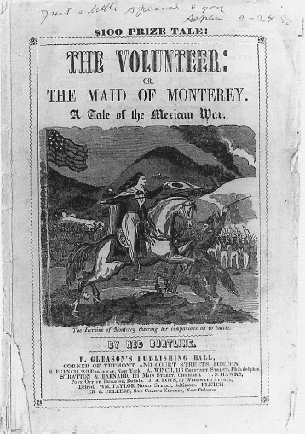
Figure 4. Cover of Ned Buntline's novelette The Volunteer: or, The Maid of Monterey (1847). (Courtesy of the Bancroft Library, University of California)
The representations of Indians could reference the many armed disputes over land that had taken place between whites and Indians, or they might simply indicate an appropriation of Indianness in the service of white nationalism, with the pictures of Indians confirming the “natural” boundaries of “native” America and serving as an emblem of the cultural nationalism that the paper promoted. An Indian also appears prominently on the Star Spangled Banner's masthead in 1848, along with two illustrations of U.S. soldiers and a series of small drawings of U.S.-Mexican War heroes Zachary Taylor and Winfield Scott, as well as Washington, Hancock, Franklin, Lafayette, and Jackson. In the Banner's title, each letter also contains the name of a famous battle, from Lexington and Concord to U.S.–Mexican War battles such as Buena Vista and Vera Cruz, ending with the word “Mexico” inside an exclamation mark. Not to be outdone, in addition to its illustrations of George Washington and two U.S. soldiers, the Flag of Our Union positioned each letter of the paper's title on a small sign that also included the names of all of the U.S. states, notably Texas. All of these mastheads represent the story-paper title as itself a flag, and the references to the Revolutionary War, the U.S.-Mexican War, Indians, and the names of all of the states wed U.S. nationalism to empire-building and military models of manhood.
Although the papers declared themselves neutral or independent and tried to please a mass audience, they all ultimately supported the war effort. Their positions on expansionism, however, were somewhat different. The Flag of Our Union was probably the most unequivocally and enthusiastically imperialist of the group. During 1846 and 1847, it included several articles in support of the war, including one that celebrated the new territory “acquired by Anglo-Saxon valor” (11 July 1846), a laudatory biographical sketch of Zachary Taylor (10 July 1847), a short piece applauding the military performance of republican citizen-soldiers (24 July 1847), and an article praising the capture of Mexico City as “an event, that in the days of Roman greatness would have indeed put the capstone to a pyramid of glorious conquests” (23 October 1847). The paper generally seemed to favor the addition of new Mexican territories to the nation, perhaps because of its “firm belief that five years from this time, Mexico will be settled largely by Yankees, and trade, and manufacture will prosper there” (15 May 1847). When the war ended, the Flag declared that the “United States, by virtue of its power and position, is the natural umpire of the North American continent” (13 May 1848). And just two years later, the editor advocated the annexation of Cuba, claiming that the “‘gem of the American archipelago’ will be a
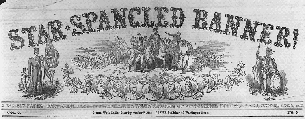
Figure 5. Masthead of the 7 October 1848 issue of the Star Spangled Banner. (Courtesy American Antiquarian Society)
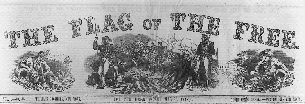
Figure 6. Masthead of the 20 May 1848 issue of the Flag of the Free. (Courtesy American Antiquarian Society)
Other papers, such as the Williams Brothers' Flag of the Free, however, expressed more reservations about the annexation of new territories. Although in 1847 the paper urged the energetic prosecution of the Mexican War (2 January 1847) and crowed that the “immense region of California will fall into our hands like a ripe peach” (13 February 1847), after the signing of the Treaty of Guadalupe Hidalgo in 1848 the editors rejoiced that more of Mexico had not been taken, claiming that this “moderation” showed that Americans were not as “tyrannical and unprincipled” as Europeans. Deeming the war “a glorious conquest,” the paper claimed that the treaty also represented “a conquest over those dangerous passions which the intoxication of successful war has aroused in all nations, republics as well as monarchies. It saves us from the horrors incident to a standing army of sixty thousand men in the heart of a sister republic” (17 June 1848). When a war between Indians and creoles in Yucatán led some to advocate the U.S. occupation of the area, the writer of an editorial for the paper objected: “Permanent occupation implies colonial government and interminable expenses. England's colonies have been a constant drain upon her treasury, and the source of great abuses” (20 May 1848). Some of the same concerns no doubt caused the paper to denounce “the absurd project” of annexing Cuba to the United States” (10 June 1848).
If the views about race expressed in another Williams Brothers publication, the Uncle Sam, are any indication, however, other worries about the annexation of new territories also probably motivated this writer for the Flag of the Free. At the outset of the war with Mexico, the Uncle Sam expressed fears of the “mixed breed” troops of Mexico invading the U.S. South, freeing all of the slaves, and enlisting the support of “people of color” to fight the United States:
When we consider the peculiar population of the South, we confess we are not without our fears of impending evil. The troops of Mexico are of a mixed breed; they are mulattos, and so declining into the African. But little if any Spanish blood is to be found among them. Mexico is an “Anti-Slavery State”—she wars with all who hold the black race in subjection. There are three millions of slaves in our Southern country;—and the approach of a numerous body of foreigners proclaiming liberty to the people of color, and promising plunder and rapine as inducements to favor the advancing armies, is not a matter to be considered lightly. (23 May 1846)
Although story-paper editors sometimes expressed the hope that slavery would gradually end, they certainly did not advocate abolitionism (the
Flag of Our Union even called Frederick Douglass a “blackguard” and “pet of the ultra abolitionists” [2 June 1849] for denouncing the war), and statements such as this one suggest that both antislavery and anti-annexationist sentiments were often motivated more by fears of racial contagion than idealistic concerns about republicanism.[37] “One reason why we deprecate a Mexican invasion is this,” the Uncle Sam concluded. “The Mexicans are the nastiest race of modern times” (23 May 1846). The explicitness of the racial invective is unusual for editorials in the story papers of the time, but many similarly negative representations appear in story-paper novelettes.
The story-paper empire was more ambivalent, however, about the place of Irish immigrants within white America. Although Gleason and Ballou published two novelettes, Harry Halyard's The Chieftain of Churubusco and Charles Averill's The Mexican Ranchero, in which Irish deserters from the U.S. army join forces with the Mexicans, editorials and articles in the paper were generally fairly sympathetic toward the Irish. In part, that was because the Flag was virulently anti-British. The paper repeatedly attacked England for its imperialist policies in different parts of the world while denying that the United States was involved in a similar venture in Mexico. “[We] fight for right, not for conquest,” one editorial announced, “therefore we have an actuating motive that never influences the British soldier” (31 October 1846). When the English criticized the United States for bombing Vera Cruz and injuring large numbers of non-combatants, the Flag replied that British conduct in China was much worse and that if the city been taken by the British they would have utterly destroyed it, just as they had burned and razed Washington during the War of 1812 (4 December 1847). And in response to news of military encounters between British and Indian troops, the Flag asked, “Who, in all Christendom, sympathizes with the British in this unexampled war of incursion and conquest, upon a foreign soil, separated from them by thousands of miles of ocean?” (7 April 1849). While the United States was involved in its own war of incursion and conquest in Mexico, the Flag repeatedly searched for ways to pin the charge of imperialism on Britain and thereby to make U.S. empire-building seem different—in this case on the implicit grounds that Britain sought overseas empire, “separated from them by thousands of miles of ocean.” Noting that Irish emigrants fiercely hated Britain, one writer concluded, “[S]uch is British colonization” (25 December 1847). On the other hand, the paper guardedly welcomed the immigrants and implied that the United States would do a better job of ruling them than England had: “Give us
But this equivocal editorial position on immigration was not always endorsed in the stories the Flag ran, which sometimes presented much less sympathetic views of the immigrant Irish who were coming to the United States in increasingly large numbers during the famine years. From the summer of 1845 through the early 1850s, the massive and repeated potato crop failures in Ireland forced the immigration of more than a million Irish to North America. These new immigrants were decidedly unwelcome to the nativists who organized political parties and participated in destructive riots during the 1840s and 1850s in Boston, New York, and Philadelphia. Irish laborers in Eastern U.S. cities generally received low wages, lived in substandard housing, worked at unskilled jobs, and tended to be concentrated in trades such as weaving that were being transformed by industrialization.[38] It is not surprising that many joined the U.S. Army and went to Mexico, where some watched Protestant soldiers destroy Catholic churches, others switched sides and fought with the Mexicans, and most completed their terms of service and returned to the United States. Although U.S. victories in battle were used to argue for the superiority of republican Anglo-Saxon America, immigrant soldiers constituted about half of the recruits in the regular army.[39] War service would in many ways help to facilitate the incorporation of the Irish into white America, but in sensational story-paper literature the Irish soldier condenses an array of anxieties about the boundaries of whiteness, about the distinction between the foreign and the domestic, and about empire and American exceptionalism.
All of this suggests that the battlefields of the U.S.-Mexican War, as represented in sensational story-paper fiction, were important theaters for stagings of a white “native” American identity. But these massproduced imperial race fantasies have rarely been factored into accounts of mid-nineteenth-century popular culture. Michael Denning's influential study of popular literature during this period, for instance, moves from the late 1830s and early 1840s (the birth of the story paper, most notably with Park Griswold's and Park Benjamin's Brother Jonathan) to the mid-1850s (Bonner's New York Ledger and Street and Smith's New York Weekly), thereby skipping over the story papers and pamphlet novels of the late 1840s, the years of the U.S.-Mexican War.[40] As I suggested in the introduction, Denning rightly contends that an overemphasis on Westerns and tales of Indian fighting and the frontier within studies of popular fiction has made it difficult to appreciate how significant urban
In the rest of Part 2, I argue that the story-paper literature of this period engendered racialized constructions of the foreign that are an important part of the story of nineteenth-century popular culture and that were subsequently recycled and transformed in dime novels and Western pulp fiction and films. In chapter 5, I consider the connections between city and empire, as well as between mass culture and working-class culture, by exploring intersections of nativism and imperialism in the work of Ned Buntline. Buntline wrote adventure fiction for the story papers during the U.S.–Mexican War years, just before he moved to New York and refashioned himself as the author of mysteries-of-the-city novels, the cultural representative of the white working-class B'hoys and G'hals of New York, and a proselytizer for nativist organizations such as the Order of United American Mechanics. Although critics tend to focus either on Buntline's literary adventures in New York or on his later role in developing the legend of Buffalo Bill, the imperial race fantasies that he elaborated in the story papers significantly shape the popular forms of nativist working-class protest that he produced in his urban reform literature, and these imperial romances both express and displace class antagonisms by recasting them in national, racial, and gendered terms.
I have suggested that Buntline's The Volunteer was one of many sensational Mexican War stories featuring cross-dressed female soldiers that were published as story-paper novels. In many of these romances, cross-dressed Mexican heroines lead troops heroically into battle and fight effectively, but ultimately fall in love with U.S. soldiers. As in the Latin American foundational fictions described by Doris Sommer, in U.S.–Mexican War stories the language of romantic passion provides a “rhetoric for the hegemonic projects in Gramsci's sense of conquering the antagonist through mutual interest, or ‘love,’ rather than through coercion.” These popular U.S.–Mexican War romances try, in other words, to turn force into consent by reimagining the U.S. invasion as an international romance in which the force of erotic passion could, as Sommer puts it, “bind together heterodox constituencies.”[42] These representations often imply that the crossing of gender boundaries is symptomatic of a larger crisis in Mexican national identity, a crisis that is sometimes said to justify U.S. intervention. But because these romances focus on
Saxton argues that although “American workingmen during the Jacksonian era, skilled and unskilled, East and West, were more likely to be Democrats than Whigs,” there were notable exceptions: the Whigs gained significant support from “native-born Protestant workers in cities where recent immigrants, especially if they were Irish or German Catholics, became prominent in Democratic politics.”[44] Even though the Whigs were traditionally considered the party of the merchant classes, in this new age of mass culture they tried to appeal to nonelite voters by arguing that the tariff they championed would protect workers from foreign competition and by sometimes joining forces with the nativists to support restrictions on immigration and naturalization. The divisions between Irish and Yankee soldiers in the story papers correspond in part, then, to divisions between “the new and old working classes,” as Amy Bridges puts it. In New York City, support for nativism and the Whigs came, she argues, from “the least proletarianized workers,” especially artisans in trades that had not yet been transformed by industrialization.
Focusing on the immigrant Irish as scapegoats, many native-born Protestant workers hoped to keep the transformation of work at bay by keeping immigrants out of the republic. But while nativism could, as Bridges suggests, convey a sense of class identity, it was also often the case that “Whiggish, republican, and nativist mutualist politics insisted on the primacy of American interests and the subordination of class divisions.” Although working-class nativism responded to the peculiar pressures of industrialization and market revolution, the mutualist politics embraced by many nativists sought to efface class antagonisms by emphasizing ethnic solidarities, the common bonds of Protestant nationalism, equal opportunity, and “master-journeyman cohesion.”[45] In chapter 5, we will see how nativism limited the version of working-class protest promoted by Ned Buntline. In the next chapter, however, I will consider how the combination of nativism in Northeastern cities and U.S. imperialism encouraged some members of the new working-classes—that is, immigrant soldiers—to construct solidarities with Mexicans rather than the Whigs or the Democrats.
4. Foreign Bodies and
International Race Romance
History, not biology, distinguishes ethnicity from race, making the former groups (in the American usage) distinctive but assimilable, walling off the latter, legally, socially, and ideologically, to benefit those within the magic circle and protect the national body from contamination.
—Michael Rogin, Blackface, White Noise
[T]he scourge of the South and the nation was not cotton or poor whites but whiteness itself—whiteness not simply as the pinnacle of ethnoracial status but as the complex social and economic matrix wherein racial power and privilege were shared, not always equally, by those who were able to construct identities as Anglo-Saxons, Nordics, Caucasians, or simply whites.
—Neil Foley, The White Scourge
This chapter focuses on two boundary-crossing figures in sensational literature: the immigrant soldier and the cross-dressed Mexican female fighter. The immigrant soldier who joined the U.S. military forces had already crossed at least one important boundary by migrating from Europe (usually from Ireland or Germany) to the United States; crossing over into Mexican territory posed special perils, it was feared, for immigrant men, especially the Irish, who might be seduced into switching allegiances for a variety of reasons, but particularly because most were Catholic. At the same time, however, the treacherous immigrant soldier was often represented as an exception, for much of the war literature made a point of reaffirming immigrant men's loyalty to the U.S. cause.
As I suggested in the previous chapter, narratives of gender and sexuality were crucial vehicles for the reconstruction of racial boundaries in warera story-paper literature. In U.S.–Mexican War fiction, questions about the national and racial status of the immigrant Irish were also questions about manhood. Could the Irish be faithful “sons” to their adopted nation? Were they “manly” enough to be incorporated into a band of white U.S. brothers? Could they be subordinated within male military hierarchies, or were they too undisciplined to submit to such structures? Could Catholic men internalize models of imperial white manhood that were substantially based on anti-Catholic sentiments? On the other hand, questions about the status of Mexicans similarly engaged issues of manhood but also involved ideas about womanhood and more explicitly took up issues of sexuality. In story-paper literature, Mexican men were figured as an array of “unmanly” types: as tyrants, seducers, and libertines, as cowardly and bloodthirsty soldiers, and as evil and licentious
FOREIGN BODIES: IMMIGRANT SOLDIERS
In chapter 2, I argued that George Lippard foregrounded the mangled body of an Irish immigrant soldier in Legends of Mexico as a way of symbolically incorporating marginal whites into an American “race.” In singling out an Irish soldier for representation, Lippard was certainly not alone, for a good deal of war literature foregrounded the participation of the Irish. Like Lippard's Legends, much of the literature loudly insists upon the exemplary patriotism of the Irish soldier, as if to drown out nativist claims that recent immigrants were incapable of feeling binding, intense nationalist loyalties to the United States. For instance, a sketch in The Taylor Anecdote Book, a collection of pieces largely culled from newspaper accounts, features a wounded Irish soldier who saves the U.S. flag after the standard-bearer is killed in battle: “The Irishman, stunned for a moment, raised himself, and wiping the blood which blinded him from his eyes, saw the flag placed in his charge some rods in advance; he rushed forward, bloody and ghastly with his wounds, and seized the loved banner, and in his peculiar language exclaimed—‘Holy Jasus! I am worth a dozen deadmen yet!’ and wounded as he was, he carried that flag through the remainder of the fight, until it waved in victory.”[4] This representation of an Irishman's devotion to the “loved banner,” intensified by the sensational focus on the soldier's mutilated body, implicitly counters the nativists who argued that the allegiances of the Irish were suspect; the use of dialect recalls the ubiquitous stage Irishmen of popular theater.[5] The message of this sketch was repeated in a different register by General Winfield Scott, who had previously favored immigration
Indeed, the figure of the Irish soldier was Janus-faced in mid-nineteenth-century war literature, for representations of the Irishman as faithful martyr to the U.S. cause were countered by images of the Irish as traitors to the white republic. Harry Halyard's novelette The Chieftain of Churubusco, or, The Spectre of the Cathedral (1848), for instance, features a stage Irishman, Teague O'Donahue, who is enticed to desert by a Mexican priest, as well as an entire band of Irish deserters, led by one Sergeant Riley, who unsuccessfully try to persuade a Yankee, Solomon Snubbins, to switch sides and join them. And in Charles Averill's The Mexican Ranchero: or, The Maid of the Chapparal (1847), a cross-dressing female guerrilla fighter for Mexico, who turns out to be the daughter of the niece of the deposed Mexican president Herrera and a U.S.-American father, joins forces with a U.S. officer to defeat the novel's two villains: the Irish deserter-chief Raleigh, who killed the maid's parents, and his henchman, a monstrous Mexican “half breed” with super-human strength. In the novel's grand finale, the maid, dressed as a man,
According to David Roediger, the 1840s and 1850s were crucial years in the making of the Irish worker into a white worker, for during those years whiteness was increasingly redefined to include the Irish.[10] It is by now well known that early race scientists often posited enduring differences between a degraded Celtic and a superior Anglo-Saxon “race” and that they frequently compared the Irish to blacks. Noel Ignatiev, Roediger, and others have documented how around the middle of the nineteenth century the Irish, largely because they could vote and were increasingly incorporated into the Democratic Party, were often able to claim the privileges of whiteness and distance themselves from black people. “Instead of seeing their struggles as bound up with those of colonized and colored people around the world,” Roediger suggests, “they came to see their struggles as against such people.”[11] The U.S.-Mexican War no doubt also played an important role in this process, for the many Irish who fought on the U.S. side joined forces with large numbers of Protestant, native-born, U.S. whites to fight against Mexicans who were widely perceived to be “vari-colored people … composed of all the variety of blood in the world, with specimens of all possible variety of mixtures.”[12] Despite the renewed intensity of nativist agitation after the war, Irish military service probably also contributed to the increasingly common, if by no means universal, belief that the Irish were a part of a white “race” defined in opposition to people of color. But during the late 1840s, the place of the Irish within U.S. racial economies was unclear, and the fact that some Irish did, as we shall see, fight with rather than against the Mexicans no doubt heightened fears about the incorporation of the Irish into the white republic.[13]
The boundary between the foreign and domestic is also at stake in these representations. Although U.S. war supporters trumpeted the supposed virtues of the citizen-soldier, the large numbers of immigrant soldiers
Finally, sensational story-paper fiction displays anxieties about empire and American exceptionalism. While war supporters developed the rhetoric of Manifest Destiny to argue for the uniqueness and beneficence of U.S. empire-building, visions of rival empires—including the Spanish, the British, and an imagined Catholic empire—loom large in much of this literature. Although the Spanish empire was widely perceived to be in irreversible decline, it continued to support mass-produced fantasies about imperial adventure and conquest in which the British, a more powerful rival for whom Anglo-Americans felt a complex blend of racial loyalty, envy, and rivalry, also played significant roles. At the same time, the vision of a Catholic empire that shadowed the United States in the New World was often a component of nativist conspiracy theories.[15] For nativists, the figure of the Irish soldier reinforced fears that religious loyalties among Catholics—the bedrock of an imagined Catholic empire—might supersede allegiance to the United States or to whiteness. On the other hand, story-paper entrepreneurs such as Gleason and Ballou who attacked Britain for its imperialist policies and its treatment of Ireland risked exposing the resemblances between the United States and Britain as imperial Protestant powers invading Catholic countries. Senator John Pearce alluded to this problem in Congress when he worried that “if we should annex Mexico, she should be to us what Ireland is to Great Britain, a perpetual source of bloodshed, embarrassments, annoyance, endless disquietude.”[16] Pearce's suggestion that the relationship between an annexed Mexico and the United States would be a colonial one countered and contradicted efforts by other senators, as we shall see, to describe annexation as the benevolent extension of freedom to an oppressed and welcoming people. Such contradictions undermined the exceptionalist premise that U.S. expansion was uniquely good or benign, an empire that was not one, even as they revealed connections between anti-Catholic nativism in Northeastern cities and empire-building in Mexico.
The memoirs of the German immigrant soldier Frederick Zeh suggest how nativism in U.S. cities shaped the experiences of the working-class immigrants who composed an important part of the U.S. Army. “Love of my new homeland was definitely not the reason I became a soldier,” Zeh declares in the opening sentence, “because the bitter experiences of my six- to seven-month stay in the United States certainly instilled no patriotism in me.”[17] After working as a day laborer near Philadelphia, almost dying from malaria, and frequently passing out from hunger, he decided to join the U.S. Army. At first he tried to enlist in an infantry regiment, but he was rejected because of his foreign birth. Although that experience “considerably dampened” his “ardor for becoming a soldier,” he joined the regulars after reading a recruiting poster that promised “the best pay, provisions, and equipment.” Before Zeh's war story begins, however, he interjects yet another anecdote to illustrate “the immigrants' bitter frame of mind toward the natives.” Zeh writes: “Shortly after my induction, a countryman, completely unknown to me, stopped me and said: ‘Aren’t you ashamed to fight for these natives, who treat us worse than the blacks?! Let these fellows be the first to fight and when they're all shot to hell and need men, then we can step in.' The good man really did not understand what made me go to war.”[18]
The war experiences of immigrants led, of course, to a variety of out-comes. Although Zeh never forgot his harsh experiences with the “natives,” he also quickly learned to look down on his Mexican foes. Ironically, this Protestant immigrant soldier shared many of the anti-Catholic prejudices of the nativists that he so detested.[19] What is more, the remark of Zeh's countrymen that the natives treated Germans “worse than the blacks” suggests how inevitable that comparison would be for most European immigrants, as well as how many would respond by trying to distance themselves, as Roediger suggests, from people of color. Although Zeh's narrative is framed by bitter memories of U.S. nativism, war service probably encouraged many immigrant soldiers to try to “forget” the nativist prejudice they encountered in Northeastern cities and to claim a white American identity defined in opposition to Mexicans and people of color at home. Toward the end of his narrative, Zeh even exclaims, “How many Germans sealed their patriotic devotion to their adopted homeland by sacrificing their lives on the battlefields of Mexico!”[20] As usual Zeh's tone is cynical and ironic, but his emphasis on immigrants who sacrifice their lives for the nation is uncritically echoed in many of the popular texts of the period.
The other side of such a representation of immigrant self-sacrifice, however, is the image of the immigrant soldier as traitor to nation and race. Zeh briefly alludes to this second image when he mentions, in passing, a proclamation issued by the Mexican government in English, German, and French and directed “to the foreign soldiers,” urging them: “Join us and fight with us for our rights and for our sacred imperiled religion, against this infidel enemy.” According to Zeh, “Several hundred Irishmen, stirred up by religious fanaticism, went over to the enemy, thanks to this piece of paper. They formed a battalion named ‘San Patricio.’”[21]
The San Patricio regiment—a group of foreign soldiers, including many deserters from the U.S. ranks, who fought for Mexico—especially disturbed the fantasy of a united front of white native Americans. This regiment, which included two hundred soldiers in August of 1846, was led by John Riley, a native of County Galway, Ireland, who had deserted from the U.S. Army before the war officially began. Michael Hogan suggests that some of the San Patricios were “Mexican citizens of European birth, others were resident foreigners, some were deserters like Riley, and most were Irish.” Although historians have argued that the deserters left the U.S. Army because of drunkenness or boredom, many of the San Patricios, as Hogan observes, must have been struck by the irony of “forming part of an army invading a Catholic country while their own Catholic relatives were being beaten in the streets of Chicago, Boston, and Philadelphia.”[22] The anti-Catholic prejudices of many of their native-born fellow soldiers, the harsh discipline enforced by officers, and the bombing and sacking of Mexican Catholic churches might well have contributed to decisions to desert.[23] The desertion rate was higher, after all, during this war than any other. By March of 1847, more than nine thousand U.S. soldiers had deserted, more than five times the number that were killed in action.[24] Whatever their reasons for fighting on the Mexican side may have been, the deserters and other foreign nationals who made up the San Patricios played important roles in the battles of Monterrey, Buena Vista, and Churubusco.
After the battle of Churubusco, eighty-five of the San Patricios were taken prisoner by U.S. forces.[25] Later the majority were hanged, and most of those who escaped hanging were given fifty lashes, branded on the cheek with a “D” for deserter, and sentenced to hard labor for the duration of the war. “Why those thus punished did not die under such punishment was a marvel to me,” reported a soldier who witnessed the punishment of one contingent of these deserters. “Their backs had the
These executions, which would have been proper at any time, were peculiarly so now. … [T]here were many foreigners in our ranks; some of them not even naturalized citizens, and the enemy was making every effort still, to entice them away. The salvation of the army might depend upon an example being made of these dishonored and dishonorable men, and General Scott had the firmness to make it. The brave Irish, who remained faithful to us, and who were always among the foremost, and most devoted of our troops, were more rejoiced at this event than the native-born Americans even, as they had felt keenly the stigma which this conduct of their countrymen had cast upon them.[27]
Semmes's words betray the dependence of the U.S. forces on so-called foreigners, despite the widespread celebration of the native-born volunteer, even as they suggest how representations of the San Patricios might have been mobilized as a device to teach immigrants to imitate the “faithful” Irish and to abjure alliances with other nations or people of color.
In The Mexican Ranchero, Charles Averill's villainous Irish deserter-chief Raleigh is clearly modeled on the San Patricios' leader, John Riley, and much of the conclusion of the novel is devoted to a spectacular staging of the trial and punishment of “the foreign legion of deserters so famous throughout our country” (85).[28] The execution took place in the center of the city, according to Averill, so “the terrible scene of wholesale death could be visible to both armies encamped without the walls of the capital” (89). Averill paints the sensational scene in lurid shades of red, presenting the space of the execution as a kind of theater: “In a blaze of blood-red glare up rose the sun, as if dressed out in mimic mockery of the ensanguined scene it was soon to witness; and its crimsoned beams shone in fearful imagery upon the seventy and one gibbets erected upon the field of death” (89). Although the actual Riley was branded (twice) and sentenced to hard labor rather than death, Averill's Raleigh is hanged from a gibbet “more conspicuous and elevated than any of the others” (90). After the cross-dressed Buena Rejon kills Montano, the mixed-race monster, she leaps up to Raleigh's scaffold, waving the head “with its hideous blood-besmeared features awful in death,” and demands the privilege of acting as the deserter-chief's executioner. Averill ends the chapter with an image of “the gibbetted corpses of the deserters [which] hung in their chains, [and] rattled horribly in the furious wrath of the
Raleigh has to be “sacrificed” and spectacularly punished because he threatens the boundaries of nation and race that Averill's novel tries to stabilize. On the one hand, Raleigh has betrayed the national-imperial cause of the United States by fighting for the Mexicans. As an Irish immigrant and army deserter, Raleigh is a boundary-crossing figure who threatens the self-evidence and coherence of the principle of loyalty to the U.S. nation. Earlier, Raleigh had robbed the U.S. hero's family of their “rightful estates” and had repeatedly tried to kill the children; it is not difficult to read in this detail anxiety about the immigrant Irish stealing the national legacy of its “true heirs” (59), the natives. On the other hand, Raleigh's “taint” corrupts the “blood” of the U.S. hero and the Mexican heroine. He is paired with the “Mexican half-breed” Montano, who has black skin and a “shapeless form … all one confused jumble, thrown together in a hurry by nature, into a sort of human hash” (22). Montano and his sister Juana seem to stand in for the mixed-race people of Mexico, and so Raleigh's close relationship to them—they work together, and the hero suggests that Montano is “as much a monster in form” as Raleigh is “in soul” (86)—racially darkens him. This representation suggests that the Irish are weak links in the chain of whiteness, who may have greater affinities for the mixed-race Mexican masses than the white inter-American family that Averill tries to construct.
Like most sensational war novels, this one goes to great lengths to distinguish a white Mexican elite from the nation as a whole, which was often represented as disturbingly nonwhite. In The Mexican Ranchero, the cross-dressed Mexican maid is most obviously the white face of Mexico, while the “monstrous” Montano and Juana represent its dark face. Although the anticipated marriage between Buena Rejon and the U.S. hero in the conclusion of the novel seems to figure a close relationship, perhaps even a union of sorts, between Mexico and the United States after the end of the war, the demonization of Montano and Juana suggests the limits of such a relationship: most white U.S. Americans could happily fantasize about the incorporation of the foreign only as long as they imagined Mexico as white. Insofar as foreign bodies such as the nonwhite Mexican or the side-switching Irish soldier were perceived to threaten the presumed coherence of a white, native U.S. identity, they had to be spectacularly policed and punished.
During the war and in the decades that followed, however, the “foreign bodies” of the Irish would be slowly and unevenly incorporated into the white republic, while many people of Mexican origin would increasingly be racialized as nonwhite. Although some would be able to construct white identities, and although the Treaty of Guadalupe Hidalgo promised citizenship to former Mexican citizens in the new U.S. territories, many would be legally, socially, and economically marginalized within or excluded from the white national body. As I have been arguing, war literature significantly affected this reconstruction of postwar racial boundaries. Since political debates, travel narratives, and newspaper reports repeatedly characterized Mexico as a nation in which almost everyone was part Indian or black, it should not come as a surprise that fears of Mexico's racial heterogeneity haunt the international race romances of 1848 that figure the relationship between Mexico and the United States on the model of a marriage contract. Although these novelettes stake out different positions on the war and annexation, they all register questions that were also being raised in Congress, in the newspapers, and in popular culture more generally, about the boundaries of whiteness and about the incorporation of nonwhites and Catholics into the republic. To these debates and to the international race romances I now turn.
FOREIGN BODIES:
“MOTLEY AND MERCILESS” MEXICAN MEN
AND CROSS-DRESSED FEMALE AVENGERS
History teaches no truth more emphatically, than that those empires, which have become powerful, have drawn their energy from the life-vigor imparted by one single dominant race. A State composed of a heteroge neous mixture of discordant races, held together by no ties of a common origin, no common faith, no common language, no common customs and habits, necessarily contains within itself the elements of weakness and final ruin.
—Daniel Ullmann, “The Course of Empire”
In an 1856 speech called “The Course of Empire,” delivered before the Order of United Americans on the anniversary of Washington's birthday, the New York nativist Daniel Ullmann tried to reconcile the project of
Despite Ullmann's guarded optimism about the ability of Anglo-Saxon Americans to “absorb all other castes, races, and nationalities,” during the war with Mexico questions about how far “the mixture of foreign and discordant elements … should be permitted” were among the main sticking points for those who debated the question of annexation.[30] Which foreign elements might safely be absorbed by Anglo-Saxon America and which would fatally modify it? Ullmann's assertion that the Spanish empire's fatal flaw was that it had “no real unity of race, language and territory” tells us something about what many politicians and popular
Those on all political sides of the annexation issue, moreover, pondered these questions by translating them into the register of erotic and sexual relations between Mexicans and U.S. Americans. For instance, when in January of 1847 Representative Owen of Indiana argued that the inhabitants of northern Mexico were at present “unprepared” for annexation, he added that “when, it may be, the sons of our republic, attracted by the black eyes of Mexican beauty, shall have found homes and wives in those far regions of the south … then may come annexation; come, when mutually desired.”[31] Here, Owen imagined the Mexico of the future as a feminized extension of the U.S. domestic sphere that might offer “homes” and “wives” for U.S. sons; in this way, he tried to ground annexation in mutual heterosexual desire. Although Owen suggested that at some point in the future Mexico might be safely absorbed into the United States, however, many other U.S. Americans adamantly opposed the annexation of Mexico, especially the densely populated sections, at any time and on any terms. Opponents of annexation, too, frequently used a sexually charged language to denounce the expansionists as rapacious conquerors who wanted to force Mexico into an unwanted union with the United States. Senator Berrien, for instance, condemned the expansionists' “sordid lust for the acquisition of territory” in Mexico, while George Badger objected to “wresting from her one inch of her domain by the exertion of any force which shall control her will.”[32]
Although reasons for opposing the annexation of new lands were various, fears of the so-called amalgamation that would result from a union with Mexico figured prominently in antiannexationist arguments. And arguments that hinged on this word also had pronounced sexual and racial connotations, for as Robert Young suggests, until “the word ‘mis-cegenation’ was invented in 1864, the word that was conventionally used for the fertile fusion and merging of races was ‘amalgamation.’”[33] Thus Senator Berrien tried to mobilize fears of sexual and racial mixing when he asked his colleagues: “Are you willing to put your birthright into the keeping of these mongrel races who inhabit these territories, by incorporating them into this Union? For myself, I am not. I protest against this amalgamation.”[34] These kinds of ideas, moreover, were not limited to the Whig opposition. Although Indiana senator Hannegan supported
Other fears about annexation included worries that the acquisition of foreign lands would cause domestic dissension, specifically over the issue of slavery. During the debates over the Wilmot Proviso, politicians on both sides of the issue frequently expressed concern that foreign policy might fatally disrupt domestic peace by pushing the slavery question to the point of crisis. Pennsylvania Whig James Pollock warned that “the acquisition of territory will awaken a question, the agitation of which will shake the very foundations of the Union.” “Is there no common ground to be found upon which the North and South may meet in peace and embrace each other in the bonds of common brotherhood?” he asked. “There is; and it can only be found in a firm determination on the part of Congress and the people, never to add another foot of foreign territory to that we now possess.”[37] Southern Whig Thomas Corwin agreed: “Should we prosecute this war another moment, or expend one dollar in the purchase or conquest of a single acre of Mexican land, the North and South are brought into collision on a point where neither will yield.”[38] And New Jersey's Senator Miller also foresaw that “your conquered peace in Mexico will become the fierce spirit of discord at home.”[39] All of these politicians accurately predicted that the bonds of common (white) brotherhood would ultimately be torn apart by the struggle over slavery, which was intensified by the heated disagreements about whether lands taken through foreign conquest would be slave or free.
The international race romances of 1846–1848 both register and attempt to manage such concerns about racial amalgamation, the bonds of white brotherhood, slavery, and entanglements of the foreign and the domestic.[40] They do so, however, by seeking to anchor questions about national expansion in the bodies of men and women drawn irresistibly
These wartime narratives were based in part upon models developed a little earlier to legitimate the efforts of U.S.-American men to gain land and power in Texas and California. Antonia Castañeda has suggested that in Anglo representations of Mexican California in the 1840s, “elite Californianas were deemed European and superior while the mass of Mexican women were viewed as Indian and inferior.” Both images, she argues, “formed part of the belief and idea system that rationalized the war and dispossession of the land base,” for the positive images facilitated marriages that allowed Anglo men to acquire land, while the negative ones “served to devalue the people occupying a land base the United States wanted to acquire—through purchase if possible, by war if necessary.”[41] Similarly, many of the bifurcated representations of Mexican women in the international race romances of 1848 seek to justify the appropriation of Mexican lands and other assets by, on the one hand, portraying elites as, in Castañeda's words, “aristocratic, virtuous Spanish ladies” who may be appropriate marriage partners for white U.S. men, and, on the other hand, constructing pejorative images of nonelite Mexicanas in order to champion “Anglo America's racial, moral, economic, and political superiority.”[42] But the proliferation of nonwhite or ambiguously white characters shadows the whiteness of the elite Mexican heroines, and it often undermines or blocks, as we shall see, international romances between such heroines and U.S. heroes.
The heroine of story-paper international romances is almost always a Mexican woman, although sometimes one parent is a U.S. citizen. In Buntline's The Volunteer, the heroine Edwina Canales/Helen Vicars was born in Mexican Texas, the child of a U.S.-American father and a Mexican mother, while in The Mexican Spy: or, The Bride of Buena Vista, Annabel Blackler, the main female character, is the daughter of a Philadelphia merchant and a Mexican woman “of Castilian extraction” (7). In almost every case, the heroine is repeatedly, if rather anxiously, described as white. The titular character in Inez, the Beautiful, for example,
But these elite white heroines are not the only female characters in the story-paper novelettes, for they are often contrasted with nonwhite Mexican women who do not play leading roles in the international romance. In The Volunteer, Edwina Canales is paired with her friend, the half-Castilian, half-Aztec Anita Urrea, the daughter of the famous Mex-ican general. It is noteworthy that Anita is described as “all woman—all tenderness” (18), while Edwina is said to be “of a sterner and more queenly cast” (19). Although it might be expected that the former description would be reserved for the heroine, and that the second would not be a compliment in the mid-nineteenth-century United States, Buntline clearly prefers Edwina to Anita, for Edwina's martial womanhood wins the love of the U.S. hero, while Anita remains in Mexico and is married to Edwina's brother, a guerrilla fighter. And in The Secret Service Ship, Isora La Vega is contrasted to Juana the evil giantess, whose “inhuman nature” is attributed to the fact that the “cannibal blood of Patagonia” (90) flows in her veins. As a result, Juana strangles infants,
Besides their whiteness, another characteristic that distinguishes many of the heroines of international romance is a talent for cross-dressing. Edwina Canales fiercely leads Mexican troops into battle, fights bravely and effectively, and generally relishes the “perils” and “excitements of active service” (57) until she receives a shoulder wound while fighting in the war's bloodiest battle, Buena Vista. Because she has already fallen in love with Captain George Blakey, the U.S. volunteer who lifts her from the bloody heap of bodies in which she is half-buried, she ends her military career, marries Blakey soon after, and returns with him to the back-woods settlement of Rural Choice, Kentucky. And yet for much of the narrative, she is dead set on avenging the murders of her parents at the hands of Texas bandits who coveted their land and her body, and she is represented as a “noble” and “exalted” example of female patriotism, even though she fights on the Mexican side. “This may appear singular to many of our readers,” Buntline advises his audience, “but there have been many instances of the kind” (40).
Indeed, there were “many instances of this kind” in the story-paper literature of the period, for the figure of the cross-dressed Mexican maid was a nearly standard plot device in the international race romances of 1846–1848. In The Mexican Ranchero, for instance, Buena Rejon is “the farfamed, wide known, deep dreaded maid of the chapparal, the female avenger of Mexico” (17). Although she often fights in female dress against U.S. forces, she masquerades as a man, fools her brother, and becomes the lieutenant of his ranchero band in order to act as “fearlessly and perilously” (95) as she wishes. The heroine of The Hunted Chief also cross-dresses in order to lead a guerrilla band with such daring skill that the U.S.-American hero longs “to measure swords with them, man for man” (4). On the other hand, the war causes Inez, the Beautiful, “a Mexican military prodigy,” to impersonate a man in order to fight side by side with her father, a general, at the battle of Resaca de la Palma, where she wields her sword “with a consummate precision defying the most skilled swordsmen”
Some of the models of womanhood in these story-paper novels complicate the idea that there are natural, fixed oppositions between male and female behavior.[43] For instance, when in The Hunted Chief the U.S.-American hero and the Mexican heroine are attacked by a band of robbers, Rainford notes that “he could discover nothing of the fear so natural to women, but her manner was resolute and collected, while from her eyes there gleamed the light of genuine courage. She sat as firm and erect in her saddle as a veteran warrior upon parade” (39). Here, Rain-ford's attribution of a “natural” fear to women is countered by the heroine's courage and firmness, although she is also represented as an exception to the norm, a kind of “wonder.” Similarly, when in The Secret Service Ship, Isora and Rogers are attacked by bandits, Isora “wildly wielding her weapon, sprang into the thickest of the fight! … Rogers would have encircled her waist with his arm, the better to protect her person, but proudly she waved him off and fearlessly fought on” (32). Later, Rogers is captured by Mexicans, and Isora dons her male apparel once more to effect his rescue, explaining that “it is a duty the true woman owes to him she loves” (85). Even though Isora's crossing of gender boundaries is justified by the exigencies of warfare, her exceptional status, heterosexual love, and the ideal of true womanhood, this ideal has in this case apparently been revised to include adopting male dress, engaging in bloody physical fights, and rescuing helpless men.
Although U.S. readers in the 1840s enjoyed many stories about domestic heroines who impersonated men, these international race romances must be interpreted in light of the strong probability that the gender-bending behavior of these heroines would be attributed to their exotic, foreign status as well as to a perceived crisis in Mexican nationality. In Buntline's The Volunteer, Edwina Canales's inversion of gender roles is symptomatic of a larger crisis, one that sometimes is tenuously linked to the violence of U.S. empire-building but is more often attributed to the weakness of Mexican men and Mexican national sentiment. When Blakey first meets the cross-dressed Edwina in battle, he asks, “Has it
Even though the reader is often quickly let in on the secret of the cross-dresser's “true” gender, sometimes the novels play with the possibility of male-male desire. Captain Bill Bruxton's claim that the cross-dresser in The Hunted Chief, for example, is “a perfect beauty” seemingly depends upon the chief's presumed maleness; “he” is, according to Bruxton, “the most beautiful boy you ever saw” (7). And when Josefa masquer-ades as a Mexican cavalry officer in The Prisoner of Perote, “he” quickly manages to “prepossess, if not infatuate” (27) the other soldiers. It could be argued, of course, that men are “naturally” drawn to the cross-dresser because they intuit that she is a woman; this may suggest that despite the cross-dresser's almost flawless performance of masculinity, “natural” gender differences cannot entirely be hidden. Indeed, the fact that all of these soldiers are erotically compelled by the cross-dresser may fortify the belief that men are inevitably attracted to women, so that their impulses register the female gender of the cross-dresser even though she appears to be a man. But the repetition of the fantasy in so many stories suggests that some kind of pleasure was taken in the gender confusion, and this almost all-male world in which officers are drawn to beautiful soldiers and enlisted men are infatuated with their leaders is not so different from the world depicted in soldiers' personal narratives about the war; the war theater intensified all kinds of hierarchical male-male relationships, and there is perhaps some trace of this as well in the trope of the soldier who is drawn to a man who turns out to be a woman.[44]
Many of these heroines are said to be near twins of their brothers, who are curiously feminized and whose bodies are described in ways that are often reserved for women. These descriptions also resemble those of the cross-dressers in scenes in which the latter masquerade as men.[45] In The Volunteer, the guerrilla chief Canales, who is the heroine's brother, is “small, but compactly, nay, elegantly formed; his features are regular and delicate as a woman's” and are “particularly expressive of a kind and womanlike disposition. … One would scarcely believe that his slight and delicate person could undergo more fatigue, exposure, and actual hardship than could any man of his company, yet so it was” (27). And although Rafael Rejon the Ranchero, the Maid of the Chaparral's brother, is a valiant “Mexican hero” (14), he is also described as small and woman-like: “Small and slender as a lady's were his graceful feet, which were encased in beautifully wrought moccasins; and a wildly picturesque appearance was given to his lower limbs by the tight-fitting buskins of the buffalo's hairy hide, which so plainly revealed their symmetrical shape and proportions” (13). These representations may be explained by the-ories, such as Gobineau's, which held that “lower” races were female or feminized, and that race-mixing could therefore cause a racial degeneration that made men more feminine.[46] This idea is supported by Rejon's statement that the “daughters of this benighted land of Mexico are ever more noble and brave spirited than her degenerate sons, who seem to have a blood less pure and lofty in their mongrel veins” (82). These gendered representations could be used to justify conquest, inasmuch as according to this schema Mexican men were too unmanly to defend or govern “their” women, themselves, and their nation. Descriptions of Mexican men as appealingly womanlike in novels that trumpeted the idealized man-hood of U.S. men also suggested hierarchies between nations and between men that were implicitly grounded in the inequalities that were assumed and defended in dominant models of male-female relations.
Interestingly, these two feminized guerrilla chiefs are two of the rare cases where Mexican men seem to be welcomed into the U.S.-American family circle. Both Rejon and Canales turn out to have one U.S.-American parent, and that is certainly significant in the hero's decision, in both novels, to join the family by marrying the twinlike sister at the end. It also helps to explain why Rejon, for one, is not only described as lady-like but also as “noble and manly” (13). As he explains, it is only because of “this mingling of American with the Mexican blood” in his “nature” that he has perhaps “escaped the taint” of racial degradation that afflicts Mexico's “degenerate sons” (82). In other words, if he is both lady-like
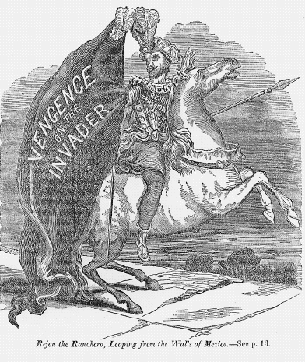
Figure 7.“Rejon the Ranchero” illustration from Charles Averill's The Mexican Ranchero (1847). (Yale Collection of American Literature, Beinecke Rare Book and Manuscript Library)
More usually, though, Mexican men were represented as unmanly because they were savage, as Indians and blacks were thought to be, or because they were decadent, as Spaniards and creoles appeared when viewed through the lens of the Black Legend. In both cases Mexican men were outside the pale of white male civility as it was defined in the mid-nineteenth-century United States.[47] Indeed, in this literature the civility and manliness of white U.S.-American men is defined in opposition to the incivility and unmanliness of Mexican men. In Inez, the Beautiful, for instance, Charles Devereux, an American lieutenant “just verging towards manhood” (10) exhibits his manliness by foiling the efforts of Don Jose Terceiro—a “monster bearing but the semblance of a man” (18)—to rape the heroine and to force her to marry him. Terceiro is an un-manly monster in a man's guise because his passions, which are deemed Castilian, are so easily inflamed, and so he tries to make Inez the “victim to his hellish lust” (14). But she escapes by jumping into a river, whereupon Devereux promptly rescues her. Although he, too, is sexually aroused by her, he prays to heaven for “courage to banish the polluting desire that for a moment possessed” him (20), and in the end he becomes engaged to marry her. In The Secret Service Ship General Ampudia is similarly represented as an unmanly “avenging fiend of hell” (12) because he is unable to control his passions; the chivalrous Midshipman Rogers, however, displays his manliness by rescuing a woman Ampudia is trying to rape and by hurling the general into a sepulchral pit. Finally, in The Prisoner of Perote, it is because of his timidity rather than his rapacity that the Mexican cavalry officer Don Fernando is the defining foil for the U.S. hero. Fernando fails to rescue his betrothed from a fire because he is wounded and timid, but his failure makes it possible for the U.S.-American Julius Marion to step in and display his manly courage and coolness as he rescues the beautiful Josefa, who promptly falls in love with him. In addition to this panoply of passionate, unmanly Spaniards and creoles, the novels also include many representations of lawless, savage mestizo rancheros and villainous, licentious priests.
In almost every case, the representations of unnatural genders and perverse sexualities are used to legitimate some form of U.S. involvement in Mexico. For not only are manly U.S. men often characterized through
The heroine's love object is almost always a U.S. officer whose manly body and status as a representative of the nation are the most important things about him. Midshipman Rogers, for instance, is initially described as a kind of walking, talking U.S. flag. In the first scene, while he is on a spy mission dressed as a Mexican, he saves the heroine from assault and then exposes his true identity:
The cloak fell instantly from the disguised form of the unknown, revealing the graceful figure, and lordly proportions of a strikingly handsome young man arrayed in the brilliant uniform of an American Naval Officer, in a proud attitude of command, as he stood thus majestically upon the castle ramparts of San Juan d'Ulloa, his right arm rearing proudly aloft to the breezes of the
All tricked out in stars and stripes, the naval officer's body—his “graceful figure” and “lordly proportions”—presents a spectacle at which the heroine gazes “in involuntary admiration” (15). Generally, the hero's role as a U.S. soldier is the key to his character. In The Hunted Chief, we never learn what part of the United States Lieutenant Rain-ford is from, nor does the narrative reveal anything about his class of origin; what is more important is that he possesses “an extraordinary share of manly beauty” and that there was “a fire in his hazel eye that could stimulate a soldier to deeds of daring, or could kindle a flame in the heart of a susceptible maiden” (4).
Despite the emphasis on an overarching model of military manhood that could serve as a point of identification for U.S.-American men of different classes and as an object of desire for readers, however, domestic class hierarchies continue to be registered in much of this fiction. Alexander Saxton has argued that the story-paper fiction of the 1840s features “Free Soil” heroes who adumbrate “the Free Soil alliance of yeomen, artisans, and established capital out of which sprang the Republican party” in the 1850s.[48] But during the 1840s, this coalition was still inchoate, and story-paper literature reflects different positions on the question of class hierarchy, from Whiggish efforts to adapt it to the changing conditions of Jacksonian U.S.-America, with its increasing intolerance for a “politics of deference,” to other efforts to liberate middle and lower-class male characters “from the disabilities attached to class.” And yet, despite their differences, both strategies crucially depended upon what Saxton calls the ascendancy of a “scenario of white brother-hood purified and consolidated through the destruction of non-whites.”[49]
Examples of the first position—that is, efforts to preserve class hierarchies while acknowledging changing conditions—can be found in those novels in which an elite U.S. officer, often a merchant's son, is paired with a lower-class Yankee character who speaks in a dialect and
These pairings of elite and nonelite men have a long history that goes back at least as far as Royall Tyler's 1790 play The Contrast, in which Colonel Manly, the romantic hero, was paired with his servant, the yeo-man Yankee Jonathan. Saxton explains that the premise was that Manly, who “spoke for the landlord-merchant oligarchy that had led the Revolution
The pairings of romantic heroes and Yankee vernaculars in U.S.–Mexican War novels reflect efforts to construct cross-class alliances between a merchant elite and a lower class of yeomen and artisans in the wake of the Jacksonian upsurge. In The Mariner of the Mines the merchant's son Redwood even explicitly repudiates the aristocratic prejudices of his father and opts for the society of the “common man.” Although Campbell also turns out to be a merchant's son, his status as a foundling of unknown origin for much of the novel provides opportunities for an assault on the merchant Sherwood's similarly aristocratic prejudices; and Sherwood's change of tune after reading of Campbell's valor on the battlefield suggests that manly military merit, as demonstrated by participation in U.S. empire-building abroad, can compensate for an obscure or lowly class origin. On the other hand, the Yankee Zephaniah Sniggins exhibits none of the deference that marked the behavior of earlier Yan-kees such as Tyler's Jonathan. He still, however, tries to negate differences of class and status by making fun of blacks; even though he is paired with Caesar, he reasserts a hierarchy between himself and the servant that replicates and displaces the earlier hierarchy between white master and white servant in plays such as The Contrast. Indeed, the bonds of white brotherhood between the yeoman Yankee and the merchants' sons are forged at the expense of Caesar, who remains literally bound in a servile relationship to Campbell at the end of the novel, as well as the “motley and merciless” (11) Mexicans against whom the white brothers battle.
Significantly, the bonds of white brotherhood are also forged in opposition to the immigrant Irish. In The Mariner of the Mines, the patriotic Yankee is contrasted with Dennis O'Finnegan, a side-switching sergeant in the Mexican infantry who, when asked if he is a Mexican, replies
And yet, these strategies for turning representatives of different classes into a band of white brothers do not completely succeed in obscuring class differences. They continue to be strongly marked, especially in the contrast between the Yankee's peculiar dialect and the refined, proper speech of the romantic heroes. It is also noteworthy that the Yankee in The Mariner of the Mines is paired with Caesar Burney instead of simply being assimilated to a trio that includes Redwood and Campbell; despite the hierarchy that structures the relationship between Caesar and the Yankee, as “common soldiers” they are distinguished from the officers, and the text establishes a mirroring relationship between them through the use of dialect and by making them the sources of comic relief. Finally, what Saxton calls “the problem of marriage-ability” continues to haunt these novels, underlining the class differences that the authors in other ways try to obscure and soften. In The Mexican Spy the Yankee is entirely ineligible for romance; he returns home to Vermont while the elite romantic hero, Major Rowland, is married to the merchant's daughter, Annabel Blackler. And in The Chieftain of Churubusco, the Yankee weds Vanilla Hartville, a blind girl who in the beginning is the heroine's servant and is said to be the daughter of a Mexican “lepero,” although she turns out to be the daughter of a poor Texas settler. The elite hero Charles Warren, however, marries the wealthy and aristocratic Lauretta Varere. Similarly, in
The Mariner of the Mines, the Yankee returns home to marry his lowly Yankee sweetheart while the two officers and merchants' sons marry rich women. These representations to some degree qualify Saxton's claim that before the Civil War, “[r]omantic love was not for vernaculars” even as they establish boundaries between the classes that cannot be bridged by marriage.[54]
Saxton argues that only later, after the U.S.-Mexican War period, is “equal access to privileges of the upper class, including acquisition of wealth and marriageability,” extended to characters of lower-class origin.[55] Significantly, the example he cites is Ned Buntline's Buffalo Bill, who, despite his relatively humble origins, gets to marry a banker's daughter. But Buntline was already working toward such a solution to the problem of marriageability in The Volunteer, in which he makes the hero, George Blakey, a backwoodsman from Kentucky. George's father, a self-made man, had come to Kentucky “with no property save his axe, rifle, and a healthy young wife [!]” (8) but soon became a successful shopkeeper. As a Westerner and a shopkeeper's son, George is considerably removed from the merchant elite of New York and Philadelphia, but he is the hero of international romance nonetheless, for he wins the heroine's love despite the fact that “his line of descent” is not “so haughty as her own” (70). In Newton Curtis's The Prairie Guide, also, the “handsome and noble-looking” Charles Fanchette impresses the rich Mexican heroine “despite the rough teachings of his early education” (24), and a U.S. officer notes, “[If] he does not make a noise in the world yet, then I am no prophet. One may look a long time for his equal” (7). But such a white egalitarian position, which emphasizes equal opportu-nity and class mobility for nonelite men, is grounded in the ideal of white “native” military manliness tested and displayed through violent encounters with foreigners and nonwhites. This is true of all of the story-paper novels that obscure or negate the hero's class origins in favor of an overarching model of imperial manhood and international romance.
Another way that these novels try to mitigate class differences among U.S.-American men is by contrasting them with foreign villains who are also wealthy aristocrats. In The Hunted Chief, the Chevalier Rijon, who wants to force a marriage with the heroine, is a sensual, rich, Spanish native, the descendant of a noble family who nonetheless exhibits “no true nobility” but is rather “an unprincipled villain” (16). In Buntline's Magdalena, the villain is Colonel Gustave Alfrede, a rich Mexican officer who rapes and kills the U.S. hero's mother and sister and then tries to use the leverage of debt to force Magdalena's father to pressure her to
Force and consent are key words in these international romances. Although Donna Isabella Xera, the heroine of The Prairie Guide, despises him, Captain Minon pressures her guardian and even kidnaps and imprisons her in an effort to force a union. Even though her uncle initially consents to the marriage, however, Isabella insists that “I ought to be permitted to make my own choice” (17). When in The Chieftain of Churubusco, Don Jose de Varere—“a rich and influential citizen of Puebla”—says that his will is his daughter's law and that he can determine whom she will marry, her servant girl replies that it “may be so in everything else but love” (11); the heroine, Lauretta Varere, indeed refuses to consent to the unwanted marriage in spite of her antagonists' efforts to force her to do so. And in The Texan Ranger, Adela refuses to agree to marry Don Eugenio, “a lover chosen for her by her father, rather than by her own will” (92). By identifying Mexico and Spain with patriarchy and coercive force, these narratives represent the United States, by contrast, as the land of modernity and relative freedom for women. Since in these novels romantic and political discourses are mapped onto each other, these scenarios also construct the Mexican government as despotic and U.S. government as consensual, democratic, and “free.”
Scenes in which Mexican heroines and U.S. heroes are magnetically attracted to each other and almost instantly fall in love reinforce this dichotomy between force and consent, imagined as a contrast between Mexico and the United States. When Xelima and St. James quickly fall for each other in The Vidette, the narrator defends love at first sight: “True love is to the human soul, what the spark of fire is to the magazine, and equally as instantaneous in its effects” (79). And when Fanchette, the prairie guide, first sees Isabella, he “started, as if he had received an electric shock” (24) and soon harbors a “deep and fervent attachment” to her, while after only a few hours, “with all the ardor of a soul capable of the greatest extremes of passion—she loved him!” (25). By making the U.S. hero the Mexican heroine's romantic choice, and by
This ideological work was especially urgent because U.S. opponents of the war were increasingly arguing that the invasion of Mexico violated the liberal democratic ideal of consent, although occasionally the principle of consent would be invoked to explain why the United States could in good conscience annex all or part of Mexico. The expansionist Democrat senator Dickinson, for one, argued that as a republic, “deriving its just powers from the consent of the governed,” the U.S. form of government was “admirably adapted to extended empire,” inasmuch as “its influences” were “as powerful for good at the remotest limits as at the political centre.”[57] More often, though, when the question of annexation came up, the ideal of consent was cited as a reason why the incorporation of Mexico would be hypocritical and wrong. The Whig C.B. Smith, for instance, argued in the House of Representatives that the U.S. government was based on the principle of “consent of the governed” and that imperialists sought “in violation of this principle, to extend our government, by force, over a reluctant and unwilling people.”[58]
In practice, of course, liberal democratic theory often conflates consent and submission, and it thereby fails, as Carole Pateman argues, “to distinguish free commitment and agreement by equals from domination, subordination, and inequality.”[59] In a critique of consensual paradigms as they have been applied to Chicanas/os, Carl GutiérrezJones has persuasively argued that since “the history of Anglo and Mexicano/Chicano interaction is one of territorial occupation through legal manipulation working in concert with violence, it comes as little surprise that consent, as framed in the mainstream manner, is significantly challenged by Chicano texts: consent cannot be the cornerstone of justice where choice has not played a significant role.”[60] In the mid–nineteenth century, the question of empire forced some of these contradictions to resurface in the sphere of politics as well as in mass literary culture. In response to the war, in other words, congressmen found it necessary to return to questions of consent and to debate the meaning of a principle that was more often left unexamined. And although advocates of expansion would of
Many of these novels symbolically attempt to reverse the U.S. invasion of Mexico by representing international romance as the Mexican heroine's conquest of the U.S. hero. After Charles Devereux falls in love with Inez, he thinks of her as “the being who had taken captive his heart” (22). And in The Secret Service Ship, Midshipman Rogers not only tells Isora that she has made “a full conquest” of his heart but also adds, “You had made a breach in the walls, the first glance I received from your dark eyes on the ramparts of San Juan d'Ulloa!” (63). Although U.S. soldiers were invading the homes of Monterrey and bombing the city of Vera Cruz, narratives such as this one try to invert the terms of military conquest and occupation by making the Mexican woman the conqueror. Midshipman Rogers also tries to heal the wounds of war and turn force into consent by suggesting that love transcends national enmities: “By nationality we are enemies, 'tis true, dear lady, but O! say not that in feeling and in LOVE we are foes!” (63). Other strategies that are deployed to justify a U.S. presence in Mexico include the emplotment of a preexisting relationship between the romantic hero and heroine. In The Mexican Spy, the half-Mexican Annabel Blackler observes that “the affections of my heart were pre-engaged long before I first came to this unhappy country” (62); and in The Texan Ranger, Marguerita fell in love with a U.S. officer at a military ball while her father was exiled in New Orleans: “[F]or his sake,” she “loved the whole nation” (102). These representations try to override the military hostilities between nations by resolving them into loving bonds that derive from preexisting transnational connections between elites in Mexico and the United States.
Although many of these novels promote international romance as the symbolic resolution to the war, the conclusions present a number of different outcomes. In The Prairie Guide, the Mexican heroine Isabella dresses as a man and follows her lover to Matamoras, where he has rejoined the U.S. forces. Once it is revealed that she is a female in disguise, the two are married at once, making it possible for the humble guide to share her “immense estate” (8) and incredible wealth. This ending is obviously suggestive of the landgrab that accompanied the ending of the
Although a significant number of these novels end in marriage, in others marriage must be deferred until the war ends. Inez, the Beautiful, for instance, ends with a “contract of marriage” between hero and heroine that is “not to be consummated until peace is concluded between the United States and Mexico” (50–51). The narrator concludes that this is “a consummation devoutly to be wished” by “that respectable class of citizens who embrace the strongest PEACE views” (51). And at the end of The Secret Service Ship, Midshipman Rogers and Isora La Vega are engaged and plan to marry at the end of the war, when “there will be no bar of nationality” between the “union” (100). At the conclusion of The Light Dragoon, too, the U.S. officer Allston and the heiress Elvira are engaged but not yet married, and Elvira is revealed to be the lost child of a U.S. officer in the Seminole War and his Spanish wife, who was murdered by Indians (rather than the daughter of the rich Mexican Espindola, who adopted her). After they marry, Allston plans to return to Mexico as soon as that country is “conquered” in order to claim the deceased Espindola's estates “in the name of the heiress, Elvira” (100). This conclusion seems to indicate a desire for Mexican lands without the Mexicans, since Elvira turns out to have only a legal relationship to her “adopted” nation.
In still other novels, however, the consummation of international romance is prevented by the violence of war or by other obstacles, such as the previous engagement to a U.S. woman that makes it impossible for
Julius, in The Prisoner of Perote, to return Josefa's love. At the end of the novel, during the siege of Vera Cruz, Josefa is killed by a bomb, and as she dies she bequeaths a ring to her friend, Julius's fiancée, which becomes “the sacred bond of their marriage” (40). And The Mariner of the Mines completely rejects the possibility of international romance by wedding Campbell to the daughter of a New Orleans merchant and pairing the wealthy Redwood with the foundling Charlotte Archington, who turns out to be the daughter of a rich U.S. merchant and an Englishwoman whose father traded in Mexico and later became a Mexican citizen. Moreena, a “native Mexican girl,” falls in love with Redwood, and when she is rejected by him her love turns to hatred and she tries to kill both him and Charlotte, although she is ultimately foiled. Her brother Francisco, who tries to force Charlotte to marry him, fares no better. This novel apparently refuses any form of amalgamation between the United States and Mexico, although it does underline the advantageous trading relationships that might be established in Mexico by foreign merchants.
Some of these novels end by trying to harmonize relations between North and South. At the conclusion of The Mariner of the Mines, when Caesar Burney remains with “his master” Campbell in New Orleans, Campbell's marriage to the Southern merchant's daughter in that city anticipates the reunion of Northern and Southern interests—at the expense of Burney, of course, as well as the Mexicans who are vilified in this novel. And when the death of the evil Irishman Raleigh allows the dispossessed Captain Harold in The Mexican Ranchero to recover “the old family plantation” in Virginia and to move there with his Mexican bride, the narrative seems to be responding to Southern objections to the war by incorporating the South into its vision of postwar reconciliation, although the question of slavery is repressed. When the issue is explicitly raised in The Mexican Spy, the conclusion seems forced and hollow. That novel features a black character, Brutus, a former slave in Alabama. Brutus, who was freed by his master, is a servant to a rich Mexican don, but at the end he returns to Alabama and becomes the “overseer on a plantation there” (100). In the novel, Brutus, who is paired with the Yankee vernacular character Pelatiah Shattuck, is used as comic relief (as part of a spy mission, he cross-dresses as a nun, for example) in ways that are reminiscent of blackface minstrelsy.[61] The fact that he returns to Alabama and becomes an overseer on a plantation, along with his view of his former master as a benign, fatherly presence, suggests that the novel is struggling to put to rest fears raised by debates over slavery through the promotion of what Eric Lott calls “the mythology of plantation
If these novels strain to manage the incipient crisis, in other narratives the question of slavery erupts from within plots that otherwise try to marginalize the issue. In The Texan Ranger, for example, Marguerita helps two U.S. officers escape from the Mexicans, but she is betrayed by “a Texan slave whom she had trusted, for he had been a servant of her uncle's ever since his flight from Texas, and she believed that he was faithful” (101). But he asked her for more money to keep her secret because he wanted to buy his wife and two boys in Bexar, and when she refused he turned her in to the Mexican authorities. This vignette is particularly interesting because some proannexationists, according to Michael Holt, tried to convince “reluctant Northern Democrats opposed to slavery extension and a growing black population” that adding new territory to the Union would “benefit the anti-slavery cause” by drawing slaves to Texas and eventually to Mexico, thus eliminating “the twin problems of slavery and race adjustment” in the older states.[63] In other words, these Northern Democrats argued that U.S. expansion would mean that slavery would move even farther south and therefore farther away, and that slaves would gravitate across the border to whatever was left of Mexico, where slavery had been abolished. Although such a representation of runaway slaves in Mexico might have comforted the many Northern Democrats who wanted black people removed as far away as possible, it could hardly, however, have been reassuring to Southerners who worried, during the debates over the Wilmot Proviso, about the protection of the peculiar institution.
In The Volunteer, on the other hand, the Mexican heroine's brother, the guerrilla Canales, also employs a black “body servant,” Matteo, who accompanied him from Texas to Mexico and whose son, Roberto, joins Canales's band. Even though Matteo's continued service to Canales might suggest to supporters of slavery that racialized labor relations akin to slavery could be maintained in Mexico, Roberto's assimilation into Canales's guerrilla band is treated more ambiguously. In fact, this portrayal of the black son of a slave allied with Mexican guerrillas recalls the fears raised in the Williams Brothers' story paper the Uncle Sam, quoted in the previous chapter, to the effect that mixed-blood Mexican soldiers “proclaiming liberty to the people of color” might enlist Southern slaves to fight against U.S. whites. At the very
And what of the “internal stresses” of Indian/white relations? Despite the recent history of Indian Removal, the Seminole Wars, and the Black Hawk War, those who supported annexation in Congress sometimes optimistically suggested, as did Senator Sevier, that “[we] can get along with those Indians with as little trouble as we do with our own”[65] Some of these, like Senator Breese, thought that Mexican Indians were “apt to learn, and willing to improve, and, if not possessed of all the manlier virtues, have at least those which fully ensure their cheerful acquiescence to our control and rapid advancement under it.”[66] Others, such as Senator Dickinson, took the harsher view that like “their doomed brethren, who were once spread over the several States of the Union, they are destined, by laws above human agency, to give way to a stronger race from this continent or another.”[67] Although Democrats generally endorsed one of the poles of the “civilization or extinction” dyad, Whigs who opposed annexation tended to argue that Mexican Indians were not likely to disappear anytime soon, and almost all of them worried about the incorporation of Indians into the white nation.[68] Senator Bell, for instance, warned that even if U.S. whites immigrated to Mexico, “[Y]ou will still have five millions of Indians on hand, to be an ever-eating canker on your system.”[69]
The international romances of 1846–1848 usually focus most centrally on Mexican creoles, but some Indian characters do appear in these texts in subordinate roles. In Buntline's Magdalena, the Indian boy Zalupah, who is Magdalena's servant, is so intensely loyal to her that he sacrifices his life to save the U.S. officer that she loves. Although his behavior is described as “brave” and “noble” (63), this representation naturalizes hierarchical master/servant relations and constructs what we might call a mythology of hacienda paternalism that implies that creole/Indian relations in Mexico resemble (white fantasies of) white/black relations in the South. Zalupah is also used to define Magdalena's whiteness through contrast. When she decides to disguise herself and to team up with Zalupah in order to save her beloved, she must stain her face and hands “as dark as a New Orleans quadroon, or a Seminole Indian” (59) in order to be of “the same hue” (59) and to pass as an Indian
Mexico, doubtless by taking U.S. interests to heart. Indeed, in some of these romances, the representations of U.S. merchants and especially merchants' sons, many of whom do not marry Mexican women, suggest that these novels may be advocating intimate economic relationships with Mexico rather than political or romantic ones. Although it would be difficult to argue in almost every case that the story-paper novels un-equivocally endorse the war and the annexation of Mexico, in all of these narratives the boundaries of gender, race, and sexuality are central to debates over the politics of empire-building and the incorporation of “foreign” territories and peoples.
I suggested in the previous chapter that story-paper literature claimed to be neutral or independent and tried to appeal to a mass audience composed of multiple classes. Nonetheless, the political debates between Democrats and Whigs over the war and annexation resonate throughout the pages of these novels. Although Democrats advocated the annexation of all of Mexico, more of them wanted to take only the relatively sparsely inhabited parts of northern Mexico, especially California. And despite the fact that most of the Whigs voted for supplies and resources in support of the war, and even ran war hero Zachary Taylor as their presidential candidate in the election of 1848, many raised questions about the origin of the war, tried to devise strategies for ending it, and argued for a “No Territory” program. Indeed, Whiggish positions are implicitly referenced in the story papers more often than might be expected, not only when objections to annexation are voiced but also in the efforts to construct models of white Protestant manhood and fraternity that might serve as “mutualist” points of identification for U.S. American men of different classes. Such a conjunction of class, nativism, white manhood, and imperialism is especially significant in the work of Ned Buntline, whose infamous career as a purveyor of popular culture is the subject of chapter 5.
5. From Imperial Adventure to
Bowery B'hoys and Buffalo Bill
Ned Buntline, Nativism, and Class
Ned Buntline was surely one of the nineteenth century's most popular writers. His literary career spanned most of the second half of the nineteenth century, from the 1840s until his death in 1886, and during those years he produced dozens of mysteries-of-the-city and Western frontier novels. Buntline's significance as an innovator in these popular genres has sometimes been noted, but little has been said about the imperial adventure fiction that he wrote during the 1840s and 1850s. This chapter argues that Buntline's sensational literature about Mexico, Cuba, and an “empire of Popery” can tell us much about the intimate, volatile relationships among working-class culture, nativism, and empire in the mid–nineteenth century. As I suggested in the previous chapter, constructions of white Protestant manhood and fraternity figure significantly in Buntline's U.S.–Mexican War romances. In addition, plots about Cuban filibustering as male adventure emerge from within his mysteries-of-the-city novels about New York City and New Orleans, and fears of rival empires and anti-Catholic sentiments that were enflamed by the U.S.-Mexican War shape the nativist labor culture that he energetically promoted in his fiction and in his popular newspaper, Ned Buntline's Own. As in the other story-paper literature that we have considered, moreover, in Buntline's writing questions of empire are inseparable from issues of race, gender, and sexuality.
During the war years, Ned Buntline was one of the Flag of Our Union's most popular writers, so much so that the publishers included
Even before the U.S.–Mexican War years, Buntline scored his first successes as a professional writer by producing sea yarns that were sometimes loosely based on his own maritime experiences. Buntline signed up for the U.S. Navy in 1837, when he was sixteen, and during the next four years he fought in the Seminole War and sailed to various U.S., Caribbean, and Mexican ports.[1] After 1844, he coedited a Pittsburgh magazine and later the Western Literary Journal and Monthly Review, a paper based first in Cincinnati and then Nashville, where he published a few Seminole War stories before moving to New York City to work as correspondent for the Philadelphia Spirit of the Times. In New York he was briefly embraced by that influential arbiter of genteel literary standards, the famous Whig Lewis Gaylord Clark, who published some of Buntline's stories in the Knickerbocker before dropping him. But before that happened, Buntline had already departed for Boston, where he quickly hooked up with Justin Jones and his story paper the Star Spangled Banner as well as with Gleason and Ballou at the Flag of Our Union. As a result, he produced a considerable number of romantic adventure novels with foreign settings, including two U.S.–Mexican War romances: The Volunteer: or, The Maid of Monterey, a hundred-dollar prize story that was serialized in the Flag and then reprinted as a pamphlet novel by Gleason in 1847; and Magdalena, the Beautiful Mexican Maid, which appeared in 1846.
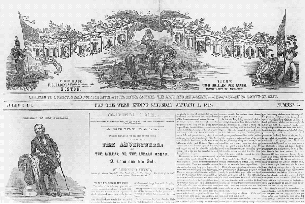
Figure 8. Masthead of 1 January 1848 issue of the Flag of Our Union, with portrait of Ned Buntline and excerpt from Maturin Murray Ballou's The Adventurer. (Courtesy American Antiquarian Society)
By taking the U.S.-Mexican War as his subject, Buntline was dealing with nearly contemporary events, the outcome of which was still uncertain in August and September of 1847, when the Flag serialized The Volunteer. In October, the story was quickly published as a novelette, and since the war was still going on, the publishers suggested that it “might afford much interest to the gallant volunteers in Mexico, and their friends at home should send them something to wile [sic] away the hour of their night watches, in the interim of camp duty” (2 October 1847). Although Buntline and the paper were clearly trying to capitalize on the “state of feverish excitement” provoked by the war and although the novel champions the imperial manhood of the U.S. citizen-soldier, its position on the war and the question of the annexation of all or part of Mexico is more ambiguous, despite Buntline's efforts to use the conventions of romance to turn the invasion of Mexico into a chivalric U.S. rescue mission.[2]
From the beginning, the war is represented as, above all, a testing ground for U.S. manhood. When George's mother begs him not to enlist,
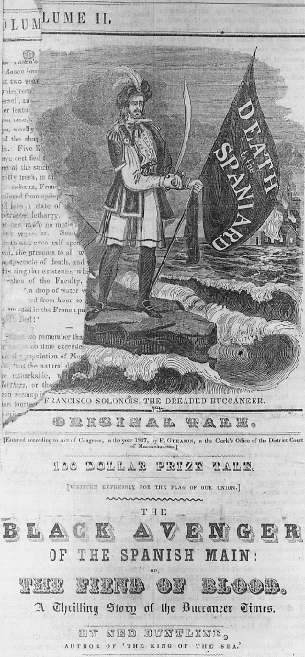
Figure 9. Detail, “The Black Avenger of the Spanish Main,” from 10 July 1847 issue of the Flag of Our Union. (Courtesy American Antiquarian Society)
The boundaries of an idealized masculinity are established in The Volunteer through contrast, as the heroic, chivalrous Blakey is opposed to Gorin, a rapacious Texas Ranger who burned down the house of the heroine's Mexican mother and Anglo-American father and tried to kill her and her brothers, thereby turning all of the remaining family members into guerrillas who fight for Mexico. By making the Texan Gorin into the villain in this story, Buntline displaces a critique of U.S. empire onto the republic of Texas, which he represents as a lawless world of crime and rule through force before the United States claimed it. He also decouples this rapacious masculinity from whiteness by describing Gorin as “one whose dark brow, coal-black eye and swarthy hue, made him much resemble the Mexican race” (22). At one point, Gorin even switches sides and fights for the Mexicans. But the treacherous and woman-hating ways of the dark Gorin, “that thing who calls himself a man” (45), only
The cross-dressed heroine Edwina Canales/Helen Vicars is a central figure in this attempted conversion. Her own transformation from male to female is also significant within the imperial plot. When Blakey first encounters her, she is dressed as a man and remains on the battlefield to fight U.S. forces even though the rest of her troops have fled. When she finally falls from her horse, Gorin tries to kill her, but Blakey prevents him. After this tenacious Mexican officer surrenders, Blakey observes that he “seemed to be but a young boy, his dress too was singular, and his appearance far more feminine than his actions would denote” (12). But once Blakey gets a closer look at the officer's “luxuriant and glossy curls,” “delicate foot and hand,” and “jet black eyes, so large, so dewy, and shaded by lashes of silken gloss,” he quickly exclaims, “By heavens, you are a lady!” (12). Curious to know what “wrongs” induced her “to unsex [herself] and face the fearful perils of war” (12), he eventually learns that she was born in Mexican Texas and that her parents joined the rebellious Texans against Mexico but were murdered by Gorin and some of his henchman because she refused his attentions. She and her brothers escaped Gorin by fleeing to Mexico, where they adopted that nation's cause as their own. By the time Blakey hears this story, he is already in love with her—“in love with a foe!” (31). This causes a delay in the progress of their romance, since both of them are so patriotic, but by the end of the story Edwina has agreed to marry Blakey and to return with him to his “native land.”
The heterosexual union between Blakey and Edwina/Helen, who has been converted from a masculine foe into a feminine love object, confirms Blakey's imperial masculinity and to a degree validates the U.S. presence in Mexico. Even though her brother initially feels that his sister, who comes from “one of the proudest stocks of Spain,” should not marry “one of the Saxon blood” (70), he ultimately consents to the marriage, announcing, “We give you our dearest treasure, noble American—we know that you will guard and cherish her. You have won her by your prowess—take her, and God bless you!” (91). If as the defender
It is doubtful that this conclusion, however, signals a straightforwardly proannexationist position. For instead of remaining in Mexico, Blakey returns to Rural Choice with his bride, while the guerrilla Canales swears that he will go on fighting for Mexico after they depart. At the end, Buntline refers his readers to “the papers,” in which “each new report from Mexico, brings accounts of his daring deeds” (100). He also warns his readers that General Urrea is still “in the field, and is one who while a blade is lifted against our flag, will still fling his banner to the breeze. Though an enemy, he is brave, skilful, and daring” (100). These passages imply that Blakey/the United States can “win” control of new areas (Ed-wina/northern Mexico) only with the consent and cooperation of a male Mexican elite, represented here by Canales and Urrea. But it is also un-clear that Edwina stands in for the Mexican nation as a whole, or that the union between her and Blakey indicates the desirability of the annexation of Mexico. For it is important to recall that Edwina was born in Texas and is only half Mexican. She is even contrasted with General Urrea's daughter, Anita, who is said to be both “Castilian” and “Aztec” and who remains in Mexico to marry one of the Canales brothers. While for Buntline a creole Tejana can become a part of the U.S. family, the Mexican woman of Indian descent must stay where she is and be wedded to the Mexican guerrilla fighter, suggesting perhaps that the United States should not try to annex the whole of a more densely populated, “Indian” Mexico but should instead be content to take only the more sparsely settled northern borderlands. Although Buntline struggles to bind together heterodox international constituencies—in this case, the white rural settlers of Kentucky and the creole elite of Texas and Mexico—through a rhetoric of heterosexual union, the racial heterogeneity of Mexico seemingly makes him wary of endorsing the incorporation of all of Mexico into the United States.
What is more, images of U.S. intervention as rape rather than rescue repeatedly recur in the narrative, troubling the alignment of the villainous Gorin with the realm of brute force and of Blakey and the United States with a chivalric reverence for the principle of “consent.” Buntline's novel opens on the fourth day of the attack on Monterrey, with U.S. troops “forcing their way through the walls of the houses, step by step, toward the heart of the city … through casements and lattices where never before was seen aught but flowers and smiling faces, now treading with armed and blood-stained heels over silken carpets, then crushing the flowers that had been reared and cherished by the fair hands of many a sweet southern girl” (7). The violent, sensational language of the opening paragraphs already figures the war as a rape in which U.S. soldiers force themselves upon the city of Monterrey, crushing the flower of southern girlhood as they brutally proceed. Just as it did for Lippard, the siege of Monterrey in particular causes problems of representation: how to romanticize this series of battles in which U.S. soldiers invaded Mexican homes, breaching walls between dwellings as they moved from one part of the city to the next, inevitably causing the injury and death of noncombatants as they proceeded? The violence of this opening series of scenes is never completely sublimated into romance, and throughout the narrative the U.S. presence in Mexico is repeatedly figured as an invasion rather than a righteous response to Mexican attacks on Texas and the United States. Toward the end of The Volunteer, Blakey even announces that this “will be the last war of invasion in which I shall ever participate. I would die for the defence of my country, but never again will I leave her borders to seek for glory!” (75). In passages such as this one, the fiction of the United States as chivalric defender of white Mexican womanhood cannot be sustained. And since the analogy between hero and nation also works in reverse, it could be argued that Blakey's heroic masculinity is compromised by the rapacious nationalist acts of wartime aggression that frame the story. This emphasis on the war as invasion also recalls the Whig redescription of the conflict with Mexico as a rapacious act of conquest.
And if international romance fails to fully resolve the contradictions and conflicts unleashed by the U.S.-Mexican War in The Volunteer, in Magdalena, the Beautiful Mexican Maid, the love plot itself has a tragic ending. Inspired by John Greenleaf Whittier's antiwar poem “The Angels of Buena Vista,” which is incorporated into the text, the story is about a romance between Charles Brackett, a half “Castillian” Texas Ranger,
It could be argued that this tragic ending signifies the futility of war, which prevents the healing closure of international romance, and that the novel therefore suggests that imperialist U.S. policies are bloody and uselessly destructive. Such an interpretation of Buntline's purpose could be supported by Blakey's surprising insistence at the end of The Volunteer that the war “has been a sad one for both countries, one in which much noble blood has been lost, one which neither government can gain by!” (89). But in Magdalena, Buntline places more of the blame for the war on Mexico. Although the villain Gorin is a U.S. citizen in The Volunteer, in Magdalena the evil Alfrede is a Mexican creole, and the conflict between Brackett and Alfrede is said to result from Mexican war crimes in Texas rather than the atrocities committed by Texas rangers. Indeed, in Magdalena, Buntline goes so far as to commend the U.S. forces of occupation for refraining from committing “a single outrage upon the vanquished foe, even though there were men there whose relatives had been butchered in the ‘Alamo,’ or whose families had been robbed and murdered on the gory plains of Texas” (54). In these ways, Buntline suggests that the war is the result of the murderous excesses of Mexican troops in Texas, led by rapacious officers such as Alfrede. Such a reading is reinforced by Magdalena's fears at the end of the novel that
But U.S.-American manhood, as embodied by Charles Brackett, is more oddly racialized in Magdalena than in The Volunteer, where it is represented by the “Saxon” Blakey. When Brackett is chosen to pass as a Mexican and spy on the enemy, a U.S. officer explains to General Taylor that Brackett is the perfect man for the job because, “as his mother was a Castillian, [he] is full as dark, but not quite so yellow as a real native. If he was stained with a shade of butternut color, and rigged up a la ranchero, he'll make as good-looking a Mexican as I ever drew lead on” (6). Although Brackett's patriotism is repeatedly praised and although his European descent is emphasized, the strange remarks about “color,” along with Brackett's ability to easily pass as a Mexican, suggest a more ambiguous racial status.
On the one hand, it was extremely unusual that a non-Anglo man would be the romantic hero in such a novel; in Magdalena this is possible, it would seem, only because Brackett is part “Spanish” rather than mestizo or Indian. On the other hand, in a rare development, Brackett dies in the final chapter, preventing this international romance from en-gendering a future. Buntline's decision to give this novel a tragic ending suggests an unwillingness, in other words, to make this pair a model for a postwar relationship between the United States and Mexico. Instead, he implies that the war is basically a family squabble between “Spanish” Texans and Mexicans. Although Alfrede's rapaciousness and his use of debt as a way of controlling people anticipate Buntline's venomous descriptions of the wealthy “upper ten” in his urban melodramas, the vision of Mexico that is presented in this novel is generally negative, despite the idealized representation of Magdalena and her sister. Since Buntline blames the war on Mexican rapaciousness and even suggests that the seemingly benign Senor Valdez is incapable of managing his hacienda, it should not surprise us that in this novel he seems to want to keep Mexico at a distance rather than incorporate Mexicans, whether creole or Indian, into U.S.-America's future.[7]
These ambiguous representations of the U.S.-Mexican War do not, however, support the conclusion that Buntline was an ardent anti-imperialist,
In December of 1847, the first installment of Buntline's massive Mys-teries and Miseries of New York appeared. Based on the pattern estab-lished by Eugène Sue in Les Mystères de Paris and imitated by countless others on both sides of the Atlantic, the novel exposed the city's myster-ies, as Michael Denning puts it, “by telling tales of criminal underworlds, urban squalor, and elite luxury and decadence.”[9] As part of that project, Buntline represented poor sewing girls persecuted by “fashionable young gentlemen, sons of the ‘first families’”; a prostitute with a heart of gold; a clerk who is tempted to embezzle from his employer to support his gambling habit; and a dizzying array of other urban types.[10] In order to condemn urbanization, he also singled out for particular criticism spaces in which working-class blacks and whites mingled, included several representations of foreign-born criminals; and added an appendix that blamed immigrants for increases in urban crime. On the other hand, midway through the novel, he incorporated as one of the story's heroes the native-born Mose, the Bowery B'hoy, a character who was first in-troduced to the New York public in Benjamin Baker's play A Glance at New York in 1848.[11] In the months that followed, Buntline wrote a se-quel to Mysteries called Three Years After, which Baker used as the basis
Although Buntline's role as self-appointed advocate for the Bowery B'hoys in his public actions, journalism, and novels clearly indicates his significance in the mid-nineteenth-century popular culture of New York City, he never abandoned his earlier interest in U.S. empire. In Myster-ies and Miseries of New York, issues of empire are relatively marginal, coming briefly into view, for example, when the gambler Henry Carlton vows to retire at fifty and “go to Mexico or South America, kick up a revolution, and found a kingdom for myself, as Aaron Burr intended to do” (part 3, 33); or when Buntline's narrator declares war against gam-bling dens and vows to “treat them worse than ever ‘Rough and Ready’ did the Mexicans” (part 3, 126); or when Carlton urges the embezzler Charley Meadows to “go into the interior of Cuba, change [his] name and buy a plantation” (part 4, 85). But in The B'hoys of New York, which was written after Buntline's conviction, a Cuban filibustering plot is central to the narrative. In this novel, Buntline's villain is the Spaniard Senor Alvorado, a smuggler and pirate who plans to amass millions of dollars in order to fund his plans to “strike for Revolution and the pres-idency of a new Republic!”[18] Even though his scheme to “accomplish the freedom of Cuba” is treated ambivalently by Buntline, Alvorado is at the same time blamed for a number of crimes. To name just a few of these, he rapes the seamstress Agnes Morton, the daughter of a merchant who killed himself after his business failed in the Panic of 1837, and Alvorado thereby causes her insanity and suicide; he pretends to get her recently unemployed brother, George, a job as a clerk for a Spanish mer-chant and then tries to have him killed while on a ship bound for Cuba; he betrays, robs, and kills a “good,” Robin Hood–like, native-born pi-rate (who became a pirate only after killing the stepfather who murdered his mother and stole the fortune left to him by his father) and also acci-dentally murders the pirate's wife, whom he was trying to seduce; and in the dark conclusion, captioned “Read it and weep,” his ship outruns George's, Alvorado escapes to Cuba, one of his mates shoots George in the head, and George's brains ooze out upon his new bride's snow-white dress. In visceral, sensational terms, then, Buntline constructs the Spaniard Alvorado as a foreign scapegoat for urban problems. In this way, Buntline brings together a variety of urban social types—the bank-rupt merchant, the unemployed clerk, the orphan girl turned seamstress, the dispossessed and criminalized native New Yorker—and suggests that they are all victimized by the foreign pirate/revolutionary. This move re-capitulates, on a symbolic level, nativist, “mutualist,” cross-class al-liances forged at the expense of immigrants and other foreign bodies,
But in this novel Buntline also suggests some of the many connections between New York City and Cuba at that moment, particularly the transnational schemes by New York merchants and Cuban expatriates to “liberate” Cuba from Spanish rule. After the signing of the Treaty of Guadalupe Hidalgo in 1848, many U.S. expansionists increasingly turned to Cuba as the next object of imperial interest. This time, Southern slaveholders were more enthusiastic because they believed that the in-corporation of Cuba would involve the addition of one and possibly as many as three new slave states to the union. Many New York financiers and merchants also endorsed this project because Cuba was such an important trading partner, because many of them had close economic ties to Cuba's sugar planters, and because some New Yorkers even owned interests in Cuban plantations.[19] Although U.S. government officials considered different plans for convincing Spain to sell Cuba, others plotted more direct and aggressive military actions. For instance, in 1848 rep-resentatives of the Havana Club, a group of Cuban émigrés in New York, approached Mexican war hero General William Worth about leading an army to Cuba; he agreed to do it but then unexpectedly died of cholera in 1849.[20] Meanwhile, in July of 1848, Venezuelan-born Narciso Lopez founded the Junta Cubano, a New York group dedicated to organizing filibustering expeditions to take over the island. During the next three years, until his execution in Cuba in 1851, Lopez and his supporters would repeatedly try to mobilize support for these expeditions, especially in New York City, Washington, and New Orleans. According to historian Robert May, these efforts succeeded in bringing together a surpris-ing variety of young men, for the “appeal of filibustering crossed class lines,” drawing in “clerks, apprentices, and immigrants” as well as the sons of planters, merchants, and politicians.[21] Indeed, filibustering fa-cilitated the sort of cross-class coalitions that the major political parties were also trying to consolidate.
Despite his representation of the Spaniard Alvorado as a villain in The B'hoys of New York, Buntline was also attracted to the project of Cuban filibustering. In 1851 he sold Cuban scrip that he claimed could be re-deemed if Lopez's filibustering project succeeded, and he also delivered lectures on “Liberty in Cuba” and “Americanism at Home.” Although Buntline's Mexican War fiction suggests that he had reservations about the annexation of all of Mexico, his greater enthusiasm for the cause of Cuban “freedom” could have been reinforced by his support for slavery;
In The B'hoys of New York, for instance, the failed merchant's son George Morton wins the heart of Eugenia Dellarosa, the daughter of a wealthy Cuban. Although George worries that he is too poor to marry her, Eugenia assures him that “in America every honest man is a king—every freeman there equal to the highest born! I look upon you as a son of Washington; you are, at least, the king of my heart!” (135). When George reflects on the fact that his great-grandfather fought in the American Revolution, he suddenly feels better, for he realizes “that he was indeed equal to the highest born Grandee that ever wore a knightly order” (168). Although the novel ends tragically with George's death, this international romance figures Cuban wealth, represented in this case by Eugenia, as accessible even to nonelite U.S. men, as long as they are manly and patriotic, although the risks involved in attaining it may well be fatal.
If The B'hoys of New York registers Buntline's ambivalence about any attempts to “free” Cuba that might be led by Spanish creoles without the participation of U.S. Americans, The Mysteries and Miseries of New Orleans—a novel that Buntline first published in 1851, the year that Lopez was executed—contains a much more explicit endorsement of fil-ibustering in Cuba, and it also traces connections between city and empire in the wake of the American 1848. By setting the opening scenes in New Orleans, Buntline in effect followed Lopez and his coconspirators from New York to that city, where they attracted a good deal of support from New Orleans merchants, both Whig and Democrat, who hoped to benefit from a more intimate trading partnership between Cuba and the United States—particularly by exporting wheat from the Mississippi Val-ley to Cuba.[23] New Orleans became Lopez's base of operations as he or-ganized two more unsuccessful expeditions, including the final, fatal one. For the 1850 expedition, Lopez recruited privates by promising to match U.S. Army pay and to reward them with four thousand dollars in money or Cuban lands if the expedition were successful.[24] He also appealed to recruits by inviting them to show “to Cuba and the world, a signal example of all the virtues as well as all the valor of the American Citizen-Soldier.”[25] Apparently these strategies worked, for Lopez had little trouble
Although the second half of The Mysteries and Miseries of New Or-leans focuses on Lopez's final expedition to Cuba, the first half features a typical cluster of urban “crimes”: an aristocratic libertine plots to seduce a virtuous criolla, a notorious pickpocket successfully bribes two immigrant policemen, and a young man's “passion for gambling” places him in the power of the villain Orrin Bird, who then seduces the young man's neglected wife, Fanny.[27] But this final subplot dominates the sec-ond half of the novel, which also opens up onto scenes of filibustering. When the young man, Charles Gardner, finds out about the seduction of his wife, he challenges Bird to a duel and kills him. At this point, Gardner worries that Bird's friends may try to avenge his murder, and so he looks “for some other sphere of action” (62). He doesn't have far to look, however, for a “new field of action was at that moment opening. Cuba and her wrongs was [sic] laid like a map before him. A land where the people were crushed by the despot's heel—a soil stained with the blood of those who had offered up their lives in freedom's causes, was be-fore him, and knowing a few of those who, for ‘God, Liberty, and Lopez,’ would raise the banner and draw the steel, he volunteered” (62). This expedition partially repairs Gardner's damaged masculinity—Buntline assures the reader that each filibuster “was a man” (62)—and Gardner even manages to initiate an international romance with Guadalupe, the daughter of the Cuban hacienda owner Alvarez. But the expedition is ultimately foiled by the vengeful Fanny, who has vowed to punish Gardner for killing her paramour. In the long denouement, she follows him to Cuba, warns the authorities about his presence, writes a letter to Lopez convincing him to come to the island to support what she mis-represents as a widespread rebellion, and helps the Spanish rulers capture Lopez and his companions, who are then executed. Although this outcome makes Fanny the cause of the failed filibustering expedition that Buntline supports, the conclusion contains a surprising defense of her actions: “Man claims the right to avenge his own wrongs—and why not woman?” And at the end of the novel, Charles dies and Fanny boards a steamer bound for “the metropolis of the Empire State” where she will join, the narrator surmises, “the great whirlpool of society, which contains thousands of women of her stamp” (104).
It is likely that Buntline endorsed the filibustering expeditions of the mid-1850s, as opposed to the fictional Alvorado's schemes to make himself
If Buntline's treatment of slavery and filibustering suggests that foreign policy cannot be adequately understood without considering U.S. do-mestic debates about the future of the “peculiar institution,” the novel also reveals, more specifically, that the mysteries of the capitalist city were complexly entangled with questions of empire. Both The B'hoys of New York and The Mysteries and Miseries of New Orleans map multi-ple connections between city and empire as they retrace trade routes between New York, New Orleans, and Havana; follow the transnational networks of mid-nineteenth-century filibustering conspiracies; and focus on scenes of empire-building in the Americas as perilous but possibly re-demptive sites where damaged urban masculinities might be rehabili-tated and where urban class conflicts might give way to cross-class ho-mosocial bonds between white brothers forged at the expense of people of color. All of this suggests not only that class formations and U.S. empire-building were inextricable in this period but also that issues of overseas empire emerge in the United States well before the 1890s, for the debates about the place of Cuba in U.S. foreign policy and the attempts of fili-busters to “free” Cuba from Spain put such questions squarely on the agenda in the middle of the nineteenth century.
If Cuba is one important site where issues of empire become visible in Buntline's later work, it is by no means the only one. In The Convict: or, The Conspirator's Victim, a novel that was written while Buntline was imprisoned for leading the Astor Place riots, paranoid visions of “an empire of Popery” haunt the narrative.[29] This novel features a crime-busting author-hero of “Anglo-Norman descent” (6), Ernest Cramer, who is clearly modeled in part on Buntline himself. Cramer is victimized by Jesuits in league with the urban criminals that he exposes in his journalism,
The ill-paid artisan; the starving sewing girl; the wronged factory operatives, loaded down with oppression by monied monopolists; my dear country bur-dened with taxation to support paupers imported from foreign climes; labor rendered cheaper and more difficult to obtain by the beggarly competition of these foreign-born serfs; the blighting and dangerous influence of combined and secret associations of foreigners; the plot of a sect who design to make this country the stronghold and garden of Popery, and by electing their own members to public offices and power, to yet link their church with our National and State Governments; the gambling hells and dens of robbery and putridity in our cities; the prostitution of Justice; the barter and sale of all our dearest rights!—oh! in all this, is there not a field, glorious, even as it is a dan-gerous field for ambition to enter upon, for a bold and true-hearted lover of common humanity to labor in! (11–12)
In the course of the novel, Cramer articulates similar views in speeches delivered before the Order of United American Mechanics, the Order of United Americans, and the Daughters of America, three nativist organi-zations that Buntline supported. Articulating white egalitarian sentiments to the nativist cause, he repeatedly worried that “a PAPAL EMPIRE” will arise “on the ruins of this Republic” (243). But although Cramer and his friend, Mexican War veteran Harry Whitmore, try to foil the conspirators' plans to ruin him, at the end of the novel these plots suc-ceed; Cramer is sent to jail as the tears roll down “many a manly cheek of those sons of toil, who had left their work to come and learn the fate of the ‘friend of the working man’” (293).
During the 1850s, Buntline would continue to be deeply involved in the project of conjoining working-class reform to nativist politics. The pages of the newspaper that he edited, Ned Buntline's Own, were largely devoted to promoting the nativist cause through stories, editorials, and coverage of the activities of various nativist organizations. The Order of United American Mechanics, which was one of Buntline's favorite causes, attracted particularly large numbers of artisans and workingmen. Founded in Philadelphia in 1845 and with chapters flourishing in New York just a few years later, the order, according to Sean Wilentz, “barred non-producers—merchants, professionals, financiers—as well as immi-grants from their meetings,” advocated temperance, and sought to rec-oncile small employers and workers within a “mutualist” vision of
America's future.[30] Buntline also promoted temperance, that notoriously anti-immigrant movement, though according to his biographer he some-times showed up drunk at temperance rallies.[31] And he, too, embraced a mutualist politics that set “native”-born small producers against the new immigrant working classes, as his editorials make abundantly clear. In 1851, for instance, he reflected on the faces that he saw in an urban crowd as he complained about the decline of patriotism: “Occasionally the face of an American can be recognized whose mind is evidently grieved at the loss of patriotic spirits, but as the thousands hurry along, the blank face of Dutch and Irish, Italian, Hottentot, and Hindoo, tell but too plainly the change that a few brief years has brought forth in the character of our population, each day a day of servitude to labor in their efforts to destroy the American working classes.”[32] Although he attacked all kinds of so-called foreigners, Buntline often singled out the Irish in his anti-immigrant tirades. Thus in 1853 he observed, “On Monday I saw a lot of men uniformed in green flags and etc. marching in our streets with a band at their head and muskets on their shoulders. Though they had white faces, I had an idea, that they were a company of [Bishop] Hughes' black-guards.”[33] That this scapegoating of new immigrants for the problems of industrialization hampered the efforts of Buntline and other nativist labor advocates to effectively address such problems per-haps goes without saying.
But it should also be clear that issues of nativism and immigration open up onto issues of empire, and that therefore the nativist labor culture that Buntline represented must be placed in an international frame to be understood. Especially, the visions of Catholicism as a rival empire and the fears of Irish Catholic immigrants that nativist organizations of the 1850s exploited were intimately connected to the anti-Catholic sen-timents and representations of imperial rivalries that circulated in the story papers during the U.S.-Mexican War. Representations of white, “native” Protestant manhood and fraternity, which were central to the ideological work of the story-paper empire, were also continuous with the nativist, mutualist constructions of manhood and fraternity that were promoted by groups such as the Order of United American Mechanics.
Buntline's complaint about “labor rendered cheaper and more diffi-cult to obtain by the beggarly competition of these foreign-born serfs” also has important roots in the 1840s, not only because of intensified im-migration and cross-class coalitions in behalf of the tariff which, it was promised, would protect workers and employers from the competition of foreign labor but also as a result of the representations of Mexican