
1. IN THE HEAT OF THE BATTLE
1. EQUAL PROTECTION FOR VOTES
Henry E. Brady
"Counting all the votes" and "fairness" are catchwords of the now more than five-week-long postelection campaign. These principles have collided repeatedly as the Gore campaign seeks manual recounts and the Bush campaign protests the unfairness of these recounts. "The lack of uniform standards for counting ‘votes,’ "the Bush campaign argued in its brief to the United States Supreme Court, "means that voters who cast identical ballots in different counties will likely have their ballots counted differently." The result, according to the Bush campaign's Supreme Court brief, is a violation of the Equal Protection Clause of the Fourteenth Amendment, which "forbids the state from treating similarly situated voters differently based merely on where they live." If the Bush campaign is right and the Supreme Court accepts their argument, then one outcome of our national exercise in electioneering will undoubtedly be a succession of Supreme Court cases that will change the way we vote in America.
We all agree voters should not be treated differently based merely on where they live. That is why the differences in the Broward County and Palm Beach County standards for hanging chads and dimples seems so disconcerting. But if these different standards upset us, then we should be even more troubled by the fact that the different voting devices used from one county to another have far greater impacts than different standards for manual recounts. Different voting devices not only lead to vastly different numbers of spoiled ballots, they also interact with personal characteristics such as education, infirmity, and voting experience to produce biases in our voting system.
Consider Florida. The Bush campaign is right in saying that there were different standards for counting undervotes (those ballots on which the tabulating machine does not detect a vote) in Broward and Palm Beach
The increase in new votes that results from using the Broward versus the Palm Beach County standard is worrisome, but it pales in comparison with the difference in the undervotes from using the Accuvote optical scanning devices versus the older punch-card systems. The Accuvote devices (used in sixteen Florida counties) have an undervote rate of about three per thousand, which amounts to 18,000 undervotes statewide if Accuvote were used everywhere. The punch-card systems (used in twenty-four counties) have an undervote rate of about fifteen per thousand, which amounts to about 90,000 undervotes if applied statewide. The difference is 72,000 votes—more than ten times the difference between the Broward and Palm Beach County standards.
But that is not all. Different voting machines lead to different numbers of total overvotes (those ballots on which the tabulating machine detects two or more votes for the same office). The overvote rate for the Accuvote devices is about three to four per thousand, which amounts to 21,000 votes if applied statewide. The overvote rate for the punch-card machines is about twenty-five per thousand, which amounts to 150,000. The difference between these two vote recording systems would be 129,000 votes—more than twenty times the difference between the Broward and Palm Beach County standards.
By any reckoning, the machine variability in undervotes and overvotes exceeds the variability arising from different standards by factors of ten to twenty. Far more mischief, it seems, can be created by poor methods of recording and tabulating votes than by manual recounts.
Moreover, there is evidence that undervotes and overvotes are concentrated in areas with poor people, minorities, and older people. In Duval County, Florida, for example, the overvotes and undervotes were heavily concentrated in poor, black precincts. In Florida we know that the punchcard
Although interesting, these results provide little guidance for the current impasse. Both Gore and Bush deserve the best possible results from an imperfect system. But if the Supreme Court decides to base its decision in Bush v. Gore on the need for equal protection of votes, then something good may come of this. Because the differences across voting devices is a much bigger problem than differences across manual recount methods— especially once the manual recount has been extended to the entire state of Florida—the next decade may see a flurry of legislation to equalize voting systems so that the promise of one person, one vote is realized.
2. LAW AND DATA:
THE BUTTERFLY BALLOT EPISODE
Henry E. Brady, Michael C. Herron, Walter R. Mebane Jr., Jasjeet
Singh Sekhon, Kenneth W. Shotts, and Jonathan Wand
On the television series Law and Order the police catch criminals and hand them over to lawyers to get convictions. The program's dramatic tension comes in part from the police operating under the scrutiny of a rigid and unforgiving legal system. The suspense increases as the lawyers try to do their job even though there is often a gap between justice and what the law requires.
In "Law and Data," data analysts track down the facts and prove their theories, but they often have trouble explaining them simply and clearly. Lawyers find it hard to obtain, or even define, justice. And the law sometimes goes in odd directions, missing the biggest facts and emphasizing seemingly trivial ones. Justice is not always done.
Our "Law and Data" episode involves political scientists from Cornell, Harvard, Northwestern, and the University of California, Berkeley, who came together through a series of accidents to become expert witnesses for the "butterfly ballot" cases in Palm Beach County, Florida. In the first few days after the 2000 election, our work was motivated solely by intellectual curiosity, the importance of the issue, and the availability of data on the Internet that made quick analysis possible. Our initial analysis of the surprisingly high Buchanan vote in Palm Beach County was completed and posted to the Web by the Saturday after the election, and this led to a telephone call and an e-mail message from a lawyer in Florida who asked us to become involved in the butterfly ballot cases. Throughout the process, our admiration grew for the lawyers' and judges' efforts to do their best, but our doubts have increased over whether the legal process can effectively digest statistical information and make the best use of it. We saw, up close, a very significant problem—the failure of our voting system to convert people's
THE PALM BEACH COUNTY BUTTERFLY BALLOT
Through news stories and e-mail, each of us learned about the badly designed butterfly ballot the day after the election, Wednesday, November 8. We learned that some voters in Palm Beach County, many of them Jews and African Americans, believed that they had mistakenly voted for Pat Buchanan instead of Al Gore because of the design of the ballot, which had candidate names on both pages (the butterfly's "wings") and punchholes down the middle. One look at the ballot suggested that it would be easy for Bush supporters, who only had to match the first name on the ballot with the first punch-hole, to cast their votes correctly. But it would be harder for Gore supporters, who had to match the second name on the left-hand side of the ballot with the third punch-hole in the center of the ballot. If a Gore supporter mistakenly punched the second hole, then he or she cast a vote for Pat Buchanan whose name was listed on the righthand side of the ballot, somewhat higher on the page than Al Gore's name but somewhat lower than George Bush's name.[1] In addition, some Gore voters claimed that they had mistakenly punched the names of two candidates for president because the ballot said "vote for group" and there were punch-holes next to both Gore's and Lieberman's names. This mistake spoiled their ballots.
The election results in Palm Beach County suggested that a sizable number of people may have made these mistakes. Pat Buchanan received almost 20 percent of his total statewide support in Palm Beach County, which constitutes only about 7 percent of the voters in Florida.[2] A simple calculation reveals that more than 2,000 Gore supporters may have mistakenly voted for Buchanan. Furthermore, the number of multiply punched presidential ballots, called "overvotes," was more than 19,000. That seemed very high compared to other counties, leading to the possibility that thousands of Gore votes might have been lost because of the ballot form. With the presidential election result in Florida depending on a difference of less than 1,000 votes, the butterfly ballot might have made a big difference.
Although this evidence implicates the butterfly ballot, it is only circumstantial. Perhaps counties routinely have large "outliers" in votes for thirdparty candidates or in spoiled ballots. Perhaps there is a history of unusually strong Buchanan support in Palm Beach County, or perhaps there was some reason that he had strong support in 2000. Furthermore, perhaps Bush supporters were just as likely to make mistakes as Gore supporters so
HOW WE GOT INVOLVED AND WHAT WE FOUND
At Harvard University in Cambridge, Massachusetts, on Wednesday, November 8, Jasjeet Sekhon learned about the butterfly ballot and the large vote for Buchanan from Congressman Robert Wexler on CNN. Sekhon talked about it that day with Walter Mebane and Jonathan Wand of Cornell University. Although they thought it plausible that the ballot might have caused Gore supporters to vote for Buchanan, they did not believe that the evidence presented thus far made the case.
The basic statistical evidence that was circulating on Wednesday via e-mail and that was available on the Web by Thursday, November 9, had been done very quickly by Greg Adams and Chris Fastnow at Carnegie Mellon University.[4] Their analysis was also widely reported in the news media. They plotted the vote for Buchanan by total votes for Florida's sixtyseven counties and fitted a simple linear regression line to all counties but Palm Beach.[5] The plot showed that Palm Beach County appeared to be an extreme outlier with many more votes for Buchanan than might be expected given its size and partisanship. However, the statistical method used by Adams and Fastnow, ordinary least squares applied to votes instead of vote shares, was not well suited for detecting outliers, and their analysis used only Florida data. Perhaps every state in the country had such an outlier, and perhaps large counties such as Palm Beach tend to have substantial variability in their vote for third parties. After all, the total vote percentage for Patrick Buchanan in Palm Beach County was less than 1 percent (0.78 percent).[6]
Mebane, Sekhon, and Wand decided that none of the existing analysis could establish that Palm Beach County was an anomaly because of the butterfly ballot. Palm Beach County might just be one of many U.S. counties that had somewhat deviant but statistically understandable values for the Buchanan vote. They decided that a convincing analysis would require more data and better statistical methods. By late Wednesday night, they found that more sophisticated analysis using countywide regressions uncovered additional outliers, but none in counties as large as Palm Beach.
In Chicago at Northwestern University, Ken Shotts sent out an e-mail to colleagues and friends the day after the election with some very simple data analysis regarding the Buchanan vote in Palm Beach County. He also talked about the issue by telephone with his colleague Michael Herron who was visiting Harvard for the year. Herron agreed with Shotts that it seemed surprising to find so many Buchanan votes in a county with a large Jewish
At the University of California, Berkeley, Brady heard about the butterfly ballot on Wednesday through an e-mail, and he discussed the issue with his graduate students. The research that had been posted until that time had used only county-level data to establish that the Buchanan vote seemed anomalous, but Brady and his students agreed that precinct-level data were needed to determine whether the extra votes for Buchanan came from Bush or Gore supporters. One of Brady's graduate students, Laurel Elms, found Palm Beach County precinct-level data on the Internet and suggested that it looked like Buchanan votes were concentrated in liberal precincts. A convincing analysis, however, would require formulating and statistically estimating a model containing a behavioral parameter—the fraction of Gore voters who mistakenly voted for Buchanan. Moreover, the model would be even more convincing if it also estimated the proportion of Bush supporters who had mistakenly voted for Buchanan.
By shortly after noon on Thursday, Brady completed a paper that developed a statistical ("mixture") model that tested whether Bush or Gore voters were responsible for the unusually high Buchanan vote. He concluded, "Using data from the 67 Florida counties along with data from precincts in Palm Beach County, I find that there is a strong likelihood that over 2000 of the Buchanan votes in Palm Beach County were cast by Gore supporters who mistakenly punched Buchanan's name." Moreover, there was no evidence that Bush supporters had made the same mistake. In spare moments throughout the rest of the day, Brady sent out his paper via e-mail, and he posted it to his Website (http://ucdata.berkeley.edu).
At the same time, on Thursday, November 9, Wand was visiting Sekhon on the Harvard campus, and they ran into Michael Herron in Harvard Yard as they were going to lunch. Herron mentioned that he and Shotts were working on the Palm Beach County butterfly ballot. They decided that the five of them would work together to address three questions:
- Was Buchanan's vote in Palm Beach County really an outlier?
- Were the extra Buchanan votes from Gore supporters?
- Were the overvotes, those ballots with more than one candidate
punched for president, Gore supporters?
After several days of intensive work, Wand, Shotts, Sekhon, Mebane, and Herron[7] posted a paper to the Web just before noon on Saturday, November 11, in which they concluded:
We find that Buchanan's Palm Beach County vote total is not merely large but that in statistical terms it is extraordinary. Furthermore, we examine voting patterns within Palm Beach County and find strong statistical evidence that Buchanan voters are concentrated in the most liberal precincts of Palm Beach County. We also find that invalid, double-punched ballots—presumably double-punched for Gore and Buchanan—tend to come from relatively liberal precincts. These two findings are evidence for the claim that the ballot format in Palm Beach County led some Gore supporters mistakenly to vote for Buchanan and, in some cases, to vote for multiple presidential candidates.[8]
Three reporting units were identified in the paper as more irregular than Palm Beach County. Although we did not know it at the time, one of them (Mississippi County, Arkansas) turned out to be the result of an error in the data reported on the CNN Website. Another was a small New Hampshire township, Richmond, where over 10 percent of the presidential votes were for Buchanan (55 of 533 votes). The Republican voters in Richmond are very conservative judging by their votes in the 2000 presidential primary, but the total still appears high. The third anomaly was Jasper County, South Carolina, where one precinct, Tillman, accounted for 239 of Buchanan's 245 votes in the county, and in this precinct, there was only one vote for Gore, one for Bush, 111 for Nader (the next highest precinct had three votes for Nader), and 5 votes for the remaining candidates.[9] Affidavits collected from registered voters in Tillman eventually showed that many more registered voters actually voted for presidential candidates George Bush and Al Gore. On December 13, a new election was ordered for county offices in Jasper. These results confirm that in the November 11 paper we were finding true outliers.
Later work using even more sophisticated robust estimation methods has shown that Palm Beach County had the most anomalous Buchanan vote in 2000 among all of the 2,998 counties and independent cities (about 96.4 percent of all such units in the nation) that we were able to examine.[10] This work also shows that there is nothing anomalous about the Reform Party vote for other offices in Palm Beach County in 2000 or 1996. Consequently, Buchanan's support in 2000 cannot be attributed to Reform Party stalwarts.
By noon on Saturday, November 11, we had come to a common conclusion. For all six of us, the data told a very clear story. Palm Beach County was an extraordinary outlier even when compared to the entire nation. Gore supporters and not Bush supporters had mistakenly voted for Buchanan in Palm Beach County. Spoiled ballots came disproportionately from
GOING TO FLORIDA
On Saturday morning, a Fort Lauderdale attorney, David Krathen, contacted several of us. Krathen had filed a lawsuit in the Fifteenth Judicial Circuit on November 9 that contested the legality of the butterfly ballot on behalf of two Palm Beach County voters, Beverly Rogers and Ray Kaplan.[11] Krathen indicated that all the legal work was being done pro bono and that there was no money to pay airfares or expenses, much less any fees, for expert witnesses. But he needed help and hoped we would come to Florida. All of us decided to go.
Palm Beach and Fort Lauderdale—Monday, November 13
In Florida we faced the difficult task of translating our data analysis into terms that made sense to journalists and to the legal system. Our paramount concern was to ensure the integrity of our analysis. For each of us, our professional reputations as trustworthy and competent researchers mattered much more than anything else. At the same time, as teachers we recognized the need to explain our results in ways that were comprehensible to those who lacked our background and training.
On Monday afternoon, we were off to the Palm Beach County Courthouse, about forty miles north of Fort Lauderdale. After getting off the freeway, we encountered blocked roads, people holding protest signs about the butterfly ballot, and police everywhere near the courthouse. At least half a dozen helicopters were circling overhead. Later we learned that the demonstrators were going to a march led by Jesse Jackson and that he had been ushered away by police as Bush supporters came at his entourage chanting "Jesse, go home!"[12]
On entering the courthouse, one of our team explained our purpose to an African-American security guard and asked for directions. The guard courteously complied and volunteered the opinion that the butterfly ballot had been intentionally designed to harm African Americans in particular. All the evidence, including the fact that the ballot was approved by a Democratic commissioner of elections, suggests this is not true, but the security guard's comments and the demonstration outside suggested the depth of feeling about the issue.
After the hearing, which dealt with procedural matters, we walked out into a sea of cameras and a press conference. At this time, we began to realize that the press craved precise numbers and expressions of certainty that we were only partly prepared to provide. We felt confident that at least two thousand Gore supporters had mistakenly voted for Buchanan, but we did not know what to say about the spoiled ballots because we had very limited data on them.
Palm Beach and Fort Lauderdale—Tuesday, November 14
On Tuesday morning we had to prepare for a possible hearing. The trick, we realized, was that we needed pictures that told the story simply and clearly. But the simplest figures, such as those done by Greg Adams and Chris Fastnow, were not as acceptable technically as the figures in our papers. And the technically superior figures, for example, "Histogram of Discrepancies from Expected Vote for Buchanan—4481 Reporting Units in 46 States," from the paper by Wand and colleagues, suffered from using concepts such as "studentized residual" and having three reporting units that were even more extreme than Palm Beach County. All of this could be explained, of course, but the Adams picture was appealing because it had direct impact. Any child could plot Buchanan votes versus total votes, and in this picture Palm Beach County stood far apart from other Florida counties.
We also faced the problem of demonstrating why Buchanan's vote came from Gore supporters and not Bush supporters. Brady's mathematical argument, as satisfying as it was to us, would not do. The solution was to develop a hypothetical example that eventually found its way into Brady's affidavit, "Report on Voting and Ballot Form in Palm Beach County." In this example, we start from the fact that in Florida, and in Broward and Miami-Dade Counties just to the south of Palm Beach County, the fraction of Buchanan voters increased with the fraction of Bush voters in a precinct. Not surprisingly, Buchanan's support is usually greatest where there is strong Republican support. Then we show that the positive relationship between Buchanan's vote share and Bush's vote share becomes even stronger if Bush voters are mistakenly voting for Buchanan but becomes weaker if Gore voters are mistakenly voting for Buchanan. In fact, if enough Gore voters are mistakenly voting for Buchanan, then the percent of Buchanan voters in a precinct decreases with the fraction of Bush voters in a precinct: that is, the relationship between Buchanan votes and Bush votes becomes negative. Put another way, the fraction of Buchanan voters increases with the fraction of Gore voters. And that is exactly what we find in Palm Beach County but not in nearby Broward or Miami-Dade.
Finally, we faced the problem of explaining the overvotes. Because there
Of the 144 multiply punched ballots in the Palm Beach County sample, 132 had double punches and 114 (79 percent) had adjacent double punches. Among the adjacent double punches, 80 were for Buchanan and Gore and 21 were for Gore and McReynolds while 11 were for Bush and Buchanan and one was for "blank two" (the box above the box for Bush) and Bush. A simple projection might suggest that 70 percent (101 of 144) of all the overvotes in Palm Beach County were intended to be votes for Gore while 8 percent (12 of 144) were intended to be votes for Bush, but it seemed dubious to allocate all the votes away from Buchanan, not to allow that some proportion of the four key patterns of double punches were meaningless errors, and to extrapolate to all of Palm Beach County from a 1 percent sample comprising four nonrandomly selected precincts.[14] We felt confident that Gore had lost votes from double punching caused by the poor ballot design, but it was hard to come up with a definitive minimum number for those votes. Eventually, in his affidavit completed very early Thursday morning, November 16, Mebane chose 3,400 as the minimum net number of votes that Gore certainly lost, although he strongly believed the actual number was much higher than that.
As we went running out the door to go to Palm Beach County for another court appearance, we were handed affidavits from Palm Beach County voters. We read them as we drove north and found confirmation for our theories about what was happening. One woman wrote:
I had reviewed the sample ballot before going to the polling place, and had even gone through training to serve as a poll worker. Even though I was familiar with the sample ballot and had voted many times before, I found the ballot I received on November 7th very confusing …. Because I was so confused, though, I asked a poll worker for assistance lining up the holes on the ballot properly, and informed her that I was having trouble lining up the holes to see which hole I should punch to vote for Vice President Al Gore to be the next president. She did not provide me with the assistance I requested in lining up the ballot in the voting machine, and just told me I should "punch the hole" near Vice President Gore's name in order to vote for him. This was
This affidavit, one of thousands, shows how some voters mistakenly voted for Buchanan when they meant to vote for Gore and how other voters might have spoiled their ballot by punching two names because of the mysterious instruction to "vote for group" or the confusion of holes. Although only about 1 percent of the Gore supporters mistakenly voted for Buchanan and about 4 percent spoiled their ballots by making multiple punches for Gore and some other candidate, these numbers are very high for machine failures. Banking machines, cash registers, or telephones that failed in 5 percent of the total transactions would certainly be sent to the junkyard.[15]
The affidavits not only told us something about the problems that had bedeviled voters, they provided us with an unexpected finding. While reading an affidavit, Brady found a copy of the absentee ballot and realized that it did not have the same defects as the butterfly ballot. In effect, Palm Beach County had run a quasi-experiment. More than 45,000 absentee voters received a ballot without the problems of the butterfly ballot, and almost 400,000 people voted on election day with the butterfly ballot. We knew that absentees tended to be somewhat different from election day voters, but they were still a pretty good control group for the butterfly ballot "treatment" because they were not that different. In fact, absentee voters tend to be more conservative than election day voters, so that if we found a lower rate of voting for Buchanan among the absentees than among the election day voters in Palm Beach County, then we would have very strong evidence for the butterfly ballot's effects.
When we got back to Fort Lauderdale, we compared the vote for Buchanan among those who voted absentee with the Buchanan vote among those who voted on election day. We also looked at the same information for nearby Broward and Miami-Dade Counties. The results were striking, and they are summarized in figure 1. In Broward and Miami-Dade Counties, the absentee voters were slightly more likely to vote for Buchanan, but in Palm Beach County, the election day voters were almost four times more likely to vote for Buchanan.
This was the smoking gun we had been looking for. When combined
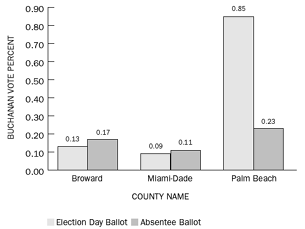
Figure 1. Buchanan vote by ballot type and county.
We prepared for a possible court appearance until late into Tuesday night. By this time, a number of lawyers, led by George Badey, had appeared from the Philadelphia law firm that was connected to the case through one of the plaintiffs. The lawyers were smart and tough-minded, and the legal issues became clear and vexing. We had excellent evidence to show that the butterfly ballot had wreaked havoc with people's votes. But the case had to revolve on a clear point of law that was violated, and it had to seek a remedy that was legal and politically feasible as well.
The original brief filed by our lawyers noted that Florida law requires that the candidates for any office be listed on the ballot so that the candidate of the party that received the highest number of votes for governor in the last gubernatorial election is listed first and the candidate of the party that received the second highest number of votes is listed second. Jeb Bush, of course, won the last Florida gubernatorial election, so the presidential candidate of his party, George W. Bush, was listed first. The Democratic candidate, Al Gore should have been listed second. But was he? Al Gore
The proposed remedy was even more controversial. All five of the voters' suits, including our own, asked for a revote in Palm Beach County. Yet a revote had never occurred in a presidential election, and there were serious equity problems with a new election. Obviously only those people who had voted on election day should be allowed to vote in the new election, and that could be controlled by voting lists. But what would prevent third-party voters from changing their votes now that they knew their votes could decide the election? In Palm Beach County, about 10,200 people had ostensibly voted for third-party candidates. If we take these votes at face value, then the third-party candidates of the Right obtained 4,481 votes and the third-party candidates of the Left obtained 5,969 votes, most of them for Ralph Nader. If the Right went for Bush and the Left for Gore, then Gore would surely be advantaged in a revote. But this analysis is too simple, because Nader supporters in Florida were, according to exit polls and our own analysis of voting data, more centrist than elsewhere, and a significant minority of them would vote for Bush if they switched from Nader. Maybe Bush had the advantage. Whatever the truth, third-party voters posed a real challenge to a revote.
The facts of the butterfly ballot case proclaimed a significant injustice, but the law appeared blind to the problem and unable to deal with it. After spending hours refining our statistical arguments and becoming sobered by the legal complexities, we went to bed around 3:30 A.M. feeling ready to testify.
Palm Beach and Fort Lauderdale—Wednesday, November 15
By Wednesday, we had been in Florida for several days and were getting anxious to either testify or go home. At the Palm Beach County Courthouse, our lawyer, Gary Farmer, told Judge Labarga that he had expert witnesses who were ready to go, right away. Barry Richard, Bush's lawyer who was participating via a phone link to Tallahassee, objected vigorously and called the request "outrageous" and beyond anything he had experienced in his years of practice. His list of outrages was long and partly justified,
This Wednesday hearing was the bittersweet high point of our trip. The case was going forward, and there might be a chance of success if the lawyers could find some way to argue for a revote. But we would not be testifying anytime soon, and the legal hurdle was very high.
We gathered back at Krathen's office in Fort Lauderdale, and we worked together until early Thursday morning to develop two affidavits, one about the Gore supporters who mistakenly voted for Buchanan and the other about the overvotes that were disproportionately cast by Gore supporters. Brady took the lead on the first and easier task, Mebane on the second, more difficult one. The main points of contention regarding overvotes were how to extrapolate from the 1 percent sample and how much of the overvote in Palm Beach County to attribute to the butterfly ballot design. High proportions of overvotes occurred in other elections that did not use the butterfly ballot. For the purpose of calculating the number of votes that were changed in Palm Beach County as a result of the butterfly ballot it was important to think carefully about how to define the baseline level of error.[16] Through heated discussions, we clarified our thoughts and arguments, and eventually a consensus was achieved. We felt confident about the facts.
Our later work has made us even more confident of our results. Wand and his coworkers show that the difference between the election day Buchanan vote and the absentee Buchanan vote in Palm Beach County is the most anomalous of any county in Florida.[17] Brady and Elms map the election day and absentee ballot precinct-level Buchanan vote for Palm Beach and its surrounding counties.[18] They show that the election day Buchanan vote increases precipitously (typically quadrupling) on reaching the Palm Beach County border from any direction, but there are no abrupt changes for the absentee Buchanan vote. Wand and his coworkers also use precinctlevel data to show that Buchanan support is positively associated with support for the Democratic senatorial candidate, which only makes sense if much of Buchanan's support comes from Democrats who mistakenly
RESOLUTION
The facts did not matter. On Friday, November 17, Judge Labarga considered whether there was any legal basis for a revote. "I think," he said at the hearing, "I have as deep an appreciation of the right to vote as anyone else in this county. My parents brought me here so I'd have that right. If I rule the Constitution does not allow for a re-election, it will be the hardest decision I ever make."[21]
On Monday, November 20, he issued his opinion. A revote could not be held because "our forefathers included clear and unambiguous language in the Constitution of the United States which requires that presidential ‘electors’ be elected on the same day throughout the United States." Moreover, the constitutional prohibition was sensible because "the danger of one candidate benefitting from an undue advantage in a revote or a new election is always a strong possibility. If anything, for this reason alone, Presidential elections must be held on the same day throughout the United States."[22] The plaintiffs' case was denied without any witnesses being presented.
This opinion was immediately appealed and eventually found its way to the Florida Supreme Court. In the appeal, the lawyers for one of the cases that had been consolidated with ours proposed another remedy—statistical readjustment of the vote totals. If accepted, this would mean that the presidency would be determined by statistical imputation, an approach that the Republicans strongly opposed when it was suggested for adjusting the U.S. Census. It seemed unlikely they would find it palatable for adjusting the presidential vote.
The Florida Supreme Court took a different tack than the circuit court judge, but they arrived at the same outcome on Friday, December 1. By a unanimous decision, they found, "[E]ven accepting appellants' allegations,
Did we accomplish anything? Legally nothing was accomplished. But practically our efforts, along with those of others, were the first step in a national civics lesson about the inadequacies of our voting and vote counting systems. Our work clearly showed that the butterfly ballot cost Al Gore thousands of votes, more than enough for him to have won Florida and the presidency. We made our case through the Internet to academics around the country. Our results were reported widely through the media, and the butterfly ballot itself now serves as a catchphrase for bad design.
WHAT WE LEARNED
The Palm Beach butterfly ballot story reads like a classic case of conservative jurisprudence recoiling from trying to right wrongs that vex the human condition. Anyone can see that the standard for calling a ballot defective must be very high and that revotes should be seldom employed, especially in presidential elections where the Humpty Dumpty of third-party preferences cannot be put back together after the initial vote.
All this would seem more palatable to us if the ultimate outcome of the Florida election follies had not been a 5–4 decision of the U.S. Supreme Court that used the Equal Protection Clause and arcane aspects of the Electoral College to justify the abandonment of a statewide recount. But if equal protection mattered so much for the statewide recount, why did it not matter for the citizens of Palm Beach County? And why did it not matter for those citizens who had to use punch-card systems whose error rates are at least five times greater than optical scanning machines used in other counties?[24]
NOTES
1. Voter confusion may have been increased by the fact that all other races were in the more standard format in which candidates are listed on one side of the ballot. Only in the presidential race were candidates listed on both sides, thus creating the "butterfly."
2. There are two other stories regarding this ballot. David McReynolds, a Socialist
3. We were not the only ones to produce an analysis of the butterfly ballot. Within four days of the election, the following people had posted analyses: Greg Adams at Carnegie Mellon University and Chris Fastnow at Chatham College; Layth Alwan at the University of Wisconsin—Milwaukee; Christopher Carroll at Johns Hopkins University; Burt Monroe at Indiana University; Craig Fox at Duke University; Bruce Hansen at the University of Wisconsin; John Irons at Amherst College; Robert Max Jackson at New York University; Jonathan O'Keefe, Peter Orszag, and Jonathan Orszag at Sebago Associates; Till Rosenband at MIT; Matthew Ruben at the University of California, San Diego; Robert Shimer at Princeton University; and Chris Volinsky at AT&T Labs. We apologize to anyone we have missed, and we note that many others added work later.
4. Considering the limits of the time available, Adams and Fastnow's initial analysis was useful and informative, but methodologists are picky people. It was clear that their work was only a starting point, and they improved on their analysis in subsequent days. See http://madison.hss.cmu.edu/.
5. They also plotted Buchanan vote versus Bush vote and Buchanan vote versus Gore vote.
6. Indeed, skeptics such as Robert Shimer (2000) of Princeton University and Patrick Anderson (2000) of Anderson Consulting soon jumped in to make exactly these points. Shimer argued that "the evidence that Palm Beach voted too much for Buchanan is based on a spurious correlation driven to a large extent by the size of Palm Beach County. The oft-quoted significance of this result is based on an erroneous assumption of normal residuals, which is inapplicable given the low average vote share for Buchanan." Our methods avoid these pitfalls.
7. The authors are listed in reverse alphabetical order.
8. Wand et al. completed their overvote analysis by using a proxy measure, the total number of votes in the Senate election for each precinct as a proxy for the total number of ballots. Subsequent analysis using the actual number of overvotes has led to the same conclusion.
9. In the 1996 presidential election, Tillman, a precinct in Jasper County, cast 288 votes for Clinton, 102 votes for Dole, 19 votes for Perot, and 2 votes for the remaining candidates. Although a revote was ultimately ordered for countywide offices, local officials initially said that "voter error led to the odd results." "Voters Say They Erred in Tillman," Beauford Gazette (S.C.), November 10, 2000.
10. Wand et al. (2001).
11. Case No. CL0010992AF in the Circuit Court for Fifteenth Judicial Circuit,
12. The Stuart News/Port St. Lucie News (Stuart, Fla.), November 14, 2000, Martin County Section, at A1.
13. The machine recount completed in Palm Beach County on November 11 recorded 19,147 overvotes, whereas the complete manual count completed on November 26 recorded 19,213 overvotes. The Palm Beach County Supervisor of Elections reported these counts in the file http://pbcelections.org/ElectionResults/2000/GEN/00genhc.htm.
14. The Gore campaign selected three of the precincts (162E, 193, and 193E) comprising 4,346 of the 4,694 ballots in the sample. The Elections Commission selected the fourth precinct (6B) to get as near as possible to 1 percent of all the ballots cast in the county.
15. Some of these multiple punches for the same office may have been intended, but the overvote rate for the presidential race in the sixteen Florida counties with state-of-the-art Global Accuvote optical scan machines was less than 0.4 percent, which suggests that intentional overvotes are typically one-tenth the number in Palm Beach County. It is also worth noting that the "failure rate" described in the text does not include the 2 percent undervotes (cases in which there appeared to be no vote for president) that occurred in Palm Beach County.
16. At the time we were unaware of the stories that had broken about the large number of spoiled ballots in Duval County, where the presidential ballot spanned two pages but lacked the two key features of the butterfly ballot. After leaving Florida, we were able to isolate key differences between Duval and Palm Beach Counties, but it would have been very difficult for us to complete such an analysis Wednesday night in the course of preparing affidavits.
17. Wand et al. (2001).
18. Brady and Elms (2001).
19. Wand et al. (2001).
20. This figure was reported in Joel Engelhardt and Scott McCabe, "Election 2000: Over-votes Cost Gore the Election in Florida," Palm Beach Post, March 11, 2001, A1A. Brady was a consultant on this article.
21. "GOP Holdups in Palm Beach Upset Dems," Associated Press, November 17, 2000.
22. Fifteenth Judicial Circuit, Palm Beach Florida, "Order on Plaintiff's Complaint for Declaratory, Injunctive, and Other Relief Arising from Plaintiffs' Claims of Massive Voter Confusion Resulting from the Use of a ‘Butterfly’ Type Ballot During the Election Held on November 7, 2000."
23. Fladell v. Palm Beach County Canvassing Board, 772 So. 2d 1240 (Fla. Dec. 1, 2000).
24. The Global Accuvote optical scan devices (used in sixteen Florida counties)
REFERENCES
Adams, Greg. D., and Chris Fastnow. 2000. “A Note on Voting Irregularities in Palm Beach, Fl.” ≪http://madison.hss.cmu.edu/.Manuscript≫. Accessed: May 1, 2001.
Anderson, Patrick L. 2000. “Statistical Analysis of the Florida Presidential Election Results—Comparison with Michigan.” ≪http://www.andersoneconomicgroup.com/elections/stat_anal_FL.htm.Manuscript≫. Accessed: May 1, 2001.
Brady, Henry. 2000. “What Happened in Palm Beach?” ≪http://ucdata.berkeley.edu.Manuscript≫. Accessed: May 1, 2001.
Brady, Henry E., and Laurel Elms. 2001. “Mapping the Buchanan Vote Escarpment in Palm Beach County, Florida.” Paper presented at the annual meeting of the Public Choice Society, March 9–11, San Antonio, Texas.
Engelhardt, Joel, and Scott McCabe. 2001. “Election 2000: Over-votes Cost Gore the Election in Florida.” Palm Beach Post, March 11, A1A.
“GOP Holdups in Palm Beach Upset Dems.” 2000. Associated Press. November 17.
Markey, Bob. 2000. “Palm Beach Democrats Confident: Tension Rises as Thousands Join Rev. Jesse Jackson in Downtown March.” Stuart News/Port St. Lucie News. November 14, Al.
Shimer, Robert. 2000. “Election 2000.” ≪www.princeton.edu/shimer/election.html.Manuscript≫. Accessed: May 1, 2001.
“Voters Say They Erred in Tillman.” 2000. Beauford Gazette, November 10.
Wand, Jonathan N., Kenneth W. Shotts, Jasjeet S. Sekhon, Walter R. Mebane Jr., and Michael C. Herron. 2000. “Voting Irregularities in Palm Beach County.” ≪http://elections.fas.harvard.edu/wssmh/.Manuscript≫. Accessed: May 1, 2001.
Wand, Jonathan N., Kenneth W. Shotts, Jasjeet S. Sekhon, Walter R. Mebane Jr., Michael C. Herron, and Henry E. Brady. 2001. “The Butterfly Did It: The Aberrant Vote for Buchanan in Palm Beach County, Florida.” ≪http:// elections.fas.harvard.edu/.Manuscript≫. Accessed: May 1, 2001.