
6 Paying for the Service City
1. Terrence J. McDonald, The Parameters of Urban Fiscal Policy: Socioeconomic Change, Political Culture and Fiscal Policy in San Francisco, 1860-1906 (Berkeley, Los Angeles, London: University of California Press, 1987), 158-261, shows how politically sensitive all politicians were in making the annual budget. He argues that because of this delicacy, incrementalism rather than any more dramatic actions surrounded the urban budget: see also McDonald and Ward, eds., The Politics of Urban Fiscal Policy , 13-37. Michael H. Frisch, Town into City: Springfield, Massachusetts, and the Meaning of Community, 1840-1880 (Cambridge, Mass.: Harvard University Press, 1972), 174, provides evidence for a similar view, although he also argues that the impact of local wartime expenditures, in particular for hiring draft substitutes during the Civil War, changed and enlarged the sense of the city budget (66). Leon Fink, Workingmen's Democracy (Urbana: University of Illinois Press, 1983), 34, makes a similar argument for those particular cases where explicitly labor-oriented parties won local elections, claiming that the Knights of Labor had a more limited conception of the role of the state than did industrial leaders. However, at least some of his evidence shows that local Knights candidates did actually increase local expenditures (58).
For a useful summary of the structure of local government as created by the Northwest Ordinance in the late eighteenth century, see Edward W. Bemis, "Local Government in Michigan and the Northwest," John Hopkins University Studies in Historical and Political Science 5 (March 1883).
2. Mancur Olson, The Logic of Collective Action (Cambridge, Mass.: Harvard University Press, 1964). For a historical discussion of public goods, the free rider problem, and governmental expenditures, see Roger L. Ransom, "In Search of Security: The Growth of Government in the United States, 1902-1970," in Ransom, Richard Sutch, and Gary M. Walton, eds., Explorations in the New Economic History: Essays in Honor of Douglass C. North (New York: Academic Press, 1982), 131-136 and n. 11. For a background theory of local government see Charles M. Tiebout, "A Pure Theory of Local Expenditures," The Journal of Political Economy LXIV October 1956), 416-424.
3. Joseph Schumpeter, "The Crisis of the Tax State," International Economic Papers 4 (1954, first published in 1918), 5-38. Aaron Wildavsky, Budgeting: A Comparative Theory of the Budget Process (Boston: Little, Brown, 1975). For background on tax, see Summer Benson, "A History of the General Property Tax," in G. C. S. Benson, S. Benson, H. McClelland, and P. Thompson, eds., The American Property Tax: Its History, Administration, and Economic Impact (Claremont, Cal.: College Press, 1965), 11-81; and Richard T. Ely, Taxation in American States and Cities (New York: Crowell, 1888), especially on tax history (25-54), and his reform proposals (251-263), which he makes in the context of a sophisticated analysis of the role of local government. In fact, Ely took the strength and taxing ability of local government as the main index of social and economic development, arguing that "as the South develops, local government must become more important" (261). H. Secrist, "An Economic Analysis of the Constitutional Restrictions on Public Indebtedness in the United States," Bulletin of the University of Wisconsin 637, Economic and Political Sciences, 8, 1 (Madison, 1914); E. R. A. Seligman, Essays in Taxation (New York: Macmillan, 1923).
4. See, for instance, Paul V. Betters, Recent Federal City Relations (Washington, D.C.: U.S. Conference of Mayors, 1936), for the range of federal programs with urban impact; Clarence E. Ridley and Orin F. Nolting, eds., What the Depression Has Done to Cities (Chicago: International City Managers' Association, 1935).
5. Paul V. Betters, Municipal Finance Problems and Proposals for Federal Legislation (chicago: American Municipal Association, n.d.), and Cities and the 1936 Congress (Washington, D.C.: U.S. Conference of Mayors, 1936).
6. The National Income and Product Accounts of the United States, 1929-76: A Supplement to the Survey of Current Business (Washington, D.C.: Department of Commerce, Bureau of Economic Analysis, 1981), table 3.3, 128-129.
7. Glenn W. Fisher and Robert R Fairbanks, Illinois Municipal Finance: A Financial and Economic Analysis (Urbana: University of Illinois Press, 1968), table 35, 160-161.
8. For Illinois proportions of total local government revenues by tax sources, see Bureau of the Census, Census of Governments 5, 6 (Washington, D.C.: Government Printing Office, 1967), Bureau of the Census, Historical Statistics on Governmental Finances and Employment (Washington, D.C.: Government Printing Office, 1977), 86. For 1962, Fisher and Fairbanks, Illinois Municipal Finance , 161; for 1977, Bureau of the Census, City and County Data Book, 1983 (Washington, D.C.: Government Printing Office, 1983), table A, 11.
9. Terry Schwadron, ed., California and the American Tax Revolt: Proposition 13 Five Year Later (Berkeley, Los Angeles, London: University of California Press, 1984).
10. Ransom, "In Search of Security," 127.
11. Eric H, Monkkonen, " Bank of Augusta v. Earle : Corporate Growth v. States' Rights," The Alabama Historical Quarterly 34 (Summer 1972), 113-130.
12. New York City met its last draft call in cooperation with the county: the county board of supervisors authorized individual bounties of up to $1,000 to be paid to the men after they had volunteered and mustered. The money came from a county bonded debt of $4,000,000. The stipulation that the bonds be countersigned by the mayor and that he be responsible for actually finding the volunteers makes clear the joint city-county responsibility. New York Times (2 January 1865), p. 8, col. 4.
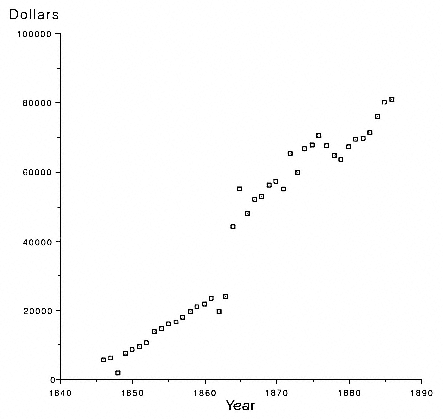
13. Henry Binford, The First Suburbs: Residential Communities on the Boston Periphery, 1815-1860 (Chicago: University of Chicago Press, 1985), 222-225; Frisch, Town into City , 53-113; Ely, Taxation in American States and Cities , 456-457; Richard Sylla, "The Economics of State and Local Government Sources and Uses of Funds in North Carolina, 1800-1977" (paper presented at National Bureau of Economic Research Conference on Research in Income and Wealth, Williamsburg, Virginia, March 22-24, 1984).
|
15. Alberta Sbragia, "Cities, Capital, and Banks: The Politics of Debt in the United States, United Kingdom, and France," in Kenneth Newton, ed., Urban Political Economy (New York: St. Martin's Press, 1981), cited by John Modell, "Afterword," in McDonald and Ward, eds., The Politics of Urban Fiscal Policy , 161-174. For an excellent discussion of the local role of bonds in Houston, see Harold L. Platt, City Building in the New South: The Growth of Public Services in Houston, Texas, 1830-1915 (Philadelphia: Temple University Press, 1983), 37-39.
16. Henry Roseveare, The Treasury (London: Allen Lane, 1969); J. Roland Phillips, "Local Taxation in England and Wales," in J. W. Probyn, ed., Local Government and Taxation in the United Kingdom (London: Cassell, Petter, Galpin, 1882), 471-472; J. Thackeray Bunch, "Municipal Boroughs and Urban Districts," in Probyn, Local Government, 291.
Bureau of the Census, Report on Valuation, Taxation and Public Indebtedness in the United States (Washington, D.C.: Government Printing Office, 1884), table XXI, 882. Pages 649-672 summarize state constitutional debt restrictions and ceilings. By 1881, fifteen of thirty-eight states had set ceilings, and three had authorized legislatures to set ceilings, most at 5%. Twenty-four had restricted the right of cities to invest in railways and twenty-five the right to own stocks of private corporations. And one, Massachusetts, began to legislate limits in 1875; Royal S. Van de Woestyne, State Control of Local Finance in Massachusetts (Cambridge, Mass.: Harvard University Press, 1935), 10.
To estimate crudely the comparative debt ceilings, assume a real property tax of 1%. Two year's collection of this tax would equal approximately 2% of the property's value, the British ceiling. This contrasts to a ceiling in the United States of 5% to 25% of the property value! For a discussion of debt ceilings, see Arthur M. Hillhouse, Defaulted Municipal Bonds, 1830-1930 (Chicago: Municipal Finance Officers' Association, 1935). A modern manual on debt concludes that "debt restrictions have not significantly restrained the total volume of state-local borrowing. To avoid these limits, special districts have often been created . . . [resulting in] an increase in the cost of borrowing." J. Richard Aronson and Eli Schwartz, eds., Management Policies in Local Government Finance (Washington, D.C.: International City Management Association, 1975), 234.
For a useful analysis of the experience of Massachusetts, see Van de Woestyne, State Control of Local Finance in Massachusetts . He concludes variously that debt ceilings were "effective" (32) and that they gave cities an upward goal, thereby increasing local debt (71). More to the point, he shows how between 1875 and 1911 Massachusetts granted over 1,500 exceptions to its own legislated debt and taxation limits (34): the state collection and publication of statistics was partially mandated to keep such exemptions down (55). He also cites a Fall River tax strike in 1930 (136-137) and gives sources for was partially mandated to keep such exemptions down (55). He also cites a Fall River tax strike in 1930 (136-137) and gives sources for annual data: 1871-1910, State Tax Commissioner; 1906-1935, Statistics of Municipal Finance.
For a survey of debt restriction, see State Constitutional and Statutory Restrictions on Local Government Debt (n.p.: Advisory Commission on Intergovernmental Relations, September 1961) and State Constitutional and Statutory Restrictions on Local Taxing Powers (n.p.: Advisory Commission on Intergovernmental Relations, October 1962). That a tax rate estimate of one percent is reasonable, consider the estimated national capital of Britain in buildings and farm capital, about 2.3 billion pounds in 1885: Phyllis Deane and W. A. Cole, British Economic Growth, 1688-1959: Trends and Structure (Cambridge: Cambridge University Press, 1967), table 71, 274.
17. Quotation from Platt, City Building in the New South , 179. Source for U.S. debt for 1880, Bureau of the Census, Report on Valuation, Taxation and Public Indebtedness in the United States (Washington, D.C.: Government Printing Office, 1884), table XXI, 882. Pages 649-672, state constitutional debt restrictions and ceilings.
The equation, based on thirty-five States, as the cases, excluding the city of Washington, D.C., Maine (with very little debt), Maryland (with the greatest per capita debt) as outliers:
|
as an independent variable which captures the effect of all forces affecting debt such as region, age of state, and other unknown ecological factors. To this is added a single additional independent variable, whether or not the state had debt limitation. Again, the states of Maryland and Maine have been excluded as outliers, although the equation estimates are similar with them included. The two per capita debt figures may have some slight differences, as that for 1870 is per capitized on all cities over 4,000, as opposed to 7,500.
The estimate results confirm the test above. Limitation had no effect on per capita local debt.
|
|
Although this state-by-state test may be the best way to see if debt limitation movements had any measurable impact, it should be noted here that this may not be the best level at which to capture the impact of local debt for individual cities.
18. In the same year rates, that is real property taxes, brought local government an income of 25.7 million pounds, B. R. Mitchell and Phyllis Deane, Abstract of British Historical Statistics (Cambridge: Cambridge University Press, 1962), table 9, 414. These estimates must be seen as crude and suggestive only, for differences in taxation, forms of land tenure, and the like make clear comparisons difficult. See David Cannadine, ''Urban Development in England and America in the Nineteenth Century: Some Comparisons and Contrasts," The Economic History Review XXXIII (August 1980), 309-325. The tax rate of 1.1% on total value conforms with the twentieth century expectation that a 1% tax on property is about "right." For example, in the long struggle to simplify and rationalize British tenure and taxation, the bill coming closest to passing advocated a 1% tax on the capital value of the land, Avner Offer, Property and Politics, 1870-1914 (Cambridge: Cambridge University Press, 1981), 247.
Population base for these estimates from P. J. Waller, Town, City and Nation: England, 1850-1914 (Oxford: Oxford University Press, 1983), 7.
The range of projects in England and Wales for which the Treasury's Board of Public Works Loan Commissioners had outstanding local government indebtedness in 1880 included: public housing, baths, bridges, burial grounds, canals, cattle disease prevention, churches, harbors, parks, local government buildings, asylums, prisons, public works, schools, workhouses, and one railway (Portpatrick); Phillips, "Local Taxation," 485-486.
19. Phillips, "Local Taxation," 481. Each department of Glasgow's government borrowed independently until the 1883 Glasgow Corporation Loans Act. See Tom Hart, "Urban Growth and Municipal Government: Glasgow in a Comparative Context, 1846-1914," in Anthony Slaven and Derek H. Aldcroft, eds. Business, Banking and Urban History; Essays in Honor of S. G. Checkland (Edinburgh: John Donald, 1982), 202. See also his table 2, 202, reproduced below.
Note: "Other" includes city "trading" as profit made by its gas companies and municipal transportation.
For the building of the Leeds city hall, see Asa Briggs, Victorian Cities (Harmondsworth: Pelican, 1982), 139-183; for a detailed discussion of the controversy over the funding of the city hall, see Derek Fraser, "Politics in Leeds, 1830-1852" (Ph.D. diss., University of Leeds, 1969), 459-466, 504-505, 517. Water profits paid for the town hall in twelve years according to one source: Brian Barber, "Municipal Government in Leeds, 1835-1914," in Derek Fraser, ed., Municipal Reform and the Industrial City (Leicester: Leicester University Press, 1982), 106. Barber shows how for Leeds the national government subsidized local government, beginning with a 25% police supplement in 1856. He estimates a total subsidy of city income which rose from 8% in 1895 to 21% by 1905 and 22% by 1910 (107).
20. City count from United States Postal Service, National Zipcode and Post Office Directory (Washington, D.C.: U.S. Postal Service, 1981. For an account of railroad-directed town building, see John C. Hudson, Plains Country Towns (Minneapolis: University of Minnesota Press, 1985).
21. James Willard Hurst, Law and the Conditions of Freedom in the Nineteenth-Century United States (Madison: University of Wisconsin Press, 1956); Robert A. Lively, "The American System: A Review Article," Business History Review XXIX (March 1955), 81-96.
22. Literature on incorporation is extensive, but the studies of Oscar Handlin and Mary Handlin, Commonwealth, A Study of the Role of Government in the American Economy: Massachusetts, 1774-1861 (Cambridge, Mass.: Harvard University Press, 1947), and Louis Hartz, Economic Policy and Democratic Thought: Pennsylvania, 1776-1800 (Cambridge, Mass.: Harvard University Press, 1948), remain classics. Bayrd Still, "Patterns of Mid-Nineteenth Century Urbanization in the Middle West," Mississippi Valley Historical Review 28 (1941), 187-206, shows how the first charters of Buffalo (1832), Chicago (1837), and Cleveland (1836) "were strikingly similar in form" (190), Chicago's differing from Buffalo's in only a dozen trivial instances. See Binford, The First Suburbs , "The Community as Business Corporation," 118-124, for an excellent discussion of the incorporation of Cambridge, Mass., in the 1840s.
23. This argument deliberately paraphrases Georg Simmel, "The Metropolis and Mental Life," in Kurt H. Wolff, ed., The Sociology of Georg Simmel (London: Free Press of Glencoe, 1950), 409-424.
24. Ransom, "In Search of Security," 125-148; and Lance Davis and John Legler, "The Government in the American Economy, 1815-1902: A Quantitative Study," Journal of Economic History 26 (December 1966), 514-552, estimate nonfederal spending in lieu of aggregated, published data.
25. These values calculated from Bureau of the Census, The Statistics of the Wealth and Industry of the United States (Ninth Census, vol. III) (Washington, D.C.: Government Printing Office, 1872), 11; Report on Wealth, Debt, and Taxation; Part I . Public Debt (Eleventh Census) (Washington, D.C.: Government Printing Office, 1892), 57. The per capita figures are approximately $23.80 for 1880 and $21.90 for 1890: it is impossible to per capitize this figure correctly, for there is no way to know the base population. The two values reported above for 1870 and 1880 are more reasonably accurate, for the Census Bureau reported the population base of the cities reporting their debts. There is no doubt that these comparative figures for 1880 and 1890 are deflated, but they have been deflated by the same unknown amount, so are comparable to each other.
The 1880 census contains a table summarizing indebtedness for places over 7,500 people and per capitizes by state with the population base representing only that of reporting cities. Here the average net debt per capita is $51.09, but the range by state is large, from $2.62 in Colorado to $127.66 for Washington, D.C. Bureau of the Census, Report on Valuation, Taxation and Public Indebtedness in the United States (Tenth Census, vol. VIII) (Washington, D.C.: Government Printing Office, 1884), table XXI, p. 882.
Post-1902 data from U.S. Department of Commerce, Bureau of the Census, Census of Governments, 1962 , VI, no. 4, Historical Statistics on Government Finances and Employment , tables 3, 5, 6.
26. See Hendrik Hartog, "Because All the World Was Not New York City: Governance, Property Rights, and the State in the Changing Definition of a Corporation, 1730-1860," Buffalo Law Review 28 (1979), 91-109, and Hendrik Hartog, "Property as Government in Eighteenth-Century America," The Journal of Legal Studies 10 (June 1981), 305-348, especially 344.
27. This scenario diverts considerably from that so subtly presented by Hartog, "Because All the World Was Not New York City," and "Property as Government in Eighteenth-Century America." Hartog's concern is with establishing the origins of the modern distinction between public and private corporations. He shows how in the eighteenth century the notion of municipality referred to any local delegation of state power, and how the city was best considered as its corporation. In the mid-nineteenth century, the separation between public corporations, such as the city, and ones for private gain became articulated. In the eighteenth century, he argues, no such separate conception was possible because each corporation, by its very nature, was based on a singular and unique charter.
28. Hartog, "Because All the World Was Not New York City," 92-100.
29. Clyde F. Steiner, Gilbert Y. Steiner, and Lois Langdon, Local Taxing Units: The Illinois Experience (Urbana: The Institute of Government and Public Affairs, 1954); Glenn W. Fisher and Robert P. Fairbanks, Illinois Municipal Finance: A Financial and Economic Analysis (Urbana: University of Illinois Press, 1968), table 35, 160-161.
30. Bureau of the Census, Historical Statistics of the United States: Colonial Times To 1970 (Washington, D.C.: Government Printing Office, 1975), 368, 1086; Bureau of the Census, Statistical Abstract of the United States , 105th ed., (Washington, D.C.: Government Printing Office, 1984), 283.
31. On the school centralization movement, see David B. Tyack, The One Best System: A History of American Urban Education (Cambridge, Mass.: Harvard University Press, 1974), 129-147; Bureau of the Census, Census of Governments: 1962 , vol. I, 29, 66; Fisher and Fairbanks, Illinois Municipal Finance , 95-96.
32. William F. Whyte, "The Watertown Railway Bond Fight," Proceedings of the Wisconsin State Historical Society (1916), 273.
33. Ibid., 277, 278.
34. Ibid., 281.
35. Watertown Democrat (10 September 1874 and 9 March 1876).
36. Eric Hobsbawm and George Rude, Captain Swing: A Social History of the Great English Agricultural Uprising of 1830 (New York: W. W. Norton, 1975); Watertown Republican (26 June 1872).
37. Cited in Whyte, "The Watertown Railway Bond Fight," 297; 2 January 1873.
38. Watertown Republican (4 September 1872).
39. Kathleen H. Underwood, "Town Building on the Frontier: Grand Junction, Colorado, 1880-1900" (Ph. D. diss., University of California, Los Angeles, 1982). Home ownership was so accessible in late nineteenth-century Detroit that Oliver Zunz sees it as an ethnic choice that reflected neither occupational status nor wealth; The Changing Face of Inequality: Urbanization, Industrial Development, and Immigrants in Detroit, 1880-1920 (Chicago: University of Chicago Press, 1982). He states, "owning one's own home was more an ethnocultural phenomenon than one of class" (153). California's four major cities had 37% home ownership in 1900 as compared to a national average of 26%. Calculated from Bureau of the Census, Abstract of the Twelfth Census, 1900 3d ed. (Washington, D.C.: Government Printing Office, 1904), table 90, 133-135.
40. James E. Cooley, Recollections of Early Days in Duluth (Duluth: by the author, 1925), 19. Jonathan Prude, The Coming of Industrial Order: Town and Factory Life in Rural Massachusetts, 1810-1860 (New York: Cambridge University Press, 1983) shows how the wooing of industry in the case of Samuel Slater's mills did not mean blind acceptance of factory political power. Thus, the mill owners and the town fought over power (168).
41. Whyte, "The Watertown Railway Bond Fight," 285.
42. Kenneth Fox, Better City Government: Innovation in American Urban Politics, 1850-1937 (Philadelphia: Temple University Press, 1977).
43. This analysis is developed in greater detail in Monkkonen, "Politics of Municipal Indebtedness."
44. These remarks and the data discussion for 1929-1982 are based on detailed information presented in Eric H. Monkkonen, "What Urban Crisis? A Historian's Point of View," Urban Affairs Quarterly 20 (June 1985), 429-448.
45. See Gerald E. Frug, "The City as a Legal Concept," Harvard Law Review 93 (April 1980), 1059-1154, for a discussion of the city as a corporation.
46. George C. Daly, "The Burden of Debt and Future Generations in Local Finance," Southern Economic Journal 36 (July 1969), 44-51, summarizes the logical arguments over the bearers of debt burden. A recent book on the fiscal crisis of New York State lays much of the blame for the current state and city fiscal crisis at the feet of Nelson Rockefeller. Although the book greatly exaggerates his culpability, there is an underlying and insightful premise—the debts that politicians accrue can come due well after their deaths. Peter D. McClelland and Alan L. Magdovitz, Crisis in the Making: The Political Economy of New York State Since 1945 (New York: Cambridge University Press, 1981). Lauro Martines, Power and Imagination: City-States in Renaissance Italy (New York: Alfred A. Knopf, 1979), 136.
47. Historical Statistics of the United States , 1126-1127. For the years 1902, 1913, 1922, and 1927, the following values may he estimated. Revenue from the federal government: 0.7%, 0.6%, 2.1%, 1.5%. Revenue from property taxes: 67%, 66%, 64%, 60%. Expenditure on debt interest: 7.2%, 7.7%, 7.6%, 8.5%. These are not directly comparable to the data presented in note 48.
48. Percent of Expenditures in Interest on Debt, Local and State Government, 1929-1982
|
icizes the incrementalist view, see Charles Brecher and Raymond D. Horton, "Retrenchment and Recovery: American Cities and the New York Experience," Public Administration Review 45 (March/April 1985), 267-274.
50. Monkkonen, "Politics of Municipal indebtedness."
I am indebted to the work of Scott L. Bottles, which challenged me to rethink many traditional notions about urban transit. By showing the positive role of the automobile in Los Angeles, he has made the most difficult case the most convincing: see Los Angeles and the Automobile: The Making of the Modern City (Berkeley, Los Angeles, and London: University of California Press, 1987). See also Martin Wachs, "Automobiles, Transport, and the Sprawl of Los Angeles: The 1920s," Journal of the American Planning Association 50 (1984), 297-310, and Carlos A. Schwantes, "The West Adopts the Automobile: Technology, Unemployment, and the Jitney Phenomenon of 1914-1917," Western Historical Quarterly 16 (July 1985), 307-326. For an excellent overall coverage of land transportation, see Richard Bessel, "Transport," in Science, Technology, and Everyday Life (Milton Keynes, England: Open University Press, 1988).