SOCIAL ACTIVITIES
The formality that was typical during T. Wayland Vaughan's era at Scripps began to change in the 1930s, and the changes continued after the war. Shirt sleeves became more common than suit coats; Hawaiian and Tahitian shirts were special favorites. Military-style crew haircuts were in vogue after World War II and, until the late 1960s, only an occasional beard was seen, usually an indication that the “bearded wonder” had recently returned from a long sea trip. The lunch area became known as “Bikini plaza.”
Almost everyone addressed one another by first name, from director to graduate student. As a crew member said, “It's kind of hard to call a guy ‘Mister’ when you've passed the salt to him at mess aboard ship.”[13] The students, many of them veterans, were part of the extended family, and for a long time, as it was not uncommon for a student to take six to ten years to complete his studies and his dissertation. Students were often expedition leaders, on long as well as short cruises.
For many years, the women's group, Oceanids, was the tone-setter for campus social activities, and was also the service group for special events and visitors. In the 1940s Mrs. Francis B. (“Mom”) Sumner had been the leader of what was first known as “Scripps Wives,” a sewing and social group that devoted much time to projects for servicemen. In 1946, according to Helen (Mrs. Russell W.) Raitt, “a group of enthusiastic young student wives took the initiative and organized a wives' club,” which was also endorsed by the faculty wives. In April 1952, Mrs. John S. (Sally)
The organization was open to all women connected with the institution: staff wives and student wives, women employees, and women students. Not all eligibles attended the activities, of course, but there was a broad scattering of regulars throughout all disciplines and all ranks. The members provided and served refreshments at all special occasions on campus, served as ushers for campus-sponsored lectures, and hosted a Christmas party (originally for the children, in a carry-over of the custom established by Gudrun Sverdrup), an Easter-egg hunt, dances, potluck dinners, and some lectures. Funds for these events were usually raised through ticket sales to a night at the Old Globe Theatre. The organization set up special interest groups — book review, bridge, folk dancing, sewing, and others. Helen Raitt and Carol Schultz were the prime movers for starting Oceanids' information-filled monthly newsletter, “Bear Facts,” in 1962. Newcomers were welcomed cordially, as potential cookie-bakers and ushers as well as new members of the oceanographic family. Lonesome wives whose husbands were at sea could find news items, a respite from loneliness, and a word of sympathetic understanding at Oceanids' gatherings. The organization has become the women's group of the entire UCSD campus.
Members of Oceanids plus many staff members contributed to the performance “Flip” in 1960; this original
[*] “Flip II” and “Flip III” were presented in 1961 and 1962, but they were not so thoroughly oceanic in theme.
A much-appreciated welcoming custom was established by Edith Nierenberg in 1965, when her husband became director: a coffee party and introduction to the campus for all new wives and women employees of Scripps. The event usually has included a walking tour of several of the institution's laboratories, to provide a glimpse of the variety of researches. The hostesses — who are “oldtimers” — find that the gathering helps them understand their campus better.
A well-attended summer event throughout the 1950s was the family beach picnic, with games and prizes and beer. This was enthusiastically sponsored by the local chapter of the California State Employees Association, of which Ben Cox was a longtime official. (The annual beach picnic that was resumed in 1969 is hosted by graduate students and funded anonymously.)
Town and gown turned out to celebrate the University's Charter Day every March, often at Scripps in the form of an open house and public lecture. The 1951 Charter Day presented the dedication of Vaughan Aquarium-Museum (see chapter 9). In 1952 the Horizon and the Crest carried a hundred visitors out to sea for a demonstration of oceanographic equipment at work; to the delight of Carl L.
In 1957 a display of oceanographic equipment was set out on the Scripps pier for visitors to view, and a continuous film program was offered in the library. The institution's first robed academic procession distinguished the evening ceremony that year, when Robert Maynard Hutchins addressed an overflow crowd on the subject of “Science and People.” And in 1960, Eleanor Roosevelt, 75 years old, erect and firm-voiced, exhorted an even larger audience in San Diego's Russ Auditorium: “We have to wake up, change our views, and realize this is a different world today.”
It was the world of Sputnik and space — and “inner space,” as oceanography was beginning to be called. In that era, while envying the money being expended in the space program, Scripps scientists were wont to observe: “We know less about the ocean's bottom than the moon's behind.”[*]
[*] This remark, which Bob Fisher believes may have been first used by Athelstan F. Spilhaus, appeared many times in speech and print by oceanographers, often oddly bowdlerized. In 1940, long before Sputnik, Harald Sverdrup wrote: “…we live on the shores bordering the largest ocean on earth, an ocean less charted than the surface of the moon.” (“Research in Oceanography,” California Monthly, December 1940)
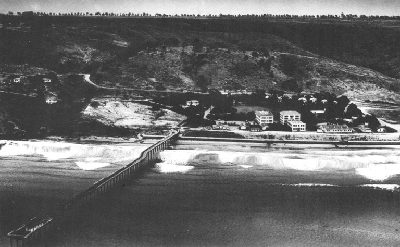
The campus in 1949.
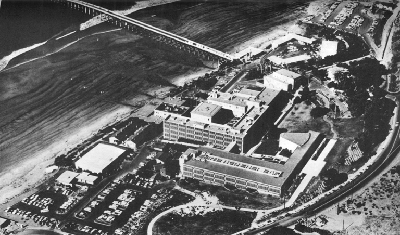
The campus in 1963.
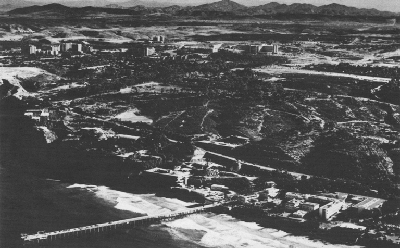
Scripps and its offspring, UCSD, in November 1975. Photo by Phil Stotts.
Other special events on campus brought out the institution's families and many townspeople. On 22 April 1952, a sizable crowd greeted the Galathea, called “one of the world's outstanding pieces of oceanographic scientific equipment.” The 80-meter-long frigate was homeward bound on the Danish Deep Sea Round the World Expedition when she paused for several hours off the Scripps pier. Visitors went out in smallboats to consume Danish pastries (and Carlsberg beer, the Carlsberg Foundation being the chief financial support of the two-year expedition), and to admire the oceanographic accoutrements, especially the giant winch that could handle seven miles of cable. Expedition leader Anton F. Bruun told of gathering great numbers of sea anemones, sea cucumbers, worms, clams, and crustaceans from ocean depths greater than six miles in the Philippine Trench.
In October 1958 the campus greeted newly inaugurated University President Clark Kerr, who reviewed the Scripps fleet, which was emblazoned in the university's colors, blue and gold. With some tricky maneuvering, Horizon, Spencer F. Baird, Stranger, Paolina-T, T-441, Buoy Boat, and even minute Macrocystis lined up, bow toward the beach, just beyond the Scripps pier, to honor the visitor.[*]
[*] Only Orca was unable to participate, as she was in the shipyard.
The end of the International Geophysical Year in 1958 was climaxed at Scripps by the visit of the Soviet research ship Vityaz to San Francisco. Americans were still chagrined at the success of Sputnik I in 1957. What might Soviet scientists be capable of doing in oceanography? For the Vityaz visit a flurry of letters began in October 1958, from Revelle to IGY and state department officials, and finally mutual invitations by radio flitted between the institution and the ship (which was not allowed to visit San Diego). When the 363-foot vessel sailed into San Francisco on 18
December, she was met by a large crowd that included 20 Scripps scientists who had flown up to ask questions and to take the grand tour. The following day the Horizon sailed into San Francisco, bearing some of the Scripps seismic group to join the fun. The American oceanographers were much relieved to find that Soviet methods of exploring the ocean were similar to, and no better than, their own. John Tyler summed it up: “Walk into any [Vityaz] lab and you will find differences in technique and in detail, with some ideas you like and some you don't like.”[15] The great size of the Soviet research ship, its twelve separate laboratories, a scientific party of 65 people, and the many concurrent programs were considered by Scripps people to be generally not advantages (especially as all participants were expected to stay for the entire expedition, many months long). From San Francisco ten of the Soviet oceanographers were flown to Miramar Naval Air Station in San Diego. The guests were hosted for dinner, in twos and threes, at Scripps homes, with other staff families as additional guests — a form of entertainment that especially appealed to the Soviets, who asked many questions about American homes and family life. Their own interpreters, a few Russian-speaking Scrippsians, and considerable arm-waving kept the conversations flowing.
On 27 September 1966, Vice President Hubert H. Humphrey visited Scripps Institution, in his capacity as chairman of the National Council on Marine Resources and Engineering Development. He was provided with what he called “a very exciting tour” of the institution and some of its novel equipment, after which he declared: “We're on the threshold of a new age of exploration….Our dreams for the oceans are not those of the poets and the prophets. They are practical dreams….We intend to develop the bountiful resources of the sea to serve man's pressing needs.”
In the same capacity three years later, on 23 October 1969, Vice President Spiro T. Agnew arrived at Scripps for what newsman Bryant Evans called “probably the shortest and most concentrated survey course in oceanography in history.”[16] En route to a Palm Springs vacation, Agnew was on the campus for only an hour, and was shown sediment cores taken by the Deep Sea Drilling Project and deep-sea tide capsules of IGPP. Campus officials had only scanty warning of the brief visit, but Director Nierenberg was able to fly home from England (via Washington, D.C.) to welcome the visitor. (On the airplane he spilled soup on his only necktie and had to borrow one from Carl L. Hubbs — patterned, typically, in whales.)
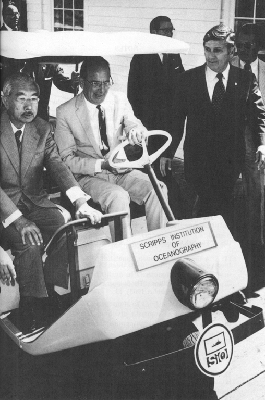
After very elaborate preparations, Emperor Hirohito of Japan visited Scripps Institution on 9 October 1975, during his first trip to the United States. Biologist Hirohito was very interested in the marine specimens set out for his inspection, and was presented with a fine specimen of the “living fossil” Neopilina collected on Southtow Expedition in 1972.
The brunt of arranging details of the visits of such distinguished visitors fell to the Scripps branch of the Public Affairs Office, headed by R. Nelson Fuller from 1965. For some years that office has been responsible for providing information on Scripps researches to news media and for handling official visits to the institution in cooperation with the director's office, as well as answering requests for oceanographic information that arrive at the institution by letter and telephone by the dozens each week. Since the mid-1960s the Scripps Public Affairs Office has also coordinated, edited, and published the annual reports of the institution.
Until the late 1940s, the publicity duties of the institution were handled chiefly by the director's office, aided by various staff members. For example, during the 1930s a
In 1950 Thomas A. (“Lon”) Manar joined the staff to prepare the reports of the Marine Life Research program. In the latter 1950s he became the public information officer for Scripps, and handled coordination with the news media as well as institution-sponsored events, such as Charter Day programs. For some years Scripps offered a lecture series annually in cooperation with the La Jolla Theatre and Arts Foundation, which required considerable coordination on details by Manar. When UCSD was established, the Scripps public information office came under the auspices of the upper campus.
And Now…
In 1940 Harald Sverdrup wrote:
Oceanography may sometime in the distant future give us a many-colored picture of the oceans, but at the present time we have only started working with a large and intriguing puzzle game, each one of us trying
― 475 ―to put together pieces of similar color, hoping that all the fragments can be joined into one complete picture. It is as yet far too early to guess what this picture will look like, but it is not difficult to visualize oceanography as a unified field of research.[17]
The picture is not yet complete, but a great many pieces of the puzzle have indeed been put into place. The unified field of research has grown into a complexity of institutions and disciplines. It utilizes equipment that Sverdrup could not have envisioned 40 years ago: sea-going computer systems, satellites for navigation, research platforms that stand on end, electron microscopes, devices that glide from the depths of the sea when called.
The Scripps Institution of Oceanography no longer stands alone, but shares its field with dozens of other oceanographic research organizations. While there is a certain rivalry amongst them, there is also a great deal of cordial cooperation. In fact, the trend in oceanography since the latter 1960s has been toward multi-institutional research projects. As Nierenberg said in 1971: “The developing attitude on the part of government managers is the growing dependence on the ‘larger’ programs. These are important programs that require major concentrations of manpower and money because of either synoptic or engineering considerations.”[18]
Such projects — which simultaneously involve a number of researchers at several institutions — have occupied a great deal of the director's time and that of the principal investigators: the Deep Sea Drilling Program, discussed in chapter 12; developing Norpax, which expanded into a major research effort from the North Pacific Buoy Project; establishing Geosecs, which has drawn in a wide range of oceanographic and meteorologic researchers; the Alpha Helix program, which has attracted hundreds of researchers
“These projects,” continued Nierenberg, “make extraordinary demands on the limited manpower of the oceanographic community, but they are very rewarding in their results and applications.”
That seems to be it: Oceanography is not only fun, as Revelle said; it is also very rewarding.