
THE ADMINISTRATION
Throughout the years of greatest expansion of the Scripps Institution, the dominant figure on campus was Roger Revelle, a man who has been described as physically and temperamentally designed for the study of the deep oceans. Physically he is big — six feet, four inches tall, and with oversized hands and feet. Temperamentally he is broad: he has a wide grasp of knowledge and assimilates material quickly. There is a quiet self-confidence about this big grave man, yet also humility, and he listens with interest and sympathy.
Revelle's history at Scripps, as noted throughout these pages, was a long one: from 1931 to 1964, from graduate student to director and dean.
He was born on 7 March 1909, in Seattle, where his father practiced law. When he was seven, the family moved to Pasadena, California. Revelle attended Pomona College in Claremont, where he intended to study journalism, but
After earning his Ph.D. at Scripps in 1936, with a dissertation on the Carnegie cores, Revelle spent a year in Europe, chiefly at the Geophysical Institute in Norway, and returned to Scripps as an instructor. In 1941 he became an assistant professor and joined the U.S. Naval Reserve, through which he was assigned to duty at UCDWR (see chapter 2). As he told it long afterward:
…a year and a half later [Commander Rawson] Bennett [head of the sonar design section of the Bureau of Ships] arranged for my transfer to Washington, ostensibly to the Hydrographic Office. Unfortunately, the Hydrographer, a charming and gentle admiral, was somewhat out of touch. He could not think of anything for an oceanographer to do, except to examine some old echo soundings that showed shoals and banks off the west coast of Central America where later ship crossings had found only deep water. I appealed to Bennett to give me a job that might be more relevant-to the real world, and he set me up as officer in charge of what amounted to an oceanographic subsection in the Bureau of Ships….From this vantage point I was able to help guide and foster the Navy's growing involvement in oceanography
― 447 ―throughout the latter part of the war and the early postwar period.[3]
Immediately after the war, in the U.S. Naval Reserve, by then with the rank of Commander, Revelle served as head of the geophysics branch of the Office of Naval Research, and was in charge of the oceanographic investigations of Operation Crossroads in 1946 (see chapter 15). Much later he recounted his return to Scripps in 1948:
Harald Sverdrup, the little great man who had already begun to transform the institution, felt he must return to Norway, and that is when a struggle began as to who should be his successor. Harald Sverdrup and Carl Eckart were determined that I should have the job, even though I was still in Washington, working for the Office of Naval Research. But there was a great deal of equally determined opposition.
It was resolved by Carl [Eckart] agreeing to become the Director; he asked me to be his Associate Director. Although I didn't realize it at the time (he never let on), this was actually a ploy on Carl's part, with Harald's encouragement, to create a situation in which the opposition to my appointment might be diminished. As soon as Carl judged that this had happened, he resigned, and I took his place, first as Acting Director and then as Director.
After I assumed the job, I rapidly gained a reputation as a poor administrator. But in some ways, compared to Carl, I was an administrative genius. The difficulty was that he took the job too seriously. No detail was too small, no problem too unimportant, for him to attack it with meticulous and elaborate care, giving attention to every detail, and examining every
― 448 ―alternative. The rigor in definition and precision of thought, and the inability to leave any loose strings untied, which were his great strengths as a scientist, were just what was not needed as an administrator. I remember he spent a good deal of time trying to tidy the Scripps Institution up; it was quite a messy place in those days and this was a completely frustrating job for him.[4]
Revelle, as the director, had his defenders and his detractors. He also had big ideas, which he was eager to carry through, sometimes too quickly. “I think I'm undiplomatic,” he once said. “I just bull things through.”[5] Eckart, however, felt that Revelle had “the ability to put knowledge and enthusiasm together in words that excite people.”[6] Not always a good speaker, he was nevertheless at times almost an orator on the possibilities in oceanography during his Scripps days. His enthusiasm came through in a mellow resonant tone in measured, sometimes hesitant, phrases.
Big projects appealed to Revelle, and he was intent upon keeping Scripps in the forefront while other institutions were moving into oceanography. The most intense booster for the institution, Revelle was also the keenest recruiter — of people whose imaginative approach to their discipline appealed to him and who could contribute to oceanography. Some of these arrived, fired with his enthusiasm, to find that they did not even have an office, certainly not a laboratory. Assistant Director Jeffery Frautschy or other campus officials would scurry to find them space and funds.
Revelle had — and has — a great respect for the capabilities of science in helping to solve world problems. While at Scripps, he was drawn into a great many international committees: various UNESCO appointments; Atoms for Peace; the International Geophysical Year; the International
Through his committee obligations, Revelle knew a great many oceanographers throughout the world. He had a way of persuading them to take on projects that required a great deal of time and energy. An example is the summary treatise, The Sea: Ideas and Observations on Progress in the Study of the Seas.[7] The classic text of 1942, The Oceans, by Sverdrup, Johnson, and Fleming, was indeed somewhat out of date twenty years later. Maurice N. Hill of the Department of Geodesy and Geophysics in Cambridge, England, said: “Revelle suggested that we produce another such volume containing ideas and observations concerning the work accomplished during the twenty years since this masterpiece. It was suggested that this new work should not attempt to be a textbook but a balanced account of how oceanography, and the thoughts of oceanographers, were moving.”[8] Hill served as general editor of the new work until his death in 1966, when Arthur E. Maxwell of Woods Hole Oceanographic Institution took on the task. The first volume of the treatise came out in 1962, “from the pens of many authors,” noted Hill. By 1974 the project had reached five volumes (in six books) in an invaluable summary of all the vast field of oceanography except marine biology. Naturally, many of the contributors were Scrippsians.
Revelle has always had an impressive impact:
…At a sleepy meeting in Paris, a big slouching man rose to his feet and began to speak of geology at sea [wrote Daniel Behrman]. His voice and presence filled the committee room.
He told of oily uncomfortable ships, of the great grinding mills that destroy the sea floor in the deep trenches, of the maps of this realm that were no better than the land maps of the seventeenth century. More than any other single figure, Revelle is responsible for the introduction of oceanography into public affairs. He began as a marine geologist and geophysicist; he has evolved into a statesman of science.[9]
At home base during the 1950s Revelle began envisioning a new kind of university, one that started at the top. He carried on a long campaign, and he gained some political foes along the way; but the result was the establishment, first, of the Institute of Technology and Engineering, then the School of Science and Engineering, housed on the Scripps campus from 1958 to 1963, and from that the entire campus of the University of California at San Diego.[*]
[*] The campus was first known as the University of California at La Jolla, and one Scripps dissertation came out under that name, in 1961. But pressure from the rest of the city led to changing the name. La Jolla is, after all, within the city of San Diego.
Revelle has credited Carl Eckart as being his co-worker and goad throughout the early planning, and he has pointed out that many others also devoted a great deal of time to founding the new campus, but the drive was certainly Revelle's. The innovative features were the multi-college concept within the one big campus, and opening the college at the graduate-student level first, taking off essentially from Scripps Institution into other fields of science and later,As Walter Munk said: “It was an interesting experiment to watch a bunch of sailors start a university.”[10] In addition to a great many hours of planning, those sailors contributed the dormitory names for the first college — for noted exploration ships[*]
[*] Helen Raitt, a participant on Capricorn Expedition, compiled the list of dormitory names.
; they donated the trident symbol to UCSD; and they awarded the name, Revelle College, for the sailor who started it all.Ten years after Revelle's idea had become a full campus of the university, Chancellor William J. McGill looked back at its founding:
This is the end of an era at the University of California, San Diego. The era began with Sputnik and with the national panic which that little beeping Soviet satellite created. Sputnik's effects on American education were on the whole remarkably positive, and they were in full ascendancy when UCSD was born a decade ago. Only in such an era could the extraordinary beginnings of UCSD have been conceived, much less attempted, and only in such an era could the attempt have been brought off successfully. It was an era of unparalleled national investment in education, especially in science. The Russian Sputnik fathered many new American university campuses and caused the sudden dramatic expansion of many old ones. It was a time of bold educational planning, of sudden affluence for professors, and a pervading sense of limitless vistas of academic excellence, both here and throughout the country — but especially here.[11]
Revelle's last few years at Scripps Institution were interrupted times at his home base. From October 1961 to
Revelle is remembered fondly by those who have been long at Scripps, one of whom said just after his departure: “It is a great tribute to Roger, I think, that he has retained the cordial regard and friendship even of those who have felt that his shortcomings as an administrator were serious.” Part of his popularity was no doubt due to his enthusiasm for oceanography just as that field was undergoing its greatest expansion. Revelle knew and liked oily ships, from the 64-foot Scripps and 94-foot E. W. Scripps to the 213-foot Argo, and he understood oceanographers, himself included. “The chief motivation of most oceanographers I know,” he once said, “is the sheer excitement of finding out what has never been known before.”[12] He went on to speak of what oceanography could accomplish for the world, but, as always when Revelle spoke, his theme was “Oceanography is fun.” That phrase, which he used oft-times, has been joked about — almost every time the seas start sloshing over the fantail or the winch jams — but the joking is done by men who knew Revelle at Scripps and who go back to sea themselves again and again. As one of those said later, “When Roger was around, things were always exciting.”
Revelle's fiftieth birthday is remembered fondly too. The idea of a surprise party for the occasion of 7 March 1959 was mainly John A. Knauss's, who provided his house for the event and established the theme of Cannery Row. (A
“The conspiracy grew and there were visits back and forth” — as people thought of ingenious gifts and ideas. The Shors' house across the street from Knausses' was decorated with “models” to represent the Bear Flag Restaurant in Cannery Row. All of Revelle's family, except himself, knew of the event, so it was arranged that Roger and Ellen would have dinner at their daughter and son-in-law's (George and Anne Shumway's) house, about a block away from Knausses', while the party assembled. At 8:30 the crowd strolled to the Shumways', where Scripps police officer Howard (“Mac”) McKelvey led off with his siren, and Roger was summoned forth — to his complete surprise. Serenaded by the wheeze of a calliope (played by chemist-musician Charles D. Keeling), he was seated upon a litter and borne up the street on the shoulders of an honor guard, amid confetti and banners, to be deposited in the midst of the festivities.
It was a great party. The gifts represented Scripps ingenuity at its best. The punch was remarkable. And it seemed as if everyone at Scripps was there. The finale was the arrival of a giant box, which opened to reveal “Texas Bobbie” Roberts (a striptease artist, about six feet tall). Revelle vanished into the box and the two were carried off triumphantly. Texas Bobbie's breathless comment later was: “I never knew there was so much to learn about oceanography!”
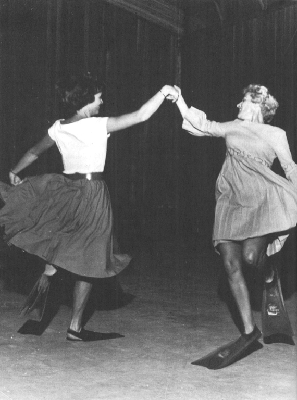
Nan Limbaugh (left) and Thea Schultze, at the farewell party for the Revelles in the Hydraulics Laboratory, 1964.
One who deserves a great deal of credit for having kept Scripps running smoothly during Revelle's absences is
Fred N. Spiess, director of the Marine Physical Laboratory, stepped in as acting director of the institution in 1961. This native Californian, born in Oakland in 1919, had graduated from Berkeley in physics in 1941 and had immediately entered Navy submarine school. During World War II he made thirteen submarine patrols. Spiess received his M.S. at Harvard in communication engineering and his Ph. D. at Berkeley in physics. In 1952 he joined the staff of MPL and in 1958 he became director of that laboratory.
When Revelle left in 1964, Spiess became director of Scripps, partly as an interim measure while a second chancellor for UCSD was being sought. Spiess helped complete the negotiations for establishing the Physiological Research Laboratory (see chapter 8), and he expanded the programs in biology and chemistry at the institution. His valuable contributions to the development of Flip and the Deep-Tow instrument package are cited in chapter 4.
In July 1965, William A. Nierenberg became director of Scripps Institution. Physicist Nierenberg was born in New York city in 1919. He received his B.S. from City College of New York (with one year at the University of Paris), and his Ph. D. from Columbia University. He was a participant in the Manhattan Project during World War II. After the war he taught at the University of Michigan, and in 1950 became professor of physics at Berkeley. In 1953-54, on leave from Berkeley, he was Project Director of Columbia University's Hudson Laboratories, then returned to Berkeley until his appointment at Scripps. From 1960 to 1962 he served in Paris as the Assistant Secretary General for Scientific Affairs of NATO, and he was simultaneously Professor Associé at the University of Paris.
At Berkeley Nierenberg established the Atomic Beam Laboratory on the main campus and the Atomic Beam
This hoarse-voiced, staccato-talking man is disconcertingly able to talk and listen simultaneously. His interest in ocean research and his pride in the Scripps Institution of Oceanography are unending. He is a strong advocate of using the right — and best — equipment for the job at hand, which he often ensures by negotiating for the necessary funding. The task has not been easy, as the money available for increasingly expensive marine research has become much more difficult to obtain during the 1960s and 1970s.
One of the earliest programs that Nierenberg advocated when he became director was computers for the larger Scripps ships. The Deep-Tow group of the Marine Physical Laboratory actually carried the first Scripps computer system — a PDP-8 computer — to sea on the Thomas Washington in the fall of 1966, for use in calculating navigation for the acoustic transponder and to provide a digital-data logging capability for the magnetometer and the precision echo-sounder of the Deep-Tow system. In the following year an IBM 1800 Data Acquisition and Control System — the “Red Baron” — was installed on the Thomas Washington, through joint sponsorship of Scripps and International Business Machines. At first IBM provided personnel to service the system, but Scripps soon decided to hire its own technicians, engineers, and programmers, to service the shipboard equipment and programs and also to participate in other underway projects. The Shipboard Computer
As Nierenberg said in 1969: “In many ways I feel that I am reliving my life, watching the development of the computerized ship and its effect on oceanographic research,” for he had been deeply involved in the development of the applications of computers to nuclear physics and particle-physics research while at the Lawrence Radiation Laboratory.
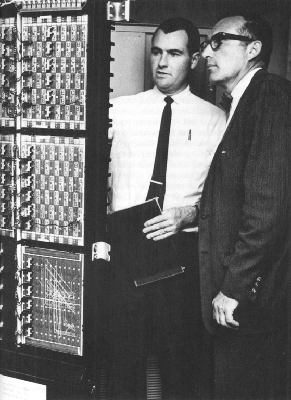
William A. Nierenberg (right) and Ed Coughran (then with IBM) inspecting the new shipboard computer system, 1966.
Nierenberg also established the Applied Ocean Engineering Laboratory at Scripps in 1969, under the financial support of the Advanced Research Projects Agency. For this unit a steering committee of distinguished scientists was established, to select significant projects in advanced engineering marine research. Marion W. Johnson was the project manager until 1971, when Gerard H. Fisher succeeded him; both of them had previously been at Columbia University's Hudson Laboratories. The several programs supported by ARPA at Scripps for several years were: instrumentation and installation of mid-ocean buoys, under the direction of John D. Isaacs and in a cooperative project with the Applied Physics Laboratory of Johns Hopkins University; research on stable floating platforms, under the direction of Fred N.
Also established at Nierenberg's instigation was the Center for Marine Affairs, which began in 1970 under a grant from the Ford Foundation. Warren S. Wooster first headed the group, which brought together specialists from the social sciences, law, government, and oceanography to explore the conditions for freedom of oceanic research and for determining international pollution policy. In 1973 the center, then headed by Gerald L. Wick, was placed in the Institute of Marine Resources, and, in cooperation with Mexican agencies, also undertook a study of long-range marine resource management issues related to desert coasts, with emphasis on the Baja California coastline.
In service to the nation and its oceanography, Nierenberg presided as chairman of the National Advisory Committee on Oceans and Atmosphere (NACOA) from October 1971 until February 1975, and he has continued as a member
Nierenberg was also chairman of the Department of Defense Advisory Board for Project AGILE from 1969 until 1972. He has served as an Advisor-at-Large to the Department of State, as a member of the United States Commission for UNESCO, the JASON Divison of the Institute for Defense Analyses, the National Academy of Sciences' Space Applications Board, the California Advisory Commission on Ocean Resources, the President's Science and Technology Advisory Group, the Advisory Committee on Law of the Sea, and a number of other national and international panels and boards. He sometimes saves committee-commuting time by piloting an airplane himself to and from meetings, having become a proficient pilot during the 1970s.
Like most of his predecessors as director, Nierenberg has tried to organize the diversified marine institution into a logical administrative unit, and he has admitted that Scripps doesn't lend itself to being organized.
For years the administrative organization of Scripps has been joked about (“the only state institution that is run by the inmates”), and occasionally deplored. “The Scripps Institution has never been planned,” wrote former director Eckart in 1965, “and many of the organizational features have just happened.” Perhaps the most honest appraisal of the organization appeared in the thin volume, Manual of Rules and Procedures for the institution, in 1951:
Organization Chart of the SIO
To be supplied later
An outsider who was speaking kindly of the institution noted, in 1973, that it has “an organizational and management structure that has remained relaxed and flexible. The very informality of its management has been an important factor in its past accomplishments.”
The flexibility has resulted from the institution's dual role as a graduate teaching school and a research organization. Appointments overlap within the research divisions and the organized laboratories, with inevitable confusion to the uninitiated (and sometimes to the accounting office). The academic staff includes both a professorial series and a parallel research series — some of whom also teach classes.
Over the years Scrippsians have grumbled at rules and procedures imposed from “above” — Berkeley, or UCLA (to which Scripps was attached for administrative academic affairs until UCSD was established), or UCSD. Spiess deplored in 1962: “We are already tending in the large scale administration of the University to rely too readily on use of ratios, formulae, IBM machines and broadly applied rules as substitutes for direct knowledge and sensitivity on the part of those who must make decisions.” The freedom created originally by the awareness that Scripps was an independent research laboratory from 1903 until 1912, and furthered by the distance from Berkeley to Scripps during the early years, has never been readily yielded. When aggravated, Scripps officials are inclined to suggest that a certain recommended action might be contrary to the original deed of transfer in 1912 and to remind reformers that certain university policies are stated by the Regents of the University to be “not applicable to…the Scripps Institution of Oceanography.”[*]
[*] Similarly exempted from certain policies, as defined in 1961, were the Agricultural Experiment Station, the Lick Observatory at Mt. Hamilton, the Lawrence Radiation Laboratories at Berkeley and Livermore, and Los Alamos Scientific Laboratory.
And memories at Scripps are long.Example: Sverdrup was sharply criticized in the spring of 1947 by President Sproul for not having notified him of the early negotiations to establish the Marine Life Reserch program. The reprimand was undeserved, for Sverdrup had indeed provided the information, but others in the university administration had failed to get it to Sproul. Sverdrup received an apology.
Example: Revelle drew a reprimand from Sproul in 1954 over the negotiations to transfer the U.S. Fish and Wildlife Service offices from Stanford to Scripps, which Revelle had discussed fully with Sproul in person earlier. “I believe what we have done so far is kosher,” replied Revelle, “and a necessary preliminary to formal negotiations.” He was allowed to proceed.
Example: In the mid-1950s one of the university regents suggested that the Scripps Institution should be moved to Santa Barbara, possibly over a twenty-year period. The university campus there was in the process of moving from its downtown Santa Barbara location to its present site nine miles west of the city on the shore. Scripps administrators were appalled. Revelle's masterful reply (mostly derived by Frautschy) logically explained the impossibility — even absurdity — of such a disruption to Scripps. The lack of ship berthing and of sources for marine supplies and equipment, the absence of cooperating Navy facilities, the shortage of available personnel in the smaller city, and even the “somewhat poorer weather conditions” of Santa Barbara were cited as “serious disadvantages,” as well as the expense of moving equipment and personnel and the tragedy of breaking off the half-century record of scientific observations from the Scripps pier. It was even noted that the Santa Barbara faculty might not indeed “welcome the influx of a rather specialized laboratory with a budget and staff twice as big as their own.” The cost of transfer was boldly estimated as