
Chapter XII
The Hidden Myth
Boy, your Upper Arm myth
You can no longer tell
Boy, your Little Eye myth
You can no longer tell
Boy, your Long Nose myth
You can no longer tell
Boy, your Middle-of-the-Chest myth
You can no longer tell
—memorial song for Hibare, a So'onedobo man of Hegeso
The names of the myths fisted in the above sorohabora memorial chant are not the titles of real tales. The terms are stylized and poetic forms by which body parts are referred to in such literary contexts as memorial songs and myths. More importantly, they are evidence of the kind of metaphorical detotalization (Lévi-Strauss 1966: chap. 5) that characterizes the memorial songs and sago chants as I described them in chapter 6. A man's life is represented by the sequence of places where his actions and work made visible impressions; the songs express the total man as a series of interconnected places.
In the figurative manner of the above chant, the deceased is also represented by the sum total of those myths he told during his lifetime. Like the geographical places the man occupied, each myth represents a fragment of Foi life, as a man's arms, legs, chest, and other body parts are the components of his corporeal existence, and of which his territory is but an extension in geographical space.
In chapter 7, and throughout the analysis of the individual myths themselves, I have suggested that, broadly speaking, the theme of each myth can be seen as representative of some point along the obviation sequences I diagrammed in figures 7 and 9. As opposed to the Foi's own conception of the individual life cycle that they depict in their memorial song, this sequence represents my analytical construction of the collective cycle of Foi sociality.
In order, therefore, for me to draw any conclusions concerning the relationship between the symbolism of Foi mythology and social pro-
cess, I must first explore the relationship between individual and collective representations that the Foi themselves recognize. In chapters 1 and 7 I suggested that as a corpus, the myths represent charters for magic spells, the full range of which aid the Foi in their productive activities. The spells themselves are kept secret, but the myths that account for their origin are general knowledge, recounted over and over again. These myths account not for the spells' efficacy, which is a function of the magical words themselves, but of the place of such productive activities within a socially and morally construed conceptual world.
The places that a man frequents during his lifetime, his territory away from the longhouse, represent the private and individual part of his productive life. His public life consists of the exchanges and ceremonies he participated in, the speeches he made and myths he recounted, and so forth. It is after death, during the composition and performance of the memorial songs, that these two hitherto separate realms are juxtaposed, compared, and exposed as metaphors of each other.
It may be argued at this point that my undifferentiated use of the concept of metaphor is insufficient as a starting (and ending) point for analysis. Some may intuitively feel that it is unwarranted to use the same term to describe both the narrow equation "bamboo equals penis" and the broader one of "life span equals territory." But in this dilemma lies the key to understanding the difficulty that faces functionalist approaches to the study of symbolism and meaning: How do we decompose a symbol or gradate a meaning? Must we admit that the second of the above equations has "more meaning" than the first? Can we say that because a metaphorical equation is more central or more pervasive or more expandable than another that it has more meaning? A meaning certainly may have more connotations, but it is precisely because connotation is not the same as meaning that I pose this question.
A myth is a series of successively embedded metaphors, as I have tried to show through analysis, and the way such metaphors succeed each other is also complex and admits of many interpretations, many meanings. Yet a single myth is itself a small thing when measured against the totality of the cultural tradition it is embedded in. A myth can be seen as a miniature culture that has a beginning and an end, unlike "real" life. But a myth appears as a small thing when seen in relation to that life, just as the equation "bamboo equals penis" seems
small in comparison with broader, more encompassing equations. Meaning, as I have tried to stress, is above all relative. One can expand the "small" equation "pearl shell equals flower" until it encompasses every meaning in Foi culture (indeed, the word for pearl shell, let us recall, is also the word for "something, anything, everything"), and one can at the same time restrict the "large" equation "affine equals consanguine" to the very particular exchange between two men who are cross-cousins to each other. My use of the concept of metaphor, itself deliberately broad, is intended to capture this sense of the relativity of cultural meaning and the idea that it is gratuitous to attempt to divide it into discrete units.
It is in these terms that I see myths as metaphors of real life, both in the narrow sense in which I have dissected them individually, and in broader terms—the relation between the myths as a collection of Foi life images and the individual men and women whose experiences the myths draw upon in the depiction of these images.
As I have noted, the description of places in memorial chants centers around the productive activities a man carried out in them during his lifetime, in particular, the hunting traps he set. A woman's memorial song characteristically focuses on the creeks in which she fished. These two activities, hunting and fishing, are among the most pervasively associated with magical procedures for the Foi. In performing the sorohabora , the existence of men's and women's private repertoire of magical and productive techniques is made public, albeit in the veiled form of "leaf talk," of which the mourning poems are a variety.
If the memorial songs represent this form of productive and geographic detotalization, then the myths illustrate an opposed symbolic function: they integrate productive activities and associated magical spells within a transcendent moral statement, focusing not on particular individuals but rather on resynthesizing the actions of individual men and women within collectively defined social and moral predicaments.
These predicaments emerge as such largely as a result of my own analytical decomposition of each myth, but the process of symbolic obviation they represent also informs the ambiguities of Foi daily experience. As an example, let us consider the two myths of the last chapter which concern the source and disappearance of meat and wealth items, "The Foi Man and the Weyamo Man" and "The Place of the Pearl Shells." The dilemma for Foi men is that these items must be shared and displayed, yet the source of them is each man's jealously
guarded prerogative, both in the sense of the magic that men use to lend them success in obtaining them, and in the secrecy with which men woo and maintain generous trading partners. The imagined state in which the scarcity of these items is the result of men's inability to maintain this secrecy or to relate appropriately to their trading partners comments on the difficulty of controlling these wealth items in real life.
To take another example, in Foi social process wealth items serve to mediate the competition among men for marriageable women; they regulate men's access to spouses and affines. In the myth "Fonomo and Kunuware" (chapter 8), the obviation concerns the breakdown of this process, in that two men must lethally compete for a single woman whom they have both successfully marked for marriage. In real life, such competition is indeed often viewed as deadly by Foi men, since a woman whose male relatives rejected her lover as an appropriate husband might conspire with that suitor to sorcerize the man her relatives had chosen instead.
In this sense it may be, as Lévi-Strauss maintains, that "myths provide a logical model capable of overcoming a contradiction" (1967:226), but it may be just as accurate to say that the plot of the myth itself creates the very social paradox around which centers its obviating conclusion. Indeed, what the myths offer is the creation of paradox without any necessary resolution at all (cf. Gell 1975:342). All that Foi myth does is to present such contradictions in terms of images not given by the conventions of normative social process and language, thus revealing the analogies between cultural categories and distinctions. Burridge, in his study of narrative forms of the Tangu of northern New Guinea, suggests that:
Not exhausted by the referents of ordinary usage, these words communicate that which ordinary language does not: they evoke the cultural awareness on an objective and collective level, they indicate the possibilities to which an individual in the culture might aspire but not himself be able to realize. (1969:415)
The Foi are not concerned with the relationship between their myths and the everyday life they surrealistically depict—which may be one interpretation of Burridge's passage. Unlike the Kalauna leaders of Goodenough Island (see Young 1983), the Foi do not incorporate important myths as vehicles of their own personal biographies. Foi myths, even when serving as the charters for important magic spells, are not owned, as the most important myths in Kaluana are, though
of course the spells themselves are private property. Indeed, the Foi seem to find their myths as refractory as any anthropologist would, valuing them only for the manifest plot and skill with which certain people can narrate them. Time and again when I asked the Foi in various ways about the value or function of the myths as literary form, they merely said that they told them to make the children go to sleep at night.
Yet if myth itself appears opaque to the Foi, they are well aware of the uses and effects of metaphor. In chapter 6 I described the metaphorical speech form known as iri sae~ medobora or "leaf talk" and noted that the most important of these lexical substitutions were the private property of head-men who used them on oratorical encounters amongst themselves. Like the metaphorically based magic spells, these speech forms are valuables and must be purchased. The Foi consider metaphor to be elusive, and access to it is competitive and restrictive. The ability to perceive and employ metaphor is a mark of status and is ultimately acquired along with material wealth and knowledge of magic. So it is not surprising that the metaphors of myth are inscrutable to the Foi, for these metaphors represent the kind of discourse that, rather than revealing and explicating, has as its function to conceal and divert, as tree leaves themselves hide the activities of the forest.
The underlying theme of Foi culture which both their social process and mythology reveal is that of a continuous stream of innate vital forces, substances, and energies; a repetitive series of differentiations and distinctions, such as the motion of water and the sun, the seasonal alternation of plant and animal life, the growth and death of humans, the proliferation of lineages and clans, and so forth. The moral intention of human action—the raison d'être of social protocol—is to control, channel, and redirect such forces for socially appropriate purposes. The Foi often articulate this theme precisely in terms of what should be hidden and what should be revealed, and the time and circumstance appropriate to each. For example, the verb tege - means "to build a house,". "to make a string bag," and "to enact the yumu avoidance rules between wife's mother and daughter's husband" (see chapter 5). But the Foi point out that the verb tege - is similar to the verb tega -, "to hide something," and they explain that houses hide men and women from the exterior public view, that string bags hide belongings and food, and that a woman hides her face from her daughter's husband. The concealment of meaning in "leaf talk" and in the tropes of myth is as necessary to its form as its explicit revelation of analogy,
for metaphor short-circuits lexical signification by limiting as well as extending its connotation.
This notion is fundamental to the process of obviational analysis itself. The analyst has to choose from a number of symbolic substitutions presented in a myth those that make sense in terms of a particular resolution. But precisely because obviation is not a structure or, more accurately, not a structure of lexical signification merely, the fact that one must choose among alternative substitutions implies that for any myth there are a large number of potential symbolic combinations that could be used to approximate each of its thematic substitutions, and a large number of potential interpretations that could be made of the myth as a whole.
A good example of this is the myth "Fonomo and Kunuware." The inverted myth I outlined in chapter 8 precipitates the resolution of the first sequence as a commentary on intersexual attraction and competition:
A : wifeless man
B : physical hostility between sexes
C : saboro for woman
D : menless women
E : culinary competition between sexes
F : woman for saboro
But as I noted in passing during the course of this analysis, the first sequence can also be interpreted as a statement of how hunting and wife-seeking are metaphors of each other:
A : woman for hunting [of birds]
B : striking of woman for "striking" of animals
C : fish for birds
D : man for "bird" [a decorated man, like a bird, is fought over by women]
E : meat for saboro [meat for fish]
F : marriage for hunting
Thus, although I have grouped the myths under four broad themes (corresponding to the most important principles of Foi secular life), each myth's inclusion under any given category is somewhat arbitrary. But the analysis of culture always risks as one of its residual effects
the reification of symbolic processes that cannot be reduced to a set of lexical equivalences.
These considerations must be kept in mind when attempting to relate the myths to each other. It is tempting to see in the repetitive concern that Foi myth has with certain kinship statuses such as brothers and brothers-in-law an overarching pattern that is susceptible to structural analysis. The only attempt I have made in this direction is to correlate each myth with some point along either of the two obviation sequences of bridewealth and birth (Figure 7) and funeral payments and death (Figure 9). Beyond that I hesitate to make systematic comparisons between the images of kin statuses portrayed from myth to myth for these reasons. First, it accords an unwarranted centrality to kinship in defining the central images of myths, when, as we have seen, the kin statuses themselves serve to metaphorize other analogies. Second, I have emphasized that each myth, as an obviation sequence, is self-contained, self-sealing. I do not portray them as open-ended and indefinitely referential, as structural analysis does. Hence, the relation of the summating analogy of each myth is only related figuratively to other such analogies. What we identify as structural equations are differentially contextualized in each myth, differentially valuated. If brothers are thus portrayed in different myths as both friends and enemies, if affines are both substitute fathers and treacherous cannibals, no principle can explain these facts apart from, for example, a resort to the idea of contradiction as a necessary property of culture, or some equally assumed psychogenetic ambivalences concerning family members. I have chosen instead to approach culture as much as an art form as a system, and to stress that the relationship of myth to social forms, and of myths to other myths, is as much a matter of interpretive critique as of the inductive discovery of semantic structures. Given this, contradiction becomes an end in itself, a strategy of mythic and cultural revelation, rather than an analytic by-product that must be mediated by further analysis.
This point can be taken further still. The analysis of each myth in the preceding chapters can be depicted in terms of a single analogy or metaphor, even though the obviation sequences themselves, as we have seen, are comprised of a series of successively preemptive metaphors. The myths, then, as whole metaphors in their own right, can themselves be arranged in obviation sequences. Again, I must emphasize that obviation is not a structure but a property of metaphor itself and an aspect of the way meaning is contained or given shape in meta-
phoric equations. Because metaphors can have different meanings, the myths themselves have different meanings, as I have demonstrated above, and can be arranged in any number of interpretive sequences, like a kaleidoscope revealing a different pattern with every turn along its axis. Yet each pattern is part of what we can label as Foi culture, for should not their structures be as capable of generating an unlimited number of interpretations as our own?
As an example, let me illustrate another way in which the myths may have been grouped for purposes of analytic revelation. Let us assign a summating substitution to each of six myths I have already analyzed above:
Myth | Substitution |
A : The Fish Spear | wife's brother for elder brother (male speaking) |
B : The Origin of Garden Food | elder brother for (affinal) father (female speaking) |
C : The Younger Brother's Resurrection | wife's father for sister's husband (male speaking) |
D : The Milk Bamboo | elder sister for husband (female speaking) |
E : Sister-Exchange | wives for sisters (male speaking) |
F : The Two Matrilateral Brothers | female siblingship for male siblingship |
These six myths all comment on the nature of male relationships, each one using the contrastive medium of an opposed affinal or female relationship to lend to them a different value. I have arranged them so that each myth substitutes for the one preceding it, so as to form an obviation sequence leading to a larger metaphor concerning the manner in which male kinship is constituted out of all those opposed relationships. "The Fish Spear" begins with the replacement of a young man's elder brother by a male affine, phrasing it in terms of the moral necessity for men to avoid appropriating their brother's procreative rights. "The Origin of Garden Food" looks at the same replacement from the point of view of a younger brother's sister, and shows how the affinal relationship is akin to the filial one between a man and his sons. "The Younger Brother's Resurrection" makes this point even more explicitly but, in this case, the contrast has shifted away from
the agnatic relationship to the contrast between lineal and collateral affinal relationships themselves. The opposed moral images of the collateral wife-taker (the sister's husband) and lineal wife-giver (the wife's father) in C , "The Younger Brother's Resurrection," thus obviate A by revealing that the moral failure of the elder brother in ``The Fish Spear" is his inability or unwillingness to provide a wife for his younger brother.
The contrast between myths C and A is further sharpened by the fact that they begin in identical fashion, with the younger man's appropriation of his elder male relative's hunting weapon (equals sexuality). The resulting separation of these men is mediated by the younger man's attainment of his own affinal connections. Myth D , however, reopens this dosed image by positing a female as the agent of obviated male kinship. In the myth "The Milk Bamboo," the woman reverses the flow of nurturing breast milk, the "integument" of Foi filiation, revealing it as a substance relating women only (sisters) rather than as the analogic implementation of male nurturance (a man and his son are linked through the redirected female nurturance of a woman as wife and mother). This dilemma obviates A by revealing that not only is the control of men's sexuality subject to the interference of sibling competition, but that it is mediated in a more obvious way by the objects of that competition, women themselves. Thus, the relationship between female siblings is exposed as "self-sufficient" as opposed to that between male siblings which is always "contingent."
Myth E , "Sister-Exchange," uses this sufficiency of female sibling-ship as a model for what Foi men fancifully view as possibly the most felicitous of male relationships, men who are simultaneously wife-givers and wife-takers to each other. Moreover, since such a relationship results in the canceling out of affinal asymmetry, what is left is their residual siblingship, the fact that they were raised together in the same house. This situation thus obviates the events of myth B where it is the younger brother's treatment of his sister as a wife that impels his predicament—what the obviating link between E and B thus shows is that sister-exchange is the way that this immoral conflation can be circumvented.
Finally, myth F , "The Two Matrilateral Brothers," transposes the relationship between two sets of cross-sex siblings into two sets of same-sex siblings, indicating that the differentiation between brothers is determined by the differentiation of their mothers, or that male siblingship is derivative of female siblingship. This is mirrored by the
fact that, toward the end of the myth, the two brothers must constitute their siblingship in a second transitive manner, through their marriage to women related as sisters (recalling that Foi men usually address their WZH as "brother," since they "divide and share" [sawi -] a pair of sisters). But such uterine brotherhood is insufficient for the maintenance of proper male siblingship for two reasons. First, because the myth does not initially posit a cross-sex sibling relationship, the content of affinity is obviated; there is no scope for women to mediate men's relationship as wife-giver or wife-taker to each other. Second, matrilateral brothers are brothers without being agnates. The implication is that both affinity and lineality are required to constitute siblingship between men , as I noted in the analysis of myth B in chapter 10, though in "normative" contexts, such principles are often opposed as conflicting or competing criteria for group composition. Thus, the mythological analysis of social "rules" depicts analogies that while constituting the meaning of social process are not always entailed in practice.
The transformation of the bad uterine brother and his wife into fish poison brings the obviational sequence back to its beginning, myth A , which also ends with the origin of fish poison. This image provides the conceptual link between the two major feminine components of male kinship: maternal asymmetry ("The Fish Spear") and matrilateral transitivity. Maternal kinship serves to obviate the patrilineal relationship between a man and his children, while matrilateral kinship serves to differentiate the agnatic credentials of brothers. Feminine kinship is "lethal" to the artifice of male solidarity, and the obviational relationship between myths F and A perhaps explains why even though "The Fish Spear" is about the genesis of maternal differentiation, it begins with the separation of two brothers, as does myth F .
To represent this sequence another way, the facilitating modality represented by triangle ACE depicts the replacement of male sibling-ship by affinity or, more accurately, the necessity of affinal relationships for the constitution of conventional male sibling relationships (that is, brothers define the content of their relationship in terms of obligations toward each other's affinal duties). The motivating modality of triangle BDF contrasts this conventional metaphor with a nonconventional one, the obviation of male siblingship by female siblingship or kinship: men are related through women ultimately, and such a realization always subverts the nominally unisexual nature of agnation (see figure 16).
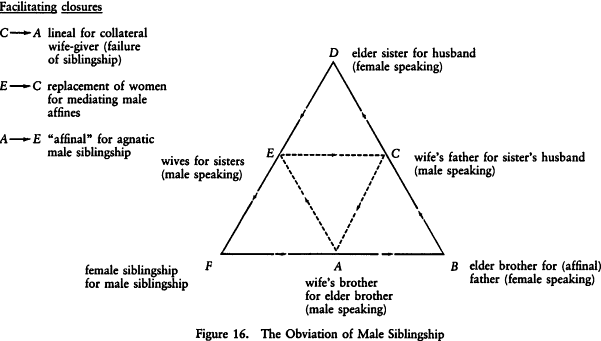
Figure 16.
The Obviation of Male Siblingship
From the analyst's point of view, in other words, the myths can be grouped in unlimited ways, and the myths themselves are individually refractable by several methods: for example in structuralist terms and in the dialectical alternation that provides their obviating summation. I have focused on this latter phenomenon because it reveals the working out of social and cosmological premises that form the basis of Foi experience. As the obviation sequence I have just discussed indicates, myth can juxtapose certain premises and reveal analogies that ordinary life does not permit. For example, the myth ``Return from the Dead" (chapter 8) revolves quite clearly around the symbolic equation "living is to dead as male is to female," but this equation is not ordinarily given conscious articulation by the Foi in everyday discourse. As I have been suggesting, myth creates precisely the symbolic closures that nor-mative social process does not entail.
This quality of myth is also illustrated forcefully in the repeated use of the Usane Habora exchange as background for significant action. in real life, the Usane is held perhaps once every generation: it cannot therefore serve as a context for the depiction of everyday life among the Foi. Yet eight out of the twenty-seven myths I have presented feature the Usane and what I have labeled the Usane Transformation as a key element in the development of the plot. What does this tell us about both Foi myth and the Usane itself?
The Foi were fond of describing the Usane as "a very big aname kobora ." In chapter 4 I described aname kobora as the exchange of pork for shells which individual men undertake on a regular basis in order to raise wealth for their ceremonial payment obligations. I suggested that, symbolically, aname kobora consisted of the exchange of female pork for male shell wealth and that the Foi community represented itself on these occasions in its exemplary male and female productive roles.
The Usane, then, from this point of view, is merely this aspect of aname kobora carried out by the entire community rather than by a single individual. But additionally, the myths portray the Usane not just as the exchange of male and female wealth items but also as the exchange of pork and shells between maternal relatives and cross-cousins (see chapter 8). Insofar as I have analyzed such exchanges as comprising the final stages of Foi affinity (chapter 7), the Usane then really represents nothing less that the ceremonial expression of the two analogous principles of intersexual and affinal mediation.
Against this conventional background of intersexual and affinal accommodation are set the individuating dilemmas of Foi mythical char-
acters: for example, the feminized man in "The Origin of Tree Grubs" (chapter 8); the confusion of female siblings in "The Milk Bamboo" (chapter 8); the lethal conflict between brothers-in-law in "The Origin of Karuato Feast" and "The Younger Brother's Resurrection" (chapter 10). It is in such terms that the differentiating function of tropic construction that I discuss in chapter 7 is most visible. By contrasting the general image of intersexual and affinal mediation with the fanciful and particular actions of individuals, the myths extend and comment upon the parameters of such mediation. In this sense, since all eight myths focus on affinal and intersexual definition in their resolution, the Usane is perhaps the most apt context within which their plots can unfold.
In chapter 8, I also noted that the Usane Transformation figuratively replaces horticulture with hunting, and in chapter 2, I suggested that such a shift can be interpreted in terms of the manner in which the Foi view their seasonal alternation: from the isolated nuclear-family units of the hunting season to the collective longhouse-based life that centers around gardening and pig raising. When the men and women of Hegeso Village are dispersed in the hunting area of Ayamo, their discourse is by definition limited to the highly stylized interaction between husband and wife. But in the village, with the daily gathering of people in the longhouse community every evening, conversation focuses on the collective activities and concerns of Foi life: bride-wealth, betrothal arrangements, plans for forthcoming feasts, sorcery suspicions, compensation hearings and, of course, the telling of myths. In a sense, it is the opportunity for individuals to "invest" their private experiences in the bush in the collective consciousness, sharing triumphs and disappointments in hunting adventures and commenting on the contrasts between life at Ayamo and life in Hegeso.
If the seasonal alternation of Foi life represents a dialectic between individual and collective experience, so do their myths, which particularize those general social and cosmological principles, even as each individual Foi domestic unit replicates in miniature Foi society in its categorical definitions. All metaphorical literary forms, including the sorohabora and sago chants as well as myth, represent this ceaseless contrast between individual experience and the idioms of collective sociality, and in so doing, these forms lead to the creation of Foi culture, in common with all metaphors, as the relationship between the conventional distinctions of social boundaries and the created analogies of aesthetic innovation.