
Not Obeying Husbands
The sati , we have seen, renounces pativrata status while she reincorporates the pativrata ideal on a supernatural level. As a protector, the satimata is the preserver of family fertility. Because of her death as a pativrata , she is especially empowered to promote birth. Her incorporation of the mutually dependent processes of birth and death makes her a compelling symbol. Through self-sacrifice the satimata acquires power over the most basic life processes.
In a parallel way, the pativrata too brings together self-sacrifice and birth. The pativrata is the very embodiment of chastity, itself a form of renunciation. It is clear from the stories women tell and the explanations
[1] On the notion that intention is more important than action see Gold, Fruitful Journeys , 297–98, on pilgrimage; and Bennett, Dangerous Wives , 49, on puja .
they offer for the primacy of chastity that it represents the female counterpart of male celibacy (brahmacarya ). Chastity presupposes both renunciation and fertility: it assumes active sexuality within the confines of marriage. What is renounced is not sexuality but unwifely sexuality. What is affirmed is the fertility of the family line, and hence of kul and caste. Furthermore, to set this notion in its broader context, what is denied is not the self per se but those self-centered impulses that are by definition unwifely. The role of wife and mother requires expression of sexuality as a duty, one that a Rajput woman can and should assert herself to pursue.[2] Wives speak frequently of the importance of attracting one's husband by wearing flattering clothes, plenty of jewels, and sweet perfumes.[3]
Marital fidelity, the most fundamental aspect of the pativrata role, gives us a model for other acts of renunciatory assertion. When a woman sacrifices in order to fulfill a duty, her acts may appear, out of context, radically insubordinate and just plain bad behavior. In other words, beginning with chastity and extending to the other duties of a wife, the ethic of protective sacrifice is not simply a negative, self-effacing role. Many women I interviewed commented that performing a pativrata 's role requires wisdom, for women must often make hard decisions. The duty to sacrifice always needs interpretation. Sometimes a woman must even decide whether obedience to her husband is a service or a disservice to him. Rajput lore is full of examples of pativratas who become sativratas after they controvert their husbands' orders and in this way help them and their families, whose welfare depends on the proper performance of wifely duty.
We have had a glimpse of this duty to controvert male wishes in the discussion of curses. The sati who curses her wine-loving husband and the sati who curses her previously married husband both act in ways seemingly incommensurate with the ideal of the pativrata . Both women, however, find that their husbands have exercised bad judgment. Although alcohol and polygamy are recognized as permissible for Rajput
[2] Throughout India sexual intercourse is understood in the first instance as a female need and its satisfaction as the duty of husbands; see, for example, Carstairs, Twice Born , 73; the discussion of "the lustful bride" in Shulman, Tamil Temple Myths , 141, 166–76; and O'Flaherty, Siva , esp. 141, which quotes the divine yogi, Shiv: "This girl with her magnificent buttocks must not come near me. . . . Wise men know that a woman is the very form of Enchantment . . . the destruction of ascetics."
[3] Rajput women tend to regard their peers in general as having a unique beauty and allure. When asked to describe Rajput women, informants often noted Rajput women's facial features, which they considered particularly refined and aristocratic-looking. Many correlated these attractive features with the need for parda .
men, the men are expected to drink and marry responsibly. Women who have married into the families of these satis adjudge the satis' curses to be justified. The curses are tailored to ensure that men will learn their responsibilities as men.
It may here be objected that these interpretations of sativratas' commands are only rationalizations used by women to serve their own agendas. But this is precisely the point. Women believe that the curses convey commands that women are bound to fulfill or to see that men fulfill. The very fact that women interpret curses bolsters their own authority as wives and mothers. As family-protectors they explain and enforce the family-protecting orders that satimatas give. A clear example of this is the way women in the family whose sati prohibited men from drinking alcohol today enforce their sati's will and also provide an example by their own abstinence.[4]
Although men venerate satimatas , their wives perform the majority of satimata rituals. Women understand shraps and oks as expressing the will of their predecessors, which they interpret and enforce. Women are the primary tellers of satimata tales and performers of satimata ritual. When men participate in satimata worship, they seem not to alter the meaning of the rituals and stories that women in the family share.
In short, satimatas' shraps and oks confer authority on women, who at times use their authority to protect their households in apparent deviation from the norm of wifely obedience. Sacrificing their personal desires (such as the desire to please their husbands), they may legitimately demand that satimatas be properly propitiated and that their pronouncements be honored. It is always a woman's responsibility to make her husband tend to all his ritual duties, for these duties contribute to his welfare, the preservation and promotion of which are his wife's sworn responsibility. This correlation between the renunciation of selfish wants and the duty to make men do what they ought extends to many contexts.
Exemplifying the general notion of renunciation as entailing a positive formulation of female duty are the following stories, which tell of women controverting male wishes to promote male duty, as they understand it. Many of these stories recount successful attempts by Rajput women to goad or trick men into performing their duties as warriors. In
[4] See Harlan, "Sati Veneration," in "New Light on Sati," ed. John Stratton Hawley. Many women do not like their husbands to drink much alcohol; they consider alcoholism a problem in their community particularly because Rajput drinking is sanctioned by tradition. They often say that problems of adjustment caused by disinheritance have caused many men to become depressed and drink too much.
one story that women love to tell, a husband, wishing he were with his wife rather than in the battle then raging around him, abandons the field for his fortress. Having been told of the approach of her husband, however, his wife directs a servant to have the fortress gates locked tight so that her husband will not be able to come home. The sad soldier's only option is to return to battle.
In a similarly popular story among Rajput women, a husband comes home in the midst of war and goes to see his wife and mother. The mother tells her daughter-in-law to prepare some food for him. The wife, who is outraged by her husband's cowardice, bangs her cooking pots as she prepares his meal; her mother-in-law, also furious, scolds her for handling the kitchen utensils too noisily. In a voice loud enough to ensure that her son can hear, she calls into the kitchen, "You mustn't frighten my son. How the sound of clanging iron terrifies my timid little son!" The mother-in-law's insinuation that iron kitchen utensils banged together sound to her son like clashing swords, which frighten him, is of course highly insulting. Angered, the son returns to the battlefield. Hence despite an ostensible respect for the warrior's desire to stay home, the wife and mother manage to drive him out into the battlefield, where he risks his life instead of his honor.[5]
Rajput women tell many other stories in which women are credited with shaming their husbands into doing their duty.[6] In one, a woman from one of Mewar's biggest thikanas tells her maidservant not to bring her cowardly husband coals for his pipe in an iron container because iron might remind him of the weapons he so fears. Having fled battle, the man does the honorable thing by committing suicide.
Stories such as these articulate a norm of positive renunciation. The mother or wife sets aside her desire to gratify her loved one and secure his safety. In both instances, the woman acts as a wife of the family and a perpetuator of the family line. She sacrifices her personal happiness—predicated on the safety of her husband—in order to support his role as a performer of male/caste duty.
The principle that guides these stories combines with the sati ideal in the two following popular legends that I here consider together for pur-
[5] Among the exemplary mothers who shame their sons into battle is one who says to her faint-hearted son, "You've drunk my milk, now slay the enemy." This recalls the story of Guha, whose mother says that if she has sat , then her son and his descendants will be successful kings.
[6] Rajasthani folklore frequently uses the motif of women motivating warriors (Kothari, "Epics of Rajasthan," 15). One thakur expressed the same notion of motivation: "Our ladies tell us what we should do, otherwise we cannot do it. It's the mother's job to tell the son to kill, to die, to fight in battle."
poses of comparison. Women often recited them to me during my stay. The first, the story of Hari Rani,[7] involves a woman who is not a sati in the narrow sense of the term: she does not immolate herself on her husband's pyre. In fact, she kills herself while her husband lives and faces no imminent danger of death.[8] Nevertheless, she is called Sati Hari Rani and is invoked in discussions on satis because her death is seen as a direct manifestation of her sat . Rather than recount one of the many detailed and elaborate accounts of this famous story I include here only the bare bones essential to its paradigm of duty. This course is particularly appropriate as most Rajput women know only the story skeleton and base their interpretation on it. The narrative from an interview with a Mewari thakurani is a good example:
Hari Rani had just been married to the Lord of Salumbar [one of the major estates of Mewar] when he was summoned by the Maharana to help repulse an attack by Aurangzeb. The husband was so enamored of his new bride that he had great difficulty pulling himself away from her to go and fight. Barely managing to leave her, he could muster no enthusiasm for the upcoming battle. When he reached the palace gates, he sent word back to Hari Rani that she should send him some souvenir to take to war with him so that he could feel she was by his side. Without hesitating, the devoted wife drew a sword and sliced off her head so that he could take that with him. When a maidservant delivered the head to him, he affixed it to his saddle and, inspired by his wife's example of devotion, rode off to do his duty as a soldier.
The second story is that of Ruthi Rani or the Angry Queen. A typical version of this tale was told to me by another thakurani from Mewar.
There was once a very beautiful princess of Jaisalmer. Both Jaipur and Jodhpur wanted her in marriage. There was almost a war, so many kings wanted to marry her.
The Maharaja of Jodhpur forced his presence on her father. They signed a treaty, one of the conditions of which was that the Maharaja would have the hand of the Jaisalmer princess. The father, however, managed matters so that the groom's gaddi (wedding throne) would be precariously perched over a hidden pit. Thus when the groom attempted to sit down, he would fall to his death.
Having discovered this plot, the daughter sent a maid to warn her betrothed that he should test the gaddi with his sword before sitting up it. She also pleaded with her father not to carry out his plan, but to no avail. At
[7] "Hari" (Hadi) is a feminized patronymic, indicating that the father of the queen (rani ) was from the Hara shakh of the Cauhan kul .
[8] In this she resembles the sati who dies in jauhar . The jauhar sati dies before or while her husband fights what appears to be an unwinnable battle. By dying, she frees him from worry about her welfare and saves herself from the possible shame of rape by triumphant enemy forces.
the ceremony, the groom tested the gaddi and its seat fell into the pit below. Another gaddi was set upon a safe spot and the ceremonies were completed.
After the wedding, the groom went to the bridal chamber. His wife was preparing for her wedding night in a back room. The groom sat waiting for her. Strong drink and dancing girls had been provided for his entertainment. Having waited some time and consumed some wine, the groom grabbed one of the dancers, sat her on his lap, and began to amuse himself with her. Just then the princess entered the room. Disgusted, she turned and left.
Having seen his wife's beautiful face, the groom became impassioned. He pleaded with her to stay, but she kept on walking. Then she sent him a message that because he was so impatient that he could not wait for her even a short time, she had decided not to join his harem. (He already had many wives.) He hoped she would change her mind, but after seven days he decided he had better go home. The queen's family tried to convince her to go with him, but she refused. Because she was now a queen of Jodhpur, the Maharaja left with her a suitable staff of servants.
Two or three years passed. The queen was still angry, even though she knew her husband's behavior was typical of kings. About that time, the Maharaja found it necessary to go to war. He sent Ruthi Rani a message asking her to come to him before he faced battle. Reluctantly, she agreed.
When the queen's procession neared Jodhpur, the Maharaja sent her a message that he would soon be out to greet her. Meanwhile, a Caran caught sight of the entourage and sang out a song (doha ). In effect he said, "We thought that this woman was beauty and pride incarnate, but now we see that she is just an ordinary woman." Her anger rekindled, the queen returned to Jaisalmer.
The Jodhpur Maharaja was killed in the battle. He had left orders that were he to be slain, his head should be sent to his angry wife. Upon receipt of the head, the queen immolated herself as a sati .
Both stories exemplify willful disobedience by women. The wives shame their husbands and subvert their husbands' intentions. Women nonetheless hold them up as exemplary pativratas . Their strong willpower—an attribute that many Rajput women see themselves as possessing—enables them to make men do the right thing.[9] Like the wives in the stories of the locked palace gates and the clanging dishes, these brides force their husbands to behave in ways contrary to their personal whims but commensurate with their status as Rajputs. In most of the stories presented, the motive that women have in chastising their hus-
[9] Rajput women frequently stress their insistence on proper behavior. One said, "Even if marriage is suli —torture by impalement—you must be willing to perform your duties." Another explained, "We Rajputs have very strong willpower and the guts to face all our problems. In the old days, Rajput men married three or four times, but the wives didn't fight with one another because they had guts." Still another extended this notion of willpower to control over others. "Because of their will," she said in English, Rajput women get what they want done, "by hook or by crook."
bands is patent. They want their husbands to fulfill their duties as warriors. In the final story, however, the motive is complex and less clear. Ruthi Rani gives her husband two rebuffs. The context of each is important.
With the first rebuff, Ruthi Rani reacts against what she understands to be improper behavior on the part of her groom. As the noblewoman who narrated the story commented, it is not wrong for a king to toy with damsels—that is to be expected. What incenses Ruthi Rani, she went on to say, is the lack of respect the king shows for her as his wife. As a bride determined to make herself as alluring as possible to her husband, the queen takes time to be bathed and adorned. When she is ready to give herself to her husband, however, she finds that he has allowed a mere dancing girl to upstage his bride. The king's behavior is insulting; it demeans her sense of wifely duty and dignity. Although such actions are appropriate to a Rajput king under other circumstances, here they are offensive, which is why she becomes so angry.
The second half of the story demonstrates that by withdrawing from her husband's company, Ruthi Rani proves that she will not allow him to forget his transgression: the Maharaja must not be allowed to confuse the place of wife and concubine. Especially striking is the story's ending. Still lovesick, the king finally persuades the queen to see him before he goes off to war. It was, after all, customary for women to see their husbands off and so inspire them as they left for battle. Nevertheless, when the queen hears the biting criticism of the Caran, whose caste duty is to sing of the Maharaja's achievements in order to expand the Maharaja's glory and power, she determines to rebuff her husband a second time. Were her reason mere vanity, however, doubtless she would not be held up as an exemplar. To interpret this renewed rejection we need to focus on two elements, the symbolic character of the bard and the connection between the queen's arrival and the inception of battle.
First, the bard. Presumably the song he sings is designed to protect the king's honor. His purpose is to bar the queen from the king's residence. If she enters, she impoverishes her pride, a pride based on her relationship with her husband and a pride that has been instructive, if painful, for her husband. Making this especially vivid is a variation on the bard's advice that the husband of one of my informants narrated to me in poetic (doha ) form. Wishing the wife to go away, the bard sings, "If the queen keeps her pride, she loses her husband; if she keeps her husband, she loses her pride. These two elephants cannot be chained in
the same stable."[10] That the bard intends the queen to choose pride and sacrifice her intention to be with her husband is apparent, for he discourages her from proceeding.
Second, the war. Its outbreak means that the queen arrives just as the king should leave home. I heard no specific commentary on this circumstance but speculate that the queen's arrival might threaten the king's resolve to do battle. The other narratives show the danger that a king's preoccupation with his wife can prove to the king's duty and his king-dom's welfare. In this instance, the king's infatuation with his very beautiful and long-inaccessible wife may well distract him.
Thus the story offers the queen an excellent reason to turn back. Her goal in coming to Jodhpur is to do her duty as a wife by supporting him in his performance of military duty. When she realizes that her decision to come to Jodhpur will not achieve that end but rather defeat it, she determines to withdraw. Her goal has remained constant; her means of arriving at that goal has changed along with her destination. That the king thinks his wife a virtuous woman is demonstrated by his order to have his head sent to her after his death. The delivery of the head suggests the king's expectation that his wife, being virtuous, will become a sati by immolating herself with his head on her lap.[11] His expectation is fulfilled. The queen's death manifests the purity of her heart and the strength of her wifely devotion.
All these stories contribute to the conclusion that wifely sacrifice is a positive duty. Self-denial produces protective power. In form always yielding, a wife may either conform to or rebel against her husband's will. These tales describe women's sacrifices as affirming and reinforcing husbands' performance of Rajput duty. They repeat the message: a Rajput woman must support her husband's caste responsibilities, for these are the source of his honor, which defines his highest self. Even if supporting a husband's Rajput responsibilities means pushing the husband
[10] In his version of the story, Ruthi Rani, who still had not showed her face to her husband, lived apart from him in Ajmer. When Sher Shah was marching toward Jodhpur, a Caran sent a message to Ruthi Rani to join her husband there. She was going to go, but her husband's first wife told a Caran (the nephew of the first one) to dissuade Ruthi Rani from coming; he recited to Ruthi Rani the "elephant" doha above. Seeing its wisdom, she decided not to go. When her husband was killed, however, she led the charge against Sher Shah and then died a sati .
[11] A friend suggested to me that the king's act seems spiteful. Spiteful or not, the king's order to have his head delivered seems to assume his wife will be a sati and serve as encouragement for her. It rather neatly parallels the way Hari Rani expects and encourages her husband to do his duty.
into certain death on the battlefield, the Rajput woman is supposed to do so, for it is a shameful thing to have a cowardly husband. The paradox occasioned by her failure as a pativrata to protect his life is then symbolically resolved by self-immolation. This act, as we have seen, verifies her purity of intent.
Because Rajput women see their caste as enabling them to best approximate the feminine ideal, they understand their duty to help their husbands perform Rajput duties as especially stringent. Thus whereas Rajput duties are understood as in the first instance male,[12] the female duty to sacrifice is conceived with reference to Rajput male duties. In other words, it interprets and justifies itself in terms consistent with and supportive of the general Rajput ethos of sacrifice. The female duty to sacrifice combined with the Rajput ethos of sacrifice make for a mandate of non-compromise. As a middle-aged noblewoman remarked, "If husbands prove cowardly, we Rajput women break our bangles, just as widows do." There seems little room for negotiating the issue.
This resolute courage characterizes the stories. Hari Rani does not hesitate before decapitating herself with a sword; its use is particularly appropriate as she wants to encourage her husband to use his sword in battle (fig. 25). She sacrifices herself that her husband might cut down his enemy. Ruthi Rani also does not delay: she sacrifices the life of a normal wife to teach her husband to behave properly and honorably. Behaving honorably herself, she heeds the bard's advice to stay away from her husband as he prepares for battle. Moreover, her sacrifice of self and protection of honor remain conceptually entwined with the fundamental abstinence that is chastity. Ruthi Rani is a paradigm of sacrificial chastity, a notion with important implications for the ethos of protection.
When women speak of chastity, they commonly use the words sharam and laj , both of which translate as shame and modesty. The terms themselves show that chastity does not simply mean restraint from extramarital sexuality: that may be taken for granted. Objectified as the parda (curtain), chastity informs and structures the entire code of wifely duty. As it fundamentally represents the expression of sexuality in support of a husband, so, in the appropriate context, it connotes the shame or modesty to renounce a woman's pursuit of personal desires,
[12] Caste duties follow a division of labor set out in the classical legal texts (the dharmashastras ) and popular wisdom; men perform specific caste duties while women have common duties, those of wife and mother. Asked what Rajputs do, both men and women nearly always refer to the tasks of Rajput men: ruling and fighting.
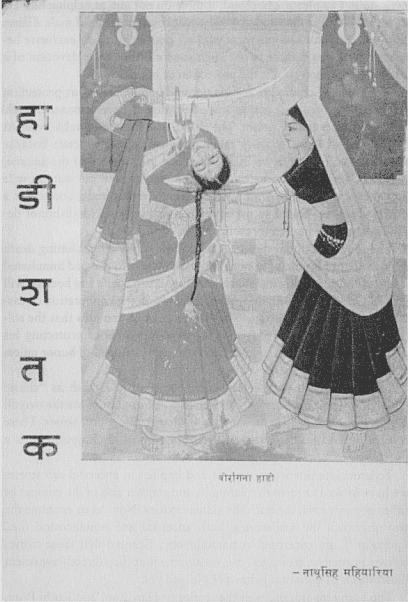
25.
Hari Rani sends her husband her head as a memento (cover from a poetic
narration of the deeds of Hari Rani; by permission of Pratap Sinh
Mahiyariya and Himmat Sinh Ashiya).
even desires to please a husband, if these do not aim at helping him act as he should. Sacrifice and the consistent controversion of male desires found in satimata and pativrata tales are not the mutually exclusive behaviors that they appear to be. Their source is the chaste devotion of a pativrata and their goal is the protection of honor.
The chain of connotation does not end here. Chastity as protection not only preserves male honor (gained through the performance of male duty), it defines female honor. The chaste wife is the honorable wife. At the expanded level, chastity takes on a reflexive character: because wifely chastity depends on male protection and control of the zanana , male and female honor are mutually dependent. Both the wanton wife and the wife violated by an invader destroy a husband's honor, for a husband is duty-bound to preserve his wife's honor. Her dishonor degrades him until he exacts revenge.[13]
The terms may be reversed. A man who suffers a humiliating death in battle robs his wife of honor. The slain warrior is deemed humiliated if scalped, for scalping insinuates that the victim's wife has been or will be violated. This humiliation stems partly from the connotation of castration that scalping carries.[14] But it also conveys the idea that the soldier slain and stripped of his manhood is incapable of protecting his wife. The wife of a man so humiliated is herself stripped of honor unless his scalping is avenged.[15]
In sum, the pativrata , a term often rendered in English as "chaste wife," is a woman whose chastity serves as a foundation for the overall fidelity she realizes by protecting her husband's life, duty, honor. These in turn depend on her husband's performance of his Rajput role as a protector.
To articulate the norms explicit and implicit in ancestral sati stories we have looked at them in relation to one another and in the context of other nonancestral, thematically similar stories. Now let us examine the way in which the sati stories, both ancestral and nonancestral (i.e., "popular"), are construed as paradigmatic. Granted that these stories convey normative messages, can we assume that they directly represent illustrations of pativrata behavior? No and yes.
The pativrata stories, even the stories of Hari Rani and Ruthi Rani,
[13] On revenge, see Ziegler, "Action, Power," 79–80; Hitchcock, "Martial Rajput," 12.
[14] Ziegler, "Action, Power," 79–80.
[15] A family member or the warrior himself could kill the scalper. As we have seen, a great warrior (jhumjhar ) exacts revenge for death itself.
who become sati s, focus on the proper behavior of pativrata s during extraordinary circumstances. These women act in directly paradigmatic ways. Pativrata s admire the way these two behave and refer to them as women whom they would like to emulate. The ancestral sati stories told in chapter 4, however, focus not on pativrata performance but on the sativrata stage, in which the normal conditions of life and the normal rules of behavior are suspended. The power that the sati demonstrates during this period has been built up by conformity to the pativrata paradigm. The use to which this power is put, however, transcends the code and the capability of the pativrata .
For example, each sati appears in public for all to see. Furthermore, she may address whom she will. She may bring destruction, albeit instructive destruction, upon her sasural or she may damn the houses of those who have offended her. Obviously no wife would interpret such actions as options for herself. The sati is no longer simply human. It is superhuman power that makes her curse and ok efficacious. In the sati, sat has overflowed the boundaries of human being and surpassed the capacities of human reason.
Specific acts performed during the sativrata period are not, then, to be understood as exemplary in any literal sense. Nevertheless, the sati 's general behavior is normative in two important ways. First, the scenario is normative. Becoming a sati is only the culmination of a process of sat accumulation. The woman's act of dying reveals a life that has followed the pativrata ideal just at the moment when she transcends the ideal. The sativrata who is no longer a pativrata inspires women to be pativrata s.
Second, and perhaps less obvious, is the sati 's formal affirmation of the dual pattern of protection and controversion. The sati protects the family line directly, through blessings (corresponding to the wife's fulfillment of her husband's desires), or indirectly, through curses (corresponding to the wife's denial of her husband's desires when they will rob him of honor). Her curses are not to be emulated by pativrata s, but the model of controversion as an occasional aspect of female duty to support male duty is normative for them. The angry sati 's example is a paradigm of constructive rebellion, that is, denial consistent with the pativrata 's code of sacrifice, denial of the sort practiced by Hari Rani and Ruthi Rani.
This abstraction begs the interpretive question: how and when are women to decide whether insubordination is warranted? Although the sati paradigm legitimizes controverting male desires, it must be regarded
in the context of a common understanding of male desire and male duty as usually synonymous or, at least, harmonious. If a satimata pronounces a curse, it is often because a family member has indulged personal desire at the expense of duty. Whatever the reason for the curse, all members assume it is a justifiable means for righting a wrongful situation. They know that even if the curse does not seem just to them it must be just; the sati knows best.
The motives of an ordinary woman are always less evident. However far such a woman may have progressed toward incorporating the pativrata ideal, she is understood to be susceptible to self-serving rationalizations, which reveal that her desire and duty (not her husband's) have taken separate paths. One of the worst accusations that is made of a woman is that she willfully manipulates her husband for selfish ends. Such manipulation is seen as the source of nasty court intrigues in times past and of devastating family quarrels today. In Rajasthan, as elsewhere in India, contriving wives are seen as spoilers of family solidarity. Hence the presumption to know better than a husband, to control him, or to disobey his wishes is prima facie arrogance. As the stories show, only when the desires of a husband are patently misguided is controversion warranted. As one noblewoman puts it, a pativrata "seeks to be beyond reproach." She and other Rajput women speak of their duty to avoid drawing criticism from their husbands' families. The wisdom of controversion must be salient, self-evident. Given the stress women put on the pativrata 's duty to obey, sacrifice of a husband's wishes should be an anomaly in the course of daily sacrifices that fulfill a husband's wishes. All sacrifices are done in the interest of duty. Thus a satimata 's curses do not legitimize particular acts of rebellion but demonstrate a conviction that gives positive form and meaning to the roles women play as women. Conditionally, they give authority.
For Rajput women, then, the sati is a symbol encompassing paradigms of conformity and rebellion, however contextualized. Within the parameters of the sati paradigm, rebellion is not a violation or rejection of duty but rather another mode of realizing it. The duty of the pativrata is to support male duty but not necessarily male desires, as the lore so aptly illustrates. Female duty applied as obedience or disobedience is understood as sacrifice; in the broad sense sacrifice is the lot of the pativrata as it is of the Rajput man.
Moreover as I have stressed, Rajput women believe that their Rajputness enables them to carry out their female duties. Rajput blood predisposes Rajputs to proper intentions and devoted service; it enables men
to sacrifice for the realm and enables women to sacrifice for the family. Female service does not, however, restrict itself to household affairs. It is concerned with preserving the proper delineation between household and nonhousehold (male) affairs. If a husband or son does not respect the division between these spheres, his wife's or his mother's task is to educate him; hence the stories of Hari Rani's decapitation and the wife who ordered the palace gates to be locked.
This rule of separation is reinforced both by stories such as these and by the actual division of the household into male and female quarters. A man's entry into the zanana commences a visit. The male is a guest who comes for a specific reason, food and drink, the attentions of his wife, or the companionship of his mother and sisters. Once his needs are fulfilled, he is expected to return to male quarters and male company. If he lingers too long in female company, women may eventually shame him into leaving by taunting him or giggling at him. Extensive habitation of the zanana is considered emasculating and, so, non-Rajput.[16] Thus Rajput status is understood to connote ideal manliness as well as ideal femaleness. Caste identification delineates the separation and describes the mutual support of the two.
That women and men ultimately equate the ideals of gender and caste does not mean that they apply their shared ethic of protection in consistent, harmonious ways. The problem of priorities remains. The satimata stands as the embodiment of pativrata duty, which encompasses the norms of service to a husband through obedience and service to a husband through doing what is best for him. When the twin mandates of service contradict each other, a pativrata will have to use her judgment to assess which path pativrata duty will take. Although the wisdom of disobedience should be patent, the fundamental rule being obedience, a pativrata will have to make decisions that seem disrespectful—she may even shame her husband and show him her anger—which is one reason why status as a genuine pativrata may only be validated retrospectively.[17] Because this problem of priorities differs from the problem we saw in preceding chapters, a brief comparison of the questions of priority in sati and kuldevi traditions will be useful.
The kuldevi chapters demonstrated that women do not always reach the same solutions to conflicts between the female conception of Rajput
[16] For an interesting illustration of this point, see Ziegler, "Action, Power," 81–82.
[17] Women seem most vociferous in challenges concerning alcohol consumption and accompanying raucous behavior. We will hear more about their assessments in chapters following.
duty as it applies to the household and the general conception of (male) Rajput duty as it applies to the kul or one of its subdivisions. Kul tradition requires loyalty to its kuldevi . Nevertheless, some women may understand their natal family's kuldevi as better able to serve the functions assigned to the conjugal family's goddess. The rebellion—or compromise—intended by those women to support male service contradicts the male-defined notion of support of male service. In this case there is a conflict between the kul expectation and the female interpretation of duty.
In the case of satimata worship, however, this conflict tends not to arise. The satimata is an ideal: she is a pativrata so complete in her realization of duty as to have transcended pativrata status altogether. Her independence as a supernatural being is predicated upon her perfect conformity to female duty through her support of male duty. Worship of the satimata is not a kul duty; it is a family duty. Moreover, it is preeminently a female duty. The satimata , unlike the kuldevi , is overwhelmingly a household phenomenon. The neglect of a satimata or the incorporation of new satimata s into household ritual will not directly threaten the kul .
This is not to say that conflict cannot arise from interpretation of satimata myths and performance of satimata rituals. Rather, it is to say that satimata worship occurs within a conceptual framework of support of male duty, so that conflict arises within the conceptual parameters of female duty. The satimata is identified with the household first and last. The kuldevi is identified with the battlefield originally and the household derivatively. Thus, with the satimata no question of caste versus family loyalty is possible. The satimata serves the separation of male and female spheres of duty and equates the latter with service of the former. She is perceived as a resident of the zanana . Rising out of the zanana , she is the apotheosis of female sacrificial support. By contrast, the kuldevi is an utterly transcendent deity who descends to the battlefield. She is worshiped differently in the mardana and the zanana . She is both the animal goddess of battle and the suhagin goddess of home. Moreover, to the extent that she is both warrior goddess and household goddess, she incorporates and demonstrates the tensions that may arise between perceptions of male duties and female duties. These tensions create and are reflected by the temptation to split her functions and worship her as two kuldevi s.
The observable effect of the delimitation of satimata jurisdiction is the flexibility attending her worship. There is no competition possible
among sati s. Whereas there must always be only one official kuldevi , there are many possible sati s. The greater the number, the prouder the family that performs their devotions. If sati s are imported through weddings, so much the better. Of chief importance in the context of sati worship is the sati scenario, which states the realization of the feminine ideal. Each sati is revered because she conforms to the scenario, which proves the purity of her heart. Hence all sati s easily merge into a unitary satimata personality. And so, when women say that they place their faith in Satimata, they are not selecting one from among many. They are affirming the functional equivalence of all.
In no way does this equivalence mean that the stories of individual sati s cease to be important. Quite the contrary. Each story exemplifies and affirms the paradigm. Moreover, the conclusion that sati s do not compete one against another does not suggest that satimata worship cannot catalyze conflicts concerning female responsibilities. We have seen that the satimata scenario can legitimize rebellion as a mode of conformity to the principle of duty. What noncompetition affirms is that satimata s are understood as representing female duty supporting male duty. Their example makes lucid the idealized harmony between the two. The kuldevi comes with competing male-oriented (kul ) and female-oriented (family) myths of origin. The satimata 's origin is always the same: flames erupt from the internal fire of sat kindled by a lifetime of service as a pativrata .
Thus, whereas kuldevi tradition reveals tensions between conceptions of male duty and conceptions of female duty, satimata tradition demonstrates tensions between female duties to serve the desires of men as they are and to serve the needs of men as they should be. Women must venerate kuldevi s as protectors but emulate kuldevi s directly as pativrata s. They must venerate satimata s as protectors, but understand satimata s as onetime pativrata s whose footsteps can be followed. Therefore compared to the kuldevi , the satimata is an intimate protector; she guards households she has chosen, not an entire kul , whose members may be scattered far and wide over Rajasthan, and perhaps beyond. While she resides in heaven by her husband's side, she is yet ever accessible to her protégées. The sati stands for a scenario of sat accumulation, the internal dynamic corresponding to and resulting from performance of the pativrata role.
To conclude, all stages of the sati scenario demonstrate the conviction that a Rajput woman's duty toward her husband may require violating his wishes. As women's myriad stories of shrap s and ok s and of brave
women and cowardly men reveal, the Rajput woman is duty-bound as a Rajput and as a woman to do what is best for her husband. This usually means obedience but occasionally means insubordination. The correctness of the dedicated woman's action is not the form of her action but rather the intention that guides it. That intention must conform to the general assumptions that attend her status as a pativrata and her desire to revere, if not enact, the example provided by the sativrata .