
Traditional Forest Management: Strengths and Limitations
It is likely that the most extensive conversion of Khumbu forest to open woodland, shrubland, and grassland took place centuries ago, conceivably long before Sherpas arrived on the scene. Yet Sherpas have also had environmental impacts on forests over the past four centuries. The nature of these impacts was related not only to historical patterns of local forest use but also to the effectiveness of local forest management. Change in Khumbu forest during the period of Sherpa settlement reflects the goals and effectiveness of local Sherpa managment of different types of forests and the types of vegetation change associated with their use both of these protected forests and other unprotected Khumbu forests.
The goals set for the various types of protected forests generally appear to have been fairly well achieved. Sacred groves were kept from
desecration. Administration of bridge forests, avalanche-protection areas, and rani ban generally met the objectives set for them. Residents of Nauje, Khumjung, Kunde, and Pare were able to continue to find beams in adjacent rani ban, Bachangchang continued to supply critical soluk.
Elderly Sherpas maintain that throughout their lifetimes both sacred forests and some rani ban were very well protected. The strength of local respect for sacred groves remains notable to the present day. Phurtse villagers, renowned in Khumbu for their strict protection of the local lama's forest, often observe that there was little for shinggi nawa to do because no one would think of violating the customs protecting the sacred forest. They say that in the especially sacred forest area north of the settlement people kept an eye even on their own relatives. The sacred forest at Yarin, the sacred junipers at Pangboche, and temple groves throughout Khumbu have also been relatively well protected from cutting and lopping throughout this century.
The regulations established for several of the rani ban were also well maintained. The Bachangchang rani ban, for example, was long exceptionally well administered during the early part of the century when Yulha Tarkia was pembu. Villagers declare that the rules were nearly as carefully observed during the years when his son Konchok Chombi had power. The fact that Bachangchang had been considered a sacred forest by local villagers before it was designated a rani ban must have made the enforcement of protective regulations there relatively easy. The Khumjung-Kunde rani ban and the rani ban near Nauje were also relatively well maintained during the course of several changes in pembu administration, and regulations were carefully enforced in both until the mid-1960s. The Bhotego rani ban, which was administered by a rotation of the shinggi nawa office among the residents of Pare, is also known for having long strictly enforced use regulations.
Control of some other protected forests, however, was less successful. Some of the rani ban were not strictly protected for long, as pembu or their successors seemed to lose concern with ensuring that regulations were enforced. This seems to have been the case at Samshing, Tesho, Gupchua, and Nakdingog, where any formal enforcement of regulations appears to have lapsed well before the 1950s. Even when pembu or local communities did maintain fairly good control over forest use it was not always possible to enforce the rules. Fürer-Haimendorf observed in Khumjung in 1957 that shinggi nawa had had to issue several fines that year for unauthorized tree felling (1979:112). In some formerly protected areas near Nauje people note that for years there were small-scale violations of the rules. Clandestine tree felling took place over a period of decades before the 1960s especially when dense summer mist or low clouds made detection difficult. One elderly villager, when describing
what had happened to the trees in the Chorkem area near Nauje earlier in the century, said, "when the clouds came in the trees went away."
For the most part, however, Sherpas continued to respect the customs that placed sacred forests off limits to cutting and restricted the use of rani ban and some other protected forests. Violations of the rules, other than the cutting of much juniper at Shyangboche in the early and mid-1960s, were small scale and seem to have been relatively uncommon. Community cooperation, social pressure, and the continuing practice of appointing shinggi nawa and other forest-management officials appear to have kept forest-management systems functioning relatively effectively until the 1960s.
Yet local management had significant limitations in terms of how well it regulated local forest use to regionally sustainable levels. These shortcomings had nothing to do with how effectively regulations were enforced. They were instead the result of the rules themselves, or more accurately, of the forest management objectives they were devised to meet. These goals did not include regulating regional forest use to sustainable levels or maintaining, protected forests in a given state of composition or density. In all of the protected forests uses were allowed which were capable of transforming the density, composition, age-structure, and extent of those forests. Nowhere in Khumbu, for example, was any forest or woodland ever closed to grazing throughout the year, much less for a period of years. At most, protected forest areas in lower Khumbu were closed to grazing for three months during the summer, and during the rest of the year many of them endured considerable grazing pressure. This nearly unregulated livestock browsing and trampling may have had an adverse effect on forest regeneration, and the lack of more than brief seasonal restrictions on the collection of dead wood, leaves, and needles from the forest floor may have further contributed to this by removing valuable nutrients. In a number of protected forests, including nearly all of the rani ban and the bridge forests, trees could be felled with proper authorization, and it was up to the user to decide which trees to cut. This selection was often made with convenience in mind rather than any view to minimizing environmental impact and forest change. There were no cultural conservation ethics or community customs or regulations that limited the size of one's home or required that one fell trees only in areas where similar trees were plentiful or other Sherpas were not cutting. Each household chose which trees it wanted to fell in a rani ban and the key concern in this selection seems usually to have been to obtain appropriate trees as close as possible to the building site. There were thus several significant loopholes in protected forest management which could have affected both the long-term sustainability of use and the integrity and continuity of the forests themselves.
There were thus several serious limitations to local forest management as a system of conservation. There were even greater limitations to local forest management when it is viewed on a regional scale and all Khumbu forests are considered rather than just the protected forests. Only about half of the Khumbu's forested area was under one of the several local management systems. The remaining forests were affected by the patterns of use that the protected forest regulations established, however, because the relatively strict protection of sacred forests and, in the twentieth century at least, of rani ban, tended to shift the main demand for timber and fuel wood away from the protected forests and onto forest and woodland areas outside their boundaries (map 18). In these areas there were no rules whatsoever. Here villagers cut as much as they wished from wherever they chose. Time, energy, and demand governed the process which followed. Shinggi nawa or other administrators exercised no authority here, nor were there any cultural constraints on the scale of individual household fuel wood or timber use. At the regional level Khumbu forest management thus created a situation in which some forests were protected relatively well and pressure was instead focused on others in which a lack of management prepared the way for the classic "tragedy of the commons" scenario described by Garrett Hardin (1968) in which unregulated individual access to commons ultimately leads to environmental degradation.
Map 18 illustrates patterns of forest use by Nauje, Khumjung, and Kunde villagers after the establishment of the local rani ban and before Sagarmatha National Park regulations banned tree felling in Khumbu other than for house beams.[11] As can be seen in this map, dead wood and beams could be obtained from rani ban areas immediately adjacent to the settlements, and prior to the establishment of the rani ban timber was also obtained from these areas. People recall, for example, that the forest near the Khumjung village entry arch (kani ) was a very good source of boards at the beginning of this century. Even at this time, however, more remote areas were also being exploited for timber, including forest on the far side of the Dudh Kosi. After the establishment of the rani ban, tree felling for timber, rafters, and fuel wood was channeled as shown into other nearby, unregulated areas. The resulting impact on those forests and woodlands is recorded in the landscape, in oral traditions, and in living memory.
Early Sherpa Impact on Forests
The uncertainty about the extent of forest cover in Khumbu at the time of the first Sherpas' arrival there and the lack of oral traditions about forest use during the early centuries of Sherpa settlement make it impos-
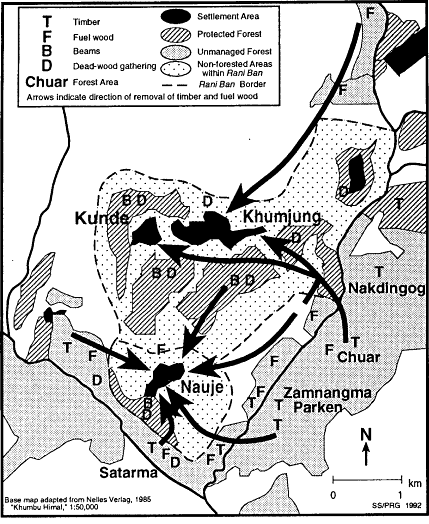
Map 18
Village Forest Use Patterns, 1915-1976
sible to evaluate fully the scope of Sherpa impact on forests over the past four centuries. Oral traditions and oral history, however, do make it possible to say something of the scale and processes of forest change during the last hundred to hundred and fifty years.[12] Sherpa interpretations of place-names, family traditions about the sources from which trees were obtained generations ago for house beams, and elderly Sherpas' recollections about the forests of their youths all testify to historical deforestation.
Place-names contain several possible clues to the former location of forests. One widely cited example is Namche Bazar, the Nepali name for Nauje, which has been said to derive from the Sherpa for "big forest" (Byers 1987b :201, n. 9) or "dense forest" (Bjønness 1983:270). Sherpas are uncertain about the origin of the name Namche Bazar, but some speculate that the name Nauje may be derived from a phrase which would translate literally as "big corner forest," possibly a reference to the natural amphitheater shape of the place and its past vegetation. The upper part of the basin in which the village is set is now conspicuously bare of trees and only a few scattered lu-inhabited trees are found within the settlement area of Nauje itself. Elderly residents indicate that the slopes above Nauje have not been forested during their lifetimes and that they were not told of major deforestation there during the lifetimes of their parents and grandparents.[13] There are oral traditions, however, about smaller-scale forest change. Some people have heard that there was once fir on the south side of Nauje near the present site of the weekly market and that villagers formerly (probably before 1900) felled trees there for rafters. The name of one field in the central pair of Nauje, Tongbajen, is thought to possibly refer to large rhododendron, and here and in several other areas in the village, as well as on the slope immediately above it, many roots were found when establishing terraces half a century or more ago. It is also remembered that until the 1960s there were more juniper in one small area of the upper slopes near the crest of the basin where today several abandoned terraces can be seen. Formerly there was a hermitage at that site, and the juniper were cut down after it was abandoned as a retreat.
The stories told about house beams recall forest where there is none today. In Thami Teng and Thami Og, for example, there are houses that have been rebuilt several times and have immense juniper beams of a size unobtainable today in Khumbu. The prized standing beams often have a history, for the work of cutting and hauling them is long remembered, and beyond that they are regarded as one of the house's more sacred features. Stories about them are sometimes passed through generations. In Thami Og and Thami Teng such stories tell of juniper cut at sites which are now adjacent to the village or within the settlement area by the grandparents of villagers who are now in their seventies. In those places today there is not a tree standing. In Phurtse similar stories are told of the building of the village's early houses with juniper from now bare slopes, and in Nauje at the end of the nineteenth century it was possible to fell large juniper from an area now in the middle of the village.
Oral histories of forest change and deforestation are much richer, of course, from the experiences of living Sherpas. Here there is abundant recollection of the disappearance of trees from subsistence use areas. In
the 1930s, for example, a primary wood-collecting region for Pangboche was a juniper woodland along the Imja Khola to the west of the village. A short distance downstream Phurtse villagers cut juniper for fuel wood on the slopes above the Imja Khola. Both these areas ceased to be major fuel-wood gathering areas forty or fifty years ago after wood had become scarce. Several areas along the Dudh Kosi between Nauje and Teshinga were cut by fuel-wood collectors over the past half-century. Woodland was thinned and cleared at Shyangboche and from several sites on the slopes above Khumjung. Tree felling for timber and fuel wood also affected birch forest near Thamo, birch and fir forest north of Samshing, birch and rhododendron forest above Thami Teng and near Kerok, and birch forest further north along the Bhote Kosi at Dokyo. Elderly Sherpas also note more gradual changes in the composition of some forests which took place over the course of many decades. The forests at Bachangchang and Tesho and the small grove south of Phurtse are all said, for example, to have gradually decreased in density and to have changed in composition, with fewer large birch and more young rhododendron today than before. Table 25 lists sites where pre-1965 forest change was reported, and these are indicated on map 19. Note the correlation here between unregulated forest and reported areas of forest change. Those protected forests where pre-1965 degradation occurred are usually either considered to have been laxly administered or were places that had lost their protected status some time earlier as a result of village boundary disputes.
The total amount of forest area lost during the twentieth century has been small, for each of the sites mentioned above as having experienced deforestation or other change is at most only a few hectares in size. Yet the cumulative effects are noticeable to those who remember the forests of early in the century. In 1985 an eighty-three-year-old Sherpa from Thami Teng told me that in his youth it was not possible to look from the western side of the Bhote Kosi valley and see people moving across the river along the forest paths between Thamo and Nauje because the trail was hidden within the forest. Now, he pointed out, there are long stretches of clearly visible trail in that area and people can be seen moving up and down valley.
When examined from local perspective and in historical context Khumbu forest management was a diverse set of institutions and practices that had a variety of economic, environmental, and spiritual concerns. Khumbu forest management was not a static, "traditional" institution. Instead forest management reflected the dynamic development of a number of different approaches to using and conserving forests which embodied cultural beliefs and assumptions about the natural and supernatural environment, natural resources, and the proper sphere of social
Table 25 . Oral History Accounts of Forest Change before 1965 | |||
Place | Period | Change | |
Thami Teng | mid-19th century | clearing of juniper | |
Bachangchang | 1930s-1960s | conversion of birch to rhododendron | |
Dokyo | 1930s | clearing of birch forest | |
Samshing | 1930-1960s | clearing of fir-birch forest | |
Thami Og | before 1950 | felling of juniper | |
Thamo (w. bank) | 1940s | clearing of fir | |
Chanekpa | pre-1965 | thinning of juniper | |
Chosero | pre-1965 | thinning of birch, rhododendron | |
Nauje | 19th century | clearing of juniper in lower village, clearing of fir | |
Chorkem | 1960s | clearing of juniper | |
Mishilung | early 20th century | clearing of pine | |
Shyangboche | early 1960s | clearing of juniper forest | |
Komuche | early 20th century | clearing of fir, pine | |
Kenzuma | 1950s-1960s | clearing of fir | |
Phurtse | 1930-1960s | clearing of juniper | |
Phurtse | 1930s-1960s | ||
above village | clearing | ||
bridge forest area | clearing | ||
east of village | conversion of birch to rhododendron | ||
north of village | clearing of fir on north slope | ||
Imja Khola near Phurtse | 1930s-1960s | clearing | |
Mong | early 20th century | thinning of birch, rhododendron | |
Pangboche (n. bank Imja Khola) | 1930-1960s | thinning juniper | |
Milingo | pre-1965 | thinning and clearing of fir, birch | |
intervention in household economic decisions. Some aspects of forest use and management in Khumbu reflect an awareness of environmental change and local institutional responses, to it, yet the pattern of resource use and the nature of institutional and cultural regulation suggest that regional sustainability of forest use was not the primary orientation that outsiders have assumed it to be. Sherpas have had impacts on forests within the remembered past, and had not developed a regionally sustainable system of forest management before the establishment of Sagarmatha National Park.
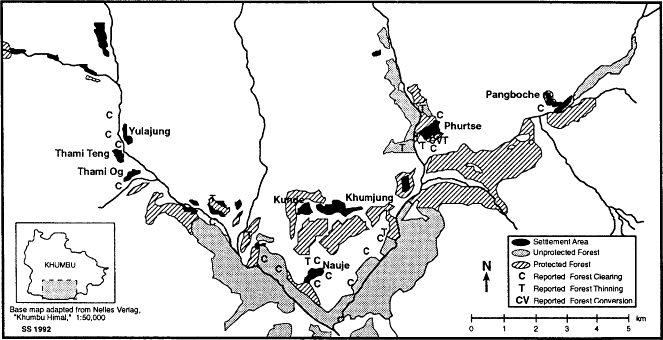
Map 19.
Reported Forest Change before 1965
The continuing preservation of fine forest in the immediate vicinity of villages, however, does reflect an extraordinary continuing commitment in Khumbu to the protection of sacred places and the timely development in some areas of new institutions to protect key sources of certain forest products. The diversity of forest management systems in Khumbu and the relatively large area regulated by them is unequalled among the five peoples who inhabit the Dudh Kosi valley and unparalleled among the Sherpa groups with which I am familiar. Although earlier assumptions about local resource use and management in the Mount Everest region certainly require major revision, Sherpa forest management in Khumbu nevertheless may well remain an example of local resource regulation that is exceptional by Himalayan standards.