
The Critical Response
If the involvement of Reis, Whitney, Wertheim, and Walton in new music during the 1920s has been obscured in the ensuing years, attitudes at the time helped prepare for its eclipse. While the female leaders of composer organizations may have disparaged the social pretensions of "the ladies" on their auxiliary boards, men viewing these same groups often had an even broader disdain, which extended to women organizers and patrons. Certainly, some composers expressed gratitude for all the good work done on their behalf and the hard cash they received. Copland and Cowell, for example, publicly acknowledged their debts to Reis and Walton.[67] But others demonized their benefactors. Music critics tended to be the most outspoken, often attacking women as a group rather than singling out any individu-
Earlier versions of this essay were presented as part of the Project for the Study of Women in Music at the Graduate Center of CUNY and at the 1991 annual meeting of the American Musicological Society in Chicago. Another version appeared in Modernism/Modernity (January 1997). Research has been aided by a Mellon Faculty Fellowship at Harvard University and a grant-in-aid from the American Council of Learned Societies. Judith Tick has been extraordinarily generous in suggesting sources and giving comments. I am grateful to others as well, especially Adrienne Fried Block, Minna Lederman, Ralph Locke, Vivian Perlis, Catherine Smith, Mark Tucker, and Linda Whitesitt. Throughout the notes, the following abbreviations are used for the location of manuscripts: DLC (Music Division of the Library of Congress) and NN (Music Division of the New York Public Library at Lincoln Center). The names of individual collections are abbreviated (e.g., "Antheil-DLC" refers to the George Antheil Collection at the Library of Congress).
als. Intolerance was widespread and openly expressed in the 1920s. Like the racism in critiques of jazz and the anti-Semitism directed toward the high percentage of Jews in new music, misogyny flowed freely in America during the period. Its sources were many.
The 1920s witnessed not only the birth of a new American art, straining to free itself from ties to the past and to Europe, but the continuing struggle of the "New Woman," whose desire for freedom was equally intense and ambitious. She threatened cherished traditions. This, after all, was the first decade after the Nineteenth Amendment, when women gained the right to vote. As Minna Lederman, the editor of Modern Music , has said, "We thought we could do anything."[68]
That was the "modern" side of the issue. For musicians, however, there was an even stronger attitude—the notion of music as a femininized sphere—which had roots in the nineteenth century. As stewards of the parlor, as supporters of the opera and symphony, as teachers, and as vigorous local activists through music clubs, women had gained control over certain aspects of music making in the United States. For many men, this gave music a disturbing whiff of effeminacy. Women had been strong supporters of art in the genteel tradition of the late nineteenth century, and when that tradition faced rejection, women suffered accordingly. This was a major issue in early modernism, and it remained strong throughout the 1920s. Charles Ives is well known for labeling his detractors "old ladies," but he by no means stood alone in doing so.[69] Enough others felt similarly for Musical America to run an editorial in 1924 titled "Music and Manliness," discussing the effect of the "manliness complex" on American musicians.[70] And in an article published in 1929, Nicolas Slonimsky, a member of the young generation of composers, illustrated how views of women were twisted into the tensions between new and old, "Yes, we want our musical tastes to be governed by the young sophisticates rather than by Mrs. Carrie Jacobs Bond."[71]
The 1920s opened with one such indictment, penned by no less than the critic Paul Rosenfeld—the same Rosenfeld who was a close friend of Claire Reis and who would become one of the most enlightened voices of the decade (at least in his concert-music tastes). In a 1920 article for the Dial , written to mark the end of Varèse's tenure with the New Symphony Orchestra—subsidized primarily by Gertrude Whitney—Rosenfeld analyzed the orchestra's failure to succeed in performing contemporary music as "one of the innumerable consequences of the fact that in America musical organizations have patronesses more often than they have patrons." He continued:
Great musical bodies cannot exist in America today, it is a commonplace, without subsidies. . . . But in our civilization, the man is not interested in art. . . . The control of the purer forms of music are [sic ] almost entirely left to the distaff side. . . . But, unfortunately, the control by women of art is not the health of art. . . . In consequence, artistic activity remains, for the majority of those who engage in it, a lightly social expression.[72]
In 1928, a year after Varèse's next organizational effort, the International Composers' Guild, had come to an end, Rosenfeld again articulated this bias. In an article titled "Thanks to the International Guild," he hailed the group for its achievements and drew a comparison with its principal rival, the League of Composers, which he claimed had "a social function where the performance of music served the ambitions of mediocrities; handsomely dressed people conversed up and down the aisles; and music preluded to an apotheosis of personal projections and chicken salad in close quarters."[73] Women are indicted here by implication. The parties they hosted were not just an opportunity to use the good silver; rather, they made it possible for composers to forge crucial alliances with publishers, performers, concert managers, and even other composers. For example, an annotated list of guests that Aaron Copland sent Blanche Walton for a party she was to give after a Copland-Sessions Concert bears witness to the care taken in making the right connections (see Vignette I).[74]
Other damning pronouncements followed, including one by Deems Taylor, a firmly established composer and critic of the 1920s, who contributed an essay on music to Civilization in the United States (1922), perhaps the most important contemporaneous assessment of American culture. In it, Taylor featured women as first-string players in American music and blamed them for many of its limitations: "Women constitute ninety per cent of those who support music in this country. . . . It is no disparagement of their activities to say that such a state of affairs is unhealthy." He went on to criticize women for "demand[ing] that art be edifying" and for encouraging chauvinism among American composers.[75] Through his indictments, Taylor acknowledged the power of women in America's musical life, and he chafed under its force.
As the decade wore on, critics increasingly connected women to the new-music movement, and they continued to question whether those on the "distaff side" were capable of intellectual engagement with the bold new sounds they fostered. Satire became a frequent weapon. The critic W.J. Henderson published an article in the New Yorker in 1926 entitled "The Modern Music Jag" in which he sarcastically pointed out that women were giving up the Charleston for another fad: new music.[76] And in 1929 a caricature in Vanity Fair by the Mexican artist Miguel Covarrubias, captioned "A Salon Recital of Modern Music: One of Those Awesomely Elegant Evenings Which Society Has to Suffer," ridiculed the wealthy women who presented musicales of new compositions (fig. 28), an attitude in keeping with the magazine's arch commentary on many aspects of New York's high society.[77]
Over the years, the disparagement of women patrons and promoters has recurred. In Marc Blitzstein's The Cradle Will Rock (1937), a painter and composer mock their patron as "a stupid woman . . . what she doesn't know about music would put Heifetz back on his feet again"—and then eagerly accept an invitation to visit her country home for the weekend. And in the early 1980s the composer Jerome Moross wrote the scholar Catherine Smith that the League of Composers
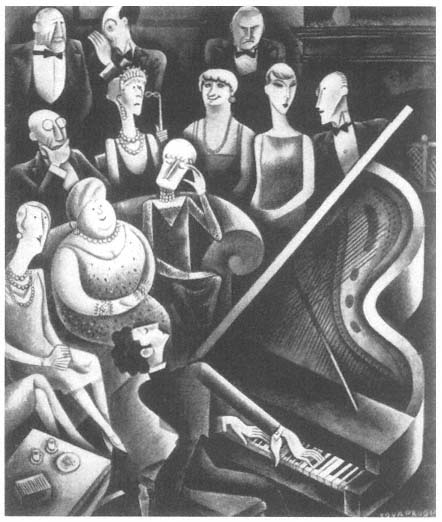
Fig. 28.
Miguel Covarrubias, "A Salon Recital of Modern Music: One of Those Awesomely
Elegant Evenings Which Society Has to Suffer—Seen by Covarrubias," Vanity Fair ,
February 1929, 54. The caption (Covarrubias's own?) continues with a snide
explication du texte : "In the forefront of mondaine [sic ] musical circles is M . Pierre
Paravent, the most recently imported Parisian pianist. Not to have heard Paravent
is to be completely out of the present season. He has therefore been rented for the
evening by Mrs. Bartow Blodgett, the monumental matron at left-center, for the
entertainment of a number of tremendously important people. This he is
endeavouring to do by rendering a program of his own compositions, in which he
specializes. This is no stuff for weaklings and the auditors are taking it according to
their several capabilities. The hostess is flanked by her daughter who is entranced by
both the piece and the performer, and by her mother, Mrs. Holzderber, who is resting
easily on her pearl dog-collar. In the center row, from left to right, are Horace Bankhead,
critic, Lady Cragsmoor and lorgnette, Mrs. Dapper, wearing her famous Mona Lisa
smile, and the young Camberwells who are plotting an escape. In the background two
low-browed husbands are talking about the stock market while the host, at right,
ponders grimly on the cost of all this noise Paravent produces."
"was not a dues paying organization, but . . . a pet project of two rich ladies who were constantly struggling over the leadership."[78]
Such stereotyped views do not, however, change the fact that women championed modernist music with gusto, freeing young composers to pursue their artistic vision. The work of these women was indispensable to the growth of American music in the 1920s, and it has had lasting implications. Today, performance societies, including the League of Composers, continue to provide an essential forum for the newest pieces, and the idea of giving financial help to composers remains alive—although private benefactors, such as Betty Freeman in Los Angeles, now stand out as exceptional, while universities and foundations provide most of the support. Gertrude Whitney, Blanche Walton, Alma Wertheim, and Claire Reis, then, set an important precedent by dedicating themselves to the avant-garde. Their vigorous activism belongs not just to women's history but helps explain how modern music came to be in America.