
Chapter Ten—
Contrapuntal Allusions in Polyphonic Masses
The setting of words to music has always involved textual interpretation, no less in the fifteenth century than in the nineteenth. While Du Fay's methods are less well understood than Schubert's, they are no less sophisticated in their ability to depict nonmusical ideas and images in music or to shape the responses of listeners. In setting words, Renaissance composers used techniques that are fundamentally rhetorical, in the combined senses of persuading and teaching while also entertaining. And because in the fifteenth century composers for the first time made polyphonic cycles of the Mass Ordinary the preferred musical texts—no motet or chanson verses can compare in frequency of settings—they created musical-textual conventions that were truly international. In arguing that a particular polyphonic idea in the Masses of SPB80 (or any other source) has a specific textual meaning, it is necessary to make comparisons to other Masses, so that the merely coincidental can be distinguished from the purposeful. And comparisons of Mass counterpoint to chansons reveal an interaction between secular and sacred genres that goes far beyond the use of a secular cantus firmus as a Mass tenor. In this way it is possible to show that within the Masses of SPB80, certain musical responses exemplify international conventions for interpreting the words of the Mass through music.
On the most basic level, the practice frequently and simplistically called "word painting" in discussions of Italian and Elizabethan madrigals had a long tradition in Mass settings that is occasionally noted but as yet insufficiently explored. Composers interpreted the Mass Ordinary by means of rhythmic alterations (with or without coloration), strict imitation and canon, the number of voices used to set a text, and
even such straightforward depictions as the stepwise ascending lines Du Fay employed for "Et ascendit in caelum" in his early Credo settings and in the Missa Ave regina coelorum , or, in this same Mass, his extended melisma in triplet coloration at "non erit finis." The Missa Thomas cesus , likely by Caron, has an impressive symbolic construction for the Pleni—"heaven and earth are full of your glory." The composer very clearly emphasizes the terrestrial glory, by descending through three pairs of duets, each one lower than the one before: cantus and contra, contra and tenor, and then tenor and bass. Only the opening duet for the upper voices sings of heaven, the lower parts enter with "Et terra." There are similar constructions in the Pleni sections of Caron's Missa Sanguis sanctorum , in Ockeghem's Missa Caput (where he repeated the descending pairs of voices a second time), and in his Missa Mi mi (which concludes with a duet in the upper voices on the word "tua"). In four-voice Masses that reduce to three for the Pleni, it is standard at this time to begin the Pleni as a duet for the upper voices, shift to the lower two voices somewhere in the middle, and then conclude with all three voices at "gloria tua." This scheme occurs in Du Fay's Missa L'homme armé and Missa Ave regina coelorum , in all of the Naples L'homme armé Masses that have a three-voice Pleni, and in Gaspar van Weerbecke's Missa O Venus bant , to name a few. Although scribes did not always neatly divide the Pleni between high "heaven" and low "earth," the symbolic representation is unmistakable.
The term word painting is inadequate to describe the sophistication of the responses that fifteenth-century composers devised for setting the Mass Ordinary. It conjures up a naive hunt for imagery capable of being depicted musically. In their settings of the "Genitum, non factum" clause in the Credo, Du Fay, Caron, and Busnois evidently used either imitative or rhythmic means to convey a common theological interpretation in their counterpoint. Caron's Missa L'homme armé and Busnois's Missa O crux lignum employ the same triadic figure in three-voice imitation for "Genitum, non factum" (Ex. 52). Both are doubtless superseded by the nonimitative appearance of the identical motive in Du Fay's Missa L'homme armé , again at "Genitum, non factum."
It is not just the motive but the presentation of the motive that matters. The difference between Du Fay's single-voice statement and the three-voice imitative rendition favored by Caron and Busnois may have a theological rather than musical impetus. The entrance of the
EXAMPLE 52. Comparison of motives at "Genitum non factum" in the Credos of (a) Caron, Missa L'homme armé , (b) Busnois, Missa O crux lignum , and (c) Du Fay, Missa L'homme armé , superius
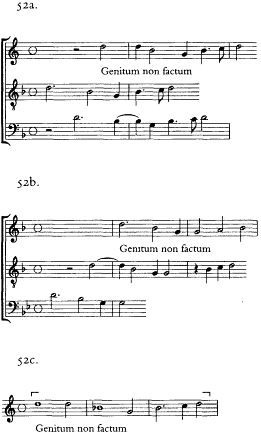
three voices in close succession with the same motive suggests a Trinitarian interpretation: already at the moment of the Conception, the Son and the Holy Spirit were "one in being with the Father."[1] In fact even Du Fay's single-voice statement allows for this reading, since at this text Du Fay shifts to coloration to facilitate his rocking triplet
[1] On the importance and frequency of sermons on the Trinity in medieval and Renaissance theology, see John O'Malley, Praise and Blame in Renaissance Rome: Rhetoric, Doctrine, and Reform in the Sacred Orators of the Papal Court, c. 1450-1521, 96-97.
rhythms; moreover, the bass and contra change independently to different mensuration signs, so that the three contrapuntal voices sing "Genitum, non factum, consubstantialem Patri: per quem omnia facta sunt" in three distinct mensuration signs. In this instance music demonstrably surpassed all other means of expression for representing one of the central theological mysteries of the age: how one God could contain three persons. Over the latter half of the fifteenth century, preachers in the humanist tradition often turned to the analogy of harmonious song to explain the Trinity.[2] That Du Fay, Caron, and Busnois may each have articulated this belief, possibly at different courts, indicates that composers also participated in contemporary theological debates.
Before imitative counterpoint became the stylistic norm in the last decades of the century, composers had more freedom to use imitation as an expressive tool for interpreting those portions of the Mass that either described unity between separate entities or actions such as leading and following. In the Credo the clause "Qui ex Patre Filioque procedit" was regularly set imitatively—a musical demonstration of the derivation of the Holy Spirit from the Father and the Son. Among the Masses in SPB80, Barbingant did so in his Missa and Missa Terriblement , Caron in the Missa L'homme armé , and Faugues, assuming him to be the composer, in the Missa Pour l'amour . Similarly, the imitation often found at the phrase "Et iterum venturus est" probably owes its popularity to the obvious aural imagery that occurs when a single motive is sung polyphonically while the singers reiterate their description of Him "who shall come again." Among numerous examples are Du Fay's Missa Ave regina coelorum , most of the Masses by Faugues, Caron's Missa Sanguis sanctorum and Missa Clemens et benigna , and the Missa Au chant de l'alouete , probably composed by Martini. This treatment is not present in either of the Busnois Masses with attributions (these words are not present in them at all) or in his Patrem de vilayge , but it occurs in virtually all of the Naples L'homme armé Masses (in Mass no. 3 two voices are missing and in no. 6 the text setting is unclear). And this must also be the reason that imitation was so prevalent in Benedictus settings at the entrance of "Qui venit in nomine Domini."
[2] Ibid., 129 and 132.
However necessary it is to be aware of contrapuntal figures with potential textual significance, there is another way in which composers could have made counterpoint serve rhetorical ends. Fifteenth-century composers, as well as artists and writers, often cited earlier works, either literally as quotations or with variations, as paraphrases or allusions. Because composers worked with both music and words, they could allude to a text through a melodic quotation or allusion. In this way, the notes of chanson present in a Mass cantus firmus could refer to the original chanson poetry as a means of offering a commentary on the Mass text actually being sung.[3] But tenors were not the only voices capable of conveying an interpretive allusion, nor were citations of chansons in the contrapuntal voices limited to the chanson cited in the Mass tenor.
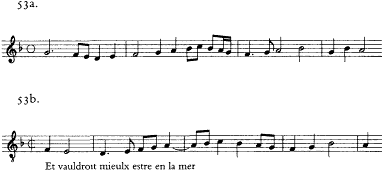
Nor was the practice limited to Masses. Indeed the techniques are easier to spot in chansons because, unlike the fixed texts of the Mass Ordinary, the reuse of a poetic phrase is potentially meaningful. Busnois's chanson J'ay mains de biens apparently alludes to the opening motive of Caron's chanson Mourir me fault when it quotes the phrase "mourir me fault."[4] The same sort of melodic allusion occurs between Compère's chanson Me doibt en prendre and the lost chanson Jesuis en la mer . The first measures of this lost chanson can be gleaned from the beginnings of the movements in the Missa Je suis en la mer by Faugues. The chanson by Compare includes the phrase "estre en la mer," set to the notes shown in Example 53. This phrase is similar to phrases in the Mass that probably come from the missing chanson. Faugues did not necessarily base his Mass on a lost chanson by Compère; it is also possible that Compare quoted the unknown composer of the lost chanson Je suis en la met or that someone wrote a chanson based on this particular phrase of Compère's Me doibt en prendre .[5] Both composers presumably intended to depict the motion of the sea in their wavy melodic lines.
[3] Michael Long, "Symbol and Ritual in Josquin's Missa di Dadi. "
[4] This example is discussed in Christopher Reynolds, "The Counterpoint of Allusion in Fifteenth-Century Masses," 238-39. The examples cited in that article complement those presented here.
[5] Connections between the beginning of one chanson and an interior verse of another deserve further study. Another example involves the anonymous Languir me fault en grieuf doleurs (edition in Henrietta Schavran, "The Manuscript Pavia, Biblioteca Universitaria, Codice Aldini 362: A Study of Song Tradition in Italy circa 1440-1480," 2:73-75), which is close textually and musically to a phrase in the anonymous Comme ung homme desconforté (edition in Edward L. Kottick, The Unica in the Chansonnier Cordiforme , 9-10). The third verse of the latter is "Languir me fauldra en tristesse." Similarly, the anonymous Jamais si bien ne me peut avenir (edition in Duff J. Kennedy, "Six Chansonniers Français: The Central Sources of the Franco-Burgundian Chanson," 555) is related to the second part of Hayne's Se une fois recouvrir joie (edition in Howard M. Brown, A Florentine Chansonnier from the Time of Lorenzo the Magnificent: Florence, Biblioteca Nazionale Centrale MS Banco Rari 229 , no. 134), which begins "Jamais homme n'eust le plaisir." For other examples, see Reynolds, "The Counterpoint of Allusion," 229-31. Textual quotations do not always inspire musical citations; e.g., even though the first verse of Busnois's En soustenant vostre querelle quotes from the last verse of Binchois's De plus en plus (and also makes other references), I see no melodic reference. Paula Higgins notes a textual quotation involving the lost Busnois chanson Cent mille fois (verses 1 and 2) and the anonymous Pour les biens (verses 5 and 6); see her "Antoine Busnois and Musical Culture in Late Fifteenth-Century France and Burgundy," 205.
EXAMPLE 53. Motivic comparison of (a) Faugues, Missa Je suis en la mer , Agnus I, mm. 1-4; and (b) Compère, Me doibt en prendre , mm. 22-26
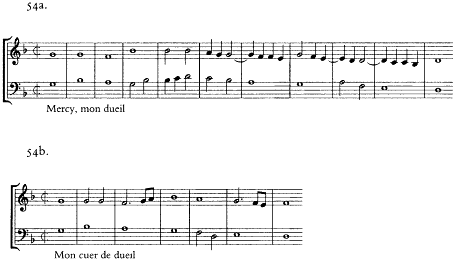
When musical resemblances are supplemented by textual ones, it is easy to recognize allusions, as in the beginnings of Du Fay's Le serviteur hault guerdonné and the anonymous Le serviteur infortuné or, as shown in Example 54, between two voices of Joye's Mercy mon dueil and the anonymous Mon cuer de dueil partira . But as the textual similarities diminish, so too does the ability to recognize significant musical parallels. The important role of textual ties is evident in the possible instances of allusion presented in Example 55, where the opening of the chanson Se je fayz dueil by Le Rouge is compared to the anonymous
EXAMPLE 54. Comparison of counterpoint in (a) Joye, Mercy, mon dueil , mm. 1-11; and (b) Anonymous, Mon cuer de dueil , mm. 1-7
EXAMPLE 55. Comparison of counterpoint in (a) Le Rouge, Se je fayz dueil , mm. 1-14; and (b) Anonymous, Combien le joyeulx que je fasse , mm. 1-8
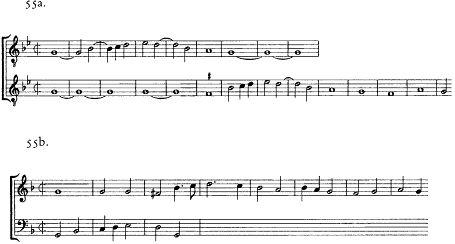
Combien le joyeulx je fasse .[6] The Le Rouge tenor resembles the superius of Cornbien le joyeulx , and his superius the contra. Both poems are octosyllabic bergerettes, and although Combien le joyeulx je fasse has only one flat in the signature, two eb's are written out and ficta considerations demand others. The anonymous chanson seems to play textually as well as musically on Se je fayz dueil . The sadness that is "made" in Le Rouge's chanson becomes a false joy in the other chanson, recounted in the present subjunctive of "faire." And whereas Se je fayz dueil is the lament of a soul tormented by the poet's separation from his lover, the other describes a heart that bears "a great mass of painful unhappiness" because of the poet's separation from his homeland, France. The musical resemblances are strong primarily because of the textual similarities.
The inability to examine poetic parallels in Examples 56a and b makes it correspondingly more difficult to assess the importance of the musical similarities. The first phrase of Binchois's De plus en plus se re-nouvelle resembles one of the untexted chansons by Constans in Tr90.[7] If it also had a text that was comparably close to De plus en plus , we could assert that the musical parallels were not simply coincidental but indicative of a purposeful allusion.
The Du Fay chanson Navré je suis in Example 56c has only the vaguest motivic link with De plus en plus —they pursue similar paths through the same modal species of fifth and fourth and a poetic connection that is hardly more convincing: the end of the second verse, "de part en part," may be read as a grammatical allusion to Binchois. Yet in arguing for the existence of an allusion, other sources of information help interpret the two verses being compared. In this case there are two external reasons for associating Du Fay's chanson with Binchois. First of all, Du Fay's Navré je suis d'un dart pénétratif has a pronounced
[6] There is an edition of Se je fayz dueil in Leeman Perkins and Howard Garey, The Mellon Chansonnier , no. 31; and of Combien le joyeulx je fasse in Brown, A Florentine Chansonnier , no. 223. In the latter edition the first line of the poem is rendered "Combien le joyeulx que je fasse," "for the sake of the meter" (text volume, p. 295), although both sources (Flor229 and Paris 15123) agree in omitting the "que."
[7] Published in Jean Marix, Les musiciens de la cour de Bourgogne au XVe siècle, 1420-1467 , no. 58. Constans is presumably the teacher of Hayne, Constans de Languebroek, long a member of the Burgundian court, along with Binchois.
EXAMPLE 56. Motivic comparison of (a) Binchois, De plus en plus , mm. 1-5; (b) Constans, textless, mm. 1-12; and (c) Du Fay, Navré je suis d'un dart , mm. 1-5
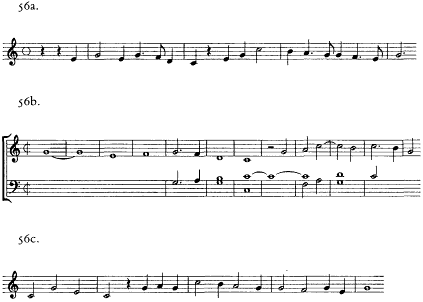
similarity to the poetry of Ockeghem's Deploration sur la mort de Binchois , which begins "Mort, tu as navré de ton dart." Ockeghem and Du Fay may both be alluding to words they associated with Binchois. And second, based on stylistic and manuscript evidence, Du Fay probably composed his chanson about the time he met Binchois in 1434.[8]
Contrapuntal Allusions in Masses
The first comparisons of contrapuntal lines in Masses and chansons are intended to show how close the correspondences could be. They juxtapose chanson motives with Mass motives that are not taken from the chanson sung in the tenor. In the anonymous Missa in SPB80 (fols.
[8] Graeme Boone, "Dufay's Early Chansons: Chronology and Style in the Manuscript Oxford Bodleian Library, Canonici 231," 136.
EXAMPLE 57. Anonymous, Missa (SPB80, fols. 129v-43), Crucifixus at "Et resurrexit"
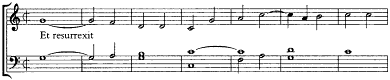
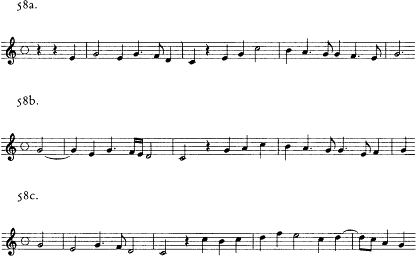
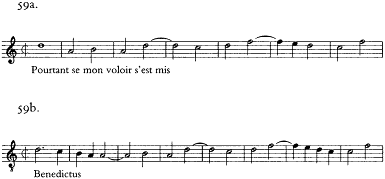
129v-43), three voices of the Et resurrexit (Ex. 57) may refer to a secular composition without a known text, the chanson by Constans in Tr90 just noted for its similarity to De plus en plus se renouvelle (Ex. 56b). The next of these preliminary comparisons involves an interior phrase. In the Kyrie I of Caron's Missa Accueilly m'a la belle the second phrase (mm. 4-8) makes its own citation of Binchois's De plus en plus (Exs. 58a and b). Caron here creates a double allusion, because the second phrase of his chanson Accueilly m'a la belle (Ex. 58c) is also plainly related. The reference in the Mass to Binchois becomes distinctive in the second half of the phrase, when Caron replaces the chanson with the same short cadential figure used by Binchois. Perhaps because Caron had no option in a Kyrie of relying on a secular text to draw attention to his melodic citation, the motivic resemblance to De plus en plus is stronger than in either of the chansons discussed above in Example 56. The same reason may apply to Example 59, where the chanson Pourtant se mon voloir s'est mis by Caron (or Busnois) is virtually quoted in the Benedictus of the Missa Pour l'amour (and less extensively at the Christe), attributed to Faugues.
Textual correspondences and contemporary rhetorical practices make it unlikely that all of these similarities are purely melodic coincidences. Of the possible quotations cited in earlier chapters, one presented in chapter 6 (Ex. 2i)—namely, Le Rouge's Se je fayz duel and the Qui sedes of Faugues's Missa La basse danse —has an affinity between the sacred and secular texts that was not discussed. The allusion at the injunction "You who sit at the right hand of the Father, hear our prayer" is to the lament of pain and suffering voiced in the chanson. To include an example from earlier in the century, the Cum Sancto of an independent Gloria setting by Du Fay in Tr92 quotes
EXAMPLE 58. Motivic comparison of (a) Binchois, De plus en plus , mm. 1-5; (b) Caron, Missa Accueilly , Kyrie I, mm. 4-8; and (c) Caron, Accueilly m'a la belle , mm. 8-12
EXAMPLE 59. Motivic comparison of (a) Caron (or Busnois), Pourtant se mon voloir s'est mis , mm. 1-7; and (b) [Faugues], Missa Pour l'amour , Benedictus, mm. 1-8
EXAMPLE 60. Motivic comparison of (a) Du Fay, Adieu, quitte le demeurant , mm. 1-3; and (b) Du Fay, Gloria (no. 28), at "Cum sancto"
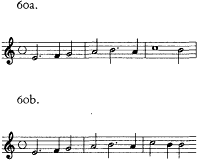
from Du Fay's chanson Adieu, quitte le demeurant de ma vie (Ex. 60). The combined imagery of the chanson (leaving "the abode" of one's life) and the Mass ("with the Holy Spirit in the Glory of God the Father") suggests a vision of life after death, whether for Christ or a recently deceased acquaintance of Du Fay.[9]
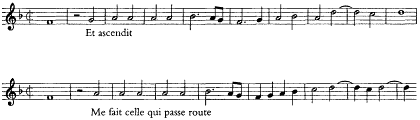
Several motivic allusions with possible textual significance occur in the anonymous Missa in SPB80 on fols. 90v-98v. The Cure Sancto begins with the same motto as the Busnois setting of Regina coeli laetare (I) (Ex. 61a); then at the Credo text "Et ascendit" there is an extended similarity to the phrase "Me fait celle qui passe route" in the Hayne chanson De quatre nuyts (Ex. 61b); and the Benedictus also suggests Hayne (Ex. 61c). Both voices of this duet closely resemble the second half of Hayne's chanson Ce n'est pas jeu at the verse "Accompaigné de deuil."[10] In an allusion that recalls the prophecies Jesus made in the Sermon on the Mount, the composer therefore appears to suggest that
[9] This Gloria is in Guillaume Dufay, Guillelmi Dufay Opera Omnia , vol. 4, no. 28. Among quotations noted by others, there are those Besseler cited in his foreword to this volume of Mass fragments; and Charles Van den Borren suggested that Brumel based the "Et unam sanctam" in the Credo of his Missa De beata virgine on Compère's Nous sommes de l'ordre de Saint Babouin . The connection between an identification with a special Order and the belief in "one, holy, catholic, and apostolic church" is hard to miss; see Van den Borren, La musique en Belgique de moyen âge à nos jours , 80-81; and also Ludwig Finscher, Loyset Compare (c. 1450-1518) , 241-42.
[10] For an edition, see Marix, Les musiciens , no. 67.
EXAMPLE 61. Motivic comparison
EXAMPLE 61A . (i) Anonymous, Missa (SPB80, fols. 90v-98v), Cum sancto; and (ii) Busnois, Regina coeli laetare

EXAMPLE 61B . (i) Anonymous, Missa (SPB80, fols. 90v-98v), Et incarnatus at "et ascendit"; and (ii) Hayne, De quatre nuyts at "Me fait celle"
EXAMPLE 61C . (i) Anonymous, Missa (SPB80, fols. 90v-98v), Benedictus; and (ii) Hayne, Ce n'est pas jeu at "Accompaigné de deuil"
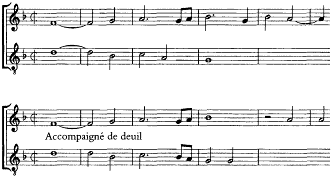
the "blessed who walk in the name of the Lord" are those "accompanied by sorrow."
Contrapuntal references to a chanson could operate on two textual levels: as a commentary on the Mass text but also as an amplification of whatever poetic "theme" existed in the cantus firmus.[11] When Caron alluded to Binchois's De plus en plus in his Missa Accueilly m'a la belle (Ex. 58), he did so because the messages of the two chansons supplement each other. While the spurned singer of Caron's text complains of his inability to see or meet with his lady, that in De plus en plus declares his great desire to hear news of his "sweet Lady" and vows that his will to see her is "more and more ... renewed."
Another instance of this sort of textual relationship is present in one of the anonymous Masses in SPB80. The first motive of the anonymous chanson D'un bon du cuer sans aultre amer appears in the middle of the Qui tollis of the Missa D'ung aultre amer (Exs. 62a and b) at "Qui tollis peccata mundi, suscipe deprecationem nostram" [You who take away the sins of the world, hear our prayer]. At the final phrase of the chanson, when the poem returns to the words "aultre amer," the opening motive comes back in imitation at the octave (Ex. 62c). This imitation seems to have inspired the more taxing imitation at the second below in the Qui tollis. If the pairing of the poet's request for his love "not to love another" seems frivolous to include at the Qui tollis, the justification for this particular reference may be based on a pairing of one chanson about "un aultre amer" with another.
It was also possible for a citation to reverse the direction of the allusion, that is, for a chanson to allude to a Mass setting. In his Missa Caput Ockeghem uses a motive at "Et resurrexit" that compares closely to three chanson beginnings. Two of the chansons may well have been written by the same anonymous composer (Barbingant?), Terriblement suis fortunée and Fortune, n'as-tu point pitié . Yet the chanson with the strongest rhythmic as well as motivic similarity is Compère's Le renvoy d'ung cueur esgaré .[12] The textual concordance of the Resurrection and
[11] I discuss this sort of connection between Du Fay's Missa Se la face ay pale and Puyllois's He nesse pas grant desplaysir in "The Counterpoint of Allusion," 243-44.
[12] This example is in Reynolds, "The Counterpoint of Allusion," 240-41. Compère's imitative chanson doubtless follows the two anonymous nonimitative ones and is therefore perhaps another instance of Compare beginning a chanson with a motive first used by Barbingant. Regarding Terriblement suis fortunée and Fortune, n'as-tu point pitié , see ibid., 229-31.
EXAMPLE 62. Comparison of motives and counterpoint of (a) Anonymous, D'un bon du cuer sans aultre amer , mm. 1-4; (b) Anonymous, Missa D'ung aultre amer , Qui tollis, mm. 22-28; and (c) Anonymous, D'un bon du cuer sans aultre amer , mm. 41-45
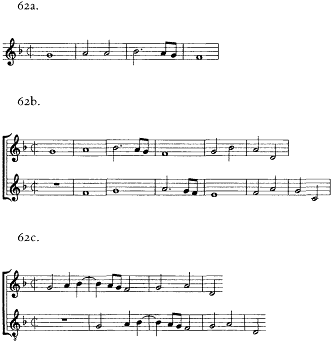
"the return of a heart misled" creates a convincing rhetorical image, regardless of which was composed first. To anyone who knew both the chanson and the Mass, the notes of one would call to mind those of the other. The debt of a secular work to sacred is particularly apt in this instance, since the superius of the chanson Terriblement suis fortunée quotes the chant melody Terribilis est locus iste .
In each of these examples, a chanson incipit appears to shape the melodic turn for a brief, textually related segment of a Mass by one
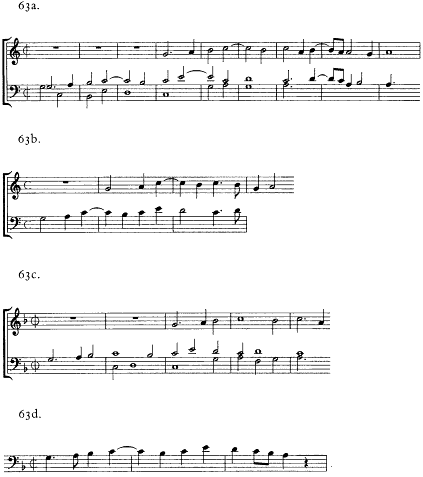
EXAMPLE 63. Motivic comparison of (a) Anonymous, Comme ung homme desconforté , mm. 1-9; (b) Busnois, Magnificat octavi toni , Et misericordia ejus, mm. 1-4; (c) Busnois, Magnificat sexti toni , Quia respexit humilitatem; (d) Lanoy, Missa , Agnus II, mm. 1-3; (e) Anonymous, Missa L'homme armé (Bol Q16), Agnus II, mm. 1-5; and (f) Martini, Missa Coda pavon , Patrem, at "Et homo factus est"
(continued )
EXAMPLE 63 (continued )
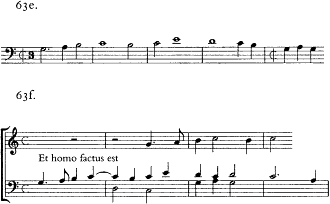
composer. However, there are clearer instances of allusive quotation in chansons that are cited in more than one work. Busnois, probable composer of the Magnificat Octavi toni (SPB80), quotes two voices of the anonymous Comme ung homme desconforté at the verse "Et misericordia" and three voices in his Magnificat Sexti toni at "Quia respexit humilitatem" (Ex. 63). Two Masses appear to cite the chanson tenor at the Agnus II, Lanoy's three-voice Missa (SPB80) and the anonymous Missa L'homme armé in BolQ16. And Martini has a more complete quotation in the Credo of his Missa Coda pavon at "et homo factus est." The image of someone "in great distress" suits equally well the plaintive tone of the Agnus Dei ("O Lamb of God have mercy") and the Magnificat verses "And His mercy is from generation to generation" and "Because he has regarded the lowliness of his handmaid." If this chanson casts a somber light on the Credo text "and He was made man," it should perhaps be related to fifteenth-century paintings of Madonna and child that portray Mary with an expression of grief, as if she knows from the outset the fate that awaits her child.
Multiple citations of a single chanson, or Masses that quote several phrases of a single chanson, offer a more secure means of identifying the presence of allusion or quotation than do single citations. Because Caron is the most active composer represented in SPB80 in this regard, and one particularly apt to quote from his own chansons, the following examples focus on his works.
Caron, Ockeghem, and the Anonymous Missa , SPB80, Folios 122-29
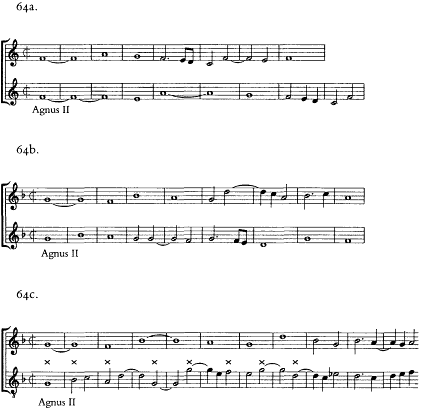
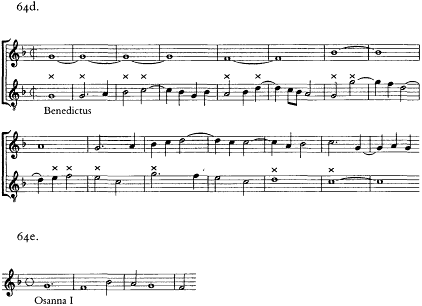
I have argued elsewhere that Caron incorporated a complex of motivic allusions to his chanson O vie fortuné in the Credo of his Missa Sanguis sanctorum .[13] From the duet at Et resurrexit through the four-voice entrance at "Cuius regni non erit finis," Caron begins each phrase with motives from this chanson. Similarly, the Agnus II of Caron's Missa L'homme armé stands squarely in the midst of a motivically interrelated group of movements by various composers. The associations of this one section of Caron's Mass extend to movements in Ockeghem's Missa (à 3), the anonymous Missa in SPB80 (fols. 122-29) that has traits of Bedyngham, the sixth Missa L'homme armé of the Naples set, and the anonymous Missa Gross sehnen , as well as to several chansons. In all but the last two of these Masses, the movement in question is the Agnus II. Perhaps the earliest are those by Ockeghem and the anonymous composer in SPB80. As shown in Examples 64a and b, the Agnus II duets begin with the same pair of motives, although Ockeghem and the anonymous composer switch voices and one begins on f and the other on g. These two movements also conclude with the same sequential duet.
Caron evidently derived his Agnus II from that by Ockeghem (Exs. 64b and c). The motive in the superius takes the same upward turns to

[13] For the musical examples, see Reynolds, "The Counterpoint of Allusion," 242. This is the title of the chanson in Flor229. Textual incipits in other sources identify the chanson as Vive fortunée (Paris i5123, which shares its corrupt text with Flor229), Vive fortune (Seville 5-I-43), O vive fortune de divers (C.G. XIII, 27), and Adieu fortune (Rome 2856).
marked with an "x." As discussed below, there are other ties between these two movements, ties that will also provide a reason to include in this group the Osanna I from the anonymous Missa Gross sehnen (Ex. 64e), despite the absence of the accompanimental counterpoint.
The relationship between the upper voices of the Caron Agnus and the Naples Benedictus has been observed before, one scholar claiming that it points to Caron as the composer of the whole cycle, another identifying Busnois.[14] This type of melodic relationship has to be used carefully in an argument about attribution, because it is the kind of quotation that composers routinely made of one another. For the same reason that Caron cannot be claimed as the composer of Ockeghem's Missa , he should not on this evidence alone be credited with the Naples L'homme armé cycle. The point is not just that one composer could start a Mass movement by quoting the head motive from the Mass movement of another composer but that they both could be alluding to some other work altogether.[15]
In this particular instance the composers could have been referring to any of several chansons that begin with some permutation of the opening counterpoint. The first measures of the superius that Ockeghem and the others used exists in the anonymous Mon cuer de dueil and Joye's Mercy, mon dueil (shown in Ex. 54), as well as in Hayne's Amours, amours, trop me fiers and chansons by Horlay and Busnois.[16] And the first three of these chansons begin with the combination of superius and contra motives found in the anonymous SPB80 Mass and in the Ockeghem Agnus. It is significant enough that these movements commence with a gesture so characteristic of chansons being written at the same time. The correspondence underscores the common contrapuntal and melodic language composers had for chansons and Masses
[14] Don Giller, "The Naples L'homme armé Masses and Caron: A Study in Musical Relationships," argues for Caron on motivic grounds; Richard Taruskin, "Antoine Busnoys and the L'homme armé Tradition," favors Busnois for his use of canons and approach to mensuration (see n. 25, below).
[15] Any instance in which one Mass appears to cite a contrapuntal voice of another is potentially an indication that the earlier Mass is itself citing some earher work. However, I do not claim that this was always the case. Some citations may function as an homage to a particularly influential Mass. This perhaps explains why Obrecht "quotes the first ten perfections of the superius part of the English Caput Mass" in his contra, as noticed by Alejandro E. Planchart, "Fifteenth-Century Masses: Notes on Performance and Chronology," 17.
[16] Horlay, Helas, je suis livré a mort , and Busnois, Mon seul et celé souvenir .
EXAMPLE 64. Comparison of counterpoint in (a) Anonymous, Missa (SPB80, fols. 122v-29), Agnus II, mm. 1-9; (b) Ockeghem, Missa (à3), Agnus II, mm. 1-9; (c) Caron, Missa L'homme armé , Agnus II, mm. 1-11; (d) Anonymous, Missa L'homme armé (Naples 6), Benedictus, mm. 1-15; and (e) Anonymous, Missa Gross sehnen , Osanna I, mm. 1-4
(continued )
in the mid-fifteenth century. But the significance of this is not purely stylistic. With regard to the Agnus II by Caron and the Naples Benedictus it is possible to go beyond descriptive analysis on the basis of other, previously unobserved, musical correspondences. One of these chansons seems particularly likely to have inspired the composers textually.
Caron and the composer of the Naples Mass have a second theme in
EXAMPLE 64. (continued )
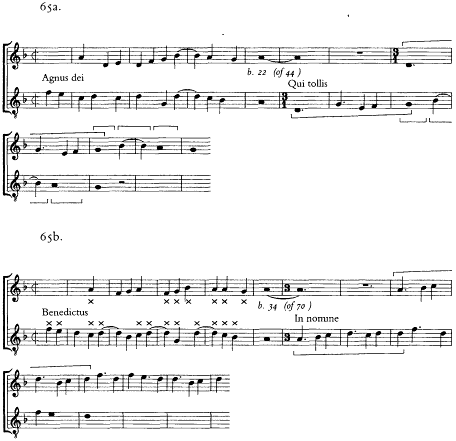
their movements, the same in both. Midway through each duet—that is, in the Caron Agnus at measure 22 of forty-four, and in the Benedictus at measure 34 of seventy—both composers come to a Phrygian cadence on a and then shift to triple meter (Exs. 65a and b).[17] The anonymous composer varies the new motive by transposing it up a fifth, by filling in the leap of a fourth with stepwise motion, and by disguising the hemiola with syncopation. He leaves unchanged the interval of imitation, which comes at the octave above at a distance of two breves, and he also duplicates the approach to this point of imitation. Most of the counterpoint in the six breves that lead up to this juncture is also based on Caron (the shared notes are marked with an "x").
[17] The Agnus II of the second Naples Mass may also have had this tune. It too cadences on a at exactly the halfway point but then breaks off while the lower voices continue with a duet that has perished. And the Benedictus of the fifth Naples Mass seems constructed as an anticipation of the Benedictus for Mass no. 6. Measures 1-3 of no. 5 prefigure the beginning of the last Benedictus in both voices, and the imitation at mm. 11-13 varies the entry of the second theme.
EXAMPLE 65. Mass movements possibly related motivically to Caron, Mort ou mercy : (a) Caron, Missa L'homme armé , Agnus II, mm. 18-29; (b) Anonymous, Missa L'homme armé (Naples 6), Benedictus, mm. 29-42; (c) Caron, Mort ou mercy , mm. 1-11; and (d) Anonymous, Missa Gross sehnen , Osanna II, mm. 1-6
(continued )
The source of this motive is most likely Caron's chanson Mort ou mercy (Ex. 65c). In the Mass the meter is triple rather than duple, but this metric alteration is perhaps suggested by the rhythmic ambiguities of the chanson. Although the bass voice of the chanson is omitted in these Mass movements, the interval of imitation remains the same, and
EXAMPLE 65 (continued )
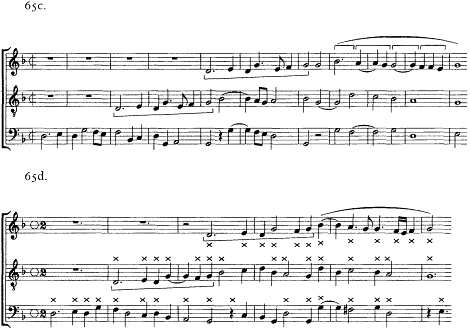
the composer of the Naples Mass includes the final cadential formula in the superius. Finally, all three voices of the chanson appear in a third Mass, the anonymous Missa Gross sehnen (in Ex. 65d the notes of the chanson are once again marked "x"). Here they begin the Osanna II. This is the Mass in which the Osanna I began with the same chanson motive (Ex. 64e) that also came at the start of the Agnus II and Benedictus movements. And just as the Mort ou mercy motive came exactly in the middle of those movements, in the Missa Gross sehnen the Osanna I is exactly as long as the Osanna II, twenty-one perfect breves, so that even in this separated state, this motive essentially begins the second half of the Osanna pair.[18] Remarkably, three separate Masses link these two chanson motives in the same sequence.
The Mass that makes the most sense in terms of a match between
[18] The count of the Osanna I includes the one-measure extension of the contra. If this breve is omitted the Osanna is twenty breves long, and my point remains unchanged.
the sacred and secular is Caron's Missa L'homme armé , apparently the earliest of the three. The text of Caron's Mort ou mercy fits perfectly with the plaintive spirit of the Agnus. While the liturgical text being sung prays to the Lamb of God for mercy, the words alluded to by the chanson melody make the same request in earthly terms:
Death or mercy I ask of you indeed,
My only beloved,
For I am so stricken with grief
That, by my soul,
There is no one sadder in this kingdom.
But I thank
Love who wills that it should be thus,
And you too,
Who carry the amorous flame
By which I am killed.[19]
Of those chansons that are melodically close to the beginning motives, or that have the two-voice contrapuntal similarity, only one is an easy match for the sentiments expressed in Mort ou mercy . Each of them is dolorous in its own way. The anonymous Mon cuer de dueil is a song of parting, and Horlay's Helas je suis livré a mort one of a loyal servant unfairly wronged. Hayne's Amours, amours, trop me fiers comes closer in that the poem once pleads with Love to stop sending its painful arrows. But by far the closest both to the sentiments of Caron's Mort ou mercy and to those of the Agnus Dei is Joye's Mercy, mon dueil (Ex. 54a); indeed, it reads like a paraphrase of the threefold Agnus Dei:
Have mercy, my grief, I beg of thee,
O grief full of melancholy,
Have mercy, a hundred thousand times I entreat thee,
And come put an end to my soul,
That longs for death,
and then forget me.[20]
Both chansons speak of death and mercy, and where Caron claims that "no one [is] sadder in this kingdom," Joye's poem later has an echo, describing a destiny that is "the most tormenting of this kingdom."
[19] The translation is by Max Knight, in Brown, A Florentine Chansonnier , text volume, p. 244.
[20] Perkins and Garey, The Mellon Chansonnier , 2:278-79.
For the quotations of these chansons in the Benedictus and Osanna movements it is difficult to see any relation between the chanson and Mass texts. For the sake of comparison, in the Benedictus of his Missa L'homme armé , Caron evidently quotes two voices of the chanson Je suis venue vers mon amy (with attributions to Busnois and Hayne) at "in nomine."[21] For a text that refers to someone who "comes in the name of the Lord," the allusion of the chanson tune is germane. The Missa Quand ce vendra also turns to this tune at the same spot of the Benedictus, and it also occurs in the second Naples L'homme armé Mass at the Credo verse "Et incarnatus."
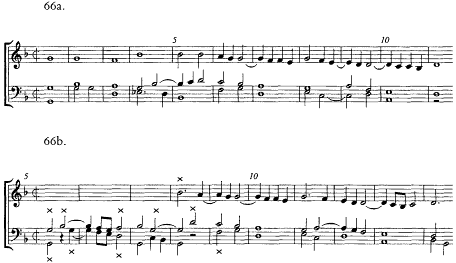
Buttressing the textual similarities of Mort ou mercy and Mercy, mon dueil are musical ones. Joye's chanson apparently provided the model. The first phrase of Caron's chanson, although it begins differently, concludes with a three-voice quotation from Mercy, mort dueil . As shown in Example 66, by measure 8 of the Caron the lines agree in pitch and rhythm, coinciding for the following six breves. Even before this point Caron's lines are closely related to Joye's (shared pitches marked by "x"). The second phrases, after dissimilar openings, also take common approaches to the cadence. And the last phrases have related beginnings. With Joye proceeding by leap and Caron by step, the tenors move sequentially by fourth up an octave: D-G,


In the Masses related to these two chansons, it is inappropriate to speak of "an" allusion when faced with so many movements drawing from the same motivic material. At the outset there was a single allusive reference, but by the last instance, doubtless that in the Missa Gross sehnen , the chain of references extended through five Masses and at least two chansons. Either Ockeghem or the anonymous Mass in SPB80
[21] The chanson is published in Brown, A Florentine Chansonnier , no. 29. In Glogauer the text is a Marian poem, O stella maris . Because this text fits more easily than the corrupt French text, Brown proposes that the Latin text may be the original (text volume, pp. 132-35). It too expresses a thought compatible with the Benedictus text, asking Mary to "lead us ... to the fold of heaven" (translation from Brown, ibid., 135, n. 51).
EXAMPLE 66. Comparison of (a) Joye, Mercy, mon dueil , mm. 1-11; and (b) Caron, Mort ou mercy , mm. 5-14
initiated the allusions by referring to a single chanson. By the time Caron composed his Agnus, the multiple allusions had begun. Caron seems to have referred both to Ockeghem's Agnus and to chansons composed by himself and by Joye (and his chanson has its own debt to Joye). The composer of the Naples set, in turn, is another step removed from Ockeghem.[22] And whoever composed the Missa Gross sehnen may have been aware of the whole complex or just of the precedents of Caron and Naples. This distinguished Mass exhibits many features characteristic of Busnois.
Since Caron's Missa L'homme armé may have been copied at St. Peter's in 1463, then the other Masses (and the chansons) would be earlier or later according to where they stand in this complex of references. An earlier date for the anonymous Mass in SPB80 is also indicated by
[22] When in the middle of the Benedictus he transposed the reference to Mort ou mercy and added passing notes to the ascending fourth, perhaps the sole intent was to vary the exemplar; but he may also have made these particular changes in order to introduce an allusion of his own: the resultant motive looks distinctly like the tenor of Morton's chanson, Cousine trop vous abusés .
its position in the first layer of SPB80, that possibly copied in 1461. However, for the Ockeghem Missa , which survives only in Ver759, this provides a basis for dating the work much earlier than the "ca. 1480s" copying of the manuscript.[23]
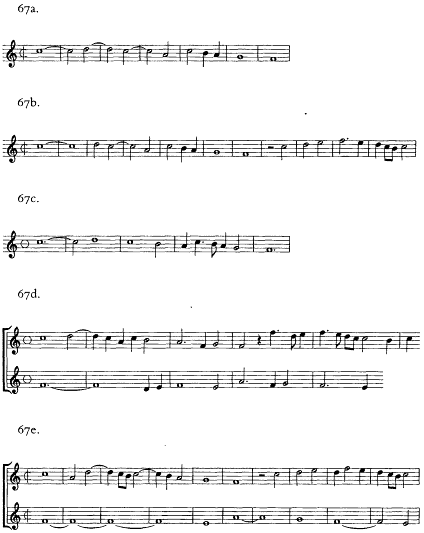
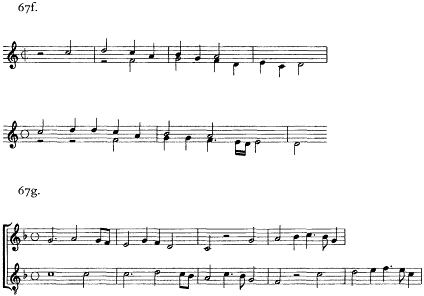
Substantially the same cast of characters is involved in a second series of allusions. This time the Benedictus of the anonymous Missa (SPB80, fols. 122-29) shares its head motive with the Benedictus and three other sections of Caron's Missa Accueilly m'a la belle , the Agnus II of the third Naples L'homme armé Mass, and the Patrem of Ockeghem's Missa Ecce ancilla . All of these movements begin with motives related to Caron's chanson Pour regard doeul (Ex. 67). As in the chanson, many of these motives continue with a rest and then a second shared motive. For the head motives of the Pattern, Sanctus, Benedictus, and Agnus Dei of Caron's Mass, Pour regard doeul supplants the head motive of the Kyrie and Et in terra, which, as one would expect, are based on Accueilly m'a la belle , also by Caron. In the Benedictus he derived both of the contrapuntal voices from the first phrase of Pour regard doeul (compare Exs. 67d and e) and also the second series of entrances at "qui venit" from the imitative figure that begins the second part of the chanson. Not only the motive but also the imitative counterpoint at the lower fifth are the same (Ex. 67f). These entrances may have inspired Ockeghem's more intricate treatment of the head motive in his Patrem (Ex. 67g).
Caron's Mass is both the most dependent on Pour regard doeul and the easiest to interpret textually, with regard not to the Mass text but to the chanson acknowledged in the cantus firmus. The poems Pour regard doeul and Accueilly m'a la belle expound a common theme: a suitor made unhappy by his lady's refusal to return his love. Where the latter chanson complains that "She has received me ill ... / Turning my well-being into a painful pass. / She has turned away from me her loving greeting," the only surviving stanza of the former claims that there
[23] Masakata Kanazawa, "Two Vespers Repertories from Verona, ca. 1500," 156-59. The Ockeghem Missa may contain another chanson reference also found in Masses by Busnois and Caron. His Benedictus appears to quote the anonymous chanson Faulx envieulx et megre face (Brown, A Florentine Chansonnier , no. 190); so too does the Crucifixus of the second Naples L'homme armé Mass and the Qui tollis of Caron's Missa Jesus autem transiens .
EXAMPLE 67. Comparison of (a) Anonymous, Missa (SPB80, fols. 122-29), Benedictus, mm. 1-7, and motivically related compositions: (b) Anonymous, Missa L'homme armé (Naples 3), Agnus II, mm. 1-11; (c) Caron, Missa Accueilly , Patrem, mm. 1-5; (d) Caron, Pour regard doeul , mm. 1-6; (e) Caron, Missa Accueilly , Benedictus, mm. 1-10; (f) Caron, Missa Accueilly , Benedictus, mm. 21-24; and Caron, Pour regard doeul , part 2; and (g) Ockeghem, Missa Ecce ancilla , Patrem, mm. 1-5
(continued )
EXAMPLE 67 (continued )
is "one single comfort that I do not have from my mistress" and then asks Love why it is that "I am numbered among the perfectly unhappy?"[24] Caron's allusion in this Mass to Binchois's De plus en plus (noted above in Ex. 58) contributes its own woeful amplification of these thoughts: "And so if you are cruel to me / I would have such anguish in my heart / that I very well would want to die."
In this series of allusive quotations, the chronological sequence of movements differs from the probable order of the Masses presented in Example 64. There the relative simplicity of Ockeghem's Missa , Agnus II, casts it as an earlier setting than either that by Caron or the composer of the Naples Mass. In contrast, his contrapuntal handling of the head motive in the Missa Ecce ancilla is more involved than that of either Caron or the third Naples Mass. And unlike the clear relationship between Caron's L'homme armé Agnus II and the sixth Naples Mass, the evidence of Example 67 offers no clear indication of the priority of the
[24] The translation of Accueilly m'a la belle is by Garey, in Perkins and Garey, The Mellon Chansonnier , 2:195-96.
Missa Accueilly m'a la belle over the Naples setting.[25] The other unknown in both Examples 64 and 67 is the place of the anonymous SPB80 Missa . Because it occupies an apparently central position in both series, and by virtue of its presence in the oldest layer of SPB80, it is the most likely to be the Mass that initiated the chain of allusions. That it contains traits of Bedyngham (see pp. 170-71) casts this British master, or someone with a style very close to his, in an influential role on Caron, Ockeghem, and the composer(s) of the six Naples L'homme armé Masses.
Considering the international makeup of the curia and the popularity of French chansons in Italy during the mid-fifteenth century, it is to be expected that northern Mass polyphony copied—and in some cases probably composed—by northerners at St. Peter's would include references to French chansons. To recognize these motivic resemblances not simply as common occurrences of pitches but as shared motivic allusions is to realize that, like secular cantus firmi reused in several Masses, contrapuntal citations of chansons could acquire a textual authority. This is particularly apparent when like motives are repeated with like texts in different Mass settings. As with tenors, the process by which a contrapuntal motive acquired such an authority is little understood; it may have originated with the request of a patron for a particular combination of secular and sacred texts, or it may have stemmed from the emulation of a respected colleague, someone with the prestige that Ockeghem or Dunstable presumably possessed. In
[25] Additional contrapuntal similarities between Caron's Mass and the Naples Mass exist in the entrances at "Qui tollis" in the settings of the Agnus II. These and Exs. 64 and 67 have implications for who wrote the Naples L'homme armé Masses. The dispute has focused on Caron and Busnois (above, n. 14). While the cumulative weight of the motivic resemblances points to Caron, the full extent of the stylistic similarities of Busnois and Caron has yet to be grasped. They were clearly familiar with each other's music: Witness the several chansons with attributions to both, the "mourir me fault" quotation (cited in Reynolds, "The Counterpoint of Allusion," 229), and the common usage of the triadic imitative figure (Ex. 52. above) at "Genitum, non factum" in Masses securely ascribed to each of them (and the appearance of the same figure in the Qui tollis of other Masses). Moreover, the style of Johannes Touront is very close to that of Caron, Busnois, and the Naples set. The possibility that the six Masses have more than one composer should not be excluded. Although one composer presumably conceived the overall plan of the set, two (or more) could have collaborated on the realization.
any case, a theory of musical influence that includes an awareness of motivic-textual allusions is persuasive because it is supported by the rhetorical practices of the period. The expression of otherworldly beliefs in worldly terms has a strong foundation in the rhetorical thought from the late fourteenth century into the sixteenth.