
A Soviet Republic in Persia
Within weeks of the October Revolution, the Bolsheviks issued a revolutionary appeal to the Muslim peoples of Asia, both to those living within the frontiers of the former empire of the tsars and to those residing beyond. It was entitled "To the Muslim Toilers of Russia and the East." The Muslims of Russia, the proclamation stated, would be granted cultural
autonomy under the protection of the Soviets. Those of "the East"—the "Persians, Turks, Arabs, and Indians"—were encouraged to drive out "the European imperialist robbers," "the oppressors of your countries."[28] Addressing all of Islamic Asia in a single statement was no mere convenience. As was true of other such revolutionary proclamations made during the early months of the new regime, it indicated that the appeal of the October Revolution was intended to be universal. As Ronald G. Suny has reminded us, the Bolsheviks aimed a common rhetoric of self-determination and national liberation at the empires of the Europeans in Asia, at the semi-colonial periphery of Turkey, Persia, Afghanistan, and China, and at the Muslim former subjects of the tsar.[29] In the remainder of this chapter, I will examine the appeal of the revolution in Russia to the Muslim peoples of the former Tsarist Empire and to those on the southern periphery of the Russian Federation.
The reconquest of Transcaucasia began in April 1920 when Mikhail Tuchachevskii, Grigorii Ordzhonikidze, and the troops of the Eleventh Red Army reoccupied Baku, the major port on the Caspian Sea and the center of the Caucasian petroleum industry. Ordzhonikidze was chairman of the Military Revolutionary Council on the Caucasian front, Tuchachevskii was temporarily military commander in the area, and most of the troops were ethnic Russians. The reason for the operation had been stated by Lenin the previous February: "We are in desperate need of oil."[30] The conquerors toppled the nationalist Musavatist government of Azerbaijan and replaced it with a commission of Muslim Bolsheviks who formed the Soviet Republic of Azerbaijan.
The large Armenian state created by the Treaty of Sèvres, concluded in August between the Allied powers and the Ottoman government in Constantinople, was disassembled. Turkish nationalist forces invaded formerly Ottoman western Armenia in September, reassuring Chicherin that they would avoid infringing on Soviet interests in eastern Armenia. The Russian government in Moscow attempted to mediate the conflict, hoping to defend its strategic interests in Transcaucasia without becoming involved in hostilities. When their efforts failed and the Armenians accepted Turkish peace terms, Ordzhonikidze organized a regiment of Armenian troops and Communist Party members, most of whom came from the industrial and cultural centers of Baku and Tiflis. They proclaimed themselves the Revolutionary Committee of Armenia, appealed by radio for a national uprising, and asked the Eleventh Red Army for assistance. Soviet troops blocked any further advance by the Turks but made no attempt to expel them. The Turks meanwhile refused to withdraw and massacred some of the Armenian population.[31]
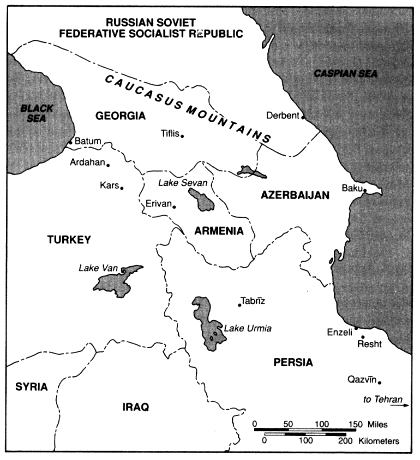
1. Transcaucasian Soviet Federative Socialist Republic in 1923
In late January 1921, Stalin asked the Central Committee to authorize Ordzhonikidze to organize an insurrection in Georgia, to be supported by the Red Army if necessary. Lenin hesitated, and while communications with Moscow were mysteriously disrupted, Ordzhonikidze acted on his own and authorized an armed uprising, which was supported by elements of the Eleventh Army. After two weeks of hard fighting, the Bolsheviks entered Tiflis, deposed the Menshevik government, and proclaimed the Georgian Soviet Republic.[32] The Turks responded by occupying the southwestern districts of the country. The Caucasian "Iron" Cavalry Division commanded by D. E Zholba secured Batum, but under the terms of the Soviet-Turkish treaty of 16 March the Soviet government made consider-
able territorial concessions to Turkey—the Kars region of Armenia and Artvin and Ardahan in Georgia.
In Central Asia the reconquest of the key border territories of formerly tsarist Russia was assured in July 1919 when the Red Army gained control over the entire 1,600-km-length of the Orenburg (Chkalov)-Tashkent railway. Military units arrived at Tashkent (the capital of present-day Uzbekistan) in November, and a five-man Commission for Turkistan Affairs was installed there. It was led by Mikhail Frunze and Valerian Kuiby-shev, both of whom played leading roles in the reconquest of the two former tsarist protectorates, the Emirate of Khiva, on the steppes of what is today northern Turkmenistan, and the Emirate of Bukhara, in present-day southern Uzbekistan and western Tadzhikistan. Both emirates were riddled with conflict between the central authority and nomadic tribes on the periphery, and between reactionary emirs and groups of enlightened-statist "Young Khivans" and "Young Bukharans." The latter were movements of young, radicalized Turkistani intellectuals and merchants influenced by indigenous radicalism and Young Turk ideology, both of which had developed independently of Russian socialism. In December 1919, elements of the Red Army invaded Khiva, which was declared the People's Republic of Khoresm the following April. In August-September 1920 a "popular revolution" in Bukhara led by "Young Bukharans" was supported by, and perhaps staged by, Bolsheviks from the Turkistan Commission. Red Army units commanded by Frunze intervened, captured the city, destroyed the famous minaret and the public mosque, and seized the state treasury for shipment to Moscow. So transparent was the Bukharan operation that even Moscow was embarrassed and scolded the local Bolsheviks for "appearing imperialist" and for their "colonial attitudes."[33]
With the military and revolutionary reconquest of Caucasia and Central Asia, relations between the Soviets of Russia and the Muslims of Asia became matters for decision and action. Would the October Revolution be continued, internationalized, and directed southward beyond the borders of the former Russian Empire? If so, would it be transmitted by those of similar religion, languages, and culture, or would it be controlled by Europeans from Moscow and Petrograd? Muslim national communists like Sultan Galiev had an answer to this question. Just as Soviet Turkistan was "the revolutionary lighthouse of Chinese Turkistan, Tibet, Afghanistan, India, Bukhara, and Khiva," he wrote, so will Soviet Azerbaijan "become the Red lighthouse for Persia, Arabia, and Turkey."[34] Muslim national communists wanted the October Revolution activated in Asia, and wanted it led by Muslims and accomplished forthwith—a purely Asian strategy of
continuous revolution. But the leadership of the RCP(B) within the Comintern was not convinced.
Within five months of Azerbaijan's coming under Bolshevik control, and at about the time the Red Army entered Bukhara, the Comintern proclaimed a major revolutionary initiative in Islamic Asia. Ordzhonikidze and RCP(B)-Central Committee member Elena Stasova arranged a "Congress of the Peoples of the East" and convened it in September at Baku, the capital of Azerbaijan. To this congress were invited "the enslaved masses of Persia, Armenia, and Turkey" as well as the "more distant peoples" of Islamic Asia and India.[35] Almost 2,000 delegates from twenty-nine nationalities, one-half of them from the Caucasus and most of these from Azerbaijan, attended the congress, where they heard Zinoviev call for "a holy war above all against British imperialism."[36] Although the delegates gave vent to much uncomplicated anti-European nationalism, those who attended the congress at Baku did not constitute a cadre of disciplined, dedicated, and devout activists sophisticated in Marxist theory and skilled in revolutionary tactics; nor did the congress transform them into one.[37] And those who represented the highest levels of the Comintern at the congress did not commit themselves to an Asian strategy. Zinoviev and Béla Kun disparaged the idea of self-sufficient revolutions of national liberation in Asia. They insisted that the class struggle and the alliance between the peoples of Asia and the proletariat of Europe and Russia were the indispensable elements of international socialist revolution.[38]
Thus, as the Civil War ended in Russia, disparate strategies for continuing the October Revolution and for extending it to Asia were being articulated, and these the Comintern could not fully coordinate and direct. As a result, the beginnings of the NKID's efforts to introduce "peaceful coexistence" into the relations between the new Soviet state and the major powers of Europe and to normalize relations with the countries on the southern periphery of the soviet republics were seriously complicated. Nowhere was this more true than in Persia.
With the revolution in Russia and the withdrawal of tsarist armed forces from northern Persia in 1917, Great Britain occupied a position of almost complete domination in a region close to the new soviet republics and of vital strategic significance to them. British forces occupied Persia and Mesopotamia and Turkish Armenia to the west. British naval units controlled the Caspian Sea. The Anglo-Persian agreement (signed in August 1919 but never ratified) represented the highest achievement of Lord Curzon, British foreign secretary (1919-24) and former viceroy and governor-general of
India, in his efforts to found a post—World War British Empire in the eastern Mediterranean and southwest Asia.[39] It would have given to British advisers control over the Persian treasury, army, and railroads. The governments of both France and the United States lodged protests against the treaty; Persian nationalists were outraged; and the assembly (majlis ) in Tehran refused to ratify it. The NKID also objected to it, particularly in that the Persian government refused to open even minimal diplomatic relations with the new Soviet state—despite the fact that the Soviet government renounced the Anglo-Russian agreement of 1907 dividing Persia into spheres of influence, denounced the secret wartime treaties between Russia and the Entente calling for partition of the country, canceled the debt incurred by Persia with the tsarist regime, surrendered tsarist concessions there, and handed over to the government in Tehran the assets of Russian-owned banks.[40]
A squadron of eighteen ships formed the northernmost tip of British influence in Persia; these were the remnants of the navy the British had organized for counterrevolutionary General Anton Denikin, commander in chief of the Armed Forces of South Russia (1919-20). With Denikin's defeat and the Bolshevik advance into Transcaucasia in March-April 1920, local Persian authorities interned the ships and placed them under the protection of British Indian forces. The ships were based at Enzeli (subsequently Pahlavi and then Bandar Anzali), the best Persian port on the Caspian and the center of the lucrative prewar Russian caviar industry. Since 1918, British and White forces had repeatedly used Enzeli as a base from which to launch attacks on Baku and on Krasnovodsk across the Caspian in Russian Turkistan. In April 1920, Trotsky cabled Lenin and Chicherin: "The Caspian must be cleared of the White fleet at all costs. If a landing in Persian territory is required, it must be carried out." Before forwarding the memorandum, Lenin noted in the margin: "I fully agree."[41] On 18-19 May 1920, Soviet naval forces in the Caspian under the command of Fedor Raskolnikov captured the ships, landed 2,000 marines, surrounded the British garrison, and took the city of Enzeli. British forces retreated to Qazvin, 90 miles northwest of Tehran. The government in London declined to reinforce them, and Prime Minister Andrew Bonar Law (1922-23) made clear in the House of Commons that His Majesty's Government was under no obligation to defend Persia. British prestige in Persia thereupon suffered a blow from which it never recovered.[42]
Following the attack on Enzeli, Soviet policy in Persia ran on two tracks. Proceeding on one track, Chicherin warned Ordzhonikidze and Raskolnikov not to extend Soviet military force beyond Enzeli, and Russian forces were withdrawn from Persia within three weeks as part of the
Soviet Russian effort to establish relations with the government of Persia in Tehran. On the other track, the Soviets undertook a major revolutionary initiative beginning with the contacts Raskolnikov established with leaders of the revolutionary nationalist movement in northern Persia.[43]
The densely forested mountains of the Gilan and Mazanderan provinces in northwestern Persia, along the shores of the Caspian Sea, had been beyond the control of the authorities in Tehran for some time. Local chiefs, who headed bands of guerrillas called jengheli (from the Persian, "of the jungle") effectively controlled the countryside. One such chief was a minor landowner, cleric, and military adventurer named Mirza Kuchik Khan, who was allied with radical bourgeois intellectuals from both Resht, the capital of Gilan province, and Tehran. His movement was anti-Western, Pan-Islamic, and socially radical, and it was directed both against the existing regime in Tehran and against British presence in Persia. In May 1920, Kuchik Khan addressed a letter to the Soviet commanders at Enzeli asking for assistance against the troops of the Persian government, which had recently expelled his forces from Resht. And on 4 June, two days before they evacuated their forces from Persia, Raskolnikov and Ordzhonikidze met Kuchik somewhere on the road between Enzeli and Resht and apparently persuaded him on the spot to proclaim himself president of the "Soviet Republic of Gilan." Thereby was created the first Soviet "satellite" beyond the frontiers of the former Russian Empire.[44] Kuchik Khan then personally directed a message to Lenin requesting the help of all socialists belonging to the Comintern "in liberating us and all weak and oppressed nations from the yoke of English and Persian oppressors."[45]
In Moscow and Petrograd the news from Persia evoked an outburst of jubilation. As leader of the Red Army, Trotsky immediately sent to Kuchik Khan a message stating that "the news of the formation of the Persian Red Army has filled our hearts with joy."[46] The head of the Eastern Department of the NKID announced that revolution would spread from Persia to Afghanistan to northern India. A Persian branch of Adalet , a revolutionary Social Democratic party formed in 1916 of workers in the Baku oil fields, moved to Resht and there founded the Persian Communist Party. It was in the midst of these events that the Second Comintern Congress convened in July 1920. When Lenin informed those assembled that "the Soviet movement in the whole East, in all Asia has already started," he was in all probability referring to the Persian situation.[47]
Behind the scenes, however, party leaders like Trotsky were much more skeptical regarding Soviet power in Asia.[48] The Gilan adventure was sponsored by Ordzhonikidze, Stalin, and Sergei Kirov, then a leader of the Communist Party of Azerbaijan and subsequently its general secretary
(1923-26). It was an embarrassment to Soviet diplomacy. Chicherin angrily opposed the whole operation, never calling it anything other than "Stalin's Gilan Republic,"[49] and fought with the supporters of the Gilan Soviet for Lenin's backing. Typically, Lenin supported both positions. He agreed not to grant the Gilan Republic formal diplomatic recognition, but he asked the NKID to give an official reception to a Gilan mission that arrived in Moscow in August 1920.[50] He also sanctioned military assistance to the Gilan Soviet, an action he may have seen as an implementation by military means of the doctrine of alliance between Communist parties and revolutionary nationalist movements that he had propounded at the Second Comintern Congress. Eventually a division of Red Army troops, mainly from Azerbaijan and Georgia, was dispatched to northern Persia to aid the Gilan Soviet Republic, the first and last time that organized combat units of the Red Army were directly involved in operations assisting a nationalist-communist coalition beyond the borders of the soviet republics.[51] The aid program was undertaken semi-independently by the Azerbaijan Soviet Republic, which thus gave the Russian government in Moscow the capability of "plausible denial" and allowed it to adopt an official policy of noninterference in the conflict between Gilan and Tehran.
Conflict within the government of the Gilan Soviet Republic itself strengthened Chicherin's hand in the policy dispute over Persia. The Gilan regime was composed of followers of Kuchik Khan, Kurdish chiefs, "anarchist" followers of the Tehran bourgeois intellectual Eksanullah Khan, and Communists. Some of the latter were important party personalities, both Persian and Russian, one of whom openly declared that it was the intention of Soviet Russia to liberate all Persia. Others were Persian migrant workers from the Baku oil fields who were inept at politics and who more than once stated openly that the Comintern had instructed them gradually to subvert and overthrow the power of the tribal leaders.[52] A. Sultan-Zade, the founder of the Persian Communist Party and a member of the ECCI (1920-23), was true to the program he had articulated in support of Roy at the Second Comintern Congress, namely, immediate socialist revolution and establishment of Soviet institutions. Not unexpectedly a struggle for control of the movement erupted between Kuchik Khan, on the one hand, and the Communists on the other. In July the government split, and Kuchik withdrew into the forest with his troops. Sultan-Zade formed a new government in Gilan dominated by the Persian Communist Party which attempted to implement a full-scale program of proletarian dictatorship, including nationalization of enterprises, closure of the bazaars, removal of the veil from women, and attacks on the clergy. With the Gilan Soviet involved in open conflict, the government in Tehran sent the Persian
Cossack Brigade under the command of Colonel Petr Storroselskii, a counterrevolutionary Russian officer, to "pacify" the area. Resht fell in August and Storroselskii's forces marched on Enzeli, but Soviet troops held them off and drove them back from the port city.[53]
At this juncture the correlation of forces within the Bolshevik leadership tipped away from support for insurrectionary initiative in Persia. The Second Comintern Congress defined the strategy for situations such as those at Gilan: Purely Communist regimes could not be immediately introduced in semicolonial Asia; Persia must first go through a stage of bourgeois revolution; national revolutionaries were objectively progressive and were to be supported. In Gilan the Persian Communist Party, with a new Central Committee, resolved to adopt the tactics of the "united anti-imperialist front," to avoid "revolutionary adventurism," to form a class alliance extending from the proletariat to the middle bourgeoisie and the intelligentsia, and to support a program of bourgeois democratic reforms.[54] The following spring the Persian Communist Party and Kuchik Khan reallied in a "united front" government.
After the Persian Cossack Brigade was driven back from Enzeli, it was reorganized by British advisers. They dismissed Storroselskii and the other Russian officers of the brigade, and at its command they placed the energetic, nationalistic, and ambitious Reza Khan, subsequently prime minister (1923-25), and then shah (1925-41) of Persia/Iran. In February 1921, Reza and his force of 3,000 Cossacks marched on Tehran and installed a new government in which Reza was appointed minister of war and commander in chief of the army. The first actions of the new government were to renounce the unratified Anglo-Persian agreement of 1919 and to sign with the Russian Federation a treaty that had been under negotiation since the previous October.[55]
The Soviet-Persian treaty was a document without strong precedent in international law. It went into effect from the moment it was signed; it had no expiration date; and there was no mechanism for renunciation. The Soviet government agreed to freedom of navigation on the Caspian Sea and to the presence of a Persian fleet there. It renounced all debts incurred by Persia with the tsarist regime, returned offshore islands seized by the tsarist government, and surrendered every concession Russia held or claimed in Persia, with the exception of the Caspian Sea fisheries. What Soviet Russia gained in return was the reaffirmation of the border of 1917, the reduction of British influence in Persia, and special military rights. Regarding the latter the Persian government consented to allow Russia to "advance troops into the Persian interior for the purpose of carrying out
military operations necessary for its defense" in the event that a third country (Britain) used Persian territory as a military base or threatened the Soviet frontier.[56] Over these provisions, contained in the notorious Articles V and VI of the treaty, there was vigorous debate in the Persian parliament. And only the strength of anti-British feeling in the country prevented the Tehran government from demanding of Moscow that the text of the treaty be revised to delete the two clauses. In 1941 they served as the basis for Soviet occupation of northern Iran. The Khomeini regime repudiated Articles V and VI in 1979; otherwise the treaty remained in effect.
Throughout the treaty negotiations, the objective of the NKID was to protect Transcaucasia, Baku in particular, from British military power. The oil center was vulnerable to attack from northern Persia; twice in 1918 British forces had occupied Baku from their base there. The RCP(B) Central Committee authorized Chicherin to agree with Tehran that if British troops were completely withdrawn from Persia, Azerbaijani troops would be evacuated from Enzeli. In this regard, the treaty was a triumph for Russian diplomacy. Tehran formally renounced the one-sided Anglo-Persian agreement of 1919, and British troops were withdrawn in May 1921.
Soviet forces remained, however, and in conjunction with the forces of Kuchik Khan they marched on Tehran in June. They were held off by Reza Khan's Persian Cossack Brigade while the Tehran government protested strongly. Moscow was persuaded thereby to abandon all support for the Gilan Republic and stated that it would recall and punish those officials responsible for terrorizing the Gilan people. Chicherin was even able to get the Central Committee of the RCP(B) officially to admonish the "undisciplined" Bolsheviks of Transcaucasia.[57] Red Army troops were withdrawn in September. Thereafter Kuchik Khan disputed the direction of the movement with his Communist allies which he settled by inviting them to a lavish feast at which he slaughtered the entire Central Committee of the Persian Communist Party. The Persian army "restored order" in Gilan, and the Gilan Soviet Republic expired in October. Kuchik Khan fled to the mountains of the Talysh district along the Persian-Azerbaijan frontier, where he froze to death.[58] The Persian Communist Party lost three-quarters of its membership, and by 1924 it had but 600 adherents.[59]
The Gilan Soviet Republic had been launched as the Red Army was achieving its final victories over the forces of counterrevolution. The incursion into Persia was an extension of the Civil War at a time when the international boundaries of southwest and Central Asia were being redrawn amidst the turmoil of the collapse of the Turkish and Russian empires, and when conflicting territorial claims abounded. The means by which the October Revolution was to be internationalized in Asia were still
being defined, and coordination of "the world revolutionary process" by the Communist International was just beginning. The Communist parties in the territories of the former Tsarist Empire had not yet been worked into the disciplined unitary organization; decentralized initiative remained possible. For those who had fought and won the Civil War, revolution, reconquest, and security went hand in hand.